Young children love to play with their mums and dads. But for busy parents, it’s often the last thing they feel like doing.
Running a home and family, doing paid work and trying to squeeze in some personal time mean parents don’t have a lot of time or energy to play magical princess dragons or soccer ninjas.
But playing with your kids and letting them lead the play is really important. Here’s why and how you can approach it.
Children love to play. But it is more than a way for them to enjoy themselves. It is also the principal way they learn about their world.
There are many types of play. For example, it can be manipulating objects, such as play dough. Or it can be imaginary, where children pretend they are mums, dads or babies.
In play, children have ideas and then follow those ideas in a way that is not simply a response to what surrounds them. Instead, they use that environment to imagine and create another world. A block becomes a phone, a table a house and a garden the home of a dragon.
Holding an imaginary theme in mind and creating a sequence of actions and appropriate language to enact it requires considerable intellectual effort. This sees children perform at a higher level than when engaged in other activities they are not leading.
Play teaches children to test their hypotheses and solve problems they encounter. Parents will notice children usually play about the world in which they are living. This is why they play families, pets and other familiar roles such as shopkeepers, doctors or nurses.
These themes may look mundane to parents (even boring). Yet for children they are exciting opportunities to explore their world, find out about the various roles they see around them and to bring ideas learned in a variety of contexts together in play.
Often children are seen as having short attention spans. Yet in play they can follow a theme or idea they have chosen for a longer time than when engaged in adult-led activities.
Developing the capacity to sustain attention to that idea in play and ignore other stimuli builds children’s capacity to self-regulate.
Self-regulation – the ability to control emotions and actions – is important in learning, at school and socially and emotionally.
Play is also central to language development. Play enables children to use the words and ideas they hear in their everyday lives and experiment with them in imaginary environments. In play they may talk to themselves to guide their thinking.
Children from approximately 18 months to eight years old want to play with their parents. Their parents are the centre of their worlds, until their attention shifts increasingly to their peers.
They want to do so because it helps their learning and development. Parents can anticipate their child’s thinking and create shared meaning in a way other children of the same age are not able to do.
Shared meaning enables to play to continue and makes it more interesting.
A parent’s role is to assist their child in play. This means it is important for adults to let children be the decision makers. Parents can initiate the play, make suggestions or provide props. But for the activity to be regarded as “play,” children must be those who make the decisions and guide its direction.
Research shows when an adult attempts to control the play children become distracted and quickly lose interest.
Play is not instructional (this is not about teaching your child how to do something). We have all experienced situations where we have been talked at, not discussed with, and likely we found it much harder to focus.
Children need to have this control because in play they are operating exactly at the level at which they are best able to learn. Suggestions from an adult or older child, however, can take the child’s play to a higher level. This makes it more challenging intellectually than if children were playing alone or with peers.
Children are instructed in almost every aspect of their day – when to get up, when to go to sleep, what to eat. Having a regular play time in which they lead, make decisions about an activity and how it progresses, gives them power and a sense of control in their lives.
My work as a professional teacher and early childhood academic has shown me that when parents – particularly those concerned about their child’s behaviour – dedicate 30-plus minutes each day (or every other day) to parent-child play, they find their child is happier and more easily guided in other aspects of their lives. This also strengthens their relationship.
Not all parents can manage this. But finding regular play time when you can is likely to be well worth it.
A valuable window
Parents who play with their children can find it is a valuable window into their children’s thinking, interests and world.
If you are going to join in the play, do so fully. Put away your phone – and sit on the floor or follow your child to where they are playing. This shows your child you are genuinely joining in.
Hopefully, by dedicating this time and prioritising it, parents may also find their child becomes more amenable to parents also allocating time for themselves.
Victoria Whitington does not work for, consult, own shares in or receive funding from any company or organisation that would benefit from this article, and has disclosed no relevant affiliations beyond their academic appointment.
As we approach the release of Monday’s employment white paper we can expect to hear a lot about something called the NAIRU – the so-called Non-Accelerating Inflation Rate of Unemployment.
This ungainly acronym, which currently dominates the thinking of both the Reserve Bank and the Treasury, derives its power almost entirely from the economic crisis of the 1970s, and is overdue for reconsideration.
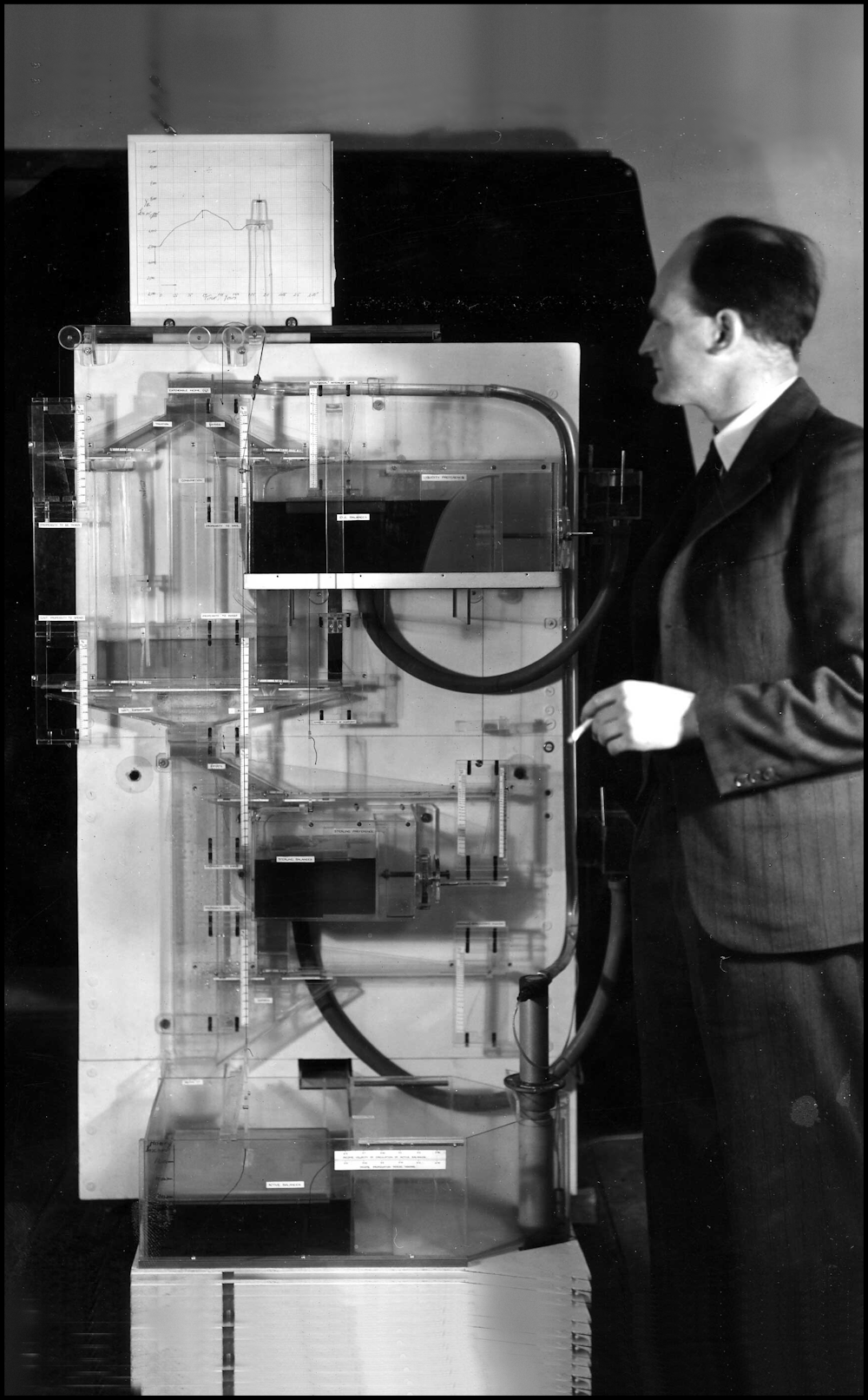
The story of the NAIRU begins even further back in time, in the 1940s, and is best illustrated by a curious machine displayed in the entrance of the Melbourne University Business, Economics and Education Library.
The MONIAC is a hydraulic computer, one of 12 constructed by New Zealand economist Bill Phillips in 1949 to illustrate Keynesian economics.
MONIAC stands for MOnetary National Income Analog Computer, and, although the machine is made out of tanks and pipes and valves and coloured water, it is a working (early) computer.
A guide to the Melbourne University MONIAC says when in operation, water is “injected into the ‘active balances’ tank, pumped up to the top of the machine as income, and allowed to flow downwards as expenditure, with controlled amounts siphoned off to enter the tanks representing taxes and government spending, savings and investment, and trade”.
While the MONIAC was an amazing innovation, even more important was the thinking behind it, which a decade later led Phillips to discover the Phillips Curve, a graph still used today to show the relationship between unemployment and the rate of wages growth or inflation.
Reserve Bank of New Zealand.
In the model described by Phillips, strong aggregate demand (a strong desire to spend) both cuts unemployment and pushes up inflation.
Weak aggregate demand boosts unemployment and cuts inflation.
The Phillips curve represents the trade-off.
At the time, with memories of the Great Depression still fresh, and the United States competing with the Soviet Union to achieve full employment, a slightly higher rate of inflation seemed a small price to pay to get closer to full employment.
It could be obtained by moving along the Phillips curve, using government spending and other measures to increase inflation and bring down unemployment.
Leading Keynesian economists including Paul Samuelson recognised at the time that the curve might not hold if people came to expect high inflation. However, given that earlier episodes of inflation in the early 1950s had been short-lived, it was thought that problem could be managed.
Phillips morphed into NAIRU
This prevailing view was challenged in 1968 by the great Chicago economist Milton Friedman who argued in his Presidential Address to the American Economic Association that, if inflation persisted long enough, the expectations of workers and businesses would adjust.
The inflation rate would become “baked in” as workers and suppliers increased their wages and prices by enough to compensate for inflation, whatever the unemployment rate.
Over the long term, there was a “natural rate of unemployment” – a floor – below which extra wages growth would simply lead to more inflation.
Translated to the graphical representation of the Phillips curve, Friedman implied that in the long run, the “curve” would be simply a vertical line, represented here with the annotation NAIRU in a graph prepared by Australia’s Reserve Bank.
The combination of high inflation and high unemployment (often referred to as “stagflation”) which emerged in the early 1970s seemed to vindicate Friedman. High inflation and high unemployment can’t coexist on a standard Phillips curve.
Friedman’s presentation of the problem implied the need for a full-scale model of what moved unemployment and wages, but it was never seriously attempted.
Instead, economists used Friedman’s insight to estimate the rate of unemployment at which inflation remained stable – the so-called “natural rate”.
Unfortunately for proponents of the idea, the “natural rate” turned out to vary over time, leading to the term being replaced with the clunkier but more descriptive “NAIRU”.
Worse still for proponents of the idea, estimates of NAIRU tended to move in line with the actual rate of unemployment. When unemployment was high, estimates of NAIRU were high. As it fell, estimates of NAIRU fell, suggesting that how far unemployment could fall was determined by how far unemployment had fallen.
Put to the test, NAIRU failed
The NAIRU model’s first real test since the 1970s came with the rapid upsurge and then decline in inflation in 2022 and 2023 that followed Russia’s invasion of Ukraine and the end of the COVID lockdowns.
Inflation was initially driven by a combination of supply chain disruptions and demand from savings made during the lockdowns.
Because the unemployment rate didn’t much move (presumably being near NAIRU, albeit an estimate that had progressively been lowered as unemployment fell) the upsurge in inflation could be seen as consistent with the existence of NAIRU, a vertical line on the Phillips graph.
However, the absence of a significant increase in wages growth was inconsistent with NAIRU, which was built around the idea that inflation was driven by growth in wages, passed on as higher prices.
More damaging to the idea of a NAIRU was what happened next.
So far in 2023 inflation has dived (using the monthly measure, from 8.4% to 3.9%) but the unemployment rate has barely budged – at 3.7% in August, it’s where it was in January.
This doesn’t fit the standard NAIRU model. However, it makes perfect sense in a world where high inflation can be seen as the simple result of strong demand driven by COVID income support and supply constraints associated first with COVID and then Russia’s invasion of Afghanistan.
Let’s not use NAIRU to limit our ambition
The central banks that pushed up interest rates have been quick to claim credit for the latest decline in inflation, but this claim doesn’t stand up to scrutiny.
Higher interest rates work with a lag to drive inflation down by reducing investment and consumption, and increasing unemployment. But inflation has fallen without these things happening.
Unemployment may well rise as the economy contracts, but that will be an unnecessary cost, like undergoing a dangerous treatment for a medical condition that is curing itself.
Like a one-hit wonder from the 1970s, the NAIRU model has remained dominant on the strength of its success in predicting the emergence of stagflation in the 1970s.
But as a general model of inflation and unemployment, it is woefully deficient. It is to be hoped it isn’t used to limit the government’s ambition in the white paper.
John Quiggin does not work for, consult, own shares in or receive funding from any company or organisation that would benefit from this article, and has disclosed no relevant affiliations beyond their academic appointment.
Source: The Conversation (Au and NZ) – By Michael B. Charles, Associate Professor, Management Discipline, Faculty of Business, Arts and Law, Southern Cross University
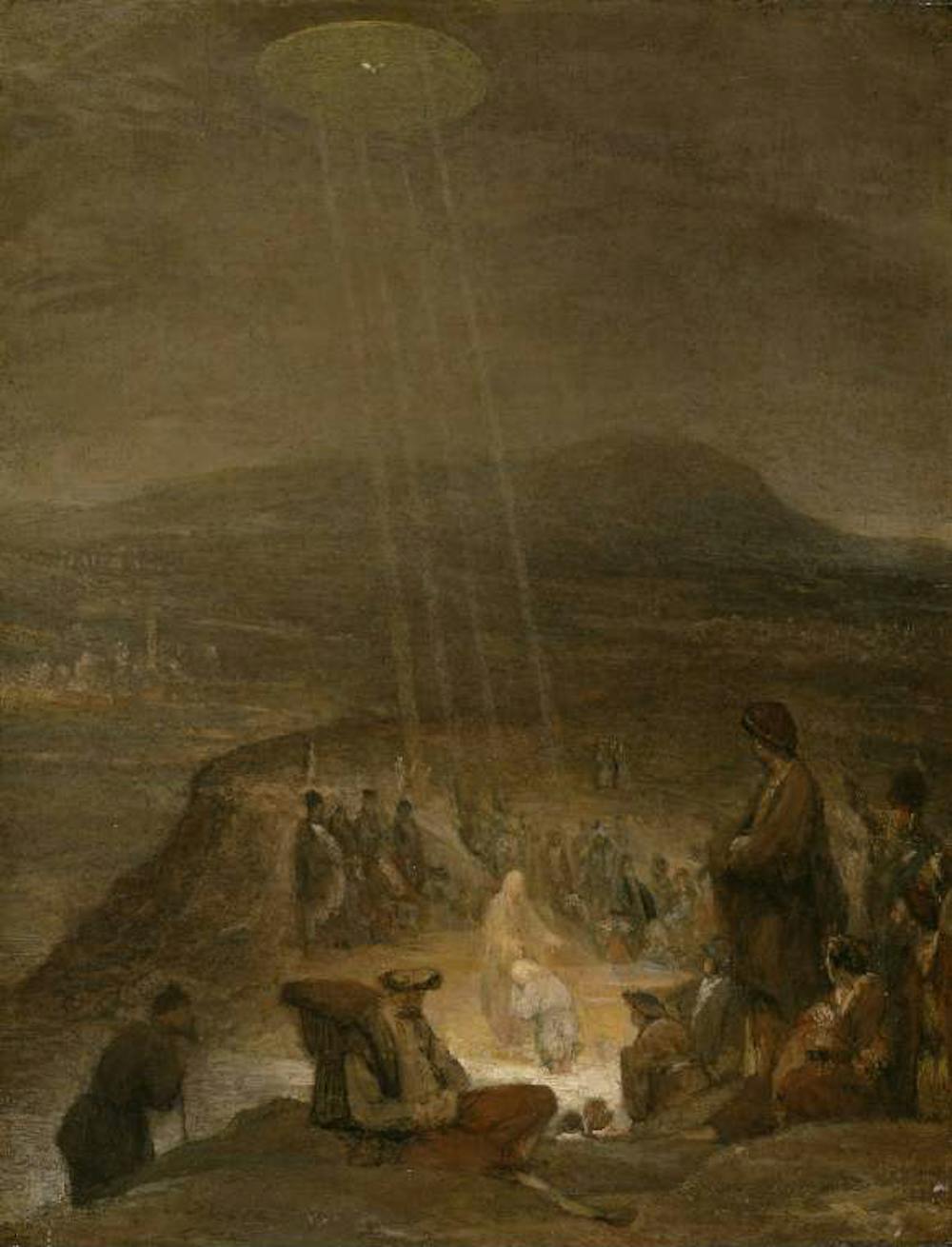
For thousands of years, people have been describing unexplainable gleaming objects in the sky.
Some aerial phenomena like comets, meteor showers, bolides, auroras or even earthquake lightning – all easily explained by today’s knowledge – were widely reported in the ancient world.
The US Congress is currently investigating unidentified aerial phenomena (UAPs – what you might think of as UFOs), in the wake of previously classified footage of UAPs being leaked and a former intelligence official alleging the US government possesses “off world” technologies.
Meanwhile, a recent NASA report concluded there is no evidence suggesting UAPs are of extraterrestrial origin.
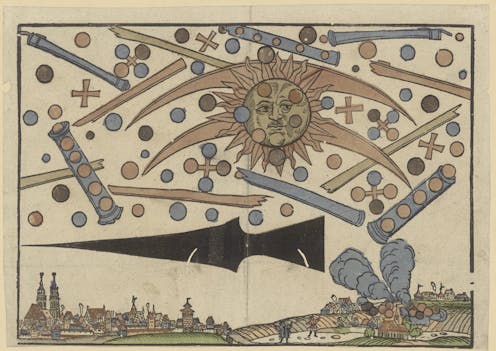
Ancient writers saw these phenomena as signs of social unease and impending disaster. In this way, modern reactions to UAPs are similar to those of thousands of years ago. There is a long history of strange objects in the sky associated with political and military crises.
In the Bible, the prophet Ezekiel mentioned a divine chariot: it glowed like hot metal in a fire and Ezekiel could see four living beings in it. They looked human-like, though they had four faces and four wings.
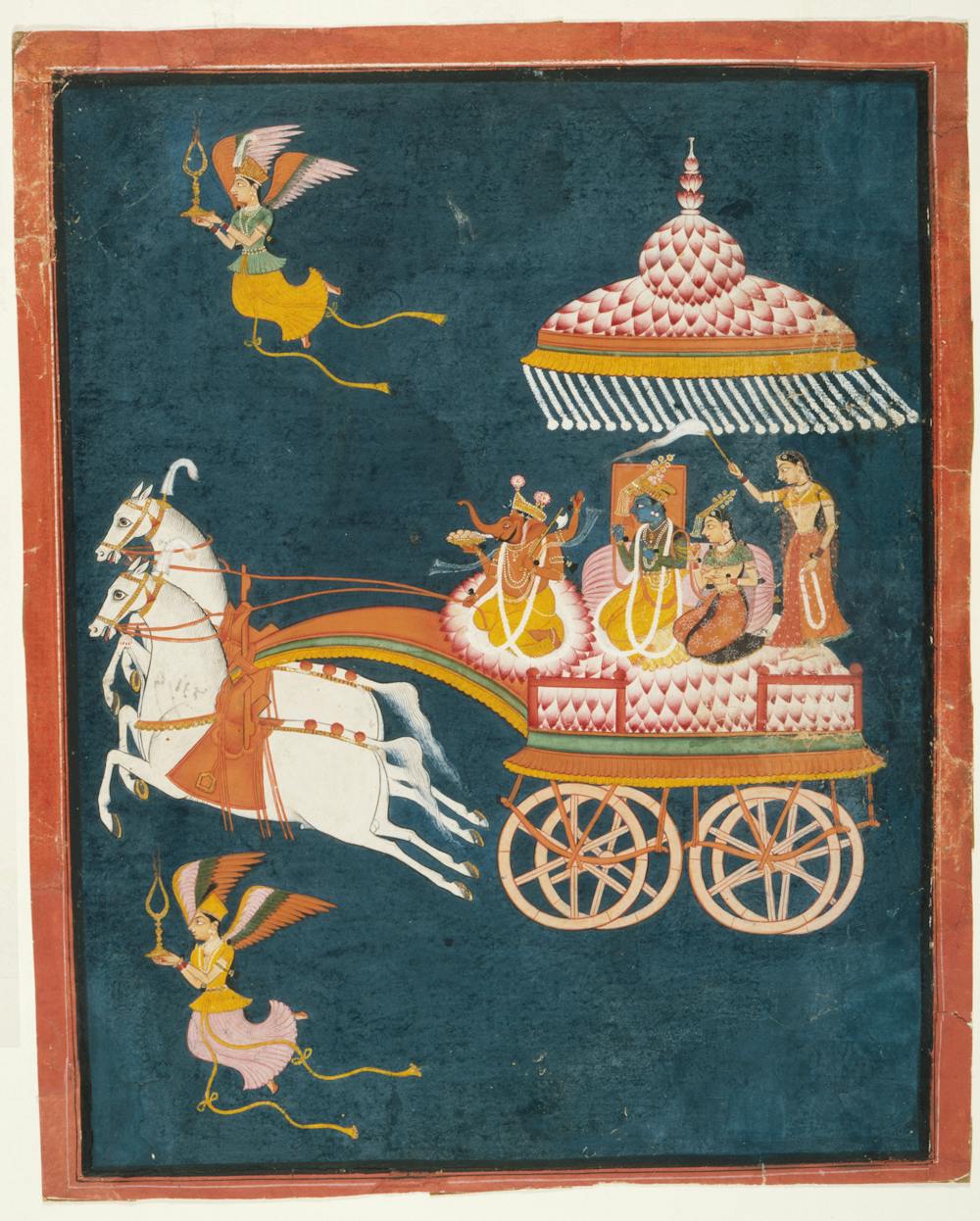
The vimāna – the flying chariots of the gods – also appear in ancient Indian epics, including the Mahābhārata and the Rāmāyana.
In Hindu myths, the gods were portrayed as riding these chariots to every corner of the universe.
Krishna and Rukmini as Groom and Bride in a Celestial Chariot Driven by Ganesha, India, Rajasthan, Bundi, 1675-1700. Los Angeles County Museum of Art
Describing portents of the winter of 218 BC, the Roman historian Livy said a “spectacle of ships gleamed in the sky”. The Second Punic War had begun, and the enemy general Hannibal was on the verge of a series of victories.
Maybe these “ships” in the sky were odd cloud formations, but Livy’s choice of words suggests something “shining” or “gleaming” – qualities even today associated with UAPs.
Livy reports another appearance of ships in the sky in 173 BC, when a “great fleet” allegedly appeared. In the spring of 217 BC, with Hannibal still threatening Rome, Livy says “round shields were seen in the sky” over central Italy.
Livy doesn’t say if these objects gleamed like the “ships” seen the previous year, but the “shields” recall the appearance of “flying saucers”, the type of UAP that came to prominence at the height of the Cold War.
Another curious classical UAP is recorded by the Greek writer Plutarch in his Life of Lucullus, a Roman general. Lucullus’ forces were about to fight King Mithridates VI of Pontus when a strange object appeared between the two armies:
suddenly, the sky burst asunder, and a huge, flame-like body was seen to fall between the two armies. In shape, it was most like a wine-jar (pithos), and in colour, like molten silver. Both sides were astonished at the sight, and separated.
That the object was described as a pithos, a vessel which has a specific shape, suggests something more than a flashing light. Some have interpreted this as a meteor, but Plutarch’s focus on its shiny metallic nature does not match this possibility.
Whatever it was, both armies thought it was a bad omen and withdrew.
Roman-Jewish historian Josephus, writing about war between Roman and Jewish forces, records an aerial battle between UAPs in AD 65. Before sunset, “chariots” were seen in the sky, accompanied by “armed battalions hurtling through the clouds”.
Josephus says numerous eyewitnesses saw it and believed it foretold the Roman victory that followed.
From ancient to modern doomsdays
Saint Paul referred to God’s “shield of faith” in his Letter to the Ephesians, while “ships voyaging in the sky” were a common theme in medieval Ireland, symbolising the safety the “ship” of the Church afforded believers.
Reports of unusual phenomena increased at the turn of every millennium, when Christian people feared or hoped for the Judgement Day predicted in the Book of Revelation in the Bible.
A King and His Retinue Confronting Ladies under a Celestial Battle, French, c. 1600. The National Gallery of Art
Millennial ufology is a fascinating development of recent Christian predictions of the end of the world, where the Messiah poses as a space traveller who returns to save us from Satanic aliens.
Millions of adults every year report experiences with UAPs: when interviewed about their experiences, some admit they are religious; others insist they are not. Importantly, ufology may well be a way of reconciling religion with science, an approach many find appealing.
We will never know what the objects and lights described by ancient texts were, and whether they were real or the result of psychological stress. At the very least, significant ancient sightings of UAPs almost always speak to conditions of anxiety and imminent change.
UAPs – ancient and modern – confirm our need to project our crises to objects in the skies.
Ancient people did not have the Doomsday Clock to warn them how close the end was, but they watched the skies carefully and found plenty of warning up there.
Eva Anagnostou-Laoutides receives funding from the Australian Research Council, Discovery Project: Crises of Leadership in the Eastern Roman Empire, 250-1000 CE.
nothing to disclose
Michael B. Charles does not work for, consult, own shares in or receive funding from any company or organisation that would benefit from this article, and has disclosed no relevant affiliations beyond their academic appointment.
Last night’s live TV leaders debate between Labour’s Chris Hipkins and National’s Christopher Luxon made clear the policy and leadership style differences between the two contenders to become New Zealand’s next prime minister.
But as TVNZ’s post-debate analysts tended to agree, neither candidate will have changed many minds – or reversed the main political poll trends since mid-year.
The so-called “bandwagon effect” describes how opinion polls can not only inform but sometimes influence electoral behaviour. Voters start aligning with whichever politician or party seems to be gaining support and momentum, creating a self-fulfilling prophecy effect.
Based on recent polling, this might seem to favour the National Party. But the rise of New Zealand First and Winston Peters, and the relative decline in support for the ACT Party, means there is still an unpredictable element to this election.
For Labour’s Chris Hipkins, it was important he not be perceived as a “dead man walking”. He probably managed that. But arguably, his situation remains more akin to someone attempting to thread a needle while running – a difficult and risky thing to do.
More than political theatre
Attempts to analyse leadership often focus on personal attributes – such as skills, personality, character and decision-making – and how these influence the results a leader achieves.
But what leadership researchers call “followership” – in this case, voter attitudes, behaviours and expectations – matters greatly. So does the wider socioeconomic and cultural context in which a leader is operating. Weighing all these can help reveal how Hipkins is responding and performing as a political leader.
In a nutshell, his core challenge is to navigate adverse conditions in ways that rise above the mere theatrics of politics. He needs to connect with voter’s values and interests, not just their current mood.
If Hipkins can do that, and with at least one recent poll suggesting the election could deliver a hung parliament, he could secure Labour a chance of forming the next government.
Authenticity and fallibility
Hipkins is campaigning primarily on his and Labour’s claimed desire and ability to support the “ordinary Kiwi” – that traditional target of most political parties. His own background as the “boy from the Hutt”, along with his self-deprecating and pragmatic, centrist instincts, are important features of his appeal and credibility.
That pragmatism orients him to seek politically practical and achievable outcomes whatever the circumstances. The challenge, however, is to be both aspirational and positive while also not indulging unrealistic expectations.
Research shows people are more likely to trust and support leaders they see as being “one of us”, and who they believe are genuinely motivated to act “for us”.
To sustain that, leaders also need to show they can deliver. Hence the balance in Labour’s advertising between its priorities for the coming term and its key achievements in government.
Hipkins has also emphasised the importance he attaches to just being himself, acknowledging he’s not infallible. Describing the government’s COVID policies and some decisions that, with the benefit of hindsight, weren’t optimal, he has said:
And that means you don’t get everything perfect, and there’s no point being defensive about it – you just have to own it.
Good leaders, according to some research, are authentic and know their weaknesses, but also possess the virtues needed to exercise wise judgment. Overall, the more voters trust Hipkins as a “safe pair of hands”, the more likely he is to win their support.
Crafting a persuasive narrative
The flip side to Hipkins’ pragmatism is that by not being bolder with policy, he risks giving people too few reasons to vote for Labour. His “middle ground” approach gives more political oxygen to parties on the left and right offering more radical change proposals.
And while policies might be the focus of campaigns and debates, politics remains an emotional experience for many voters. The electoral mood becomes a significant factor. And, as one observer put it recently, the electorate is unusually “grumpy”.
Hipkin’s therefore needs to persuade undecided voters – and previous Labour voters thinking of voting for another party – to reassess any negative feelings they might have about Labour’s performance. He has to convince them their long-term material interests, rather than their current emotional state, will be better served by giving him their vote.
In a cost-of-living crisis, it’s tempting to look for someone to blame for life’s challenges. That is a gift to Labour’s opponents, keen to build a narrative of political and economic incompetence.
There is a counter-narrative, of course: inflation and government debt levels are both below the OECD average, New Zealand has had proportionally far fewer COVID deaths than elsewhere, and the country’s credit rating remains solid. But facts and logic may hold little sway.
In leadership research, the attempt to create or control the narrative is called the “management of meaning”. Unless Hipkins discovers an effective way to do this, he will struggle.
This is a common problem for incumbent governments, campaigning on their record of managing real-world, complex problems. For opposition parties, it’s easier to present simple solutions and make bold promises, or what researchers of populism have bluntly called “bullshit statements”.
Breaking through these barriers and appealing to voter’s actual interests over their emotions is no easy task. Chris Hipkins has just over three weeks to find a way.
Suze Wilson does not work for, consult, own shares in or receive funding from any company or organization that would benefit from this article, and has disclosed no relevant affiliations beyond their academic appointment.
Labour leader Chris Hipkins and National leader Christopher Luxon have faced off in a fast-paced but unspectacular debate in the Aotearoa New Zealand general election campaign with co-governance and gangs among the issues producing the liveliest exchanges.
It was the first time the two leaders had squared off against each other outside Parliament and at times the mood was tense during last night’s debate.
Luxon, in particular, appeared frustrated when Hipkins interjected, while the Labour leader appeared to be enjoying himself a bit more.
However, with Labour behind in the polls, Hipkins was unable to deliver anything telling enough to put Luxon off his stride.
He did manage some amusing lines, however, such as “We have a proven track record of reducing our emissions . . . it’s not just a bunch of slogans”, “building EV stations is like building petrol stations”, and when asked what was his worst quality he responded with a smile: “I need to delegate more”.
Afterwards both leaders professed themselves happy with how they performed, however, commentators on TV1 were less enthusiastic, with former MP Tau Henare saying there was no excitement and Hipkins had been “too mild”.
Former Labour leader David Cunliffe believed Hipkins had allowed Luxon too much of a free run and the National party leader made the most of it. Both declared the debate a tie.
Wide-ranging debate The debate was wide-ranging, covering health, housing, crime and gangs, climate change and the economy. 1News political editor Jessica Mutch-McKay kept it moving at a fast clip and co-governance, especially in health, led to some intense debate.
1News political editor Jessica Mutch-McKay talks to the main party leaders in last night’s debate. Image: TV1 screenshot APR
The leaders were both asked if Māori and Pacific people should get priority when it came to the health waitlist. Luxon said need should come first ahead of ethnicity, while Hipkins said Māori and Pacific people having priority was a positive due to their poor health outcomes when compared to the rest of the population.
Hipkins said other parties were using the issue to “race-bait”, to which Luxon interjected “rubbish”.
Luxon said he felt the definition of co-governance had been expanded since the last time National was in government and the public had not been given adequate explanations of what it entailed.
Hipkins said co-governance meant shared decision-making over natural resources which had been successful. He believed Māori and government working together benefited New Zealand.
Luxon said he supported it for Treaty of Waitangi settlements but not for national public services and repeated his party’s intention of axing the Māori Health Authority.
“The Māori Health Authority isn’t having two separate systems,” Hipkins said.
Luxon challenged in Māori health He challenged Luxon on why he would keep Māori health providers if he did not want two systems of health. Luxon said he wanted to “turbo-charge” community organisations but it would be as part of one health system.
Hipkins said the health system was dealing with systemic issues and it would take time to build capacity to fix them.
But Luxon said every single health indicator had worsened under Labour — although Hipkins countered that by saying falling smoking rates were one example of effective action.
It was the first time the two leaders had squared off against each other outside Parliament and at times the mood was tense. Image: TV1 screenshot APR
Crime and gangs Both men acknowledged the country had a problem with rising crime and Luxon in particular doubled down on his party’s intention to crack down on gangs.
He said he did not feel safe in downtown Auckland and believed many New Zealanders felt the same.
Under Labour the prison population had been reduced by 30 percent — which might have been acceptable if the crime rate had gone down by the same amount — but in fact it had risen sharply, Luxon said.
On gangs he claimed: “We have nine gang members for every 10 police officers in this country.
“We’re going to make sure we ban gang patches in public places, we give police dispersal and powers to break them up from planning criminal activity, we get tough on the illegal guns that they have and we make being a gang member an aggravating factor in sentencing.”
Consequences for young offenders He also promised there would be consequences for serious young offenders.
Hipkins said the escalation in gang activity was unacceptable and acknowledged that more New Zealanders were feeling unsafe. However, he advocated working with young offenders to turn their lives around which would reduce crime.
On boot camps, told that an expert had said 83 percent of young people who went through them re-offend, Luxon said National would make them “more effective”.
“We need targeted interventions in these young people’s lives. I’m not prepared to write them off.”
When Hipkins tried to intervene and say how boot camps did not get results, Luxon hit back saying Labour had had six years to get it right.
Hipkins said Labour had changed the law so police could be tougher on gang convoys, such as the recent one that closed down parts of Ōpōtiki over a tangi.
Insults fly on housing Luxon slammed Labour’s record on housing while Hipkins said National’s plan was to offer incentives to landlords whereas Labour was focused on getting people into homes.
Hipkins said there were more “mega landlords” these days and that was not right.
“Will you guarantee your tax breaks for landlords will get passed on to tenants?” Hipkins asked Luxon.
Luxon avoided a direct answer so the Labour leader answered on his behalf, saying “We’ll take that as a no.”
Both leaders stated they supported building more state houses — although Hipkins was critical of how state houses had been sold off the last time National was in government.
Hipkins admitted KiwiBuild had been an “unrealistic promise” but since then Labour had created momentum in house supply which needed to be continued.
Afterwards both leaders were relaxed. Hipkins was reluctant to score himself, saying the voters would decide, but when pressed again opted for an eight.
Luxon said he had enjoyed it and hoped viewers did also while also choosing an eight.
This article is republished under a community partnership agreement with RNZ.
The outlooks for both local and export supplies of gas are positive for the early months of next year, according to the Australian Competition and Consumer Commission inquiry’s September report.
The inquiry, which provides regular information on east coast supply, says there will be sufficient gas to meet domestic demand as we go into 2024, while exports are predicted to be 9% higher in the first quarter, compared to the same quarter this year.
Even if all uncontracted gas is exported, there will still be an overall east coast surplus of 1.4 petajoules in the first quarter of 2024, according to the report.
It also forecasts gas supply in quarter one 2024 will be 5.9 petajoules above that forecast in June and 13% higher than actual supply in quarter one this year.
Export demand in the first quarter next year is projected to be 8.2 petajoules higher than the June forecast or 9% above actual LNG exports in the first quarter of this year.
The report says recent investment in pipeline infrastructure has improved the east coast gas market’s ability to transport gas from the northern states to the southern states, with further upgrades to be ready for next winter.
The forecast on domestic supplies follows actions by the government to ensure companies provide adequate quantities of gas into the local market at reasonable prices.
The ACCC does warn, “While the overall outlook is positive there remains risk that the outlook could worsen, particularly from higher-than-expected gas demand”.
The ACCC notes its data was collected during “a changing policy environment, including the implementation of the Gas Market Emergency Price Order and consultation on the Gas Market Code of Conduct”.
Under the code, which came into full operation this month,
producers may be exempted from reasonable pricing
requirements in exchange for making domestic supply commitments.
“However, as data was collected before the code was finalised, forecast supply in quarter 1 2024 does not reflect possible supply commitments producers may make to gain an exemption from the code.”
Treasurer Jim Chalmers said the data disproved the opposition’s fearmongering claims about the government’s energy price relief plan.
“The Liberals and Nationals voted against energy relief for families and small businesses in the parliament and they said the sky would fall in as result of our price caps and gas code of conduct. This data collected after the government announced action to limit the worst impacts of gas price increases is more proof they have no idea what they’re talking about.”
Chalmers said the plan was designed “to deliver better, fairer prices for Australian consumers at the same time as we honour our trusted role as an energy supplier”. The evidence showed it was working, he said.
He said gas would “play a crucial role in the defining decade ahead as we look deepen and broaden our industrial capacity and make the most of the transformation to cleaner, cheaper energy”.
Employment White Paper released on Monday
The long-awaited employment white paper, prepared by Treasury, will be released on Monday.
The paper will list five objectives. They are delivering sustained and inclusive full employment; promoting job security and strong, sustainable wage growth; reigniting productivity growth; filling skills needs and building the future workforce; and overcoming barriers to employment and broadening opportunities.
It will include a small number of initiatives, and point to future reform directions across ten policy areas. These are:
strengthening economic foundations
modernising industry and regional policy
planning for our future workforce
broadening access to foundation skills
investing in skills, tertiary education and lifelong learning
reforming the migration system
building capabilities through employment services
reducing barriers to work
partnering with communities
promoting inclusive, dynamic workplaces.
Chalmers said the white paper “is a roadmap for ensuring more Australians can make the most of the big shifts underway in our economy and society over the coming decades”.
“Today our unemployment rate is around historic lows and the participation rate is near record highs. This positions us well in the face of the immediate challenges of slowing economic growth and continuing global uncertainty, but more needs to be done to shape the future direction of our labour market and put the benefits of employment within reach of more of our people.”
Michelle Grattan does not work for, consult, own shares in or receive funding from any company or organisation that would benefit from this article, and has disclosed no relevant affiliations beyond their academic appointment.
Civil society groups wanting to see an end to destructive logging practices by foreign companies in Papua New Guinea, say these companies are being given forest clearance authorities and then misusing them.
The PNG advocacy group, Act Now!, and Jubilee Australia said the forest clearance authorities (FCAs) are intended to allow limited pockets of forest to be cleared for agricultural or other use.
Eddie Tanago of Act Now! said a case study they conducted into West Sepik’s Wammy Rural Development Project, which is run by Malaysian logging company Global Elite Ltd, was meant to result in the planting of palm oil and rubber trees.
“Instead, it used it as a front. And we’ve seen hundreds of thousands of cubic meters of round logs being exported. Now, this particular operation has been going on for almost 10 years, and this company has sold more than US$31 million worth of round logs,” he said.
Tanago said there was no sign of any attempt to rehabilitate the land for other use.
ACT Now! said the Wammy project was also breaking other laws because the land was subject to the SABL (Special Agricultural Business Leases) Commission of Inquiry in 2013 and it was evident then that the landowners’ free, prior and informed consent had never been given, so there should not have been any logging on it.
Tanago said Wammy was just one of about 24 logging operations making use of an FCA licence, resulting in huge quantities of logs being exported.
“Together this activity exploiting FCAs covers about 61,800 hectares of forest, and that’s equivalent to about 11,000 football fields. So that’s really, really massive,” he said.
Act Now is “calling on the Forest Board and the PNG Forest Authority to extend the current moratorium on the new FCAs”.
“There was one that was announced in the beginning of this year that says that they were not going to issue any new FCAs. We want that to extend. We want logging in all the existing FCAs to be also suspended. And there should be a comprehensive public review of these projects.”
The PNG government has previously stated it wanted to end round log exports by 2025, but Act Now! points out that in the first six months of the current year exports have totalled 1.1 million cubic metres.
“The export log volumes now are currently very high. And the PNG Forest Authority is really failing to meet the reduction targets as set down in the medium term plan,” he sid.
“This is in breach of the targets that are set out by the government, plus, all the promises that we’ve seen, like the recent one bill made by Prime Minister [James] Marape when the French President was around.”
On the visit to PNG, President Emmanuel Macron and Marape visited a lookout in the Varirata National Park picnic area, renaming it the Emmanuel Jean-Michel Frederic Macron lookout point.
The Pacific Islands News Association (PINA) reports that the walk through the lush national park was underlined by the signing of a new environment initiative — backed by French and European Union financing — that will reward countries that preserve their rainforests.
Marape said the country’s rainforest was the third largest and undisturbed tropical rainforest in the world and preserving its integrity was of the utmost importance.
Act Now! would agree, saying PNG has to be looking to preserve the rainforest and reduce deforestation, but the current signs are not good.
RNZ Pacific contacted Global Elite Ltd for comment on this story but there was no response.
This article is republished under a community partnership agreement with RNZ.The audio was first broadcast on Friday, 15 September 2023.
Harvested logs in Papua New Guinea. Image: RNZI/Johnny Blades
The outlooks for both local and export supplies of gas are bright for the early months of next year, according to the Australian Competition and Consumer Commission inquiry’s September report.
The inquiry, which provides regular information on east coast supply, says there will be sufficient gas to meet domestic demand as we go into 2024, while exports are predicted to be 9% higher in the first quarter, compared to the same quarter this year.
Even if all uncontracted gas is exported, there will still be an overall east coast surplus of 1.4 petajoules in the first quarter of 2024, according to the report.
It also forecasts gas supply in quarter one 2024 will be 5.9 petajoules above that forecast in June and 13% higher than actual supply in quarter 1 this year.
Export demand in the first quarter next year is projected to be 8.2 petajoules higher than the June forecast or 9% above actual LNG exports in the first quarter of this year.
The report says recent investment in pipeline infrastructure has improved the east coast gas market’s ability to transport gas from the northern states to the southern states, with further upgrades to be ready for next winter.
The brighter outlook for domestic supplies follows actions by the government to ensure companies provide adequate quantities of gas into the local market at reasonable prices.
The ACCC notes its data was collected during “a changing policy environment, including the implementation of the Gas Market Emergency Price Order and consultation on the Gas Market Code of Conduct”.
Under the code, which came into full operation this month,
producers may be exempted from reasonable pricing
requirements in exchange for making domestic supply commitments.
“However, as data was collected before the code was finalised, forecast supply in quarter 1 2024 does not reflect possible supply commitments producers may make to gain an exemption from the code.”
Treasurer Jim Chalmers said the data disproved the opposition’s fearmongering claims about the government’s energy price relief plan.
“The Liberals and Nationals voted against energy relief for families and small businesses in the parliament and they said the sky would fall in as result of our price caps and gas code of conduct. This data collected after the government announced action to limit the worst impacts of gas price increases is more proof they have no idea what they’re talking about.”
Chalmers said the plan was designed “to deliver better, fairer prices for Australian consumers at the same time as we honour our trusted role as an energy supplier”. The evidence showed it was working, he said.
He said gas would “play a crucial role in the defining decade ahead as we look deepen and broaden our industrial capacity and make the most of the transformation to cleaner, cheaper energy”.
Employment White Paper released on Monday
The long-awaited employment white paper, prepared by Treasury, will be released on Monday.
The paper will list five objectives. They are delivering sustained and inclusive full employment; promoting job security and strong, sustainable wage growth; reigniting productivity growth; filling skills needs and building the future workforce; and overcoming barriers to employment and broadening opportunities.
It will include a small number of initiatives, and point to future reform directions across ten policy areas. These are:
strengthening economic foundations
modernising industry and regional policy
planning for our future workforce
broadening access to foundation skills
investing in skills, tertiary education and lifelong learning
reforming the migration system
building capabilities through employment services
reducing barriers to work
partnering with communities
promoting inclusive, dynamic workplaces.
Chalmers said the white paper “is a roadmap for ensuring more Australians can make the most of the big shifts underway in our economy and society over the coming decades”.
“Today our unemployment rate is around historic lows and the participation rate is near record highs. This positions us well in the face of the immediate challenges of slowing economic growth and continuing global uncertainty, but more needs to be done to shape the future direction of our labour market and put the benefits of employment within reach of more of our people.”
Michelle Grattan does not work for, consult, own shares in or receive funding from any company or organisation that would benefit from this article, and has disclosed no relevant affiliations beyond their academic appointment.
The 2023 general election campaign must be the most hollow in living memory. There really isn’t much that is positive or attractive about the electoral options on offer. This is an election without inspiration.
An angry mood for change
Political scientist, Dr Bryce Edwards.
There is a definite gloominess amongst the public right now – with a perception that not only is the country broken in many ways, but the political system is too. We see this most strongly in surveys that ask if the country is on the right track or not. Generally, New Zealand has flipped in a few short years from having about two-thirds of the public saying the country is headed in the right direction, to now having two-thirds saying we’re going the wrong way.
Journalists and politicians report that out on the campaign trail they are discovering that the public is angrier than ever. Mark Blackham reported this week that “MPs are encountering angry people – a general anger about the state of affairs and paucity of political choices.”
Stuff journalist Julie Jacobson summed up the political mood in the weekend as “Disillusioned, demoralised, disenchanted, disgruntled”. And she argues this has only increased during the campaign: “what was a low hum has become a sustained grumble.” Jacobson reports that across the political spectrum people are “out of love with what’s currently on offer.”
Certainly, much of what the politicians are offering is extremely grim. For example, both Labour and National are promising to slash billions of dollars from public services.
This promised austerity drive reflects a reality that the government’s books are empty, with no room for additional new spending. Hence Prime Minister Chris Hipkins has openly said that this election can’t be one for big spending policies.
Hipkins has gone from promising “bread and butter” reforms to, as leftwing political commentator Chris Trotter points out, being committed “to less butter and thinner bread for at least the next three years.” Trotter says, in general, there’s not much for the public to positively vote for, and instead people will vote negatively – choosing whoever they regard as the best of a bad bunch. Hence, “This is not going to be a happy election.”
For traditional leftwing voters Labour’s austerity programme is a major disappointment, as it goes hand in hand with opposition to any real tax reform that might collect more revenue for public services and infrastructure.
Likewise, on the right, there is a strong suspicion that National’s tax cuts are simply unaffordable. The policy is being called out by the likes of rightwing political commentator Matthew Hooton as being unprincipled and incompetent, and by the Taxpayers Union as foolhardy.
There is also growing scepticism that some of the bigger policy promises are electoral bribes that can’t be delivered. Hooton says that a “cynical electorate” sees many of these policies as empty promises – especially because voters have got used to being lied to or misled by politicians who don’t deliver their promises once in power. He suggests that voters are right to be cynical because New Zealand has had “15 years of people hearing promises from politicians which are platitudes on the face of it and they haven’t even been delivered to that extent”.
Similarly, Stuff journalist Andrea Vance argued in the weekend that “Voters know when they are being used”, suggesting that the “bribes” being offered don’t compute for voters. Vance says politicians are promising to slash “public services and spending – in the name of savings and efficiencies – when they are already stretched and degraded.”
Voters shouldn’t have confidence, she suggests, that the next government will be able to meet the existing needs of public services, let alone start fixing the severe deficits in infrastructure and services. Fundamentally there is a credibility gap between politician promises to cut spending but to properly maintain all “front-line” services.
The Politicians aren’t up to the challenge
Voters are aware that we’re in something of a “polycrisis”, and the status quo is unsustainable. Political pollster Peter Stahel wrote last week that there is “an unmistakable mood for change” based on a “strong undercurrent of dissatisfaction, driven by personal financial hardships and an uncertain economic outlook”. His company’s polling show “only 29% of voters say the current options for prime minister appeal, with nearly half (46%) saying they don’t.”
There’s a cost of living crisis, failing public health and education systems, a housing crisis, a climate crisis – the list goes on. As Newstalk’s Mike Hosking says, “There is no shortage of serious, worryingly serious, issues to discuss this campaign”, but the politicians are largely missing in action.
Because the politicians haven’t risen to the challenge, the contrast between what is desperately needed and what is on offer has never been so great. The public is right to be disenchanted – parties are mostly just offering sniping and petty criticisms of their opponents. As political commentator Josie Pagani has put it, “This is an election of parties wrestling on the ground, when we crave a new Jerusalem.”
Pagani says “We have gone from ‘Hope and Change’ to ‘Perhaps Just a Biscuit’.” Whereas in previous elections, parties ran on a programme of grand causes, this time around, issues like child poverty and the housing crisis are being ignored by politicians.
Former Labour leader David Cunliffe appears to agree – he went on Breakfast TV on Thursday to say that “voters are grumpy. They don’t think that either party is really hitting the nail on the head in terms of what’s worrying them.”
Similarly, business commentator Bruce Cotterill wrote in the Herald last week that the campaign has been highly disappointing so far because it’s more about attack ads and petty sniping than about illuminating the big issues and the policies that the parties have for fixing them. He laments the lack of debate about the crises in the health and education systems, and says problems like housing waiting lists and child poverty have been virtually ignored.
Hooton also says this avoidance of the big issues is a tragedy, especially since we are now in what he argues is the worst economic crisis in decades.
An Uninspiring election campaign
In lieu of being focused on the things that matter, the politicians are becoming more aggressive, threatening to turn this year’s campaign into the most negative in living memory. Press gallery journalist Glenn McConnell reports that as we go into the last month of the campaign its “becoming more feral”. He says the politicians are largely to blame: “nobody is running a wholesome forward-looking, solutions focused campaign. They are frothing to attack, attack, attack.”
The lacklustre nature of the parties is reflected in their campaign slogans according to Jacinda Ardern’s former chief of staff Mike Munro. He says none of them are original, because “every variation of wording around concepts like change, hope, aspiration, unity and the future have been previously used on party billboards”. And he argues that the parties are incredibly risk-adverse this election, being determined to stage-manage every element of the campaign and the candidates, reducing any chance of life in the election.
Is this therefore the most uninspiring election ever? Writing on Sunday, journalist Andrea Vance asks: “Has there been a duller election campaign in recent memory?” She labels it “the election of The Great Uninterested” because people seem to be turning away in boredom or disgust. Vance says: “It’s not just that voters are bored. They’ve stopped listening.”
Political commentator and former Cabinet Minister Peter Dunne is also amazed at the lacklustre performances of the politicians so far – especially Hipkins and Luxon who are in the fight for their political careers. He says, given the big issues at stake, “Neither Hipkins nor Luxon has so far shown sufficient passion or boldness to convince New Zealanders they have what it takes to be an effective prime minister in the difficult years ahead.”
Election fatigue and low voter turnout
Do you wish the election was over already? You are probably in good company. This year there is no apparent enthusiasm for the campaign. You’ll notice that there aren’t many pictures or videos of politicians being swamped on the campaign trail, signing autographs or having mass selfies with fans – as occurred in recent elections.
Young people, in particular, seem unimpressed this time around. According to political scientist Richard Shaw, the students he teaches are losing faith in the New Zealand political system. He says that they are part of a growing cohort who are now “over” politics. Shaw is also picking that voter turnout is going to be low this election.
So, could the most popular choice at the coming election be “none of the above”? Certainly, the number of eligible voters who choose not to vote in the upcoming election could surpass a million, effectively making it the most popular option in 2023.
Voter turnout has generally been trending down in recent decades, and it hit a low of only 69.6 per cent at the 2011 election. That low turnout was generally because none of the parties were offering much that was inspiring, and no one expected the result to be close. Hence, one third of the electorate turned away in that election in disgust, apathy, or whatever.
The fact that the politicians and debate have become more aggressive and divisive puts people off. Other commentators are also now picking a decline too. David Cunliffe says: “Expect a record low turnout, and expect a record low vote share for Labour and National combined, and the highest ever share for the [minor] parties on both sides of politics.”
Leftwing columnist Verity Johnson has also written recently about the political despair amongst the public, predicting an extremely low voter turnout: “I’ve lost count of the people I’ve spoken to this week (smart, articulate and historically politically engaged people) who aren’t planning on voting in October. What’s the point, they shrug, there’s no one to vote for.”
Johnson says that the rising fury in New Zealand society is very tangible: “if you go into the suburbs and listen closely, you can hear an ominous hiss of fury rising up like a gas leak.” She suggests that this disenchantment is rational, and that there’s now little hope that politics can fix the problems of New Zealand: “Whatever happens on October 14, it feels like there’s just gonna be another 3 years of muddling, myopic, middle management politics where we have our head up our ass and our ecosystem on fire.”
Is politics in New Zealand broken?
Given the declining trust and participation in politics and the electoral process, this might signal that something is wrong in New Zealand’s democracy. Of course, this is a problem all over the world at the moment, with rising dissatisfaction and a sense that elites and vested interests dominate. There is a huge mood of change everywhere.
Writing this week, Chris Trotter says that most politicians haven’t caught up with the new Zeitgeist. He reports on a new book exploring the decline of politics, written by former British Tory Cabinet Minister Rory Stewart, which reflects on how the political system has hollowed out. Here’s the key quote that Trotter cites from the book, suggesting it could well come from a minister in the current New Zealand Government: “I had discovered how grotesquely unqualified so many of us, including myself, were for the offices we were given… It was a culture that prized campaigning over careful governing, opinion polls over detailed policy debates, announcements over implementation.”
Similarly, writing about how dire the current election campaign is, Matthew Hooton says New Zealand’s political system is effectively broken because the parties simply aren’t serious vehicles for political change anymore. He argues that they have been captured by careerists, consultants and lobbyists seeking power: “That is, they are not concerned with achieving power to make anything better. They are focussed merely on achieving office, to enjoy the status and perks. This is why they feel no need to do real work between elections, before which they release pseudo-policies, written the night before, often by external lobbyists or consultants, that they can’t and won’t deliver – and which they don’t care whether or not are delivered anyway.”
Empty election debates
Could tonight’s leaders’ debate on TVNZ1 be as dire as the campaign so far? Expectations aren’t very high for an illuminating contest of ideas. Expert more hollow and negative posturing.
Sure, there is a fair deal of anticipation on whether Hipkins can easily beat Luxon, or whether Luxon can rise above the low expectations about his debating skills or charisma. This question of who will “win” will be of some interest, but of little real consequence in a campaign in which everyone is surely getting election fatigue.
Therefore, even if 1.2 million New Zealanders tune in at 7pm (as they did for the first leaders debates in 2017 and 2020), they’re unlikely to last the full 90 minutes. As with the overall election campaign, viewers will probably turn off fairly quickly. So, although it is likely to be the single biggest TV event of the campaign, don’t be surprised if the real winner of the debate is actually Shortland Street on TV2 at the same time.
One of the most highly anticipated game releases this year is Bethesda Studio’s action role-playing game Starfield. An open world game set in the year 2330 with over 1,000 explorable planets, it’s been described by producer Todd Howard as “Like Skyrim in space” and by director Ashley Cheng as “the Han Solo simulator. Get in a ship, explore the galaxy, do fun stuff.”
New game releases are rarely without their controversies. Earlier this month, a clip of YouTuber HeelvsBabyface complaining about the inclusion of pronouns in Starfield went viral.
You take everything we love, all our immersions, all our fantasies, all our escapism, and you can’t help shovel your dogshit fucking crap ideology into everything.
Other internet gaming personalities are claiming they will boycott the game over its inclusion of pronouns in the character creation system.
All this is in a response to a window that pops up during character creation asking the player to confirm their character’s pronouns from three options: he/him, she/her, and they/them.
Larian Studios’ Dungeons & Dragons-based game Baldur’s Gate 3 was released for Playstation 5 on the same day as Starfield. The game has a similarly detailed character creation system including three “identity” options: male, female, and non-binary/other, which has similarly incited criticism from gamers.
What is character creation?
In an ever-growing age of increasing digital processing power and graphics capabilities, big-budget releases such as Starfield are judged by the level of detail in worldbuilding, graphical realism, and character customisation options.
Open world games keep getting bigger and character creation systems are becoming increasingly comprehensive.
The Sims (2000) was one of the first games to offer a highly detailed level of character customisation. Most role playing games follow The Sims’ established sequence of choosing male or female, which displays a default character on screen. Players then progress through different selection pages to further customise skin colour, body proportions, hairstyle, facial features and clothing.
Conventionally, the body initially chosen will then go on to limit options for hairstyles, facial hair, and clothing. It may also affect the character’s voice in-game, determine what pronouns with which they are referred to, and limit romance options.
Newer releases are changing their approach to the sex, gender and body options to allow the creation of characters beyond the gender binary. Some games, such as Elden Ring (2022), simply avoid gendering secondary sex characteristics by allowing players to choose between “Body A” or “Body B” in place of male or female. Splatoon 3 does something similar.
Other games go a lot further: CD Projekt’s Cyberpunk 2077 (2020) was the first game to allow genital customisation. Regardless of the gender chosen at the beginning of character creation, players may then select between two penis options (circumcised and uncircumcised) and a vagina, and can select a penis size from “small”, “default” and “big”.
Genital customisation does not affect gameplay, but according to ScreenRant, “both aligns closely with the cyberpunk subgenre and allows for greater player expression”.
What are pronouns, and why do they upset some people?
Pronouns are some of the first identifying words we learn. They form the basics of how we refer to ourselves and others, and we all have them.
Pronouns include words such as “I”, “me”, “you”, “your”, “she”, “his”, “them”, and “theirs”. When conservative internet personalities complain about pronouns, they are referring to the inclusive in-game options that allow people to create characters beyond the gender binary.
The argument that pronoun and custom genital options impedes player’s ability to have an “enjoyable experience” is a reflection of real-world transphobia.
Trans and gender diverse people have used games as a way to escape this reality, entering worlds where they can play as characters that align with their gender identity in ways their real-world body may not.
This is a common acting-out fantasy among non trans players too, who might create a character who is stronger, taller, or more conventionally attractive than they perceive their real-world selves to be. Games offer a world where almost anything is possible, and with the added features in newer games such as Starfield, trans and gender diverse people have more possibilities than ever to perform their gender.
Those calling for a boycott of these games over their inclusion of pronoun options and customisable genitals are also seeking to act out a fantasy: one where trans and gender diverse people do not exist. To wish the world, even a fantasy world, be rid of all traces of gender diversity, is to impose a political ideology onto a game.
Paradoxically, this is the very thing these conservative reviewers are mad about. Politics informs all forms of media in some way, but especially so science-fiction narratives, which speculate on the myriad future possibilities of humanity and beyond. Inclusive options in character creation are not only a draw for the increasingly diverse consumers of digital games, they are also an important part of storytelling.
The future of influence is here: a digital avatar that captivates millions of adoring fans while offering unparalleled customisation and round-the-clock availability.
Virtual influencers are transforming the way content is created, consumed and marketed online. They represent an electrifying dance between cutting-edge technology and our desire for connection. But, at the same time, they are yet another product being peddled by marketers that want our money.
Upon close inspection, we can see the risks that emerge with these blurred realities.
What are virtual influencers?
While virtual influencers aren’t a particularly new concept – virtual Japanese popstar Kyoko Date has been around since 1996 – recent advances in technology have thrust them into the spotlight.
Also called digital influencers or AI influencers, these digital personalities have a social media presence and interact with the world from a first-person perspective.
They’re created by 3D artists using CGI (computer-generated imagery), motion-capture technology and AI tools. Creators can make them look and act exactly how they want, and their personas are thoughtfully developed to align with a target audience.
There are three main types of virtual influencers: non-humans, animated humans and life-like CGI humans. Each one provides an innovative way to connect with audiences.
Why do virtual influencers exist?
Advancements in AI, the rise of social media and visions of the metaverse (in which the real and virtual worlds are blended into a massive immersive digital experience) are synergistically fuelling the growth of virtual influencers.
Their popularity has prompted marketing agencies to embrace them as a cost-effective promotional strategy.
While real influencers with millions of followers may demand hundreds of thousands of dollars per post, one 2020 estimate suggested virtual influencer Lil Miquela charged a more reasonable £6,550 (currently about A$12,600).
Virtual influencers have clear benefits when it comes to online engagement and marketing. They don’t age, they’re free from (real) scandals and they can be programmed to speak any language. It’s no surprise a number of companies and celebrities have caught onto the trend.
In 2019, supermodel Bella Hadid posed with Lil Miquela in ads for Calvin Klein in what one columnist dubbed a “terrifying glimpse of the future”.
Since then, virtual influencers have become even more popular.
In 2021, Prada introduced a CGI ambassador for its perfume Candy. More recently, Lil Miquela has popped up in a number of high-profile brand campaigns and celebrity interviews. Even rapper Timbaland has said he is considering a collaboration.
The transparency issue
Virtual influencers have a unique cultural dimension. They exist in a murky space between our world and the virtual which we’ve never quite explored. How might they impact us?
One major concern is transparency. Many virtual influencers already present as human-like, and it may become increasingly difficult to distinguish between them and real people. This is particularly problematic in an advertising context.
Virtual influencers often feature alongside real celebrities.
As the market for virtual influencers grows, we’ll need clear guidelines on how this content is used and disclosed.
India has taken the lead on this. In January, its Department of Consumer Affairs made it mandatory for social media influencers, including virtual influencers, to disclose promotional content in accordance with the Consumer Protection Act, 2019.
Synthetic or manipulated media that shows realistic scenes must be clearly disclosed. This can be done through the use of a sticker or caption, such as ‘synthetic’, ‘fake’, ‘not real’, or ‘altered’.
A Messi way to make money
The emergence of virtual replicas of real people (including deepfakes) has led to new discussions about how a person’s likeness may be used, with or without their consent.
On one hand, celebrity deepfake porn is on the rise. On the other, celebrities are including “simulation rights” in their contracts so their likeness may be used in the future. Take global football star Lionel Messi, who allowed PepsiCo to use a digital version of him to promote Lay’s potato chips.
While this might introduce opportunities for talent expansion, it also raises exploitation risks. People may unwittingly or desperately sell off their digital likeness without consent or adequate compensation.
Will the virtual replace the human?
For now, the relationship between virtual and human influencers seems more poised for coexistence than a total replacement. For now, virtual influencers can’t connect with people the way a real person can (although it’s hard to say how this might change in the future).
As for human content creators, virtual influencers are both inspiration and competition. They’re transforming what it means to be creative and influential online. Whether they like it or not, human creators will need to work with them – or at least alongside them – in whatever ways they can.
Mai Nguyen does not work for, consult, own shares in or receive funding from any company or organization that would benefit from this article, and has disclosed no relevant affiliations beyond their academic appointment.
Source: The Conversation (Au and NZ) – By Adrian Beaumont, Election Analyst (Psephologist) at The Conversation; and Honorary Associate, School of Mathematics and Statistics, The University of Melbourne
A majority of Australians have indicated they will vote “no” in the upcoming referendum on the Indigenous Voice to Parliament, according to a national Essential poll conducted Sept. 13–17 from a sample of 1,135 people.
The poll gave the “no” side a 51–41% lead over the “yes” side, compared to a 48–42% lead two weeks ago.
On voter strength, 42% said they were a hard “no” (up one percentage point), 28% were a hard “yes” (down two points), 12% were a soft “yes” (steady) and 8% were a soft “no” (up one point). The figures don’t add up to the overall “yes” and “no” totals due to rounding.
Below is the updated 2023 Voice aggregated polls graph. Essential has been the best pollster for “yes”, but now even this poll is showing a 10-point national lead for “no”. In every poll conducted since June by all pollsters, support for the “yes” side has been declining steadily.
The polling indicates the Voice referendum is headed for a heavy defeat. I wrote in my article on the last Newspoll that it was a blunder to hold this referendum as a standalone vote rather than with a general election, given the long history of failed referendums in Australia.
Large crowds at weekend rallies for the “yes” side do not imply the polls are wrong, as people who attend political rallies are very unrepresentative of the overall voting-age Australian population. Analyst Kevin Bonham has more in this long article debunking “poll denial” themes.
Labor at post-election low in Essential’s voting intentions
In Essential’s two-party estimate that includes undecided voters, Labor led the Coalition by 49–45%, down from a 51–43% lead a fortnight ago.
This is the lowest Labor lead in Essential’s fortnightly polls since it started asking about voting intentions in December 2022. The previous lowest Labor lead was five points in March and July.
Primary votes were 32% Coalition (steady), 31% Labor (steady), 13% Greens (down two points), 8% One Nation (up one point), 2% UAP (steady), 8% for all others (up one point) and 6% undecided (steady). The drop for the Greens means fewer preferences for Labor.
On what was causing the rising cost of living, 49% of those polled thought businesses maximising profits for shareholders contributed more than wage and salary increases for workers, while 32% blamed workers’ salaries more.
On power in the workplace, 42% thought it tilted too much in favour of employers, 12% said it was too much in favour of workers, and 46% thought the balance about right.
79% backing a new offence for employers to knowingly underpay their workers
66% supporting the closure of loopholes to prevent employers from using labour hire workers to undercut full-time workers
and 54% supporting minimum rights and entitlements for gig workers.
In other Canberra news, there will be no double dissolution election over Labor’s housing bill after it passed parliament on Sept. 14 with Greens support after the two parties reached a deal, ending months of conflict.
Other national polls
In last week’s Morgan federal poll, conducted Sept. 4–10 from a sample of 1,382 people, Labor led the Coalition by 52.5–47.5%, a 0.5-point gain for the Coalition from the previous week. Primary votes were 37% Coalition, 32% Labor, 13.5% Greens and 17.5% for all others.
I previously covered the continued tumble in Voice support and Prime Minister Anthony Albanese’s ratings from a national Resolve poll for Nine newspapers that was conducted September 6–9 from a sample of 1,604 people.
In other questions related to Qantas in that poll, 64% thought foreign airlines should be granted more flights to Australia to increase competition, while just 15% thought they should be limited in the national interest.
By a 69–17% margin, participants thought it unacceptable for politicians to accept free lounge memberships from Qantas.
Participants were also asked to give a positive, negative or neutral rating for each airline. More respondents had a negative view of Qantas (42%) than positive (26%), and a negative view of former Qantas chief executive Alan Joyce (54–6%).
Both Virgin Australia and Qatar Airways had higher positive ratings of 41% and 29%, respectively, than negative.
NSW Resolve poll: Labor drops but still well ahead
A New South Wales Resolve poll for The Sydney Morning Herald, conducted with the federal August and September Resolve polls from a sample of 1,019 people, gave Labor 38% of the primary vote (down three points since July), the Coalition 36% (up four points), the Greens 9% (down one point), independents 13% (up two points) and others 4% (down one point).
No two-party estimate was provided by Resolve, but The Poll Bludger estimated Labor would lead the Coalition by 54–46%, a 4.5-point gain for the Coalition since July. This is close to Labor’s 54.3–45.7% win at the March state election.
Labor incumbent Chris Minns maintained a 41–14% lead over the Liberals’ Mark Speakman as preferred premier (compared to 39–12% in July).
Respondents were also asked about a recent scandal involving Tim Crakanthorp, Labor MP and former minister for the Hunter, over revelations that his family owned several commercial properties in the Hunter region that he had not disclosed.
On the appropriate action, 48% thought Crakanthorp should be stood down and independently investigated, while 29% thought he should be disciplined by the party or parliament and 7% thought no action should be taken.
Adrian Beaumont does not work for, consult, own shares in or receive funding from any company or organisation that would benefit from this article, and has disclosed no relevant affiliations beyond their academic appointment.
Former MP for Madang Open and anti-corruption campaigner Bryan Kramer has filed a Supreme Court appeal against a National Court ruling dismissing his application for leave to review a Leadership Tribunal’s decision to dismiss him from office.
His appeal to the Supreme Court follows the refusal of a leave to review application in the National Court presided by Justice John Carey on August 18.
Kramer said in a statement that he had filed an application on the 23 May 2023 in the National Court to review the decision of the Leadership Tribunal.
He later withdrew this and refiled on June 30.
The refiled application raised nine primary grounds, including breach of natural justice, procedural unfairness, apprehension of bias in being denied a fair hearing, unreasonableness and being oppressive and harsh and not “reasonably justifiable in a democratic society”.
After waiting almost three months for a judge to hear his leave application, the matter was listed before Justice John Carey on August 18. However, straight after hearing detailed submission from counsels, Justice Carey delivered an oral judgement refusing Kramer’s application.
Justice Carey ruled that Kramer had not satisfied all the requirements, in particular an arguable case
Further nine grounds Kramer is now appealing the judge’s ruling on a further nine grounds that include an allegation that the judge had failed to properly deliver a reasoned judicial decision.
He will submit that the judge had erred in directing Kramer’s counsel to narrow his submissions to the ground of apprehension of bias to the exclusion of the issues raised in the eight other grounds.
Further, the judge had failed to consider specific matters raised in each of nine grounds.
The judge had delivered two judgments, the first oral and the second published without indicating to parties, and that was altered and expounded on the reasons in the oral judgement.
He was dismissed in May this year by a a Leadership Tribunal comprising Justice Lawrence Kangwia and senior Magistrates Josephine Nidue and Edward Komia.
The Tribunal found him guilty on seven of thirteen allegations of misconduct in office
Five of the seven misconduct charges were in relation to decisions concerning the Madang District Development Authority (DDA) that he had failed to comply with legislative administrative requirements, and the misapplication of district funds to which they could not be lawfully applied.
Facebook publications The remaining two misconduct charges were in relation to his Facebook publications that were found to have “scandalised the judiciary”.
The background of the two charges of him scandalising the judiciary were that in October 2019 he had published a three-part series of articles on Facebook concerning an arrest warrant against former Prime Minister Peter O’Neill.
The first charge was over part of his publication insinuating a conflict of interest by Chief Justice Sir Gibbs Salika in publishing the words “a relevant matter to note is that the Chief Justice was only recently appointed by O’Neill late last year”.
The second charge was over publishing the words “What was not anticipated was that O’Neill and his lawyers would solicit the assistance from the Chief Justice and desperate enough to submit fabricated documents to mislead the court that the warrant was defective as a means to obtain a stay order”.
The Tribunal had recommended by majority that Kramer pay a fine of K2000 (about NZ$922) for each for the five charges in relation to the Madang District Development Authority as they were decisions made by the DDA Board and not Kramer alone.
However, it recommended unanimously for his dismissal from office in relation to his Facebook publications in scandalising the judiciary.
Pacific Media Watch reports that in a profile by The Guardian in 2019, Bryan Kramer — BK as he is known — was described as a “rising star in PNG politics” and as an anti-corruption campaigner who was instrumental in bringing to light the UBS scandal that helped to bring down former Prime Minister Peter O’Neill’s leadership.
Republished from the PNG Post-Courier with permission.
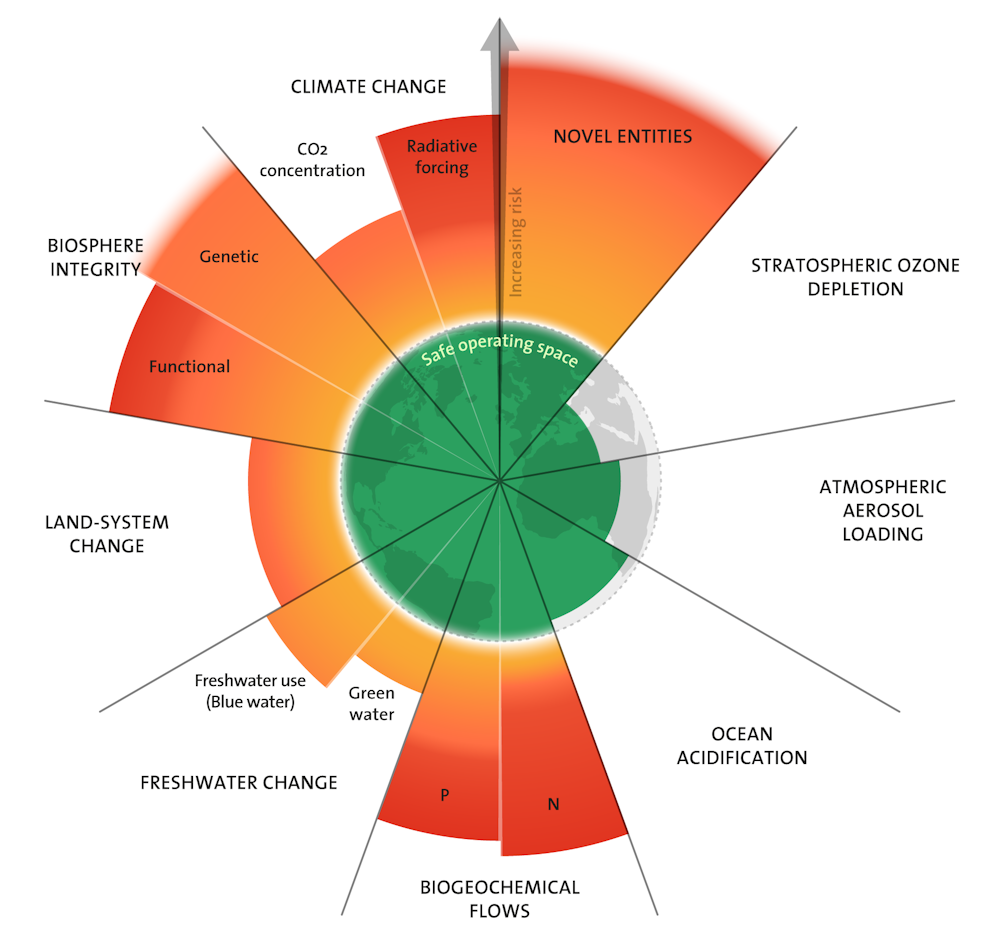
As far as we know, there is exactly one planet in our Solar System – and the galaxy – which hosts life. And you’re on it.
For the first 800 million years, Earth was dead. Then life began making itself at home. For over three billion years, lifeforms have helped shape their own environment. Earth’s energy balance (commonly known as the climate) and its interactions with trillions of species is the main determinant of environmental conditions.
As you know, one species – ours – is exceptionally good at changing our environment to suit us. The problem is, we’re now too good at it. We chop down forests, remove mountains to get at ore bodies, take over grassland, fish out entire seas, create and unleash novel chemicals and pump huge quantities of nutrients from fertiliser into the system. These and many more undermine the hidden life support system on which we rely.
What are planetary boundaries?
Almost 15 years ago, this article’s lead author helped create something called “planetary boundaries” to make clear what damage we had done.
We teased apart nine processes vital to the Earth system.
Three are based on what we take from the system:
biodiversity loss
fresh water
land use.
The remaining six come from waste we deposit back into the environment:
greenhouse gases (which cause climate change and ocean acidification)
ozone depleting chemicals
novel entities (plastic, concrete, synthetic chemicals and genetically modified organisms which owe their existence to us)
aerosols
nutrient overload (reactive nitrogen and phosphorus from fertilisers)
If we keep our activities to a safe level, the sheer exuberance of life and the planet’s own processes can handle it. But in six out of nine vital life support systems, we have blown well past the safe zone. And we’re now in the danger zone, where we – as well as every other species – are now at risk.
Here’s the sum total of our impact on the planet. You can see the areas we’re still within safe limits – and those where we are well past. Azote for Stockholm Resilience Centre based on analysis in Richardson et al 2023, CC BY-ND
Our breach of boundaries is very new
In the year 1900, there were around 1.6 billion humans – nearly all of them poor. Now there are 8 billion of us, and some of them are rich. And nearly all of us use fossil fuels, plastics, chemicals and products from intensive agriculture.
It can be very easy to live our lives and only occasionally glimpse the reality. You might have flown over palm oil plantations where rainforest was. Seen blue-green algal blooms or fish kills. You might have wondered where all the animals or bugs were on a bushwalk.
But when we zoom out and look at the sum total of our impacts, the story is clear. Put bluntly, we are eating away at our own life support systems. And this has happened extraordinarily recently. If we keep going, we risk triggering a dramatic and potentially irreversible change in living conditions.
Like all other living organisms, we survive by using Earth’s resources. We once believed these resources were unlimited. But we now know there are hard limits.
Take fresh water – essential to life on land. If we pump too much water from rivers, lakes and aquifers for farming, industry or cities, we risk hitting that hard limit. This isn’t hypothetical – places like India and California are close to that limit.
Unsustainable use of groundwater in many countries is likely to trigger freshwater crises. India groundwater
How are these boundaries calculated?
Remember – the entirety of human civilisation, the flowering of culture, religion, agriculture and cities – has taken place only in the last 10–12,000 years. For the roughly 190,000 years before that, we were nomadic hunter-gatherers. What changed?
The climate, for one. We entered a climate sweet spot, with relatively stable and warm conditions. Gone were the recurring ice ages. Many experts believe there’s a connection here – stable climate, rise of civilisation, though this is hard to establish with certainty.
What we do know is we can thrive under these conditions. We don’t know for certain our civilisation as we know it can thrive if they are different. We would be foolish to risk pushing our supporting envelope to breaking point.
That’s why we and many other independent scientists have worked as hard as we have to develop the framework of planetary boundaries and keep it up-to-date as new science comes in.
The Earth’s environmental conditions have changed many times in its long history. Climate is a good example here. We know the Earth looked very different when temperatures were higher or lower. Palms once grew in Antarctica. These swings from hothouse to ice age let us estimate the boundary beyond which our activities can upset the process.
Palm trees once grew in an ice-free Antarctica. Shutterstock
These are boundaries, not thresholds. When we cross one, it doesn’t trigger immediate disaster. And it’s entirely possible to bring our activities back from unsafe to safe. We’ve done it already in the 1990s, when international cooperation quickly phased out ozone depleting chemicals and stopped the dangerous ozone hole from getting ever-bigger.
So how are we doing? Not great.
In last week’s update, the research team found we had now gone beyond the safe zone into dangerous territory in six of the nine processes. We are still in the green for ozone-depleting chemicals. Ocean-acidification is still, just, in the green, and so is aerosol pollution and dust.
But on climate change, deforestation, biodiversity loss, synthetic chemicals such as plastics, freshwater depletion, and nitrogen/phosphorus use, we’re well out of the safer zone. On these six, we’re deep in the red zone.
We’re keeping the party going as long as possible. But it can’t continue indefinitely. The bill comes due. The faster we do for the other boundaries what we did for ozone-depleting chemicals, the safer all of us will be.
Xuemei Bai receives funding from Australian Government, Department of Industry, Science, Energy and Resources, the National Health and Medical Research Council (NHMRC), The Future Earth, and the Australian National University. She is affiliated with the Earth Commission.
Katherine Richardson does not work for, consult, own shares in or receive funding from any company or organisation that would benefit from this article, and has disclosed no relevant affiliations beyond their academic appointment.
There are plenty of health claimsabout humming. They include reducing stress, helping you breathe more easily, relieving sinus congestion, lowering your blood pressure and lifting your mood.
That’s a lot of potential benefits for something that comes pretty naturally to most of us.
Can something so simple really be healthy? Here’s what we know so far.
Humming is likely connected to our earliest memories of comfort and care, as caregivers soothe infants with lullabies and humming. Infants, unable to comprehend speech, take in the melodic information, making humming one of our earliest forms of bonding through sound.
As we get older, we hum when we’re happy, embarrassed, displeased or in agreement with someone. Mmm. Hmm.
We often hum tunes unconsciously, even ones we don’t like, by mirroring what we hear. Some tunes can even get stuck in our heads if they contain hooks and repetition. And let’s face it, humming’s also handy when we can’t remember the words.
Then there are songs that feature humming, such as Enya’s The Humming, the 90s smash hit Mmm Mmm Mmm Mmm by the Crash Test Dummies, or James Blake’s Retrograde.
Listen to the humming in the intro of Retrograde, from James Blake.
What happens when we hum?
When we hum, we create a buzzing sound with our mouth closed. We force air through our vocal folds (the newer term for vocal cords), causing them to vibrate and produce sound. We can control the pitch by adjusting the tension of our vocal folds to hum a tune.
All this vibration likely stimulates our vagus nerve (we actually have two), part of our parasympathetic nervous system. This is the nervous system that calms and restores body functions such as our heart rate, digestion and respiration.
People often hum as a way to relax. Their heart rate can decrease and their heart rate variability can increase. Heart rate variability refers to the slight fluctuation in time between each heartbeat. A higher heart rate variability is associated with better health.
When we hum, oscillating sound waves may also affect the sinuses, leading to increased levels of nitric oxide in the nose. One study found a 15-fold increase of nasal nitric oxide from humming compared to exhaling quietly. Nitric oxide is involved in everything from brain and immune function to blood flow to the lungs and sexual arousal.
In another study, researchers looked at people with allergic rhinitis (such as people with pollen or dust allergies). When they hummed, they had higher levels of nasal nitric oxide and had fewer sinus problems compared to those who exhaled silently.
Humming also leads to some unexpected psychological effects. These include increased body awareness and “decentering” – the ability to separate oneself from thoughts, emotions and sensations.
How about chanting?
Humming also plays an important role in chanting. One example is in the ancient meditation technique bhramari pranayama (which can involve humming while gently closing the ears with your fingertips).
It is no coincidence one of the world’s most chanted sounds – om – involves a long, sustained hum at the end. Chanting all sorts of various sounds and prayers is believed to connect practitioners to the spiritual realm and induce feelings of peace.
Chanting has cognitive benefits, such as mindfulness, and altered states of consciousness, such as flow – a feeling of being absorbed by and deeply focused on an activity. Chanting also reduces stress.
Chanting can end with an ‘om’, a sustained hum. Shutterstock
In a nutshell
We hum for lots of different reasons, suggesting that these common vocalisations play an important role in our lives.
Is humming healthy? More research is needed. But humming feels good, improves our mood, distracts us from boring tasks, and can even be used for spiritual practice. Happy humming!
Les auteurs ne travaillent pas, ne conseillent pas, ne possèdent pas de parts, ne reçoivent pas de fonds d’une organisation qui pourrait tirer profit de cet article, et n’ont déclaré aucune autre affiliation que leur organisme de recherche.
More than half of Australia’s LGBTQIA+ Buddhists feel reluctant to “come out” to their Buddhist communities and nearly one in six have been told directly that being LGBTQIA+ isn’t in keeping with the Buddha’s teachings.
These are some of the findings from my research looking at the experiences of LGBTQIA+ Buddhists in Australia.
I’m a genderqueer, non-binary Buddhist myself and I was curious about others’ experiences in Australia since there has been no research done on our community before. So, in 2020, I surveyed 82 LGBTQIA+ Buddhists and have since followed this up with 29 face-to-face interviews.
Some people may think Buddhism would be quite accepting of LGBTQIA+ people. There are, after all, no religious laws, commandments or punishments in Buddhism. My research indicates, however, this is not always true.
Buddhism does have five precepts, or rules for behaving in a moral or ethical way, that monastics and some lay practitioners are meant to follow to have a morally good life. The precept of “sexual misconduct” has been interpreted as referring to homosexuality.
As a result, many LGBTQIA+ Buddhists here continue to experience discrimination. For example, some trans and non-binary Buddhists have been subjected to gender segregation at meditation retreats, while others have been forced to lie about being LGBTQIA+ out of fear of being denied access to ordination.
Difficulties of coming out
In my research, I found that many LGBTQIA+ Buddhists are reluctant to come out because, as Lang* (a pansexual, non-binary man) explained:
there is a profound lack of understanding of how heteronormative and puritan many Buddhist spaces are.
Similarly, Helen (a pansexual transwoman) described the monastery she visits as “a ‘male’ institution”, adding that
judgements and phobias do not disappear because of ordination.
Traci (a lesbian woman) was told explicitly by monastics that being LGBTQIA+ is not in keeping with the Buddha’s teachings. She was not allowed to join a Tibetan sangha (community) in Australia because of her sexuality.
And when Annie (a pansexual transwoman) came out to her teacher (a monastic), he gave her an hour and a half lecture that focused in part on the “evils of gay sex”, despite the fact she stressed she isn’t gay.
Meditation is one of the key elements of Buddhism and many Buddhist groups offer meditation retreats.
Some trans and non-binary Buddhists I spoke to, however, have had difficulties attending these retreats because they always segregate participants into two groups based on a binary view of gender. Nano (a queer non-binary man) reflected on how it felt when they attended a retreat:
I remember going and sitting with the women, and all the old [local] ladies laughing at me and pushing me back into the midsection [next to the men].
Gender segregation is meant to support practitioners by removing the distraction of “the opposite sex”, but this ignores the experiences of LGBTQIA+ people. Raja (a polyamorous gay man) said:
I would have to potentially deal with my own possible lusts should they arise within the shared environment. Others who identify as heterosexuals would be in a slightly more advantageous setting.
A common image associated with Buddhism is a monastic in robes. I found that some LGBTQIA+ celibate monastics who are “out” have, at times, been encouraged to keep their sexual and gender identities a secret so they would not be denied access to ordination.
When the Venerable Daiji (a queer man) lived in a monastery, he was approached by a woman who asked if he was gay and then said: “Then you can’t ordain. You can’t be a monk.” He notes that in a monastery,
there was a lot of pressure to not identify with my sexuality […] which of course, no one else seemed to have to do that work on their sexuality.
An ordained Buddhist priest, Daiden (a gay man), was told by his teacher to not say anything about his sexuality.
If somebody asks, of course, you’re not going to lie. But don’t just say anything about it.
When he is asked if he has a partner, he still says no.
That is lying I guess […] because I do have a partner.
Ways to build a more inclusive community
To build a more supportive and inclusive community, some LGBTQIA+ practitioners are forming groups to connect with others internationally, such as the Third International Queer Buddhist Conference, which brings together hundreds of LGBTQIA+ Buddhists every year.
This is happening within Australia, as well. Rainbodhi was founded in Sydney in 2019 as a “spiritual friendship group” for LGBTQIA+ Buddhists to organise and advocate for greater inclusion and acceptance within the broader Buddhist community. This has led to the formation of other Rainbodhi groups in Singapore, Spain, Poland, Canada and the US.
In 2021, Rainbodhi published “Welcoming the Rainbow”, a booklet promoting awareness and understanding of diversity for use in Buddhist temples, organisations and retreat centres. It has now been translated into Dutch, French, Polish, Spanish and Thai, with a Portuguese translation on the way.
For many of my survey participants, these efforts have gone a long way to create a greater sense of belonging and community.
Venerable Atid, another openly gay Buddhist monk, said he’s happy being part of a LGBTQIA+ Buddhist group
because people there are striving to lead authentic lives as faithful Buddhists, practicing Buddhists, and LGBTQIA+ Buddhists.
New Zealand Parliament Buildings, Wellington, New Zealand.
New Zealand Politics Daily is a collation of the most prominent issues being discussed in New Zealand. It is edited by Dr Bryce Edwards of The Democracy Project.
You feel unwell, and visit your doctor. They ask some questions and take some blood for testing; a few days later they call to say you have been diagnosed with a disease.
What are the chances you actually have the disease? For some common diagnostic tests, the answer is surprisingly low.
Few medical tests are 100% accurate. Part of the reason is that people are inherently variable, but many tests are also built on limited or biased samples of patients – and our own work has shown researchers may deliberately exaggerate the effectiveness of new tests.
None of this means we should stop trusting diagnostic tests, but a better understanding of their strengths and weaknesses is essential if we want to use them wisely.
People are variable
An example of a widely used imperfect test is prostate-specific antigen (PSA) screening, which measures the level of a particular protein in the blood as an indicator of prostate cancer.
The test catches an estimated 93% of cancers – but it has a very high false positive rate, as around 80% of men with a positive result do not actually have cancer. For those in the 80%, the result creates unnecessary stress and likely further testing including painful biopsies.
Rapid antigen tests for COVID-19 are another widely used imperfect test. A review of these tests found that, of people without symptoms but with a positive test result, only 52% actually had COVID.
Among people with COVID symptoms and a positive result, the accuracy of the tests rose to 89%. This shows how a test’s performance cannot be summarised by a single number and depends on individual context.
Why aren’t diagnostic tests perfect? One key reason is that people are variable. A high temperature for you, for example, might be perfectly normal for someone else. For blood tests, many extraneous factors can influence the results, such as the time of day or how recently you have eaten.
Even the ubiquitous blood pressure test can be inaccurate. Results can vary depending on whether the cuff is a good fit for your arm, if you have your legs crossed, and if you’re talking when the test is done.
But living up to the headlines is often a different story.
Many diagnostic models are developed based on small sample sizes. A review found half of diagnostic studies used just over 100 patients. It is hard to get a true picture of the accuracy of a diagnostic test from such small samples.
For accurate results, the patients who use the test should be similar to those who were used to develop the test. For example, the widely used Framingham Risk Score for identifying people at high risk of heart disease was developed in the United States and is known to perform poorly in Aboriginal and Torres Strait Islander people.
Similar disparities in accuracy have been found for “polygenic risk scores”. These combine information on thousands of genes to predict disease risk, but were developed in European populations and perform poorly in non-European populations.
Recently, we identified another important problem: researchers have exaggerated the accuracy of some models to gain journal publications.
There are many ways to exaggerate the performance of a test, such as dropping hard-to-predict patients from the sample. Some tests are also not truly predictive, as they include information from the future, such as a predictive model of infection that includes whether the patient had been prescribed antibiotics.
Perhaps the most extreme example of exaggerating the power of a diagnostic test was the Theranos scandal, in which a finger-prick blood test supposed to diagnose multiple health conditions attracted hundreds of millions of dollars from investors. This was too good to be true – and the mastermind has now been convicted of fraud.
Big data can’t make tests perfect
In the era of precision medicine and big data, it seems appealing to combine tens or hundreds of pieces of information about a patient – perhaps using machine learning or artificial intelligence – to provide highly accurate predictions. However, the promise is so far outstripping the reality.
One study estimated 80,000 new prediction models were published between 1995 and 2020. That’s around 250 new models every month.
Are these models transforming healthcare? We see no sign of it – and if they really were having a big impact, surely we wouldn’t need such a steady stream of new models.
For many diseases there are data problems that no amount of sophisticated modelling can fix, such as measurement errors or missing data that make accurate predictions impossible.
Some diseases or illnesses are likely inherently random, and involve complex chains of events which a patient cannot describe and no model could predict. Examples might include injuries or previous illnesses that happened to a patient decades ago, which they cannot recall and are not in their medical notes.
Diagnostic tests will never be perfect. Acknowledging their imperfections will enable doctors and their patients to have an informed discussion about what a result means – and most importantly, what to do next.
The authors do not work for, consult, own shares in or receive funding from any company or organisation that would benefit from this article, and have disclosed no relevant affiliations beyond their academic appointment.
When Australians vote on the Voice to Parliament referendum on October 14, ballots from the Northern Territory and the ACT will be treated differently from those of the states. The same goes for votes cast by residents of Norfolk Island, Christmas Island and the Cocos (Keeling) Islands.
In fact, for most of Australia’s history, territory voters haven’t had a say in referendums at all.
To many, this seems unfair and hard to justify. So, how did we arrive at this point? And should we change the rules so territory voters are treated like everybody else?
Not all referendum votes are equal
The Australian Constitution can only be changed if the people agree to it at a referendum. Section 128 says a proposal for constitutional amendment must obtain “a majority of all the electors voting” and a majority of electors “in a majority of the States”. This is sometimes called a “double majority”.
But state and territory ballots are not treated equally. Votes cast by territory residents count only towards the first half – the national majority. Territory ballots are set aside when it comes to working out whether a proposal has won enough support “in a majority of the States”.
As a result, territory voters don’t have a huge influence over referendum outcomes. Territory populations are small, so any ballots cast are subsumed into the national count. A referendum would have to be very close for territory votes to make a difference.
History helps to explain how we settled on this approach to the referendum franchise. When the Constitution came into being at federation in 1901, the regions we know as the Northern Territory and the ACT did not exist. They were part of South Australia and New South Wales, respectively, and the people living there were able to vote at referendums. The Constitution guaranteed this – it required that proposals for constitutional change be submitted to electors “in each State”.
But in 1911, when both of those regions became federal territories, the people living there lost their referendum voting rights.
Over the next few decades, territory residents had no say on a whole raft of constitutional reforms. The inequity of this arrangement was highlighted at the 1967 referendum, which asked Australians to give the Commonwealth power to make laws about Aboriginal and Torres Strait Islander peoples and include them in the population count.
More than 90% of electors voted “yes” in a moment of national consensus that is rightly celebrated. But that milestone is blemished by the fact that the many Indigenous people living in the NT (and the ACT) at the time were unable to cast a ballot on this measure.
It took a referendum in 1977 for residents of the territories to finally be given the right to vote at referendums. Prime Minister Malcolm Fraser asked Australians to vote “yes” to a proposal to require referendum questions to be put to electors “in each State and Territory”.
In 1977, Malcolm Fraser asked Australians to vote on whether referendum questions should be put to voters ‘in each State and Territory’. National Archives of Australia
This reform was met with almost unanimous approval in the parliament. The only opposition came from Liberal Party senators Ian Wood and Reg Wright. They argued the Constitution was a compact between the Commonwealth and the states, and that it was inappropriate for territories to have a say on whether changes should be made to it.
On the other side, the “yes” case argued it was unfair for residents of the Northern Territory and the ACT to have no say in referendums that could affect their lives. It said a “yes” vote would ensure territory residents were “given the same basic democratic right as other Australians”.
In the end, Fraser’s proposal passed easily. It received 77.7% of the national vote and won majorities in all six states.
This amendment cleared the way for voters in the NT and the ACT to cast their first referendum ballots sevenyears later. But, as has been the case for every ballot since, their votes only counted for the purposes of calculating the national majority.
But is it fair?
As we prepare to vote in our first referendum in more than two decades, some are asking if it is time to change the rules so territory ballots are finally counted the same as state ballots.
There are at least two arguments for keeping the status quo.
One is that the states and territories have different constitutional status.
Under the Constitution, the states are recognised as independent entities with guaranteed powers. They are sovereign bodies with full powers of self-government.
The territories, on the other hand, have a far more limited constitutional status. They are ultimately under the control of the Commonwealth.
The NT and the ACT owe their powers of self-government to a Commonwealth law. And the federal parliament can legislate for the territories, and even override territory laws. In 1997, for example, the federal government nullified voluntary euthanasia laws that had been passed by the NT legislature.
This can be easy to forget on a day-to-day basis because the territories have their own parliaments and courts, and tend to operate a lot like states. But from a legal standpoint, there is a difference between a state and a territory, and for some that justifies giving territory voters less say over changes to the national constitution.
A second argument for keeping the status quo is that a change to the amendment procedure would give territory voters too much influence over constitutional reform.
The populations of the NT and the ACT are about 250,000 and 461,000, respectively. All up, the combined territory populations come to approximately 710,000 people – noting that, for the purposes of elections and referendums, Norfolk Islanders count towards the ACT’s total, while residents of the other external territories are tallied for the NT.
If the votes of the territories were included when calculating both parts of the double majority, this would see a relatively small fraction of the population have a very big say on whether the Constitution should be changed.
These arguments have a sound logic to them. But in 2023, when Australians are voting on recognising First Nations people through establishing an Aboriginal and Torres Strait Islander Voice, not everyone will find them convincing.
The NT is home to the highest proportion of First Nations people of any jurisdiction – about 30.8%. Given the question on the ballot paper, some will ask whether it is fair they have a lesser vote than most other Australians.
And if we are worried about giving small jurisdictions an outsized say over constitutional change, the Constitution already sets a precedent for that. Ballots cast by residents of Tasmania, currently home to 572,000 people, count towards both parts of the double majority.
If Australians decide it is time to put state and territory voters on an equal footing at referendums, there are two possible pathways to take.
One is to change the amendment procedure in section 128 of the Constitution. It could be altered to require that proposals for constitutional change must win a national majority of votes, plus a majority of votes in at least five of the six states and two mainland territories. Doing this would involve holding and winning a national referendum.
A second pathway involves the Commonwealth parliament conferring statehood on the NT and the ACT. That would automatically include them in both parts of the double majority. This would be a potentially easier path because it could be achieved without a constitutional referendum.
But statehood is a complex issue in itself, not embraced by everybody. In 1998, the NT government put the question to a referendum. In a tight result, 51.9% of territorians voted against statehood.
Whatever happens with the statehood question, the Voice referendum has cast a spotlight on a peculiar and enduring inequality between the voting rights of state and territory residents. Whether it is something that needs addressing is a question not only for people who live in the territories, but all Australians.
And who knows, one day we may find ourselves voting on it at a future referendum.
Paul Kildea has previously received funding from the Australian Research Council.
The National Disability Insurance Scheme (NDIS) has seen increasing numbers of children with developmental delay or disability receive support within clinical settings. It’s also seen reduced support in other settings, including home and school.
Bruce Bonyhady, often referred to as the father of the NDIS, and who has two sons with a disability, is co-chair of the review underway into the scheme. He said recently:
The overwhelming feedback we’ve received through this review is that families want their child supported in the settings where they normally live and are educated […]
Our recent article, published in the Australian and New Zealand Journal of Psychiatry, highlights how existing NDIS guidelines are falling short for parents and carers of children with disability.
The importance of home-based and parent- or carer-integrated support for children with disability appears to have been lost. The consequence: many families and NDIS providers are unsure about how to access or provide parenting support.
Parenting programs provide valuable opportunities for parents to acquire the extra skills needed to develop a better understanding of their child’s unique needs.
As a result, children can improve their communication and capacity for play, and day-to-day living skills.
Parenting support does not need to be intensive, but rather delivered at critical times – during the child’s preschool years and at various important transitions. It can range from providing high-quality parenting information, to online workshops, to group and one-on-one programs that provide tailored advice and an opportunity to practice skills.
Specialist programs can support parents to understand and manage challenging behaviours (such as uncontrolled crying or hitting, that can be harmful or interfere with learning), increase quality of family life and community participation. Such support can also improve parent and carer wellbeing, and help to reduce the stress experienced by many parents of children with disability.
But since the introduction of the NDIS, parents report difficulty accessing parenting support. And services that used to provide support say they are no longer able to do so.
An NDIA spokesperson told The Conversation:
The National Disability Insurance Agency (NDIA) acknowledges the significant role parents and carers play in supporting loved ones living with disability.
The NDIS forms one part of the disability ecosystem, supporting Australians and their families to ensure those living with disability can lead a fulfilling life.
Despite recognition of the central role parents and carers play, there is a lack of clarity around who is responsible for providing parenting programs.
Whose responsibility is it?
The only reference to parenting programs in the NDIS Guidelines comes in the section describing what child protection and family support systems should be offering.
For families who are not involved in the child protection system, the guidelines say the NDIS is:
[…] responsible for supports that families need as a direct result of a child’s developmental delay or disability, and that help families and carers sustainably maintain their caring role.
These may include social and recreation support, therapy and behaviour supports, short breaks or respite, or assistive technology. It is not clear whether parenting programs are included.
We know the NDIS can pay for “training for carers and parents”, because it’s in their price guide. However, it is unclear whether such training covers specialist parenting programs.
The NDIS Review – due to be handed to state and federal disability ministers at the end of October – presents an opportunity to re-prioritise the main agents for change for children with disability: their parents and carers.
A number of initiatives, if incorporated into NDIS policy, would help optimise the development of children and reduce family stress. The NDIS could:
explicitly state parenting programs for children with disabilities are funded under the NDIS
maintain a list of best-practice parenting programs for children with disability that can be used as a resource to inform the decision making of parents, carers, NDIS planners and service providers
track and provide aggregated data on the nature of supports funded, so the delivery of parenting programs provided through the NDIS can be monitored.
An NDIA spokesperson said:
The NDIA is looking forward to the release of the NDIS Review, and will continue to work alongside our participants, as well as their families and carers, on implementing any recommendations stemming from the Review.
Parents and carers are their child’s first and most important support. Parents should have the flexibility to seek out high-quality parenting support and programs that have been found to be effective for children with a disability. They can also advocate for the initiatives listed above.
Increasing parents’ capacity to provide enduring high-quality support will build children’s independence and social skills, and be part of the solution to ensure the equitable sustainability of the NDIS.
The authors wish to acknowledge the contribution of colleague Catherine Wade to this article.
Trevor Mazzucchelli is a co-author of Stepping Stones Triple P – Positive Parenting Program and a consultant to Triple P International. The Parenting and Family Support Centre is partly funded by royalties stemming from published resources of the Triple P – Positive Parenting Program, which is developed and owned by The University of Queensland (UQ). Royalties are also distributed to the Faculty of Health and Behavioural Sciences at UQ and contributory authors of published Triple P resources. Triple P International (TPI) Pty Ltd is a private company licensed by UniQuest Pty Ltd on behalf of UQ, to publish and disseminate Triple P worldwide. He has no share or ownership of TPI, but has received and may in the future receive royalties and/or consultancy fees from TPI. TPI had no involvement in writing of this manuscript. Trevor has a child with autism and accesses support through the National Disability Insurance Scheme. He is also a member of the Parenting and Family Research Alliance (PAFRA), a multidisciplinary research collaboration of experts from leading Australian universities and research centres. The alliance is actively involved in conducting research, communication, and advocacy pertaining to parenting, families, and evidence-based parenting support. PAFRA is supported by the Australian Research Council Centre of Excellence for Children and Families over the Life Course.
Bruce Tonge is a co-author of the evidence-based parenting programme Pre-schoolers with autism (Jessica Kingsley Press UK) for which any royalties are returned to research. He is also a chief investigator on NHMRC MRFF Research Grant. APP119968 Evaluation of a New Brief Intervention for Childhood Autism Spectrum Disorders (2020–2023). He is also a member of the Parenting and Family Research Alliance.
Kirsten Baird-Bate has an autistic child and accesses support through the NDIS. She is also a member of the Parenting and Family Research Alliance.
Sharon Dawe is co-developer of the Parents under Pressure program (www.pupprogram.net.au). The PuP program is owned and disseminated by Griffith University. Proceeds from dissemination are distributed in accordance with Griffith University policy. Sharon is also a member of the Parenting and Family Research Alliance.
Academic challenges and difficulties are inevitable parts of school – this is how students learn. So researchers have long been interested in the ways students navigate these challenges and how to help them cope better.
Recent research has focused on the concept of “academic buoyancy” or everyday resilience at school. This is about students’ capacity to handle everyday setbacks and challenges. This could include negative feedback on an assessment or facing competing study deadlines and schoolwork demands.
Research has found resilient students tend to have more positive academic outcomes. These include making greater effort with their work, having better study skills and enjoying school more than students who are less resilient.
Research has also shown resilience is underpinned by personal attributes such as confidence. But we need more understanding about what school-related factors are involved in students’ resilience and what schools can do to build their students’ resilience.
Our study surveyed high school students in schools around New South Wales to look at what other factors impact students’ resilience.
The study was based on responses from 71,861 high school students in 292 NSW government schools who completed the annual “Tell Them From Me” student survey organised by the state’s Department of Education.
Students’ responses were collected at two points one year apart: once at the beginning of the 2018 school year when students were in Years 7 to 11 and then a year later in 2019 when they were in Years 8 to 12. Schools were in metropolitan, rural and regional areas.
One of our main aims was to find out if students’ perceptions of different types of support in their school would influence their resilience one year later.
This included academic and emotional support from teachers, students’ sense of school belonging and behavioural expectations in the classroom.
We looked at the role of support factors in two ways. First, we looked at how support for individual students was associated with students’ resilience. For example, does a student who perceives greater academic support from their teacher, regardless of the school they are in, report greater resilience one year later?
Second, we investigated the relationship between support at the whole-school level and whole-school resilience.
Our research looked at what helps students bounce back from academic setbacks, such as a poor mark or competing deadlines. Karolina Grabowska/Pexels
Our findings
In our study, students’ sense of school belonging stood out as the most notable factor of resilience. In fact, the role of school belonging was important at the individual student level and also at the whole-school level.
That is, when individual students felt a greater sense of belonging to their school, they tended to also report greater resilience one year later.
When a school had a higher proportion of students reporting a sense of belonging, it demonstrated higher school-average resilience one year later.
There was also evidence of a reciprocal relationship between students’ sense of belonging and their resilience — that is, increases in school belonging were associated with greater resilience one year later and vice versa.
Notably, these findings were largely similar across contexts, including schools of different sizes, in different locations, with different gender compositions, with varying levels of academic selectivity, with a range of socioeconomic status and with varying levels of students’ academic ability.
The similarity in the findings across contexts suggests targeting these areas of support could benefit students’ resilience in a wide range of academic settings.
If students feel like they belong at their school, they will feel less isolated if there is a problem. Karolina Grabowska/Pexels
When faced with everyday academic setbacks and challenge, having a strong sense of school belonging helps to protect students from stress and negativity.
This is because students feel less isolated at times of adversity and have options and opportunities for support from their peers and teachers.
Evidence of the reciprocal relationship among these factors also suggests facilitating a greater sense of belonging could have long-lasting effects on students’ resilience as they positively feed into each other over time.
How can we boost belonging?
Helping students to feel safe and included in their school is one way to promote a greater sense of belonging for students. This could include:
offering a range of extracurricular activities that help students to get involved and feel part of their school community
anti-bullying or wellbeing programs to help students to feel safer and more comfortable in their schools
helping students build and feel confident in their personal identities at school.
There are also strategies for targeting students’ resilience directly. For example, providing students with specific reasoning behind a poor assessment mark and then time (in class or one-on-one) to help them understand and constructively respond to the challenging feedback.
Students might also be taught to be aware of the thoughts, behaviours and emotions they have when they receive a disappointing result and how they can respond constructively. For example, re-framing the event as a learning opportunity or a time to seek out further information from a teacher is one way to focus on self-improvement rather than the disappointing result.
Amid ongoing concerns about young people’s mental health and wellbeing, academic resilience is an important attribute that helps students to navigate their school careers.
More resources for teachers can be found in this guide to everyday resilience published by the NSW Department of Education. The authors also wish to thank Nicole Hare, Samuel Cox, Anaid Flesken and Ian McCarthy at the Centre for Education Statistics and Evaluation, NSW Department of Education, for their assistance with the conduct of this research and co-authorship of the original journal article.
Andrew J. Martin receives funding from the NSW Department of Education, including for the conduct of this research
Rebecca J. Collie receives funding from the NSW Department of Education.
Emma Burns and Keiko CP Bostwick do not work for, consult, own shares in or receive funding from any company or organisation that would benefit from this article, and have disclosed no relevant affiliations beyond their academic appointment.
When Prime Minister Anthony Albanese visits China later this year he will encounter a nation whose future is about as uncertain as it was 50 years ago when Gough Whitlam became the first Australian prime minister to visit in late 1973.
Then China was poor, in the process of reengaging the rest of the world after the death of Communist Party Chairman Mao Zedong. Today it is, on one measure, the second-biggest economy in the world, one of the top five along with the United States, Japan, Germany and the United Kingdom.
Along the way, it has become by far the biggest customer for Australian exports, accounting for 30% of everything Australia sells, and Australia’s biggest source of imports, providing 27% of all the goods and services that come into the country.
But like Japan before it (which was Australia’s biggest customer before the rise of China) its economy is at a crossroads.
The similarities between China today and Japan in late 1991 are eerie.
Japan’s phenomenal economic growth had been fuelled by a blend of government investment, cheap labour and export-led growth, alongside something else not given enough credit at the time – continually climbing real estate prices.
When those prices collapsed amid mountains of debt, Japan was thrown into what became known as its lost decade. This was a decade in which the economy barely grew, notwithstanding ultra-low interest rates, rolling into a second lost decade in which the economy barely grew, even though interest rates had turned negative.
Eerie similarities
Some of the similarities between China today and Japan in the early 1990s are too uncanny to ignore.
Corporate debt: China’s rapid growth was accompanied by a surge in debt, both in the corporate sector and among local governments.
Just as Japan struggled with unproductive “zombie companies” during its crisis, China faces a similar challenge with state-owned enterprises that for the moment continue to operate despite heavy debt burdens, relying on government support.
Unstable financial institutions: China’s banking sector, like Japan’s in the 1990s, is heavily exposed to non-performing loans. Some of Japan’s banks survived only because of taxpayer funded bailouts.
Decelerating economic growth: from the 1990s to 2010 Chinese annual economic growth was rarely below 10%. It has spent much of the time since COVID below 5%, raising the prospect of falls toward zero – as experienced by Japan from time to time throughout its lost decades.
Ageing, shrinking populations: both China’s and Japan’s populations are turning down, in China’s case because of limited immigration and the aftermath of the one-child policy, and in Japan’s case because of limited immigration and a decline in the birthrate to well below replacement level.
In Japan, the proportion of the population aged 65 and above has climbed from 8% to 30% since 1980. In China, the proportion has climbed from 4% to 14%.
In both cases the increasing proportion of aged citizens means a greater stock of savings to be invested, but in both cases much is invested aboard where the returns are often better.
Different this time? Maybe
China can learn a lot from Japan’s painful experiences, but putting the lessons into practice won’t be easy.
Just as cross-shareholdings ensured Japan’s bad loans permeated the economy for much longer than they should have, China’s system of enmeshed government and private entities threatens to do the same thing.
The world is watching as China navigates these challenges. It has seen what happened elsewhere.
Richard Gruppetta, a former diplomat and trade commissioner to Tokyo, assisted with the preparation of this piece.
Tim Harcourt does not work for, consult, own shares in or receive funding from any company or organisation that would benefit from this article, and has disclosed no relevant affiliations beyond their academic appointment.
The placenta and umbilical cord. Watercolour image, unknown artist, 19th century.Wellcome Collection, CC BY-SA
Ever wondered where the placenta got its name?
In Italy in the 1500s, the anatomist Matteo Realdo Colombo coined this term to describe the large fleshy organ of pregnancy. Colombo chose placenta because it resembled another big, round object seen in daily life: a cake.
In the premodern world, there existed a variety of words and concepts used to understand the placenta.
In my research, I try to uncover the cultural significance of the placenta and afterbirth in premodern Europe (1500–1800) to help us better understand the social and medical history of this important organ.
Before the anatomical term placenta appeared, men and women in medieval Europe used the terms “afterbirth” (nachgeburt in German, arrière-faix in French) and “the second” (secundina in Italian, secondine in English).
These terms captured the fact that placental expulsion was the “second” part of a childbirth, necessary to end the birth.
Illustrations from this 1850 obstetrical book by Jacobus Rueff show scenes of childbirth in 16th century Europe. Wellcome Library
From the medieval to late early modern period, childbirth was very much the preserve of women midwives, family members and neighbours. Much of their knowledge about the placenta was transmitted orally (women were generally not literate, unless elite) yet some of this knowledge survives in texts.
Male physicians recorded women’s knowledge about childbirth to demonstrate they could access “secret” knowledge about women’s bodies. This boosted their reputation among other male physicians, and gave credibility to their expertise over women’s health and childbirth.
One example of this is the 12th century medical compendium, The Trotula, one of the most influential works on women’s medicine in Europe from its publication until well into the 1500s.
The text, a compilation of different medical treatises, was supposedly authored by the first female physician and professor, Trota, in Salerno, Italy.
Although modern scholars suggest that some of the text’s authors were certainly male, historian Monica Green argues that part of the work was likely shaped by a female midwife or healer, possibly called Trota.
At this time, there were many female healers in Salerno, and it was typically only women who had access to women’s births and bodies.
Examining The Trotula allows us to see earlier cultural and medical ideas about the placenta. The author describes how, during birth:
The foetus is expelled from its bed, that is to say the afterbirth, by the force of Nature.
The afterbirth and foetus were understood as having a close, companion-like relationship; the placenta was a “bed” for the foetus during pregnancy, providing support and comfort.
We can also see how the afterbirth might be used following pregnancy and birth. Trota writes:
If [the mother] has been badly torn in birth and afterward for fear of death does not wish to conceive any more, let her put into the afterbirth as many grains of caper spurge or barley as the number of years she wishes to remain barren.
The post-birth use of the placenta in remedies was common in Europe. The afterbirth was perceived as having “sympathetic” healing qualities relating to future fertility and the health of the infant.
Anatomy and the afterbirth: new terms
Women’s ideas about placental remedies were often ridiculed by university-educated male anatomists, who labelled these practices “superstitious”. Yet, many did respect women’s knowledge as experts in childbirth.
When Italian anatomist Matteo Realdo Colombo coined the term “placenta” in the 16th century, he used a term directly related to women’s worlds: cooking. Colombo was professor of anatomy at the University of Padua, a hub for anatomical learning in Europe at the time.
Colombo described the shape and function of the human placenta in his anatomical treatise, De Re Anatomica (On Things Anatomical, 1559).
In this book, Colombo introduced the term “placenta” to distinguish it from other anatomical terms, as well as midwifery terms like “secundina”.
“Placenta” referred to a wide, flat cake, cooked in a pan with layers of cheese and honey, dating as far back as Ancient Rome.
Colombo chose this term to describe the large, flat organ, “circular” like a placenta cake, and of a similar size.
In choosing the term placenta, he also associated the organ with ideas about women’s worlds, of cooking and childbirth; the placenta, like the Italian cake, provided nourishment and comfort. This idea connected with earlier ones like the Trotula, which suggested the afterbirth was the foetus’ bed.
The placenta today
Exploring the history of ideas about the placenta and afterbirth offer us insights into how people have valued this important organ.
This can tell us about the development of scientific knowledge, such as the emergence of the word placenta, providing context for urgent placental science being undertaken today. History can help us determine how and why in different times and cultures, science has or has not prioritised placental research.
Histories of the placenta also help provide context for current cultural attitudes to and practices around the afterbirth, such as eating the placenta and turning the placenta into memorabilia, jewellery or art.
By studying past knowledge about the placenta, we can see the echoes of attitudes to this organ in our modern science and culture.
Our bodies are not static. They are deeply shaped by the prevailing medical and cultural perceptions of our times.
Paige Donaghy does not work for, consult, own shares in or receive funding from any company or organisation that would benefit from this article, and has disclosed no relevant affiliations beyond their academic appointment.
This week world leaders are gathering at the United Nations (UN) headquarters in New York to review progress against the Sustainable Development Goals. We’re halfway between when the goals were set in 2015 and when they need to be met in 2030.
As authors of a global UN report on the goals, we have a message to share. Currently, the world is not on track to achieve any of the 17 goals.
There is much at stake. Failing to achieve the goals would mean by the end of the decade, 600 million people will be living in extreme poverty. More than 80 million children and young people will not be in school. Humanity will overshoot the Paris climate agreement’s 1.5℃ “safe” guardrail on average global temperature rise. And, at the current rate, it will take 300 years to attain gender equality.
But there is hope. With decisive action, we can shift the dial towards a fairer, more sustainable and prosperous world by 2030.
The set of 17 universal goals agreed in 2015 aim to end poverty, improve health and education, and reduce inequality – while tackling climate change and preserving our oceans and forests. Each of the goals are broken down into targets.
Every four years, the UN Secretary-General appoints an independent group of 15 international scientists to assess progress against these goals and recommend how to move forwards. We were among the authors of the latest Global Sustainable Development Report published late last week.
To provide a snapshot of progress, we reviewed 36 targets. We found only two were on track (on access to mobile networks and internet usage) and 14 showed fair progress. Twelve showed limited or no progress – including around poverty, safe drinking water and ecosystem conservation.
Worryingly, eight targets were assessed as still going backwards. These included reducing greenhouse-gas emissions and fossil fuel subsidies, preventing species extinction and ensuring sustainable fish stocks.
Hear from some of the scientists behind the Global Sustainable Development Report 2023.
What is holding us back?
Recent studies have identified feasible and cost-effective global and national pathways to accelerate progress on the goals.
Unfortunately, in many developing countries, insufficient financial resources and weak governance hinder progress. In other cases, existing investments in fossil fuels have generated strong resistance from powerful vested interests. Achieving some goals, such as responsible consumption and production, will also require big, unpopular changes in habits and lifestyles, which are very ingrained.
To accelerate progress on the goals, targets must be fully integrated by government and business at all levels into core decision making, budgeting and planning processes. We need to identify and prioritise those areas that lag furthest behind. To be effective, we also need to uncover and address the root causes of inadequate outcomes, which lie in our institutions and governance systems.
Accountability also remains weak. The goals are not legally binding and even though countries have expressed their support, this has often failed to translate into policy and investments. In practice, the targets are often “painted on” to existing strategies without redesigning norms and structures to deliver improved outcomes.
If the world is to accelerate progress on the goals, governments need to play a more active part, by setting targets, stimulating innovation, shaping markets, and regulating business.
We call on policymakers to develop tailored action plans to accelerate progress on the goals in the remaining years to 2030, including measures to improve accountability.
Scientists have a major role to play too. As we argued in Nature, scientists can help us redesign institutions, systems and practices. By studying ways to strengthen governance and build momentum for tough but transformative reforms, research can overcome resistance to change, and manage negative side-effects.
What does it mean for Australia?
Australia tends to perform poorly on the goals when compared to our peers in the OECD (Organisation for Economic Co-operation and Development), ranking 40th in the world in 2023. Our best-performing goals include health and education, while progress lags on environmental goals, economic inequality and cost-of-living pressures.
While some environment agencies, businesses and local groups have embraced the goals, Australia’s poor performance is symptomatic of limited traction and commitment at the centre of government.
Here, the goals are often seen as an international development issue rather than central to domestic policy efforts. We lack a high-level statement or any strategy or action plan for the goals. There is no lead unit or coordination mechanism in place and no reference to the goals in the federal budget. One promising development, a national Sustainable Development Goal monitoring portal, hasn’t been updated in five years.
The best performing countries have taken concrete steps to mainstream the targets and ensure accountability:
Denmark requires new government bills to be screened and assessed for their impacts on the goals
Finland has taken steps to place sustainable development and people’s wellbeing at the heart of policy and decision making. A sustainable development commission, annual citizens’ panel on sustainable development and national audits provide increased accountability
Wales requires public bodies to use sustainable development as a guiding principle reflecting the values and aspirations of the Welsh people.
Australia’s first wellbeing framework is an important step forward. The framework of 50 indicators has considerable overlap with the goals, despite notable exceptions such as the lack of a poverty indicator or any specific targets or benchmarks.
As we’ve learned through our own research, little will change if such promising initiatives remain box-ticking exercises that fail to reorient our societies and economies towards sustainable development.
To achieve real change, indicator frameworks need to be translated into timebound targets that clearly set the agreed direction and level of ambition. These targets must be embedded in the core decision-making processes of government and business.
Remember the goals are not a set of technical targets and indicators. They are the outcomes each of us want for our society and the world we live in.
While we are behind at halftime, the game is not over. It is up to us to lift our performance and turn the score around.
Aotearoa New Zealand’s public television broadcaster TVNZ is planning significant cuts to content production, programmes and operational spending in response to commercial clients’ reduced spending on advertising.
Future projects are under review and pay rises for executives and top-earning staff have also been scrapped at the state-owned broadcaster.
Staff were informed of the changes in a memo and video address today from acting chief executive Brent McAnulty.
The memo says senior executives have identified “all the possible cost savings opportunities we have” in recent weeks.
“Content budgets have been reduced, both for local production and international content. Remuneration reviews have been cancelled for our exec team and our other highest-earning employees,” it said.
“There have been some really tough calls to make here, but we need to live within our means,” McAnulty told staff.
“All projects are being reviewed to decide whether they should continue, be paused, or be cancelled for this financial year,” the memo said.
Digital technology overhaul TVNZ currently has a tender out for a major overhaul of its digital technology and internet infrastructure.
“We’re also putting tighter controls on capital expenditure and we’re looking at how we can reduce casual and contractor labour costs,” the memo said.
“The TV advertising market is tough right now, and as the biggest player we are being impacted,” McAnulty told staff in today’s memo.
“Local businesses have been reducing their advertising spend because of the economic conditions, and uncertainty in the lead up to the election,” it said.
The memo urges staff to use up their leave this year.
Recruitment for vacant roles is “paused until 2024” and TVNZ is “choosing not to fill some other vacant roles” and will defer the starting dates for some roles.
TVNZ has more than 750 staff. More than 300 of them earn more than $100,000 a year.
Annual allowance dropped An annual allowance of $350 paid to all staff — which was effectively a covid-19 relief initiative — will not be paid this year.
TVNZ has “paused” all travel for 2024 except “business-critical travel related to newsgathering, commercial clients and content negotiations”.
TVNZ will also spend less on social media and online marketing and promotion and market research, according to the memo.
“We’re pausing all internal events — though we’re still hopeful that we’ll have Christmas celebrations in our three main offices,” the memo said.
TVNZ reported revenue of $180.3 million in the six months to December 2022, but forecast a loss of $15.6m in the 2023/24 financial year.
The broadcaster has previously signalled that it may need to respond to financial difficulties in the near future.
A ‘dynamic approach’ “We’ll adopt a dynamic approach to the allocation of business resources between investing to sustain our core TV business and accelerating the growth of our future online business. The stronger the commercial performance of our core business, the more actively we’ll be able to invest in shaping our future,” the document says.
Brent McAnulty assured TVNZ staff in today’s memo that TVNZ still had a strong share of television audience and revenue and its online platform TVNZ+ had an “impressive growth trajectory.”
Previous CEO Kevin Kenrick persuaded the government in 2019 to allow TVNZ to effectively forgo dividends to the Crown to allow it to invest in programmes and digital services.
This angered rival commercial media rivals who could expect no such backstop, while also competing with offshore-owned streaming services as well other broadcasters for audience and revenue.
TVNZ has invested heavily in TVNZ+ and recently launched live sport on the platform after securing rights held by Spark Sport until it ceased in July.
This article is republished under a community partnership agreement with RNZ.
Vice-Minister of Planning James Nomane has called on Prime Minister James Marape to put Papua New Guinea first and reshuffle cabinet to bring together the best of both government and opposition MPs.
In his 48th Independence message at the weekend, Nomane said that this Independence Day must trigger change in the way Marape’s administration had been running the government.
“In the last 12 months, the country’s socio-economic indicators have regressed,” he said.
“We just need to look at the lack of jobs, no medicine in hospitals, and the unprecedented crime wave.”
This was a reality check and an indictment on the government’s ability to manage the nation’s affairs as its elected leaders.
“All Members of Parliament must be honest and stop the lip service, stop promulgating cliché, and stop the ill-conceived half-measures that have worsened the situation for our people,” Nomane said.
“On this Independence Day, I call on the Prime Minister to put the country first and do a complete cabinet reshuffle that brings the best of both government and opposition MPs together.
Plea for ‘suffering masses’ “The task is simple: in 3 months turn the situation around.
“This is an unprecedented plea on behalf of the suffering masses, the silent majority, and our progeny.
“The country is bigger than me and every other Member of Parliament. I am sick of the paradox that PNG is so rich, yet so poor.
“I am sick of the paralysis caused by the inimical political culture that promotes conformity and punishes those that disagree on policy.
“MPs vehemently debating on policy in public and sharing a meal afterwards has become a distant memory.
“This is synonymous with autocratic leadership, not a thriving democracy as envisioned by our forefathers and captured in our Constitution.
“The Prime Minister must change cabinet and get MPs who know how things work and can lead without fear or favour to drive the country’s development aspirations 48 years and beyond.
“The time has come for this 11th Parliament to live out the words of our national anthem: “O arise all ye sons of this land…”
Republished from the PNG Post-Courier with permission.
The Flying Fijians won its Rugby World Cup Pool C match against Australia 22-15 in Saint Etienne with the team’s fourth choice kicker, Simione Kuruvoli, leading them.
And the win came after 69 long years since Fiji last defeated the Wallabies in 1954.
Kuruvoli, who is ranked behind the injured Caleb Muntz, Teti Tela and Frank Lomani as a kicker, started the game at halfback and was given the goal-kicking duties.
He did not disappoint and his personal tally of 14 points ensured the Fijians managed to outpoint the Wallabies in the end, in a match that kept the 41,294 fans at the Stade Geoffroy-Guichard on their toes.
Head coach Simon Raiwalui called Kuruvoli into the starting line-up ahead of Lomani and the 24-year-old stamped his mark.
“I am grateful for the opportunity to start and the trust that was given to me by the coach and team management,” he said.
“It was a tense game and I just focused on my kicks to make sure that we were able to get the points needed.”
Fiji dominated Fiji dominated the game — and in all facets of the game.
It was something similar to what they did against Wales in Bordeaux two Sundays ago.
The only difference is this time they were able to convert the statistical advantage into winning points in the end.
Fiji flyhalf Simione Kuruvoli . . . kickable options saw him stepping up to the mark, claiming crucial points. Image: WRC2023/RNZ Pacific
Kickable options saw Kuruvoli stepping up to the mark, claiming crucial points.
Coach Raiwalui said it was a great win and thanked the boys for sticking to the job at hand.
“We focused on Australia this week and the boys executed the game plan very well,” he said.
“Great to have the win but we are still building and will need to focus on the next one after this.
“Mostly proud of the boys. It’s not just for today, it’s a combination of work over time.
Two hard games next “Two very hard games coming up. Let’s enjoy this win, will review tonight. I think a lot of the boys will be sore but super proud.”
Captain Waisea Nayacalevu thanked the players and fans for their support.
“Great team effort and the fans were fantastic,” he said. “Proud of the boys for the effort.”
The win means Fiji and Australia are tied in pool C with six points each.
Fiji will need to win both their remaining matches against Georgia and Portugal and hope that the Wallabies fall against Wales in their crunch match.
But that aside, the win over the Australians was celebrated by those who turned up, including Fijians who had flown in from Fiji, New Zealand, Australia and across Europe.
French fans who turned up to watch the game backed Fiji as they could be heard cheering for Fiji on the grandstand and they booed the Australians every time they were penalised in the match.
Australian Fijians say it was tough The Australians had five Fijians in their line-up, with two of them, wingers Mark Waqanitawase and Suliasi Vunivalu, scoring their tries.
Samu Kerevi, Rob Valetini and Marika Koroibete were strong in defence and made some good runs but they were nullified by their fellow Fijians, who hit them with some bone-crunching tackles.
Vunivalu congratulated Fiji and said they were consistent.
“They started well and kept that throughout,” he said.
“We tried to come back, but they were very strong.”
Koroibete said it was a physical battle.
“They were on from the start to the end, we tried to keep up with them from the start but they were good,” he said.
“As a team we did not work upfront enough to counter that physicality.”
He said they will now have to focus on Wales.
Fiji head coach Simon Raiwalui (left) . . . “Great to have the win but we are still building and will need to focus on the next one after this.” WRC23 screenshot APR
Best Fiji team ever – Serevi Sevens King Waisale Serevi, who was in the crowd supporting Fiji, said the Flying Fijians team in France was the best ever.
“I think it is the best team ever to play at the World Cup because we are going up and we have beaten Australia now,” he said.
“I believe that maybe we have won a game in the World Cup and going to the quarter-final, we still have two more games and the way we played today showed they can compete on this level.
“The Australia team are a good team, but I think the [Fiji] boys were better today.
“They played to the plan, they played to the strengths of the game they wanted to play. They did everything right and they did compete at the breakdown which is not really the Fijian way of playing rugby.
“I believe with the team that we have we can go through to the quarter-final and we have every opportunity to get to the semi-final.”
First half lead set the pace Fiji led at halftime 12-8 with halfback Kuruvoli kicking all of Fiji’s points through the boots.
Australia managed a try to Waqanitawase, after the Wallabies had taken a quick lineout throw, with Samu Kerevi running through and passing on to Waqanitawase who dived over.
Fullback Ben Donaldson missed the conversion, but he had opened the scoring in the game with an earlier penalty close to the posts.
Australia was able to defend well against the Fijians in the first 40 minutes, keeping their opponents at bay inside their own half.
Fiji put together several phases and attacks in the first spell, with Kuruvoli masterminding their moves.
Josua Tuisova, Semi Radradra and captain Nayacalevu were all busy on attack while the forwards dominated in the ruck and scrum situations.
A telling factor Fiji displayed was their strong forward plays, holding their own in the scrums and lineouts as well.
But Australia challenged their throw-ins towards the end of the first spell and won two successive Fijian throw-ins near their own line.
Good start in second spell The Fijians got straight back into the game in the second spell and Man of the Match, winger Tuisova scored out wide after he collected a bouncing ball from a Kuruvoli place kick off the base of a ruck.
They then missed a penalty attempt from Lomani and Tuisova swung the ball wide and out the sideline as they had an opportunity to run the ball with four players sitting outside him.
It was tit-for-tat after that as both teams tried to put phases together.
A penalty midway inside the Wallabies side of the field gave Lomani another opportunity to extend their lead and he made it 22-8 from that kick.
Australian fullback Ben Donaldson converted Vunivalu’s try and closed the gap to 22-15.
Fiji hung on with some great steals in ruck-ball situations to end the game with the famous win, even though Lomani’s last kick sailed wide.
Australia 15 – Tries: Mark Nawaqanitawase (23′), Suli Vunivalu (68′); Conv: Ben Donaldson (70′); Pens: Ben Donaldson (3′).
Other Pacific results: Results in other Pacific matches at the World Cup were mixed with Manu Samoa defeating newcomers Chile 43-10 at Bordeaux in pool D while Tongan coach Toutai Kefu admitted his Ikale Tahi side had been outclassed 59-16 by top-ranked Ireland at Nantes in pool B.
This article is republished under a community partnership agreement with RNZ.
Source: The Conversation (Au and NZ) – By Celeste Young, Collaborative Research Fellow, Sustainable Industries and Liveable Cities (ISILC), Victoria University
Shutterstock
The Northern Hemisphere summer brought catastrophic fires and floods to many countries. Down south, the winter was the hottest ever recorded in Australia, fuelled by record ocean temperatures.
Small wonder many Australians are worried about what summer will bring, as a likely El Niño threatens hot and dry fire weather. In the early southern spring, the fire season has already kicked off in New South Wales, Queensland and the Northern Territory, just as anticipated in seasonal predictions. The recent spring heatwave saw dozens of marathon runners in Sydney hospitalised and even threatened lives.
What does this mean for you? It means if you live in the bush, country towns or the outskirts of major cities, it’s time to prepare for the possibility of fire. And if you live anywhere in Australia, you need to plan for heat.
Fire gets attention – but extreme heat can do more damage
Bushfire dominates how we think about summer risks in Australia. But in reality, extreme heat hits harder. That’s because extreme heat can be extremely widespread – and a hidden killer. In particularly hot summers, almost all of us will face some kind of heat stress. Days where you just can’t cool down, or where underlying health conditions flare up.
As the climate becomes less stable, we’re seeing more heat domes – slow-moving high-pressure systems which sit atop an area and blast it. During extremely hot days, we often long for night when the temperature drops. But heat domes can keep heat high overnight.
High heat is more dangerous early in the season before people have acclimatised – and often at relatively low temperatures compared to later in the year.
Where there’s smoke, there’s fire – bushfire threats range from fire itself to smoke. Shutterstock
Will bushfires be back this summer?
For three years, Australia has been preoccupied with floods. Now we’re heading back into fire risk. But it may be different to what you expect. La Niña’s cooler, wetter conditions have led to strong vegetation growth. Grasses dry out more quickly than other vegetation types, meaning grasslands switch rapidly from moist to tinderbox.
The most likely fires we’ll see this season will be grass, scrub and city fringe fires. Very large forest fires like those of the Black Summer are less likely, as these need extended dry conditions.
These fires will be of direct concern to those outside major cities. But city residents will see the effects too, in smoke, transport disruptions and potential crop and livestock losses which can reduce food availability.
What should you do to get ready?
1. Fire
It’s essential to think ahead as much as possible. Let’s say you live near a forest or grassland which could be a fire risk. Which roads would you take? Where would you go? How could you make sure all your loved ones are contactable – and if they’re away from you, how could you make sure they can get to safety? Record the plan and keep a printed copy.
If you’re in a bushfire prone area, explore and make use of planning resources offered by every state, territory and local emergency agency. Download your state’s hazard or bushfire app with real-time alerts.
With your family, friends or housemates, run through different scenarios so you’re on the same page. When should you stay? When would you leave? Practice your evacuation.
If you’ve got lots of leaf litter, dry grass or fallen branches around your home or property, it’s a good time to reduce fuel loads and ensure your emergency exits are clear.
If you’re planning a holiday in bushfire prone areas, you also need to make safe travel plans.
Anxious about this summer? Plan ahead. Shutterstock
2. Heat
Getting ready for intense heat means preparing your home. Is your house well insulated? If you have an air conditioner, is it running well and has it been serviced? Could you reduce how much heat comes through your windows by using shade cloth, awnings or window coverings? A bushfire landscaped garden or heat reflective paint can also help reduce fire risk or cool the house. If you’re renting, bring any issues relating to gaps in doors or windows or faulty electricity to the attention of the real estate agent.
Freezer blocks wrapped in towels and refrigerated spray bottles are also cheap cooling options if you have limited cooling options in your house.
If you are working from home, make sure you have backup cooling methods such as battery-operated fans in case of blackouts.
If your home is not well prepared for heat, plan ahead by looking for safer spaces such as a friend’s well insulated or air-conditioned home, a shopping centre, or library where you can seek refuge. Read the Red Cross heatwave preparation guide.
Write a list of key contacts and friends or neighbours who might be particularly at risk and put them in your phone and on your fridge.
Celeste Young has previously received funding from the Bushfire and Natural Hazards Cooperative Research Centre, The National Centre for Climate Change Adaptation Research Facility, The Victorian Centre for Climate Change Adaptation Research, The Victorian Department Environment,Water Land and Planning and The Victorian Department of Health.and Human Services.
Nima Izadyar is a Lecturer with the School of Built Environment, College of Sport, Health and Engineering (CoSHE), Victoria University.
Roger Jones has provided technical advice on fire climate regimes to the Victorian Department of Energy, Environment and Climate Action (Formerly the Department of Environment, Land, Water and Planning).
Have you either felt a sense of loss after binging the final episodes of a television series?
Perhaps you’ve experienced this sadness on reaching the last page of a book that you’d been reading for months? Or maybe you held off watching the final instalment of a movie franchise for as long as possible because you anticipated the emptiness that would come once your time with the characters was over?
If you have dreaded or felt downhearted at a fictitious ending, you’re not alone.
Across all media, audiences develop relationships with their favourite characters. Like their real-world counterparts, these fictional relationships involve feelings of affection, perceptions of similarity and even attempts to imagine what it is like to be this other “person”.
Some researchers consider these interactions similar to other types of relationships we have in our lives. We might see these characters as casual acquaintances or dear friends, feel a mild or more acute sense of upset when they face adversity, and compare or contrast our own feelings about particular social or political issues with theirs.
Importantly, parasocial relationships, which are connections we form with media characters or personalities, are valued, and we often take them seriously.
Let’s consider the television series Friends, whose finale in 2004 was watched by over 52 million US viewers.
Following the final episode, researchers Keren Eyal and Jonathan Cohen asked American undergraduate students how they felt about the conclusion of the series. In this study, the more committed a fan was to the series and the stronger the bond they had formed with their favourite character, the more they felt they had experienced a “breakup” at the end of the series.
When good Neighbours become lost friends
In 2022, the Australian television serial Neighbours aired its final episode. Fans, particularly those in the UK where the series is very popular, were upset. In fact, they seemed to be experiencing a loss akin to the grief we feel when a real-life relationship crumbles or our time with someone important in our lives comes to an end.
I decided to examine the grief and loss reactions of Neighbours fans and what factors were associated with them feeling this loss more acutely.
A total of 1,289 fans, mostly from the UK and Australia, completed an online survey shortly after the airing of the final episode. They reported their reasons for watching the series, feelings towards a favourite character, and how connected they felt with fellow fans. They also described the level of their grief and loss, similar to the survey Friends fans had completed almost 20 years earlier.
Importantly, at the time of completing the survey, fans had no indication that the series would be revived in late 2023. For them, the show and their parasocial bonds were finished.
You’re breaking up with me?
So, what happens when parasocial relationships end?
We can find plenty of small-screen examples of how audiences react. When Molly Jones passed away from cancer on the Australian series A Country Practice in 1985, the nation almost entered a state of collective mourning. Similarly, exits like Maggie Doyle in Blue Heelers and Dr Patrick Reid in Offspring had Australian viewers reaching for their tissue boxes.
Similar effects have been observed with international shows. The deaths of many key characters, including Robb Stark, at the wedding of in Game of Thrones shocked viewers. So, too, did the passing of Jack Pearson of This Is Us and then Mr. Big in And Just Like That. In these cases, their demises were associated with a crockpot and a high-end exercise bike, respectively, making them surreal but nonetheless tragic.
Another way we experience these parasocial breakups is when a series ends. Surprisingly, with the exception of the Friends study, there has been limited research conducted into our loss reactions.
Grief, gratitude and viewer motives
In my research, Neighbours fans reported experiencing strong feelings of grief, including sadness, anger and disbelief. They also reported missing their favourite character a great deal. Not surprisingly, given the series had only just concluded, they did not report feeling a sense of closure to their grief. However, they were very grateful for the role Neighbours had played in their lives and what it had given them.
Fans who experienced greater grief and loss reactions had formed strong relationships with their favourite character, involving empathy and understanding. That is, they reported often feeling sad when their favourite character felt sad or concerned for them, with these reactions often coming about when they imagined how things looked from their perspective.
Greater grief reactions were found in those fans who watched the show for exciting storylines, because it allowed them to experience different lifestyles and situations, and to feel a part of the fan community. Viewers who watched merely to pass the time or just because it “was on” did not experience this degree of loss.
When comparing fandoms, Neighbours fans reported greater loss in my study than the fans of Friends in the US study following their parasocial breakup.
It is important to note that those in the Neighbours sample were very committed fans, perhaps explaining this difference. However, this might also reflect the fact that viewers had not only bonded with, but had developed decades-long relationships with the Neighbours characters.
Finding the perfect blend
Viewers who invest in a series do care about the fortunes of their favourite characters. The sadness we feel when a character or series leaves the parasocial world makes sense from a relationships perspective. Indeed, other studies have found that we react to the deaths of celebrities in some ways as if we knew them.
It should be remembered that parasocial relationships differ from our real-world ones in a key aspect. Parasocial relationships do not allow us to experience the satisfaction that reciprocation in feelings, connection or bonds from a relationship partner affords us.
Indeed, if a person is particularly grieved by a parasocial breakup, it would be a good idea to delve into those feelings. Does the series meet needs for connection to others, companionship, stability or something that is perceived to be lacking in one’s life? Exploring how those needs might be satisfied through real-life relationships would be particularly useful.
Adam Gerace does not work for, consult, own shares in or receive funding from any company or organisation that would benefit from this article, and has disclosed no relevant affiliations beyond their academic appointment.
Travelling on a train recently you couldn’t help but overhear two women deep in conversation about a mutual obsession with food, including emotional triggers that pushed them towards chocolate and pizza.
They shared feeling guilty about a perceived lack of willpower around food and regularly rummaging through the fridge looking for tasty treats to help soothe emotions. Both lamented not being able to stop and think before eating.
Their discussion was a long way from talking about physiological requirements for food to fuel your body and meet essential nutrient needs. Instead, it was highly emotive.
It got me thinking about the meaning of a healthy relationship with food, how a person’s eating behaviours develop, and how a “good” relationship can be nurtured. Here’s what a “healthy” food relationship can look like.
What does a ‘good relationship with food’ mean?
You can check whether your relationship with food is “healthy” by seeing how many items on this list you tick “yes” to. Are you:
in tune with your body cues, meaning you’re aware when you are hungry, when you’re not, and when you’re feeling full?
eating appropriate amounts and variety of foods across all food groups, at regular intervals so your nutrient, health and wellbeing needs are met?
comfortable eating with others and also eating alone?
able to enjoy food, without feelings of guilt or it dominating your life?
If you didn’t get many ticks, you might need to work on improving your relationship with food.
A lot of “no” responses indicate you may be using food as a coping mechanism in response to negative emotions. The problem is this triggers the brain’s reward centre, meaning although you feel better, this behaviour becomes reinforced, so you are more likely to keep eating in response to negative emotions.
Emotional eating and bouts of uncontrolled eating are more likely to be associated with eating disorder symptoms and with having a worse quality diet, including lower intakes of vegetable and higher intakes of nutrient-poor foods.
A review of studies on food addiction and mental health found healthy dietary patterns were associated with a lower risk of both disordered eating and food addiction. Higher intakes of vegetables and fruit were found to be associated with lower perceived stress, tension, worry and lack of joy in a cohort of more than 8,000 Australian adults.
Constantly thinking about food throughout the day can spell an unhealthy relationship with food. marcel heil/Unsplash
How to develop a healthy food relationship
There are ways to improve your relationship with food. Here are some tips:
1. keep a ‘food mood’ diary. Writing down when and where you eat and drink, whom you’re with, what you’re doing, and how all this makes you feel, will give you personal insights into when, what and why you consume the things you do. This helps increase awareness of emotions including stress, anxiety, depression, and factors that influence eating and drinking.
2. reflect on what you wrote in your food mood diary, especially “why” you’re eating when you eat. If reasons include stress, low mood or other emotions, create a distraction list featuring activities such as going for a walk or listening to music, and put it on the fridge, noticeboard or in your phone, so it’s easy to access.
3. practise mindful eating. This means slowing down so you become very aware of what is happening in your body and mind, moment by moment, when eating and drinking, without making any judgement about your thoughts and feelings. Mindless eating occurs when you eat without thinking at all. Being mindful means taking the time to check whether you really are hungry, or whether it’s “eye” hunger triggered by seeing food, “nose” hunger triggered by smells wafting from shops or cafes, “emotional hunger” triggered by feelings, or true, tummy-rumbling hunger.
4. learn about your nutrient needs. Learning why your body needs specific vitamins and minerals and the foods they’re in, rather than just mentally coding food as “good” or “bad”, can help you drop the guilt. Banning “bad” foods makes you want them more, and like them more. Mindfulness can help you gain an appreciation of foods that are both pleasing and nourishing.
5. focus on getting enjoyment from food. Mindless eating can be reduced by focusing on enjoying food and the pleasure that comes from preparing and sharing food with others. One intervention for women who had concerns about dieting and weight control used workshops to raise their awareness of food cues that prompt eating, including emotions, or being in places they normally associate with eating, and also sensory aspects of food including taste, touch, smell, sound and texture. It also aimed to instruct them in how to embrace pleasure from social, emotional and cultural aspects of food. The intervention led to a reduction in overeating in response to emotional cues such as sadness and stress. Another review of 11 intervention studies that promoted eating pleasure and enjoyment found promising results on healthy eating, including better diet quality, healthier portion sizes, healthier food choices and greater liking of healthy foods. Participants also reported healthy food tasted better and got easier to cook more often at home.
Sharing and enjoying food with others improves our relationship to food. klara kulikova/Unsplash
Where to get help to improve your relationship with food
A healthy relationship with food also means the absence of disordered eating, including binge eating, bulimia and anorexia.
If you, or someone you know, shows signs suggesting disordered eating, such as regularly using restrictive practices to limit food intake, skipping meals, food rituals dictating which foods or combinations to eat at specific times, binge eating, feeling out of control around food, secret eating, inducing vomiting, or use of diet pills, follow up with a GP or health professional.
The Butterfly Foundation also has specific resources for parents and teachers and a helpline operating from 8am to midnight, seven days a week on 1800 334673.
Clare Collins AO is a Laureate Professor in Nutrition and Dietetics at the University of Newcastle, NSW and a Hunter Medical Research Institute (HMRI) affiliated researcher. She is a National Health and Medical Research Council (NHMRC) Leadership Fellow and has received research grants from NHMRC, ARC, MRFF, HMRI, Diabetes Australia, Heart Foundation, Bill and Melinda Gates Foundation, nib foundation, Rijk Zwaan Australia, WA Dept. Health, Meat and Livestock Australia, and Greater Charitable Foundation. She has consulted to SHINE Australia, Novo Nordisk, Quality Bakers, the Sax Institute, Dietitians Australia and the ABC. She was a team member conducting systematic reviews to inform the 2013 Australian Dietary Guidelines update and the Heart Foundation evidence reviews on meat and dietary patterns.
Tracy Burrows is a Professor in Nutrition and Dietetics at the University of Newcastle, NSW and a Hunter Medical Research Institute (HMRI) affiliated researcher. She is a National Health and Medical Research Council (NHMRC) Emerging Leader Fellow and has received research grants from NHMRC, ARC, HMRI, Heart Foundation, Bill and Melinda Gates Foundation, nib foundation, WA Dept. Health, Meat and Livestock Australia. She has consulted to the Sax Institute, Dietitians Australia, Diabetes Victoria.
Source: The Conversation (Au and NZ) – By Christine Braid, Professional Learning and Development Facilitator in Literacy Education, Massey University
If it wins the election, the National Party has vowed to shake up how children are taught to read and write. Part of this education overhaul includes a pledge to require the teaching of “structured literacy” in all year 0-6 classrooms.
For many in education, the announcement is welcome. It signals a move to an explicit and systematic form of teaching reading that educators, researchers and parents have long been calling for.
New Zealand certainly needs to lift its literacy rates. Only 60% of 15-year-olds are achieving above the most basic level of reading, meaning 40% are struggling to read and write. Focusing on what research shows works in literacy is vital for improvement.
Some schools have already implemented a variety of structured literacy programmes, often at their own cost. The Ministry of Education has also begun to provide resources for more explicit reading instruction, and has incorporated elements of structured literacy into its education strategy.
But here is where we need to tread carefully and work collaboratively.
There is a growing body of research supporting the introduction of explicit reading instruction – what informs the label of structured literacy. But we don’t yet know exactly what it would look like and how it would be taught.
And, if we don’t remain adaptable, we could end up with a reading curriculum that fails the promise to lift literacy rates.
How has reading been taught?
For decades, New Zealand schools have followed the “balanced literacy approach”. This places value on being immersed in literature, and on the development of oral language. Students are not explicitly taught to sound out words.
By contrast, a structured approach focuses on teaching children to read words by following a progression from simple to more complex phonics – the practice of matching the sounds with individual letters or groups of letters.
A balanced literacy approach requires children to use a wide range of information to read, including illustrations and the context of the story. So children might look at the first letter of a word and then think what might fit in the sentence.
Structured approaches to reading use decodable books that are designed to help children practise a particular letter-sound pattern.
Defining and trademarking reading instruction
When we consider mandating a single approach to reading instruction, we need to develop a clear understanding of the terminology.
Structured literacy is one interpretation of the “science of reading” – a large body of research that pulls from disciplines such as education, special education, literacy, psychology, neurology and others.
The International Dyslexia Association (IDA) trademarked the term structured literacy in 2014. Their definition requires the explicit teaching of foundation skills, including phonics for word reading, in a way that is systematic and cumulative.
But as one part of the broader and evolving body of science of reading research, educators need to be careful not to ascribe too much to one definition of structured literacy. The research base is strong, but it is not entirely clear how to translate this research in the classroom.
Key questions about the structured literacy approach continue to be debated – including how best to teach based on the science of reading, and specific issues such as how many spelling patterns need to be taught explicitly, and how long we need to use decodable texts.
Policy makers also need to be wary of creating a structured literacy checklist for teachers to follow. Some programmes could end up meeting the formal criteria but have no evidence that they work in practice. Others might not meet the criteria but provide positive results for learners.
Teachers and researchers need to work together
Successful implementation of any new literacy approach is going to require teacher education to keep pace with the research.
The National Party has promised to introduce structured literacy as part of teacher training and ongoing professional development – but research to support the teachers will be key.
Teachers have the best knowledge about their classrooms, while researchers can examine and evaluate whether implementation of a new programme has worked or not.
Local research is taking place. Both Massey University and the University of Canterbury have research projects focused on understanding and improving New Zealand’s literacy education.
Connecting research to educational practice is notoriously difficult to achieve but it is vital for ensuring classroom approaches are based on evidence. Research can provide the evidence of what works, which is vital in determining which literacy practices are successful, for whom, and how to implement them.
New Zealanders may want a simple solution to the country’s declining literacy, but teaching and learning are complex.
National’s proposal to introduce structured literacy is a step in the right direction. But it is essential that curriculum guidelines provide a clear framework for teachers, while allowing educators to adapt their teaching practices to ongoing research.
Christine Braid consults as a literacy facilitator for Tātai Angitu, Massey University. She received funding from the Ministry of Education for a research project (2015-2017). James Chapman is quoted in this article and he was Christine’s PhD supervisor and colleague in the research project.
New Zealand Parliament Buildings, Wellington, New Zealand.
New Zealand Politics Daily is a collation of the most prominent issues being discussed in New Zealand. It is edited by Dr Bryce Edwards of The Democracy Project.
A shakeup of the ministers responsible for New Zealand’s international relations seems almost guaranteed, irrespective of the country’s election result on October 14.
Coalition politics are likely to play a key role in appointments related to foreign affairs.
On current opinion polling, a government led by the centre-right National Party would probably need to work with both the right-wing Act and more centrist New Zealand First if it wants to govern with a stable majority.
Winston Peters, New Zealand First’s leader, has already served as foreign minister twice before: once from 2005-2008 and then again from 2017-2020 – in both cases working under Labour-led governments.
In his most recent stint in the role, from 2017-2020, Peters secured hundreds of millions of dollars of additional funding for the foreign ministry as part of what he called the ‘Pacific Reset’. That repositioning sought to boost New Zealand’s (and, by extension, Peters’) influence and align Wellington more closely with Washington to counter China in the region.
The New Zealand First leader’s willingness to forge closer ties with the Trump administration put Winston Peters somewhat at odds with his Prime Minister, Labour’s Jacinda Ardern. Ardern was generally happy to keep her distance from the US during her first term.
Five-and-a-half years on from its original unveiling in March 2018, the Pacific Reset may now seem like a well-worn narrative. But at the time, Peters was ahead of the curve. The fact that a Pacific focus has since become fashionable amongst Western decision-makers arguably makes it only more likely that Peters will want to pick up where he left off, if given the chance.
Still, there is always a chance of other scenarios coming to pass.
National’s current foreign affairs spokesperson, Gerry Brownlee, has held the job once before – albeit only for a few months in 2017. However, Brownlee has kept a low profile in the portfolio of late, issuing his last press release on foreign matters in November 2022, according to National’s website. Moreover, as one of National’s most senior MPs, he is understood to be a likely choice to become Parliament’s next Speaker.
Another rumoured option for the foreign affairs or defence roles is Judith Collins. Collins is currently the party’s science and technology spokesperson and has not previously held a foreign affairs-related portfolio. But she is also a former party leader and trained lawyer. Her personal brand as being on National’s right would in theory make her a good fit with New Zealand’s current drift towards a more hawkish foreign policy.
Balancing this out is the fact that Collins made headlines in 2014 in relation to her husband’s close business linkages with China. Given the importance of the China trade to New Zealand, particularly the farmers who make up a good portion of National’s base, the ability to see both sides would be a clear advantage. It would also be in keeping with the even-handed approach generally expected of New Zealand foreign ministers.
A wildcard for foreign minister – particularly if New Zealand First fails to make it into Parliament – could be Act’s foreign affairs spokesperson, Brooke van Velden. While both Collins and Peters are senior MPs, van Velden has served only a single term and is in her early 30s. Still, she has made a bigger impact than most new MPs. In 2021, she proposed a Parliamentary motion that would have described China’s treatment of Uyghurs as ‘genocide’. And in the immediate aftermath of Russia’s invasion of Ukraine in 2022, she quickly drew parallels between Europe and Asia, deploying the line ‘it could be Ukraine today and Taiwan tomorrow’. Van Velden would be an interesting outside choice, but she would probably need to moderate her ideology and tone if she were given the job.
This leaves the defence and trade roles. The current trend towards securitisation of foreign policy means that the defence portfolio, normally a lower-profile position in New Zealand than in many other countries, will continue to hold the increased status that it has gained under Andrew Little, the current Labour minister. The incoming government will need to decide on the implementation of New Zealand’s inaugural Defence Policy and Strategy Statement and National Security Strategy – including the controversial question of whether New Zealand should join the ‘second pillar’ of AUKUS.
Until recently, National’s defence spokesperson was Tim van de Molen, who has military experience in the New Zealand Army Territorials. However, van de Molen lost the job in August after he was censured by Parliament for threatening another MP. In the meantime, the portfolio has been reallocated to Gerry Brownlee.
In government, Judith Collins could take on defence, either because foreign affairs is taken by New Zealand First, or perhaps in addition to it, given the growing integration between the two portfolios. Alternatively, Chris Penk – a former officer in the Royal New Zealand Navy who also served in submarines for the Australian Defence Force – would be a logical choice for defence.
Trade seems relatively straightforward. Todd McClay, National’s current spokesperson, has held the job once before (from 2015-2017, at the tail-end of National’s last term in government). A former diplomat, McClay would be the obvious MP to appoint as trade minister again. The position has never previously been outsourced to a coalition partner, unlike both foreign affairs and defence.
We also need to consider the possibilities should a Labour-led government be returned to power. Defence and trade would probably see the respective current ministers of Andrew Little and Damien O’Connor continuing in their jobs – providing they make it back into Parliament. Backup choices would invariably rely upon MPs with safe seats. One contender would be Megan Woods, a senior Labour member who currently holds various ministerial portfolios including infrastructure and energy.
Meanwhile, it is possible that Labour’s Nanaia Mahuta could continue in the foreign affairs role, should she retain her seat in a head-to-head race with Te Pāti Māori. But another option is that James Shaw would claim the portfolio for the Green Party. Shaw has served as climate change minister since 2017, keeping the role even after Labour won an absolute majority in 2020. Shaw, the Greens’ co-leader, has been the subject of internal party manoeuvrings and would probably be happy to take on the prestigious foreign affairs role for what would almost certainly be his final term in government.
Of course, we should not forget that the Prime Minister also holds a very influential role in New Zealand foreign policymaking. This was demonstrated particularly clearly during Labour’s current second term, when Jacinda Ardern often overshadowed Mahuta by using her own international clout. For his part, Chris Hipkins – who took over from Ardern in January – used his own recent trip to China to shore up relations with Beijing. Following a meeting with Xi Jinping, Hipkins repeatedly characterised the encounter as ‘warm and constructive’.
The exact foreign policy views of Christopher Luxon, the National Party leader who could become Prime Minister in a few weeks’ time, remain largely unknown. However, Luxon did signal earlier this year that he wanted to take New Zealand’s relationship with India more seriously – promising to visit the country during his first year in office. And last year, he praised Jacinda Ardern’s visit to the White House, arguing ‘it’s great for New Zealand that the prime minister’s out there deepening the relationship with the US and meeting with President Biden’.
Regardless of whether Chris Hipkins or Christopher Luxon is Prime Minister after October 14, one early engagement for New Zealand’s leader will be to attend the Asia-Pacific Economic Cooperation (APEC) summit in San Francisco in mid-November.
Foreign affairs might be taking its traditional backseat during New Zealand’s election campaign.
But whatever the election outcome, an international relations reset is likely.
Get ready for some new faces.
Geoffrey Miller is the Democracy Project’s geopolitical analyst and writes on current New Zealand foreign policy and related geopolitical issues. He has lived in Germany and the Middle East and is a learner of Arabic and Russian. He is currently working on a PhD on New Zealand’s relations with the Gulf states.
Democracy Project newsletters are free. Anyone can subscribe – just click on the button below.
Source: The Conversation (Au and NZ) – By Julian Koplin, Lecturer in Bioethics, Monash University & Honorary fellow, Melbourne Law School, Monash University
Earlier this month, scientists at the Guangzhou Institutes of Biomedicine and Health announced they had successfully grown “humanised” kidneys inside pig embryos.
The scientists genetically altered the embryos to remove their ability to grow a kidney, then injected them with human stem cells. The embryos were then implanted into a sow and allowed to develop for up to 28 days.
The resulting embryos were made up mostly of pig cells (although some human cells were found throughout their bodies, including in the brain). However, the embryonic kidneys were largely human.
This breakthrough suggests it may soon be possible to generate human organs inside part-human “chimeric” animals. Such animals could be used for medical research or to grow organs for transplant, which could save many human lives.
But the research is ethically fraught. We might want to do things to these creatures we would never do to a human, like kill them for body parts. The problem is, these chimeric pigs aren’t just pigs – they are also partly human.
If a human–pig chimera were brought to term, should we treat it like a pig, like a human, or like something else altogether?
Maybe this question seems too easy. But what about the idea of creating monkeys with humanised brains?
Chimeras are only one challenge among many
Other areas of stem cell science raise similarly difficult questions.
In June, scientists created “synthetic embryos” – lab-grown embryo models that closely resemble normal human embryos. Despite the similarities, they fell outside the scope of legal definitions of a human embryo in the United Kingdom (where the study took place).
Like human–pig chimeras, synthetic embryos straddle two distinct categories: in this case, stem cell model and human embryo. It is not obvious how they should be treated.
Unlike synthetic embryos, cerebral organoids don’t mimic the development of a whole person. But they do mimic the development of the part that stores our memories, thinks our thoughts, and makes conscious experience possible.
A network of neural cells grown on an array of electrodes to produce a ‘biological computer chip’. Cortical Labs
Most scientists think current “mini-brains” are not conscious, but the field is developing rapidly. It is not far-fetched to think a cerebral organoid will one day “wake up”.
Complicating the picture even further are entities that combine human neurons with technology – like DishBrain, a biological computer chip made by Cortical Labs in Melbourne.
How should we treat these in vitro brains? Like any other human tissue culture, or like a human person? Or perhaps something in between, like a research animal?
A new moral framework
It might be tempting to think we should settle these questions by slottingtheseentities into one category or another: human or animal, embryo or model, human person or mere human tissue.
This approach would be a mistake. The confusion sparked by chimeras, embryo models, and in vitro brains shows these underlying categories no longer make sense.
We are creating entities that are neither one thing nor the other. We cannot solve the problem by pretending otherwise.
We would also need good reasons to classify an entity one way or another.
Should we count the proportion of human cells to determine whether a chimera counts as an animal or a human? Or should it matter where the cells are located? What matters more, brain or buttocks? And how can we work this out?
Moral status
Philosophers would say these are questions about “moral status”, and they have spent decades deliberating on what kinds of creatures we have moral duties to, and how strong these duties are. Their work can help us here.
For example, utilitarian philosophers see moral status as a matter of whether a creature has any interests (in which case it has moral status), and how strong those interests are (stronger interests matter more than weaker ones).
On this view, so long as an embryo model or brain organoid lacks consciousness, it will lack moral status. But if it develops interests, we need to take these into account.
Similarly, if a chimeric animal develops new cognitive abilities, we need to reconsider our treatment of it. If a neurological chimera comes to care about its life as much as a typical human does, then we should hesitate to kill it just as much as we would hesitate to kill a human.
This is just the beginning of a bigger discussion. There are other accounts of moral status, and other ways of applying them to the entities stem cell scientists are creating.
But thinking about moral status sets us down the right path. It fixes our minds on what is ethically significant, and can begin a conversation we badly need to have.
Julian Koplin receives research funding from Ferring Pharmaceuticals.
In the polarised debate about the Voice to Parliament referendum, some proponents of the “no” vote have claimed the creation of the new advisory body would lead to the conversion of private land titles in Australia to native title.
The implication is that people will be forced to give up their land. This has sown fear among some Australians.
Last week, a false letter purporting to be from a member of the First Peoples’ Assembly of Victoria was distributed to homes in regional Victoria, saying the body was moving into the “next phase of reacquiring land”. The minister for Indigenous Australians, Linda Burney, called it a “another example of the dirty tricks campaign” being waged to sow doubt over the Voice referendum.
Similar concerns were raised following the High Court decision in the Mabo case in 1992 and passage of the Native Title Act a year later.
Like the fear-mongering over the Mabo decision, the current alarm over the potential loss of private lands with a Voice to Parliament is unwarranted because this claim is manifestly incorrect.
There are two foundational legal reasons why:
because of the words of the proposed constitutional amendment itself
and because of the way that native title works.
Would the proposed Voice have powers related to land?
The proposed constitutional amendment that would create the Voice is very simple. It seeks to insert one new section into the Constitution, which reads:
In recognition of Aboriginal and Torres Strait Islander peoples as the First Peoples of Australia:
there shall be a body, to be called the Aboriginal and Torres Strait Islander Voice;
the Aboriginal and Torres Strait Islander Voice may make representations to the Parliament and the Executive Government of the Commonwealth on matters relating to Aboriginal and Torres Strait Islander peoples;
the Parliament shall, subject to this Constitution, have power to make laws with respect to matters relating to the Aboriginal and Torres Strait Islander Voice, including its composition, functions, powers and procedures.
The words clearly provide for only one activity to be undertaken by the Voice. The new body “may make representations” on matters relating to Aboriginal and Torres Strait Islander people.
There is no express or hidden power to either take people’s land or give land to First Nations people. The Voice is a committee that may provide advice to parliament and government on issues relating to First Nations people. That is all.
And this advice is not binding. The parliament of the day is free to ignore it, if it wishes to.
The new provision also gives one sole power to the parliament – it would have the capacity to set up the Voice. It is not possible to understand this provision as creating a special power to take people’s land, or to “convert” land to native title.
Importantly, the power to establish the Voice would not be given to the government – it would belong to parliament. In exercising this power, normal parliamentary processes will apply and the parliament will be accountable to the public.
There are no other changes to the Constitution proposed in this referendum.
How native title works
In the famous Mabo case, the High Court found that the land title of Aboriginal and Torres Strait Islander people, held under their traditional law and custom, survived the introduction of British sovereignty over Australia.
Mabo confirmed native title can only be claimed over land where there is no interest in conflict with the exercise of this right. Native title will always give way to grants of exclusive land use.
Following this decision, the law now states that every grant of freehold land (“private” land) extinguishes native title. Further, in the later case of Fejo v Northern Territory, the High Court confirmed that once native title has been extinguished, it cannot be revived.
Consequently, even if the constitutional change creating the Voice did (somehow) recognise native title, it is not possible to “convert” freehold land to native title. On private land, native title no longer exists under Australian law.
To put these claims of “land conversion” in context, it is helpful to recall the public response to the Mabo decision.
Following the High Court judgement in Mabo, the mining industry ran a national campaign asserting that native title would threaten people’s back yards. The managing director of Western Mining, Hugh Morgan, said the High Court’s decision
put at risk the whole legal framework of property rights throughout the whole community.
This campaign led to significant public fear about the effects of native title.
These claims about native title after Mabo were incorrect. Private landholdings have not been threatened. Indeed, on the ten-year anniversary of the Mabo decision, former Victorian Premier Jeff Kennett even admitted that his initial fears had been unfounded.
In reading or listening to claims about the effect of the Voice, it is prudent to question the source of information. If you have questions, seek a reliable source to read the words of the proposed amendment and understand the objective of the constitutional change. If you hear of a claim that seems extreme, it may well be aimed at diverting the public’s attention from the real issues.
Kate Galloway does not work for, consult, own shares in or receive funding from any company or organization that would benefit from this article, and has disclosed no relevant affiliations beyond their academic appointment.
The Australian government spends A$6.7 billion a year on private health insurance rebates. These rebates are the government’s contribution towards the costs of individuals’ premiums.
But our analysis shows higher rebates for people aged 65 and older are not doing much to encourage them to sign up for private hospital cover, the very group who may benefit the most from it.
This and other research point to these rebates largely going to people on higher incomes, ones who’d be more likely to buy private health insurance anyway.
In 1999, the Australian government introduced the private health insurance rebate. Initially, the rebate meant the government paid 30% of the cost of private health insurance for everyone, regardless of income or age. Then in 2005, the Howard government increased the rebate rate to 35% for those aged 65-69 and to 40% for those aged 70 and older, regardless of how much they earned.
Over time, the rebate rates have decreased slightly and now depend on both income and age. However, the higher discount for older people has always remained.
We wanted to understand whether the higher rebates for older people actually encourage them to buy private health insurance.
So we looked at data from more than 300,000 people who filed tax returns over more than a decade (2001-2012). We then compared the trends in insurance coverage of people younger than 65 and older than 65, before and after the 2005 rebate policy change.
We found higher rebates led to a modest and short-term increase in private health insurance take-up. We estimated that lowering premium prices by 10% through higher rebates would only result in 1-2% more people aged 65 and older buying private health insurance in the next two years.
This means higher rebates for older people are a very expensive way to get them to insure.
People aged 65-74 with income in the bottom 25% of earners were the most likely to buy insurance in response to higher rebates that reduced premium prices. That’s an income under $21,848 in today’s money (income increased to 2023 dollar amount, in line with the consumer price index).
What do we propose?
Our findings suggest a more targeted subsidy program would be a more effective way to increase private health insurance. To achieve this, we recommend lowering income thresholds for rebates to target people of all ages on genuinely low incomes.
Currently, people earning as much as $144,000 (singles) or $288,000 (families) can receive rebates.
Other evidence to back our proposal comes from research released earlier this year. This suggests higher income earners are likely to buy private insurance regardless of rebates.
A recent consultation report commissioned by the federal health department reviewed a range of health insurance incentives.
The report recommends removing rebates for those with income higher than $108,000 for singles and $216,000 for families (we recommend removing them at $93,000 for singles and $186,000 for families). The report also recommends increasing rebates for those older than 65 (we believe income, rather than age, is a better marker of someone’s means).
People on low incomes should be targeted instead. Shutterstock
Are rebates good value for money?
We also need to look at whether rebates provide value for money more broadly, and across all ages.
Existing evidence shows a 10% decrease in premiums due to rebates only leads to a 3.5-5% increase in private health insurance take-up among all Australians. We show this is only 1-2% for people over 65.
So rebates are likely to cost taxpayers more than they generate in savings, and are largely windfalls to those who would privately insure anyway, often those who are financially better off.
It is uncertain how many people would drop private cover if the rebate was removed.
But based on research from when the rebate was introduced, the rebate might account for a maximum 10-15 percentage points of the overall take-up rate. Other research suggests it might be much less than this, closer to 2 percentage points.
In other words, the rebate only appears to influence a small percentage of people to buy private health insurance. So scrapping it would likely have a similarly small effect.
Then there’s the impact of scrapping the rebate, people dropping their cover and putting more pressure on the public system. Earlier this year, we found private health insurance had minimal impact on reducing waiting times for surgery in Victorian public hospitals. So scrapping the rebate might have minimal impact on waiting lists.
Taken together, the billions of dollars a year the government spends to subsidise private health insurance via rebates might be better directed to public hospitals and other high-value care, including primary care and preventive care.
Yuting Zhang has received funding from the Australian Research Council (future fellowship project ID FT200100630), Department of Veterans’ Affairs, the Victorian Department of Health, and National Health and Medical Research Council. In the past, Professor Zhang has received funding from several US institutes including the US National Institutes of Health, Commonwealth fund, Agency for Healthcare Research and Quality, and Robert Wood Johnson Foundation. She has not received funding from for-profit industry including the private health insurance industry.
Judith Liu received funding from Richard Ivan Downing Fellowship Fund (University of Melbourne) during the conduct of the study.
Nathan Kettlewell does not work for, consult, own shares in or receive funding from any company or organization that would benefit from this article, and has disclosed no relevant affiliations beyond their academic appointment.
The National School Reform Agreement is made about once every five years in Australia. This is the main way the federal government can steer changes in how Australian schools are run.
The current reform agreement ends in December 2024, and the new one is starting to be developed. One of the early priorities is to improve outcomes for all students, “particularly those most at risk of falling behind”. An expert panel will deliver a report to all education ministers by the end of October to inform negotiations.
Meanwhile, a wide-ranging NDIS Review, looking at the sustainability of the scheme, is also due to report around the same time .
Earlier this month, Bruce Bonyhady, the chair of the independent review, said state governments need to build “foundational supports” in schools to reduce the strain on the NDIS. This follows our recent research that showed huge issues with the way students with disability are included in school life. For example, 70% of surveyed students with a disability report being excluded from events or activities at school.
Negotiations around the next school reform agreement alongside the NDIS Review provide a real opportunity to better educate and support students with disability.
What is the National School Reform Agreement?
The National School Reform Agreement is a joint agreement between the federal and state governments that aims to improve student outcomes across schools. It also deals with funding arrangements. Each state or territory makes its own agreement with the federal government.
Within the bilateral agreements are activities that support particular student cohorts. But the current setup is not working adequately for students with disability.
In January this year, a Productivity Commission review noted many of the bilateral agreements either did not include specific reform actions for students with disabilities, or did not include details of how this would happen. It also noted there is no NAPLAN data collected on students with disabilities – so it is very difficult to measure academic progress.
The commission suggested linking NDIS data to school reporting. While this would be welcome, it won’t capture students with disabilities who are not part of the NDIS. And it won’t capture the issues people face at the boundaries of the NDIS and education where there is debate over who should provide funding and support.
The Productivity Commission said current school reform arrangements did not have enough detail around students with disability. Pixabay/Pexels
Meanwhile, the NDIS is not necessarily able to provide the support school students need.
The NDIS was originally designed to provide funding to individuals with significant and permanent disabilities, estimated to be 10% of the 4.4 million disabled Australians. Today, more than 610,000 individuals receive support from the scheme – around 14% of Australians with disability.
There has been a particular growth in terms of the number of children in the scheme. More than half of those in the NDIS are under 18 and 11% of five- to seven-year-old boys are participants.
Some commentators have argued this is not sustainable, with the NDIS budget estimated to reach A$35 billion this year.
Bonyhady says he believes the increase in numbers may be due to a systemic issue. With limited supports outside the NDIS, parents are left with little choice but to try and secure a place on the scheme.
The NDIS was never intended to replace existing mainstream services such as education and health. But ambiguities about responsibilities for funding often lead to service gaps. Our research has consistently shown students with similar characteristics can receive inconsistent support, depending on:
parents’ and/or carers’ understanding of nuances in the system
the community support in the school the student attends
the training of teachers and supports within that school, and
school leadership decisions on allocation of disability support funding.
We know students with disability are not being properly included at school. As our research also found, 54% of those surveyed said they felt welcome, and only 27% felt supported to learn. On top of this, 65% of students reported experiencing bullying and 13% preferred not to answer.
Issues such as inadequate teacher preparedness, heightened risk of bullying, and experiences of exclusion can have lifelong repercussions.
On the other hand, if mainstream schools are inclusive, this can give students with disabilities friendships, higher aspirations and a richer learning experience.
Inclusive education also benefits those without disability. A 2021 meta-analysis showed inclusion at all levels of education reduces discrimination, prejudice and hostility. Academically, results for all students in inclusive primary settings are better than, or equivalent to, non-inclusive settings.
So if we have well-funded, inclusive educational environments, we can not only enrich the academic and personal growth of students with and without a disability, but also alleviate the pressure on the NDIS.
What needs to happen now?
The next reform agreement needs to commit specific funding for the support of students with disability in their school, and the development and training of their educators.
We also need a commitment to report properly on students’ progress. This means progress is measured also at the individual level (involving individual learning plans), rather than simply against a developmental continuum.
Well-funded inclusive education is a human right and is crucial in setting up all young Australians for their future.
Catherine Smith receives funding from Children and Young People with Disability Australia and Down Syndrome Victoria.
Helen Dickinson receives funding from the Australian Research Council, National Health and Medical Research Council and Children and Young People Australia
Back in 2017, The Economist published a headline that became a meme. It said data had become the new oil.
By that it meant that the world’s biggest and most profitable companies no longer worked with oil, as they had throughout the 20th century, but with data.
By 2022, three of the world’s five most profitable companies specialised in data – Apple, Microsoft and Alphabet. Only two of the five specialised in oil.
Oil did indeed shape our cities in the 20th century. It facilitated our post-war urban sprawl and connected our cities by air and sea.
But before that, our cities were shaped by plumbing, making it more accurate to say that data is the new water. Like water, controls over its flow will build the next economy.
In a paper accepted for publication in the Australian Business Law Review, we argue the new “consumer data right” will do for our data-driven economy of the future what plumbing has done for our cities.
Like water, data flows through pipes
We have a photo on our office wall of Manhattan in the late 1800s, showing multistorey buildings surrounded by horses and carts, and presumably manure. The smell in summer must have been quite something!
Yet over time, a much bigger more developed Manhattan became habitable, largely because of sanitation. Clean water was piped in and sewerage was piped out, safely and efficiently.
We see Australia’s little-known new Consumer Data Right in the same way, as a foundation on which the future will be built.
In the process of being rolled out across a number of industries, beginning with banking and energy, it gives consumers the unquestioned right to direct data businesses hold about them to other providers of their choice so these providers can offer a better value for money service. That means we can share our own data with accredited recipients, who can help us manage our affairs better or access better deals on products and services.
Just as water supply and sewerage disposal systems need to be regulated to be reliable and to protect our health, the flow of data needs to be regulated so its potential can be realised, and breaches and misuse contained.
Until recent decades there was little flow to regulate. Data was generally contained within organisations and kept offline. Few organisations analysed it at scale.
A landmark Productivity Commission report in 2017 made Australia a global leader in planning to regulate data. The resulting 2019 Consumer Data Right mimics plumbing in the way it facilitates flows and removes effluent.
What does the Consumer Data Right do?
As with plumbing, the regime establishes technical standards that specify the format of the data exchanged between organisations, and determine the design and configuration of the data transmission channels which act as pipes through which the data flows.
The movie tag contains https://www.cdr.gov.au/how-it-works, which is an unsupported URL, in the src attribute. Please try again with youtube or vimeo.
Concern for the quality and integrity of the transported data is built into the system’s architecture: data holders and accredited data recipients have to ensure the data they transfer is “accurate, up to date and complete”.
Nothing is allowed to flow without the consent of the consumer whose data it is, which at multiple stages serves as a “valve” that can start or stop the flow.
Data holders have to ask consumers to authorise disclosures of their data and keep records and explanations of such authorisations.
Businesses accredited to receive consumer data can only receive it with the consumer’s consent. And consent cannot be “implied” or “open-ended”. Consumers have to understand what they are consenting to, explicitly say yes, and be able to revoke their consent to data disclosure, collection or use at any time.
Making data breaches less likely
Importantly, when an accredited data recipient no longer needs consumer data (and is not required to retain it for another reason) the recipient has to either destroy or de-identify it.
As well, consumers have the right to require deletion of their data. Until now, they have had no such right.
Accredited businesses are also required to destroy unsolicited data.
Had Optus been accredited under the consumer data right before exposing the data of as many as 10 million current and former customers last year, in what has been labelled “the worst data breach in Australia’s history”, it would most likely have been found to be in breach of its obligations by holding on to data it no longer needed.
Even better, the breach would have been less likely because of the requirements and the stringency of the accreditation process.
Running parallel to the consumer data right for firms that haven’t applied for accreditation are the old practices.
Old pipes are unsafe
All sorts of firms regularly share information about consumers with credit reporting agencies such as Equifax and Illion, regulated by laws including the Privacy Act.
Other data aggregators, such as Envestnet|Yodlee and Mint (which offers a popular personal finance management app), have long accessed consumer data through ‘screen-scraping’ – a technology that relies on consumers handing over their bank login details in return for a service.
The Treasury regards screen scraping as inconsistent with cyber security advice and is seeking advice about banning it as the consumer data right becomes available as an alternative.
The sooner these old practices are replaced with practices governed by the consumer data right, the stronger Australia’s data economy will become.
What we find strange about the changes taking part in Australia is that overseas they are regarded as pioneering. Here, they get little media attention.
It is time for Australian businesses to embrace what’s coming and start developing uses for the consumer data right that will appeal to customers.
Those that do will help determine how the pipelines of the future are used.
Ross Buckley receives funding from the Australian Research Council for a wide-ranging research project that includes the subject matter of this article.
Natalia Jevglevskaja does not work for, consult, own shares in or receive funding from any company or organization that would benefit from this article, and has disclosed no relevant affiliations beyond their academic appointment.
“Is there a democratic Papua New Guinean nation — or is it merely an arbitrary nation built on a shaky, crumbling foundation of disparate traditional customs and the Melanesian Way?
“Has the system of government become a hybrid of concepts that fail to work on any level — a bastardisation of both democracy and custom?” Susan Merrell asked in her article, published in the PNG Echo on 13 July 2015.
Paul Oates, in another article published by PNG Attitude in July 2021, remarked that: “It has taken me a long time to reach an understanding of what the problem was leading up to Papua New Guinea’s independence.
In that article, titled “System we gave PNG just doesn’t work”, Oates argued that “At the time, in the 1970s, the thought process was that the Westminster system works for us in Australia, this we can impose this obviously working system as a unifying force for a people and their many hundreds of cultures.”
Oates, Merrell and many other critics have [concluded] that democracy has failed in PNG and, as Oates puts it, “the Westminster system of parliamentary democracy would never work when the majority of the people involved didn’t understand it and never would”.
It is true a lot of our people were illiterate at Independence on 16 September 1975, the idea of independence was a beast travelling up the Highlands Highway, gobbling everything and everyone in its way and the Westminster system of government and elections were foreign concepts that were far removed from their traditional governance systems.
Educating the populace on what democracy was about was out of the question. The high illiteracy level and the logistical nightmare would have made a massive public campaign hard.
Our founding fathers chose the democratic system of government over the other forms of government, because this system was best for a country like PNG with a population divided by varying and distinct cultural practices and ideologies. It was a concept of a government that would unify the people.
When the national constitution was adopted in 1975, it gave birth to the Westminster system of government, a concept that, if understood clearly, should have allowed our people to choose their government through regular, free and fair election.
But that was not to be. Without knowing what democracy was and what the Westminster system of government was, our people went to the first national general election in 1978.
Since that election, and at every other later election, our people have incorporated the Melanesian Way of leadership into the new democracy we adopted and a home-grown system had flourished.
The results we have today is the price we are paying.
Compounding this is other underlying challenge like the integrity of the Electoral Roll that must be addressed.
Another issue is the weak political party system we have. A small country, PNG has 46 registered political parties to date, each with their own policy platforms. It is a nightmare for the voters, no one bothered to get to know all the political parties well.
The country’s weak political party system [has also been] the cause of the instability in the governments since 1975. In PNG, governments do not only change at the elections but on the floor of Parliament, through motions of no confidence in the prime minister.
The instability in PNG politics has forced prime ministers to spend more time and resources managing the politics rather than the government and country.
Furthermore, the “systemic and systematic” corruption, the escalating lawlessness and the decline in the economy are matters that are impacting on lives and businesses.
The challenges are huge, it will require massive legislative and structural reforms across all sectors of government to ensure PNG really meets its development goals moving into the next 50 years.
It will also take a massive change in mindset, attitudes and behaviours by our people to achieve true peace and harmony.
“That these dead shall not have died in vain — that this nation, under God, shall have a new birth of freedom and that government of the people, by the people, for the people, shall not perish from the earth.”
— Abraham Lincoln, 16th US President, The Gettysburg Address, 19 November 1863
This PNG Post-Courier editorial was published on 15 September 2023, the day before Papua New Guinea celebrated its 48th year of independence. Republished with permission.
The government says replacing Australia’s retiring fleet of coal-fired power stations with nuclear energy would cost some $387 billion.
The costing, put out by the Climate Change and Energy Minister Chris Bowen, is a pre-emptive strike against the opposition, which is moving to include nuclear power in the energy policy it takes to the next election.
Bowen said the nuclear option would represent a $25,000 cost impost on each of more than 15 million Australian taxpayers. The costings were done by the Department of Climate Change, Energy, Environment and Water.
To replace Australia’s retiring coal fleet of 21.3GW, a minimum of 71 300MW small modular reactors would be needed, Bowen says. This could cost $387 billion, with the estimated capital cost of $18,167/kW for SMRs in 2030, compared to large scale solar at just $1,058/kW, and onshore wind at $1,989/kW.
Those in the opposition promoting the nuclear option argue that including it is the only way Australia will get to net zero emissions by 2050. But there are no details of the speed or extent of the use of nuclear energy that would be in the policy, which has yet to be drafted and approved by the Coalition. The role of nuclear would also be constrained by the pace at which the technology for small reactors is being developed.
Opposition leader Peter Dutton said in a speech in July: “If the government wants to stop coal-fired power and phase out gas-fired power, the only feasible and proven technology which can firm-up renewables and help us achieve the goals of clean, cost-effective and consistent power is next generation nuclear technologies which are safe and emit zero emissions.”
Dutton said nuclear technologies and renewables should be seen as companions not competitors.
“New nuclear technologies are factory-built, portable, scalable and can even be relocated,” he said. “New nuclear technologies can be plugged into existing grids and work immediately.”
“We could convert or repurpose coal-fired plants and use the transmission connections which already exist on those sites,” Dutton said in the July speech.
Bowen said the $387 billion was 20 times the cost of the Albanese government’s Rewiring the Nation fund. The government says this fund will support unlocking over 26GW of new renewable generation capacity, and over 30GW of transmission capacity.
Bowen describes the opposition’s pursuit of nuclear energy as a pipe dream, saying nuclear is around three times more expensive than firmed renewables.
He said the opposition wanted “to trump the benefits of non-commercial SMR technology, without owning up to the cost and how they intend to pay for it.
“Peter Dutton and the opposition need to explain why Australians will be slugged with a $387 billion cost burden for a nuclear energy plan that flies in the face of economics and reason.”
Bowen’s attack comes as the government is facing a backlash from farmers against the new power lines needed to transmit renewable energy.
Writing on The Conversation website recently, the Grattan Institute’s energy expert Tony Wood said solar and wind farm investment had markedly slowed because there was not as yet the right grid.
Michelle Grattan does not work for, consult, own shares in or receive funding from any company or organisation that would benefit from this article, and has disclosed no relevant affiliations beyond their academic appointment.