Flying Fijians head coach Simon Raiwalui says facing England in the Rugby World Cup quarter-finals will be different from when they met last month in Twickenham.
The match in London saw Fiji topple the tier one nation 30-22 for the first time, two weeks away from the World Cup and was described as one of the lowest moments in English rugby history.
The two sides will face-off at Stade de Marseille in a week’s time at 3am.
“They [England] play rugby to win. They’re very talented. They’ll put a lot of pressure on us at set-piece time as well,” Raiwalui said.
“Tactically, they’ll look to take advantage of some of the things we’ve been doing, so they’re a very good team. It’s going to be a big challenge.”
He said he expected England to change their game a little bit.
“It’s a totally different match [to when Fiji beat England in August], playing a different team. There will be aspects of how they play that are similar but they will bring new stuff as well.
“It’s about us being efficient and doing the things we do well and giving ourselves the best chance to compete.
“We’ve played the team, the boys are comfortable. It’s not the first time, so I think it will be a good match.”
Pacific RWC results Fiji just scraped into the quarter-finals losing to Portugal 24-23 in their final and deciding pool match in Toulouse on Monday morning.
Other quarter-finals will see Wales battle Argentina in Marseille on Sunday morning, before Ireland and New Zealand clash in Saint Denis the same day.
The fourth semi-final will be between France and South Africa in Saint Denis on Monday morning.
Hamas’ attack on Israel has unleashed a horrific conflict. Breaking out over the weekend, Palestinians murdered Israeli civilians and are threatening to execute many hostages. Israel countered with mass aerial bombing and has cut off electricity, water and food going into the Gaza Strip.
Even against the history of the conflict ridden Middle East, the atrocities we’ve seen are beyond appalling. The coming days are unpredictable and alarming.
In this podcast, expert on the Middle East and former Australian ambassador to Lebanon Ian Parmeter joins The Conversation to analyse the conflict so far; explaining its background and ramifications.
Tensions between Israel and Palestine have always been high, against a backdrop of culture, religion and disputed territory. The present right-wing Israeli government
has been intent on allowing settlement expansion in the West Bank and has also indicated that it wants to eventually annexe the West Bank. This has made Palestinians feel that the peace process itself is going nowhere [in terms of their interests]. What has particularly upset the Palestinians, I think, is that a number of Arab states have just now decided to make their own peace agreements with Israel […] and that really has left the Palestinians with the sense that they are at the bottom of the queue. [Prime Minister Benjamin] Netanyahu has actually said this directly, that he will make peace with the Palestinians after making peace with all the Arab states
We need to think in terms of the religious dimension. One of the right- wing Israeli ministers made a point of visiting a holy site for Muslims, the Al-Aqsa sanctuary, which is the third most holy place for Islam. It’s the site where the Prophet Muhammad is said to have ascended into heaven, and for Palestinian Muslims, [its sanctity is paramount]. This is reflected in the fact that Hamas has called its operation that it launched on Saturday, Operation Al-Aqsa Flood, meaning that it is attempting to bring the Al-Aqsa issue to the front and centre of the way that Muslims in other parts of the Arab world, but also throughout the world, see what’s happening there at the moment.
Netanyahu has vowed “to destroy Hamas”. By choosing to cut off essentials to the Gaza Strip, Israel’s approach has the potential to cause a humanitarian crisis – a lose-lose situation for the Israeli PM, the country’s international reputation and for the civilians in Gaza.
The difficulty for Israel is that in cutting off food, electricity and water, you could have after a relatively short time a humanitarian disaster unfolding among civilians in Gaza […] Israel has a difficult problem with its international relations in the sense that the peace process [with Palestine] has effectively stopped working – Israel is seen by many in the West as a country which is not doing enough to try to resolve the peace process.
As far as support for Palestinians is concerned, I tend to think that that’s probably baked in in many ways by people who support them. The point of support for Palestine is that those who are most adamant in that certainly believe that Palestinians have been given a very, very bad deal ever since the creation of the state of Israel in 1948, and that they’ve never been able to have their grievances properly addressed. There will, of course, be criticism of killing of [Israeli] civilians, but that will be tempered, I think, by supporters of Palestine by saying that Israel’s doing the same thing [to Palestinian civilians].
On Monday night Sydney saw supporters of Palestine march to the Opera House – which was lit in Israel colours – where they chanted hateful anti-Semitic, comments. Parmeter believes that government leaders need to get on the front-foot and engage with Arab community leaders to minimise the risk of such demonstrations getting out of hand.
Australia has a significant Arab community […] A point that I’ve found out through many postings in the Middle East is that the Australian Arab community is not really united on many issues, they tend to think in terms of specific community issues. Just what will happen in terms of demonstrations? Certainly ugly demonstrations will cause Australians who have got no particular affiliation towards one side or another to feel that they really don’t like what they’re seeing. And some of the slogans have been really very offensive, they could be defined as hate speech. And that’s a very risky thing for supporters of Palestine to do because they do risk alienating people who might otherwise be [amenable] to reasoned arguments.
I think [for the government to engage with community leaders] would be a good idea […] I don’t know if [ministers] are reaching out to Arab community leaders at this point, but it could be a good idea to do so. I hope they do. Of course, there is also the state aspect to this as well. And various states, particularly New South Wales and Victoria, would have a role to play in this.
Michelle Grattan does not work for, consult, own shares in or receive funding from any company or organisation that would benefit from this article, and has disclosed no relevant affiliations beyond their academic appointment.
In an astonishing act of timing, Harvard University’s Professor Claudia Goldin published a paper on Monday titled Why Women Won. It mapped milestone moments in women’s rights in the United States from 1905 to 2023.
A few hours later, she was awarded the 2023 Nobel Prize in Economics “for having advanced our understanding of women’s labour market outcomes”.
Goldin became only the third woman to win the Nobel Memorial Prize in Economic Sciences, and the first to win it in her own right, not sharing it with a man.
For countless women in economics, and for advocates of gender equality more broadly, her recognition adds to the milestone moments she has documented in her own work.
Decades of research have seen Goldin methodically collate data and archival stories, detective style, to uncover explanations for the rise and fall (and rise again) of women’s paid employment over the centuries, including:
the empowering effect of the contraceptive pill
the removal of legal restrictions on the employment of married women
the influx of women into higher education
the shift towards a services economy.
Uncovering reasons for the gender gaps that remain, Goldin has scrutinised contemporary work culture to identify the unhealthy phenomenon of “greedy work” in which employers demand excessive hours and 24/7 availability.
This creates a gender divide by penalising those workers – predominantly women – whose caregiving role collides with excessive employer expectations.
A practical takeaway from Goldin’s research is that gender gaps in economic outcomes can’t be merely attributed to women’s “choices” or “preferences”.
Her comprehensive account of women’s experiences shows these gender gaps arise from an interplay of wider factors; among them, societal norms, technological breakthroughs, institutional structures, and policy settings that push or pull women’s workforce participation in different directions.
Why Goldin’s Nobel matters
These insights are critical for policymakers, as they point to the need to improve systems and cultures, rather than placing the onus on individual women to change their behaviour.
The Economics Nobel prize is not usually awarded for the generation of new knowledge, but instead prioritises new theoretical and conceptual methods.
Goldin contributes both new insights and innovative methods through her investigation style, where she combs through historical archives and pays attention to the personal stories of women in order to make sense of the data.
Lived experiences and personal stories are often squeezed out of science. Goldin’s work affirms that economics – as a social science – requires them.
It also matters to economics itself
Goldin’s research carries important implications for addressing gender equality within the economics profession.
Economics has a longstanding history as a male-dominated discipline.
Despite improvements in recent years, women are still underrepresented in economics and a growing body of evidence shows that gender bias persists.
The research questions that Goldin has dedicated her career to are topics that have long been sidelined in mainstream economics, labelled by many in the profession as “special interest” topics not to be taken seriously.
“As an economist who also researches gender equality issues – and is similarly motivated by the simple quest to better understand the reasons why we see such stark gender disparities in our economy – I find myself often confronted by accusations that my research is subjectively motivated by an ideological agenda; accusations designed to denigrate its value and question my research integrity.
“I am aware that other researchers in the field of gender equality, particularly women, encounter these disparaging blights on their professionalism too.
“The rich wealth of research and insights that Goldin has contributed to the economics profession throughout her career – arguably worthy of Nobel recognition – affirms that this stream of work is important.”
Goldin’s contribution extends beyond her academic papers.
In her role as President of the American Economic Association in 2013, Goldin put in place initiatives to more fully understand women’s low numbers in economics and to support more to join and stay in the field.
She did not merely research gender inequity from afar – she recognised where it prevailed within her own discipline and (as would be expected of an economist) took evidence-based action to address it.
While we have not yet achieved gender equity, awarding the Nobel to a female economist for dedicating her career to understanding gender inequity – and helping to solve it – counts as a win for women in economics.
The author spent time at Harvard University as a Research Fellow in the Kennedy School of Government.
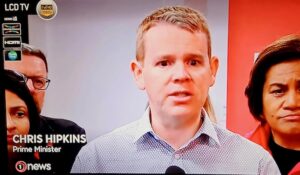
Labour leader Chris Hipkins says support for National in the polls for the Aotearoa New Zealand election next Saturday is “well and truly overstated”, predicting a much tighter race than some might expect.
Less than a week until voting is over, the most recent polls have the National-ACT bloc requiring New Zealand First to form a government.
But with the right’s polling numbers slipping, there is growing talk of a truly hung Parliament — with neither grouping able to form a government — or National and ACT failing to forge a deal with Winston Peters, forcing a second election.
With NZ First having ruled out Labour, and vice versa, Hipkins will be relying on Te Pāti Māori and the Greens to keep his job.
On Monday, he told media the election would be closer than polling suggests, saying Labour’s support ahead of the 2020 election was “understated”, and National’s was “well and truly overstated” — predicting a repeat this year.
He said Labour’s own internal polling was showing a narrowing in recent weeks between the centre-left and the centre-right.
“It is a very close race… I think the National Party threatening voters with a second election before this one is even over shows how unprepared and unready to be government they are.”
‘Sizeable bloc’ of voters He believed a “sizeable bloc” of voters would likely make their minds up about who to vote for on election day.
Polls in the week before the 2020 election had Labour on 45.8 percent (Newshub-Reid Research) and 46 (1News-Colmar Brunton). Polls a few weeks earlier had Labour on 47 (1News-Colmar Brunton), 47.5 (Roy Morgan) and 50.1 (Newshub-Reid Research).
Labour leader Chris Hipkins speaking on Monday in the election campaign. Video: RNZ
Labour ended up on 50 percent, about 3 percent higher than the polling average. National averaged about 31 percent in those same polls, but only got 25.6 percent on election night.
If the same discrepancy between the polls and results happened this year, Labour could end up only a few percentage points behind National.
Hipkins said the right bloc’s campaign was in “meltdown”, “with David Seymour threatening to hold a potential National government to ransom on a daily basis now”.
Seymour, leader of ACT, has proposed sitting on the cross benches and only backing legislation on a bill-by-bill basis – effectively giving his party veto power over a minority Christopher Luxon-led National government’s agenda.
“If you don’t want to work properly together, that’s okay,” he told Politik. “You will still be Prime Minister, but we’ll work more distantly, and we’ll have to work through vote by vote to do it.”
‘Recipe for instability’ “That would be a recipe for instability and chaos,” Hipkins said. “The idea that you could have Christopher Luxon and Winston Peters trying to form a government with David Seymour on a daily basis threatening to veto any decisions that the government might take, show the kind of chaos you could expect under a National, ACT, New Zealand First government.”
He said he did not think New Zealanders deserved that.
“And I think the best way for them to avoid that is to give their party vote to Labour.”
He said without covid-19 “hanging over us”, Labour would like a “clear run . . . an opportunity to deliver on the things that we have put before the electorate”.
He ruled out a “grand coalition” of Labour and National, and said neither the Green Party, nor the Māori Party were threatening to force a second election if their coalition demands were not met.
This article is republished under a community partnership agreement with RNZ.
Is it inevitable that Donald Trump will be the Republican nominee for US president for a third race in a row? To answer this question, we must understand the political dynamics in the United States at a deeper level than the headlines.
The Republican Party is in the midst of a nearly unprecedented drama. Not since Herbert Hoover in 1940 has a former US president campaigned for another term in the Oval Office. And this time, Trump is also managing a slew of criminal and civil charges – yet remains the frontrunner for the nomination.
Why does Trump still have such strong support?
It is political gospel in the US that voters rarely admit they made a mistake in the voting booth and will continue to support parties and candidates they voted for in the past.
This means that, for all of his personal sins, rude insults, felony indictments and electoral defeats, Trump remains relatively popular with Republican voters, the majority of whom want to see him return to his old job running the White House.
Indeed, polling indicates the indictments actually strengthened the former president’s position among Republican voters.
Because of his popularity within the party, Trump has been able to skip Republican candidate debates, define his own path to the state nomination caucuses and primaries, and keep well ahead of his rivals in the polls. He uses his criminal indictments as evidence the establishment is out to get him, further cementing the “outsider” status his voters love.
During the first Republican debate he sat down with former Fox News host Tucker Carlson for a lengthy clickbait interview. During the second debate, Trump spoke with striking auto workers in the swing state of Michigan. No other Republican candidate is strong enough even to attempt this – at least, not yet.
Who are Trump’s challengers?
For Trump’s challengers, who lack this flexibility, a great winnowing is now underway. The question today is not whether one of them can move past Trump in the polls, but rather which one will emerge as the main alternative. The previous two debates – and there will be at least one more – should be seen in this context.
Two candidates appear to be emerging from this winnowing: Governor Ron DeSantis of Florida and Nikki Haley, the former governor of South Carolina and the Trump administration’s ambassador to the United Nations. Haley and DeSantis are pursuing different constituencies within the Republican Party, particularly in their approaches to foreign policy questions.
Haley has effectively attacked the isolationist America-first policies of the previous Trump administration and vigorously defended US military aid to Ukraine. Her open appeal to the internationalist wing of the party will win her no friends among hardcore Trumpers.
DeSantis is playing a more nuanced game – attempting to appeal to isolationist Republicans by saying things like “Ukraine is a territorial dispute” and “we are not going to have a blank check” and “we will make the Europeans do what they need to do”. These statements strongly communicate scepticism of a vigorous US role in Ukraine.
The bet here, however, is that this is a feint. DeSantis is following in the footsteps of Ronald Reagan, who as a candidate in both 1976 and 1980 routinely condemned prior US presidents’ Panama Canal treaties as a giveaway to foreigners. However, once he was in office, he did not abrogate them.
DeSantis may sound like a nationalist, but there is nothing in his various statements on Ukraine that would necessitate withdrawal of US support for the fight against the Russian invasion. If he wins the presidency, look for a substantive pivot towards a more internationalist policy agenda.
The Haley-DeSantis battle is about more than foreign policy, of course. Haley is making an appeal to Republican women with a relatively moderate position on abortion – opposing a federal limit on the procedure.
DeSantis is looking to draw Trump supporters by bragging about his various efforts to fight socially liberal social policies and their corporate advocates.
The strategy for getting past Trump
In the two-person battle to be the Trump alternative, Haley may have a structural advantage over DeSantis in that she doesn’t have to pull as many of her supporters away from Trump. As the other candidates fall away, their supporters will likely side with Haley. Vivek Ramaswamy’s supporters may end up with DeSantis, although the animosity between Trump and the Florida governor may limit that.
Trump’s great political vulnerability is that since 2016, he has been an electoral loser. He lost the majority in both houses of Congress in 2018, he lost re-election to Joe Biden in 2020, and he cost the Republicans a shot at winning the Senate in 2022 by personally supporting losing candidates in Georgia and Pennsylvania.
Whether Haley or DeSantis wins the contest to be the alternative to the former president – and look for that winner to emerge just before or during the Iowa Caucus in January 2024 – they will have to challenge Trump at his weakest spot: his demonstrated inability to defeat Biden in an election.
Trump has spent the past three years denying he lost the 2020 election. As a world-class political athlete, Trump knows his Achilles heel is his loss to Biden. For Trump to be a viable candidate in 2024, he must sow doubt about that loss. He has done so effectively, at least within the primary voter base, with a majority of Republican voters still believing Biden didn’t win legitimately.
For Haley or DeSantis to prevail and become the Republican presidential nominee, they will have to dismantle that Big Lie and force voters to confront the likelihood that Trump will lose and Biden will win a second term.
If and when that battle begins, most likely between Trump and Haley, we will see the real future of the Republican Party and who will oppose Biden in the 2024 general election.
Lester Munson is a Non-Resident Fellow at the United States Studies Centre in Sydney. He is affiliated with BGR Group, a government relations firm in Washington, DC, and adjunct faculty at Johns Hopkins University.
Source: The Conversation (Au and NZ) – By Philippa Martyr, Lecturer, Pharmacology, Women’s Health, School of Biomedical Sciences, The University of Western Australia
This article is the first in The Conversation’s six-part series on insomnia, which charts the rise of insomnia during industrialisation to sleep apps today.
French author Marie Darrieussecq writes in her 2023 memoir Sleepless:
The world is divided into those who can sleep and those who can’t.
It’s a big call. But insomnia is a well-recorded preoccupation in history. It includes difficulty falling asleep, or staying asleep, and comes with daytime distress and anxiety.
There are many, varied reasons why people have insomnia. These include biological changes as we age or because of our hormones, physical or mental health issues, the medicines we take, as well as how and where we live and work.
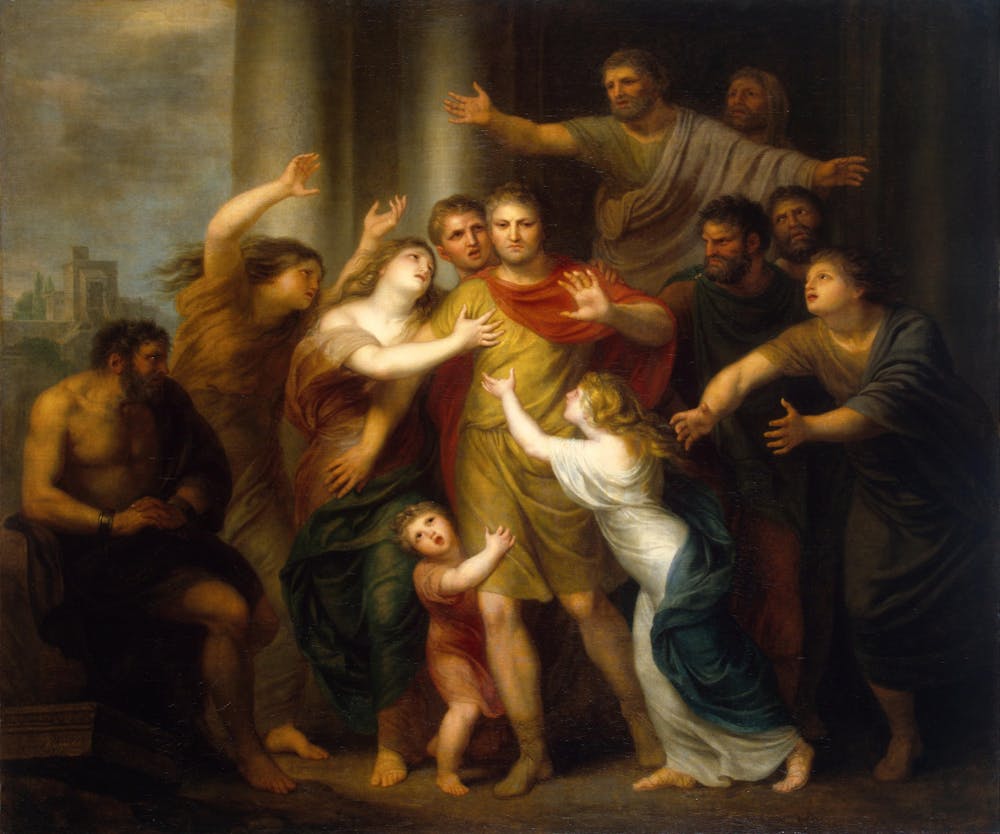
Sleep deprivation is literally a form of torture. Roman consul Marcus Atilius Regulus is allegedly the first person in recorded history to die of insomnia.
In about 256 BCE he was handed over to Rome’s enemies, the Carthaginians, who apparently tortured him to death. They did this by amputating his eyelids and forcing him to stare at the Sun.
As horrible as this sounds, the legend doesn’t stand up. There are no reliable accounts of how Regulus died. But even though sleep-deprivation torture may not have killed Regulus, it continues to be used in many countries today.
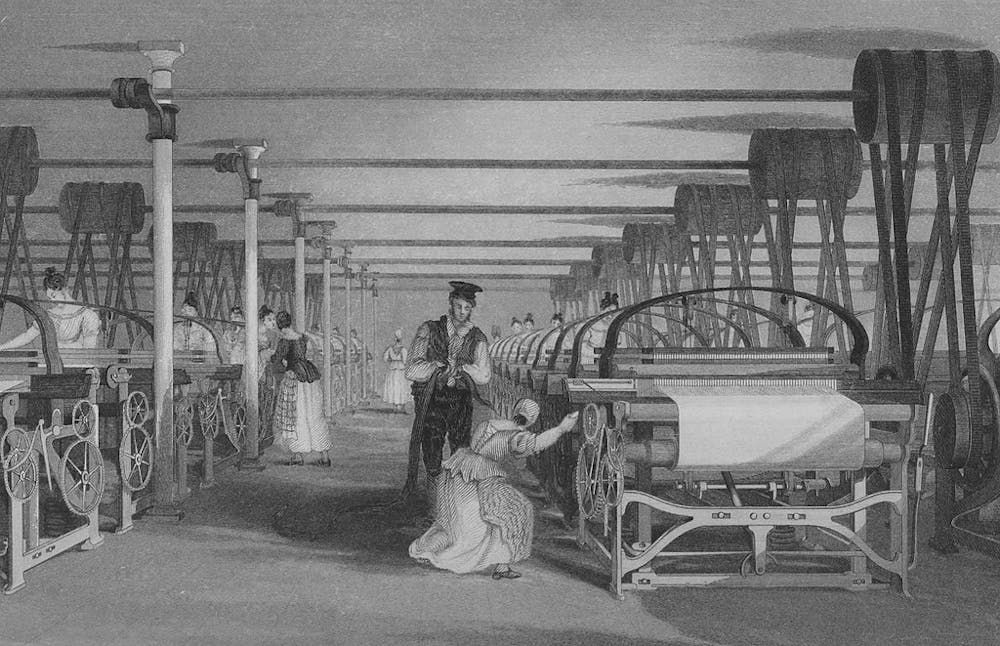
But we need to look at industrialisation – when a country moves from mostly farming to mostly manufacturing using machinery – for clues to the level of insomnia we see in Western nations today.
In countries without industrialisation, insomnia is quite rare. Only around 1-2% of the population will experience it. Compare this with modern United Kingdom, where the estimated insomnia rates are 10-48%, depending on the study. A 2021 report said 14.8% of Australians had symptoms meeting criteria for chronic (long-term) insomnia.
The shift to working in factories using machines also shifted our sleep habits. Wikimedia Commons
At around the same time, the Enlightenment era of flourishing new sciences in the late 18th century gave us the term “insomnia” and where there is “insomnia”, there must be “insomniacs”. So “insomniacs” became a diagnostic term for people struggling with sleep.
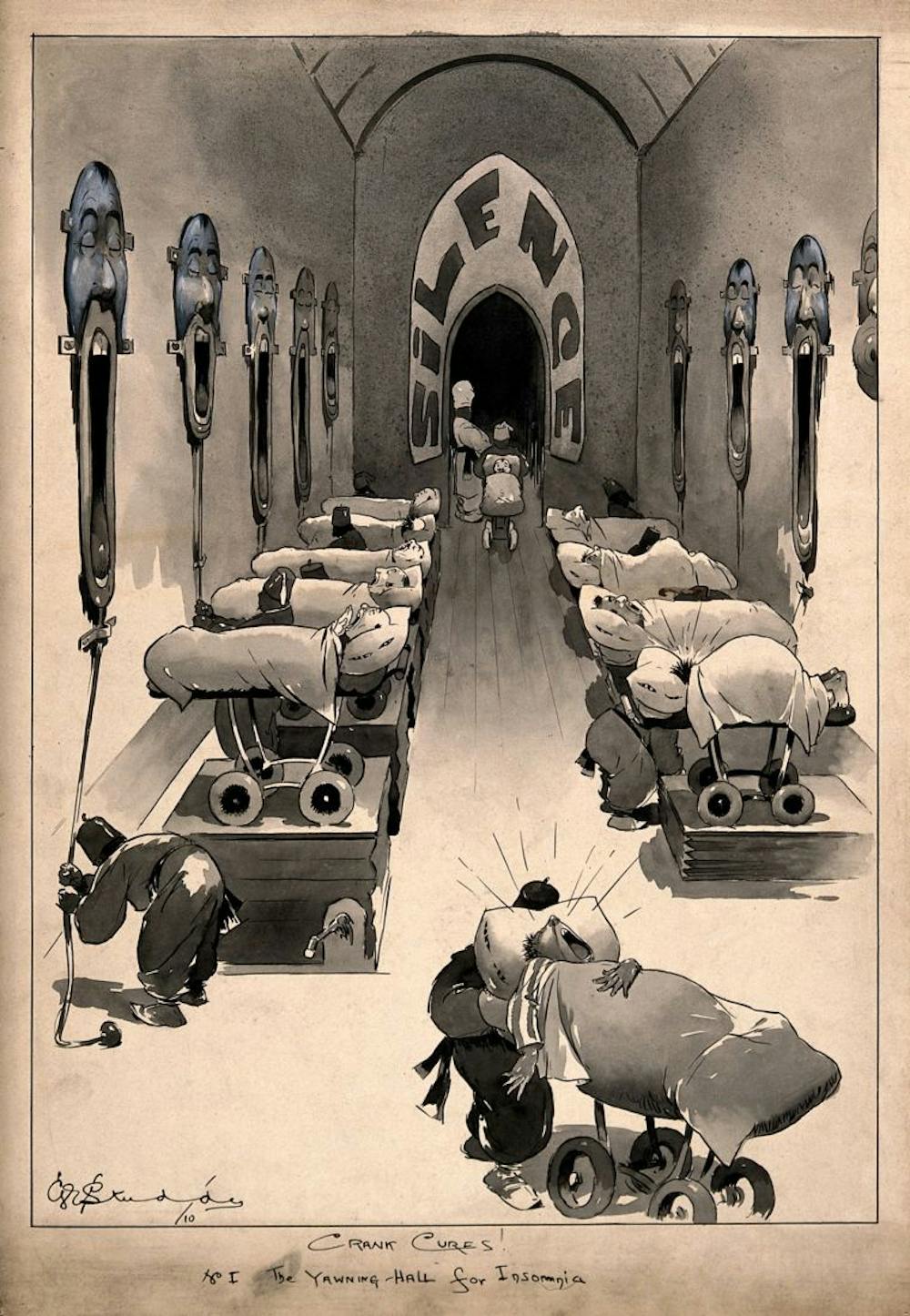
This 1910 cartoon plays on our long-held quest for sleep. Wellcome Collection
Medical cures for insomnia began to spread – some of them probably effective.
For example, in the 19th century Grimault & Co’s “Indian Cigarettes” were advertised in Australia. They contained cannabis.
The 19th century was also the birthplace of modern medical ideas about anxiety, which we now know can cause insomnia.
Romanian philosopher Emil Cioran (1911-1995) had chronic insomnia. His 1934 book On the Heights of Despair (the title speaks for itself) describes the loneliness and isolation of insomnia – the feeling of being cut off from the rest of humanity.
In Hemingway’s short story Now I Lay Me, his soldier narrator and alter ego says:
I myself did not want to sleep because I had been living for a long time with the knowledge that if I ever shut my eyes in the dark and let myself go, my soul would go out of my body.
These drugs made people relaxed and sleepy by switching on the body’s gamma-aminobutyric acid (GABA) system. This part of our nervous system works to inhibit processes in the body that would otherwise keep us awake. But these drugs can inhibit these processes too much. Suicides and accidental deaths by sleeping pill overdose became sadly common in the following decades.
Nervous persons, who are troubled with wakefulness and excitability, usually have a strong tendency of blood on the brain, with cold extremities. The pressure of the blood on the brain keeps it in a stimulated or wakeful state […] rise and chafe the body and extremities with a brush or towel, or rub smartly with the hands to promote circulation, and withdraw the excessive amount of blood from the brain, and they will fall asleep in a few moments. A cold bath, or a sponge bath and rubbing […] will aid in equalising circulation and promoting sleep.
Now, “sleep hygiene” means something different to taking a cold bath. It’s the process of quieting your body and mind before bedtime.
In the 21st century, Western living has added two new sleep disturbers to the mix. We drink huge amounts of caffeine. We also go to bed with handheld devices – with their bright lights and constant dopamine hits that stimulate us and stop us sleeping.
Our problems with insomnia show no signs of going away. This is partly because our economy is increasingly organised around sleep-depriving work. In the United States, production workers are the most likely to have sleep disorders, possibly because of shift work. In the United Kingdom, professional soccer players are over-using sleeping drugs to help them wind down after the adrenaline rush of a game.
In Australia, the financial cost of poor sleep is an estimated A$26 billion a year, mainly through lost productivity or accidents. This means there’s a good financial incentive to address the problem.
And if the global insomnia market is anything to go by, insomnia is big business and getting bigger. This is projected to reach US$6.3 billion by 2030, largely driven by increased diagnoses and therapy, as well as the use of sleep aids, such as sleep apps.
Philippa Martyr does not work for, consult, own shares in or receive funding from any company or organisation that would benefit from this article, and has disclosed no relevant affiliations beyond their academic appointment.
The COVID pandemic stimulated an irreversible shift in where, when and how we work. This 21st-century model of working – dubbed the “new normal” – is characterised by increased flexibility and productivity gains.
Yet this reshaping of work, underpinned by technology, has also eroded our work-life boundaries – and persisting 20th-century attitudes are preventing us from successfully managing the new normal.
We find ourselves struggling with “productivity paranoia”: a term used to describe managers’ concerns that remote and hybrid workers aren’t doing enough when not under supervision.
As a result, we’re seeing a surge in the use of electronic monitoring and surveillance devices in the workplace. These devices allow managers to “watch over” employees in their absence. This practice raises serious legal and ethical concerns.
Big bossware is here
In a survey of 20,000 people across 11 countries, Microsoft reported 85% of managers struggled to trust their remote-working employees. In Australia, this figure was 90%.
In 2021, American research and consulting firm Gartner estimated
the number of large firms tracking, monitoring and surveilling their workers had doubled to 60% since the start of the pandemic.
Electronic monitoring and surveillance technology can capture screenshots of an employee’s computer, record their keystrokes and mouse movements, and even activate their webcam or microphones.
On one hand, these “bossware” tools can be used to capture employee and production statistics, providing businesses with useful evidence-based analytics.
The other side is much darker. These devices are indiscriminate. If you’re working from home they can pick up audio and visual images of your private life.
Managers can be sent notifications when data “indicate” an employee is taking breaks or getting distracted.
Some aspects of electronic monitoring and surveillance are legitimate. For instance, it may be necessary to safeguard an organisation’s data access and transfers.
But where are the boundaries? Is your organisation legally obliged to tell you about electronic intrusions? Alternatively, what can you do if you find out you’re being watched without being informed?
A complex array of regulation governs workplace privacy and surveillance in Australia. Proposed reforms to the Privacy Act 1988 are set to strengthen privacy protections for private-sector employees.
However, this legislation doesn’t specifically cover workplace surveillance. Instead, a patchwork of laws in each state and territory regulate this matter.
Specific legislation regulates the surveillance of workers in New South Wales and the Australian Capital Territory. Importantly, surveillance must not be undertaken unless the employer has provided at least 14 days’ notice. This notice must include specific details about the surveillance that will be carried out. Employers must also develop and adhere to a surveillance policy.
In both states, employers can only record visual images of an employee while they’re “at work”. This is broadly defined to capture any place where work is carried out.
Covert surveillance is prohibited unless the employer has obtained a court order. In this case it’s restricted to situations where the employee is suspected of unlawful activity.
Even then, a covert surveillance order would not be granted where this unduly intrudes on the employee’s privacy. Covert surveillance for the purpose of monitoring work performance is expressly prohibited.
Other states and territories don’t have specific electronic workplace surveillance laws. Employers must instead comply with more general surveillance legislation.
Broadly speaking, employees must give consent, express or implied, to any surveillance. In practice, such consent is usually obtained through the implementation of a workplace surveillance policy, which employees must agree to when they accept the job. So if you’ve signed a contract without reading the fine print, you may have agreed to being surveilled via electronic monitoring tools.
Currently, Queensland and Tasmania provide the most limited protection for employees. Their surveillance legislation is limited to the regulation of listening devices.
Enterprise agreements, employment contracts and workplace policies may also limit or prohibit the use of surveillance devices. In practice, however, most employees will lack the bargaining power to negotiate the inclusion of any such terms in their employment contract.
The law is failing to keep up
In 2022, a parliamentary select committee reporting on the future of work in NSW observed the current regulatory framework is failing to keep pace with rapid advancements in electronic monitoring and surveillance.
The report criticised legislation that simply allows an employer to notify workers surveillance will be carried out, with no mechanism for this to be negotiated or challenged. The situation is slightly better in the ACT, where employers must consult with workers in good faith about any proposed surveillance activities.
Workers who suspect their employer is spying on them should review their workplace surveillance policies. They may need to reflect carefully on how they use their work computer.
Where an enterprise agreement applies, the Fair Work Commission can arbitrate surveillance disputes. A worker who is dismissed following intrusive surveillance may be able to challenge the dismissal on the basis of it being unfair.
Workers who haven’t been informed of their employer’s surveillance practices can also lodge a complaint with the relevant authority or regulator, who may have powers to investigate and prosecute offences.
To thrive in our “new normal” work landscape, we’ll need to address the gap between the existing legal protections and the capabilities (and potential harms) of electronic monitoring and surveillance. For now, it remains a significant legal and ethical challenge.
Jacqueline Meredith receives funding from an Australian Government Research Training Program Scholarship.
Peter Holland ne travaille pas, ne conseille pas, ne possède pas de parts, ne reçoit pas de fonds d’une organisation qui pourrait tirer profit de cet article, et n’a déclaré aucune autre affiliation que son organisme de recherche.
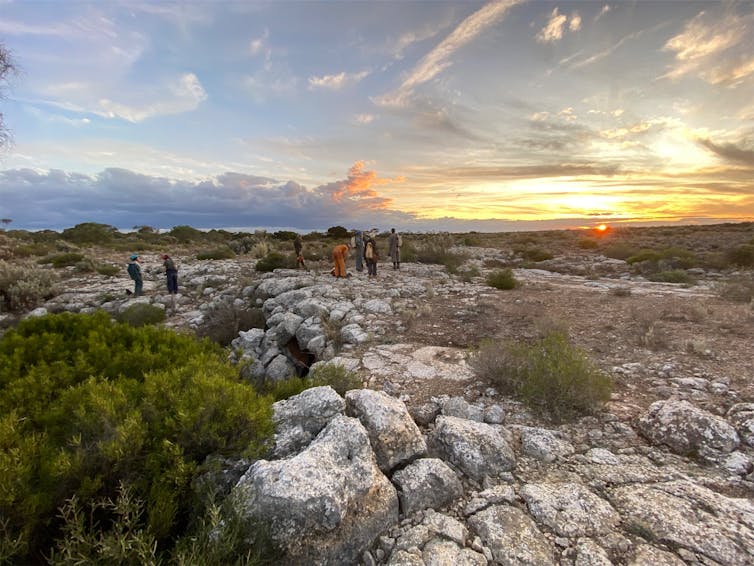
The Nullarbor is one of Australia’s iconic natural places. It’s renowned as a vast and mostly treeless plain. But hidden beneath this ancient landscape is an immense network of caves.
The caves are as important for their geological value and what they can teach us about Australia’s past, as they are for the unique animals they house, the fossils they hold and their beautiful and unusual cave decorations.
The Nullarbor Plain is the land of the Mirning people. Their Dreaming, associated with the Great Australian Bight, recalls oral histories of changing sea levels.
The Mirning have actively traversed the plain for millennia. Their artwork in its caves, extensive flint mining and artefacts scattered over its surface provide evidence of their presence.
But it’s only in modern times that the plain’s natural values have been threatened. The threats include invasive species, such as foxes, cats, camels and buffel grass, climate change and, perhaps most detrimentally, human activities. Mining, wildlife poaching, uncontrolled tourism and large-scale development, for example a proposed green energy project, could impact much of what makes the Nullarbor Plain so precious.
Greater recognition of the Nullarbor’s superlative natural features is needed to change a common perception that there is nothing out there, and to ensure the preservation of unprotected areas in the region.
Cavers prepare to head underground on the Nullarbor Plain. Photo: Garry Smith
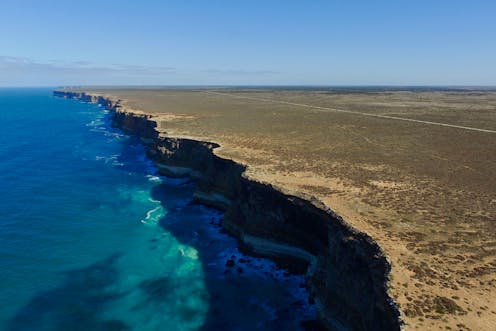
Sloping gently seawards, the Nullarbor terminates spectacularly at the Great Southern Scarp, possibly the world’s longest cliff line.
The caves scattered across the plain vary from small caves to those that extend for many kilometres.
The smaller caves include blowholes, narrow smooth-walled vertical tubes named for the breathing in and out of air as atmospheric pressure changes. Sometimes the air movement feels like a gale.
Some of the deep caves contain lakes of clear, salty, blue-green water. Flooded passages lead away from these lakes. Only cave divers can reach these passages, which include the longest underwater cave systems in Australia.
Dating of stalactites and stalagmites confirms most of the caves were formed in the Early Pliocene, around 5 million to 3 million years ago. At this time, the region was much wetter and home to forests of eucalypts. It was very different from the sparse plain we see now.
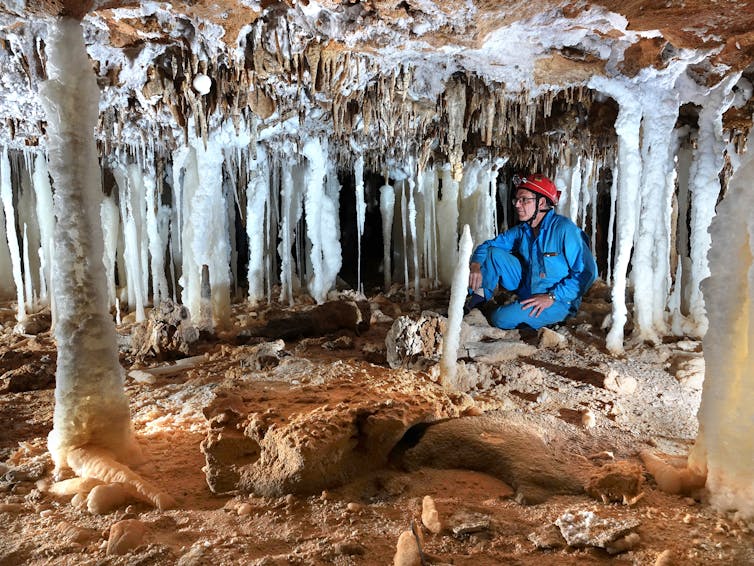
One of the many stunning stalagmites that decorate the caves. Photo: Steve Milner
With low light levels and relatively stable temperatures and humidities, caves are extreme environments.
In remote sections of some caves fragile curtains of bacterial colonies known as slime curtains hang from the roof and walls. These are unique to the Nullarbor.
Many animals found in caves can survive above ground. But some, known as troglobites, have become so specialised they can only survive underground. They often lack pigment, have elongated limbs and highly reduced or absent eyes.
One such group of cave specialists are the blind cave spiders of the genus Troglodiplura. These large, enigmatic spiders occur only on the Nullarbor Plain. And most species are known from single caves.
They are the only cave-adapted mygalomorph spiders (the primitive spiders, such as the funnel-web and trapdoor spiders) known from Australia. As with many cave-dwelling animals, we know very little about them.
Little known and rare, a blind cave spider, Troglodiplura beirutpakbarai, in her natural environment. Photo: Steve Milner
The highly specialised and diverse animals that live in underground water, known as stygofauna, are a good example of this. Only a very small fraction of the species have been scientifically described.
Many such animals are restricted to tiny geographic areas. Some occur only in a single cave.
This means these species are at exceptionally high risk from threats to them or the fragile cave environment they rely on. These threats include predation by foxes, changes to water availability within the cave, or damage to the cave structure.
Given how little we know about cave fauna, it’s unfortunately likely extinctions are occurring unrecorded and undocumented.
Not only do the caves give us a tantalising glimpse into life underground, they also preserve fossils of animals that were once abundant on the surface. Scattered across the floors of some caves are thousands of bones from animals that fell prey to roosting owls or were trapped after falling in.
A shaft of sunlight penetrates a cave. Photo: Steve Milner
These “sub-fossil” deposits are geologically young. As a result, they give us insights into the scale of biodiversity loss that followed European colonisation of Australia.
A tragic example of recent extinctions is the Nullarbor barred bandicoot. The species died out a century ago as feral predators spread across the region.
There are also much older fossils that reveal an extraordinary aspect of the Nullarbor’s distant past.
In 2002, cave explorers found large deposits of fossil bones in the “Thylacoleo caves”. Among these was a near-complete skeleton of Australia’s largest extinct marsupial predator, Thylacoleo carnifex. Hundreds of thousands of years old, these fossils also revealed previously undescribed species of giant cuckoos , megapodes and tree kangaroos.
Looking at the dry, treeless landscape today it is hard to believe tree kangaroos once called the Nullarbor home. Analysis of speleothems (mineral deposits formed from dripwater) shows why they were found there. The region’s climate was wetter during the Pliocene, paving the way for diversification of forest-dwelling vertebrates.
The geology, palaeontology, cultural history and biology of the Nullarbor caves reveal a wealth of distinctive features, but the Nullarbor is much more than the sum of its parts.
Karst landscapes are integrated systems, with the surface, caves and deep aquifer intrinsically linked. An impact on any one aspect affects all others.
Beautiful and fragile cave decorations. Photo: Garry Smith
Any changes to the land surface, through road building and large-scale development will alter forever the character of this globally significant and iconic landscape. In the era of human-driven climate change, we do need to find alternative energy sources and materials to reduce our impact, but not at the expense of our epic landscapes and biodiversity.
Jess Marsh is a Councilor on the Biodiversity Council, Conservation Manager for Invertebrates Australia, and Honorary Researcher at the South Australian Museum.
Clare Buswell is the Chair of the Australian Speleological Federation’s Conservation Commission.
Liz Reed is affiliated with the South Australian Museum.
Susan White is affiliated with Australian Speleological Federation inc., Victorian Speleological Association Inc.
If you have a baby, does this mean you can’t be friends anymore with your child-free friends?
In a high-profile article for New Yorker magazine in September, journalist Allison Davis wrote about a “slow-rolling tectonic shift that neither side notices at first (especially the parents)”.
It becomes us vs. them. On one side: People With Kids (PWIKS: frazzled, distracted, boring, rigid, covered in spit-up; can’t talk about movies, only about how they wish they had time to see them). And on the other: People Without Kids (PWOKS: self-absorbed, entitled, attention whores, grumpy about life’s inconveniences even though their life is easy).
Davis also refers to a 2017 Dutch study which found a decline in contact with friends after having children. This decline was greater the earlier in life parents had their children.
Why is this so? And is there a way to protect against this?
A baby is a huge change
Having a baby is a new life stage like no other. Not only does pregnancy come with a new surge in hormones but parenthood also brings a great deal of uncertainty with it.
When we find ourselves in such a state, we often look for an anchor – to help create a sense of control. So new parents can turn to other parents who have similar-aged babies.
This can quickly create an in-group/out-group and friends without babies can soon feel part of the latter. They don’t have any baby sleep, poo or feeding stories to share, and this lack of a shared experience and understanding can impact the friendship.
Parents often have nothing left in the tank to give after a day of parenting. They are also simply not capable of doing some of the things they used to, such as staying out late or socialising without their children (without a lot of organisation).
The casual drop in is also no longer okay because the baby might be asleep and an unplanned visit could disrupt the routine.
Friends without kids can feel neglected without fully understanding that it is not about them.
As Davis also notes, friends without children can also experience grief if they have been experiencing infertility. Under these circumstances, it can be really hard to be around women who are pregnant, or with a child when this is all that you want for your own family.
The business of having children, and the associated stress and uncertainty can also mean new parents don’t always know what they need and therefore can’t (or don’t) ask for it. Rather they tend to seek comfort and reassurance from other parents.
So expectations within a friendship can change – but this might not always be clearly communicated.
If old friendships are worth hanging onto, what can new parents do to help protect these relationships from the arrival of a baby?
First try to have the conversation before the baby arrives – there might be a change in the friendship but commit to talking about it. Talk about your worries and how you might approach things differently with a baby in the picture even if this might change.
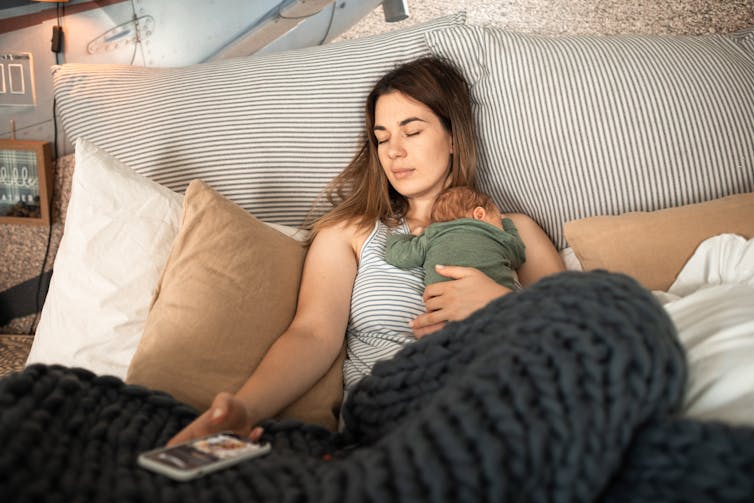
Having a baby means you are not as free to catch up as you once were. Elevate/Pexels
When the baby arrives, be as clear as you can about what you need and where you are up to (for example, “I’m sorry I can’t have dinner, I’m totally exhausted, but I want to see you soon”).
Also keep trying to engage with your friend on their terms (at least sometimes!). You’re going through a big life event, but their life is still happening, so ask about their work, their issues and their family.
For friends without kids, offer to do something that makes life easier or more enjoyable: drop off meals, or leave supplies at the door. Show you understand their life has changed. Check when might be the best time to drop offer, send texts without expecting a quick reply. When the children are older, offer to babysit.
Also make an effort to show you are interested in the baby – buy a gift, ask how the baby is going.
The key is both sides of the friendship acknowledging there will be or has been a change – and that things may be tough and challenging.
But if you keep talking and keep trying to understand the other person’s needs, you will both still have a role in each other’s lives if you want one.
Catherine E Wood does not work for, consult, own shares in or receive funding from any company or organisation that would benefit from this article, and has disclosed no relevant affiliations beyond their academic appointment.
Australians are being flooded with information in the lead-up to the Indigenous Voice to Parliament referendum.
Corflute signs, printed T-shirts, graffiti and leaflets from both the “yes” and “no” campaigns are everywhere.
While this is happening, our museums are working to document the event in real time, to create the historical collections of the future.
But what should our museums collect from the sea of information and imagery to represent how Australians feel about the referendum? What obligations and challenges do our national museums face in collecting today for tomorrow?
Libraries, archives and museums are charged with collecting, preserving and exhibiting historical material relevant to the Australian nation. This includes collecting contemporary materials, sometimes categorised by museums as “ephemera”.
These institutions undertake the difficult task of documenting political activities in real time. They cannot know in advance which protests or demonstrations will result in a nationally significant outcome or change, and which events will fade away without impact, meaning their collections may end up deaccessioned.
Referendums provide a unique opportunity for museums to collect materials with certainty the event, whatever the outcome, will be historically relevant.
The period of pre-referendum debates and scheduling allows museums to fully document the processes and views expressed in the lead-up to the vote. It gives them more time to plan a targeted collecting strategy than when they have little advance knowledge about an action or protest.
What should museums collect?
The materials associated with collecting from contemporary political campaigns are usually everyday items of low financial value. These are more often mass-produced than individually handmade.
As surviving items become more difficult to source over time, they become more expensive, so it makes sense for museums to collect them in the moment.
The National Library of Australia is calling for Australians to donate letters, “how to vote” cards, posters, pamphlets, badges, stickers, T-shirts and hats. Campaign material from all perspectives about the Voice to Parliament debate is sought, including official “yes” and “no” campaign materials and government education materials.
They also seek materials from lobby groups and local events, including those produced by First Nations Australians, from rural and regional communities, and materials in languages other than English.
Later, the materials collected from this campaign will not only tell the story of the Voice referendum, but also be used to create strong links between and across discrete collections and across political convictions and campaigns.
A great example of an item a museum might be looking to to collect is Poppy Vandermark’s unofficial “yes” badge. Vandermark wore the badge, designed by a local artist, when she entered the Miss Wagga Wagga Quest. Following backlash for wearing the badge, she withdrew from the event.
The badge is not only a symbol of the “yes” campaign, but also can be used to tell the story of how the “yes” and “no” campaigns are debated in local communities.
Despite their lack of traditional value, the storytelling potential of these everyday items is enormous. Badges are small (don’t require much storage space), sturdy (don’t require specialised preservation), disposable (cheap to acquire) and expressive.
The earliest examples in Museum Victoria and the Powerhouse Museum date from the very early 1900s. From the 1960s, badges came to define direct action collective movements, especially around sexual politics, nuclear power and the environment, the war in Vietnam and Indigenous land rights.
A tangible expression of the democratic right to freedom of speech, badges offer accessible entry points into an exhibition or collection from which curators can direct audiences to more complex or challenging subject matter or perspectives.
Shaping history
Addressing current political events also gives museums a reason to speak to the public about their role in producing historical narratives, and the obligation democratic institutions – including museums – have in documenting the human experience.
Recording how Australians move through decision-making processes is no less important than documenting the outcome of the vote.
To do this museums need to share their storytelling responsibilities with the Australian public. Talking to people about why museums want to collect their materials and agreeing on how they will be used is a good start.
Museums are generous in recording stories of national heroism and resilience, as in the case of Australia’s “Black Summer” bushfires. Managing the ethical difficulties of collecting material on contested topics, like the range of opinions on COVID, is much more difficult.
But museums must be open about letting the public in on the role that they play in producing history. This means thinking about whose voices they record, and how to represent dissenting opinions.
Most importantly, museums need to spend the last week of the campaign visibly out in the community and engaging with people about what they think. Because, in the end, a single badge or T-shirt or sign can never be a full surrogate for a vote.
A Senate inquiry into the Albanese government’s refusal to agree to the extra flights sought by Qatar Airways has recommended the decision be immediately reviewed.
The inquiry’s report, tabled Monday, is also sharply critical of Qantas, whose executives came under hostile questioning over its treatment of customers, when they appeared before the committee.
In its majority report the committee, chaired by the Nationals Senate leader Bridget McKenzie, asks the Senate to re-appoint it so it can bring before it former Qantas CEO Alan Joyce, who declined to appear saying he was overseas. This will require a Senate vote.
Qantas opposed the Qatar application, on the ground it would distort the market.
The report criticises Transport Minister Catherine King for not clearly articulating the factors in her decision not to approve the Qatar application. She has maintained she acted in the “national interest”, and given various reasons at different times.
“A wide range of witnesses, including key stakeholders in Australian aviation, submitted that they did not fully understand the basis for the decision,” the report says.
“The weight of evidence before the committee indicates the national interest would have been well served by agreeing to Qatar’s request.” The report also criticises the government’s refusal to provide the committee with information it sought.
Evidence suggested the decision cost the economy a loss of up to $1 billion; it was also a missed opportunity for tourism and trade, particularly agricultural exports that use passenger planes, the report says.
The inquiry recommends that in deciding on bilateral air agreements, the government should look at a cost-benefit analysis, consult widely with stakeholders including the Australian Competition and Consumer Commission, and publish its reasons for decisions.
In the wake of the government’s rejection, Qatar has asked for consultations.
King responded to the report by denouncing the inquiry as a “political stunt” by the Coalition. The committee has repeated its request to King to appear before it, which she has declined to do.
The committee comprised three Coalition senators, one from the United Australia Party, two from Labor and one from the Greens.
In their dissenting report Labor senators Tony Sheldon and Linda White said many of the majority recommendations “appear blissfully ignorant of the current policy framework underpinning Australia’s aviation sector”. Green senator Penny Allman-Payne also dissented on some issues.
The report recommends reinstatement of the monitoring of the airline industry by the ACCC.
It says that in addition to this broad monitoring of competition in aviation, “the committee would support a specific investigation by the ACCC into Qantas’ actions in the aviation market.
“The committee is concerned by evidence suggesting Qantas may be especially aggressive when seeking to maintain its market share. This muscular approach towards competitors and new entrants can compound the problems that are already caused by a lack of competition.”
The Qantas group has “significant steps to take to repair trust” with consumers, the report says. “The committee expects tangible improvements regarding their behaviour toward their customers.”
The committee recommends the government develop consumer protection reforms in the aviation industry as soon as practicable to address delays, cancellations, lost baggage and devaluation of loyalty programs.
Michelle Grattan does not work for, consult, own shares in or receive funding from any company or organisation that would benefit from this article, and has disclosed no relevant affiliations beyond their academic appointment.
Keith Rankin, trained as an economic historian, is a retired lecturer in Economics and Statistics. He lives in Auckland, New Zealand.
Analysis by Keith Rankin.
Keith Rankin, trained as an economic historian, is a retired lecturer in Economics and Statistics. He lives in Auckland, New Zealand.
I read this article quoting Christopher Luxon as follows: “We’ve been to many places where marginal seats are and we’re getting good movement.” (Luxon talks to media amid election result limbo fears, NZ Herald, 7 Oct 2023).
He has this misplaced narrative around marginal seats. I have also heard talk in mainstream media circles that appears to give emphasis to ‘marginal seats’. And I heard one explainer on RNZ claiming MMP as a system in which sixty percent of seats in Parliament are elected in electorates, with the remaining ‘list seats’ being determined in proportion to the party vote. The system described in the previous sentence is not MMP (‘Mixed Member Proportional‘); it’s SM (‘Supplementary Member‘). SM was one of the rejected voting methods in the 1992 referendum. Christopher Luxon was just 22 years old at the time of that referendum. I hope he voted; though the low turnout suggests he might not have.
MMP: Mixed Member Proportional
General elections do two things: elect parties to the sovereign Parliament, from which governments are formed; and choose people as local representatives in that Parliament.
The principal purpose of a general election is to determine how many MPs will represent each party; the secondary ‘fine-tuning’ purpose is for the people, rather than the party leaders, to have popular local influence over which people will represent each party in Parliament.
Under MMP – and noting the principal purpose, to elect parties to Parliament in proportion to their popular support nationwide – the concept of ‘marginal electorate’ is entirely meaningless. Wasted votes for very small parties aside (and many people want to increase the number of wasted votes by removing one of the present qualification rules underpinning MMP in New Zealand), parties are elected to Parliament on the basis of the nationwide support for each party. End of story.
Electorates are irrelevant to this nationwide component of the election process. Thus (and assuming no wasted votes) if National gets forty percent of the nationwide party vote, they get forty percent of the seats (ie 48 out of 120) in Parliament. It doesn’t matter whether votes come from Whanganui or Whangamomona; each vote for National counts the same. Parties need to focus on marginal voters, not marginal electorates. (I suspect that there are more marginal voters in West Auckland and in West Christchurch than in Whanganui.)
Under MMP, electorates are an administrative reality in terms of the organisation of the election, facilitating the gathering of votes for the nationwide count. The secondary purpose of the election, people deciding who their local representatives will be, does require electorates; hence the secondary vote – the local vote – is called the electorate vote. The primary vote – the party vote – is a national vote in a national election. The ancillary electorate vote is a local vote in a local election; very much like a vote for a Mayor.
(There is one exception to this situation in New Zealand in 2023. Voters in the Waiariki electorate will cast an electorate vote which could affect nationwide party representation. This adjustment would occur if the sitting Te Pāti Māori representative is defeated by the Labour Party representative.)
In MMP, a large proportion of the list MPs are ‘minor party’ representatives, because the point of MMP is to compensate for the disproportionate way FPP voting discriminates against smaller parties.
SM: Supplementary Member
Under SM, often confused with MMP, most list MPs would be from the ‘major parties’ – usually two major parties – and a top position on the party list would be a political sinecure (much as a safe electorate would also be a sinecure).
‘Supplementary Member’ is a non-proportional electorate-based system. Its core is the old misnamed first-past-the-post system (‘FPP’). (Misnamed because, in each electorate, there is no winning post. Rather, candidates who are ahead when ‘the whistle blows’ or ‘the music stops’ are declared winners whether or not they have reached some metaphorical ‘post’.) SM differs from FPP though, in that a separate minority group (eg forty percent) of MPs are added to the electorate MPs; and this smaller separate group is determined by a second party proportional vote. Under SM, smaller parties are guaranteed token but not proportional representation.
Under the SM system, the primary vote is the electorate vote; and the supplementary vote is the party vote.
Informed and Misinformed Voting Strategies
Under MMP (or at least under ‘informed MMP’), voters first decide on their preferred party. Then they reflect on who they prefer to be their local MP, knowing that the local MP decision does not influence the total number of MPs their preferred party will get. They will know that, in for example Mt Roskill, if Carlos Cheung wins the electorate vote, then some other National Party candidate will miss out on becoming a ‘list MP’.
All elections involve strategic voting. (Under the old ‘FPP’ system, people in ‘safe seats’ voted for the candidate of their preferred party, knowing in advance who the electorate winner would be.) In marginal electorates, people would vote against the candidate representing the party they did not want to win the nationwide election. The actual election only took place in these ‘marginal seats’; indeed, there is still a marginal-seat mindset among people, such as Christopher Luxon it would seem, who should know better. So, in most marginal electorates, anti-National voters would vote for their Labour candidates; even voters who really preferred their Green (or Values Party as the Greens were then) candidate.
With MMP, informed voters normally vote for their preferred party. But they are cognisant of the coalition options. So they might vote for a less-preferred party that has a chance of participating in government if their actual preferred party is unlikely to be in government; that is, they may choose the ‘lesser evil’ option, making a likely government they don’t really want ‘less bad’. In 2020, some people who preferred National over Labour nevertheless voted Labour in order to minimise the influence of the Green Party in government. For those voters, the Green Party was the ‘greater evil’ and the Labour Party was the ‘lesser evil’.
Another form of strategic party voting is to ‘take out insurance’; to vote for a moderating ‘centre’ party. In 2002 that insurance took the form of United Future. In 1996, 2005 and 2017 that ‘hand-brake’ insurance took the form of a vote for New Zealand First.
Under an informed MMP-mindset, electorate votes would generally be for the candidates who would best represent local interests in the national Parliament; regardless of political party. Because there is no cost to voters’ preferred parties. We note that cities over the country have had long-running ‘centre-right’ Mayors despite having mainly ‘centre-left’ MPs. And vice versa. This is also how it should be in MMP electorates.
There is another form of strategic voting in electorates. In particular an electorate-candidate with a low party-list ranking (or not even on the list) can, if elected, displace a candidate who would otherwise become a list MP. Voters may vote for electorate-candidates with this intention in mind. An example might be a National party voter in Ohariu choosing to vote for Labour’s Greg O’Connor as a means to displace someone like David Parker, Andrew Little, Willow Jean Prime, or Ayesha Verrall. Or a Labour Party voter in Ohariu voting for National’s Nicola Willis as a means of helping Parker, Little, Prime and Verrall stay in Parliament.
Misinformed voters are likely to vote as if 2023 is going to be an SM election. They will firstly consider their electorate vote as if it was a Party Vote. They will vote for candidates representing their preferred parties; or against the candidates representing their detested parties, by voting for the party candidate most likely to defeat the candidate for the party they want to lose.
Then they will turn their attention to the party vote, which they understand to being a separate poll to choose list MPs. If such voters want a single-party government they will vote ‘two ticks’, for the party as well as the candidate of that party. Or they may want insurance, voting for a minor-party coalition partner. Or they may vote for the minor party which they really prefer, given the FPP belief that voting for the electorate candidate of a minor party is a wasted vote.
The SM/FPP mindset mainly affects the electorate vote, treating it as a party vote rather than a personal vote. In addition, SM might exaggerate minor-party support in the party-vote; some voters might use the supplementary vote to compensate for the disproportionality of an FPP-type electorate vote.
Predictions
The table below gives my stylised – meaning possibly exaggerated, to make a point – predictions for certain electorates for the 14 October election. I focus on the Labour Party, given that it is the present governing party and that it will lose sitting MP candidates. I make predictions based on the presence or absence of MMP awareness; with MMP awareness favouring popular local candidates regardless of party affiliations, especially sitting MPs. MMP thinking minimises changes in electorate MPs, meaning that there can be big swings among major-party list MPs instead.
And I make predictions for SM/FPP thinking. FPP-style voting yields big electorate MP swings, leaving relatively stable major-party list representation. (In practice, some voters will probably make informed MMP electorate choices, and others will make misinformed electorate choices. So the actual election result is likely to be an average of the two scenarios shown.) And I go on to make a prediction of the result if the voting system actually was SM.
In the Table below, I am basing my predictions on what the recent polls are saying about the parties; namely that Labour will get 26 percent of the vote and 33 seats in the new Parliament. (To keep the table as short as possible, I have excluded any electorates for which I think the Labour candidate will not win.)
Under MMP-informed voting I am predicting 27 electorate MPs for Labour and 6 list MPs. Under SM/FPP-informed electorate voting, I am predicting 16 electorate MPs for Labour and 17 list MPs. Some people – eg Kieran McAnulty – would be an electorate MP under the first scenario and a list MP under the second scenario.
Table of Stylised Predictions for ‘Labour electorates’:
Electorate
MMP-thinking
(Scenario one)
SM/FPP thinking
(Scenario two)
Christchurch Central
Webb (L)
Stephens (N)
Christchurch East
Davidson (L)
Davidson (L)
Dunedin
Brooking (L)
Woodhouse (N)
Hauraki-Waikato
Mahuta (L)
Mahuta (L)
Ikaroa-Rawhiti
Tangaere-Manuel (L)
Tangaere-Manuel (L)
Kelston
Sepuloni (L)
Sepuloni (L)
Mana
Edmonds (L)
Edmonds (L)
Mangare
Sosene (L)
Sosene (L)
Manurewa
Williams (L)
Williams (L)
Mt Albert
White (L)
White (L)
Mt Roskill
Wood (L)
Cheung (N)
Nelson
Boyack (L)
Cameron (N)
New Lynn
Russell (L)
Garcia (N)
Ohariu
O’Connor (L)
O’Connor (L)
Palmerston North
Utikere (L)
Bansal (N)
Panmure-Otahuhu
Collins (G)
Salesa (L)
Remutaka
Hipkins (L)
Hipkins (L)
Rongotai
Fitzsimons (L)
Fitzsimons (L)
Taieri
Leary (L)
French (N)
Takanini
Leavasa (L)
Nakhle (N)
Tamaki-Makaurau
Henare (L)
Henare (L)
Te Atatu
Twyford (L)
Nicholas (N)
Te Tai Hauauru
Peke-Mason (L)
Peke-Mason (L)
Te Tai Tokerau
Davis (L)
Davis (L)
Te Tai Tonga
Tirakatene (L)
Tirakatene (L)
Wairarapa
McAnulty (L)
Butterick (N)
West Coast Tasman
O’Connor (L)
Pugh (N)
Wigram
Woods (L)
Summerfield (N)
From the table above, these six electorate candidates would get through under MMP-informed electorate voting, but not under SM/FPP-informed electorate voting: Utikere, Leavasa, Boyack, Wood, Twyford, Leary.
And these six would get elected under misinformed electorate voting (ie SM/FPP-informed) but not under MMP-informed electorate voting: Little (List 12), Parker (L13), Radhakrishnan (L15), Andersen (L17), Luxton (L19), Salesa (E).
So I am saying that, if voters vote in the electorates as they would have done under FPP, then Little, Parker, Radhakrishnan, Andersen, Luxton and Salesa would be in instead of Utikere, Leavasa, Boyack, Wood, Twyford, Leary. No prizes for working out which of those sixsomes the Labour leadership would prefer.
I would also mention that under SM-informed voting in an MMP election, the party vote for Labour (and National) would probably be a percentage-point or two lower than under MMP-informed party voting. In my table, that would cost Brooking and Russell their seats.
I would also note that if Labour’s support falls to 22% (about that of National in 2002) and New Zealand First mops up the populist vote, then Labour would be down to zero list MPs in an MMP-informed election and 11 list MPs in an election in which the electorate adopts SM/FPP voting strategies. In an MMP-informed election with the Labour vote at 22%, then Robertson, Tinetti, Verrall, Jackson, Prime and Rurawhe would also be gone.
If it really was an SM election
If SM was actually the voting system, and on present polling – I would predict: 28 MPs for Labour (16 electorate, 12 list); 11 MPs for Green (3 electorate, 8 list); 4 list MPs for NZ First, 2 MPs for Te Pāti Māori (1 electorate, 1 list); 5 MPs for Act (all list); 70 MPs for National (52 electorate, 18 list). National would win outright with less than 40% of the party vote. Christopher Luxon would like that. Many MPs – both electorate and list – would consider themselves to be safe; many more than under MMP.
Green Party, Act, TOP and Māori
My prediction this time is for the Green Party to win three electorate seats in an MMP-informed election (Auckland Central, Wellington Central, Panmure-Otahuhu) and two electorates in a misinformed MMP election (Auckland Central, Wellington Central). The incumbent MP, Chloe Swarbrick, should win Auckland Central either way. Further, I believe that circumstances conspire in Wellington Central, where the overseas vote may play a vital role. And Ofiso Collins, standing for the Greens in Panmure-Otahuhu, could win through a personal vote, given his prominence as a popular Auckland mayoral candidate.
Under MMP-savvy voting, TOP should win Ilam. The TOP leader there – Raf Manji – is a popular Christchurch city councillor; though a vote for Manji could reduce the total number of National or Labour MPs, given that TOP party votes would no longer be wasted. And, under MMP-informed voting, ACT should win Tamaki as well as Epsom. In this case, a vote for the Act candidate (Brooke Van Velden) could have no impact on the number of national or Labour MPs.
Under my MMP-informed predictions, which do not include any seats for TOP, Labour retains most of its Māori caucus, and gains new MPs in the Māori electorates. So, given the likely presence in Parliament of 4 or 5 Te Pāti Māori MPs, and Green Māori MPs as well, the Parliament will have probably its largest Māori representation ever. We note that the first three on the New Zealand First list are all Māori, as is the leader of Act. National will be conspicuously the least-Māori party.
Back to Christopher Luxon.
If Mr Luxon is campaigning too much for the electorate vote in ‘marginal electorates’, then he is potentially missing out on party votes in the parts of the country he is barely seen in. That might not bother me, but should bother him. West Auckland comes to mind here.
Postscript: Trifecta Voting
One way to distance ourselves from SM/FPP thinking would be to introduce trifecta voting in all elections; national and local, electorate and party.
Under trifecta voting, in each ballot voters choose up to three candidates or parties, numbering them as first, second and third preference.
Under trifecta party voting, there would be almost no wasted party votes, because almost all voters would include a successful party as one of their three preferences. Unsuccessful first preference votes would be discarded in favour of voters’ second preferences. And, if still not electing a party, the second preference would yield to the third preference. Same thing for candidate voting. Votes for eliminated candidates would transfer until at least one candidate had sufficient of the vote to be elected.
*******
Keith Rankin (keith at rankin dot nz), trained as an economic historian, is a retired lecturer in Economics and Statistics. He lives in Auckland, New Zealand.
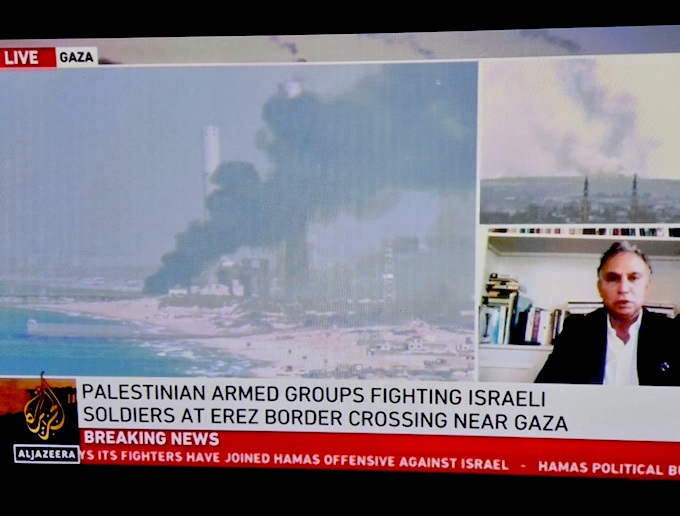
In hindsight, the drivers of Hamas’s startlingly well-planned, land-sea-air attack on Israel on Saturday were in plain sight.
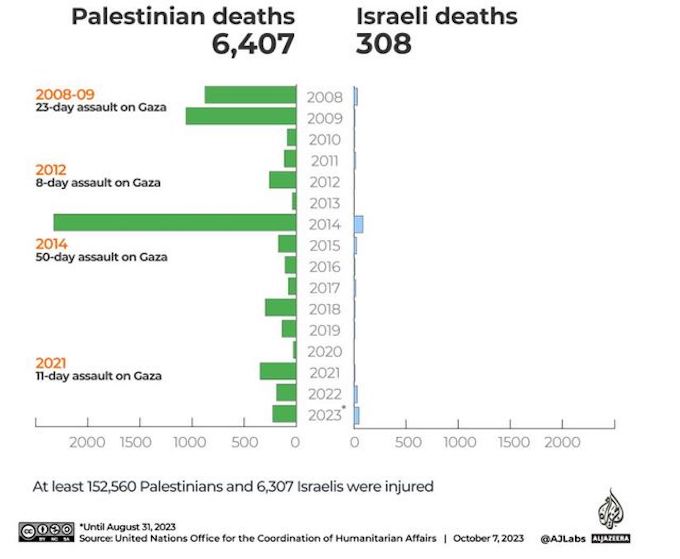
The operation reflects a pattern of four wars and regular outbreaks of violence between Israel and Hamas militants in Gaza since 2005, when Israel withdrew its military posts and forcibly removed 9,000 Israeli settlers from the territory.
Each time Hamas has launched rockets at Israel or engaged in similar provocations, it has drawn heavy retaliation from Israel in the form of major bombings on the Gaza Strip. Hamas, however, seems to regard this as a cost of doing business.
An important factor motivating Hamas towards violence is that it has to watch its flanks. Other smaller, but increasingly extremist groups, are contesting its authority in Gaza, notably Palestinian Islamic Jihad.
These groups have, at times, independently launched rocket attacks on Israel, which bring retribution on the whole territory.
On top of this, the Israeli government formed by Prime Minister Benjamin Netanyahu last December is the most right wing in Israeli history. This government has made no secret of its desire to annex the West Bank and has permitted significant expansion of Jewish settlements in the territory, which are illegal under international law.
That has led to conflict between settlers and young West Bank Palestinians, who in the past year have formed a loose grouping known as the “Lions’ Den”.
This grouping, comprising independent militants with apparently no central control, has scant regard for the Palestinian Authority, which governs the West Bank and is led by the octogenarian Mahmoud Abbas. The Palestinian Authority has little real administrative, security or moral authority in the territory.
The “Lions’ Den” also vies with Gaza militant groups for influence among Palestinian youth – both in Gaza and the West Bank.
Added to this, a minister in Netanyahu’s coalition, Itamar Ben-Gvir, has visited the Temple Mount, the site of the Al-Aqsa Mosque, one of the holiest shrines in Islam. This was considered a provocation by all Palestinians – both in the West Bank and Gaza. Further angering Palestinians, Israeli tourists also travelled to the site over the recent Sukkot holiday.
A visit to the Temple Mount by Ariel Sharon in 2000, then the leader of the opposition in Israel’s government, is generally regarded as the spark that ignited the Second Intifada from 2000-2005.
Under an agreement predating Israel’s foundation, Jordan has custodianship of the Al-Aqsa religious complex. Israel aimed to respect Jordan’s role when it signed the Israeli-Jordanian peace treaty in 1994. But Palestinians see the visits by Israeli ministers and non-Muslim tourists as disrespectful of the sanctity of the site and counter to this undertaking.
Hamas has also claimed these visits have led to the desecration of the Al-Aqsa site, an argument obviously aimed at winning support from Muslims throughout the Arab and wider Islamic world.
Significantly, Hamas has named its action “Operation Al-Aqsa Flood”. This provides some clues to the primary reason for striking at this time, which emphasises what Hamas sees as Israeli acts of desecration of a holy Islamic site.
However, an additional motivating factor was likely the increasing tendency of Arab states to make peace agreements with Israel, as evidenced by the 2020 Abraham Accords, involving the United Arab Emirates, Bahrain, Sudan and Morocco.
There has recently been strong speculation that Saudi Arabia is about to make its own agreement with Israel.
This is of great concern to all Palestinians, not just those in the West Bank, as it further reduces pressure on Israel to reach a settlement with them. Netanyahu has made clear in his public statements that he prioritises peace with Arab states over eventual peace with the Palestinians.
Hamas does not recognise Israel, but has said it would observe a truce if Israel withdrew to its 1967 borders. Israel would be unlikely to take Hamas’s word on this and withdraw as demanded. But there would be even less chance of that condition ever being realised if Saudi Arabia were to conclude its own deal with Israel.
Another aspect of the timing is that it coincides almost precisely with the 50th anniversary of the start of the Yom Kippur or Ramadan War in October 1973, when Egypt and Syria attacked Israel together. The significance of a Palestinian entity being able to surprise Israel in the same way would not be lost on Hamas.
So there were several objectives for Hamas to launch an attack at this time – and possibly a combination of them.
Hamas is likely to gain much sympathy from the wider Arab world, but little in the way of material assistance. Hamas’s military operation will likely cause Saudi Arabia to hold back from normalising relations with Israel for now. That said, it’s unlikely any of the Arab states that have signed the Abraham Accords will withdraw from them now in protest over Israeli retaliation against Gaza.
Where the conflict is headed?
Where the conflict is headed is unclear. The Hezbollah militant group in Lebanon has already fired on positions in Israel’s north. But the extent to which it will become seriously involved will depend on its sponsor, Iran.
Tehran has generally been seen to want to keep Hezbollah’s considerable rocket and missile strength in reserve in case of an Israeli strike on Iranian nuclear facilities.
There is also the question of whether “Lions’ Den” militants in the West Bank will launch their own attacks, effectively creating a third front against Israel. And a possible fourth front could come from attacks on Jewish Israelis by Arab Israelis living in Israel.
US President Joe Biden has already promised support for Israel, so there can be little doubt Israel will eventually get on top of these challenges. Netanyahu has warned of a long war, but it may prove reasonably short if Israel goes all out in its retaliation.
The main constraint on Israeli action against Gaza will be the fact that an unknown number of Israeli citizens have been kidnapped by Hamas militants and taken to the strip. Indiscriminate Israeli bombing would certainly put those lives at risk.
Israel will also be reluctant to put its defence forces in Gaza because of the risk of heavy casualties. However, it may send special forces if it gains intelligence on the whereabouts of its kidnapped citizens.
A further risk for Israel in its retaliation is that too brutal an assault on Gaza could turn Western opinion against it. So far, however, Western governments are strongly supportive of Israel and unsympathetic towards Hamas.
The overall lesson for Israel is that it has to develop a policy for managing the Palestinians living in the areas it controls.
The current situation, in which hardline militants are contained in Gaza, while Israeli forces curtail the actions of Palestinians living in Israel and the West Bank, has suited the Israeli government for many years. It has been able to ignore Arab and international pressure to negotiate a two-state solution or to acquiesce in a one-state solution.
The real significance of Hamas’s operation is that such a non-policy can no longer continue.
Ian Parmeter does not work for, consult, own shares in or receive funding from any company or organisation that would benefit from this article, and has disclosed no relevant affiliations beyond their academic appointment.
Hamas has responded to Israel’s escalating violence with an unprecedented attack. This is not a new tragedy; it is an extension of the same old cycle.
We grieve all the losses of this calamity, and we call on our government not to speak the same old words but to finally act.
To call today’s act “unprovoked” is wilful blindness. Choose your timeframe; choose your provocation.
Israel is carrying out the longest, now-illegal, now-apartheid occupation in modern history. Gaza has been illegally blockaded for 17 years, confining more than two million mostly civilian human beings in deteriorating conditions, subjecting them to repeated bombardments and ceaseless deprivation.
Hamas’s attack is a response to longterm and escalating, immediate violence.
The blockade wall that was breached is an illegal structure. A million children have been born behind that wall; did you expect them to sit quietly?
Wall deserves to fall That wall deserves to fall — but we, here in Aotearoa and throughout the world, should have brought it down with diplomatic and economic and legal sanctions long before it came to this.
Now Hamas’s violent resistance has broken through the wall.
Palestinians have a legal right to armed resistance, but no one has a right to unlimited violence. There is no honour in attacking civilians in their homes or bombing Gazan apartment buildings.
It is a core principle of international humanitarian law that the violations of one armed group do not release another armed group from its constant obligation to uphold the rights of civilians. Armed groups are responsible to the law, to the idea of minimising the harm done in this world.
We who demand the protection of Palestinian civilians can best do that by calling for the protection of all civilians: human rights are either everyone’s rights or they are nothing.
If we lose sight of that, the world becomes even more dangerous — and Palestinians have always borne the brunt of that danger.
No military solution There is no military solution. Solutions call for political will here, outside Israel/Palestine.
The rage and despair accumulated through generations and decades of brutality will not reset. Do not call for the return to the status quo ante because it was intolerable, unjust and illegal.
We, here in Aotearoa New Zealand, need to act on the basis of law and the equal rights of human beings to protection, to justice, to self-determination.
We call on our government to initiate, to pick up the phone and lead in mustering international action.
For anyone to be safe, Palestinians must be free and civilians must be protected.
The weekend’s surprise and brutal attack on Israel by Hamas fighters has the potential to reshape the Middle East – and will only further increase global geopolitical instability. As of Sunday night NZT, the initial 24 hours of the assault by Hamas on Israel had already taken at least 250 Israeli lives – easily making it the bloodiest day for Israel since the 1973 Yom Kippur War. In addition, dozens of Israelis have been kidnapped and taken back to Gaza to be used as bargaining chips. While there will be a range of motivations for why Hamas chose to act in the way it did now, the symbolic timing of Hamas’ assault – almost 50 years to the day after Yom Kippur – is unlikely to be a coincidence.
In recent years, Western countries such as New Zealand have largely taken their eye off the region to focus on the war in Ukraine and rising geopolitical tensions in the Indo-Pacific. A staple of New Zealand’s world news diet in decades past, of late the Israeli-Palestinian conflict has only rarely made the headlines. When it has, New Zealand has preferred not to become involved to any real extent beyond expressing sympathy with the victims. For example, when conflict broke out over Gaza in 2021, Jacinda Ardern cut an image that resembled more that of an observer or commentator, rather than of a participant in international affairs.
The new Hamas assault is a reminder of the continued power of the Middle East to shock and surprise. While it is too early to tell how the conflict will exactly unfold, one of the most concerning aspects will be the extent to which other nation-states become involved – particularly Iran, a close supporter of Hamas. The risk is that the war could spiral out of control and become a wider conflict with an even greater global impact, in an echo (or, potentially, an even more dangerous version) of the Yom Kippur War of 1973.
Determining New Zealand’s response to the new war in the Middle East will be one of the new New Zealand government’s first challenges – and as shown by the fierce reaction to the initial lack of direct condemnation of the Hamas assault by Nanaia Mahuta, it will not be an easy path to navigate. A sustainable and durable two-state solution is the only long-term answer to the Israeli-Palestinian conflict. But with Israel now defending itself against a vicious and horrific attack by Hamas, and planning a new ground invasion of Gaza, this will not be on the table in the near future.
However, New Zealand should resist the temptation to lose hope or to see the war as simply someone else’s problem. As a small democracy far from the epicentre of the conflict, New Zealand could eventually play a role in peacemaking efforts – if it wanted to. We should not forget that as horrific as the Yom Kippur War in 1973 was, the Camp David Accords came just five years later in 1978. These led to Egypt signing a peace treaty with Israel, a settlement that has endured. The darkest moment can sometimes come before the dawn. There will absolutely be a need for de-escalation, dialogue and diplomacy in the days, weeks, months and years ahead – and countries will be sorely needed to lead and support these efforts.
For now, these ambitions may seem like a pipe dream. But as the war in Ukraine has shown, even distant wars can have an outsized impact, even half a world away. Crude oil prices have already risen sharply this year – and combined with a strengthening US dollar, these have caused New Zealand petrol prices to head back up to levels last seen in the immediate aftermath of Russia’s invasion of Ukraine. The pain caused by rising inflation and the cost-of-living crisis – the number one issue of the election campaign – may not be over yet.
Geoffrey Miller is the Democracy Project’s geopolitical analyst and writes on current New Zealand foreign policy and related geopolitical issues. He has lived in Germany and the Middle East and is a learner of Arabic and Russian. He is currently working on a PhD on New Zealand’s relations with the Gulf states.
This article can be republished for free under a Creative Commons copyright-free license. To subscriber, please visit the Democracy Project (https://democracyproject.nz).
Given the presidential style of modern politics, the intense media focus on party leaders is unavoidable. But this involves a degree of artifice. New Zealanders don’t vote directly for a prime minister, they vote for their preferred party and electorate candidate.
Technicalities aside, though, party leaders play a key role in shaping their party’s policies and soliciting public support. The upside of the attention they receive, therefore, is that voters get to scrutinise before they “buy”.
That’s especially important for undecided or swing voters. Not only can they compare policies, they can also examine each leader’s strengths and weaknesses, and gauge what values guide their approach.
Being head of state is a hugely challenging role – not least because leaders fundamentally get results through mobilising collective effort. If no one’s following, there is no leadership.
This is different from management, which largely revolves around detailed planning and then implementing and monitoring progress toward goals.
Leadership, however, involves connecting with people’s values and needs, and helping them make sense of events. It entails crafting a vision for the future and formulating credible strategies to achieve that.
It involves the capacity to make wise decisions, and role modelling what it means to be a person of good character. While managerial competency still matters, being a prime minister demands far more.
That said, trying to objectively evaluate a potential leader is not easy.
Favouring our own team
Humans strongly favour those they view as being “one of us”. A large body of research shows people trust, respect, support, care for and are more influenced by those they feel an affinity with. This sense of a shared identity might be based on common demographic characteristics, or shared interests and values.
Dedicated sports fans illustrate this well. Individually and collectively, they back their team no matter what. They wear team colours, idealise team members, mock opponents and boo referees – even if the ref is right.
The same socio-psychological forces are at play in the political domain.
The party faithful are unlikely to offer an objective view. They will likely overestimate the strengths and underestimate the weaknesses of their party’s policies and its leaders (and do the opposite when evaluating opposing parties).
This is clearly not helpful for undecided or swing voters. But even beyond partisan influences, determining what constitutes good leadership is a more vexed issue than we might imagine.
While people often hold strong views, the actual evidence about what constitutes “good” leadership is quite diverse and complex.
Fantasies and realities
There are many different theories, but researchers generally agree that “good leadership” is both ethical and effective. But people can often ignore those considerations when evaluating someone in (or aspiring to) a leadership role.
Subconsciously, we are inclined to judge leaders according to our own personal theories of leadership. This “implicit” bias is typically shaped by the kinds of behaviours role-modelled by the authority figures we were exposed to early in life.
A very strict parenting style, for example, which a child finds reassuring rather than restrictive, can lead them in later life to favour command-oriented or even authoritarian leaders.
Research indicates that even in democracies, about one-third of the population favours that kind of traditional “strong man” leadership style.
But scholars have long argued such leaders tend to be intolerant, oppressive, punitive, lacking in empathy and prone to bullying. They may resist being held to account for their actions, arrogantly believing they know best.
Romantic attachments
Popular culture and media narratives are other important influences on people’s ideas about leadership. In books, TV shows and movies, leaders are often depicted as heroic, larger-than-life characters with the capacity to save others, even the world. In the business media, it’s often implied CEOs have somehow turned a company around single-handedly.
Researchers call this the “romance” of leadership – a tendency to overstate what leaders can actually do, and to blame them when they fail to meet unrealistic expectations.
Indeed, no matter how skilled and dedicated, leaders are inevitably flawed, just like the rest of humanity. Nor are they omnipotent. New Zealand is a small and remote trading nation in an interconnected world, not a superpower or totalitarian state. There are many things its prime minister cannot control.
In that sense, an ability to manage expectations is an indicator of good leadership. Having the personal integrity to avoid making unrealistic promises is what serves democracy. Offering false hope is not good leadership, it’s more like what con artists and charlatans hungry for power do.
Overall, the evidence is that we’re not very rational or objective when it comes to evaluating leaders. Even if we’re not swayed by ideological factors, our personal experience and a romantic view of leadership can unconsciously cloud our judgment.
But there are some things we can do to help us make a more informed and balanced judgement. Firstly, we can try to step back and reflect on our own biases and assumptions about leadership. (You can even test your own bias on a number of issues with the Project Implicit online resource.)
Secondly, look for indicators of behaviours associated with good leadership. Many of these are the same character virtues we’d admire in anyone: integrity, fair-mindedness, the determination to do their best, confidence (but not arrogance), being accountable for their actions, and empathy and respect for others. These are vital foundations for good leadership.
And thirdly, look for actual evidence of leadership skills. Being prime minister is complex and challenging. It demands an ability to address serious issues in a serious-minded way.
As to whether that’s enough to win your vote, only you can be the judge of that.
Suze Wilson does not work for, consult, own shares in or receive funding from any company or organisation that would benefit from this article, and has disclosed no relevant affiliations beyond their academic appointment.
Source: The Conversation (Au and NZ) – By Adrian Beaumont, Election Analyst (Psephologist) at The Conversation; and Honorary Associate, School of Mathematics and Statistics, The University of Melbourne
The referendum on the Indigenous Voice to parliament will be held on Saturday. Polls close at 6pm AEDT in the south-eastern states, 6:30pm in South Australia, 7pm in Queensland, 7:30pm in the Northern Territory and 9pm in Western Australia.
I expect counting to be faster than at a federal election, as there’s just one question with a yes/no response, not multiple candidates. Ordinary votes cast at election day or pre-poll booths should be counted on election night. Postal and absent votes will be counted in the following weeks.
For a referendum to succeed, it requires a majority in at least four of the six states as well as a national majority. Polls imply there is no realistic chance of a national “yes” majority, so the double majority is a moot point.
A national Newspoll, conducted October 3–6 from a sample of 1,225, gave “no” to the Voice a 58–34 lead, out from 56–36 in the previous Newspoll, two weeks ago. With the 8% undecided excluded, “no” led by 63–37.
Here is the updated 2023 Voice polls graph. It includes the latest polls from Newspoll, Resolve, Morgan and YouGov (only one point so far for YouGov). In Resolve and last week’s Essential, “yes” has gained ground, but in other polls “yes” continues to fall.
Labor led by 53–47 on voting intentions, a one-point gain for the Coalition. Primary votes were 36% Coalition (steady), 34% Labor (down two), 12% Greens (up one), 5% One Nation (down one) and 13% for all Others (up two).
Anthony Albanese’s ratings were 46% dissatisfied (up two) and 45% satisfied (down two), for a net approval of -1. After slumping to net -20 in the previous Newspoll, Peter Dutton’s net approval jumped seven points to -13. Albanese’s lead as better PM was reduced to 50–33, from 50–30 previously, its narrowest since the election.
Here is a graph of Albanese’s net approval in Newspoll, showing the continued drop in his ratings since late 2022.
Large-sample Resolve poll gives ‘no’ a 56–44 lead
A national Resolve poll for Nine newspapers was conducted over two weeks (September 22 to October 4) from a sample of 4,728. This sample is about three times Resolve’s normal sample of 1,600.
“No” to the Voice led in this poll by 56–44 after a forced choice question, in from a 57–43 “no” lead in early September. Initial preferences were 49% “no” (steady), 38% “yes” (up three) and 13% undecided (down three).
Tasmania was the only state where “yes” led, by 56–44. In New South Wales, “no” led by 52–48, in Victoria by 54–46, in SA by 55.5–44.5, in WA by 61–39 and in Queensland “no” led by 64–36.
This state data suggests that if “yes” somehow got over 50% in Saturday’s results, “yes” would win majorities in four states by adding six points to the current “yes” vote in every state, and so a double majority could be attained with SA the key state. But it’s very unrealistic to expect such a result.
This is the first gain for “yes” in Resolve’s Voice polls since April, when the “yes” lead increased from 57–43 in March to 58–42. By June, “no” was ahead by 51–49, and the “no” lead increased to 57–43 in September.
A key theme of the “no” campaign has been “if you don’t know vote no”. In this poll, 29% said they were happy to cast their ballot on the principles of the Voice without knowing the design, while 60% wanted more information.
Morgan poll: ‘no’ leads by 46–37
A Morgan Voice poll, conducted September 25 to October 1 from a sample of 909, gave “no” to the Voice a 46–37 lead, out from a 44–39 “no” lead the previous week. With undecided excluded, “no” led by 56–44, out from 53–47. Morgan’s two online Voice polls have been relatively favourable to “yes”.
Morgan’s weekly federal poll last week gave Labor a 52–48 lead, a two-point gain for the Coalition since the previous week. Primary votes were 37.5% Coalition, 32.5% Labor, 13% Greens and 17% for all Others. This poll was conducted September 25 to October 1 from a sample of 1,406.
YouGov Voice poll: ‘no’ leads by 53–38
Newspoll is now being conducted by Pyxis, but until mid-July it was conducted by YouGov. YouGov is now doing its own polls. A national YouGov poll, conducted September 25–29 from a sample of 1,563, gave “no” a 53–38 lead. “Yes” was ahead by 48–41 in inner metropolitan seats, but “no” was far ahead in all other regions.
Labor led by 53–47 on voting intentions from primary votes of 35% Coalition, 33% Labor, 13% Greens and 19% for all Others. Albanese’s net approval was -3, while Dutton’s was -17, with Albanese leading Dutton by 50–33 as preferred PM.
A national poll on the monarchy, conducted September 2–5 from a sample of 1,203, had net approval ratings for various United Kingdom royals and Australian politicians.
Prince William was at net +49, King Charles at net +10, Penny Wong at net +8, Jacqui Lambie at net +8, Tanya Plibersek at net +2, David Littleproud at net -6, Adam Bandt at net -12, Pauline Hanson at net -16, Prince Harry at net -17, Duchess Meghan Markle at net -32 and Prince Andrew at net -48.
UK Labour has huge win at Scottish byelection
I covered last Thursday’s UK byelection in Rutherglen for The Poll Bludger, in which Labour overturned a 10-point Scottish National Party margin in 2019 to win by 31 points. There will be two byelections in Conservative-held seats on October 19.
The ousting of Kevin McCarthy as United States House Speaker, the October 15 Polish election and a pro-Russia party winning the most seats at the September 30 Slovakian election were also covered.
Adrian Beaumont ne travaille pas, ne conseille pas, ne possède pas de parts, ne reçoit pas de fonds d’une organisation qui pourrait tirer profit de cet article, et n’a déclaré aucune autre affiliation que son organisme de recherche.
In January 1983, skeletal remains were found in roadside scrub on Kangaroo Island. Forensic testing over the years revealed he was male, middle-aged, of European ancestry, blue-eyed, 162–173cm tall and wore full dentures.
But it wasn’t until June 2023 that advances in forensic genomics and genealogy gave William Hardie his name back.
The AFP DNA program used similar technology to direct-to-consumer DNA testing companies like AncestryDNA and 23andMe. These companies market themselves as a DNA-based way to explore your ancestral origins by simply sending in a saliva sample. But how is this technology used to solve cold cases?
All humans are more than 99% genetically identical. The genetic differences in the remaining 1% of the genome are what hints at our ancestors, as well as coding for other distinctive traits (for example, facial features and height).
Most consumer DNA testing companies use microarrays to survey this non-identical DNA. Microarrays target a small fraction of the genome – up to a million genetic variants called single nucleotide polymorphisms or SNPs.
The reason we can match our DNA to relatives is because we inherit it from each of our biological parents. On average, half of our DNA (including the identical and non-identical parts) is shared with our parents and siblings – first degree relatives.
Going further, we share roughly a quarter of our DNA with second degree relatives, and an eighth with third degree relatives. As the genetic distance increases, we generally share fewer and smaller pieces of DNA.
Even so, it’s possible to detect the few small pieces of DNA we share with our ancestors (and their descendants) going back many generations.
But there are unique challenges for forensic scientists trying to identify human remains using ancestral DNA. In long-term missing persons cases, often the only remains found are skeletal.
In this scenario, DNA has to be extracted from bones or teeth. However, the DNA contained in these hard tissues will degrade with time and exposure to adverse environmental conditions (for example, long periods in soil and seawater).
As a result, the quantity and quality of extracted DNA is often insufficient for microarray analysis. Whole genome sequencing – which can recover all 3.2 billion letters that make up the genetic code – is proving more successful for such samples, but it’s not yet available in Australian forensic laboratories.
To overcome these challenges, the AFP DNA program recently validated a forensic DNA kit for use in their accredited laboratory. The kit employs targeted sequencing to focus on about 10,000 SNPs.
While this new method doesn’t analyse as much DNA as microarrays or whole genome sequencing, it is enough to link genetic relatives up to the fifth degree (for example, second cousins or great-great-great grandparents), or sometimes further.
A saliva sample contains enough DNA to sequence the whole genome of a living person, but for skeletonised human remains the DNA may be limited or damaged. Mufid Majnun/Unsplash
Combing through public databases and records
Once a SNP profile is obtained – and after all other avenues of inquiry have been exhausted – the AFP DNA program will upload it to the GEDmatch PRO and FamilyTreeDNA databases for comparison to the profiles of citizens who have volunteered their DNA to be used in this way.
If suitable genetic matches are found, a genetic genealogist will use public information to build out their family trees until they discover (typically deceased) ancestors in common. From there, they will research relevant family lines to find closer (ideally living) relatives of the unknown individual.
They may also work with police who can use investigative techniques, non-public information and targeted DNA testing to fill in some branches of the tree and rule out others. The aim is to find a present-day family with a missing or unaccounted-for relative.
AFP DNA program specialists are supporting state and territory police to identify these nameless individuals, link them to missing people and reunite them with families who’ve missed them for years.
So far, the AFP DNA program has been instrumental in resolving 46 cases. This includes identifying the remains of 15 missing Australians, including Mario Della Torre, Owen Ryder, Tanya Glover and Francis Foley.
How can you help if you have a missing relative?
First, you should report them missing to the police if you haven’t already. Provide all known information relevant to the forensic investigation (including physical appearance, medical history and dentist’s details).
Second, you can provide a reference DNA sample. This simple procedure involves you swabbing the inside of your cheek and can be done at your local police station when making a missing persons report.
Your DNA profile will be uploaded to Australia’s national DNA database so it can be compared to DNA profiles from unknown deceased persons across Australia with your consent.
This is critical for decades-old missing persons cases where few close genetic relatives remain.
You can help if you’ve taken a consumer DNA test
You may be distantly related to one of the unknown Australians without even knowing it.
Anyone who has done a consumer DNA test can potentially help identify missing people. To do so, you need to download your DNA data file, upload it to GEDmatch and choose to opt in or out of “law enforcement matching”.
If you opt in, you consent to your DNA being included in searches by police worldwide for the purpose of identifying human remains and solving violent crimes like homicides.
If you opt out, your DNA can still be used by the AFP DNA program to resolve unidentified and missing persons cases, but it won’t be used for criminal cases.
Without the leads from distant genetic relatives who had previously opted in to this type of DNA matching, it wouldn’t have been possible to connect human remains found on Kangaroo Island in 1983 to the family of William Hardie, who’ve missed him for over 40 years.
Jodie Ward is also employed by the Australian Federal Police as the Program Lead of the National DNA Program for Unidentified and Missing Persons. She was involved in applying forensic investigative genetic genealogy to the unidentified human remains case found on Kangaroo Island, which assisted the South Australia Police to identify the remains as belonging to William Hardie. The National DNA Program for Unidentified and Missing Persons commenced in July 2020 and is currently funded under the Proceeds of Crime Act 2002 (Cth) until December 2023.
Dennis McNevin has been seconded to the Australian Federal Police National DNA Program for Unidentified and Missing Persons. He has also provided commercial scientific services to the NSW Police Force. He has previously received fuding for research on forensic genetics from the Australian Research Council, the AMP Tomorrow Fund, the ANU Connect Ventures Discovery Translation Fund and the US Army International Technology Center – Pacific.
Source: The Conversation (Au and NZ) – By Adam Guastella, Professor and Clinical Psychologist, Michael Crouch Chair in Child and Youth Mental Health, University of Sydney
Attention deficit-hyperactivity disorder (ADHD) is a neurodevelopmental condition that affects 2.5–5% of people. Less than half of people with ADHD have been diagnosed and treated – though more and more people are presenting for help.
Like other neurodevelopmental conditions, there are long delays to diagnosis. The current pathways to diagnosis and care can involve multiple assessments from different professionals who are in short supply, making the process confusing, expensive and time-consuming.
Yet many Australians have a GP on local clinic they can access. That’s why some medical groups are advocating for GPs to have a role in the diagnosis and management of ADHD.
But while GPs should have an expanded role in the ongoing management of ADHD, it’s important for specialists to diagnose and initiate treatment.
ADHD is associated with inattention, or difficulty holding and sustaining concentration over periods of time, particularly on tasks that are less interesting or require significant mental effort.
It is also often associated with hyperactivity and high levels of impulsivity and arousal, and difficulty planning, coordinating and remaining engaged in tasks.
In order to meet criteria for ADHD, these difficulties must be present over a long period and have a negative impact on a person’s day-to-day life. This is why an ADHD assessment requires a clinical interview from specialists, and should never be done by questionnaires alone.
ADHD assessments are performed by psychiatrists, paediatricians and clinical and neuropsychologists with specialist training.
To meet the criteria, difficulties must impact on day to day life over a long period. Shutterstock
An ADHD assessment must be comprehensive enough that if a diagnosis is made, it can be followed up with a management plan that:
addresses the person’s individual needs
is culturally appropriate for them and their circumstances
takes into consideration all of the issues identified.
When a diagnosis of ADHD is made, medication is often part of the management plan. Stimulant medications are usually the first-choice medication. Psychological therapies may also be recommended.
Treatment can ease some of the struggles
ADHD increases the risk for poor academic, occupational, social and mental health outcomes, and has even been associated with higher rates of accidental injury and death.
However, these risks decrease when ADHD is effectively treated. One front-line treatment, stimulants, have about a 70% efficacy rate for managing symptoms. Research shows stimulants can effectively reduce many of the adverse impacts of ADHD.
However, stimulants can be very hard to access. States and territories have different laws about stimulant prescribing, and your prescription from one state may not be honoured in another.
Why are medications difficult to access?
Stimulants are tightly regulated because they have been assessed as having the potential for abuse. Prescribing or supplying them requires prior authorisation by the state authorities and must be in accordance with criteria set out by each state.
While GPs and nurse practitioners can apply for authorisation in some situations in some states, the legislation generally identifies specialists (paediatricians and psychiatrists for children and adolescents, and psychiatrists for adults) as the main prescribers.
Currently, there are too few specialists, in both rural and urban areas of Australia, to ensure access to ADHD medication.
As our recognition of ADHD increases, especially in adults, alternative approaches are needed, since this skills shortage is unlikely to resolve soon.
We advocate for a “collaborative care” model, with GPs playing a greater role in managing patients’ ongoing ADHD care, including prescribing and monitoring medication.
However, it’s important for specialists to perform the initial diagnosis and identify the right treatment for the patient. Diagnosing ADHD can be complex – other psychiatric and medical conditions may need to be ruled out. And it can be difficult to match patients with an appropriate treatment.
GPs are specialists in chronic disease management and already provide ongoing care for many chronic physical and mental health conditions. GPs are generally easier and cheaper to access than other specialists, know their patients well and are embedded in their communities. Models of collaborative care for ADHD are already common in many other countries including the United Kingdom and United States.
A collaborative care model would also allow specialists to spend more of their time on initial consults and the management of complex cases, rather than the ongoing management of less complex cases.
For collaborative care models to work, national programs will be required that can train and register GPs in ADHD management, to meet the needs of their patients with ADHD and, most importantly, improve patient outcomes.
Resources and support will be needed to ensure practitioners are supported to deliver shared care for ADHD. If GPs don’t receive adequate support, fewer may be willing to provide this care.
Ultimately, the model could transform access to effective treatment for people with ADHD and their families.
Adam Guastella is scientific director of Neurodevelopment Australia and the Child Neurodevelopment and Mental Health team of the University of Sydney.
David Coghill has consulted with Takeda, Medice, Novartis and Servier. They have received research funding from the NHMRC. They are the president of the Australian ADHD Professionals Association.
Coral impacted by excess nutrients in the Great Barrier Reef.Ashly McMahon, CC BY-ND
The Great Barrier Reef is one of Australia’s most important environmental and economic assets. It is estimated to contribute A$56 billion per year and supports about 64,000 full-time jobs, according to the Great Barrier Reef Foundation. However, the reef is under increasing pressure.
Our new study, published today in the journal Environmental Science and Technology, found that previously unquantified groundwater inputs are the largest source of new nutrients to the reef. This finding could potentially change how the Great Barrier Reef is managed.
Too much of a good thing
Although nitrogen and phosphorous are essential to support the incredible biodiversity of the reef, too much nutrient can lead to losses of coral biodiversity and coverage. It also increases the abundance of algae and the ability of coral larvae to grow into adult coral, and impacts seagrass coverage and health, which is crucial for fisheries and biodiversity.
Nutrient enrichment can also promote the breeding success of crown-of-thorns starfish, whose increasing populations and voracious appetite for corals have decimated parts of the reef in recent decades.
Pristine coral and coral affected by excess nutrient in the Great Barrier Reef. Ashly McMahon, CC BY-ND
What are the sources of nutrients driving the degradation of the reef? Previous studies have focused on river discharge. According to one estimate, there has been a fourfold increase in riverine nutrient input to the Great Barrier Reef since pre-industrial times.
This past focus on rivers has emphasised reducing surface water nutrient inputs through changing regulations for land-clearing and agriculture, while neglecting other potential sources.
However, the most recent nutrient budget for the Great Barrier Reef found river-derived nutrient inputs can account for only a small proportion of the nutrients necessary to support the abundant life in the reef. This imbalance suggests large, unidentified sources of nutrients to the reef. Not knowing what these are may lead to ineffective management approaches.
The source of potential groundwater inputs to the Great Barrier Reef. Douglas Tait, CC BY-ND
We found a new nutrient source
Our research team decided to try and track down this missing source of nutrients.
We used natural tracers to track groundwater inputs off Queensland’s coast. This allows us to quantify how much invisible groundwater flows into the Great Barrier Reef, along with the nutrients hitching a ride with this water. Our findings indicate that current efforts to preserve and restore the health of the reef may require a new perspective.
Our team collected data from offshore surveys, rivers and coastal bores along the coastline from south of Rockhampton to north of Cairns. We used the natural groundwater tracer radium to track how much nutrient is transported from the land and shelf sediments via invisible groundwater flows.
The AIMS research vessel, Cape Ferguson. Ashly McMahon, CC BY-ND
We found that groundwater discharge was 10–15 times greater than river inputs. This meant roughly one-third of new nitrogen and two-thirds of phosphorous inputs came via groundwater discharge. This was nearly twice the amount of nutrient delivered by river waters.
Past investigations have revealed that groundwater discharge delivers nutrients and affects water quality in a diverse range of coastal environments, including estuaries, coral reefs, coastal embayments and lagoons, intertidal wetlands such as mangroves and saltmarshes, the continental shelf and even the global ocean.
In some cases, this can account for 90% of the nutrient inputs to coastal areas, which has major implications for global biologic production.
Nevertheless, this pathway remains overlooked in most coastal nutrient budgets and water quality models.
The research team sampling groundwater near the Great Barrier Reef. Ashly McMahon, CC BY-ND
A paradigm shift needed?
Our results suggest the need for a strategic shift in management approaches aimed at safeguarding the Great Barrier Reef from the effects of excess nutrients.
This includes better land management practices to ensure fewer nutrients are entering groundwater aquifers. We can also use ecological (such as seaweed and bivalve aquaculture, enhancing seagrass, oyster reefs, mangroves and salt marsh) and hydrological (increasing flushing where possible) practices at groundwater discharge hotspots to reduce excess nutrients in the water column.
Importantly, unlike river outflow, nutrients in groundwater can be stored underground for decades before being discharged into coastal waters. This means research and strategies to protect the reef need to be long-term. The potential large lag time may lead to significant problems in the coming decades as the nutrients now stored in underground aquifers make their way to coastal waters regardless of changes to current land use practices.
Pristine corals on the Great Barrier Reef. Ashly McMahon, CC BY-ND
The understanding and ability to manage the sources of nutrients is pivotal in preserving global coral reef systems.
While we need to reduce the impact of climate change on this fragile ecosystem, we also need to adjust our policies to manage nutrient inputs and safeguard the Great Barrier Reef for generations to come.
It may have been largely overlooked in the election debates, but New Zealand’s greenhouse gas emissions are finally on the way down.
Annual emissions of carbon dioxide from the burning of fossil fuels are the lowest since 1999 and the 12-month renewable share of electricity is back above 90% for the first time since 1981. The Ministry for the Environment has advised New Zealand is on track to meet the first (2022-2025) carbon budget.
All this can be attributed to a range of factors, including fossil gas running low, full hydro lakes, high petrol prices and working from home. But climate policies such as the Emissions Trading Scheme (NZ ETS), the clean car discount and the Climate Emergency Response Fund (CERF) have made a significant contribution to the turnaround.
Current decarbonisation policies have and will continue to deliver real emissions cuts, provided they remain in place.
It is therefore disconcerting that the National Party plans to take $2.3 billion from the CERF (almost two-thirds of the fund’s mid-2022 balance) to pay for tax cuts. The argument that individual households will use tax cuts to make their own decarbonisation decisions is unsupported by evidence and lacks credibility.
The Labour Party has also dipped into this fund, taking $236 million to pay for rebates for household installations of solar panels and batteries, and community energy schemes. These may produce some as yet unquantified emissions cuts.
Government funding is working
Allocations from the Government Investment in Decarbonising Industry (GIDI) fund to NZ Steel and Fonterra show direct and measurable avoidance of emissions. The installation of an electric furnace at NZ Steel to utilise scrap will save 1% (800,000 tonnes of CO₂-equivalent emissions, or tCO₂e) of New Zealand’s 2021 gross emissions. Support for Fonterra to convert coal-fired boilers at six plants to renewables will save 1.4% (1.1 MtCO₂e).
The State Sector Decarbonisation Fund, valued at $215 million and used to reduce emissions in government organisations including hospitals and universities, is on track to deliver emissions savings of nearly a million tonnes over ten years (0.1% per year).
Since the introduction of the clean car discount in July 2021, sales of electric vehicles have quintupled and now have a 12% market share. The market share of all low-emission vehicles rose from 20% to 60%, easily surpassing emissions targets of the clean car standard which came into force this year.
Since the introduction of the clean car discount in July 2021, sales of low-emission vehicles rose significantly. Data from Waka Kotahi, CC BY-SA
While these rates of increase may look impressive, the actual number of EVs remains very low. Nonetheless, emissions cuts already run into hundreds of thousands of tonnes per year, a significant part of which is due to the clean car discount.
Need for more investment
New Zealand is not yet on track to meet its international pledge (known as Nationally Determined Contribution, or NDC, and covering all emissions from 2021 to 2030) or the second and third carbon budgets.
Many important policy matters are either unresolved or stuck in review: how to meet the NDC, whether and how to prioritise gross emissions reductions over tree planting, how to reduce agricultural emissions.
The actual cost of achieving emissions reduction targets and addressing risks from climate change will likely exceed the overall size of the Climate Emergency Response Fund.
Lack of an integrated plan
In the year to June 2023, oil was responsible for nearly three-quarters of fossil fuel emissions. Two-thirds of this came from transport. But transport emissions are supposed to fall 41% by 2035 – a massive task that will involve pressing hard on all three parts of the avoid/shift/improve transport framework.
Regarding avoidance, even the draft local plans for avoiding car travel are not yet ready. Labour and National are competing as to who can offer the most extravagant motorway plans, known to encourage driving.
When it comes to shifting modes of transport, there has been some expansion of urban cycleways. But Auckland’s city rail link will not open until 2026. And a great deal has to happen to meet the Climate Change Commission’s draft advice to “complete cycleway networks by 2030 and take steps to complete rapid transport networks by 2035”.
The National Party plans to cut public transport funding and increase fares.
As for improvement, the National Party plans to cancel the clean car discount and weaken the clean car standard. The current plan requires 30% of the entire light-vehicle fleet to be zero emission by 2035 (currently at 1.4%), which is ambitious but doable under the existing framework.
New Zealand still doesn’t have any kind of fuel-efficiency standard or coordinated policy on heavy-vehicle emissions.
Renewable energy
New Zealand’s renewable share for all energy (not just electricity) has been stuck below 30% for decades. It is supposed to reach 50% by 2035 and then continue to increase until use of fossil fuels is almost entirely eliminated.
New Zealand has untapped resources of renewable energy, wind, solar and geothermal. An even bigger supply of offshore wind is now being explored.
At the recent New Zealand wind energy conference, many massive possible projects were mooted. But delegates said they needed to be sure the electricity demand would be there before making final investment decisions.
The fate of the Climate Emergency Response Fund is of great importance, as international evidence shows:
It is the use of revenues from carbon prices, not the carbon prices themselves, which trigger change.
Depleting this fund will slow electrification and demand for renewable energy.
New Zealand’s current emissions reduction plan, which runs to 2025, is a package. Its parts support each other and attempt to balance many people’s needs. If one part is weakened, the difference has to be made up elsewhere.
This article was prepared with the assistance of Paul Callister.
Ian Mason is affiliated with the NZ Offshore Wind Working Group.
Robert McLachlan does not work for, consult, own shares in or receive funding from any company or organisation that would benefit from this article, and has disclosed no relevant affiliations beyond their academic appointment.
Australia’s teaching workforce does not reflect the diversity of the Australian community, a situation that has far-reaching implications for our education system.
As we outline in our new research, published today, teachers are predominantly Australian-born, female, and non-Indigenous.
Most hail from middle-class backgrounds with urban upbringings, and are less likely to have disabilities.
So why is this lack of diversity a problem? And what can be done to help overcome it?
Australia is in the midst of a teacher shortage, which is affecting schools in unequal ways.
Schools in rural, remote areas, and those with higher levels of disadvantage have been shown to bear the brunt of this issue.
Our research suggests diversifying the teaching workforce can help address attaining and retaining teachers in schools and strengthen student outcomes across the board.
Diversity makes a difference
Research shows teachers from minority groups, such as teachers of colour, can increase student achievement, especially for students from the same groups.
Evidence also suggests teachers from minority groups often hold higher expectations for their minority students compared with majority teachers. For example, Black teachers tend to have higher expectations than white teachers of Black students, and students respond to this with greater effort.
Teachers from minority groups can act as role models for people from similar backgrounds.
Teachers from minority groups can also act as cultural “bridges” to parents and students from these groups, fostering a sense of belonging and facilitating cultural understanding among students and colleagues.
Teachers from minority groups are also more likely to stay in hard-to-staff schools impacted the most during a staffing crisis.
For example, teachers from ethnic minorities are more likely to teach and stay in schools with many minority students, and teachers from rural areas are more likely to teach and remain in rural schools.
So, how can we increase the diversity of the teaching workforce?
Scholarships can help meet the costs of studying to become a teacher. Shutterstock
Grow-your-own programs
One approach we examined in our new report is known as a “grow-your-own program”, which focus on would-be teachers already working in schools. This is where would-be teachers are given financial assistance by governments, and other support such as a mentor or study groups. Upon finishing the program, they become fully qualified teachers in their local school.
The research shows grow-your-own programs can increase teacher diversity and address staffing shortages. They can support people already working in hard-to-staff schools, such as teacher aides, to undertake teaching qualifications.
By recruiting people who already have ongoing connections with the community, grow-your-own programs produce graduates likely to take up and retain teaching positions in these communities.
New South Wales is currently trialling a similar program targeting teacher aides. The Northern Territory and Queensland also have targeted grow-your-own programs for Indigenous people.
Teacher residency programs
Teacher residency programs bring candidates into schools from the beginning of their training, where they are closely mentored by experienced teachers.
Candidates teach actively from the start while completing their teaching qualification.
These programs are usually focused on increasing the supply of teachers, rather than increasing diversity.
But since they allow people to earn an income and train at the same time, they can remove barriers, such as the costs of full-time study, for those from minority groups.
Teacher residency programs bring candidates into schools from the beginning of their training. Shutterstock
Targeted scholarships for teacher trainees
Scholarships can help meet the costs of studying to become a teacher, and have been used for decades, although mostly without an emphasis on teacher diversity.
Australian departments of education already offer scholarships targeted to Indigenous secondary and university students who want to become teachers, or who are in teacher training.
We know these scholarships do work to support people into teaching and could be targeted to other minority groups as well.
Building bridges between VET and teacher training
Vocational education and training (VET) courses can be easier and cheaper to access than university courses.
For some students they feel like less of a cultural and financial “leap” than going to university.
Building pathways between VET and teacher education courses can help diversify the teaching workforce. Victoria University and Charles Darwin University offer good examples in Australia.
Overcoming barriers
Those wishing to become teachers in Australia already face several barriers.
One is a test known as the Literacy and Numeracy Test for Initial Teacher Education (LANTITE), which aspiring teachers must pass.
While it’s important our teachers have strong literacy and numeracy skills, some people from diverse backgrounds can find tests threatening and underperform. We need to consider whether there are alternatives that are equally valid.
School context and culture is also important. Encouraging a person from a minority group into teaching won’t help if the structures and cultures in the workplace don’t support them and cater for diversity.
School leadership, parents and students need to recognise that staff diversity strengthens the school, and support minority staff appropriately.
We need to make sure schools are places where diverse teachers feel valued and can flourish.
Policymakers and schools must recognise teacher workforce diversity is a key component of school quality.
Suzanne Rice received funding from the Jack Keating Scholarship Fund to complete this research.
Alice Garner was affiliated with the Victorian Department of Education between 2014 and 2019 when employed as a secondary school teacher. During this period she was a member of the Australian Education Union.
Lorraine Graham does not work for, consult, own shares in or receive funding from any company or organisation that would benefit from this article, and has disclosed no relevant affiliations beyond their academic appointment.
Youth unemployment is a global problem, but in China the rate – 21.3% – is particularly alarming, not just because it’s high, but because it could affect other economies and geopolitical relations.
The release of the rate, which more than doubled the pre-COVID rate of May 2018, coincided with China’s National Bureau of Statistics announcing it would no longer report age specific data because it needed to “improve and optimise labour force survey statistics”.
Youth unemployment is a complex issue, but even more so in China as a result of government policy and society’s expectations.
Under the Hukou system, households in China are required to register, and authorities then determine where they live and work and which public services they can access.
The system often stops rural residents taking advantage of urban opportunities, which can limit their work prospects.
The stress and uncertainty experienced by this demographic is only worsened by the expectations that come with being the only child in the family as a result of China’s one child policy, which was abandoned only seven years ago.
The “Ant Tribe” phenomenon
The term “Ant Tribe” was coined in 2009 by sociologist Lian Si to describe highly educated young people stuck in low-paying, temporary jobs that hinder skill advancement.
These young people can’t accumulate social capital, leading to a negative cycle that’s hard to escape. This diminishes their return on their investment in education and highlights a breakdown in the career ecosystem.
The “Ant Tribe” phenomenon is more than just a sign of a flawed economy. It also reveals a deeper emotional and psychological issue. Being over educated and underemployed causes significant emotional trauma, including anxiety, depression and hopelessness.
This emotional toll is further complicated by societal shifts such as the “lying flat” movement and the rise of “full time children” in China.
These trends challenge traditional markers of success and redefine family expectations, adding another layer to the psychological complexities faced by the younger generation. The impact can be long-lasting, leading to a less productive and innovative workforce.
Weaknesses in the education system
Despite rapid expansion in higher education, a disconnect exists between university curricula and job market needs.
Programs often favour theory over practical skills, leaving graduates ill-equipped for work. For example, engineering students might focus on equations and theories but miss out on real-world applications such as internships.
Overqualified candidates flood the jobs market, forcing many to return to study. Shutterstock
Additionally, the market faces a glut of overqualified candidates, especially in the technology, finance and healthcare sectors. This imbalance drives many towards further studies.
In 2023, a total of 4.74 million students took the postgraduate entrance exam, a staggering 135% increase on the 2.01 million test takers in 2017. This cycle exacerbates youth unemployment and underemployment.
The wider impact
The ripple effect of China’s youth unemployment crisis is not to be underestimated. Drawing on warnings from UNICEF, high unemployment rates can lead to civil unrest, especially in nations with a large youth population.
The Chinese Communist Party has long maintained its authoritarian approach by securing a social licence based on economic stability and prosperity.
If rising youth unemployment erodes this licence by fostering political disengagement or radicalisation, China could experience a significant internal power shift.
In a globally connected world, such turmoil could spill over into international relations. Civic unrest can make a country less stable and thus less attractive to foreign investment, especially among nations with close economic ties to China.
Such an internal upheaval also threatens to destabilise supply chains globally, given China’s pivotal role in global supply chains.
Historical examples such as the Arab Spring and Brexit show internal dissatisfaction and social unrest can have ripple effects on a country’s international relations.
The Arab Spring led to the overthrow of multiple governments, created regional instability, influenced global oil prices, and necessitated the resetting of foreign policy by Western countries.
Instability in Britain caused by Brexit led to changes in foreign policy. Shutterstock
While youth unemployment is a global dilemma, the extent of the problem in China and its potential broader impact on interconnected economies means we can’t afford to ignore it.
What can China do to solve the problem?
China can find policy inspiration from successful initiatives in other countries, such as Germany’s dual vocational training system. This system ensures students are both academically prepared and practically skilled, better aligning education with labour market demands.
Addressing the urban/rural divide is equally crucial. By offering financial incentives including tax breaks and grants, China could promote job growth in rural areas. Australia and the United States have adopted similar models to attract healthcare workers to less populated regions.
China also needs to do something to reduce the emotional toll of chronic unemployment which worsens the longer graduates are out of work. Post-COVID, the issue is exacerbated, with 40% of Chinese youth reported to be susceptible to mental health challenges.
This is where mental health services such as those available in Australia that are tailored to young people could help. Besides benefiting the individual, these programs contribute to a more engaged, productive workforce essential for national well being.
The precarious nature of the gig economy can further deepen the unemployment crisis. Some European countries such as France and the Netherlands consider gig workers employees and offer social security benefits. A similar model could be implemented in China, providing benefits such as health insurance and retirement plans.
Finally, the scale and complexity of youth unemployment requires a multi-pronged approach that extends beyond national borders.
Countries should actively share successful employment strategies and cooperate on international initiatives to create job opportunities for youth. Collaboration is the key to developing a globally stable, productive young workforce.
Investing in young people isn’t just good policy. It’s a moral imperative for global stability and shared prosperity.
Christian Yao does not work for, consult, own shares in or receive funding from any company or organisation that would benefit from this article, and has disclosed no relevant affiliations beyond their academic appointment.
An enthusiastic, sellout crowd arrived at Melbourne’s Hamer Hall in September to hear an evening of music from Orchestra Victoria.
The program consisted largely of Australian music and premiere performances. If the sight of 3,500 filled seats (filled, anecdotally, by those much younger than the typical orchestra audience) did not indicate how deeply this music was loved, then the standing ovation at the end of the night would leave no-one in doubt.
This packed concert, however, wasn’t a performance of a symphonic great or even a major film soundtrack. It was an evening of music created for video games.
Video games are now a cultural activity for the vast majority of Australians and a major platform through which audiences are introduced to new music.
Audiences have personal, even intimate relationships with the music of video games, given the long hours spent playing in lounge rooms and studies around the nation.
The potential of video-game music is particularly evident in Australia, where several independent video games have obtained both critical and commercial success around the world. This is, in part, thanks to their music, such as Cult of the Lamb (2022), Unpacking (2021) and Hollow Knight (2017).
However, how the game developers actually work with musicians to produce these landmark works has so far been an unanswered question.
Our research includes findings about working conditions, rights, royalties and more. It paints a picture of a sector confidently performing on the global stage alongside far bigger national industries.
Game music work is overwhelmingly being undertaken in Australia as contract-based freelance work and rarely as full-time employment. Despite this, game developers see composers as fundamental creative partners.
Game music workers feel they have meaningful input on the projects they work on. They rarely approach game soundtracks as “just another gig”. This is reinforced by our finding the vast majority of game music workers in Australia create original music for game projects, rather than implementing pre-existing works.
Australian game composers are more likely than workers in other soundtrack sectors to retain rights and opportunities.
In film and television, disadvantageous “buyout” contracts, where composers hand over all ownership of their music to studios, have become common. In the Australian game music sector, such arrangements exist in only 13% of projects. This allows most composers to retain ownership of their music and to tap into additional revenue streams like performance royalties.
An astonishing 74% of music workers are able to release their game’s soundtrack personally and independently, rather than going through either the game’s studio, publisher or a music label.
There is no “one way” of working for Australian game music workers, with a wide diversity of skills and experiences evident.
Many composers work directly with game development tools or with audio “middleware” such as Fmod or Wwise on game projects. Tools like these allow composers to engage with the game’s production and implement their music directly into the game, rather than simply handing over audio files to game developers.
Around half, however, prioritise music creation and leave implementation of that music up to the developers. This means technical knowledge of game development is not as integral to creating game music as many may assume.
Creative communication skills are also important for musicians and highly valued by game developers who may otherwise find music to be a language they do not speak.
Like the game development and music sectors more broadly, unpaid work remains common. Only 53% of game music workers report any income from this work.
However, we found the median annual income for all game music workers is A$40,000, compared to only $30,576 for musicians generally. Among those who make more than the Australian minimum wage ($45,000) from game music, this jumps to a considerable median income of $82,500.
Being at the intersection of games and music also means the gender and racial inequalities of the video game and screen composing sectors are entrenched within game music.
Three-quarters of all game music workers identified themselves as male, and 72% as white, Caucasian or European. While Australia has diverse musicians, they currently have unequal ability to move into game music. This needs proactive solutions.
Creative works in their own right
Our benchmarking report reveals an exciting and so far under-appreciated area of cultural activity in Australia.
Australian game soundtracks are not sterile assets produced for a mass medium. They are genuine creative works that are adored in their own right by audiences around the world.
However, growing the sector in Australia requires focused support. Its lack of diversity is a major area of concern.
Even while game music workers are able to retain generous rights to their music, many are frustrated and confused by the lack of clear standards. We also heard several stories of workers being pressured to give up their rights once an international publisher decided to invest in a local game developer.
Dan Golding received funding from Creative Australia to undertake the Australian Music and Games 2023 Benchmark report. He is also a practicing videogame composer and made music for Untitled Goose Game and the Frog Detective series, both of which are mentioned in the report.
Brendan Keogh received funding from Creative Australia to undertake the Australian Music and Games 2023 Benchmark report.
Taylor Hardwick worked as a Research Assistant at the QUT Digital Media Research Centre (DMRC), which received funding from Creative Australia to undertake the Australian Music and Games 2023 Benchmark report.
The Hamas attack on Israel yesterday has brought the usual round of systemic misreporting by New Zealand news outlets as they repost stories from the BBC, AP and Reuters which bend the truth in favour of Israeli narratives of “terrorism” and “victimhood”.
As we said in a commentary earlier this year the systemic anti-Palestinian in reporting from the Middle East includes:
Palestine Solidarity Network Aotearoa John Minto . . . “‘Occupied’ is the status these Palestinian territories have under international law, United Nations resolutions and NZ government policy, and should be consistently reported as such.” TVNZ screenshot/APR
The BBC, AP and Reuters typically talk about the West Bank, Gaza, and East Jerusalem when they should be reported as the occupied West Bank, occupied Gaza and occupied East Jerusalem.
The BBC, AP and Reuters typically refer to Palestinians resisting Israel’s military occupation Palestinian “militants” or “terrorists” or similar derogatory and dismissive descriptions.
We would not call Ukrainians attacking Russian occupation forces as “militants” so why do our media think it’s OK to use this term to describe Palestinians attacking Israeli occupation forces?
Palestinian right to resist Under international law, Palestinians have the right to resist Israel’s military occupation, including armed resistance and should not be abused for doing so by our media.
Palestinian resistance groups should be described as “resistance fighters” or “armed resistance organisations” while Israeli soldiers should be described as “Israeli occupation soldiers”.
The BBC, AP and Reuters typically give sympathetic coverage to Israelis killed by Palestinians but do not give similar sympathetic coverage to Palestinians killed, on a near daily basis, by the Israeli occupation (more than 240 killed so far this year, including dozens of children.
Labour leader and NZ Prime Minister Chris Hipkins . . . New Zealand “condemns unequivocally the Hamas attacks on Israel.” Image: TVNZ screenshot/APR
The vast majority of these killings are simply ignored.
Palestinians are the victims of Israeli apartheid policies, ethnic cleansing, land theft, house demolitions, military occupation and unbridled brutality and yet our media ends up giving the impression it’s the other way round.
Wide coverage is given to Israeli spokespeople in most stories with rudimentary reporting, if any, from Palestinian viewpoints.
For example, so far Radio New Zealand has reported on the views of New Zealand Jewish Council spokesperson Juliet Moses but has yet to interview any Palestinian New Zealanders who suffer great anxiety every time Palestinians are killed by Israel.
Support for self-determination New Zealanders overwhelmingly support the Palestinian struggle for freedom and self-determination. They rightly reject Israel’s racist narratives and its apartheid policies towards Palestinians.
Yara Eid, a journalist from Gaza, expresses her reaction to the news that her friend and fellow journalist 21-year-old Ibrahim Lafi was murdered by Israeli missiles in Gaza. pic.twitter.com/4LqutaOgmP
We should not be calling for negotiations between the parties because Palestinians face both Israel and US at the negotiating table and this will never bring justice for Palestinians and will therefore never bring peace.
Killings in the Israeli-Palestinian conflict . . . a graph showing the devastating loss of life for Palestinians compared with Israelis in the past 15 years. Source: Al Jazeera (cc)
Instead, we need a timeline for Israel to abide by international law and United Nations resolutions. This would mean:
Ending the Israeli military occupation of Palestine;
Ending Israel’s apartheid policies against Palestinians, and Allowing Palestinian refugees to return to their homes and land in Palestine
This article was first published by The Daily Blog and is republished with permission.
Contact with the journalist Nidal Al-Wahidi was lost yesterday during his coverage of events at the Beit Hanoun checkpoint, and there is no confirmed information about his death. https://t.co/2U9wAkrwaw
The government’s efforts to tackle Indigenous disadvantage will not be as effective if Saturday’s referendum fails, Prime Minister Anthony Albanese has said.
Albanese has also reconfirmed that if there is a “no” vote he will not seek to legislate a Voice.
The government would respect the outcome, he said on Sunday. “If Australians vote “no”, I don’t believe that it would be appropriate to then go and say, oh, well you’ve had your say, but we’re going to legislate anyway”.
As the campaign enters its final days, the ABC’s “poll of the polls” had “yes” at an average of 41.2%, and “no” on 58.8%. To pass, the referendum needs a national majority and to win in a majority of states.
Albanese told a rally in Queanbeyan he would be visiting Broken Hill, Port Lincoln, Mutitjulu, Uluru and Melbourne, Hobart, Perth, Adelaide and Sydney in the final stretch.
Asked on the ABC whether he’d walk away from the Voice altogether if there was a no vote, he was unequivocal, saying “correct.”
“What you do when we’re talking about the Voice is listening. And Indigenous Australians have said they want a Voice that’s enshrined [in the Constitution].
“What they don’t want to do is what they’ve done time and time again, which is to be a part of establishing representative organisations only to see, for opportunistic reasons, a government to come in and just abolish it.”
The federal opposition is committed to legislating local and regional Voices.
Albanese said the government was already undertaking measures to combat Indigenous disadvantage but, in the event of a “no” vote, “it won’t be as effective as having a body, a Voice to be listened to”.
“But we’ll continue to do things like, we’re replacing the remote jobs program with a program for employment that actually creates real jobs with real wages. We’ll continue to invest in justice reinvestment, looking at programs like Bourke that work effectively. We’ll continue to invest in community health.
“But what a Voice will do is provide for an opportunity for us to replicate the success stories. There are success stories out there. Success stories where Indigenous kids are going to school, where health programs are being improved.”
Albanese said the referendum was being watched internationally. If it was carried, “it will be seen that Australia has come to terms with our history, that we’re a mature nation”.
The debate was about “whether we’re a country that looks for hope and optimism and for the future, or whether we shrink in on ourselves”.
But if the referendum went down, “we will go out there and explain the position”.
Deputy opposition leader Sussan Ley told Sky: “Whatever the result is on Saturday it will be bad, divisive and unhappy for Australians the next day. So we do need to bring the country together.”
Michelle Grattan does not work for, consult, own shares in or receive funding from any company or organization that would benefit from this article, and has disclosed no relevant affiliations beyond their academic appointment.
Almost 50 years ago to the day, Israel failed to anticipate the outbreak of the 1973 Yom Kippur war – a shock attack on its borders by a coalition of Arab states.
Now, it appears the country’s intelligence apparatuses have fallen victim to a false sense of security once again.
The belief, widely shared across Israeli society, that the Hamas militant group would avoid a large-scale military confrontation with Israel to protect itself and spare further suffering and harm to the residents of Gaza was shattered by a surprise assault on Saturday morning by air, land and sea.
The attack began with a barrage of more than 2,000 rockets fired into Israel. Under the cover of the rockets, a large-scale, carefully coordinated, ground operation set out from Gaza and attacked more than 20 Israeli towns and army bases adjacent to the strip.
Israeli losses, estimated presently at more than 250 dead and as many as 1,500 wounded, are certain to increase in the coming hours and days.
Israel’s military reserves have commenced a massive mobilisation as aerial bombings of Hamas installations and command posts in Gaza are being carried out. More than 230 Palestinian casualties have been reported so far in Gaza, with 1,700 wounded.
Calculations behind the attack
As in the case of the Yom Kippur war, numerous analyses and investigations will be undertaken in the coming weeks, months and years on the intelligence, operational and political failures that allowed the Hamas attack to unfold. The assault was apparently initially undetected by Israel, and then for hours met with either insufficient or unprepared Israeli forces.
Similar to the 1973 war, the purposefully chosen timing of a Sabbath and the Jewish holiday of Sukkot provide initial, though very partial, clues to the breakdown.
Hamas’ strategic calculations in launching the attack are uncertain at this stage. However, the assured severity of Israel’s retaliation against the group – and as a consequence, the civilian population in Gaza – makes it likely that considerations beyond just tit-for-tat revenge were at play.
Kidnapping Israelis for prisoner swaps with Hamas militants jailed in Israel, for instance, has been among the most highly desired objectives of the group’s military operations in the past.
In 2011, a single Israel soldier, Gilad Shalit, who had been held captive in Gaza since 2006, was exchanged for more than 1,000 Palestinian prisoners. Among these prisoners was Yahya Sinwar, Hamas’ current leader in Gaza, who had served 22 years in an Israeli jail.
The reports of dozens of Israelis being taken captive in this weekend’s assault – many of them civilians – suggest this may have been a central motive behind the attack. An unknown number of hostages held for hours by Hamas militants in two Israeli southern towns were later freed by Israeli special forces.
Another broader objective for Hamas may have been to undermine the ongoing negotiations between the US and Saudi Arabia on an agreement to normalise relations between the kingdom and Israel.
Thwarting these talks would be a significant boon for Iran, a key backer of Hamas, and its allies. While Tehran has said it supports the attacks by Hamas against Israel, it remains uncertain at this point whether Iran or Hezbollah (the militant group in Lebanon that has a growing partnership with Hamas) would open additional fronts against Israel in the coming days.
Any escalation in the conflict from either Iran or Lebanon would be highly problematic for Israel. The same would apply if the war with Hamas further exacerbates the already high tensions and violent clashes between Israel and Palestinian militant groups in the West Bank.
What could happen next?
Named “Iron Swords,” Israel’s retaliatory offensive against Hamas in Gaza is likely to last a long time. The challenges it faces are massive.
Along with the need to restore the trust of the Israeli public and resurrect Israel’s smashed military deterrence against Hamas and other foes, Prime Minister Benjamin Netanyahu’s government will likely have to deal with other complexities:
the fate of potentially dozens of Israeli hostages
the significantly elevated risks for Israel’s forces should a ground incursion be carried out
and the threats of escalation on other fronts, including Lebanon, the West Bank, and mixed Jewish-Palestinian cities inside Israel.
International support for an aggressive operation could also become difficult to retain amid a mounting toll of civilian Palestinian casualties.
The current round of violence has barely started, but it could end up being the bloodiest in decades – perhaps since the war between Israel and the Palestinians in Lebanon during the 1980s.
As noted, Israelis will consider it critically important to reclaim their country’s military deterrence capabilities against Hamas, which in the eyes of many, may necessitate a military takeover of Gaza. This would bring more devastating outcomes for Gaza’s civilian population.
For many Palestinians, this weekend’s events offered Israelis a small taste of what their own lives have been like under decades of occupation. However, the early celebrations will likely soon turn into anger and frustration as the numbers of Palestinian civilian casualties will continue to rise. Violence begets violence.
In the short and medium terms, the trauma of Hamas’ surprise attack is bound to have momentous consequences for Israel’s domestic politics.
It’s still too early to assess the likely many long-term impacts of the attack on Israelis and their sense of security. But one thing is clear: the already challenging prospects for the building of trust between the Israeli and Palestinian peoples have just suffered a devastating blow.
In his 2022 memoir, Bibi: My Story, Netanyahu wrote about his decision during Israel’s “Pillar of Defense” operation against Hamas in 2012 to avoid an Israeli ground assault in Gaza.
Such an attack, he warned, could lead to many hundreds of Israeli Defence Force casualties and many thousands of Palestinian casualties – something he was adamantly against. He did authorise ground incursions on two other occasions (operations “Cast Lead” in 2008 and “Protective Edge” in 2014). But his cautious tendencies prevailed in other cases, at times, in the face of strong pressure.
Arguably, this weekend’s national trauma and the radical make-up of Netanyahu’s right-wing government will make it very difficult for him to show similar restraint in the coming days.
Eyal Mayroz does not work for, consult, own shares in or receive funding from any company or organization that would benefit from this article, and has disclosed no relevant affiliations beyond their academic appointment.
Almost 50 years ago to the day, Israel failed to anticipate the outbreak of the 1973 Yom Kippur war – a shock attack on its borders by a coalition of Arab states.
Now, it appears the country’s intelligence apparatuses have fallen victim to a false sense of security once again.
The belief, widely shared across Israeli society, that the Hamas militant group would avoid a large-scale military confrontation with Israel to protect itself and spare further suffering and harm to the residents of Gaza was shattered by a surprise assault on Saturday morning by air, land and sea.
The attack began with a barrage of more than 2,000 rockets fired into Israel. Under the cover of the rockets, a large-scale, carefully coordinated, ground operation set out from Gaza and attacked more than 20 Israeli towns and army bases adjacent to the strip.
Israeli losses, estimated presently at more than 250 dead and as many as 1,500 wounded, are certain to increase in the coming hours and days.
Israel’s military reserves have commenced a massive mobilisation as aerial bombings of Hamas installations and command posts in Gaza are being carried out. More than 230 Palestinian casualties have been reported so far in Gaza, with 1,700 wounded.
Calculations behind the attack
As in the case of the Yom Kippur war, numerous analyses and investigations will be undertaken in the coming weeks, months and years on the intelligence, operational and political failures that allowed the Hamas attack to unfold. The assault was apparently initially undetected by Israel, and then for hours met with either insufficient or unprepared Israeli forces.
Similar to the 1973 war, the purposefully chosen timing of a Sabbath and the Jewish holiday of Sukkot provide initial, though very partial, clues to the breakdown.
Hamas’ strategic calculations in launching the attack are uncertain at this stage. However, the assured severity of Israel’s retaliation against the group – and as a consequence, the civilian population in Gaza – makes it likely that considerations beyond just tit-for-tat revenge were at play.
Kidnapping Israelis for prisoner swaps with Hamas militants jailed in Israel, for instance, has been among the most highly desired objectives of the group’s military operations in the past.
In 2011, a single Israel soldier, Gilad Shalit, who had been held captive in Gaza since 2006, was exchanged for more than 1,000 Palestinian prisoners. Among these prisoners was Yahya Sinwar, Hamas’ current leader in Gaza, who had served 22 years in an Israeli jail.
The reports of dozens of Israelis being taken captive in this weekend’s assault – many of them civilians – suggest this may have been a central motive behind the attack. An unknown number of hostages held for hours by Hamas militants in two Israeli southern towns were later freed by Israeli special forces.
Another broader objective for Hamas may have been to undermine the ongoing negotiations between the US and Saudi Arabia on an agreement to normalise relations between the kingdom and Israel.
Thwarting these talks would be a significant boon for Iran, a key backer of Hamas, and its allies. While Tehran has said it supports the attacks by Hamas against Israel, it remains uncertain at this point whether Iran or Hezbollah (the militant group in Lebanon that has a growing partnership with Hamas) would open additional fronts against Israel in the coming days.
Any escalation in the conflict from either Iran or Lebanon would be highly problematic for Israel. The same would apply if the war with Hamas further exacerbates the already high tensions and violent clashes between Israel and Palestinian militant groups in the West Bank.
What could happen next?
Named “Iron Swords,” Israel’s retaliatory offensive against Hamas in Gaza is likely to last a long time. The challenges it faces are massive.
Along with the need to restore the trust of the Israeli public and resurrect Israel’s smashed military deterrence against Hamas and other foes, Prime Minister Benjamin Netanyahu’s government will likely have to deal with other complexities:
the fate of potentially dozens of Israeli hostages
the significantly elevated risks for Israel’s forces should a ground incursion be carried out
and the threats of escalation on other fronts, including Lebanon, the West Bank, and mixed Jewish-Palestinian cities inside Israel.
International support for an aggressive operation could also become difficult to retain amid a mounting toll of civilian Palestinian casualties.
The current round of violence has barely started, but it could end up being the bloodiest in decades – perhaps since the war between Israel and the Palestinians in Lebanon during the 1980s.
As noted, Israelis will consider it critically important to reclaim their country’s military deterrence capabilities against Hamas, which in the eyes of many, may necessitate a military takeover of Gaza. This would bring more devastating outcomes for Gaza’s civilian population.
For many Palestinians, this weekend’s events offered Israelis a small taste of what their own lives have been like under decades of occupation. However, the early celebrations will likely soon turn into anger and frustration as the numbers of Palestinian civilian casualties will continue to rise. Violence begets violence.
In the short and medium terms, the trauma of Hamas’ surprise attack is bound to have momentous consequences for Israel’s domestic politics.
It’s still too early to assess the likely many long-term impacts of the attack on Israelis and their sense of security. But one thing is clear: the already challenging prospects for the building of trust between the Israeli and Palestinian peoples have just suffered a devastating blow.
In his 2022 memoir, Bibi: My Story, Netanyahu wrote about his decision during Israel’s “Pillar of Defense” operation against Hamas in 2012 to avoid an Israeli ground assault in Gaza.
Such an attack, he warned, could lead to many hundreds of Israeli Defence Force casualties and many thousands of Palestinian casualties – something he was adamantly against. He did authorise ground incursions on two other occasions (operations “Cast Lead” in 2008 and “Protective Edge” in 2014). But his cautious tendencies prevailed in other cases, at times, in the face of strong pressure.
Arguably, this weekend’s national trauma and the radical make-up of Netanyahu’s right-wing government will make it very difficult for him to show similar restraint in the coming days.
Eyal Mayroz does not work for, consult, own shares in or receive funding from any company or organisation that would benefit from this article, and has disclosed no relevant affiliations beyond their academic appointment.
Reporters Without Borders (RSF) has hailed the news that Narges Mohammadi — an Iranian journalist RSF has been defending for years — has been awarded the Nobel Peace Prize for her “fight against the oppression of women in Iran,” her courage and determination.
Persecuted by the Iranian authorities since the late 1990s for her work, and imprisoned again since November 2021, she must be freed at once, RSF declared in a statement.
“Speak to save Iran” is the title of one of the letters published by Mohammadi from Evin prison, near Tehran, where she has been serving a sentence of 10 years and 9 months in prison since 16 November 2021.
She has also been sentenced to hundreds of lashes. The maker of a documentary entitled White Torture and the author of a book of the same name, Mohammadi has never stopped denouncing the sexual violence inflicted on women prisoners in Iran.
It is this fight against the oppression of women that the Nobel Committee has just saluted by awarding the Peace Prize to this 51-year-old journalist and human rights activist, the former vice-president of the Defenders of Human Rights Centre, the Iranian human rights organisation that was created by Shirin Ebadi, the Iranian lawyer who was herself awarded the Nobel Peace Prize in 2003.
It is because of this fight that Mohammadi has been hounded by the Iranian authorities, who continue to persecute her in prison.
She has been denied visits and telephone calls since 12 April 2022, cutting her off from the world.
White Torture: The infamy of solitary confinement in Iran with Narges Mohammadi.
New charges At the same time, the authorities in Evin prison have brought new charges to keep her in detention.
On August 4, her jail term was increased by a year after the publication of another of her letters about violence against fellow women detainees.
Mohammadi was awarded the RSF Prize for Courage on 12 December 2023. At the award ceremony in Paris, her two children, whom she has not seen for eight years, read one of the letters she wrote to them from prison.
“In this country, amid all the suffering, all the fears and all the hopes, and when, after years of imprisonment, I am behind bars again and I can no longer even hear the voices of my children, it is with a heart full of passion, hope and vitality, full of confidence in the achievement of freedom and justice in my country that I will spend time in prison,” she wrote.
She ended the letter with a call to keep alive “the hope of victory”.
RSF secretary-general Christophe Deloire said:
“It is with immense emotion that I learn that the Nobel Peace Prize is being awarded to the journalist and human rights defender Narges Mohammadi.
At Reporters Without Borders (RSF), we have been fighting for her for years, alongside her husband and her two children, and with Shirin Ebadi. The Nobel Peace Prize will obviously be decisive in obtaining her release.”
On June 7, RSF referred the unacceptable conditions in which Mohammadi is being detained to all of the relevant UN human rights bodies.
During an oral update to the UN Human Rights Council on July 5, the Independent International Fact-Finding Mission on the Islamic Republic of Iran expressed concern over the “continued detention of human rights defenders and lawyers defending the protesters, and at least 17 journalists”.
It is thanks to Mohammadi’s journalistic courage that the world knows what is happening in the Islamic Republic of Iran’s prisons, where 20 journalists are currently detained.
The New Zealand government bears heavy responsibility for loss of life of Palestinians and Israelis in the latest fighting in Israel/Palestine and must revisit its policy, says the Palestine Solidarity Network Aotearoa (PSNA) national chair John Minto.
“Whatever the eventual outcome of the Hamas attacks on Israel today [Saturday], the New Zealand government bears heavy responsibility for the loss of life of Palestinians and Israelis,” he said in a statement.
“Like other Western countries, New Zealand has failed to hold Israel to account for its multiple crimes, including war crimes, against the Palestinian people, day after day, year after year and decade after decade.
“We have ignored human rights reports of Israel’s apartheid policies. Our government has been looking the other way.”
Hamas launched a large-scale military operation “Al-Aqsa Flood” against Israel, describing it as in response to the desecration of Al-Aqsa Mosque and increased settler violence.
The group running the besieged Gaza Strip (population 2.1 million) said it had fired thousands of rockets and sent fighters into Israel. Early reports said at least 5 Israelis, had been killed, 35 people taken captive and more than 500 had been wounded and taken to hospitals.
Repeated Israeli attacks Minto described the Hamas attacks as “understandable”.
“Over recent months Western countries have turned a blind eye to the brutality of the Israeli army and settler groups engaging in repeated attacks on Palestinian towns and villages and the killing of civilians and children,” he said.
“The result is now playing out in more violence initiated by Israel’s brutal occupation — the longest military occupation in modern history. The occupation includes Israel’s 17-year-old blockade of the Gaza strip — the largest open-air prison in the world.”
“New Zealand must reassess its policy on the Middle East and demand Israel adopt a timetable to implement international law and United Nations resolutions.”
“Israeli Prime Minister Benjamin Netanyahu is finished. Politically and otherwise,” declared Al Jazeera political analyst Marwan Bishara, who says Israel has never learnt from history of colonialism.
“His arrogance has finally caught with him. No matter how many Palestinians this corrupt opportunist kills before his final downfall, he will go down in utter humiliation.
“Israel gets a glimpse of the real future days after Netanyahu cavalierly showed us at the United Nations future maps of the new Middle East centered around Israel — with no Palestine existence.”
Israel launched air strikes on Gaza in retaliation in an operation called “Iron Swords”.
Al Jazeera political analyst Marwan Bishara . . . Israel has never learnt from the history of colonialism and the suffering of a third generation of Palestinians in the Gaza “open prison”. Image: Al Jazeera screenshot/APR
Source: The Conversation (Au and NZ) – By Fan Yang, Research fellow at Melbourne Law School, the University of Melbourne and the ARC Centre of Excellence for Automated Decision-Making and Society., The University of Melbourne
Some 1.4 million Australians are of Chinese ancestry, or about 5.5% of the population. Given the size of the community, it will be an important voting bloc in the upcoming referendum on a Voice to Parliament for First Nations people.
But while the government and the “yes” and “no” campaigns are translating some information into Chinese, it appears very little is gaining traction in the Chinese Australian online community.
According to our research, the Voice referendum has garnered limited attention on WeChat, the popular Chinese messaging app, compared to discussions on other issues, such as immigration, the economy and property prices.
As we draw closer to the referendum, we’ve also seen right-wing political rhetoric and misinformation come to dominate what little online discussion there has been.
Our research found the “no” campaign was resonating much more than “yes” on WeChat, particularly among conservative voices within the community. Among the 339 comments we collected and analysed, the vast majority (about 98.5%) leaned towards voting “no”, while just five comments unequivocally expressed support for the “yes” side.
Our study used a tool called WeCapture to collect and archive public posts and comments on WeChat related to the referendum.
Between February and September, we collected more than 110 public posts, two short videos and 339 public comments in total. None of the posts had more than 20,000 views – showing how little the debate has resonated with Chinese Australians.
We were only able to analyse public WeChat accounts, as opposed to private discussions between individuals or in groups. As a result, commercial media accounts run by Chinese migrants, such as sydtoday, meltoday, AFNDaily, and melvlife, played a pivotal role in shaping these discussions.
Many of these posts were translated news reports on the Voice from the English-language media. These posts covered a broad range of topics, including explanations on the scope of the proposed Voice, analysis of Australian public sentiment about the Voice and reports on “yes” and “no” campaign rallies.
We found these media accounts sometimes editorialised the translated English sources to align with readers’ expectations and the accounts’ business imperatives. For instance, in the screengrab of a WeChat post below, the headline reads:
Breaking news! After 24 years, Australia has announced: an immediate mandatory nationwide referendum will be held. Everyone must participate. Australia is about to undergo significant changes.
This translation conveys a sense of emergency and ambiguity to entice WeChat users to click on the link.
Posts from the official groups
Other posts came from the Australian Electoral Commission (AEC), the Victorian Labor Party, the Yes Campaign Alliance and other content producers, also translated into Mandarin. These appeared on influential WeChat media accounts such as sydtoday and Mel_life.
The AEC posted a series of sponsored articles to explain the Voice and the voting procedure (as seen in the post below). The AEC posts were much more formal and official sounding than most public posts on WeChat.
The “yes” campaign has also embedded image banners within WeChat posts, such as the one below, authorised by Dean Parkin, director of the Yes Campaign Alliance.
And in a short video posted the Victorian Labor Party, Carina Garland, the MP for Chisholm, conducted an interview with Attorney-General Mark Dreyfus to explain the Voice referendum and its significance. The video, which features Chinese subtitles and is specifically targeting Chinese Australians, only received 20 likes and was shared just 25 times. It also got no comments from WeChat users.
Posts from ‘no’ campaigners
In our research, we found WeChat users who were leaning towards a “no” vote had many concerns, including:
fears the Voice could somehow disempower the Chinese Australian community
the perception taxes could increase due to Labor’s “leftist politics”
skepticism towards the Albanese government
fears the Voice could lead to “racial divide” and “apartheid” in Australia
and the prevalence of conspiracy theories associated with white supremacy ideologies.
One account named YamiChew has published a series of “no” campaign videos. The profile says the owner of the account transitioned from a professional career in Beijing to an immigrant life in Melbourne.
The account underwent a notable transformation at the end of September, from posting videos of the family dog to advocating for the “no” campaign. Compared to most WeChat posts about the referendum, YamiChew’s first video gained significant traction on the platform, with over 10,000 reposts, 1,800 likes and more than 300 comments within 24 hours of its release.
The video listed four reasons to vote “no”, which included claims that have been dismissedelsewhere as misinformation, such as concerns over the Voice’s impact on Australia’s “constitutional integrity”, fears of “racial inequality” if the referendum succeeded, and claims it would lead to “Indigenous priviledge”.
Why countering misinformation matters
Migrants from diverse socio-cultural backgrounds possess varying levels of literacy regarding Indigenous affairs.
As a result, Australian public institutions need to craft messages that are not only linguistically accessible, but also adapted to the information consumption habits of migrant communities.
The government also needs to take steps to address the amount of misinformation in the Chinese-language media and social media.
The government’s bill to curb the online spread of false and misleading information, for instance, does not include non-English-language platforms in its scope.
On WeChat, misinformation that is not directly linked to Beijing’s political interests tends to fall outside the scope of platform regulators.
This means it’s up to public institutions to counter misleading information. They can do this by working with local communities to provide credible information on all matters of public interest, not just during the referendum campaign.
The author would like to acknowledge Robbie Fordyce from Monash University and Luke Heemsbergen from Deakin University for their participation in the research project.
Fan Yang does not work for, consult, own shares in or receive funding from any company or organisation that would benefit from this article, and has disclosed no relevant affiliations beyond their academic appointment.
The state of civic space in Indonesia has been rated as “obstructed” in the latest CIVICUS Monitor report.
The civic space watchdog said that ongoing concerns include the arrest, harassment and criminalisation of human rights defenders and journalists as well as physical and digital attacks, the use of defamation laws to silence online dissent and excessive use of force by the police during protests, especially in the Papuan region.
In July 2023, the UN Special Adviser on the Prevention of Genocide, Alice Wairimu Nderitu, expressed concerns regarding the human rights situation in the West Papua region in her opening remarks during the 22nd Meeting of the 53rd Regular Session of the Human Rights Council in Geneva.
She highlighted the harassment, arbitrary arrest and detention of Papuans, which had led to the appropriation of customary land in West Papua.
She encouraged the Indonesian government to ensure humanitarian assistance and engage in “a genuine inclusive dialogue”.
In August 2023, human rights organisations called on Indonesia to make serious commitments as the country sought membership in the UN Human Rights Council for the period 2024 to 2026.
Among the calls were to ratify international human rights instruments, especially the International Convention for the Protection of All Persons from Enforced Disappearance (ICPPED), to provide details of steps it will take to implement all of the supported recommendations from the Universal Periodic Review (UPR) and to fully cooperate with the Special Procedures of the Council.
Call to respect free expression The groups also called on the government to ensure the respect, protection and promotion of the rights to freedom of expression, peaceful assembly and association, for clear commitments to ensure a safe and enabling environment for all human rights defenders, to find a sustainable solution for the human rights crisis in Papua and to end impunity.
In recent months, protests by communities have been met with arbitrary arrests and excessive force from the police.
The arbitrary arrests, harassment and criminalisation of Papuan activists continue, while an LGBT conference was cancelled due to harassment and threats.
Human rights defenders continue to face defamation charges, there have been harassment and threats against journalists, while a TikTok communicator was jailed for two years over a pork video.
Ongoing targeting of Papuan activists Arbitrary arrests, harassment and criminalisation of Papuan activists continue to be documented.
According to the Human Rights Monitor, on 5 July 2023, four armed plainclothes police officers arrested Viktor Makamuke, a 52-year-old activist of the United Liberation Movement for West Papua (ULMWP), a pro-independence movement.
He was subsequently detained at the Sorong Selatan District Police Station where officers allegedly coerced and threatened Makamuke to pledge allegiance to the Unitary State of the Republic of Indonesia (NKRI).
A week earlier, Makamuke and his friend had reportedly posted a photo in support of ULMWP full membership in the Melanesian Spearhead Group (MSG) — an intergovernmental organisation composed of the four Melanesian states.
Shortly after the arrest, the police published a statement claiming that Makamuke was the commander of the West Papua National Liberation Army (TPNPB) — an armed group — in the Bomberai Region.
The Human Rights Monitor reported that members of the Yahukimo District police arbitrarily arrested six activists belonging to the West Papua National Committee (KNPB) in the town of Dekai, Yahukimo Regency, on 6 July 2023.
KNPB is a movement promoting the right to self-determination through peaceful action and is one of the most frequently targeted groups in West Papua.
The activists organised and carried out a collective cleaning activity in Dekai. The police repeatedly approached them claiming that the activists needed official permission for their activity.
Six KNPB activists arrested Subsequently, police officers arrested the six KNPB activists without a warrant or justifying the arrest. All activists were released after being interrogated for an hour.
On 8 August 2023, three students were found guilty of treason and subsequently given a 10-month prison sentence by the Jayapura District Court.
Yoseph Ernesto Matuan, Devio Tekege and Ambrosius Fransiskus Elopere were charged with treason due to their involvement in an event held at the Jayapura University of Science and Technology (USTJ) in November 2022, where they waved the Morning Star flag, a banned symbol of Papuan independence.
Their action was in protest against a planned peace dialogue proposed by the National Commission on Human Rights (Komnas HAM).
According to Amnesty International Indonesia, between 2019 and 2022 there have been at least 61 cases involving 111 individuals in Papua who were charged with treason.
At least 37 supporters of the West Papua National Committee (KNPB) were arrested in relation to peaceful demonstrations to commemorate the 1962 New York Agreement in the towns Sentani, Jayapura Regency and Dekai, Yahukimo Regency, on 14 and 15 August 2023.
Allegations of police ill-treatment There were also allegations of ill-treatment by the police.
On 2 September 2023, police officers detained Agus Kossay, Chairman of the West Papua National Coalition (KNPB); Benny Murip, KNPB Secretary in Jayapura; Ruben Wakla, member of the KNPB in the Yahukimo Regency; and Ferry Yelipele.
The four activists were subsequently detained and interrogated at the Jayapura District Police Station in Doyo Baru. Wakla and Yelipele were released on 3rd September 2023 without charge.
Police officers reportedly charged Kossay and Murip under Article 160 and Article 170 of the Indonesian Criminal Code (KUHP) for “incitement”.
The Royal Commission into Violence, Abuse, Neglect and Exploitation of People with Disability has shared its final report. In this series, we unpack what the commission’s 222 recommendations could mean for a more inclusive Australia.
The release of the disability royal commission’s final report ignited a public debate about the future of “special schools” and whether we can phase out segregation in education. During one radio discussion this week, an irate parent asked me:
But how can a mainstream school have a hydrotherapy pool like the one our local special school has?
The future of special schools is important and discussed in the report. But it’s not the main story here. In fact, focusing on specialist schools for students with disability misunderstands the report’s point and misses its major implications for all schools.
Most educational recommendations in the report aim to strengthen inclusion in mainstream “regular” schools and prevent them from undermining inclusion or dodging their legal responsibilities toward students with a disability.
The report recommends a “legal entitlement for students with disability to enrol in a local mainstream school”. Currently, some mainstream settings do not welcome such students and use gatekeeping practices. These may include persuading parents the school cannot meet their’s child’s needs or to informally prevent enrolment.
Gatekeeping means mainstream school is not an option for many parents, and explains why the number of special schools has risen across Australia over the past decade.
The report also recommends mainstream schools take early, preventative actions before suspending or excluding students who have a disability. It urges transparent processes, so parents understand decisions and how to appeal.
Rising numbers of students with disability enrolled in the mainstream sector have faced suspension and exclusion from school over the past decade, typically due to “problem behaviour”.
Expensive safety net programs known as Flexible Learning Options have become popular across Australia as an emergency policy reaction to this trend. They are intended to support students at risk or already disengaged from education.
In our research, my colleagues and I found that, in 2019, more than 70,000 Australian high-school-aged students were enrolled in flexible learning programs. This number had almost tripled since 2016 and students with disability are over-represented. Such programs exist outside the mainstream system and provide personalised learning using a variety of education providers. But concerns have been raised about the quality of provision.
A national organisation called School Can’t – a peer support community for parents and carers of students with school attendance difficulties – told a recent senate inquiry into school refusal about the growing numbers of children with a disability being home schooled. The organisation reported its membership had grown tenfold since 2019 to almost 10,000 and it had been overwhelmed by the volume of parents seeking support.
International research consistently shows the devastating psychological impacts exclusion from school creates for affected students and their families.
In its report, the disability royal commission acknowledges that inclusion is failing in many mainstream settings.
Although split on some aspects of strategy, the commissioners detail progressive plans to invest in the skills and knowledge of the education workforce and steps to deliver greater inclusion in mainstream schools. For example, the report recommends we:
[…] strengthen initial teacher education in inclusive education and attract and retain people with disability and others with expertise in delivering inclusive education.
Establishing a national database to gather reliable information on “student experiences, school outcomes for students with disability and progress in addressing barriers to inclusive education practices” is another welcome recommendation. This will be vital to check whether the intended benefits are flowing down to more inclusion at classroom level.
But there has been scant public or media attention so far to the “elephant in the room”. That is the stressed state of today’s public education system.
Capacity is key
The big issue here is the capacity of our disintegrating public education system to adopt the report’s vision for higher-quality, inclusive mainstream public education. Gatekeeping and excessive use of suspensions and exclusion can be understood as predictable responses by schools under pressure.
That said, the report recommendations should be reframed as a powerful case for targeted educational reforms. With funding and investment, we can raise the quality of mainstream public education so it can include students with a disability.
In the name of greater inclusion, the disability royal commission’s proposed reforms represent a positive, visible investment in the whole of Australia’s public school system. The value of this contribution at this time of crisis cannot be underestimated. Well-funded inclusive education is better for everyone.
David Armstrong does not work for, consult, own shares in or receive funding from any company or organisation that would benefit from this article, and has disclosed no relevant affiliations beyond their academic appointment.
Earth’s ocean is incredibly vast. Some parts of it are so remote that the nearest human habitation is the International Space Station.
As the world warms, what happens in the ocean – and what happens to the ocean – will be vital to all our lives. But to monitor what’s happening in remote waters, we need to study the ocean from space.
Late last year, NASA and CNES, the French space agency, launched a satellite that promises to give scientists a far better view than ever before of the ocean’s surface. The Surface Water and Ocean Topography (SWOT) mission will reveal ocean currents that play a crucial role in the weather and climate.
To make the most of the satellite observations, we need to compare them with measurements made at surface level. That is why we are heading out to sea on the state-of-the-art CSIRO research vessel RV Investigator to gather essential ocean data under the satellite’s path as it orbits Earth.
Current affairs
Climate change is disrupting the global network of currents that connect the oceans. Researchers have detected a slowdown of the deep “overturning circulation” that carries carbon, heat, oxygen and nutrients from Antarctica around the globe. Meanwhile, at the surface, ocean currents are becoming more energetic.
These currents funnel heat from the tropics towards the poles, and in recent decades they have become hotspots for ocean warming. In the Southern Hemisphere, they are warming two to three times faster than the global average.
As these currents destabilise, they alter how heat is distributed throughout the ocean. This in turn will cause major changes in local weather and marine ecosystems that may impact the lives of millions of people.
Playground physics
The SWOT satellite mission will give researchers a powerful new tool to monitor changes in ocean currents by using accurate satellite measurements of the sea surface – plus a little bit of playground physics.
The satellite carries an instrument that will map variations in the height of the sea surface in unprecedented detail. These variations might be less than a metre in height over horizontal distances of hundreds of kilometres. But oceanographers can use the measurements to estimate ocean currents flowing underneath.
Small variations in the height of the sea surface create horizontal pressure differences that try to push water away from areas of high sea level and towards areas of low sea level. That pressure difference is balanced by the Coriolis force, which gently deflects ocean currents to the right in the Northern Hemisphere and to the left in the Southern Hemisphere.
Earth’s oceans are filled with complex network of currents driven by the rotation of the planet. NASA / Goddard Space Flight Center Scientific Visualization Studio
You can experience the Coriolis force at the playground. Step onto a merry-go-round and ask a friend to stand on the opposite side from you. As you start spinning, toss a ball to your friend. You will notice that the ball appears to be deflected away from the direction of rotation.
In reality, the ball has moved in a straight line; your friend has simply moved away from where you were aiming. But, to you both, the ball seems to have been deflected by an invisible “pseudo-force” – the Coriolis force.
Now imagine the merry-go-round is Earth, and the ball is an ocean current. The Coriolis deflection is enough to balance pressure differences across hundreds of kilometres and causes seawater to flow in ocean currents.
Science at sea
By carefully measuring the height of the sea surface and using our knowledge of the Coriolis force, oceanographers will be able to use data from NASA’s satellite to reveal ocean currents in greater detail than ever before. But to make sense of that data, researchers need to compare satellite measurements with observations made down here on Earth.
That’s why we are leading a voyage of more than 60 scientists, support staff and crew aboard the RV Investigator, Australia’s national flagship for blue water ocean research.
A 24-day voyage aboard the RV Investigator will gather data about oceans currents. CSIRO, CC BY
Our 24-day voyage will study ocean dynamics off Australia’s southeast coast using the Investigator’s world-class scientific equipment, including satellite-tracked floating buoys and drifters that will be used to measure the real-time movement of currents at the ocean surface.
The voyage is part of a huge collaboration by scientists around the world to gather observational data under the satellite’s path as it orbits Earth. This data will help validate satellite measurements and improve weather forecasts, including those from Australia’s Bureau of Meteorology, and assist with climate risk assessment and prediction.
We hope to better understand how our oceans are changing using what we observe in space, at sea — and in the playground.
This research is supported by a grant of sea time on RV Investigator from the CSIRO Marine National Facility.
You can follow our voyage on Twitter/X using the hashtag #RVInvestigator.
Shane Keating receives funding from the Australian Research Council.
Moninya Roughan receives funding from Australian Research Council, Australia’s Marine National Facility, and the National Collaborative Research Infrastructure Scheme
Papua New Guinea’s government has appealed to the Australian Federal Police and the Singapore Police to assist PNG police to link money laundering trails.
Speaking in Parliament yesterday, Prime Minister James Marape said Australia and Singapore had been the major hub of transit for possible money laundering activities.
He wants help from police in the two countries to assist PNG police in their fight against corruption in the country.
“We are fighting corruption. For instance, we are following the footprints of the [A$1.2 billion Swiss bank] UBS money that has gone deeply rooted so our police are working on it,” he said.
“Therefore I want to encourage police in Singapore and police in Australia assist PNG police to deal with money laundered from PNG.
“I want to appeal again to the Australian police and Singaporean police to assist our police and I make this statement as the Prime Minister of this country.
“And in the case of UBS, we have made [a] deep incision, we are following the money trail, the entire loot that was looted from this country,” he said.
‘Prioritise law and order’ “I want to give commendation to the Police Commissioner, David Manning — he is not here to stop tribal fights; stopping tribal fights is the job of our members of Parliament.
“Governors you have PSIP (constituency development funds) funds so prioritise law and order using your funds, do not wait for police commissioners to come and stop tribal fights.
“PNG has been labelled a corrupt country so I don’t want to leave this label for the next 20 years so we have to make an example out of other existing corruption that has been documented and evidence are used.
“And the ICAC [Independent Commission Against Corruption] commission of inquiry has sufficient evidence for us to pursue our efforts to fight corruption.
“I will indicate to this House that we will bring to this floor of Parliament the Finance Inquiry again and other inquiries that are outstanding.
“We will revisit if they are not time bound but we will not limit the limited police capacity so that is why I appeal to Singapore police and Australia police to assist my policemen to link to the money trails,” the Prime Minister said.
“Monies do not hide, monies move from one bank account to another bank account, forensic auditors and investigators will follow the money trials and our police are working as part of the law and order conversation, focusing on our country like fighting corruption like never before,” he said.
Marape said the ICAC, Ombudsman Commission and police would work in partnership in the pursuit to address corruption in the country.
He said with the efforts to strengthening the work of the ICAC, three commissioners had been appointed while a third Ombudsman commissioner would be appointed this week.
Jeffrey Elapa is a PNG Post-Courier reporter. Republished with permission.
After three wet years, bushfire season has begun again. We have been warned this season could be a bad one.
With the last few years of epic rain, more fuel has grown to burn in what is predicted to be a hot, dry summer. Disaster events like bushfires are predicted to increase in both frequency and severity as the climate changes. Disasters will cascade and overlap – there may be no time to recover between one disaster and the next.
The Voice to Parliament has the potential to be an effective way to adapt to this riskier future. It will enable Aboriginal communities to better undertake the urgent tasks of planning and disaster preparation.
Importantly, all Australians could benefit from the Voice advising on strategies for how Australia can prepare for, and survive, disasters.
First Nations people know how to adapt to changing climates
First Nations people around the world have experience in successfully adapting to changing climates, reaching back tens of thousands of years.
Some Australians are already turning to Aboriginal and Torres Strait Islander knowledge of Country to prepare for, mitigate, respond to, and recover from the impacts of natural hazards. First Nations strategies – from “cool burn” bushfire hazard reduction such as the world leading Fire to Flourish program, to waterway management – can prevent disasters, or reduce their scale.
There’s also the example of Northern Australia’s satellite bushfire management program developed in collaboration with Traditional Owners.
The Voice has the potential to provide the means for the Australian government to learn from this expertise. This could enable all Australians to see and benefit from the extraordinary strengths in Aboriginal and Torres Strait Islander communities.
Australia’s National Principles for Disaster Recovery emphasise that disaster management must be community-based.
Disaster management is not effective when government disaster responses do not consider local knowledge. The effect is often worsened when these responses also lack understanding of Aboriginal and Torres Strait Islander cultures and ways of working.
One example of this was during the Lismore floods. Local Indigenous communities argued that a failure to include Aboriginal knowledge in the planning and response to the floods resulted in residents being left stranded on rooftops and surviving without water and electricity for days. Communities have since called for more Aboriginal and Torres Strait Islander first responders.
Disaster events in Australia can impact Indigenous people disproportionately. Poor housing, lack of access to resources and a higher prevalence of ill health render First Nations peoples more likely to be negatively impacted by heatwaves, floods and fires. This also means fewer resources and infrastructure to help these communities recover from these disasters after they occur.
Lack of external support has often led to First Nations communities leading disaster response for themselves. In Lismore, support and help for Aboriginal and Torres Strait Islander families came from the Aboriginal and Torres Strait Islander community itself. Despite significant flood damage to their building, The Koori Mail – a Lismore-produced local newspaper – organised food, material needs and social support to the local Koori (Aboriginal) community.
Larrakia, Tiwi, Yolŋu and Desert people in the Northern Territory have similar stories of working together. In the past they have coordinated with friends and family to care for the young, sick and elderly in emergency events such as cyclones and bushfires.
All Australians need to learn from Aboriginal and Torres Strait Islander disaster management
In every disaster there are calls to “build back better” – that is, to reimagine how we live and how we can live well together. First Nations communities globally do this work every day. Although First Nations people are only around 6% of the world’s population, their respective lands house 80% of the world’s biodiversity.
Aboriginal and Torres Strait Islander people provide models for how to live differently, in ways that care for Country and prevent climate change and its disasters.
The Voice is crucial for enabling Aboriginal and Torres Strait Islander communities to prepare for, respond to and remain resilient to the disasters that lie ahead of all of us. It also has the potential to enrich the lives of all Australians as we imagine a different, more caring, more equal future through each disaster, together.
As others have noted, the Voice could provide cost-efficient policy solutions to Indigenous affairs. This could also be the case for effective disaster planning and responses.
We have seen First Nations communities successfully advise on how to look after Country, and this includes planning for a hazardous future. The Voice could provide this on a national scale.
What we learn about effective community-led disaster management in the process will benefit us all.
Claire Hooker is affiliated with The Arts Health Network NSW/ACT. She partners with the Creative Recovery Network.
Michelle Dickson receives funding from NH&MRC and the MRFF research funding schemes.
A female candidate slapped after a public debate, another whose home was vandalised, a man trespassed for entering the same house, shouts and jeers directed at another woman candidate for using te reo Māori – the 2023 election has certainly had its uglier moments.
But reports of abuse, threats and violence on the campaign trail shouldn’t surprise anyone. Over the past five years, female politicians have consistently spoken about the often violent and sexist harassment they receive online.
A recent United Nations study examining the experiences of female journalists established a clear link between online and real-world violence, particularly stalking. Another study found female politicians and journalists in Britain and the United States are abused on Twitter (now X) every 30 seconds.
This is backed up by local politicians’ experiences. Green Party MPs Marama Davidson and Golriz Ghahraman have both spoken about the serious abuse they receive online. Ghahraman needed a security escort following a series of death threats.
In 2021, Christchurch city councillor Sara Templeton and other female leaders, including mayor Lianne Dalziel and Labour MPs Sarah Pallet and Megan Woods, were subjected to a relentless campaign of online harassment and increasingly gendered abuse.
Similar experiences have been shared by National MPs Nicola Willis and Paula Bennett . Former prime minister Jacinda Ardern also had to tolerate high levels of online vitriol. What has happened during the election campaign is part of a clear trend.
Normalised gender-based violence
The often misogynistic nature of online abuse, from sexist name-calling to threats of rape and death, makes it a form of gender-based violence . And the New Zealand government has made international and domestic commitments to create a safe political environment for women.
But this would require the development of a concrete plan to address online violence – something most political parties have been largely silent about during the election campaign.
And it’s not a new issue. The independent review into bullying and harassment in parliament was released in 2019. It found online harassment and abuse of MPs by members of the public, including sexist and violent threats, was increasingly common and even accepted as par for the course.
Since then, there have been significant improvements to combat workplace bullying, but essentially nothing has been done about online abuse.
This is especially concerning given the way violent online behaviour may embolden some people to act out such behaviours in real life.
A weak legal framework
That said, there are some rules governing online abuse. The current legal framework includes the Harmful Digital Communications Act, which was designed to address harmful online communication such as cyberbullying, harassment and threats. It established legal mechanisms for reporting and prosecuting harmful digital content.
But the law has two key weaknesses when it comes to gender-based violence.
Firstly, to prove a criminal offence, the harmful content must cause “serious emotional distress” to the victim. This may be difficult to prove from a single comment from a single person, because the real harm lies in the barrage of abusive comments from numerous people all at once.
It must also be proved that the content would cause “serious emotional distress” to an “ordinary reasonable person”. So the law does not fully consider the gendered nature of online abuse, and may not account for the specific ways in which women are targeted.
Secondly, the normalisation of online abuse against female politicians means they often do not report the abuse. This leaves perpetrators to continue with impunity. Overall, the law seems to have failed to deter people from engaging in online gender-based violence.
Although some political leaders have expressed deep concern about online abuse in the past, the issue is not currently a priority for any major party. The risk is that women will simply leave the political arena, something already observed overseas.
Whichever party or coalition forms the next government should act urgently to address gender-based violence, both online and offline. It needs to review the legal framework to allow better protection for women, and find ways to enlist the general public’s support in making such abuse socially unacceptable.
This will require a comprehensive plan involving public education, schools, law enforcement, the judiciary and parliamentarians. But without more urgent action, the likelihood of online violence spilling over into the real world only increases.
Cassandra Mudgway does not work for, consult, own shares in or receive funding from any company or organisation that would benefit from this article, and has disclosed no relevant affiliations beyond their academic appointment.
The world is very warm right now. We’re not only seeing record temperatures, but the records are being broken by record-wide margins.
Take the preliminary September global-average temperature anomaly of 1.7°C above pre-industrial levels, for example. It’s an incredible 0.5°C above the previous record.
So why is the world so incredibly hot right now? And what does it mean for keeping our Paris Agreement targets?
Here are six contributing factors – with climate change the main reason temperatures are so high.
1. El Niño
One reason for the exceptional heat is we are in a significant El Niño that is still strengthening. During El Niño we see warming of the surface ocean over much of the tropical Pacific. This warming, and the effects of El Niño in other parts of the world, raises global average temperatures by about 0.1 to 0.2°C.
Taking into account the fact we’ve just come out of a triple La Niña, which cools global average temperatures slightly, and the fact this is the first major El Niño in eight years, it’s not too surprising we’re seeing unusually high temperatures at the moment.
Still, El Niño alone isn’t enough to explain the crazily high temperatures the world is experiencing.
2. Falling pollution
Air pollution from human activities cools the planet and has offset some of the warming caused by humanity’s greenhouse gas emissions. There have been efforts to reduce this pollution – since 2020 there has been an international agreement to reduce sulphur dioxide emissions from the global shipping industry.
It has been speculated this cleaner air has contributed to the recent heat, particularly over the record-warm north Atlantic and Pacific regions with high shipping traffic.
It’s likely this is contributing to the extreme high global temperatures – but only on the order of hundredths of a degree. Recent analysis suggests the effect of the 2020 shipping agreement is about an extra 0.05°C warming by 2050.
People pass through the rising pollution on the Delhi-Jaipur Expressway in Gurgaon, Haryana, India, on November 12 2021. Shutterstock
3. Increasing solar activity
While falling pollution levels mean more of the Sun’s energy reaches Earth’s surface, the amount of the energy the Sun emits is itself variable. There are different solar cycles, but an 11-year cycle is the most relevant one to today’s climate.
The Sun is becoming more active from a minimum in late 2019. This is also contributing a small amount to the spike in global temperatures. Overall, increasing solar activity is contributing only hundredths of a degree at most to the recent global heat.
On January 15 2022 the underwater Hunga Tonga–Hunga Haʻapai volcano erupted in the South Pacific Ocean, sending large amounts of water vapour high up into the upper atmosphere. Water vapour is a greenhouse gas, so increasing its concentration in the atmosphere in this way does intensify the greenhouse effect.
Even though the eruption happened almost two years ago, it’s still having a small warming effect on the planet. However, as with the reduced pollution and increasing solar activity, we’re talking about hundredths of a degree.
5. Bad luck
We see variability in global temperatures from one year to the next even without factors like El Niño or major changes in pollution. Part of the reason this September was so extreme was likely due to weather systems being in the right place to heat the land surface.
When we have persistent high-pressure systems over land regions, as seen recently over places like western Europe and Australia, we see local temperatures rise and the conditions for unseasonable heat.
As water requires more energy to warm and the ocean moves around, we don’t see the same quick response in temperatures over the seas when we have high-pressure systems.
The positioning of weather systems warming up many land areas coupled with persistent ocean heat is likely a contributor to the global-average heat too.
6. Climate change
By far the biggest contributor to the overall +1.7°C global temperature anomaly is human-caused climate change. Overall, humanity’s effect on the climate has been a global warming of about 1.2°C.
The record-high rate of greenhouse gas emissions means we should expect global warming to accelerate too.
While humanity’s greenhouse gas emissions explain the trend seen in September temperatures over many decades, they don’t really explain the big difference from last September (when the greenhouse effect was almost as strong as it is today) and September 2023.
Much of the difference between this year and last comes back to the switch from La Niña to El Niño, and the right weather systems in the right place at the right time.
The upshot: we need to accelerate climate action
September 2023 shows that with a combination of climate change and other factors aligning we can see alarmingly high temperatures.
These anomalies may appear to be above the 1.5°C global warming level referred to in the Paris Agreement, but that’s about keeping long-term global warming to low levels and not individual months of heat.
But we are seeing the effects of climate change unfolding more and more clearly.
The most vulnerable are suffering the biggest impacts as wealthier nations continue to emit the largest proportion of greenhouse gases. Humanity must accelerate the path to net zero to prevent more record-shattering global temperatures and damaging extreme events.
The Royal Commission into Violence, Abuse, Neglect and Exploitation of People with Disability has shared its final report. In this series, we unpack what the commission’s 222 recommendations could mean for a more inclusive Australia.
The commission made more than 220 recommendations, and was conducted at a cost to the taxpayer of $600 million. But commissioners split on the key issues of special schools and group housing for people with disabilities, causing immediate controversy.
In this podcast, the Greens spokesman on disability, Jordon Steele-John, who campaigned for the royal commission, joins The Conversation to discuss the report, and also to canvass the NDIS, which is under review in another inquiry.
Steele-John feels “immense pride” in the disabled community for their contribution to the royal commission report, and sees it as a milestone:
This is the work of so many people who have themselves experienced violence, abuse, exploitation and neglect, who campaigned for decades to see this investigation be undertaken […] It’s a milestone for the Australian disability community who have come together in the aftermath of this report to say ‘now is the time to end segregation and to end ableism in Australian government policy’.
Steele-John opposes separating disabled people into special schools and group homes, so he backs those commissioners who want a phase-out. But he believes the proposed timelines are unnacceptably long.
They’ve suggested that we wait until 2050. In segregated education, for instance, that would mean that a disabled child born today would be likely to see their child educated in a segregated setting. That’s not acceptable.
They’ve also recommended that we take a decade to reach the point at which a disabled person is paid the same as a non-disabled person in the workplace. That’s unacceptable, but I think it is really important that we really grapple with and acknowledge the reality of the damage that segregation does to people. It leads to loneliness and isolation, and it exposes them to the violence, abuse and neglect that the recommendations in the report found.
While Steele-John has seen an improvement in the NDIS since Labor won the election, he has criticisms.
My quite critical observation of the government is that they have, I think, failed to push back on and have in many ways bought into a conversation about the NDIS, which is very one sided, focusing on its financial implications on the overall federal budget and minimising the good that it does in people’s lives; while point blank refusing to commission new research or investigations into the positive economic impact of a scheme who, the last time anybody checked, [the investment] actually returned $2.25 for every dollar that was invested in it.
So if you combine that with the fact that the minister’s made a number of comments and their colleagues have made a number of comments about people with psychosocial disabilities and other disabilities and there being too many of them on the scheme, I think that’s really concerning to me and really concerned to the disability community more broadly.
Michelle Grattan does not work for, consult, own shares in or receive funding from any company or organisation that would benefit from this article, and has disclosed no relevant affiliations beyond their academic appointment.
The federal government has, for a long time, encouraged Australians to get private health insurance, in an attempt to reduce the financial burden on the public health system.
To make private health insurance more attractive, the government has a strategy of carrots and sticks. Low-income and older people receive subsidies through “premium rebates”. High-income earners without the right policy face the Medicare Levy Surcharge, ranging from 1 to 1.5% of their taxable income.
The effectiveness of these subsidies is regularly debated, with questions about whether the A$6.7 billion of taxpayer money that subsidises private health insurance premiums could be better spent on Medicare or directly financing hospitals.
We set out to answer this question: do the savings from increased participation in private health insurance outweigh the costs the government incurs by subsidising private health insurance rebates?
Our analysis, which was commissioned and funded by the Department of Health and Aged Care, found large benefits to the government, especially when older people sign up for private insurance. On average, the government saves about $554 for each person it helps with these subsidies a year.
But rebates can be better targeted for Australians who are more likely to need and use health services.
How did we work this out?
To assess if the money spent on subsidising private health insurance pays off, we examined both the costs (from the premium rebate subsidies and the forgone tax from the Medicare Levy Surcharge) and the savings.
To calculate the savings we looked at how much money the government would spend if these people didn’t have private health insurance and used the public health system instead of the private system. We call this the “offset”.
This is a key metric for the success of the carrot and sticks, as it will be able to tell us the health-care costs saved by the government when someone has private insurance.
Using private health insurance spending data from 2019, we made assumptions that one day in a private hospital costs equal to one day in a public hospital, based on findings from the Productivity Commission.
On average, we found that private health insurance offsets public health-care costs by about $1,400 per person, with greater savings for older people than younger people, reaching $4,000 for those aged 75 and above.
To answer if the savings from private insurance take-up outweighs the costs incurred, we needed to take into account what the government spends to subsidise insurance.
We used the standard premium rebate percentages where a person aged 70 or above earning up to $90,000 attracts a 32.812% rebate, while a person aged under 65 making $105,001–$140,000 would receive a 8.202% rebate.
The savings were greater for older people, who were more likely to use health services. Anna Schvets/Pexels
With an average annual private health insurance premium of $2,300, this would mean the government incurs costs ranging from $755 to $189.
As people who enrol in private insurance don’t have to pay the Medicare Levy Surcharge, which helps fund the public health system, we found that the forgone tax amounts range between $970 and $2,400 for single individuals subject to the penalty.
Combining the costs (from the premium rebate subsidies and the forgone tax from the Medicare Levy Surcharge), and subtracting the savings (the offsets), is how we find that the subsidies are a good financial deal for the government. The subsidies are less than the cost offset by about $554 per person who has private health insurance.
Is there room for improvement?
This raises a question: what if we could change these subsidies based on who costs more to provide health care for and who saves the government more money? As our findings reveal that some groups save the government more money than their subsidies cost, what should we do with the subsidies? If we increase their subsidies, it costs taxpayers more – unless more of them switch to private health insurance.
For instance, an individual aged 75+ earning $105,001 to $140,000 receives $1,877 in subsidies and offsets $5,268 in public health spending, saving the government $3,391. Given the roughly 6,000 people in this age group currently in private health insurance, only two additional enrolments would make it budget-neutral.
A better way to subsidise private health insurance is to give extra subsidies to people who are sicker and need more medical care. These are known as “risk-adjusted subsidies”.
A risk-adjusted subsidy would be based on a person’s characteristics such as their age, gender, income, where they live and their health history (such as prior hospitalisations, or use of services). These are people who need private health insurance the most, and also would save the government the most money by having private insurance.
This subsidy could be computed by a formula that uses individual-level spending to figure out how much health care the person is likely to need and how much it’s expected to cost.
Existing work in Australia has shown how this can be developed, while countries such as the Netherlands, Germany, the United States and Switzerland show such a system is feasible.
The Australian health system, and private health insurance regulation in particular, is set for a shake-up, with the Department of Health and Aged Care seeking input on its options. Our research can help inform a path forward.
Francesco Paolucci has received funding from Horizon 2020, the National Health and Medical Research Council, the Medical Research Future Fund, the Australian Research Council, and The Department of Health and Aged Care.
Josefa Henriquez has received funding from the Department of Health and Aged Care.