Page 527

Government readying to rush through more legislation on ex-detainees

Source: The Conversation (Au and NZ) – By Michelle Grattan, Professorial Fellow, University of Canberra

The government will urgently legislate to enable some of those released from immigration detention to be preventatively detained.

This follows the High Court on Tuesday outlining its reasons for its decision that indefinite immigration detention was unconstitutional. The judgment indicates the decision was unanimous.

Home Affairs Minister Clare O’Neil told parliament late Tuesday: “We are moving quickly to finalise a tough preventative detention regime before parliament rises. The safety of Australian citizens is our utmost priority.”

This is the last full week of the House of Representatives for the year. Next week the Senate sits with the house only due to come back on Thursday to deal with final legislation.

The opposition has been calling for a preventative detention regime.
Opposition home affairs spokesman James Paterson said the High Court reasons had removed the government’s “final excuse not to act”. It was “crystal clear” that a preventative detention regime “is necessary and lawful”.

“If the government introduces one as we have recommended we’ll be highly likely to support it,” Paterson said.

Refugee lawyer David Manne said the court did not suggest there was a need for a new legal regime.

“The High Court makes it clear there are already laws for preventative detention to manage serious risks to the community in relation to people reoffending”, Manne said.

Constitutional expert George Williams, from UNSW, said it would be very difficult for the government to legislate for the whole cohort, but the judgment indicated individuals could be detained under other provisions. This would require a case-by-case approach.

The court says in its judgment a person could, for instance, be detained “under a law providing for preventive detention of a child sex offender who presents an unacceptable risk of reoffending if released from custody.”

The government has released 241 people. One is now missing, and being sought by authorities.

The Conversation

Michelle Grattan does not work for, consult, own shares in or receive funding from any company or organisation that would benefit from this article, and has disclosed no relevant affiliations beyond their academic appointment.

ref. Government readying to rush through more legislation on ex-detainees – https://theconversation.com/government-readying-to-rush-through-more-legislation-on-ex-detainees-218724

USP strike on the cards after council blocks staff papers in pay row

By Apenisa Waqairadovu in Suva

The Association of the University of the South Pacific Staff (AUSPS) will now make necessary submissions to go on a strike.

This comes after AUSPS president Elizabeth Read Fong confirmed that the USP Council had denied staff papers to be presented in this week’s USP Council meeting.

Fong said this meant there would be no pay adjustments, among other things they had asked for.

She said that the next step would be to take industrial action, and they will give 21 days’ notice prior to the planned action.

She added that they would decide on the date of the protest for maximum impact.

AUSPS president Elizabeth Read Fong
AUSPS president Elizabeth Read Fong . . . date to be chosen for a strike with maximum impact. Image: FBC News

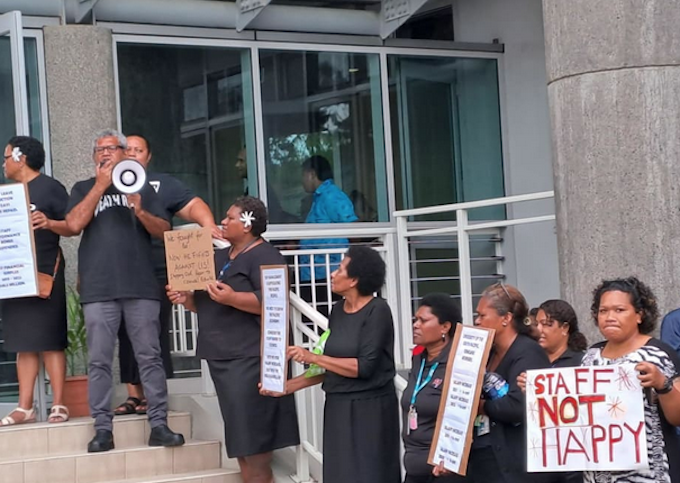
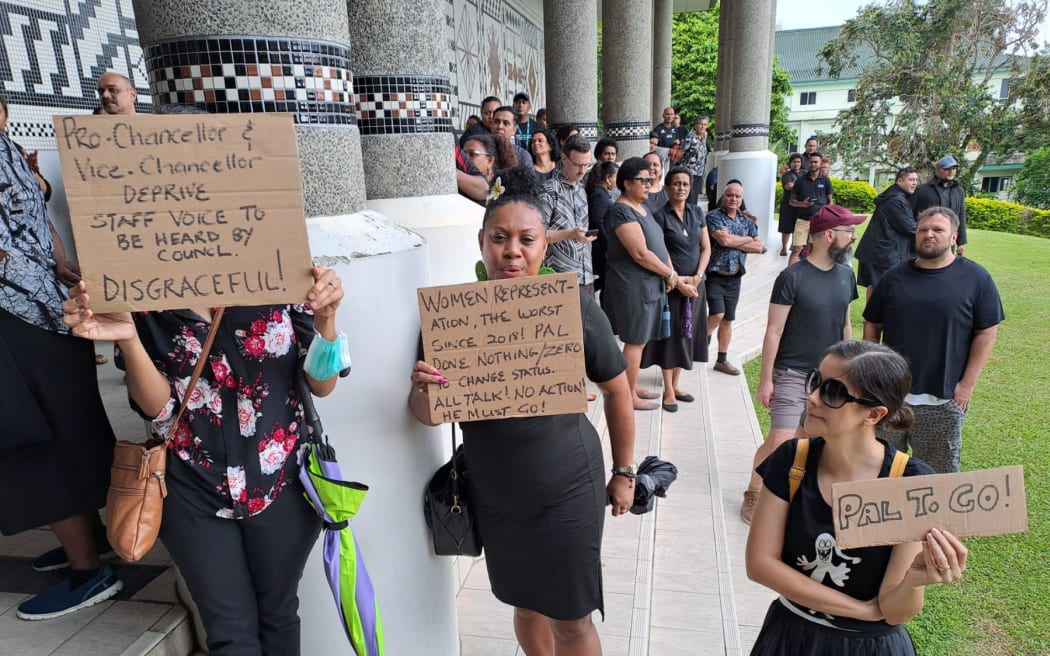
The staff braved the wet conditions today to carry out a second day of peaceful protest outside the meeting venue of the USP Council.

Pal Ahluwalia ABC 060221
USP vice-chancellor Professor Pal Ahluwalia . . . staff want him to step aside or be removed. Image: USP screenshot

Fong said staff still wanted vice-chancellor Professor Pal Ahluwalia to step down or be removed from his role.

The meeting will conclude later today.

Apenisa Waqairadovu is a FBC News multimedia journalist.

Print Friendly, PDF & Email

Article by AsiaPacificReport.nz

Former broadcast minister defends NZ journalism fund, state-funded media independence

RNZ News

Former broadcasting minister Willie Jackson has defended Aotearoa New Zealand’s public interest journalism fund that his government started during the covid-19 pandemic, after the new deputy prime minister characterised it as “bribery”.

Speaking to media on Monday after his swearing in, Deputy Prime Minister Winston Peters accused state-funded media organisations of a lack of independence from the previous Labour government.

Peters was asked how quickly he expected government departments to take action on removing te reo Māori from their names.

“Well, we’ll see the speed at which TVNZ and RNZ — which are taxpayer owned — understand this new message. We’ll see whether these people, both the media and journalists — are they independent?,” he said.

“Well, isn’t that fascinating, I’ve never seen evidence of that in the last three years.” he said.

He then laughed, and said “you can’t defend $55 million of bribery, cannot defend $55 million of bribery. Get it very clear”.

That last remark was a reference to the Public Interest Journalism Fund, a three-year $55m contestable fund for journalists initially set up to shore up public interest media during the covid-19 pandemic, which was wound up in July.

Media jobs, development funded
This included funding for 219 jobs and 22 industry development projects. Political coverage was exempted from eligibility to benefit from it. The fund was administered by NZ On Air.

Jackson, who became broadcasting minister in the Labour government two years after the fund was set up, said it was for media around the country, not just state-funded organisations.

“It was introduced during covid because it was a disastrous time in terms of media and we were pressured by good people out there to say, ‘hey, you support financial institutions so how about supporting local media that’s struggling’.”

It was aimed at supporting New Zealand media to keep producing public interest stories, he said and was “not just for RNZ and for TVNZ”.

“What you saw was a great investment in support of media outlets, Māori, Pasifika, regional [outlets] … Gisborne Herald, Otago Daily Times, Asburton Guardian, they got support and an opportunity to rebuild, reset.

“I’m very proud of what we did.”

Influence denied
He denied the then Labour government had any influence over the media as a result.

“The rules are very clear, we can’t interfere, we can’t intervene . . .  You guys have to have your own independence.”

RNZ’s charter requires the broadcaster to be independent, including providing “reliable, independent, and freely accessible news and information”.

While the organisation is funded by the government, by law no ministers of the Crown or person acting on their behalf may give direction to RNZ relating to programming, newsgathering or presentation, or standards, and cannot have staff removed.

This article is republished under a community partnership agreement with RNZ.

Print Friendly, PDF & Email

Article by AsiaPacificReport.nz

USP union warns of industrial action if fair pay is not approved

By Iliana Biutu in Suva

University of the South Pacific Union (USPU) president Reuben Colata says industrial action will be the next step if USP does not approve their pay increment being sought.

Colata said they did not know why the university did not want to negotiate a salary increase.

He said the university had about $80 million in savings with another $19 million given by the government this year.

With that amount of money, the university could pay the staff rather than allow the staff to bargain for their salary.

His union is one of two unions representing USP staff.

The Deputy Prime Minister and Minister for Finance, Professor Biman Prasad, said he encouraged the staff to engage with management — and with the USP Council — to resolve this issue.

Professor Biman said Fiji’s coalition government believed in academic freedom and also valued the freedom of workers the country needed.

The USP Council meeting is still underway at the USP Japan ICT Centre and it will continue today.

The USP staff had a silent protest yesterday after their staff paper was not allowed to be included as part of the council’s agenda.

Seeking removal of VC
They are calling for the staff paper to be discussed by the USP Council which includes the issues about the staff pay increment demand.

They are also calling for the removal of the regional institution’s vice-chancellor Professor Pal Ahluwalia.

The academic staff are represented by the Association of USP Staff (AUSPS) whose president, Elizabeth Read Fong, told FBC News that Professor Ahluwalia’s contract should end by December 31.

She hinted that the vice-chancellor had already turned 65, which is the institution’s retirement age.

“He also turns 65 at the beginning of the year,” she said.

“The university policy is that when you turn 65, you work until December 31st, so there is a post-retirement thing, but he has put that on hold, so one policy applies to everybody.”

Iliana Biutu is a Fiji Village News reporter. Republished with permission.

University of the South Pacific protesting in black
University of the South Pacific staff protesting yesterday in black with placards calling for “fair pay” and for vice-chancellor Professor Ahluwalia to resign. Image: Association of USP Staff (AUSPS)
Print Friendly, PDF & Email

Article by AsiaPacificReport.nz

The West’s double standards are once again on display in Israel and Palestine

ANALYSIS: By M. Muhannad Ayyash, Mount Royal University

American President Joe Biden is among the latest Western politicians to land in Tel Aviv in a show of support to Israel.

As Israel’s primary backer, the United States has sent two aircraft carriers to the region and indicated it could deploy 2000 American troops to Israel.

Biden was also set to meet Palestinian and Arab leaders in the Jordanian capital Amman. But Jordan cancelled the meeting after a reported airstrike on October 17 killed about 500 people at a Gaza hospital.

In the days after Hamas launched Operation Al-Aqsa Flood against Israel, European and North American governments (with few exceptions) were quick to provide a unified and consistent message of support for Israel.

That message contains at least four interconnected elements:

  • Israel is the victim of an unprovoked terrorist attack;
  • Israel has the right to defend itself;
  • The West fully stands with Israel against the barbaric and wanton violence of the Palestinians; and
  • Hamas is to blame (either partially or fully) for all civilian deaths on both sides since they began these hostilities and forced Israel’s hand while hiding behind civilians.

Palestinians erased
There are a few important features of this message, but I want to focus on two that highlight the West’s double standards.

First, is the advancement of anti-Palestinian racism in the West. It is critical to underscore a salient feature of anti-Palestinian racism: the silencing of the Palestinian critiques of Zionism and Israel.

This is a dynamic which has its roots in the Nakba (Arabic for “catastrophe”) and erases Palestinian voices, history, presence, aspirations and identity from public discourse.

Political, media and educational institutions in the West regularly sideline and silence Palestinians and their supporters. This is not just an issue among the right-wing or even centrists, but occurs across the political spectrum.

Left-wing politics, including progressive spaces, that purport to be anti-racist often remain hostile to Palestinian voices

Here in Canada, a statement by progressive Toronto Mayor Olivia Chow painted a rally in support of Palestinians as allegedly supporting violence and as a threat to the safety and security of Canadian Jews. That statement is still up on her X account.

This is precisely the anti-Palestinian narrative that has permeated in the West for years: that all support for Palestine is inherently violent and driven by antisemitic hatred of all Jews. Thus, in the name of anti-racism, Palestinians and their supporters are denounced and even criminalised.

Differing reactions to civilian death
Second, the double standard is on display in the reactions we have seen to the killing of Israeli civilians and the reactions — or lack thereof — to the killing of Palestinian civilians. Many are rightly highlighting Western hypocrisy by drawing comparisons to how the West responded to Russia’s war on Ukraine.

We need to look at how Western governments have responded to the killing of Israeli civilians versus the killing of Palestinian civilians. For the Israeli state and Israeli victims, political, military, economic, cultural and social institutions have fully mobilised to provide support.

The same is entirely absent for the Palestinians. For the Palestinians, there are no evacuations. Aircraft carriers are not sent to provide military support. Mainstream political and cultural discourse does not humanise Palestinian life and mourn Palestinian death.

Aid relief is withheld and used as a bargaining counter. Economic support is not forthcoming. Institutions do not send Palestinians messages of support.

In some ways, this silence is not surprising. No one expressing support for Israel risks losing their livelihood. Many who have voiced solidarity with Palestinians have lost their jobs, been rebuked, suspended and faced doxing.

Western self-interest
States are not moral entities, but act purely in self-interest. Palestinian freedom and liberation does not align with the interests of the US-led West.

Therefore, Western institutions repeat the increasingly weak talking point that “terrorism” is the cause of all the violence. This talking point is used to provide Israel with the green light to unleash uninhibited violence against Palestinians in the Gaza Strip, West Bank and Jerusalem.

The idea that Western governments and institutions are horrified by violence against civilians rings hollow because of their silence when it comes to violence against Palestinian civilians and other groups around the world.

For decades, Palestinians have been expelled from their land, killed and maimed in great numbers, including in mass atrocities and many well-documented cases of sexual violence and torture in Israeli prisons.

This only scratches the surface of the violence that Palestinians continuously experience, and have experienced, since well before Hamas was formed.

Palestinians continue to suffer what Palestinian scholars Nahla Abdo and Nur Masalha have called an ongoing Nakba and genocide of the Palestinian people. Yet, when Palestinians suffer, as they are now in Gaza, what Israeli historian and expert on genocide Raz Segal has called “a textbook case of genocide,” Western governments remain silent.

There was no Western outrage when Israel ordered more than a million Palestinians to leave their homes in 24 hours. In February, Israeli settlers went on an hours-long rampage in the Palestinian town of Huwara after two settlers were shot by a Palestinian.

Western condemnations of the rampage were muted or non-existent.

Hundreds of scholars and practitioners of international law, conflict studies and genocide studies are now sounding the alarm about the possibility of genocide being perpetrated by Israeli forces against Palestinians in the Gaza Strip.

The stories of Palestinian lives that end with the sudden drop of a bomb are not told. Palestinian voices that explain the settler colonialism they suffer remain sidelined. And Palestinian aspirations for decolonised liberation are denied.

The West’s institutional reaction is not just hypocritical, it is an expression of where Western governments stand on the question of Palestine. The West is an active participant in the erasure of Palestine, and when moments of intensified violence like this happen, the West’s true position becomes clear for all to see.

However, people power across the world, including in the US, provide reason for hope. Increasingly, many in the West are disgusted and ashamed by the erasure of Palestine and the killing of Palestinian civilians.

More people are joining the protests and calling for the siege on Gaza to be lifted once and for all. More people power is needed to demand that governments do everything they can to resolve this issue, which can only begin to move towards peace and justice when the Palestinian people are free.The Conversation

M. Muhannad Ayyash is professor of sociology, Mount Royal University. This article is republished from The Conversation under a Creative Commons licence. Read the original article.

Print Friendly, PDF & Email

Article by AsiaPacificReport.nz

Governments have been able to overrule the Reserve Bank for 80 years. Why stop now?

Source: The Conversation (Au and NZ) – By Peter Martin, Visiting Fellow, Crawford School of Public Policy, Australian National University

Pay close enough attention to parliament these next few days, and you’re likely to witness something truly remarkable: politicians from both sides of politics uniting to remove the power of politicians to overrule the Reserve Bank.

As an instance of self-loathing, it’s hard to top.

Sure, a good many of us don’t trust politicians. But surely politicians ought to trust politicians. Surely politicians ought to realise that we put them there to make decisions – not usually the day-to-day decisions, but the ultimate big decisions. They are meant to be where the buck stops.

That Treasurer Jim Chalmers could be even thinking about axing his ultimate power to veto decisions of the Reserve Bank board shows just how far the myth of an “independent Reserve Bank” has spread.

Scroll through the treasurer’s website, and you’ll find 195 documents referring to the “independent Reserve Bank”, many multiple times.

‘Independent’, but not according to the law

Saying the Reserve Bank is independent suits the treasurer and it suits the prime minister, just as it has suited many of their predecessors. As soon as the bank does something that’s necessary but unpopular (such as pushing up interest rates) they are able to say – wrongly – there’s nothing they can do.

The government’s Reserve Bank is dependent on the government in myriad ways.

The government set up the Reserve Bank. The government appoints every member of its board. The government directly appoints its chief and deputy chief. And from time to time the government gives it running instructions.

But – most importantly – the government can overrule it.

The mechanism is built into the Reserve Bank Act.

In the event of a disagreement, the treasurer can

submit a recommendation to the governor-general, and the governor-general, acting with the advice of the Federal Executive Council, may, by order, determine the policy to be adopted by the bank.

The government is to accept responsibility for the decision taken, and the Reserve Bank board must

thereupon ensure that effect is given to the policy determined by the order and shall, if the order so requires, continue to ensure that effect is given to that policy while the order remains in operation.

After so directing the bank, the treasurer is to table in parliament a copy of the direction, along with a statement explaining the reasons, and a statement from the Reserve Bank board putting the case that failed to convince the treasurer.

These are the clauses – until now unused – that in April the outside review of the Reserve Bank asked the government to do away with.

Its thinking was that the government can’t be trusted.

As the review put it

if an elected government controls monetary policy there are risks that it may try to push the economy to run above its capacity, resulting in higher inflation but with no lasting impact on employment.

On releasing the review’s recommendations, Treasurer Jim Chalmers said straight away that he agreed in principle with all of them.

Shadow Treasury Angus Taylor said much the same thing, although he now says the Coalition will wait until sees the legislation Chalmers is about to introduce before deciding its position on it.

The veto power is there for a reason


RBA Review, April 2023

On the face of it, a reasonable position would be that the government’s ability to overrule the bank in extreme circumstances has caused no problem so far.

The review counters this by warning of “the possibility that established conventions cease to be observed”.

But, if that did happen, it would be because there was a serious (and ultimately public) rift between the elected government and an unelected board.

With the exception of judges in Australia’s courts, unelected officials can’t normally overrule elected governments. It’s how our system is designed.

The Reserve Bank tried to overrule the government once, and succeeded, which is why the provision we have was written into the law.

Back in 1930, in the early years of the Great Depression, the Reserve Bank was part of the Commonwealth-owned Commonwealth Bank, run by a board appointed by the government which reported to the government.

In The Conversation earlier this year, Alex Millmow outlined what happened.

Desperate to support the economy, the government begged the government-owned bank to help it finance public works.

The bank refused. Its government-appointed chairman, Sir Robert Gibson, wrote to Treasurer Ted Theodore warning a point was being reached

beyond which it would be impossible for the Commonwealth Bank to provide further financial assistance for the governments in the future

Theodore replied complaining the bank was trying to

arrogate to itself a supremacy over the government in the determination of the financial policy of the Commonwealth, a supremacy which, I am sure, was never contemplated by the framers of the Australian Constitution

While the government did not question the right of the bank’s board to offer such comment or criticism as the board thought proper, the control of the public purse had “heretofore always been regarded as an essential prerogative of the people”.

In the end, it was the government that backed down. But to ensure it could never be overruled again, Labor wrote the veto power into the Commonwealth Bank Act of 1945 and the Coalition wrote it into the Reserve Bank Act of 1959.

That’s the veto power today’s Labor Party, quite possibly with the support of the Coalition, is about to try to remove.

I understand why the Reserve Bank review made the recommendation it did: it wants monetary policy to work well. But I don’t think that’s enough of a reason for the government to attempt to abrogate its responsibility.

And ultimately, it can’t. The Australian public is going to hold the government responsible for the state of the economy even if it succeeds in tying one hand behind its back. But I don’t think it’s wise. One day it might need it.


Read more:
Jim Chalmers wants a truly independent RBA. He should be careful what he wishes for


The Conversation

Peter Martin is Economics Editor of The Conversation.

ref. Governments have been able to overrule the Reserve Bank for 80 years. Why stop now? – https://theconversation.com/governments-have-been-able-to-overrule-the-reserve-bank-for-80-years-why-stop-now-218600

3 reasons why removing grazing animals from Australia’s arid lands for carbon credits is a bad idea

Source: The Conversation (Au and NZ) – By David John Eldridge, Professor of Dryland Ecology, UNSW Sydney

Shutterstock

If you run a large polluting facility and can’t work out how to actually cut emissions, you might buy carbon credits to offset your emissions from the Australian Carbon Credit Unit Scheme. These credits are meant to represent carbon taken back out of the atmosphere and stored in growing trees or in the soil.

The problem is, these credit schemes can be rubbery in the extreme. One area we must scrutinise forensically are human-induced regeneration projects. These are the backbone of the offset scheme, accounting for 30% of credits issued to-date. Over the coming years, they could be responsible for almost 50% of annual issuances. These projects claim to regenerate native forests across vast areas – not by replanting trees in cleared areas, as you might think, but by reducing grazing pressure from livestock and feral animals.

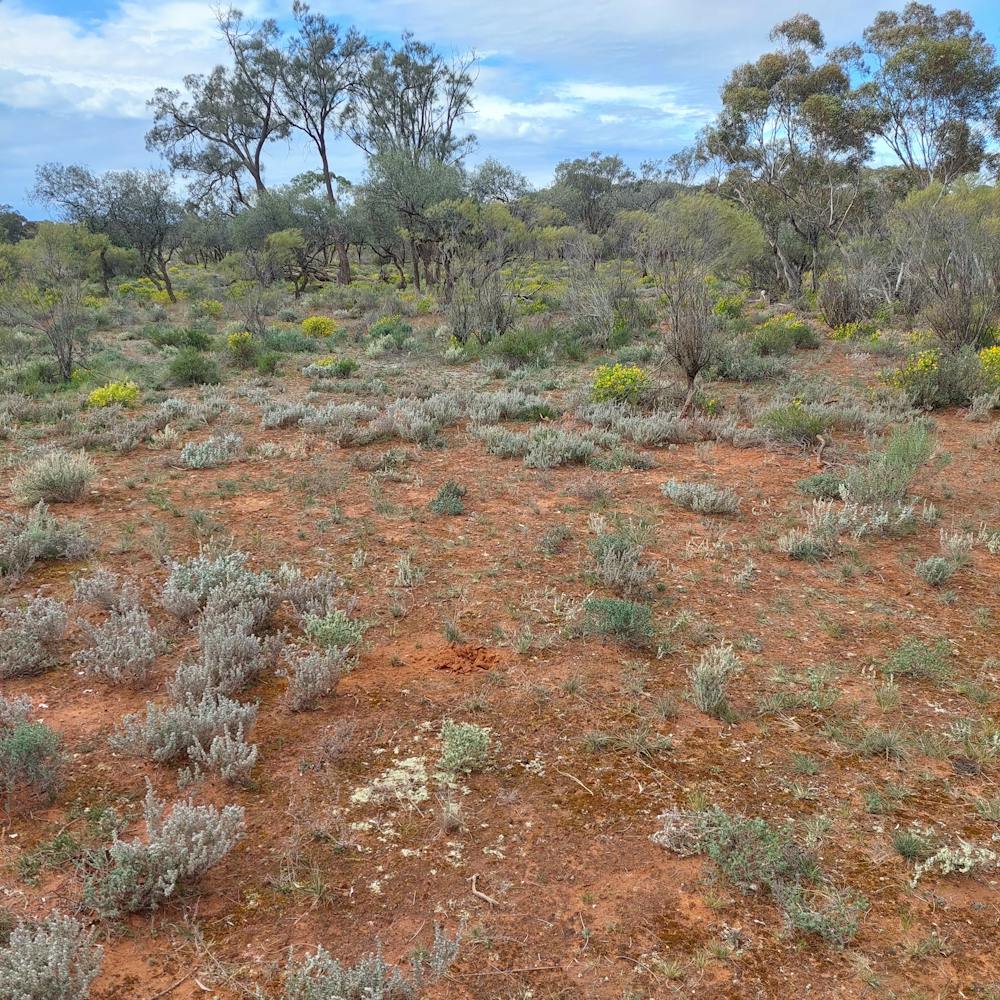
This is fundamentally flawed. Almost all projects are in arid or semi-arid rangeland grazed by livestock and kangaroos and only partly cleared. But cattle and sheep mostly eat grasses and herbs, not woody material. So how can we possibly claim reducing grazing pressure leads to more trees and shrubs?

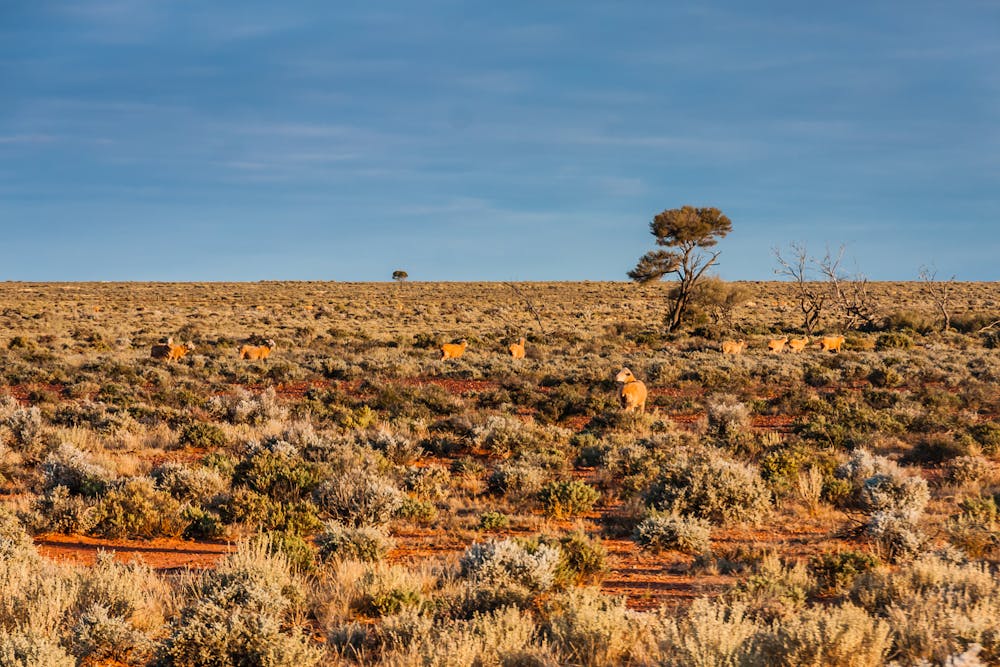
sheep on Australian rangeland
Sheep and other grazers largely eat grass and herbs, not woody material.
Shutterstock

3 reasons for scrutiny

Human induced regeneration projects have ballooned. They now cover about 34 million hectares of Australia’s rangelands, about 1.5 times the size of Victoria.

Projects have sprung up in absurd areas such as Alice Springs, Coober Pedy, and the Nullarbor Plain where few trees grow naturally, and where those that do grow are rarely eaten by livestock. These projects are currently producing over 6 million carbon credit units each year for tree growth that either can’t happen, or where growth would have happened anyway. That’s about A$235 million in today’s prices.

Under the rules, the projects are supposed to regenerate these forests and then maintain them for either 25 or 100 years.

Here’s why they should not be earning carbon credits.

1. Location

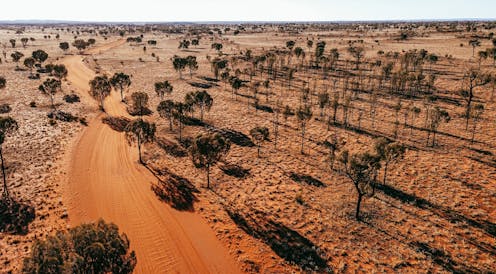
These projects are largely in the uncleared rangelands covering most of Australia’s interior. These areas have little chance of promoting woody growth and storing more carbon, not because of grazing pressure, but because rainfall is too low, the soil too infertile, and the vegetation already close to its maximum. Forests will not regrow in these areas, particularly under hotter and drier climates.

arid shrubs Australia
Forests are highly unlikely to grow on semi-arid terrain like this, even if grazing animals are removed.
TBC, CC BY-ND

2. Tree growth can have many causes

Grazing is just one driver of woody plant change. Where we do see tree growth, it’s most likely to be due to other factors such as sustained rain, greater concentrations of atmospheric carbon dioxide, falls in the intensity and frequency of bushfire, or removal of top predators like the dingo.

For these reasons, projects may well be credited for tree growth stemming from natural fluctuations – not grazing control.

3. Grazing on rangeland doesn’t destroy trees and shrubs

Removing grazing to regenerate forests in these uncleared areas would actually be a great idea – if we still had diprotodons, the largest marsupials ever to live. These 4 metre, 3.5 tonne browsers ate their way through trees and shrubs, much as elephants still do elsewhere, and played a key role in maintaining the balance between forests and grasslands.

If you took diprotodons off the land, you really would notice the difference – trees and shrubs would spring up without their intense grazing pressure. But the problem is, they’re extinct and have been for 25,000 years.

diprotodon skeleton
If Australia still had megaherbivores like the diprotodon, this approach might make more sense.
Danny Ye/Shutterstock

Their replacements on our rangelands – mostly sheep, cattle, feral goats and kangaroos – have nothing like the same effect.

In fact, where overgrazing does occur in Australia, it’s likely to actually increase tree and shrub cover rather than reduce it. Known as woody thickening, this happens when grazing animals eat so many grasses and herbs that they skew the balance in favour of trees and taller shrubs. Livestock might eat some woody plants, but most plants are out of their reach.

How did this happen?

By law, projects under the human-induced regeneration scheme are supposed to be restricted to land that is already cleared, with few mature trees and shrubs, and where native forest can regenerate naturally.

Under these conditions, the simple forest carbon model used by the Clean Energy Regulator to estimate how carbon is being stored works reasonably well.

The problem is, projects are no longer restricted to cleared land. Just 17 months after the Carbon Credits Scheme began, the regulator permitted projects to proceed in uncleared rangelands. Worse, these projects are credited using the same simple forest carbon model designed for cleared areas, which can’t account for the large numbers of pre-existing trees and shrubs in uncleared vegetation.


Read more:
Chubb review of Australia’s carbon credit scheme falls short – and problems will continue to fester


In short, there is little evidence the carbon storage credited to these projects matches the real carbon on the ground.

For Australia’s Carbon Credits Scheme to work effectively we need better administration, more transparency, and compliance testing. If we do not use the best available science, we will get the wrong outcomes. Emissions will be higher than they would otherwise be.

Using nature to store carbon can work. In fact it’s the only cost-effective way to pull carbon dioxide from the air at present. But the credit system is easily gamed – not only here, but in many other countries.

We must make absolutely certain credits represent real, additional and permanent abatement. That is, based on real increases in carbon stored in vegetation, that would not have occurred without carbon credits as incentive, and in ways which will hold the extra carbon for a century or more.

If we don’t, Australian businesses and organisations relying on carbon credits to meet their climate goals will lose faith in the program.


Read more:
‘Worthless’ forest carbon offsets risk exacerbating climate change


The Conversation

David John Eldridge receives funding from the Hermon Slade Foundation

Andrew Macintosh receives funding from the Australian Government and state governments. He is also a Director of the Paraway Pastoral Company, which has carbon offset projects.

David Alan George had previously received funding support from NCCARF, ACIAR, The World Bank and was an AVA. David develops, delivers and evaluates coursework in climate change to help build community capacity of individuals and groups by addressing knowledge and skills.

Don Butler receives funding from the Australian and State governments.

ref. 3 reasons why removing grazing animals from Australia’s arid lands for carbon credits is a bad idea – https://theconversation.com/3-reasons-why-removing-grazing-animals-from-australias-arid-lands-for-carbon-credits-is-a-bad-idea-218129

Almost half the men surveyed think they could land a passenger plane. Experts disagree

Source: The Conversation (Au and NZ) – By Guido Carim Junior, Senior Lecturer in Aviation, Griffith University

Shutterstock

Picture this: you’re nestled comfortably in your seat cruising towards your holiday destination when a flight attendant’s voice breaks through the silence:

Ladies and gentlemen, both pilots are incapacitated. Are there any passengers who could land this plane with assistance from air traffic control?

If you think you could manage it, you’re not alone. Survey results published in January indicate about one-third of adult Americans think they could safely land a passenger aircraft with air traffic control’s guidance. Among male respondents, the confidence level rose to nearly 50%.

Can a person with no prior training simply guide everyone to a smooth touchdown?

We’ve all heard stories of passengers who saved the day when the pilot became unresponsive. For instance, last year Darren Harrison manged to land a twin-engine aircraft in Florida – after the pilot passed out – with the guidance of an air traffic controller who also happened to be a flight instructor.

However, such incidents tend to take place in small, simple aircraft. Flying a much bigger and heavier commercial jet is a completely different game.

You can’t always rely on autopilot

A pilot spends about 90% of their time monitoring autopilot systems and making sure everything is working as intended. The other 10% is spent managing problems, taxiing, taking off and landing.

Takeoffs and landings are arguably the most difficult tasks pilots perform, and are always performed manually. Only on very few occasions, and in a handful of aircraft models, can a pilot use autopilot to land the aircraft for them. This is the exception, and not the rule.

For takeoff, the aircraft must build up speed until the wings can generate enough lift to pull it into the air. The pilot must pay close attention to multiple instruments and external cues, while keeping the aircraft centred on the runway until it reaches lift-off speed.

Once airborne, they must coordinate with air traffic control, follow a particular path, retract the landing gear and maintain a precise speed and direction while trying to climb.

Landing is even more complicated, and requires having precise control of the aircraft’s direction and descent rate.

To land successfully, a pilot must keep an appropriate speed while simultaneously managing gear and flap configuration, adhering to air traffic regulations, communicating with air traffic control and completing a number of paper and digital checklists.

Once the aircraft comes close to the runway, they must accurately judge its height, reduce power and adjust the rate of descent – ensuring they land on the correct area of the runway.

On the ground, they will use the brakes and reverse thrust to bring the aircraft to a complete stop before the runway ends. This all happens within just a few minutes.

Both takeoff and landing are far too quick, technical and concentration-intensive for an untrained person to pull off. They also require a range of skills that are only gained through extensive training, such as understanding the information presented on different gauges, and being able to coordinate one’s hands and feet in a certain way.

Training a pilot

The journey from student to commercial pilot is a long one. It normally starts with a recreational licence, followed by a private licence, and then a commercial licence (which allows them to fly professionally).

Even before stepping into a cockpit, the student must study aerodynamics, air law and flight rules, meteorology, human factors, navigation, aircraft systems, and performance and flight planning. They also need to spend time learning about the specific aircraft they will be flying.

Once the fundamentals are grasped, an instructor takes them for training. Most of this training is conducted in small, lightweight aircraft – with a simulator introduced briefly towards the end.

During a lesson, each manoeuvre or action is demonstrated by the instructor before the student attempts it. Their attempt may be adjusted, corrected or even terminated early in critical situations.

The first ten to fifteen lessons focus on takeoff, landing, basic in-flight control and emergency management. When the students are ready, they’re allowed to “go solo” – wherein they conduct a complete flight on their own. This is a great milestone.

After years of experience, they are ready to transition to a commercial aircraft. At this point they might be able to take off and land reasonably well, but they will still undergo extensive training specific to the aircraft they are flying, including hours of advanced theory, dozens of simulator sessions and hundreds of hours of real aircraft training (most of which is done with passengers onboard).

So, if you’ve never even learned the basics of flying, your chances of successfully landing a passenger aircraft with air traffic control’s help are close to zero.

Yet, flying is a skill like any other

Aviation training has been democratised by the advent of high-end computers, virtual reality and flight simulation games such as Microsoft’s Flight Simulator and X-Plane.

Anyone can now rig up a desktop flight simulator for a few thousand dollars. Ideally, such a setup should also include the basic physical controls found in a cockpit, such as a control yoke, throttle quadrant and pedals.

Flight simulators provide an immersive environment in which professional pilots, students and aviation enthusiasts can develop their skills. So if you really think you could match-up against a professional, consider trying your hand at one.

You almost certainly won’t be able to land an actual passenger plane by the end of it – but at least you’ll gain an appreciation for the immense skill pilots possess.

The Conversation

We conducted a research project with funds provided by Boeing Research & Technology Australia.

ref. Almost half the men surveyed think they could land a passenger plane. Experts disagree – https://theconversation.com/almost-half-the-men-surveyed-think-they-could-land-a-passenger-plane-experts-disagree-218037

At a time when journalism needs to be at its strongest, an open letter on the Israel/Hamas war has left the profession diminished

Source: The Conversation (Au and NZ) – By Denis Muller, Senior Research Fellow, Centre for Advancing Journalism, The University of Melbourne

Shutterstock

The journalists who signed an open letter to Australian media organisations last week calling for ethical reporting on the war in Gaza have succeeded in intensifying the dispute over whether the coverage has been fair. At the same time, they’ve called their own impartiality into question.

At last count, the letter had attracted 270 signatories from journalists at a range of institutions including the ABC, Guardian Australia, The Sydney Morning Herald, The Age, The Conversation and Schwartz Media.

At the Herald and The Age, both owned by the Nine company, senior editorial executives, including the papers’ editors, have banned those staff who signed the letter from having any role in covering the war.

The ABC’s director of news, Justin Stevens, did not go that far, but warned his staff that if they signed the letter, their ability to cover the story impartially may be brought into question.


À lire aussi :
ABC chief is right: impartiality is paramount when reporting the Israel-Gaza war


Addressing journalist deaths

The signatories to the letter, in addition to the individuals, were the journalists’ section of the Media Entertainment and Arts Alliance (MEAA) and its house (branch) committees at the ABC and Guardian Australia. It is not clear exactly under whose auspices the letter was written, but it is clear it has the endorsement of the union.

The letter raises two main issues.

One is that the Israeli Defence Force (IDF) has killed at least 53 journalists in the course of the present conflict and has a history of targeting journalists.

The letter provides links to reputable organisations – Reporters Without Borders, the International Federation of Journalists, the Committee to Protect Journalists – each of which provides substantial detailed evidence making a strong case against the Israeli Defence Force.

The letter states:

As reporters, editors, photographers, producers, and other workers in newsrooms around Australia, we are appalled at the slaughter of our colleagues and their families and apparent targeting of journalists by the Israeli government, which constitutes a violation of the Geneva Conventions.

That much of it can be defended as an attempt to stand up for press freedom and hold the Israeli forces to account.


À lire aussi :
More than one journalist per day is dying in the Israel-Gaza conflict. This has to stop


Clear implications of pro-Israel bias

However, the letter then goes on to argue in a veiled but unmistakable way that the Australian media’s coverage of the war has been pro-Israel.

This is achieved by a series of what, on the surface, look like journalistic motherhood statements:

We call for […] Australian newsroom leaders to be as clear-eyed in their coverage of the atrocities committed by Israel as they are of those committed by Hamas.

The immense and disproportionate human suffering of the Palestinian population should not be minimised.

Apply as much professional scepticism when prioritising or relying on uncorroborated Israeli government and military sources to shape coverage as is applied to Hamas […] The Israeli government’s version of events should never be reported verbatim without context or fact-checking.

The clear implication is that this is not being done, and that taken together they add up to a pro-Israel bias that needs to be corrected.

That is a highly contestable proposition and it needs evidence, but none is provided.

The letter goes on to urge that “adequate coverage be given to credible allegations of war crimes, genocide, ethnic cleansing and apartheid”.

The position taken by the ABC on the use of these terms was set out ten days ago by its managing director and editor-in-chief, David Anderson. He said the ABC would report other people’s use of them but would not adopt them for itself.

This is the conventional way for impartiality to be applied when such politically charged language is used. When they are reporting atrocities of the kind perpetrated by both sides in this war, on what authority do journalists take it upon themselves to apply these definitions?

Messy fall-out amid messy messaging

A further question concerning impartiality then arises: does signing this letter disqualify a journalist from being involved in covering the war? Does it justify the action taken by the Herald and The Age?

Those two newspapers have traditionally taken a strict line on these issues, and their decision this time is consistent with that tradition. Many years ago, a Herald reporter was taken off the reporting of state politics when he declared his membership of the Labor Party.

The reason given by the editorial executive who made this decision was not that his coverage had been biased but that there would be an apprehension among those who knew of his affiliation that his coverage might be biased.

A strict line on impartiality is fine, if it is applied impartially, but Crikey has drawn attention to an uncomfortable fact: that three of the four editorial executives at Nine who imposed the ban have participated in trips to Israel sponsored by pro-Israeli groups.

You might think the handling of these problems by the media industry and the journalism profession couldn’t get much messier, but it could.

On November 11, a group of journalists calling themselves MEAA Members for Palestine published a separate letter in Overland magazine, and in this there was nothing veiled about the position they took.


À lire aussi :
‘I just find it very hard to talk about it without getting emotional’: top journalists reveal their trade secrets to Leigh Sales


They condemned the Australian government’s support for what they called Israel’s genocidal assault on Gaza, called on the government to demand that Israel withdraw its forces and stop the bombing in Gaza, and condemned “the silencing and intimidation that our members experience when expressing support for, or reporting on, Palestine”.

They called on the Media Entertainment and Arts Alliance to support the Palestinian solidarity movement and join with trade union action across the world to “end all complicity and stop arming Israel”.

As a trade union, the alliance undoubtedly has the right to take sides, even in a war. But doing so is irreconcilable with the professional ethical obligations of its members to report impartially.

The Overland letter and the more restrained open letter to the media organisations might be two separate documents but it would be naïve in the extreme not to think that the first was parent to the second.

The whole episode, including the obvious hypocrisy of the Nine editorial management, has left the profession and the industry diminished at a time when Australian society needs them to be at their strongest.

The Conversation

Denis Muller ne travaille pas, ne conseille pas, ne possède pas de parts, ne reçoit pas de fonds d’une organisation qui pourrait tirer profit de cet article, et n’a déclaré aucune autre affiliation que son organisme de recherche.

ref. At a time when journalism needs to be at its strongest, an open letter on the Israel/Hamas war has left the profession diminished – https://theconversation.com/at-a-time-when-journalism-needs-to-be-at-its-strongest-an-open-letter-on-the-israel-hamas-war-has-left-the-profession-diminished-218596

‘Father of Reconciliation’ Pat Dodson to quit parliament

Source: The Conversation (Au and NZ) – By Michelle Grattan, Professorial Fellow, University of Canberra

Labor senator Pat Dodson, often dubbed “the father of reconciliation”, is quitting parliament due to ill health.

Dodson, 75, told the Labor caucus on Tuesday he would resign as a senator for Western Australia, effective from January 26, Australia Day.

“Regrettably, my recent treatment for cancer means that my health, although slowly improving, has left me physically unable to fulfil satisfactorily my duties as a senator,” Dodson said in a statement.

Anthony Albanese paid tribute to Dodson at the meeting. The Indigenous caucus members stood with Dodson at the lectern, and there a long standing ovation for him.

Albanese said in a statement: “You would gladly follow him into battle yet he’s made it his life’s work to make peace.”.

“There are few more reassuring sights in parliament than seeing Patrick and his hat coming down a corridor towards you.”

Priest, activist, academic, politician, Dodson was born in Broome.
The family subsequently moved to Katherine in the Northern Territory because of Western Australia’s laws against mixed race families.

In 1960 he and his siblings (including brother Mick, who also became a leading Indigenous figure) were orphaned when their parents died, months apart.

His early experiences had a lifelong impact on Dodson. He said in his first parliamentary speech: “I was hiding in the long grass in the Northern Territory town of Katherine and watched my age-mates being taken by welfare and police.

“In Katherine I also watched in fear as white people were bussed in to the town hall meeting, where they vented their hatred and anger against Aboriginal stockworkers for walking off Wave Hill Station and for demanding justice and equal wages. The Australian law at that time was unarguably founded on a social outlook that was highly ethnocentric, even racist.”

At school at Monivae College in Hamilton Victoria, Dodson became head prefect. He studied for the priesthood, and was ordained as the first Aboriginal Catholic priest in 1975. Later he quit the priesthood, unable to reconcile Catholicism with Aboriginal spiritual beliefs.

Dodson was director of the Central and Kimberley Land Councils, and negotiated the return of Uluru (Ayers Rock) to the traditional owners.

He served on the Royal Commission into Aboriginal Deaths in Custody, was the founding chair of the Council for Aboriginal Reconciliation (1991-97), and co-chair of the Expert Panel for Constitutional Recognition of Indigenous Australians (2010-16).

He filled a casual Senate vacancy in 2016. In Tuesday’s statement he thanked former leader Bill Shorten for nominating him for the vacancy.

In the Albanese government he was Special Envoy for Reconciliation and Implementation of the Uluru Statement from the Heart.

His serious illness prevented him from all but minimal campaigning in the Voice referendum.

When parliament was debating the bill for the referendum, Dodson was too unwell to attend in person – Senate leader Penny Wong read a message from him.

His message said: “This move to recognise the First Peoples of Australia in the Constitution is part of an action of restorative justice. Doing this will give a sense of honour for all Australians, as we collectively stand with courage to face these past legacies and ensure that they are not bequeathed to future generations. This is one commitment our generation can make.”

Dodson in his statement placed on the record his “high regard” for Albanese’s decision to proceed with the referendum.

The Conversation

Michelle Grattan does not work for, consult, own shares in or receive funding from any company or organisation that would benefit from this article, and has disclosed no relevant affiliations beyond their academic appointment.

ref. ‘Father of Reconciliation’ Pat Dodson to quit parliament – https://theconversation.com/father-of-reconciliation-pat-dodson-to-quit-parliament-218696

How does Australia’s health system stack up internationally? Not bad, if you’re willing to wait for it

Source: The Conversation (Au and NZ) – By Stephen Duckett, Honorary Enterprise Professor, School of Population and Global Health, and Department of General Practice, The University of Melbourne

Shutterstock

When things are going bad in the health system, we are reassured we’ve got one of the best health systems in the world. But we’re rarely told where we actually stand relative to others.

A new report from the Organisation for Economic Cooperation and Development (OECD) shows where Australia is doing relatively well – and not so well. The report is more than 200 pages with dozens of charts and tables.

Here we highlight five charts showing Australia’s relative performance. Overall, Australia’s health system performs well, but can come after long waits. And our use of antibiotics is trending in the wrong direction.

1. We spend less than average but live longer than average

Despite the rhetoric about the unsustainability of the health system, Australia performs well. When mapping health expenditure against life expectancy, Australia (marked by the red dot) sits in the best performing quadrant – and has done so for the past decade.

In contrast, the United States is stuck in the worst performing quadrant for the whole period – significantly higher spending than other countries with worse life expectancy.

The life expectancy measure is used here but it involves an implicit assumption that the principal impact on life expectancy is from the health system, which is not really the case. Nevertheless, it is a good measure of overall system performance and combined with spending provides a good measure.

2. Most Australians rate their health as good or very good

The vast majority of Australians (about 85%) rate their health as good or very good, with Australia performing better on this metric than most other similar countries. Often good health is conflated with good health care, and the data show that Australia also has more doctors per head than other countries.

The founding charter of the World Health Organization (WHO) recognised that health is not just the absence of disease, but a “state of complete physical, mental and social well-being”. This points to a flaw in the nexus between good health and more health professionals. The WHO focus on well-being helps to explain why it is not surprising that, looking across countries, the number of doctors doesn’t appear to be a key determinant of performance on self-rated health.

3. It’s harder to get a bed in aged care

About 30% of people in OECD countries are over 65, while the Australian proportion is about 20%. The proportion of over-65s is rising everywhere.

A minority of older Australians (14%) use aged care, with most of these using home care. However, monitoring access to residential aged care (represented here by the number of long-term care beds per thousand population over 65) might act as a “canary in the coal mine”, highlighting where access problems exist.

In Australia, access to aged care beds is falling, by about 27% between 2011 and 2021. We started in the middle of the pack so this is a concern and probably contributes to more Australians being stuck in acute hospitals, rather than being in more appropriate accommodation in residential aged care. This “exit block” in turn leads to problems of ambulance ramping.

4. Australians wait too long for public hospital hip replacements

Most publicly funded health systems are characterised by long waiting times for access to planned procedures such as hip replacements. Some waiting is to be expected as part of efficient management of operating theatre scheduling. But long waits, especially when the person is in pain, reflect poorly on management of the public hospital system.

The data shows that almost two-thirds of people waiting for hip replacement surgery in Australia waited more than three months. This is marginally worse than the OECD average. Unfortunately, our performance is deteriorating.

A number of states, such as Victoria, have developed strategies to improve the performance of the planned procedure system, or have identified opportunities for efficiency improvements in public hospitals which would help address this issue.

Although it’s understandable that planned procedures were affected by the first few years of the COVID pandemic, governments should have adapted their funding and provision systems to bring waiting times back to the pre-pandemic levels.

5. Our use of antibiotics is going in the wrong direction

Antibiotics have saved millions of lives. But public health experts have long recognised the emerging problem of antimicrobial resistance, where inappropriate use of these drugs can lead to their reduced effectiveness over time.

Worldwide campaigns to promote appropriate use of antibiotics are bearing fruit and across the OECD, use of antibiotics is going down.

Unfortunately, Australia’s trend is in the reverse direction.

The Conversation

Stephen Duckett does not work for, consult, own shares in or receive funding from any company or organisation that would benefit from this article, and has disclosed no relevant affiliations beyond their academic appointment.

ref. How does Australia’s health system stack up internationally? Not bad, if you’re willing to wait for it – https://theconversation.com/how-does-australias-health-system-stack-up-internationally-not-bad-if-youre-willing-to-wait-for-it-218031

Marshmallow Laser Feast at ACMI is a sumptuous visual feast – but something is missing

Source: The Conversation (Au and NZ) – By Dominic Redfern, Associate Professor, RMIT University

Eugene Hyland/ACMI

In my office, someone has pinned a cartoon in which two dogs consider an abstract sculpture on a plinth. As he strokes his chin one of them asks, “Yes, but is it food?”.

ACMI’s Marshmallow Laser Feast: Works of Nature is most definitely food.

This exhibition featuring artworks by London-based experiential art collective Marshmallow Laser Feast is sumptuous, a feast for eyes and ears at the technological bleeding edge of audio-visual practice. With its swirling murmurations of atoms, cells, blood platelets and gravitational forces, it is straightforwardly beautiful.

We are immersed from the moment we begin our descent into the vault of ACMI’s project hall. On the first landing is a portrait ratio image projected flush with the architecture and populated with flowing, bifurcating veins that break like dandelion blossoms to disperse.

Text from the poetry of Daisy Lafarge fades up and down between images. Linking each space, wall panels of Lafarge’s writing offer us a counterpoint to the didactic panels. The projection is accompanied by sound somewhere between breath and wind in the trees, an analogy central to an exhibition so focused on the breathing, pulsing dimension of all that lives.

Lafarge’s text is memorably recited into our ear in the meditation room by video art go-to Cate Blanchett (see her ongoing collaboration with Julian Rosefeldt). Blanchett has shown great generosity to artists and lends a gravitas and humanity to all she touches.

No exception, this ten-minute experience lounging in bean bags sets the tone, gearing us down to the required contemplative tempo.


Read more:
Light: Works from the Tate’s Collection honours the body and its sensations – this is art which is meant to be felt


United by sound

Sound is a vital feature of the installation.

Crackles, creaks, drippings, fizzes, distant reverberant booms and rushing fluid sounds suffuse and unite the space, contributing to the sense of interiority established by the dark subterranean setting.

At times, though, I found myself slightly troubled by the score. Recurrent throughout the exhibition are the smeared synth pads and soothing, never resolving harmonic progressions of massage therapy rooms. This fairly screams calm and slightly cheapens the installation.

A tree projection.
The motif ‘as above, so below’ replays throughout the exhibition.
Eugene Hyland/ACMI

Next to the meditation room is a towering projection of a Colombian kapok tree. The camera slowly circumnavigates this buttressed giant as the naturalistic image transforms into a 3D scan reminiscent of photogrammetric point-cloud images showing the flow of oxygen and nutrients within the tree.

A black mirror at the foot of the projection extends us further underground and compounds the “as above, so below” motif recurring throughout the exhibition.

People stare at large screens with red.
Oxygen flows into swimming, hurrying platelets.
Eugene Hyland/ACMI

Mirrored floors also feature in the third space where diagonally opposed screens are accompanied by the rushing sound of water, muted in its upper frequencies, emphasising our interior perspective.

Oxygen flows into swimming, hurrying platelets which move like plankton, fish or flocking birds as we travel inside our own bodies. These dots, whether acting cells, atoms or droplets, provide a delightful flip between 2D and 3D. A skeleton is revealed as we shift from micro to macro, up and out, and form is conjured out of air.

In the fourth space we loll on more of the comfortable furnishings provided throughout, as these eddying dots take us down and further down to our cell’s engine room, conjured here as a literal furnace.

People look at a projection above.
We loll on the comfortable furnishings.
Eugene Hyland/ACMI

It tells, it doesn’t ask

After a room of prints, we travel into illustrations of cosmological phenomena.

While I appreciate the design conceit that led to this decision in an exhibition replete with mirror motifs, aesthetically, it did seem a little tacked on relative to the very unified earlier rooms. It was also the first use of interactivity, a type of chase-the-mouse atom cloud which failed to meet the grandeur of much of the rest of the work.

A girl in a VR headset.
Moments of interactivity don’t match the grandeur of the rest of the work.
Eugene Hyland/ACMI

Finally, we encounter another scanned tree, a sequoia. After vertiginous tilting and thunderous rumblings, we head up the tree and inside its glowing heart, a transcendent moment in which we are shown once again all in nature is in flow and flux.

The appearance of birdsong here is a delight and a welcome change from the massaging synth; a sombrely cinematic harmonic sequence which stands out among the rest of the music.

The exhibition is most definitely a spectacular achievement for ACMI and the many (many!) people it took to pull this all together (witness the pages of credits in the final room). Works of Nature, however, sits firmly within the museological remit of ACMI and is distinct from the far more open, ambiguous and troubling works ACMI also commissions. Works of Nature is clearly in the business of knowledge transfer: it tells, it doesn’t ask.

A body in front of blue lights.
This is information design, rather than art at its more ambiguous, troubling task.
Eugene Hyland/ACMI

As was eloquently stated by Ersin Han Ersin, the director of Marshmallow Laser Feast, in his opening remarks at the launch, here art’s role was to make us feel something: feel the significance and wonder of our inescapable entanglement with the entirety of the biosphere.

It achieved this most certainly, but I was left with the impression that this was information design – rather than art at its more ambiguous, troubling task.


Read more:
Vivid Sydney: contemporary art – or just a bright night out?


The Conversation

Dominic Redfern does not work for, consult, own shares in or receive funding from any company or organisation that would benefit from this article, and has disclosed no relevant affiliations beyond their academic appointment.

ref. Marshmallow Laser Feast at ACMI is a sumptuous visual feast – but something is missing – https://theconversation.com/marshmallow-laser-feast-at-acmi-is-a-sumptuous-visual-feast-but-something-is-missing-215877

Chekhov called The Seagull ‘a comedy’. The Sydney Theatre Company seems to forget it was a tragedy, too

Source: The Conversation (Au and NZ) – By Alexander Howard, Senior Lecturer, Discipline of English, University of Sydney

Prudence Upton/Sydney Theatre Company

What is comedy?

This is the question I kept coming back to while watching Andrew Upton’s adaptation of Anton Chekhov’s The Seagull, which opened to warm applause – and a touch of controversy – at the Sydney Theatre Company on Saturday.

Theatre scholar Eric Weitz notes that comedy is a genre “with characteristic features”.

Laughter, humour, distraction. These are some of the terms associated with comedy.

Comedy is also restless. As Weitz acknowledges, comedy “embraces a range of subgenres” and often “cross-pollinates with other genres to form the likes of tragicomedy”.

These cross-pollinations can often confuse.

Consider the very first performance of The Seagull, subtitled “a comedy in four acts”.

The notorious performance at the Alexandrinsky Theatre in Saint Petersburg on October 17 1896 was an unmitigated failure. The audience jeered; the reviews were scathing.

Black and white photograph
Chekhov reads The Seagull with the Moscow Art Theatre company, 1898.
Wikimedia Commons

In a letter sent to the publisher Aleksey Suvorin the very next day, a wounded Chekhov declared he would never again “write plays or have them acted”.

The reason why the premiere went so badly has to do with audience expectations. As essayist Janet Malcolm explains, there were special circumstances on the night in question.

The performance was part of a benefit event for E. I. Levkeeva, a popular Russian comic actress, “and so the audience was largely made up of Levkeeva fans, who expected hilarity and, to their disbelief and growing outrage, got Symbolism.”

Primed for broad comedy, the audience didn’t know what to do with Chehkov’s groundbreaking spin on the genre, which broke with established realist modes and placed emphasis on metaphorical imagery and allegorical tropes.

While the play, which speaks to the themes of art and desire, has many funny moments, it simultaneously foregrounds discussions of mortality and depictions of madness. And it ends with a suicide.

Moreover, Chekhov’s play is one where, as the academic James Loehlin writes

the old win out over the young, where hope and the impulse for change are crushed, in part through their own fragility and lack of conviction, but in part by the proficient ruthlessness of the seasoned old campaigners, their elders.

I mention this because the serious and subtle aspects of The Seagull – many of which continue to resonate today – can get lost in modern takes on Chekhov’s play.

This is true of the Sydney Theatre Company’s production. Adapted by Upton and directed by Imara Savage, this version showcases the sound work of Max Lyandvert and features a meta-theatrical set designed by David Fleischer.

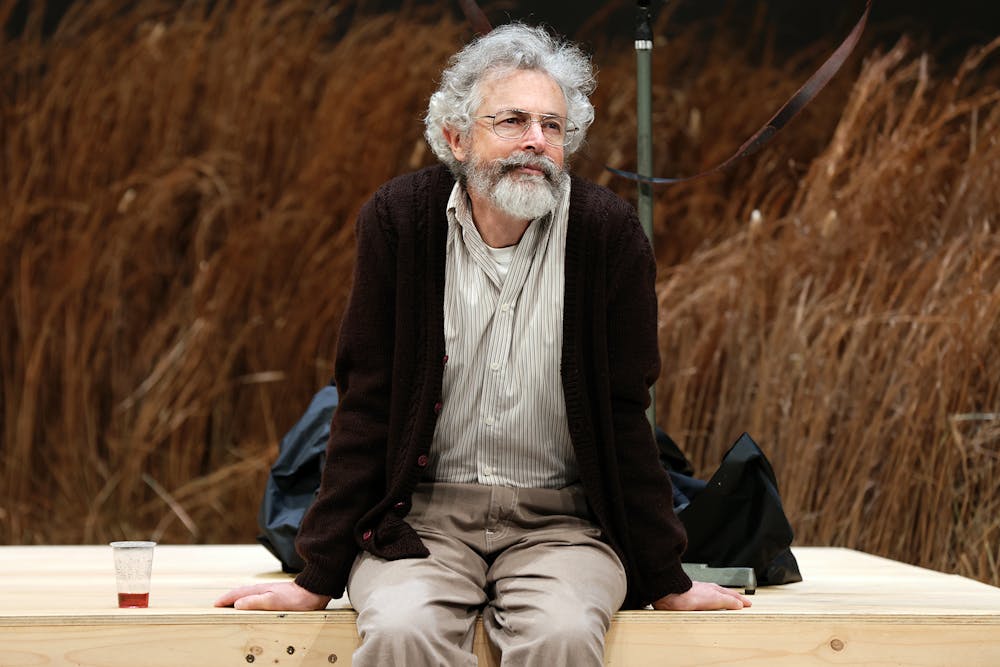
A man sits on a deck.
This version is set in contemporary rural Australia.
Prudence Upton/Sydney Theatre Company

The adaptation is set in contemporary rural Australia and uses anglicised character names. Upton and Savage stick with Chekhov’s formal structure, but privilege the comedic at the expense of pretty much everything else when it comes to delivery.

This has ramifications for how the adaptation pans out.


Read more:
The lies of happiness: living with affluenza but without fulfilment


Success beckons, tragedy befalls

The play comprises four acts and centres on four characters who mirror each other.

Constantine (Harry Greenwood) and Boris (Toby Schmitz) are writers. Boris is famous. Constantine – a college dropout who fancies his chances as an avant-gardist – is most definitely not.

Irina (Sigrid Thornton) and Nina (Mabel Li) are actors. Irina, who is Constantine’s mother and Boris’s lover, is a renowned stage star. The ingénue Nina, who is dating Constantine, desperately wants to make it.

Success beckons, but tragedy eventually befalls Nina – who leaves Constantine for Boris – in the two year gap between the play’s third and fourth acts.

These characters are joined by several others, including Irina’s ailing landowner brother Peter (Sean O’Shea), and a depressive young goth, Masha (Megan Wilding). With the exception of one, every character in the play is morose.

The cast line up across the stage.
With the exception of one, every character in the play is morose.
Prudence Upton/Sydney Theatre Company

The first act is structured around an abortive performance of an experimental theatre piece Constantine has worked up. Nina and Boris grow close in the second, while Irina holds court. At the start of the third act, it is revealed Constantine has tried to take his own life. Boris threatens to leave Irina for Nina. Hilarity ensues as Irina tries to win him back.

The atmosphere that the Sydney Theatre Company creative team establishes in each of these acts is lighthearted and largely humorous. Indeed, there are some moments, as when a gravely ill Peter convulses on the ground in the third act, when the onstage action almost tips over into outright farce.

As Chekhov himself insisted, different types of comedy – including farce – had roles to play in The Seagull. However, the overarching tonal emphasis in this adaptation causes problems in the play’s last act, which is set indoors during the Australian winter.

Peter, not long for the world, spends his time talking about how he regrets his entire life. The other characters fob him off. Constantine has made headway as a writer, but is deeply unhappy. He pines after Nina, who dropped off the radar somewhere between acts.

A woman looks at a man holding a seagull.
Mabel Li gives one of the standout performances.
Prudence Upton/Sydney Theatre Company

Time passes, and trivialities exchanged. A bedraggled Nina reappears. The story she tells is one of sorrow and woe. A genuinely moving moment, the speech is delivered with real affective intensity – undoubtedly the high point of the production.

However, the tonal chasm between the final act and the preceding three is simply too great.

In keeping with Chehkov’s original, comedy ultimately gives way to tragedy, but something seems to have been lost along the way.

The Seagull is at the Sydney Theatre Company until December 16.


Read more:
Belvoir’s The Master and Margarita: astonishingly ambitious, physically demanding and a resounding success


If this article has raised issues for you, or if you’re concerned about someone you know, call Lifeline on 13 11 14.

The Conversation

Alexander Howard does not work for, consult, own shares in or receive funding from any company or organization that would benefit from this article, and has disclosed no relevant affiliations beyond their academic appointment.

ref. Chekhov called The Seagull ‘a comedy’. The Sydney Theatre Company seems to forget it was a tragedy, too – https://theconversation.com/chekhov-called-the-seagull-a-comedy-the-sydney-theatre-company-seems-to-forget-it-was-a-tragedy-too-215799

Driving a greener future: how your electric car could help power your neighbourhood

Source: The Conversation (Au and NZ) – By Alan Brent, Professor and Chair in Sustainable Energy Systems, Te Herenga Waka — Victoria University of Wellington

A new concept – the “grid of grids” – is revolutionising the way we think about energy.

In essence, the grid of grids signifies a shift from a single unified energy network to a collection of smaller networks, capable of operating together or independently as required. It can create a flexible and resilient energy infrastructure that could help contribute to a sustainable future.

In our recent research, we explored the integration of smaller-scale renewable energy systems (microgrids) with a fleet of electric vehicles (EVs).

Under the grid of grids concept, national and international energy infrastructure would become part of a dynamic network. Each point in this network would represent a smaller hub – a community, town or even business district.

EVs would be part of this network, not merely extracting power but actively participating in a reciprocal energy exchange. This approach turns every EV into a decentralised power unit, capable of contributing to and benefiting from the broader energy system.

But how can communities achieve this? Smart community energy solutions are the key.

Understanding microgrids

A microgrid is essentially a self-sufficient energy system that provides power for a particular geographic area, such as a university, hospital complex, business centre or neighbourhood.

Microgrids ensure that even in times of disruptions, communities can keep the lights on. They are flexible, adaptive – and, importantly, they can empower local groups to take control of their energy destiny.

Smart microgrids take this a step further. They leverage advanced information and communications technologies, such as sophisticated sensors and automated control systems, and the Internet of Things (a network of devices that connect and exchange data with other devices and systems over the internet). This enables smart microgrids to optimise energy distribution and ensure efficiency.


Read more:
Cyclone Gabrielle: how microgrids could help keep the power on during extreme weather events


Our recent research examined the economic viability of microgrids across all 16 regions of Aotearoa New Zealand using the “Stochastic Microgrid Optimisation Under Uncertain Loads and Distributed Energy Resources” (SMOULDER) web tool.

SMOULDER represents a five-year project that investigated the role of artificial intelligence in optimising microgrids.

The SMOULDER web tool helps determine the optimal size of various microgrid configurations. The technologies considered are solar panels, wind turbines, batteries and hydrogen microgrids for neighbourhoods and communities. SMOULDER also evaluates the economic impact of EV charging patterns during peak or off-peak times.

How do EVs fit into the puzzle?

When an EV is parked, it can do more than merely wait for its next journey. It can integrate into the local microgrid, actively contributing by channelling unused stored energy back into the system.

This can enhance the efficiency of energy utilisation. It can also allow us to harness the potential of variable renewable sources such as solar and wind.

So, when an EV is not in use, and the local microgrid is experiencing peak demand, it transfers the excess energy back into the grid.


Read more:
Floods left thousands without power. Microgrids could help communities weather the next disaster


Conversely, during periods of light load, such as the middle of the night with excess wind power, the EV intelligently charges, ensuring a sustainable and efficient exchange within the community microgrid.

This strategic and dynamic interaction optimises energy usage within the community microgrid, providing both economic and environmental benefits.

V2G (Vehicle-to-Grid) and bidirectional charging — an innovative approach empowering electric vehicles to actively contribute to the energy grid.

A buffer against fluctuating prices

Microgrid solutions, enhanced by the collaboration with EVs, offer a pathway to significant cost savings. By harnessing local, renewable resources, these systems reduce reliance on centralised power grids, mitigating the impact of fluctuating energy prices.

The grid of grids concept enables microgrids to achieve greater economic self-sufficiency, establishing a buffer against the uncertainties of the broader energy market.

Establishing microgrids and building towards the grid of grids has a cost that will need to be managed by individuals, organisations and communities. But once established, these grids will have broader benefits as Aotearoa New Zealand moves towards a sustainable future.


This article was written with the assistance of Dr Soheil Mohseni, Senior Energy Forecasting Analyst at Ausgrid and Research Fellow, Te Herenga Waka — Victoria University of Wellington


The Conversation

Alan Brent is affiliated with The Sustainability Society, a technical working group of Engineering New Zealand.

ref. Driving a greener future: how your electric car could help power your neighbourhood – https://theconversation.com/driving-a-greener-future-how-your-electric-car-could-help-power-your-neighbourhood-218345

Meet Andrew Hauser, the outsider from the UK who’ll be deputy governor of the RBA

Source: The Conversation (Au and NZ) – By Isaac Gross, Lecturer in Economics, Monash University

Andrew Hauser, currently executive director for markets at the Bank of England. Australian Treasury

In a significant step towards reforming Australia’s Reserve Bank, Treasurer Jim Chalmers has stepped outside the bank and outside of Australia to select Andrew Hauser, a British economist, as its new deputy governor.

The deputy governor’s job has traditionally been a springboard to the governor’s job, and Hauser will replace Michele Bullock who was herself deputy governor until her appointment as governor on Philip Lowe’s retirement in September.

Hauser is the first deputy governor to be appointed from outside the bank, and also the first non-Australian to be appointed to a high-ranking position in the bank.

The selection of a complete outsider is a sign that Treasurer Jim Chalmers has taken on board the concerns of the independent review of the Reserve Bank which in April expressed concern about what it called groupthink at the bank, which it defined as

a phenomenon in which a group of individuals tries to minimise conflict and
reach a consensus decision without critical evaluation of alternative viewpoints,
by actively suppressing dissenting viewpoints and isolating themselves from
outside influences

The review found a “lack of openness to external ideas” at the bank and a tendency to avoid difficult discussions to resolve issues.

It wanted the bank “open to diverse voices” and suggested advertising vacancies for management roles externally as a default, with external members on all selection panels for deputy-head of department roles and above.

The RBA and the Bank of England face similar challenges

Hauser has worked at the Bank of England for over 30 years, giving him a deep understanding of the operation of monetary policy in an open economy similar to Australia’s, in which interest rates and the the exchange rates are important economic levers.

If the experience of his former governor at the Bank of England, Mark Carney, is any guide, he’ll make the transition without too much difficulty.

Carney was appointed Governor of the Bank of England in 2013 from Canada where he had been Governor of the Bank of Canada, and served until 2020.

Hauser’s experience as executive director for markets at the Bank of England and his involvement in managing its response to the global financial crisis and the early stages of COVID will make him especially useful to Australia’s Reserve Bank.

The Reserve Bank has been without top-level experience in managing markets during crises since the departure of Guy Debelle in March 2022.

Debelle had long been the bank’s point person on markets. As head of its financial markets group during the crisis he coordinated and directed the bank’s attempt to keep financial markets open on a daily basis, a role he fulfilled again as deputy governor during the COVID crisis.

Hauser will help the bank decide how quickly to shrink

A major challenge for the bank under Hauser’s deputy governorship will be managing the size of its balance sheet.

During the COVID crisis, the bank bought government bonds with money it created in order to support the economy and keep interest rates low.

This led to a quadrupling of its balance sheet, from A$161.4 billion in financial assets before COVID to a peak of $637 billion in March this year.

Now that the crisis has passed, the bank is slowly contracting its balance sheet by gradually letting the bonds they bought expire.


À lire aussi :
RBA revolution: how Chalmers will recraft the bank for the 21st century


At issue is whether the bank should contract its balance sheet faster (and contract the economy) by actively selling bonds, and also when it should stop selling bonds and letting them expire.

While these are new questions for the Reserve Bank, the Bank of England has been grappling with them for years, having bought bonds with created money during the global financial crisis.

As executive director of markets at the Bank of England, Andrew Hauser is well versed in the problem. He outlined the issues earlier this month in what might be his final speech for the Bank of England, entitled “Less is more or less is a bore? Re-calibrating the role of central bank reserves”.

His appointment marks a pivotal moment in the Reserve Bank’s history, underlining the government’s commitment to revitalising the bank and refashioning it for the 21st century.

He is expected to take up his new role in early 2024.

The Conversation

Isaac Gross ne travaille pas, ne conseille pas, ne possède pas de parts, ne reçoit pas de fonds d’une organisation qui pourrait tirer profit de cet article, et n’a déclaré aucune autre affiliation que son organisme de recherche.

ref. Meet Andrew Hauser, the outsider from the UK who’ll be deputy governor of the RBA – https://theconversation.com/meet-andrew-hauser-the-outsider-from-the-uk-wholl-be-deputy-governor-of-the-rba-217521

Polls say Trump has a strong chance of winning again in 2024. So how might his second term reshape the US government?

Source: The Conversation (Au and NZ) – By David Smith, Associate Professor in American Politics and Foreign Policy, US Studies Centre, University of Sydney

Ohio Senator J.D. Vance, a zealous convert to Donald Trump’s cause, once offered an expansive vision of how Trump should rule in a second term: “fire every single midlevel bureaucrat, every civil servant in the administrative state, replace them with our people.”

Polls a year out from the 2024 election suggest Trump has a good chance of winning it. If he does, he and his allies want to be ready to run the country in ways they were not in 2016.

For more than a year, groups supporting Trump have been publicising plans to fill government roles with proven Trump loyalists if he wins a second term.

Trump believes his first term was undermined by “deep state” bureaucrats, “weak” lawyers and even “woke generals”. Some of his opponents argue that government officials indeed acted as “guardrails” during Trump’s administration, saving the country from his worst instincts.

There seems to be a near consensus among Trump’s friends and foes that his authoritarian second term plans would require more cooperative government officials than he had last time around.

But how much could Trump genuinely reshape the United States government?

Theory of bureaucratic politics

In 1971, political scientist Graham Allison wrote Essence of Decision, an analysis of the Kennedy administration’s actions in the Cuban Missile Crisis. Allison argued that foreign policy decisions of the United States government could not be understood simply as rational responses to external situations. Decisions are political outcomes resulting from complicated “games” played between different actors within the government.

Even in foreign policy, a domain where the US president has a lot of power compared to other areas of policy, the president needs help making decisions. Those decisions reflect bargaining between cabinet secretaries, military figures, diplomats and advisers, all of whom have their own interests and viewpoints.

One of the book’s earliest reviewers, the realist international relations scholar Stephen Krasner, was unimpressed by this analysis. He believed it would be popular with high-level policy-makers because it obscured their responsibility for the decisions they made. In the end, Krasner argued, there is a single decision-maker in US foreign policy, and that is the president. Games may be played among the president’s staff and bureaucrats, but they are games whose rules are written by the president and whose players are chosen by the president.


Read more:
Politics with Michelle Grattan: Author Bruce Wolpe on the “shocking” consequences for Australia of a Trump 24 win


Allison’s theory would resonate with those who imagine a “deep state” establishment thwarting the president’s agenda. Trump is not the first president to rail against entrenched opposition in his own administration, especially in foreign policy. Barack Obama’s staff complained of “The Blob”, a militaristic establishment that included Obama’s secretary of defense. Other Democratic presidents also used blob-like metaphors. Allison noted that John F. Kennedy described the State Department as “a bowl of jelly”, while Franklin D. Roosevelt said that trying to change anything in the Navy was “like punching a feather bed”.

But we should remember Krasner’s warnings that presidents and their allies would use bureaucratic opposition as an excuse for the shortcomings of systems they controlled. Trump was frustrated at times by appointees who ignored his orders or refused to carry them out because they were illegal.

But such people usually didn’t last long in the administration after colliding with Trump.

Trump’s administration set records for turnover among White House staff and Cabinet positions, and had a very high vacancy rate for Senate-confirmed appointments. By the end of his presidency, nearly anyone who disagreed with him was gone, and his Cabinet was filled with acting secretaries. This, he said, gave him “more flexibility”.

The inexperience and incompetence of Trump’s people were bigger problems for Trump in the end than disloyalty and opposition. Selecting high officials for their loyalty alone could be a recipe for another four years of domination without control.


Read more:
Trump has changed America by making everything about politics, and politics all about himself


Smashing the administrative state

Trump’s allies have ambitions beyond enforcing loyalty to Trump, who can only serve one more term. His former Chief Strategist Steve Bannon called early in Trump’s first term for the “deconstruction of the administrative state”. This may sound new and radical, but it broadly aligns with the aims of conservative policy ever since Roosevelt’s New Deal.

Congress delegates many of the powers of government to dozens of independent regulatory agencies such as the Environmental Protection Agency, the Consumer Finance Protection Bureau and the National Labor Relations Board. These bodies are given the power to do things like setting and enforcing clean air standards, investigating and publishing consumer complaints over financial services, and conducting elections on union representation.

The legitimacy of these agencies has long been attacked by conservatives, who believe they bypass legislatures to advance liberal policy goals. Lawyers in the Reagan and Bush administrations developed the theory of the “unitary executive”, which asserted the right of the President to fire uncooperative civil servants and questioned the constitutionality of independent government agencies.

Towards the end of his presidency, Trump signed an executive order to create Schedule F, which would reclassify tens of thousands of career civil servants as political appointees, stripping them of their employment protection. Biden rescinded the order a few days into his presidency, but Trump’s allies now see it as the key to finally taking control of the administrative state.

Their stated aim is to remove public servants likely to obstruct Trump’s agenda and replace them with people committed to it. This would theoretically increase the president’s power.

However, the long term effect of flooding the civil service with thousands of political appointees hostile to government would be to reduce the capacity of all government, regardless of the president. The quality of government services would degrade, and public faith in government would further erode.

Not all conservatives like this plan. Some warn it would return America to the “spoils system” that existed before the neutral civil service, where public sector jobs were rewards to be doled out to political supporters. But the conservative ascendancy now belongs to those who can best align their ideologies with Trump’s grievances.

Control is still an illusion

The activist conservative think-tank Heritage Foundation boasts that “the left is right to fear our plan to gut the federal bureaucracy”. The mass firing of political enemies fits well with Trump’s focus on “retribution”. But Heritage and other organisations are selling an illusion that is likely to leave Trump or any other president frustrated.

It’s easy to blame scheming bureaucrats and administration “traitors” for the failures of Trump’s first term. The reality is that all recent presidents have faced the same intractable problem: it is increasingly difficult to get any major legislation through a polarised Congress. It is the failure to legislate that forces presidents to rely on inherently flimsy executive orders.

Trump also had the problem that much of what he wanted to was illegal. While his allies are now searching for administration lawyers who “are willing to use theories that more establishment lawyers would reject”, Trump would also need the cooperation of judges to implement plans such as “strong ideological screening” of immigrants.

The hundreds of judges that Trump appointed to federal courts, including three Supreme Court justices, have certainly made it easier to pursue a conservative political agenda. But they wouldn’t help Trump when it came to the issue he cared about most: overturning the results of the 2020 election.

Trump may find that the lifetime appointments from his first term have created a new conservative legal establishment that can help his allies but is at odds with his personal ambitions.

Various biographers of Trump have suggested he will never be satisfied with any level of power or prestige. He is unlikely to get what he wants out of a second term in the White House. But plenty of others will see it as a great opportunity to settle longstanding scores.

The Conversation

David Smith does not work for, consult, own shares in or receive funding from any company or organisation that would benefit from this article, and has disclosed no relevant affiliations beyond their academic appointment.

ref. Polls say Trump has a strong chance of winning again in 2024. So how might his second term reshape the US government? – https://theconversation.com/polls-say-trump-has-a-strong-chance-of-winning-again-in-2024-so-how-might-his-second-term-reshape-the-us-government-217664

How your money is helping subsidise sexism in academia – and what you can do about it

Source: The Conversation (Au and NZ) – By Nicole Boivin, Professor, Max Planck Institute of Geoanthropology

It’s frightening to imagine where the world would be right now without mRNA vaccines. The COVID-busting technology revolutionised vaccine development at an internationally critical moment – with massive implications for people’s health, wellbeing and the global economy.

Yet imagine we must – because some of the research most crucial to the development of mRNA vaccines almost didn’t happen.

Biochemist Katalin Karikó’s fascination with the therapeutic potential of mRNA began in the early 1990s, but she received little encouragement. She was undervalued and underfunded throughout her university career and eventually left academia.

When she went on to jointly win the Nobel Prize for Medicine for her pioneering role in developing the mRNA technology that allowed the world to take on COVID, Karikó’s former employer, the University of Pennsylvania, tried to take credit.

Yet during her time there, the university sidelined and demoted Karikó, eventually pushing her out altogether. While it would be nice to think of Karikó’s experience as an aberration, her experience – as we highlight in our new paper – is all too common for women in academia.

Barriers to women’s success

Academia is widely viewed as a meritocracy, a bastion of liberalism, and a place where people go to pursue a higher calling. The data, however, point to a dark side to the ivory tower.

For instance, a major report published in 2019 by the US National Academies of Sciences, Engineering and Medicine showed rates of sexual harassment in academia are second only to those in the military.

More common than overtly sexualised harassment, however, is gender bias. Studies reveal women’s research receives tougher assessment, less funding, fewer prizes, and less citation than men’s. Women professors receive lower evaluations and more criticism from students – both male and female – and face higher expectations as mentors.

Women often face chilly academic climates, isolation, job insecurity, stalled promotions and unequal or limited access to resources. These tendencies can easily verge on incivility, ostracism, online abuse, academic sabotage and malicious allegations. And these problems are worse for women of colour, and those who belong to sexual and gender minority groups.


Read more:
‘Death by a thousand cuts’: women of colour in science face a subtly hostile work environment


When women are brave enough to speak out, it usually backfires. At best, they may face minimisation or silencing. More damaging is retaliation, including from institutions themselves. Women can find themselves placed on probation, under investigation, targeted for character assassination, facing retaliatory accusations, demoted or even fired.

Bad for science and a waste of funding

A massive study of almost a quarter of a million US academics showed women are leaving academia at significantly higher rates than men.

They are also leaving for different reasons. While men are more likely to leave because they have been attracted by better opportunities, the number-one reason women cite for leaving is toxic workplaces.

The outcome of this gradual attrition is that women continue to be vastly underrepresented in senior academic positions: as full professors, research directors, and heads of research institutions and universities.

The loss of so many women from research and higher education isn’t just a social or ethical issue. It’s also an economic one. Women in academia reflect investment. Their many years of post-secondary education, their training, their research – it all costs money. This money is wasted when they are pushed out of academia.

The worst bias and explicit harassment often comes as women achieve greater success. Rates of departure between men and women really start to widen about 15 years after academics finish their PhDs.

This means higher education and research are often losing women with the most experience and promise, and in whom the greatest funding investments have been made.

Follow the money

As current and former institutional heads and research leaders, we suggest it’s time to follow the money. Where does all this wasted money come from?

You, the taxpayer.

Higher education, research and science all are, in many parts of the world, funded mostly through public sources. This means when higher education and research organisations fail to tackle the persistent sexism, discrimination and harassment that’s driving women out, they are throwing your money out the window.

Or you can think of it another way: your taxes are subsidising sexism.


Read more:
We studied 309,544 patent applications – and found inventing is still a man’s world


The buck stops here

The fact that tax money supports higher education and research also presents an opportunity: taxpayers can demand change in how their taxes are used.

They can demand efficiency in public funding – efficiency that will lead to less sexism in the institutions educating our children, and to more of the science we desperately need to address the collective challenges we face.

We call on governments to address sexism in higher education and research as a matter of urgency, such as by:

  1. acknowledging that self-regulation isn’t working.

    Universities and research institutions have implemented gender equity initiatives and policies for decades. Yet gender biases remain entrenched.

  2. developing effective and transparent systems for measuring gender equity, and applying them to all publicly funded higher education and research institutions.

    This means collecting and publishing data on recruitment, appointment, salaries, workload allocation, promotions, discrimination, harassment, misconduct, demotion, dismissal and departure.

  3. making funding in higher education and research dependent on the achievement of gender equity targets.

    Institutions currently receive public funding regardless of whether they uphold a fair academic culture that provides equal opportunity for men and woman.

    Disregard for rules, procedures and laws designed to achieve gender equity does not hold institutions back from receiving continued public funding. This lack of accountability helps perpetuate gender bias. It needs to change.

You can join us in pressing for these changes by contacting your local representative, organising and submitting petitions, or reporting concerns to organisations designed to investigate possible abuses of public funding (such as federal auditing offices).

The story of Karikó and the transformative research that almost never was should be the wake-up call we need to demand better.


Read more:
In 5 years, this Australian astrophysics lab reached 50% women. Here’s how they did it


The Conversation

Susanne Täuber is affiliated with the Academic Parity Movement and the Network Against Power Abuse in Science. Both are non-profit organizations fighting harassment and power abuse in academia.

Janet G. Hering, Nicole Boivin, and Ursula Keller do not work for, consult, own shares in or receive funding from any company or organisation that would benefit from this article, and have disclosed no relevant affiliations beyond their academic appointment.

ref. How your money is helping subsidise sexism in academia – and what you can do about it – https://theconversation.com/how-your-money-is-helping-subsidise-sexism-in-academia-and-what-you-can-do-about-it-218347

Voluntary assisted dying is now available in all Australian states. How do the NSW laws compare?

Source: The Conversation (Au and NZ) – By Casey Michelle Haining, Research Fellow, Australian Centre for Health Law Research, Queensland University of Technology

From today, eligible people in New South Wales can ask for voluntary assisted dying.

NSW is the last Australian state to have its voluntary assisted dying laws begin. These laws come into effect following an 18-month implementation period.

Here is who’s eligible to request voluntary assisted dying in NSW and how its laws compare with those in other Australian jurisdictions.


Read more:
Voluntary assisted dying will be available to more Australians this year. Here’s what to expect in 2023


Who’s eligible in NSW?

To be eligible for voluntary assisted dying in NSW, a person must:

  • be an adult with decision-making capacity

  • be an Australian citizen, permanent resident or a resident of Australia for at least three continuous years

  • have lived in NSW for at least 12 months (unless granted an exemption)

  • be experiencing suffering that cannot be relieved in a way the person considers tolerable

  • have a condition that is advanced, progressive and will cause death within six months (or 12 months for neurodegenerative diseases)

  • be acting voluntarily without pressure or duress.


Read more:
Voluntary assisted dying will soon be legal in all states. Here’s what’s just happened in NSW and what it means for you


How do these new laws differ from other states?

Australian voluntary assisted dying laws are lengthy and tightly regulate the request and assessment process.

A person must make at least three separate requests for voluntary assisted dying, and their eligibility must be assessed by at least two specially trained doctors. The process is overseen by a voluntary assisted dying board (or commission).

The new laws largely follow the Australian model of voluntary assisted dying, but key differences exist. In NSW:

  • people can choose between taking the medication themselves or having the medication administered by a qualified health professional. In other states, administration by health professionals is more limited

  • all health-care workers (not just for example, doctors and/or nurse practitioners depending on the state) can raise the option of voluntary assisted dying with the person, provided they also inform the person about palliative care and other treatment options

  • nurse practitioners can administer the medication (they cannot in Victoria and South Australia). However, nurses cannot administer it (they can in Tasmania and Queensland)

  • non-participating facilities have obligations to facilitate access, including allowing health professionals to enter the facility to provide information. Residential facilities must also allow health professionals to attend to assess for eligibility or administer the medication. In other cases, facilities may be required to transfer the person elsewhere for this to occur. (These obligations do not exist in Victoria, Tasmania and Western Australia)

  • the usual waiting period between first and final requests for voluntary assisted dying is five days (compared with seven days in Tasmania and nine days in other states).


Read more:
What happens if you want access to voluntary assisted dying but your nursing home won’t let you?


What’s happening elsewhere?

Since 2019, all Australian states have progressively introduced voluntary assisted dying. Each state must review their laws after a fixed period, and some states have already started doing so.

Victoria and Western Australia

Victoria was the first state to introduce voluntary assisted dying laws, which became operational in June 2019. In the first four years, 912 people died through voluntary assisted dying.

Western Australian laws have been in effect since July 2021. In its first two years of operation, 446 people died through voluntary assisted dying.

Both states have started to review their laws.


Read more:
Voluntary assisted dying will begin in WA this week. But one Commonwealth law could get in the way


Tasmania, Queensland and South Australia

Tasmanian laws have been operational since October 2022, with 16 people dying through voluntary assisted dying in the first six months. These laws are scheduled to be reviewed after October 2025.

Queensland and South Australian laws commenced in January 2023. In Queensland, 245 people died in the first six months through voluntary assisted dying. In South Australia, 70 people died in the first eight months.

Queensland laws will be reviewed in 2026 and South Australia’s will be reviewed in 2027.


Read more:
Voluntary assisted dying could soon be legal in Queensland. Here’s how its bill differs from other states


Australian Capital Territory and Northern Territory

The territories were previously prevented from passing voluntary assisted dying laws by a federal law, which has now been repealed.

In 2023, the Australian Capital Territory introduced a voluntary assisted dying bill into parliament. The Northern Territory has established a panel to make recommendations, and community consultation has begun.


Read more:
Territories free to make their own voluntary assisted dying laws, in landmark decision. Here’s what happens next


Passing laws does not guarantee access

Early research and reports from oversight bodies suggest voluntary assisted dying laws are safe, but have reported a range of barriers to access.

Some of the barriers are specific to a specific state’s law. Other barriers have been reported across states. Barriers include:

While some barriers may be addressed at the state level, others will require reform at the federal level (for example, telehealth restrictions and inadequate remuneration).

The Conversation

Casey is a research fellow at the Australian Centre for Health Law Research. She has been employed on multiple projects as a research fellow, including the Australian Research Council Future Fellowship (project number FT190100410: Enhancing End-of-Life Decision-Making: Optimal Regulation of Voluntary Assisted Dying) funded by the Australian Government and the Western Australian Government’s Review of the Voluntary Assisted Dying Act 2019. She was also previously engaged as a legal writer for the Voluntary Assisted Dying Training in Queensland.

Ben White receives funding from the Australian Research Council, the National Health and Medical Research Council and Commonwealth and state governments for research and training about the law, policy and practice relating to end-of-life care. In relation to voluntary assisted dying, he (with colleagues) has been engaged by the Victorian, Western Australian and Queensland governments to design and provide the legislatively mandated training for health practitioners involved in voluntary assisted dying in those states. He (with Lindy Willmott) has also developed a model bill for voluntary assisted dying for parliaments to consider. He is a sessional member of the Queensland Civil and Administrative Tribunal, which has jurisdiction for some aspects of this state’s voluntary assisted dying legislation. Ben is a recipient of an Australian Research Council Future Fellowship (project number FT190100410: Enhancing End-of-Life Decision-Making: Optimal Regulation of Voluntary Assisted Dying) funded by the Australian government.

Katrine was a member of the QUT team which delivered the mandatory training for health professionals participating in voluntary assisted dying in Western Australia and Queensland.

Lindy Willmott receives or has received funding from the Australian Research Council, the National Health and Medical Research Council and Commonwealth and state governments for research and training about the law, policy and practice relating to end-of-life care. In relation to voluntary assisted dying, she (with colleagues) has been engaged by the Victorian, Western Australian and Queensland governments to design and provide the legislatively mandated training for health practitioners involved in voluntary assisted dying in those states. She (with Ben White) has also developed a model bill for voluntary assisted dying for parliaments to consider. Lindy Willmott is also a member of the Queensland Voluntary Assisted Dying Review Board, but writes this piece in her capacity as an academic researcher. She is a former board member of Palliative Care Australia.

ref. Voluntary assisted dying is now available in all Australian states. How do the NSW laws compare? – https://theconversation.com/voluntary-assisted-dying-is-now-available-in-all-australian-states-how-do-the-nsw-laws-compare-217261

What are bush kinders? And what makes a good one?

Source: The Conversation (Au and NZ) – By Chris Speldewinde, Lecturer, The University of Melbourne

Marcus Wallis/Unsplash, CC BY-SA

In Australia we have a long history of taking children outdoors to learn about the natural environment. But thanks to computer games, tablets and busy lifestyles, children aren’t getting as much exposure to nature as they used to.

“Bush kinders” are one way to counter this. In a bush kinder, children in preschool years are regularly taken into the natural environment by their daycare centre or kinder/preschool. There are also standalone nature playgroup programs offered by organisations like the YMCA.

What are bush kinders?

Australia’s Early Years Learning Framework (which supports learning for children under five) talks about the importance of the natural world, noting educators should:

encourage children to develop appreciation of the natural world, understand our impact on the natural world, and the interdependence between people, animals, plants, lands and waters.

Bush kinders deliberately and regularly take children into the natural world so they can experience this firsthand.

There is no national figure for bush kinders in Australia. But there are currently more than 200 bush kinder programs in Victoria alone (these are otherwise regular services that offer bush kinder sessions as part of their overall program). These numbers will grow rapidly thanks to the recent bush kinder funding in the 2023 Victorian budget. We should expect another 600 bush kinder programs in the state by 2027.


Read more:
The Productivity Commission wants all Australian kids to have access to 3 days of early learning and care a week


What can they teach children?

Children climb near a stream, while an adult watches on.
Bush kinders should let children use their own initiative and explore.
Dave Clubb/Unsplash, CC BY-SA

Research shows bush kinders can happen in almost any outdoor place. It could be a forest, beach, rural area, garden or a park.

Bush kinders work best without playground equipment, toys, balls or other items. This is so children are challenged to play with only what nature provides. They can climb, dig, balance, explore or hide.

While playing, children can build STEM skills. Our research showed children’s maths skills can benefit from bush kinder time – as they count and sort sticks, rocks, leaves and gumnuts into piles.

Educators have also told us bush kinders can help children’s social and emotional learning. In the natural world, they can take risks for example, exploring a new area and develop their resilience.

Bush kinders are supposed to be fun, discovery-filled places to learn about nature. It is only a child’s imagination that limits their play.


Read more:
Real dirt, no fake grass and low traffic – what to look for when choosing a childcare centre


What makes a good bush kinder?

Parents can find bush kinders by looking at kindergarten or early learning centre websites. Many centres actively promote their bush kinder programs.

Good bush kinders will be in spaces that are natural and have different aspects for children to explore.

But many different places and environments can work. It can have tall trees that are great for climbing or birds to nest. There can be soft earth or sand for digging. There may be ant trails to watch, fallen leaves to count or sticks to collect and make a pattern with.

In recent research, we watched children at a park learn about weather and space by lying back, listening to the wind and watching the clouds.


Read more:
Stand back and avoid saying ‘be careful!’: how to help your child take risks at the park


What role do educators have?

While bush kinder experiences should be led by children’s curiosity, they also need to be supported by their educator to take appropriate risks and build their resilience. For example, educators can actively encourage children to climb trees as long as they feel safe.

Our recently published research examined bush kinder educators teaching children about sustainability and the natural world. They do not need specific extra training for this on top of their existing expertise in early education and play-based learning).

For example, at a beach kinder, if the tide is low, rock pools will exposed, children can explore under the water, get their feet wet and measure how deep the water is. The next week, the tide might be high. So children dig, play with shells, roll about and write their name in the sand.

Two children play in the sand at a beach.
Bush kinders can also be at the beach, where the environment is always changing.
Isaac Quesada/ Unsplash, CC BY


Read more:
How to get the most out of sand play: 4 tips from a sculptor


Enthusiasm for the natural world

Bush kinder must be more than taking children to a park occasionally for a walk.

It needs to be a regular part of a daycare or kinder/preschool’s program. The lessons also need to be applied back in the classroom or service. For example, educators can take learning about the weather and create a weather chart.

Teachers of course also need enthusiasm for the natural world. Imagine my excitement during a recent research trip when a seal glided past at a beach kinder and the children and educators screamed excitedly. Children can see the joy that we as adults experience when nature surprises us.

The Conversation

Chris Speldewinde does not work for, consult, own shares in or receive funding from any company or organisation that would benefit from this article, and has disclosed no relevant affiliations beyond their academic appointment.

ref. What are bush kinders? And what makes a good one? – https://theconversation.com/what-are-bush-kinders-and-what-makes-a-good-one-217919

‘All talk and no action’ say USP protesters calling for fair pay

RNZ Pacific

University of the South Pacific (USP) staff gathered outside the Japan-Pacific ICT Centre today to protest over better pay and conditions as well as calling for the removal of the regional institution’s vice-chancellor Professor Pal Ahluwalia.

The university’s main decision making body, the USP Council, is meeting at the Laucala campus this week.

Aggrieved employees of the university showed up in black, holding placards calling for “fair pay” and for Professor Ahluwalia to resign.

The staff are unhappy after the USP pro-chancellor chair of council Dr Hilda Heine did not include a staff paper on the agenda of the meeting today, according to local media reports.

“The Association of USP Staff (AUSPS) president Elizabeth Fong said the paper included a submission on staff salary adjustment and a recommendation to recruit a new Vice Chancellor who is originally from the region,” according to a Fiji One News report.

USP staff call for a new vice-chancellor
USP staff are calling for a “fair pay” deal and for the university to recruit a new vice-chancellor who is originally from the Pacific region. Image: Association of USP Staff (AUSPS)

FBC News reports that the staff are calling for the “non-renewal Ahluwalia’s contract, claiming that he is no longer fit for the role” and that the vice-chancellor’s position to be advertised.

“Fong claims the VC is all talk and no action,” it reported.

The state broadcaster is reporting that USP staff want a 11 percent increase in pay and not the four percent they have received recently.

“We have staff shortages, vacancies which means people have doubled up and tripled up on their responsibilities. This is about keeping USP serving the region, serving its people,” Fong was quoted by FBC News as saying.

‘We remain hopeful’ — USP
In a statement to RNZ Pacific, USP said its management “continues to work with the staff unions regarding their grievances” since they were raised earlier in the year.

“Through its meeting with AUSPS, the USP management has resolved some of the matters raised in the log of claims while discussion continued on the remaining issues.”

The university said that in October 2022, all USP staff received salary increments and the second increase kicked in in January 2023.

“Staff also received a bonus in the middle of the year (2023). Negotiations are continuing, and provisions have been made for another salary increase next year, subject to the Council approving our 2024 budget.”

The USP said the chair of the USP Council approved the council agenda, “and the USP management does not have a say in the matter”.

“As stated several times previously, the vice-chancellor’s relocation is decided by the council.

“The institution, as always, supports union rights and acknowledges that a peaceful protest is within its ambit.

“However, we remain hopeful that through USP management, we can continue to have discussions with the AUSPS about their grievances and follow proper channels to meet their demands until an amicable solution is reached,” it said.

This article is republished under a community partnership agreement with RNZ.

Print Friendly, PDF & Email

Article by AsiaPacificReport.nz

Iwi and council join forces as new NZ government signals cuts to co-governance

By Craig Ashworth, Local Democracy Reporter

South Taranaki’s iwi and council have drawn up a new partnership agreement just as the Aotearoa New Zealand’s new conservative coalition government plans to take an axe to co-governance.

He Pou Tikanga Partnership Strategy sets out why and how South Taranaki District Council will increase collaboration with the area’s four iwi.

The agreement was created by the council and the iwi post-settlement governance entities – Te Kaahui o Rauru, Te Rūnanga o Ngāti Ruanui, Te Korowai o Ngāruahine and Te Kāhui o Taranaki.

Local Democracy Reporting
LOCAL DEMOCRACY REPORTING: Winner 2022 Voyager Awards Best Reporting Local Government (Feliz Desmarais) and Community Journalist of the Year (Justin Latif)

Cooperation includes not just leaders but staff from both sides working together.

The agreement says South Taranaki District Council will pay to make this happen.

“As partners to council, iwi must have a participatory role in development of agreed relevant council policy, service delivery, special projects and decision making.

“More resourcing from the council and other avenues is needed for iwi to engage and this resourcing needs to be explicit.”

Cooperation crucial
Mayor Phil Nixon said it was crucial that staff from both sides worked alongside each other.

“If we don’t do it from the ground up — which takes it right from the officers to begin with — if we’re not all on the same page working together it doesn’t work.”

The council’s iwi committee Te Kāhui Matauraura last week endorsed He Pou Tikanga for inclusion in the 2024-34 long term plan.

But just two days later the new government set out its plan to wind back co-governance with Māori, including in local government rules.

The coalition deal said the previous government’s replacement for the Resource Management Act would be repealed by Christmas.

National Environment Standards on freshwater would be also replaced, along with the National Policy Statement on freshwater “to rebalance Te Mana o te Wai to better reflect the interests of all water users”.

Those new rules introduced under Labour had required more say for iwi and hapū in council decision-making.

Replacement rules
The new Minister for Regulation, ACT’s David Seymour, said the replacement rules would instead have “a founding principle of property rights which has been absent from those laws for far too long”.

Mayor Nixon hoped the government would stick with National’s promise to support localism.

“We work well with our iwi; I think we have a really good relationship, and so it’s a matter of building on that and continuing that because I don’t want to see any of this go backwards in any way.”

The coalition agreement also demands that any Māori council wards established without a referendum — which includes two in South Taranaki — face a referendum at the next local body elections.

Nixon hopes the community will get behind the wards and the new partnership agreement.

“When we were first talking about Māori ward . . .  there was a certain amount of apprehension in the community here to what it was.

“But I think now, with the way we’re progressing with it, I think the community is seeing actually this is working.”

He Pou Tikanga has taken more than three years to negotiate, and iwi representatives on Te Kāhui Matauraura were enthusiastic about its potential.

Ngāruahine’s John Hooker said iwi and hapū strategic plans could now be counted in the council’s plans.

Ngāruahine's John Hooker
Ngāruahine’s John Hooker says growing trust between iwi and council will bring real benefits to the district. Image: Te Korimako o Taranaki/RNZ

Hooker said it made sense for iwi and council planners to cooperate, and for iwi project managers “to work collaboratively with sister projects occurring at district council level”.

He said the growing trust between council and iwi was influential in Ngāruahine refocusing its asset investment back in South Taranaki.

“We’re starting to focus a lot of that investment into our district, instead of it occurring at Wellington or nationally.”

Taranaki iwi representative Peter Moeahu said He Pou Tikanga was a huge change to the antagonistic response he received from South Taranaki’s council 35 years ago.

“What we have now is financial clout and everyone wants to be our friend.

“It cements the relationship between iwi and council so that we can build a better future for the whole community.”

Peter Moeahu
Taranaki’s Peter Moeahu says the agreement is a huge improvement on his dealings with council 35 years ago. Image: Te Korimako o Taranaki/RNZ

He Pou Tikanga also sets out that:

  • Iwi and hapū will be involved as early as possible in decision making
  • The council will build its cultural capacity
  • Iwi involvement can cut consultation times and improve outcomes
  • Council and iwi will work closely on climate and environmental issues
  • Iwi and council will develop goals and actions in the annual planning cycle
  • The strategy doesn’t negate relationships between individual iwi and the council

Local Democracy Reporting is funded through NZ On Air. Asia Pacific Report is a partner.

Print Friendly, PDF & Email

Article by AsiaPacificReport.nz

PNG’s Masiu warns USP journalism students to defend free press

By Monika Singh in Suva

Freedom of the press is a cornerstone of any vibrant democracy and society’s collective responsibility to safeguard and protect it, says Papua New Guinea’s Minister for Information and Communication Technology Timothy Masiu.

Masiu was chief guest at the 2023 University of the South Pacific Journalism Student Awards function held in Suva on Friday evening.

“The USP Journalism Awards not only recognises excellence in reporting, but also the commitment to ethical journalism, unbiased storytelling, and the pursuit of truth,” said Masiu.

“In an era where information flows abundantly, the responsibility of journalists to uphold these principles has never been more critical.”

USP cheque presentation
PINA president Kora Nou (left), PNG’s Minister for Information and Communication Technology Timothy Masiu and USP head of the journalism programme Dr Shailendra Singh during the cheque presentation. Image: Wansolwara News/USP

While recognising the hard work and dedication put in by the student journalists in their stories, Masiu took the time to acknowledge the challenges that journalists face in the pursuit of truth.

“Today, we recognise the hard work, dedication, and exemplary storytelling that have emerged from the vibrant and diverse community of journalists who have made their mark within USP.”

This year 16 students from the USP journalism programme were recognised for their outstanding achievements in journalism.

Sponsorship media
The awards this year were sponsored by the Fiji Broadcasting Corporation (FBC), The Fiji Times, Islands Business, FijiLive and Sports World.

“The journalists we celebrate today have embraced this responsibility with vigour, showcasing the power of words and the impact they can have on shaping our world,” said Masiu.

Being a former journalist himself, Masiu said the role of journalism as the Fourth Estate could not be understated — “the role of journalism is pivotal in our society, serving as the watchdog, the voice of the voiceless, and the bridge that connects communities”.

Masiu thanked the journalism school faculty heads and mentors who have guided these aspiring journalists for their dedication in nurturing the next generation of storytellers.

“Your influence goes beyond the classroom; it shapes the future of journalism in the Pacific and beyond,” he said.

The event included presentation of a $10,000 cheque by the PNG government to the USP journalism programme as part of the Memorandum of Understanding (MoU) signed between the USP School of Journalism and the PNG National Broadcasting Corporation (NBC) on June 19, 2023.

The minister described the collaboration as a testament to recognition that the exchange of knowledge, resources, and expertise was essential in nurturing the next generation of journalists who would shape the narrative of the Pacific region.

Shared training vision
Signifying more than just a formal agreement, he said the MoU represented a shared vision for the future of journalism training and mentoring in the Pacific.

“Through this collaboration, students will have the opportunity to engage with seasoned professionals, gaining insights into the ever-evolving landscape of journalism,” he said.

“I request that the USP School of Journalism or wider USP will have appropriate programmes to upskill or re-train our deserving NBC staff who are non-journalists.”

Journalism head Associate Professor Dr Shailendra Singh acknowledged the support from the PNG government for the USP Journalism Program.

Speaking about the USP Journalism Awards, Dr Singh said these were the longest running and most consistent journalism awards in the Pacific in any category.

He paid tribute to the founder of the awards in 1999, former USP journalism head Professor David Robie, adding that he wished that journalism awards would be revived in Fiji and the region.

“Journalists carry out a crucial function — sometimes it’s a thankless task. Our best journalists should be recognised and helped in their work,” said Dr Singh.

Winners of the 2023 USP Journalism Awards
Winners of the 2023 USP Journalism Awards with PNG’s Minister for Information and Communication Technology Timothy Masiu (seated centre), flanked by PINA president Kora Nou on his left and journalism programme head Associate Professor Shailendra Singh in Suva on Friday. Image: Wansolwara News

Winners of the 2023 USP Journalism Awards:

  • Most Promising First-Year student: Riya Bhagwan
  • Best News Reporting: Aralai Vosayaco and Nikhil Kumar
  • Best Radio Student: Josepheen Tarianga
  • Best Television Students: Nishat Kanti and Maretta Putri
  • Best Sports Reporting: Sera Navuga
  • Best Feature Reporting: Prerna Priyanka and Viliame Tawanakoro
  • Best Regional Reporting: Lorima Dalituicama
  • Best Online Reporting: Brittany Nawaqatabu
  • Most Outstanding Journalism Student of the Year: Yukta Chand and Viliame Tawanakoro

Awards sponsored by the Journalism Students Association:

  • Wansolwara Outstanding Reporting Award: Ema Ganivatu
  • Best Inclusive Award, Best Editorial Team, and Best Professional Award: Nikhil Kumar
  • Team player Award: Ivy Mallam
  • Students Choice Award: Andrew Naidu
  • Outstanding Social Service to USP Community: Rhea Kumar

Monika Singh is a reporter for Wansolwara, the online and print publication of the USP Journalism Programme. Republished in partnership with Wansolwara.

Print Friendly, PDF & Email

Article by AsiaPacificReport.nz

USP staff unhappy with VC, but he thanks them for ‘engagement’

By Felix Chaudhary in Suva

University of the South Pacific staff who once stood by vice-chancellor Professor Pal Ahluwalia are now up in arms about his role in a decision by pro-chancellor Dr Hilda Heine to disallow a staff paper to be placed on the agenda of the 96th USP Council meeting being held today.

A joint press statement by the Association of the University of the South Pacific Staff (AUSPS) and the University of the South Pacific Staff Union (USPSU) said the blocked paper was in relation to “many unresolved issues faced by the staff over the period 2021 to May 2023”, which included pay and other matters.

The unions said staff from across the region met on November 22 and “are aggrieved and angry at the refusal of the PC (pro-chancellor) and VCP to allow their voice to be heard at council”.

“This is the same VCP that  the staff stood for in his hour of greatest need,” the unions said.

“The same staff who took risks to ensure that he was given worker justice and the opportunity to prove his worthiness of the VCP position.

“That he was a likely party to a decision to disallow the Staff paper is indicative of VCP’s leadership style which has become very clear to staff.”

The unions said USP management refuse to discuss or negotiate a salary adjustment for 2019-2023 and the final course of action was to bring the matter to the council for resolution in preference to industrial action.

What the VC had to say
In response to queries from The Fiji Times, Professor Ahluwalia sent a message he had issued to USP staff.

In it, he thanked them for joining him in a staff discussion which had a “record number of staff who attended with a high level of engagement.

“Whilst we have made considerable progresses, some issues remain outstanding,” the VC said.

He said USP now had a budget that would be presented to the council for approval today.

“Despite the alarming situation concerning declining student numbers, we have managed to ensure no redundancies, albeit, we will only be able to fill 30 per cent of our vacancies next year.”

Professor Ahluwalia said in terms of salary adjustments, the university had “made a great deal of progress, with two salary increases in October 2022 and January 2023 and an increment/bonus for all staff in the middle of the year (2023), and provisions have been made for another salary increase next year subject to council approving our 2024 budget.”

Questions sent to pro-vice chancellor Dr Hilda Heine yesterday remained unanswered.

Felix Chaudhary is a Fiji Times journalist. Republished with permission.

Print Friendly, PDF & Email

Article by AsiaPacificReport.nz

ANU research suggests referendum confined to Indigenous recognition might have passed

Source: The Conversation (Au and NZ) – By Michelle Grattan, Professorial Fellow, University of Canberra

An Australian National University survey has reinforced the view the October referendum might have passed if it had been confined to constitutional recognition of Indigenous Australians.

More than six in ten people (61.7%) said they would definitely or probably have voted for a referendum on recognition.

In the Voice referendum more than six in ten people voted no.

Despite the resounding defeat of the referendum, the survey found strong support (87%) for Indigenous people having a say over matters affecting them.

The survey, a partnrship between the ANU Centre for Social Research and Methods and the School of Politics and International Relations, tracked more than 4200 voters from January on the Voice. The post-referendum round of data was collected October 17-29.

The full results of the research, titled Explaining voting in the 2023 Australian referendum, will be released on Tuesday.

Co-author of the study, Nicholas Biddle, said: “Our findings show that there is widespread support for a broad definition of constitutional recognition”. He said the results suggested it was not so much the premise of recognition but the model put to voters, among other factors, that was the problem.

The report says: “Not surprisingly, there was a strong correlation between someone’s actual vote in the referendum and how they say they would have voted if it was on recognition only.

“Using a very conservative measure of support (that is, treating all those who were undecided as no voters) among those that voted yes in the Voice referendum, 86% said that they would have voted yes if the question was on constitutional recognition only.

“Of those yes voters that didn’t say yes on constitutional recognition, the vast majority (12.8%) were undecided.

“Even among no voters, however, there was quite substantial levels of support for constitutional recognition with 40.8% saying they probably or definitely would vote yes. Many no voters
were undecided about constitutional recognition (35.8%), but there was also a sizable minority (23.4%) that said they would vote no.”

The ANU findings come as the government has yet to put together a policy on Indigenous consultation in the wake of the referendum’s loss. This is not expected to come until early next year, with the government wanting its current attention concentrated on cost-of-living issues.

Last week the Joint Council of Closing the Gap, comprising federal, state and territory governments and the Indigenous Coalition of Peaks, met, noting progress on closing the gap “remains slow”.

Nearly eight in ten people (79.1%) in the survey said they felt proud of First Nations cultures, while 79.4% think the federal government should help improve reconciliation.

Some 80.5% believe Australia should “undertake formal truth-telling processes to acknowledge the shared reality of Australia’s shared history”.

But people were split when asked, “If Aboriginal and Torres Strait Islanders people tried harder, they could be just as well off as non-Indigenous Australians.” In response, 51.3% agreed.

At the same time, more than 68% agreed many Indigenous people are disadvantaged today because of past race-based policies.

The Conversation

Michelle Grattan does not work for, consult, own shares in or receive funding from any company or organisation that would benefit from this article, and has disclosed no relevant affiliations beyond their academic appointment.

ref. ANU research suggests referendum confined to Indigenous recognition might have passed – https://theconversation.com/anu-research-suggests-referendum-confined-to-indigenous-recognition-might-have-passed-218601

Parliamentary inquiry recommends more senators for the ACT and Northern Territory

Source: The Conversation (Au and NZ) – By Michelle Grattan, Professorial Fellow, University of Canberra

The government is considering whether voters in the Australian Capital Territory and the Northern Territory should be given extra senators.

The influential Joint Standing Committee on Electoral Matters, in its final report tabled on Monday, has recommended the number of senators from each territory be doubled to four.

Special Minister of State Don Farrell is already pursuing recommendations from the committee’s interim report for caps on electoral spending and donations. He plans legislation next year.

While the government may be sympathetic in principle to the territories having extra senators, its response is likely to depend on its calculations of the probable effect on the political composition of future Senates. The proportional representation voting system for the Senate usually leaves crossbenchers with the balance of power there.

If the territories each had four senators facing the people at each election, this would reduce the quota for election and boost the chances of more crossbenchers being elected.

One option with minimal political fallout would be to have the territory senators, who at present go out at each election, switch to six-year terms, the same as senators from the states. This would mean two in each territory would face the voters at each election.

Under the Constitution, the states have equal representation, regardless of size. The committee’s majority report said the territories’ representation should be considered on a similar basis to the representation of the smaller states.

“The Federal Parliament’s ability to over-rule territory legislation further highlights the need for the two territories to be appropriately represented in the Parliament,” the report said.

In a dissenting report, the Coalition said if the recommendation was adopted a senator from NSW would need 25 times more votes than a senator from the NT to be elected.

“The Coalition members of the committee oppose increasing the number of Territory Senators on the grounds that it would be the greatest level of malapportionment since Federation.”

ACT independent senator David Pocock, who defeated a Liberal at the last election, said: “This is a huge step forward when it comes to ensuring the people of the ACT and NT have their voices heard and their interest better considered when legislation is being passed”.

Pocock advocates the government legislating to link territory representation to that of the states, which would mean an automatic increase if the number of state senators rose.

“But I warmly welcome the recommendation for an increase to four senators and encourage the government to commit to implementing this ahead of the next election,” Pocock said,

The committee in its report raises the controversial question of an increase in the size of the parliament. It says the government should consider asking it to inquire into an increase in the House of Representatives “to reduce malapportionment and improve the ratio of electors to MPs”.

A bigger lower house would mean the Senate would have to be increased to keep the nexus between the houses required by the Constitution.

The Coalition said it had concerns about increasing the size of the parliament “in the middle of a cost-of-living crisis”.

The Conversation

Michelle Grattan does not work for, consult, own shares in or receive funding from any company or organization that would benefit from this article, and has disclosed no relevant affiliations beyond their academic appointment.

ref. Parliamentary inquiry recommends more senators for the ACT and Northern Territory – https://theconversation.com/parliamentary-inquiry-recommends-more-senators-for-the-act-and-northern-territory-218605

War on Gaza: A prime minister with blood on his hands

COMMENTARY: By John Minto

Aotearoa New Zealand Prime Minister Chris Hipkins is correct to condemn Hamas killing Israeli civilians in its attacks on Israel this week.

The killing of civilians or taking them hostage is a war crime under the Fourth Geneva Convention and should be universally condemned.

However, the Labour government has been deathly silent on the war crimes committed by Israel against Palestinians under Labour’s watch these past six years.

Under his prime ministerial watch this year, Chris Hipkins has looked the other way while Israel has built more illegal Israeli settlement homes on Palestinian land; killed more than 250 Palestinian civilians; supported Israeli settler pogroms against Palestinian towns and villages across the occupied West Bank and encouraged highly-provocative Israeli ministerial and settler incursions into the Al Aqsa compound in occupied East Jerusalem.

Why does he only wake up when Israelis are killed? Why does he think Israeli lives are more important than Palestinian lives?

The Prime Minister’s pro-Israel stance is one-sided and blatantly racist.

New Zealand, along with other Western countries, bears heavy responsibility for the deaths of Palestinians and Israelis in recent days because we have never held Israel to account for its crimes against the Palestinian people.

We have given Israel a free pass to murder and abuse Palestinians and this led to the inevitable tragedy last weekend.

It is precisely the attitude of Western leaders such as our Prime Minister which has meant so many lives have been lost.

The Prime Minister has the blood of Palestinians and Israelis on his hands.

John Minto is national chair of Palestine Solidarity Network Aotearoa (PSNA).

Gaza Strip . . . about 2.3 million people have been living trapped under an Israeli air, land and sea blockade since 2007
Gaza Strip . . . about 2.3 million people have been living trapped under an Israeli air, land and sea blockade since 2007. Image: Al Jazeera (CC)

The besieged Gaza Strip
The Palestinian enclave — home to about 2.3 million people — has been under an Israeli air, land and sea blockade since 2007, reports Al Jazeera.
More than 100,000 Palestinians in Gaza have been displaced and thousands have taken shelter in UN schools as Israeli attacks intensify, forcing Palestinians to flee their homes.

Buildings, mosques and offices have been targeted as Netanyahu promised “mighty vengeance” for the deadly attacks that has sent shockwaves across Israel.

Harrowing images from inside Gaza have emerged with 19 members of a family killed when an air strike on Sunday hit their residential building. More than 60 percent of Gaza’s population are refugees who were ethnically cleansed from their homes currently in Israel.

Israel has maintained a land, sea and air blockade on Gaza since 2007, a year after Hamas was democratically elected into power. The voting came nearly two years after Israeli troops and settlers withdrew from the enclave.

The blockade gives Israel control of Gaza’s borders, and Egypt has stepped in to enforce the western border.

Israel has stated it has blocked the borders to protect its citizens from Hamas, but the act of collective punishment violates the Geneva Conventions and has long been considered illegal by groups including the International Committee of the Red Cross.

Print Friendly, PDF & Email

Article by AsiaPacificReport.nz

Reflection on the Liberatory Legacy of Enrique Dussel

Source: Council on Hemispheric Affairs – Analysis-Reportage

Print Friendly, PDF & Email

The Council on Hemispheric Affairs (COHA) receives the news of the passing of the great Argentine Mexican philosopher, Enrique Dussel on Sunday, November 5, with deep sadness and extends our condolences to the family, the members of the Association of Philosophy and Liberation (AFyL), and other loved ones of Dr. Dussel.

Dussel has inspired multiple generations of thinkers and activists to see that philosophical reflection and political activity are not separate domains. His work has generously opened many critical and transformative paths so that we could see the task of liberation calling for deeper theoretical reflection alongside everyday practices. Philosophy and liberation are entangled in the everyday.

Dussel was a founder and the most prominent voice of the philosophy of liberation. This is a school of critical-ethical theory and praxis that emerged in Argentina in the 1960’s, and now informs the decolonial turn that engages scholars around the world. The critical history advanced by the philosophy of liberation takes its point of departure from the perspective of the victims of European modernity and engages in a detailed critique of the history and philosophy of modernity.

Dussel’s work locates the start of modernity with the conquest of Amerindia (1492): “Modernity, colonialism, the world-system and capitalism are aspects of the same simultaneous reality and are mutually constitutive of each other.” The philosophy of liberation exposes the racist and Eurocentric underside of modernity which sought to justify the horrific sacrifice of millions of human beings on the altar of the primitive accumulation of capital. The myth of modernity is seen in the colonizer’s claim to racial superiority in carrying out a civilizing mission sanctified by the will of God. The myth of modernity, and the coloniality which it established, did not disappear with the independence of colonized nations. Today, modernity has reached its apex as a “rules-based order” that even sanctions genocide.

For Dussel, we have a collective responsibility to defend human life and the biosphere by the long arduous task of practicing a politics of liberation. The goal, argues Dussel, is not another version of modernity, or even postmodernity, but rather transmodernity.  In a transmodern world, there would not be a single world hegemon to call the shots, no exceptional nations with an inherent right, divine or secular, to dominate other nations. The transmodern alternative promotes cooperation by a diversity of nations and cultures which converge around certain shared integral ethical principles: that we ought to advance human life in community; use inclusive democratic procedures to decide on policy, and do only what, given the circumstances, is feasible.

So long as enough of us retain our sensibility for the plight of the Other, and are willing to take co-responsibility for the Other and the earth’s ecosystem, life on the planet is not doomed. Dussel’s legacy calls on us to carry forward his liberatory vision into tomorrow. The future remains open to us if we dare to enter history. And that open future depends on our collective ethical commitment to cross over the wasteland of militarism, poverty, and racism to build a transmodern world, a world “in which many worlds can fit.”

Dussel is referred to by several generations of students and scholars as “The Teacher”

Photos courtesy of Jorge Alberto Reyes López

Philosopher Don Deere contributed to this memorial essay.

Canada’s Steadfast Support for Big Agriculture’s Assault on Mexican Biodiversity

Source: Council on Hemispheric Affairs – Analysis-Reportage

Print Friendly, PDF & Email

Sameer Gupta and Armaan Johal

From Toronto, ON

Although Mexico has maintained a ban on genetically modified (GM) corn since the 1990s, the move by Mexican President Andres Manuel Luiz Obrador (AMLO) in 2020 to eventually ban the import of GM corn in order to promote domestic cultivation of native varieties has threatened to spark a trade war with the United States. But in recent months, an interesting wrinkle developed, as it became evident that the Canadian government was actively involving itself in the dispute by backing the U.S. opposition to the Mexican law. Canadian officials agreed with Washington’s claim that the ban lacked scientific merit, and that it also threatened provisions concerning market access guaranteed by the North American Free Trade Agreement (NAFTA). This dispute is part of a wider trend within relations between Mexico and its North American partners since the progressive Obrador won the Presidency in 2018. Obrador framed his Presidency as a rejection of neoliberal dogma which has dominated Mexico since the late 1970s, a highly symbolic gesture that has unsettled ostensibly centre-left governments in both Canada and the United States, and introduced a level of discord within the NAFTA relationship that is unprecedented since the agreement came into force 30 years ago.

Corn is native to Mexico and there is a long history of cultivation and consumption dating back to at least the Aztec period. Today corn is widely consumed in the form of tortillas, a staple food for millions of Mexican households. However, since NAFTA came into force in 1994 Mexico’s corn consumption has become increasingly dependent on imports from abroad – chiefly from the US. But an equally important development was growing fears about cross-pollination of transgenic corn with native varieties in Mexico, following the introduction of GM crops in the US in 1995. The threat this trend posed to food security and rural agrarian economies – and by extension to biodiversity and Indigenous lifeways – saw Mexico bar the domestic cultivation of GM crops in 1998.1 Foreign biotech firms have waged a decades-long legal campaign2 against that ban, which Obrador now seeks to extend to the growing percentage of corn that is sourced from outside of the country.

Despite objections from Canada and the US, there is reason to be concerned about the ecological and health impacts of GM crops and the industrial practices (like using carcinogenic chemical glyphosate) associated with their use.3 Additionally, Mexico has long maintained a database documenting public health concerns related to GM foods showing links to elevated risk of cancer and obesity.4

A Fight Decades in the Making

NAFTA, a free trade agreement signed by Canada, Mexico, and the US in 1992, is now being used to coerce Mexico to abandon its initiative on banning GM corn, and to submit to the whims of the U.S.’s heavily subsidized corn industry, for which Mexico is a leading export destination. Despite the fact that Canada does not export corn to Mexico, it is not surprising that Canada has gotten involved in Mexican efforts to protect and control its corn production and consumption. Canadian officials, including Minister of Trade Mary Ng, have explicitly said that they fear such a move might threaten the market access of Canadian biotechnology firms in other Mexican sectors, and more importantly, potentially undermine the appeal of GM products on the whole.6 This move, they suggest, would directly threaten the operations of Canadian firms globally. Canada is now using NAFTA as the mechanism to threaten agricultural reforms in Mexico, and in general the trade agreement itself has loomed large over Mexican politics for three decades now.

When NAFTA went into effect in 1994, it was argued by some that the deal would actually be a catalyst for positive social development by promoting liberal democratic governance and converging regulatory standards across North America – similar to the 1994 North American Agreement on Labor Cooperation. This assumption stemmed from 20th century development theory, which posited that integration of poor countries into an “open” global market (by opening up their economies to foreign investors) would eventually see convergence of incomes with rich countries. But as Sachs & Warner argued, there was no empirical evidence of this trend forthcoming, even after decades of globalization-led development, and indeed Mexico would not prove to be an exception.7 The one-sided elimination of agricultural subsidies would see Mexican agricultural output devastated and its market captured by US-based exporters, driving up prices and causing significant rural unemployment and displacement in Mexico.8

Thus, even as manufacturing jobs moved to Mexico, economic migration to the United States and Canada from Mexico intensified, swelling urban populations and ensuring wages stayed relatively low within North America, even as trade volumes between the NAFTA countries exploded. In the wake of accelerating inequality in all three countries, and stubbornly high poverty levels in Mexico throughout the 2000s, the 2020 renegotiation of NAFTA — now rebranded as the United States-Mexico-Canada Agreement (USMCA) — claimed to address these concerns by emphasizing balanced trade and greater attention to social impact.9

The brewing fight over genetically modified corn reveals how NAFTA’s commitment to equalization of regulatory regimes remains one-sided, imbued with colonial logic that continues to perceive Mexico as a permanent laggard in the realm of sustainability and human rights, with no scope for its internal democratic processes to stake leadership on these issues by contradicting the neoliberal orthodoxies promulgated by both Ottawa and Washington. Mexico’s position has consistently been informed by the precautionary principle, an emerging doctrine within environmental law which permits states to restrict new innovations with the potential for harm, even in the absence of scientific consensus.10 This approach has been largely rejected by the United States, as it steadfastly refuses to ratify the Convention on Biological Diversity, which “endorses a precautionary approach to risk assessment.”11 Even though Canada has ratified that agreement, its insistence that Mexico’s claims lack scientific merit belies its ostensible acceptance of the precautionary principle.

And so while this self-serving form of equivalency is broadly applied throughout trade agreements between Canada and Mexico such as NAFTA, there is reason to believe there are ulterior motivations for seeking stronger labour standards or ecological protection in Mexico. Rather, they were critical in allaying concerns that the agreement would unduly undermine Canadian standards of living. By requiring that Mexico work toward improving its labour, environmental, and other such social standards until they were deemed “equivalent” to those of its NAFTA partners, Canada and the US could credibly claim to be eroding the comparative advantage of lower-cost Mexican labour which threatened Canadian manufacturing jobs.12 Progressively higher standards would improve quality of life for Mexicans, to the point where firms relocating production to Mexico could not count on winning North American market share merely by “cutting corners” on labour rights and environmental standards. The flipside of this convergence would see Canadian and American workers accept stagnant wage growth in largely non-unionized workplaces, as well as social benefits strangled by years of austerity.13

NAFTA also allowed Canada and the U.S. to influence the direction of neoliberal reforms in Mexico, privileging paradigms like consumer choice, voluntary action, and limited state intervention. One such example of dangling regulatory equivalency as a precondition for the elimination of trade barriers is the Canada-Mexico Organic Equivalency Arrangement which came into effect earlier this year.14 However, that agreement, which seeks to give Canadian consumers “more choices that meet Canada’s high organic requirements” is characteristic of this attitude implicit in the concept of equivalency that Mexico had no capacity to improve living standards and quality of life independently of the parameters outlined and pursued by its NAFTA partners. While consumer choice as the solution to growing demand for safer and healthier foods might be acceptable in wealthy Canada, the choice to purchase higher cost “organics” is simply not a credible solution in Mexico, where household incomes are far lower.15 That is partly why the Mexican government has instead resorted to raising minimum standards, through more stringent regulations concerning the production of corn intended for human consumption.

Further, these trade agreements were pursued by all three NAFTA countries because it allowed Mexican big business to enlist Canada and the U.S. as leading stakeholders in Mexico’s legislative process. Following NAFTA’s implementation in 1994 they would collectively manage reform in Mexico over the following two decades, guiding it according to the whims of the continental system that they presided over – even when their neoliberal reform agenda contradicted the wishes of campesinos (landless farmers), Indigenous communities, and workers.16 The Mexican government even attempted to remove the ban on GM corn cultivation in 2009, before a Supreme Court ruling restored it in 2013.17 Now when there is a progressive government in power in Mexico which takes a much more critical view toward both neoliberal economics and the commercial agreements which undergird it, Canada’s willingness to join this U.S.-Mexico dispute speaks to the neocolonial asymmetries which Canada seeks to preserve in its relations with Mexico.

Canada claims there is “no scientific basis”18 for Mexico’s claim that imports of GM corn present health and ecological risks, deploying tactics which one expert in Mexico likened to those once used by the tobacco industry.19 Meanwhile, in pursuing the ban Mexico seeks to improve its food security, preserve its biodiversity, and ensure livelihoods for rural and Indigenous communities by promoting the cultivation of its extensive endowment of native corn varieties. In doing so, it is drawing upon cutting-edge frameworks and epistemologies like the precautionary principle, something that Canada should welcome if it is genuinely concerned about Mexican biodiversity. But even as it is confronted with compelling evidence of the risks posed by GM corn, Canada insists on using mechanisms established by NAFTA in order to halt the initiative. Canada alleges that Mexico’s policy would introduce “asymmetry in North American regulatory conditions,” even though the relationship is already asymmetrical –  which is what both Canada and the US are seeking to maintain; while purporting that there exists equivalencies on health, safety and the environment .20

Toward a New Paradigm of Equivalency

Mexico certainly is not opposed to restoring a degree of equivalency. In fact, President Obrador has shown a willingness to compromise on the implementation window, as well as limiting the ban to yellow corn meant for human consumption (the majority of yellow corn is used for livestock feed and other industrial purposes). Even though this has been the case, instead of pressing for a middle ground which takes seriously the emerging facts and unique ecological heritage about which Mexico is concerned, Canada has followed the lead of the US by utilizing NAFTA to the advantage of Canada’s corn and biotechnology sectors – the latter in which Canada maintains significant interests. Mexico has even offered to collaborate with Canada on GM research to no avail. As one Mexican politician supportive of the ban said, Mexico’s neighbours have no right to “intervene in the decisions that the Mexican government is making to safeguard human rights related to this issue.”21

Canada should take this point seriously. After all, it has its own history of conflict with the US over differential regulatory regimes and bouts of protectionism to preserve domestic jobs, price stability, and health standards – with disputes over dairy being but one recent example.22 Instead, it would be wise for Canada to consider a wider range of social values like sustainability, employment, and Indigenous values that should override the principles of market access, or at least warrant additional scrutiny and higher standards. Mexico, like Canada, is a democracy, and it would be highly undemocratic if the popular mandate of an elected leader seeking to make good on promises to protect human and environmental rights were summarily overruled via dispute resolution mechanisms introduced by free trade agreements, where the plaintiffs are poised to enjoy strongly favourable odds.23

One alternative to these “Investor-State Dispute Settlement” mechanisms is greater recourse to domestic jurisdiction, where for example the imperative to protect national biodiversity through a GM corn ban was upheld by the Mexican Supreme Court in 2013, and again in 2021.24 While valid concerns about corporations exercising “regulatory arbitrage” could be addressed through treaty-based mechanisms, establishing common rules around corruption and rule of law as part of trade agreement negotiations may allow domestic social forces room to exercise greater leverage over the terms of foreign investment, extract fairer benefits, and impose stronger conditions in exchange for market access.25 This would also provide an incentive to NAFTA partners to consider a bidirectional concept of equivalency in their negotiations over market access, recognizing the unique development needs, goals and risks each country faces, rather than seeking to impose particular sustainability and development solutions which will ensure steady profits for the domestic industries of rich countries which sit at the top of global value chains.

Contrary to popular discourses around ‘globalization,’ the nation-state has hardly been displaced as the principal organizer of the international economy by corporations and multilateral institutions. While both certainly have come to the fore, they remain in large part manifestations of the structural power of western countries, and especially the US. As such, in many cases – including the corn dispute – the idea of investor-state disputes is really a myth. These are disputes between national economies, and thus they should be resolved bilaterally rather than through adherence to supposedly universal principles of sound economics which nearly always align with the national interests of the advanced capitalist countries. Equivalency under this model would become bilaterally negotiated, rather than about adherence to a universal – and decidedly neoliberal – concept of governance.

Conclusion

As this dispute on Mexican corn winds its way through the mandated resolution process, it becomes increasingly clear that free trade agreements are not politically neutral instruments which seek to rationalize the international investment landscape and help all investors exploit competitive advantages wherever they might exist, free of unhelpful market distortions. Instead, they have been used by certain states to dominate foreign markets and exploit them as peripheral sources of low-cost inputs to their own national value chains. Reestablishing the bilateral state-to-state dimensions of trade and investment can thus help reassert the role of national politics in driving urgently required reform of the rules governing global capital and commercial flows. Furthermore, this reconfigured approach to investment relations can help bring the imperatives of economic development into harmony with the necessity of protecting biodiversity, ensuring traditional livelihoods, and bolstering consumption in regions experiencing high rates of poverty, underdevelopment and mass migration, particularly in the Global South.

Currently, Canada has the opportunity to evolve the terms of free trade agreements in collaboration with a developing country partner with a radically different political valence from those Mexican administrations which have managed the expansion of Canada-Mexico relations post-NAFTA. The AMLO administration seeks to move away from the neoliberal policies which failed to deliver substantial poverty reduction, accelerated environmental degradation, and even contributed to the intensification of political violence. Mexico’s progressive turn, as epitomized by its resolve to confront the creeping infiltration of GM crops into its agricultural system, mirrors wider exhaustion with the neoliberal project among large sections of Canadian society. Seizing upon this emerging consensus around ecological sustainability, safety, and nutrition in the North American food production system, Canada should work both bilaterally and multilaterally to champion Mexico’s innovative approach to evaluating GM crop safety, and work constructively to phase out harmful practices by Canadian biotechnology firms.

In failing to take these steps and instead opting for an assault on Mexico’s biodiversity, Canada’s demand for the repeal of Mexico’s GM corn import ban reveals the neocolonial designs harboured by the architects and defenders of NAFTA – and the hollowness of its expressed claim to improve the lives of Mexico’s poorest and most marginalized.

Armaan Singh Johal is a senior majoring in Political Science at York University (Canada).

Sameer Gupta is a senior majoring in Work and Labour Studies at York University (Canada).

Editorial assistance was provided by Tamanisha J. John, Assistant Professor in the Department of Politics at York University and Jill Clark-Gollub, Assistant Editor/Translator at the Council on Hemispheric Affairs (COHA).

Photo by Erik Aquino on Unsplash

Endnotes 

  1. McAfee, K. (2007). Beyond techno-science: Transgenic maize in the fight over Mexico’s future. Geoforum, 39(1), 148–160. https://doi.org/10.1016/j.geoforum.2007.06.002
  2. Yet another country delivers a crushing blow to gmos. Thrive Market. (2015, November 12). https://thrivemarket.com/blog/yet-another-country-delivers-crushing-blow-gmos
  3. Lopez-Hernandez, Erenesto. Gmo Corn, Mexico, and Coloniality. Vanderbilt Journal of Entertainment & Technology Law. (n.d.). (2020). https://scholarship.law.vanderbilt.edu/cgi/viewcontent.cgi?article=1030&context=jetlaw
  4. Documentos y actividades en bioseguridad – CONAHCYT. (n.d.-a). https://conahcyt.mx/cibiogem/index.php/sistema-nacional-de-informacion/documentos-y-actividades-en-bioseguridad
  5. Mexico 2021 Export Highlights.” USDA Foreign Agricultural Service, fas.usda.gov/mexico-2021-export-highlights. 2022.
  6. Canada and US Challenge Mexico’s Ban on GM Corn.” CBAN, cban.ca/gmos/issues/trade/canada-and-us-challenge-mexicos-ban-on-gm-corn/#:~:text=Canada%20does%20not%20export%20any,white%20corn%20is%20non%2DGM. 2023
  7. Sachs, Jeffrey, and Andrew M. Warner. Economic Reform and the Process of Global Integration. Harvard Institute for International Development, Harvard University, 1996.
  8. NAFTA’s Legacy for Mexico: Economic Displacement, Lower … – Citizen, www.citizen.org/wp-content/uploads/migration/nafta_factsheet_mexico_legacy_march_2018_final.pdf. 2018.
  9. Brodsky, Ally, et al. “Labor, Environment, and . . . Gender? What the USMCA Could Mean for the Inclusion of Gender in Future U.S. Trade Agreements.” CSIS, https://www.csis.org/analysis/labor-environment-and-gender-what-usmca-could-mean-inclusion-gender-future-us-trade
  10. Jose Felix Pinto-Bazurco, et al. “The Precautionary Principle.” International Institute for Sustainable Development, https://www.iisd.org/articles/deep-dive/precautionary-principle
  11. Maize & Biodiversity: The Effects of Transgenic Maize in Mexico: Key Findings and Recommendations: Commission for Environmental Cooperation, Secretariat Report. The Commission, 2004.
  12. Bown, C. P., & Claussen, K. (2023, October 12). The rapid response labor mechanism of the US-mexico-canada agreement. PIIE. p. 31 https://www.piie.com/publications/working-papers/rapid-response-labor-mechanism-us-mexico-canada-agreement
  13. Semuels, A. (2016, April 19). “good” jobs aren’t coming back. The Atlantic. https://www.theatlantic.com/business/archive/2015/10/onshoring-jobs/412201/
  14. Agency, Canadian Food Inspection. “Canada and the Mexico Reach Arrangement for Trade of Organic Food.” Ca, Government of Canada, 15 Feb. 2023, www.canada.ca/en/food-inspection-agency/news/2023/01/canada-and-the-mexico-reach-arrangement-for-trade-of-organic-food.html.
  15. Crouch, David. “Fair Trade Food Schemes Battle to Promote Better Standards.” Financial Times, Financial Times, 7 Jan. 2019, www.ft.com/content/83247fda-e0f1-11e8-a8a0-99b2e340ffeb.
  16. Hackbarth, Kurt, et al. “American Think Tanks Are Fueling the Mexican Right.” Jacobin, 4 Sept. 2022, jacobin.com/2022/04/us-think-tanks-amlo-morena-energy-reform-baker-institute.
  17. “Mexico’s Corn – DW – 11/17/2010.” Com, Deutsche Welle, 17 Nov. 2010, www.dw.com/en/genetically-modified-corn-takes-root-in-mexico/a-6239684.
  18. “Canada Joins US in Trade Dispute Hearings against Mexico’s Proposed Ban on GM Corn.” AP News, AP News, 9 June 2023, apnews.com/article/mexico-us-canada-gmo-corn-usmca-trade-0132baa2f950dacdde7de41a611bcb58.
  19. “Mexican Scientists Refute U.S., Canadian Claims of Genetically Modified Corn’s Safety.” The Organic & Non-GMO Report, non-gmoreport.com/articles/mexican-scientists-refute-u-s-canadian-claims-of-genetically-modified-corns-safety/. Accessed 6 Nov. 2023.
  20. “Canada and US Challenge Mexico’s Ban on GM Corn.” CBAN, cban.ca/gmos/issues/trade/canada-and-us-challenge-mexicos-ban-on-gm-corn/#:~:text=Canada%20does%20not%20export%20any,white%20corn%20is%20non%2DGM. Accessed 6 Nov. 2023.
  21. Barrera, Adriana, and Cassandra Garrison. “Exclusive: Mexican Official Says US Refuses to Cooperate on GM Corn Studies.” Reuters, Thomson Reuters, 3 Aug. 2023, www.reuters.com/science/mexican-official-says-us-refuses-cooperate-gm-corn-studies-2023-08-03/.
  22. “United States Establishes Second USMCA Dispute Panel on Canadian Dairy Tariff-Rate Quota Policies.” United States Trade Representative, ustr.gov/about-us/policy-offices/press-office/press-releases/2023/january/united-states-establishes-second-usmca-dispute-panel-canadian-dairy-tariff-rate-quota-policies. Accessed 6 Nov. 2023.
  23. Frieden, Joel Trachtman and Jeffry, et al. “U.S. Trade Policy: Going It Alone vs. Abiding by the World Trade Organization.” Econofact, 5 Oct. 2023, econofact.org/u-s-trade-policy-going-it-alone-vs-abiding-by-the-world-trade-organization.
  24. Wise, Timothy “Mexico’s Highest Court Rejects Appeal of GM Corn Ban.” FAO, Food Tank, 2021, foodtank.com/news/2021/10/mexicos-highest-court-rejects-appeal-of-gm-corn-ban/.
  25. Johnson, Lise, et al. Alternatives to Investor-State Dispute Settlement – Columbia University, scholarship.law.columbia.edu/cgi/viewcontent.cgi?article=1152&context=sustainable_investment_staffpubs. Accessed 7 Nov. 2023.
  26. Zavala, Oswaldo. Drug Cartels Do Not Exist Narcotrafficking in US and Mexican Culture. Vanderbilt Univ Press, 2022.

References

Castañeda, Jorge G. 2014. “NAFTA’s Mixed Record: The View from Mexico.” Foreign Affairs, vol. 93, no. 1, pp. 134–41.

Cavanagh, John, et al. 2002. “Debate: Happily Ever NAFTA?” Foreign Policy, no. 132, pp. 58–65.

Klassen, J. (2014). Joining empire: The political economy of the new Canadian foreign policy. University of Toronto Press. Pp, 5, 205.

Staff, N. (2023, August 25). Canada to join U.S. trade fight with Mexico over genetically modified corn products. CityNews Halifax. Web: https://halifax.citynews.ca/2023/08/25/canada-to-join-u-s-trade-fight-with-mexico-over-genetically-modified-corn-products/


How worried should we be about the pneumonia outbreak in China?

Source: The Conversation (Au and NZ) – By C Raina MacIntyre, Professor of Global Biosecurity, NHMRC Principal Research Fellow, Head, Biosecurity Program, Kirby Institute, UNSW Sydney

Reports of a surge in pneumonia-like illness primarily affecting children in northern China have captured our attention. The last time we heard about a mysterious respiratory outbreak leading to overcrowding in hospitals was the beginning of the COVID pandemic, so it’s not entirely surprising this has caused some alarm.

On November 22 the World Health Organization requested information from China about this surge. Chinese health authorities have since said the outbreak is due to a number of respiratory pathogens.

So what are the pathogens possibly causing this uptick in respiratory illness? And do we need to be concerned that any have pandemic potential? Let’s take a look.

Mycoplasma

One is a bacteria, Mycoplasma, which has been causing outbreaks of respiratory illness in China since June this year.

Mycoplasma is usually treated in the community with antibiotics and hospitalisation is not common. It can lead to a phenomenon called “walking pneumonia”, which is when the chest x-ray looks much worse than the patient appears.

In Taiwan, however, reports have suggested there’s a high level of antibiotic resistance to Mycoplasma, which may explain why it’s causing more hospital admissions.


Read more:
How do bacteria actually become resistant to antibiotics?


Influenza

Influenza fell to very low levels during the first two years of the COVID pandemic due to masks, physical distancing and other measures. But once things began to return to “normal”, flu infections have tended to bounce back.

Influenza is most severe in children under age five and the elderly, so may be contributing to hospitalisations among children.

RSV and adenovirus

Respiratory syncytial virus (RSV) can also be severe in children, and like influenza, all but disappeared during the first two years of the pandemic. But it’s now circulating widely.

Adenovirus, which can cause a range of syndromes including gastroenteritis and a flu-like illness, has also been reported as contributing to the current outbreak in China. There are reports of children vomiting and pictures of children receiving IV fluids, presumably for dehydration as a result of gastroenteritis.

The role of COVID

SARS-CoV-2, the virus that causes COVID, can also cause pneumonia, but less so in children. Early in the pandemic, we knew SARS-CoV-2 could show pneumonia on a chest scan in asymptomatic children, so COVID too can cause “walking pneumonia” in kids.

SARS-CoV-2 causes more deaths in children than influenza, so likely is contributing to the overcrowding seen in hospitals.

Some research suggests SARS-CoV-2 may also result in immune dysfunction after the infection, which may explain the unexpected rise of other infections, including streptococcal infections and Mycoplasma, since the pandemic.

Co-infections

People can become infected with SARS-CoV-2 and other bacteria or viruses at the same time, which may also explain the severity of the current epidemic. One study showed co-infection with SARS-CoV-2 and Mycoplasma is very common and results in more serious complications.


Read more:
RSV is a common winter illness in children. Why did it see a summer surge in Australia this year?


Could it be a new pandemic?

The below figure shows reports of outbreaks of unspecified influenza-like illness and pneumonia, together with known causes influenza A and B, SARS-CoV-2, RSV, pertussis (whooping cough), adenovirus and Mycoplasma. It confirms an increase in respiratory illnesses this year in China compared to the same time last year.

In contrast, the same comparison for the world shows a decrease this year compared to last year, which tells us China is indeed experiencing more respiratory illness than expected.

If no known cause for this surge had been identified, that would give us greater cause for concern. But several have been identified, which gives us confidence we are not dealing with a novel virus.

The virus we are most worried about with pandemic potential is avian influenza, which may mutate to become easily transmissible in humans. China has been an epicentre of avian flu in the past, but the spread of H5N1 has shifted to the Americas, Europe and Africa.

Still, this year, China has reported multiple human cases of various avian flu strains, including H3N8, H5N1, H5N6 and H9N2. With large and continual outbreaks in birds and mammals, there is a greater likelihood of mutations and mixing of bird and human influenza genetic material, which could lead to a new pandemic influenza virus.


Read more:
Alert but not alarmed: what to make of new H1N1 swine flu with ‘pandemic potential’ found in China


The threat of new viruses is increasing, and pandemic potential is greatest for viruses spread by the respiratory route and which are severe enough to cause pneumonia. There is no indication that the current situation in China is a new pandemic, but we should always identify and pay attention to undiagnosed pneumonia clusters. Early warning systems give us the best chance of preventing the next pandemic.

The Conversation

C Raina MacIntyre receives funding from NHMRC and MRFF. She is currently receiving funding from Sanofi for research on influenza and pertussis. She is on the WHO COVID-19 Vaccine Composition Technical Advisory Group and the WHO SAGE Monkeypox and Smallpox ad hoc working group. She leads EPIWATCH early warning system.

Ashley Quigley works as the Epidemiological Team Lead on EPIWATCH® at The Kirby Institute, UNSW.

Haley Stone works as a Research Officer on EPIWATCH® at The Kirby Institute, UNSW.

Rebecca Dawson is a Research Associate with EPIWATCH® at the Kirby Institute, UNSW.

ref. How worried should we be about the pneumonia outbreak in China? – https://theconversation.com/how-worried-should-we-be-about-the-pneumonia-outbreak-in-china-218514

Trying to spend less on food? Following the dietary guidelines might save you $160 a fortnight

Source: The Conversation (Au and NZ) – By Emily Burch, Dietitian & Academic, Southern Cross University

Shutterstock

A rise in the cost of living has led many households to look for ways to save money.

New research suggests maintaining a healthy diet, in line with the Australian Dietary Guidelines, is cheaper than an unhealthy diet and could save A$160 off a family of four’s fortnightly shopping bill.

Poor diet is the most common preventable risk factor contributing to chronic disease in Australia. So improving your diet can also be an important way to reduce the chance of developing chronic disease.


Read more:
Yes, $5 for lettuce is too much. Government should act to stem the rising cost of healthy eating


First, what are the dietary guidelines?

The guidelines provide information on the quantity and types of foods most Australians should consume to promote overall health and wellbeing.

Recommendations include eating a wide variety of nutritious foods from the main five food groups:

  • vegetables and legumes
  • fruit
  • grains
  • lean meats and meat alternatives such as tofu, nuts and legumes
  • dairy products.

The guidelines recommend limiting our intake of foods high in saturated fat, added salt, added sugars and alcohol.

What are Australians eating?

Fewer than 7% of Australians eat sufficient vegetables, in line with the Australian Dietary Guidelines. In fact, Australians have an average healthy diet score of 55 out of 100 – barely passing.

Foods that aren’t part of a food group are known as “discretionary” items, which includes alcohol, cakes, biscuits, chocolate and confectionery and most takeaway foods. Because they’re typically high in kilojoules, saturated fat, sodium and added sugars, the Australian Dietary Guidelines recommend they only be eaten occasionally and in small amounts (ideally zero serves).

For many households, discretionary items make up a big portion of their grocery shop. Australians consume an average of 28 serves of discretionary choices per week (equal to 28 doughnuts, 28 slices of cake, or 28 cans of soft drink or beer). This is an increase of ten serves since 2015.

One recent study estimated 55% of Australians’ total energy intake was from discretionary items.

What did the researchers find?

Researchers from the Health Promotion Team at South West Healthcare recently visited four local supermarkets and takeaway stores in Warrnambool, Victoria, and purchased two baskets of groceries.

One basket met the Australian Dietary Guidelines (basket one), the other aligned with the typical dietary intake of Australians (basket two).

They compared prices between the two and found basket one would cost approximately $167 less per fortnight for a family of four at the most affordable supermarket. That’s equal to $4,342 a year.

Basket one was sufficient to supply a family of four for a fortnight, and aligned with the Australian Dietary Guidelines. It cost $724 and included:

  1. fruit and vegetables (made up 31% of the fortnightly shop)
  2. grains and cereals (oats, cornflakes, bread, rice, pasta, Weet-bix)
  3. lean meats and alternatives (mince, steak, chicken, tuna, eggs, nuts)
  4. milk, yoghurt and cheese
  5. oils and spreads (olive oil).
Shopping bags with healthy food
Basket one aligned with the dietary guidelines.
Maria Lin Kim/Unpslash

Basket two reflected the current average Australian fortnightly shop for a family of four.

In the project, the team spent over half of the fortnightly shop on processed and packaged foods, of which 21% was spent on take-away. This is based on actual dietary intake of the general population reported in the 2011-2012 Australian Health Survey.

Basket two cost $891 and included:

  1. fruit and vegetables (made up 13% of the fortnightly shop)
  2. grains and cereals (oats, cornflakes, bread, rice, pasta, Weet-bix)
  3. lean meats and alternatives (mince, steak, chicken, tuna, eggs, nuts)
  4. milk, yogurt and cheese
  5. oils and spreads (olive oil, butter)
  6. drinks (soft drink, fruit juice)
  7. desserts and snacks (muffins, sweet biscuits, chocolate, ice cream, potato chips, muesli bars)
  8. processed meats (sausages, ham)
  9. convenience meals
  10. fast food (pizza, meat pie, hamburger, fish and chips)
  11. alcohol (beer, wine).


Read more:
Are home-brand foods healthy? If you read the label, you may be pleasantly surprised


But a healthy basket is still unaffordable for many

While this piece of work, and other research, suggests a healthy diet is less expensive than an unhealthy diet, affordability is still a challenge for many families.

The Warrnambool research found basket one (which aligned with guidelines) was still costly, requiring approximately 25% of a median household income.

This is unaffordable for many. For a household reliant on welfare, basket one would require allocating 26%-38% of their income. This highlights how the rising cost of living crisis is affecting those already facing financial difficulties.

Tofu and vegetables
Even a basket the follows the guidelines can be unaffordable.
Ann Nguyen/Unsplash

Around 3.7 million Australian households did not have access to enough food to meet their basic needs at some point in the last 12 months.

Policy action is needed from the Australian government to make recommended diets more affordable for low socioeconomic groups. This means lowering the costs of healthy foods and ensuring household incomes are sufficient.

What else can you do to cut your spending?

To help reduce food costs and support your health, reducing discretionary foods could be a good idea.

Other ways to reduce your grocery bill and keep your food healthy and fresh include:

  • planning for some meatless meals each week. Pulses (beans, lentils and legumes) are nutritious and cheap (a can is less than $1.50. Here are some great pulse recipes to try

  • checking the specials and buy in bulk (to store or freeze) when items are cheaper

  • making big batches of meals and freezing them. Single-serve portions can help save time for lunches at work, saving on takeaway

  • Australian supermarkets are almost never the cheapest place for fresh produce, so shop around for farmers markets or smaller local grocery shops

  • buying generic brands when possible, as they are notably cheaper. Supermarkets usually promote the items they want you to buy at eye-level, so check the shelves above and below for cheaper alternatives.


Read more:
Bring a plate! What to take to Christmas lunch that looks impressive (but won’t break the bank)


The Conversation

Emily Burch works for Southern Cross University.

Lauren Ball works for The University of Queensland and receives funding from the National Health and Medical Research Council, Queensland Health, Mater Misericordia and the Royal Australian College of General Practitioners. She is a Director of Dietitians Australia, a Director of the Darling Downs and West Moreton Primary Health Network and an Associate Member of the Australian Academy of Health and Medical Sciences.

ref. Trying to spend less on food? Following the dietary guidelines might save you $160 a fortnight – https://theconversation.com/trying-to-spend-less-on-food-following-the-dietary-guidelines-might-save-you-160-a-fortnight-216749

The government’s Murray-Darling bill is a step forward, but still not enough

Source: The Conversation (Au and NZ) – By Celine Steinfeld, Director, Wentworth Group of Concerned Scientists & Adjunct Lecturer, UNSW Sydney

Philip Schubert, Shutterstock

This week, the Senate is debating changes to Australia’s most important water laws. These changes seek to rescue the ailing A$13 billion Murray-Darling Basin Plan to improve the health of our nation’s largest river system.

The Water Amendment (Restoring Our Rivers) Bill 2023 is a crucial step forward. It proposes to lift the Coalition-era cap on water buybacks, allowing the federal government to recover more water for the environment through the voluntary purchase of water entitlements from irrigators.

It also proposes to extend the deadlines for the many beleaguered water-offsetting projects put forward by state governments.

Through the Wentworth Group of Concerned Scientists – an independent group working to secure the long-term health of Australia’s land, water and biodiversity – we strive to restore river health for the basin’s communities, industries and ecosystems. Here we ask whether the bill can fulfil the Albanese government’s 2022 election promise to deliver the plan.

Securing support of the Greens and crossbenchers

The bill is central to Prime Minister Anthony Albanese’s five-point election promise to deliver the plan, and Federal Water Minister Tanya Plibersek’s subsequent commitment to implement the Murray-Darling Basin Plan in full.

With the Coalition voting against the bill in the lower house, the federal government secured the support of the Greens with measures that considerably strengthen the bill.

It is now up to key crossbench Senators to secure passage through parliament. But they have said the bill doesn’t go far enough, citing serious concerns it excludes First Nations water rights and interests and ignores climate change.

The federal government must pass the bill in the next two sitting weeks to avoid triggering a statutory deadline, after which unfinished water offset projects would be cancelled and water recovery would be required instead.


Read more:
Labor’s new Murray-Darling Basin Plan deal entrenches water injustice for First Nations


Water Act and Basin Plan: where are we at?

Born of the crisis of the Millennium drought, the Water Act 2007 was announced by the Howard government to “once and for all” address over-allocation of water in the Murray-Darling Basin.

Five years later, the Basin Plan 2012 was established to recover 3,200 billion litres of water for the environment from other uses, or to implement projects that deliver “equivalent” outcomes. That includes securing 450 billion litres for the health of the River Murray, Coorong and Lower Lakes.

But this volume of water fell substantially short of the Murray-Darling Basin Authority’s best estimate of what was needed to “ensure the return to environmentally sustainable levels of extraction”, and did not take climate change into account.

All water recovery targets were expected to be met by June 2024. But while some progress has been made, water recovery has almost stalled in the past decade.

Only 26 billion litres have been recovered of the crucial 450 billion litres.

Of the 36 water offset projects meant to be operational by 2024, 16 are not likely to be complete, contributing to a likely shortfall of between 190 billion and 315 billion litres.

No onground work has commenced to alleviate flow “constraints”, leaving thousands of hectares of floodplain forests in the River Murray disconnected from their channels and at risk of drying out and dying.

The Water Act and the plan do not provide for First Nations people’s water rights and interests. And they fail to deal with climate change.

Reforms to both the legislation and the plan are desperately needed to address these major shortcomings.


Read more:
Murray-Darling Basin Plan to be extended under a new agreement, without Victoria – but an uphill battle lies ahead


Voluntary buybacks are necessary

The new bill represents a clear step towards the first of the Albanese government’s five-point promises to “deliver on water commitments” by removing the cap on buybacks.

Without buybacks, it is unlikely the federal government will be able to deliver the 3,200 billion-litre plan in full.

While the Senate Committee acknowledged the impacts of buybacks on communities, the committee found some concerns were “overinflated and not supported by the high-quality evidence base”, referring to a literature review.

The Wentworth Group has long argued for funding to establish a regional transition fund to support impacted communities through these reforms. As part of these reforms, “significant transitional assistance” was announced by Plibersek.


Read more:
Water buybacks are back on the table in the Murray-Darling Basin. Here’s a refresher on how they work


Statutory guarantees are needed

The bill requires additional measures to guarantee the unfinished business to which parliament agreed more than a decade ago:

  1. a legally binding 450 billion litre water recovery target. The public needs a legal recourse if governments fail to deliver the full volume. We understand the intent of today’s announcement is to make the target a statutory requirement, in line with other water recovery targets under the plan.

  2. improved integrity of the water offset method and withdrawal of unviable water offset projects The agreement reached today allows the Commonwealth to remove non-viable projects. Significant flaws in the method used to calculate water offsets still need to be addressed.

  3. milestones in the bill’s proposed “constraints roadmap” which specify targets linked to incentive payments.

  4. transparency and accountability measures to restore public confidence in water reform, such as whole-of-basin hydrological modelling, water accounting and auditing, and validation of annual permitted take models.

Several of these measures were announced today. We’re yet to see details but the high-level agreement is encouraging.

Urgent reforms can’t wait to 2027

Australia’s water laws have failed to address the rights and interests of Indigenous people. Indigenous peoples own a mere 0.2% of surface water entitlements in the Murray-Darling Basin.

In 2022, the Albanese government committed to “increasing First Nations ownership of water entitlements and participation in decision making”.

The Senate Committee found “overwhelming support […] that significantly more needs to be done to incorporate the values and interests of First Nations people in Basin Plan management”.

Many solutions can be readily incorporated into the bill. It should be amended so the legislation is consistent with the United Nations Declaration on the Rights of Indigenous Peoples, and recommendations of Indigenous organisations, such as the Murray-Lower Darling Rivers Indigenous Nations.

The $100 million announced today for the Aboriginal Water Entitlement Program is welcome, although much was already committed and the remainder won’t make up for the lost value given entitlement prices, according to analysis commissioned by the Murray-Lower Darling Rivers Indigenous Nations.

The bill also needs to provide greater clarity for basin communities on how climate change will be incorporated into the Basin Plan review, and strategies for adapting to climate change. This cannot wait until 2027 – communities need to prepare now for their future.


Read more:
Victoria’s plans for engineered wetlands on the Murray are environmentally dubious. Here’s a better option


The Conversation

Celine Steinfeld is Director of the Wentworth Group of Concerned Scientists.

Michael Vanderzee is a Water Policy Analyst with the Wentworth Group of Concerned Scientists. He is a former water policy adviser to the Victorian goverment with more than 12 years experience in national and Murray-Darling Basin water reform.

ref. The government’s Murray-Darling bill is a step forward, but still not enough – https://theconversation.com/the-governments-murray-darling-bill-is-a-step-forward-but-still-not-enough-217002

We’ve committed to protect 30% of Australia’s land by 2030. Here’s how we could actually do it

Source: The Conversation (Au and NZ) – By James Fitzsimons, Adjunct Professor in Environmental Sciences, Deakin University

In the mid 1990s, only 7% of Australia’s land was protected for conservation. Now, it’s more than tripled to 22%.

But to reach our ambitious goal of boosting protection to 30% by 2030, we’ll have to sharpen our focus and boost funding.

In December last year, Australia joined 195 other nations in signing on to the Global Biodiversity Framework to tackle the world’s worsening biodiversity crisis. Each nation agreed, in brief, to set a goal of “30×30” – protecting at least 30% of land, freshwater and ocean ecosystems by 2030.

Our territorial waters already have 45% under varying forms of protection. But land can be harder. The question now is – how do we get to 30%, which includes land and freshwater ecosystems? In a new report, we show how we can do it.


Read more:
Protecting 30% of Australia’s land and sea by 2030 sounds great – but it’s not what it seems


snaking rivers in Riverina region
‘Kakadu of the south’: these recently protected wetlands at Gayini in the New South Wales Riverina are nationally significant.
James Fitzsimons, CC BY-ND

Four steps to 30%

1. Establish a new dedicated land fund

Buying land to protect it works, and works well. Between 1996 and 2013, the government’s National Reserve System Program channelled funds to state governments and land trusts to buy tracts of land to protect some of our most endangered and least protected ecosystems, such as native grasslands and wetlands.

Under fund-matching provisions, the program led to new state government and philanthropic money invested in conservation. If we fund a new A$5 billion program, we can begin making conservation gains again.

plains wanderer bird up close, resembling a quail
The threatened plains-wanderer needs native grasslands like those protected by the land purchases which became the new Terrick Terrick National Park in northern Victoria.
David Cook/Flickr, CC BY-NC

2. Support creation of new Indigenous Protected Areas

Since the 1990s, two-thirds of the growth in Australia’s protected lands has come from expansion of Indigenous Protected Areas. Combined, these 84 areas now cover over 87 million hectares and account for fully half of all of our conservation estate on land across iconic places such as the Kimberley, Arnhem Land, Cape York and the vast deserts of central Australia.

Traditional Owners are managing species such as bilbies, rock-wallabies and Gouldian finches to protect biodiversity. We will need more of these areas to hit our goal. One problem is funding has been largely short-term and insecure – we’ll need long-term funding for existing areas as well as new ones.

escarpment of red rock, green trees down to light blue sea. Northern Australia
Indigenous Protected Areas conserve some of Australia’s most iconic and intact landscapes.
James Fitzsimons, CC BY-ND

3. More conservation on private land

For decades, environmentally focused private landholders have placed conservation covenants over their land. When the land is sold, the covenant goes with it, obliging the new owner to keep conserving nature.

To get to 30% protection, we will have to encourage more permanent covenants. That’s because many of our under-protected bioregions and ecosystems overlap with where we live – think coastal scrub or native grassland.

To galvanise this sector, we’ll need direct federal support for conservation covenant programs run by the states and territories.

forest in australia with sign saying land for wildlife
Australia has one of the largest networks of privately protected areas, including over 6000 conservation covenants on private land.
James Fitzsimons, CC BY-ND

4. Scour public land for opportunities

In the 1990s and 2000s, Australia’s Regional Forest Agreements were dogged by controversy. But in retrospect, these logging-conservation deals led to significant gains in converting public forests into national parks.

As Victoria and Western Australia announce an end to native forest logging, we should explore the areas previously set aside for logging with an eye to protection based on ecosystem, carbon and water values. First Nations communities have rightly asked to be involved in what happens next.

Conservation isn’t just about hitting a target

Why do we need all four methods? To avoid temptation. When we set targets such as “30% of land”, it can be easy to look for the easy route. In Australia’s case, that might be by mainly conserving large new tracts of desert – many of which are already well represented in our protected estate.

Instead, we should look at what the 30% goal is for – to stave off the extinction crisis and stop the biodiversity freefall. To do that means protecting adequate samples of all of Australia’s unique species and ecosystems.

Australia is already internationally seen as an example of how to expand a nation’s protected areas. For the past 30 years, the expansion of the estate has largely been done well, increasingly focused on comprehensive, adequate and representative protection. New protected areas tend to cover landscapes and ecosystems with little or no protection.

While our national parks are known and valued by most Australians, agreements with Indigenous and private landholders are less known but increasingly vital.

Australia’s network of privately protected areas is already one of the largest in the world. Our network includes conservation covenants held by individual landholders, as well as land owned by conservation land trusts. These matter a great deal, because many threatened ecosystems and habitat for threatened species occur largely on private land. Protecting private land will have an increasingly important role.

yellow groundcover flower up close
One of the largest populations in Australia of the threatened Euroa Guinea-flower is found on protected private land.
James Fitzsimons, CC BY-ND


Read more:
National parks are not enough – we need landholders to protect threatened species on their property


Progress is welcome, but there’s more to do

Despite these successes, the growth of Australia’s conservation estate has slowed since federal funding for land purchases ended in 2013. Science tells us we urgently need more safe spaces for nature to protect wildlife, people and the planet.

Importantly, new protected areas have to come with funds for management. Drawing a line on a map isn’t job done. Our ecosystems are under great pressure from climate change, feral species and human use. If we don’t fund ongoing management, hard won gains for threatened species can quickly be lost.

The government’s proposed Nature Repair Market might help, but secure ongoing government funding will still be critical.

Australia has the toolkit to get to 30×30. Now we need substantial investment and interest to sharpen our tools.


Read more:
The new major players in conservation? NGOs thrive while national parks struggle


The Conversation

James Fitzsimons is Senior Advisor, Global Protection Strategies with The Nature Conservancy, is a Councillor of the Biodiversity Council and a member of the Australian Land Conservation Alliance’s policy and government relations committee. The Nature Conservancy is a global conservation organisation dedicated to conserving the lands and waters on which all life depends. The Nature Conservancy partners with governments, NGOs and Indigenous communities on protected area outcomes to advance Australia’s 30×30 commitments.

ref. We’ve committed to protect 30% of Australia’s land by 2030. Here’s how we could actually do it – https://theconversation.com/weve-committed-to-protect-30-of-australias-land-by-2030-heres-how-we-could-actually-do-it-217795

What is the ‘sunk cost fallacy’? Is it ever a good thing?

Source: The Conversation (Au and NZ) – By Aaron Nicholas, Senior Lecturer in Economics, Deakin University

Eugene Shelestov/Pexels

Have you ever encountered a subpar hotel breakfast while on holiday? You don’t really like the food choices on offer, but since you already paid for the meal as part of your booking, you force yourself to eat something anyway rather than go down the road to a cafe.

Economists and social scientists argue that such behaviour can happen due to the “sunk cost fallacy” – an inability to ignore costs that have already been spent and can’t be recovered. In the hotel breakfast example, the sunk cost is the price you paid for the hotel package: at the time of deciding where to eat breakfast, such costs are unrecoverable and should therefore be ignored.

Similar examples range from justifying finishing a banal, half-read book (or half-watched TV series) based on prior time already “invested” in the activity, to being less likely to quit exclusive groups such as sororities and sporting clubs the more effort it took to complete the initiation ritual.

While these behaviours are not rational, they’re all too common, so it helps to be aware of this tendency. In some circumstances, you might even use it for your benefit.

Sunk costs can affect high-stakes decisions

While the examples above may seem relatively trivial, they show how common the sunk cost fallacy is. And it can affect decisions with much higher stakes in our lives.

Imagine that Bob previously bought a house for $1 million. Subsequently, there’s a nationwide housing market crash. All houses are now cheaper by 20% and Bob can only sell his house for $800,000. Bob’s been thinking of upgrading to a bigger house (and they are now cheaper!), but will need to sell his existing house to have funds for a downpayment.

However, he refuses to upgrade because he perceives a loss of $200,000 relative to the original price he paid of $1 million. Bob is committing the sunk cost fallacy by letting the original price influence his decision making – only the house’s current and projected price should matter.

Bob might be acting irrationally, but he’s only human. Part of the reason we may find it difficult to ignore such losses is because losses are psychologically more salient relative to gains – this is known as loss aversion.

Person attempting to build a crooked bird house with tools strewn across a table
It’s okay to quit a crafting project if it’s not looking salvageable any more.
Tim Masters/Shutterstock

While most of the evidence for the sunk cost fallacy comes from individual decisions, it may also influence the decisions of groups. In fact, it is sometimes referred to as the Concord fallacy, because the French and British governments continued funding the doomed supersonic airliner long after it was likely it would not be commercially viable.

Another example is drawn-out armed conflict that involves a large loss of lives for the losing side. Some may think it impossible to capitulate because the casualties will have “died in vain”.


À lire aussi :
Supersonic flights are set to return – here’s how they can succeed where Concorde failed


Knowing about sunk costs can help you

If you find yourself justifying behaviour due to costs you’ve paid in the past rather than circumstances of the present, or predictions of the future, it’s worth checking yourself.

Identifying sunk costs allows you to cut your losses early and move on, rather than perpetuating larger losses. This is apparent in the housing example: the larger the crash, the cheaper the bigger house; and yet the larger the crash, the greater the perceived loss from selling the existing house. Hence, the greater the loss in opportunity inflicted by the sunk cost fallacy.

If you find it difficult to overcome the sunk cost fallacy, it may help to delegate such decisions to others. This may include the decision of whether to go to a buffet or subscribe to Netflix, with the latter potentially being a double whammy: one may feel compelled to binge-watch due to the flat fee structure and, as mentioned earlier, to finish mediocre series once halfway through.

Use sunk costs to your advantage

A second, less obvious benefit is actively using the fallacy to your advantage. For example, many gym memberships require upfront payments regardless of how much you use the facilities. If you find it hard to ignore sunk costs, choosing gym memberships that have large upfront fees and minimal pay-per-usage fees may be a way to commit yourself to a regular gym habit.

This can also apply to other activities that involve short-term pain for long-term gain – for example, paying for an online course will make you more likely to stick with it than if you found a free course.

But be warned, this doesn’t work for everything: it seems that spending wildly on a wedding ceremony or engagement ring doesn’t have a “sunk cost” effect – it fails to increase the likelihood of staying married.


À lire aussi :
Gym membership: how to get the most out of it, according to a sports scientist


The Conversation

Aaron Nicholas ne travaille pas, ne conseille pas, ne possède pas de parts, ne reçoit pas de fonds d’une organisation qui pourrait tirer profit de cet article, et n’a déclaré aucune autre affiliation que son organisme de recherche.

ref. What is the ‘sunk cost fallacy’? Is it ever a good thing? – https://theconversation.com/what-is-the-sunk-cost-fallacy-is-it-ever-a-good-thing-217798

Why redefining the Treaty principles would undermine real political equality in NZ

Source: The Conversation (Au and NZ) – By Dominic O’Sullivan, Adjunct Professor, Faculty of Health and Environmental Sciences, Auckland University of Technology, and Professor of Political Science, Charles Sturt University

All three parties in New Zealand’s new coalition government went into the election promising to diminish various Māori-based policies or programs. But it was the ACT Party that went furthest, calling for a referendum to redefine the “principles” of te Tiriti o Waitangi/Treaty of Waitangi.

The referendum didn’t make it into the coalition agreement, but National and New Zealand First
have agreed to a Treaty Principles Bill going to a select committee for further consideration.

Meanwhile, NZ First negotiated a review of all legislation referring to the Treaty principles and to “replace all such references with specific words relating to the relevance and application of the Treaty, or repeal the references”.

These proposals are significant because they would reverse a decades-long bipartisan trend towards increasing the Treaty/te Tiriti’s influence in public life.

The Treaty and its principles

A fragement of one copy of Te Tiriti o Waitangi.
Archives New Zealand via Wikimedia Commons, CC BY-ND

Over the past 50 years, the treaty/tiriti principles have been developed by parliament, the courts and the Waitangi Tribunal. The principles include partnership, reciprocity, mutual benefit, active protection of Māori interests, and redress for past wrongs.

ACT argues that these principles give people “different political rights based on birth”, meaning Māori have a bigger say in political decisions, and that this affronts political equality.

Others have argued the principles overshadow the substance of te Tiriti, meaning Māori have less say, and that this is actually where inequality lies. This in turn explains why, for example, Māori die an average six to seven years younger than other people.


Read more:
Three parties, two deals, one government: the stress points within New Zealand’s ‘coalition of many colours’


When te Tiriti was presented to Māori chiefs (rangatira) in 1840 by the Anglican missionary Henry Williams, he stressed the protection of Maori authority over their own affairs was a serious and unbreakable promise.

Most importantly for the current debate, people were given reasons to believe the government would not interfere with a Māori right to be Māori.

Specifically, the British Crown would establish a government (Article 1 of te Tiriti). Māori would enjoy tino rangatiratanga over their own affairs (Article 2) – the inherent authority to make decisions, not the government’s gift to take away as it pleased.

Māori would also enjoy the rights and privileges of British subjects (Article 3), and there would be “equality of tikanga” (cultural equality). By now, “subjecthood” has come to mean New Zealand citizenship, and the concept continues to evolve.

Political equality requires cultural equality

ACT’s alternative principles do not use the language developed to deal with te Tiriti’s/the Treaty’s meaning over the past 50 years. They state:

  1. All citizens of New Zealand have the same political rights and duties.

  2. All political authority comes from the people by democratic means including universal suffrage, regular and free elections with a secret ballot.

  3. New Zealand is a multi-ethnic liberal democracy where discrimination based on ethnicity is illegal.

These could be interpreted to support the idea that cultural equality means Māori people are allowed to be Maori when they participate in public life. But ACT’s election campaign rhetoric, and the coalition government agreements, suggest the opposite intent.

The plan to abolish the Māori Health Authority is an example. It was established in 2022 to ensure Māori experts could make decisions about funding and providing Māori primary health services.


Read more:
Putting te Tiriti at the centre of Aotearoa New Zealand’s public policy can strengthen democracy – here’s how


This was based on findings by both Waitangi Tribunal and parliamentary select committee inquiries that health policies were failing Māori – partly because there was no sufficient mechanism for Māori to systematically contribute to decisions about services and delivery.

Health services will remain universally available. But it’s not clear they are intended to work equally well for everybody, given the government has provided no alternative to address the policy void the Māori Health Authority was intended to fill.

In other words, there’s no space for specific Māori leadership in making decisions about what works and why, and what should be funded as Māori primary health services. Māori culture won’t count in decision making.

Diminishing that cultural perspective means democratic equality is, in effect, conditional on not bringing a Māori perspective to public life.

Policy that works equally well for Maori

Equality means every citizen should expect a policy to work for them as well is it works for anybody else. Te Tiriti may help achieve that. But without it, there may be a gap between the language of equality and the policy intent.

For example, the government plans to repeal the Treaty section of the law governing Oranga Tamariki, the state’s child care and protection agency. This section says te Tiriti requires Oranga Tamariki to recognise the cultural backgrounds of Māori children in its care.

Oranga Tamariki must also recognise it’s also the job of Māori famililies, iwi, hapu and other agencies to support Maori children who need care and protection.


Read more:
Who are the ‘kōhanga reo generation’ and how could they change Māori and mainstream politics?


There’s nothing in this section to support ACT’s election campaign statement that the previous government’s Treaty policies contributed to an “unequal society [where] there are two types of New Zealanders. Tangata Whenua, who are here by right, and Tangata Tiriti who are lucky to be here”.

This section says no more than that Māori people should expect state care and protection policies to work for them. Yet it is the only section of any legislation the government is explicitly committed to repealing.

To avoid doubt, and affirm the substantive equality of all people, the government could simply replace references to the Treaty with the words: “This Act will be applied to work equally well for Māori as for all other citizens.” After all, if this is not the intent of any law, then equality per se is not its intent either.

Political authority and people

ACT’s second proposed principle states that “all political authority comes from the people”. But as I argue in my recent book Sharing the Sovereign, that means all people must be able to express that authority in ways that are personally meaningful.

People’s actual experience of the democratic system must give them reasons to believe it works as well for them as for anyone else. Those reasons cannot arise –for anyone – in a cultural void.

We all think and reason about what governments should do, and what they should leave for others, through a cultural lens. If some people may only participate in public life through a cultural lens someone else has imposed, then they are not among the people from whom “all political authority comes”.

The Conversation

Dominic O’Sullivan does not work for, consult, own shares in or receive funding from any company or organization that would benefit from this article, and has disclosed no relevant affiliations beyond their academic appointment.

ref. Why redefining the Treaty principles would undermine real political equality in NZ – https://theconversation.com/why-redefining-the-treaty-principles-would-undermine-real-political-equality-in-nz-218511

Mike Pezzullo sacked after scathing findings accusing him of misusing his position

Source: The Conversation (Au and NZ) – By Michelle Grattan, Professorial Fellow, University of Canberra

The government has sacked the secretary of the Home Affairs department, Mike Pezzullo, after an inquiry found he had breached the Public Service Code of Conduct.

The inquiry found he used his position for personal advantage, gossiped disrespectfully about ministers, broke confidentiality, failed to act apolitically, and didn’t disclose a conflict of interest.

In September, Nine Entertainment revealed a trove of texts Pezzullo sent to a Liberal insider, Scott Briggs, who was close to prime ministers Scott Morrison and Malcolm Turnbull. In the texts Pezzullo inserted himself into the political process, lobbying for his bureaucratic interests and his views.

A long-time public servant who served both sides of politics, Pezzullo also worked in the office of Kim Beazley when he was opposition leader.

A hawk on China policy and hard-line on national security issues, especially border protection, Pezzullo was a divisive figure in the bureaucracy.

While he was known for always being willing to express his views forthrightly, current and former senior colleagues were amazed at the overreach his texts represented, including his criticism of a then minister, Marise Payne, and of Julie Bishop when she put up her hand for leadership in 2018.

As soon as the texts were revealed, it was generally recognised in government and public service circles that Pezzullo would not survive.

The government stood him aside, on full salary, while the inquiry was done by Lynelle Briggs, a former public service commissioner.

Prime Minister Anthony Albanese on Monday said Pezzullo’s termination had been recommended by the Secretary of the Department of the Prime Minister and Cabinet, Glyn Davis, and the Public Service Commissioner, Gordon de Brouwer. This followed a recommendation from Briggs that he be sacked.

Pezzullo had fully co-operated with the Briggs’ inquiry, Albanese said. He said the present acting head of Home Affairs, Stephanie Foster, would continue to act in the position until a permament appointment was made.

In a statement the Public Service Commission said
Briggs found Pezzullo breached the public service code least 14 times in relation to five overarching allegations. Pezzullo

  • used his duty, power, status or authority to seek to gain a benefit or advantage for himself

  • engaged in gossip and disrespectful critique of ministers and public servants

  • failed to maintain confidentiality of sensitive government information

  • failed to act apolitically in his employment

  • failed to disclose a conflict of interest.

The Conversation

Michelle Grattan does not work for, consult, own shares in or receive funding from any company or organisation that would benefit from this article, and has disclosed no relevant affiliations beyond their academic appointment.

ref. Mike Pezzullo sacked after scathing findings accusing him of misusing his position – https://theconversation.com/mike-pezzullo-sacked-after-scathing-findings-accusing-him-of-misusing-his-position-218592

Labor loses four points in two Newspolls to slump to a 50–50 tie

Source: The Conversation (Au and NZ) – By Adrian Beaumont, Election Analyst (Psephologist) at The Conversation; and Honorary Associate, School of Mathematics and Statistics, The University of Melbourne

A federal Newspoll, conducted November 20–24 from a sample of 1,216, had Labor and the Coalition tied at 50–50 after preferences, a two-point gain for the Coalition since the previous Newspoll three weeks ago. Primary votes were 38% Coalition (up one), 31% Labor (down four), 13% Greens (up one), 6% One Nation (steady) and 12% for all Others (up two).

In the final Newspoll taken before the October 14 Voice referendum, Labor led by 54–46. Three weeks ago, Labor’s lead had dropped to 52–48 and now it’s tied. This is the first time Labor has not led in Newspoll since June 2021.

Movements on leaders’ ratings were relatively modest, with Anthony Albanese’s satisfied rating down two to 40% and his dissatisfied rating up one to 53%, for a net approval of -13, down three points. Here is a graph of Albanese’s net approval in Newspoll this term.

Peter Dutton’s net approval was steady at -13, so Albanese and Dutton are now tied on net approval. Albanese slightly extended his better PM lead to 46–35 from 46–36 three weeks ago.

I wrote on November 19 that three polls on average had Labor just ahead, with the Reserve Bank’s decision to raise interest rates at its early November meeting probably causing Labor’s drop. This Newspoll is a continuation of that trend to the Coalition.

Albanese’s net approval has now been in the negative double digits for two Newspolls in a row. The net approval of the PM has been correlated with voting intentions in the past, so Albanese appears to be dragging down Labor’s vote.

Morgan poll has Coalition ahead

Last week’s federal Morgan poll, conducted November 13–19 from a sample of 1,401, gave the Coalition a 50.5–49.5 lead, a 0.5-point gain for the Coalition since the previous week. Primary votes were 37.5% Coalition (up one), 29.5% Labor (down 0.5), 13.5% Greens (up 0.5), 6.5% One Nation (up 0.5), 7% independents (down one) and 6% others (down 0.5).

This is the second Morgan poll that has had the Coalition ahead, after one conducted in the week after the Voice referendum. However, in that earlier poll, 2022 election preference flows would have given Labor above a 53–47 lead, while applying 2022 preference flows to this poll gives Labor just a 50.5–49.5 lead.

Morgan and Essential federal polls, which both use respondent preferences, have generally shown weaker results for Labor in the last few months than if they used 2022 election flows. It’s plausible that One Nation and others’ preferences have become better for the Coalition since the last election.

The July Fadden federal byelection gives some evidence for an improvement for the Coalition on preference flows from One Nation voters.

Wage rises are good economic data for Labor

The Australian Bureau of Statistics reported on November 15 that wages increased 1.3% in the September quarter for an annual growth of 4.0%. This annual growth is the highest since 2009, and has surged from a low of 1.3% in 2020 owing to the COVID lockdowns.

Before COVID, wages had been growing at about 2% annually since 2014. For the September quarter, the wage increase beat inflation by 0.1%, although it’s 1.4% behind inflation for the 12 months to September.

If wage increases at the current levels are sustained, Labor should benefit at the next election. But inflation and interest rates may need to drop before people start feeling more optimistic about the economy.

Far-right Javier Milei wins Argentine presidency

I covered the November 19 Argentine presidential runoff election for The Poll Bludger. The far-right Javier Milei defeated the centre-left Sergio Massa by a 55.7–44.3 margin. But the left still controls the Argentine Senate, though the combined right has a majority in the lower house.

Joe Biden turned 81 on November 20, and I believe US Democrats should consider replacing him as their presidential nominee owing to his age and unpopularity. The Spanish Socialists formed a government four months after the Spanish election.

A new government was formed in New Zealand on Friday after National, ACT and NZ First reached an agreement. I covered a NZ byelection for The Poll Bludger on Saturday that National won easily. In last Wednesday’s Dutch election, the far-right Party of Freedom won the most seats but is well short of a majority.

The Conversation

Adrian Beaumont does not work for, consult, own shares in or receive funding from any company or organization that would benefit from this article, and has disclosed no relevant affiliations beyond their academic appointment.

ref. Labor loses four points in two Newspolls to slump to a 50–50 tie – https://theconversation.com/labor-loses-four-points-in-two-newspolls-to-slump-to-a-50-50-tie-218248

Casual, distant, aesthetically limited: 5 ways smartphone photography is changing how we see the world

Source: The Conversation (Au and NZ) – By T.J. Thomson, Senior Lecturer in Visual Communication & Digital Media, RMIT University

T.J. Thomson

Smartphones are a staple of modern life and are changing how we see the world and show it to others. Almost 90% of Aussies own one, and we spend an average of 5.6 hours using them each day. Smartphones are also responsible for more than 90% of all the photographs made this year.

But compare the camera roll of a 60-year-old with that of a 13-year-old, as we recently did, and you’ll find some surprising differences. In research published in the Journal of Visual Literacy, we looked at how different generations use smartphones for photography as well as broader trends that reveal how these devices change the way we see the world.

Here are five patterns we observed.

1. We make images more casually and with a wider subject matter

Before the first smartphone camera was released in 2007, cameras were used more selectively and for a narrower range of purposes. You might only see them at events like weddings and graduations, or at tourist hotspots on holidays.

Now, they’re ubiquitous in everyday life. We use smartphones to document our meals, our daily gym progress, and our classwork as well as the more “special” moments in our lives.

A triptych of everyday photos showing a meal, a book, and a bottle of medicine.
In the old days cameras only came out for special occasions, but we now tend to use our smartphones to document a wider range of subject matter, including our most recent meal, something we see and want to add to our shopping wish list, or an item at the shops that we want to confirm with a family member.
T.J. Thomson

Many middle-aged people use smartphones most for work-related purposes. One of our participants put it this way:

I often take photos of info I want to save, or of clients’ work when I want to then email it to myself to put on the computer. I feel like I’ve gotten a little slack on socially taking photos of friends … but in the day-to-day, I feel like I use it very practically now for basically work, grabbing a photo to upload it online somewhere.

2. We aren’t as selfie-obsessed as some would think

Our participants only used their phone’s front “selfie” camera 14% of the time. They acknowledged the stigma around selfies and didn’t want to be perceived as narcissistic.

3. We’re seeing more vertical compositions

In years past, whether you had a bulky DSLR camera or a lightweight disposable, the “default” grip was to hold it with two hands in a horizontal way. This leads to photos in landscape orientation.

But the vertical design of smartphones and accompanying apps, such as Instagram and Snapchat, are resulting in more photos in portrait orientation. Participants said holding their smartphone cameras this way was more convenient and faster.

Screenshots from Instagram, X, and Snapchat, showing photos with a vertical orientation or portrait aspect ratio.
The vertical design of smartphones and associated popular social media apps, such as Snapchat, Instagram, and X, influences how people use their smartphone cameras.
Instagram / X / Snapchat

4. We like to keep our distance

Participants made more images of people from farther away compared to getting close. Intimate “head and face” framing was only present in fewer than 10% of the images.

In one participant’s words:

I feel like my friends and I get frustrated with parents, when they’re zooming in a photo or they walk in really close. My mom would always get one like right in my face, like this is too close! I don’t want to see this. The zoom in, oh, it’s frustrating!

5. We get inspired by what we see online

Teenagers in particular mentioned social media, especially Instagram, as influencing their visual sensibilities. Older adults were more likely to attribute their sense of aesthetics to physical media, such as photography books, magazines and posters.

This aesthetic inspiration impacts what we take photos of, and also how we do it. For example, young people mentioned a centred compositional approach most often. In contrast, older generations invoked the “rule of thirds” approach more often.

One participant contrasted generational differences like this:

There seems to be a real lack of interest [by younger people] in say, composition, or the use of light or that sort of aesthetic side of getting an image. When my partner and I were kids […] our access to different aesthetics and images was actually very limited. You had the four channels on TV, you had magazines, you had the occasional film, you had record covers, and that was it, you know. Whereas, kids these days, they’re saturated with images but the aesthetic aspect doesn’t seem to be that important to them.

Why the way we make images matters

While technology is changing the way people see the world and make photographs, it’s important to reflect on why we do what we do, and with what effects.

For example, the camera angle we use might either give or take away symbolic power from the subject. Photographing an athlete or politician from below makes them look more strong and heroic, while photographing a refugee from above can make them look less powerful.

Two photos: one taken from a low angle looking up at a posing skateboarder, the other taken from a standing height looking down at three people sitting on the ground at the base of a wall.
The vertical camera angle can sometimes be used pragmatically but sometimes connotes symbolic power differences. The low angle of the athlete at left provides more symbolic power than the high angle of the three figures at right.
Vladislav Todorov via Unsplash (left) / Aleksandr Kadykov via Unsplash (right)

Sometimes the camera angles we use are harmless or driven by practicality – think photographing a receipt to get reimbursed later – but other times, the angles we use matter and can reinforce existing inequalities.

As the number of images made each year increases and new ways to make images emerge, being thoughtful about how we use our cameras or other image-making technology becomes more important.

The Conversation

The research underpinning this article was supported by a research grant from the International Visual Literacy Association. T.J. Thomson receives funding from the Australian Research Council.

The research underpinning this article was supported by a research grant from the International Visual Literacy Association. Shehab Uddin is affiliated with Pathshala South Asian Media Institute.
.

ref. Casual, distant, aesthetically limited: 5 ways smartphone photography is changing how we see the world – https://theconversation.com/casual-distant-aesthetically-limited-5-ways-smartphone-photography-is-changing-how-we-see-the-world-217926

Millions of high-risk Australians aren’t getting vaccinated. A policy reset could save lives

Source: The Conversation (Au and NZ) – By Peter Breadon, Program Director, Health and Aged Care, Grattan Institute

Each year, vaccines prevent thousands of deaths and hospitalisations in Australia.

But millions of high-risk older Australians aren’t getting recommended vaccinations against COVID, the flu, pneumococcal disease and shingles.

Some people are more likely to miss out, such as migrant communities and those in rural areas and poorer suburbs.

As our new Grattan report shows, a policy reset to encourage more Australians to get vaccinated could save lives and help ease the pressure on our struggling hospitals.


Read more:
Millions of Australian adults are unvaccinated and it’s increasing disease risk for all of us


Adult vaccines reduce the risk of serious illness

Vaccines slash the risk of hospitalisation and serious illness, often by more than half.

COVID has already caused more than 3,000 deaths in Australia this year. On average, the flu kills about 600 people a year, although a bad flu season, like 2017, can mean several thousand deaths. And pneumococcal disease may also kill hundreds of people a year. Shingles is rarely fatal, but can be extremely painful and cause long-term nerve damage.

Even before COVID, vaccine-preventable diseases caused tens of thousands of potentially preventable hospitalisations each year – more than 80,000 in 2018.

Vaccines offered in Australia have been tested for safety and efficacy and have been found to be very safe for people who are recommended to get them.

Too many high-risk people are missing out

Our report shows that before winter this year, only 60% of high-risk Australians were vaccinated against the flu.

Only 38% had a COVID vaccination in the last six months. Compared to a year earlier, two million more high-risk people went into winter without a recent COVID vaccination.

Vaccination rates have fallen further since. Just over one-quarter (27%) of people over 75 have been vaccinated in the last six months. That leaves more than 1.3 million without a recent COVID vaccination.

Uptake is also low for other vaccines. Among Australians in their 70s, less than half are vaccinated against shingles and only one in five are vaccinated against pneumococcal disease.


Read more:
Explainer: how do you get shingles and who should be vaccinated against it?


These vaccination rates aren’t just low – they’re also unfair. The likelihood that someone is vaccinated changes depending on where they live, where they were born, what language they speak at home, and how much they earn.

For example, at the start of winter this year, the COVID vaccination rate for high-risk Aboriginal and Torres Strait Islander adults was only 25%. This makes them about one-third less likely to have been vaccinated against COVID in the previous six months, compared to the average high-risk Australian.

For more than 750,000 high-risk adults who do not speak English at home, the COVID vaccination rate is below 20% – about half the level of the average high-risk adult.

Within this group, 250,000 adults aren’t proficient in English. They were 58% less likely to be vaccinated for COVID in the previous six months, compared to the average high-risk person.

High-risk adults who speak English at home have a flu vaccination rate of 62%. But for people from 29 other language groups, who aren’t proficient in English, the rate is less than 31%. These 39,000 people have half the vaccination rate of people who speak English at home.

These vaccination gaps contribute to the differences in people’s health. Australians born overseas don’t just have much lower rates of COVID vaccination, they also have much higher rates of death from COVID.

Where people live also affects vaccination rates. High-risk people living in remote and very remote areas are less likely to be vaccinated, and even within capital cities there are big differences between different areas.

We need to set ambitious targets

Australia needs a vaccination reset. A new National Vaccination Agreement between the federal and state governments should include ambitious but achievable targets for adult vaccines.

This can build on the success of targets for childhood and adolescent vaccination, setting targets for overall uptake and for communities that are falling behind.

The federal government should ask the Australian Technical Advisory Group on Immunisation (ATAGI) to advise on vaccination targets for COVID, flu, pneumococcal and shingles for all high-risk older adults.

Nurse gives older man a vaccination.
Australia needs to encourage more older adults to get vaccinated.
Shutterstock

Different solutions for different barriers

Barriers to vaccination range from the trivial to the profound. A new national vaccination strategy needs to dismantle high and low barriers alike.

First, to increase overall uptake, vaccination should be easier, and easier to understand.

The federal government should introduce vaccination “surges”, especially in the lead-up to winter, as countries in Europe do.

During surges, high-risk people should be able to get vaccinated even if they have had a recent infection or injection. This will make the rules simpler and make vaccination in aged care easier.

Surges should be reinforced with advertising explaining who should get vaccinated and why. High-risk people should get SMS reminders.


Read more:
Health Check: when do adults need to be immunised?


Second, targeted policies are needed for the many people who are happy to use mainstream primary care services, but who don’t get vaccinated – for example, due to language barriers, or living in aged care.

Primary Health Networks should get funding to coordinate initiatives such as vaccination events in aged care and disability care homes, workforce training to support culturally appropriate care, and provision of interpreters.

Third, tailored programs are needed to reach people who are not comfortable or able to access mainstream health care, who have the most complex barriers to vaccination – for example, distrust of the health system or poverty.

These communities are all very different, so one-size-fits-all programs don’t work. The pandemic showed that vaccination programs can succeed when they are designed and delivered with the communities they are trying to reach. Examples are “community champions” who challenge misinformation, or health services organising vaccination events where communities work, gather or worship.

These programs should get ongoing funding, but also be accountable for achieving results.

Adult vaccines are the missing piece in Australia’s whole-of-life vaccination strategy. For the health and safety of the most vulnerable members of our community, we need to close the vaccination gap.


Read more:
What are the new COVID booster vaccines? Can I get one? Do they work? Are they safe?


The Conversation

Peter Breadon’s employer, Grattan Institute, has been supported in its work by government, corporates, and philanthropic gifts. A full list of supporting organisations is published at www.grattan.edu.au.

Ingrid Burfurd’s employer, Grattan Institute, has been supported in its work by government, corporates, and philanthropic gifts. A full list of supporting organisations is published at www.grattan.edu.au.

ref. Millions of high-risk Australians aren’t getting vaccinated. A policy reset could save lives – https://theconversation.com/millions-of-high-risk-australians-arent-getting-vaccinated-a-policy-reset-could-save-lives-217915

Green growth or degrowth: what is the right way to tackle climate change?

Source: The Conversation (Au and NZ) – By Mark Fabian, Assistant professor of public policy, University of Warwick

Nearly all the world’s governments and vast numbers of its people are convinced that addressing human-induced climate change is essential if healthy societies are to survive. The two solutions most often proposed go by various names but are widely known as “green growth” and “degrowth”. Can these ideas be reconciled? What do both have to say about the climate challenge?

The crude version of green growth – the solution that dominates the discourse of developed countries – is essentially that technology will save us if we get the incentives right. We can stick with the idea that economic growth is the central determinant of human flourishing, we just need technological fixes for unsustainable industrial practices. These will emerge if we get prices pointing in a green direction, which is first and foremost about carbon taxes.

Yet this sort of thinking still seems head-in-the-sand. Yes, the emissions intensity of per-capita GDP growth is generally falling, in part because added economic value increasingly comes from ideas not widgets.

Sweden, for example, has increased its GDP by 76% but its domestic energy use by only 2.5% since 1995. But we are still missing carbon reduction deadlines by wide margins and struggling to enact meaningful carbon pricing.

Eco-socialism and political suicide: the caricature of degrowth

The crude version of degrowth is that to ensure sustainability, GDP must contract. Endless growth got us to where we are, and endless growth will kill us. We need to throw out the status quo and make our revolutionary way to eco-socialism. Rich countries need to stop where they are and transfer wealth to poor countries so we can equitably share what we have.

This sort of thinking is easily caricatured as political suicide and more likely to undermine enthusiasm for sustainability than achieve it.


Read more:
Is nuclear the answer to Australia’s climate crisis?


Yet these caricatures can be easily dismissed. While it’s hard to pin down exactly what each camp stands for, since they represent amorphous agglomerations of ideas in a fast-moving discourse, it’s clear many advocates of both green growth and degrowth are sophisticated in their views and share many points of agreement.

Where green growth and degrowth agree

The first is that contemporary industry is too environmentally intensive – it crosses multiple planetary boundaries in its carbon emissions, ocean acidification, nitrogen, phosphorus loading and so on.

Second, to avoid ecological collapse, sectors such as fossil fuels, fast fashion, industrial meat farming, air travel, plastics and many more need to draw down their economic activity.

Meanwhile, other sectors need to grow. These include clean energy, obviously, but also biodegradable materials, green steel and pesticide-free agriculture, on and on. Effecting this structural transition will require both carbon taxes and more muscular industrial policy of the Green New Deal sort.


Read more:
Too hard basket: why climate change is defeating our political system


Third, environmental damage is both licensed and exacerbated by a narrow policy focus on gross domestic product (GDP). We need to shift priorities away from GDP and towards frameworks and budgets – such as those used in New Zealand, the Australian Capital Territory and other places – that do a far better job than GDP does of measuring whether we are using our resources effectively to advance human wellbeing.

And many of these wellbeing goals can be achieved using a fraction of the wealth of advanced nations. For example, Cuba, with about an eighth of the GDP per capita, has similar life expectancy and literacy rates to the United States.

New ways to measure and increase human wellbeing

A complementary approach is to measure comprehensive wealth – financial, natural, human, and social – rather than income. If economic activity substitutes a relatively small amount of financial capital concentrated in few hands for a huge amount of natural capital, then it isn’t sustainable nor does it increase total wealth.

Finally, we need to measure productivity – the extent to which we can do more with less. Economic growth models stress that only long-run improvements in productivity lead to sustained increases in wealth. Simply increasing investment, of the kind associated with extractive industries, provides only a transitory boost.


Read more:
How to beat ‘rollout rage’: the environment-versus-climate battle dividing regional Australia


Another virtue of productivity growth is creative destruction: when innovation clears out outmoded industries, ideas, and ways of working. Today creative destruction is held back by the power of vested interests, notably in fossil fuels, to lobby governments to slow the industrial transition required to address climate change.

Quality of life frameworks, wealth accounts, and productivity growth all have problems and present measurement difficulties, but they point us in the right direction. They help us to understand GDP as a means, not an end. Twentieth century statistics cannot measure 21st century progress.


Read more:
Australia’s new dawn: becoming a green superpower with a big role in cutting global emissions


Green growth and degrowth advocates also agree that getting people to practise less carbon intensive lifestyles, especially in rich countries, is politically and culturally difficult. Witness the recent outcry in Spain when the government legislated that public and commercial buildings could not be cooled below 27 or heated above 19 degrees respectively.

That’s why sweeteners are fundamental to the political logic of Green New Deals: for example, the proceeds of carbon taxes can be returned to households as compensation.

Where green growth and degrowth disagree

What green growth and degrowth advocates disagree most about is how deeply we need to alter our political economy to survive climate change.

Green growth is broadly optimistic about the capacity of liberal democracy’s incremental style to get the green transition done in time. It has faith in markets, and even as it recognises the need for green industrial policy it is cautious about government’s ability to micromanage it.

Degrowth believes something more radical is in order, with equality at its core. We need to understand what is “sufficient” for people to live good lives, and then redistribute from people who have far more than they need to people who have much less.


Read more:
Why Australia urgently needs a climate plan and a Net Zero National Cabinet Committee to implement it


This approach would include the provision of energy-efficient social housing, and international aid for green development. Government must adopt the climate transition as its mission in the manner of winning a total war. It must get involved in the economy and society in a big way, including by regulating things like private jets and low emission traffic zones.

The problem for degrowthers is that getting such a radical agenda off the ground requires first and foremost a change in public values. But the movement’s focus on international political economy – its tendency to target its efforts at bureaucrats and quasi-governmental agencies like the Intergovernmental Panel on Climate Change (IPCC) – undermines cultural change by feeding populist narratives about technocratic overreach.

Spain’s experience illustrates that citizens haven’t internalised the sorts of lifestyle changes degrowth believes are required. Politically hopeless slogans like “degrowth” that don’t even capture the essence of the movement need to be tossed out, and much more attention needs to be given to marketing the experience of living green in sustainable societies.

The Conversation

Mark Fabian does not work for, consult, own shares in or receive funding from any company or organization that would benefit from this article, and has disclosed no relevant affiliations beyond their academic appointment.

ref. Green growth or degrowth: what is the right way to tackle climate change? – https://theconversation.com/green-growth-or-degrowth-what-is-the-right-way-to-tackle-climate-change-218239