Page 502

We looked at 700 plant-based foods to see how healthy they really are. Here’s what we found

Source: The Conversation (Au and NZ) – By Laura Marchese, PhD Student at the Institute for Physical Activity and Nutrition, Deakin University

YesPhotographers/Shutterstock

If you’re thinking about buying plant-based foods, a trip to the supermarket can leave you bewildered.

There are plant-based burgers, sausages and mince. The fridges are loaded with non-dairy milk, cheese and yoghurt. Then there are the tins of beans and packets of tofu.

But how much is actually healthy?

Our nutritional audit of more than 700 plant-based foods for sale in Australian supermarkets has just been published. We found some products are so high in salt or saturated fat, we’d struggle to call them “healthy”.


Read more:
The vegans are coming! What’s fuelling the interest in plant-based eating?


We took (several) trips to the supermarket

In 2022, we visited two of each of four major supermarket retailers across Melbourne to collect information on the available range of plant-based alternatives to meat and dairy products.

We took pictures of the products and their nutrition labels.

We then analysed the nutrition information on the packaging of more than 700 of these products. This included 236 meat substitutes, 169 legumes and pulses, 50 baked beans, 157 dairy milk substitutes, 52 cheese substitutes and 40 non-dairy yoghurts.


Read more:
4 plant-based foods to eat every week (and why science suggests they’re good for you)


Plant-based meats were surprisingly salty

We found a wide range of plant-based meats for sale. So, it’s not surprising we found large variations in their nutrition content.

Sodium, found in added salt and which contributes to high blood pressure, was our greatest concern.

The sodium content varied from 1 milligram per 100 grams in products such as tofu, to 2,000mg per 100g in items such as plant-based mince products.

This means we could eat our entire daily recommended sodium intake in just one bowl of plant-based mince.

An audit of 66 plant-based meat products in Australian supermarkets conducted in 2014 found sodium ranged from 316mg in legume-based products to 640mg in tofu products, per 100g. In a 2019 audit of 137 products, the range was up to 1,200mg per 100g.

In other words, the results of our audit seems to show a consistent trend of plant-based meats getting saltier.

Plant-based meat on supermarket shelves
Looking for plant-based meat? Check the label for the sodium content.
Michael Vi/Shutterstock


Read more:
Remind me again, why is salt bad for you?


What about plant-based milks?

Some 70% of the plant-based milks we audited were fortified with calcium, a nutrient important for bone health.

This is good news as a 2019-2020 audit of 115 plant-based milks from Melbourne and Sydney found only 43% of plant-based milks were fortified with calcium.

Of the fortified milks in our audit, almost three-quarters (73%) contained the recommended amount of calcium – at least 100mg per 100mL.

We also looked at the saturated fat content of plant-based milks.

Coconut-based milks had on average up to six times higher saturated fat content than almond, oat or soy milks.

Previous audits also found coconut-based milks were much higher in saturated fat than all other categories of milks.

Supermarket shelves of plant-based milks
Some plant-based milks were healthier than others.
TY Lim/Shutterstock


Read more:
Soy, oat, almond, rice, coconut, dairy: which ‘milk’ is best for our health?


A first look at cheese and yoghurt alternatives

Our audit is the first study to identify the range of cheese and yoghurt alternatives available in Australian supermarkets.

Calcium was only labelled on a third of plant-based yoghurts, and only 20% of supermarket options met the recommended 100mg of calcium per 100g.

For plant-based cheeses, most (92%) were not fortified with calcium. Their sodium content varied from 390mg to 1,400mg per 100g, and saturated fat ranged from 0g to 28g per 100g.


Read more:
Plain, Greek, low-fat? How to choose a healthy yoghurt


So, what should we consider when shopping?

As a general principle, try to choose whole plant foods, such as unprocessed legumes, beans or tofu. These foods are packed with vitamins and minerals. They’re also high in dietary fibre, which is good for your gut health and keeps you fuller for longer.

If opting for a processed plant-based food, here are five tips for choosing a healthier option.

1. Watch the sodium

Plant-based meat alternatives can be high in sodium, so look for products that have around 150-250mg sodium per 100g.

2. Pick canned beans and legumes

Canned chickpeas, lentils and beans can be healthy and low-cost additions to many meals. Where you can, choose canned varieties with no added salt, especially when buying baked beans.

3. Add herbs and spices to your tofu

Tofu can be a great alternative to meat. Check the label and pick the option with the highest calcium content. We found flavoured tofu was higher in salt and sugar content than minimally processed tofu. So it’s best to pick an unflavoured option and add your own flavours with spices and herbs.

4. Check the calcium

When choosing a non-dairy alternative to milk, such as those made from soy, oat, or rice, check it is fortified with calcium. A good alternative to traditional dairy will have at least 100mg of calcium per 100g.

5. Watch for saturated fat

If looking for a lower saturated fat option, almond, soy, rice and oat varieties of milk and yoghurt alternatives have much lower saturated fat content than coconut options. Pick those with less than 3g per 100g.

The Conversation

Laura Marchese receives funding from a Deakin University Postgraduate Research Scholarship and a CSIRO R+ top-up scholarship.

Katherine Livingstone receives funding from the National Health and Medical Research Council (APP117380) and the National Heart Foundation (ID106800).

ref. We looked at 700 plant-based foods to see how healthy they really are. Here’s what we found – https://theconversation.com/we-looked-at-700-plant-based-foods-to-see-how-healthy-they-really-are-heres-what-we-found-222991


‘Why can’t I wear a dress?’ What schools can learn from preschools about supporting trans children

Source: The Conversation (Au and NZ) – By Cris Townley, Postdoctoral research fellow, Western Sydney University

Alexander Grey/ Unsplash, CC BY

A new group of young children has just started school for the first time, with many excited about new friends, uniforms and being at “big school”.

But for trans kids, starting school can be a much more daunting process.

They have likely gone from preschools and daycare where they had the freedom to wear what they want and play what they want, whether that was dinosaurs, dolls or dress ups. The boy who likes to be Rapunzel was probably viewed as “cute” and the girl always playing pirates was encouraged to do so.

But school culture is much more cisnormative. This means schools tend to assume children can be sorted into boys and girls and everyone is comfortable in what category they are in.


Read more:
Explainer: what does it mean to be ‘cisgender’?


You can see this in formal ways, with boys’ and girls’ uniforms and toilets and in informal ways, with boys and girls making different friendship groups and playing different games at lunch.

This makes it difficult for trans children to feel as though they belong at school. Trans students often have lower levels of wellbeing and lower educational outcomes than non-trans students.

My research looks at what schools can learn from preschools and other early learning settings such as daycare centres about how to support trans students.


Read more:
4 out of 5 parents support teaching gender and sexuality diversity in Australian schools


My research

In 2023 I partnered with P-TYE, an advocacy network for parents of trans children. The study, which is currently in peer review, looked at how we can integrate support for trans children across a range of services including education, medical and mental health.

Through P-TYE and wider networks, we recruited 12 families with trans children. The children had an average age of 13 and had been recognised as trans between two and ten years.

Though interviews, I spoke to them about their experiences of childcare and school. Three themes emerged.

1. The importance of being ‘child-centred’

Early education services are “child-centred”. This means educators are trained to place a child’s “belonging, becoming and being” at the centre of their curriculum (as per the Early Years Learning Framework). This includes freely exploring gender and their identity.

As one parent told us their trans girl “had an incredible teacher” for preschool

who’d take old curtains and make things […] these three-tiered skirts that were heavy and they made beautiful sounds and they caressed you when you wore them and [my child] found such joy in these creations.

Another child showed her foster parents a photo of herself at daycare

in a dress up pushing a pram around with a baby in it. And she’s got a handbag on, jewellery and everything. She’s about three years old in the picture. And she says, this is the first time I knew I was a girl.

In contrast, trans identity in schools often means “breaking the rules”. Parents in the study described examples of schools not letting trans students express their identity.

every day she was asking, ‘why can’t I wear a dress to school’? Why do I have to go to the boys’ toilets? They’re mean to me when I’m in there.

A dress up box with clothes and jewellery spilling out the top.
In daycare centres children are free to experiment with identity in their play.
Klem Mitch/Shutterstock

2. Not categorising kids by gender

Parents in the study also reported how children weren’t categorised into genders by pre-school routines. As one interviewee said:

all the kids use the same toilet […] they [were called the] ‘cockatoos’ and the ‘koalas’ or whatever […] they weren’t ever separated by gender.

But at school, children faced daily choices about whether they are a boy or a girl. One parent described how a class had segregated lunch crates for boys and girls. Their trans child stood out with “this pink drink bottle with unicorns on in a sea of dinosaurs”.

Children also have to wear the correct uniform, be in the right line for sport and use the assigned toilet and can be bullied by other students when they try.

One child “survived kindergarten by walking”. She told her parent

I just realised that if I wasn’t still, I was less of a target so I just made sure in kindergarten to keep moving and I never stopped moving.

For non-binary children – who don’t feel like a boy or a girl – school brings a more complex set of difficulties.

One parent talked about a lucky dip at the school fete with boy or girl gifts. They said this signals to their child “I have to be one of these things or the other” and “tells my kid that they don’t fit in the world”.

3. Support for educators

Research shows having teachers who are positive about gender diversity is crucial for the wellbeing of trans students.

My interviews also suggested responses to trans kids often depend on individual educators and schools. Many preschool educators were supportive and “totally fine to change pronouns, like immediately”. But as one parent told the study, one educator reportedly said: “I’m not going to play this name game” and refused to use a child’s new name.

Some school teachers did make a difference. One wellbeing officer “put out all the uniforms and said, ‘which one would you like to wear?’”

At a schools sports day one trans boy was allowed to compete with the boys. As his parent said:

he’s never been a sporty kid. He came last and everything, but it made him really happy to to be in with the boys.

Another teacher was “fantastic” but “a bit old school” saying “I’ve got no idea what to do, what to call her, what to say. I’m really out to sea here.”

This suggests both early education and school teachers need access to education and resources, so whether students get support isn’t left up to chance.


Read more:
‘It’s kind of suffocating’: queer young Australians speak about how they feel at school and what they think of politicians


What should schools do differently?

Schools should take the lead from early learning environments and stop “sorting” students based on gender.

This could mean:

  • having a range of uniform items children can select from as some schools already do

  • more all-gender toilet facilities, where privacy is protected for all students

  • preferred names and pronouns should be easy to change in school systems and teachers should use these.

Teachers also need access to resources and information so they can confidently have conversations about gender. This needs to be part of a whole-of-school approach to supporting trans students and their families.

The Conversation

Cris Townley is a member of the advocacy network Parents for Trans Youth Equity (P-TYE).

ref. ‘Why can’t I wear a dress?’ What schools can learn from preschools about supporting trans children – https://theconversation.com/why-cant-i-wear-a-dress-what-schools-can-learn-from-preschools-about-supporting-trans-children-223859

ABC’s House of Gods: a bold and compelling exploration of contemporary life in an Australian imam’s family

Source: The Conversation (Au and NZ) – By Cherine Fahd, Associate Professor Visual Communication, University of Technology Sydney

ABC

House of Gods is a gripping new Australian TV drama. It reveals the inner workings of an imam’s family and community, and the corrupting effects of power, ambition and secrets on family and faith.

Set in Western Sydney, the saga commences on election day at The Messenger mosque. Sheikh Mohammad (Kamel El Basha) is a progressive, charismatic contender for the esteemed position of head cleric. But he is embroiled in controversy when a young woman unexpectedly plants a kiss on his cheek while posing with him for a selfie.

The seemingly harmless gesture swiftly snowballs into a scandal dividing the community and sparking a clash of ideologies within the mosque’s tight-knit community.

Although Sheikh Mohammad eventually emerges victorious over his conservative adversary Sheikh Shaaker (Simon Elrahi), the triumph is tainted by a startling revelation. Sheikh Mohammad’s adopted son, Isa (Osamah Sami, also co-creator and writer), has struck a clandestine deal with a corrupt official to secure his father’s win in exchange for hefty monthly payments.

The cleric’s efforts to bridge the gap between multiple generations and connect Islam with modern life in Australia is at the heart of the story. But unaware of his son’s dealings, an intricate web of lies, bribes and familial rivalry soon emerges, set against the backdrop of mosque politics.


Read more:
Black comedy, political drama and a documentary about a cult: what we’re streaming this February


The realism of lived experience

Sami’s performance as Isa is spot-on, thanks to his firsthand understanding of growing up as the son of a progressive Shi’ite cleric. His personal background brings depth and authenticity to the character, making his portrayal truly compelling.

Fadia Abboud’s direction is enriched by her deep understanding of the Arabic community, lending genuine realism to every scene. Take, for instance, the conversation between Sheikh Mohammad and the local football coach, where the historic tensions between Sunni and Shi’ite faiths are delicately portrayed. Both characters navigate their differences with respect and caution, reflecting the nuanced dynamics within their community.

The inclusion of Arab, Middle Eastern and Muslim actors adds an authentic touch to the drama. Their performances capture the cultural and social subtleties reminiscent of my own Arabic family and community. Through expressive body language, lively facial expressions, and intense physical affection, the actors animate the passionate social dynamics often characteristic of Middle-Eastern societies.

Three Muslim men.
The casting of Arab, Middle Eastern and Muslim actors lends an air of genuineness to the drama.
ABC

Sky Davies’ cinematography captures both private and public moments with striking compositional intention. The beautiful garden scenes where Sheikh Mohammad converses with his eldest daughter, Batul (Maia Abbas), under a luminescent grape vine, reference the central role dappled light plays in the intricate designs of mosques.

Integrity shines through the costume and set design and in the meticulous portrayal of Muslim dress and architecture. These elements reflect a profound understanding of how faith influences the transition between private and public life, adding credibility to the storytelling.

Mighty heroines

Sami was joined by co-creator and associate producer, Shahin Shafaei, and co-writer Sarah Bassiuoni. Shafaei and Bassiuoni come from Iranian and Egyptian families. Their collective experience provides valuable insights into the female experience, enriching the depiction of Muslim women beyond Western stereotypes of female oppression.

The struggles encountered by characters such as Batul, her younger sister Hind (Safia Arain), and her mysterious best friend Jamila (Priscilla Doueihy) echo real-life challenges. For instance, the scenes at the swimming pool vividly illustrate the women’s desires and rebellions, as well as their activism and resilience in advocating for women-only hours at the public pool.

Batul and Hind are mighty. Their rivalry hinges on their personal freedoms and to what extent they conform to community expectations. This ensures that they negotiate power and agency within their own cultural context – refreshingly removed from Western standards.

Three hijabi women.
The depiction of Muslim women moves beyond the Western stereotypes of female oppression.
ABC

Sheikh Mohammad champions his daughters’ freedom, sparking discussions on gender equality and underscoring his progressive views on women’s roles in the Islamic community. A notable instance is when he appoints his daughter, Batul, as vice president of the mosque, defying traditional expectations and causing shock in the community.

Written by Arabs, featuring Arabs

The lead performances are outstanding. El Basha is a Palestinian screen and stage actor, theatre director, playwright and producer. He gained critical acclaim in 2017 when he won the Volpi Cup for Best Actor at the 74th Venice International Film Festival. In House of Gods, the actor again shows he is adept at capturing a proud and principled man who values his dignity and honour.

Two men, one young and one old, talking.
Director Fadia Abboud infuses each scene with an intense realism.
ABC

House of Gods is more than just an Australian television series. It’s a bold and unflinching exploration of contemporary life that is thought-provoking, authentic and complex. With its intricate plot twists and nuanced characters, it has the capacity to showcase the depth and diversity of Australian storytelling worldwide.

Abboud remarks that House of Gods:

stood out as original and risky. Importantly, it wasn’t an ‘us’ and ‘them’ story. The dilemma didn’t come from our relationship to the West and racism. It was a powerful drama, with no big-name Anglo actor, which always seemed to be needed in shows with non-English speaking communities.

For many in the Australian Arabic community, including Abboud, seeing a project created and written by Arabs featuring Arabs as lead characters is an exciting and welcome development.

House of Gods is on ABC and iView from February 25.


Read more:
Shayda: this unflinching portrayal of domestic violence marks a profound shift in Australian cinema


The Conversation

Cherine Fahd does not work for, consult, own shares in or receive funding from any company or organisation that would benefit from this article, and has disclosed no relevant affiliations beyond their academic appointment.

ref. ABC’s House of Gods: a bold and compelling exploration of contemporary life in an Australian imam’s family – https://theconversation.com/abcs-house-of-gods-a-bold-and-compelling-exploration-of-contemporary-life-in-an-australian-imams-family-222988

‘Robotax’ is a symptom of a gap in Australia’s tax laws. Here’s how to fix it

Source: The Conversation (Au and NZ) – By Ann Kayis-Kumar, Associate Professor, UNSW Sydney

= Shutterstock

Imagine believing you owed nothing to the Australian Tax Office, and then suddenly finding out decades later that you did, and that the Tax Office had been accruing interest and penalties on it for decades.

You might think it was like Robodebt, the disgraced scheme under which the government tried to extract money from welfare recipients that was eventually found to be unlawful by a Royal Commission.

You might even call the scheme “Robotax”. This is how it is being referred to in reporting. It is eventually expected to collect debts on hold worth A$15 billion.

On Wednesday Tax Commissioner Chris Jordan said he hadn’t wanted to pursue these old (and in some cases very small) debts but had been forced to after the Australian National Audit Office told the Tax Office it had no legal authority not to chase them.

“As a regulator, we can’t purposely not conform with the law,” he told the National Press Club. “We have to, so we’re working our way through.”

Small debts climb to tens of thousands

Here’s an example, from our Tax and Business Advisory Clinic at the University of NSW.

One of our clients had previously been involved in a small business with her husband. When he tragically died she was left to look after their children on her own and told she didn’t owe the Tax Office any money.

But when she recently returned to work and lodged her tax return, a long-absent tax debt reappeared. It turns out that although she had been told it was “written off” at the time, it had only been classified as “non-pursuit”.

Non-pursuit meant it hadn’t appeared in her or her husband’s tax statements.

By the time it reappeared, she owed $37,000. The clinic was able to establish that most of this – about $29,000 – was interest and penalties.

We asked the Tax Office to waive the interest and penalties, which, to its credit, it did. It’s an option many financially vulnerable taxpayers won’t know they have and won’t know how to get without professional advice (which they can’t afford).

It gives government-funded tax clinics a valuable role.

How it happened

The Tax Office has for many years been classifying debts as “written off” or “not economical to pursue”, usually where the debts are small or it has lost contact with the taxpayer.

Commissioner Jordan told the Press Club his view had been it was “ridiculous” to spend money chasing debts as low as $2.

But a taxpayer might not realise this has happened, or might not have realised that “written off” doesn’t have its standard English meaning. Debts written off continue to exist. Without a statute of limitations on them, they cannot expire.

The Tax Office merely decided not to pursue them. On their statements, these taxpayers saw no acknowledgement of these debts and often saw a balance of “nil” on their accounts.

New advice from the Australian Government Solicitor has forced the Tax Office to collect these debts where would have preferred not to, even where the clients are old or on low incomes.


Read more:
Robodebt was a fiasco with a cost we have yet to fully appreciate


Temporary halt

On Wednesday, the Tax Office said it had “heard the concerns raised by the community” and paused all recovery action on debts placed on hold prior to 2017, a temporary solution whose legal basis is unclear.

In Australia, there is no statute of limitations on tax debts placed on hold, even though US research has found tax debts not collected within two years of assessment are unlikely to be collected at all.

Although Australia’s Finance Minister has the power to waive individual debts, it is unclear whether this could be used to waive an entire class of debts.

And there is one class of debts the minister has no power to waive, even in cases of extreme hardship – those from businesses that have collected the goods and services tax.

The Tax Office was warned

The Commonwealth Ombudsman warned the Tax Office of a problem back in 2009 in a report entitled Re-raising Written-off Debts.

It said the Tax Office used the term “write-off” in a way that differed from the commonly understood commercial meaning

It made a number of recommendations, one of which was that the Tax Office:

notify taxpayers about the decision to write off their debt, indicating that there is an amount owing which the Tax Office has decided not to pursue at that time but may seek to do so later.

Another was that the Tax Office:

provide further information to taxpayers when a debt is re-raised. This information should include the source of the debt (including how much interest has been charged), the circumstances which caused the debt to be re-raised and how to obtain further information.

Something else that would help is a requirement to inform those affected that the Tax Office is able to remit interest and penalties – and to offer guidance about how to request this.

Ultimately, it might require legislation

Legislating to give the Tax Office permission to waive debts in certain circumstances would be the best fix, and could probably be done quickly if government ministers are willing.

As he prepared to step down after a decade as Tax Commissioner this month, Jordan pointed with pride to the Tax Office’s status as the third most trusted arm of the Australian public service.

Unless the Tax Office is given the discretion to behave with compassion towards vulnerable Australians, it risks losing that status and perpetuating cycles of debt.

We need a legislative fix. The Tax Office needs in its armoury the ability to help – rather than hinder – people in serious financial hardship. The last thing it should want to do, and want to be seen to want to do, is to squeeze blood from stones.

The Conversation

Ann Kayis-Kumar receives funding from the Australian Government’s Australian Taxation Office National Tax Clinic Program and the Ecstra Foundation’s Financial Capability Program.

ref. ‘Robotax’ is a symptom of a gap in Australia’s tax laws. Here’s how to fix it – https://theconversation.com/robotax-is-a-symptom-of-a-gap-in-australias-tax-laws-heres-how-to-fix-it-223962

Team Taylor – why Swift’s brand works so well and how it could come under threat

Source: The Conversation (Au and NZ) – By Louise Grimmer, Senior Lecturer in Retail Marketing, University of Tasmania

There is no escaping Taylor Swift. Even if you try to ignore the star, she is currently everywhere. On the airwaves, on playlists, streaming services, social media, in the news, on the big screen and at a mega-stadium near you.

Devoted “Swifties” around the globe have their own lore, with the 34-year-old’s appeal crossing sex, age, class and cultural groups.

The largest US newspaper chain, Garnett, even appointed a dedicated Taylor Swift Reporter to cover her every move.

Arguably, we haven’t seen fan love (or media coverage) for a musical act on the scale of Taylor Swift since The Beatles.

What is it about her that drives unrelenting attention and adoration on such a grand scale? And could her current ubiquity actually turn out to be a threat?


Read more:
Taylor Swift didn’t just update the lyrics for Better Than Revenge – she updated her public image


What defines the Taylor Swift brand?

Swift’s talent as a songwriter, singer and performer cemented her as a multi-award winning artist . She has been nominated for 52 Grammys and won 14, and recently made history as the only artist to win Album of the Year four times.

She is both the girl next door and a mega-star with cross-generational appeal.

And she is also a global brand.

Almost anything (or anyone) can become a brand, with its own distinctive name, term, design or symbol. But a successful brand is more than an identity: it exists solidly in the public consciousness, like Nike, Apple and Google.

To occupy such a position, the keys to success for strong brands include: consistent messaging, differentiation and brand experience.


Read more:
How did Taylor Swift get so popular? She never goes out of style


Taylor has crafted the all-American girl next door image by sharing consistent messaging about her personal experiences through her lyrics.

She also differentiates her brand from those of other artists by encouraging an organic fan community, complete with its own look and feel.

Fans wear album-themed colours or costumes and trade friendship bracelets.

The brand experience manifests through social media, surprise announcements, hidden “Easter eggs”, concert tours, and even the Eras Tour film. Fans are never short of an opportunity to connect with the star.

The most successful brands form an emotional connection with consumers.

In this regard, Swift’s approach is pure genius. In the lead up to the release of her album 1989 she spent time scouring the internet and selecting 89 fans who were invited to her home for exclusive listening sessions – now referred to as the 1989 Secret Sessions.

Taylor treats fans as friends with whom she shares secrets. Her lyrics, albums, videos and even her NYU honorary doctorate speech are littered with hidden messages that fans can discover, decode and discuss.

This level of shared intimacy – albeit with millions of fans– keeps Swifties engaged in speculation and builds a community of “insiders”.

Brands are also susceptible to imminent threats and risks.

The biggest threat is a moodshift

One major risk for Swift is overexposure. Could her immense popularity start to work against her?

At present the answer is an unqualified “no”, as demand for show tickets exceed supply, and local economies in concert cities enjoy soaring expenditure on everything from accommodation to nail salons and sequins to cowboy boots.

But in the long term, there is always the possibility the public’s mood could shift, leaving Swift behind.

She has already drawn criticism for expressing political opinions, for announcing the release of her new album during the Grammys, and for her private jet’s carbon emissions.

Measuring Brand Taylor

How valuable a brand is can be measured by marketers using “brand equity”. How well is it recognised? How do consumers perceive it? Is it trusted?

Brands with strong equity have much higher customer loyalty and market share.

Swift has incredibly strong brand equity as demonstrated by the economic impact on Eras Tour stops, and stores selling out of the things that Swifties use to make their tour outfits including beads, sequins, cowboy hats and sparkly boots.

Not to mention the cost of concert tickets and merchandise, and (for many fans) flights and accommodation.

We can also get a hint of Swift’s brand equity through endorsements from others. In December 2023, Forbes named Swift the world’s fifth most powerful woman, ranking her just after the European Commission President, the President of the European Central Bank and two politicians.

Taylor Swift albums on shelves in music store
Brand equity is a measure of a brand’s value.
melissamn/Shutterstock

Where to from here?

Swift is currently riding sky high in popularity. She is well-known and well-liked, and she knows what she’s doing when it comes to marketing her brand.

The current Eras Tour and the announcement of her new album The Tortured Poets Department are continuing this momentum.

Many artists appeal to a specific generation and, as their fans age, their success and popularity usually wanes (Bros or Hanson anyone?).

For the time being at least, Brand Taylor is going strong – though there is no doubt she is mindful of threats to her brand and will need to work hard to continue to bring her fans along with her.


Read more:
Why are Taylor Swift tickets so hard to get? The economics are complicated


The Conversation

Louise Grimmer does not work for, consult, own shares in or receive funding from any company or organisation that would benefit from this article, and has disclosed no relevant affiliations beyond their academic appointment.

ref. Team Taylor – why Swift’s brand works so well and how it could come under threat – https://theconversation.com/team-taylor-why-swifts-brand-works-so-well-and-how-it-could-come-under-threat-223443

Are you ready for it? ‘Yeah-nah’ comes back stronger – with a little help from Taylor Swift

Source: The Conversation (Au and NZ) – By Kate Burridge, Professor of Linguistics, Monash University

Much has been written about the power of Taylor Swift’s poetic lyrics to resonate deeply with her audiences. But forget poetry and literary allusions — their influence pales in comparison to the cultural impact of a resounding “yeah-nah”.

During last Friday evening’s concert, Swift’s dancer Kameron Saunders bellowed the cherished Australian phrase in response to Swift’s line “You know that we are never getting back together” — and 96,000 Swifties at the Melbourne Cricket Ground went wild.

It was enchanting to meet you — introducing ‘yeah-nah’

According to the first ever study of this little Aussie icon, “yeah-nah” arrived on the linguistic scene probably around the late 1990s. But it didn’t really come to the attention of Australians until the early 2000s, much the same time as Swift and her guitar began to rise to fame in Nashville. And, just like Swift, it’s not always been plain sailing for “yeah-nah” — a rocky start and a career marked by continual change and innovation.

Condemned by many in the early 2000s, “yeah-nah” was branded with disparaging labels such as “speech junk” — and lumped together with other “unnecessary words that clutter up our language”. “Yeah-no” was a symptom of Australia’s inarticulateness, they argued, and it should go.


Read more:
Yeah, nah: Aussie slang hasn’t carked it, but we do want to know more about it


But somehow “yeah-no” climbed out of the linguistic abyss — came back stronger than a nineties trend, as Swifties would put it — and won people’s hearts. When ABC radio stations around the country asked their listeners to send in their favourite Aussie slang expressions, “yeah-nah” came second out of more than a thousand unique phrases (it might even have come first had “mate” not got that unfair boost from other favourites like “g’day mate”).

“>

Now a major protagonist in William McInnes’ book Yeah, Nah!: A celebration of life and the words that make us who we are, this much loved linguistic celebrity also makes regular public appearances — popping up everywhere from car sales adverts to the branding initiatives of condom companies. It’s prominently adorned on earrings, signet rings, necklaces, T-shirts and even features in beautifully intricate needlework embroideries.

What’s ‘yeah-nah’ anyway?

“Yeah-nah” (or its more formal version “yeah-no”) is one of those highly idiosyncratic expressions dotted through our speech. Its functions have to do with hedging, politeness and solidarity, but they are complex and pinning them down is tricky. As you’d expect — it is after all the fall-out of the hidden thought processes of humans interacting with other humans.

Here are some examples to illustrate just some of its duties.

You might want to decline someone’s kind offer of assistance: “Do want a hand?” — “Yeah-nah, I’ll be fine.” To simply say “no” would be blunt.

You might want to agree with a negative question: “So you didn’t get the Taylor Swift tickets?” — “Yeah-nah, we were too slow.” A simple “yes” or “no” would be ambiguous.

You might want to indicate enthusiastic agreement: “So you enjoyed Taylor Swift?” — “Yeah-nah, she was fantastic.” The effect of “no” is to reinforce “yes” by knocking on the head any possibility of contradiction.

You start talking after a lull in the conversation: “Yeah-nah, I was hoping to go to the concert.” “Yeah-nah” strengthens rapport with your conversational partner; it suggests interest or support.

You’re under pressure to accept a compliment, but at the same time want to appear modest. “You played brilliantly today” — “Yeah-nah, I was lucky really.” “Yeah” acknowledges the compliment (not to would seem ungrateful), and the following “nah” effectively softens its impact.


Read more:
Brekkies, barbies, mozzies: why do Aussies shorten so many words?


So which one did Taylor Swift’s dancer use?

The “yeah-nah” starring in the Eras tour is one of the newest functions, sometimes dubbed the “shutdown” use: an intense, sarcastic form of disagreement, which effectively shuts down the topic altogether (“Would you give me your tickets for Saturday night’s concert?” “Yeah, nah”.) The “yeah” sarcastically feints at an agreement that is clearly not possible, before the crystal-cold clarity of the disagreement is issued: “nah”. Curiously, this use has earlier and stronger documentation in US English, and only more recently has it been found in Australian English.

“Shutdown” uses have proliferated on Twitter since at least 2018 (and, yes, that an intense form of disagreement should gain momentum on Twitter is perhaps the least surprising part of this story). The strong strand of internet language feeding the development of this function is perhaps why newer studies have found this form of “yeah-no” is used predominantly by younger people.

A little surprising, really — in most other functions, Baby Boomers have been documented to be the most prolific users of “yeah-no”.

You belong with me — language binds us

Language is all about communicating (of course), but it’s also about defining the gang — and never underestimate the significance of this second function. Members of Swift’s fandom are known for weaving her song lyrics (“blank space, baby”, “red lip classic”) into their conversations. These fragments of lyrics become a kind of “clique”, or in-group recognition device — “if you’re quoting Taylor Swift, that connects us”.

Swift is certainly aware of the power of language when it comes to creating bonds, and not just through relatable lyrics and themes. She is brilliant at acknowledging local culture and using colloquial phrases to connect with her audiences. And she nailed it with “yeah-nah”.

The Conversation

Kate Burridge receives funding from ARC SR200200350
Metaphors and Identities in the Australian Vernacular.

Isabelle Burke receives funding from ARC SR200200350 Metaphors and Identities in the Australian Vernacular.

ref. Are you ready for it? ‘Yeah-nah’ comes back stronger – with a little help from Taylor Swift – https://theconversation.com/are-you-ready-for-it-yeah-nah-comes-back-stronger-with-a-little-help-from-taylor-swift-224062

Emissions from households’ water use are on a par with aviation. The big cuts and savings they can make are being neglected

Source: The Conversation (Au and NZ) – By Steven Kenway, Research Group Leader, Water-Energy-Carbon, The University of Queensland

hedgehog94/Shutterstock

Why is there such a big gap between people, industries and government agreeing we need urgent action on climate change, and actually starting? Scope 3 emissions are a great example. These are greenhouse gas emissions that organisations can influence, but don’t directly control.

Our research has identified the benefits of tackling these emissions in Australia’s urban water sector. If we consider the energy we use to heat water, water costs us far more than we think. It’s an issue of cost of living as well as water supply and energy infrastructure.

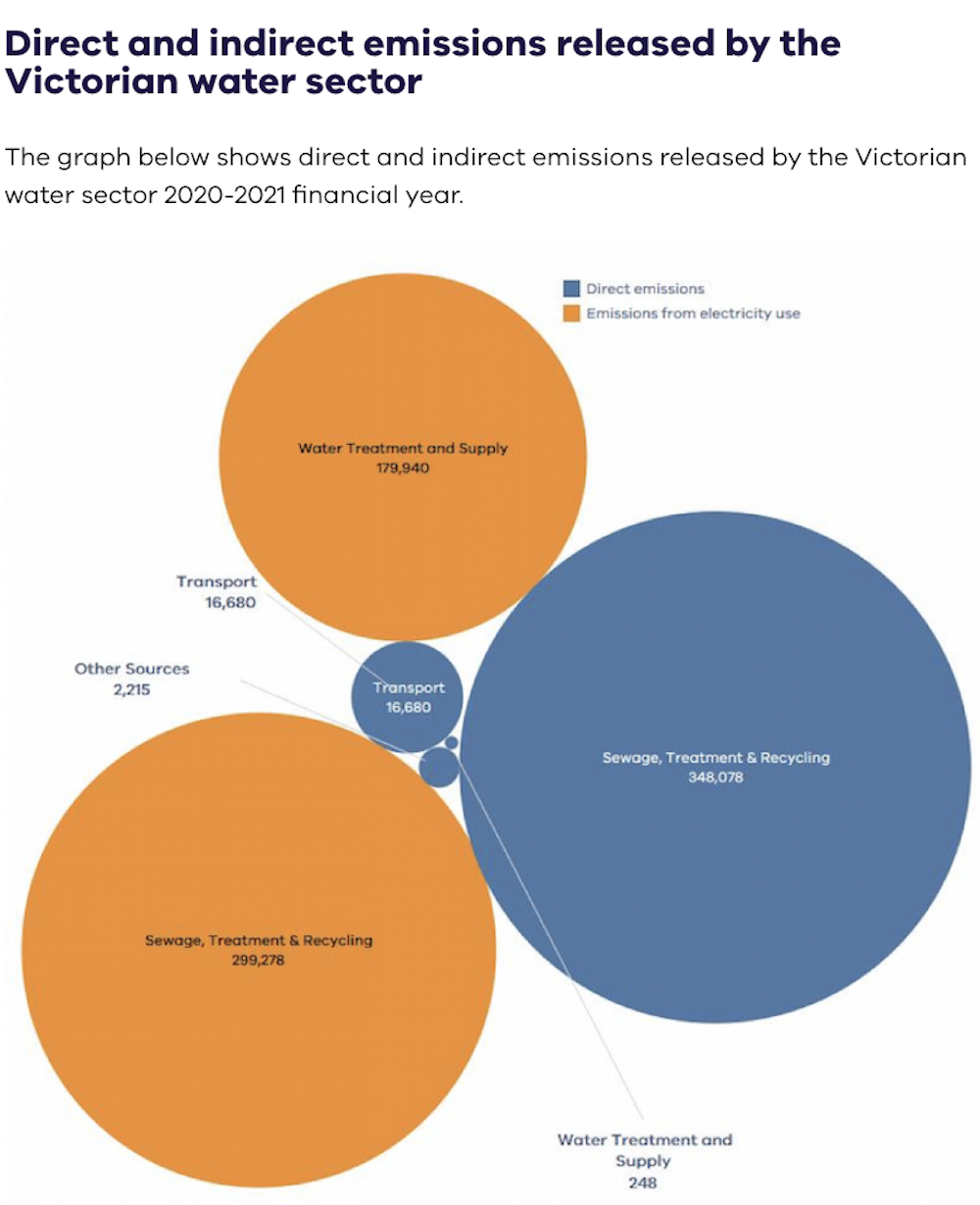
In Victoria, for example, water utilities are the largest source (about a quarter) of scope 1 and 2 emissions from the government sector. Scope 1 emissions come from activities utilities directly control, such as driving their vehicles. Scope 2 emissions are from the energy they buy.

Our research has found the gains from pursuing scope 3 emissions from the use of water that utilities supply could be about ten times bigger than their planned reductions in scope 1 and 2 emissions.

Extrapolating from Melbourne household data suggests domestic water heating accounts for 3.8% of each person’s share of Australia’s greenhouse gas emissions – on a par with the 4.1% from aviation. Our research indicates that in Melbourne alone a city-wide program to retrofit showerheads could, by reducing water and energy use, have the same impact on emissions as taking tens of thousands of cars off the road.

Such a program would cost much less than all other renewable energy investments water utilities are making. It would also save water users money.


Read more:
Australian homes can be made climate-ready, reducing bills and emissions – a new report shows how


How to tackle scope 3 emissions

Water utilities don’t directly control scope 3 emissions, but they could influence what customers do. If they encourage more efficient water use, customers use less water and, in turn, less energy to heat it.

Water utilities account for 24% of scope 1 and 2 emissions from the Victorian government sector. While the sector has shown leadership in acting on these emissions, there is very little active accountability for, or even quantification of, scope 3 emissions.

Graph showing the sources of stage 1 and 2 emissions from the Victorian water sector

Victorian Department of Energy, Environment and Climate Action, CC BY

Our research has found a Melbourne-wide program to retrofit showerheads to next-generation technology could save 12-27 billion litres (GL) of water a year (about 6% of current use).

The resulting energy savings would be 380-885GWh per year, cutting emissions by 98,000-226,000 tonnes. That equates to taking 21,000 to 49,000 cars off the roads.

Customers would also save up to $160 a year on their bills. The full economic benefit to society is more than five times the cost of the program.


Read more:
How to maximise savings from your home solar system and slash your power bills


Who influences water use? Everyone

Helping customers adopt highly efficient showerheads could cut emissions at much lower cost than all other renewable energy investments water utilities are making.

Most households don’t realise hot water systems account for around 24% of their total energy use. Their total energy use for water heating is larger as it includes appliances such as washing machines, dishwashers and kettles. An even larger percentage of household energy use is “water-related” if pool filtration, rainwater tank pumps and so on are included.


Read more:
Using electric water heaters to store renewable energy could do the work of 2 million home batteries – and save us billions


We think only of the savings on water bills, but efficient water use also affects our power bills and emissions. But communicating the link isn’t easy.

Showerhead manufacturers tell us they aren’t promoting efficient showerheads because they respond to demand. Water utilities don’t invest in them because it is a present cost for a future benefit – it doesn’t help them balance their budgets. And for policymakers it’s hard to celebrate the water and energy you don’t need to consume.

The combined impact is lack of action on saving water to reduce emissions – even though it’s a great option.

A ‘tragedy of the commons’ dilemma

Without direct control or accountability by any one organisation, we face a “tragedy of the commons” – individuals overconsuming a shared resource at the wider expense of society. The limited resource today is the ability of our planet to process greenhouse gas emissions before they change our climate.

The tragedy of the commons was used to describe externalities: costs borne by others that a decision-maker does not pay for. Examples include the future costs of increased flooding, more severe droughts and bushfires, and rising sea levels.

If we fully considered the costs and benefits to consumers and society (rather than just costs to utilities), investment priorities would change towards “least cost to the community” solutions.

Many water utilities will be carbon-neutral for scope 1 and 2 by 2025. This means they are at the global forefront of reducing emissions – but the water industry can do much more by tackling scope 3 emissions.

Committing to a scope 3 reduction challenges a water company to move toward things it can only influence rather than control. So, does it pursue all possibilities, without knowing if it can cut emissions? Or does it take a conservative approach and commit to only scope 1 and 2 emissions?

Reducing emissions from water use requires community, industry and government to act together. The stumbling block is decision-making and current legislation.

A road runs along the top of the Thomson Dam wall
Water utilities have focused on cutting their own emissions and costs, neglecting the much bigger gains to be had from changing water users’ behaviour.
Simon Maddock/Shutterstock


Read more:
All-electric homes are better for your hip pocket and the planet. Here’s how governments can help us get off gas


So, what is the solution?

First, we need to call out the problem.

Second, we must find a way to ensure the reward for pursuing action is higher than the penalty for failure. A key to this will be highlighting how much cheaper and better many actions are that focus on scope 3 emissions, rather than solely “within business” strategies. We need to find solutions that are genuinely “least cost to community” rather than “least cost to individual business entities”.

Third, as a “commons”, this challenge must be communicated beyond utilities and government to communities. There needs to be broad understanding of the benefits of new approaches and of the pitfalls of a “do nothing” approach.

Big savings are up for grabs in the water industry. More broadly, all industries (from manufacturing to mining) need to consider scope 3 emissions from use of the products they sell.

The Conversation

Steven Kenway receives funding from the water industry, state and local government, Collaborative Research Centres and competitive funding schemes (eg The Australian Research Council). He is a long-term member of the Australian Water Association and former member of the International Water Association.

Liam Smith receives funding from several government bodies, including state water utilities and local, state and federal government environment departments. He is also a Lead Councillor on The Biodiversity Council.

Paul Satur receives funding from a number of public and private associations including water utilities, federal and state governments. He is also the CEO and co-founder of Our Future Cities Inc.

Rob Skinner does not work for, consult, own shares in or receive funding from any company or organisation that would benefit from this article, and has disclosed no relevant affiliations beyond their academic appointment.

ref. Emissions from households’ water use are on a par with aviation. The big cuts and savings they can make are being neglected – https://theconversation.com/emissions-from-households-water-use-are-on-a-par-with-aviation-the-big-cuts-and-savings-they-can-make-are-being-neglected-221853

Victoria’s power outage could have been far worse. Can we harden the grid against extreme weather?

Source: The Conversation (Au and NZ) – By Bruce Mountain, Director, Victoria Energy Policy Centre, Victoria University

Last week’s destructive storm took Victoria by surprise. As winds of up to 150 kilometres an hour raced through the state, transmission towers near Geelong toppled and the grid went into chaos.

At its worst, almost one in five Victorian homes were left without electricity
while the main transmission system came close to collapse.

That makes it comparable to Victoria’s last grid-crippling storms in October 2021.

But this power outage could have been much worse. It speaks to the urgent need to harden our grid against the more frequent extreme weather expected under climate change.

What actually happened?

It was very hot in Victoria on February 13. Fires raged in central Victoria, claiming dozens of houses. When a cool change arrived, it brought extreme winds.

At about 12.35pm, Australia’s largest windfarm, Stockyard Hill, disconnected from the grid, as a grass fire threatened its grid connection.

As it happens, the loss of the windfarm was actually a lucky break.

At 2.08pm, six of Victoria’s highest voltage transmission towers (500 kiloVolt) were toppled by extreme downdrafts. This catastrophe took out two sets of 500 kV powerlines transporting much of the electricity from wind farms in western and south western Victoria to Melbourne.


Read more:
Unsexy but vital: why warnings over grid reliability are really about building more transmission lines


At the time of collapse, the circuits were likely fairly heavily loaded. They would have been much more heavily loaded had Stockyard Hill windfarm not dropped off the system 90 minutes earlier from the unrelated grass fire.

In response to the 500 kV faults, voltages dipped, forcing all four of the large coal-fired generating units at Loy Yang A to disconnect. Two wind farms in western Victoria were disconnected automatically, as intended in their cases.

During most of the transmission crisis, rooftop solar became the largest source of supply in Victoria.

In addition to the transmission events, Damage to local distribution poles and wires was widespread, especially in regional Victoria. This cut power to about one in five Victorian homes.

In about two hours, the power system had stabilised. Gas and hydro generators rushed in to fill the gap left by Loy Yang A and the wind farms, and Victoria got through its evening peak. Many homes on however still remain without power through distribution network failures.

In response, the Victorian government has announced it will appoint an independent panel to review the disaster, closely following the review of devastating storms in June 2021.

In the final recommendations from the review of the 2021 storms, the panel played it safe, calling for better communication with affected communities, beefed up emergency responses and relief delivery and so on.

The government also accepted a key recommendation: any major changes to strengthen network resilience should be referred to the Australian Energy Markets Commission, thereby kicking the big challenges into the long grass.

This time round, the omens are inauspicious. The government has explicitly excluded transmission from its review, instead relegating it to the electricity safety regulator. This is short-sighted. The Victorian transmission network is heavily exposed to weather risk and it is getting worse.

What should be done about it?

This won’t be the last grid-buckling extreme weather we’ll see. Far from it.

There are many things that can be done to reduce weather risk, and putting high (and low) voltage lines underground is often spoken about.

It will be expensive. In the wake of devastating fires, California’s largest utility committed to put 16,000 km of lines underground. So far, almost 1,000 km has been completed. But the cost has been substantial – around A$3.2 million a kilometre.

Victoria has 148,000 km of distribution lines of which 84% is overhead and 16% underground, a similar proportion to the rest of Australia. It’s much easier and cheaper to put distribution lines underground than transmission lines.

If we optimistically assume the same cost as in California, boosting the proportion of Victoria’s distribution network that is underground by 10 percentage points (to 26%) would cost around $37 billion. That’s more than double the regulatory value of the distribution network in Victoria.

Is enhanced vegetation management – widespread tree clearing near lines cheaper? Perhaps not. Research in California suggests undergrounding may actually be more cost-effective in terms of fires avoided.

More cost-effective than undergrounding are rapid switches, devices able to quickly clear faults and reduce the chance downed lines will start fires. Victoria began requiring distributors to install these from 2016, following the state’s 2009 Black Saturday fires, where downed powerlines sparked several lethal blazes. Their effectiveness is yet to be proven.

These are difficult questions and much is to be gained by considering them carefully. This will require the government to reach for more than another set of “must-try-harder” recommendations.

What about building new transmission lines?

Even as extreme weather topples huge transmission towers, state and federal governments are pressing ahead to build more. Expanding transmission capacity is important to decarbonise our electricity supply. But if not done well, it will increase exposure to weather risk.

Our study of VNI-West, the proposed massive new Victoria-New South Wales interconnector, found it would greatly increase Victoria’s energy security risk.

Why? Because it will be very heavily loaded, much more so than the 500 kV lines that failed last week, and it carries two sets of conductors on one set of towers.

This proposed new interconnector will make Victoria deeply dependent on NSW for its electricity supply. In a little over a decade Victoria is expected to import 26% of its grid-supplied electricity, much of it conveyed on VNI-West. This is an astonishing and little-known aspect of Victoria’s existing electricity policy.

Vandalism or extreme weather could, at a stroke, disable this new transmission line. In our report we drew attention to sabotage and weather risk and since out report we have seen yet more evidence of sabotage, and now we have another clear example of the risks from extreme weather.

To date, Australia’s market operator has brushed off our critique without reason.

Victoria dodged a bullet last week. It could have been far worse. To be ready for the next major storm, we should at the very least have a bipartisan parliamentary inquiry into the events of February 13. And this must scrutinise whether the proposed Victoria-NSW interconnector could survive a similar event – and what would happen if it did not.


Read more:
A major blackout left 500,000 Victorian homes without power – but it shows our energy system is resilient


The Conversation

Bruce Mountain does not work for, consult, own shares in or receive funding from any company or organisation that would benefit from this article, and has disclosed no relevant affiliations beyond their academic appointment.

ref. Victoria’s power outage could have been far worse. Can we harden the grid against extreme weather? – https://theconversation.com/victorias-power-outage-could-have-been-far-worse-can-we-harden-the-grid-against-extreme-weather-224142

Climate change is fanning the flames of NZ’s wildfire future. Port Hills is only the beginning

Source: The Conversation (Au and NZ) – By Nathanael Melia, Adjunct Senior Research Fellow – Climate Science, Te Herenga Waka — Victoria University of Wellington

Last week, wildfire burnt through 650 hectares of forest and scrub in Christchurch’s Port Hills. This is not the first time the area has faced a terrifying wildfire event.

The 2017 Port Hills fires burnt through almost 2,000 hectares of land, claiming one life and 11 homes. It took 66 days before the fires were fully extinguished.

It is clear New Zealand stands at a pivotal juncture. The country faces an increasingly severe wildfire climate. And our once relatively “safe” regions are now under threat.

At all levels of government, New Zealand needs to consider whether our current investment to combat fires will be enough in the coming decades.

Our research integrating detailed climate simulations with daily observations reveals a stark forecast: an uptick in both the frequency and intensity of wildfires, particularly in the inland areas of the South Island.

It is time to consider what this will mean for Fire and Emergency New Zealand (FENZ), and how a strategic calibration of resources, tactics and technologies will help New Zealand confront this emerging threat.

The climate drivers of wildfires

Last year was the warmest year on record by a large margin. And with El Niño at full throttle into 2024, conditions in late-summer Aotearoa New Zealand are hot and dry. There is also plenty of vegetation fuel from the departing wet La Niña.

The tinder-dry scrub and grass vegetation in the Port Hills – an area that was around 30% above “extreme” drought fire danger thresholds – drove the flammability of the region. And on February 13, when the latest fires started, a strong gusty northwesterly wind was blowing 40-50kph with exceptionally dry relative humidity values.


Read more:
Human exposure to wildfires has more than doubled in two decades – who is at risk might surprise you


These conditions resulted in the extreme wildfire behaviour. Only the rapid and coordinated response of FENZ on the ground and in the air prevented this fire from becoming much worse.

While conditions are already bad, our study revealed a concerning trend: the widespread emergence of a new wildfire climate, with regions previously unaffected by “very extreme” wildfire conditions now facing unprecedented threats.

The most severe dangers are projected for areas like the Mackenzie Country, upper Otago and Marlborough, where conditions similar to Australia’s “Black Summer” fires could occur every three to 20 years.

This shift is not merely an environmental concern, it is a socioeconomic one. The increased threat of wildfires will affect communities, the government’s tree-planting initiatives and financial investments in carbon forests.

Enhanced resources and agile response

New Zealand’s firefighting strategy emphases speed and manoeuvrability, especially in the initial attack phase, to prevent wildfires from escalating into large-scale disasters.

Approximately NZ$10 million is allocated annually to general firefighting aviation services, translating into around 11,000 flight hours. The aerial battle over the Port Hills peaked on Thursday and Friday. This effort cost over $1 million, with up to 15 helicopters active over the two days.


Read more:
How wildfires affect climate change — and vice versa


FENZ operations are primarily funded by property insurance levies. However, with the severity and frequency of wildfires on the rise, it may be necessary to review this funding model to match the evolving risk portfolio.

Climate change is already driving insurance retreat – a phenomenon whereby coastal properties are unable to renew their insurance due sea level rise. It is plausible insurance companies could take a similar stance in extremely fire-prone areas.

The agility of FENZ and associated rural fire teams, coupled with the investment and integration of advanced technologies and modelling for better wildfire prediction and management, can significantly enhance the effectiveness of firefighting efforts.

Policy adjustments and community engagement

Adjustments in policy and regulatory frameworks are also crucial in mitigating wildfire risks, and should be explored by experts.

To significantly reduce the ignition of new fires, there needs to be greater implementation of restrictions on access, and banning of high-risk activities, when areas are under “extreme fire risk”.

Moreover, community engagement and preparedness initiatives are vital. One successful example is Mt Iron, Wanaka, where a model was developed after interviews, focus groups and workshops with residents identified wildfire risk awareness and mitigation actions.


Read more:
Living with wildfire: How to protect more homes as fire risk rises in a warming climate


Educating vulnerable communities about their wildfire risks and preparedness strategies can also enhance community resilience and safety.

The emergence of a more severe wildfire climate in New Zealand calls for a unified response, integrating increased investment in FENZ, strategic planning and community involvement.

By embracing a multifaceted approach that includes technological innovation, enhanced resource, and community empowerment, New Zealand can navigate the complexities of this new era with resilience and foresight.

The Conversation

Nathanael is the founding director of Climate Prescience. He has received government funding from MBIE NZ to research the effect of climate change on wildfire risk. The opinions expressed here are his own.

ref. Climate change is fanning the flames of NZ’s wildfire future. Port Hills is only the beginning – https://theconversation.com/climate-change-is-fanning-the-flames-of-nzs-wildfire-future-port-hills-is-only-the-beginning-224133

Grattan on Friday: Unshackle immigration from Home Affairs and give it its own department

Source: The Conversation (Au and NZ) – By Michelle Grattan, Professorial Fellow, University of Canberra

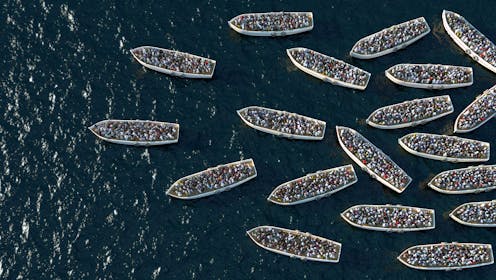
The arrival of a boat on the coast of north-western Australia last week predictably set off an opposition political feeding frenzy. Peter Dutton was quick to claim the Albanese government had “lost control” of the border.

But a boat (or even two – there was another landing late last year) does not an armada make. Australian authorities might need to lift their detection game – no doubt they are getting that message – but so far there is not evidence of a new wave of people smuggling.

Further arrivals would change the dynamics but, in the absence of that, the opposition needs to be careful of overreach, for a couple of reasons.

One is that it’s irresponsible, thinking of Australia’s national interest, to be in effect telling the people smugglers there are fresh opportunities for them. Signals are important: for example, there’s a suggestion last year’s release of the immigration detainees (in the wake of the High Court decision) fed into the people smugglers’ pitch.

Secondly, the border issue is unlikely to play as strongly with voters these days. Kos Samaras of the RedBridge Group, a political consultancy that does regular research, says: “The political heat that was associated with the politics of boat people in the early 2000s is all gone. I think that we’re dealing with a different generation of politics now, and Australians generally just don’t get all that worried or concerned about what sort of people will stumble onto our shores and walk into a town looking for food.”


Read more:
Politics with Michelle Grattan: Antony Green, Kos Samaras and Tim Costello on Dunkley contest


With eyes firmly on their pockets, people are likely to see excessive rhetoric about boats for what it is, a scare tactic.

The issue of boat arrivals should be distinguished from immigration, which is current in many people’s minds and related to debates around housing and cost of living.

Both issues, however, do take us to the question of the Home Affairs Department, a behemoth encompassing the Australia Border Force, immigration, citizenship and multiculturalism, and cyber security. ASIO sits under it too. It is overseen by cabinet minister Clare O’Neil, with a junior minister, Andrew Giles, having responsibility for immigration, citizenship and multicultural affairs.

Put bluntly, the department has been a nest of trouble. There are very strong arguments for breaking it up.

The department has been scandal-ridden. A recent report by Dennis Richardson, former head of Foreign Affairs, Defence and ASIO, documented how it failed to do due diligence on contracts. The revelation of extraordinary emails by its former secretary, Mike Pezzullo, led to his dismissal last year.

This empire was trimmed when Labor took office. The Australian Federal Police and a couple of other crime-fighting agencies were moved to come under the Attorney-General’s Department. ASIO would fit more appropriately there too, but Attorney-General Mark Dreyfus lost that battle.

Pezzullo ran the Home Affairs Department with an iron rod and morale was at rock bottom. There are mixed views about whether his successor, Stephanie Foster, who had been the department’s associate secretary, is a strong enough leader for the demands of this very tough job.

A central problem is that the department’s component parts are a bad fit. There seems an overwhelming case for separating immigration, citizenship and multicultural affairs into their own department with cabinet status.

That way, immigration could be viewed essentially as an economic department and cast in more positive terms, to promote nation building. This was how it was seen in earlier times.

At present, immigration suffers from being in the more negative national security environment that dominates Home Affairs.

Former senior bureaucrat Paddy Gourley, an expert on the public service, has argued that “the grandest failure of Home Affairs and its leaders has been the diminution of immigration as a principal function of the federal government”.

A freestanding department would allow “a clear-eyed, high-priority concentration on immigration policy and service delivery free of the distractions and distortions to which it is vulnerable in Home Affairs”, Gourley wrote on Inside Story in November.

Equally, multiculturalism requires a lot more attention, especially at the moment.

Multiculturalism has been a great success story of Australia’s immigration program, celebrating diversity while also promoting unity and commitment to common Australian values.

But the community frictions prompted by the Israel-Hamas conflict have highlighted that at times the tensions that lurk in a multicultural society can test its cohesion. Crises abroad can cause local divisions to flare dangerously. At present the Albanese government is seriously worried about community harmony.

The level of anti-Semitism we’re currently seeing in this country is deeply disturbing, striking fear into many Jewish Australians. Meanwhile, many in the Islamic community, with family or friends in Gaza, are traumatised, plus there’s been a rise in islamophobia. And the regular pro-Palestinian demonstrations since the start of the current Middle East conflict have, on occasion, tested authorities.

Reacting to these challenges is not likely to get any easier. A separate immigration department could mean more bureaucratic attention and resources for engagement with the various multicultural communities.

On another front, prospective citizens are not receiving the attention they deserve. Peter Hughes, a one-time deputy secretary in immigration, has condemned “the outrageously long time it takes to process applications for Australian citizenship”.

Writing for Pearls and Irritations last month, Hughes said a person who’d met all the requirements, including the four-year residential qualifying period, could expect to wait up to 15 months for a decision and another six months for a conferral ceremony. Imagine the outcry if it took this long to get a passport for an overseas trip, Hughes added.

This week Anthony Albanese hosed down speculation that there could be an election this year. He intends to run full term – the election is due by May next year.

At some point the Prime Minister may consider freshening his team. This is not a prediction, but a reshuffle would provide the ideal opportunity to split the Home Affairs Department and rescue immigration from what often seems its also-ran bureaucratic status.

The Conversation

Michelle Grattan does not work for, consult, own shares in or receive funding from any company or organisation that would benefit from this article, and has disclosed no relevant affiliations beyond their academic appointment.

ref. Grattan on Friday: Unshackle immigration from Home Affairs and give it its own department – https://theconversation.com/grattan-on-friday-unshackle-immigration-from-home-affairs-and-give-it-its-own-department-224155

Pro-independence protesters, French police clash in New Caledonia

Pro-independence militants and protesters clashed with police in downtown Nouméa this week as New Caledonia hosts three French government ministers.

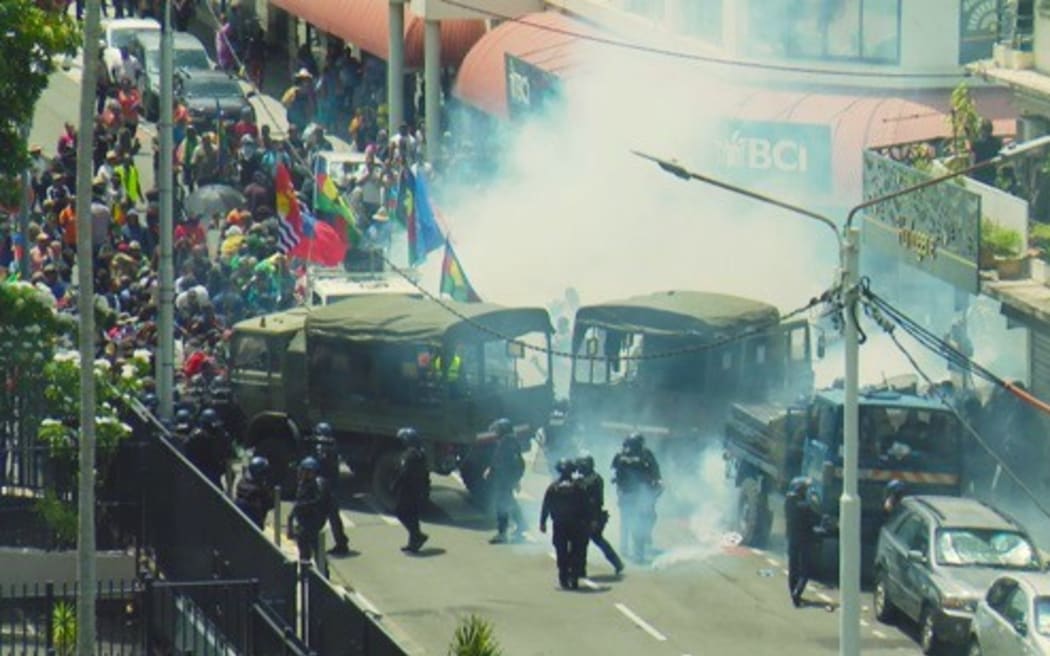
The crowd — an estimated 2000 according to organisers, 500 according to police — had been called on Wednesday to voice their opposition to a French-planned constitutional amendment process which would include modification of New Caledonia’s electoral roll for local elections.

As the three French ministers were on official calls in various places, in downtown Nouméa police fired teargas to disperse the crowd.

Five policemen were reported to have been injured, including one seriously hit by rocks, the French High Commission stated, adding five protesters had been arrested shortly afterwards.

The protest had been organised by Union Calédonienne’s self-styled “field action coordinating cell” (Cellule de Coordination des actions de terrain, CCAT), which consists of trade union USTKE and UC’s close ally, the Labour Party.

UC is the largest single party within the mostly indigeous Kanak socialist and nationalist front (FLNKS).

Later on Wednesday, the crowd was dispersed and it moved out of downtown Nouméa.

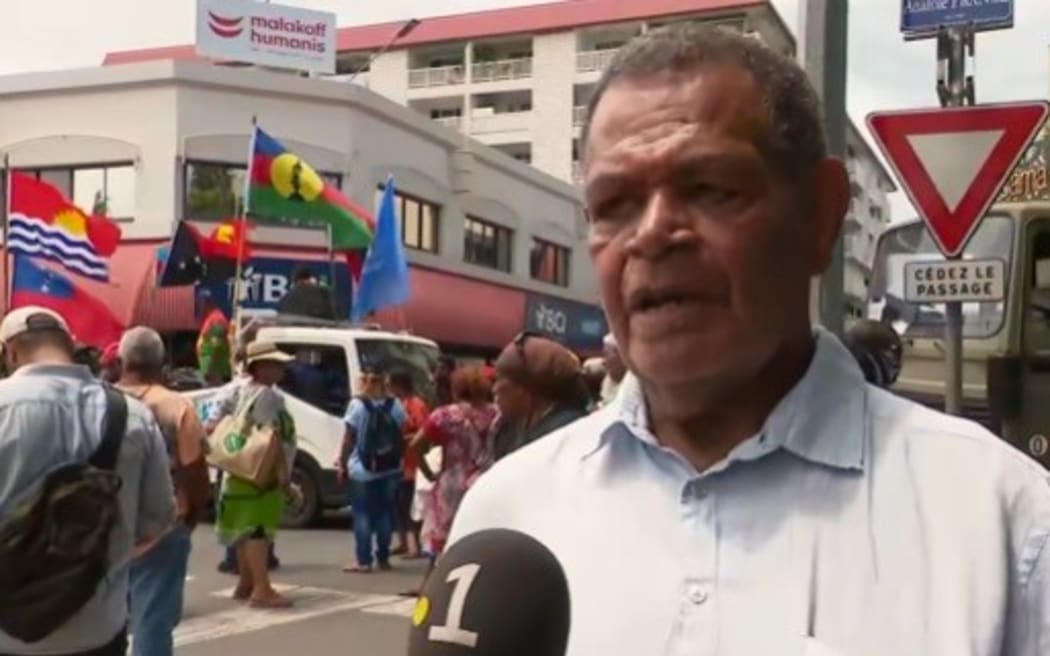
“It’s completely out of the question to ‘unfreeze’ the electoral roll,” UC president Daniel Goa, who was part of the crowd, told local media.

Pro-France politician Nicolas Metzdorf said in a statement: “This kind of call to hatred, directly from UC . . . must stop. Violent protests will not halt the electoral roll being ‘unfrozen’.”

Clashes between an estimated 500-strong crowd protesting against electoral roll changes and French police in downtown Nouméa on 21 February 2024.
Protesters opposed to electoral roll changes and French police clashed in downtown Nouméa on Wednesday. Image: NC la 1ère

Regular visitor
French Home Affairs and Overseas Minister Gérald Darmanin, who is now regarded as a regular visitor, arrived on Tuesday and this time was flanked with his newly appointed “delegate” Minister for Overseas, Marie Guévenoux, as well as French Justice Minister Eric Dupond-Moretti.

This is Darmanin’s sixth visit to New Caledonia in the past 12 months.

In a polarised context, many attempts by Darmanin to bring all parties around the same table in order to all agree on a forward-looking agreement have so far failed.

His previous visits were focused on attempting to bring about inclusive talks concerning New Caledonia’s political future which could involve an amendment to the French Constitution.

The amendment contains sensitive issues, including a revision of New Caledonia’s list of eligible voters at local elections, with a 10-year minimum residency period for any French citizen to be able to cast their vote.

Pro-independence Union Calédonienne President Daniel GOA speaks to local media amidst clashes with French police.
Pro-independence Union Calédonienne president Daniel GOA speaks to local media amids clashes with French police. Image: NC la 1ère

FLNKS’ 2 major wings — diverging views
While the two main components of FLNKS (UC and PALIKA-Kanak Liberation Party) last weekend held separate meetings and announced diverging approaches vis-à-vis France’s proposed reforms, the pro-independence umbrella FLNKS has now rescheduled its Congress for March 23.

Even though most local parties in New Caledonia have started to exchange views on the sensitive subject, one of the main components of the pro-independence front FLNKS, the largest party Union Calédonienne (UC), has so far refused to take part in the bipartisan round tables.

After convening UC’s steering committee in Houaïlou, UC vice-president Gilbert Tyuienon earlier this week told a press conference the party intended once again to hold a series of actions through its recently revived “field action coordinating cell” (CCAT).

“We have asked [the CCAT] and its young members to take all steps on the field,” he said.

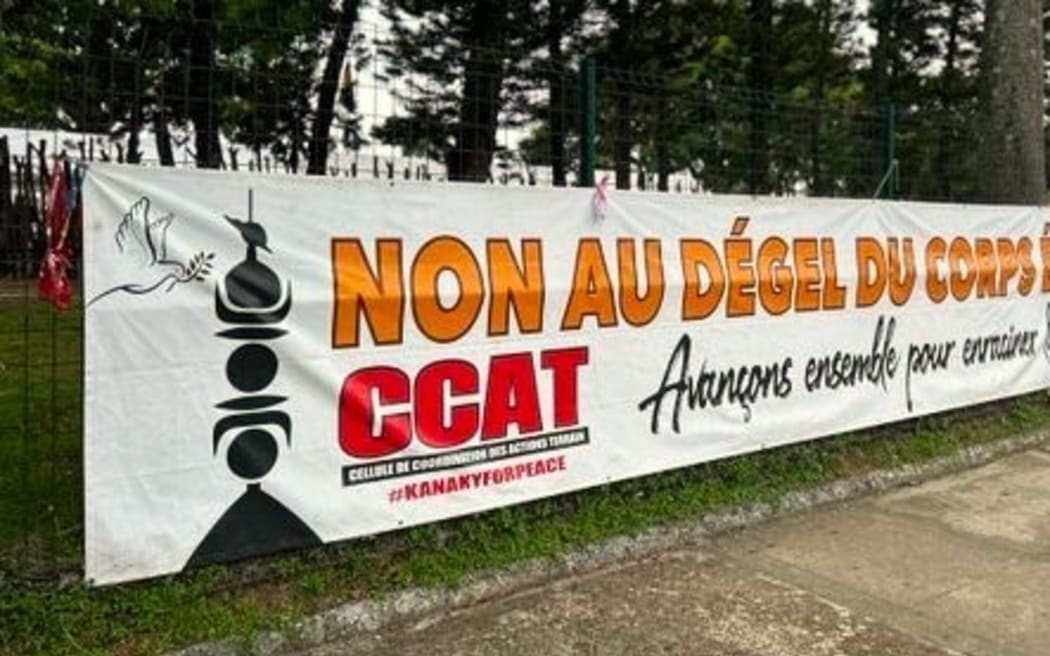
The thinly veiled threat materialised on Wednesday with CCAT militants, including members of the Labour Party and union USTKE, deploying banners opposing to the planned Constitution review being placed in the capital Nouméa, also sometimes with roadside burning of tyres in the suburban town of Mont-Dore.

Tyuienon also claimed that UC considered French-promoted political talks were “a failure” and labelled Darmanin’s travel to New Caledonia as “yet another provocation” and that the proposed text was potentially “destabilising [New Caledonia’s political] balances”.

“There is a formal opposition from UC to meet the ministers . . . we know who is responsible for this situation,” Tyuienon told reporters.

He said UC now demanded that the whole French constitutional amendment project be scrapped altogether — “or else we’re heading for big trouble”.

UC banners opposing changes to New Caledonina’s electoral roll.
UC banners opposing changes to New Caledonina’s electoral roll. Image: NC la 1ère

More nuanced views
PALIKA, after its own meeting last weekend, expressed more nuanced views: “We are involved in every dialogue venue regarding all the document drafts that have been put on the table,” spokesman Jean-Pierre Djaïwe told a press conference on Monday following its extraordinary general assembly in Canala.

“We can only regret that every time we are taking part in discussions, not all of New Caledonia’s political groups are represented. Because our objective, from PALIKA’s point of view, is to reach an agreement comprising all political parties,” he said.

Djaïwe, however, said the current draft document “sided too much in favour of the (pro-French) parties”, which could “be detrimental to the conclusion of an agreement between local players”.

He indicated that PALIKA’s current stance would remain valid at least until the “end of March” — when the FLNKS Congress takes place — and “after that, it will decide on its strategy”.

Over the past months, PALIKA and other components of the pro-independence umbrella have consistently advised their members not to take part in UC’s CCAT-organised actions and protests.

However, Darmanin has already indicated that he did not intend to touch New Caledonia’s institutional and political future as he wanted “the neutral and impartial [French] State to only talk with local political parties once they have reached an agreement”.

His schedule did not seem to include New Caledonia’s nickel industry crisis either, following the announcement last week that one of its three major companies, in Koniambo (KNS), will now be placed under “care and maintenance” mode (effectively mothballed by its major Anglo-Swiss financier Glencore).

Glencore earlier this week confirmed it would withdraw after a six-month “transition” period, leaving more than 1200 workers and another 600 sub-contractors without work.

The company, which owns 49 percent of Koniambo’s stock, justified its move saying this operation over the past 10 years had never been either profitable or sustainable and had accumulated losses to the tune of a staggering 14 billion euros.

French ministers -right to left- Marie Guévenoux, Gérald Darmanin and Eric Dupond-Moretti follow traditional protocol upon arriving in New Caledonia
French cabinet ministers (from right to left) Marie Guévenoux, Gérald Darmanin and Eric Dupond-Moretti follow indigenous custom protocol upon arriving in New Caledonia. Image: NC la 1ère

Climate change agenda
Instead, Darmanin’s official agenda includes visits to sites affected by climate change and coastal erosion as well as announcements regarding the reinforcement of road safety (with the introduction of new latest-generation speed radars thanks to a 200,000 euro grant, to reduce the high number of road accidents and fatalities in New Caledonia.

Justice Minister Dupond-Moretti said his visit was focused on meeting the local judiciary and bar, but also New Caledonia’s custom and traditional justice players.

He will also officially open a new detention centre in Koné and provide more details regarding the construction of a 500 million euro new jailhouse in the suburbs of Nouméa, which is due to replace the overpopulated and ageing Camp-Est prison, where living conditions for inmates have frequently been denounced by human rights organisations.

After his stay in New Caledonia (February 21-22), Darmanin’s Pacific trip is also to include this time a stopover in Australia later this week (February 23-24), where he is expected to meet cabinet ministers to talk about Pacific “regional cooperation” between the two countries, as well as about this year’s Olympic Games in France.

This article is republished under a community partnership agreement with RNZ.

Article by AsiaPacificReport.nz

National Anti-Corruption Commission to warn of ‘corruption vulnerabilities’ ahead of federal election

Source: The Conversation (Au and NZ) – By Michelle Grattan, Professorial Fellow, University of Canberra

The National Anti-Corruption Commission will provide guidance on “corruption vulnerabilities” ahead of next year’s federal election, NACC Commissioner Paul Brereton said on Thursday.

“The commission will produce guidance concerning corruption risks and vulnerabilities associated with issues such as grants, political donations and fundraising, foreign interference, government advertising and appointments,” Brereton said.

He told a a conference in “Rebuilding trust and integrity in the Australian Public Service”, run by The Mandarin, that there was a vast difference in the integrity landscape now compared with when the first anti-corruption commission was set up – the ICAC in New South Wales – 35 years ago.

“Since then, there has been a sea change in the tolerance of the public, the press and the public service for corrupt conduct.”

Brereton said corruption was “about the misuse of public power, position, privilege or property” usually for private purposes. “It results in the diversion of public resources, and the undermining of trust in our public institutions. Although it is not the only form of corrupt conduct within the definition, breach of public trust lies at its core.”

Brereton stressed that “mere mistakes, incorrect decisions, and even negligent maladministration, are not in themselves corrupt conduct”. Generally, there must be an element of dishonesty and/or personal benefit.

Up to February 18 the commission had received 2,534 referrals of suspected corrupt conduct, overwhelmingly voluntary referrals from the public. Nearly 80% were excluded because they didn’t involve a Commonwealth official or didn’t raise a corruption issue.

The commission had opened 18 preliminary investigations, of which five had been finished, in each case with a finding of no corruption.

It had opened 13 corruption investigations, four of them jointly with other agencies, and had referred five corruption issues to other agencies for investigation.

In 220 cases which passed triage, the commission had decided to to take no more action.

“Typically, this is because there are insufficient prospects of finding corrupt conduct, or the matter is already being adequately investigated by another agency, or a corruption investigation would not add value in the public interest.”

The commission also progressed seven investigations that were started by the former Australian Commission for Law Enforcement Integrity.

Brereton said the statistics showed “that the public perception of corruption greatly exceeds the actuality”.

But this wasn’t a reason to be complacent “first, because the perception bespeaks a lack of trust and confidence in our institutions, and secondly, because there is still an actuality that underlies it”.

He said in the public service there were two main areas where there was the perception and actuality of corrupt conduct – procurement, and recruitment and promotion.

“Concerns in both those areas relate to the preferring of family, friends and associates, and misuse of official information to gain an advantage.”

While many complaints about selection and promotion reflected grievances by disappointed applicants, not all could be dismissed on these grounds. In procurement, mere compliance with the rules didn’t mean the conduct was ethical. “In particular, contracts for a value just under the threshold for a limited tender process tend to be a red flag.”

The Conversation

Michelle Grattan does not work for, consult, own shares in or receive funding from any company or organisation that would benefit from this article, and has disclosed no relevant affiliations beyond their academic appointment.

ref. National Anti-Corruption Commission to warn of ‘corruption vulnerabilities’ ahead of federal election – https://theconversation.com/national-anti-corruption-commission-to-warn-of-corruption-vulnerabilities-ahead-of-federal-election-224158

Namah not happy with Marape’s reply over PNG ‘warlords’ question

Papua New Guinea’s former opposition leader Belden Namah says Prime Minister James Marape never answered in detail the questions he asked in Parliament this week about the Enga massacre

Namah, the Vanimo Green MP, said he was dissatisfied with the response Marape presented in Parliament yesterday as the death toll from the Wapenamanda killings rose to about 70.

“He never answered any one of my questions,” he said angrily.

“I would have expected him to say, yes, we are putting together a special force from the police and the military to go in there and go after the warlords, go after the murderers.”

“We have funding allocated separately for that. We have the capacity, the policemen and women have enough uniforms, three sets of uniforms, they have allowance, these are the sort of preparedness I was looking for the PM to tell me when I was talking about combat readiness.

“We are sending the same old people, the soldiers and the police and they are fraternising with the tribal fighters, with the lot of people on the ground and not effecting any arrests.

“In fact, they are standing around with the warriors carrying their guns, soldiers and police carrying their guns, where are we heading?” he asked.

‘I wanted PM to go hard’
“I wanted the Prime Minister to come to the floor of Parliament and say my government is going to do this and do that, and go hard on these people.

“The death toll has gone up to 70, it’s not a small number, it’s hit news media everywhere in the world.

“It is not about this 70 only, it started in his electorate, in his province and I would have expected that he would put in place counter measures for this.

“He has not. Police have their own intelligence officers, military have their own intelligence, [and] the government has its own.

“They should be out there penetrating the tribal villages collecting information and then send in special forces — that’s what I mean by having the government ready to counter these kinds of activities.

“And if the force was in readiness, they would have put [it] forward.”

Namah said Marape’s response yesterday demonstrated that the government was not interested in sorting out the security issues in the Highlands-affected areas.

Police chief on notice
Prime Minister Marape told Parliament that Police Commissioner Davd Manning had been put on notice to ensure the country was secured.

Marape addressed the pressing issues of lawlessness raised during a parliamentary session this week, singling out that a plan to incorporate all suggestions by MPs –– including the Enga massacre and others.

Gorethy Kenneth is a senior Post-Courier journalist. Republished with permission.

Article by AsiaPacificReport.nz

Sentinels of the sea: ancient boulder corals are key to reef survival in a warmer world

Source: The Conversation (Au and NZ) – By Kate Marie Quigley, DECRA Research Fellow (James Cook University), Principal Research Scientist (Minderoo Foundation), James Cook University

Giacomo d Orlando

Seas surrounding Australia this month hit an alarming level of warming. It comes on the back of serious marine heatwaves in the Northern Hemisphere summer.

Such warming is highly dangerous for corals. Every half a degree of ocean warming increases their risk of bleaching and potential death.

The best long-term strategy to protecting Earth’s coral reefs is to dramatically cut greenhouse gas emissions and so limit global warming. But in the meantime, we must urgently make corals more resilient and protect those that are vulnerable.

That is particularly true for the huge, ancient features of reefs known as boulder corals. Research suggests they will be a vital part of reef survival in a warmer world.

A map of Australia surrounded by patches of yellow, red and purple
An image showing various levels of bleaching alert around Australia as of February 19, 2024.
NOAA Coral Reef Watch

The old-growth trees of the sea

Boulder corals (Porites) can grow to more than 10m high and live for more than 600 years. In Australia they are often referred to as “bommies”. Each bommie can comprise multiple species, but they’re often a single massive individual.

The corals play a crucial role in reefs, including providing habitat for marine life. Importantly, they can maintain these functions even when other coral species are absent.

Some species are thought to be resistant to stress. Old corals have likely experienced
– and survived – past warming episodes, proving their resilience.

For example, a paper in 2021 described a giant boulder coral discovered on the Great Barrier Reef which was thought to be more than 400 years old. It has survived 80 major cyclones, numerous coral bleaching events and centuries of exposure to other threats.

This resilience can benefit the whole reef ecosystem. We can think of boulder corals as akin to old-growth trees in a forest. Just like forests containing big, old trees are more resistent to fire, studies show a mix of different growth forms, including old and large boulder corals, fare better in the long-term under marine warming.

Older and bigger corals may also produce more offspring, so can more rapidly replenish the reef after disturbances.

Clearly, as our oceans face unprecedented pressures under climate change, we must protect – and learn from – these sentinels of the sea.


Read more:
Snorkellers discover rare, giant 400-year-old coral – one of the oldest on the Great Barrier Reef


Preparing for the challenges ahead

Understanding boulder corals is crucial to predicting how they might cope under climate change, and planning for their protection.

But scientists still have much to learn about boulder corals. In particular, we don’t know exactly how many species exist, their life histories and how they evolved.

My colleagues and I are aiming to overcome this knowledge gap. We are studying reefs across Australia, with a particular focus on boulder corals at Ningaloo Reef off Western Australia.

We are creating maps of what species of boulder corals exist and where they are located. And using cutting-edge genomics technology, such as DNA sequencing, we are measuring the tolerance of each species to warming and trying to predict when they will reproduce.

Importantly, we are also examining the mutually beneficial relationship between the corals and algae. This relationship provides algae with shelter, gives corals their colour and provides nutrients to both partners. It may also be a main factor in coral resistance to warmer temperatures.

So far, we have found more diversity than initially expected. This is exciting because it may signal an increased capacity to resist different types of stress. But the work to fully map Ningaloo’s coral diversity has only just begun.

We hope our findings, once finalised, can inform local community management actions such as:

  • public education campaigns and signs
  • managing visitor numbers to reefs
  • installing public moorings to reduce harm from boat anchoring, especially during coral spawning.

The information can also be used in broader management actions such as:

  • establishing “baseline” conditions from which to measure change
  • zoning decisions, including the establishment or ramping up of of marine park protections, especially for resilient coral species and individuals
  • impact assessments following events such as heatwaves
  • direct conservation actions for iconic, at-risk bommies, such as providing shade to diminish stress from heat
  • the development of national reef management plans.


Read more:
Photos from the field: why losing these tiny, loyal fish to climate change spells disaster for coral


Something worth fighting for

The stress to coral wrought by recent marine heatwaves compounds damage incurred over decades. The Great Barrier Reef, for example, has experienced five major heatwaves in 30 years.

Broadly, making reefs more resilient to these pressures involves:

  • resisting, recovering, managing and adapting to shocks across ecosystems
  • improving governance structures
  • preparing human communities for change.

Awareness of the need to increase reef resilience is growing. For example, it formed the basis of a 2017 blueprint for the Great Barrier Reef and a strategy for the Ningaloo Coast released last year.
But more work is required.

There’s also a need for coordination across Australia’s reef areas. This might include the exchange of knowledge and data between researchers and combined lobbying efforts to better protect reef ecosystems.

What’s more, Traditional Owners must be offered the opportunity to be consulted about, and meaningfully engaged in, protection of reef areas, including co-management of Sea Country.

The Australian Coral Reef Society, of which I am a councillor, last week released an open letter to the federal government, calling for action on climate change to protect reefs. The task has never been more urgent.

There is still a lot of reef worth fighting for – but only if we act now.

The author would like to acknowledge the contribution of Ningaloo marine park managers – in particular, Dr Peter Barnes – to the research she and her colleagues are undertaking.

The Conversation

Kate Quigley receives funding from the Australian Research Council in the form of the Discovery Early Career Researcher Award (DECRA) and holds a joint position as Principal Research Scientist at Minderoo Foundation, a philanthropic organisation.

ref. Sentinels of the sea: ancient boulder corals are key to reef survival in a warmer world – https://theconversation.com/sentinels-of-the-sea-ancient-boulder-corals-are-key-to-reef-survival-in-a-warmer-world-223207

Dating apps are accused of being ‘addictive’. What makes us keep swiping?

Source: The Conversation (Au and NZ) – By Dr Anastasia Hronis, Clinical Psychologist; Research Fellow, University of Technology Sydney

13_Phunkod/Shutterstock

A class-action lawsuit filed in the United States against Match Group – the parent company of dating apps Tinder, Hinge and The League – is making headlines around the world.

The claimants accuse Match of having a “predatory” business model and using “recognised dopamine-manipulating product features” to get people addicted to their apps.

So, can dating apps really be addictive? Are we swiping right into a trap? Here’s the science behind how dating apps are influencing our brains.

How do apps give us a dopamine hit?

Dating apps, like many apps these days, are designed to keep users engaged. Like any product on the market, one of the developers’ goals is for the app to be sold and used.

While dating apps are designed to facilitate connections, some people may find themselves developing an unhealthy relationship with the app, constantly swiping left and right.

Dating apps can feel addictive because they activate the dopamine reward system. Dopamine is a neurotransmitter – a chemical messenger in the brain, one of many such chemicals essential for our survival.

One of dopamine’s crucial roles is to influence when and how we experience pleasure and reward. Think about the rush of winning money at a casino, or getting lots of likes on Instagram. That’s dopamine working its magic.

However, dopamine does more that just help us feel pleasure and excitement. It also has a key role in motivating us to seek out pleasurable things. It’s released not only when we experience something pleasurable, but also when we’re anticipating and seeking out a pleasurable experience.


Read more:
The problems with dating apps and how they could be fixed – two relationship experts discuss


Excitement and unpredictability

Certain app features make it more likely we will open our phones and start swiping. When you get a match on a dating app, it feels exciting – that’s dopamine at work.

But an element of unpredictability adds to this excitement. Each time you open the app, you don’t know what profiles you might see, and who might match with you. This element of surprise and anticipation is especially important in getting us hooked.

Imagine if instead of swiping through profiles one by one, you were shown a long list of them at once. It would still feel good to match with people, but that excitement and anticipation of swiping through one by one would be missing.

Additionally, intermittent reinforcement comes into the mix. This is where “rewards” – in this case, matches – are provided at irregular intervals. We know we might eventually get some matches, but we don’t know when or with whom.

Imagine if instead of being drip-fed your matches, you received a list of any matches from the past 24 hours, at 9am each day. Your excitement and desire to check the app throughout the day would likely lessen.

Other small features, such as “hearts” and “roses”, make dating apps socially rewarding. These are all forms of approval. It feels different to receive a heart or a rose compared to something unemotional like a “tick” or “thumbs up”. These social stimuli are rewarding and activate our dopamine, too.

6 addictive signs to watch out for

Not every dating app user will develop an unhealthy relationship to it. Just like not everyone who gambles, plays mobile games, or drinks alcohol develops a problem with those.

However, some people are biologically more vulnerable to addictions than others. A review of the research into problematic dating app use found the people likely to spend more time on the apps are those high on personality traits such as neuroticism, sociability and sensation-seeking. Problematic use of online dating apps is also associated with low self-esteem.

While there’s no current diagnosis of a “dating app addiction”, some people do develop unhealthy app habits and experience day-to-day harms as a result.

These sixaddiction components” outline some of the signs you might be developing an unhealthy relationship with dating apps:

  1. salience (dating app use dominates your thoughts)
  2. mood modification (dating apps change your mood)
  3. tolerance (your use of dating apps increases over time)
  4. withdrawals (distress when dating app use is interrupted for a period of time)
  5. conflict (use of dating apps negatively affects your reality)
  6. relapse (you return to a previous pattern of dating app use after some interruption)

Oh no, I think I’m hooked on an app!

So, what can you do if you find yourself swiping through those matches more than you’d prefer?

Consider taking a break from the apps for a period of time. Depending on how hooked you feel, stopping completely for a while will help you reset your reliance on them.

Consider what is driving you to spend time swiping: are you feeling bored, sad or lonely? What other ways can you find to soothe these emotional experiences instead of turning to the app?

Make a list of the practical or emotional consequences of swiping, as a reminder of why you want to reduce your use. Perhaps the apps give you a brief rush, but in the long run don’t align with how you want to be spending your time, or don’t make you feel particularly good about yourself.

If you really do feel hooked, it will feel uncomfortable to take a break. Strategies such as mindfulness can help us sit with the discomfort. Consider seeking out professional help from a psychologist if you’re struggling to take time from dating apps.

Lastly, remember that apps, while great for meeting people, are not the be-all and end-all of dating.

In-person events and opportunities to mingle still exist. So, step away from the screen and embrace the excitement, unpredictability and dopamine hit you can get from face-to-face encounters too.


Read more:
Online dating fatigue – why some people are turning to face-to-face apps first


The Conversation

Dr Anastasia Hronis does not work for, consult, own shares in or receive funding from any company or organisation that would benefit from this article, and has disclosed no relevant affiliations beyond their academic appointment.

ref. Dating apps are accused of being ‘addictive’. What makes us keep swiping? – https://theconversation.com/dating-apps-are-accused-of-being-addictive-what-makes-us-keep-swiping-224068

Outrage culture is a big, toxic problem. Why do we take part? And how can we stop?

Source: The Conversation (Au and NZ) – By Shane Rogers, Lecturer in Psychology, Edith Cowan University

“Outrage culture” is pervasive in the digital age. It refers to our collective tendency to react, often with intense negativity, to developments around us.

Usually this ire is directed at perceived transgressions. The internet wasted no time in raging at Taylor Swift when she received Album of The Year at the Grammys, seemingly frustrated by her lack of acknowledgement of Celine Dion, who presented the award.

Whether or not Swift’s behaviour could be considered rude isn’t the point. The point is the backlash arguably wasn’t proportionate to the crime. This so-called “snub” incident is, therefore, a good example of how quickly and easily people will jump on the online hate train.

Modern outrage culture, which is also known as call-out culture and is linked to cancel culture, often devolves into a toxic spiral. People wanting clout compete to produce the meanest and most over-the-top commentary, stifling open dialogue and demonising those who make mistakes.


Read more:
How news sites’ online comments helped build our hateful electorate


A tale as old as time

Collective outrage isn’t a new phenomenon – nor is it necessarily bad. Humans have adapted to become highly sensitive to the threat of social exclusion. Being called out hurts our feelings, which motivates us to change. We learn how this feels for us and we learn how to use it to influence others.

In pre-digital societies, expressing outrage to shame someone as a group served crucial social functions. It reinforced group norms, deterred potential rule-breakers, and fostered a sense of order and accountability within communities.

Expressing outrage can also challenge norms in a way that leads to positive societal change. The women’s liberation movement in the latter part of the 19th century is a good example of this.

The technological innovations of the internet, smartphones and social media have now enabled communal outrage on a global scale. Multiple societies can be affected at once, as witnessed with the #MeToo movement.

When outrage spirals

We’ve all seen it play out. Someone says or does something “controversial”, some posts draw attention to it and soon enough a whirlwind of comments appears, echoing over and over the person in question is fundamentally bad.

The Johnny Depp and Amber Heard defamation trial is an example where, regardless of how you feel about the case, it’s hard to deny the discourse turned toxic.

The collective moral outrage that drives such negativity spirals has parallels with people brandishing their pitchforks during the 1690s Salem witch trials. Sharing similar beliefs helps us feel like we’re part of the group.

Beyond that, the conviction we witness in others’ comments and behaviour on an issue can stir up our own emotions, in what’s called “emotional contagion”. With our own emotions heightened and our convictions strengthened, we may feel compelled to join the choir of negative discourse.

The overall tone and style of language used by others can also influence how we act and feel. Social modelling dictates that if many others are piling on with negative comments, it can make it seem okay for us to do so, too.

And the more exposed we are to one-sided discourse, the more likely we are to resist alternative viewpoints. This is called “groupthink”.

Social media algorithms are also generally set up to feed us more of what we’ve previously clicked on, which further contributes to the one-sidedness of our online experience.

Scholars have suggested algorithms can prioritise certain posts in a way that shapes the overall nature of commentary, essentially fuelling the flames of negativity.


Read more:
Feed me: 4 ways to take control of social media algorithms and get the content you actually want


Two sides of speaking up

Unlike Salem in the late 1690s, today’s outrage culture is multiplied in intensity and scale due to changing cultural norms around “speaking up”. Combined with the anonymity and global reach afforded by the internet, the culture of speaking up has likely fuelled the kind of vocalisation we see online.

For example, in the past two decades there has been growing societal recognition that it’s good to speak up against bullying. This can be associated with more education on bullying in schools. There’s also a growing trend of encouraging a speak-up culture in workplaces. So it’s not surprising many people now report feeling confident in voicing their opinions online.

Encouraging speaking up is important in many contexts, but more vocal people online means more opportunity for conflict.
Shutterstock

It’s also easier to express negative opinions online since we can remain anonymous. We don’t directly witness the emotional pain inflicted upon our target. Nor do we have to worry about the potential threat to our personal safety that would be associated with saying the same horrible thing to a person’s face. As summed up by Taylor Swift herself in You Need to Calm Down:

Say it in the street, that’s a knock-out. But you say it in a tweet, that’s a cop-out.

How can we combat negativity?

Navigating the pitfalls of outrage culture requires us to adopt a more reflective approach before participating in public condemnation. Consider also that outrage culture runs counter to the moral ideals most of us admire, such as:

  • everyone makes mistakes
  • people are worth more than their worst actions
  • people are capable of growth and change, and deserve second chances
  • it’s okay to have different opinions to others
  • the punishment should fit the crime.

Research suggests positive comments can be a productive counter-influence on negativity spirals. So it’s worth speaking up if you do witness matters getting out of hand online. Before clicking the send button, consider asking yourself:

  • do I really believe what I’m about to say or am I going along with the group?
  • how might this comment affect the person receiving it, and am I okay with that?
  • would I communicate like this if it was a face-to-face situation?

By encouraging reflection, empathy and open dialogue, we can avoid toxic outrage culture – and instead use our collective outrage as a force for positive change.


Read more:
We cannot deny the violence of White supremacy any more


The Conversation

Shane Rogers does not work for, consult, own shares in or receive funding from any company or organisation that would benefit from this article, and has disclosed no relevant affiliations beyond their academic appointment.

ref. Outrage culture is a big, toxic problem. Why do we take part? And how can we stop? – https://theconversation.com/outrage-culture-is-a-big-toxic-problem-why-do-we-take-part-and-how-can-we-stop-223645

Voluntary assisted dying is different to suicide. But federal laws conflate them and restrict access to telehealth

Source: The Conversation (Au and NZ) – By Michaela Estelle Okninski, Lecturer of Law, University of Adelaide

Daxiao Productions/Shutterstock

Voluntary assisted dying is now lawful in every Australian state and will soon begin in the Australian Capital Territory.

However, it’s illegal to discuss it via telehealth. That means people who live in rural and remote areas, or those who can’t physically go to see a doctor, may not be able to access the scheme.

A federal private members bill, introduced to parliament last week, aims to change this. So what’s proposed and why is it needed?

What’s wrong with the current laws?

Voluntary assisted dying doesn’t meet the definition of suicide under state laws.

But the Commonwealth Criminal Code prohibits the discussion or dissemination of suicide-related material electronically.

This opens doctors to the risk of criminal prosecution if they discuss voluntary assisted dying via telehealth.

Successive Commonwealth attorneys-general have failed to address the conflict between federal and state laws, despite persistent calls from state attorneys-general for necessary clarity.

This eventually led to voluntary assistant dying doctor Nicholas Carr calling on the Federal Court of Australia to resolve this conflict. Carr sought a declaration to exclude voluntary assisted dying from the definition of suicide under the Criminal Code.


Read more:
Voluntary assisted dying will begin in WA this week. But one Commonwealth law could get in the way


In November, the court declared voluntary assisted dying was considered suicide for the purpose of the Criminal Code. This meant doctors across Australia were prohibited from using telehealth services for voluntary assisted dying consultations.

Last week, independent federal MP Kate Chaney introduced a private members bill to create an exemption for voluntary assisted dying by excluding it as suicide for the purpose of the Criminal Code. Here’s why it’s needed.

Not all patients can physically see a doctor

Defining voluntary assisted dying as suicide in the Criminal Code disproportionately impacts people living in regional and remote areas. People in the country rely on the use of “carriage services”, such as phone and video consultations, to avoid travelling long distances to consult their doctor.

Other people with terminal illnesses, whether in regional or urban areas, may be suffering intolerably and unable to physically attend appointments with doctors.

The prohibition against telehealth goes against the principles of voluntary assisted dying, which are to minimise suffering, maximise quality of life and promote autonomy.

Old hands hold young hands
Some people aren’t able to attend doctors’ appointments in person.
Jeffrey M Levine/Shutterstock

Doctors don’t want to be involved in ‘suicide’

Equating voluntary assisted dying with suicide has a direct impact on doctors, who fear criminal prosecution due to the prohibition against using telehealth.

Some doctors may decide not to help patients who choose voluntary assisted dying, leaving patients in a state of limbo.

The number of doctors actively participating in voluntary assisted dying is already low. The majority of doctors are located in metropolitan areas or major regional centres, leaving some locations with very few doctors participating in voluntary assisted dying.


Read more:
Voluntary assisted dying is legal in Victoria, but you may not be able to access it


It misclassifies deaths

In state law, people dying under voluntary assisted dying have the cause of their death registered as “the disease, illness or medical condition that was the grounds for a person to access voluntary assisted dying”, while the manner of dying is recorded as voluntary assisted dying.

In contrast, only coroners in each state and territory can make a finding of suicide as a cause of death.

In 2017, voluntary assisted dying was defined in the Coroners Act 2008 (Vic) as not a reportable death, and thus not suicide.

The language of suicide is inappropriate for explaining how people make a decision to die with dignity under the lawful practice of voluntary assisted dying.

There is ongoing taboo and stigma attached to suicide. People who opt for and are lawfully eligible to access voluntary assisted dying should not be tainted with the taboo that currently surrounds suicide.

So what is the solution?

The only way to remedy this problem is for the federal government to create an exemption in the Criminal Code to allow telehealth appointments to discuss voluntary assisted dying.

Chaney’s private member’s bill is yet to be debated in federal parliament.

If it’s unsuccessful, the Commonwealth attorney-general should pass regulations to exempt voluntary assisted dying as suicide.

A cooperative approach to resolve this conflict of laws is necessary to ensure doctors don’t risk prosecution for assisting eligible people to access voluntary assisted dying, regional and remote patients have access to voluntary assisted dying, families don’t suffer consequences for the erroneous classification of voluntary assisted dying as suicide, and people accessing voluntary assisted dying are not shrouded with the taboo of suicide when accessing a lawful practice to die with dignity.

Failure to change this will cause unnecessary suffering for patients and doctors alike.

The Conversation

Michaela Estelle Okninski is affiliated with Australasian Association of Bioethics and Health Law.

Marc Trabsky’s research for this article received funding from an Australian Research Council Discovery Early Career Researcher Award (DE220100064).

Neera Bhatia receives funding from UKRI Arts and Humanities Research Council for an unrelated project.

ref. Voluntary assisted dying is different to suicide. But federal laws conflate them and restrict access to telehealth – https://theconversation.com/voluntary-assisted-dying-is-different-to-suicide-but-federal-laws-conflate-them-and-restrict-access-to-telehealth-223863

We gave palliative care patients VR therapy. More than 50% said it helped reduce pain and depression symptoms

Source: The Conversation (Au and NZ) – By Tobias Loetscher, Associate Professor, University of South Australia

Unai Huizi Photography/Shutterstock

People in palliative care are dealing with serious, non-curable illness. Every day can be filled with severe physical, psychological and emotional pain.

Palliative care staff work hard to help make patients as comfortable as possible and provide strong emotional support. Meaningful activities can help but patients often aren’t well enough to do the things they really love, such as travel. We wondered whether virtual reality (VR) could help.

To find out, we supported 16 palliative care patients in an acute ward to do three 20-minute VR sessions, and asked them how they felt before and after each one.

Our study, published this week in the journal BMJ Supportive & Palliative Care, found more than 50% of patients experienced clinically meaningful reductions in symptoms such as pain and depression immediately after a 20-minute VR session.

Importantly, though, some also told us it didn’t help or that they felt unwell after using it. This shows taking a nuanced approach to using VR in palliative care is crucial.

An older woman in bed uses a VR gaming headset.
VR involves using a headset to allow the user to have an immersive experience that feels 3D.
Newman Studio/Shutterstock

What we did

VR involves using a headset to create an immersive experience that feels 3D, often accompanied by music or realistic sound effects. This computer-generated environment can feel incredibly close to reality.

Previous research has looked at VR use in palliative care but we were especially interested in finding out if personalised VR sessions were associated with meaningful changes in pain and depression symptoms.

Personalised VR means each person experiences content that is meaningful to that individual. So rather than asking patients to choose, for example, between a rainforest and a beach VR experience, we interviewed the patients before their sessions to gauge their interests and create a VR session tailored to them.

For example, one person said they wanted a VR experience that allowed them to explore Paris again. Others had migrated to Australia from the UK so they asked for VR experiences that brought them back to the country where they were born. One person was a big fan of Star Wars, so we provided a VR Star Wars game.

For our study, we asked 16 palliative care patients from an acute ward in a South Australian hospital to participate in three VR sessions using a headset that is now known as Meta Quest 2. The participants, who ranged in age from 48 to 87 years old, used the headset for around 20 minutes per session. The primary VR applications we used were Wander and YouTube VR.

We asked each participant about their emotional and physical symptoms before and after each session.

One of the apps used in our study was Wander.

What we found

We found just 20 minutes of VR immersion could immediately reduce the participants’ subjective feelings of both physical pain and emotional pain (such as depression). At least half of the participants reported significant relief after a single session. After one session, two out of three participants reported relief.

One person told us:

When the service is finished you feel like you’re floating. [It takes a] weight off your shoulders.

Another said:

Well, I’d rather lie here thinking about a fish swimming [or] a Willy Nelson concert than be dying […] I enjoyed it.

One participant told us:

Oh, it’s just amazing, it was nothing like I expected […] it takes you from this world into another beautiful world.

An older woman in a wheelchair uses VR.
While the benefits of VR were profound for some, they were not universal.
DC Studio/Shutterstock

A different person said:

[…] by the time you get to where I am, there’s things you think of, ‘I wish I’d done this, I wish I’d had the chance to have been able to do that’ and then this offers you that experience to have just about feel like you’ve been there.

While the benefits of VR were profound for some, they were not universal.

Some participants reported feeling worse after the VR sessions.

One person said the headset felt too heavy on their cheekbone, another said they experienced nausea after using the VR.

Where to from here?

We and others have now collected good evidence VR can be a helpful palliative care therapy for some patients – but not all. It is not a universal remedy.

More research is needed to better understand which patients will benefit the most from VR and how we can best use it. It’s also worth remembering skilled staff need to be on hand to support a patient to use VR; it’s no good just buying a VR set and expecting patients to use it on their own.

Our study, while limited, shows VR therapy may in some cases have a role to play to help palliative care patients experience moments of joy and comfort despite the seriousness of their illness.

The Conversation

Tobias Loetscher received funding from the Breakthrough Mental Health Research Foundation for this project.

Gregory Crawford has received funding from the NHMRC, the MRFF and Cancer Australia.

ref. We gave palliative care patients VR therapy. More than 50% said it helped reduce pain and depression symptoms – https://theconversation.com/we-gave-palliative-care-patients-vr-therapy-more-than-50-said-it-helped-reduce-pain-and-depression-symptoms-223186

Pasifika leaders remember ‘stand-out community leader’ Fa’anānā Efeso Collins

Community Advocate, Fa'anana Efeso Collins. Image; Wikipedia.org.

By Eleisha Foon, RNZ Pacific journalist

Fa’anānā Efeso Collins is being remembered as a pillar of the Pacific community with a “big heart of service”, who loved being a husband and father.

The 49-year-old Samoan-Tokelauan leader and Greens MP has been described as someone who embodied the Samoan proverb: “o le ala i le pule o le tautua” — the pathway to leadership is through service.

Prominent leaders say Fa’anānā was “a strong community advocate”, known for serving disadvantaged communities.

A beloved father, husband, brother and friend, Fa’anānā died suddenly in Auckland yesterday afternoon and leaves behind a strong legacy of service as someone whose mission was helping the poor.

Health leader Sir Collin Tukuitonga said his death sent shock waves across the region, especially in the heart of South Auckland, where he grew up and had spent most of his time serving others.

“Shocking is an understatement. He was on the same mission as the rest of us [Pacific leaders]. A good man. Good community values. It’s absolutely devastating for his family, for the Pasifika community, for NZ and beyond.

“Efeso was a rare person. The Pasifika community is not well endowed with community leaders like Efeso – ethical, strong, community-minded.”

‘Stand out community leader’
Tukuitonga noted Fa’anānā’s contribution to students when he became the first Polynesian president of the Auckland University Students’ Association in the late 1990s.

“He did a lot at university for students, for local government. He was a stand-out community leader. A number of us were hopeful he would also have an impact at national Parliament, no doubt his legacy will live on in many of the things he had supported.”

National candidate and longtime friend Fonoti Agnes Loheni said he was “a very special person”.

“I am grateful for our friendship. His faith in God made him strong. He was a very fearless and fierce voice for the poor. He had a big heart of service. He was not only an advocate but also a man of action,” she said.

Loheni acknowledged his family, wife and two girls, saying just last week they had connected during his induction into Parliament and he shared with her just how much he loved his family.

“He was catching me up on his wife and his daughter. That was it for him, being a husband and a father were the main roles for him. The most important.”

Loss felt across region
Former minister for Pacific peoples Aupito William Sio said the loss was being felt across the region.

Tonga’s Princess also paid tribute online.

“It was no mystery to any of us in the islands how loved he was by many of our Pasifika community in New Zealand.”

Aupito William Sio
Aupito William Sio . . . “His [Fa’anānā’s] profile reached the four corners of the Pacific region.” Image: Johnny Blades / VNP

Sio said: “His [Fa’anānā’s] profile reached the four corners of the Pacific region. He was getting support from overseas when he ran for mayor. He gave everybody the belief that anybody can achieve the highest office in NZ society. Even though he didn’t win it he got major endorsements from two political parties and made everyone hopeful of the future.”

Sio said Fa’anānā was always speaking truth to power, recalling the night of his swearing-in as an Auckland councillor.

“He confronted racism and discrimination in the council. I think he made everyone uncomfortable and made them reflect on their behaviours. I think he was fearless, he woke everybody up. It enabled the next generation to build some confidence in who they were.”

Friends and colleagues of Fa’anānā have told RNZ Pacific their thoughts were with his family, wife and children.

‘He was always there to help’
Hana Schmidt, a director of Papatoetoe-based, Pasifika-led creative agency Bluwave, counted Fa’anānā as one of her mentors and supporters.

She told RNZ Nights that a lot of young people were able to relate to him and speak to him, because he could relate to their experiences growing up in South Auckland

“He was an awesome person gave a lot of guidance to those in south Auckland who are in the community space, and also the business space and the governance space.”

She said he was always there to help, and wasn’t always wearing his political hat

“He would rather have genuine connections with the youth that he did come into contact with, the conversations were very genuine and close to heart.”

This article is republished under a community partnership agreement with RNZ.

Print Friendly, PDF & Email

Article by AsiaPacificReport.nz

ADHD drug shortages: what to expect if you take Vyvanse and can’t access your usual dose

Source: The Conversation (Au and NZ) – By Alison Poulton, Senior Lecturer, Brain Mind Centre Nepean, University of Sydney

Colleen Weisner/Shutterstock

Imagine you or your child has attention deficit hyperactivity disorder (ADHD), and after several weeks, or even months, you’ve found a dose of medication you’re happy with.

The problems you previously experienced with ADHD have improved significantly. You’re no longer constantly being distracted by your phone, or procrastinating for long periods instead of getting started on a piece of work. Perhaps your child is focusing better at school.

But always in the back of your mind is a worry: what would happen if you or your child ran out of medication? What if your doctor is ill and cannot prescribe it for you? Or what if your medication is no longer available at the pharmacy?

Many Australians with ADHD who take Vyvanse, a drug commonly prescribed to treat the condition, are facing this medication crisis at the moment. The drug has been in short supply in Australia for the past few months.

Getting the dose right

If you have ADHD and are taking medication, it’s likely you have reached your current dose by a careful process of medication optimisation in consultation with your specialist.

You may have started off with dexamfetamine or methylphenidate tablets, short-acting stimulants that take effect quickly and last for about four hours. During a process called titration, the dose is gradually increased, looking for the dose that works best for you, with the least side effects.

You may have tried modified stimulant formulations – capsules that release the medication more slowly. These include Ritalin LA (long-acting) and Concerta, which both contain methylphenidate and are designed to last either six to eight hours (Ritalin LA) or eight to 12 hours (Concerta).

A man sitting on a couch taking a tablet.
Many people with ADHD take medication.
Krakenimages.com/Shutterstock

Or you may have gone straight onto lisdexamfetamine (Vyvanse), a “prodrug” of dexamfetamine. Vyvanse has a protein molecule (lysine) attached which makes it inactive until it has been broken down in the body and releases dexamfetamine. This means a single dose of Vyvanse, like Concerta, may be effective for the entire day.

Although both of these once-daily formulations have similar effects and side effects, you might feel better on one than the other. You might have to try both to find the one which suits you best. Then the dose would be carefully worked out with your specialist.


Read more:
How do stimulants actually work to reduce ADHD symptoms?


Shortages have affected different doses

In August 2023 the first shortages occurred in Australia, affecting the 20mg and 30mg strengths.

Then these lower strengths came back and the 50mg was unavailable. Most recently, since December 2023, most pharmacies have only been able to obtain the 20mg and 70mg capsules.

Splitting the dose (for example prescribing 40g to a patient who takes 20g) can be done by mixing the contents of a capsule in water, and reserving half. But this is not recommended by the manufacturer, who will not guarantee the effectiveness of the half dose kept overnight.

Combining doses if available (say 20g and 30g for a patient who normally takes 50g) would require two new prescriptions. These strengths might not be available at the pharmacy the following month, and writing new prescriptions for each patient month by month is not sustainable.

Stimulant prescribing is heavily regulated, with pharmacies allowed to dispense only one month’s supply at a time. Prescriptions, which last for up to six months, are retained at the patient’s nominated pharmacy and cannot be released to be used elsewhere.

A man, with his daughter, talks to a pharmacist.
Stimulant prescribing is heavily regulated.
Drazen Zigic/Shutterstock

Of course, Vyvanse is not the only ADHD medication. Some people may have been taking Concerta or Ritalin prior to starting Vyvanse, and could revert to their previous dose. Changing medication is not normally a problem, but it might be for someone who responds better to Vyvanse.

Another alternative would be going back to multiple doses of short-acting dexamfetamine. Unfortunately the correct dose of dexamfetamine tablets cannot be calculated from a patient’s Vyvanse dose because of the differences in pharmacokinetics – how long it takes for the drug to start working balanced against how quickly it’s cleared from the body.

So changing to dexamfetamine would have to involve some flexibility to adjust the dose up or down as needed. This may also have a positive side, because the process depends on the person developing a good understanding of their response to each dose of medication.


Read more:
ADHD medication – can you take it long term? What are the risks and do benefits continue?


There’s no ideal solution to this problem. Leaving patients unmedicated is perhaps the worst option because the functional improvement they have come to depend on is withdrawn and the problems associated with untreated ADHD recur. This can leave people in crisis and seeking unproven alternative treatments.

How long will the shortage last?

In Australia, Vyvanse is only available from one company, Takeda, that manufactures it in the United States.

The Therapeutic Goods Administration anticipates the shortages in Australia will last until March or April, depending on the dose.

It can be extremely stressful when your ADHD medication is suddenly unavailable. If you are in this situation and wondering how to manage, remember Vyvanse is not the only formulation available. It’s worth getting in touch with your specialist to find out about the alternatives. This could involve an initial period of dose adjustment, but it might be a great deal better than going without.

The Conversation

Alison Poulton is a director of the Australasian ADHD Professionals Association. She has previously taken part in an advisory panel and received personal fees and non-financial support from Takeda Pharmaceuticals, which manufactures ADHD medications including some mentioned in this article. She has received book royalties from Disruptive Publishing (ADHD Made Simple).

ref. ADHD drug shortages: what to expect if you take Vyvanse and can’t access your usual dose – https://theconversation.com/adhd-drug-shortages-what-to-expect-if-you-take-vyvanse-and-cant-access-your-usual-dose-223430

Australian passenger vehicle emission rates are 50% higher than the rest of the world – and it’s getting worse

Source: The Conversation (Au and NZ) – By Robin Smit, Adjunct Professor, School of Civil and Environmental Engineering, University of Technology Sydney

Australian passenger vehicles are emitting 50% more carbon dioxide (CO₂) than the average of the world’s major markets. And the real-world situation is even worse than official figures show. That’s the finding of a new study comparing the CO₂ emissions performance of cars, SUVs and light commercial vehicles in Australia and overseas.

The comparison suggests Australia will probably fall well short of the economy-wide 2050 net-zero emission target for road transport. To hit the target, policies to cut vehicle emissions have to be intensified and supported by a range of other policies.

This month, the Australian government announced options for a New Vehicle Efficiency Standard (NVES) – not to be confused with the National Electric Vehicle Strategy (NEVS). Each option would set a national limit on grams of CO₂ that can be emitted for each kilometre driven, averaged across all new cars sold.

Mandatory CO₂ emission or fuel-efficiency standards are internationally recognised as a fundamental building block to cut transport emissions. To provide further context and input to the development of an Australian standard, Australia-based Transport Energy/Emission Research (TER) and the International Council on Clean Transportation (ICCT) collaborated on a newly published briefing paper.

The independent analysis shows the urgent need for Australia to adopt a stringent, well-designed and mandatory fuel-efficiency standard. This standard and additional policies are essential to keep up with technological advances and decarbonisation in other developed countries.


Read more:
Labor’s fuel-efficiency standards may settle the ute dispute – but there are still hazards on the road


How did we fall so far behind?

Both fuel efficiency and emission standards aim for roughly the same thing: cutting fuel consumption and greenhouse gas emissions. In doing so, they also cut fuel costs for consumers and improve energy security.

About 85% of the global light vehicle market has adopted these standards over time, in some cases decades ago. The United States, European Union, Canada, United Kingdom, Japan, China, South Korea, Brazil, Mexico, New Zealand, Chile and India all have them. Australia and Russia are the two exceptions in the developed world.

Australia has a long history of debate about making such standards mandatory for passenger and light commercial vehicles. The federal government has released six public consultation documents since 2008, without achieving mandatory standards. This is about to change.

Australia has had voluntary standards since 1978. These targets have not always been met due to lack of enforcement. They have been criticised for lacking both ambition and effectiveness in reducing real-world emissions.

It appears the government’s current proposal will be more ambitious. It potentially aims to converge with US targets in 2027 – though falling short of what is being done in Europe. The Australian standard’s effectiveness in achieving genuine emission reductions and net zero emissions in 2050 will still need to be examined once the design and details are clearer.


Read more:
Why electric trucks are our best bet to cut road transport emissions


How does Australia compare using official figures?

The new study compared the officially reported CO₂ emissions performance of passenger and light commercial vehicles in Australia, China, the EU, Japan and the US. We found CO₂ emissions from the Australian passenger vehicles were 53% higher than the average of these major markets in 2021.

Officially reported fleet average emissions performance for new passenger vehicles, comparing Australia with four major markets.
TER and ICCT, 2024

Importantly, without effective action, this performance gap is expected to grow in future years. That’s because these other markets are moving to aggressively adopt standards that drive the transition to a low-or-zero-emissions vehicle fleet.


Read more:
Too big, too heavy and too slow to change: road transport is way off track for net zero


How does Australia compare in reality?

The official Australian figures are based on a test protocol called the New European Drive Cycle (NEDC). It was developed in the early 1970s.

The main problem is that the difference between NEDC test results and actual on-road emissions has steadily increased. Actual on-road emissions were estimated to be about 10% higher in 2007, growing to over 45% in 2021.

Indeed, the EU no longer uses the outdated NEDC protocol. It has adopted a more realistic test procedure, the Worldwide Harmonised Light-Vehicles Test Procedure (WLTP).

The briefing paper used previous research into Australian and international real-world emissions performance to create a more accurate comparison. Whereas the official figures suggest newly sold Australian passenger vehicles have relatively high emissions, at least they appear to have improved each year. The picture is very different when we look at on-road emissions.

Estimated real-world fleet average emissions for new passenger vehicles, comparing Australia with four major markets.
TER and ICCT 2024

Our estimates suggest emissions from newly sold Australian passenger vehicles have actually been rising since 2015. This trend is a result of increasing vehicle size and weight, a shift towards more four-wheel-drive SUVs and large utes, and a lack of mandatory standards or targets.

The Australian real-world emissions performance is also much worse than in the four major markets. Before 2016 the average difference was around 20% higher on average. By 2021, Australian emissions were almost 50% higher for passenger vehicles.


Read more:
The road to new fuel efficiency rules is filled with potholes. Here’s how Australia can avoid them


What does this mean for policy?

Our analysis shows both officially reported and actual on-road CO₂ emissions from new Australian light-duty vehicles are much higher than in other developed nations. The available evidence suggests this poor performance will get worse without stringent mandatory standards in place.

The good news is that the government is acting on the lack of an effective standard. Mandatory standards will likely be adopted this year. The New Vehicle Efficiency Standard is due to take effect in 2025.

However, the standard must be carefully designed to achieve genuine emission reductions for new vehicles.

For instance, the official Australian test protocol (NEDC) is outdated and increasingly underestimates on-road emissions. It provides an unrealistic and skewed picture, undermining effective emission reduction. The government says it intends to adopt a more realistic test protocol.

The standards should also include on-board monitoring of fuel consumption – as the EU is now doing. It’s vital to measure real-world fuel efficiency and emissions of new vehicles and to make this information public to ensure standards are achieving their goals. But the latest government report didn’t mention it.

A mandatory fuel-efficiency standard is long overdue in Australia. It can help close the performance gap between Australia and the rest of the world. So we’d better make sure it works.

The Conversation

Robin Smit is the Founder of and Director at Transport Energy/Emission Research (TER), which collaborated on the briefing paper discussed in this article.

ref. Australian passenger vehicle emission rates are 50% higher than the rest of the world – and it’s getting worse – https://theconversation.com/australian-passenger-vehicle-emission-rates-are-50-higher-than-the-rest-of-the-world-and-its-getting-worse-222398

Hard to kill: here’s why eucalypts are survival experts

Source: The Conversation (Au and NZ) – By Gregory Moore, Senior Research Associate, School of Ecosystem and Forest Sciences, The University of Melbourne

Bernard Spragg/Flickr

They can recover from fire. Grow back from a bare stump. Shrug aside bark loss that would kill a lesser tree. Endure drought and floods.

Eucalypts are not interested in dying. They’re survivors. The world’s 800-plus species are almost all found in Australia, a continent with old, degraded soils and frequent fires and droughts.

In the fossil record, they first appear about 34 million years ago. As the Australian continent dried out, eucalypts gradually emerged as the dominant trees in all but the most arid and tropical areas.

But what is it about eucalypts that makes them survivors? It’s a combination. Leathery leaves. Fire-resistant bark. Dormant buds under bark, waiting for fire. Mallee roots (lignotubers) at ground level to let them regrow. Roots which put out special chemicals to unlock scarce nutrients. And gumnuts which use fire to germinate and get a head-start on any rivals.

In a difficult place to survive, they thrive. Here’s how they do it.


Read more:
New research reveals how forests reduce their own bushfire risk, if they’re left alone


Leaves

Many gum species have leaves which hang vertically. These adaptations are about water. Water in Australia is often scarce, and it makes sense for trees to hold onto it when they have it. Vertical leaves means less direct sun, which means less evaporation. Their dry, leathery leaves also keep the water inside. It also improves their tolerance to bushfire.

Bark

Stringybark, ironbark, candlebark – the bark of eucalypts is used to identify them. But it’s also one of their great adaptations. The bark is often an excellent insulator against hot, dry summers as well as a protective barrier against fire.

Stringy bark is so fibrous that despite singeing and looking black on the surface, it often doesn’t burn, meaning buds beneath it are protected from damage.

Buds

Underneath the bark of a normal-looking eucalypt lie thousands of dormant buds. These invisible “epicormic” buds are a remarkable adaptation, letting the tree rapidly regrow after bushfires, severe insect and animal grazing, storms, droughts or floods.

You can spot epicormic shoots sprouting up and down the trunks of gum trees after a fire, making them look like “toothbrush trees”.

Eucalyptus Epicormic Buds
Epicormic Shoots emerge from Eucalyptus buds hidden under the bark after a bush fire.
Forest Service/Flickr

Epicormic shoots can grow 27cm in a single day, or up to 6 metres in a year. When epicormic buds touch soil, they can sometimes develop as roots. This allows fallen trees or even large branches to re-establish and anchor after storms and floods.

You can sometimes see hundreds of woody spines on the trunks of old dead trees. These are a pointy reminder of how many undeveloped epicormic buds lurk under the bark.

Mallee roots (lignotubers)

As remarkable as epicormic buds are, they’re not the recovery mechanism of last resort. That job falls to the bulge at the bottom of many eucalypt trunks, which we often call “mallee roots”.

These are lignotubers, remarkable adaptations possessed by most eucalypts.

Base of Eucalyptus Tree
Lignotubers growing at the base of eucalyptus tree.
Anitham Raju Yaragorla/ShutterStock

To appreciate the complexity and biological beauty of a lignotuber, imagine the trunk of a eucalypt with all its epicormic buds scrunched into a ball at the base of the trunk. The buds have direct access to a large root system able to supply water, nutrients and carbohydrates.

This is a gum tree’s emergency reboot option. Even when the tree above is falling apart, the lignotuber can rapidly regrow the tree at a rate of 6 metres or more in a year.

Roots

The roots of species such as river red gums drive deep into the soil along water courses, searching for subterranean water supplies as a backup in case the river dries up.

For other species, the solution to limited water is to send roots far and wide, often many times further than the tree’s height. In many species, the lignotuber and roots are buried under an insulating layer of soil. This acts as protection against fire.

That’s not all. Many eucalypt species produce “exudates” from their roots – chemicals which leach into the soil and free any locked-up nutrients in poor soils.

Still other exudates seep out to help feed mycorrhizal fungi in the soil. The gum trees do this as part of a wonderful symbiosis, allowing both tree and fungus to thrive. The gum gives sugar, the fungi give water and nutrients.

This underground exchange greatly improves soil quality and lets other species grow in difficult conditions.

Gumnuts

Gumnuts – woody fruits of eucalypts – are familiar to many of us from May Gibbs’ famous Snugglepot and Cuddlepie stories.

These capsules protect the tiny seeds inside from desiccation and fire. After a fire, eucalyptus fruit may be damaged or dry out. This frees the fine seeds, which sprinkle over the soil like pepper over dinner.

Some eucalypts rely not on lignotubers or epicormic buds but on the seeds contained and protected in those woody gumnuts. The seeds fall to the ground and germinate when conditions are right renewing the forest.

Survivors – but not immortal

In the years ahead, we’ll see natural disasters occurring more often and with greater ferocity as the climate changes. And in the aftermath, we will also see the spectacular and rapid responses of eucalypts – one of the world’s great families of survivors.

But we will also see dead forests. Gum trees do perish, despite their abilities to regenerate. Some species such as mountain ash are not coping with pressures such as logging and climate change, while thin-barked snow gums are struggling to cope with new fire regimes. Every living thing has limits.


Read more:
Yes, the Australian bush is recovering from bushfires – but it may never be the same


The Conversation

Gregory Moore does not work for, consult, own shares in or receive funding from any company or organisation that would benefit from this article, and has disclosed no relevant affiliations beyond their academic appointment.

ref. Hard to kill: here’s why eucalypts are survival experts – https://theconversation.com/hard-to-kill-heres-why-eucalypts-are-survival-experts-222743

Working from home is producing economic benefits return-to-office rules would quash

Source: The Conversation (Au and NZ) – By Leonora Risse, Associate Professor in Economics, University of Canberra

Shutterstock

More of us have been in paid work this past year than ever before. A big part of that is because more of us have been able to work from home than ever before.

The proportion of Australians in paid work climbed above 64% in May last year, and has stayed there since. At the same time, unemployment has hovered around a half-century low of 4%.

In April last year, female unemployment fell to what is almost certainly an all-time low of 3.3%.

It’s working from home – actually, working from anywhere – that has been the game-changer, as the most enduring change to the way we work to have come out of the pandemic.

The jump in working from home

Before the pandemic, in 2019, the share of the workforce who usually work at least partly from home was 25%. Three years on in 2022, it was 36%.

These numbers from the latest Household, Income and Labour Dynamics in Australia (HILDA) Survey show there’s also been a shift in who’s working from home.

Before the pandemic, a greater share of men than women worked from home. Now it’s a greater share of women.


Among both women and men, the biggest jump has been among parents with young children.

The proportion of mothers with children under five working at least partly from home has leapt from 31% to 43%.

The working-from-home rate for fathers with children under five has jumped from 29% to 39%.


Read more:
Fancy an e-change? How people are escaping city congestion and living costs by working remotely


Which workers, which jobs?

Before the pandemic, managers and professionals were the workers most likely to work from home. They still are, with up to 60% dialling in from the home office for at least part of their work week.

But it’s clerical and administrative workers – occupations that are about three-quarters female – who had the biggest jump in working from home. Their pre-pandemic rate of 18% has soared to 42%.


In terms of industries, finance and insurance led the pack before the pandemic and still do, with rates doubling to 85%.

Working from home is now also the norm in information media and telecommunications (74%) and public administration and safety (72%).


In the traditionally male industry of construction, women’s working-from-home rates have soared from 34% to 45%.

It’s well above the men’s rate of 24%, which is largely unchanged.

While this reflects the different types of jobs that men and women do in construction, it also suggests working from home is a way to boost women’s involvement, even in this industry.

More workers, better-matched

The benefit of working from home for the economy has been fewer obstacles getting in the way of matching jobseekers to employers. Distance and location are no longer the deal-breakers they were.

Better job-matching means less unemployment, and the heightened prospect of finding a good job match encourages jobseekers who in earlier times might have given up.

In finance and insurance – the industry with the biggest and fastest-growing rate of working from home – the proportion of jobs that were vacant fell from 2.5% before the pandemic to just 1.7% by the end of 2023.

Return-to-office mandates would set us back

Making workers return to the office for jobs that can be effectively done from home would unravel the economic benefits that have been achieved.

Fewer people, especially women and parents with young children, would put themselves forward for work. The pool of skills that employers are looking for would shrink. And job-matching in the labour market becomes less efficient.

The result would be more Australians unemployed, and more Australians dropping out of the paid workforce, than if we had continued to embrace working from home.


Read more:
Can employers stop you working from home? Here’s what the law says


Working from home still comes with challenges. Workers who are less visible in the office are more likely to be overlooked.

But it has a wider economic benefit we have a chance to hold on to.

The extraordinary transformation of our labour market means it shouldn’t be seen as a “favour” to workers, but as a favour to us all.

The Conversation

Leonora Risse receives research funding from the Trawalla Foundation and the Women’s Leadership Institute Australia. She is a member of the Economic Society of Australia and the Women’s in Economics Network. She declares that she works partly from home, for family care-giving reasons.

ref. Working from home is producing economic benefits return-to-office rules would quash – https://theconversation.com/working-from-home-is-producing-economic-benefits-return-to-office-rules-would-quash-223091

Privilege or poisoned chalice? As deputy chair at next week’s WTO meeting, NZ confronts an organisation in crisis

Source: The Conversation (Au and NZ) – By Jane Kelsey, Emeritus Professor of Law, University of Auckland, Waipapa Taumata Rau

New Zealand Trade Minister Todd McClay will be one of three deputy chairs (alongside ministers from Panama and Cameroon) at the 13th ministerial conference of the World Trade Organization (WTO) in Abu Dhabi next week.

Whether this proves to be an honour or a poison chalice for McClay will depend on who defines “success” and how.

The bar for the conference – known as MC13 – will be set very low. It may be judged simply by whether the ministers reach an agreed declaration, and what fallout there might be, given the power politics at play.

Nearly half the WTO ministerial conferences since its creation in 1995 have not produced a substantive outcome document. But despite the low expectations, the stakes are very high.

A body in crisis

The WTO faces an ongoing existential crisis, with all three of its core functions in various states of collapse.

The dispute and enforcement mechanism has been paralysed since late 2019, because both US Republican and Democrat administrations have vetoed new appointments to the WTO’s Appellate Body.

The Doha Development Round of multilateral trade negotiations, launched in 2001, has never concluded. Instead, smaller groups of mainly developed countries, including New Zealand, are conducting unmandated plurilateral negotiations.

These centre on topics such as electronic commerce and how all kinds of services are regulated domestically. These are priorities for developed countries, but leave the different priorities of developing countries behind.

And the notification mechanism to monitor compliance with trade agreements is breached more often than honoured, as developing countries struggle to cope with their obligations.


Read more:
World Trade Organization steps back from the brink of irrelevance – but it’s not fixed yet


Deferred decisions

The previous ministerial conference in Geneva in 2022 was proclaimed a “success” because it produced a partial agreement on unsustainable fisheries subsidies.

But the hard question of restricting harmful subsidies paid to large international fishing fleets was deferred to this year’s meeting and remains unresolved.

Solving the impasse over the Appellate Body was given until 2024, which the US now insists means the end of the year. Whichever party wins the presidential election, the US will continue its veto. Donald Trump may go further if he returns to the White House and revive threats to quit the WTO entirely.


Read more:
Governments spend US$22 billion a year helping the fishing industry empty our oceans. This injustice must end


Several member countries that want to protect their pharmaceutical industries continue to block a proposal by South Africa and India to waive patent rights for coronavirus therapeutics and tests.

These patent rights are guaranteed under the Intellectual Property Rights Agreement (TRIPS) and there is still no agreement on a “TRIPS waiver”. Its opponents want the issue declared dead.

Also dating back to 2001 is a permanent resolution on the public stockpiling of food grains, which India insists is essential for food security. This is something the Cairns Group of agricultural exporters, including New Zealand, vehemently opposes as distorting free trade.

With an election pending, and protests from Indian farmers demanding the country withdraw from the WTO, Prime Minister Narendra Modi’s government continues to demand an outcome.

‘Reform by doing’

Agreement on these big issues seems a long way off, just days out from the Abu Dhabi conference. And a prolonged WTO General Council meeting last week failed to resolve almost anything.

Big power politics is driving the process, and not just by the US and EU. China is exerting enormous pressure on developing country governments to endorse an unmandated agreement on “investment facilitation”.

This would create rules to streamline foreign investment, but would be onerous for developing countries to implement. It needs consensus to become a WTO agreement.

South Africa and India have resolutely challenged the systemic consequences of these plurilateral negotiations as undermining the multilateral system and sidelining developing countries’ priorities.


Read more:
Intellectual property waiver for COVID vaccines should be expanded to include treatments and tests


They were stridently attacked for this by China at last week’s General Council, as well as by WTO Director-General Ngozi Okonjo-Iweala.

But the plurilateral approach continues an agenda dubbed “reform by doing” by Okonjo-Iweala, a former managing director of the World Bank who holds dual Nigerian and US citizenship.

Essentially, it means bypassing the WTO’s constitutional rules and formal bodies to redesign the WTO along the lines demanded by its powerful members and approved by the director-general.

Claims of bias were reinforced by the WTO’s (now deleted) pro-patent Valentine’s Day tweet this year, just days after the TRIPS waiver talks had broken down: “Your love is like a patent, so rare and true / A work of art that only I can view / And just like some IP rights, it can never expire / Our love is like a never-ending fire.”


Read more:
New Zealand is overdue for an open and honest debate about 21st-century trade relations


Exclusionary and manipulative

Developing countries have heavily criticised Okonjo-Iweala for what they see as the exclusionary and manipulative practices used to secure an outcome at MC12. She reportedly pushed back against such complaints.

MC13 is shaping up to repeat these patterns, with negotiations on crucial issues scheduled simultaneously for small rooms that can accommodate only a subset of members, whom the director-general will choose.

New Zealand can use its privileged position as deputy chair to ensure the conference is conducted ethically, according to the WTO’s mandate: multilateral, member-driven, rules-based, non-discriminatory, transparent, with meaningful participation in consensus-based decisions.

If not, it will share the responsibility for enabling power politics to further destabilise the WTO.

The Conversation

Jane Kelsey is attending the WTO ministerial as a representative of the Pacific Network on Globalisation (PANG), and as an invited Guest of the Chair. She advises a number of developing country governments on these issues. She is not paid by, and this is not written on behalf of, any of them.

ref. Privilege or poisoned chalice? As deputy chair at next week’s WTO meeting, NZ confronts an organisation in crisis – https://theconversation.com/privilege-or-poisoned-chalice-as-deputy-chair-at-next-weeks-wto-meeting-nz-confronts-an-organisation-in-crisis-223849

Unmarked graves, violent repression and cultural erasure: the devastating human toll of Russia’s invasion of Ukraine

Source: The Conversation (Au and NZ) – By Jon Richardson, Visiting Fellow, Centre for European Studies, Australian National University

As its two-year anniversary approaches, Russia’s full-scale invasion of Ukraine has been pushed into the background of public attention by the war in Gaza.

The intense focus on Gaza has prompted comparisons between the two conflicts that tend to obscure or minimise the scale of destruction in Ukraine. “Ukraine fatigue” has also deepened around the world, as the fighting drags on along relatively static front lines.

This is why, on the anniversary of the invasion, it’s important to take stock of the damage done to Ukraine and its people over the past two years. To do this, I’ve drawn on extensive reports from United Nations agencies, non-governmental organisations and international, Ukrainian and Russian media.

The overall scale of the destruction, as well as the repression of Ukrainian people and erasure of Ukrainian identity in territories annexed by Russia, lend support to the accusations that Russia has committed acts of genocide. It’s vital the world not forget this.


Read more:
An inside look at the dangerous, painstaking work of collecting evidence of suspected war crimes in Ukraine


Civilian deaths in the tens of thousands

The Palestinian death toll in Gaza has been widely reported since the war began – it currently stands at more than 28,000. The civilian death toll in Ukraine is far less certain, or discussed.

As of the end of November, the United Nations had verified the deaths of at least 10,000 civilians in Ukraine.

However, this is likely to be a gross underestimate, “just the tip of the iceberg”, according to the UN High Commissioner for Human Rights. This is because Russia has blocked UN efforts to investigate in the Russian-controlled areas of southern and eastern Ukraine where most civilian deaths have likely occurred.

The most notorious case is Mariupol, once a city of 450,000, which suffered a devastating bombardment and blockade for almost three months in 2022. Estimates of civilian deaths there range from 22,000 to as high as 87,000.

Mystyslav Chernov, the Associated Press videographer whose documentary of the siege, 20 Days in Mariupol, has been nominated for an Academy Award, estimates between 70,000 and 80,000 people have likely died. Another AP report provides a similar estimate, based on interviews with workers documenting the collection of bodies from the streets.

Unlike Gazan authorities, the Ukrainian government has been reluctant to make estimates of civilian deaths, perhaps for reasons of morale. Ukraine’s war crimes prosecutor did say in February 2023 the total number of Ukrainian civilians killed could be higher than 100,000. Given the destruction in Mariupol and other cities, this seems plausible.

Half a million military casualties

Beyond the loss of civilian lives, one cannot ignore the needless waste of soldiers’ lives on both sides.

Neither Russia nor Ukraine has been forthcoming about their battlefield losses. US estimates last August put Russian soldier deaths at around 100,000 to 120,000 and Ukrainian soldier deaths at 70,000. The US estimated perhaps 500,000 total battlefield casualties (those killed and wounded) on both sides.

The UK Defence Ministry has provided figures in the same ballpark. This also tallies with a joint investigation by the BBC Russian service and independent Russian news site Mediazona, drawing on Russian media and social media. It estimated around 107,000 Russian soldier deaths and 321,000 wounded by late last year.

Most of the Ukrainian losses are young people who enlisted to defend their country from an unprovoked invasion. The stories of the dead have been recounted at length – medics, poets and other creatives, steelworkers, transport managers, students, beekeepers, to name a few.

About 60,000 women have also served in the armed forces, with more than 100 killed in action.

Among the casualties are amputees – perhaps as many as 50,000. By comparison, an estimated 41,000 Britons underwent amputations during the first world war.

International organisations report more than 6.5 million people have fled Ukraine since the war began, while 3.5 million have been displaced inside the country. This is about a quarter of the total pre-2022 population of 41 million.

In addition, about 17.6 million people are in need of humanitarian assistance, more than a quarter of whom are considered to be at a “catastrophic” level.

Devastated national infrastructure

The destruction of Ukraine’s infrastructure from thousands of missile and drone attacks has been equally horrific. According to the World Bank and UN agencies, this includes:

  • 10% of Ukraine’s housing stock

  • 8,400 kilometres of roads

  • 13% of Ukraine’s education infrastructure, including nearly 3,600 schools, kindergartens and universities

  • more than 1,500 attacks on healthcare facilities

  • nearly 4,800 sites in the cultural, heritage and tourism sector

  • and extensive environmental devastation, such as the blowing up of the Kakhovka Dam, which flooded hundreds of square kilometres of land and caused some 1 million people to lose drinking water.

Ukraine’s economy shrank by 30% in the first year of the war. The World Bank estimated this month the total cost of rebuilding the country at US$486 billion (A$742 billion) over ten years, which is nearly three times Ukraine’s GDP in 2023.

Violent repression and coerced integration

Russia now occupies about 18% of Ukraine’s territory – an area about the size of South Korea. It officially “annexed” four regions in late 2022, following Crimea’s annexation in 2014. Russia has since embarked on an ambitious program to change these regions’ ethnic composition, erase their Ukrainian identity and potential resistance, and integrate them into the Russian Federation.

As David Lewis of Exeter University explains, the Kremlin hopes to create a new reality on the ground that will be difficult to challenge in future. He reports an army of technocrats is overseeing a comprehensive absorption of the occupied territories, aligning their laws, regulations and tax and banking systems with Russia.

In another study of the Russification of occupied Ukraine, Karolina Hird notes locals are being coerced into getting Russian passports to obtain services such as health care. Similarly, occupation officials use the issuing of birth certificates, pensions, state payrolls and maternity payments to force residents to become reliant on the new government administrations.

The occupiers use violence to cement their control, as well. A special UN commission has documented killings, torture, sexual violence, arbitrary arrests, deportations and rapes.

The Danish Institute Against Torture documented at least 100 torture centres in prisons and police stations in south-eastern Ukraine. They employed such methods as electric shocks, beatings, suffocation, sleep deprivation, mock executions, threats and humiliation:

Our findings suggest that establishing torture chambers and torturing people in them was a routine practice in all places occupied by the Russian forces.

The UN special rapporteur on torture also describes these Russian torture practices across Ukraine as “state war policy”.

In a recent case, human rights groups reported the torture and murder of Ukrainian priest Stepan Podolchak in the Kherson region on February 13. Podolchak had held services in Ukrainian and was under pressure from the Russian security police to change his allegiance to the Russian Orthodox Church.

According to a BBC investigation, thousands of Ukrainians are being held on mostly spurious charges in prison colonies and detention centres inside Russia, with some disappearing or dying.

Mass deportations of children and cultural erasure

A year ago, the International Criminal Court issued arrest warrants for Russian President Vladimir Putin and Russia’s commissioner for children’s rights, Maria Lvova-Belova, in relation to the forced deportation of children from Ukraine to Russia. Russian officials had openly boasted of their role in the deportations, which they claimed were in the children’s interests.

Ukraine’s government has confirmed the deportations of more than 19,500 children. Some of the few children who have returned from Russia were told in school they would never leave Russia, that Ukraine didn’t exist and had never existed, and they were all really Russians.

As Latvia’s president, Edgars Rinkēvičs, put it recently:

Russia is actively erasing their Ukrainian identity and inflicting unbelievable emotional and psychological damage.

Hundreds of thousands of Russian settlers have simultaneously moved to the occupied regions. Crimean Tatar leaders estimate between 850,000 and 1 million Russians have migrated to Crimea alone since 2014.

This is a direct violation of the Fourth Geneva Convention, which obliges an occupying power not to transfer parts of its own population into a territory it occupies.

The occupation regime is also erasing Ukrainian language and culture. This is consistent with Russian nationalist ideology portraying Ukrainian as a mere dialect of Russian and the Ukrainian nation as a fiction. Putin and others on Russian state television have constantly expounded these myths.


Read more:
Are Russian transfers of Ukrainian children to re-education and adoption facilities a form of genocide?


A Russian curriculum has been introduced in more than 900 schools in occupied regions, replacing previous instruction in Ukrainian in some. Hundreds of teachers are believed to have been relocated from Russia.

Amnesty International reports that people risk reprisals for seeking to continue Ukrainian education. Some parents choose to hide their children to avoid them being taken to “re-education” institutions or for adoption in Russia.

At one school in Kherson, Amnesty reported, security officials ordered a mother to send her 15-year-old son back to school or “a bus will come next week and take [him] to an orphanage in Russia”. A school librarian said she secretly arranged meetings with students to give them Ukrainian books to avoid Russian patrols conducting arbitrary searches.

In addition, many Ukrainian streets and towns have been given new Russian names. For example, in Melitopol, a street named after a Ukrainian political theorist now bears the name of Pavel Sudoplatov, an infamous Stalinist secret agent who later boasted of organising Leon Trotsky’s assassination in Mexico.

To many observers, the erasure of Ukrainian nationhood in the occupied territories and frequent denial of Ukraine’s right to exist is evidence the Russian invasion is genocidal in nature. Some 30 genocide scholars, the Genocide Watch organisation and several national parliaments have supported this assertion.

Whether or not the threshold of genocide has been reached, the invasion constitutes the most egregious land grab of a recognised state’s territory since the second world war, as I have argued elsewhere.

It remains a mystery why some people think the Ukrainians, or the international community, would or should accept this land and its people being traded away in negotiations at the point of a gun.

The Conversation

Jon Richardson does not work for, consult, own shares in or receive funding from any company or organisation that would benefit from this article, and has disclosed no relevant affiliations beyond their academic appointment.

ref. Unmarked graves, violent repression and cultural erasure: the devastating human toll of Russia’s invasion of Ukraine – https://theconversation.com/unmarked-graves-violent-repression-and-cultural-erasure-the-devastating-human-toll-of-russias-invasion-of-ukraine-223337

The power and pleasure – and occasional backlash – of celebrity conspiracy theories

Source: The Conversation (Au and NZ) – By Naomi Smith, Lecturer in Sociology, University of the Sunshine Coast

With Taylor Swift pulling in over half-a-million audience members on her Australian tour, we’ve been thinking a lot about fans. In this series, our academics dive into fan cultures: how they developed, how they operate, and how they shape the world today.


For years, people have claimed Elvis Presley is alive and well. Theories that his death was faked to escape the pressures of fame were even stoked by his record label, who, two years after his death, debuted a performer who sounded like and resembled Presley, but performed wearing a mask.

Of course, it was all a publicity stunt.

In the digital age, conspiracy theorising does not require media or record label boosting. Social media acts as a platform and amplifier of fan-led conspiracy theorising.

Have you heard that the Canadian singer Avril Lavigne is dead and has been replaced by a body double called Melissa Vandella? Perhaps you’ve seen TikTok’s theorising that American actor Lea Michelle can’t read?

For years, people who claimed Britney Spears was being held in her conservatorship against her will were considered fringe conspiracy theorists. However, legal events demonstrated this was substantially true. In recent years, Taylor Swift has famously mobilised cryptic clues to tip off fans to upcoming album and tour announcements and so, in a sense, encouraging fans to make conspiracy theories about what she’s doing next.

This leads us to one of the more satisfying aspects of conspiracy theorising: sometimes, they might just be right.


Read more:
Shame, intimacy, and community: fangirls are mocked, but it is more complex than you might think


Decoding Taylor Swift

When we think of conspiracy theories we tend to think of theories that have resulted in societal harms, such as QAnon or COVID-related conspiracies. However, conspiracy theories increasingly include many of the everyday practices of celebrity and fan culture.

Examining Swift’s engagement with her fans reveals that fans are not always “delulu” – a phrase popularised by fans to playfully reference their “delusion” when it comes to conspiracy theorising. The release of 1989 (Taylor’s Version) was predicted by fans across social media through the meticulous interpretation of clues including colour-coded tour outfits, significant dates and social media traces left by the singer.

Another popular conspiracy theory within the Swift fandom is the “missing album”.

Prior to the release of 2017’s Reputation, Swift had been operating a clockwork schedule of album releases: one every two years. But there were a little over three years between 1989 and Reputation. The excess space between these release dates led to the theory about a “missing” album called Karma.

In one scene in her music video for her 2019 song The Man, the word “karma” is written in orange graffiti on a wall alongside Swift’s other albums, with adjacent text that says “MISSING: IF FOUND RETURN TO TAYLOR SWIFT”.

Swift’s albums are colour coded, and orange is the colour fans have chosen to associate with the missing album. At the end of her Era’s tour show, Swift sings Karma, a song from her most recent album Midnights, and exits through an orange door.

The clues are all there, the fans say, that Karma is the missing album, and maybe, just maybe, Swift is telling her watchful fans that they were right all along: Karma is coming next.


Read more:
From Deadheads on bulletin boards to Taylor Swift ‘stans’: a short history of how fandoms shaped the internet


An internet archive

Fan conspiracy theorising allows a sense of intimacy at scale. Swift frequently jokes about “seeing everything” fans do and say online, creating a sense of a real dialogue: a call and response between fan theorising and Swift’s output.

Social media has substantially changed our relationship with celebrity, as expectations around access to and intimacy with celebrities has been transformed.

The social media presence of celebrities – necessary to sell themselves in a crowded marketplace – provides fans with access to more digital traces and data points of celebrity behaviour to analyse and dissect. The internet functions as a vast, collective archive, storing and producing a seemingly endless amount of “evidence”.

But there is a trade off. Intense public discourse about Swift’s private life recently prompted her camp to push back against the “invasive, untrue and inappropriate” speculation around her sexuality.


Read more:
‘Shipping’, ‘slash fic’ and ‘Gaylors’: fans can find community through ‘queering’ idols – but is it ethical?


Community building

Platforms create opportunities for fans to collectively analyse evidence, share their theories and gain recognition within the fandom for their “expertise”. The pleasures of feeling like an expert have long been part of fandom, be that arts or sports.

Conspiracy theorising can activate many of the collective pleasures of fandom, such as insider expertise, community building and a sense of discovery through close reading of key texts.

In understanding the pleasures of conspiracy theorising about celebrities, we can gain insight into the pull of more harmful conspiracies. While there is a world of difference between QAnon and celebrity conspiracy theorists, participants in both are seeking community, the satisfaction of “putting the pieces together” and a sense of expertise.

We know from research that conspiracies are almost infinitely flexible. If one aspect is disproven, or fails, the boundaries shift and change to encompass and explain the incongruous.

Fans failed to predict the announcement of 1989 (Taylor’s Version) many more times than they succeeded. Each failure meant a return to the clues, to re-read and reinterpret the signs. Even though fans eventually successfully “predicted” the announcement, in the absence of success, failure is simply folded into the expanding horizon of speculation.


Read more:
From Harry Potter to Taylor Swift: how millennial women grew up with fandoms, and became a force


The Conversation

The authors do not work for, consult, own shares in or receive funding from any company or organisation that would benefit from this article, and have disclosed no relevant affiliations beyond their academic appointment.

ref. The power and pleasure – and occasional backlash – of celebrity conspiracy theories – https://theconversation.com/the-power-and-pleasure-and-occasional-backlash-of-celebrity-conspiracy-theories-221754

Bainimarama slams Fiji’s support for Israeli occupation of Palestine as ‘disturbing’

RNZ Pacific

Former Fiji prime minister Voreqe Bainimarama says the country’s intervention at the International Court of Justice over Israel’s occupation of Palestine betrays Fiji’s legacy as peacekeepers.

Paul Reichler, an attorney representing Palestine at the ICJ revealed this week that Fiji and the United States were the only nations to defend Israel’s occupation of Palestine.

Fifty countries and three international organisations are calling for self-determination and an end to the Israeli military occupation which has lasted more than half a century.

Fiji political rivals Sitiveni Rabuka (left), a former prime minister, and Voreqe Bainimarama, the current Prime Minister
Fiji Prime Minister Sitiveni Rabuka (left) condemned by former prime minister Voreqe Bainimarama over Fiji’s stance on military occupation of Palestine . . . “with what credibility will we support the independence of territories like New Caledonia and French Polynesia?” Image: Vanguard/IDN

Bainimarama said Fiji’s stance “insults the intelligence of every Fijian”.

The former prime minister and military commander said that that position undid Fiji’s long-standing commitment to neutrality, peacekeeping, and the principles of self-determination and decolonisation.

“The coalition government’s claim that the occupation of foreign territory by Israel is legal — an argument not even advanced by Israel itself — reveals a disturbing truth that Fiji’s voice to the world is hostage to a demented few who are hellbent on destroying our national reputation,” he said in a statement today.

‘Contradicts our stance on independence’
“This action contradicts our firm stance on the rights to independence and statehood, rights we have championed for our Pacific brothers and for all colonial peoples.

He said Fiji has stood with Solomon Islands, Vanuatu, Kiribati, and others in their pursuit of independence.

“We must ask ourselves: with what credibility will we support the independence of territories like New Caledonia and French Polynesia? We must not be selective in our support for statehood and independence.

“Our actions today will define our legacy and our ability to lead in the Pacific and beyond.

“The world should know that the vast majority of Fijians stand on the side of peace. That is our national character and that is the spirit in which we offer our service on the frontlines of conflict zones around the world.”

This article is republished under a community partnership agreement with RNZ.

Article by AsiaPacificReport.nz

Anthony Albanese rules out early election – and wishes federal terms were longer

Source: The Conversation (Au and NZ) – By Michelle Grattan, Professorial Fellow, University of Canberra

Anthony Albanese has said there will be an early budget next year, ruling out a premature election while lamenting the brevity of federal parliamentary terms.

The Prime Minister on Wednesday responded to speculation in some sections of the media about a possible election later this year, after a leaked memo from his chief of staff, Tim Gartrell, referred to going into election year. The memo was announcing the appointment of David Epstein – who has worked in multiple positions for Labor as well as in the private sector – to a senior role in the PM’s office.

Albanese described the speculation as “a bit of a beat up”.

“We expect to have a budget next year in March […] and the term ends in May next year,” he said on the ABC.

He was “absolutely” committed to serving a full term.

Pressed on whether he would wait until May, the final time for the election, Albanese said, “Well, I’ve said that three-year terms are too short, in my view.

“Part of the problem in this country, I think, is that you have the first year after an election and then you have that middle year and then you’re in an election year, which is what we will be in.”

He favoured four-year terms but “it’s been tried twice at referendums and we know that referendums are difficult to carry in this country”.

There was “misinformation”, with people saying “oh, it’ll be terrible, politicians will be here for even longer and it’s a grab for power”. But “it’s actually common sense. Every state and territory has four-year terms, but we don’t federally.”

Epstein will be principal private secretary in the Albanese office.

“It’s a senior person on high level matters,” the Gartrell memo said.
“They identify emerging issues and focus on how they are best managed.

“This is an important role as we enter the election year and David is well-qualified for the role, having worked for Labor in a range of senior roles over five successive governments and opposition.”

The Coalition brought forward the budget before its last two May elections – 2019 and 2022 – as well as using a May budget as a launch pad for the 2016 mid-year election.

The Conversation

Michelle Grattan does not work for, consult, own shares in or receive funding from any company or organisation that would benefit from this article, and has disclosed no relevant affiliations beyond their academic appointment.

ref. Anthony Albanese rules out early election – and wishes federal terms were longer – https://theconversation.com/anthony-albanese-rules-out-early-election-and-wishes-federal-terms-were-longer-224080

Brad Banducci checks out from Woolworths, signalling a business out-of-touch with its customers

Source: The Conversation (Au and NZ) – By Peter Roberts, Lecturer, School of the Arts and Media, UNSW Sydney

The head of Australia’s biggest supermarket chain is to step down. On the face of it, this is not altogether remarkable news. Australian CEOs hold their jobs, on average, for about five years.

Woolworth’s chief executive Brad Banducci has done nearly nine years at the helm, which is worthy of attention because it’s Woolworths. The brand has about 1,400 stores nationwide and boasts a 37% share of the grocery sector. It’s big and that’s the issue underpinning Banducci’s exit.

Commentators, including the former ACCC chief Rod Sims have bemoaned the lack of competition within the sector. Woolworths and rival Coles enjoy a 65% share of the Australian market. I give a nod to the respected Sims as he plays a bit-part in the Banducci departure, which clearly did not go to plan. An announcement confirming the CEO’s retirement was made Wednesday morning.

The Four Corners interview

That announcement followed a woeful media interview by Banducci for the ABC’s Four Corners program. In light of the ongoing cost-of-living crisis affecting all parts of the country, there’s been much said about this overly concentrated grocery market and its impact on ordinary Australians.

So, it would come as no surprise to the Woolworths communications team that such questions would be put to their boss, but the boss appeared ill-prepared and defensive.

Banducci labelled Sims as out-of-touch with current market dynamics as he reminded the interviewer and viewers that the former public servant is now “retired”. This was a hapless point to make, which Banducci quickly recognises and unsurprisingly, was rather keen to remove from the interview.


Read more:
8 ways Woolworths and Coles squeeze their suppliers and their customers


The program’s refusal to play ball prompted Banducci to get out of his chair and stop the interview. The Woolworths attendants successfully persuade him to continue, but from a reputational perspective, the damage was done.

The final straw

So, was the ABC program instrumental in Banducci’s unforeseen announcement? Yes, but it’s not without important context; principally, the state of Woolworths’ financial health, considering that duopoly-like situation. The Woolworths group’s results, released on the same day as the executive’s announcement, showed a $781 million loss, although much of this was due to a couple of major write-downs.


Read more:
I analysed more than 10,000 Reddit posts on supermarket pricing. 5 key themes emerged


This brings us back to the Four Corners interview and the inherent optics of Banducci’s performance, who, it must be said, is normally unflappable when it comes to such questioning.

For further context, this is a big year for the grocer, Woolworths opened its first store in Sydney in December 1924 and much, no doubt, is planned to mark the centenary.

This will be an occasion to reinforce those corporate messages that will probably speak to the brand’s humble beginnings and being a supportive part of Australian communities over that time. In short, Woolworths is Australia, but the Banducci performance demonstrated it wasn’t Rod Sims who was out-of-touch, it was our friendly, neighbourhood grocer.

Out of touch

The program and the surrounding debate about supermarket profits at a time of hardship for many is a painful reminder that those modest beginnings have long gone and now it’s more akin to “us and them”. Woolworths needs to reclaim those ordinary, perceived simple beginnings and be seen as a community member again.

The grocer’s recent Australia Day ruckus illustrates a brand that has lost a sense of self-identity. This is not to judge the decision either way, but to underline the importance of first consulting the community.

Controlling the narrative

Banducci will be replaced by Woolworths veteran, Amanda Bardwell. Bardwell will be the 13th chief executive and knows the business well. The appointment affords Woolworths the much-needed opportunity to start controlling the corporate narrative, which has, in recent weeks, been driven by the media and centres solely on the numbers – specifically, how much is being made by the business and how little of that is, seemingly, making its way to the customer.

The Woolworths purpose speaks of “the communities in which we serve” and creating “a better tomorrow” – to that end, the business should do its darndest to give those communities greater attention.

The Woolworths advertising in 1924 described the store as a place where “goods are so cheap and shopping easy and pleasant”. So, in an attempt to control the story in 2024, Amanda Bardwell would do well going back to when it all started.


Read more:
Why prices are so high – 8 ways retail pricing algorithms gouge consumers


The Conversation

Peter Roberts does not work for, consult, own shares in or receive funding from any company or organisation that would benefit from this article, and has disclosed no relevant affiliations beyond their academic appointment.

ref. Brad Banducci checks out from Woolworths, signalling a business out-of-touch with its customers – https://theconversation.com/brad-banducci-checks-out-from-woolworths-signalling-a-business-out-of-touch-with-its-customers-224066

By boat or by plane? If you’re seeking asylum in Australia, the outcome is similarly bleak

Source: The Conversation (Au and NZ) – By Savitri Taylor, Associate Professor, Law School, La Trobe University

Shutterstock

Last week, 39 foreign nationals arrived in a remote part of Western Australia by boat. This revived dormant debates about border security.

People without visas come to Australia by air and sea, though we only ever seem to hear about the latter. Unlike unauthorised air arrivals, unauthorised maritime arrivals (people without visas that arrive by boat without permission) are given high media visibility. This feeds a narrative that the country has lost control of its borders, which in turn creates a political problem for the government of the day.

But behind the headlines, what actually happens when people arrive in Australia without permission, whether by boat or by plane?


Read more:
Boat arrivals sent to Nauru, and Sovereign Borders commander warns against politicising the issue


What is Australia obligated to do?

Anyone who’s not an Australian citizen is required to have authorisation in the form of a visa to enter and remain in the country.

What Australia can do to deal with unauthorised arrivals is limited by its international treaty obligations. The United Nations Refugee Convention and Protocol oblige Australia to refrain from sending “refugees” (as defined in those treaties) to places where they will face a real chance of persecution.

Under other treaties to which it is a party, Australia is also obliged to refrain from sending anyone, not just refugees, to places where they will face a real risk of certain serious human rights violations.

These treaty obligations are referred to as “non-refoulement” or protection obligations. People who claim the benefit of such protection obligations are called asylum seekers.

What happens to asylum seekers when they arrive?

The processes for people arriving by boat or plane have similarities, but are slightly different.

Australian policy is for unauthorised air arrivals to be given a screening interview to ascertain whether they could be entitled to Australia’s protection under international law. If not, they are returned to their most recent country of departure. Those who are found to have a possible case are given access to the protection visa application process.

The protection visa is Australia’s main domestic mechanism for implementing its international protection obligations. People who initially entered Australia on a valid visa can also apply for a protection visa. Most applicants fall into this group.


Read more:
Who counts as a refugee? Four questions to understand current migration debates


Australia imposes penalties on airlines that bring non-citizens without valid visas here. It also posts its officials at overseas airports to help airlines identify people without visas so they can be refused boarding. As a result, there are very few unauthorised air arrivals to Australia.

Like people who come by plane, unauthorised maritime arrivals go through a screening process.

Those who are deemed not to be asylum seekers are returned to their most recent country of departure. This is usually, but not always, Indonesia.

Unless the responsible minister grants an exemption, unauthorised maritime arrivals who are found to have a possible asylum claim must be transferred to a regional processing country to have their asylum claims determined there.

How has regional processing worked?

Regional processing has a complicated history.

In late 2001, the Coalition government under John Howard entered arrangements with Nauru and Papua New Guinea (PNG) to take unauthorised maritime arrivals to those countries to process their asylum claims. Those arrangements were ended by Labor shortly after it won government in November 2007.

However, a resurgence of unauthorised maritime arrivals led the Gillard Labor government to enter a new set of arrangements with Nauru and PNG in late 2012. These allowed Australia to transfer unauthorised maritime arrivals to processing centres in those countries to have their asylum claims considered by their governments.

The 2012 arrangements left open the possibility that transferees who were found to be refugees might be resettled in Australia. However, when boats kept arriving, the Rudd Labor government decided to get even tougher. In 2013, it announced future unauthorised maritime arrivals would never be resettled in Australia.

After its election in September 2013, the Coalition government implemented Operation Sovereign Borders, which has been continued by the current Labor government. Many activities come under the Operation Sovereign Borders banner, including the interception of unauthorised maritime arrivals at sea by the Australian navy. Regional processing is now also characterised as being part of the program.

The regional processing arrangement with PNG ceased at the end of 2021. As of November 16 2023, there were still 64 transferees remaining in PNG. However, the Australian government’s position is that responsibility for these people lies entirely with PNG and not with Australia.

Nauru is still a regional processing country but under a new agreement. At the time it was signed in late 2021, there hadn’t been any transfers for years. However, it was considered important to maintain an “enduring regional processing capacity” on Nauru as a deterrent to people smugglers.

As previously, the Nauruan government is responsible for processing the asylum claims of transferees and managing them until they depart Nauru or are permanently settled there. However, Australia has contracted and is paying the processing centre’s service providers.

On June 25 2023, it was reported there were no transferees remaining in Nauru. This did not mean that a durable solution had been found for everyone who had been transferred to Nauru up until that time. While some people had been resettled in third countries, others had simply been brought to Australia with the legal status of “transitory persons”. This status prevents them from applying for a visa to remain in Australia unless granted ministerial permission to do so.

Australia’s options for resettling this cohort are limited. It has at its disposal the remainder of 1,250 refugee places promised by the United States in November 2016 and 450 refugee places over three years promised by New Zealand in 2022. Even if all these places are used, hundreds of people will remain in limbo.

What happens to last week’s arrivals?

Since Operation Sovereign Borders began, boats have either been intercepted at sea or have managed to make landfall in Australia every year except 2021.

However, between the start of Operation Sovereign Borders and the end of August 2023, only two out of the 1,123 boat passengers involved to that point had ever been accepted for regional processing. Both cases were in 2014.

This statistic raised serious concerns about the reliability of the screening process as the people screened included many from known refugee producing countries.

Given this history, it was a little surprising when the Australian government transferred 11 unauthorised maritime arrivals to Nauru in September 2023. A further 12 were transferred to Nauru in November 2023. The 39 people found in Western Australia have just been transferred there too.


Read more:
Aus-NZ refugee deal is a bandage on a failed policy. It’s time to end offshore processing


It seems the screening process has been abandoned or has been vastly improved. While the most reliable way for Australia to meet its international protection obligations would be to give all unauthorised maritime arrivals access to its protection visa application process, giving them all access to regional processing is certainly better than sending them back to their country of departure.

However, resettlement in Nauru of those found to be refugees is not realistic. The country, which has a population of approximately 13,000 people, is only 2,200 hectares in land area. To put this in context, Melbourne airport is larger than Nauru.

There is no reason to believe it will be any easier to find third country resettlement for transferees in the future than it has been up to now. For most, the only way out of limbo will be to return home, as eight of those transferred to Nauru in September have already done. Regional processing continues to be a policy failure for which vulnerable people will pay the price.

The Conversation

Savitri Taylor has received funding from the Australian Research Council in the past. She is a member of the Committee of Management of Refugee Legal and a member of the Kim for Canberra party. Views expressed in this article are her own and not attributable to any organisations with she is associated.

ref. By boat or by plane? If you’re seeking asylum in Australia, the outcome is similarly bleak – https://theconversation.com/by-boat-or-by-plane-if-youre-seeking-asylum-in-australia-the-outcome-is-similarly-bleak-223957

Australia wants navy boats with lots of weapons, but no crew. Will they run afoul of international law?

Source: The Conversation (Au and NZ) – By Simon McKenzie, Lecturer in Law, Griffith University

Pierson Hawkins / US Navy

The Australian Navy is set to be transformed. On top of existing plans for nuclear submarines, the government yesterday announced a scheme for an “enhanced lethality surface combatant fleet” including six new “optionally crewed” vessels.

The advantages of these vessels, which can operate with or without a crew, are clear. They can operate for longer, with more stealth, and allow military personnel to avoid hostile environments.

Simple remote-controlled craft have been used since at least the 1920s, but increasingly sophisticated uncrewed vessels are becoming more common. Ukraine has used small uncrewed boats against Russian targets in the Black Sea, the United States plans to build a swarm of sea drones to protect Taiwan, and China is developing its own devices.

However, it is so far unclear how these vessels fit within existing international law. Unless their legal status becomes more clear, it may increase the risk of conflict with potentially serious consequences.

What’s the problem with uncrewed vehicles?

The key international treaty regulating the ocean – the United Nations Convention on the Law of the Sea – was negotiated in the 1970s and early 1980s, well before uncrewed vessels of the kind we see today were a realistic concern.

The convention balances the rights of coastal states with those of maritime powers by dividing the ocean into different zones, with different rules about what states can do in each zone. It’s a complicated system, but in general, states have more control over the use of the ocean closer to their own coasts.


Read more:
Ukraine: how uncrewed boats are changing the way wars are fought at sea


Under the convention, foreign ships and vessels in waters close to the coasts of other states have certain navigational rights. These rights establish where ships can go in the ocean and what they can do when they are there.

Naval vessels also rely on these navigational rights to operate. In particular, where crucial sea lanes are very close to the coast – such as in the Malacca Strait between Singapore, Malaysia and Indonesia – ships or other vessels without navigational rights may not have a firm legal footing for passing through.

And in a crisis, it may not be feasible to avoid such waters by finding another route. If states had different views about what actions were permissible, it would increase the risk of conflict.

What counts as a ‘ship’?

So what does all this have to do with Australia’s “optionally crewed systems”?

The first problem is that the convention on the law of the sea gives navigational rights to “ships” and “vessels” without defining what they mean. There is an ongoing debate about whether these categories include uncrewed devices, or whether having people on board is required to qualify for navigational rights.

A photo of a speedboat powering through the water with nobody aboard.
Vessels without a human crew can legally be ‘ships’, but whether they can be ‘warships’ is less clear.
Justin Brown / Commonwealth of Australia / Department of Defence

In my view, the more convincing argument is that uncrewed vessels like the ones Australia plans to purchase should count as ships and vessels.

The convention is designed to be the “constitution of the ocean”, with a very broad scope. This suggests we should also take a broad idea of what counts as a ship or vessel.

What counts as a ‘warship’?

However, uncrewed devices may face a more significant problem: can they be “warships”? This is a special legal category for vessels with the right to engage in belligerent activities – that is, engage in warfare and naval blockades.

Again, it is the lack of people on board that may cause issues. Unlike “ship” and “vessel”, the term “warship” is explicitly defined in the convention.

According to Article 29 of the convention, warships must be, among other things, under the command of a commissioned officer and manned by a crew under armed forces discipline. A plain reading of these requirements suggests that a vessel without people on board cannot be a warship and must stay out of conflict.


Read more:
The government has unveiled its Navy of the future. Will it solve our current problems – or just create new ones?


However, the reason “warship” is defined this way goes back to the 19th century, when states wanted to distinguish their own “warships” from the vessels of privateers. This is why the definition refers to the vessel being under command and with a crew that is part of the armed forces.

The point of the definition is to ensure the warship is controlled by a state. We should understand it as part of the effort by states to keep control of legally authorised violence, not an attempt to restrict certain rights to vessels with crews.

The future of uncrewed vessels and the law

How will this legal dilemma be resolved? The neatest solution – a revision to the convention to clarify the situation – is unlikely, because the political prospects of getting all 169 signatory states to agree to such a change are remote.

The stakes are high. The use of uncrewed vessels may plausibly lead to increased risk taking by states. It is easier to imagine the US sending a fleet of uncrewed vessels in a freedom of navigation operation close to the Chinese coast than risking a crewed fleet.


Read more:
US military plans to unleash thousands of autonomous war robots over next two years


What can states do to reduce the risk of miscalculation and conflict?

States like Australia that plan to adopt this technology should look to develop international law in other ways. They can do this by putting their views about what uncrewed vessels are permitted to do on the record.

In doing so, they will contribute to the development of customary international law. Making Australia’s position on these devices more transparent will help create a legal regime that can cope with technological change.

The Conversation

Simon McKenzie has received funding from the Australian Government’s Next Generation Technologies Fund through Trusted Autonomous Systems, a Defence Cooperative Research Centre.

ref. Australia wants navy boats with lots of weapons, but no crew. Will they run afoul of international law? – https://theconversation.com/australia-wants-navy-boats-with-lots-of-weapons-but-no-crew-will-they-run-afoul-of-international-law-223980

Why do I keep getting urinary tract infections? And why are chronic UTIs so hard to treat?

Source: The Conversation (Au and NZ) – By Iris Lim, Assistant Professor, Bond University

BAZA Productions/Shutterstock

Dealing with chronic urinary tract infections (UTIs) means facing more than the occasional discomfort. It’s like being on a never ending battlefield against an unseen adversary, making simple daily activities a trial.

UTIs happen when bacteria sneak into the urinary system, causing pain and frequent trips to the bathroom.

Chronic UTIs take this to the next level, coming back repeatedly or never fully going away despite treatment. Chronic UTIs are typically diagnosed when a person experiences two or more infections within six months or three or more within a year.

They can happen to anyone, but some are more prone due to their body’s makeup or habits. Women are more likely to get UTIs than men, due to their shorter urethra and hormonal changes during menopause that can decrease the protective lining of the urinary tract. Sexually active people are also at greater risk, as bacteria can be transferred around the area.

Up to 60% of women will have at least one UTI in their lifetime. While effective treatments exist, about 25% of women face recurrent infections within six months. Around 20–30% of UTIs don’t respond to standard antibiotic. The challenge of chronic UTIs lies in bacteria’s ability to shield themselves against treatments.

Why are chronic UTIs so hard to treat?

Once thought of as straightforward infections cured by antibiotics, we now know chronic UTIs are complex. The cunning nature of the bacteria responsible for the condition allows them to hide in bladder walls, out of antibiotics’ reach.

The bacteria form biofilms, a kind of protective barrier that makes them nearly impervious to standard antibiotic treatments.

This ability to evade treatment has led to a troubling increase in antibiotic resistance, a global health concern that renders some of the conventional treatments ineffective.


Read more:
How do bacteria actually become resistant to antibiotics?


Underpants hanging on a clothesline
Some antibiotics no longer work against UTIs.
Michael Ebardt/Shutterstock

Antibiotics need to be advanced to keep up with evolving bacteria, in a similar way to the flu vaccine, which is updated annually to combat the latest strains of the flu virus. If we used the same flu vaccine year after year, its effectiveness would wane, just as overused antibiotics lose their power against bacteria that have adapted.

But fighting bacteria that resist antibiotics is much tougher than updating the flu vaccine. Bacteria change in ways that are harder to predict, making it more challenging to create new, effective antibiotics. It’s like a never-ending game where the bacteria are always one step ahead.

Treating chronic UTIs still relies heavily on antibiotics, but doctors are getting crafty, changing up medications or prescribing low doses over a longer time to outwit the bacteria.

Doctors are also placing a greater emphasis on thorough diagnostics to accurately identify chronic UTIs from the outset. By asking detailed questions about the duration and frequency of symptoms, health-care providers can better distinguish between isolated UTI episodes and chronic conditions.

The approach to initial treatment can significantly influence the likelihood of a UTI becoming chronic. Early, targeted therapy, based on the specific bacteria causing the infection and its antibiotic sensitivity, may reduce the risk of recurrence.

For post-menopausal women, estrogen therapy has shown promise in reducing the risk of recurrent UTIs. After menopause, the decrease in estrogen levels can lead to changes in the urinary tract that makes it more susceptible to infections. This treatment restores the balance of the vaginal and urinary tract environments, making it less likely for UTIs to occur.

Lifestyle changes, such as drinking more water and practising good hygiene like washing hands with soap after going to the toilet and the recommended front-to-back wiping for women, also play a big role.

Some swear by cranberry juice or supplements, though researchers are still figuring out how effective these remedies truly are.


Read more:
Cranberry juice can prevent recurrent UTIs, but only for some people


What treatments might we see in the future?

Scientists are currently working on new treatments for chronic UTIs. One promising avenue is the development of vaccines aimed at preventing UTIs altogether, much like flu shots prepare our immune system to fend off the flu.

Gynaecologist talks to patient
Emerging treatments could help clear chronic UTIs.
guys_who_shoot/Shutterstock

Another new method being looked at is called phage therapy. It uses special viruses called bacteriophages that go after and kill only the bad bacteria causing UTIs, while leaving the good bacteria in our body alone. This way, it doesn’t make the bacteria resistant to treatment, which is a big plus.

Researchers are also exploring the potential of probiotics. Probiotics introduce beneficial bacteria into the urinary tract to out-compete harmful pathogens. These good bacteria work by occupying space and resources in the urinary tract, making it harder for harmful pathogens to establish themselves.

Probiotics can also produce substances that inhibit the growth of harmful bacteria and enhance the body’s immune response.

Chronic UTIs represent a stubborn challenge, but with a mix of current treatments and promising research, we’re getting closer to a day when chronic UTIs are a thing of the past.


Read more:
‘Phage therapy’ could treat some drug-resistant superbug infections, but comes with unique challenges


The Conversation

Iris Lim does not work for, consult, own shares in or receive funding from any company or organisation that would benefit from this article, and has disclosed no relevant affiliations beyond their academic appointment.

ref. Why do I keep getting urinary tract infections? And why are chronic UTIs so hard to treat? – https://theconversation.com/why-do-i-keep-getting-urinary-tract-infections-and-why-are-chronic-utis-so-hard-to-treat-223008

Taiwan’s Indigenous languages are under threat – what can NZ learn from their successes and failures?

Source: The Conversation (Au and NZ) – By Chien Ju Ting, Research Fellow, Auckland University of Technology

There has been a global push to revitalise Indigenous languages since the late 1980s.

Aotearoa New Zealand has been at the forefront of revitalisation efforts, earning the admiration of campaigners in other countries, including Taiwan.

Te reo Māori became an official language in 1987. Immersion education is an option for students alongside dedicated Māori news media. Te reo Māori is also increasingly used in mainstream schools, universities and public life.

But the work is not finished. Academics and campaigners have expressed concerns te reo Māori could still go extinct by 2100. And the current government has made moves to discourage the use of te reo Māori in official spheres.

New Zealand can learn from the successes and difficulties of countries like Taiwan. The colonial language (Mandarin Chinese) has had dominance in Taiwan for generations, despite efforts to save threatened Indigenous languages, cultures and identities.

The answer for Taiwan – and New Zealand – may lie in supporting the work of grassroots campaigners instead of relying on the government.

The colonisation of Taiwan

Taiwan has 16 Indigenous groups – making up around 2% of the island’s 23.5 million population. Each group has its own unique language and culture. These languages are believed to be the root of the Austronesian language family, encompassing te reo Māori, Hawaiian and several Pacific languages.

The island of Taiwan was governed by mainland China for hundreds of years before being ruled by Japan between the late 19th century and the end of the second world war.


Read more:
Reviving Indigenous languages – not as easy as it seems


Taiwan became the home of the Kuomintang (KMT) – the Chinese Nationalist government – after the faction lost China’s civil war in 1949. The KMT implemented martial law and a Chinese-only language policy. It had a significant impact on the survival of Indigenous languages.

This policy disrupted the sharing of these languages within families, leading to their rapid decline. Mandarin Chinese became the dominant language for communication in all social domains.

While Taiwan was presented to the world as the “democratic China”, there was no democratically elected president until 1996. The election of President Lee Teng-hui marked the start of the “Taiwanisation” movement.

In 2016, Taiwan’s President Tsai Ing-wen issued a formal apology to the Indigenous peoples on behalf of the government for “four centuries of pain and mistreatment … indigenous peoples’ languages suffered great losses” .

The revitalisation of Taiwan’s languages

While Indigenous peoples welcomed the gesture, the effectiveness of government measures to revitalise Taiwan’s original tongues remains in question.

Taiwan has introduced a series of policies dedicated to bolstering the revitalisation of Indigenous languages. These efforts started with the Education Act for Indigenous Peoples in 1988 and culminated in the most recent Development of National Languages Act in 2019.

These laws look good on paper and reflect the government’s inclusion of Indigenous peoples as a key part of national Taiwanese identity.

However, linguistic analysis of the policies show that ideologically they act to say “we are not China” rather than creating a positive, long-term framework for language revitalisation. The Education Act, for example, introduced “mother-tongue” classes (classes to teach one of the Indigenous languages).

But these classes are plagued by the question: whose mother tongue gets taught?


Read more:
Linguistics locates the beginnings of the Austronesian expansion – with Indigenous seafaring people in eastern Taiwan


By the time these classes were introduced, the vast majority of Indigenous families were speaking Mandarin Chinese in the home, the single most important domain for inter-generational transmission of language.

Even with the Indigenous Language Development Act in 2017, Indigenous languages continue to decline. A 2010 United Nations Educational, Scientific and Cultural Organisation (UNESCO) report identified six of Taiwan’s Indigenous languages as “critically endangered” and others as “rapidly in decline”.

Very few Taiwanese can claim fluency in any of the Indigenous languages, particularly those with a limited number of speakers, such as Kavalan.

Research shows the usual problems of not enough teachers and materials are a smokescreen. The real problem is the pervasive use of Mandarin Chinese in all facets of Taiwanese life and the failure of “mother-tongue classes” to provide any sort of fluency.

Reclaiming indigeneity

What can Aotearoa New Zealand learn from Taiwan’s experience?

Firstly, it is clear policies might just be words if the government isn’t honest about its intentions. One study found that while the policies are technically for language revitalisation, they are really about enhancing Taiwan’s international reputation and avoiding direct opposition to the one-China ideology.

Additionally, it’s not simple for many Taiwanese Indigenous people to “decolonise” because their families and histories are deeply connected to Taiwan’s past. There’s been intermarriage, urbanisation, relocation and even coercion.


Read more:
Explainer: what is decolonisation?


But what Indigenous communities can do is “recolonise indigeneity” by establishing grassroot language revitalisation efforts, continuing Indigenous journalism and television productions and creating Indigenous art and creative spaces.

Indigenous communities also need to be part of policy-making and participants in all political and cultural domains.

Undoubtedly, Indigenous people and their language contribute to national identities. Taiwanese Indigenous people aren’t Chinese, but the question arises – are they Taiwanese? What matters most to them is being recognised as “Indigenous Taiwanese”, standing alongside their non-Indigenous counterparts.

The Conversation

Chien Ju Ting does not work for, consult, own shares in or receive funding from any company or organisation that would benefit from this article, and has disclosed no relevant affiliations beyond their academic appointment.

ref. Taiwan’s Indigenous languages are under threat – what can NZ learn from their successes and failures? – https://theconversation.com/taiwans-indigenous-languages-are-under-threat-what-can-nz-learn-from-their-successes-and-failures-222485

What ‘psychological warfare’ tactics do scammers use, and how can you protect yourself?

Source: The Conversation (Au and NZ) – By Mike Johnstone, Security Researcher, Associate Professor in Resilient Systems, Edith Cowan University

christinarosepix/Shutterstock

Not a day goes by without a headline about a victim being scammed and losing money. We are constantly warned about new scams and staying safe from cybercriminals. Scamwatch has no shortage of resources, too.

So why are people still getting scammed, and sometimes spectacularly so?

Scammers use sophisticated psychological techniques. They exploit our deepest human vulnerabilities and bypass rational thought to tap into our emotional responses.

This “psychological warfare” coerces victims into making impulsive decisions. Sometimes scammers spread their methods around many potential victims to see who is vulnerable. Other times, criminals focus on a specific person.

Let’s unpack some of these psychological techniques, and how you can defend against them.

1. Random phone calls

Scammers start with small requests to establish a sense of commitment. After agreeing to these minor requests, we are more likely to comply with larger demands, driven by a desire to act consistently.

The call won’t come from a number in your contacts or one you recognise, but the scammer may pretend to be someone you’ve engaged to work on your house, or perhaps one of your children using a friend’s phone to call you.

If it is a scammer, maybe keeping you on the phone for a long time gives them an opportunity to find out things about you or people you know. They can use this info either immediately or at a later date.


Read more:
How risky is it to give card details over the phone and how do I reduce the chance of fraud?


2. Creating a sense of urgency

Scammers fabricate scenarios that require immediate action, like claiming a bank account is at risk of closure or an offer is about to expire. This tactic aims to prevent victims from assessing the situation logically or seeking advice, pressuring them into rushed decisions.

The scammer creates an artificial situation in which you are frightened into doing something you wouldn’t ordinarily do. Scam calls alleging to be from the Australian Tax Office (ATO) are a great example. You have a debt to pay (apparently) and things will go badly if you don’t pay right now.

Scammers play on your emotions to provoke reactions that cloud judgement. They may threaten legal trouble to instil fear, promise high investment returns to exploit greed, or share fabricated distressing stories to elicit sympathy and financial assistance.


Read more:
Australians lost more than $10 million to scammers last year. Follow these easy tips to avoid being conned


3. Building rapport with casual talk

Through extended conversation, scammers build a psychological commitment to their scheme. No one gets very far by just demanding your password, but it’s natural to be friendly with people who are friendly towards us.

After staying on the line for long periods of time, the victim also becomes cognitively fatigued. This not only makes the victim more open to suggestions, but also isolates them from friends or family who might recognise and counteract the scam.

A man with dark hair and beard looking tired while listening to someone on the phone
Keeping you on the line for a long period of time is bound to create fatigue and make you more vulnerable to unusual requests.
Jojo Photos/Shutterstock

4. Help me to help you

In this case, the scammer creates a situation where they help you to solve a real or imaginary problem (that they actually created). They work their “IT magic” and the problem goes away.

Later, they ask you for something you wouldn’t normally do, and you do it because of the “social debt”: they helped you first.

For example, a hacker might attack a corporate network, causing it to slow down. Then they call you, pretending to be from your organisation, perhaps as a recent hire not yet on the company’s contact list. They “help” you by turning off the attack, leaving you suitably grateful.

Perhaps a week later, they call again and ask for sensitive information, such as the CEO’s password. You know company policy is to not divulge it, but the scammer will ask if you remember them (of course you do) and come up with an excuse for why they really need this password.

The balance of the social debt says you will help them.

A woman with dark curly hair listening to someone on the phone
By pretending to be someone from your company, a scammer who’s earned a ‘social debt’ can get you to agree to unusual requests.
Cast of Thousands/Shutterstock

5. Appealing to authority

By posing as line managers, officials from government agencies, banks, or other authoritative bodies, scammers exploit our natural tendency to obey authority.

Such scams operate at varying levels of sophistication. The simple version: your manager messages you with an urgent request to purchase some gift cards and send through their numbers.

The complex version: your manager calls and asks to urgently transfer a large sum of money to an account you don’t recognise. You do this because it sounds exactly like your manager on the phone – but the scammer is using a voice deepfake. In a recent major case in Hong Kong, such a scam even involved a deepfake video call.

This is deeply challenging because artificial intelligence tools, such as Microsoft’s VALL-E, can create a voice deepfake using just three seconds of sampled audio from a real person.


Read more:
Voice deepfakes are calling – here’s what they are and how to avoid getting scammed


How can you defend against a scam?

First and foremost, verify identity. Find another way to contact the person to verify who they are. For example, you can call a generic number for the business and ask to be connected.

In the face of rampant voice deepfakes, it can be helpful to agree on a “safe word” with your family members. If they call from an unrecognised number and you don’t hear the safe word just hang up.

Watch out for pressure tactics. If the conversation is moving too fast, remember that someone else’s problem is not yours to solve. Stop and run the problem past a colleague or family member for a sanity check. A legitimate business will have no problem with you doing this.

Lastly, if you are not sure about even the slightest detail, the simplest thing is to hang up or not respond. If you really owe a tax debt, the ATO will write to you.

The Conversation

Mike Johnstone received funding from the EU for a project on authentication and authorisation and from the Australian Government for a project on Forensic Identification of Deep Fakes.

Georgia Psaroulis does not work for, consult, own shares in or receive funding from any company or organisation that would benefit from this article, and has disclosed no relevant affiliations beyond their academic appointment.

ref. What ‘psychological warfare’ tactics do scammers use, and how can you protect yourself? – https://theconversation.com/what-psychological-warfare-tactics-do-scammers-use-and-how-can-you-protect-yourself-223959

A small film asking big questions: The Rooster is a study of fragile, lonely masculinity

Source: The Conversation (Au and NZ) – By Stuart Richards, Senior Lecturer in Screen Studies, University of South Australia

Sarah Enticknap/Bonsai Films

This review contains mentions of suicide.


What does it mean to be alone? Who do you live for when it seems like you have no one? These are some of the big questions asked in The Rooster, a deceptively simple film from Mark Leonard Winter.

Before opening in cinemas this week, the film played at major film festivals in Adelaide, Melbourne and Brisbane in 2023 and Hugo Weaving recently won the best supporting AACTA for his performance as the hermit.

Winter’s feature directorial debut, The Rooster is a study of fragile, lonely masculinity.


Read more:
The Zone of Interest: new Holocaust film powerfully lays bare the mechanisms of genocide


Guilt and devastation

Dan (Phoenix Raei) is a lonely country copper, whose morning routine is spent feeding his angry rooster. The film opens in a disorienting fashion that indicates Dan’s own fragile mental state. Before any image is shown, the crackle of Dan’s radio is interspersed with the evening crickets. “Hello? Can you hear me? I am not sure what to do,” Dan speaks into his radio. “Can you repeat that please? I don’t understand. I don’t know what to do.”

The first image we see is of a hanged body swinging in the wind lit by the car’s lights. Dan, in his car, is visible only by his red and blue lights. Suddenly, he looks up. We see a naked woman walking towards the car holding his rooster. Dan wakes up in a fright.

These opening images pose questions of Dan’s mental state for the audience. Who is this woman? Who is the hanged person?

The following day, Dan fails to follow police procedure when dealing with an incident. His childhood friend, Steve (Rhys Mitchell), is caught naked while spying on a girl’s netball team. The day after this, Steve is found dead in a shallow grave. While it is clear he committed suicide, this doesn’t explain the shallow grave. Dan’s superior (John Hughes) blames Dan for Steve’s death, as he failed to alert anyone over Steve’s risk for self-harm.

To make matters worse, Dan also discovers his much-loved rooster killed by a fox. Forced to take time off from work to process his guilt and devastation over Steve’s death, Dan retreats to the bush where Steve was found in search for answers.

How to cope with loss

Dan’s struggle to cope with this loss is depicted through the repeated nightmarish scenes of the bush, Steve clucking like a chicken and the naked woman holding his rooster.

While stumbling through the bush – its haunting beauty captured wonderfully by Craig Barden’s cinematography – Dan finds the hermit’s hut and spies the man having a bath through the window. The hermit initially threatens Dan and tries to drive him off. Dan, however, offers him a drink, which allows the two to have a conversation.

Hugo Weaving in a dilapidated structure.
While stumbling through the bush, Dan finds the hermit’s hut.
Sarah Enticknap/Bonsai Films

This informal tete-a-tete leads Dan to learn that the hermit was most likely the last person to see Steve alive.

In order to learn more about the hermit’s role in Steve’s death, the two must bond. Dan is introspective and shy; the hermit is prone to violent, angry outbursts. The two men drink heavily, play ping pong – sometimes naked – and help each other process their own hurt.

The film’s narrative is not driven by the investigation into Steve’s death. Rather, it is about two men learning how to cope with the loss in their lives. Through this friendship, both men learn how to share what has led them to being so isolated.

The Rooster is inconsistent in tone. Up until the moment where the two men meet, the film is slow and disorienting. Once the hermit confronts Dan for spying on him, the film kicks into gear, and the chemistry between the two men is the energy the film needs to progress.

Two men play ping-pong in the woods.
The Rooster is about two men learning how to cope with the loss in their lives.
Sarah Enticknap/Bonsai Films

For the most part, however, the balance of comedy and drama works. A heavy conversation about suicide quickly shifts, assisted by the two very different performances from Raei and Weaving.

“I can’t see myself in the future,” Dan says. “Your daughter, she’ll remember you. But when I’m gone, I’ll just be gone.”

“You won’t be gone,” the hermit replies. “You’ll be a fucking tree”.

This conversation on life’s failures and “ending things” quickly shifts into the hermit helping Dan release his feelings by crowing loudly like a rooster. A heavy conversation easily shifts into an absurd one.

The dynamics between both characters allows Raei and Weaving to excel in their performances. Winter primarily worked as an actor before this film, and this experience is evident in the space given to the two lead performers here, giving them extended moments to let their characters breathe. Capturing minute shifts in expression are key to Winter’s skill as a director.

The Rooster may be a small character study of two fragile men, but it’s a powerful examination of isolation and moving on.

The Rooster is in Australian cinemas from tomorrow.


If this article has raised issues for you, or if you’re concerned about someone you know, call Lifeline on 13 11 14.


Read more:
All of Us Strangers: heartbreaking film speaks to real experiences of gay men in UK and Ireland


The Conversation

Stuart Richards does not work for, consult, own shares in or receive funding from any company or organisation that would benefit from this article, and has disclosed no relevant affiliations beyond their academic appointment.

ref. A small film asking big questions: The Rooster is a study of fragile, lonely masculinity – https://theconversation.com/a-small-film-asking-big-questions-the-rooster-is-a-study-of-fragile-lonely-masculinity-222754

Why 2024 could be a grim year for Ukraine – with momentous implications for the world

Source: The Conversation (Au and NZ) – By Matthew Sussex, Associate Professor (Adj), Griffith Asia Institute; and Fellow, Strategic and Defence Studies Centre, ANU, Australian National University

Two years after Russia’s full-scale invasion on February 24, 2022, Ukraine’s resistance remains remarkable. Confident initial predictions of a swift Russian triumph were repeatedly proven wrong. Instead, Russia’s military was beset by poor logistics, corruption, a sclerotic command structure and an inability to counter Ukrainian tactics.

Kyiv’s armed forces successfully prevented a rash Russian attempt to seize the Ukrainian capital and then stopped the entire Russian advance. After six months, they began turning the Russian invaders back, recapturing swathes of territory around Kharkov in the north and Kherson in the south.

Ukrainian President Volodymyr Zelensky was feted by Western leaders, parlaying his personal popularity into commitments of military aid and insisting Ukraine could prevail with a more sophisticated arsenal.

Yet for all these early successes, the war soon devolved into repeated human waves of attacks by Russian conscripts against well-defended Ukrainian positions. The slow drip-feed of Western weapons forced Kyiv to significantly delay its 2023 counteroffensive. This gave Russia’s armed forces time to design deep and elaborate defensive fortifications, minefields and tank traps.

Indeed, thanks largely to Russian efforts, Ukraine is now the most heavily mined country in the world.

Once Ukraine’s counteroffensive commenced, its forces made little headway and took heavy losses, especially given the lack of air support.

Facing personnel and equipment shortages, Zelensky dramatically fired his military chief, Valerii Zaluzhny, earlier this month, opting for a new strategy that seeks to build Ukrainian strength while blocking further Russian advances.

Russia: weakened, but determined

After being humiliated by failing to immediately achieve the objectives of its “special military operation” in early 2022, the Kremlin attempted to cow an obstinately united West through bluff and bluster, while bludgeoning Ukrainian cities and military positions.

It repeatedly rattled nuclear sabres, mobilised isolationist and far-right groups throughout Europe and warned of a looming world war. President Vladimir Putin’s rhetoric bordered on unhinged, punctuated by rants about the moral decrepitude of “Satanic” Western culture that only Russian traditional values could resist.

Tellingly, in a rare moment of honesty, Putin also admitted the obvious: invading Ukraine was about restoring what he saw as Russia’s “historic lands”.

While mobilising hundreds of thousands of men for sacrifice in the Ukrainian meat-grinder, the Kremlin sought to project an image of a society overseen by a stable, albeit xenophobic troika. Putin was the wise tsar, the Orthodox Church was the steward of Russia’s conservative soul and the military served as Russia’s armoured bulwark.

With no good news to report, Kremlin propagandists created a bizarre narrative in which Russia was defending itself against NATO aggression, liberally labelling Russia’s opponents as “Nazis”.

But this failed to mask the reality that Russia itself was increasingly becoming Nazified, as its hyper-nationalist “Z” movement made clear. So, too, did repeated genocidal and antisemitic language:

Simultaneously, Russia’s draconian crackdown on internal dissent resulted in lengthy jail terms for anyone found guilty of criticising the war or army.

Russia’s failures also brought the audacious revolt in June 2023 by Yevgeny Prigozhin, the leader of the Wagner mercenary group, and one of Putin’s closest confidantes. And despite Prigozhin’s subsequently convenient death, the fact he had managed to march largely unchallenged through Russia until voluntarily stopping 200 kilometres from Moscow made Putin look considerably weakened.

However, with the start of 2024, Russia’s forces have started pressing again on the battlefield, making small territorial gains.

A recent report puts the current number of Russian military personnel in Ukraine at 470,000. And although it is believed to have lost a staggering 8,800 armoured fighting vehicles and some 315,000 dead and wounded – fully 90% of the forces it began the war with – the Russian armed forces have finally begun to adapt.

What will the coming year bring?

How the war unfolds in 2024 will have momentous implications for the world – a fact not receiving near enough attention in Western media coverage.

It will determine whether Ukraine is able to retain its territory and begin the painful rebuilding process.

It will be decisive for Putin’s wager that conquest comes without consequences, perhaps emboldening him to sets his sights on other states on its periphery.

It will confirm whether Europe can remain stabilised, secure and united, and whether America will continue to be seen as a reliable ally.

For the Kremlin, the key question is whether it can keep domestic discontent muted long enough for the West to lose interest in the war and withdraw its support for Ukraine. It is unlikely to run out of weapons, having massively ramped up domestic production of armaments and sourcing drones and ammunition from a rogues’ gallery of pariahs: Iran and North Korea.

Ukraine, which is fighting for national survival, faces a tougher and grimmer 2024. It will need to continue absorbing relentless Russian attacks, keep its economy afloat and rebuild its military strength for yet another attempt to evict Russia’s forces.

Zelensky’s famous “I need ammunition, not a ride” response to a US offer to evacuate him in 2022 holds just as true two years later. Without a constant stream of military aid, Ukrainian resistance will be very hard to sustain.


Read more:
Ukraine war: the west is at a crossroads – double down on aid to Kyiv, accept a compromise deal, or face humiliation by Russia


Aid from Ukraine’s most crucial supporter, the United States, has been stymied by the extreme right wing of the Republican Party. This is causing ammunition shortages that are already being measured in Ukrainian lives and territory.

But a far greater threat lies on the horizon, in the real prospect of a second Donald Trump presidency. Putin is well aware Trump will give him a free hand in Ukraine and probably beyond it, too.

Accordingly, he is investing significant efforts to back his candidacy. The extraordinary spectacle of Putin – the leader of a hostile foreign power – using an “interview” with ex-Fox News personality Tucker Carlson to rally the Trump base was a keen indicator of that.

Europe is finally beginning to wake up to the reality a Trump-led US could abandon NATO, in addition to Ukraine. But whether European nations are able to overcome their institutional inertia and webs of entangled interests to stoutly resist Russia on their own remains an open question.

It’s an old adage, but wars are world-shaping. Their outcomes are far-reaching: redrawing maps, establishing new fault lines, and ushering in the birth and death of nations.

Russia’s war against Ukraine is proving to be no different.

The Conversation

Matthew Sussex has received funding from the Australian Research Council, the Fulbright Foundation, the Carnegie Foundation, the Lowy Institute and various Australian government departments and agencies.

ref. Why 2024 could be a grim year for Ukraine – with momentous implications for the world – https://theconversation.com/why-2024-could-be-a-grim-year-for-ukraine-with-momentous-implications-for-the-world-223096

A botanical Pompeii: we found spectacular Australian plant fossils from 30 million years ago

Source: The Conversation (Au and NZ) – By Andrew Rozefelds, Adjunct Assoc Professor Central Queensland University and Principal Curator Geosciences Queensland Museum, CQUniversity Australia

Details of a silicified fern fossil. Geoff Thompson/Queensland Museum

The Australian continent is now geologically stable. But volcanic rocks, lava flows and a contemporary landscape dotted with extinct volcanoes show this wasn’t always the case.

Between 40 and 20 million years ago – during the Eocene to Miocene epochs – there was widespread volcano activity across eastern Australia. In places such as western Victoria and the Atherton Tablelands in Queensland, it was even more recent.

Erupting volcanoes can have devastating consequences for human settlements, as we know from Pompeii in Italy, which was buried by ash when Mount Vesuvius erupted in 79 CE. But ash falls and lava flows can also entomb entire forests, or at least many of the plants within them.

Our studies of these rare and unique plant time capsules are revealing exquisitely preserved fossil floras and new insights into Australia’s botanical history. This new work is published in the journal Gondwana Research.

A landscape with snow crested mountain in the background and ash layers covering plants next to a road
This is what volcanoes can do to landscapes – super-heated gasses from the 2011–12 eruption of Puyehue-Cordon Caulle Volcano in Argentina killed the forest. After ten years, the forest has started to regrow.
Andrew Rozefelds

Remarkable preservation

The most common volcanic rocks are basalts. The rich red soils derived from them are among the most fertile in Australia.

But the rocks in which fossils occur are buried under basalts or other volcanic rock, and are called silcretes – the name indicates their origins are from silica-rich groundwaters. Silica is the major constituent of sand, and familiar to most of us as quartz.

What makes the silcrete plant fossils so fascinating is the superfine preservation of plant material. This includes fine roots and root nodules, uncurling fern fronds and their underground stems, the soft outer bark of wood, feeding traces and frass (powdery droppings) of insects, and even the delicate tissues and anatomy of fruits and seeds.

Close-up of clearly visible fern leaves and fragments made up of amber coloured stone
The foliage of a Pteridium fern, preserved in silcrete in exceptional detail.
Geoff Thompson/Queensland Museum

For this fine preservation to occur, first there needs to be a rapid burial, like that from a volcanic eruption. Then, there has to be an abundant source of silica — a condition met when the volcanic rocks began to weather.

The process where silica infills and preserves plant structures is referred to as “silicification” or “permineralisation”. When plant material is buried, it provides acidic conditions that are ideal for this to happen.

And the process need not take millions of years. Overseas studies of plants in hot springs or undertaken in the laboratory have shown that some types of silica will quickly infiltrate wood and plant tissues.

Close-up of a rocky amber and white material with bubble-like shapes within
This is a cross-section of the stem (rhizome) of a silicified fern, showing its characteristic anatomy.
Geoff Thompson/Queensland Museum

Why are these plant fossils significant?

Because of their rapid entombment by the volcanoes, we can be sure the plants were in situ (that is, their original location) and were actively growing. This means we can gain detailed information about the make-up of these past plant communities.

In other areas where plant fossils might accumulate – such as river deltas – we can never be sure how far the bits of plants were carried, and whether they were from different types of vegetation.

Silicification not only preserves plants, but also leaf litter on the forest floor and even the underlying soil containing roots and root nodules. The fossil plants that are preserved at different sites varies, indicating the presence of distinct plant communities.

The abundance of seeds and fruits at one site near Capella, in central Queensland, even indicated to us that the local volcanic eruptions are likely to have occurred in summer or early autumn during the fruiting season.

A detailed folded shape of a seed encased in orange-amber rock
This cross-section of a silicified native grape seed shows its complex internal structure which is typical of the seeds of this family.
Geoff Thompson/Queensland Museum

The extraordinary preservation of these fossils allows us to compare them with modern plants. In turn, this means we can accurately identify them.

The ferns include fronds and underground stems (rhizomes) of the familiar bracken fern (Pteridium). We have also found the distinctive seeds and lianas of the grape family (Vitaceae), along with evidence of insect damage in the wood. Two sites also had evidence of palms.

While there have been few previous studies on silcrete plants, we have revealed new insights into the history of the modern Australian flora.

Close-up of a bright green pointy leaved fern with sun shining from behind it
A modern bracken fern found in Queensland – the clear successor of the ferns found in the silcrete rocks.
AustralianCamera/Shutterstock

Volcanoes shaped plant communities

Volcanic activity both destroys and modifies existing plant communities. It also provides new substrates for plants to colonise.

Several sites contained ferns – this may be because they are among the first living plants to colonise new volcanic terrains via their tiny wind-borne spores. For instance, it has been documented that bracken ferns were pioneer plants of the barren cone of the famous Krakatoa volcano after its eruption in 1883.

But the diversity of seeds and fruits at another site suggests that an existing forest was buried by volcanic activity.

A star shaped impression embedded in an orange-amber rock
This star-shaped fruit, seen in cross section here, is currently being studied and is likely to be a species new to science.
Geoff Thompson/Queensland Museum

Researchers have suggested that the key factors responsible for the evolution of the Australian fauna and flora during the Cenozoic period (the last 66 million years) were predominantly climate and environmental change. It happened, in part, due to the movement of the Australian continental plate northwards.

But the broad-scale volcano activity that occurred in eastern Australia during the Cenozoic has rarely been invoked as a key driver of such changes.

So remarkably preserved, the silcrete plant fossils are now providing startling new insights into the history of some groups of Australian plants and the vegetation types in which they grew.


The author would like to acknowledge co-author Raymond Carpenter from the University of Adelaide who contributed to this article.

The Conversation

Andrew Rozefelds receives funding from the Herman Slade Foundation and Churchill Trust, Australia.

ref. A botanical Pompeii: we found spectacular Australian plant fossils from 30 million years ago – https://theconversation.com/a-botanical-pompeii-we-found-spectacular-australian-plant-fossils-from-30-million-years-ago-222512

Ridding Macquarie Island of pests pays off as seabirds come back from the brink – but recovery has just begun

Source: The Conversation (Au and NZ) – By Jeremy Bird, Research Associate, Ecology and Biodiversity, University of Tasmania

An Antarctic prion JJ Harrison/Wikipedia, CC BY-SA

One of the largest publicly funded conservation investments in history is starting to pay off on Macquarie Island, our newly published study shows.

Sealers and whalers introduced cats, rats, rabbits and other animals to the island in the 19th century. Their impacts devastated the millions of seabirds breeding on the island. Numbers fell to a fraction of their former populations.

From 2011-14, the last non-native pests were cleared from the island. It was the end of a deadly chapter in the island’s history during which two bird species, a rail and a parakeet, were lost from the planet forever.

We looked for signs of recovery in populations of petrels, a group of highly specialised seabirds. We found that species listed as threatened have recovered to the point where they can be delisted. There’s still a long way to go, though, before their populations return to historical levels.

A field research hut on Macquarie Island
Government-maintained research huts have supported science on Macquarie Island for over 70 years.
Jeremy Bird


Read more:
The good news: 25 Australian birds are now at less risk of extinction. The bad news: 29 are gone and 4 more might be


A highly threatened group of birds

Petrels can live for decades and spend most of their lives over the open oceans far from land. Some circumnavigate the Pacific each year.

Petrels return to land only to breed on remote islands that are naturally free of mammalian predators.

Under natural circumstances petrels can be enormously abundant. This means they play important roles in marine food webs. And, by transferring marine nutrients to breeding islands, they enrich whole island ecosystems.

Petrels usually come ashore only at night and nest in underground burrows to ward off predatory birds. However, these behaviours have been no defence against the cats and rats introduced to most of the world’s islands. As a result, petrels are among the world’s most threatened bird groups.

These habits make petrels extremely difficult to study, so good information is lacking. We used novel technologies and new analytical approaches to calculate the population and distribution of four species across Macquarie Island and to compare these with surveys from the 1970s.

Blue Petrels swirl around their nesting colony in the dark
At night, blue petrels come ashore to their nests, now back on the main island since pests were eliminated.
Jeremy Bird


Read more:
Why are dead and dying seabirds washing up on our beaches in their hundreds?


What did the study find?

Antarctic prions (Pachyptila desolata) remain the most widespread and common of the four species. They survived on the barren, elevated interior of the island in areas relatively inhospitable to predators. There are about 160,000 breeding pairs today, increasing by around 1% each year.

In the 1970s, cats ate an estimated 11,000 white-headed petrels (Pterodroma lessonii) each year. Only 15% of nests were successfully fledging chicks. Today there are about 12,800 pairs with a breeding success rate of about 80%.

White-headed petrels’ range remains smaller than it was, and they were likely close to extinction before cats were eradicated in 2001. Listed as vulnerable in Tasmania, the population is growing by 1% a year and now warrants delisting.

A side view of a Grey Petrel in flight
Grey petrels number in the low hundreds but are increasing by 10% a year.
JJ Harrison/WIkimedia Commons, CC BY-SA

Two species, grey petrel (Procellaria cinerea) and blue petrel (Halobaena caerulea), became extinct on the main island in the 1900s. Grey petrels disappeared altogether, while 500–600 pairs of blue petrels survived on a few coastal rock stacks. Both have now recolonised the main island.

Grey petrels still number only in the low hundreds and blue petrels in the thousands, but are increasing at more than 10% each year. Our data suggest blue petrels no longer qualify as a federally listed vulnerable species. Grey petrels will no longer qualify for listing as endangered in Tasmania if they increase at the same rate until 2026.

a graph showing changes in the populations of 4 petrel species as pests were eliminated
Petrel populations have increased as cats and then rabbits and rats were eradicated from Macquarie Island.
Jeremy Bird


Read more:
Penguin paradise and geological freak: why Macquarie Island deserves a bigger marine park


Recovery has only just begun

It is testament to the hard work of all those involved in eradicating invasive species that these bird species are showing signs of recovery. Yet we found ourselves pondering what “recovery” really means.

We don’t know what Macquarie Island was like before humans first visited in 1810. To try to understand this, we identified suitable areas for recovering petrel populations by comparing with analogous islands with different invasive species histories.

The species we studied still occupy only a tiny fraction of the island. They were almost certainly many times more abundant historically. It will take decades for populations to fulfil their ecological roles again – if threats like climate change and avian influenza don’t halt their recovery.

A researcher surveying by torchlight
A researcher identifies a soft-plumaged petrel (Pterodroma mollis) in their spotlight while surveying at night.
Jeremy Bird


Read more:
Avian influenza has killed millions of seabirds around the world: Antarctica could be next


A vision of an island of abundance reborn

This is our vision of Macquarie Island if these amazing birds make a full recovery.

Days before visitors first sight land, thousands of seabirds swirl around the ship at sea. The white undersides of blue petrels and prions outnumber the spindrift cresting each wave. Rather than ones or twos, there’s a constant stream of white-headed and soft-plumaged petrels.

A White-Headed Petrel flies over the ocean
Instead of seeing white-headed petrels fly past in ones and twos, we hope to see many more in future.
Agami Photo Agency/Shutterstock

On the island, all must tread carefully, sticking to managed paths to avoid collapsing burrows in the super-colonies that cover seaward-facing slopes. These areas, once denuded by rabbit grazing, have revegetated. A labyrinth of tunnels through the undergrowth blurs the lines between the surface and underground world.

In places the smell of ammonia is powerful. Even more pervasive is the warm, musty smell associated with petrel plumage.

By day, predatory skuas patrol the colonies, going from burrow entrance to entrance, as the occupants sit silently within. As the sun sinks, a scan from land with binoculars finds the petrels approaching en masse, loitering over coastal waters as they wait for the cover of darkness.

At dusk, black silhouettes swarm like flies up and down the coastal hills. Where once the night was silent save for the wind, the slopes are bubbling with the purr and chatter of blue petrels, the “kwick, kwick, kwick” calls of white-headed petrels and the mournful cries of soft-plumaged petrels. Once a forlorn few, the calls have become an excited cacophony.

The Conversation

Justine Shaw receives funding from the Australian Antarctic Science Program, the Australian Research Council and Department of Industry, Science and Resources, Australia. She is a member of the Commonwealth Government’s Threatened Species Scientific Committee, and a director of the Landscape Recovery Foundation

Jeremy Bird and Richard Fuller do not work for, consult, own shares in or receive funding from any company or organisation that would benefit from this article, and have disclosed no relevant affiliations beyond their academic appointment.

ref. Ridding Macquarie Island of pests pays off as seabirds come back from the brink – but recovery has just begun – https://theconversation.com/ridding-macquarie-island-of-pests-pays-off-as-seabirds-come-back-from-the-brink-but-recovery-has-just-begun-221992

Tuvalu residents fight for their home in face of worsening tides and climate crisis

By Monika Singh of Wansolwara

The fourth smallest country in the world with a population of just over 11,000 people —  Tuvalu — fears being “wiped off its place on the map”.

A report by ABC Pacific states that the low-lying island nation is widely considered one of the first places to be significantly impacted by rising sea levels, caused by climate change.

According to the locals the spring tides this year in Tuvalu have been the worst so far with more flooding expected with the king tides that usually occur during late February to early March.

Tuvalu residents are fighting for their home in the face of worsening tides and climate change. Image: Wahasi/ Wansolwara News

In 2021, Tuvalu’s Foreign Minister, Simon Kofe, addressed the world in a COP26 speech while standing knee-deep in the sea to show how vulnerable Tuvalu and other low-lying islands in the Pacific are to climate change.

A 27-year-old climate activist from Tuvalu said he loved his home and his culture and did not want to lose them.

Kato Ewekia spoke to Nedia Daily and said seeing the beaches that he used to play rugby on with his friends had disappeared gave him a wake-up call.

“I was worried about my children because I wanted my children to grow up, teach them Tuvaluan music, teach them rugby, teach them fishing. But my island is about to disappear and get wiped off it’s place on the map.”

First youth Tuvaluan delegate
Ewekia was also at COP26 and made history as the first youth Tuvaluan delegate to participate in the United Nations Climate Change Conference.

Despite only speaking limited English, he took to the global stage to tell the world about his home.

“Since I was the first Tuvaluan activist, people didn’t really know where Tuvalu is, what Tuvalu is,” he said.

“It was culture shocking, overwhelming. But the other youth gave me the confidence to just speak with my heart, and get my message out there.”

Ewekia has been the national leader of the Saving Tuvalu Global Campaign, an environmental organisation that aims to amplify the voices and demands of the people of Tuvalu since 2020.

“Going out there, it’s not easy. We really, really love our home and we want how our elders taught us how to be Tuvaluan, we want our children to experience it — not when it disappears and future generations will be talking about it (Tuvalu) like it’s a story.”

He shared that in the four years that he has been advocating for Tuvalu on the public stage, there have been many moments of frustration that are specifically directed towards world leaders who aren’t paying attention.

“My message to the world is I’ve been sharing this same message over and over again,” he said.

“If Tuvalu was your home and it [was] about to disappear, and you wanted your children to grow up in your home in Tuvalu — what would you have done? If you were in our shoes, what would you have done to save Tuvalu?”

Asia Pacific Report collaborates with The University of the South Pacific’s journalism programme newspaper Wansolwara.

King tide, Funafuti, Tuvalu in February 2024. Image: Wahasi/Wansolwara News

Article by AsiaPacificReport.nz

Post-Courier: Stop PNG’s booming death and destruction industry

EDITORIAL: The PNG Post-Courier

Some people are literally making a killing in Enga.

Yes, they really are.

Hired gunmen are getting rich by the day and picking up women and girls as payments as well, leaving deaths and destruction in their wake in what is apparently becoming a booming industry.

PNG POST-COURIER
PNG POST-COURIER

The news is disturbing, to say the least, for a province that has got so much going at the moment.

As the illegal industry takes root by the day, we do not see this deadly business which is already stretching the limits of tolerance and the resources of the law and justice sector, ending soon.

Police Commissioner David Manning promised more manpower will be deployed into the province to assist those on the ground to curb the tribal fighting.

At the same time, he is asking for help from the provincial leaders to get down to their communities to stop the fighting and killing.

Grabbed world attention
The recent massacre in Wapenamanda has grabbed world attention again and this time the Australian government, with Prime Minister Anthony Albanese describing the event as “very disturbing”, promising more technical aid to PNG to address this madness.

Tribal fighting has always been a curse in Enga for years. What started as bow and arrow affairs in the past have now gone high-tech with the deployment of drones, Google maps and high-powered guns, resulting in the high number of deaths

Genocide is the word to describe what is happening.

Horror . . . the bodies of tribesmen killed in Wapenamanda
Horror . . . the bodies of tribesmen killed in Wapenamanda piled up alongside the Highlands Highway. Image: PNG Post-Courier

Powerful tribes are eliminating the weak, and leaving the disciplinary forces helplessly watching by the roadsides as the massacre continues to go.

There is no concern for the lives killed, the injuries or the plight of the hundreds of mothers and children caught up in this mayhem.

In the words of Provincial Police Commander, Superintendent George Kakas, businessmen, educated elites and well-to-do people fund these activities, hire gunmen and purchase firearms and ammunitions.

We would like to add politicians to the list because we suspect that they procured the weapons and left them with their supporters during the elections and these guns are now coming out.

How could they sleep peacefully?
How could these people find the peace to sleep peacefully in the night when their money, the technology, the guns and bullets they supplied are killing in big numbers and the murderers are uploading images of the dead bodies online for the world to see?

Prime Minister James Marape recently promised new legislation to curb domestic terrorism and we wait to see whether this law will ever get passed by Parliament.

This law is needed now to make the facilitators and the killers account for their actions.

In the interim, the government must declare a State of Emergency in Enga to deploy the full force of the law into the fighting zones to deal with the perpetrators.

They are known to the police, the leaders and even the Prime Minister.

What is stopping the police from arresting these culprits? Are they above the law? Are they protected species, vested with the power to end lives of other people in this manner?

Entire tribes wiped out
What are we waiting for?

To see entire tribes wiped out from the face of Enga before we move in to collect the bodies, take the women and children to care centres and keep watching from the roadsides.

Enough is enough. Declare the SOE in Enga. Enact the domestic terrorism legislation. Arrest those that facilitate and kill.

So much is going for Enga today and if nothing is done to end this ugly disease, Enga is doomed.

This PNG Post-Courier editorial was originally published under the title “Genocide in Enga” on 21 February 2014. Republished with permission.

Print Friendly, PDF & Email

Article by AsiaPacificReport.nz