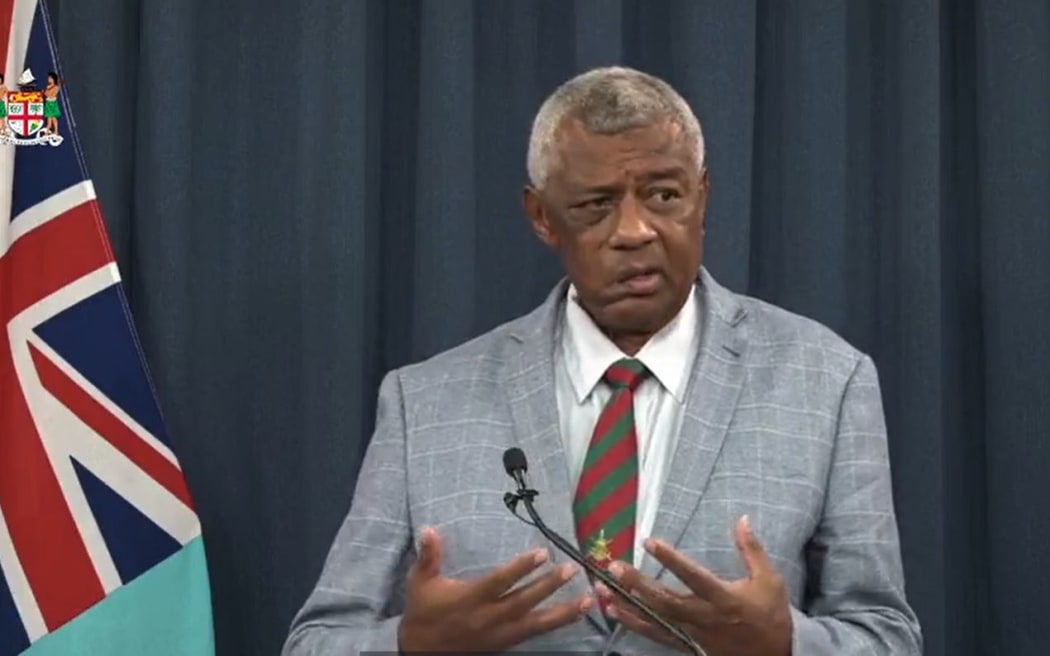
Fiji’s Women and Children’s Minister Lynda Tabuya says Pacific island countries need to “strengthen our laws” on online harassment.
Tabuya spoke to RNZ Pacific on the sidelines of the Pacific Women in Power forum taking place in Auckland this week.
She said the issue that she was dealing with — which is allegations of a sex and drug scandal between her and former cabinet minister Aseri Radrodro — was currently with the police.
“[Police] are investigating it,” she said.
“And it just so happens that a person who was causing this harassment online lives in Sydney,” she said.
She said she was able to get the assistance of Australia’s online safety watchdog to issue the notice to the person to take down the content — images — because it is a crime in Australia.
“If you put up content that is or appears to be the person, so then the person [who published it] needs to take the content down otherwise they can face prosecution,” she said.
‘Grateful for swift action’ “That was the process I followed and I’m grateful to the Safety Commissioner of Australia for the swift action.”
However, she said the situation she found herself in was not exclusive to her.
“It’s me today, it could be someone else tomorrow. It doesn’t have to be a minister or public figure.
“But if you have women in Fiji or across the Pacific who are facing this, and they’re being attacked — especially for populations where there are more people outside of the country than in [the] country.
Tabuya said therefore there was a need for strong policies, not just in Fiji, but across the region.
“You get more attacks from people who live overseas. Women MPs need to reach out to those countries where those people are attacking them live because the laws are much stronger.
“But it’s also a lesson for us within to strengthen our laws so that we can stand up against online bullying.
“The world is unfair and being a woman in politics, we face a lot of unfairness and injustices. But I think it also makes us so much more determined to stand up and be heard,” she added.
Meanwhile, Tabuya is currently the subject of an inquiry by her political party following the sex and drug allegation, the outcome of which has yet to be released.
This article is republished under a community partnership agreement with RNZ.
Source: The Conversation (Au and NZ) – By Adrian Beaumont, Election Analyst (Psephologist) at The Conversation; and Honorary Associate, School of Mathematics and Statistics, The University of Melbourne
A federal Newspoll, conducted February 19–23 from a sample of 1,245, gave Labor a 52–48 lead, unchanged since the previous Newspoll three weeks ago. Primary votes were 36% Coalition (steady), 33% Labor (down one), 12% Greens (steady), 6% One Nation (down one) and 13% for all Others (up two).
Anthony Albanese’s ratings were 51% dissatisfied (steady) and 43% satisfied (up one), for a net approval of -8, up one point. Peter Dutton’s net approval was down one point to -14. Albanese led Dutton as better PM by 47–35 (46–35 previously).
This graph of Albanese’s net approval in Newspoll shows there has not been a recovery since the defeat of the Voice referendum.
The Australian Bureau of Statistics reported last Wednesday that the wage price index rose 4.2% in the full year 2023 and 0.9% in the December quarter. This is the highest annual rise since 2009, though the quarterly rise was down from 1.3% in September.
The annual inflation rate for the full year 2023 was 4.1%, so wage rises just beat inflation. For the December quarter, inflation was up 0.6%, so wage rises exceeded inflation by 0.3%. I expect this will be good news for the government.
Labor down in Resolve poll, but would still lead
A federal Resolve poll for Nine newspapers, conducted February 21–24 from a sample of 1,603, gave the Coalition 37% of the primary vote (up three since early December), Labor 34% (down one), the Greens 11% (down one), One Nation 6% (up one), the UAP 1% (steady), independents 9% (steady) and others 4% (up one).
Resolve does not give a two party estimate until near elections, but applying 2022 preference flows to this poll gives Labor about a 52.5–47.5 lead, a 2.5-point gain for the Coalition since December. This is easily Labor’s worst position this term in a Resolve poll, which has been very pro-Labor relative to other polls.
Despite Labor’s drop, Albanese’s net approval improved six points to -6, with 47% giving him a poor rating and 41% a good rating. Dutton was down three points to a -11 net approval. Albanese led Dutton by 39–32 as preferred PM, a narrowing from 42–28 in December. Voters supported the changes to the stage three tax cuts by a 52–14 margin.
The Liberals increased their lead over Labor on economic management from 35–27 in December to 38–27. On keeping the cost of living low, the Liberals led by 30–26 (26–21 in December).
Labor gains in Freshwater poll for a 51–49 lead
A national Freshwater poll for The Financial Review, conducted February 16–18 from a sample of 1,049, gave Labor a 51–49 lead, a one-point gain for Labor since a mid-January Freshwater poll for The Daily Telegraph. Primary votes were 38% Coalition (down one since January), 31% Labor (steady), 14% Greens (steady) and 17% for all Others (up two).
Freshwater has been Labor’s worst pollster this term, while Resolve has been its best. Results from Freshwater, Newspoll and Resolve are now closer together than previously.
Albanese led Dutton as preferred PM by 42–38 (47–38 in January). In comparisons with the December poll, Albanese’s net approval was down two points to -7, while Dutton’s was down seven to -9. Barnaby Joyce’s net approval crashed 16 points to -33.
By 44–15, voters supported the changes to the stage three tax cuts, with 26% “indifferent”. By 32–12, voters thought they would be better off under the changes, with 43% saying there would be no difference.
The cost of living is still the top issue for voters, with 69% listing it as a priority. The Coalition led Labor as best party to manage cost of living by 34–28. Since December, “crime and social order” jumped eight points to 25% to rank fifth on the list of voters’ priorities.
Net approval of the federal political parties was +1 for the Liberals, -4 for Labor, -7 for the Nationals and -19 for the Greens. Net approval of other prominent Labor ministers was +6 for Penny Wong, -3 for Jim Chalmers, -4 for Tanya Plibersek and -10 for Chris Bowen.
Morgan poll: 52.5–47.5 to Labor
In last week’s Morgan poll, conducted February 12–18 from a sample of 1,706, Labor led by 52.5–47.5, a 0.5-point gain for Labor since the previous week. Primary votes were 37% Coalition (steady), 34% Labor (down 0.5), 13% Greens (up one), 4% One Nation (down 0.5) and 12% for all Others (steady).
Queensland UComms poll has a 50–50 tie
The Queensland state election will be held in October. A UComms poll for The Courier Mail, conducted February 13 from a sample of 1,743, had Labor and the Liberal National Party tied at 50–50, a one-point gain for Labor since December. This is the first Queensland poll commissioned by The Courier Mail that has not shown a LNP lead since December 2022.
The Poll Bludger reported the primary votes were 37.3% LNP (down 0.7), 34.2% Labor (down 0.2), 12.2% Greens (down 1.1), 7.7% One Nation (up 0.4) and 3.9% Katter’s Australian Party (down 0.1). Respondent preferences were better for Labor than in December.
Labor premier Steven Miles’ ratings were 44.2% positive (up 1.5), 25.2% neutral (down 2.4) and 25.2% negative (down 2.4). LNP leader David Crisafulli’s ratings were 41.7% positive (up 3.9), 31.2% neutral (up 1.0) and 18.7% negative (down 4.1). Crisafulli led Miles as preferred premier by 51–49 (52.2–47.8 in December).
This is the second UComms poll since Miles replaced Annastacia Palaszczuk as Labor premier in December. Some of Labor’s poll problems were probably due to Palaszczuk’s unpopularity. But Labor will have been in government for almost ten years by the October election, so there may be an “it’s time” factor.
Trump wins South Carolina, UK byelections and Indonesian election
Donald Trump won the South Carolina Republican primary on Saturday (US time), defeating Nikki Haley in her home state by a 59.8–39.5 margin. He is almost certain to seal the Republican presidential nomination by March 19, when 69% of Republican delegates will have been determined. I covered this for The Poll Bludger.
I covered the two February 15 UK byelections in Conservative-held seats for The Poll Bludger. Both seats were gained by Labour on massive swings. The next UK general election is likely to be held late this year, with Labour far ahead in national polls. However, Labour was forced to disendorse their candidate for the February 29 Labour-held Rochdale byelection after nominations had closed.
I covered the February 14 Indonesian election, in which the right-wing Prabowa Subianto won the presidency with an outright majority of the vote, meaning there won’t be a runoff election.
Adrian Beaumont does not work for, consult, own shares in or receive funding from any company or organisation that would benefit from this article, and has disclosed no relevant affiliations beyond their academic appointment.
Analysis by Dr Bryce Edwards: Democracy Project (https://democracyproject.nz)
Political scientist, Dr Bryce Edwards.
The Labour Party’s fortunes go from bad to worse. Ever since the party was turfed out of power in October, incurring its biggest-ever loss, the party has shown no real sign of learning any lessons from its defeat, nor does it show any capacity to revive itself.
Last week is being labelled its “worst week yet” by commentators. One of them, Vernon Small, who until recently was the senior adviser to David Parker, wrote yesterday in the Sunday Star Times that Labour appears to have finally hit rock bottom last week, with another poor opinion poll result of 28 per cent support, Grant Robertson abandoning ship, and a new report out showing that in government Labour had failed on child poverty – see: Was that Labour’s worst week yet? (paywalled)
Not only is Robertson a major loss of talent for the party in opposition, Small points out that most of the other stars have been departing: “As well as Robertson and Ardern, Kelvin Davis, Nanaia Mahuta, Andrew Little, Michael Wood and Kiritapu Allan have all jumped ship or been thrown overboard. Third-ranked Megan Woods is being equivocal about her long-term plans.” Meanwhile, Small points out that Chris Hipkins has demoted other solid talent, such as Damien O’Connor and David Parker, leaving Labour’s front bench “looking decidedly callow.”
Small suggests that Labour views tax reform as a recurrent campaign nightmare” to avoid rather than “an opportunity to define itself, and fund its policy platform”. And he says that in keeping Parker away from the revenue and economic portfolios, he’s signalling that a wealth tax is off the agenda. Instead, Hipkins has put the rather dry Deborah Russell in charge of tax, and she says that wealth taxes are “largely unknown” and too complicated to explain.
And in the weekend another Labour insider wrote an analysis on the Labour-aligned blogsite The Standard about how Hipkins is more interested in preserving his leadership than giving MPs like Parker a chance to innovate on tax policy: “Hipkins is also using the elevation of Edmonds and Russell to shank David Parker. Parker is the only guy left with that combination of progressive chops, huge track record, and the merest mote of charisma to be an alternative leader to Hipkins. Hipkins has sent yet another signal to Parker to retire. This leaves Hipkins free to turn the entire Labour effort into an even more ineffectual Wellington-circling wankathon taking two terms to recover from the smashing he got it in 2023” – see: What’s Left?
Labour failed on poverty and inequality
It’s last week’s Statistics New Zealand report on child poverty that is truly eviscerating for Labour. As Small argues, Labour MPs and activists now need to acknowledge their government “didn’t adequately protect the most vulnerable being hit hard by the cost-of-living crisis.”
This is why many on the political left have been so disappointed by the last government. Arguably things got much worse for the poor and working class, while the rich got richer under Hipkins, Jacinda Ardern and Grant Robertson. Hence, some of the farewell commentaries for Robertson have been less than positive.
Some of the most scathing are from those on the political left. For example, activist Steven Cowan sums up what a lot of those on the left think: “The unvarnished truth is that, despite Prime Minister Jacinda Ardern promising to lead a government focused on economic transformation, very little changed. The Labour Government, supported by the Greens, merely tinkered. Working people were, again, like Oliver Twist, left pleading for more. The new child poverty figures only serve to underline the fact that the Labour Government continued to deliver out thin gruel for the working class its so-called ‘socialist’ MPs claimed to represent. And, presiding over it all, was Finance Minister Grant Robertson. While he wrote, in a nod to New Zealand’s myth of egalitarianism, that he wanted to give everyone ‘a fair suck of the sav’, in reality he was a resolute defender of the neoliberal status quo” – see: A loyal lieutenant of capital
Robertson’s end of an error
The toughest column on Robertson’s time in power has been written by Newstalk’s Heather du Plessis-Allan who says that his departure is not being accurately evaluated by the commentariat and press gallery because he’s the sort of politician that they like having a beer with. She rightly reckons that Robertson won’t be willing to have any more beers with her once he’s read her column: Grant Robertson is a great bloke, but he was a terrible Finance Minister (paywalled)
Robertson is praised by du Plessis-Allan for many of his talents, but she says he should be ranked as New Zealand’s worst finance minister on record – even worse than Robert Muldoon. This is mainly because he took the public’s debt from “$5 billion in 2019 to a projected $93b this year” without producing anything much to show for it. She says at least when Muldoon wasted money on building dams and energy infrastructure the country was left with some assets as a result – but in Robertson’s case, he seemed to blow all those billions without anyone really knowing where it went. She poses the question: “What can we point to and say ‘Grant paid for that’?”
Here’s one good example she gives of Robertson’s propensity to spend very poorly: “He said yes to Michael Wood’s bike bridge, which is the perfect example of wasteful spending. It was a stupid idea. It cost us more than $51m in consultants and rented office space. Then it was canned. We spent money and we have nothing to show for it. The implications are serious. We now don’t have enough money to pay the nurses their backpay or the police the pay rise they’re due. Or the GPs.”
Robertson also failed to advance any real economic reform. And despite lots of talk about how unfair the tax system is, Robertson mostly retained the status quo: “If he really believed the tax system needed to be fairer, he had his chance. He had the ear of Jacinda Ardern. He is one of her best friends. And he either couldn’t convince her or didn’t really try.”
Should Hipkins be replaced as Labour leader?
The worst part of the 1News poll for Labour last week was Hipkins’ plummeting numbers for preferred prime minister. Falling by ten percentage points revived speculation about whether Hipkins had to go. The NBR’s political editor Brent Edwards argued in the weekend that Hipkins is safe for the moment: “the knives will not be out now. It is surely too early in the electoral cycle to consider a change of leader, but the question might arise closer to the election if Labour is unable to lift its support and bridge the gap between it and National” – see: Tragedy, polls, retirement, forced apology and a grim scorecard
Herald political editor Claire Trevett also says that Hipkins is currently safe: “He does have some time up his sleeve. There are no signs as yet that any other credible leadership contender is ready to put their hand up. Once regular speculation starts around one or two names, that will become a more present danger for him. But until there are proper contenders to be a new leader, there is no point in rolling the old one. That gives him a window of opportunity to make sure that those names do not emerge, and that he is the one still standing in 2026” – see: Ginny Andersen’s attack on Mark Mitchell does Chris Hipkins no favours (paywalled)
Trevett also points to another low point in Labour’s past week, with another rising star in the party displaying questionable judgment, and making HIpkins’ job harder: “Ginny Andersen has done no favours for him with her bizarre attack on Police Minister Mark Mitchell on Newstalk ZB about his past as a security contractor in the Middle East. Mitchell quite rightly described it as a character assassination. Hipkins has said it went too far. Andersen has apologised to Mitchell personally, but not publicly and clearly not satisfactorily. She is now refusing to front on it.”
Nonetheless, Anderson is still talked about as the “running mate” for Kieran McAnulty in any attempt to replace the current leadership with a new generation of leaders that might be more able to connect with working class voters.
Labour is still the party of the Professional Managerial Class
The Labour’s progressive agenda and identity is very much their strongest sales pitch. And with the departure of Grant Robertson, the party’s reputation as a feminist force has become stronger – 70 per cent of its front bench is now female.
Also, by appointing Barbara Edmonds to replace Robertson as finance spokesperson, she creates a record as the party’s first female in that role and the first the Pasifika person as well.
This achievement is saluted in yesterday’s Herald with an editorial that says “The once impossibly high glass ceiling has been smashed”, with Edmonds creating “a new pathway not only for herself but one for other Pacific politicians and those aspiring to be so one day. She also represents something that was not always evident in New Zealand and overseas – brown women in leadership roles. Brown women in politics” – see: Barbara Edmonds’ new appointment another step forward for Pasifika (paywalled)
However, as to whether the party still represents working people is more in question these days. In recent years it’s become more apparent the party has been captured by the Wellington “professional managerial class”, pushing the party away from its traditional working class politics towards a middle class social liberalism.
This was discussed in the weekend by political commentator Janet Wilson: “October’s election result proved Labour has a problem of Democrat-sized proportions; they’ve become disenfranchised from their base while other left-wing parties enjoy the benefits. Which is how the Greens managed to snaffle the red strongholds of Rongotai and Wellington Central, and Te Pāti Māori grabbed six of the seven Maori seats. That’s what happens when there’s a divide between the professional managerial class running the party and the supposed blue-collar workers they’re meant to represent” – see: As Robertson heads for the exit, Labour’s reset becomes critical (paywalled)
Wilson explains that Hipkins epitomises that professional managerial class, and continues to hamper any tax reform that might threaten the interests of his own wealthy milieu: “As a paid-up member of that managerial class, having worn the well-trampled path from student politics directly to Parliament, the question must be, is Chris Hipkins the man to represent the workers in an age when AI threatens to disrupt all jobs? Can a leader who scuttled the tax work of his peers in one election hope to stop increasing dissension in the ranks if its polling numbers continue to slide and party irrelevancy beckons?”
There’s a hollowness to a party that continually refuses to implement reforms that would benefit Labour’s traditional base. Wilson says the party has therefore “lost its ideological compass and is adrift in the wilderness of what-it-doesn’t-stand-for. All while applying the magical thinking of all opposition parties – that the government of the day will only last for a term before they are ushered back into power.”
The hollowness has been recently discussed by Matthew Hooton, who has argued that Labour (along with National) has become a “mere empty vessel” for “the personal ambitions and brands of whoever gets control” of the party. Therefore, in lacking any real connection with social forces apart the Liberal Establishment of places like Grey Lynn, Hooton says the party can’t enthuse working people anymore.
In his recent column, What Labour must do to reclaim its core support (paywalled)Hooton says that Labour was “supposed to be about redistributing at least some power and wealth, from capital to labour and from the ruling establishment to ordinary people.” But looking through Labour’s last two times in office, Hooton suggests that the party has given up on its traditional constituency in favour of conservatism, and this will need to change if it is to be re-elected: “Labour will never win back the working-class and middle-income voters who switched to National in 2023 until it offers more change than Ardern and Hipkins were comfortable with. If there is to be a do-nothing Government, former Labour voters may as well stick with National, which is historically so good at it, but isn’t seen to pander to the woke, Wellington, pounamu- and David Jones-wearing, yet mainly Pākehā elites.”
A similar argument was made two weeks ago by Andrea Vance, writing in The Post, saying that Labour’s “existential crisis” relates to its inability to relate to working people, and the fact that it has evolved “into a clique of career-driven politicians who marketed themselves at the progressive middle class”. In lieu of an interest in working class politics, Labour now specialises in “futile culture wars and identity politics” – see: What’s left for the left? (paywalled)
To find a way forward, Vance argues “Labour should be asking: who does it now represent?” And “this requires a more fundamental reshaping of how the party thinks about workers.”
Is there anyone in Labour that can at least pretend to be in touch with working people rather than the professional managerial class? Hooton wrote a column for the Herald at the start of the year that singled out who the best replacement for Hipkins might be – see: Apologies needed for Labour to be taken seriously (paywalled)
Here’s his conclusion: “Thirty-eight-year-old list MP Kieran McAnulty is on manoeuvres, with speculation list MP Ginny Andersen would make a good running mate. Both served briefly as ministers in the last year of the defeated regime. McAnulty, while assuring Labour activists he is well to the left of Ardern on economics and tax, has built a blokey non-woke brand based on driving a ute and liking a beer and a bet. He’s certainly more in tune with today’s post-Covid, recessionary New Zealand than anyone from Grey Lynn.”
Dr Bryce Edwards
Political Analyst in Residence, Director of the Democracy Project, School of Government, Victoria University of Wellington
This article can be republished for free under a Creative Commons copyright-free license. Attributions should include a link to the Democracy Project (https://democracyproject.nz)
Earlier this month, a Hong Kong company lost HK$200 million (A$40 million) in a deepfake scam. An employee transferred funds following a video conference call with scammers who looked and sounded like senior company officials.
Generative AI tools can create image, video and voice replicas of real people saying and doing things they never would have done. And these tools are becoming increasingly easy to access and use.
But if you’ve been a victim of a deepfake scam, can you obtain compensation or redress for your losses? The legislation hasn’t caught up yet.
Who is responsible?
In most cases of deepfake fraud, scammers will avoid trying to fool banks and security systems, instead opting for so-called “push payment” frauds where victims are tricked into directing their bank to pay the fraudster.
So, if you’re seeking a remedy, there are at least four possible targets:
the fraudster (who will often have disappeared)
the social media platform that hosted the fake
any bank that paid out the money on the instructions of the victim of the fraud
the provider of the AI tool that created the fake.
The quick answer is that once the fraudster vanishes, it is currently unclear whether you have a right to a remedy from any of these other parties (though that may change in the future).
In principle, you could seek damages from a social media platform if it hosted a deepfake used to defraud you. But there are hurdles to overcome.
Platforms typically frame themselves as mere conduits of content – which means they are not legally responsible for the content. In the United States, platforms are explicitly shielded from this kind of liability. However, no such protection exists in most other common law countries, including Australia.
The Australian Competition and Consumer Commission (ACCC) is taking Meta (Facebook’s parent company) to court. They are testing the possibility of making digital platforms directly liable for deepfake crypto scams if they actively target the ads to possible victims.
The ACCC is also arguing Meta should be liable as an accessory to the scam – for failing to remove the misleading ads promptly once notified of the problem.
At the very least, platforms should be responsible for promptly removing deepfake content used for fraudulent purposes. They may already claim to be doing this, but it might soon become a legal obligation.
In Australia, the legal obligations of whether a bank has to reimburse you in the case of a deepfake scam aren’t settled.
This was recently considered by the United Kingdom’s Supreme Court, in a case likely to be influential in Australia. It suggests banks don’t have a duty to refuse a customer’s payment instructions where the recipient is suspected to be a (deepfake) fraudster, even if they have a general duty to act promptly once the scam is discovered.
That said, the UK is introducing a mandatory scheme that requires banks to reimburse victims of push payment fraud, at least in certain circumstances.
In Australia, the ACCC and others have presented proposals for a similar scheme, though none exists at this stage.
Australian banks are unlikely to be liable for customer losses due to scams, but new schemes could force them to reimburse victims. TK Kurikawa/Shutterstock
The providers of generative AI tools are currently not legally obliged to make their tools unusable for fraud or deception. In law, there is no duty of care to the world at large to prevent someone else’s fraud.
However, providers of generative AI do have an opportunity to use technology to reduce the likelihood of deepfakes. Like banks and social media platforms, they may soon be required to do this, at least in some jurisdictions.
The recently proposed EU AI Act obligates the providers of generative AI tools to design these tools in a way that allows the synthetic/fake content to be detected.
Currently, it’s proposed this could work through digital watermarking, although its effectiveness is still being debated. Other measures include prompt limits, digital ID to verify a person’s identity, and further education about the signs of deepfakes.
Can we stop deepfake fraud altogether?
None of these legal or technical guardrails are likely to be entirely effective in stemming the tide of deepfake fraud, scams or deception – especially as generative AI technology keeps advancing.
However, the response doesn’t need to be perfect: slowing down AI generated fakes and frauds can still reduce harm. We also need to pressure platforms, banks and tech providers to stay on top of the risks.
So while you might never be able to completely prevent yourself from being the victim of a deepfake scam, with all these new legal and technical developments, you might soon be able to seek compensation if things go wrong.
With audio, video and image deepfakes only growing more realistic, we need multi-layered strategies of prevention, education and compensation.
This week Scott Morrison, Australia’s 30th prime minister, will deliver his valedictory speech to the House of Representatives. As Morrison leaves parliament, it’s timely to ask where he is placed in the pantheon of Australia’s national leaders.
Already there have been unflattering verdicts on Morrison’s prime-ministerial standing. For example, in her withering account of his leadership, veteran columnist and author Niki Savva writes that among detractors, “Morrison was regarded as the worst prime minister since Billy McMahon”. Moreover, according to Savva, following the August 2022 revelation of his commandeering of five ministries during the COVID pandemic, his reputation sunk still lower: “he was worse than McMahon. Worse even than Tony Abbott, who lasted a scant two years in the job”.
How might we know how Morrison’s record stacks up against his prime-ministerial peers? One device for evaluating comparative leadership performance is expert rankings. Australia has had a slow take-up in this field, unlike the United States, where presidential rankings have a lineage stretching back three-quarters of a century and are a veritable scholarly cottage industry.
In recent years, there have been forays into this territory in Australia, with three prime-ministerial rankings conducted by newspapers and two initiated by Monash University in 2010 and 2020. (I was the organiser of both of these Monash rankings.)
These rankings have been largely consistent in their results. The experts, mostly political historians and political scientists, have judged the nation’s greatest prime minister to be its second world war leader, John Curtin. The other leaders in the top echelon are, in rough order, Bob Hawke, Ben Chifley, Alfred Deakin, Robert Menzies, Andrew Fisher, John Howard, Paul Keating and Gough Whitlam.
Billy McMahon is often considered to be Australia’s worst prime minister. National Archives of Australia
At the other end of the scale, Billy McMahon, who is chiefly remembered for being defeated by Labor’s Whitlam at the December 1972 election, thereby bringing to a close the Liberal Party’s postwar ascendancy, has been consistently rated Australia’s prime-ministerial dunce. Even his biographer, Patrick Mullins, acknowledges that McMahon has become “a by-word for failure, silliness, ridicule”.
However, in the most recent of the rankings, the Monash 2020 survey, McMahon had a close competitor for bottom place: Tony Abbott. Forty-four out of 66 respondents to that survey assessed Abbott’s prime ministership a failure. Other prime ministers to the rear of the field included Abbott’s contemporaries, Kevin Rudd and Malcolm Turnbull.
Morrison was not included in the 2020 rankings because as the incumbent his prime ministership was incomplete, and so it was premature to evaluate his performance. Let us now, though, measure his record against the nine benchmarks that the experts were asked to consider in rating the nation’s leaders.
The first is “effectively managing cabinet”. To date, little has been disclosed about the integrity of cabinet processes under Morrison’s stewardship. Yet, whatever the merits of that management, his scandalous breach of the norms of cabinet government by secretly assuming several ministries will irretrievably stain his reputation in this regard.
Next is “maintaining support of Coalition/party”. That Morrison avoided being deposed by his party, which was the fate of his immediate predecessors (Rudd, Julia Gillard, Abbott and Turnbull), counts in his favour. As the ABC docuseries Nemesis shows, however, his prime ministership was marked by serious frictions both within the Liberal Party and between the Liberal and National coalition partners.
“Demonstrating personal integrity”. This was not one of Morrison’s strong suits. As Savva makes searingly evident, and Nemesis also highlights, Morrison earned a reputation for being economical with the truth (including hiding his acquisition of colleagues’ ministries), for evading accountability and shifting blame (“I don’t hold a hose, mate”), and for corrupted processes under his watch (an example being the shameless pork-barrelling of the community sport infrastructure program in the lead-up to the 2019 election).
“Leaving a significant policy legacy”. Here Morrison is partly damned by his own words. In office, he insisted he was not concerned about his legacy, equating the idea with a vanity project. Indeed, an obsession with the theatre of politics and a corresponding lack of substance caused his prime ministership to come to be seen as bereft of purpose.
On the other hand, management of the COVID pandemic, however mixed, accords a significance to his time in office. AUKUS stands as the other major legacy of Morrison’s prime ministership, entrenched as it has been by his successor, Anthony Albanese. The agreement promises to influence Australia’s defence capability until the middle of this century and beyond, although only time will tell whether it enhances the nation’s security or is a dangerous white elephant.
“Relationship with the electorate”. Morrison’s record here is mixed. In his favour, he won an election (something McMahon couldn’t claim). Yet, by the time of the 2022 election, according to the Australian Election Study, he was the least popular major party leader in the history of that survey, which dates back to the 1980s.
His public toxicity was a primary factor in the Coalition’s defeat, one of his Liberal colleagues comparing the depth of public sentiment against the prime minister in 2022 to “having a 10,000-tonne boulder attached to your leg”.
“Communication effectiveness”. Styling himself as a Cronulla Sharks-supporting “daggy dad” from the suburbs, at least initially Morrison’s communication mode seemed to be well received in the community. He was relentlessly on message during the 2019 election campaign.
But the shine rapidly wore off his persona following that victory, with growing doubts about his authenticity. Rather than persuade, his habit was to hector, and rather than empathise, he exuded smugness. A series of notorious tin-eared statements, which especially alienated women voters, came to define his image. By the end he was known as the “bulldozer-in-chief”.
“Nurturing national unity”. An innovation of Morrison’s at the beginning of the pandemic was the national cabinet. Bringing together the prime minister and premiers, it worked effectively for a time, only for partisan interests over lockdowns to strain relations between Canberra and the states.
Under pressure, Morrison also flirted with divisive culture-war politics, instances being his divisive Religious Discrimination Bill and his egregious handpicking of the anti-transgender Liberal candidate Katherine Deves to contest the 2022 election.
“Defending and promoting Australia’s interests abroad”. The AUKUS pact has vehement critics, led by Morrison’s prime-ministerial peers Keating and Turnbull, who argue it jeopardises national sovereignty.
There is no denying, however, that AUKUS was Morrison’s signature foreign policy enterprise. On the other hand, Australia’s reputation as a laggard on climate change under the Coalition hurt our international standing, not least among Pacific neighbours. The Morrison government’s belated commitment to a net zero carbon emissions by 2050 target was too little, too late. Bellicose rhetoric towards Beijing also led to a deterioration in relations with the nation’s major trading partner (as well as estranging Chinese-Australian voters).
“Being able to manage turbulent times”. Here, again, Morrison’s record is at best mixed. In his favour is decisive early actions to ameliorate the COVID pandemic, headed by the JobKeeper program. As the pandemic progressed, however, his government was too often flat-footed, demonstrated by its dilatory approach to procuring vaccines. His response to natural disasters, most notably the 2019-20 Black Summer bushfires, was another shortcoming, exemplified by his secret holiday to Hawaii in the midst of the crisis. Arguably, his prime ministership was doomed from that moment.
And the verdict?
Prime-ministerial reputations can take time to settle. The passing of years fleshes out historical knowledge as well as providing greater perspective on performance in office. For example, the fate of AUKUS will quite possibly affect Morrison’s standing well into the future.
Even allowing for this, it seems safe to forecast that Morrison will be rated among the least distinguished of Australian prime ministers. His government’s relatively successful early management of the COVID pandemic and the legacy of AUKUS might spare him from falling below McMahon and Abbott at the bottom of the prime-ministerial heap. But avoiding that ignominy will probably be a close-run thing.
In the past Paul Strangio received funding from the Australian Research Council.
Although some viral videos have been taken down following a series of reports in The Guardian, clips featuring Australian influencers have claimed nicotine pouches are a safe and effective way to quit vaping. A number of the videos have included links to websites selling these products.
With the rapid rise in youth vaping and the subsequent implementation of several reforms to restrict access to vaping products, it’s not entirely surprising the tobacco industry is introducing more products to maintain its future revenue stream.
The major trans-national tobacco companies, including Philip Morris International and British American Tobacco, all manufacture nicotine pouches. British American Tobacco’s brand of nicotine pouches, Velo, is a leading sponsor of the McLaren Formula 1 team.
But what are nicotine pouches, and are they even legal in Australia?
Like snus, but different
Nicotine pouches are available in many countries around the world, and their sales are increasing rapidly, especially among young people.
Nicotine pouches look a bit like small tea bags and are placed between the lip and gum. They’re typically sold in small, colourful tins of about 15 to 20 pouches. While the pouches don’t contain tobacco, they do contain nicotine that is either extracted from tobacco plants or made synthetically. The pouches come in a wide range of strengths.
As well as nicotine, the pouches commonly contain plant fibres (in place of tobacco, plant fibres serve as a filler and give the pouches shape), sweeteners and flavours. Just like for vaping products, there’s a vast array of pouch flavours available including different varieties of fruit, confectionery, spices and drinks.
The range of appealing flavours, as well as the fact they can be used discreetly, may make nicotine pouches particularity attractive to young people.
Users absorb the nicotine in their mouths and simply replace the pouch when all the nicotine has been absorbed. Tobacco-free nicotine pouches are a relatively recent product, but similar style products that do contain tobacco, known as snus, have been popular in Scandinavian countries, particularly Sweden, for decades.
Snus and nicotine pouches are however different products. And given snus contains tobacco and nicotine pouches don’t, the products are subject to quite different regulations in Australia.
What does the law say?
Pouches that contain tobacco, like snus, have been banned in Australia since 1991, as part of a consumer product ban on all forms of smokeless tobacco products. This means other smokeless tobacco products such as chewing tobacco, snuff, and dissolvable tobacco sticks or tablets, are also banned from sale in Australia.
Tobacco-free nicotine pouches cannot legally be sold by general retailers, like tobacconists and convenience stores, in Australia either. But the reasons for this are more complex.
In Australia, under the Poisons Standard, nicotine is a prescription-only medicine, with two exceptions. Nicotine can be used in tobacco prepared and packed for smoking, such as cigarettes, roll-your-own tobacco, and cigars, as well as in preparations for therapeutic use as a smoking cessation aid, such as nicotine patches, gum, mouth spray and lozenges.
If a nicotine-containing product does not meet either of these two exceptions, it cannot be legally sold by general retailers. No nicotine pouches have currently been approved by the Therapeutic Goods Administration as a therapeutic aid in smoking cessation, so in short they’re not legal to sell in Australia.
However, nicotine pouches can be legally imported for personal use only if users have a prescription from a medical professional who can assess if the product is appropriate for individual use.
We only have anecdotal reports of nicotine pouch use, not hard data, as these products are very new in Australia. But we do know authorities are increasingly seizing these products from retailers. It’s highly unlikely any young people using nicotine pouches are accessing them through legal channels.
Health concerns
Nicotine exposure may induce effects including dizziness, headache, nausea and abdominal cramps, especially among people who don’t normally smoke or vape.
Although we don’t yet have much evidence on the long term health effects of nicotine pouches, we know nicotine is addictive and harmful to health. For example, it can cause problems in the cardiovascular system (such as heart arrhythmia), particularly at high doses. It may also have negative effects on adolescent brain development.
The nicotine contents of some of the nicotine pouches on the market is alarmingly high. Certain brands offer pouches containing more than 10mg of nicotine, which is similar to a cigarette. According to a World Health Organization (WHO) report, pouches deliver enough nicotine to induce and sustain nicotine addiction.
Pouches are also being marketed as a product to use when it’s not possible to vape or smoke, such as on a plane. So instead of helping a person quit they may be used in addition to smoking and vaping. And importantly, there’s no clear evidence pouches are an effective smoking or vaping cessation aid.
A Velo product display at Dubai airport in October 2022. Nicotine pouches are marketed as safe to use on planes. Becky Freeman
Further, some nicotine pouches, despite being tobacco-free, still contain tobacco-specific nitrosamines. These compounds can damage DNA, and with long term exposure, can cause cancer.
Overall, there’s limited data on the harms of nicotine pouches because they’ve been on the market for only a short time. But the WHO recommends a cautious approach given their similarities to smokeless tobacco products.
For anyone wanting advice and support to quit smoking or vaping, it’s best to talk to your doctor or pharmacist, or access trusted sources such as Quitline or the iCanQuit website.
Becky Freeman is an Expert Advisor to the Cancer Council Tobacco Issues Committee and a member of the Cancer Institute Vaping Communications Advisory Panel. These are unpaid roles. She has received relevant competitive grants that include a focus on e-cigarettes/vaping from the NHMRC, MRFF, NSW Health, the Ian Potter Foundation, VicHealth, and Healthway WA; relevant research contracts from the Cancer Institute NSW and the Cancer Council NSW; relevant personal/consulting fees from the World Health Organization, the Hong Kong Special Administrative Region Department of Health, BMJ Tobacco Control, the Heart Foundation NSW, the US FDA, the NHMRC e-cigarette working committee, NSW Health, and Cancer Council NSW; and relevant travel expenses from the Oceania Tobacco Control Conference and the Australia Public Health Association preventive health conference.
Official dietary advice in Australia is set to warn of the climate impact of certain foods. The move has raised the ire of farmers, meat producers and others who branded it “green ideology” and a “war on meat”.
Critics say the The National Health and Medical Research Council (NHMRC), which is behind the change, is overreaching and should not expand its remit beyond providing nutritional advice. We strongly disagree.
Having explored the scientific evidence about the harm food can cause to both the planet and human health, we firmly believe environmental information about food choices should be prominent in dietary guidelines.
Human health depends on having a safe, liveable planet and the state of our planet is inextricably linked to food systems. It’s entirely sensible that consumers are informed about whether their food choices are sustainable.
‘A thorough review of the evidence’
Australia’s dietary guidelines were released in 2013. The document provides general information about the environmental sustainability of food, but it’s buried in an appendix and the recommendations are fairly inconclusive.
The guidelines are currently under review and will be updated in 2026. The NHMRC says feedback from the public suggested sustainability information should be more accessible and explicit in the new guidelines. In fact, it said one in three people surveyed nominated the change as a priority.
The NHMRC says developing or updating its guidelines involves:
a thorough review of the evidence, methodological advice on the quality of these reviews, drafting of the guidelines, public consultation and independent expert review of the final guidelines.
It said the dietary recommendations would first consider Australia-specific health impacts, followed by sustainability and other factors – an approach in line with guidelines overseas.
Australia’s dietary guidelines are under review. Shutterstock
Critics come out swinging
Australians are among the world’s biggest meat eaters. However, recent trends indicate Australians’ beef consumption is in decline.
Meat creates almost 60% of greenhouse gas emissions from food production, and red meat has the highest environmental footprint out of all food choices.
Perhaps unsurprisingly, the change to dietary guidelines has prompted opposition from some quarters. In a report in The Australian, for example, Red Meat Advisory Council chair John McKillop said the moves:
go well beyond the policy intent of the Australian Dietary Guidelines to provide recommendations on healthy foods and dietary patterns […] [the] review process must not be allowed to be used as a vehicle to drive ideological agendas at the expense of the latest nutritional science.
He said the industry’s concerns were not related to its progress on sustainability, about which it had “a strong story” to tell.
The newspaper also quoted a Central Queensland cattle farmer, who said perceived misinformation about the health impacts and sustainability of red meat production were rife in the media, public policy and nutritional advice.
Conservative media outlets also weighed in on the changes. Sydney radio station 2GB declared the move a “war on meat” and host Ben Fordham claimed farmers were being “screwed over again”.
Australians are among the world’s biggest meat eaters. Shutterstock
The global picture
The upcoming changes are not unprecedented globally. Environmental sustainability is highlighted in the official dietary guidelines of at least ten other countries. They include Sweden which introduced climate-friendly food advice in 2015.
The title of the Swedish guidelines translates to “Find your way to eat greener, not too much and be active!” Among the recommendations are to:
Eat less red and processed meat, no more than 500 grams a week. Only a small amount of this should be processed meat.
But other nations have struggled to include sustainability advice in official dietary guidelines. In the United States, for example, lobby groups prevented the change, despite the recommendations of government-appointed nutritionists.
Dietary officials have not overreached
The Australian dietary guidelines already suggest limiting red meat consumption on health grounds.
Research has shown regular consumption of red meat, especially if it’s processed, contributes substantially to the risk of premature death. A high intake of red meat has been associated with cardiovascular disease, coronary heart disease, cancers and type 2 diabetes.
Adding information about the environmental effects of red meat health simply reinforces the benefits of eating less of it.
The link between food, the natural environment and health is well-established. Even before food is produced, vegetation is cleared to create space for crops and livestock. This leads to both the release of carbon dioxide and biodiversity loss, among other harms.
When it comes to meat, the digestive systems of sheep and cattle produce a lot of methane, a potent greenhouse gas. Greenhouse gas emissions are also created when food is processed, transported, stored and disposed of. Food packaging contributes to pressure on landfill and creates pollution.
All these processes threaten human health. Researchers have called for a global transformation of food systems, to ensure they operate within Earth’s limits.
The role of NHMRC is to protect public health in Australia. It makes sense, then, that it provides consumers with information about which foods cause the least environmental damage – and by extension, are also good for their personal health.
Clearing land for food production is a major source of biodiversity and vegetation loss. Shutterstock
A rightful part of the public health agenda
Dietary guidelines are a government tool to influence food consumption towards good choices. They are based on the best available evidence, and evolve along with our understanding of food and its impacts.
Of course, even if Australia’s guidelines are changed to incorporate environmental advice, this does not guarantee everyone will make healthy and sustainable food choices. Such a shift requires major behaviour changes, of which dietary guidelines are only one component.
Arming consumers with the right information about food sustainability however should be part of the federal government’s public health agenda.
Dora Marinova receives funding from the Australian Research Council.
Diana Bogueva does not work for, consult, own shares in or receive funding from any company or organisation that would benefit from this article, and has disclosed no relevant affiliations beyond their academic appointment.
There will be nervous executives all over Australia this week.
Come Tuesday, large private sector organisations will have their company’s gender pay gaps published for the first time for all to see, name, and shame.
As they brace for the fallout, let’s look at how what we will be told is changing, and what it will mean for you.
What is changing?
Every year, the Workplace Gender Equality Agency (WGEA) collects information from every employer with more than 100 employees. Until now it has published only a summary of the findings on its website, including Australia’s overall gender pay gap, and the gap by industry and employment arrangement.
But for the first time legislation enacted last year also allows WGEA to publish the gender pay gaps of individual employers.
Tuesday’s release will include each large company’s median gender pay gap, and the share of women it employs in lower- and higher-paid jobs.
Employers will have the chance to publish a statement alongside their results to provide context.
That means from Tuesday you will be able to look on the WGEA website and find the median gender pay gap of your large private sector organisation, or of an organisation you are thinking of joining, and how it stacks up against its competitors.
Why the change?
Australian women, like women elsewhere, have made astounding progress in the workforce in recent decades.
Women are both working and earning more than ever before. But progress has stalled, and the gender pay gap remains stubbornly persistent.
But beyond this, the options for governments are limited. Most of the barriers to women getting better-paid jobs can only be broken by employers.
The public naming and shaming that will begin on Tuesday will push accountability onto employers, holding them responsible for the conditions in their workplaces.
Workers and bosses are going to take notice: when employer gender pay gaps were released in the UK in 2018 it was the biggest business news story of the year, with coverage rivalling the wedding of Prince Harry and Meghan Markle.
At a time when companies are fighting for top talent, it is going to make it more difficult for employers with large pay gaps to hire talented women.
Research shows that on average women are willing to accept a 5% lower salary in order to avoid working for the employers with the biggest gender pay gaps.
Workplace Gender Equality Agency.
Let’s not rush to judge
While naming and shaming will help make this policy effective, we should be careful about rushing to judgement.
It is possible for an employer to be making serious efforts to improve while its gap remains large.
And some actions aimed at improving things, such as implementing a gender quota on entry-level positions, can worsen a company’s apparent gender pay gap in the short term by temporarily increasing the number of lowly-paid women.
Also, there will be firms that have a low gender pay gap because they pay both men and women poorly.
On Tuesday, we should instead look closely at whether the organisation has outlined clear steps it will take to improve, and how it compares to its competitors. In future years, we will be able to see how things have changed.
What will matter is what employers do next
Since the UK reforms were introduced in 2018, the gender pay gap has narrowed by one-fifth, with the biggest improvements coming from the worst offenders.
UK companies have also become more likely to include wage information in their job ads, equalising the starting point of wage negotiations for all applicants.
But for existing employees, the narrowing of the gap has been caused more by slower growth in men’s wages than faster growth in women’s wages, which isn’t good news for anyone looking for a pay rise.
The full effects of the Australian reforms won’t be seen for some time.
It is likely that making high-paid jobs more accessible to women will allow employers to tap into a new talent pool and encourage more highly credentialed women into the workforce, adding to productivity growth.
What is clear now is that if we want to narrow the gender pay gap, we need to know what’s happening. The avalanche of data due on Tuesday will be a start.
The Grattan Institute began with contributions to its endowment of $15 million from each of the Federal and Victorian Governments, $4 million from BHP Billiton, and $1 million from NAB. In order to safeguard its independence, Grattan Institute’s board controls this endowment. The funds are invested and contribute to funding Grattan Institute’s activities. Grattan Institute also receives funding from corporates, foundations, and individuals to support its general activities as disclosed on its website.
A former Fiji university head who was banned from returning to the country by the previous Bainimarama government has had her ban revoked.
Professor Shushila Chang, a former vice-chancellor of University of Fiji (UoF) in a daring move had departed during the covid-19 lockdown in March 2020, breaching the border restriction order at the time, to be with her sick husband in Australia.
The Immigration Department subsequently declared her a prohibited immigrant and UoF sacked her for unauthorised departure.
She applied for a judicial review later that year but it was turned down by the High Court, which ruled the government’s decision could not be challenged through judicial review, as Fiji’s immigration law does not allow anyone to challenge the decision of a minister in any court.
However, Professor Chang said that she received a letter via email from the coalition government’s Immigration Minister Pio Tikoduaudua on January 22 informing her that she can now return to Fiji.
“The travel ban on Professor Chang has been revoked after a thorough review of her case,” Tikoduadua confirmed to RNZ Pacific on Friday.
“This decision aligns with our commitment to justice, transparency, and fairness.”
The minister said Professor Chang was a respected academic and former vice-chancellor of the UoF who could now return to Fiji.
Principles of natural justice “This step reflects our government’s dedication to reassessing past actions to ensure they align with our values and principles of natural justice,” he said.
“We recognise the importance of academic freedom and the contributions individuals like Professor Chang can make to Fiji’s education and society.”
He said the Fiji government aims to foster an environment that encourages open dialogue and values the exchange of ideas, adding “lifting this ban demonstrates our commitment to these ideals.”
Immigration Minister Pio Tikoduadua . . . “We recognise the importance of academic freedom and the contributions individuals like Professor Chang can make.” Image: Fiji govt/FB
Chang, who was in the United States when she received the news, is now looking forward to visiting Fiji and reconnecting with friends.
She said her partner and children, who were “very concerned and supportive”, were also “happy and relieved” that her travel ban has been lifted.
“[My husband] was having severe mobility problems in Fiji such as losing his balance and headaches. Upon our return to Australia, the oncologist discovered he was suffering from lung cancer which had spread to the brain.
“It is fortunate we returned immediately and sought treatment. We are thankful he was able to receive treatment and is well.”
Invited back Professor Chang said apart from prioritising her husband’s wellbeing to aid in his recovery, she had also been meeting and consulting with universities such as the University of Bordeaux (France) and Coventry (United Kingdom), and delivering training programmes.
She confirmed she was appointed as an academic advisor to Pacific Polytech — a private technical and vocational education and training (TVET) provider in Fiji.
She said it was “an exciting role as Pacific Polytech has a visionary mandate”.
“I have been invited to present a public lecture by Pacific Polytech on a globally accredited National Inspection and Testing Laboratory in Fiji.
“The intent is to improve the safety, quality and sustainability of all products from Fiji including water, food, soil, air, furniture, cement, food, wood and others.”
This article is republished under a community partnership agreement with RNZ.
Source: The Conversation (Au and NZ) – By Gwilym Croucher, Associate Professor, Melbourne Centre for the Study of Higher Education, The University of Melbourne
The federal government has released the final report on a Universities Accord. Taking more than a year to prepare, it is billed as a “blueprint” for reform for the next decade and beyond. It contains 47 recommendations across student fees, wellbeing, funding, teaching, research and university governance. You can find the rest of our accord coverage here.
The Universities Accord final report makes recommendations that could significantly change what many Australian students pay for their higher education.
Course fees have increased dramatically in recent years for many domestic university students, burdening graduates with high debts. It is not unheard of for graduates to have debts over A$100,000.
The report is damning of the former Morrison government’s Job-ready Graduates scheme, introduced in 2021. This fuelled debts when it increased fees to some courses, such as humanities, communications and human movement.
But what should replace it?
The report says student fees should be based on lifetime earnings. But it also leaves a lot unsaid about what students will actually pay or when change might come.
What will Australian students pay?
By world standards, Australians already contribute a huge amount to the cost of their education.
Data from the OECD shows there are only a few other countries where students and their families contribute more to the total cost of tertiary education.
To make the system “fairer and better reflective of the lifetime benefits that students”, the report recommends a reversal of some or all of the fee increases introduced under Job-ready Graduates.
This would mean significant reductions for many students. For example, the cost of many subjects in an arts degree rose by 113% under the scheme. Reversing the Job-ready Graduates increases could cost the federal budget a billion dollars or more, depending on the final details.
The report recommends “Commonwealth Supported” students (most undergraduates in Australia) should still pay different amounts for different areas of study. But it says fees should reflect “projected potential lifetime earnings” for graduates.
This would return to a logic that helped set fee levels before Job-ready Graduates. In the past, lawyers have earned more on average over a lifetime than nurses, so students studying law are asked to contribute more than those studying nursing.
To simplify the system, the report suggests fees would also be divided into three tiers instead of the current four.
Better ‘HELP’
Australia’s HECS-HELP and FEE-HELP schemes for undergraduate and graduate students are the envy of many other countries. They mean students contribute to the cost of their education but remove barriers for those who cannot afford the fees upfront.
This is because students only begin to pay back their loans once they earn a certain level of income, and repayments change yearly if earnings change. There is no “real” interest on the loans, but they are pegged to inflation. This was less of an issue while inflation was low, but has recently seen student debts climb by more than 7%.
So the report recommends debts are increased each year based on whatever is lower, the Consumer Price Index (CPI) or Wage Price Index (WPI): in other words, inflation or how much wages are growing. This will cost the federal budget more but would mean the growth of an individual’s debt is more closely tied to wage growth.
The report also asks Australian banks to view HELP loans differently from other debt, such as credit card debt, when assessing whether or not to approve a bank loan. This follows concerns graduates are not able to secure home loans due to their HELP debts.
As the review panel explain, a key feature of a HELP scheme loan is the repayments change with income and only needs to be repaid above an minimum earning threshold, so it has much better terms than other loans.
The report also recommends other ways the HELP system can improve, especially for some groups of low-income earners. At the moment, repayments are based on a debtor’s entire income, rather than income above the repayment threshold.
This means repayments can increase as incomes rise above each threshold but by more than the total increase in income. As the report notes, in 2022-23, when a person’s income was $48,360 they repay nothing of their student debt, but a $1 increase in their earnings and they had to repay $483.61.
So the report recommends we move to a marginal repayment rates approach (like in some tax systems, which applies a tax rate to each extra dollar over a threshold), to minimise the chance that some HELP debtors are actually worse off for earning more.
Further help for students
The report wants to see the government subsidise new fee-free “preparation” courses (an expanded range of what has been termed enabling courses). These are designed to prepare students to succeed in their studies and would be offered to anyone who had been accepted into government supported courses, with a Commonwealth Supported Place.
The review also wants to see financial support for students who have to do work placements to complete their degrees, such as nursing, allied health and teaching. These compulsory placements can be very costly for students. For example, recent research on social work students has found the financial burden of doing these placements can be crippling, with students having to give up paid work, travel long distances and pay for clothing.
Student income support
The report recognises one of the biggest challenges for many students, especially many underrepresented groups, is the cost of living while studying.
The current $639-a-fortnight from Youth Allowance is hardly enough for even the most meagre lifestyle. This means university can be almost impossible for many people unless they have family support or additional paid work, which can often put pressure on their studies.
The report makes specific recommendations about extending eligibility criteria for student income support payments for some part-time students as well as increasing the threshold for the parental income test for eligibility for some students.
While the final accord report proposes some major changes, much of the detail, such as fee levels, is not included.
In fact, it suggests it should be up to a new Australian Tertiary Education Commission to sort out.
The details, not least who pays, what, when and how, are critical to the success or otherwise of the accord. They will likely shape its impact (positive or negative) for a generation to come.
Ahead of the next federal election (either this year or early next), any major new policy with a high price tag like reducing students fees could be a big ask for the government.
Establishing a complex body such as a Tertiary Education Commission will also take time. And this runs the risk that political will could falter and priorities will shift, especially if there is a change of government.
Nevertheless, this much anticipated final report has good news for many universities students who are struggling with the costs of study, even if it does not offer any immediate relief.
Gwilym Croucher is an Associate Professor at the University of Melbourne
The federal government has released the final report on a Universities Accord. Taking more than a year to prepare, it is billed as a “blueprint” for reform for the next decade and beyond. It contains 47 recommendations across student fees, wellbeing, funding, teaching, research and university governance. You can find the rest of our accord coverage here.
Australian universities could get more federal government funding, in changes recommended by the Universities Accord final report. But there is little detail so far on how it will be paid for.
The accord wants to set a target to more than double the number of government-funded students by 2050. This would see the number of students grow from 860,000 to 1.8 million.
On an individual student level, the accord proposes Australia adopt a “needs-based” funding model. This means universities would receive a base amount per student. Then there would be further loadings for equity students – those from low socioeconomic backgrounds, First Nations students and students with a disability. Regional universities would also receive extra funding.
Some universities are set to gain more than others
The accord has recommended that per student funding is changed so universities receive more money for students from equity backgrounds.
This is a similar approach to funding in Australia’s schools, introduced as part of the “Gonski” reforms a decade ago.
The Mitchell Institute modelled what a Gonski-style funding model might look like, using the categories identified by the accord and based on funding rates in the school sector.
We found the overall funding per student would increase by about 11%, or A$1.3 billion per year.
Regional universities and universities in outer-suburban areas would receive the biggest share of funding increases, as they tend to enrol more students from under-represented backgrounds. The more prestigious universities, the so-called Group of Eight, would gain the least.
Why have a new approach to funding?
The accord has proposed a needs-based funding model because, it says,
people from groups under-represented in higher education on average require greater support to succeed, often due to experiencing educational disadvantage.
The aim is to help universities improve outcomes for students from disadvantaged backgrounds. These students are less likely to to university, and less likely to finish their studies if they do, than students from more advantaged backgrounds. Peter checking this language ok
Managing funding across the system
The accord is proposing a government funding cap for each university based on the number of students. The Tertiary Education Commission would manage allocations and adjust funding every year to ensure there is “sustained and system-wide growth”.
Built into the model are other provisions intended to remove barriers to higher education access, including:
new funding rates for courses that cover the full cost of teaching them
fee-free preparation programs for anyone who has qualified for a government-supported university place. This is to help get students ready for their course
freedom for universities to make more choices about their enrolments and finances, including using government-supported places for postgraduate courses. This means some expensive postgraduate qualifications could become more affordable
extending government supported places to non-universities such as TAFEs, so they can offer higher education courses without having to charge full-fees.
International student levy not mentioned
One of the most controversial ideas from the accord’s interim report in July was an international student levy. It suggested income from international students would be used to pay for the extra funding required to support the growth in equity students.
But the international student levy is not mentioned in the final report. Instead, the accord recommends the establishment of two funds.
The first is a “Higher Education Future Fund” which would be used to support infrastructure for the sector, including student housing. The recommendation is for a fund of $10 billion, with half coming from universities and the other half from the federal government. Universities with higher non-government revenue, such as high international student income, would be expected to contribute more.
The accord also recommends a new “Solving Australia’s Challenges Fund” to reward universities that use their research expertise and capability to solve national problems. The size of this fund is unclear.
An levy on international student fees is not mentioned in the report, but there are two new funds for unis. Priscilla du Preez/ Unsplash, CC BY
The proposals outlined in the accord report will likely result in a redistribution of federal government financial support in the sector.
But the report has not outlined how this will be done. Instead, the Tertiary Education Commission will be required to determine funding rates and funding caps with universities.
This is understandable because determining final funding models can be very technical work. But it does mean we lack a lot of crucial detail.
It also means a new Tertiary Education Commission (if one is set up) has a very difficult job to do in a constrained funding environment.
The authors do not work for, consult, own shares in or receive funding from any company or organisation that would benefit from this article, and have disclosed no relevant affiliations beyond their academic appointment.
Source: The Conversation (Au and NZ) – By Sally Patfield, Lecturer, Teachers and Teaching Research Centre, School of Education, University of Newcastle
The federal government has released the final report on a Universities Accord. Taking more than a year to prepare, it is billed as a “blueprint” for reform for the next decade and beyond. It contains 47 recommendations across student fees, wellbeing, funding, teaching, research and university governance. You can find the rest of our accord coverage here.
Equity has been an ongoing theme in Australian higher education policy for decades. Beginning with the Whitlam government in 1972, equity has often been viewed as a major challenge or “wicked problem” that needs solving.
It’s also been at the forefront of discussions about the Universities Accord, with “access and opportunity” for underrepresented groups highlighted in the review’s terms of reference.
So it’s not surprising to see equity feature prominently in the final report. In fact, “equity” is mentioned more than 200 times. But does it live up to its promise to improve access to education for all Australians?
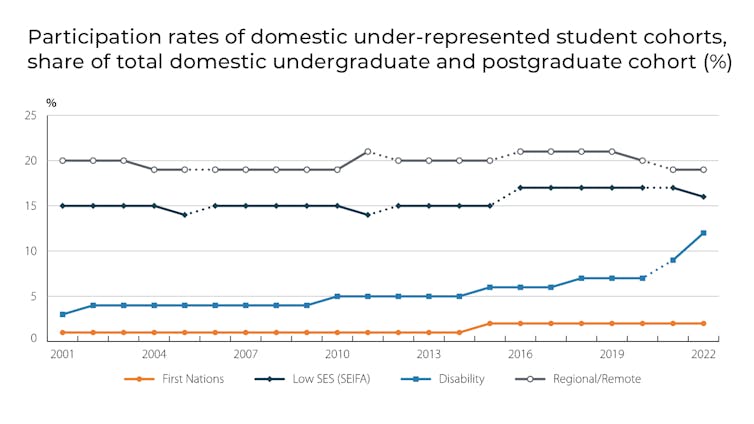
The accord report continues the tradition of many previous federal government policies by defining equity as “parity” or “proportional representation”. This means the major goal is for the university student population to reflect more closely the demographic composition of Australian society.
For example, Australians from low socio-economic status backgrounds currently make up around 17% of enrolments in higher education but 25% of the broader Australian population. So the aim here would be to have participation rates closer to, if not at, 25%. The other key target groups are First Nations peoples, people living in regional and remote areas, and people with a disability.
At face value, this a noble pursuit. Expanding access to higher education helps expand opportunities for all Australians and can lead to more diverse voices in professions and public life.
But this is not necessarily the accord’s rationale. The report notes we need to increase enrolments from underrepresented groups to increase the number of skilled workers. As such, we end up with phrases in the final report such as “growth through equity” and “skills through equity”.
So it downplays the importance of equity as a genuine concern in its own right.
Both sides of Australians politics have long used the language of “aspiration” to suggest anybody can have a good life, as long as they just “get on with things” and try hard enough.
In 2008, the Bradley Review (the previous broad review of higher education in Australia) similarly argued one of the main barriers to increasing the enrolment of underrepresented groups was a lack of aspiration.
There is a large body of Australian research demonstrating aspiration is not the problem it has been made out to be – many young people from all different kinds of backgrounds aspire to go to university. Nevertheless, the accord continues to talk about “increasing aspiration” and “building aspiration” as a strategy for facilitating access to higher education.
The accord proposes access to higher education can be improved, in part, by strengthening careers advice in schools and enhancing familiarity with university through outreach programs.
These are important for students who are the first in their family to go to university, as they are often complete “newcomers” to higher education. But we need to move beyond seeing aspiration as a problem to be fixed.
Despite these limitations, the accord does propose a “whole of student” approach to raising university attainment levels (from how students learn to how they are financially supported), noting it’s not enough simply to enrol disadvantaged students “hoping they succeed”.
A number of practical recommendations likely to make a positive difference to students at various stages in their university journey include:
a significant increase in the availability of fee-free places in preparation or enabling programs, which prepare students for university study
government financial support for compulsory work placements in teaching, nursing and other care-related fields
a new national “Jobs Broker” to help students find appropriate part-time employment during their studies
abolishing the Job-Ready Graduates scheme for fees, so student contributions are based on potential lifetime earnings.
The Universities Accord report recommends a change to course fees as well as more academic and financial support for students. Nathan Dumlao/ Unsplash, CC BY
While these measures are welcome, we know there are longstanding challenges to getting underrepresented groups into university, including improving academic outcomes during school. Cost-of-living pressures may also continue to make university study a challenge, despite increases in government help.
But even if targets are reached, achieving parity for underrepresented groups does not necessarily make higher education equitable.
Equity is much more than physical presence or getting bums on seats. We also need to think about what students are accessing, how they are supported, and how universities ultimately value and include them.
Sally Patfield currently receives funding from the NSW Department of Education, Commonwealth Department of Education, and the Paul Ramsay Foundation.
Federal education Minister Jason Clare has released the highly-anticipated Universities Accord final report, billing it as a “blueprint” to change higher education for decades to come.
It is the first broad review of the sector since 2008. As The University of Melbourne’s Gwilym Croucher has noted it “could mean the most significant changes to higher education in a generation”.
More than a year in the making, the final report is 400 pages and contains 47 recommendations.
Where did it come from?
The Universities Accord started as a pre-election promise when Labor was in opposition. In 2021, then Labor education spokesperson Tanya Plibersek proposed to
seek to end some of the political bickering over higher education policy by establishing an Australian universities accord.
As higher education expert Gavin Moodie has written, the name invokes the landmark Prices and Incomes Accord, negotiated by the Hawke government and union movement.
But when the accord process was set up by Clare in November 2022, the emphasis was more on creating “lasting reform” and a “long-term plan” for higher education.
Clare appointed an expert panel to undertake a review for the accord. It has been led by Mary O’Kane, former vice-chancellor of the University of Adelaide and includes former Labor minister Jenny Macklin and former Nationals minister Fiona Nash.
The review has involved more than 820 public submissions and 180 meetings with stakeholders. It has covered almost every aspect of higher education from student fees, to research, teaching, student and staff welfare, and international students.
The emphasis from the government and review team has been on ideas that can last for decades.
O’Kane called on contributors to “be bold. Think big and think beyond the immediate challenges”. An interim report was released in July, seeking feedback on more than 70 “spiky” policy ideas, such as a levy on international student fees (which is noticeably missing from the final document).
What’s in the final report?
The final report finds “significant change” is needed in higher education if Australia is going to have the skills and knowledge it needs to support its economy and society. It sets “ambitious targets”, including:
increasing the tertiary education attainment rate from the current 60% to at least 80% of Australians in the workforce by 2050
increasing the proportion of university educated Australians aged 25 to 34 from 45% to 55% by 2050.
It says to achieve this increase, the government will need to more than double the number of Commonwealth supported students at university from 860,000 to 1.8 million by 2050.
This is going to require more people from disadvantaged backgrounds (including Indigenous students, students in regional areas and students from low socioeconomic backgrounds) to go to university. The review wants to see these students achieve “participation parity” by 2050.
Other recommendations cover support for students on the way through their study as well as what happens to their loans once they graduate. These include:
a “jobs broker” to help university students find part-time work and work experience
The review notes how important international students are to Australia’s economy and higher education sector (international education is Australia’s fourth largest export). The report calls for
less reliance on just a handful of source countries
more international students studying in regional campuses.
While it didn’t include precise dollar figures in the report, the review made multiple recommendations around funding arrangements in different parts of the system. These include:
new targets for how much Australia spends on research and development as a proportion of GDP
a fund to support universities to solve challenges facing Australia
developing a “pathway” to fund the “full economic cost of research”
a new “needs based” funding system that provides extra funding to universities for educating students from disadvantaged backgrounds
and a “Higher Education Future Fund” with contributions from universities and government to build infrastructure (like student housing).
Ultimately, the review panel wants to see a new Australian Tertiary Education Commission set up to oversee the reforms and the sector as a whole.
But it does not recommend quick change. Rather, it initially calls for a committee to oversee implementation and for a “staged approach”.
The federal government, (which has had the report since December) is now “considering” the recommendations. Clare is already managing expectations about timing. As he said on Sunday:
This is a plan not for one budget, but a blueprint for the next decade and beyond.
While telling today’s Palestine solidarity rally in Auckland about creative “good news” humanitarian aid plans to help Palestinians amid the War on Gaza, New Zealand Kia Ora Gaza advocate and organiser Roger Fowler also condemned Israel’s genocidal conduct. He was interviewed by Anadolu News Agency after a Freedom Flotilla Coalition planning meeting in Istanbul with his views this week republished here.
By Faruk Hanedar in Istanbul
“Women, children, and families have no food. They are trying to drink water from puddles. People are eating grass.”
— Kia Ora Gaza advocate Roger Fowler
New Zealand activist Roger Fowler has condemned the Israeli regime’s actions in the Gaza Strip, saying “this is definitely genocide”.
“The Israeli regime has not hidden its intention to destroy or displace the Palestinian people, especially those in Gaza, from the beginning,” he said.
“They are committing a terrible act — killing tens of thousands of people, injuring more, and destroying a large part of this beautiful country.”
The death toll from the Israeli War on Gaza topped 29,000 this week – mostly women and children – and there were reports of deaths from starvation.
Fowler demanded action to halt the attacks and expressed hope about the potential effect of the international Freedom Flotilla — a grassroots organisation working to end the illegal Israeli blockade of Gaza.
He noted large-scale protests against Israel’s actions in Gaza and emphasised efforts to pressure governments, including through weekly protests in New Zealand to unequivocally condemn Israel’s actions as unacceptable.
A Palestinian mother and family hug the dead body of their child who died in an Israeli attack in Deir al-Balah, Gaza, on 18 February 2024. Image: Kia Ora Gaza
Long-standing mistreatment He stressed that the “tragedy” had extended beyond recent months, highlighting the long-standing mistreatment endured by Palestinians — particularly those in Gaza — for the last 75 years.
Fowler pointed out the dire situation that Gazans faced — confined to a small territory with restricted access to essential resources including food, medicine, construction materials and necessities.
He noted his three previous trips to Gaza with land convoys, where he demonstrated solidarity and observed the dire circumstances faced by the population.
“Boycott is a very effective action,” said Fowler, underlining the significance of boycotts, isolation and sanctions, while stressing the necessity of enhancing and globalising initiatives to end the blockade.
“I believe that boycotting has a great impact on pressuring not only major companies to withdraw from Israel and end their support, but also on making the Israeli government and our own governments understand that they need to stop what they are doing.”
Fowler also criticised the International Court of Justice’s (ICJ) “genocide decision” for being ineffective due to the arrogance of those governing Israel.
South Africa brought a genocide case against Israel to the ICJ in December and asked for emergency measures to end Palestinian bloodshed in Gaza, where nearly 30,000 people have been killed since October 7.
Anadolu journalist Faruk Hanedar talks with Kia Ora Gaza organiser Roger Fowler (left) after the recent Freedom Flotilla Coalition planning meeting in Istanbul. Image: Kia Ora Gaza/Anadolu
World Court fell short The World Court ordered Israel last month to take “all measures within its power” to prevent acts of genocide in Gaza but fell short of ordering a ceasefire.
It also ordered Israel to take “immediate and effective” measures to enable the provision of urgently needed basic services and humanitarian assistance in the Gaza Strip.
Fowler said all nations must persistently advocate and exert pressure for adherence to decisions by the UN court.
Fowler acknowledged efforts by UN personnel but he has concerns about their limited resources in Gaza, citing the only avenue for change is for people to pressure authorities to stop the genocide and ensure Israel is held accountable.
“It’s definitely tragic and heartbreaking. Women, children, and families have no food. They are trying to drink water from puddles. People are eating grass. This is a very desperate situation. No one is talking about the children. Thousands of people are under the rubble, including small babies and children,” he said.
Roger Fowleris a Mangere East community advocate, political activist for social justuce in many issues, and an organiser of Kia Ora Gaza.
“Gaza is starving to death” . . . a banner in today’s Palestine solidarity rally in Auckland Tāmaki Makaurau. Image: David Robie/Asia Pacific Report“Blood on your hands” . . . a protest banner condemning Israel and the US during a demonstration outside the US consulate in Auckland Tāmaki Makaurau today. Image: David Robie/Asia Pacific Report
Women’s rights advocates in Papua New Guinea are calling for peace and for the men in Parliament to act against the violence in the country.
The call comes following tribal fighting in Enga Province ended in a mass massacre at the weekend, which has so far claimed more than 60 lives.
Dorothy Tekwie, founder of Papua New Guinea Women in Politics, said she was heartbroken for the women who’ve have lost their children in the brutal killings.
“Any woman would be emotional…and I am also calling on women throughout Papua New Guinea to stand up. Enough is enough of violence of all forms.
“We are asking for accountability from our members of Parliament. It doesn’t matter whether they are in government or in opposition. This is a national crisis.”
Tekwie said the government needed to return the peace in the Highlands so infrastructure, housing, health and education development could begin.
On Wednesday, the government addressed a motion to take action on tribal conflicts and violence, specifically in Enga province.
Mothers mourning Another advocate Esmie Sinapa said as gunmen planned their next attack in the Highlands, mothers were mourning the deaths of their children.
Sinapa said violence had been escalating across the nation for some years.
“Imagine 60 mothers, wailing, weeping for their sons. As mothers of this country, women of this country, we are very concerned,” she said.
Papua New Guinea Women in Politics founder Dorothy Tekwie . . . the government needs to return the peace in the Highlands. Image: RNZ Pacific/Scott Waide
Cathy Alex, who was kidnapped last year in the Bosavi region and held for ransom, said PNG was on the verge of being a “failed state”.
As a woman who herself had experienced similar violence, Alex said the government must act.
“I don’t know what kind of country we call ourselves,” she said.
“This is a country . . . that if we look at indicators that shows a failed state. We are already it.
‘Individuals stand up’ “What’s holding this country together is individuals like these individuals who stand up for their communities and hold peace.
“What happened [in Enga] is completely unprecendented,” she added.
Tekwie said PNG women want affirmative action taken by government to deal with some of these issues.
“Starting with early education for one. We are mothers and are finding it so hard to get our kids into school,” she said.
This article is republished under a community partnership agreement with RNZ.
Women’s advocate Esmie Sinapa . . . “Imagine 60 mothers, wailing, weeping for their sons.” Image: RNZ Pacific/Scott Waide
Source: The Conversation (Au and NZ) – By Dwan Vilcins, Group leader, Environmental Epidemiology, Children’s Health Environment Program, The University of Queensland
Bushfires are currently burning in Australian states including Victoria, Tasmania, Western Australia and South Australia. In some areas, fire authorities have warned residents about the presence of smoke.
Bushfire smoke is harmful to our health. Tiny particles of ash can lodge deep in the lungs.
Exposure to this type of smoke may worsen existing conditions such as asthma, and induce a range of health effects from irritation of the eyes, nose and throat to changes in the cardiovascular system.
Public health recommendations during smoke events tend to provide general advice, and don’t often include advice specifically geared at children. But children are not just little adults. They are uniquely vulnerable to environmental hazards such as bushfire smoke for a number of reasons.
Airways are smaller in children, especially young children, which is associated with greater rates of particle deposition – when particles settle on the surfaces of the airways.
Children also breathe more air per kilogram of body weight compared with adults, and therefore inhale more polluted air relative to their size.
Further, children’s detoxification systems are still developing, so environmental toxins take longer to effectively clear from their bodies.
Meanwhile, children’s behaviour and habits may expose them to more environmental toxins than adults. For example, they tend to do more physical activity and spend more time outdoors. Higher levels of physical activity lead to more air inhaled per kilogram of body weight.
Also, a normal and important part of children’s early play is exploring their environment, including by putting things in their mouth. This can result in kids ingesting soil, dust and dirt, which often contain environmental contaminants.
For these reasons, it’s important to consider the specific needs of children when providing advice on what to do when there’s smoke in the air.
Keeping our environments healthy
The Australian government offers recommendations for minimising the health risks from exposure to bushfire smoke. The main advice includes staying indoors and keeping doors and windows closed.
This is great advice when the smoke is thick outside, but air pollutants may still accumulate inside the home. So it’s important to air your home once the smoke outside starts to clear. Take advantage of wind changes to open up and get air moving out of the house with a cross breeze.
Kids are natural scientists, so get them involved. For example, you and your child can “rate” the air each hour by looking at a landmark outside your home and rating how clearly you can see it. When you notice the haze is reducing, open up the house and clear the air.
Because air pollutants settle onto surfaces in our home and into household dust, an easy way to protect kids during smoky periods is to do a daily dust with a wet cloth and vacuum regularly. This will remove pollutants and reduce ingestion by children as they play. Frequent hand washing helps too.
Healthy bodies and minds
Research exploring the effects of bushfire smoke exposure on children’s health is sparse. However, during smoke events, we do see an increase in hospital visits for asthma, as well as children reporting irritation to their eyes, nose and throat.
If your child has asthma or another medical condition, ensure they take any prescribed medications on a regular schedule to keep their condition well controlled. This will minimise the risk of a sudden worsening of their symptoms with bushfire smoke exposure.
Make sure any action plans for symptom flare-ups are up to date, and ensure you have an adequate supply of in-date medication somewhere easy to locate and access.
Kids can get worried during bushfires, and fire emergencies have been linked with a reduction in children’s mental health. Stories such as the Birdie’s Tree books can help children understand these events do pass and people help one another in times of difficulty.
Learning more about air pollution can help too. Our group has a children’s story explaining how air pollution affects our bodies and what can help.
It’s also important for parents and caregivers not to get too stressed, as children cope better when their parents manage their own anxiety and help their children do the same. Try to strike a balance between being vigilant and staying calm.
N95 masks can protect the wearer from fine particles in bushfire smoke, but their use is a bit complicated when it comes to kids. Most young children won’t be able to fit properly into an N95 mask, or won’t tolerate the tight fit for long periods. Also, their smaller airways make it harder for young children to breathe through a mask.
If you choose to use an N95 mask for your children, it’s best to save them for instances when high-level outdoor exposure is unavoidable, such as if you’re going outside when the smoke is very thick.
N95 masks should be replaced after around four hours or when they become damp.
If your child has an existing heart or lung condition, consult their doctor before having them wear an N95 mask.
Our team is currently recruiting for a study exploring the effects of bushfire smoke in children. If you live in south east Queensland and are interested in participating in the event of a bushfire or hazard reduction burn near your home, please express your interest here.
Dwan Vilcins receives funding from the National Health and Medical Research Council, the US National Institute of Environmental Health Sciences and the Thoracic Society of Australia and New Zealand.
Nicholas Osborne has received speaking fees from Reckitt.
Paul D. Robinson receives funding from the National Health and Medical Research Council.
Mother and family YouTube creator Ruby Franke was this week sentenced to 30 years in prison after pleading guilty to four counts of aggravated child abuse.
Franke came under fire from viewers many times throughout her time on YouTube for her controversial parenting, which included videos of withholding food from the children, or sharing she made her son sleep on a bean bag for seven months after pranking his younger brother.
In court, prosecutor Eric Clarke said “the children were regularly denied food, water, beds to sleep in, and virtually all forms of entertainment”.
Now, nine years after the channel started, Franke and her friend and business partner Jodi Hilderbrandt are going to prison.
Family channels are very popular on YouTube, with millions of subscribers. They feature the intimate lives of a family, are most often run by the mothers and focus on everyday family life: school, food, parenting, and occasionally discipline.
Family channels have been consistently scrutinised by the media and others online for sharing the lives of children online without their consent. While the Franke case is an extreme example, it raises important questions about sharing children’s lives online.
‘Sharenting’
Parents sharing – or, more often, oversharing – information about their children online has been called “sharenting”. Sharenting allows parents to publicly post about their children and receive praise and validation, while also providing a sense of community. Many parents online share information in low-risk ways on their private social media accounts.
However, when influencers share their children to their massive public platforms, the risks are magnified.
Researchers worry about how this level of sharing is taking away agency from children and how it creates an online life story for them to which they cannot consent. There are also real risks of sharing children to potential predators online, with concerns about videos being saved or embedded into unsavoury websites.
To combat some of these risks, YouTube recommends parents turn off the embedding function on videos as part of its best practice guide for content with children.
In one case, YouTuber Allison Irons took her children off her channel after looking at her analytics and realising her videos were being embedded onto websites for paedophiles. After turning off the embedding function, her male viewership dropped from 40% to 17%.
Outside of legal issues, YouTube is largely a self-policing platform, where users and content creators dictate what is appropriate content within their own communities.
There have been multiple cases in which the community has decided the actions of a family channel have been inappropriate. The YouTube channel DaddyOFive shocked the community when the parents were shown “pranking” their children on camera, in a way many interpreted as abuse. The channel is no longer active.
Similarly, Myka and James Stauffer received severe backlash after posting videos about giving up their adopted child after making multiple videos sharing his face and name with their followers.
But it’s not just children of influencers who are concerned about their lives being shared online. A survey conducted in 2020 found “children were generally quite negative toward sharenting” and all children in the survey wanted their parents to ask for permission before posting content of them online.
The case against 8 Passengers
Ruby Franke and husband Kevin Franke began their YouTube channel, 8 passengers, in 2015. The channel featured the couple and their six children. At the height of the channel, they had 2.5 million subscribers and 1 billion channel views. The channel was deleted in 2022 after a series of controversies involving the channel. Ruby and Kevin have since separated.
A 2020 petition called for an investigation into the Franke parents based on elements of their videos, including one in which Ruby Franke refused to drop lunch off at school for her six-year-old daughter, stating it was her responsibility to bring food and teachers were not allowed to feed her.
In 2023, one of Franke’s young children “escaped”, according to media reports, and asked a neighbour for help, who then contacted the police, leading to this month’s court hearing.
The court heard the children had been victims of severe corporal punishment, including removal of food and bedding, and physical punishments such as being made to perform wall-sits or do manual labour in harsh weather.
Of course, not all family vloggers are the same as 8 Passengers. However, we do need to consider the ethical ramifications of sharing children online and the rights of all children on family channels.
What should family vlogging look like?
The landscape of family channels on YouTube is changing. In 2021, France implemented a law to protect the income of children online. In the United States, the Children’s Online Privacy Protection Act came into effect in 2021.
The world of sharing your child online is ethically complex. Sharenting could impact the development of a child’s identity formation and sense of self.
It’s imperative parents be aware of the dangers of public sharing and take the necessary steps to protect their children. Ask permission before sharing your children online, and consider the long-term effects of curating an online life for them. For more research on online child safety and education, parents should consult the Centre of Excellence for the Digital Child.
Edith Jennifer Hill does not work for, consult, own shares in or receive funding from any company or organisation that would benefit from this article, and has disclosed no relevant affiliations beyond their academic appointment.
As misinformation and radicalisation rise, it’s tempting to look for something to blame: the internet, social media personalities, sensationalised political campaigns, religion, or conspiracy theories. And once we’ve settled on a cause, solutions usually follow: do more fact-checking, regulate advertising, ban YouTubers deemed to have “gone too far”.
However, if these strategies were the whole answer, we should already be seeing a decrease in people being drawn into fringe communities and beliefs, and less misinformation in the online environment. We’re not.
In new research published in the Journal of Sociology, we and our colleagues found radicalisation is a process of increasingly intense stages, and only a small number of people progress to the point where they commit violent acts.
Our work shows the misinformation radicalisation process is a pathway driven by human emotions rather than the information itself – and this understanding may be a first step in finding solutions.
A feeling of control
We analysed dozens of public statements from newspapers and online in which former radicalised people described their experiences. We identified different levels of intensity in misinformation and its online communities, associated with common recurring behaviours.
In the early stages, we found people either encountered misinformation about an anxiety-inducing topic through algorithms or friends, or they went looking for an explanation for something that gave them a “bad feeling”.
Regardless, they often reported finding the same things: a new sense of certainty, a new community they could talk to, and feeling they had regained some control of their lives.
Once people reached the middle stages of our proposed radicalisation pathway, we considered them to be invested in the new community, its goals, and its values.
Growing intensity
It was during these more intense stages that people began to report more negative impacts on their own lives. This could include the loss of friends and family, health issues caused by too much time spent on screens and too little sleep, and feelings of stress and paranoia. To soothe these pains, they turned again to their fringe communities for support.
Most people in our dataset didn’t progress past these middle stages. However, their continued activity in these spaces kept the misinformation ecosystem alive.
When people did move further and reach the extreme final stages in our model, they were doing active harm.
In their recounting of their experiences at these high levels of intensity, individuals spoke of choosing to break ties with loved ones, participating in public acts of disruption and, in some cases, engaging in violence against other people in the name of their cause.
Once people reached this stage, it took pretty strong interventions to get them out of it. The challenge, then, is how to intervene safely and effectively when people are in the earlier stages of being drawn into a fringe community.
Respond with empathy, not shame
We have a few suggestions. For people who are still in the earlier stages, friends and trusted advisers, like a doctor or a nurse, can have a big impact by simply responding with empathy.
If a loved one starts voicing possible fringe views, like a fear of vaccines, or animosity against women or other marginalised groups, a calm response that seeks to understand the person’s underlying concern can go a long way.
The worst response is one that might leave them feeling ashamed or upset. It may drive them back to their fringe community and accelerate their radicalisation.
Even if the person’s views intensify, maintaining your connection with them can turn you into a lifeline that will see them get out sooner rather than later.
Once people reached the middle stages, we found third-party online content – not produced by government, but regular users – could reach people without backfiring. Considering that many people in our research sample had their radicalisation instigated by social media, we also suggest the private companies behind such platforms should be held responsible for the effects of their automated tools on society.
By the middle stages, arguments on the basis of logic or fact are ineffective. It doesn’t matter whether they are delivered by a friend, a news anchor, or a platform-affiliated fact-checking tool.
At the most extreme final stages, we found that only heavy-handed interventions worked, such as family members forcibly hospitalising their radicalised relative, or individuals undergoing government-supported deradicalisation programs.
How not to be radicalised
After all this, you might be wondering: how do you protect yourself from being radicalised?
As much of society becomes more dependent on digital technologies, we’re going to get exposed to even more misinformation, and our world is likely going to get smaller through online echo chambers.
Another is to protect yourself from the emotional manipulation of platform algorithms by limiting your social media use to small, infrequent, purposefully-directed pockets of time.
And a third is to sustain connections with other humans, and lead a more analogue life – which has other benefits as well.
So in short: log off, read a book, and spend time with people you care about.
Emily Booth is supported by funding from the Australian Department of Home Affairs and the Defence Innovation Network.
Marian-Andrei Rizoiu receives funding from the Australian Department of Home Affairs, the Defence Science and Technology Group, the Defence Innovation Network and the Australian Academy of Science.
Around 1.5 million Palestinian civilians are currently squeezed into the southern Gaza city of Rafah after repeatedly being forced by Israeli bombardment and ground assaults to evacuate further and further south.
The town, which originally had a population of 250,000, is now host to more than half of Gaza’s entire population. They are sheltering in conditions the UN’s top aid official has called “abysmal”, with disease spreading and famine looming.
In a military onslaught the International Court of Justice has ruled a plausible case of genocide, Israel has so far killed over 29,000 Palestinians in the Gaza Strip. Now there are increasing fears Israel’s expected ground assault on Rafah could push civilians across the border into Egypt’s Sinai Peninsula.
Originally designated as a “safe zone”, Rafah is now being targeted by Israeli airstrikes, as well. Those fleeing the violence have nowhere safe to go.
However, Egypt, the only country aside from Israel that has a border with Gaza, has rebuffed pressure to accept Palestinian refugees displaced by Israel.
Reports have indicated that Israeli officials have tried to lobby international support to compel Egypt to accept refugees from Gaza.
Egyptian President Abdel Fattah Al-Sisi, however, has been adamant in refusing to allow humanitarian corridors or the entry of large numbers of Palestinians into Sinai. He has called it a “red line” that, if crossed, would “liquidate the Palestinian cause”.
In recent days, the UN’s High Commissioner for Refugees, Filippo Grandi, has validated Egypt’s position. Grandi said displacing Gazans to Egypt would be “catastrophic” for both Egypt and the Palestinians, who, he indicated, would likely not be allowed to return.
The first is that Egypt does not want to be seen to be facilitating ethnic cleansing through the permanent resettlement of Palestinians outside of Gaza.
In October, a leaked document from Israel’s Intelligence Ministry included recommendations to forcibly transfer of Gaza’s population of 2.3 million out of the territory and into tent cities in Egypt’s Sinai Desert.
Government ministers Bezalel Smotrich and Itamar Ben-Gvir have also both openly advocated the expulsion of Palestinians from Gaza to make way for their replacement by Israeli settlers.
Further, in January, a conference in Israel calling for this very plan was attended by 11 members of Prime Minister Benjamin Netanyahu’s cabinet and 15 additional members of parliament.
While Netanyahu last month said Israel has “no intention of permanently occupying Gaza”, he hasn’t shut down talk from his ministers about it. When asked about the conference in January, for example, he said everyone was “entitled to their opinions”.
Sisi is also conscious of the strong surge of sympathy the Egyptian public has demonstrated for the Palestinians and the support they have shown for his opposition to any displacement of people across the border. This is due to feelings of solidarity with the Palestinian struggle, as well as an awareness of the lessons of history.
The total number of refugees created by the Nakba now stands at around 6 million. According to the UN, about a third live in refugee camps, Israel having denied their right to return to their homeland.
Significantly, in November, Israel’s minister for agriculture, Avi Dichter, declared: “We are now rolling out the Gaza Nakba,” adding, “Gaza Nakba 2023. That’s how it’ll end.”
Another key concern for Egypt is its security. If Palestinians were resettled in Sinai, it could make the Egyptian territory a new base from which to launch resistance operations. This could drag Egypt into a military conflict with Israel.
In addition, Sisi has only just managed to clamp down on Islamist insurgents in North Sinai in recent years and is presumably concerned that an influx of refugees could be destabilising.
Finally, Sisi likely believes Hamas could mount opposition to his regime.
After overthrowing President Mohamed Morsi in a military coup in 2013, the Sisi regime cracked down on the Muslim Brotherhood and repressed all dissent. This extended to a demonisation of Hamas, which grew out of the Muslim Brotherhood’s Palestinian branch.
Between 2014 and 2016, the Egyptian military bombed and flooded tunnels linking Gaza with Egypt, at the same time as accusing Hamas of colluding with the Muslim Brotherhood against the state. It has also enforced Israel’s blockade of the Gaza Strip.
Having said that, the relationship is not straightforwardly antagonistic. Hamas and Egypt have co-operated on counterinsurgency operations against the Islamic State in Sinai. Egypt has also played a role in mediating current and past ceasefire negotiations between Hamas and Israel.
However, the latest rounds of negotiations have gone nowhere, leaving Egypt to nervously ramp up its warnings around any Israeli moves on the border.
Egypt and Israel have had a peace treaty since 1979, and their relationship has become stronger with Sisi in power. However, Egypt has threatened to suspend the peace treaty if Rafah is invaded.
Netanyahu has vowed to push ahead with a ground incursion of Rafah in the coming weeks.
Concurrently, Egypt has moved to fortify its border and, according to reports and satellite images, begun building a walled buffer zone of about 21 square kilometres in the Sinai. This suggests Egypt is preparing for a potential removal or exodus of Palestinians.
While it isn’t entirely clear whether this is being done in co-ordination with Israel or as a “contingency” measure, the zone would condemn Gazans to yet another densely packed open-air prison with dire human rights implications.
As much as states like Egypt and Jordan have strengthened their rhetorical opposition to Israel in the past few months, neighbouring Arab countries have done little to seriously pressure Israel to halt its military operations or significantly improve aid access to the Gaza Strip.
In fact, Egypt’s intermittent closures of the Rafah crossing have delayed the entry of desperately needed aid into Gaza. There are also reports Egyptian authorities are demanding thousands of dollars in bribes from those desperate to leave via Rafah, deepening a sense of cynicism, despair and, ultimately, abandonment.
Liyana Kayali has signed a statement of solidarity with Palestine from academics in Australian universities as well as a statement of scholars warning of a potential genocide being committed in Gaza.
Source: The Conversation (Au and NZ) – By Sian Troath, Postdoctoral Fellow, Political Science and International Relations, University of Canterbury
There is little doubt the National-led coalition is showing greater interest in the AUKUS security agreement, with Australian officials due to visit New Zealand later this year to brief the government.
So far, much of the discussion and analysis of New Zealand potentially joining the so-called “pillar two” of AUKUS has focused on the usual geopolitical and security narratives.
Australia is New Zealand’s only formal ally, New Zealand is already part of the Five Eyes spy network, and there are shared historical ties and values between Western states.
Like Australia, too, New Zealand has been walking a tightrope between its close trading relationship with China and its security relationship with the United States, as tension grows between the two superpowers.
Of course, perceptions of the strategic environment play a role. But they are far from the only motivating factor. In comments from the relevant ministers, and in briefing notes from department officials, it is clear economic arguments are being made in favour of New Zealand joining pillar two.
Given AUKUS is already a controversial initiative, any incentive to use it as a means to subsidise inadequate research, science and innovation budgets needs greater public scrutiny.
A change of heart
Under the previous Labour government, New Zealand put up a relatively ambivalent front on AUKUS.
Any involvement in pillar one (which provides for Australia to buy at least eight nuclear-powered submarines from the US and UK) was immediately ruled out, given its impact on New Zealand’s nuclear-free policies.
While the government left the door open to pillar two – which allows for collaboration on advanced technologies and building connections between defence industrial bases – there were seemingly conflicting views within the Labour Party.
While former defence minister Andrew Little seemed more open to the discussion, former foreign minister Nanaia Mahuta raised concerns about the impact it could have on New Zealand’s independence and relationships in the Pacific.
In opposition, the National Party was critical of AUKUS. Its then foreign affairs spokesperson, Gerry Brownlee, said the deal would not make New Zealand safer.
Now in power, however, National and its coalition partners appear to have a newfound enthusiasm for AUKUS. Defence Minister Judith Collins made it clear the government was considering what benefits AUKUS could provide New Zealand, and what New Zealand could bring to the table.
With Foreign Minister Winston Peters, she raised these matters in their meeting with Australian ministerial counterparts at the inaugural Australia-New Zealand Foreign and Defence Ministerial Consultations (ANZMIN) in early February.
Their joint statement said AUKUS makes “a positive contribution toward maintaining peace, security and prosperity in the Indo-Pacific”.
AUKUS economics
Economic factors appear to be playing a significant role in this tack towards AUKUS. A briefing by defence officials to the previous government listed eight “opportunities for New Zealand’s research community and industry”.
This focus on research is notable. Not only were the benefits outlined in the briefing, but it was also shared with the then minister of research, science and innovation.
As well as being defence minister, Collins is also minister for science, innovation and technology, as well as minister for space. It is unsurprising she would see harmony in these three portfolios when it comes to AUKUS. She has shown considerable enthusiasm for technology as a pathway to economic growth.
Collins has pointed to the space industry as a key sector in which New Zealand could make a contribution. Technology and space are also the areas that, in Collins’ words, “offer opportunities to New Zealand businesses and scientists”.
At the same time, the government has requested budget cuts from its departments, including a 7.5% reduction from defence. State funding for research and development has long been inadequate, and this seems unlikely to change.
Interest in AUKUS, then, exists in a broader economic context beyond the obvious strategic defence considerations.
Time for a broader debate
The government clearly hopes collaboration on AUKUS pillar two can help provide something of a cross-subsidy for both defence and related civilian research and industries.
Many of the technologies involved – including space-related technology such as that used by RocketLab – are dual-use, meaning they have both civilian and defence applications.
Indeed, for several years now Australia has been building closer links in emerging technologies between its academic sector, defence and civilian industries.
It is important to understand these economic motivations. The prospect of New Zealand joining pillar two of AUKUS is already controversial at a geo-strategic level. If one of the primary motivations is also economic, some harder questions need to be asked.
Does it make sense to fund research, science and innovation via a defence partnership? And would that justify joining a controversial defence arrangement that potentially compromises other important international relationships?
The AUKUS question in general now needs to be considered in the context of broader debates about New Zealand’s role in the world, and the role of government in society.
Sian Troath receives funding from The Royal Society of New Zealand Marsden Fund..
Source: The Conversation (Au and NZ) – By Abby Mellick Lopes, Associate Professor, Design Studies, Faculty of Design, Architecture and Building, University of Technology Sydney
Sebastian Pfautsch/Western Sydney University
Weather extremes driven by climate change hit low-income communities harder. The reasons include poor housing and lack of access to safe and comfortable public spaces. This makes “climate readiness” a pressing issue for governments, city planners and emergency services in fast-growing areas such as Western Sydney.
We work with culturally diverse residents and social housing providers in Western Sydney to explore how they’re adapting to increasing heat. Residents hosted heat data loggers inside and outside their homes.
Last summer was relatively mild, but we recorded temperatures as high as 40°C inside some homes. Recalling a heatwave in 2019, one resident said: “The clay had cracks in the grass that you could almost twist your ankles.”
We correlated these data with what residents and social housing providers told us about managing the heat and what is needed to do this better. Different cultural groups used different strategies. Through the project, residents shared a wealth of collective knowledge about what they can do to adapt to the extremes of a changing climate.
Official responses to climate extremes typically rely on a retreat indoors. These “last resort” shelters depend in most cases on a reliable electricity supply, which can be cut during heatwaves.
There have been efforts, but not in Australia, to establish a “passive survivability” building code. The aim is to ensure homes remain tolerably cool during a heatwave (or warm during a cold snap) even if power is cut for a number of days.
We recognise air conditioning is vital for vulnerable populations, including older people and those with health conditions, but we do not want to give up on going outside!
Outdoors, approaches such as pop-up cooling hubs for the homeless are compassionate. While important, such approaches don’t get beyond “coping”.
There’s also a risk of perpetuating a deficit narrative that sees the city’s poorest as lacking capacity to act on their circumstances. Our strengths-based action research approach looks for alternative solutions that draw on the collective knowledge and practices already found in communities.
‘My house is an oven’ – a look at the problem of hot housing in Western Sydney.
Our project, Living with Urban Heat: Becoming Climate Ready in Social Housing, is part of a broader research program, Cooling the Commons. Its focus is the role of shared spaces and knowledge in designing climate-resilient cities.
We use participatory design methods. Adaptation strategies are developed by working with people who are already attuned to their place and community.
In a first step, to get a better grasp on the micro-climates at each site, residents hosted data loggers in their homes. The data show that the location, degree of urban density and type of housing influence residents’ experience of heat.
In Windsor, for example, the extremes are felt inside the home. Last summer, loggers in Windsor and Richmond recorded 69 days above 30°C. On average, temperatures inside were 6°C warmer than outside and hit 40°C four occasions.
Further east in Riverwood and Parramatta recorded lower temperatures. However, for project researcher Sebastian Pfautsch, these data also highlighted the urban heat island effect. In Riverwood, the average day and night temperatures were 25.8°C and 25.4°C respectively, as brick surfaces hold the heat.
We correlated these data with what residents and social housing providers told us about how they manage heat and comfort in their different places.
A heat data logger installed in one of the homes in the study. Climate-Ready in Social Housing Team
At bilingual design workshops across the locations, themes from the interviews between groups of residents were shared.
Residents who said “I retreat” felt trapped rather than safe in their poorly adapted homes.
“Taking comfort” meant using ice, water spray, sheets and towels to cool spaces and bodies. Chinese residents used foods such as rice porridge congee to cool down. Residents also took comfort from housing providers and neighbours checking on their wellbeing on hot days.
Residents with access to a car “chased the air”. This meant moving between air-conditioned spaces: friends’ homes, coffee shops and supermarkets.
Residents without cars used cool spots, such as public libraries, that they could get to by public transport. Others whose families have lived in the area for decades used their local knowledge to chase the “Dee Why Doctor” and other local breezes, as well as sitting in the river.
Residents often return, though, to a home that has baked in the heat all day.
They had ingenious ways to get air moving with windows, doors and fans. “Making the air” was an important pattern across the groups.
Air movement was as important for bodily comfort as a cooler temperature, particularly for people who found it hard to breathe in the heat. As one participant said: “It’s stuffy in the bedroom. It’s really hard sometimes […] I feel I can’t open the window because of the smells and noise.”
Residents also created “rules” to manage the heat in their homes. These ranged from opening and closing doors and windows at certain times, to keeping lights off, to avoiding baking, to rationing air conditioning.
The groups benefited from sharing these themes. For example, the Chinese community, most of whom did not drive, had never thought of “chasing the air”. On the other hand, using congee to feel cooler was news for others.
In the workshops, different cultural groups shared their experiences of heat and strategies to manage it. Climate-Ready in Social Housing Team
Collective adaptation works best
In each community, sharing these approaches prompted a broader conversation about more collective forms of adaptation, including shared spaces and practices in the built and natural environments.
This research is raising questions. There is a tension, for example, between the enclosure that air conditioning requires and the movement of fresh air many residents see as healthy. What implications might this have for a cooling hubs blueprint and the future of social housing, particularly where a need for security often means blocked openings and locked doors?
Climate-readiness does not mean reinforcing inadequate technical solutions that shut us in, or barely remedial solutions. These reduce us to what philosopher Georgio Agamben termed a “bare life”, a condition that precludes the possibility of a good one. That need not be so.
Our research is trialling adaptive practices, drawing on local knowledge of cool spaces (both natural and built), and sharing these practices across cultures. It shows we can reimagine climate-readiness as part of a flourishing community.
Abby Mellick Lopes receives funding from the Australian Research Council (ARC) Linkage Program Project number: LP210200622
Cameron Tonkinwise receives funding from the Australian Research Council (ARC) Linkage Program Project number: LP210200622.
Stephen Healy receives funding from the Australian Research Council (ARC) Linkage Program Project number: LP210200622
The family of Green MP Fa’anānā Efeso Collins say they are “devastated” at his loss and have thanked the public for their patience during a “difficult time”.
Fa’anānā, 49, collapsed and died during a charity event in the Auckland CBD on Wednesday.
In their first statement since his death, his aiga — which includes wife Fia and daughters Kaperiela and Asalemo — said he was “the anchor of our tight-knit family”.
“Anyone who knew Efeso, knew that his daughters were at the heart of everything he did. They were his inspiration and drive,” they said.
Details about the funeral were expected to be announced on Friday, the family said.
Meanwhile, a notice posted by Tipene Funerals said it was with “heavy hearts” that the family announced Fa’anānā’s death.
He was a “dear husband, son, brother, uncle and loving father”, the notice said.
“Words cannot express our gratitude for all the messages of love, support and comfort received since Fa’anānā was called to rest. Thank you for your prayers and wrapping us firmly in your love as we navigate through this difficult time.
“We respectfully ask for privacy and your patience as we come to terms with the loss and prepare the final celebration of his life.”
Fa’anānā Efeso Collins . . . his family “respectfully ask for privacy and your patience”. Image: Fa’anānā Efeso Collins/RNZ
An inspiration for young people Fa’anānā was remembered as warm, kind and an inspiration for Māori and Pasifika communities — particularly rangatahi.
Community members said he left an enduring legacy for his South Auckland community, where he served three terms on the local board and as ward councillor before giving his maiden speech in Parliament just a week ago.
University student Winiata Walker, 22 . . . saw Fa’anānā Efeso Collins as a role model. Image: Lucy Xia/RNZ
In Ōtara, where Fa’anānā was born, raised and served his community, his loss was deeply felt.
University student Winiata Walker, who volunteered his time teaching music to kids in Ōtara, said Fa’anānā was always a role model.
“Such a humble man, and from South Auckland to Parliament, that’s such a big step for South Auckland.”
Walker said Fa’anānā’s death was a big loss for the communities that relied on him to have their voices heard.
“As our community we have to fight harder, because he was the change, he was someone we could look up to for change for our community. But since he passed away, I think we have to work together more and work harder for progress.”
A valuable mentor Twenty-five-year-old Terangi Parima, who ran the Ōtara youth hub and Ōtara Kai Village, said Fa’anānā was a valuable mentor for rangatahi.
Terangi Parima, who runs the Otara Kai Village and Otara youth hub, . . . she will always remember how Fa’anana encouraged youth to become leaders. Image: RNZ/Lucy Xia
“Empowering our rangatahi to see themselves in spaces that he sat in, empowering our rangatahi to think beyond the lines that have been drawn out for us . . . he’s a legend, an absolute legend.”
Parima said she will always remember how he encouraged youth to consider becoming leaders.
“He actually was a significant part in supporting our rangatahi, our youngest rangatahi who ever went for a local board role, to actually step into those spaces, and encourage her.”
Parima said it made a difference to have someone like Fa’anānā, who had been through disadvantaged communities like Ōtara, to be in Parliament.
She said he bridged the gaps between political spaces and communities.
A group pay respects where Efeso Collins died . . . singing a waiata led by Dave Letle. Image: RNZ/Finn Blackwell
Parima said Fa’anānā departed in a way that embodied what he stood for.
“He literally passed away [doing] exactly what he’s always done, and what he loves, and that’s serving his community and being purposeful.”
This article is republished under a community partnership agreement with RNZ.
Asia Pacific Report recalls how Fa’anānā Efeso Collins was inspirational with a range of local ethnic communities, including being a special guest at Auckland’s Ethnic Communities Festival in 2022. He also supported local body ethnic election teams with his mahi with the Whānau Community Hub and Centre.
The Auckland Rotuman Fellowship Group’s Rachael Mario with Fa’anānā Efeso Collins at the Whānau Hub. Image: Nik Naidu/Whānau HubGuest of honour Fa’anānā Efeso Collins at Auckland’s Ethnic Communities Festival in Mt Roskill in 2022. Image: Nik Naidu/Whānau Hub
Source: The Conversation (Au and NZ) – By Lauren Kate Kelly, PhD Candidate, ARC Centre of Excellence for Automated Decision-Making and Society, RMIT University
Coles and Woolworths, the supermarket chains that together control almost two-thirds of the Australian grocery market, are facing unprecedented scrutiny.
One recent inquiry, commissioned by the Australian Council of Trade Unions and led by former Australian Consumer and Competition Commission chair Allan Fels, found the pair engaged in unfair pricing practices; an ongoing Senate inquiry into food prices is looking at how these practices are linked to inflation; and the ACCC has just begun a government-directed inquiry into potentially anti-competitive behaviour in Australia’s supermarkets.
Earlier this week, the two companies also came under the gaze of the ABC current affairs program Four Corners. Their respective chief executives each gave somewhat prickly interviews, and Woolworths chief Brad Banducci announced his retirement two days after the program aired.
A focus on the power of the supermarket duopoly is long overdue. However, one aspect of how Coles and Woolworths exercise their power has received relatively little attention: a growing high-tech infrastructure of surveillance and control that pervades retail stores, warehouses, delivery systems and beyond.
Every customer a potential thief
As the largest private-sector employers and providers of essential household goods, the supermarkets play an outsized role in public life. Indeed, they are such familiar places that technological developments there may fly under the radar of public attention.
Coles and Woolworths are both implementing technologies that treat the supermarket as a “problem space” in which workers are controlled, customers are tracked and profits boosted.
For example, in response to a purported spike in shoplifting, a raft of customer surveillance measures have been introduced that treat every customer as a potential thief. This includes ceiling cameras which assign a digital ID to individuals and track them through the store, and “smart” exit gates that remain closed until a purchase is made. Some customers have reported being “trapped” by the gate despite paying for their items, causing significant embarrassment.
Woolworths surveillance cameras monitor the self-checkout area. Woolworths
At least one Woolworths store has installed 500 mini cameras on product shelves. The cameras monitor real-time stock levels, and Woolworths says customers captured in photos will be silhouetted for privacy.
A Woolworths spokesperson explained the shelf cameras were part of “a number of initiatives, both covert and overt, to minimise instances of retail crime”. It is unclear whether the cameras are for inventory management, surveillance, or both.
Workers themselves are being fitted with body-worn cameras and wearable alarms. Such measures may protect against customer aggression, which is a serious problem facing workers. Biometric data collected this way could also be used to discipline staff in what scholars Karen Levy and Solon Barocas refer to as “refractive surveillance” – a process whereby surveillance measures intended for one group can also impact another.
Predicting crime
At the same time as the supermarkets ramp up the amount of data they collect on staff and shoppers, they are also investing in data-driven “crime intelligence” software. Both supermarkets have partnered with New Zealand start-up Auror, which shares a name with the magic police from the Harry Potter books and claims it can predict crime before it happens.
Coles also recently began a partnership with Palantir, a global data-driven surveillance company that takes its name from magical crystal balls in The Lord of the Rings.
These heavy-handed measures seek to make self-service checkouts more secure without increasing staff numbers. This leads to something of a vicious cycle, as under-staffing, self-checkouts, and high prices are often causes of customer aggression to begin with.
Both supermarkets have brought the gig economy squarely inside the traditional workplace. Uber and Doordash drivers are now part of the infrastructure of home delivery, in an attempt to push last-mile delivery costs onto gig workers.
The precarious working conditions of the gig economy are well known. Customers may not be aware, however, that Coles recently increased Uber Eats and Doordash prices by at least 10%, and will no longer match in-store promotions. Drivers have been instructed to dispose of the shopping receipt and should no longer place it in the customer’s bag at drop-off.
In addition to higher prices, customers also pay service and delivery fees for the convenience of on-demand delivery. Despite the price increases to customers, drivers I have interviewed in my ongoing research report they are earning less and less through the apps, often well below Australia’s minimum wage.
Viewed as a whole, Coles’ and Woolworths’ high-tech measures paint a picture of surveillance and control that exerts pressures on both customers and workers. While issues of market competition, price gouging, and power asymmetries with suppliers must be scrutinised, issues of worker and customer surveillance are the other side of the same coin – and they too must be reckoned with.
Lauren Kate Kelly receives funding from the Australian Research Council (ARC) and the ARC Centre of Excellence for Automated Decision-Making and Society. She works with United Workers Union which has members across the supermarket supply chain.
The newly described western delicate mouse.Ian Bool
Australia can lay claim to two new native mammal species, discovered as part of our collaborative research published today in the journal Molecular Ecology.
Australia has some of the most unique biodiversity in the world, and our native mammals are particularly well known. For many, the iconic marsupials might be the first that come to mind – but we also boast an impressive and fascinating diversity of native rodents.
Our new research adds two more species to this list, and, like many of Australia’s recently described mammals, they’ve been hiding in plain sight.
Hiding in plain sight
The two new species belong to a group of very small and aptly named Australian rodents: the delicate mice.
These dainty creatures differ from the invasive pests you might come across in your home or backyard. With adults weighing as little as six grams, they are typically smaller, and are a crucial part of Australia’s natural environment and ecosystems.
Prior to our discovery, the namesake of the group, the delicate mouse or Molinipi (Pseudomys delicatulus) was thought to be a single species spanning a massive stretch of the country – from the Pilbara in Western Australia, across parts of the Northern Territory and through Queensland down to the New South Wales border.
The northern delicate mouse (Pseudomys delicatulus) or ‘molinipi’ occurs throughout the Top End and northern Kimberley of Australia. The species was previously thought to have a much wider distribution. Yugul Mangi Rangers/ALA, CC BY
However, our team has now confirmed the delicate mouse is three species, not one.
We discovered this using genomic sequencing of delicate mice from across the country, combined with data on reproductive traits and high-resolution computed tomography (CT) scans.
The three species are genetically distinct. Their sperm and chromosomes also aren’t compatible, which likely prevents them from interbreeding.
Despite this, they do look quite similar to each other – which is why these two additional delicate mouse species have remained undiscovered until now.
New names for cryptic species
One of these mice gets to keep its original scientific name, so Pseudomys delicatulus now refers to the “northern delicate mouse”. The other species needed their own names.
The new “western delicate mouse” (Pseudomys pilbarensis) or Kalunyja in the Kariyarra language, occurs mainly in Western Australia, including the Pilbara, Great Sandy Desert and southern Kimberley regions.
The “eastern delicate mouse” (Pseudomys mimulus) or Kalla, in the Wik-Mungkan language, occurs through eastern Queensland and northern New South Wales, around Mount Isa in western Queensland, and on Groote Eylandt.
Where Australia’s newest mammals live. Emily Roycroft, with photos by Ian Bool, Yugul Mangi Rangers and Justin Wright
The western delicate mouse is the first new Pseudomys described this century. While we know a lot about Australia’s native mammals, there is still more to uncover. This discovery follows the description of two very tiny new marsupials last year, along with a host of other new marsupials and bats described since 2000.
By giving these species their own names, we’re taking the first step toward ensuring they’re given the right conservation attention.
The newly re-classified eastern delicate mouse (Pseudomys mimulus) is found through eastern Queensland and northern New South Wales, around Mount Isa, and on Groote Eylandt. Justin Wright
Conserving our iconic native mammals
Native rodents are one of our most threatened mammal groups and have been disproportionately impacted by extinction since European colonisation of Australia began in 1788.
Recognising Australia’s mammals under official taxonomic names is crucial to ensure they can be assessed and prioritised for conservation listing and funding.
The northern delicate mouse has not previously been a conservation priority – but that might be because it was thought to have a distribution three times larger than it actually does. The western and eastern delicate mice haven’t had any conservation or research attention, because we didn’t know they were unique species.
The newly described western delicate mouse (Pseudomys pilbarensis) is found in the Pilbara and Great Sandy Desert of WA, and through the southern Kimberley region. Ian Bool
As part of our research, we also showed how species in the delicate mouse group are specialised to unique Australian environments: from the arid central deserts to the northern monsoonal tropics. Given their habitat specialisations, models in our research suggest that up to 95% of current delicate mouse habitat may become unsuitable by the year 2100 under a moderate future warming scenario.
Combined with more immediate threats – predation by feral cats, habitat clearing and introduced diseases – the delicate mice may be more at risk that we previously thought.
Our discovery is significant for the future of the tiny mice, with their new names already endorsed by the Australasian Mammal Taxonomy Consortium. Recognition in government legislation is to follow.
This will allow us to reassess the conservation status of the three species, to determine what action is needed to protect them into the future.
Emily Roycroft receives funding from the Australian Research Council. This research was supported by the Holsworth Wildlife Research Endowment, Native Australian Animals Trust and Bioplatforms Australia via the Oz Mammals Genomics Initiative.
If you’re thinking about buying plant-based foods, a trip to the supermarket can leave you bewildered.
There are plant-based burgers, sausages and mince. The fridges are loaded with non-dairy milk, cheese and yoghurt. Then there are the tins of beans and packets of tofu.
But how much is actually healthy?
Our nutritional audit of more than 700 plant-based foods for sale in Australian supermarkets has just been published. We found some products are so high in salt or saturated fat, we’d struggle to call them “healthy”.
In 2022, we visited two of each of four major supermarket retailers across Melbourne to collect information on the available range of plant-based alternatives to meat and dairy products.
We took pictures of the products and their nutrition labels.
We then analysed the nutrition information on the packaging of more than 700 of these products. This included 236 meat substitutes, 169 legumes and pulses, 50 baked beans, 157 dairy milk substitutes, 52 cheese substitutes and 40 non-dairy yoghurts.
An audit of 66 plant-based meat products in Australian supermarkets conducted in 2014 found sodium ranged from 316mg in legume-based products to 640mg in tofu products, per 100g. In a 2019 audit of 137 products, the range was up to 1,200mg per 100g.
In other words, the results of our audit seems to show a consistent trend of plant-based meats getting saltier.
Looking for plant-based meat? Check the label for the sodium content. Michael Vi/Shutterstock
Some 70% of the plant-based milks we audited were fortified with calcium, a nutrient important for bone health.
This is good news as a 2019-2020 audit of 115 plant-based milks from Melbourne and Sydney found only 43% of plant-based milks were fortified with calcium.
Of the fortified milks in our audit, almost three-quarters (73%) contained the recommended amount of calcium – at least 100mg per 100mL.
We also looked at the saturated fat content of plant-based milks.
Coconut-based milks had on average up to six times higher saturated fat content than almond, oat or soy milks.
Previous audits also found coconut-based milks were much higher in saturated fat than all other categories of milks.
Our audit is the first study to identify the range of cheese and yoghurt alternatives available in Australian supermarkets.
Calcium was only labelled on a third of plant-based yoghurts, and only 20% of supermarket options met the recommended 100mg of calcium per 100g.
For plant-based cheeses, most (92%) were not fortified with calcium. Their sodium content varied from 390mg to 1,400mg per 100g, and saturated fat ranged from 0g to 28g per 100g.
As a general principle, try to choose whole plant foods, such as unprocessed legumes, beans or tofu. These foods are packed with vitamins and minerals. They’re also high in dietary fibre, which is good for your gut health and keeps you fuller for longer.
If opting for a processed plant-based food, here are five tips for choosing a healthier option.
1. Watch the sodium
Plant-based meat alternatives can be high in sodium, so look for products that have around 150-250mg sodium per 100g.
2. Pick canned beans and legumes
Canned chickpeas, lentils and beans can be healthy and low-cost additions to many meals. Where you can, choose canned varieties with no added salt, especially when buying baked beans.
3. Add herbs and spices to your tofu
Tofu can be a great alternative to meat. Check the label and pick the option with the highest calcium content. We found flavoured tofu was higher in salt and sugar content than minimally processed tofu. So it’s best to pick an unflavoured option and add your own flavours with spices and herbs.
4. Check the calcium
When choosing a non-dairy alternative to milk, such as those made from soy, oat, or rice, check it is fortified with calcium. A good alternative to traditional dairy will have at least 100mg of calcium per 100g.
5. Watch for saturated fat
If looking for a lower saturated fat option, almond, soy, rice and oat varieties of milk and yoghurt alternatives have much lower saturated fat content than coconut options. Pick those with less than 3g per 100g.
Laura Marchese receives funding from a Deakin University Postgraduate Research Scholarship and a CSIRO R+ top-up scholarship.
Katherine Livingstone receives funding from the National Health and Medical Research Council (APP117380) and the National Heart Foundation (ID106800).
A new group of young children has just started school for the first time, with many excited about new friends, uniforms and being at “big school”.
But for trans kids, starting school can be a much more daunting process.
They have likely gone from preschools and daycare where they had the freedom to wear what they want and play what they want, whether that was dinosaurs, dolls or dress ups. The boy who likes to be Rapunzel was probably viewed as “cute” and the girl always playing pirates was encouraged to do so.
But school culture is much more cisnormative. This means schools tend to assume children can be sorted into boys and girls and everyone is comfortable in what category they are in.
You can see this in formal ways, with boys’ and girls’ uniforms and toilets and in informal ways, with boys and girls making different friendship groups and playing different games at lunch.
My research looks at what schools can learn from preschools and other early learning settings such as daycare centres about how to support trans students.
In 2023 I partnered with P-TYE, an advocacy network for parents of trans children. The study, which is currently in peer review, looked at how we can integrate support for trans children across a range of services including education, medical and mental health.
Through P-TYE and wider networks, we recruited 12 families with trans children. The children had an average age of 13 and had been recognised as trans between two and ten years.
Though interviews, I spoke to them about their experiences of childcare and school. Three themes emerged.
1. The importance of being ‘child-centred’
Early education services are “child-centred”. This means educators are trained to place a child’s “belonging, becoming and being” at the centre of their curriculum (as per the Early Years Learning Framework). This includes freely exploring gender and their identity.
As one parent told us their trans girl “had an incredible teacher” for preschool
who’d take old curtains and make things […] these three-tiered skirts that were heavy and they made beautiful sounds and they caressed you when you wore them and [my child] found such joy in these creations.
Another child showed her foster parents a photo of herself at daycare
in a dress up pushing a pram around with a baby in it. And she’s got a handbag on, jewellery and everything. She’s about three years old in the picture. And she says, this is the first time I knew I was a girl.
In contrast, trans identity in schools often means “breaking the rules”. Parents in the study described examples of schools not letting trans students express their identity.
every day she was asking, ‘why can’t I wear a dress to school’? Why do I have to go to the boys’ toilets? They’re mean to me when I’m in there.
In daycare centres children are free to experiment with identity in their play. Klem Mitch/Shutterstock
2. Not categorising kids by gender
Parents in the study also reported how children weren’t categorised into genders by pre-school routines. As one interviewee said:
all the kids use the same toilet […] they [were called the] ‘cockatoos’ and the ‘koalas’ or whatever […] they weren’t ever separated by gender.
But at school, children faced daily choices about whether they are a boy or a girl. One parent described how a class had segregated lunch crates for boys and girls. Their trans child stood out with “this pink drink bottle with unicorns on in a sea of dinosaurs”.
Children also have to wear the correct uniform, be in the right line for sport and use the assigned toilet and can be bullied by other students when they try.
One child “survived kindergarten by walking”. She told her parent
I just realised that if I wasn’t still, I was less of a target so I just made sure in kindergarten to keep moving and I never stopped moving.
For non-binary children – who don’t feel like a boy or a girl – school brings a more complex set of difficulties.
One parent talked about a lucky dip at the school fete with boy or girl gifts. They said this signals to their child “I have to be one of these things or the other” and “tells my kid that they don’t fit in the world”.
My interviews also suggested responses to trans kids often depend on individual educators and schools. Many preschool educators were supportive and “totally fine to change pronouns, like immediately”. But as one parent told the study, one educator reportedly said: “I’m not going to play this name game” and refused to use a child’s new name.
Some school teachers did make a difference. One wellbeing officer “put out all the uniforms and said, ‘which one would you like to wear?’”
At a schools sports day one trans boy was allowed to compete with the boys. As his parent said:
he’s never been a sporty kid. He came last and everything, but it made him really happy to to be in with the boys.
Another teacher was “fantastic” but “a bit old school” saying “I’ve got no idea what to do, what to call her, what to say. I’m really out to sea here.”
This suggests both early education and school teachers need access to education and resources, so whether students get support isn’t left up to chance.
Schools should take the lead from early learning environments and stop “sorting” students based on gender.
This could mean:
having a range of uniform items children can select from as some schools already do
more all-gender toilet facilities, where privacy is protected for all students
preferred names and pronouns should be easy to change in school systems and teachers should use these.
Teachers also need access to resources and information so they can confidently have conversations about gender. This needs to be part of a whole-of-school approach to supporting trans students and their families.
Cris Townley is a member of the advocacy network Parents for Trans Youth Equity (P-TYE).
House of Gods is a gripping new Australian TV drama. It reveals the inner workings of an imam’s family and community, and the corrupting effects of power, ambition and secrets on family and faith.
Set in Western Sydney, the saga commences on election day at The Messenger mosque. Sheikh Mohammad (Kamel El Basha) is a progressive, charismatic contender for the esteemed position of head cleric. But he is embroiled in controversy when a young woman unexpectedly plants a kiss on his cheek while posing with him for a selfie.
The seemingly harmless gesture swiftly snowballs into a scandal dividing the community and sparking a clash of ideologies within the mosque’s tight-knit community.
Although Sheikh Mohammad eventually emerges victorious over his conservative adversary Sheikh Shaaker (Simon Elrahi), the triumph is tainted by a startling revelation. Sheikh Mohammad’s adopted son, Isa (Osamah Sami, also co-creator and writer), has struck a clandestine deal with a corrupt official to secure his father’s win in exchange for hefty monthly payments.
The cleric’s efforts to bridge the gap between multiple generations and connect Islam with modern life in Australia is at the heart of the story. But unaware of his son’s dealings, an intricate web of lies, bribes and familial rivalry soon emerges, set against the backdrop of mosque politics.
Sami’s performance as Isa is spot-on, thanks to his firsthand understanding of growing up as the son of a progressive Shi’ite cleric. His personal background brings depth and authenticity to the character, making his portrayal truly compelling.
Fadia Abboud’s direction is enriched by her deep understanding of the Arabic community, lending genuine realism to every scene. Take, for instance, the conversation between Sheikh Mohammad and the local football coach, where the historic tensions between Sunni and Shi’ite faiths are delicately portrayed. Both characters navigate their differences with respect and caution, reflecting the nuanced dynamics within their community.
The inclusion of Arab, Middle Eastern and Muslim actors adds an authentic touch to the drama. Their performances capture the cultural and social subtleties reminiscent of my own Arabic family and community. Through expressive body language, lively facial expressions, and intense physical affection, the actors animate the passionate social dynamics often characteristic of Middle-Eastern societies.
The casting of Arab, Middle Eastern and Muslim actors lends an air of genuineness to the drama. ABC
Sky Davies’ cinematography captures both private and public moments with striking compositional intention. The beautiful garden scenes where Sheikh Mohammad converses with his eldest daughter, Batul (Maia Abbas), under a luminescent grape vine, reference the central role dappled light plays in the intricate designs of mosques.
Integrity shines through the costume and set design and in the meticulous portrayal of Muslim dress and architecture. These elements reflect a profound understanding of how faith influences the transition between private and public life, adding credibility to the storytelling.
Mighty heroines
Sami was joined by co-creator and associate producer, Shahin Shafaei, and co-writer Sarah Bassiuoni. Shafaei and Bassiuoni come from Iranian and Egyptian families. Their collective experience provides valuable insights into the female experience, enriching the depiction of Muslim women beyond Western stereotypes of female oppression.
The struggles encountered by characters such as Batul, her younger sister Hind (Safia Arain), and her mysterious best friend Jamila (Priscilla Doueihy) echo real-life challenges. For instance, the scenes at the swimming pool vividly illustrate the women’s desires and rebellions, as well as their activism and resilience in advocating for women-only hours at the public pool.
Batul and Hind are mighty. Their rivalry hinges on their personal freedoms and to what extent they conform to community expectations. This ensures that they negotiate power and agency within their own cultural context – refreshingly removed from Western standards.
The depiction of Muslim women moves beyond the Western stereotypes of female oppression. ABC
Sheikh Mohammad champions his daughters’ freedom, sparking discussions on gender equality and underscoring his progressive views on women’s roles in the Islamic community. A notable instance is when he appoints his daughter, Batul, as vice president of the mosque, defying traditional expectations and causing shock in the community.
Written by Arabs, featuring Arabs
The lead performances are outstanding. El Basha is a Palestinian screen and stage actor, theatre director, playwright and producer. He gained critical acclaim in 2017 when he won the Volpi Cup for Best Actor at the 74th Venice International Film Festival. In House of Gods, the actor again shows he is adept at capturing a proud and principled man who values his dignity and honour.
Director Fadia Abboud infuses each scene with an intense realism. ABC
House of Gods is more than just an Australian television series. It’s a bold and unflinching exploration of contemporary life that is thought-provoking, authentic and complex. With its intricate plot twists and nuanced characters, it has the capacity to showcase the depth and diversity of Australian storytelling worldwide.
Abboud remarks that House of Gods:
stood out as original and risky. Importantly, it wasn’t an ‘us’ and ‘them’ story. The dilemma didn’t come from our relationship to the West and racism. It was a powerful drama, with no big-name Anglo actor, which always seemed to be needed in shows with non-English speaking communities.
For many in the Australian Arabic community, including Abboud, seeing a project created and written by Arabs featuring Arabs as lead characters is an exciting and welcome development.
House of Gods is on ABC and iView from February 25.
Cherine Fahd does not work for, consult, own shares in or receive funding from any company or organisation that would benefit from this article, and has disclosed no relevant affiliations beyond their academic appointment.
Imagine believing you owed nothing to the Australian Tax Office, and then suddenly finding out decades later that you did, and that the Tax Office had been accruing interest and penalties on it for decades.
You might think it was like Robodebt, the disgraced scheme under which the government tried to extract money from welfare recipients that was eventually found to be unlawful by a Royal Commission.
You might even call the scheme “Robotax”. This is how it is being referred to in reporting. It is eventually expected to collect debts on hold worth A$15 billion.
On Wednesday Tax Commissioner Chris Jordan said he hadn’t wanted to pursue these old (and in some cases very small) debts but had been forced to after the Australian National Audit Office told the Tax Office it had no legal authority not to chase them.
“As a regulator, we can’t purposely not conform with the law,” he told the National Press Club. “We have to, so we’re working our way through.”
Small debts climb to tens of thousands
Here’s an example, from our Tax and Business Advisory Clinic at the University of NSW.
One of our clients had previously been involved in a small business with her husband. When he tragically died she was left to look after their children on her own and told she didn’t owe the Tax Office any money.
But when she recently returned to work and lodged her tax return, a long-absent tax debt reappeared. It turns out that although she had been told it was “written off” at the time, it had only been classified as “non-pursuit”.
Non-pursuit meant it hadn’t appeared in her or her husband’s tax statements.
By the time it reappeared, she owed $37,000. The clinic was able to establish that most of this – about $29,000 – was interest and penalties.
We asked the Tax Office to waive the interest and penalties, which, to its credit, it did. It’s an option many financially vulnerable taxpayers won’t know they have and won’t know how to get without professional advice (which they can’t afford).
It gives government-funded tax clinics a valuable role.
How it happened
The Tax Office has for many years been classifying debts as “written off” or “not economical to pursue”, usually where the debts are small or it has lost contact with the taxpayer.
Commissioner Jordan told the Press Club his view had been it was “ridiculous” to spend money chasing debts as low as $2.
But a taxpayer might not realise this has happened, or might not have realised that “written off” doesn’t have its standard English meaning. Debts written off continue to exist. Without a statute of limitations on them, they cannot expire.
The Tax Office merely decided not to pursue them. On their statements, these taxpayers saw no acknowledgement of these debts and often saw a balance of “nil” on their accounts.
New advice from the Australian Government Solicitor has forced the Tax Office to collect these debts where would have preferred not to, even where the clients are old or on low incomes.
On Wednesday, the Tax Office said it had “heard the concerns raised by the community” and paused all recovery action on debts placed on hold prior to 2017, a temporary solution whose legal basis is unclear.
In Australia, there is no statute of limitations on tax debts placed on hold, even though US research has found tax debts not collected within two years of assessment are unlikely to be collected at all.
Although Australia’s Finance Minister has the power to waive individual debts, it is unclear whether this could be used to waive an entire class of debts.
And there is one class of debts the minister has no power to waive, even in cases of extreme hardship – those from businesses that have collected the goods and services tax.
The Tax Office was warned
The Commonwealth Ombudsman warned the Tax Office of a problem back in 2009 in a report entitled Re-raising Written-off Debts.
It made a number of recommendations, one of which was that the Tax Office:
notify taxpayers about the decision to write off their debt, indicating that there is an amount owing which the Tax Office has decided not to pursue at that time but may seek to do so later.
Another was that the Tax Office:
provide further information to taxpayers when a debt is re-raised. This information should include the source of the debt (including how much interest has been charged), the circumstances which caused the debt to be re-raised and how to obtain further information.
Something else that would help is a requirement to inform those affected that the Tax Office is able to remit interest and penalties – and to offer guidance about how to request this.
Ultimately, it might require legislation
Legislating to give the Tax Office permission to waive debts in certain circumstances would be the best fix, and could probably be done quickly if government ministers are willing.
As he prepared to step down after a decade as Tax Commissioner this month, Jordan pointed with pride to the Tax Office’s status as the third most trusted arm of the Australian public service.
Unless the Tax Office is given the discretion to behave with compassion towards vulnerable Australians, it risks losing that status and perpetuating cycles of debt.
We need a legislative fix. The Tax Office needs in its armoury the ability to help – rather than hinder – people in serious financial hardship. The last thing it should want to do, and want to be seen to want to do, is to squeeze blood from stones.
Ann Kayis-Kumar receives funding from the Australian Government’s Australian Taxation Office National Tax Clinic Program and the Ecstra Foundation’s Financial Capability Program.
There is no escaping Taylor Swift. Even if you try to ignore the star, she is currently everywhere. On the airwaves, on playlists, streaming services, social media, in the news, on the big screen and at a mega-stadium near you.
Devoted “Swifties” around the globe have their own lore, with the 34-year-old’s appeal crossing sex, age, class and cultural groups.
The largest US newspaper chain, Garnett, even appointed a dedicated Taylor Swift Reporter to cover her every move.
Arguably, we haven’t seen fan love (or media coverage) for a musical act on the scale of Taylor Swift since The Beatles.
What is it about her that drives unrelenting attention and adoration on such a grand scale? And could her current ubiquity actually turn out to be a threat?
Swift’s talent as a songwriter, singer and performer cemented her as a multi-award winning artist . She has been nominated for 52 Grammys and won 14, and recently made history as the only artist to win Album of the Year four times.
Almost anything (or anyone) can become a brand, with its own distinctive name, term, design or symbol. But a successful brand is more than an identity: it exists solidly in the public consciousness, like Nike, Apple and Google.
To occupy such a position, the keys to success for strong brands include: consistent messaging, differentiation and brand experience.
The brand experience manifests through social media, surprise announcements, hidden “Easter eggs”, concert tours, and even the Eras Tour film. Fans are never short of an opportunity to connect with the star.
The most successful brands form an emotional connection with consumers.
In this regard, Swift’s approach is pure genius. In the lead up to the release of her album 1989 she spent time scouring the internet and selecting 89 fans who were invited to her home for exclusive listening sessions – now referred to as the 1989 Secret Sessions.
Taylor treats fans as friends with whom she shares secrets. Her lyrics, albums, videos and even her NYU honorary doctorate speech are littered with hidden messages that fans can discover, decode and discuss.
This level of shared intimacy – albeit with millions of fans– keeps Swifties engaged in speculation and builds a community of “insiders”.
Brands are also susceptible to imminent threats and risks.
The biggest threat is a moodshift
One major risk for Swift is overexposure. Could her immense popularity start to work against her?
At present the answer is an unqualified “no”, as demand for show tickets exceed supply, and local economies in concert cities enjoy soaring expenditure on everything from accommodation to nail salons and sequins to cowboy boots.
But in the long term, there is always the possibility the public’s mood could shift, leaving Swift behind.
How valuable a brand is can be measured by marketers using “brand equity”. How well is it recognised? How do consumers perceive it? Is it trusted?
Brands with strong equity have much higher customer loyalty and market share.
Swift has incredibly strong brand equity as demonstrated by the economic impact on Eras Tour stops, and stores selling out of the things that Swifties use to make their tour outfits including beads, sequins, cowboy hats and sparkly boots.
Not to mention the cost of concert tickets and merchandise, and (for many fans) flights and accommodation.
We can also get a hint of Swift’s brand equity through endorsements from others. In December 2023, Forbes named Swift the world’s fifth most powerful woman, ranking her just after the European Commission President, the President of the European Central Bank and two politicians.
Swift is currently riding sky high in popularity. She is well-known and well-liked, and she knows what she’s doing when it comes to marketing her brand.
The current Eras Tour and the announcement of her new album The Tortured Poets Department are continuing this momentum.
Many artists appeal to a specific generation and, as their fans age, their success and popularity usually wanes (Bros or Hanson anyone?).
For the time being at least, Brand Taylor is going strong – though there is no doubt she is mindful of threats to her brand and will need to work hard to continue to bring her fans along with her.
Louise Grimmer does not work for, consult, own shares in or receive funding from any company or organisation that would benefit from this article, and has disclosed no relevant affiliations beyond their academic appointment.
Much has been written about the power of Taylor Swift’s poetic lyrics to resonate deeply with her audiences. But forget poetry and literary allusions — their influence pales in comparison to the cultural impact of a resounding “yeah-nah”.
During last Friday evening’s concert, Swift’s dancer Kameron Saunders bellowed the cherished Australian phrase in response to Swift’s line “You know that we are never getting back together” — and 96,000 Swifties at the Melbourne Cricket Ground went wild.
It was enchanting to meet you — introducing ‘yeah-nah’
According to the first ever study of this little Aussie icon, “yeah-nah” arrived on the linguistic scene probably around the late 1990s. But it didn’t really come to the attention of Australians until the early 2000s, much the same time as Swift and her guitar began to rise to fame in Nashville. And, just like Swift, it’s not always been plain sailing for “yeah-nah” — a rocky start and a career marked by continual change and innovation.
Condemned by many in the early 2000s, “yeah-nah” was branded with disparaging labels such as “speech junk” — and lumped together with other “unnecessary words that clutter up our language”. “Yeah-no” was a symptom of Australia’s inarticulateness, they argued, and it should go.
But somehow “yeah-no” climbed out of the linguistic abyss — came back stronger than a nineties trend, as Swifties would put it — and won people’s hearts. When ABC radio stations around the country asked their listeners to send in their favourite Aussie slang expressions, “yeah-nah” came second out of more than a thousand unique phrases (it might even have come first had “mate” not got that unfair boost from other favourites like “g’day mate”).
“>
Now a major protagonist in William McInnes’ book Yeah, Nah!: A celebration of life and the words that make us who we are, this much loved linguistic celebrity also makes regular public appearances — popping up everywhere from car sales adverts to the branding initiatives of condom companies. It’s prominently adorned on earrings, signet rings, necklaces, T-shirts and even features in beautifully intricate needlework embroideries.
What’s ‘yeah-nah’ anyway?
“Yeah-nah” (or its more formal version “yeah-no”) is one of those highly idiosyncratic expressions dotted through our speech. Its functions have to do with hedging, politeness and solidarity, but they are complex and pinning them down is tricky. As you’d expect — it is after all the fall-out of the hidden thought processes of humans interacting with other humans.
Here are some examples to illustrate just some of its duties.
You might want to decline someone’s kind offer of assistance: “Do want a hand?” — “Yeah-nah, I’ll be fine.” To simply say “no” would be blunt.
You might want to agree with a negative question: “So you didn’t get the Taylor Swift tickets?” — “Yeah-nah, we were too slow.” A simple “yes” or “no” would be ambiguous.
You might want to indicate enthusiastic agreement: “So you enjoyed Taylor Swift?” — “Yeah-nah, she was fantastic.” The effect of “no” is to reinforce “yes” by knocking on the head any possibility of contradiction.
You start talking after a lull in the conversation: “Yeah-nah, I was hoping to go to the concert.” “Yeah-nah” strengthens rapport with your conversational partner; it suggests interest or support.
You’re under pressure to accept a compliment, but at the same time want to appear modest. “You played brilliantly today” — “Yeah-nah, I was lucky really.” “Yeah” acknowledges the compliment (not to would seem ungrateful), and the following “nah” effectively softens its impact.
The “yeah-nah” starring in the Eras tour is one of the newest functions, sometimes dubbed the “shutdown” use: an intense, sarcastic form of disagreement, which effectively shuts down the topic altogether (“Would you give me your tickets for Saturday night’s concert?” “Yeah, nah”.) The “yeah” sarcastically feints at an agreement that is clearly not possible, before the crystal-cold clarity of the disagreement is issued: “nah”. Curiously, this use has earlier and stronger documentation in US English, and only more recently has it been found in Australian English.
“Shutdown” uses have proliferated on Twitter since at least 2018 (and, yes, that an intense form of disagreement should gain momentum on Twitter is perhaps the least surprising part of this story). The strong strand of internet language feeding the development of this function is perhaps why newer studies have found this form of “yeah-no” is used predominantly by younger people.
A little surprising, really — in most other functions, Baby Boomers have been documented to be the most prolific users of “yeah-no”.
You belong with me — language binds us
Language is all about communicating (of course), but it’s also about defining the gang — and never underestimate the significance of this second function. Members of Swift’s fandom are known for weaving her song lyrics (“blank space, baby”, “red lip classic”) into their conversations. These fragments of lyrics become a kind of “clique”, or in-group recognition device — “if you’re quoting Taylor Swift, that connects us”.
Swift is certainly aware of the power of language when it comes to creating bonds, and not just through relatable lyrics and themes. She is brilliant at acknowledging local culture and using colloquial phrases to connect with her audiences. And she nailed it with “yeah-nah”.
Kate Burridge receives funding from ARC SR200200350
Metaphors and Identities in the Australian Vernacular.
Isabelle Burke receives funding from ARC SR200200350 Metaphors and Identities in the Australian Vernacular.
Why is there such a big gap between people, industries and government agreeing we need urgent action on climate change, and actually starting? Scope 3 emissions are a great example. These are greenhouse gas emissions that organisations can influence, but don’t directly control.
Our research has identified the benefits of tackling these emissions in Australia’s urban water sector. If we consider the energy we use to heat water, water costs us far more than we think. It’s an issue of cost of living as well as water supply and energy infrastructure.
In Victoria, for example, water utilities are the largest source (about a quarter) of scope 1 and 2 emissions from the government sector. Scope 1 emissions come from activities utilities directly control, such as driving their vehicles. Scope 2 emissions are from the energy they buy.
Our research has found the gains from pursuing scope 3 emissions from the use of water that utilities supply could be about ten times bigger than their planned reductions in scope 1 and 2 emissions.
Extrapolating from Melbourne household data suggests domestic water heating accounts for 3.8% of each person’s share of Australia’s greenhouse gas emissions – on a par with the 4.1% from aviation. Our research indicates that in Melbourne alone a city-wide program to retrofit showerheads could, by reducing water and energy use, have the same impact on emissions as taking tens of thousands of cars off the road.
Such a program would cost much less than all other renewable energy investments water utilities are making. It would also save water users money.
Water utilities account for 24% of scope 1 and 2 emissions from the Victorian government sector. While the sector has shown leadership in acting on these emissions, there is very little active accountability for, or even quantification of, scope 3 emissions.
Our research has found a Melbourne-wide program to retrofit showerheads to next-generation technology could save 12-27 billion litres (GL) of water a year (about 6% of current use).
The resulting energy savings would be 380-885GWh per year, cutting emissions by 98,000-226,000 tonnes. That equates to taking 21,000 to 49,000 cars off the roads.
Customers would also save up to $160 a year on their bills. The full economic benefit to society is more than five times the cost of the program.
Helping customers adopt highly efficient showerheads could cut emissions at much lower cost than all other renewable energy investments water utilities are making.
Most households don’t realise hot water systems account for around 24% of their total energy use. Their total energy use for water heating is larger as it includes appliances such as washing machines, dishwashers and kettles. An even larger percentage of household energy use is “water-related” if pool filtration, rainwater tank pumps and so on are included.
We think only of the savings on water bills, but efficient water use also affects our power bills and emissions. But communicating the link isn’t easy.
Showerhead manufacturers tell us they aren’t promoting efficient showerheads because they respond to demand. Water utilities don’t invest in them because it is a present cost for a future benefit – it doesn’t help them balance their budgets. And for policymakers it’s hard to celebrate the water and energy you don’t need to consume.
The combined impact is lack of action on saving water to reduce emissions – even though it’s a great option.
A ‘tragedy of the commons’ dilemma
Without direct control or accountability by any one organisation, we face a “tragedy of the commons” – individuals overconsuming a shared resource at the wider expense of society. The limited resource today is the ability of our planet to process greenhouse gas emissions before they change our climate.
The tragedy of the commons was used to describe externalities: costs borne by others that a decision-maker does not pay for. Examples include the future costs of increased flooding, more severe droughts and bushfires, and rising sea levels.
If we fully considered the costs and benefits to consumers and society (rather than just costs to utilities), investment priorities would change towards “least cost to the community” solutions.
Many water utilities will be carbon-neutral for scope 1 and 2 by 2025. This means they are at the global forefront of reducing emissions – but the water industry can do much more by tackling scope 3 emissions.
Committing to a scope 3 reduction challenges a water company to move toward things it can only influence rather than control. So, does it pursue all possibilities, without knowing if it can cut emissions? Or does it take a conservative approach and commit to only scope 1 and 2 emissions?
Reducing emissions from water use requires community, industry and government to act together. The stumbling block is decision-making and current legislation.
Water utilities have focused on cutting their own emissions and costs, neglecting the much bigger gains to be had from changing water users’ behaviour. Simon Maddock/Shutterstock
Second, we must find a way to ensure the reward for pursuing action is higher than the penalty for failure. A key to this will be highlighting how much cheaper and better many actions are that focus on scope 3 emissions, rather than solely “within business” strategies. We need to find solutions that are genuinely “least cost to community” rather than “least cost to individual business entities”.
Third, as a “commons”, this challenge must be communicated beyond utilities and government to communities. There needs to be broad understanding of the benefits of new approaches and of the pitfalls of a “do nothing” approach.
Big savings are up for grabs in the water industry. More broadly, all industries (from manufacturing to mining) need to consider scope 3 emissions from use of the products they sell.
Steven Kenway receives funding from the water industry, state and local government, Collaborative Research Centres and competitive funding schemes (eg The Australian Research Council). He is a long-term member of the Australian Water Association and former member of the International Water Association.
Liam Smith receives funding from several government bodies, including state water utilities and local, state and federal government environment departments. He is also a Lead Councillor on The Biodiversity Council.
Paul Satur receives funding from a number of public and private associations including water utilities, federal and state governments. He is also the CEO and co-founder of Our Future Cities Inc.
Rob Skinner does not work for, consult, own shares in or receive funding from any company or organisation that would benefit from this article, and has disclosed no relevant affiliations beyond their academic appointment.
Last week’s destructive storm took Victoria by surprise. As winds of up to 150 kilometres an hour raced through the state, transmission towers near Geelong toppled and the grid went into chaos.
But this power outage could have been much worse. It speaks to the urgent need to harden our grid against the more frequent extreme weather expected under climate change.
What actually happened?
It was very hot in Victoria on February 13. Fires raged in central Victoria, claiming dozens of houses. When a cool change arrived, it brought extreme winds.
At about 12.35pm, Australia’s largest windfarm, Stockyard Hill, disconnected from the grid, as a grass fire threatened its grid connection.
As it happens, the loss of the windfarm was actually a lucky break.
At 2.08pm, six of Victoria’s highest voltage transmission towers (500 kiloVolt) were toppled by extreme downdrafts. This catastrophe took out two sets of 500 kV powerlines transporting much of the electricity from wind farms in western and south western Victoria to Melbourne.
At the time of collapse, the circuits were likely fairly heavily loaded. They would have been much more heavily loaded had Stockyard Hill windfarm not dropped off the system 90 minutes earlier from the unrelated grass fire.
In response to the 500 kV faults, voltages dipped, forcing all four of the large coal-fired generating units at Loy Yang A to disconnect. Two wind farms in western Victoria were disconnected automatically, as intended in their cases.
During most of the transmission crisis, rooftop solar became the largest source of supply in Victoria.
In addition to the transmission events, Damage to local distribution poles and wires was widespread, especially in regional Victoria. This cut power to about one in five Victorian homes.
In about two hours, the power system had stabilised. Gas and hydro generators rushed in to fill the gap left by Loy Yang A and the wind farms, and Victoria got through its evening peak. Many homes on however still remain without power through distribution network failures.
In response, the Victorian government has announced it will appoint an independent panel to review the disaster, closely following the review of devastating storms in June 2021.
In the final recommendations from the review of the 2021 storms, the panel played it safe, calling for better communication with affected communities, beefed up emergency responses and relief delivery and so on.
The government also accepted a key recommendation: any major changes to strengthen network resilience should be referred to the Australian Energy Markets Commission, thereby kicking the big challenges into the long grass.
This time round, the omens are inauspicious. The government has explicitly excluded transmission from its review, instead relegating it to the electricity safety regulator. This is short-sighted. The Victorian transmission network is heavily exposed to weather risk and it is getting worse.
What should be done about it?
This won’t be the last grid-buckling extreme weather we’ll see. Far from it.
There are many things that can be done to reduce weather risk, and putting high (and low) voltage lines underground is often spoken about.
It will be expensive. In the wake of devastating fires, California’s largest utility committed to put 16,000 km of lines underground. So far, almost 1,000 km has been completed. But the cost has been substantial – around A$3.2 million a kilometre.
Victoria has 148,000 km of distribution lines of which 84% is overhead and 16% underground, a similar proportion to the rest of Australia. It’s much easier and cheaper to put distribution lines underground than transmission lines.
If we optimistically assume the same cost as in California, boosting the proportion of Victoria’s distribution network that is underground by 10 percentage points (to 26%) would cost around $37 billion. That’s more than double the regulatory value of the distribution network in Victoria.
Is enhanced vegetation management – widespread tree clearing near lines cheaper? Perhaps not. Research in California suggests undergrounding may actually be more cost-effective in terms of fires avoided.
More cost-effective than undergrounding are rapid switches, devices able to quickly clear faults and reduce the chance downed lines will start fires. Victoria began requiring distributors to install these from 2016, following the state’s 2009 Black Saturday fires, where downed powerlines sparked several lethal blazes. Their effectiveness is yet to be proven.
These are difficult questions and much is to be gained by considering them carefully. This will require the government to reach for more than another set of “must-try-harder” recommendations.
What about building new transmission lines?
Even as extreme weather topples huge transmission towers, state and federal governments are pressing ahead to build more. Expanding transmission capacity is important to decarbonise our electricity supply. But if not done well, it will increase exposure to weather risk.
Our study of VNI-West, the proposed massive new Victoria-New South Wales interconnector, found it would greatly increase Victoria’s energy security risk.
Why? Because it will be very heavily loaded, much more so than the 500 kV lines that failed last week, and it carries two sets of conductors on one set of towers.
This proposed new interconnector will make Victoria deeply dependent on NSW for its electricity supply. In a little over a decade Victoria is expected to import 26% of its grid-supplied electricity, much of it conveyed on VNI-West. This is an astonishing and little-known aspect of Victoria’s existing electricity policy.
Vandalism or extreme weather could, at a stroke, disable this new transmission line. In our report we drew attention to sabotage and weather risk and since out report we have seen yet more evidence of sabotage, and now we have another clear example of the risks from extreme weather.
To date, Australia’s market operator has brushed off our critique without reason.
Victoria dodged a bullet last week. It could have been far worse. To be ready for the next major storm, we should at the very least have a bipartisan parliamentary inquiry into the events of February 13. And this must scrutinise whether the proposed Victoria-NSW interconnector could survive a similar event – and what would happen if it did not.
Bruce Mountain does not work for, consult, own shares in or receive funding from any company or organisation that would benefit from this article, and has disclosed no relevant affiliations beyond their academic appointment.
Source: The Conversation (Au and NZ) – By Nathanael Melia, Adjunct Senior Research Fellow – Climate Science, Te Herenga Waka — Victoria University of Wellington
Last week, wildfire burnt through 650 hectares of forest and scrub in Christchurch’s Port Hills. This is not the first time the area has faced a terrifying wildfire event.
The 2017 Port Hills fires burnt through almost 2,000 hectares of land, claiming one life and 11 homes. It took 66 days before the fires were fully extinguished.
It is clear New Zealand stands at a pivotal juncture. The country faces an increasingly severe wildfire climate. And our once relatively “safe” regions are now under threat.
At all levels of government, New Zealand needs to consider whether our current investment to combat fires will be enough in the coming decades.
Our research integrating detailed climate simulations with daily observations reveals a stark forecast: an uptick in both the frequency and intensity of wildfires, particularly in the inland areas of the South Island.
It is time to consider what this will mean for Fire and Emergency New Zealand (FENZ), and how a strategic calibration of resources, tactics and technologies will help New Zealand confront this emerging threat.
The tinder-dry scrub and grass vegetation in the Port Hills – an area that was around 30% above “extreme” drought fire danger thresholds – drove the flammability of the region. And on February 13, when the latest fires started, a strong gusty northwesterly wind was blowing 40-50kph with exceptionally dry relative humidity values.
These conditions resulted in the extreme wildfire behaviour. Only the rapid and coordinated response of FENZ on the ground and in the air prevented this fire from becoming much worse.
While conditions are already bad, our study revealed a concerning trend: the widespread emergence of a new wildfire climate, with regions previously unaffected by “very extreme” wildfire conditions now facing unprecedented threats.
The most severe dangers are projected for areas like the Mackenzie Country, upper Otago and Marlborough, where conditions similar to Australia’s “Black Summer” fires could occur every three to 20 years.
This shift is not merely an environmental concern, it is a socioeconomic one. The increased threat of wildfires will affect communities, the government’s tree-planting initiatives and financial investments in carbon forests.
Enhanced resources and agile response
New Zealand’s firefighting strategy emphases speed and manoeuvrability, especially in the initial attack phase, to prevent wildfires from escalating into large-scale disasters.
Approximately NZ$10 million is allocated annually to general firefighting aviation services, translating into around 11,000 flight hours. The aerial battle over the Port Hills peaked on Thursday and Friday. This effort cost over $1 million, with up to 15 helicopters active over the two days.
FENZ operations are primarily funded by property insurance levies. However, with the severity and frequency of wildfires on the rise, it may be necessary to review this funding model to match the evolving risk portfolio.
Climate change is already driving insurance retreat – a phenomenon whereby coastal properties are unable to renew their insurance due sea level rise. It is plausible insurance companies could take a similar stance in extremely fire-prone areas.
The agility of FENZ and associated rural fire teams, coupled with the investment and integration of advanced technologies and modelling for better wildfire prediction and management, can significantly enhance the effectiveness of firefighting efforts.
Policy adjustments and community engagement
Adjustments in policy and regulatory frameworks are also crucial in mitigating wildfire risks, and should be explored by experts.
To significantly reduce the ignition of new fires, there needs to be greater implementation of restrictions on access, and banning of high-risk activities, when areas are under “extreme fire risk”.
Moreover, community engagement and preparedness initiatives are vital. One successful example is Mt Iron, Wanaka, where a model was developed after interviews, focus groups and workshops with residents identified wildfire risk awareness and mitigation actions.
The emergence of a more severe wildfire climate in New Zealand calls for a unified response, integrating increased investment in FENZ, strategic planning and community involvement.
By embracing a multifaceted approach that includes technological innovation, enhanced resource, and community empowerment, New Zealand can navigate the complexities of this new era with resilience and foresight.
Nathanael is the founding director of Climate Prescience. He has received government funding from MBIE NZ to research the effect of climate change on wildfire risk. The opinions expressed here are his own.
The arrival of a boat on the coast of north-western Australia last week predictably set off an opposition political feeding frenzy. Peter Dutton was quick to claim the Albanese government had “lost control” of the border.
But a boat (or even two – there was another landing late last year) does not an armada make. Australian authorities might need to lift their detection game – no doubt they are getting that message – but so far there is not evidence of a new wave of people smuggling.
Further arrivals would change the dynamics but, in the absence of that, the opposition needs to be careful of overreach, for a couple of reasons.
One is that it’s irresponsible, thinking of Australia’s national interest, to be in effect telling the people smugglers there are fresh opportunities for them. Signals are important: for example, there’s a suggestion last year’s release of the immigration detainees (in the wake of the High Court decision) fed into the people smugglers’ pitch.
Secondly, the border issue is unlikely to play as strongly with voters these days. Kos Samaras of the RedBridge Group, a political consultancy that does regular research, says: “The political heat that was associated with the politics of boat people in the early 2000s is all gone. I think that we’re dealing with a different generation of politics now, and Australians generally just don’t get all that worried or concerned about what sort of people will stumble onto our shores and walk into a town looking for food.”
With eyes firmly on their pockets, people are likely to see excessive rhetoric about boats for what it is, a scare tactic.
The issue of boat arrivals should be distinguished from immigration, which is current in many people’s minds and related to debates around housing and cost of living.
Both issues, however, do take us to the question of the Home Affairs Department, a behemoth encompassing the Australia Border Force, immigration, citizenship and multiculturalism, and cyber security. ASIO sits under it too. It is overseen by cabinet minister Clare O’Neil, with a junior minister, Andrew Giles, having responsibility for immigration, citizenship and multicultural affairs.
Put bluntly, the department has been a nest of trouble. There are very strong arguments for breaking it up.
The department has been scandal-ridden. A recent report by Dennis Richardson, former head of Foreign Affairs, Defence and ASIO, documented how it failed to do due diligence on contracts. The revelation of extraordinary emails by its former secretary, Mike Pezzullo, led to his dismissal last year.
This empire was trimmed when Labor took office. The Australian Federal Police and a couple of other crime-fighting agencies were moved to come under the Attorney-General’s Department. ASIO would fit more appropriately there too, but Attorney-General Mark Dreyfus lost that battle.
Pezzullo ran the Home Affairs Department with an iron rod and morale was at rock bottom. There are mixed views about whether his successor, Stephanie Foster, who had been the department’s associate secretary, is a strong enough leader for the demands of this very tough job.
A central problem is that the department’s component parts are a bad fit. There seems an overwhelming case for separating immigration, citizenship and multicultural affairs into their own department with cabinet status.
That way, immigration could be viewed essentially as an economic department and cast in more positive terms, to promote nation building. This was how it was seen in earlier times.
At present, immigration suffers from being in the more negative national security environment that dominates Home Affairs.
Former senior bureaucrat Paddy Gourley, an expert on the public service, has argued that “the grandest failure of Home Affairs and its leaders has been the diminution of immigration as a principal function of the federal government”.
A freestanding department would allow “a clear-eyed, high-priority concentration on immigration policy and service delivery free of the distractions and distortions to which it is vulnerable in Home Affairs”, Gourley wrote on Inside Story in November.
Equally, multiculturalism requires a lot more attention, especially at the moment.
Multiculturalism has been a great success story of Australia’s immigration program, celebrating diversity while also promoting unity and commitment to common Australian values.
But the community frictions prompted by the Israel-Hamas conflict have highlighted that at times the tensions that lurk in a multicultural society can test its cohesion. Crises abroad can cause local divisions to flare dangerously. At present the Albanese government is seriously worried about community harmony.
The level of anti-Semitism we’re currently seeing in this country is deeply disturbing, striking fear into many Jewish Australians. Meanwhile, many in the Islamic community, with family or friends in Gaza, are traumatised, plus there’s been a rise in islamophobia. And the regular pro-Palestinian demonstrations since the start of the current Middle East conflict have, on occasion, tested authorities.
Reacting to these challenges is not likely to get any easier. A separate immigration department could mean more bureaucratic attention and resources for engagement with the various multicultural communities.
On another front, prospective citizens are not receiving the attention they deserve. Peter Hughes, a one-time deputy secretary in immigration, has condemned “the outrageously long time it takes to process applications for Australian citizenship”.
Writing for Pearls and Irritations last month, Hughes said a person who’d met all the requirements, including the four-year residential qualifying period, could expect to wait up to 15 months for a decision and another six months for a conferral ceremony. Imagine the outcry if it took this long to get a passport for an overseas trip, Hughes added.
This week Anthony Albanese hosed down speculation that there could be an election this year. He intends to run full term – the election is due by May next year.
At some point the Prime Minister may consider freshening his team. This is not a prediction, but a reshuffle would provide the ideal opportunity to split the Home Affairs Department and rescue immigration from what often seems its also-ran bureaucratic status.
Michelle Grattan does not work for, consult, own shares in or receive funding from any company or organisation that would benefit from this article, and has disclosed no relevant affiliations beyond their academic appointment.
Pro-independence militants and protesters clashed with police in downtown Nouméa this week as New Caledonia hosts three French government ministers.
The crowd — an estimated 2000 according to organisers, 500 according to police — had been called on Wednesday to voice their opposition to a French-planned constitutional amendment process which would include modification of New Caledonia’s electoral roll for local elections.
As the three French ministers were on official calls in various places, in downtown Nouméa police fired teargas to disperse the crowd.
Five policemen were reported to have been injured, including one seriously hit by rocks, the French High Commission stated, adding five protesters had been arrested shortly afterwards.
The protest had been organised by Union Calédonienne’s self-styled “field action coordinating cell” (Cellule de Coordination des actions de terrain, CCAT), which consists of trade union USTKE and UC’s close ally, the Labour Party.
UC is the largest single party within the mostly indigeous Kanak socialist and nationalist front (FLNKS).
Later on Wednesday, the crowd was dispersed and it moved out of downtown Nouméa.
“It’s completely out of the question to ‘unfreeze’ the electoral roll,” UC president Daniel Goa, who was part of the crowd, told local media.
Pro-France politician Nicolas Metzdorf said in a statement: “This kind of call to hatred, directly from UC . . . must stop. Violent protests will not halt the electoral roll being ‘unfrozen’.”
Protesters opposed to electoral roll changes and French police clashed in downtown Nouméa on Wednesday. Image: NC la 1ère
Regular visitor French Home Affairs and Overseas Minister Gérald Darmanin, who is now regarded as a regular visitor, arrived on Tuesday and this time was flanked with his newly appointed “delegate” Minister for Overseas, Marie Guévenoux, as well as French Justice Minister Eric Dupond-Moretti.
This is Darmanin’s sixth visit to New Caledonia in the past 12 months.
In a polarised context, many attempts by Darmanin to bring all parties around the same table in order to all agree on a forward-looking agreement have so far failed.
His previous visits were focused on attempting to bring about inclusive talks concerning New Caledonia’s political future which could involve an amendment to the French Constitution.
The amendment contains sensitive issues, including a revision of New Caledonia’s list of eligible voters at local elections, with a 10-year minimum residency period for any French citizen to be able to cast their vote.
Pro-independence Union Calédonienne president Daniel GOA speaks to local media amids clashes with French police. Image: NC la 1ère
FLNKS’ 2 major wings — diverging views While the two main components of FLNKS (UC and PALIKA-Kanak Liberation Party) last weekend held separate meetings and announced diverging approaches vis-à-vis France’s proposed reforms, the pro-independence umbrella FLNKS has now rescheduled its Congress for March 23.
Even though most local parties in New Caledonia have started to exchange views on the sensitive subject, one of the main components of the pro-independence front FLNKS, the largest party Union Calédonienne (UC), has so far refused to take part in the bipartisan round tables.
After convening UC’s steering committee in Houaïlou, UC vice-president Gilbert Tyuienon earlier this week told a press conference the party intended once again to hold a series of actions through its recently revived “field action coordinating cell” (CCAT).
“We have asked [the CCAT] and its young members to take all steps on the field,” he said.
The thinly veiled threat materialised on Wednesday with CCAT militants, including members of the Labour Party and union USTKE, deploying banners opposing to the planned Constitution review being placed in the capital Nouméa, also sometimes with roadside burning of tyres in the suburban town of Mont-Dore.
Tyuienon also claimed that UC considered French-promoted political talks were “a failure” and labelled Darmanin’s travel to New Caledonia as “yet another provocation” and that the proposed text was potentially “destabilising [New Caledonia’s political] balances”.
“There is a formal opposition from UC to meet the ministers . . . we know who is responsible for this situation,” Tyuienon told reporters.
He said UC now demanded that the whole French constitutional amendment project be scrapped altogether — “or else we’re heading for big trouble”.
UC banners opposing changes to New Caledonina’s electoral roll. Image: NC la 1ère
More nuanced views PALIKA, after its own meeting last weekend, expressed more nuanced views: “We are involved in every dialogue venue regarding all the document drafts that have been put on the table,” spokesman Jean-Pierre Djaïwe told a press conference on Monday following its extraordinary general assembly in Canala.
“We can only regret that every time we are taking part in discussions, not all of New Caledonia’s political groups are represented. Because our objective, from PALIKA’s point of view, is to reach an agreement comprising all political parties,” he said.
Djaïwe, however, said the current draft document “sided too much in favour of the (pro-French) parties”, which could “be detrimental to the conclusion of an agreement between local players”.
He indicated that PALIKA’s current stance would remain valid at least until the “end of March” — when the FLNKS Congress takes place — and “after that, it will decide on its strategy”.
Over the past months, PALIKA and other components of the pro-independence umbrella have consistently advised their members not to take part in UC’s CCAT-organised actions and protests.
However, Darmanin has already indicated that he did not intend to touch New Caledonia’s institutional and political future as he wanted “the neutral and impartial [French] State to only talk with local political parties once they have reached an agreement”.
His schedule did not seem to include New Caledonia’s nickel industry crisis either, following the announcement last week that one of its three major companies, in Koniambo (KNS), will now be placed under “care and maintenance” mode (effectively mothballed by its major Anglo-Swiss financier Glencore).
Glencore earlier this week confirmed it would withdraw after a six-month “transition” period, leaving more than 1200 workers and another 600 sub-contractors without work.
The company, which owns 49 percent of Koniambo’s stock, justified its move saying this operation over the past 10 years had never been either profitable or sustainable and had accumulated losses to the tune of a staggering 14 billion euros.
French cabinet ministers (from right to left) Marie Guévenoux, Gérald Darmanin and Eric Dupond-Moretti follow indigenous custom protocol upon arriving in New Caledonia. Image: NC la 1ère
Climate change agenda Instead, Darmanin’s official agenda includes visits to sites affected by climate change and coastal erosion as well as announcements regarding the reinforcement of road safety (with the introduction of new latest-generation speed radars thanks to a 200,000 euro grant, to reduce the high number of road accidents and fatalities in New Caledonia.
Justice Minister Dupond-Moretti said his visit was focused on meeting the local judiciary and bar, but also New Caledonia’s custom and traditional justice players.
He will also officially open a new detention centre in Koné and provide more details regarding the construction of a 500 million euro new jailhouse in the suburbs of Nouméa, which is due to replace the overpopulated and ageing Camp-Est prison, where living conditions for inmates have frequently been denounced by human rights organisations.
After his stay in New Caledonia (February 21-22), Darmanin’s Pacific trip is also to include this time a stopover in Australia later this week (February 23-24), where he is expected to meet cabinet ministers to talk about Pacific “regional cooperation” between the two countries, as well as about this year’s Olympic Games in France.
This article is republished under a community partnership agreement with RNZ.
The National Anti-Corruption Commission will provide guidance on “corruption vulnerabilities” ahead of next year’s federal election, NACC Commissioner Paul Brereton said on Thursday.
“The commission will produce guidance concerning corruption risks and vulnerabilities associated with issues such as grants, political donations and fundraising, foreign interference, government advertising and appointments,” Brereton said.
He told a a conference in “Rebuilding trust and integrity in the Australian Public Service”, run by The Mandarin, that there was a vast difference in the integrity landscape now compared with when the first anti-corruption commission was set up – the ICAC in New South Wales – 35 years ago.
“Since then, there has been a sea change in the tolerance of the public, the press and the public service for corrupt conduct.”
Brereton said corruption was “about the misuse of public power, position, privilege or property” usually for private purposes. “It results in the diversion of public resources, and the undermining of trust in our public institutions. Although it is not the only form of corrupt conduct within the definition, breach of public trust lies at its core.”
Brereton stressed that “mere mistakes, incorrect decisions, and even negligent maladministration, are not in themselves corrupt conduct”. Generally, there must be an element of dishonesty and/or personal benefit.
Up to February 18 the commission had received 2,534 referrals of suspected corrupt conduct, overwhelmingly voluntary referrals from the public. Nearly 80% were excluded because they didn’t involve a Commonwealth official or didn’t raise a corruption issue.
The commission had opened 18 preliminary investigations, of which five had been finished, in each case with a finding of no corruption.
It had opened 13 corruption investigations, four of them jointly with other agencies, and had referred five corruption issues to other agencies for investigation.
In 220 cases which passed triage, the commission had decided to to take no more action.
“Typically, this is because there are insufficient prospects of finding corrupt conduct, or the matter is already being adequately investigated by another agency, or a corruption investigation would not add value in the public interest.”
The commission also progressed seven investigations that were started by the former Australian Commission for Law Enforcement Integrity.
Brereton said the statistics showed “that the public perception of corruption greatly exceeds the actuality”.
But this wasn’t a reason to be complacent “first, because the perception bespeaks a lack of trust and confidence in our institutions, and secondly, because there is still an actuality that underlies it”.
He said in the public service there were two main areas where there was the perception and actuality of corrupt conduct – procurement, and recruitment and promotion.
“Concerns in both those areas relate to the preferring of family, friends and associates, and misuse of official information to gain an advantage.”
While many complaints about selection and promotion reflected grievances by disappointed applicants, not all could be dismissed on these grounds. In procurement, mere compliance with the rules didn’t mean the conduct was ethical. “In particular, contracts for a value just under the threshold for a limited tender process tend to be a red flag.”
Michelle Grattan does not work for, consult, own shares in or receive funding from any company or organisation that would benefit from this article, and has disclosed no relevant affiliations beyond their academic appointment.
Papua New Guinea’s former opposition leader Belden Namah says Prime Minister James Marape never answered in detail the questions he asked in Parliament this week about the Enga massacre
Namah, the Vanimo Green MP, said he was dissatisfied with the response Marape presented in Parliament yesterday as the death toll from the Wapenamanda killings rose to about 70.
“He never answered any one of my questions,” he said angrily.
“I would have expected him to say, yes, we are putting together a special force from the police and the military to go in there and go after the warlords, go after the murderers.”
“We have funding allocated separately for that. We have the capacity, the policemen and women have enough uniforms, three sets of uniforms, they have allowance, these are the sort of preparedness I was looking for the PM to tell me when I was talking about combat readiness.
“We are sending the same old people, the soldiers and the police and they are fraternising with the tribal fighters, with the lot of people on the ground and not effecting any arrests.
“In fact, they are standing around with the warriors carrying their guns, soldiers and police carrying their guns, where are we heading?” he asked.
‘I wanted PM to go hard’ “I wanted the Prime Minister to come to the floor of Parliament and say my government is going to do this and do that, and go hard on these people.
“The death toll has gone up to 70, it’s not a small number, it’s hit news media everywhere in the world.
“It is not about this 70 only, it started in his electorate, in his province and I would have expected that he would put in place counter measures for this.
“He has not. Police have their own intelligence officers, military have their own intelligence, [and] the government has its own.
“They should be out there penetrating the tribal villages collecting information and then send in special forces — that’s what I mean by having the government ready to counter these kinds of activities.
“And if the force was in readiness, they would have put [it] forward.”
Namah said Marape’s response yesterday demonstrated that the government was not interested in sorting out the security issues in the Highlands-affected areas.
Police chief on notice Prime Minister Marape told Parliament that Police Commissioner Davd Manning had been put on notice to ensure the country was secured.
Marape addressed the pressing issues of lawlessness raised during a parliamentary session this week, singling out that a plan to incorporate all suggestions by MPs –– including the Enga massacre and others.
Gorethy Kenneth is a senior Post-Courier journalist. Republished with permission.
Source: The Conversation (Au and NZ) – By Kate Marie Quigley, DECRA Research Fellow (James Cook University), Principal Research Scientist (Minderoo Foundation), James Cook University
Giacomo d Orlando
Seas surrounding Australia this month hit an alarming level of warming. It comes on the back of serious marine heatwaves in the Northern Hemisphere summer.
Such warming is highly dangerous for corals. Every half a degree of ocean warming increases their risk of bleaching and potential death.
The best long-term strategy to protecting Earth’s coral reefs is to dramatically cut greenhouse gas emissions and so limit global warming. But in the meantime, we must urgently make corals more resilient and protect those that are vulnerable.
That is particularly true for the huge, ancient features of reefs known as boulder corals. Research suggests they will be a vital part of reef survival in a warmer world.
An image showing various levels of bleaching alert around Australia as of February 19, 2024. NOAA Coral Reef Watch
The old-growth trees of the sea
Boulder corals (Porites) can grow to more than 10m high and live for more than 600 years. In Australia they are often referred to as “bommies”. Each bommie can comprise multiple species, but they’re often a single massive individual.
The corals play a crucial role in reefs, including providing habitat for marine life. Importantly, they can maintain these functions even when other coral species are absent.
For example, a paper in 2021 described a giant boulder coral discovered on the Great Barrier Reef which was thought to be more than 400 years old. It has survived 80 major cyclones, numerous coral bleaching events and centuries of exposure to other threats.
This resilience can benefit the whole reef ecosystem. We can think of boulder corals as akin to old-growth trees in a forest. Just like forests containing big, old trees are more resistentto fire, studies show a mix of different growth forms, including old and large boulder corals, fare better in the long-term under marine warming.
Older and bigger corals may also produce more offspring, so can more rapidly replenish the reef after disturbances.
Clearly, as our oceans face unprecedented pressures under climate change, we must protect – and learn from – these sentinels of the sea.
Understanding boulder corals is crucial to predicting how they might cope under climate change, and planning for their protection.
But scientists still have much to learn about boulder corals. In particular, we don’t know exactly how many species exist, their life histories and how they evolved.
My colleagues and I are aiming to overcome this knowledge gap. We are studying reefs across Australia, with a particular focus on boulder corals at Ningaloo Reef off Western Australia.
We are creating maps of what species of boulder corals exist and where they are located. And using cutting-edge genomics technology, such as DNA sequencing, we are measuring the tolerance of each species to warming and trying to predict when they will reproduce.
Importantly, we are also examining the mutually beneficial relationship between the corals and algae. This relationship provides algae with shelter, gives corals their colour and provides nutrients to both partners. It may also be a main factor in coral resistance to warmer temperatures.
So far, we have found more diversity than initially expected. This is exciting because it may signal an increased capacity to resist different types of stress. But the work to fully map Ningaloo’s coral diversity has only just begun.
We hope our findings, once finalised, can inform local community management actions such as:
public education campaigns and signs
managing visitor numbers to reefs
installing public moorings to reduce harm from boat anchoring, especially during coral spawning.
The information can also be used in broader management actions such as:
establishing “baseline” conditions from which to measure change
zoning decisions, including the establishment or ramping up of of marine park protections, especially for resilient coral species and individuals
impact assessments following events such as heatwaves
direct conservation actions for iconic, at-risk bommies, such as providing shade to diminish stress from heat
the development of national reef management plans.
The stress to coral wrought by recent marine heatwaves compounds damage incurred over decades. The Great Barrier Reef, for example, has experienced five major heatwaves in 30 years.
Broadly, making reefs more resilient to these pressures involves:
resisting, recovering, managing and adapting to shocks across ecosystems
improving governance structures
preparing human communities for change.
Awareness of the need to increase reef resilience is growing. For example, it formed the basis of a 2017 blueprint for the Great Barrier Reef and a strategy for the Ningaloo Coast released last year.
But more work is required.
There’s also a need for coordination across Australia’s reef areas. This might include the exchange of knowledge and data between researchers and combined lobbying efforts to better protect reef ecosystems.
What’s more, Traditional Owners must be offered the opportunity to be consulted about, and meaningfully engaged in, protection of reef areas, including co-management of Sea Country.
The Australian Coral Reef Society, of which I am a councillor, last week released an open letter to the federal government, calling for action on climate change to protect reefs. The task has never been more urgent.
There is still a lot of reef worth fighting for – but only if we act now.
The author would like to acknowledge the contribution of Ningaloo marine park managers – in particular, Dr Peter Barnes – to the research she and her colleagues are undertaking.
Kate Quigley receives funding from the Australian Research Council in the form of the Discovery Early Career Researcher Award (DECRA) and holds a joint position as Principal Research Scientist at Minderoo Foundation, a philanthropic organisation.
A class-action lawsuit filed in the United States against Match Group – the parent company of dating apps Tinder, Hinge and The League – is making headlines around the world.
So, can dating apps really be addictive? Are we swiping right into a trap? Here’s the science behind how dating apps are influencing our brains.
How do apps give us a dopamine hit?
Dating apps, like many apps these days, are designed to keep users engaged. Like any product on the market, one of the developers’ goals is for the app to be sold and used.
While dating apps are designed to facilitate connections, some people may find themselves developing an unhealthy relationship with the app, constantly swiping left and right.
Dating apps can feel addictive because they activate the dopamine reward system. Dopamine is a neurotransmitter – a chemical messenger in the brain, one of many such chemicals essential for our survival.
One of dopamine’s crucial roles is to influence when and how we experience pleasure and reward. Think about the rush of winning money at a casino, or getting lots of likes on Instagram. That’s dopamine working its magic.
However, dopamine does more that just help us feel pleasure and excitement. It also has a key role in motivating us to seek out pleasurable things. It’s released not only when we experience something pleasurable, but also when we’re anticipating and seeking out a pleasurable experience.
Certain app features make it more likely we will open our phones and start swiping. When you get a match on a dating app, it feels exciting – that’s dopamine at work.
But an element of unpredictability adds to this excitement. Each time you open the app, you don’t know what profiles you might see, and who might match with you. This element of surprise and anticipation is especially important in getting us hooked.
Imagine if instead of swiping through profiles one by one, you were shown a long list of them at once. It would still feel good to match with people, but that excitement and anticipation of swiping through one by one would be missing.
Additionally, intermittent reinforcement comes into the mix. This is where “rewards” – in this case, matches – are provided at irregular intervals. We know we might eventually get some matches, but we don’t know when or with whom.
Imagine if instead of being drip-fed your matches, you received a list of any matches from the past 24 hours, at 9am each day. Your excitement and desire to check the app throughout the day would likely lessen.
Other small features, such as “hearts” and “roses”, make dating apps socially rewarding. These are all forms of approval. It feels different to receive a heart or a rose compared to something unemotional like a “tick” or “thumbs up”. These social stimuli are rewarding and activate our dopamine, too.
6 addictive signs to watch out for
Not every dating app user will develop an unhealthy relationship to it. Just like not everyone who gambles, plays mobile games, or drinks alcohol develops a problem with those.
However, some people are biologically more vulnerable to addictions than others. A review of the research into problematic dating app use found the people likely to spend more time on the apps are those high on personality traits such as neuroticism, sociability and sensation-seeking. Problematic use of online dating apps is also associated with low self-esteem.
While there’s no current diagnosis of a “dating app addiction”, some people do develop unhealthy app habits and experience day-to-day harms as a result.
These six “addiction components” outline some of the signs you might be developing an unhealthy relationship with dating apps:
salience (dating app use dominates your thoughts)
mood modification (dating apps change your mood)
tolerance (your use of dating apps increases over time)
withdrawals (distress when dating app use is interrupted for a period of time)
conflict (use of dating apps negatively affects your reality)
relapse (you return to a previous pattern of dating app use after some interruption)
Oh no, I think I’m hooked on an app!
So, what can you do if you find yourself swiping through those matches more than you’d prefer?
Consider taking a break from the apps for a period of time. Depending on how hooked you feel, stopping completely for a while will help you reset your reliance on them.
Consider what is driving you to spend time swiping: are you feeling bored, sad or lonely? What other ways can you find to soothe these emotional experiences instead of turning to the app?
Make a list of the practical or emotional consequences of swiping, as a reminder of why you want to reduce your use. Perhaps the apps give you a brief rush, but in the long run don’t align with how you want to be spending your time, or don’t make you feel particularly good about yourself.
If you really do feel hooked, it will feel uncomfortable to take a break. Strategies such as mindfulness can help us sit with the discomfort. Consider seeking out professional help from a psychologist if you’re struggling to take time from dating apps.
Lastly, remember that apps, while great for meeting people, are not the be-all and end-all of dating.
In-person events and opportunities to mingle still exist. So, step away from the screen and embrace the excitement, unpredictability and dopamine hit you can get from face-to-face encounters too.
Dr Anastasia Hronis does not work for, consult, own shares in or receive funding from any company or organisation that would benefit from this article, and has disclosed no relevant affiliations beyond their academic appointment.
“Outrage culture” is pervasive in the digital age. It refers to our collective tendency to react, often with intense negativity, to developments around us.
Usually this ire is directed at perceived transgressions. The internet wasted no time in raging at Taylor Swift when she received Album of The Year at the Grammys, seemingly frustrated by her lack of acknowledgement of Celine Dion, who presented the award.
Whether or not Swift’s behaviour could be considered rude isn’t the point. The point is the backlash arguably wasn’t proportionate to the crime. This so-called “snub” incident is, therefore, a good example of how quickly and easily people will jump on the online hate train.
Modern outrage culture, which is also known as call-out culture and is linked to cancel culture, often devolves into a toxic spiral. People wanting clout compete to produce the meanest and most over-the-top commentary, stifling open dialogue and demonising those who make mistakes.
Collective outrage isn’t a new phenomenon – nor is it necessarily bad. Humans have adapted to become highly sensitive to the threat of social exclusion. Being called out hurts our feelings, which motivates us to change. We learn how this feels for us and we learn how to use it to influence others.
In pre-digital societies, expressing outrage to shame someone as a group served crucial social functions. It reinforced group norms, deterred potential rule-breakers, and fostered a sense of order and accountability within communities.
Expressing outrage can also challenge norms in a way that leads to positive societal change. The women’s liberation movement in the latter part of the 19th century is a good example of this.
The technological innovations of the internet, smartphones and social media have now enabled communal outrage on a global scale. Multiple societies can be affected at once, as witnessed with the #MeToo movement.
When outrage spirals
We’ve all seen it play out. Someone says or does something “controversial”, some posts draw attention to it and soon enough a whirlwind of comments appears, echoing over and over the person in question is fundamentally bad.
The Johnny Depp and Amber Heard defamation trial is an example where, regardless of how you feel about the case, it’s hard to deny the discourse turned toxic.
The collective moral outrage that drives such negativity spirals has parallels with people brandishing their pitchforks during the 1690s Salem witch trials. Sharing similar beliefs helps us feel like we’re part of the group.
Beyond that, the conviction we witness in others’ comments and behaviour on an issue can stir up our own emotions, in what’s called “emotional contagion”. With our own emotions heightened and our convictions strengthened, we may feel compelled to join the choir of negative discourse.
The overall tone and style of language used by others can also influence how we act and feel. Social modelling dictates that if many others are piling on with negative comments, it can make it seem okay for us to do so, too.
And the more exposed we are to one-sided discourse, the more likely we are to resist alternative viewpoints. This is called “groupthink”.
Social media algorithms are also generally set up to feed us more of what we’ve previously clicked on, which further contributes to the one-sidedness of our online experience.
Scholars have suggested algorithms can prioritise certain posts in a way that shapes the overall nature of commentary, essentially fuelling the flames of negativity.
Unlike Salem in the late 1690s, today’s outrage culture is multiplied in intensity and scale due to changing cultural norms around “speaking up”. Combined with the anonymity and global reach afforded by the internet, the culture of speaking up has likely fuelled the kind of vocalisation we see online.
For example, in the past two decades there has been growing societal recognition that it’s good to speak up against bullying. This can be associated with more education on bullying in schools. There’s also a growing trend of encouraging a speak-up culture in workplaces. So it’s not surprising many people now report feeling confident in voicing their opinions online.
Encouraging speaking up is important in many contexts, but more vocal people online means more opportunity for conflict. Shutterstock
It’s also easier to express negative opinions online since we can remain anonymous. We don’t directly witness the emotional pain inflicted upon our target. Nor do we have to worry about the potential threat to our personal safety that would be associated with saying the same horrible thing to a person’s face. As summed up by Taylor Swift herself in You Need to Calm Down:
Say it in the street, that’s a knock-out. But you say it in a tweet, that’s a cop-out.
How can we combat negativity?
Navigating the pitfalls of outrage culture requires us to adopt a more reflective approach before participating in public condemnation. Consider also that outrage culture runs counter to the moral ideals most of us admire, such as:
everyone makes mistakes
people are worth more than their worst actions
people are capable of growth and change, and deserve second chances
it’s okay to have different opinions to others
the punishment should fit the crime.
Research suggests positive comments can be a productive counter-influence on negativity spirals. So it’s worth speaking up if you do witness matters getting out of hand online. Before clicking the send button, consider asking yourself:
do I really believe what I’m about to say or am I going along with the group?
how might this comment affect the person receiving it, and am I okay with that?
would I communicate like this if it was a face-to-face situation?
By encouraging reflection, empathy and open dialogue, we can avoid toxic outrage culture – and instead use our collective outrage as a force for positive change.
Shane Rogers does not work for, consult, own shares in or receive funding from any company or organisation that would benefit from this article, and has disclosed no relevant affiliations beyond their academic appointment.