Page 447

Indonesia accused of subverting Pacific push for UN rights mission to Papua

By Stefan Armbruster, Victor Mambor and BenarNews staff

An unheralded visit to Indonesia’s Papuan provinces by a leading Pacific diplomat has drawn criticism for undermining a push for a United Nations human rights mission to the region where pro-independence fighters have fought Indonesian rule for decades.

The Melanesian Spearhead Group’s Director-General, Leonard Louma, has not responded to BenarNews’ questions about the brief visit. It occurred just days after the most recent clash between Indonesian forces and the Papuan resistance, which resulted in four deaths and hundreds of civilians fleeing their homes in Paniai regency in Central Papua province.

Indonesia has capitalised on the visit earlier this month to portray its governance of the contested Melanesian territory, generally referred to as West Papua in the Pacific, in a positive light.

State news agency Antara said Louma had declared Papua to be in a “stable and conducive” condition.

A highly critical UN Human Right Committee report on Indonesia released in May highlighted “systematic reports about the use of torture” and “extrajudicial killings and enforced disappearances of Indigenous Papuan people.”

The Indonesian government’s sponsorship of the visit is “another attempt to downplay a global call, including from the MSG, to allow the UN Human Rights Commission to visit and assess human rights conditions in Papua,” said Hipo Wangge, an Indonesian foreign policy researcher at Australian National University.

“It’s also another attempt to neutralise regional concern over deep-seated discrimination against Papuans,” he told BenarNews.

UN human rights rebuff
For several years, Indonesia has rebuffed a request from the UN High Commissioner for Human Rights to carry out an independent fact-finding mission in Papua.

The Pacific Islands Forum, a regional organisation of 18 nations, has called on Indonesia since 2019 to allow the mission to go ahead.

MSG Director-General Leonard Louma at the opening of the 22nd MSG Leaders’ Summit foreign ministers’ meeting in Port Vila on 21 August 2023. Image: Kelvin Anthony/RNZ Pacific

The Melanesian Spearhead Group (MSG) — whose members are Fiji, Vanuatu, Papua New Guinea, Solomon Islands and New Caledonia’s Kanak independence movement FLNKS — has made similar appeals.

It is unclear whether the comments attributed to Louma by Antara and an Indonesian government statement are his own words. The Antara article, published last week on June 19, in English and Indonesian, is more or less identical to a statement released by Indonesia’s Ministry of Information and Communications.

An insurgency has simmered in Papua since the early 1960s when Indonesian forces invaded the region, which had remained under a separate Dutch administration following Indonesia’s 1945 declaration of independence from the Netherlands.

Indonesia argues its incorporation of the mineral rich territory was rightful under international law because it was part of the Dutch East Indies empire that is the basis for Indonesia’s modern borders.

Papuans, culturally and ethnically distinct from the rest of Indonesia, say they were denied the right to decide their own future and are now marginalised in their own land. Indonesian control was formalised in 1969 with a UN-supervised referendum restricted to little more than 1000 Papuan voters.

Arrived from PNG
The Indonesian statement said Louma, his executive adviser Christopher Nisbert and members of their entourage arrived on June 17 at the Skouw-Wutung border crossing after traveling overland from Port Moresby in Papua New Guinea.

They were met by an Indonesian diplomat and then traveled to Jayapura accompanied by Indonesian officials.

On June 19 they took part in a conference organised by Indonesia’s Ministry of Foreign Affairs that was purportedly to address security concerns in Melanesia.

Yones Douw, a Papuan human rights activist based in Paniai, said a properly conducted visit by the Melanesian Spearhead Group should have had wide public notice and involved meetings with churches, customary leaders, journalists and civil society organisations, including the independence movement.

“This visit is just like a thief — in secret. I suspect that the comments submitted to the mass media were the language of the Indonesian government, not on behalf of the MSG,” he told BenarNews.

Soldiers from the Indonesian Army’s 112th Raider Infantry Battalion sing during a ceremony at a military base in Japakeh, Aceh province, on 25 June 2024 before their deployment to Papua province. Image: BenarNews/Chaideer Mahyuddin/AFP

“This way can damage the togetherness or unity of the Melanesian people,” he said.

The United Liberation Movement for West Papua (ULMWP), an independence movement umbrella organisation, said it should have been notified of the visit because it has observer status at the MSG. Indonesia is an associate member.

‘A surreptitious visit’
“We were not notified by the MSG Secretariat. This is a surreptitious visit initiated by the Indonesian Ministry of Foreign Affairs,” said Markus Haluk, the ULMWP’s executive secretary.

“We will file a protest,” he told the MSG’s chair, Vanuatu Prime Minister Charlot Salwai.

Indonesia, over several years, has stepped up its efforts to neutralise Pacific support for the West Papuan independence movement, particularly among Melanesian nations that have ethnic and cultural links to Papuans living under Indonesian rule.

It has had success in ending direct criticism from Pacific island governments — many of which had used the UN General Assembly as a forum to air their concerns about human rights abuses — but grassroots support for Papuan self-determination remains strong.

Wangge, the ANU researcher, said the Indonesian government had been particularly active with Melanesian nations since Louma became director-general of the MSG’s secretariat in 2022.

At the same time it had avoided addressing ongoing reports of abuses in the Papuan provinces, he said, and militarisation of the region.

Indonesia’s military offered a rare apology to Papuans in March after video emerged of soldiers repeatedly slashing an indigenous man with a bayonet while he was forced to stand in a water-filled drum.

Regional security meetings
Among the initiatives, Indonesian police have facilitated regional security meetings, the Indonesian foreign ministry established an Indonesia-Pacific Development Forum, fisheries training has been provided, and the foreign ministry is providing diplomacy training for young diplomats from Melanesian countries and the MSG’s secretariat.

There was nothing to show, Wangge said, from the MSG’s appointment last year of Fiji Prime Minister Sitiveni Rabuka and Papua New Guinea Prime Minister James Marape as special envoys to Indonesia on West Papua.

The two leaders met Indonesian President Joko Widodo, whose second five-year term finishes in October, at a global summit in San Francisco in November.

Following the meeting, there was no agenda to facilitate a dialogue over West Papua, he said.

Marape is due in Indonesia mid-July for an official state visit.

“One thing is clear: the Indonesian government will buy more time by initiating more made-up efforts to cover pressing problems in West Papua,” Wangge said.

Copyright ©2015-2024, BenarNews. Republished with the permission of BenarNews.

Article by AsiaPacificReport.nz

The MrBeast effect: an expert explains why we’re drawn to videos of random people winning big

Source: The Conversation (Au and NZ) – By Adrian R. Camilleri, Associate Professor of Marketing, University of Technology Sydney

Yesterday, thousands of Sydneysiders gathered at the Opera House to watch the world’s most subscribed-to YouTuber, MrBeast, give away ten mostly luxury cars.

Beyond people who can drive, the crowd was also packed with children who decided to sit in the sun for hours just to watch others win prizes.

These fans knew what to expect. MrBeast, whose real name is James “Jimmy” Donaldson, has built his brand on massive giveaways and contests that award ordinary people with great riches. With 290 million YouTube subscribers, his videos tend to quickly amass 100-200 million views, generating revenue through advertising, sponsorships and merchandise.

Participants in MrBeast’s videos often undertake unique challenges to win prizes. Other times, they’ll do nothing at all: charity videos – aka recording yourself giving huge sums to homeless people – are a massive online trend (and have rightly raised ethical concerns).

The question is why do so many of us love watching this content when we ourselves aren’t getting much from it … or are we?

Watching winning feels like winning

When those around us are happy, it rubs off. Researchers call this emotional contagion. This idea suggests people tend to “catch” other people’s emotions and replicate them.

And as you may have noticed, people receiving huge giveaways tend to be pretty happy. Watching contestants laugh in glee after winning as much money as they can carry will naturally curve the lips of most viewers.

Another reason MrBeast’s content is so popular is because it gives us something to talk about. Research shows the bulk of our conversations tend to relate to our personal experiences and relationships. We use our memorable experiences to fuel quality conversations, which then provide us with social capital.

Who can forget the time MrBeast recreated Squid Game in real life? And who could resist telling others about it? There’s a reason that video got more than 600 million views.

In another video, MrBeast challenged 100 people aged 1 to 100 to democratically eliminate one another over several days until a victor emerged. This production involved 300 cameras and a massive team of crew and editors to cut it down to a 40-minute extravaganza.

There were plenty of tears along the way.

Most of MrBeast’s videos are highly extravagant – costing millions to make – and completely novel. They generate surprise and awe, which helps explain why they’re so binge-able and widely shared.

You want a Lamborghini? You better work

Although some MrBeast videos show him simply giving money away to people, his more recent videos often require participants to complete various challenges.

In yesterday’s Opera House giveaway, contestants had to play a game of cornhole (in which contestants aim objects – usually beanbags – at holes cut into a slanted board). Eventually, a man named Sergio walked away with the coveted A$450,000 Lamborghini.

In one recent video, a contestant named Alex was offered US$10,000 (about A$15,000) for every day he survived alone in an abandoned grocery store. He eventually lasted 45 days and walked away with US$450,000 (A$675,000)

There are a couple of reasons people enjoy watching others “work” for a prize. Most people, for instance, have a strong sense of fairness and want to believe people get what they deserve. They believe in a “just world”.

When we see someone win something by overcoming a challenge, this feels more deserved and equitable, which makes their victory more gratifying to watch. For instance, on day 13 of being stuck in the grocery store, Alex managed to create a functioning shower out of raw store parts. Who could begrudge such creativity?

People are also drawn to the suspense and narrative arcs that naturally emerge from overcoming such challenges. Researchers call this narrative transportation – the idea that people mentally enter the world a story evokes.

As contestants push to victory we learn about their lives and values, which keeps us engaged and invested as we anticipate a resolution. On day 30, for instance, we meet Alex’s wife and two young children and discover his true motivation for pushing on with the challenge.

A win-win for all?

Although there is little direct research on how such content might affect us individually, these videos do raise some interesting questions.

For instance, could watching too much of such content leave you with unrealistic expectations of reality, or even make you frustrated with your own situation?

The allure of MrBeast’s content lies in its life-changing potential, but this is far from most people’s reality. Research has found focusing on wealth and expensive possessions can lead to negative effects on mood, motivation and overall wellbeing. And adolescents are at increased risk.

On the face of it, MrBeast’s videos may seem to suggest you or I can get rich quick. In reality, however, MrBeast started his YouTube channel when he was 13 years old – and has more-or-less worked tirelessly since then.

His success reminds us we create our own experience of the extraordinary.

The Conversation

Adrian R. Camilleri does not work for, consult, own shares in or receive funding from any company or organisation that would benefit from this article, and has disclosed no relevant affiliations beyond their academic appointment.

ref. The MrBeast effect: an expert explains why we’re drawn to videos of random people winning big – https://theconversation.com/the-mrbeast-effect-an-expert-explains-why-were-drawn-to-videos-of-random-people-winning-big-233443

Other countries have struggled to control how kids access the internet. What can Australia learn?

Source: The Conversation (Au and NZ) – By Lisa M. Given, Professor of Information Sciences & Director, Social Change Enabling Impact Platform, RMIT University

Rawpixel/Shutterstock

Debate continues to rage in Australia over whether children should (or can) be banned from social media. Following politicians’ recent promises to ban those under 16 from the platforms, eSafety Commissioner Julie Inman Grant has raised concerns that imposing age restrictions could push children to use social media in secret and limit their access to critical social supports.

A recent analysis in the United Kingdom found a social media ban “would solve nothing”, citing evidence from an 18-year study across 168 countries that showed “no causal relationship” between internet access and young people’s wellbeing.

The Australian federal government is committed to trial age assurance technology to restrict children’s access. For now, it’s unclear what tech solutions currently exist that could effectively restrict access by age.

Other countries have tried, and mostly failed, to ban children from accessing online content for decades. Australia would be wise to heed the lessons learned from these experiences.

What has the United States tried?

The Children’s Online Privacy Protection Rule (COPPA) was introduced in the United States in 1998. It continues to influence how children – globally – access information online.

COPPA imposes several requirements on “operators of websites or online services” who gather personal information from children under 13. This includes the need to obtain parental consent.

To comply with this law, many companies (including social media platforms) imposed bans on children under 13 from accessing online services.

However, these bans have been heavily criticised for contributing to age fraud online. They also limit children’s rights to access information and rights to self-expression, as protected under the United Nations Convention on the Rights of the Child.

Another wide-reaching attempt to restrict children’s access to “obscene or harmful content over the internet” was introduced in the United States in 2000.

The Children’s Internet Protection Act (CIPA) required schools and libraries to control the content children could access online. This was typically achieved using internet filters which blocked searching for particular words.

However, these blunt instruments often blocked useful information. A blocked search for the word “breast” to limit access to pornographic content could also block information on breast cancer, for example.

Over many years, research has shown internet filtering is ineffective at shielding children from bad experiences online.

Unsuccessful age bans

Many other countries have imposed bans on children’s access to online content, with varying degrees of success.

South Korea imposed a “shutdown law” in 2011. It was designed to address online gaming addiction by limiting those under 16 from accessing gaming sites after midnight.

However, many children used accounts in their parents’ names to continue accessing gaming sites. The law also faced legal challenges, with parents concerned about restrictions on their rights to parent and educate their children. The law was abolished in 2021.

In 2015, the European Union introduced legislation that would ban children under 16 from accessing online services (including social media) without parental consent.

The proposed legislation was controversial. There was a significant outcry from technology companies and human rights organisations. They claimed the rules would violate children’s rights to expression and access to information.

The law was amended to allow individual countries to opt out of the new age ban, with the United Kingdom opting to keep limits only for those under age 13. This patchwork approach meant individual countries could set their own limits.

In 2023, for example, France enacted a law requiring social media platforms to restrict access for teens under 15 unless authorised by a parent or guardian.

Today, Europe leads the world in imposing significant online protections for children, with huge implications for tech companies.

In 2023 a new Digital Services Act was introduced, which forbids platforms like Instagram, Facebook, TikTok and Snapchat from targeting children with personalised advertisements.

Rather than banning children from online services, this legislation focuses on controlling how very large platforms engage with children. It’s meant to ensure protections are in place to manage harmful content and algorithmic influences on platform use.

What can Australia learn from these global attempts?

A critical message over the last two decades is that bans are not effective. While technological interventions (like filtering and age assurance technologies) continue to improve, there are many workarounds (such as using others’ accounts) that make it impossible to ban children outright.

One effective approach has focused on protecting children’s personal data. This has led to long-standing requirements for companies to comply with restrictions. India and Brazil have recently introduced similar data-focused protections for children.

However, for older children, significant restrictions can conflict with UN protections for children’s rights. Australia must carefully balance potential conflicts when attempting to limit or ban children’s online access.

Even if Australia did impose a ban for children under 16, it would be unlikely to reshape global approaches to such bans.

The US and EU are large markets, with significant influence on the actions of technology companies. As with COPPA’s influence on limiting social media access for children under 13 globally, it’s likely that American and European policy innovations will continue to play a primary role in shaping global approaches.

Australia should lead by aligning its approach to these international endeavours to bolster appropriate protections for young children. At the same time, we should help parents educate older children about appropriate social media use.

This strikes an appropriate balance between protecting children’s rights to access information and express themselves, while ensuring guardrails are in place to do so safely.

Lisa M. Given receives funding from the Australian Research Council. She is a Fellow of the Academy of the Social Sciences in Australia and of the Association for Information Science and Technology.

ref. Other countries have struggled to control how kids access the internet. What can Australia learn? – https://theconversation.com/other-countries-have-struggled-to-control-how-kids-access-the-internet-what-can-australia-learn-233239

How former Greens MP Keith Locke often became a voice for the Pacific

OBITUARY: By Philip Cass of Kaniva Tonga

A New Zealand politician and human rights activist with a strong connection to Tonga’s Democracy movement and other Pacific activism has been farewelled after dying last week aged 80.

Keith Locke served as a former Green MP from 1999 to 2011.

While in Parliament, he was a notable critic of New Zealand’s involvement in the war in Afghanistan and the Terrorism Suppression Act 2002, and advocated for refugee rights.

He was appointed a Member of the NZ Order of Merit for services to human rights advocacy in 2021, received NZ Amnesty International’s Human Rights Defender award in 2012, and the Federation of Islamic Associations of New Zealand’s Harmony Award in 2013.

Locke was often a voice for the Pacific in the New Zealand Parliament.

In 2000, he spoke out on the plight of overstayers who were facing deportation under the National Party government.

As the Green Party’s then immigration spokesperson, he supported calls for a review of the overstayer legislation.

Links to Pohiva
“We are a Polynesian nation, and we increasingly celebrate the Samoan and Tongan part of our national identity,” Locke said at the time.

“How can we claim as our own the Jonah Lomus and Beatrice Faumuinas while we are prepared to toss their relations out of the country at a moment’s notice?”

Locke had links to Tonga through his relationship with Democracy campaigner and later Prime Minister ‘Akilisi Pohiva, who died in 2019.

The late Tongan Prime Minister ‘Akilisi Pōhiva … defended by Keith Locke in 1996 when Pohiva and two colleagues had been jailed for comments in their pro-democracy newspaper Kele’a. Image: Kalino Lātū/Kaniva News

Locke defended Pohiva in 1996 when he was a spokesperson for the Alliance Party. He said he was horrified that Pohiva and two colleagues had been jailed for comments in their pro-democracy newspaper Kele’a.

He criticised the New Zealand government for keeping silent about what he described as a “gross abuse of human rights.”

In 2004, Locke called on the New Zealand government to speak out about what he called the suppression of the press in Tonga.

Locke, who was then the Greens foreign affairs spokesman, said several publications had been denied licences, including an offshoot of the New Zealand-produced Taimi ‘o Tonga newspaper.


Tribute by Asia Pacific Report editor David Robie.

‘Speak out as Pacific neighbour’
“We owe it to the Tongan people to support them in their hour of need.  We should speak out as a Pacific neighbour,” he said.

In 2007, ‘Akilisi was again charged with sedition, along with four other pro-democracy MPs, for allegedly being responsible for the rioting that took place following a mass pro-democracy march in Nuku’alofa.

Flags of the countries of some of the many causes Keith Locke supported at the memorial service in Mount Eden this week. Image: David Robie/APR

“As the Greens’ foreign affairs spokesperson I went up to Tonga to support ‘Akilisi and his colleagues fight these trumped-up charges. I was shocked to find that the New Zealand government was going along with these sedition charges against five sitting MPs,” Locke said in an interview.

“I was in Tonga not long before the 2010 elections with a cross-party group of New Zealand MPs. We were helping Tongan candidates understand the intricacies of a parliamentary system.

“At the time I remember ‘Akilisi being worried that the block of nine ‘noble’ MPs could frustrate the desires of what were to be 17 directly-elected MPs. And so it turned out.

“Despite winning 12 of the popularly-elected 17 seats in 2010, the pro-democracy MPs were outvoted 14 to 12 when the votes of the nine nobles MPs were put into the equation.

“However, in the two subsequent elections (2014 and 2017) the Democrats predominated and ‘Akilisi took over as Prime Minister. I am not qualified to judge his record on domestic issues, except to say it couldn’t have been an easy job because of the fractious nature of Tongan politics.

“And ‘Akilisi has been in poor health.

Political tee-shirts and mementoes from Keith Locke’s campaign issues at the memorial service in Mount Eden this week. Image: Del Abcede/APR

‘Admirable stand’
“As Prime Minister he took an admirable stand on some important international issues, such as climate change. At the Pacific Island Forum he criticised those countries which stayed silent on the plight of the West Papuans.”

Locke said that Tonga may not yet be fully democratic, but that great progress had been made under Pohiva’s “humble and self-sacrificing leadership.”

Keith Locke was also an outspoken advocate for democracy and independence causes in Fiji, Kanaky New Caledonia, Palestine, Philippines, Tahiti, Tibet, Timor-Leste and West Papua and in many other countries.

His remembrance service was held with whānau and supporters at a packed Mount Eden War memorial Hall on Tuesday.

Philip Cass is an editorial adviser for Kaniva Tonga. Republished as a collaboration between KT and Asia Pacific Report.

Article by AsiaPacificReport.nz

Can I take antihistamines everyday? More than the recommended dose? What if I’m pregnant? Here’s what the research says

Source: The Conversation (Au and NZ) – By Janet Davies, Respiratory Allergy Stream Co-chair, National Allergy Centre of Excellence; Professor and Head, Allergy Research Group, Queensland University of Technology

Andrea Piacquadio/Pexels

Allergies happen when your immune system overreacts to a normally harmless substance like dust or pollen. Hay fever, hives and anaphylaxis are all types of allergic reactions.

Many of those affected reach quickly for antihistamines to treat mild to moderate allergies (though adrenaline, not antihistamines, should always be used to treat anaphylaxis).

If you’re using oral antihistamines very often, you might have wondered if it’s OK to keep relying on antihistamines to control symptoms of allergies. The good news is there’s no research evidence to suggest regular, long-term use of modern antihistamines is a problem.

But while they’re good at targeting the early symptoms of a mild to moderate allergic reaction (sneezing, for example), oral antihistamines aren’t as effective as steroid nose sprays for managing hay fever. This is because nasal steroid sprays target the underlying inflammation of hay fever, not just the symptoms.

Here are the top six antihistamines myths – busted.

Myth 1. Oral antihistamines are the best way to control hay fever symptoms

Wrong. In fact, the recommended first line medical treatment for most patients with moderate to severe hay fever is intranasal steroids. This might include steroid nose sprays (ask your doctor or pharmacist if you’d like to know more).

Studies have shown intranasal steroids relieve hay fever symptoms better than antihistamine tablets or syrups.

To be effective, nasal steroids need to be used regularly, and importantly, with the correct technique.

In Australia, you can buy intranasal steroids without a doctor’s script at your pharmacy. They work well to relieve a blocked nose and itchy, watery eyes, as well as improve chronic nasal blockage (however, antihistamine tablets or syrups do not improve chronic nasal blockage).

Some newer nose sprays contain both steroids and antihistamines. These can provide more rapid and comprehensive relief from hay fever symptoms than just oral antihistamines or intranasal steroids alone. But patients need to keep using them regularly for between two and four weeks to yield the maximum effect.

For people with seasonal allergic rhinitis (hayfever), it may be best to start using intranasal steroids a few weeks before the pollen season in your regions hits. Taking an antihistamine tablet as well can help.

Antihistamine eye drops work better than oral antihistamines to relieve acutely itchy eyes (allergic conjunctivitis).

Myth 2. My body will ‘get used to’ antihistamines

Some believe this myth so strongly they may switch antihistamines. But there’s no scientific reason to swap antihistamines if the one you’re using is working for you. Studies show antihistamines continue to work even after six months of sustained use.

Myth 3. Long-term antihistamine use is dangerous

There are two main types of antihistamines – first-generation and second-generation.

First-generation antihistamines, such as chlorphenamine or promethazine, are short-acting. Side effects include drowsiness, dry mouth and blurred vision. You shouldn’t drive or operate machinery if you are taking them, or mix them with alcohol or other medications.

Most doctors no longer recommend first-generation antihistamines. The risks outweigh the benefits.

The newer second-generation antihistamines, such as cetirizine, fexofenadine, or loratadine, have been extensively studied in clinical trials. They are generally non-sedating and have very few side effects. Interactions with other medications appear to be uncommon and they don’t interact badly with alcohol. They are longer acting, so can be taken once a day.

Although rare, some side effects (such as photosensitivity or stomach upset) can happen. At higher doses, cetirizine can make some people feel drowsy. However, research conducted over a period of six months showed taking second-generation antihistamines is safe and effective. Talk to your doctor or pharmacist if you’re concerned.

Allergies can make it hard to focus.
Pexels/Edward Jenner

Myth 4. Antihistamines aren’t safe for children or pregnant people

As long as it’s the second-generation antihistamine, it’s fine. You can buy child versions of second-generation antihistamines as syrups for kids under 12.

Though still used, some studies have shown certain first-generation antihistamines can impair childrens’ ability to learn and retain information.

Studies on second-generation antihistamines for children have found them to be safer and better than the first-generation drugs. They may even improve academic performance (perhaps by allowing kids who would otherwise be distracted by their allergy symptoms to focus). There’s no good evidence they stop working in children, even after long-term use.

For all these reasons, doctors say it’s better for children to use second-generation than first-generation antihistimines.

What about using antihistimines while you’re pregnant? One meta analysis of combined study data including over 200,000 women found no increase in fetal abnormalities.

Many doctors recommend the second-generation antihistamines loratadine or cetirizine for pregnant people. They have not been associated with any adverse pregnancy outcomes. Both can be used during breastfeeding, too.

Myth 5. It is unsafe to use higher than the recommended dose of antihistamines

Higher than standard doses of antihistamines can be safely used over extended periods of time for adults, if required.

But speak to your doctor first. These higher doses are generally recommended for a skin condition called chronic urticaria (a kind of chronic hives).

Myth 6. You can use antihistamines instead of adrenaline for anaphylaxis

No. Adrenaline (delivered via an epipen, for example) is always the first choice. Antihistamines don’t work fast enough, nor address all the problems caused by anaphylaxis.

Antihistamines may be used later on to calm any hives and itching, once the very serious and acute phase of anaphylaxis has been resolved.

In general, oral antihistamines are not the best treatment to control hay fever – you’re better off with steroid nose sprays. That said, second-generation oral antihistamines can be used to treat mild to moderate allergy symptoms safely on a regular basis over the long term.

Janet Davies receives funding from the ARC, NHMRC, Department of Health and Aging, and MRFF. She has conducted research on diagnostics in collaboration with Abionic SA, Switzerland, supported by the National Foundation for Medical Research Innovation with co-contribution from Abionic. Her allergy research has been supported by in kind services or materials from Sullivan Nicolaides Pathology (Queensland), Abacus Dx (Australia), Stallergenes (France), Stallergenes Greer (Australia), Swisens (Switzerland), Kenelec (Australia), and ThermoFisher (Sweden), as well as cash or in kind contributions from Partner Organisations for the NHMRC AusPollen Partnership Project GNT1116107, Australasian Society Clinical Immunology Allergy, Asthma Australia; Stallergenes Australia; Bureau Meteorology, Commonwealth Scientific Industrial Research Organisation, Federal Office of Climate and Meteorology Switzerland. QUT owns patents relevant to grass pollen allergy diagnosis (US PTO 14/311944 issued, AU2008/316301 issued) for which Janet Davies is an inventor. She is the Executive Lead, Repository and Discovery Pillar, and Co-Chair Respiratory Allergy Stream for the National Allergy Centre of Excellence.

Connie Katelaris has received funding from the NHMRC for aerobiological research. Unrelated to this article, she has been a consultant on advisory boards or has received honoraria for presentations from Takeda, CSL Behring, GSK, Sanofi, Phavaris, Biocryst, KalVista, Astra Zeneca, Stallergenes, Novartis. She has had an unrestricted research grant from CSL Behring. None of the presentations for these companies was on any topic related to this article and did not involve discussions on intranasal steroid sprays or antihistamines.

Unrelated to this article, Joy Lee has received funding from the Centre of Research Excellence in Treatable traits in Asthma, Sanofi, Fondazione Menarini and GSK. This funding support was solely used for presenting at educational meetings in asthma and travel grants to attend international meetings and conferences in Asthma. She has been on advisory boards for Tezepelumab (Astra Zeneca). She is affiliated with the National Allergy Centre of Excellence as the co-chair of the Respiratory Allergy Leadership Group. A/Prof Lee declares she has not received any funding directly from any of the above pharmaceutical companies directly related to the selling, education or patient use of antihistamines or intranasal steroids. In this article we discuss antihistamines and intranasal steroids generically as classes of medications and do not specifically advocate for one particular brand over another.

ref. Can I take antihistamines everyday? More than the recommended dose? What if I’m pregnant? Here’s what the research says – https://theconversation.com/can-i-take-antihistamines-everyday-more-than-the-recommended-dose-what-if-im-pregnant-heres-what-the-research-says-228390

What’s really inside vapes? We pulled them apart to find out

Source: The Conversation (Au and NZ) – By Miles Park, Senior Lecturer, Industrial Design, UNSW Sydney

Christopher Kidall Park

While vapes or e-cigarettes first appeared around 20 years ago as an alternative to smoking, their prevalence and use have increasingly become problematic.

Governments and regulators are now catching up to what is widely seen as an addictive and unsafe product. Australia has just passed a world-first bill that will ban all vapes from general retail later this year.

Currently, the most predominant vapes on the market are single-use, disposable products designed to appeal to younger people. Despite their short lifespan, vapes are complex products that contain several valuable resources.

However, there are no practical means to collect or recycle vapes. Most end up as electronic waste or e-waste in landfill. Some are simply thrown on the street as litter. So what’s really inside vapes?

How do vapes work?

Vapes can be categorised as either reusable or disposable (single use), the more prevalent option.

Reusable vapes have a rechargeable battery and cartridge or liquid refills offered in a bewildering selection of flavours. More elaborate vapes contain microprocessors that offer customisable features, coloured LEDs and even small coloured screens.

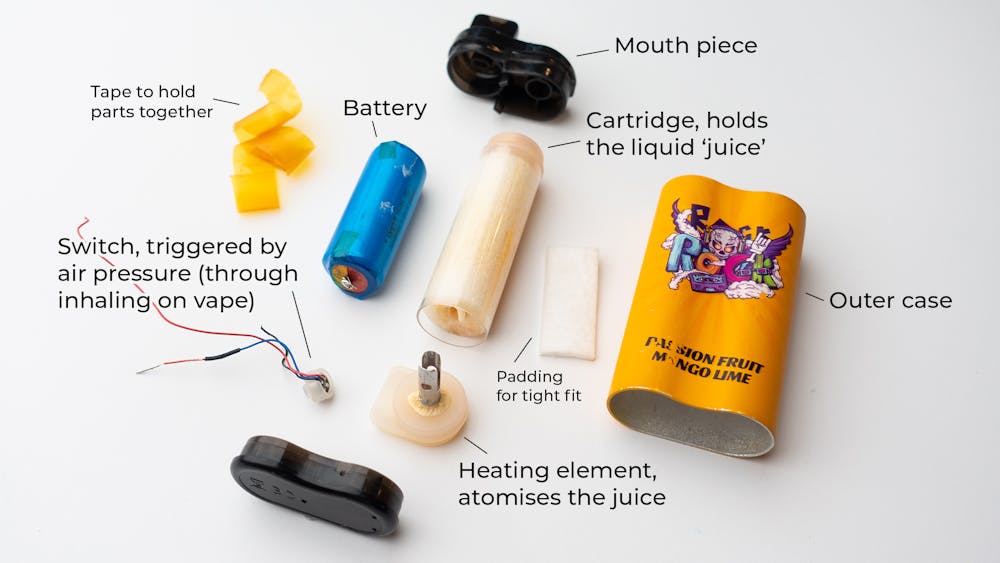
In their simplest configuration, single-use disposables have the common components found in all e-cigarette types. Vapes contain a battery, a pressure sensor (like a modified microphone), an LED light, a heating element and a reservoir with e-liquid (the “juice”).

When the sensor is activated by taking a drag on the device, the battery provides power to a heating element that vaporises or atomises the liquid.

Tearing down a single-use vape

Analogous to the study of anatomy, teardowns are a technique used by industrial designers and design engineers to systematically disassemble a product.

This allows us to identify and describe the internal components and their relationships within a product. It can provide useful information about materials, manufacturing processes, assembly and technology.

Equally, it can provide insights into repairability, upgradability and ease of disassembly for end-of-life recovery for potentially valuable or harmful materials.

We obtained a random selection of commonly found, depleted, single-use vapes to teardown, identify and describe what is inside.

A teardown of a vape.
Christopher Kidall Park

Housing

Disposable vapes are not designed to be disassembled. The main housing is made out of aluminium and covered in a paint finish and graphics, closed at the ends with plastic parts.

The vape housing is aluminium with plastic caps
Christopher Kidall Park

Once the housing end caps are removed, which is often not a straightforward task, the internal assembly slides out.

These internal parts are wedged or taped together within the main housing, and battery terminals are soldered to wires connecting to a pressure sensor and a heating element embedded in an e-liquid reservoir.

Battery

Despite disposable vapes being non-rechargeable, the ones we disassembled all contained a lithium battery. Although much smaller, they are not dissimilar to the bundles of batteries found in products like power drills and electric vehicles.

The 3.7V lithium battery. They should be recycled or disposed of in an electronics waste bin.
Christopher Kidall Park

These cells have high-power density: they can store lots of electrical energy in a relatively small package. This is needed to supply periodic bursts of energy to the heating element, and to outlast the supply of e-liquid in the reservoir.

All the batteries we tested during the teardown of depleted single-use vapes still maintained a charge that could power a test light bulb for at least an hour.

Pressure sensor

An air pressure sensor is a semiconductor switching device. Not unlike a microphone that converts vibrations into electrical energy, the pressure sensor detects a drop in pressure and closes an electronic switch.

The pressure sensor, with a small blue dust filter.
Christopher Kidall Park

This occurs during the action of taking a drag on the vape, which creates a partial vacuum within the device. When the switch is closed, a simple (short) circuit illuminates an LED and supplies current to the heating element.

Heating element: vaporiser

The heating element is embedded in a cap at one end of the e-liquid reservoir and connected to a wick. When the device is activated, an electrical current heats a metal strip that vaporises some of the volatile e-liquid.

The heating element, vaporiser.
Christopher Kidall Park

The e-liquid reservoir

Disposable vapes contain an absorbent foam material saturated with e-liquid and contained in a plastic tube with silicone endcaps.

In the centre of the reservoir is a wicking material that draws in the surrounding e-liquid to be in contact with the heating element.

The e-liquid itself contains a range of ingredients such as propylene glycol, nicotine and flavourings, many of them with unknown health impacts.

The heating element is embedded in the fluid cartridge. Different vape designs have larger or smaller cartridges.
Christopher Kidall Park

Designed for the dump

The consumption of vapes has been skyrocketing in recent years, and they now represent a significant proportion of an alarming new category of e-waste.

A bin full of vape parts

Christopher Kidall Park

Single-use e-waste results in a significant loss of valuable materials – notably aluminium and lithium.

Worse, when a disposable vape is thrown in the bin, the energy-dense lithium batteries pose a fire danger for waste management workers.

The materials in vapes also have toxic effects on the environment when released.

Having potentially valuable metals mixed with other, low-value materials such as plastic makes vapes difficult to separate and recycle. Overall, single-use vapes are clearly wasteful of resources and dangerous in the environment.

The Conversation

Miles Park does not work for, consult, own shares in or receive funding from any company or organisation that would benefit from this article, and has disclosed no relevant affiliations beyond their academic appointment.

ref. What’s really inside vapes? We pulled them apart to find out – https://theconversation.com/whats-really-inside-vapes-we-pulled-them-apart-to-find-out-233334

Latest polling shows UK Labour likely to win landslide at next week’s election, while Biden gains on Trump across the pond

Source: The Conversation (Au and NZ) – By Adrian Beaumont, Election Analyst (Psephologist) at The Conversation; and Honorary Associate, School of Mathematics and Statistics, The University of Melbourne

The United Kingdom general election will be held in a week, on July 4. Polls close at 7am AEST on July 5. The 650 members of the House of Commons are elected by first-past-the-post, in which the candidate with the most votes wins the seat.

In the UK, votes are not counted at individual polling places, but are instead transported to a central place for counting within that seat. This delays the results, so the vast majority of seats will be declared from late morning to mid-afternoon AEST on July 5.

The Guardian’s national poll tracker has Labour leading the Conservatives by just over 20 points. Vote shares are 41.3% Labour, 21.0% Conservatives, 15.5% for the far-right Reform, 11.1% Liberal Democrats and 5.8% Greens. Recent individual polls have Labour leading the Conservatives by 16 to 24 points.

In the last few weeks, there has been a surge for Reform and to a lesser extent the Lib Dems, at the expense of both Labour and the Conservatives. Labour’s lead over the Conservatives has been unchanged.

If these polls are replicated at the election, Labour will win a landslide, owing to the first-past-the-post system. The Guardian’s seat forecast is for Labour to win 424 of the 650 seats, the Conservatives 135, the Lib Dems 47 and the Scottish National Party (SNP) 19.

At the December 2019 election, Boris Johnson led the Conservatives to a thumping victory, as they won 365 of the 650 seats to 202 for Labour, on popular vote shares of 43.6% Conservative to 32.1% Labour. The Conservatives have governed in the UK since winning the 2010 election.

Under Johnson, the Conservatives led in the polls until late 2021, when there were many scandals about Johnson’s parties during COVID.

But it was not until Johnson was ousted as Conservative leader and PM, and replaced first by Liz Truss in September 2022 then Rishi Sunak in October 2022 that the Conservatives fell into a completely uncompetitive position that has them facing a landslide defeat next week. The Conservatives are likely to regret ousting Johnson.

In Scottish polls, Labour is ahead of the Scottish National Party by single-digit margins. In 2019, Labour won just one of 59 Scottish seats and the SNP took 48, after Labour finished third in vote shares behind the Conservatives and SNP. So, Labour will gain many seats from the SNP if these Scottish polls are correct.

In two seat polls of Clacton, Reform leader Nigel Farage has a double-digit lead over the Conservatives, so he should win Clacton.

US: Biden gains on Trump ahead of debate

The United States general election will be held on November 5. There will be a debate hosted by CNN on Thursday US time between Joe Biden and Donald Trump, which will occur at 11am AEST Friday. Trump is now 78 and Biden will be almost 82 by the election.

The FiveThirtyEight aggregate of national polls has Trump barely ahead of Biden by 41.0–40.9%, with 9.3% for independent candidate Robert F. Kennedy Jr. Trump led by one point two weeks ago.

However, the latest high-profile polls from Siena College for The New York Times and Quinnipiac University have Trump leading by three to four percentage points head-to-head, and more when third-party candidates are included.

Presidents are not elected by the national vote, but by using a state-based system where each state has electoral college votes equal to its federal House seats (population-based) and senators (always two). With two minor exceptions, states award all their electoral votes to the state’s winner. There are 538 total electoral votes, so it takes 270 to win.

FiveThirtyEight suggests Trump has clear leads in three states Biden won in 2020: Georgia, Arizona and Nevada. In three other Biden-won states (Michigan, Wisconsin and Pennsylvania), it’s close to tied. If Biden wins these three states, and doesn’t lose any electoral votes other than where Trump has leads now, he wins the election by a 270–268 margin.

In economic data, May was a good month for US workers as real (inflation-adjusted) earnings rose 0.5% in hourly terms and 0.4% in weekly terms, after drops in April. In the 12 months to May, real hourly earnings rose 0.8% and real weekly earnings rose 0.5%.

There was no change to headline inflation in May, and this was the lowest monthly inflation since at least May 2023. Core inflation was up 0.2% in May, its lowest monthly rate since at least November 2023.

The US uses two surveys for its monthly employment situation that sometimes give contradictory numbers. In May, the establishment survey suggested 272,000 jobs had been created, but the household survey
suggested 408,000 jobs were lost. Financial markets and economists believe the establishment survey is more accurate.

Far-right likely to win most seats at snap French parliamentary election

After dire results for his Renaissance party at the European parliament election on June 9, French President Emmanuel Macron announced a snap election for the French lower house, two years into a five-year term.

The 577 seats are elected by a single-member system in two rounds, on Sunday and July 7. The top two candidates in a seat, plus any others who receive at least 12.5% of registered voters (a high barrier as it factors in turnout), advance to the July 7 runoffs, where first-past-the-post is used. A candidate can withdraw before the runoffs. The overwhelming majority of runoffs will be two-candidate contests.

Polls have the far-right National Rally (RN) in the mid-30s, an alliance of four left-wing parties (NFP) that will run one candidate per seat in the high-20s, Ensemble (a coalition that includes Renaissance and other parties) at about 20% and the conservative Republicans at about 7%.

If the first-round results this Sunday reflect the polls, Ensemble will finish third in the large majority of seats, with the final two RN vs NFP. Poll forecasts of the runoffs suggest RN will win the most seats, but be short of a majority (289 seats are needed for this).

Ensemble had 249 seats going into this election, the NFP 149, RN 89 and Republicans 54. Seat forecasts have Ensemble winning about 100 seats, so this election is likely to be a disaster for Macron.

I covered these elections for The Poll Bludger on June 17 and June 24. My June 17 article also covered the left landslide at June 2 Mexican presidential and legislative elections, and the formation of a South African government after the May 29 election. My June 24 article covered the final European parliament results from the June 6–9 election.

Adrian Beaumont does not work for, consult, own shares in or receive funding from any company or organisation that would benefit from this article, and has disclosed no relevant affiliations beyond their academic appointment.

ref. Latest polling shows UK Labour likely to win landslide at next week’s election, while Biden gains on Trump across the pond – https://theconversation.com/latest-polling-shows-uk-labour-likely-to-win-landslide-at-next-weeks-election-while-biden-gains-on-trump-across-the-pond-232834

A funding boost for NZ’s drug-buying agency Pharmac to pay for cancer drugs is welcome – but it won’t solve underlying issues

Source: The Conversation (Au and NZ) – By Paula Lorgelly, Professor of Health Economics, University of Auckland, Waipapa Taumata Rau

Hagen Hopkins/Getty Images

This week the coalition government made a significant investment in Pharmac, increasing funding by NZ$604 million over the next four years.

In doing so, it delivered on a National Party election promise to fund 13 cancer drugs. Specifically, it will fund seven of those named during the election, while the remaining six will be replaced with “as good as or better alternatives”. In total, this will fund up to 54 new drugs, including 26 cancer drugs.

This announcement finally delivers hope to many cancer patients, profits to the pharmaceutical industry, and a sigh of relief for MPs who had been accused of breaking an election promise.

It also reinforces the integrity of the Pharmac process, but it won’t change the fact that access to medicines in New Zealand lags behind other similar countries.

How does the Pharmac process work?

Pharmac is an independent agency that makes decisions about whether pharmaceuticals, vaccines and medical devices deliver value to the New Zealand taxpayer. But these value decisions have to be made within the budget Pharmac is allocated each year.

Pharmac was one of the first health technology assessment agencies. It is internationally held in high regard for the low prices it can negotiate, in part because it manages its own budget.

If Pharmac thinks a drug or device is cost-effective but can’t currently afford it, it puts it on an options for investment list. This is essentially a waiting list that Pharmac will get to if it finds cost savings elsewhere when negotiating prices, or gets more government funding (as has just happened).

The drugs and devices on this list are ranked in order of priority using Pharmac’s factors for consideration. This process is confidential to ensure Pharmac can negotiate the best prices, because if a pharmaceutical company knew it was high on the list, it wouldn’t engage as effectively in price negotiations.

Crohn's and colitis patients and supporters march on the offices of New Zealand's drug buying agency Pharmac
A bowel cancer drug on Pharmac’s waiting list since 2019 will now be funded.
Lynn Grieveson/Newsroom via Getty Images

Benefits beyond cancer patients

Pharmac’s waiting list is heavily criticised. Some drugs, including those it will now fund, were added many years ago.

Among these drugs, for example, Cetuximab for bowel cancer was first submitted to Pharmac in May 2018 and placed on the list in December 2019. An application for Axitinib for kidney cancer was received in September 2013 and ranked in March 2014, and subsequently reranked in 2019, 2021 and 2022.

National had promised to reinstate the $5 prescription charge to pay for its 13 new cancer drugs (which were available in Australia in 2021 but not in New Zealand). That was estimated to bring in $280 million. So why is the government now paying $604 million?

The investment isn’t just paying for these cancer drugs. It would appear Pharmac is holding steadfast that its prioritisation of drugs delivers the most health benefit. My guess is that one of those cancer drugs the government wanted to fund sits at number 54 on the list. To fund it, the investment covers everything listed above it in the options for investment list.

It appears that while the National Party and the Cancer Control Agency Te Aho o Te Kahu said it was important to fund this cancer drug, there were other drugs considered more important and higher priority. Hence cancer patients will benefit but also people with infections, respiratory problems, osteoporosis, sexual health concerns, skin conditions, inflammatory conditions and mental health problems – an estimated 175,000 people in total.

The price of political meddling

Even more patients could benefit if the government had simply promised more money with no strings attached. During the election, Labour promised to increase Pharmac’s funding by $1 billion over four years. National promised an extra $724 million plus ring-fenced cancer drug funding.

Because the National Party chose to name these drugs, the suppliers will be less likely to engage in price negotiations. Providing more money without naming the drugs would have allowed for Pharmac to negotiate better, get a better price and use the latest investment to fund more than 54 drugs.

Despite this uplift in funding, drug availability in New Zealand still lags behind other similar countries. This will likely remain the case because Pharmac can only spend within its budget.

If we wanted greater access to pharmaceuticals, Pharmac would need much more money or we could change the process. Pharmac could simply make decisions and Health New Zealand Te Whatu Ora could fund it.

This is the model used by the UK’s National Health Service (NHS) and National Institute for Health and Care Excellence (NICE). NICE makes decisions that the NHS must fund from its health budget. Essentially, the opportunity cost falls on the wider health and care system.

An alternative to more drug funding

It is possible to improve population health by addressing the social determinants of health (80% of ill health is due to socioeconomic and environmental factors) or by improving access to primary and preventive care, so patients get diagnosed earlier, which is generally cheaper.

The goverment’s decision to repeal New Zealand’s smoke-free legislation and reduce funding for a new, more accessible cervical screening process will cause considerable harms and costs in terms of raising demand for lung and cervical cancer treatments. It is almost as if one coalition agreement giveth and another taketh away.

The discussion of how much funding Pharmac should get and how Pharmac makes decisions (including how long it takes) will continue. An educated guess suggests this latest investment means Aotearoa New Zealand now spends 6.5% of its health budget on pharmaceuticals and less than a third of this will be on oncology.

Isn’t it time to think about the 93% we spend in the rest of the health system and to make that more efficient and equitable?

The Conversation

Paula Lorgelly consults to Pharmac and has in the past consulted for the pharmaceutical industry. She receives funding from the Ministry of Health and the EuroQol Foundation. Paula is a member of the EuroQol Group which owns the EQ-5D instrument which is widely used in health technology assessments.

ref. A funding boost for NZ’s drug-buying agency Pharmac to pay for cancer drugs is welcome – but it won’t solve underlying issues – https://theconversation.com/a-funding-boost-for-nzs-drug-buying-agency-pharmac-to-pay-for-cancer-drugs-is-welcome-but-it-wont-solve-underlying-issues-233205

Achieving net zero with renewables or nuclear means rebuilding the hollowed-out public service after decades of cuts

Source: The Conversation (Au and NZ) – By John Quiggin, Professor, School of Economics, The University of Queensland

Steve Tritton/Shutterstock

Opposition Leader Peter Dutton’s plan to build seven nuclear power plants in Australia has attracted plenty of critical attention. But there’s a striking feature which has received relatively little discussion or criticism: the nuclear plants would be publicly owned and operated, similar to the National Broadband Network (NBN).

On the contrary, it received enthusiastic endorsement from free-market advocates such as The Australian’s Judith Sloan, who observed: “It’s how the French nuclear plants were first constructed.” It is also the way Australia built its biggest single piece of energy infrastructure, the Snowy Mountains Scheme.

But there’s a fundamental problem here. Over the last three or four decades the federal public service has been hollowed out in the name of “new public management”. This became very clear during the COVID pandemic, when state governments – who have preserved their ability to act far better – ran most of the response. There is a very real question over whether we have the governmental capacity to achieve net zero.

snowy mountains hydro scheme
The Snowy scheme took concerted effort from federal and state governments over decades.
Lasse Jesper Pedersen/Shutterstock

From NBN to National Nuclear Network?

Dutton’s acknowledgement of the publicly owned NBN as a model worth using is a welcome advance on the view of Malcolm Turnbull, one of his predecessors as Liberal leader.

A decade ago, then-prime minister Turnbull embarked on a disastrous “mixed mode” redesign of the NBN. This reflected his belief – expressed publicly after leaving office – that a publicly owned broadband network should never have existed.

Labor is in no position to oppose Dutton’s calls for public ownership. State Labor governments in Victoria and New South Wales have re-established publicly owned electricity enterprises, while South Australia’s Labor government has floated the same idea.

Whatever technological choices we make, it is clear our days of relying on the private sector to provide vital infrastructure are coming to an end. The question now is whether the public sector can recover to take the lead.

The National Energy Market, for instance, was meant to promote competition and drive electricity prices down. It has failed to do so, resulting in a string of government interventions, some more successful than others.

Arguably the biggest failed intervention was the now-defunct Energy Security Board, a politically driven response to South Australia’s statewide blackout in 2016.

The board sought to patch up the National Energy Market with a capacity market, which was immediately dubbed “CoalKeeper” due to incentives for old coal plants to keep going, as well as new grid access charges, promptly dubbed “Solar Stopper” due to discouraging new investment in solar. Energy experts did not favour this approach.

What proved more successful as a response to South Australia’s big blackout was the decision by the state government to fund the Horndale big battery, which was, when built in 2017, the world’s largest utility-scale battery storage.

fiber optic internet cable outside home
The publicly-owned NBN became a political football.
STRINGER Image/Shutterstock

Should new power be private or publicly owned?

Both major parties are flagging more intervention. The federal government has stopped waiting for markets to provide clean energy in favour of seeking tenders for new renewables through a capacity investment scheme. The scheme received 40 gigawatts worth of bids from renewable developers, far beyond the goal of 6GW.

This shift has come in response to developments bogging down, hampered by inadequate regulation and local opposition driven by a combination of genuine concerns about environmental impacts and culture-war driven science denialism.

Labor’s current renewables-led strategy requires 10,000 kilometres of new publicly built transmission lines, to meet our net zero goals. We’d need even more transmission if we are to become a major exporter of clean energy, either as electricity or in products such as green hydrogen and ammonia.

On the Coalition side, no private firm is likely to accept the risks involved in creating a nuclear power industry from scratch. Government would have to lead.

As Nationals leader David Littleproud has now acknowledged in relation to finding sites for nuclear plants, the national need for clean energy is too important to allow “not in my backyard” opponents – some with only a tenuous connection to the area in question – to slow or stop government plans.

If government is to lead, it must have the capacity

What Dutton’s nuclear gambit shows us is that, surprisingly, Australia’s two major political parties are in strong alignment on the need to rebuild state capacity.

Whether it’s Labor working to get transmission lines and offshore wind up and running or the Coalition working to create a nuclear industry from scratch, it will take a strong government with the capacity to articulate a plan, and the legal, financial and human resources to make it a reality.

All of these requirements were met when we constructed the Snowy Mountains Scheme, a decades-long federal government initiative undertaken in cooperation with Victoria and NSW.

Are they still in place? Not yet. Government capacity to act has been eroded over decades of neoliberalism. Particularly at the national level, public service expertise has been hollowed out and replaced by reliance on private consulting firms.

To rebuild the federal government’s capacity to act will require recreating the public service as a career which attracts the best and brightest graduates – many of whom currently end up in the financial sector.

The private sector still plays a central role in the construction of infrastructure, as was the case with the Snowy Scheme. But it’s up to governments to take the lead in finance and planning.

This poses particular challenges for the Liberal Party, which has long favoured the interests of businesses small and large, and has been historically opposed to public ownership. But from the late 1990s until relatively recently, Labor was also keen on privatisation.

The French Prime Minister Georges Clemenceau once observed that “war is too important to be left to generals”. As we are discovering to our cost, infrastructure investment is similarly too important to be left to private investors.

The Conversation

John Quiggin has undertaken consultancy work for unions and other groups supporting public ownership in the electricity industry.

ref. Achieving net zero with renewables or nuclear means rebuilding the hollowed-out public service after decades of cuts – https://theconversation.com/achieving-net-zero-with-renewables-or-nuclear-means-rebuilding-the-hollowed-out-public-service-after-decades-of-cuts-233107

Is drone delivery a modern miracle or a band-aid fix for poor urban planning? I went to Australia’s ‘drone zones’ to find out

Source: The Conversation (Au and NZ) – By Thao Phan, Research Fellow, Emerging Technologies Research Lab, Monash University

Wing

The chief executive of drone delivery company Wing says 2024 is “the year of drone delivery”. The company first went public in 2014 as a Google “moonshot” project and now operates in several cities in Australia, the United States and Finland, with plans to expand further.

Wing promises fast, cheap delivery of food and groceries at the touch of a button, with critics voicing concerns about personal intrusions such as noise and privacy. But what are the real challenges of having delivery drones in your neighbourhood?

To find out, I’ve been spending time in Australia’s “drone zones”, interviewing residents and local business operators in trial suburbs across Canberra and Logan in Queensland. It turns out noise and privacy aren’t their main problems.

Instead, people talked about larger, infrastructural issues – bad traffic, poor public transport, and other failures of urban planning – and how drone delivery is being proposed as a band-aid solution.

How does Wing work?

For customers, Wing works much like UberEats or Menulog: people place orders and pay via an app. On offer are lightweight, mundane items from various suppliers, such as takeaway coffees, sushi rolls and small supermarket goods.

What’s different is the delivery. A small autonomous drone with its own sensors and navigation system brings the package by air.

Photo of a man standing on a launchpad full of drones, attaching a box to a cord leading up
A package is loaded onto a hovering drone for delivery.
Wing

In community trials, delivery times have been incredibly fast. The average time is ten minutes, with the fastest-ever delivery – from order placement to arrival at the doorstep – taking 2 minutes and 47 seconds.

Wing conducted its first trials in the rural town of Royalla near the border of New South Wales and the Australian Capital Territory. Australia has been a test bed for its systems ever since.

In my research on drone delivery in Australia, I’ve been spending time in Canberra and Logan, observing the trials and interviewing locals about what life with drone delivery is actually like.

There were differing views on issues like noise and privacy. For instance, some people weren’t bothered by noise while others likened it to a “jumbo whipper snipper”. But of bigger concern was what Wing signalled for the future of urban planning and the viability of small business.

Sustainability that relies on cars and traffic

One of Wing’s strongest pitches to government and residents alike has been that its battery-powered drones offer a zero-emission, fast, sustainable solution to “last mile” delivery. In effect, Wing promises to take cars off the road by adding drones to the sky. However, its current business model relies on traffic congestion and poor urban planning.

The areas Wing has targeted have major infrastructural issues. While Wing may offer a quick fix for these problems in the short term, in the long term the company’s success relies on roads staying congested and neighbourhoods being unwalkable. This is a major red flag for these communities who would rather see a better transport system on the ground than more drone traffic in the sky.

From Wing’s perspective, according to a spokesperson:

Wing provides a useful service for people who live in areas that experience heavy traffic congestion […] We think drones are a better vehicle match for moving a small package when other efficient means aren’t available.

In my interviews with residents in Browns Plains (in Logan, south of Brisbane) and Gungahlin (in Canberra), our conversations would quickly turn from drones to poor public transport and roads:

Honestly, it’s terrible. We have buses that take an hour just to get to Woodridge. It’s literally a 13-minute drive down the road and it takes ages to get there. The traffic is always crap.

Parking was also a major complaint in these areas:

The planning of Gungahlin, it’s like things have just been added on. The huge growth in a lot of high-density buildings has made a huge difference to parking and things when people want to go shopping […] there’s not enough parking.

Abandoning small business in favour of big partnerships

In 2019, when Wing first landed in the city of Logan in Queensland, it partnered exclusively with local businesses. In theory, Wing would help these businesses reach new customers and “take [them] to new heights”.

This strategy was incredibly successful. Local hardware stores, coffee shops and grocery stores provided stock for Wing’s warehouses. In 2021, Wing declared Logan “the drone delivery capital of the world”.

But in 2022 Wing began to pivot to a model that was easier to scale up. Instead of stocking and supplying its own warehouses, or managing its own delivery app, Wing struck deals with big retail players including Coles and DoorDash.

Both customers and local businesses feel left in the lurch. As one resident told me:

The reason we started to go on there was, well, you can still support local. Get it delivered pretty cheap, and [there’s a] convenience factor. And then when they’ve taken everything off, like Boost [Juice] is probably the only one really that I use on there now, and that’s through DoorDash, not even through them direct.

Another business owner said he felt “ditched”:

They put an end date to it and said “We’re redoing the way we’re doing business.” […] They decided to cut their costs even though they’re owned by Google, they got a lot of money. They’re going to use the rooftop space from the big shopping centres and launch the drones from there and use the stock from Coles or whoever they were dealing with at the time.

Wing’s large partnerships also make it harder for small businesses to compete. A local neighbourhood shop cannot meet the expectation of ten-minute delivery, and delivery platform commissions of up to 15–20% will also cut into their margins.

A Wing spokesperson told The Conversation the company is offering delivery services to more small businesses than in the past, adding “68% of restaurants and merchants on the [Wing] marketplace are independent small businesses that aren’t affiliated with a national chain or brand”.

Long-term impacts

The picture emerging from my interviews shows drone delivery started out as a nice enough novelty, but potential long-term impacts on the liveability of neighbourhoods are becoming clear.

Wing’s innovations are not only technical – things like autonomous drones, physical infrastructure, and traffic management systems – but also social and regulatory. The partnerships with major retailers and property developers are no less significant, and the company is also involved in the development of new regulations and safety standards for drones. As a subsidiary of the multitrillion-dollar US tech conglomerate Alphabet (the parent company of Google), Wing has significant resources to throw at making sure its business succeeds.

Wing has said Australia represents the future for drone delivery. By listening to the stories of people who are already living with drone delivery, we can learn more about their risks and unexpected impacts.


Are delivery drones operating in your neighbourhood? Our team is collecting photos, videos and stories about what it’s like to live with drone delivery. Please make a contribution and help us understand what our future could be like.

The Conversation

Thao Phan is employed in the ARC Centre of Excellence on Automated Decision-Making & Society (ADM+S). Her research is funded by the ADM+S, the UKRI Bridging Responsible AI Divides Programme, and the Monash-Warwick Alliance Fund.

ref. Is drone delivery a modern miracle or a band-aid fix for poor urban planning? I went to Australia’s ‘drone zones’ to find out – https://theconversation.com/is-drone-delivery-a-modern-miracle-or-a-band-aid-fix-for-poor-urban-planning-i-went-to-australias-drone-zones-to-find-out-232977

Negotiating a new salary or a pay rise? Here’s what you need to know to succeed

Source: The Conversation (Au and NZ) – By Ray Fells, Professor of Negotiation, The University of Western Australia

Yuri A/Shutterstock

Almost half of all Australian workers are currently watching for or actively seeking a new job, according to a recent Gallup report.

High stress levels, murky work-life boundaries and the fact that pay packets don’t go as far as they used to can all become compelling reasons to look elsewhere. Many may be tempted by the promise of a higher salary.

Of course the grass isn’t always greener, and there may be ways to make your current job more fulfilling. This could include inviting your boss to have a discussion about increasing your pay.

But both landing a new job and chasing a raise internally can put you in the sometimes tricky position of negotiating how much you’re paid.

Fortunately, like many other kinds of negotiation, there are three key principles that will offer you a better chance of success.

Know what you want and why

First, it’s important to know exactly what you want and why you want it.

In the case of looking for a new job, your aspirations should be based on your future, not driven by what is wrong with the job you now have. In what way do you expect the jobs you are looking into to offer you more than your current position?

Researching the relevant levels of pay for similar roles in your industry can offer you a sense of what’s reasonable and suggest where to place the goalposts.

Close up of man gesturing with hands and work laptop screen
Preparation is key. Have a clear idea about exactly what you’re asking for and why.
Headway/Unsplash

Similarly, when seeking a pay rise, you shouldn’t just go in with vague hopes of being paid more.

It’s important to have a firm idea of how much more you’d like to be paid, and prepare a case for why – such as a recent improvement in performance or evidence of new responsibilities.

Step into the other person’s shoes

Important as your goals may be, any negotiation is two-sided. It is not only about what you want to achieve but what the other party wants, too.

This is the second principle of effective negotiation: other-directedness. Always negotiate from the perspective of the other party.

Imagine you are the other negotiator preparing to negotiate with you. Get to understand what they want, why they want it, what pressures might they be under and what constraints they might have to operate within.

Person seen facing away sitting in chair in front of another person
Considering the other party’s point of view can make you a stronger negotiator.
charlesdeluvio/Unsplash

Many organisations have a pretty firm salary and remuneration structure and it is unrealistic to think they are going to bust that structure wide open just to accommodate you. So be reasonable.

Just as importantly, you need to think ahead about what they are going to say in response to your request. What offer are they likely to put on the table – and what is then going to be your response? Plan for a range of different scenarios.

Focusing only on what you are initially going to ask for could see you lose control of the rest of the conversation.

Understanding the other party’s perspective puts you in a better position to present what you have to offer in a way that resonates with their goals. You may feel your extra effort should earn you a pay rise, but focus your request on the outcomes that have helped your employer achieve their goals.

Thinking about the other party also keeps your expectations more realistic. It’s important to set high goals, but if they are outside the other party’s ballpark, you might find yourself backing down or walking away empty-handed.

Have a solid backup plan

This leads us to the third principle of negotiation: knowing what you are going to do if you don’t get what you want.

A good alternative gives you confidence to restate your offer or claim even though the negotiator on the other side of the table has raised their eyebrows at it. Working out this alternative before you start negotiating is vital.

Depending on your circumstances, there may be a range of good alternatives when negotiating your salary for a new job. If you applied for multiple roles, you may be fielding other job offers. You’ll also often have the opportunity to just stay where you are.

Negotiating an internal pay rise might seem to have fewer tangible alternatives if it falls through. Disappointingly, you stay where you are and keep the salary you have.

But there are more ways to move yourself forward than just financially. For example, pursuing further accreditation, especially if subsidised or enabled by your employer, could help you stay motivated and improve your standing in future negotiations.

Closeup of hands working on laptop next to notepad
It’s important to plan out alternative options if things fall through.
Owlie Productions/Shutterstock

Remember, though, any negotiation is two-sided and the other party has alternatives, too.

In a job interview, if you have a rare set of skills and they have had a key employee suddenly leave, you could be well positioned to get a good outcome. Often, though, there will be someone else who can fill the vacancy and we might need the job more than they need us to fill it.

In that case, explore all the possibilities around salary – working arrangements, leave provisions and so on that will make the job more attractive to you. Before agreeing, always check that the prospect on offer is better than your alternative.

The Conversation

Ray Fells does not work for, consult, own shares in or receive funding from any company or organisation that would benefit from this article, and has disclosed no relevant affiliations beyond their academic appointment.

ref. Negotiating a new salary or a pay rise? Here’s what you need to know to succeed – https://theconversation.com/negotiating-a-new-salary-or-a-pay-rise-heres-what-you-need-to-know-to-succeed-233324

A woman who blindly conformed or feisty creator of her own story? What we know about the real Lady Jane Grey

Source: The Conversation (Au and NZ) – By Susan Broomhall, Director, Gender and Women’s History Research Centre, Australian Catholic University

Prime Video

History remembers Jane as the ultimate damsel in distress – known for her death, rather than her life. Fuck that! What if history were different?

So says the promo for My Lady Jane, an alternative history about Lady Jane Grey who was Queen of England, France and Ireland for little more than a week in July 1553.

This avowedly “alt-universe of action, history, fantasy, comedy and steamy romance” series, as the press release calls it, takes all sorts of liberties, but in some ways, it may be closer to the mark than we might imagine. These fictional women are almost as feisty as the historical Jane and her cousin, Mary, who would become Queen Mary I.

Jane has often been portrayed as a tragic figure. In this, the French painter Paul Delaroche has a lot to answer for. His 1833 visual melodrama, The Execution of Lady Jane Grey, remains a powerful image attached to her history.

Delaroche’s romanticised vision seemed to capture the pathos of a young woman blindly following expectations and sacrificed to dynastic politics – establishing its own influential alt-history.

A blindfolded woman being led to the cutting block.
Paul Delaroche, The Execution of Lady Jane Grey, 1833.
Wikimedia Commons

So what do we know about Lady Jane Grey?

The great-granddaughter of Henry VII and great-niece of Henry VIII, Jane had access to an unusually rich humanist education for a woman of her time and demonstrated an exceptional ability to make use of it, writing letters in Latin and Greek and learning Hebrew. This made her the talk of Protestant Europe.

For Jane, studying seemed an escape from the pressures of her parents. She told one scholar she found studying with her tutor a relief from being in the presence of an exacting mother and father, time when “I think myself in hell”.

Jane’s commitment to Protestantism saw her writing to one of continental Europe’s leading reformer, Zurich-based Heinrich Bullinger, before she was 14.

But Protestantism in England was under threat. By mid 1553, 15-year-old King Edward VI was dying. Edward’s heir was his Catholic, older half-sister Mary, who, if she were to reign, looked set to undo the Protestant kingdom.

At stake for Mary and Jane, two strong-willed women, were competing visions of faith for the kingdom of England. Under Mary, England would return to the Catholic Church. Under Jane, England would continue along the course of Protestantism, launched by her great-uncle Henry VIII.

Edward’s solution was to disinherit his sisters, and to pass the crown to Jane and her future male heirs.

But Edward’s draft plan for his succession suggests there was some uncertainty about whether placing Jane as queen was the right idea. After all, England had no history of successful ruling queens. He had first written that the crown would go to “L Janes heires masles”, and then amended it to read “L Jane and her heires masles”.

Handwritten text with crossings out
Edward VI’s ‘devise for the Succession,’ c 1553, written in his own hand.
Wikimedia Commons

When Edward died on July 6 1553, the letters patent issued regarding his will bore the signatures of more than 100 of the kingdom’s leading men. Supporters of the Protestant vision for England held almost all key positions of power.

On July 9, Jane, aged only 15 or 16, was informed of Edward’s death and her new status. On July 10, she was proclaimed Queen, signing herself “Jane the Quene” on official documents.

Handwritten letter
Letter of Lady Jane Grey, signed by her as `Quene’ at the top of the page. July 1553.
Wikimedia Commons

But Mary was not giving up. She had been gathering supporters in the days before Edward’s death. On July 10 she wrote to the Privy Council, England’s leading body of men advising the monarch, informing them she was queen and expected their obedience. She had gathered a large army behind her, and what likely sealed her success was the work of a faction combining Catholics and conservatives in the Privy Council who flipped the council’s allegiance to Mary.

Jane’s support rapidly collapsed. The kingdom’s powerful men must have weighed their prospects in the two regimes, and most could likely find a place to operate in either.

Winner takes all

As she took the throne, Mary needed a way to explain away Jane. She was to be tried for high treason, but she was also a relative.

A Jane misguided by others was a convenient version of history.

Oil painting.
Portrait of a 16th-century noblewoman, labelled as Jane Grey.
Wikimedia Commons

At first, Mary spared the execution warranted by the guilty verdict for both Jane and her equally youthful husband, Guildford Dudley. But further attempts at rebellion in January 1554, led by Jane’s father, pushed Mary to carry out the sentences.

Even then, Mary postponed Jane’s execution date to allow her time to convert to Catholicism. Jane refused, expressing her resolve for the same beliefs that had guided her decisions and actions.

On February 12 1554, Jane stood on the scaffold. She gave a speech that claimed both her innocence and her guilt.

Perhaps, as she saw Mary’s version of history increasingly take root, she wanted to assert her own.

And so we are left with a story of the tragic teen queen vs bloody Mary. As the promo says: “there is always power, if you know how to play the game” – and this game didn’t end with Jane’s death.

The Conversation

Susan Broomhall receives funding from the Australian and Swedish Research Councils.

ref. A woman who blindly conformed or feisty creator of her own story? What we know about the real Lady Jane Grey – https://theconversation.com/a-woman-who-blindly-conformed-or-feisty-creator-of-her-own-story-what-we-know-about-the-real-lady-jane-grey-232831

Planning a country escape these school holidays? 4 ways to avoid clogging up the emergency department

Source: The Conversation (Au and NZ) – By Katherine Riley, Lecturer, School of Nursing, University of Wollongong

Jason Vanajek/Shutterstock

Winter school holidays are either here or coming up, depending on where in Australia you live. Maybe you’re
planning a rural escape.

Rural tourism is crucial for job growth and sustainability of small rural towns. However, for rural emergency departments, school holidays are often the busiest times.

No-one plans a trip to the emergency department on holidays. But if you need health care, there are often other ways of accessing it than turning up at a rural hospital.

Here’s why it’s so important to leave rural emergency departments for life-threatening illness or injuries, and some other options for seeking care.

We’re short of doctors and nurses

The Australian Institute of Health and Welfare reports a significant shortfall of nurses and specialist doctors in rural towns compared with staffing levels in big cities.

This means many small rural emergency departments only have nurses on staff, with doctors on call or consulted remotely from a larger hospital.

In a study published earlier this year, my colleagues and I discovered this dynamic was especially challenging for rural emergency nurses when critically ill patients presented.

One nurse told us:

We need more staff. I mean, I look at these emergency TV shows, and you see them in Kings Cross at the big hospitals there or overseas, they get a phone call […] there’s a resus coming in. Everyone’s standing around the bed with all their signs on, the airway/circulation/team leader […] and here, we have two people. It’s just so different. It’s just a false sense of reality. It’s ridiculous.

So emergency departments should be used for emergencies only. These include:

  • sudden collapse
  • chest pain or pressure lasting more than ten minutes
  • breathing difficulty
  • serious mental health condition
  • uncontrollable bleeding.

When emergency departments are used responsibly, this can reduce the pressure on staff. It ensures the most seriously ill receive the care they need promptly.

What are my alternatives?

Here are four ways you and your family can be better prepared for your rural holiday and avoid an unnecessary visit to the emergency department.

1. Pack your scripts and medical history summary

Bring essential scripts and medications with you. This reduces the need to visit the local emergency department and ensures you have what you need during your stay.

Do you have a chronic condition or have had a recent illness or surgery? Make sure you speak to your GP before you go. They can provide a medical health summary that includes your recent treatments and medications. Alternatively, if you have access to My Health Record, ask your GP to prepare a shared health summary and upload it to your record. If you need medical care, this summary will assist in a timely assessment.

2. Call Healthdirect, NURSE-ON-CALL or 13HEALTH depending on where you are

Healthdirect is a 24-hour telephone health advice line (known as NURSE-ON-CALL in Victoria or 13HEALTH in Queensland). By calling the relevant number, you will be connected to a registered nurse who will ask a series of questions and provide evidence-based advice and guidance. The Healthdirect website also offers an interactive symptom checker to advise whether you should see a GP, go to an emergency department, or manage your symptoms at home (or in this case, on holidays):

3. Need a GP? How about GP telehealth services?

For minor health concerns or non-urgent issues, GP telehealth services are a remote-access option that can be used when away from home. Before you go away, check with your GP to see if they offer a telehealth service.

4. Go to an Urgent Care Clinic

The Australian government has funded the opening of Urgent Care Clinics across the country. These clinics provide medical assessment and care for urgent illnesses or injuries. They have been created as a solution to divert people away from busy emergency departments. But these Urgent Care Clinics are not suitable for people experiencing emergency or life-threatening conditions.

Urgent Care Clinics are ideal for illnesses and injuries that would require urgent treatment such as gastroenteritis, minor infections, lacerations and back pain. Check here to find your closest clinic.


Please keep the emergency department for life-threatening illnesses or injuries, and if needed, call 000 for an ambulance immediately.

Katherine Riley is affiliated with CRANAplus, the peak professional body for Australia’s remote and isolated health workforce.

Rebekkah Middleton does not work for, consult, own shares in or receive funding from any company or organisation that would benefit from this article, and has disclosed no relevant affiliations beyond their academic appointment.

ref. Planning a country escape these school holidays? 4 ways to avoid clogging up the emergency department – https://theconversation.com/planning-a-country-escape-these-school-holidays-4-ways-to-avoid-clogging-up-the-emergency-department-232262

Australians will soon only be able to buy vapes from pharmacies. Should New Zealand follow suit?

Source: The Conversation (Au and NZ) – By Janet Hoek, Professor of Public Health, University of Otago

Getty Images

Australia will become the first country to restrict vape sales to pharmacies from next week. This new policy represents a very different approach to the path Aotearoa New Zealand is taking, and includes some important steps.

First, it recognises that to benefit population health, vaping products should not be treated as everyday consumer items.

Second, it introduces a distribution system that moves away from the commercial, profit-driven approach currently operating in New Zealand. Pharmacists are highly trained health professionals. Unlike general retailers who are not trained to understand addiction, pharmacists can advise people transitioning from smoking to vaping and support vaping cessation.

Third, pharmacists’ comprehensive code of ethics provides a further incentive to avoid supplying vaping products to underage people.

Should New Zealand follow Australia?

Our research with young people found they quickly identified “dodgy dairies” with lax age verification procedures. Unlike these outlets, pharmacists would face professional sanctions if caught supplying underage youth.

So, should New Zealand adopt Australia’s approach?

Limiting the supply of vaping products is a key measure in reducing uptake among young people. However, we are troubled that Australia will be regulating vaping products more stringently than smoked tobacco, which causes more serious physical harms.

New Zealand’s government has signalled stricter regulation of vaping products, yet it recently repealed a law regulating smoked tobacco products stringently.

We strongly support protecting young people from taking up vaping. However, policies should be both comprehensive and proportionate, and must greatly reduce the appeal, addictiveness and availability of smoked tobacco as well as vaping products.

History of inadequate nicotine product regulation

Although vaping offers people who smoke a less harmful alternative to tobacco, it is not harmless. Many people who have never smoked regularly now vape. Overall, nicotine use among young people has risen.

Rates of daily vaping among people aged 15–17 have increased from under 1% in 2017–18 to more than 15% in 2022–23. This increase is causing considerable concern among parents, teachers, health researchers, community workers, policy makers and young people themselves.

Young people vape more and use more nicotine.
Getty Images

New Zealand regulators initially responded by limiting the vape flavours general retailers could sell to tobacco, menthol and mint. However, the nicotine marketplace has evolved more rapidly than the policies regulating it.

The advent of “pod” vapes in 2019 and disposables in 2020 brought in very cheap, attractively packaged products with high nicotine concentrations. Specialist vape retailer numbers exploded. Not surprisingly, uptake in youth vaping quickly accelerated.

Vaping manufacturers rapidly circumvented recent efforts to limit availability of disposable vapes. Low-cost disposable vapes remain widely available, despite new requirements for removable batteries.

Measures restricting specialist vape stores from operating within 300 metres of schools failed to have a marked impact, likely because they neither applied retrospectively nor included general retailers in their ambit.

Additional measures to protect children from product marketing have limited the concentration of nicotine vapes may contain, restricted flavour descriptors and disallowed use of cartoons on packaging.

It is too early to assess what effect these changes have had. However, a recent mystery shopper test found variable compliance with these policies.

Despite Prime Minister Christopher Luxon declaring before the 2023 election that he was “up for” looking at a complete vaping ban, the coalition government has not extended all measures introduced by the previous Labour government. Exceptions include increasing penalties that may be imposed on retailers and committing to more intensive monitoring.

A call for proportionate policies

Before the government’s unpopular repeal of New Zealand’s smokefree generation law, New Zealand had adopted a proportionate approach to nicotine products.

Innovative regulation such as retailer reduction and denicotinisation was expected to lead to plummeting use of smoked tobacco, the most harmful product. At that point, moving vaping products from a commercial supply model to a health-promoting model would have been logical.

Hansard records associate health minister Casey Costello as stating that repealing the policy to limit the number of retailers was not an “end position”. She explained:

We’re removing this legislation because we’re repealing the legislation that’s in there. As I said, it’s not an end position.

While the minister’s meaning is not completely clear, her comment indicates she may consider legislation proportionate to product risk in the future.

In the interim, we recommend disallowing vaping product displays in all general retail outlets and ensuring specialist vape stores displays are not visible to the general public.

Establishing robust limits on proximity and density could drain vape store swamps and ensure vapes are not easily available near schools. Disallowing discounting and giveaways of all nicotine products and introducing plain packaging would also reduce these products’ availability and appeal to children, and bring vaping product regulation in line with tobacco policy.

Given the minister’s stated willingness to consider reducing the availability of smoked tobacco, we strongly recommend she reintroduce the evidence-based, proportionate measures she had no mandate to repeal.

Janet Hoek receives funding from the Heatlh Research Council and NZ Cancer Society; she has previously received funding from the Royal Society Marsden Fund. She is a member of several advisory committees, including the Health Coalition Aotearoa, and international government and NGO groups.

Jude Ball receives funding from the Health Research Council and has previously received funding from the Marsden Fund (Royal Society of New Zealand), the Health Promotion Agency and the Cancer Society. She is affiliated with ASPIRE Aotearoa and the Adolescent Health Research Group, and is an active member of the Public Health Association of New Zealand.

ref. Australians will soon only be able to buy vapes from pharmacies. Should New Zealand follow suit? – https://theconversation.com/australians-will-soon-only-be-able-to-buy-vapes-from-pharmacies-should-new-zealand-follow-suit-233204

Devastating coral bleaching will be more common, start earlier and last longer unless we cut emissions

Source: The Conversation (Au and NZ) – By Camille Mellin, Senior Lecturer and ARC Future Fellow, School of Biological Sciences, University of Adelaide

Sarah_lewis/Shutterstock

Coral bleaching is becoming much more common as a result of increasingly severe and frequent marine heatwaves. Four global mass bleaching events have happened since 1998. Two of these were in the past decade.

Unless greenhouse gas emissions are cut to slow global warming, our new research shows that, by 2080, coral bleaching will start in spring, rather than late summer. Some events will last into autumn. The Great Barrier Reef’s maximum annual heat stress will double by 2050 if emissions do not slow.

Marine heatwaves stress corals, which then expel the symbiotic algae living in their tissue. These corals are left white and weakened. While not all bleached corals die immediately, prolonged heat stress harms their health and reproduction.

Our research used daily data on sea surface temperatures (instead of monthly data that models typically use) and supercomputing to produce high-resolution projections of marine heatwaves. We showed the risk of coral bleaching will be greatest along the equator. That’s also where the most biodiverse coral reefs are found.

Coral reefs cover only 1% of our oceans, but host at least 25% of all marine species. More than half a billion people worldwide depend on coral reefs for food.

So coral reefs are vital for the health of the ocean and people. They are also among the ecosystems most at risk from climate change.

Longer bleaching season will hit spawning

The US National Oceanic and Atmospheric Administration monitors marine heatwaves globally. Seasonal coral bleaching alerts are based on this data. Predicting coral bleaching risk over entire decades has proved much more challenging.

Recent improvements in climate modelling now allow marine heatwaves and coral bleaching risks to be predicted with high accuracy. Using daily projections of heat stress from many global climate models, we show the severity and duration of coral bleaching will soon reach uncharted territory.

By mid-century coral bleaching is expected to start in spring for most of Earth’s reefs, rather than late summer as is typical today. In equatorial regions, corals will be at high risk of bleaching all year round by the end of the century.

In many regions, corals spawn only once a year. These spectacular mass spawning events happen in a single week following a full moon in spring.

By 2040, this spawning event could coincide with severe bleaching risk. This would greatly reduce their reproductive success, causing large-scale coral loss.

Acropora coral spawning on Magnetic Island in Queensland, Australia.
Coral Brunner/Shutterstock

Equatorial regions most at risk

We show the future risk of severe coral bleaching is uneven globally.

The greatest risk is along the equator. Equatorial regions are home to the most biodiverse coral reefs, including conservation hotspots such as the Coral Triangle. To make matters worse, marine life in these regions is particularly vulnerable to accelerated climate change.

Many equatorial species are already living at temperatures near their upper tolerance. They also generally have low abilities to move to track shifting climates. This leaves them at high risk of extinction.

Future risk of coral bleaching under a high-emission scenario (top) and benefit from climate mitigation (bottom).
Adapted from Mellin et al. Science Advances 2024

Our research shows equatorial regions are set to benefit least from efforts to curb emissions. We expect significant emission cuts will reduce the annual duration of severe bleaching conditions in all areas except these regions.

The projected highest climate impacts coincide with highest social reliance on coral reefs. This will challenge human populations that rely heavily on their local reefs for their livelihoods and nutrition.

Improving coral reef management

Our research identifies Earth’s reef regions that are at lowest risk of increased bleaching. This will help conservation managers and policymakers prioritise efforts to limit loss of coral reef biodiversity.

We predict much less risk of coral bleaching in regions such as the northern coasts of Venezuela and Colombia, Socotra Island (opposite the Gulf of Aden) and Alor Kecil in Indonesia. Seasonal upwellings occur here, bringing cooler water to the surface that’s likely to limit the severity of heatwaves.

Identifying these future havens for coral reefs will help maximise the success of coral conservation strategies such as assisted evolution, coral restoration or transplantation.

These strategies can help maintain healthy coral populations at local scales, particularly if used on reefs where future climate impacts will be lower. By pinpointing these havens, our research will strengthen coral conservation.

Our research includes a user-friendly web-based tool for mapping future coral bleaching. It will help pinpoint locations for effective management interventions.

Curbing greenhouse gas emissions is the main solution to reduce future climate impacts on corals. However, other strategies are also vital to maximise coral reefs’ adaptation to climate change.

Camille Mellin receives funding from the Australian Research Council and the University of Adelaide’s Environment Institute.

Damien Fordham receives funding from the Australian Research Council.

ref. Devastating coral bleaching will be more common, start earlier and last longer unless we cut emissions – https://theconversation.com/devastating-coral-bleaching-will-be-more-common-start-earlier-and-last-longer-unless-we-cut-emissions-232473

Our ‘frog saunas’ could help save endangered species from the devastating chytrid fungus

Source: The Conversation (Au and NZ) – By Anthony Waddle, Schmidt Science Fellow in Conservation Biology, Macquarie University

Anthony Waddle

All over the world, frogs are being wiped out by the chytrid fungus. At least 500 species have declined, including as many as 90 species now presumed extinct.

This catastrophic and ongoing biodiversity loss surpasses the devastation wrought by other notorious invasive species such as cats, rats and even cane toads. Short of removing species from the wild and treating them in captivity, few strategies exist to deal with the chytrid threat.

Our new research, published today in the journal Nature, offers a promising option.

Outbreaks of chytrid (pronounced “KY-trid”) are more common in cold winter months – just like seasonal human flu. We found a way to combat these winter outbreaks using heat. Our purpose-built “frog saunas” allow affected amphibians to warm up and bake off their infections. They are so simple you can build a frog sauna using supplies from the hardware store.

Why should we care about frogs?

If frogs’ good looks are not enough for you to care about their welfare, perhaps learning how they contribute to the environment or human health will pique your interest.

Frogs eat insects that carry and spread human diseases. Their skin is also a rich source of new medicines that could help us combat antibiotic-resistant “superbugs” or curb the startling increase in opioid addiction.

The frogs themselves are food for many predators, including humans.

Often starting life as a tadpole eating algae, before morphing into a carnivorous adult, frogs carry energy from aquatic ecosystems onto land – where it can be transferred throughout the food web. So losing a single frog species can have serious flow-on effects.

The green and golden bell frog has declined from more than 90% of its former range since the chytrid fungus arrived in Australia.
Anthony Waddle

The origin and spread of chytrid

It’s likely the chytrid fungus originated in Asia, where the pathogen seems to coexist with native amphibians. But chytrid is deadly elsewhere, possibly because other frogs have no natural defences.

Chytrid harms frogs by disrupting the integrity of their skin, depleting electrolytes needed for heart function. Infected frogs can die of cardiac arrest.

Chytrid has spread worldwide through the trade of amphibians, becoming a seemingly permanent part of ecosystems. As eradicating chytrid from the wild is not possible, we need a way to help frogs battle infection.

Chytrid: the frog-killing fungus, featuring Associate Professor Lee Berger (Australian Academy of Science)

Introducing frog saunas

Research has shown chytrid is worse in winter. My colleagues and I wondered whether, if frogs had access to warmth during winter, could they fight off infection?

The fungus can’t tolerate high temperatures, so if we gave frogs a place to stay warm – even for a few hours a day – perhaps they could survive and recover.

We tested this idea, both in the laboratory and in outdoor experiments.

First we established that endangered green and golden bell frogs will select temperatures that reduce or eliminate chytrid infections, when given the opportunity.

Then we conducted experiments in the lab, with 66 infected frogs. The group given the option of choosing the temperature they liked best rapidly cleared their infection. The group placed in a set, warm temperature also cleared their infection, but it took longer. The low-temperature control group remained infected.

Next, we wanted to see what would happen if frogs that cured infections with heat would still get sick. Or were they immune? The group of 23 heat-cured frogs were 22 times more likely to survive the second infection than the 23 frogs that were heat-treated but not previously infected. So frogs cured with heat acquire resistance to future infections.

Finally, we wanted to see if this could work in a natural setting. We ran outdoor experiments with 239 frogs. Half were infected with chytrid one week before the experiment began. Then they were placed in enclosures with artificial structures that heat up in the sun, called “frog saunas”. But the frogs could choose from shaded and unshaded areas, with or without saunas.

We found frogs flocked to the sunny saunas, heated up their little bodies, and quickly fought off infection. Think of frog saunas as little factories that pump out healthy, chytrid-resistant frogs.

The frog saunas could be used on a wider scale. We believe they would be best suited to supporting populations of Australian green and golden bell frogs, but they could be useful for other species too.

The saunas are made of inexpensive materials that can be found at your local hardware store, making them accessible to the general public and wildlife managers alike.

We are already building shelters at Sydney Olympic Park, working with Macquarie University and the Sydney Olympic Park Authority. The park is home to one of the largest remaining populations of green and golden bell frogs.

Frog saunas have been set up to support a wild population of frogs in Sydney.
Anthony Waddle

Want to get involved?

You can become a citizen scientist and help save frogs from extinction. Start by downloading the FrogID app to learn how frogs are faring. Record frog calls with the app for scientists to identify them. This helps provide valuable data for frog conservation.

Build a frog sauna for your backyard, to help keep them healthy through winter.

It’s essentially a brick-filled greenhouse, warmed by sunlight. All you need is some common clay ten-hole masonry bricks, black paint and cable ties – and a little greenhouse to put the sauna inside.

Changing the fate of frogs

Since the discovery of chytrid more than 25 years ago, the pathogen has been a seemingly insurmountable challenge to endangered frog conservation. Now, we have developed a promising, inexpensive and widely applicable strategy to combat chytrid.

Amphibians are such a diverse group that no single approach will be suitable for all species. So this is no silver bullet. But a useful tool for even one threatened or endangered species is cause for optimism.

The concept could also be applied to other wildlife diseases, where differences between the physiology of the host and pathogen can be exploited.

Anthony Waddle received research funding from the Holsworth Wildlife Research Endowment, the Frog and Tadpole Study Group of New South Wales, the Royal Zoological Society of New South Wales, the Australian Research Council, Macquarie University, the University of Melbourne, and CSIRO. Anthony was supported by scholarships from the University of Melbourne and the American Australian Assocation. He is currently supported by a fellowship from the Schmidt Science Fellows, in partnership with the Rhodes Trust.

ref. Our ‘frog saunas’ could help save endangered species from the devastating chytrid fungus – https://theconversation.com/our-frog-saunas-could-help-save-endangered-species-from-the-devastating-chytrid-fungus-231605

Why won’t my kids listen to me? A psychologist explains

Source: The Conversation (Au and NZ) – By Cher McGillivray, Assistant Professor Psychology Department, Bond University

Ketut Subiyanto/Pexels , CC BY

Have you ever asked your child to do something simple but no matter how many times you ask, they keep ignoring you?

For example, on a school morning you may call out, “Sarah, put your shoes on. We have to go!” as you are trying to finish an email, clean up breakfast dishes and make it to work on time yourself.

You get no answer and no signs of shoe wearing. So you repeat it, this time a little louder and then again. You finally get a frustrated response from your child: “but I can’t find my shoes!”. And so you yell back, “well you should have had them organised last night like I told you!” Yet again, you are all starting the day stressed.

You may find yourself wondering why it seems your kids listen to their teachers, coaches, friends’ parents … basically anyone else but you.

Why is this? And how can you talk to your child so they listen?

Your child’s development and their ability to listen

As a starting point, it may help to understand children don’t have the same capacity to listen as adult. Or the same capacity to care about what you are asking them.

Children between two and seven are naturally ego-centric.

This means they think mostly about themselves and their immediate needs. They are not are likely to to be able to take on other people’s perspectives. So they don’t care that if they muck around and don’t put their shoes you might miss your important 9 o’clock meeting.

Around 13, the brain starts to change. Research shows teenagers start to find voices that are not from their family more interesting. This is part of growing up, preparing them for life beyond their family.

This marks a significant shift from younger children, whose brains are primarily attuned to prioritise their parents’ voices. But it also means when you ask your adolescent to unpack the dishwasher before they leave for school, they are less likely to think it is important.

This situation can be made more complex if a child is neurodivergent and has issues with attention or taking on new information. Or if they have hearing issues.

Teenagers start to value other voices, away from their parents.
Karolina Grabowska/Pexels, CC BY

Why do they listen to their teacher but not me?

Kids also tend to be more comfortable with their parents than any other adults. So they know they can zone out from us and we will still love them.

This is not the same with a school teacher, netball coach or other adult they are less familiar with. There are extra factors working in a teacher’s favour (although teachers will tell you, students do not listen all the time).

Schools have a structured approach that naturally enforces rules and consistency. For examples, bells ring to signal the start of the day, the teacher stands at the front of the class to signal the start of a lesson. Teachers are also trained in how to teach as well as skills to manage classroom dynamics effectively.

Peer pressure – and the desire to fit in – can also work in a positive way here, too. If all the other kids in the class or soccer team are doing what they are told, other kids are likely to follow suit.

Communication is not just talking

So there are some things stacked against us as parents. But there are things we can do to approach this parent-child dynamic differently.

According to psychologist Albert Mehrabian’s model of communication, only 7% of our feelings and attitudes are conveyed through the words we use in spoken communications. He suggests 38% is via tone and voice and the remaining 55% is conveyed through body language.

So when our children are not speaking back, they are still communicating with us. They could be doing this via facial expressions, posture and hand gestures. These can all give us clues to help us connect and communicate with them.

For example, their silence may mean, “I can’t find my shoes. But I’m worried I might get in trouble” Or it could mean, “I don’t want to go to school today”. Or, “I am finding this drawing I am doing really fun and I don’t want to stop”.

Just because a child is not speaking does not mean they are not saying anything to you.
Pixabay/Pexels, CC BY

What can you do differently?

So if Sarah has not responded or appeared with her shoes on, instead of yelling out again, you could try going and finding where she is. Crouch down to her level, make eye contact and with a smile, ask if she has any ideas where her shoes are? Would she like some help?

Where you can, it is important to give children choice, so they feel like they have some control over their life.

You are also being what psychologists call a “trustful parent” here. You are signalling to your child they are competent and their opinion matters. You are supporting them to find their lost shoes (rather than fighting against them).

Tips for getting your child to listen

There are also some things we can do as parents to stack the odds in our favour:

  • try not to communicate when we are distracted or on the go. This is more likely to result in a calm and gentle instruction or request to your child. If children feel like they are “in trouble” they can go into a defensive mode and zone out

  • keep your instructions simple and achievable. Break things down if needs be

  • thank your child for doing things.

In the meantime, keep observing the world through their eyes. This may not always result in them doing what you ask, when you ask it. But hopefully it will mean less parental angst for you and your child will also feel heard.

Cher McGillivray does not work for, consult, own shares in or receive funding from any company or organisation that would benefit from this article, and has disclosed no relevant affiliations beyond their academic appointment.

ref. Why won’t my kids listen to me? A psychologist explains – https://theconversation.com/why-wont-my-kids-listen-to-me-a-psychologist-explains-231831

Politics with Michelle Grattan: Chris Bowen on ‘calling out’ claims about the energy transition’s cost

Source: The Conversation (Au and NZ) – By Michelle Grattan, Professorial Fellow, University of Canberra

The climate wars have been reignited with the Coalition’s release of its controversial plan for nuclear power, an option totally rejected by the government.

Meanwhile, a report this week from the Australian Energy Market Operator (AMEO) has indicated the government needs to speed up efforts in what has become a challenging energy transition.

Minister for Climate Change and Energy Chris Bowen joins the podcast to discuss the issues.

On the cost of the energy transition, which the opposition has claimed will be between $1.2 trillion and $1.5 trillion, Bowen says

Today the Energy Market Operator released their latest Integrated Systems plan. It has the updated cost – $122 billion. That’s the system-wide non-customer owned cost of renewable energy generation, transmission and storage.

Now let’s just call it out. The opposition goes around saying, oh it’s $1.2 trillion. They’re are utterly misquoting and misrepresenting a report which was about the cost of net zero across the entire economy, not just electricity, which is what we’re talking about, but industry, transport, agriculture, everything and that’s to get to net zero by 2050, which they allegedly sign up to.

If you’re asking what’s the cost of getting […] our electricity sector to 82% renewables by 2030 and then net zero by 2050, what we’re talking about is that figure in the Australian Energy Market report.

Labor has faced some criticism over mocking the Coalition’s nuclear plan.

Bowen says

the basis of a mature debate must be facts, and the opposition should be putting more facts out there about their policy.

The reason I’m so firmly against nuclear energy for our country is that it doesn’t stack up. It’s economically irrational and for the alleged party of free enterprise to admit that no private sector investment is going to come in to do nuclear, so therefore, they have to set up a government monstrosity to run it.

On Julian Assange’s return to Australia, Chris Bowen says

I think this is a very good outcome. I don’t support what he did all those years ago, but I think he should be free.

The prime minister’s been very modest about claiming any credit, and I understand why, but I just want to say, from the prime minister, the foreign minister, ambassador Rudd, and High Commissioner Smith – I think they played a blinder in working behind the scenes.

The Conversation

Michelle Grattan does not work for, consult, own shares in or receive funding from any company or organisation that would benefit from this article, and has disclosed no relevant affiliations beyond their academic appointment.

ref. Politics with Michelle Grattan: Chris Bowen on ‘calling out’ claims about the energy transition’s cost – https://theconversation.com/politics-with-michelle-grattan-chris-bowen-on-calling-out-claims-about-the-energy-transitions-cost-233357

Julian Assange is free, but curly legal questions about his case remain

Source: The Conversation (Au and NZ) – By Holly Cullen, Adjunct Professor in Law, The University of Western Australia

Today Julian Assange walked out of the Federal Court Building in Saipan, North Marianas Islands, a free man. He pleaded guilty to one count of breaching the US Espionage Act.

With the court accepting his 62 months already spent in Belmarsh Prison as a sufficient sentence, he has no more case to answer, and no more sentence to serve.

However, this case leaves behind it a trail of unanswered legal questions and unresolved controversies. In particular, there are questions of fundamental human rights that can only now be addressed in future cases, if ever.

Can freedom of speech concerns stop extradition?

Once Assange had formally pleaded guilty, the US government’s lawyers announced they would immediately withdraw the request to extradite Assange from the UK.

That means the appeal that would have been heard later this year will not go ahead.

To recap, in May the UK High Court gave Assange the right to appeal the UK Home Secretary’s order for his extradition. This was granted on two grounds, both related to free speech.


Read more:
Julian Assange plea deal: what does it mean for the WikiLeaks founder, and what happens now?


The first ground of appeal accepted by the court was that extradition would be incompatible with Assange’s right to freedom of expression, as guaranteed in the European Convention on Human Rights.

The second ground, related to the first, is that he would be discriminated against on the basis of his nationality because he could, as a non-citizen of the US, be unable to rely on First Amendment freedom of speech rights.

But as this appeal is no longer proceeding, the issue of whether a threat to the accused’s freedom of expression can stop extradition will therefore not be argued or decided. The European Court of Human Rights and other human rights bodies have never addressed this point. It’s unlikely to arise again soon.

An espionage precedent?

Also on freedom of expression, the relationship between the US Espionage Act and the First Amendment of the US Constitution remains an open question.

In today’s pleadings, Assange and the US government took different views on whether the exercise of freedom of expression should constitute an exception to the offences under the Espionage Act. Nonetheless, Assange accepted that no existing US case law established such an exception.

This leads to the question of whether today’s guilty plea establishes a precedent for prosecuting journalists for espionage.

In the strict legal meaning of precedent in common law, which refers to a binding judicial interpretation, it does not.

The judge made no determination on whether Assange or the US government was legally correct. However, the US government can now point to this case as an example of securing a conviction against a journalist under the Espionage Act.

The question of how much a non-national of the US can rely on the First Amendment likewise continues to be on the table. This issue would also have been addressed in the extradition appeal, as a question of whether Assange would be discriminated against on the basis of his nationality.

Detention or confinement?

Finally, today’s hearing revived the question of whether the time Assange spent in the Ecuadorian embassy between 2012 and 2019 counts as detention.

As the judge moved to determine whether the sentence of “time served” was a sufficient penalty for his offence, the US government insisted the judge could only consider the 62 months in Belmarsh.

Assange’s lawyers argued he had been detained for 14 years, including the period claiming asylum in the Ecuadorian embassy. In 2016, the UN Working Group on Arbitrary Detention found Assange was arbitrarily detained in the embassy, largely because of the disproportionate length of time between his initial arrest and the date of the working group’s opinion, over five years.

The UK and Sweden both rejected the working group’s findings, which they do not regard as binding. Furthermore, the findings went beyond the established case law on arbitrary detention, which usually focus on issues of legality and fair process rather than duration. Only the dissenting member of the Working Group analysed the impact of Assange’s voluntary conduct on the length of his stay in the embassy.


Read more:
Julian Assange has been in the headlines for almost two decades. Here’s why he’s such a significant public figure


In today’s hearing, the judge referred to Assange’s “14-year ordeal” but accepted the time in Belmarsh alone was sufficient penalty. The judge considered this period, just over five years, comparable to the seven years served by Chelsea Manning, who had provided the documents to Assange.

It is also worth noting that Australia’s Deputy Prime Minister Richard Marles, speaking on ABC Radio National, described Assange as “confined” in the Ecuadorian embassy, avoiding the legally significant term “detained”.

The legal status of Assange’s period in the embassy therefore remains ambiguous, despite the UN Working Group’s 2016 findings.

Today, the main story is that Assange no longer faces prosecution for espionage and is now free to return to his family. However, some of the legal issues emerging from this case remain tantalisingly unresolved.

The Conversation

Holly Cullen receives funding from a Deakin University HDR scholarship. She has been a volunteer for the Australian Labor Party.

ref. Julian Assange is free, but curly legal questions about his case remain – https://theconversation.com/julian-assange-is-free-but-curly-legal-questions-about-his-case-remain-233339

French envoy hits back at Vanuatu’s Kanak solidarity march petition

By Nicholas Mwai in Port Vila

French Ambassador Jean-Baptiste Jeangène Vilmer to Vanuatu has hit back at criticism about French policy over Kanaky New Caledonia with an op-ed article published in the Vanuatu Daily Post.

His article addresses key concerns regarding New Caledonia’s indigenous recognition, the decolonisation process, discrimination, military operations, and calls for independence in response to a protest petition delivered by the president of the Malvatumauri Council of Chiefs (MCC), Chief Paul Robert Ravun, earlier this month.

At least nine people, including two gendarmes, have died in the unrest and rioting that followed protests against French constitutional changes starting on May 13 that critics say will further marginalise the indigenous people of the territory.

Damage from the rioting and arson is estimated to be 1 billion euros (about NZ$1.8 billion).

Eight arrested pro-independence leaders and charged over the riots were transferred to prisons in mainland France last weekend to await trial in a move heavily criticised across the Pacific.

Key points made by Ambassador Vilmer in his article in the Vanuatu Daily Post today were:

Recognition of indigenous people
Ambassador Vilmer reaffirmed France’s commitment to recognising the Kanak people as indigenous, emphasising their unique identity and cultural heritage, “the French government formally acknowledges the Kanaky people as indigenous, recognising their unique identity and cultural heritage”.

Highlighting the 1998 Nouméa Accord, Vilmer noted its acknowledgment of the dual legitimacy of both the Kanak people and other communities that have contributed to New Caledonia’s development, initiatives such as the inclusion of Kanak languages in the education system and the establishment of the Tjibaou Cultural Centre that underscores French support for promoting and defending Kanak culture.

Denouncing discrimination
Vilmer stressed France’s rejection of discrimination, saying “the French government denounces all forms of discrimination and is committed to promoting peace, justice, democracy, and respect for human rights”.

Measures aimed at improving access to employment, education, and public services for the Kanak population had been implemented, although Vilmer acknowledged that challenges remained and more work was needed to reduce inequalities and foster harmonious relations among all communities in New Caledonia.

Decolonisation of Kanaky
Regarding the decolonisation process, Vilmer highlighted France’s support for New Caledonia’s path towards self-determination, which began in 1988, “the process of decolonisation in New Caledonia has been ongoing since 1988, with the French government supporting a path towards self-determination”.

The Nouméa Accord of 1998, providing for substantial autonomy and the gradual transfer of powers to local authorities, had been praised by the United Nations Decolonisation Committee, despite three referendums in which a majority chose to remain part of France.

Vilmer underscored France’s commitment to ongoing dialogue and cooperation with regional partners to build a shared future.

Immediate cessation of military operations
Vilmer addressed concerns about military operations, clarifying that none were currently underway in New Caledonia, “there are no military operations currently taking place in New Caledonia”.

Law enforcement activities were being conducted by police and the gendarmerie to maintain public order and protect residents and infrastructure, adhering to the principle of proportionate use of force. The French government remained committed to ensuring safety and security while addressing unrest through dialogue and peaceful means.

Independent international investigations
On the issue of independent international investigations, Vilmer said there was “no necessity” for such measures as law enforcement actions were being supervised by independent courts following due legal process, “there is no need for independent international investigations”.

Reinforcements deployed by the French state were deemed necessary to prevent further violence and socioeconomic damage. Vilmer emphasised the government’s “transparency and openness” to dialogue concerning law enforcement operations.

Support for Kanaky independence
In response to calls for Kanak independence, Vilmer highlighted France’s engagement with regional partners and the structured process of self-determination provided by the Nouméa Accord, “the French government continues to engage with regional partners to support dialogue and cooperation”.

The Accord had facilitated multiple opportunities for the Kanak people and all New Caledonians to express their will.

Ambassador Vilmer reiterated France’s dedication to advancing an “inclusive and peaceful future” for New Caledonia through continued dialogue and partnership with regional partners.

Nicholas Mwai is a Vanuatu Daily Post reporter. This article is republished with permission.

Article by AsiaPacificReport.nz

Feminists can’t agree whether porn is harmful or liberating – and in this vacuum, image-based abuse continues

Source: The Conversation (Au and NZ) – By Natasha Szuhan, Lecturer, History and Sociology, Australian National University

This year, Australian news outlets have covered several highly concerning incidents of AI-generated deepfake porn being used to target women and girls.

In May, a Discord list created by Year 11 boys at Yarra Valley Grammar made headlines for its ranking of female students using terms such as “object”, “mid” and “unrapeable”.

That same month, a male student at Salesian College was expelled for spreading deepfake porn images of a female teacher. More recently, deepfake nudes depicting about 50 female students from Bacchus Marsh Grammar were circulated online.

These events have sparked outrage among parents, teachers, students and the broader public as we realise any girl or woman can now be targeted.

This kind of gender-based abuse doesn’t occur in a vacuum. So, is porn itself partly to blame for men’s exploitation of women via porn? It’s something feminists have debated for decades.

Despite the sexual revolution that spread across the Western world in the 1960s, Western feminists have been unable to reach a consensus on whether porn is a largely liberating force, or an oppressive one.

How harmful is porn? The jury is out

Contemporary feminists have a complicated relationship with porn. Some say it can be ethical, educational and empowering, while others say its many mental, physical and social harms far outweigh any benefits.

The research, too, is far from conclusive. While some studies shows an association between porn consumption and harmful real-world attitudes, there is little evidence as to if or how the viewing of porn itself could impact these attitudes.

In Australia, the average age of first porn exposure is 13.2 years for males and 14.1 years for females. But despite a more recent focus on young people, there remains a large blind spot in the research when it comes to the kinds of porn young people are viewing.

We know from research that people learn sexual norms while viewing explicit content. We also know exposure to porn impacts young people’s expectations of sexual encounters. As such, we should be open to the possibility of a link between young people’s porn consumption and sexual violence.

And while porn comes in many forms, ranging from romantic to very exploitative categories, these genres are generally hosted on the same domain, which can make it hard to avoid certain types. In Pornhub’s 2023 Year in Review, many of the most popular categories reflected the objectification, domination and degradation of women.

The start of the sex wars

In the 1980s, the “sex wars” were fought between two factions of women: “anti-porn” and “pro-sex” feminists. The former focused on the harms of porn while the latter’s emphasis was on sexually liberating women from social and gender norms.

The anti-porn feminists, most notably US activists
Andrea Dworkin and Catherine Mackinnon, argued the sexual culture that emerged after the sexual revolution actually undermined women’s sexual autonomy and power. They warned that porn was exacerbating this by romanticising sexual violence and the domination and dehumanisation of women.

They proposed addressing the issue by introducing civil rights ordinances based on the premise that pornography “constitutes discrimination on the basis of sex” since it naturalised female subordination to men. These laws would allow women who had been sexually discriminated against or harmed as a result of porn to sue pornographers civilly.

The counter group of pro-sex (or “sex-postive”) feminists came to the fore at a 1982 conference on sexuality at Barnard College, New York. When the ordinances were proposed, they baulked at the assertion that feminists could rely on the patriarchal political system to fix the problem – but offered no alternative.

While the pro-sex group agreed porn could be misogynistic, they opposed the anti-porn stance as it diverted attention away from their focus: women’s “own sexual desires”.

Eventually, the pro-sex position congealed around the idea of women’s sexual liberation and choice, while the anti-porn position increasingly became associated with prudishness and even alleged misandry (“man-hating”).

As the pro-sex feminists emerged victorious, legitimate concerns about the oppressive relationship between sex, violence and power were stifled – and sexual domination in porn was recast as being liberating. “Sex-positive” feminism continues to flourish today.

The ongoing division between feminists ultimately allowed for the porn industry to expand. Collectively, feminists were unable to reckon with the normalisation of female submission in sex and society.

Is there a solution?

The sex wars teach us two things. The first is that political solutions to cultural problems don’t work if they don’t address root issues. The second is that socio-sexual problems require a whole-of-community remedy.

We need to have a candid conversation about how to approach sexism more broadly, to ultimately find responses that support women in dealing with the social and interpersonal effects of porn. We might start, for instance, by taking the burden off individuals and holding the porn and social media industries accountable for helping to spread exploitative content.

As many experts have pointed out, the government’s proposed age verification legislation – which looks to restrict kids’ access to porn – is unlikely to address existing societal issues of abuse and misogyny. The solution, instead, will require integrating the pro-sex and anti-porn positions and concerns. Together, both groups must settle on a shared vision of liberal female sexuality in the digital age.

In 2024, the sexual liberation of women hasn’t prevented them from being abused, exploited and objectified via harmful forms of porn. Until we can all agree on the parameters of the root issues – misogyny, patriarchy and power – it’s unlikely this exploitation will stop.

Failing that, new generations will have to grapple with even more technologically extreme versions of these issues.

Natasha Szuhan does not work for, consult, own shares in or receive funding from any company or organisation that would benefit from this article, and has disclosed no relevant affiliations beyond their academic appointment.

ref. Feminists can’t agree whether porn is harmful or liberating – and in this vacuum, image-based abuse continues – https://theconversation.com/feminists-cant-agree-whether-porn-is-harmful-or-liberating-and-in-this-vacuum-image-based-abuse-continues-232494

Nuclear energy creates the most dangerous form of radioactive waste. Where does Peter Dutton plan to put it?

Source: The Conversation (Au and NZ) – By Rosemary Hill, Adjunct Professor, James Cook University

Opposition Leader Peter Dutton’s pledge to build seven nuclear energy plants, if elected, has triggered heated political debate – mostly about the costs and timetable of the plan. But the concept of nuclear energy in Australia must overcome an arguably even bigger hurdle: how to dispose of high-level nuclear waste.

Nuclear power is only a viable alternative to fossil fuel burning if there is somewhere to store the waste – and only if this can be done safely, without exorbitant cost and with community support.

A CSIRO analysis last month showed there is no economic argument for nuclear energy in Australia, even without considering the substantial cost of waste disposal and storage. Include waste in the maths, and the Coalition’s proposal looks a whole lot worse.

What’s more, nuclear power stations produce high-level radioactive waste. It is dangerous for hundreds of thousands of years — and so far, the world has failed to deliver a safe, permanent storage method. Is this a problem Australia really wants to take on?

What is high-level nuclear waste?

Nuclear reactors work by using fission, or the splitting of uranium atoms, to produce energy. Once the uranium has been used to produce energy it is considered “spent”. Spent fuel can either be disposed of or reprocessed to recover and reuse some of its contents, such as plutonium. Both spent and reprocessed nuclear fuel must eventually be disposed of.

Nuclear waste is classed according to how much radiation it emits – either low, intermediate or high. Nuclear power plants produce high-level waste, which is radioactive for a very long time.

Negative health effects in humans from exposure to high-level radiation include birth defects, impaired tissue and organ functioning, and increased risk of cancer.

Nuclear waste only becomes safe after it decays. For high-level waste, this can take hundreds of thousands of years. That means the waste must be disposed of and stored for a very, very long time.

High-level nuclear waste can remain hazardous for thousands of centuries.
Shutterstock

How is high-level nuclear waste currently stored?

No permanent and safe storage for high-level nuclear waste is yet in operation.

The current temporary options are either “wet” or “dry” storage. Wet storage entails putting the waste in a pond and covering it with several metres of water to keep it cool. Dry storage involves putting the waste in containers made of concrete and steel.

These options are not a long-term solution. They are vulnerable to corrosion as well as natural disasters such as cyclones, tsunamis, earthquakes, fires and floods.

There are also risks from human-induced hazards such as war, terrorist attack, arson and accidents. For example, Russia’s invasion of Ukraine has threatened the safety of Ukrainian nuclear facilities such as the Zaporizhzhya plant, where spent nuclear fuel rods are reportedly kept in metal casks inside concrete containers in an open-air yard.

Can we put it underground?

Each reactor – even the small ones – will produce several tonnes of high-level waste each year – far more than the Coke can-sized amount of waste Dutton claims. The Coalition says it would find a permanent solution for storing nuclear waste from the plants. This is easier said than done.

The only permanent storage solution on the cards around the world is to place it in a “deep geological repository”. This involves encasing the waste and lowering it into a chamber drilled far underground. There are many challenges associated with this storage method. They include:

  • cost: the construction, decommissioning, closure and monitoring of such a facility in South Australia has been estimated at A$41 billion

  • siting: the location must be geologically stable, to prevent waste from escaping over many thousands of years

  • transport: the further waste has to be moved, the greater the safety risks. This is relevant to the Coalition’s plan, under which seven nuclear sites would be distributed around Australia

  • preventing corrosion and leakage: the waste container must be sufficiently robust to corrosion and the invasion of microbes. The shaft to the underground storage also needs to be sealed

  • social acceptance: in a democratic country such as Australia, communities must agree to host a nuclear waste site and be satisfied it is safe. This includes securing “free, prior and informed consent” from Traditional Owners.

Finland is the country closest to realising this storage method. It has selected a site for a deep geological repository 500 metres underground, and begun construction. But the project has taken decades and suffered numerous technical problems.

Scientists have also raised safety concerns, such as how the project will perform over the very long term, including during freezing of rocks in the next ice age.

Neither the United Kingdom nor the United States has moved beyond temporary storage of high-level nuclear waste.


The Coalition must come clean

Other nations have struggled to find long-term solutions for nuclear waste storage. There is every reason to expect Australia would face the same problems.

Importantly, Australia has for decades failed to find a suitable place for the long-term storage of small quantities of low- and intermediate-level nuclear waste from medical isotopes and the Lucas Heights research reactor. Even though these wastes are comparatively benign, every proposal has faced strong local opposition.

Ahead of the next federal election, the Coalition must explain to Australians how and where it intends to store radioactive waste from its nuclear plants. Without that detail, voters cannot fairly assess the plan.

Rosemary Hill is affiliated with the International Union for the Conservation of Nature’s (IUCN) Commission on Economic, Environmental and Social Policy, and the World Commission on Protected Areas.

Ian Lowe was President of the Australian Conservation Foundation from 2004 to 2014. His doctoral research was funded by the UK Atomic Energy Authority.

ref. Nuclear energy creates the most dangerous form of radioactive waste. Where does Peter Dutton plan to put it? – https://theconversation.com/nuclear-energy-creates-the-most-dangerous-form-of-radioactive-waste-where-does-peter-dutton-plan-to-put-it-233213

Social media platforms are blocked in Iran. Candidates in this week’s presidential election are embracing them anyway

Source: The Conversation (Au and NZ) – By Amin Naeni, PhD candidate in digital technologies in Iran, Deakin University

After Iranian President Ebrahim Raisi was killed in a helicopter crash on May 20, the Iranian government had to schedule an early election to choose a new president.

The regime has approved six presidential candidates to run in the election on June 28. The pool includes four hardliners, one centrist and one reformist.

The main competition is expected to be between two hardliners and the reformist candidate. One of the hardliners is Saeed Jalili, the secretary of Iran’s Supreme National Security Council from 2007 to 2013. He is likely to receive support among ideologically similar segments of society.

The other hardliner, Mohammad Bagher Ghalibaf, the current speaker of parliament, is also hoping to secure the votes of pro-regime supporters. There is some speculation that one of these candidates may withdraw in favour of the other.

The sole reformist candidate, Masoud Pezeshkian, currently an MP, is seeking to revive the social capital of the so-called reformist camp. Under former President Hassan Rouhani administration’s from 2013 to 2021, reformists failed to fulfil their promises and gradually aligned themselves with the centre of power, where they remain.

All of the candidates, including Pezeshkian, have emphasised their commitment to adhering to the policies set forth by Supreme Leader Ali Khamenei. As a result, the question of who will win has lost any real significance.

The more pressing issue will be the voter turnout. Recent parliamentary and presidential elections have seen less than 50% voter turnout, the lowest it’s ever been since the 1979 revolution. Iran’s leaders have also faced multiple nationwide protests in recent years.

Thus, the clerical establishment’s primary objective is to encourage public participation in this week’s election and restore its legitimacy.

This might be a tall order. According to a survey conducted by the Iranian Students Polling Agency, 73% of participants reported not watching the first televised presidential debate on June 18. The agency has also noted that only 18.5% of respondents said they are seriously following election news.

This lack of engagement has created a strange situation in recent weeks. To boost voter turnout, the Iranian leadership and its approved candidates are using social media to try to engage with Iranians – despite the fact all major Western social media platforms have been blocked in the country.

So, how is this working?

The Iranian government has blocked Western platforms like X (formerly Twitter), Instagram, Facebook, WhatsApp and Telegram because of the potential they could be used during protests to fuel greater unrest.

However, around 80% of people use Virtual Private Networks (VPNs) to get around the restrictions.

Many Iranian officials themselves are also active on these restricted platforms. For instance, Hossein Dalirian, spokesman for Iran’s National Cyberspace Center, a body at the core of internet censorship in Iran, tweeted recently:

I suggest that all six candidates use this [cyber] space to present their plans.

Meanwhile, the official news agency, IRNA, has advocated for increased online activity, emphasising the fact there are “31 million active [Iranian] users” on Instagram. It also reported that “lethargy” has resulted in insufficient engagement with election news on social media, in particular Instagram.

What are the candidates saying?

Amid the growing government concerns over electoral engagement, some of the candidates have significantly boosted their presence on the blocked platforms to try to reach everyday Iranians. The table below shows how many posts the six candidates have put on X from June 10–23:


Most of these candidates have previously supported internet censorship, highlighting the paradox in their campaign strategies. For instance, in February, Jalili advocated for more stringent internet restrictions, warning that without bold action, “the country will face damage”.

Yet, the campaigns are now strategically using social media to highlight issues likely to resonate with younger voters.

For instance, all of them have voiced their opposition to the morality police’s enforcement of women wearing the hijab in public. They have also positioned themselves, hypocritically, as champions of internet freedom.

Jalili, for example, has tweeted his “admiration for active users of cyberspace” and has described online platforms as a “valuable opportunity that should not be left behind”.

The reformist candidate, Pezeshkian, has promised to “free the internet” and “stand against censorship”, while being mindful to toe the line and maintain allegiance to the Supreme Leader.

He has also condemned the use of “violence” against women without a hijab.

Similarly, Ghalibaf has been so bold as to state internet censorship is unjustifiable given that “VPN usage has reached 67%”. (It was not clear where his statistic came from.)

Is this online engagement working?

These statements reveal a calculated effort to appeal to the youth and the broader public’s growing demand for social and political change. Beyond the official accounts of the candidates, an extensive network of supporters are also promoting their narratives on X, Instagram and Telegram.

However, despite these efforts, public engagement has reportedly remained low. A Tehran-based data analytics company reported on June 23 that, less than a week before the election, online public engagement is “very far” from creating a vibrant electoral atmosphere.

This persistently low engagement suggests voter turnout will remain a significant challenge for the clerical establishment. Under these conditions, a reported high voter turnout on Friday would either be an astonishing development or a fabricated claim.

Amin Naeni does not work for, consult, own shares in or receive funding from any company or organisation that would benefit from this article, and has disclosed no relevant affiliations beyond their academic appointment.

ref. Social media platforms are blocked in Iran. Candidates in this week’s presidential election are embracing them anyway – https://theconversation.com/social-media-platforms-are-blocked-in-iran-candidates-in-this-weeks-presidential-election-are-embracing-them-anyway-232717

Julian Assange was isolated for more than a decade. Here’s what that does to the body and mind

Source: The Conversation (Au and NZ) – By Carol Maher, Professor, Medical Research Future Fund Emerging Leader, University of South Australia

Anyone who lived through the COVID pandemic would likely understand that even a small period of isolation can cause physical and mental stress.

WikiLeaks founder Julian Assange – who will return to Australia after reaching a plea deal with the US Department of Justice – is reported to have suffered various mental and physical challenges during his almost 15 years in some form of isolation.

Assange was first arrested in Britain in 2010 after Swedish authorities said they wanted to question him over sex crime allegations.

After exhausting legal avenues to stop an extradition to Sweden, in June 2012 he entered Ecuador’s embassy in London, where he remained for seven years.

In early 2019, he was jailed for skipping bail and held at London’s Belmarsh prison where he spent most of the following five years fighting extradition to the US. Now, he’s coming home.

While we have no idea how Assange is coping from being cooped up inside for so long with few visitors, we do know that isolation can have a severe negative impact on many people.

How physical inactivity impacts your body

Physical activity is vital for overall health. It keeps your heart strong, helps manage weight, and builds muscle and bone strength.

Regular exercise also lifts your mood, reducing symptoms of depression and anxiety, and sharpens your mind. Plus, it boosts your immune system, making you more resistant to infections and diseases.

When you don’t move enough, especially in isolation, your health can take a hit. Muscles weaken and joints stiffen, making you less strong and flexible.

Your heart health suffers, too, raising the risk of high blood pressure, heart attacks and strokes because your heart isn’t getting the workout it needs.

Metabolic issues such as obesity and type 2 diabetes become more common with inactivity, especially if you don’t have access to healthy food.

Isolation often means less fresh air and sunlight, both crucial for good health. Poor ventilation can lead to respiratory problems. Lack of sunlight can cause vitamin D deficiency, weakening bones and the immune system, and increasing the risk of fractures.

These effects fit with the reports that Assange suffered a mini-stroke in 2021 and a broken rib from persistent coughing fits while in isolation.

What about mental health?

Social disconnection comes in two main forms, both of which have serious consequences for our mental health.

The first is social isolation. The reasons for being isolated are many and varied, including geographical distance, lack of access to transport, or incarceration.

The end result is the same: you have few relationships, social roles or group memberships, and limited social interaction.

The second form of social disconnection is more invisible but just as harmful.

Loneliness is that subjective, unpleasant feeling of wanting but lacking satisfying relationships with others.

You can be isolated and not feel lonely, but the two are often unwelcome bedfellows.

Social connection is not a luxury. It’s a fundamental need, as essential to our health as food and water.

Just as hunger reminds us to eat, loneliness acts as a signal alerting us that our social relationships are weak and need to be improved if we are to remain healthy.

The science around the health impacts of social disconnection is clear, especially when it is prolonged. So much so, the World Health Organization recently launched a Commission on Social Connection to increase awareness of the impact of social isolation and loneliness on health and have it recognised as a global health priority.

Substantial evidence shows social isolation and loneliness are linked to poorer cognitive functioning and an increased risk of dementia, though possibly in different ways.

Among adults aged 50 years and over, chronic (meaning persistent and severe) loneliness and social isolation may increase the risk of dementia by around 50%.

A lack of cognitive stimulation that naturally occurs when interacting with others, whether it’s old friends or strangers, might explain the link between social isolation and cognitive difficulties (think “use it or lose it”).

On the other hand, loneliness may impact cognitive health through its effects on emotional wellbeing. It’s a well-known risk factor for developing depression, anxiety and suicidality.

For instance, studies show the chances of developing depression in adults is more than double in people who often feel lonely, compared with those who rarely or never feel lonely.

Other research examining 500,000 middle-aged adults over nine years showed living alone doubled the risk of dying by suicide for men, while loneliness increased the risk of hospitalisation for self-harm in both men and women.

In a 2023 report, the US Surgeon General’s advisory concluded:

Given the totality of the evidence, social connection may be one of the strongest protective factors against self-harm and suicide among people with and without serious underlying mental health challenges.

What about after release?

When a person leaves long-term isolation, they’ll face many challenges as they re-enter society.

The world will have changed. There’s a lot to catch up on, from technological advancements to shifts in social norms.

In addition to these broader changes, there’s a need to focus on rebuilding physical and mental health. Health issues that developed during isolation can persist or worsen. A weakened immune system might struggle with new infections in a post-COVID world.

To navigate this transition, it’s important to establish a routine that includes regular exercise, nutritious meals and comprehensive medical and psychological care.

Gradually increasing social interactions can also help in rebuilding relationships and social connections. These steps are supportive in restoring overall health and wellbeing in a changed world.

Carol Maher receives funding from the Medical Research Future Fund, the National Health and Medical Research Council, the National Heart Foundation, the Channel 7 Children’s Research Foundation, the SA Department for Education, the SA Office for Early Child Development, Preventive Health SA, the SA Department for Innovation and Skills, the SA Office for Recreation, Sport and Racing, Healthway, Hunter New England Local Health District, the Central Adelaide Local Health Network, LeapForward, EML, and the 15 Minute Challenge.

Johanna Badcock is a co-founder and board member of the Global Initiative on Loneliness and Connection. She receives consultancy fees from National Institutes of Health. She is affiliated with The University of Western Australia.

ref. Julian Assange was isolated for more than a decade. Here’s what that does to the body and mind – https://theconversation.com/julian-assange-was-isolated-for-more-than-a-decade-heres-what-that-does-to-the-body-and-mind-233214

Australia’s inflation rate jumps to 4%, putting an RBA rate rise back on the agenda

Source: The Conversation (Au and NZ) – By Isaac Gross, Lecturer in Economics, Monash University

A key measure of inflation has jumped, climbing to 4% in May after edging up from a recent low of 3.4% in February.

The Bureau of Statistics monthly consumer price indicator produced an annual inflation rate of 3.6% in April. This was the same as the longer-established Bureau of Statistics quarterly measure, which produced 3.6% in March.

The upward turn suggests the Reserve Bank will have to revisit the case for an interest rate hike when it meets next in early August.

At that meeting, it will also have before it the monthly and the quarterly figures for June, which will be released in late July.


The most significant contributors to the annual increase were housing, food and non-alcoholic beverages, transport, and alcohol and tobacco.

These are the industries that have been grappling with elevated costs, reflecting broader global supply chain disruptions and domestic market dynamics, especially those related to housing.

The Reserve Bank has kept its cash rate on hold since November despite inflation remaining a good deal above its 2–3% target band.

Adding to pressure on the board to increase rates once again will be Australia’s resilient labour market, which continues to record historically low unemployment.

Is it as bad as it sounds?

The answer is no, and yes. While the annual headline inflation rate did jump to 4%, part of the jump was due to what economists call “base effects”.

When today’s figures for May 2024 arrived, the figure for May 2023 dropped out of the annual calculation. That figure was particularly low (prices fell by 0.42% that month), making an increase in the measured annual rate published today all but inevitable.

Treasurer Jim Chalmers noted today that the monthly index actually “edged down” in May, falling 0.1%.

But to get an accurate read, it is best to focus on an “underlying” measure that tries to adjust for noisy month-to-month jumps.

Andrew Lilley, an economist at Barrenjoey, believes the best underlying measure is one that adjusts for seasonal differences and excludes the price of travel and some other volatile purchases.

This underlying rate of inflation has remained consistently above 4% over the past year, well above the Reserve Bank’s inflation target.


But, ultimately, the most important word in the bureau’s description of its monthly consumer price index indicator is “indicator”.

The monthly indicator isn’t an official figure in the same way as the quarterly consumer price index, which is used in contracts and displayed in big print at the top of the Reserve Bank’s website.

The monthly indicator measures only about 70% of the prices used to produce the quarterly index.

It is the official quarterly index that will guide the Reserve Bank in its decision about whether or not to increase interest rates.

It’ll get it in the last week of July.

Isaac Gross does not work for, consult, own shares in or receive funding from any company or organisation that would benefit from this article, and has disclosed no relevant affiliations beyond their academic appointment.

ref. Australia’s inflation rate jumps to 4%, putting an RBA rate rise back on the agenda – https://theconversation.com/australias-inflation-rate-jumps-to-4-putting-an-rba-rate-rise-back-on-the-agenda-233331

New drone imagery reveals 97% of coral dead at a Lizard Island reef after last summer’s mass bleaching

Source: The Conversation (Au and NZ) – By Jane Williamson, Professor in Marine Fisheries Ecology, Macquarie University

Author provided

Last summer, the Great Barrier Reef suffered its worst mass coral bleaching event. Our new data show the devastating damage the bleaching caused to a reef at Lizard Island – a finding that does not bode well for the rest of the natural wonder.

A colleague collected drone imagery from Lizard Island’s North Point Reef in March this year, and we replicated his image collection this month. The results show more than 97% of bleached corals on North Point Reef are now dead.

This is the first quantitative assessment of coral mortality from the last mass bleaching event. We don’t know how much coral died beyond this reef. But we do know that, according to other aerial surveys, almost one-third of the Great Barrier Reef experienced “very high” and “extreme” levels of coral bleaching last summer.

Clearly, if Australia wants to maintain the world-heritage status of the Great Barrier Reef – indeed, if it wants to preserve the reef at all – we must act now to prevent more coral deaths.

Two women in blue shorts watch a drone
The researchers flew drones low over a reef near Lizard Island.
Harriet Sparks/Grumpy Turtle Creative

Measuring the damage

Bleaching occurs when corals expel algae from their tissues into surrounding waters, usually due to heat stress. It leaves the coral white, starved and more susceptible to disease. Some coral die immediately. Others may recover if conditions become more benign.

The Great Barrier Reef has experienced five mass bleaching events in the last decade – the most recent in March this year. It was the most severe and widespread mass bleaching event ever recorded there. The tragedy was part of the world’s fourth global coral bleaching event. That declaration was based on significant bleaching in both hemispheres of each ocean basin due to extensive ocean heat stress.

Not all bleached coral will die – it can bounce back. We wanted to find out how many corals affected by the March bleaching event were still alive three months later.

In March, George Roff at the CSIRO documented North Point Reef at Lizard Island using drone imagery. We replicated his imagery in June by also flying drones over the reef. We then snorkelled over the area to observe the situation first-hand.

The drones flew at an altitude of about 20 metres altitude and collected imagery at set times. We then joined the images into two large maps of the reef – one for March and one for June.

The first map showed corals were bleached or “fluorescing” – appearing brightly coloured as they released algae. The June map showed more than 97% of the same corals had died.

Four experts independently assessed the state of each coral in set areas on North Point Reef. This allows us to present our results at North Point with high certainty.

Looking ahead

The Australian Institute of Marine Science will reportedly release its annual report on coral reef conditions later this year. This week, UNESCO expressed “utmost concern” at mass coral bleaching and called on Australia to make public the extent of coral death “as soon as possible”.

Our data suggest an immediate action plan is needed to assess the extent of coral mortality on the Great Barrier Reef. It should include using remote sensing technologies, such as aerial drones and underwater remotely operated vehicles, to efficiently survey large areas. Both methods can provide standardised data and images of reefs, from shallow to deeper areas, which provide baseline data for future research.

Importantly, these data must be made accessible to those who wish to use it. Many scientists, tourists and commercial operators also collect data on the reef, and making all data freely available will help improve and update our understanding of reef health. This will ultimately lead to better decision-making.

We currently have more data than ever before about the Great Barrier Reef – and we need better systems to support open science. And if we are serious about maintaining reef health, Australians must take out international climate commitments seriously, and move quickly to reduce greenhouse gas emissions.

The Conversation

Jane Williamson receives funding from The Great Barrier Reef Foundation for the Sea Cucumber Monitoring Project, as part of the Reef 2050 Integrated Monitoring and Report Program (RIMReP).

Karen Joyce receives funding from the Great Barrier Reef Foundation as part of the Reef 2050 Integrated Monitoring and Report Program (RIMReP). She is the co-founder of GeoNadir, where the drone mapping data have been processed, analyzed, and shared.

Vincent Raoult receives funding from the Great Barrier Reef Foundation as part of the Reef 2050 Integrated Monitoring and Report Program (RIMReP).

ref. New drone imagery reveals 97% of coral dead at a Lizard Island reef after last summer’s mass bleaching – https://theconversation.com/new-drone-imagery-reveals-97-of-coral-dead-at-a-lizard-island-reef-after-last-summers-mass-bleaching-233325

How fear of missing out can lead to you paying more when buying a home

Source: The Conversation (Au and NZ) – By Park Thaichon, Associate Professor of Marketing, University of Southern Queensland

The property market is a competitive space where finding a nice home, in the area you want, at a price you can afford is a hard ask.

With buyers outnumbering available properties, the pressure is even greater causing some would-be buyers to develop a fear of missing out (FOMO) and to make irrational decisions.

FOMO might make you worry others are finding nicer homes and getting better deals, or that prices will rise to the point where you are priced out of the market altogether. This could cause you to pay too much or to buy a property in an area unsuitable for your needs.

Then there is fear of making a mistake (FOMM), which can also cause problems if you’re a home hunter. You might be reluctant to bid or to negotiate because you are afraid of choosing the wrong property or paying more than it’s worth.

Problems caused by FOMO and FOMM

The principles of contagion theory, crowd psychology and the scarcity principle we identified in our research on panic-buying during the pandemic, can be applied to any purchasing decisions. In this instance we applied them to buying properties in a competitive housing market.

Contagion theory applies when people act irrationally under the influence of a crowd. Crowd psychology is similar but relates to how a crowd behaves in certain circumstances, while scarcity principle is the idea if there are fewer items available, their value increases.

Each of these can increase the likelihood of several behaviours when purchasing a property. These include:

Underbidding and overbidding

Fearing other buyers might get the house, house hunters might get caught up in a bidding war and end up paying more than planned. Conversely, buyers with FOMM might fear spending too much so bid too low to start with and risk losing the house.

Following the crowd and peer pressure influence

Buyers might feel pressured to buy in a certain area because it’s popular, even if it is not best fit for them. This can lead to paying more for a house just because others are doing the same.

Delaying decisions

FOMM can lead to taking too long to decide. This delay can mean missing out on good deals or being forced to rush into a decision and end up overpaying.

Avoiding negotiation

Some buyers might avoid negotiating the price or special conditions such as building and pest inspections and finance approval because they fear the seller will reject their offer. This can result in paying more than they need to if there are problems later.

Excessive inspections and appraisals

While inspections and appraisals are important, too many can suggest indecisiveness driven by fear, resulting in wasted money on unnecessary assessments, and more importantly, wasted time and delayed decisions.

Removing fear from the buying process

Start with thorough research and preparation by learning about different neighbourhoods and house prices. The history of properties and suburbs can be found for free on property websites and is a good place to start.

Seek professional guidance from real estate agents or financial advisers to help you through the process.

Get insights on market trends from an agent from a selling company or bank to help find homes that meet your criteria. Keep in mind these agents will get some form of incentive from your purchase.

All the big banks or loan officers can provide free property reports on specific properties or suburbs.

Don’t forget to check council mapping and water authority documents to check for potential future road projects and other developments and for an area’s flood rating.

Perform due diligence by thoroughly inspecting properties and reviewing contracts to ensure they meet your needs and are a good investment.

Carefully check the contract before purchasing.
fizkes/Shutterstock

For example, it is a good idea to hire a home inspector to check for any hidden issues before making an offer.

Another common mistake made by most buyers is not asking their solicitor to check and give suggestions before signing a contract or offer.

A solicitor can check the sale contract before you sign, review the disclosure documents, give advice on your mortgage contract, carry out title searches and explain the results and explain how the purchase may affect your liability for land tax.

Do some contingency planning by preparing for unexpected price increases and for the presence of other strong bidders to reduce anxiety about making the wrong decision. Setting aside extra funds could help deal with higher than expected prices or unexpected repairs that need doing.

In the end, plan well and make decisions without letting emotions take over. Taking your time to find the right home that fits your budget and goals, rather than rushing into a purchase due to fear of missing out or making a mistake.

Park Thaichon does not work for, consult, own shares in or receive funding from any company or organisation that would benefit from this article, and has disclosed no relevant affiliations beyond their academic appointment.

ref. How fear of missing out can lead to you paying more when buying a home – https://theconversation.com/how-fear-of-missing-out-can-lead-to-you-paying-more-when-buying-a-home-233197

I’ve been diagnosed with cancer. How do I tell my children?

Source: The Conversation (Au and NZ) – By Cassy Dittman, Senior Lecturer/Head of Course (Undergraduate Psychology), Research Fellow, Manna Institute, CQUniversity Australia

Benjamin Manley/Unsplash

With around one in 50 adults diagnosed with cancer each year, many people are faced with the difficult task of sharing the news of their diagnosis with their loved ones. Parents with cancer may be most worried about telling their children.

It’s best to give children factual and age-appropriate information, so children don’t create their own explanations or blame themselves. Over time, supportive family relationships and open communication help children adjust to their parent’s diagnosis and treatment.

It’s natural to feel you don’t have the skills or knowledge to talk with your children about cancer. But preparing for the conversation can improve your confidence.

Preparing for the conversation

Choose a suitable time and location in a place where your children feel comfortable. Turn off distractions such as screens and phones.

For teenagers, who can find face-to-face conversations confronting, think about talking while you are going for a walk.

Consider if you will tell all children at once or separately. Will you be the only adult present, or will having another adult close to your child be helpful? Another adult might give your children a person they can talk to later, especially to answer questions they might be worried about asking you.

Two sisters
Choose the time and location when your children feel comfortable.
Craig Adderley/Pexels

Finally, plan what to do after the conversation, like doing an activity with them that they enjoy. Older children and teenagers might want some time alone to digest the news, but you can suggest things you know they like to do to relax.

Also consider what you might need to support yourself.

Preparing the words

Parents might be worried about the best words or language to use to make sure the explanations are at a level their child understands. Make a plan for what you will say and take notes to stay on track.

The toughest part is likely to be saying to your children that you have cancer. It can help to practise saying those words out aloud.

Ask family and friends for their feedback on what you want to say. Make use of guides by the Cancer Council, which provide age-appropriate wording for explaining medical terms like “cancer”, “chemotherapy” and “tumour”.

Having the conversation

Being open, honest and factual is important. Consider the balance between being too vague, and providing too much information. The amount and type of information you give will be based on their age and previous experiences with illness.

Remember, if things don’t go as planned, you can always try again later.

Start by telling your children the news in a few short sentences, describing what you know about the diagnosis in language suitable for their age. Generally, this information will include the name of the cancer, the area of the body affected and what will be involved in treatment.

Let them know what to expect in the coming weeks and months. Balance hope with reality. For example:

The doctors will do everything they can to help me get well. But, it is going to be a long road and the treatments will make me quite sick.

Check what your child knows about cancer. Young children may not know much about cancer, while primary school-aged children are starting to understand that it is a serious illness. Young children may worry about becoming unwell themselves, or other loved ones becoming sick.

Child hiding in cushions
Young children might worry about other loved ones becoming sick.
Pixabay/Pexels

Older children and teenagers may have experiences with cancer through other family members, friends at school or social media.

This process allows you to correct any misconceptions and provides opportunities for them to ask questions. Regardless of their level of knowledge, it is important to reassure them that the cancer is not their fault.

Ask them if there is anything they want to know or say. Talk to them about what will stay the same as well as what may change. For example:

You can still do gymnastics, but sometimes Kate’s mum will have to pick you up if I am having treatment.

If you can’t answer their questions, be OK with saying “I’m not sure”, or “I will try to find out”.

Finally, tell children you love them and offer them comfort.

How might they respond?

Be prepared for a range of different responses. Some might be distressed and cry, others might be angry, and some might not seem upset at all. This might be due to shock, or a sign they need time to process the news. It also might mean they are trying to be brave because they don’t want to upset you.

Children’s reactions will change over time as they come to terms with the news and process the information. They might seem like they are happy and coping well, then be teary and clingy, or angry and irritable.

Older children and teenagers may ask if they can tell their friends and family about what is happening. It may be useful to come together as a family to discuss how to inform friends and family.

What’s next?

Consider the conversation the first of many ongoing discussions. Let children know they can talk to you and ask questions.

Resources might also help; for example, The Cancer Council’s app for children and teenagers and Redkite’s library of free books for families affected by cancer.

If you or other adults involved in the children’s lives are concerned about how they are coping, speak to your GP or treating specialist about options for psychological support.

The Conversation

Cassy Dittman receives funding from the Commonwealth-funded Manna Institute, which aims to improve place-based mental health research for regional, rural and remote Australia. She holds an Honorary Senior Research Fellowship with the Parenting and Family Support Centre, which is partly funded by royalties stemming from published resources of the Triple P – Positive Parenting Program, which is developed and owned by The University of Queensland (UQ). Royalties are also distributed to the Faculty of Health and Behavioral Sciences at UQ and contributory authors of published Triple P resources. Triple P International (TPI) Pty Ltd is a private company licensed by UniQuest Pty Ltd on behalf of UQ, to publish and disseminate Triple P worldwide. Cassy Dittman has no share or ownership of TPI, however as an author on Triple P Programs, she receives royalties from TPI.

Govind Krishnamoorthy receives funding from the Manna Institute, funded by a Commonwealth grant under the Regional Research Collaboration program. He has also received funding from Rotary Health Australia for research on mental health interventions for children in schools. Govind is a member of the Australian Psychological Society (MAPS) and a fellow of the APS College of Clinical Psychologists.

Marg Rogers receives research funding from the Manna Institute, funded by a Commonwealth grant under the Regional Research Collaboration program.

ref. I’ve been diagnosed with cancer. How do I tell my children? – https://theconversation.com/ive-been-diagnosed-with-cancer-how-do-i-tell-my-children-228012

NZ’s government wants to kick-start a mining boom – but they’re unlikely to hit paydirt

Source: The Conversation (Au and NZ) – By Glenn Banks, Professor of Geography, School of People, Environment and Planning, Massey University

Minister of Resources and of Regional Development Shane Jones has been busy boosting the prospects of an expanded mining and oil industry in Aotearoa New Zealand. A new mining policy is “long overdue”, he has said, and will counter the country’s “excessive levels of environmental protection”.

Alongside his more colourful statements – that blind, endangered frogs might be sacrificed for exploration or mining developments – Jones has proposed amendments to the Crown Minerals Act and developed a new draft minerals strategy that is currently out for consultation.

The new strategy aims for ten significant new mining operations by 2045 and a doubling of export value (to NZ$2 billion). The strategy also calls for prioritising economic gain and regional development over environmental protections.

A list of “critical minerals” for exploration is being drafted, positioned as part of the “energy transition” made possible by green technologies. Given these bold claims, we need to be looking at what the evidence tells us is happening, and likely to happen in future.

The green transition conundrum

New Zealand’s ability to contribute to the green energy transition faces serious obstacles. According to the petroleum and minerals online database, only 15 out of 51 applications for new permits for mining or exploration in 2024 (to June) are not for gold.

Aside from permitting for aggregates such as roads and concrete, the few remaining applications are broadly speculative exploration and prospecting applications. These involve a long list of minerals (including gold), most of which are not critical to any green transition.

In fact, the minerals required in the largest volumes for this green transition are still iron ore, copper, nickel and bauxite – none of which we have in Aotearoa in significant quantities.

Costs and benefits

Leaving aside arguments in favour of mining for the greater good, then, what of the claims about generating jobs, business and taxes? Here the evidence that mining contributes to significant community gains or the national coffers is weak.

Ten years ago, when a previous National government proposed expanding mining access to conservation lands, economist Geoff Bertram showed the benefits were likely to be limited.

He argued that

the very high depreciation share in gold and silver [mining] implies low company income tax [and] income tax and royalties combined were only 4.4% of total output and 8.3% of value added for gold and silver mining, about 25% of net operating surplus.

Bertram also noted the sector was, as a whole, not a strong employment or income generator. Gold mining was the weakest on this score.

Part of the problem lies in the known variability and volatility of mineral commodity prices. This can either mean economic projections for new mining are too optimistic, or that returns will increase anyway due to market trends.

The price of gold has gone up by 81% (in New Zealand dollar terms) over the past five years, for example. If that continues, even current levels of gold production will double in value by 2035.

Furthermore, a mine of any kind is not an automatic panacea for a community’s economic woes. Waihi – a centre for gold mining in Aotearoa New Zealand for more than a century – lies in the Hauraki district which has some of the highest measures of socioeconomic deprivation in the Waikato region.

In this context, doubling of the value of exports by 2030 means little in an industry where commodity values fluctuate dramatically, and where the returns to local and national economies are typically a small fraction of the value of any mineral extracted.

Midas in Aotearoa

In 2022, to address what we saw as a disconnect between the rhetoric of the mining industry and the practices of many companies, a colleague and I proposed seven key behaviours a mining sector committed to sustainable development needs to adopt.

These included:

  • recognising limits to where they should operate

  • admitting rather than concealing faults

  • accepting and respecting external regulation

  • promoting transparency and independent monitoring

  • adopting cleaner production technologies and processes

  • embrace recycling

  • and paying its way as a sector.

The final point is directly relevant to the current debate. We noted that while there is no “consistent line on what constitutes a ‘fair’ level of taxation […] the global industry has acquired a bad reputation for its handling of tax, royalties and transfer pricing”.

There is no evidence of real corruption within New Zealand’s mining sector. But as Geoff Bertram’s work showed, the state capturing just 4.4% of the value of minerals extracted would not be regarded as “fair” by most people.

As we also made clear in our manifesto, society needs mining, and mining itself is not inherently or necessarily rapacious. There are responsible operators, including New Zealand’s largest gold producer, OceanaGold, which has generally operated to global standards of transparency and environmental management.

But globally, risk is inherent to the sector. And risk tends to attract “cowboys”.
Anyone seduced, Midas-like, by stories of huge resources and wealth under Aotearoa New Zealand’s soil risks ending up as unhappy as the allegorical king.

The Conversation

Glenn Banks was, for a period of time, on the short-lived OceanaGold Advisory Group.

ref. NZ’s government wants to kick-start a mining boom – but they’re unlikely to hit paydirt – https://theconversation.com/nzs-government-wants-to-kick-start-a-mining-boom-but-theyre-unlikely-to-hit-paydirt-232482

Why are people on TikTok talking about going for a ‘fart walk’? A gastroenterologist weighs in

Source: The Conversation (Au and NZ) – By Vincent Ho, Associate Professor and clinical academic gastroenterologist, Western Sydney University

CandyBox Images/Shutterstock

“Fart walks” have become a cultural phenomenon, after a woman named Mairlyn Smith posted online a now-viral video about how she and her husband go on walks about 60 minutes after dinner and release their gas.

Smith, known on TikTok as @mairlynthequeenoffibre and @mairlynsmith on Instagram, has since appeared on myriad TV and press interviews extolling the benefits of a fart walk. Countless TikTok and Instagram users and have now shared their own experiences of feeling better after taking up the #fartwalk habit.

So what’s the evidence behind the fart walk? And what’s the best way to do it?

Exercise can help get the gas out

We know exercise can help relieve bloating by getting gas moving and out of our bodies.

Researchers from Barcelona, Spain in 2006 asked eight patients complaining of bloating, seven of whom had irritable bowel syndrome, to avoid “gassy” foods such as beans for two days and to fast for eight hours before their study.

Each patient was asked to sit in an armchair, in order to avoid any effects of body position on the movement of gas. Gas was pumped directly into their small bowel via a thin plastic tube that went down their mouth, and the gas expelled from the body was collected into a bag via a tube placed in the rectum. This way, the researchers could determine how much gas was retained in the gut.

The patients were then asked to pedal on a modified exercise bike while remaining seated in their armchairs.

The researchers found that much less gas was retained in the patients’ gut when they exercised. They determined exercise probably helped the movement and release of intestinal gas.

Walking may have another bonus; it may trigger a nerve reflex that helps propel foods and gas contents through the gut.

Walking can also increase internal abdominal pressure as you use your abdominal muscles to stay upright and balance as you walk. This pressure on the colon helps to push intestinal gas out.

Proper fart walk technique

One study from Iran studied the effects of walking in 94 individuals with bloating.

They asked participants to carry out ten to 15 minutes of slow walking (about 1,000 steps) after eating lunch and dinner. They filled out gut symptom questionnaires before starting the program and again at the end of the four week program.

The researchers found walking after meals resulted in improvements to gut symptoms such as belching, farting, bloating and abdominal discomfort.

Now for the crucial part: in the Iranian study, there was a particular way in which participants were advised to walk. They were asked to clasp hands together behind their back and to flex their neck forward.

The clasped hands posture leads to more internal abdominal pressure and therefore more gentle squeezing out of gas from the colon. The flexed neck posture decreases the swallowing of air during walking.

This therefore is the proper fart walk technique, based on science.

A woman walks with her hands clasped behind her back
Could walking with your hands behind your back yield better or more farts?
candy candy/Shutterstock

What about constipation?

A fart walk can help with constipation.

One study involved middle aged inactive patients with chronic constipation, who did a 12 week program of brisk walking at least 30 minutes a day – combined with 11 minutes of strength and flexibility exercises.

This program, the researchers found, improved constipation symptoms through reduced straining, less hard stools and more complete evacuation.

It also appears that the more you walk the better the benefits for gut symptoms.

In patients with irritable bowel syndrome, one study increasing the daily step count to 9,500 steps from 4,000 steps led to a 50% reduction in the severity of their symptoms.

And just 30 minutes of a fart walk has been shown to improve blood sugar levels after eating.

Two people go for a walk.
Walking after eating can help keep your blood sugar levels under control.
IndianFaces/Shutterstock

What if I can’t get outside the house?

If getting outside the house after dinner is impossible, could you try walking slowly on a treadmill or around the house for 1,000 steps?

If not, perhaps you could borrow an idea from the Barcelona research: sit back in an armchair and pedal using a modified exercise bike. Any type of exercise is better than none.

Whatever you do, don’t be a couch potato! Research has found more leisure screen time is linked to a greater risk of developing gut diseases.

We also know physical inactivity during leisure time and eating irregular meals are linked to a higher risk of abdominal pain, bloating and altered bowel motions.

Try the fart walk today

It may not be for everyone but this simple physical activity does have good evidence behind it. A fart walk can improve common symptoms such as bloating, abdominal discomfort and constipation.

It can even help lower blood sugar levels after eating.

Will you be trying a fart walk today?

The Conversation

Vincent Ho does not work for, consult, own shares in or receive funding from any company or organisation that would benefit from this article, and has disclosed no relevant affiliations beyond their academic appointment.

ref. Why are people on TikTok talking about going for a ‘fart walk’? A gastroenterologist weighs in – https://theconversation.com/why-are-people-on-tiktok-talking-about-going-for-a-fart-walk-a-gastroenterologist-weighs-in-232152

Why Trump’s best chance of winning the US election might be tapping a once-bitter rival as his vice president

Source: The Conversation (Au and NZ) – By Lester Munson, Non-Resident Fellow, United States Studies Centre, University of Sydney

As incumbent President Joe Biden and his Republican challenger, Donald Trump, prepare for their first debate later this week, one big question hangs over the US presidential race: who will Trump pick as his vice-presidential running mate?

There has been no shortage of speculation on this question. Will Trump choose another loyalist, nationalist type who is unlikely to expand his voter base? Or will he choose someone from the non-populist wing of the GOP in an effort to expand his extremely narrow lead over Biden?

There’s one logical choice for Trump if he wants to go this route. Whether he likes it or not, his best shot at winning could be his chief rival and critic until recently: former Republican presidential candidate Nikki Haley.

From critic to supporter

For months during the Republican primary contest, Haley had been unsparingly critical of Trump. She said, among other things, that Trump had “gotten more unstable and unhinged” since leaving office in 2021 and was “not qualified” to be president.

She also said:

He’s taking out his anger on others. He’s getting meaner and more offensive by the day. He’s trying to bully me and anyone who supports me.

Haley had been Trump’s strongest opponent in the primaries, winning contests in Vermont and Washington, DC. Notably, even after her withdrawal from the race in March, she continued to receive significant amounts of votes in states where Trump’s win was assured. These votes were seen as a protest against Trump – and a possible problem for him in the November election.


Read more:
Who will Trump pick as his running mate? In 2024, the ‘Veepstakes’ are higher than usual


But last month Haley changed her tune. In a speech as the new chair of the Hudson Institute, Haley announced she would vote for Trump.

She said she wanted a president who’s going to have the “backs of our allies and hold our enemies to account”, and someone who would also secure the US-Mexico border. She noted Biden had been a “catastrophe” on these issues.

Her announcement divided Republicans. Former national security adviser John Bolton, an anti-trump Republican, questioned Haley’s political calculations and whether she was angling to be his vice president. Republican strategist Sarah Longwell called her a “pathetic coward”.

Other Republicans praised the move, including David Wilkins, who served as US ambassador to Canada in the most recent Bush administration. He said: “Republicans need to be united as best we can.”

A history of sceptical Republican candidates

Haley’s pointed calls for robust American leadership role in the world – including support for Ukraine, Israel and Taiwan, and more open trade with like-minded, classically liberal nations – has made her the de facto leader of the internationalist (Trump supporters would say “globalist”) wing of the GOP.

This is a precarious position for someone who clearly wanted to be president. The Republican Party, when successful, has generally nominated presidential candidates who were sceptical of international entanglements.

In 1980, for instance, then-candidate Ronald Reagan ran on an agenda that included abrogating the Panama Canal treaty and questioning the newly normalised relations with China.

In 2000, George W. Bush ran against “nation building” and called for a more modest US role in world affairs.

In 2016, Trump expressed pointed opposition to the Iraq war and scepticism of the NATO alliance.

Once in office, of course, Reagan and Bush both shifted to a more internationalist approach.

Trump had more of a mixed record. He withdrew the US from the Trans-Pacific Partnership and the Iran nuclear deal and remained critical of American alliances. However, he didn’t pull the US out of NATO, as some feared, and actually improved American diplomacy in the Middle East by promoting the Abraham Accords between Israel and Arab nations.

How Haley could help

Trump can boost his campaign now by adding Haley’s internationalist credentials and voting base to his presidential ticket.

The Republicans successfully used this model in 1980 with an “America first” candidate at the top of the ticket (Reagan) and an experienced diplomatic hand (George H.W. Bush) as the vice-presidential candidate. (Both Bush and Haley are former US ambassadors to the United Nations.)

This option would, of course, depend on Trump’s willingness to invite Haley onto the ticket. Last month, Trump was more conciliatory towards his once-bitter rival, saying:

Well, I think she’s going to be on our team because we have a lot of the same ideas, the same thoughts.

While most anti-Trump Republicans will come back to the party in November when votes really count, Haley’s place on the ticket would ensure this. Her position as a possible vice president would also appeal to independent voters and perhaps even some Democrats who are upset with Biden’s performance in office.

The 2024 election is also likely to be Trump’s last campaign at the national level. If he wins, he will be a lame duck, unable to run again. (US presidents can only serve for two terms.) If he loses, he’ll be a spent political force and (likely) too old in 2028 to be a viable candidate.

So, after the 2024 election is settled, the Republican Party will begin looking to the future. Haley’s best – and probably only – chance of winning the Republican presidential nomination in 2028 is with Trump’s implicit endorsement as his running mate this year.

Lester Munson receives funding from the U.S. Studies Centre at the University of Sydney. He is affiliated with BGR Group, a Washington, D.C., consulting firm and is a former Republican official in the George W. Bush administration and on Capitol Hill.

ref. Why Trump’s best chance of winning the US election might be tapping a once-bitter rival as his vice president – https://theconversation.com/why-trumps-best-chance-of-winning-the-us-election-might-be-tapping-a-once-bitter-rival-as-his-vice-president-233097

Julian Assange has been in the headlines for almost two decades. Here’s why he’s such a significant public figure

Source: The Conversation (Au and NZ) – By Matthew Ricketson, Professor of Communication, Deakin University

“The price of freedom is eternal vigilance” is a famous quotation usually attributed to Thomas Jefferson, a founder of US democracy.

For Julian Assange, the price of freedom has been five years in jail while he fought extradition to the United States to face charges no democracy worthy of the name should ever have brought.

It is profoundly heartening news to see Assange’s release from London’s Belmarsh prison and flight home to Australia via a US territory in the western pacific. He’ll face a hearing and sentencing this morning in Saipan in the Northern Mariana Islands, to formalise a plea deal with the US government.

It is profoundly disheartening, though, to see the lengths to which a nation state has gone to punish a publisher who released documents and videos that revealed US troops allegedly committing war crimes in the Iraq war two decades ago.

Assange has been a controversial international figure for so many years now it’s easy to lose sight of what he has done, why he attracted such fiercely polarised views, and what his incarceration means for journalism and democracy.

What did he do?

Assange, an Australian national, came to prominence in the 2000s for setting up WikiLeaks, a website that published leaked government, military and intelligence documents disclosing a range of scandals in various countries.

Most of the documents were released in full. For Assange, this fulfilled his aim of radical transparency. For critics, it led to the release of documents that could endanger the lives of intelligence sources.

This remains a point of contention. Some have asserted Assange’s attitude toward those named in leaked documents was cavalier and that the publication of some documents was simply unnecessary.

But critics, especially those in the US military, have been unable to point to specific instances in which the release of documents has led to a person’s death. In 2010, Joe Biden, the then vice-president, acknowledged WikiLeaks’ publications had caused “no substantive damage”. Then US Defense Secretary Robert Gates said at the time countries dealt with the US because it was in their best interests, “not because they believe we can keep secrets”.

The key to WikiLeaks’ success was that Assange and his colleagues found a way to encrypt the documents and make them untraceable, to protect whistleblower sources from official retribution. It was a strategy later copied by mainstream media organisations.

WikiLeaks became famous around the globe in April 2010 when it released hundreds of thousands of documents in tranches known as the Afghan war logs, the Iraq war logs and Cablegate. They revealed numerous alleged war crimes and provided the raw material for a shadow history of the disastrous wars waged by the Americans and their allies, including Australia, in Afghanistan and Iraq following the September 11 2001 terrorist attacks.

Documents are one thing, video another. Assange released a video called “Collateral Murder”. It showed US soldiers in a helicopter shooting and killing Iraqi civilians and two Reuters journalists in 2007.

Apart from how the soldiers in the video speak – “Hahaha, I hit them”, “Nice”, “Good shot” – it looks like most of the victims are civilians and the journalists’ cameras are mistaken for rifles.

When one of the wounded men tries to crawl to safety, the helicopter crew, instead of allowing their US comrades on the ground to take him prisoner as required by the rules of war, seeks permission to shoot him again.


The soldiers’ request for authorisation to shoot is granted. The wounded man is carried to a nearby minibus, which is then shot to pieces with the helicopter’s gun. The driver and two other rescuers are killed instantly while the driver’s two young children inside are seriously wounded.

US army command investigated the matter, concluding the soldiers acted in accordance with the rules of war. Despite this, US prosecutors didn’t include the video in its indictment against Assange, leading to accusations it didn’t want such material further exposed in public.

Equally to the point, the public would never have known an alleged war crime had been committed without the release of the video.

Going into exile

Assange and WikiLeaks had no sooner become famous than it all began to come to a halt.

He was alleged to have sexually assaulted two women. He holed up the Ecuadoran embassy in London for seven years to avoid being extradited to Sweden for questioning over the alleged assaults, from where he could then be extradited to the US. Then he was imprisoned in England for the past five years.

It has been confusing to following the byzantine twists and turns of the Assange case. His character has been reviled by his opponents and revered by his supporters.

Even journalists, who are supposed to be in the same business of speaking truth to power, have adopted contradictory stances towards Assange, oscillating between giving him awards (a Walkley for his outstanding contribution to journalism) and shunning him (The New York Times has said he is a source rather than a journalist).

Personal suffering

After Sweden eventually dropped the sexual assault charges, the US government swiftly ramped up its request to extradite Assange to face charges under the Espionage Act, which, if successful, could have led to a jail term of up to 175 years.

Until this week, most of the recent headlines about Assange have been about this extradition attempt. Most recently, he was granted the right to appeal the UK Home Secretary’s order that he be extradited to the US.


Read more:
Julian Assange’s appeal to avoid extradition will go ahead. It could be legally groundbreaking


This brings us to now, where if all goes according to legal planning, Assange will plead guilty to one count under the US Espionage Act, then fly back to Australia.

But the long, protracted and very public case, legal or otherwise, has raised questions yet to be fully reckoned with.

Nils Melzer, the United Nations Special Rapporteur on Torture, thoroughly investigated the case against Assange and laid it out in forensic detail in a 2022 book.

In it, he wrote:

The Assange case is the story of a man who is being persecuted and abused for exposing the dirty secrets of the powerful, including war crimes, torture and corruption. It is a story of deliberate judicial arbitrariness in Western democracies that are otherwise keen to present themselves as exemplary in the area of human rights.

He’s also suffered significantly in legal and diplomatic processes in at least four countries.

Since being imprisoned in 2019, Assange’s team says he’s spent much of that time in solitary confinement for up to 23 hours a day, has been denied all but the most limited access to his legal team, let alone family and friends, and was kept in a glass box during his seemingly interminable extradition hearing.

His physical and mental health have suffered to the point where he has been put on suicide watch. Again, that seems to be the point, as Melzer writes:

The primary purpose of persecuting Assange is not – and never has been – to punish him personally, but to establish a generic precedent with a global deterrent effect on other journalist, publicists and activists.

So while Assange himself is human and his suffering real, his lengthy time in the spotlight have turned him into more of a symbol. This is true whether you think of him as the hero exposing the dirty secrets of governments, or as something much more sinister.

If his experience has taught us anything, it’s that speaking truth to power can come at an unfathomable personal cost.

Matthew Ricketson does not work for, consult, own shares in or receive funding from any company or organisation that would benefit from this article, and has disclosed no relevant affiliations beyond their academic appointment.

ref. Julian Assange has been in the headlines for almost two decades. Here’s why he’s such a significant public figure – https://theconversation.com/julian-assange-has-been-in-the-headlines-for-almost-two-decades-heres-why-hes-such-a-significant-public-figure-233232

Hearing voices is common and can be distressing. Virtual reality might help us meet and ‘treat’ them

Source: The Conversation (Au and NZ) – By Leila Jameel, Trial Co-ordinator and Research Therapist, Swinburne University of Technology

Rawpixel/Shutterstock

Have you ever heard something that others cannot – such as your name being called? Hearing voices or other noises that aren’t there is very common. About 10% of people report experiencing auditory hallucinations at some point in their life.

The experience of hearing voices can be very different from person to person, and can change over time. They might be the voice of someone familiar or unknown. There might be many voices, or just one or two. They can be loud or quiet like a whisper.

For some people these experiences are positive. They might represent a spiritual or supernatural experience they welcome or a comforting presence. But for others these experiences are distressing. Voices can be intrusive, negative, critical or threatening. Difficult voices can make a person feel worried, frightened, embarrassed or frustrated. They can also make it hard to concentrate, be around other people and get in the way of day-to-day activities.

Although not everyone who hears voices has a mental health problem, these experiences are much more common in people who do. They have been considered a hallmark symptom of schizophrenia, which affects about 24 million people worldwide.

However, such experiences are also common in other mental health problems, particularly in mood- and trauma-related disorders (such as bipolar disorder or depression and post-traumatic stress disorder) where as many as half of people may experience them.

Why do people hear voices?

It is unclear exactly why people hear voices but exposure to prolonged stress, trauma or depression can increase the chances.

Some research suggests people who hear voices might have brains that are “wired” differently, particularly between the hearing and speaking parts of the brain. This may mean parts of our inner speech can be experienced as external voices. So, having the thought “you are useless” when something goes wrong might be experienced as an external person speaking the words.

Other research suggests it may relate to how our brains use past experiences as a template to make sense of and make predictions about the world. Sometimes those templates can be so strong they lead to errors in how we experience what is going on around us, including hearing things our brain is “expecting” rather than what is really happening.

What is clear is that when people tell us they are hearing voices, they really are! Their brain perceives voice experiences as if someone were talking in the room. We could think of this “mistake” as working a bit like being susceptible to common optical tricks or visual illusions.

There may be differences in the brains of people who hear voices.
Triff/Shutterstock

Coping with hearing voices

When hearing voices is getting in the way of life, treatment guidelines recommend the use of medications. But roughly a third of people will experience ongoing distress. As such, treatment guidelines also recommend the use of psychological therapies such as cognitive behavioural therapy.

The next generation of psychological therapies are beginning to use digital technologies and virtual reality offers a promising new medium.

Avatar therapy allows a person to create a virtual representation of the voice or voices, which looks and sounds like what they are experiencing. This can help people regain power in the “relationship” as they interact with the voice character, supported by a therapist.

Jason’s experience

Aged 53, Jason (not his real name) had struggled with persistent voices since his early 20s. Antipsychotic medication had helped him to some extent over the years, but he was still living with distressing voices. Jason tried out avatar therapy as part of a research trial.

He was initially unable to stand up to the voices, but he slowly gained confidence and tested out different ways of responding to the avatar and voices with his therapist’s support.

Jason became more able to set boundaries, such as not listening to them for periods throughout the day. He also felt more able to challenge what they said and make his own choices.

Over a couple of months, Jason started to experience some breaks from the voices each day and his relationship with them started to change. They were no longer like bullies, but more like critical friends pointing out things he could consider or be aware of.

A screenshot from HekaVR, the software used in the Australian AMETHYST trial.
HekaVR, CC BY-ND

Gaining recognition

Following promising results overseas and its recommendation by the United Kingdom’s National Institute for Health and Care Excellence, our team has begun adapting the therapy for an Australian context.

We are trialling delivering avatar therapy from our specialist voices clinic via telehealth. We are also testing whether avatar therapy is more effective than the current standard therapy for hearing voices, based on cognitive behavioural therapy.

As only a minority of people with psychosis receive specialist psychological therapy for hearing voices, we hope our trial will support scaling up these new treatments to be available more routinely across the country.


We would like to acknowledge the advice and input of Dr Nadine Keen (consultant clinical psychologist at South London and Maudsley NHS Foundation Trust, UK) on this article.

Dr Imogen Bell has received funding from the National Health and Medical Research Council for research mentioned in this article.

Neil Thomas has received funding from the Australian National Health and Medical Research Council, Australian Government Department of Health and Aged Care, the Australian Government Department of Veterans’ Affairs and the Wellcome Trust and is a committee member with the Australian Psychological Society.

Dr Rachel Brand has received funding from the National Health and Medical Research Council for research mentioned in this article and is a committee member with the Australian Psychological Society.

Leila Jameel does not work for, consult, own shares in or receive funding from any company or organisation that would benefit from this article, and has disclosed no relevant affiliations beyond their academic appointment.

ref. Hearing voices is common and can be distressing. Virtual reality might help us meet and ‘treat’ them – https://theconversation.com/hearing-voices-is-common-and-can-be-distressing-virtual-reality-might-help-us-meet-and-treat-them-230972

Coal-free in 14 years as renewables rush in: new blueprint shows how to green the grid – without nuclear

Source: The Conversation (Au and NZ) – By Dylan McConnell, Senior Research Associate, Renewable Energy & Energy Systems Analyst, UNSW Sydney

Teun van den Dries/Shutterstock

Coal will no longer be burned for power in Australia within 14 years. To replace it will require faster deployment of solar and wind, storage, new transmission lines and some firming gas capacity.

That’s a very brief summary of a large and influential document – the Integrated System Plan issued by the Australian Energy Market Operator (AEMO) every two years.

The latest version of this plan was issued today. Think of it as a roadmap, showing what we need to build and where to be able to wean ourselves off burning fossil fuels for electricity.

It shows the lowest cost way to give us electricity in the future is renewable energy, connected with transmission and distribution, firmed with storage and using gas-powered generation as farmers might use a diesel generator – as a backup plan.

What about nuclear, given Peter Dutton’s pledge to build seven reactors? The plan doesn’t consider it, because nuclear power is currently not legal. But an accompanying AEMO fact sheet notes CSIRO’s GenCost report found nuclear generation to be a lot more expensive than other options:

In fact, it is one of the most expensive ways to generate electricity according to GenCost [and] the time it would take to design and build nuclear generation would be too slow to replace retiring coal fired generation.

What is this plan for?

Australia’s main grid connects eastern and southern states, where most of us live. Historically, it was built to connect cheap but polluting coal plants to large cities.

As coal plants retire, we need a different grid so we can draw renewable power from many different locations and use storage as backup.

That’s what this plan is intended to do. To create it, AEMO relies on detailed modelling and consultation across the energy sector. This brings it to what the operator calls an “optimal development path” – energy speak for the cheapest and most effective mix of electricity generation, storage and transmission, which meets our reliability and security needs while supporting emission cutting policies in the long-term interests of consumers.

One of the most important roles for the plan is to show where we need new electrical infrastructure – especially transmission lines.

The key findings of the final plan have not materially changed from the draft. But there are some changes worth noting.

Emissions reductions to the fore

In November last year, emissions reductions were formally embedded as an objective in our national electricity laws.

In March this year, the market commission issued guidelines on how to apply these changes to the objectives in various processes, including the Integrated System Plan.

There are important figures in this guidance, namely the value of emissions reduction, set at A$70 per tonne today to $420 per tonne by 2050. This is not a direct carbon price. It lets us assess the value of different grid pathways in terms of cutting emissions.

AEMO calculated an extra $3.3 billion in benefits realised in the optimal development path when including this value. Including this benefit is expected to help get some transmission projects get approval.

More storage, delayed transmission

New transmission projects have also proved controversial and difficult to develop, while the New England renewable energy zone in NSW has hit substantial delays. AEMO’s draft plan envisaged this important solar and wind rich region would be reach full capacity by 2028. This has blown out to 2033.

The good news? In the seven months since the draft came out, a huge amount of new storage has begun to arrive. Some 3,700 megawatts of storage capacity (10.8 gigawatt hours worth of energy) have progressed to the point it can be included in the plan.

There are signs the renewable roll-out has slowed down, due to grid congestion, approvals and the need for more transmission lines. Things are still ticking along – since the draft plan was put out for consultation in December last year, another 490 megawatts of large-scale generation has entered the grid. This does need to speed up: the plan envisages 6,000 megawatts of renewable capacity, including rooftop solar, arriving yearly.

Grid-scale batteries are arriving – and fast.
corlaffra/Shutterstock

What does it say about nuclear power?

Nothing at all. The Integrated System Plan only models technologies legal in Australia, such as black coal with carbon capture and storage. Nuclear power was banned by the Howard Coalition government in the late 1990s.

The AEMO fact sheet makes mention of nuclear to point out that it is a very expensive form of energy and would not arrive in time to replace retiring coal plants. We would need something else in the interim.

The Coalition has indicated it would support new gas-fired to ensure the electricity grid remained reliable until nuclear plants were online.

What about ‘renewable droughts’?

To smooth out the peaks and troughs of renewable generation, we will need different firming technologies. These include storage such as batteries and pumped hydro, as well as traditional hydro, gas and other fuelled generation. Firming help manage changes in supply and demand and ensure a reliable system. Demand response – where users are rewarded to use less during peak periods – can also help ensure reliability.

AEMO’s report argues “flexible gas” generation will have to provide back-up supply during periods of what Germans call “dunkelflaute” – long periods of dark and still days during mid-winter, when solar and wind generation go missing. Flexible gas is expected to play a role for extreme peak demand, particularly in winter.

But this capacity is expected to be very rarely used. Think of “flexible gas” as you would a diesel generator – you’ve got it as a backup if needed. In the near future, a generator like this may generate just 5% of its annual potential. The emissions intensity of a grid with so little gas generation will be tiny.

Does this mean we’ll never be able to entirely banish fossil fuels? Not necessarily. Greener alternatives, such as green hydrogen or methanol, might mean we can take the last step away from burning fossil fuels for power.


Read more:
Clean energy slump – why Australia’s renewables revolution is behind schedule, and how to fix it


Dylan McConnell’s current position is supported by the ‘Race for 2030’ Cooperative Research Centre.

ref. Coal-free in 14 years as renewables rush in: new blueprint shows how to green the grid – without nuclear – https://theconversation.com/coal-free-in-14-years-as-renewables-rush-in-new-blueprint-shows-how-to-green-the-grid-without-nuclear-232985

Why are private school teachers paid more than their public colleagues?

Source: The Conversation (Au and NZ) – By Paul Kidson, Senior Lecturer in Educational Leadership, Australian Catholic University

Yan Krukov/Pexels , CC BY

New South Wales private school teachers are pushing for a pay rise with the help of their union.

One of the main arguments is their pay should be higher than that of public and Catholic school teachers, to reflect a “traditional premium” for working in the private (or independent) sector.

This follows a 2023 state government-funded pay rise to teachers at public schools in NSW. This raised starting salaries from A$75,791 to $85,000 and the top salaries from $113,042 to $122,100. Private school teachers are now asking for 5–7% above their public colleagues.

What’s behind the idea that private school teachers earn more?

How is private school teachers’ pay decided?

Before the 1960s, there were very few independent schools in Australia. Most were governed by church groups and set their own fees, the bulk of which went to staff salaries. Salaries were often higher than in government schools, but there were other complicating factors.

Many of these schools had boarding facilities, so meals and accommodation (for some staff) formed part of their employment benefits. Staff were also required to run extensive co-curricular activities (such as sport or music). But this was often seen to be compensated by longer holidays.

Then, in the 1970s and ‘80s, there was an explosion in the number of low-fee independent schools. This meant there was a huge variety of arrangements for teachers’ pay. Most of the newer schools did not require weekend commitments for teachers, even though many still paid higher than government schools. But this was not always the case, depending on the resources of the school.

When Work Choices (a new workplace relations system) came in under the Howard government in 2005, salaries for a range of private school teachers were streamlined in the form of “multi-enterprise agreements”. In NSW, this brought many (though not all) independent schools into a common agreement on salaries through the Association of Independent Schools. However, some schools have continued to set their own pay.

Why is the pay different?

Advocates for independent schools, which include principals and union leaders, argue their teachers should be paid more because of the extra demands of their jobs.

As a condition of employment, they are expected to contribute to the wider cultural life of the school beyond face-to-face teaching. This can include co-curricular activities such as coaching a sport team, before- or after-school music groups, theatre productions, community service activities and comprehensive pastoral care programs.

Attendance is expected at out-of-hours events such as parent/caregiver information evenings, open days, and for some faith-based schools, religious services. There’s often an expectation of frequent communication with parents/caregivers. Some of these expectations are similarly required of teachers in government and Catholic system schools. But those advocating for these salary increases maintain that independent school expectations are greater.

Teachers in NSW government schools have specified hours of face-to-face teaching. There are no similar provisions for independent school teachers, so this is up to individual schools.

Private school teachers may need to be available for extra activities with their students.
Thirdman/Pexels, CC BY

It’s not just about pay

The union representing NSW independent school teachers is not just calling for a pay rise. It also wants to see improvements to teachers’ workloads, which is also an issue for government school teachers.

The Independent Education Union wants clear standards around teaching hours, meetings, extra classes and weekend activities. It also wants teachers to have the “right to disconnect” (or refuse work contact after work hours), which some schools are trying to oppose.

What does this mean for the teacher shortage?

Australia is in the grip of a nationwide teacher shortage.

So it is possible increasing salaries for private school teachers could see some teachers leave their public or low-fee Catholic schools. This is particularly so if the new school does not involve huge amounts of additional travel and/or extra hours.

But given many private school teaching salaries come with extra time commitments, teachers would be weighing up the pros and cons of a move.

Paul Kidson spent more than eleven years as principal of independent schools in NSW.

ref. Why are private school teachers paid more than their public colleagues? – https://theconversation.com/why-are-private-school-teachers-paid-more-than-their-public-colleagues-233209

Australia’s music artists are in dire straits – yet taxpayer-funded Triple J won’t shake its commercial flavour

Source: The Conversation (Au and NZ) – By Sam Whiting, Lecturer – Creative Industries, University of South Australia

On June 12, Sydney musician and software engineer Harrison Khannah launched Triple J Watchdog, a website dedicated to aggregating and analysing the music played on Australia’s national youth broadcaster Triple J.

The site currently displays data from March 31 onward while Harrison continues work on backdating it to the beginning of this year. The site displays a range of Triple J metrics, including:

  • top artist of the week
  • top song of the week
  • a breakdown of artists/bands played by country of origin
  • a breakdown of artists’ pronouns (using data from Make Music Equal)
  • the top 15 tracks and top 15 artists played
  • the average popularity of artists played
  • the average Spotify follower count of artists played (currently 3,242,692)
  • the top ten genres played (cross-referenced and defined against Spotify categories)
  • and the most played genre by hour for every hour across the day (based on data from Roy Morgan).

At a glance, the data aren’t surprising. Triple J plays more Australian artists/bands than from anywhere else, as well as more he/him artists (although the disparity isn’t particularly egregious). The station’s most played genre is “Australian indie”.

Close scrutiny, however, reveals a different story.

During the week of June 10–16, British pop star Charli XCX was Triple J’s most played artist. This was mainly due to her recent release, BRAT, being given the coveted feature album slot. Other 2024 feature albums have included Beyonce and Billie Eilish. Eilish also features as the second-most played artist since March.

Why is a taxpayer-funded public broadcaster that has historically been dedicated to breaking emerging local talent providing significant airtime to an artist whose biggest hit is widely recognised as a KFC jingle?

The breakdown of most played genres by hour further reveals pop is consistently played during drive time, when the station has its largest average daily share of listeners.

Since Triple J has no commercial imperative, it can theoretically program whatever it wants during these peak periods. Why, then, does it consistently play commercially oriented tracks when most people are tuning in?

Critiquing Triple J: a national pastime

Australia’s music industries have spent decades decrying the national youth radio network for being too commercial. Several academics have also questioned the station’s significance and relevance, including Ben Eltham in his notable 2009 essay The Curious Significance of Triple J.

Despite being published 15 years ago, many of the arguments presented in Eltham’s piece remain relevant today: Triple J is more concerned with its own brand than with enhancing Australian culture and community.

The Triple J network retains substantial influence over Australia’s music market and the capacity for local artists to gain an audience. This is true despite declining ratings among its target demographic of 18–24-year-olds.

Its national reach means it also has an outsized impact on touring networks and festival lineups. This somewhat explains why many emerging and even established artists fear reprisal, should they speak out against it.

Triple J Watchdog isn’t the first time the station’s programming data have been publicly listed. J Play, a service run by The Brag Media, served this niche for many years until its cancellation in 2019. However, J Play was still very much a part of the music industry’s establishment, rather than a completely independent scrutineer.

Triple J Watchdog fills an important resource gap by providing transparent insights into the station’s programming data.

What was Triple J made for?

There’s a strong argument that Triple J’s programming of commercially lucrative artists comes down to a desire to drive people to the station.

In Eltham’s 2009 piece this was framed as a part of its model, wherein the station functions as a stepping stone in a chain of discoverability that begins with commercial bops and ends with community radio.

While this may have been true in 2009, the sector has shifted substantially. In the era of digital streaming and algorithmically-driven recommendation systems, discoverability has changed. Yet, Triple J’s influence on festival lineups and the national touring network remains significant. This influence becomes doubly important as opportunities for local artists continue to shrink due to festival cancellations.

As a public service untethered from commercial interests, Triple J has the potential to expand the horizons of Australian music. It may be easy to frame this perspective as snobby or elitist – especially when concerns are focused purely on issues of genre – but the counterargument serves the literal elites: the millionaires (and increasingly billionaires) who reign atop the music industries pyramid.

Public resources are meant to enhance our democracy and, in the case of popular music, our sense of belonging, community and cultural identity. With recent research suggesting the average Australian artist makes about A$23,200 from their art, we must continue to pay attention to which voices are given a platform and which are not.


Read more:
The arts are being sidelined in the cost of living crisis. It’s time we stopped framing them as a luxury


Sam Whiting receives funding from Creative Australia and the Australasian Performing Right Association.

ref. Australia’s music artists are in dire straits – yet taxpayer-funded Triple J won’t shake its commercial flavour – https://theconversation.com/australias-music-artists-are-in-dire-straits-yet-taxpayer-funded-triple-j-wont-shake-its-commercial-flavour-233093

Success in treating persistent pain now offers hope for those with Long COVID

Source: The Conversation (Au and NZ) – By Hamish Wilson, Associate Professor in General Practice, University of Otago

Shutterstock/Anucha Naisuntorn

The emergence of Long COVID as a mysterious new illness has refocused attention on the incapacitating nature of persistent fatigue.

Around the world, this unexpected outcome of the pandemic is now a significant health issue causing considerable personal suffering, absences from work and high projected societal costs.

An added burden for Long COVID patients arises from medical scepticism and social stigma, which leads to self-doubt and shame.

So far, the focus has been on the lack of available treatments, implying there is no cure. But persistent fatigue also often accompanies chronic pain. Emerging understandings of the neurophysiology of pain and sensation now provide more optimism for people with Long COVID.

Similarities between Long COVID and chronic fatigue

The virus that causes COVID has infected 750 million people, many of whom died prior to mass vaccination. Most people fully recover from mild infections, but about 10% develop persistent and exhausting fatigue, including brain fog, as well as anxiety or breathlessness and a cluster of other symptoms.

Long COVID’s wide range of symptoms is similar to those in chronic fatigue syndrome, or myalgic encephalitis. Known as CFS/ME, this illness gained prominence in the 1970s as a relapsing condition after glandular fever, though we now know it can be triggered by other infections.

Recent insights from the burgeoning field of neuroscience now guide clinical management of chronic pain and may offer hope for people living with persistent fatigue.

A person lying on a sofa, exhausted
Deep fatigue is also often a symptom for people living with chronic pain.
Getty Images

The neuroscience of pain and sensation

Neuroscience is the study of the central and peripheral nervous system, a complex whole-body network that monitors and regulates all our internal functions, well below our conscious thought and control.

The fight-flight response in stressful situations is a useful example. Our attention becomes more focused, our heart beats faster and blood pressure increases to pump more blood to our muscles. We don’t need to think; it just happens.

The sensation of pain is now understood as a warning signal created by the nervous system in response to an actual or potential threat to our safety. The intensity of the pain signal depends not only on the physical injury but on our previous experiences and expectations.

Persistent pain often arises from a hyper-vigilant nervous system which perpetuates the warning signal. The underlying neurophysiology in persistent pain is known as “central sensitisation”. This term describes an overly sensitive warning system causing exaggerated pain signals even after damaged tissue has healed.

Central sensitisation depends on the phenomenon of neuroplasticity. Neurological pathways we use frequently become more established, efficient and dominant. In persisting pain and fatigue, the associated neural pathways become highly developed, even if this is counterproductive to normal functioning.

While neuroplasticity contributes to the development of unhelpful neurological pathways, the converse applies, too. Unhelpful pathways can be down regulated, improving symptoms.

Applying neuroscience to CFS/ME and Long COVID

These insights underpin the concept of pain neuroscience education. Pain clinics worldwide use it to teach patients about the nature of pain and its contributing factors, many of which are not under conscious control.

These explanations provide an essential framework for understanding how specific activities – including group education, physical retraining and identifying hidden beliefs – can facilitate recovery.

Research has shown how appropriately trained general practitioners can provide explanations that aid recovery for a wide variety of persistent symptoms, including fatigue and pain.

At normal levels, pain and fatigue are best viewed as adaptive responses. Just like pain, fatigue is a warning signal, implying the body needs to rest. The degree of fatigue is influenced by many factors, also at a subconscious level.

As in persistent pain, inflammation and dysfunction of the nervous system underpin the cluster of widespread problems in CFS/ME and in Long COVID. It follows that current approaches to chronic pain might also be applied to persistent fatigue syndromes.

Encouraging early results

Research shows promising early results. One study addressed subconsciously held beliefs about the nature of the illness, which reduced the fatigue of Long COVID, with sustained effects at six months.

A Scandinavian research group has also questioned current narratives describing persistent fatigue syndrome as an “incomprehensible and incurable disease without any available treatment”. Instead, they called for a more constructive narrative based on emerging insights about the nervous system and its role in creating, and at times inadvertently perpetuating, the debilitating sensation of fatigue.

These insights may allay current fears about Long COVID as a mysterious illness. While there is no magic bullet, supportive care supplemented with “fatigue neuroscience education” may provide patients with a better understanding of the mechanisms behind their symptoms and useful advice for recovery.

These concepts have yet to be integrated into medical training and clinical care for persisting fatigue syndromes. But ongoing neuroscience research and reports of encouraging clinical results now create some optimism for understanding and treating Long COVID.

The Conversation

The authors do not work for, consult, own shares in or receive funding from any company or organisation that would benefit from this article, and have disclosed no relevant affiliations beyond their academic appointment.

ref. Success in treating persistent pain now offers hope for those with Long COVID – https://theconversation.com/success-in-treating-persistent-pain-now-offers-hope-for-those-with-long-covid-232897

What are family trusts?

Source: The Conversation (Au and NZ) – By Jamie Thwin, PhD Student (Tax Law), Griffith University

SewCreamStudio/Shutterstock

This article is part of The Conversation’s “Business Basics” series where we ask experts to discuss key concepts in business, economics and finance.


Many of us associate trust funds with their depictions in popular culture – tools used by the mega-rich to distribute enormous family incomes among “trust-fund babies”.

Recently, they even went viral as the centrepiece of a TikTok audio by user @girl_on_couch, who was famously “looking for a man in finance. With a trust fund. 6’5. Blue eyes.”

But trusts – which allow assets to be managed by one party for the benefit of others – are more widespread than many people realise.

And they’re not just for the super wealthy. In 2020-21, more than a tenth of all Australians who lodged a tax return reported trust income.

Among the most common types of trust in Australia are family trusts, which are often designed to hold family assets or manage a family business. But their popularity has seen them regularly in the sights of government and the tax office.

So what exactly are family trusts, and why are they so controversial?

First, what’s a trust?

A trust is a legal arrangement where a person nominated as a “trustee” manages assets for the benefit of another person or particular group of people. It isn’t a separate legal entity, but rather a kind of legal relationship.

closeup of handshake across a desk
A trustee is appointed to manage assets on behalf of others.
Wasana Kunpol/Shutterstock

A trust imposes what’s called an “equitable obligation” on its trustee to hold and manage trust assets according to specific conditions. These are set out in a “trust deed” for the explicit benefit of others, known as the trust’s “beneficiaries”.

The trustee acts as the legally appointed administrator of trust assets. But the beneficiaries still have what’s called “equitable interest” under the arrangement – certain rights to benefit from those assets.

Trustees can be individuals or companies. And many trusts include an “appointor” who has ultimate control. This appointor can appoint or remove the trustee at any time, and in many cases must consent to any changes in the trust deed.

What’s a family trust, and why do people use them?

In Australia, a family trust is a type of “discretionary trust”. Unlike a “fixed trust”, this means the trustee can make decisions about how assets and income are allocated among beneficiaries.

Family trusts are typically set up by a family member for the benefit of the family as a whole. A family trust deed can nominate multiple beneficiaries. These could include not only parents, children, grandchildren and other family members, but also other trusts and even companies.

Family trusts are often used to take advantage of their tax implications. This is because between years, trustees can vary the distribution of income among beneficiaries.

Any undistributed income left in the trust is taxed at the top marginal tax rate of 45%. But if distributed to beneficiaries with lower personal marginal tax rates, it is instead taxed at those rates, which can lower the total tax paid.

This explanation oversimplifies the picture, and there are a range of important caveats.

For example, if a beneficiary is non-resident of Australia for tax purposes, the trustee will be liable to pay tax on their behalf. And distributing trust income to beneficiaries aged under 18 can attract penalty taxes at the top marginal rate.

Closeup of woman handing cash to a child
There are rules in place that deter the use of young children as trust beneficiaries to lower tax.
tomeqs/Shutterstock


Read more:
What are we teaching our children when we use them as taxpayers of convenience?


Why are they controversial?

Family trusts have attracted scrutiny from regulators and the public for a range of reasons – perhaps chief among them, this broad ability to lower taxation by splitting income.

The private nature of many trusts means there is often minimal public reporting, so it can be difficult to determine who in society is benefiting from trust income, and how. There are also concerns that they can be structured inappropriately to hide income.

Trusts can also help safeguard a family’s wealth by shielding a family’s assets from the liabilities of individual members. The beneficiaries of a discretionary trust generally have no legal entitlement to its assets.

This means that if the beneficiary goes bankrupt or gets divorced, the trust’s assets may often be protected from any claims.

In 2019, the Australian Taxation Office (ATO) released the findings of an independent review into trusts and the tax system. Some key areas of concern include:

  • income tax shuffles (individuals exploiting differences in income definitions between trust law and tax law to dodge higher marginal tax rates)
  • using convoluted structures like circular trusts (two trusts that are beneficiaries of each other) to obscure trust income and who the ultimate beneficiaries are, and
  • trusts failing to lodge tax returns.

The use of trusts as a business structure in Australia may yet require further review.

This should not only seek to examine the legislation underpinning trusts, but also improve education for accountants to better understand trust and tax law.

The Conversation

Jamie Thwin is currently employed as tax consultant and business advisor at Poole Group

Brett David Freudenberg and Melissa Belle Isle do not work for, consult, own shares in or receive funding from any company or organisation that would benefit from this article, and have disclosed no relevant affiliations beyond their academic appointment.

ref. What are family trusts? – https://theconversation.com/what-are-family-trusts-232601

When people are under economic stress, their pets suffer too – we found parts of Detroit that are animal welfare deserts

Source: The Conversation (Au and NZ) – By Laura A. Reese, Professor Emeritus of Urban and Regional Planning, Michigan State University

Nearly two-thirds of U.S. households have at least one pet. More than ever before, companion animals are a part of life – particularly in cities, where the majority of Americans live.

Cities offer access to many resources, but often it’s not distributed evenly. Some scholars describe parts of U.S. cities with few or no grocery stores as food deserts. Others have identified zones they call transit deserts, where reliable and convenient public transit is scarce or nonexistent.

While the “desert” framing is controversial, there is little disagreement that access to goods and services in many U.S. cities is unequal. I have studied urban animal welfare issues for the past 15 years, and I have found that the inequities and economic stress humans face affect animals as well.

Recently, University of Nebraska geographer Xiaomeng Li and I explored access to animal welfare services in Detroit. We found that pet resources were significantly more likely to be located in ZIP codes with more highly educated residents, higher incomes, fewer children under 18 and higher median rents.

If households with pets were located mainly in these areas, it would make sense for pet resources to be similarly concentrated. However, while many Detroit households own animals, some parts of the city offer much more access to basic pet supplies and care than others.

Pets come with costs and benefits

Detroit had 639,111 residents as of 2020. Assuming that pet ownership in Detroit resembles the national average, nearly two-thirds of its 249,518 households would have at least one pet, which would total just over 157,000 companion animals in the city.

Detroit is more economically distressed than the U.S. overall, with a median household income of $36,140, compared with the U.S. median of $67,521. Nearly one-third (30%) of Detroit residents are in poverty, compared with 11.4% nationwide. Racial segregation and income inequality are also high.

Detroit’s well-publicized economic and fiscal struggles undermine the city’s ability to provide services, including animal care and control. Other factors, including housing vacancy and abandonment and a high number of stray and feral dogs, add to the animal welfare challenge.

Still, there is good reason for Detroit and other cities to support pet ownership. Studies show that having companion animals in the home boosts human mental and physical well-being. Dog owners report getting more exercise than non-dog owners. And surveys conducted during the pandemic suggested that animals reduced the stress and anxiety of lockdowns.

When people struggle to pay their bills, some will surrender pets to animal shelters.

Mapping pet care resources

For our analysis, we compiled data on locations of pet stores and veterinarians from the ReferenceUSA Business Historical Data Files and Google Maps. We combined it with census data to see how pet resources correlated with the demographic characteristics of Detroit ZIP codes. We also mapped demand for animal support services, which we defined as dog bites and animal cruelty cases, in each ZIP code.

Our main finding was that Detroit has few dedicated pet stores and veterinary clinics, and these resources are not evenly distributed. Eleven of the city’s 26 ZIP codes, clustered in contiguous areas, have no pet stores or vet clinics. They form two large areas: a band stretching across the mid-city, and a zone in southwest Detroit.

We identified 11 specialty pet supply stores that serve Detroit’s 243,000 households. Four of these stores are in the downtown/midtown area – which, due to gentrification, has an increasing number of younger, white and higher-income residents.

Map dividing Detroit into zip codes, with pet supply stores identified.
This map show the locations of dedicated pet supply stores in Detroit, with circles identifying areas within 1 mile of each store.
Laura Reese, CC BY-ND

The other seven stores are scattered around the periphery of the city. This distribution leaves a large underserved area in between, with many residents living a mile or more away from a pet store.

Veterinary practices are not clustered in the same way. While there are very few vet offices relative to our estimated number of pets, these offices are spread relatively evenly across the city and are more likely than pet stores to be located in middle- or lower-income ZIP codes.

Overall, we found that Detroit ZIP codes with more young, single and highly educated residents and higher median rents have significantly more pet resources per capita. More densely populated areas – such as Mexican Town, with high numbers of Hispanic residents, and the city’s far east side, with a high proportion of African Americans – have significantly fewer.

Overtasked animal shelters

Lack of access to pet food and supplies is a problem in low-income areas, even in the age of online providers such as Amazon and Chewy. Shopping online requires internet access and credit card payment. People who can’t mail-order pet supplies need physical access to stores.

There’s no official data source on Detroit’s pet abandonment rates, but the city has a long-standing and significant stray dog problem.

In 2022, the four largest animal shelters in Detroit took in 7,095 dogs. For comparison, Animal Rescue League shelters in Boston, which has a similar population size, took in 1,049 dogs in 2019.

The collective 2022 dog euthanasia rate for the four Detroit shelters was about 22%, although it varied widely among the shelters. Animal shelters that are designated “no-kill” generally aim to euthanize no more than 10% of the animals they take in, and to do so only when irreparable health or behavioral issues prevent the animals from finding new homes. Detroit Animal Care and Control, a city agency, regularly operates beyond capacity and has to euthanize animals due to lack of space.

Having ready access to pet resources could encourage Detroit residents of all income levels to adopt pets and help prevent relinquishment to shelters.

Getting more help to pet owners

Encouraging more pet-related businesses to open in distressed and underserved areas is an economic development challenge. Small-business incubators could support prospective pet store owners and vets who are open to locating in lower-income areas. These organizations typically provide locations for new businesses, offering below-market rents, startup capital and small revolving loan programs.

Incubators are generally run by local governments or public-private partnerships. These organizations could use incentives funded by local taxes to attract businesses in the pet care sector.

Community programs also have a role to play. In high-poverty areas, simply educating people about what kinds of resources are available is a useful starting point.

Many national organizations have programs to help pet owners who are struggling financially. For example, the American Society for the Prevention of Cruelty to Animals provides services in underserved communities, including low-cost veterinary care, supplies and information. Other nonprofit organizations operate mobile veterinary clinics that provide services in areas of need.

In Detroit, organizations such as Dog Aide and C.H.A.I.N.E.D., Inc. provide resources for pet owners, including pet food, outdoor housing, fencing, medications such as heart worm pills and flea preventatives, and low-cost spay and neuter services.

Many food banks and pantries provide free food for pets – an especially effective way to help both animals and humans. Some home delivery programs, such as Meals on Wheels, partner with pet suppliers to bring pet food and medications to elderly and disabled clients.

Supporting humans and their four-legged companions can promote human and animal health and reduce pressure on animal shelters. Our research shows that cities like Detroit, where many people are financially distressed and don’t have easy access to transportation or online shopping, can meaningfully improve residents’ lives by helping them meet their pets’ basic needs.

The Conversation

Laura A. Reese is president of Professional Animal Welfare Services, a consulting firm focusing on animal welfare issues and management best practices. She is a co-founder and board member of the Un-Shelter, a nonprofit that works with other animal rescue groups to foster and find homes for strays in metro Detroit and Washtenaw County, Michigan, and has volunteered with other Detroit animal welfare organizations.

ref. When people are under economic stress, their pets suffer too – we found parts of Detroit that are animal welfare deserts – https://theconversation.com/when-people-are-under-economic-stress-their-pets-suffer-too-we-found-parts-of-detroit-that-are-animal-welfare-deserts-226079

The good news is the Australian economy is about to turn up. Here’s why

Source: The Conversation (Au and NZ) – By Peter Martin, Visiting Fellow, Crawford School of Public Policy, Australian National University

Right now things feel awful.

Tuesday’s Westpac Melbourne Institute survey shows three times as many Australians say their finances have worsened than say they’ve got better, and twice as many think the economy is getting worse as think it is getting better.

The national accounts show real income per Australian (adjusted for inflation) has been sliding for a year.

We are buying less per person online and in shops than at any time in the past two and a half years.

And Commonwealth Bank transaction data shows even our spending on essentials is failing to keep pace, except for older (mostly unmortgaged) Australians who are actually spending more on essentials than they were, as well as more on luxuries.

But – and I am sure you’ll find this hard to believe – things are nowhere near as bad right now, in the middle of 2024, as they were expected to be.

Nowhere near as bad as predicted

A year ago, at the start of the financial year that’s about to end, the panel of expert forecasters assembled by The Conversation expected inflation and interest rates to be much higher than they are today.

Inflation was going to be 3.9%, not the present 3.6% and headed down, and the Reserve Bank’s cash rate was going to climb two times in the second half of 2023 from 4.1% to 4.5%. Instead it climbed once, to 4.35%, and hasn’t climbed since.

That’s something worth remembering when people tell you inflation is stubbornly high. It isn’t as stubbornly high as it was expected to be.

And a recession looks much less likely.

Back in mid-2023, when asked about the probability of a recession in the next two years, the expert panel’s average answer was 42%.

Asked when that recession was most likely to start, the panel’s average answer was December 2023.

So worried was the government over Christmas that it asked the treasury to come up with extra cost of living relief. What the treasury produced was a reworking of the Stage 3 cuts due to start in July.

The rejig doubled the tax cut set to go to Australians on average earnings and halved the tax cut set to go to Australians on more than A$200,000.

By the time The Conversation’s panel next assembled to examine the probability of a recession, in February, it had cut the likelihood to 20%, which is about the lowest average probability a recession ever gets in these sorts of surveys.

What’s gone right

What’s gone right is that inflation has proved easier to subdue than expected, and not only inflation in the price of goods, many of which are made overseas. Inflation in the price of services has been falling the entire financial year.


That good news has allowed the Reserve Bank to hold off on increasing interest rates all year. And it’s partly because of us.

Businesses attending the bank’s liaison meetings have told it they are “intensifying their focus on containing costs as they find it harder to increase prices”.

That’s because we are less likely to put up with higher prices. We have become “budget conscious” making it more difficult for firms to pass on cost increases.

So instead, firms are cutting costs. Examples include

reviewing staffing structures, converting contractors or casuals to permanent staff, changing working or opening hours, and considering offshoring.

And they are becoming less likely to offer pay rises, planning for slower wage growth in the year ahead.

All of this is bearing down on inflation.

Australia’s relatively-new monthly consumer price index is likely to show an increase when it is released on Wednesday. The annual rate of inflation might climb from 3.6% in April to 3.8% or even 4% in May.

Those are the headline AMP and Westpac forecasts. But they hide what the AMP and Westpac expect to happen beneath the surface.

The AMP expects prices to fall in the month of May, by 0.2%. Westpac expects no change, meaning a monthly inflation rate of zero.

The annual inflation rate is expected to climb because prices fell a year earlier in May 2023, not because they climbed in May 2024.

Lower inflation, and a tax cut

If the inflation rate does keep sinking when the official quarterly figures are released next month, it’ll be doubly good news for stretched households. It’ll mean slower price rises, and probably an end to talk of further interest rate rises.

Along with the Stage 3 tax cuts legislated by then treasurer Scott Morrison way back in 2018 and due to hit pay packets in an amended form next week, they are set to make us feel better about the future; perhaps better than we’ve felt in years.

The long-delayed tax cuts, which turn out to be timely in a way Morrison couldn’t have antipated, are worth about $2,200 per year for the average household according to calculations being circulated by Treasurer Jim Chalmers.

That’s $84 per fortnight, after tax. For a couple with two children, it’s almost $4,000, which is $150 per fortnight.

As bleak as it was, this month’s consumer survey recorded a slight uptick in confidence, of 1.7%.

On Monday The Conversation will publish the experts’ forecasts for the financial year that’s about to begin. It’s a fair bet they’ll be brighter than those for the financial year about to end.

Peter Martin is Economics Editor of The Conversation.

ref. The good news is the Australian economy is about to turn up. Here’s why – https://theconversation.com/the-good-news-is-the-australian-economy-is-about-to-turn-up-heres-why-233141