Page 440

Olympic swimmers improving by … running? How exploration can help elite athletes and weekend warriors alike

Source: The Conversation (Au and NZ) – By Scott Goddard, Postdoctoral research fellow, Southern Cross University

lzf/Shutterstock

The 2024 Paris Olympics are fast approaching and we can imagine the elite athletes maintaining a strict and gruelling training regimen in order to give themselves every chance of standing on the podium with a gold medal.

Unrelenting discipline and structure. Blood, sweat, and tears. That’s what it takes to excel, right?

But what if that’s not the only way?

Thinking outside the box

Earlier this year, world champion Australian swimmer Cameron McEvoy spoke about the benefits of a new training schedule, which included a reduced training load:

I can do the Olympics, worlds, then have 12 months exploring other stuff and come back. And I’ve got tonnes of side quests I want to do […] train for 100m track sprinting and see how low I can go, the world street lifting competition.

McEvoy also suggested that exploring other interests has “extended the longevity of this career” and alleviated the “bad relationship” he has had with the sport – all while improving his performance.

McEvoy is not the only athlete sharing experiences of exploration. A 2021 study that interviewed runners soon after an exceptional performance found exploration played a key role in their highly positive experiences.

One interviewee stated:

By going somewhere different to run, [the route] was something different to look at; it was different when you turn the corner, and you go up a different path. I was less [thinking about] running and more about exploring.

And it’s not just elite athletes who are interested in exploration. Complementing their high-performance sports strategy – “win well” – the Australian Sports Commission recently published an inaugural national sport participation strategy – “play well”.

“Play well” is designed to ensure everyone has a place in sport, with a core focus being “to break down barriers and empower individuals to explore, create and connect through sport”.

So, what does it actually mean to explore in sport? And why might exploration be beneficial for all of us?

What is exploration?

Exploration is defined as “the activity of searching and finding out about something”.

Or, as astrophysist Neil deGrasse Tyson says:

exploration is what you do when you don’t know what you’re doing […] if a scientist already knew what they were doing, they wouldn’t be discovering anything.

At first glance, we might assume exploration is only for those who are embarking on epic journeys to unknown parts of the world or climbing mountains for the first time. In fact, it’s something we can all do on a daily basis.

For example, when we go to a new city and walk down the street to see what shops and cafes they’ve got, that’s exploring. And it’s good for us.

What are the benefits of exploration?

Psychologists believe we’re born with an innate desire to explore the world around us. And opportunities to do so lead to positive outcomes in sport.

For instance, similar to McEvoy’s exploration of other interests, researchers have noted the importance of participating in a variety of different sports rather than focusing on just one sport.

While this recommendation is typically directed toward young athletes, this flexible approach to sport was adopted by Norway – known as “joy of sport for all” – and has been credited with a huge increase in winter Olympic medals.

Researchers also suggest children should engage in less structured versions of sports, which can promote flexibility. As well, sports with informal rules – think backyard cricket – can maximise enjoyment and can lead to long-term participation.

Much of our own research indicates that exploratory experiences are at the heart of our most positive and memorable experiences in sport.

We’ve previously reported that exploration appears to be fundamental to the experience of “flow state”, where you become completely absorbed in what you are doing and you perform the task effortlessly.

Indeed, the founder of flow, Hungarian-American psychologist Mihaly Csikszentmihalyi, said the types of activities that promote flow “give participants a sense of discovery and exploration – in other words, a feeling of novelty and challenge”.

Lessons from athletes on how to explore

Exploration is certainly not limited to elite athletes but there are useful lessons we can take from them about how to incorporate exploration into our own sport participation.

Like McEvoy, you might consider varying your training routine or trying a new sport. Or like the Norwegians, you might play a modified version of your sport with fewer rules, less emphasis on competition and more focus on fun.

It could be as simple as taking a different route on a run or setting an open-ended goal (like “how far I can run in 25 minutes”?), which can help facilitate exploration and reduce pressure. Or if you’re playing football, you might try out a new position or tactic.

Sometimes, it’s okay to not have a plan. Without a specific plan (like which restaurant to eat in), we need to go exploring to find out the best option (like stumbling across a place you’ve never heard of that has a great menu).

So, as we anticipate the upcoming Olympics and marvel at the athletes’ achievements, let’s remember their success might not only be the result of relentless discipline but also the joy and benefits of exploration.

Whether we are elite athletes or weekend warriors, heading out with the intention to “search and find out about something” can enhance our engagement, performance, and enjoyment in sport.

The Conversation

Scott Goddard is currently employed as a Postdoctoral Research Fellow at Southern Cross University, funded by Movember. He has previously received funding from the Australian Institute of Sport.

Christian Swann currently receives funding from the Australian Research Council, Movember, QBE, and LeapForward, and has previously received funding from the Australian Institute of Sport. He is affiliated with the Manna Institute, which is funded by the Australian Government Department of Education through the Regional Research Collaboration Program.

Stewart Vella has received funding from the Australian Research Council, Medical Research Future Fund, Movember, and the Australian Institute of Sport.

ref. Olympic swimmers improving by … running? How exploration can help elite athletes and weekend warriors alike – https://theconversation.com/olympic-swimmers-improving-by-running-how-exploration-can-help-elite-athletes-and-weekend-warriors-alike-231278

Pacific journalists’ resilience shines through at historic conference

By Justin Latif in Suva

Despite the many challenges faced by Pacific journalists in recent years, the recent Pacific International Media Conference highlighted the incredible strength and courage of the region’s reporters.

The three-day event in Suva, Fiji, earlier this month co-hosted by the University of South Pacific, Pacific Islands News Association (PINA) and the Asia Pacific Media Network (APMN), was the first of its kind for Fiji in the last 20 years, marking the newfound freedom media professionals have been experiencing in the nation.

The conference included speakers from many of the main newsrooms in the Pacific, as well as Emmy award-winning American journalist Professor Emily Drew and Pulitzer-nominated investigative journalist Irene Jay Liu, as well as New Zealand’s Indira Stewart, Dr David Robie of APMN and Moera Tuilaepa-Taylor of RNZ Pacific.

The launch of the 30th anniversary edition of Pacific Journalist Review. Professor Vijay Naidu (from left), Fiji’s Deputy Prime Minister Dr Biman Prasad, founding PJR editor Dr David Robie, Papua New Guinea Minister for Communications and Information Technology Timothy Masiu, Associate Professor Shailendra Bahadur Singh and current PJR editor Dr Philip Cass. Image: PMN News/Justin Latif

Given Fiji’s change of government in 2022, and the ensuing repeal of media laws which threatened jail time for reporters and editors who published stories that weren’t in the “national interest”, many spoke of the extreme challenges they faced under the previous regime.

And two of Fiji’s deputy prime ministers, Manoa Kamikamica and Professor Biman Prasad, also gave keynote speeches detailing how the country’s newly established press freedom is playing a vital role in strengthening the country’s democracy.

Dr Robie has worked in the Pacific for several decades and was a member of the conference’s organising committee.

He said this conference has come at “critical time given the geopolitics in the background”.

Survival of media
“I’ve been to many conferences over the years, and this one has been quite unique and it’s been really good,” he said.

“We’ve addressed the really pressing issues regarding the survival of media and it’s also highlighted how resilient news organisations are across the Pacific.”

Dr David Robie spoke at the conference on how critical journalism can survive against the odds. Image: PMN News/Justin Latif


Dr David Robie talks to PMN News on the opening day.   Audio/video:PMN Pacific Mornings

The conference coincided with the launch of the 30th anniversary edition of Pacific Journalism Review, which is the only academic journal in the region that publishes research specifically focused on Pacific media.

As founder of PJR, Robie says it is heartening to see it recognised at a place — the University of the South Pacific — where it was also based for a number of years.

“It began its life at the University of Papua New Guinea, but then it was at USP for five years, so it was very appropriate to have our birthday here. It’s published over 1100 articles over its 30 years, so we were really celebrating all that’s been published over that time.”

RNZ Pacific manager Moera Tuilaepa-Taylor has been running journalism workshops in the region over many years. Image: PMN News/Justin Latif

Climate change solutions
RNZ Pacific manager Moera Tuilaepla-Taylor spoke on a panel about how to cover climate change with a solutions lens.

She says the topic of sexual harassment was a particularly important discussion that came up and it highlighted the extra hurdles Pacific female journalists face.

“It’s a reminder for me as a journalist from New Zealand and something I will reinforce with my own team about the privilege we have to be able to do a story, jump in your car and go home, without being tailed by the police or being taken into barracks to be questioned,” she says.

“It’s a good reminder to us and it gives a really good perspective about what it’s like to be a journalist in the region and the challenges too.”

Another particular challenge Tuilaepa-Taylor highlighted was the increase in international journalists coming into the region reporting on the Pacific.

“The issue I have is that it leads to taking away a Pacific lens on a story which is vitally important,” she said.

“There are stories that can be covered by non-Pacific journalists but there are really important cultural stories that need to have that Pacific lens on it so it’s more authentic and give audiences a sense of connection.”

But Dr Robie says that while problems facing the Pacific are clear, the conference also highlighted why there is also cause for optimism.

“Journalists in the region work very hard and under very difficult conditions and they carry a lot of responsibilities for their communities, so I think it’s a real credit to our industry … [given] their responses to the challenges and their resilience shows there can be a lot of hope for the future of journalism in the region.”

Justin Latif is news editor of Pacific Media Network. Republished with permission.

Article by AsiaPacificReport.nz

Our new tech helps find hidden details in whale, cassowary and other barely audible animal calls

Source: The Conversation (Au and NZ) – By Benjamin A. Jancovich, PhD Candidate in Behavioural Ecology and Bioacoustics, Casual Academic, UNSW Sydney

Over the past few decades, animal sounds have seen a huge surge in research. Advances in recording equipment and analysis techniques have driven new insights into animal behaviour, population distribution, taxonomy and anatomy.

In a new study published in Ecology and Evolution, we show the limitations of one of the most common methods used to analyse animal sounds. These limitations may have caused disagreements about a whale song in the Indian Ocean, and about animal calls on land, too.

We demonstrate a new method that can overcome this problem. It reveals previously hidden details of animal calls, providing a basis for future advances in animal sound research.

The importance of whale song

More than a quarter of whale species are listed as vulnerable, endangered or critically endangered. Understanding whale behaviour, population distribution and the impact of human-made noise is key to successful conservation efforts.

For creatures that spend nearly all their time hidden in the vast open ocean, these are difficult things to study, but analysis of whale songs can give us vital clues.

However, we can’t just analyse whale songs by listening to them – we need ways to measure them in more detail than the human ear can provide.

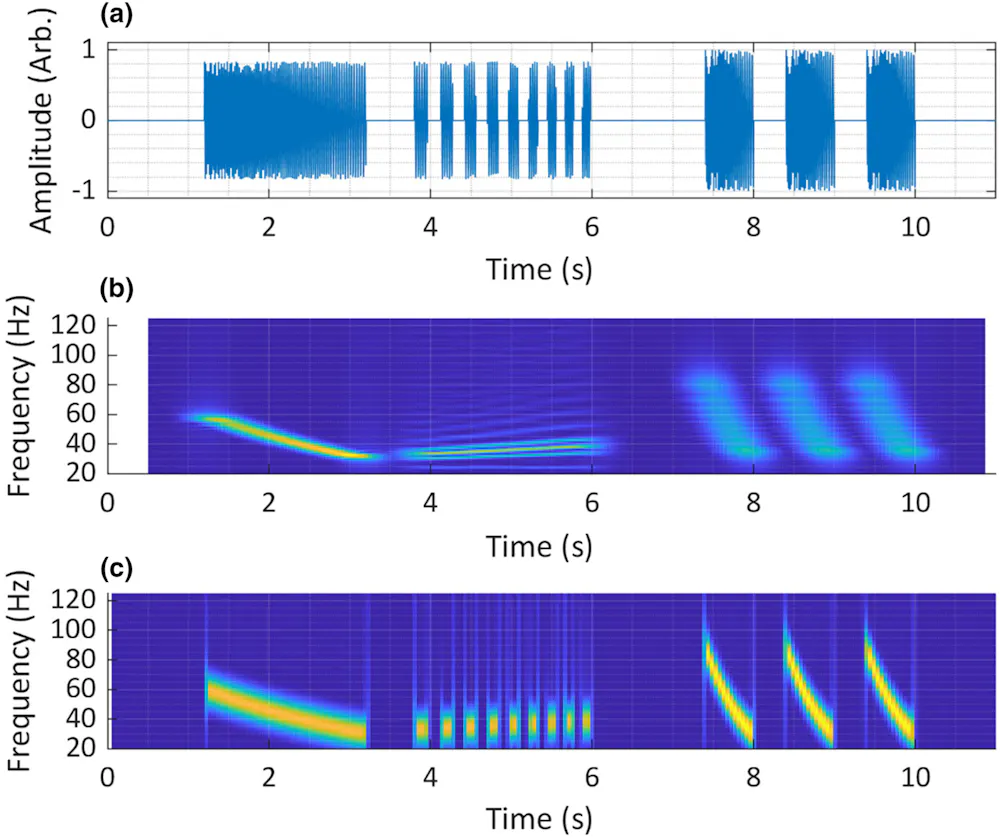
For this reason, often a first step in studying an animal sound is to generate a visualisation called a spectrogram. It can give us a better idea of a sound’s character. Specifically, it shows when the energy in the sound occurs (temporal details), and at what frequency (spectral details).

We can learn about the sound’s structure in terms of time, frequency and intensity by carefully inspecting these spectrograms and measuring them with other algorithms, allowing for a deeper analysis. They are also key tools in communicating findings when we publish our work.

Why spectrograms have limitations

The most common method for generating spectrograms is known as the STFT. It’s used in many fields, including mechanical engineering, biomedical engineering and experimental physics.

However, it’s acknowledged to have a fundamental limitation – it can’t accurately visualise all the sound’s temporal and spectral details at the same time. This means every STFT spectrogram sacrifices either some temporal or spectral information.

This problem is more pronounced at lower frequencies. So it’s especially problematic when analysing sounds made by animals like the pygmy blue whale, whose song is so low, it approaches the lower limit of human hearing.


The sound of a pygmy blue whale captured by a seismometer placed on the sea floor.

Before my PhD, I worked in acoustics and audio signal processing, where I became all too familiar with the STFT spectrogram and its shortcomings.

But there are different methods for generating spectrograms. It occurred to me the STFTs used in whale song studies might be hiding some details, and there could be other methods more suited to the task.

An exaggerated example of a sound (a, as a waveform) visualised as a spectrogram biased towards spectral details (b) or temporal details (c). Detail is lost in both spectrograms, and neither fully captures the character of the signal.
Jancovich & Rogers, 2024

In our study, my co-author Tracey Rogers and I compared the STFT to newer visualisation methods. We used made-up (synthetic) test signals, as well as recordings of pygmy blue whales, Asian elephants and other animals, such as cassowaries and American crocodiles.

The methods we tested included a new algorithm called the Superlet transform, which we adapted from its original use in brain wave analysis. We found this method produced visualisations of our synthetic test signal with up to 28% fewer errors than the others we tested.

A better way to visualise animal sounds

This result was promising, but the Superlet revealed its full potential when we applied it to animal sounds.

Recently, there’s been some disagreement around the Chagos pygmy blue whale song: whether its first sound is “pulsed” or “tonal”. These two terms refer to having extra frequencies in the sound, but produced in two distinct ways.

STFT spectrograms can’t resolve this debate, because they can show this sound as either pulsed or tonal, depending on how they’re configured. Our Superlet visualisation shows the sound as pulsed and agrees with most studies that describe this song.

When visualising Asian elephant rumbles, the Superlet showed pulsing that was mentioned in the original description of this sound, but has been absent from all later descriptions. It’s also never been shown in a spectrogram.

Our Superlet visualisations of the southern cassowary call and the American crocodile roar both showed previously unreported temporal details that were not shown by the spectrograms in previous studies.


The sounds made by the southern cassowary are so deep, we almost can’t hear them (headphones recommended).

These are only preliminary findings, each based on a single recording. To confirm these observations, more sounds will need to be analysed. Even so, this is fertile ground for future work.

Ease of use may be Superlet’s greatest strength, even beyond improved accuracy. Many researchers using sound to study animals have backgrounds in ecology, biology and veterinary science. They learn audio signal analysis only as a means to an end.

To improve accessibility of the Superlet transform to these researchers, we implemented it in a free, easy to use, open-source software app. We look forward to seeing what new discoveries they might make using this exciting new method.

The Conversation

Benjamin A. Jancovich’s work is funded by the Australian government’s Research Training Program.

ref. Our new tech helps find hidden details in whale, cassowary and other barely audible animal calls – https://theconversation.com/our-new-tech-helps-find-hidden-details-in-whale-cassowary-and-other-barely-audible-animal-calls-234565

Loneliness in the workplace is greatest among men with traditional views about being the breadwinner

Source: The Conversation (Au and NZ) – By Marlee Bower, Research Fellow, Matilda Centre for Research in Mental Health and Substance Use, University of Sydney

Rawpixel.com/Shutterstock

Loneliness affects everyone at different times. Although it is well documented men are less likely than women to talk about feelings and to seek help, our research found men’s work arrangements can be a significant contributor.

We found loneliness was highest among men in their late 40s but it also occurred at other times, often shaped by how they perceived their careers and income.

This suggests the workplace and societal expectations around work are important in men’s experiences of loneliness.

Measuring loneliness

Our findings are based on an analysis of yearly data from 12,117 Australian men, aged 15 to 98, collected for over 19 years for the Household, Income and Labour Dynamics in Australia (HILDA) Survey.

We measured loneliness by examining men’s responses to a question asking whether they agreed with the statement: “I often feel very lonely”. The responses range from one (completely disagree) to seven (completely agree).

We then used statistical techniques to ensure we were measuring loneliness and not similar constructs, such as social isolation.

We also used methods that examined how much of men’s loneliness was uniquely due to their social relationships (for example, their romantic relationships or friendships), versus other aspects of their lives, such as their living situation or their working arrangements.

The role of work

Given loneliness is a social problem, we were not surprised to find problems in men’s social relationships, particularly their romantic relationships, friendships and family relationships were linked with loneliness. However, we were surprised to see work also played a significant role.

Men who were unemployed or in insecure jobs experienced more loneliness than those with stable employment. Job loss can impact a person’s identity and limits the social connections work typically provides. Unemployment also limits income, making it harder to afford social activities. Insecure “gig” work, with its often unpredictable and long hours spent alone, disrupts work-life balance and can isolate people.

Our research suggests societal expectations also worsen loneliness for some men. We measured the degree to which men agreed with the statement: “It is not good for a relationship if the woman earns more than the man”.

Men, particularly middle-aged men, who believed they should be the main breadwinners in a household were lonelier than those without this belief.

This suggests traditional views around work in the context of heteronormative relationships can be damaging to social connection.

This once mainstream view not only harms relationships but is also unrealistic when surviving on a single income is increasingly difficult for many households.

Men who believed men, not women, should be the main breadwinner were more lonely.
Marion Weyo/Shutterstock

Improving men’s personal relationships is only one way to reduce male loneliness. The work sector and social pressures around work should also adapt.

Shifting social norms

Public stereotypes that make men feel solely responsible for household income need to shift. Public awareness and education campaigns can help shift gender norms and stereotypes by building knowledge and awareness, and may therefore reduce loneliness.

Helping men attain better work-life balance can help everyone. Such change, however, requires major cultural shifts which take time. A shorter term solution, particularly for men at retirement age, is volunteering.

Volunteering provides purpose and opportunities to socialise, although recent evidence suggests volunteering has not returned to pre-COVID levels.

How governments can help

Increasing casualisation of the workplace and the growth of the gig economy offer flexibility but also decrease job security. Our research shows job insecurity or unemployment rates contribute to male loneliness.

Government amendments to the Fair Work Act should help reduce job insecurity by allowing the Fair Work Commission to set fair minimum standards, including access to dispute resolution for “employee-like” workers, such as Uber drivers, who work through a digital platform.

Governments can also support activities of interest to men by ensuring regular funding for programs like Men’s Sheds or opportunities to work with animals.

Social prescribing – where a GP or other health worker links patients with resources and activities to improve health and reduce loneliness – can also involve men in roles which best fit their needs and interests.

How employers can help

Thankfully, workplaces can do a lot to reduce loneliness. A recent review suggests employers can:

1) Create opportunities for social connection, for example, dedicating time for non-work activities such as designing communal areas in offices to support connection.

Creating social opportunities for workers can help reduce loneliness.
Kampus Productions/Pexels

2) Support flexible and remote, potentially isolated workers by fostering workplace connections using virtual spaces such as online dinners, while still encouraging work-life balance.

3) Foster a people focused culture by building employee autonomy, tolerating mistakes and providing mentoring opportunities.

The relationship between managers and workers is especially important for well-being, because managers can shape working conditions, model positive behaviour and improve staff knowledge, but few interventions target this area.

Marlee Bower receives funding from the BHP Foundation and the Henry Halloran Research Trust. She is affiliated with The Haymarket Foundation.

Ferdi Botha is affiliated with the ARC Centre of Excellence for Children and Families over the Life Course.

Mark Deady is currently supported by funding from the iCare Foundation. He has previously recieved funding from the Movember Foundation.

ref. Loneliness in the workplace is greatest among men with traditional views about being the breadwinner – https://theconversation.com/loneliness-in-the-workplace-is-greatest-among-men-with-traditional-views-about-being-the-breadwinner-230535

Royal visits to Australia can be disaster magnets. In the first one, the prince barely made it out alive

Source: The Conversation (Au and NZ) – By Ciara Smart, PhD candidate in Irish-Australian Colonial History, University of Tasmania

A drawn scene depicts the attempted assassination of Alfred, the Duke of Edinburgh, in 1868. Trove

It’s official: the royals are returning down under. King Charles and Queen Camilla are scheduled to visit Australia and Samoa in October, attending events in Canberra and New South Wales (with more details to come).

Royal visits are designed to communicate a curated vision of imperial loyalty, but have always been a flashpoint for tension. In fact, the first royal visit to Australia was a disaster. It cost the lives of several people and exposed deep social divisions. The prince himself narrowly escaped assassination.

An Irish-Catholic history

In October 1867, Prince Alfred, the second son of Queen Victoria (and great-great-great uncle of King Charles) arrived in Australia for a grand six-month tour.

The highly anticipated visit coincided with the end of convict transportation. It was an opportunity for the colonies to project an international image as loyal and productive citizens of the empire, rather than distant penal outposts. Instead, it exposed deep tensions between Catholics and Protestants.

Today, we sometimes forget the cultural diversity of the non-Indigenous people of colonial Australia. In 19th century Australia, for instance, about 25% of these people were Irish – and most of these Irish were Catholic.

This was a problem for the authorities, who were trying to model Australia on British Protestant traditions. The original population of Ireland had already suffered centuries of violent marginalisation and had mounted several failed uprisings.

Even in Australia, the loyalties of the Catholic Irish were sometimes suspect and anti-Irish discrimination was common. Some job advertisements listed “no Irish” and negative racial stereotyping promoted the view that the Irish were stupid, superstitious and violent.

A ‘tremendous’ failure

The prince landed in South Australia in October 1867 before travelling to Victoria.

During the welcome ceremony in Melbourne, a Protestant hall displayed a provocative image of William of Orange which deeply offended the Irish Catholic community (the victory of the Protestant King William III against the deposed Catholic King James II at the Battle of the Boyne in 1690 ended any hopes of Catholic rule in Ireland).

A riot broke out and shots were fired into the Catholic crowd, injuring several people, including at least two children. William Cross, a 13-year-old boy, died of his injuries.

Things didn’t improve after that.

Three days later a free public picnic was expected to attract some 10,000 people. But 40,000 arrived – another riot erupting amid the rush for food and wine. At the last minute, the prince avoided the event for his own safety. Newspapers described the picnic as “one of the most tremendous and utter failures we have ever known.”

The chaos continued as the prince visited Bendigo, where fireworks accidentally set a model ship on fire. Three boys perished in the flames.

Two days later, a hall built especially to host a ball in the prince’s honour accidentally burnt to the ground on the night of his visit.

The assassination attempt

The prince then visited Tasmania and Brisbane before returning to Sydney. On March 12, 1868, while picnicking in Clontarf, an Irish man named Henry James O’Farrell approached the prince and shot him in the back. Miraculously, the bullet lodged in his ribs but missed his vital organs. The prince made a full recovery.

A scene depicting the attempted assassination of Alfred, the Duke of Edinburgh.
Trove

O’Farrell claimed to be part of a secret Irish Fenian plot. Fenians were members of the Irish Republican Brotherhood, an organisation fighting for Irish independence.

Just two years prior, Fenians had attempted to capture Canada in return for Irish independence. They had also bombed a British prison only three months before the assassination attempt. Now, it seemed Fenians had infiltrated Australia.

The assassination attempt was a national embarrassment. Sir Henry Parkes, future premier of New South Wales, was certain O’Farrell represented the tip of the iceberg of a greater Irish conspiracy. The New South Wales government rushed through the Treason Felony Act to give authorities unprecedented power. It even made it a crime to refuse to drink to the queen’s health.

Henry James O’Farrell was found responsible for the attempted assassination.
State Library of New South Wales

A national embarrassment

Meanwhile, the Australian public expressed extraordinary outrage. In the weeks after the assassination, more than 250 “indignation meetings” were held across Australia. The first meeting in Sydney, held the day after the assassination attempt, was attended by 20,000 people.

The media also played a central role; the recent invention of the telegraph meant the news travelled with exceptional speed while newspapers published racist cartoons reinforcing Irish stereotypes.

O’Farrell later admitted he had made up his claim of being a Fenian. And no evidence of a Fenian plot was ever discovered. At his trial, his barrister pleaded against the death penalty because of his “insanity”, a sentiment that was supported by the prince.

Despite this, he was executed. Today, historians accept O’Farrell was acting alone and that he suffered severe paranoia induced by mental illness and alcoholism.

Parkes was criticised for inciting anti-Irish hatred without evidence. Nonetheless, the event propelled his political career and he became NSW premier a few years later.

The Irish response

The Catholic Church denounced the assassination, while the Irish in Australia tried to distance themselves from any association with Fenianism.

Historians argue the assassination attempt resulted in the Irish-Australian community publicly reasserting their imperial loyalty. This community was at pains to emphasise a Catholic identity did not jeopardise their loyalty to their new home.

Ultimately, this led to greater cultural harmony and the emergence of a “nationalist” sentiment that would later power the movement to unite the colonies as one nation.

Today, a royal visit serves the same purpose it did in 1868. It’s a choreographed chance for the new king to show he cares about Australia – and therefore encourage loyalty among his subjects.

Ciara Smart does not work for, consult, own shares in or receive funding from any company or organisation that would benefit from this article, and has disclosed no relevant affiliations beyond their academic appointment.

ref. Royal visits to Australia can be disaster magnets. In the first one, the prince barely made it out alive – https://theconversation.com/royal-visits-to-australia-can-be-disaster-magnets-in-the-first-one-the-prince-barely-made-it-out-alive-233103

AIDS, trauma – and joy: how artist Brent Harris captures the intensity of emotion beneath humour

Source: The Conversation (Au and NZ) – By Catherine Speck, Emerita Professor, Art History and Curatorship, University of Adelaide

Installation view: Brent Harris: Surrender & Catch, Art Gallery of South Australia, Adelaide. Photo: Saul Steed

Brent Harris’ retrospective exhibition Surrender and Catch traces his art over four decades. It is a visual and linguistic treat.

The paintings, some immaculately rendered, others delightfully loose, along with the prints and drawings, are presented chronologically to chart his career, its shifts and importantly personal insights gained through art making.

The title of the exhibition, Surrender and Catch, is based on American sociologist Kurt Wolff’s 1970s theory of being open to what reveals itself in art making, surrendering to the process of self-discovery, and catching the knowledge it generates. It has an affinity with the surrealist approach of allowing the unconscious to inform imagery.

Harris was born in 1956 in Palmerston North, Aotearoa New Zealand. He relocated to Melbourne in 1982 in order to distance himself from a difficult childhood and to embark on a career as an artist.

Death and pandemics

The exhibition begins with expressionist paintings of the later 1980s where there are traces of influence from his teacher at the Victorian College of Arts, Peter Booth.

The pace and tenor changes radically with the series of 14 abstract and geometric paintings, the Stations (1989), produced in response to the death of fellow members of the gay community from the AIDS pandemic. The title references the biblical narrative of Christ walking to his death in the Stations of the Cross.

The Crucifixion, in a reduced palette of black, white and cream, shows the close influences of fellow New Zealander, Colin McCahon and his Fourteen Stations of the Cross (1966).

Harris revisited the theme during the COVID pandemic as a mature and less derivative artist in his Stations of the Cross (2021).

Brent Harris born Palmerston North, New Zealand 4 October 1956. Christ before Pilate No. 1 from the series The Stations of the Cross 2021, Melbourne oil and charcoal on linen 75.0 x 60.0 cm.
Courtesy of the artist and Robert Heald Gallery, Wellington © Brett Harris

Playing with the surreal

Harris works in series to pursue a feeling/idea/sensation through to a completion of sorts.

The next series of work show another shift away from the precision of his abstract canvases, to his responding to images coming from the unconscious in a surrealist fashion.

Brent Harris born Palmerston North, New Zealand 4 October 1956. Appalling Moment E 1994, Melbourne oil on linen 71.0 x 55.0 cm.
Private Collection, Melbourne © Brent Harris

Dots become eyes, another set of marks become an elephant’s trunk as in Appalling moment E (1994). He named this move to absurd figuration in which he allowed himself to turn to the body and memories stored within, “an appalling moment”. This is a lovely play on words that characterises his often-humorous approach to naming his deadly serious work, indicative of the intensity of emotion beneath the humour.

Another series of drawings playing with body parts, legs and trunk, developed into distended multi-branch drooping organic forms. The title, Swamp, refers to marshy land – not quite land, not quite water – symbolic of the artist’s memories of his transitional teenage years of loneliness and isolation.

installation view: Brent Harris: Surrender & Catch, Art Gallery of South Australia, Adelaide, photo: Saul Steed.

The paintings lure the viewer into looking for meaning due to the spatial ambiguity created between abstract and figurative shapes of intriguing white forms on black. Viewers need to spend time, ponder and look again – as you should for good art.

To the Forest, blue (1998), with its uncluttered simplicity – perfection even – of it alluring free-ranging shapes of white on blue guide the viewer to contemplate the path to the forest, beyond the canvas.

Revisiting traumatic pasts

Harris’s turning within, drawing on stored memories, led to a series of portraits referencing his traumatic childhood dominated by a cruel and bullying father including the startling painting, I weep my mother’s breasts (1996).

This mirror image, depicted in cartoon style, recalls an incident Harris experienced as an eight-year old when he was denied his mother’s embrace by his father, that led in turn to breaking the mother/child bond.

Brent Harris born Palmerston North, New Zealand 4 October 1956. I weep my mother’s breasts 1996, Melbourne oil on linen 57.0 x 96.7 cm; Courtesy of the artist and Robert Heald Gallery, Wellington © Brent Harris.

In his surreal doubled painting, drawing on notions of the unexpected, Harris shows himself weeping, but his tears are his mother’s breasts.

Some years later he lays bare the pain of his dysfunctional family in drawings, prints and paintings. The most disturbing is the diptych, Grotesquerie (2008), in which he portrays his mother in profile as sightless, unseeing, whereas his father is a horned monster. He has placed a red dummy in his father’s mouth to silence him. The two figures painted in white, apart from his mother’s yellow hair, are placed on a haunting, domineering black ground.

Installation view: Brent Harris: Surrender & Catch, featuring Grotesquerie and Grotesquerie (no. 20) by Brent Harris, Art Gallery of South Australia, Adelaide, photo: Saul Steed.

The mood changes completely and most magnificently in colourful semi-abstract and abstract oil paintings, some large, others small, such as The reassembled self, no. 28 (2010).

There is peace, joy and acceptance at what giving into the unconscious, surrendering and catching, has yielded.

Brent Harris born Palmerston North, New Zealand 4 October 1956. The reassembled self no. 28 2010, Melbourne charcoal and gouache on board 42.0 x 31.0 cm.
Private collection, Melbourne © Brent Harris photo:Andrew Curtis

A beautifully curated exhibition

Some of the most interesting and unassuming work in the exhibition lies in the monotypes in The Fall when the artist works rapidly on a black base applied to glass. Employing the surrealist method of automatic drawing, he produces images such as Untitled no 33 (2012), of inhabitants of a frightening underworld.

The exhibition closes with paintings completed on a return to New Zealand. The death of his father in 2016 led to a re-engagement with his country of birth. His joyous painting Peaks (Vision over Taranaki) (2019), is at one level revisiting a vista frequently seen during his childhood. At another level his mother, signified by her yellow hair, can at last see. From the foggy mass over the mountain, a hand reaches out.

Brent Harris born Palmerston North, New Zealand 4 October 1956. peaks (vision over Taranaki) 2019, Melbourne oil on linen 220.0 x 160.0 cm.
Collection of David Cleary, Sydney © Brent Harris photo:Russell Kleyn

This is a large exhibition, supported by an excellent catalogue, with the work in each gallery introduced by wall text to assist viewers reading the pared back, distilled and cropped imagery in which its rigour is astonishing. The work of key artists who have influenced Harris, such as Louise Bourgeois, Edvard Munch and McCahon, is also woven into the display.

Harris’ art is held in major public and private collections; his discrete suites of work have been the subject of smaller exhibitions and critical commentary. This retrospective curated beautifully by Maria Zagala pulls these strands together.

While Harris’s work is in part a psychological journey, it should not be reduced to that reading. In an accompanying film on show in the exhibition space, the artist perceptively observes his art goes beyond the personal in its wider search for meaning.

Brent Harris: Surrender and Catch is at the Art Gallery of South Australian until October 20.

Catherine Speck has received funding from the ARC to research exhibitions of Australian art (with Joanna Mendelssohn, Catherine De Lorenzo and Alison Inglis).

ref. AIDS, trauma – and joy: how artist Brent Harris captures the intensity of emotion beneath humour – https://theconversation.com/aids-trauma-and-joy-how-artist-brent-harris-captures-the-intensity-of-emotion-beneath-humour-232828

PNG oil and LNG shipments face foreign waters ban if waste oil problem not sorted

By Matthew Vari in Port Moresby

Papua New Guinea will face a grim reality of a ban on its shipping of oil and hydrocarbons in international waters if it continues to ignore the implementation of a domestic waste oil policy that is 28 years overdue.

The Conservation and Environment Protection Authority’s Director for Renewable Brendan Trawen made this stark revelation in response to queries posed by Post-Courier Online.

In the backdrop of investment projects proposed in the resource space, the issue of waste oil and its disposal has incurred hefty fines and reputational damage to the nation, and could seriously impact the shipments of one of the country’s lucrative exports in oil and LNG.

“International partners are most protective of their waterways. Therefore, PNG has already been issued with a warning on implementation of a ban of oil and hydrocarbon shipments, including LNG from PNG through Indonesian water,” he said.

In addition, the issuing of a complete ban on all hydrocarbon exports from Singapore through Indonesian waters to PNG.

“In light of growing international concern about the need for stringent control of transboundary movement of hazardous waste oil, and of the need as far as possible to reduce such movement to a minimum, and the concern about the problem of illegal transboundary traffic in hazardous wastes oil, CEPA is compelled to take immediate steps in accordance with Article 10 of the Basel Convention Framework,” Trawen said.

He indicated CEPA had limited capabilities of PNG State through to manage hazardous wastes and other wastes.

Safeguarding PNG’s international standing
The government of PNG had been “rightfully seeking cooperation with Singaporean authorities since 2020” to safeguard PNG’s international standing with the aim to improve and achieve environmentally sound management of hazardous waste oil.

“Through the NEC Decision No. 12/2021, respective authorities from PNG and Singapore deliberated and facilitated the alternative arrangement to reach an agreement with Hachiko Efficiency Services (HES) towards the establishment of a transit and treatment centre in PNG.

“In due process, HES have the required permits to allow transit of the waste oils in Singapore, Malaysia and South Korea for recycling.”

Minister of Environment, Conservation and Climate Change Simon Kilepa acknowledged that major repercussions were expected to take effect with the potential implementation ban of all hydrocarbons and oil shipments through Indonesian waters.

Political, economic and security risks emerged without doubt owing to GoPNG through CEPA’s negligence in the past resolving Basel Convention’s outstanding matters.

“It is in fact that the framework and policy for the Waste Oil Project exists under the International Basel Convention inclusive of the approved methods of handling and shipping waste oils. What PNG has been lacking is the regulation and this program provides that through,” he said.

“CEPA will progress its waste oil programme by engaging Hachiko Efficiency Services to develop and manage the domestic transit facility.

“This will include the export of waste oil operating under the Basel and Waigani agreements dependent upon the final destination.”

CEPA will proceed with the Hazardous Waste Oil Management Programme immediately to comply with the long outstanding implementation of the Basel Convention requirements on the management of Hazardous waste oil.

A media announcement and publicity would be made with issuance of Express of Interest (EOI) to shippers and local waste companies

A presentation would be made to NEC Cabinet and a NEC decision before the sitting of Parliament.

Matthew Vari is a senior journalist and former editor of the PNG Post-Courier. Republished with permission.

Article by AsiaPacificReport.nz

Labor and Albanese’s slide continues in Resolve poll, as major parties tied

Source: The Conversation (Au and NZ) – By Adrian Beaumont, Election Analyst (Psephologist) at The Conversation; and Honorary Associate, School of Mathematics and Statistics, The University of Melbourne

A national Resolve poll for Nine newspapers, conducted July 10–13 from a sample of 1,603, had Labor and the Coalition tied at 50–50 by 2022 election preference flows, a one-point gain for the Coalition since June by my calculations.

Resolve does not usually give a two-party estimate, but this is the first time Labor would not have led during this term by 2022 preference flows. Until this year, Resolve was easily the most pro-Labor pollster.

Primary votes were 38% Coalition (up two), 28% Labor (steady), 13% Greens (down one), 6% One Nation (steady), 1% UAP (steady), 11% independents (steady) and 2% others (down two).

Just 33% gave Anthony Albanese a good rating, while 54% rated him poorly, for a net approval of -21, down seven points since June. Albanese’s net approval has slumped 19 points since April. Peter Dutton’s net approval was down two points since June to net zero.

After surging to his first preferred PM lead in any poll in June by 36–35, Dutton held a 35–34 lead.

The Coalition continued to hold a seven-point lead over Labor on keeping the cost of living low, and a 16-point lead on economic management. Asked what was the most important issue, 53% said cost of living, with issues not related to cost of living in the single figures.

Two weeks ago, Labor gained in Newspoll, probably owing to Dutton’s nuclear policy. Since then, this announcement appears to have faded in importance to voters, although it’s likely to be revived at an election campaign.

Cost of living is by far the most important issue to voters. Until and unless cost of living pressures are meaningfully reduced, Labor will struggle.

Fatima Payman and Glenn Druery

In the wake of Western Australian Senator Fatima Payman’s defection from Labor, there was much media attention on Payman’s association with Glenn Druery, the “preference whisperer”.

Group ticket voting, which allowed parties to direct the preferences of all those who voted for them above the line in the Senate, was abolished before the 2016 federal election. This system had given Druery his reputation, as parties with very low levels of support could coalesce to elect someone, often on a minuscule vote share.

With the abolishment of group ticket voting, voters now direct their own preferences, and these preferences don’t help parties with minuscule vote shares. Druery no longer has any power federally. However, Victoria unfortunately still uses group ticket voting for its state upper house elections.

Morgan poll: 50.5–49.5 to Coalition

A national Morgan poll, conducted June 24–30 from a sample of 1,706, gave Labor a 51–49 lead, unchanged from the June 17–23 poll. In the July 1–7 Morgan poll with a sample of 1,723, the Coalition seized a 52–48 lead.

In the July 8–14 Morgan poll with a sample of 1,758, the Coalition’s lead was reduced to 50.5–49.5. Primary votes were 37.5% Coalition (down two since July 1–7), 31% Labor (up 2.5), 12.5% Greens (down one), 5% One Nation (steady), 9% independents (steady) and 5% others (up 0.5).

The headline two-party estimate used respondent preferences, but this poll article said Labor led by 51.5–48.5 using 2022 preference flows, a two-point gain for Labor since the July 1–7 poll.

Essential poll: Coalition regains lead

A national Essential poll, conducted June 26–30 from a sample of 1,141, gave the Coalition a 47–46 lead including undecided, a reversal of Labor’s 48–46 lead in mid-June that was its first lead in this poll since April.

Primary votes were 33% Coalition (up one), 30% Labor (down one), 12% Greens (down one), 7% One Nation (down one), 1% UAP (steady), 10% for all Others (up one) and 7% undecided (up one).

Albanese’s net approval fell five points since early June to -9, a low for him in Essential since he became PM. Dutton’s net approval was steady at -1.

By 43–28, voters were worried about the impact of climate change on the next generation. By 52–48, they opposed Dutton’s nuclear plan.

Asked about desirability of energy sources, 59% said renewable energies were most desirable, 21% nuclear energy and 19% fossil fuels. On costs of energy sources, 38% (up two since April) thought nuclear energy most expensive, 35% (down five) renewable energies and 27% (up three) fossil fuels.

Newspoll aggregate data from April to June

Newspoll’s aggregate data for all its four surveys conducted from April to June from a combined sample of 4,957 was published by The Australian on July 7. The Poll Bludger’s poll tables say voters with no tertiary education were unchanged at a 50–50 tie compared to the March quarter aggregate data.

Labor held a 51–49 lead with TAFE-educated voters, a one-point gain for Labor. Labor also held a 52–48 lead with university-educated voters, but this was a three-point gain for the Coalition.

The Coalition had a one-point gain in four of the five mainland states, and now leads by 51–49 in New South Wales and 54–46 in Queensland. Labor leads by 54–46 in Victoria and 53–47 in South Australia. In WA, Labor gained three points to take a 52–48 lead.

Macnamara seat poll suggests Labor will win owing to Greens drop

A Redbridge poll
of the federal Victorian seat of Macnamara, conducted June 13–20 from a sample of 401, gave Labor a 55–45 two-candidate lead over the Liberals, from primary votes of Liberals 36%, Labor 30%, the Greens 21% and all Others 13%.

The Poll Bludger said that at the 2022 federal election, Labor defeated the Liberals by 62.2–37.8 adjusted for the recent Victorian redistribution. Primary votes were 31.7% Labor, 29.7% Greens and 29.0% Liberals. The Greens just missed out on making the final two in 2022 at Labor’s expense and winning on Labor preferences.

WA seat poll suggests state Labor will win easily

The WA election will be held in March 2025. The Poll Bludger reported Friday that a privately conducted seat poll of Hillarys, first reported in The West Australian, gave Labor a 61–39 lead. This poll was conducted by Utting Research June 3–14 from a sample of just 350 for the Home Builders Action Group.

This poll had a swing of 8% to the Liberals in Hillarys since the 2021 WA election, but at that election Labor won the WA statewide two-party vote by 70–30. If Labor is still ahead by over 60–40, they will win the next WA election easily.

While the state Labor government led by Roger Cook had a 52–37 approval rating, the Albanese federal government had a 53–36 disapproval rating.

Far-right National Rally underperforms to finish third at French election

I covered the July 7 French parliamentary election runoffs for The Poll Bludger. The left-wing alliance of four parties (NFP) won 182 of the 577 total seats, President Emmanuel Macron’s centrist Ensemble 168, the far-right National Rally 143 and the conservative Republicans 45. With 289 seats needed for a majority, no party is able to form a majority government. Pre-election polls had given National Rally the most seats.

The July 4 UK election was the most disproportionate in modern history, with Labour winning 63% of seats on 34% of votes, while the far-right Reform won just 0.8% of seats on 14% of votes. Electoral developments in the Netherlands, Iran and the Solomon Islands were also covered.

The Conversation

Adrian Beaumont does not work for, consult, own shares in or receive funding from any company or organisation that would benefit from this article, and has disclosed no relevant affiliations beyond their academic appointment.

ref. Labor and Albanese’s slide continues in Resolve poll, as major parties tied – https://theconversation.com/labor-and-albaneses-slide-continues-in-resolve-poll-as-major-parties-tied-233638

Breakdancing, DJs and Tahitian surf: Paris 2024 is going for gold in Olympic innovation

Source: The Conversation (Au and NZ) – By Holly Thorpe, Professor in Sociology of Sport and Gender, University of Waikato

Getty Images

Think of the Olympic Games and for many of us it conjures images of the traditional marquee events: track and field, swimming, weightlifting, gymnastics. But the games are changing – and the Paris Olympics will take it to a new level.

As well as bringing back youth-oriented sports such as surfing, skateboarding, sport-climbing and BMX freestyle, these games will see breaking (or breakdancing) and kiteboarding introduced.

These programme changes have been on the International Olympic Committee (IOC) agenda for many years, part of an effort to reverse a decades-long decline in younger audience numbers, particularly in the key US consumer market.

But the new look is also part of a larger strategy designed to improve inclusivity and gender balance. In fact, Paris claims to be the first gender-balanced Olympics, with the new sports key to reaching that milestone.

None of this has been smooth, with the inclusion of new events a highly political process. On the one hand, traditionalists have resisted change. On the other, the countercultural origins of some of the new sports have seen them wary of being incorporated into the world’s largest and most powerful sporting establishment.

Italian kiteboarder Lorenzo Boschetti tests the Olympic waters in Marseille in 2023.
Getty Images

New events, new venues

Of the two newest entrants, breaking will probably surprise the most spectators. What began as an urban dance style within US hip hop culture in the 1970s has gone mainstream, successfully trialled at the 2018 Youth Olympic Games in Buenos Aires.

Breakdancing was always competitive, of course. In its Olympic format, teams of 16 (called B-boys and B-girls) will have one-on-one contests involving a range of spectacular acrobatic movements.

Athletes must improvise, adapting their style and routines to fit the beat of the DJ’s chosen tracks. The role of the DJ and MC during these “battles” will give the new sport a very different feel to other Olympic events.


Read more:
Alt goes mainstream: how surfing, skateboarding, BMX and sport climbing became Olympic events


Kiteboarding almost made it into the Olympic sailing programme at the 2016 Games in Rio Di Janeiro, in place of windsurfing. The International Sailing Federation eventually overturned that decision, but the dynamic event finally makes its debut. In Paris, kiteboarders will be using the latest foiling technologies, making it a showcase attraction.

These games will also see the IOC’s “urban park” concept finally realised. Originally planned for the Tokyo Olympics, COVID disrupted the vision of an X Games-style atmosphere of music, fun and athlete-fan interaction.

Rather than building expensive new venues, the host nation will use existing infrastructure combined with temporary facilities. Skateboarding, sport climbing, breaking, 3×3 basketball and BMX freestyle will all be hosted in a temporary park built in the iconic Place de la Concorde.

All these innovations are an expression of the IOC’s Agenda 2020 and Agenda 2020+5. These major policy reforms are focused on urban cultures, youth and sustainability.

Fumika Kawakami of Japan and Hanareum Sung of Korea at the women’s Olympic speed climbing qualification in Budapest.
Getty Images

Going mainstream

Olympic climbing will also evolve in Paris. Introduced at the Tokyo Games, it initially combined three quite different climbing styles – speed, bouldering and leading (where climbers use ropes to ascend).

Many climbers were unhappy with this merger within a single medal event, and Paris will see it broken into two: a combined bouldering and leading event, and a speed event.

At Tokyo, skateboarding had the greatest media visibility of the new sports. In particular, global audiences and media were captivated by the joy and camaraderie of the women’s competition.

The average age on the women’s skateboarding medal podium was 14, and the young competitors were hailed as evidence of a truly inclusive Olympic spirit. This success might have also shifted perceptions of skateboarding being fringe or even antisocial, to being a legitimate and highly-skilled sport.

It has also opened new opportunities for women skaters in a previously male-dominated culture. There have been anecdotal reports of an increased willingness by parents to let their children learn skateboarding, with local councils building more facilities and reviewing rules around skating being a “nuisance” in public spaces.

French surfer Kauli Vaast training for the Paris Olympics at Tahiti’s famous Teahupo’o reef break.
Getty Images

Waves of change

Perhaps the most radical aspect of the Paris Olympics is the location of its surfing competition in Tahiti, 16,000 kilometres from the host city.

Using the legendary reef break at Teahupo’o will almost certainly overcome the wave quality problems at the Tokyo games. But the decision has also proved controversial, with local residents concerned about the event’s potential impact on the fragile ocean ecosystem and surrounding areas.

In particular, a new aluminium judging tower, involving drilling into the delicate coral reef, has prompted months of local and international protest.

In a sense, the surfing controversy is emblematic of the IOC’s overall struggle to modernise the games, and respond to a rapidly evolving sporting landscape, while not alienating traditional audiences.

The IOC has invested heavily in these new sports and events, and we will likely see more on the programme in Los Angeles in 2028 and Brisbane in 2032. There is also a push for their inclusion in the Paralympics.

Whether those elusive younger viewers are lured back, however, remains to be seen. Our research suggests the full impact of inclusion – on both the Olympics and the sports themselves – can take years to become evident. In the meantime, settle in and enjoy the show.

The Conversation

Holly Thorpe has received funding from the IOC Advanced Olympic Research Grant Programme.

Belinda Wheaton has received funding from the IOC Advanced Olympic Research Grant Programme.

ref. Breakdancing, DJs and Tahitian surf: Paris 2024 is going for gold in Olympic innovation – https://theconversation.com/breakdancing-djs-and-tahitian-surf-paris-2024-is-going-for-gold-in-olympic-innovation-233200

Are you up to date with your COVID, flu and other shots? It might depend on who your GP is

Source: The Conversation (Au and NZ) – By Peter Breadon, Program Director, Health and Aged Care, Grattan Institute

anon_tae/Shutterstock

Too many older Australians are missing out on recommended vaccinations for COVID, flu, shingles and pneumococcal that can protect them from serious illness, hospitalisation and even death.

A new Grattan Institute report shows vaccination rates vary widely from GP to GP, highlighting an important place to look for opportunities to boost vaccination.

Many people get vaccinated at pharmacies, and those vaccinations are counted in our analysis. But we looked at GPs because they have a unique role overseeing someone’s health care, and an important role promoting vaccination.

We found that for some GPs, nine in ten of their older patients were vaccinated for flu. For others, the rate was only four in ten. The differences for shingles and COVID were even bigger. For pneumococcal disease, there was a 13-fold difference in GPs’ patient vaccination rates.

While some variation is inevitable, these differences are large, and they result in too many people missing out on recommended vaccines.

Some GPs treat more complex patients

A lot of these differences reflect the fact that GPs see different types of patients.

Our research shows older people who aren’t proficient in English are up to 15% less likely to be vaccinated, even after other factors are taken into account. And the problem seems to be getting worse.

COVID vaccination rates for people 75 years and older fell to just 36% in May 2024. But rates were even lower – a mere 11% – for people who don’t speak English proficiently, and 15% for those who speak a language other than English at home.

Given these results, it’s no surprise that GPs with fewer patients who are vaccinated also have more patients who struggle with English. For GPs with the lowest vaccination rates, one-quarter of their patients aren’t proficient in English. For GPs with the highest vaccination rates, it is only 1%.

GPs with fewer vaccinated patients also saw more people who live in rural areas, are poorer, didn’t go to university, and don’t have regular access to a GP, all of which reduce the likelihood of getting vaccinated.

Many of these barriers to vaccination are difficult for GPs to overcome. They point to structural problems in our health system, and indeed our society, that go well beyond vaccination.

But GPs are also a key part of the puzzle. A strong recommendation from a GP can make a big difference to whether a patient gets vaccinated. Nearly all older Australians visit a GP every year. And some GPs have room for improvement.

But GPs seeing similar patients can have very different vaccination rates

We compared GPs whose patients had a similar likelihood of being vaccinated, based on a range of factors including their health, wealth and cultural background.

Among the GPs whose patients were least likely to get a flu vaccination, some saw less than 40% of their patients vaccinated, while for others in that group, the rate was over 70%.

Among GPs with patients who face few barriers to vaccination, the share of their patients who were vaccinated also varied widely.

Even within neighbourhoods, GP patient vaccination rates vary a lot. For example, in Bankstown in Sydney, there was a seven-fold difference in COVID vaccination rates and an 18-fold difference for pneumococcal vaccination.

Not everything about clinics and patients can be measured in data, and there will be good reasons for some of these differences.

But the results do suggest that some GPs are beating the odds to overcome patient barriers to getting vaccinated, while other GPs could be doing more. That should trigger focused efforts to raise vaccination rates where they are low.

So what should governments do?

A comprehensive national reform agenda is needed to increase adult vaccination. That includes clearer guidance, national advertising campaigns, SMS reminders, and tailored local programs that reach out to communities with very low levels of vaccination.

But based on the big differences in GPs’ patient vaccination rates, Australia also needs a three-pronged plan to help GPs lift older Australians’ vaccination rates.

First, the way general practice is funded needs to be overhauled, providing more money for the GPs whose patients face higher barriers to vaccination. Today, clinics with patients who are poorer, sicker and who struggle with English tend to get less funding. They should get more, so they can spend more time with patients to explain and promote vaccination.

Second, GPs need to be given data, so that they can easily see how their vaccination rates compare to GPs with similar patients.

And third, Primary Health Networks – which are responsible for improving primary care in their area – should give clinics with low vaccination rates the help they need. That might include running vaccination sessions, sharing information about best practices that work in similar clinics with higher vaccination rates, or offering translation support.

And because pharmacies also play an important role in promoting and providing vaccines, governments should give them data too, showing how their rates compare to other pharmacies in their area, and support to boost vaccination uptake.

These measures would go a long way to better protect some of the most vulnerable in our society. Governments have better data than ever before on who is missing out on vaccinations – and other types of health care.

They shouldn’t miss the opportunity to target support so that no matter where you live, what your background is, or which GP or pharmacy you go to, you will have the best chance of being protected against disease.

The Conversation

Grattan Institute has been supported in its work by governments, corporates, and philanthropic gifts. A full list of supporting organisations is published at www.grattan.edu.au.

Anika Stobart does not work for, consult, own shares in or receive funding from any company or organisation that would benefit from this article, and has disclosed no relevant affiliations beyond their academic appointment.

ref. Are you up to date with your COVID, flu and other shots? It might depend on who your GP is – https://theconversation.com/are-you-up-to-date-with-your-covid-flu-and-other-shots-it-might-depend-on-who-your-gp-is-234175

‘Alien invasion’: researchers identify which exotic animals may soon hitchhike into Australia

Source: The Conversation (Au and NZ) – By Arman Pili, Research affiliate, Monash University

Shutterstock

Australia is renowned for its native flora and fauna, but did you know the continent is also home to about 3,000 “alien” species of animals, plants, fungi and microbes?

Alien species are those brought by humans to areas they do not naturally occur in. These intruders are Australia’s leading cause of biodiversity loss and species extinction. They also cost the Australian economy some A$24.5 billion a year.

Invasive alien species become much harder and more expensive to manage as they establish and spread through the landscape. So preventing their arrival is vital.

But which species will arrive next? Our study published today helps identify the animals Australia should be looking out for.

An ounce of prevention is worth a pound of cure

To help manage the invasive species threat, national authorities compile official warning lists that identify species not yet within a country’s borders, but which may become a big problem if they do arrive.

The most important criteria for adding a species to the list is whether they have already invaded other parts of the world.

Authorities also consider if a species could feasibly be brought into the country by humans either deliberately, such as on the case of exotic pets, or accidentally, for example if they hitchhike on fresh produce, luggage or vehicles.

Authorities also consider if a species can survive and reproduce in the country (which precludes, say, a polar bear being added to the warning list in a tropical area).

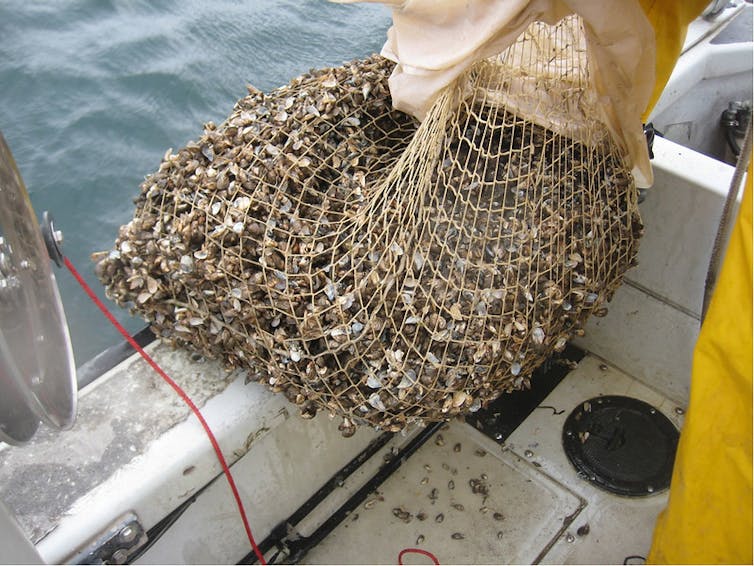
These warning lists can be effective. For example, the United Kingdom’s list was published in 2013; within two years, seven of their top-listed alien species had arrived in the country, including the notoriously invasive quagga mussel.

However, the lists are not foolproof. Most crucially, the emphasis on whether a species has invaded other parts of the world will not identify species that have not yet become invasive anywhere, but might in future.

In fact, a study in 2020 predicted the number of new alien species globally will increase by 36% by 2050.

Our research set out to address this blind spot in warning list systems.

net of mussels on boat
The notoriously invasive quagga mussel invaded the UK after being added to the warning list.
Flickr/NOAA, CC BY

Who’s arriving next?

The tool we developed assesses a species’ invasion risk based on whether humans are likely to accidentally bring the species to a certain country, and if the species will become invasive beyond their natural range.

First, we collected data on attributes of species worldwide, such as their size, number of offspring, lifestyle, diet, preferred habitats, natural range, how often they are encountered, and their tolerance to humans.

Second, we programmed our tool to analyse patterns in the attributes of species that have become invasive in different parts of the world. This means the tool identifies species that haven’t yet invaded new areas globally, but share attributes with species that have become invasive.

Those attributes include:

  • a tendency to climb as opposed to staying on the ground, which means they are more likely to hitchhike into a country on produce and in luggage and vehicles

  • being commonly encountered in a wide range of habitats, especially where humans live.

We then tested our tool on about 16,000 (or 76%) of all known amphibians and reptiles worldwide, with no invasion history. Of these, we identified 160 species that might pose an invasion risk to Australia and other countries.

What Australia should watch out for

snake in grass
Common European viper.
Shutterstock

The species our tool identified as a possible invasion concern to Australia, and which border officials should be monitoring for, included:

  • Common European viper (Vivipera berus), a venomous snake widespread in Europe and northern Asia. It grows to a maximum length of about 85 centimetres. Other venomous snake species are native to Australia, but no viper species are currently known to exist here. Viper venom affects blood clotting and destroys tissues.
  • Graceful chameleon (Chamaeleo gracilis), a lizard common in sub-Saharan Africa. While the species is commonly exploited by the pet trade, our tool indicates it can also be accidentally brought to Australia by humans. Chameleons can change their colour to either camouflage themselves and evade predators, or to intimidate them.
brown toad
American toad.
Shutterstock
  • American toad (Anaxyrus americanus), from eastern North America. They have a wart-like gland behind each eye. The toad is poisonous like the cane toad, which is already a problem in northern Australia. However, the American toad can live in temperate climates and could threaten southern Australia’s wildlife.

Next steps

Around the time we finished developing our tool last year, one of the predicted invaders – the Caspian Bent-toed Gecko (Tenuidactylus caspius) – began invading the Eastern European nation of Georgia.

This demonstrates our tool’s potential to identify future invaders and improve current warning systems.

But further work is needed before including the species we identified on national warning lists. For example, research is needed to determine where each species can survive and reproduce.

And so far, we have applied our tool only to amphibians and reptiles, particularly those that can be accidentally transported by humans. In future, we hope our tool will be applied to other animal groups and plants to identify invaders looming on our horizons.

The Conversation

Arman Pili received scholarships and funding from the Monash University Faculty of Science.

David Chapple receives funding from the Australian Research Council, and the NESP Resilient Landscapes Hub.

ref. ‘Alien invasion’: researchers identify which exotic animals may soon hitchhike into Australia – https://theconversation.com/alien-invasion-researchers-identify-which-exotic-animals-may-soon-hitchhike-into-australia-232317

‘The teacher returned the call to my ex’: how separated parents struggle to get information from their child’s school

Source: The Conversation (Au and NZ) – By Renee Desmarchelier, Associate Professor (Critical Pedagogies), University of Southern Queensland

It is increasingly common for Australian children to live in a different house from one of their parents. About 28% of children under 14 have separated parents.

While most children are born into a two-parent family, the proportion of children living in a one-parent or step-family increases each year with a child’s age.

This means information about children’s schooling often needs to go to more than one household. However, this information is not always communicated clearly or reliably between schools and parents, and between separated parents themselves.

What is it like for separated parents who share responsibility for their child’s education?

Our survey shows separated parents struggle to get clear information, as well as the support and understanding they need.

Our research

In 2020, we surveyed 140 separated parents about their experiences dealing with their child’s school.

The majority of parents identified as mothers, while just over 20% of participants were fathers. Parents had either sole or equal care of their children, primary care (that is, more than 50% of the time) or minority care (less than 50%).

Participants were recruited from across Australia and from a wide range of schools, including public and private schools at both the primary and secondary level.

Our findings

Overall results regarding separated parents’ experiences with their children’s schools revealed most parents were unhappy with their school interactions:

  • 57% rated their experiences with teachers as negative

  • 60% rated their experiences with school leadership (such as principals or deputy principals) as negative

  • 63% rated their experiences with school administrative or office staff as negative and 14% rated them as “very poor”.

A woman holds a mobile phone up to her ear. She wears a serious expression and has her hand on her temple.
Parents report negative experiences with teachers, principals and office staff.
Karolina Kaboompics/Pexels, CC BY

Why are separated parents struggling?

Unless there is a court order that says otherwise, both parents are entitled to access information about their child at school, regardless of who the child is living with.

But parents in our survey reported frustrations with getting both routine information and important messages and updates from the school.

This included newsletters, permission notes and homework information, as well as medical updates (for example, if the child was injured at school or sent home sick). One father reflected that it is “extremely difficult” to access report cards and parent–teacher interviews because

all of these processes are designed for traditional families and [the school] can’t handle two separate emails for report cards and two separate days for interviews.

For those parents with equal care, a child’s movement between houses on a regular basis made communication between schools and parents particularly problematic. As one mother explained, the school showed a lack of empathy for her situation and

a lack of understanding about how to deal with separated parents. Communicating or sending out information to one parent only, and ignoring the other parent.

When there is not equal care, parents told us that school staff “tend to favour the person the child lives with regardless of any situation”. One mother who had minority care of her children — a group that felt particularly alienated and judged in their school interactions — said the schools “don’t want to talk to me about much.”

Separated families can be complex

Parents stressed schools often fail to acknowledge or accommodate the complexities of family life after a separation. This can include scenarios where one partner is being financially or emotionally abused, or where parents simply do not get along.

As one mother with shared care said “the expectation that both parents be in the same space isn’t realistic”.

In fact, some parents believed interactions with the school amplified family conflict and even made them feel unsafe. One parent said schools are “unequipped for dealing with high conflict parents”.

The school just didn’t have systems in place nor training of staff to […] make sure both parents are informed of things […]

Gender plays a role

Stereotypical ideas about gender and parental roles was a frequent theme in our findings.

For example, mothers with majority care reported more positive experiences with their children’s school than mothers with shared or minority care.

Fathers were more likely to report they felt the school favoured the other parent. One father told us the school preferred to defer to the mother’s authority, regardless of his status as the primary caregiver.

When I have called with a query, the teacher returned the call to my ex-partner instead. Deliberately seeking out my ex instead of me to discuss matters.

Another father with sole custody explained he was unable to nominate himself as the “main parent” because the school decided “this had to be a mother”.

Even mothers who were generally satisfied with their school interactions reported difficulties with gendered expectations, such as the idea mothers had more time and greater responsibility to help with their child’s learning.

There is a judgement that I am not interested in my children’s schooling if I don’t volunteer in the classroom. This expectation is not the same for my ex-husband as he ‘has to work’.

What should happen next?

The needs of separated parents, as a significant percentage of the school community, are not well understood or well accommodated.

Our research shows schools should set up clear and consistent communication protocols that are not based on entrenched assumptions of the nuclear family.

The onus to ensure effective and equitable communication should not sit squarely with parents.

All school staff should be involved in targeted training to improve their understanding of family complexities and the needs and challenges of separated parents. This is especially important when parental conflict is exacerbated by the sharing (or withholding) of school-related information.

These findings are of significant concern for Australian educators and policymakers given the very real impact on parents and the unknown impact on the education of so many Australian children.

The Conversation

The authors do not work for, consult, own shares in or receive funding from any company or organisation that would benefit from this article, and have disclosed no relevant affiliations beyond their academic appointment.

ref. ‘The teacher returned the call to my ex’: how separated parents struggle to get information from their child’s school – https://theconversation.com/the-teacher-returned-the-call-to-my-ex-how-separated-parents-struggle-to-get-information-from-their-childs-school-234366

Not just space rocks: 6 things we’ve learned about Earth from meteorites and comets

Source: The Conversation (Au and NZ) – By Francisco Jose Testa, Lecturer in Earth Sciences (Mineralogy, Petrology & Geochemistry), University of Tasmania

Photomicrograph of a chondrite meteorite. Francisco Testa/From the author’s personal collection

Apart from the Sun, its planets and their moons, our Solar System has vast amounts of space rocks – fragments left over from the formation of the inner planets.

A large concentration of asteroids forms a vast ring around our Sun, orbiting it between Mars and Jupiter. Fittingly, it’s called the main asteroid belt. Comets are icy bodies of dust and rocks that originated even farther away – in the Kuiper Belt beyond Neptune and the Oort Cloud of debris surrounding the Solar System.

Extraterrestrial rocks come in many sizes. Generally speaking, asteroids are space rocks larger than one metre, while the smaller pieces (from two millimetres up to one metre in size) are known as meteoroids.

Regardless of where they come from, once these foreign rocks make it to Earth’s surface, we call them meteorites. But they are much more than just simple rocks from far, far away.

They have allowed us to estimate the age of our planet, and changed the course of evolution more than once. Here are six major ways meteorites and comets have contributed to Earth’s history or our knowledge of it.

1. The age of our planet

About 4.5 billion years ago, a Mars-sized planet collided with the proto-Earth, changing the composition of our planet and forming our Moon.

During its first tens of millions of years, Earth was predominantly molten. It was too hot to form solid minerals and rocks, so the exact age of our planet remains unknown. But we do know it’s between the age measured from meteorites and the age of the oldest rocks we have been able to find and date.

The oldest minerals that have been reliably dated on Earth are tiny zircon grains found in Western Australia. The oldest one is 4.4 billion years old. However, scientists have also dated specks of calcium and aluminium found in meteorites, which yielded an older age of 4.56 billion years – the age of our Solar System.

So, thanks in part to the oldest age provided by a meteorite, our best estimate is that Earth formed around 4.54 billion years ago.

A grey rock with many spherical metallic shapes visible in the cross section.
A slab of the Allende meteorite, the best-studied meteorite in history. It has many calcium–aluminium-rich inclusions dated to be 4.567 billion years old – the oldest known solids to have formed in the Solar System.
Shiny Things/Flickr, CC BY-NC

2. The building blocks of life

The most plausible theory for the beginning of life on Earth is based on simple organic compounds that formed in space and were brought to Earth by meteorites and other celestial bodies.

During the Late Heavy Bombardment, a period between 4.1 and 3.8 billion years ago when more impact events hammered our planet, Earth’s surface was partially solid.

Amino acids, hydrocarbons and other carbon-based molecules arrived at our planet in carbonaceous chondrites (primitive meteorites, remnants from the early Solar System) and comets.

Once the early Earth was enriched with these organic molecules, chemical evolution followed. Eventually, life emerged on our planet. The earliest evidence is potential microbial life from 3.8 billion years ago, not long after the Late Heavy Bombardment.

Regardless of how life started, all theories agree on the need for a primitive ocean – or pools of water – that allowed early life on Earth to develop.

Close-up of a multicoloured mineral surface on a dark background.
Photomicrograph of an ordinary chondrite meteorite found in northwestern Africa containing small spherical particles of minerals called chondrules. Circled is a barred olivine chondrule.
Francisco Testa/From the author’s personal collection

3. How we got our oceans

Meteorites and comets also played a major role in the formation of Earth’s oceans and atmosphere. Large quantities of water were delivered to our planet during the Late Heavy Bombardment.

In addition, water was released from Earth’s interior through volcanic activity during the Hadean Eon, the first eon in our planet’s history.

Water vapour, along with other gases such as carbon dioxide, methane, ammonia, nitrogen and sulphur, formed the proto-atmosphere. Rain began to fall once the temperature dropped below the boiling point of water, forming our primordial ocean.

Yes – the water we drink today is at least partly of extraterrestrial origin.

4. Changing the course of evolution

The extinction of dinosaurs happened about 66 million years ago. It’s linked to the second-largest known meteorite impact on Earth, the deeply buried Chicxulub crater in Mexico.

In contrast, the Late Devonian extinction about 380 to 360 million years ago cannot be explained by a single impact. Several factors have been proposed as potential causes, including multiple impacts, climate change, depletion of oxygen (anoxia) in the oceans and volcanic activity.

Repeated times during Earth’s history, impact events have influenced the survival and evolution of life on our planet.

The subtle impression of the Chicxulub impact crater is still visible on the Yucatán peninsula in Mexico today.
NASA/JPL

5. Sampling Earth’s deep mantle and core

Scientists use a combination of methods to understand Earth’s internal structure: crust, mantle, core and their subdivisions. Seismology is the most important of them, which studies the propagation of seismic waves generated by earthquakes or artificial sources through Earth’s interior.

We have access to rock samples from the crust and upper mantle, but we will never be able to sample the deep mantle or solid core. Even if we had the technology, it would be astronomically expensive, and going down to such depths involves extreme pressures and temperatures.

Since direct sampling is impossible, scientists rely on indirect methods.

Pallasites and metallic meteorites are rocks from differentiated asteroids – ones that also have a mantle and core. Such space rocks are the closest we will ever come to sampling the deepest portions of our own planet. They help us understand its composition.

Pallasites are rare, and contain a silicate mineral called olivine embedded in nickel-iron alloys. It’s thought pallasites form in the boundary between the core and mantle-like regions of differentiated asteroids.

Metallic or iron meteorites are mainly composed of the nickel-iron alloys kamacite and taenite. They are the core fragments of differentiated asteroids, giving us clues to our own planet’s core.

Slab of Aletai iron meteorite, found in Xinjiang, China in 1898.
Francisco Testa/From the author’s personal collection

6. Meteorite impacts gave us huge gold and nickel deposits

The Witwatersrand rocks in South Africa host the world’s largest known gold reserves. This would not be the case without the Vredefort impact crater – the largest known impact structure on Earth – formed about 2.02 billon years ago.

The impact saved these gold deposits from erosion by covering the entire area with ejected material, concealing the ore-bearing layers beneath. If an ore deposit erodes, the material disperses and it wouldn’t make for profitable extraction.

Witwatersrand is the largest gold-producing district in the world. Which means the ancient meteorite impact has made an indirect, lasting impact on our society through the availability of this precious metal.

But that’s not the only such event. The third-largest known impact crater on Earth is the Sudbury Basin in Canada, formed 1.85 billion years ago. It hosts giant nickel deposits because the impact disrupted Earth’s crust, partially melting it and allowing magma from the mantle to rise.

This led to the accumulation of nickel, copper, palladium, platinum and other metals, producing one of the richest mining districts on the planet.


The author would like to acknowledge helpful feedback on this article from Prof Noel C. White, University of Tasmania.

The Conversation

Francisco Jose Testa does not work for, consult, own shares in or receive funding from any company or organisation that would benefit from this article, and has disclosed no relevant affiliations beyond their academic appointment.

ref. Not just space rocks: 6 things we’ve learned about Earth from meteorites and comets – https://theconversation.com/not-just-space-rocks-6-things-weve-learned-about-earth-from-meteorites-and-comets-229288

Australian strategy plans $75m boost for Indo-Pacific media development

RNZ Pacific

Australia has announced more than A$68 million over the next five years to strengthen and expand Australian broadcasting and media sector engagement across the Indo-Pacific.

As part of the Indo-Pacific broadcasting strategy, the ABC will receive just over $40m to increase its content for and about the Pacific, expand Radio Australia’s FM transmission footprint across the region and enhance its media and training activities.

And the PacificAus TV programme will receive over $28 million to provide commercial Australian content free of charge to broadcasters in the Pacific.

The strategy provides a framework to help foster a vibrant and independent media sector, counter misinformation, present modern multicultural Australia, and support deeper people-to-people engagement.

It focuses on three key areas, including:

  • supporting the creation and distribution of compelling Australian content that engages audiences and demonstrates Australia’s commitment to the region;
  • enhancing access in the region to trusted sources of media, including news and current affairs, strengthening regional media capacity and capability; and
  • boosting connections between Australian-based and Indo-Pacific media and content creators.

Crucial role
Foreign Minister Penny Wong said media plays a crucial role in elevating the voices and perspectives of the region and strengthening democracy.

Wong said the Australia government was committed to supporting viable, resilient and independent media in the region.

Minister for International Development and the Pacific Pat Conroy said Australia and the Pacific shared close cultural and people-to-people links, and an enduring love of sport.

“These connections will be further enriched by the boost in Australian content, allowing us to watch, read, and listen to shared stories across the region — from rugby to news and music.

Conroy said Australia would continue and expand support for media development, including through the new phase of the Pacific Media Assistance Scheme (PACMAS) and future opportunities through the Australia-Pacific Media and Broadcasting Partnership.

Communications Minister Michelle Rowland said a healthy Fourth Estate was imperative in the era of digital transformation and misinformation.

“This strategy continues Australia’s longstanding commitment to supporting a robust media sector in our region,” she said.

“By leveraging Australia’s strengths, we can partner with the region to boost media connections, and foster a diverse and sustainable media landscape.”

This article is republished under a community partnership agreement with RNZ.

Article by AsiaPacificReport.nz

‘Culture plays a big part’: Female journalists in Pacific face harassment and worse

Delegates at a Pacific media conference in Fiji two weeks ago heard harrowing stories of female reporters facing threats of violence and harassment.

This raised the question: is enough being done to protect female reporters in the Pacific region?

In 2022, the Fiji Women’s Rights Movement, in partnership with the University of the South Pacific Journalism Programme, launched a research report on the “Prevalence and impact of sexual harassment on female journalists: A Fiji case study”.

Of the 42 respondents in the survey, the youngest was 22, and the oldest was 51, with an average age of 33.2 years. The average amount of work experience was 8.3 years.

Most respondents (80.5 percent) worked in print, with the others choosing online and/or broadcasting. Most respondents answered that they were aware of sexual harassment occurring.

Researchers Laisa Bulatale (left) and Nalini Singh of the Fiji Women’s Rights Movement (FWRM). . . most respondents answered that they were aware of sexual harassment occurring. Image: RNZ Pacific

The ABC’s Fiji reporter, Lice Monovo is an experienced journalist who has worked for RNZ Pacific and The Guardian.

She said she was not surprised by the findings and such incidents were familiar to her.

“There were things I had encountered, and some close friends had, and they were things I had seen but what I did also feel was shock that it was still happening and shock that it was more widespread.”

After reading the preliminary results of the report, she realised that although women did take steps, including reporting harassment and approaching their employers or asking for help, still not enough was being done to protect female journalists.

Panel discussion on “Prevalence and Impact of Sexual Harassment on Female Journalists”. Panelists were Laisa Bulatale, Georgina Kekea, Jacqui Berrell, Lice Movono, Dr Shailendra Bahadur Singh. The moderator was Nalini Singh. Image: Stefan Armbruster/RNZ Pacific

“Their concerns and worries, and the things they went through were invalidated, they were told to ‘suck it up’, they were told to put it behind them.”

Movono added that often the burden and responsibility for the harassment were shifted to them, the victims.

“So no, I don’t think enough was done,” she said.

Fiji Women’s Rights Movement’s Laisa Bulatale said many of the women in the research experienced verbal, physical, gestural, and online harassment at work. She said it was not only confined to the workplace.

“A lot of the harassment was also experienced when they went and did assignments or when they had to do interviews with high-ranking officials in government, MPs, even rugby personalities or people in the sports industry,” she said.

She said they were justifiably hesitant to report these problems.

“They [female reporters] feared victim blaming and a lot of shame so a lot of the female journalists that we spoke to in the survey said they carried that with them, and they didn’t feel they knew enough to be able to report the incident.

“And if they did, they were not confident enough that the complaint processes or the referral pathways for them within the organisations they were working in would hear the case or address it.”

Georgina Kekea is an experienced Solomon Islands journalist and editor of Tavali News. She completed a survey of female reporters in the Solomon Islands’ newsroom.

“When I got the responses back, I guess for someone working in the industry, it just validated also what you have been through in your career. What all of us are going through as female journalists,”

Kekea said that there was not much support coming from the superiors in the newsroom.

“Mostly because I think we have males who are leading the team, not understanding issues which women face, and of course, being a Melanesian society, the culture plays a big part, and also obstacles men face when it comes to addressing women’s issues,” Kekea said.

Alex Rheeney is former editor of both PNG’s Post-Courier and the Samoa Observer.

He said he was not surprised by the panel’s discussion.

“Our female colleagues, female reporters, female broadcasters, they go through some very, very huge challenges that those of us who were working in the newsroom as a reporter before didn’t go through simply because of the fact we were male, and it’s unacceptable.”

“Why do we have to have those challenges today?”

He said that newsrooms should develop policies to look after the welfare and safety of female reporters.

“We just have to look at the findings from the survey that was done in Fiji.”

He was positive that the Fijian survey had been done but queried what the follow-up steps should be in terms of putting in place mechanisms to protect female reporters.

“I can only think back to the time when I was the editor of the Post-Courier, I had to drive one of my female reporters to the Boroka police station to get a restraining order against her husband.

“I got personally involved because I knew that it was already affecting her, her children and her family.”

Rheeney said that the media industry needed to do more.

The personal intervention he had undertaken, was a response to an individual problem. However, the industry needed to be able to do more, as harassment and violence against female journalists were in a state of crisis.

“We can’t afford to sit back and just wait for it to happen; we need to be proactive.”

Rheeney believed that the media industry across the Pacific needed to put more measures in place to protect female journalists and staff both in the newsroom and when out on assignment.

This article is republished under a community partnership agreement with RNZ.

Article by AsiaPacificReport.nz

All eyes on Labor as alleged corruption envelops CFMEU. Here are the government’s options

Source: The Conversation (Au and NZ) – By Anthony Forsyth, Distinguished Professor of Workplace Law, RMIT University

The Nine newspapers and 60 Minutes exposé of alleged links between criminal elements and the Construction, Forestry and Maritime Employees Union (CFMEU) demands a strong response by the Victorian, NSW and federal Labor governments.

The revelations raise, yet again, the question of how construction industry unions should be regulated.

This issue has been the subject of many inquiries and royal commissions, most recently the Heydon Royal Commission on Trade Union Governance and Corruption.

The Heydon Royal Commission was established by the Abbott Coalition government, primarily in response to fraud and other misconduct by officials of the Health Services Union.

The revelations of Heydon’s links with the Liberal Party compromised his ultimate findings.

However, the final report of his royal commission included a focus on the behaviour of building industry unions, asserting they had engaged in

systemic corruption and unlawful conduct, including corrupt payments, physical and verbal violence, threats, intimidation, abuse of right of entry permits, secondary boycotts, breaches of fiduciary duty and contempt of court.

On this basis, Heydon recommended the re-establishment of the Howard-era regulator, the Australian Building and Construction Commission (ABCC), to police unlawful industrial conduct by unions and their officials on building sites.

The Turnbull government implemented this recommendation in late 2016, while also significantly increasing penalties for illegal strikes and pickets.

But the Albanese government abolished the ABCC soon after taking office in 2022, delivering on a pledge to unions that construction workers should have the same rights as all other workers.

Labor also abolished the specialist regulator for trade unions, the Registered Organisations Commission, transferring its powers and functions to the Fair Work Commission (FWC).

What can the government do about the allegations?

Because most of the alleged conduct is criminal in nature, the options available to the Workplace Relations Minister, Tony Burke, are limited. He has mentioned deregistration of the CFMEU.

Under the law, the minister can apply to the FWC to have the union’s registration cancelled.

But the grounds for this mainly relate to repeated breaches by a union of awards, agreements, FWC orders or court injunctions – that is, industrial rather than criminal misconduct.

In any case, deregistration is a drastic step with harsh consequences for the majority of CFMEU members who have done nothing wrong.

Their awards and enterprise agreements would no longer apply, creating chaos for the building sector.

As well, the more militant elements would no longer be bound by the legal restrictions applicable to registered unions – for example, constraints on unlawful strikes.

The minister could apply to the Federal Court for an order effectively placing the Victorian and/or NSW branches of the CFMEU (the main focus of the alleged misconduct) into administration.

This would be on the grounds the union has stopped functioning effectively – a high bar which a court may not agree has been cleared.

The national leadership of the CFMEU has already appointed an administrator – from an independent law firm – to run the Victorian Branch, while its officials are investigated.

The minister could also request the FWC’s general manager investigate alleged misconduct within the CFMEU, although this is limited to breaches of the legal requirements for financial management, accounting and auditing applicable to registered organisations.

If criminal connections involving some CFMEU officials are proven, there would be grounds for their disqualification from holding office in the union by order of the Federal Court.

This applies where an official has been convicted of certain prescribed offences, including offences involving fraud, dishonesty, or intentional use of violence, intentional causing of death or injury, or intentional destruction of property.

Only the FWC general manager can seek such an order, not the federal minister.

Labor needs to take a stand

In opposition, Labor opposed legislation repeatedly put forward by the Turnbull/Morrison governments to crack down even harder on union corruption and misconduct.

The Ensuring Integrity Bill 2019 would have widened the grounds on which unions could be deregistered and officials disqualified, and the circumstances in which dysfunctional unions could be placed into administration.

In an earlier piece in The Conversation I said the bill was an overreach that would constrain the legitimate role of unions in representing their members.

However, this time Labor in government needs to act.

As well as working with state governments to ensure allegations of criminal behaviour are investigated by relevant authorities, Labor could revisit the grounds for court-ordered disqualification of union officials to capture a broader range of criminal behaviour and to enable the federal minister to apply for disqualification.

It may also be time to implement a “fit and proper person” test for holding union office in the construction industry.

There is room for the Albanese government to take decisive steps against the rogue elements in the CFMEU, devoid of the ideological antipathy to unions which coloured the Coalition’s approach to union regulation.

Anthony Forsyth is affiliated with the Centre for Future Work (Australia Institute). He has received funding from the Australian Research Council Linkage Program (industry partners: Australian Council of Trade Unions & The Union Education Foundation).

ref. All eyes on Labor as alleged corruption envelops CFMEU. Here are the government’s options – https://theconversation.com/all-eyes-on-labor-as-alleged-corruption-envelops-cfmeu-here-are-the-governments-options-234666

View from The Hill: If it’s serious about CFMEU, Labor should decline its money

Source: The Conversation (Au and NZ) – By Michelle Grattan, Professorial Fellow, University of Canberra

Listening to the politicians and union leaders, one could be forgiven for thinking Nine’s Nick McKenzie and his journalist colleagues were the only ones aware of the nefarious activities in the CFMEU.

Amid the revelations from Nine’s investigation, Workplace Relations Minister Tony Burke told the ABC on Sunday “all options” for action were on the table, and he had asked for departmental advice.

By Monday morning the union’s national secretary Zach Smith had put the Victorian branch into administration.

Victorian Premier Jacinta Allan whipped off a request for Labor’s national executive to suspend the CFMEU’s construction division from the Victorian Labor Party. She also asked Victorian Labor “to immediately pause political donations from the CFMEU”.

Anthony Albanese declared “zero tolerance” for the union’s bad behaviour. ACTU secretary Sally McManus said there was “no place whatsoever” for criminal activities in unions: the ACTU executive will meet on Wednesday to discuss matters.

The allegations made in the Nine reports include thuggery, standover tactics, the parachuting of senior bikie figures into lucrative union delegate roles on major Victorian construction projects, kickbacks, and much else.

The series is a remarkable expose. But it is hard to credit that senior players, including the minister, his department, the national office of the union, and federal authorities were not able to find out what was happening without the assistance of McKenzie and co.

Surely, some of them would have had their ears to the ground. If they didn’t, it can only be put down to incompetence or that they didn’t seriously seek to hear (despite all those visits to construction sites in hi-vis).

After he became opposition leader, Anthony Albanese drove the union’s strong man, John Setka, out of the Labor Party, following his disparaging the work of Rosie Batty, a campaigner against domestic violence. But the union movement could not dislodge him. McManus urged him to quit his union post for the good of the movement, to no effect.

In 2020 the union’s national secretary Michael O’Connor (one of the union’s good guys and brother of federal minister Brendan O’Connor) quit his post after prolonged pressure from Setka’s construction division. His apparent sin was not defending Setka following his conviction for harassing his wife.

It was only last Friday, facing the Nine expose, that Setka (who had been due to leave his position later this year) suddenly resigned as Victorian and Tasmanian secretary of the union.

Labor in government has twice bowed to what the CFMEU – and the wider union movement – wanted: the abolition of the Australian Building and Construction Commission, the so-called cop-on-the-beat.

The Gillard government got rid of the ABCC. The Coalition restored it. Tony Burke scrapped it again. Burke was so anxious to act that he defanged the body ahead of having the legislation passed.

Burke said on Sunday the allegations reported in the Nine expose (to that point) related to when the ABCC was in operation.

“It completely failed, for the simple reason that the whole concept of it was wrong from the beginning, which was about pushing people into their corners,” Burke said.

“That’s what it was about, and that meant that you would always in those situations empower the most militant players. That’s what happens when you push people into their corners.”

This sounded like a stretch. But accepting the ABCC was ineffective, the latest revelations suggest it should have been beefed up, not scrapped.

The government recently rushed through parliament legislation to allow the manufacturing part of the CFMFU to split off.

Nine reported this followed a long campaign by CFMEU’s assistant national secretary Leo Skourdoumbis. For his trouble Skourdoumbis received what Nine described as “a menacing nighttime visit” by Setka to the family home”, where he dumped a suitcase with the words “LEO THE DOG” scrawled on it. The incident was captured by a neighbour’s CCTV.

A few years ago the Morrison government legislated to allow the mining and energy division to leave the union.

Its members were anxious to take the exit path. A resolution said: “The ruthless use of raw numbers against the smaller divisions; the disrespect and disregard shown to the views of mining and energy workers; and the public undermining of our former national secretary [Michael O’Connor] to settle a personal score, is simply intolerable.

“It is clear that there is no longer a place of equality and dignity for the mining and energy division within the amalgamated union.”

What the union and the government – that was expected to discuss the situation at Monday’s cabinet meeting – do now must be judged in terms of actions, not fighting or reassuring words.

Burke might be right in noting deregistration could be counterproductive, just reducing the regulation of the union rather than enhancing it.

The union, pledging to change its ways, will want to be left, to the greatest extent possible, to reform itself. Zach Smith is one of the up-and-comers of the union movement, with a lot to prove.

But after all that’s gone before, the union can’t be trusted to clean out its Augean stables. Burke must recognise this – he said on Monday the union’s response so far was “progress, but falls short”.

The government needs to use its powers to impose independent administrators or some other process.

Labor also should show its seriousness by putting a moratorium on political donations from the union (whose construction division donated $1 million to the federal party for the last election). When asked about this on Monday, the prime minister dodged the questions. He said such matters were for the party organisation.

Labor’s national executive will meet this week, to discuss the Allan request and, no doubt, the question of donations. We’ll see whether “everything” is really on the table, as the government says.

The Conversation

Michelle Grattan does not work for, consult, own shares in or receive funding from any company or organisation that would benefit from this article, and has disclosed no relevant affiliations beyond their academic appointment.

ref. View from The Hill: If it’s serious about CFMEU, Labor should decline its money – https://theconversation.com/view-from-the-hill-if-its-serious-about-cfmeu-labor-should-decline-its-money-234670

Cocaine is being contaminated with powerful opioids called nitazenes. Here’s why it’s a dangerous mix

Source: The Conversation (Au and NZ) – By Nicole Lee, Adjunct Professor at the National Drug Research Institute (Melbourne based), Curtin University

Farion_O/Shutterstock

Earlier this month, drugs sold as cocaine in Melbourne were found to be contaminated with a powerful group of opioids, known as nitazenes.

These new synthetic drugs were also the suspected cause of four people being hospitalised in Sydney in May. And in April, nitazenes were found in drugs used by around 20 people who overdosed in outer Sydney.

So what are nitazenes, why are they so dangerous, and how can we minimise the harms they cause?

What are nitazenes?

Nitazenes are a group of synthetic opioids. This means they’re made in a lab (distinct from morphine or heroin which come from the opium poppy).

Nitazenes were developed in the 1950s to expand options for pain management, but the research was abandoned because they were too dangerous. There’s no modern medical use for these drugs.

Other common opioids include heroin, morphine and fentanyl, which are used for medical and non-medical purposes.

Nitazenes vary in potency and purity but can be ten times stronger than fentanyl, and up to 500 times more potent than heroin.

Some people use nitazenes intentionally seeking a stronger effect, but they’ve also been found in a range of common recreational drugs in Australia such as cocaine, MDMA (ecstasy) and ketamine. This means some people may take nitazenes without knowing it.

Because all these drugs are illegally manufactured, there’s no quality control, so people using them can’t be sure what they’re taking or how strong the drugs are.

Why are nitazenes so dangerous?

When someone takes nitazenes, there’s a very fine line between intoxication and overdose. Because these drugs are so strong they can be especially dangerous for people who are not used to taking opioids.

They’re also very quick to act and can stay longer in the body than other opioids. If someone has taken too much heroin, it takes an hour or more before they stop breathing, but nitazenes can take just a few minutes.

Opioids interfere with the part of the brain that controls breathing. Someone overdosing on opioids may have a strong pulse but their breathing will be shallow or stop.

Taking nitazenes in combination with another illicit drug can make them even more dangerous. There’s a risk of getting the unwanted effects from both drugs and if someone uses a stimulant like cocaine with an opioid, the stimulant can sometimes mask the effect of the opioid, so they may not initially realise they are overdosing.

People who use illicit drugs recreationally may unknowingly be exposed to nitazenes.
Sebastian Ervi/Pexels

How big is this problem?

Places like the United States, the United Kingdom and Ireland have seen concerning increases in overdoses related to nitazenes in recent years, so experts in Australia are worried we may follow suit.

And given nitazenes have been found in Australia in drugs sold as cocaine, MDMA and ketamine, more people may be at risk of overdose.

Although only a relatively small proportion of the population use cocaine, use has increased significantly in the past 20 years in Australia. In 2022–23, 4.5% of the population reported having used cocaine in the past 12 months, up from 1.3% in 2001.

MDMA use decreased during the COVID pandemic but there are signs it’s increasing again. In 2023, 2.7% of the population reported using MDMA at least once in the previous year.

Ketamine has also increased in popularity as a recreational drug. In 2022–23, 1.4% of the population reported having used ketamine in the past 12 months, up from 0.4% in 2016. Some 4.2% of Australians in their 20s reported ketamine use in 2022–23.

Most people who use these sorts of drugs do so only occasionally, but harms from nitazenes are a concern even for people who use these drugs just once.

Reducing the risk of harm

People using drugs such as cocaine, MDMA or ketamine can get them checked at a drug checking service. However, drug checking services are currently only available in the Australian Capital Territory and Queensland. Victoria is due to get a service by the end of this year.

Australians can also buy nitazene test strips, which can detect the presence of nitazenes in a drug sample. While cross-reactivity is often a problem for drug test strips, in recent testing, nitazene strips
were found not to cross-react to a panel of other common substances outside the nitazene class.

Rates of people using cocaine, MDMA and ketamine are going up in Australia.
Fahroni/Shutterstock

If you can’t get your drugs tested, make sure you buy from a known dealer, take just a small amount to start when you buy a new batch (we suggest one-quarter of your normal dose), and never use alone. If you’re with a group of friends, stagger use or make sure you are with someone who is not using, a bit like a designated driver.

If you regularly use these types of drugs you can keep naloxone on hand. Naloxone reverses the effects of opioids by temporarily blocking the opioid receptors in the brain. It’s free at pharmacies in Australia to anyone who might experience or witness an opioid overdose.

If you or someone you know has trouble breathing or any unwanted symptoms after taking a drug, call triple zero immediately, even if you have administered naloxone.

Governments can do a few simple things to prevent the harms we’ve seen in other countries from nitazenes. They could expand harm reduction services, such as drug checking and supervised injecting services, and ensure we have ample stocks of naloxone.

If you’re worried about your own or someone else’s drug use you can call the National Alcohol and other Drug Hotline on 1800 250 015.

Nicole Lee works as a paid consultant to the alcohol and other drug sector. She has previously been awarded grants by state and federal governments, NHMRC and other public funding bodies for alcohol and other drug research. She is a Board member of The Loop Australia.

Monica Barratt has previously received funding from Australia’s National Health and Medical Research Council, National Centre for Clinical Research into Emerging Drugs, and Criminology Research Council, and international funding from New Zealand’s Marsden Fund and U.S. National Institutes of Health. Monica is the Research Lead and Victorian Strategy Lead for The Loop Australia, and Executive Director of Bluelight.org.

ref. Cocaine is being contaminated with powerful opioids called nitazenes. Here’s why it’s a dangerous mix – https://theconversation.com/cocaine-is-being-contaminated-with-powerful-opioids-called-nitazenes-heres-why-its-a-dangerous-mix-234476

Elevation, colour – and the American flag. Here’s what makes Evan Vucci’s Trump photograph so powerful

Source: The Conversation (Au and NZ) – By Sara Oscar, Senior Lecturer, Visual Communication, School of Design, University of Technology Sydney

The attempted assassination of Donald Trump at a rally in Pennsylvania was captured by several photographers who were standing at the stage before the shooting commenced.

The most widely circulated photograph of this event was taken by Evan Vucci, a Pulitzer Prize winning war photographer known for his coverage of protests following George Floyd’s murder.

A number of World Press Photograph awards have been given to photographers who have covered an assassination.

In this vein, Vucci’s image can also be regarded as already iconic, a photograph that perhaps too will win awards for its content, use of colour and framing – and will become an important piece of how we remember this moment in history.

Social media analysis of the image

Viewers of Vucci’s photograph have taken to social media to break down the composition of the image, including how iconic motifs such as the American flag and Trump’s raised fist are brought together in the frame according to laws of photographic composition, such as the rule of thirds.

Such elements are believed to contribute to the photograph’s potency.

To understand exactly what it is that makes this such a powerful image, there are several elements we can parse.

Compositional acuity

In this photograph, Vucci is looking up with his camera. He makes Trump appear elevated as the central figure surrounded by suited Secret Service agents who shield his body. The agents form a triangular composition that places Trump at the vertex, slightly to the left of a raised American flag in the sky.

On the immediate right of Trump, an agent looks directly at Vucci’s lens with eyes concealed by dark glasses. The agent draws us into the image, he looks back at us, he sees the photographer and therefore, he seems to see us: he mirrors our gaze at the photograph. This figure is central, he leads our gaze to Trump’s raised fist.

Another point of note is that there are strong colour elements in this image that deceptively serve to pull it together as a photograph.

Set against a blue sky, everything else in the image is red, white and navy blue. The trickles of blood falling down Trump’s face are echoed in the red stripes of the American flag which aligns with the republican red of the podium in the lower left quadrant of the image.

We might not see these elements initially, but they demonstrate how certain photographic conventions contribute to Vucci’s own ways of seeing and composing that align with photojournalism as a discipline.

A photographic way of seeing

In interviews, Vucci has referred to the importance of retaining a sense of photographic composure in being able to attain “the shot”, of being sure to cover the situation from numerous angles, including capturing the scene with the right composition and light.

For Vucci, all of this was about “doing the job” of the photographer.

Vucci’s statements are consistent with what most photographers would regard as a photographic way of seeing. This means being attuned to the way composition, light, timing and subject matter come together in the frame in perfect unity when photographing: it means getting the “right” shot.

For Susan Sontag, this photographic way of seeing also corresponded to the relationship between shooting and photographing, a relationship she saw as analogous. Photography and guns are arguably weapons, with photography and photographic ways of seeing and representing the world able to be weaponized to change public perception.

Writing history with photographs

As a photographic way of seeing, there are familiar resonances in Vucci’s photograph to other iconic images of American history.

Take for instance, the photograph taken by Joe Rosenthal, The Raising of the Flag on Iwo Jima (1945) during the Pacific War. In the photograph, four marines are clustered together to raise and plant the American flag, their bodies form a pyramid structure in the lower central half of the frame.

This photograph is also represented as a war monument in Virginia for marines who have served America.

The visual echoes between the Rosenthal and Vucci images are strong. They also demonstrate how photographic ways of seeing stretch beyond the compositional. It leads to another photographic way of seeing, which means viewing the world and the events that take place in it as photographs, or constructing history as though it were a photograph.

Fictions and post-truth

The inherent paradox within “photographic seeing” is that no single person can be in all places at once, nor predict what is going to happen before reality can be transcribed as a photograph.

In Vucci’s photograph, we are given the illusion that this photograph captures “the moment” or “a shot”. Yet it doesn’t capture the moment of the shooting, but its immediate aftermath. The photograph captures Trump’s media acuity and swift, responsive performance to the attempted assassination, standing to rise with his fist in the air.

In a post-truth world, there has been a pervasive concern about knowing the truth. While that extends beyond photographic representation, photography and visual representation play a considerable part.

Whether this image will further contribute to the mythology of Donald Trump, and his potential reelection, is yet to be seen.

Sara Oscar does not work for, consult, own shares in or receive funding from any company or organisation that would benefit from this article, and has disclosed no relevant affiliations beyond their academic appointment.

ref. Elevation, colour – and the American flag. Here’s what makes Evan Vucci’s Trump photograph so powerful – https://theconversation.com/elevation-colour-and-the-american-flag-heres-what-makes-evan-vuccis-trump-photograph-so-powerful-234662

Can you change your mind after you buy a house?

Source: The Conversation (Au and NZ) – By Rosemary Gibson, Lecturer in Contract Law, The University of Queensland

boregos/Shutterstock

This article is part of The Conversation’s “Business Basics” series where we ask experts to discuss key concepts in business, economics and finance.


In the Bluey episode “The Sign”, the Heeler family enters a contract to sell their family home to a pair of English Sheepdogs, or as Bluey calls them, “the dogs with no eyes”.

But towards the end of the episode, the Sheepdogs spy another house that they prefer. Unlike Bluey’s house, the new place has a pool.

They telephone Bandit and tell him that they have changed their mind. Happily for Bluey’s family – and let’s face it, most of Australia – Bandit decides not to press ahead with the sale and the Heelers end up staying put in their family home.

But aside from the fact that the contracting parties are all cartoon dogs – how realistic is this scenario? Is it possible to end a contract to purchase or sell a house simply because you’ve changed your mind?

The reality is that once a contract of sale is signed, there are only limited circumstances in which buyers and sellers can bring the contract to an end.

What do you sign when buying or selling a house?

In Australia, each state and territory has its own standard form contract for the sale of land that buyers and sellers must sign.

The terms of these contracts mirror relevant state or territory laws, meaning they differ throughout Australia. It is important for parties to obtain advice from a property lawyer with experience in a particular jurisdiction’s contract.

Closeup of hands signing contract, keys, model house.
Contract forms for property sales differ between states and territories.
Natee Meepian/Shutterstock

Can you change your mind after signing?

Once a contract has been signed, a buyer may only end it for a “change of mind” during the “cooling off period”. The cooling off period is a short period of time – usually between two and five business days – after the contract is signed.

During this time, the buyer can end the contract, “no questions asked”. But there are usually financial consequences for terminating during the cooling off period.

For example, in New South Wales, Queensland and the ACT, a buyer who ends the contract during the cooling off period must pay the seller 0.25% of the purchase price. For a house purchase of A$1 million, this termination penalty would be $2,500.

But not all states and territories guarantee a cooling off period for buyers. And in such a hot property market, an individual seller may be unlikely to agree to include such a term in a contract.

What if something goes wrong down the track?

When negotiating the contract terms, the parties may agree that the sale is subject to certain conditions. Typically, these conditions are in the purchaser’s favour. If one of the conditions is not satisfied in time, then the contract can be brought to an end.

'Sold' sign on grass in front of a house
Contracts can include clauses on financing and satisfactory inspection results.
Hurst Photo/Shutterstock

It is up to the parties to negotiate which conditions (if any) are included in the contract, and the time by which the conditions must be satisfied. The most common conditions of sale are:

  • the buyer obtains finance by a certain date (a finance clause)
  • the buyer obtains satisfactory building and pest inspection reports by a certain date (a building and pest clause).

The buyer may also want the sale to be subject to the buyer first selling an existing property.

Once all of the conditions of sale are satisfied, the contract is said to be “unconditional”. From this time, there are no express circumstances in which either party may bring the contract to an end.

When the Sheepdogs telephoned Bandit, the Heelers had already moved all their furniture out of the house. Clearly, the sale had already gone unconditional. There was no express basis on which the Sheepdogs could have terminated the contract.

Could the Heelers have sued for breach of contact?

A party who ends a contract without justification is liable to pay compensation to the other party.

A house purchaser who wrongly terminates a contract would almost certainly lose their deposit. They may also be liable for additional losses the seller suffers as a result of the breach, including any deficiency in price on a resale of the property.

But a buyer and seller may bring a contract to an end by “mutual agreement”, which seems to be what happened in Bluey. The Sheepdogs sought to end the contract and – to the relief of all Australians – the Heelers agreed.

Renovated blue and white Queenslander house in the northern suburb of Brisbane
In some instances, it is possible to bring a contract to an end by mutual agreement.
Naylya Kurmykova/Shutterstock

This is, however, unlikely to occur “in real life”, especially in today’s highly competitive property market.

At the very least, the seller would be entitled to retain the purchaser’s deposit. There would also be the issue of who bears the costs incurred in advertising and agency fees.

It seems Bandit followed his heart rather than the strict terms of the contract — and Australia is the better for it.

The Conversation

Rosemary Gibson does not work for, consult, own shares in or receive funding from any company or organisation that would benefit from this article, and has disclosed no relevant affiliations beyond their academic appointment.

ref. Can you change your mind after you buy a house? – https://theconversation.com/can-you-change-your-mind-after-you-buy-a-house-234659

The Blair Witch Project at 25: how one film changed the horror genre as we know it

Source: The Conversation (Au and NZ) – By Adam Daniel, Associate Lecturer in Communications, Western Sydney University

IMDB

This year marks the 25th anniversary of The Blair Witch Project, a film that popularised the found-footage horror sub-genre and captivated a generation of horror fans.

Made on a shoestring budget of less than US$60,000 by writer/director team Daniel Myrick and Eduardo Sanchez, the film went on to gross US$248 million internationally, becoming one of the most successful films of all time by return on investment.

It also inspired a generation of indie filmmakers to overcome the limitations of low-budget filmmaking by leaning into the explicit presence of a camera within the story, such as with the Paranormal Activity series (2007–15), Creep (2014) and Hell House LLC (2015). In more recent tributes to the genre, such as the 2023 film Missing, older-style cameras are replaced with phone and laptop cameras.

Between reality and fiction

The Blair Witch Project famously opens with the following title card:

In October of 1994, three student filmmakers disappeared in the woods near Burkittsville, Maryland while shooting a documentary called ‘The Blair Witch Project’. A year later their footage was found.

This introduction – and the promotion of the film as a record of true events – was part of a successful viral marketing strategy that leveraged the burgeoning internet culture of the time.

This strategy included a website which presented further details about the disturbing legend of the Blair Witch and the police investigation into the disappearance of students Heather, Mike and Josh.

Combined with the buzz from a successful Sundance debut in January 1999, the mythology surrounding the film intrigued audiences. And some viewers considered the possibility what they were watching was a genuine set of recordings – and not just fiction.

This conceit of blurring the line between fiction and reality had already been established in cult horror movies such as Ruggero Deodato’s 1980 film Cannibal Holocaust. But it was The Blair Witch Project that catapulted found-footage horror into the broader public consciousness.

The rise of reality TV in the 2000s meant viewers were increasingly being presented with documentary-style images which were claimed to be authentic (despite their constructed nature). In my book on found-footage horror, I argue the growing presence of screens and cameras in everyday life also contributed to the sub-genre’s popularity.

Found-footage scholar Alexandra Heller-Nicholas describes the experience of watching found-footage horror as an invitation to “indulge in an active horror fantasy”. Part of the appeal, she says, emerges from “something we rationally know not to be true (the supernatural)” being temporarily accepted as true because of our trust in the documentary-style aesthetic.

But of course, this temporary acceptance is underpinned by the knowledge the events are not real.

The film went on to gross more than $200 million internationally.
IMDB

The future of Blair Witch

Since the early 2000s, there has been a marked decrease in the power of such “active horror fantasy” at the cinema. This is no doubt related to the public’s increasing scepticism of the visual image.

Speaking to The New York Times, The Blair Witch Project creators Myrick and Sanchez acknowledge that part of the success of the film was that it was a product of a unique window of time (before the media identified it as fiction). In 2016, a sequel to the two original Blair Witch films was met with a middling critical and audience response, seemingly confirming their beliefs.

This year, film studios Lionsgate and Blumhouse touted plans for a new sequel to The Blair Witch Project, although the original filmmaking team and cast were reportedly not approached for input. Upon hearing the news, the cast shared an open letter calling for retroactive compensation and meaningful consultation on the new film.

On a recent podcast, Sanchez shared his hopes for both a prequel set in the 1700s and a potential TV series that picks up where the original film ended.

New generations of film makers

While the presence of found-footage horror at the cinema may have declined in recent decades, the internet and streaming have provided a location for those inspired by The Blair Witch Project to continue to draw on the film’s aesthetics and storytelling devices.

Running from 2009 to 2014, the web series Marble Hornets adapted the Slenderman mythology as a found-footage exploration of a mysterious entity haunting the lives and cameras of a group of college students.

More recently, YouTuber Kane Parsons created a viral sensation by adapting a creepypasta known as The Backrooms into a series of YouTube short films. The viral success of these led to Parson’s recruitment to adapt the story into a feature film for studio A24.

The inventive 2022 series Archive 81 also became a critical success on Netflix, but was unfortunately cancelled after one season.

Horror as a genre will always find a way to infiltrate the media we consume. While it may seem unlikely any modern found-footage horror could captivate an audience the way The Blair Witch Project did, it’s only a matter of time before the next generation of storytellers create a terrifying new monster to haunt us.

The Conversation

Adam Daniel does not work for, consult, own shares in or receive funding from any company or organisation that would benefit from this article, and has disclosed no relevant affiliations beyond their academic appointment.

ref. The Blair Witch Project at 25: how one film changed the horror genre as we know it – https://theconversation.com/the-blair-witch-project-at-25-how-one-film-changed-the-horror-genre-as-we-know-it-233104

Fiji, anchor of Indonesian diplomacy in the Pacific – a view from Jakarta

Indonesia’s commitment to the Pacific continues to be strengthened. One of the strategies is through a commitment to resolving human rights cases in Papua, reports a Kompas correspondent who attended the Pacific International Media Conference in Suva earlier this month.  

By Laraswati Ariadne Anwar in Suva

The Pacific Island countries are Indonesia’s neighbours. However, so far they are not very familiar to the ears of the Indonesian people.

One example is Fiji, the largest country in the Pacific Islands. This country, which consists of 330 islands and a population of 924,000 people, has actually had relations with Indonesia for 50 years.

In the context of regional geopolitics, Fiji is the anchor of Indonesian diplomacy in the Pacific.

Fiji is known as a gateway to the Pacific. This status has been held for centuries because, as the largest country and with the largest port, practically all commodities entering the Pacific Islands must go through Fiji.

Along with Papua New Guinea, Vanuatu, and the Front de Libération Nationale Kanak et Socialiste (FLNKS) of New Caledonia, Fiji forms the Melanesian Spearhead Group (MSG).

Indonesia now has the status of a associate member of the MSG, or one level higher than an observer.

For Indonesia, this closeness to the MSG is important because it is related to affirming Indonesia’s sovereignty.

Human rights violations
The MSG is very critical in monitoring the handling of human rights violations that occur in Papua. In terms of sovereignty, the MSG acknowledges Indonesia’s sovereignty as recorded in the Charter of the United Nations.

The academic community in Fiji is also highlighting human rights violations in Papua. As a Melanesian nation, the Fijian people sympathise with the Papuan community.

In Fiji, some individuals hold anti-Indonesian sentiment and support pro-independence movements in Papua. In several civil society organisations in Suva, the capital of Fiji, the Morning Star flag of West Papuan independence is also raised in solidarity.

Talanoa or a focused discussion between a media delegation from Indonesia and representatives of Fiji academics and journalists in Suva on July 3 – the eve of the three-day Pacific Media Conference. Image: Laraswati Ariadne Anwar/Kompas

Even so, Fijian academics realise that they lack context in examining Indonesian problems. This emerged in a talanoa or focused discussion with representatives of universities and Fiji’s mainstream media with a media delegation from Indonesia. The event was organised by the Indonesian Embassy in Suva.

Academics say that reading sources about Indonesia generally come from 50 years ago, causing them to have a limited understanding of developments in Indonesia. When examined, Indonesian journalists also found that they themselves lacked material about the Pacific Islands.

Both the Fiji and Indonesian groups realise that the information they receive about each other mainly comes from Western media. In practice, there is scepticism about coverage crafted according to a Western perspective.

“There must be open and meaningful dialogue between the people of Fiji and Indonesia in order to break down prejudices and provide space for contextual critical review into diplomatic relations between the two countries,” said Associate Professor Shailendra Singh, a former journalist who is now head of the journalism programme at the University of the South Pacific (USP). He was also chair of the 2024 Pacific International Media Conference Committee which was attended by the Indonesian delegation.

‘Prejudice’ towards Indonesia
According to experts in Fiji, the prejudice of the people in that country towards Indonesia is viewed as both a challenge and an opportunity to develop a more quality and substantive relationship.

The chief editors of media outlets in the Pacific Islands presented the practice of press freedom at the Pacific Media International Conference 2024 in Suva, Fiji on July 5. Image: Image: Laraswati Ariadne Anwar/Kompas

In that international conference, representatives of mainstream media in the Pacific Islands criticised and expressed their dissatisfaction with donors.

The Pacific Islands are one of the most foreign aid-receiving regions in the world. Fiji is among the top five Pacific countries supported by donors.

Based on the Lowy Institute’s records from Australia as of October 31, 2023, there are 82 donor countries in the Pacific with a total contribution value of US$44 billion. Australia is the number one donor, followed by China.

The United States and New Zealand are also major donors. This situation has an impact on geopolitical competition issues in the region.

Indonesia is on the list of 82 countries, although in terms of the amount of funding contributed, it lags behind countries with advanced economies. Indonesia itself does not take the position to compete in terms of the amount of funds disbursed.

Thus, the Indonesian Ambassador to Fiji, Nauru, Kiribati, and Tuvalu, Dupito Simamora, said that Indonesia was present to bring a new colour.

“We are present to focus on community empowerment and exchange of experiences,” he said.

An example is the empowerment of maritime, capture fisheries, coffee farming, and training for immigration officers. This is more sustainable compared to the continuous provision of funds.

Maintaining ‘consistency’
Along with that, efforts to introduce Indonesia continue to be made, including through arts and culture scholarships, Dharmasiswa (a one-year non-degree scholarship programme offered to foreigners), and visits by journalists to Indonesia. This is done so that the participating Fiji community can experience for themselves the value of Bhinneka Tunggal Ika — the official motto of Indonesia, “Unity in diversity”.

The book launching and Pacific Journalism Review celebration event on Pacific media was attended by Fiji’s Deputy Prime Minister Biman Prasad (second from left) and Papua New Guinea’s Minister of Information and Communication Technology Timothy Masiu (third from left) during the Pacific International Media Conference 2024 in Suva, Fiji, on July 4. Image: USP

Indonesia has also offered itself to Fiji and the Pacific Islands as a “gateway” to Southeast Asia. Fiji has the world’s best-selling mineral water product, Fiji Water. They are indeed targeting expanding their market to Southeast Asia, which has a population of 500 million people.

The Indonesian Embassy in Suva analysed the working pattern of the BIMP-EAGA, or the East ASEAN economic cooperation involving Indonesia, Malaysia, Brunei Darussalam and the Philippines. From there, a model that can be adopted which will be communicated to the MSG and developed according to the needs of the Pacific region.

In the ASEAN High-Level Conference of 2023, Indonesia initiated a development and empowerment cooperation with the South Pacific that was laid out in a memorandum of understanding between ASEAN and the Pacific Islands Forum (PIF).

At the World Water Forum (WWF) 2024 and the Island States Forum (AIS), the South Pacific region is one of the areas highlighted for cooperation. Climate crisis mitigation is a sector that is being developed, one of which is the cultivation of mangrove plants to prevent coastal erosion.

For Indonesia, cooperation with the Pacific is not just diplomacy. Through ASEAN, Indonesia is pushing for the ASEAN Outlook on the Indo-Pacific (AOIP). Essentially, the Indo-Pacific region is not an extension of any superpower.

All geopolitical and geo-economic competition in this region must be managed well in order to avoid conflict.

Indigenous perspectives
In the Indo-Pacific region, PIF and the Indian Ocean Rim Association (IORA) are important partners for ASEAN. Both are original intergovernmental organisations in the Indo-Pacific, making them vital in promoting a perception of the Indo-Pacific that aligns with the framework and perspective of indigenous populations.

On the other hand, Indonesia’s commitment to the principle of non-alignment was tested. Indonesia, which has a free-active foreign policy policy, emphasises that it is not looking for enemies.

However, can Indonesia guarantee the Pacific Islands that the friendship offered is sincere and will not force them to form camps?

At the same time, the Pacific community is also observing Indonesia’s sincerity in resolving various cases of human rights violations, especially in Papua. An open dialogue on this issue could be evidence of Indonesia’s democratic maturity.

Republished from Kompas in partnership with The University of the South Pacific.

Article by AsiaPacificReport.nz

An overdose of orange cones? What the review of NZ’s workplace safety rules must get right

Source: The Conversation (Au and NZ) – By Joanne Crawford, Worksafe New Zealand Chair in Health and Safety, Te Herenga Waka — Victoria University of Wellington

The government’s recently announced review of New Zealand’s health and safety system puts the spotlight back on the 2015 Health and Safety at Work Act – and why it has failed to keep New Zealanders safe on the job.

According to Workplace Relations and Safety Minister Brooke van Velden, the current rules are not fit for purpose. She has argued legal requirements that make sense in some areas don’t always make sense in others.

But the fact remains, work-related deaths and injuries have not reduced significantly in the past five years, despite the 2015 rule changes. Approximately 70 people die from work-related accidents each year – higher per capita than in Australia and the United Kingdom.

The review will look at whether current health and safety requirements are too strict or ambiguous to comply with, the overlap of workplace safety legislation with other regulations, and workplace risk management.

Nearly ten years after the law came into force, then, it’s a good time to examine which parts of current heath and safety legislation work – and what doesn’t. This may mean a revision of all, or parts, of the existing law.

But it’s essential any review does not simply seek to justify the weakening of rules in a sector where deregulation often worsens outcomes.

Worse than the UK and Australia

Despite an established safety framework in New Zealand, work can still be dangerous.

As well as the 70 people who die at work each year, an estimated 750 to 900 die from work-related diseases such as cancer and chronic obstructive pulmonary disease. According to a recent report from WorkSafe New Zealand, 20 people died from work-related suicides in 2020.

There are also approximately 5,000 to 6,000 hospitalisations each year from work-related health events. And between 2022 and 2023, 35,805 injuries resulted in a week or more away from work.

Data from earlier this year show an average of 2.3 deaths per 100,000 working people in New Zealand a year. Australia had 1.6 deaths per 100,000 people and the United Kingdom had 0.8. over the same period.

Too much guess work

Where other developed countries differ from New Zealand lies in their strong enforcement backed up by well-written guidance, access to professional advice and applied research.

New Zealand’s legislation outlines what is required of businesses to identify hazards and manage the risks. But the ten-year health and safety strategy released in 2018 by the Ministry of Business, Innovation and Employment contains no quantifiable outcomes or milestones regulators and industries can use to measure improvement.

Regulators and businesses are simply left to guess whether the health and safety changes have been successful or not. This makes it difficult to anticipate or mitigate problems.

Indeed, a 2022 independent review of workplace regulator WorkSafe found the organisation was unclear about its role. According to the review, WorkSafe could not say if its activities were cost-effective or reducing workplace harm.

A new strategy

This year, WorkSafe announced a new strategy focusing on acute, chronic and catastrophic harm. In particular, the regulator will be monitoring and intervening in high-risk sectors such as forestry, transport, manufacturing and construction.

But this prioritisation of hazardous industries does not mean health and safety can stop in other areas. It is still required by the Health and Safety at Work Act.

To be effective, any new strategy needs to clearly set the standard and expectations for different industries – not just high-risk ones. This is particularly the case for small businesses, which need different support and access to training and advice.

The country also needs to develop a complete set of regulations and approved codes of practice with industry that guide employers about the health and safety of their workers and customers.

Profit-driven businesses cannot be expected to invest in training for staff to ensure on-site health and safety unless required to by law.

Creating accountability

If the government wants to tangibly improve health and safety in the workplace, the ten-year health and safety strategy needs updating to explicitly guide everyone about how to make measurable improvements.

WorkSafe must also be empowered to hold directors and businesses accountable, and businesses must ensure they are getting competent advice and putting it into practice. Workers’ concerns need to be taken seriously and they must have the ability (and protection) to stop work that is dangerous.

The International Labour Organisation’s declaration on the fundamental principles and rights at work includes the statement that “health and safety at work is a human right”. New Zealand is a signatory to this.

Ensuring that right requires more than orange cones and red tape. Clear legal requirements and monitoring, as well as listening to workers, are what will make the real difference to the safety of all New Zealanders.

The Conversation

Joanne Crawford receives funding from the Health Research Council. She is an honorary member of the New Zealand Institute of Safety Management and chairs the Tertiary Education Group within the Health and Safety Association of New Zealand.

Chris Peace was elected a Life Member of the New Zealand Institute of Safety Management in 2024 and received the Safeguard Lifetime Achievement award in 2023.

Danaë Anderson does not work for, consult, own shares in or receive funding from any company or organisation that would benefit from this article, and has disclosed no relevant affiliations beyond their academic appointment.

ref. An overdose of orange cones? What the review of NZ’s workplace safety rules must get right – https://theconversation.com/an-overdose-of-orange-cones-what-the-review-of-nzs-workplace-safety-rules-must-get-right-234151

Groundbreaking book Waves of Change launched at Pacific Media Conference in Fiji

By Jai Bharadwaj of The Australia Today

A pivotal book, Waves of Change: Media, Peace, and Development in the Pacific, has been released at the 2024 Pacific International Media Conference hosted by the University of the South Pacific earlier this month in Suva, Fiji.

This conference, the first of its kind in 20 years, served as a crucial platform to address the pressing challenges and core issues faced by Pacific media.

Associate Professor Shailendra Singh, the convenor of the conference and co-editor of the new book, emphasised the conference’s primary goals — to stimulate research, discussion, and debate on Pacific media, and to foster a deeper understanding of its challenges.

“Our region hasn’t escaped the calamitous impacts of the two biggest events that have shaken the media sector — digital disruption and the covid-19 pandemic,” he said.

“Both events have posed significant challenges for news media organisations and journalists, to the point of being an existential threat to the industry as we know it. This isn’t very well known or understood outside the news media industry.”

Waves of Change: Media, Peace, and Development in the Pacific, authored by Dr Singh, Fiji Deputy Prime Minister Professor Biman Prasad, and Dr Amit Sarwal, offers a comprehensive collection of interdisciplinary research, insights, and analyses at the intersection of media, conflict, peacebuilding, and development in the Pacific – a region experiencing rapid and profound change.

The book builds on Dr Singh’s earlier work with Professor Prasad, Media and Development: Issues and Challenges in the Pacific Islands, published 16 years ago.

Dr Singh noted that media issues had grown increasingly complex due to heightened poverty, underdevelopment, corruption, and political instability.

“Media and communication play vital roles in the framing of conflict, security, and development in public and political discourses, ultimately influencing progression or regression in peace and stability. This is particularly true in the era of digital media,” Dr Singh said.

Launching the Waves of Change book . . . contributor Dr David Robie (from left), co-editor Fiji Deputy Prime Minister Professor Biman Prasad, PNG Minister of Information and Communication Technology Timothy Masiu, co-editor Associate Professor Shailendra Singh, and co-editor Dr Amit Sarwal. Image: The Australia Today

Dr Amit Sarwal said that the primary aim of the new book was to address and revisit critical questions linking media, peacebuilding, and development in the Pacific. He expressed a desire to bridge gaps in training, publishing, and enhance practical applications in these vital areas particularly amongst young journalists in the Pacific.

Winds of Change . . . shedding light on the intricate relationship between media, peace, and development in the Pacific. Image: APMN

Professor Biman Prasad is hopeful that this collection will shed light on the intricate relationship between media, peace, and development in the Pacific. He stressed the importance of prioritising planning, strategising, and funding in this sector.

“By harnessing the potential of media for peacebuilding, stakeholders in the Pacific can work towards a more peaceful and prosperous future for all,” Professor Prasad added.

Waves of Change: Media, Peace, and Development in the Pacific has been published under a joint collaboration of Australia’s Kula Press and India’s Shhalaj Publishing House.

The book features nine chapters authored by passionate researchers and academics, including David Robie, John Rabuogi Ahere, Sanjay Ramesh, Kalinga Seneviratne, Kylie Navuku, Narayan Gopalkrishnan, Hurriyet Babacan, Usha Sundar Harris, and Asha Chand.

Dr Robie is founding editor of Pacific Journalism Review, which also celebrated 30 years of publishing at the book launch.

The 2024 Pacific International Media Conference was organised in partnership with the Pacific Islands News Association (PINA) and the Asia Pacific Media Network (APMN).

Article by AsiaPacificReport.nz

The Trump assassination attempt has upended the US election race. How will both parties react now?

Source: The Conversation (Au and NZ) – By Lester Munson, Non-Resident Fellow, United States Studies Centre, University of Sydney

It is tempting to draw grand conclusions from the assassination attempt on former president Donald Trump this weekend. The coarse rhetoric currently in vogue in American politics, not to mention the Capitol riot on January 6, 2021, provide plenty of fodder for this kind of speculation.

In reality, the shooting, while horrible, does not come as a total surprise in the context of American history or even in the current presidential campaign.

Divisive and extreme political campaigns from both parties are now the norm. Criminal prosecutions of Trump and President Joe Biden’s son Hunter have become politicised. And American voters are more often driven to vote against the other party’s candidate than to vote for their own.

Yes, activists and officials in both parties will try to use the shooting for campaign advantage by tapping into voters’ emotions. Politicians will accentuate the horror of the attempted assassination and declare various phenomena as “existential threats” or use similar apocalyptic language.

But the overall political environment, while uncomfortable, embarrassing and occasionally deeply concerning, is not entirely unprecedented or even an extreme example of American political life.

To put it plainly: American politics has always been a bloody fight.

A history of political violence

In the latter half of the 20th century, one American president was assassinated (John F. Kennedy), another was wounded (Ronald Reagan) and another targeted (Gerald Ford). In addition, two major presidential candidates were assassinated (Robert F. Kennedy) or nearly so (George Wallace). Numerous other plots were disrupted.


American politics from the 1960s to the early 1980s were incredibly divisive and violent. During just the years 1971 and 1972, more than 2,500 politically motivated bombings occurred in the United States (nearly five per day), mostly from left-wing protesters against the war in Vietnam.

As the US has become increasingly polarised in recent years, the political environment today has become volatile again.

In 2011, Representative Gabby Giffords was shot and nearly killed at an event in Arizona by a man suffering from paranoid schizophrenia. In 2017, a Bernie Sanders supporter shot at several Republican congressmen and staffers, nearly killing Representative Steve Scalise of Louisiana, now the House majority leader.

And of course, the Trump-instigated insurrection of the Capitol during the counting of electoral votes in the 2020 presidential election gives millions of Americans good reason to believe that Trump and his supporters remain a threat to democratic processes.

Democrats’ opportunity

Another immediate consequence of the assassination attempt will be to turn the national conversation temporarily away from Biden’s debate performance in late June. This political dilemma for Democrats, however, will not go away.

Given Biden’s age and obvious decline, White House efforts to prop up perceptions about his fitness for office will likely not be enough to persuade his fellow Democrats he can beat Trump in November.

Even before the shooting, polls indicated Biden was likely to lose the election. It will be even harder now, given the shooting will galvanise Trump’s supporters and likely widen his appeal to others.

Many Democrats believe a different candidate – Vice President Kamala Harris or another leading Democrat – would have a better chance.

The Trump shooting now presents a new opportunity for Democrats to reset their campaign and make a broader appeal to American voters for calm and national unity.

They will need to tone down their own rhetoric about Trump’s threat to democracy and instead make the case that their policy agenda is the preferred one for the American people.

The question is: can they quickly identify a new candidate to drive this new message? Even in the wake of Trump’s near-death experience, that remains the biggest question in American politics.

Republicans’ challenge

Trump’s near-death experience will give his campaign – already based on portraying him as a victim of Democrats and the establishment – renewed energy. The pictures of Trump, with blood on his face, raising his fist in defiance after he was shot, are more valuable than hundreds of millions of dollars in campaign ads.

However, Republicans and fervent Trump supporters will now face a different challenge. The urge to exploit the shooting – whether the shooter was politically motivated or not – will be very difficult to resist.

Some Trump supporters are already blaming Democrats for the event, such as Republican Senator JD Vance, considered a frontrunner to be Trump’s vice presidential running mate.

House Speaker Mike Johnson and others have also criticised Biden for saying before the assassination that he would “put a bullseye” on Trump.

Politicising the shooting in this way might have success in boosting turnout of Trump supporters in November, but it could also drive further acrimony and unhinged rhetoric from those on the right.

For instance, any attempt to turn this tragedy into an attack on Democrats or Biden and his character could prove counterproductive and only remind voters of Trump’s tendency to incite nasty divisiveness.

Instead, Trump has an opportunity to show real leadership and make a broader appeal to undecided and independent voters. With his base locked in more than ever, will he reach out to persuadable Republican moderates and disaffected Democrats? Can he show that he can tone down his antagonistic rhetoric and even reach across the aisle?

Reagan did so – at least in tone if not his policy agenda – after he nearly died from an assassin’s bullet in 1981.

So, can Republicans and Democrats use the tragic Trump shooting to pivot to a more positive message? American voters – as well as the US’s friends and allies around the world – are no doubt hoping so.

The day after the shooting, Biden called Trump to express his concerns about his health and discuss the tragic event. Perhaps this small gesture of bipartisanship and civility can be an example for all in the days ahead.

The Conversation

Lester Munson does not work for, consult, own shares in or receive funding from any company or organisation that would benefit from this article, and has disclosed no relevant affiliations beyond their academic appointment.

ref. The Trump assassination attempt has upended the US election race. How will both parties react now? – https://theconversation.com/the-trump-assassination-attempt-has-upended-the-us-election-race-how-will-both-parties-react-now-234658

Climate in the courtroom: all sides are using ‘green lawfare’, and it’s good for democracy

Source: The Conversation (Au and NZ) – By Dr Claire Konkes, Senior Lecturer in Media and Communication, University of Tasmania

In recent weeks, the Menzies Research Centre, the Liberal party-aligned think tank, has criticised the rise in “environmental lawfare”. National media outlets duly took up the mantle.

With an introduction by BHP Chief Executive David Hughes and nearly all the case studies involving the fossil fuel industry, its report tries to paint a picture of a “cashed-up” environmental movement. By extension, the report says, the use of the court system by environmental groups threatens democracy.

It attacked private donations, government funding, and charity status of public interest advocacy groups (such as the Environmental Defenders Office, a body Peter Dutton has pledged to defund). But these attacks disguise the David and Goliath battles that occur when environmental groups challenge large industries such as mining and fossil fuels.

Accusations that environmentalists are abusing our legal system, blocking progress, and costing the economy are not new, but they are getting louder. In reality, legal cases have long featured in this space because changing law is an important goal of any social change movement.

But it’s not just green groups turning to the courts. Large corporations, too, use the law to further their cause. Far from threatening democracy, this is democracy in action.

What is ‘green lawfare’?

“Green lawfare” refers to the various ways individuals and organisations use legal action to achieve their goals, which might include stopping a new mine or changing government climate policy.

I’ve extensively researched the concept for my book. In it, I explore how activists, corporations and government have all turned to the courts to prosecute environmental cases. Notably, these strategies also involve communication strategies aimed at getting, or avoiding, media attention.

The battle to save Tasmania’s Franklin River blockade in the southern summer of 1982–83 is a great example. News and other media shared images of protest, arrests and jail time to the world as symbols of defiance. The battle was ultimately won in the High Court.

It is not a question of whether individuals and public interest groups should be able to use the courts. Instead, the current debate focuses our attention on the importance of access to the courts in any healthy democracy.

In contrast, the current attacks on justice systems, including personal attacks on judges, prosecutors, and lawyers and stopping participatory governance have become a hallmark of the swing to authoritarian and far-right governments.

Democracy in action

These legal cases provide a window into the relationship between democracy and powerful economic interests. They also bind the legal system to environmental politics, which has long been fought out in the media.

For decades, the global environmental movement has campaigned, protested, and appealed to governments to mend the divide between human activity and the natural world on which we all depend.

These are exercises in democracy. Public participation and protest, alongside scientific and economic expertise, has created a large body of environmental law. This then spurred on the creation of the institutions that manage these laws, such as environmental departments.

In Australia, our environmental laws continue to evolve because Australians overwhelmingly want them to be stronger. The government is at least trying to heed that call, albeit not as urgently as many would like. It currently has an environmental protection bill before parliament.

Legislation inevitably sometimes lands parties in court. All stakeholders have – and should have – access to our legal system to ensure these laws are not ignored, broken or bent.

Prosecuting opposition

What often goes unmentioned is the full extent of green lawfare in Australia by industry, which includes the rise in strategic litigation against public participation. This means environmentalists can be subject to expensive lawsuits designed to intimidate or silence their opposition.

Climate activists are already being targeted this way. Ben Pennings is being sued for millions of dollars by Gautam Adani, chairman of multinational conglomerate Adani.

Adani has little chance of recovering the $17 million he wants. But the legal harassment may be more the point. Adani has hired private investigators to photograph Pennings and his family and asked the courts to force him to hand over his electronic devices.

It’s not just individuals being sued this way, but governments. The fossil fuel industry leads the world in investor-state arbitration claims, which allow offshore companies to sue governments for millions, and often billions, of dollars. These claims have become a major obstacle to global climate action.

Climate in the courtroom

Science has clearly told us that carbon emissions, pollution, and biodiversity loss caused by human activity are threatening global wellbeing. We only need to turn to the news to see the human suffering causes by a dangerous heatwaves, polluted waterways and spoiled habitats.

While science is diagnosing the cause of our troubles, addressing environmental problems is a social challenge for local communities and their governments. The courts are increasingly the chosen arena for all sides in the debate.

As a result, we are seeing increasingly novel approaches to what legal systems, especially the courts, are being asked to determine.

Landmark cases, including Sharma vs Minister for the Environment and Pabai Pabai vs Commonwealth of Australia have asked the courts to determine whether the Australian government has the duty to protect Australians from climate change.

Corporations, too, are using novel approaches. For instance, mining giant Santos is currently using the courts to uncover the financial backers behind a case that delayed their $5.4 billion Barossa gas project.

Green lawfare is on the rise because our knowledge and understanding of our environment, and what needs to be done to fix the mess we are in, tells us we need to change.

People are demanding our governments do more to address the problem. Public participation in our democratic processes includes access to our legal system.
The turn to the courts is a sign that our legal system is working exactly as it should.

The Conversation

Dr Claire Konkes does not work for, consult, own shares in or receive funding from any company or organisation that would benefit from this article, and has disclosed no relevant affiliations beyond their academic appointment.

ref. Climate in the courtroom: all sides are using ‘green lawfare’, and it’s good for democracy – https://theconversation.com/climate-in-the-courtroom-all-sides-are-using-green-lawfare-and-its-good-for-democracy-234269

Idiotfruit and tree kangaroos: here’s why the ancient rainforests of Queensland’s Wet Tropics are so distinctive

Source: The Conversation (Au and NZ) – By Seamus Doherty, PhD student, Flinders University

Martin Valigursky/Shutterstock

In Queensland’s northern reaches lie the Wet Tropics, spanning about 450 kilometres between Townsville and Cooktown. These mountainous rainforests are a relic of the ancient continent of Gondwana, dating back million of years when Australia and parts of Antarctica were covered in rainforest.

While much of the rest of Australia has dried out, the Wet Tropics have stayed wet. It’s here you find green-eyed treefrogs, wompoo fruit-doves and striped possums with elongated fourth digits, for digging out grubs. It’s a particular hotspot of endemic and unique plant species too, including the colourfully named idiotfruit tree.

Why is the region so distinctive? It has many different niches for species, from cool mountaintops down to hot and humid lowland rainforest. As a result of its unique evolutionary history, the Wet Tropics are a biodiversity hotspot, hosting an array of species found nowhere else on Earth.

Like many ecosystems, it is under serious threat from land clearing, invasive species and climate change. And these threats could be worse than we think due to the indirect, and often hidden ways they can affect the whole environment.

My research explores how species in these rainforests interact to forecast how rising temperatures and other environmental changes can lead not just to extinctions of individual species, but to the possibility of cascading extinctions as the loss of important species ripples through the web of life.


Read more:
Children born today will see literally thousands of animals disappear in their lifetime, as global food webs collapse


How does this ecosystem function?

These rainforests cover just 0.1 per cent of Australia’s landmass but harbour an exceptionally large share of the country’s biodiversity, where you can find about 45 per cent of the nation’s vertebrate species. It’s not just the largest tropical rainforest in Australia, but also one of the oldest in the world, holding immense indigenous cultural value.

Australia’s heaviest bird, the southern cassowary, plays an essential role in Queensland’s ancient tropical rainforests. It gobbles down the large, bright blue and toxic fruit of the cassowary plum tree, whose seeds can only start to grow when they have passed through the bird’s digestive system.

This symbiotic relationship is essential for the regeneration of these trees, which in turn support countless other lifeforms. Without the cassowary, the cassowary plum would struggle to survive, and the forest structure would change.

This region is also home to the giant petaltail, one of the world’s largest dragonflies, flourishing along the pristine streams of the rainforest. It also boasts Boyd’s Forest Dragon, a tree-climbing master of camouflage, and the Victoria’s Riflebird from the Bird of Paradise family, whose dazzling courtship dances captivate onlookers. The white-lipped tree frog also contributes to the rainforest’s nocturnal chorus. The Lumholtz tree kangaroo, an elusive arboreal marsupial, navigates the high canopies.


Read more:
Forests of eastern Australia are the world’s newest biodiversity hotspot


These tropical rainforests form a complex web. When one species suffers, it can affect other species. This can start a chain reaction that might harm more species or even lead to their extinction. This phenomenon is known as co-extinction, a domino effect that can decimate entire communities of species.

For smaller scale ecosystems on land such as the Wet Tropics, co-extinction is a largely overlooked threat. As a result, we’ve probably underestimated how vulnerable these communities are to threats such as climate change in the future.

Tackling threats

The Wet Tropics is World Heritage Listed. It’s one of the most effectively regulated and managed protected areas in the world, ranking in the top 0.1% of the most important protected areas globally. Even so, it still faces many threats, including habitat loss and fragmentation as well as ongoing residential development, invasive species, and even changes in fire and water regimes, to name a few.

Only in the last few years, introduced virulent pathogens have been implicated in the extinction of the sharp snouted day frog and the mountain mist frog in this region.

Climate change is the region’s biggest threat. Extinction rates are forecast to soar if temperatures rise above 2°C.


Read more:
Climate change could empty wildlife from Australia’s rainforests


Recent research suggests co-extinctions will cause up to 34 per cent more biodiversity loss by 2100 than that predicted from the direct effects of threats such as climate change.

The Wet Tropics are a landscape of ancient beauty, threatened by contemporary dangers. Protecting this primeval region is about maintaining the ecological processes sustaining life itself.

Queensland’s Wet Tropics are recognised as one of the most irreplaceable natural World Heritage Areas] in the world, considered by the UN as a region of ‘Outstanding Universal Value’ – the same status given to other iconic biodiversity hotspots such as Ecuador’s Galápagos Islands and India’s Western Ghats.

To safeguard the future of the Wet Tropics and other regions like it, we must deepen our understanding of the ecological challenges it faces and develop strategies to address them.

Seamus Doherty receives funding from the Australian Research Council Centre of Excellence for Australian Biodiversity and Heritage.

ref. Idiotfruit and tree kangaroos: here’s why the ancient rainforests of Queensland’s Wet Tropics are so distinctive – https://theconversation.com/idiotfruit-and-tree-kangaroos-heres-why-the-ancient-rainforests-of-queenslands-wet-tropics-are-so-distinctive-228195

Nalini Singh calls for media coverage that ‘reflects realities of all genders’

By Ivy Mallam of Wansolwara

Media professionals have been urged to undergo gender sensitisation training to produce more inclusive, accurate and ethical representation of women in the news.

Fiji Women’s Rights Movement executive director Nalini Singh emphasised that such training would help avoid reinforcing harmful stereotypes and promote diverse perspectives, ensuring media coverage reflects the realities of all genders.

She made these comments during her keynote address at a panel discussion on “Gender and Media in Fiji and the Pacific” at the 2024 Pacific International Media Conference at the Suva Holiday Inn in Fiji on July 4-6.

In her presentation, Singh highlighted the highest rates of gender violence and other forms of discrimination against women in the region.

She said the Pacific region had, among the highest rates of gender-based violence in the world, with ongoing efforts to provide protection mechanisms and work towards prevention.

Head of USP Journalism Associate Professor Shailendra Singh (from left); ABC journalist Lice Movono; Communications adviser for Pacific Women Lead Jacqui Berrell; Tavuli News editor Georgina Kekea; and Fiji Women’s Rights Movement executive director Nalini Singh during the panel discussion on Gender and Media in the Pacific. Image: Monika Singh/Wansolwara

She highlighted that women in Fiji and the Pacific carried a disproportionate burden of unpaid care work, spending approximately three times as much time on domestic chores and caregiving as men.

This limits their opportunities for income-generating activities and personal development.

Labour participation low
According to Singh, women’s labour force participation remains low — 34 percent in Samoa and 84 percent in the Solomon Islands. The underemployment of women restricts economic growth and perpetuates income inequality, leaving families with single earners, often males with less financial stability.

She highlighted that women were significantly underrepresented in leadership positions as well. In Fiji, women held only 21 percent of board seats, 11 percent of board chairperson roles, and 30 percent of chief executive officer positions.

Despite numerous commitments from the United Nations and other bodies over past decades, including the Beijing Platform for Action and the Convention on the Elimination of All Forms of Discrimination against Women (CEDAW), Singh pointed out that gender equality remained a distant goal.

The World Economic Forum estimates that closing the overall gender gap will take 131 years, with economic parity taking 169 years and political parity taking 162 years at the current rate of progress.

Singh shared that women were more negatively impacted on by climate change due to limited access to resources and information, adding that media often depicted women as caregivers and community leaders during climate-related disasters, highlighting their increased burdens and risks.

The efforts made by FWRM in addressing sexual harassment in the workplace was also highlighted at the conference, with a major reference to the research and advocacy by the organisation that has contributed to policy changes that include sexual harassment as a cause for disciplinary action under employment regulations.

Fiji Women’s Rights Movement’s programme director Laisa Bulatale (from left); Tavuli News editor Georgina Kekea; ABC journalist Lice Movono; and head of USP Journalism Associate Professor Shailendra Singh. Image: Monika Singh/Wansolwara

Singh challenged the conference attendees to prioritise creating safer workplaces for women in media. She urged academics, media organisations, students, and funders to take concrete actions to stop sexual harassment and gender-based violence.

“We must commit to fostering workplaces and online platforms where everyone feels safe and respected.

‘Free from fear’
“Together, we can create environments free from fear and discrimination. Enough is enough,” Singh urged, emphasising the need for collective commitment and action from all stakeholders.

The conference, the first of its kind in 20 years, was organised by The University of the South Pacific’s Journalism Programme in collaboration with the Pacific Islands News Association and the Asia Pacific Media Network.

It was officially opened by chief guest Deputy Prime Minister of Fiji and the Minister for Trade, Co-operatives, Small and Medium Enterprises and Communications Manoa Kamikamica.

Kamikamica said the Fijian government stood firm in its commitment to safeguarding media freedom, as evidenced by recent strides such as the repeal of restrictive media laws and the revitalisation of the Fiji Media Council.

Papua New Guinea Minister for Communication and Information Technology Timothy Masiu was also present at the official dinner of the conference on July 4.

Conference chief guest Deputy Prime Minister of Fiji and the Minister for Trade, Co-operatives, Small and Medium Enterprises and Communications Manoa Kamikamica (left) and Papua New Guinea Minister for Communication and Information Technology, Timothy Masiu. Image: Wansolwara

He said the conference theme “Navigating Challenges and Shaping Futures in Pacific Media Research and Practice” was appropriate and timely.

“If anything, it reminds us all of the critical role that the media continues to play in shaping public discourse and catalysing action on issues affecting our Pacific.”

Launch of PJR
The official dinner included the launch of the 30th anniversary edition of the Pacific Journalism Review (PJR) and launch of the book Waves of Change: Media, Peace, and Development in the Pacific, which is edited by the Associate Professor Shailendra Singh, Deputy Prime Minister and Minister for Finance Professor Biman Prasad and Dr Amit Sarwal, a former senior lecturer and deputy head of school (research) at USP.

The PJR is the only academic journal in the region that publishes research specifically focused on Pacific media.

The conference was sponsored the US Embassy in Fiji, Kiribati, Nauru, Tonga and Tuvalu, the International Fund for Public Interest Media, the Pacific Media Assistance Scheme, Fiji Women’s Rights Movement, New Zealand Science Media Centre and the Pacific Women Lead – Pacific Community.

With more than 100 attendees from 11 countries, including 50 presenters, the conference provided a platform for discussions on issues and the future.

The core issues that were raised included media freedom, media capacity building through training and financial support, the need for more research in Pacific media, especially in media and gender, and some other core areas, and challenges facing the media sector in the region, especially in the wake of the digital disruption and the covid-19 pandemic.

Ivy Mallam is a final-year student journalist at The University of the South Pacific, Laucala Campus. Republished in collaboration with Wansolwara.

Article by AsiaPacificReport.nz

The Olympics and FIFA are trying to better support ‘mum-aletes’ – what are Australian sports doing?

Source: The Conversation (Au and NZ) – By Caitlin Fox-Harding, Lecturer/Researcher, Edith Cowan University

As the world’s best athletes head to Paris for the upcoming Olympics, the International Olympic Committee (IOC) is trying to make it easier for new parents to compete at their best.

Led by an initiative from the IOC Athletes’ Commission, the IOC will enable, for the first time, a nursery for parent-athletes to spend time with their young children including private breastfeeding spaces.

Traditionally, children are banned from entering the athletes’ village where participants and coaches stay during the Olympics. But the IOC gesture represents a significant advancement in addressing the challenges faced by new mums as they return to sport.

The move follows FIFA’s recent introduction of new measures designed to support the wellbeing of players and coaches during pregnancy and after the birth of their children. This includes the addition of coaches receiving 14 weeks of paid maternity leave (whereas it was previously just for players) and additional considerations for parents seeking to adopt.

There is so much to juggle for athletes during pregnancy and after birth.

When it comes to supporting pregnant athletes and new mums returning to sport, what’s happening within Australia’s major sports?

The situation is complex and inconsistent

Three Australian Olympians – water polo player Keesja Gofers, marathoner Genevieve Gregson and kayaker Alyce Wood – recently detailed their experiences in returning to their respective sports ahead of the 2024 Olympics. But what’s sometimes missing from these narratives are official governing policies to protect and encourage similar athletes.

Some Australian sports are doing their part.

The AFLW, WNBL, Swimming Australia and Cricket Australia have guidelines explicitly for their players.

Further examples, such as the Victorian Pony Club, Football NSW, as well as the Gaelic Football and Hurling Association of Australia can be found after some digging.

And while the NRLW has policies in place, clarifications and additional negotiations were required to rectify additional considerations led by the Rugby League Players Association (RLPA).

And while netball was the first major team sport in Australia to establish a parental leave policy, job security was a significant impediment – the policy only protected athlete income until the end of their playing contract, which affected some players.

The Australian Institute of Sport (AIS) also has guidelines on high performance sport and pregnancy.

It’s important all sporting organisations be proactive in supporting their athletes through this difficult juggling act of pregnancy, motherhood and sport.

How athletes are impacted

Without strong structures in place to support them, athletes can be disadvantaged in many ways.

Supportive postpartum return-to-play policies are important to minimise injury, enable athletes to maintain their income while expanding their families.

The barriers which need to be addressed include varying postpartum recovery times and the difficulty of managing motherhood and sporting demands. To make it work, athletes need more social support.

What does the research say?

Frustratingly, research in this space has historically been quite limited, with organisations often relying on lived or shared experiences of a few athletes.

With the growth of professional sporting opportunities for women, more elite athletes are being acknowledged as working mothers.

This growth has triggered broader discussions to identify best practices and address the difficulties women face returning to sport after pregnancy.

Fortunately, high-quality research is on the rise.

For athletes, comprehensive rehabilitation strategies have been recommended in the postpartum period.

In late 2022, researchers out of the AIS helped develop the “mum-alete” survey, which gathered perceptions and experiences of sport participation among high-performance pregnant or postpartum athletes.

The survey captured the experiences of athletes during pregnancy or returning to high-performance sport post-pregnancy and the resulting data, when released, should hopefully contribute to development of sport policies, structures, and processes to support the health and wellbeing of female athletes.

Key highlights from other recent research emphasises a variety of social factors impacting an athlete’s return to elite sport including childcare and access to maternity leave.

This growing body of evidence can then meaningfully aid sporting organisations in making informed decisions about their return-to-play policies.

Where do we go from here?

As of 2023, other international sporting bodies have launched maternity provisions.

The Women’s Tennis Association (WTA) have a special ranking rule to provide players returning from maternity leave immediate opportunities to compete for higher prize money and ranking points instead of starting from scratch.

And the Rugby Football Union (RFU) have recognised the risks posed to pregnant players due to the physicality of the game and support their athletes into alternative employment within the rugby network until their leave begins.

Without these policies in place, dropping out of sport can sometimes feel like an athlete’s only option, which can have detrimental physical, social and emotional effects.

Adopting a biopsychosocial approach – combining biological, psychological and social factors – is a proactive example of perinatal athlete management.

Emphasis should also be placed on not just how the athlete was before their child but rather recognising what can be done to strengthen and re-conceptualise how the athlete adjusts and performs postpartum.

Hopefully progress continues to inspire a new generation of athletes that reflect on the excellence possible when we invest in mothers.

The Conversation

Caitlin Fox-Harding does not work for, consult, own shares in or receive funding from any company or organisation that would benefit from this article, and has disclosed no relevant affiliations beyond their academic appointment.

ref. The Olympics and FIFA are trying to better support ‘mum-aletes’ – what are Australian sports doing? – https://theconversation.com/the-olympics-and-fifa-are-trying-to-better-support-mum-aletes-what-are-australian-sports-doing-233218

Injectables for high blood pressure are in the works. Could they mean no more daily pills?

Source: The Conversation (Au and NZ) – By Sonali Gnanenthiran, Cardiologist and Research Fellow, Cardiovascular Program, George Institute for Global Health

Miljan Zivkovic/Shutterstock

About one-third of adults have high blood pressure. Two-thirds of these have uncontrolled high blood pressure.

A key driver of poor blood pressure control is people not taking their tablets as prescribed. Tablets have been used to treat high blood pressure for decades. But about one in two people prescribed them stop taking them in the first year. Others don’t take their tablets reliably.

Tablets for high blood pressure, or hypertension, are short-acting. So they need to be taken at least once a day. But in recent clinical trials, injectable treatments have reduced blood pressure for up to six months.

If approved, these injectables would be the first new drug class for high blood pressure in decades.

By potentially making it easier for people to stick with their treatment, these injectables could help achieve a long-lasting reduction in blood pressure.

Lowering blood pressure by even just 5mmHg (millimetres of mercury, a measurement used to record blood pressure) can dramatically lower the chance of developing heart disease or stroke.

Are these injections like vaccines?

These injectables are not “vaccines” in the conventional sense. Instead, they are similar to already-approved injectables, such as the diabetes and weight-loss drugs Ozempic and Trulicity. But unlike these medicines which are self-administered, the ones for high blood pressure would be delivered by a doctor or nurse under the skin.

Two drug candidates in recent clinical trials target a liver protein called angiotensinogen. This is a crucial part of your body’s hormone system that regulates blood pressure and fluid balance.

The injectables work by a process called “RNA interference”, which interferes with synthesis of the angiotensinogen protein. This disrupts the cascade of events that would otherwise lead to high blood pressure.

Blood pressure tablets also target the angiotensinogen system, but their effect only lasts a maximum 24 hours.

Strands of RNA
The injections use RNA therapy to disrupt the cascade of events that would otherwise lead to high blood pressure.
nobeastsofierce/Shutterstock

Do they work?

Two promising candidates in clinical trials are IONIS-AGT-LRx from Ionis Pharmaceuticals and zilebesiran from Alnylam Pharmaceuticals.

IONIS-AGT-LRx is injected under the skin weekly. It was found to be safe in very small trials of healthy volunteers or those with mild-to-moderate high blood pressure. But larger trials are needed to confirm blood pressure lowering benefits.

In comparison, zilebesiran is injected under the skin every six months. Studies in recent months show a significant blood pressure lowering effect and good safety profile in younger and middle-aged people, even when taken with traditional blood pressure tablets.

Zilebesiran’s blood pressure lowering effect appears to be equivalent to what you’d acheive if you took one type of blood pressure tablet (about a 10–15 mmHg reduction), but clearly with a much longer lasting action. Most people would need to use it with another blood pressure lowering pill.

Are they safe?

Early evidence is promising. Studies show good tolerance in younger and middle-aged people with limited other health problems. The most common side effects are minor reactions such as redness or swelling at the injection site in about one in six people.

A small proportion of people had mildly raised blood potassium levels and mild changes in kidney function, but this seemed to be short term. We also see these changes with other classes of high blood pressure treatments.

How can I access these new treatments?

These injectables are not available to the public. Clinical trials are under way around the world to provide more evidence about:

  • their long-term safety, especially in high-risk people with multiple health conditions

  • any interactions with other drugs

  • their ability to reduce rates of heart disease and stroke.

One such trial, running in 2024, is of zilebesiran. This will be conducted at sites including Sydney’s Concord Repatriation General Hospital.

If large-scale trials are successful, the drug companies would then need to apply for regulatory approval. So it would likely be at least five years before these drugs were on the market.

GP checking blood pressure of male patient
We need to know about how these drugs work in people with multiple health conditions.
fizkes/Shutterstock

Will they replace tablets?

Although such long-acting injections could make it easier for people to stick with their treatment, they’re unlikely to replace tablets any time soon.

Even if approved, initially at least these are likely to be prescribed for people at high risk or whose blood pressure is not adequately controlled by tablets.

Many people need more than one medicine to lower their blood pressure. So it is likely these medicines would be used in addition to current therapies.

In a nutshell

Injectables are potentially the first new drug class for high blood pressure in decades. They would be administered every few weeks or months via regular injections rather than taking tablets every day or even several times a day.

If these progress successfully through clinical trials and receive regulatory approval, these injectables could be a game-changer in how we treat high blood pressure.


More information on high blood pressure is available from Hypertension Australia.

The Conversation

Sonali Gnanenthiran receives funding from NSW Health and the Medical Future Fund of Australia to conduct clinical trials to treat high blood pressure.

Alta Schutte receives funding from the National Health and Medical Research Council of Australia, the Medical Research Future Fund, and NSW Health. She is Company Secretary of the Australian Cardiovascular Alliance, Board Member of Hypertension Australia, and Co-Chair of the National Hypertension Taskforce of Australia.

Anthony Rodgers receives funding from the National Health and Medical Research Council and is an employee of the he George Institute for Global Health (TGIGH). George Health Enterprises Pty Ltd, the social enterprise arm of TGIGH, has received investment to develop fixed-dose combination products containing aspirin, statin and blood pressure lowering drugs. TGIGH holds and have filed applications for combination products for the treatment of hypertension and diabetes, and Professor Rodgers is listed as one of the inventors (Granted: US 10,369,15; US 10,799,487; US 10,322,117; US 11,033,544; US 11,478,462; Pending: US 17/932,982; US 18/446,268; US 17/598,122; US 17/317,614). Professor Rodgers is seconded part-time to George Medicines Pty Ltd (GM), a subsidiary of George Health Enterprises.

None of The George Institute staff have a financial interest in these investments or patents.

ref. Injectables for high blood pressure are in the works. Could they mean no more daily pills? – https://theconversation.com/injectables-for-high-blood-pressure-are-in-the-works-could-they-mean-no-more-daily-pills-224623

No room for nuclear power, unless the Coalition switches off your solar

Source: The Conversation (Au and NZ) – By Bill Grace, Adjunct Professor, Australian Urban Design Research Centre, The University of Western Australia

Viewfoto studio, Shutterstock

Before renewables came along, coal-fired power stations pumped out electricity (and carbon emissions) 24 hours a day. But now, this type of “always on” baseload power is no longer necessary or commercially viable.

This is one of many reasons why the Coalition’s proposed nuclear strategy is flawed. Even if nuclear power was cheap, which it isn’t, it would have to be the least appropriate energy source going around.

Why? Because the world has changed. The greening of the electricity grid means we need far more flexibility. Solar and wind can do the heavy lifting, provided we have enough storage (batteries, pumped hydro and other technologies) and something we can quickly switch on and off to fill the gaps, such as gas or (eventually) hydrogen.

The only way to make nuclear power work in Australia is to switch off cheap renewable energy. Stop exporting electricity from your rooftop solar system. Forget feed-in tarrifs. The system has to call on baseload nuclear power first, or the plan makes no sense whatsoever. And to make space for nuclear in 10-15 years, you’d have to somehow make coal financially viable now.

Comparing the cost of electricity

The price we pay for electricity as customers is a function of the wholesale price retailers pay, to secure energy from generators, plus the cost of transporting it (transmission and distribution).

To compare the cost of nuclear power to other sources, we need to take a closer look at each generator’s capital and operating costs.

For capital costs, the market operator and most energy analysts turn to the CSIRO GenCost report. It finds conventional nuclear power stations cost 40% more to build than coal, 2.5 times more than onshore wind and 5 times more than large-scale solar.

Operating costs reflect both fixed costs (such as maintenance) and variable costs (such as fuel). The less time the plant operates, the higher the capital and operating costs per megawatt hour (MWh) of output.

Both coal and nuclear can operate around 90% of the time at full capacity, while both wind and solar only operate at full capacity some of the time. So it’s best to compare annual operating costs on the basis of the actual energy generated in a year. Even on this basis it costs less to operate onshore wind and solar than coal or gas, mainly because there is no fuel cost.

Nuclear plants are incredibly complex and cost about five times more to maintain and manage than onshore wind and large scale solar. And that’s not including the high cost of decommissioning the plant, or treating and disposing of used fuel and wastes during its use.

A chart comparing the operating costs ($/MWh pa) of different energy generators, breaking down fixed costs and variable costs
Nuclear power plants cost about five times more to maintain and manage than onshore wind and large scale solar.
Bill Grace, using data from GenCost 2023-24, CSIRO (Appendix, Table B.9)

South Australia offers a glimpse of the future

So far this analysis assumes all of the power plants operate at their optimum capacity. But the real world is not like that.

The market operator is required to supply electricity according to customer demand, which they do by dispatching the cheapest form available at the time.

This is onshore wind and solar, when available. However, network demand for electricity is also heavily influenced by what customers are doing to meet their own demand with rooftop solar.

South Australia has lots of rooftop solar plus large-scale onshore wind and solar power plants. Just take a look at the hour-by-hour supply of electricity to SA customers on July 6 this year.

A chart showing hourly electricity consumption (MW) in South Australia by generation source on July 6, 2024
Demand for electricity in South Australia dips during the day, even in winter, because so many people have rooftop solar.
Bill Grace, using data from OpenNEM

On this day in the middle of winter, private rooftop solar reduced demand by more than half in the middle of the day. Renewables (mainly wind) provided almost all the network electricity demand. A small amount of electricity was supplied by gas turbines (which are not baseload power generators) and batteries. No coal or gas generation was imported from other states.

About one third of SA homes have rooftop solar. As take-up inevitably grows, total network demand will continue to fall.

SA was the first state to see network demand fall below zero back in October 2021.

In the southwest of Western Australia the market operator is projecting network loads will become negative in coming years, something I predicted a decade ago.

As baseload generation is used less and less, it costs more and more per MWh and becomes less competitive and commercially viable. This is the main reason coal fired power stations are closing and baseload generation is becoming redundant.

SA is a predictor of the whole of Australia in coming years. If coal is not commercially viable into the future, then how can nuclear possibly be, when it is far more expensive?

Switching off solar and propping up coal

According to analysis by the Smart Energy Council the Coalition’s proposed seven nuclear reactors would only provide 3.7% of Australia’s electricity demand by 2050.

However, even if nuclear was to be a significant component of the mix by 2040 (under a very optimistic scenario), it wouldn’t be compatible with renewables already on rooftops and in the network.

That’s because nuclear power stations have very limited flexibility to power up, or power down. So if they are always on, something else has to be switched off. The only solution would be to “curtail” (switch off) cheap renewable energy, including exports from your rooftop solar.

For nuclear to be a significant energy source in future, Australia would have to start making more room for baseload power generation now.
Existing coal-fired generators would have to be made financially viable so they can continue to operate until they’re eventually replaced by nuclear.

Meanwhile renewable generators and rooftop solar exports would have to be either disallowed from supplying the network or financially undermined – by government subsidies for coal and gas plants. The result of either would of course be higher costs and higher emissions.

The market operator’s Integrated System Plan for the National Electricity Market aligns with my analysis of the WA network. That is, the optimum energy solution, from both a cost and emissions perspective, is a combination of:

  • renewable generation (mainly wind and solar)
  • storage in the form of pumped hydro and batteries
  • small amounts of gas, eventually replaced by hydrogen, to fill in the gaps.

There is neither room, nor need, for nuclear energy in Australia.

The Conversation

Bill Grace is an independent sustainability adviser, researcher and consultant. He is a research committee member with the Centre for Policy Development.

ref. No room for nuclear power, unless the Coalition switches off your solar – https://theconversation.com/no-room-for-nuclear-power-unless-the-coalition-switches-off-your-solar-234156

The WA government spent $8 million on Coldplay – but this tourism sugar hit comes at the expense of local music

Source: The Conversation (Au and NZ) – By Sam Whiting, Lecturer – Creative Industries, University of South Australia

The Western Australian government subsidised two exclusive 2023 concerts by Coldplay to the tune of A$8 million, Guardian Australia reported last week.

The November performances at Perth’s Optus Stadium were described by the government as a “major tourism coup” for WA.

The state’s “return on investment” will no doubt be reported by one of the big four accountancy firms, inevitably citing ticket purchases, overnight stays and hospitality spend.

Whether one believes these reports or not, these metrics do not measure the true cost-benefits of large scale cultural initiatives.

The return on government investments in arts and events should be measured over a decade, not a month, and include a range of non-quantifiable social and cultural benefits that require time and understanding to emerge.

Picking winners

The subsidy of concerts hosted by United States-based multinational promoter Live Nation Entertainment reflects a broader trend led by state governments of handing large sums of public money to very successful commercial firms.

South Australia has pursued a similar strategy, with the state tourism commission investing in Harvest Rock festival, which has been criticised for its lack of local artists in the lineup.

With Live Nation being pursued by the US Department of Justice for anti-competitive behaviour, questions regarding the propriety and value of rewarding such entities with considerable public funding are being raised.

Governments argue such events inject “visitor spend” into the local economy, and justify subsidies by way of increased tourism.

It is a quick win. But there is a strong argument this use of cultural events for short-term “sugar hit” economic stimulus erodes capacity in the local arts community.

Instead of audience revenue going towards local artists, venues and producers that nurture and develop grassroots talent, spending goes towards hospitality and accommodation.

Headline talent is almost always imported. While such events offer temporary employment to local industry workers, such as crew and events staff, the lack of longer term investment in the sector further contributes to the precarity of these workers.

Meanwhile, many small live music venues are shuttering and grassroots festivals and events are in crisis.

When funding for music is directed through tourism budgets rather than arts budgets there may be an increased spend on hospitality in the short-term – but this is often at the expense of the long-term health of the local sector. Such events are often funded as one-offs featuring largely imported talent produced by overseas firms, undermining the capacity of the local sector.

Bread and circuses

Festivals have long been a means to encourage cultural tourism, but they require investment in institutional capacity and the availability of local talent, creatives and support workers.

Arts and culture spending is often subject to considerable scrutiny. But tourism spending is relatively unrestricted and justified via opaque cost-benefit analyses.

While there is a compelling argument that strong public support for the events sector was necessary immediately post-pandemic to kick-start a sector on its knees, it is becoming increasingly difficult to justify when international music tourism is now back with a vengeance – as Taylor Swift’s recent tour illustrates.

While the live music market trends towards more consolidation and monopolistic behaviour, there should be even greater scrutiny of the shape of government spending on major music events.

Public funding for cultural events needs to aim beyond generating money for hospitality and look to invest in the long-term capacity of the local sector.

Who misses out?

The rising trend of the “visitor economy” raises serious concerns about the purpose of arts and cultural policy.

Live music becomes about generating money, not for any expected return to a local industry, but from consumer spending on imported cultural goods.

Chief economist at The Australia Institute, Greg Jericho, estimated a $55 million spend on Swift’s recent Australian tour. However, he writes:

not much of this will remain in Australia. There’s a reason this world tour will possibly make Swift a billionaire.

While Swift’s tour was an entirely commercial affair, state governments seeking to replicate this effect by handing millions to multinational conglomerates is another matter.

Subsidy of international artists and festivals may generate short term relief for the tourism, hospitality and accommodation sector, producing increased “visitor spend”.

But it is not very public spirited, and not in the long-term interests of the Australian music sector.

Local music used to be the heart-blood of Australian popular culture, inseparable from the country’s sense of self-confidence and identity. It is now in dire straits.

The Australian music sector requires investment in small and medium venues, a completely new approach to regulating global tech platforms such as Spotify, and rethinking the role of public radio for a new era.

Importing mainstream British acts at the cost of millions while Australian music is atrophying is ultimately counterproductive.

The Conversation

Sam Whiting receives funding from Creative Australia and the Australasian Performing Right Association.

Justin O’Connor receives funding from the Australia Research Council.

ref. The WA government spent $8 million on Coldplay – but this tourism sugar hit comes at the expense of local music – https://theconversation.com/the-wa-government-spent-8-million-on-coldplay-but-this-tourism-sugar-hit-comes-at-the-expense-of-local-music-234370

Mental health targets aren’t enough – unless NZ backs them up with more detail and funding

Source: The Conversation (Au and NZ) – By Dougal Sutherland, Clinical Psychologist, Te Herenga Waka — Victoria University of Wellington

On the face of it, the government’s recently announced targets for improving mental health care are laudable. But without more detail about how those targets will be achieved – and funded – New Zealand’s struggling mental health sector is still running on hope.

The new targets announced by Mental Health Minister Matt Doocey include 80% of people accessing specialist services being seen within three weeks and 95% of people seen for mental heath needs at an emergency department being seen and discharged or transferred within six hours.

The government has also promised to train 500 professionals each year and to allocate 25% of funding to prevention and early intervention.

This year’s budget set aside NZ$2.6 billion for mental health and addiction services, an increase of about $200 million on the 2023 budget.

From within this year’s budget funding, the government committed $24 million over four years Mike King’s I Am Hope Foundation and $10 million for its Mental Health and Addiction Community Sector Innovation Fund.

While additional funding is always welcome, it is unlikely this boost will be sufficient to meet all of the stated targets. Precisely how much would be needed is unclear. Despite a number of high quality reviews, there is a lack of data on the total costs required to have a mental health system that meets the needs of New Zealanders.

How past targets hit follow-up care

This is not the first time a National-led government has announced targets for the sector.

The 80% target for access to specialist services has strong echoes of
previous targets set by the John Key-led government in 2012. This included 80% of youth accessing specialist services to be seen within three weeks and 95% seen within eight weeks.

This policy meant resources were diverted to meeting this target – at the expense of follow-up appointments.

While many district health boards met the 80% target for a first appointment, wait-times for subsequent appointments often ballooned to many months.

A 2018 report into New Zealand’s mental health and addiction services found 17% of complaints to the health and disability commissioner’s office related to inadequate or inappropriate follow-up care.

Targets can be helpful in motivating and focusing efforts. But to be truly effective, they need to include the whole system, not just the front door.

Pressure on emergency departments

The goal of 95% of mental health clients being seen and moved on from an emergency department appears to be a restating of an already existing broader target that has existed for all patients since 2009. Unfortunately, emergency departments across the country have been unable to meet this target consistently.

Appropriately staffing mental health services is a key underlying factor in helping the government reach their new targets. To this end, the new goal is to train 500 mental health professionals per year, an increase of 17% on current numbers of 428 a year.

However, to date there are no details on which professional groups within the sector are to be trained. The shortage of psychologists and psychiatrists within New Zealand is widely acknowledged.

These professional groups play a significant role in the provision of specialist services within the public system and therefore understanding from the government on how many, if any, of these will be trained is crucial.

Failure to increase numbers of psychiatrists and psychologists will severely
limit the effectiveness of specialist services and could effectively nullify any benefit gained from faster access.

Credit where credit is due

At the same time as the above targets were announced, more details were provided
on the government’s $10 million innovation fund.

This fund would match, dollar-for-dollar, proposals from community providers that would increase services from outside the public sector, thereby taking pressure off Health New Zealand.

Provision of this funding recognises that many non-governmental organisations and community organisations are doing good work both in local communities and at a national level, but are often unable to access public funding for services despite having workforce capacity.

The government deserves credit for its commitment and intention to support the
mental health need needs of New Zealanders, including its creation of the new
ministerial position
.

But without clear detail on how the sector is going to achieve these new targets, New Zealanders are going to have to wait and see whether change is really coming.

Dougal Sutherland is an honorary teaching fellow at Te Herenga Waka – Victoria University. He is also the CEO of Umbrella Wellbeing

ref. Mental health targets aren’t enough – unless NZ backs them up with more detail and funding – https://theconversation.com/mental-health-targets-arent-enough-unless-nz-backs-them-up-with-more-detail-and-funding-234161

Young Australians feel they are ‘missing out’ on being young: new research

Source: The Conversation (Au and NZ) – By Lucas Walsh, Professor and Director of the Centre for Youth Policy and Education Practice, Monash University

Shutterstock

While most adults have nostalgic memories of being young, and the freedom, exploration and learning that entails, this will be less likely for the current generation of youth. Newly published research into and by young Australians presents disturbing findings that a high proportion of Australians feel as though they are missing out on being young.

Each year, The Monash Centre for Youth Policy and Education Practice (CYPEP) surveys a nationally representative over sample of 500 young people aged 18-24. Data collected for this Australian Youth Barometer was analysed by members of CYPEP’s Youth Reference Group to provide deeper insights into what it means to be young, and why young people feel they are missing out.

While the Youth Reference Group asked to examine the raw data from 2022, the figures have remained relatively stable across subsequent years.

In 2022, 45% of 505 Australians aged 18 to 24 said they felt they were missing out on being young. These feelings were associated with pressures in young people’s lives around finances, work, education, housing, and long-term planning. For example,

  • 69% often worried about not having enough to eat
  • 60% often experienced financial difficulties
  • 51% were unemployed.

Insufficient support was also associated with feelings of missing out. Our study found

  • 56% said there was insufficient government support for mental health
  • 55% reported there was insufficient government support for education
  • 51% believed there was insufficient government support for employment.

Should Australians have a right to be young?

Recently, The Conversation published promising news about establishing a long overdue Human Rights Act in Australia. The Parliamentary Joint Committee on Human Rights delivered its report to parliament, which included the introduction of legislation to establish a Human Rights Act.

The report includes a model Human Rights Act for use by the government as a draft bill. The model includes important fundamental rights, many of which are relevant to children and young people who are not well protected in Australia. Those include:

  • protection of children
  • right to education
  • right to health
  • right to adequate standard of living
  • right to a healthy environment.

What young people told us

While enshrining these rights is important, developing rights targeting young people is challenging, given differing perspectives of what it means to be young.

Andrew from our Youth Reference Group says that being young is “discovering the world and continually building and refining a sense of identity as more experiences are collected”.

Rebecca associates being young with “learning and unlearning – perhaps viewing how your world differs from your educational environment and social structures for the first time”.

Mark said it can “mean making mistakes while being supported to learn from them”.

The Youth Reference Group members also identified real challenges.

Steven wrote how young people can be “pressured to achieve things by a certain age”.

“Being independent is an important step for young people but the cost for moving out makes it less achievable,” observed Candice, proposing that the “government should take some intervention to control the house price and provide financial support for renting among young people”.

This points to the complexity in defining what it means to be young from research and legislative perspectives.

Defining what it means to be young is tricky

Some define it as a life stage during which psychological and physical changes occur, generally from the ages of 13 to 24. It is also considered a life stage between childhood and adulthood. The United Nations, UN Habitat, UNICEF, WHO and the African Youth Charter all use different age brackets.

A biological view sees adolescence as a time of hormonal, physical, reproductive, and sexual changes during psychosocial development, including the development of identity and self direction.

Being young is also understood as a social process that can change according to time and place, class, ethnicity, religion, disability status, or other social variables. For example, in some parts of Africa, transition into adulthood is based on achieving financial independence or marriage, rather than reaching a certain age.

And as norms continue to change, young people today are arguably expected to achieve different goals, such as decision-making in education, training and employment.

Consequently, defining a right to be young would have to account for complex biological, social and cultural nuances.

But as researchers Paula Gerber and Melissa Castan argue, while

Having a national Human Rights Act will not fix every human rights problem […] it will create a more rights-respecting culture, in government decision-making and in the community broadly, which will contribute to a stronger society. Having a Human Rights Act will make government more attuned to respecting human rights and more accountable for the consequences if it acts contrary to human rights.

This includes those of young Australians.

We acknowledge the intellectual input of our Youth Reference Group: Andrew Leap, Candice Chuning Zheng, Mark Yin, Rebecca Walters and Steven Banh.

The authors do not work for, consult, own shares in or receive funding from any company or organisation that would benefit from this article, and have disclosed no relevant affiliations beyond their academic appointment.

ref. Young Australians feel they are ‘missing out’ on being young: new research – https://theconversation.com/young-australians-feel-they-are-missing-out-on-being-young-new-research-234360

When media freedom as the ‘oxygen of democracy’ and hypocrisy share the same Pacific arena

Pacific Media Watch

Many platitudes about media freedom and democracy laced last week’s Pacific International Media Conference in the Fijian capital of Suva. There was a mood of euphoria at the impressive event, especially from politicians who talked about journalism being the “oxygen of democracy”.

The dumping of the draconian and widely hated Fiji Media Industry Development Act that had started life as a military decree in 2010, four years after former military commander Voreqe Bainimarama seized power, and was then enacted in the first post-coup elections in 2014, was seen as having restored media freedom for the first time in almost two decades.

As a result, Fiji had bounced back 45 places to 44th on this year’s Reporters Without Borders World Press Freedom Index – by far the biggest climb of any nation in Oceania, where most countries, including Australia and New Zealand, have been sliding downhill.

One of Fiji’s three deputy Prime Ministers, Professor Biman Prasad, a former University of the South Pacific economist and long a champion of academic and media freedom, told the conference the new Coalition government headed by the original 1987 coup leader Sitiveni Rabuka had reintroduced media self-regulation and “we can actually feel the freedom everywhere, including in Parliament”.

The same theme had been offered at the conference opening ceremony by another deputy PM, Manoa Kamikamica, who declared:

“We pride ourselves on a government that tries to listen, and hopefully we can try and chart a way forward in terms of media freedom and journalism in the Pacific, and most importantly, Fiji.

“They say that journalism is the oxygen of democracy, and that could be no truer than in the case of Fiji.”

Happy over media law repeal
Papua New Guinea’s Minister for Information and Communication Technology Timothy Masiu echoed the theme. Speaking at the conference launch of a new book, Waves of Change: Media, Peace, and Development in the Pacific (co-edited by Professor Prasad, conference chair Associate Professor Shailendra Singh and Dr Amit Sarwal), he said: “We support and are happy with this government of Fiji for repealing the media laws that went against media freedom in Fiji in the recent past.”

Fiji Deputy Prime Minister Manoa Kamikamica . . . speaking about the “oxygen of democracy” at the opening of the Pacific International Media Conference in Suva on 4 July 2024. Image: Asia Pacific Media Network

But therein lies an irony. While Masiu supports the repeal of a dictatorial media law in Fiji, he is a at the centre of controversy back home over a draft media law (now in its fifth version) that he is spearheading that many believe will severely curtail the traditional PNG media freedom guaranteed under the constitution.

He defends his policies, saying that in PNG, “given our very diverse society with over 1000 tribes and over 800 languages and huge geography, correct and factful information is also very, very critical.”

Masiu says that what drives him is a “pertinent question”:

“How is the media being developed and used as a tool to protect and preserve our Pacific identity?”

PNG Minister for Information and Communications Technology Timothy Masiu (third from right) at the conference pre-dinner book launchings at Holiday Inn, Suva, on July 4. The celebrants are holding the 30th anniversary edition of Pacific Journalism Review. Image: Wansolwara

Another issue over the conference was the hypocrisy over debating media freedom in downtown Suva while a few streets away Fijian freedom of speech advocates and political activists were being gagged about speaking out on critical decolonisation and human rights issues such as Kanaky, Palestine and West Papua freedom.

In the front garden of the Gordon Street compound of the Fiji Women’s Crisis Centre (FWCC), the independence flags of Kanaky, Palestine and West Papua flutter in the breeze. Placards and signs daub the walls of the centre declaring messages such as “Stop the genocide”, “Resistance is justified! When people are occupied!”, “Free Kanaky – Justice for Kanaky”, “Ceasefire, stop genocide”, “Palestine is a moral litmus test for the world” and “We need rainbows not Rambos”.

The West Papuan Morning Star and Palestinian flags for decolonisation fluttering high in downtown Suva. Image: APMN

‘Thursdays in Black’
While most of the 100 conference participants from 11 countries were gathered at the venue to launch the peace journalism book Waves of Change and the 30th anniversary edition of Pacific Journalism Review, about 30 activists were gathered at the same time on July 4 in the centre’s carpark for their weekly “Thursdays in Black” protest.

But they were barred from stepping onto the footpath in public or risk arrest. Freedom of speech and freedom of assembly Fiji-style.

Protesters at the Fiji Women’s Crisis Centre compound in downtown Suva in the weekly “Thursdays in Black” solidarity rally with Kanaky, Palestine and West Papua on July 4. Image: APMN

Surprisingly, the protest organisers were informed on the same day that they could stage a “pre-Bastllle Day” protest about Kanaky and West Papua on July 12, but were banned from raising Israeli’s genocidal war on Palestine.

Fiji is the only Pacific country to seek an intervention in support of Tel Aviv in South Africa’s case before the International Court of Justice (ICJ) at The Hague accusing Israel of genocide in a war believed to have killed more than 38,000 Palestinians — including 17,000 children — so far, although an article in The Lancet medical journal argues that the real death toll is more like 138,000 people – equivalent to almost a fifth of Fiji’s population.

The protest march was staged on Friday but in spite of the Palestine ban some placards surfaced and also Palestinian symbols such as keffiyehs and watermelons.

The “pre-Bastille Day” march in Suva in solidarity for decolonisation. Image: FWCC

The Fiji NGO Coalition on Human Rights in Fiji and their allies have been hosting vigils at FWCC compound for Palestine, West Papua and Kanaky every Thursday over the last eight months, calling on the Fiji government and Pacific leaders to support the ceasefire in Gaza, and protect the rights of Palestinians, West Papuans and Kanaks.

“The struggles of Palestinians are no different to West Papua, Kanaky New Caledonia — these are struggles of self-determination, and their human rights must be upheld,” said FWCC coordinator and the NGO coalition chair Shamima Ali.

Solidarity for Kanaky in the “pre-Bastille Day” march in Suva on Friday. Image: FWCC

Media silence noticed
Outside the conference, Pacific commentators also noticed the media hypocrisy and the silence.

Canberra-based West Papuan diplomacy-trained activist and musician Ronny Kareni complained in a post on X, formerly Twitter: “While media personnel, journos and academia in journalism gathered [in Suva] to talk about media freedom, media network and media as the oxygen of democracy etc., why Papuan journos can’t attend, yet Indon[esian] ambassador to Fiji @SimamoraDupito can??? Just curious.”

Ronny Kareni’s X post about the Indonesian Ambassador to Fiji Dupito D. Simamora. Image: @ronnykareni X screenshot APR

At the conference itself, some speakers did raise the Palestine and decolonisation issue.

Speaker Khairiah A Rahman (from left) of the Asia Pacific Media Network and colleagues Pacific Journalism Review designer Del Abcede, PJR editor Dr Philip Cass, Dr Adam Brown, PJR founder Dr David Robie, and Rach Mario (Whānau Community Hub). Image: APMN

Khairiah A. Rahman, of the Asia Pacific Media Network, one of the partner organisers along with the host University of the South Pacific and Pacific Islands News Association, spoke on the “Media, Community, Social Cohesion and Conflict Prevention” panel following Hong Kong Professor Cherian George’s compelling keynote address about “Cracks in the Mirror: When Media Representations Sharpen Social Divisions”.

She raised the Palestine crisis as a critical global issue and also a media challenge.

“Palestine is a moral litmus test for the world” poster at the Fiji Women’s Crisis Centre compound. Image: APMN

In his keynote address, “Frontline Media Faultlines: How Critical Journalism Can Survive Against the Odds”, Professor David Robie, also of APMN, spoke of the common decolonisation threads between Kanaky, Palestine and West Papua.

He also critiquing declining trust in mainstream media – that left some “feeling anxious and powerless” — and how they were being fragmented by independent start-ups that were perceived by many people as addressing universal truths such as the genocide in Palestine.

PJR editorial challenge
Dr Robie cited the editorial in the just-published Pacific Journalism Review which had laid down a media challenge over Gaza. He wrote:

“Gaza has become not just a metaphor for a terrible state of dystopia in parts of the world, it has also become an existential test for journalists – do we stand up for peace and justice and the right of people to survive under the threat of ethnic cleansing and against genocide, or do we do nothing and remain silent in the face of genocide being carried out with impunity in front of our very eyes?

“The answer is simple surely . . .

“And it is about saving journalism, our credibility, and our humanity as journalists.”


Professor David Robie’s keynote speech at Pacific Media 2023.  Video: The Australia Today

At the end of his address, Dr Robie called for a minute’s silence in a tribute to the 158 Palestinian journalists who had been killed so far in the ninth-month war on Gaza. The Gazan journalists were awarded this year’s UNESCO Guillermo Cano Media Freedom Prize for their “courage and commitment to freedom of expression”.

Undoubtedly the two most popular panels in the conference were the “Pacific Editors’ Forum” when eight editors from around the region “spoke their minds”, and a panel on sexual harassment on the media workplace and on the job.

Little or no action
According to speakers in “Gender and Media in the Pacific: Examining violence that women Face” panel introduced and moderated by Fiji Women’s Rights Movement (FWRM) executive director Nalini Singh, female journalists continue to experience inequalities and harassment in their workplaces and on assignment — with little or no action taken against their perpetrators.

Fiji journalist Lice Movono speaking on a panel discussion about “Prevalence and Impact of sexual harassment on female journalists” at the Pacific International Media Conference in Fiji. Image: Stefan Armbruster/Benar News

The speakers included FWRM programme director Laisa Bulatale, veteran Pacific journalists Lice Movono and Georgina Kekea, strategic communications specialist Jacqui Berell and USP’s Dr Shailendra Singh, associate professor and the conference chair.

“As 18 and 19 year old (journalists), what we experienced 25 years ago in the industry is still the same situation — and maybe even worse now for young female journalists,” Movono said.

She shared “unfortunate and horrifying” accounts of experiences of sexual harassment by local journalists and the lack of space to discuss these issues.

These accounts included online bullying coupled with threats against journalists and their loved ones and families. stalking of female journalists, always being told to “suck it up” by bosses and other colleagues, the fear and stigma of reporting sexual harassment experiences, feeling as if no one would listen or care, the lack of capacity/urgency to provide psychological social support and many more examples.

“They do the work and they go home, but they take home with them, trauma,” Movono said.

And Kekea added: “Women journalists hardly engage in spaces to have their issues heard, they are often always called upon to take pictures and ‘cover’.”

Technology harassment
erell talked about Technology Facilitated Gender Based Violence (TFGBV) — a grab bag term to cover the many forms of harassment of women through online violence and bullying.

The FWRM also shared statistics on the combined research with USP’s School of Journalism on the “Prevalence and Impact of Sexual Harassment on Female Journalists” and data on sexual harassment in the workplace undertaken by the team.

Speaking from the floor, New Zealand Pacific investigative television journalist Indira Stewart also rounded off the panel with some shocking examples from Aotearoa New Zealand.

In spite of the criticisms over hypocrisy and silence over global media freedom and decolonisation challenges, participants generally concluded this was the best Pacific media conference in many years.

Asia Pacific Media Network’s Nik Naidu (right) with Maggie Boyle and Professor Emily Drew. Image: Del Abcede/APMN

Article by AsiaPacificReport.nz

A bloodied, defiant Trump could become the defining image of the US election

US President Donald Trump raised a fist in defiance after an assassination attempt on his life in Pennsylvania, Saturday, July 13, 2024 (USEDST).

Source: The Conversation (Au and NZ) – By Emma Shortis, Adjunct Senior Fellow, School of Global, Urban and Social Studies, RMIT University

The shots fired at Donald Trump at a rally in Pennsylvania on Saturday are being investigated as an assassination attempt of the former president and current Republican presidential nominee.

Assassination attempts on presidents and presidential nominees are littered throughout American history. What happened in Pennsylvania is horrifying, but sadly not surprising.

I’ve been really struck by how many senior political figures in the United States came out after the shooting and said political violence has no place in America. US President Joe Biden said violence of this kind is “unheard of” in the US.

That is pretty astounding. The United States was founded on political violence, and incidents of political violence mark its entire history.

In fact, Biden began his political career framing himself as the political heir to the murdered Kennedy brothers – President John F. Kennedy, who was assassinated in 1963, and Robert F. Kennedy, assassinated in 1968.

However, for this incident to occur in this moment, given the volatile nature of the presidential campaign so far and the deep divisions in the United States, is deeply concerning.

The way the shooting has been weaponised on social media so quickly – with conspiracy theories unfolding in real time – means the potential for this kind of violence to escalate is very high.

You only have to look at the insurrection of the US Capitol on January 6 2021 to see how quickly political violence can explode in the US.

This is due, at least in part, to the way violent rhetoric has been cultivated quite deliberately by elements of the far right in recent years. In particular, undercurrents of political violence have simmered at Trump rallies since the beginning of his first run for the presidency in 2016.

The threat of violence has become central to Trump’s political image, to his appeal and to his supporter base. You only have to watch a few moments of every Trump rally and every Trump speech to hear him speak about violence, often in graphic detail and with great relish.

For instance, he has repeatedly referenced conspiracy theories when describing the attack against former US House Speaker Nancy Pelosi’s husband, Paul, in their home in 2022, as well as mocking him and joking about the attack.

This is a feature, not a bug, of the Trump campaign and the movement behind him.

And it has a real-world impact. A nationwide review conducted by ABC News (the US media organisation) in 2020 identified 54 criminal cases in which Trump himself had been invoked in “direct connection with violent acts, threats of violence or allegations of assault”.

Just a couple of weeks ago, Kevin Roberts, the president of the right-wing think tank Heritage Foundation (the architect of the Project 2025 plan to overhaul the US government under a second Trump presidency), talked about a “second American Revolution” that would “remain bloodless if the left allows it to be.”

Given how ever-present this threat of violence has become, it’s perhaps more surprising that an incident of this magnitude doesn’t happen more often, or hasn’t happened already.

A campaign-defining image

It’s also striking what a master of the political image Trump is. You can see this in the footage of the shooting in Pennsylvania: after Trump stands up, he raises his fist defiantly to have that image captured.

That image is of course going to define this moment, if not Trump’s entire presidential campaign.

There have been a series of tipping points in this campaign so far, and this may well be the decisive one. It could turn Trump from a martyr to a saint in the eyes of his supporters.

Watching how Trump, his campaign and the people around him use this narrative will be so important, especially in advance of the Republican National Convention, which is scheduled to start in Wisconsin in the coming days.

You can already see elements on the right – particularly among Trump’s supporters – attempting to use the assassination attempt to foster conspiracy theories as a rallying point for the former president.

Given the fall-out from Biden’s debate performance in recent weeks, a contrasting image of the two candidates is also emerging and could solidify further – even if it doesn’t reflect them accurately.

That image of Trump, bloodied with a raised fist, could certainly come to frame his entire campaign and rally support behind him.

It is entirely possible, then, that this becomes the moment when Trump won the election.

Emma Shortis is Senior Researcher in International and Security Affairs at The Australia Institute, an independent think tank.

ref. A bloodied, defiant Trump could become the defining image of the US election – https://theconversation.com/a-bloodied-defiant-trump-could-become-the-defining-image-of-the-us-election-234629

‘We slept in the open,’ say PNG evicted widows who bought Bush Wara land

By Kelvin Joe and Gynnie Kero in Port Moresby

Two widows and their children were among other Papua New Guinean squatters who had to dismantle their homes as the eviction exercise started at portion 2157 at Nine-Mile’s Bush Wara this week.

Agnes Kamak, 52, from Jiwaka’s South Waghi, and Jen Emeke, from Enga’s Wapenamanda, said they had lived and raised their children in the area for the past 10 years since the death of their husbands.

Kamak, who was employed as a cleaner with the Health Department, said she did not know where her family would go to seek refuge and rebuild their lives after they were evicted on Thursday.

“My two sons, daughter and I slept in the open last night [Wednesday] after we dismantled our home because we did not want the earthmoving machines to destroy our housing materials today [Thursday],” she said.

Kamak said she saved the money while working as a cleaner in various companies and bought a piece of land for K10,000 (NZ$4200) in 2013 from a man claiming to be from Koiari and a customary landowner.

“My late husband and I bought this piece of land with the little savings I earned as a cleaner,” she said.

“My second son is currently doing Grade 12 at Gerehu Secondary School and I do not want this situation to disrupt his studies.”

12 years in Bush Wara
She said she could not bring her family back home to Jiwaka as she had lived and built her life in Bush Wara for almost 12 years.

Emeke, who also worked as a cleaner, said she bought the piece of land for K10,000 and has lived with her two children in the area since 2016.

“After my husband passed away, my two children and I moved here and build our home,” Emeke said.

On March 12, the National Court granted leave to Nambawan Super Limited (NSL) to issue writs of possession to all illegal settlers residing within portions 2156, 2157 and 2159 at 9-Mile’s Bush Wara.

At the same time, it granted a 120-day grace period for the settlers to voluntarily vacate the land portions.

Most squatters had moved out during the 120-day grace period granted by the National Court for the settlers to voluntarily vacate the land.

The National witnessed the remaining squatters voluntarily pulling down the remaining structures of their homes and properties as earthmoving machines started clearing the area yesterday.

5400 squatters
It is understood that a survey conducted two years ago revealed that the total population squatting on the NSL land was about 5400 with 900 houses.

Acting commander of NCD and Central Assistant Commissioner of Police (ACP) Peter Guinness said he was pleased with both the police and squatters who worked together to see that the first day of eviction went smoothly.

He said there was no confrontation and the first day of eviction was carried out peacefully.

Assistant Commissioner Guinness said settlers who were still removing their properties were given time to do so while the machines moved to other locations.

“I want to thank my police officers and also the sheriff officers for a well-coordinated awareness programme that led to a peaceful first day of eviction.

“The public must understand that police presence on-site during the awareness and actual eviction was to execute the court order now in place.

“We have families there, too, but we have no choice but to execute our mandated duties.

“The 120-day grace period was enough time for everyone to move out as per the court order,” Guinness said.

Awareness for the eviction exercise started three years ago.

Kelvin Joe and Gynnie Kero are reporters for PNG’s The National. Republished with permission.

Article by AsiaPacificReport.nz

New riot vehicle shipment arrives for police, firemen in New Caledonia

By Patrick Decloitre, RNZ Pacific correspondent French Pacific desk

More armoured vehicles and firetrucks have been delivered for Kanaky New Caledonia’s security forces, including police and firemen.

The France-freighted shipment consignment arrived aboard a cargo vessel, the Calao, the French High Commission announced on Thursday.

It contained 10 more armoured vehicles for the security forces, as well as 15 other vehicles said to benefit local firefighters.

The fire-fighting trucks will be delivered to the local Civil Security department.

“This is to pursue efforts to secure [New Caledonia] . . . It will be used to renew or replace equipment that has been damaged, including trucks and armoured vehicles,” French High Commissioner in New Caledonia Louis Le Franc said during a media briefing.

The 10 new armoured vehicles, known as Centaur, will be added to six others that were already deployed in New Caledonia since last month.

On board the same vessel, another batch of light armoured vehicles, dedicated to “exploration”, are described as bearing “reinforced windows” to protect passengers against bullets.

While efforts are ongoing to remove the numerous roadblocks in Nouméa and its suburbs, in the Northern Province, three French gendarmes have been injured and sustained bone fractures after their car was targeted and hit by a vehicle used by rioters, the French High Commission said.

New vehicles for New Caledonia firefighters. Image: French High Commission

One of the gendarmes has since been medically evacuated.

The incident took place in Houaïlou, in the north of the main island of Grande Terre.

Earlier incidents, especially in urban areas, involved home-made Viet Minh-like traps such as manhole covers being removed and dissimulated under branches, while sharp iron rods had been sealed inside the hole.

Several gendarmes who were tricked and fell into the hidden hole suffered serious injuries to the legs.

In other instances, especially on the roadblocks where French security forces are still trying to clear traffic access, gas bottles have been converted into explosive devices after being fitted with homemade remote-controlled detonators.

Saint Louis church presbytery destroyed by fire
Over the past few days, another hot point has been the village of Saint Louis, in the township of Mont-Dore (near Nouméa), where one rioter was killed earlier this week after firing gunshots to the gendarmes, who later retorted.

The death toll from the unrest is now 10.

On Thursday night, Saint Louis’s Catholic Mission, which had been set up in 1860 by the Marists, was set on fire and the presbytery (which had been occupied by rioters for the past few days) has been completely destroyed.

The Marist Brothers and Sisters had earlier been evacuated by French security forces.

Violent unrest has been ongoing in New Caledonia since mid-May, when riots, looting, arson, broke out.

This was initially in protest against a French government project to amend the Constitution and modify the rules of eligibility for local elections, a change perceived by the pro-independence movement as a bid to dilute the political strength of indigenous Kanak voters.

The riots, the worst since a quasi civil war erupted during the second half of the 1980s, have since caused the deaths of eight civilians and two French gendarmes.

Several hundred businesses and private residences were also set on fire and destroyed, for a total cost of some 2.2 billion euros (NZ$3.9 billion), according to the latest estimates.

As a result, several thousand employees have lost their jobs.

Two indicted women released – in home detention

Indicted Frédérique Muliava walked out of jail last Wednesday in Riom, France. Image: NC la 1ère/Quentin Menu

Last month, a group of pro-independence activists was indicted and flown to metropolitan France, where they are now serving pre-trial detention in several jails.

They are facing a range of charges, revolving around allegations of “organised crime”.

The arrests prompted a fresh upsurge in violence.

Last Wednesday, the only two women in the group, Frédérique Muliava (chief-of-staff of pro-independence figure and New Caledonia Congress President Roch Wamytan) and Brenda Wanabo (described as communications officer of the controversial pro-independence “CCAT” – field actions coordination cell) have been allowed to leave their jail, located respectively in Riom (near Clermont-Ferrand) and Dijon (eastern France).

Pending their trial before a French court, the two will however remain under home detention in the same cities and wearing electronic monitoring bracelets.

This article is republished under a community partnership agreement with RNZ.

Article by AsiaPacificReport.nz