Page 433

‘Very frustrating’: for public school principals, applying for grants is now a big part of their job

Source: The Conversation (Au and NZ) – By Emma Rowe, Senior Research Fellow, School of Education, Deakin University

Gaudi Lab/Shutterstock

Australians know public schools are underfunded. There are media reports of schools needing to fundraise to build essential infrastructure such as school halls and provide playground shade cloths and textbooks.

This comes alongside other reports of elite private schools building pools and theatres with multimillion-dollar budgets (helped by their tax exemptions and subsidies) and ongoing concerns about funding disparities between Australian school systems.

In our research, published in the Australian Educational Researcher, we speak to public school principals about a consequence of this lack of funding – a major part of their jobs is now applying for grants to generate revenue for their schools.

How are schools funded in Australia?

In Australia, public schools get about 80% of their funding from their state or territory government. The rest comes from the federal government.

Their “recurrent funding” is calculated through the schooling resource standard, which is an estimate of “how much public funding a school needs to meet its students’ educational needs”. This involves a base amount for every student and up to six needs-based loadings, relating to socio-educational disadvantage, location and English language proficiency.

A 2023 analysis indicated 98% of private schools are funded above the schooling resource standard and more than 98% of public schools are funded below it.

Current negotiations between the federal and state/territory governments ahead of a new school reform agreement next year have been billed as a chance to finally “fully fund” schools to 100% of the schooling resource standard. It is now more than a decade since this funding arrangement was introduced by the Gillard government in the so-called Gonski reforms.

Public schools fund capital projects (things such as building maintenance) in a separate process. While this varies across states and territories, in general it requires schools to demonstrate a need to their education department.


Read more:
As more money is flagged for WA schools, what does ‘fully funded’ really mean?


A changing job for principals

In Australia, researchers have been noting a trend towards more autonomy or flexibility for government school principals about how they manage their budgets.

While this gives principals more discretion about how they spend money according to their school’s needs, researchers have noted it has also led to a greater expectation they will generate money for their schools.

This has become a particular issue if schools are not funded adequately by governments. If basic needs not being met, principals need to apply for competitive grants from government to make up shortfalls.

Our research

To better understand this situation, we interviewed 18 school principals of schools in Queensland, New South Wales, Victoria and the Northern Territory. This included primary and high schools in advantaged and disadvantaged (high and low socioeconomic) areas and in cities, regional and remote areas.

The interviews were done between July and November 2023.

The competitive funding they are applying for was to pay for basic projects and services, such as functioning toilets, roofing, windows and retaining walls. They also applied for disability support grants and wellbeing projects for their students.

‘I’ve already got enough paperwork’

A key theme from our interviews was principals feeling like they are being pulled away from their core duties to generate extra revenue.

Elizabeth*, a primary school principal from a disadvantaged area of Victoria told us, the work requirements around grants meant she was not able to spend as much time in classrooms and talking to students.

I didn’t come into this role being a grant applier. For me, it’s about the kids, the education, the passion of being here, it’s about being present. Not sitting in an office […] I’ve already got enough paperwork to then have to compete for grants.

As Susan, who leads an advantaged New South Wales high school told us, part of her work is simply about finding more money for her school.

And the frustrating thing is we all know schools need more support financially, that’s just a no-brainer, but it feels very frustrating that to run a school successfully you feel like part of your work is generating more funds.

A woman points to the left. She is surrounded by children in uniform in a classroom.
Principals in our study said grant applications were taking them away from time with students.
Air Images/ Shutterstock

‘Lots of time’

Principals reported applying for grants was time consuming. It is not an easy exercise – winning grant money is highly competitive and can often require a lot of additional work and different types of expertise.

As Tom, a high school principal from a disadvantaged area of Queensland told us:

[…] you’ve just got to give up lots of time. And because [applications are] all different, they all generally have different requirements […] They all have different layers of, I’m going to say, red tape in them. And usually the larger the amount you apply for, the more red tape.

Tom explained differing requirements could include “soil reports, insurance advice, flood mitigation expertise, project management and legal expertise”.

‘You have to apply’

But despite all these demands, principals said they felt they had little choice about seeking extra funds.

Mark, a primary principal in an advantaged area of Victoria, noted his school had a retaining wall that needed A$100,000 worth of work, but the education department only allocated $4,000 for it. He expressed frustration he had to go through competitive funding applications year after year – competing with other public schools in his state – for what many would consider a fundamental project.

So, you have to apply for these grants to try and get the big jobs done and top up the money. Because you don’t have enough money in your school budget.

This is why principals felt it was essential to be doing this extra paperwork. As Jason, a primary school principal in an advantaged area of Victoria told us, “we are still underfunded”.

there are things that are happening in schools that we are doing at the expense of other things. [So] being able to provide extra resources into the school, be it monetary or facilities, I do see that as part and parcel of my job, because at the end of the day it benefits the children and the teachers at the school.

What now?

Our study represents a small sample, considering there were approximately 6,700 public schools in Australia during our research. It would would be useful for further research to continue to examine the need for public schools to compete for funding for essential works.

But we argue our research is more evidence competitive grant writing is critically reshaping the principal’s role as a school leader – and not in positive ways.


*Names have been changed.

The Conversation

Emma Rowe receives funding from the Australian Research Council.

Sarah Langman does not work for, consult, own shares in or receive funding from any company or organisation that would benefit from this article, and has disclosed no relevant affiliations beyond their academic appointment.

ref. ‘Very frustrating’: for public school principals, applying for grants is now a big part of their job – https://theconversation.com/very-frustrating-for-public-school-principals-applying-for-grants-is-now-a-big-part-of-their-job-235664

NASA smacked a spacecraft into an asteroid – and learned details about its 12-million-year history

Source: The Conversation (Au and NZ) – By Eleanor K. Sansom, Research Associate, Curtin University

Artist impression of ESA’s Hera mission to Didymos and Dimorphos. ESA/Science Office

NASA’s DART mission – Double Asteroid Redirection Test – was humanity’s first real-world planetary defence mission.

In September 2022, the DART spacecraft smashed into the companion “moon” of a small asteroid 11 million kilometres from Earth. One goal was to find out if we can give such things a shove if one were headed our way.

By gathering lots of data on approach and after the impact, we would also get a better idea of what we’d be in for if such an asteroid were to hit Earth.

Five new studies published in Nature Communications today have used the images sent back from DART and its travel buddy LICIACube to unravel the origins of the Didymos-Dimorphos dual asteroid system. They’ve also put that data in context for other asteroids out there.

A slightly blurry image of a grey rock that looks a bit like a potato on a black background.
DART’s last complete image of Dimorphos, about 12km from the asteroid and 2 seconds before impact.
NASA/Johns Hopkins APL

Asteroids are natural hazards

Our Solar System is full of small asteroids – debris that never made it into planets. Those that come close to Earth’s orbit around the Sun are called Near Earth Objects (NEOs). These pose the biggest risk to us, but are also the most accessible.

Planetary defence from these natural hazards really depends on knowing their composition – not just what they’re made of, but how they’re put together. Are they solid objects that will punch through our atmosphere if given the chance, or are they more like rubble piles, barely held together?

The Didymos asteroid, and its tiny moon Dimorphos, are what’s known as a binary asteroid system. They were the perfect target for the DART mission, because the effects of the impact could be easily measured in changes to Dimorphos’ orbit.

They are also close(ish) to Earth, or are at least NEOs. And they’re a very common type of asteroid we haven’t had a good look at before. The chance to also learn how binary asteroids form was the icing on the cake.

Quite a few binary asteroid systems have been discovered, but planetary scientists don’t exactly know how they form. In one of the new studies, a team led by Olivier Barnouin from Johns Hopkins University in the United States used images from DART and LICIACube to estimate the age of the system by looking at surface roughness and crater records.

They found Didymos is roughly 12.5 million years old, while its moon Dimorphos formed less than 300,000 years ago. That may still sound like a lot, but it’s much younger than was expected.

A pile of boulders

Dimorphos is also not a solid rock as we’d typically imagine. It is a rubble pile of boulders that are barely held together. Along with its young age, it shows there can be multiple “generations” of these rubble pile asteroids in the wake of larger asteroid collisions.

Sunlight actually causes small bodies like asteroids to spin. As Didymos started to spin like a top, its shape became squashed and bulged in the middle. This was enough to cause large pieces to just roll off the main body, with some even leaving tracks.

These pieces slowly created a ring of debris around Didymos. Over time, as the debris started sticking together, it formed the smaller moon Dimorphos.

How the spin of Didymos could have produced its tiny moon Dimorphos. Video by Yun Zhang.

Another study, led by Maurizio Pajola from Auburn University in the US used boulder distributions to confirm this. The team also discovered there were significantly more (up to five times) large boulders than have been observed on other non-binary asteroids humans have visited.

Another of the new studies shows us that boulders on all asteroids space missions have visited so far (Itokawa, Ryugu and Bennu) were likely shaped the same way. But this excess of larger boulders on the Didymos system could be a unique feature of binaries.

The locations of 15 suspected boulder tracks on the surface of Didymos.
Bigot, Lombardo et al., (2024)/Image taken by DRACO/DART (NASA)

Lastly, another paper shows this type of asteroid appears to be more susceptible to cracking. This happens due to the heating–cooling cycles between day and night: like a freeze–thaw cycle but without the water.

This means if something (such as a spacecraft) were to impact it, there would be much more debris thrown up into space. It would even increase the amount of “shove” it could have. But there is a good chance that what lies underneath is much stronger than what we’re seeing on the surface.

This is where the European Space Agency’s Hera mission will step in. It will not only be able to provide higher-resolution images of the DART impact sites, but will also be able to probe the asteroids’ interiors using low-frequency radar.

The DART mission not only tested our ability to protect ourselves from future asteroid impacts, but also enlightened us on the formation and evolution of rubble pile and binary asteroids near Earth.

The Conversation

Eleanor K. Sansom receives funding from the International Centre for Radio Astronomy Research and is supported by the Australian Research Council.

ref. NASA smacked a spacecraft into an asteroid – and learned details about its 12-million-year history – https://theconversation.com/nasa-smacked-a-spacecraft-into-an-asteroid-and-learned-details-about-its-12-million-year-history-235684

Methane is turbocharging unnatural disasters – Australia must get serious about reducing emissions

Source: The Conversation (Au and NZ) – By Lesley Hughes, Professor Emerita, Department of Biological Sciences, Macquarie University

One of the most significant achievements of the 26th United Nations climate conference in Glasgow (COP26) three years ago was the launch of the Global Methane Pledge. The goal is to reduce global methane emissions at least 30% by 2030.

Methane (CH₄) is the second most significant climate pollutant after carbon dioxide (CO₂). In the words of one of the architects of the pledge, then US Special Presidential Envoy for Climate, John Kerry, “tackling methane is the fastest, most effective way to reduce near-term warming and keep 1.5°C within reach”.

Australia signed up to the methane pledge in October 2022. It was a good start, but a promise is not a plan. To date, Australia has no official methane reduction targets, nor an agreed strategy to deal with this dangerous pollutant.

The Climate Council’s report, released today, sets out actions Australia can take right now to cut methane emissions. We need to get on with it.

The hidden climate threat explained (The Climate Council)

Why should we care about methane?

Methane in the atmosphere is rising at a record rate: up about 260% since preindustrial times to a high not seen for at least 800,000 years.

Research just released shows if we don’t act, the problem will only worsen. It suggests increases in atmospheric methane are outpacing projected growth rates – threatening the global goal of reaching net-zero emissions by 2050.

The gas is likely responsible for at least 25 to 30% of warming Earth has experienced since the Industrial Revolution.

Methane is a “live fast, die young” gas, persisting in the atmosphere for a relatively short amount of time. But while it’s there, it punches above its weight in warming. Over 20 years, methane is about 85 times more effective at trapping heat than the equivalent amount of carbon dioxide.

After 100 years, it’s still about 28 times more effective at trapping heat.

This means methane has an outsized impact on warming in the short term, turbocharging unnatural disasters such as floods, bushfires and heatwaves.

Where does methane come from?

Roughly half of global methane pollution comes from human activities. The rest comes from natural sources such as wetlands and soils.

Australia produces more than its fair share of methane because we have such large fossil fuel and agriculture industries. We are the world’s 12th largest methane polluter, producing four to five times as much methane as would be expected based on population alone.

In the year to December 2023, Australia produced nearly four million tonnes of methane. The main sources from human activity were agriculture (52%), fossil fuel mining (25%) and waste (11%). The good news is there are plenty of ways to reduce emissions in each sector that we can and should implement right now.

Donut chart illustrating the main sources of methane pollution in Australia
Agriculture and fossil fuels produce most of Australia’s methane pollution.
The Climate Council, using data from the National Greenhouse Gas Inventory Quarterly Update: December 2023 (DCCEEW, 2024).

What can we do about it?

The largest source of methane emissions in agriculture is the burps of ruminant animals – mainly cows and sheep.

Promising research suggests each animal’s methane production can be cut by as much as 90% using daily feed supplements. These include supplements from the red seaweed Asparagopsis, and the chemical marketed as 3-NOP.

Other approaches to reducing methane emissions from animals also show promise. They include vaccines that target methane-producing microbes in their guts, methane-reducing pasture species, and selective breeding.

These solutions should be scaled up and farmers encouraged to use them – for instance, by being eligible for carbon credits under the Emissions Reduction Fund.

Providing consumers with point-of-sale information about the climate impacts of their food choices could also serve to reduce the nation’s methane emissions. And the market can be encouraged to develop clear regulatory pathways for securing approval of animal-free protein and other lower-impact foods.

More than 90% of our food waste ends up in landfill where it produces methane when it rots. Composting is much better for the environment. Investing in organic collection services for food and garden waste, and tightening regulations to capture gas at landfill sites, can address much methane pollution from the waste sector.

We can’t control what we don’t measure. Currently, methane emissions are largely reported to the Clean Energy Regulator using indirect and outdated methods. The International Energy Agency estimates Australia could be under-reporting methane emissions from the coal and gas sector by up to 60%.

Fortunately, new global satellite capacity and, in Australia, the Open Methane visualisation tool, mean we can measure methane at its source far more accurately than before.

Glencore’s Hunter Valley Coal Mine as seen from above, with satellite data showing a plume of methane on one side
Methane emissions observed by satellite near Glencore’s Hunter Valley Coal Mine in January 2023.
NASA/JPL-Caltech

The federal government should make all coal and gas corporations directly measure and report their methane emissions from existing mines, in line with international best practice.

Every coal mine and gas plant produces methane during mining and processing. While we work towards phasing out fossil fuel mining, a few practical actions can reduce methane pollution:

  • require underground coal mines to capture and destroy the methane vented into the atmosphere
  • ban all non-emergency flaring and venting of gas
  • require all gas mining companies to address leaky infrastructure
  • ensure mining companies seal inactive mines.

Time for action

Without concerted action, global methane pollution from human activities is expected to rise 15% this decade. On the other hand, meeting the commitments of the Global Methane Pledge can reduce warming in the next few decades.

If the goals of the pledge are met, we could shave about 0.25°C off the global average temperature by mid-century, and more than 0.5°C by 2100.

The federal government should establish a national methane reduction target and a dedicated action plan. This should be part of our updated national emissions reduction target, due to be set in 2025.

We can’t take our foot off the pedal in cutting carbon dioxide. But at the same time, in the words of United Nations head Antonio Guterres, we have to do “everything, everywhere, all at once”.

The Conversation

Lesley Hughes is a Director and Councillor with the Climate Council of Australia. She has previously received funding from the Australian Research Council. She is a member of the Wentworth Group of Concerned Scientists, a Director of the Environmental Defenders Office and a member of the Climate Change Authority

ref. Methane is turbocharging unnatural disasters – Australia must get serious about reducing emissions – https://theconversation.com/methane-is-turbocharging-unnatural-disasters-australia-must-get-serious-about-reducing-emissions-234480

Is Australia’s climate confusing you? Here’s why rainfall and temperatures don’t always behave as expected

Source: The Conversation (Au and NZ) – By Carly Tozer, Senior Research Scientist, CSIRO

In the past few years in Australia, seasonal rainfall and temperatures have left a lot of people confused. Sometimes, the hot, dry conditions usually associated with an El Niño have not eventuated. Similarly, there have been years where a La Niña did not lead to the cool, wet conditions expected.

It’s important for scientists to better understand all weather processes at play, so we can manage expectations around what Australia might experience when climate drivers such as El Niño and La Niña are forecast in future. That’s where our new research comes in.

We examined the state of play in November 2020 and November 2021. La Niña conditions occurred in both years. November 2021 followed the La Niña script and was wet and cool, but November 2020 departed from expectations and was dry and warm. We set out to determine why.

We found the differences could be explained by fluctuations in the path of storms over the Australian continent. These fluctuations can be hard to predict well in advance, which makes it difficult to say for certain how a particular La Niña or El Niño event will affect Australia.

A tale of two Novembers

For large parts of Australia, the presence of a La Niña or El Niño shifts the odds of experiencing wet or dry conditions. Our analysis of Novembers 2020 and 2021 shows how actual outcomes can differ from, or align with, expectations.

The first step in our analysis was to examine other climate drivers, including the Indian Ocean Dipole and Southern Annular Mode. We wanted to know if these drivers were in the same phase – negative, neutral or positive – during those two Novembers a year apart.

So what did we find? In addition to La Nina, both Novembers occurred during positive Southern Annular Mode phases and very weak negative Indian Ocean Dipole phases. These phases are typically associated with more rainfall in Australia. So this didn’t explain why November 2020 was hot and dry.

Next, we looked to the Madden Julian Oscillation. When this driver is located in the Australian region, it has been linked to more rainfall in Australia. Although the oscillation was in different phases during November 2020 and 2021, we found in general, this driver does not strongly influence rainfall across all of Australia in November.

It was time to look for answers elsewhere.

Jet streams: a key piece in the puzzle

Next, we examined weather systems – in other words, the movement of high and low pressure systems across the globe.

These systems are partly controlled by jet streams, which are bands of wind in the upper atmosphere. The effect of jet streams on weather systems, including storms, means they influence rainfall in the regions they pass over.

We found there was a strong jet stream over Australia in November 2021. This would have assisted the development of any rain-bearing low-pressure systems moving in from the west, allowing these systems to travel across the Australian continent. These systems brought rain and contributed to the very wet conditions.

In November 2020, the jet stream was largely absent over Australia. Instead, it was pushed south of the continent, which means rainfall systems received little help and were also largely steered south. That contributed to the dry month.

But why did the jet streams develop in the first place? They form in part due to temperature differences, and are found in the zones where the temperature contrast between warm and cool air is strongest.

In November 2021, Australia experienced cooler temperatures over land, but above-average sea surface temperatures in the waters off northern Australia. This pattern set up the zone of strongest temperature contrasts over the continent, which led to a persistent jet stream there.

In November 2020, Australia was relatively warm both over land and on the sea surface to the north. This meant that the strongest temperature contrasts (and the jet stream) now sat at the junction between the warm continent and cooler Southern Ocean.

But wait, there’s more

So why were temperatures over Australia so different?

To help answer this question we shifted our analysis from the monthly timescale to the daily timescale. That’s because atmospheric features such as jet streams vary strongly from day to day.

We found for about the first three weeks of November 2021, a large low-pressure system – also known as a trough – was sitting south of Australia. It pumped cold air onto the continent, cooling it down.

This maximised the north-south temperature difference between the warm sea surface temperatures to the north of Australia and the cool of the continent. And as we know, this aided the development of the jet stream over Australia.

In November 2020, the continent started off relatively warm. And for a large portion of the month, there was a large high-pressure system over Australia, pulling warmer air from the tropics over the continent.

This system would have also promoted clear skies over Australia and enhanced heating coming from the sun, contributing to the warm Australian continent in November 2020.

rough open seas
Temperature differences between the sea surface and land can contribute to jet streams forming.
Shutterstock

More puzzle pieces to fit

November 2020’s hot, dry conditions were not the only time a climate driver has failed to bring the conditions some had anticipated. Just last year El Niño did not deliver expected dry conditions, leaving many people scratching their heads.

Climate drivers play an important role in shaping rainfall. But they’re not the whole story. As our research shows, sometimes they are confounded by changes in weather patterns, which might mean that our expectations of a wet month or season don’t always play out.

When it comes to Australia’s climate puzzle, these findings show there’s more to understand about the role of weather.

The Conversation

The authors do not work for, consult, own shares in or receive funding from any company or organisation that would benefit from this article, and have disclosed no relevant affiliations beyond their academic appointment.

ref. Is Australia’s climate confusing you? Here’s why rainfall and temperatures don’t always behave as expected – https://theconversation.com/is-australias-climate-confusing-you-heres-why-rainfall-and-temperatures-dont-always-behave-as-expected-233345

Think you’re immune to crypto scams? You might be more at risk than you realise

Source: The Conversation (Au and NZ) – By Levon Ellen Blue, Associate professor, The University of Queensland

Velishchuk Yevhen/Shutterstock

Cryptocurrencies and other digital assets have enjoyed an astonishing rise into mainstream consciousness in recent years. Despite all the hype – perhaps partly because of it – investing in them can still expose us to serious risks.

Last year, Australians lost A$2.74 billion to scams. Investment scams topped the list of ways we were fleeced, costing us $1.3 billion in total.

Within this category, cryptocurrency investment scams are a significant problem. And losses from other types of scam are often processed through cryptocurrency exchanges to make them difficult to trace.

Many Australians still don’t know how to safely purchase cryptocurrencies and non-fungible tokens (NFTs), let alone how to store them securely. This has presented a huge opportunity for scammers.


Read more:
Australians lose $5,200 a minute to scammers. There’s a simple thing the government could do to reduce this. Why won’t they?


By engaging with Australian crypto investors themselves, our recently published research sought to investigate who is vulnerable to such scams, and what vulnerabilities exist across the sector more broadly.

We identified two very different groups that are most at risk, and we suggest that targeted education may be needed to reduce these dangers.

Crypto has a diverse range of customers

We surveyed 745 Australian adults who had purchased cryptocurrencies or NFTs. We recruited participants of various ages (18 and above) and from a wide range of socioeconomic, educational and ethnic backgrounds.

Though our survey sample had more female participants, we found no significant gender difference in who was investing in cryptocurrencies.

Closeup of hands holding phone and a credit card
Australians from a wide range of backgrounds are investing in cryptocurrencies.
fizkes/Shutterstock

But when it came to NFTs, we found participants from three groups were more likely to purchase the digital assets: non-Indigenous Australians, university-educated Australians, and the full-time employed.


Read more:
What are NFTs and why are people paying millions for them?


Our survey asked 40 questions, three of which focused specifically on the participants’ crypto literacy – regarding how to calculate interest, the tax treatment of selling cryptocurrencies, and the importance of private keys in storing blockchain assets.

Two groups at risk

Our findings revealed that two very different groups were most vulnerable to cryptocurrency investment scams.

Hands of a woman using smartphone looking at cryptocurrency graph
Many participants were drawn to crypto investments by hype on social media.
Phtopro/Shutterstock

The first of these groups possessed some features of socioeconomic disadvantage. This included being female, identifying as Indigenous, having only high-school education or lower, working part-time or casual hours, or speaking a language other than English at home.

This group was vulnerable because participants were influenced by social media hype surrounding such investments but often lacked sufficient financial or IT literacy to properly navigate the space.

There was some other notable findings within this group.

Indigenous Australians were the group most vulnerable to losing their cryptocurrency or NFT investments.

Alarmingly, female participants were found to be more susceptible to media hype around these investments, but tended not to answer any of the crypto literacy questions correctly.

And participants who spoke English as a second language had poorer knowledge about the security of their digital assets and how to calculate interest.

Overconfidence is dangerous

Perhaps surprisingly, the other most vulnerable group we identified came from an advantaged socioeconomic background.

Participants who fell into this group were non-Indigenous, university-educated, employed full-time or owned their home with a mortgage. These participants also had sufficient financial literacy and IT literacy.

University graduate seen facing away from camera at a graduation ceremony
University-educated participants were also vulnerable to cryptocurrency scams.
EduLife Photos/Shutterstock

So why was this group also so prone to scams? It’s likely overconfidence played a role.

Many members of this group may assume they are too savvy to fall victim to crypto investment scams, when in fact such ambition and overconfidence can actually expose them to greater risks.

In financial literacy literature, overconfidence has been previously shown to put an individual at greater risk of harm.

What needs to be done?

More generally, we found some of the biggest vulnerabilities for Australians were insufficient financial and technological literacy, security concerns, and the provision of unsolicited advice.

But there was also a serious lack of reliable educational resources. Social media was the number-one place where participants learned about cryptocurrencies and NFTs. Schools were the last place.

The growing popularity of these investments calls on the education system to engage with the topic and teach basic skills.

We recommend students are exposed to what financial literacy researcher Dr Carly Sawatzki refers to as “financial dilemmas” in high schools, TAFE and universities settings. This will help them learn and critically unpack what they are hearing and watching about cryptocurrencies and NFTs via social media.

Australians need access to better education on storing their crypto and NFTs safely, understanding the tax implications of buying and selling crypto investments, calculating interest for investment decision-making purposes, and the importance of seeking independent professional advice.


Read more:
It’s now possible to invest in bitcoin on Australia’s largest stock exchange. Is the currency going mainstream?


The Conversation

The authors do not work for, consult, own shares in or receive funding from any company or organisation that would benefit from this article, and have disclosed no relevant affiliations beyond their academic appointment.

ref. Think you’re immune to crypto scams? You might be more at risk than you realise – https://theconversation.com/think-youre-immune-to-crypto-scams-you-might-be-more-at-risk-than-you-realise-235667

As the Paris Olympics try to go green, NZ sports bodies are stuck in the starting blocks

Source: The Conversation (Au and NZ) – By Chris McMillan, Professional Teaching Fellow in Sociology, University of Auckland, Waipapa Taumata Rau

Getty Images

It’s one thing to aspire to be the “greenest games in history”, quite another to achieve it. While the Paris Olympics are responding to the threat to sport from the climate crisis, they also highlight the contradictions inherent in making global sport a platform for climate action.

Average temperatures in Paris are set to be 2.4–2.7°C higher than in 1924 when the city last hosted the games. Although the possibility of an extreme heatwave worried organisers, so far they’ve mostly contended with soggy skies and flood warnings.

But while the spotlight is on Paris, the impacts of climate change – higher temperatures, changes in rainfall patterns and extreme weather events – are already hitting the wider sporting world.

In Aotearoa New Zealand, the effects of climate change on sport are already evident. During the 2022–23 cricket season, for example, half of all recreational games were washed out in some areas. The future of snow sports is particularly uncertain as winter temperatures rise.

But sport is not an innocent victim in all this. The sports industry, and mega-events such as the Olympics in particular, have a substantial carbon footprint, and are showing few signs of scaling back their operations.

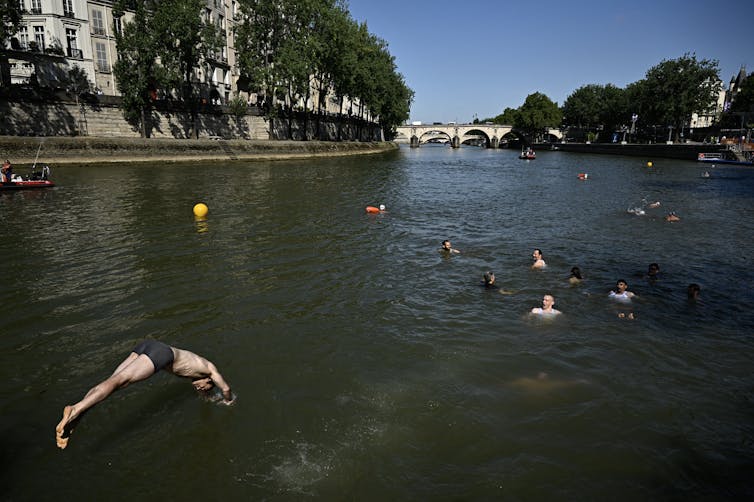
Swimming in the Seine – part of the Olympics’ promise to ‘supercharge’ the greening of Paris.
Getty Images

Sustainable sport

To be fair, the International Olympic Committee (IOC) adopted ideas of sustainability relatively early. In 1994, “environment” joined “sport” and “culture” as the third pillar of the Olympic movement.

And in 1996, the Olympic Charter was amended to include concern for the environment. Cities vying to host the games are also required to address environmental issues.

As a result, sustainability has become an essential part of Olympic hosting bids. Paris has taken this to a new level, with organisers promising to halve the carbon footprint of the London and Rio de Janeiro games.

This emphasis on “climate positivity”, they say, will also “supercharge” green initiatives in the city, make Paris 2024 the “greenest games in history”, and show “another model is possible”.

Other sporting organisations have followed the IOC’s lead. Of the 36 Summer Olympic sports federations, 17 have a sustainability strategy, and 23 have signed the United Nations Sports for Climate Action framework, which commits signatories to halve their emissions by 2030 and aim to reach net zero by 2040.

Extra challenges for New Zealand

Sporting organisations in Aotearoa New Zealand, however, have barely got off the environmental starting line.

The New Zealand Olympic Committee (NZOC) does not have a sustainability strategy. Moreover, of the 56 member federations identified by NZOC, only Yachting New Zealand and Golf New Zealand have their own sustainability strategies.

Notably, although Yachting New Zealand’s strategy is well developed, neither attempts to quantify their carbon footprint or address the impact of travel.

Equally, just ten member organisations even mention environmental sustainability in their latest strategic plans. The situation is similar among non-Olympic professional sporting organisations and leagues. Neither the New Zealand Warriors nor the Wellington Phoenix, for example, have published sustainability strategies, although the New Zealand Breakers have detailed a commitment to a “thriving environment”.

Realistically, genuine environmental action is difficult for New Zealand sport. Given the county’s geographical location, teams and competitors have no option but to travel long distances, as do visitors wanting to compete here.

Indeed, New Zealand’s remoteness means our per-capita emissions from air travel are the sixth highest in the world, and even travelling regularly to compete in Australian leagues produces a substantial carbon footprint.

Sport New Zealand has shown a willingness to drive this kind of action, sponsoring an environmental sustainability award. But reducing travel and international competition would have obvious repercussions. Perhaps tellingly, the commonest reference to “sustainability” by New Zealand sporting organisations is in a financial context, not an environmental one.

Another model?

These practical challenges to implementing noble goals have seen the sustainability in sport movement accused of “greenwashing gold”. And the Paris Olympics have been criticised for a “lack of transparency and precision” in measuring and reporting on their green goals.

Previous Olympics have also demonstrated that pledges and visions are not the same as outcomes, with environmental initiatives poorly monitored overall. The environmental and climate impacts of the 2014 Sochi Winter Olympics and 2022 FIFA World Cup in Qatar show how far mega-sport has to go.

Indeed, the Paris games will still produce 1.5 million tonnes of carbon – roughly comparable to Fiji’s entire annual emissions, with around half coming from international travel.

There have even been calls to halt the Olympics, or at least reduce their size, due to the climate crisis. Like global sport in general, the games are caught in the same tension between ecological sustainability and economic growth that hinders all attempts to combat climate change.

If commercial sport continues to encourage mass international travel from spectators and participants, as well as expanding fixtures and events in search of ever larger media audiences, its environmental initiatives will always fall short.

This may be especially true for a small, remote country like New Zealand. The claim by Paris that “another model is possible” might turn out to have a very different meaning than intended.

The Conversation

Chris McMillan does not work for, consult, own shares in or receive funding from any company or organisation that would benefit from this article, and has disclosed no relevant affiliations beyond their academic appointment.

ref. As the Paris Olympics try to go green, NZ sports bodies are stuck in the starting blocks – https://theconversation.com/as-the-paris-olympics-try-to-go-green-nz-sports-bodies-are-stuck-in-the-starting-blocks-235094

Vanuatu fights for marine protection at key UN deep-sea mining summit

By Stephen Wright in Kingston, Jamaica

Vanuatu has taken a leading role in a bloc of nations fighting to keep marine environment protection on the main agenda of the UN organisation responsible for developing global regulations for seabed mining.

The assembly of the Kingston-based International Seabed Authority is meeting this week with a packed programme, including a vote to pick the next secretary-general who could significantly influence the environmental constraints set on mining.

Deep-sea mineral extraction has been particularly contentious in the Pacific, where some economically lagging island nations see it as a possible financial windfall and solution to their fiscal challenges but many other island states are strongly opposed.

Vanuatu Minister of Climate Change Ralph Regenvanu, at the ISA meeting of the 168 member nations plus the European Union, said an environmental policy was “critical” because it’s likely the body will receive an application to approve commercial seabed mining by the end of this year.

“When you make deliberations in the coming days, please think beyond your national boundaries and think as custodians of our ocean and of the real threat mining the seabed poses for the Pacific region,” Regenvanu said in remarks he explicitly directed at the Pacific island nations which favour deepsea mining.

“Financial exploitation of our ocean may be beneficial for the next decade for our nations, but it could be devastating for the future generations,” he said.

Mining of the golf ball-sized metallic nodules that litter swathes of the sea bed is touted as a source of the rare-earth minerals needed for green technologies, like electric vehicles, as the world reduces reliance on fossil fuels.

Irreparable damage
Sceptics say such minerals are already abundant on land and warn that mining the sea bed could cause irreparable damage to an environment that is still poorly understood by science.

Deep-sea mining opponents have been pushing for the ISA to prioritize protection of the marine environment at the full assembly rather than keep discussion of the issue within its smaller policy-setting council.

Vanuatu Climate Change Minister Ralph Regenvanu speaks during a plenary session at the COP28 UN Climate Summit in the United Arab Emirates in December 2023. Image: Kamran Jebreili/BenarNews

Some see such a policy as the prerequisite for an international moratorium on deep-sea mining in the vast ocean areas outside national boundaries that fall under the ISA’s jurisdiction.

Along with Vanuatu, several nations including Spain, Chile and Canada expressed backing for the assembly to begin discussion of an environmental policy.

China, a powerful voice at the ISA, reiterated its reservations because of the packed agenda, but said it was willing to be flexible. Saudi Arabia was among the nations that criticised the proposal sponsored by Vanuatu and seven other nations but did not formally object.

The assembly is also expected to vote on candidates for the ISA’s secretary-general. The long serving incumbent Michael Lodge has been criticized by organizations such as Greenpeace, who say he has taken the part of deep-sea mining companies rather than being a neutral technocrat.

The British lawyer’s candidacy is sponsored by the pro-mining Pacific nation of Kiribati against Brazil’s Leticia Carvalho, an oceanographer and former oil industry regulator of the South American nation, who has also been critical of his leadership.

Vanuatu also made its mark at the assembly by blocking two organisations linked to deep-sea mining companies from gaining NGO observer status at the ISA.

Regenvanu told the assembly that one of the organisations was made up of subsidiaries of The Metals Company, which has been testing its equipment for hoovering up the metallic nodules from the ocean floor.

The Metals Company is working with the Pacific island nations of Nauru, Kiribati and Tonga to possibly exploit their licence areas in the Clarion-Clipperton Zone. The 4.5 million square kilometer area in the central Pacific is regulated by the ISA and contains trillions of polymetallic nodules at depths of up to 5.5 km.

Nauru in June 2021 notified the seabed authority of its intention to begin mining, which started the clock on a two-year period for the authority’s member nations to finalise regulations.

International Seabed Authority Secretary-General Michael Lodge (right) at the ISA’s 29th assembly in Kingston, Jamaica this week. Image: Stephen Wright/BenarNews

The Cook Islands, meanwhile, is allowing nodule exploration by other companies in its own waters and does not need ISA approval to mine in them.

Sonny Williams, Assistant Minister to the Cook Islands Prime Minister, told the assembly that his country is proceeding with caution to ensure both conservation and sustainable use of marine resources.

“Deep seabed minerals hold immense potential for our prosperity,” he said. “To unlock and develop this potential we must do so responsibly and sustainably, prioritising the long-term wellbeing of our people.”

Greenpeace deep-sea mining campaigner Louisa Casson said the ISA assembly would not complete the complicated process of agreeing on deep-sea mining rules at its current meeting.

Non-governmental organisations and governments that want to take a cautious approach to deep sea mining are hoping the assembly meeting will make incremental progress toward achieving a moratorium on mining, she told BenarNews.

Copyright ©2015-2024, BenarNews. Republished with permission of BenarNews.

Article by AsiaPacificReport.nz

Why the RBA is highly unlikely to lift interest rates next week, even if inflation climbs

Source: The Conversation (Au and NZ) – By Peter Martin, Visiting Fellow, Crawford School of Public Policy, Australian National University

The inflation figure due to be released to is different than most. It’s focusing the minds of politicians as well as economists.

Inflation has been falling for the past five quarters, getting closer and closer to the Reserve Bank’s target band.

At the last quarterly read, three months ago, it wasn’t far away. Inflation came in at 3.6%, well down from the peak of 7.8%, and within sight of the 2-3% band.

There had been talk about a cut in interest rates, soon. It’s a good idea to ease rates before inflation is actually in the band, for the same reason it’s a good idea to ease off on the accelerator and tap on the brakes before you want to stop a car: changes in interest rates affect things with a lag.

Now there are forecasts that the figure out on Wednesday will show inflation has gone up, perhaps to 3.8%, perhaps to 3.9%, or perhaps to 4% or more.


What has politicians transfixed is the possibility that the Reserve Bank of Australia (RBA) will conclude that progress on inflation has stalled and it needs to push up interest rates at least one more time to make sure inflation heads back down.

The bank could do that after its board meeting on Tuesday next week, when it publishes its quarterly statement on where the economy is heading.

Will we see another pre-election rate hike?

A rate hike in what’s now the lead-up to next year’s election might do to the Albanese government what a rate hike before the last election did to the Morrison government – it helped push them out of office.

But I think there’s a good chance the Reserve Bank won’t push up rates, even if the inflation number is high, for a number of reasons.

One is that the Reserve Bank itself has been forecasting inflation of 3.8% in the year to June. Inflation shot down to 3.6% sooner than it expected in March, and a move back up to 3.8% will return things to where it expected them to be.

What’ll matter more to the bank is what’s driving inflation. Back in June, the bank’s new deputy governor let us in on his thinking about that.

Andrew Hauser took up his position at the Reserve Bank in February, after a career helping set rates at the Bank of England.

He noted that inflation in the price of goods was coming down faster than inflation in the price of services, but said that wasn’t unusual. Across most countries, the pictures looked “incredibly similar”.

It might be that high rates were taking “a little bit longer” to crimp inflation in the prices of services than goods. If so, the right response would be to “hold your nerve” and note that services inflation has been coming down but in a “slightly bumpy way”.

Some prices are beyond the RBA’s control

The other point Hauser was especially keen to make is that the prices of many services are “administered” – that is, set by the government or a tribunal.

The prices of childcare, hospital care, electricity, water, gas and public transport are, to a large extent, administered. They are beyond the scope of the Reserve Bank to influence by moving interest rates.

There was “an interesting question”. Should the Reserve Bank strip out these prices out of the inflation measure it targets, given that it can’t target them, and just target the rest? Or should it push down on the rest “a little bit further” to bring total inflation back to target?

Inflation in other prices is coming down

Hauser spoke as if someone calculated the inflation rate on only the things the Reserve Bank could influence, they would find out it was already very low.

So this week, the ANZ Bank economist Blair Chapman did that – and that’s what he found. Inflation in the prices the Reserve Bank could easily influence was already back within its target band.

Inflation in other prices – in administered prices, or prices automatically indexed to previous inflation – remained above the band, but was coming down.


And Hauser made another point he thought was exceptionally important to him, as a new arrival from the United Kingdom: Australia isn’t the UK.

In the UK, the Bank of England’s primary goal is to bring inflation back to target. Everything else is secondary, subject to the overriding goal, including supporting economic growth and employment.

In Australia, there’s a “more balanced objective”.

Full employment has equal weight

Here, the Reserve Bank has two goals, neither of which trumps the other.

One is “consumer price inflation between 2% and 3%”.

The other is “sustained and inclusive full employment where everyone who wants a job can find one without searching for too long”.

The Reserve Bank doesn’t have the right to put one ahead of the other.

Australia has chosen to give a greater weight to employment than the UK, and Hauser said “to be honest, so far that strategy has worked”.

The number of jobs that are being created is just enormous. Sometimes you talk about not celebrating success enough; this is an incredible achievement. When you think about adjustments of this scale in the past, they have always involved very, very sharp adjustment in the labour market.

Hauser likes what he sees about Australia. There is “not much to not like here”.

If the price of Australia’s focus on jobs is that “services inflation is taking a bit longer to come down,” he gives the impression he is not too concerned.

When it makes its decision next Tuesday, the Reserve Bank will be concerned not so much with where inflation has been (that’s what this week’s figures will tell us), but where it is going – which is probably down.

And it’ll be concerned with where employment is going, which is probably also down given very weak economic growth.

If Wednesday’s figures show inflation alarmingly high, the Reserve Bank will have choice no but to push up rates next week. But otherwise, it’s likely to hold its nerve and watch as inflation continues to decline.

Peter Martin is Economics Editor of The Conversation.

ref. Why the RBA is highly unlikely to lift interest rates next week, even if inflation climbs – https://theconversation.com/why-the-rba-is-highly-unlikely-to-lift-interest-rates-next-week-even-if-inflation-climbs-235683

Trailblazer of Fijian Drua Media: How Kara Ravulo sailed unforeseen waters

By Paige Schouw, Queensland University of Technology

Kara Ravulo was halfway through her university studies when her father became sick, ultimately leading her to defer school to help support her family. After he died, Ravulo’s mother’s wise words encouraged her to go back and complete her studies.

But it was Ravulo’s perseverance and dedication that led her to where she is now.

With the rise of female athletes across Fiji, it has opened a door for not only women athletes to be in the media but also for women journalists reporting on sports media.

Almost every media outlet in Fiji boasts a woman sports journalist.

As the media and content officer at the Fijian Drua, Kara Ravulo is a trailblazer in the Fijian sports and communication sector. When she began her role, Fiji had never had a woman media officer for a male sporting team.

Ravulo, who has a Bachelor of Commerce from the University of the South Pacific, found herself longing for something more, when she saw an advertisement for a position available at the Fiji Sun newspaper.

Ravulo expressed a gracious thanks to God after she was offered a position at the Fiji Sun, where she covered the news and business sectors before the sports editor approached her about becoming a sports journalist.

‘This is what I want’
“They tested me out. The sports editor was like, ‘Do you want to write sports stories?’ and I was like ‘I can try’.”

“Then they put me on sports and when I started doing it and started doing interviews I was like, ‘I think this is what I want to be’.”

After three years as the sports journalist at the Sun, Ravulo saw a new opportunity to level up her skills and applied for a position at the public broadcaster Fijian Broadcasting Corporation (FBC).

She covered the sports news at FBC, but it was here that she learnt new forms of journalism.

Ravulo thanks FBC for introducing her to social media, which she explained is something that all journalists need to be well versed and multi-talented in that area of media.

Drua media officer Kara Ravulo . . . turning to the law as a way to help sportspeople. Image: Kara Ravulo/QUT

After the introduction of the Fijian Drua Super Rugby side in 2022, the search for the organisation’s first media and content officer began. Having been at FBC for nearly three years, Ravulo decided to take another leap of faith and apply for the role.

Taking a position within a male-dominated industry is no easy feat, and no one can prepare you for situations such as being the only woman who travels with the Fijian Drua team for the whole season.

Privileged opportunity
Ravulo expressed her gratitude for the organisation and the team for having faith in her to be their media officer, as she believes it is such a privilege.

Being treated as one of their own is great, but it means that she does still have to carry the heavy stuff, Ravulo said while laughing.

“It was challenging at first trying to earn the teams trust but something that we women need to know is that you need to take out that mentality that women cannot do what men can do,” she said.

“When standing at games with other super rugby clubs’ male content officers, I just think to myself, I am the same as all of you.

“And you should have that mentality that I can do what you can do.”

It is not only the team at the Drua organisation that Ravulo has won over, according to former Fiji Times finance editor Monika Singh, now teaching assistant at USP.

“She has the ability to win people over with her infectious smile and friendly demeanour,” Singh said.

“I have known her for some time now and I have never heard anyone complain about her work or her work ethic,” said Singh when reflecting on Ravulo’s character.

Writing wins respect
Ravulo strongly believes that some of the challenges junior journalists are faced with can be overcome through your writing.

“You write the way that people can actually respect you and see that you’re here to mean business, it changes the perspective of how people look at you.”

Working with the Drua has broadened Ravulo’s horizons not only in relation to the social media and content creation, but also in understanding sponsorships, marketing, and public relations.

As a result, she has opted to go back to university and study a Bachelor of Law to venture into sports law because player welfare, lack of agents and contract negotiations is a gap she has noticed within the Fijian market.

Ruvulo would encourage all women to work within the sports media industry across Fiji.

“Women need to be more out there.”

Paige Schouw is a student journalist from the Queensland University of Technology who travelled to Fiji with the support of the Australian Government’s New Colombo Plan Mobility Programme. Published in partnership with QUT.

Article by AsiaPacificReport.nz

For decades, governments have subsidised fossil fuels. But why?

Source: The Conversation (Au and NZ) – By Bernard Njindan Iyke, Lecturer in Finance, La Trobe University

Sobrevolando Patagonia/Shutterstock

Even now, decades after we first began trying to avert the worst of global warming, more than 80% of the world’s total energy comes from fossil fuels.

You might think this would make fossil fuel production extremely profitable. But it’s not always the case. Much of the most accessible oil has already been extracted and burned. Many countries want to shore up domestic sources of fossil fuels to boost energy security. Energy price fluctuations and competition from new energy sources such as solar, wind and fossil gas have made it harder for some fossil fuel companies to make money, especially in coal.

This is where fossil fuel subsidies come in. Australia gave A$14.5 billion in subsidies to major fossil fuel producers and consumers in 2023–24 alone.

You might have wondered – why would some of the largest companies on Earth need subsidies? Here’s why.

LNG tanker
Australia’s surging liquefied natural gas industry has been boosted by government funding.
KDS Photographics/Shutterstock

Private companies, public money

Globally, private companies dominate fossil fuel production, though fossil fuel-rich nations often have state-owned companies, such as Saudi Arabia’s Aramco and Russia’s Rosneft.

Why would governments give fossil fuel companies money? Many reasons. But the most important is that wealthy countries have historically needed huge volumes of fossil fuels for manufacturing, transport and power. Many countries have some sources of fossil fuels inside their borders, but only a few are self-sufficient. This has enabled fossil fuel giants such as Saudi Arabia to become wealthy beyond belief.

Many governments have used subsidies to boost their energy security and encourage local producers to seek out new sources of coal, gas and oil. These subsidies can make all the difference in making fossil fuel companies competitive internationally. For instance, Canada spent billions on subsidies to boost its oil sands and fracking projects.

Subsidies were essential in the United States’ fracking revolution. Novel approaches to extracting fossil gas and oil – boosted by major tax incentives – turned the US from a major importer of oil and gas into a net exporter by 2019.

You can see why the US did this. At a stroke, it went from being dependent on energy provided by foreign nations to being independent.

Once subsidies are in place, they become very hard to remove. Indonesia’s lavish fuel subsidies now account for 2% of the nation’s GDP. When the national government tried to walk these back, there were riots.

And there’s another reason, too. Fossil fuels are still playing an important role in boosting the economy in most nations. Subsidising them has long been seen as a way to maintain economic growth and stability.

Globally, these subsidies are estimated at a staggering $10.5 trillion each year.

This figure has grown sharply in recent years, after Russia’s invasion of Ukraine. As European nations tried to wean themselves off Russia’s gas, energy prices surged worldwide. In response, some countries introduced new subsidies to support businesses and consumers.

The top-line figure of $10.5 trillion includes two types of subsidy – explicit (meaning real dollars change hands) and implicit (for example, governments building roads and railways to encourage crude oil transport).

Explicit subsidies

Explicit fossil fuel subsidies are direct financial incentives from governments to fossil fuel producers and consumers. These incentives come in different forms, such as tax breaks, direct payments, grants and price controls. All of them aim to reduce the financial burden associated with fossil fuel production and use.

In Australia, explicit subsidies include fuel tax credits and exploration tax reductions. Fossil fuel companies can get subsidies to offset the losses they make during the years it takes to find and begin extracting new fossil fuels.

In the US, oil and gas companies benefit from the oil depletion allowance, which permits them to deduct a percentage of their gross income from oil and gas sales as an expense. They can also claim tax deductions for intangible drilling costs, such as the wages of workers and material needed to find new sources of oil and gas.

China, too, uses direct subsidies, discounted land-use fees, and preferential loans as explicit subsidies to boost coal production and consumption. The national government also supports fossil fuel consumption through direct payments to consumers.

coal miners China
China has used subsidies to encourage exploitation of its large coal resources.
zhaoliang70/Shutterstock

Implicit subsidies

Implicit subsidies are often described as “imaginary”. That doesn’t mean they don’t exist, just that they’re not a direct transfer to directly paid to fossil fuel producers.

For instance, the cost of burning fossil fuels is borne by the global community and the natural world, in the form of climate change, damage to human health and other harms. Most fossil fuel companies don’t have to pay a cent for the pollution their products cause – so in effect, they are being granted an indirect subsidy.

Implicit incentives also include government investment in facilities such as transport networks, pipelines, oil refineries and port infrastructure, which will accelerate fossil fuel production and delivery. Think of the Middle Arm development in Darwin, funded by both the federal and territory government.

Why are these subsidies still being paid?

As the world grapples with a worsening climate crisis, fossil fuel subsidies are under great scrutiny.

It’s politically difficult to withdraw subsidies once given. This is why governments around the world have instead begun to give subsidies and tax incentives to green energy developers, including the enormous $500 billion Inflation Reduction Act in the US, the European Union’s Green Deal, and China’s massive subsidies of green technologies such as electric vehicles and solar panels.

The goal here is to make renewable energy and electrified transport steadily more affordable and competitive – just as fossil fuel subsidies did for oil, gas and coal.

The Conversation

Bernard Njindan Iyke does not work for, consult, own shares in or receive funding from any company or organisation that would benefit from this article, and has disclosed no relevant affiliations beyond their academic appointment.

ref. For decades, governments have subsidised fossil fuels. But why? – https://theconversation.com/for-decades-governments-have-subsidised-fossil-fuels-but-why-213467

Rex Airlines’ future up in the air amid questions about viability of small airlines in Australia

Source: The Conversation (Au and NZ) – By Justin Wastnage, Adjunct Industry Fellow, Griffith Institute for Tourism, Griffith University

Winter is always a tough time to be an airline in Australia.

This current cold snap has been exacerbated by a cost-of-living crisis, causing would-be holidaymakers to tighten their belts as the aviation industry again braces for more bad news.

This time it’s from Regional Express Holdings, parent company of Rex Airlines, whose shares are in a trading halt pending a “material announcement” to the stock exchange, expected sometime this week.

Responding to many Australians having a lower disposable income, the major carriers Qantas and Virgin Australia, have reduced airfares after recovering strongly from the COVID shutdown.

Qantas’s budget sister Jetstar has been particularly aggressive, with sub-$100 fares back on the menu after a four year absence.

Yet, as witnessed by the collapse of Bonza in May, airlines without deep pockets can be squeezed out of the market.

Analysts have always had higher hopes for Rex, which provides feeder services from regional towns across New South Wales, Queensland and to a lesser extent, Victoria, to the eastern capital cities.

The airline also has significant regional operations in other states and is backed by a private equity firm PAG Asia Capital (formerly the Pacific Alliance Group).

These factors should have helped the business stave off the worst of the ravages that beset Bonza.

Supply versus demand

Yet there are some simple market economics at play in Australian commercial air transport.

We are a nation of 28 million people, but we are also concentrated into 25 population centres of greater than 100,000 inhabitants.

Studies suggest that route viability relies on towns being at least this size to ensure sufficient two-way traffic. For example, the US has about 250 population centres with more than 100,000 people, while Europe has about 400.

This was, in many ways, Bonza’s downfall, relying on one-way leisure traffic to smaller towns that could never repay the favour with passengers returning.

Budget carriers’ blighted history

Bonza was merely the latest in a string of failed low-cost carriers hoping to break the effective duopoly that is the Australian air market. Tigerair Australia collapsed during the pandemic despite earlier being rescued by Virgin Australia.

Before Tigerair, it was Air Australia in 2011 and before that, Backpackers Xpress in 2005. Impulse collapsed in 2001. Each had bet on duplicating the US and European budget carrier model, but in a much smaller market.

Yet Rex is fundamentally different, the core of its business is flying 34-seater Saab 340 turboprop aircraft in and out of regional towns, connecting with capital cities.

Much of this flying is underpinned by state subsidies that are further propped up by federal government assistance to maintain the regional airport infrastructure.

Often these routes are managed monopolies, meaning either Qantas Link or Rex have sole provider status, albeit in return for agreed service levels and maximum fares set by the relevant state government.

Not enough planes

One of Rex’s key problems is aircraft availability. As the Saabs reach the end of their working life, there don’t appear to be any suitable replacements.

So Rex has been forced to ground half of it Saab fleet, awaiting parts so scarce that the airline sent salvage teams around the world to find them.

This has caused it to axe some under-performing routes, highlighting the importance of the flights in regional communities where they have transported passengers to business meetings and medical appointments in big cities, while providing outback towns with fresh food.

The airline may have solved the Saab problem by opting for the 42-seater Franco-Italian ATR-42, which is the work-horse of regional routes in Europe. But any deliveries would be at least five years off and come with a high price tag.

Expansion problems

But now, the current headache is the expansion into Brisbane-Sydney-Melbourne routes.

This is compounded by the costs associated with its major city service, which uses a fleet of six ex-Virgin group Boeing 737-800s leased at a cut-price rate after COVID but now attract market rates of about $180,000 per week, by some reports.

These aircraft are central to Rex’s underlying objective to secure a third of Australian air traffic and become the true third player in the market.

To achieve this, it secured a $150,000 convertible note from PAG – essentially a loan the private equity group can cash in at a three times premium for shares once the company has trebled its value.

The convertible note debt instrument, common in the tech startup world, is known for raising tensions in leadership teams, as its terms are predicated on the success of a strategic plan.

Trouble at the top

This may explain some of the unusual board shenanigans that have taken place recently within Rex.

The Singaporean owners of the airline recently ousted executive chairman (and company insider) Lim Kim Hai and replaced him with Rex stalwart and former federal transport minister John Sharp.

Mr Lim’s removal appears to be partially linked to the $48 million takeover of West Australian charter airline National Jet Express (formerly Cobham Aviation Services Australia) in 2022.

The trading halt currently has no impact on Rex services. There is media speculation that a consultancy firm has been appointed to restructure the group.

Just a setback?

Yet, despite fears of another collapse, Rex appears to have more of the foundational building blocks of a national airline network than Bonza did.

It also, through years of servicing marginal electorates across regional Australia, has a far warmer welcome in Canberra than the start-up Canadian leisure airline ever could have hoped for.

It is likely, therefore, that the rumours of Rex’s death have been greatly exaggerated.

The Conversation

Wastnage previously worked for the New Zealand Airports Association on regional airline connectivity. Wastnage was also previously the aviation policy director of the Tourism and Transport Forum where he worked on regional air connectivity issues.

ref. Rex Airlines’ future up in the air amid questions about viability of small airlines in Australia – https://theconversation.com/rex-airlines-future-up-in-the-air-amid-questions-about-viability-of-small-airlines-in-australia-235761

Australians like facial recognition for ID but don’t want it used for surveillance, new survey shows

Source: The Conversation (Au and NZ) – By Mark Andrejevic, Professor, School of Media, Film, and Journalism, Monash University, Monash University

CCTV AI Facial Recognition Camera Authentificating People on Street Gorodenkoff/Shutterstock

Automated facial recognition is becoming widespread in Australia. The technology has already been used by retail outlets, sport stadiums and casinos around the country. And in November, the Australian government’s digital identification system will be expanded, after new laws passed parliament earlier in the year.

As the technology becomes less expensive and more powerful, it will lend itself to a growing range of applications, such as a proposed age estimation tool.

To find out what Australians think about this fast-growing technology, my colleagues and our team conducted a representative national survey of more than 2,000 people. Our results, which we have just launched, indicate an overall lack of knowledge about the technology – and a range of attitudes towards it.

Crucially, these findings can help policymakers ensure the benefits of facial recognition technology are maximised – and the harms limited.

How does facial recognition technology work?

There are two main uses of facial recognition technology. The first, known as one-to-one use, ensures someone is who they say they are – as in the case of unlocking a smartphone. This can make life much more convenient. Instead of carrying around multiple forms of ID, people might simply submit to a face scan.

By contrast, one-to-many uses of the technology enable the identification of an unknown suspect or a face in the crowd.

In both cases, the technology works by creating a template from a photograph of a known individual. New photos can then be compared to the template to see if there is a match.

This match is given as a probability, not as a definitive yes or no – as in other cases of biometric identification. The technology can still be fooled by masks or disguises, but its ability to overcome these challenges is improving.

Attitudes vary, depending on how facial recognition is used

Overall, our research revealed that almost three quarters of Australians say they know little about facial recognition technology. Only one in 20 felt they knew “a lot” about it.

Our survey also found Australians are more comfortable with one-to-one uses of the technology. For example, a majority of respondents said they supported the use of the technology for accessing government services (57%).

This support might be good news for the country’s new digital ID system. It envisions a role for biometric technologies – most likely facial recognition – to allow Australians to prove their identity when accessing government and financial services.

A majority of respondents (75.2%) also supported the use of facial recognition technology for identifying criminal suspects. And there was strong support (80%) among respondents for using facial recognition technology to help verify the identities of people who lose their credentials during disasters or war.

There was, however, much less support for other uses.

For instance, the majority (60%) of survey respondents did not support its use in the workplace for tracking the location of workers. They also did not support its use for tracking and targeting shoppers. There was a strong sense facial recognition technology should not be used for commercial benefit.

We also surveyed perceptions of the accuracy of facial recognition tech. A majority of survey respondents felt facial recognition technology is either “accurate” or “very accurate”. In reality, however, there is a range of different systems in use and accuracy can vary widely.

For example, the technology has been shown to be less accurate when used on certain demographic groups, raising issues of racial bias. Misidentification can have serious consequences for those who are wrongly arrested and treated as criminals.

Crucial for survey respondents was notification and consent. 90% of Australians said they wanted to know when and where the technology was being used on them. They also wanted the opportunity to consent to its use.

Governments need to listen to the public – and respond

Automated facial recognition technology is a powerful form of surveillance that raises significant questions around privacy and liberty.

In 2019, the federal parliament proposed the use of a national face recognition database for law enforcement. This plan was deferred in part because of concerns that public response to its more widespread use might limit enrolment in digital ID programs.

More recent legislation restricts one-to-many matching using the national facial recognition database. However, individual states have their own databases from public records. The Australian Federal Police reportedly continue to rely on an agency that uses facial recognition provided by the controversial company Clearview AI.

Given the recent history of data breaches, there should be concern about the capability of both the government and private sector to safely store and manage people’s data.

But automated facial recognition technologies can undoubtedly be useful. We urgently need better public education about the technology and the issues it raises, to ensure the responsible and democratic use of facial recognition tech.

And, as former Australian Human Rights Commissioner Edward Santow argues, we also need legislation dedicated to minimising the risk of creating an automated surveillance society.

The Conversation

Mark Andrejevic receives funding from the Australian Research Council.

ref. Australians like facial recognition for ID but don’t want it used for surveillance, new survey shows – https://theconversation.com/australians-like-facial-recognition-for-id-but-dont-want-it-used-for-surveillance-new-survey-shows-235530

From selfie injuries to viral stunts, social media can be risky for children. Could a ban help?

Source: The Conversation (Au and NZ) – By Samuel Cornell, PhD Candidate – Social Media and Communication, School of Population Health, UNSW Sydney

NataSnow/Shutterstock

Australia is one of several countries currently considering a social media ban for children. Nationally, there are calls to raise the age a young person can legally use social media from 13 to 16, while South Australian premier Peter Malinauskas is leading calls to raise the age to 14.

The idea of a ban has not been without controversy. But the idea is to effectively put legal boundaries on the age children can access social media, to keep kids safe and protect their health.

Politicians such as Malinauskas acknowledge that such a ban may not be completely effective, but argue measures such as age limitations should be considered, in the same way age limits are in place for smoking, alcohol use and driving.

Our research into risk-taking behaviour associated with social media use shows the harmful repercussions of social media use do not only happen online, or just affect mental health. There are many real physical risks that stem from social media use, particularly for children and young people.

As such, from a public health perspective, we argue a ban on social media use for children is worth considering.

From selfies to stunts

Many children and young people have been injured or died as a result of trying to take photos in dangerous places – such as at cliffs or waterfalls – for social media. Research has shown children and adolescents are most at risk for selfie-related incidents, with at least 109 deaths worldwide since 2008.

Others have suffered injuries from taking part in viral challenges. For example, in the “skull breaker” challenge, shared widely on TikTok in early 2020, two children would kick the legs from under a third, making them fall over. The results of this stunt included severe spinal injuries, hospital admissions, and even children being charged with assault.

Around 2018, the “Tide pod” challenge went viral, encouraging children to eat laundry detergent capsules. The repercussions of doing so can include vomiting, breathing difficulties and loss of consciousness.

A popular stunt called the “blackout challenge”, which proliferated on TikTok and was particularly popular with children, led to the death of at least 20 children in 18 months around the world. The challenge involved children holding their breath, or cutting off their supply of air, until they blacked out.

Children are much more likely to engage in these sorts of risky behaviours than adults are. Children are still forming their identities, pushing boundaries, aiming to gain approval from their peers, and learning about risk.

The scale of social media

Social media algorithms are quick to promote the most appealing content, so risky stunts can go viral quickly – potentially exponentially increasing the harm.

Dangerous activities, such as taking selfies and photos in precarious poses and locations, often garner lots of views and “likes” on social media. And children want to be liked and seen as popular online, with many aspiring to be influencers over and above regular professions.

If we restrict children from using social media, it doesn’t mean they won’t take risks. Children have always naturally pushed boundaries and taken risks, and some play can be dangerous.

But social media pushes risky activities and behaviours to children en masse, at a scale previously impossible.

Continued controversy

Academics, parents and children themselves have argued a ban is not the answer to the harms social media is having on childrens’ health and wellbeing.

Much of the discussion against a ban makes the case that social media has benefits for honing children’s digital literacy, community building and online support networks. Groups including LGBTQ+ advocates have pointed out that a ban would remove an outlet they say is essential for their mental health and sense of community.

Two teenage boys sitting on the pavement using smartphones.
Experts disagree on the issue of age verification for social media.
Pixabay/Pexels

Other experts believe a ban is the right move, arguing social media is disrupting teenagers’ identity development, increasing rates of anxiety and depression, and fuelling polarisation.

But the link between social media use and risk-taking behaviours in the real world is often neglected in the discussion. Alongside other benefits, putting a stronger age restriction on social media use may reduce the likelihood of children engaging in dangerous viral challenges and risky stunts seen online.

Implementing and enforcing a social media ban for children would face push back from both industry and the public, and would not be without technical challenges.

But if we know a product is causing harm to children, regardless of some perceived benefits, it’s only right we take action to protect them.

The Conversation

Samuel Cornell receives funding from Meta Platforms, Inc. His research is also supported by a UNSW University Postgraduate Award, as well as project funding from the Royal Life Saving Society – Australia. He is affiliated with Surf Life Saving Australia and Surf Life Saving NSW.

Amy Peden receives funding from the National Health and Medical Research Council, Meta Platforms Inc, Royal Life Saving Society – Australia and Surf Life Saving Australia. She holds an honorary affiliation with Royal Life Saving Society – Australia.

ref. From selfie injuries to viral stunts, social media can be risky for children. Could a ban help? – https://theconversation.com/from-selfie-injuries-to-viral-stunts-social-media-can-be-risky-for-children-could-a-ban-help-234393

Is Deadpool & Wolverine the hit Marvel needs? It’s entertaining – but it likely won’t cure our superhero fatigue

Source: The Conversation (Au and NZ) – By Lorna Piatti-Farnell, Professor of Film, Media, and Popular Culture, Auckland University of Technology

Bringing Wolverine into the MCU was possible due to Disney’s re-acquisition of the rights to the X-Men characters, previously hekd by 20th Century Fox. IMDB

Last week, the Marvel Cinematic Universe’s (MCU) latest offering, Deadpool & Wolverine, opened in theatres worldwide. The film brings two highly popular characters, played by Ryan Reynolds and Hugh Jackman, back to the silver screen – raking in about US$440 million (A$672 million) from its global opening.

The film certainly doesn’t shy away from fan service, with much of the material seemingly added just to please existing fans. The plot is filled with in-jokes, including a variety of meta-references to the alleged off-screen feud between Reynolds and Jackman.

In fact, I’d say the film appears to be solely intended for a specific segment of Marvel’s existing fanbase, with very few attempts at making the story palatable to a global audience.

This is a noteworthy choice for a standalone Marvel film – especially at a time when superhero films have lost some of their lustre. Marvel’s previous release, The Marvels (2023), ended its box-office run as the lowest-grossing film in the MCU’s history, making about US$197 million globally.

It’ll be intriguing to see the effect of Deadpool & Wolverine on the declining popularity of the MCU. Will it end up being the hero Marvel needs? Or will our collective “superhero fatigue” ultimately keep it from reaching its potential?

Marvel’s formula comes undone

After the global peak of Avengers: Endgame (2019), things haven’t quite been the same in the Marvel corner. While the studios have forcefully continued to produce several films and series, the excitement that characterised the release of Marvel movies pre-Endgame seems to have virtually disappeared.

Marvel Studios’ recent failure to replicate its longstanding success can probably be attributed to a few factors. First and foremost is that Marvel seems to have lost the coherent structure that supported its pre-2019 superhero movies, beginning in 2008 with the release of Iron Man. Films from this era focused on developing stories and superhero characters belonging to the now much-beloved Avengers group.

Although there were several other films focused on the exploits of individual characters – such as Captain America: The First Avenger (2011), Thor (2011) and Black Panther (2018) – all of these narrative offshoots regularly converged back to the central Avengers storyline, which itself was advanced through films such as The Avengers (2012), Age of Ultron (2015), Infinity War (2018) and, finally, Endgame.

This winning formula ensured box-office success for Marvel. In Endgame, however, the principal storyline that had driven so much of the MCU until then overtly came to an end.

The film not only tightened the narrative strings of previous stories, it also saw the death of key characters including Tony Stark as Iron Man (Robert Downey Jr) and Natasha Romanov as Black Widow (Scarlett Johansson) – and the “loss” of Steve Rogers as Captain America. Fans worldwide felt the film had lived up to its name, marking the end of the MCU as they knew it.

Bringing Wolverine into the MCU was possible due to Disney’s re-acquisition of the rights to the X-Men characters, previously held by 20th Century Fox.
IMDB

Marvel has tried to keep its momentum going post-Endgame, in what has become known as “phase 4” of the MCU. In recent years, the studios have produced a growing number of series such as The Falcon and the Winter Soldier (2021), WandaVision (2021) and Loki (2021), to name a few.

Disney’s takeover

Central to the boom in production has been Marvel’s merger with Disney. The acquisition of Marvel Entertainment by Disney actually happened in 2009. However, it wasn’t until after Endgame that the relationship openly came to fruition, when Disney’s new streaming venues truly came to play a part.

After 2019, Marvel’s series have been primarily streamed on Disney+, consolidating the studios’ place as part of Disney. The decision to adapt to the online Disney model, however, may have contributed to the decline in Marvel’s success. In following the production-heavy model that suits platforms such as Disney+, Marvel may have been spread too thin – leaving characters and storylines half-developed and gaining a series of flops.

Trying too hard?

Another result of the overproduction of superhero films and media is what has become known as “superhero fatigue”, wherein there are just too many superhero stories around (often of questionable quality) for even loyal fans to appreciate them.

Deadpool & Wolverine therefore comes in the wake of a very difficult time for Marvel. The film definitely relies heavily on the iconicity of the two titular superheroes and in particular on the introduction of Wolverine into the MCU canon. Whether this gamble has been successful remains to be seen.

Although box office returns have been high since opening night, reviews have been mixed. Some have appreciated the meta-humour, where the specific jokes give the film a kind of “self-awareness”. But others have been put off by the unbelievable plot which often leans into pastiche, even as it tries to echo the visual spectacle that was characteristic of the Avengers franchise.

In a way, Deadpool & Wolverine feels like something of a filler film, strategically placed to recapture fans’ attention through what is essentially a parody of the superhero genre.

The film was also released alongside Marvel’s announcement of the upcoming Avengers: Doomsday, expected in 2026–27. This will be directed once again by the Russo brothers and will (somewhat unexpectedly) bring back Downey Jr in the new role of Doctor Doom.

It’s hard to predict whether this new direction will revive the MCU. For the time being, Deadpool & Wolverine – while generally enjoyable – does little to ease the pain of Marvel fatigue.

The Conversation

Lorna Piatti-Farnell does not work for, consult, own shares in or receive funding from any company or organisation that would benefit from this article, and has disclosed no relevant affiliations beyond their academic appointment.

ref. Is Deadpool & Wolverine the hit Marvel needs? It’s entertaining – but it likely won’t cure our superhero fatigue – https://theconversation.com/is-deadpool-and-wolverine-the-hit-marvel-needs-its-entertaining-but-it-likely-wont-cure-our-superhero-fatigue-235675

Five arrested in connection with deadly Papua New Guinea massacre

By Grace Tinetali-Fiavaai, RNZ Pacific journalist

Papua New Guinea police have arrested five people in connection with the brutal attacks in Angoram district that left around 25 people dead last week.

RNZ Pacific correspondent in PNG, Scott Waide, said the ringleaders who initiated the attacks in three remote villages in East Sepik have not yet been arrested.

He said they were still armed and on the run after an estimated 30 young people targeted Tamara, Tambari and Agrumara villages over what is believed to have been a land dispute.

Hundreds of people have been displaced as a result of the deadly violence, with reports that survivors were hiding in bushes.

Waide said there had been no government presence or assistance sent to the survivors who desperately needed food and help.

East Sepik Governor Allan Bird has said tribal violence continued to deteriorate in the country.

A villager from Angoram, Andrew Sangi, told RNZ Pacific last week the government was not actively involved to solve the problem.

This article is republished under a community partnership agreement with RNZ.

Article by AsiaPacificReport.nz

Does Donald Trump really want to be a dictator?

Source: The Conversation (Au and NZ) – By David Smith, Associate Professor in American Politics and Foreign Policy, US Studies Centre, University of Sydney

Last week, Donald Trump promised a Christian audience that if they voted for him in 2024, they wouldn’t have to vote again in four years.

Christians, get out and vote, just this time. You won’t have to do it anymore. … You got to get out and vote. In four years, you don’t have to vote again. We’ll have it fixed so good you’re not going to have to vote.

Democrats pounced on this as evidence of Trump’s dictatorial ambitions. But not all conservative Christians were thrilled about it, either.

David Lane, who leads an organisation dedicated to getting Christian leaders elected, fretted that Trump’s comments could discourage Christians from voting in the future.

“Evangelicals in 2028, 2032, and 2036 must raise their civics game to a new level if America is to return to the Judeo-Christian heritage and Biblical-based culture laid out by the founders”, Lane told the Washington Post.

Was Trump really promising dictatorship? Or claiming there would be no need for Christians to vote in future elections? Or was he just repeating a joke he made a week earlier, based on his (wildly inaccurate) belief that conservative Christians are reluctant voters?

Even jokes can be revealing, especially when it comes to the relationship between Trump and his supporters. Trump was not saying he would end elections, but he was being coyly apocalyptic about what Christians could expect from this one.

Trump identifies as a Christian, but he is not a traditional Christian politician. Conservative Christian leaders typically fight policy battles to bring or keep their country in line with their moral beliefs. But as I’ve written before, many rank and file Christian conservatives in America have been left unsatisfied by the failures of this approach, and Trump has tapped into their frustrations.

Either explicitly or through hints, Trump has repeatedly promised Christians far bigger victories than incremental policy gains or temporary reversals of fortune in the culture wars. Trump instead talks about winning the “final battle”, which reminds many Christians of the prophesied victory of God over Satan.

If anything, this election Trump has been downplaying policies that conservative Christians might want. The Republican platform for 2024 has modified the party’s hardline opposition to abortion, because Trump has said Republicans must “win elections”.

Only Trump, who appointed the judges who overturned Roe v Wade, would have the credibility to do this without fearing the loss of conservative Christian support. And that credibility is as high now as it has ever been.

In the past, Trump has enjoyed the way some Christians have likened him to righteous biblical rulers such as King Cyrus, King David, and Queen Esther. Many of his supporters took his “miraculous” survival of an horrific assassination attempt as an unmistakable sign that God is protecting him. And ever since the shooting, Trump also seems to see himself in increasingly religious terms.

When he first joked about Christians only needing to vote once, he also said

I have the wounds all over my body. If I took this shirt off you’d see a beautiful, beautiful person but you’d see wounds all over me. I’ve taken a lot of wounds, I can tell you. More than I suspect any president ever.“

Trump’s use of “wounds” would not have been lost on his Christian audience. The idea of him taking wounds for them parallels Saint Peter’s proclamation about Jesus that “by his wounds you were healed”.

Most Christians would not go as far as conservative broadcaster Wayne Allyn Root in calling Trump “the second coming of God”, but many of them trust that God is using Trump to achieve His ends and protect them from their enemies.

There are two other serious revelations in Trump’s joke.

The first is that he is counting on his base to win the election. His selection of JD Vance as his running mate was not calculated to win over groups with whom Trump has struggled in recent years, particularly suburban women. Rather, it came at the height of the Trump team’s conviction that they were destined to win anyway.

Vance has become the intellectual muscle of the Trump movement, articulating a fiercely post-liberal vision of the future. A consistent implication of Vance’s rhetoric in recent years, from his support of abortion bans and his opposition to no-fault divorce to his disparagement of “childless cat ladies”, is that the main duty of American women is to have children.

This excites Trump’s base, but Democrats have effectively cast him as “weird”, and Vance has the lowest approval ratings since 1980 for a non-incumbent vice presidential candidate at this stage of the race. If Trump is going to win with Vance against Kamala Harris, he might need even more votes from conservative Christians than the record numbers he got from the last two elections.

The second is that for all the talk of Vance being a choice for the future, Trump has little interest in the future beyond his own second term. This comes across more clearly in the original version of the joke:

They go to church every Sunday, but they don’t vote. In four years, you don’t have to vote. Okay? In four years, don’t vote. I don’t care.

Trump has remade the Republican Party as his personal vehicle. When he finally exits, no one else may be able to drive it.

The Conversation

David Smith does not work for, consult, own shares in or receive funding from any company or organisation that would benefit from this article, and has disclosed no relevant affiliations beyond their academic appointment.

ref. Does Donald Trump really want to be a dictator? – https://theconversation.com/does-donald-trump-really-want-to-be-a-dictator-234669

No coaches, no worries? How action sport athletes are bucking traditional sports pathways

Source: The Conversation (Au and NZ) – By Eva Ellmer, Researcher, The University of Queensland

Action sports used to be a niche interest but they are continuing to gain in popularity, especially among younger generations.

So, why are more people turning to sports such as BMX, skateboarding and surfing?

The popularity of the X-Games would have helped but there are likely other factors.

One is that participants can engage in these activities in a way that suits their lifestyle and they can express themselves freely – outside of rules, regulations and schedules seen in more traditional sports.

With action sports, people are often empowered to explore their potential and develop their skills and abilities without coaches or sporting organisations imposing rigid structures and expectations.

These athletes don’t have to worry about running laps to warm up or doing push-ups for punishment. Instead, they usually don’t have coaches telling them what to do, and when and how – they tread their own paths.

From rebellion to acceptance

When action sports first came onto the scene in the late 1990s, athletes started to challenge traditions and norms by embracing an anti-establishment and counter-cultural, do-it-yourself philosophy.

This was particularly evident at the 1998 Nagano Winter Olympics, when snowboarders such as Norway’s Terje Haakonsen boycotted the games due to the demands the International Olympic Committee (IOC) was placing on athletes and their sponsors.

Some critics felt the IOC did not respect the unique history and values of snowboarding. Since then, several other action sports athletes have spoken out about their sports’ inclusion in the Olympics.

Over the past few decades, participation rates in these sporting activities have continued to rise both locally and globally.

In Australia, an estimated 196,000 individuals aged 15+ have taken up surfing and 119,000 have taken up skate sports since 2019.

As action sports are being accepted into the mainstream, the narrative is beginning to change.

Rather than perceiving action sports participants as being rebellious, their positive values and behaviours are being recognised. At the Tokyo Olympics for example, skateboarders were highlighted for their friendship, inclusivity and collaboration.

These are values that all sports can continue to learn and benefit from.

Thriving on independence: how these athletes learn

This evolving landscape has allowed researchers to explore not only the values and motivations of sports participation but also how action sports athletes learn and develop their skills.

Spoiler alert – they’re often different from traditional learning methodologies and pathways.

Instead of being coached from junior levels as seen in most traditional sports, action sports participants tend to take responsibility for their own learning by going to the skate park or building their own ramps and obstacles in dirt or snow.

Indeed, some athletes like BMX freestyler Logan Martin have built their own freestyle parks in their backyard.

Australian gold medallist Logan Martin built multiple training ramps in his backyard.

This speaks to the flexibility, freedom and creativity of when, where, and how participants engage in their sport.

In Martin’s case, it was an investment in his own professional development and it paid off – he won gold in Tokyo.

The role of peer-coaching

In action sports, athletes often learn from each other rather than from coaches. They watch each other’s moves, talk about what works and solve problems together.

This kind of peer-coaching boosts confidence and team spirit especially when everyone has a common goal.

In these sports that are considered high-risk, athletes rely on their peers’ advice and encouragement when attempting to complete a new jump or trick. The emotionally safe environment allows athletes to turn fear into courage, supporting their learning and skill development.

Even at the elite level, many action sports athletes learn differently. While some may have touchpoints with performance support staff like coaches, sports scientists, psychologists and dietitians, many don’t.

For many action sports athletes, this often occurs only once they have been identified as a “podium potential” athlete – meaning they have already met certain performance benchmarks alongside international competition performances.

Under these guidelines, athletes are afforded scholarships allowing them to dictate their own performance support management.

Even though action sports participants remain independent athletes, insights from my research into the Australian BMX scene shows coaches are respected and accepted as being “one of them” because they understood the BMX world; they created a positive, trusting environment where athletes could be themselves, share feedback and get the most out of their training sessions.

Out with the old, in with the new?

No doubt some coaches and clubs from traditional sports have started to move the goalposts to meet the demands of the younger generation. However, there remain many that can learn valuable lessons from the practices of action sports athletes.

Encouraging athletes to learn from each other, rather than solely relying on coaches, can enhance skill and personal development. Just like in action sports, observing teammates, discussing strategies and collaborating can lead to better performance.

Traditional sports can benefit from creating environments where athletes feel supported, which will result in them remaining committed to a sport and continuing to develop both on and off the field.

Coaches can achieve this by prioritising the building of trust and feedback-rich relationships between them and their athletes.

Coaches in more traditional sports can empower their athletes by giving them more control over their training, recovery and mental wellbeing. This is where scholarships and personalised resources like physiotherapy, psychology, and nutrition can be helpful.

So rather than coaches calling all the shots, why not let the athletes take over? What’s the worst that can happen?

If it’s safe in a high-risk sport, it’s likely to be safe in a traditional one.

The Conversation

Eva Ellmer does not work for, consult, own shares in or receive funding from any company or organisation that would benefit from this article, and has disclosed no relevant affiliations beyond their academic appointment.

ref. No coaches, no worries? How action sport athletes are bucking traditional sports pathways – https://theconversation.com/no-coaches-no-worries-how-action-sport-athletes-are-bucking-traditional-sports-pathways-234481

Why ultra-Orthodox opposition to serving in the Israeli army is the most significant threat to Netanyahu’s government

Source: The Conversation (Au and NZ) – By Ran Porat, Affiliate Researcher, The Australian Centre for Jewish Civilisation, Monash University

There have been widespread, large-scale protests against Benjamin Netanyahu’s government in Israel for more than a year.

These have been in response to a controversial judicial reform plan and then the horrors of the October 7 Hamas attack and the fate of Israeli hostages in Gaza.

So far, Netanyahu’s right-wing coalition government remains intact. However, draft notices sent in recent days to about 1,000 young Jewish religious men now have the potential to bring it down.

The current war in Gaza – as well as the heightened tensions with Hezbollah in recent days – have made clear an urgent need to increase the size of the Israeli army.

But the crisis surrounding the army service exemption for ultra-Orthodox youth is more than a political, economic or even moral issue. It touches on the very essence of the relationship between the Jewish state and its citizens.

The origins of the exemption

Israel’s founding father and first prime minister, David Ben-Gurion, decided in 1948, during the war that resulted in the creation of Israel, to grant service exemptions in the newly founded Israel Defence Forces (IDF) to 400 ultra-Orthodox men (Haredim in Hebrew).

The idea of “Torahto umanuto” (“His Torah is his job”) was intended to allow these men to pursue their studies in Jewish religious institutes (yeshivas). The goal was to ensure the preservation of hundreds of years of Jewish learning and religious knowledge, which was under severe threat after millions of Jews perished in the Holocaust.

For many years, the number of exemptions remained capped. Following the 1977 elections, the Likud Party secured a governing coalition for the first time by wooing religious parties to join the government in exchange for removing the limitations on such exemptions.

As a result, by 2021, the number of exemptions jumped to almost 10,000 Haredim each year, representing 18% of the total 18-year-old Jewish men and women required by law to enlist in the IDF.

For decades, this arrangement has caused significant tensions within Israeli society.

Critics point to the inherent injustice it represents. A large majority of Israelis of all denominations dedicate years to serving in the army, with many risking their lives and even being killed in action. A politically powerful minority group, however, is given a free pass from any such obligation.

Financial interests in avoiding the draft

This inequality also has significant financial implications. The Haredim population is growing faster in proportion to other segments of the Israeli population due to higher fertility rates (six children per family, double that of secular families).

Demographic predictions suggest the Haredim will constitute about 25% of Israel’s population by 2065, up from about 13% today.

And in recent years, the Haredim have turned their growing population into increased political power in Israel’s system of proportional representation; they now have 19 members in the Knesset (Israel’s parliament) out of 120.

And over time, Haredi politicians have constructed a complex system of state financial subsidies to sustain the young men exempted from military service and their families. To maintain these benefits, the yeshivas list them as students until they turn 26 – the age when all citizens become exempt from service.

As a result, keeping the exemption arrangement intact has become a major economic pillar of the ultra-Orthodox sector.

Because of this, many Haredi men do not work, which has led to an increase in the percentage of ultra-Orthodox women entering the workforce to support their families. Other men are working illegally in violation of their IDF exemptions.

Religious leaders fear that army service will lead to secularisation, due to exposure to the outside world. For example, women are an integral part of the IDF, including in combat roles, but certain types of inter-gender interactions are perceived as “promiscuous” in ultra-Orthodox circles.

Yet, in recent years, the army has been able to incorporate a small number of ultra-Orthodox youth into specific units (such as the Netzach Yehuda), thanks to special adjustments made to accommodate their religious expectations and skill sets.

A threat to Netanyahu’s coalition

Despite the power of ultra-Orthodox political parties, attempts to codify the Haredi draft exemption into Israeli law have so far failed.

Last month, Israel’s Supreme Court ordered an end to the funding of yeshivas that do not comply with draft quotas and instructed the army to start enlisting ultra-Orthodox men. The IDF then began issuing the first draft notices.

The ultra-Orthodox response has been defiant – the leadership ordered yeshiva students to ignore the notices and started collecting money to replace the government funding being withdrawn.

In March, the former chief Sephardic rabbi, Yitzhak Yosef, threatened to leave Israel if Haredim are forced to join the army, while other Haredi leaders have said that they would “rather die” than obey the orders.

For the ultra-Orthodox parties, the draft exemption is the single most important issue. Unless a solution is found soon, they could elect to bring down Netanyahu’s government by leaving the coalition. This would allow the opposition to win a no-confidence vote.

There is little appetite among the members of the governing coalition to go to an election. Recent polls have predicted a heavy defeat for the Likud bloc.

Israel needs a new contract

More than a political question, the relationship between the state and its citizens is at the heart of the Haredi army draft conflict.

A core obligation of any government to its people – to provide security – was shattered on October 7. The army also needs more recruits.

Given this, many Israelis are now demanding that what they see as years of injustice and inequality be corrected by establishing a new contract between the ultra-Orthodox sector and the rest of society. They believe this is especially important as the size of the ultra-Orthodox community and the impact of their exemptions are expected to become ever more significant in coming years.

The Conversation

Ran Porat is a research associate at The Australia/Israel & Jewish Affairs Council (AIJAC) and Research Fellow at the International Institute for Counter-Terrorism, Reichman University, Herzliya, Israel. He is affiliated with Australian Centre for Jewish Civilization, Monash University,

ref. Why ultra-Orthodox opposition to serving in the Israeli army is the most significant threat to Netanyahu’s government – https://theconversation.com/why-ultra-orthodox-opposition-to-serving-in-the-israeli-army-is-the-most-significant-threat-to-netanyahus-government-235585

What’s the difference between miscarriage and stillbirth?

Source: The Conversation (Au and NZ) – By Gita Mishra, Professor of Life Course Epidemiology, Faculty of Medicine, The University of Queensland

christinarosepix/Shutterstock

What’s the difference? is a new editorial product that explains the similarities and differences between commonly confused health and medical terms, and why they matter.


Former US First Lady Michelle Obama revealed in her memoir she had a miscarriage. UK singer-songwriter and actor Lily Allen has gone on the record about her stillbirth.

Both miscarriage and stillbirth are sadly familiar terms for pregnancy loss. They can be traumatic life events for the prospective parents and family, and their impacts can be long-lasting. But the terms can be confused.

Here are some similarities and differences between miscarriage and stillbirth, and why they matter.

Let’s start with some definitions

In broad terms, a miscarriage is when a pregnancy ends while the fetus is not yet viable (before it could survive outside the womb).

This is the loss of an “intra-uterine” pregnancy, when an embryo is implanted in the womb to then develop into a fetus. The term miscarriage excludes ectopic pregnancies, where the embryo is implanted outside the womb.

However, stillbirth refers to the end of a pregnancy when the fetus is normally viable. There may have been sufficient time into the pregnancy. Alternatively, the fetus may have grown large enough to be normally expected to survive, but it dies in the womb or during delivery.

The Australian Institute of Health and Welfare defines stillbirth as a fetal death of at least 20 completed weeks of gestation or with a birthweight of at least 400 grams.

Internationally, definitions of stillbirth vary depending on the jurisdiction.

How common are they?

It is difficult to know how common miscarriages are as they can happen when a woman doesn’t know she is pregnant. There may be no obvious symptoms or something that looks like a heavier-than-normal period. So miscarriages are likely to be more common than reported.

Studies from Europe and North America suggest a miscarriage occurs in about one in seven pregnancies (15%). More than one in eight women (13%) will have a miscarriage at some time in her life.

Around 1–2% of women have recurrent miscarriages. In Australia this is when someone has three or more miscarriages with no pregnancy in between.

Australia has one of the lowest rates of stillbirth in the world. The rate has been relatively steady over the past 20 years at 0.7% or around seven per 1,000 pregnancies.

Who’s at risk?

Someone who has already had a miscarriage or stillbirth has an increased risk of that outcome again in a subsequent pregnancy.

Compared with women who have had a live birth, those who have had a stillbirth have double the risk of another. For those who have had recurrent miscarriages, the risk of another miscarriage is four-fold higher.

Some factors have a u-shaped relationship, with the risk of miscarriage and stillbirth lowest in the middle.

For instance, maternal age is a risk factor for both miscarriage and stillbirth, especially if under 20 years old or older than 35. Increasing age of the male is only a risk factor for stillbirth, especially for fathers over 40.

Pregnant woman sitting on lap of man, man's arms around woman's belly
An older dad can be a risk factor for stillbirth, but not miscarriage.
Elizaveta Galitckaia/Shutterstock

Similarly for maternal bodyweight, women with a body mass index or BMI in the normal range have the lowest risk of miscarriage and stillbirth compared with those in the obese or underweight categories.

Lifestyle factors such as smoking and heavy alcohol drinking while pregnant are also risk factors for both miscarriage and stillbirth.

So it’s important to not only avoid smoking and alcohol while pregnant, but before getting pregnant. This is because early in the pregnancy, women may not know they have conceived and could unwittingly expose the developing fetus.

Why do they happen?

Miscarriage often results from chromosomal problems in the developing fetus. However, genetic conditions or birth defects account for only 7-14% of stillbirths.

Instead, stillbirths often relate directly to pregnancy complications, such as a prolonged pregnancy or problems with the umbilical cord.

Maternal health at the time of pregnancy is another contributing factor in the risk of both miscarriage and stillbirths.

Chronic diseases, such as high blood pressure, diabetes, hypothyroidism (underactive thyroid), polycystic ovary syndrome, problems with the immune system (such as an autoimmune disorder), and some bacterial and viral infections are among factors that can increase the risk of miscarriage.

Similarly mothers with diabetes, high blood pressure, and untreated infections, such as malaria or syphilis, face an increased risk of stillbirth.

In many cases, however, the specific cause of pregnancy loss is not known.

How about the long-term health risks?

Miscarriage and stillbirth can be early indicators of health issues later in life.

For instance, women who have had recurrent miscarriages or recurrent stillbirths are at higher risk of cardiovascular disease (such as heart disease or stroke).

Our research has also looked at the increased risk of stroke. Compared with women who had never miscarried, we found women with a history of three or more miscarriages had a 35% higher risk of non-fatal stroke and 82% higher risk of fatal stroke.

Women who had a stillbirth had a 31% higher risk of a non-fatal stroke, and those who had had two or more stillbirths were at a 26% higher risk of a fatal stroke.

We saw similar patterns in chronic obstructive pulmonary disease or COPD, a progressive lung disease with respiratory symptoms such as breathlessness and coughing.

Our data showed women with a history of recurrent miscarriages or stillbirths were at a 36% or 67% higher risk of COPD, respectively, even after accounting for a history of asthma.

Woman of Asian heritage sitting in living room coughing, hand to mouth
Long-term health risks of recurrent miscarriages or stillbirths include developing lung disease later in life.
PRPicturesProduction/Shutterstock

Why is all this important?

Being well-informed about the similarities and differences between these two traumatic life events may help explain what has happened to you or a loved one.

Where risk factors can be modified, such as smoking and obesity, this information can be empowering for individuals who wish to reduce their risk of miscarriage and stillbirth and make lifestyle changes before they become pregnant.


More information and support about miscarriage and stillbirth is available from SANDS and Pink Elephants.

The Conversation

Gita Mishra receives funding from National Health and Medical Research Council, Medical Research Funds, Australian Government Department of Health and Aged Care. She is a board member of the Queensland Heart Foundation.

Jenny Doust receives funding from NHMRC for grants, including understanding the relationship between women’s health and later diseases.

Chen Liang does not work for, consult, own shares in or receive funding from any company or organisation that would benefit from this article, and has disclosed no relevant affiliations beyond their academic appointment.

ref. What’s the difference between miscarriage and stillbirth? – https://theconversation.com/whats-the-difference-between-miscarriage-and-stillbirth-225660

Nurse practitioners can ease NZ’s healthcare pressures – why is the role not better recognised or funded?

Source: The Conversation (Au and NZ) – By Deborah L Harris, Associate Professor Nursing, Te Herenga Waka — Victoria University of Wellington

New Zealand’s health system is grappling with a severe workforce shortage. Media reports frequently highlight individuals and families being unable to access timely healthcare, exacerbated by a shortage of general practitioners (GPs) and overflowing emergency departments.

But one potential solution to the ongoing crisis – the greater use of nurse practitioners (NPs) – is conspicuously absent from the government’s 2024 health policy statement.

Nurse practitioners are highly skilled nurses with advanced education (a minimum of a masters degree), clinical training and experience. They have the legal authority to practice beyond the level of a registered nurse.

NPs can write prescriptions and help people with screening and vaccinations. They can also help manage chronic conditions such as diabetes, high cholesterol and high blood pressure.

New Zealand’s 800 NPs practice in primary health services, hospitals and speciality clinics. They work on their own and in teams with other health professionals.

But despite having delivered healthcare for nearly 25 years, and playing a critical role in closing gaps in access to health services, there remains a disconnect between policy support, education funding and practical implementation of the nurse practitioner workforce.

The role of nurse practitioners

The role of nurse practitioner was first established in New Zealand in 2001.

Globally, the ability of NPs to diagnose, treat and manage patients has been shown to enhance the efficiency of hospital services, reduce wait times, and improve both patient outcomes and experiences.

Nurse practitioners are not a substitute for medical doctors. However, overseas research has shown collaboration between doctors and NPs can lead to improved delivery of healthcare and patient satisfaction. Where NPs were available, there was a statistically significant decrease in emergency room use and admissions to hospital.

While there is ongoing debate over whether NPs can or should replace doctors, this is ultimately unhelpful. They are different roles. And it distracts from the very real concern of decreased access to healthcare for many New Zealanders.

A more useful approach is to identify where each can contribute expertise to delivering healthcare and improving the patient outcomes.

A health workforce solution

Supporting nurse practitioners is essential to address New Zealand’s healthcare workforce crisis. However, to sustain and grow this workforce, the government must address a number of critical issues.

After two decades, many New Zealanders are unaware of the role of registered NPs. The lack of a comprehensive plan following the development of the role has led to uneven integration into the health services. This failure in planning has continued to this day.

Despite research highlighting the capabilities of NPs to diagnose and treat patients effectively, there is a noticeable lack of strategic planning for the role.

Decisions about the nurse practitioner workforce are commonly made by people who do not understand their role – there are no NPs at decision-making tables, including the Nursing Council of New Zealand.

Another critical issue is the uncertain funding for nurse practitioner training programmes. These are offered in partnership with employers and educational organisations such as universities and polytechnics.

Earlier this year, the government announced funding for 121 places on the nurse practitioner training programme (NPTP). But the funding is largely unstable and fragmented, creating uncertainty and anxiety for aspiring nurse practitioners, education providers and the wider workforce.

Implementing supportive policies that maximise the nurse practitioner contribution is essential. This includes removing legislative barriers, and ensuring stable funding for training programmes. Additionally, fostering a culture of collaboration between nurse practitioners and doctors will further enhance patient care, as each profession brings unique strengths to the healthcare team.

Bridging the gap

Supporting nurse practitioners through policies and collaborative practices is an essential and logical pathway to address New Zealand’s healthcare workforce crisis.

By recognising and utilising the full potential of nurse practitioners, we can bridge the gap in healthcare delivery and support access for everyone.

With nearly 800 registered nurse practitioners, and another 100 expected to register between December and February 2025, we have an evidence-based, capable, caring and flexible workforce ready to meet growing healthcare demand.

It is imperative policymakers, nursing and healthcare leaders, as well as the wider public, recognise the vital role nurse practitioners play in our health system. By championing policy changes that support their proper integration, we can create a more resilient, dependable and accessible health system for those we serve.

The Conversation

Kathy Holloway is affiliated with National Nursing Leadership group as co-chair

Deborah L Harris does not work for, consult, own shares in or receive funding from any company or organisation that would benefit from this article, and has disclosed no relevant affiliations beyond their academic appointment.

ref. Nurse practitioners can ease NZ’s healthcare pressures – why is the role not better recognised or funded? – https://theconversation.com/nurse-practitioners-can-ease-nzs-healthcare-pressures-why-is-the-role-not-better-recognised-or-funded-235658

How can I become a palaeontologist? 5 tips from a professional fossil hunter

Source: The Conversation (Au and NZ) – By Vera Korasidis, Lecturer in Environmental Geoscience, The University of Melbourne

Digging for fossils in Wyoming. Rich Barclay

I’m a palaeontologist. That means I study fossils and learn about the ancient history of life on Earth.

People ask me lots of questions about being a palaeontologist. What do palaeontologists do all day? Why do they do it? How can I become a palaeontologist? And, of course, Where can I see some fossils?

Here are some answers about being a palaeontologist, and some tips for people who might want to become one.

What is a palaeontologist and what do they do?

Palaeontologists are scientists who study the history of life on Earth using fossils. Fossils represent the remains or traces of past life, preserved in rocks on or near Earth’s surface.

Palaeontologists use fossils to document the world’s plants and animals through time, to work out what ancient climates and ecosystems were like, and to understand evolution and ecology.

Palaeontologists have lots of different jobs. We work as researchers and lecturers at universities, researchers at research institutions and government organisations, as museum curators, collections managers, specimen preparators, exhibition designers, palaeo-artists, science educators and science communicators.

Palaeontologists don’t just go out to find and dig up fossils. We also study fossils brought up from hundreds of metres underground by drilling out long, skinny tubes of rock and dirt called “sediment cores”. We prepare the sediment cores very carefully and then study their physical and chemical properties to identify fossils.

Most of the time, palaeontologists share their research findings in scientific journals and at conferences. We are also involved in designing public exhibitions at museums and research centres.

Why do palaeontologists do all that?

The goal of palaeontology is to illuminate the grand history of life on Earth. From the beginnings of life more than 3 billion years ago to the present day, fossils record how it adapted or perished as the world changed.

Palaeontology also has lessons from the past that we can use today.

Looking deep into Earth’s history, we see examples of how giant carbon emission events – like those happening now – affected life on Earth. The fossil record repeatedly shows that large carbon releases result in substantial global warming, ocean acidification, and dramatic alteration of ecosystems on land and in the sea.

The effects of these past large carbon releases lasted a long time. To judge by what we see in the fossil record, if we burn all the fossil fuels available it could take 100,000 years for natural processes to soak up all the extra carbon from the atmosphere.

Much of what palaeontologists learn from the past confirms other scientists’ grim predictions of ecological disruption. However, fossils also show how ecosystems can return to equilibrium even after a very long period of altered climate if the species that make up the ecosystems survive.

Are there different kinds of palaeontologists?

Most palaeontologists have a special area of study. The most common areas are animal fossils (vertebrate or invertebrate palaeontologists), plant fossils (paleobotanists or palynologists) or microfossils (micropalaeontologists).

Some palaeontologists also study geological records to provide long-term perspectives on modern conservation and restoration issues (conservation palaeobiologists) and to figure out the details of ancient ecosystems (palaeoecologists).

How did you become a palaeontologist?

At high school I studied English, geography, economics, mathematics, chemistry and French. Next I completed a Bachelor of Science with an honours year, majoring in geoscience.

After that was a PhD in geology and a research fellowship at the University of Melbourne, followed by a postdoctoral research fellowship at the Smithsonian Institution in the United States.

Here’s me in the field in Wyoming in 2020.
Scott Wing

Now I am a lecturer in environmental geoscience at the University of Melbourne and a research associate at the National Museum of Natural History, Smithsonian Institution.

How can I become a palaeontologist?

Here are my top tips for becoming a palaeontologist:

  1. learn about the history of life and fossils through reading, visiting museums or parks with fossil displays and watching documentaries. If you can find fossils near where you live, try to identify them using books or internet resources

  2. prepare in high school by studying science and maths. Geography and outdoor education are also very useful

  3. complete a Bachelor of Science degree, majoring in a field such as geology, Earth science, zoology, ecology, evolutionary biology, marine biology or botany

  4. next, obtain an Honours and/or Master’s degree in one of these fields

  5. and finally, if you would like to become a researcher at a university or museum, you’ll probably need to complete a PhD.

Where can I see fossils in Australia?

Australia has plenty of exciting places you can visit to see fossils. A few highlights are:

Vera Korasidis works for the University of Melbourne.

ref. How can I become a palaeontologist? 5 tips from a professional fossil hunter – https://theconversation.com/how-can-i-become-a-palaeontologist-5-tips-from-a-professional-fossil-hunter-235418

Powerhouse Museum acquires David Jones’ archive, brimming with forgotten stories of Australia’s past

Source: The Conversation (Au and NZ) – By Mark Ian Jones, Senior Lecturer, School of Art and Design, Faculty of Arts, Design and Architecture, UNSW Sydney

The original David Jones store on George St, Sydney, photographed here in 1902. Vic Solomons Photograph Collection/City of Sydney Archives

David Jones is donating its archive to Sydney’s Powerhouse Museum, it has been announced today. It is a timely reminder of the significance of “DJs”, Australia’s oldest department store, to the development of modern Australia.

David Jones’ archive was overseen by Barbara Horton for 35 years.

Since she retired in 2010, David Jones has changed hands several times and the archive, holding over 185 years of history, has been locked away with limited access.

Thankfully, DJs’ heritage is now secure for the future and access to this significant cultural asset will again be possible.

The shaping of an emporium

Archives are important records of our past. They help us to tell stories about how we developed, lived and learned – and the David Jones archive is brimming with forgotten stories of Australia’s past.

DJs opened its first store in Sydney’s George Street in 1838 selling fabrics, clothing and haberdashery.

David Jones employees lining up to clock on, Sydney December 1930.
Fairfax archive/Trove

Mail order began in 1887, a clothing factory in Surry Hills followed in 1914 and three Sydney stores by 1938. The first interstate stores opened in Perth and Brisbane in 1954.

Of particular interest in the archive are the papers of David Jones’ chairman from 1920 to 1958, Sir Charles Lloyd Jones, or CL as he was known.

These papers reveal a remarkable story of good business and good will. The grandson of founder David Jones, CL was an innovator in department stores not just in Australia, but the world.

Sir Charles Lloyd Jones at his desk, 1932.
Fairfax archive/Trove

Trained as an artist at Julian Ashton’s Sydney Art School and a lifelong patron of the arts, CL saw the store as more than a business. His vision for the stores was one of an institution displaying art and culture and a window to the world.

He established the David Jones Art Gallery in 1928, an early promoter of modern art and design.

Sir Charles Lloyd Jones (left) and the Governor of New South Wales, Sir John Northcott (middle), inspect Swedish glassware in David Jones’ Art Gallery in June 1954.
Courtesy Embassy of Sweden in Australia

He pioneered modern advertising at DJs in 1902, bringing American trends of larger ads with white space and illustrations to Australia.

CL employed artists and copywriters to realise this and by the 1950s, DJs’ advertising department was run by Sydney’s leading ad women – long before the “mad” men of the 1960s.

His background as an artist, passion for marketing and the welfare of his workers set DJs apart from its competitors.

Pressure cooker dessert set, paper, ink, designed by Gordon Andrews, David Jones, Australia, 1946‒55.
Powerhouse Collection, Object No. 89/735-18/14

With the opening of the Elizabeth Street store in 1927, staff could relax in a staff lounge and order subsidised meals from DJs’ Great Restaurant. They enjoyed a 15% staff discount, above award leave entitlements, long service bonuses, subsidised training opportunities, in house medical and dental, and an annual ball.

Things were done differently. There was a level of creativity and style across every facet of the business that few stores could match.

Advertising poster: ‘Black and White wear it here there and everywhere David Jones’, paper, ink, David Jones, Sydney, Australia, 1952.
David Jones Archive

Creative Australia

The archive contains connections between DJs and some of Australia’s great creative minds.

There are links to members of the Sydney Push group, Max Dupain’s iconic photographs and Gordon Andrews’ distinctive brand and packaging design.

There are the designers Marion Hall Best, Dahl Collings and Douglas Annand – and a cast of other forgotten characters.

A window display by David Jones with an architectural model of the city in the film Lost Horizon, 1937.
Mitchell Library, State Library of New South Wales

The David Jones Store News contains fascinating insights to a community of fiercely loyal staff known as “Dajoneans”.

The newspaper contains information about the staff amateur theatre group, choir, holiday competitions, travel, balls, weddings, retirements, births, deaths, store news from across Australia, courses and advice columns.

The archive also includes photographs of DJs’ theatrical window displays – and a story of one featuring a live python that escaped overnight.

David Jones’ Coronation Choir singing in the Elizabeth Street store, June 1953.
Mitchell Library, State Library of New South Wales

A window to the world

One of my favourite stories from the archive is that of the international exhibitions the stores once held, bringing international design and goods to Australian shoppers.

Inspired by American department store events, Sweden at David Jones opened in June 1954.

David Jones Art Gallery during Sweden at David Jones in 1954.
Courtesy Embassy of Sweden in Australia

It was a huge exhibition seen by thousands of visitors from across Australia. Visitors ate smörgåsbord, marvelled at jet engines, saw the first Volvo in Australia and a SAAB Safir plane that was craned in through the windows of the fourth floor of the Market Street store to gobsmacked onlookers.

They saw a museum collection of Swedish glass, ceramics and furniture and a model home complete with a streamlined kitchen that – according to news reports – had women gasping and men secretly taking measurements. Gossip pages reported at Sydney’s chicest parties, “skål” had replaced cheers.

Many hands guide the Safir through a window in DJs’ Market Street store, June 1954.
Courtesy Embassy of Sweden in Australia

This was followed by Italy at David Jones in 1955 and 1966, before a host of other events including Asian, Mediterranean, American, Scandinavian, Danish, Finnish, German, British and more. Items shown in these events are already in national collections.

Uncovering stories

The Art Gallery of New South Wales holds 148 artworks acquired through DJs’ Art Gallery between 1928 and 1992, and the archive of David Jones Art Gallery was donated to the Art Gallery of New South Wales in 2012, where it became key to untangling the recent Asian art smuggling scandal.

Max Dupain photographing model on Cronulla Sandhills, gelatin silver print, Olive Cotton, Sydney, Australia, taken 1937, printed 1992. Shows Dupain on the Cronulla sand dunes shooting for a David Jones advertisement.
Powerhouse Collection, Object No. 95/317/1

Now the rest of DJs’ archive will be secured and more accessible at Powerhouse, and more stories wait to be uncovered and told.

While the department store continues to transform, its history remains as a testament to its resilience and may provide clues as to how it might transform its future.


Objects from the archives are on display at the former David Jones Art Gallery on Level 8 of DJs’ Elizabeth Street store, Sydney, until August 25.

Mark Ian Jones was a Powerhouse Museum Visiting research Fellow in 2022.

ref. Powerhouse Museum acquires David Jones’ archive, brimming with forgotten stories of Australia’s past – https://theconversation.com/powerhouse-museum-acquires-david-jones-archive-brimming-with-forgotten-stories-of-australias-past-234373

More dead children. More BBC ‘news’ channelling Israeli propaganda as its own

Forget a 10-month genocide in Gaza. Only when Israel can exploit the deaths of Syrians living under its military occupation are we supposed to start worrying about the ‘consequences’, writes Jonathan Cook.

ANALYSIS: By Jonathan Cook

BBC coverage of the attack on a football pitch in the Golan Heights last Saturday has been intentionally misleading.

The BBC’s evening news entirely ignored the fact that those killed by the blast are a dozen Syrians, not Israeli citizens, and that for decades the surviving Syrian population in the Golan, most of them Druze, has been forced to live unwillingly under an Israeli military occupation.

I suppose mention of this context might complicate the story Israel and the BBC wish to tell — and risk reminding viewers that Israel is a belligerent state occupying not just Palestinian territory but Syrian territory too (not to mention nearby Lebanese territory).

It might suggest to audiences that these various permanent Israeli occupations have been contributing not only to large-scale human rights abuses but to regional tensions as well. That Israel’s acts of aggression against its neighbours might be the cause of “conflict”, rather than, as Israel and the BBC would have us believe, some kind of unusual, pre-emptive form of self-defence.

The BBC, of course, chose to uncritically air comments from a military spokesman for Israel, who blamed Hizbullah for the blast in the Golan.

Daniel Hagari tried to milk the incident for maximum propaganda value, arguing: “This attack shows the true face of Hezbollah, a terrorist organisation that targets and murders children playing soccer.”

Except, as the BBC failed to mention in its report, Israel infamously targeted and murdered four young children from the Bakr family playing football on a beach in Gaza in 2014.

Much more recently, video footage showed Israel striking yet more children playing football at a school in Gaza that was serving as a shelter for families whose homes were destroyed by earlier Israeli bombs.

Panic as Israeli strike hits near Gaza school playground.  Video: The Guardian

Doubtless other strikes in Gaza over the past 10 months, so many of them targeting school-shelters, have killed Palestinian children playing football 0- especially as it is one of the very few ways they can take their mind off the horror all around.

So, should we – and the BBC – not conclude that all these attacks on children playing football make the Israeli military even more of a terrorist organisation than Hizbullah?

Note too the way the western media are so ready to accept unquestioningly Israel’s claim that Hizbullah was responsible for the blast – and dismiss Hizbullah’s denials.

Viewers are discouraged from exercising their memories. Any who do may recall that those same media outlets were only too willing to take on faith Israeli disinformation suggesting that Hamas had hit Gaza’s al-Ahli hospital back in October, even when all the evidence showed it was an Israeli air strike.

(Israel soon went on to destroy all Gaza’s hospitals, effectively eradicating the enclave’s health sector, on the pretext that medical facilities there served as Hamas bases – another patently preposterous claim the western media treated with wide-eyed credulity.)

It’s not just ‘unlikely’ that a Palestinian rocket destroyed the Gaza hospital. It’s impossible. The media know this, they just don’t dare say it. My latest:

– Jonathan Cook

Read on Substack

The BBC next went to Jerusalem to hear from diplomatic editor Paul Adams. He intoned gravely: “This is precisely what we have been worrying about for the past 10 months — that something of this magnitude would occur on the northern border, that would turn what has been a simmering conflict for all of these months into an all-out war.”

So there you have it. Paul Adams and the BBC concede they haven’t been worrying for the past 10 months about the genocide unfolding under their very noses in Gaza, or its consequences.

A genocide of Palestinians, apparently, is not something of significant “magnitude”.

Only now, when Israel can exploit the deaths of Syrians forced to live under its military rule as a pretext to expand its “war”, are we supposed to sit up and take notice. Or so the BBC tells us.

Update – ‘Tightening the noose’:
Facebook instantly removed a post linking to this article — and for reasons that are entirely opaque to me (apart from the fact that it is critical of the BBC and Israel).

Facebook’s warning, threatening that my account may face “more account restrictions”, suggests that I was misleading followers by taking them to a “landing page that impersonates another website”. That is patent nonsense. The link took them to this Substack page.

As I have been warning for some time, social media platforms have been tightening the noose around the necks of independent journalists like me, making our work all but impossible to find. It is only a matter of time before we are disappeared completely.

Substack has been a lifeline, because it connects readers to my work directly — either through email or via Substack’s app — bypassing, at least for the moment, the grip of the social-media billionaires.

If you wish to keep reading my articles, and haven’t already, please sign up to my Substack page.

Jonathan Cook is the author of three books on the Israeli-Palestinian conflict, and a winner of the Martha Gellhorn Special Prize for Journalism. His website and blog can be found at www.jonathan-cook.net. This article was first published on Substack and is republished with the permission of the author.

Article by AsiaPacificReport.nz

How Elon Musk allowed X to become a stalwart platform for Trump supporters

Source: The Conversation (Au and NZ) – By Katherine M. FitzGerald, PhD Candidate, Queensland University of Technology

On July 13, less than an hour after the attempted assassination on US presidential candidate Donald Trump, Elon Musk posted the following to his more than 190 million followers on X (formerly Twitter):

A few days later it was reported Musk planned on committing US$45 million per month to a pro-Trump super political action committee (PAC). Musk denied this and said he had established a new “America PAC”, with a focus was on “meritocracy and individual freedom”.

It’s expected Trump will benefit from donations by Musk, who has said “Republicans are mostly, but not entirely, on the side of merit and freedom”.

Musk has previously described himself as a “free speech absolutist” and political moderate. His political views often haven’t aligned neatly with the left-right binary. In the context of US presidential elections, however, he supported the Democratic candidate in every election between 2008 and 2020.

Now he is being viewed as a potential meal ticket for conservatives – particularly after his endorsement of Trump. So what changed?

The death of Twitter – and birth of X

Ever since Musk acquired Twitter in October 2022 and rebranded it as X, the platform has been criticised for allowing hate speech and bots to proliferate. Research suggests both accusations are true.

According to a 2023 report from The Centre for Countering Digital Hate, Musk’s ownership corresponded with a 119% rise in tweets relating to a conspiracy that claims LGBTQ+ people are grooming children. The report sparked Musk’s ire and legal backlash.

This week, Musk is in the news for using transphobic rhetoric in reference to his own daughter, Vivian Wilson, whom he has described as being “dead — killed by the woke mind virus”. This isn’t the first time Musk has been involved in anti-trans rhetoric.

Last year, a colleague and I conducted our own analysis of X posts that revealed the strong presence of predominantly right-wing bot accounts.

Over the course of the first Republican primary debate (and simultaneously streamed interview between Trump and right-wing media figure Tucker Carlson) in August, we found a coordinated network of more than 1,200 accounts promoting the conspiracy theory that Trump was the rightful winner of the 2020 US presidential election. This content received more than three million impressions.

We also found a sprawling network of 1,305 unique bot accounts (many of which were pro-Trump).

Beyond this, Musk’s rule over X has prompted hundreds of thousands of users (including journalists and academics) to delete or abandon their accounts. But while left-leaning public figures lost followers, reinstated right-wing personalities including Marjorie Taylor Greene, Jordan Peterson, Andrew Tate and Trump himself have rapidly gained them.

Last year, NPR News was falsely labelled as “state-affiliated media” – a label that until then had been reserved for propaganda outlets from autocratic regimes. X later revised the label to call it “government-funded media”, despite NPR stating less than 1% of its budget is from the government.

What this mean for Trump supporters?

X was once touted as being a “global town square” where journalists, politicians and interested citizens could congregate for public debate. But given the number of journalists, academics and left-leaning users who have left, it seems unlikely it will ever return to this.

In the absence of diverse perspectives and robust moderation practices, it’s no surprise it has become a space for Trump supporters to mobilise.

Just this week, Musk seemingly violated his platform’s policies by sharing a deepfake video of presumptive Democratic presidential nominee and Vice President Kamala Harris without noting that it was satirical. The video, which includes voice manipulation, purports to show Harris making negative comments about President Joe Biden, Democrats and her own qualifications to be president.

Musk also called Harris an “extinctionist” in relation to a video in which she discusses young people’s climate anxieties.

Offline, Musk has reportedly been involved in meetings with a group of conservative billionaires aiming to ensure Trump wins the election.

As to why he has changed his political tune from being a consistent Democratic voter, we can only speculate. Before his acquisition of Twitter, Musk claimed his problems with the platform stemmed from the “far left” management’s censorship of content.

Reporters have also noted Musk’s actions often seem motivated by personal grievances and business motives. For example, after the Biden administration didn’t invite Tesla to a White House event for electric vehicle manufacturers, Musk took to Twitter to post criticisms of the US president.

As the world’s richest man – with key positions in companies including Space X, Tesla, Neuralink and The Boring Company – Musk’s business bottom line has long been subject to policies and regulatory action from both sides of government.

What’s next?

Musk isn’t the first billionaire to air his personal political grievances online. Nor is he the first to throw money at whatever candidate’s policies suit him most. But he is arguably the first to do so while having control over a social media mouthpiece the likes of X.

Returning to the upcoming US presidential elections, it is particularly concerning that Musk is seemingly allowing both incendiary speech and bots on his platform – especially in light of the Russian interference in the 2016 elections. And our own research from last year shows X’s bot problem is far from solved.

In the lead-up to the November election, it will be important for researchers to keep track of automated activity and accounts on X. Unfortunately, they won’t be able to do this as they have in the past. Much of the valuable research that was once conducted through free access to Twitter’s API stopped last year when Musk made this access prohibitively expensive.

The Conversation

Katherine M. FitzGerald does not work for, consult, own shares in or receive funding from any company or organisation that would benefit from this article, and has disclosed no relevant affiliations beyond their academic appointment.

ref. How Elon Musk allowed X to become a stalwart platform for Trump supporters – https://theconversation.com/how-elon-musk-allowed-x-to-become-a-stalwart-platform-for-trump-supporters-235516

What are ‘metacrimes’ – and how can we stop them?

Source: The Conversation (Au and NZ) – By Ausma Bernot, Lecturer in Technology and Crime, Griffith University, Griffith University

The Apple Vision Pro is the newest tool for Australians to access three-dimensional, immersive online environments, also known as the metaverse. Released in Australia earlier this month, it allows users to take a (virtual) walk in the savanna from their living room, watch sports matches in an immersive environment, or even buy a house after completing a virtual inspection.

But these new online environments also have the potential to enable new crimes.

Metacrimes are those crimes occurring in the metaverse. They challenge our definitions of crimes in the digital realm, because they do not fit into existing frameworks of reporting and investigating crime.

Our new study tackles this problem by shedding light on the key characteristics of metacrimes. And by understanding these crimes better, we will be better able to fight them.

Metaverse, metacrime and cybercrime

The metaverse is a loose term describing a kind of three-dimensional, virtual world that users access via a virtual reality headset.

The 2018 movie Ready Player One provides a good visualisation of what the metaverse might look like. In the movie, people put on special goggles and pick their avatar to enter a massive, interactive digital universe where they can do almost anything.

Our research found crimes committed in the metaverse have commonalities with conventional cybercrime. For example, both involve different kinds of illegal activities happening online or in virtual spaces. As technology gets better, these crimes are also becoming more global and anonymous. This makes it near impossible to catch the perpetrators.

But we also found a number of metacrime features that do not overlap with conventional cybercrime.

The unique features of metacrimes

One such feature is immersive VR attacks, which are made to feel real through immersion and spatial presence.

Immersion is created through a number of sensory techniques in the headset, including visual, sound and haptic (touch). This creates a feeling of spatial presence that allows the user to perceive and experience the virtual space as real. This means negative experiences such as sexual violence and harassment also feel real.

Unless you are constantly recording your interactions in the metaverse via your headset, crucial evidence of that unpleasant interaction would not be captured. Some companies have created user controls, such as a safety bubble that can be activated around your avatar. However, we do not yet have sufficient research to know whether these are effective.

Metaverse: Why it’s already unsafe for women.

Our study argues the impact of metacrimes will also be exacerbated for vulnerable populations, especially children who occupy a large proportion of active metaverse users. Difficulties in verifying children’s age online add extra concerns about grooming and minor abuse.

These risks are not hypothetical.

In 2022, researchers from the Center for Countering Digital Hate conducted 11 hours and 30 minutes of recorded user interactions on Meta’s Oculus headset in the popular VRChat. They found that users, including children, encounter abusive behaviour approximately every seven minutes.

Bullying and sexual harassment was also rife, and minors were often manipulated into using racist slurs and promoting extremist ideas.

Sexual harassment in the metaverse is one of many safety concerns.

In January 2024, police in the United Kingdom launched the first case of rape in the metaverse after a 16-year-old girl’s avatar was attacked. Police reported the victim suffered psychological and emotional trauma, similar to an attack in the physical world.

The outcomes of the case are currently pending and are likely to set a legal precedent for the protection of minors in the metaverse. At the moment, metacrime presents new challenges in defining, measuring and pursuing avatars’ liability that conventional cybercrime does not usually confront.

We also found other risks including hacking and recording of a person’s environment. Manipulation of VR technologies, such as haptic suites that enable users to physically engage with virtual spaces, also enable perpetrators to inflict direct physical harm on users.

This can include inflicting visual vertigo, motion sickness, and neurologic symptoms.

Where to from here?

Major tech companies such as Apple, Meta and Microsoft are investing heavily in the metaverse, developing both hardware and software to enhance their platforms. Research firm Gartner predicted by 2026, 25% of people will spend at least an hour each day in the metaverse for work, shopping, education, social media and entertainment.

This prediction may be not too far away from reality. Australia’s eSafety Commissioner’s national online safety survey conducted in 2022 found 49% of metaverse users said they had entered the metaverse at least once a month in the last year.

It is therefore urgent that governments and tech companies develop metaverse-specific legal and regulatory frameworks to safeguard immersive virtual environments. National and international legal frameworks will need to account for the new characteristics of metacrime we have identified. Law enforcement will need to upskill in metacrime reporting and investigations.

In the past, companies have talked about using new technologies responsibly – but haven’t taken responsibility when their platforms were used for crimes and harms. Instead, tech leaders deploy what researchers are now calling an “artful apology” (for example, “I’m sorry you experienced this on our platform”).

But this does nothing tangible to tackle the problem, and metaverse companies should instil clear regulatory frameworks for their virtual environments to make them safe for everyone to inhabit.

If this article has raised issues for you, or if you’re concerned about someone you know, call Lifeline on 13 11 14.

The National Sexual Assault, Family and Domestic Violence Counselling Line – 1800 RESPECT (1800 737 732) – is available 24 hours a day, seven days a week for any Australian who has experienced, or is at risk of, family and domestic violence and/or sexual assault.

The Conversation

The research receives funding from Charles Sturt University. You Zhou is affiliated with Monash University.

Ausma Bernot, Kai Lin, and Milind Tiwari do not work for, consult, own shares in or receive funding from any company or organisation that would benefit from this article, and have disclosed no relevant affiliations beyond their academic appointment.

ref. What are ‘metacrimes’ – and how can we stop them? – https://theconversation.com/what-are-metacrimes-and-how-can-we-stop-them-235589

What did Bronze Age people do with all that bronze? New research revives old arguments about the nature of money

Source: The Conversation (Au and NZ) – By Catherine J. Frieman, Associate Professor in European Archaeology, Australian National University

Mark Lodwick / British Museum, CC BY-SA

We have no written evidence about how people lived in Europe during the Bronze Age (2300–800 BCE), so archaeologists piece together their world from the artefacts and materials they left behind. Unlike perishable materials such as wool or wood, it’s the metal that has been well preserved.

Considerable archaeological attention focuses on elite members of society, largely because common people left fewer traces. A new study suggests we can learn something about these everyday people from buried hoards of metal – and that their economic lives were much like our own.

Why did people bury hoards of metal?

During the Bronze Age, it was a common practice across Europe to deposit hoards of metalwork in the ground. People would gather metal objects and then bury them together or place them at a special location, such as a bog or a boundary.

Sometimes these hoards included many objects, sometimes just a few. Sometimes they were composed of a single type of object – hoards of tens of axes of the same form are a well-known example. Sometimes they included a variety of objects, and even fragments of broken objects.

Despite their variety, the hoards show the Bronze Age world was interconnected across Europe, and that bronze objects had a special value throughout most of it.

Why did people deposit these hoards? Archaeologists have spent decades trying to answer this question.

Was it a religious act? An intentional destruction of valued goods designed to lessen wealth inequalities? Scrap hidden during times of strife or put aside for future use in metalworking?

Only a small number of Bronze Age people have ever been found. Often these were people buried in huge mounds of earth, who are presumed to have been important figures – ritual leaders, chiefs or other elites. Archaeologists have tended to assume that these people and their alliances shaped the movements of metal in the Bronze Age.

Bronze as money for common folk?

In a new paper in Nature Human Behaviour, archaeologists Nicola Ialongo and Giancarlo Lago propose a different way of understanding hoards. Instead of focusing on elites as the movers and shakers, they suggest hoards show how common people contributed to the interconnected Bronze Age world and the spread of metal objects within it.

Ialongo and Lago analysed nearly 25,000 objects from hoards in Italy, Switzerland, Austria, Slovenia and Germany dating from the full 1,500-year span of the Bronze Age. They found that, over the centuries, a standardised weight system emerged that was widely shared across the Bronze Age world.

The paper goes on to argue this standardisation indicates that small pieces of bronze of standard weights could have been used as currency for everyday transactions by ordinary people.

The spread of European standards

Well before 2300 BCE, there seems to have been growing standardisation in artefact forms, at least on a surface level. Distinct types of objects emerged, such as daggers or certain pottery vessels, which appear similar across large areas but had different local uses in different places.

Archaeologists believe this sort of standardisation arose from a mix of shared religious rites and a growing interest in long-distance travel. When encountering new people whose language you don’t speak, having a shared way of dressing or acting can be a sort of social lubrication, easing communication and the exchange of stories and goods.

During the Bronze Age, this manifested in widely recognised social personae, or roles in society. The best known of these is “the warrior” with his characteristic bronze equipment and armour, which was common to much of the continent.

But does it follow that this interest in standardised forms – and later weights – means we see the development of a nascent currency system? And if so, does this mean we should assume that Bronze Age peoples’ economic behaviour was the same as our own?

What is money, anyway?

There are many views about what money is and what it does for different societies, both today and in the deep past.

Many modern economists focus on money’s usefulness in transactions as a medium of exchange. This emphasises market-based buying and selling.

Other economists apply “chartalist” theory (taken from the Latin word for “token”) to emphasise money as a unit of account. In this view, money can be used for “social accounting”, to keep track of socially important activities such as gifts, debts, tributes and offerings. This is not just a historical idea, as even some modern debts function through social collateral.

The distinction between these two views of money may seem like splitting hairs, but it points to a profound disagreement.

Beyond the market

How would we know which view of money is more correct? To understand the function of money in a society, archaeologists and anthropologists would suggest starting with the social and technological meaning of the material tokens themselves. That is, the bits of bronze buried in those ancient hordes.

Ialongo and Lago argue that discovering standardised counting units reveals a system of exchange, and therefore markets. But that raises a bigger question: does standardisation do anything other than indicate an exchange value for those bits of metal?

We know things other than metal were circulating long distances, and exchange systems were likely complex. Archaeologists believe wool, fleeces and textiles were key Bronze Age valuables and drivers of long-distance communication, though they are harder to find archaeologically.

Standardisation also has many uses beyond social cohesion and economics. For example, Bronze Age smiths needed careful control of proportions of different metals (copper, tin, antimony, lead and others) to make different kinds of bronze for use in their sophisticated metalworking. We don’t know exactly how they achieved this control, but Sumerian texts from the same time period tell us Sumerian smiths did it by weight.

Ialongo and Lago show how metal hoards may teach us about the everyday livelihoods of Bronze Age communities, not just the elites. But if we overemphasise the role of exchange in their economic worlds, we risk turning them from puppets of elites to thralls of the invisible hand.

Understanding money as a form of social accounting, and standardisation as a technology, can reveal much more about their lives.

The Conversation

The authors do not work for, consult, own shares in or receive funding from any company or organisation that would benefit from this article, and have disclosed no relevant affiliations beyond their academic appointment.

ref. What did Bronze Age people do with all that bronze? New research revives old arguments about the nature of money – https://theconversation.com/what-did-bronze-age-people-do-with-all-that-bronze-new-research-revives-old-arguments-about-the-nature-of-money-235413

Malarndirri McCarthy is the new Indigenous Affairs minister. She faces an extremely difficult task

Source: The Conversation (Au and NZ) – By Bartholomew Stanford, Lecturer in Political Science/Indigenous Politics (First Peoples), Griffith University

Linda Burney, Minister for Indigenous Australians, announced her retirement from politics last week, and Labor has quickly appointed Northern Territory Senator Malarndirri McCarthy to take over the portfolio.

McCarthy comes into the position at a difficult time. Burney was a strong advocate for Indigenous rights, but her tenure as minister finished on a sour note.

The defeat of the Voice to Parliament proposal at last year’s referendum has increased disillusionment in Indigenous communities about the role of the federal government on key Indigenous issues. Since the referendum, Indigenous affairs have been largely absent from national politics.

Amid this lack of direction from Canberra, state and territory governments are making progress on issues such as Treaty, agreement-making, and establishing state advisory bodies. South Australia held elections for its First Nations Voice to Parliament in March.

There is declining interest from the public on Indigenous issues, which is at its lowest since 2021. This has implications for government and industry support for Indigenous policy and advancement more generally.

Declining voter turnout in remote Indigenous communities continues to be an issue for governments. This raises ongoing questions about how to increase Indigenous participation in democratic processes. After the referendum loss last year, turnout in upcoming elections is likely to decline further in the absence of some unheralded solution.

Territory issues, national significance

While these factors make the Indigenous affairs portfolio a daunting task at a national level, some of the most demanding cases exist in McCarthy’s own senate seat. The NT is where she will face her toughest challenges and critics while in the ministry.

With an NT general election set for the August 24 and a federal election scheduled for next year, Labor’s lead in both jurisdictions is being narrowed. The Country Liberal Party (CLP) and Territory Labor are polling closely just under month out from the NT election.

In 2016, the CLP lost government and was reduced to two members. In 2020, it improved on that result and finished with eight seats in the assembly. The CLP has also acquired double the election donations relative to Territory Labor for this election, which could prove to be vital in campaigning for remote seats.

Although this battle is at the territory level, this election result will be an indication of support for Labor’s Indigenous policies.

The most pressing issue for Indigenous people in the NT continues to be housing. In March, the Albanese government announced a $4 billon agreement with the territory government, land councils and the peak remote housing body. The commitment under this deal is to build 270 homes a year over ten years in remote communities in the NT. However, with current housing and skills shortages nationwide, it is a wonder whether this goal and timeframe is realistic.

There are other significant issues that might make McCarthy’s role difficult: Territory Labor’s support for fracking and lack of commitment to Treaty.

Fracking has been an important issue for Aboriginal Traditional Owners of the NT for some time. It’s only become more of a focus since the Territory Labor government gave approval to expand development in the Beetaloo Basin. Some Traditional Owners of the region are opposed to fracking, citing concerns about environmental degradation and climate change.

In 2018, the Territory Labor government signed a memorandum of understanding with the four NT land councils to commit to working towards treaty-making with Aboriginal people. A Treaty Commission was established and given funds to consult with Indigenous communities throughout the NT. However, in 2022, after submitting a report on the viability of Treaty, the Commission was disbanded. No further progress has been made on Treaty to date.

Critics in close quarters

If that’s the policy, there’s also the politics to consider.

McCarthy’s strongest critic as minister will be the Shadow Minister for Indigenous Affairs, Jacinta Nampijinpa Price. Both senators are Traditional Owners of respective Aboriginal communities in the NT. Both have experience as presenters on TV. Both have expressed concerns about resource development in the NT.

They do share some similar characteristics, but what separates them is their views on the paths forward for Indigenous Australians. Price and McCarthy prioritise different ways to address Indigenous socioeconomic disadvantage.

Price has focused on social and family issues in Indigenous communities, while McCarthy on healthcare and employment. Both campaigned on opposite sides of the Voice referendum – the result of which will surely feature in future Indigenous policy debates, especially in the lead up to the next federal election.

McCarthy’s most important role before next year’s election will to be communicate a clear agenda for Indigenous affairs to the public post-referendum. Indigenous communities and the Australian public are looking for leadership and planning moving forward.

With the Voice to Parliament off the table for the foreseeable future, there needs to be a clear indication of government’s willingness for change. Existing policies and structures are not making adequate improvements to Indigenous lives.

The Conversation

Bartholomew Stanford does not work for, consult, own shares in or receive funding from any company or organisation that would benefit from this article, and has disclosed no relevant affiliations beyond their academic appointment.

ref. Malarndirri McCarthy is the new Indigenous Affairs minister. She faces an extremely difficult task – https://theconversation.com/malarndirri-mccarthy-is-the-new-indigenous-affairs-minister-she-faces-an-extremely-difficult-task-235654

Could the shingles vaccine lower your risk of dementia?

Source: The Conversation (Au and NZ) – By Ibrahim Javed, Enterprise and NHMRC Emerging Leadership Fellow, UniSA Clinical & Health Sciences, University of South Australia

Melinda Nagy/Shutterstock

A recent study has suggested Shingrix, a relatively new vaccine given to protect older adults against shingles, may delay the onset of dementia.

This might seem like a bizarre link, but actually, research has previously shown an older version of the shingles vaccine, Zostavax, reduced the risk of dementia.

In this new study, published last week in the journal Nature Medicine, researchers from the United Kingdom found Shingrix delayed dementia onset by 17% compared with Zostavax.

So how did the researchers work this out, and how could a shingles vaccine affect dementia risk?

From Zostavax to Shingrix

Shingles is a viral infection caused by the varicella-zoster virus. It causes painful rashes, and affects older people in particular.

Previously, Zostavax was used to vaccinate against shingles. It was administered as a single shot and provided good protection for about five years.

Shingrix has been developed based on a newer vaccine technology, and is thought to offer stronger and longer-lasting protection. Given in two doses, it’s now the preferred option for shingles vaccination in Australia and elsewhere.

In November 2023, Shingrix replaced Zostavax on the National Immunisation Program, making it available for free to those at highest risk of complications from shingles. This includes all adults aged 65 and over, First Nations people aged 50 and older, and younger adults with certain medical conditions that affect their immune systems.

What the study found

Shingrix was approved by the US Food and Drugs Administration in October 2017. The researchers in the new study used the transition from Zostavax to Shingrix in the United States as an opportunity for research.

They selected 103,837 people who received Zostavax (between October 2014 and September 2017) and compared them with 103,837 people who received Shingrix (between November 2017 and October 2020).

By analysing data from electronic health records, they found people who received Shingrix had a 17% increase in “diagnosis-free time” during the follow-up period (up to six years after vaccination) compared with those who received Zostavax. This was equivalent to an average of 164 extra days without a dementia diagnosis.

The researchers also compared the shingles vaccines to other vaccines: influenza, and a combined vaccine for tetanus, diphtheria and pertussis. Shingrix and Zostavax performed around 14–27% better in lowering the risk of a dementia diagnosis, with Shingrix associated with a greater improvement.

The benefits of Shingrix in terms of dementia risk were significant for both sexes, but more pronounced for women. This is not entirely surprising, because we know women have a higher risk of developing dementia due to interplay of biological factors. These include being more sensitive to certain genetic mutations associated with dementia and hormonal differences.

Why the link?

The idea that vaccination against viral infection can lower the risk of dementia has been around for more than two decades. Associations have been observed between vaccines, such as those for diphtheria, tetanus, polio and influenza, and subsequent dementia risk.

Research has shown Zostavax vaccination can reduce the risk of developing dementia by 20% compared with people who are unvaccinated.

But it may not be that the vaccines themselves protect against dementia. Rather, it may be the resulting lack of viral infection creating this effect. Research indicates bacterial infections in the gut, as well as viral infections, are associated with a higher risk of dementia.

Notably, untreated infections with herpes simplex (herpes) virus – closely related to the varicella-zoster virus that causes shingles – can significantly increase the risk of developing dementia. Research has also shown shingles increases the risk of a later dementia diagnosis.

A woman receives a vaccination from a female nurse.
This isn’t the first time research has suggested a vaccine could reduce dementia risk.
ben bryant/Shutterstock

The mechanism is not entirely clear. But there are two potential pathways which may help us understand why infections could increase the risk of dementia.

First, certain molecules are produced when a baby is developing in the womb to help with the body’s development. These molecules have the potential to cause inflammation and accelerate ageing, so the production of these molecules is silenced around birth. However, viral infections such as shingles can reactivate the production of these molecules in adult life which could hypothetically lead to dementia.

Second, in Alzheimer’s disease, a specific protein called Amyloid-β go rogue and kill brain cells. Certain proteins produced by viruses such as COVID and bad gut bacteria have the potential to support Amyloid-β in its toxic form. In laboratory conditions, these proteins have been shown to accelerate the onset of dementia.

What does this all mean?

With an ageing population, the burden of dementia is only likely to become greater in the years to come. There’s a lot more we have to learn about the causes of the disease and what we can potentially do to prevent and treat it.

This new study has some limitations. For example, time without a diagnosis doesn’t necessarily mean time without disease. Some people may have underlying disease with delayed diagnosis.

This research indicates Shingrix could have a silent benefit, but it’s too early to suggest we can use antiviral vaccines to prevent dementia.

Overall, we need more research exploring in greater detail how infections are linked with dementia. This will help us understand the root causes of dementia and design potential therapies.

The Conversation

Ibrahim Javed receives funding from National Health and Medical Research Council (NHMRC).

ref. Could the shingles vaccine lower your risk of dementia? – https://theconversation.com/could-the-shingles-vaccine-lower-your-risk-of-dementia-235597

Coral restoration is a speculative, feel-good science that won’t save our reefs

Source: The Conversation (Au and NZ) – By Robert Paul Streit, Research Fellow in Just Ocean Governance, The University of Melbourne

Climate change has killed billions of corals and fundamentally changed coral reefs. The response, especially in Australia, has been to fix the symptoms, not address the cause – climate change for which humans are responsible.

Much money and research effort is expended in replacing, regrowing and supporting corals, in the hope reefs may survive a warmer world.

These technological and scientific “solutions” give hope that something can be done. But as we argue in Nature Climate Change today, there is little evidence these measures will create resilient or healthy reef ecosystems over the long term.

Humanity must take dramatic action on climate change. By focusing so much attention on treating the symptoms – such as replacing dead corals – we risk squandering money, time and public trust in science.

We believe coral restoration may be, at best, a feel-good measure that satisfies a human urge to do something about climate change – and at worst, a dangerous distraction from climate action. A fundamental rethink is needed.

What to do about our troubled reefs?

The world’s coral reefs have suffered devastating damage due to climate change and resulting warmer seas. This includes the Great Barrier Reef, which last summer experienced yet another mass bleaching.

Clearly, something must be done.

In recent years, a popular solution has emerged in the form of direct scientific interventions. These include:

  • growing baby corals in a nursery to later plant them on an ocean reef

  • selective breeding, which involves identifying heat-tolerant corals, collecting their eggs and sperm, and breeding heat-tolerant offspring

  • minimising stressors, for example, cloud-seeding or building structures to shade coral, pumping cooler water onto reefs or removing natural predators such as crown-of-thorns starfish.

Such interventions attract substantial research and philanthropic funding. But many scientists, including us, are concerned about their growing popularity.

There is little compelling evidence these interventions improve outcomes across coral reef ecosystems.

For example, a 2020 study synthesised current knowledge in coral reef restoration. It found 60% of projects had monitored restored sites for less than 18 months. Most projects were small-scale, with a median restored area of 100 square metres.

It concluded coral restoration projects were poorly designed, lacked clear and achievable objectives, and improvements were needed in monitoring and reporting.

Another study last year found some forms of coral rehabilitation “may be feasible, affordable, and ethical”, but the benefits were small and the measures expensive.

The researchers said legislation and policy should concentrate on “bolstering ecosystem resilience by reducing greenhouse gas emissions and other drivers of reef degradation”.

We don’t always have to ‘do something’ on reefs

In some areas of science, such as human health, people have been shown to prefer solutions that involve active intervention: that is, adding something new, regardless of evidence for or against its efficacy. The same “intervention bias” may be influencing how we try to help coral reefs.

A vast literature on coral reefs calls for action in the form of scientific intervention.

However, resilience, recovery and change are an inherent feature of natural ecosystems. This was demonstrated by a review of 400 studies of disturbed ecosystems, which showed human restoration provided no consistent benefits over natural recovery.

Recent evidence from the northern Great Barrier Reef, following a major bleaching event, supports the idea that, in the short-term at least, nature can recover on its own. There, coral cover jumped from 10% in 2016, the lowest ever recorded, to an ephemeral but record high of 36% just six years later.

This is not to say the bounce-back will last. Heatwaves will continue to kill regrown corals, rendering this natural success temporary. That’s why drastic emissions reduction is essential.

What is a healthy reef?

Intervention on coral reefs usually aims to increase live coral cover. This approach rests on the assumption that more coral leads to healthy reefs.

Corals are undoubtedly a foundational and iconic part of coral reefs. But corals and reefs are not the same. Corals are important, iconic organisms. Coral reefs are highly diverse, complex ecological systems composed of thousands of animal, plant and bacteria species.

The science is not clear on whether more corals will return reefs to a “healthy” state, especially given such scientific interventions are usually small in scale. There is also evidence suggesting reefs can grow, even when coral species decline.

More science is needed to determine what a “healthy” reef is. A pretty reef with plenty of coral? A usable reef with plenty of fish? Or a reef that is unspoiled by human activity?

And there’s another important research question to answer: how can humanity come to terms with reefs transformed by climate change?

Towards transformative solutions

We do not seek to divide reef scientists into camps “for and against” coral restoration.

But we are not confident that specific, targeted coral interventions will have wider benefits. What’s needed is broader, evidence-based investigation into transformation across reefs and human communities – to bring about real, large-scale solutions.

We realise our position may be considered controversial. But the stakes are high – and an evidence-based approach to caring for coral reefs is urgently needed.

The Conversation

David Roy Bellwood receives funding from the Australian Research Council.

Tiffany Morrison receives funding from the Australian Research Council.

Robert Paul Streit does not work for, consult, own shares in or receive funding from any company or organisation that would benefit from this article, and has disclosed no relevant affiliations beyond their academic appointment.

ref. Coral restoration is a speculative, feel-good science that won’t save our reefs – https://theconversation.com/coral-restoration-is-a-speculative-feel-good-science-that-wont-save-our-reefs-235657

Our beef with ‘Big Meat’: the power perpetuating Australia’s live export trade is at play elsewhere

Source: The Conversation (Au and NZ) – By Katherine Sievert, Research Fellow in Food Systems, Deakin University

Australia was once the world’s largest exporter of live animals. But exports have declined in recent years.

In May, the federal government announced live export of sheep by sea would end on May 1 2028, in response to animal welfare concerns. This does not extend to other livestock animals or modes of transport.

Despite 30 years of public scrutiny, the suffering of livestock at sea continues. In our new research, we wanted to understand how the meat industry manages to sustain the status quo.

We explored parts of the meat industry in Australia, Brazil and the United States. We found a highly concentrated global industry, with close ties to governments, a lack of regulatory oversight, and protective cultural norms. To address these power imbalances, we propose a different approach to regulation.

Wielding power over nature, animals and people

Industrial production, trade and consumption of meat is harmful in many ways.

Aside from the human health consequences of eating to excess or risking antibiotic resistance, many types of meat production operations produce substantial greenhouse gases. They also degrade and contaminate natural resources and contributes to biodiversity loss. Some operations also involve the exploitation of workers, or harmful treatment of animals.

But the true costs of mass production are typically diverted from the producer onto others. In economics, this is called cost-shifting.

How do they get away with it? Large profit-driven corporates in the industrial livestock and meat-processing sector wield significant economic and political influence. This enables many of the negative impacts associated with meat production to continue. It also means our capacity to regulate them is limited.

These issues are not unique to Australia. Our research looked at three case studies across global meat supply chains:

  • soybean production in Brazil, for export to feedlots in China
  • live animal export from Australia
  • meat processing in the United States.

We found close relationships between governments and industry, strong cultural and social values around meat, a lack of transparency in supply chains, and undue influence on policy-making. All contributed to prioritising high levels of meat production, despite the harms involved.

Power play in Australia’s live export trade

The production and consumption of meat has surged in recent decades. Meat has become a staple in the modern Australian diet and a major export commodity.

Australia’s meat production depends on a powerful network of farmers, large-scale multinationals, powerful agribusiness representative groups, and close political and institutional relationships.

This network has successfully justified the practice of live export as essential to the economic and cultural interests of global food security.

Consequently, the live export trade is often portrayed as a “solution” to global hunger, overlooking that many populations already consume meat well in excess of nutritional needs.

The industry also emphasises live export as a significant economic contributor and employment provider in rural Australia. These organisations also make policy submissions and conduct their own research advocating for live export as a crucial sales channel for Australian producers.

Parallels in Brazil and the US

We see similar power dynamics operating overseas.

In Brazil, substantial financial investment has been devoted to developing soybean production facilities. Most soybeans are grown to feed animals in feedlot production systems.

Close relationships between the meat industry and Brazilian politicians have enabled the industry’s expansion. In one case, a former governor of Mato Grosso – the largest area of the Amazon affected by deforestation for soy production – is also the owner of one of Brazil’s largest soybean producers. Such political relationships have also allowed for a softening of Brazil’s deforestation regulations.

Similar relationships exist in the US. During the COVID pandemic, meat-processing workers were vulnerable to infection because they work in close proximity. After a brief shutdown, a US meat industry trade group urged authorities to grant an exemption and reopen meat processing facilities.

This action was framed as “necessary” for economic reasons and to maintain domestic food supply. That’s despite the labour violations involved in compromising the safety of workers, many of whom were migrants or refugees who may not have felt empowered to advocate for their rights.

Meat-packing plants were the earliest COVID hotspots in the US.

Ways forward

Policies proposed to address food system harms include consumption taxes, labelling schemes and education campaigns. But these are mostly “adjustments” to the food system, rather than structural changes.

Our research suggests a more holistic and multifaceted approach is needed across the food system – for instance, restricting foreign land ownership in Brazil to prevent further ecological damage in the Amazon. In the US, redistributing agricultural subsidies toward more small-scale, diverse and “agroecological” farming operations would foster more ethical and environmentally friendly food production. However, such a transition would also necessitate a reduction in the total amount of meat produced and consumed.

Changing cultural attitudes towards meat production may help too. Retailers can mandate ethical standards from their meat suppliers and include animal welfare in sustainability policies. National dietary guidelines and subsidies could also encourage people to eat more minimally processed plant foods and less meat for both human and planetary health.

More broadly, more diligent implementation of competition policy could break up the concentrated power of just a few large meat companies.

The Conversation

Katherine Sievert received funding from the National Health and Medical Research Council to conduct this research (APP1190933). She has also received funding from the World Health Organization for previous consulting work related to this topic. Katherine Sievert is an Executive Member and President of Healthy Food Systems Australia, a not-for-profit advocacy organisation promoting healthy, sustainable and equitable food systems for all Australians.

Christine Parker previously received funding from The Australian Research Council for a project entitled “Regulating food labels: The case of free range food products in Australia” (DP150102168).
Christine Parker is an Executive member of the Australasian Animal Law Teachers and Researchers Association, and has contributed in the past to the work of the animal welfare lawyers sub group of the Corporations Law Committee of the Law Council of Australia.

ref. Our beef with ‘Big Meat’: the power perpetuating Australia’s live export trade is at play elsewhere – https://theconversation.com/our-beef-with-big-meat-the-power-perpetuating-australias-live-export-trade-is-at-play-elsewhere-235655

Even if they aren’t sporty, all kids need to throw and catch. How can you help if your child is struggling?

Source: The Conversation (Au and NZ) – By Stuart Evans, Lecturer Teacher Education, Physical Education, Sport and Movement., La Trobe University

Ziggy Mars/Shutterstock

Apart from literacy and numeracy, some of the most important skills children learn in their primary school years are throwing and catching. These are considered “fundamental movement skills” because they underpin other, more complicated physical activities.

For many years, researchers have been highlighting concerns about a decline in children’s throwing and catching skills.

How can parents help their children develop these important skills?

Why is it so important to be able to throw and catch?

Not every child will go to the Olympics or want to. But it is important they develop fundamental movement skills (along with ball skills, these include running, skipping and balancing).

These skills are seen as “fundamental” because they are needed to engage in physical activities effectively and confidently. These also form the basis of skills in all other sports.

So even if they are not going to be a sporty child or sporty adult, these skills will give kids the essentials they need to remain active and healthy throughout their lives. As research tells us, the foundation for an active lifestyle is formed in early childhood.

A ball comes towards a child with their arms outstretched.
Throwing and catching skills can then be applied in more complex activities, from basketball to cricket.
Anete Lusina/Pexels, CC BY

Children need help to learn

By the time a child is about five, they should be able to throw using a coordinated movement of the throwing arm and opposite leg stepping forward. They should be able to catch using their hands only.

A common misconception is children learn skills such as throwing and catching automatically. But research both overseas and in Australia shows an increasing number of children are not developing adequate basic skills.

For example, a 2014 study on West Australian primary students showed a marked decline in six-year-olds’ ability to do an underarm throw and bounce and catch a ball since the 1980s.

To add to concerns, Australian research shows children and young people are not playing as much sport as they used to. A recent report on sports participation in Victoria showed sports participation in children aged ten to 14 was lower in 2022 than in pre-COVID years. The participation rate peaked at 67% in 2017 before dropping to 57% in 2022.

How can you help your child’s throwing and catching skills?

Early education services and schools include fundamental movement skills in their programs. Guidelines note it takes between 240 and 600 minutes of teaching time for a child to become proficient in one fundamental movement skill.

But research suggests parents can also help their kids at home and you can start building these skills from about the age of two. Here are some tips:

Start simple

When you’re helping your child, start with larger balls or balloons and work on overarm throwing, underarm throwing and two-handed passes. These can include chest passes and bounce passes like you see in netball and basketball.

As your child gets older, you can make the balls smaller and distances greater. And you can introduce challenges, such as “show me a different way of throwing or catching”.

A young child plays with a basketball
Structured and unstructured play can help a child learn.
Allan Mas/ Pixels, CC BY

Have formal and informal sessions

Research shows it’s important for children to get both unstructured play and structured practise to learns these skills.

This gives them specific tips and a chance to experiment and develop their skills.

Vary the activities

Repeatedly practising the same skill under the same conditions can lead to rapid gains in skill development. But it does not teach children how to apply this skill.

Research suggests children should practise skills in a variety of ways.

If a task is unpredictable it will create a more “game-like” environment so children are challenged to find solutions.

For example, you could have a game that involves throwing to a target. You could have changing targets (instead of just throwing at the same target over and over).

Keep it fun

While you may be “practising” or “working” on a skill, try and make it enjoyable. Perhaps it forms part of a trip to the park or it involves a favourite toy. Maybe it involves different equipment or a game where the ball is a character.

If you have concerns about how your child’s fundamental movement skills are developing, talk to their teacher, early childhood educator or a paediatrician.

The Conversation

The authors do not work for, consult, own shares in or receive funding from any company or organisation that would benefit from this article, and have disclosed no relevant affiliations beyond their academic appointment.

ref. Even if they aren’t sporty, all kids need to throw and catch. How can you help if your child is struggling? – https://theconversation.com/even-if-they-arent-sporty-all-kids-need-to-throw-and-catch-how-can-you-help-if-your-child-is-struggling-234274

The right to disconnect is coming to Australia. What does this mean for you?

Source: The Conversation (Au and NZ) – By John L. Hopkins, Associate professor, Swinburne University of Technology

Next month, changes to the Australian Fair Work Act will give workers the formal right to disconnect from all work communication outside their usual work hours.

The main driver for introducing “right to disconnect” laws has been to protect the health and wellbeing of workers in an increasingly hyper-connected world.

But what exactly will the new laws mean for Australian businesses, managers and employees?

Right to disconnect origins

Right to disconnect laws were first introduced in France in 2017 in response to concern about the welfare of workers who were increasingly connected to their workplaces as a result of expanding digital technologies.

France introduced a law requiring companies with more than 50 employees to negotiate agreements with staff on their rights to ignore their smartphones and other electronic devices after work hours.

The reaction was mixed. Some praised the move for promoting work–life balance and reducing stress, while others raised concerns about its potential impact on productivity and competitiveness.

One critic at the time said

the French may quickly discover that their most productive workers are routine “lawbreakers” who stay connected during off-hours.

To learn more about this topic, I reviewed 21 academic articles on the right to disconnect, from 15 different countries over the past seven years, and identified several themes that may help Australian managers.

The ‘always on’ culture

The growth of digital devices – including smartphones, laptops, tablets and smart watches – means many Australian workers have been working way beyond their contracted number of hours for many years.

A 2023 Australia Institute study estimated Australian workers on average were doing an extra 5.4 hours of unpaid work per week.

The unofficial encroachment of work duties into workers’ personal time – also called “availability creep” or “time theft” – equates to an extra 281 hours’ unpaid work per year.

This is estimated to be costing workers an average of AU$11,055 annually. It has led to serious concerns for employee health and welfare, work-life balance and workplace exploitation.

The post-pandemic rise of flexible work arrangements in Australia, while offering many lifestyle and health benefits, may also contribute to our “always on” culture and expectations to be constantly available and contactable.

Man in bed reading from screen of mobile phone
Technology has created a culture where we are ‘always on’.
S B Arts Media/Shutterstock

This digital presenteeism has been found to affect the health of workers in different ways, including causing headaches, eyestrain, insomnia, back pain, anxiety and burnout.

Protecting workers

Another key theme of right to disconnect laws is how working time, work availability and rest times are observed.

Portugal has even taken things a step further than other countries, placing the responsibility for the right to disconnect on the employer, by implementing “refrain from contact” laws. This means companies with more than ten employees can be fined if they text or email staff outside their contracted hours.

However, the new Australian law won’t restrict managers from contacting employees whenever they wish, but it will give their employees a legal right to refuse to

monitor, read or respond to communications from an employer or third party made outside their working hours, unless refusal is unreasonable.

If an employee chooses not to respond, disciplinary action cannot be taken, nor can the employee be treated differently, such as through rostering or performance requirements, for deciding to disconnect.

This should encourage conversations about what represents reasonable contact. The Fair Work Commission says this must be based on the reason for contact, the employee’s personal circumstances, the nature of the employee’s role and responsibilities, and whether the employee is being compensated for being available outside ordinary work hours.

Making the change

In some countries, right to disconnect policies have been formally set in law, while others rely on self-regulation by employers instead.

France, for example, legislated out-of-hours’ electronic communication between employers and employees through statutes and legislation, meaning government entities are required to enforce the right and a court is needed to interpret it.

Unidentified man switching of mobile phone he is holding
Under the Australian law, employers will still be able to contact workers out of hours but workers will not be obliged to respond.
Allstars/Shutterstock

Germany, on the other hand, does not formally legislate disconnection provisions but many of its companies (including car manufacturers Volkswagen and Daimler) already have their own regulations in place.

In Australia, the right to disconnect will be a right under general protection laws. Disputes about an employee’s response will need to be discussed and resolved at the workplace level but, if a resolution isn’t possible, employees or employers can take the case to the Fair Work Commission.

The commission can then make orders or deal with the dispute in other ways.

What to expect

The new laws come into effect 26 August.

They are an important step towards encouraging sensible conversations about the importance of rest, availability, and whether it is necessary to contact workers outside their normal hours.

Right to disconnect laws should challenge managers to create a work culture where employees feel comfortable disconnecting from work and understand the importance of maintaining a clear boundary between work and rest, where their rest periods are formally respected and preserved.

As an initiative for supporting improved digital wellbeing and work-life balance, in today’s hyperconnected world, clearer boundaries between working time and rest are crucial.

The Conversation

John L. Hopkins does not work for, consult, own shares in or receive funding from any company or organisation that would benefit from this article, and has disclosed no relevant affiliations beyond their academic appointment.

ref. The right to disconnect is coming to Australia. What does this mean for you? – https://theconversation.com/the-right-to-disconnect-is-coming-to-australia-what-does-this-mean-for-you-231690

TikTokers are entranced by Nara Smith’s tradwife aesthetic and ‘domestic bliss’. But confusing it for reality could be harmful

Source: The Conversation (Au and NZ) – By Edith Jennifer Hill, Associate Lecturer, Learning & Teaching Innovation, Flinders University

Nara Smith/Instagram

If you’re on TikTok, you’ve probably come across Nara Smith. The 22-year-old model and influencer has been showered in viral fame since she started posting on the platform in late 2022. At the time of publishing this article, her account had 8.9 million followers and 394 million likes.

Much of Smith’s content comes in the form of far-fetched cooking videos in which she prepares everything from homemade bubble gum, to marshmallows, to cough drops. She’ll usually do this dressed in beautiful clothes and aided by a seemingly endless pantry.

Smith has been called out repeatedly for her tradwife (traditional wife) aesthetic, in which women are shown to embody traditional gender roles and are framed as only being “homemakers” and “child rearers”.

Tradwives present themselves as “domestic goddesses” of sorts – effortlessly completing every household chore while they keep their clean girl makeup intact.

Many tradwives wear clothes inspired by the 1950s and ‘60s housewife. Smith takes this a step further by wearing glamorous gowns and jewellery.

Her videos get mixed reactions. Some users find them useful or even inspiring, while others rage at the impracticality of the message she sends to other mothers and young women. So what can we make of it all?

Weighing harm against intent

Smith’s stylised look is part of a carefully honed aesthetic. Her glamorous outfits may be antithetical to the practicalities of the life she presents, but they are integral to her brand.

In one recent video, she “claps back” (as one commenter put it) at those claiming she has an entire production team behind her and doesn’t do any work work outside of making content. In the video, she describes herself as a working mum who simply finds joy in cooking for her family – and reminds viewers of her lupus, a condition she must live and work with every day.

Smith may indeed be a hardworking mother, who is also a content creator, who lives with a chronic illness and enjoys caring for her family because she can. At the same time, she can also be perpetuating harmful stereotypes and setting up unachievable standards for her viewers. All of this can be true at once.

Curated to the T

Smith’s content is heavily produced. Her first video on TikTok showed a different aesthetic, of a young woman in a trendy outfit with a popular song playing in the background. Since then, she has poured countless hours into curating her now famous persona.

As the audience, we see her living in a beautiful home with a perfect family, kneading dough with a full set of rings and having the time – despite raising three children – to cook pizza entirely from scratch (yes, including the cheese).

This domestic bliss is never interrupted by a stained dress, or having to pick dough out from a ring.

As academic Georgiana Toma explains, successful consumer-perceived authenticity online is achieved through stylistic consistency, quality commitment and a softening of commercial motives.

Smith does the latter particularly well. While she receives sponsorships, she doesn’t push them onto viewers with the kind of force many other influencers do.

What is a mother’s role?

Smith’s audience is divided on how she presents motherhood, which features heavily in her content. Take the following video, which was posted less than two weeks after her child’s birth:

Some commenters say they wish they looked like Smith, or hope to become a similar kind of mother as her.

Recent gender studies research shows that mothers can use social media for community and to feel a sense of belonging – but can also be judged if they don’t present the “right” kind of motherhood.

The gap between the perceived act of motherhood (as it’s shown online) and real motherhood can lead to pressure and potential harm for women who view this online content as real or aspirational.

Rage bait?

Some of Smith’s videos are deliberately inciteful – or at least, it’s difficult to imagine them being anything else. For instance, when she makes cola from scratch, you can’t help but feel she is poking fun at herself.

Her audience often responds with a similar jest, with users requesting she make things such as a “husband”, “Ozempic” and an “iPhone 15 Pro Max”.

Rage bait is a genre of (usually outrageous) content that incites viewers’ rage, shock or frustration to boost engagement. While there is no straightforward path to instant virality online, content that prompts a lot of engagement (both good and bad) has a better shot.

Much of Smith’s content sits on the edge of rage bait. It certainly comes across as outrageous. Is it supposed to be? Possibly.

Step back from the fantasy

Whether or not Smith and similar tradwives believe their content is harmful or not, the reality is they present highly unrealistic portrayals of domesticity.

Tradwife content links explicitly to the ideology of choice feminism, in which women can choose to do whatever they want, even if it means waking up at 6am to make a meal from scratch for their husband.

However, as La Trobe University lecturer and political scientist Meagan Tyler writes, choice arguments are deeply flawed “because they assume a level of unmitigated freedom for women that simply doesn’t exist.”

Yes, many tradwife content creators are choosing to live their life that way. But these choices are “shaped and constrained by the unequal conditions in which we live. It would only make sense to uncritically celebrate choice in a post-patriarchal world.”

So, while there’s nothing wrong with watching and enjoying Smith, her videos definitely shouldn’t be held up as something to aspire to. It’s important we all take a critical eye to such content, lest we start to think that’s what life – and what women – ought to look like.

The Conversation

Edith Jennifer Hill does not work for, consult, own shares in or receive funding from any company or organisation that would benefit from this article, and has disclosed no relevant affiliations beyond their academic appointment.

ref. TikTokers are entranced by Nara Smith’s tradwife aesthetic and ‘domestic bliss’. But confusing it for reality could be harmful – https://theconversation.com/tiktokers-are-entranced-by-nara-smiths-tradwife-aesthetic-and-domestic-bliss-but-confusing-it-for-reality-could-be-harmful-235017

A Wall of Shame – but do Pacific Islanders even notice gender deaths?

The fifth report in a five-part series focused on the 15th Triennial Conference of Pacific Women that took place in the Marshall Islands last week.

SPECIAL REPORT: By Netani Rika in Majuro

On a hastily-erected wall in the Marshall Islands International Conference Centre hang the names of dead women, victims of gender-based violence (GBV).

At least 300 Pacific women were killed in 2021, many at the hands of intimate partners or male relatives, yet there are but 14 names on the board after four days of a Triennial Conference.

So where are the remaining names?

15TH TRIENNIAL CONFERENCE OF PACIFIC WOMEN

Have these women died in obscurity, their deaths confined to the dust heap somewhere in the region’s collective memory?

Does the memory of their deaths invoke such pain or, perhaps, guilt, that it is impossible for delegates to pick up a pen and put names to paper?

Have these women become mere statistics, their names forgotten as civil society spreadsheets and crime reports log the death of yet another woman.

Or have the deaths of women due to gender-based violence become so common that in the minds of delegates it is normal for a woman to die at the hands of a husband, boyfriend, father or brother?

Falling victim to violence
It has been a conference attended largely by women — ministers, administrators, civil society representatives and local grassroots representatives. Each day there have been more than 200 women at the event.

The 15th Triennial Conference of Pacific Women addressed at its core the need to improve the health of women and children. That includes the need for better access to services and treatment of women who fall victim to violence.

JENELYN KENNEDY (Papua New Guinea) . . . a 19-year-old mother murdered in Port Moresby in 2020. Image: Netani Rika

Gender-based violence is also a key focus of the talks. It is that violence — past, present and future – which results in death.

Yet three times a day for three days, on their way to grab a quick coffee or indulge in lunch, friendly conversations or bilateral dialogue, delegates have walked past the wall paying scant attention to the names of their dead Pacific sisters.

No names have been added to the wall since the initial appeal on Day One for attendees to remember the dead, to memorialise women whose lives were cut short in actions which were largely avoidable.

In Fiji, 60 percent of women and girls endure violence in their lifetime. Two of every three experience physical or sexual abuse from intimate partners and one in five have been sexually harassed in the workplace.

The trend is common throughout the region with Kiribati, Papua New Guinea, Fiji and the Solomon Islands recording the highest incidence of crimes against women.

LOSANA McGOWAN (Fiji) . . . a journalist who was murdered aged 32 during a domestic argument in 2015. Image: Netani Rika

Not one asked for silence
Delegates know these figures. The statistics are, sadly, nothing new.

On the third day, delegates quibbled over the nuances of language and the appropriate terms with which to populate a report on their deliberations. Yet not one asked for a moment of silence to remember the people whose names hung accusingly on a wall outside the meeting chamber.

When delegates left the convention centre on Friday afternoon, it is unlikely they would have remembered even one of the names on the wall.

Those names and the memories of all the women who have suffered violent deaths will await a team of cleaners, strangers, who will bury the Pacific’s collective shame in the sand of Majuro Atoll.

Netani Rika e is communications manager of the Pacific Conference of Churches and is in Majuro, Marshall Islands, covering the 15th Triennial Conference of Pacific Women.

Article by AsiaPacificReport.nz

Hospitals worldwide are short of saline. We can’t just switch to other IV fluids – here’s why

Source: The Conversation (Au and NZ) – By Nial Wheate, Professor and Director Academic Excellence, Macquarie University

Pavel Kosolapov/Shutterstock

Last week, the Australian Therapeutic Goods Administration added intravenous (IV) fluids to the growing list of medicines in short supply. The shortage is due to higher-than-expected demand and manufacturing issues.

Two particular IV fluids are affected: saline and compound sodium lactate (also called Hartmann’s solution). Both fluids are made with salts.

There are IV fluids that use other components, such as sugar, rather than salt. But instead of switching patients to those fluids, the government has chosen to approve salt-based solutions by other overseas brands.

So why do IV fluids contain different chemicals? And why can’t they just be interchanged when one runs low?

We can’t just inject water into a vein

Drugs are always injected into veins in a water-based solution. But we can’t do this with pure water, we need to add other chemicals. That’s because of a scientific principle called osmosis.

Osmosis occurs when water moves rapidly in and out of the cells in the blood stream, in response to changes to the concentration of chemicals dissolved in the blood plasma. Think salts, sugars, nutrients, drugs and proteins.

Too high a concentration of chemicals and protein in your blood stream leads it to being in a “hypertonic” state, which causes your blood cells to shrink. Not enough chemicals and proteins in your blood stream causes your blood cells to expand. Just the right amount is called “isotonic”.

Mixing the drug with the right amount of chemicals, via an injection or infusion, ensures the concentration inside the syringe or IV bag remains close to isotonic.

Australia is currently short on two salt-based IV fluids.
sirnength88/Shutterstock

What are the different types of IV fluids?

There are a range of IV fluids available to administer drugs. The two most popular are:

  • 0.9% saline, which is an isotonic solution of table salt. This is one of the IV fluids in short supply

  • a 5% solution of the sugar glucose/dextrose. This fluid is not in short supply.

There are also IV fluids that combine both saline and glucose, and IV fluids that have other salts:

  • Ringer’s solution is an IV fluid which has sodium, potassium and calcium salts

  • Plasma-Lyte has different sodium salts, as well as magnesium

  • Hartmann’s solution (compound sodium lactate) contains a range of different salts. It is generally used to treat a condition called metabolic acidosis, where patients have increased acid in their blood stream. This is in short supply.

What if you use the wrong solution?

Some drugs are only stable in specific IV fluids, for instance, only in salt-based IV fluids or only in glucose.

Putting a drug into the wrong IV fluid can potentially cause the drug to “crash out” of the solution, meaning patients won’t get the full dose.

Or it could cause the drug to decompose: not only will it not work, but it could also cause serious side effects.

An example of where a drug can be transformed into something toxic is the cancer chemotherapy drug cisplatin. When administered in saline it is safe, but administration in pure glucose can cause life-threatening damage to a patients’ kidneys.

What can hospitals use instead?

The IV fluids in short supply are saline and Hartmann’s solution. They are provided by three approved Australian suppliers: Baxter Healthcare, B.Braun and Fresenius Kabi.

The government’s solution to this is to approve multiple overseas-registered alternative saline brands, which they are allowed to do under current legislation without it going through the normal Australian quality checks and approval process. They will have received approval in their country of manufacture.

The government is taking this approach because it may not be effective or safe to formulate medicines that are meant to be in saline into different IV fluids. And we don’t have sufficient capacity to manufacture saline IV fluids here in Australia.

The Australian Society of Hospital Pharmacists provides guidance to other health staff about what drugs have to go with which IV fluids in their Australian Injectable Drugs Handbook. If there is a shortage of saline or Hartmann’s solution, and shipments of other overseas brands have not arrived, this guidance can be used to select another appropriate IV fluid.

Why don’t we make it locally?

The current shortage of IV fluids is just another example of the problems Australia faces when it is almost completely reliant on its critical medicines from overseas manufacturers.

Fortunately, we have workarounds to address the current shortage. But Australia is likely to face ongoing shortages, not only for IV fluids but for any medicines that we rely on overseas manufacturers to produce. Shortages like this put Australian lives at risk.

In the past both myself, and others, have called for the federal government to develop or back the development of medicines manufacturing in Australia. This could involve manufacturing off-patent medicines with an emphasis on those medicines most used in Australia.

Not only would this create stable, high technology jobs in Australia, it would also contribute to our economy and make us less susceptible to future global drug supply problems.

Nial Wheate in the past has received funding from the ACT Cancer Council, Tenovus Scotland, Medical Research Scotland, Scottish Crucible, and the Scottish Universities Life Sciences Alliance. He is a fellow of the Royal Australian Chemical Institute, a member of the Australasian Pharmaceutical Science Association and a member of the Australian Institute of Company Directors. Nial is the chief scientific officer of Vaihea Skincare LLC, a director of SetDose Pty Ltd (a medical device company) and was previously a Standards Australia panel member for sunscreen agents. Nial regularly consults to industry on issues to do with medicine risk assessments, manufacturing, design, and testing.

Shoohb Alassadi is affiliated with the Sydney Children Hospital’s Network.

ref. Hospitals worldwide are short of saline. We can’t just switch to other IV fluids – here’s why – https://theconversation.com/hospitals-worldwide-are-short-of-saline-we-cant-just-switch-to-other-iv-fluids-heres-why-235584

Paris Olympics: Fijiana sevens on thin ice after losing two games

By Iliesa Tora, RNZ Pacific senior sports journalist

The Fijiana women’s sevens rugby team have lost both pool matches at the Paris Olympics today and look set to miss the quarterfinals in the process.

Bronze medallists at the 2020 Tokyo Olympics, the Fijians lost 17-14 to Canada in their first pool game.

China then handed the Fijians an upset 40-12 thrashing.

PARIS OLYMPICS 2024

These results means Fijiana must beat New Zealand and hope to progress as one of the two best third place teams.

China displayed Fiji’s own style of play, throwing the ball around, taking the tackles and still off-loading and put on a strong defensive display when they pressure Fiji.

FBC Sports said the contribution of former coaches Osea Kolinisau and Setefano Cakau was evident in how China played.

Kolinisau and Cakau are currently coaching the Fiji men’s team and had stints as coaches with the Chinese in 2021-2022.

NZ connections
China now has the services of former New Zealand sevens rep Rocky Khan and longtime New Zealand 7s mentor Sir Gordon Tietjens.

Pool matches will continue on Tuesday, with Fiji taking on New Zealand in their third and final pool game.

Fijiana taking on Canada in their opening pool game in Paris. Fiji lost 17-14. Image: Kirk Corrie-ONOC/RNZ

Hosts France, the USA, New Zealand and Australia have recorded two wins each so far and are now confirmed for the quarterfinals.

France did not concede a point in their two games so far.

A record crowd of 66,000 fans packed into Stade de France to set a new record for a women’s rugby event.

World Rugby says that beats the previous record of 58,498 at Twickenham for England v France in 2023.

Australia’s Maddison Levi scored an incredible sevens tries in two matches to take her Olympic total to 10.

Australia got off to a flying start against South Africa in their opener, winning 34-5.

They took on Great Britain in their second outing, coming out with a 36-5 victory.

Great Britain, however, will head into day two second in the pool after they beat Ireland 21-12 in their opening game.

Strong USA start
USA got their Olympic campaign off to a strong start as they defeated Japan 36-7 in Pool C.

A 24-5 win against Brazil in their second game took them into day two unbeaten, with a showdown against France to decide the pool in store.

Hosts France thrilled the boisterous home crowd by also ending the day unbeaten after convincing wins against Brazil and Japan without conceding a point.

They won 26-0 in their opener against the South Americans before a bombarding performance against Japan ended 49-0 in their favour, scoring seven tries on their way to the Pool C summit.

World Rugby chair Sir Bill Beaumont said “after a scintillating men’s competition at these special coming of age Games for Rugby Sevens”:

“It is fitting that yet another record has been smashed. With the world’s best women’s sevens players shining brightly on sport’s biggest stage, 66,000 fans were gripped by the action, while an unprecedented broadcast and digital audience will ensure that more young people in more nations and communities will be inspired by these awesome athletes, who are amongst the best in the world in sport.”

Seeking a medal
Australia captain Charlotte Caslick says they want to win a medal this time around, having missed out on Tokyo in 2020.

“It is a part of sport that it brings highs and lows. But we have achieved a lot since then so we have definitely moved on and are really looking forward to this campaign. That loss in Tokyo has really helped us to grow.

“We have a lot of girls coming back after injuries. We just have to keep doing what we do, to keep performing. We don’t do it for recognition, we do it because we love each other and we love this sport. Hopefully, if we’re successful here we’ll go a long way.”

New Zealand captain Sarah Hirini, making a return from injury, says she is excited for her team’s chances.

“It means a lot. It’s been a tough journey but I’m so grateful to the people around me to get me back to this point. I’m so happy to be back with the team and on the big stage.

“I’m so proud to be back representing my family, everyone back in New Zealand. Wearing this black jersey means everything. It gives you superpowers.

“It has such a legacy and it’s one of the most powerful tools we can hold on to for a set amount of time. And when the time comes you give it to the next person.”

Women’s sevens rugby results from Day One:
China 40 Fiji 7
France 49 Japan 0
USA 24 Brazil 5
Australia 36 Great Britain 5
Ireland 38 South Africa 0
New Zealand 43 China 5
Canada 17 Fiji 14
France 26 Brazil 0
USA 36 Japan 7
Australia 34 South Africa 5
Great Britain 21 Ireland 12
New Zealand 33 Canada 7

One silver for Team Pasifika
The Fiji men’s sevens team has recorded the only medal so far for Team Pasifika.

They won silver in the competition, following their 28-7 final loss to France on Sunday morning (NZ time).

Meanwhile, Fijian captain Jerry Tuwai has apologised to Fijian fans for the final loss, saying they had let fans down because they had aimed to win the gold medal again.

Speaking at the post match press conference, Tuwai said France was just too good.

“I just want to thank the fans back home for the support and the prayers, we would like to apologize for falling short to a very good French side, they deserve it, thanks very much for the support through the years and we’ll see you back home,” he said.

Head coach Osea Kolinisau added to that and said they will now focus on the HSBC SVNS Series, which kicks off later this year.

In other sports:

John Ume of PNG boxing taking on his Cuban opponent in Paris. Image: Team PNG/Wade Brennan/RNZ

PNG and Tonga fail in boxing
Papua New Guinea’s John Ume is out of the Paris Olympics after he was beaten in his preliminary bout on Sunday morning (NZ Time).

Team PNG said Ume, who fought in the men’s 63.5 kg category, lost to Cuba’s Erislandy Alvarez Borges.

Borges stopped Ume in the second round.

Team PNG said Ume was an inspiration.

“John received the call to join the team just seven days before his bout, following an unfortunate injury to a boxer from Solomon Islands,” Team PNG said in a statement.

“Despite not being in peak form due to the unexpected nature of his invitation, John answered the call with pride and courage. John faced the formidable Cuban athlete Erislandy Alvarez Borges in his Olympic debut.

“Alvarez, a highly accomplished boxer with a silver medal from the 2023 World Championships and an undefeated professional record, proved to be a tough opponent.

“John fought valiantly, showcasing the spirit and tenacity that define Team PNG. However, in the second round, the referee stopped the match, awarding the victory to Alvarez.

“John’s participation in the Olympics, despite the short notice, is a testament to his resilience and dedication.”

Team PNG added that despite the outcome, Ume’s participation in Paris 2024 has made his country proud.

“Team PNG stands proud of John’s remarkable effort and unwavering resilience on the Olympic stage.”

Tongan female boxer Fe’ofa’aki Epenisa also lost her first fight. Image: ONOC Communications/Casey Sims/RNZ

And Tongan female boxer Fe’ofa’aki Epenisa also lost her first fight.

Aki, the island kingdom’s first female boxer to fight at the Games, could not upset Vietnam’s Thi Linh Ha in the women’s 60 kg category.

Linh won the fight 5-0 on the scorecards.

ONOC says the USA based boxer fought well and tried her best, which was not enough to get her into the next stage.

Boxing continues tomorrow, with gold medal finals also on the programme.

Lanihei Connolly of the Cook Islands in the women’s 100m Breaststroke Preliminary heats in Paris. Image: ONOC Communications/Casey Sims/RNZ

Swimmers hit the pool
Pacific Island swimmers at the Paris Olympics have been in action in the pool over the first two days of competition.

ONOC says the list included Lanihei Connolly of the Cook Islands in the women’s 100m Breaststroke Preliminary heats..

Connolly competed in Heat 2, finishing her race with a time of 1 minute 10.45 seconds.

Tonga’s Alan Uhi swam in the men’s 100m Backstroke, finishing with a time of 1 minute 0.62 seconds.

The Tonga Association of National Olympic Committee commended Uhi’s performance.

“Our youngest Olympian to Paris 2024 swam in the first Heat of the men’s 100m backstroke at the Paris La Defense Arena!

“Great attempt at your first Olympic appearance, certainly won’t be your last!”

FSM’s Tasi Limtiaco completed his 100m Breaststroke event in 1 minute :4.14 seconds.

American Samoa’s Micah Masei competed in the Men’s 100m Breaststroke, finishing third in his heat with a time of 1 minute 05.95 seconds.

Swimming continues tomorrow.

Article by AsiaPacificReport.nz

Manila is reeling after a super typhoon. We must prepare fast-growing megacities for worsening disasters

Source: The Conversation (Au and NZ) – By Emily Nabong, PhD Researcher in Civil Engineering, University of Sydney

Last week, a strong typhoon left a trail of destruction across the Philippines, Taiwan and China. Super Typhoon Gaemi began as a tropical storm but intensified rapidly, leaving at least 65 people dead and triggering environmental fears after it sank an oil tanker in Manila Bay.

The Philippines was hard hit. More than 470 millimetres of rain fell in 24 hours in some regions. The intense storm affected more than 3.3 million Filipinos and forced more than 1 million to leave their homes.

Why was it so bad? President Ferdinand Marcos Jr. had a clear view, saying: “This is what the effects of climate change are”.

Climate change certainly played a role. The typhoon intensified fast over very warm seas, reaching top wind speeds of 230 kilometres per hour. Early analysis indicates the storm was likely strengthened by climate change, given the backdrop of the warmest ocean temperatures on record.

But as extreme weather becomes more common and intense, there’s a growing risk leaders in affected countries can use climate change to dodge responsibility for adaptation. Climate change warms the seas and warm water is fuel for more severe hurricanes, cyclones and typhoons. But the damage a storm does can be made much worse if governments do not design and prepare cities and infrastructure – as we have just seen in the Philippines.

Hiding in plain sight

The Philippines has the highest disaster risk of any country. The Pacific archipelago nation stretches 1,850km north to south and lies directly in the path of many typhoons. The nation is also on the Ring of Fire, putting it at risk from earthquakes and volcanic eruptions.

But disaster risk isn’t just about how many disasters strike. It’s also about how vulnerable a country is, on both social and infrastructure fronts. Recent research has found the capital of the Philippines, Manila, is particularly vulnerable.

Manila is one of the densest cities in the world, housing more than 42,000 people per square kilometre. An estimated 15 million people now live in the metropolitan Manila region – ten times the population in 1950. Several large rivers and about 30 tributaries run through the city.

As the city has grown, concrete surfaces have multiplied and green space has shrunk. Gutters, stormwater drains and flood management infrastructure have not kept pace.

The scale of flooding this week has brought back memories of Typhoon Ketsana (known as Ondoy in the Philippines) which hit Manila in 2009. Some areas went under three metres of floodwater.

Super Typhoon Gaemi has had a similar impact. Roads became impassable. Rivers broke their banks. Residents of informal settlements – often built near rivers – had to flee. The city’s drains could not cope.

Low-income families often build houses in flood-prone areas near rivers.
Wirestock Creators/Shutterstock

Intense rainfall in the catchments forced dam managers to open floodgates, compounding flooding from urban rainfall.

Floodwaters carry debris and waste through cities and homes. When they recede, they leave behind a higher risk of disease.

Flood damage is projected to worsen by the end of the decade, as urbanisation continues without enough infrastructure investment.

The Philippines government claims poor waste management contributed to the flooding, saying dumped garbage blocked waterways and clogged drainage systems.

Certainly, poor waste management can make flooding worse. But we cannot simply say the scale of this disaster is due to waste management issues, just as we can’t say climate change was solely to blame. Sprawling, wide-reaching disasters like this have many causes.

What would it take to cut disaster risk?

As climate change loads the dice for more and worse disasters, leaders in the Philippines will have to tackle their nation’s systemic vulnerabilities to disaster, as will other frontline nations.

We’re starting to see evidence climate-boosted disasters hit people in emerging urban centres harder. Typhoons are at their most lethal when they strike fast-growing megacities in emerging economies.

In 2007, the world passed an urbanisation milestone. For the first time in recorded human history, more people lived in cities than in rural areas. Since then, urbanisation has only accelerated, as people from rural areas head to burgeoning megacities such as Lagos in Nigeria and Dhaka in Bangladesh. But residents of these cities are often more at risk from flooding and other climate-boosted extreme weather events.

What can we do? As Filipinos braced for Typhoon Gaemi, many frantically looked for information. Data on dangerous flood areas from open access hazard assessment tools proved useful to boost individual preparedness.

But governments must actually plan for and tackle root causes of flooding to make fast-growing cities better able to resist the disasters of the future.

University of Sydney Masters students Sheryn See and Isaac Besarra contributed to this article.

Emily Nabong receives funding from the Asia-Pacific Network for Global Change Research.

Aaron Opdyke receives funding from the Asia-Pacific Network for Global Change Research.

ref. Manila is reeling after a super typhoon. We must prepare fast-growing megacities for worsening disasters – https://theconversation.com/manila-is-reeling-after-a-super-typhoon-we-must-prepare-fast-growing-megacities-for-worsening-disasters-235598

Martin Phillipps, 1963–2024: Dunedin loses a musical son, ‘rain taps the window pane’

Source: The Conversation (Au and NZ) – By Alison Blair, Teaching Fellow in Music, University of Otago

Getty Images

The announcement on The Chills’ social media last night that Martin Phillipps had died hit me in the chest: shock, sadness, my stomach in flutters. Martin was a friend, and his death has deeply saddened me. I know I’m not the only one.

Martin had many friends, and he was well-loved in Dunedin. Today there is a whole community – Martin’s family, friends, acquaintances and loved ones – navigating and processing his loss.

As founding member of The Chills, he was not only a pivotal musician who leaves an important legacy, but also a friend entwined in the life of the city, and the wider music community.

I first met Martin over 20 years ago. He’d made a mix tape for a mutual friend, Roi Colbert, with songs all about rain.

In Roi’s record shop – Records Records, housed in the iconic pale apricot terrace houses of Dunedin’s upper Stuart Street – we chatted about rain-themed songs and agreed on some favourites. We also agreed you could listen to the whole tape on a rainy day.

The Chills themselves had recorded a song about rain on their 1987 debut studio album Brave Words. When Martin sang “Rain taps the window pane”, it became a lasting image for me, recalling those wet Dunedin days. But, of course, being inside at home while the rain pours down outside is a universal experience.

The sound of Dunedin

A sense of place, land and human experience was present throughout Martin’s songwriting. In this way, he crafted the songs that would become part of many people’s personal soundtracks – though resonating ever more deeply if you lived in Dunedin.

Martin was from here, and his music was from here too. It evoked people, places and memories through imagery of landscapes, the sea, friends, home.

Linking a style of music to a particular place can quickly become cliché. But to many of us in Dunedin, Martin’s music, his melodies and imagery, are bound up with our lives in this southernmost city. The songs are part of its landscape and architecture, imprinted in minds and hearts.


Getty Images

Martin was a pivotal and influential figure in the development of what became known as the “Dunedin Sound” and the bands that defined it: The Chills, The Clean, The Verlaines, Straitjacket Fits, Sneaky Feelings, Look Blue Go Purple, the 3Ds and many more.

Martin had also played keyboards with The Clean, notably on the still delightfully chaotic Tally Ho! single (1981). Characterised in the music press as indie rock with jangly guitars, pop melodies and reverb, the Dunedin Sound became synonymous with the Flying Nun record label.

As Flying Nun expanded, The Chills reached an international audience, getting crucial airplay on American college radio. They influenced other bands and musicians everywhere – Mike Mills of R.E.M. reportedly called them “the second best band in the world”.

Homecoming gigs in Dunedin were high energy celebrations. Heavenly Pop Hit and I Love My Leather Jacket would switch an audience into a higher gear of elation, affiliation, memory and sense of community.

In some ways, this is what really defines the Dunedin Sound. More than just a musical style, as embodied by The Chills it evokes a time and a place – and a feeling. Decades after the Dunedin Sound’s peak, that feeling remains.

Submarine bells

Martin was a familiar figure in Dunedin. You’d see him uptown and around the city. He was open and friendly, kind, caring, intelligent and funny. He was immersed in pop culture, with an impressive collection of music, films, magazines, and comic books, all meticulously catalogued.

He shared some of his personal archive of Chills memorabilia with the public in 2018, in the Otago Museum’s exhibition Things Change: Martin Phillipps and The Chills, and in the Hocken Collections’ Kaleidoscope World: 40 Years of Flying Nun.

Most of all, though, Martin was committed to music as an art form. He had a deep knowledge of music history, and the gift of crafting memorable, buoyant melodies. His voice was unique, singing in his own distinctively New Zealand accent.

The glorious hooks of Heavenly Pop Hit sit alongside the haunting unease of Pink Frost, the high energy of I Love My Leather Jacket, and the emotional nuance of Submarine Bells. The lyrics to that last song showcase Martin’s gift for crafting imagery, character and voice:

I know deep down hidden in you submarine bells chime

Gold and groaning, sunlit toning, submerged sound sublime […]

Deep and dark my submarine bells groan in greens and grey

Mine would chime a thousand times

To make you feel okay

Right in the heart. In all of this and more, Martin leaves a legacy that is imprinted on New Zealand music, Dunedin music culture and, most importantly, on Dunedin’s music community.

Today in Dunedin it’s raining. Rain taps the window pane.

The Conversation

Alison Blair does not work for, consult, own shares in or receive funding from any company or organisation that would benefit from this article, and has disclosed no relevant affiliations beyond their academic appointment.

ref. Martin Phillipps, 1963–2024: Dunedin loses a musical son, ‘rain taps the window pane’ – https://theconversation.com/martin-phillipps-1963-2024-dunedin-loses-a-musical-son-rain-taps-the-window-pane-235647

Data centres are guzzling up too much electricity. Can we make them more efficient?

Source: The Conversation (Au and NZ) – By Paul Haskell-Dowland, Professor of Cyber Security Practice, Edith Cowan University

Maximumm/Shutterstock

Our insatiable demand for digital content and services has been driving a rise in energy-hungry data centres.

The International Energy Agency reports global data centre electricity consumption could double in a few short years, reaching 1,000 terawatt hours (TWh) by 2026. That’s roughly the same as generated by the whole of Japan per year.

Some predictions estimate 8–10% of the planet’s electricity production will be needed to sustain the relentless growth in data centres.

These figures are not uniformly distributed across the globe. In Ireland, where the sector is incentivised, data centres are predicted to exceed 30% of the country’s electricity demand within the next two years. Similar reports predict an increase in Australia from 5% to 8–15% of electricity by 2030.

So why do data centres need so much electricity, and is there anything we can do to make them more energy efficient?

Why so much power?

Browsing the web, catching up on our social media feeds and binge-streaming the latest series are just some of the activities data centres support. In addition to these uses, power is also consumed at scale for artificial intelligence (AI) and cryptocurrency.

Includes traditional data centres, dedicated AI data centres, and cryptocurrency consumption. Low and high case scenarios reflect uncertainties in the pace of deployment and efficiency gains amid future technological developments.
International Electricity Agency, CC BY

We may imagine data centres as rows of computers (servers) in racks with flashing lights, but, in terms of power usage, this is only part of the story.

When computers work hard, they tend to generate heat – lots of it. This heat is usually bad for the components within the computer or slows it down. With neither option desirable, data centres use extensive cooling systems to keep the systems running at a tolerable temperature.

Of the power consumed by an entire data centre, computers may use around 40%. A similar proportion is typically dedicated to simply keeping the computers cool. This can be highly inefficient and costly.

Where data centres are designed for liquid cooling – for example, by immersing the “hot” equipment in fluid, or cooling air directly – this can result in the waste of considerable volumes of water.

How can we make data centres more energy efficient?

Using more renewable energy can decrease the demand on the electricity grid and the ultimate carbon footprint of a data centre. However, there are also many ways to reduce electricity usage in the first place.

Airflow: older data centres may still operate as a single large room (or multiple rooms) where the entire space is cooled. More modern designs make use of warm and cold zones, only cooling the specific equipment where heat production is a problem.

Energy recovery: rather than forcibly cooling air (or liquids) using electricity, the warm exhaust from data centres can be repurposed. This could replace or supplement water heating or central heating functions for the human-centric parts of the building, or even supply surrounding premises.

Examples have included heating homes and businesses in Finland, a swimming pool in the United Kingdom, and even a trout farm in Norway.

Aquifer cooling: in locations with convenient access to underground water sources, groundwater cooling is a viable option to disperse excess heat. One example can be found in Western Australia with a CSIRO Geothermal Project helping to cool the Pawsey data centre in Perth.

Optimisation: although there are no reliable figures to quantify this type of waste, inefficiently configured software or hardware can use up some of the computing power consumed at a data centre. Optimising these can help reduce power consumption.

Ironically, an increasing number of cooling approaches involve the use of AI or machine learning to monitor the system and produce an optimal solution, requiring additional computing power.

Optimising energy consumption, in general, can improve the costs of energy production. This idea opens a significant field of research on efficiently running all of the hardware in a data centre.

Physical location: by planning where a data centre is located, it is possible to significantly reduce cooling requirements. In northern Europe, the local climate can provide a natural cooling solution.

Similarly, recent trials using underwater data centres have proven not only effective in terms of cooling requirements, but also with the reliability of equipment.


Read more:
Most data lives in the cloud. What if it lived under the sea?


The future of data centres

The evolution of AI is currently having the biggest impact on data centre power consumption. Training AI platforms like ChatGPT, Gemini, Claude, Copilot and others is having such an impact, organisations like Google have recently increased their greenhouse gas emissions, despite global efforts to invest in carbon-neutral initiatives.

Even once trained, the use of AI-enabled applications represents significant power usage. One estimate suggests AI searches use ten times the power of a more typical Google search.

Our desire to use AI-driven products (and the enthusiasm for vendors to develop them) shows no sign of slowing down. It is likely the predictions for data centre energy usage in the coming years are in fact conservative.

The lights are not going out just yet, but we are close to a tipping point where the power requirements of the systems we depend on will outstrip the generation capacity.

We must invest in clean energy production and effective energy-recovery solutions at data centres. And for now, perhaps we should consider if we really need ChatGPT to draw a silly picture.

The authors do not work for, consult, own shares in or receive funding from any company or organisation that would benefit from this article, and have disclosed no relevant affiliations beyond their academic appointment.

ref. Data centres are guzzling up too much electricity. Can we make them more efficient? – https://theconversation.com/data-centres-are-guzzling-up-too-much-electricity-can-we-make-them-more-efficient-235591

Trump marginally ahead of Harris in US national polls, but Harris improves from Biden’s polls

Source: The Conversation (Au and NZ) – By Adrian Beaumont, Election Analyst (Psephologist) at The Conversation; and Honorary Associate, School of Mathematics and Statistics, The University of Melbourne

The United States election will be held on November 5. It’s been a week since President Joe Biden withdrew from the presidential contest and endorsed his vice president, Kamala Harris. No other Democrat is contesting the Democratic nomination, so Harris will be the nominee.

FiveThirtyEight does not yet have an aggregate of polls for Harris against Republican nominee Donald Trump. Individual national polls usually have Trump ahead by one or two points. Trump led Biden by 3.2 points nationally in the final FiveThirtyEight aggregate.

Harris does better in polls where third party candidates are included. In a Siena poll for The New York Times, Trump led Harris by one head to head, but Harris led by one with other candidates. In a poll for The Wall Street Journal, Trump led by two head to head, but Harris by one with others.

Polls conducted during Biden’s candidacy didn’t show this difference. Natural Democrats have probably returned to Harris after saying they would vote third party out of frustration with Biden.

In a national Ipsos poll for US ABC News that was conducted Friday and Saturday, Harris’ net favourability surged to +1 from -11 last week, before Biden’s announcement. Trump’s net favourability dropped five points to -16 after peaking following the Republican convention last week. The net favourability of Trump’s vice presidential candidate, JD Vance, slumped nine points in a week to -15.

Trump is now 78 and Harris will be 60 by the election. Biden will be almost 82. The age difference between the candidates now advantages Harris.

US presidential elections are not decided by the national popular vote, but instead use the Electoral Vote (EV) system. There are a total of 538 EVs, and each state receives a number of EVs based mostly on population. With two minor exceptions, states award their EVs winner takes all. It takes 270 EVs to win the presidency.

The six closest Biden-won states in 2020 were Arizona, Georgia, Nevada, Wisconsin, Pennsylvania and Michigan. These are considered the key states in this election. It’s likely that Trump has about a two-point edge in the key states relative to the national popular vote, so Harris will need to win nationally by about two points to win.

At the 2020 election, Biden won nationally by 4.5%, but only won the decisive state (Wisconsin) by 0.6%, so the Electoral Vote system favoured Trump by 3.9 points relative to the national vote.

I think the August 19–22 Democratic convention will be very important for Harris. Major party presidential candidates are normally well known to voters much earlier in the year as they need to win primaries to clinch their party’s nomination. The primaries occur early in an election year.

While Harris has been vice president since January 2021, she has been in Biden’s shadow. The US vice president has no power of their own except to break a tie in the Senate. The Democratic convention will give Harris a chance to differ herself from Biden, and be personally appealing to voters.

Overall, the polls suggest that Trump is still favoured to win, but Harris has improved on the polling during Biden’s candidacy, and could further improve with a successful Democratic convention.

Proposed Supreme Court reforms and US savings rate

Biden has called for Supreme Court reforms to impose term limits on judges and establish an enforceable code of ethics. A constitutional amendment would probably be required to enact these reforms, which requires a two-thirds majority in both chambers of Congress and a three-quarters majority of the state legislatures.

As long as Republicans are opposed, such a constitutional amendment would be impossible to obtain. The Supreme Court, which has a 6–3 right majority, has a 56.0% disapprove, 36.0% approve rating in FiveThirtyEight’s tracker, so this is probably a good issue for Democrats.

There was a blowout in disapproval after the decision overturning Roe vs Wade in June 2022, but perceptions of the court had improved by April 2023, with more approving than disapproving. A second blowout in disapproval came in May 2023, and disapproval has kept rising.

In June the personal savings rate (the percentage of personal income that is saved) dropped 0.1 point to 3.4%, the lowest since December 2022. After surging during COVID owing to government stimulus, the savings rate has been between 2.7% and 5.2% since June 2022.

The Conversation

Adrian Beaumont does not work for, consult, own shares in or receive funding from any company or organisation that would benefit from this article, and has disclosed no relevant affiliations beyond their academic appointment.

ref. Trump marginally ahead of Harris in US national polls, but Harris improves from Biden’s polls – https://theconversation.com/trump-marginally-ahead-of-harris-in-us-national-polls-but-harris-improves-from-bidens-polls-235632