Page 429

A rare aid success story has brought riches to a hardscrabble corner of the Pacific. Will it last?

Source: The Conversation (Au and NZ) – By Gordon Peake, Adjunct lecturer, School of Advanced International Studies (SAIS), Johns Hopkins University

There is so much money sloshing around these days in Bougainville, an autonomous region of Papua New Guinea, the stores are running short of goods and some locals are partying until dawn.

The region’s economy is buoyant thanks in part to good fortune – record high prices for cocoa – and a largely unknown Australian and New Zealand aid success story.

Nearly a decade ago, the two governments helped Bougainville’s cocoa farmers rehabilitate their plantations, some of which had gone to seed since the region was embroiled in a civil war in the 1990s.

The aim of the initiative, called the Commodity Support Facility, was to plant quality seeds, improve the financial literacy of farming collectives and help farmers get their product to market.

More than 20 million kina (A$8 million, NZ$8.7 million) was spent to help more than 2,500 smallholder farmers. And this year, these farmers are reaping the rewards. Weather-related diseases caused the West African cocoa crop to collapse, quintupling world prices and precipitating Bougainville’s unexpected economic boom.

Success for farmers

Bougainville’s cocoa story is more than 100 years old. The Germans planted cocoa trees during their 30-year colonial rule, and today, the industry is the lifeblood of the archipelago.

The most recent chapter began in 2016 when the Commodity Support Facility was launched. Officially, it was a partnership between the governments of Australia, New Zealand, PNG and Bougainville, though Australia contributed a large portion of the funding.

It was hardly a propitious time to launch such an endeavour like this, as world cocoa prices were falling rapidly. Like elsewhere in PNG, the cocoa industry in Bougainville had been laid low by a pestilent worm called the cocoa borer, which had wrought devastation on production.

Australia also supported a complementary project managed by the nonprofit organisation CARE that included a focus on supporting women in cocoa production. The program organised an annual chocolate festival that helped put Bougainville’s products back on the map and recently funded a new laboratory to test the quality of cocoa beans.
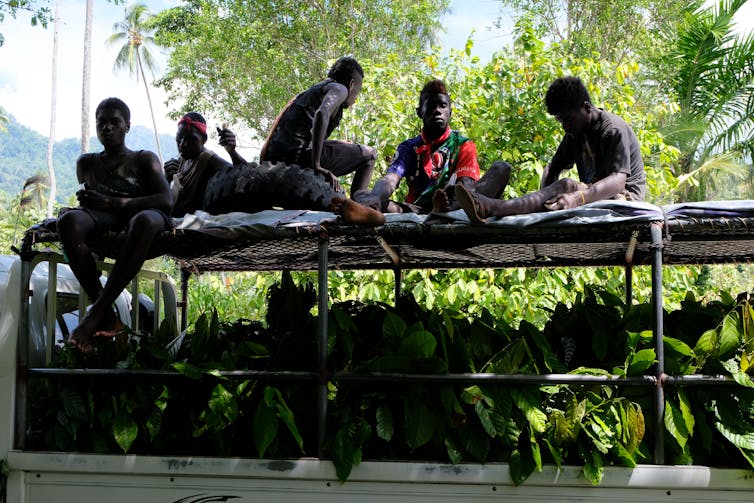
Bougainvillian youth taking a break on truck during work at cocoa nursery.
Adam Constanza/Shutterstock

And nearly a decade after seedlings resistant to the borer were distributed to farmers, the rewards are being reaped. According to initial findings from a survey by the Department of Foreign Affairs and Trade, 87% of grantees have benefited from increased income. Cocoa output has also improved, with more beans being grown and produced through the new trees.

This, combined with the price boom, has left Bougainville’s cocoa farmers flush. It has the potential to be a real boon in this hardscrabble island chain still bearing the scars of a violent conflict from 1988–98, which had been sparked in part by opposition to mining development.

Today, tensions remain between Bougainville and the PNG government over a 2019 independence referendum that showed residents overwhelmingly supported secession. Talks on progressing the results of the referendum are proceeding at a languid pace.

Why this program matters

Given how hard it is to deliver aid effectively in Papua New Guinea, as well as the geopolitical imperatives around aid these days, you would think more people outside of Bougainville would know about the project’s success.

It’s true there are chirpy stories posted about the Bougainville cocoa initiative on the Australian High Commission’s social media channels. But given so much government aid content feels boosterish, it is hard to distinguish a genuine, silver-plated aid success story when it comes around.

The question now is how Bougainville can double down on its success. If the late night din in the regional capital of Buka is anything to go by, at least some the newfound wealth is being spent on consumption.

But one day cocoa prices will fall again. As a result, the long-lasting benefits of the cocoa boom will only materialise if the windfalls are saved and reinvested. There is little in the public domain about how many farmers are actually doing this.

It’s also a challenge for Bougainville’s autonomous government, which has struggled to generate revenue, aside from the indirect rise in GST revenue from increased spending. Additional money is coming into the coffers through an adjusted cocoa export levy, but we couldn’t ascertain how much. Our inquiries to the Bougainville government went unanswered.

Whatever the amount, the increased money coming to the government must be invested productively in things like education and health.

Lessons for Canberra and Wellington

There is also a lesson here for officials in Canberra and Wellington. Development is often acknowledged as a long-term endeavour, yet the attention span of the aid world is stubbornly short.

The cocoa project in Bougainville is – to its credit – still running, combining the existing grants to farmers with a new focus on building buyer confidence.

Reports on the project, as with all development projects, however, are rarely publicly released. This is a shame because there is much that could be learned:

  • how, for example, has the project managed to succeed when many similar projects have failed?

  • how is the current revenue from cocoa exports being spent? Countries are notoriously bad at managing windfall gains, so what is Bougainville’s government doing with its cut?

  • and how are relations between the region’s independence-focused politicians and PNG’s independence-averse government being affected?

Long after the fanfare of the project launch, sweet success has materialised, seemingly out of the blue, in Bougainville. If it is to bring real long-term gains, though, people need to be paying attention.

The Conversation

Gordon Peake was in Bougainville from 2016-20 as a contractor working on the Bougainville Partnership, with a focus on supporting implementation of the autonomy arrangements of the Bougainville peace agreement. The Bougainville Partnership also implemented the Commodity Support Facility, but Peake did not work on this project himself.

Terence Wood does not work for, consult, own shares in or receive funding from any company or organisation that would benefit from this article, and has disclosed no relevant affiliations beyond their academic appointment.

ref. A rare aid success story has brought riches to a hardscrabble corner of the Pacific. Will it last? – https://theconversation.com/a-rare-aid-success-story-has-brought-riches-to-a-hardscrabble-corner-of-the-pacific-will-it-last-233658


Australia mid-range in the list of winners and losers from global emissions targets

Source: The Conversation (Au and NZ) – By Sam Marginson, Research Fellow, Centre of Policy Studies, Victoria University

Most of the world has signed up to commitments to reduce emissions under the Paris Agreement. It aims to hold the increase in the global average temperature to “well below 2°C above pre-industrial levels” and to pursue efforts to limit it to 1.5°C.

Australia’s commitments are net-zero greenhouse gas emissions by 2050 and a reduction to 43% below 2005 levels by 2030.

Progress on meeting the commitments is reviewed every five years. The next review is due next year, along with upgraded commitments.

Those who are having difficulty meeting their commitments are likely to claim that their economic cost is too big. This claim is hard to verify, in part because those economic costs depend on what other countries are doing.

Every nation’s commitment, modelled

In an effort to try to get a handle on which countries will do well out of the commitments all countries have made and which will do badly in purely economic terms (regardless of the benefits from limiting climate change) I have modelled the 2030 promises using a variant of the global trade model GTAP.

The model includes most forms of emissions and, when commitments are input, determines the cheapest way for each region to hit its target.

The biggest commitments compared to business as usual have been made by Japan, the United States, the European Union and Australia.

The model has Russia and all but the largest economies in Asia and the Pacific (i.e. not China, India and Japan) actually increasing their emissions as industrial activity relocates to them from other regions that are trying harder to reduce emissions.


India does well, the Middle East does badly

In terms of the impacts on gross national income, two regions actually benefit from the commitments of all nations – India and the rest of Asia and the Pacific. Both regions have weak emissions reduction targets and import energy.

The model predicts lower oil and gas prices as a result of reduced demand from the regions with ambitious emissions targets. This will allow energy importers without ambitious targets to benefit.

The Middle East does badly. It is heavily reliant on fossil fuel exports and has slightly more stringent emissions reduction targets than India and the rest of Asia and the Pacific.

That makes the Middle East the worst-affected region. Its per capita income is modelled to grow by only 1.5% per year on average if all countries hit their 2030 targets compared to at least 2.1% every year without global climate action.


Russia is less reliant on fossil fuel exports than some Middle Eastern countries, which is one of the reasons the impacts on Russia’s income are not as severe.

The other is that Russia’s emissions reduction commitments are weak. Russian fossil fuels that aren’t exported as a result of efforts to reduce emissions elsewhere get used in Russia.

Impact on Australia modest, given emissions per capita

If Australia made no effort to reduce its emissions, Australians’ real income is estimated to grow by at least 1% every year to 2030. With the 2030 commitment, that annual increase becomes 0.9%, which is modestly less.

The modelling suggests Australia could be doing more. Of the regions modelled, Australia is set to have the highest emissions per capita until 2028 when it is overtaken only by Russia.


Many of the nations that will see their incomes rise as a result of others’ emissions reduction efforts have lower per capita incomes than Australia’s.

It will be hard to pressure them to reduce their emissions while Australia’s emissions per capita are high.

The Conversation

Sam Marginson is a member of the Australian Greens.

ref. Australia mid-range in the list of winners and losers from global emissions targets – https://theconversation.com/australia-mid-range-in-the-list-of-winners-and-losers-from-global-emissions-targets-226905

A new report lays out NZ’s humanitarian duties under the laws of war – now it needs an action plan

Source: The Conversation (Au and NZ) – By Marnie Lloydd, Senior Lecturer in Law and Co-Director New Zealand Centre for Public Law, Te Herenga Waka — Victoria University of Wellington

Getty Images

The laws of war might seem of limited relevance in relatively peaceful New Zealand. But our soldiers participate in coalitions fighting wars abroad, and the often flagrant violation of humanitarian law in ongoing conflicts reminds us not to be complacent.

So the launch yesterday of the government’s Report on the Domestic Implementation of International Humanitarian Law was welcome. Timed to coincide with this month’s 75th anniversary of the 1949 Geneva Conventions, the report sets out New Zealand’s obligations to protect some minimum human dignity in war.

Essentially, international humanitarian law, also known also as the law of armed conflict, places important restraints on how wars may be fought. The new report maps New Zealand’s existing obligations and how they are part of domestic law and policy.

In doing so, New Zealand joins other countries that have published such voluntary reports promptly. Australia will also publish its first national report this year. And while states accused of violating international humanitarian law might not follow suit, the broader aim is to keep the issue alive and ultimately strengthen compliance by all countries.

Respecting international law

Unlike more recent humanitarian treaties, such as those banning landmines or cluster munitions, the Geneva Conventions do not require annual meetings of countries, or require signatories to submit regular reports.

This has made compliance a challenge. And attempts since 2011 to gain global political support for some form of regular, voluntary, formal framework have so far faltered.

A 2019 resolution at the four-yearly International Conference of the Red Cross and Red Crescent Movement instead encouraged a less politically sensitive alternative: countries would review their own implementation and share best practices through a voluntary national report.

How countries implement international humanitarian law – by training their military on the rules, for example, or enacting domestic war crimes legislation – is central to respecting that law. The New Zealand government and local Red Cross pledged to work on this before the next Red Cross conference in late 2024.

The resulting report first sets out how New Zealand has signed up to nearly all the key international treaties and made them part of its own laws. It also explains who is responsible for implementing and enforcing those laws, and how the rules of armed combat are taught.

This includes various government departments (Defence Force, Ministry of Foreign Affairs and Trade, Crown Law). Non-governmental institutions (Red Cross, education providers) are also involved, for example, by holding events for students and the public to discuss war, peace and humanitarian values.

Finally, the report summarises New Zealand’s commitment to specific protections under international law for prisoners of war, women and girls, cultural property and the environment, as well as to rules prohibiting or restricting the use of munitions such as chemical weapons.

Ukraine, 2024: The Red Cross and Red Crescent were instrumental in pushing for national voluntary reports.
Getty Images

What NZ can do next

New Zealand has a solid record in ratifying the relevant international humanitarian law treaties and implementing them at home.

The Operation Burnham Inquiry into alleged violations by NZSAS troops in Afghanistan, and the laws and policies adopted as recommended by that inquiry, are examples of good practice for other countries to follow – and of the possible challenges in doing so.

This is not to say New Zealand has nothing more to do. These national reports also serve to identify gaps in implementation and suggest areas for future efforts.

Even Switzerland, birthplace of modern humanitarian law, produced a parallel public action plan to its 2020 voluntary report which detailed future steps for strengthening compliance. Despite having a Disarmament and Arms Control Strategy and a Humanitarian Action Policy, New Zealand has yet to produce an action plan to accompany its own voluntary report.

Precisely because of New Zealand’s commitment to international humanitarian law, the report should now be used as a tool to further strengthen those efforts. This needs to involve the whole government, not be confined to the military and foreign affairs, and involve Māori and civil society.

Lastly, New Zealand must continue to demand respect for these laws by other countries. That includes speaking out about the worst offenders, based on a coherent and consistent foreign policy, and supporting Pacific states with their own implementation.

Given the death and devastation caused by today’s ongoing wars, this report offers everyone a simple way to engage and reflect on these vital issues of human dignity in peace and conflict.

The Conversation

Marnie Lloydd is a member of New Zealand’s International Humanitarian Law Committee and has worked previously with the Red Cross and Red Crescent Movement. She provided advice on earlier drafts of New Zealand’s Report on the Domestic Implementation of International Humanitarian Law.

ref. A new report lays out NZ’s humanitarian duties under the laws of war – now it needs an action plan – https://theconversation.com/a-new-report-lays-out-nzs-humanitarian-duties-under-the-laws-of-war-now-it-needs-an-action-plan-235880

Archaeologists conduct first ‘space excavation’ on International Space Station – and discover surprising quirks of zero-gravity life

Source: The Conversation (Au and NZ) – By Justin St. P. Walsh, Professor of art history, archaeology, and space studies, Chapman University

NASA/International Space Station Archaeological Project, CC BY

New results from the first archaeological fieldwork conducted in space show the International Space Station is a rich cultural landscape where crew create their own “gravity” to replace Earth’s, and adapt module spaces to suit their needs.

Archaeology is usually thought of as the study of the distant past, but it’s ideally suited for revealing how people adapt to long-duration spaceflight.

In the SQuARE experiment described in our new paper in PLOS ONE, we re-imagined a standard archaeological method for use in space, and got astronauts to carry it out for us.

Archaeology … in … spaaaaace!

The International Space Station is the first permanent human settlement in space. Close to 280 people have visited it in the past 23 years.

Our team has studied displays of photos, religious icons and artworks made by crew members from different countries, observed the cargo that is returned to Earth, and used NASA’s historic photo archive to examine the relationships between crew members who serve together.

We’ve also studied the simple technologies, such as Velcro and resealable plastic bags, which astronauts use to recreate the Earthly effect of gravity in the microgravity environment – to keep things where you left them, so they don’t float away.

Most recently, we collected data about how crew used objects inside the space station by adapting one of the most traditional archaeological techniques, the “shovel test pit”.

On Earth, after an archaeological site has been identified, a grid of one-metre squares is laid out, and some of these are excavated as “test pits”. These samples give a sense of the site as a whole.

In January 2022, we asked the space station crew to lay out five roughly square sample areas. We chose the square locations to encompass zones of work, science, exercise and leisure. The crew also selected a sixth area based on their own idea of what might be interesting to observe. Our study was sponsored by the International Space Station National Laboratory.

The SQuARE mission patch, designed by @cheatlines (Instagram).
International Space Station Archaeological Project, CC BY-ND

Then, for 60 days, the crew photographed each square every day to document the objects within its boundaries. Everything in space culture has an acronym, so we called this activity the Sampling Quadrangle Assemblages Research Experiment, or SQuARE.

The resulting photos show the richness of the space station’s cultural landscape, while also revealing how far life in space is from images of sci-fi imagination.

The space station is cluttered and chaotic, cramped and dirty. There are no boundaries between where the crew works and where they rest. There is little to no privacy. There isn’t even a shower.

What we saw in the squares

Now we can present results from the analysis of the first two squares. One was located in the US Node 2 module, where there are four crew berths, and connections to the European and Japanese labs. Visiting spacecraft often dock here. Our target was a wall where the Maintenance Work Area, or MWA, is located. There’s a blue metal panel with 40 velcro squares on it, and a table below for fixing equipment or doing experiments.

NASA intended the area to be used for maintenance. However, we saw hardly any evidence of maintenance there, and only a handful of science activities. In fact, for 50 of the 60 days covered by our survey, the square was only used for storing items, which may not even have been used there.

The amount of velcro here made it a perfect location for ad hoc storage. Close to half of all items recorded (44%) were related to holding other items in place.

The other square we’ve completed was in the US Node 3 module, where there are exercise machines and the toilet. It’s also a passageway to the crew’s favourite part of the space station, the seven-sided cupola window, and to storage modules.

This wall had no designated function, so it was used for eclectic purposes, such as storing a laptop, an antibacterial experiment and resealable bags. And for 52 days during SQuARE, it was also the location where one crew member kept their toiletry kit.

It makes a kind of sense to put one’s toiletries near the toilet and the exercise machines that each astronaut uses for hours every day. But this is a highly public space, where others are constantly passing by. The placement of the toiletry kit shows how inadequate the facilities are for hygiene and privacy.

What does this mean?

Our analysis of Squares 03 and 05 helped us understand how restraints such as velcro create a sort of transient gravity.

Restraints used to hold an object form a patch of active gravity, while those not in use represent potential gravity. The artefact analysis shows us how much potential gravity is available at each location.

The main focus of the space station is scientific work. To make this happen, astronauts have to deploy large numbers of objects. Square 03 shows how they turned a surface intended for maintenance into a halfway house for various items on their journeys around the station.

Our data suggests that designers of future space stations, such as the commercial ones currently planned for low Earth orbit, or the Gateway station being built for lunar orbit, might need to make storage a higher priority.

Square 05 shows how a public wall space was claimed for personal storage by an unknown crew member. We already know there is less-than-ideal provision for privacy, but the persistence of the toiletry bag at this location shows how crew adapt spaces to make up for this.

What makes our conclusions significant is that they are evidence-based. The analysis of the first two squares suggests the data from all six will offer further insights into humanity’s longest surviving space habitat.

Current plans are to bring the space station down from orbit in 2031, so this experiment may be the only chance we have to gather archaeological data.


The authors gratefully acknowledge the work of our collaborators Shawn Graham, Chantal Brousseau, and Salma Abdullah.

The SQuARE experiment was sponsored by the ISS National Laboratory and funded by Chapman University. Axiom Space was the Implementation Partner.

Alice Gorman has previously received funding from the Australian Research Council.

ref. Archaeologists conduct first ‘space excavation’ on International Space Station – and discover surprising quirks of zero-gravity life – https://theconversation.com/archaeologists-conduct-first-space-excavation-on-international-space-station-and-discover-surprising-quirks-of-zero-gravity-life-236125

Most high-income countries ban direct advertising of prescription drugs – why does NZ still allow it?

Source: The Conversation (Au and NZ) – By David Menkes, Associate Professor in Psychological Medicine, University of Auckland, Waipapa Taumata Rau

Getty Images

New Zealand and the United States are the only high-income countries to allow unrestricted direct-to-consumer advertising of branded medicines, including the name of the drug and the condition for which it is prescribed.

Our recent analysis explores why most other countries outlaw this controversial practice. We review evidence that direct advertising can lead to overdiagnosis and unnecessary treatments, causing potential harm and higher health costs.

Direct advertising of prescription medicines, primarily through television and print media, developed in the US and New Zealand during the 1990s in the absence of any new legislation or a specific ban.

After three decades, New Zealand’s legislative vacuum changed last year when the previous government formalised the legality of direct ads in the new Therapeutic Products Bill. The move surprised many, given the Labour Party’s historical opposition to the practice.

The bill became law in July 2023. But one of the current coalition government’s campaign pledges was to scrap it, based in part on concerns about regulation of natural and other low-risk health products.

The government appears committed to repealing the law. As yet, though, there is no indication of what regulatory framework would take its place. And it is unclear whether Minister of Health Shane Reti will renew his efforts while in opposition to ban the practice.

Why drug companies like direct advertising

Many medicines for common health conditions are available in supermarkets or at pharmacies to buy over-the-counter. They generally treat milder conditions, and safe use is relatively straightforward.

Other medicines are designated prescription only because their use carries a significant risk of harm, especially if used inappropriately. It is why direct advertising of prescription medicines typically exhorts consumers to “ask your doctor if it is right for you”.

Direct advertising is effective in promoting the prescription of branded and usually expensive medicines. It represents a key marketing strategy of the pharmaceutical industry, particularly in the US where billions are spent annually on such advertising.

Because of its effectiveness, companies have lobbied to extend direct-to-consumer advertising to other countries, including the European Union. Thus far, health authorities have successfully resisted because of concerns about the associated public health risks and increased health spending.

The exception is Canada, which introduced partial direct advertising in 2001 in response to industry pressure. This allowed companies to run “reminder ads” that name the drug but not the condition for which it is used.

Pharmacist searching for prescription medicine in storage rack
Direct advertising can lead patients to seek prescriptions of unnecessary medicines.
Getty Images

Although most studies of direct advertising focus on high-income countries, there is evidence the practice also occurs in low- and middle-income countries, even when technically illegal.

A notable example was documented in Sri Lanka in 2000, where a drug company persuaded the national medical association to co-sponsor anti-obesity advertisements in newspapers. It then encouraged those responding to the ads to ask their doctors about the company’s prescription-only weight-loss drug.

In Turkey, widespread advertising of a prescription-only smoking-cessation drug prompted suspension of the drug’s license. Turkish doctors also called attention to the higher risks of harm related to low education levels, and the poor enforcement of prescription-only status of drugs in Turkey and other developing countries.

Other countries resist direct advertising

The nearly universal prohibition of direct advertising is regarded as a health protection measure, especially for newly marketed drugs.

In a study of 109 new drugs approved in the US, fewer than 500 patients had been treated in most pre-market clinical trials – too few to discover infrequent but significant adverse effects.

More generally, drug-related harms are a common but preventable cause of emergency department visits and hospitalisations. This underpins the rationale to treat prescription medicines differently, including how they are advertised.

The global withdrawal of the arthritis drug Vioxx (rofecoxib), one of the most heavily advertised medicines during its five years on the market, heightened these safety concerns. Vioxx raised the risk of heart attacks, but the manufacturer continued to promote the drug to the public in the US and New Zealand long after internal company documents indicated an increased risk of death.

A ban would help optimise healthcare

Direct advertising affects the doctor-patient relationship. It leads patients to seek medicines which they cannot obtain unless their doctor agrees to issue a prescription. Impacts include the time taken to discuss the target condition, which may or may not warrant medical intervention, and the advertised remedy, which may or may not reflect best practice.

Strong evidence now shows direct advertising can lead to unnecessary, inappropriate and sometimes harmful prescribing. The practice may also encourage patients to self-diagnose or misinterpret their symptoms, contributing to unnecessary diagnostic testing and treatment.

Although direct advertising may prompt patients to visit doctors with previously unreported symptoms and to discuss therapeutic options, doctors generally regard the practice as an unwelcome distraction from clinical work.

Professional bodies and consumer groups in New Zealand and elsewhere have voiced strong opposition to direct advertising.

But the commercial success of direct advertising has seen vigorous industry efforts to defend, develop and extend the practice. The pending repeal of New Zealand’s Therapeutic Products Act presents a timely opportunity to address the legality of direct advertising of prescription medicines.

It remains to be seen whether the government will be persuaded by the available evidence that banning direct advertising would help contain health spending, and to promote population health by reducing over-diagnosis, unnecessary treatments and the harm they can cause.

The Conversation

David Menkes is reimbursed for his work as a member of the Mental Health Advisory Committee for PHARMAC.

Barbara Mintzes has acted as a paid expert witness for Health Canada in a legal case involving marketing of an unapproved drug product.

Joel Lexchin has received payments from a legal firm for work on the role of promotion in generating prescriptions. He is a member of the Board of Canadian Doctors for Medicare.

ref. Most high-income countries ban direct advertising of prescription drugs – why does NZ still allow it? – https://theconversation.com/most-high-income-countries-ban-direct-advertising-of-prescription-drugs-why-does-nz-still-allow-it-231688

Just 8 minutes of TikTok ‘thinspiration’ content is enough to affect body image

Source: The Conversation (Au and NZ) – By Rachel Hogg, Senior Lecturer in Psychology, Charles Sturt University

Rendy Novantino/Unsplash

Nearly half of Australian young people are dissatisfied with the way their body looks.

Social media have only made body image issues worse for young people, leading them to compare themselves with others and strive for often unattainable – and unhealthy – beauty standards.

TikTok, which allows people to create and consume short videos, has amassed more than 1 billion users. Harmful content, including videos that glamorise disordered eating and extremely thin bodies, circulate readily on the platform.

Given most TikTok users are young, we wanted to explore how such content affects young women’s body image. Our new study found watching just eight minutes of TikTok content focused on dieting, weight loss and exercise had an immediate negative effect on body image satisfaction.


Read more:
What can you do if you think your teen already has unhealthy social media habits?


Body image and beauty standards

We recruited 273 female-identifying TikTok users aged 18 to 28 and randomly allocated them into two groups. People with a past or current eating disorder diagnosis were excluded from the study.

Participants in the experimental group were shown a 7–8 minute compilation of “pro-anorexia” and “fitspiration” content taken directly from TikTok. These video clips featured young women restricting their food intake and giving workout advice and dieting tips, such as describing their juice cleanses for weight loss.

Participants in the control group watched a 7–8 minute compilation of TikTok videos featuring “neutral” content such as videos of nature, cooking and animals.

Using a series of questionnaires, we measured levels of body image satisfaction and attitudes towards beauty standards before and after participants watched the TikTok content.

Both groups reported a decrease in body image satisfaction from before to after watching the videos. But those exposed to pro-anorexia content had the greatest decrease in body image satisfaction. They also experienced an increase in internalisation of beauty standards.

Internalisation occurs when someone accepts and identifies with external beauty standards. Exposure to harmful social media content doesn’t always result in harm – it’s when this content is internalised that body image is likely to suffer.

Before the video experiment, we asked participants some general questions about their TikTok use. We also measured preoccupation with “healthy” eating and symptoms of disordered eating.

We found participants who used TikTok for more than two hours a day reported more disordered eating behaviours than less frequent users. However, this difference was not statistically significant. This means the difference between groups did not meet the threshold required for us to conclude it was unlikely to be due to chance.

On a scale used to rate eating disorder symptoms, participants who reported high (2–3 hours a day) and extreme (more than 3 hours a day) rates of TikTok use averaged scores just below the cut-off for clinically significant eating disorder symptoms. This suggests more than two hours a day of exposure to TikTok content may be linked to disordered eating, but further research is needed to explore this.

Young woman looks at phone
We measured participants’ attitudes before and after watching pro-anorexia or neutral content.
Paul Hanaoka/Unsplash

Harmful content is widespread

The content we showed participants in the experimental group is widely circulated on TikTok, not just within “pro-ana” communities. “Clean” eating, detoxing and limited-ingredient diet trends are the wolf in lamb’s clothing of disordered eating, allowing diet culture to be rebranded as “wellness” and “self-care”. This content, alongside fitspiration, often rewards and gamifies excessive exercise and disordered eating.

Social media wellness influencers play an important role in normalising disordered eating and fitspiration content. But hashtags like #GymTok and #FoodTok allow any TikTok user to create and consume content around theirs and others’ daily eating routines, weight-loss transformations and workout routines.

What’s more, everyday users can circulate dangerous diet-related videos without the backlash a celebrity or well-known influencer might receive for sharing socially irresponsible content.

Our study only looked at short-term consequences of exposure to this sort of content on TikTok. Longitudinal research is needed to see if the negative effects we observed endure over time.

It remains difficult to censor

TikTok users have limited control over the content they’re exposed to. Because they spend much of their time on a personalised “For You” page formulated by an algorithm, a user doesn’t need to search for or follow disordered eating content to be exposed to it.

In our study, 64% of participants reported seeing disordered eating content on their For You page. Examples could include videos portraying binge eating, laxative use or excessive exercise.

Paradoxically, searching for body positivity content may make users vulnerable to seeing disordered eating content.

The most important thing TikTok users can do is to be aware that following or searching for any kind of content related to food, body or exercise may lead to inadvertent exposure to distorted body ideals. Limiting time on TikTok will limit exposure, but our findings show even less than ten minutes can have a negative effect.

Ultimately, online safety for young people depends on appropriate social media regulation. Without this, upskilling young women on how to avoid harm on social media is a bit like giving them an inflatable life jacket, then leaving them to swim indefinitely against a rip.

The TikTok reels in this article are included only to illustrate the type of content examined in this study and accessible to TikTok users. If you need support, consider contacting the Butterfly Foundation Helpline (1800 33 4673) or chat with them online. For emergency crisis support, call Lifeline on 13 11 14.

Madison Blackburn co-authored the research this article is based on.

The Conversation

Rachel Hogg does not work for, consult, own shares in or receive funding from any company or organisation that would benefit from this article, and has disclosed no relevant affiliations beyond their academic appointment.

ref. Just 8 minutes of TikTok ‘thinspiration’ content is enough to affect body image – https://theconversation.com/just-8-minutes-of-tiktok-thinspiration-content-is-enough-to-affect-body-image-236068

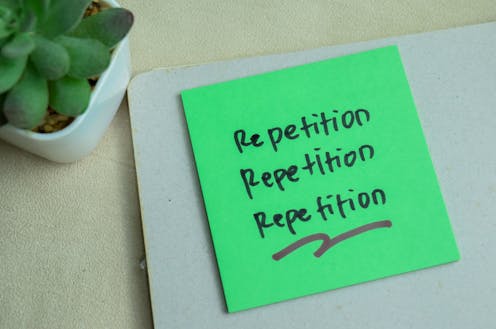
Repeating aids believing: climate misinformation feels more true through repetition – even if you back climate science

Source: The Conversation (Au and NZ) – By Mary Jiang, PhD student in psychology, School of Medicine and Psychology, Australian National University

bangoland/Shutterstock

If you consider yourself a climate science supporter, you probably wouldn’t think simple exposure to a sceptic’s claim could shift your views.

Our new research has produced worrying findings. Climate misinformation may be more effective than we’d like to think because of a phenomenon called the illusory truth effect In short, we are more likely to believe a lie if we encounter it repeatedly. Worse, the effect works immediately – a lie seems to be more true even after just one repetition.

As our social media feeds fill up with AI-driven bots, sheer repetition of lies may erode the most essential resource for action on climate change – public support. Traditional media has a different problem – in their commitment to presenting both sides, journalists often platform climate sceptics whose untrue claims add to the repetition of misinformation.

There’s no easy answer. But one thing that does work is to come back to the scientific consensus that our activities are the major cause of global warming – and to the overwhelming public support worldwide for stronger action on climate change.

sign saying unite behind climate science
To combat repetitive misinformation, come back to the consensus.
Phil Pasquini/Shutterstock

What did we find out?

We’ve long known about the illusory truth effect, where sheer repetition makes information sound more true, regardless of whether it’s true or false. The reason this works on us is familiarity – when information becomes familiar, we mentally ascribe a level of truth to it.

But does this repetition still shift perceptions of truth when we hold seemingly strong existing beliefs?

To find out, we ran experiments where a total of 172 people who were overwhelmingly endorsers of climate science viewed claims aligned with solid climate science, climate sceptic claims, and weather-related claims. Participants saw some claims just once, while others were repeated.

What we found was that it took just a single repetition to make the claims seem more true. This happened for all types of claims, including climate science and sceptic claims.

What’s more, this happened even to those people who regarded themselves as endorsing the scientific consensus on human-caused climate change and who are highly concerned about climate change. The effect held even when these participants later identified the claim was aligned with climate scepticism.

Spreaders of misinformation can game traditional media

In recent years, many researchers have explored this effect in different areas of knowledge. This evidence base points towards an important finding: low quality or malicious information can be laundered through repetition and made to seem true and trustworthy.

This poses an interesting challenge to the way the traditional media has long operated. Many journalists pride themselves on their adherence to fair, balanced reporting. The reason for this lies in history – when the mass media first emerged as a major force in the 19th century, highly partisan or sensational “yellow” journalism was common. Balanced journalism emerged as a counter to this, promising to platform several sides of a debate.

But balance can be easily gamed. Giving equal exposure to opposing voices can lead people to think there is less of an expert consensus.

How can we we defend ourselves?

What our research suggests is comments, articles, and posts of climate misinformation may have a corrosive nature – the more we’re exposed to them, the more likely we will come to accept them.

You might think intelligence and careful thinking can have a protective effect. But the broader body of research on illusory truth has found being smarter or more rational is no protection against repetition.

What can we do to protect ourselves?

corrosion
Repeated misinformation can corrode public support for climate action.
Shutterstock

Researchers have found one reliable solution – come back to the scientific consensus. For decades, scientists have researched the question of whether our activities are the main cause of rising global temperatures. Many different lines of evidence from rates of ice melt to sea temperatures to satellite measurements have now answered this conclusively. The scientific consensus is now 99.9% certain, a figure which has only grown over time. Drawing on this consensus may work to protect us from accepting sceptic arguments by reminding us of the very large areas of agreement.

There’s a systemic problem here. Never before in history have we been able to access so much information. But our information environments are not benign. Actors with an agenda are at work in many areas of public life, trying to shape what we do or do not do. We need to learn more about how we can battle the power of lies on repeat.

The Conversation

Eryn Newman receives funding from the Australian Research Council and The Australian National University.

Kate Reynolds receives funding from the ARC, ANU & ACT Government

Mary Jiang and Norbert Schwarz do not work for, consult, own shares in or receive funding from any company or organisation that would benefit from this article, and have disclosed no relevant affiliations beyond their academic appointment.

ref. Repeating aids believing: climate misinformation feels more true through repetition – even if you back climate science – https://theconversation.com/repeating-aids-believing-climate-misinformation-feels-more-true-through-repetition-even-if-you-back-climate-science-236127

‘Wake-up call to humanity’: research shows the Great Barrier Reef is the hottest it’s been in 400 years

Source: The Conversation (Au and NZ) – By Ben Henley, Lecturer, School of Agriculture, Food and Ecosystem Sciences, The University of Melbourne

Ove Hoegh-Guldberg

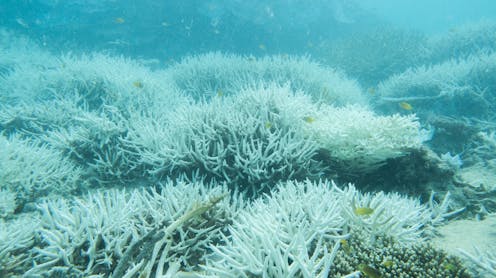
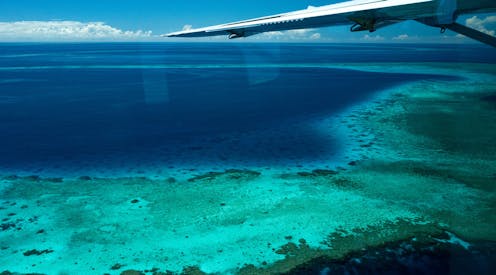
The Great Barrier Reef is vast and spectacular. But repeated mass coral bleachings, driven by high ocean temperatures, are threatening the survival of coral colonies which are the backbone of the reef.

Our study, published today in Nature, provides a new long-term picture of the ocean surface temperatures driving coral bleaching. It shows recent sea surface heat is unprecedented compared to the past 400 years. It also confirms humans are to blame.

The results are sobering confirmation that global warming – caused by human activities – will continue to damage the Great Barrier Reef.

All hope is not lost. But we must face a confronting truth: if humanity does not divert from its current course, our generation will likely witness the demise of one of Earth’s great natural wonders.

One-of-a-kind ecosystem

The Great Barrier Reef is the most extensive coral reef system on Earth. It is home to a phenomenal array of biodiversity, including more than 400 types of coral, 1,500 species of fish and 4,000 types of molluscs, as well as endangered turtles and dugongs.

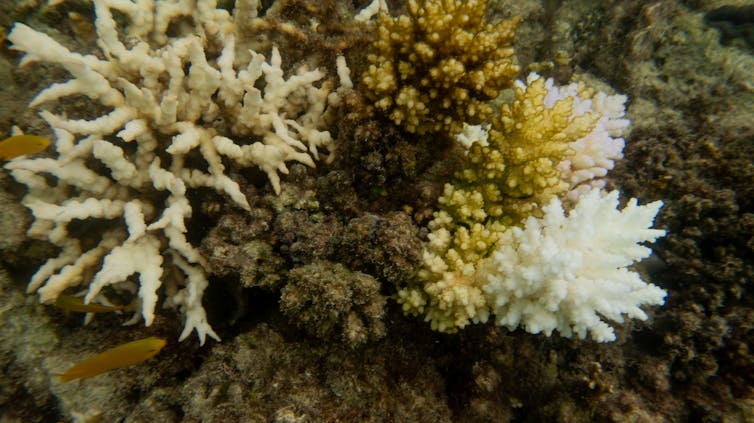
However, mass coral bleaching over the past three decades has had serious impacts on the reef. Bleaching occurs when corals become so heat-stressed they eject the tiny organisms living inside their tissues. These organisms give coral some of its colour and help power its metabolism.

In mild bleaching events, corals can recover. But in the most recent events, many corals died.

The Great Barrier Reef has suffered five mass bleaching events in the past nine summers. Is this an anomaly, or within the natural variability the reef has experienced in previous centuries? Our research set out to answer this question.

bleached coral
Mass coral bleaching in recent decades has devastated the reef.
UQ

A 400-year-old story

Coral itself can tell us what happened in the past.

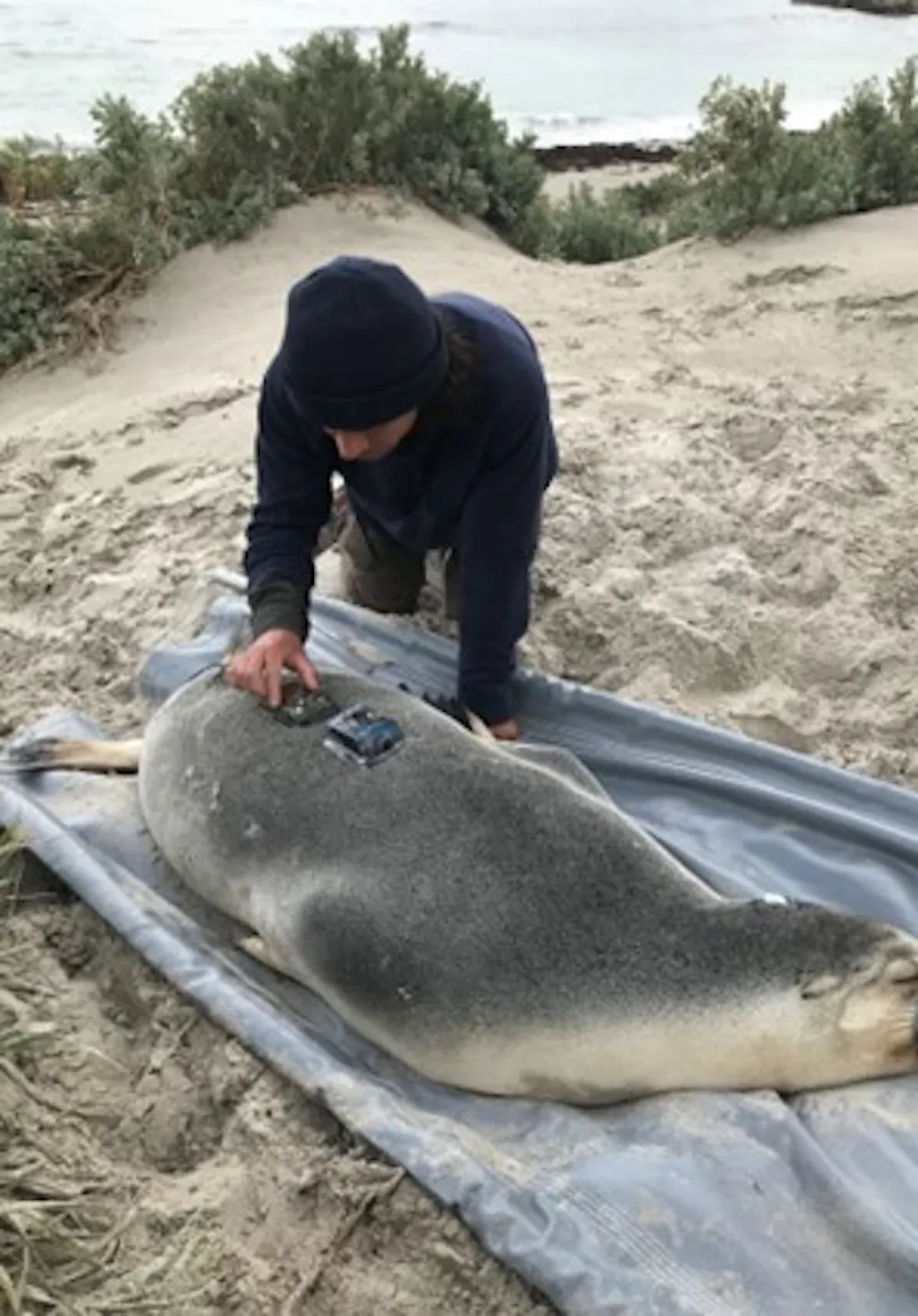
As corals grow, the chemistry of their skeleton reflects the ocean conditions at the time – including its temperature. In particular, large boulder-shaped corals, known as Porites, can live for centuries and are excellent recorders of the past.

Our study sought to understand how surface temperatures in the Coral Sea, which includes the reef, have varied over the past four centuries. We focused on the January–March period – the warmest three months on the reef.

First, we collated a network of high-quality, continuous coral records from the region. These records were analysed by coral climate scientists and consist of thousands of measurements of Porites corals from across the Western tropical Pacific.

Drilling a coral skeleton core in the Coral Sea. Source: Tom DeCarlo.

From these records, we could reconstruct average surface temperatures for the Coral Sea from the year 1618 to 1995, and calibrate this to modern temperature records from 1900 to 2024. The overall result was alarming.

From 1960 to 2024, we observed annual average summer warming of 0.12°C per decade.

And average sea surface temperatures in 2016, 2017, 2020, 2022 and 2024 were five of the six warmest the region has experienced in four centuries.

Humans are undoubtedly to blame

The next step was to examine the extent to which increased temperatures in the Coral Sea can be attributed to human influence.

To do this, we used published computer model simulations of the Earth’s climate – both with and without human influence, including greenhouse gases from the burning of fossil fuels.

So what did we find? Without human influence, Coral Sea surface temperatures during January–March remain relatively constant since 1900. Add in the human impacts, and the region warms steadily in the early 1900s, then rapidly after the 1960s.

In short: without human-caused global warming, the very high sea temperatures of recent years would be virtually impossible, based on our analysis using the world’s top climate models.

There is worse news. Recent climate projections put us on a path to intensified warming, even when accounting for international commitments to reduce emissions. This places the reef at risk of coral bleaching on a near-annual basis.

Back-to-back bleaching is likely to be catastrophic for the Great Barrier Reef, because it thwarts the chances of corals recovering between bleaching events.

Even if global warming is kept under the Paris Agreement goal of 1.5°C above pre-industrial temperatures, 70% to 90% of corals across the world could be lost.

We must stay focused

The Australian government has a crucial role to play in managing threats to the Great Barrier Reef. The devastation is in their backyard, on their watch.

But what’s happening on the Great Barrier Reef should also be an international wake-up call. The fourth global mass coral bleaching event occurred this year; the Great Barrier Reef is not the only one at risk.

Every fraction of a degree of warming we avoid gives more hope for coral reefs. That’s why the world must stay focused on ambitious action to reduce greenhouse gas emissions.

Emissions reduction targets must be met, at the very least. The solutions are available and our leaders must implement them.

Our research equips society with the scientific evidence for what’s at stake if we don’t act.

The future of one of Earth’s most remarkable ecosystems depends on all of us.

The Conversation

Ben Henley receives funding from the Australian Research Council.

Helen McGregor receives funding from the Australian Research Council.

Ove Hoegh-Guldberg does not work for, consult, own shares in or receive funding from any company or organisation that would benefit from this article, and has disclosed no relevant affiliations beyond their academic appointment.

ref. ‘Wake-up call to humanity’: research shows the Great Barrier Reef is the hottest it’s been in 400 years – https://theconversation.com/wake-up-call-to-humanity-research-shows-the-great-barrier-reef-is-the-hottest-its-been-in-400-years-235876

Australia’s mid-range in the list of winners and losers from global emissions targets

Source: The Conversation (Au and NZ) – By Sam Marginson, Research Fellow, Centre of Policy Studies, Victoria University

Most of the world has signed up to commitments to reduce emissions under the Paris Agreement. It aims to hold the increase in the global average temperature to “well below 2°C above pre-industrial levels” and to pursue efforts to limit it to 1.5°C.

Australia’s commitments are net-zero greenhouse gas emissions by 2050 and a reduction to 43% below 2005 levels by 2030.

Progress on meeting the commitments is reviewed every five years. The next review is due next year, along with upgraded commitments.

Those who are having difficulty meeting their commitments are likely to claim that their economic cost is too big. This claim is hard to verify, in part because those economic costs depend on what other countries are doing.

Every nation’s commitment, modelled

In an effort to try to get a handle on which countries will do well out of the commitments all countries have made and which will do badly in purely economic terms (regardless of the benefits from limiting climate change) I have modelled the 2030 promises using a variant of the global trade model GTAP.

The model includes most forms of emissions and, when commitments are input, determines the cheapest way for each region to hit its target.

The biggest commitments compared to business as usual have been made by Japan, the United States, the European Union and Australia.

The model has Russia and all but the largest economies in Asia and the Pacific (i.e. not China, India and Japan) actually increasing their emissions as industrial activity relocates to them from other regions that are trying harder to reduce emissions.


India does well, the Middle East does badly

In terms of the impacts on gross national income, two regions actually benefit from the commitments of all nations – India and the rest of Asia and the Pacific. Both regions have weak emissions reduction targets and import energy.

The model predicts lower oil and gas prices as a result of reduced demand from the regions with ambitious emissions targets. This will allow energy importers without ambitious targets to benefit.

The Middle East does badly. It is heavily reliant on fossil fuel exports and has slightly more stringent emissions reduction targets than India and the rest of Asia and the Pacific.

That makes the Middle East the worst-affected region. Its per capita income is modelled to grow by only 1.5% per year on average if all countries hit their 2030 targets compared to at least 2.1% every year without global climate action.


Russia is less reliant on fossil fuel exports than some Middle Eastern countries, which is one of the reasons the impacts on Russia’s income are not as severe.

The other is that Russia’s emissions reduction commitments are weak. Russian fossil fuels that aren’t exported as a result of efforts to reduce emissions elsewhere get used in Russia.

Impact on Australia modest, given emissions per capita

If Australia made no effort to reduce its emissions, Australians’ real income is estimated to grow by at least 1% every year to 2030. With the 2030 commitment, that annual increase becomes 0.9%, which is modestly less.

The modelling suggests Australia could be doing more. Of the regions modelled, Australia is set to have the highest emissions per capita until 2028 when it is overtaken only by Russia.


Many of the nations that will see their incomes rise as a result of others’ emissions reduction efforts have lower per capita incomes than Australia’s.

It will be hard to pressure them to reduce their emissions while Australia’s emissions per capita are high.

The Conversation

Sam Marginson is a member of the Australian Greens.

ref. Australia’s mid-range in the list of winners and losers from global emissions targets – https://theconversation.com/australias-mid-range-in-the-list-of-winners-and-losers-from-global-emissions-targets-226905

200% Wolf is a visual triumph – and a reminder that Australian animators could lead on the world stage

Source: The Conversation (Au and NZ) – By Ari Chand, Lecturer in Illustration and Animation, University of South Australia

StudioCanal

In the past decade, Australia’s animation industry has matured well beyond its domestic context – to the point of competing on a global scale.

StudioCanal Australia’s latest release, 200% Wolf, is perhaps the perfect example of this. The film picks up where its predecessor, 100% Wolf (2020), left off – continuing the journey of poodle protagonist Freddy Lupin (voiced by Ilai Swindells).

While 200% Wolf inherits some of the narrative issues present in the original film, its overall higher level of production is a welcome improvement. It reminds us Australia really does have the ability to lead the world in animation.

Production at the highest level

The film excels in its use of animation techniques to convey emotion – with strong shot composition and scenes that are smooth, dynamic and well choreographed. The use of bold colours and lively backgrounds also creates a world that will draw young viewers in.

Animation production is a collaborative and difficult process, with many factors influencing the overall style and thematic focus of the final product. But when it’s done right, it has the unique ability to transport us into a different world.

Director Alex Stadermann and art director Shane Devries have curated a visual feast for young eyes with 200% Wolf. With complex action sequences, whizz-bang special effects and a beautiful sense of colour and light, the story features almost every good animation trick in the book.

The character animation, creature design and physical performance is also exceptional and outperforms 100% Wolf. The film’s illustrated title and credit sequence alone tastefully pay reverence to the artistry and people power required to make such a film.

In the age of AI, 200% Wolf is also the first animated film I’ve seen that explicitly states in its credits “this was made by real people”, while thanking the audience for supporting Australian industry and artists.

Considerations for co-viewing

Co-viewing is essentially when parents and their children consume media together.

Co-viewing is an important factor when creating animation for children. Adult viewers should be able to guide children’s interpretations of the content – reinforcing the positive messages while helping them find meaning in the story. At the same time, adults should also be able to enjoy and resonate with the story themselves.

The humour in 200% Wolf falls short. It often feels forced and caters strictly to a very young audience, with heavy use of slapstick and “potty” jests. The deeper emotional moments also come across bluntly, lacking the level of subtlety adult viewers desire.

So while the film is visually stunning – and imbued with a unique sense of identity – it doesn’t break out of the “children’s” category enough to be considered quality co-viewing.

A lacking storyline

Anthropomorphised animals have long been used to captivate young minds. They are also a great vessel through which to explore cognitive and emotional development within characters.

Animated dogs in particular became well established in the 20th century, during a period Animation Academy Professor Paul Wells describes as the “Disney-fication” of animation.

From comedic sidekicks such as Scooby-Doo to heroic protagonists like Bolt, animated dogs are embedded in the children’s content landscape.

In 2020, the film 100% Wolf – based on Jayne Lyon’s much-loved book – cut through the national and international market at a time when there was a global content drought due to the pandemic. Unfortunately, the film itself was riddled with overused tropes, and its formulaic narrative struggled to be compelling.

In the sequel, Freddy embarks on a new adventure to save his pack and prove his true nature once again. And while there is a deepening of the story and lore – especially with the introduction of the baby moon spirit MooPoo (Elizabeth Nabben) – the story once again ends up feeling slightly bland and generic.

The twists and turns promise to set up a narrative with humour and heart, but they often miss the mark.

The film’s erratic pacing means some scenes drag while others rush through crucial developments – failing to pique the audience’s interest. Nor does the audience get a chance to properly understand the characters’ motivations.

Freddy’s quest also feels repetitive of the first film; themes of identity and self-acceptance are rehashed without any new depth or insight.

Breaking barriers for animation

Historically, it has been incredibly difficult to raise capital for feature films in Australia. Animated films come with yet another layer of complexity, given the unique attention to detail they require.

Beyond having to navigate complex internal collaborations, animation creators and studios must also meet specific criteria and production demands set by external entities such as Screen Australia, the government’s key funding body for Australian productions.

With the many hurdles Australian animators have to jump, 200% Wolf is a nice reminder that world-class animation is indeed possible here.

Ari Chand does not work for, consult, own shares in or receive funding from any company or organisation that would benefit from this article, and has disclosed no relevant affiliations beyond their academic appointment.

ref. 200% Wolf is a visual triumph – and a reminder that Australian animators could lead on the world stage – https://theconversation.com/200-wolf-is-a-visual-triumph-and-a-reminder-that-australian-animators-could-lead-on-the-world-stage-236244

Call for collective global action over ‘horrific’ Israeli crimes against Palestinian prisoners

Report by Dr David Robie – Café Pacific.

COMMENTARY: By Qadura Fares

On August 3, last Saturday, prisoner rights institutions and Palestinians all around the world were standing in solidarity with Gaza and Palestininian prisoners. This day is dedicated to highlighting Israeli crimes and violations of Palestinian prisoners’ rights and the continuing genocide in Gaza.

The machinery of brutality that punishes and tortures in secrecy in Israeli prisons must be brought to light.

Since October 7, Palestinian detainees have faced horrific crimes.

Shortly after Israeli Defence Minister Yoav Gallant announced that Israel was cutting off food, water, electricity and fuel to Gaza, effectively announcing the start of the genocide, Israeli National Security Minister Itamar Ben-Gvir launched his own war against Palestinian political prisoners and detainees held in Israeli jails and camps, by declaring a policy of “overcrowding”.

Since then, the Israeli army and security services have launched mass arrest campaigns, which have swelled the number of Palestinian citizens from the occupied West Bank and East Jerusalem to 9800.

At least 335 women and 680 children have been arrested. More than 3400 have been put under administrative detention — that is, they are held indefinitely without charge. Among them, there are 22 women and 40 children.

There has never been such a high number of administrative detainees since 1967.

Gaza arrests number unknown
Israel has also arrested an unknown number of Palestinians in the Gaza Strip, possibly exceeding thousands, according to our humble estimates. They are held under the 2002 “Incarceration of Unlawful Combatants Law”, which allows the Israeli army to detain people without issuing a detention order.

Under Ben-Gvir’s orders, the already grave conditions in Israeli prisons have been made even worse. The prison authorities sharply reduced food rations and water, closing down the small shops where Palestinian detainees could purchase food and other necessities.

The cover of “Welcome to Hell”, the Israeli human rights group B’Tselem’s report on systemic violations against Palestinian prisoners. Image: APR screenshot

They also cut off water and power and even reduced the time allocated to using the restrooms. Prisoners are also prohibited from showering, which has resulted in the spread of diseases, especially skin-related ones like scabies.

There have been reports of Palestinian prisoners being deprived of medical care.

The systematic malnutrition and dehydration Palestinian prisoners are facing has taken a toll. The few that are released leave detention centres in horrific physical condition.

Even the Israeli Supreme Court ruled that such weaponisation of food is “unacceptable”.

The use of torture, including rape and beatings, has become widespread. There have been shocking reports about prison guards urinating on detainees, torturing them with electric shock and using dogs to sexually assault them.

Human shield detainees
There have been even testimonies of Israeli forces using detainees as human shields during combat in Gaza.

The systemic use of torture and other ill-treatment has predictably gone as far as extrajudicial killings.

According to a recent report by Hebrew daily Haaretz, 48 Palestinians have died in detention centres. Among them is Thaer Abu Asab, who was brutally beaten by Israeli prison guards in Ketziot Prison, and died of his injuries at the age of 38.

According to Haaretz, 36 Gaza detainees have also died in the Sde Teiman camp. Testimonies from Israeli medical staff working at the detention centre have revealed horrific conditions for Palestinians held there.

Detainees are reportedly often operated on without anaesthesia and some have had to have their limbs amputated because they were shackled even when sleeping or receiving treatment.

Palestinians who have been released have said what they were subject to was more horrific than what they had heard took place at Abu Ghraib and Guantanamo detention centres, where American forces tortured and forcibly disappeared Arabs and other Muslim men.

They have also testified that some detainees were killed through torture and severe beatings. One prisoner from Bethlehem, Moazaz Obaiat, who was released in July, has alleged that Ben-Gvir personally took part in torturing him.

Denied lawyer, family visits
Israeli authorities have denied prisoners visits by lawyers, family, and even medics, including the International Committee of the Red Cross. They have carried out acts of collective punishment, destroying the homes of their families, arresting their relatives and holding them hostage, and illegally transferring some to secret detention camps and military bases without disclosing their fate, which constitutes the crime of enforced disappearance.

Despite condemnations from various human rights orgaisations, Ben-Gvir and the rest of the Israeli governing coalition have doubled down on these policies. “[Prisoners] should be killed with a shot to the head and the bill to execute Palestinian prisoners must be passed in the third reading in the Knesset […]

“Until then, we will give them minimal food to survive. I don’t care,” Ben-Gvir said on July 1.

By using mass detention, Israel, the occupying power, has systematically destroyed Palestinian social, economic and psychological fabric since 1967. Over one million Palestinians have been arrested since then, thousands have been held hostage for extended periods under administrative detention and 255 detainees have died in Israeli prisons.

Israeli crimes against the Palestinians did not begin in October 2023, but are a continuation of a systematic process of ethnic cleansing, forced displacement and apartheid that began even before 1948.

But Israel’s colonial regime overlooks the Palestinian people’s resilience. Inspired by the experiences of the free nations of Ireland, South Africa and Vietnam, we draw strength from our determination to achieve our right to self-determination, freedom and independence.

This is why on this day, August 3, we urged the world to collectively protest against Israeli occupation crimes and racist laws and we call on governments to uphold their legal duties to prevent such crimes from happening.

Political prisoners solidarity
We also called on unions, universities, parliaments and political parties to effectively participate in large-scale events, demonstrations and digital campaigns in solidarity with Palestinian political prisoners.

The international community should hold the occupying power to account by imposing a complete arms embargo on it, applying economic sanctions, and suspending its UN membership.

They should also nullify bilateral agreements, and halt Israel’s participation in international forums and events until it abides by international law and human rights. The international community must compel Israel to protect civilians according to its obligations as an occupying power.

Israel must also reveal the identities and conditions of people it has forcibly disappeared. We demand an end to arbitrary and administrative detention policies. The bodies of those who have died inside and outside prisons must also be released, and all prisoners must receive legal protection.

Israel, the occupying power, is under the obligation to allow special rapporteurs, United Nations experts, and the International Criminal Court prosecutor to visit Palestine, inspect prisons and deliver justice for the victims, including material and moral compensation.

Israel must not be allowed to get away with these horrific crimes.

This article was first published on Café Pacific.

Albanese government to fund 15% pay rise for childcare workforce, with a condition

Source: The Conversation (Au and NZ) – By Michelle Grattan, Professorial Fellow, University of Canberra

The Albanese government will fund a 15% pay increase for early childhood educators – tying it to centres agreeing to not increase their fees by more than 4.4% over the next year.

The pay rise will be phased in over two years, with a 10% increase from December and a further 5% from December 2025.

A typical worker paid at the award rate would receive $103 a week increasing to at least $155 a week from December 2025.

The cost of the move is $3.6 billion.

The May budget provided for funding higher childcare wages, although the government gave no details at the time.

The Productivity Commission, in an interim report into early childhood education and care, pointed to better wages and conditions as a key way to address workforce shortages in the sector. The government has the commission’s final report but has not yet released it.

The government said in a statement that it was providing the interim retention payment for two years “while the Fair Work Commission finalises its gender undervaluation priority awards review and as the government charts a path towards a universal childcare system”.

The Fair Work Commission began proceedings to investigate the historic undervaluation of early childhood education and care work, disability home care work, and other social and community services workers shortly after delivering its national wage case decision in the middle of the year.

It undertook to complete the review in time for next year’s wage case, to apply from the middle of next year.

At the time is said the review would not begin with a “blank slate” but would build on the reasoning used in earlier decisions about aged-care workers and teachers.

The aged care decision, delivered early this year, awarded increases of up to 28.5%.

The government said the interim childcare pay rise would be tied to a commitment from childcare centres to limit fee increases.

“We want to make sure workers can be fairly paid without the costs being passed on to families.”

Since Labor came to power the childcare workforce has grown by more than 30,000 but more people were needed. “This commitment will help retain our existing early childhood educators, who are predominately women, and attract new employees.”

Anthony Albanese said the government’s cheaper childcare policy had “already delivered increased subsidies to over a million families. This will provide even more cost of living relief.”

Treasurer Jim Chalmers said: “We’re improving access to affordable early childhood education and care, boosting productivity and workplace participation, and helping Australians work more when they want to”.

Education minister Jason Clare said the “child care debate is over. It’s not babysitting. It’s early education and it’s critical to preparing children for school.”

Minister for Early Childhood Education Anne Aly said: “This is a wonderful outcome for a highly feminised workforce that has for far too long been neglected and taken for granted”.


Read more:
Low-paid wages up 3.75%, with more to come for childcare and health professionals


Michelle Grattan does not work for, consult, own shares in or receive funding from any company or organisation that would benefit from this article, and has disclosed no relevant affiliations beyond their academic appointment.

ref. Albanese government to fund 15% pay rise for childcare workforce, with a condition – https://theconversation.com/albanese-government-to-fund-15-pay-rise-for-childcare-workforce-with-a-condition-236327

Surviving harassment in journalism – how Felix Chaudhary kept on top

By Maxim Bock, Queensland University of Technology

Fiji journalist Felix Chaudhary recalls how the harassment began: “Initially, I was verbally warned to stop.”

“And not only warned but threatened as well. I think I was a bit ‘gung-ho’ at the time and I kind of took it lightly until the day I was taken to a particular site and beaten up.

“I was told that my mother would identify me at a mortuary. That’s when I knew that this was now serious, and that I couldn’t be so blasé and think that I’m immune.”

Pressing risks of Chaudhary’s early career
Felix Chaudhary, now director of news, current affairs and sports at Fiji TV, and former deputy chief-of-staff at The Fiji Times, was detained and threatened several times during the period of government led by former Prime Minister Voreqe Bainimarama from 2007 to 2022.

Commodore Bainimarama, as he was known at the time, executed his military coup in December 2006 against Prime Minister Laisenia Qarase and President Josefa IIoilo.

Although some media outlets were perceived as openly supporting the government then, not all relinquished their impartiality, Chaudhary explains.

“Some media organisations decided to follow suit. The one that I worked for, The Fiji Times, committed to remaining an objective and ethical media organisation.

“Everyone who worked there knew that at some point they would face challenges.”

Military impact on sugar industry
During the early days of the coup, Chaudhary was based in Viti Levu’s Western Division in the city of Lautoka, reporting about the impact of the military takeover of the sugar cane industry. It was there that he experienced some of his most severe harassment.

“It was just unfortunate that during the takeover, I was one of the first to face the challenges, simply because I was writing stories about how the sugar cane industry was being affected,” he says.

“I was reporting about how the military takeover was affecting the livelihoods of the people who depend on this industry. There are a lot of people who depend on sugar cane farming, and not necessarily just the farmers.

“I was writing from their perspective.”

A lot of countries, including Australia, in an effort to avoid appearing sympathetic to a government ruling through military dictatorship, turned their backs on Fiji, Chaudhary explains.

“These countries took a stand, and we respect them for that,” he says.

“However, a lot of aid that used to come in started to slow down, and assistance to the sugar industry, from the European Union, didn’t come through.

“The industry was struggling. But the Fijian government tried to maintain that everything was fine as they were in control.

‘Just not sustainable’
“It was just not sustainable. They didn’t have the resources to do it, and people were feeling the impact. This was around 2009. The military had been in power since 2006.”

Chaudhary chose to focus his writing on the difficulties faced by the locals: a view that was in direct contention with the military’s agenda.

He experienced a series of threats, including assurances of death if he continued to report on the takeover. His first encounter with the military saw him seized, driven to an unknown location, and physically assaulted.

Chaudhary soon realised this was not an isolated case and the threats on his life were far from empty.

“Other people, in addition to journalists, were taken into custody for many reasons. Some ended up dead after being beaten up. That’s when I knew that could happen to me,” he says.

“I figured I’d just continue to try and be as safe as possible.”

Chaudhary was later again abducted, threatened, and locked in a cell. No reason was given, no charges were laid, and he was repeatedly told that he might never leave.

Aware of military tactics
Having served in the Fiji military in 1987–1988, Chaudhary was aware of common military tactics, and knew what these personnel were capable of. Former army colleagues had also tried to warn him of the danger he was in.

“When I was taken in by the military, I was visited by two of my former colleagues. They told me if I didn’t stop, something was going to happen,” he says.

“That set the tone. It reminded me that I needed to be more careful.”

On another occasion, military personnel entered The Fiji Times offices and proceeded to forcefully arrest both Chaudhary, and his wife, the newspaper’s current chief-of-staff, Margaret Wise.

“The military entered the newsroom while we were both at work, demanded our phones and attacked [Margaret] physically. I came to her defence, and I was also attacked. These threats were not only to me, but to her as well.”

Chaudhary admires Margaret Wise’s incredible tenacity.

“She’s a very strong woman. Any other person might have wanted to run away from it all, but we both knew we had a responsibility to be the voice for those that didn’t have one,” he says.

Dictatorships have a ‘limited lifespan’
“She also knew that governments come and go, and that dictatorships only have a limited lifespan. On the other hand, media organisations have been here for decades, in our case, a century and a half. We knew we had to get through it.”

The pair supported each other and decided to restrict their social life in an effort to protect not only themselves, but their families as well.

Looking back, Chaudhary acknowledges the danger of that period, and questions whether he would have done the same thing again, if presented with a similar situation.

“I think I might have changed the way that I did things if I had thought about the livelihoods of the people working for The Fiji Times,” he says.

“I didn’t think about that at the time. Some people might say that was a bit reckless, and maybe it was.

“I kept thinking about my family, but then you have to think about the other families as well. Sometimes you have to make a stand for what is right, no matter what the consequences are.

“People think that’s bravery. It’s not really. It’s just doing what is right, and I’m glad I’m here today.

“I have a lot of respect for other people who went through what I went through and are still alive to tell the tale.”

Chaudhary maintains that anyone in a similar situation would do the same.

“What I do know is everybody, regardless of who they are, has the wanting to do what is right. And I think if presented with this sort of situation, people would take a stand,” he says.

Fiji TV dealing with harassment
Although journalists continue to experience incidents of harassment, the form of harassment has changed, with women often receiving the worst of it, Chaudhary explains.

“Harassment now is different. Back then, they had a licence to harass you, and your policies meant nothing, because they had the backing of the military,” he says.

“Nowadays, harassment is different in the sense that there is a lot of male leaders who feel like they have the right to speak to females however they want.”

Chaudhary, through his position at Fiji TV, has used his past experiences to shape the way he deals with cases of harassment, and especially when his female journalists are targeted.

“For us at Fiji TV, it’s about empowering the female journalists to be able to face these situations in a diplomatic way. They don’t take things personally, even if the attack is verbal and personal,” he says.

“Our journalists have to understand that these individuals are acting this way because the questions being asked are difficult ones.

“I’ve tried to make changes in the way they ask their questions. They are told not to lead with the difficult questions. You ask the more positive questions and set them in a good mood, and then move to the more difficult questions.

“The way you frame the questions has a lot to do with it as well.

“When the females ask, especially these sources get personal, they use gender as a way to not answer the question and just deflect it. So, now we have to be a bit more creative in how we ask.”

Things are improving
Nevertheless, Chaudhary maintains that things are improving, citing the professionalism of his female journalists.

“We are able to break a lot of stories, and it’s the female journalists doing it,” he says.

“They are facing this new era with this new government with the hope that things are more open and transparent.

The 2022 Fiji research report ‘Prevalence and Impact of Sexual Harassment on Female Journalists’. Image: Screenshot APR

“I’m really blessed to have four women who are very strong. They understand the need to be diplomatic, but they also understand the need to get answers to the questions that need to be asked.

“They are kind of on their own, with a little bit of guidance from me. We worked out how to handle harassment, and how to get the answers. They have kind of done it on their own.”

While asking the tough questions may be a daunting exercise, it is imperative if Fiji is to avoid making the same mistakes, Chaudhary explains.

“I think for me now, it’s just about sharing what happened in the past, and getting them to understand that if we don’t ask the right questions now, we could have a situation similar to that of the last 16 years.

“This could happen if we don’t hold the current government to account, and don’t ask the hard questions now.”

Fiji’s proposal to end sexual harassment
A 2022 research report, ‘Prevalence and Impact of Sexual Harassment on Female Journalists’, revealed that more than 80 per cent of Fijian female journalists have experienced physical, verbal and online sexual harassment during the course of their work.

The report by The University of the South Pacific’s Journalism Programme and Fiji Women’s Rights Movement also proposes numerous solutions that prioritise the safety and wellbeing of female journalists.

Acknowledging the report’s good intentions, Chaudhary argues that it hasn’t created any substantial change due to long-standing Fijian culture and social norms.

“The report was, for many people, an eye opener. For me, it wasn’t,” he says.

“Unfortunately, I work alongside some people who hold the view that because they have been in the industry for some time, they can speak to females however they want.

“There wasn’t necessarily any physical harassment, but in Fiji, we have a lot of spoken sexual innuendo.

“We have a relationship among Fijians and the indigenous community where if I’m from a certain village, or part of the country and you are from another, we are allowed to engage in colourful conversation.

“It’s part of the tradition and culture. It’s just unfortunate that that culture and tradition has also found its way into workplaces, and the media industry. So that was often the excuse given in the newsroom.

Excuse that was used
“Many say, ‘I didn’t mean that. I said it because she’s from this village, and I’m from there, so I’m allowed to.’ The intent may have been deeper than that, but that was the excuse that was used,” he says.

Chaudhary believes that the report should have sparked palpable policy change in newsrooms.

“It should have translated into engagement with different heads of newsrooms to develop policies or regulations within the organisation, aimed at addressing those issues specifically. This would ensure that young women do not enter a workplace where that culture exists.

“So, we have a report, which is great, but it didn’t turn into anything tangible that would benefit organisations.

“This should have been taken on board by government and by the different organisations to develop those policies and systems in order to change the culture because the culture still exists,” he says.

Maxim Bock is a student journalist from the Queensland University of Technology who travelled to Fiji with the support of the Australian Government’s New Colombo Plan Mobility Programme. Published in partnership with QUT.

Article by AsiaPacificReport.nz

‘It sucks’: Guam’s complex indigenous Chamorro people relationship with US

By Eleisha Foon, RNZ Pacific journalist in Guam

The Chamorros are the indigenous people of the Mariana Islands — politically divided between Guam and the Northern Mariana Islands in Micronesia.

Today, Chamorro culture continues to be preserved through the sharing of language and teaching via The Guam Museum.

But the battle to be heard and have a voice as a US territory remains an ongoing struggle.

Chamorro cultural historian and museum curator Dr Michael Bevacqua says Chamorro people in Guam have a complex relationship with the US — they consider themselves as Pacific islanders, who also happen to be American citizens.

Bevacqua says after liberation in July 1944, there was a strong desire and pressure among Chamorros to “Americanise”.

Chamorros stopped speaking their language to their children, as a result. They were also pressured to move to the US mainland so the US military could build their bases and thousands of families were displaced.

“There was this feeling that being Chamorro wasn’t worth anything. Give it up. Be American instead,” he says.

‘Fundamental moment’
For the Chamorros, he explains, attending the Festival of Pacific Arts in the 1970s and 1980s was a “very fundamental moment”.

It allowed them to see how other islanders were dealing with and navigating modernity, he adds.

“Chamorros saw that other islanders were proud to be Islanders. They weren’t trying to pretend they weren’t Islanders,” Dr Bevacqua said.

“They were navigating the 20th century in a completely different way. Other islanders were picking and choosing more, they were they were not completely trying to replace, they were not throwing everything away, they trying to adapt and blend.”

Being part of the largest gathering of indigenous people, is what is believed to have led to several different cultural practitioners, many of whom are cultural masters in the Chamorros community today, to try to investigate how their people expressed themselves through traditional forms.

“And this helped lead to the Chamorro renaissance, which manifested in terms of Chamorros starting to carve jewellery again, tried to speak their language again, it led to movements for indigenous rights again.

“A lot of it was tied to just recognise seeing other Pacific Islanders and realising that they’re proud to be who they are. We don’t have to trade in our indigenous identity for a colonial identity.

“We can enjoy the comforts of American life and be Chamorro. Let’s celebrate who we are.”

Festival of Pacific Arts and Culture 2016 . . . Chamorro “celebrating who they are”. Image: FestPac 2016 Documentary Photographers/Manny Crisostomo

Inafa’ maolek
Guam’s population is estimated to be under 170,000, and just over 32 percent of those are Chamorro.

Dr Bevaqua says respect and reciprocity are key values for the Chamorro people.

If someone helps a Chamorro person, then they need to make sure that they reciprocate, he adds.

“And these are relationships which sometimes extend back generations, that families help each other, going back to before World War II, and you always have to keep up with them.

“In the past, sometimes people would write them down in little books and nowadays, people keep them in their notes app on their phones.”

But he says the most important value for Chamorros now is the concept of inafa’ maolek.

Inafa’ maolek describes the Chamorru concept of restoring harmony or order and translated literally is “to make” (inafa’) “good” (maolek).

Relationship with community
“This is sort of this larger interdependence and inafa’ maolek the most fundamental principle of Chamorru life. It could extend between sort of people, but it can also extend as well to your relationship with nature, [and] your relationship to your larger community.”

Guam coastline . . . “Chamorro people are always held back because as a territory, Guam does not have an international voice”. Image: Michael Hemmingsen-Guam 2/RNZ

He says the idea is that everyone is connected to each other and must find a way to work together, and to take care of each other.

He believes the Chamorro people are always held back because as a territory, Guam does not have an international voice.

“The United States speaks for you; you can yell, shout, and scream. But as a as a territory, you’re not supposed,to you’re not supposed to count, you’re not supposed to matter.”

He adds: “That’s why for me decolonisation is essential, because if you have particular needs, if you are an island in the western Pacific, and there are challenges that you face, that somebody in West Virginia, Ohio, Utah, Arizona and California may not care about it in the same way, and may be caught up in all different types of politics.

“You have to have the ability to do something about the challenges that are affecting you. How do you do that if 350 million people, 10,000 miles (16,000 km) away have your voice and most of them don’t even know that they hold your voice. It sucks.”

This article is republished under a community partnership agreement with RNZ.

Article by AsiaPacificReport.nz

How old’s too old to be a doctor? Why GPs and surgeons over 70 may need a health check to practise

Source: The Conversation (Au and NZ) – By Christopher Rudge, Law lecturer, University of Sydney

PeopleImages.com – Yuri A/Shutterstock

A growing number of complaints against older doctors has prompted the Medical Board of Australia to announce today that it’s reviewing how doctors aged 70 or older are regulated. Two new options are on the table.

The first would require doctors over 70 to undergo a detailed health assessment to determine their current and future “fitness to practise” in their particular area of medicine.

The second would require only general health checks for doctors over 70.

A third option acknowledges existing rules requiring doctors to maintain their health and competence. As part of their professional code of conduct, doctors must seek independent medical and psychological care to prevent harming themselves and their patients. So, this third option would maintain the status quo.

Haven’t we moved on from set retirement ages?

It might be surprising that stricter oversight of older doctors’ performance is proposed now. Critics of mandatory retirement ages in other fields – for judges, for instance – have long questioned whether these rules are “still valid in a modern society”.

However, unlike judges, doctors are already required to renew their registration annually to practise. This allows the Medical Board of Australia not only to access sound data about the prevalence and activity of older practitioners, but to assess their eligibility regularly and to conduct performance assessments if and when they are needed.

What has prompted these proposals?

This latest proposal identifies several emerging concerns about older doctors. These are grounded in external research about the effect of age on doctors’ competence as well as the regulator’s internal data showing surges of complaints about older doctors in recent years.

Studies of medical competence in ageing doctors show variable results. However, the Medical Board of Australia’s consultation document emphasises studies of neurocognitive loss. It explains how physical and cognitive impairment can lead to poor record-keeping, improper prescribing, as well as disruptive behaviour.

The other issue is the number of patient complaints against older doctors. These “notifications” have surged in recent years, as have the number of disciplinary actions against older doctors.

In 2022–2023, the Medical Board of Australia took disciplinary action against older doctors about 1.7 times more often than for doctors under 70.

In 2023, notifications against doctors over 70 were 81% higher than for the under 70s. In that year, patients sent 485 notifications to the Medical Board of Australia about older doctors – up from 189 in 2015.

While older doctors make up only about 5.3% of the doctor workforce in Australia (less than 1% over 80), this only makes the high numbers of complaints more starkly disproportionate.

It’s for these reasons that the Medical Board of Australia has determined it should take further regulatory action to safeguard the health of patients.

So what distinguishes the two new proposed options?

The “fitness to practise” assessment option would entail a rigorous assessment of doctors over 70 based on their specialisation. It would be required every three years after the age of 70 and every year after 80.

Surgeons, for example, would be assessed by an independent occupational physician for dexterity, sight and the ability to give clinical instructions.

Importantly, the results of these assessments would usually be confidential between the assessor and the doctor. Only doctors who were found to pose a substantial risk to the public, which was not being managed, would be obliged to report their health condition to the Medical Board of Australia.

The second option would be a more general health check not linked to the doctor’s specific role. It would occur at the same intervals as the “fitness to practise” assessment. However, its purpose would be merely to promote good health-care decision-making among health practitioners. There would be no general obligation on a doctor to report the results to the Medical Board of Australia.

In practice, both of these proposals appear to allow doctors to manage their own general health confidentially.

Surgeons operating in theatre
Older surgeons could be independently assessed for dexterity, sight and the ability to give clinical instructions.
worradirek/Shutterstock

The law tends to prioritise patient safety

All state versions of the legal regime regulating doctors, known as the National Accreditation and Registration Scheme, include a “paramountcy” provision. That provision basically says patient safety is paramount and trumps all other considerations.

As with legal regimes regulating childcare, health practitioner regulation prioritises the health and safety of the person receiving the care over the rights of the licensed professional.

Complicating this further, is the fact that a longstanding principle of health practitioner regulation has been that doctors should not be “punished” for errors in practice.

All of this means that reforms of this nature can be difficult to introduce and that the balance between patient safety and professional entitlements must be handled with care.

Could these proposals amount to age discrimination?

It is premature to analyse the legal implications of these proposals. So it’s difficult to say how these proposals interact with Commonwealth age- and other anti-discrimination laws.

For instance, one complication is that the federal age discrimination statute includes an exemption to allow “qualifying bodies” such as the Medical Board of Australia to discriminate against older professionals who are “unable to carry out the inherent requirements of the profession, trade or occupation because of his or her age”.

In broader terms, a licence to practise medicine is often compared to a licence to drive or pilot an aircraft. Despite claims of discrimination, New South Wales law requires older drivers to undergo a medical assessment every year; and similar requirements affect older pilots and air traffic controllers.

Where to from here?

When changes are proposed to health practitioner regulation, there is typically much media attention followed by a consultation and behind-the-scenes negotiation process. This issue is no different.

How will doctors respond to the proposed changes? It’s too soon to say. If the proposals are implemented, it’s possible some older doctors might retire rather than undergo these mandatory health assessments. Some may argue that encouraging more older doctors to retire is precisely the point of these proposals. However, others have suggested this would only exacerbate shortages in the health-care workforce.

The proposals are open for public comment until October 4.

The Conversation

In 2018, Christopher Rudge was commissioned to write an independent report on health practitioner regulation by the Medical Council of NSW.

ref. How old’s too old to be a doctor? Why GPs and surgeons over 70 may need a health check to practise – https://theconversation.com/how-olds-too-old-to-be-a-doctor-why-gps-and-surgeons-over-70-may-need-a-health-check-to-practise-236305

Politics with Michelle Grattan: Pat Turner on Indigenous empowerment, Closing the Gap, and future Indigenous leadership

Source: The Conversation (Au and NZ) – By Michelle Grattan, Professorial Fellow, University of Canberra

Prime Minister Anthony Albanese’s address to the weekend Garma festival had a different tone from last year’s, when the Voice referendum was approaching. The Prime Minister is resetting policy, moving the focus to the economic empowerment of Indigenous communities as a path to reducing Indigenous disadvantage and “closing the gap”. Indigenous outcomes continue to go backwards for some key closing-the-gap targets.

Albanese said the government would work closely with the Coalition of Peaks, a grouping of more than 80 Aboriginal and Torres Strait Islander community-controlled organisations.

Pat Turner is lead convener of the Coalition of Peaks and CEO of the National Aboriginal Community Controlled Health Organisation (NACCHO), and she joined the podcast.

On government-subsidised projects, Turner is frustrated companies and investors have been slow to involve local Aboriginal communities.

This has been raised in the group that is responsible for renewables, and they say, oh no, it’s far too expensive to do this in Aboriginal communities. So they need to get out and talk to the Aboriginal leaders on the ground who know what their community’s needs are, and they need to map it so they can’t just be using the excuse of costs alone as an issue that’s preventing them from engaging directly with the landholders.

They just look at the costs and, you know, shake their heads. But I think they’ve got to do better modelling with the land councils.

On increasing Aboriginal employment, Turner says

We’ve been working with the Treasury as the Coalition of Peaks now since the [2022] jobs summit. And the Coalition of Peaks’ priority is to ensure that we get real jobs at the local level. And then we have the issue in relation to the leveraging of […] our land assets for all future development opportunities. So there is a good opportunity there, but it must involve the statutory landholders directly.

On reducing incarceration rates, she highlights bail laws,

All jurisdictions should be reviewing their bail laws.

You’ve got to have an address for people to be bailed to. And so there’s got to be some form of accommodation whereby people can give an address to be bailed to. This is how everything’s interrelated and I say that you can’t do economic policy on its own. That means that state governments should be investing more money into housing and different types of accommodation that are required for different, situations.

On the Voice’s defeat and the future of Aboriginal leadership, Turner says the loss was “a massive hit to morale across Aboriginal and Torres Strait Islander Australia”.

But I have to say that it hasn’t deterred the Coalition of Peaks from pursuing full implementation of the National Agreement on Closing the Gap.

While we all need new generations to come forward, they have to do it by listening to the elders and being guided by them.

Asked to name any leaders of the future she points to Rachel Perkins, one of those prominent in the Voice campaign.

Could she work with Jacinta Price if there were a Coaliton government?

We work with anyone who’s in government. As we’ve already demonstrated. It was Scott Morrison who gave birth to the National Agreement when he was the head of COAG, right back in 2018 and they gave the go-ahead in Adelaide.

So the Coalition is very invested in the National Agreement on Closing the Gap. And I expect that support to continue.

The Conversation

Michelle Grattan does not work for, consult, own shares in or receive funding from any company or organisation that would benefit from this article, and has disclosed no relevant affiliations beyond their academic appointment.

ref. Politics with Michelle Grattan: Pat Turner on Indigenous empowerment, Closing the Gap, and future Indigenous leadership – https://theconversation.com/politics-with-michelle-grattan-pat-turner-on-indigenous-empowerment-closing-the-gap-and-future-indigenous-leadership-236321

I studied how rumours and misleading information spread on X during the Voice referendum. The results paint a worrying picture

Source: The Conversation (Au and NZ) – By Timothy Graham, Associate Professor in Digital Media, Queensland University of Technology

When the Australian public voted last year on whether to change the Constitution to establish an Indigenous Voice to parliament, it came after months of intense and sometimes bitter campaigning by both the “yes” and “no” camps.

Polling conducted 12 months before the referendum showed majority public support for the proposed constitutional change. But ultimately the polls flipped and 60.06% of Australians voted “no”.

Why? Factors included a lack of bipartisan support, a growing distrust in government, confusion about the proposal’s details and enduring racism in Australian society.

However, my research, published in the journal Media International Australia, highlights how misinformation and conspiratorial narratives on social media platforms – in particular, X (formerly known as Twitter) – also played a key role.

The findings paint a striking picture. There is a new type of political messaging strategy in town – and it needs urgent attention.

A bird’s-eye view of campaign messaging

I collected 224,996 original posts on X (excluding reposts) containing search terms relevant to the referendum (for example, “Voice to Parliament” or #voicereferendum). The data collection spanned all of 2023 up to the referendum date on October 14. It included more than 40,000 unique user accounts.

First, I categorised posts based on the presence of partisan hashtags. This enabled the identification of the top 20 keywords associated with each campaign.

The results provide an aerial view of each campaign’s messaging strategy. They also reveal that keywords associated with the “no” campaign dominated on the platform.

Keywords from the “yes” campaign included, for example, “constitutional recognition”, “inclusive”, “closing the gap” and “historic moment”.

Keywords from the no campaign included, for example, “division”, “expensive”, “bureaucratic”, “Marxist”, “globalist” and “Trojan”.

I found the “no” campaign keywords occurred more than four times as often in the dataset as the “yes” campaign’s, with the “not enough details” and “voice of division” narratives most prevalent of all.

The “yes” campaign only had two of the top ten keywords in campaign messaging on the platform.

How did the ‘no’ campaign manage attention on X?

I categorised each post in the dataset according to its dominant theme or topic. The top ten most prevalent topics covered the majority of the dataset (64.1% of all posts).

Next, I examined which of the top ten topics gained most attention on X – and which X users were the most influential.

Across the board, the posts that received the most engagement (that is, the number of replies and reposts with an attached original message) were from politicians, news media and opinion leaders – not bots, and not trolls.

In line with the keyword analysis, the “no” campaign messaging dominated the topics of discussion, but not because everyone agreed with it.

Several of the topics featured core “yes” campaign messaging, emphasising First Nations representation and equality, opportunities to make a difference and historical facts.

But most of the discussion from “yes” campaigners was drawing attention to and critiquing the “no” campaign’s core messaging around fear, distrust and division.

Rather than blatant falsehoods or full-blown conspiracy theories, the most widely discussed posts from “no” campaigners were characterised by rumours, unverified information and conspiratorial assertions.

Prominent “no” campaigners portrayed the Voice as divisive, implying or arguing it would lead to drastic social changes such as apartheid. It was positioned as part of an alleged secret agenda to consolidate elite privilege and erode Australian democracy through risky constitutional changes.

Such claims are indisputably conspiratorial because they assert that powerful actors are hiding malevolent agendas, and because they lack credible and verified empirical evidence.

These claims were supported by collaborative work by No campaigners to find what they believed to be evidence.

This type of “just asking questions” and “do your own research” approach stood in contrast to the journalistic fact-checking and traditional expertise predominantly drawn on by the “yes” campaign.

Yet, my study’s results show that the more the “yes” campaign tried to counter misrepresentations and confusion around the Voice proposal, the more they fuelled it.

A post-truth referendum

What Australia witnessed in October 2023 was a thoroughly post-truth referendum.

To be clear: it was not a referendum that lacked truth, but one in which traditional political messaging simply didn’t cut it in a fast, free-flowing and predominantly online media environment.

The “no” campaign’s messaging strategy was all about constructing a “truth market” in the public sphere. In other words, they created an environment where multiple – often conflicting – versions of the truth competed for dominance and where emotional resonance received more attention than reasoned debate.

We can’t really call it “disinformation” because most of it didn’t involve outright falsehoods.

Instead, a near-constant supply of contrived media events and rumour bombs attracted 24/7 news attention and fostered participatory discussions on platforms such as X from actors across the partisan divide. Examples of rumours spread during the campaign included the Indigenous Voice to parliament would divide Australia and was a land grab for globalist elites.

In trying to counter the “no” campaign’s messaging on X, many “yes” campaigners entered into a “defensive battle”. This drowned out their core message. It also amplified the fear and division narratives of the “no” campaign.

It’s a classic example of the oxygen of amplification.

Targeted messaging designed to exploit social media and elicit reliable outrage from different segments of the population is not new. It has a name: propaganda.

Propaganda is not a bad word, despite the reputation it has developed since the second world war. It is simply a more accurate and principled way to understand what happened during the Voice referendum debate, and for political campaigning more generally.

What is new, however, is the current information environment: the speed of digital networks and the collaborative and social dimensions of how people engage with information.

Properly diagnosing the problem is the first step to remedying it.

The Conversation

Timothy Graham receives funding from the Australian Research Council (ARC) for his Discovery Early Career Researcher Award (DE220101435), ‘Combatting Coordinated Inauthentic Behaviour on Social Media’. He also receives ARC funding for the Discovery Project, ‘Understanding and combatting “Dark Political Communication”.’ (2024 – 2027).

ref. I studied how rumours and misleading information spread on X during the Voice referendum. The results paint a worrying picture – https://theconversation.com/i-studied-how-rumours-and-misleading-information-spread-on-x-during-the-voice-referendum-the-results-paint-a-worrying-picture-236220

From folksy Midwestern teacher to ‘cool dad’ meme machine: who is Tim Walz, Kamala Harris’ VP running mate?

Source: The Conversation (Au and NZ) – By Jared Mondschein, Director of Research, US Studies Centre, University of Sydney

A former teacher and football coach who a majority of Americans had never heard of before is now running for vice president of the United States alongside Democratic presidential nominee Kamala Harris.

While the two names at the top of the Democratic and Republican tickets – Harris and Donald Trump – will largely define the next three months in the US presidential race, both campaigns will still focus considerable attention on defining Tim Walz, Harris’ largely unknown running mate.

So, who is Walz? And what will his addition to the Democratic ticket mean for Harris and the Democrats’ chances of winning the election?

Teaching in rural public schools

Walz undeniably has strong roots in rural and working-class America, despite being a member of a Democratic Party that has become increasingly urban and highly educated in recent years.

Born in a small Nebraska town to a school teacher father and a school administrator mother, Walz enrolled in the National Guard at 17. He later graduated from a small public university with a degree in social science education.

Walz met his wife, Gwen, while teaching in rural Nebraska. She soon persuaded him to move to her home state of Minnesota, where they got jobs teaching at the same school.

Walz devoted the next decade of his career to the school in Mankato, Minnesota, where he was a social studies teacher, American football coach and faculty adviser for the student gay-straight alliance.

One particular incident then spurred Walz’s decision to embark on a career in politics. In 2004, he took a group of students to a rally for then-presidential candidate George W. Bush. They were initially denied entry because one of the students had a campaign sticker for Bush’s rival, John Kerry.

Walz was reportedly irate – and signed up to volunteer for Kerry’s campaign the next day. He then ran for Congress himself in a rural southern Minnesota district bordering Iowa, which he won in 2006.

As a former command sergeant major, he was the highest-ranking enlisted military member in the history of Congress. And as a representative, he become known as a workhorse, eventually leading the Veterans Affairs Committee.

After winning six terms in a row in a once reliably Republican district, Walz ran for and won the Minnesota governorship in 2018. He was re-elected in 2022.

Walz’s political positions

In his first congressional campaign, Walz presented himself as a moderate Democrat, touting endorsements from the National Rifle Association.

As a veteran and one of very few Democrats to represent a mostly rural district, Walz bucked the party line on some issues, including opposing a decrease in military spending. A key reason was his concern about China.

Walz taught English for a year in China and spent his honeymoon there. He and his wife even started a company leading student tours of China.

Given this history, Walz has a deep familiarity with the country. When he got to Congress, he joined the Congressional-Executive Commission on China, a legislative group monitoring human rights and the rule of law in the country. He co-sponsored a number of resolutions condemning China’s human rights abuses and poor environmental standards.

Walz has also championed democracy activists in Hong Kong and regularly meets with exiled Tibetan leaders, including the Dalai Lama.

He and his wife were even married on June 4 1994 – the anniversary of the Tiananmen Square massacre in Beijing in 1989 – because, his wife said, he “wanted to have a date he’d always remember”.

Walz’s time as governor of Minnesota – a state that is more Democratic-leaning than neighbouring Wisconsin or Michigan – has undoubtedly seen him turn more progressive.

Aided by the fact Democrats hold a small majority in the Minnesota legislature, Walz’s tenure has led to a number of progressive legislative wins, including:

Defining Walz

From teaching on a Native American reservation to a school in China not long after the Tiananmen Square massacre, Walz’s life story has had many diverse turns. So much so, his staffers once called him Forrest Gump, after the Tom Hanks character with a colourful life.

Both the Harris and Trump campaigns are now angling to define his latest chapter.

The Harris campaign is hoping Walz’s straight-talking, Midwestern dad persona, combined with his background as a National Guardsman familiar with everything from turkey hunting to repairing pickup trucks, will make him relatable to a wide swathe of voters in middle America. He’s a conventional politician.

This is particularly important given his running mate, Harris, is anything but conventional – if she wins in November, she would be the first Black woman and South Asian president in US history. She’s also from California – a state that hasn’t produced a president since Ronald Reagan in the 1980s.

The campaign will also seek to juxtapose Walz’s perceived normalcy against the Trump-Vance ticket, which it is depicting as “weird”.

Walz first used this word to describe the Republican ticket, and it instantly went viral. He’s since become referred to as a “cool dad” online and has become the source of a stream of memes in recent days.

For the Trump campaign, they are hoping to define Walz by his more progressive tenure as Minnesota governor, ultimately alienating more moderate voters.

In the hours after Walz was announced as Harris’ running mate, Republicans began highlighting the unrest in Minnesota that followed the murder of George Floyd by a police officer in 2020 and criticising Walz for being too slow to call in the National Guard to quell the violence.

While Walz would ultimately call in a sizeable number of National Guardsmen, the Republicans have nonetheless zeroed in on this attack line – even highlighting how Harris sought to raise funds for protesters who had been arrested in Minnesota.

Crime is a challenging issue for Democrats. When pollsters asked Americans last year which political party does better on crime, Democrats trailed Republicans by ten percentage points.

Where to from here?

Ultimately, Harris made clear what she views as Walz’s addition to the Democratic ticket, highlighting his background as a school teacher and National Guardsman. She also told him on Tuesday, “you understand our country”.

Over the next few months, we’ll see how accurate that statement is – if Walz’s understanding of the country actually helps Harris to win the race in November.

The Conversation

Jared Mondschein does not work for, consult, own shares in or receive funding from any company or organisation that would benefit from this article, and has disclosed no relevant affiliations beyond their academic appointment.

ref. From folksy Midwestern teacher to ‘cool dad’ meme machine: who is Tim Walz, Kamala Harris’ VP running mate? – https://theconversation.com/from-folksy-midwestern-teacher-to-cool-dad-meme-machine-who-is-tim-walz-kamala-harris-vp-running-mate-236053

Is Paris 2024 really achieving its goals for gender equality?

Source: The Conversation (Au and NZ) – By Rachael Jefferson, Lecturer in Human Movement Studies (Health and PE) and Creative Arts, Charles Sturt University

The Paris Olympics has proudly proclaimed to be the first games in 128 years to offer gender equality.

This has been achieved by the International Olympic Committee (IOC) providing an equal number of quota places for female and male athletes, while also increasing the number of women in coaching, broadcasting and sport governance roles.

However, gender equality in sport is not just about the numbers – it involves dismantling systemic patriarchy piece by piece.

The Paris games will feature the highest proportion of women in the history of the Olympics.

Female athlete participation

The ratio of female-to-male athlete parity is significant in the Paris Olympics, given women were banned from the first games in 1896 and only permitted to compete in small numbers in “female-appropriate” events four years later.

There was a steady increase in female participation as the games became more popular through the 20th century. However, it was not until 1979 that the right of women to participate in sport was formally included in the first international convention (United Nations) on the elimination of all forms of discrimination against women.

It took another 33 years for women to be allowed to compete in all events on the Olympic program in 2012.

At the Paris Olympics, 50% of competing athletes are women, and the Australian team has its highest ever proportion of women (55%).

Women’s visibility

The IOC has been working hard at shaking off its patriarchal reputation for the past three decades or so.

Two major milestones were the establishment of the Women and Sport Working Group in 1995, and the amending of the Olympic Charter a year later to include advancing women in sport as an Olympic principle.

Despite this progress, women’s Olympic events have often been sidelined by the media, enabling male athletes to enjoy greater publicity (and associated sponsorship) than their female counterparts.

The long-established scheduling of events offers male athletes peak viewing times across the globe, thereby consigning many women to the margins.

In Paris, this gender discrimination has been disrupted to better the balance.

Combat and strength sports are now based on weight categories, permitting the women’s and men’s events to alternate instead of having men’s events available in the popular evening slot.

The women’s marathon – only introduced to the Olympics in 1984 – will also conclude the athletics program instead of the men’s for the first time.

Media representation

Amplifying women’s voices and stories from the games has been a key objective for the Paris Olympics.

The IOC has been instrumental in this endeavour via its 2024 Portrayal Guidelines: gender-equal, fair and inclusive representation in sport.

These guidelines have led to a large increase in the number of female staff in broadcast roles and production teams in Paris.

And female-targeted training camps in 2023 provided by the Olympic Broadcasting Services (OBS) have been a timely institutional transformation.

Improved media representation of female athletes is also a priority, focusing on how they are visually captured and presented in all forms of media and communication.

This helps to reframe persistent patriarchal narratives about how sportswomen must maintain their femininity to be worthy recipients of the male gaze.

Regrettably, this is still a work in progress for some commentators such as Bob Bollard, whose recent sexist “makeup” remark went viral when he was reporting on the gold medal win for the Australian women’s 4x100m freestyle relay team.

After the Bollard incident, Yiannis Exarchos, the OBS chief, swiftly reminded mostly male camera operators to refrain from any sexist filming of female athletes. He said the problem was mainly down to “unconscious bias”, with camera operators and TV editors tending to show more close-up shots of women than men.

Leadership and infrastructure

Female under-representation in the IOC is well documented.

There were no women in the IOC from 1896 to 1981 before Flor Isava Fonseca (Venezuela) and Pirjo Häggman (Finland) were co-opted as the first two female IOC members in 1981.

In the IOC’s most recent election in July, the number of female members rose to 42.3% – more than a 100% increase in the past decade.

Following a long overdue IOC rule change in 2020, the traditional male flag bearer in the Olympics Opening Ceremony was accompanied by a female.

Gender issues arise with elite sport coaches too – only 13% of coaches at the 2020 Tokyo Olympics were women.

In Paris, it is estimated one in ten coaches are female.

Outrage about sexist Nike uniforms and the lack of facilities for “mum-aletes” until the 2024 games both highlight the incessant institutional hurdles elite sportswomen encounter.

A new era for female athletes

The Paris games are a springboard for much needed systemic change in the minutiae of Olympic policies and practices.

Female athletes are no longer victims of vast patriarchal conspiracies to lock them out of this male-dominated arena. They’ve gained ground and are kicking sexism to the touchline with relish.

We all need to welcome in this new era.

The Conversation

Rachael Jefferson does not work for, consult, own shares in or receive funding from any company or organisation that would benefit from this article, and has disclosed no relevant affiliations beyond their academic appointment.

ref. Is Paris 2024 really achieving its goals for gender equality? – https://theconversation.com/is-paris-2024-really-achieving-its-goals-for-gender-equality-235665

Sea lions wearing cameras and trackers map new habitats

Source: The Conversation (Au and NZ) – By Nathan Angelakis, PhD Candidate in Ecology and Evolutionary Biology, University of Adelaide

Nathan Angelakis

Across the world’s oceans, our knowledge of the seafloor is very limited. Mapping and studying deep, remote offshore areas is difficult, expensive and time-consuming. So much of the ocean has not yet been explored.

But what if marine mammals could help? In our new research, my colleagues and I attached underwater cameras and trackers to eight Australian sea lions (Neophoca cinerea) from two colonies in South Australia. The sea lions explored unmapped areas of the ocean, found new reefs, and revealed amazing diverse habitats on the seafloor.

This turned out to be a very effective way to map large areas. That’s because we could use the information to predict habitats in areas the sea lions didn’t visit. These predictive computer models could also be used to assess how the various habitats might correspond to different environmental conditions.

Improving our understanding of how seafloor habitats function, and how human activity may change them, will be crucial if we are to protect these vital ecosystems in the future.

Sea lion swimming through invertebrate reef, sponge garden, macroalgae reef, bare sand, and invertebrate boulder habitats. Video: Angelakis et al. 2024.

Using sea lions as data collectors

We attached cameras and trackers to eight adult female sea lions – four from Olive Island on the western Eyre Peninsula and four from Seal Bay on Kangaroo Island – between December 2022 and August 2023.

Photo of the author attaching a video camera to the back of a sedated sea lion on a beach
Female Australian sea lions from Olive Island and Seal Bay colonies were equipped with small light-weight cameras.
Roger Kirkwood

Small, lightweight cameras and satellite-linked GPS loggers were glued to small pieces of neoprene (wetsuit material), which were then glued to the fur of the sea lions.

The equipment weighed less than 1% of the sea lions’ body weight and didn’t stick out very far, so as to minimise drag and allow unrestricted movement.

In each case the equipment was removed after one trip to sea (about 2–6 days), when the animal returned to land to nurse her pup. The data was then collected and downloaded.

Building predictive computer models from the data required several steps.

First, we analysed the video (89 hours in total). We used a computer program, with which we categorised the different seafloor habitats the sea lions visited.

We then time-matched these videos to movement data from our trackers. This ensured we mapped the habitats to the right locations.

Next, we combined this habitat data with environmental data such as nutrient concentrations, sea surface temperatures and seafloor depths. This allowed us to characterise the different habitats the sea lions visited. We could then use this information to predict habitats in areas the sea lions didn’t visit while they were out at sea.

Altogether we mapped habitat across more than 5,000 square kilometres of the seafloor, which until now has never been explored.

What we discovered

Our study shows Australian sea lions use a variety of habitats on the seafloor. These include lush kelp (macroalgae) reefs and meadows, vast bare sand plains, dense sponge gardens and diverse invertebrate reef habitats.

Using machine-learning (a form of artificial intelligence), our models predict these diverse habitats cover large areas of the continental shelf across southern Australia. This machine-learning approach produced really accurate models.

Our models suggest nutrient supply, sea surface temperature and depth are particularly crucial to the distribution and structure of seafloor habitats.

Why our research matters

Through this research we have been able to efficiently map seabed habitats across large, previously unexplored areas of the ocean. This has given us crucial insight into how different conditions may drive the location and structure of seabed habitats.

Using sea lions to map the seafloor has considerable advantages. Sea lions can cover large areas in short time frames, and can access habitats we can’t. This research can also be conducted from land, with fewer people, at relatively low cost compared with traditional vessel surveys.

Furthermore, Australian sea lions are endangered. Their populations across South and Western Australia have declined by more than 60% over the past 40 years.

Our study helped identify habitats and areas of importance to sea lions. This information will be crucial for conserving and managing their populations into the future. Habitats and areas that are valuable to Australian sea lions may also be important to other key marine species as well.

Sea lion cameras also offer a unique way to understand the importance of different marine environments from the perspective of a predator. Traditionally, the quality and importance of different marine environments has been evaluated from an anthropocentric (human-based) perspective.

So this study highlights an important progression in marine science. Using video from a predator like the Australian sea lion is another way we can assess the importance of different marine environments. In future, this approach will help improve our understanding of the world’s oceans and the species that use them.

Three Australian sea lions huddled together in the sand dunes on Kangaroo Island
Australian sea lions spend several days searching for food at sea before returning to rest on land.
Nathan Angelakis

The Conversation

Nathan Angelakis is a PhD candidate at the University of Adelaide and the South Australian Research and Development Institute (SARDI) – Aquatic Sciences. This project was supported with funding from the Australian government’s National Environmental Science Program, Marine and Coastal Hub, and The Ecological Society of Australia under the Holsworth Wildlife Research Endowment.

ref. Sea lions wearing cameras and trackers map new habitats – https://theconversation.com/sea-lions-wearing-cameras-and-trackers-map-new-habitats-235956

Heavy drinking in NZ is dropping – but not fast enough to stop the brutal legacy of fetal alcohol spectrum disorder

Source: The Conversation (Au and NZ) – By Sally Casswell, Professor of public health policy, Te Kunenga ki Pūrehuroa – Massey University

Rates of heavy drinking in Aotearoa New Zealand are starting to decline, matching trends seen in Europe. This may reflect greater awareness of the harm caused by alcohol, as well as financial pressures and the reduced affordability of alcohol products.

Despite this modest drop in consumption, inequity in the damage from alcohol remains, with more people living in deprivation, and more Māori still drinking heavily and experiencing disproportionate harm – including fetal alcohol syndrome disorder (FASD).

This is even more so among women than men. Women living in deprivation are twice as likely to be drinking heavily than those not in deprivation.

FASD is caused by exposure to alcohol before birth, and there is no treatment. The condition is lifelong and can cause learning difficulties, impulsiveness, explosive behaviour and inability to understand consequences. It’s a constellation that adds up to difficulty within families, in school and in broader society.

A lack of recognition and resource places a heavy burden on families struggling to cope with these impacts. This further exacerbates inequities and the failures of our education and care systems.

Women at risk

While women have long drunk less than men, and still do on average, there have also been heavy drinking subgroups, especially among younger women. These are likely to have contributed to current FASD figures.

Survey data collected in 2011 revealed a small cluster of young women who were consuming a huge quantity of alcohol – mainly RTDs and spirits bought at liquor stores (as opposed to bars or restaurants). Their consumption was about twice the adult average in Aotearoa at that time, and equivalent to the volume consumed by the heaviest drinking young men.

These young women had low life satisfaction and reported symptoms of alcohol dependence. They liked alcohol advertising and were more likely than others to buy alcohol late at night. This suggested liberal trading hours supported their heavy consumption.

We found this group of young women were likely to be at risk of sexually transmitted diseases, sexual violence and children with FASD.

Legacy of heavy drinking

New Zealand is now dealing with the aftermath of the high levels of consumption of alcohol products in the past three decades. Some of this involves long-term health effects for the drinker, including cancer and heart disease.

But a surprising amount of this legacy of harm is the effect of alcohol on others.

Our recent analysis calculated the loss of healthy years of life. We found that in 2018, 70,668 years of healthy life were lost in Aotearoa due to FASD. That is more than the 60,174 years of healthy life lost by the drinkers themselves in 2016.

The urgent need for a response to this catastrophic situation is highlighted by the claim taken to the Waitangi Tribunal by David Ratu. It is estimated FASD may be the single largest disability affecting Māori, and up to 30% of prisoners may be suffering FASD.

After years of neglect the current government has now prioritised a focus on FASD. This will provide much needed increased resource for the support of those living with FASD and those caring for them.

Targeting harm before it happens

It is crucial that Māori have control over these resources to ensure they are well utilised. But this is not enough. Aotearoa needs to go beyond providing more support once the harm is caused, and ensure the harm caused by alcohol products is minimised.

This could be helped by reducing the oversupply of alcohol products (by selectively removing licenses and reducing hours of sale) – a move supported by research. The lack of commercial regulation, resulting in oversupply of alcohol products in areas with people living in deprivation, contributes to alcohol harm and is generally not welcomed by those communities.

The previous government made a start by amending alcohol legislation to make control of supply more responsive to community need. It’s important to monitor this and see if the goal of a better licensing process is adequately achieved.

A further change was hoped for but not made – greater restrictions on the advertising of alcohol products. Much of this marketing is now on social media and uses personal data to identify and target the most susceptible consumers.

Marketing does much to normalise the use of alcohol products and nothing to minimise the chances of dependence developing, or discourage drinking to “drown sorrows” when life is difficult.

The current small downturn in alcohol consumption is welcome. Encouragement to maintain these reductions through good policy settings will reduce the ongoing catastrophe of avoidable life difficulties for those already facing more than their fair share.


This article and recent research cited here were written in conjunction with Taisia Huckle, Jose S. Romeo, Helen Moewaka Barnes, Jennie Connor and Jürgen Rehm.


The Conversation

Sally Casswell receives funding from Health Research Council .She is affiliated with Global Alcohol Policy Alliance

Previously member of alcohol roopuu with David Ratu

ref. Heavy drinking in NZ is dropping – but not fast enough to stop the brutal legacy of fetal alcohol spectrum disorder – https://theconversation.com/heavy-drinking-in-nz-is-dropping-but-not-fast-enough-to-stop-the-brutal-legacy-of-fetal-alcohol-spectrum-disorder-235870

The Lindsays: how 10 siblings from the 19th century shaped Australian art and identity

Source: The Conversation (Au and NZ) – By Thea Gardiner, Historian and PhD Scholar, The University of Melbourne

State Library of New South Wales

Most Australians have heard of Norman Lindsay’s fantastical children’s book The Magic Pudding (1918).

Norman was one of ten talented siblings, many of whom became internationally renowned artists and writers during the late 19th and early 20th centuries. The Lindsays were one of most culturally influential middle-class families in Australian history.

How did a group of middle-class kids from a country town come to have such an impact on a national culture? Numerous studies have focused on individual Lindsays’ lives and careers, but few scholars have thought about the siblings as a collective.

Examining the Lindsays as a group reveals the secret to their success lay in the artistic culture developed by the siblings in childhood that led to powerful creative and social networks in adulthood.

An artistic childhood

The Lindsay brood grew up in the west-central Victorian town of Creswick in their home Lisnacrieve, overseen by their strict, religious mother Jane, and their less watchful, somewhat indulgent father, Robert Charles.

Between 1870 and 1894, ten children were born: Percival (Percy), Robert, Lionel, Mary, Norman, Pearl, Ruby, Reginald, Daryl and Jane Isabel. Five became professional artists.

A landscape painting.
Percival Charles Lindsay, Creswick landscape 1892, oil on cardboard, 30 x 47 cm, Art Gallery of New South Wales purchased 1994.
Image © Art Gallery of New South Wales

Landscapist Percy took inspiration from his hometown’s surroundings for his oils.

Lionel devoted his talents to printmaking and gained local and international renown for his woodcuts and etchings. Norman was a multi-medium artist and author.

Ruby drew delicate illustrations for popular books and magazines. And Daryl painted equestrian and outback scenes before taking on the directorship of the National Gallery of Victoria.

A pencil sketch of a man at an easel.
Percy sketching, as drawn by Ruby, between 1905 and 1909.
State Library Victoria

Domestic life was not always blissful at Lisnacrieve.

Brothers fought, sisters bickered and others (particularly second-born Robert, “a delicate child” as described by Daryl) felt left out of the sibling dynamic.

Despite tears and tumult, the relationships between the Lindsay siblings were their closest, most constant bonds. Family loyalty and duty acted as a bulwark against external intrusions. Daryl recalled in his memoir “despite our private rows at home” his older brother Reg would “knock the head off any boy who laid a hand on me at school”.

These bonds fostered the young Lindsays’ creative development with their own culture focused around reading, art and play.

Photograph of children in dress-up.
Unknown. Ruby, Norman, Pearl, Percy, Reg, Bill Dyson and Mary in Creswick garden c. 1899.
National Portrait Gallery of Australia.

The siblings inspired one another’s artistic imaginations. The elder suggested what books the younger should read – Lionel’s library fed Norman’s literary tastes and inspired his early drawings. Brothers provided criticism of each other’s art. Mary, prevented from pursuing her interest in writing by their mother, financially supported Ruby to attend art school.

The siblings played together. Along with friends, they partook in musical evenings at home, singing operas and performing comedic skits and tableaus. They embarked on imaginative games, pretending to be soldiers or gold prospectors.

Three siblings dressed up like Ancient Greeks.
The siblings partook in musical evenings at home, singing operas and performing comedic skits and tableaus.
State Library of New South Wales

Nascent racism often underscored the Lindsay boys’ relentless pursuit of entertainment. In his recollections of visiting the Creswick Chinese camp, Daryl described the residents as a source of “amusement”. These attitudes would inform some of the brothers’ later artistic work.

Nevertheless, the unique culture cultivated by the young Lindsay siblings went on to inspire and support their adult endeavours.

The life of an artist

Beyond the creative furnace of Lisnacrieve, the siblings sustained their relationships by forging economic, professional and social networks.

From 1890 until around 1914, the siblings became embedded in Melbourne and Sydney’s bohemian art scenes. This was a period of intense interdependence between Lionel, Norman, Percy and, later, Ruby.

Men in suits sit around a strange statue
Percy, Norman and Lionel were all members of the Ishmael Club, photographed here in 1901, a group of artists and writers in Melbourne.
State Library of Queensland

The siblings negotiated public life together. They ran in the same social circles, championed one another’s work, shared employment opportunities, negotiated business deals, exhibited together and often shared accommodation.

The Lindsays’ writings and drawings populated the pages of Australia’s most significant cultural magazines including The Hawklet, Free Lance, Clarion, Tocsin and Rambler in Melbourne, and later The Bulletin and The Lone Hand in Sydney.

The sibling networks helped them to mediate historical change, articulating and facilitating rising national sentiment in their work.

An oil painting of a hut in an Australian landscape.
Percy Lindsay, The miner’s hut, Creswick 1894.
National Gallery of Victoria, Melbourne

The Lindsays helped to create a national pictorial identity emphasising childlike imagination and comedy, as well as classical and romantic literature. Their cartoons and artworks gave artistic expression to racist, misogynistic and antisemitic attitudes pervasive among white Australians at the time.

In 1901, Australia federated and Norman started working at the country’s most prestigious illustrated magazine, The Bulletin, where Lionel joined him in 1903.

Cartoon: two Australian men up against an enemy, text reads Quick!
A poster by Norman Lindsay commissioned by the Commonwealth Government for the first world war.
National Archives of Australia

Here, Norman cultivated a reputation as the finest illustrator in Australia, representing the magazine’s nationalist and conservative editorial policy. First Nations people, Chinese and Jewish migrants were caricatured, mocked and belittled, set outside the boundaries of ideal citizenship.

Creative rivalries

Over time, creative rivalry threatened the strength of sibling ties, particularly between the once close-knit Norman and Lionel.

Norman’s decision to use private family narratives as fodder for his 1930 novel Redheap – a tale of siblings growing up in country Victoria – without family consultation fuelled enmity.

This betrayal also unearthed childhood and early adult animosities. Lionel’s envy of his brother’s talent and success, and the sacrifices he made to propel Norman’s career, lay beneath his assertions of disloyalty.

Yet even during periods of distance and ill feeling, the Lindsays were fundamental to one another’s lives.

Black and white photograph, two men playing dress-ups.
Norman described his relationship with Lionel as ‘the one and most important thread in our lives’.
State Library of New South Wales

In a letter to Lionel in 1917, Norman wrote of the profound “long intimacy” between them:

For no growing old should spoil it: this is the one and most important thread in our lives.

Understanding this “thread” of the Lindays’ shared childhood and relationships is fundamental to mapping the trajectory of their careers and personal lives.

It is also key to comprehending the central role this family, and, by extension, sibling networks, played in fashioning Australia’s cultural imaginary – perpetuating the often nationalist and racist story Australia wanted to tell about itself at the turn of the last century.

The Conversation

The authors do not work for, consult, own shares in or receive funding from any company or organisation that would benefit from this article, and have disclosed no relevant affiliations beyond their academic appointment.

ref. The Lindsays: how 10 siblings from the 19th century shaped Australian art and identity – https://theconversation.com/the-lindsays-how-10-siblings-from-the-19th-century-shaped-australian-art-and-identity-235325

How the US election turned ‘weird’ – and why it’s working for the Democrats

Source: The Conversation (Au and NZ) – By Kate Burridge, Professor of Linguistics, Monash University

Tasos Katopodis/Getty

The Democrats have discovered a secret sauce in their campaign against Donald Trump and the MAGA mob — suddenly media headlines are splashed with references to “weird”. For example:

The label “weird” – while established in this campaign by newly minted Democratic vice-presidential candidate Tim Walz – had already made a few earlier memorable appearances.

Notably, in 2017, at the end of Trump’s inauguration speech, George W. Bush was famously reported as describing the new GOP reality as “weird shit”. This new reality coincided with Merriam-Webster’s choice of “surreal” as the Word of the Year (defined as “marked by the intense irrational reality of a dream”). These editors base their Word of the Year selections on what sends people to the dictionary — and “surreal” had major spikes in look-ups following the election result.

Words are reality-describing-and-creating tools. Whether you think Trump and the modern GOP have created a “weird” reality will depend on your politics. But the Democrats have scored a linguistic rare win by describing them as “weird”.

Why does it work? We show here that “weird” is a spicy cocktail of emotional framing, destiny and red meat politics.

Political protein versus empty calories

The choice of one word can have a significant impact on your audience. Fifty-one percent of Americans approve of “personalising” social security, whereas only 34% approve of “privatising” it — even though these words point to the same thing.

To these ends, right-leaning politicians and their supporters have dominated the language game.

Whether it’s Mitt Romney’s “makers” and “takers”, Joe Hockey’s “lifters” and “leaners” or David Cameron’s “shirkers” or “workers”, it’s clear who is carrying whom in this world of “glittering generalities”.

For their part, the political left blame “neoliberals” — a much vaguer bogeyman in a sea of jargon and white-jamming (“the flooding of the information space with conflicting and confusing information”).

The left (and the right) warn of “fascists” and “fascism”, but again we run into a problem of a vague concept with non-shared meaning.

This isn’t a new problem. In his 1938 book The Tyranny of Words, economist and social theorist Stuart Chase argued that when we talk about “democracy”, “freedom”, “socialism” or “fascism”, we don’t all mean the same thing.

Chase interviewed 100 people about “fascism” in the 1930s and found little agreement. He cautioned: “Multiply the sample by ten million and picture if you can the aggregate mental chaos.”

Herein lies the trouble with language for the Democrats — and perhaps why “weird” works so well. Anthropologist Ted Carpenter wrote

Language is the storage system for the collective experience of the tribe […] This involves [a speaker] in the reality of the whole tribe […] in an echo chamber.

Whether we are right-wing people, left-wing people or the so-called exhausted majority, we have our own languages and dwell in our own echo chambers. But we all feel like things are “weird” right now. Unlike “neoliberalism” or “fascism”, we don’t have to think about it or imagine it. In a world of aggregate political chaos, we all have “weird” as a collective experience.

It goes without saying that both the GOP and Democrats have contributed to “weirdness” this year. However, with President Joe Biden dropping out of the race, the Democrats can — at least for the time being — assert a claim to not being the “weird” ones.

“Don’t think of an elephant” – an elephant

Linguist George Lakoff has famously pointed out that if you tell a voter not to think of an “elephant”, that’s exactly what they’ll do. He argues it is important, if not critical, to avoid using the language of your opponent.

The American right have excelled at getting the left to use their language and framing. Whether it’s “tax relief” or shifting the discussion from “global warming” to “climate change” (which focus groups suggest is less scary), the right have dominated the language landscape and consequently how an issue is framed.

However, with “weird”, the Trump campaign is falling into the exact trap the Republicans has been setting for the left for years. Donald Trump junior, in pushing back against this narrative, tweeted:

As David Karpf, strategic communications professor at George Washington University, points out, responses like these show how “weird” has frustrated opponents, “leading them to further amplify it through off-balance responses”. In short, they are responding by telling voters, “don’t think of an elephant”.

“Weird”: an odd destiny

So how did “weird” become the meaty main course of current political discourse? Clues lie in its early history.

In Anglo-Saxon times, the word (originally “wyrd”) was “fate or destiny” — and it was a big deal at the time. The following line from the epic poem Beowulf describes how the hero is about to take on the hideous monster Grendel. We are left asking, will “weird” take him down, or will Beowulf triumph?

Gæð a wyrd swa hio scel (literally, “weird (=fate) goes always as she must”)

It was the unknowable and random nature of fate that drove the shift to our modern understanding of the adjective: “deviating from the normal, strange, odd”. But with its lingering overtones of the unpredictable and the creepy, Germanic “weird” is also unsettling in ways that French-inspired “bizarre” and “strange” are not. And its Germanic ordinariness also makes it less sniffy and less smug.

The flourishing of entries in the crowd-sourced online Urban Dictionary certainly suggests “weird” connects with a large segment of the population. It has more impact than “strange” and “bizarre” – and in the political arena, it packs a stronger protein punch than labels such as “felon”, “rapist”, “Nazi”, “liar” and “fascist”.

Yet “weird” is no cry of alarm — more a gesture of scorn and disregard, and this is its strength. Small wonder the Democrats in their interviews and online presence are turning up the volume on the “weird” dial.

Dialling for red meat

Of course, this “weird” discourse will not resonate with everyone. And herein lies the final stroke of genius with this narrative. As Anand Giridharadas has pointed out, political polling often focuses on whether a message increases or decreases support among base, opposition and moderate voters.

Anat Shenker-Osorio, a political consultant for the left, notes that Democrats have historically gone with messaging that increased support among all three groups. This contrasts with the approach taken by the right, which is to find a message that animates the base, persuades the middle and reduces support among your opposition.

Political communications consultant Frank Luntz, largely responsible for this right-wing polling and approach, has reputedly said of his polling approach, “I dial for the red meat.”

The Conversation

The authors do not work for, consult, own shares in or receive funding from any company or organisation that would benefit from this article, and have disclosed no relevant affiliations beyond their academic appointment.

ref. How the US election turned ‘weird’ – and why it’s working for the Democrats – https://theconversation.com/how-the-us-election-turned-weird-and-why-its-working-for-the-democrats-235874

I’ve researched crocodile attacks for years. Videos of people feeding crocodiles at site of latest attack are deeply concerning

Source: The Conversation (Au and NZ) – By Brandon Michael Sideleau, PhD student studying human-saltwater crocodile conflict, Charles Darwin University

After a 4.9-metre saltwater crocodile (Crocodylus porosus) killed a 40-year-old doctor in Far North Queensland this week, the illegal feeding of wild crocodiles has become a point of major concern.

The victim was not feeding crocodiles; he was reportedly just walking along a path when the river bank gave way, and he fell into the river. His wife had tried to save him but the doctor let go of her arm, with the woman quoted as saying:

He saved me – his last act was to not pull me in with him.

The doctor was reportedly taken by the crocodile within seconds.

Since the tragic attack, which occurred at the Annan River south of Cooktown, videos have surfaced appearing to show people feeding a large crocodile in that area.

This has prompted Queensland’s Department of Environment, Science and Innovation to post a media release stating, among other things, that the penalty for illegally feeding wild crocodiles is A$6,452.

I have been researching human-crocodile conflict for years. If it’s true crocodiles in this area had been fed in the past, that is extremely concerning.

Illegal feeding linked to human-crocodile conflict

There have been concerns in the past over the illegal feeding of crocodiles in Queensland. Media outlets reported on people feeding crocodiles in the Prosperine and Russell rivers in 2022.

Outside of Australia, illegal feeding has long been associated with increased human-crocodile conflict.

At a bridge over the Tarcoles River in Costa Rica, a group of large American crocodiles (Crocodylus acutus) have been illegally fed by people for years.

Despite being less aggressive and responsible for far fewer deaths (typically only between one and three annually) than the saltwater crocodile, this feeding appears to have resulted in changes to the behaviour to these crocodiles. Normally wild crocodiles avoid humans but these crocodiles, who may have come to associate humans with food, appear to have grown bolder about approaching humans.

In 2013 a man was attacked and consumed by these crocodiles shortly after entering the waterway below the bridge.

The year prior, a photographer narrowly avoided being attacked while on shore.

Illegal feeding has also been implicated in conflict involving the American alligator (Alligator mississippiensis) in the United States.

What effect does feeding wild crocodiles have on risk?

When crocodiles are fed by people they tend to lose their typically timid behaviour regarding humans. They may even begin to seek people out in anticipation of being fed.

If crocodiles are consistently fed in the same location, they are likely to remain at or near the same spot awaiting the next feeding.

In the town of La Manzanilla, Mexico, for example, media reports detail how another group of large, wild American crocodiles are fed from the mangrove boardwalk on a daily basis and rarely leave the spot.

As the Department of Environment, Science and Innovation put it in their statement released this week:

Feeding of crocodiles at riverbanks or boat ramps encourages them to hang around, waiting for their next meal. This can place future visitors to the area at a much greater risk of attack if they approach or enter the water.

Even in areas with extremely high numbers of saltwater crocodiles, people frequently do irresponsible things such as wading into water. Yet no attacks have occurred (so far) in this area.

This is likely due to a number of factors, including the abundance of natural prey. However, the fact these crocodiles aren’t fed by people (as far as we know) means they’re less likely to be waiting around seeking humans out.

How can we stop illegal feeding?

Harsher punishments, such as significantly increased and consistently enforced fines or jail time, might help.

After all, illegal feeding is linked to higher risk for both human and crocodile lives (a common refrain in my field is that a “fed croc is a dead croc”).

Targeting known trouble spots and consistently prosecuting offenders could also help reduce offending.

In this age of social media influencers, irresponsible and dangerous behaviour around crocodiles is sadly all too common.

Authorities could increase efforts to monitor social media sites (particularly Instagram), so they know where and who to target for investigation and, ultimately, prosecution.

The Conversation

Brandon Michael Sideleau does not work for, consult, own shares in or receive funding from any company or organisation that would benefit from this article, and has disclosed no relevant affiliations beyond their academic appointment.

ref. I’ve researched crocodile attacks for years. Videos of people feeding crocodiles at site of latest attack are deeply concerning – https://theconversation.com/ive-researched-crocodile-attacks-for-years-videos-of-people-feeding-crocodiles-at-site-of-latest-attack-are-deeply-concerning-236247

Financial hardship is the biggest driver of loneliness. Here’s why – and how to tackle it

Source: The Conversation (Au and NZ) – By Michelle H Lim, Associate Professor of Psychology, University of Sydney

Nubelson Fernandes/Pexels

One in four Australians report feeling lonely, according to our new report released this week from our research collaboration.

The data builds on a large study we conducted last year on social connection. Together, the data show that once someone becomes lonely, they’re likely to stay lonely.

Feeling lonely can have a negative impact on your health. It increases the chance of having social anxiety and depression, and impacts the health of your heart, your sleep and levels of inflammation. It also increases the likelihood of an earlier death. Staying lonely can accelerate these negative impacts.

As more Australians grapple with a cost-of-living crisis, a key driver of loneliness is financial hardship.

Am I lonely?

Loneliness is a negative feeling that arises when your social needs are not met by the relationships you hold. So you can feel alone, even if you’re surrounded by others, if you’re not getting the right kind of company and support.

This might mean you feel, to a certain extent, that:

  • you are not “in tune” with others
  • your relationships are not meaningful
  • you do not belong
  • you do not have a group of friends
  • no one understands you
  • you do not have shared interests with others
  • there is no one you can turn to.

Not all of these may relate to you and you may experience these in varying degrees.

What drives loneliness?

We found particular communities were more at risk of persistent loneliness:

  • those aged 18 to 24
  • people from culturally and linguistically diverse backgrounds
  • people who were single or divorced
  • those with a chronic disease
  • those with mental ill health.

But the largest effect we found, even after we accounted for all other possible contributing factors, is the impact of financial hardship.

People who face financial hardship were almost seven times more likely to report persistent loneliness, and almost five times more likely to report persistent social isolation, compared with people who did not face financial hardship.

This aligns with other studies that link economic hardships to poor health.

In children from low-income backgrounds, for example, their family’s economic hardship is one of the main factors that negatively impacts their physical and psychological health.

In a large study using the UK Biobank, people who are from a lower economic background had a higher probability of reporting loneliness.

In Australia, when compared with people on incomes more than A$150,000, those with incomes under $80,000 were 49% more likely to experience loneliness in one year and 66% more likely to report loneliness in at least two consecutive years.

Being poor affects how we interact with others

Factors such as income and your living environment are some of the social determinants of health, which influence our health outcomes.

However, to date, little has been done to examine exactly how the lack of financial resources negatively affects the way we interact with others. There are two plausible scenarios.

First, having financial pressures may change the way we feel and relate to others due to higher stress levels.

Second, financial pressures may stop us from socialising because we have to take on more work to earn more money or we try to cut costs to save money. Socialising can be free in some circumstances, but most of the time, there is a cost to getting to places, or doing an activity together.

What can we do as a society?

The high prevalence of loneliness across the world – and the growing scientific evidence of the negative impact on our health, wellbeing and productivity, and subsequently the economy – can no longer be ignored.

The World Health Organization is repositioning loneliness as a global public health priority and has established a Commission on Social Connection. This commission aims to set the global agenda for social connection, work with high-level commissioners to make the case for global action, scale up proven solutions and measure progress.

We need to start by building a culture of connection in Australia. This means changing the way we make decisions on how we relate to each other, promoting social connection within our schools, workplaces and communities. And to modify policies to allow us to start and maintain healthy social connections.

Health and social policies to address loneliness and social isolation have to consider the impact of low incomes and increased financial pressures as barriers to building and maintaining meaningful social connection.

Related to this is urban planning. People require safe and no- or low-cost spaces to interact in and to start and maintain relationships. This includes parks, libraries, public squares, community gardens and neighbourhood houses.

Cuts to building or maintaining these spaces will stop people from interacting, gathering, or socialising within their community.

Not addressing loneliness effectively or quickly will lead us to persistent loneliness and to potentially more distress.

How to connect if you’re financially pressured

Don’t feel alone in this experience. Let your family or friends know that you are financially pressured. Chances are, they are experiencing the same pressures because of the rise in the cost of living.

Select no- or low-cost activities such as walking in the park with a friend, or connecting on the phone. Look for free events offered in your local area and city.

Consider having meals at home as opposed to going out, or low-cost food options. Find some digital spaces which can allow you to interact with others in shared interest topics.

If someone shares they are feeling lonely, asking “is there anything I can do to help?” facilitates the conversation and lets others know you are there without judgement.


If this article has raised issues for you, or if you’re concerned about someone you know, you can call Lifeline on 13 11 14.

The Conversation

Michelle H Lim is also the CEO and Scientific Chair of Ending Loneliness Together and the Co-Vice Chair of International Scientific Board of the Global Initiative on Loneliness and Connection.

ref. Financial hardship is the biggest driver of loneliness. Here’s why – and how to tackle it – https://theconversation.com/financial-hardship-is-the-biggest-driver-of-loneliness-heres-why-and-how-to-tackle-it-236135

By picking Tim Walz as her running mate, Harris shows she’s running her own race, by her own rules

Source: The Conversation (Au and NZ) – By Emma Shortis, Adjunct Senior Fellow, School of Global, Urban and Social Studies, RMIT University

On Tuesday morning US time, US Vice President Kamala Harris called Minnesota Governor Tim Walz to ask him to be her running mate in her campaign for the presidency.

After telling Harris he “would be honoured”, the first thing Walz observed was “the joy that you’re bringing back to the country, the enthusiasm that’s out there”.

Harris’ choice of Walz confirms and leans into this extraordinary vibe shift in American politics. In only a fortnight, the campaign has been flipped on its head.

The choice of vice-presidential running mate is often understood as relatively unimportant in the grand scheme of a presidential administration. The focus is often almost exclusively on what a vice-presidential candidate can bring to the election: which state they might help the campaign to carry.

Harris’ choice of Walz over the other major contender, Pennsylvania Governor Josh Shapiro, suggests her thinking is much broader than this.

Shapiro was, in effect, the establishment candidate. He was widely considered the “safe” pick – someone who would appeal to the centre of American politics, is popular with Republicans and would bring with him the critical swing state of Pennsylvania. The grey eminence of the Democratic Party, former President Barack Obama, was behind him.

The fact that Harris did not pick Shapiro tells us a great deal about both how this campaign will be run, and the future of the Democratic Party more broadly.

Walz’ elevation is indicative of a major shift in the party – one that Harris is leading.

Instead of continuing a long-standing trend of distancing itself from its own base, particularly on the left, the Harris campaign appears to be paying a great deal of attention to it. In her apparent rejection of the establishment’s favoured candidate, she also appears to be embodying that generational power shift that Biden promised but never delivered.

Walz has widely been framed as the progressive choice. Unlike Shapiro, he has been consistent in his support for protesters who stand against the United States’ role in supporting Israel – particularly students.

Last week, a large group of progressive Democrats wrote to Harris, urging her not to pick Shapiro because his position on Israel and protests would shatter the unity that had unexpectedly come over the Democrats since President Joe Biden stood aside. Harris, distinguishing herself from the president, appears to be listening.

Taken together, all of this suggests Harris’ electoral strategy might be quite different from an established pattern. Rather than focusing mostly on appealing to a small group of (often mythical) swing voters, she is focused on uniting and mobilising the Democratic base.

This is an entirely valid electoral strategy that recognises further alienating Democratic voters in critical swing states like Michigan – where much of Biden’s immediate troubles began – might not be the most effective.

And Walz, with his dad-joke energy, still has that “white dude” appeal that most analysts believe Harris will need to keep the “blue wall” standing by winning states like Michigan, Pennsylvania and Wisconsin.

Harris’ opponents – both of them white dudes – have not responded to these dramatic changes with particular effectiveness. Harris’ broad appeal seems to have taken them almost entirely by surprise.

Harris is focused, as Walz himself observed, on joy and enthusiasm, while her opponents seem to be busy being weird.

While it’s easy to see this vibe as shallow and limited to internet culture, it also, like the choice of Walz, tells us a lot about the substance of this campaign.

Like his presidential running mate, Walz has a strong record on abortion rights. In Minnesota, he led the codification of state-based abortion rights after the federal Supreme Court overturned Roe v Wade. Walz and Harris’ effective characterisation of their opponents as being “weird” about women and gender taps into this critical, mobilising issue in a unique way, demonstrating how this campaign is about substance just as much as it is about vibes.

More broadly, Harris and Walz are looking to the future in a way that the Democrats were simply unable to do under Biden. The Democrats are now able to offer a radically different vision of the future of the United States than that of both their opponents and their predecessors.

The fundamentals of the American electoral map remain the same. But the calculations have now changed dramatically.

Unburdened by what has been, Harris and Walz are free to lean in to the weird joy of a dramatically changed election campaign.

The Conversation

Emma Shortis is Senior Researcher in International and Security Affairs at The Australia Institute, an independent think tank.

ref. By picking Tim Walz as her running mate, Harris shows she’s running her own race, by her own rules – https://theconversation.com/by-picking-tim-walz-as-her-running-mate-harris-shows-shes-running-her-own-race-by-her-own-rules-236058

Daily Post journalists boost global reporting skills with AAP training

By Clifton Kissel in Port Vila

The Australian Associated Press (AAP) news agency has provided a vital training opportunity for journalists at the Vanuatu Daily Post.

Last week, 12 reporters participated in a training session held at the Daily Post where AAP offered free access to its website and platforms, marking a significant step in enhancing global news reporting.

AAP’s international development lead Delia Obst outlined the importance of this initiative.

“AAP is Australia’s independent national newswire service that provides trusted reporting, images, and video to hundreds of media outlets in Australia and internationally,” she said.

“On this trip, we are also training newsrooms in Papua New Guinea, Solomon Islands and Fiji. We are in Vanuatu to train reporters from the Vanuatu Daily Post and Vanuatu Broadcasting and Television Corporation (VBTC) on how to access and use AAP’s content, which we hope will support their work and be a great source of regional news.

“This is part of the AAP Pacific News Initiative, which is funded by the Australian government and implemented by AAP.

“We are excited to build a partnership with Vanuatu’s only daily newspaper.”

Wider global coverage
The new access to AAP’s platforms is expected to benefit Daily Post, enabling coverage of press releases and events they cannot attend, such as government official visits abroad and sports events.

AAP’s website features allow users to select their interest topics or stories, providing real-time updates via email notifications whenever relevant news is published, this ensures that Daily Post reporters can stay updated on important stories and coverage.

Filing a query on the platform usually results in a response within approximately 15 minutes, provided AAP is covering the event and time zone differences are considered.

This quick response time is especially valuable for Daily Post‘s newsroom, which places high importance on timely and accurate news delivery.

Sports reporter Vourie Molivakoro expressed her gratitude for joining the AAP platform.

She is eager to use this platform to bring in-depth coverage and insightful reporting to her audience, highlighting the performances and stories of athletes on the global stage.

“With limited resources for obtaining news abroad, the Daily Post sports team can now obtain news and share it with its audiences across the country and region as a whole,” she said.

Clifton Kissel is a Vanuatu Daily Post reporter. Republished with permission.

Article by AsiaPacificReport.nz

High coral cover amid intense heatwaves and bleaching? Here’s how both can be true on the Great Barrier Reef

Source: The Conversation (Au and NZ) – By Daniela Ceccarelli, Reef Fish Ecologist, Australian Institute of Marine Science

Wood Reef, near Cape York, suffered no bleaching last summer Neal Cantin/AIMS, Author provided

It was another difficult summer on the Great Barrier Reef. A serious marine heatwave caused the fifth mass coral bleaching event since 2016. Intense rain from Cyclone Jasper washed huge volumes of freshwater and sediment onto corals closer to shore, and Cyclone Kirrily crossed the central region. Some parts of the southern reef endured heat stress at levels higher than previously measured.

Has this summer’s bleaching killed many corals on the Barrier Reef – or will they recover? The answer is – we don’t know yet. In the latest Australian Institute of Marine Science coral cover report, released today, we report coral cover has increased slightly in all three regions, reaching regional high points in two of them.

How can that be? The answer is simple: lag time. Between 2018 and 2022, large areas of the Great Barrier Reef had a reprieve. Marine heatwaves and bleaching still occurred, but the damage was not too extreme. Coral began to recover and regrow.

Over the 2023–24 summer, the heat returned with a vengeance, triggering widespread coral bleaching. But bleached coral isn’t dead yet – it’s very stressed. The summer’s bleaching is only just winding up now, in August. We won’t know how much coral actually died until we complete our next round of surveys. We’ll be back in the water from September to find out.

How can we reconcile high coral cover and intense shocks?

Bleached coral is very stressed, but it’s still alive.

Corals respond to intense heat by expelling their tiny symbiotic algae, or zooxanthellae. In the process, they lose their colours and become bone-white. If the heat eases, the zooxanthellae can sometimes return, and the corals can bounce back.

But if temperatures stay high, corals die. A dead coral is not bone-white – it’s covered in light green fuzz, a sign of colonisation by filamentous algae.

What this means is it takes time to say a coral is truly dead.

For almost four decades, AIMS scientists have monitored the Great Barrier Reef. It’s no easy task to monitor a reef system the size of Italy.

To do it, our team spends 120 days at sea between September and June, across six separate trips.

The two trips we did during the peak of the mass bleaching event in February and March recorded bleached coral as live coral cover – because they were alive when we did the surveys.

So while our new report provides an update on the state of the reef, we cannot use it to describe the full impacts of this summer’s bleaching. It’s a reference point.

graph showing coral trends barrier reef
Trends in hard coral cover, northern section of the Great Barrier Reef, 1986-2024.
Australian Institute of Marine Science, CC BY-NC-ND
graph coral cover barrier reef
Trends in hard coral cover, central section of the Great Barrier Reef, 1986-2024.
Australian Institute of Marine Science, CC BY-NC-ND
graph coral cover barrier reef
Trends in hard coral cover, southern section of the Great Barrier Reef, 1986-2024.
Australian Institute of Marine Science, CC BY-NC-ND

Our surveys found average hard coral cover in the year to June 2024 was:

  • 39.5% in the northern region (north of Cooktown), up from 35.8% last year

  • 34% in the central region (Cooktown to Proserpine), up from 30.7%

  • 39.1% in the southern region (south of Proserpine), up from 34%.

This year’s coral cover averages are higher than the last few years, but not by much. Statistically speaking, they’re within the margin of error.

By contrast, the reef recovered much more strongly during the less stressful years from 2018 to 2022. In the northern region, coral cover increased by 22.9%.

If we were living in ordinary times, corals would grow back over a decade or two, giving rise to more diverse reefs.

But as the world heats up, the reprieve from heatwaves and extreme weather is getting shorter and shorter. In recent decades, both size and frequency of events causing severe damage to the reef have increased.

How bad was this year’s bleaching?

This year’s marine heatwaves peaked in February and March, when researchers from AIMS and the Great Barrier Reef Marine Park Authority conducted additional surveys from the air and underwater.

What this showed was the 2024 mass bleaching event was one of the most serious and widespread so far. It took place against the fourth recorded global bleaching event.

Heat stress is cumulative – it gets worse the longer corals have to endure warmer water.

Some of the southern reefs were exposed to up to 15 degree heating weeks, a measure of the accumulated heat stress. Such high levels have never been recorded on the reef before.

Our aerial surveys detected extreme levels of bleaching – affecting over 90% of corals on a reef – across all three regions of the reef, though not equally. Extreme bleaching was widespread in the southern region of the reef, but less so in the northern and central regions.

Reports of coral death on bleached reefs are beginning to arrive, but it’s too early to draw broad conclusions about the full impact of this event.

What will happen next?

During the cooler months, bleached corals can recover, but it’s not guaranteed. Bleaching makes it harder for corals to grow and reproduce, and leaves them more susceptible to disease. If their symbiotic algae return, some corals will recover, but many corals will not make it. We won’t know the death toll until after we do our next round of surveys.

While coral cover has increased and decreased over time, the variability has become much more erratic. Over the last 15 years, coral cover has had its highest highs and lowest lows on record.

What we should take from this is the reef – the world’s largest living structure – is currently still able to recover from repeated shocks. But these shocks are getting worse and arriving more often, and future recovery is not guaranteed.

This is the rollercoaster ride the reef faces at just 1.1°C of warming. The pattern of disturbance and recovery is shifting – and not in the Reef’s favour.


Read more:
Is the Great Barrier Reef reviving – or dying? Here’s what’s happening beyond the headlines


The Conversation

Daniela Ceccarelli works for the Australian Institute of Marine Science, a publicly funded research organisation that receives funding from the Australian government, state government departments, foundations and private industry.

David Wachenfeld works for the Australian Institute of Marine Science, a publicly funded research organisation that receives funding from the Australian government, state government departments, foundations and private industry.

Mike Emslie works for the Australian Institute of Marine Science, a publicly funded research organisation that receives funding from the Australian government, state government departments, foundations and private industry.

ref. High coral cover amid intense heatwaves and bleaching? Here’s how both can be true on the Great Barrier Reef – https://theconversation.com/high-coral-cover-amid-intense-heatwaves-and-bleaching-heres-how-both-can-be-true-on-the-great-barrier-reef-235510

Australia could introduce a cap on international students and protect uni funding. Our formula shows how

Source: The Conversation (Au and NZ) – By Peter Hurley, Director, Mitchell Institute, Victoria University

Emily Ranquist/ Pexels , CC BY

There are more than 850,000 current and former international students living in Australia. This means there are more international students in Australia than people living in Canberra.

While this brings enormous benefits, including A$48 billion per year to the economy, the situation also needs to be managed.

This is part of the reason why the federal government said it would introduce limits on international student numbers in May. There is a bill to introduce the caps before parliament and the changes are due to start in January 2025.

On Tuesday, a Senate inquiry into the caps heard it was “rushed policy”. Universities Australia outlined fears the caps would lead to revenue and job losses. Others in the sector are worried about a hit to Australia’s international reputation. But so far, we have had little detail on how the caps would operate.

In a new Mitchell Institute report, we outline a formula for introducing caps in a way that would direct international students to institutions that also enrol large proportions of domestic students, while maximising the revenue they generate through course fees.


Read more:
Australia made 9 changes to student migration rules over the past year. We don’t need international student caps as well


What is happening with international students?

Australia’s international education sector is at a crossroads. It recovered from the pandemic and border closures much quicker than expected.

Faced with a blow-out in net overseas migration, the federal government announced it would introduce caps on the total number of international students just before the budget in May. These caps would apply both to individual institutions and to specific courses.

This follows other countries, like Canada, who have also attempted to rein in the number of international students.

Because of the size and importance of the international education sector, the final formula could have a massive impact on resourcing in Australia’s tertiary education sector. According to Universities Australia, international education supports about 250,000 jobs.

So any major changes will have flow-on effects to tourism, housing and hospitality, along with the industries that rely on employing international students, such as aged care.

But the formula to calculate the caps has not been released.


A formula should do 3 things

Our report says a formula for the caps should do the following:

1. protect the overall value of the international education market. This means focusing on the parts of the sector that bring the most benefits to Australia’s economy, education institutions and broader prosperity

2. protect international students by minimising their exposure to policy changes and encouraging enrolments at institutions who have the means to provide international students with the most support

3. prioritise institutions with significant domestic student enrolments to ensure Australia’s tertiary education system is receiving the most value from international education.

What went into our model

We analysed student data from universities and government sources to model what a formula might look like, along with its impact.

This analysis is an estimate. We do not have the most recent student data for 2023 and we do not have all the information needed to produce exact results, like how much individual vocational providers charge for courses.

But even with further work required to finalise details, the basic approach would remain the same.

Our formula

Based on our analysis, we believe the Australian government should introduce a formula with three characteristics: base + ratio + growth.

A base number of international students

The base amount is the number of international students an institution could enrol up to, regardless of how many domestic students it has.

About 800 higher education and vocational education institutions enrol international students in Australia. Of these, about 150 have more than 500 full-time equivalent international students.

This means, a base number of 500 full-time equivalent international students would mean at least 80% of current providers would not be impacted by our formula.

The ratio of domestic to international students

The ratio refers to the number of domestic students relative to international students above the base amount. For example, this ratio could be 2:1 (for every two domestic students, the institution can enrol one international student), 5:2 (for every five domestic students, up to two international students) or 1:1 (one international student for every one domestic student).

Most universities would currently fall below these ratios and all would fall below the 1:1 ratio.

The ratio should not be a hard cap. Instead, institutions should be able to enrol above their base + ratio amount, based on other criteria. This could include demonstrating they have sufficient student accommodation, which Treasurer Jim Chalmers says is a key requirement of any formula.


The growth allowed for international students

The growth component would allow for increases in international students, so the $48 billion value of international education can continue to grow.

There are two main reasons some institutions could grow international student numbers under a cap regime. First, caps are not a cut to overall student numbers. They are designed to limit the rate of growth. Even within the current net overseas migration targets, there is still room for small growth in overall international students.

Second, some institutions – mostly private vocational colleges – would need to reduce international student numbers as they have virtually no domestic students and would exceed their base + ratio allocation. This will free up enrolments for other institutions (namely universities and TAFEs) to grow, for instance at 5 to 10% per year.

What impact would our formula have?

Our modelling suggests this proposed formula would encourage growth in university courses charging above average fees (more than $28,000 per year). So it would increase the value of the international education industry.

It would also encourage growth at institutions where there are more domestic students. This means the impact of international student caps on domestic students would be minimised.

Those who would lose the most would be private vocational education and training colleges, who often have very few domestic students. We estimate our formula would mean at least 60,000 fewer international students at private vocational colleges. These places could be allocated to other institutions who have a higher proportion of domestic students.

There is a risk caps could result in these private colleges closing. The federal government should provide some funding so that other vocational colleges, like TAFEs, are able to enrol any international student who might be caught out by colleges that suddenly cease operations.

While there would be changes, our formula could bring more stability to the international student sector, that has faced multiple policy changes over the past year and continued uncertainty over how a cap would work.

The Conversation

The authors do not work for, consult, own shares in or receive funding from any company or organisation that would benefit from this article, and have disclosed no relevant affiliations beyond their academic appointment.

ref. Australia could introduce a cap on international students and protect uni funding. Our formula shows how – https://theconversation.com/australia-could-introduce-a-cap-on-international-students-and-protect-uni-funding-our-formula-shows-how-236137

You might get a discount or free coffee but you’re also being played by the multi-billion dollar gamification industry

Source: The Conversation (Au and NZ) – By Adrian R. Camilleri, Associate Professor of Marketing, University of Technology Sydney

Markus Mainka/Shutterstock

You’re scrolling through your socials and an app for an online shopping site appears. You click the link but, before you can see any merchandise, a spinning wheel flashes up and invites you to press the button to spin. You do and you win 50% off any purchase. How good is that?

This is gamification and the spinning wheel example is used by Temu, the multi-billion online marketplace operating out of China from which you can purchase almost anything.

Gamification – the use of game elements in non-game contexts to increase participation – is on the rise.

Businesses use it to attract customers, boost sales and motivate employees to complete activities to drive profits.

The global gamification market is expected to increase in value from AU$23.6 billion in 2024 to AU$74.8 billion by 2029. This is the total revenue generated from products and services related to gamification, including software, platforms and applications.

The use of goals, points, badges, opportunities to level up and leader boards is now common in many industries ranging from education to health and wellbeing.

For example, Fitbit, the fitness tracker company, monitors users’ physical activities and gamifies the experience by rewarding badges for achieving milestones and allowing users to compete in challenges with friends.

Does gamification work?

There’s a good reason why gamifying in business is growing – it works.

It works so well some engagement platform providers advertise gamifying a platform will increase website traffic by 50% and double social engagement.

Academic research is mounting to support the claim gamification increases customer engagement, which in turn increases positive word-of-mouth and boosts brand loyalty.

A good example is the annual McDonald’s Monopoly promotional marketing game. Based on the classic Monopoly board game, customers receive game pieces with their purchase of certain menu items.

By collecting these pieces, they can win prizes, either instantly or by completing sets. Of course, some pieces are rarer than others, encouraging customers to keep spending until they get a full set.

According to one analysis, the chance of winning a major prize is well over one in a million.

In 2020, McDonald’s Australia customers scanned 42 million Monopoly prize tickets and downloaded 2.5 million extra apps. Despite giving away $50 million worth of prizes, the campaign achieved a return on investment of $2.33 for every dollar spent.

Companies are learning that if they understand customer’s motivations when engaging with gamified systems, then they can create more personalised and effective gamification.

A research-based framework is used to identify six types of gamification users. They are socialisers, free spirits, achievers, philanthropists, players and disruptors.

For example, achievers want to learn new things and improve themselves and so are more engaged with challenges whereas philanthropists are motivated by purpose and meaning.

Why does gamification work?

Gamification is effective because it draws on the psychology of both extrinsic and intrinsic motivation.

Extrinsic motivation causes you to act because of external forces. This is driven by the desire to get a reward or avoid punishment. For example, you might take a job to earn money. In the context of a loyalty program, you might make repeated purchases from Starbucks to earn a free coffee.

Rewards can be structured in ways that take advantage of our psychology. For example, the goal gradient effect describes a tendency for motivation to increase the closer you are to achieving a goal.

This tendency can be taken advantage of by enrolling you in a reward program of, say, “Buy ten, get one free” and giving you the first two stamps for free.

Intrinsic motivation causes you to act because of internal forces. This type of motivation is driven by what you consider inherently interesting, enjoyable, or satisfying.

For example, you might go hiking on weekends to enjoy the natural wonders. In the context of a loyalty program, you might go for a surf while earning points in your Rip Curl Club account.

According to self-determination theory there are three principles that can be leveraged to engage people’s intrinsic motivation.

The first is autonomy, which reflects people want to be in control. Gamification can offer choices and personalisation such as choosing different types of challenges or rewards or customising avatars.

The second is competence, which reflects that people want to achieve. Gamification can offer challenges of varying levels of difficulty that allow users to develop skills and feel a sense of pride as they accumulate points and badges and move up a leaderboard.

The third is relatedness, which reflects that people want to be connected with others. Gamification can offer social features like team challenges or community leaderboards that enable social interaction and recognition.

The problems with gamification

Despite the many success stories, gamification is not always a good thing.

For example, one study of supermarket shoppers found no effect on their behaviour when promotions were picked up by their location-sensitive phones while they were in store.

Another study found customers who lost a contest became less engaged

… win/lose decisions weaken the benefits of gamification and, in the case of losing a competition, have negative impacts on customer experience and engagement.

Another analysis found gamification may result in customers being manipulated, exploited and psychologically distressed.

These issues can arise because customers, among other things, are more likely to disclose personal information on gamified platforms. Customers become more confident and willing to provide their details when they can measure their performance against others.

Gamification can also cause consumers to over consume and overspend.

For example, in some markets the Starbucks’ reward app offers time-sensitive Star Dashes and Bonus Star Challenges, which are redeemable for free or discounted items.

Some customers report buying coffee they do not want simply to bank stars.

It’s worse for some airline customers who board flights to destinations they are not interested in visiting merely to collect frequent flyer points in a so-called “milage run”.

But it is possible for gamification to be a win-win for companies and customers. To get there, marketers need to ethically employ gamification mechanics. This involves collaboration with gamification designers and transparency with customers.

And an easy to access quit button.

The Conversation

Adrian R. Camilleri does not work for, consult, own shares in or receive funding from any company or organisation that would benefit from this article, and has disclosed no relevant affiliations beyond their academic appointment.

ref. You might get a discount or free coffee but you’re also being played by the multi-billion dollar gamification industry – https://theconversation.com/you-might-get-a-discount-or-free-coffee-but-youre-also-being-played-by-the-multi-billion-dollar-gamification-industry-235859

Tiny fossil arm bone sheds light on evolution of ancient Indonesian ‘hobbits’

Source: The Conversation (Au and NZ) – By Adam Brumm, Professor of Archaeology, Griffith University

The arm bone fragment excavated in 2013 at the site Mata Menge. Y. Kaifu

We have discovered rare and very old human fossils on the Indonesian island of Flores, including an astonishingly small adult limb bone. Our finds are reported in a new paper out today in Nature Communications.

Dated to around 700,000 years old, these findings throw new light on the evolutionary history of Homo floresiensis, the so-called “hobbits” of Flores who inhabited this small island east of Bali as recently as 50,000 years ago.

A strange new human

In 2003, an archaeological dig co-led by the late Australian–New Zealand archaeologist Mike Morwood unearthed the fossils of a previously unknown species of early human at Liang Bua cave on Flores. Named Homo floresiensis, these humans were extremely short, with tiny brains and a host of unusual features.

Nothing like this had ever been found before, so the origins of the creature were disputed. Scientists argued over whether the remains belonged to a new human species or a modern person with a pathological condition. One professor even claimed the “hobbit” had a recent dental filling.

More sober-minded assessments suggested Homo floresiensis was a dwarfed descendent of Asian Homo erectus from nearby Java. Other palaeoanthropologists argued Homo floresiensis had evolved from an earlier and more primitive African hominin, perhaps Homo habilis or Australopithecus afarensis (or “Lucy”).

Digging for pre-“hobbit” ancestors

In an attempt to resolve this puzzle, we searched for fossils of “hobbit” ancestors in the So’a Basin. This is an area of tropical grasslands east of Liang Bua where stone artefacts dating to at least a million years ago have been found.

In 2016, after years of digging at a site named Mata Menge, we reported the first early human fossils from outside Liang Bua: several isolated teeth and a jaw fragment found in a layer of sandstone around 700,000 years old.

Pre-dating the Liang Bua hominins by 650,000 years, the Mata Menge fossils belonged to at least three individuals with even slightly smaller jaws and teeth than Homo floresiensis, implying small body size evolved very early on Flores.

But as we had not found any bones from below the head, we could not confirm our inference that these So’a Basin hominins were at least as diminutive as Homo floresiensis, if not even slightly smaller.

It was also unclear what species the fossils belonged to, owing to the limited skeletal elements at hand. However, some of the Mata Menge teeth seemed to be intermediate in form between early Asian Homo erectus and Homo floresiensis.

The new fossils

In 2013, before the teeth and jaw fragment, we had found a tiny limb bone fragment broken into several pieces in the 700,000-year-old fossil layer at Mata Menge.

We initially thought it was from a reptile, until in 2015 the curator of fossils at the Geology Museum in Bandung, Indra Sutisna, restored the bone fragment and recognised it as the shaft of a human upper arm bone. This was later confirmed by one of us (Kaifu), although initially it was thought to belong to a child because of its extremely small size.

After years of analysis and a long hiatus in research caused by the pandemic, we can now report that this fossil is the distal shaft of an adult humerus (or, in everyday terms, the lower half of an upper arm bone).

The fossil limb bone provides a wealth of evidence about the body size evolution of Homo floresiensis.

The microscopic structure of this tiny bone indicates it came from an adult. Based on the estimated length of the bone (206–226mm), we were able to calculate this hominin was about 100cm tall.

A skeleton of 60,000-year-old Homo floresiensis, the type specimen found at Liang Bua, was estimated to be around 106cm tall, based on the length of its thigh bone. (Based on its arm bones, its height would be estimated at around 111.5cm.)

This confirms our hypothesis that an early form of Homo floresiensis was already extremely small in stature. In fact, the Mata Menge humerus is not just shorter than that of the type specimen of Homo floresiensis, it is the smallest upper arm bone known from the hominin fossil record worldwide. It is now apparent that the early progenitors of the “hobbit” were even smaller than we had thought.

Two additional hominin teeth from Mata Menge are also small in size and one bears shape characteristics most consistent with early Homo erectus of Java. This does not support the hypothesis that Homo floresiensis evolved from a pre-erectus hominin, the likes of which have never been found in Southeast Asia.

The beginnings of Homo floresiensis

The Mata Menge human remains, which now total ten fossil specimens, are from at least four individuals (including two children). The teeth are rather similar anatomically to those of the Liang Bua Homo floresiensis, as is the arm bone fragment. Hence the Mata Menge hominin should probably be thought of as an older variant of this hominin – though its teeth do not have some of the changes found in the latter Liang Bua Homo floresiensis.

It is certainly evident that extreme body size reduction occurred very early in the history of the Flores hominins – by at least 700,000 years ago.

We should note that the Mata Menge arm bone is not necessarily Homo erectus-like. It more resembles small-bodied Homo such as Homo floresiensis and Homo naledi.

But the Liang Bua hominins were very odd quirks of evolution. They display a mixture of archaic and modern traits, some that hint at their descent from Homo erectus and others that imply they evolved unique characters over long isolation.

The latter include not only small body and brain sizes but also apparently primitive limb proportions (a combination of longer arms and shorter legs) as well as advanced or “hyper-modern” molar morphology.

In our view, the new fossils from Mata Menge confirm the hypothesis that a group of early Asian Homo erectus somehow became isolated on Flores and underwent a remarkable process of evolutionary change, giving rise to Homo floresiensis.

But the fossils are few and fragmentary and hence the history of the Flores hominins is not known with certainty. The picture may change dramatically if we are lucky enough to find a partial skeleton or even a more substantial portion of a skull at Mata Menge or elsewhere in the So’a Basin.

Adam Brumm receives funding from the Australian Research Council, the National Geographic Society, and Google Arts and Culture.

Gerrit (Gert) van den Bergh receives funding from the Australian Research Council and was co-applicant of successful grant applications of National Geographic and the Leakey Foundation.

Yosuke Kaifu receives funding from the Japan Society for the Promotino of Science.

ref. Tiny fossil arm bone sheds light on evolution of ancient Indonesian ‘hobbits’ – https://theconversation.com/tiny-fossil-arm-bone-sheds-light-on-evolution-of-ancient-indonesian-hobbits-236121

I, Claudius, Plebs and Those About to Die: a look back at five decades of Ancient Rome on television

Source: The Conversation (Au and NZ) – By Craig Barker, Head, Public Engagement, Chau Chak Wing Museum, University of Sydney

Peacock

How often do you think about the Roman empire? That was the question posed by a highly popular TikTok trend from last year.
Women the world over were surprised to find out that, for many men, the answer is “every day”, or at least “several times a week”.

A resulting social media frenzy led to wide range of commentary and op-ed pieces speculating about why this is the case.

Irrespective of how often you personally think of Rome, its influence in the modern world is undeniable – and we need only look at our televisions to prove this.

Storytellers have long embraced the Ancient Roman world as a vessel to explore a variety of themes. Amazon Prime’s recent series Those About to Die is just the latest example. Meanwhile, cinephiles and fans of the genre are waiting to see whether Ridley Scott can recapture the magic of the Oscar-winning film Gladiator (2000) in its forthcoming sequel.

These new and upcoming productions provide the perfect opportunity to reexamine the many stories of Ancient Rome that have graced our screens through the decades.

Those About to Die

The most recent ten-episode Roman historical epic is based on Daniel P. Mannix’s 1958 novel of the same name (and which helped inspire the screenplay for Gladiator).

The series focuses on the power struggles in Imperial Rome at the time of the construction of the Flavian amphitheatre (the Colosseum) under the ailing emperor Vespasian (Anthony Hopkins) and his competing sons Titus (Tom Hughes) and Domitian (Jojo Macari).

The story is backdropped by corruption, represented by a cast of characters from lowly bookmakers through to the powerful families of the Senate who finance competing chariot-racing factions for popular support.

As viewers, we expect a degree of intrigue and corruption in Imperial Roman stories – something akin to “Succession in togas, or at least Suits in sandals” as one critic writes.

Those About To Die doesn’t fail to deliver on the drama. With a reputed budget of more than US$140 million, this lavish production is filled with spectacular chariot races and arena fights.

Its large cast, pacing and interweaving subplots are reminiscent of similar epics such as Game of Thrones. And despite relatively lacklustre reviews and historical inaccuracies, the show has been green-lit for a second season.

Still hooked in 2024

For television producers, Ancient Rome provides the perfect blank canvas: it can represent pagan; decadent and deviant; Christian and honourable; corrupt and overrun; or republican and just.

Hollywood’s fascination was already obvious in 20th-century film, particularly from the 1950s onwards, when studios began releasing sweeping historical epics to bring people back into cinemas as television had become the predominant source of entertainment.

Yet, in many ways, television proved to be a more natural fit for stories set in Ancient Rome.

Many of the modern productions we know are based on just three bestselling 19th-century novels set in Ancient Rome: Edward Bulwer-Lytton’s 1834 novel The Last Days of Pompeii, Henryk Sienkiewicz’s 1896 novel Quo Vadis, and Lew Wallace’s 1880 novel Ben Hur.

Each novel is highly detailed, which is why series and miniseries adaptations – such as the 1984 miniseries The Last Days of Pompeii and the 2010 series Ben-Hur – allow for better plot development compared with the various film adaptations.

Early decades

In many ways, the BBC’s 1976 show I, Claudius remains the gold standard of Ancient Rome on television. Based on Robert Graves’ 1934 novel (which itself borrowed heavily from the ancient writers Suetonius and Tacitus) the show is delivered by a cast of British theatrical royalty.

Through Derek Jacobi’s BAFTA award-winning performance as Claudius, Sian Phillips as Livia, Brian Blessed as Augustus, Patrick Stewart as Sejanus and John Hurt as Caligula, the 12-episode series portrays the salacious lives and court intrigue of the Julio-Claudian family.

Despite being broadcast in 1976 to a largely negative reception, the show is today held in very high regard (voted among the best British series of all time by the British Film Institute). And while it’s somewhat slow in its pacing by contemporary standards, this dramatic story of the Imperial family retains its power after multiple watches.

I, Claudius followed the similarly themed, although less sensationalist, The Caesars (1968). This black-and-white series follows the domestic lives of the Julio-Claudian family from Augustus to Claudius, with each of the six episodes dedicated to a specific family member.

There has also been a surprising series of comedies set in the Roman world. BBC’s Up Pompeii! (1969–70) features comedian Frankie Howerd as the slave Lurcio, who delivers plenty of double-entendres and risqué jokes.

The 2000s

HBO’s production Rome (2007–09) is now regarded as one of the series of “the golden age of television”.

Set in the 1st century BCE, as Rome transitioned from a republic to an empire, the series is seen through the eyes of two soldiers, Lucius Vorenus (Kevin McKidd) and Titus Pullo (Ray Stevenson). Both men find their lives intertwined by key historical events and people including Brutus, Marc Antony and Julius Caesar.

Despite being beautifully shot, having high viewing figures and even Emmy wins, Rome was cancelled after two seasons due to its large budget demands. But it did prove there was a 21st-century audience for such stories.

The 2010s onward

One show that fully embraces the arena fight – one the most popular cliches of Ancient Rome – is the 2010–13 series Spartacus. It vividly tells the story of the historical gladiator Spartacus, who led the slave uprising in 73–71 BCE. The various seasons present a frenzy of violence and graphic sex.

The more recent Domina (2021–23) focuses on the life of Livia Drusilla, the wife of Augustus. This series presents the power struggles of the Julio-Caudian world from a female perspective, as opposed to the male-centred world of previous tellings such as I, Claudius.

The lighthearted Plebs (2013–23) once again mixes comedy with Roman history. With an anachronistic soundtrack of Jamaican ska music, this British series traces the misadventures of three young plebeian citizens in Rome, as they “try to get laid, hold down jobs and climb the social ladder”. This one will feel familiar to fans of The Inbetweeners.

Even if none of the above strikes your fancy, I wouldn’t worry. If history is anything to go by, television producers will be returning to Rome time and again.

The Conversation

Craig Barker does not work for, consult, own shares in or receive funding from any company or organisation that would benefit from this article, and has disclosed no relevant affiliations beyond their academic appointment.

ref. I, Claudius, Plebs and Those About to Die: a look back at five decades of Ancient Rome on television – https://theconversation.com/i-claudius-plebs-and-those-about-to-die-a-look-back-at-five-decades-of-ancient-rome-on-television-235862

Sarcopenic obesity can rob people of their strength – but even brief bursts of exercise help a lot

Source: The Conversation (Au and NZ) – By Justin Keogh, Associate Dean of Research, Faculty of Health Sciences and Medicine, Bond University

Vaillery/Shutterstock

It’s no secret old age can rob us of our strength. This age-related muscle wastage – known as sarcopenia – can eventually lead to more falls, more hospital stays, difficulty with walking or toileting and less independence. Eventually, it can mean needing residential aged care.

Many people imagine a person with this condition is old, frail and very thin. But in fact, people who are not thin – and not particularly old – can also have sarcopenia.

Sarcopenic obesity is where a person with excess body weight – particularly fat – has also lost a lot of muscle mass and strength.

The condition, driven by lack of exercise and poor nutrition, can sneak up on people and set in well before they realise there’s a problem. It can affect otherwise healthy people, especially from middle age onwards.

A hidden condition

Sarcopenic obesity is a hidden condition. On the outside, the person may appear to have excess body weight – but on the inside, they have lost a lot of muscle mass and strength.

Or they may not appear overweight but, in truth, they have lost muscle and gained fat. That means a person in their 60s who still wears the same size clothes they wore in their 20s could still have sarcopenic obesity.

While many people are aware of the health issues often associated with obesity (such as a higher risk of diabetes, cardiovascular disease and early death), the combined impact of both obesity and low muscle mass is even more harmful.

This is because muscles are important for both movement and metabolism in our bodies. People with sarcopenic obesity are at a greater risk of losing the ability to do everyday tasks such as walking or getting on and off the toilet. It can also mean increased illness, and early death.

A diagram shows how muscle mass can reduce as sarcopenia sets in.
Sarcopenia can rob you of muscle mass and strength over time.
Pepermpron/Shutterstock

Why does sarcopenic obesity often sneak up on people?

Sarcopenic obesity can creep up on us gradually over time. People may not appear frail or thin, but have in fact already lost quite a lot of muscle through lack of use.

Studies have found people can lose up to 1% of muscle a year from age 40 on.

The muscle mass that is retained can also be less functional and is often marbled with fat – a bit like a piece of wagyu beef.

Another a review suggested visceral (abdominal) fat can increase by over 200% in men and 400% in women between your 30s and your 70s.

What can I do?

There’s lots you can do – but it can take time. If you want to reverse your sarcopenic obesity, or reduce your risk of getting it, you can try to:

  • do more exercise, including both resistance (strength) and aerobic training

  • aim to progress to 150-300 minutes of physical activity per week, including two or three resistance training sessions (lifting weights or doing bodyweight exercises)

  • do more walking or cycling

  • exercise in the pool.

You may also consider adjusting your diet, as nutrition also plays an important role in reversing sarcopenic obesity.

However, very low-calorie diets typically used to reverse obesity may further reduce muscle mass. You might lose fat, but you risk also losing muscle and strength.

A recent research paper coauthored by one of us (Carla Prado) suggests aiming instead for a modest reduction in energy intake of between 200 and 700 calories per day and boosting your physical activity.

The same paper suggests considering incorporating more protein into your diet (between 1 and 1.5g of protein per kilogram of bodyweight per day). This can help minimise food cravings and maintain or increase muscle mass.

Sources of lean protein include:

  • low-fat dairy products

  • white fish

  • chicken breast

  • lean beef or pork

  • lentils

  • reduced-fat soy milk

  • tempeh or tofu.

Making such changes in physical activity and diet is not easy. But the more your sarcopenic obesity progresses, the harder it gets to do exercise, which further exacerbates the problem. It is a vicious circle.

An older man in the kitchen prepares a fish for cooking.
Make sure you’re eating enough protein, which can be found in foods like fish and eggs.
Caftor/Shutterstock

What can doctors and governments do?

Doctors in Australia can talk to their patients about taking advantage of the Medicare-funded Chronic Disease Management program, which covers the cost of five treatment sessions a year with an exercise physiologist and a dietitian.

If you have private health insurance, that may cover some of your additional consultations.

Yes, treatment and support can be expensive. But the health benefits and savings typically pay for themselves over time.

GPs and other allied health professionals can also familiarise themselves with recent diagnostic and screening criteria to better identify people with, or at risk of, sarcopenic obesity.

These new diagnostic criteria are a big step towards making policy changes for better diagnosing and treating sarcopenic obesity.

Doctors may also suggest their patients consider:

Training health-care professionals, along with raising awareness among the public, is essential.

We also need more research funding to better understand the causes of sarcopenic obesity and develop targeted interventions to prevent and reverse it.

The Conversation

Justin Keogh receives funding from Aged Care Research and Industry Innovation Australia and the Australian government’s Department of Social Services.

Carla Prado has received honoraria and/or paid consultancy from Abbott Nutrition, Nutricia, Nestlé Health Science, Fresenius Kabi and Pfizer; and investigator-initiated funding from Almased Wellness GmbH. She has also received government-funded grants from the Canadian Institutes of Health Research.

ref. Sarcopenic obesity can rob people of their strength – but even brief bursts of exercise help a lot – https://theconversation.com/sarcopenic-obesity-can-rob-people-of-their-strength-but-even-brief-bursts-of-exercise-help-a-lot-234663

A tool not a panacea: telehealth is overhyped as a solution to New Zealand’s rural health-care crisis

Source: The Conversation (Au and NZ) – By Kyle Eggleton, Associate Dean, University of Auckland, Waipapa Taumata Rau

Telehealth has been touted as one solution to New Zealand’s ongoing health-care crisis, which is particularly stark in rural regions.

But moving health services online can have a number of unintended consequences that can impact the wellbeing of patients and doctors.

Since the pandemic, there has been a growing emphasis on telehealth services – doctors appointments via online platforms or over the phone. This shift in focus is evident in government policy statements spotlighting telehealth options, increased government funding and the rapid expansion of providers.

Telehealth is seen by many as a way to expand access to care, reduce wait times and streamline services. But as my research shows, there are also negatives to moving care online. These should not be ignored.

The pros and cons of telehealth

Almost 900,000 New Zealanders live in rural areas, according to a recent report from Hauora Taiwhenua Rural Health Network. Their health outcomes can make for grim reading.

The report found non-Māori men aged 30 to 44 were 1.8 times more likely to die from preventable causes compared with their peers living in urban areas. And Māori under 30 years old living in rural areas were twice as likely to die from a preventable disease as their city counterparts.

As a rural general practitioner based in a remote area of Northland, I see the gap in health care access first hand. For example, there has been no consistent after-hours doctor for two years.

Telehealth has offered some support to our patients and provided relief to overworked doctors.

On the positive side, I am no longer woken four times a night for call outs while still having to work the next day. And for many patients, talking to a doctor over the phone for a simple matter is much more convenient than travelling 30–40 minutes and waiting in a clinic.

Research has also found telehealth can be a viable and culturally safe alternative to face-to-face consultations for Māori whānau.

However, my research has found telehealth is disruptive to continuity of care.

Continuity of care, in which a patient has an long-term relationship with a single doctor, has been shown to lower mortality. The reduction in mortality due to continuity of care is 8% after two to three years and 25% after 15 years.

Putting pressure on other areas

There are numerous other unintended consequences to embracing telehealth.

Moving care online or over the phone can cause pressure to shift to other parts of the health-care system. It can, for example, increase the burden placed on rural nurses who have to manage highly complex situations without the support of an on-site doctor.

The recent case of a cardiac arrest in Dargaville Hospital where there was no on-site doctor must have been enormously challenging for the nurses involved and incredibly distressing for the whānau.

Research has also demonstrated how telehealth can open the door to unsafe medical practices, such as increased inappropriate prescribing or inappropriate ordering of medical tests and investigations.

Additionally, telehealth doctors cannot necessarily manage a range of more complex health issues. These end up getting pushed back onto face-to-face doctors to be managed acutely or in emergency rooms, thereby increasing the burden at these points of care.

Context is lost

Telehealth doctors are often not based in the same region as the patient. This means local context and knowledge can be lost.

I have seen patients inappropriately referred to a rural hospital when they should have been sent to a larger urban hospital for higher level treatment.

There is also a more paradoxical issue that can arise. In trying to solve a workforce crisis we are actually worsening it.

Telehealth providers are recruiting from New Zealand’s already limited pool of doctors. This subsequently decreases the overall availability of doctors able to provide face-to-face care. It is easy to see why this is an attractive option for some. Teleheath positions allow doctors to work form home during hours that suite their lifestyle.

Short-term thinking

Overall, the solutions for addressing rural health do not appear to be driven by the rural workforce or rural communities. Rural communities want to have the same access to health care as enjoyed by everyone else.

Since 2023, Health NZ has introduced some measures to address the rural health-care issue. These include a NZ$9,100 accommodation allowance for primary care trainees who live within 30 kilometres of their rural GP practice as well as funding for locum GPs, nursing and rural hospital doctors to provide cover in rural general practices and rural hospitals.

But enormous health inequities exist in rural areas with high mortality, in particular for Māori, and the funding needed to overcome this gap is not visible.

The singular most important workforce factor that reduces mortality, continuity of care with a regular doctor, does not appear to be factored into decision-making and policy work.

Instead, continuity of care is sidelined by the ongoing disruption of the health-care sector and the substitution of medical roles for cheaper and easier options – such as telehealth. The government is not focusing on the investment that is required to get doctors into rural areas.

Importantly, solutions to the rural workforce crisis must come from rural communities and rural doctors who have the lived experience to know what will really work.

The Conversation

Kyle Eggleton does not work for, consult, own shares in or receive funding from any company or organisation that would benefit from this article, and has disclosed no relevant affiliations beyond their academic appointment.

ref. A tool not a panacea: telehealth is overhyped as a solution to New Zealand’s rural health-care crisis – https://theconversation.com/a-tool-not-a-panacea-telehealth-is-overhyped-as-a-solution-to-new-zealands-rural-health-care-crisis-236132

French Polynesia’s homeboy ‘King of Teahupo’o’ wins Olympic surf gold

By Patrick Decloitre, RNZ Pacific correspondent French Pacific desk

French Polynesia’s homeboy Kauli Vaast has won the Olympic gold medal in the men’s shortboard finals of the Paris 2024 surfing event and in the process made history in Teahupo’o.

Radio 1 reports Vaast 22, an indigenous Tahitian, beat Australia’s Jack Robinson to become the first French Olympic surf champion.

Vaast, who grew up in Mahina (near Teahupo’o) and started surfing there when he was four years old, was immediately dubbed “King of Teahupo’o”.

PARIS OLYMPICS 2024

He becomes the first ever French Polynesian sportsman to win an Olympic gold medal for France — and adding to the Paris Olympics hosts tally to make it 13 gold medals.

“When I was a kid, I knew I want to do a lot of stuff on this wave,” Vaast told Olympics.com before the competition started.

“It was a dream for me. I always dreamed about doing a contest here, winning a contest there. It’s still in my mind, a dream. And I’m going to work for it,” he was quoted as saying.

As fans and supporters were starting to celebrate in Tahiti, Vaast’s mother, Natou, told local media she usually did not watch her son compete because of the associated stress.

“But when he’s competing in Tahiti, I just go gardening in the backyard and then I know when I hear the neighbours’ cheers”.

Earlier today (Monday Tahiti time), in the women’s category, France’s Johanne Defay secured a bronze medal and also entered history in winning the first medal ever at an Olympic surfing event.

This article is republished under a community partnership agreement with RNZ.

Article by AsiaPacificReport.nz

OPM blames Indonesia over tragic death of NZ helicopter pilot

Asia Pacific Report

The West Papuan resistance movement OPM has blamed the tragic death of a New Zealand helicopter pilot in a remote part of the troubled Melanesian region on Indonesia’s security forces and “every nation supporting barbarity”.

In a statement today, the OPM (Free Papua Organisation) chairman-commander Jeffrey Bomanak claimed his movement had undertaken a “thorough investigation” and unilaterally rejected any implication of responsibility for the death of pilot Glen Conning.

He also expressed sincere apologies to the pilot’s family.

Bomanak said the OPM “respects civilians from Sorong to Merauke” and also from “other parts of the world”.

Commander Bayu Suseno holds a photo of the NZ pilot Glen Conning . . . describes the recovery operation. Image: AJ screenshot APR

The Jakarta Post reports that Glen Malcolm Conning, 50, a pilot for PT Intan Angkasa Air Service, was killed yesterday after landing in a remote part of Central Papua province with two Indonesian health workers and two children, all of whom survived.

The Cartenz Peace Taskforce, assembled to deal with Papuan independence fighters, retrieved his body from the remote area and transported it to Timika near the Freeport copper and gold mine, reported the newspaper citing a military statement.

“The body of the pilot has been evacuated from the Alama district to Timika and arrived at 12:50 pm local time. The body is currently at the Mimika General Hospital for an autopsy,” Cartenz spokesman Adjutant Senior Commander Bayu Suseno said.

Mimika police head Adjutant Senior Commander I Komang Budiartha told reporters yesterday that three helicopters had been dispatched for the search effort, according to The Post.

‘Heart-broken’ for loss
RNZ Pacific reports that a statement by Natasha Conning on behalf of his family said he was truly loved by his family and friends, who he had cherished spending time with when he was not flying or being in the outdoors.

“Our hearts are broken from this devastating loss,” she said.

The OPM has been waging a low-level liberation struggle in West Papua against Jakarta since a contested UN-supervised Act of Free Choice vote in 1969 in the former Dutch colony, which has been widely condemned as a sham.

The OPM statement today from chairman-commander Jeffrey P. Bomanak. Image: APR

In the OPM statement today, Commander Bomanak said: “From the beginning of the brutal invasion and illegal annexation, our war of liberation is the very defence of our homeland, just as it would be for you, and as it was during WWII.”

The “barbarity” of the Indonesian military and police was well known and “illegally supported by a tyranny of vested interests — geopolitical and trade from every nation with armament exports and a resource industry that steals our natural resources”, Bomanak said.

He said the death of the New Zealand pilot was “another tragic chapter in six decades of international support for Indonesia’s crimes against humanity”.

Bomanak also criticised the New Zealand government for allowing citizens to be employed by the “rogue state”.

NZ hostage pilot
In February 2023, pro-independence fighters took another New Zealand pilot hostage. Phillip Mehrtens, 37, who was captured shortly after landing his plane in the remote mountainous area of Nduga to drop off passengers.

He has been held hostage ever since and has featured in several videos and photographs circulated by his captors.

A spokesperson for the West Papua Action Aotearoa (WPAA) group, former Green MP Catherine Delahunty, said in a statement that the killing of Conning was an “utter tragedy for his family and friends”, adding that her movement was concerned over the killing of any civilians in West Papua.

She also noted that the area of the tragedy was a “conflict zone” and that the Indonesian military had a responsibility for the safety of pilots flying there.

Delahunty said the New Zealand government needed to respond to the dangerous situation “affecting our pilots” by calling on Indonesia to allow the UN Human Rights Commissioner and foreign media into West Papua.

She said the government should stop “sitting on their hands and start negotiating with Indonesia for peace, human rights and self-determination in West Papua”.

Article by AsiaPacificReport.nz

Fear gripped global markets this week – but was it all overblown?

Source: The Conversation (Au and NZ) – By Luke Hartigan, Lecturer in Economics, University of Sydney

This week has been a rollercoaster ride for investors.

Financial markets across the world were gripped by a fearsome selloff that surprised even seasoned investors with its speed and ferocity, as well as what caused it all in the first place.

Two key factors drove the market rout. First, a weaker than expected US jobs number. Second, an interest rate move by Japan’s central bank.

Fear of a US recession began to spread like wildfire, and panic set in across global markets. Japanese stocks saw their biggest single-day drop since 1987.

But now, in the relative calm after the storm, there are signs this rout may have been an overreaction. On Tuesday, US stock futures rose, and Japanese stocks bounced back quickly, recouping much of their 12% loss.

We have good reason to be worried the US could go into recession, but there’s no guarantee it will.

What happened?

Panic set in on Friday last week, when the US Bureau of Labour Statistics released economic data for July. This showed that the US unemployment rate had risen by 0.2 percentage points to 4.3%, while the number of employed people had grown by just 114,000.

This was a much lower figure than had been anticipated by markets, well down on the average monthly gain of 215,000 people observed over the previous 12 months. This weak result was taken by markets as an indication the US was likely to be in recession.

Across the Pacific, the Bank of Japan had just announced its first significant change in policy stance for some time. It finally decided to end its highly stimulatory monetary policy setting, increasing its key interest rate from almost zero to 0.25%, and reducing its purchases of Japanese government bonds.

Together, these two events weakened the interest rate on US bonds and strengthened the interest rate on Japanese bonds. The Japanese yen surged against the US dollar, forcing some hedge funds to sell their positions to meet “margin calls” on the positions they had taken.

Margin calls happen when traders are forced to come up with money quickly to cover losing bets.

But is the US actually in recession?

Fears of an imminent recession in the US are based on the so-called “Sahm Rule”, named after the US economist, Claudia Sahm, who developed it.

This rule signals the US is in recession when the unemployment rate’s three-month moving average increases by 0.50 points or more above this figure’s lowest level in the previous 12 months, which occurred with last Friday’s jobs data release.

However, the latest figures on economic activity indicate the US is still showing solid growth, while key index figures for the services sector showed a rebound in July.

This means that even if there is a US recession, it is unlikely to be as severe as those experienced during the COVID crisis or the global financial crisis.

Recessions don’t tend to last as long as expansions. This is one of the reasons economies grow over time. Growing economies grow company earnings which grow share prices over the long term.


In the US the share market typically falls during a recession then recovers, climbing back to new heights.

Why was Australia affected?

It’s reasonable to ask how Australia got caught up in all this. Our own share market steadied somewhat on Tuesday following a 3.7% tumble at the start of the week.

But this has less to do with the local economy and more to do with how globally interconnected financial markets have become in recent times. The increasing use of algorithmic trading, which removes the human element, could mean we see more of these dramatic market corrections in the future.

The widespread global selloff that occurred this week is unlikely to have any long-term implications for Australia.

Our own Reserve Bank is unlikely to respond to it directly, remaining solely focused on returning inflation back to target – deciding to hold its cash rate steady at 4.35% on Tuesday.

While a recession in Australia is always possible, it is unlikely to be influenced by these types of financial market gyrations. Australia’s own fortunes are much more tied to the outlook for the Chinese economy and commodity prices.

The Conversation

Luke Hartigan receives funding from the Australian Research Council.

ref. Fear gripped global markets this week – but was it all overblown? – https://theconversation.com/fear-gripped-global-markets-this-week-but-was-it-all-overblown-236219

The RBA says don’t expect interest rate cuts for 6 months. Here’s why it could be sooner

Source: The Conversation (Au and NZ) – By Peter Martin, Visiting Fellow, Crawford School of Public Policy, Australian National University

Days ago, at the start of last week, there was talk of a Reserve Bank rate hike.

Not now, not seriously, although Reserve Bank Governor Michele Bullock said it remained an option on the table when her board met on Tuesday.

In the United States, there’s talk of a double cut – two standard-size rate cuts at once – in a bid to stave off recession when the US Fed next meets next month. US markets are pricing in five standard size cuts in the next four months.

In Australia, those arguing that inflation would force our Reserve Bank to push up rates this year have lost one of the planks on which their argument depended.

So despite what the Reserve Bank governor said on Tuesday, here’s why so many people expect interest rates will have to come down – possibly sooner than the governor suggests.

Inflation to fall, bounce and fall again

After announcing on Tuesday it had decided to keep the cash rate on hold at 4.35% this month, the bank updated its forecasts. It’s now expecting inflation to return to its target band by Christmas.

Australia’s inflation rate began the year at 4.1%. It was 3.6% by March, then 3.8% in June, and will be 3% – back to the edge of the Reserve Bank’s 2-3% target band – by December, according to the updated forecasts.


Much of the decline in measured inflation will be due to two measures announced in May’s federal budget: energy price relief of $300 per household, and a 10% increase in Commonwealth Rent Assistance. The Reserve Bank says their combined effect will be to take 0.60 points off measured inflation.

After the energy price relief ends midway through 2025, the Reserve Bank expects inflation to bounce back up above the target – but only temporarily – before falling back towards it from late 2025.

It expects its preferred measure of underlying inflation, called the “trimmed mean”, to continue to fall, as it has since late 2022.

Bullock said she is not yet confident inflation is moving “sustainably” towards the target band. She said the bank was unlikely to cut rates in the “near term”, which she said meant this year or early next year.

But many think the bank will have to cut rates well before inflation is where it wants it – and here’s why.

The risk of waiting too long

Changes to interest rates take a while to work their way through the economy – as much as a year, and on some estimates as much as two years.

The bank believes that where rates are right now is “restrictive” – meaning at their current level, rates are weighing down on spending and prices.

If it continued to keep rates where they are, and waited until inflation was well within the centre of its target band before it eased, it’d overshoot and push inflation below the band. That would damage the economy for no good reason.

At Tuesday’s press conference, Bullock conceded that her talk about no near-term cut was at odds with the expectations of financial markets, and was “not what people want to hear”.

But the weight of betting on those markets has become overwhelming.

At 5pm on Monday – ahead of Tuesday’s Reserve Bank board meeting – the futures market had more than fully priced in a cut of 0.25 points in the bank’s cash rate by November. It had priced in a further cut by February, and another by April, making a total of three before the due date for the federal election in May.

The first cut would save a variable-rate borrower with a $600,000 mortgage $90 per month. The three cuts combined would save $275.


What has changed traders’ expectations? What’s happening in the United States.

A US recession is more likely

On Friday, the US unemployment rate climbed for the fourth month in a row. The increase, from 4.1% to 4.3%, was enough to fulfil the requirements of what’s known as the Sahm Rule, which is said to have predicted every US recession.

That doesn’t necessarily mean there will be a recession. But the creator of the rule, former US economist Claudia Sahm, says the risk has “really gone up.”

On the back of the news, US shares dived 3% on Friday. On Monday, Australian shares dived 3%, wiping out most of their gains this year.

In Japan, share prices plunged 12%, in part because, alone among major industrial nations, Japan had actually increased its official interest rate.

On Tuesday, share markets recovered a bit – and Japan’s recovered a lot. But traders remain skittish. The risk of a recession and all that it entails, including Americans losing jobs and economic growth collapsing, is growing.

How a US recession would hit Australia

As it happens, Australia’s Reserve Bank has examined what a US recession would do to conditions in Australia.

A set of studies released under freedom of information rules conclude the direct effects would be limited, as Australia earns much of its money from China. But those effects would be amplified by a hit to consumer confidence and greater financial market uncertainty, which would make it harder for businesses to borrow.

After a year or so, Australia’s gross domestic product (GDP) would be 0.5% lower than it would have been.

Given Australia’s economy barely grew at all in the first three months of this year, that could be enough to push Australia into a recession as well.

We’re already in a personal recession

In its report released on Tuesday, the Reserve Bank makes the point that individual Australians are already in a recession. It says GDP per capita (income per person) has fallen 1.6% since mid-2022.

It also acknowledges that the European Central Bank, the Bank of Canada, the
Bank of England and Sweden’s Riksbank have all cut rates in response to lower inflation – and that New Zealand’s Reserve Bank and the US Fed are preparing to.

The Reserve Bank governor says we won’t be joining them soon. But the weight of money on financial markets suggests we will.

The Conversation

Peter Martin is Economics Editor of The Conversation.

ref. The RBA says don’t expect interest rate cuts for 6 months. Here’s why it could be sooner – https://theconversation.com/the-rba-says-dont-expect-interest-rate-cuts-for-6-months-heres-why-it-could-be-sooner-236138

Government’s electoral reform legislation delayed until September

Source: The Conversation (Au and NZ) – By Michelle Grattan, Professorial Fellow, University of Canberra

The federal government plans to set a start date of the middle of the next parliamentary term for the commencement of its electoral reforms, which would cap election spending and donations.

But it has delayed the introduction of the legislation from the sitting fortnight starting next week until the sitting starting September 9.

The delay is because of the significant and complicated drafting of the legislation and, in particular, obtaining further advice in relation to the constitutionality of the spending caps. These could face challenge in the High Court on the grounds of limiting political communication.

Special Minister of State Don Farrell will have further discussions next week with parliamentary colleagues, including the opposition, the Greens and crossbenchers. He aims to show them in confidence the draft bill.

The best outcome for the government would be an agreement with the Liberals, but so far there is no deal. Several “teal” MPs are suspicious of the government’s intentions because they feel the reformed system would be likely to inhibit new and small players.

Under extensive changes, political donations would need to be disclosed in “real time” during elections. Spending on individual seat campaigns would be restricted to an amount expected to be less than $1 million per candidate.

Originally, Farrell had hoped to get the new regime in place before the coming election. But the extended timetable will give the parties and candidates a longer opportunity to prepare for the change, which might make the package’s passage through parliament easier.

It would also provide the Australian Electoral Commission – already busy with preparations for the coming election – with plenty of time to upgrade its IT systems.

Government sources say there will be significant penalties for breaches of the regime, so there is an advantage in having a longer preparation period.

The government would like to get the legislation through parliament in the mid-September sitting fortnight, but this would seem very unlikely because a parliamentary inquiry would probably be sought. The government’s fallback is for passage in October, which could still be overly optimistic.

Farrell said on Tuesday: “I am not shying away from what could be an opportunity for world-leading reform.”

He said Australia had an electoral system “that is the envy of the modern world, but the system is not perfect.

“It can and should be strengthened, not just to improve our democracy, but to protect it against future threat.

“Electoral reform has been attempted by many, but achieved by very few.”

The Conversation

Michelle Grattan does not work for, consult, own shares in or receive funding from any company or organisation that would benefit from this article, and has disclosed no relevant affiliations beyond their academic appointment.

ref. Government’s electoral reform legislation delayed until September – https://theconversation.com/governments-electoral-reform-legislation-delayed-until-september-236241

Government’s electoral reform legislation delayed until September, minister says

Source: The Conversation (Au and NZ) – By Michelle Grattan, Professorial Fellow, University of Canberra

The federal government plans to set a start date of the middle of the next parliamentary term for the commencement of its electoral reforms, which would cap election spending and donations.

But it has delayed the introduction of the legislation from the sitting fortnight starting next week until the sitting starting September 9.

The delay is because of the significant and complicated drafting of the legislation and, in particular, obtaining further advice in relation to the constitutionality of the spending caps. These could face challenge in the High Court on the grounds of limiting political communication.

Special Minister of State Don Farrell will have further discussions next week with parliamentary colleagues, including the opposition, the Greens and crossbenchers. He aims to show them in confidence the draft bill.

The best outcome for the government would be an agreement with the Liberals, but so far there is no deal. Several “teal” MPs are suspicious of the government’s intentions because they feel the reformed system would be likely to inhibit new and small players.

Under extensive changes, political donations would need to be disclosed in “real time” during elections. Spending on individual seat campaigns would be restricted to an amount expected to be less than $1 million per candidate.

Originally, Farrell had hoped to get the new regime in place before the coming election. But the extended timetable will give the parties and candidates a longer opportunity to prepare for the change, which might make the package’s passage through parliament easier.

It would also provide the Australian Electoral Commission – already busy with preparations for the coming election – with plenty of time to upgrade its IT systems.

Government sources say there will be significant penalties for breaches of the regime, so there is an advantage in having a longer preparation period.

The government would like to get the legislation through parliament in the mid-September sitting fortnight, but this would seem very unlikely because a parliamentary inquiry would probably be sought. The government’s fallback is for passage in October, which could still be overly optimistic.

Farrell said on Tuesday: “I am not shying away from what could be an opportunity for world-leading reform.”

He said Australia had an electoral system “that is the envy of the modern world, but the system is not perfect.

“It can and should be strengthened, not just to improve our democracy, but to protect it against future threat.

“Electoral reform has been attempted by many, but achieved by very few.”

The Conversation

Michelle Grattan does not work for, consult, own shares in or receive funding from any company or organisation that would benefit from this article, and has disclosed no relevant affiliations beyond their academic appointment.

ref. Government’s electoral reform legislation delayed until September, minister says – https://theconversation.com/governments-electoral-reform-legislation-delayed-until-september-minister-says-236241