Amid continued fractious debate about visas for Palestinians, the Albanese government will be trying in parliament this week to “land” two crucial pieces of legislation.
The bill to drive an administrator into the CFMEU and the legislation for reform of the NDIS may see further haggling. But Labor is looking to agreement with the Coalition as its preferred route to secure the passage of each bill and there is pressure on both sides to close the deals.
Labor wants reform of the CFMEU under way as soon as possible. Once the union’s constructiondivision is in the hands of an administrator, the issue moves – at least to a fair degree – away from the government.
The opposition has been seeking amendments to the bill. It wants political donations and money spent on campaigns banned while the union is in administration. And it wants the administrator to front Senate estimates hearings.
But if it stalls too long, that would look blatantly expedient, when it has loudly called for immediate action to curb the rogue union.
Finance Minister Katy Gallagher said on Sunday the government hoped to get the bill through the Senate on Monday so it could go to the lower house and pass parliament by end of the week. She said Workplace Relations M
The NDIS legislation involves issues of balancing the imperative for reform against the needs of vulnerable people.
Negotiations have been extensive, with the government having some amendments of its own and accepting some of the opposition’s.
Once again, the Coalition is near the point where it needs to come to an agreement to back the legislation or its own credibility will be shot on this issue. It has been repeatedly declaring the scheme is in urgent need of drastic change, and so can’t hold up change too long.
Apart from the federal legislation, the Minister for the NDIS, Bill Shorten, still has to secure agreement from the states about their stepping up to help reform the scheme by providing more services themselves.
Shorten has had some good news in the last few days for his efforts to curb the cost growth of the immensely expensive program.
The NDIS’s just-released quarterly report showed its expenses for the year to June 30 were $41.8 billion, on an accrual basis. This was $600 million below the May budget’s estimate. Shorten is charged with reining the scheme in to an annual growth rate of 8% by mid-2026.
Shorten said: “This report shows the green shoots emerging from the Albanese government’s responsible leadership on NDIS reforms. The scheme is delivering better outcomes for participants and these reforms are having a positive impact on scheme sustainability.”
Treasury says falling iron ore price could reduce tax recepits by $3 billion over forward estimates
In the swings and roundabouts of budgeting, as the NDIS savings are providing a boost, the fall in the iron ore price is raising questions.
The treasury estimates that a faster-than-assumed fall in the iron ore price could reduce tax receipts by about $3 billion over the forward estimates.
The significant price decline (7.5%) in the last week reflects concerns about the outlook for China, especially for the demand for steel.
The iron ore price is now below the glide path that the treasury assumed in the budget.
At the close of trading on Thursday the price was US$81.80/tonne. Treasury had assumed it would be about US$83/tonne at this time.
The treasury assumption was that it would reach a long run anchor price of US$60/tonne by the end of the March quarter next year.
Iron ore prices have fallen 38% since the beginning of 2024.
Treasurer Jim Chalmers said: “Softness in the Chinese economy and the recent fall in iron ore prices are another reminder that we are not immune from volatility and uncertainty in the global economy”.
Iron ore spot prices and 2024-25 budget glide path
If the iron ore price keeps falling in line with the assumption made in the 2024-25 budget, it will be the first time this decade the price has fallen as assumed, in part depriving the government of the traditional “upside surprise” when more company tax comes in than expected.
The labour market has been a key driver of revenue upgrades. In the May budget higher employment and the strength of the labour market accounted for $21.6 billion of the net $27 billion receipts upgrade.
Michelle Grattan does not work for, consult, own shares in or receive funding from any company or organisation that would benefit from this article, and has disclosed no relevant affiliations beyond their academic appointment.
Top economists are unanimous in believing Australia’s housing market is in crisis.
Offered a choice of 14 measures identified by the Economic Society of Australia as likely to restrain prices for buyers and renters, none of the 49 leading economists polled picked: “do nothing, the market will determine appropriate prices”.
The economists chosen for the poll are from a panel of about 70 experts in fields including macroeconomics, economic modelling, housing and labour markets, maintained by the society since 2015.
Among them are former heads of government agencies, a former Reserve Bank board member, and former Treasury, International Monetary Fund and Organisation for Economic Co-operation and Development officials.
Two-thirds back public housing, planning reform
About two-thirds of the experts polled picked “ease planning restrictions” as one of the most important fixes. Almost as many picked “provide more public housing”.
About one-third wanted to “tighten negative gearing and capital gains tax concessions”, which was a policy Labor took to the 2019 election. Another third wanted to “replace stamp duty with land tax applying to family homes”.
Also popular were removing barriers to building prefabricated homes (31%), fast-tracking the training of home builders (18%) and fast-tracking the immigration of home builders (14%).
Ten per cent of those surveyed wanted to include the family home in the age pension assets test, 8% wanted to remove first homeowner grants and concessions, and 6% wanted to apply capital gains tax to family homes, the same proportion that wanted to restrain immigration.
Only one of the panellists surveyed wanted to provide more direct assistance to first homebuyers, and only one wanted to allow first homebuyers to access their superannuation savings.
Australia’s median house-price-to-income ratio has soared in the past two decades, climbing from about five years of gross household income to eight.
At the same time, the median time taken to save for a deposit has climbed from about seven years to ten.
Asked whether it was more important to restrain rents or home prices, a majority of those surveyed (58%) backed action to restrain rents, although several said action to restrain prices would flow through to rents.
Tax empty homes to boost supply
Thirty-two of the 48 experts wanted planning restrictions relaxed in order to make it easier to build more new homes where people needed them, some mentioning the “excessive power” of NIMBYs – residents who say “not in my backyard” when confronted with plans to build in their neighbourhoods.
Several acknowledged this wouldn’t be enough without the ability to build homes quickly. The Australian National University’s Alison Booth said the building industry was old-fashioned and resistant to prefabricated construction.
Others wanted to boost supply by making more existing homes available. University of Canberra economist Uwe Dulleck suggested taxing empty homes.
He said several European cities more heavily taxed apartments and apartments that were not used as permanent residences. The tax could boost supply and affordability.
Former Productivity Commission economist Jenny Gordon said a tax on the unimproved value of land could have a similar effect, and would also encourage downsizers to sell and subdivide large blocks.
Former OECD official Adrian Blundell-Wignall proposed severe limits on the letting out of homes through Airbnb-style arrangements, although he doubted governments would have the courage.
More to it than supply?
Housing specialist Peter Abelson sounded a note of caution about the prevailing wisdom that houses haven’t been built quickly enough, noting that between 2003 and 2022 Australia’s housing stock climbed by 4% more than its population.
Julie Toth, chief economist at the online property settlement firm PEXA, said while 11 million homes for 27 million Australians sounded enough, there had been a long-term decline in average household size even as the homes themselves grew bigger.
One hundred years ago, the average Australian home housed 4.5 people; 30 years ago it housed 2.8, and in 2024 just 2.45.
Reserve Bank calculations suggested that if we reverted to 2.8 Australians per home we would require 1.2 million fewer homes.
No grants, no concessions for buyers
With the exception of measures to help low-income renters, the panel was overwhelmingly against subsidies for Australians trying to get into housing.
John Freebairn from The University of Melbourne said accommodation was “just one of life’s necessities, along with food and clothing”.
Sensibly, there were no or minimal subsidies for food and clothing, and that should be the case for housing. The best way to help Australians who needed help was by boosting their income.
Selective support for home buyers helped those who got it, but pushed up prices for everyone else.
Reboot public housing
Macquarie University economist Lisa Magnani says the proportion of households forced to rent rather than buy has climbed from 26% to 31% over the past 30 years, with many unable to easily afford the rent.
Whereas global cities – including Seattle, New York and Singapore – were attempting to aggressively lift the supply of low-income housing, Australia’s supply of affordable and public housing had been shrinking for decades.
Several panellists suggested the funds raised by restricting negative gearing and capital gains tax breaks be directed toward expanding public housing.
One, Ben Phillips of the Australian National University, cautioned that a massive public housing building program would come at the expense of private building, and said an alternative was to turn existing homes into public housing.
It was also important to boost payments such as JobSeeker and Youth Allowance to at least a basic level of adequacy. Government decisions over the past two budgets to boost rent assistance for welfare recipients by 25% were a good start.
Individual responses. Click to open:
Peter Martin is Economics Editor of The Conversation. He serves on the central council of the Economic Society of Australia.
Aboriginal and Torres Strait Islander readers are advised this article contains mentions of someone who has died.
After two years and 16 hearings, the Senate Inquiry into Missing and Murdered First Nations women handed down its report yesterday. While important, it was not the moment of reckoning many of us had hoped for.
The Senate inquiry was introduced and spearheaded by Dorinda Cox, the West Australian Greens Senator, who today called the report’s recommendations “weak” and “toothless”.
The inquiry came after other nations, such as Canada and the United States, held their own inquiries into missing and murdered Indigenous women. Australia’s own report about the appalling rates of violence against Aboriginal and Torres Strait Islander women was comparatively benign.
No one’s counting
The inquiry’s terms of reference focused on missing and murdered First Nations women and children. It sought to examine the extent of the problem, comparing investigation practices between First Nations and non-First Nations cases, examining systemic causes, the effectiveness of existing policies, and exploring actions to reduce violence and improve safety.
Additionally, they consider how to honour and commemorate the victims and survivors. By their own reports, the committee was deeply affected and disturbed by the stories they heard.
What the inquiry found is precisely what First Nations women have been saying for decades: that Aboriginal and Torres Strait Islander women and children are disproportionately impacted by men’s use of violence.
That their stories and lives are ignored by mainstream media.
That police often fail to adequately investigate, search for, or respond to calls for help from First Nations women and children.
And that the data is shockingly incomplete and inadequate. No one is accurately keeping count.
As Janet Hunt from the Centre for Aboriginal Economic Policy Research submitted to the inquiry, there is a gender bias in public policy:
Despite the fact that a comparable number of First Nations women have died as a result of violence against them, as First Nations men have died in custody, it is the latter issue that attracted far more public policy attention, including through an early Royal Commission […] There is now data on deaths in custody. There is still no data on national deaths of First Nations women by violence.
Extreme rates of violence
Despite the flawed data, those that were captured show the extreme and disproportionate rate of violence against First Nations women.
National Homicide Monitoring Program data on murdered First Nations women and children from 1989–1990 to 2022–2023 show 476 women were recorded as victims of homicide (murder and manslaughter). 158 children were recorded as victims of homicide (murder, manslaughter and infanticide).
First Nations women represented 16% of all Australian women homicide victims, despite comprising between 2–3% of the adult female population.
First Nations children represented 13% of all child homicide victims.
Counting missing First Nations women and children was equally problematic, somewhat owing to some jurisdictions not recording Indigenous status in their figures.
Despite the flawed data, the Senate inquiry heard 20% of missing women in Australia are Aboriginal women. The report found First Nations children and youth are over-represented in the out-of-home care system (approximately one in 18) and are
markedly overrepresented in reports of missing children. These children make up 53% of missing children reports.
Not only are First Nations women and children more likely to go missing, they are less likely to be found.
The inquiry also heard the problematic nature of the language of “missing” as being passive, and somehow suggestive that people go deliberately missing. We agree with Amy McQuire’s argument that these First Nations women and children are not missing – but disappeared.
Consistent legal failings
The Senate committee also heard these missing and disappeared First Nations women and children, and their families and communities, were regularly and routinely failed by policing and legal systems.
These systems were often regarded as another harm or threat by First Nations women and children, who were at times over-policed, and at other times, under-policed.
First Nations women are also disproportionately misidentified as the perpetrator, instead of the victim, criminalising First Nations women and creating yet another barrier to getting help.
These issues are intertwined with the dehumanisation of First Nations women and children that manifests in them not being searched for adequately or mourned in the media. There is insufficient accountability for their murders.
What is truly missing in this report is exactly that: accountability. Missing from the narrative is the focus on the users of violence and the state systems that have caused harm and repeatedly failed to support First Nations women and children.
It is this lack of accountability that has prompted Cox to say the report is simply “not enough”.
Falling well short
The report makes ten recommendations. One is co-designing a culturally appropriate way to recognise murdered or disappeared First Nations women and children.
Another is the appointment of a First Nations person with the specific responsibility for advocating for, and addressing violence against, these women and children. This role would be within the Domestic, Family and Sexual Violence Commission.
It also recommends policing practices be harmonised across the country to help close data gaps and create guidelines for the review of past cases. These would then be monitored for progress.
A sustainable funding mechanism for work in this area was also recommended, alongside a request for the media to reflect on the findings of the report, namely the portrayal of these cases in the news.
The Senate inquiry was an important step. And these recommendations are welcome. But they do not go far enough.
Some of the authors of this piece gave evidence to this inquiry. And all of us have lost loved ones. Each one of us know First Nations women and children who have been murdered and disappeared. We think about them every single day.
We remember R. Rubuntja, our sister and friend, whose life was stolen and who we spoke about in loving memory to this Senate inquiry.
It is not enough.
If this article has raised issues for you, or if you’re concerned about someone you know, call the Aboriginal & Torres Strait Islander crisis support line 13YARN (13 92 76) or 1800 RESPECT (1800 737 732).
Chay Brown receives funding from ANROWS and The Australian National University. Chay Brown is affiliated with the Australian National University, Her Story Mparntwe and works closely with the Tangentyere Women’s Family Safety Group.
Connie Shaw is affiliated with Tangentyere Women’s Family Safety Group.
Co-Founder and Managing Director of Her Story, lead on U Right Sis? project and works closely with the Tangentyere Women’s Family Safety Group.
Shirleen Campbell is affiliated with Tangentyere Women’s Safety Group.
Source: The Conversation (Au and NZ) – By Michael Adams, Professor of Corporate Law & Academic Director of UNE Sydney campus, University of New England
The Australian Securities Exchange (ASX) is unusual in the world of finance.
It is the operator of Australia’s largest stock exchange, and as such is “required to ensure that each of its licensed markets is fair, orderly and transparent”.
At the same time, it is itself a public company listed on that very exchange. It’s as if we’ve enlisted a flock’s shepherd by picking out one of its sheep.
That doesn’t mean the ASX does – or has done – anything wrong. But this has been a known potential conflict of interest since the 1990s.
That was when the ASX listed itself as a public company on its own exchange, the first time this had ever happened in the world.
That saw a wide range of regulatory functions handed to Australia’s corporate watchdog, the Australian Securities and Investments Commission (ASIC).
So for ASIC to file a lawsuit on Wednesday, alleging the ASX misled markets, was significant.
But what exactly does ASIC allege happened? And why do a company’s announcements matter so much in the first place?
What are ASIC’s allegations?
The issue in question is the exchange’s stated progress replacing a key piece of software – “CHESS” – that is used to settle transactions. ASIC alleges the ASX told markets this project was on track and on schedule, despite knowing it wasn’t.
ASX’s statements go to the heart of trust in the integrity of our markets. We believe this was a collective failure by the ASX Board and senior executives at the time.
ASX chief executive Helen Lofthouse said the company acknowledges the “significance and serious nature of these proceedings”.
Lofthouse said the ASX is now “carefully reviewing and considering the allegations”, having “cooperated fully” with the investigation.
What is CHESS? And why does it need replacing?
One of the most important functions of the ASX is to provide a system for recording and settling share transactions. The current system is the Clearing House Electronic Subregister System, or CHESS for short, which we’ve had since 1994.
But for the past decade or so, it has been known that the technology underpinning CHESS is outdated and needs replacing.
According to ASIC’s filing in the Federal Court this week, the ASX determined it would replace CHESS in early 2016. By December 2017, it had engaged a company called Digital Asset to build the technology.
This new system was to be based on blockchain technology, an innovation that excited global markets and would have made Australia a world leader.
By March 2020, the ASX had announced that the CHESS replacement project’s initial go-live date in April 2021 would have to be delayed. By October, it had announced a new date: April 2023.
In mid-2021, it published an implementation timetable, and indicated it was still “on-track” to go live in April 2023. But ASIC alleges that in November 2021, the ASX opened an “industry test environment” despite a lack of “full functionality”.
The regulator alleges that about 100 defects in the application “were not addressed”.
According to the filing, the ASX’s own audit and risk committee was informed the CHESS replacement project had a “red” status on February 3 2022 – that is, there was a high risk it wouldn’t be completed on time.
ASIC alleges that despite this, when the ASX published its half-yearly results about a week later, it misleadingly indicated the project was “progressing well” – and still on track for its planned date to go live.
In September 2022, consulting firm Accenture was engaged to review the project. By November, ASX had paused it.
Pre-tax, it had already cost about A$250 million. The use of blockchain technology to replace CHESS has now been abandoned altogether.
Why does this all matter?
Both the ASX and the corporate regulator ASIC need a fully informed securities market to function. There are a number of laws that relate to this need.
Under the ASIC Act, the corporate regulator is explicitly required to “maintain, facilitate and improve the performance of the financial system”.
Under the Corporations Act – which is enforced by ASIC – companies must continuously disclose material information that could impact on their share price to the market.
More generally, this principle aims to prevent market manipulation and insider trading by companies listed on the stock exchange by preventing misleading or false statements.
With this lawsuit, ASIC has shone a spotlight on what is expected more broadly in terms of disclosures and accuracy, from all publicly listed companies.
The matter will now be decided under usual court processes and future hearings, unless it is settled earlier. Investors and regulators will be watching closely.
Michael Adams receives funding from the Australian Research Council and the European Union, but not connected with this article. I am a Director of the Governance Institute of Australia and chair their Academic Board, but not connected to this article.
Many of us are looking for ways to eat a healthier and more sustainable diet. And one way to do this is by reducing the amount of meat we eat.
That doesn’t mean you need to become a vegan or vegetarian. Our recent research shows even small changes to cut down on meat consumption could help improve health and wellbeing.
But not all plant-based options are created equal and some are ultra-processed. Navigating what’s available when eating out – including options like tofu and fake meats – can be a challenge.
So what are your best options at a cafe or restaurant? Here are some guiding principles to keep in mind when cutting down on meat.
Health benefits to cutting down
Small amounts of lean meat can be part of a healthy, balanced diet. But the majority of Australians still eat more meat than recommended.
Only a small percentage of Australians (10%) are vegetarian or vegan. But an increasing number opt for a flexitarian diet. Flexitarians eat a diet rich in fruits and vegetables, while still enjoying small amounts of meat, dairy, eggs and fish.
Our recent research looked at whether the average Australian diet would improve if we swapped meat and dairy for plant-based alternatives, and the results were promising.
The study found health benefits when people halved the amount of meat and dairy they ate and replaced them with healthy plant-based foods, like tofu or legumes. On average, their dietary fibre intake – which helps with feeling fuller for longer and digestive health – went up. Saturated fats – which increase our blood cholesterol levels, a risk factor for heart disease – went down.
Including more fibre and less saturated fat helps reduce the risk of heart disease.
Achieving these health benefits may be as simple as swapping ham for baked beans in a toastie for lunch, or substituting half of the mince in your bolognese for lentils at dinner.
For a long time we’ve known processed meats – such as ham, bacon and sausages – are bad for your health. Eating high amounts of these foods is associated with poor heart health and some forms of cancer.
But the same can be true of many processed meat alternatives.
Plant-based alternatives designed to mimic meat, such as sausages and burgers, have become readily available in supermarkets, cafes and restaurants. These products are ultra-processed and can be high in salt and saturated fat.
Our study found when people replaced meat and dairy with ultra-processed meat alternatives – such as plant-based burgers or sausages – they ate more salt and less calcium, compared to eating meat or healthy plant-based options.
So if you’re cutting down on meat for health reasons, it’s important to think about what you’re replacing it with. The Australian Dietary Guidelines recommend eggs, legumes/beans, tofu, nuts and seeds.
Tofu can be a great option. But we recommend flavouring plain tofu with herbs and spices yourself, as pre-marinated products are often ultra-processed and can be high in salt.
What about when dining out?
When you’re making your own food, it’s easier to adapt recipes or reduce the amount of meat. But when faced with a menu, it can be difficult to work out what is the best option.
Here are our four ways to make healthy choices when you eat out:
1. Fill half your plate with vegetables
When cutting down on meat, aim for half your plate to be vegetables. Try to also eat a variety of colours, such as leafy green spinach, red capsicum and pumpkin.
When you’re out, this might look like choosing a vegetable-based entree, a stir-fry or ordering a side salad to have with your meal.
2. Avoid the deep fryer
The Australian Dietary Guidelines recommend limiting deep fried foods to once a week or less. When dining out, choose plant-based options that are sautéed, grilled, baked, steamed, boiled or poached – instead of those that are crumbed or battered before deep frying.
This could mean choosing vegetarian dumplings that are steamed not fried, or poached eggs at brunch instead of fried. Ordering a side of roast vegetables instead of hot chips is also a great option.
3. Pick wholegrains
Scan the menu for wholegrain options such as brown rice, wholemeal pizza or pasta, barley, quinoa or wholemeal burger buns. Not only are they good sources of protein, but they also provide more dietary fibre than refined grains, which help keep you fuller for longer.
4. If you do pick meat – choose less processed kinds
You may not always want, or be able, to make a vegetarian choice when eating out and with other people. If you do opt for meat, it’s better to steer clear of processed options like bacon or sausages.
If sharing dishes with other people, you could try adding unprocessed plant-based options into the mix. For example, a curry with lentils or chickpeas, or a vegetable-based pizza instead of one with ham or salami. If that’s not an option, try choose meat that’s a lean cut, such as chicken breast, or options which are grilled rather than fried.
Laura Marchese receives funding froma Deakin University Postgraduate Research Scholarship and a CSIRO R+ top-up scholarship.
Katherine Livingstone receives funding from the National Health and Medical Research Council (APP117380) and the National Heart Foundation (ID106800).
Source: The Conversation (Au and NZ) – By Alistair Sisson, Macquarie University Research Fellow, School of Social Sciences, Macquarie University
Apartments in Waterloo SouthBen Guthrie, Author provided
The New South Wales government is forging ahead with renewal of the state’s largest public housing estate. Developer Stockland and three community housing providers are contracted to deliver the first stage nearly a decade after it was announced. Some 749 homes are to be demolished and replaced with more than 3,000 new apartments.
Following the Minns government’s changes in 2023, Waterloo South will comprise 30% social housing, 20% affordable housing and 50% market-rate housing. Plans for the 1,200-plus homes in Waterloo Central and North are yet to be confirmed.
The contentious15-year project is due to start in 2027. It has been pitched as replacing ageing homes that are no longer “fit for purpose”, while increasing housing supply.
The former Coalition government’s housing minister, Brad Hazzard, described the homes in Waterloo as “terrible”. Local Labor MP Ron Hoenig said they were “well past their renewal date”.
One might expect, then, that the estate housing is badly designed and dilapidated. However, no comprehensive condition assessment nor refurbishment feasibility study has been made public.
Our research examined the quality of the Waterloo housing, using the original architectural drawings and field-based observations. While this approach doesn’t account for maintenance issues, it shows the underlying quality of much of the estate is good by today’s standards. This finding complicates the rationale for redevelopment.
When we think of a housing “estate”, we often think of a swathe of homogenous homes – uniform apartment blocks or “cookie cutter” suburban housing. The Waterloo estate, in contrast, has diverse housing types built over almost 40 years.
The first homes were four small, three-storey apartment blocks built in 1948 at the start of the post-war public housing boom. By the early 1960s, the NSW Housing Commission had added several more low-rise complexes occupying whole street blocks.
It scaled up its ambition later that decade with larger complexes of 50-plus units and up to six storeys.
These buildings would soon be dwarfed in the 1970s by the Endeavour Project, including the famous (or infamous) four 17-storey slabs and two 30-storey towers. These buildings, more resonant with the popular image of public housing, make up Waterloo North and Central.
The backlash against this style of development inspired a broader shift within the NSW Housing Commission. In the late 1970s and early ’80s, it constructed complexes that were more modest in scale, yet architecturally striking. This includes the Drysdale and Dobell buildings designed by Tao Gofers and Penny Rosier – later siblings to the Sirius building.
So the estate comprises a diverse cross-section of 20th-century public housing. Is it all obsolete? This is the question we sought to answer.
Evaluating Waterloo
Since 2015, the Apartment Design Guide has set out the benchmarks for apartment housing in NSW. These guidelines reflect academic and industry research evidence on the environmental and spatial qualities that enhance physical and psychological wellbeing. These qualities include natural light, fresh air, visual privacy, accessibility, liveability, thermal comfort and access to nature and community.
We compared the architectural plans for Waterloo’s four main housing types – three-storey walk-ups, six-storey courtyard blocks, 17-storey slabs and 30-storey towers – with the controls outlined in the guide.
All four types compare well against the recommendations on access to light and air, thermal comfort and visual and acoustic privacy. All dwellings have large windows to provide excellent daylight and fresh air. Rooms are never too deep. There is generous open space between and around the buildings, with abundant greenery.
There are, however, some compromises. Unit sizes are 10–30% smaller that the guide recommends. Ceiling heights are 20cm lower than the recommended 2.7m, as was common before the guide came out. Overall sizes of balconies, where provided, are often inadequate.
The three-storey walk-ups have less access to sunshine. Less than half receive the minimum two hours in mid-winter. However, their access to ample outdoor green space may mitigate this problem.
Early three-storey walk-up apartments in Waterloo South, with retrofitted balconies. Ben Guthrie, Author provided
A more significant shortcoming is that none of the four types meet the silver level of the Liveable Housing Design Guidelines – a higher standard of accessibility than the Apartment Design Guide. They fall short on aspects such as being free of steps, door and corridor widths and bathroom configuration. These higher standards are desirable for social housing, as many residents are elderly or have a disability.
Yet renovation could offer remedies. Providing lifts on the courtyard buildings would improve access and reduce the number of units accessed through a single entrance. Small units could be combined into larger living spaces – some units already have been in the 30-storey Matavai and Turanga buildings.
Balconies could also be retrofitted. This, too, has been done already on some of the earliest walk-ups.
Reimagining redevelopment
While the Waterloo buildings have some deficiencies, it’s simply untrue that they are definitively not fit for purpose. Relatively modest renovations or additions could extend the lives of most buildings in a way that supports residents.
There are several examples we can look to for inspiration. Among them are the celebrated work of French architects Anne Lacaton and Jean-Philippe Vassal and the Retain, Repair, Reinvest strategy developed by Melbourne architectural practice OFFICE.
The benefits of redevelopment must be weighed against the impacts of forced relocation on tenants’ health and wellbeing. Older tenants in particular are generally more vulnerable and less likely to benefit.
The decision must also take into account the embodied carbon from the buildings’ construction and the reduction in social housing supply through demolitions – a more significant problem than many realise. If redevelopment is to occur, it must be carefully planned and staged. And it should not preclude upgrades to existing homes in the meantime.
Governments around the country are starting to reinvest in social housing after decades of neglect. It’s more important than ever to recognise the value and potential of what we already have.
Alistair Sisson has received funding from the Tenants’ Union of NSW, Australian Council of Social Service, Shelter NSW, QShelter, National Shelter, Mission Australia and Australian Housing and Urban Research Institute. He is a member of Shelter NSW.
Michael Zanardo undertook the referenced research while in the role of Rothwell Resident in Architecture at the University of Sydney. He has undertaken work for Homes NSW (formerly LAHC) as an independent architectural and urban design consultant. Michael is a member of Shelter NSW, the City of Sydney Housing for All Working Group, and the Australian Institute of Architects.
Cameron Logan and Rebecca McLaughlan do not work for, consult, own shares in or receive funding from any company or organisation that would benefit from this article, and have disclosed no relevant affiliations beyond their academic appointment.
Healthy soil is teeming with life. An astonishing 59% of Earth’s species live in soil. They play crucial roles in maintaining soil health and, by extension, the health of our planet.
But this vital resource is under threat. Currently, 75% of the world’s soils are damaged. This figure could rise to 90% by 2050 due to deforestation, overgrazing, urbanisation and other destructive practices.
Such degradation poses significant risks, not only to biodiversity but also to the ecosystem services humans rely on, such as food production. But traditional methods of detecting and measuring soil life are often costly, time-consuming and intrusive. Enter “ecoacoustics”, an innovative and non-destructive approach that could transform soil health monitoring.
Our research team has developed a simple way to use sound to monitor life in the soil, which could help improve soil health worldwide. We discovered that healthy soils, rich in different animals, exhibit distinct acoustic profiles or “soundscapes”. A mixture of lively and intricate sounds, such as delicate crackles, clicks and pops, can be found underground.
Flinders University researchers are listening to the sounds of the underground – healthy soil is where the party’s at.
What is ecoacoustics?
Ecoacoustics is the study of sounds produced by communities of animals, plants and their environment. This relatively new science, enabled by technology, has been widely used to monitor ecosystems on land and water.
You can now hang an audio recorder the size of credit card on a tree to record sounds made by animals. Several days or weeks later, the device can be collected and the recordings analysed.
So far, scientists have captured acoustic signals from animals such as bats, birds, frogs and insects. These sounds provide valuable insights into biodiversity and ecosystem dynamics.
The same principles and tools are now being applied to soil. Researchers are beginning to explore the sounds of soil, using recorders and specialised microphones attached to probes in the ground. These devices record the acoustic vibrations produced by soil-dwelling organisms as they move through the underground world.
There are audible crackles, clicks and pops. Healthy soils tend to have a greater diversity of these sounds than damaged soils, which are generally quieter due to less animal activity. You can think of poor soil like a lifeless party. But thriving soil? That’s where you’ll find the good vibes and chatter.
The recorded sounds are analysed to glean insights into the abundance, diversity and potentially the behaviour of soil animal communities. And when we say “communities”, we’re talking about earthworms, beetles, spiders, ants and other animals that each have important ecological roles.
All living organisms produce sounds. This may be deliberate, such as birds singing to attract mates and bats echolocating to skilfully hunt their prey. Or it might be incidental, such as earthworms moving through the soil.
These incidental sounds can reveal much about the health of the soil ecosystem.
Our initial trials involved placing microphones in soil-filled buckets to capture the sounds of soil life. We then processed these recordings to derive sound patterns.
We’re interested in quantifying soundscapes by measuring frequency, loudness and patterns over time, which enable us to assess soil health. In healthy soils, the animals are active and produce a rich array of sounds.
Our new research in Australian forests, published today in the Journal of Applied Ecology, shows soil ecoacoustics effectively reflects the abundance and activity of soil animals and predicts whether soil is damaged or restored.
We found a greater diversity of crackles, clicks and pops in the restored soils. We linked this to a higher a number of invertebrates moving around. If the soil sounds quiet, it’s a sign it’s not healthy.
We’re also developing an innovative sound detection device to identify invertebrates moving on the surface. Preliminary results suggest different types of animals (worms, snails, ants, millipedes, and so on) exhibit different sound profiles based on their activity, shape, appendages and size.
It makes sense: a millipede with its many tiny legs gently tapping on the floor makes a different sound to a snail with its slow and slimy glide.
We used a metal probe connected to a microphone to capture and record the sounds made by tiny animals in the soil, while using headphones to listen in. Flinders University
Practical applications
Soil ecoacoustics offers numerous practical applications. It can be used to monitor the effectiveness of soil restoration efforts, helping land managers and farmers assess the health of their soils without too much disturbance. For instance, it could identify areas with deficient earthworm populations, crucial for soil aeration and nutrient cycling.
This method is ecologically akin to a doctor using a stethoscope and listening to a patient’s heartbeat to assess their health. By listening to the “heartbeat” of the soil (the soundscape), we can gain insights into its condition and the success of restoration interventions.
While still in its early stages, soil ecoacoustics holds great promise for improving our understanding and monitoring of soil biodiversity. A recent paper on global biodiversity conservation issues identified soil ecoacoustics as an emerging priority, highlighting its potential to transform soil health assessments.
As we continue to develop and refine these techniques, we hope to democratise the process, allowing people around the world to use their own “stethoscopes” to improve the health of the precious ecosystem beneath their feet.
Jake M. Robinson is affiliated with the United Nations Framework Convention on Climate Change (UNFCCC) Resilience Frontiers think tank. He receives funding from the National Environmental Science Program Resilient Landscapes Hub for restoration research.
Martin Breed receives funding from the Australian Research Council, National Environmental Science Program Resilient Landscapes Hub, Cooperative Research Centre for Transformations in Mining Economies (CRC TiME), Australian Academy of Science, and the New Zealand Ministry of Business, Innovation & Employment.
It proudly markets its ongoing commitment to sport through partnerships including with the Melbourne Football Club’s men’s and women’s AFL teams, with the Zurich logo featured prominently on player jerseys.
When it comes to the business of providing insurance cover for future professional athletes for concussion-related injuries, the announcement last week of Zurich’s decision to no longer include concussion injury claims under its active policy in high-contact professional sports tells a different story.
What did the Zurich policy cover?
Like everything with insurance policies, the detail is often found in the fine print.
Without access to the exact policy wording or product disclosure statement in the AFL case, we can only go by what has been publicly reported.
Zurich Active is a life insurance policy described as a “uniquely severity-based policy with an extensive list of covered health events”.
Put simply, this hybrid policy combines trauma and life insurance to provide cover for injuries falling within the parameters of the listed “active health events”, subject to meeting eligibility requirements.
Payouts vary according to severity and include one-off single payments (lump sum) and multiple claims.
Until recently, concussion-related injuries appeared to have been included as part of a “defined health event”.
The newly announced concussion exclusion is far-reaching, extending to withdrawal of cover so “no benefit will be payable for any claim where the condition or event giving rise to the claim is directly or indirectly related to concussion or traumatic injury, including compensation”.
Contact sports and athletes are starting to realise the dangers of concussions and head knocks.
The impact on athletes and the entire sports community
A closer look at reporting on Zurich’s announcement shows this is not just an AFL issue but appears to impact other “high-contact professional sports” such as rugby and boxing.
At this stage, it appears the concussion injury exclusion affects only the Zurich Active policy covering professional players.
According to reports, Zurich has advised that other policies – such as the AFL Players Association (AFLPA) group policy covering total and permanent disablement insurance cover arranged through its superannuation fund for AFL players – are not impacted by the decision.
But even if other policies remain unaffected for now, what message does this decision send to the wider sporting community?
Concerns from players’ agents, football commentators and others suggests this decision could have far-reaching impacts, sounding alarm bells that professional players are now left with even fewer options for compensation and support if they are impacted by concussion.
Unlike most workers, the vast majority of professional athletes are excluded from workers’ compensation schemes (in some cases, boxers and jockeys are covered).
At the 2023 Senate Inquiry on concussion and repeated head trauma in contact sports, the AFLPA provided details about the range of support mechanisms it makes available to players.
The AFLPA is making inroads in providing support to past and present players, but the organisation has limited resources and depends on financial support from the AFL.
Although these are positive measures, the AFLPA alone is unlikely to be in a position to cover the volume of claims and long-term costs.
Insurance is pivotal for sports
Perhaps the most concerning voice of all comes from the insurance industry itself.
The Insurance Council of Australia (ICA) submitted to the 2023 Senate Inquiry that:
the availability of insurance, particularly public liability insurance, is critical to ongoing sports participation at all levels.
The ICA cautioned that for the vast majority of sporting clubs and organisations the “absence of the financial protection provided through insurance would mean they could no longer continue to operate”.
In sum, this means no insurance, no sport.
Why now?
According to media reports, Zurich reviewed its Active Policy “in line with medical developments”.
Excluding concussion-related injuries from its policy was driven by “the uncertain health impacts and risks associated with concussion events and the subsequent development of chronic traumatic encephalopathy (CTE)”.
But other events may have also influenced this decision.
The high cost of these injuries is now well and truly out of the shadows.
In 2022 former North Melbourne and Melbourne player Shaun Smith received a A$1.4m payout after insurer MLC assessed his claim under his personal policy, organised decades earlier through his superannuation.
Smith’s medical report showed he had suffered total and permanent disablement due to “brain injuries resulting from head knocks”.
Over the past year, reports suggest at least three other players have received million dollar lump sum payouts.
The actuaries have crunched the numbers and likely saw an upward trajectory in evaluating risk and payouts.
What’s next?
The takeaway message from the Zurich decision is clear – concussion is no longer in the shadows. The costs and impacts are now on display for all to see.
Professional athletes are putting their bodies and brains on the line but only have limited support mechanisms available.
Putting the ICA concern in the wider context that no insurance means no sport, there is no time to waste.
The 2023 Senate Inquiry recommended professional sports work on addressing insurance coverage for their athletes and that state and territory governments engage with professional sporting organisations to review the workers’ compensation schemes.
The federal government’s response to the Senate Inquiry report will help provide much-needed clarity and a plan for the future including how to fill the gaps if other insurers decide to follow Zurich’s lead.
Annette Greenhow received funding as part of a Partnership Development Grant administered by the Canadian Social Sciences and Humanities Research Committee. She is affiliated with the Australian and New Zealand Sports Law Association. Views are her own.
Source: The Conversation (Au and NZ) – By Konstantine Panegyres, McKenzie Postdoctoral Fellow, researching Greco-Roman antiquity, The University of Melbourne
Octopus detail from a Roman mosaic in the ‘House of the Dancing Faun’, Pompeii (circa 1st century BC).Wikimedia
If we want to research a subject, how do we do it? We could read about it in books or do experiments in a lab. Or another way is to find people who know something about it and ask them.
Collecting information from members of the public has long been a method of scientific research. We call it citizen science. According to National Geographic, this is “the practice of public participation and collaboration in scientific research to increase scientific knowledge”.
Today, citizen science is a popular practice, with dozens of programs designed by academics to engage the public and leverage power by numbers. Its origins, however, go much farther back than you might think – all the way to ancient times.
Aristotle and animals
Most of us know of Aristotle (384–322 BCE) for his philosophical works, but he was also a great scientist.
Aristotle consulted the general public when undertaking his scientific research projects. He wrote a number of books about animals, the greatest of which was his History of Animals. He also wrote smaller works including Parts of Animals and Generation of Animals. Collectively, these are usually referred to as Aristotle’s biological writings.
The European conger eel (Conger conger) is one of hundreds of species of birds, mammals and fish identified in Aristotle’s writings. Wikimedia
The Roman scholar Pliny the Elder (approximately 24–79 CE) has told us about some of Aristotle’s research methods when writing these texts.
According to Pliny, Alexander the Great (356–323 BCE) – who was Aristotle’s student – supported Aristotle’s research on animals by ordering the public to collaborate:
orders were given to some thousands of persons throughout the whole of Asia and Greece, all those who made their living by hunting, fowling, and fishing and those who were in charge of warrens, herds, apiaries, fishponds and aviaries, to obey [Aristotle’s] instructions, so that he might not fail to be informed about any creature born anywhere.
Modern scholars aren’t certain Alexander actually gave this order. Nonetheless, Aristotle’s writings about animals often refer to information he received from others who worked directly with animals, such as hunters, beekeepers, fishermen and herdsmen.
For example, Aristotle thought worker wasps die off during the winter while mother wasps live through it. He must have relied on the reports of farmers for this information. In the History of Animals, he wrote:
The worker wasps do not live through the year but all die when winter has come on, whereas the leaders which are called mother wasps are seen throughout the winter and hide underground. For while ploughing and digging in the winter many people have seen mother wasps but none have seen workers.
Aristotle was at times also critical of the eyewitness information he received. For instance, in Generation of Animals, he says some people told him fish don’t copulate, because they had not seen fish copulating. But he goes on to say these people are wrong – and that he himself knows fish do indeed copulate:
The fish copulate in the same way as dolphins do, by placing themselves alongside of each other […] The fishermen do not notice this […] and so they join the chorus and repeat the same old stupid tale that fish conceive by swallowing the semen.
Aristotle was right. While most fish don’t have sexual intercourse, some do. Clearly, Aristotle had either asked enough people and/or investigated the issue himself to find the truth.
Theophrastus and trees
Aristotle wasn’t the only ancient researcher who got information from members of the public. Another was the philosopher Theophrastus (372–287 BCE), whose main area of research was plants. Like Aristotle, Theophrastus weighed up and tested the credibility of the different reports provided to him.
In his Enquiry into Plants, he rejects the opinion of some of his informants, saying:
These informants were guilty of an important piece of ignorance. For they believed that the frankincense and the myrrh were produced by the same tree.
Fresco depiction of a garden, Pompeii, 1st century AD. Wikimedia
Instead, he preferred the report of some sailors. These sailors, who had made a voyage and examined the trees in person, reported that frankincense and myrrh come from different trees.
Theophrastus believed them – and once again he was right. Frankincense comes from Boswellia trees, whereas myrrh comes from Commiphora trees.
Strange tales
Collecting information from the public isn’t straightforward. People might fabricate information, or report strange and bizarre sights that are difficult to verify.
The Roman historian Claudius Aelian (2nd-3rd century CE) collected all kinds of (sometimes strange) stories about animals for his work On Animals.
In one passage Aelian describes a number of animals with rather odd features:
In the time of Atothis, son of Menis, there appeared a crane with two heads […] and in the reign of another king there appeared a bird with four heads […] Nicocreon of Cyprus possessed a deer with four horns […] I myself have seen a sacred ox with five feet which was an offering to Zeus in the great city of Alexandria.
Elsewhere, Aelian reports on strange creatures we are more familiar with. Take, for example, his story of a giant octopus:
I learn of an octopus at Dicaearchia in Italy which attained to a monstrous bulk and scorned and despised food from the sea and such pasturage as it provided. And so this creature actually came out on to the land and seized things there. Now it swam up through a subterranean sewer that discharged the refuse of the aforesaid city into the sea and emerged in a house on the shore where some Iberian merchants had their cargo, that is, pickled fish from that country in immense jars: it threw its tentacles round the earthenware vessels and with its grip broke them and feasted on the pickled fish.
Aelian says one of the merchants wanted to fight the octopus to prevent it stealing their food, but was too afraid as the creature “was too big for one man” to fight.
We don’t know whether Aelian’s stranger stories are true or not. Nonetheless, it’s clear at least some of these tales were collected from other people during his research.
By getting help from the public, ancient researchers were able to make a great deal of progress in studies of subjects such as animals and plants. They had to be careful, though. Much like today, discernment was necessary in the case of strange tales.
Konstantine Panegyres does not work for, consult, own shares in or receive funding from any company or organisation that would benefit from this article, and has disclosed no relevant affiliations beyond their academic appointment.
Source: The Conversation (Au and NZ) – By Amelia Johns, Associate Professor, Digital and Social Media, School of Communication, University of Technology Sydney
For more than a decade, researchers and journalists have relied on a digital tool called CrowdTangle to track and fight the spread of viral falsehoods online.
But earlier this week, the owner of CrowdTangle, Meta, shut the tool down. The tech giant has replaced it with its new Content Library, which it says will serve the same purpose and be “more user friendly”.
As long-time users of CrowdTangle to track and analyse online misinformation campaigns, we are sceptical of this claim. We are also very concerned by the fact CrowdTangle’s closure comes at a time when misinformation on social media is rife – and is bound to worsen in the lead up to the November presidential election in the United States.
So, why did Meta decide to close CrowdTangle now? And how will this affect the fight against the spread of misinformation and disinformation online?
CrowdTangle: a tried and trusted tool
Founded in 2011, CrowdTangle quickly gained popularity among media outlets which used it to track and analyse trending topics and articles on social media platforms for commercial purposes. Facebook (as Meta was then called) purchased the company five years later.
There were several reasons why CrowdTangle was a powerful tool for researchers like us who study the spread of misinformation and disinformation online. Firstly, we could download large datasets to use for computational modelling and other forms of analysis. The data was also easily searchable using keywords.
We could also use CrowdTangle to automatically analyse trends in large collections of data from multiple sources.
Given researchers and journalists used CrowdTangle to expose some of Meta’s failings to the world, it’s somewhat unsurprising the company would question why it was funding this largely free service. Keeping it operational, logic would dictate, would be bad for business.
But the reasons behind the closure of CrowdTangle are also more complicated.
This withdrawal started in 2016 when the Cambridge Analytica scandal revealed news was bad for Meta’s core business: selling ads.
While news might generate strong engagement on Meta’s platforms, it is the wrong kind of engagement for advertisers. X (formerly Twitter) also recently discovered this, when technology giant IBM pulled its advertising from the platform after its ads were placed next to posts by Nazis.
Meta’s policies aimed at reducing exposure to news content across its platforms make explicit its withdrawal from the news business.
In February, the company announced it would stop “proactively recommending political content from accounts you don’t follow” on Instagram. It also started de-ranking political content on Facebook.
These announcements followed Meta’s decision to pull out of Australia’s News Media Bargaining Code and stop paying for news content.
However, while this redirection away from news may be commercially motivated, it is also about the particular news and information that spreads on Meta’s products (for example, far-right influencers outperforming legacy news).
Meta has replaced CrowdTangle with its Content Library, which it claims will “provide researchers access to more publicly-available content across Facebook and Instagram”. The new tool will allow access to comments and short-form video, which CrowdTangle did not.
Earlier this month the Coalition for Independent Technology Research published results of a survey with 400 independent researchers and 50 research organisations. They indicated Meta’s Content Library has reduced functionality, including an inability to export data and use external tools to analyse it. It also has reduced access to posts from public figures without a large number of followers.
Combined, these factors will greatly hinder research.
But the biggest issue with Meta’s new Content Library is that it won’t be freely available to journalists and newsrooms.
The exact reasons for this are unclear. What is clear, however, are the implications of this reduced access.
Mozilla, a not-for-profit organisation dedicated to making the internet free and open for all, said in an open letter to Meta:
Meta’s decision will effectively prohibit the outside world, including election integrity experts, from seeing what’s happening on Facebook and Instagram — during the biggest election year on record. This means almost all outside efforts to identify and prevent political disinformation, incitements to violence, and online harassment of women and minorities will be silenced.
There have been countless research reports, news articles, inquiries and lawsuits regarding misuse of Meta’s platforms.
Yet it seems the only lesson the company has learned is to be selective about which data it makes transparent – and to whom.
Amelia Johns receives funding from the Australia Research Council and the Defence Innovation Network. She has previously received funding from Meta’s content policy award.
Francesco Bailo receives funds from the Defence Innovation Network and has previously received a research grant from Facebook (now Meta).
Marian-Andrei Rizoiu receives funding from the Australian Department of Home Affairs, the Defence Science and Technology Group, the Defence Innovation Network and the Australian Academy of Science.
A supermoon may sound exciting, but it’s a modest coincidence.
As the Moon orbits Earth, its distance from us varies from 357,000 to 407,000 kilometres. When the Moon and the Sun are in almost opposite directions from Earth, we get a full moon. A “supermoon” is a full moon where its position along its orbit is within 10% of its closest approach to Earth. That’s it.
This means a supermoon has an apparent diameter that’s 14% larger than the smallest possible full moon. That’s not a lot. You can’t really notice the difference by eye.
As an astronomer, I have a problem with supermoons. There are genuine wonders to see in the night sky, so don’t be disappointed by a dull, overhyped supermoon.
When is the best time to view the Moon?
Articles hyping supermoons are easy. ChatGPT can do it. Say it’s the first supermoon since whenever, add some superlatives, and throw in a telephoto lens photo of a full moon with a landmark. Perhaps the supermoon coincides with another otherwise normal full moon, so it can be a “blue supermoon” or a “worm supermoon” or whatever.
It’s still just a full moon.
If you do want to look at the Moon and it happens to be a supermoon, go for it. But there are better times to admire our only natural satellite, particularly with binoculars or a telescope.
The best time to look at the Moon is when its shadows, as seen from Earth, are longest. These long shadows help the craters and mountains stand out from the surrounding plains, so you can appreciate the dramatic landscape of our neighbouring world.
The shadows are longest when the Moon appears as a half moon in the night sky. During a full moon or a supermoon the shadows are at their shortest – not nearly as impressive.
The best time to view the Moon is when long shadows help define craters. Michael Brown
Supermoons are a distraction
Have you seen the craters of the Moon, the rings of Saturn, the clouds of Jupiter or the Orion nebula with a telescope? They truly are awe-inspiring. Even the most dedicated astronomers return to view them time and time again.
In fact, astronomers prefer to avoid nights with supermoons and catch up on lost sleep. Full moons flood the night sky with light and make it harder to view more subtle and interesting sights.
Want to look at the grand expanse of the Milky Way with the unaided eye? Want to see a meteor shower, comet or aurora? Best done without a damn supermoon.
Boring supermoons may discourage people from viewing amazing astronomical sights. Michael Brown
It can be fun to see something truly rare or unusual in the sky. But supermoons don’t qualify for that either. Using the definition I mentioned earlier, there are typically three or four supermoons each year. More restrictive definitions give us one or two supermoons per year. Not only is that not rare, it still just looks like a full moon.
There are rarer celestial events that really can inspire. Millions of people across the globe saw bright auroras in May 2024, including places where truly spectacular auroras are few and far between.
Comets can also be wonderful. Every decade or so, a comet swings into the inner Solar System and produces a bright tail, millions of kilometres long and visible from Earth. Back when I was a student, I saw Comet Hyakutake’s bright blue tail stretch across a huge expanse of sky. Sometimes comets fizzle, but when they’re great they are amazing.
Auroras and comets can be fickle, but eclipses are predictable and put on a reliable show.
Take total solar eclipses, when the Moon covers the Sun and day turns briefly into night. Thousands travel across the globe to see them. I will be travelling to New South Wales for the 2028 eclipse.
A lunar eclipse viewed with a small telescope. Michael Brown
Lunar eclipses, when the Moon falls within Earth’s shadow, can be a more accessible eclipse experience, which is visible from your own home every few years.
During the best lunar eclipses, the Moon turns a dark red as the only light that reaches it comes through Earth’s atmosphere.
As an astronomer, I encourage people to look at celestial sights. Go out and see the Moon when it can really impress – during an eclipse or viewed through a telescope. Or enjoy the planets, auroras, comets and meteor showers when there is no Moon at all. But please don’t waste time on supermoons.
Michael J. I. Brown has received research funding from the Australian Research Council and Monash University.
According to the infamous myth, groups of lemmings sometimes run off cliffs to their collective doom. Imagine you are one of these rodents: on a sunny day you join your companions in a joyous climb up a mountain beneath clear skies, traipsing across grass and dirt and rock, glad to be among friends, until suddenly you plunge through the brisk air and all goes black.
The edge of the cliff is what scientists call a “critical point”: the spot where the behaviour of a system (such as a group of lemmings) suddenly goes from one type of state (happily running) to a very different type of state (plummeting), often with catastrophic results.
Critical points aren’t always literal points in space or time. They can be values of some system parameter – such as investor confidence, environmental temperature, or power demand – that marks the transition to instability.
Can we tell when a system is close to a cliff, and perhaps act to stop it going off the edge? What can we measure about a share market or ecosystem that could help us predict how far it is from such a critical point?
We have developed a new method for doing exactly this in real-world systems. Our work is published this week in Physical Review X.
How do you know when you’re close to a cliff?
Previous work has shown that systems tend to “slow down” and become more variable near critical points. For a share market, for example, this would mean stock prices changing less rapidly and exhibiting a larger difference between weekly highs and lows.
But these indicators don’t work when systems are “noisy”, meaning we can’t measure what they are doing very accurately. Many real systems are very noisy.
Are there indicators that do work for real-world systems? To find out, we searched through more than 7,000 different methods in hope of finding one powerful enough to work well, even when there is lots of noise in our system.
We found a few needles in our haystack: a handful of methods that performed surprisingly well at this very difficult problem. Based on these methods, we formulated a simple new recipe for predicting critical points.
We gave it an appropriately awesome name: RAD. (This gnarly acronym has a very nerdy origin: an abbreviation of “Rescaled AutoDensity”.)
Do brains use critical points for good?
We verified our new method on incredibly intricate recordings of brain activity from mice. To be more specific, we looked at activity in areas of the mouse brain responsible for interpreting what the mouse sees.
When a neuron fires, neighbouring neurons might pick up its signal and pass it on, or they might let it die away. When a signal is amplified by neighbours it has more impact, but too much amplification and it can cross the critical point into runaway feedback – which may cause a seizure.
Our RAD method revealed that brain activity in some regions has stronger signs of being close to a critical point than others. Specifically, areas with the simplest functions (such as size and orientation of objects in an image) work further from a critical point than areas with more complex functions.
This suggests the brain may have evolved to use critical points to support its remarkable computational abilities.
It makes sense that being very far from a critical point (think of safe lemmings, far from the cliff face) would make neural activity very stable. Stability would support efficient, reliable processing of basic visual features.
But our results also suggest there’s an advantage to sitting right up close to the cliff face – on the precipice of a critical point. Brain regions in this state may have a longer “memory” to support more complex computations, like those required to understand the overall meaning of an image.
A better guide to cliffs
This idea of systems sitting near to, or far from, a critical point, turns up in many important applications, from finance to medicine. Our work introduces a better way of understanding such systems, and detecting when they might exhibit sudden (and often catastrophic) changes.
This could be used to unlock all sorts of future breakthroughs – from warning individuals with epilepsy of upcoming seizures, to helping predict an impending financial crash.
Ben Fulcher receives funding from the Australian Research Council and National Health and Medical Research Council.
Brendan Harris does not work for, consult, own shares in or receive funding from any company or organisation that would benefit from this article, and has disclosed no relevant affiliations beyond their academic appointment.
Families have been receiving individual student results since the beginning of Term 3. Here are a few things to help your digest the results.
What is NAPLAN for?
The National Assessment Program – Literacy and Numeracy (NAPLAN) is an annual test for students in Years 3, 5, 7 and 9. It was established in 2008 and the results have been used for a range of purposes, including comparing the performance of schools and making decisions about school funding.
Over time, NAPLAN has provided us with some very clear messages about inequalities in outcomes based on students’ social, economic and cultural backgrounds. Unfortunately this hasn’t changed this year.
Indeed, as education researcher Sally Larsen has noted, this year’s national results didn’t tell us very much that is different from last year.
While NAPLAN has provided population-level insights, traditionally, it has not been particularly useful for teachers and families because results were provided late in the school year, without much time to respond.
A number of changes were made last year, including moving the test from May to March, so teachers and parents can respond within the same school year.
Results are now be reported against four new proficiency standards: “exceeding”, “strong”, “developing” and “needs additional support”, rather than the ten numbered bands used previously.
These changes were designed to make it clearer for schools and parents to understand and use the results.
What does it mean for families and schools?
NAPLAN is just one test among many that schools use to assess student learning. Teachers regularly use other standardised assessments to measure progression in reading, maths and other areas.
Research has shown teachers’ assessments of student performance are similar to NAPLAN results, which suggests NAPLAN data doesn’t offer much of an advance on the information already provided in school report cards. Some researchers argue NAPLAN is not a good tool for comparing individual performance over time.
There is also evidence students do not try as hard as they might in NAPLAN testing.
We know NAPLAN only provides a snapshot of student performance on a given day in March each year. It is just one element in broader and more in-depth assessments teachers and schools provide throughout the year.
So, teachers can use the results to inform their decisions about which students need additional support and which students might benefit from additional challenges (but that may not come as much of a surprise).
Parents can use the individual results to talk to teachers about their child’s progress and what support they might need – knowing this is simply one test among many.
Sam Sellar has received funding from the Australian Research Council to study large-scale assessments such as NAPLAN.
After a series of natural disasters – from the Canterbury earthquakes to Cyclone Gabrielle – real doubt hangs over the insurance options available to some New Zealand homeowners.
Increasingly, homes in certain areas are becoming uninsurable – or difficult to insure, at least. Insurers have decided the risk is too high to make covering it financially viable, leaving affected homeowners vulnerable.
The question of how insurers can continue to offer policies – all the while managing the growing risk from natural disasters – is becoming hard to ignore.
Insurers will have to explore alternative models and innovate if New Zealand is to adapt to future change.
Cautious insurers
There’s no general requirement in New Zealand that insurers cover anyone’s home, or that anyone’s home actually be insured.
Body-corporate groups are one exception. They must insure the units they manage. Mortgage lenders can also require borrowers to take out home insurance as part of their lending conditions.
When homeowners do get insurance, the risk of certain losses from natural disasters is automatically covered by the Natural Hazards Commission (previously known as the Earthquake Commission).
Even if a home insurance policy were to contain wording that, on the face of it, excluded this public natural-disaster cover, the law would treat the cover as included. At the same time, payouts are only managed by insurers, not financed by them.
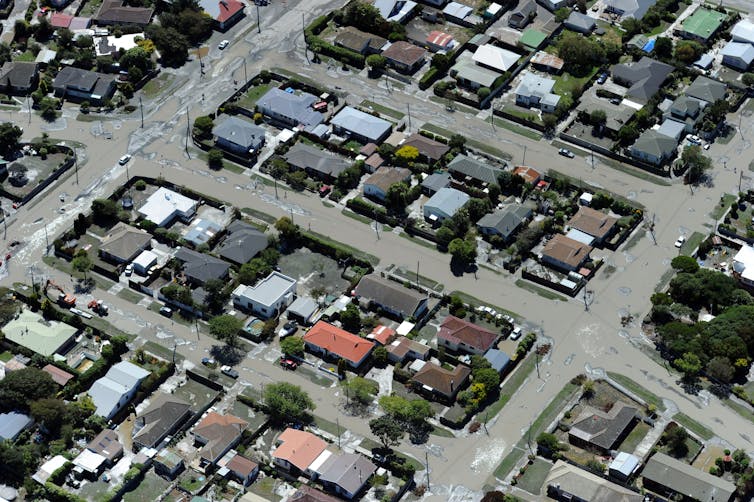
The Canterbury earthquakes cost insurers NZ$21 billion and the Natural Hazards Commission $10 billion. And the risk of natural disasters more generally may be making insurers too cautious. They’re increasingly pulling out of areas they consider “high risk”.
That said, there are changes on the horizon. From mid-2025, insurers will have a general duty to “treat consumers fairly”. The Financial Markets Authority – the body responsible for enforcing financial-markets law – may potentially regard refusing home insurance to any consumer as a breach of the duty.
In other words, the Financial Markets Authority may end up forcing insurers to cover most of the country’s homes.
Billion-dollar payouts: liquefaction in the Christchurch suburb of Bexley after the 2011 earthquake. Getty Images
New insurance options
Future-proofing home insurance options will depend on the public and private sectors working together.
Many of the potential solutions are specific to how insurers take risk on. An insurer may decrease your premiums as an incentive for you to “disaster-proof” your home. If you don’t, the insurer may increase your premiums and limit its payouts to you, with individualised excesses or caps.
The insurer may even offer “parametric” insurance, which pays out less than traditional insurance, but faster.
For example, imagine a home insurance policy that covers any earthquake having its epicentre within 500 kilometres of your home, and measuring magnitude six or higher.
A traditional policy would pay out based on how much loss was caused (according to a loss adjuster). A parametric policy would simply pay out a small, pre‑agreed sum, based on the fact the earthquake occurred at all.
A parametric policy wouldn’t require you to prove any actual “loss” – beyond the inconvenience of having your home in the disaster zone.
While parametric insurance is relatively new worldwide, it’s an efficient solution for managing the risk of natural-disaster damage.
Reinsurance, co-insurance and ‘cat bonds’
An insurer may also transfer risk to one or more other insurance businesses – such as a “reinsurer”. If the insurer has to make a payout to you for a claim, the reinsurer then has to make a payout to the insurer for a portion of it.
The insurer may even “co‑insure” the risk. Co‑insurance is where two or more insurers cover different portions of the same risk. So, if you have your home co‑insured, you will have two or more insurers, each responsible for a portion of any claim.
Then there is the potential to transfer insured risk to entities that aren’t even insurance businesses. In some countries (such as Bermuda, the Cayman Islands and Ireland), the insurer can turn the risk into a “catastrophe bond” (also known as a “cat bond”).
Under a cat bond, the insurer arranges for expert investors to lend it capital in return for interest on the loans. The insurer eventually repays the capital, unless there is a specific natural disaster. In that case, the insurer keeps the capital, enabling it to pay out to the affected customers.
The insurer may even use the cat bond to create a “virtuous cycle”. More specifically, the insurer may reinvest the capital in “a project that reduces or prevents loss from the insured climate-related risk” (such as flooding).
Disaster-proofing the insurance industry
Key to improving the situation will be the public and private sectors working together to make climate-related disasters less frequent – and less serious when they occur.
The United Nations’ Intergovernmental Panel on Climate Change has advised on how the sectors could minimise climate-related risk. But they also have similar progress to make to minimise the risk of natural-disaster damage more generally, particularly from earthquakes.
It is important to build homes that are better disaster-proofed. And it is also important to address a major problem that many people don’t necessarily view as related to insurance – the cost of housing.
If New Zealanders wishing to own their homes didn’t have to invest as much of their money in housing as they do, the risk of damage to housing might be of less concern. Natural disaster wouldn’t have to mean financial disaster as much as it does today.
In the meantime, innovative insurance options will become more and more necessary.
Christopher Whitehead spoke at the New Zealand Insurance Law Association Conference in 2022. From 2005 to 2015 he practised as legal counsel in the insurance industry, first to a French-headquartered banking group and then to a United States-headquartered insurance group.
Regional leaders will gather later this month in Tonga for the 53rd Pacific Islands Forum leaders meeting in Tonga and high on the agenda will be Japan’s dumping of treated nuclear wastewater in the Pacific Ocean.
A week ago on the 6 August 2024, the 79th anniversary of the atomic bombing of Hiroshima in 1945 and the 39th anniversary of the Treaty of Rarotonga opening for signatures in 1985 were marked.
As the world and region remembered the horrors of nuclear weapons and stand in solidarity, there is still work to be done.
READ MORE: Other nuclear wastewater in Pacific reports
Cook Islands Prime Minister Mark Brown has stated that Japan’s discharge of treated nuclear wastewater into the Pacific Ocean does not breach the Rarotonga Treaty which established a Nuclear-Free Zone in the South Pacific.
Civil society groups have been calling for Japan to stop the dumping in the Pacific Ocean, but Brown, who is also the chair of the Pacific Islands Forum and represents a country associated by name with the Rarotonga Treaty, has backtracked on both the efforts of PIFS and his own previous calls against it.
Brown stated during the recent 10th Pacific Alliance Leaders Meeting (PALM10) meeting in Tokyo that Pacific Island Leaders stressed the importance of transparency and scientific evidence to ensure that Japan’s actions did not harm the environment or public health.
But he also defended Japan, saying that the wastewater, treated using the Advanced Liquid Processing System (ALPS) to remove most radioactive materials except tritium, met the standard set by the International Atomic Energy Agency (IAEA).
Harmful isotopes removed “No, the water has been treated to remove harmful isotopes, so it’s well within the standard guidelines as outlined by the global authority on nuclear matters, the IAEA,” Brown said in an Islands Business article.
“Japan is complying with these guidelines in its discharge of wastewater into the ocean.”
The Cook Islands has consistently benefited from Japanese development grants. In 2021, Japan funded through the Asian Development Bank $2 million grant from the Japan Fund for Poverty Reduction, financed by the Government of Japan.
Together with $500,000 of in-kind contribution from the government of the Cook Islands, the grant funded the Supporting Safe Recovery of Travel and Tourism Project.
Just this year Japan provided grants for the Puaikura Volunteer Fire Brigade Association totaling US$132,680 and a further US$53,925 for Aitutaki’s Vaitau School.
Long-term consequences In 2023, Prime Minister Brown said it placed a special obligation on Pacific Island States because of ’the long-term consequences for Pacific peoples’ health, environment and human rights.
Pacific states, he said, had a legal obligation “to prevent the dumping of radioactive wastes and other radioactive matter by anyone” and “to not . . . assist or encourage the dumping by anyone of radioactive wastes and other radioactive matter at sea anywhere within the South Pacific Nuclear Free Zone.
“Our people do not have anything to gain from Japan’s plan but have much at risk for generations to come.”
The Pacific Islands Forum went on further to state then that the issue was an “issue of significant transboundary and intergenerational harm”.
The Rarotonga Treaty, a Cold War-era agreement, prohibits nuclear weapons testing and deployment in the region, but it does not specifically address the discharge of the treated nuclear wastewater.
Pacific civil society organisations continue to condemn Japan’s dumping of nuclear-treated wastewater. Of its planned 1.3 million tonnes of nuclear-treated wastewater, the Tokyo Electric Power Company (TEPCO) has conducted seven sets of dumping into the Pacific Ocean and was due to commence the eighth between August 7-25.
Regardless of the recommendations provided by the Pacific Island Forum’s special panel of experts and civil society calls to stop Japan and for PIF Leaders to suspend Japan’s dialogue partner status, the PIF Chair Mark Brown has ignored concerns by stating his support for Japan’s nuclear wastewater dumping plans.
Contradiction of treaty This decision is being viewed by the international community as a contradiction of the Treaty of Rarotonga that symbolises a genuine collaborative endeavour from the Pacific region, born out of 10 years of dedication from Fiji, New Zealand, Australia, the Cook Islands, and various other nations, all working together to establish a nuclear-free zone in the South Pacific. Treaty Ratification
Bedi Racule, a nuclear justice advocate said the Treaty of Rarotonga preamble had one of the most powerful statements in any treaty ever. It is the member states’ promise for a nuclear free Pacific.
“The spirit of the Treaty is to protect the abundance and the beauty of the islands for future generations,” Racule said.
She continued to state that it was vital to ensure that the technical aspects of the Treaty and the text from the preamble is visualised.
“We need to consistently look at this Treaty because of the ongoing nuclear threats that are happening”.
Racule said the Treaty did not address the modern issues being faced like nuclear waste dumping, and stressed that there was a dire need to increase the solidarity and the universalisation of the Treaty.
“There is quite a large portion of the Pacific that is not signed onto the Treaty. There’s still work within the Treaty that needs to be ratified.
“It’s almost like a check mark that’s there but it’s not being attended to.”
The Pacific islands Forum meets on August 26-30.
Brittany Nawaqatabuis assistant media and communications officer of the Suva-based Pacific Network on Globalisation (PANG).
By Matilda Yates, Queensland University of Technology
“From a white perspective it is journalism but for us, it is actually storytelling,” says Fiji student journalist Viliame Tawanakoro.
“In the Pacific, we call it talanoa, it hasn’t changed the gist of journalism, but it has actually helped journalism as a whole because we have a way of disseminating information.”
Fijians use storytelling or talanoa to communicate “information or a message from one village to another”, explains Tawanakoro, and that storytelling practices guides how he writes journalistic stories.
“Storytelling is about having a conversation, so you can have an understanding of what you are trying to pursue,” Tawanakoro says.
David Robie’s research, conducted while he was Auckland University of Technology’s Pacific Media Centre director and published in his book Don’t Spoil My Beautiful Face: Media, Mayhem and Human Rights in the Pacific, highlights the power of talanoa as a tool for effective reporting of the Pacific region with “context and nuance”.
However, Dr Robie notes the “dilemmas of cross-cultural reporting” in Fiji.
Fijian journalists face a cultural and potentially even a moral conflict, according to Fiji journalist Seona Smiles in the foreward to The Pacific Journalist: A Practical Guide.
‘Deep-rooted beliefs’ “Deep-rooted beliefs in South Pacific societies about respect for authority could translate into a lack of accountability and transparency on behalf of the powerful,” Smiles notes.
Fiji student journalist Brittany Nawaqatabu echoes this internal conflict as a young journalist who was “brought up not to ask too many questions” — especially to elder iTaukei.
“It’s always that battle between culture and having to get your job done and having to manoeuvre the situation and knowing when to put yourself out there and when to know where culture comes in,” Nawaqatabu says.
Managers and leaders in Fiji news media need deep awareness of cultural norms and protocols.
Editor of Islands Business Samantha Magick expresses the importance of hiring a diverse staff so that the correct journalist can be sent to cover what may be a culturally sensitive story.
“I unwittingly assigned someone to cover a traditional ceremony and I didn’t realise that their status within that community actually made it very difficult for them to do that,” she says.
In exploring journalism in the Pacific, Dick Rooney and his Divine Word University colleagues found that a Western understanding of journalism cannot be transplanted “into a society which has very different societal needs”.
‘More complexity’ Practising journalism in Fiji is like practising journalism in a small town “but with a lot more complexity”, Magick says.
She finds “the degree of separation isn’t six it’s like two”, meaning that it is a vital consideration of editors to ensure no conflict exists with the journalists and the community they are being sent to.
It is “incumbent on an editor to understand” the cultural norms and expectations that may be imposed on a journalist on an assignment and to ensure they have a “diverse newsroom of all ethnicities, not just the iTaukei but also the Indo-Fijian,” Magick says.
Nawaqatabu expands on one Fijian cultural norm in which “women are expected to not speak”.
As the Fijian news media and society modernise, and more diverse information becomes available, Fijian women in particular have found a voice through journalism.
“Pursuing journalism gives us that voice to cover stories that mean a lot to us, and the country as a whole, to communicate that voice that we didn’t initially have in the previous generation,” Nawaqatabu says.
Tawanakoro concurs with this sentiment. “Women have found a voice and are more vocal about what they want,” he says.
The intersection of tradition, culture and journalism in Fiji will continue, but Tawanakoro says journalists can operate effectively if they understand culture and protocols.
“As a journalist, you have to acknowledge there is a tradition, there is a culture if you respect the culture, the tradition, the vanua (earth, region, spot, place-to-be or come from) they will respect you.”
Matilda Yates is a student journalist from the Queensland University of Technology who travelled to Fiji with the support of the Australian Government’s New Colombo Plan Mobility Programme. This article is republished by Asia Pacific Report in collaboration with the Asia Pacific Media Network (APMN), QUT and The University of the South Pacific.
Keith Rankin, trained as an economic historian, is a retired lecturer in Economics and Statistics. He lives in Auckland, New Zealand.
Analysis by Keith Rankin
Wednesday I wrote Department of Mum and Dad (Scoop 14 Aug 2024, or here on Evening Report). I finished by saying that, today, “I will propose a simple affordable solution which better fits centre-right than centre-left philosophies”. Here goes.
Keith Rankin, trained as an economic historian, is a retired lecturer in Economics and Statistics. He lives in Auckland, New Zealand.
My proposal is to pay a personal tax credit of $150 per week to every New Zealand resident aged over 18. The principal mechanism to pay for this would be to remove the 10.5% and 17.5% income tax brackets. The result would be that every New Zealander earning $53,500 or more (per year, before tax) would have an unchanged after-tax income, while some people earning less would get more. The $150 per week is a simple measure of the maximum benefit implicit in those two lower tax brackets.
The second mechanism to fund the PTC is to account for upto the first $150 per week of income support benefits as a personal tax credit. Thus, present beneficiaries would have unchanged weekly disposable incomes.
There would be some minor complexities relating to people who would not be considered to be fulltime beneficiaries. So, for the purposes of this policy proposal:
Working for Families, the Independent Earner Tax Credit, and New Zealand Superannuation would be classed as benefit income.
People today earning less than $53,500 before tax would get more than they do now only if they are receiving nil or trivial benefit income.
For an example, a person working 30 hours each week at the minimum wage would have a weekly pre-tax income of at least $694.50; $36,114 per year. Persons grossing this amount with no benefit income would become $42.19 better off with a PTC. If they receive benefits (as defined in the first bullet point above) in excess of $42.19, then the first $42.19 of benefit income would be accounted for as ‘PTC’ rather than as ‘Benefit’. (Such minimum wage workers receiving weekly benefit income above zero but below $42.19 would no longer be receiving benefit income because the PTC would more than compensate for lost benefit.)
Another class of ‘static beneficiary’ of the PTC would be non-employed working-age ‘spouses’ living with their partners, and contributing to society in ways other than labour force participation. They may be caregivers, volunteers, underemployed free-lancers, or start-up entrepreneurs.
Or they may be people recently made redundant. Here we are starting to appreciate the possibilities for the dynamic benefits of the PTC. Today’s recently redundant spouses may be tomorrow’s social or capitalistic entrepreneurs.
Dynamic benefits, which fit near-right philosophies of self-reliance and basic democratic rights
The general idea is that of a hand-up rather than a handout. Though basic democratic rights go beyond that concept of charity; the unconditional $150 (which should be subject to CPI indexation) would be conceived as a democratic right in the same sense as the ‘right to vote’.
The dynamic benefits of this proposal are the ‘behavioural changes’; in particular the substantial reductions of the ‘moral hazards’ inherent in any regime of targeted income-support.
Because the $150 weekly PTC would be received an unconditional right, there would be only minimal bureaucracy required to administer it; that would be a substantial cost saving.
The Department of Mum and Dad could be sure that they would receive at least $150 per week in ‘board’ money for each adult child supported in part or in full by Mum and/or Dad. This would take pressure off Mums and Dads with bougie (ie ‘entitled’) adult children.
Many people hate being clients of MSD. They would prefer to be reliant on their own efforts, and on their private and civil society networks. Under the PTC policy regime, new applicants for income support would decline substantially, with remaining applicants for benefit support being the most needy persons and families.
Personal tax credits could be paid – especially for the cases of adult children living ‘at home’ – directly to accommodation providers (eg Mum or Dad) as contributions to the recipients’ board or rent.
The key point is that newly unemployed persons would retain their weekly entitlements of $150 per week, enough to tide many of them over without having to become beneficiaries. And people who are present beneficiaries would be able to ‘dip their toes’ into the part-time labour force without losing all their present support; targeted support that today incentivises them to continue as beneficiaries. The PTC is an ‘enabling’ rather than a ‘disabling’ form of benefit.
Another way of putting it is that the PTC proposal creates a better balance between ‘carrot’ and ‘stick’. The PTC is the carrot.
Note
We may note that there were ‘personal tax credits’ in New Zealand from the 1973 to 1978 Budgets. They were not the same as my proposed PTC, in that those payments would be ‘upto’ a certain amount rather than the full amount for all. The 1970s’ version failed mainly because they were not adequately indexed to the inflation of that time; and also because they were not enshrined as a democratic right.
Conclusion
If the present government does not pursue this policy, it would be ‘cutting off its nose to spite its face’. The new regime of benefit sanctions is the ‘cutting of the nose’ part. The non-realisation of dynamic benefits by not implementing the policy would be the ‘spiting of the face’.
————-
Keith Rankin (keith at rankin dot nz), trained as an economic historian, is a retired lecturer in Economics and Statistics. He lives in Auckland, New Zealand.
Source: The Conversation (Au and NZ) – By Jenny Doust, Clinical Professorial Research Fellow, Australian Women and Girls’ Health Research Centre, The University of Queensland
Ovarian cancers are often found when they are already advanced and hard to treat.
Researchers have long believed this was because women first experienced symptoms when ovarian cancer was already well-established. Symptoms can also be hard to identify as they’re vague and similar to other conditions.
But a new study shows promising signs ovarian cancer can be detected in its early stages. The study targeted women with four specific symptoms – bloating, abdominal pain, needing to pee frequently, and feeling full quickly – and put them on a fast track to see a specialist.
As a result, even the most aggressive forms of ovarian cancer could be detected in their early stages.
So what did the study find? And what could it mean for detecting – and treating – ovarian cancer more quickly?
Why is ovarian cancer hard to detect early?
Ovarian cancer cannot be detected via cervical cancer screening (which used to be called a pap smear) and pelvic exams aren’t useful as a screening test.
Current Australian guidelines recommend women get tested for ovarian cancer if they have symptoms for more than a month. But many of the symptoms – such as tiredness, constipation and changes in menstruation – are vague and overlap with other common illnesses.
This makes early detection a challenge. But it is crucial – a woman’s chances of surviving ovarian cancer are associated with how advanced the cancer is when she is diagnosed.
If the cancer is still confined to the original site with no spread, the five-year survival rate is 92%. But over half of women diagnosed with ovarian cancer first present when the cancer has already metastatised, meaning it has spread to other parts of the body.
If the cancer has spread to nearby lymph nodes, the survival rate is reduced to 72%. If the cancer has already metastasised and spread to distant sites at the time of diagnosis, the rate is only 31%.
There are mixed findings on whether detecting ovarian cancer earlier leads to better survival rates. For example, a trial in the UK that screened more than 200,000 women failed to reduce deaths.
That study screened the general public, rather than relying on self-reported symptoms. The new study suggests asking women to look for specific symptoms can lead to earlier diagnosis, meaning treatment can start more quickly.
What did the new study look at?
Between June 2015 and July 2022, the researchers recruited 2,596 women aged between 16 and 90 from 24 hospitals across the UK.
They were asked to monitor for these four symptoms:
persistent abdominal distension (women often refer to this as bloating)
feeling full shortly after starting to eat and/or loss of appetite
pelvic or abdominal pain (which can feel like indigestion)
needing to urinate urgently or more often.
Women who reported at least one of four symptoms persistently or frequently were put on a fast-track pathway. That means they were sent to see a gynaecologist within two weeks. The fast track pathway has been used in the UK since 2011, but is not specifically part of Australia’s guidelines.
Some 1,741 participants were put on this fast track. First, they did a blood test that measured the cancer antigen 125 (CA125). If a woman’s CA125 level was abnormal, she was sent to do a internal vaginal ultrasound.
What did they find?
The study indicates this process is better at detecting ovarian cancer than general screening of people who don’t have symptoms. Some 12% of women on the fast-track pathway were diagnosed with some kind of ovarian cancer.
A total of 6.8% of fast-tracked patients were diagnosed with high-grade serous ovarian cancer. It is the most aggressive form of cancer and responsible for 90% of ovarian cancer deaths.
Out of those women with the most aggressive form, one in four were diagnosed when the cancer was still in its early stages. That is important because it allowed treatment of the most lethal cancer before it had spread significantly through the body.
There were some promising signs in treating those with this aggressive form. The majority (95%) had surgery and three quarters (77%) had chemotherapy. Complete cytoreduction – meaning all of the cancer appears to have been removed – was achieved in six women out of ten (61%).
It’s a promising sign that there may be ways to “catch” and target ovarian cancer before it is well-established in the body.
What does this mean for detection?
The study’s findings suggest this method of early testing and referral for the symptoms leads to earlier detection of ovarian cancer. This may also improve outcomes, although the study did not track survival rates.
It also points to the importance of public awareness about symptoms.
Clinicians should be able to recognise all of the ways ovarian cancer can present, including vague symptoms like general fatigue.
But empowering members of the general public to recognise a narrower set of four symptoms can help trigger testing, detection and treatment of ovarian cancer earlier than we thought.
This could also save GPs advising every woman who has general tiredness or constipation to undergo an ovarian cancer test, making testing and treatment more targeted and efficient.
Many women remain unaware of the symptoms of ovarian cancer. This study shows recognising them may help early detection and treatment.
Jenny Doust does not work for, consult, own shares in or receive funding from any company or organisation that would benefit from this article, and has disclosed no relevant affiliations beyond their academic appointment.
Melbourne City Council voted to break its contracts with operators of shared e‑scooter schemes this week, citing safety concerns. It seems these concerns have usurped the long-term transport and environmental gains from moving towards sustainable transport. A year ago, the city reported emissions had been cut by 400 tonnes since trials of these e‑scooters began.
Shared e‑scooters only became available to Melburnians in early 2022. But electric scooters have existed for more than a century. They were very popular on public streets in the United States after motorised scooters first appeared in 1915.
However, their use for criminal getaways soon marred their reputation. The opportunity for a lower-emission, more equitable form of transport was lost, until now. It could be lost again because of knee-jerk reactions to concerns about their safety.
In fact, shared e‑scooters have safety features that individually owned ones often lack. Shared e‑escooters cause fewer serious injuries than bicycles or motorcycles, according to New Zealand accident compensation data. In Australia, while there has been a rise in numbers treated in hospitals for e‑scooter injuries, no distinction is made between shared and private e‑scooters.
Private e-scooters greatly outnumber shared ones
Today, an estimated 15,000 shared e‑scooters are in use across Australia and New Zealand. No official figures are available for private e‑scooters, but there are likely to be many more of them.
Segway, a globally dominant maker of e‑scooters, reported it had sold 8.5 million private versus 1.5 million shared e‑scooters by 2022. In the United Kingdom, an estimated 360,000 private e‑scooters were bought in 2020. New Zealand Statistics reports roughly 400,000 e‑scooters were imported from 2018 to 2023.
One can assume, then, that private e‑scooters similarly outnumber shared e‑scooters in Australia. And the distinction between rental and private e‑scooters is an important one in the debate about safety.
Media reports on shared e‑scooters in Melbourne have concentrated on two key subjects: launching trials and safety. Recent coverage refers to significant incidents and injuries. This creates a perception that e‑scooters are much less safe than other transport modes.
Regulated shared e-scooters are safer
The first thing to note is these reports don’t distinguish between shared and private e‑scooters. This matters because the shared e‑scooter market is highly regulated in Australia.
Their operators are required to:
provide helmets for riders
apply speed limiters so they don’t exceed safe speeds
geo-fence e‑scooters to limit where they can travel
use pedestrian-detection technology.
In contrast, private e‑scooters are not registered. They have different quality specifications and can have larger motors, often exceeding regulated engine outputs that vary from state to state. Importantly, private e‑scooters lack the advanced technologies used on shared e‑scooters to monitor rider use.
There is little to no regulation or quality control over the private e‑scooters Australians can buy. Some models seen on the streets can exceed the legal speed limit. All that’s stopping them speeding is rider responsibility and police oversight.
Hospitals records of e‑scooter injuries do not distinguish between private or shared e‑scooter riders. That’s also true of injury reporting and statistics, due to the way authorities collect crash statistics.
Yet reported injury statistics for New Zealand indicate that the rate of serious injury while using a shared e‑scooter points is lower than for other modes of transport. Far more people suffered soft tissue injuries from rollerskating and skateboarding (5,344) than from riding e‑scooters (1,119), for instance. Nine times as many bike riders incurred a head injury or concussion (681) compared to e‑scooter riders (76).
Better infrastructure is also vital for e‑scooter safety. A 2020 International Transport Federation (ITF) report found 80% of e‑scooter crashes occurred at intersections, and 70% during the day.
The findings are not surprising when scant attention has been paid to delivering safe e‑scooter infrastructure. In Melbourne, for example, some lanes available for e‑scooter riding end abruptly.
E-scooters cut emissions and congestion
The most important issue arising from the City of Melbourne’s ban is the role e‑scooters (and e‑bikes) can play in shrinking cities’ huge carbon footprints. In addition, e‑scooters can:
reduce traffic congestion
improve access to public transport
provide more efficient transport for shorter trips
remove the need for car parking
improve air quality.
The City of Melbourne pointed solely at the safety concern to justify its ban. The city instead needs more proactive policies to integrate shared e‑scooters into the its mobility mix. This would have delivered all the public good of this transport mode.
Governance is a neglected issue
Much of the research on e‑scooters in cities focuses on sustainability and safety. Governance (policies, rules and regulations) is largely overlooked.
Operating governance structures are established following a traditional operator licensing pathway. This approach is now being questioned.
What has been lacking is broad engagement with all stakeholders, including the public. The focus should be on balancing the benefits and burdens of shared e‑scooters.
E‑scooters are a particularly valuable form of transport for young people and those on low incomes or with a disability. The social justice they provide has been neglected. Predictably, then, the focus has been on the burdens, including safety.
Another problem is the widely varied approaches around Australia to regulating e‑scooters. There isn’t even a consistent definition of e‑scooters.
It appears governance decisions, which include ending operator licences, aren’t using reliable evidence to avoid knee-jerk reactions.
For widespread sustainable and safe e‑scooter use, there needs to be:
better governance and rider safety education
more consistent and specific recording of e‑scooter incident and injury data
an appreciation that riders are vulnerable road users who deserve safe infrastructure.
A comprehensive, inclusive assessment of benefits and burdens is needed. We may then establish more clearly the sustainability and equity benefits, manage the safety concerns and arrive at more consistent policies and definitions across Australia.
Mark Stevenson receives funding from the National Health and Medical Research Council and the Australian Research Council.
Ferdinand Balfoort receives funding from Charles Darwin University, Australia.
He is a Senior Researcher at the Mobility Research Partnership Pty Ltd, a not for profit
How can schools better help young people at this time? In a new four-year study we looked at the role of teaching support. We were especially interested to know if teachers’ influence on students’ motivation and engagement grows or fades across the adolescent years.
Our study involved 7,769 Year 6 New South Wales government school students who were tracked annually into Year 9. The students were part of the NSW Department of Education’s annual “Tell Them From Me” student survey.
Students were asked questions about the teaching support they received, as well as questions about their motivation and engagement. They were given a 0–4 point rating scale (strongly disagree to strongly agree).
There were three categories of teaching support:
emotional support: did teachers support and care for students?
instrumental support: did teachers have clear expectations for students and did they make learning content seem relevant?
management support: were there clear rules and routines for the class?
Motivation was measured through students’ academic aspirations about the future and how much they valued school (or saw it as important). Engagement was assessed via students’ perseverance, efforts with homework, making school friends and whether they had any behaviour issues.
In our analysis we also accounted for students’ backgrounds, such as gender, socioeconomic status and prior academic achievement.
Our findings confirm there is a decline in students’ motivation and engagement from Year 6 to Year 9 (around 18% in total). This is consistent with the known dip in early- to mid-adolescence.
But we also found in each of these four years, teaching support overall (and each of the three teaching support categories) was significantly associated with students’ motivation and engagement.
That is, more teaching support was linked to greater student aspirations, valuing school, perseverance, homework effort, connections with school friends and less misconduct at school.
Of particular note, we found the link between teaching support and students’ motivation and engagement strengthened each year. For example, teaching support was more strongly linked to students’ motivation and engagement in Year 9 than it was in Year 8. Taken together, between Year 6 and Year 9, there was a 40% increase in the role of teaching support in students’ motivation and engagement.
Our research found a positive link between teaching support and students’ aspirations and efforts at school. Rawpixel.com/Shutterstock, CC BY
What this means
This is an empowering finding for teachers because adolescence is typically seen as a time when the influence of adults declines. Our results show students remain within their teacher’s orbit as they move further into adolescence.
ensuring content and tasks are interesting and meaningful to students
explaining how schoolwork is useful for other schoolwork, or things outside school (for example, world events or paid work)
having clear, consistent, and logical expectations about classroom behaviour
encouraging student input as classroom rules are developed.
There are also further practical ideas in a NSW Department of Education guide that accompanies our study.
With thanks to Mary Stephan, Anaïd Flesken, Fiona Halcrow and Brianna McCourt from the Centre for Education Statistics and Evaluation, NSW Department of Education. The “Tell Them From Me” survey mentioned in this article is the intellectual property of education resources company, The Learning Bar.
Andrew J. Martin sits on the Advisory Board of Centre for Education Statistics and Evaluation in the New South Wales Department of Education. Funding for the research mentioned in this article was provided by the NSW Department of Education.
Rebecca J. Collie receives funding from the New South Wales Department of Education.
What will our climate look like in the future? It is hard to overstate not only the importance of answering this question, but also the challenges involved in doing so.
We know the climate is changing rapidly. But without information about where we are headed, planning – at personal, organisational and societal levels – becomes tricky, to put it mildly.
Because climate risks are also understood as financial risks, many countries around the world – including Australia – are moving to make climate risk reporting mandatory. Accordingly, this need for a plan can no longer be ignored.
But the way we currently communicate climate risk has some serious limitations.
Recent research led by Tanya Fiedler explores these limitations, and proposes that a new approach – incorporating the power of narratives – would be more useful and practical for organisations.
We all struggle with uncertainty
Why is painting a picture of our future climate to help us make decisions so difficult? Part of the answer lies in the way individuals make decisions under uncertainty.
People tend to find it difficult to cope with uncertainty and ambiguity, often struggling when presented with probabilities. This can impact our decisions, leading to undesirable outcomes.
Research has also shown we find it difficult to respond to warnings that fall outside our lived experience.
The other part of the answer lies in the inherent complexity – and uncertainties – involved in developing a useful picture of the future.
The most common way to explore our future climate is to use global or regional climate models – complex mathematical simulations of our climate system. These have proven extraordinarily valuable to simulate how our climate will change due to increases in greenhouse gases.
They can project how temperature, rainfall, winds, fire risk and even hail risk are likely to change in future.
But projections are by definition uncertain, and using different models can provide different visions of the future.
Companies are increasingly required to assess and disclose their climate-related financial risks. Chay_Tee/Shutterstock
The problem with zooming in
This uncertainty tends to increase both as you zoom in to particular locations and become interested in extremes.
For example, how average winter rainfall is expected to change over southwest Western Australia could be relatively clear, but how extreme rainfall (capable of causing major floods) will change is far less clear.
When looking at the level of a postcode or single address we might not even know whether extreme rainfall will increase or decrease.
That’s a problem for organisations trying to work out how to manage and prepare for such risks, often at the scale of an individual building. Modelling is precise, but not necessarily accurate enough for that sort of localised information.
This doesn’t mean climate models aren’t useful or don’t provide valuable information. It just means organisations may need to enhance the value of that information by combining it with other evidence.
Introducing ‘storylines’
Fortunately, there is a way to address both the behavioural and modelling issues that capitalises on how we most intuitively make sense of the world. This is through “storylines”.
Storylines were developed in the climate sciences to describe uncertain physical climate futures. They do this by employing expert judgement to prioritise an understanding of the “causal networks” that drive changes and extremes.
The valuable information held in climate model projections is combined with other types of evidence relevant to a location, to develop a plausible (and useful) story about what the future might entail.
Flood risk, for example, depends on a wide range of factors. These can include:
the amount and intensity of rain
whether heavy rain fell in the recent past
changes to the catchment such as vegetation, soils and the nature of any upstream developments, including new roads or buildings.
A business only using changes in rainfall drawn from a climate or national-scale flood model for its risk assessment might “hard-wire” a future scenario that turns out to be unreliable at the scale they need.
Under an alternative “storylines” approach, their best course of action to understand flood risk would be to work with experts to develop a narrative that describes changes in rainfall in addition to all other locally relevant factors.
This narrative can then be tested using traditional flood modelling methods to provide more robust and useful insights into how the local catchment will be impacted under conditions of changing rainfall.
The quantitative disciplines like finance, economics and accounting may struggle with the idea that a narrative might provide more decision-useful information than a number. Yet, research has shown that narratives can make an uncertain future more tangible than numbers, and thereby better aid with planning and decision-making.
We need a new toolkit
Answering the question “what will our future climate look like?” challenges us to think differently and to look for solutions outside the toolbox of established financial tools and techniques.
It challenges us to work – through interdisciplinary dialogue – with experts, disciplines and knowledge we might feel uncomfortable with.
Storylines could transform the way organisations understand and report their exposure to climate risk. This is unlikely to be easy, and we recognise taking quantitative information from a commercial provider may seem simpler. But it is a more honest and rigorous way of planning for the future climate.
Andy Pitman receives funding from the Australian Research Council. He is also a commissioner on the NSW Net Zero Commission.
Ben Newell receives funding from the Australian Research Council.
Michael Grose receives funding from the National Environmental Science Program and the Australian Climate Service.
Tanya Fiedler does not work for, consult, own shares in or receive funding from any company or organisation that would benefit from this article, and has disclosed no relevant affiliations beyond their academic appointment.
Peter Dutton is 100% signed up to the position of Israel in the Middle East conflict. Immigration minister Tony Burke has an electorate with the second largest Muslim community of any seat in the country.
Dutton and Burke this week have faced off in the fractious debate about Palestinians fleeing to Australia – an issue that risks putting another tear in our social cohesion fabric.
In keeping with our current politics, hyper-partisanship and an approaching election mean this argument is piling dangerous fuel onto an already incendiary local divisions the Middle East conflict has generated.
At the core is the balance this country should strike between national security and national compassion.
But there are complex questions involved, given the passions in sections of the community about the war. There are no absolute (let alone easy) answers to precisely where policy should land.
Dutton sees national security as his natural territory for political combat. His default is to cast issues in the starkest terms. He seldom does nuance, which leaves the impression everyone in Gaza is a potential terror risk.
Burke, just installed as immigration minister, has a brief to close down debates where possible. But he’s also acutely tuned into the voices of his seat, amplified by this week’s announcement a Muslim candidate will run against him as an independent.
ASIO chief Mike Burgess, appearing on the ABC at the weekend, said that from a security point of view, if someone from Gaza just gave “rhetorical support [to Hamas], and they don’t have an ideology or support for a violent extremism ideology, then that’s not a problem”. But if they had given material aid, “that can be a problem”. “Obviously we take each case on its merits in the context of the information we have before us.”
The position he spelled out might have surprised some people, but sources with knowledge of ASIO’s checking say this accords with the organisation’s guidelines.
But this is a security definition, rather than a policy about the entry of Gazans. Dutton didn’t want to get into an argument with Burgess, but he doesn’t accept that as the point where policy should land.
Opposition home affairs spokesman James Paterson sought to find a path between rejecting the Burgess position without rejecting Burgess. “In my view, supporting a terrorist organisation is a very clear breach of the Migration Act, and in particular, the character provisions of the Migration Act and you should not come to Australia if you do so,” Paterson said. “Now that’s not a criticism of Mike Burgess, he was simply describing the status quo under this government. We’ll have a different approach; we think that the acceptable number of Hamas supporters to bring into this country is zero.”
On Wednesday Dutton said: “I don’t think people should be coming in from that war zone at all at the moment. It is not prudent to do so, and I think it puts our national security at risk.” The words “at the moment” are relevant. Is Dutton advocating a short-term pause, or a long-term ban? It’s a fair bet that if there were a Liberal government, few Gazans would be welcome.
So far, on Burke’s figures, from October 7 (when the Hamas attack on Israel occurred) to August 12, 2922 visas from Gaza have been granted and 7111 rejected (though we don’t have a breakdown of grounds). About half those approved have come to Australia; the rest are still in Gaza or in third countries. Currently people are not able to leave Gaza.
Those who have arrived are on visitor visas; the government soon will have to announce its longer term plan for them.
Burke told parliament on Wednesday that everyone who had received a visa had been checked against ASIO’s watch list. This, however, can be a tick-and-flick unless it triggers a warning.
People coming from a war zone normally go through much more rigorous checks, with information obtained from other countries (such as the United States and Israel), biometric testing, and where possible in-person interviews. It can be a long process.
So what should Australia’s policy be towards the Gazan applicants? Where should that security/compassion interface be struck?
Most obviously, close relatives of Australian citizens or permanent residents should have a strong claim to come or, if they are here now, to stay permanently, subject (if considered necessary) to a recheck on security.
Beyond that, a compassionate Australia would set an intake, as it has in previous conflicts, such as from Syria and Afghanistan, with the proviso that comprehensive security checks might take some time.
This would be the right position on principle, although not necessarily a politically smooth policy. The Jewish and Palestinian communities would both likely have some objections from their opposing viewpoints.
For Burke entry of the Gazans is an early test in his new portfolio. While the issue has the government on the back foot, it knows it would be struggling more if Andrew Giles were still the minister.
This week a Lakemba doctor Ziad Basyouny, who was born in Egypt and came here in 2004, announced he will run against Burke in Watson. He said he would campaign around the issues of the cost-of-living crisis, housing, education, health and Palestine.
“The last year has shown us that Labor won’t listen to its constituents on things like Palestine, housing or the cost of living, and if you stand against the wind you’ll be punished,” he said in an interview with The Guardian.
Basyouny told The Conversation that in his decision to stand, Gaza was “the nail in the coffin”. He said Burke should “push the government as hard as possible [on Gaza], but it doesn’t seem like he’s doing so.” In fact, the differences between Labor and the Liberals on Gaza were “pretty marginal”.
Burke is unlikely to be dislodged from his seat: for one thing it is on a 15% margin and for another the Muslim community won’t be united. But the minister will have to spend more campaign time there than usual, and his immigration portfolio increases the local pressure on him.
In his weekend interview, days after the terrorism level was raised, Burgess appealed for the temperature of debate to be lowered. Instead, inside and outside parliament it just went up, yet again.
Michelle Grattan does not work for, consult, own shares in or receive funding from any company or organisation that would benefit from this article, and has disclosed no relevant affiliations beyond their academic appointment.
Cost of living remains at the top of people’s minds as inflation stays sticky. With an election in less than a year, the government has been doing what it can to address some of the pressures. But the Reserve Bank doesn’t envisage an interest rate cut this year, and has suggested spending by governments is keeping inflation higher for longer.
On Thursday, new figures showed employment has surged, but the unemployment rate ticked up to 4.2%, from 4.1%
Treasurer Jim Chalmers joined the podcast to discuss a range of issues.
Chalmers is optimistic he is close to a deal with the opposition over his long-awaited reforms to the Reserve Bank. The plan is to have two boards rather than one: There would be a new board of experts to take over responsibility for monetary policy.
We’ve had discussions, including relatively recently, about how we come to a bipartisan view about these reforms. I’ve done my best throughout to be as bipartisan as I can because I think the structure of our central bank should be above partisan politics. And I believe [shadow treasurer] Angus Taylor has that view as well.
There are a couple of issues that we’re still working through. […] Hopefully we can progress things quite soon and get it finished so that the changes can come in at the start of next year.
Bank Governor Michele Bullock’s recent comments about strong government spending, and the observation by the bank’s chief economist Sarah Hunter that the economy was running a “bit hotter” than the bank previously expected sparked headlines about the government and the bank being at odds. Chalmers is anxious to stress what they agree on but firmly rejects the suggestion of the economy being hot:
The Reserve Bank governor and I both say in our own way that we’ve got the same objective here, which is to fight inflation, but we’ve got different responsibilities. Governor Bullock acknowledged that in her speech in Armidale. We both want to see inflation moderate, further and faster. I’m an enthusiastic part of that.
I’m not sure that there’s the data or the feedback to sustain an argument that says that the economy’s too hot. There was barely any growth in the most recent national accounts. Household savings came off substantially. Retail has been weak. You know, there are a whole bunch of indications that our economy is quite soft.
On the lacklustre reception of the budget, Chalmers says he keeps his expectations realistic, and he remains confident he’s made the right economic decisions:
I’ve been around long enough to have realistic expectations about all of that.
I think it’s important to acknowledge people are under pressure and when they’re under pressure, they express themselves and the political system.
That’s expected and unsurprising. I genuinely think that if you make the right economic decisions for the right economic reasons, the politics will take care of themselves. If not in the near term, then certainly over the longer term.
On the latest employment figures:
Well, employment’s gone up by more than unemployment. The unemployment rate has ticked up because of participation rates at a record high. The labour market is soft around the edges.
The participation rate is up. The amount of new jobs just in one month, just in July, was almost 60,000 new jobs that are all full time. That’s a really good thing in the context of an economy which is soft and weakening more broadly.
Although real wage growth is sluggish, Chalmers highlights the government’s record on wages especially on the gender pay gap:
We’ve had a particular focus on people on low and middle incomes and a particular focus on women, and one of the most heartening aspects of the labour market data this week has been that the gender pay gap is the narrowest it’s ever been in the history of our country. […] That’s not accidental. That’s deliberate.
Michelle Grattan does not work for, consult, own shares in or receive funding from any company or organisation that would benefit from this article, and has disclosed no relevant affiliations beyond their academic appointment.
Of the international intelligence information that comes to Australian agencies from the Five Eyes, 90 percent comes from the CIA and related US intelligence agencies. So in effect we have the colonisation of our intelligence agencies These agencies dominate the advice to ministers, writes John Menadue.
Michael Lester:Hello again listeners to Community Radio Northern Beaches Community Voices and also the Pearls and Irritations podcast. I’m Michael Lester.
Our guest today is the publisher and founder of the Pearls and Irritations Public Policy online journal, the celebrated John Menadue, with whom we’ll be so pleased to have a discussion today. John has a long and high profile experience in both the public service, for which he’s been awarded the Order of Australia and also in business.
As a public servant, he was secretary of a number of departments over the years, prime minister and cabinet under a couple of different prime ministers, immigration and ethnic affairs, special minister of state and the Department of Trade and also Ambassador to Japan.
And in his private sector career, he was a general manager at News Corp and the chief executive of Qantas. These are just among many of his considerable activities.
These days, as I say, he’s a publisher, public commentator, writer, and we’re absolutely delighted to welcome you here to Radio Northern Beaches and the P&I podcast, John.
John Menadue: Thank you, Michael. Thanks for the welcome and for what you’ve had to say about Pearls and Irritations. My wife says that she’s the Pearl and I’m the Irritation.
ML:You launched, I think, P&I, what, 2013 or 2011; anyway, you’ve been going a long while. And I noticed the other day you observed that you’d published some 20,000 items on Pearls and Irritations to do with public policy. That’s an amazing achievement itself as an independent media outlet in Australia, isn’t it?
JM: I’m quite pleased with it and so is Susie, my wife. We started 13 years ago and we did everything. I used to write all the stories and Susie handled the technical, admin, financial matters, but it’s grown dramatically since then. We now contract some of the work to people that can help us in editorial, in production and IT. It’s achieving quite a lot of influence among ministers, politicians, journalists and other opinion leaders in the community.
We’re looking now at what the future holds. I’m 89 and Susie, my wife, is not in good health. So we’re looking at new governance arrangements, a public company with outside directors so that we can continue Pearls and Irritations well into the future.
Pearls and Irritations publisher John Menadue . . . “I’m afraid some of [the mainstream media] are just incorrigible. They in fact act as stenographers to powerful interests.” Image: Independent Australian
ML: So you made a real contribution through this and you’ve given the opportunity for so many expert, experienced, independent voices to commentate on public policy issues of great importance, not least vis-a-vis, might I say, mainstream media treatment of a lot of these issues.This is one of your themes and motivations with Pearls and Irritations as a public policy journal, isn’t it? That our mainstream media perhaps don’t do the job they might do in covering significant issues of public policy?
JM: That’s our hope and intention, but I’m afraid some of them are just incorrigible. They in fact act as stenographers to powerful interests.
It’s quite a shame what mainstream media is serving up today, propaganda for the United States, so focused on America.Occasionally we get nonsense about the British royal family or some irrelevant feature like that.
But we’re very badly served. Our media shows very little interest in our own region. It is ignorant and prejudiced against China. It is not concerned about our relations with Indonesia, with the Philippines, Malaysia, Vietnam.
It’s all focused on the United States.We’re seeing it on an enormous scale now with the US elections. Even the ABC has a Planet America programme.
It’s so much focused on America as if we’re an island parked off New York. We are being Americanised in so many areas and particularly in our media.
ML: What has led to this state of affairs in the way that mainstream media treats major public policy issues these days? It hasn’t always been like that or has it?
JM: We’ve been a country that’s been frightened of our region, the countries where we have to make our future. And we’ve turned first to the United Kingdom as a protector. That ended in tears in Singapore.
And now we turn to the United States to look after us in this dangerous world, rather than making our own way as an independent country in our own region. That fear of our region, racism, white Australia, yellow peril all feature in Australia and in our media.
But when we had good, strong leaders, for example, Malcolm Fraser on refugees, he gave leadership and our role in the region.
Gough Whitlam did it also. If we have strong leadership, we can break from our focus on the United States at the expense of our own region. In the end, we’ve got to decide that as we live in this region, we’ve got to prosper in this region.
Security in our region, not from our region. We can do it, but I’m afraid that we’ve been retreating from Asia dreadfully over the last two or three decades. I thought when we had a Labor government, things would be different, but they’re not.
We are still frightened of our own region and embracing at every opportunity, the United States.
ML: Another theme of the many years of publishing Pearls and Irritations is that you are concerned to rebuild some degree of public confidence and trust that has been lost in the political system and that you seek to provide a platform for good policy discussion with the emphasis being on public policy. How has the public policy process been undermined or become so narrow minded if that’s one way of describing it?
JM: Contracting out work to private contractors, the big four accounting firms, getting advice, and not trusting the public service has meant that the quality of our public service has declined considerably. That has to be rebuilt so we get better policy development.
Ministers have been responsible, particularly Scott Morrison, for downgrading the public service and believing somehow or other that better advice can be obtained in the private sector.
Another factor has been the enormous growth in the power of lobbyists for corporate Australia and for foreign companies as well. Ministers have become beholden to pressure from powerful lobby groups.
One particular example, with which I’m quite familiar is in the health field. We are never likely to have real improvements in Medicare, for example, unless the government is prepared to take on the power of lobbyists — the providers, the doctors, the pharmaceutical companies and pharmacies in Australia.
But it’s not just in health where lobbyists are causing so much damage. The power of lobbyists has discredited the role of governments that are seduced by powerful interests rather than serving the community.
The media have just entrenched this problem. Governments are criticised at every opportunity. Australia can be served by the media taking a more positive view about the importance of good policy development and not getting sidetracked all the time about some trivial personal political issue.
The media publish the handouts of the lobbyists, whether it’s the health industry or whether it’s in the fossil fuel industries. These are the main factors that have contributed to the lack of confidence and the lack of trust in good government in Australia.
ML: A particular editorial focus that’s evident in Pearls and Irritations is promoting, I think in your words, a peaceful dialogue and engagement with China. Why is this required and why do you put it forward as a particularly important part of what you see as the mission of your Pearls and Irritations public policy journal?
JM; China, is our largest market and will continue to be so. There is a very jaundiced view, particularly from the United States, which we then copy, that China is a great threat. It’s not a threat to Australia and it’s not a threat to the United States homeland.
But it is to a degree a threat, a competitive threat to the United States in economy and trade. America didn’t worry about China when it was poor, but now that it’s strong militarily, economically and in technology, America is very concerned and feels that its future, its own leadership, its hegemony in the world is being contested.
Unfortunately, Australia has allowed itself to be drawn into the American contest with China. It’s one provocation after another. If it’s not within China itself, it’s on Taiwan, human rights in Hong Kong. Every opportunity is found by the United States to provoke China, if possible, and lead it into war.
I think, frankly, China will be more careful than that.
China’s problem is that it’s successful. And that’s what America cannot accept. By comparison, China does not make the military threat to other countries that the United States presents.
America is the most violent, aggressive country in the world. The greatest threat to peace in the world is the United States and we’re seeing that particularly now expressed in Israel and in Gaza.
But there’s a history. America’s almost always at war and has been since its independence in 1776. By contrast, China doesn’t have that sort of record and history. It is certainly concerned about security on its borders, and it has borders with 14 countries.
But it doesn’t project its power like the US. It doesn’t bomb other countries like the United States. It doesn’t have military bases surrounding the United States.
The United States has about 800 bases around the world. It’s not surprising that China feels threatened by what the United States is doing. And until the United States comes to a sensible, realistic view about China and deals with it politically, I think they’re going to make continual problems for us.
We have this dichotomy that China is our major trading partner but it’s seen by many as a strategic threat. I think that is a mistake.
ML: But what about your views about the public policy process underlying Australia’s policy in reaching the positions that we’re taking vis-a-vis China?
JM: There are several reasons for it, but I think the major one is that Australian governments, the previous government and now this one, takes the advice of intelligence agencies rather than the Department of Foreign Affairs.
Our intelligence agencies are part of Five Eyes. Of the international intelligence which comes to Australian agencies, 90 percent comes from the CIA and related US intelligence agencies. So in effect we’ve had the colonisation of our intelligence agencies and they’re the ones that the Australian government listens to.
Very senior people in those agencies have direct access to the Prime Minister. He listens to them rather than to Penny Wong or the Department of Foreign Affairs and Trade. On most public issues involving China, the Department of Foreign Affairs has become a wallflower.
It’s a great tragedy because so much of our future in the region depends on good diplomacy with China, with the ASEAN, with the countries of our region.
Those intelligence agencies in Australia, together with American funded, military funded organisations such as the Australian Strategic Policy Institute have the ear of governments. They’ve also got the ear of the media.
Stories are leaked to the media all the time from those agencies in order to heighten our fear of the region. The Americanisation of Australia is widespread. But our intelligence agencies have been Americanised as well, and they’re leading us down a very dangerous path.
ML: I’m speaking with our guest today on Reno Northern Beaches Community Voices and on the Pearls and Irritations podcast with the publisher of Pearls and Irritations Public Policy Journal, John Menadue, distinguished Australian public servant and businessman.
John, again, it’s one thing to talk about that, but governments, when they change, and we’ve had a change of government recently, very often, as I’m sure you know from personal experience, have the opportunity and do indeed change their advisors and adopt different policies, and one might have expected this to happen.
Why didn’t we see a change of the guard like we saw a change of government?
JM: I think this government is timid on almost everything. It was timid from day one on administrative arrangements, departmental arrangements, heads of departments.
For example, there was no change made to dismantle the Department of Home Affairs with Michael Pezzullo. That should have happened on day one, but it didn’t happen.
Concerns we’ve had in migration, the role of foreign affairs and intelligence with all those intelligence agencies gathered together in one department has been very bad for Australia.
Very few changes were made in the leadership of our intelligence agencies, the Office of National Assessments, in ASIO. The same advice has been continued. In almost every area you can look at, the government has been timid, unprepared to take on vested interests, lobbyists, and change departments to make them more attuned to what the government wants to do.
But the government doesn’t want to upset anyone. And as a result, we’re having a continuation of badly informed ministers and departments that have really not been effectively changed to meet the requirements and needs of, what I thought was a reforming government.
ML: In that context, AUKUS and the nuclear submarine deal might be perhaps a case in point of the broader issues and points you’re making. How would you characterise the nature of the public policy process and decision behind AUKUS? How were the decisions made and in what manner?
JM: By political appointees and confidants of Morrison. There’s been no public discussion. There’s been no public statement by Morrison or by Albanese about AUKUS — its history, why we’re doing it.
It’s been left to briefings of journalists and others. I think it’s disgraceful what’s happened in that area. It’s time the Australian government spelled out to us what it all means, but it’s not going to do it. Because I believe the case is so threadbare that it’s not game to put it to the public test.
And so we’re continuing in this ludicrous arrangement, this fiscal calamity, which Morrison inflicted on the Albanese government which it hasn’t been game to contest.
My own view is that frankly, AUKUS will never happen. It is so absurd — the delay, the cost, the failure of submarine construction or the delays in the United States, the problems of the submarine construction and maintenance in the United Kingdom.
For all those sorts of reasons, I don’t think it’ll really happen. Unfortunately, we’re going to waste a lot of money and a lot of time. I don’t think the Department of Defence could run any major project, certainly not a project like this.
Defence has been unsuccessful in the frigate and numerous other programmes. Our Department of Defence really is not up to the job and that among other reasons gives me reason to believe, and hope frankly, that AUKUS will collapse under its own stupidity.
But what I think is of more concern is the real estate, which we are freely leasing to the Americans. We had it first with the Marines in Darwin. We have it also coming now with US B-52 aircraft based out of Tindal in the Northern Territory and the submarine base in Perth, Western Australia.
These bases are being made available to the United States with very little control by Australia. The government carries on with nonsense about how our sovereignty will be protected.
In fact, it won’t be protected. If there’s any difficulties, for example, over a war with China over Taiwan, and the Americans are involved, there is no way Americans will consult with us about whether they can use nuclear armed vessels out of Tindal, for example.
The Americans will insist that Pine Gap continues to operate. So we are locked in through ceding so much of our real estate and the sovereignty that goes with it.
Penny Wong has been asked about American aircraft out of Tindal, carrying nuclear weapons and she says to us, sorry but the Americans won’t confirm or deny what they do.
Good heavens, this is our territory. This is our sovereignty. And we won’t even ask the Americans operating out of Tindal, whether they’re carrying nuclear weapons.
Back in the days of Malcolm Fraser, he made a statement to the Parliament insisting that no vessels or aircraft carrying nuclear weapons or ships carrying nuclear weapons could access Australian ports or operate over Australia without the permission of the Australian government.
And now Penny Wong says, we won’t ask. You can do what you like. We know the US won’t confirm or deny.
When it came to the Solomon Islands, a treaty that the Solomons negotiated with China on strategic and defence matters, Penny Wong was very upset about this secret agreement. There should be transparency, she warned.
But that’s small fry, compared with the fact that the Australian government will allow United States aircraft to operate out of Tindal without the Australian government knowing whether they are carrying nuclear weapons. I think that’s outrageous.
ML: Notwithstanding many of the very technical and economic and other discussions around the nuclear submarine’s acquisition, it does seem that politically, at least, and not least from the media presentation of our policy position that we’re very clearly signing up with our US allies against contingency attacks on Taiwan that we would be committed to take a part in and we’re also moving very closely, to well the phrase is interoperability, with the US forces and equipment but also personnel too.
You mentioned earlier, intelligence personnel and I believe there’s a lot of US personnel in the Department of Defence too?
JM: That’s right. It’s just another example of Americanisation which is reflected in our intelligence agencies, Department of Defence, interchangeability of our military forces, the fusion of our military or particularly our Navy with the United States. It’s all becoming one fused enterprise with the United States.
And in any difficulties, we would not be able, as far as I can see, to disengage from what the United States is doing. And we would be particularly vulnerable because of the AUKUS submarines. That’s if they ever come to anything. Because the AUKUS submarines, we are told, would operate off the Chinese coast to attack Chinese submarines or somehow provide intelligence for the Americans and for us.
These submarines will not be nuclear armed, which means that in the event of a conflict, we would have no bargaining or no counter to China. We’d be the weak link in the alliance with the United States.
China will not be prepared to strike the mainland United States for fear of massive retaliation. We are the weak link with Pine Gap and other real estate that I mentioned. We would be making ourselves much more vulnerable by this association with the United States.
Those AUKUS submarines will provide no deterrence for us, but make us more vulnerable if a conflict arises in which we are effectively part of the US military operation.
ML: How would you characterise the mainstream media’s presentation and treatment of these issues?
JM: The mainstream media is very largely a mouthpiece for Washington propaganda. And that American propaganda is pushed out through the legacy media, The Washington Post, The New York Times, the news agencies, Fox News which in turn are influenced by the military/ business complex which Eisenhower warned us about years ago.
The power of those groups with the CIA and the influence that they have, means that they overwhelm our media. That’s reflected particularly in The Australian and News Corporation publications.
I don’t know how some of those journalists can hold their heads. They’ve been on the drip feed of America for so long. They cannot see a world that is not dominated and led by the United States.
I’m hoping that over time, Pearls and Irritations and other independent media will grow and provide a more balanced view about Australia’s role in our region and in our own development.
We need to keep good relations with the United States. They’re an important player, but I think that we are unnecessarily risking our future by throwing our lot almost entirely in with the United States.
Minister for Defence, Richard Marles is leading the Americanisation of our military. I think Penny Wong is to some extent trying to pull him back. But unfortunately so much of the leadership of Australia in defence, in the media, is part and parcel of the mistaken United States view of the world.
ML: What sort of voices are we not hearing in the media or in Australia on this question?
JM: It’s not going to change, Michael. I can’t see it changing with Lachlan Murdoch in charge. I think it’s getting worse, if possible, within News Corporation. It’s a very, very difficult and desperate situation where we’re being served so poorly.
ML: Is there a strong independent media and potential for voices through independent media in Australia?
JM: No, we haven’t got one. The best hope at the side, of course, is the ABC and SBS public broadcasters, but they’ve been seduced as well by all things American.
We’ve seen that particularly in recent months over the conflict in Gaza. The ABC and SBS heavily favour Israel. It is shameful.
They’re still the best hope of the side, but they need more money. They’re getting a little bit more from the government, but I think they are sadly lacking in leadership and proper understanding of what the role of a public broadcaster should be.
I don’t think there’s a quick answer to any of this. And I hope that we can extricate ourselves without too much damage in the future. Our media has a great responsibility and must be held responsible for the damage that it is causing in Australia.
ML: Well, look, thank you very much, John Menadue, for joining us on Radio Northern Beaches and on the Pearls and Irritations podcast. John Menadue, publisher, founder, editor-in-chief of, for the last 13 years, the public policy journal Pearls and Irritations. We’ve been discussing the role of the mainstream media, independent media, in the public policy processes too in Australia, and particularly in the context of international relations and in this case our relationships with the US and China.
Thank you so much John for taking the time and for sharing your thoughts with us here today. Thanks for joining us John.
JM: Thank you. Let’s hope for better days.
John Menadue, founder and publisher of Pearls and Irritations public policy journal has had a senior professional career in the media, public service and airlines. In 1985, he was made an Officer of the Order of Australia (AO) for public service. In 2009, he received the Distinguished Alumni Award from the University of Adelaide in recognition of his significant and lifelong contribution to Australian society. This transcript of the Pearls and Irritations podcast on 10 August 2024 is republished with permission.
Source: The Conversation (Au and NZ) – By Matthew Sussex, Associate Professor (Adj), Griffith Asia Institute; and Fellow, Strategic and Defence Studies Centre, Australian National University
Ukrainians have long become used to grim news reports from their besieged lands. But that’s suddenly changed. Following its remarkably successful incursion of Russia’s Kursk region, cheerful Ukrainian journalists are now covering the war from captured Russian territory.
Ukraine’s surprise counterpunch, taking the fight into Russia for the first time, shows no signs yet of having reached a high-water mark. Unlike previous pinprick raids by the anti-Putin Freedom of Russia Legion militia group, Ukraine’s armed forces are using some of their most seasoned units.
Having punched through a thinly defended portion of its border near the Russian city of Kursk – itself famous as a scene of one of the Soviet Union’s greatest victories against Germany in the second world war – Ukraine’s forces reportedly have captured up to 70 settlements.
In the process they’ve taken control of a piece of land encompassing some 1,000 square kilometres, up to 30 kilometres deep inside Russia.
What’s Kyiv’s endgame?
There are numerous theories about what Ukraine wants to achieve. One is that it seeks a sizeable foothold in Russia as currency to trade for captured Ukrainian territory in future peace talks. Recent signs that its forces are digging in might support that claim.
Another is that Kyiv’s goals are more modest, including holding onto key towns and road/rail hubs. That complicates Moscow’s logistics efforts and would still give Ukraine territorial chips for the negotiating table.
A third is that its forces will withdraw, having forced Moscow to secure its border by diverting significant military resources away from Ukraine.
On balance, the second two explanations are probably closer to the mark. Holding large swathes of Russian territory will be difficult for Ukraine once the Kremlin’s armed forces eventually overcome their characteristic initial inertia. Attempting to do so would permanently tie up some of Kyiv’s best soldiers, and put them at risk of death or capture.
Of course, Kyiv has other motives, too. Apart from a big morale boost for a war-weary population, Ukraine might seek to recover some of its captured soldiers. Recently, Ukraine President Volodymyr Zelensky observed that Ukraine’s forces were “replenishing the exchange fund”.
Further, he noted, Kyiv’s decision was motivated by the desire to show Russians that the war had consequences for them – not just for Ukrainians.
The incursion is also sending a message to the United States and its NATO allies.
The White House, in particular, has dithered about allowing Ukraine to use long-range American weapons to strike Russian territory, worrying that doing so is a dangerous escalation that also plays into Russian narratives about NATO being a de facto combatant in the war.
By striking into Russian territory, Kyiv is sending a powerful reminder to Washington – deeply distracted by its upcoming presidential election – that its forces can achieve surprising results with the right capabilities.
Will the Kremlin escalate things?
Moscow’s response to the incursion, so far, lends weight to the Ukrainian argument that American escalation fears are overblown.
Regime cronies like former Russian President Dmitry Medvedev have made vague threats about vigorous punishments, and Kremlin-friendly propagandists on social media have alleged NATO troops are operating alongside Ukrainian soldiers. But that’s nothing new: Russian officials and commentators have falsely claimed for years that NATO is fighting with Ukrainian forces, and that Ukraine faces annihilation if it does not submit.
Viewed in that light, Kyiv’s move into Russia is a calculated gamble. Ukraine assesses the international, morale and material gains to sufficiently outweigh any anticipated reprisals.
Of course, that’s based on the assumption that any reprisals will be on a similar scale to those previously meted out to Ukraine. The Putin regime has routinely demonstrated it regards the laws and norms of war as inconvenient distractions, preferring instead to use fear and wanton destruction to cow its adversaries into capitulation.
But that’s also nothing Ukrainians haven’t seen before – in the slaughter of civilians at Bucha, the flattening of cities like Mariupol, the indiscriminate attacks against civilian hospitals and the veiled Russian threats about “accidents” at the occupied nuclear power plant in Zaporizhzhia.
Russia’s rudderless response
Tellingly, Ukraine’s incursion has again revealed the manifest failings of Russia’s armed forces. In particular, it highlights the hubris afflicting its leaders, who mistakenly believed Kyiv could fall in a mere three days. That’s now more than 900 days ago.
Many have justifiably lauded Ukraine’s preparations for its incursion as a masterpiece of operational security. It was certainly no mean feat to garner the resources necessary for a sizeable assault without tipping off either Moscow or Washington, both of which reacted initially with surprise.
However, there have been several reports that Russia’s military leadership dismissed warnings about Ukrainian troops concentrating near the border.
Since the operation began, there have been conflicting reports about who is in charge of Russia’s military response. Notionally, Valery Gerasimov – Russia’s beleaguered chief of the general staff – should be in command. Yet, Putin called the response to Ukraine’s attack a “counter-terrorism operation”, which seemed to put it within the purview of Alexander Bortnikov, the head of Russia’s Federal Security Service (FSB). Still others claim Aleksey Dyumin, a Putin favourite sometimes touted as his eventual successor, has been given the responsibility.
The confusion over command has also revealed how weak the forces remaining inside Russia are. A cobbled-together combination of conscripts, Russian naval infantry, FSB troops and Rosgvardia (Putin’s personal national guard) has been unable to dislodge the highly mobile Ukrainian forces.
After securing the town of Sudzha, the Ukrainian troops have also been able to bring in supplies and reinforcements, further complicating the job of repelling them. With the majority of Russia’s regular army tied up in Ukraine, there has even been speculation Moscow will need to relocate troops from its Kaliningrad enclave in northern Europe to help.
Putting the pressure back on Moscow
Politically, Ukraine’s move is deeply embarrassing for Putin, who has already proven himself slow to react when facing similar challenges. Just over a year ago, Moscow’s dithering allowed Yevgeny Prigozhin’s rebel Wagner Group convoy to get within 200 kilometres of Moscow before an amnesty deal was brokered.
This time, Putin was forced to interrupt acting governor Alexey Smirnov during a televised meeting of defence officials, as he was delivering bad news about the depth of the Ukrainian incursion. After being curtly instructed to stick to discussing aid and relief efforts, Smirnoff promptly responded that around 180,000 Russians had been internally displaced.
Are these signs of fragility? Certainly, Russian refugees have directed significant anger at regional leaders and security forces in Kursk, some of whom seem to have been the first to flee. There are also reports of looting by Russian soldiers in the conflict zone. And there has also been criticism of Putin himself from Russians in the Kursk area.
In terms of regime stability, there are three potential outcomes.
One is that Ukraine’s incursion into Russian territory – which makes a lie of the Kremlin’s consistent leitmotif about keeping Russians safe – leads to a torrent of public anger that directly endangers Putin’s rule.
Second, Putin could turn the insult of Ukrainians capturing Russian soil into a rallying cry, uniting the population behind him.
The third option, however, might be most likely – the majority of Russians remain apathetic. There is still no real incentive for Kremlin elites to move against Putin, and popular outrage is likely to be confined to Kursk rather than the power centres of Moscow and St Petersburg.
Ultimately, Ukraine’s incursion into Russia goes beyond damaging Putin. It has boosted morale, shown up the Kremlin’s bluster and reminded the West that Ukraine matters. On all three measures, Kyiv has once again proven itself remarkably resourceful.
Matthew Sussex has received funding from the Australian Research Council, the Atlantic Council, the Fulbright Foundation, the Carnegie Foundation, the Lowy Institute and various Australian government departments and agencies.
The federal government has been under significant pressure all week as it works to finalise proposed regulation to restrict gambling advertising. Currently, a partial ban is on the table.
This has led to severe criticism from gambling harm researchers, community organisations and some MPs and senators. A partial ban is inconsistent with the recommendations of a recent parliamentary inquiry, which unanimously recommended the need for a total ban.
Gambling is a demonstrably big problem. Australians are the world’s biggest per capita gamblers, losing about $25 billion a year. Nearly half of gamblers are at risk of, or already experience, harms from it. These include financial hardship, relationship breakdown, domestic violence, poor work productivity, criminality, insomnia, depression and suicide.
Why, then, is the government so reluctant to ban gambling advertising entirely? Part of the answer is in the industry’s strategic stakeholder marketing strategies, both publicly and behind closed doors. And they’re strategies we’ve seen before.
In our research, gamblers’ stories of harm are extremely troubling:
The feeling of losing […] I hate even talking about it […] it makes me so upset […] It drives you crazy […] I’ve dropped my phone, smashed the screen […] because I was so upset […] I was out of my mind, it’s horrible.“
The social costs associated with these gambling harms in Australia are estimated to cost more than $10.7 billion each year. The problem is so significant that even banks are taking actions to address gambling harm to their customers.
But the gambling industry is putting up a good fight. The peak body, Responsible Wagering Australia, has denied advertising normalises gambling to children, and warned any bans would send people to illegal offshore operators. There’s evidence contradicting both these points.
It’s part of a broader strategy to prevent further regulation. The tactics at play are very similar to those used by two other industries linked to health and social harms: alcohol and tobacco.
Strategic deja vu
These industries have used the full power of strategic marketing, not just to develop, promote, advertise and endorse their products, but also to influence government.
They do this through tactics such as extensive lobbying, media and public relations and stakeholder marketing. Tobacco companies have been known to funding favourable research or to challenge the findings of studies that have linked their marketing to consumption behaviours and harms.
Spruiking fears of job losses in hospitality, corporate social responsibility efforts such as funding community projects and setting up foundations are other strategic marketing examples used by these industries.
In the case of tobacco, this helped delay legislation banning advertising, introducing plain packaging and prohibiting smoking in public places for many years.
Australia’s are the biggest per capita gamblers in the world. Shutterstock
What is ‘big gambling’ doing?
The gambling industry has learned from and adapted this playbook. Alongside the more visible media advertising, celebrity endorsements, sponsorship activities and a range of other tactics are used.
Similar to big alcohol and tobacco, the gambling industry also funds research. It distorts and contests the findings of studies that link their marketing to health and social harms.
And as we see currently with the debate about what impact a ban on gambling advertising will have on free-to-air media, the alcohol and tobacco industries and media companies aligned their interests to protect revenue.
As with the tobacco and alcohol industries before them, this strategic marketing playbook gives the gambling industry in Australia power, access and influence over policymakers. This may help explain why the current federal government seems resistant to a total ban on gambling advertising.
In the case of tobacco, strong regulations were required through the World Health Organization’s (WHO) Framework Convention on Tobacco Control to restrict marketing and limit the use of these sorts of tactics. Crucially, these tobacco control efforts have been successful in reducing smoking prevalence, improving health outcomes and reducing harm. A similar framework has also been proposed for alcohol.
These rules are best practice recommendations to improve public health, including bans on advertising, reducing availability and use of price controls.
If we wish to effectively reduce gambling harm in Australia, similar robust regulations may be necessary. Such rules could include limits and declarations on political donations, banning gifts to politicians, tighter rules on lobbying and transparency about meetings with government, whether by the gambling industry or others. These efforts could then work alongside advertising bans currently being discussed, limits on sponsorship and controls on product development and availability.
We need an holistic approach to regulation that addresses the gambling industry’s clever use of strategic marketing. This would more effectively protect the Australian public and prevent gambling harm.
Ross Gordon has received funding from the Australian Research Council, the Victorian Responsible Gambling Foundation, and Suncorp Bank to conduct research on gambling marketing, consumption and harm. He has also received funding from the UK Medical Research Council, the European Commission, Joseph Rowntree Foundation, Alcohol Education and Research Council, and Foundation for Alcohol Research and Education to research alcohol marketing, consumption and harm. Ross has served on the World Health Organization Technical Advisory Group on Behavioural Insights and Sciences for Health since 2020.
This morning, the Melbourne Symphony Orchestra (MSO) announced it was an error to cancel a scheduled concerto performance by British-Australian pianist Jayson Gillham.
Its decision, and the issues leading up to it, raises the issue of what the relationship of classical music to politics is – or, rather, what it should be. For many, the two realms simply should not mix. But it is naive to think classical music – or indeed any art – happens entirely separate from politics.
A musical controversy
The furore started Sunday, when Gillham performed a solo piano recital for the MSO that included the world-premiere of a short piece by composer Conor D’Netto, Witness.
Netto’s website states Witness is “dedicated to the journalists of Gaza”. When he came to perform it, Gillham elaborated on the dedication by drawing the audience’s attention to the more than 100 Palestinian journalists who have been killed in the current conflict.
Gillham’s introduction, however, appears to have elicited complaints to the orchestra’s management. The MSO responded by informing subscribers that Gillham’s appearance tonight, August 15, was to be cancelled.
The email said Gillham’s remarks had been made “without seeking the MSO’s approval or sanction” and were “an intrusion of personal political views on what should have been a morning focused on a program of works for solo piano”.
But if the MSO sought to distance itself from the perception of a partisan position on the Israel-Gaza conflict, or to affirm classical music’s right to be considered to be above politics more generally, it comprehensively failed to do so.
For some it appeared not only to have taken a particular side in this conflict, it had also sought to silence the voice of a musician it employed.
At one level, one can understand how the MSO might have got itself into this difficult position. The repertoire it performs and promotes is not usually connected explicitly to contemporary external events. Music, in any event, cannot present political ideas to us in the more direct ways that art forms like sculpture, painting or poetry can.
Classical music, in particular, seems to invite us to put politics to one side when we engage with it. Rather, we are drawn to contemplate more elusive or elevated qualities or ideas, such as formal beauty, objectivity, nobility or gravitas.
That, however, is also precisely why classical music can still serve political ends – even (or maybe especially) when we think it doesn’t.
The politics of the apolitical
Ludwig van Beethoven’s Symphony No. 9, first performed in 1824, may well have been composed in part as a response to the repressive political climate of post-Napoleonic Vienna.
It quickly came to be received as a hymn to our common humanity. But this did not stop it from being subsequently appropriated by violent political regimes such as Hitler’s Germany and Mao’s China – as well as by political movements opposed to them.
The sheer range of the causes this music has been associated with does not mean the work itself must have no political meaning. Rather, that meaning lies precisely in this capacity to convey a notion of universal human value onto the particular cause it is being associated with.
It remains a political work, it’s just we have been conditioned not to hear it as such.
Not just a risk, but also an opportunity
This helps us understand the contradiction behind the MSO’s statement asserting “a concert platform is not an appropriate stage for political comment”. The orchestra has done precisely that on many previous occasion (such as in a fundraising concert for Ukraine it mounted in 2022, or in its expressions of support for the Voice to Parliament last year).
But it also helps us understand why, when a composer or performer (or in the case of Witness, both) seeks actively to reveal the political content in their work, it can still jar, or even upset us.
This power of classical music to elevate but also to obscure our attention and sympathy represents both an ever-present opportunity, and risk, for orchestras and their listeners alike.
It is one I think the West-Eastern Divan Orchestra (named after Goethe’s collection of poems of 1819, themselves inspired by the 14th century Persian lyric poet Hafez), sets out explicitly to exploit.
Founded by scholar Edward Said and conductor/pianist Daniel Barenboim in 1999 to help celebrate the 250th anniversary of Goethe’s birth, the orchestra (now based in Spain) is substantially made up of young Arab and Israeli musicians. Through performing orchestra works together, these musicians are enabled to confront presumptions about the “other”.
The Israeli kids, for instance, couldn’t imagine that there are actually people in Damascus and Amman and Cairo who can actually play violin and viola.
Here, the medium of Western classical music serves as a platform from which they can begin to imagine new, better, social formations.
While it is understandable the MSO might normally seek to refrain from similarly committing to a particular political cause in the same way, it should also not be adverse to recognising its work will always exist in, and engage with, a broader social and political context.
Like all art forms, classical music can also serve to draw our thoughts to, or circumscribe, who we consider to be worthy of our political attention, and why.
If anything, Gillham and D’Netto have served to affirm the continuing importance and value of the art form the MSO is there, ultimately, to champion.
Peter Tregear has appeared variously as a performer, presenter, or author, for the Melbourne Symphony Orchestra.
New Zealand’s space sector has been developing rapidly since the first rocket lifted off in 2017. It now contributes about NZ$1.7 billion in revenue, with plans to grow to $10 billion by 2030.
Last year, New Zealand hosted seven rocket launches, all by the US-listed but local company Rocket Lab. It was in response to Rocket Lab’s initial proposal for a launch site that New Zealand developed a regulatory system from scratch in less than two years to meet obligations under international law.
All launch nations have to register every object they send into space, and continue to supervise those objects to ensure no damage or loss occurs to another country’s objects or activities. They also have a responsibility to compensate for any harm.
As well, countries must prevent contamination of outer space and Earth’s environment, and ensure space activity does not interfere with other countries’ rights to free access and participation.
A 2020 review of New Zealand’s space legislation found the regulatory regime was by and large fit for purpose. But it raised substantive concerns about the regulation of new technologies, including satellite constellations and miniature satellites.
The recommendations prompted broader consultation on New Zealand’s space policy and aerospace strategy. This saw a backlash against the absence of Māori voices on the particular concern of light pollution from space.
The commercialisation of space
A 2019 report found New Zealand’s space industry is driven almost entirely by commercial activity, characterised by a mix of startups and entrepreneur-run, privately-funded companies.
The country’s space legislation is well suited to developing a space industry quickly, in particular the commercial and entrepreneurial sector.
While urbanisation and indiscriminate use of artificial light are among the culprits, activities in space are another significant source of light pollution.
With every satellite placed into orbit, its reflective surface increases the ambient glow of the night sky. By 2021, human activity in outer space had resulted in a 10% increase in the brightness of the night sky compared to the illumination by natural sources.
While the space law review was more narrowly focused on satellite constellations and the associated light pollution, all satellites are part of what is a cumulative problem: individual countries, acting independently, collectively contribute to worsening light pollution.
New Zealand has seven internationally recognised dark sky sites. Getty Images
New Zealand’s dark skies
The big concern is that light pollution interferes with the interests of other countries trying to study outer space. Increased pollution is obscuring observational astronomy and littering data with artificial shimmers and streaks of light.
Rising glow in the night sky is of particular concern for Māori and other Indigenous communities whose knowledge systems rely on unaided visual access to the stars.
With 14 astronomical observatories and seven “dark sky sites” recognised by Dark-Sky International, New Zealand has a national interest in addressing regulation and mitigation of light pollution.
The country’s bicultural foundation is protected under Treaty of Waitangi obligations. It recognises the unique relationship Māori have with the night sky and the mātauranga (knoweldge) contained within it.
The rising of Matariki, the cluster of stars also known as Pleiades, has been celebrated as a public holiday since 2022 in recognition of the event’s importance to Māori and the nation.
Regulation must address light pollution
As a launch state, New Zealand must have due regard to the interests of other states to participate in the exploration of outer space, regardless of economic or scientific advancement.
While New Zealand is a relatively new launch nation, it is a desirable destination. How New Zealand approaches the licensing of satellites may help guide binding behaviours developing in international law.
There is a tension between the national interest in maintaining dark skies and the economic value of the space industry. Being over-prescriptive with licensing requirements will inevitably deter potential companies from launching from New Zealand.
The flip side is that without some requirement for companies to address how their satellites are contributing to light pollution, there is no market force driving innovation in this area.
Efforts by private companies to mitigate the impact of their satellite constellations have so far been ineffective. Getty Images
There have been some attempts by private commercial actors to mitigate the impact of their satellites. But these attempts have remained largely underdeveloped. Efforts by SpaceX to reduce the impacts of its mega constellations have proven ineffective.
The nature of the new space age, launched by a 2004 competition to help jump-start private spaceflight, ensures private companies are more motivated to develop technology to reduce costs in the long run. Without a strong shift in the regulatory environment, there is no real drive for investment in technologies to mitigate light pollution.
As New Zealand continues to develop a regulatory framework, the issue of light pollution has to be taken seriously. And Indigenous voices are important, because traditional astronomical knowledge is fundamental to the reclamation and continuation of Indigenous knowledge.
William Grant does not work for, consult, own shares in or receive funding from any company or organisation that would benefit from this article, and has disclosed no relevant affiliations beyond their academic appointment.
Source: The Conversation (Au and NZ) – By Danielle Mazza, Director, SPHERE NHMRC Centre of Research Excellence in Women’s Sexual and Reproductive Health in Primary Care and Professor and Head of the Department of General Practice, Monash University
Donald Trump suggested he was open to revoking access to the abortion pill if he won the presidential race, after being asked by a reporter last Thursday if he would “revoke access” to the drug. The following day, Trump’s campaign office said he didn’t hear the question properly.
Trump’s running mate, JD Vance, has since said abortion policy should be made by the states and the pair want to “make sure that any medicine is safe, that it is prescribed in the right way”. But it’s unclear exactly what this means for American women’s future access to abortion.
The abortion drug they’re talking about is mifepristone, otherwise known as RU486.
Mifepristone is one of the medications used in a medical abortion. It acts by blocking the effect of progesterone, one of the hormones important to the development of a pregnancy.
The second medication involved is misoprostol, which contracts and empties the uterus.
In Australia these two medicines are prescribed in a combination pack called MS-2 Step which is registered for use in women up to nine weeks of pregnancy.
What happens during a medical abortion?
When a woman undergoes a medical abortion, she first swallows the mifepristone tablet. This blocks a hormone called progesterone, which is needed for the pregnancy to continue. This might result in some spotting or bleeding.
Between 36 and 48 hours later, she places the misoprostol in her cheek and lets it dissolve.
Strong cramps and bleeding will start and it will feel like a very heavy period with blood clots and tissue being passed. This is the lining of the uterus and the pregnancy being shed.
Doctors often prescribe anti-nausea pills and pain relief medications to deal with these symptoms.
The whole process is like having a miscarriage and usually lasts between two and six hours.
Once the pregnancy has passed, symptoms start to settle. Women will continue to bleed like a normal period for about five days, and some lighter bleeding may continue for between ten days to a month.
If a woman has very heavy bleeding (passing clots bigger than a small lemon or filling or soaking through two or menstrual pads per hour for more than two hours in a row), she should go to the emergency department because of the small but serious risk of haemorrhage.
If she develops a fever over 38 degrees, she may have developed an infection and should contact her health-care provider.
Women should also do a follow up blood test seven days after taking the MS-2 Step to make sure the abortion was successful.
What are the other options?
While medical abortion is rapidly becoming the most common way to have an abortion early in the pregnancy, it is not the method of choice for all women.
And it’s not suitable for everyone, especially those without support, such as homeless women or those experiencing domestic violence.
For some women, surgical abortion might be their method of choice or a better option. It can be helpful to use a decision aid, which sets out the pros and cons of each method.
When did Australians get access?
Like everywhere else in the world, having medical abortion available in Australia has enabled women to access an abortion when they previously wouldn’t have been able to.
Prior to its introduction in Australia in 2012, abortions were carried out surgically, requiring a one-day stay in a hospital or surgical facility, and an anaesthetic.
Surgical abortions were then – and still are – difficult to access. Unlike surgical procedures such as knee replacements or having your appendix removed, surgical abortions are not always provided in public hospital settings, especially hospitals run by faith-based organisations.
For women living in rural areas, this has been a big problem. Many surgical providers of abortion are located in metropolitan settings and many women have felt judged and stigmatised or had barriers put in their way by doctors who did not believe in a woman’s right to choose.
Now a woman can receive a prescription for MS-2 Step through her local doctor and undergo a medical abortion in the comfort of her own home.
If her local doctor doesn’t provide this service, she can consult a doctor who does via telehealth. Medicare provides rebates for consultations related to sexual and reproductive health issues carried out either over the phone or via online video. Unlike most other telehealth consultations, for sexual and reproductive health issues, you don’t need to have seen the GP face-to-face in the last 12 months to get a rebate.
This means a woman who is living in Western Australia, for example, can have a consultation with a doctor in Queensland and receive a prescription for MS-2 Step via text message or email.
She can then go to her local pharmacy to have the medication dispensed, undergo the medical abortion at home and then have her follow up consultation again via telehealth a couple of weeks later.
What’s the situation in America?
In America, when the Supreme Court overturned Roe Vs Wade in 2022, it removed women’s constitutional right to abortion, allowing many states to introduce bans on abortions. This meant many clinics providing surgical abortions closed down.
The availability of mifepristone has, however, meant that women have been able to bypass these state-based laws and obtain medical abortion pills via telehealth or online through services like Plan C or Women on Web.
If Donald Trump wins the election and restricts access to mifepristone, American women’s options will become even more limited and they may resort to unsafe abortion methods. Restricting access to abortion never stops it, it just drives it underground and makes it less safe.
Danielle Mazza receives funding from the NHMRC and MRFF for research focused on improving access to abortion.
Source: The Conversation (Au and NZ) – By C Raina MacIntyre, Professor of Global Biosecurity, NHMRC L3 Research Fellow, Head, Biosecurity Program, Kirby Institute, UNSW Sydney
The World Health Organization (WHO) has declared mpox a public health emergency of international concern, after rising cases in the Democratic Republic of the Congo and the potential for further spread.
This now triggers a coordinated international response to an extraordinary event and the mobilisation of resources, such as vaccines and diagnostic testing, to curb the spread of this infectious disease.
But WHO has not declared mpox a pandemic. Rather, the measures it has triggered are designed to prevent it from becoming one.
What triggered this latest alert?
Mpox, once known as monkeypox, is a viral infection closely related to smallpox. Initial symptoms include a fever, headache, swelling of the lymph nodes and muscle ache. A typical rash follows, mainly on the face, hands and feet.
The spread of mpox through certain African countries led the Africa Centres for Disease Control and Prevention to declare earlier this week mpox a public health emergency of continental security. This is the first time the organisation has issued such an alert since it was established in 2017.
The situation in the Democratic Republic of the Congo in central Africa has been particularly worrying for more than a year.
There are two types or clades of mpox. Clade II, which originates in west Africa, is less severe. It has a fatality rate of up to 1% (in other words, roughly one in 100 are expected to die from it). But clade I, from central Africa, has a fatality rate of up to 10% (up to one in ten die). This compares to a 0.7% fatality rate for the Omicron variant of SARS-CoV-2, the virus that causes COVID. The Democratic Republic of the Congo is seeing large epidemics of the more deadly clade I mpox.
Mpox is endemic in some parts of central and west Africa, where the virus exists in animals and can spread to humans. Outbreaks have been increasing, with more human-to-human spread, since 2017.
This is partly due to very low levels of immunity to the mpox virus, which is related to the virus that causes smallpox. Mass vaccination against smallpox ceased more than 40 years ago globally, resulting in minimal immunity in populations today against mpox.
The WHO designation announced this week relates to the clade I. Not only does this have a higher fatality rate, it has new mutations that enhance spread between people. These changes, and the global lack of immunity to mpox, makes the world’s population vulnerable to the virus.
There are two different epidemics
In 2022, an epidemic of mpox swept through non-endemic countries, including beyond Africa. This was a variant of clade II originating from Nigeria, called clade IIb. This was sexually transmitted, predominantly affecting men who have sex with men, and had a low fatality rate.
That epidemic peaked in 2022, with vaccines made available to people at risk in high-income countries, but there has been an uptick in 2024.
At the same time, large clade I epidemics were occurring in the Democratic Republic of the Congo, but with far less attention.
Vaccines were not available there, even in 2023, when there were 14,626 cases and 654 deaths. Mortality was 4.5%, and higher in children.
In fact, most cases and deaths in the Democratic Republic of the Congo have been children. This means most transmission there is non-sexual and is likely to have occurred through close contact or respiratory aerosols.
However, in 2023 an outbreak in a non-endemic part of the country, South Kivu in the east, appeared to be by sexual transmission, indicating more than one epidemic and different transmission modes in the Democratic Republic of the Congo.
By mid-2024, there were already more cases in the country than all of 2023 – more than 15,600 cases and 537 deaths.
Testing capacity is low in the Democratic Republic of the Congo, most cases are not confirmed by lab testing, and the data we have are from a small sample of genomic sequences from the Kamituga region of South Kivu.
This show mutations to the clade I virus around September 2023, to a variant termed clade Ib, which is more readily transmissible between people. We do not have much data to compare these viruses with the viruses causing cases in the rest of the country.
Mpox is spreading internationally
In the past month, the virus has spread to countries that share a border with the Democratic Republic of the Congo – Rwanda and Burundi. It has also spread to other east African countries, such as Kenya and Uganda. None of these countries have had mpox cases previously.
In an interconnected, mobile world, cases may spread to other continents, as mpox did in 2018 from Nigeria to the United Kingdom and other countries.
A few travel-related cases between 2018 and 2019 may have led to the large multi-country 2022 clade IIb epidemic.
We have vaccines, but not where they are needed
As the mpox virus and smallpox viruses are related (they are both orthopoxviruses), smallpox vaccines offer protection against mpox. These vaccines were used to control the 2022 clade IIb epidemic.
However, most of the world has never been vaccinated, and has no immunity to mpox.
The newer vaccine (called Jynneos in some countries and Imvamune or Imvanex in others) is effective. However, supplies are limited, and vaccine is scarce in the Democratic Republic of the Congo.
WHO’s declaration of mpox as a public health emergency of international concern will help mobilise vaccines to where they are needed. The Africa Centres for Disease Control had already begun negotiations to secure 200,000 doses of vaccine, which is a fraction of what is required to control the epidemic in the Democratic Republic of the Congo.
What happens now?
Ultimately, a serious epidemic anywhere in the world is a concern for all of us, as it can spread globally through travel, as we saw with the COVID pandemic.
Controlling it at the source is the best measure, and WHO’s latest declaration will help mobilise the required resources.
Surveillance for spread of this more serious version of mpox is also essential, bearing in mind that many countries do not have the capacity for widespread testing. So we’ll have to rely on “suspected cases”, based on a clinical definition, to keep track of the epidemic.
Open-source epidemic intelligence – such as using AI to monitor trends in rash and fever illness – can also be used as an early warning system in countries with weak health systems or delayed reporting of cases.
A further complication is that 20-30% of people with mpox may simultaneously have chickenpox, an unrelated infection that also causes a rash. So an initial diagnosis of chickenpox (which is easier to test for) does not rule out mpox.
Effective communication and tackling push-back against public health measures and disinformation is also key. We saw how important this was during the COVID pandemic.
Now, WHO will coordinate the global mpox response, focusing on equity in disease prevention and access to diagnostics and vaccines. It is up to individual countries to do their best to comply with the International Health Regulations, and the protocols for how such a global emergency are managed.
The World Health Organization has more information about mpox, including symptoms and treatment. For information about vaccine access and availability, contact your local health department or doctor, as this varies from country to country.
C Raina MacIntyre currently receives funding from NHMRC, MRFF and Sanofi. She has been on an advisory board for Bavarian Nordic and had funding and in-kind support for a smallpox tabletop exercise in 2019 from Bavarian Nordic, Emergent Biosolutions, Siga and Meridien Medical. Bavarian Nordic and Emergent make smallpox vaccines, and Siga makes the anti-viral TPOXX. She is on the WHO SAGE Smallpox and Monkeypox ad-hoc Working group.
Last week, South Australia announced it would offer pregnant women a vaccine against respiratory syncytial virus (RSV) from next year for free. It’s the first Australian state or territory to do so.
RSV can be particularly serious for infants, so vaccination during pregnancy is designed to protect the baby.
The vaccine, called Abrysvo, was registered for use in pregnancy by Australia’s Therapeutic Goods Administration in March 2024. It’s also approved for use in adults over 60, who are vulnerable to RSV as well.
However, vaccination against RSV is not funded under the National Immunisation Program. This means people who want a vaccine need to pay for it, unless it’s offered by a state or territory program.
So why is South Australia planning to offer pregnant women this vaccine? And if you’re expecting a baby, is Abrysvo worth considering?
What is RSV?
RSV infects the lungs and the respiratory tract. It’s extremely common, with most children infected by the age of two. In most people, the symptoms are mild, such as a runny nose, dry cough, sore throat, sneezing or headache.
However, in babies under 12 months, and especially under six months, the symptoms can sometimes be severe, causing breathing difficulties requiring admission to hospital. This is because the infection can spread to the lungs, causing pneumonia.
RSV can also cause severe infection in premature babies and those with other medical conditions such as heart disease or a weakened immune system.
There’s no specific treatment against this virus once someone is infected. Antibiotics do not work against RSV infection, so prevention is key.
Fortunately, there is now a vaccine available in Australia that can protect the most vulnerable. This vaccine is also approved in Europe, the United Kingdom and the United States
What is the vaccine and how does it work?
The Abrysvo vaccine is a protein subunit vaccine, which means it targets an important protein of the virus called the RSV F protein.
The vaccine, if given to a mother during pregnancy, leads her to make antibodies against RSV. Antibodies are an important part of our immune system that help protect us against infection and severe disease.
These antibodies cross the placenta to the baby, so when it’s born it is ready and able to fight against RSV if it encounters the virus.
This vaccine does not contain any live virus, so you can’t catch RSV from the vaccine.
The vaccine is recommended for pregnant women at 28–36 weeks of pregnancy. Only a single dose is required.
How effective is the vaccine? And is it safe?
In a phase 3 clinical trial, Abryvso was most effective in protecting infants in the first three months of life, and then declined over time. This trial was conducted in 18 countries and included 3,682 pregnant women who received the vaccine and 3,676 pregnant women who received a placebo injection.
The efficacy (how well it protects against severe disease) was 81.8% in the first three months after birth, then dropped to 69.4% at six months. The vaccine was less effective at protecting against moderate infection, with 57.1% efficacy up to three months of age.
It remains unclear how long protection lasts for beyond the first six months of life. However, it is babies in these first few months of life who are at highest risk.
Research has shown giving an RSV vaccine in pregnancy offers good protection for newborns. Prostock-studio/Shutterstock
The rate of side effects reported was similar for the women who received the vaccine (13.8% reported an adverse event in the month after vaccination) and the women who received the placebo (13.1% reported an adverse event).
The most common local reaction reported in both the vaccine and placebo groups was pain at the injection site. The most common systemic symptom reported in both groups was fatigue.
The rate of preterm birth was similar for the two groups. There were 28 cases of preterm birth in the group who received the vaccine compared to 23 cases in the group who did not receive vaccine.
Are there other alternatives?
Beyfortus (also known as nirsevimab) is a treatment called a long-acting monoclonal antibody. This can be given to babies from birth. Like the antibodies that cross the placenta after the mother is vaccinated during pregnancy, nirsevimab can also protect the baby during the first six months of life.
However, access to nirsevimab currently varies according to the state you live in. Western Australia, Queensland and New South Wales have this year funded their own programs. It’s not yet clear which states, if any, will fund nirsevimab in 2025.
In Australia, Abryvso is not currently funded on the National Immunisation Program but can be purchased privately with a prescription from your doctor.
Last week South Australia announced the first funded state program in Australia, starting in 2025. The South Australian government will use a combination approach to prevent RSV disease in newborns. The state will fund Abryvso for pregnant women. For babies with health conditions, babies born prematurely or for babies whose mothers were not vaccinated, the monoclonal antibody will be recommended.
Now that an effective, safe vaccine is available, all pregnant women should discuss this vaccine with their GP or maternity care provider and consider receiving it to protect their newborn against RSV.
Michelle Giles receives funding from the Medical Research Future Fund for her investigator initiated research in maternal immunisation. Michelle Giles is a member of the Australian Technical Advisory Group on Immunisation (ATAGI). The views expressed in this article are written in her professional capacity and not in her role as a member of ATAGI.
Gena Rowlands, who has died at the age of 94, was a highly respected actor, with a fierce, edgy, often emotionally unstable on screen presence. She often played traumatised mothers or mother figures and her characters were often tinged with a brittle abrasiveness.
Born in Madison, Wisconsin in 1930, Rowlands began her distinguished acting career in 1956, playing opposite Edward G. Robinson in Paddy Chayefsky’s play Middle of the Night on Broadway.
After several television roles, Hollywood quickly came calling, with small roles in The High Cost of Loving (1958) and Lonely Are The Brave (1962).
From that moment on, she rarely stopped working. Along the way, she worked with some of contemporary cinema’s most esteemed figures – Woody Allen, Jim Jarmusch, Terence Davies and Paul Schrader. But her ten collaborations with husband John Cassavetes catapulted her to fame.
Working with John
Cassavetes was the pioneering independent filmmaker who made risky, edgy films and who often accepted Hollywood studio roles to secure funding for his own projects.
He and Rowlands were married in 1954 and he first directed her in the poignant drama A Child is Waiting (1963).
From then until their final collaboration in the highly acclaimed Love Streams (1984), they forged a series of groundbreaking arthouse films that explored complex human relationships and emotionally intense characters.
The American cinema of 1970s is often characterised as pivoting between the blockbusters of George Lucas and Steven Spielberg and the adrenaline-fuelled adaptations of The Godfather (1972) and The Exorcist (1973). Cassavetes and Rowlands’ work figures as the third side of that triangle.
Rowlands once remarked that, when she began her career, “almost all of the women’s parts were glamour girls”.
Thanks to Cassavetes’ scripts, she changed the way Hollywood wrote female characters and challenged traditional Hollywood conventions by prioritising artistic freedom and creative control.
Most notable among their shared work were Faces (1968), where Rowlands played a disenchanted wife; Opening Night (1977), in which she portrayed an ageing actress; and Gloria (1980), a mainstream crime comedy drama that earned her a second Academy Award nomination for Best Actress.
Rowlands loved the larger-than-life role of Gloria, the crime boss’s moll who goes on the run. Critics noted how it tapped into the way Rowlands often thought about herself: as the sexy but tough woman who didn’t really need a man.
The ‘inside-out’ actress
Rowlands has been described as an “inside out” actress in her approach to performance.
She would start with the script, familiarise herself with the lines, absorbing and reflecting on them. Only once the lines were learned would she start with the character.
The bravado we see on screen was not improvised or spontaneous, but the result of meticulous craft and nuance.
Her counterparts – Jane Fonda, Angie Dickinson and Ellen Burstyn – were never as brave. Rowlands’ performances appeal to us through their raw emotion and deep psychological insight.
This approach, coupled with Cassavetes’ love of gritty realism and no-nonsense approach to characters, created a series of unique naturalistic performances. “You can’t hide anything from film”, Rowlands once admitted.
A masterpiece of raw authenticity
Her first Academy Award nomination came for the tour de force performance in A Woman Under the Influence in 1974. Playing Mabel Longhetti, a woman struggling with mental health issues, Rowlands offers a poignant exploration of human vulnerability and resilience.
Aided by Cassavetes’ unique filmmaking style – naturalistic dialogue, improvised scenes, a wonderful ear for speech patterns – she walks a delicate line between pathos and hysteria.
Rowlands would later confess she had difficulty initially in knowing how to play Mabel, so manic and detached was the character.
But the result is breathtaking. In scene after scene, it barely looks as if she is acting. Small wonder that future generations of actors and filmmakers, from Cate Blanchett to Pedro Almodóvar, regard A Woman Under the Influence as the unforgettable expression of what complex, authentic acting should be.
A return to the spotlight
Though Cassavetes died in 1989, Rowlands continued to work regularly on network television. She won an Emmy in 1987 playing the titular character in The Betty Ford Story and a second for the life-affirming fable The Incredible Mrs. Ritchie in 2003, a performance described by one reviewer as “incandescent”.
Modern audiences remember her most fondly for her appearance in The Notebook (2004), directed by her son Nick Cassavetes, as the older version of Allie Calhoun, played by Rachel McAdams.
Towards the end of the film, Allie, now crippled with dementia, becomes confused and agitated, and starts yelling at her beloved Noah and the health-care workers. It’s a glimpse of Rowlands from three decades earlier, prowling a New York street in A Woman Under the Influence, asking startled passersby what time it is.
She received an Honorary Academy Award in 2015 and told a delightful story about working with Bette Davis, her idol. Davis, like Rowlands, was fiercely independent, and a straight talker.
Back in 1982, the great American playwright Tennessee Williams wrote
Ben McCann does not work for, consult, own shares in or receive funding from any company or organisation that would benefit from this article, and has disclosed no relevant affiliations beyond their academic appointment.
In a world increasingly illuminated by artificial light, the beautiful night skies of a small coastal town in South Australia have attracted international recognition. Carrickalinga on the Fleurieu Peninsula is Australia’s first official Dark Sky Community. The title rewards a dedicated community effort to combat light pollution and preserve the natural environment at night.
The journey began three years ago when I was a PhD candidate at the Australian National University, working on the value of night skies. I was a regular visitor to Carrickalinga, but this time conversations at a picnic one evening turned to the clarity and brilliance of the stars. I was inspired to work with the locals to nominate Carrickalinga as a “Dark Sky Place”.
My recent research suggests restoring dark skies would be worth US$3.4 trillion (A$5.16 trillion) to the world, annually. That’s largely because light pollution is disrupting nocturnal pollinators, altering predator-prey interactions, and changing the behaviours of nocturnal species.
Light pollution has detrimental effects on wildlife, human health, and ecosystem functions and services. But there are simple solutions. By embracing responsible lighting practices, everyone can contribute to a healthier future in which the wonders of the night sky are accessible to all.
Understanding light pollution
Light pollution refers to human alteration of outdoor light levels. Excessive or misdirected artificial light brightens the night sky, diminishing our ability to see stars.
Research shows the problem is getting worse. Light pollution increased by
7–10% a year from 2011 to 2022. More than a third of people on Earth cannot see the Milky Way.
Light pollution not only affects our view of the cosmos, but also wastes energy and money, contributes to climate change and has significant repercussions for both ecological and human health.
Nocturnal animals such as bats and certain birds rely on darkness to navigate and find food. Insects, crucial for pollination and as a food source for other wildlife, are also affected. Artificial light at night is contributing to their decline.
In humans, studies have shown artificial light interferes with circadian rhythms, leading to sleep disorders and other health issues.
The global Dark Sky movement
DarkSky International, formerly known as the International Dark Sky Association, is a global network of volunteers combating light pollution. The non-profit organisation established in 1988 is based in Tuscon, Arizona in the United States. But more than 193,000 people across more than 70 countries are involved, including astronomers, environmental scientists and the public.
The International Dark Sky Places Program was born in 2001 when Flagstaff, Arizona was named the first International Dark Sky City. Now the program certifies five types of Dark Sky Places: sanctuaries, reserves, parks, communities, and urban night sky.
DarkSky says the aim is to “preserve and protect the nighttime environment and our heritage of dark skies through environmentally responsible outdoor lighting”. It recognises places that demonstrate a commitment to reducing light pollution through public education, policy, and promoting responsible lighting practices.
There are now well over 200 Dark Sky Places across the globe. This covers more than 160,000 square kilometres in 22 countries on six continents.
Protecting the night with International Dark Sky Places since 2001.
Australia’s Dark Sky Places
Australia is home to several Dark Sky Places, each recognised for their exceptional night skies and dedication to reducing light pollution. These include:
Palm Beach earns global recognition for starry night skies | 9 News Australia.
Our journey in Carrickalinga
Since 2021, the Carrickalinga community has worked tirelessly towards achieving International Dark Sky Community certification. The journey involved several key initiatives:
Sky Quality Metering Program: regular measurements of sky brightness to monitor light pollution levels
Community engagement: presentations to community groups and the district council to raise awareness about light pollution, information stalls at local markets, community consultation process (led by the District Council of Yankalilla)
Educational materials: printed flyers, video, and a “Star Party” including a presentation on First Nations cosmology
Policy development: collaboration with the district council to create a lighting policy including public lighting design that complies with both Australian standards and DarkSky requirements.
Carrickalinga is currently upgrading existing public lighting to reduce light pollution. This will involve a new lighting design plan that reduces correlated colour temperature, ensuring shielded downward-facing lights minimise skyglow, glare and light trespass.
Reducing light pollution by upgrading lighting fixtures does not compromise safety. Dark sky does not mean dark ground.
Light pollution has become such a problem because our lights are unnecessarily bright and poorly designed. Fixing the problem simply involves changing the colour from white to amber, shielding and targeting lights so they do not shine upwards and outwards, and reducing wattage where it is surplus to requirements for people’s safety.
Carrickalinga became Australia’s first International Dark Sky Community in May, 2024. The Backyard Universe
How you can help
Achieving and maintaining dark sky status is not difficult but it does require ongoing community effort. Here are the five principles for responsible outdoor lighting, which apply equally to domestic as well as public lighting:
Useful – use light only if it is needed and has a clear purpose
Targeted – direct light so it falls only where it is needed
Low light levels – light should be no brighter than necessary
Controlled – use light only when it is needed
Warm colours – use warm coloured lights wherever possible and avoid short-wavelength (blue–violet) light.
An inspirational journey
Achieving International Dark Sky Community status was a significant achievement in preserving the natural night environment and educating the local community about light pollution. This accomplishment demonstrates the power of community action and serves as a model for others.
By protecting our night skies, we safeguard a vital part of our natural and cultural heritage and also promote healthier ecosystems and communities. Carrickalinga’s journey serves as an inspiring example of what can be achieved through collective effort and dedication to preserving our planet’s natural beauty.
I would like to acknowledge the enormous contribution of Carrickalinga Dark Sky Community volunteer Sheryn Pitman, who works for Green Adelaide in the South Australian Department for Environment and Water, and helped write this article.
Sharolyn Anderson does not work for, consult, own shares in or receive funding from any company or organisation that would benefit from this article, and has disclosed no relevant affiliations beyond their academic appointment.
Species are disappearing at an alarming rate around the world. But Australia’s extinction crisis is especially severe – since European colonisation, we have lost about 100 species of animals and plants. The loss of 33 mammal species is largely due to canny invasive predators such as foxes and cats as well as destruction of habitat.
To try to stem the losses, many scientists and conservationists are turning to rewilding. This promising approach involves reintroducing species to their former habitats or relocating them to new areas where they have a better chance of survival.
To date, rewilding in Australia has worked best on islands free of foxes and cats and in fenced-off safe havens, which act like islands on the mainland.
But is there a way we could bring back vulnerable native species beyond the fence?
In research published today, we show how the humble mesa has potential to act as a reintroduction site for threatened species. You might associate these flat-topped, steep-sided landforms with American gunslinger westerns. But Australia has plenty of its own mesas.
What’s special about mesas?
By our count, there are now 23 fenced safe havens across Australia, and the number has been growing in recent years.
These sites work. But they require ongoing human input. You have to fence the land, make sure it stays fenced, and control for feral predators. When funding runs out, the havens can fall into disrepair and predators may eventually break back in.
We need supplementary approaches to add to our rewilding toolkit – outside the fences.
The reason we began investigating mesas is their shape. By definition, a mesa is an isolated flat-topped landform, elevated from its surrounding landscape by steep sides. The Spanish word “mesa” translates to “table” in English, reflecting their distinctive shape. But don’t be confused – a mesa is different to a tableland such as the Atherton Tablelands in northern Queensland. A mesa is generally smaller and stands alone.
We theorised the steep, largely vegetation-free sides of a mesa could act as natural barriers, slowing down fox and cat incursions. Better still, the isolation of these landforms might give extra protection to species vulnerable to fire.
Luckily for us, these landforms aren’t reserved for lonely cowboys on horseback and an Ennio Morricone soundtrack. We scoured satellite images and found 91 mesas just in New South Wales, each with a flat top larger than ten hectares.
Sky-islands: putting mesas to the test
To test our theories, we chose Mount Talaterang. This remote mountain in Morton National Park has a flat top of 317 hectares, making it one of the largest mesas we found in New South Wales.
We set up cameras on top of the mesa as well as in the surrounding bushland at the bottom of the steep slopes and gathered four months of data.
The results were exciting. As we had hoped, the top of the mesa was almost entirely free of invasive mammals. There were no foxes or rabbits. Feral cats were present atop the mesa, but in significantly lower numbers than in the lowlands. Better still, we spotted higher numbers of small native mammals such as antechinus species and spotted-tailed quoll atop the mesa than in the bush below.
By contrast, we spotted far more invasive mammals in the bush below the mesa. Specifically, we sighted foxes 633 times, and cats 338 times, whereas no foxes were recorded on the mesa, and we recorded only 5 sightings of cats.
On the mesa, we captured 26 instances of antechinuses and 20 of quolls, but saw zero antechinus and only one quoll in the lowlands.
What’s next?
These findings come from a single mesa, so we should be cautious about drawing wide conclusions. But because the difference is so pronounced, we hope our research spurs greater interest in testing whether mesas such as Mount Talaterang could offer a wilder way of rewilding, where we harness natural landforms for protection.
Mount Talaterang lies within Morton National Park. This park covers part of the historic range of locally threatened or regionally extinct species such as the southern brown bandicoot, long-nosed potoroo, parma wallaby, and the eastern quoll, which may be suitable future rewilding candidates.
To boost the chances of successful rewilding, we need to know more about what life would look like for these threatened species if we release them on a mesa. Would there be enough food? Are there reliable water sources? Will climate change make it harder to survive on top of these landforms?
Mesas crop up around the world, from South Africa to South America and Europe. But the rewilding potential of mesas in these regions has not yet been explored, to our knowledge.
We hope our research triggers new interest in these “sky islands” and other ways of rewilding species which we can use to supplement the proven methods of traditional fenced havens and islands.
Rob Brewster (WWF-Australia), Francesca Roncolato (WWF-Australia), Tom Jameson (University of Cambridge) and Mathew Crowther (University of Sydney) contributed to this research. WWF Australia partly funded this research through its Australian Wildlife and Nature Recovery Fund
WWF Australia partly funded this research through its Australian Wildlife and Nature Recovery Fund.
Thomas Newsome receives funding from the Australian Research Council. He is immediate past-president of the Australasian Wildlife Management Society and Council member of the Royal Zoological Society of NSW.
For a documentary to be successful, it needs to be proficiently made and, more importantly, focus on a subject of interest to the viewer.
Let’s face it: a story about a blind big wave surfer is an awesome subject for a film (surely Hollywood have optioned the rights for the dramatisation?). You’d have to be made of stone not to find something of interest in The Blind Sea, the new documentary from first-time feature film maker Daniel Fenech.
The Blind Sea follows vision-impaired surfer and Paralympic cyclist Matt Formston from Pismo Beach, California, to Narrabeen, New South Wales, as he sets about preparing to surf the notoriously dangerous Nazaré beach break in Portugal.
Footage of Formston assembling the team and doing the requisite training (under the guidance of his mentor, big-wave surfer and board shaper Dylan Longbottom) is peppered with interviews with his family and workmates.
Fenech and team do an exceptional job capturing the excitement of surfing – the opening montage sequence, in which the viewer is situated in the midst of the surf, is one of the best I’ve seen in a doco – and the excellent big wave footage is sure to appeal to the general public as well as waxheads.
That being said, given that Formston doesn’t actually ride the biggest waves we see in the film – because of safety – there is something slightly underwhelming about the climax in which he rides a very big (though not the biggest) wave, carefully surfing the edge of it.
This is not to belittle Formston’s achievement, just to note one of the limitations of the genre. If this were a dramatisation and not a documentary, no doubt the most monstrous wave in the film would be the climactic one.
Elevated beyond the feel good
The lovingly captured details of the characters around Nazaré wonderfully humanise the whole affair. There’s one guy who sits on the headland strumming an acoustic guitar and singing every day, and then there are the surfers who work with Formston, paragons of the laid back surfer dude.
This gets to the crux of what makes the film a far cry from a hero portrait of Formston (though it does appear in this garb), and, I would suggest, elevates it beyond the feel good story we might expect: our central character comes off as so prickly that nothing about the film feels particularly good.
There’s no doubt Formston is a high achiever (and if you did doubt it, I’m sure he’d tell you otherwise), but his spouting of platitude after platitude about overcoming obstacles seems increasingly robotic as the film progresses.
Interviews with his wife Rebecca seem peculiarly forced, carefully “on-script” in managing his brand, and Formston comes across more like a corporation than a person. He works for – and seems to be heavily indebted to – Optus, and parts of the film play like an in-house Optus advertisement regarding their support for people with disability.
At times, Formston comes across more like a brand than a person. Bonsai Films
See it on the big screen
The guy is definitely impressive, and being blind from five would undoubtedly endow most people with at least a medium-sized wooden plank on the shoulder. But he also seems guarded, and at the same time, for someone who has had to struggle against the odds, extremely egotistical and without any humour or humility.
Without his maniacal drive he probably would not have achieved the remarkable things he’s achieved. But we sense Formston is contemptuous of people who don’t have this drive, as though life is only about crushing goals and climbing mountains.
What about people who are satisfied with living in and enjoying the moment, with pleasure in the day to day? Are they lesser people?
At the same time, there are lots of things people actually can’t do. Often this is tied to resources, but there are also physical limits. Most people will never be Olympic sprinters, regardless of how “goal-oriented” they are. Does this make them failures? One of the ridiculous aspects of the self-help era (tied to the relentless individualism of the neoliberal ethos) is the bogus optimism that suggests that everything is just a matter of attitude.
Director Daniel Fenech and team do an exceptional job capturing the excitement of surfing. Bonsai Films
None of this is a critique of the film itself. In fact, it makes The Blind Sea a more interesting proposition than if it were either a simple hero portrait or a self-conscious interrogation of the limits of heroic myths.
In any case, it is a very well-made documentary, the subject is awesome, and there’s enough energy here to carry its length. It’s definitely worth seeing this one on the big screen.
The Blind Sea is in cinemas from today.
Ari Mattes does not work for, consult, own shares in or receive funding from any company or organisation that would benefit from this article, and has disclosed no relevant affiliations beyond their academic appointment.
Source: The Conversation (Au and NZ) – By Amin Saikal, Emeritus professor of Middle Eastern and Central Asian Studies, Australian National University
This week marks the third year since America’s retreat from Afghanistan and the Taliban’s return to power.
The United States had intervened in Afghanistan in response to the September 11 2001 terror attacks by al-Qaeda. The aim was to combat international terrorism and chart a new global order to make the world safer and more secure.
Backed by its NATO and non-NATO allies, as well as extensive global sympathy, the key US objectives in Afghanistan were:
eliminate al-Qaeda
dismantle the Taliban’s ultra-extremist regime as the protector of al-Qaeda
help change Afghanistan so it would never again become a nest of international terrorism.
Success in Afghanistan was intertwined with two other broader US foreign policy goals under the presidency of Republican George W. Bush – the global war on terrorism and promoting democracy. Both of these were means to bring change to the Middle East – and indeed the wider world – in accordance with the interests of the US as the sole post-Cold War superpower.
Ultimately, the US could not achieve any of these objectives.
At first, it prevailed militarily in toppling the Taliban government and dispersing al-Qaeda, with assistance from the anti-Taliban Afghan forces. But the respective leaders of both groups, Mullah Mohammad Omar and Osama bin Laden, and their main operatives escaped to Pakistan.
The Taliban swiftly regrouped. And with Pakistan’s support and its continuing alliance with al-Qaeda, it mounted an insurgency beyond the expectations of the US and its allies, including the fledgling Afghan government in Kabul.
The US had not originally intended to stay in Afghanistan for more than a few years. But its failure to decapitate al-Qaeda in the early days of its intervention resulted in a US hunt for bin Laden that took a decade. It also led to America’s deepening involvement in the difficult task of state-building in a highly socially divided and traditional Afghanistan.
Without ensuring Afghanistan was firmly placed on a stable, secure and democratic trajectory, the Bush administration invaded Iraq in 2003 on the false premises that the Iraqi dictator Saddam Hussein collaborated with bin Laden and possessed weapons of mass destruction.
Iraq was prioritised over Afghanistan. This resulted in a shift of important intelligence and military assets from the latter to the former.
In the absence of a well-thought-out plan of action about how to bring peace to Afghanistan and Iraq, the US found itself entangled in two unwinnable wars. This left it with little choice but to bow out of Iraq by the end of 2011 and Afghanistan by August 2021, without achieving its original objectives.
It also left behind two broken countries. Iraq is still struggling to recover. Afghanistan is in a mess under the Taliban.
The Afghanistan defeat could not be any less humiliating for the US than its devastating Vietnam War five decades earlier.
The Taliban’s extremism
The Taliban’s 2.0 minority tribal government has proven to be as dreadfully extremist and discriminatory as its previous reign of terror from 1996-2001.
It has professed a self-centred and self-serving version of Islam, which is not practised anywhere else in the Muslim world. Women are stripped of all basic rights (including to education and work). Any form of opposition is brutally suppressed. Other minorities, along with remnants of the previous US-backed regime, are punished daily. Many have been murdered.
The group has transformed Afghanistan into a protective enclave for al-Qaeda and several other similarly minded groups. These include the Pakistani Taliban (Tehrik-e-Taliban Pakistan, or TTP) and the Islamic State–Khorasan Province (ISKP).
A new survey by the UN Mission in Afghanistan shows only 4% of respondents wanted the Taliban to be recognised internationally. The group’s lack of domestic legitimacy is paralleled by its pariah status in the global community.
Yet the group has been able to consolidate power in Afghanistan and stave off outside pressure, having taken advantage of regional and major power geopolitical rivalries and ambitions.
A more unstable world
The Taliban’s re-empowerment has significantly inspired and emboldened like-minded groups in many parts of the Muslim world, such as the TTP and ISKP. And the US defeat in Afghanistan has heartened America’s chief adversaries – Iran, Russia, China and North Korea.
Washington’s iron-clad commitment to ensure Israel’s security and its inability to end the devastating Gaza war have further stirred radical forces in the Muslim world and boosted America’s foes.
The related growing tensions between Israel and Iran, as well as with Tehran’s allies (most importantly Hezbollah in Lebanon), have seriously imperilled the cause of stability and security in a traditionally volatile region. A potential Israel-Iran war could drag the US in to defend Israel, with Russia and China supporting Iran.
This is not a scenario about which the Middle East and the world can be sanguine.
Amin Saikal does not work for, consult, own shares in or receive funding from any company or organisation that would benefit from this article, and has disclosed no relevant affiliations beyond their academic appointment.
The year was 1920. It was George “Babe” Ruth’s first season playing for the New York Yankees.
During that season, he scored an amazing 54 home runs. He alone scored more home runs than any team.
However, “The Bambino,” as he was nicknamed, was far from an example of athletic prowess. He was chubby, did not like to practice and was constantly seen at parties drinking and gambling.
So, how could he achieve such greatness on the baseball field?
To answer this question, a prominent sportswriter from the New York Times, Hugh Fullerton, knocked on the door of the Columbia University psychology lab where two graduate researchers, Albert Johanson and Joseph Holmes, were prompted to answer.
Fullerton’s enquiry was simple: if Ruth’s achievements could not be explained by physical abilities, then what other factors might be involved?
It was no surprise when the researchers discovered Ruth scored higher than the average population in every psychological test he did.
These findings changed the popular perspective on sport performance, suggesting physical attributes weren’t the only reason athletes were able to excel – mental skills were finally on centre stage.
The evolution of sport psychology
Ruth outperformed normal people in attention, memory and cognitive tasks.
It took almost a century for sport scientists to find out whether those high-level skills were a common trait for elite athletes or if Ruth was just a genius.
In an exploratory meta-analysis published in 2018, focusing on athletes only, my colleagues and I found athletes recruited brain areas involved with attention, memory and motor control when making sport-related decisions.
Then, in 2022, a review by Nicole Logan and colleagues from Northeastern University in the United States gathered 41 studies comparing professional athletes and normal controls (people like us).
Data from 5,339 participants (including 2267 athletes) was meta-analysed. The results showed significantly higher scores in attention and decision-making among professional athletes compared to normal people.
So athletes generally outperform us in cognitive tasks – but why?
It was the emergence of cognitive neuroscience that allowed scientists to map neural networks involved in sport imagery (such as athletes’ abilities to reproduce sport-related situations in their minds) and athletes’ decision-making regarding in-game situations.
Elite athletes are generally well-matched in terms of their physical abilities but their mental skills can set them apart.
Elite athlete are smarter than amateur athletes as well
Decision-making is a human skill. The more you practice, the better you get.
But good decision-makers such as elite athletes rely on other cognitive skills to simulate in their minds the potential outcomes of any given situation.
Here is an example – imagine a rugby league match.
A halfback is starting a play with his team close to the try line. He has several teammates to pass the ball to but he decides to tuck the ball under his arm and sprint to score a try – he had seen open space in the opponent’s defensive line.
In a fraction of a second, he had to make a decision based on the information he had available. Using imagery, he had to consider every other player’s position in the field, calculating the best route for each possible pass or run he could make.
It requires high levels of attention to visually scan the field, stop any distraction from clouding thoughts, memory to hold and retrieve information while processing all alternatives, and creativity to imagine the same play from different angles.
These three skills – attention, memory and creativity – have technical names: inhibitory control, working memory and cognitive flexibility, respectively.
They are the three core executive functions used by the brain to execute complex tasks.
The most groundbreaking study about the role of executive functions in sport performance came out in 2012.
Torbjörn Vestberg and colleagues from the Karolinska Institute in Sweden compared the three core executive functions of elite soccer players from the first division with their counterparts from the fourth division (usually only semi-professional athletes).
Similar results were found in other studies through the past decade, including one from my colleagues and I in 2023, which compared female soccer and futsal players with their amateur counterparts.
We found elite athletes outperform regular people in decision-making and executive functioning.
Athletes outsmart us for a reason: practice
Elite athletes are highly specialised decision-makers because they practice it every day.
However, the scientific literature still lacks evidence on the other core executive function, the working memory. In my current research I am trying to fill this gap.
Being creative and finding better solutions to overcome an opponent is what sport is about, whereas many normal people like us struggle when facing large amounts of information at the same time.
Practice, and a bit of biological disposition, makes most elite athletes smarter than us.
Alberto Filgueiras does not work for, consult, own shares in or receive funding from any company or organisation that would benefit from this article, and has disclosed no relevant affiliations beyond their academic appointment.
By Brooklyn Self, Queensland University of Technology
Gendered online violence is silencing women journalists in Fiji, says Pacific media scholar Dr Shailendra Singh.
The harmful trend involves unwanted private messages, hateful language and threats to reputation, often from anonymous sources.
The visibility of women journalists has made them frequent targets, while perpetrators can harness popular online platforms to shame or embarrass them in the public eye.
Dr Singh has dedicated extensive research to this dangerous phenomenon, including a 2022 study with Geraldine Panapasa and other colleagues from The University of South Pacific and Fiji Women’s Rights Movement.
The research found 83 percent of female Fijian journalists who completed their survey had experienced online harassment.
Significantly, the women journalists reported changes to their journalistic practice because of abuse, such as self-censoring their content or avoiding certain sources or stories.
The report on Prevalence and Impact of Sexual Harassment on Female Journalists found most of Fiji’s women journalists changed their reporting or social media habits because of online violence. Image: Shailendra Singh and Geraldine Panapasa/USP
“The aim is to embarrass female journalists into silence, or punish them for writing a report that someone did not like,” Dr Singh says.
The researchers said the valuable role of the Fourth Estate in protecting the public interest makes harassment of journalists a critical concern.
Eliminating the problem will need further action, as 40 per cent of the women journalists who responded said their employers had no systems in place for dealing with online violence.
Islands Business magazine manager Samantha Magick says her staff can come to her for support, but even so, harassment adds another barrier to attracting and keeping journalists in the industry.
“We’re competing with marketing, or competing with UN agencies that will snap up a great young communications officer after they’ve done a year in a newsroom, and pay them a lot more,” she says.
“The people who stick with the profession are either super passionate about it and willing to sacrifice certain things or are in a position where it can be viable for them.”
Fiji adopted its Online Safety Act in 2018, which bans harmful online communications and appoints the Online Safety Commission to investigate offences.
Fiji TV news editor Felix Chaudhary says journalists often do not report online abuse because of a lack of faith or awareness around reporting procedures.
“You can have the best laws, but if you aren’t able to enforce the law or have reporting mechanisms in place, then the laws are useless because they’re not going to serve their purpose,” he says.
A Pacific Media Conference 2024 lineup last month when online abuse and harassment was widely discussed by journalists and academics . . . Professor David Robie (clockwise from top left), Nalini Singh, Professor Emily Drew, Professor Cherian George, Irene Liu, conference chair Associate Professor Shailendra Singh and Indira Stewart. Image: USP Wansolwara
Until these mechanisms are developed, media employers should build a zero-tolerance workplace culture and establish their own protocols to deal with online violence, Chaudhary says.
“You get very clear from the beginning that you will not tolerate any form of harassment – abuse, verbal, written online,” he says. “So it’s very clear from the get-go that kind of behaviour is not accepted.”
There is a growing body of data to suggest women’s online safety is a critical concern across Fiji, with research from the Online Safety Commission revealing that 61.44 per cent of women in Fiji experienced cyberbullying in 2023.
Chaudhary says the online harassment of women journalists reflects ongoing issues for women that stem from the explosion of internet use in Fiji.
“Facebook, Twitter and Instagram gave people open territory to abuse anyone and everyone at will, whenever they wanted to.
“I think there should have been a lot of education on social media etiquette, what’s acceptable and what’s not,” he says.
Fijians can directly report online violence on social media platforms or lodge a complaint with the Fiji Online Safety Commission: https://osc.com.fj/
Brooklyn Self is a student journalist from the Queensland University of Technology who travelled to Fiji with the support of the Australian Government’s New Colombo Plan Mobility Programme. This article is republished by Asia Pacific Report in collaboration with the Asia Pacific Media Network (APMN), QUT and The University of the South Pacific.
Source: The Conversation (Au and NZ) – By Simon Wright, Senior Research Fellow, Energy & Circularity, Gulbali Institute, Charles Sturt University
The race is on to transition to clean energy. Solar and wind farm developers are inundating regional communities in the hope they will host generation and transmission infrastructure. This extra capacity is needed to achieve the federal government target of 82% renewables in Australia by 2030.
The Clean Energy Council has estimated the capacity needed to come on line between 2026 and 2030 to hit this target. It equates to 5,400 megawatts (MW) of wind, 1,500MW of commercial solar farms and 3,600MW of rooftop solar each year.
The scale of this challenge is staggering. It amounts to an annual 240% expansion in added capacity compared to the past three years.
So how do developers entice communities to accept these projects? They typically offer payments to landholders. Community development funds are also popular, with developers helping to fund local needs such as housing and community services.
But these approaches have been inconsistent and lacking in transparency. Developers have been accused of acting opportunistically. There has been confusion and sometimes conflict between neighbours in regional communities.
In short, many regional communities feel left in the dark and short-changed. The energy transition is happening “to them” rather than “with them”. Research indicates these projects are much more likely to succeed when locals feel the project is theirs or includes them and they will share enduring benefits.
How are communities responding?
Some regional communities are taking matters into their own hands to re-balance negotiation with developers.
For example, the Wimmera Southern Mallee Collaboration in Victoria has brought together the community and the 12 energy companies with projects in the region. The state government, NGOs and trusted local consultants are supporting this work to agree a collaboration framework.
This framework will create the structure and commitments needed for energy businesses to collaborate and ensure communities benefit. These benefits include solutions to pressing local needs such as housing, childcare and other infrastructure and services.
Similarly, Hay Shire Council in the NSW Riverina has led consultation to increase community influence. The aim is to make clear to renewable developers what the locals do and don’t want.
State and federal governments as well as organisations such as the Clean Energy Council, The Energy Charter, RE-Alliance and Community Power Agency are also trying to level the playing field. One such initiative, Striking a New Deal, will support and fund one rural or regional body – a local council, association or organisation – to drive better local outcomes from local energy projects.
Yet challenges remain. Renewable energy developers are struggling to build their social licence to operate in regional communities. These challenges threaten to undermine the entire energy transition.
New business models are needed
Creative new business models are slowly emerging in Australia. One example is the community-owned Haystacks Solar Garden in Grong Grong, New South Wales. Another approach is to offer electricity rebates to residents living near wind and solar farms.
Sadly, these approaches tend to be the exception rather than the rule in Australia. Casting our eyes overseas may better inform our approach at home.
In Denmark, for example, the the Danish Renewable Energy Act has required at least 20% local community ownership for all new wind projects since 2009. Wind now generates 54% of Denmark’s electricity.
Similarly, community-owned projects play a big role in Germany’s Energiewende or energy transition. Germany boasts more than 1,700 energy communities, most of them co-operatives (55%) and limited liability companies (37%). Ownership and the ability to shape the local energy system are the key drivers for community participation.
The privately owned Midtfjellet 55 wind farm in Norway is more comparable to Australian approaches. Its owners are investing €1.8 million a year (A$3 million) into local infrastructure and activities for the community of 3,100 residents.
These numbers are played out across Europe. Strong political support and a mature regulatory environment are encouraging investment from households and industry alike.
The operator of Midtfjellet wind farm in Norway invests about A$3 million a year into the community of 3,100 residents. T. Holme/Wikimedia Commons, CC BY-SA
Involving and informing communities is vital
Closer to home, the Australian Energy Infrastructure Commissioner’s review of community engagement offers guiding principles of good practice. The Commonwealth-commissioned report was released in February. Its nine recommendations include “keeping communities better informed on energy transition goals, benefits and needs” and “equitably sharing the benefits of the transformation”.
Arron Wood of the Clean Energy Council welcomed the report’s findings, saying:
Community engagement and effective communication are the antidotes to the misinformation that is being used to stir division within some regional communities. Genuine engagement in good faith from all parties is needed to ensure that we get the balance right between managing community expectations and getting on with the job of building the generation, transmission and storage infrastructure that Australia urgently needs.
Importantly, the federal government has accepted all nine recommendations in principle. It recently released long-overdue national guidelines for community engagement and benefits for transmission projects.
States are also working closely with industry bodies and NGOs to provide guidance on community engagement. The NSW, Victoria and Queensland governments are offering payments to landholders for transmission projects.
Balancing regional community concerns with the need to accelerate the energy transition is clearly challenging. Government and industry appear to support a flexible approach to engagement and payments to landholders and communities. It is questionable, though, whether their concerns can be overcome without a more prescriptive, standardised approach to benefit-sharing.
You are working long hours, being repeatedly rostered to work weekends and are increasingly anxious and unhappy in your job. Enough’s enough, you decide to quit, but your boss won’t let you.
The ABC’s Four Corners program presented this scenario as part of an investigation called “Don’t Speak” into alleged bullying of staff at the Seven Network, which screened on Monday night.
The woman who reportedly experienced this, told a colleague she felt like “I had a noose around my neck”. She also said she tried to quit, but “they won’t let me go”.
So can an employer reject a resignation and what are your legal rights when it comes to quitting a job?
An employee’s rights
In Australia, employment is a contractual relationship, which means the employee’s rights will generally be governed by the terms of the contract. Every employment contract includes a term allowing employees to resign.
If there is no written term, it will be implied the contract can be terminated by giving “reasonable notice”. What is “reasonable” depends on the nature of the job. Professional jobs often require longer notice than manual jobs.
Often, the employment will be governed by a modern award or enterprise agreement that provides for a certain number of weeks’ notice.
What if you are resigning because you are miserable and can’t tolerate the thought of serving out a notice period? No one can actually make you work.
People cannot be forced to work
The law will not require a person to serve another person, but you might (in theory) be asked to pay damages for any loss you cause your employer by failing to comply with your contract terms.
The fact an employee might be required to pay damages was confirmed in the case of Zuellig v Pulver 2000 NSWSC The case was about whether an employer could stop employees from leaving and going to a competitor, after the employer had already accepted their resignations on short notice.
Damages might include the extra cost of hiring a temporary staff member to cover your notice period. You’ll forfeit any pay you would have earned during the notice period if you choose not to work but you should still receive any accrued annual leave entitlements.
While an employer can’t make you work, they can usually get an injunction stopping you from working elsewhere during your notice period, as long as the time isn’t so long as to constitute an illegal restraint of trade.
Getting an injunction is an expensive process, so an employer is unlikely to do this unless they are particularly aggrieved by your early resignation.
Why an employer might reject a resignation
This brings us to why an employer might reject a resignation. If the employer wants to stop you going somewhere else, they will need to demonstrate that they did not accept your immediate resignation.
It is also possible an employer will be thinking about a possible unfair dismissal claim from an employee who resigned in a state of distress, and regrets it later.
A resignation offered in the heat of the moment may be found legally ineffective, and an employer who accepts it can be found to have unfairly dismissed the worker if they don’t let their employee withdraw their resignation.
A wise employer wants to avoid being sued for constructive dismissal that is, for creating a hostile environment that gives the worker little choice but to quit.
They also don’t want to be accused of taking “adverse action” against an the employee who has made a complaint. The best way to avoid these circumstances is to not accept a resignation made during difficult conversations.
In the end, however, employees who don’t want to remain in their jobs can resign, and can make it clear to the employer that they do not wish to serve out their notice period.
Entitlement to wages will cease as soon as the employee leaves, and so will any further accrual of leave entitlements. An employer might succeed in stopping the employee from taking up another job during the notice period, but they won’t be able to force an employee to come to work.
Joellen Riley Munton is affiliated with the Australian Institute of Employment Rights and the McKell Institute