Page 424

The Alien films have always been contradictory in their feminism – but Alien: Romulus avoids the issue entirely

Source: The Conversation (Au and NZ) – By Joy McEntee, Adjunct Senior Lecturer, Department of English, Creative Writing and Film, University of Adelaide

This piece contains spoilers.


In Alien: Romulus, Rain Carradine (Caylee Spaeny) and her android “brother” Andy (David Jonsson) are marginalised and exploited by their mining colony. They join a group of young people who stage a raid on an abandoned space station in the hope of stealing equipment so they can planet hop to a better world.

But in the Alien universe, space vessels are never abandoned for no reason. The group soon find themselves falling victim, one by one and in gruesome ways, to science fiction’s most ferocious predator.

That much is to be taken as read the minute you buy your ticket for any of the movies in the Alien franchise. And there is another thing you can take for granted: the Alien franchise has always been about women, and it has always been about mothers.

Each entry has taught us how to think about women and mothers, and about the wave of feminism – or the backlash to feminism – contemporary with its making. Unfortunately, this latest contribution to the series seems to not be interested in feminist politics at all.

Riding the waves of feminism

As the Alien franchise has evolved, so has its relation to waves of feminism, particularly in the way it recruits ideas about reproductive choice.

Alien (1979) is the product of Second Wave feminism. One of the achievements of 1970s feminism was winning women the right to reproductive choice. Alien gives us an androgynous action heroine who resists motherhood in all its forms. Ripley (Signourney Weaver) first encounters the alien via its monstrous “children”, the facehuggers.

One of these eventually hatches into a ferocious, full-grown xenomorph, which Ripley must battle. She survives, but only by the skin of her teeth.

In her foundational work The Monstrous-Feminine, cinema scholar Barbara Creed said Aliens uses the grotesque body of the alien mother to explore those physical and psychological reminders of our debt to our mothers we would rather distance ourselves from.

There are two mothers in Alien: the alien mother, who remains off screen, and “Mother”, the shipboard computer. Computers and androids are never quite to be trusted in Alien films. As it turns out, Mother’s prime directive is to bring back the alien lifetime for the sinister Weyland-Yutani corporation. The crew are expendable. Ripley must fight Mother to escape.

In Aliens (1986), Ripley encounters the alien mother, and becomes the adoptive mother of a human girl, Newt, who she must protect from the alien mother.

This pitting of good mother against bad mother may seem a wholesome development. However, it represented a step backward in terms of the film’s feminist credentials: it aligned Ripley with traditional patriarchal models of motherhood during an era of anti-feminist backlash.

As feminist scholar Tania Modleski said, Aliens registers the simultaneous co-optation and disavowal of feminism during this era of backlash:

the heroine is shown to be capable and strong, but only so that she may […] vanquish an image of the maternal as monstrous and filthy, deserving of destruction.

Then, in Alien: Resurrection (1997), by means of genetic experiments, Ripley becomes the mother of a monstrous alien-human hybrid as medicine and technology encroached on human reproduction in the era of in vitro fertilisation.

As films in the Alien franchise progress, Ripley and the women who succeed her are driven back towards motherhood. Their exercise of reproductive choice is made monstrous, or denied altogether. While the first film had strong feminist credentials, these became weaker with each subsequent film.

The Alien films fit into the genre of “gynaehorror”: a class of filmmaking which exploits physically disgusting and psychologically disturbing images of motherhood to acknowledge women’s power – but that acknowledgement is fearful.

This trajectory reaches its climax in the DIY caesarean of Elizabeth Shaw (Noomi Rapace) in Prometheus (2012), and ends bitterly in Covenant (2017) when Daniels (Catherine Waterson) becomes an incubator for alien foetuses.

The Alien films are contradictory. On one hand, Ripley and her successors model bracing action heroism that seems exemplary of feminist empowerment; on the other hand, the films are reactionary against the key claims of feminism, particularly concerning reproductive choice.

Alien: Romulus

Directed by Fede Álvarez, Alien: Romulus comes in the wake of Fourth Wave feminism, including calls for greater inclusion of diverse people and the #MeToo movement. But here, feminism is notably absent. Young women’s greater sexual and reproductive agency and assertiveness barely seem to register and the film’s star turn belongs not to a woman, but to a man.

One of the group is a hapless, listless young mother barely out of her teens (Isabella Merced). Her pregnancy is exploited to make her death more harrowing. But not before monstrous pregnancy returns forcibly. She has her human pregnancy hijacked by alien DNA.

Álvarez’s version is less about mothers than about siblings. The drama leans heavily on the relationship between Rain and Andy, with themes of love, betrayal and abandonment. Jonsson gets as much airtime, and a more interesting role, than Spaeny.

As Rain Carradine, Spaeny has her share of Ripley moments, but she would have to toughen up considerably to stand toe-to-toe with Weaver. Ripley’s iconic lines are taken from her by Andy.

So what do we learn about women from this entry in the Alien franchise? That they continue important as alien incubators, as pretexts for gynaehorror, but otherwise they are important chiefly in their relationships with men.

This is a step backwards in terms of Ripley’s legacy. As critic Peter Bradshaw asks, “Did we need another Alien film?”

I suspect not, or at least, not this one.

The Conversation

Joy McEntee does not work for, consult, own shares in or receive funding from any company or organisation that would benefit from this article, and has disclosed no relevant affiliations beyond their academic appointment.

ref. The Alien films have always been contradictory in their feminism – but Alien: Romulus avoids the issue entirely – https://theconversation.com/the-alien-films-have-always-been-contradictory-in-their-feminism-but-alien-romulus-avoids-the-issue-entirely-229004


NZ’s electricity market is a mess. Rolling out rooftop solar would change the game

Source: The Conversation (Au and NZ) – By Stephen Poletti, Associate Professor Energy Economics, University of Auckland, Waipapa Taumata Rau

Getty Images

Wholesale prices in the New Zealand electricity market have soared over recent weeks, climbing as high as NZ$1,000 per megawatt hour. North Island pulp and paper plants have temporarily closed down because of the spike in costs.

Associate Energy Minister Shane Jones has accused the big energy generators of profiteering, and said the government was investigating ways to force them to cut prices.

On top of that, Energy Minister Simeon Brown has announced plans to investigate the feasibility of importing liquid natural gas (LNG) to help increase gas-generated electricity supply and lower prices in the process.

This would entail buying or renting a floating LNG terminal and building out complementary infrastructure such as pipelines. That would take a minimum of a year (more likely two or three years) and would be expensive, with imported gas prices considerably higher.

A much better option, we suggest, would be to prioritise the expansion of rooftop solar throughout New Zealand. This could not only add significantly to the overall electricity supply, but also help bring down prices.

Rooftop solar at scale

The immediate cause of the crisis is low hydro-lake levels, combined with a long-term reduction in the supply of natural gas. Exacerbating this is the market power wielded by the big electricity generator-retailer companies (“gentailers”), which are set up to profit during times of scarcity.

Electricity supplied by gas-fired generation has steadily declined. Since 2015, almost 600 megawatts of gas plant capacity has been decommissioned, with no new additions.

The Electricity Authority’s 2023 study, “Ensuring an Orderly Thermal Transition”, found the decline in gas-powered generation will continue. By 2032, this thermal generation is projected to be just 1.4% of total generation, compared to 14% currently.

An updated announcement from the Electricity Authority in June this year says Contact Energy’s largest thermal gas unit will retire this year or next. Furthermore, Genesis Energy has announced plans to use biomass to power some of its gas turbines.

Existing gas generation will increasingly struggle to compete on price with new wind and solar renewables, which are getting cheaper all the time.

Grid-scale renewable electricity supply is expanding gradually. By 2025, there are expected to be 270 megawatts of new geothermal, 786 megawatts of additional solar, and 40 megawatts of new wind power. The combined total would add almost 10% to the country’s yearly electricity production.

To alleviate the energy supply shortfalls primarily attributable to low rainfall, we suggest rapidly expanding cheap solar photovoltaics (PV), specifically rooftop solar for ordinary households. Our soon-to-be-published research suggests such capacity can be expanded quickly and cheaply.

Based on the Australian experience, we estimate modest subsidies for the capital cost of installing solar rooftop systems would add the equivalent of 700 megawatts a year (2% of the total) to the electricity supply. This significant new supply will reduce electricity prices.

The Clyde Dam: hydro power could become a source of stored energy for evening demand peaks.
Getty Images

NZ’s energy advantage

New Zealand is in the enviable position of already having abundant hydro power capacity. But with increasingly uncertain rainfall due to changing climate patterns, adding widely distributed rooftop solar would mean the country was less vulnerable to lower lake levels.

This would mean the precious water flowing into the hydro lakes could be held back in the dams to meet evening peaks when solar is no longer available.

Other countries – most notably Australia, Italy, Germany, Spain and Portugal – have made much more progress than New Zealand in the expansion of photovoltaics. The European Commission has adopted policies to double rooftop solar over the next four years.

Australia’s energy market operator expects rooftop solar (which already supplies almost three times as much electricity annually as gas generators do) will become the dominant source of electricity supply over the next two decades.

None of those countries have the energy storage advantage New Zealand has. And they are all now having to develop expensive grid-scale battery solutions to store solar power produced in the middle of the day for evening use.

New Zealand’s huge hydro storage advantage means photovoltaics, particularly rooftop systems, can unlock real benefits for customers.

This could mean shifting the management of the legacy hydro assets to provide a high-value product – stored energy – rather than the gentailers simply using hydro generation to maximise profits.

There may even be an argument for revisiting the current market framework and returning those hydro assets to public ownership.

In the meantime, we encourage the energy minister to make the expansion of rooftop solar the top option for expanding the electricity supply and tackling the gentailer power that bedevils the market. He will almost certainly find it quicker, cheaper and more popular than importing gas.

The authors do not work for, consult, own shares in or receive funding from any company or organisation that would benefit from this article, and have disclosed no relevant affiliations beyond their academic appointment.

ref. NZ’s electricity market is a mess. Rolling out rooftop solar would change the game – https://theconversation.com/nzs-electricity-market-is-a-mess-rolling-out-rooftop-solar-would-change-the-game-236943

Watch a star get destroyed by a supermassive black hole in the first simulation of its kind

Source: The Conversation (Au and NZ) – By Daniel Price, Professor of Astrophysics, Monash University

Price et al. (2024)

Giant black holes in the centres of galaxies like our own Milky Way are known to occasionally munch on nearby stars.

This leads to a dramatic and complex process as the star plunging towards the supermassive black hole is spaghettified and torn to shreds. The resulting fireworks are known as a tidal disruption event.

In a new study published today in the Astrophysical Journal Letters, we have produced the most detailed simulations to date of how this process evolves over the span of a year.

A black hole tearing apart a sun

American astronomer Jack G. Hills and British astronomer Martin Rees first theorised about tidal disruption events in the 1970s and 80s. Rees’s theory predicted that half of the debris from the star would remain bound to the black hole, colliding with itself to form a hot, luminous swirl of matter known as an accretion disc. The disc would be so hot, it should radiate a copious amount of X-rays.

A cool toned white glowing ball on a black background.
An artist’s impression of a moderately warm star – not at all what a black hole with a hot accretion disc would be like.
Merikanto/Wikimedia Commons, CC BY-SA

But to everyone’s surprise, most of the more than 100 candidate tidal disruption events discovered to date have been found to glow mainly at visible wavelengths, not X-rays. The observed temperatures in the debris are a mere 10,000 degrees Celsius. That’s like the surface of a moderately warm star, not the millions of degrees expected from hot gas around a supermassive black hole.

Even weirder is the inferred size of the glowing material around the black hole: several times larger than our Solar System and expanding rapidly away from the black hole at a few percent of the speed of light.

Given that even a million-solar-mass black hole is just a bit bigger than our Sun, the huge size of the glowing ball of material inferred from observations was a total surprise.

While astrophysicists have speculated the black hole must be somehow smothered by material during the disruption to explain the lack of X-ray emissions, to date nobody had been able to show how this actually occurs. This is where our simulations come in.

A slurp and a burp

Black holes are messy eaters – not unlike a five-year-old with a bowl of spaghetti. A star starts out as a compact body but gets spaghettified: stretched to a long, thin strand by the extreme tides of the black hole.

As half of the matter from the now-shredded star gets slurped towards the black hole, only 1% of it is actually swallowed. The rest ends up being blown away from the black hole in a sort of cosmic “burp”.

Simulating tidal disruption events with a computer is hard. Newton’s laws of gravity don’t work near a supermassive black hole, so one has to include all the weird and wonderful effects from Einstein’s general theory of relativity.

But hard work is what PhD students are for. Our recent graduate, David Liptai, developed a new do-it-Einstein’s-way simulation method which enabled the team to experiment by throwing unsuspecting stars in the general direction of the nearest black hole. You can even do it yourself.

Spaghettification in action, a close up of the half of the star that returns to the black hole.

The resultant simulations, seen in the videos here, are the first to show tidal disruption events all the way from the slurp to the burp.

They follow the spaghettification of the star through to when the debris falls back on the black hole, then a close approach that turns the stream into something like a wriggling garden hose. The simulation lasts for more than a year after the initial plunge.

It took more than a year to run on one of the most powerful supercomputers in Australia. The zoomed-out version goes like this:

Zoomed-out view, showing the debris from a star that mostly doesn’t go down the black hole and instead gets blown away in an expanding outflow.

What did we discover?

To our great surprise, we found that the 1% of material that does drop to the black hole generates so much heat, it powers an extremely powerful and nearly spherical outflow. (A bit like that time you ate too much curry, and for much the same reason.)

The black hole simply can’t swallow all that much, so what it can’t swallow smothers the central engine and gets steadily flung away.

When observed like they would be by our telescopes, the simulations explain a lot. Turns out previous researchers were right about the smothering. It looks like this:

The same spaghettification as seen in the other movies, but as would be seen with an optical telescope [if we had a good-enough one]. It looks like a boiling bubble. We’ve called it the “Eddington envelope”.

The new simulations reveal why tidal disruption events really do look like a solar-system-sized star expanding at a few percent of the speed of light, powered by a black hole inside. In fact, one could even call it a “black hole sun”.

The Conversation

Daniel Price is very grateful for funding from the Australian Research Council, otherwise his research would disappear into a black hole.

ref. Watch a star get destroyed by a supermassive black hole in the first simulation of its kind – https://theconversation.com/watch-a-star-get-destroyed-by-a-supermassive-black-hole-in-the-first-simulation-of-its-kind-237032

Black Caviar’s death has prompted uncomfortable questions about how champion mares spend their retirement

Source: The Conversation (Au and NZ) – By Cathrynne Henshall, Post Doctoral Fellow-School of Agricultural, Environmental and Veterinary Sciences, Charles Sturt University

The death of one of Australia’s most-loved thoroughbreds, Black Caviar, brought an outpouring of grief from the racing industry and fans across the world.

It also sparked some uncomfortable questions about what retirement actually means for a champion mare like her and what really goes into breeding a racehorse.

Some questioned the quality of care she was given and whether she was valued for more than just her ability to produce foals. Many were surprised at how thoroughbred breeding works in practice, even for champions like Black Caviar.

Does good care always mean good welfare?

The background

Black Caviar gave birth to her final foal on Saturday morning. Shortly afterwards she was euthanised after contracting laminitis (an extremely painful condition in which blood flow to the hoof is severely restricted).

“She had a milk infection about a week ago and we just treated it like you do with all broodmares. But, like a lot of treatments, it went straight to her feet,” trainer Peter Moody said.

“Basically, it killed her feet.”

Continuing the sad news, the unbeaten mare’s final foal, a colt, died shortly after.

Black Caviar was one day shy of her 18th birthday when she died. Retired racehorses often live between 25–30 years.

Black Caviar died after delivering her ninth foal in 11 years since her retirement from racing in 2013.

The average gestation period for a horse is 340 days.

Thoroughbred breeding basics

The Australian breeding season begins on September 1 each year.

Mating is achieved “naturally” (use of artificial insemination is banned for thoroughbreds worldwide) – although the process is dramatically different from what happens with horses in natural settings.

In the wild, the mare usually initiates mating by approaching the stallion and performing a range of courtship behaviours before allowing him to mate (or “cover”) her multiple times a day during her receptive period.

If she’s not ready to breed, she will refuse the stallion’s advances, which may including kicking and biting him or galloping away.

In the wild, there is a courtship between a mare and a stallion before she allows him to cover her.
Paul McGreevy/Wes Mountain/The Conversation

But at the stud, safety and efficiency is prioritised.

To prevent injury to the stallion and to facilitate an efficient covering, the mare will be fitted with equipment designed to ensure she can’t react during the procedure.

To minimise kicking, she may be fitted with breeding hobbles or boots that limit the movement of her hind legs. A breeding cape protects her neck from bites during copulation.

A device known as a twitch may be used as an additional form of restraint. This is a loop of string or rope that is twisted tightly around the upper lip, causing a temporary reduction in heart rate and the release of endorphins that induce calmness in the mare.

She may also have a foreleg held up while the stallion mounts to further restrict her ability to avoid the stallion.


Wes Mountain/The Conversation, CC BY-ND

The stallion’s natural mating behaviour is also restricted during mating. Instead of a courtship between two animals, the stallion is taught to mount the mare on command under the control of the handler.

What about animal welfare?

Throughbred breeding has a long history, but recently community concerns about the ethics of the industry have emerged.

One is the welfare of the animal during mating – not just the mare but the stallion and foal, and the care they receive after birth.

In Black Caviar’s case, it’s safe to assume she was given the very best care, considering her importance and value to her owners.

But even so, during covering, she would have been restrained like any other mare, having no agency in regards to who she was mated to or what happened to her.

Stallions are also affected by standard industry practices.

Once a stallion retires to stud, it will most likely be socially isolated from horses other than during covering for the rest of their lives. Stallions living in the wild not only have the company of their mares, they also regularly play with their foals.

It’s also important to consider the quantity of horses being bred.

The racing industry relies on a continual supply of young horses, especially two and three-year-olds. In Australia, most of the biggest prizes in racing are age restricted, so owners and trainers need a continuous supply of young horses that are eligible for those races.

This creates a huge incentive to keep breeding, which adds more pressure on horses like Black Caviar to produce offspring, even as the mare ages and the risks of poor outcomes increases.

Black Caviar had nine foals, but such a number isn’t uncommon in the thoroughbred industry where access to the latest veterinary interventions is available.

In the wild, mares may only give birth to five to seven foals in their lives depending on the availability of food and protection from predators.

What does getting pregnant almost every year do to a mare?

More pregnancies mean there’s generally more opportunities for things to go wrong.

As horses get older, the muscles, ligaments and tendons around their abdomen often get laxer and they are more prone to infections, so they are more at risk of difficulties during and after pregnancy.

Every pregnancy accumulates the risk for mares once they are in their mid-to-late teens.

The economic realities of breeding

Finally, in analysing the reaction to Black Caviar’s death, it’s apparent there’s a sizeable disconnect between people within the industry and those outside it.

Some outside “the bubble” queried the treatment of the champion racer. But many in the industry – including Thoroughbred Breeders NSW president Hamish Esplin – quickly jumped to the defence of Black Caviar’s owners.

Every person who starts working in the racing or breeding industries does so because they have a true connection and love for horses. But there’s no denying the economic truths – it’s a business in which the primary assets are the horses, and mares generate income by producing foals.

Ultimately, all that care and concern for a horse is to ensure it can keep having foals for as long as possible.

Although Black Caviar’s owners kept her foals rather than selling them as yearlings, which is the usual practice, those animals still entered the racing and breeding industries.

Undoubtedly, Black Caviar was much loved and received the best of care. But even after winning 25 races, she still had a job to do – produce as many foals as possible that might one day generate a similar return on investment as she did.

Cathrynne Henshall does not work for, consult, own shares in or receive funding from any company or organisation that would benefit from this article, and has disclosed no relevant affiliations beyond their academic appointment.

ref. Black Caviar’s death has prompted uncomfortable questions about how champion mares spend their retirement – https://theconversation.com/black-caviars-death-has-prompted-uncomfortable-questions-about-how-champion-mares-spend-their-retirement-237039

Humans can work with nature to solve big environmental problems – but there’s no quick fix

Source: The Conversation (Au and NZ) – By Rachel Standish, Associate Professor, School of Environmental and Conservation Sciences, Murdoch University

“Nature-based solutions” are gaining momentum in environmental policy, including in Australia. They involve working with nature to protect, restore or manage ecosystems in a way that benefits both people and the environment.

This might include restoring coastal mangroves to protect a community from coastal erosion, or replanting forests to store carbon, provide cleaner air, and create habitat for wildlife.

But such solutions must go the distance, if their full potential is to be realised. In particular, they must be able to withstand short-term disturbances such as fire or drought, as well as longer-term change such as global warming.

How do we ensure their resilience? Our review of nature-based solutions around the world set out to answer this question.

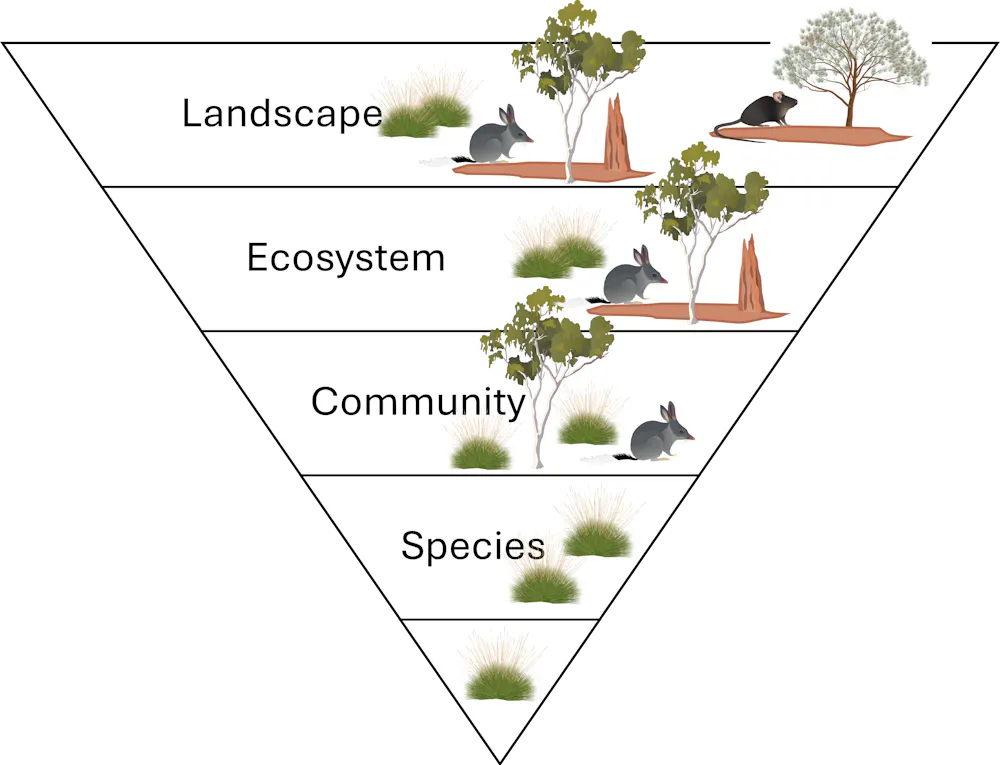
We found biological diversity – at the level of genes, species, communities and whole ecosystems – is key to creating nature-based solutions that last. In contrast, quick-fix solutions, such as planting a single species of tree, are less likely to work in the long run.

These findings are crucial for Australia, as the federal government establishes markets for nature repair and informing biodiversity policies.

Biodiversity is vital

Biological diversity refers to richness at every level – from the genetic diversity of individual plants, animals and fungi, to the range of species, and diversity within communities, ecosystems and landscapes.

Diverse ecosystems are more resilient. That’s because different species in an ecosystem vary in their responses to change.

For example, some plant species complete their life cycle before the drought season. Other plants tolerate drought by adjusting their metabolism. A third group avoid drought by shutting down, including shedding old leaves and closing their stomata.

This means even when some species are stressed or missing altogether, an ecosystem can keep ticking along.

The same is true for planted forests. Diverse planted forests are more resilient to fires, pests and diseases compared with low diversity projects. So they’re more likely to capture and store carbon, helping tackle climate change.

So if we want nature-based solutions to last, biodiversity must be at the core.

Biological diversity engenders resilience. That means diversity at every level, from individual plants through to entire landscapes.
Symbols courtesy of the Resilient Landscapes Hub, National Environmental Science Program

What we did

Our review involved analysing 78 research papers published internationally and in Australia over the past 20 years. We wanted to assess how ecological resilience was addressed in nature-based solutions.

A subset of papers described nature-based solutions in urban, agricultural and forested landscapes. Many focused on reducing impacts of climate change in cities. Then we considered key papers on ecological resilience and how to apply this knowledge to nature-based solutions.

So what did we find?

Most projects did not consider how resilience came about. This was true for resilience within species and populations, such as ensuring genetic diversity. It also applied at the landscape scale, such as providing connectivity between animal populations to prevent inbreeding.

The exception was afforestation projects – planting forests in degraded landscapes. In this domain, there is increasing recognition that species diversity is needed to create resilient ecosystems.

Researchers have, however, identified ways to make ecosystems more resilient – for example by restoring degraded land adjacent to remnant vegetation or controlling invasive predators that eat native wildlife.

The knowledge exists. The key now is to put these resilience ideas into practice.

Diverse carbon projects are more resilient to disturbances. Yate woodland, ten years after planting, Koreng Country, southwestern Australia.
RJ Standish

Which interventions can help?

Our review confirms the best nature-based solutions mimic nature. So, interventions to conserve existing ecosystems are ideal. Once an ecosystem is destroyed, restoring diversity is difficult.

Controlling invasive species such as cane toads can also help by protecting pockets of native species from these threats.

Measures can also be carried out across entire landscapes. For example, the Gondwana Link project in southwestern Australia set out to revegetate abandoned farmland and reconnect patches of bushland for native wildlife.

Climate change is prompting land managers to rethink their “local is best” approach to sourcing seed and seedlings. Plants that are better adapted to heat and drought may be preferable. However, this approach requires further testing.

And returning plants with different drought strategies could help restore landscapes scorched by wildfire.

Looking ahead

Quick-fix, low-diversity solutions are not likely to recover after disturbances such as fire and drought. So while these projects are nature-based, the solution could be fleeting.

In Australia, the Nature Repair Market will incentivise nature-based solutions. First Nations people, conservation groups and other landholders will be rewarded for actions that deliver improved biodiversity outcomes. This includes returning vegetation along rivers and controlling invasive weeds and pests.

Our findings suggest nature repair and biodiversity markets should support actions that provide long-term benefits rather than quick wins. This could involve providing clear guidelines to landholders and ensuring their activities are accredited. It may also involve monitoring the outcomes of projects and rewarding success.

And these solutions take time to create. Governments should invest in research to develop projects that deliver long-lasting benefits. This includes understanding how to motivate people to drive successful outcomes.

Restoring biologically diverse landscapes may take time and effort. But for the sake of both people and the natural world, we must get it right.

Rachel Standish receives funding from the Australian Research Council and the Cooperative Research Centre for Transformations in Mining Economies.

Tina Parkhurst has received funding from the Cooperative Research Centre for Transformations in Mining Economies.

ref. Humans can work with nature to solve big environmental problems – but there’s no quick fix – https://theconversation.com/humans-can-work-with-nature-to-solve-big-environmental-problems-but-theres-no-quick-fix-235864

It’s company earnings season. What does that mean – and why does it matter?

Source: The Conversation (Au and NZ) – By Michael J. Davern, Professor of Accounting & Business Information Systems, The University of Melbourne

Indypendenz/Shutterstock

’Tis the season! But not the one that involves giving gifts and carol singing. It’s corporate Australia’s earnings season, where accountants get to take the centre stage.

In February and August each year, most companies listed on the Australian Securities Exchange (ASX) have to report their half-yearly performance in detail.

This might seem like quite a dull affair, but for the world of finance, it’s a blockbuster event. Investors watch on with bated breath, and company share prices can move dramatically with the announcements.

And it has big implications for the rest of us, too. Here’s why earnings season is so important, and how to make sense of all the noise.


Read more:
Earnings announcements at an AGM can reflect a corporate power play, not necessarily a company’s true value


Companies get a ‘report card’ twice a year

Earnings season is also called “profit season” or “reporting season”.

It falls at the same time each year because ASX-listed companies are all required to report their earnings within two months of the end of their half-yearly reporting periods – typically January to June, and July to December.

An earnings report is like a school report card for a company and its management. It provides key financial information about half-yearly performance, such as revenue, profit, earnings per share, and a range of other metrics.

Together, these provide important insights into a company’s performance and financial health.

What are the key figures?

Let’s look at three of the metrics investors and analysts pay the most attention to in a company report. They can help assess whether a company is growing, stagnating, or declining.

Net profit after tax – “NPAT”

This figure is a company’s “bottom line” – income minus expenses. It adds up all the different sources of revenue for a company, and deducts all the different expenses incurred, including taxes and interest.

Earnings before interest and taxes – “EBIT”

EBIT is still a measure of profit, but in contrast to NPAT, it excludes interest and tax payments from a firm’s calculated expenses.

Why leave these things out? Put simply, EBIT can give a sense of whether a firm is making good business investment decisions, regardless of how it is taxed or how it is financing capital.

Earnings per share – “EPS”

EPS is calculated by dividing a company’s NPAT by the number of common shares on issue. This indicates how much of a company’s profit can be attributed to each share.

It’s all about expectations

Earnings season is an important opportunity for them to assess whether companies are meeting or beating market expectations – or else failing to deliver.

Like a school report card, there are consequences for these “grades”, particularly if they turn out to be different to what the market expects. They can lead to significant activity and short-term volatility in the share market, with consequences for individual companies’ share prices. Let’s look at some examples from this month.

On August 14, the Australian medical imaging company Pro Medicus reported a higher-than-expected full-year net profit A$82.8 million, up 36.5% on the year before. Its share price closed the day 7.2% higher.

Pro Medicus is an Australian medical imaging company.
illustrissima/Shutterstock

The next day, Cochlear, a well-known hearing implant company, also reported an increase in net profit – 19%. But its share price fell by 7% after the announcement.

Why would a company’s share price fall when its earnings go up? The key here is expectations.

A company’s current share price factors in all the publicly available information about that company and its expected ongoing performance.

If an increase in earnings is still less than what the market expected, as we saw with Cochlear, its share price may go down.

Conversely, if an earnings decrease is less than expected, or forecast losses are not as bad as anticipated, a company’s share price may go up.

These daily share price movements when earnings are announced can be extremely large, but not unusual. In comparison, benchmark average annual share returns are typically around 10%.

It matters for the economy

It might still seem like high finance, but the consequences of these earnings announcements go well beyond the specific companies involved and interested investors.

Australia has a relatively small share market, dominated by some major players. The performance of these major companies during earnings season can often tell us something about broader economic trends, just as we use changes in gross domestic product (GDP) and inflation as economic indicators.

Strong earnings performance across key industries could suggest a healthy economy, while poor earnings could indicate economic trouble.

Last week, for example, electronics retailer JB Hi-Fi announced stronger-than-expected sales, which was interpreted by the market as a suggestion weak consumer demand may be coming to an end more broadly.

Earnings reporting season can also provide some insights into industry specific trends.

For example, if multiple tech companies all reported strong earnings in the same period, market participants would quickly try to work out potential causes of overall industry growth – in this case, perhaps increased uptake of artificial intelligence and related technologies.

It matters to the rest of us, too

Beyond any immediate concerns for the economy, nearly all of us have a further vested interest in the performance of these companies.

Whether we follow the market or not, our growing superannuation “nest eggs” are tethered to its performance. For those of us still in our working years, long-term performance matters more, but nobody wants to see a market downturn as they enter retirement.

Whether you follow the share market on a second-by-second basis or not, what happens in earnings season will affect you.


This article is part of The Conversation’s “Business Basics” series where we ask experts to discuss key concepts in business, economics and finance.

The authors do not work for, consult, own shares in or receive funding from any company or organisation that would benefit from this article, and have disclosed no relevant affiliations beyond their academic appointment.

ref. It’s company earnings season. What does that mean – and why does it matter? – https://theconversation.com/its-company-earnings-season-what-does-that-mean-and-why-does-it-matter-237120

Neurotechnology is becoming widespread in workplaces – and our brain data needs to be protected

Source: The Conversation (Au and NZ) – By Edward Musole, PhD Law Candidate, University of New England

DavidMatos/Unsplash

As remote work became standard around the world during the COVID pandemic, employee surveillance rapidly intensified. Companies started deploying software to electronically monitor their employees’ web browsing history, emails and webcams – all in the name of ensuring continued productivity.

While the worst of the pandemic is behind us, the intense digital surveillance of workers continues. And it is set to increase even more with the growing popularity of brain-monitoring neurotechnology which is already used in mining, finance and other industries.

This technology is capable of measuring brain waves and making inferences about a person’s mental state, such as whether they are tired or unfocused. The United Kingdom’s Information Commissioner’s Office predicts it will be common in workplaces by the end of the decade. By then, the market for neurotechnology devices is expected to be worth more than US$24 billion.

This presents major privacy concerns for workers in Australia – especially as there are no current privacy law provisions protecting employee data generated from neurotechnology. This is something the Australian government should urgently fix as it prepares to introduce draft privacy reforms into federal parliament this month.

Neurotechnology: coming to a brain near you

Neurotechnology has long been used in the field of medicine. Perhaps the most successful and well known example are cochlear implants, which can restore hearing.

But neurotechnology is now becoming increasingly widespread. It is also becoming more sophisticated.

Earlier this year, tech billionaire Elon Musk’s firm Neuralink implanted the first human patient with one of its computer brain chips, known as “Telepathy”. These chips are designed to enable people to translate thoughts into action. More recently, Musk revealed a second human patient had one of his firm’s chips implanted in their brain.

But there are less invasive and more accessible types of neurotechnology now available. These use sensors attached to a person’s head to monitor their brain activity.

Examples include SmartCaps, which measure fatigue in real time to reduce the risk of workplace accidents, and Emotiv headsets which can be used for everything from interactive gaming to scientific research.

Apple is also developing the next generation of wireless headphones which are capable of monitoring brain waves.

Devices such as these are already used in workplaces across industries such as mining, finance and sport.

Combining neurotechnology with artificial intelligence (AI) for data analysis provides employers with even deeper insights into employee behaviour in and around the workplace.

Privacy problems

Neurotechnology can have a range of positive impacts, such as assisting people with a disability. But it also raises major privacy concerns, which are set to grow as more workplaces adopt the technology.

For example, there is a risk brainwave data could be shared with third parties to personalise advertisements depending on someone’s mood or energy levels. It can also fuel “neurodiscrimination”. This refers to employers making employment decisions such as whether to fire somebody based on their brainwave data, which could contain signs of cognitive decline.

These concerns are heightened by a glaring gap in Australia’s current privacy laws – especially as they relate to employees.

These laws govern how companies lawfully collect and use their employees’ personal information.

However, they do not currently contain provisions that protect some of the most personal information of all: data from our brains.

A path forward

Some international jurisdictions have already recognised the serious risks to privacy associated with neurotechnology.

For example, in June the US state of Colorado passed legislation which safeguarded the collection of brain data. Under this law, brain data is considered sensitive and cannot be used without the owner’s consent.

Chile has also been a pioneer when it comes to protecting peoples’ brain data.

In 2021, its parliament passed a new law aimed at protecting its citizens’ “brain rights”. In particular, this law safeguards personal identity, free will and mental privacy. At the same time, the country also passed a constitutional amendment which enshrined “brain rights” into its national document.

These laws were put into practice last year, when Chile’s supreme court ordered the neurotechnology company Emotiv to delete all brain data collected from a national senator.

As the Australian government prepares to introduce sweeping reforms to privacy legislation this month, it should take heed of these international examples and address the serious privacy risks presented by neurotechnology used in workplaces.

In particular, these provisions should cover the collection, processing and use of brain data in workplaces.

The government can implement other reforms too.

For example, it could give the Office of the Australian Information Commissioner greater power to monitor compliance with neurorights and enforce any breaches. It could also develop adequate training provisions for employees and employers looking to use neurotechnology combined with artificial intelligence in the workplace. This would help promote more ethical uses of these emerging technologies.

Without reforms such as these, the Australian government risks leaving Australians vulnerable to having data from their own brains used against them.

The Conversation

Edward Musole does not work for, consult, own shares in or receive funding from any company or organisation that would benefit from this article, and has disclosed no relevant affiliations beyond their academic appointment.

ref. Neurotechnology is becoming widespread in workplaces – and our brain data needs to be protected – https://theconversation.com/neurotechnology-is-becoming-widespread-in-workplaces-and-our-brain-data-needs-to-be-protected-236800

What does family look like in Australia? It’s more diverse than you think

Source: The Conversation (Au and NZ) – By Yuvisthi Naidoo, Senior Research Fellow, Social Policy Research Centre, UNSW Sydney

Shutterstock

When we think of the concept of the family, a specific version often springs to mind: a mother, a father and children, usually two or three. It’s the version of society our policies and systems are built around.

But Australia’s families are far more diverse. Some are multigenerational, some are sole-parent, some are blended. We need to understand how families have evolved over time and what that means for the social fabric of our country.

Our new research, released today, charts years of data to map out what families have looked like historically and what they look like now. We also looked at how these families function, including income, wealth, labour division and care responsibilities.

Charting change over time

Families are the primary social environment in which we are cared for. As such, they play a fundamental role in our development and in making a thriving society.

Of the six million children and young people, aged 0–19 years, currently growing up in Australia, the majority learn and develop with the care and support of families. More than two and a half million families are raising children under the age of 15.

Our understanding of who counts as family has expanded enormously over the past 50 years. But too often, we assume families are nuclear. Research too is guilty of examining “families” without exploring variation. If any different forms of family are explored, they typically divide families into couple-parent and sole-parent families.

Shining a spotlight on family diversity is essential to ensuring that policies, systems and society are supportive and inclusive of the many ways children and young people grow up. We need to change the way we think about family.

Our team, in partnership with Uniting NSW.ACT, will report annually over the next decade to chart the diversity of families, how this changes over time, and the implications for policy and practice. Our first report analyses the 2022 wave of Housing Income and Dynamics in Australia (HILDA) data and the 2021 Census to examine these issues.

We found while the majority of children live in couple-parent (69%) and sole-parent (11%) families, 12% of children live in step/blended families, 6% live in multigenerational families, and around 1% live in foster families or families made up of other kin.

We also found First Nations families are more likely to live in multigenerational (9%), step and/or blended (27%), sole-parent (23%), or foster and other kin (6%) families.

Care, wealth and labour

Our analysis of ten years of the Census shows this diverse mix of families has been a consistent part of the Australian population over time.

As well as nurturing children and supporting young adults as they establish themselves in the world, we found families provide care during times of ill-health and disability. Unsurprisingly, multigenerational families are likely to provide this kind of care, because they are living with older adults with care needs.

But this was also the case for sole-parent families, step/blended families and foster and other kin families. All these family types are at least twice as likely to provide care than couple families.

We know the cost of living is affecting many families. However, our research suggests that couple families, on the whole, have higher incomes (around 1.5 times more) and higher levels of wealth, and are more likely to be able to cope with rising costs than other families.

Sole-parent families, step/blended families, multigenerational families and foster and other kin families have lower incomes and are more likely to experience financial hardship, with close to 20% reaching out to friends, family and community for financial help.

Across all family types, we found that old patterns around the gendered division of labour are still in force. Women continue to do more housework and more child-rearing than men. Women have this in common across all family types.

A woman washing dishing in the sink
Women still report doing the majority of the family housework.
Shutterstock

What’s more, the majority of women (more than two-thirds) report they believe they are doing more than their fair share. Most men, on the other hand, (again, around two-thirds) feel their contributions are about right. Men heading sole-parent families are the main exception to this pattern.

These findings challenge conventional notions of family structure and underscore the importance of inclusive support systems policies that recognise and address the multifaceted needs of families. For example, some family assistance programs base access to supports on household incomes, assuming an increase in resources will benefit all families equally, without considering the number of people in the household or the complexity of caring roles they may hold.

Why does this matter?

Greater understanding of family diversity is important in public debate, policy development and service delivery.

By thinking about “children and young people and the people who are raising them”, we have developed a new typology of families, which includes: step/blended, multigenerational, and foster and other kin families – groups that are rarely included in quantitative research.

The higher care responsibilities of these family types, combined with access to fewer financial resources, shows the importance of ensuring our policies and programs understand more about the many kinds of families who live in Australia. The findings show there is work to do to ensure that conditions and opportunities are equal for all families.

At the same time, old challenges about women’s uneven greater share of work raising children, and caring for the homes in which we live, continue to need our focused attention to redress gender imbalances.

Importantly, the research also uncovers areas of hope. Despite the obvious challenges many families face, the resilience and care within families is clear. Satisfaction with relationships with children and between siblings is high across all family types.

In the next decade we hope to build a compelling narrative that provides a rich evidence base on how family practices, relationships, needs and circumstances change.

A better understanding of the rich of tapestry of families and family life in which children and young people are raised in Australia will compel us to look more closely in the design of our policies and systems to disrupt entrenched disadvantage and secure the futures of the next generation.

The Conversation

Yuvisthi Naidoo receives funding from Uniting NSW.ACT

Ilan Katz receives funding from Uniting NSW.ACT

Megan Blaxland receives funding from Uniting NSW.ACT.

ref. What does family look like in Australia? It’s more diverse than you think – https://theconversation.com/what-does-family-look-like-in-australia-its-more-diverse-than-you-think-236499

Do you have knee pain from osteoarthritis? You might not need surgery. Here’s what to try instead

Source: The Conversation (Au and NZ) – By Belinda Lawford, Postdoctoral research fellow in physiotherapy, The University of Melbourne

Pexels/Kindelmedia

Most people with knee osteoarthritis can control their pain and improve their mobility without surgery, according to updated treatment guidelines from the Australian Commission on Safety and Quality in Health Care.

So what is knee osteoarthritis and what are the best ways to manage it?

More than 2 million Australians have osteoarthritis

Osteoarthritis is the most common joint disease, affecting 2.1 million Australians. It costs the economy A$4.3 billion each year.

Osteoarthritis commonly affects the knees, but can also affect the hips, spine, hands and feet. It impacts the whole joint including bone, cartilage, ligaments and muscles.

Most people with osteoarthritis have persistent pain and find it difficult to perform simple daily tasks, such as walking and climbing stairs.

Is it caused by ‘wear and tear’?

Knee osteoarthritis is most likely to affect older people, those who are overweight or obese, and those with previous knee injuries. But contrary to popular belief, knee osteoarthritis is not caused by “wear and tear”.

Research shows the degree of structural wear and tear visible in the knee joint on an X-ray does not correlate with the level of pain or disability a person experiences. Some people have a low degree of structural wear and tear and very bad symptoms, while others have a high degree of structural wear and tear and minimal symptoms. So X-rays are not required to diagnose knee osteoarthritis or guide treatment decisions.

Telling people they have wear and tear can make them worried about their condition and afraid of damaging their joint. It can also encourage them to try invasive and potentially unnecessary treatments such as surgery. We have shown this in people with osteoarthritis, and other common pain conditions such as back and shoulder pain.

This has led to a global call for a change in the way we think and communicate about osteoarthritis.


Read more:
How long does back pain last? And how can learning about pain increase the chance of recovery?


What’s the best way to manage osteoarthritis?

Non-surgical treatments work well for most people with osteoarthritis, regardless of their age or the severity of their symptoms. These include education and self-management, exercise and physical activity, weight management and nutrition, and certain pain medicines.

Education is important to dispel misconceptions about knee osteoarthritis. This includes information about what osteoarthritis is, how it is diagnosed, its prognosis, and the most effective ways to self-manage symptoms.

Health professionals who use positive and reassuring language can improve people’s knowledge and beliefs about osteoarthritis and its management.

Many people believe that exercise and physical activity will cause further damage to their joint. But it’s safe and can reduce pain and disability. Exercise has fewer side effects than commonly used pain medicines such as paracetamol and anti-inflammatories and can prevent or delay the need for joint replacement surgery in the future.

Many types of exercise are effective for knee osteoarthritis, such as strength training, aerobic exercises like walking or cycling, Yoga and Tai chi. So you can do whatever type of exercise best suits you.

Increasing general physical activity is also important, such as taking more steps throughout the day and reducing sedentary time.

Weight management is important for those who are overweight or obese. Weight loss can reduce knee pain and disability, particularly when combined with exercise. Losing as little as 5–10% of your body weight can be beneficial.

Pain medicines should not replace treatments such as exercise and weight management but can be used alongside these treatments to help manage pain. Recommended medicines include paracetamol and non-steroidal anti-inflammatory drugs.

Opioids are not recommended. The risk of harm outweighs any potential benefits.

What about surgery?

People with knee osteoarthritis commonly undergo two types of surgery: knee arthroscopy and knee replacement.

Knee arthroscopy is a type of keyhole surgery used to remove or repair damaged pieces of bone or cartilage that are thought to cause pain.

However, high-quality research has shown arthroscopy is not effective. Arthroscopy should therefore not be used in the management of knee osteoarthritis.

Joint replacement involves replacing the joint surfaces with artificial parts. In 2021–22, 53,500 Australians had a knee replacement for their osteoarthritis.

Joint replacement is often seen as being inevitable and “necessary”. But most people can effectively manage their symptoms through exercise, physical activity and weight management.

The new guidelines (known as “care standard”) recommend joint replacement surgery only be considered for those with severe symptoms who have already tried non-surgical treatments.

I have knee osteoarthritis. What should I do?

The care standard links to free evidence-based resources to support people with osteoarthritis. These include:

If you have osteoarthritis, you can use the care standard to inform discussions with your health-care provider, and to make informed decisions about your care.

The Conversation

Belinda Lawford receives funding from Arthritis Australia, MRFF, and Medibank. She is a Steering Committee Member of the Osteoarthritis Research Society International Rehabilitation Group, and also an Editorial Board member for Journal of Orthopaedic and Sports Physical Therapy. Some of the consumer resources recommended in this article have been developed by her research team.

Giovanni Ferreira receives funding from the NHMRC.

Joshua Zadro receives funding from the NHMRC and MRFF. He is also an Editorial Board member for Journal of Physiotherapy.

Rana Hinman receives funding from NHMRC, MRFF & Medibank. Some of the consumer resources recommended in this article have been developed by her research team. She is also an Editorial Board member for Journal of Physiotherapy.

ref. Do you have knee pain from osteoarthritis? You might not need surgery. Here’s what to try instead – https://theconversation.com/do-you-have-knee-pain-from-osteoarthritis-you-might-not-need-surgery-heres-what-to-try-instead-236779

Strength training has a range of benefits for women. Here are 4 ways to get into weights

Source: The Conversation (Au and NZ) – By Erin Kelly, Lecturer and PhD Candidate, Discipline of Sport and Exercise Science, University of Canberra

John Arano/Unsplash

Picture a gym ten years ago: the weights room was largely a male-dominated space, with women mostly doing cardio exercise. Fast-forward to today and you’re likely to see women of all ages and backgrounds confidently navigating weights equipment.

This is more than just anecdotal. According to data from the Australian Sports Commission, the number of women participating in weightlifting (either competitively or not) grew nearly five-fold between 2016 and 2022.

Women are discovering what research has long shown: strength training offers benefits beyond sculpted muscles.

Health benefits

Osteoporosis, a disease in which the bones become weak and brittle, affects more women than men. Strength training increases bone density, a crucial factor for preventing osteoporosis, especially for women negotiating menopause.

Strength training also improves insulin sensitivity, which means your body gets better at using insulin to manage blood sugar levels, reducing the risk of type 2 diabetes. Regular strength training contributes to better heart health too.

There’s a mental health boost as well. Strength training has been linked to reduced symptoms of depression and anxiety.

A woman lifting a weight in a gym.
Strength training can have a variety of health benefits.
Ground Picture/Shutterstock

Improved confidence and body image

Unlike some forms of exercise where progress can feel elusive, strength training offers clear and tangible measures of success. Each time you add more weight to a bar, you are reminded of your ability to meet your goals and conquer challenges.

This sense of achievement doesn’t just stay in the gym – it can change how women see themselves. A recent study found women who regularly lift weights often feel more empowered to make positive changes in their lives and feel ready to face life’s challenges outside the gym.

Strength training also has the potential to positively impact body image. In a world where women are often judged on appearance, lifting weights can shift the focus to function.

Instead of worrying about the number on the scale or fitting into a certain dress size, women often come to appreciate their bodies for what they can do. “Am I lifting more than I could last month?” and “can I carry all my groceries in a single trip?” may become new measures of physical success.

A young woman smiling in a gym change room.
Strength training can have positive effects on women’s body image.
Drazen Zigic/Shutterstock

Lifting weights can also be about challenging outdated ideas of how women “should” be. Qualitative research I conducted with colleagues found that, for many women, strength training becomes a powerful form of rebellion against unrealistic beauty standards. As one participant told us:

I wanted something that would allow me to train that just didn’t have anything to do with how I looked.

Society has long told women to be small, quiet and not take up space. But when a woman steps up to a barbell, she’s pushing back against these outdated rules. One woman in our study said:

We don’t have to […] look a certain way, or […] be scared that we can lift heavier weights than some men. Why should we?

This shift in mindset helps women see themselves differently. Instead of worrying about being objects for others to look at, they begin to see their bodies as capable and strong. Another participant explained:

Powerlifting changed my life. It made me see myself, or my body. My body wasn’t my value, it was the vehicle that I was in to execute whatever it was that I was executing in life.

This newfound confidence often spills over into other areas of life. As one woman said:

I love being a strong woman. It’s like going against the grain, and it empowers me. When I’m physically strong, everything in the world seems lighter.

Feeling inspired? Here’s how to get started

1. Take things slow

Begin with bodyweight exercises like squats, lunges and push-ups to build a foundation of strength. Once you’re comfortable, add external weights, but keep them light at first. Focus on mastering compound movements, such as deadlifts, squats and overhead presses. These exercises engage multiple joints and muscle groups simultaneously, making your workouts more efficient.

2. Prioritise proper form

Always prioritise proper form over lifting heavier weights. Poor technique can lead to injuries, so learning the correct way to perform each exercise is crucial. To help with this, consider working with an exercise professional who can provide personalised guidance and ensure you’re performing exercises correctly, at least initially.

A woman doing a lunge outdoors.
Bodyweight exercises, such as lunges, are a good way to get started before lifting weights.
antoniodiaz/Shutterstock

3. Consistency is key

Like any fitness regimen, consistency is key. Two to three sessions a week are plenty for most women to see benefits. And don’t be afraid to occupy space in the weights room – remember you belong there just as much as anyone else.

4. Find a community

Finally, join a community. There’s nothing like being surrounded by a group of strong women to inspire and motivate you. Engaging with a supportive community can make your strength-training journey more enjoyable and rewarding, whether it’s an in-person class or an online forum.

Are there any downsides?

Gym memberships can be expensive, especially for specialist weightlifting gyms. Home equipment is an option, but quality barbells and weightlifting equipment can come with a hefty price tag.

Also, for women juggling work and family responsibilities, finding time to get to the gym two to three times per week can be challenging.

If you’re concerned about getting too “bulky”, it’s very difficult for women to bulk up like male bodybuilders without pharmaceutical assistance.

The main risks come from poor technique or trying to lift too much too soon – issues that can be easily avoided with some guidance.

The Conversation

Erin Kelly does not work for, consult, own shares in or receive funding from any company or organisation that would benefit from this article, and has disclosed no relevant affiliations beyond their academic appointment.

ref. Strength training has a range of benefits for women. Here are 4 ways to get into weights – https://theconversation.com/strength-training-has-a-range-of-benefits-for-women-here-are-4-ways-to-get-into-weights-221307

‘I don’t even know what the Australian TV shows are’: how streaming has changed kids’ viewing in Australia

Source: The Conversation (Au and NZ) – By Jessica Balanzategui, Associate Professor in Media, RMIT University

Shutterstock

It’s almost ten years since Netflix and Stan first started offering streaming services in Australia.

This has been a decade of transformation for our local screen industries – and the implications for younger audiences in particular can’t be underestimated. For today’s children, streaming and watching television “on-demand” are the norm.

We’re now at a crossroads, on the cusp of the second decade of streaming in Australia. Earlier this year, a parliamentary inquiry interrogating commercial arrangements between US-based global streaming services such as Netflix and YouTube and television manufacturers resulted in changes to the way internet-connected smart TV devices are regulated.

These changes are designed to ensure Australian providers such as ABC, SBS and commercial networks are available and easy to find on smart TV interfaces.

In other areas, however, the government’s promises have not resulted in policy action.

The government previously committed to introducing a quota or expenditure system to ensure a certain amount of local content was available on subscription-video-on-demand (SVOD) services by July 2024. But July has come and gone with no developments, despite calls for urgent action from the screen industry. An upcoming summit and conference will also explore the issue.

Although the Australian government has recognised that the local children’s content sector in particular requires targeted solutions, the only policy change so far has been the removal of quotas for this content on commercial broadcasters. This resulted in a decrease of more than 84% in hours screened on commercial broadcasters between 2019 and 2022.

There is currently no concrete requirement for any broadcaster or streamer in Australia to screen a certain amount of local kids’ content.

A kid has Youtube Kids open on their phone while lying in a hammock.
Netflix and Youtube were the most popular choices among our participants.
Shutterstock

Do Aussie kids access local content?

While there has been much anxiety about the reduction in local children’s content production, there has been little focus on whether children are actually able to access the local content available to them on streaming platforms.

Our audience research with children aged seven to nine found content “discoverability” should be regarded as a pressing policy priority.

We interviewed 37 children and their parents, and observed children using streaming platforms to select and watch the content of their choice. We also observed the children watching with their parents to see how parental coviewing might influence children’s choices.

Among other things, we found:

  • Netflix and YouTube were by far the most popular platform choices among our participants

  • only 17% of kids gravitated to Australian content while streaming independently

  • only 9% gravitated to Australian content while watching with their parents. In tandem with our interviews, this suggests parents are not necessarily encouraging children to watch local content.

The Americanisation of TV in Australia

The children in our study explained how a diet of mainly US content impacted them. One nine-year-old girl told us:

[I wish there was more Australian stuff] because sometimes I wouldn’t know what they’re talking about because they would say something a different way than how Australians would say it and then it would kind of get me confused and I would have to go on Google or something.

Consider also the following conversation with a different child:

Researcher: Do you wish there were more Australian shows on the streaming platforms?

Nine-year-old girl: Yeah because most of them are like, American, and when I was six or seven I would just watch all the American stuff. And then I started to say ‘diaper’ and then my Dad kept correcting me. […] They would say ‘gas station’ instead of ‘petrol station’ and stuff like that.

Children were also often confused about what Australian content was. They struggled to identify it across various streaming platforms, unless the images in front of them had stereotypical images of Australiana such as kangaroos or the outback.

Researcher: Do you like watching Australian TV shows?

Seven-year-old girl: I don’t even know what the Australian TV shows are.

Researcher: How would you know if something was Australian?

Seven-year-old girl I don’t know.

The ABC’s platforms were the third most popular choice among the children, and were often associated with Australian content. This highlights the important cultural role the ABC plays in providing children access to local content.

Researcher: And which streaming platform is the easiest to use?

Nine-year-old girl: Probably ABC ME. Because its mainly all Australian, and only a few of them aren’t – and you know that if you just scroll a little bit, you’re gonna find a good kids’ show.

Netflix and YouTube set kids’ expectations

Our young participants valued the interfaces and algorithmic personalisation of Netflix and YouTube, but didn’t understand how these may be shaping their content choices and habits (or narrowing their access to Australian content).

The children often assumed the content they watched across Netflix and YouTube was American. In some cases, even when their favourite shows were Australian, they assumed they must be American.

Eight-year-old boy: I watch a lot of American. […] I do like American shows a lot, but not really Australian shows.

Researcher: But what about Little Lunch and InBESTigators? [two shows the child had previously identified as favourites].

Eight-year-old boy: Little Lunch is definitely American.

Researcher: No, that one’s an Australian show!

Eight-year-old boy: [Physically recoils. Shocked pause] Well… InBESTigators is American!

Researcher: InBESTigators is Australian too!

Eight-year-old boy: [Shocked pause] WHAT!?

Supporting access to Australian content

Our research shows the issues surrounding Australian kids’ TV go deeper than a reduction in production. Children also need to be able to find the Australian content available to them on streaming platforms, which requires changes to the way this content is labelled and displayed.

Australian content helps children understand and reflect on their place in local culture. If children don’t develop appetites for this content at a young age, they may never seek it out as they grow into teenagers and adults – so the implications for our culture now and into the future are potentially significant.

The Conversation

Jessica Balanzategui receives funding from the Australian Children’s Television Foundation. This broader project is based at Swinburne University of Technology in collaboration with RMIT University.

Djoymi Baker receives funding from The Australian Children’s Television Foundation. The project Australian Children’s Television Cultures is based at Swinburne University of Technology in collaboration with RMIT University.

Georgia Clift receives funding from The Australian Children’s Television Foundation. The project Australian Children’s Television Cultures is based at Swinburne University of Technology in collaboration with RMIT University.

ref. ‘I don’t even know what the Australian TV shows are’: how streaming has changed kids’ viewing in Australia – https://theconversation.com/i-dont-even-know-what-the-australian-tv-shows-are-how-streaming-has-changed-kids-viewing-in-australia-236874

Can AI pick IVF embryos as well as a human? First randomised controlled trial shows promise

Source: The Conversation (Au and NZ) – By Christos Venetis, Visiting Senior Research Fellow, Centre for Big Data Research in Health, UNSW Sydney

895Studio / Shutterstock

During in vitro fertilisation (IVF), a number of different embryos are produced from eggs and sperm. Then, embryologists choose which one of the embryos is most likely to lead to a successful pregnancy and transfer it to the patient.

Embryologists make this choice by using their expertise to apply a set of widely accepted principles based on the appearance of the embryo. In recent years there has been a lot of interest in using various artificial intelligence (AI) techniques in this process.

We developed one such AI system and tested it in a study of more than 1,000 IVF patients. Our system chose the same embryo as a human expert in about two-thirds of cases, and had an overall success rate only marginally lower. The results are published in Nature Medicine.

Can deep learning help IVF?

Over the past few years, with colleagues in Sweden, we have been developing software to identify which embryos will have the best chance of IVF success. Our system uses deep learning, an AI method for finding patterns in large amounts of data.

While we were developing our system, we carried out retrospective studies comparing the system’s choices with past real-world decisions made by embryologists. These early results suggested the deep learning system might do an even better job than a human expert. So the next step was to test the system properly with a randomised trial.

Our trial involved 1,066 patients at 14 fertility clinics in Australia and Europe (Denmark, Sweden and the United Kingdom). For each patient, both the deep learning system and a human expert selected an embryo to be implanted. Then, a random choice was made of which of the two to use.

This study is the first randomised controlled trial ever performed of a deep learning system in embryo selection. Deep learning may have many medical applications, but this is so far one of only a few prospective randomised trials of the technology in any area of healthcare.

What we found

What we found in the study was that there was virtually no difference between the
two approaches. The clinical pregnancy rate (the likelihood of a fetal heart being
seen after transfer of the first embryo) was 46.5% when the deep learning system
chose the embryo and 48.2% when the embryologist chose the embryo.

In other words, there was very little difference. Indeed, 65.8% of the time, the deep learning system chose the same embryo as the embryologist. However, we also found that the artificial intelligence system did the task of embryo selection ten times more quickly than the embryologist.

One aim of our study was to prove the “non-inferiority” of our deep learning system. This is common in medical research, as we always want to make sure that a proposed new technique doesn’t lead to worse results that the existing standard.

Despite the fact the deep learning system produced very similar results to those of human experts, our study did not quite clear the hurdle of proving “non-inferiority”.

As it happened, the overall success rates in the study were much higher than we had expected. This changed the statistics of the situation, and meant we would have needed a much larger study – with almost 8,000 patients – to prove the new method is non-inferior.

No significant differences

A number of ethical concerns have previously been raised about deep learning in embryo selection. One of these concerns is a potential alteration of the sex ratio – that is, ending up with more male or female embryos – through biased selection by the deep learning model.

However, we found no alteration in the sex ratio as a result of deep learning embryo selection.

We concluded from our study that there is no significant difference for the pregnancy rate between having an embryo chosen by a deep learning system or having the embryo chosen by an experienced embryologist.

It seems from this that the use of a deep learning tool for embryo selection will not radically change the outcome (as it mostly chooses the same embryo) for a patient undergoing IVF. However, the use of a reliable automated tool of this sort may make embryology laboratories more efficient and consistent.

A further conclusion from this study is that randomised trials, which take years to conduct, may not be the optimum approach for studying rapidly advancing technologies such as this. Our future work in evaluating this technology will need to examine alternative, but still clinically valid, approaches to this subject.


_The author would like to acknowledge the work of Peter Illingworth in writing this article and the research it reports. _

The Conversation

Christos Venetis has been an Early Career Fellow of NHMRC (2018-2021; GNT1127216), has received consulting fees, unrestricted research funding, lecture payments and travel expenses from pharmaceutical firms with a commercial portfolio in IVF. He has previously (until June 2022) held shares in Virtus Health, a commercial IVF company. He is currently an employee of the Aristotle University of Thessaloniki, Greece and also a Senior Deputy of the Coordination Committee of the Special Interest Group Reproductive Endocrinology of the European Society for Human Reproduction and Embryology.

ref. Can AI pick IVF embryos as well as a human? First randomised controlled trial shows promise – https://theconversation.com/can-ai-pick-ivf-embryos-as-well-as-a-human-first-randomised-controlled-trial-shows-promise-236485

Study shows video games can improve mental wellbeing – but you can have too much of a good thing

Source: The Conversation (Au and NZ) – By Katarina Fritzon, Associate Professor of Psychology, Bond University

AlessandroBiascioli/Shutterstock

A study of almost 100,000 people in Japan aged 10 to 69 found playing video games – or even owning a console – can be good for mental health. But playing too much each day can harm wellbeing.

Video games and other forms of online media consumption are an everyday part of life.

Surveys have shown playing video games can have positive effects on stress levels and creativity. But concern remains about the potential negative effects on, for example, general wellbeing, aggressive behaviour and social development, especially for young people.

The World Health Organization lists gaming disorder as a mental health condition, and a severe social withdrawal condition called hikikomori has been described in Japan.

The new survey showed links between gaming and wellbeing and researchers found a way to show cause and effect – that even owning a gaming console improved wellbeing.

What the study found

The research was conducted between 2020 and 2022 – during the COVID pandemic. The researchers used measures of psychological distress and life satisfaction and asked 97,602 people in Japan about their gaming use.

The survey coincided with supply chain shortages. These led retailers to use a lottery system for the purchase of two consoles: Nintendo Switch and PlayStation 5. Of the overall survey group, 8,192 participated in the lottery.

Researchers compared the 2,323 lottery winners against those who did not win the opportunity to purchase one of the new consoles (over five rounds of surveys). They found those who won the lottery had improved distress scores and better life satisfaction.

The results were not all positive. Over time, the scores indicated drops in wellbeing for those who played more than three hours a day. Scores continued to drop for each additional time increment measured.

The study had some limitations.

Firstly, the survey was conducted when the COVID pandemic presented a particularly challenging time for mental health. It also brought changes in social, occupational and lifestyle behaviours.

The study focused mainly on general gaming habits without distinguishing between different types of games, which could have varying impacts on mental health.

Further, participants chose whether to enter the lottery, so it was not a random sample. And the study could not specifically attribute findings to the effects of playing video games versus the effects of winning the lottery.

Finally, we know self-reported studies are not always reliable.

Gaming pros and cons

We know from other surveys video games can be useful stress relievers and aid social connection (albeit online). We also know some games can improve particular cognitive skills such as visuo-spatial navigation and problem solving.

Games and technologies can also specifically target mental health issues, such as social anxiety or phobias, address ADHD symptoms and enhance motivation and performance.

Yet, concerns remain about possible long-term consequences, particularly in terms of reductions in “real-life” socialisation, participation in physical activity, school performance and other health consequences, including sleep and eating behaviours.

It’s important to make sure gaming doesn’t interfere with sleeping or eating.
Ralston Smith/Unsplash

3 tips for positive gaming

While video games can offer some benefits, it’s important to maintain a balanced approach to gaming. Here are a few tips to help manage gaming habits and promote overall wellbeing:

1. Set time limits

Encourage moderate gaming by setting clear time limits to ensure it doesn’t interfere with sleep, physical activity or other important daily activities. The Australian institute of Family Studies recommends creating a media plan that includes limits on screen time and balances gaming with other activities.

2. Choose games wisely

Opt for games that are age-appropriate and consider their content. Some games can promote problem-solving skills and creativity, but it’s important to be mindful of those that might encourage aggression or excessive competition.

3. Monitor eating and sleeping habits

Pay attention to eating patterns and ensure meals are not skipped in favour of gaming. Encourage regular sleep patterns and avoid gaming close to bedtime to prevent disruptions in sleep.

While the new study provides promising insights into the potential positive effects of video games on mental wellbeing, these findings should be approached with caution due to the limits of the survey.

While the potential benefits are encouraging, it is essential to adopt a balanced approach to gaming and pursue further research to fully understand its long-term impact on mental health.

The authors do not work for, consult, own shares in or receive funding from any company or organisation that would benefit from this article, and have disclosed no relevant affiliations beyond their academic appointment.

ref. Study shows video games can improve mental wellbeing – but you can have too much of a good thing – https://theconversation.com/study-shows-video-games-can-improve-mental-wellbeing-but-you-can-have-too-much-of-a-good-thing-236861

New ABC show The Assembly highlights how neurodivergence can enhance jobs or study

Source: The Conversation (Au and NZ) – By Sandra Thom-Jones, Honorary Professor, University of Wollongong

ABC TV

The Assembly, a new ABC documentary series, introduces us to a diverse group of autistic people who are interested in pursuing journalism careers.

The first episode strikes a nice balance between introducing the Macquarie University students, showing their classroom experience and an interview with a celebrity – in this episode, New Zealand actor Sam Neill. Other interview subjects in the series include singer Delta Goodrem, Prime Minister Anthony Albanese and footballer Adam Goodes. The students are mentored by journalist Leigh Sales.

This could have been another cringey reality TV show using autistic people, like myself, to entertain neurotypical people, focusing on their quirks and challenges. The first episode does have one at-home segment with a student’s mother, which jarred a little for me.

But predominantly it shows trainee journalists being encouraged to develop and ask their own questions, about things that interest them. It’s a welcome change from programs which seem to focus on teaching autistic participants to act less autistic.

Here’s what the program does well (based on watching the first episode) and what it demonstrates about autism in study and work settings.

Autistic strengths on display

Contrary to the stereotype that autistic people are all obsessed with numbers, many autistic people have extensive vocabularies and advanced writing skills.

When Neill turns the interview around and asks the team what they have in common, student Stephanie’s response sums up why many autistic people are attracted to journalism:

[…] we love telling stories, sharing stories with each other, and sharing them with people (like you).

Our deep focus and desire to learn means autistic people tend to develop extensive knowledge on topics of interest. We research widely and retain information. This means we can build broad and deep knowledge of a topic. This is a real asset for careers in research, teaching and journalism.

Many autistic people have little interest in small talk. It can be overwhelming and make social communication challenging. But getting straight to the point can create productivity gains and deeply meaningful conversations.

Many autistic people have a natural curiosity and are likely to ask insightful questions. This can be an asset in careers that require critical thinking like engineering, data science (and journalism). In preview footage, the celebrities interviewed for The Assembly express appreciation at how the students’ questions cause them to reflect deeply.

Autistic people are divergent thinkers, who see patterns and make connections others may not notice. This can be a real asset in careers requiring creativity like graphic design, art, urban planning (and journalism).

Autistic people tend to be candid and open, and to accept others just as they are. Perhaps because we ourselves are a little unconventional, or perhaps because we know firsthand how it feels to be judged harshly, we accept and value quirkiness or imperfection in others. This can be a real asset in careers that require understanding and acceptance like counselling, support services (and journalism).

No subjects are out of bounds when the students interview celebrities and the prime minister.


Read more:
Neuroaffirming care values the strengths and differences of autistic people, those with ADHD or other profiles. Here’s how


Empathy and then some

There is an outdated stereotype that autism is associated with a lack of empathy.

The reality is autistic people are very empathetic, we may just express our empathy in different ways.

Genuine caring can be a huge asset in professions like teaching, nursing and medicine. We see this on The Assembly when Neill becomes teary during his interview. The students’ responses and the expressions on their faces show they feel his emotions deeply.

A workplace with 4 things going for autistic people

As an autistic person and a mentor for autistic people across diverse careers, there are four key things that stand out to me about The Assembly as a workplace:

1. A culture of inclusivity

The students are encouraged and supported to be themselves and to do what they need to do to be comfortable. They can move around, fidget, speak and interact in ways that are natural to them.

2. The physical environment

Effort was clearly made to ensure the students had access to sensory aids. Tools that enable autistic people to control sensory input and self-regulate have significant benefits for wellbeing. That said, I suspect the realities of television production mean the lighting in that room was pretty intense. Many autistic people have sensory hypersensitivities, with bright lights causing stress, anxiety and pain.

3. A supportive community

There is a genuine sense of camaraderie and support among the students. They want each other to succeed, encourage those who are feeling nervous, and celebrate each other’s achievements.

4. An empathetic leader

We see university lecturers only briefly in the first episode but we see lots of interactions with journalist and ABC host Leigh Sales. She does not speak over, patronise or “correct” the students. She does not try to make them behave like non-autistic journalists.

The students interview Prime Minister Anthony Albanese in a later episode.
ABC TV


Read more:
Real-life autism disclosures are complex – and reactions can range from dismissal to celebration


What about off screen?

Sadly, the inclusion shown on The Assembly is not the norm in workplaces or universities. The majority of autistic people feel pressured to mask their autistic characteristics in the workplace, with significant negative impacts on their physical and mental wellbeing.

I have previously written on providing more autism-friendly workplaces, and The Assembly illustrates some of these factors (such as support, flexibility and a safe culture).

It also demonstrates that while some autistic people may be suited to roles in IT or cybersecurity, others are ideally suited to journalism.

Every autistic person is different, with their own strengths and challenges. In a truly inclusive society, we wouldn’t be asking what jobs are suitable for autistic people. Rather we would be asking: how can we make this job suitable for this autistic person?


The Assembly premieres on ABC TV and streams on iView from Tuesday August 20, 8.30pm.

Sandra Thom-Jones does not work for, consult, own shares in or receive funding from any company or organisation that would benefit from this article, and has disclosed no relevant affiliations beyond their academic appointment.

ref. New ABC show The Assembly highlights how neurodivergence can enhance jobs or study – https://theconversation.com/new-abc-show-the-assembly-highlights-how-neurodivergence-can-enhance-jobs-or-study-235893

Solar above, batteries below: here’s how warehouses and shopping centres could produce 25% of Australia’s power

Source: The Conversation (Au and NZ) – By Bruce Mountain, Professor and Director, Victoria Energy Policy Centre, Victoria University

NavinTar/Shutterstock

Imagine if Australian cities became major producers of clean energy, rather than relying on far-flung solar and wind farms.

Far fetched? Hardly. Our cities and towns are full of warehouses, commercial areas, shopping centres and factories. These types of buildings have one very important underutilised resource – large expanses of unoccupied rooftops, perfect for solar and battery power stations.

If our commercial and industrial areas took up solar and storage, it would be revolutionary. Electricity could be produced in cities and used in cities, reducing transmission losses. Commercial businesses could generate solar power during the day, store it in batteries on site and sell it back to the grid during the evening peak.

Our calculations show Australia has enough unused commercial and industrial rooftop space to supply at least 25% of our annual electricity use – five times as much as currently supplied by gas-fired generators.

Australia is already the world’s top rooftop solar nation, per capita. But our solar is largely on our houses. We have four times as much residential solar as we do on commercial buildings. In Europe, it’s the opposite – there’s 1.5 times as much solar on businesses as on houses. The EU’s new Solar Energy Standard is expected to double rooftop solar capacity in four years.

In our new discussion paper, we make the case for a massive expansion of battery-backed solar photovoltaic power on Australian business premises. Call it “business power”.

There are excellent reasons for policymakers and building owners to look at this. It offers a potentially large new source of cheap, reliable, clean electricity with little downside risk.

Warehouses and commercial premises often have large flat roofs, ideal for solar.
Creative Stock Studio/Shutterstock

What’s the benefit of warehouse power stations?

Rooftop solar has been Australia’s quiet achiever. In 2023, rooftop solar produced 70% more electricity on Australia’s rooftops than either hydro generators or solar farms.

Solar farms are largely built in rural areas, as it’s easier to get large tracts of land. But city-based solar has advantages. City solar doesn’t change land use, need vegetation cleared or change the beauty of the countryside. Solar and wind farms in rural areas have to send power to cities, necessitating expensive new transmission lines. Some planned new lines have proven controversial.

When you add storage, you turn cheaply produced solar into a much more valuable commodity – reliable evening power. In evenings, the sun has set and demand soars. This is when much more expensive coal, gas or hydro generation dominates supply.

Locally produced battery-backed solar can also make better use of our distribution networks – the urban poles and wires. In a recent report, the peak body for Australia’s energy networks found surplus capacity in our distribution networks could be used by decentralised power generation and storage.

By contrast, some large rural transmission lines are already hitting capacity limits as distant wind and solar farms take up spare capacity.

What would it take to start this in earnest?

When a business owner or householder goes solar, it’s usually to save money. By producing their own power, they reduce how much expensive grid power they buy.

By contrast, our proposal would encourage businesses to install solar and batteries so they can export power to the grid.

A scheme like this would need policy support to get it started. That’s because it’s much less profitable to sell to the grid than it is to avoid buying from the grid. In electricity, as in other markets, wholesale prices are almost always lower than retailer prices.

To make it attractive to businesses, we propose the incentive of new floor prices (minimum prices) for electricity sold to the grid by businesses. It would cover electricity injected into the grid outside solar peak periods – before 11am or after 2pm – and from behind-the-meter batteries discharging to the grid during the evening peak, from 6pm to 9pm.

Floor prices would have to be set carefully to make investment worthwhile – but without unnecessary public largesse. To be eligible, businesses would have to have enough storage relative to the solar installation to be able to reliably store solar power to sell in the evenings. The payback period would differ from one business to another.

If producing power in cities uses surplus distribution capacity, it might be possible to reduce how many new large transmission lines need to be built.
DifferR/Shutterstock

What’s in it for the public?

Like almost all competing energy policies, this scheme would require governments to use public funds to stimulate supply. Why might consumers or taxpayers support this?

Our governments are already using the money of taxpayers and electricity consumers to fund new gas power stations, to prolong the life of ageing coal power stations and to encourage more large renewables and storage. We believe this scheme would stack up favourably on cost, speed, cleanliness, reliability and ease.

The scheme also offers a comparatively cheap way to cut greenhouse gas emissions. The value Australia’s government places on avoiding one tonne of carbon dioxide equivalent in 2024 is A$70. We estimate our scheme could cut emissions at a cost of around $23 a tonne.

What’s next?

Let’s say governments introduce these floor prices. What would happen next?

We anticipate business owners would weigh up the benefits. Many would decide to take advantage of the policy directly, while others might rent their rooftops to specialist companies to do the same.

Recent regulatory changes mean businesses are now legally able to export power without messing with their existing retail contracts.

Of course, policies come with risks. Desk-based studies like ours can only go so far. Important information is often only revealed by putting policies into practice. But schemes like this one could easily be tweaked or closed to new entrants – just as state governments did in ending premium solar feed-in tariffs.

In short, there seems to be little to be lost and a potentially large benefit to society.

Bruce Mountain does not work for, consult, own shares in or receive funding from any company or organisation that would benefit from this article, and has disclosed no relevant affiliations beyond their academic appointment.

ref. Solar above, batteries below: here’s how warehouses and shopping centres could produce 25% of Australia’s power – https://theconversation.com/solar-above-batteries-below-heres-how-warehouses-and-shopping-centres-could-produce-25-of-australias-power-236317

A city at the crossroads: how Gaza became one of the great intellectual hubs of the Roman Empire

Source: The Conversation (Au and NZ) – By Christopher Mallan, Associate Professor in Classics and Ancient History, The University of Western Australia

The ‘Medaba Map’ (6th century CE) is part of a floor mosaic in the church of Saint George in Madaba, Jordan, containing the oldest surviving cartographic depiction of Jerusalem. Wikimedia/Paul Palmer

The years 2023 and 2024 will certainly be remembered as some of the darkest in the long and often violent history of Gaza.

The recent destruction of schools and universities in the Gaza strip has attracted the attention of the media and concern from the United Nations, which has raised the question of whether the damage may be considered “scholasticide”.

Such reports are cause for reflection on the intellectual history of the city – something rarely discussed outside academic circles. This is a shame, as there was a period in the late Roman Empire (5th and 6th centuries CE) when Gaza was one of the great intellectual centres of the Mediterranean world.

Gaza and the Roman Empire

This history of Gaza under the Roman Empire dates from the re-foundation of the city in the 60s BCE, after it had been destroyed decades earlier by Alexander Jannaeus (the ruler of the neighbouring Kingdom of Judaea), as narrated by the Jewish historian Josephus.

Under the relative peace of the Roman Empire, the city was no longer prey to the imperial attentions of its more powerful neighbours, be they Egyptian, Greek, Judaean, or indeed Roman. Gazans were able to capitalise on their position on one of the great geographical crossroads.

Gaza and surrounding towns as depicted in the mosaic ‘Madaba Map’ (located in Jordan) dated to the 6th century CE.
Wikimedia

Gaza was positioned on the major route from Egypt to the historic cities of the Levant, which correspond to modern-day Lebanon, Jordan, Israel and Syria. It also provided access to the Mediterranean Sea at the end of one of the major trade routes from Arabia, via the city of Petra.

Gaza seems to have primarily been a commercial centre until sometime in the 5th century, at which point it became noteworthy for its schools as well as its trade.

Between pagan and Christian

The Late Roman Middle East was a hotbed of intellectual activity.

During this time the schools of Alexandria (in Egypt), Constantinople (Istanbul), Antioch (Antakya) and Gaza can be thought of as the Ivy League of their day.

Although there were no formal universities as we think of them today, these ancient intellectual centres hosted famous teachers who would attract the best and brightest of the Roman elite.

If you wanted to make it in the Late Roman World (and if you didn’t command an army of Goths), your entry into the civil administration of the newly powerful Christian Church was largely determined by your education.

We know quite a bit about the educational syllabus of the Gazan schools. At the heart of this elite ancient education was the study of literature and rhetoric.

The curriculum focused on Classical Greek texts (as opposed to Latin or Syriac ones). Young men would be taught how to compose speeches on various topics.

In some instances these speeches would address the emperor. But these speeches were not only exercises in flattery; we know of one school teacher, Timothy of Gaza (or grammatikos, to use his Greek title), who wrote a speech addressed to the Emperor Anastasius (who reigned between 491–518 CE) petitioning him to abolish the tax on merchants.

The emperor Anastasius (centre) alongside his wife Ariadne (right) on a 517 CE diptych of his grandnephew (bottom).
Wikimedia

Other examples of Gazan eloquence were less obviously political. The bulk of the curriculum involved writing on themes suggested by ancient Greek literature, mythology or history.

The retention of pagan (in this case non-Christian) elements in the syllabus is important. As a rule, the Later Roman Empire was not noted for its religious tolerance, whether between Christians and non-Christians, or between Christians of differing theological persuasions.

We know from an ancient biography of a 5th-century bishop named Porphyry that this bishop participated in the demolition of the remaining pagan temples in Gaza. Yet, as a whole, Gazan intellectuals were able to balance their Christian beliefs with their love of Classical (pagan) culture.

At least two Christian Gazan intellectuals, whose works survive, explore Biblical accounts of creation written in the style of Plato’s dialogues from the 4th century BCE. These works incorporate predominantly pagan neo-Platonic philosophy with Christian interpretations.

Procopius and the wondrous clock

The greatest, or at any rate the most influential, of the Gazan intelligentsia was Procopius of Gaza. Procopius was a prolific writer and teacher. He is thought to have invented a type of biblical commentary, known as a catena, which linked passages of earlier scholars in a sort of precursor to today’s Bible commentaries.

However, if there is one work that sums up the educational endeavours of the schools of Gaza while also presenting a picture of the city, it is Procopius’ description of Gaza’s clock.

One of the important exercises in Roman education was learning how to describe an object, something called ekphrasis. Procopius’ ekphrasis of the clock became something of a textbook example of this and caught the attention of ancient readers.

The clock itself was a mechanical marvel. Situated in Gaza’s main marketplace, it seems to have been a monumental version of a cuckoo clock with a figure of Hercules appearing on the hour.

Hercules’ appearance at each hour corresponded to one of his mythical labours, whether that be the slaying of the Nemean lion or the clearing of the Augean stables.

Procopius likens the (otherwise unknown) inventor of this clock to a latter-day Hephaestus – the Greek god of craft. The clock’s mechanism was driven by water power.

This clock, like the famous schools of Late Roman Gaza, eventually disappeared. We don’t know when this occurred, but the centuries after Gaza’s intellectual golden age saw a return of conflict.

Almost 1,500 years have passed since the days of Procopius, his students and the engineer who designed the clock. Yet Gaza remains a living city, with poets and teachers.

One may hope that in the near future the modern schools of Gaza will reopen and intellectual life will once more be allowed to flourish.

Christopher Mallan does not work for, consult, own shares in or receive funding from any company or organisation that would benefit from this article, and has disclosed no relevant affiliations beyond their academic appointment.

ref. A city at the crossroads: how Gaza became one of the great intellectual hubs of the Roman Empire – https://theconversation.com/a-city-at-the-crossroads-how-gaza-became-one-of-the-great-intellectual-hubs-of-the-roman-empire-236414

NZ’s white-collar crime gap: just 1% of serious fraud complaints result in prosecution

Source: The Conversation (Au and NZ) – By Lisa Marriott, Professor of Taxation, Te Herenga Waka — Victoria University of Wellington

FOTOKITA/Getty Images

Despite long being considered one of the least corrupt countries – ranked third in the world by Transparency International – New Zealand is lagging behind when it comes to handling white-collar crime.

This can be loosely defined as financially motivated crime committed by individuals, businesses and government professionals. Recent cases in New Zealand have included uncompetitive procurement processes, ponzi schemes disguised as financial services, or large scale mortgage fraud.

But just 1% of the complaints made to New Zealand’s Serious Fraud Office (SFO) result in prosecutions.

Corruption and white-collar crime are increasingly under the microscope overseas. The European Union is currently negotiating the final version of a new directive on combating corruption. The World Bank has launched a set of anti-corruption initiatives.

Closer to home, Australia recently celebrated the one-year anniversary of the National Anti-Corruption Commission (NACC). The NACC is tasked with detecting, investigating and reporting serious corruption in the public sector.

Funding for the NACC is roughly comparable to New Zealand’s SFO, accounting for population size. But the SFO is tasked with investigating and prosecuting the most serious and complex financial fraud, including bribery and corruption, across both the public and private sectors. The NACC only investigates the public sector.

Complex cases

The SFO focuses on complex financial fraud that is usually outside the capability of other agencies such as the Commerce Commission, Inland Revenue and the Ministry of Social Development to investigate and prosecute. The office typically has 30 to 40 investigations open at a time.

However, these cases are complex – often comprising of more than one million documents. They are time-consuming to prosecute and can take years to conclude.

Cases also usually involve millions of dollars. In 2022-23, the SFO completed six trials and concluded 24 investigations, obtaining convictions for fraud valuing NZ$32 million.

The SFO receives around a thousand complaints yearly, a 100% increase from ten years earlier. But over the past six years, fewer than 1% of complaints resulted in an SFO prosecution.

Referring corruption to Police

So where do the other 99% of complaints to the SFO go?

The Police’s Financial Crime Group has several core functions relating to analysing financial intelligence, restraining criminally acquired assets and investigating money laundering.

I asked the SFO how many referrals (of complaints or cases) they made to the police over the past three years. I also asked the police how many referrals they received from the SFO over the same period.

The agencies provided different data, but it is somewhere between five and nine referrals. This means there is a huge gap between the number of complaints to the SFO and the number of offences either investigated or prosecuted by the SFO, or passed on to the police.

Of the five the police reported, four were the subject of Criminal Proceeds (Recovery) Act investigations. And two of these four resulted in restraining orders issued in the High Court.

Not enough

The key obstacles for both agencies are limited funding and resources, rather than an absence of corruption.

SFO funding remained largely static between 2013 and 2020, at around $10-12 million, but increased to $16 million in 2023. Some of the increased funding allowed the SFO to expand its operations.

However, as crimes become more complex and require more investigative resources, this has not resulted in an increased number of investigations or prosecutions.

A 2022 Independent Police Conduct Authority (IPCA) review of police management of fraud allegations found several agencies have responsibilities relating to fraud.

But the review also found these different agencies operate “within narrow parameters”, and police “end up being the lead agency for the vast majority of fraud investigations, even though their investigative staff are not generally qualified, trained or experienced in dealing with complex financial matters”.

The review acknowledged frauds may not always be pursued “on the basis that the resources required to reach a possible outcome are not justified given other priorities”.

In addition, the IPCA documents its concern that “those processes are applied to fraud much more readily than to other types of cases which are not necessarily more serious, nor more susceptible to resolution”.

Time to take corruption seriously

So, is New Zealand doing enough to combat corruption and white-collar crime? In short, no. The government must signal that it takes corruption seriously by properly funding agencies to investigate and prosecute financial fraud.

Sitting on its laurels because the country is perceived to have little corruption is not enough. New Zealand needs to take these sorts of crimes seriously – not only as a deterrent to potential fraudsters, but also for their victims.

The Conversation

Lisa Marriott does not work for, consult, own shares in or receive funding from any company or organisation that would benefit from this article, and has disclosed no relevant affiliations beyond their academic appointment.

ref. NZ’s white-collar crime gap: just 1% of serious fraud complaints result in prosecution – https://theconversation.com/nzs-white-collar-crime-gap-just-1-of-serious-fraud-complaints-result-in-prosecution-236477

‘Gig workers’ get minimum standards from Monday. Here’s what will change

Source: The Conversation (Au and NZ) – By Juan Diaz-Granados, Lecturer, Australian Catholic University

Monday August 26 is when the government’s updated Fair Work legislation comes into force.

The new laws will offer new rights to so-called “gig workers” who take on jobs through platforms such as Uber, Menulog and Lyft.

Most gig workers aren’t currently classified as employees, meaning they miss out on rights such as sick leave, annual leave and minimum pay rates.

The new law empowers the Fair Work Commission to set minimum standards for a new category of workers known as “employee-like workers” – workers who get work through digital platforms used for things such as food delivery, ride share and personal care.

Until now, the law has recognised only two categories of workers: employees and independent contractors.

The law creating the new category of employee-like workers also creates a new category for the companies operating the platforms through which the workers obtain work: “digital labour platform operators”.

Many (but not all) of the rights of employees

The new law allows employee-like workers and their representatives to apply to the Fair Work Commission for minimum standards orders tailored to their work.

Among the things that can be included in the orders are payment terms, record-keeping and insurance.

But, significantly, the Commission will not be able to set minimum standards for things such as overtime rates and rostering arrangements.

The government says this is to ensure the standards benefit workers without “requiring them to forego the flexibility they value”.

What employee-like workers will also get is protection from “unfair deactivation” and unfair contract terms, and the rights to seek collective agreements and to ask the Fair Work Commission to resolve disputes.

The Commission won’t treat claims of unfair deactivation or unfair contract terms in quite the same way as it treats unfair dismissal cases.

The procedures are to be “quick, flexible and informal”, allowing the Commission to order reactivation, but not compensation, which is explicitly prohibited.

There’s much that’s unclear

There is an awful lot that won’t become clear for some time, including the extent to which platform operators will become liable for the things done by and that happen to their employee-like workers.

Would, for example, Uber be liable for an assault on a passenger perpetrated by one of its drivers? Would Uber Eats be liable for a “workplace accident” that injured one of its delivery riders?

They are questions the Fair Work Commission will have to work through, and the answers aren’t obvious.

While the Commission is ideally set up to adjudicate disputes between workers and employers, it might not be the optimal body to adjudicate disputes involving platforms where the traditional employee-employer relationship doesn’t fit.

Nevertheless, the new rules starting on Monday are a step forward.

Gig workers are often drawn from vulnerable populations, such as international students and culturally diverse communities, who deserve protection.

The success of the new law is in the hands of the Commission. It will have to treat both gig workers and the platforms that engage them without bias, ensuring a “fair go all round” for both.

The Conversation

The authors do not work for, consult, own shares in or receive funding from any company or organisation that would benefit from this article, and have disclosed no relevant affiliations beyond their academic appointment.

ref. ‘Gig workers’ get minimum standards from Monday. Here’s what will change – https://theconversation.com/gig-workers-get-minimum-standards-from-monday-heres-what-will-change-237016

Ancient Rome had ways to counter the urban heat island effect – how history’s lessons apply to cities today

Source: The Conversation (Au and NZ) – By Brian Stone Jr., Professor of Environmental Planning, Georgia Institute of Technology

Trees are one way to cool down a city. Architects in ancient Rome also designed buildings with porticos for shade and air flow. Laszlo Szirtesi/Getty Images

As intense heat breaks records around the world, a little-reported fact offers some hope for cooling down cities: Under even the most intense periods of extreme heat, some city blocks never experience heat wave temperatures.

How is this possible?

Civilizations have recognized the power of cities to heat themselves up and cool themselves for centuries. City architects in ancient Rome called for narrowing streets to lessen late afternoon temperatures. Narrow streets were found to cool the air by limiting the area exposed to direct sunlight.

The whitewashed architecture of the Greek Isles demonstrates another long-practiced strategy. Light-colored walls and roofs can help cool cities by reflecting incoming sunlight.

Looking down a stone street of white homes with steps.
Whitewashed buildings on the Greek island of Folegandros help deflect the heat rather than absorbing it.
Etienne O. Dallaire via Wikimedia, CC BY

In hot and humid regions of the southern U.S., Thomas Jefferson proposed another approach to cooling: Have all new settlements employ a checkerboard pattern of heavily vegetated city blocks interspersed among dense construction. That could promote cooling through convective air movement between cool and warm zones.

As I explore in my recent book, “Radical Adaptation: Transforming Cities for a Climate Changed World,” modern cities unintentionally elevate their own temperatures, creating what is known as the “urban heat island effect.”

How cities heat themselves up

Cities elevate their temperature in four key ways:

An illustration of a city showing drivers of the urban heat island effect.
Four drivers of the urban heat island effect.
Brian Stone. Adapted from: Dey et al. 2024, CC BY-ND

In combination, these four drivers of the urban heat island effect can raise urban temperatures by 10 to 20 degrees Fahrenheit (5.6 to 11 degrees Celsius) on a hot summer afternoon – a significant, human-driven shift in the weather that can become a serious health risk for anyone lacking air conditioning.

Coupled with the design of the built environment, the natural topography of a city can further accentuate temperature differences from one neighborhood to another. The hills and fog patterns of San Francisco, for example, consistently partition the city’s neighborhoods into distinct climate zones. And the extensive use of yard irrigation systems in hot and arid climates can yield urban temperatures lower than the surrounding desert, sometimes referred to as urban cool islands.

Simple steps for cooling cities down

Understanding the extent to which cities can heat themselves up offers powerful tools for cooling them down as human-driven global warming raises the baseline temperature.

First, it is essential that cities sharply reduce their greenhouse gas emissions to stop fueling the global-scale phenomenon of climate change. Globally, urban areas, with their industries, vehicles and buildings, account for more than 70% of greenhouse gas emissions from energy use, and their populations are growing quickly. Even globally coordinated reductions in greenhouse gas emissions will require many decades to measurably slow warming trends, so cities will still need to adapt.

Cities can also slow the pace of urban heat island-driven warming trends by taking sometimes simple steps. Research shows that the health benefits of urban heat island reduction could be substantial.

Two neighborhood-detail maps show significantly lower temperatures with more trees.
Summer temperatures in Atlanta present day, left, and what computer models show they would be with tree canopy increased to 50% of all plantable space, right.
Urban Climate Lab, 2024, CC BY

At the Georgia Tech Urban Climate Lab, my colleagues and I partner with city governments to estimate the cooling potential of urban heat management – sets of strategies designed to reverse the urban heat island effect. To do this, we measure the direct health benefits of actions such as expanding tree cover and other green infrastructure and using cool materials for roads and roofs.

Our work shows that planting trees across just half of the space available to support tree canopy – such as along streets, within parking lots and in residential yards – could lower summer afternoon temperatures by 5-10 F (2.8-5.6 C), reducing heat-related deaths by 40%-50% in some neighborhoods.

In recognition of these substantial benefits, New York City set and met a goal of planting 1 million trees across its five boroughs.

Cool roofing material and light-colored surfaces can also help lower the temperature. If you wear a black shirt in the Sun on a hot day, you’ll heat up more than if you wear a white shirt. Similarly, light-colored construction materials, roof coatings and shingles will reflect more incoming solar heat than dark ones, and absorb less of that heat. It’s particularly effective in the heat of the day when the Sun’s radiation is strongest.

To leverage this cooling effect, Los Angeles in 2013 became the first major city to require cool roofs on all new homes.

What cities can do now

Aggressive strategies to increase green tree cover across cities, a rapid transition to cool roofing materials, and even replacing some on-street parking lanes and other underutilized impervious areas with bioswales filled with vegetation, can substantially reduce urban temperatures. In so doing, that can increase a city’s resilience to rising temperatures.

A person walks past a cut out from the street that is planted with grasses and trees.
A bioswale in the New York borough of Brooklyn helps absorb rainwater and provides some cooling for the area.
Chris Hamby via Wikimedia, CC BY-NC-SA

Urban heat risk assessments we conducted in numerous U.S. cities, including Atlanta; Dallas; Louisville, Kentucky; and San Francisco, show that a combination of urban heat management strategies could lower neighborhood temperatures by more than 10 F (5.6 C) on hot days and reduce heat-related premature deaths by 20%-60%.

A cooler city is a safer city, and one very much within communities’ power to create.

The Conversation

Brian Stone Jr. does not work for, consult, own shares in or receive funding from any company or organization that would benefit from this article, and has disclosed no relevant affiliations beyond their academic appointment.

ref. Ancient Rome had ways to counter the urban heat island effect – how history’s lessons apply to cities today – https://theconversation.com/ancient-rome-had-ways-to-counter-the-urban-heat-island-effect-how-historys-lessons-apply-to-cities-today-234546

With more lawsuits potentially looming, should politicians be allowed to sue for defamation?

Source: The Conversation (Au and NZ) – By Brendan Clift, Lecturer in Law, The University of Melbourne

Western Australia Senator Linda Reynolds is already embroiled in a bruising defamation fight against her former staffer Brittany Higgins. Now, Opposition Leader Peter Dutton is reportedly considering suing independent MP Zali Steggall after she told him to “stop being racist”.

It has become impossible to miss the fact that our political class – including some who invoke freedom of speech while disparaging others – is remarkably keen on defamation litigation in response to actual or perceived slights.

It’s rarely a good look when the powerful sue the less powerful. It is an especially bad look for a democracy when politicians, who enjoy not just power but privileged access to communication platforms, pursue legal avenues likely to bankrupt all but the best-resourced defendants.

The freedom to speak one’s mind

Flawed democracies such as Singapore are rightly condemned for leveraging defamation law and compliant courts against political dissent.

While Australia’s situation is less problematic, our defamation laws historically favour reputation over freedom of speech.

An oft-cited case in contrast is the United States, where politicians and other public figures can succeed in defamation only if they prove the publisher knew they were communicating a falsehood, or were reckless (careless to a very high degree) as to the truth.

Statements of opinion – for instance, that Donald Trump is racist – are practically never in violation of the law. In the words of the US Supreme Court:

it is a prized American privilege to speak one’s mind, although not always with perfect good taste, on all public institutions.

The US approach is based on the classical liberal idea that “the fitting remedy for evil counsels is good ones”: speech should generally be free, and public debate in the marketplace of ideas will sort out right and wrong.

Putting conditions on free speech

The argument for free speech without guardrails may be losing traction in a post-truth world. Many modern audiences, willingly or not, occupy echo chambers and filter bubbles in which biases are reinforced rather than challenged.

It is almost as if the High Court of Australia foresaw this in a 1997 defamation case where it held that Australia’s Constitution did not require total freedom of political communication. Reasonable limits were appropriate because widespread irresponsible political communication could damage the political fabric of the nation.


Read more:
Robert Irwin wanted to sue One Nation for using his likeness. We don’t really have laws for that


Although the High Court reached its conclusion via textual interpretation of the Constitution rather than deeper philosophical musings, the court’s position reflects modern preoccupations with how speech should be regulated in a democracy.

But the political appetite for defamation litigation in this country suggests the law has not yet struck the right balance.

The point of defamation law

Recent reforms to defamation law have tried to eliminate frivolous lawsuits by introducing a threshold requirement of serious harm to reputation. A better approach may have been to presume that all defamation is trivial.

Unlike other civil wrongs, which often result in physical injury or property damage, defamation’s effect on a person’s reputation is intangible.

Unfairly tarnished reputations can usually be repaired by a public apology and correction, perhaps aided by nominal compensation for hurt feelings and to deter further defamation.

It is therefore a mystery why courts and legislatures have allowed defamation proceedings to become some of the most complex and expensive civil claims around, and why damages are so large.

A high-profile case can easily generate millions of dollars in legal costs on both sides, dwarfing the final award which might itself run to hundreds of thousands of dollars.

Taiwan offers a useful contrast. There, although politicians can sue for defamation, proceedings are relatively simple and damages are much smaller – one might say proportionate to the harm done.

Under both approaches, the successful litigant, whether it be the publisher or the person whose reputation has suffered, is vindicated. Surely that is the point.

Where only the wealthy can afford to assert their rights, and where vindication of reputation takes a back seat to airing grievances, punishing opponents and enriching lawyers, defamation law is in a state of dysfunction.

Should pollies sue?

It’s sometimes said that politicians should not be able to sue for defamation at all because they themselves can say what they like under the protection of parliamentary privilege, immune from defamation and other speech laws.

Parliamentarians do enjoy that protection, but its personal benefit is secondary. Parliamentary privilege, like courtroom privilege, exists because the nature of democratic (and judicial) deliberation requires that anything can be said.

If a politician steps outside parliament and repeats a defamatory statement first made within its walls, they are vulnerable to being sued. David Leyonhjelm learned this the hard way, and Steggall may, too.

It’s reasonable that politicians should also have rights of action in defamation. But those rights must be constrained according to what is appropriate in a democratic society.

A way to better align defamation law with democratic expectations may be to return cases to the state courts and reinstate juries to a prominent role. Currently, the overwhelming majority of cases are brought in the Federal Court, where they are decided by a judge sitting alone.

If a public figure claims their reputation has been tarnished in the eyes of the community, we should test that factual claim with members of that community under the legal guidance of a judge. That might make for a welcome injection of common sense.

The Conversation

Brendan Clift does not work for, consult, own shares in or receive funding from any company or organisation that would benefit from this article, and has disclosed no relevant affiliations beyond their academic appointment.

ref. With more lawsuits potentially looming, should politicians be allowed to sue for defamation? – https://theconversation.com/with-more-lawsuits-potentially-looming-should-politicians-be-allowed-to-sue-for-defamation-237026

Long COVID cost the Australian economy almost $10 billion in 2022 – new research

Source: The Conversation (Au and NZ) – By C Raina MacIntyre, Professor of Global Biosecurity, NHMRC L3 Research Fellow, Head, Biosecurity Program, Kirby Institute, UNSW Sydney

Ahmet Misirligul/Shutterstock

The World Health Organization (WHO) estimates 10–20% of people suffer from long COVID after they recover from the initial COVID infection.

Common symptoms include fatigue, shortness of breath and “brain fog”, but more than 200 different symptoms have been linked to long COVID. The condition affects daily functioning and can be debilitating.

Our research, published today, estimated the economic burden of long COVID in Australia. We calculated long COVID cost the Australian economy almost A$10 billion in 2022 alone.

What is long COVID?

The WHO defines long COVID as the continuation or development of new symptoms three months after the initial COVID infection, where these symptoms last for at least two months with no other explanation.

We’re still learning about what causes long COVID, but persistent symptoms can be explained by the diverse effects of SARS-CoV-2 (the virus that causes COVID) on different parts of the body. For example, the virus can affect the heart, blood vessels and lungs.

Research suggests long COVID is linked to persistence of the virus in the body long after infection, and this in turn causes dysfunction of the immune system.

SARS-CoV-2 can also affect the brain and cognition, especially executive function, which is the ability to plan, monitor and execute goals. This can result in difficulty performing work tasks and other activities of daily living among people with long COVID.

What we did

We used Australian data to estimate infections in 2022 and modelled long COVID and recovery rates across all age groups to understand the burden of long COVID.

We then used this data in a mathematical model to estimate economy-wide labour supply losses in 2022 and to determine the decline in real gross domestic product (GDP). Economic losses occur because people affected by long COVID may be unable to work, or work at reduced capacity, for a period of time.

We found that at a peak in September 2022, up to 1,374,805 people (5.4% of Australians) were living with long COVID following a single infection. Allowing for recovery from long COVID, up to 3.4% would still be living with long COVID after 12 months.

We estimated long COVID resulted in more than 100 million hours of lost labour in 2022. These lost employment hours translate to an economic cost of roughly $9.6 billion, equivalent to 0.5% of GDP for 2022.

Working-age adults between 30 and 49 were most affected. The estimated labour loss was greatest for people aged 30–39 (27.5 million hours, or 26.9% of total labour loss) who saw the highest overall numbers with long COVID of any age group. People aged 40–49 followed close behind, with an estimated 24.5 million hours lost, or 23.9% of total labour loss.

Higher numbers of long COVID in these younger age groups are likely because they experience more COVID infections, possibly because they are more mobile and mix more with others.

We did not include losses incurred by healthy employees who could not work due to caring for others with COVID or long COVID. Further, we only considered a single COVID infection, and the risk of developing long COVID thereafter. But we didn’t consider the risk from reinfections, which increase the likelihood of long COVID. Therefore our research likely underestimates the impact of long COVID.

A man sitting at a computer appears stressed.
The symptoms of long COVID can make it difficult to work.
PeopleImages.com – Yuri A/Shutterstock

Long COVID affects people of all ages, and can occur regardless of the severity of their COVID infection. Widespread and ongoing COVID infections means if even only a small percentage of people develop long COVID, this is still a very large number of people.

By way of comparison, 2% of Australians have coronary heart disease, which is the leading cause of illness and death in Australia (and the world). Even if only 3.4% of people have ongoing long COVID, this imposes very large public health and economic costs.

And unlike coronary heart disease, which disproportionately affects older people, our study suggests the impact of long COVID is highest in working-age adults, which is why the economic impacts are so great.

A global trend

Many countries including the United States and the United Kingdom are experiencing similar economic losses due to long COVID, with rising numbers of people unable to work.

Recent estimates indicate roughly 400 million people around the world have had long COVID. The condition may be costing US$1 trillion annually – equivalent to about 1% of the global economy.

The weight of evidence around long COVID and its impact on population health has experts calling for the condition to be factored into policy decisions.

A young woman sitting at a desk looking out the window.
Long COVID is prevalent in younger people.
DimaBerlin/Shutterstock

What can we do?

In Australia, it’s primarily the immediate outcomes of acute COVID, such as hospitalisation and death, which are used to determine eligibility for antivirals and the importance of vaccines. Healthy people under 70 are not eligible for subsidised antivirals, while vaccines are restricted for children and adult booster rates are low.

But there’s strong evidence vaccines reduce the likelihood of long COVID, and some evidence antivirals may also lower the risk. Long COVID should therefore be factored into Australian policy and guidance on antivirals and vaccines.

Other measures that reduce the risk of COVID infection will also reduce long COVID risk. These include a focus on safe indoor air, and mask use in high-risk, crowded places during COVID epidemics, especially in health-care and aged-care settings.

Finally, we need to consider how to support those with long COVID who can’t work. Long COVID is the sting in the tail of SARS-CoV-2, and planning proactively for it will reduce the impacts on society.

The Conversation

C Raina MacIntyre receives funding from NHMRC (L3 Investigator grant and Centre for Research Excellence) and MRFF (Aerosol transmission of SARS-CoV-2 experimentally and in an intensive care setting) currently. She currently receives funding from Sanofi for research on influenza and pertussis. She has been on the WHO COVID-19 Vaccine Composition Technical Advisory group (2021-2024). She is the director of EPIWATCH®️, which is a UNSW, Kirby Institute initiative.

Long Chu receives funding from multiple organizations. However, he has received no external funding for this research or for any of his research related to COVID-19.

Quentin Grafton receives funding from multiple organizations, including the Australian Research Council. However, he has received no external funding for this research or for any of his research related to COVID-19.

Tom Kompas receives funding from the Australian Research Council and several other organisations. However, he has received no external or direct funding for any of his research on COVID-19 or Long COVID.

Valentina Costantino does not work for, consult, own shares in or receive funding from any company or organisation that would benefit from this article, and has disclosed no relevant affiliations beyond their academic appointment.

ref. Long COVID cost the Australian economy almost $10 billion in 2022 – new research – https://theconversation.com/long-covid-cost-the-australian-economy-almost-10-billion-in-2022-new-research-236948

Australia’s IV fluids shortage will likely last all year. Here’s what that means for surgeries

Source: The Conversation (Au and NZ) – By Stuart Marshall, Associate Professor, Department of Critical Care, The University of Melbourne

The current shortage of sterile intravenous (IV) fluids is a serious ongoing concern for doctors across Australia. During surgery, these sterile fluids are essential to administer drugs and hydrate patients intravenously (via the veins).

But supplies of two of the most common solutions are critically low.

The Australian government has recently moved to coordinate supplies of IV fluids to increase manufacturing and ensure distribution. Despite this, supplies are not expected to return to normal levels until the end of the year.

So, what will this mean for surgery in Australia? And are there any alternatives?

Why do we need IV fluids for surgery?

IV fluids are used before, during and after surgery to maintain blood volume and the body’s normal functions. They also combat dehydration, which can happen in a number of ways.

Before surgery, patients may become dehydrated from illnesses that cause vomiting or diarrhoea. They are also asked to stop eating and drinking for several hours before surgery. This is to minimise the risk of stomach contents being regurgitated and inhaled into the lungs – a complication that can cause injury or death. But it can also make them more dehydrated.

During surgery, the body continues to lose fluid through normal processes such as sweating and making urine. But some aspects of surgery also exacerbate dehydration, for example, through blood loss or when internal organs are exposed and lose more fluid through evaporation.

After the operation, IV fluids may be required for some days. Many patients may still be unable to eat and drink until the function of the gut returns to normal.

A woman in a surgical mask stands next to a patient in a hospital bed.
Patients who haven’t returned to normal eating and drinking may continue to need IV fluids for hydration.
TunedIn by Westend61/Shutterstock

Multiple research studies, including a trial of 3,000 patients who underwent major abdominal surgery, have demonstrated the importance of adequate fluid therapy throughout all stages of surgery to avoid kidney damage.

Apart from hydration, these sterile fluids – prepared under strict conditions so they contain no bacteria or viruses – are used in surgery for other reasons.

Anaesthetists commonly use fluid infusions to slowly deliver medications into the bloodstream. There is some evidence this method of maintaining anaesthesia, compared to inhalation, can improve patients’ experience of “waking up” after the procedure, such as being clearer headed and having less nausea and vomiting.

Surgeons also use sterile fluids to flush out wounds and surgical sites to prevent infection.

Are there workarounds?

Fluid given intravenously needs to closely resemble the salts in the blood to prevent additional problems. The safest and cheapest options are:

  • isotonic saline, a solution of water with 0.9% table salt
  • Hartmann’s solution (compound sodium lactate), which combines a range of salts such as potassium and calcium.

Both are in short supply.

One way to work around the shortage is to minimise how much IV fluid is used during the procedure. This can be achieved by ensuring those admitted to surgery are as well hydrated as possible.

Many people presenting for minor surgery can safely drink water up until an hour or so before their operation. A recent initiative termed “sip ‘til send” has shown it is safe for patients to drink small amounts of fluid until the operating theatre team “sends” for them from the waiting room or hospital ward.

However, this may not be appropriate for those at higher risk of inhaling stomach contents, or patients who take medications including Ozempic, which delay the stomach emptying. Patients should follow their anaesthetist’s advice about how to prepare for surgery and when to stop eating and drinking.

Large research trials have also helped establish protocols called “enhanced recovery after surgery”. They show that using special hydrating, carbohydrate-rich drinks before surgery can improve patients’ comfort and speed up healing.

These protocols are common in major bowel surgery in Australia but not used universally. Widespread adoption of these processes may reduce the amount of IV fluids needed during and after large operations, and help patients return to normal eating and drinking earlier. Medications reducing nausea and vomiting are now also routinely administered after surgery to help with this.

What will the shortage mean for surgeries?

The Australian and New Zealand College of Anaesthetists has advised anaesthetists to reduce the consumption of fluid during operations where there might be limited or minimal benefit. This means that the fluid will only be used for people who need it, without a change to the quality and safety of anaesthetic care for any patient.

Even with these actions, there is still a chance that some planned surgeries may need to be postponed in the coming months.

If needed, these cancelled operations will likely be ones requiring large volumes of fluid and ones that would not cause unacceptable risks if delayed. Similar to cancellations during the height of the COVID pandemic, emergency operations and surgery for cancers are unlikely to be affected.

Monitoring of the supplies and ongoing honest and open dialogue between senior health managers and clinicians will be crucial in minimising the disruption to surgical services.

The Conversation

Stuart Marshall does not work for, consult, own shares in or receive funding from any company or organisation that would benefit from this article, and has disclosed no relevant affiliations beyond their academic appointment.

ref. Australia’s IV fluids shortage will likely last all year. Here’s what that means for surgeries – https://theconversation.com/australias-iv-fluids-shortage-will-likely-last-all-year-heres-what-that-means-for-surgeries-237009

Albanese’s right to set crossbenchers’ personal staffing numbers faces scrutiny

Source: The Conversation (Au and NZ) – By Michelle Grattan, Professorial Fellow, University of Canberra

Independent Senator David Pocock is seeking to remove the discretion of Prime Minister Anthony Albanese to decide the number of extra staff crossbenchers receive.

His case is being reinforced by the delay in the government informing Senator Fatima Payman – who defected from the Labor party in July – of her personal staff allocation.

Each parliamentarian receives five electorate staff (increased from four in 2023). But it is up to the PM how many personal staff they get above that. This has led at times to arguments, long delays and haggling between crossbenchers and the prime minister.

Pocock has two personal staff, the standard number for crossbench senators. (Senator Jacqui Lambie has an extra staffer for her work in relation to the veterans royal commission.)

Payman has written twice to Albanese and Special Minister of State Don Farrell, and on Monday was still waiting for a reply.

Payman says without extra staff she can’t get across the flow of business and legislation in the Senate.

She has appointed the well-known “preference whisperer” Glenn Druery as her chief of staff, but at the moment he is occupying one of her electorate staff spots.

After the election, Albanese clashed with crossbenchers when he cut their staff allocations from the very generous deal they had received under former Prime Minister Scott Morrison. Albanese said the Morrison largesse to crossbenchers was unfair to government and opposition MPs.

Some of the teals were particularly upset. The independent member for Warringah, Zali Steggall, said at the time the prime minister should be stripped of the power to decide MPs’ staffing allocations. “I’m really angry and disappointed with [Albanese],” she said then. The prime minister in turn was said to have been angry at her attack.

Pocock said on Monday the decision on personal staff should be made “independently for all parliamentarians based on a fair assessment of workloads and resourcing needs”.

He said this could be undertaken by the new Independent Parliamentary Standards Commission.

The government will introduce legislation this week to set up commission. It was recommended by Kate Jenkins’ inquiry into Commonwealth parliamentary workplaces. It will be charged with enforcing behaviour codes for parliamentarians, staff and other people in these workplaces. The legislation has been developed in consultation with the cross-party parliamentary leadership taskforce.

Pocock plans to try to amend the legislation on the staffing issue. “Having personal staff be a gift that the prime minister can give or withhold raises issues of integrity, probity and fairness, We have seen this play out over the course of the past few parliaments and on both sides of politics where staffing allocations have been used to both praise and punish,” Pocock said.

In a Monday night ABC Australian Story about her, Payman says of her defection, “I’m definitely at peace with the decision I’ve made”.

Michelle Grattan does not work for, consult, own shares in or receive funding from any company or organisation that would benefit from this article, and has disclosed no relevant affiliations beyond their academic appointment.

ref. Albanese’s right to set crossbenchers’ personal staffing numbers faces scrutiny – https://theconversation.com/albaneses-right-to-set-crossbenchers-personal-staffing-numbers-faces-scrutiny-237031

Australia’s gender pay gap has hit a record low – but we still have work to do

Source: The Conversation (Au and NZ) – By Leonora Risse, Associate Professor in Economics, University of Canberra

Australia’s gender pay gap – a key measure of economic inequality between men and women – has fallen to a record low of 11.5%.

That’s down from 13% this time last year, the steepest annual fall since 2016. Ten years ago, it was almost 19%.

The latest figures are great news for our economy and our society – evidence we’re getting better at recognising and fairly valuing women’s capabilities and contributions.

More opportunities are now open to women in the workforce, helping them gain and retire with greater financial independence than in previous decades.

But national averages don’t tell the whole story. While gender pay gaps have fallen in some industries, they’ve also been rising in others.

Today, August 19, is equal pay day. This marks the 50 extra days past the end of the last financial year that Australian women would need to work for their earnings to match those of their male colleagues.

This offers us a timely opportunity to reflect on what exactly has driven this year’s improvement – and where we still have work to do.


Read more:
Now you’re able to look up individual companies’ gender pay gaps


Women’s earnings picking up pace

We calculate the gender pay gap by comparing the average weekly ordinary-time, full-time earnings for men and women.

In dollar terms, women are now earning $231.50, or 11.5%, less than men, on average, in their weekly full-time pay packet.


The recent narrowing is being driven by women’s average earnings growth picking up pace. This contrasts with earlier periods in which the narrowing of the gap tended to be due to a slowdown in the growth of men’s earnings.


What’s behind the improvement?

While changes in the gender pay gap reflect a range of economy-wide factors, the Albanese government has been quick to attribute the recent fall to the various targeted actions it has taken since coming to office.

Let’s look at whether and how these actions have played a role.

First, the government sought to make wage information more transparent. It banned pay secrecy clauses and now requires the gender pay gaps of all large companies in Australia to be publicly reported.

These reforms took effect from 2023, targeting private companies. The gender pay gap in the private sector, though higher to begin with, has fallen more swiftly than that of the public sector, suggesting these actions have had an effect.


Second, the government targeted gender-patterned biases in industrial relations – including the legacy effects of past decisions – and instilled gender equity as a new objective of Australia’s Fair Work Act.

The Fair Work Commission is now required to take gender equity into account in its wage deliberations, including its minimum wage decision.

The government also introduced multi-employer bargaining in an attempt to strengthen workers’ bargaining capacity in female-concentrated sectors.

The effects of these changes will continue to flow across the workforce as the Fair Work Commission undertakes its review of modern awards, prioritising those affecting female-concentrated industries.

Closeup of nurse using stethoscope on wrist of senior man.
Recent reforms have targeted the historic undervaluation of women’s work.
StockLite/Shutterstock

And third, further addressing the historical undervaluation of “women’s work”, the government directly addressed low pay in female-concentrated sectors by supporting a pay rise for aged care workers.

Targeting the low pay and under-valuation of an industry that is about 87% female helped fuel the downward momentum in the overall gender pay gap.

The government’s recently announced pay rise for early childhood education and care workers – a workforce that is around 95% female – will also target gender patterns in low pay once they come into effect.

These government actions have been essential for undoing the gender biases embedded in existing systems. And they have complemented other initiatives that have taken effect in the past year, such as the Respect At Work Act, requiring employers to proactively stamp out sexual harassment.

But there is still a way to go to keep closing the gender gaps across all parts of the workforce.

Falling in some industries, rising in others

Breaking down the gender pay gap in earnings by sector paints a more varied picture.

In industries like construction, public administration and safety, and retail trade, it has fallen notably over the past two years.


But it remains high in industries like healthcare and social assistance, at over 20%, and finance and insurance at 18%.


In some industries, the gap has actually increased over the past two years. In arts and recreation services, as well as electricity, gas, waste and water services, it’s been continually rising.


That could reflect a bigger shift

It’s important to interpret these figures carefully. In some instances, a widening of the gender pay gap can reflect a positive shift in an industry’s makeup, if it reflects more women joining a male-dominated sector at entry level, and growing a pipeline of senior women for the future.

That’s why the Workplace Gender Equality Agency (WGEA) gives organisations a chance to explain these dynamics in their employer statements, which are published on the WGEA website alongside organisations’ gender pay gaps.

Over time, the entry of more women at the junior level can flow through to more gender balance as these women progress to senior and decision-making roles.

The real test will be to ensure – by fostering more gender equitable, inclusive and respectful work cultures and systems – that they do.

The Conversation

Leonora Risse receives research funding from the Trawalla Foundation and the Women’s Leadership Institute Australia. She is a member of the Economic Society of Australia and the Women’s in Economics Network. She serves as an Expert Panel Member on gender pay equity for the Fair Work Commission.

ref. Australia’s gender pay gap has hit a record low – but we still have work to do – https://theconversation.com/australias-gender-pay-gap-has-hit-a-record-low-but-we-still-have-work-to-do-236894

Thailand’s democracy has taken another hit, but it won’t halt the march toward a more progressive society

Source: The Conversation (Au and NZ) – By Adam Simpson, Senior Lecturer, International Studies, University of South Australia

After two tumultuous weeks in Thai politics, the country has a new prime minister and new opposition party in parliament. The sweeping changes have demonstrated yet again the power of the Constitutional Court over Thailand’s fragile democratic institutions.

The political intrigue began on August 7 when the court dissolved the progressive Move Forward Party, the main opposition party in parliament following its surprising showing in the 2023 national elections.

Two days later, the party reconstituted itself as the People’s Party and announced it would continue to lead the opposition.

Then, on August 14, the Constitutional Court disqualified Prime Minister Srettha Thavisin of the Pheu Thai party from holding the post, and removed him from office.

And two days after that decision, the parliament duly elected Pheu Thai leader Paetongtarn Shinawatra as his replacement. She is the third member of her family to serve as prime minister after her father, Thaksin Shinawatra (2001–06), and aunt, Yingluck Shinawatra (2011–14).

Unfortunately, these kinds of incidents have become normalised in Thailand. They demonstrate the extent to which conservative forces in the country continue to use various tools of “lawfare”, including the Constitutional Court, to target opposition politicians and parties and stifle the will of the people.

Despite these setbacks to Thailand’s democracy, the country is changing fast. It is becoming more progressive and less submissive to military and monarchy authority.

So, these latest manoeuvres by the country’s gerontocracy may not be a show of strength after all. Rather, as one Thai politics expert put it, these moves may be the “last gasp” of the conservative old guard that has long dominated Thai politics and society.

Revolving door of prime ministers

Over the last two decades, five prime ministers from the Pheu Thai party and its predecessors have been forced from office.

Thaksin Shinawatra was removed in a military coup in September 2006 and his party was later dissolved by the Constitutional Court.

Yingluck Shinatwatra led another successor party to a win at the 2011 elections, but she, too, was removed from power by the Constitutional Court in 2014, followed by another military coup.

With Paetongtarn Shinawatra’s elevation to prime minister last week, the powerful Shinawatra family has made a stunning return to the top of Thai politics. However, this may not be quite the triumphant re-establishment of a family political dynasty that Thaksin Shinawatra expects.

Paetongtarn Shinawatra is just 37 years old and inexperienced. And despite the fact the economy showed some growth in the first quarter of this year, her government faces significant economic challenges, such as high levels of household and corporate debt and an economic slowdown in the US and China.

Thaksin Shinawatra also remains in the cross-hairs of the conservative military establishment. After spending 15 years in self-imposed exile to avoid facing charges he contends were politically motivated, he returned to Thailand last year after Pheu Thai took power.

He was then indicted in June for allegedly insulting the monarchy during a media interview in 2015.

Another new progressive party dissolved

Perhaps the more concerning development in recent days, however, was the Constitutional Court’s decision to dissolve the progressive Move Forward party, which had won the most seats in parliament in last year’s election.

Progressive politicians have fallen afoul of the court a number of times in recent years.

In the 2019 elections, for example, Future Forward, a brand new progressive political party led by a young, charismatic politician, Thanathorn Juangroongruangkit, stunned observers by winning 80 seats. The court, however, soon disqualified Thanathorn from parliament and dissolved the party.

The party reconstituted itself as Move Forward under the leadership of another young leader, Pita Limjaroenrat, and it did even better in the 2023 elections, winning 151 seats in the House of Representatives.

The court, however, suspended Pita and dissolved his party over its attempts to reform the anti-democratic lese majeste law. It also banned the party’s leadership, including Pita, from politics for ten years.

The party’s remaining MPs will be able to stay in parliament under the banner of the People’s Party, though nearly 40 are now under investigation for alleged ethics violations, including its new leader, Natthaphong Ruengpanyawut.


Read more:
Explainer: why was the winner of Thailand’s election blocked from becoming prime minister?


What does this mean for Thai democracy?

There now appear to be three distinct centres of political power in Thailand:

  • Thaksin Shinawatra and the Pheu Thai party
  • the military-monarchy complex and their associated parties
  • the new progressive People’s Party.

While Pita warned against the continued use of “lawfare” to muzzle the opposition in an essay for The Economist earlier this month, there is some room for optimism.

It appears much of the population has moved on from the nepotism and rampant self-interest that has long defined Thai politics. According to a recent poll, nearly half of respondents said their preferred prime minister would be Pita (47%), while Paetongtarn was favoured by just 10.5% and Srettha just 8.7%.

The People’s Party is also offering a much more democratic vision for Thailand, based on integrity and reforming the lese majeste law. (Its leader, Natthaphong, has acknowledged, though, that the party must now “think carefully about how to amend it”.)

The party’s electoral march towards government looks difficult to stop. It’s likely Move Forward’s win in the 2023 election will turn into a landslide for the People’s Party at the next election.

The historical obedience and submission to the monarchy and military in Thai society is gradually being whittled away, as older, conservative voters are being replaced by those who want a more democratic and responsive government.

In recent years, there has also been some improvement in Thailand for personal freedoms — notably the legalisation of same-sex marriage and cannabis. The pressure to expand and consolidate basic political freedoms within a multi-party democracy will only increase.

Thailand is not an authoritarian regime – unlike its neighbours Myanmar and Laos – and at some point in the not-too-distant future, the rapidly changing Thai society may well force the military-monarchy complex to cede power for good.

The Conversation

Adam Simpson does not work for, consult, own shares in or receive funding from any company or organisation that would benefit from this article, and has disclosed no relevant affiliations beyond their academic appointment.

ref. Thailand’s democracy has taken another hit, but it won’t halt the march toward a more progressive society – https://theconversation.com/thailands-democracy-has-taken-another-hit-but-it-wont-halt-the-march-toward-a-more-progressive-society-236949

Alain Delon was an enigmatic anti-hero, and France’s most beautiful male movie star

Source: The Conversation (Au and NZ) – By Ben McCann, Associate Professor of French Studies, University of Adelaide

Alain Delon’s death at the age of 88 brings down the curtain of one of postwar European cinema’s most important film stars.

Known for his striking “movie star” look – chiselled features, piercing blue eyes – and magnetic screen presence, Delon portrayed characters who seemed on the surface to be effortless and suave.

He was often described as feline. But this outward gracefulness often masked a morally dubious, anti-hero persona. Beneath the sharp suits lay icy steel.

A breakthrough role

Born in 1935 in Sceaux, a wealthy Paris suburb, Delon had a difficult childhood, marked by his parents’ divorce, a disrupted schooling and an unhappy stint in the French Navy.

After being spotted by a talent scout at the 1957 Cannes Film Festival, Delon’s breakthrough came in 1960 with the French film Purple Noon, directed by René Clément.

In this adaptation of Patricia Highsmith’s novel The Talented Mr Ripley, Delon played the role of Tom Ripley, a charming but morally ambiguous forger and identity thief.

Setting the standard for future screen versions of Ripley (played by the likes of Matt Damon and Andrew Scott), Delon’s performance was widely acclaimed and established him as a rising star.

Rarely had audiences seen such a cool, enigmatic and morally compromised character. Highsmith was particularly impressed.

A 1960s icon

What followed was a glittering range of roles.

He collaborated twice with the great Italian director Luchino Visconti on Rocco and His Brothers (1960) and The Leopard (1963). Both films were critical successes, further solidifying Delon’s reputation as a leading actor.

In The Leopard, Delon plays Tancredi Falconeri, a young and charming Sicilian nobleman. His chemistry with Claudia Cardinale is one of the film’s highlights.

He moved effortlessly between genres, from crime dramas and thrillers to romantic films and period pieces. In the psychological thriller La Piscine (The Swimming Pool, 1969), Delon starred alongside Romy Schneider.

A year later came Borsalino, a popular gangster film in which Delon starred alongside his great friend Jean-Paul Belmondo.

While deeply rooted in French culture, Delon’s appeal transcended national borders. He became a global star, beloved not only in Europe but also in places like Japan, where he had a huge fan base.

The anti-hero archetype

But Delon’s most remarkable performance came in Le Samouraï (1967). Directed by Jean-Pierre Melville, Delon played Jef Costello, a stoic, methodical hitman, in a performance that became a benchmark for the “cool” anti-hero archetype in cinema.

It is widely regarded as a masterpiece of minimalist cinema and has had a significant influence on the crime and thriller genres.

Michael Fassbender in The Killer (2023), Forest Whitaker in Ghost Dog: The Way of the Samurai (1999) and Ryan Gosling in Drive (2011) all owe a debt to Delon’s “angel of death” portrayal of the silent hitman. Delon wore a trench coat and fedora in the film: his costume has been endlessly analysed and much imitated.

Delon worked again with Melville in Le Cercle Rouge (The Red Circle, 1970) and Un Flic (A Cop, 1972), plus other great European auteurs like Michelangelo Antonioni, Louis Malle and Jean Luc-Godard, for whom he played twins in Nouvelle Vague (New Wave, 1990).

And don’t forget his role as Klein in Joseph Losey’s gripping Mr Klein (1976), a film set in wartime Paris with Delon playing an art dealer who begins to realise there is another Klein who is Jewish and a Gestapo target. The police begin to investigate him, suspecting he might be the man they are looking for.

It was the clinching proof, wrote film critic David Thomson, that Alain Delon “matters” as an actor.

His final role in 2008 was a memorable one: Julius Caesar in Asterix at the Olympic Games.

He received an honorary Palme d’Or at the Cannes Film Festival in 2019, recognising his contributions to cinema over several decades. After suffering a stroke in 2019, Delon withdrew from public life.

A complicated off-screen life

That withdrawal only fuelled press gossip over his complicated personal life.

Delon’s relationship with Austrian actress Romy Schneider had captivated the public’s imagination. The two met on the set of the film Christine in 1958 and became engaged. Their breakup in 1963 reportedly devastated Schneider.

He later had relationships with the French singer Dalida and Swedish star Ann-Marget, before settling down with French actress Mireille Darc. She was his companion and occasional co-star from 1968 to 1982.

His outspoken political views often scandalised France (he once said he supported France’s far-right party).

More recently, his personal life was marked by controversies, including legal issues involving his four children. His son Anthony (also an actor) spoke publicly about the difficulties he faced growing up in his father’s shadow.

Another son, Alain-Fabien, also had a troubled relationship with his father, including a long estrangement. Delon’s final years were beset by squabbles and accusations among the family; at one point, his children accused Delon’s assistant of abuse and harassment.

What will endure is the “Delon style”, both on and off the screen. He influenced fashion, cultural attitudes and the concept of the “modern man” during the 1960s and 1970s.

Back in April, the New Yorker posed a rhetorical question about Delon: can a film star ever be too good-looking? Look at the towering achievement of Delon’s films and you’ll have your answer.

The Conversation

Ben McCann does not work for, consult, own shares in or receive funding from any company or organisation that would benefit from this article, and has disclosed no relevant affiliations beyond their academic appointment.

ref. Alain Delon was an enigmatic anti-hero, and France’s most beautiful male movie star – https://theconversation.com/alain-delon-was-an-enigmatic-anti-hero-and-frances-most-beautiful-male-movie-star-237011

What is ‘model collapse’? An expert explains the rumours about an impending AI doom

Source: The Conversation (Au and NZ) – By Aaron J. Snoswell, Research Fellow in AI Accountability, Queensland University of Technology

Virinaflora/Shutterstock

Artificial intelligence (AI) prophets and newsmongers are forecasting the end of the generative AI hype, with talk of an impending catastrophic “model collapse”.

But how realistic are these predictions? And what is model collapse anyway?

Discussed in 2023, but popularised more recently, “model collapse” refers to a hypothetical scenario where future AI systems get progressively dumber due to the increase of AI-generated data on the internet.

The need for data

Modern AI systems are built using machine learning. Programmers set up the underlying mathematical structure, but the actual “intelligence” comes from training the system to mimic patterns in data.

But not just any data. The current crop of generative AI systems needs high quality data, and lots of it.

To source this data, big tech companies such as OpenAI, Google, Meta and Nvidia continually scour the internet, scooping up terabytes of content to feed the machines. But since the advent of widely available and useful generative AI systems in 2022, people are increasingly uploading and sharing content that is made, in part or whole, by AI.

In 2023, researchers started wondering if they could get away with only relying on AI-created data for training, instead of human-generated data.

There are huge incentives to make this work. In addition to proliferating on the internet, AI-made content is much cheaper than human data to source. It also isn’t ethically and legally questionable to collect en masse.

However, researchers found that without high-quality human data, AI systems trained on AI-made data get dumber and dumber as each model learns from the previous one. It’s like a digital version of the problem of inbreeding.

This “regurgitive training” seems to lead to a reduction in the quality and diversity of model behaviour. Quality here roughly means some combination of being helpful, harmless and honest. Diversity refers to the variation in responses, and which people’s cultural and social perspectives are represented in the AI outputs.

In short: by using AI systems so much, we could be polluting the very data source we need to make them useful in the first place.

Avoiding collapse

Can’t big tech just filter out AI-generated content? Not really. Tech companies already spend a lot of time and money cleaning and filtering the data they scrape, with one industry insider recently sharing they sometimes discard as much as 90% of the data they initially collect for training models.

These efforts might get more demanding as the need to specifically remove AI-generated content increases. But more importantly, in the long term it will actually get harder and harder to distinguish AI content. This will make the filtering and removal of synthetic data a game of diminishing (financial) returns.

Ultimately, the research so far shows we just can’t completely do away with human data. After all, it’s where the “I” in AI is coming from.

Are we headed for a catastrophe?

There are hints developers are already having to work harder to source high-quality data. For instance, the documentation accompanying the GPT-4 release credited an unprecedented number of staff involved in the data-related parts of the project.

We may also be running out of new human data. Some estimates say the pool of human-generated text data might be tapped out as soon as 2026.

It’s likely why OpenAI and others are racing to shore up exclusive partnerships with industry behemoths such as Shutterstock, Associated Press and NewsCorp. They own large proprietary collections of human data that aren’t readily available on the public internet.

However, the prospects of catastrophic model collapse might be overstated. Most research so far looks at cases where synthetic data replaces human data. In practice, human and AI data are likely to accumulate in parallel, which reduces the likelihood of collapse.

The most likely future scenario will also see an ecosystem of somewhat diverse generative AI platforms being used to create and publish content, rather than one monolithic model. This also increases robustness against collapse.

It’s a good reason for regulators to promote healthy competition by limiting monopolies in the AI sector, and to fund public interest technology development.

The real concerns

There are also more subtle risks from too much AI-made content.

A flood of synthetic content might not pose an existential threat to the progress of AI development, but it does threaten the digital public good of the (human) internet.

For instance, researchers found a 16% drop in activity on the coding website StackOverflow one year after the release of ChatGPT. This suggests AI assistance may already be reducing person-to-person interactions in some online communities.

Hyperproduction from AI-powered content farms is also making it harder to find content that isn’t clickbait stuffed with advertisements.


Read more:
The ‘dead internet theory’ makes eerie claims about an AI-run web. The truth is more sinister


It’s becoming impossible to reliably distinguish between human-generated and AI-generated content. One method to remedy this would be watermarking or labelling AI-generated content, as I and many others have recently highlighted, and as reflected in recent Australian government interim legislation.

There’s another risk, too. As AI-generated content becomes systematically homogeneous, we risk losing socio-cultural diversity and some groups of people could even experience cultural erasure. We urgently need cross-disciplinary research on the social and cultural challenges posed by AI systems.

Human interactions and human data are important, and we should protect them. For our own sakes, and maybe also for the sake of the possible risk of a future model collapse.

Aaron J. Snoswell receives grant funding from OpenAI in 2024.

ref. What is ‘model collapse’? An expert explains the rumours about an impending AI doom – https://theconversation.com/what-is-model-collapse-an-expert-explains-the-rumours-about-an-impending-ai-doom-236415

Kamala Harris’ polls surge stalls ahead of Democratic National Convention

Source: The Conversation (Au and NZ) – By Adrian Beaumont, Election Analyst (Psephologist) at The Conversation; and Honorary Associate, School of Mathematics and Statistics, The University of Melbourne

The US presidential election will be held on November 5. In analyst Nate Silver’s aggregate of national polls, Democrat Kamala Harris leads Republican Donald Trump by 47.1–44.6% with 4.2% for Robert F. Kennedy Jr. In my previous US politics article last Wednesday, Harris led Trump by 46.8–43.7%.

Joe Biden’s final position before his withdrawal as Democratic candidate on July 21 was a national poll deficit against Trump of 45.2–41.2%. By the election, Biden will be almost 82, Trump will be 78 and Harris will be 60.

The US president isn’t elected by the national popular vote, but by the Electoral College, in which each state receives electoral votes equal to its federal House seats (population based) and senators (always two). Almost all states award their electoral votes as winner takes all, and it takes 270 electoral votes to win (out of 538 total).

In the states narrowly won by Biden in 2020, Harris leads Trump by three points in Michigan, 3.4 points in Wisconsin, 1.5 points in Pennsylvania and 2.1 points in Arizona. Georgia and Nevada are the only Biden-won state that have Trump ahead, by 1.4 points in Georgia and 0.2 in Nevada. Harris is barely ahead by 0.1 points in North Carolina, a state Trump won in 2020.

Since last Wednesday, most movement in state polls has been slightly favourable to Trump, but not in North Carolina. If Nevada and North Carolina are undecided because of the near-ties in polls, Harris currently wins the Electoral College by 281–235 with 22 electoral votes undecided (Harris led by 287–251 last Wednesday).

Silver’s model gives Harris a 53.5% chance to win the Electoral College, a drop from 56% last Wednesday. It gives Harris a 65% chance to win the national popular vote. Harris needs about a two-point win in the popular vote to be the Electoral College favourite. It’s near a 50–50 chance for either Harris or Trump, but Harris is the slight favourite.


Read more:
Harris’ lead over Trump continues to increase in US national and swing state polls


The Democratic National Convention will be held from Monday to Thursday this week. Normally major party presidential candidates are very well known to voters by the convention as they need to win primaries that are held early in an election year. Harris has only been the Democratic candidate since Biden’s withdrawal, so the convention is an opportunity for her to personally appeal to voters.

Conventions usually give a temporary bounce to their party’s candidate, which fades in the weeks following a convention. Silver said on Friday that his model will expect Harris to be leading by four to five points nationally after the convention.

If this occurs, Harris’ win probability will not change much. If Harris only leads by two points after the convention, it would be an underperformance and her win probability would decrease. If she leads by six, she would be overperforming and her win probability would increase.

In economic data, US headline inflation rose 0.2% in July after dropping 0.1% in June, for a 12-month rate of 2.9%, the lowest since March 2021. Core inflation rose 0.2% in July for a 12-month rate of 3.2%, the lowest since April 2021. The lower inflation is likely to encourage the US Federal Reserve Board to cut interest rates.

Real (inflation-adjusted) hourly earnings were up 0.1% in July, but real weekly earnings were down 0.2% owing to a drop in hours worked. In May and June, real earnings were up 0.8–0.9%.

Coalition gains large primary vote lead in NSW

A New South Wales state Resolve poll for The Sydney Morning Herald, conducted with the federal Resolve polls in July and August from a sample of more than 1,000, gave the Coalition 38% of the primary vote (up three since June), Labor 30% (down two), the Greens 12% (up one), independents 14% (down one) and others 6% (down one).

Resolve doesn’t usually give a two-party estimate, but Kevin Bonham estimated a Coalition lead by 51–49%, a three-point gain for the Coalition since June. Despite the poor voting intentions, Labor incumbent Chris Minns maintained an unchanged 38–13% lead over the Liberals’ Mark Speakman as preferred premier.

There has been much media attention on the NSW Liberals’ bungled council nominations. This poll was taken before the nominations fiasco, but in any case voters are unlikely to care much about local councils.

By 56–23%, voters in this poll supported the state government’s plans to introduce laws to prevent “no grounds evictions”, so that landlords need a “commonsense and reasonable cause” to evict a tenant.

Federal polls: Labor and Coalition tied

A national Essential poll, conducted August 7–11 from a sample of 1,132, had Labor and the Coalition tied at 47% each including undecided (47–46% to Labor in late July). Primary votes were 34% Coalition (steady), 28% Labor (down four), 14% Greens (up three), 7% One Nation (steady), 1% UAP (down one), 9% for all Others (steady) and 6% undecided (steady).

Voters were pessimistic when asked whether economic indicators would get better, get worse or stay about the same in the next 12 months. By 67–11%, they thought the cost of living would get worse. Global economic conditions were expected to get worse by 56–11%, employment by 39–13% and wages by 28–16%.

When asked why Indigenous Australians experience disadvantage, 58% said it was the result of personal decisions they make, while 42% said it was systemic: a product of colonial history and ongoing discrimination.

Big business was far ahead when respondents were asked whether government listens to groups when making decisions, with 60% saying government listens to big business well. Indigenous Australians were the next highest at 34% listens to well.

A national Morgan poll, conducted August 5–11 from a sample of 1,671, also had Labor and the Coalition tied at 50–50%, a 1.5-point gain for the Coalition since the July 29 to August 4 Morgan poll.

Primary votes were 38% Coalition (up one), 29.5% Labor (down one), 14% Greens (up two), 5% One Nation (down 0.5), 9.5% independents (down 0.5) and 4% others (down one).

The headline figure uses respondent allocated preferences. If preferences are allocated by 2022 election flows, Labor led by 51–49%, a 0.5-point gain for the Coalition.

Changes in South Australia

Since Labor won the March 2022 South Australian state election, there hasn’t been a SA state poll released. The Poll Bludger reported last Thursday that Vincent Tarzia had become the new Liberal leader on August 12, replacing David Speirs who resigned on August 8.

The Poll Bludger also reported on a SA state draft redistribution. Independent-held Frome switches from being nationally Labor to Liberal on a two-party basis. Two seats in Adelaide will be more favourable to Labor at the next election.

The Conversation

Adrian Beaumont does not work for, consult, own shares in or receive funding from any company or organisation that would benefit from this article, and has disclosed no relevant affiliations beyond their academic appointment.

ref. Kamala Harris’ polls surge stalls ahead of Democratic National Convention – https://theconversation.com/kamala-harris-polls-surge-stalls-ahead-of-democratic-national-convention-236798

Meth addiction, HIV and a struggling health system are causing a perfect storm in Fiji

Source: The Conversation (Au and NZ) – By Apisalome Movono, Honorary Research Associate, Te Kunenga ki Pūrehuroa – Massey University

Fiji’s capital Suva. Getty Images

Like many Pacific states that rely on tourism, Fiji had a hard time during the main pandemic years. But as tourism recovers, another crisis threatens the island nation’s stability – one fuelled by rising methamphetamine addiction.

Driven by foreign drug cartels using Fiji as a staging post for operations in New Zealand and Australia, the drug has also spread into local communities. In turn, it has fuelled a surge in HIV infections and put extra burdens on stretched health and justice sectors.

Known locally as “ice”, methamphetamine (meth) is highly addictive, widely available and increasingly linked to risky behaviour. Needle sharing, “chemsex” (using drugs to heighten sexual experiences) and a practice known as “bluetoothing” – withdrawing blood after a drug hit and injecting it into a second person – have all been implicated in declining health indicators.

With children as young as nine being treated for addiction, and with crime statistics and reported HIV and AIDS cases climbing dramatically, police have called for a state of emergency to tackle the interrelated problems. But the police themselves have been accused of corruption in relation to meth dealing.

Drugs, health and crime

HIV cases are expected to double this year, with young people and marginalised communities disproportionately affected.

The intersection of meth use and HIV is particularly troubling. Methamphetamine weakens the immune system, making users more susceptible to infections. Compounding the problem, the stigma and discrimination associated with both meth use and HIV mean many are reluctant to seek help or undergo testing.

Exacerbating the twin crises is the dire state of Fiji’s health facilities after years of neglect. Hospitals and clinics have been underfunded, lack modern equipment, and are short-staffed due to an exodus of health professionals.

These deficiencies have serious implications for patient care. And they limit the health system’s ability to respond to rising demand for a complex array of services.

Healthcare infrastructure is particularly lacking for drug rehabilitation, psychiatric care, and management of the non-communicable diseases that cause an estimated 80% of premature deaths in Fiji.

A national crisis

The interplay between methamphetamine use, HIV and ill-equipped health facilities creates a vicious cycle that perpetuates and exacerbates each individual issue.

Meth use increases crime, addiction and the risk of HIV transmission, particularly among young people. In turn, this places more strain on the already struggling healthcare system, as well as police and legal resources.

Overall, the situation is leading to a further decline in Fiji’s national development outcomes. Addressing these multiple threats will require a holistic and coordinated response.

With the involvement of the United Nations’ AIDS programme, UNAIDS, there are plans to develop such strategies with government, civil society, regional and international partners.

And in April this year, a Pacific Regional Transnational Crime Disruption Strategy was launched. Interpol’s Project Blue Pacific is supported by the Australian Federal Police, New Zealand Police and and the UK National Crime Agency. New Zealand also helped fund the establishment in July of a Fijian Counter Narcotics Bureau.

No quick or easy fix

But while such partnerships are vital for combating the supply of meth and other drugs, they fall short of connecting transnational drug crime with the domestic problems it causes.

New Zealand has pledged ongoing funding support for health infrastructure improvements. The Fiji government’s budgetary priorities will also have to include upgrading medical facilities and equipment, and expanding training for healthcare professionals.

Developing and implementing comprehensive prevention and treatment programmes for meth addiction and HIV are equally crucial. These should include widespread education campaigns, harm reduction strategies (such as needle exchange programmes), and accessible testing and treatment services.

Empowering local communities to participate will lead to more sustainable and culturally appropriate solutions. Reducing the stigma and discrimination around meth use and HIV will be crucial.

Finally, collaboration with regional and global health organisations will provide much-needed technical and financial support. Other Pacific nations will be looking to Fiji to take a lead and prevent the crisis spreading.

The Conversation

Apisalome Movono does not work for, consult, own shares in or receive funding from any company or organisation that would benefit from this article, and has disclosed no relevant affiliations beyond their academic appointment.

ref. Meth addiction, HIV and a struggling health system are causing a perfect storm in Fiji – https://theconversation.com/meth-addiction-hiv-and-a-struggling-health-system-are-causing-a-perfect-storm-in-fiji-236496

Generative AI hype is ending – and now the technology might actually become useful

Source: The Conversation (Au and NZ) – By Vitomir Kovanovic, Senior Lecturer in Learning Analytics, University of South Australia

Luke Conroy and Anne Fehres & AI4Media / Better Images of AI / Models Built From Fossils, CC BY

Less than two years ago, the launch of ChatGPT started a generative AI frenzy. Some said the technology would trigger a fourth industrial revolution, completely reshaping the world as we know it.

In March 2023, Goldman Sachs predicted 300 million jobs would be lost or degraded due to AI. A huge shift seemed to be underway.

Eighteen months later, generative AI is not transforming business. Many projects using the technology are being cancelled, such as an attempt by McDonald’s to automate drive-through ordering which went viral on TikTok after producing comical failures. Government efforts to make systems to summarise public submissions and calculate welfare entitlements have met the same fate.

So what happened?

The AI hype cycle

Like many new technologies, generative AI has been following a path known as the Gartner hype cycle, first described by American tech research firm Gartner.

This widely used model describes a recurring process in which the initial success of a technology leads to inflated public expectations that eventually fail to be realised. After the early “peak of inflated expectations” comes a “trough of disillusionment”, followed by a “slope of enlightenment” which eventually reaches a “plateau of productivity”.


The Conversation, CC BY

A Gartner report published in June listed most generative AI technologies as either at the peak of inflated expectations or still going upward. The report argued most of these technologies are two to five years away from becoming fully productive.

Many compelling prototypes of generative AI products have been developed, but adopting them in practice has been less successful. A study published last week by American think tank RAND showed 80% of AI projects fail, more than double the rate for non-AI projects.

Shortcomings of current generative AI technology

The RAND report lists many difficulties with generative AI, ranging from high investment requirements in data and AI infrastructure to a lack of needed human talent. However, the unusual nature of GenAI’s limitations represents a critical challenge.

For example, generative AI systems can solve some highly complex university admission tests yet fail very simple tasks. This makes it very hard to judge the potential of these technologies, which leads to false confidence.

After all, if it can solve complex differential equations or write an essay, it should be able to take simple drive-through orders, right?

A recent study showed that the abilities of large language models such as GPT-4 do not always match what people expect of them. In particular, more capable models severely underperformed in high-stakes cases where incorrect responses could be catastrophic.

These results suggest these models can induce false confidence in their users. Because they fluently answer questions, humans can reach overoptimistic conclusions about their capabilities and deploy the models in situations they are not suited for.

Experience from successful projects shows it is tough to make a generative model follow instructions. For example, Khan Academy’s Khanmigo tutoring system often revealed the correct answers to questions despite being instructed not to.

So why isn’t the generative AI hype over yet?

There are a few reasons for this.

First, generative AI technology, despite its challenges, is rapidly improving, with scale and size being the primary drivers of the improvement.

Research shows that the size of language models (number of parameters), as well as the amount of data and computing power used for training all contribute to improved model performance. In contrast, the architecture of the neural network powering the model seems to have minimal impact.

Large language models also display so-called emergent abilities, which are unexpected abilities in tasks for which they haven’t been trained. Researchers have reported new capabilities “emerging” when models reach a specific critical “breakthrough” size.

Studies have found sufficiently complex large language models can develop the ability to reason by analogy and even reproduce optical illusions like those experienced by humans. The precise causes of these observations are contested, but there is no doubt large language models are becoming more sophisticated.

So AI companies are still at work on bigger and more expensive models, and tech companies such as Microsoft and Apple are betting on returns from their existing investments in generative AI. According to one recent estimate, generative AI will need to produce US$600 billion in annual revenue to justify current investments – and this figure is likely to grow to US$1 trillion in the coming years.

For the moment, the biggest winner from the generative AI boom is Nvidia, the largest producer of the chips powering the generative AI arms race. As the proverbial shovel-makers in a gold rush, Nvidia recently became the most valuable public company in history, tripling its share price in a single year to reach a valuation of US$3 trillion in June.

What comes next?

As the AI hype begins to deflate and we move through the period of disillusionment, we are also seeing more realistic AI adoption strategies.

First, AI is being used to support humans, rather than replace them. A recent survey of American companies found they are mainly using AI to improve efficiency (49%), reduce labour costs (47%) and enhance the quality of products (58%)

Second, we also see a rise in smaller (and cheaper) generative AI models, trained on specific data and deployed locally to reduce costs and optimise efficiency. Even OpenAI, which has led the race for ever-larger models, has released the GPT-4o Mini model to reduce costs and improve performance.

Third, we see a strong focus on providing AI literacy training and educating the workforce on how AI works, its potentials and limitations, and best practices for ethical AI use. We are likely to have to learn (and re-learn) how to use different AI technologies for years to come.

In the end, the AI revolution will look more like an evolution. Its use will gradually grow over time and, little by little, alter and transform human activities. Which is much better than replacing them.

Vitomir Kovanovic does not work for, consult, own shares in or receive funding from any company or organisation that would benefit from this article, and has disclosed no relevant affiliations beyond their academic appointment.

ref. Generative AI hype is ending – and now the technology might actually become useful – https://theconversation.com/generative-ai-hype-is-ending-and-now-the-technology-might-actually-become-useful-236940

Most Australians are worried about artificial intelligence, new survey shows. Improved media literacy is vital

Source: The Conversation (Au and NZ) – By Tanya Notley, Associate Professor in Digital Media, Western Sydney University

TadaImages/Shutterstock

After becoming mainstream in 2023, generative artificial intelligence (AI) is now transforming the way we live.

This technology is a type of AI which can generate text, images and other content in response to prompts. In particular, it has transformed the way we consume and create information and media.

For example, millions of people now use the technology to summarise lengthy documents, draft emails and increase their productivity at work. Newsrooms have also started experimenting with generative AI, and film companies are using it to create actor digital doubles and even “digital clones” of actors who have died.

These transformations are bound to increase in the coming months and years. So too are the many concerns and controversies surrounding the use of generative AI.

In the face of these complex and rapid developments, we surveyed more than 4,000 Australians to better understand their experiences with and attitudes toward generative AI. Released today, our results paint a complicated picture – and underscore the vital importance of improved media literacy programs.

Who is using generative AI in Australia?

Between January and April this year we surveyed a representative sample of 4,442 adult Australians. We asked people a range of questions about their media use, attitudes and abilities including a series of questions about generative AI.

Usage of generative AI varies within the population.
Supplied

Just under four in ten (39%) adults have experience using text-based generative AI services such as ChatGPT or Bard. Of this group, 13% are using these services regularly and 26% have tried them.

An additional three in ten (29%) adults know of these services but have not used them, while 26% are not at all familiar with these services.

Far fewer Australians are using image-focused generative AI services such as Midjourney or DALL-E. These kinds of services can be used to create illustrations or artworks, adjust or alter photographs or design posters.

Only 3% are using these services regularly and 13% have experimented or tried using them. Half (50%) of adults are not at all familiar with image-based AI services while 28% have heard of these services but have not used them.

Some groups are much more likely to be using generative AI.

Regular use is strongly correlated with age. For example, younger adults are much more likely to be regularly using generative AI than older adults. Adults with a high level of education are also much more likely to be using this technology, as are people with a high household income.

Australians are worried about generative AI

Many Australians believe generative AI could make their lives better.

But more Australians agree generative AI will harm Australian society (40%) than disagree with this (16%).

This is perhaps why almost three quarters (74%) of adult Australians believe laws and regulations are needed to manage risks associated with generative AI.

Just one in five (22%) adults are confident about using generative AI tools, although 46% say they want to learn more about it.

Significantly, many people said they don’t know how they feel about generative AI. This indicates many Australians don’t yet know enough about this technology to make informed decisions about its use.

The role for media literacy

Our survey shows the more confident people are about their media abilities, the more likely they are to be aware of generative AI and confident using it.

Adult media literacy programs and resources can be used to increase people’s media knowledge and ability. These programs can be created and delivered online and in person by public broadcasters and other media organisations, universities, community organisations, libraries and museums.

Media literacy is widely recognised as being essential for full participation in society. A media literate person is able to create, use and share a diverse range of media while critically analysing their media engagement.

Our research shows there is a need for new media literacy resources to ensure Australians are able to make informed decisions about generative AI. For example, this kind of education is crucial for adults to develop their digital know-how so they can determine if images are real and can be trusted.

In addition, media literacy can show people how to apply critical thinking to respond to generative AI. For example, if a person uses an AI tool to generate images, they should ask themselves:

  • why has the AI tool created the image in this way and does it create social stereotypes or biases?
  • could I use a different prompt to encourage the AI to create a more accurate or fairer representation?
  • what would happen if I experimented with different AI tools to create the image?
  • how can I use the advanced features within an AI tool to refine my image to produce a more satisfactory result?
  • what kind of data has the AI been “trained on” to produce this kind of image?

Without interventions, emerging technologies such as generative AI will widen existing gaps between those with a low and high level of confidence in their media ability.

It’s therefore urgent for Australian governments to provide appropriate funding for media literacy resources and programs. This will help ensure all citizens can respond to the ever-changing digital media landscape – and fully participate in contemporary society.

Tanya Notley is a founding member of the Australian Media Literacy Alliance. She has current grants from the Australian Research Council, Meta Australia and the Department of Infrastructure, Transport, Regional Development, Communication and the Arts.

Michael Dezuanni is a founding member of the Australian Media Literacy Alliance. He receives funding from the Australian Research Council.

Sora Park receives funding from the Australian Research Council and Creative Australia.

Simon Chambers does not work for, consult, own shares in or receive funding from any company or organisation that would benefit from this article, and has disclosed no relevant affiliations beyond their academic appointment.

ref. Most Australians are worried about artificial intelligence, new survey shows. Improved media literacy is vital – https://theconversation.com/most-australians-are-worried-about-artificial-intelligence-new-survey-shows-improved-media-literacy-is-vital-235780

Sweet home, Chicago: the Democrats return to the site of their most tumultuous convention. This time, they are united

Source: The Conversation (Au and NZ) – By Liam Byrne, Honorary Fellow, School of Historical and Philosophical Studies, The University of Melbourne

Democratic Party delegates from across the United States will gather in Chicago for the Democratic National Convention (DNC) this week.

While the usual purpose of a convention is for delegates from around the country to confirm the party’s nominee for a presidential election, this time around, Kamala Harris has already been confirmed by a virtual roll call.

Presidential nominees these days have usually been decided through the party’s primary voting process by the time the convention arrives. As a result, modern conventions are primarily a media opportunity. It’s often where a vice-presidential candidate is introduced to a national audience and the “ticket” publicly stands together for the first time.

Conventions also help to mobilise the party and its voting base, inspiring people to volunteer, encouraging party unity and, perhaps most importantly, boosting fundraising for the campaign.

These huge events, which usually go for nearly a week, are also a rare opportunity for a party to attract a broad, prime-time audience. The nominees’ speeches are subject to a great deal of scrutiny.

This means that, like presidential debates, conventions tend not to matter until they do. A good convention speech can make or break a politician’s career. At the 2004 DNC in Boston, for example, then-Senator Barack Obama’s keynote address launched his national political career. Four years later, he was the party’s presidential nominee.

Barack Obama’s 2004 DNC address.

This DNC is different from those past, largely due to incumbent President Joe Biden’s decision to step aside last month and endorse Harris. And Harris has already announced and started campaigning with her running mate, Tim Walz. Stability has been secured, in an unprecedented manner.

After the tensions and ruptures of recent weeks, the Democrats now need to demonstrate their unity. The fact that a national convention in Chicago is their best opportunity to do so, however, is filled with political resonance.

Chicago’s meaning for the Democratic Party.

Coincidentally, the last time a sitting Democratic president, Lyndon B. Johnson, decided not to run for a second term (in 1968), the DNC also met in Chicago to anoint his successor.

This was the last “brokered convention”, where the presidential nominee was decided by an open vote. That 1968 convention was a traumatic experience for the party, marked by turmoil inside the convention and clashes between protesters and police outside on the streets.

But Chicago has also been a site of hope and promise for the party. After all, this was where Obama, as a young Harvard graduate and community organiser, started his career in politics.

Obama became the 2008 presidential nominee following a bruising Democratic primary against Hillary Clinton. But the party coalesced around him in an ultimately successful campaign. The 2008 convention was pivotal for the party, demonstrating how it could restore unity after a period of discord.

Just a few short weeks ago, it seemed as though this Chicago convention would mirror that of 1968. But after much internal debate over Biden’s candidacy, the Democrats have coalesced behind a new chosen candidate.

So, there will be echoes of both 1968 and 2008 in Chicago this week. And knowing this history is vital to understanding the current state of the Democratic Party.

The ghosts of 1968

The 1968 Democratic National Convention came at a pivotal moment in the country’s devastating war in Vietnam.

In January of that year, the Tet offensive undermined the assurances Johnson had been giving the nation that the US was in the ascendancy and the end of the conflict was in sight. Facing mounting pressure, Johnson was challenged by anti-war candidate Eugene McCarthy in the Democratic primaries.

The strength of McCarthy’s showing in the New Hampshire primary in March rocked the party. Four days later, Robert F. Kennedy announced he was entering the contest. By the end of the month, Johnson had decided to step aside.

There were also widespread protests outside the party’s ranks – most of it targeted at the Democratic administration. The anti-war movement overlapped with students demanding greater control over their lives and American society, Black Power activists determined to resist what they considered a system of racialised violence, and the burgeoning women’s liberation movement.

Together, these groups believed there was serious decay at the heart of American political life. And for many, the Democratic Party under Johnson came to represent everything they were against.

In a year of such dramatic social upheaval and polarisation, both Kennedy and
Martin Luther King Junior were targets of political violence. After King was assassinated in April, protests and riots broke out in many cities, shaking the nation.

Months later at the DNC, protesters were waiting for the delegates when they arrived. Chicago Mayor Richard Daly was a hardened and traditional Democratic Party boss with no sympathy for the anti-war generation. His police force was empowered to quell the protests with violence if it deemed it necessary.

And they did just that. Throughout the convention, the city’s streets were consumed by protests and violence. Republicans eagerly seized upon this, promising further discord if the Democrats were allowed to continue to govern.

Meanwhile, inside the arena, the party’s bruising battles over its identity and purpose were exposed to an eager media. This included physical altercations on the convention floor.

With the strong support of the party establishment, Vice President Hubert Humphrey won the nomination – to the anger of anti-war activists. Humphrey had been anointed by party bosses without contesting a single primary, prompting changes to how the party chose its presidential nominees.

Humphrey would go on to lose the presidential election that November to Richard Nixon.


Read more:
2024 is not 1968 − and the Democratic convention in Chicago will play out very differently than in the days of Walter Cronkite


Return to the ‘windy city’

Returning to Chicago over half a century later, Democrats will be hoping for a very different outcome.

This convention will offer its own tour through the party’s history. Among the early speakers will be Biden, Obama and Bill and Hillary Clinton. The rest of the convention will mark a changing of the guard: Walz, followed by Harris.

The proceedings will most likely treat the past with respect, while also looking to the future. In that way, while avoiding shallow comparisons, the convention may seek to echo the joyful hope of Obama’s 2008 campaign.

No doubt conscious of the party’s catastrophic failure to present a realistic and compelling vision of the future in 1968, Harris and Walz will seek to contrast their vision of hope, joy and freedom with the dark tones of their Republican rivals, Donald Trump and J.D. Vance.

Haunted by 1968, Harris and her predecessors will also emphasise a message of unity. As Democrats once more return to Chicago, it remains to be seen if the homecoming will be a sweet one.

Emma Shortis is Senior Researcher in International and Security Affairs at The Australia Institute, an independent think tank.

Liam Byrne does not work for, consult, own shares in or receive funding from any company or organisation that would benefit from this article, and has disclosed no relevant affiliations beyond their academic appointment.

ref. Sweet home, Chicago: the Democrats return to the site of their most tumultuous convention. This time, they are united – https://theconversation.com/sweet-home-chicago-the-democrats-return-to-the-site-of-their-most-tumultuous-convention-this-time-they-are-united-236866

4 things ancient Greeks and Romans got right about mental health

Source: The Conversation (Au and NZ) – By Konstantine Panegyres, McKenzie Postdoctoral Fellow, researching Greco-Roman antiquity, The University of Melbourne

Jr Morty/Shutterstock

According to the World Health Organization, about 280 million people worldwide have depression and about one billion have a mental health problem of any kind.

People living in the ancient world also had mental health problems. So, how did they deal with them?

As we’ll see, some of their insights about mental health are still relevant today, even though we might question some of their methods.

1. Our mental state is important

Mental health problems such as depression were familiar to people in the ancient world. Homer, the poet famous for the Iliad and Odyssey who lived around the eighth century BC, apparently died after wasting away from depression.

Already in the late fifth century BC, ancient Greek doctors recognised that our health partly depends on the state of our thoughts.

In the Epidemics, a medical text written in around 400BC, an anonymous doctor wrote that our habits about our thinking (as well as our lifestyle, clothing and housing, physical activity and sex) are the main determinants of our health.

Homer, the ancient Greek poet, had depression.
Thirasia/Shutterstock

2. Mental health problems can make us ill

Also writing in the Epidemics, an anonymous doctor described one of his patients, Parmeniscus, whose mental state became so bad he grew delirious, and eventually could not speak. He stayed in bed for 14 days before he was cured. We’re not told how.

Later, the famous doctor Galen of Pergamum (129-216AD) observed that people often become sick because of a bad mental state:

It may be that under certain circumstances ‘thinking’ is one of the causes that bring about health or disease because people who get angry about everything and become confused, distressed and frightened for the slightest reason often fall ill for this reason and have a hard time getting over these illnesses.

Galen also described some of his patients who suffered with their mental health, including some who became seriously ill and died. One man had lost money:

He developed a fever that stayed with him for a long time. In his sleep he scolded himself for his loss, regretted it and was agitated until he woke up. While he was awake he continued to waste away from grief. He then became delirious and developed brain fever. He finally fell into a delirium that was obvious from what he said, and he remained in this state until he died.

3. Mental illness can be prevented and treated

In the ancient world, people had many different ways to prevent or treat mental illness.

The philosopher Aristippus, who lived in the fifth century BC, used to advise people to focus on the present to avoid mental disturbance:

concentrate one’s mind on the day, and indeed on that part of the day in which one is acting or thinking. Only the present belongs to us, not the past nor what is anticipated. The former has ceased to exist, and it is uncertain if the latter will exist.

The philosopher Clinias, who lived in the fourth century BC, said that whenever he realised he was becoming angry, he would go and play music on his lyre to calm himself.

Doctors had their own approaches to dealing with mental health problems. Many recommended patients change their lifestyles to adjust their mental states. They advised people to take up a new regime of exercise, adopt a different diet, go travelling by sea, listen to the lectures of philosophers, play games (such as draughts/checkers), and do mental exercises equivalent to the modern crossword or sudoku.

Galen, a famous doctor, believed mental problems were caused by some idea that had taken hold of the mind.
Pierre Roche Vigneron/Wikimedia

For instance, the physician Caelius Aurelianus (fifth century AD) thought patients suffering from insanity could benefit from a varied diet including fruit and mild wine.

Doctors also advised people to take plant-based medications. For example, the herb hellebore was given to people suffering from paranoia. However, ancient doctors recognised that hellebore could be dangerous as it sometimes induced toxic spasms, killing patients.

Other doctors, such as Galen, had a slightly different view. He believed mental problems were caused by some idea that had taken hold of the mind. He believed mental problems could be cured if this idea was removed from the mind and wrote:

a person whose illness is caused by thinking is only cured by taking care of the false idea that has taken over his mind, not by foods, drinks, [clothing, housing], baths, walking and other such (measures).

Galen thought it was best to deflect his patients’ thoughts away from these false ideas by putting new ideas and emotions in their minds:

I put fear of losing money, political intrigue, drinking poison or other such things in the hearts of others to deflect their thoughts to these things […] In others one should arouse indignation about an injustice, love of rivalry, and the desire to beat others depending on each person’s interest.

4. Addressing mental health needs effort

Generally speaking, the ancients believed keeping our mental state healthy required effort. If we were anxious or angry or despondent, then we needed to do something that brought us the opposite of those emotions.

Watch some comedy, said physician Caelius Aurelianus.
VCU Tompkins-McCaw Library/Flickr, CC BY-NC-SA

This can be achieved, they thought, by doing some activity that directly countered the emotions we are experiencing.

For example, Caelius Aurelianus said people suffering from depression should do activities that caused them to laugh and be happy, such as going to see a comedy at the theatre.

However, the ancients did not believe any single activity was enough to make our mental state become healthy. The important thing was to make a wholesale change to one’s way of living and thinking.

When it comes to experiencing mental health problems, we clearly have a lot in common with our ancient ancestors. Much of what they said seems as relevant now as it did 2,000 years ago, even if we use different methods and medicines today.


If this article has raised issues for you, or if you’re concerned about someone you know, call Lifeline on 13 11 14.

Konstantine Panegyres does not work for, consult, own shares in or receive funding from any company or organisation that would benefit from this article, and has disclosed no relevant affiliations beyond their academic appointment.

ref. 4 things ancient Greeks and Romans got right about mental health – https://theconversation.com/4-things-ancient-greeks-and-romans-got-right-about-mental-health-232824

What makes Brisbane 2032 different from Paris and the rest? A ‘climate-positive’ Olympics plan for lasting benefits

Source: The Conversation (Au and NZ) – By Ali Cheshmehzangi, Head of School, School of Architecture, Design and Planning, The University of Queensland

The Paris Olympics have put Brisbane back in the spotlight as host of the 2032 Olympic and Paralympic Games. The plans for 2032 make one thing clear: these games will be different.

Brisbane is the first city required by its contract with the International Olympic Committee (IOC) to host a climate-positive games. This means the “the carbon savings they create will exceed the potential negative impacts of their operations”, the IOC says. It’s a major shift in how sustainable the games are expected to be.

The Brisbane 2032 organisers’ strong focus on including the regions and legacy planning also distinguishes these games from past events. Brisbane isn’t looking for just a glossy four-week city show. The aim is to boost the broader region with future-focused, sustainable facilities and infrastructure. These will have lasting social, environmental and economic benefits.

The climate crisis is a challenge of unprecedented proportions. If these games serve as a much-needed push for Brisbane – and the rest of the world – to do more, then we can only be thankful.

But activities such as building the infrastructure for the event and transporting the athletes and their specialist equipment from around the world will create huge greenhouse gas emissions. Hosting a global sporting event that removes more carbon from the atmosphere than it emits will be no mean feat.

Indeed, 2021 Swiss research found recent games failed to achieve their ambitions to become more sustainable – though Sydney did relatively well in 2000.

How can Olympics be climate-positive?

Such a challenging task calls for a multifaceted strategy. As QUT professor Marcus Foth has observed, it will require an entirely new approach to the economy and society, which prioritises the planet and life itself.

One simple strategy is to use existing buildings to house athletes and host events where possible. All new or significantly upgraded venues will target the highest six-star rating under Green Star building standards.

Public and active transport will be given priority. All new buses funded by Translink (the state’s public transport agency) in South-East Queensland are to be zero emissions from 2025.

As well as meeting the IOC’s climate-positive requirement, such initiatives will help to achieve Queensland’s climate ambitions. These include the goals of net-zero emissions by 2050 and powering the state with 70% renewable energy by 2032.

It’s not all about Brisbane

The Brisbane games can also be a catalyst for long-term, sustainable urban and regional improvement. Regional inclusivity is a vital part of plans for the games. Sharing Olympic events across the state will distribute outcomes and prosperity beyond the city.

A design-led, precinct-based approach, taking local conditions into account, helps unlock wider community benefits. It’s an opportunity to strengthen regional co-operation and local capacities.

Most events will be held across three locations: Brisbane, the Gold Coast and the Sunshine Coast. Some events are to be held in regional Queensland. Two interstate venues have been flagged for Sydney and Melbourne.

With venues distributed across Brisbane and regional areas, transport and infrastructure upgrades will also need to be dispersed. Road and rail capacity are to be increased on the transport corridors connecting the three games zones. Major tourism hubs on the Gold Coast, Sunshine Coast and Brisbane will be better connected as a result.

Brisbane 2032 is aiming for 90% of travel to events to be by public transport and active transport, such as cycling and walking. There will be seven “walkable” inner-city venues. Games preparations are accelerating long-term plans for public transport and other transport infrastructure to meet the needs of the state’s growing population.

A legacy that will last decades

Brisbane’s ability to embrace and act on place-based approaches will be central to the success of these Olympics and their legacy. Place-based approaches recognise that each place has unique local needs and conditions – including environmental and cultural contexts. Such approaches deliver a range of benefits, by building community resilience, fostering a sense of ownership and encouraging engagement.

Elevate 2042 is a 20-year strategy to leverage the benefits of the event before and after the games. Its themes align with the United Nations Sustainable Development Goals. Its stated vision is:

By 2042, we will live in an inclusive, sustainable and connected society, with more opportunities in life for everyone.

The legacy plan’s focus on long-term use of facilities and infrastructure is promising. It offers hope that hosting the Olympics will benefit future generations and avoid underuse of venues once attention has turned to the next host city.

Ingraining legacy planning in its preparations is a crucial move for Brisbane. The games are seen as not just a sporting event but as a vehicle to advance the economy, improve environmental outcomes and enhance connections between people and places. This will help shape progressive outcomes.

Architecture, design and planning are key professions when planning for this international event. These disciplines are working together to create thoughtful, resilient and vibrant interventions that will benefit communities for many years.

Brisbane has a once-in-a-lifetime opportunity to shape a city and regional communities so they continue to shine brightly long after the excitement and gloss of the games have faded. The target is not just 2032 but also 2050 net-zero targets and beyond.

Ali Cheshmehzangi works for The University of Queensland, where he leads the School of Architecture, Design and Planning.

ref. What makes Brisbane 2032 different from Paris and the rest? A ‘climate-positive’ Olympics plan for lasting benefits – https://theconversation.com/what-makes-brisbane-2032-different-from-paris-and-the-rest-a-climate-positive-olympics-plan-for-lasting-benefits-236511

Australia’s nature is in deep crisis. These 3 easy steps would give our new environment laws teeth

Source: The Conversation (Au and NZ) – By Peter Burnett, Honorary Associate Professor, ANU College of Law, Australian National University

vidspot, Shutterstock

The Albanese government’s environmental reforms are likely to feature prominently on federal parliament’s agenda this week. A Senate inquiry into the long-awaited reforms is due to deliver its findings on Monday. Meanwhile, the Coalition is reportedly preparing to oppose the changes, potentially forcing Labor into negotiations with the Greens.

The so-called “nature positive” bills would establish two new agencies, Environment Protection Australia (EPA), an environmental regulator and watchdog, and Environment Information Australia (EIA), an environmental bureau of statistics.

Establishing the new agencies would deliver an election promise, but falls far short of the comprehensive and desperately needed package of reforms outlined in the Albanese government’s Nature Positive Plan, launched in 2022.

While it may be too late for the full Nature Positive Plan this term, it’s not too late to improve the current reform bills in Parliament and start achieving genuine improvements for nature. We propose three key amendments that could achieve that.

The background: biodiversity in crisis

Australia’s environmental laws need urgent overhaul. The 2021 State of the Environment report, like its predecessors, showed our catchments, waterways and native species are in serious and worsening decline.

This matters to all of us, as we depend on healthy ecosystems for the air we breathe, the water we drink, the food we eat and even our physical and mental health. Around half of our economy, such as the multibillion-dollar agricultural and tourism sectors, depends on the state of our environment.

Australia’s main biodiversity legislation, the Environment Protection and Biodiversity Conservation (EPBC) Act, hasn’t had a major overhaul since it was enacted 25 years ago. In his 2020 review, Graeme Samuel found the laws to be ineffective, outdated and in need of fundamental reform.

The government responded to the Samuel Review by releasing the Nature Positive Plan. At the time, Environment Minster Tanya Plibersek said: “Native species extinction, habitat loss and cultural heritage destruction are all accelerating, and reform is urgently needed.”

We couldn’t agree more. That’s why we propose these three changes to ensure the reforms actually start to benefit nature.

Despite being protected under the EPBC Act, research has found less than 1% of developments that potentially impact the endangered southern black-throated finch were knocked back over 20 years.
Eric Vanderduys/Wikimedia Commons, CC BY

1: Bolster the new agencies

The new EPA and information agency could make a real difference for nature, if we get them right.

The government says the EPA should be a “tough cop on the beat”. But its proposed governance structure is problematic.

The draft laws vest all the agency’s power in a single person – a chief executive appointed by the minister. This leaves the chief executive vulnerable to pressures from all sides and to perceptions of ministerial influence.

Independence promotes trust. That’s why we have joined many others in arguing the EPA should have an independent board. This would align the federal EPA with counterparts in the states and New Zealand.

Environment Information Australia should also have an independent board. The Australian Institute of Health and Welfare has one. This helps the states trust the institute with their health data by creating a buffer from direct Commonwealth control.

An independent review in 2020 found the EPBC Act was ineffective at protecting Matters of National Environmental Significance and recommended the rapid introduction of National Environmental Standards.
Nicolas Rakotopare/Biodiversity Council

2: Set national environmental standards

Establishing national environmental standards was the centrepiece of both the Samuel Review and Labor’s Nature Positive Plan.

These standards would set the bar for regulatory decisions, for example, by preventing development in areas of highest biodiversity value. They would also set goals and priorities for environmental plans and restoration programs.

In short, introducing standards could prevent decisions that degrade the environment, prioritise development in areas of lower conservation concern, and focus investment for recovery where it’s needed the most.

Unfortunately, the federal government indefinitely deferred the standards – along with most of its other environmental reforms – after pressure from the state Labor government in Western Australia and the mining and resources industries.

The draft laws should be changed to at least grant the relevant minister the power to set environmental standards. This would enable the government to release initial standards in the next few months – so improvements for nature can start to be delivered.

3: Set a proper baseline from which to measure progress

The reforms centre around the concept of “nature positive”. The internationally agreed definition of the term is reversing the decline of species and ecosystems by 2030, measured against a 2020 baseline, and achieving recovery by 2050.

The bills, however, are vague, defining nature-positive as an improvement from an undefined “baseline” set by the information agency. This would allow a “trajectory of decline” to be chosen as the baseline.

For example, imagine a region with a population of 500 bilbies, which is declining by 50 bilbies a year due to feral predators. If that trajectory of decline was used as the baseline then slowing bilby loss to 40 bilbies a year would qualify as nature-positive, even though, eventually, the region would have no bilbies.

We are calling for the baseline to be set at a recent year – such as 2020, the international standard. This is the type of baseline set under Australia’s climate change laws, which aim to reduce Australia’s greenhouse gas emissions to 43% below 2005 levels by 2030.

It might sound like technical detail, but it could be crucial. In the case of our bilbies example, it would mean that there should be at least 501 bilbies at a specified time in the future.

We also recommend the baseline year be enshrined in law to provide a permanent benchmark for measuring environmental change.

Professor Martine Maron explains why the definition of ‘Nature Positive’ needs a baseline year, speaking to a Senate Committee Inquiry to the Nature Positive Bills.

A way forward

A federal election is looming, and nature positive laws are the Albanese government’s headline environmental reform.

Four years after Samuel called for urgent reform, and two years after Plibersek promised it, laying weak foundations for reform is not good enough.

The changes we propose are important and feasible. The longer we delay, the harder it will be to achieve a “nature positive” future.

Peter Burnett is affiliated with the Biodiversity Council, an independent expert group founded by 11 Australian universities to promote evidence-based solutions to Australia’s biodiversity crisis.

Brendan Wintle has received funding from The Australian Research Council, the Victorian government, the New South Wales government, the Queensland government, Tasmanian government, the Australian government’s National Environmental Science Program, the Ian Potter Foundation, the Hermon Slade Foundation, and the Australian Conservation Foundation. Wintle is a Board Director of Zoos Victoria and a lead councillor of the Biodiversity Council.

Jaana Dielenberg is a Charles Darwin University Fellow. She works for the Biodiversity Council and The University of Melbourne, and previously worked for the National Environmental Science Program Threatened Species Recovery Hub.

Martine Maron has received funding from various sources including the Australian Research Council, the Queensland Department of Environment and Science, and the federal government’s National Environmental Science Program, and has advised both state and federal government on conservation policy. She is a member of the Wentworth Group of Concerned Scientists, a director of the Australian Wildlife Conservancy, a councillor with the Biodiversity Council, a governor of WWF-Australia, and leads the IUCN’s thematic group on Impact Mitigation and Ecological Compensation under the Commission on Ecosystem Management.

ref. Australia’s nature is in deep crisis. These 3 easy steps would give our new environment laws teeth – https://theconversation.com/australias-nature-is-in-deep-crisis-these-3-easy-steps-would-give-our-new-environment-laws-teeth-236517

What can you do if your child hates reading?

Source: The Conversation (Au and NZ) – By Genevieve McArthur, Professor at the Australian Centre for the Advancement of Literacy, Australian Catholic University

NadyaEugene/Shutterstock, CC BY

During Book Week, we will see countless photos on social media of happy kids dressed as characters from their favourite books, while schools hold daily events celebrating the joy of reading.

It’s a fun time for many children, who relish the chance to dress up as Hermione from Harry Potter or Dog Man and talk about books with their friends and teachers.

But what if your child doesn’t like reading?

It’s a growing challenge in many parts of the world. A 2023 survey found more than 50% of eight- to 18-year-olds in the United Kingdom do not enjoy reading in their spare time. In the United States, only 14% of 13-year-old students report reading for fun almost every day.

In Australia, it’s slightly better – but about 30% of Australian children aged five to 14 say they do not read for pleasure.

If you have a child who’s reluctant to read, what can you do? A good first step is to find out why.

Why is it important for kids to enjoy reading – or at least not hate it?

It might be tempting to give a kid a “pass” if they don’t like reading, but this will not help them in the long term. Most jobs rely on reading and writing – even those that are more practical. For examples, trades involve lots of forms, instructions and certification.

Once a child has been taught to read, they need to practice to get good at it – or at least good enough. This is why liking reading, or at least not hating it, is important. It gets children to practice.

Research suggests many kids do not read for pleasure.
Doublelee/Shutterstock, CC BY

What’s the reason?

There are several reasons a child may say they hate reading:

  • they might not be as good at reading as other kids in the class, so they form the impression – from their own observations or feedback from others – they are not good at reading

  • this may make them worry or even fear reading, particularly in front of other people

  • so they avoid reading to simply to stop feeling bad.

But even if a child has no problems with reading, they still may not like it.

Perhaps they have other interests (for example, computing, sport or music). Or they can’t see the point of reading (“what does it do for me?”).


Read more:
Some kids with reading difficulties can also have reading anxiety – what can parents do?


How can you work out the root cause?

A good place to start is think about what your child says about reading, or what they have said in the past.

Is there a chance they are struggling with reading at school? Do they think they are “bad” at it? Does reading make them feel worried or “switched off”? Do they try to actively avoid reading? Do they find it hard to find something to read that interests them?

If nothing comes into mind, you could try to talk to your child – in a gentle way – to see if any of these things are an issue for them. If you are worried this might end up in an argument, or with them saying “I don’t know, I just hate it”, ask their teacher.

Their teacher should know where your child sits within the class in terms of their reading ability and feelings about reading, and if they try to avoid reading for some reason.

Some children avoid reading because they feel like they are not good at it.
JGA/ Shutterstock, CC BY

A second opinion?

If you need another opinion, you may wish to take your child to a reading specialist. Before you book a session, ask if they can assess your child’s confidence, engagement and emotions around reading as well as their skills. These all play a role in how well your child reads and how much they enjoy reading.

Also make sure the specialist can provide recommendations about next steps based on the results, rather than give you a result with no further action.

What can you do at home?

First, help your child find books or articles on topics that genuinely interest them. Perhaps take them to the local library or bookshop so they can choose their own book. Or search through your local street libraries together on a walk. Show an interest in their interests.

Second, help your child find a meaningful goal for their reading. Are they determined to read all the books in a series? Or do they have more practical goals (“I need to learn how to fix my bike”)? Show an interest in how they are tracking towards their goal.

Third, support your child’s reading self-efficacy, which is their perception they can meet their reading goals. Try to avoid showing disappointment if their progress is slow. Take an interest in what they are learning through their reading.

Encourage your child to read something on a topic they are interested in.
Anna Stills/Shutterstock, CC BY

A final consideration

At some point, you might find your child is discouraged because they have chosen a text that is too easy (which is boring) or too hard (which is demoralising).

In the first case, you can say their reading is “far too good for this book, so let’s find something more interesting tomorrow”.

In the second case, you can offer to help them read every second page, or the bits they feel they cannot manage. That way you can get through the book together.

In time, you will both learn how to find texts that are not too easy and not too hard.

Genevieve McArthur receives funding from the Australian Research Council and National Health and Medical Research Council. She is affiliated with the not-for-profit Dyslexia SPELD Foundation (NFP) and not-for-profit Street Libraries Australia.

ref. What can you do if your child hates reading? – https://theconversation.com/what-can-you-do-if-your-child-hates-reading-236494

The stunning photographs of Australian artist Anne Zahalka: remembering the past and recording the present

Source: The Conversation (Au and NZ) – By Joanna Mendelssohn, Honorary Senior Fellow, School of Culture and Communication. Editor in chief, Design and Art of Australia Online, The University of Melbourne

Anne Zahalka, The Artist (self portrait),1988, from the series Resemblance II. Silver dye bleach print 50.0 x 50.0 cm. Courtesy of the artist represented by ARC ONE Gallery (Melbourne) and Dominik Mersch Gallery (Sydney).

The first work I saw by the Australian photo-media artist Anne Zahalka was her regendered version of Tom Roberts’ A Break Away! (1891). In Zahalka’s 1985 rendering, the heroic rider has been given a plait.

It was part of her series The Landscape Re‑presented, where the young artist had used photomontage to change heroic images of Australian art into a gender-inclusive multicultural Australia.

This was the body of work that in 1986 persuaded the Australia Council to award Zahalka a year-long residency at Berlin’s Künstlerhaus Bethanien. The experience of Berlin, with its great art and embedded history, opened the eyes of this child of refugees to her European heritage.

Anne Zahalka, The breakaway, 1985, from the series The Landscape Re-presented. Chromogenic print, brown paper; plywood; balsa wood 100 x 122 cm.
Courtesy of the artist, Arc One Gallery, Melbourne and Dominik Mersch Gallery, Sydney.

Honouring art

The result was Resemblance, comprised of large-format Cibachrome photographs honouring the art she saw.

Most works evoke the sentiment rather than individual works.

The hero of these photographs is the light that sharply defines the objects that give the subjects their identity.

Anne Zahalka, The Cook (Michael Schmidt/architect, cook), 1987, from the series Resemblance. Silver dye bleach print 80 x 80 cm. Museum of Australian Photography, City of Monash Collection acquired with the assistance of The Robert Salzer Foundation 2019.
Courtesy of the artist, Arc One Gallery, Melbourne and Dominik Mersch Gallery, Sydney.

The one work that directly quotes an actual painting is Marriage of Convenience (Graham Budgett and Jane Mulfinger), a modern retake of The Arnolfini Portrait, the 15th-century painting that revolutionised western art.

Zahalka even places a reflection of herself in the painting, a tribute to the way Jan Van Eyck inserted himself into the original.

On the beach

On her return to Australia, Zahalka began to experiment with digital photography. At first she manipulated elements of the works she had made in Berlin. Fragments of photographs are modified, duplicated and even turned into Rorschach images.

Living in Bondi, she started to consider the difference between images of the iconic beach as a bastion of bronzed Anglo-Australia and its multicultural reality.

Anne Zahalka, The Bathers, 1989, from the series Bondi: playground of the Pacific. Chromogenic print 95 x 112 cm. Museum of Australian Photography, City of Monash Collection donated through the Australian government’s Cultural Gifts Program by the Bowness Family 2010.
Courtesy of the artist, Arc One Gallery, Melbourne and Dominik Mersch Gallery, Sydney.

Her series Bondi: Playground of the Pacific gave the beach a multicultural tweak that was closer to reality. It showed the variety and energy of visitors to Bondi, from tanned beach inspectors to Japanese surfers.

Some years later, in the series Welcome to Sydney, a commission from the international airport, she photographed an Orthodox Jewish rabbi and his family on the sand at Bondi Beach.

Exploring the transient

Zahalka says she really values the many residencies that have enabled her to make extended series of works.

Hotel Suite (2008) is the result of a residency at Melbourne’s Hotel Sofitel. The transient nature of hotel life prompted her to make a series of implied narratives.

Anne Zahalka, Room 3621, 2008 from the series Hotel Suite. Chromogenic print, 75 x 92.5 cm.
Courtesy of the artist, Arc One Gallery, Melbourne and Dominik Mersch Gallery, Sydney.

A half-clad prepubescent girl sits on a bed, her clothes in a tangle on the floor.

A maid looks at a book in a room she has cleaned.

One photograph of a suited man holding his head in grief echoes the controlled desperation of John Brack’s Collins St, 5pm (1955), which hangs in the background. The man is the artist’s husband, who had been watching a football game where his team lost – a very Melbourne experience.

Anne Zahalka, Room 4117 (with artwork by John Brack), 2008, from the series Hotel Suite. Chromogenic print 75 x 92.5 cm.
Courtesy of the artist, Arc One Gallery, Melbourne and Dominik Mersch Gallery, Sydney.

Photography and the anthropocene

When Zahalka first visited New York’s Museum of Natural History, she remembered how Holden Caulfield in J.D. Salinger’s The Catcher in the Rye had admired the static quality of the painted dioramas acting as a background to examples of the taxidermists’ art.

She has since visited many natural history museums photographing, then manipulating, those heroic images of nature painted over a century ago. The placing of stuffed animals and birds in a painted wilderness gave city dwellers a sense of places they could never see.

In some images she has inserted tourists – the modern hobby of exploring the wilderness is another factor in its degradation.

Anne Zahalka, Exotic birds, 2017, from the series Wild Life 2006–17. Chromogenic print 80 x 80 cm.
Courtesy of the artist, Arc One Gallery, Melbourne and Dominik Mersch Gallery, Sydney.

Zahalka’s photographs both honour the unnamed artists of the past and comment on what is happening to the land in this age of the Anthropocene.

The water level on painted island scenes is changed to show the impact of rising tides from melting ice on a heating planet. Paintings of ancient rocks and clear streams have been modified to show the deep cracks and polluted streams from fracking.

They act as a warning: humanity continues to wreck what it claims to admire.

Some of the most powerful photographs in the series are of the Lord Howe Island diorama at the Australian Museum. In one version Zahalka has photographed it at full scale, in monochrome. This enables her to insert, in colour, the polluting plastics that attack the bird life. A real taxidermied bird, dissected to reveal the jewel-like plastics it had swallowed, is on a neighbouring stand.

Zahalka’s world

The full name of the current exhibition at the National Art School Gallery is ZAHALKAWORLD – an artist’s archive. It follows on from an earlier version of the exhibition at the Museum of Australian Photography in 2023.

In the centre of the top floor of this exhibition, Zahalka has created a room that is a three-dimensional photographic replica of her Kunstkammer: a complete archive of her work records.

Appropriately this also contains a small model of the room itself. Recording the past also entails recording the present, as that too will soon be a part of history.

ZAHALKAWORLD – an artist’s archive is at the National Art School Gallery, Sydney, until October 19.

Joanna Mendelssohn has in the past received funding from the Australian Research Council

ref. The stunning photographs of Australian artist Anne Zahalka: remembering the past and recording the present – https://theconversation.com/the-stunning-photographs-of-australian-artist-anne-zahalka-remembering-the-past-and-recording-the-present-235425

View from The Hill: Amid their ugly fighting over Gaza visas, will Labor and Coalition land deals this week on CFMEU and NDIS?

Source: The Conversation (Au and NZ) – By Michelle Grattan, Professorial Fellow, University of Canberra

Amid continued fractious debate about visas for Palestinians, the Albanese government will be trying in parliament this week to “land” two crucial pieces of legislation.

The bill to drive an administrator into the CFMEU and the legislation for reform of the NDIS may see further haggling. But Labor is looking to agreement with the Coalition as its preferred route to secure the passage of each bill and there is pressure on both sides to close the deals.

Labor wants reform of the CFMEU under way as soon as possible. Once the union’s constructiondivision is in the hands of an administrator, the issue moves – at least to a fair degree – away from the government.

The opposition has been seeking amendments to the bill. It wants political donations and money spent on campaigns banned while the union is in administration. And it wants the administrator to front Senate estimates hearings.

But if it stalls too long, that would look blatantly expedient, when it has loudly called for immediate action to curb the rogue union.

Finance Minister Katy Gallagher said on Sunday the government hoped to get the bill through the Senate on Monday so it could go to the lower house and pass parliament by end of the week. She said Workplace Relations M

The NDIS legislation involves issues of balancing the imperative for reform against the needs of vulnerable people.

Negotiations have been extensive, with the government having some amendments of its own and accepting some of the opposition’s.

Once again, the Coalition is near the point where it needs to come to an agreement to back the legislation or its own credibility will be shot on this issue. It has been repeatedly declaring the scheme is in urgent need of drastic change, and so can’t hold up change too long.

Apart from the federal legislation, the Minister for the NDIS, Bill Shorten, still has to secure agreement from the states about their stepping up to help reform the scheme by providing more services themselves.

Shorten has had some good news in the last few days for his efforts to curb the cost growth of the immensely expensive program.

The NDIS’s just-released quarterly report showed its expenses for the year to June 30 were $41.8 billion, on an accrual basis. This was $600 million below the May budget’s estimate. Shorten is charged with reining the scheme in to an annual growth rate of 8% by mid-2026.

Shorten said: “This report shows the green shoots emerging from the Albanese government’s responsible leadership on NDIS reforms. The scheme is delivering better outcomes for participants and these reforms are having a positive impact on scheme sustainability.”

Treasury says falling iron ore price could reduce tax recepits by $3 billion over forward estimates

In the swings and roundabouts of budgeting, as the NDIS savings are providing a boost, the fall in the iron ore price is raising questions.

The treasury estimates that a faster-than-assumed fall in the iron ore price could reduce tax receipts by about $3 billion over the forward estimates.

The significant price decline (7.5%) in the last week reflects concerns about the outlook for China, especially for the demand for steel.

The iron ore price is now below the glide path that the treasury assumed in the budget.

At the close of trading on Thursday the price was US$81.80/tonne. Treasury had assumed it would be about US$83/tonne at this time.

The treasury assumption was that it would reach a long run anchor price of US$60/tonne by the end of the March quarter next year.

Iron ore prices have fallen 38% since the beginning of 2024.

Treasurer Jim Chalmers said: “Softness in the Chinese economy and the recent fall in iron ore prices are another reminder that we are not immune from volatility and uncertainty in the global economy”.


Iron ore spot prices and 2024-25 budget glide path


If the iron ore price keeps falling in line with the assumption made in the 2024-25 budget, it will be the first time this decade the price has fallen as assumed, in part depriving the government of the traditional “upside surprise” when more company tax comes in than expected.

The labour market has been a key driver of revenue upgrades. In the May budget higher employment and the strength of the labour market accounted for $21.6 billion of the net $27 billion receipts upgrade.


Michelle Grattan does not work for, consult, own shares in or receive funding from any company or organisation that would benefit from this article, and has disclosed no relevant affiliations beyond their academic appointment.

ref. View from The Hill: Amid their ugly fighting over Gaza visas, will Labor and Coalition land deals this week on CFMEU and NDIS? – https://theconversation.com/view-from-the-hill-amid-their-ugly-fighting-over-gaza-visas-will-labor-and-coalition-land-deals-this-week-on-cfmeu-and-ndis-237010

‘Doing nothing is not an option’ – top economists back planning reform and public housing as fixes for Australia’s housing crisis

Source: The Conversation (Au and NZ) – By Peter Martin, Visiting Fellow, Crawford School of Public Policy, Australian National University

OlgaKashubin/Shutterstock

Top economists are unanimous in believing Australia’s housing market is in crisis.

Offered a choice of 14 measures identified by the Economic Society of Australia as likely to restrain prices for buyers and renters, none of the 49 leading economists polled picked: “do nothing, the market will determine appropriate prices”.

The economists chosen for the poll are from a panel of about 70 experts in fields including macroeconomics, economic modelling, housing and labour markets, maintained by the society since 2015.

Among them are former heads of government agencies, a former Reserve Bank board member, and former Treasury, International Monetary Fund and Organisation for Economic Co-operation and Development officials.

Two-thirds back public housing, planning reform

About two-thirds of the experts polled picked “ease planning restrictions” as one of the most important fixes. Almost as many picked “provide more public housing”.

About one-third wanted to “tighten negative gearing and capital gains tax concessions”, which was a policy Labor took to the 2019 election. Another third wanted to “replace stamp duty with land tax applying to family homes”.

Also popular were removing barriers to building prefabricated homes (31%), fast-tracking the training of home builders (18%) and fast-tracking the immigration of home builders (14%).

Ten per cent of those surveyed wanted to include the family home in the age pension assets test, 8% wanted to remove first homeowner grants and concessions, and 6% wanted to apply capital gains tax to family homes, the same proportion that wanted to restrain immigration.

Only one of the panellists surveyed wanted to provide more direct assistance to first homebuyers, and only one wanted to allow first homebuyers to access their superannuation savings.


Australia’s median house-price-to-income ratio has soared in the past two decades, climbing from about five years of gross household income to eight.

At the same time, the median time taken to save for a deposit has climbed from about seven years to ten.


Rents have also been soaring, although only in the past few years. Rental vacancy rates have fallen to all-time lows.

Asked whether it was more important to restrain rents or home prices, a majority of those surveyed (58%) backed action to restrain rents, although several said action to restrain prices would flow through to rents.

Tax empty homes to boost supply

Thirty-two of the 48 experts wanted planning restrictions relaxed in order to make it easier to build more new homes where people needed them, some mentioning the “excessive power” of NIMBYs – residents who say “not in my backyard” when confronted with plans to build in their neighbourhoods.

Several acknowledged this wouldn’t be enough without the ability to build homes quickly. The Australian National University’s Alison Booth said the building industry was old-fashioned and resistant to prefabricated construction.

Others wanted to boost supply by making more existing homes available. University of Canberra economist Uwe Dulleck suggested taxing empty homes.

He said several European cities more heavily taxed apartments and apartments that were not used as permanent residences. The tax could boost supply and affordability.

Former Productivity Commission economist Jenny Gordon said a tax on the unimproved value of land could have a similar effect, and would also encourage downsizers to sell and subdivide large blocks.

Former OECD official Adrian Blundell-Wignall proposed severe limits on the letting out of homes through Airbnb-style arrangements, although he doubted governments would have the courage.

More to it than supply?

Housing specialist Peter Abelson sounded a note of caution about the prevailing wisdom that houses haven’t been built quickly enough, noting that between 2003 and 2022 Australia’s housing stock climbed by 4% more than its population.

Julie Toth, chief economist at the online property settlement firm PEXA, said while 11 million homes for 27 million Australians sounded enough, there had been a long-term decline in average household size even as the homes themselves grew bigger.

One hundred years ago, the average Australian home housed 4.5 people; 30 years ago it housed 2.8, and in 2024 just 2.45.

Reserve Bank calculations suggested that if we reverted to 2.8 Australians per home we would require 1.2 million fewer homes.

No grants, no concessions for buyers

With the exception of measures to help low-income renters, the panel was overwhelmingly against subsidies for Australians trying to get into housing.

John Freebairn from The University of Melbourne said accommodation was “just one of life’s necessities, along with food and clothing”.

Sensibly, there were no or minimal subsidies for food and clothing, and that should be the case for housing. The best way to help Australians who needed help was by boosting their income.

Selective support for home buyers helped those who got it, but pushed up prices for everyone else.

Reboot public housing

Macquarie University economist Lisa Magnani says the proportion of households forced to rent rather than buy has climbed from 26% to 31% over the past 30 years, with many unable to easily afford the rent.

Whereas global cities – including Seattle, New York and Singapore – were attempting to aggressively lift the supply of low-income housing, Australia’s supply of affordable and public housing had been shrinking for decades.

Several panellists suggested the funds raised by restricting negative gearing and capital gains tax breaks be directed toward expanding public housing.

One, Ben Phillips of the Australian National University, cautioned that a massive public housing building program would come at the expense of private building, and said an alternative was to turn existing homes into public housing.

It was also important to boost payments such as JobSeeker and Youth Allowance to at least a basic level of adequacy. Government decisions over the past two budgets to boost rent assistance for welfare recipients by 25% were a good start.


Individual responses. Click to open:


The Conversation

Peter Martin is Economics Editor of The Conversation. He serves on the central council of the Economic Society of Australia.

ref. ‘Doing nothing is not an option’ – top economists back planning reform and public housing as fixes for Australia’s housing crisis – https://theconversation.com/doing-nothing-is-not-an-option-top-economists-back-planning-reform-and-public-housing-as-fixes-for-australias-housing-crisis-236309

The report on murdered and missing Indigenous women and children fails to hold anyone to account. It’s not enough.

Source: The Conversation (Au and NZ) – By Chay Brown, Managing Director, Her Story Consulting & Postdoctoral fellow, Australian National University

Shutterstock

Aboriginal and Torres Strait Islander readers are advised this article contains mentions of someone who has died.


After two years and 16 hearings, the Senate Inquiry into Missing and Murdered First Nations women handed down its report yesterday. While important, it was not the moment of reckoning many of us had hoped for.

The Senate inquiry was introduced and spearheaded by Dorinda Cox, the West Australian Greens Senator, who today called the report’s recommendations “weak” and “toothless”.

The inquiry came after other nations, such as Canada and the United States, held their own inquiries into missing and murdered Indigenous women. Australia’s own report about the appalling rates of violence against Aboriginal and Torres Strait Islander women was comparatively benign.

No one’s counting

The inquiry’s terms of reference focused on missing and murdered First Nations women and children. It sought to examine the extent of the problem, comparing investigation practices between First Nations and non-First Nations cases, examining systemic causes, the effectiveness of existing policies, and exploring actions to reduce violence and improve safety.

Additionally, they consider how to honour and commemorate the victims and survivors. By their own reports, the committee was deeply affected and disturbed by the stories they heard.

What the inquiry found is precisely what First Nations women have been saying for decades: that Aboriginal and Torres Strait Islander women and children are disproportionately impacted by men’s use of violence.

That their stories and lives are ignored by mainstream media.

That police often fail to adequately investigate, search for, or respond to calls for help from First Nations women and children.

And that the data is shockingly incomplete and inadequate. No one is accurately keeping count.

As Janet Hunt from the Centre for Aboriginal Economic Policy Research submitted to the inquiry, there is a gender bias in public policy:

Despite the fact that a comparable number of First Nations women have died as a result of violence against them, as First Nations men have died in custody, it is the latter issue that attracted far more public policy attention, including through an early Royal Commission […] There is now data on deaths in custody. There is still no data on national deaths of First Nations women by violence.

Extreme rates of violence

Despite the flawed data, those that were captured show the extreme and disproportionate rate of violence against First Nations women.

National Homicide Monitoring Program data on murdered First Nations women and children from 1989–1990 to 2022–2023 show 476 women were recorded as victims of homicide (murder and manslaughter). 158 children were recorded as victims of homicide (murder, manslaughter and infanticide).

First Nations women represented 16% of all Australian women homicide victims, despite comprising between 2–3% of the adult female population.

First Nations children represented 13% of all child homicide victims.

Counting missing First Nations women and children was equally problematic, somewhat owing to some jurisdictions not recording Indigenous status in their figures.


Read more:
What happened to the Senate inquiry into missing and murdered Indigenous women?


Despite the flawed data, the Senate inquiry heard 20% of missing women in Australia are Aboriginal women. The report found First Nations children and youth are over-represented in the out-of-home care system (approximately one in 18) and are

markedly overrepresented in reports of missing children. These children make up 53% of missing children reports.

Not only are First Nations women and children more likely to go missing, they are less likely to be found.

The inquiry also heard the problematic nature of the language of “missing” as being passive, and somehow suggestive that people go deliberately missing. We agree with Amy McQuire’s argument that these First Nations women and children are not missing – but disappeared.

Consistent legal failings

The Senate committee also heard these missing and disappeared First Nations women and children, and their families and communities, were regularly and routinely failed by policing and legal systems.

These systems were often regarded as another harm or threat by First Nations women and children, who were at times over-policed, and at other times, under-policed.

First Nations women are also disproportionately misidentified as the perpetrator, instead of the victim, criminalising First Nations women and creating yet another barrier to getting help.

These issues are intertwined with the dehumanisation of First Nations women and children that manifests in them not being searched for adequately or mourned in the media. There is insufficient accountability for their murders.

What is truly missing in this report is exactly that: accountability. Missing from the narrative is the focus on the users of violence and the state systems that have caused harm and repeatedly failed to support First Nations women and children.

It is this lack of accountability that has prompted Cox to say the report is simply “not enough”.

Falling well short

The report makes ten recommendations. One is co-designing a culturally appropriate way to recognise murdered or disappeared First Nations women and children.

Another is the appointment of a First Nations person with the specific responsibility for advocating for, and addressing violence against, these women and children. This role would be within the Domestic, Family and Sexual Violence Commission.

It also recommends policing practices be harmonised across the country to help close data gaps and create guidelines for the review of past cases. These would then be monitored for progress.

A sustainable funding mechanism for work in this area was also recommended, alongside a request for the media to reflect on the findings of the report, namely the portrayal of these cases in the news.

Guidelines for reporting already exist.

The Senate inquiry was an important step. And these recommendations are welcome. But they do not go far enough.

Some of the authors of this piece gave evidence to this inquiry. And all of us have lost loved ones. Each one of us know First Nations women and children who have been murdered and disappeared. We think about them every single day.

We remember R. Rubuntja, our sister and friend, whose life was stolen and who we spoke about in loving memory to this Senate inquiry.

It is not enough.

If this article has raised issues for you, or if you’re concerned about someone you know, call the Aboriginal & Torres Strait Islander crisis support line 13YARN (13 92 76) or 1800 RESPECT (1800 737 732).


Read more:
‘She was the most important person to us’ – R. Rubuntja’s story shows society is still failing First Nations women


The Conversation

Chay Brown receives funding from ANROWS and The Australian National University. Chay Brown is affiliated with the Australian National University, Her Story Mparntwe and works closely with the Tangentyere Women’s Family Safety Group.

Connie Shaw is affiliated with Tangentyere Women’s Family Safety Group.

Co-Founder and Managing Director of Her Story, lead on U Right Sis? project and works closely with the Tangentyere Women’s Family Safety Group.

Shirleen Campbell is affiliated with Tangentyere Women’s Safety Group.

ref. The report on murdered and missing Indigenous women and children fails to hold anyone to account. It’s not enough. – https://theconversation.com/the-report-on-murdered-and-missing-indigenous-women-and-children-fails-to-hold-anyone-to-account-its-not-enough-236941