Page 422

I’m due for a cervical cancer screening. What can I expect? Can I do it myself? And what happened to Pap smears?

Source: The Conversation (Au and NZ) – By Karen Canfell, Adjunct professor, cancer epidemiology, University of Sydney

Zephyr Media/Shutterstock

Cervical screening in Australia has changed over the past seven years. The test has changed, and women (and people with a cervix) now have much more choice and control. Here’s why – and what you can expect if you’re aged 25 to 74 and are due for a test.

When and why did the test change?

In 2017, Australia became one of the first two countries to transition from Pap smears to tests for the presence of the human papillomavirus (HPV).

HPV causes virtually all cervical cancers, so testing for the presence of this virus is a very good indicator of a person’s current and future risk of the disease.

This contrasts with the older Pap smear technology, which involved inspection of cells every two years for the changes resulting from HPV infection.

The change to screening was supported by a very large body of international and Australian data showing primary testing for HPV is more accurate than Pap smears.

Women and people with a cervix who do not have HPV detected on their test are at a very low risk of developing cervical cancer over the next five years, or even longer. This was the basis for lengthening the screening interval when HPV screening was introduced.

Australia now recommends five-yearly HPV screening, starting at age 25 up to the age of 74 for eligible people, whether or not they have been vaccinated against HPV. Many other countries are following suit to transition to HPV screening.

All established screening tests – which are conducted in people without any symptoms – are associated with health benefits but also with some harms. These can include the psychological and clinical consequences of receiving a “positive” screening result, which needs to be investigated further.

Clinician holds vaginal swab
HPV can be detected in the vagina rather than having to swab the cervix.
New Africa/Shutterstock

However, recent World Health Organization (WHO) reviews of the evidence have found:

  • HPV is a more effective screening test than Pap smears or any other method
  • it substantially reduces incidence and death rates from cervical cancer
  • it is the method of cervical screening that has the best balance of benefits to harms.

As a consequence, the WHO now unequivocally recommends HPV screening as the best-practice method.

Now you can collect your own sample

One of the major benefits of switching to HPV screening is it opened the door for a person being able to collect their own sample (which was impossible with the Pap smear). If HPV is present, it can be detected in the vagina rather than having to directly sample the cervix.

In 2022, Australia became one of the first countries in the world to introduce a universal option to choose self-collection within a major national-level screening program. This means people eligible for screening, under the guidance of a primary care practitioner, can now choose to collect their own vaginal sample, in privacy, using a simple swab.

By the end of 2023, 27% of people were choosing to take the test this way, but this is on an upward trajectory and is likely to increase further, with an awareness campaign due to start next month.

So what happens when I have a test?

You’ll receive an invitation from the National Cancer Screening Register to attend your first screen when you turn 25. If you’re older, you’ll receive reminders when you are due for your next test. You will be invited to visit your GP or community health service for the test.

You should be asked whether you would prefer to have a clinician collect the test or whether you would prefer to take the sample yourself.

There’s no right or wrong way. The accuracy of testing has been shown to be equivalent for clinician or self-collected sampling. This is a matter of choice.

If the clinician does the test, they will undertake a pelvic examination with a speculum inserted into the vagina. This enables the doctor or nurse to view the cervix and take a sample.

Clinician holds speculum
The clinician will insert a speculum to take a sample.
Tatiana Buzmakova/Shutterstock

If you are interested in the self-collection option, check whether the practice is offering it when making an appointment.

If you opt for self-collection, you’ll be able to do so in private. You’ll be given a swab (which looks like a COVID test swab with a longer stem), and you’ll be given instructions about how to insert and rotate the swab in the vagina to take the sample. It takes only a few minutes.

What does it mean if my test detects HPV?

If your test detects HPV, this means you have an HPV infection. These are very common and by itself doesn’t mean you have cancer, or even pre-cancer (which involves changes to cervical cells that make them more likely to develop into cancer over time).

It does mean, however, that you are at higher risk of having a pre-cancer, or developing one in future, and that you will benefit from further follow-up or diagnostic testing. Your doctor or nurse will guide you on the next steps in line with national guidelines.

If you require a diagnostic examination, this will involve a procedure called colposcopy, where the cervix is closely examined by a gynaecologist or other specially trained healthcare practitioner, and a small sample may be taken for detailed examination of the cells.

If you have a pre-cancer, you can be treated simply and quickly, usually without needing to be admitted to hospital. Treatment involves ablating or removing a small area of the cervix. This treatment will drastically reduce your risk of ever developing cervical cancer.

What does this mean for cervical cancer rates?

Cervical screening for HPV is a very effective method of preventing cervical cancer. Because of Australia’s HPV screening, combined with HPV vaccination in younger people, Australia is expected to achieve such low rates of cervical cancer by 2035 that it will be considered eliminated.

Last year, the government launched a national strategy for cervical cancer elimination which provides key recommendations for eliminating cervical cancer, and for doing so equitably in all groups of women and people with a cervix.

One of the best things you can do to protect yourself is to have your cervical screening test when you become eligible, whether or not you have been vaccinated against HPV.

Marion Saville, a pathologist and Executive Director at the Australian Centre for the Prevention of Cervical Cancer, co-authored this article.

The Conversation

Karen Canfell receives funding from a range of government and non-government sources. She is co-principal investigator of an investigator-initiated trial of cervical screening, Compass, run by the Australian Centre for Prevention of Cervical Cancer (ACPCC), which is a government-funded not-for-profit charity; the ACPCC has received equipment and a funding contribution from Roche Molecular Diagnostics, and operational support from the Australian Government. She is also co-principal investigator on a major investigator-initiated implementation program Elimination of Cervical Cancer in the Western Pacific (ECCWP) and an extension of this work, the Elimination Partnership in the Indo-Pacific for Cervical Cancer (EPICC). This receives support from the Australian Government’s Department of Foreign Affairs and Trade, the Minderoo Foundation and equipment donations from Cepheid.

Deborah Bateson Deborah Bateson is a co-investigator on the implementation program Elimination of Cervical Cancer in the Western Pacific, which has received support from the Minderoo Foundation and equipment donations from Cepheid Inc.

Megan Smith receives funding for research from the Commonwealth Department of Health, and has previously received support from the National Health and Medical Research Council, Cancer Institute NSW and the Australian Centre for the Prevention of Cervical Cancer.

ref. I’m due for a cervical cancer screening. What can I expect? Can I do it myself? And what happened to Pap smears? – https://theconversation.com/im-due-for-a-cervical-cancer-screening-what-can-i-expect-can-i-do-it-myself-and-what-happened-to-pap-smears-229495

The internet makes it too easy to ‘fall down a rabbit hole of hate’. So, what works to curb online extremism?

Source: The Conversation (Au and NZ) – By Vivian Gerrand, Research Fellow in the Centre for Resilient and Inclusive Societies, Deakin University

A suite of recent troubling events have once again shone a spotlight on extremist violence, especially the kind involving online radicalisation of young people.

Austrian authorities recently cancelled three Taylor Swift Eras tour concerts after learning of a 19-year-old’s suspected plot to attack attendees at a Vienna stadium.

ASIO Chief Mike Burgess has warned more young people are radicalising online and that we are seeing an acceleration of internet-fuelled violent extremism. “The internet can grab people quickly and hurt young brains which are not fully formed,” he said. “You can fall down a rabbit hole of hate quickly.”

So, why is this happening and what can we do to curb it?

How are young people radicalised online?

Contemporary online environments enable extremism. Big tech digital platforms are designed for profit, rather than democracy. Engagement creates revenue and extreme content tends to increase engagement.

The speed with which we can generate and share disinformation makes it harder than ever to distinguish fact from fiction.

This means extremist recruiters have never been more empowered in their ability to quickly target vulnerable individuals.

But exposure to extreme content does not guarantee radicalisation. Extremist messaging is most effective when it taps into real and perceived grievances young people may be experiencing.

Potentially violent online radicalisation is most likely to happen when young people’s needs are unmet.

This can occur when a person is “red-pilled” through encountering far-right messaging. Or, they may be “black-pilled” while dwelling in an incel forum. Incel stands for “involuntary celibate” and represents a culture of men who, by being unsuccessful so far in attracting a woman, have grown hostile toward women as a whole.

Young men, for example, are increasingly targeted with misogynist content online. Often this content is designed to monetise their insecurities and provide “solutions” to them.

So-called “manosphere” content may influence men to believe feminism is to blame for their struggles. It may increase the likelihood of male violence against women.

Young people seek belonging, dignity and purpose. We know they are more likely to be resilient to violent radicalisation when they feel connected to like-minded others, and to people who think differently to them. It is also important they feel they can trust institutions and engage in civic participation.

Most young people who are recruited by extremist groups are led to believe they are mobilising for a “just cause” that seeks to uphold human dignity.

We should remember the internet can also enable positive forms of radicalisation. For example, people can be radicalised to engage in democracy. We can see this happening in a “coconut-pilled” resistance to the far-right movement linked to US presidential candidate Donald Trump.

What can we do to intervene?

Research I undertook
as part of the Building Resilience Against Violent Extremism and Polarisation project reveals that grassroots arts-based work can support people to disengage from online extremism.

Such interventions are relatable and steer people toward positive social action.

Take, for example, online gaming. While often associated with recruitment into hate-based ideologies, online gaming cultures can also be used to educate young people about extremism.

Loulu is one such initiative.

Designed by German organisation Onlinetheater.live in collaboration with HAU Hebbel am Ufer Performance art theatre, Loulu is a digital, interactive game. It cleverly educates players about the manipulation tactics of the far right.

The caption on the Instagram post above, in English, says:

Loulu – an interactive fiction about far-right and anti-feminist networks on the internet […] Together with @kulturstiftungdesbundes and supported by @hauberlin we have developed an app [that] reflects the manipulation strategies of right-wing and anti-feminist networks.

This award-winning free smartphone app is designed to educate about online radicalisation pathways via a fictional influencer called Loulu.

The game is set in a fictional city in Germany where a far-right terrorist attack has just occurred.

Taking an interactive format, Loulu presents a true-to-life scenario in a visually appealing and sophisticated design. The game helps build players’ critical thinking skills and bolster their resilience to the recruitment efforts of violent online extremist groups.

Alternative narrative strategies

Memes by feminist artist influencer Lily O’Farrell (@vulgadrawings) are another example of a successful communications intervention.

The artist began to engage with the nuances of the manosphere in 2021 after she started talking to young men trolling her on Instagram.

These men had become aware of her account after it was shared in a men’s rights subreddit group.

Concerned the group was made up of young men predominantly aged 16-23, O’Farrell decided to investigate the movement by joining incel subreddit groups.

Following these investigations, the cartoonist produced a series of drawings titled Everything I’ve learned about incels. This series illuminated the incelosphere for her mostly feminist 319,000 followers.

Instead of demonising incels, her drawings provide an anatomy of the movement that gives viewers insight into its black-pilled logic.

O’Farrell acknowledges the real and perceived grievances of young men in these groups.

These include loneliness, body-image insecurities and a lack of mental health support, all blamed by incels on women.

The artist’s cartoons expose the root causes of these grievances as being tied to the structures of patriarchy.

This helps young male viewers on the incel spectrum to see that women are not responsible for, but are instead also victims of, such structures.

The artist’s drawings are an excellent example of an alternative narrative strategy that can help disrupt violent radicalisation through critically empathetic engagement.

The Conversation

Vivian Gerrand received funding from the European Commission for the Horizon 2020 Building Resilience Against Violent Extremism and Polarisation (BRaVE) Project 2019-2021, grant no. 822189.

ref. The internet makes it too easy to ‘fall down a rabbit hole of hate’. So, what works to curb online extremism? – https://theconversation.com/the-internet-makes-it-too-easy-to-fall-down-a-rabbit-hole-of-hate-so-what-works-to-curb-online-extremism-236503

Colourful fruit-like fungi and forests ‘haunted by species loss’ – how we resolved a 30-year evolutionary mystery

Source: The Conversation (Au and NZ) – By Jamie Wood, Senior Lecturer in Ecology and Evolution, University of Adelaide

Amy Martin, CC BY-SA

Most fungi need only wind or water to disperse their spores. But some, including truffles, need a little help from animals.

Usually, truffles and truffle-like fungi (which don’t belong to the truffle genus, but are otherwise similar) are dull-coloured and grow underground.

They use scent to attract mammals, which eat them and disperse the spores across the landscape in their dung. This ancient truffle-mammal relationship is why truffle pigs and truffle dogs (and many humans) love eating these fungi.

But Aotearoa New Zealand had no native land mammals to disperse truffles. Our new study resolves a 30-year mystery about whether fruit-eating birds might instead have taken this role.

NZ’s unusually colourful truffle-like fungi

In most ecosystems, truffles are eaten by small mammals, especially rodents and marsupials, which are critical for fungal dispersal and forest health.

In the 1990s, mycologist Ross Beever noticed something odd about truffle-like fungi growing in New Zealand.

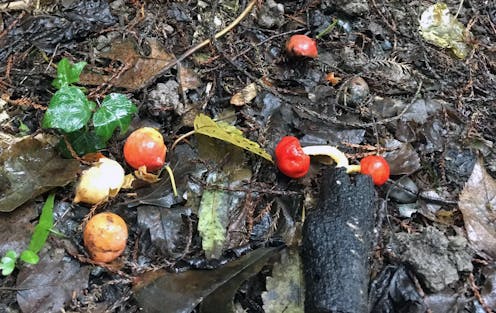
Many had brightly coloured fruiting bodies which emerged above the forest floor, essentially mimicking fallen fruit. Because of New Zealand’s lack of mammals (with the exception of bats), Beever hypothesised that these characteristics had evolved to attract birds as spore dispersers because they rely more on vision than scent to find food.

Beever and his colleague Teresa Lebel detailed this fascinating hypothesis elegantly in 2014, but it remained untested for three decades.

A blue fruiting body of a truffle-like fungus
With no land mammals to eat them, truffle-like fungi rely on colour to attract birds.
Amy Martin, CC BY-SA

Using colour to draw attention

In our research, we asked whether New Zealand really has more brightly coloured truffle-like fungi or whether we are simply paying more attention to them and under-appreciating the dull ones. And we investigated if there was a link between their distribution and fruit-eating birds.

A red fruiting body of a truffle-like fungus
New Zealand has more colourful truffle-like fungi, especially red and blue ones.
Amy Martin, CC BY-SA

First, we gathered information about the colour and habit (above or below ground) of 479 truffle-like fungus species from around the world. We then obtained more than 24,000 locations for these species from the Global Biodiversity Information Facility database.

These data were analysed alongside environmental factors (such as precipitation and temperature) and biological aspects (such as forest cover and the presence of fruit-eating birds) that might help explain any spatial patterns.

While colourful truffle-like fungi are also found in South and Central America and Australia, our results confirmed New Zealand has a much greater proportion compared to other landmasses. This is especially true for red and blue coloured species.

We also found that, across the world, regions with more fruit-eating birds also had more colourful truffle-like fungi.

Birds, truffle-like fungi and trees

Until recently, birds were thought to have a limited role in dispersing truffle-like fungi.

But this changed in 2021, when a study of faecal samples from two fruit-eating bird species from Patagonia (Chucao tapaculo and Black-throated huet-huet) found DNA and spores from a wide range of fungi, including truffle-like fungi.

The research team also observed both bird species uncovering truffles on the forest floor, thereby demonstrating the important role birds could have in fungal dispersal.

A further finding of the Patagonian study was that many of the truffle-like fungi detected in the faecal samples are part of the underground network of fungi-plant root interactions known as mycorrhiza.

In New Zealand, most colourful truffle-like fungi are also mycorrhizal with locally dominant forest trees such as beeches and podocarps. These fungi make it easier for the trees to access water and mineral nutrients from the soil. Therefore, birds that eat truffle-like fungi may not only be important for the fungi themselves, but for entire forest ecosystems.

A white truffle-like fungus
Most truffle-like fungi are part of the underground network interacting with plant roots.
Amy Martin, CC BY-SA

A legacy of extinction

The results of our study support the idea that colourful truffle-like fungi are adapted for bird dispersal, and that they are more common in New Zealand than elsewhere in the world.

Yet, paradoxically, the number of observed instances of local birds eating truffle-like fungi can be counted on one hand. Why is this? The answer may lie in New Zealand’s legacy of extinction.

Around one third of all bird species on the mainland and offshore islands have become extinct since the first human settlers arrived during the 13th century. Many more have had their populations reduced to the point of functional extinction. Among these are many large birds known to have eaten fruit, including nine species of moa and kākāpō.

In 2018, a study of DNA from ancient dung of moa and kākāpō found evidence these birds once ate mycorrhizal truffle-like fungi. The loss of such birds from New Zealand’s forests represents the end of millions of years of co-evolution with fungi.

These bird-adapted fungi may now remain as ghosts of past mutualisms – the association between organisms of two different species in which each benefits – much like the large tropical fruit once eaten by gomphotheres, an extinct group related to modern elephants.

How will our forest trees cope with the loss of these bird-fungus interactions, which help facilitate plant growth on bare soils? Can introduced animal species act as surrogate dispersers for native fungi?

The implications for forests, haunted by species loss, remain unknown. With continued research and conservation efforts, however, we can better understand and support the balance of our forest ecosystems to ensure the rich and unique biodiversity of New Zealand’s forests endures for generations to come.

The Conversation

This study received funding from Royal Society of New Zealand Marsden Fund.

ref. Colourful fruit-like fungi and forests ‘haunted by species loss’ – how we resolved a 30-year evolutionary mystery – https://theconversation.com/colourful-fruit-like-fungi-and-forests-haunted-by-species-loss-how-we-resolved-a-30-year-evolutionary-mystery-236425

‘She’s just hitting a triangle?’ Why being a percussionist is harder – and more crucial – than you may think

Source: The Conversation (Au and NZ) – By Claire Nicholls, Lecturer in Music Education, University of Southern Queensland

furtseff/Shutterstock

OK, tell me if you’ve heard this one: what did the percussionist say when they landed their first job?

“Would you like fries with that?”

It’s just a joke, right? Unfortunately for many aspiring percussionists even getting a foot in the door to complete a university qualification yet alone secure full time, paid and ongoing work as a professional musician is not too far from this reality.

While there are endless percussionist jokes to make – and there are thousands – I think we seriously underestimate the expertise, musicianship and teamwork percussionists bring to the orchestra and our favourite music. Not to mention the years of practice, heavy lifting, early set-ups, late pack downs, counting endless bars of rest, waiting for the vital moment in a symphony, and the mastery required to play the many instruments demanded of both “classical” and contemporary orchestral repertoire.

Let’s take a moment to appreciate the humble percussionist, what it takes to train as a professional drummer, and their sometimes less-than-obvious valuable contributions to the music we love.

A difficult road

Most large university Bachelor of Music programs will offer an average of but 40 positions per year. Few accepted will be pianists and percussionists.

A quick internet search of the nine professional orchestras in Australia reveals there is an average of 2.8 percussionists (including timpanists, who specialise in only the timpani, or kettledrums, rather than playing the wide variety of other instruments) per orchestra, out of a total of over 500 professional positions within Australian orchestras.

Permanent paid and full-time orchestral jobs are extremely competitive. This is especially true in Australia, as we have so few professional symphony orchestras compared to around the world. Like other artists in Australia, percussionists face higher rates of under- or unemployment, and lower incomes than others with similar levels of training.

The precarious work of contract artists also involve high hidden costs and unremunerated self-development costs. For many percussionists, making a living is extremely difficult.

Juggling many balls

Orchestral percussionists must be true multi-instrumentalists.

Except for timpani, which tend to be a speciality within itself, percussionists must navigate and master an ever-growing world of instruments in addition to the traditional orchestral percussion to meet the modern repertoire demands spanning far past “classical music”.

Everything from a giant hammer (I’m looking at you Mahler!), to African talking drums, the Indonesian gamelan and thunder sheets. Then there is the myriad of tuned percussion – instruments that can play melodies, for example the xylophone, marimba, tubular bells and glockenspiel – all the way to the humble triangle.

Each instrument comes with its own playing technique, cultural history and significance, mechanism of sound production and instrument maintenance requirements. Not to mention choosing the correct mallet or beater to make the timbre (sound quality) required of the music, expected by the composer, and what the conductor wants.

In addition to counting endless bars of rest and being masters of rhythm, the percussionist faces a unique challenge that no other instrument in the orchestra has to battle. Once the instrument is struck, shaken or scraped there is nothing the musician can do to change the quality of the sound.

A violinist or flautist can alter the movement of their bow or expression of air. However, can you imagine the pressure to produce perfection every time while being completely assured you are playing at the exact vital moment in a symphony?

And there’s no one else to copy because, you’re it!

To add to this, percussionists within an orchestral concert will be responsible for multiple parts and instruments. That requires some serious organisation and knowledge of the repertoire being played. Consider frequently performed works such as Holt’s Planets requiring not one but two timpanists on two sets of timpani to seamlessly manage our favourite melodies in Jupiter: The Bringer of Jollity.

Perhaps not such a jolly time for the percussionists.

A mainstay of culture

Can we really imagine our favourite car-sing-along song without that driving rhythm that gets our heart pumping and fingers tapping? The timpani in a much-loved symphony or suite? How about the famous Hedwig’s theme from Harry Potter without the celeste (a piano-like instrument with chime bards instead of strings) bringing a certain magic and mystery? Or Bluey without the textures, timbres and narratives captured through percussion instruments?

With perhaps the exception of the human voice, percussion instruments were the first attempts of music used by our cave dwelling ancestors. Music may have evolved, but percussion endures.

Around the world, percussion is universal. Without these diverse sounds we would be all the poorer. We cannot imagine a world without the rich tapestry of timbres percussion instruments and their musicians offer. Not only in terms of music, but also when it comes to ritual, celebration, entertainment and culture beyond the concert hall.

Even as audiences we use percussion to express our delight and gratitude through applause.

So next time you see someone at the back of the orchestra with their many varied percussion instruments, take a moment to reflect on and thank these masters of rhythm and timbre as part of the music you love.

The Conversation

Claire Nicholls does not work for, consult, own shares in or receive funding from any company or organisation that would benefit from this article, and has disclosed no relevant affiliations beyond their academic appointment.

ref. ‘She’s just hitting a triangle?’ Why being a percussionist is harder – and more crucial – than you may think – https://theconversation.com/shes-just-hitting-a-triangle-why-being-a-percussionist-is-harder-and-more-crucial-than-you-may-think-237040

Quantum tech is a high-stakes gamble. Here’s how Australia can find a way forward

Source: The Conversation (Au and NZ) – By Susanne Lloyd-Jones, Cyber Security Cooperative Research Centre Post Doctoral Fellow, UNSW Sydney

PsiQuantum

Last week, quantum computers were added to Australia’s Defence and Strategic Goods List of controlled items facing export restrictions. That’s because quantum technologies – which may soon provide huge advances in computing, communication and sensing – are rapidly growing in strategic importance.

The AUKUS partnership between Australia, the United States and the United Kingdom includes arrangements for sharing quantum technologies. Last year, Australia and the UK agreed to cooperate on quantum by sharing research and expertise and encouraging investment. A similar arrangement was signed with the US in 2021.

Governments and businesses are jostling for economic, strategic and defensive advantage. Nobody knows which approaches to the technology will prove successful, nor which countries will come out ahead.

Despite this uncertainty, Australia needs to make decisions about investment and regulation or risk being left behind. We think the best way to do this is by creating an accord between government, private industry, tech workers and researchers to create consensus on the best way forward.

A controversial investment

In April, the federal and Queensland governments invested A$466 million each in a US company called PsiQuantum, which is aiming to build “the world’s first useful quantum computer”. The deal was widely criticised for a lack of transparency and for bypassing Australian companies.

Investing in quantum technology is highly uncertain and complex. Researchers around the globe are making rapid progress, and calls for countries to develop their own sovereign capability are growing louder. At the same time, there is no shortage of hype from companies and researchers promoting their own work.

Giant companies such as Google, IBM, Microsoft and AWS are sometimes seen as “leaders” in quantum tech, but there are many other players in the field.

Several are based in Australia. These include research institutions as well as companies such as Quintessence Labs, Diraq, Quantum Brilliance, Silicon Quantum Computing and Nomad Atomics.

Last year, our government published a national quantum strategy, but it’s unclear how it should be implemented in the current messy environment, even with CSIRO’s roadmap.

In April, the University of Sydney was awarded A$18.4 million to set up Quantum Australia to be the “single front door” for quantum in Australia. Quantum Australia is in its infancy and it’s still unclear what its governance capacity will be.

More broadly, tech policy researchers have called for a more coordinated and regulated national approach to technology policy.

Is it time for a national accord on quantum?

Other countries are taking a much stronger approach to quantum coordination and cooperation.

In Europe, the Quantum Flagship establishes a working agreement between industry, governments and academia. In the US, QED-C established a consortium of stakeholders from government, academia, and industry to “identify gaps in technology, standards, and workforce and to address those gaps through collaboration”. In the UK, the National Quantum Computing Centre brings together businesses, the research community and government to enable the UK to secure a competitive position in the quantum industry.

What might this kind of coordination look like in Australia? We think it might look like an accord: a structured and formal mechanism for articulating a range of different agendas.

Our research looked at quantum tech arrangements in Australia, the UK, the US, India and the EU. We found examples of inclusive, structured, formal arrangements that feature government, private industry, industry leaders, academic bodies and academic researchers.

Europe has the most complex and far-reaching governance structure with its Quantum Flagship. We think an Australian accord needs to include representatives of the tech workforce too.

In the 1980s, Australia’s Prices and Incomes Accord famously forged a “working partnership” between government, employers and unions. It came at a time of economic uncertainty in Australia as market liberalism was sweeping through the English-speaking world.


Read more:
The lessons of the Accord for Modern Times: think outside the box


Could a quantum accord achieve a similar consensus today?

Why an accord?

Technological innovation and sovereign capability are key pillars of the government’s Future Made in Australia funding and reform package. This ambitious agenda will require commitment, coordination and leadership.

At present, government, local companies and local researchers are divided on the best way forward for quantum tech in Australia. A quantum tech accord could help address these conflicts. It could also help soothe tensions between the short-term interests of individuals and organisations and the long-term interests of the nation.

An accord could be a structured and consensus-building way to approach contested ideas about innovation, ethics, sovereignty, competitive advantage, regulation and skills. It could also help the Australian public better understand quantum technologies and the importance of domestic investment in these technologies, given there is little current understanding.

A practical mechanism for facing uncertainty

It is not easy to govern in the face of uncertain technological advancements and innovation. There may be no “right answers” to many decisions.

The advantage of a quantum tech accord is that it represents a practical mechanism pursued within economic, geopolitical and security constraints. It could provide an overarching governance structure and framework for coordinated policy and regulatory decision-making that favours consensus over seeming big-dog-eat-little-dog deals.

A quantum tech accord could embed Australia’s democratic values and governance into its purpose, terms and frameworks. This would also serve to establish a foundation for the ethical and responsible use of quantum technologies in the future.

Successive governments have committed billions to growing Australian quantum technology and fostering innovation. As a result of decades of sustained investment and funding of research and education, Australia’s growing quantum industry is up there with the best in the world.

Science and Industry minister Ed Husic has said the government does not want to repeat the mistakes of the past and miss the quantum wave. Maybe a quantum tech accord is an option to find a practical way forward.


The authors would like to thank UNSW Allens Hub Scholar Sally Song and UNSW Allens Hub Research Officer Jennifer Westmorland for their research assistance.

The Conversation

Dr Susanne Lloyd-Jones receives funding as a postdoctoral fellow from the Cyber Security Cooperative Research Centre whose activities are partially funded by the Australian government’s Cooperative Research Centres Program. Susanne also received funding from the UNSW Allens Hub for Technology, Law and Innovation for this work. She is a member of the UNSW Institute for Cyber and the UNSW Institute for AI. Susanne will commence work with the Australian Computer Society after the completion of her postdoctoral fellowship in 2024. This work was undertaken independently of the Australian Computer Society and does not represent or express its views.

Kayleen Manwaring has received funding for this research from the Cyber Security Cooperative Research Centre and the UNSW Allens Hub for Innovation, Law and Technology. She also sits on the executive committee of the Australian chapter of the IEEE Society on Social Implications for Technology, and is a member of the Research Committee of Consumer Policy Research Centre Ltd.

ref. Quantum tech is a high-stakes gamble. Here’s how Australia can find a way forward – https://theconversation.com/quantum-tech-is-a-high-stakes-gamble-heres-how-australia-can-find-a-way-forward-237361

Viruses can work where antibiotics don’t – new research tells us more about how they fight bacteria

Source: The Conversation (Au and NZ) – By Nils Birkholz, Postdoctoral Fellow in Molecular Microbiology, University of Otago

As the globe faces a rise in antibiotic-resistant bacteria – making traditional antibiotics ineffective – specific viruses could offer a solution.

Viruses called bacteriophages, or phages, target bacteria but can’t infect humans or other higher organisms. Phages inject their DNA into the bacterial cell, multiply to large numbers using the resources of the host, and then burst out to infect more bacteria in the vicinity.

Essentially, they are a naturally occurring, self-replicating and specific antibiotic. Discovered more than 100 years ago, their use against bacteria was largely sidelined in favour of antibiotics.

Our new research looked at one particular protein used by phages to bypass the natural defences of bacteria. We found this protein has an essential control function by binding to DNA and RNA.

This increased understanding is an important step towards using phages against bacterial pathogens in human health or agriculture.

Bacterial defence systems

There are hurdles to using phages to target bacteria. Much like our bodies have immune mechanisms to fight off viruses, bacteria have also evolved defences against phage infections.

One such defence are “clustered regularly interspaced short palindromic repeats”, or CRISPR, now better known for its applications in medicine and biotechnology. CRISPR systems in general act as “molecular scissors” by cutting DNA into pieces, be it in a lab-based setting or, in nature, inside a bacterium to destroy a phage.

Imagine wanting to use a phage against an antibiotic-resistant bacterial infection. The only thing standing in the way of that phage killing the bacteria and eradicating the infection might be the bacterium’s CRISPR defence which renders the phages useless as an antimicrobial.

That’s where knowing as much as possible about phage counter-defences becomes important. We are investigating so-called anti-CRISPRs: proteins or other molecules that phages use to inhibit CRISPR.

A bacterium that has CRISPR might be able to stop a phage from infecting. But if the phage has the right anti-CRISPR, it can neutralise this defence and kill the bacterium regardless.

The importance of anti-CRISPRs

Our recent research focused on how an anti-CRISPR response is controlled.

When faced with a powerful CRISPR defence, phages want to automatically produce large amounts of anti-CRISPR to increase the chance of inhibiting CRISPR immunity. But excessive production of anti-CRISPR prevents the replication of the phage and is ultimately toxic. This is why control is important.

To achieve this control, phages have another protein in their toolbox: an anti-CRISPR-associated (or Aca) protein that frequently occurs alongside the anti-CRISPRs themselves.

Aca proteins act as regulators of the phage’s counter-defence. They make sure the initial burst of anti-CRISPR production that inactivates CRISPR is then rapidly dampened to low levels. That way, the phage can allocate energy to where it is most needed: its replication and, eventually, release from the cell.

We found this regulation occurs at multiple levels. For any protein to be produced, the gene sequence in the DNA first needs to be transcribed into a messenger–RNA. This is then decoded, or translated, into a protein.

Many regulatory proteins function by inhibiting the first step (transcription into messenger-RNA), some others inhibit the second (translation into protein). Either way, the regulator often acts as a “road block” of sorts, binding to DNA or RNA.

Intriguingly and unexpectedly, the Aca protein we investigated does both – even though its structure would suggest it is merely a transcriptional regulator (a protein that regulates the conversion of DNA to RNA), very similar to ones that have been investigated for decades.

We also examined why this extra-tight control at two levels is necessary. Again, it seems to be all about the dosage of the anti-CRISPRs, especially as the phage replicates its DNA in the bacterial cell. This replication will invariably lead to the production of messenger-RNAs even in the presence of transcriptional control.

Therefore, it appears additional regulation is required to reign in anti-CRISPR production. This comes back to the toxicity of excessive production of this counter-defence protein, to the harm done when there’s “too much of a good thing”.

Fine-tuned control

What does this research mean in the grand scheme of things? We now know a lot more about how anti-CRISPR deployment occurs. It requires fine-tuned control to enable the phage to be successful in its battle against the host bacterium.

This is important out in nature, but also when it comes to using phages as alternative antimicrobials.

Knowing every detail about something as obscure-sounding as anti-CRISPR-associated proteins might make all the difference between the phage succeeding or succumbing —and between life or death, not just for the phage, but also for a person infected with antibiotic-resistant bacteria.

The Conversation

Nils Birkholz does not work for, consult, own shares in or receive funding from any company or organisation that would benefit from this article, and has disclosed no relevant affiliations beyond their academic appointment.

ref. Viruses can work where antibiotics don’t – new research tells us more about how they fight bacteria – https://theconversation.com/viruses-can-work-where-antibiotics-dont-new-research-tells-us-more-about-how-they-fight-bacteria-236498

50 cents, 0 cents, 1 question: how much can fare cuts boost public transport use?

Source: The Conversation (Au and NZ) – By David Levinson, Professor of Transport, University of Sydney

David Levinson

Public transport ridership has taken a beating in many Australian cities since the onset of COVID. With more people still working from home – typically office workers who had been concentrated in central business districts – passenger numbers remain well below pre-COVID levels on routes serving those CBDs.

Time series of Opal boardings showing that ridership has not recovered pre-Covid levels in Sydney
Boarding numbers on NSW train and bus services relative to pre-COVID 2019 values.
Data source: TfNSW Open Data Hub, CC BY

In any market, when supply is largely fixed and demand drops, a natural response is to lower prices. Queensland has cut public transport fares to only 50 cents for a six-month trial. Canberra is about to offer free fares for the next couple of months.

When cities elsewhere have cut fares, passenger numbers have increased. It happened in Perth when public transport was free for a month last summer. Melbourne has a free tram zone in the CBD. But it’s not a simple equation. There are many factors at work.

Will lower fares lead to a lasting uplift in passenger numbers? Will the results differ between free and almost-free travel?

The Queensland and ACT fare cuts are fascinating experiments that could well change how public transport fares are set in Australia.

What impacts do fares have?

First, fares help cover the costs of the service and perhaps even generate profit. However, the “farebox recovery ratio” – the share of operating costs paid by fares – is low (under 30%) in most Australian cities. This means fares contribute nothing directly towards building rail lines or repaying funders, much less earning a profit.

Second, fares may be set to ration use by time of day. So lower off-peak fares give people an incentive to travel at less busy times.

Third, fares deter people who might otherwise use stations or vehicles as a temporary shelter or refuge.

These many competing purposes can result in confusing or even self-defeating fare structures.

Sydney, for example, uses concession rates for certain users, peak pricing for certain times of day and weekly caps on how much the heaviest users have to pay. For some distances, buses and light rail are more expensive than trains. For others they are not.

In such cases, fares can be too low to contribute much to running the system but too high to attract enough riders to match system capacity.

How sensitive are people to fare changes?

For small changes, the rule of thumb from empirical studies has been that a 10% increase in fares loses about 3-4% of riders, but there is wide variance.

Studies in the United States have found demand in large metro areas was less sensitive to fares than small areas in the long run.

But with big fare changes, we cannot be as sure. We cannot confidently predict a 50% cut in fares will result in a 15% increase in passengers, or that free travel will lead to a 30% or 40% increase. That is, however, what New South Wales’ Independent Pricing and Regulatory Tribunal (IPART) found in 2020 when studying free fares in Sydney, which it did not recommend.

It’s not a simple matter of price

Responses to fare changes depend on context. We see sensitivity to long-term changes in fares for passengers who change from a discounted concession card, such as tertiary students, to a full-rate adult card, leading to a reduction in their use.

However, other factors confound changes in demand due to price. A person’s new workplace might be harder to get to using public transport than driving. They might have less flexibility to travel at off-peak times. Or having bought their own car might affect their travel choices, as might petrol prices and other costs of living.

For a short-term, well-publicised cut in fares, people may take advantage of it to make trips they otherwise would not have taken, or would have done by car, on foot or on bike. In contrast, people are not going to give up their car if they expect fares will soon return to previous levels.

One thing a short-run change can do is give people who have never ridden the bus or train (or haven’t in many years) a taste. If they like it, it could lead to a permanent uplift in their use.

What does overseas experience tell us?

Several places overseas have experimented with fare structure.

In the northern summer of 2022, Germany introduced a discounted €9 (about A$15) per month ticket. There was an 8% increase in travel – only a 3% increase was attributable to gaining a taste for public transport. A minority of trips replaced those that would otherwise have been made by car. Regular public transport use rose from 29% of travellers to 38% once the €9 ticket came in, then settled at 32% afterwards.

Tallinn in Estonia was one of the first capital cities to offer fare-free public transport. After some years, there was a clear increase in ridership from 55% to 63%. Three points came from a shift from private cars and the other five from walking.

So how do we assess the Australian experiments?

The decision to make the Queensland system nearly free – charging 50 cents instead of nothing – has been justified as a way to gather information about public transport use through the tap-on and tap-off process. While this is a real benefit, it might mean the benefits of a fare-free system aren’t fully unleashed.

First, in-vehicle tapping on and off can increase the time users take to board and alight, causing delays and effectively reducing the speed of the service. This adds to running costs as more vehicles are needed to provide the same frequency of services. More importantly, it makes public transport less competitive with private cars.

Second, it’s costly to collect fares. The cost might be greater than the revenue from the 50-cent fare. On the other hand, a small price might help deter people from using the system as shelter and short-distance walkers who might switch to a free service.

We won’t know what would happen in Queensland if public transport were fully free, though Canberra will provide a useful counterpoint. The results of these trials may soon reshape public transport fare-setting in Australia.

The Conversation

David Levinson has received research funding from ARC, UDIA-NSW, iMOVE, and Sydney Metro. He is affiliated with WalkSydney and Peaceful Bayside.

Emily Moylan has received funding from Transport for NSW.

Andres Fielbaum does not work for, consult, own shares in or receive funding from any company or organisation that would benefit from this article, and has disclosed no relevant affiliations beyond their academic appointment.

ref. 50 cents, 0 cents, 1 question: how much can fare cuts boost public transport use? – https://theconversation.com/50-cents-0-cents-1-question-how-much-can-fare-cuts-boost-public-transport-use-236574

40°C in August? A climate expert explains why Australia is ridiculously hot right now

Source: The Conversation (Au and NZ) – By Andrew King, Senior Lecturer in Climate Science, The University of Melbourne

Shutterstock

It’s winter in Australia, but as you’ve probably noticed, the weather is unusually warm. The top temperatures over large parts of the country this weekend were well above average for this time of year.


The outback town of Oodnadatta in South Australia recorded 38.5°C on Friday and 39.4°C on Saturday – about 16°C above average. Both days were well above the state’s previous winter temperature record. In large parts of Australia, the heat is expected to persist into the coming week.

A high pressure system is bringing this unusual heat – and it’s hanging around. So temperature records have already fallen and may continue to be broken for some towns in the next few days.

It’s no secret the world is warming. In fact, 2024 is shaping up to be the hottest year on record. Climate change is upon us. Historical averages are becoming just that: a thing of the past.

That’s why this winter heat is concerning. The warming trend will continue for at least as long as we keep burning fossil fuels and polluting the atmosphere. Remember, this is only August. The heatwaves of spring and summer are only going to be hotter.

Widespread heat forecast for Australia in August, 2024 (Bureau of Meteorology)

Records broken across Australia

The Bureau of Meteorology was expecting many records to be broken over the weekend across several states. On Thursday, bureau meteorologist Angus Hines described:

A scorching end to winter, with widespread heat around the country in coming days, including the chance of winter records across multiple states for maximum temperature.

The amount of heat plunging into central Australia was particularly unusual, Hines said.

On Friday, temperatures across northern South Australia and southern parts of the Northern Territory were as much as 15°C above average.

Temperatures continued to soar across northern parts of Western Australia over the weekend, with over 40°C recorded at Fitzroy Crossing on Sunday. It has been 2–12°C above average from Townsville all the way down to Melbourne for several days in a row.

Animated maximum temperature anomaly map showing heat building across central Australia
Maximum temperature anomalies from August 19-24, showing heat building across Australia.
Bureau of Meteorology, CC BY

Bear in mind, it’s only August. As Hines said, the fire weather season hasn’t yet hit most of Australia – but the current conditions – hot, dry and sometimes windy – are bringing moderate to high fire danger across Australia. It may also bring dusty conditions to central Australia.

And for latitudes north of Sydney and Perth, most of the coming week will be warm.

What’s causing the winter warmth?

In recent days a stubborn high pressure system has sat over eastern Australia and the Tasman Sea. It has kept skies clear over much of the continent and brought northerly winds over many areas, transporting warm air to the south.

High pressure promotes warm weather – both through clearer skies that bring more sunshine, and by promoting the descent of air which causes heating.

By late August, both the intensity of the sun and the length of the day has increased. So the centre of Australia can really warm up when under the right conditions.

High pressure in June can be associated with cooler conditions, because more heat is lost from the surface during those long winter nights. But that’s already less of an issue by late August.

This kind of weather setup has occurred in the past. Late-winter or early-spring heat does sometimes occur in Australia. However, this warm spell is exceptional, as highlighted by the broken temperature records across the country.

Graph of August Australian-average temperatures increasing since 1910
August temperatures have been rising over the past century.
Bureau of Meteorology

Feeling the heat

The consequences of humanity’s continued greenhouse gas emissions are clear. Australia’s winters are getting warmer overall. And winter “heatwaves” are becoming warmer.

Australia’s three warmest Augusts on record have all occurred since 2000 – and last August was the second-warmest since 1910. When the right weather conditions occur for winter warmth across Australia, the temperatures are higher than a century ago.

The warmth we are experiencing now comes off the back of a recent run of global temperature records and extreme heat events across the Northern Hemisphere.

This warm spell is set to continue, with temperatures above 30°C forecast from Wednesday through to Sunday in Brisbane. The outlook for spring points to continued above-normal temperatures across the continent, but as always we will likely see both warm and cold spells at times.

Such winter warmth is exceptional and already breaking records. Climate change is already increasing the frequency and intensity of this kind of winter heat – and future warm spells will be hotter still, if humanity’s greenhouse gas emissions continue.

The Conversation

Andrew King receives funding from the ARC Centre of Excellence for 21st Century Weather and the National Environmental Science Program.

ref. 40°C in August? A climate expert explains why Australia is ridiculously hot right now – https://theconversation.com/40-c-in-august-a-climate-expert-explains-why-australia-is-ridiculously-hot-right-now-237398

Australians now have the right to disconnect – but how workplaces react will be crucial

Source: The Conversation (Au and NZ) – By Emmanuel Josserand, Professor of Management, EMLV, Paris and Adjunct Fellow, University of Technology Sydney

EgorTetiushev/Shuttersrtock

From today, Monday August 26, many employees in Australia get a new right, called the right to disconnect from work.

This entails the right to refuse to read or respond to work-related calls, texts and emails outside their working hours, unless that refusal is unreasonable.

The Fair Work Commission says what will matter is whether the refusal is unreasonable, rather than whether the attempted contact is unreasonable.

Among the things that will determine whether a refusal is unreasonable are the employee’s role, their personal circumstances, the method and reason for
the contact, how much disruption it causes them and whether they are compensated for being available or for working additional hours.

Those working for small businesses (with fewer than 15 employees) get the right to disconnect in August 2025.

Fair Work Commission.

As with any changes to conditions of employment, it has sparked heated debate.

Supporters say the right to disconnect is needed to slow the encroachment of work into personal life. Opponents say it will harm productivity and flexibility.

Fortunately, we’ve clues from overseas to guide us.

France was the first country to introduce a right to disconnect in 2017, followed by
Belgium, Italy, Argentina, Chile, Luxembourg, Mexico, Philippines, Russia, Slovakia, Spain, Ontario in Canada, and Ireland.

An analysis of these laws and their impact, which we are preparing for the Journal of Industrial Relations, finds that while they can improve work-life balance and wellbeing, their success depends on how they are implemented and enforced within each workplace.

Employers that take right to disconnect laws seriously offer more compensation to those who are interrupted than companies that don’t, in the form of pay or time off in lieu. Unpaid overtime is significantly more common in companies without a right to disconnect policy.

In the countries that have a right to disconnect, only about 45% of workers say they are aware of it being offered in their workplace, and only about half of them say they are aware of actions to enforce it.

What matters is agreement in the workplace

In some countries, including France, the law requires that employers and employee representatives come together to negotiate specific rules about when work should stop and personal time should begin.

This means that in France, there are often clear agreements about when workers can ignore emails or calls.

In Belgium, instead of making it mandatory for companies to enforce the right, the law encourages discussions about it in health and safety committees. So, while there isn’t a strict rule forcing companies to ensure workers can disconnect, there is a system in place to have conversations about it.

What each country has in common is the idea that employers and employees need to work together to find a balance between work and personal time.

This suggests that merely introducing legislation is not enough: effective implementation requires clear guidelines, awareness-raising, and a cultural shift within workplaces.

Companies need to get things right at the start

A key challenge in Australia will be to make clear what is a “reasonable” refusal of a work-related contact and what is not.

The Fair Work Commission wants employers and employees to attempt to resolve this themselves before escalating disputes to the Commission.

An important part of this is consultation within workplaces at the beginning to develop training and protocols tailored to each role.

There are also practical steps workplaces can take to curb the flow of work-related information, such as disabling notifications after hours, setting up automatic out-of-office replies and scheduling emails rather than sending them immediately.

Employers should lead by example

The biggest challenge will be a cultural shift that prioritises employee wellbeing. Hyperconnectivity need not be an inevitable consequence of modern work life.

Managers should lead by example by respecting non-work hours themselves and avoiding after-hours communication.

The continued existence of the new right is far from certain. Opposition Leader Peter Dutton has promised to repeal the right if he wins the next election, saying it will make it impossible for some businesses to employ staff.

Success will depend on employers and their workers agreeing on clear ground rules from the beginning.

The Conversation

The authors do not work for, consult, own shares in or receive funding from any company or organisation that would benefit from this article, and have disclosed no relevant affiliations beyond their academic appointment.

ref. Australians now have the right to disconnect – but how workplaces react will be crucial – https://theconversation.com/australians-now-have-the-right-to-disconnect-but-how-workplaces-react-will-be-crucial-237023

Airline ‘customer rights charter’ to specify when cash refunds required

Source: The Conversation (Au and NZ) – By Michelle Grattan, Professorial Fellow, University of Canberra

An “aviation industry ombuds scheme” and improved assistance for passengers with a disability will be among measures the federal government will announce on Monday to force airlines to address the extensive public discontent with their services.

A new aviation customer rights charter will set out “fair and reasonable” conduct by airlines and airports, including when flights are delayed or cancelled.

It will cover customers’ entitlements to refunds, and when these must be provided in cash rather than with travel vouchers.

This follows class actions against both Qantas and Jetstar that allege they have failed to provide timely cash refunds for cancelled flights, despite being legally obliged to do so.

Both airlines issued vouchers instead of cash refunds, initially with expiry dates.

The class action against Qantas has entered mediation. That against Jetstar was launched last week.

The customer rights charter will also address “unreasonable” lengths of delays and timely communication with passengers.

Transport Minister Catherine King will release the government’s white paper on aviation, with legislation planned for next year, after further consultations. In the meantime an interim ombudsperson will be appointed from her department.

King said too many people had been “left out to dry when flights are cancelled or disrupted and it’s impossibly complex to get a refund or even contact a company representative.

“Customers deserve to get their money back if they are owed. Full stop,” she said.

The ombuds scheme will have an external dispute resolution service, and direct airlines and airports to provide remedies to consumers. It will provide reports on conduct, and refer instances of misconduct for investigation.

Barriers presently faced by people with a disability include unreasonable wait times for checking in, refusals to carry assistance animals, and limits on wheelchair and other access.

The government will create specific disability standards for the industry and review compliance with them.

It will improve remedies for damage to wheelchairs and other equipment, and require airport development plans to set out how they will enable access for people with a disability.

“Through our consultations we have heard clearly that the treatment of people with disability by the airlines and airports is not good enough,” King said.

“People have been left stranded on planes, forced to return to their departure port or had to put up with poor treatment due to a lack of access to appropriate facilities at their destination.”

The Conversation

Michelle Grattan does not work for, consult, own shares in or receive funding from any company or organisation that would benefit from this article, and has disclosed no relevant affiliations beyond their academic appointment.

ref. Airline ‘customer rights charter’ to specify when cash refunds required – https://theconversation.com/airline-customer-rights-charter-to-specify-when-cash-refunds-required-237447

Harris gains in US polls during Democratic convention; Labor thumped in NT election

Source: The Conversation (Au and NZ) – By Adrian Beaumont, Election Analyst (Psephologist) at The Conversation; and Honorary Associate, School of Mathematics and Statistics, The University of Melbourne

The United States presidential election will be held on November 5. In analyst Nate Silver’s aggregate of national polls, Democrat Kamala Harris leads Republican Donald Trump by 48.8–44.8. In my previous US politics article last Monday, Harris led Trump by 47.1–44.6.

Joe Biden’s final position before his withdrawal as Democratic candidate on July 21 was a national poll deficit against Trump of 45.2–41.2. By the election, Biden will be almost 82, Trump is now 78 and Harris will be 60.

Robert F. Kennedy Jr withdrew from the presidential contest in swing states on Friday US time and endorsed Trump. Silver said Kennedy initially had 10–11% support in a three-way matchup with Trump and Biden, but this had faded to about 8% at Biden’s withdrawal.

When Harris replaced Biden, this reduced the number of voters who disliked both major party candidates, and Kennedy fell to about 4%.

Kennedy’s withdrawal will probably assist Trump a little, as Kennedy’s ideological positions were closer to Trump’s, and Kennedy endorsed Trump. But Kennedy only had 4% before his withdrawal, so there won’t be a large impact. There have not yet been polls conducted since Kennedy’s withdrawal or the Democratic National Convention, which ran from Monday to Thursday this week.

The US president isn’t elected by the national popular vote, but by the Electoral College, in which each state receives electoral votes equal to its federal House seats (population based) and senators (always two). Almost all states award their electoral votes as winner takes all, and it takes 270 electoral votes to win (out of 538 total).

Silver’s numbers have been adjusted for Kennedy’s withdrawal. They reflect polls conducted during the convention that gave Harris a boost before her address on Thursday. As Silver’s model was factoring in a convention bounce, Harris’ win probability is little changed at 53.2% (53.5% last Monday).

Convention bounces usually peak in the week following a convention, then fade slowly. Polls conducted in the next week will show the impact of the Democratic convention and Kennedy’s withdrawal.

I wrote last Monday that if Harris leads by four to five points nationally after the convention, her win probability in Silver’s model will not change much. If she leads by six points, her win probability will increase, and if she only leads by two points her win probability will decrease.

Labor thumped at NT election

At Saturday’s Northern Territory election, the ABC is giving the Country Liberal Party (CLP) 15 of the 25 seats, Labor four, independents two and there are four seats still undecided. Labor had governed in the NT since winning the 2016 election. In 2020, Labor won 14 of the 25 seats, the CLP eight, independents two and the Territory Alliance one.

NT-wide primary votes were 47.8% CLP (up 16.5% since the 2020 election), 29.5% Labor (down 10.0%), 8.3% Greens (up 4.0%) and 14.4% independents (up 3.7%). The Territory Alliance, which won 12.9% in 2020, did not contest this election. The ABC’s two-party preferred estimate is a CLP win by 57.1–42.9 over Labor, a 10.1% swing to the CLP since 2020.

Postal votes have not yet been counted, and these are likely to assist the CLP. In the four seats in doubt, the CLP is ahead and likely to win Casuarina. The electoral commission probably selected the wrong final two candidates in Fannie Bay and Johnston, and now needs to redo the preference count.

The Greens are likely to win Fannie Bay and an independent Johnston. If the Greens win Fannie Bay, it will be their first ever seat in the NT parliament.

In Nightcliff, we can’t yet determine whether the CLP or the Greens will make the final two. Labor easily beats the CLP, but we don’t know the outcome if the Greens are their final opponent, but Labor should win.

If the seats in doubt go as expected, the final outcome will be 16 CLP out of 25, five Labor, three independents and one Green. The Poll Bludger said the anti-Labor swings were particularly savage in northern Darwin, while Labor held up much better in the rural and Indigenous-heavy seats. Four of Labor’s five likely survivors are of Indigenous background.

In 2022 Labor defeated the federal Coalition government and in 2023 they defeated the NSW Coalition government. I believe this is the first defeat of a Labor government in Australia since Labor lost the 2018 South Australian election. The Queensland Labor government appears doomed at an election in October.

Federal polls: Freshwater steady at 51–49 to Coalition

A national Freshwater poll for The Financial Review, conducted August 16–18 from a sample of 1,061, gave the Coalition a 51–49 lead, unchanged from the July Freshwater poll. Primary votes were 41% Coalition (up one), 32% Labor (up one), 12% Greens (down one) and 15% for all Others.

Anthony Albanese’s net approval was up four points to -10, with 45% unfavourable and 35% favourable. Peter Dutton’s net approval was steady at -3. Albanese led Dutton as preferred PM by 45–41 (45–39 in July).

In better news for Labor, the Coalition’s lead over Labor on the cost of living was reduced from 12 points in July to seven, and their lead on managing the economy was reduced from 16 points to 13. The cost of living was rated one of the most important issues by 76%, far ahead of housing on 38%.

Morgan poll: 50.5–49.5 to Labor

A national Morgan poll, conducted August 12–18 from a sample of 1,698, gave Labor a 50.5–49.5 lead, a 0.5-point gain for Labor since the August 5–11 poll.

Primary votes were 38.5% Coalition (up 0.5), 30.5% Labor (up one), 13.5% Greens (down 0.5), 4% One Nation (down one), 8.5% independents (down one) and 5% others (up one).

The headline figure is based on respondent preferences. If 2022 election preference flows are used, Labor leads by an unchanged 51–49.

The Conversation

Adrian Beaumont does not work for, consult, own shares in or receive funding from any company or organisation that would benefit from this article, and has disclosed no relevant affiliations beyond their academic appointment.

ref. Harris gains in US polls during Democratic convention; Labor thumped in NT election – https://theconversation.com/harris-gains-in-us-polls-during-democratic-convention-labor-thumped-in-nt-election-237033

NT election: the Country Liberals claim a landslide victory in a contest decided in suburbia

Source: The Conversation (Au and NZ) – By Rolf Gerritsen, Adjunct Professor, The Northern Institute, Charles Darwin University

The Northern Territory is a different place. On the day prior to this election, Speckles the Adelaide River crocodile was asked to predict the result of the election. He had replaced the previous crocodile, a spiv who got the 2016 and 2020 elections wrong.

Speckles decided Eva Lawler, the Labor Chief Minister, would win the election. Speckles was not the only prognosticator to get it wrong. I fear for his future.

The Country Liberal Party (CLP) has won majority government, returning to power after eight years in opposition. Double-digit swings against Labor have been recorded in some electorates. Lawler lost government and her own seat.

Instead, CLP Leader Lia Finocchiaro will become the Territory’s next Chief Minister and govern in majority.

A table and slider showing the percentage swing away from Labor to the CLP.
A screenshot of the Northern Territory election results as recorded by the ABC. Screenshot taken 9AM on Sunday August 25.
ABC News

A tale of two elections

Yesterday, effectively, there were two elections conducted for the NT Legislative Assembly. The first was in the bush electorates.

These are dominated by Aboriginal communities, often blighted by poverty, poor housing, inadequate medical services, failing educational services and the absence of employment opportunities: all the elements the Closing the Gap targets seek to address.

As is customary in Territory elections, these Indigenous communities voted Labor. Only once since self government in 1978 (in 2012) have they not done so.

However, Indigenous issues were hardly mentioned by politicians or the media in this election campaign.


Read more:
NT election: promises for Indigenous people buckle under history’s weight


This election was essentially an urban election played out mainly in Darwin-Palmerston and, to an extent, Alice Springs. It only paid some attention to Indigenous issues as a covert subtext to the broader community angst about crime.

Twice the expected swing

I predicted the CLP would get uneven swings, bigger in some instances (like in electorates that had suburbs where there were high levels of property crime, violence and public drunkenness).

Overall, I assumed the CLP Opposition would get a Territory-wide swing of about 4%–6%. I was wrong.

The overall swing to the CLP in the suburbs of Darwin was over twice that estimate. Several ministers, including Lawler, have lost their seats.

Lawler conceded defeat at 8:30pm, a full hour before losers in NT elections usually do so. That indicated the extent of the loss for Labor.

Counting will resume today but, on the trends, I expect at least four (possibly six) Labor Ministers will lose their seats.

As I predicted, independents have been elected in two seats: Yingiya Mark Guyula in Mulka (in northeast Arnhem Land) and Robyn Lambley in Araluen (in Alice Springs).

Other independents have done well, as in Johnston where a Teal-like (she actually wore purple) independent out-polled the Labor incumbent (although still behind the CLP).

Labor’s vote collapse

My interpretation of the collapse of the Labor vote is that it involves two elements.

One is the defection of weakly-aligned voters. These voters usually make up the swing in an election.

The other is that a fair proportion of Labor voters switched to the Greens. I have lauded Chief Minister Lawler for her tough campaign, but it’s possible some Labor voters were alienated by her right-ish switch and decided to vote Green, to remind Labor that it is supposed to be a progressive party.

However you interpret this election, it is definitely a landslide to the CLP. Comparatively, it’s not as bad for Labor as the anti-CLP landslide in 2016. Back then, Finocchiaro was the only CLP member reelected in the Greater Darwin area.

That 2016 election was consequential. Because Finocchiaro was the only CLP parliamentarian left in the Greater Darwin area, she eventually became CLP leader. The twists of fate mean that she is now Chief Minister.

The most interesting new development of this election was the rise of the Greens. They will feel greatly buoyed by this election, where in some seats they finally broke the 20% primary vote barrier to become serious players in Territory politics.

In my pre-poll analysis, I said this would be a good election to win because the NT economy will pick up next year.

In addition, Commonwealth expenditure in the NT is set to dramatically escalate. The billions of dollars worth of spending as part of remote housing and education deals struck with the Commonwealth, plus other large-scale spending programs, will start to come into play.

The Commonwealth is becoming invested in reversing Indigenous disadvantage in the Territory because the NT is the worst performer on the Closing The Gap targets.

This means continuing money for the NT and all but ensures the new CLP government will be re-elected in 2028.

The Conversation

Rolf Gerritsen does not work for, consult, own shares in or receive funding from any company or organisation that would benefit from this article, and has disclosed no relevant affiliations beyond their academic appointment.

ref. NT election: the Country Liberals claim a landslide victory in a contest decided in suburbia – https://theconversation.com/nt-election-the-country-liberals-claim-a-landslide-victory-in-a-contest-decided-in-suburbia-235648

‘Humanity is failing’: official report warns our chance to save the Great Barrier Reef is fast closing

Source: The Conversation (Au and NZ) – By Ove Hoegh-Guldberg, Professor, School of the Environment, The University of Queensland

GBRMPA/J Sumerling

The Great Barrier Reef will continue to deteriorate, largely to climate change, and the window to secure its future is rapidly closing. That is the sobering conclusion of a major new report into the state of the reef.

The report was released by the Great Barrier Reef Marine Park Authority. It confirms what scientists have long known: humanity is killing the Great Barrier Reef, and other reefs around the world, by failing to curb the greenhouse gas emissions that cause global warming.

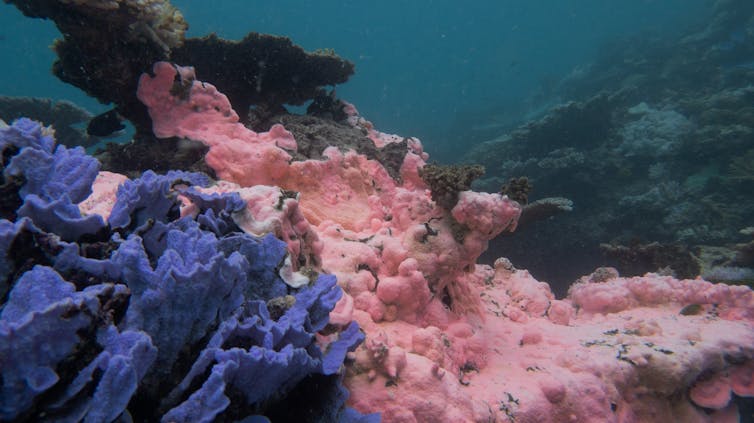
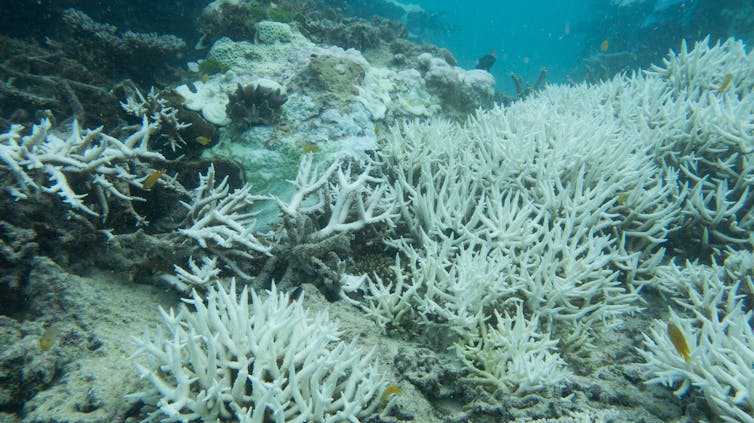
Earlier this year, I visited parts of the southern Great Barrier Reef where mass coral bleaching and death had just occurred. The picture was devastating. Vast swathes of coral were bleached a ghostly white. It was interspersed with bright flashes of pink and blue: a final, heartbreaking release of coral pigment as the organism makes a last-ditch effort to survive. I’ve since learned much of that coral is now dead.

Anyone who knows anything about coral reefs would have been upset by what I saw. The world’s largest reef was in very, very bad shape. As I swam, in the back of my head was the knowledge that 2023 was Earth’s hottest year on record. In fact, the Great Barrier Reef is the warmest it has been for at least 400 years.

Unless humanity takes dramatic action to halt climate change, we will lose the beautiful, complex reefs that have existed on Earth for millennia. As this latest report shows, even governments and officials now acknowledge this fact.

pink and blue coral
In some cases, dying coral gives off a final, neon burst of colour in a bid to survive.
Ove Hoegh-Guldberg

Make no mistake: the reef is in dire straits

The 2024 Great Barrier Reef Outlook report, released late on Friday, is the fourth in a series of five-yearly reports on the reef’s health.

It found warming oceans and severe tropical cyclones are compounding other threats such as crown-of-thorns starfish outbreaks, poor water quality and unsustainable fishing.

The report said the condition of some coral species has improved over the past five years – from “very poor” to “poor”. We shouldn’t get too excited about this. It means a few fast-growing coral species are bouncing back.

Make no mistake: the reef’s overall prospects remain dire. As the report states:

While recent recovery in some ecosystem values demonstrates that the reef is still resilient, its capacity to tolerate and recover is jeopardised by a rapidly changing climate.

It’s also important to note that the report covers the five years to December 2023. It does not capture the damage caused by the mega-bleaching event up and down the reef last summer.

As my colleagues and I wrote recently, the Great Barrier Reef has suffered five mass bleaching events in the past nine summers.

Bleaching occurs when corals become so heat-stressed they eject the tiny algae living inside their tissues. These organisms give coral some of its colour and help power its metabolism. In mild bleaching events, corals can recover. But in the severe events that are becoming more common, corals do not survive.

Analysis by others shows the mortality in stark detail. The left-hand image below shows coral at Lizard Island “fluorescing” or releasing bright pigment in March this year. This protective measure aims to limit the damage to remaining microalgae.

The image on the right, three months later, shows more than 97% of the same corals had died.

Climate change is not the only threat

The report said climate-driven disturbances are compounding the effects of other chronic damage to the reef from:

  • unsustainable fishing
  • pollution
  • sediment runoff
  • outbreaks of crown-of-thorns starfish.

Among other key findings of the report were that:

  • most populations of marine turtles have declined
  • species such as seabirds, sharks, rays, dugongs and seagrasses have recovered in some areas and plateaued or declined in others
  • populations of estuarine crocodiles are recovering
  • many species in declines are listed as threatened or protected.
bleached coral
Bleaching occurs when corals become so heat-stressed they eject the tiny organisms living inside their tissues.
Ove Hoegh-Guldberg

Strong leadership is needed

I first visited the Great Barrier Reef in 1980, as a university student. My interest in it has never waned. It’s one of those incredible bits of nature that defies description.

The reef’s World Heritage listing is proof of its outstanding global value. Australians love and feel pride in this vast and stunning place. The reef supports the livelihoods and wellbeing of many, including Traditional Owners who have cared for it over thousands of generations. It sustains all of us: economically, culturally and spiritually.

You might see a photo of healthy-looking coral and think the reef must be doing well. But I have seen the problem first-hand over many years. The reef is suffering badly – and every fraction of a degree of global warming compounds the harm.

Humanity must take urgent action to limit global temperature rise. But we are failing. We are failing the Great Barrier Reef and indeed, coral reefs across the planet.

There was a time when governments and reef managers were not willing to admit the extent of the problem. I don’t think that’s the case anymore. As the report states:

2024 opens a new chapter for the reef. Future warming already locked into the climate system means
that further degradation is inevitable. This is the sobering calculus of climate change.

Climate change is a global problem, but Australia is undeniably part of it. This nation cannot export fossil fuels to be burnt overseas if we want to save the Great Barrier Reef. Dealing with this will take strong political leadership, from the prime minister down.

Humanity has all the facts in front of us. Earth is in an unchartered time of very rapid change. If we don’t respond, we will lose the Great Barrier Reef.

The Conversation

Ove Hoegh-Guldberg is affiliated with the World Wide Fund for Nature and the Great Barrier Reef Foundation.

ref. ‘Humanity is failing’: official report warns our chance to save the Great Barrier Reef is fast closing – https://theconversation.com/humanity-is-failing-official-report-warns-our-chance-to-save-the-great-barrier-reef-is-fast-closing-237441

Harris delivers warm and strong acceptance speech as Democrats take joy, hope and renewal to the electorate

Source: The Conversation (Au and NZ) – By Emma Shortis, Adjunct Senior Fellow, School of Global, Urban and Social Studies, RMIT University

In the recent history of convention speeches, Kamala Harris’ remarks at the Democratic National Convention in Chicago were relatively short. But they hit all the right notes.

Harris was steady, warm, clear and, at times, funny. She reaffirmed all the themes her campaign has established so quickly and thoroughly: freedom, unity, and a vision for a better future.

While there were a few moments in the speech that may indicate troubles to come, for now, the Democratic Party will leave Chicago on a high. As vice presidential nominee Tim Walz put it, “It’s the fourth quarter. We’re down a field goal. But we’re on offense and we’ve got the ball. We’re driving down the field.”

I need freedom too

Part of the reason Democrats can feel relatively confident – though certainly not assured of victory – is because, led by Harris, they have so successfully flipped the narrative on almost all of Donald Trump’s campaign strengths.

From the beginning of her campaign, Harris has reclaimed the idea of “freedom”. Her campaign anthem is the Beyonce song of the same name. Though Beyonce herself did not appear (despite the rumours), the lyrics of the song illuminate just how much the freedom narrative has changed: “Freedom, freedom where are you? ‘Cause I need freedom too”. Unlike the Trump version of hyper-individualistic “freedom” that imposes on the rights of others, Harris’ version of freedom is a freedom of opportunity, a freedom to, as she put it in Chicago:

[…] live safe from gun violence — in our schools, communities, and places of worship. The freedom to love who you love openly and with pride. The freedom to breathe clean air, drink clean water, and live free from the pollution that fuels the climate crisis. And the freedom that unlocks all the others. The freedom to vote.

This is not the only area in which Harris has Trump on the run. Harris opened her speech talking about her family, and especially her mother. The campaign has centred women, and Black women in particular, without talking much about “firsts” (Hillary Clinton is the exception that proves the rule).

By not talking about those “firsts”, even though they would be remarkable, Harris has successfully de-centred herself, flipping the focus onto Trump’s hyper-individualism and completely turning around the idea of “identity politics”. It is the Trump campaign’s “weird” focus on identity that now faces scrutiny, which means he hasn’t been able, so far at least, to delegitimise his opponents on the basis of race and gender as he has done so successfully in the past.

In another remarkable shift, the Harris campaign has also reclaimed patriotism for the Democrats. One of the fieriest parts of Harris’ speech came towards the end, when she spoke about the “greatest privilege on Earth. The privilege and pride of being an American”. Noting that her opponent consistently “denigrates” America, Harris shot back:

Well, my mother had another lesson she used to teach. Never let anyone tell you who you are. You show them who you are. America, let us show each other — and the world — who we are. And what we stand for. Freedom. Opportunity. Compassion. Dignity. Fairness. And endless possibilities.

Can the unity last?

Harris’ speech was all about the possibilities for a different future for America. That reclaiming of the future is one of her campaign’s greatest strengths: she represents, now, the building of the generational bridge that Joe Biden had long promised the party.

But Harris’ speech also served to highlight the possibility that despite her rallying cry for unity, she has not healed the divides that remain in the party and may not be able to do so as the campaign continues.

The party’s position on Israel has long overshadowed the convention and the nomination process. Pro-Palestinian speakers were denied a spot in the DNC lineup. When Harris addressed the issue by first talking about Israel’s right to defend itself, there were audible gasps and rumbling from the convention floor, countered by cheers. The biggest cheer, though, came at the end of that section of the speech, when Harris spoke about ending the suffering in Gaza and ensuring Palestinians’ right to self-determination.

Similarly, there were mixed reactions from the crowds to Harris’ comments on “border security”, reflecting concerns in parts of the party about the Democrats’ concessions to Republicans on the issue.

Roll up our sleeves and get to work

As Harris herself acknowledged, Democrats still have a lot of work to do. This election, Harris noted, will have serious consequences, for the United States and for the world.

Might Harris be the president of joy? Only time – and the Democrats’ ability to keep kicking goals – will tell. But in politics, we should never underestimate the power of love and good vibes.

Emma Shortis is Senior Researcher in International and Security Affairs at The Australia Institute, an independent think tank.

ref. Harris delivers warm and strong acceptance speech as Democrats take joy, hope and renewal to the electorate – https://theconversation.com/harris-delivers-warm-and-strong-acceptance-speech-as-democrats-take-joy-hope-and-renewal-to-the-electorate-237136

What exactly are ‘forever chemicals’ – and can we move beyond them?

Source: The Conversation (Au and NZ) – By Bangle Wu, PhD candidate, Australian National University

The Australian parliament will conduct a national inquiry into the dangers of “forever chemicals”.

The move comes after a string of revelations about the potential dangers of the substances, including news this week that Sydney Water has detected the chemicals in the city’s drinking water sources. Independent senator Lidia Thorpe, who led the push for a parliamentary inquiry, described these chemicals as the “asbestos of the 21st century — far more prevalent and far less understood.”

Forever chemicals, technically known as per- and poly-fluoroalkyl substances (PFAS), have been linked to cancer. This makes their widespread presence in our water particularly alarming.

But what types of chemicals are actually considered “forever chemicals”? And how should we deal with the escalating threat they pose?

An expansive group

The term “forever chemicals” refers to an expansive group of chemical compounds with an evolving definition. They are used in a range of everyday products, such as makeup, cookware and clothing, for their water, oil and stain-resistant properties.

In 2011, American chemist Robert Buck and his colleagues defined more than 200 substances in the PFAS group.

In 2018, a group led by the Organisation for Economic Cooperation and Development (OECD) updated the definition, adding roughly 5,000 chemical substances.

In 2021, scientists published a yet another new definition, which broadened the PFAS universe to include millions of chemicals.

However, the phrase “forever chemicals” is often used to refer to different group of substances in different contexts.

In January 2023, a proposal to ban the whole class of PFAS from five European countries included more than 10,000 chemicals.

However, Sydney Water’s recent report mainly covers three well-known types of “forever chemicals”.

Therefore, using “forever chemicals” – or PFAS – omits many complexities.

Current analytical methods can only detect around 50 types of PFAS – a tiny proportion of the whole PFAS universe.

Perfluorooctanoic acid (PFOA) and perfluorooctane sulfonate (PFOS) are the most well-known.

There are devils we know – and devils we don’t know.

Local contamination versus background contamination

To understand the risks of PFAS in drinking water, it’s important to differentiate between background contamination and local contamination.

Local contamination includes legacy contamination from aqueous firefighting foam and industrial manufacturing pollution. It is often mainly confined to local areas and often has higher concentrations of contaminants.

Background contamination is related to exposure to everyday products containing PFAS, such as cookware, carpets, masks and makeup. The general public’s exposure to background PFAS contamination differs from the risks of heavily contaminated communities.

For example, the mean concentration of PFOS in the blood of Australian firefighters during 2018-2019 was 27 nanograms per millilitre. This is because of the presence of PFOS in firefighting foam.

These are relatively high figures compared to the concentration of PFOA in Sydney’s water: 0.1 nanograms per litre.

PFAS chemicals are so mobile they can show up in drinking water even without a clear source of contamination, such as an industrial spill or the use of firefighting foam. Unlike localised pollution, they spread widely, complicating our fight against them.

Risks related to environmental health are always controversial and tricky to address.

As for PFAS, on the one hand, the International Agency for Research on Cancer has listed PFOA as carcinogenic and PFOS as possibly carcinogenic.

On the other hand, the long-term health impacts of background exposures remain uncertain.

Many other substances in the PFAS universe are still not fully understood.

A looming threat

The ubiquitous existence of forever chemicals as background contamination may not immediately kill us. But it’s a looming threat to our future.

As their name suggests, these substances are notorious for their inability to break down and degrade. This means they can accumulate in our bodies and in the environment, and don’t disappear.

This was spotlighted this week by a study which discovered high levels of PFOS in the livers of deceased platypus throughout eastern New South Wales.

The warning of Rachel Carson, the late American marine biologist and writer, in Silent Spring still remains powerful 60 years later: the chemicals we use in attempts to control nature are pushing its fragile limits beyond what it can handle.

Beyond “forever chemicals”

From July 2025, the federal government plans to effectively ban the use, manufacture, import and export of some of the most prominent PFAS chemicals.

This is a good step towards tackling the PFAS issue and could lead to more investigations and potential government action. The challenge of these forever chemicals already being in our environment, including in our drinking water, still remains.

And even if we all started simply buying bottled water, we still risk being exposed to PFAS.

For one, bottled water may still contain PFAS. Secondly, even if we avoided PFAS in our drinking water, we’re still exposed to it through popular everyday items such as non-stick pans and waterproof jackets.

We need to expand our focus from just the presence of PFAS in our drinking water to how these chemicals have woven themselves into our daily lives.

With countless products designed to resist water and stains, it’s time to ask: do we truly need these chemicals to stay dry, keep our cosmetics water-resistant or make our cookware non-stick?

It’s time to think more responsibly about the choices we make that affect us in small and big ways – and innovate beyond PFAS. There are alternatives to these dangerous chemicals – alternatives that are technically feasible and offer a pathway to a more sustainable society.

The authors do not work for, consult, own shares in or receive funding from any company or organisation that would benefit from this article, and have disclosed no relevant affiliations beyond their academic appointment.

ref. What exactly are ‘forever chemicals’ – and can we move beyond them? – https://theconversation.com/what-exactly-are-forever-chemicals-and-can-we-move-beyond-them-237395

Should brands take a stance on social and political issues?

Source: The Conversation (Au and NZ) – By Geetanjali Saluja, Senior Lecturer in Marketing, University of Technology Sydney

In the immediate aftermath of last month’s shocking assassination attempt on US presidential candidate Donald Trump, search engine giant Google found itself in hot water. The reason? A technical issue with its auto-complete function.

Search terms relating to the assassination attempt appeared to be omitted from automated suggestions in Google’s search bar. Conservative social media users were quick to pile on, accusing the tech giant of political bias and active censorship.

These claims turned out to be unfounded – a content moderation feature was to blame – but they were hardly new. Many tech companies, including Google, have long been perceived as left-leaning.

But certainly not all of them. Elon Musk, chief executive of both X (formerly Twitter) and electric car maker Tesla, recently announced his full endorsement of Trump, who in turn declared his own support for electric vehicles.

Getting political is nothing new for brands, and extends well beyond tech companies. It can range from taking a stance on key social issues to backing individual parties or candidates.

But it is not clear whether engaging in “brand activism” actually helps companies overall, leaving many marketers and chief executives hesitant to do so.

Taking a stand on issues that consumers care about can obviously help build stronger brand connections – but what happens when a brand’s political views don’t align with those of its customers?


Read more:
Trump is plain ‘weird’: how Kamala Harris’ meme-fied campaign is leveraging social media and Gen Z culture


The risks of getting political

Our previous research has found that consumers’ political allegiance – whether they identify as liberal, conservative or somewhere in between – can affect their attitude towards brands that engage in activism.

Much of this is in line with what you’d expect. Liberal-leaning consumers tend to like brands that promote progressive causes such as supporting immigration. Conservative consumers, on the other hand, generally like brands to either be silent on, or oppose, progressive issues.

However, both liberal and conservative consumers dislike brands that seem inauthentic in the position they support. That offers a cautionary tale to brands who might seek to “jump on the bandwagon” and performatively support a particular social issue.

Always mean what you say

Brands that try to play both sides of the fence on a given social or political issue can end up alienating everyone.

Last year, American beer brand Bud Light faced a backlash from conservatives after hiring transgender influencer Dylan Mulvaney to promote the brand. Conservative consumers were quick to target Mulvaney on social media and boycotted the brand in response to the campaign.

But in this aftermath, Bud Light was criticised for failing to stand behind Mulvaney, who said the company failed to offer her support after the backlash. This cost it some of its liberal customer base as well.

Build a purposeful connection

Our research shows that while it can help brands if their public stance on an issue aligns with the political views of their target consumers, they must also demonstrate it is more than lip service.

Stacked tubs of Ben & Jerry's icecream
Ben & Jerry’s became famous for its activism.
InFocus.ee/Shutterstock

Ben & Jerry’s ice cream, for example, enjoys a a loyal customer base among liberal-leaning millennials and Gen Z consumers. It has also been vocal in its support for several progressive issues, such as climate action, refugee rights and racial justice.

The company has become famous for such activism, and largely been rewarded for it by consumers, despite some recent tension with its parent company Unilever.

Ben & Jerry’s work on racial justice, for example, has involved issuing detailed statements and action plans on what it believes real societal change would require.

Done right, consistent alignment of views across a brand’s whole public “character” can instil a deep sense of pride amongst the brand’s consumers and stronger identification with the brand’s values.

Stand with conviction

A brand’s public stance should be a genuine reflection of its core values, not something that adjusts to suit the zeitgeist. Brands that demonstrate such conviction are often rewarded.

In 2018, Nike supported civil rights activist and former footballer Colin Kaepernick and his stance on Black Lives Matter by launching the “Believe in Something” campaign. The move came despite serious backlash from conservative consumers as well as then-US president Donald Trump.

An initial backlash and fears of a boycott saw Nike’s share price fall. But the company held firm on the campaign, its share price soon recovered, and sales soared.

If you can’t be authentic, don’t be anything at all

Our research suggests that brands without an authentic position on a societal issue might be better off not taking sides. When a brand is seen as flip-flopping on an issue, it risks alienating everyone.

Brands should absolutely feel empowered to take on social and political stances that align with their underlying vision and mission. But if issue-based support doesn’t genuinely align with the brand’s image – and isn’t reflected through meaningful actions – the danger of appearing insincere means it might be better to stay silent.

The Conversation

The authors do not work for, consult, own shares in or receive funding from any company or organisation that would benefit from this article, and have disclosed no relevant affiliations beyond their academic appointment.

ref. Should brands take a stance on social and political issues? – https://theconversation.com/should-brands-take-a-stance-on-social-and-political-issues-235688

Mpox cases in Australia are less severe than in Africa. Here’s what to know about the strain spreading here

Source: The Conversation (Au and NZ) – By Adrian Esterman, Professor of Biostatistics and Epidemiology, University of South Australia

Kateryna Kon/Shutterstock

Western Australia and Victoria both issued health alerts this week over cases of mpox. WA has seen two cases, while Victoria has recorded 125 cases so far this year. New South Wales, which has had 135 cases, also published a public health notice on mpox this month.

Around the country, 306 cases have been recorded so far in 2024 – 198 of those since the beginning of July. By comparison, there were 144 cases for all of 2022, and 26 in 2023.

The mpox cases in Australia are a different type to those spreading in Africa which prompted the World Health Organization (WHO) to declare a public health emergency of international concern last week.

Fortunately, people infected in Australia have a milder strain of the virus. But it’s still important to know what to look out for.

A look back

Mpox, formerly called monkeypox, is a disease caused by the monkeypox virus. It comes from the same family as smallpox. Symptoms include fever and a rash, which tend to affect the anal and genital areas, chest and back, face and head, and hands and feet.

Until relatively recently, mpox was almost always found in western and central Africa. There have been outbreaks outside this area, such as one in the United States in 2003. But in May 2022, there was a major outbreak of mpox that spread rapidly to many countries, including some where mpox is not typically found, such as Australia.

As a result, in July 2022, the WHO declared the outbreak to be a public health emergency of international concern.

The emergency classification was lifted in May 2023, because there was a significant decline in cases after countries increased control measures, such as surveillance and vaccination.

So the declaration of a public health emergency last week is actually WHO’s second for mpox. But it relates to a different strain of the virus.

Clades and subclades

The mpox virus can be divided into two variants or “clades”: clade I and clade II. Clade I, found mainly in central Africa, is a much more severe disease with a death rate up to 10%. Clade II is found mainly in western Africa and is much milder, with a death rate below 1%.

Clade II can be further divided into clade IIa and clade IIb. It’s clade IIb mpox, which caused the major outbreak in 2022, that we’re currently seeing in Australia.

In the latter half of 2023, a new subclade of clade I was discovered in the Democratic Republic of Congo (DRC). Clade Ib has primarily affected the DRC, with around 70% of suspected cases there in children under the age of 15. The outbreak has also spread to neighbouring East African countries, including Burundi, Kenya, Rwanda and Uganda.

The death rate from the clade Ib outbreak is still being worked out. But in the DRC, 7,851 cases and 384 deaths were reported up to late May. This suggests a fatality rate of about 5%.

Outside Africa, cases have recently been found in Sweden and Thailand.

Due to the rapid spread of clade Ib cases in Africa, and the potential for it to spread more widely, the WHO declared this outbreak a public health emergency of international concern on August 14.

Clade I versus clade II

In line with the higher mortality rates, clade I infections tend to be more severe overall. They’re said to be associated with higher rates of complications such as encephalitis (inflammation of the brain), pneumonia, respiratory distress and secondary bacterial infections. Patients often experience more intense skin rashes, larger lesions and more swollen lymph glands.

In the laboratory, the different clades are distinguished using real-time polymerase chain reaction (PCR), a similar technique to that used to test for COVID.

As for mode of spread, clade I has a higher rate of person-to-person transmission, especially through respiratory droplets and close contact.

Clade II has a lower rate of person-to-person transmission. It’s mostly sexually transmitted, primarily affecting men who have sex with men. All but one of the 476 cases of mpox recorded in Australia since 2022 have been in men.

Should we be worried?

Clade IIb mpox, which first hit us in 2022, is on the rise in Australia again, but public health authorities should be able to bring it under control. The more severe clade Ib is likely to hit Australia in the next few months. It could spread into the heterosexual community, or children, but the risk appears low. And fortunately, mpox is far less transmissible than COVID.

Australia’s public health system is strong and forged excellent relationships with the LGBTQ+ community during HIV. With testing at-risk groups (including sex workers), good contact tracing and vaccination, we were able to control the 2022 outbreak. There’s no reason a similar response won’t work should we see an outbreak of clade Ib mpox in Australia.

An effective vaccine is available against smallpox and all variants of mpox. Although there appears to be a worldwide shortage of mpox vaccines, we do currently have supplies in Australia.

Here the vaccine is recommended for groups at risk of exposure to the virus, including sexually active gay, bisexual or other men who have sex with men, and sex workers.

The most prominent feature of mpox is the rash, which could include fluid-filled blisters, a small raised area on the skin that contains pus, pimples, ulcers or lesions. Other symptoms may be similar to a COVID or a flu infection. If you’re unwell and have potentially been exposed to mpox, consult your GP.

The Conversation

Adrian Esterman receives funding from the Australian Research Council, the National Health and Medical Research Council, and the Medical Research Future Fund.

ref. Mpox cases in Australia are less severe than in Africa. Here’s what to know about the strain spreading here – https://theconversation.com/mpox-cases-in-australia-are-less-severe-than-in-africa-heres-what-to-know-about-the-strain-spreading-here-237324

Australia is running low on oral morphine. What does that mean for pain relief in palliative care?

Source: The Conversation (Au and NZ) – By Nial Wheate, Professor and Director Academic Excellence, Macquarie University

Ground Picture/Shutterstock

Australia currently finds itself in the unusual position of being both in an opioid epidemic and experiencing a shortage of these critical medicines.

The Therapeutic Goods Administration has placed eight oral morphine products on its shortage list. It doesn’t expect supply for these products to be resolved until around October or November this year.

This is a problem for the near 100,000 people receiving palliative care who may rely on opioids, such as morphine, to manage their daily chronic pain.

So why are we short and what are clinicians and patients doing instead?

Opioids are critical for those in palliative care

Palliative care aims to ensure quality of life for people who have illnesses with little or no chance of being cured. Anyone can need palliative care, including babies, children and teenagers, not just adults and elderly people.

Patients may be in palliative care for days, weeks or even months and they usually experience daily chronic pain. Opioid medicines, such as morphine, are commonly used to relieve their pain, distress and discomfort.

A girl in school uniform hugs an older woman in hospital, while an older man in glasses looks on.
Patients can receive palliative care in a range of settings, including at home or in specialised centres.
DC Studio/Shutterstock

Morphine is a strong pain-relieving medicine often used once other medicines, like ibuprofen and paracetamol, are no longer effective. It works to block the pathways in the brain that register pain sensation.

Morphine can be taken as a tablet, capsule or oral liquid, as an injection, or via a pump the patient controls. The eight morphine products Australia has placed on the short list are all oral forms (tablets and liquids).

Oral liquid forms of morphine are an important formulation for those who may not be able to use tablets, including young children or elderly patients and people who have trouble swallowing.

Why are we having shortages of these medicines?

Since COVID, we have seen rolling shortages of many medicines, due to supply chain disruptions and other issues. There are currently 377 medicines on the Therapeutic Goods Administration’s shortages list. But the shortage of morphine medicines do not appear to be due to COVID.

In June last year the international company Mundipharma, which produced the only registered brand of liquid morphine used in Australia, Ordine, advised the government it was discontinuing supply. An Australian company, Arrotex Pharmaceuticals, is scheduled to take over. However, supply is not expected to return to normal until their products become available – likely in late 2024.

While the current shortage is for oral morphine, other opioids are going out of stock as well, such as fentanyl (six products on the short list) and oxycodone (three products). This is because when there is a shortage of one medicine, like morphine, it pushes up the demand for similar medicines.

Can you substitute one opioid for another?

There are lots of different types of opioid medications, meaning when one is not available a patient may be switched to another. Which drug is substituted – and in what dosage – is important.

Because of the way opioids are metabolised by the body, the dose of one drug may have work more or less effectively when compared with the same dose of a different opioid. In these cases, the pharmacist needs to calculate what is called the “equivalent analgesic dose” when switching opioids.

In addition to calculating the equivalent dose, when changing to a different opioid, the doctor may also reduce the dose by 50%. This is because stronger opioid medicines, like fentanyl, are very risky in higher concentrations, and have a higher chance of leading to breathing difficulties and even death.

A bottle of oxycodone next to an oral syringe.
There are many kinds of opioids and they can be administered in a range of ways, including orally via liquid or capsule.
makasana photo/Shutterstock

Adjusting the dose according to the way the drug is administered is also important. For example, the dose needed when morphine is injected is usually much lower than when it is taken by mouth as a tablet or liquid.

What’s being done about this shortage and where to from here?

The Australian government has approved three overseas substitute products to fill the gap until supply returns to normal. These are being sponsored by the Australian company Medsurge Healthcare and include two liquid formulations of morphine sulfate and one liquid formulation of morphine chloride. Both work the same way and are just as effective for pain.

Where patients still aren’t able to access opioid medicines within the Australian healthcare system, there are reports some are paying up to $4,000 to source their own supply from overseas.

But these are stop-gap measures, similar to the solutions being employed for the current IV fluids shortage, and is just another example of why the Australia government needs to invest in local manufacturing of medicines.

If you, or a person close to you, needs palliative care pain relief, there are still many options. Talk to your healthcare provider to work out the best approaches to ensure you, or your loved one, are free of pain.

The Conversation

Nial Wheate in the past has received funding from the ACT Cancer Council, Tenovus Scotland, Medical Research Scotland, Scottish Crucible, and the Scottish Universities Life Sciences Alliance. He is a fellow of the Royal Australian Chemical Institute, a member of the Australasian Pharmaceutical Science Association and a member of the Australian Institute of Company Directors. Nial is the chief scientific officer of Vaihea Skincare LLC, a director of SetDose Pty Ltd (a medical device company) and was previously a Standards Australia panel member for sunscreen agents. Nial regularly consults to industry on issues to do with medicine risk assessments, manufacturing, design, and testing.

Associate Professor Tina Hinton has previously received funding from the Schizophrenia Research Institute (formerly Neuroscience Institute of Schizophrenia and Allied Disorders). She is currently a Board member of the Australasian Society of Clinical and Experimental Pharmacologists and Toxicologists.

ref. Australia is running low on oral morphine. What does that mean for pain relief in palliative care? – https://theconversation.com/australia-is-running-low-on-oral-morphine-what-does-that-mean-for-pain-relief-in-palliative-care-237310

Roxanne Tickle’s win in the federal court is a historic victory for transgender women

Source: The Conversation (Au and NZ) – By Paula Gerber, Professor of Human Rights Law, Monash University

It’s been a case closely watched by the transgender community and legal minds alike. Today in the Federal Court of Australia, a judge ruled in favour of trans woman Roxanne Tickle in her anti-discrimination case against a social media app.

Much of proceedings have centred around what constitutes a woman under Australian law, and whether someone’s sex can be changed.

Federal Court Justice Robert Bromwich found Tickle was indirectly discriminated against on the basis of her gender identity when she was removed from women-only social media app Giggle for Girls.

But the decision’s ramifications extend far beyond the key players in the case. It’s a landmark decision in favour of protecting the human rights of transgender people nationwide.

What was the case about?

Tickle is a trans woman who was initially allowed to join Giggle for Girls.

Seven months later, that decision was reversed by the app’s founder and chief executive Sally Grover, after she looked at Tickle’s photo and formed the opinion that Tickle was a man.

Tickle then took Giggle for Girls to court, alleging discrimination on the basis of her gender identity: cisgender women were allowed to join Giggle, transgender women were not.

What did the judge find?

In addition to finding Tickle had been indirectly discriminated against on the basis of her gender identity, Justice Bromwich ordered the respondents, Giggle for Girls and Grover, to pay Tickle A$10,000 compensation. This is well short of the $200,000 Tickle was claiming.

The court also ordered the respondents pay Tickle’s legal costs, capped at $50,000.

Tickle had also sought an apology, but the judge declined to order that on the basis it would be “futile and inappropriate to require an inevitably insincere apology to be made”.

Grover may choose to appeal the decision.

Defining ‘sex’

The decision provides much needed clarity around the meaning of “sex”, a word not defined in the Sex Discrimination Act. Importantly, Justice Bromwich stated that “in its contemporary ordinary meaning, sex is changeable”.

He also noted the concept of sex has broadened over the past 30 years, especially as people can change the sex listed on their birth certificates. He said:

The acceptance that Ms Tickle is correctly described as a woman, reinforcing her gender identity status for the purposes of this proceeding, and therefore for the purposes of bringing her present claim of gender identity discrimination, is legally unimpeachable.

The court unequivocally rejected the argument that sex is immutable: that the sex that was presumed and assigned to a person at birth is the sex someone will always be. Justice Bromwich stated:

the sex of a person may take into account a range of factors, including biological and physical characteristics, legal recognition and how they present themselves and are recognised socially.

The court found Grover did not actually know that Tickle was transgender. She excluded her from the app based on her opinion that Tickle was a man. Justice Bromwich stated:

Of course, given Ms Grover’s views, her decision almost certainly would have been the same had she been aware of Ms Tickle’s gender identity. For Ms Grover, there is no legitimate distinction between transgender women and cisgender men.

A cisgender person is someone whose gender identity corresponds with their sex assigned at birth.

This judgement means it’s unlawful for a person to make decisions about whether someone is, or is not, a woman based on the sex that was originally recorded on their birth certificate, or based on how feminine they appear.

It will constitute discrimination if a person is required to have the appearance of a cisgender woman as a prerequisite to accessing a particular service.

Constitutional claim thrown out

It was also argued by Grover and Giggle for Girls that Tickle’s claim of discrimination in breach of the Sex Discrimination Act should fail because that legislation is unconstitutional.

They argued this on the basis that the Commonwealth has no power under the Australian Constitution to make laws relating to anti-discrimination.

This argument was roundly rejected by Justice Bromwich. He found the foreign affairs power in the Constitution authorises the government to enact laws giving effect to Australia’s international treaty obligations.

The Sex Discrimination Act was enacted to give effect to Australia’s obligations under the International Covenant on Civil and Political Rights. Article 26 of the Covenant reads:

[…] the law shall prohibit any discrimination and guarantee to all persons equal and effective protection against discrimination on any ground such as race, colour, sex, language, religion, political or other opinion, national or social origin, property, birth or other status.

The judge held the words “other status” include discrimination on the basis of gender identity. Thus, the Sex Discrimination Act, including the amendments made in 2013 to prohibit discrimination based on gender identity, are constitutionally valid.

The judgement in this case provides much needed clarity around the legal recognition of trans women as women. It also better defines the meaning of gender identity discrimination in various sections of the Sex Discrimination Act.

It is a victory not just for Tickle, but for all trans women, who now know with certainty that federal sex discrimination laws protect them as women from discrimination based on their gender identity.

The Conversation

Paula Gerber is Chair of Kaleidoscope Human Rights Foundation, a not-for-profit organisation that advocates for the rights of LGBTIQA+ people in the Asia Pacific region.

ref. Roxanne Tickle’s win in the federal court is a historic victory for transgender women – https://theconversation.com/roxanne-tickles-win-in-the-federal-court-is-a-historic-victory-for-transgender-women-237309

In Myanmar’s brutal war, the military is weaponising sexual violence against women, children and LGBTQI+ people

Source: The Conversation (Au and NZ) – By Phyu Phyu Oo, Research Fellow, Centre of Excellence for the Elimination of Violence Against Women, Griffith University

The United Nations verified 3,688 cases of conflict-related sexual violence around the world last year, a significant increase of 50% from 2022. This is certainly a vast underestimate of the true number of cases.

A report by the UN secretary-general in April mentioned a number of specific countries where sexual violence – and conflict – have long been intertwined, including Congo, Haiti, Sudan and the Central African Republic.

Another country in the report, however, has received far less attention from the global community when it comes to sexual violence: Myanmar.

Mounting evidence of sexual assaults

Since gaining independence from British in 1948, Myanmar has suffered through a series of brutal military regimes and ethnic armed conflicts. In the past three years, the country has descended into a full-blown civil war.

The military has used and continues to use sexual violence as a war tactic to punish and extract information from ethnic communities. Women and girls are the primary targets, although men and boys are often reported as victims.

In 2017, the military committed what the UN branded a “textbook” case of ethnic cleansing against the Rohingya Muslim minority in Rakhine state, which included widespread sexual violence.

Medics treating Rohingya victims at refugee camps in Bangladesh told Reuters hundreds of women had injuries from violent sexual assaults. Another group, Medecins Sans Frontieres, said more than half of the victims it had treated for sexual assaults were under the age of 18.

The military junta removed the democratic government in a coup in 2021. Since then there have been increasing reports of rape and sexual violence against women, men, girls, boys and LGBTQI+ individuals.

Female political activists and LGBTQI+ people in detention are particularly vulnerable to sexual violence. The UN reports that women, girls and transgender women face high risks of sexual violence, including gang rape, when travelling through checkpoints.

Last year, Naw Hser Hser, the first human rights activist to brief the UN Security Council since the coup, said sexual violence was the “modus operandi” of the military.

These crimes have predominantly been committed by Myanmar’s military. There have also been reports, though, of incidents involving the People’s Defence Force and ethnic armed organisations.

As the UN report in April noted:

In cases of kidnapping by armed actors, the wives of kidnapped men received calls demanding sexual acts in exchange for their husband’s release.

Conflict dynamics compounded by economic desperation continued to drive trafficking within, out of and into Myanmar, as part of which victims were raped, gang raped and forced into sexual slavery.

The report said some cases have been investigated by the National Unity Government, the shadow government formed after the coup.

Impunity for atrocities

Conflict-related sexual violence has been widely recognised in international law, including under the Geneva Convention 1948. Yet prosecutions are challenging.

Pramila Patten, the UN special representative on sexual violence in conflict, said in April that “far too many perpetrators of wartime sexual violence still walk free, while women and girls walk in fear”.

Indeed, in Myanmar, entrenched impunity for past atrocities has enabled members of the Tatmadaw (Myanmar’s military) to continue their abuses against civilians.

International and domestic women’s activists have presented overwhelming evidence of sexual violence in this conflict, as well as past conflicts. But the military denies its involvement in any of these crimes.

The UN also found investigations of sexual violence by the Myanmar authorities to be “grossly inadequate”. The UN noted that not a single “soldier or police officer was charged or prosecuted for sexual and gender-based crimes” committed against Rohingya civilians.

But is it even possible to enforce the rule of law and prosecute members of the Tatmadaw when the national judiciary is under the authority of the same military? In the current political context, seeking justice in domestic institutions is not only impossible, it could even bring more harm to survivors.

Some countries have imposed sanctions on the military for its alleged human rights abuses, but this approach is not enough.

What can be done?

In the absence of effective domestic prosecutions, evidence of these crimes must continue to be collected for use in potential future cases in international tribunals.

Local women’s organisations are key players in this effort, as is the Independent Investigative Mechanism for Myanmar, set up by the UN Human Rights Council in 2018 to collect evidence of international law violations.

Yet they work in an extremely hazardous and difficult environment. Among the challenges are:

  • limited access to parts of the country controlled by the military
  • widespread displacement of the civilian population
  • frequent electricity and internet blackouts
  • the shame and social stigma many victims feel
  • lack of resources to do their work.

So, what can the international community do?

Building more partnerships to collect evidence with local actors is important. This will equip them with the best practices for documenting sexual violence in the conflict. It will also support their advocacy efforts, including those directed at regional bodies like ASEAN.

In addition, addressing survivors’ most urgent needs – such as access to health services and psychological support – must be central to discussions on humanitarian aid for Myanmar among international donors.

Phyu Phyu Oo does not work for, consult, own shares in or receive funding from any company or organisation that would benefit from this article, and has disclosed no relevant affiliations beyond their academic appointment.

ref. In Myanmar’s brutal war, the military is weaponising sexual violence against women, children and LGBTQI+ people – https://theconversation.com/in-myanmars-brutal-war-the-military-is-weaponising-sexual-violence-against-women-children-and-lgbtqi-people-229916

Cottage cheese is back and all over TikTok. Two dietitians explain why social media’s obsessed

Source: The Conversation (Au and NZ) – By Lauren Ball, Professor of Community Health and Wellbeing, The University of Queensland

Karolina Kaboompics/Pexels

You might remember cottage cheese from your childhood. Back then, it was considered “diet food”. You ate it out of the tub, with celery or spread it on crackers for a low-calorie snack. Then cottage cheese went out of fashion.

But cottage cheese is having a resurgence. In recent months, Google searches for “cottage cheese” have risen to the highest levels since 2004.

Social media influencers have been promoting its benefits on TikTok and Instagram with hashtags such as #cottagecheese, #cottagecheeseforlife, and #cottagecheeserecipe. Sales of cottage cheese around the world have skyrocketed.

Let’s see why cottage cheese is having such a moment.

What is cottage cheese?

Cottage cheese is a fresh dairy cheese product with a mild flavour and a slightly tangy taste. It is made by curdling cow’s milk, then draining the whey, leaving behind the curds. These curds are usually small and lumpy, and the texture can vary from creamy to dry, depending on the amount of whey left in the cheese.

The term “cottage cheese” is said to have originated because the cheese was generally made in cottage-type houses from leftover milk, after making butter.

Cottage cheese is cheap, costing about A$12 per kilogram in the supermarket, similar to ricotta cheese.

It’s also surprisingly simple to make at home using freely available recipes. All you need is milk, salt and a splash of vinegar.

We’re using cottage cheese in new ways

It’s difficult to know what started the latest cottage cheese trend. But the creativity of social media means people are sharing alternative ways to use cottage cheese, changing people’s views from it being boring and lacking flavour to it being versatile and healthy.

People are spreading cottage cheese on toast and using it to make dishes such as porridge, dips, salads, bread and flatbreads. They’re using it in cakes and scones, and in desserts such as mousse and ice cream.

Is cottage cheese healthy?

Compared with other cheeses, cottage cheese is low in fat and therefore energy (kilojoules or kJ). This makes it a smart choice for people looking to cut down on their daily energy intake.

For example, 100 grams of cottage cheese contains about 556kJ. The same amount of cheddar contains 1,254kJ and parmesan 1,565kJ.

Many cheeses are rich in protein but they often contain higher amounts of kilojoules due to their fat content. But cottage cheese has substantial amounts of protein with fewer kilojoules.

This makes cottage cheese an ideal option for people aiming to maximise their protein intake without eating large amounts of kilojoules.

Some 100g of cottage cheese provides 17g protein. This is about the same found in three eggs, 60g chicken breast or 320 millilitres (about 300g) full-fat yoghurt.

People are sharing images of their cottage cheese creations on TikTok and Instagram.
New Africa/Shutterstock

Cottage cheese also contains high levels of vitamin B12 (important for healthy brain function), riboflavin (supports healthy skin and eyes), phosphorus (helps build strong bones and teeth) and folate (essential for cell growth).

However, cottage cheese is lower in calcium compared with other cheeses. It contains just 89 milligrams per 100g. This compares with parmesan (948mg), haloumi (620mg) and ricotta (170mg).

You’ve convinced me. How can I use cottage cheese?

Beyond its excellent nutrition profile, the resurgence of cottage cheese is enabling people to experiment in the kitchen. Its neutral flavour and varied textures – ranging from smooth to chunky – makes it suitable for a range of dishes, from sweet to savoury.

TikTok and Instagram have some great recipes. You could start with an old faithful recipe of celery and cottage cheese, and work your way towards new options such as cottage cheese ice cream.

The healthiest recipes will be those that combine cottage cheese with wholefoods such as fruits, vegetables, nuts and seeds, and lean protein sources.

For instance, you can make a cottage cheese wrap then fill it with vegetables and a lean source of protein (such as chicken or fish).

Other combinations include cottage cheese salad dressings, vegetable dips and egg salads.

Cottage cheese’s rise in popularity is well deserved. Including more cottage cheese in your diet is a smart choice for getting a high dose of protein without adding processed ingredients or too much energy. Embrace the trend and get creative in the kitchen.

Lauren Ball works for The University of Queensland and receives funding from the National Health and Medical Research Council, Queensland Health and Mater Misericordia. She is a Director of Dietitians Australia, a Director of the Darling Downs and West Moreton Primary Health Network and an Associate Member of the Australian Academy of Health and Medical Sciences.

Emily Burch does not work for, consult, own shares in or receive funding from any company or organisation that would benefit from this article, and has disclosed no relevant affiliations beyond their academic appointment.

ref. Cottage cheese is back and all over TikTok. Two dietitians explain why social media’s obsessed – https://theconversation.com/cottage-cheese-is-back-and-all-over-tiktok-two-dietitians-explain-why-social-medias-obsessed-236512

Here’s why more Australian scientists should team up with authors on books about animals

Source: The Conversation (Au and NZ) – By Euan Ritchie, Professor in Wildlife Ecology and Conservation, School of Life & Environmental Sciences, Deakin University

STEKLO, Shutterstock

Few things are more wonderful than well-written and produced children’s books. They captivate kids, families and classrooms, leaving lifelong impressions. They shape our world. But for the most part, engaging and scientifically accurate children’s books on Australian animals – particularly the lesser-known species – are sorely lacking.

In contrast, books about animals from the northern hemisphere abound. They dominate the shelves in our libraries and bookstores.

'Diary of a Wombat' book on display
Children’s books can help transform Australia and its dire conservation record.
Shutterstock

Failing to appreciate and celebrate Australian natural history has serious consequences. In the midst of Australia’s biodiversity crisis, it is crucial Australians learn about the remarkable species that call this large and diverse continent home.

Connecting with nature during childhood instils the importance of caring for wildlife and their homes. Once established, this responsibility can carry into adulthood. By helping us fall in love with Australia’s amazing wildlife and ecosystems, children’s books can help transform Australia and its dire conservation record.

National Science Week and Children’s Book Week ran back-to-back this year. What better time to encourage more collaboration between authors and scientists?

A short reading list

Fiction featuring Australian animals, such as Possum Magic, The Magic Pudding and Snugglepot and Cuddlepie, were personal favourites. The children in our lives adore Diary of a Wombat.

But picture books depicting Aussie wildlife are rarer than they should be. So many truly amazing and unique creatures are just waiting to be brought into our homes.

It’s even harder to find accurate books in which the biology and ecology of species is correct. We have sought them out for our kids. Happily, some shining examples include:

The problem

People’s biases created through literature can persist into adult life. Many Australians know and care more about honeybees, bullfrogs, squirrels, elephants, bears and robins than native wildlife such as dinosaur ants, blue banded bees, bogong moths, giant cuttlefish, corroboree frogs, pygmy possums, tree kangaroos, thorny devils and palm cockatoos.

The Australian national anthem states:

Our land abounds in nature’s gifts,
of beauty rich and rare

And yet mainstream Australia doesn’t celebrate, emphasise, or connect with nature nearly enough. The consequences of that disconnect can be seen across Country.

Inaccuracies in children’s literature across the world

When wildlife does make an appearance in children’s literature, we often find inaccuracies. For example, bats are not blind. Whales don’t blow fountains of water out of their blowholes – this would be very bad news for a whale!

Poisonous animals are toxic when eaten, while venomous ones inject poison when they bite, sting or spear others. Spiders are not insects but arachnids. Ants and termites are wildly different creatures. Whales are not fish, they are mammals. And, speaking of mammals, echidnas and the platypus are not marsupials, they are monotremes – they lay eggs!

These errors matter because basic scientific literacy shapes our understanding of the world. They may be partly due to unnecessary oversimplification that underestimates children’s capacities to learn complex concepts and language. But that’s not the full story.

Scientific accuracy can be difficult to achieve. Authors are often constrained by money and time. And scientific literature is dense and, regrettably, often inaccessible behind paywalls.

Unfortunately, information on readily accessible websites is often inaccurate – but detecting errors can be very difficult for non-experts. What can authors reasonably do? Our suggestion is to reach out to scientists.

A boy holding an Australian spiny leaf stick insect
Fiction and non-fiction alike can inspire, captivate and open whole worlds to children and the adults they become.
ice_blue, Shutterstock

The solution

Joining forces can create literature filled with accurate yet accessible and engaging information spanning the complexity and nuances of Australian ecology. Many scientists want to work with authors to help tell stories about the plants, animals, fungi, slime moulds, microbes, other lifeforms, and ecosystems they know and love.

There are many ways to facilitate mutually beneficial relationships between scientists and authors. These could include inviting each other to conferences and writers’ festivals, establishing scientist- or author-in-residence programs, or establishing online communities where people can find each other.

We argue science communication has a key role to play too. This is how we formed collaborations with Australian author and illustrator Sarah Allen. Reflecting on her journey, Allen has said:

I’ve had an interest in environmental education for a long while and I love non-fiction picture books. One night, I was up late illustrating a unicorn book, and heard ecologist Professor Euan Ritchie talking on Radio National about Australia’s extinction crisis. The interview literally stopped me in my tracks. I put my pen down from the unicorns and thought… I have to do something about this. I set about researching and writing a book about marsupials.

Working together is a win-win

The arts and sciences are inherently creative pursuits — both create and convey information — so it’s a natural pairing. Artists are master communicators and scientists often want to maximise the impact of the knowledge they’ve created, to reach people and audiences they may not be equipped to. Collaborations here are a win-win.

Australian author, comedian and musician Tim Minchin, put it best when he said the separation between the arts and sciences is a “recent, stupid and damaging idea”. But we can fix this. Working together will benefit our children, wildlife, environment and society.

The Conversation

Euan Ritchie receives funding from the Australian Research Council and the Department of Energy, Environment, and Climate Action. Euan is a Councillor within the Biodiversity Council, a member of the Ecological Society of Australia and the Australian Mammal Society, and President of the Australian Mammal Society.

Kate Umbers receives funding from Australian Research Council, the Hermon Slade Foundation, the Centre for Biodiversity Analysis, and Western Sydney University. Kate is a Councillor on the Biodiversity Council, Managing Director of Invertebrates Australia, The Department of Climate Change Energy, Environment, and Water, the Holsworth Society,

ref. Here’s why more Australian scientists should team up with authors on books about animals – https://theconversation.com/heres-why-more-australian-scientists-should-team-up-with-authors-on-books-about-animals-230211

Investigation reveals global fisheries are in far worse shape than we thought – and many have already collapsed

Source: The Conversation (Au and NZ) – By Graham Edgar, Senior Marine Ecologist, Institute for Marine and Antarctic Studies, University of Tasmania

When fish are taken from our oceans faster than they can reproduce, their population numbers decline. This over-fishing upsets marine ecosystems. It’s also bad for human populations that rely on fish for protein in their diets.

To manage fishing areas sustainably, we need accurate data on how many fish exist and how abundant they will be in future. Fisheries scientists use complex mathematical models to determine this.

But an investigation by my colleagues and I, published today in the journal Science, casts serious doubt on the accuracy of these models.

We studied 230 fisheries around the world. We found populations of many overfished species are in far worse condition than has been reported, and the sustainability of fisheries was overstated. Urgent action is needed to ensure our oceans are not fished below their capacity to recover.

Alarming findings

A sustainable fishing operation would ensure the numbers of fish caught does not outstrip the capacity of a fish population to reproduce. In cases where an area has been overfished, stocks should be given time to rebuild.

To determine appropriate catch rates, computer models are used to assess fish stocks. The models are fed data such as fish biology, catch history, and rates of fish breeding, growth and death.

Our investigation tested how accurate estimates of fish stocks actually are. It involved examining data from 230 of the world’s largest fisheries, spanning 128 fish species. They include fishing areas off Australia, New Zealand, the United States, Europe, the United Kingdom, Canada, Argentina and South Africa.

We focused on the depletion in the “biomass”, or total weight, of fish stocks. When fish catch falls to below 10% of its biomass when fishing began, the fish stock is widely said to have collapsed.

For each fish stock, we took data that provided the best estimate of stock depletion at a given year in the past. The data was produced by scientists and reported to fisheries managers and databases.

We compared this historical data to updated modelling produced years later. The updated data was the most recent assessment of that fish stock, but was also “backdated” to the same year as the historical data. The more recent estimates should be more accurate because they are based on data collected over a longer period, and after improvements in the modelling process.

So what did we find? The earlier stock assessments were often too optimistic about the number of fish in the ocean.

For sustainably fished stocks, the earlier estimates were generally accurate. But for stocks that were overfished, most earlier data turned out to be substantially overestimated. In many cases, fish stocks were regarded at the time to be recovering when they were in fact declining.

Among over-fished stocks, we estimated the number of collapsed stocks was likely 85% larger than currently recognised.

How has this discrepancy come about? The models used to make stock assessments are complex and involve many inputs. This can lead to uncertain or inaccurate results – a problem that accumulates each time a value is entered into the model.

As I outline below, the consequences can be devastating.

The case of the jackass morwong

The jackass morwong (also known as deep sea perch) is found off southern Australia and New Zealand. In 2009, models estimated the total stock size for south-eastern Australia at 4,680 tonnes – 22% of the 21,200 tonnes that existed when fishing began. This estimate informed decisions by fisheries managers about how many fish could sustainably be caught in future years.

But modelling in 2014 indicated stock size in 2009 was more likely to have been 3,330 tonnes, and the initial stock size was probably about 28,800 tonnes. That means in 2009, stocks were likely to have depleted to 12% of original levels, not 22%.

The inaccurate estimates mean the “total allowable fish catch” set by the Australian Fisheries Management Authority for jackass morwong is likely to have been unsustainable. Fishing continued with little constraint and the morwong population continued to decline for a decade.

By 2022, however, the declining fish numbers were clear. That year, the authority announced five ocean areas would close to trawl fishers, in a bid to protect the jackass morwong and other fish species. The federal government also allocated about A$24 million to buy back fishing vessel permits.

This probably could have been avoided if accurate stock models had been applied and the full extent of depletion recognised a decade earlier.

silver fish in ocean
Numbers of jackass morwong have plummeted.
Graham Edgar, CC BY

Fundamental change is needed

Our research shows the global problem of overfishing is far worse than currently recognised. So what should be done?

Clearly, scientists should try to improve the accuracy of models used to assess fish stocks.

And management of fisheries should be far more cautious, to protect fish stocks around the world. This is vital for sustainable fisheries, healthy oceans, and our own food security.

The Conversation

Graham Edgar does not work for, consult, own shares in or receive funding from any company or organisation that would benefit from this article, and has disclosed no relevant affiliations beyond their academic appointment.

ref. Investigation reveals global fisheries are in far worse shape than we thought – and many have already collapsed – https://theconversation.com/investigation-reveals-global-fisheries-are-in-far-worse-shape-than-we-thought-and-many-have-already-collapsed-237306

How and why did half-time oranges in junior sports become a tradition?

Source: The Conversation (Au and NZ) – By Vaughan Cruickshank, Senior Lecturer in Health and Physical Education, University of Tasmania

Eating oranges at half-time has been a popular and long-standing tradition at junior sports in countries such as Australia, the United Kingdom and the United States.

They are also regularly eaten by professional athletes in competitions such as the Australian Football League, as well as the National Basketball Association and National Football League (NFL) in America.

In fact, the NFL’s game operations manual states each home team must provide “three dozen sliced oranges for half-time” for the visiting team, as well as other things like ice, coffee and gum.

But why do we do this? And how did it start?

Origins of oranges in sport

The exact origins of this relationship between oranges and sport are hard to pin down.

According to US business Florida Fruit Shippers, eating oranges has been a tradition in England since the 1950s.

Another suggested origin story, from the America Youth Soccer Organisation, is the tradition was started by a donation from a supportive local citrus growing business.

It has also been suggested that in Australia and the UK, it may have emerged during the second world war, linked to government concerns about poor nutrition after rationing.

Similar to school students being given free milk to help prevent diseases such as rickets, they were also given oranges to assist with vitamin c and iron deficiencies, as vitamin c has been shown to enhance iron absorption from plant sources.

Benefits of eating oranges

Fruits like oranges contain carbohydrates, vitamins and minerals; carbohydrates are important in providing energy while vitamins and minerals are important in growth and development.

Together these nutrients help contribute to good health.

In Australia, only about two-thirds of children up to the age of 18 eat the recommended serves of fruit. For good health, you should try to eat at least two serves of fruit every day.

Encouraging children to eat fruit could help improve their health and sports performance.

To help children perform in junior sports it is important to provide healthy snacks that help them to play at their best.

Choosing fruit at half-time (or quarter-time) is a great way to increase fruit intake. There are also benefits from eating oranges over lollies, which contain only added sugars.

One benefit is oranges (along with watermelon, strawberries or grapes) is that they contain large amounts of water. This can help with staying hydrated, which is vital in all sports at all ages.

Another benefit is oranges contain natural sugars to provide energy during exercise. This makes them ideal half-time snacks.

An average sized orange will provide around 10-12 grams of carbohydrate via natural sugars. This carbohydrate is easy to digest to provide sustained energy.

In sports with shorter durations, additional bursts of energy are not always essential, as muscle stores are less likely to be as depleted.

So although oranges aren’t essential in shorter duration sports that go for less than 75 minutes, they can assist with hydration, provide a release of energy and include key nutrients to help children stay healthy.

Plus, their natural sweetness can make them enjoyable.

Are there any downsides?

Despite the benefits of eating oranges, 15 years ago, Netball Queensland reportedly banned them at half-time.

The concern? Potential damage to children’s teeth due to the acidity of oranges. Coaches were encouraged to promote fluids instead of oranges to keep players hydrated.

While it’s true that increased consumption of fruits and fruit juices can harm teeth, eating a few orange slices at half-time is unlikely to cause significant damage.

In fact, dehydration is more of a concern for dentists due to the resulting lack of saliva production.

Saliva helps to protect the teeth from tooth decay and erosion – when saliva production is reduced, so too is the protection of teeth.

Recently, some South Australian soccer clubs have also banned oranges, with some teams replacing them with lollies. This shift seems to have evolved from parents talking to each other and deciding a sugar hit is beneficial.

But lollies are often sticky, causing them to adhere to the tooth’s surface and remain there for extended periods. This prolonged exposure to sugar increases the risk of tooth decay.

A fact sheet endorsed by Nutrition Australia and Australian Dental Association states eating lollies is not recommended for junior players.

Not everyone has given up on the orange though.

The Victorian government’s Vic Kids Eat Well program still promotes the idea of “refuel with fruit”, encouraging junior players to snack on easy-to-prepare fruits such as sliced oranges and apples.

They also suggest lower-acidity alternatives like watermelon or bananas.

So while it’s difficult to know exactly how, where and why oranges became so ubiquitous in sport, they do seem to serve a purpose for athletes of all ages and abilities.

The Conversation

The authors do not work for, consult, own shares in or receive funding from any company or organisation that would benefit from this article, and have disclosed no relevant affiliations beyond their academic appointment.

ref. How and why did half-time oranges in junior sports become a tradition? – https://theconversation.com/how-and-why-did-half-time-oranges-in-junior-sports-become-a-tradition-234919

NZ has opted out of an infant formula standard – the evidence says that’s a backward step

Source: The Conversation (Au and NZ) – By Gergely Toldi, Senior Lecturer in Neonatology, University of Auckland, Waipapa Taumata Rau

Getty Images

The government’s recent decision to opt out of the Australia-New Zealand joint infant formula standard is a step in the wrong direction for child health policy.

Food Safety Minister Andrew Hoggard said New Zealand now plans to develop its own standard after Australia declined to review labelling restrictions the joint standard proposed.

The standard would have added controls on what statements manufacturers can make on product labels, and limited sales of specialist formula to pharmacies or healthcare professionals.

This is important, as only one in ten New Zealand babies is exclusively breastfed for six months.

Infant formulas are a safe alternative for families who do not breastfeed. But parents have to choose a product from a wide range of manufacturers competing in a global industry worth more than US$55 billion.

The financial stakes for industry players are high, and marketing is therefore key. There is no better way of doing this than appealing to the parental instinct of wanting to give the best to your child.

However, surveys show many formula companies make unsubstantiated nutritional claims about their products. Without the joint infant formula standard, addressing this becomes more difficult.

The global formula industry

The global infant formula market is highly profitable and driven by high prices, particularly for premium and specialised formulas.

Consumption of formula for infants under six months has risen in regions with upper and middle incomes, including in Eastern Europe, Central Asia and the Middle East.

In comparison to the size of the formula industry, which spends about US$2-3 billion on marketing globally, public health investment in breastfeeding support is minimal.

The US spends about US$60 million per year on a nutrition programme for women, infants and children, compared to its US$3 billion formula market. In the UK, public health funding for breastfeeding support is around £14 million annually, against a £200 million infant formula market.

The global infant formula market is worth more than US$55 billion.
Getty Images

The formula market in Australia and New Zealand is valued at about AU$500 million annually.

New Zealdand’s Ministry of Health received NZ$35 million over four years (2020–2024) to support the maternity sector through the expansion of the Maternity Action Plan. This includes the national breastfeeding strategy, among other initiatives.

Unfounded health benefit claims

As scientists learn more about the composition of breast milk and infant development, formula companies try to match the ingredients of their products by adding new components, such as prebiotics or probiotics.

However, the way biological systems work is not as simple, and synthetic forms of added ingredients don’t act the same way as natural ones. Formula products will never be able to fully replicate the complexity and dynamic composition of breast milk.

It is well established that breastfed children have lower rates of respiratory and gastrointestinal infections, better cognitive development and a lower prevalence of developmental delays.

A large randomised trial of more than 17,000 infants demonstrated that breastfeeding is associated with improved cognitive development, including better performance at school age.

Despite this, a major study published in 2023 found unsupported health claims are a common marketing practice in the formula industry. It showed most infant formulas add labels claiming the product supports brain development or a healthy immune system, without providing scientific references.

Scientific evidence is lacking

A recent survey conducted in 15 countries, including Australia, examined the specific health and nutrition claims made by infant formula manufacturers on their product labels and websites.

The survey also examined scientific evidence cited in support of these claims, which were mostly related to positive impacts on brain development, immune health and growth.

For the majority (74%) of products making specific health claims, no scientific reference was provided. For most of the remainder, evidence was deemed to have a high risk of bias, with more than 80% of the authors affiliated with the formula industry.

On the other hand, independent reviews clearly question the benefits of added components, reporting these did not promote long-term cognitive benefits compared with standard infant formulas. And there is no robust evidence to recommend the use of prebiotic-supplemented formulas.

A code for marketing

While infant formulas are a safe alternative, the benefits of breastfeeding are extensive, including positive impacts on infant and maternal health, society and the environment. Hence, breastfeeding is a key public health strategy.

To protect consumers from the marketing strategies of the formula industry, the World Health Organization established the International Code of Marketing of Breast-milk Substitutes in 1981. The code restricts advertising, free samples and promotional activities related to breast milk substitutes. Adherence is enforced by national regulations and local monitoring mechanisms.

Countries such as Norway and the Philippines, with strict adherence to the code, have high exclusive breastfeeding rates (around 80%). In contrast, countries such as the US and China, where the code is not fully implemented, have much lower rates (around 20%).

New Zealand complies only partially because the code is managed primarily through voluntary agreements rather than laws and policies.

One of the proposals under the Australia-New Zealand joint infant formula standard would have addressed legislative shortfalls, particularly in the regulatory framework, product definitions, nutrient composition and limits on additives and contaminants.

The proposed regulations would have enabled families to make unbiased, informed decisions, free from unfounded nutritional claims or unnecessary added components. The decision not to adopt the standard is a backward step.

Mariana Muelbert is a member of the Perinatal Society of Australia and New Zealand, the International Society for Research in Human Milk and Lactation, and the not-for-profit interest group Aotearoa Human Milk Banking Network.

Gergely Toldi does not work for, consult, own shares in or receive funding from any company or organisation that would benefit from this article, and has disclosed no relevant affiliations beyond their academic appointment.

ref. NZ has opted out of an infant formula standard – the evidence says that’s a backward step – https://theconversation.com/nz-has-opted-out-of-an-infant-formula-standard-the-evidence-says-thats-a-backward-step-236567

Is legal jargon actually a ‘magic spell’? Science says maybe

Source: The Conversation (Au and NZ) – By Francis Mollica, Lecturer in Computational Cognitive Science, The University of Melbourne

Gradient Background / Shutterstock

Legal language, or “legalese”, is notoriously hard to understand. Legalese contains more difficult linguistic structures and unusual word choices than most other styles of writing, including non-fiction, news media and even complex academic texts.

The convoluted structure of many legal sentences can make it tough to understand and remember legal obligations. Even lawyers don’t like legal language. So why does it work this way?

In a new study with my colleagues Eric Martínez (University of Chicago) and Edward Gibson (MIT), we found that even laypeople resort to legalese when asked to write laws – which suggests the complexity of legal language may be a kind of ritual that helps give the law its power.

Stuffing sentences inside other sentences

One of the main reasons readers struggle with legal texts is a particular linguistic feature called “centre embedding”.

Centre embedding occurs when one sentence is placed inside another sentence. For example, in the sentence “the cat that chased the mouse avoided the dog” the sentence “the cat chased the mouse” is placed into the middle of the sentence “the cat avoided the dog”.

While this example sentence is fairly short, the sentences in legalese are often much longer. Take for example this drunk-driving law from Massachusetts, in which we bold the main sentence:

Whoever, upon any way or in any place to which the public has a right of access, or upon any way or in any place to which members of the public have access as invitees or licensees, operates a motor vehicle with a percentage, by weight, of alcohol in their blood of eight one-hundredths or greater, or while under the influence of intoxicating liquor, or of marijuana, narcotic drugs, depressants, or stimulant substances, all as defined in section one of chapter ninety-four C, or while under the influence from smelling or inhaling the fumes of any substance having the property of releasing toxic vapors as defined in section 18 of chapter 270 shall be punished by a fine of not less than five hundred nor more than five thousand dollars or by imprisonment for not more than two and one-half years, or both such fine and imprisonment.“

Centre-embedded sentences are difficult to process because readers have to remember what happened in the outside (bold) sentence while they’re reading the inside sentence. The reading difficulty increases with the distance between the words that depend on each other. (In the quoted sentence above, that’s ”Whoever“ and ”shall“.)

Stubbornly convoluted

In our new study, we analysed the 2021 edition of the US legal code, the official compilation of all federal legislation currently in force. We then compared the results with other genres in a representative body of writing in English.

We found centre embedding is far more common in these laws than in other kinds of text.

The number of centre-embedded clauses per sentence (A) and percentage of sentences with centre-embedded syntax (B) in laws, compared to academic texts, fiction, magazine articles, newspaper articles, and TV/movies.
Martinez et al. / PNAS

We also found the “dependency length” – the distance between words that depend on each other – was also much longer.

In the United States (and elsewhere), there have been repeated efforts to write laws in “plain language”. However, our earlier research has found that the prevalence of centre embedding and other difficult linguistic structures in US law has changed little since at least 1950.

Why do lawyers use legalese?

Why is legal language so resistant to change? To find out, we need to know why lawyers are using legalese in the first place.

Perhaps laws written in legalese are more enforceable than simpler texts, or maybe writing in complex language improves a lawyer’s career prospects or makes clients trust them more. These don’t seem to be the case.

Research has shown that lawyers believe texts written in legalese are no more enforceable than plain-English texts with the same content. They also believe using plain English is likely to improve their career prospects and make clients happier.

Two more possible reasons

We also investigated two more possible reasons for using legalese.

The first is the “copy and edit” hypothesis: because legal contracts often address similar circumstances to other contracts, lawyers may copy templates and simply edit the details. Difficult structures such as centre embedding might be unconsciously copied in the template, or added as the lawyer iteratively edits drafts for their client.

The second is the “magic spell” hypothesis. Much like a magic spell, the purpose of legal language is to change the world rather than simply describe it.

This kind of “performative language” is often accompanied by a ritual or some distinctive linguistic feature. Magic spells, for instance, might be highlighted with rhyme (“double, double, toil and trouble”) or archaic roots (“wingardium leviosa”).

According to this hypothesis, difficult structures such as centre embedding may be used to highlight the performative nature of legal text.

The magic spell hypothesis

To test these hypotheses, we provided a group of 286 non-lawyers the legal content from US laws and asked them to write either laws, stories about breaking the law, or helpful explanations of a law to a tourist.

For half of the trials, the complete legal content was provided to the participant from the start. On the other trials, we hid some of the legal content from participants at first. After they submitted a draft, we surprised them with additional content to mimic the editing process of lawyers.

In line with the magic spell hypothesis, participants used more centre-embedded structures writing laws than when writing stories or explanations of laws. In contrast with the copy-and-edit hypothesis, participants did not include more centre embedding when they were asked to edit their text than when writing from scratch.

These results suggest that the difficulty to process linguistic structures in legal text, like centre embedding, serve as a cue to the performative, world-altering, nature of the text.

What now?

If laws really are like magic spells, it’s good news for simplifying legal language. If the difficult linguistic structures in legal language are there to highlight the performative nature of the text, we should be able to choose a new linguistic feature as a marker.

And maybe this time it will be one that works alongside plain English to help people understand legal obligations.

Francis Mollica does not work for, consult, own shares in or receive funding from any company or organisation that would benefit from this article, and has disclosed no relevant affiliations beyond their academic appointment.

ref. Is legal jargon actually a ‘magic spell’? Science says maybe – https://theconversation.com/is-legal-jargon-actually-a-magic-spell-science-says-maybe-237134

This NT election, even pet crocs are campaign fodder. Just don’t mention the ballooning debt

Source: The Conversation (Au and NZ) – By Rolf Gerritsen, Adjunct Professor, The Northern Institute, Charles Darwin University

The Northern Territory is going to the polls this weekend. The incumbent Labor government is under serious challenge from a rejuvenated Country Liberal Party (CLP) opposition, led by Lia Finocchiaro. This is an election mainly about crime and the state of the economy, and neither issue is good for Labor.

Six months ago, it seemed inevitable Labor would lose – badly. However, the ascension of Eva Lawler to chief minister has rejuvenated the Labor government. She has tackled the main issues directly – from “tough love” and 200 more police on crime, to a pro-development stance on the economy.

The latter issue has led to approvals for the East Arm Industrial Precinct, Beetaloo Basin fracking and a large defence housing project at Lee Point. The Greens and Labor’s left have been appalled.

The government has declared buffel grass a noxious weed and announced it will ban commercial gillnet fishing, but these measures weren’t enough to placate the Greens.

Then there’s the hot-button issue of whether territorians should be allowed to own a pet crocodile (no new pet permits would be granted under the government’s crocodile management plan).

The Greens have not told their voters how to direct their preferences. This may weaken Labor’s defence of some seats in greater Darwin-Palmerston. Nevertheless, Lawler has had an impressive campaign.

As in other elections around Australia, the proportion of pre-poll voting has increased. What that portends, other than that a third of voters have made up their minds and are not interested in the campaign, is difficult to assess.

Incidentally, this election (to my knowledge) is the first in Australian history where the leaders of both main parties are women. We live in exciting times.

The elephant in the room

The election campaign has been reminiscent of Basil Fawlty’s invocation: “don’t mention the war”. Or, in this case, the territory government’s level of indebtedness. The last budget said the NT would have a debt level of around $11.1 billion by the next budget.

During the election campaign, both Labor and the CLP have each made about a billion dollars’ worth of promises. All these come without any compensating revenue-raising measures.

No major party candidate, let alone the leaders of the major parties, has mentioned the deficit. Indeed, the CLP is promising – via payroll tax concessions – to actually further weaken the NT fiscal situation.

There has been some clever campaigning. Labor has promised to introduce a Voluntary Assisted Dying bill in the next assembly, knowing full well that would wedge the CLP.

Mostly, the parties have ended as they started (with their housing policies), proposing new policy initiatives, or when the other party did so, announcing they would “match that”. The level of cynicism (and possibly desperation) is breathtaking.

What might happen?

Predicting NT election results is difficult because of a paucity of opinion polls. Polling tends to be done only in Darwin (and sometimes Alice Springs).

We have not had any public information about polls since May. A November 2023 poll showed a clear swing to the CLP, but the more recent one revealed a slightly lesser swing against the government and with strong votes for independent candidates.

There are betting markets on the election, but these may have a skewed participant sample of people who normally wager on sports. As the healthy profits of betting companies indicate, these people may not be good judges of contests, sporting or political. For what it is worth, the latest SportsBet odds I have seen have the CLP on $1.42 and Labor on $2.60. That crowd has made up its mind.

I will venture a prediction on the outcome, even though I could end up with enough egg for an omelette on my face.

I don’t think any seats outside Greater Darwin will change hands. The one possible exception is Daly, on the territory’s northwest coast. Recently Labor won this off the CLP in a by-election. Because of inter-family violence in the western part of this electorate, Indigenous turnout may be down and the eastern part of the electorate will produce a CLP win.

I am prepared to guess that the swing to the CLP will be in the range of 4–6%. That will deliver the CLP the seats of Blain, Fong Lim and Port Darwin, taking their numbers in the assembly to ten.

However, as the swing to the CLP will probably be uneven, the swings in other seats could surprise. I would not be astonished if the CLP picks up supposedly safe Labor seats such as Drysdale (the chief minister’s seat, on a margin of 6.1%), Karama (8.3%) and even Wanguri (17.3%).

Karama is crime central in Darwin’s northern suburbs, and the longstanding and popular member for Wanguri, Nicole Manison, is retiring. So in that seat, the incumbent factor is absent.

The CLP will also pick up the rural seat of Goyder, leaving them with somewhere around 12 or 13 seats in the assembly. The two independents who will be elected, Yingiya Mark Guyula in Mulka (in northeast Arnhem Land) and Robyn Lambley in Araluen (in Alice Springs), can provide supply and confidence, even if the CLP does not have an absolute majority in the assembly.

After years in the construction doldrums since the Icthys LNG plant was built, next year the territory economy will start to grow rapidly. Predictions are for a 7% or more growth in state final demand.

The new government will receive the political benefit of this growth. This will be a good election to win.

Rolf Gerritsen does not work for, consult, own shares in or receive funding from any company or organisation that would benefit from this article, and has disclosed no relevant affiliations beyond their academic appointment.

ref. This NT election, even pet crocs are campaign fodder. Just don’t mention the ballooning debt – https://theconversation.com/this-nt-election-even-pet-crocs-are-campaign-fodder-just-dont-mention-the-ballooning-debt-235646

Being a ‘weekend warrior’ could be as good for brain health as exercising throughout the week, new study shows

Source: The Conversation (Au and NZ) – By Matthew Ahmadi, Postdoctoral Research Fellow, Faculty of Medicine and Health, University of Sydney

William Choquette/Pexels

With the responsibilities of adulthood, free time can be a rare commodity. Many of us find ourselves asking, “I barely have time to cook dinner. How can I find time to exercise regularly during the week?”

The health benefits of exercise – which include reduced risk of chronic diseases such as heart disease and dementia – can seem out of reach due to the pressures of work and life.

But a new study published in the journal Nature Aging offers some good news for people who struggle to fit regular exercise into their weekday schedules.

The findings suggest “weekend warriors” – those who get most of their exercise on the weekend – may enjoy the same brain health and mental health benefits as those who exercise regularly throughout the week.

What the study did

The research team, from China, analysed data from more than 75,000 people from the UK Biobank. This is a large cohort study tracking the health of about half a million people in the United Kingdom. More than 100,000 of them wore wearable activity trackers. The average age of participants in this study was 62.

Participants provided data from wrist-worn wearable devices to track their physical activity patterns over a period of seven days. They were then categorised into three groups:

  • inactive: people who were not meeting the recommended 150 minutes of moderate-to-vigorous physical activity per week

  • regularly active: those meeting the guidelines with activity spread throughout the week

  • “weekend warriors”: people meeting the guidelines by accumulating more than 50% of their activity across one to two days (this was not necessarily Saturday and Sunday, but any one or two days of the week).

The researchers followed up participants for a median period of 8.4 years. They used GP records, hospitalisation data and death records to track the onset of neurological diseases (dementia, stroke and Parkinson’s disease) as well as psychological disorders (including depression and anxiety).

The researchers adjusted for several key lifestyle and health factors that could affect these outcomes. These factors included age, sex, smoking status, alcohol consumption, diet and history of conditions such as diabetes, hypertension (high blood pressure) and cancer.

Are you a ‘weekend warrior’, or do you exercise consistently throughout the week?
Tint Media/Shutterstock

Weekend warriors reap big rewards

Among the roughly 75,500 participants, about 24,300 were classified as inactive, 21,200 as regularly active and 30,000 as weekend warriors.

The results showed that, compared to inactive adults, weekend warriors had a 26% lower risk of developing dementia, a 21% lower risk of stroke and a 45% lower risk of Parkinson’s disease. Their risk was 40% and 37% lower for depression and anxiety respectively compared to the inactive group. All these figures in the weekend warrior group were comparable to outcomes for those who were regularly active.

The protective associations against depression and anxiety were consistent across age groups, both under and over 65. However, the reduced risks for dementia, stroke and Parkinson’s disease were particularly pronounced in people over 65. This finding reflects the significant benefits of physical activity for older adults, who are at higher risk of these conditions.

There’s more than one way to get the benefits

What if weekends are off-limits for exercise due to work, family duties or other commitments? Fortunately, the researchers explored different patterns of the weekend warrior lifestyle.

They found that as long as people accumulated the majority of moderate-to-vigorous physical activity on any one or two days of the week – even if these weren’t consecutive days – they achieved similar health benefits.

In a previous study, also using UK Biobank data, researchers similarly found people who do most of their exercise across one or two days see similar benefits for heart health as those whose physical activity is spread more evenly across the week.

There are a range of ways to fit exercise into your daily routine.
siam.pukkato/Shutterstock

And if traditional gym-based exercise isn’t your thing, you’re still in luck. The study used activity trackers that monitored all types of activities. So regardless of how you accumulate your moderate-to-vigorous activity, this study suggests you’ll reap the health benefits.

This aligns with a growing body of research that shows that whether it’s short bursts of daily activities like stair climbing or household chores or going for a walk at the park, or longer sessions of running or gym workouts, the health benefits are there for everyone.

Some caveats to consider

The researchers accounted for various lifestyle and health factors. However, it’s still possible other factors could have influenced some of the associations.

Another limitation is that the study couldn’t assess how changes in physical activity over time might impact brain health. Previous research has shown that even inactive adults who increase their activity levels can experience immediate health benefits.

Nonetheless, the findings add to a substantial body of evidence supporting the brain health benefits and overall health benefits of moderate-to-vigorous physical activity – on whatever days of the week you can fit it in.

Emmanuel Stamatakis consults and owns shares in Complement 1 (Delaware, US). He receives funding from Cancer Rsearch UK, NHMRC, the British Heart Foundation, and the Danish Heart Foundation.

Matthew Ahmadi does not work for, consult, own shares in or receive funding from any company or organisation that would benefit from this article, and has disclosed no relevant affiliations beyond their academic appointment.

ref. Being a ‘weekend warrior’ could be as good for brain health as exercising throughout the week, new study shows – https://theconversation.com/being-a-weekend-warrior-could-be-as-good-for-brain-health-as-exercising-throughout-the-week-new-study-shows-237212

Sydney’s shiny new Metro service is great – now can we fix the city’s busted bus stops?

Source: The Conversation (Au and NZ) – By Kurt Iveson, Professor of Urban Geography, University of Sydney

Author provided, Sweltering Cities

Multi-billion-dollar transport projects create headlines, and politicians love to bask in the glow of a successfully completed project such as Sydney’s new Metro. This service will change many people’s lives for the better.

In stark contrast with the shiny new Metro stations, the bus network is suffering from under-investment. Our survey of thousands of suburban bus stops, conducted with advocacy group Sweltering Cities, found many lack shelter, seating, signage and even stable surfaces.

Fixing Sydney’s busted bus stops might not grab headlines, but it will greatly improve access to our public transport network. It will also provide comfort and dignity for the many people who rely on buses. Sydneysiders make more than 600,000 bus trips every weekday.

Extreme heat and rain are becoming more frequent with climate change. This makes the task of providing bus riders with adequate shelter even more urgent.

The weakest link in the network

Transport network planners often think about bus stops as points along a route rather than places – they appear merely as dots on a network map.

But, for passengers, bus stops are public places in their neighbourhood. If they lack basic amenity such as shade, seating, signage and smooth surfaces, they become the “weakest link in the journey chain”, either discouraging or preventing people from using bus services. Transport researchers are increasingly recognising the importance of bus stop infrastructure for making buses accessible – especially for riders who have mobility or health issues.

In cities such as Atlanta and New York in the United States, organised groups of bus riders are agitating for improvements. They not only want to improve access, but also to combat the indignity of waiting for buses in places that offer them no care or protection.

Sydney’s busted bus stops

Buses are a vital element of metropolitan Sydney’s public transport. Some 37% of public transport trips in New South Wales are by bus.

This bus stop in Mount Druitt is one of many that leave a lot to be desired.
Author provided, Sweltering Cities

But Sydney’s network of more than 20,000 bus stops leaves a lot to be desired. Their sorry state has led to a community campaign for improvements.

As part of Sweltering Cities’ “Busted Bus Stops” campaign, community members and University of Sydney urban geography students conducted a “bus stop census”. We documented the amenities at more than 2,500 bus stops in Sydney. Using a combination of Google Street View and in-person field visits, we mapped the stops with shelters or shade structures, seats and signage.

We focused our attention especially on the hottest suburbs in the west. It can be over 9°C hotter here than in the city’s east. Extremely hot days are also more frequent.

Exposure to extreme heat can have a range of harmful health effects. Some groups like children and older people are especially vulnerable.

At this bus stop in Fairfield West, the temperature in the sun hit 63.5°C in January 2023.
Author provided, Sweltering Cities

What did the survey find?

Analysing this data, the Busted Bus Stops report revealed glaring problems and inequalities. For instance:

  • more than 60% of 105 bus stops mapped in the new growth area around Schofields in the north-west had no shelter, shade or seating

  • almost 70% of 596 bus stops mapped in and around Penrith, where temperatures have reached over 50°C in summer, had no shelter, shade or seating

  • in comparison, in the inner-west suburbs of Strathfield, Ashfield and Summer Hill, over 65% of 101 bus stops mapped had seating and shade or shelter.

Not surprisingly, passengers raised bus stop amenity as a key issue during consultations for the NSW government’s 2023 Bus Industry Taskforce report. Many Sydneysiders will be familiar with the experiences passengers shared – such as seeking shelter from the sun or rain by moving away from an unsheltered bus stop, only to then have the bus you are waiting for cruise right past.

Upgrades aren’t glamorous but make a huge difference

Reflecting the neglect of bus stops, Transport for NSW does not take responsibility for providing bus stop shelters, seating or surface works. Indeed, when we started our research, we asked Transport for NSW if they could share data about bus stop shelters and were told they didn’t collect it.

Responsibility for bus stop amenity falls mostly on cash-strapped local councils. This leads to unequal provision across the city.

Local councils in wealthy areas have more resources to provide bus shelters. They are also in a better position to strike deals with outdoor advertising companies to provide street furniture like bus stops.

Lower-income and hotter areas where good shelters are most needed are left behind. This is the case in Western Sydney’s 2770 postcode suburbs of Willmot, Lethbridge Park, Bidwill and Tregear. Residents there are calling for improvements to bus amenities and services.

Willmot residents would love to have a sheltered seat to wait for infrequent buses when it’s hot or raining.
Author provided, BaptistCare HopeStreet

These problems can be fixed. The City of Los Angeles recently started a major upgrade project to install 3,000 shelters and 450 shade structures at bus stops across the city over the next ten years. Priority locations are being identified through analysis of ridership data, along with equity and heat indexes. The goal is for 75% of all passengers to board buses from locations with a shelter.

It’s time for the NSW government to follow LA’s lead and launch a city-wide program of upgrades for Sydney’s neglected bus stops.

Investing in bus stops might be less glamorous than new mega-projects. But it’s a lot cheaper.

And, just like the new Metro, it would make a huge difference to the everyday lives of millions of Sydneysiders – especially the young, the old and others who are most vulnerable to heat and depend on buses because they don’t drive.

No funding is reported for this research. Kurt Iveson has received funding in the past from the Australian Research Council, the City of Sydney, and the Henry Halloran Trust. He is actively involved in the Sydney Alliance – a coalition of unions, faith organisations and community organisations working for a fairer and more sustainable Sydney.

ref. Sydney’s shiny new Metro service is great – now can we fix the city’s busted bus stops? – https://theconversation.com/sydneys-shiny-new-metro-service-is-great-now-can-we-fix-the-citys-busted-bus-stops-237208

Does it matter if students do tests on computers or on paper?

Source: The Conversation (Au and NZ) – By James Pengelley, Adjunct Lecturer, School of Education, Murdoch University

Have A Nice Day/ Shutterstock, CC BY

Australian students are increasingly taking tests on computers. This includes major tests used to check national progress on literacy and numeracy.

The idea is this prepares students “for the future”, because “technology is everywhere”.

But as our two recent studies suggest, the way students respond to test questions on computers may not be the same as on paper.

This is a particular issue amid concern over the latest round of NAPLAN results, which appear to show too many Australian students are not learning basic skills in English and maths. NAPLAN (for Years 3, 5, 7 and 9) has been fully online for two years.

Our research

In our recent study, we reviewed 43 studies comparing tests on computer and paper. This included research from 18 different countries (including Australia, the United States, Germany and the United Kingdom). Fourteen of these studies focused on school-aged children.

In general, the studies showed for younger school students (who had less computer skills), test scores tended to be higher when done on paper. This effect dropped off as students got older.

We also found when it came to computer testing, scores were worst when students needed to answer complex questions involving multiple steps.

This is due to the demands placed on working memory (the part of your thinking that allows you to hold onto multiple pieces of information at one time – for example, a list of names and coffee orders). When working memory has too many pieces of information at once, we experience “high cognitive load”.

Students may experience this if they are unfamiliar with using a particular computer or particular program, testing platform or browser.

Students may also experience high cognitive load when the questions they answer become more complex. Not only are they working out the answer, but they are working out how to use the computer (or reminding themselves how to use it) at the same time.

Our recent research compared student performance on paper and computer assessments.
Monkey Business Images/ Shutterstock, CC BY

Comparing students on paper and on a computer

We also saw this phenomenon at work in our own 2023 study, even when students were well into high school and familiar with the computers used in a science test.

We compared the differences in test scores for computer and paper-based tests with Year 9 students. This study involved 263 science students from two schools in Perth, where students learn using their own devices. Within this sample, there were 14 individual classes taught by seven different teachers.

Students completed one test on their own computer and another (featuring very similar questions) on paper. We categorised the questions in each test as “easy” or “hard”.

When students answered easy questions, they achieved higher scores (by about 7%) on the computer-based assessment. When students completed hard questions, they performed better (by about 12%) on paper-based assessment.

This suggests the computer mode adds to the cognitive load students experience when answering questions. This is a bit like the way a computer’s memory might become overloaded if you run too many programs at the same time, and it slows down and doesn’t perform as well.

This finding is similar to that of a 2018 study that looked at the verbal skills of a group of children aged between four and 11.


Read more:
Our research shows children produce better pieces of writing by hand. But they need keyboard skills too


What about working memory capacity?

In our study on Year 9 students, we also tested students’ working memory capacity, by giving them increasingly long lists of numbers of remember.

We then controlled for this using statistics. This allowed us to compare the computer and paper test scores while assuming all students had the same working memory capacity. Under these conditions, we found there was no difference in test scores between paper and computer.

This suggests students with lower working memory capacities are most disadvantaged by computer-based tests. People with attention-deficit hyperactivity disorder (ADHD) are one group that particularly struggle with working memory. We know there will typically be one or two students per classroom who have ADHD.

What can we do differently?

Computers of course have an important role to play in education, and are powerful learning tools. But our research shows taking a test on a computer is not the same as taking the same test on paper. Schools should consider:

  • giving students extra working time when completing complex tasks or tests on a computer

  • teaching students word processing skills from an early age to increase their ability to type and navigate computer programs

  • minimising any digital distractions, either during tests or during class work. This includes pop-ups, multiple tabs and online games.

Additionally, families should think about providing everday opportunities at home for younger children to learn to type (such as emails, messages and shopping lists). This will help to build their skills and confidence with keyboards and computers.


Peter Whipp also contributed to the research on which this article is based.

Anabela Malpique receives funding from The Ian Potter Foundation

James Pengelley and Nina Rovis-Hermann do not work for, consult, own shares in or receive funding from any company or organisation that would benefit from this article, and have disclosed no relevant affiliations beyond their academic appointment.

ref. Does it matter if students do tests on computers or on paper? – https://theconversation.com/does-it-matter-if-students-do-tests-on-computers-or-on-paper-236872

Chinese game Black Myth: Wukong tops Steam charts. What does it signify for the rest of the gaming world?

Source: The Conversation (Au and NZ) – By Jacqueline Burgess, Lecturer in International Business, University of the Sunshine Coast

Steam/Game Science

If asked to name the biggest video game company in the world, you might think of icons such as Nintendo – the famed creator of Mario, Pokémon and the Legend of Zelda – or maybe PlayStation, the brand associated with mega hits such as Final Fantasy and Uncharted.

But Chinese company Tencent may be on its way to outstripping these competitors, with various market research companies listing it as one of the top three video game producers worldwide by revenue.

Currently, one game made by Tencent-backed startup Game Science is topping the charts on Steam, the world’s largest digital PC gaming store.

Released on Tuesday, Black Myth: Wukong has already achieved a concurrent player count of more than 2.2 million players. And that’s before counting the gamers buying and playing it on PlayStation 5 consoles or computers.

The action role-playing game is also China’s first AAA game (an industry term for “blockbuster” releases). Even more remarkably, its developer Game Science doesn’t have experience crafting blockbusters, and has mostly focused on mobile games.

Back in 2020, Game Science’s very first trailer for Black Myth: Wukong was reportedly aimed at attracting new employees rather than players. Developing a premium console game has been considered commercially risky in China’s gaming market, which is saturated with free-to-play mobile and online games.

So why take the risk?

Big risk, big reward

According to press reports, Black Myth: Wukong was a passion project intended to bring a classic Chinese tale to video gamers.

The game is inspired by a 16th-century (Ming Dynasty) novel called Journey to the West, attributed to Wu Cheng’en. Players control an anthropomorphic monkey who gathers relics to revive a legendary hero, against a backdrop brimming with ancient heritage and culture.

The main character, known as ‘The Destined One’, is an anthropomorphic monkey.
Game Science

But the risk also made good commercial sense. China’s restrictions on video games – which include limiting children to one hour of gaming on Fridays, Saturdays and Sundays and none during the rest of the week – have made global headlines. They have also resulted in Chinese developers looking to overseas markets to survive and grow.

This includes Tencent. Only about 30% of Tencent’s massive revenue comes from markets outside China. What better way to boost this than with a fantasy epic resembling Western hit series such as Baldur’s Gate and The Witcher?

And there was already some precedent for this strategy. Another Chinese story-focused fantasy game, Genshin Impact (first released in 2020) was a financial hit. This game used a Japanese anime-inspired design to appeal to Western players, earning about US$3.6 billion (A$5.3 billion) in two years – with 42% of this coming from Japanese and US players alone.

Exerting influence

But money isn’t the only reason Chinese game developers might want to focus on high-quality story-driven games. After all, mobile games can still be profitable; the Swedish mobile game Candy Crush has made more than US$20 billion since its release in 2012.

However, it’s hard for games like Candy Crush – which lack deep stories and characters – to really leave a mark on players. In other words, they don’t provide a “soft power” advantage.

Soft power refers to the ability to influence others subtly via ideas and values. China has engaged in this process for decades through sports, infrastructure, educational exchanges and even through leasing pandas to other countries.

Until now, video games have been an untapped soft power resource in China. But the rise of Black Myth: Wukong suggests this is going to change.

Game Science heavily researched the story and heritage presented in Black Myth: Wukong, as game developers often do. They visited locations in the Shanxi Province that appear in the game to enhance authenticity, a trait that is highly desired by players.

The Stork Tower in the Yongji City of China’s Shanxi Province is one of several real landmarks featured in Black Myth: Wukong.
Shutterstock

To capitalise, the Shanxi culture and tourism authority released its own promotional material to tie in with Black Myth: Wukong, highlighting the real-life locations that inspired the game.

The road ahead

Although the Chinese video game industry was underdeveloped when iconic consoles such as Nintendo 64 and the original PlayStation were released, games such as Black Myth: Wukong and Genshin Impact show it is rapidly catching up.

Yet plenty of challenges remain, the first of which is the Chinese government’s existing and proposed gaming restrictions.

Game Science also faces accusations of sexism, along with other companies in the Chinese tech and gaming industry, and the Western industry.

Beyond this, the increasing cost of living means gamers don’t have the discretionary funds they once had. Investors are pulling back and thousands of industry workers have been laid off.

In these uncertain times, Chinese developers seem to be hurtling forward. From another Chinese company, Everstone Studio’s upcoming release Where Winds Meet is another historical, story-focused game with blockbuster aspirations. More such games aimed at Western players will mean more competition for Western developers.

Where Winds Meet doesn’t have an exact release date yet.

There’s a famed saying that “China is a sleeping lion” (or giant, or dragon, depending on which version you hear). It’s often attributed to Napoleon Bonaparte, although experts think he probably never said it.

But China’s leader Xi Jinping did say it, back in 2014, when he described the nation as a “peaceful lion”. It won’t be long before gamers everywhere hear its roar.

Black Myth: Wukong features a number of different animal characters.

Jacqueline Burgess has received funding from the Queensland Government and Endeavour Foundation.

ref. Chinese game Black Myth: Wukong tops Steam charts. What does it signify for the rest of the gaming world? – https://theconversation.com/chinese-game-black-myth-wukong-tops-steam-charts-what-does-it-signify-for-the-rest-of-the-gaming-world-237219

Dua Lipa is a poet too – on National Poetry Day, let’s celebrate the power of words to move us

Source: The Conversation (Au and NZ) – By Siobhan Harvey, Senior Lecturer in Creative Writing, Auckland University of Technology

Getty Images

The significance and solace of poetry is closer than you think, I tell budding authors as they arrive at class with headphones on, glued to TikTok trends, or scrolling through Instagram feeds.

Given their youth, they begin to air archaic ideas about what poetry is: something that’s difficult to decipher, hard to write.

Asked to name a poet, their minds often retreat into the historical darkness where they locate Shakespeare. Perhaps a name surfaces from an era a little closer to our own – Emily Dickinson, say, or Sylvia Plath.

It’s then I offer them Dua Lipa and Benson Boone, and screen YouTube videos of “New Rules” and “Beautiful Things”.

Poetry originated in oral narrative, after all. Long before Gutenburg invented the printing press, long before the Sumerians and others developed script, humans entertained and educated, connected and comforted one another through the lyrical word.

Whether short, memorised stories exchanged between the poor and uneducated, ancestral endeavours retold at community gatherings, or epics recited for the delectation of royal courts, poetry was global and democratic. It still is.

Poetic celebrity

Poetry was also a forum for messaging with a significant reach. Sex, sexuality, love, morality, law, wrongdoing, mutiny … nothing was taboo for poetic exploration and dissemination.

Yes, even false, imagined or speculative portrayals of the proclivities of the powerful and privileged. Fake news indeed.

Publishing eventually set stories on the page and bound them within book covers. This confined poems and other forms of storytelling to the minds and mouths of the educated. But poetry overcame this challenge through continual development.

In form (sonnet, villanelle, elegy), music (rhythms, rhyme-schemes, poetic metre), tone (serious, sarcastic, sombre, sensual) and subject matter, it proliferated. More than this, across the centuries it remained accessible because of its ability to keep delivering concise, resonant narratives.

It was this relevancy that allowed poetry to generate the forerunners of celebrity culture. Take the drop-dead-gorgeous, rebellious, brooding and outspoken Lord Byron. Like contemporary rock stars and influencers, he understood how to enthral audiences by self-consciously “performing” a persona through his poems.

Verse in the digital age

Portrait of Lord Byron, 1896.
Getty Images

Of course, the halcyon Byronic epoch is long gone – isn’t it? No. It’s 200 years since his death, but the limberness of poetry he fully embraced and showcased endures.

It’s there, for instance, in the lyric that modern pop stars employ in all musical genres – rock, rap, hip hop, rhythm and blues, country. It’s all poetry.

Nor has it shed those past means of expression and appeal. The in-person performances that elevated Byron to stardom are alive in popular weekly poetry readings starring Aotearoa’s best and brightest verse-makers, from north to south.

Similarly, poetry has adapted and found opportunity in the digital age, reinventing itself in local webpages such as Best New Zealand Poems, Poetry Archive and Poetry Foundation, and particularly on TikTok, where short and concise verse very much suits the new media.

Poets now get to bypass the “slush pile” and silence of conventional publishers to reach millions keen for succinct, stimulating writing.

Perhaps inevitably, given the unregulated world of social media, the trend has been accompanied by complaints of plagiarism. As Big Tech evolves, the death knell is being rung for the arts and artists. AI-generated poetry has provided an early warning of the possible philistine future.

AI cannot comprehend the mobility and metamorphosis of poetry. It can only replicate.
Getty Images

Heart, mind and imagination

It’s right, of course, to decry the simulated creation of an art form as traditional and personal as poetry. As an author, I recognise the threats from loss of work, loss of voice, value, royalties and returns. It’s a loss, fundamentally, of the unique identity Aotearoa offers the world through its art and artists.

But while I have no faith in the multinational tech titans and their prioritisation of profit over creative integrity and originality, as a writer with a 30-year career, I have – and always will have – faith in the word.

AI can help anyone generate a poem, no doubt. But poetry – that channel for the expressive and emotional – has remained resilient because it is sourced not from the screen but the heart, mind and imagination. To these persistent allies it belongs.

No artificial intelligence will ever experience, let alone truly reflect, that human essence. Nor can it ever comprehend the mobility and metamorphosis of poetry I write of here. It can only replicate.

So, whether it’s on National Poetry Day or any other date, try to experience poetry created, crafted and performed by people. Online too. But most of all, in a way no algorithm can match, experience poetry created, crafted and performed by yourself.

Don’t overthink it – within you lie the words, meanings, cadences, repetitions and experiences only you can unleash.


National Poetry Day, August 23, will see readings and poetry-themed events throughout Aotearoa New Zealand and overseas. See the calendar for details about your region.


The Conversation

Siobhan Harvey does not work for, consult, own shares in or receive funding from any company or organisation that would benefit from this article, and has disclosed no relevant affiliations beyond their academic appointment.

ref. Dua Lipa is a poet too – on National Poetry Day, let’s celebrate the power of words to move us – https://theconversation.com/dua-lipa-is-a-poet-too-on-national-poetry-day-lets-celebrate-the-power-of-words-to-move-us-235587

David Anderson’s resignation as ABC managing director could be a watershed moment for the broadcaster

Source: The Conversation (Au and NZ) – By Denis Muller, Senior Research Fellow, Centre for Advancing Journalism, The University of Melbourne

The resignation of David Anderson as managing director of the ABC has the potential to be a watershed moment in the history of the national broadcaster.

It offers the opportunity to reset the organisation’s editorial culture by facing down the relentless attacks on its journalists from right-wing political interests, principally Liberal-National Party politicians and their mouthpieces at News Corporation.

It may also mean a revision of the five-year plan inaugurated last year, a significant part of which was a transition from a combination of traditional and digital platforms to what has been called an “integrated digital operation” in which traditional radio broadcasting in particular would play a smaller role.

The role of managing director also incorporates the role of editor-in-chief, and Anderson’s legacy should be assessed by reference to both.


Read more:
Kim Williams is right to criticise how the ABC covers news, but there’s a change he needs to make to fix it


He came into the job in 2018, in the wake of a crisis surrounding the ABC’s editorial independence.

The previous managing director, Michelle Guthrie, had been sacked over perceived failures of management. But just before the axe fell, she circulated a dossier to the board containing an email in which the then chair Justin Milne reportedly directed her to “get rid of” the ABC’s chief economics correspondent at the time, Emma Alberici. Her dossier also included notes she had taken of a telephone call with Milne, which recorded him as telling her to “shoot” the ABC’s then political editor Andrew Probyn. These revelations forced Milne to resign.

This issue of editorial independence has cast a long shadow over Anderson’s tenure as editor-in-chief.

He said in a post-resignation interview on ABC News TV that his tenure has been marked by difficult challenges. He did not spell them out, but it is clear from events that have taken place on his watch that one of them has been continuing pressure on ABC journalists from a range of external sources.

There have been times when Anderson has stood up strongly in defence of his journalists. One notable example was when he defended Louise Milligan in the face of fierce criticism from the Morrison government over her 4 Corners program Inside the Canberra Bubble, which lifted the lid on sexual misconduct in Parliament House.

But there have been other times when he has not stood up, or not done so soon enough. An example was the failure to defend Stan Grant when he was attacked for his contribution to a panel discussion about the role of the monarchy and its effect on Aboriginal people, on the occasion of King Charles’ coronation.

A deeper problem is the cowed editorial culture exemplified by the recent case of Laura Tingle, who is not only the chief political correspondent for the 7.30 program but also the staff-elected member of the ABC board.

At the Sydney Writers’ Festival, Tingle had said in a panel discussion that had nothing to do with the ABC that Australia was a racist country, always had been and it was very depressing. She came under sustained attack from News Corporation, and at Senate estimates shortly thereafter Anderson was questioned about this by Liberal senator and former ABC journalist Sarah Henderson.

Anderson’s response was ambiguous. He said he was not embarrassed by what Tingle had said but wished it hadn’t happened.

Tingle put an end to the episode by issuing an apology, and on hearing of Anderson’s decision to resign made a statement thanking him for standing up for his people.

However, there have been other cases where the culture has not been robust enough. Antoinette Lattouf, now found by the Fair Work Commission to have been sacked over a social media post drawing attention to a human rights report on Gaza; Nicole Chvastek terminated as part of a settlement after a complaint of bias from a National Party MP, although the complaint was formally dismissed.

Ambiguity is not a strong weapon in an editor-in-chief’s arsenal. Williams, who took over as chair in March, has shown no hesitation in taking the fight up to News Corp in particular, whose relentless criticism of the ABC and individuals like Tingle he has called “unbalanced” and “fairly unhinged”.

In his role as managing director, however, Anderson has proved to be the right person to stabilise the organisation after the chaos of the Guthrie-Milne period. He has also steered the ABC through the repeated challenges of the digital revolution, although whether his navigational skills are appreciated by Williams is an open question.

Notably, Williams has reversed the strategic decision to start reducing the ABC’s radio networks as part of the shift to digital. Anderson said last year that the audience on some AM services such as Radio National and NewsRadio would be so small “that we’ll look at rationalising that over time.”

Williams has taken the opposite view:

It is not available to the ABC to simply withdraw a variety of broadcast services, like for example Radio National or ABC Classic or Triple J. They are part of our responsibility.

He has also been critical of the ABC’s online news choices, saying these are prioritising lifestyle stories over hard news.

None of these issues may have anything to do with Anderson’s decision to resign: he has said that Williams tried to talk him out of it. However, it would be naïve not to at least draw attention to them, especially since Anderson has given no reason beyond a vague statement that it is time for change.

Indeed it does seem that a climate of change is occurring at the ABC. How far it will go is unclear, but a more robust editorial culture, preferably led by an editor-in-chief not encumbered by the responsibilities of a managing director, would be strongly in the national interest.

The Conversation

Denis Muller does not work for, consult, own shares in or receive funding from any company or organisation that would benefit from this article, and has disclosed no relevant affiliations beyond their academic appointment.

ref. David Anderson’s resignation as ABC managing director could be a watershed moment for the broadcaster – https://theconversation.com/david-andersons-resignation-as-abc-managing-director-could-be-a-watershed-moment-for-the-broadcaster-237323

Grattan on Friday: Presidential battle showcases the differences between US political system and ours

Source: The Conversation (Au and NZ) – By Michelle Grattan, Professorial Fellow, University of Canberra

Australia has a much better-functioning governmental system than the United States, but for political tragics it’s the American scene that’s the riveting must-watch this year.

The battle between Donald Trump and Kamala Harris showcases the differences between presidential and Westminster systems, and the contrasts between the US and Australia in money, campaigning and razzmatazz.

Australia is moving towards capping federal election spending – in the US, it’s off the charts. Australian party conferences are mind-numbing, albeit in Labor’s case with the odd gritty moment. In the US, they’re Hollywood extravaganzas.

Voters in both countries share the modern cynicism that characterises western democracies, although the US is further down the road of disillusionment. In the US, it’s all about “getting out the vote”; Australia’s (highly desirable) compulsory voting drives the debate towards the centre.

Current Australian politics lacks real excitement (no, it won’t come with next year’s federal campaign); high drama infuses US politics, now even more than is usual in a presidential election year.

Star power is absent in Australia, likely for the better. Definitely for the better, there is no Trump-type figure vying for the top job.

But Joe Hockey, Australia’s former ambassador to the US and now a lobbyist in Washington, who has been at this week’s Democratic National Convention, does find some likeness between Harris and Prime Minister Anthony Albanese.

Asked on The Conversation podcast who would be Harris’ match on the Australian political spectrum, Hockey says she has “very similar views to Anthony Albanese”, whom he describes as Australia’s “first left-wing Labor prime minister”.

Notably, he doesn’t suggest a match-up with Julia Gillard, a woman from the left. “I think Julia Gillard had to pander to the right in the Labor Party more than Anthony Albanese has had to. And that’s because she had the constant threat of Kevin Rudd, whereas prime minister Albanese hasn’t got that threat”.

If Harris wins in November, we can assume Albanese will be anxious to secure an early visit to Washington, although this might be difficult before his own election, due by May.

For now, Albanese’s immediate attention has to be laser-like on the local.

The just-finished parliamentary sitting saw the government tick off some of its to-do list. At the same time, Albanese’s performance was lacklustre in question times that focused primarily on visas for Gazans and national security.

Workplace Relations Minister Murray Watt secured, with opposition support after some amendments, his bill to begin bringing the CFMEU’s construction division under control. Predictably, the defiant union is considering whether to mount a court challenge.

Bill Shorten finally saw his NDIS reform legislation passed. This also came courtesy of a deal with the Coalition, as well as another with the states and territories. The latter was achieved with a helping hand from South Australian Premier Peter Malinauskas, a pragmatist who is shaping up as one of the most impressive politicians in country.

An agreement with the opposition on aged care legislation was close but not formally sealed; the introduction of this legislation will now have to wait for the September sitting.

Bipartisanship on NDIS reform and aged care is important to both sides. The government wants to limit opposition for reforms that have losers and could cost votes. The Coalition wants difficult changes in place by the time it reaches power (whenever that may be) rather than needing to undertake them itself, with the political costs that would involve.

There’s another area where the government and opposition are in broad agreement, although it hasn’t come to a head yet. That is reform of gambling advertising. Each side supports limited reform, that would leave some room for advertisements on commercial television – neither favours a total ban.

Labor is due to announce its policy within weeks but its unwillingness to go to a full ban has upset some backbenchers. So did the government’s briefing stakeholders before caucus members.

There’s a broader question here. The government makes a big point about “consultation” with stakeholders, which is all to the good. But that has also involved a rigorous use of non-disclosure agreements (NDAs). Those briefed have to abide by strict confidentiality. This limits the amount of information in the public domain ahead of decisions, and also the ability of these stakeholders to publicly debate the issues. From the government’s point of view, hands are conveniently tied.

In question time in the past fortnight, the opposition’s near-total concentration on the government’s hasty granting of vistor visas to Gazans came with risks. The Coalition departed from the bread-and-butter issues of more concerns to most voters.

But the tactic did expose Albanese as somewhat slipshod in his answers (for example selectively quoting the ASIO chief) and once again scratched at the issue of Labor’s processes and competence in the contested immigration area.

It did bring forth one piece of positive news for Immigration Minister Tony Burke. In his Sydney seat of Watson, Burke has a large Muslim population and faces a Muslim candidate who’s running as an independent. Peter Dutton’s tough stand on Gazan refugees (he wants them all banned for the time being) suggests there is no chance the Liberals would preference the Muslim candidate over Burke, ensuring he is a shoo-in.

One effect of the deals between the government and opposition on several big issues has been to push the Greens (as well as other Senate crossbenchers) to the margin.

The Greens have played hardball on legislation, seeking to differentiate themselves from Labor, which they threaten in some urban seats.

The party hit a high-water mark in 2022. It is hard to judge whether its increasing radicalism (especially on Gaza) will take it forwards or backwards in 2025. For some voters who might be attracted to the Greens, progressive independents are a competing option.

Back at the Democratic National Convention, Hockey wasn’t the only Australian observer watching keenly in Chicago. Labor’s Deputy Senate Leader Don Farrell has also been there, at the invitation of the National Democratic Institute, in his capacity as special minister of state.

“This forum, held in the sidelines of the Democratic National Convention, brings together world leaders, officials and organisations with an interest in protecting our democratic institutions,” he said ahead of the visit.

“I’m very privileged to be the first Australian minister invited to a Democratic convention and a witness to the great celebration of American democracy,” he told Sky on Wednesday. Pressed on what he was doing there, Farrell, who is also trade minister, said, “Fortuitously, there’s an opportunity to speak with all of my counterparts in trade and commerce”. He was also, he said, talking to Republicans.

A prudent bet each way.

The Conversation

Michelle Grattan does not work for, consult, own shares in or receive funding from any company or organisation that would benefit from this article, and has disclosed no relevant affiliations beyond their academic appointment.

ref. Grattan on Friday: Presidential battle showcases the differences between US political system and ours – https://theconversation.com/grattan-on-friday-presidential-battle-showcases-the-differences-between-us-political-system-and-ours-237313

Politics with Michelle Grattan: Joe Hockey says Kamala Harris and Anthony Albanese share views

Source: The Conversation (Au and NZ) – By Michelle Grattan, Professorial Fellow, University of Canberra

This year’s Democratic National Convention has been an event filled with excitement and optimism, a far cry from where the Democrats were just weeks when Joe Biden was their presidential candidate.

With Kamala Harris as their nominee, the Democrats have gained support in the polls and with a big surge in donations and volunteers. A question lingers, however, about whether they can maintain their momentum, as Harris still hasn’t faced a major press conference or TV interview.

We’re joined on the podcast by former Australian ambassador to Washington, Joe Hockey, who’s been attending the convention in Chicago.

Asked who would be Harris’ match on the Australian political spectrum, Hockey says:

I think Kamala Harris has very similar views to Anthony Albanese, I think the difference is that America is a little more conservative than Australia, in some ways. And that’s not Australian ‘conservative’, that’s American ‘conservative’, believing in the right to bear arms, going to church, not once, but twice a week, and a fierce defence of state rights.

That’s a challenge for her, particularly coming from California.

On the mood in the convention room and how the race has changed since Biden dropped out:

There’s a combination of relief and unbridled enthusiasm. The relief comes from the fact that there was just total despair at the inability of Joe Biden to cut through, and people knew that he was not going to win.

It was like a death march to the polls. When he decided to go, there was this massive gasp of relief from the Democratic base but, at the same time, enthusiasm around a new energetic woman of colour who could beat Donald Trump.

On Trump’s campaign team, which has been unable to get a clean attack on Harris, Hockey says:

I know his senior team and a range of others, from Lindsey Graham through to a number of his own family are saying to him, focus on the issues. Narrow down your attack points, get back to the policy issues that matter. You know, the cost of living and immigration and so on. He can’t help himself. He just hasn’t got any discipline. He talks too long, he meanders, he’s obsessed with issues that are absolutely irrelevant to his vote or the voters he needs to win.

Hockey highlights why the American elections impact on countries like Australia:

Washington DC is the modern Rome, and everything that happens here has an impact in the far reaches of the earth and beyond and the Americans, despite everything you think, and you listen to the rubbish coming out of Paul Keating and Gareth Evans and so on. America is still the best friend we can possibly have, and we want to keep that friend. I mean, they’re blood relatives and their values, not identical to ours, but […] they’re fingers on the same hand.

And so if we can influence them in a positive way, […] if we can do that, then we’re making the lives of Australians much better every day.

The Conversation

Michelle Grattan does not work for, consult, own shares in or receive funding from any company or organisation that would benefit from this article, and has disclosed no relevant affiliations beyond their academic appointment.

ref. Politics with Michelle Grattan: Joe Hockey says Kamala Harris and Anthony Albanese share views – https://theconversation.com/politics-with-michelle-grattan-joe-hockey-says-kamala-harris-and-anthony-albanese-share-views-237316

The NDIS reform bill has been passed – will it get things ‘back on track’ for people with disability?

Source: The Conversation (Au and NZ) – By Helen Dickinson, Professor, Public Service Research, UNSW Sydney

The government has passed a bill that will pave the way for sweeping reforms to the National Disability Insurance Scheme (NDIS).

In late March many in the disability community were surprised when the government introduced a new piece of legislation to get the NDIS “back on track”. The route of the bill through parliament has not been easy and many in the disability community have been highly critical of it, even calling for the current reforms to be scrapped altogether.

On Wednesday, NDIS Minister Bill Shorten said agreement had been reached with states and territories about how they will work together regarding the scheme. The provision of “foundational” disability support and services outside the NDIS has been a sticking point.

Why has this bill been so controversial? And now amended reforms have passed, what will happen next?

A long and winding path

When the legislation to reform the NDIS Act was tabled there had been no exposure draft released beforehand. This meant there had not been public discussion and although some Disability Representative Organisations had been given details, they had been asked to sign non-disclosure agreements to prevent them talking about it. This was at odds with NDIS review recommendations that rules and changes should be co-designed with people with disability and adhere to the principle of “nothing about us, without us”.

When the bill was introduced to parliament there were also two major processes – the NDIS review and the disability royal commission – that had delivered recommendations about disability services and supports and had not yet been responded to by the government.

Since then, there has been a response to the disability royal commission widely panned as “lacklustre and disappointing”. But we still haven’t seen a government response to the NDIS review recommendations released at the end of last year. This means the government is legislating before outlining what changes it will make in response to the review.

Further investigation

The bill was referred to a senate committee for further investigation. In what would become an ongoing theme, submission deadlines were tight with hearings held in late May and a final report due mid June. Yet hundreds of submissions were received from the disability community.

A staggering number of amendments to the legislation followed including how NDIS supports are defined and how human rights are considered.

The bill passed the House of Representatives in early June but the government did not have enough support to pass it in the Senate and it was referred for a second committee hearing.

Again, hundreds of submissions were received with people and groups pointing out the limitations of the bill and urging it should not be passed. The committee recommended the bill should pass promptly, despite renewed push back from the Greens.

Today, that has happened.


Read more:
Lists of ‘eligible supports’ could be a backwards step for the NDIS and people with disability


Concerns over cost shifting

Given the government’s goal of containing the scheme’s costs and growth, the disability community is worried this will result in cuts to services and supports.

Some in the community has accused the government of whipping up public outrage about the scheme with talk about significant fraud and money being spent on things like sex services, which only a small number of people are approved to receive under the scheme.

One solution to reducing the costs of the scheme suggested by the NDIS review was that a foundational supports strategy should be developed that would take some of the pressure off. In December of last year National Cabinet agreed to share the costs of these supports equally between the Commonwealth and states and territories and in January the Commonwealth committed $11.6 million over two years to support the development and implementation of the foundational supports strategy.

Meanwhile, the states and territories have spoken out against the bill from the start. This is likely due to concerns changes to the scheme would shift aspects of services and supports from the NDIS to states and territories.

The disability community also shares concerns around foundational supports. Given these are not in place and have five years to transition in, NDIS changes could leave service and support gaps and disabled people going without.

Minister Shorten has dismissed fears and said he was ready to force states to take on extra responsibilities. This process has caused a significant rift with important partners in this and other policies and programs.

This week the government admitted participants might have to pay for required NDIS needs assessment. This would amount to significant costs for participants and might mean some go without access to the NDIS, creating a significant equity issue.

Up until the very last minute groups such as Every Australian Counts and People with Disability Australia called on the government to pause or reject the bill for fear of causing harm to NDIS participants.

What’s next?

The government has lost a lot of political currency with the disability community. It is likely any future legislation or changes to scheme rules will encounter significant opposition.

And now the legislation has passed there will need to be significant action to work out what these reforms look like in practice. The government has said it will co-design these with the community, but many remain doubtful given the journey so far.

These fears have been realised with the current consultation on how eligible supports should be defined in the NDIS. While these details have significant implications for how the scheme operates, the consultation period was initially set for a mere fortnight. It has since been extended by a week. This brief window for consultation on such an important issue could lead to changes that significantly limit the innovation and independence of participants.

Unless the government really starts listening to people with disability we will see the NDIS go backwards and some of the gains made for the disability community in recent years will be significantly eroded.

Helen Dickinson receives funding from the ARC, NHMRC and CYDA

ref. The NDIS reform bill has been passed – will it get things ‘back on track’ for people with disability? – https://theconversation.com/the-ndis-reform-bill-has-been-passed-will-it-get-things-back-on-track-for-people-with-disability-237024

Ecological art can bring us closer to understanding nature. How does this look in the era of climate change?

Source: The Conversation (Au and NZ) – By Alexandra Crosby, Associate Professor, School of Design, University of Technology Sydney

Topographies at Sydney College of the Arts Gallery. Jessica Maurer

Ecology has always fascinated Australian artists. Think of landscape painters like Arthur Boyd (1920–99), who was inspired by nature and committed his career and legacy to protecting it.

Boyd spent the latter part of his life painting the Shoalhaven River at Bundanon, New South Wales. The use of the land along the river for agriculture was causing erosion, disturbing soil, plant and animal life. With increased tourism and intensified use of the river, Boyd feared further destruction, and so Boyd and his wife bought land along the river during the 1970s – gifting it to the Australian people in 1993.

Since scientific studies began showing the undeniable human impacts on the climate, ecology and art have been brought together in new and urgent ways.

Ecological art can communicate the results of scientific studies, create opportunities for community-based interventions, and can even function in their own right as restorations of ecological systems.

Ecology and art

If you have ever enjoyed Sydney Park you were visiting the integrated environmental artwork Water Falls by Jennifer Turpin and Michaelie Crawford.

Water Falls consists of two sets of terracotta troughs, arranged in dramatic zig-zagging lines. As part of a constructed wetland ecosystem, the artwork harvests stormwater from the surrounding streets, preventing flooding and providing habitat for native animals. It is experienced as the rhythmic sight and sound of falling water. Ecology as art.

Ecological artists deal with the politics, language, culture, economics, ethics and aesthetics of ecology in ways that scientists sometimes fall short.

In 2012 and 2021, Tega Brain engineered an artificial wetland system which could also wash dirty clothes. Coin Operated Wetland shows how water, although often made invisible by the urban life it sustains, is always circulating and part of us and our cities.

Many First Nations artists have pointed out the entanglements of language and Country with ecological knowledge.

Quandamooka Artist Megan Cope makes sculptural installations that engage with local ecological systems. In her work Kinyingarra Guwinyanba (“a place of oysters”, 2022), she plants sea gardens with oysters to create “a living, generative land and sea artwork that demonstrates how art can physically heal country”.

Ecological art brings scientific language into the gallery and into our conversations. Using language in different ways can be a way of rethinking human relationships to land, water and atmosphere.

Topographies

There are currently two exhibitions in Sydney showcasing interdisciplinary research on climate change communicated in artistic ways.

Topographies at the Sydney College of the Arts engages with topography: the study of the forms and features of land surface. Curator Vicky Browne describes topographies here as “the process of marking out the shape of the world”.

Topographies at the Sydney College of the Arts Gallery.
Jessica Maurer

Magnetic Topographies, an artist collective who are featured in the exhibition were in residence in Bundanon in 2023. They extend topographic research to “avian navigations”, “earthly togetherness” and “repellent terrain”.

Biljana Novakovic’s Listen for the Beginning (2024) is an enormous piece of light blue fabric is embroidered with coloured words and phrases layered over one another, an interpretation of Gooliyari, known as Cooks River, Sydney, and sometimes as Australia’s sickest urban river.

Magnetic Topographies & Friends, Biljana Novakovic, Listen for the Beginning, 2024 Fabric, 140 x 800cm.
Jessica Maurer/Sydney College of the Arts

Ben Denham’s work A Topography of Air (2024) is a collection of multisensory ecological communications and interventions. Custom electronics, barometric pressure sensors, modular synthesisers and wooden boxes are combined with dried native grasses and “the atmosphere”. We feel as though we are in a laboratory – but we are not quite sure of the experiment, or what is being measured.

Ben Denham, A Topography of Air, 2024, Topography of Air: Generalised Diagram, 2024 Diagram, text (via QR code).
Jessica Maurer/Sydney College of the Arts Gallery

Alongside this work is another piece by Denham. Generalised Diagram (2024) employs the visual language of science in the form of a flow chart, black lines on a white page, pinned to the wall, showing feedback loops between oscillators, amplifiers, bodies, politics and the atmosphere.

Denham’s sculpture and flow chart work together to explain how to understand features on maps, in graphs, and in the terrain in sensory ways. “We see the visual form on a map, we feel pressure gradients on our skin,” Denham explains.

Living Water

At the University of New South Wales Library, Living Water celebrates 75 years of water research from faculties and institutions across NSW.

The River Ends at the Ocean is a collaborative project engaging with diverse knowledge about Gooliyari.

In 2021, Aunty Rhonda Dixon-Grovenor, Astrida Neimanis and Clare Britton led a group of approximately 60 walkers along the concreted banks, restored edges, and straightened channels of the estuary, following the tide out to Kyeemagh Beach.

At the entrance to the exhibition, a film of the walk by Aunty Rhonda Dixon-Grovenor layers over a flowing sketch by Britton of the Cooks River and its tributaries.

The drawing is based on the Cooks River Environment Survey and Landscape Design: Report of the Cooks River Project (1976) and helps us understand how the river catchment, and ecological knowledge about it, has changed over time.

Another collaborative creative work, Rippon Lea Water Story, (2023) explores waters, memory, plant and animal life, and infrastructure at Rippon Lea, a colonial estate in Melbourne on Boon Wurrung Country.

Rippon Lea estate.
Wikimedia Commons

In the dark space of the gallery, we are asked to listen deeply to the sounds of Melbourne’s subterranean waterways, recorded with specialist microphones called hydrophones. These underwater microphones were developed by scientists to record biotic, abiotic and anthropogenic sounds in marine environments.

Here, these recordings allow us to hear the sounds of water flowing underneath the concrete surfaces of the city.

Moving forward with art and science

Visual artists synthesise and represent different types of knowledge and language.

The exhibitions are bringing new audiences to ecological science and developing understandings needed to convince people and organisations to take action on climate change.

Alexandra Crosby receives funding from the Australian Research Council

ref. Ecological art can bring us closer to understanding nature. How does this look in the era of climate change? – https://theconversation.com/ecological-art-can-bring-us-closer-to-understanding-nature-how-does-this-look-in-the-era-of-climate-change-236881

Social media accelerates trolling – just look at Raygun. How can we stop viral moments from spiralling?

Source: The Conversation (Au and NZ) – By David Tuffley, Senior Lecturer in Applied Ethics & CyberSecurity, Griffith University

For Australian breaker Rachael “Raygun” Gunn, the 2024 Paris Olympics were marred by an outpouring of online trolling. Gunn’s performance was met with a savage backlash on social media.

Viral videos and memes mocking Gunn’s unconventional style quickly spread, along with a barrage of racist, sexist and body-shaming comments. Trolls accused her of “disgracing” the Olympics and called for her disqualification. Days after the event was over, anonymous online critics continued to attack Gunn’s appearance, talent and identity.

The Raygun incident perfectly demonstrates how a combination of high-profile events, social media platform design and human psychology can reinforce each other to create a storm.

The factors that lead to trolling are complex, but they also point us towards a solution.

Algorithmic acceleration

At the heart of the issue is the way social media platforms are designed. Algorithms that prioritise engagement and virality can rapidly amplify and spread content, both good and bad.

It can turn an initial handful of trolls into a mob. Posts and memes that generate strong emotional reactions, whether positive or negative, are more likely to be shared and commented on. This fuels their momentum and reach. As the criticism of Raygun spread across platforms, more people piled on.

Such “algorithmic acceleration” creates echo chambers where extreme views become normalised. In an echo chamber, users are only shown information that reinforces their existing beliefs.

This can intensify negative sentiments and lead to a more hostile online environment. Dissenting voices tend to be silenced.

Anonymity, disinhibition and dark leisure

The relative anonymity of online spaces also plays a key role. People feel emboldened to say things they would never dare say in person. This “online disinhibition effect” lowers their restraints and empathy, and makes trolling more likely.

Surprisingly, the role of “fun” is also significant in trolling. Trolls are not solely motivated by malice. For some, trolling serves as a dark form of leisure.

They derive enjoyment from humiliation, causing pain and eliciting reactions from victims and others. This often leads trolls to seek out topics and spaces in which to “play” and express their sadistic nature.

Meme culture and virality

The viral spread of content such as memes is another distinctive feature of online trolling. Trolls weaponise the visual language of memes, creating satirical or derogatory images that are easily shareable and remixable.

These can quickly take on a life of their own, becoming embedded in the cultural consciousness and making the original target of the abuse even more visible.

In Raygun’s case, the trolls seized on her mode of dress and mannerisms, turning them into endlessly reproduced caricatures. Such meme-driven harassment amplifies the personal nature of the attacks.

How can we combat trolling?

Tackling online trolling is a complex challenge. Platforms, policymakers and communities must approach this from various angles.

Technological solutions

Improved moderation tools. Social media platforms are investing in AI-driven tools to detect and remove harmful content. However, these tools can struggle with context, leading to false positives and false negatives.

Strengthened user reporting and blocking features. To empower people to manage their online interactions more effectively, we need better reporting mechanisms, and the ability to mute and block trolls.

Behaviour change

It’s equally critical to take into account the psychology of human behaviour. If we want people to change their behaviour online, whom should we target and how?

Psychological support services. Providing mental health resources for individuals targeted by online abuse can help mitigate the personal impact of trolling.

Educational campaigns. Raising awareness of the impact of trolling and promoting digital literacy can help users and society in general navigate online spaces more safely. This includes understanding how algorithms work and recognising the signs of echo chambers.

Positively engaging bystanders. Research highlights the critical role of bystanders in limiting violent behaviours, including trolling. When trolls can’t be directly stopped, a social media community can establish rules and expectations. Harmful behaviours can be called out by engaged bystanders, setting a positive tone that discourages bad behaviour.

Regulatory measures. Policymakers should consider implementing strict regulations to discourage individuals from engaging in online harassment and trolling.

All these changes can be difficult to implement. It’s hard to change human behaviour at scale, and providing widespread psychological support requires resources. But the measures above would likely keep infrequent trolls away from this nasty behaviour.

Where to from here?

The solutions above can offer some relief, but they have limitations. Educational campaigns may not reach all users. The global and decentralised nature of the internet makes it challenging to enforce regulations consistently across jurisdictions. Bystanders may be reluctant to get involved.

To combat trolling, we need tech companies, governments and everyday internet users to work together to create safer online environments.

This includes developing more sophisticated AI moderation tools, fostering cross-platform cooperation to limit trolling, and promoting a culture of accountability and respect online.

Gunn has spoken up about the “devastating” effect of the online hate she experienced in the wake of the Olympics. It’s just one incident among many, but it underscores the urgent need for better methods to combat toxic online behaviour on a global scale.

The Conversation

The work of this project is supported by the Disrupting Violence Beacon, a research initiative of Griffith University.

David Tuffley is affiliated with the Australian Computer Society.

Sameer is a theme leader in Griffith University’s Disrupting Violence Beacon.

Rory Mulcahy does not work for, consult, own shares in or receive funding from any company or organisation that would benefit from this article, and has disclosed no relevant affiliations beyond their academic appointment.

ref. Social media accelerates trolling – just look at Raygun. How can we stop viral moments from spiralling? – https://theconversation.com/social-media-accelerates-trolling-just-look-at-raygun-how-can-we-stop-viral-moments-from-spiralling-237215

The Senate has passed the NDIS reform bill – will it get things ‘back on track’ for people with disability?

Source: The Conversation (Au and NZ) – By Helen Dickinson, Professor, Public Service Research, UNSW Sydney

The Senate has passed a bill that will pave the way for sweeping reforms to the National Disability Insurance Scheme (NDIS). The bill will now return to the House, where it’s expected to be passed later today.

In late March many in the disability community were surprised when the government introduced a new piece of legislation to get the NDIS “back on track”. The route of the bill through parliament has not been easy and many in the disability community have been highly critical of it, even calling for the current reforms to be scrapped altogether.

On Wednesday, NDIS Minister Bill Shorten said agreement had been reached with states and territories about how they will work together regarding the scheme. The provision of “foundational” disability support and services outside the NDIS has been a sticking point.

Why has this bill been so controversial? And now amended reforms have passed the Senate, what will happen next?

A long and winding path

When the legislation to reform the NDIS Act was tabled there had been no exposure draft released beforehand. This meant there had not been public discussion and although some Disability Representative Organisations had been given details, they had been asked to sign non-disclosure agreements to prevent them talking about it. This was at odds with NDIS review recommendations that rules and changes should be co-designed with people with disability and adhere to the principle of “nothing about us, without us”.

When the bill was introduced to parliament there were also two major processes – the NDIS review and the disability royal commission – that had delivered recommendations about disability services and supports and had not yet been responded to by the government.

Since then, there has been a response to the disability royal commission widely panned as “lacklustre and disappointing”. But we still haven’t seen a government response to the NDIS review recommendations released at the end of last year. This means the government is legislating before outlining what changes it will make in response to the review.

Further investigation

The bill was referred to a senate committee for further investigation. In what would become an ongoing theme, submission deadlines were tight with hearings held in late May and a final report due mid June. Yet hundreds of submissions were received from the disability community.

A staggering number of amendments to the legislation followed including how NDIS supports are defined and how human rights are considered.

The bill passed the House of Representatives in early June but the government did not have enough support to pass it in the Senate and it was referred for a second committee hearing.

Again, hundreds of submissions were received with people and groups pointing out the limitations of the bill and urging it should not be passed. The committee recommended the bill should pass promptly, despite renewed push back from the Greens.

Today, that has happened.


Read more:
Lists of ‘eligible supports’ could be a backwards step for the NDIS and people with disability


Concerns over cost shifting

Given the government’s goal of containing the scheme’s costs and growth, the disability community is worried this will result in cuts to services and supports.

Some in the community has accused the government of whipping up public outrage about the scheme with talk about significant fraud and money being spent on things like sex services, which only a small number of people are approved to receive under the scheme.

One solution to reducing the costs of the scheme suggested by the NDIS review was that a foundational supports strategy should be developed that would take some of the pressure off. In December of last year National Cabinet agreed to share the costs of these supports equally between the Commonwealth and states and territories and in January the Commonwealth committed $11.6 million over two years to support the development and implementation of the foundational supports strategy.

Meanwhile, the states and territories have spoken out against the bill from the start. This is likely due to concerns changes to the scheme would shift aspects of services and supports from the NDIS to states and territories.

The disability community also shares concerns around foundational supports. Given these are not in place and have five years to transition in, NDIS changes could leave service and support gaps and disabled people going without.

Minister Shorten has dismissed fears and said he was ready to force states to take on extra responsibilities. This process has caused a significant rift with important partners in this and other policies and programs.

This week the government admitted participants might have to pay for required NDIS needs assessment. This would amount to significant costs for participants and might mean some go without access to the NDIS, creating a significant equity issue.

Up until the very last minute groups such as Every Australian Counts and People with Disability Australia called on the government to pause or reject the bill for fear of causing harm to NDIS participants.

What’s next?

The government has lost a lot of political currency with the disability community. It is likely any future legislation or changes to scheme rules will encounter significant opposition.

And now the legislation has passed there will need to be significant action to work out what these reforms look like in practice. The government has said it will co-design these with the community, but many remain doubtful given the journey so far.

These fears have been realised with the current consultation on how eligible supports should be defined in the NDIS. While these details have significant implications for how the scheme operates, the consultation period was initially set for a mere fortnight. It has since been extended by a week. This brief window for consultation on such an important issue could lead to changes that significantly limit the innovation and independence of participants.

Unless the government really starts listening to people with disability we will see the NDIS go backwards and some of the gains made for the disability community in recent years will be significantly eroded.

The Conversation

Helen Dickinson receives funding from the ARC, NHMRC and CYDA

ref. The Senate has passed the NDIS reform bill – will it get things ‘back on track’ for people with disability? – https://theconversation.com/the-senate-has-passed-the-ndis-reform-bill-will-it-get-things-back-on-track-for-people-with-disability-237024