Professor Judith Trotman and Health Minister Simeon Brown.Supplied
The Health Minister has agreed to meet with a group of blood cancer specialists who wrote an open letter expressing their alarm at Kiwi patients dying unnecessarily because Aotearoa is lagging behind with treatments.
The dozens of doctors, nurses and clinician researchers say New Zealand blood cancer patients are being deprived of modern, funded treatments that are available globally, including the myeloma drug Daratumumab.
They’ve laid out a three-point plan, including an immediate increase in funding for the drug-buying agency for Pharmac,
Professor Judith Trotman, the Chair of the Australasian Leukaemia Lymphoma Research Group and an expat Kiwi-Australian haematologist in Sydney, who is treating Tawhai Reti, coordinated the letter.
She told Checkpoint that she and the dozens of doctors who signed the letter felt compelled due to the distress their New Zealand peers were experiencing.
“New Zealand is not funding drugs with a cascading effect on patients’ lives, on doctors’ morale, and drug development. Patients are being lost to their disease, and doctors lost to overseas,” she said.
“We really felt compelled to do something on behalf of but in lockstep with the cancer community.”
Trotman said blood doctors in New Zealand feel that they simply don’t have the tools of their trade and are seeing their patients dying earlier.
“They are not only dying earlier, they are not living well,” she added.
Blood cancer patients in New Zealand were constantly in hospital with recurrent infections. While patients with myeloma, in particular, are repeatedly breaking their bones, Trotman said.
A three-point plan put to the government calls for more funding for medicines that are considered ‘standard of care’ overseas, pointing out that only 0.4 percent of New Zealand’s GDP is spent on medicines, compared to the OECD median of 1.4 percent.
Trotman said New Zealand need to establish a funding trajectory for Pharmac to deliver these standards of care blood cancer medicines to levels comparable with OECD nations.
“When you are only spending one-third the equivalent of GDP of the OECD average, that’s a huge gap to fill. It will take some time, but it’s going to take far too many lives if it takes too long,” she said.
“Blood cancer patients are exquisitely sensitive to Pharmac funding. They can not be prevented with public health measures by the cancer control agency [and] they cannot be removed by the surgeons. They can only be treated with these life-saving, life-changing new therapies that only Pharmac can provide.”
Trotman said Health Minister Simeon Brown has offered to convene a round table with the local blood cancer community, both clinicians and consumer groups.
She said he acknowledged the problem and thanked the hardworking clinicians.
Sign up for Ngā Pitopito Kōrero, a daily newsletter curated by our editors and delivered straight to your inbox every weekday.
– Published by EveningReport.nz and AsiaPacificReport.nz, see: MIL OSI in partnership with Radio New Zealand
Harwoods Hole on Takaka HillSupplied – Department of Conservation
The Department of Conservation (DOC) has u-turned on its closure of the track to the country’s deepest natural sinkhole.
Harwoods Hole, which is a nearly 180-metre deep vertical shaft, is part of a cave system in the Abel Tasman National Park.
It’s estimated that up to 4000 people use the track each year.
The Department of Conservation closed the track to the site last month, citing safety risks. It warned that the area around Harwoods Hole has unstable rock and significant fall hazards, where slipping could be fatal.
It caused public backlash, with a collective of recreational groups claiming shutting the track was illegal and threatened legal action if DOC did not take down any material saying the track was shut.
DOC has since said it will no longer be providing a marked track to Harwoods Hole or promoting it as a managed visitor site.
DOC Golden Bay operations manager Ross Trotter said on Friday the department has updated wording on its website and will be updating the temporary signage to reflect this.
“We’ve taken these steps because the experience being offered at this site, including the hazards, and the type of visitor it was appealing to, did not match,” Trotter said.
He said people can still access the area at their own risk. However, DOC will not be actively managing visitor access or mitigating natural hazards at the site.
“Heavy promotion on social media and by third parties has set unrealistic expectations and implies viewing of Harwoods Hole from the track is possible, but it’s not. It’s not possible to look down Harwoods Hole from the top of the hole, as it flares out at the top entrance, or from anywhere on the track,” Trotter said.
“We appreciate that some people feel strongly about this place, but our first responsibility is ensuring visitors understand and can safely manage the risks involved.”
Federated Mountain Clubs of New Zealand president Megan Dimozantos said she received an email from DOC on Friday afternoon to confirm that the track is not closed, but that it will no longer be maintained.
“It’s all about words,” she told Checkpoint. “The use of the word closed has a different legal implication to the use of the words no longer maintained.”
Dimozantos said Section 13 of the Conservation Act only allows for closures of public conservation land where there is an emergency or inherent public risk.
“Obviously, this didn’t meet that very high threshold and we appreciate DOC taking measures to rectify the communication of the situation.”
Dimozantos believes there was an element of safety overreach.
“DOC’s role is not to wrap our public in cotton wool. It is to inform the public of what the risks might be at a particular site and allow the public to make their own decisions about whether they’d like to proceed or not.”
Dimozantos said the case has highlighted a number of other sites where similar “inappropriate” closures are in place.
The group is currently collating that information from the public and will address that with DOC as a separate matter.
Sign up for Ngā Pitopito Kōrero, a daily newsletter curated by our editors and delivered straight to your inbox every weekday.
– Published by EveningReport.nz and AsiaPacificReport.nz, see: MIL OSI in partnership with Radio New Zealand
But, today is a special anniversary in cricket history – it’s 70 years since New Zealand won its first test match, after 26 years of trying.
The victory over the West Indies at Auckland’s Eden Park came in the 45th attempt, going back to January 1930. They’d suffered 22 losses and drawn 22.
As the victorious cricketers walked off Eden Park many in the crowd jumped the fence and swarmed their heroes.
Among the fans sprinting to the middle was 11-year-old Anand Satyanand.
The future governor-general of New Zealand, now Sir Anand, rushed to see history unfold as it seemed the game was heading for a tight finish.
“I went from Richmond Road School with a small group of friends,” he said.
“We were a cricket-mad school, as I recollect, and from Richmond Road one caught the bus to the reservoir on the corner of Ponsonby and Great North Road and then walked along and across the gully to Eden Park.”
The Right Hon. Sir Anand Satyanand, former Governor General of New Zealand.RNZ
Once there he was among those snapped by press photographers capturing the euphoric scenes.
“I was sitting on the terraces with my friend Ken Pratt… and clearly in a moment of excitement we jumped the fence and walked across the ground, hence that photograph that appeared in the New Zealand Herald of the two teams coming off the field, surrounded by a group of cricketing followers.”
A copy of that now hangs in Sir Anand’s laundry. In the picture he’s carrying his school satchel over his shoulder.
It was a low-scoring match – both teams scored at less than 2 runs an over – and the West Indies on the final day needed 268 runs to win the series four-nil.
But the New Zealanders, especially medium fast bowlers Harry Cave and Don Beard, took advantage of the tricky conditions and bowled them out for 77.
The New Zealand line-up even included former West Indies player Sammy Guillen, but was missing the great batsman of the era, Bert Sutcliffe, who played 42 tests but was never once on a winning side.
Expectations heading into the game were low. The West Indies had thrashed New Zealand in the three preceding tests and it was only a year since New Zealand was humiliated – bowled out for 26 by England, still a world-record low score.
It was quite the turnaround. At the after-match presentations captain John Reid was hailed as a hero, as the crowd gave him more than one round of three cheers.
He later said it was the best day of his cricket career – the non-drinker even tasting champagne during the celebrations.
“For once it wasn’t us who bowled that one loose ball each over, or who dropped the vital catch,” he told journalist Joseph Romanos in their 2000 book, John Reid – A Cricketing Life.
Former New Zealand cricketer John F Reid.PHOTOSPORT
Bill Frith, who was then 10, remembers watching as much of the match as he could, rushing there on the final day from Mt Roskill Intermediate.
In those days you’d get into the last session for free.
“I remember being on the terraces, which were grass at that time. It was quite a good-looking ground at that time, and I can remember the jubilation at the end, with the players pulling the stumps out and souveniring them and and that sort of thing.”
Still years until daylight saving arrived, the players were battling the gloom, but New Zealand had conditions in its favour.
“In those days you could go out and inspect the pitch. And the pitch there, around where the ball pitched, was sort of like corrugated iron,” Frith said.
“I’d be interested to know what it was like on the day we bowled the West Indies out.”
The Press newspaper described the bedlum: “It was a memorable scene at the end. The ground, all green and gold, was besieged by the crowd of 7000 that watched the final act…
“The crowd, savouring to the full the flavour of the occasion, had not fully dispersed when the teams left the ground an hour later.”
Wisden Cricketers’ Almanack even reported local offices closing early to let workers head to the ground as victory drew near.
Frith and Sir Anand both thought the win might herald a period of success, but it wasn’t to be, and New Zealand struggled at cricket until the 1970s, not winning another test until the 1961-2 summer.
Since then the team has risen to be one of the best in the world – a long innings the pair have enjoyed watching.
Both men fondly remember watching cricket history take place.
“I follow cricket today, but not with the day-to-day enthusiasm of when I was 10 and 12,” Frith said.
“I used to go down to Eden Park and watch all the club games. I used to go and watch the Black Caps practice, and they’d sometimes bowl to me.
“I was the archetypal cricket tragic at that time.”
Sir Anand was similar, although he said his playing ability never matched his enthusiasm.
“I think it was a vital turn of the road for New Zealand cricket to to be able to foot it against a major cricket playing nation and to win,” he said.
“New Zealand had been treated as a rather secondary sort of member of the world cricket fraternity.
“England and Australia only played us on an irregular basis, but the victory against the West Indies was a pointer to the the modern game, where New Zealand is a contender that is treated very seriously.”
SCORES: New Zealand 255 (John Reid 84, Tom Dewdney 5-21) and 157-9 declared (Denis Atkinson 7-53) beat West Indies 145 (Hammond Furlonge 64, Tony MacGibbon 4-44, Harry Cave 4-22) and 77 (Cave 4-21, Don Beard 3-22).
Sign up for Ngā Pitopito Kōrero, a daily newsletter curated by our editors and delivered straight to your inbox every weekday.
– Published by EveningReport.nz and AsiaPacificReport.nz, see: MIL OSI in partnership with Radio New Zealand
Many students are worried over paying their expenses as they wait for their delayed student loan payments.Tri Wiranto/Unsplash
Stressed out students are struggling to pay rent, buy food and take the bus to class because their student loan applications are still not processed, weeks after courses began.
But the Ministry of Social Development, which runs StudyLink, said nearly all the applications made before its cut off date have been approved – and it’s tracking better than last year.
An Otago University student, who didn’t want to be named, applied for her student loan before December 16, which StudyLink’s website said was a very important date: “It’s a date students just can’t miss, it allows us to manage the volume of applications and help them get organised for the start of their study year.”
But she has still not received her loan payments.
“My savings are not gonna last that long, it’s really tough,” she said.
“I’m flatting this year, which means I need to obviously constantly make payments for … rent, and power … not having a steady income from allowance or loan, it’s just been really tough.”
Her mum Louise said her daughter had been without income for about three weeks, since the Jobseeker hardship grant she got over summer stopped.
“She’s very, very stressed,” she said.
“Currently we are supporting her financially, which again is quite stressful on us as well.”
Her daughter’s application had been in “final processing” for three weeks, she said.
“From what I believe or understand, everything has been done at our end and everything has been done at their end, they’ve got all the information they need.
“So what is this hold up?”
She was one of many parents and students in a social media group sharing their frustration about the delays and problems getting through to Studylink on the phone.
Amelia Bethell, who’s studying at the University of Auckland, applied on 14 January – later than the date Studylink was pushing for – because she had heard applications had quietened down by then, and it might get processed faster.
She had heard nothing since.
“After two months of calling, I finally got through to them on Wednesday and pretty much they said, ‘oh, it looks like your documents just haven’t been sent off, they’re sitting here, they’ve been sitting here since you sent them’.
“And they said they would put them through to process them.”
Studylink then asked her to resend some documents, she said.
Bethell felt lucky to have a scholarship that pays for her student accommodation, and a fees-free course, but she was struggling with day to day living costs.
“If I miss getting … a packed lunch from my halls, then I don’t eat all day because I can’t afford to just go and get food,” she said.
“My parents have been trying to send me just little bits that they can so I can catch the bus to go to my classes and to get home.”
But that was not easy for them, she said.
“My family’s a low-income family and it’s taking the money away from them, helping support my sister and my brother that live with them.”
Other students in her hall were worried about being kicked out of university because they could not pay their fees, Bethell said.
Most applications complete – StudyLink
The Ministry’s centralised services general manager, Paula Ratahi O’Neill, said students who applied by 16 December should “overwhelmingly” have had their applications wrapped up.
“A total of 87.5% of these applications have now been finalised. Completion peaks at between 88% and 90% each year because some students may submit an application but not complete it,” she said.
It was still working on about a third of applications made after 16 December.
On both counts, that was a better track record than last year, Ratahi O’Neill said.
“Processing of all applications is ahead of last year, with more completed, despite receiving more applications than last year. Around 11,000 more students have applied for student support compared to last year.”
Ratahi O’Neill said StudyLink’s still receiving thousands of applications each week, and staff have been working overtime since October to support more students.
She confirmed students would be backpaid, and said anyone who’s struggling students should contact them.
Student associations advocating for students
Victoria University Students’ Association president Aidan Donoghue said up to fifteen students had been in touch this academic year struggling with Studylink delays meaning they can’t pay their fees.
“We’ve been advocating within the university, pleading the case … and the university’s very receptive, and they’re very understanding of it not being within the students’ control, and have set up some more links to have representatives from Studylink be at campus, particularly during O-week, to get things sorted in person.”
Other student associations had also seen an increase in students reporting StudyLink application delays.
They acknowledged there were a number of factors at play, including application dates, and waiting for universities to verify students’ studies and grades.
Sign up for Ngā Pitopito Kōrero, a daily newsletter curated by our editors and delivered straight to your inbox every weekday.
– Published by EveningReport.nz and AsiaPacificReport.nz, see: MIL OSI in partnership with Radio New Zealand
But at the same time as urban motorists see rising prices, something else often happens in rural Australia. Farmers begin filling their diesel tanks. This behaviour can look like hoarding, or even panic buying. But in many cases, it is simply practical farm management.
If we want to keep our food supplies secure, understanding what farmers need in diesel supplies now, and in coming months, will be crucial.
How farmers buy diesel – and why it matters now
On Friday, the Australian Competition and Consumer Commission said it was:
concerned about petrol and diesel availability in some regional and rural locations, and has heard concerns from residents, businesses and primary producers about the potential impacts of this situation.
Diesel shortages or higher prices can have a heavy impact on farmers, as I’ve seen up close.
I’m an academic expert in accounting and financial decision making. But I’ve also observed farm operations firsthand, through time spent on a family farm in regional New South Wales.
Many farms keep large diesel tanks on their properties. These tanks supply tractors, harvesters, irrigation pumps and trucks. During busy seasons such as sowing or harvesting, farms may use thousands of litres of fuel.
Because diesel is a key production input, farms treat it differently from household fuel purchases. Under the relevant Australian accounting standards for inventories, inputs used in production can be recorded as inventory until they are used. This means fuel bought today can sit on the farm’s balance sheet as an asset until it’s consumed.
If a farmer expects to use the fuel anyway, buying earlier can reduce exposure to future price increases. Research on agricultural risk management shows farmers often bring forward input purchases when they expect costs to rise or supplies to tighten.
Many farmers have fuel storage facilities on farm to help meet their needs throughout the year.Mark Stebnicki/Pexels
Winter sowing is coming, meaning diesel is vital
Farmers and other off-road industries can claim refunds for fuel excise through the Fuel Tax Credit scheme.
The program lowers the effective cost of diesel used in activities such as agriculture and mining. This makes bulk purchasing more viable for businesses that already have storage tanks.
Farm income is also seasonal. Revenue often arrives after harvest, while many costs occur months earlier during planting and preparation. Bringing forward purchases of inputs, such as diesel, can therefore help manage cash flow.
When distributors warn fuel prices may rise, many farmers will try to fill the tanks they already have. This is especially common as farms prepare for winter sowing in southern Australia – now just months away.
Prices in that wholesale market can change daily, and those changes quickly affect what Australian retailers expect to pay for their next delivery.
Across much of Australia, farmers are due to start planting a range of winter crops soon.Pixabay
This reflects a broader supply strategy used across many industries. Since the 1980s, companies around the world have adopted what is known as “just-in-time” inventory management. The system was developed by Toyota in Japan and later spread globally through manufacturing and logistics systems.
Under just-in-time systems, businesses keep inventories low and rely on frequent deliveries, rather than storing large stockpiles. The goal is to reduce storage costs and avoid tying up money in unused goods.
Research in operations management shows this approach can improve efficiency when supply chains are stable.
Australia’s fuel system works in a similar way. Rather than maintaining very large national fuel reserves, the country relies heavily on regular shipments of imported fuel through major ports. Government data shows Australia imports a large share of its petrol, diesel and jet fuel.
This system is efficient during normal times. But when geopolitical tensions push oil prices higher, price expectations can move quickly through the supply chain.
Fuelling our food future
All of this highlights a much broader issue: Australia stores relatively little fuel compared with some other developed countries.
For many years, the country struggled to meet the International Energy Agency requirement that member nations hold emergency oil reserves equal to 90 days of imports.
Most fuel storage is concentrated near major coastal ports. Australia could strengthen energy security by building more inland fuel storage.
Regional logistics hubs – such as Parkes or Dubbo in New South Wales, Toowoomba in Queensland, or Kalgoorlie in Western Australia – already sit on major freight routes.
Building new fuel storage is expensive and heavily regulated. That’s where the government could step in, funding new regional storage infrastructure through grants, low-interest loans or tax incentives.
Keeping Australia’s public emergency reserves in the same tanks used by private companies would help keep these facilities economically active, rather than sitting unused.
There’s an opportunity here – to use this experience to make Australia’s fuel and food security harder to disrupt in future.
Police sent an emergency mobile alert and put up cordons around Sheffield Crescent in Burnside after being alerted to the substance shortly before 2.30pm on Thursday.
A number of businesses were evacuated, with cordons lifting at 7pm.
A Defence Force spokesperson said an explosive ordnance disposal team found the jar after responding to a request for assistance from police.
“The item was investigated and determined to be a jar of crystallized picric acid, which was removed and disposed of in a safe manner,” they said.
“Picric acid is a yellow substance historically used for dye production and other medical uses. When it becomes old, or is not stored correctly, it dries out and crystallizes, becoming a sensitive explosive which is not safe for transportation.
“Anyone who discovers a potentially dangerous item, should always exercise caution until the item is deemed safe by an expert. If you do discover something that might be dangerous, remain clear of the item and contact New Zealand Police as soon as possible.”
The mobile alert advised people to evacuate immediately.
“All members of the public are advised to immediately evacuate the area in the vicinity of Sheffield Cres Burnside Christchurch and surrounding area due to high-risk explosive substance located,” the alert said.
Police later said the substance had been “made safe”.
Sign up for Ngā Pitopito Kōrero, a daily newsletter curated by our editors and delivered straight to your inbox every weekday.
– Published by EveningReport.nz and AsiaPacificReport.nz, see: MIL OSI in partnership with Radio New Zealand
ACT has voiced strong objections to the looming ban on greyhound racing, saying breeders, owners, and venues deserve compensation and more time.
But it has yet to decide whether it will completely pull its support for the legislation at its second reading. The bill – in the name of Racing Minister Winston Peters – passed its first reading in November with unanimous support.
The ACT party filed its dissenting view in a report published on Friday by a select committee considering the plan to shut down the sport by August.
In its contribution, ACT said it was “not convinced” the threshold had been met for banning a legal industry, saying such action should be a “last resort” only.
It said a longer transition should have been considered, noting that rehoming about 1600 greyhounds would take significant time and rushing the process would harm the owners, trainers and dogs.
ACT also called for “a clear compensation regime” for those who would lose their livelihoods and said the costs to rehome the greyhounds should be funded fully by the Crown.
Initially, the legislation said those costs would be met from the assets held by Greyhound Racing New Zealand, almost $16 million, with any amount left over given to other racing codes.
MPs at select committee agreed to change that so any leftover funds were returned to industry participants.
Speaking to RNZ, ACT MP Cameron Luxton said that was an improvement, but still not good enough.
He said thousands of “good hard-working salt-of-the-earth New Zealanders” were having their lawful livelihoods taken away from them through no fault of their own.
ACT MP Cameron Luxton.VNP / Phil Smith
Luxton said the government should “at the very least” set up a compensation scheme like the Labour-NZ First coalition did when it banned and confiscated some firearms.
“We’ve listened to a community that’s been misunderstood by Wellington. They’re getting a raw deal. Their property rights have been disregarded, and someone needs to stick up for them.”
Asked whether ACT would therefore vote against the bill at its second reading, Luxton said the caucus had yet to discuss that or whether it might invoke the coalition’s agree-to-disagree clause.
“It is a bit of a moot point when you consider that the bill’s got everyone in Parliament voting for it,” he said.
“I can’t give you a definite, but what I really want to do is make sure that the people who are being affected by this are heard… that they’re represented… and we work on a result that is fair to the people who are having their industry shut down and their community broken up.
The select committee – which also included representatives from National, Labour and the Greens – also agreed the legislation should be amended to allow TAB to keep taking bets on greyhound races outside New Zealand.
The rationale was that revenue could go towards the cost of winding down the industry, with a mandatory review to later consider whether that should continue.
Focus remains on ‘smooth and responsible’ transition -Peters
In a separate statement, Peters said everybody, including industry representatives, had had the opportunity to have their say through the select committee process.
He said the government remained focused on a “smooth and responsible transition” with planning to continue over the coming months, focused on ensuring fair outcomes for both people and animals.
Peters said the transition plan included wellbeing, mental health and re-training support for industry workers, as well as assistance from animal welfare organisations in rehoming the dogs.
A spokesperson for Peters said he had nothing to add on ACT’s minority position.
During his first reading speech last year, Peters told Parliament the industry had lost its social licence both at home and around the world.
“This decision was not taken lightly,” he said. “However, it was considered that the rates of dogs being seriously injured remained too high and the improvements made were not significant enough.”
Animal activists have long called for action after numerous reviews of the sport sounded alarm about animal welfare practices.
In 2021, former sports minister Grant Robertson put the industry “formally on notice” after a report found the industry had failed to adequately improve animal welfare systems.
Sign up for Ngā Pitopito Kōrero, a daily newsletter curated by our editors and delivered straight to your inbox every weekday.
– Published by EveningReport.nz and AsiaPacificReport.nz, see: MIL OSI in partnership with Radio New Zealand
Signs on Wellington’s South Coast about the wastewater spill.RNZ / Samuel Rillstone
Wellington mayor Andrew Little says details from a preliminary report into the failure of the Moa Point wastewater plant will be made public next week.
The news comes just over five weeks out from when a massive backflow of sewage flooded the plant, shutting it down, damaging equipment and resulting in millions of litres of untreated sewage being pumped into the ocean off the city’s south coast.
“A draft report has been received by Wellington Water and provided this week to WCC. The report is an externally-prepared preliminary technical report on hydraulic issues related to the flood event at the Moa Point Wastewater Treatment Plant.
“Officers are working through the report, and we expect to give an update to the public mid next week,” Little said.
The move marks a shift in the publication of findings into the plant’s failure.
Two days ago, Wellington Water confirmed the report had been handed to Wellington City Council officers, but would not be made public while the Crown review into the plant’s failure was taking place.
At a public meeting in the wake of the shutdown last month, Wellington Water chief operating officer Charles Barker told attendees he could not discuss the cause of the failure with a Crown review imminent and insurance processes underway.
“So, if at times I appear guarded, or I’m taking a bit longer to think, that’s because I’m probably getting close to that point where I have to be careful not to jeopardise any future inquiry, and especially everyone’s insurance,” Barker said.
The sentiment was echoed by Mayor Little, who, at the same meeting, said he was unable to discuss the cost to fix the stricken facility and who would pay.
“There’s a whole bunch of insurance claims being made by all sorts of parties.
Wellington mayor Andrew Little.RNZ / Mark Papalii
“I suspect insurance companies don’t want to do anything until they have a fair idea about what the possible cause is,” Little said.
The mayor’s office was unable to provide details of when exactly the preliminary report would be released, but did provide a letter from Little to Local Government Minister Simon Watt last month, urging him to consider publishing interim reports from the Crown Review team as the process went ahead.
“Because the event is ongoing, I would encourage you to consider the merits of the Crown Review Team providing interim reporting rather than wait for the entire ToRs [Terms of Reference] to have been satisfied. Transparency with Wellingtonians and all New Zealanders is essential, so it would be my expectation that all reporting should be proactively released as appropriate,” Little wrote early last month.
Wellington Water and Minister for Local Government, Simon Watts, have been approached for comment.
Sign up for Ngā Pitopito Kōrero, a daily newsletter curated by our editors and delivered straight to your inbox every weekday.
– Published by EveningReport.nz and AsiaPacificReport.nz, see: MIL OSI in partnership with Radio New Zealand
The report said ‘off-track’ against the target for handling the most urgent cases in time.RNZ
Oranga Tamariki reports it’s not meeting targets with critical and urgent reports of concern about children, and in fact, is a bit worse than before.
However, the Children’s Minister Karen Chhour has focused on other figures out Friday which she said shows the agency “showing strong progress against key targets”.
The minister highlighted – as did OT – that 97 percent of children were being visited by a social worker within a targeted time, caregivers were doing better, and there was a large drop in serious persistent offending.
This is from the latest report on performance against ministerial priorities for July to September last year.
But the report also said “OFF TRACK” in red capitals against the target for handling the most urgent cases in time, in its section on “ensuring the safety of children”.
The time taken has dropped to 10 percent below target, when it was nine percent below in the previous quarter.
This was due to it getting so many reports – almost 28,000 – and having too few social workers, OT said.
The target was to respond to 95 percent of critical cases within a day and very urgent reports of concern within two days.
It hit just 85 percent, down from 86 percent previously.
“Meeting report of concern timeframes has become more challenging due to the high volume of Reports of Concern and workforce pressures,” the report said.
These factors were very similar to last May; so too was the government’s response last May when it said that the figures as whole showed OT making progress.
The quarter’s 27,700 reports of concern almost matched the previous quarter but were 3000 above forecast.
The agency had pinned its hopes of hitting time targets on an upgrade of its obsolete tech system.
In Friday’s report it said the tech upgrade had improved social workers’ confidence and assessments. It added it had developed the first part of a strategic workforce tool to become more efficient.
The Independent Children’s Monitor last month said children were no safer than when Malachi Subecz was murdered, stating, “there continues to be a high proportion of reports of concern from professionals that do not result in further action by Oranga Tamariki and where tamariki and rangatahi are not seen.”
On Friday Chhour said young people were turning their lives around and being kept safer.
“We’ve recruited twice the number of social workers compared to the number of social workers who left Oranga Tamariki in the last financial year. We’ve also invested in greater professional supports and training.
“This is not mission accomplished, I also acknowledge there is still room for improvement,” she said in a statement.
Other reports released under the OIA show the agency has struggled for years to recruit and properly train staff in its youth justice residences.
Another target Chhour noted was a 14 percent reduction in children in state care residences being harmed.
Harm in state care as a whole in its various forms was down eight percent. In family placements it was at its lowest level in seven years, but jumped 23 percent in the category known as return/remain home placements when children return to the care of their parent.
Sign up for Ngā Pitopito Kōrero, a daily newsletter curated by our editors and delivered straight to your inbox every weekday.
– Published by EveningReport.nz and AsiaPacificReport.nz, see: MIL OSI in partnership with Radio New Zealand
A photo illustration of a Brent crude oil price chart displayed on a screen. (File photo)AFP / Jonathan Raa / NurPhoto
War in the Middle East might have developed beyond US President Donald Trump’s ability to end it at whim, but has it yet reached a worst-case scenario?
Bloomberg reported on Friday that “international and US efforts to mollify oil markets continued to fail in the face of the long-feared worst-case scenario”.
Iran had pledged to keep the Strait of Hormuz effectively shut.
New Zealand commentators said the situation was deteriorating with each day that passed – but could it yet be called a worst-case scenario?
Mike Jones, chief economist at BNZ, said there were still a wide range of scenarios at play.
“I think what we’ve seen over the past few days is markets adjust expectations around the length and impact of this conflict. Oil prices have continued to grind higher since Tuesday’s brief reprieve, and global bond yields are rising as a bigger inflation shock is factored in. That’s not a growth-friendly mix, although the magnitude of any impact is still highly uncertain.
“I think what is clear is that every day the Strait is closed the risk to the global and domestic economies rises. And even when shipping does resume, it looks as if it will take some time for energy trade to recover. That means we could see some sort of risk premium built into oil prices for a longer period.”
Kelly Eckhold, chief economist at Westpac, said it was a “very serious situation” that was unprecedented outside the 1970s oil embargo period.
“Our analysis last week showed that the economic impacts would scale up significantly the longer the straits are closed. There will be an accumulating shortage of crude oil in Asian jurisdictions which is where we source our refined products. And the reality is you can’t refine and export what you can’t access.
“Right now, the impacts are modest. We have fuel inventories on hand and new supplies seem to be arriving as usual. Business has likely not needed to do much more than prepare contingency plans. Consumers are noticing an uncomfortable rise in fuel prices that hasn’t extended beyond the experience of the last few years. However, that will change as the closure period grows. Crude oil and refined product will become scarcer and more expensive and cause increasing economic losses.”
Westpac chief economist Kelly Eckhold. (File photo)Newshub
At Otago University, Murat Ungor said he did not think the situation was yet a “worst-case scenario” – because things could still get “considerably worse”.
“What is likely happening is anchoring to recent experience: oil has traded in the US$70-95 range since August 2022, so breaking US$100 feels dramatic relative to that baseline. To put this in historical context, we have seen far more extreme oil price environments. During the 2008 financial crisis, Brent crude reached US$147/barrel.
“Or, following the 2019 Abqaiq attack on Saudi facilities, markets briefly priced in severe supply disruption scenarios.
“A genuine worst-case oil scenario would involve several interrelated factors not yet observed.
“First, a large-scale physical supply disruption. Second, prices rising to US$150 to US$200 per barrel and remaining there some weeks or even a few months. Third, cascading macroeconomic effects: global recession, stagflation, and supply-chain paralysis as transport costs make moving goods uneconomical. Finally, severe demand destruction, with airlines grounding fleets, industrial production halting, and possible fuel rationing in major economies – surely, this is a part of the worst-case scenario.”
He said the current prices did not reflect worst-case outcomes.
“I think we are in a regime of significantly elevated risk rather than a worst-case realisation. That captures the seriousness without overstating where we currently stand.”
A white ute that was nearby when the assault took place. Police are wanting to speak with the owner of the vehicle.Police/Supplied
Police are looking for a man, described to be in his late-40’s after an assault in Meeanee, Napier last week.
The assault happened on the Limestone Track, between Ulyatt Road and Riverbend Road. Police got the call on Friday March 6 just before 7.30am.
Acting Detective Sergeant Emma Wiltshire said the victim was able to get to safety with no injuries, but they are very shaken by the incident.
The offender has so far not been found and police are now asking the public for any information.
Wiltshire said the man has been described as Caucasian with bright blue eyes in his late 40s.
“He has short black spikey hair, shorter on the sides than on top, and short dark grey facial hair that covered his cheeks, moustache, and chin area. He is skinny to average build and approximately 6ft/182cm tall.
He was reported to be wearing a black trenchcoat, a dark grey scarf, black pants, and black leather-type shoes. The trenchcoat had buttons down the front and deep pockets on the side.”
Police are asking anyone who has seen this man or witnessed the incident to contact police.
Anyone with CCTV or dashcam footage of the Ulyatt Road and Riverbend Road areas between 7am and 8am on the day of the assault is also encouraged to get in touch.
Information can be provided through 105, either online or over the phone, referencing file number 260307/3213.
Sign up for Ngā Pitopito Kōrero, a daily newsletter curated by our editors and delivered straight to your inbox every weekday.
– Published by EveningReport.nz and AsiaPacificReport.nz, see: MIL OSI in partnership with Radio New Zealand
Auckland courier driverTuipulotu Vi was shot and killed in 2024.Facebook / supplied
A US national is accused of flying into New Zealand to carry out a murder at the request of an organised criminal group before flying back home, RNZ can reveal.
Police believe he then flew back to the USA where he attempted to murder someone else. He’s been charged there and if convicted, is facing a maximum sentence of life in prison with the possibility of parole.
The man’s link to the killing in New Zealand has been shrouded in secrecy due to extensive suppression orders obtained by police that prevented publishing the circumstances of the alleged offending.
On Friday, Judge Yelena Yelavich lifted those orders following opposition from RNZ and police not seeking to continue them.
RNZ can now report that Tanginoa Pahulu Tangi is believed to have been sent to New Zealand by an organised criminal group based in the US to carry out a killing.
It’s understood 59-year-old Vi was not the intended target.
Do you know more? Email sam.sherwood@rnz.co.nz
Court documents seen by RNZ allege the 26-year-old jointly offended with persons unknown and murdered Vi.
Police earlier said Vi was found inside a vehicle with gunshot wounds, and was pronounced dead at the scene.
After the killing, Tangi flew back to the USA.
Then, in August last year he allegedly attempted to murder a man in a shooting in Oakley, California.
A press release at the time from the Oakley Police Department said police were called to reports of a shooting about 3am on 27 August. Residents in the area heard the shooting and said they saw the suspected shooter flee in a dark coloured Ford F150.
While attending to the victim, police saw a vehicle matching the description of the suspected shooter.
The vehicle initially pulled over, but then sped off and police began a pursuit. They later spiked the vehicle and arrested Tangi.
“We are able to determine this was a targeted attack and there are no other known suspects,” police said.
“An incredible amount of teamwork, by community members and law-enforcement officers alike, went into the successful apprehension of the suspect in this case. I am identifying the suspect in this case as Tanginoa Tangi, a 25-year-old male resident of Hayward. The victim in this case had just returned home and he was getting out of his vehicle when Tangi shot him several times.”
RNZ has obtained court documents in relation to the charges Tangi faces in the USA.
He’s accused of attempted murder, shooting at an occupied motor vehicle, fleeing a pursuing police officer’s vehicle while driving recklessly, and possession of a firearm.
He has pleaded not guilty and is set to go on trial next month.
A spokesperson for the local District Attorney’s office told RNZ the office was “generally aware” that Tangi had another pending matter in New Zealand and that they were aware an extradition warrant existed.
Tangi was facing a possible life sentence with the possibility of parole, the spokesperson confirmed.
Tangi had been notified orally of the extradition warrant.
“Regarding the New Zealand matter, the DA’s office does not litigate extradition proceedings. However, we expect that once Mr Tangi’s case here in California concludes, the extradition process to New Zealand would move forward at that time.”
RNZ sent several questions to Tangi’s lawyer, who declined to comment.
“We cannot comment at this time and do not foresee being able to offer anything in the near future.”
Two other people have been charged with murdering Vi and are before the courts.
‘Investigation ongoing’
In a statement to RNZ on Friday afternoon, police confirmed a third person “has been charged with murder as part of an ongoing homicide investigation, following the death of a courier driver in Pakuranga Heights in 2024”.
Operation Block commenced on 19 August 2024 to investigate the murder of 59-year-old Tuipulotu Vi on Marvon Downs Avenue.
A murder charge has now been filed against a 26-year-old man.
“The man is currently in custody in the United States for offences committed in that country and is now subject to an extradition process,” Counties Manukau CIB detective inspector Shaun Vickers said.
“We are working with the relevant authorities in relation to this.
“This is the third person charged over to Mr Vi’s death and our investigation remains ongoing.”
As the matter is before the courts, police are limited in providing further information, Vickers said.
RNZ has approached several government agencies as well as the FBI and Interpol in relation to the case.
A Ministry of Foreign Affairs and Trade spokesperson earlier said they were unable to assist with RNZ’s query.
A spokesperson for Foreign Affairs minister Winston Peters earlier confirmed he had not been briefed on the matter.
A spokesperson at the FBI’s National Press Office said the agency had no comment.
A US Embassy Wellington spokesperson said as a matter of “long-standing policy”, the embassy did not comment on ongoing criminal investigations or matters before the court.
“Speaking generally, I can say that the US Embassy and US law enforcement authorities routinely assist our New Zealand counterparts as and when appropriate.”
A Customs spokesperson said they were unable to disclose personal information on individuals.
“Customs carries out risk assessment for all passengers arriving to New Zealand using several tools and systems. This includes the assessment of information included on their New Zealand Traveller Declaration.
“Should agencies have concerns regarding individual passengers, they can be referred to Immigration New Zealand for verification of their entitlement to enter New Zealand.”
Sign up for Ngā Pitopito Kōrero, a daily newsletter curated by our editors and delivered straight to your inbox every weekday.
– Published by EveningReport.nz and AsiaPacificReport.nz, see: MIL OSI in partnership with Radio New Zealand
We’ve just had an epic win for our native animals, such as owls, goannas and eagles. And after years contributing to the scientific evidence on the wildlife impact of rodent poisons, it’s a day scientists like myself feared would never come.
This means that some commonly used rat baits will be taken off the shelf at supermarkets and hardware shops. These baits can have a devastating effect on native animals, which receive lethal or crippling doses when they eat poisoned rats and mice.
Let’s look at what these rodent poisons (or rodenticides) are, why they are lethal for wildlife, and why they needed to banned.
Dr Boyd Wykes (left) and Associate Professor Rob David look at dead owls poisoned by rodenticides.Karen Majer, CC BY-ND
What’s wrong with “second generation” rodent poisons?
Rat and mouse baits are an essential part of everyday life – people use them without thinking. Most baits are anticoagulants, which stop the blood coagulating or clotting and cause animals to bleed to death.
The first over-the-counter baits (developed in the 1940s) used chemicals such as warfarin and coumatetralyl, and are the first-generation anticoagulant rodenticides (FGARs). Notably, these chemicals break down relatively quickly, both in the environment and the livers of animals who consume them. For example, warfarin only lasts 35 days.
But as rats and mice developed resistance to these baits, second-generation anticoagulant rodenticide (SGARs) were developed. The active chemicals in these baits persist much longer in the tissues of the animals who eat them. They can last up to 217 days (brodifacoum) and 248 days (bromodiolone).
This means poisoned rodents move around with these persistent chemicals in their body until they die. And when predators such as owls or goannas eat them, these chemicals accumulate in their livers. The more rodents an animal eats, the higher the concentrations of chemicals that builds up. Eventually, this makes them sick, and often leads to death from poisoning.
When our lab starting working on this issue a decade ago, the problem was well known overseas but poorly studied in Australia. In our first review of the topic, we identified the need for stronger regulation of SGARs in Australia, noting many instances of wildlife exposure here. Australia was lagging behind other countries in awareness and regulation.
My then-PhD student Mike Lohr, now an independent researcher, undertook the first dedicated study on wildlife exposure in Australia. He found 73% of 73 Australian boobook owls were poisoned. We were alarmed enough look more broadly. Sadly, our work identified high rates of exposure and lethal poisoning in native reptiles and threatened carnivores. And colleagues have documented poisoning of many of our night birds, possums, eagles and even frogs.
Rodents like rats die slowly from ingesting these poisons, which remain in their body.Rizky Panuntun/Getty Images
Endless review had disappointing outcome
The science is unequivocal but Australia fell behind many countries in refusing to withdraw these products from sale to domestic consumers. A regulatory review due in 2015 was delayed multiple times. In the meantime, faced with a lack of action from the regulator, there has been a people-led “owl-friendly” movement, in which councils took action to educate citizens and retailers on the issue and encourage them to stop using SGARs.
In July 2024, I was part of a scientific delegation to Parliament House in Canberra to meet with politicians and the federal pesticides regulator, the Australian Pesticides and Veterinary Medicines Authority, to present our scientific evidence. The review was delayed another year, and finally released just before the end of 2025.
Unfortunately, it fell short of what many of us had expected. It relied on simple label changes and the use of tamper-proof bait boxes to present wildlife from being poisoned. It even suggested removing most of the less-harmful rodent poisons from sale because they lacked required bitter-tasting ingredients to be compliant. But it proposed no regulation of the dangerous second-generation poisons.
Our own research (currently under peer review), proves native wildlife is at risk of eating bait directly from tamper-proof bait boxes. We recorded up to 21 species of native wildlife interacting with bait boxes (investigating, feeding in close proximity or even with their heads in bait boxes). Furthermore, poisoned mice and rats are still being eaten by native predators as long as SGARs are being used.
Finally, Australia goes from laggard to leader
Unexpectedly, on March 10 2026, the pesticides authority announced that after consulting with states and retailers, SGARs sales would be suspended for a year, with regulatory controls put in place to prevent sale to consumers. SGARs will still be available to licensed and trained pest controllers.
This news is very welcome, however after the year-long suspension we need SGARs to be defined as a “restricted chemical product” (RCP). This means they can be removed from sale to consumers permanently, and only be accessible to commercial providers.
The removal of these toxic rodent baits from public sale will save countless native animals from suffering, and improve the outlook for many threatened species. First-generation rodent poisons and non-coagulant baits that are better for wildlife will remain available for home users.
And there are many alternatives to try first before reaching for those baits. These include cage traps, snap traps, electric traps, good hygiene practices and rodent-proofing. The owls and goannas will thank you.
By Madleine CarrWhite, Massey University Journalism Student
The Kaiārahi ferry.Interislander
An Interislander staff member has gone overseas to collect crucial components to fix the stricken ferry Kaiārahi.
KiwiRail spokesperson Taru Sawhney said the action was taken to ensure the part and a spare got here as quickly as possible.
They will arrive on Friday afternoon, and there will be sea trials over the weekend.
The Kaiārahi has been out of service since Tuesday night because of a technical fault.
An Interislander spokesperson said operating with one vessel was challenging, particularly during a busy period, but the company has managed it before.
During this time, Interislander was prioritising urgent freight that could not travel across the Cook Strait any other way.
Sawhney said around 1300 private vehicles were affected by the Kaiārahi outage and those customers were being offered a full refund.
A small number of people have taken up an offer by Interislander to move private vehicle bookings to a later date with a 50 percent discount off the advertised price.
KiwiRail expects to have the Kaiārahi sailing by next week.
Meanwhile, Thursday afternoon sailings on the Connemara ferry owned by Bluebridge were also cancelled, but resumed in the early hours of Friday.
Sign up for Ngā Pitopito Kōrero, a daily newsletter curated by our editors and delivered straight to your inbox every weekday.
– Published by EveningReport.nz and AsiaPacificReport.nz, see: MIL OSI in partnership with Radio New Zealand
ER Report: Here is a summary of significant articles published on EveningReport.nz on March 13, 2026.
Why doesn’t Hobart have a Chinatown? Source: The Conversation (Au and NZ) – By Imogen Wegman, Lecturer in Humanities, University of Tasmania On November 18 1909, greengrocer Claude Nam Shing was woken up by shouts of “fire”. He found his store, on the corner of Elizabeth and Melville Streets in central Hobart, ablaze. He escaped quickly. The fire brigade arrived and
Desperate to flee abuse in Cambodian scam compounds, these young Indonesians are now facing suspicion back home Source: The Conversation (Au and NZ) – By Charlotte Setijadi, Lecturer in Asian Studies, The University of Melbourne In the first two weeks of March, two young Indonesian women died alone in a hospital in Phnom Penh, Cambodia. The first, who Indonesian officials have identified as 22-year-old Susi Yanti Br. Sinaga died following a critical
Oil, petrol, gasoline: a chemical engineer explains how crude turns into fuel Source: The Conversation (Au and NZ) – By Zachary Aman, Professor of Chemical Engineering, The University of Western Australia As the US–Israel war on Iran escalates, so too does the global oil crisis. The effective closure of the Strait of Hormuz, through which roughly 20% of the world’s oil and natural gas flows, and the
Should I take vitamin C to ward off colds, lower blood pressure or reduce cancer risk? Source: The Conversation (Au and NZ) – By Nial Wheate, Professor, School of Natural Sciences, Macquarie University Vitamin C is one of the most iconic nutrients in popular health culture, often credited with preventing colds, boosting immunity and even fighting serious diseases. But while it’s essential for our bodies to function, its benefits are often
Job performance reviews are outdated and often pointless. Why do we still use them? Source: The Conversation (Au and NZ) – By Danaë Anderson, Lecturer in Occupational Health and Safety, Te Herenga Waka — Victoria University of Wellington Every year organisations roll out their refreshed strategies, new KPIs and ambitious goals for the year ahead. But despite the changing pace in work patterns, technology and workforce requirements, one thing
Is ‘period syncing’ real? Two reproductive health experts explain Source: The Conversation (Au and NZ) – By Emmalee Ford, Adjunct Lecturer, Sexual and Reproductive Health, University of Sydney Have you ever heard two or more women say they’re on the same cycle? This is a common claim among women who live together, for example in a family or as housemates. This idea that people
Keith Rankin Analysis – Israel, Epstein, and Big Money Analysis by Keith Rankin. On Tuesday, I wrote UAE, Israel, And The Hexagon Alliance which illuminated Israel’s duplicity in relation to Hamas, and the understated but very strong alliance between the United Arab Emirates (UAE) and Israel. And Israel’s agenda to divide and rule the ‘Middle East’ by creating its own encircling alliance; and setting
Friday essay: ‘epic fury’ – the men of MAGA might be the most emotional US leaders ever Source: The Conversation (Au and NZ) – By Natalie Kon-yu, Associate Professor, Creative Writing and Literary Studies, Victoria University In 2016 and again in 2024, Donald Trump ran against two supremely qualified presidential candidates, who both lost. Both had decades of service to government and high-ranking jobs within Democratic administrations. Both were women. Hillary Clinton
Iran’s cultural heritage in the crossfire – expert explains what has been damaged and what could be lost Source: The Conversation (Au and NZ) – By Katayoun Shahandeh, Lecturer in Museum Studies, SOAS, University of London Following joint attacks by the United States and Israel on Iran on February 28, the country has come under repeated strikes. These attacks, which were ostensibly supposed to target Iran’s nuclear and missile capabilities, have also caused
We can’t coerce our way to social cohesion. Here’s what else governments should be doing Source: The Conversation (Au and NZ) – By Keiran Hardy, Associate Professor, Griffith Criminology Institute, Griffith University Last week, Queensland followed the New South Wales and federal parliaments by passing stronger hate crime laws in response to the Bondi terror attack. The Queensland laws target two specific phrases – an approach that risks the laws
Social media has supercharged real estate marketing – and made it cheaper. But it also brings risks Source: The Conversation (Au and NZ) – By Piyush Tiwari, Professor of Property, The University of Melbourne Whether using newspaper or television ads, posters or signposts on the front lawn, the mechanism for selling a home has been the same for many decades: broadcast the message to the crowd and hope the right person finds
A PhD is an apprenticeship in research – we can’t let AI take that away Source: The Conversation (Au and NZ) – By Toby Murray, Professor of Cybersecurity, School of Computing and Information Systems, The University of Melbourne When OpenAI launched ChatGPT-5 in August of last year, many academics scoffed at the tech company’s claims its new artificial intelligence (AI) model possessed “PhD-level” intelligence. After all, how could systems so
Why exposing young children to AI content could have irreversible consequences Source: The Conversation (Au and NZ) – By Sarah Whitcombe-Dobbs, Senior Lecturer in Child and Family Psychology, University of Canterbury Artificial intelligence (AI) already affects many areas of daily life, including the lives of young children. Many families give screens to children younger than two, and AI-generated content is increasing on the popular YouTube Kids
Do therapies like EMDR affect memories of traumatic events? Source: The Conversation (Au and NZ) – By Richard Bryant, Professor & Director of Traumatic Stress Clinic, UNSW Sydney To recover from abuse or another traumatic experience, some people turn to a therapy called eye-movement desensitisation and reprocessing, or EMDR. But this may present problems if these people pursue justice in the courts. In New
NAPLAN is being used by some schools as an entrance exam. This isn’t what it’s designed to do Source: The Conversation (Au and NZ) – By Steven Lewis, Associate Professor of Education Policy, Australian Catholic University School students around Australia have begun their NAPLAN tests this week. Amid technical glitches during the writing component of the exam on Wednesday, there has also been confusion about the purpose of the test. Earlier this week,
A deadly strike, or Call of Duty clip? How the US government is trying to memeify the war on Iran Source: The Conversation (Au and NZ) – By Daniel Baldino, Senior Lecturer in Politics and International Relations, University of Notre Dame Australia Millions of people recently watched a video posted by the White House showing US strikes against Iranian targets. The clip didn’t just resemble Call of Duty: it mixed real strike footage with footage
‘The world should see this’, say Papua deforestation doco filmmakers By Johnny Blades, RNZ Pacific journalist For a country with a record of large deforestation projects, Indonesia’s current activities in the far southeastern corner of the republic, South Papua province, surpass all. With 2.5 million hectares of land being cleared for sugarcane and rice production for food and biofuel projects, alongside large oil palm concessions,
Four possible outcomes with the war on Iran – but only one viable Only one of these four paths protects humanity — the other three are likely destroy it. ANALYSIS: By Qasim Rashid This week Donald Trump threatened more war crimes on the people of Iran. We are now in the most dangerous phase of this crisis, and pretending otherwise is reckless. As a human rights lawyer, I
Grattan on Friday: Dennis Richardson’s exit puts antisemitism royal commissioner under more pressure Source: The Conversation (Au and NZ) – By Michelle Grattan, Professorial Fellow, University of Canberra By personality and at his stage in life, Dennis Richardson is a man who, on occasion, stands on his dignity. Richardson, 78, has a stellar public service career behind him. As a former head of ASIO, and former secretary of
Journalist Barbara Dreaver’s memoir on three decades reporting from the Pacific RNZ Pacific The seventh narco sub in Pacific waters was discovered last week as the wave of methamphetamine becomes the latest crisis challenging the region. 1News Pacific correspondent Barbara Dreaver has spent decades reporting on the region from this country, including the drug battle and subsequent HIV epidemic in some countries. Dreaver has released her
Manufacturing activity in February continued expanding at the same pace as in January.123RF
Manufacturing activity eases slightly by 0.1 points to 55.0 – above 50 is expansion
Activity remains near four-year highs
All five sub-indexes are in expansion – deliveries and employment slow
Middle East chaos clouds outlooks – increases inflation risks
Manufacturing activity in February continued expanding at the same pace as in January, reinforcing expectations that the economic recovery is continuing.
The BNZ-BusinessNZ Performance of Manufacturing Index (PMI) eased by just 0.1 points to 55.0 – just below January’s 55.1 reading.
Manufacturing activity remains near four-year highs, and comfortably above the long‑term survey average of 52.5.
A reading above 50 indicated the sector was expanding.
BusinessNZ’s Director of Advocacy, Catherine Beard, said the February result marked the first time since mid-2021 that activity had recorded three consecutive months at 55.0 or higher.
“All five sub-index values were again in expansion during February, led by the two key indices of New Orders (57.6) and Production (56.7), followed by Deliveries (51.0),” Beard said.
“Employment (50.4) dipped from January, but still remained in slight expansion,” Beard said.
The proportion of positive comments from respondents stood at 55.5 percent in February, up from 47.7 percent in January, but down from 57.1% in December.
Manufacturers reported more orders, enquiries, and sales, supported by stronger export demand and improving conditions in certain sectors, with some reporting a growing pipeline of work and a gradual improvement in business confidence.
BNZ’s senior economist Doug Steel cautioned that February’s data did not capture the impact of the conflict in the Middle East and said recent data had taken a backseat to the recent chaos there.
Steel said the conflict’s timing was poor, with the economy just beginning a fragile recovery and inflation still above three percent, posing risks to both.
Additionally, a significant proportion of manufacturing output was exported overseas and the conflict’s impact on our trading partners would also have to be watched closely.
Despite external events, Steel was still upbeat, noting “the February out-turn well above the breakeven 50 mark is a useful starting point”.
Sign up for Ngā Pitopito Kōrero, a daily newsletter curated by our editors and delivered straight to your inbox every weekday.
– Published by EveningReport.nz and AsiaPacificReport.nz, see: MIL OSI in partnership with Radio New Zealand
After a slow start in San Juan, Puerto Rico, the New Zealanders outpointed Italy in the second quarter and got to within two points of the Italians seven minutes into the third stanza.
But Italy pulled away late in the third quarter with a couple of big three-point plays, and the Tall Ferns were well-contained the final quarter, scoring only seven points.
It’s been a big step-up in intensity for the youthful Tall Ferns to be taking on European sides such as Spain and Italy, and Hurst said she was happy they had learned from the loss to the Spaniards.
“It was quite a big improvement on yesterday, just the way we went about it after the first quarter,” Hurst said at the post-match media conference.
“There were still way too many turnovers for us, too many points scored against us in that category, but we’ll take a lot of positives out of that,” Hurst said.
“We just want to keep building, that was another building block for us, and we walk away from it relatively happy.”
Tegan Graham led the scoring for the Tall Ferns, with nine, one more than Emilia Shearer and Ella Tofaeono, while Cecilia Zandalasini showed her class with 18 for Italy.
There was a big cheer in the New Zealand camp when guard Briarley Rogers scored her first international points in the fourth quarter.
Italian centre Lorella Cubaj paid tribute to the Tall Ferns, saying they put her team under pressure in the second and early in the third quarter.
“We were affected a little bit by their physicality. They are a very physical team, they are a very good team honestly.
“They were able to put us in a bit of a struggle there. I’m just happy we responded.”
The New Zealanders play Senegal on Sunday (7am start NZ time), and take on defending champions the United States and Puerto Rico next week.
The top three teams (excluding the US who have already qualified) from this six-team tournament will earn spots at the World Cup in Germany in September.
A second case of meningococcal disease has been reported in the Dunedin student community, Health New Zealand says.
On Tuesday, the University of Otago confirmed a case of the disease within its student community.
National Public Health Service medical officer of health Dr John Eastwood said close contacts had been identified and offered antibiotic and vaccination protection.
The first case was an Otago Polytechnic student who was a resident at Te Pā Tauira. They tested positive for the disease and have been receiving care at Dunedin Hospital since last Saturday.
The disease is caused by a bacterial infection and can lead to or permanent disability including deafness.
“The National Public Health Service has worked closely with the tertiary education facilities the cases attend and determined that the risk of meningococcal disease in the community or among other students and staff remains low, as the infection is only passed on when people have close or prolonged contact with a case,” Eastwood said.
The Meningitis Foundation said it was critical the student community were aware of the risks and avoided sharing drinks and vapes, and monitored closely for any symptoms which could be similar to the common cold.
They included a stiff and sore neck, sensitivity to light, a severe headache, aching sore joints, and vomiting.
The MenACWY and MenB vaccines are free for ages 13 to 25 years old in their first year of close living situations including boarding school hostels, university halls and prisons.
Symptoms can appear suddenly and may include:
Fever
Severe headache
Neck stiffness
Sensitivity to light
Nausea or vomiting
Cold hands and feet or limb pain
Drowsiness or difficulty waking
Confusion
A rash that does not fade when pressed.
Sign up for Ngā Pitopito Kōrero, a daily newsletter curated by our editors and delivered straight to your inbox every weekday.
– Published by EveningReport.nz and AsiaPacificReport.nz, see: MIL OSI in partnership with Radio New Zealand
On November 18 1909, greengrocer Claude Nam Shing was woken up by shouts of “fire”. He found his store, on the corner of Elizabeth and Melville Streets in central Hobart, ablaze.
He escaped quickly. The fire brigade arrived and the fire was doused. Nam Shing’s stock suffered little damage, unlike his neighbour’s paint shop. Hobart’s newspapers cheered, as such damage to these old buildings would surely hasten their replacement. Today on this corner stand several buildings dating back to 1914.
It’s stories like Nam Shing’s that we’ve been chronicling as part of our research project, called Everyday Heritage. We’ve been investigating the lives of Chinese migrants and their descendants in Tasmania in the late 19th and early 20th centuries.
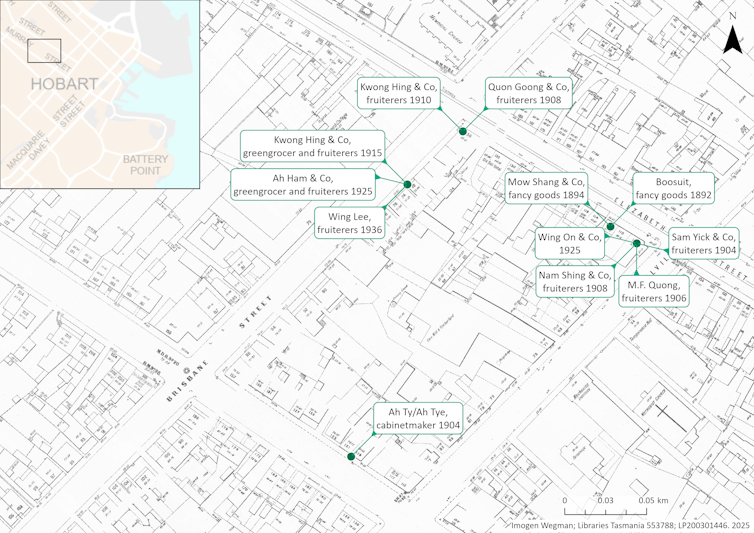
After mapping 105 “Chinese” addresses across the centre of Hobart, we found these businesses were scattered across the whole city. So while Tasmania’s capital has never had a Chinatown like Melbourne or Sydney, the footprint of Chinese migration remains all over the city to this day.
White-washing the past
Claude Nam Shing was an immigrant from China who arrived in Australia in the mid-1890s, making Tasmania his home for more than 40 years. In the 1911 census, he was one of 353 men in Tasmania who reported China as their birthplace – a reduction of more than 30% from the state’s peak in 1891.
After federation, the Australian government introduced the White Australia Policy, a series of discriminatory laws and policies designed to limit non-white immigration and restrict the rights of non-white residents.
Some immigrants of colour and their families chose to leave Australia, while others sought new opportunities by joining larger communities in cities like Melbourne and Sydney.
This internal migration coincided with urban renewal that saw accidental fires tear through ramshackle wooden storefronts and investment in modernised streetscapes.
In places that never had the population density for a Chinatown, early Chinese communities might seem to leave little tangible trace. But such an absence does not necessarily mean the absence of a Chinese history.
Unearthing Hobart’s history
Our growing dataset comes from diverse historical sources including birth and marriage records, naturalisation records, newspapers and gravestones. We are extracting as many names, addresses, and dates as possible, so we can restore individuals and families of Chinese heritage to Tasmania’s history.
Chinese businesses on one city block of Hobart.Author provided
Most of the Chinese immigrants who came to Australia before the 1950s trace their heritage to the Pearl River Delta in southern Guangdong province.
In towns and cities across Australia, Chinese migrants built communities that were often based on networks of family and kinship, hometown origins and common dialects.
Those who came to Tasmania mostly came from one of two counties: Sunwui and Toishan (today known as Xinhui and Taishan in Mandarin), where the local dialects differ from the standard Cantonese spoken in Guangzhou and Hong Kong.
By mapping shops and businesses we found in Tasmania’s Post Office Directories, we could see those networks in action as businesses changed hands over the years, but stayed within the Chinese community.
From fruiterers to fancy goods
On one street corner, Alfred Wood’s “fruiterer” business was sold to Peter Quon Goong in 1907, then to Kwong Hing two years later. Within three years, this shop was known as the “Chinese fruiterers”, distinguishing it from at least four other fruiterers within a few doors.
Near another corner of this block, we found one of several Chinese cabinetmakers, Ah Tye. He may have chosen this property because it placed him conveniently close to the F&E Crisp timber yards.
The block could have been dominated by these yards. They filled half of it, and it’s had such longevity that the new university building we work in is called The Forest.
Instead, we see an array of industries – bootmakers, blacksmiths and boarding houses – and retailers including those run by Chinese migrants.
Along with greengrocers and fruiterers, Chinese Tasmanians operated confectionery and gift shops, and what were known as “fancy goods” stores. These sold “exotic” imports, and personal and household items.
In the 1890s on this block was the store of Vong (or John) Boosuit, who started as a hawker of fancy goods before becoming successful enough to start a bricks-and-mortar business.
Boosuit married Selina Findon, the daughter of an English convict, and today their descendants include actor Patrick Brammall.
The only time we found Chinese businesses clustered together in Hobart was when they required specific infrastructure. There were a few small groups of laundries tucked around the city, in locations we assume had a reliable water supply and enough space for drying washing.
Driving community spirit
Tasmania’s newspapers tell of the generosity of Chinese migrants towards their new home. Their shops not only served Hobart’s residents, they were also community hubs.
For nearly half a century, the fruiterers at Ah Ham & Co organised an annual fundraising drive for the main Hobart hospital, despite rarely using the hospital themselves.
Migrants and their children in a small city were comfortable moving between two of its most active cultures – British and Chinese.
Between 2011 and 2021, the population of central Hobart that speaks a language other than English at home nearly doubled, from 12.5% to 24%.
Rather than viewing this as a radical change for Australia’s island capital, it reads more as a rekindling of a history that was interrupted for more than 70 years by the White Australia Policy.
As we walk through the multicultural bustle of our inner-city university campus, we are following streets that were home to successful laundries, fancy good stores, tobacconists, fruiterers, grocers and restaurants run by immigrants well into the 20th century.
The descendants of Australia’s earliest Chinese migrants, many of whom still live in our rural and regional areas, should be proud of the central role their ancestors played in creating the towns and cities we have today. The built heritage may have gone or be hidden, but their stories linger waiting to be found in the written record.
In the first two weeks of March, two young Indonesian women died alone in a hospital in Phnom Penh, Cambodia.
The first, who Indonesian officials have identified as 22-year-old Susi Yanti Br. Sinaga died following a critical illness, despite having no prior health conditions.
Her family said Susi left Indonesia in December 2025 with her boyfriend and a promise of a job in Malaysia. She ended up being trafficked into a scam compound in Cambodia. Within three months, she was dead.
The other woman, a 20-year-old shopkeeper from Pekanbaru, Riau province, arrived in Cambodia under similar circumstances and died only a few days after Susi. According to multiple NGO sources who assisted her in her final days, her death was linked to the physical and sexual abuse she suffered in the compound.
These women are among the thousands of young people who have found themselves stranded in Cambodia in recent months after leaving scam compounds that had opened their doors in anticipation of rumoured police raids.
Many who have made their way to the Cambodian capital are Indonesian. They began lining up outside the Indonesian embassy in Phnom Penh in mid-January, seeking help to return home.
By March 9, the embassy said it had received more than 5,400 requests for assistance from Indonesian citizens in less than three months. Over 1,800 have so far been repatriated with the embassy’s assistance. Most of the others are now hosted in a dedicated facility, where they wait for their turn to leave.
These numbers represent a sharp increase from 2025. They highlight the scale of trafficking of young Indonesians into “scam factories” across Southeast Asia, mostly in Cambodia, Laos, Myanmar and the Philippines.
Clearly, what is happening to these Indonesians is a complex structural problem, shaped by regional labour precarity and weak regulation.
Yet, Indonesia is largely overlooked in existing media coverage of the issue. Relatively little is known about how Indonesians are entrenched in the industry as victims, operators and stakeholders.
In March last year, the Indonesian government reported that, with the assistance of the Thai government, it had rescued and repatriated 569 of its citizens from online scam compounds in Myanmar.
This drew national attention to the issue, raising urgent questions about why and how so many young people are being lured into this work.
Spurred by limited employment opportunities, low wages and political discontent, Indonesian youths have been leaving the country in droves.
Some of these young people enter the scam economy willingly. Others go voluntarily but find themselves trapped once inside. Many more are deceived from the outset, lured into becoming so-called “cyber slaves”.
Among rescued trafficking victims, familiar stories emerge. Most are recruited through friend referrals or fake job offers on social media. Once at their destination, however, they are abducted and trafficked into scam compounds. Their passports are confiscated. They are told they owe large fees for flights, visas, accommodation or training, and must work to repay this debt.
Some of these victims eventually rise through the ranks to become scam operators, supervisors or even recruiters who lure other Indonesians, often friends or family, into the industry.
As NGOs have highlighted, however, progression in the industry often involves coercion and debt bondage. Many are compelled to recruit others as a condition for repaying imposed debts, avoiding punishment or securing improvements in their living conditions.
This contributes to the criminalisation of trafficked individuals. They should instead be recognised and protected as victims of modern slavery.
Escaped from slavery, greeted as suspects
In Indonesia, public discourse tends to frame those who end up in scam compounds either as criminals or gullible youths who fell for false promises.
Following the mass repatriation of Indonesian nationals from Myanmar scam centres last year, returnees were detained and questioned before being released.
They were processed primarily through law enforcement procedures rather than victim support mechanisms.
Indonesian police have also noted some citizens returning from Myanmar’s scam centres refused to be repatriated because of the money they were earning as scammers.
Those who have recently emerged from scam compounds in Cambodia are even more likely to be perceived as willing perpetrators. Cambodia’s growing reputation as a regional hub for cybercrime has fostered a widespread assumption that Indonesians who travel there already know what kind of work awaits them.
Recent news coverage highlighting the large number of Indonesians working in Cambodia’s online industries has further entrenched this narrative, casting them as complicit actors deliberately scamming fellow citizens.
In the wake of the reports of the recent Cambodian raids, some government officials have called for returnees to face criminal prosecution under Indonesian law.
On social media, some popular commentators have argued Indonesian scam workers should not be repatriated. Some have even called for them to be stripped of their citizenship.
Indonesian survivors of scam compounds waiting for repatriation in Cambodia.Roun Ry, Author provided (no reuse)
Who benefits from blaming trafficked workers?
Framing returnees as potential criminals is politically convenient but counterproductive. It discourages victims from seeking help from authorities.
It also makes it more difficult for civil society organisations, already strapped for funding, to mobilise support for these young Indonesians.
This ultimately benefits traffickers and industry operators.
This narrative also obscures how Indonesians are now involved at all levels of the scam industry, from recruiters and transnational operational staff to elites with financial stakes in the businesses.
The persistent focus on criminalising trafficked workers diverts attention from the deeper structures of deception and exploitation underpinning the industry.
With youth unemployment still high in Indonesia, this issue is not going away. Until trafficked workers are treated as victims rather than criminals, and the structures that feed this industry are addressed, the cost will continue to be borne by vulnerable young people like Susi and the young woman from Pekanbaru who died alone in Phnom Penh.
Claws are out over a directive to restrict the movements of two popular moggies at Taranaki Base Hospital.
Pip, and more recent arrival Pablo, are a common sight at the hospital – but staff have been told the animals are not permitted in hospital buildings, citing infection prevention and clinical safety standards.
Taranaki Base Hospital says only approved service animals are allowed in hospital buildings.
Ngaere woman Tracey Blake said Pip was a godsend when her daughter was in and out of hospital during a difficult pregnancy, while also having to care for a toddler.
“Pip kept an 18-month-old entertained. Walking into maternity, walking through the maternity doors, he was there and he was never a problem.
“He was just a real lift for our day, and every time we went there he gave little grandchild something to look forward to. It was just amazing.”
Pip the cat at Taranaki Base Hospital.Robin Martin / RNZ
She thought the mental wellbeing of patients should also be a consideration.
“It’s a proven fact that having an animal can help alleviate stress, and if it gives a moment of peace shouldn’t that outweigh any risk.
“He’s not in a birthing suite. He’s not actually going into where the babies are. He’s wandering the corridors, and I can’t see that that is any different than somebody coming in with dirty shoes.”
A petition was started on the Adventures of Pip Facebook page – where Pablo also features frequently – in support of the cats, and it had been flooded with messages.
Suz Cowley said Pip was a comfort to her 10-year-old son Theo when visiting his grandmother at the hospital.
Pip the cat at Taranaki Base Hospital.Robin Martin / RNZ
“We were sitting waiting for my mum to be picked up, and Pip came strolling along and my son, he just adores cats. So he went up to approach him and Pip was sweet as with him, having a little cuddle on the floor, which was really lovely.”
She said hospital visits can be difficult for children, but not with Pip about.
“So Pip coming along just broke the boredom and yeah, it was instant friendship too. It was beautiful. And yeah, and mum managed to get a little pat with Pip too. It was beautiful.”
Holy Malcolm – a junior doctor at Taranaki Base – is Pablo’s owner. She said the two-and-a-half-year-old birman was a wanderer.
“One day when I was walking to a night shift I hadn’t seen him for a couple of days and he jumped out of the bushes besides our maternity ward, and I think we were both just as shocked to see each other there.
“And I thought it might have been a one-off, but everytime I’d come into work he’d be waiting outside ED or around the psych department.”
Pip the cat at Taranaki Base Hospital.Robin Martin / RNZ
Malcolm had seen for herself how Pablo could lift people’s spirits.
“I’ve seen and heard how Pablo’s able to interact with people and the difference he can make to their day.
“A lot of people around hospital are having a rough time and I think if he can make that better I think that’s great.
“There’s a lot of evidence to suggest having an animal is really good for people’s health, you know, a lot of people are lonely and even if it’s the company of an animal I think that’s great.”
PabloSupplied
Malcolm said there was no argument that Pablo or Pip should not be allowed in ED, theatre or clinical areas.
Outside Taranaki Base Hospital most people were fans of the moggies.
“I think it’s terrible to trespass Pip,” said one hospital contractor.
But another woman was not so sure.
“From a practical point of view I don’t think good to have the cats in the buildings.”
A nurse came down in favour of the felines.
“I think the weight of opinion is that Pip was helpful for the patients and the staff.”
Supplied
A young doctor was on the same page.
“I feel like he’s a pretty well-liked cat, everybody loves Pip staff and patients.”
Another staff member said Pip was well known in her family.
“He’s great, Pip, my baby niece is obsessed and everytime I come home from work she doesn’t ask me how my day was – she asks me how Pip is.”
Pip the cat at Taranaki Base Hospital.Robin Martin / RNZ
In a statement, Te Whatu Ora group director operations Taranaki, Wendy Langlands, acknowledged the enjoyment Pip and Pablo brought to some staff and patients.
“Recently, staff were reminded of existing expectations around animals in clinical areas such as maternity and the neonatal unit. These expectations are in place to ensure we meet infection prevention and clinical safety standards that apply in healthcare settings.”
Langlands said only certified assistance animals, such as guide dogs, are allowed in hospital buildings, or those approved for palliative care and therapy visits.
“Our staff have been reminded not to feed animals or provide bedding. If an animal does wander into a building, staff have been advised to gently guide it back outside.
Hospital communications seen by RNZ said if the cats continued to come inside, staff should call security.
They were also warned to avoid being photographed with the felines in Health NZ uniform and sharing such images online.
Langlands said these expectations helped ensure the hospital environment remained safe for patients, whānau and staff.
“We acknowledge Pip and Pablo as a friendly presence around the hospital grounds.”
A second case of meningococcal disease has been reported in the Dunedin student community, Health New Zealand says.
On Tuesday, the University of Otago confirmed a case of the disease within its student community.
National Public Health Service medical officer of health Dr John Eastwood said close contacts had been identified and offered antibiotic and vaccination protection.
The first case was an Otago Polytechnic student who was a resident at Te Pā Tauira. They tested positive for the disease and have been receiving care at Dunedin Hospital since last Saturday.
The disease is caused by a bacterial infection and can lead to or permanent disability including deafness.
“The National Public Health Service has worked closely with the tertiary education facilities the cases attend and determined that the risk of meningococcal disease in the community or among other students and staff remains low, as the infection is only passed on when people have close or prolonged contact with a case,” Eastwood said.
The Meningitis Foundation said it was critical the student community were aware of the risks and avoided sharing drinks and vapes, and monitored closely for any symptoms which could be similar to the common cold.
They included a stiff and sore neck, sensitivity to light, a severe headache, aching sore joints, and vomiting.
The MenACWY and MenB vaccines are free for ages 13 to 25 years old in their first year of close living situations including boarding school hostels, university halls and prisons.
Symptoms can appear suddenly and may include:
Fever
Severe headache
Neck stiffness
Sensitivity to light
Nausea or vomiting
Cold hands and feet or limb pain
Drowsiness or difficulty waking
Confusion
A rash that does not fade when pressed.
Sign up for Ngā Pitopito Kōrero, a daily newsletter curated by our editors and delivered straight to your inbox every weekday.
– Published by EveningReport.nz and AsiaPacificReport.nz, see: MIL OSI in partnership with Radio New Zealand
Pip the cat at Taranaki Base Hospital.Robin Martin / RNZ
Claws are out over a directive to restrict the movements of two popular moggies at Taranaki Base Hospital.
Pip, and more recent arrival Pablo, are a common sight at the hospital – but staff have been told the animals are not permitted in hospital buildings, citing infection prevention and clinical safety standards.
Taranaki Base Hospital says only approved service animals are allowed in hospital buildings.
Ngaere woman Tracey Blake said Pip was a godsend when her daughter was in and out of hospital during a difficult pregnancy, while also having to care for a toddler.
“Pip kept an 18-month-old entertained. Walking into maternity, walking through the maternity doors, he was there and he was never a problem.
“He was just a real lift for our day, and every time we went there he gave little grandchild something to look forward to. It was just amazing.”
Pip the cat at Taranaki Base Hospital.Robin Martin / RNZ
She thought the mental wellbeing of patients should also be a consideration.
“It’s a proven fact that having an animal can help alleviate stress, and if it gives a moment of peace shouldn’t that outweigh any risk.
“He’s not in a birthing suite. He’s not actually going into where the babies are. He’s wandering the corridors, and I can’t see that that is any different than somebody coming in with dirty shoes.”
A petition was started on the Adventures of Pip Facebook page – where Pablo also features frequently – in support of the cats, and it had been flooded with messages.
Suz Cowley said Pip was a comfort to her 10-year-old son Theo when visiting his grandmother at the hospital.
“We were sitting waiting for my mum to be picked up, and Pip came strolling along and my son, he just adores cats. So he went up to approach him and Pip was sweet as with him, having a little cuddle on the floor, which was really lovely.”
She said hospital visits can be difficult for children, but not with Pip about.
“So Pip coming along just broke the boredom and yeah, it was instant friendship too. It was beautiful. And yeah, and mum managed to get a little pat with Pip too. It was beautiful.”
Holy Malcolm – a junior doctor at Taranaki Base – is Pablo’s owner. She said the two-and-a-half-year-old birman was a wanderer.
“One day when I was walking to a night shift I hadn’t seen him for a couple of days and he jumped out of the bushes besides our maternity ward, and I think we were both just as shocked to see each other there.
“And I thought it might have been a one-off, but everytime I’d come into work he’d be waiting outside ED or around the psych department.”
Pip the cat at Taranaki Base Hospital.Robin Martin / RNZ
Malcolm had seen for herself how Pablo could lift people’s spirits.
“I’ve seen and heard how Pablo’s able to interact with people and the difference he can make to their day.
“A lot of people around hospital are having a rough time and I think if he can make that better I think that’s great.
“There’s a lot of evidence to suggest having an animal is really good for people’s health, you know, a lot of people are lonely and even if it’s the company of an animal I think that’s great.”
Malcolm said there was no argument that Pablo or Pip should not be allowed in ED, theatre or clinical areas.
Outside Taranaki Base Hospital most people were fans of the moggies.
“I think it’s terrible to trespass Pip,” said one hospital contractor.
But another woman was not so sure.
“From a practical point of view I don’t think good to have the cats in the buildings.”
A nurse came down in favour of the felines.
“I think the weight of opinion is that Pip was helpful for the patients and the staff.”
A young doctor was on the same page.
“I feel like he’s a pretty well-liked cat, everybody loves Pip staff and patients.”
Another staff member said Pip was well known in her family.
“He’s great, Pip, my baby niece is obsessed and everytime I come home from work she doesn’t ask me how my day was – she asks me how Pip is.”
Pip the cat at Taranaki Base Hospital.Robin Martin / RNZ
In a statement, Te Whatu Ora group director operations Taranaki, Wendy Langlands, acknowledged the enjoyment Pip and Pablo brought to some staff and patients.
“Recently, staff were reminded of existing expectations around animals in clinical areas such as maternity and the neonatal unit. These expectations are in place to ensure we meet infection prevention and clinical safety standards that apply in healthcare settings.”
Langlands said only certified assistance animals, such as guide dogs, are allowed in hospital buildings, or those approved for palliative care and therapy visits.
“Our staff have been reminded not to feed animals or provide bedding. If an animal does wander into a building, staff have been advised to gently guide it back outside.
Hospital communications seen by RNZ said if the cats continued to come inside, staff should call security.
They were also warned to avoid being photographed with the felines in Health NZ uniform and sharing such images online.
Langlands said these expectations helped ensure the hospital environment remained safe for patients, whānau and staff.
“We acknowledge Pip and Pablo as a friendly presence around the hospital grounds.”
As the US–Israel war on Iran escalates, so too does the global oil crisis.
The effective closure of the Strait of Hormuz, through which roughly 20% of the world’s oil and natural gas flows, and the targeting of oil production facilities in the Middle East have lifted the oil price by 34%.
The price of Brent crude – the global benchmark – now sits at more than US$100 a barrel.
This means the cost of the many products derived from crude oil, such as petrol or gasoline, has also surged.
But how does crude oil become the fuel you pump into your car?
Like simmering a pasta sauce
Most consumers are transfixed when the oil price exceeds US$100 per barrel. But the economic reality is both more complex and longer-term.
That’s because the content of the barrel itself is not directly usable.
Rather, it must be broken (or “fractionated”) into the chemicals used to produce more than 6,000 everyday products.
These household items include the textiles and clothing dyes on our literal backs, electronics in our hands, flooring beneath our feet, and pharmaceuticals regulating our bodies.
Some of these products can be replaced with non-petroleum alternatives. But doing so can increase consumer prices by an order of magnitude.
The process of transforming a barrel of oil into these products is managed in the discipline of chemical engineering, through which high-temperature vessels (called “columns”) allow fluids to be split (or “fractionated”) into less- and more-dense products.
The experience is similar to simmering a pasta sauce, where the chef uses a precise temperature to boil off water (the less dense product) and concentrate the chemistry that makes tomatoes enjoyable.
Splitting in sequences
Unlike the hundreds of chemicals in the humble tomato, the tens of thousands of individual chemicals in a barrel of oil mean that between five and ten of these fractionation columns must be placed in sequence, each producing a more precise product than the last.
Most consumers would be familiar with the products of the first few columns, in which natural gas is the least dense (or “lightest”) product that typically powers the above-mentioned chef’s stove.
The next-densest product is gasoline, which accounts for around half of the volume of a traditional barrel of oil.
With additional heat and cost, the heavier products can be split into kerosene (“jet fuel”) and, with yet more heat, the diesel fuel that constitutes around one quarter of an average barrel.
Separating out the remaining products requires extremely high temperatures. This results in chemicals used to manufacture modern roads, rubbers, synthetic fabrics, plastics and cosmetics, among many others.
The final complication emerges from the geological processes that themselves “manufacture” crude oil.
Over millions of years, high pressures and temperatures degrade and liquefy (or “cook”) volumes of dead plants and animals, often deep under the ground.
As the plants, animals and geology of each biome are unique, so too is the crude oil formed under ground. This reality means that one barrel of oil cannot simply be traded for another and used in the refinery columns described above. The collection of columns requires months to reach stable operation, and they are heavily dependent on the type and properties of the oil at the inlet.
Crucially, the time lag between producing one barrel of oil and finding its chemistry in the hands of an eager shopper is typically between one and three months, depending on the complexity of the consumer product.
Gasoline prices may feel an impact within a few weeks, while consumer plastics (such as food storage containers) may require multiple quarters to demonstrate an impact.
Alongside countries heavily dependent on crude oil imports, those with limited crude oil reserves or refining capacity are further exposed, as they must also import the crude oil “products” described above.
The conflict itself involves Western and Middle Eastern forces. But it is ironically those Pacific nations that carry the greatest near- and mid-term inflationary risk as this crucial shipping lane is put in jeopardy.
Vitamin C is one of the most iconic nutrients in popular health culture, often credited with preventing colds, boosting immunity and even fighting serious diseases.
But while it’s essential for our bodies to function, its benefits are often misunderstood or overstated. Before you stock up on supplements, here’s what to consider.
What is vitamin C and why does my body need it?
Vitamin C, also known as ascorbic acid, plays several essential roles in the body.
It is a powerful antioxidant, protecting cells from damage. Vitamin C supports the immune functions of the body, aids in absorption of iron, and is involved in wound healing.
Vitamin C also helps in the synthesis of collagen, which holds together tissues and is a structural component of gums and skin. A severe deficiency of vitamin C leads to a health condition called scurvy, where the body produces insufficient collagen and can’t hold tissue together. Eventually, the gums cannot hold onto teeth and they fall out, and blood vessels break down, causing internal bleeding.
Humans cannot synthesise vitamin C. We must take it in through our diet. Most of our vitamin C comes from vegetables (about 40%), fruits (19%) and from vegetable or fruit juices (29%).
Chemically, the vitamin C in supplements is identical to the vitamin C in food. Your body cannot tell the difference.
What is missing in supplement forms of vitamin C is the fibre, flavonoids, other vitamins, minerals and phytochemicals that come with food, and that may work together with vitamin C.
These other compounds help with absorption, provide complementary antioxidants, and together with vitamin C, provide health benefits that the vitamin by itself does not.
Historically, sailors often had a very limited diet and were often struck down with scurvy. But if you have a balanced diet, you don’t need vitamin C supplements.
What does vitamin C treat and not treat?
Common cold
Vitamin C has been promoted as a way to boost the immune system. It’s widely considered as a way to prevent and treat the common cold and flu.
However, results from a review of all the evidence has shown regular supplementation of 200 mg or more vitamin C does not reduce the incidence of the common cold.
Regular vitamin C supplement does reduce the duration, and at doses greater than 1,000 mg or more, could reduce the severity of common cold symptoms.
When vitamin C is used for treating common colds and only taken at the start of cold symptoms, it does not affect the duration and severity. Some studies have a shown very limited benefit when taken daily before getting sick, but the benefit was very small. Overall, the authors concluded routine supplementation with vitamin C is not worthwhile.
Heart disease and stroke
Research has shown vitamin C supplementation does not change the risk of a range of cardiovascular diseases including heart attack (myocardial infraction), stroke or angina.
One study found vitamin C supplementation at more than 200 mg daily may lower systolic blood pressure (the top number in a reading) by around 4 mmHg and diastolic blood pressure (the lower number) by around 2 mmHg. These are very small changes.
These effects are comparable to regular aerobic exercise and may not be clinically meaningful compared to treatment with conventional medicine, which generally lowers systolic blood pressure by at least 12 mmHg.
Cancer
There are consistent results from multiple studies that show vitamin C supplementation is unable to prevent cancer, including for gastrointestinal, lung, breast, prostate and colorectal cancers.
Vitamin C is water-soluble and gets excreted in urine, so the body cannot store it. This means mega-dosing does not provide any benefit, and may in fact cause health problems.
At high doses (above 2,000 mg daily), vitamin C may cause mild to serious side effects. Too much is known to cause diarrhoea, nausea and abdominal cramps. It can also contribute to the formation of kidney stones in men, but not women.
For people who have chronic kidney disease, vitamin C can be especially problematic because vitamin C is flushed from the body by the kidneys. But when the kidneys don’t work properly, it can build up and cause kidney stones.
Should you take a vitamin C supplement?
For most people, a vitamin C tablet is unnecessary. You will get enough from a good balanced diet, from foods such as citrus fruits, berries, tomatoes, capsicum, broccoli and kale.
The evidence doesn’t support claims that vitamin C supplements prevent colds, heart disease or cancer. In fact, the risks may outweigh the benefits.
Extra demand on Gull’s discount day has left some of its petrol stations running low on fuel.
Gull said 3 percent of its sites had not been able to meet the extra demand from customers when it cut prices on its regular Thursday promotion.
Commenters online said Onehunga’s Gull was out of 95 and media reported that Greville Road, Henderson, Torbay, Takanini and Takapuna were also out of at least one sort of fuel.
“Sites that sold through yesterday, have, or are currently being refuelled for Gull’s customers by our logistics’ provider,” a spokesperson said.
AA spokesperson Terry Collins said the wider fuel network ran on a “just in time” basis and any extra demand from people panic buying would put stress on the system.
He said those stations would have a wait until the next delivery arrived.
Gull said 3 percent of its sites had not been able to meet the extra demand from customersNick Monro / RNZ
Ongoing disruption in the Middle Easy, and the closure of the Strait of Hormuz, have pushed up oil prices as well as fears about its continued supply internationally.
Have you tried to purchase petrol at a station that’s run out? Email susan.edmunds@rnz.co.nz
The Ministry of Business, Innovation and Employment said as of March 8, the country had 32.8 days’ worth of petrol in the country and 25.2 on the water. It also had 27.6 in the country of diesel and 22.3 on the water.
It said most oil companies had reported no supply chain issues.
At Z, a spokesperson said it was experiencing demand in some areas but the impacts on its ability to supply customers were “minimal”.
“Our teams are working as quickly and safely as possible to move fuel through our network. This is about getting fuel to the right places to meet demand, at this stage, there is no shortage of fuel overall.”
Last Friday, Gaspy said the average price of 91 was about $2.66 – falling to about $2.60 after the impact of the previous day’s discounts worked out of the system. This Friday, it had reached $2.90.
Anyone stockpiling petrol in their homes may need to check the implications for their insurance policies.
A spokesperson or the Insurance and Financial Services Ombudsman said it would present a fire hazard and a risk to property. “Insurers would likely not be comfortable with it.”
Ferzil Babu, who went missing while on a fishing trip at The Gap, Taiharuru on 1 May, 2024.GiveaLittle
Human remains located on Coppermine Island (Mauipane), east of Whangārei have been identified as belonging to a person who went missing in May 2024.
He had been fishing at The Gap – a popular, but sometimes treacherous, fishing spot at Taiharuru.
On 20 December 2025, a member of the Department of Conservation contacted police after finding the remains on Coppermine Island (Mauipane).
The remains have since been examined by a pathologist, anthropologist, and ESR scientists to assist the police with identification.
Following the examination, the human remains have now been confirmed as those of missing person Ferzil Babu, who went missing while on a fishing trip at The Gap, Taiharuru on 1 May, 2024.
Police have since spoken with Babu’s family to inform them of the finding.
Source: The Conversation (Au and NZ) – By Danaë Anderson, Lecturer in Occupational Health and Safety, Te Herenga Waka — Victoria University of Wellington
Every year organisations roll out their refreshed strategies, new KPIs and ambitious goals for the year ahead.
But despite the changing pace in work patterns, technology and workforce requirements, one thing remains stubbornly static: individual performance reviews.
Most of us will recognise how these show up in the workplace: the classic assessment form with boxes to be ticked, rating scales from one to ten, and that awkward blank space for “additional feedback”.
We know these processes are outdated. Researchers have shown for years such systems are backward‑looking, can distort worker behaviour, and overlook collaboration and learning.
We know they are retrospective assessments of narrowly defined individual “quality”. And we know they often fail to reflect the real work people do (versus what they are rewarded for).
But year after year they persist. So why keep using them?
A workplace disconnect
There is substantial research showing why conventional performance appraisal and KPI (key performance indicator) regimes disappoint. Part of the problem is the way they blur the line between pay and performance.
Management scholars have long distinguished performance measurement (for pay and promotion) from performance improvement (for learning and development).
Collapsing both aims into a single annualised process fuels an inherent tension between two quite different activities.
Even more problematic is the timing. Delayed, yearly feedback tends to be outdated and of limited use, missing crucial opportunities for improvement throughout the year.
One widely cited review concluded that formal, ratings‑heavy systems are “tedious and low‑value”. The work of improving performance, it proposed, happens through having ongoing expectations, giving real‑time feedback and offering opportunities for development – not in annual rituals.
A 2024 survey of performance management by global consultancy Betterworks echoed this. While most workplace leaders rated their performance management processes highly, it found, employees saw a very different picture: 44% said those processes were a “significant failure”.
In fact, employees were 57% less likely than leaders to believe performance management was working well. Why such a disconnect and why does it persist?
The illusion of objectivity
Cornell University’s Center for Advanced Human Resource Studies offers some clues. Its 2025 analysis of performance management trends showed traditional systems remain in place not because they work well, but because they are:
institutionally embedded, usually tied to remuneration, promotions, compliance and human resource cycles
perceived as objective even when they are not
time-consuming to revise, making organisations reluctant to overhaul them
misaligned with what employees want, with only one in five motivated by current systems.
Conventional employee performance metrics – output per hour, number of tasks completed, sales quotas – were built for an era when work was predictable and place‑based. They fail to capture what drives organisational success today.
Social scientists have repeatedly warned that when a metric becomes a target, it stops being a good measure because people alter their behaviour to score well on the indicator itself.
In practice, “over‑optimising” to a KPI nudges people to game the numbers or incentivises the wrong behaviours. Workers take shortcuts or work too much rather than improve the actual outcome of that work.
Organisations see the same pattern on a broader scale: counting outputs and chasing quotas can depress quality, long‑term value and collaboration.
This is especially true when automation takes over routine tasks and human contributions shift toward creativity, problem‑solving and long-term value creation – things that are hard to reduce to a single metric.
Conversely, when performance metrics lack clarity, supervisors’ subjective opinions tend to substitute for actual data.
Yet many workplaces still default to old metrics simply because they are familiar, quantifiable and embedded. The irony is striking: organisations have more employee information than ever before, yet many performance systems still rely on out-of-date snapshots and reductive metrics.
As one expert notes, complex performance realities are often oversimplified into frameworks that “manufacture” quantitative data to create the illusion of objectivity.
What if we measured what really matters?
Research on modern high‑performance management approaches indicates a strong move away from inflexible annual reviews in favour of ongoing, manager‑supported performance conversations.
Changes that drive more effective employee motivation and engagement include:
continuous, real-time feedback
short-term, adaptable objectives
informal, ongoing conversations between managers and staff
“360‑degree input”, where performance insights come from multiple colleagues, giving a more balanced view of how someone works with others
These approaches better reflect how the best work actually happens: bit by bit, collaboratively and often unpredictably.
As organisations set their goals for the new financial year, perhaps the most meaningful metric they can adopt is one that measures the effectiveness of performance metrics themselves.
Do they inspire growth? Do they capture real value? Do they motivate? Do they reflect the actual work their employees perform?
Answering those questions offers an opportunity to identify what no longer serves us. For many workplaces, performance metrics might be the most overdue area for review.
Eliza McCartney has won selection for the world indoor athletics champs in Poland.David Rowland/Photosport
Eliza McCartney’s impressive pole vault at the New Zealand athletics championships last weekend has won her a place at the world indoor champs in Poland.
McCartney was in a three-way battle with Imogen Ayris and Olivia McTaggart for the two women’s pole vault places in the New Zealand team for the champs later this month.
Ayris was the front-runner after she cleared 4.76 metres in finishing third at an indoor meet in France nearly three weeks ago, while McTaggart and McCartney had recently vaulted 4.70m, which was the automatic qualifying mark for Poland.
McCartney’s vault was just a fraction better than the 4.80m which secured her silver at the 2024 world indoor champs in Glasgow.
All nations were limited to two athletes per event in Poland.
A number of prominent athletes – Sam Ruthe, Sam Tanner, James Preston, Hamish Kerr, Maddi Wesche, Rosa Twyford and Jacko Gill – were eligible for selection but made themselves unavailable to focus on preparing for other international events.
But two other world indoor champs medallists will join McCartney in Poland – with Tom Walsh defending his men’s shot put crown, while last year’s 3000m steeplechase champion, Geordie Beamish, will run in the 3000m flat event.
Tom Walsh won gold at last year’s world indoor champs.AFP
Sprint stars Zoe Hobbs and Tiaan Whelpton will run in the 60m events, after sealing qualification at the Sir Graeme Douglas International meet in Auckland last month. Hobbs finishing fourth in the world indoor champs in Glasgow in 2024 and sixth in Nanjing last year, while Whelpton matched his New Zealand resident record over 100m at the Douglas meet.
Middle distance athlete Alison Andrews Paul returns for her second world indoors in the women’s 800m, which will also be contested by debutant Boh Ritchie, while James Harding and Thomas Cowan will run in the men’s 800m.
Harding and Cowan have traded the New Zealand indoor record this season, with Harding holding the mark at 1:46.44, set in February in the United States.
National record holder Lex Revell Lewis and national indoor record holder Annalie Kalma run in the 400m events, while Tapenisa Havea will compete at world senior level for the first time in the women’s shot put. She finished fourth in the shot put and seventh in the discus at the 2022 world under-20 champs.
New Zealand team for 2026 World Athletics Indoor Championships in Toruń, 20-22 March.
Men
Tom Walsh, shot put
Geordie Beamish, 3000m
Tiaan Whelpton, 60m
James Harding, 800m
Thomas Cowan, 800m
Lex Revell Lewis, 400m
Women
Zoe Hobbs 60m
Eliza McCartney, pole vault
Imogen Ayris, pole vault
Alison Andrews Paul, 800m
Boh Ritchie, 800m
Annalies Kalma, 400m
Tapenisa Havea, shot put
Reserve (Non travelling)
Olivia McTaggart, pole vault
Sign up for Ngā Pitopito Kōrero, a daily newsletter curated by our editors and delivered straight to your inbox every weekday.
– Published by EveningReport.nz and AsiaPacificReport.nz, see: MIL OSI in partnership with Radio New Zealand
Canterbury’s Selwyn District Council is mulling staff cuts and a recruitment freeze as councillors examine ways to keep this year’s rates rise down.
Councillors agreed on Wednesday to consult the public on an average rates increase of 5.4 per cent, with options of 4.9 per cent and 6.5 per cent also on the table in the draft annual plan.
While the proposed increases were less than half of last year’s 14.2 per cent hike, they excluded water charges and resulted in trade-offs.
The council had carved out savings in the draft plan by shifting some costs from general rates to user-pays, which could mean increased building consent costs, aquatic and fitness class fees and dog registration fees for ratepayers.
Selwyn mayor Lydia Gliddon said there were also savings to be made in-house, which could result in staff cuts.
“There’s a lot that we’re going to do internally and we need staff to quantify some of this stuff. At the moment we look at like a hiring freeze and actually do we need all of these roles, what are the core roles that we need to deliver core function of council and what are the ones that we don’t need and how do we lower our consultancy spend along side that as well,” she said.
“There are 75 open roles out at the moment, if we don’t need those roles we shouldn’t be recruiting for them.”
Total staff costs came to $47.3 million in the last financial year, compared to $32.7m in the 2022/23 financial year.
The draft plan said the lowest 4.9 per cent rates rise option could be achieved by significantly reducing recruitment at the council for the next year, removing some roles from budgets and significantly reducing consultant costs.
It was not recommended by staff, who said it could affect the council’s ability to meet its legal obligations and deliver services.
Gliddon said the 4.9 percent increase was yet to be fully modelled by the council.
“You’ve got to weigh up the risk. We can’t risk not delivering the level of service our community expects but we can’t charge the level of rates that we have been,” she said.
Gliddon believed general rates were subsidising some fees and charges more than they should.
“I think the user-pays is actually a better situation than the general rate having to offset at the rate that it is,” she said.
“I don’t think necessarily it’s fair if someone isn’t using something, they shouldn’t be paying or subsidising the full amount of it. It is a really fine line because you want to enable success of say facilities because there is a general good will in those and we want people to be using the space, and they’re paying a targeted rate for it, but it’s a bigger broader conversation and we need to figure this out with our community.”
The council would have to reduce its library programmes and exhibitions to achieve the 5.4 per cent increase.
The draft plan included investments in roading upgrades and maintenance, Lincoln’s town centre, replacement of the Whitecliffs bridge and remediation of the Leeston Medical Centre.
The council was predicting $213.6m in revenue during the next financial year, while it would spend $196.5m on operating expenses and $86m on capital infrastructure.
Gliddon said Selwyn’s rapid growth provided both an opportunity and a challenge for the council.
“We have national policy statements we’ve got to abide by providing 30 years worth of land for housing, that’s a lot when you’re a fast growing district. What we’re trying to do is try and release some of the burden from the general ratepayer having to subsidise growth because we know that’s not fair,” she said.
“We’re hoping that the development levy reform will come out and help us recover some of that.”
The council was in the process of recruiting a permanent chief executive after the resignation of Sharon Mason in December.
“We’ve appointed Sheffield as our recruitment agency. We’ve got a process to take place over the coming months. Ideally we’d like to have a permanent chief executive employed to go through the long term plan,” Gliddon said.
Public consultation on Selwyn’s draft annual plan opens on Monday.
Sign up for Ngā Pitopito Kōrero, a daily newsletter curated by our editors and delivered straight to your inbox every weekday.
– Published by EveningReport.nz and AsiaPacificReport.nz, see: MIL OSI in partnership with Radio New Zealand
Justice Minister Paul Goldsmith has batted away warnings from his officials that the government’s proposed ‘move-on orders’ could put vulnerable people at risk and pile hundreds more cases on the courts each year.
The powers announced in February would allow police to direct rough sleepers or beggars out of an area at threat of a $2000 fine or up to three months in prison.
Newly released advice from government agencies strongly urged against the move, warning the proposal would cause significant hardship for already vulnerable people.
Justice officials noted a “lack of empirical evidence” that the orders would reduce crime rates and said they were “highly likely” to merely shift begging or rough sleeping to different locations.
“Vulnerable individuals such as young people, disabled people, and people experiencing mental health issues, could experience a greater risk of safety from being moved out of city centres.”
Those people might also find it harder to access support networks or services, officials said, and that steep fines would either deepen cycles of poverty or just go unpaid, resulting in further involvement with the justice system.
They said the penalties were “disproportionately high” and in line with those for “much more severe behaviour” such as careless driving resulting in death, indecent exposure, or resisting police.
“Applying such significant fines to people who were issued an order for begging, rough sleeping, or creating makeshift dwellings (suggesting little to no income) is neither appropriate nor proportionate.”
Officials also said the evidence for a growing public disorder problem was limited, noting police data showing prosecutions for such offences had declined in recent years.
Modelling, referenced in the regulatory impact statement, suggested the policy could result in somewhere between 200 to 800 additional court cases.
Paul Goldsmith.RNZ / Samuel Rillstone
Officials said the increase would increase costs to the Ministry of Justice and could slow the progress of cases through the District Court.
They estimated it could result in an extra six people being imprisoned each year, at a cost to the state of $120,000 a year each.
Corrections warned the prison network already had limited capacity, and even small increases in the prison muster could trigger the need for new infrastructure.
RNZ earlier reported that key ministries, including justice and housing, had opposed the policy.
In a fresh statement to RNZ on Friday, Goldsmith noted the advice from officials but said it was for the elected government to determine how it moved forward.
In a statement to RNZ, Goldsmith noted the advice from officials but said it was for the elected government to determine how it moved forward.
“Just like the gangs legislation, which prompted similar warnings, we have every confidence police can operationalise this in a way that’s highly effective.
“This is about reclaiming our streets and our city centres for the enjoyment of everybody who visits, works and lives there.”
Goldsmith stressed that only people who refused the orders from police would face prosecution: “A move-on order is not a criminal charge.”
ACT MP Cameron Luxton is a self confessed good, keen fisherman. Asked about his biggest snapper, he recounts catching a 23-pounder (10.4kg) from a kayak.
“I tell you what, when I flipped that into the boat, I was bloody stoked.”
He seems to be angling for a few fishing votes as well. Ahead of the recent Auckland on Water boat show he put the call out on social media, asking to talk “to fishers about what they see happening on the water and what needs to change. If you’re there, come and have a chat.”
First Up took up the invitation, asking Luxton if fishing was a hot topic as he stepped off an exhibitor’s boat.
“It certainly seems to be, but it’s always been a topic that’s dear to me.”
Luxton’s not the only politician engaging with anglers. Sam Woolford, spokesperson for recreational lobby group Legasea, said he was definitely getting more attention from politicians.
“I think the easiest way to describe it is it must be an election year,” he said, “because, yes, it definitely feels like suddenly all of the political parties are a lot more attentive to what the public interests are.”
“Yeah, we’ve had a lot reach out. We’ve heard from Labour, National, ACT and New Zealand First.”
He said the parties were taking the issue very seriously.
“One of the two major political parties has put this between top three and top five on their manifesto for the election.”
SeaFood New Zealand recently told members seafood, commercial fishing and marine sustainability was becoming an election issue. CEO Lisa Futschek said it was in ongoing talks.
“So we have had discussions with the National Party, with the Labour Party, with ACT, with New Zealand First, with the Greens as well. We haven’t at this stage had success in meeting anyone from Te Pāti Māori.
“Our conversations and our engagement across the political spectrum is ongoing. And obviously, given that it’s election year, will be wanting to maintain those connections on a regular basis.”
Two weeks ago while out fishing, Luxton filmed a commercial vessel targeting a school of jack mackerel and skipjack tuna, describing the fish being encircled by the net.
“They’ll all be gone by Friday afternoon, all that bait,” he said in the video posted on his Facebook page.
“We’ve seen manta rays and stuff here on Friday afternoon, but who knows what’s in there at the moment”
But Luxton was not biting when asked if he had any concerns about commercial catchers.
“I think that New Zealand’s got to have adult conversations about the way we manage the marine resource. And, you know, I think a lot of people have seen things on the ocean that worry them.”
Seafood New Zealand has also been keeping an eye on Luxton’s posts.
“Yes, we have seen those posts” Futschek said, “and we have tried to understand if there was a particular issue or particular conversations that needed to happen between the recreational sector and the commercial fishing industry in Cameron’s electorate.”
Labour would do the same. In a statement, Labour’s acting oceans and fisheries spokesperson Priyanca Radhakrishnan said: “Oceans and fisheries are hugely valued sectors to New Zealand and certainly an area we are actively engaging in. A key focus for Labour is around sustainability of the sector, and ensuring it can grow to create skilled, well-paid jobs, while also protecting the health of our oceans.”
Shane Jones is the architect of the bill, but was not available for comment – fuel, rather than fishing, his priority this week.
Futschek said the commercial fishing industry was supportive of the reforms.
“They are essentially common sense changes and updates to an act which has been around now for 30 years.”
Legasea though believed the changes were weighted far too heavily in favour of the commercial sector.
“We’re talking about legalising dumping and discarding the fish at sea, or allowing the fishermen to actually turn off cameras at transition periods, or even the most ridiculous one, which will actually make it illegal for future ministers to take into consideration the impacts of fishing techniques when setting allowances.”
Politicians from across the divide are keen to ensure this election issue will not be the one that got away.
Have you ever heard two or more women say they’re on the same cycle?
This is a common claim among women who live together, for example in a family or as housemates.
This idea that people menstruate, or have their period, at the same time is known as “menstrual synchrony”. If their menstrual periods happen to regularly align, they might describe themselves as being “in sync”.
But is menstrual synchrony possible, according to science? Let’s unpack the evidence.
The ‘menstrual synchrony’ myth
The term “menstrual synchrony” is difficult to define.
In popular culture, it’s generally thought to be the result of various unknown factors which cause two or more people to have their period at the same time. So it is supposedly due to biology, not coincidence.
Scientists also struggle to define menstrual synchrony. According to one 2023 study, it is when people’s menstrual periods start at roughly the same time, not necessarily on the same day.
But as we’ll see, research suggests being on the exact same menstrual cycle as someone else is scientifically very unlikely.
Where did this idea come from?
A psychologist named Martha McClintock likely popularised the concept of menstrual synchrony. In a 1971 study published in the journal Nature, McClintock studied 135 women aged between 17 and 22 who all lived together in a college dormitory.
Her main finding was the menstrual cycles of women who shared a room or spent lots of time together aligned over time. But this was not the case among those who lived in the same building or spent more time with men, both of which are factors that influence mating behaviour in animals.
Despite being published in a reputable and widely-read journal, today there are as many studies refuting McClintock’s 1971 study as there are supporting it. Critics mainly point to the flawed assumptions and calculations McClintock made as part of the study.
For example, when the boarders first moved in, McClintock recorded the date when each person’s period started. Several months later, she again noted the boarders’ menstrual start date. However, she did not record the length of each person’s cycle over the course of the study. That makes it hard to know whether the boarders’ periods synced purely by chance.
McClintock’s study also assumed each boarder had a standard 28-day menstrual cycle. Before the 2000s, this was widely accepted as scientific fact. But multiple landmark studies which used apps to track pregnancy and contraception show the length of a menstrual cycle can vary. We now know it commonly lasts between 28 and 35 days.
One 2017 study examined the menstrual cycles of pairs of close friends or housemates. It found three-quarters of the pairs saw the timing of their periods become less, not more, aligned. But this study was not peer-reviewed, so we must interpret it with caution.
So, why is this myth still around?
Here are three reasons.
It makes some evolutionary sense
In one 2008 study, researchers suggested menstrual synchrony could lead to greater genetic diversity among groups of primates. They argued that if multiple females are capable of reproducing at the same time, it’s less likely that one alpha male will father all offspring. In theory, this would increase the group’s long-term survival through natural selection. This is the idea that beneficial genetic mutations are passed onto the next generation through reproduction.
It’s a common misconception
Many people believe menstrual synchrony is real. This could be because they’ve noticed their period starting around the same time as a friend, housemate or family member. But they may hold onto this myth because of confirmation bias. This is the idea that people look for evidence that affirms their existing beliefs, even if they don’t do it deliberately. So confirmation bias means we’re less likely to notice the times our periods are not in sync, or to simply dismiss that possibility.
It may help women connect
One American study found 90% of women surveyed believed in menstrual synchrony. Many described it as a “magical” concept which made them feel more connected to other women. Some also said it helped them cope with the challenges of menstruation. Another study found 70% of participants said they had experienced period syncing firsthand, with most viewing menstrual synchrony as a real and positive experience.
So the evidence suggests period syncing is not scientifically supported. But it still persists in popular culture. And for some women, it may make menstruation that bit more tolerable.
Keith Rankin, trained as an economic historian, is a retired lecturer in Economics and Statistics. He lives in Auckland, New Zealand.
Analysis by Keith Rankin.
Keith Rankin, trained as an economic historian, is a retired lecturer in Economics and Statistics. He lives in Auckland, New Zealand.
On Tuesday, I wrote UAE, Israel, And The Hexagon Alliance which illuminated Israel’s duplicity in relation to Hamas, and the understated but very strong alliance between the United Arab Emirates (UAE) and Israel. And Israel’s agenda to divide and rule the ‘Middle East’ by creating its own encircling alliance; and setting up two rival Muslim axes (a Shia axis, and a Sunni axis) which Israel would like to see weaken and damage each other.
Here I begin with other candid comments, by recent Israeli leaders, from the Australian 2024 documentary The Forever War. Themes include a mix of empathy and contempt for the indigenous Palestinian population, Benjamin Netanyahu’s trustworthiness, Ben-Gvir and Smotrich as “messianic” “terrorists”, Israel’s hold over the United States, and Israel’s self-inflicted diminishing security.
Excerpts from the Australian ABC documentary
TZIPI LIVNI, FMR FOREIGN & JUSTICE MINISTER: They hate us. We saw the results. The idea of eradicating Hamas completely from Gaza is a just cause.
YEHUDA SHAUL, FMR ISRAELI ARMY COMMANDER: That the IDF is doing everything to avoid civilian casualties is a blunt lie. Straight lie.
YEHUDA SHAUL, FMR ISRAELI ARMY COMMANDER: Y’know, [in the] the beginning I was also full of rage. I also had the feeling that these are animals, we need to go there and bomb the hell out of them. But then you stop for a second and you think, you say to yourself, what did we think is going to happen after 16 years of siege.
AMIRA HASS, OCCUPIED TERRITORIES CORRESPONDENT, HAARETZ: I was surprised and not surprised because I kept warning that people cannot stand the accumulated cruelty accumulated over so many decades. And somehow there will be an explosion. Somehow there will be an outburst. I couldn’t imagine what it would be, but there it came.
…
JOHN LYONS, REPORTER: You’ve spent a lot of time studying this obviously as head of Shin Bet. Could you describe what is the reality for Palestinians here?
AMI AYALON, FMR HEAD OF SHIN BET: It was a life of people who dream about freedom, and don’t see it. Whether we liked it or not, we control the life of millions.
JOHN LYONS, REPORTER: If you were a Palestinian living in the West Bank or Gaza, what would your view be of Israel?
AMI AYALON, FMR HEAD OF SHIN BET: I would fight against Israel in order to achieve my liberty.
JOHN LYONS, REPORTER: How would you fight? How dirty?
AMI AYALON, FMR HEAD OF SHIN BET: I would do everything in order to achieve my liberty. And that’s it.
EHUD BARAK, FMR PRIME MINISTER OF ISRAEL: Look, I once was asked some 30 years ago what I have been doing if I were a Palestinian and 30 years ago. I was new enough in politics to tell the truth that if I were born Palestinian probably would’ve joined one of the terror organisations.
…
JOHN LYONS, REPORTER: Israel’s famous for its targeted assassinations. I mean you yourself dressed as a woman famously and went into Beirut and met up with Mossad and went and killed a Palestinian leader. Israel’s done that over the years. Why couldn’t they have tried to strategically target Hamas leaders rather than kill those thousands of children?
EHUD BARAK, FMR PRIME MINISTER OF ISRAEL: I never deluded myself to believe that by killing any individual you solve the problem, you give them a blow and they will recover in a way it just delayed the real decision. Real decisions at the end are not about how to kill mosquitoes more effectively. It’s about how to drain the swamp [my emphasis].
…
JOHN LYONS, REPORTER: Do you trust Benjamin Netanyahu?
JOHN LYONS, REPORTER: Can the world trust Benjamin Netanyahu?
EHUD BARAK, FMR PRIME MINISTER OF ISRAEL: I don’t think that anyone can trust him. So basically, he lies to everyone and no one trust him.
…
EHUD BARAK, FMR PRIME MINISTER OF ISRAEL: BenGvir and Smotrich, the two racist messianic guys that seems to be to very strong leverage on Bibi. They want to turn it into a major religious war between Israel and the Islam.
JOHN LYONS, REPORTER: Are they dangerous?
EHUD BARAK, FMR PRIME MINISTER OF ISRAEL: Sure, they’re dangerous.
JOHN LYONS, REPORTER: How powerful are BenGvir and Smotrich and what do you think of them?
AMI AYALON, FMR HEAD OF SHIN BET: I see them as terrorists and as Jewish messianics, they represent only a small minority within the Israel society, but they get their power because of our coalition system.*
JOHN LYONS, REPORTER: But can I just check something? Are you calling the Minister for National Security and the Minister for Finance in Israel? Are you calling them terrorists?
AMI AYALON, FMR HEAD OF SHIN BET: Of course. They are.
JOHN LYONS, REPORTER: Is the brutal reality that Benjamin Netanyahu wants to continue this war for his own political survival?
EHUD BARAK, FMR PRIME MINISTER OF ISRAEL: Look, I cannot penetrate his soul and tell you for sure, but it’s clear that he acts as if the main objective of this whole event is his survival. He understands that if fighting will have a pause for six weeks or two times six weeks, the Israeli republic will demand accountability in spite of the fact that there is no word in Hebrew for accountability. It was not needed in our culture, but the public will demand it and he might lose his role, the prime minister.
…
excerpt from U.S. PRESIDENT JOE BIDEN: The state of Israel was born to be a safe place for the Jewish people.
JOHN LYONS, REPORTER: President Biden is a lifelong supporter of Israel.
excerpt from U.S. PRESIDENT JOE BIDEN: If Israel didn’t exist we’d have to invent it.
EHUD BARAK, FMR PRIME MINISTER OF ISRAEL: Israel cannot fight this regional war without having close relationship with the Americans. We need their support, not just in munitions that we do not produce in a high enough space to supply the needs of such a regional war, but we need them also to protect us in the UN Security Council. We needed them at the beginning of the crisis to deter Iran from getting involved or from activating the Hezbollah against us. And we will need them even in the Hague, to block the prospect that… Israeli commanders or even politically, they might find themselves as a criminal in the Hague or demanded to be broke. Only America can help us to avoid all this.
JOHN LYONS, REPORTER: Pro-Israeli lobby groups in the US wield immense power.
NATHAN THRALL, FMR DIRECTOR INTERNATIONAL CRISIS GROUP: Every politician in the United States knows that they can pay a major price with their jobs for not toeing the line. And the level of devastation that we are seeing now has so horrified the world and has so horrified the American public that now we have half of the people who voted for Biden saying that Israel is perpetrating a genocide in Gaza.
…
JOHN LYONS, REPORTER: Do you now fear for the future?
TZIPI LIVNI, FMR FOREIGN & JUSTICE MINISTER: I am worried. I am worried about the future of Israel. Yes, more than ever.
AMI AYALON, FMR HEAD OF SHIN BET: You cannot deter a person or a group of people if they believe that they have nothing to lose. We Israelis, we shall have security only when they will have hope.
JOHN LYONS, REPORTER: What’s the future for Palestinians
AVI DICHTER, CURRENT ISRAELI CABINET MINISTER: Supporting death will not bring you anything. If you don’t believe that the Jewish presence here between the Mediterranean and Jordan Valley is forever, you are going to lose more than you’ve lost till now.
*Coalition System
All electoral democracies – ie with parliamentary or congressional elections – face the problem of a very close electoral result in a partisan House. And, as Keir Starmer is finding out, political parties in traditional duopoly systems (generally ‘First Past the Post’) are themselves coalitions. In 1984, under FPP, New Zealand went to the polls early, because a minority faction of two within the governing National caucus – Marilyn Waring and Mike Minogue – had (or seemed, to Prime Minister Robert Muldoon, to have had) gained the effective balance of power. In Israel today, it is BenGivr and Smotrich who have that balance of power within the parliament, the Knesset.) In the US Senate under Joe Biden’s presidency, it was Joe Manchin of West Virginia.
In the Israel case, Netanyahu is the bigger problem. The BenGivr and Smotrich tails are not wagging the Netanyahu dog.
Barak, Prime Minister from 1999 to 2001, was the most recent Labor Party leader of Israel. Labor-constituent parties led Israel from 1948 to 1977, and also for some years in the 1990s. Yitzhak Rabin, a Labor Prime Minister, was assassinated by a Zionist terrorist on 4 November 1995.
From Wikipedia: “According to Barak, they first met in 2003, and no evidence of an earlier meeting has been published to date. Barak stayed at Epstein’s apartments in New York several times over the years. … A large portion of the funds invested by Barak was supplied by Jeffrey Epstein. … In 2023, it was revealed that Barak had visited Epstein around 30 times from 2013 to 2017. … Barak said [in 2015 that] he currently earns more than $1 million a year.”
“In the last two decades of his life, American financier Jeffrey Epstein acted as an informal diplomatic bridge between Israel and the United Arab Emirates.”
“Epstein’s … claim of having an intimate friendship with Sulayem is now corroborated by a flood of his emails from the House Oversight Committee, a U.S. federal court case, and the hacked inbox of former Israeli Prime Minister Ehud Barak.”
It appears that much of Epstein’s correspondence with Sulayem was cc.ed to Ehud Barak; keeping Israel – if not Netanyahu – fully in the loop of UAE’s deepening links with Epstein, a man sufficiently notorious as a child sex offender to bring down the likes of the former prince, Andrew Mountbatten-Windsor. (The Epstein Affair has close parallels with the 1963 Profumo Affair, which brought down the British government and also came close to entangling the Royal Family; as viewers of The Crown will appreciate. I’m surprised that the Andrew-obsessed British media seems to downplay this parallel.)
The article adds:
‘In a November 2022 interview about the Abraham Accords, Epstein’s close friend Ehud Barak told journalist Afshin Rattansi, “I’m glad that the Emirates and Bahrain went ‘out of the closet’ and are ready to formalize relationships with us [Israel], and I hope that others will follow. It’s a positive development; of course, it’s not a real peace, it’s not a major breakthrough. We know these people for 25 years, and we have a very intensive relationship with them in many arenas”.
‘The relationship between Israel and the UAE has only deepened in the years since, even as the Israeli genocide in Gaza has provoked global outrage. In December 2025, the UAE signed a $2.3 billion defense deal with Elbit Systems, one of the largest arms sales in Israeli history.’ [What are the odds that the RSF in Sudan are now using some of those weapons?]
‘Although Epstein did not live to see these agreements come to fruition, the private channels he helped cultivate between Emirati and Israeli elites helped make them possible.’
Epstein’s Ponzi Scheme
How did Epstein make his massive fortune and become so influential and entitled? The whole story is of course murky, especially in the years of the 1990s and 2000s. Most of the information we have today relates to the post-2008 period, after Epstein’s conviction for ‘procuring for prostitution’.
I discovered a very interesting story relating to an earlier part of Epstein’s life, when he was working closely with Steven Hoffenberg. From Epstein’s Wikipedia page: “In 1993, [Hoffenberg’s] Towers Financial Corporation imploded when it was exposed as one of the biggest Ponzi schemes in American history, losing over US$450 million of its investors’ money (equivalent to $1 billion in 2025). In court documents, Hoffenberg claimed that Epstein was intimately involved in the scheme.” Epstein worked with Towers Financial Corporation, which perpetrated that Ponzi scheme in the late 1980s and early 1990s.
From CBS (Jeffrey Epstein worked at financial firm that engaged in massive Ponzi scheme in 1980s and 1990s, by Brian Pascus and Mola Lenghi, 13 Aug 2019): ‘Hoffenberg’s financial crimes in the 1990s drew major public attention, as the Towers Financial Ponzi scheme was the largest financial fraud in American history prior to Bernie Madoff’s crimes a decade later, according to The New York Times. … “Jeffrey was my partner in what we did raising the billion dollars. He worked with me every day, seven days a week and he was in the mix with everything that I did,” Hoffenberg told CBS News. “I was the CEO of Towers Financial Corporation, a public company, and Jeffrey was my main assistant, associate, or partner. And the company did do a billion dollars in raising money. And it was criminal”.’
By focussing on Jeffrey Epstein’s sex crimes, we may be letting him and his contacts off lightly.
Epstein was a money man; a miner of money, paying minors while playing majors. An Israel man. A scholar, majoring in influence, with particularly strong links to politicians and businessmen on the right of the political left; people like Peter Mandelson and Ehud Barak. A Hexagon Alliance man, who died ignominiously before his work came to its present fruition. A man trading in big guns and little women. A man serving what has become the world’s most lucrative and secretive industry; the high-tech high-chat world of asymmetric warfare, geopolitics, and draining swamps. Many of Epstein’s many contacts, now distancing themselves from him, will have imbibed the same Kool-Aid.
Epstein was a man who did much towards creating the new circum-Arabia circular economy, whereby Israel facilitates the UAE to supply military tech to the RSF to extract gold and materials from Sudan so that Israel (and its proxies, big and small) can devise, manufacture, and test more military tech to sell to the UAE to supply RSF terrorists …
*******
Keith Rankin (keith at rankin dot nz), trained as an economic historian, is a retired lecturer in Economics and Statistics. He lives in Auckland, New Zealand.
The alleged attack happened near Cornwallis Beach. (File photo)
A woman who was found with several injuries in a remote area of West Auckland was put through an ordeal, police say.
A man was facing charges of abducting for sex, impeding breathing and injuring with intent after the woman was found in Cornwallis on Sunday just after 7am.
She was taken to a nearby police station and then transferred to hospital.
“I want to acknowledge the woman who came to the victim’s aid, and others who have assisted us in progressing the investigation,” Acting Detective Inspector Megan Goldie said.
“This has been a sensitive and complex investigation, and our team has worked quickly to progress our enquiry and identify a person of interest.
“This has included analysis of CCTV footage between central Auckland and west Auckland.”
A 49-year-old man was arrested in Auckland’s Mt Eden on Wednesday.
“Police have successfully opposed this man’s bail, and we can reassure the wider public that he is not in the community,” Goldie said.
“The charges themselves speak to a distressing ordeal that the victim has been through, and we will continue to support her through the next part of the process.”
They weren’t ruling out further charges.
The man would next appear in court on April 29.
Sign up for Ngā Pitopito Kōrero, a daily newsletter curated by our editors and delivered straight to your inbox every weekday.
– Published by EveningReport.nz and AsiaPacificReport.nz, see: MIL OSI in partnership with Radio New Zealand
Married at First Sight (MAFS) personality Mel Schilling says there’s nothing more doctors can do as cancer has spread to her brain.
The 54-year-old Australian TV host wrote on social media on Friday morning that signs cancer had returned appeared over Christmas.
Alongside a picture of herself with her husband, Gareth, and daughter, Maddie, she wrote: “I began experiencing blinding headaches and numbness down my right side. After many tests I was told the cancer had spread to the left side of my brain and, despite subsequent radiotherapy sessions, my oncology team have now told me there is nothing further they can do.”
Schilling is best known for her role as a relationship coach on the Australian and UK version of the reality TV programme, MAFS.
At the end of 2023 she was diagnosed with colon cancer “the size of a lemon”, which was removed, and she was “given the all clear”.
However, in February 2024 a routine scan found “small nodules” in her lungs. Over 16 moths, while filming MAFS, Schilling underwent 16 rounds of chemotherapy.
However, the cancer has now metastasised to her brain.
“But I am still here, still fighting, and surrounded by the most incredible love. Simple tasks have become incredibly difficult and I am relying on my beautiful family to look after me,” she wrote in Friday’s update.
“I honestly don’t know how long I have left, but I do know I will fight to my last breath and will be surrounded by the love and support of my people.”
Schilling stepped back from her role on MAFS this year to focus on her health. Season 13 of the Australian version of the controversial programme is currently airing in NZ.
– Published by EveningReport.nz and AsiaPacificReport.nz, see: MIL OSI in partnership with Radio New Zealand
In 2016 and again in 2024, Donald Trump ran against two supremely qualified presidential candidates, who both lost. Both had decades of service to government and high-ranking jobs within Democratic administrations. Both were women.
Hillary Clinton and Kamala Harris’ losses have prompted a thousand think pieces on whether or not the United States is ready to elect a female president. The old adage, dating back to the Cold War, is that women are too emotional to be trusted with the nuclear button.
But the men in the current White House might be the most emotional leadership group the US has ever had. And while their outbursts often seem spontaneous and even silly, we should take them seriously.
War and fury
Trump chronicler Michael Wolff shared his belief this week that “nothing” Trump says is ever “related to meaning” but it’s “all related to what he is feeling” – which, he says, informs Trump’s behaviour around the Iran war. The Daily Beast, which reported Wolff’s comments, approached the White House for comment.
Communications director Steven Cheung responded by calling Wolff “a lying sack of s–t” who has “been proven to be a fraud”. (Wolff has been criticised for his casual approach to fact-checking, including in his Trump biography.) Cheung continued:
He routinely fabricates stories originating from his sick and warped imagination, only possible because he has a severe and debilitating case of Trump Derangement Syndrome that has rotted his peanut-sized brain.
This in itself is unusually emotional (and colloquial) language for an official White House communication, but is not surprising in the era of Trump 2.0.
Those big feelings are also reflected in the Trump administration’s policies. What is ICE but an agency dedicated to the irrational fear of foreigners? Greed, envy, anger, lust, fear: they are all on constant display in Trump’s White House. They come from his chief of staff Stephen Miller, former DOGE head Elon Musk, Hegseth and Vice President JD Vance.
Even the name for the current war on Iran, Operation Epic Fury, is emotional. Compare it to the names of the initial wars on Afghanistan (Operation Enduring Freedom) and Iraq (Operation Iraqi Freedom).
This comes after Trump renamed the Department of Defense to the Department of War last year, to make it sound more aggressive. “Maximum lethality, not tepid legality,” Hegseth said of the change, which is reflected in his language about Iran this week:
Death and destruction from the sky all day long […] This was never meant to be a fair fight, and it is not a fair fight. We are punching them while they’re down, which is exactly how it should be.
‘Maximum lethality, not tepid legality,’ Hegseth said of his department’s name change, to Department of War.Mark Schiefelbein/AAP
Fear, anger and MAGA
Sociology professor Thomas Henricks explains how fear, a negative emotion “that feels bad to possess”, is often converted to anger, “an emotion that restores agency, direction, and self-esteem”.
Sociologist Arlie Russell Hochschild has long focused her research on feelings. She was studying MAGA supporters before they had a name. For her latest book, she looked at how shame and pride motivated this cohort in Kentucky. Many of those she spoke to “saw Trump as a bully — but a bully who stood up for them, against what they perceived as urban liberal elites”.
Giving loyalty to a dynamic leader, writes Henricks, can seem “the surest route to regaining” personal power that feels like it is “slipping away”.
English professor Lauren Berlant believes Trump supporters are attracted to the president’s performance of freedom, through saying whatever he feels. When expression is policed in the name of civil rights and feminism, she observes, it rejects “what feels like people’s spontaneous, ingrained responses”.
But the “Trump Emotion Machine” delivers “feeling ok” and “acting free”. It means “being ok with one’s internal noise, and saying it, and demanding that it matter”.
The ‘Trump Emotion Machine’ delivers ‘feeling ok’ and ‘acting free’ to his supporters.Evan Vucci/AAP
Gender and emotion
For centuries, political philosophy has noted that much social power is “affective”, relating to moods, feelings and attitudes. Whatever you think of Trump, his policy and style make him exactly the kind of case study political affect theorists have been waiting for.
He is the most conspicuous proponent yet of what we call aesthetarchy – or rule by feelings.
Many feminists and other writers have critiqued the gendered inequity of displays of emotion. Explaining the politics of sex roles, feminist philosopher Marilyn Frye says we all internalise and monitor ourselves to adapt to outside expectations – or “the needs and tastes and tyrannies of others”.
For example, “women’s cramped postures and attenuated strides and men’s restraint of emotional self-expression (except for anger)”.
The crying man was once mocked as womanly and the athletic or politically powerful woman was seen as manly. Both transgressions maintain positive valuations of the masculine and negative valuations of the feminine. Sex roles were once a stronger form of control than they are now.
Yet in MAGA, we have something different happening.
Tantrums and explosions: MAGA men
Hegseth has been criticised, even ridiculed by some media outlets, for his emotional outbursts in media briefings. A Pentagon briefing on US strikes on Iran last June, during which he lashed out at reporters, was labelled a “tantrum” by The Daily Beast.
Miller, too, has been criticised for on-air “temper tantrums”. Insiders revealed his daily conference calls “routinely descend into him loudly berating staff and launching into full-on meltdowns”.
Vance, who made headlines for leading a verbal attack on Ukranian president Volodymyr Zelensky at the White House last year, wrote in his memoir about his struggles to control his anger: “Even at my best, I’m a delayed explosion.”
It is hard to imagine Democrat women getting away with such behaviour. Just this week, Fox News titled an article: “Hillary Clinton storms out of Epstein deposition after House lawmaker leaks photo from inside.” It described a “stunning moment” when Clinton was made aware of the fact that Colorado congresswoman Lauren Boebert violated House rules by taking and sending a photo of her during her deposition.
JD Vance made headlines last year for leading a verbal attack on Ukranian president Volodymyr Zelensky at the White House.Jim Lo Scalzo/AAP
Caricatures of femininity: MAGA women
What about the women of MAGA? How does emotion drive their involvement?
In 1983, Andrea Dworkin published Right-Wing Women, a confronting study of Republican women’s active participation in conservative politics in the US. She proposed that right-wing activist women submit to men and the patriarchy in exchange for structure to their lives: shelter, safety, rules and love from men.
As these rewards are conditional on their ongoing obedience to men, right-wing activist women become not just complicit, but enthusiastic perpetrators of violence and discrimination against other women.
What motivates the trade? Fear of vulnerability to men and male violence, which they believe naturally finds a target in “an independent woman”.
The “hates” Dworkin documents are just as relevant now, more than 40 years later: anti-abortion, antisemitism, homophobia, anti-feminism, disregard for female poverty, and more. The tirades of White House press secretary Karoline Leavitt against diversity, equity and inclusion are prime examples of a woman attacking feminine solidarity to strengthen her quest for power.
MAGA women can be emotional – but we only see them unleashing emotions that serve the needs of the most powerful men.
Instead of embodying soft emotions such as empathy, care and kindness (like New Zealand’s former prime minister Jacinda Adern), the women of MAGA strive to be as tough as the men in their administration.
Look at Kristi Noem, who was secretary of homeland security – until she was ousted last week. A new book reports Trump saw Noem’s pre-election admission of shooting her own dog as a reason to appoint her to implement his mass-deportation agenda.
And she did play this hard-nosed role. She responded to the murders of mother Renee Nicole Good and intensive care nurse Alex Pretti by ICE agents by saying the victims were involved in “domestic terrorism”.
Kristi Noem’s account of shooting her own dog was seen as a strength by Trump.J. Scott Applewhite/AAP
MAGA women often nod to conventional femininity with their hyper-feminine looks. Both Noem and Leavitt have been described as having what commentators dub “Mar-a-Lago Face”. This “caricature of femininity”, often achieved through surgery, Botox or fillers, not only signals wealth, but is a form of submission.
“The unspoken message Mar-a-Lago face gives to men in power,” HuffPost reporter Brittany Wong suggests, “is that the woman is willing to tear into their flesh and change their entire individual appearance to gain approval.” (Admittedly, a few men, such as Matt Gaetz, have also been accused of having Mar-a-Lago face: a masculine, rather than feminine, caricature.)
Yet, as we have seen, power for MAGA women is always conditional. Noem’s “toughness” was not enough to save her. Many possible reasons have been cited for Noem’s firing, including the US$220 million advertising campaign for ICE featuring her on horseback, and alleged misuse of public funds.
But on Truth Social, X and other MAGA forums, emotional outbursts no longer need rational underpinning to be positively valued. They can be seen as perfectly masculine. As Berlant says, unleashed emotion by MAGA types on social media is seen as anti-political-correctness: “being ok with one’s internal noise, and saying it, and demanding that it matter”.
Trump’s actions, such as his threat to sue comedian Trevor Noah for a joke at the Grammys, are seen as another example of strongly anti-woke, pro-white leadership, rather than thin-skinned emotional hysteria. So is Trump calling Robert De Niro “another sick and demented person with, I believe, an extremely Low IQ” last month, in response to the actor calling him an “idiot”.
Behind the machismo there is a strange vulnerabilty, a heightened sensitivity to the slightest criticism or perceived threat to the white, male order.
Last month, Daily Show host Jon Stewart pointed out the hypocrisy, after MAGA complaints about Bad Bunny performing in Spanish at the Super Bowl. “When did the right become such fucking pussies?” he said. “Remember 2017? Remember what you hated about liberals? Perpetually offended, safe spaces, censoring free speech, culture of victimhood. Remind you of anyone?”
In some ways, perhaps this public outpouring of emotion from the predominantly white men in Trump’s government should not be surprising. A former high-school acquaintance of Miller told Vanity Fair that, even as a student, he was “all about this victimhood idea, that he was this lonely soldier crusading”.
Stephen Miller and Pete Hegseth have both been accused of ‘tantrums’.Rebecca Blackwell/AAP
The rise of the alt-right, which contributed to Trump’s arrival in office, coalesced through movements such as GamerGate: the online social harassment campaign against female video-game journalists by predominantly white men on 4chan, who felt both victimised and infuriated by calls for more inclusive casts in video games.
Stewing in the same digital sewers were the incels: single men who consider themselves hard-done by women who have not deigned to have sex with them. The number of lives this cohort has claimed through violent attacks is comparable to those killed by Islamic State terrorists in the same period. They are particularly known for their appetite for violence.
These acts are, in part, fuelled by the irreconcilable shame and humiliation they feel at the wounding of their masculinity, along with a desire for retribution against women and any men who provoke their jealousy.
Trump’s administration, and indeed his own emotionally volatile behaviour, validates these hurt feelings through his slashing of funding support for diversity and inclusion initiatives, and violent roundups of people deemed “un-American” — even some US citizens. In this way, the current administration is a GamerGate fantasy brought to life.
Power through feeling
Political philosophy tells us social power often manifests primarily through aesthetics, or how things feel, rather than logic. The rise of totalitarianism in Europe during the 1920s and ‘30s motivated many journalists and commentators to pay close attention to this problem. Much of the work was published after 1945, some of it posthumously, by well-known writers such as Hannah Arendt, George Orwell, Primo Levi and Simone Weil.
Emotions – particularly anger and fear – are classic tools used by authoritarian leaders. But anger can work the other way, too. Political science professor Bryn Rosenfeld argues it can power action against repressive regimes, fuelling resistance and encouraging risk.
Either way, Trump’s electoral success and political power – helped by his supporters’ deep emotional identification with him – show that the philosophers are onto something important.