Climate change and biodiversity loss are mounting threats to Australia’s water security. So ee often hear calls for more dams. But is that the answer?
Our recent research reveals large dam projects are costly gambles with public money. They often fail to deliver promised economic benefits. They also have major environmental, financial and social impacts.
In New South Wales, some members of the Lower Lachlan River community were concerned about plans to expand Wyangala Dam. They first asked us in 2020 to investigate its full costs and benefits, with findings presented at a local workshop in 2022.
The first WaterNSW estimate of capital and operating costs was A$620 million in 2018. Within a few years, it had soared to as much as $2.1 billion. In 2023, the project was scrapped because it wasn’t economically viable.
To avoid repeating costly mistakes and mismanaging taxpayers’ money, we need a smarter approach to major water projects. This includes independent assessments and greater transparency, with business cases made public and decision-making open to scrutiny. And planning for climate change must become a priority.
In Australia and worldwide, big dam cost overruns can be up to 825%. The average overrun is 120%. This casts serious doubt on such projects’ financial and social viability. Public costs for private gains are a major concern.
Our study reviewed the original business case for the Wyangala Dam expansion. The original study had concluded there would be net social benefits and gave the project the green light.
Our review found the business case was seriously flawed. It overestimated benefits and grossly underestimated physical capital and environmental costs.
Estimated building costs blew out by 239%. If the project had gone ahead, the costs would undoubtedly have increased.
On top of this, assessments of impacts on rivers and wetlands were poor and superficial. They greatly undervalued the environmental effects of expanding the dam, particularly on downstream wetlands.
On the other side of the equation, its benefits were overblown, particularly for water security and agriculture.
Local voices believed many of their concerns had been ignored. There were deep concerns that flood-dependent farmers downstream might lose some of their livelihoods. Indigenous communities were worried about their cultural sites being destroyed.
Our analysis provided a more rigorous assessment of benefits and costs of the Wyangala Dam expansion.
We found total project costs were underestimated by at least 116%. The benefits were inflated by 56%. This meant the true impacts on the environment, agriculture and local communities were misrepresented.
Rethinking Australia’s water future
Our analysis provides a salutary lesson on why we need to rethink water security. Instead of sinking billions into dams, we should find smart and sustainable ways to manage our water.
The fixation on building and expanding dams means innovative alternatives are often ignored. These other options include recycling water, managing demand and carefully recharging aquifers (using aquifers as underground dams).
The National Water Grid Fund exemplifies the misguided “build more dams” mindset. Its portfolio of 61 large water projects has a total capital cost estimate of up to $10 billion.
Despite this massive investment, only 23 of these projects have publicly available business cases. It leaves more than $1.7 billion in committed funding shrouded in secrecy.
This lack of transparency is alarming, given the history of cost overruns and inadequate assessment of environmental damage. It points to the urgent need to reassess our approach to water security. The public has a right to know that their governments are spending wisely.
To avoid repeating costly mistakes and mismanaging taxpayers’ money, we need a smarter approach. Independent business cases should be mandated for all major water projects.
We also need a strong public sector capable of transparent evaluation. Promised new National Environmental Standards as part of reforms to environmental protection laws are likely to require rigorous scrutiny too. We must embrace transparency by opening decision-making to public scrutiny and diverse perspectives, including local voices and Indigenous stakeholders, from the start.
Finally, infrastructure planning must account for long-term climate impacts on water availability. Planning for climate change is vital.
As projects such as the proposed Wyangala Dam expansion demonstrate, Australia can no longer afford to gamble its water future on outdated, costly and environmentally destructive solutions. It’s time to end the wasteful spending.
Instead, we need to channel our efforts into truly effective, sustainable and transparent water management. Strategies must give priority to community needs, First Nations’ water rights, environmental protection and long-term climate resilience.
John Kandulu is a recipient of funding from various sources, such as state and Commonwealth governments, as well as non-profit organisations. His affiliations include the Centre for Social Impact at Flinders University and the Environment Institute at the University of Adelaide.
Richard Kingsford receives funding from a range of organisations, including the Australian Research Council, state and Commonwealth governments, non-government organisations, including World Wide Fund for Nature and Australian Conservation Foundation. He is a member of the Wentworth Group of Concerned Scientists and a councillor on the Biodiversity Council.
Sarah Ann Wheeler receives funding from a range of organisations, including the Australian Research Council, state and Commonwealth governments and non-government organisations.
The year is 50 BC. Gaul is entirely occupied by the Romans. Well, not entirely. One small village of indomitable Gauls still holds out against the invaders.
So begins the Asterix comic series, which positions Julius Caesar as the power-lusting dictator of the mighty Roman Empire who conquered all of Gaul. All except, of course, for one heroic village, where Asterix, Obelix and Dogmatix are among the Gauls (or Gaul dogs) frustrating Rome’s hapless legions.
Well, that’s the comic book version.
But who really were the Gauls? And why were they such a problem for Rome?
The Gauls are the most famous group of Celtic peoples who occupied most of the lands west of the Rhine, thus causing this area to be known in antiquity as Gaul.
They sported long blonde or reddish dreadlocks (often washing their hair in lime-water and pulling it back to the nape of the neck), handlebar moustaches on the men, colourful shirts and striped coats. The ethnonym Galli is believed to derive from a Celtic root gal- meaning “power” or “ability”, and has been linked to the Irish word gal, meaning “bravery” or “courage”.
Fearsome warriors
From the fifth to third centuries BCE, the Celtic tribes of central Europe were among the continent’s most fearsome warriors.
This 1842 illustration depicts Gaul warriors with their customary large shields, swords, long hair and distinctive helmets. Wattier/Marzolino/Shutterstock
From their heartlands around what is now the Czech Republic (Bohemia derives its name from the powerful Boii Gallic tribe), they conquered the British Isles, all of France and Belgium (Gaul proper) and parts of Spain. They also conquered the fertile alluvial plains of what became known to Romans as Cisalpine Gaul, meaning “Gaul this side of the Alps”.
The Gauls even conquered lands as far afield as in present-day Turkey. The descendants from these once mighty peoples still live in Ireland (Gaelic comes from the word Gaul), Wales and Brittany.
The Gauls had a very warlike reputation. They produced tall and muscular warriors who often wore helmets that, according to the Greek historian Diodorus Siculus, sometimes had horns attached or “images of the fore-parts of birds or four-footed animals”. He also wrote that:
The women of the Gauls are not only like the men in their great stature but they are a match for them in courage as well.
Gauls fought with long broad-swords, barbed spears, and chariots drawn by two horses. They fastened the severed heads of their enemies about the necks of their horses.
Possessing huge quantities of alluvial gold, Gallic nobles wore heavy necklaces (known as “torcs”) of solid gold and consumed untold amounts of imported wine, fabulously enriching Italian merchants.
Their acts of bravery were immortalised by lyric poets called bards, and they put great stock in their shamans, called druids, who also presided over regular human sacrifices.
In 387 BCE, Gallic raiders from Cisalpine Gaul sacked Rome. They only failed to take the Capitol because of a hostile incursion into their own homelands, forcing them to break camp and return – not before, however, exacting a crippling price in gold from the profoundly humiliated Romans.
The Romans were so impressed with Gallic military kit they resorted to wholesale plagiarism. The iconic armour of Roman republican legionaries was largely of Celtic origin.
In 295 BCE, the Senones (a Gallic tribe) inhabiting the Adriatic coastline south of Cisalpine Gaul were part of an alliance soundly defeated by the Roman Republic in the battle of Sentinum.
This represented a watershed moment on the road to Roman hegemony in the Italian peninsula.
In 232, against the backdrop of renewed hostilities with the Cisalpine Gauls, leading Roman politician Gaius Flaminius passed legislation redistributing land won from the Senones (following their final defeat in 283) among Romans from the lower property classes.
To ease Roman colonisation, the same Flaminius in 220 commissioned the construction of the Via Flaminia, a paved speedway from Rome all the way to Rimini, at the doorstep of Cisalpine Gaul.
Fearing the same fate as the Senones, the Cisalpine Gauls united against Rome, aided by some Transalpine Gauls.
By 225, this alliance became strong enough to invade peninsular Italy, ravage Tuscany, and threaten Rome itself.
This famously triggered the Romans to muster all Roman and Italian manpower at their disposal (about 800,000 draftable men, according to ancient the historian Pliny).
Being now superior in every respect, the Romans and their Italian allies decisively defeated the Cisalpine Gauls in 223 and 222. The Roman general Marcus Claudius Marcellus even managed to kill a Gallic king in single combat.
The vanquished Cisalpine Gauls then joined the feared Carthaginian general Hannibal, who at the time posed a great risk to Rome and defeated its forces in many battles. They joined Hannibal en masse after he crossed the Alps to invade Italy in 218.
But Hannibal failed to vanquish Rome and was later defeated. The Roman conquest of Cisalpine Gaul continued after Roman forces defeated Hannibal’s brother Hasdrubal at the Metaurus River in 207.
To secure their rich holdings in Cisalpine Gaul and the land corridor to their Spanish provinces, the Romans subsequently conquered first Liguria and next southern Gaul, incorporated as the Province of Transalpine Gaul. The area was so thoroughly colonised it is still known today as La Provence (“the province”).
Caesar’s self-interested war on the Gauls
Julius Caesar, eager to amass glory and wealth, subjugated all of Gaul in less than a decade (from 58 to 50 BCE).
He sold this outright aggression to the Senate and people in Rome as a war waged in defence of tribes allied with Rome, a necessary pre-emptive strike of sorts.
In addition to enslaving perhaps up to one million Gauls, Caesar proudly claimed to have killed well over another million, a staggering casualty rate considered by Pliny the Elder “a prodigious even if unavoidable wrong inflicted on the human race”.
Caesar got away with mass murder because he shamelessly played into lingering feelings of metus Gallicus, or “Gallic fear”.
The Roman fear of Gauls was heightened by the so-called Cimbric War that took place in earlier years, when a formidable confederacy of Germanic and Gallic tribes inflicted a series of costly defeats upon Rome, threatening Italy itself.
But Rome would triumph in the end. Under the leadership of Gaius Marius, the Romans destroyed these tribes in 102/101 BCE in Transalpine and Cisalpine Gaul.
Turned into a Roman province in final stages of this war, Cisalpine Gaul eventually became so heavily Romanised it was incorporated into Roman Italy proper in 42 BCE.
Frederik Juliaan Vervaet receives funding from the Australian Research Council.
Mariam Shahin has been making films about Gaza for more than 30 years.
She has also made many documentaries and short films for Al Jazeera English since it launched in 2006.
When she moved to Gaza in 2005, she felt a powerful sense of optimism following the Israeli withdrawal.
Mariam Shahin . . . revisiting the Gaza people and lives the film maker has met over the years. Image: MS
But by 2009, war had badly damaged its infrastructure, neighbourhoods, businesses and communities — and that optimism had evaporated.
Now, in the wake of the even more destructive war that began on 7 October 2023, Shahin seeks out the people she has met in Gaza over the years.
She reflects on the wasted potential and devastated lives after 16 years of blockade and a year of one of the most destructive wars in Middle East history.
Echoes of a Lost Gaza: 2005-2024. Video: Al Jazeera
In February 2017, as Donald Trump took office, The Washington Postadopted the first slogan in its 140-year history: “Democracy Dies in Darkness”.
How ironic, then, that it should now be helping to extinguish the flame of American democracy by refusing to endorse a candidate for the forthcoming presidential election.
This decision, and a similar one by the second of America’s big three newspapers, the Los Angeles Times, disgraces journalism, disgraces the papers’ own heritage and represents an abandonment of civic responsibility at a moment when United States faces its most consequential presidential election since the Civil War.
At stake is whether the United States remains a functioning democracy or descends into a corrupt plutocracy led by a convicted criminal who has already incited violence to overturn a presidential election and has shown contempt for the conventions on which democracy rests.
Everyone should cancel their Washington Post subscription after Bezos copped out on a presidential endorsement. It is shameful how far a once great newspaper has fallen. I cancelled today.
Why did they do it? Why would two of the Western world’s finest newspapers take such a recklessly irresponsible decision?
It cannot be on the basis of any rational assessment of the respective fitness for office of Donald Trump and Kamala Harris.
It also cannot be on the basis of their own reporting and analysis of the candidates, where the lies and threats issued by Trump have been fearlessly recorded. In this context, the decision to not endorse a candidate is a betrayal of their own editorial staff. The Post’s editor-at-large, Robert Kagan, resigned in protest at the paper’s decision not to endorse Harris.
This leaves, in my view, a combination of cowardice and greed as the only feasible explanation. Both newspapers are owned by billionaire American businessmen: The Post by Jeff Bezos, who owns Amazon, and the LA Times by Patrick Soon-Shiong, who made his billions through biotechnology.
Bezos bought The Post in 2013 through his private investment company Nash Holdings, and Soon-Shiong bought the LA Times in 2018 through his investment firm Nant Capital. Both run the personal risk of suffering financially should a Trump presidency turn out to be hostile towards them.
During the election campaign, Trump has made many threats of retaliation against those in the media who oppose him. He has indicated that if he regains the White House, he will exact vengeance on news outlets that anger him, toss reporters in jail and strip major television networks of their broadcast licenses as retribution for coverage he doesn’t like.
Trump threatens to jail political opponents. Video: CBS News
Logic would suggest that in the face of these threats, the media would do all in their power to oppose a Trump presidency, if not out of respect for democracy and free speech then at least in the interests of self-preservation. But fear and greed are among the most powerful of human impulses.
The purchase of these two giants of the American press by wealthy businessmen is a consequence of the financial pressures exerted on the professional mass media by the internet and social media.
Bezos was welcomed with open arms by the Graham family, which had owned The Post for four generations. But the paper faced unsustainable financial losses arising from the loss of advertising to the internet.
At first he was seen not just by the Grahams but by the executive editor, Marty Baron, as a saviour. He injected large sums of money into the paper, enabling it to regain much of the prestige and journalistic capacity it had lost.
Baron, in his book Collision of Power: Trump, Bezos and The Washington Post, was full of praise for Bezos’s financial commitment to the paper, and for his courage in the face of Trumpian hostility. During Trump’s presidency, the paper kept a log of his lies, tallying them up at 30,573 over the four years.
Against this history, the paper’s abdication of its responsibilities now is explicable only by reference to a loss of heart by Bezos.
At the LA Times, the ownership of the Otis-Chandler families also spanned four generations, but the impact of the internet took a savage toll there as well. Between 2000 and 2018 its ownership passed through three hands, ending up with Soon-Shiong.
Both newspapers reached the zenith of their journalistic accomplishments during the last three decades of the 20th century, winning Pulitzer Prices and, in the case of The Post, becoming globally famous for its coverage of the Watergate scandal.
This, in the days when American democracy was functioning according to convention, led to the resignation of Richard Nixon as president.
The two reporters responsible for this coverage, Bob Woodward and Carl Bernstein, issued a statement about the decision to not endorse a candidate:
Marty Baron, who was a ferociously tough editor, posted on X: “This is cowardice, with democracy as its casualty.”
Now, of the big three, only The New York Times is prepared to endorse a candidate for next month’s election. It has endorsed Harris, saying of Trump: “It is hard to imagine a candidate more unworthy to serve as president of the United States.”
Why does it matter? It matters because in democracies the media are the means by which voters learn not just about facts but about the informed opinion of those who, by virtue of access and close acquaintance, are well placed to make assessments of candidates between whom those voters are to choose. It is a core function of the media in democratic societies.
Their failure is symptomatic of the malaise into which American democracy has sunk.
In 2018, two professors of government at Harvard, Steven Levitsky and Daniel Ziblatt, published a book, How Democracies Die. It was both reflective and prophetic. Noting that the United States was now more polarised than at any time since the Civil War, they wrote:
America is no longer a democratic model. A country whose president attacks the press, threatens to lock up his rival, and declares he might not accept the election results cannot credibly defend democracy. Both potential and existing autocrats are likely to be emboldened with Trump in the White House.
Symbolically, that The Washington Post and the Los Angeles Times should have gone dark at this moment is reminiscent of the remark made in 1914 by Britain’s foreign secretary, Sir Edward Grey:
The lamps are going out all over Europe. We shall not see them lit again in our lifetime.
People often believe they are allergic to house dust. But of the 20% of Australians suffereing with allergies, a number are are actually allergic to microscopic house dust mites.
House dust mites belong to the same family as spiders and ticks. They measure just 0.2-0.3 mm, with 50 fitting on a single pinhead. They live for 65–100 days, and females lay 60–100 eggs in their life.
House dust mites love temperate climates and humidity. They feed off the skin cells we and animals shed, as well as mould, which they digest using special enzymes. These enzymes are excreted in their poo about 20 times a day. They also shed fragments of their exoskeletons.
All these fragments trigger allergies in people with this type of allergic rhinitis (which is also known as hay fever)
What are the symptoms?
When people with house dust mite allergy inhale the allergens, they penetrate the mucous membranes of the airways and eyes. Their body recognises the allergens as a threat, releasing chemicals including one called histamine.
This causes symptoms including a runny nose, an itchy nose, eyes and throat, sneezing, coughing and a feeling of mucus at the back of your throat (known as a post-nasal drip).
People with this type of allergy usually mouth breath, snore, rub their nose constantly (creating a nasal crease called the “dust mite salute”) and have dark shadows under their eyes.
House dust mite allergy can also cause poor sleep, constant tiredness, reduced concentration at work or school and lower quality of life.
For people with eczema, their damaged skin barrier can allow house dust mite proteins in. This prompts immune cells in the skin to release chemicals which make already flared skin become redder, sorer and itchier, especially in children.
Symptoms of house dust mite allergy occur year round, and are often worse after going to bed and when waking in the morning. But people with house dust mite allergy and pollen allergies find their year-round symptoms worsen in spring.
How is it diagnosed?
House dust mite allergy symptoms often build up over months, or even years before people seek help. But an accurate diagnosis means you can not only access the right treatment – it’s also vital for minimising exposure.
Doctor and nurse practitioners can order a blood test to check for house dust mite allergy.
Alternatively, health care providers with specialised allergy training can perform skin prick tests. This involves placing drops of the allergens on the arm, along with a positive and negative “control”. After 15 minutes, those who test positive will have developed a mosquito bite-like mark.
How is it treated?
Medication options include one or a combination of:
If you experience severe symptoms, a longer-term option is immunotherapy. This aims to gradually turn off your immune system’s ability to recognise house dust mites as a harmful allergen.
Immunotherapy involves taking either a daily sublingual tablet, under the tongue, or a series of injections. Injections require monthly attendances over three years, after the initial weekly build-up phase.
These are effective, but are costly (as well as time-consuming). So it’s important to weigh up the potential benefits and downsides with your health-care provider.
How can you minimise house dust mites?
There are also important allergy minimisation measures you can take to reduce allergens in your home.
Each week, wash your bedding and pyjamas in hot water (over 60°C). This removes house dust mite eggs and debris.
Opt for doonas, covers or quilts that can be washed in hot water above 60°C. Alternatively, low-cost waterproof or leak proof covers can keep house dust mites out.
If you can, favour blinds and wood floors over curtains and carpet. Dust blinds and surfaces with a damp cloth each week and vacuum while wearing a mask, or have someone else do it, as house dust mites can become airborne during cleaning.
But beware of costly products with big marketing budgets and little evidence to support their use. A new mattress, for example, will always be house dust mite-free. But once slept on, the house dust mite life cycle can start.
Mattress protectors and toppers commonly claim to be “hypoallergenic”, “anti-allergy” or “allergy free”. But their pore sizes are not small enough to keep house dust mites and their poo out, or shed skin going through.
Sprays claiming to kill mites require so much spray to penetrate the product that it’s likely to become wet, may smell like the spray and, unless dried properly, may grow mould.
Finally, claims that expensive vacuum cleaners can extract all the
house dust mites are unsubstantiated.
Deryn Lee Thompson is affiliated Loreal, Ego Pharmaceuticals and Quality Use of Medicines Alliance having received honorariums for educational talks or advisory work. Deryn has also undertaken voluntary work with Eczema Support Australia
Carbon dioxide (CO₂) is naturally removed from the air when it reacts with certain types of rock. We can accelerate this process by crushing suitable rocks and spreading them over agricultural fields. This simple method, known as “enhanced rock weathering”, could vastly increase the rate of CO₂ removal from the atmosphere.
Modelling studies suggest billions of tonnes of CO₂ might be removed annually if crushed rocks were applied to croplands globally. With current energy-related emissions at 37 billion tonnes a year, this means enhanced weathering could contribute in a big way to reaching net zero emissions. A new industry is rapidly emerging to do just that.
But before everyone gets too carried away, it’s crucial to be able to measure how much CO₂ is captured. Both industry and governments will need accurate measurements for effective policy, regulation and reporting.
In our new research, we measured CO₂ capture in a tropical agricultural soil. We found the CO₂ capture rate was low in this soil, despite significant weathering. This means soil type needs to be carefully considered when estimating CO₂ capture rate.
What is rock weathering?
Rock rich in calcium and/or magnesium, such as basalt, can be crushed and spread over the soil to capture CO₂. The rock can be mined for this purpose or obtained as a byproduct from other mines or from gravel making.
In soil, the CO₂ dissolves to form carbonic acid, which is what makes drinks fizzy. This acid can react with the rocks, converting CO₂ into bicarbonate, which traps the carbon in solution.
Bicarbonate can be further converted in the soil and stored as solid carbonate (limestone). Or it can leach into groundwater, then rivers to the sea, where it is stored long-term as dissolved bicarbonate or as carbonate rock.
Existing mining equipment can be used to grind the rock, while agricultural spreaders typically used to distribute lime can spread the crushed rock over the land.
Adding crushed rock in this way can improve soil health and crop production because it neutralises soil acidity, supplies nutrients such as magnesium, calcium and phosphorus, and can help increase soil organic content.
Adding crushed rock can also improve the soil. Paul Nelson
How much CO₂ is captured?
In the Midwest United States, potential CO₂ removal rates of up to 2.6 tonnes of CO₂ per hectare per year have been estimated over a four-year period. This was based on applying 50 tonnes of finely crushed basalt per hectare every year. That rate is close to the highest natural rate reported globally, in Java, Indonesia (2.8 tonnes of CO₂ per hectare per year).
But when we applied crushed basalt to a sugarcane field in Australia, over five years at the same rate, we had very different results. Our measurements of bicarbonate and carbonate in soil and water showed very low rates of CO₂ removal.
Overall, the results from laboratory and field trials vary greatly from one study to the next. CO₂ removal estimates range from 0.02 to more than 10 tonnes of CO₂ per hectare. This variation could be due to the nature of the crushed rock and the way it was applied, the climate, soil type, cropping system and the duration of the trial. The figure also depends on the measurement method used.
Are we measuring it right?
We have now shown there can be a large gap between directly measured carbon capture and the amount estimated in other ways. Direct measurement of CO₂ removal through conversion to bicarbonate and carbonate in soil and water can be difficult and costly. So far, this is mainly done in research trials, as we didin our studies.
Other techniques are being developed to estimate in-field CO₂ removal in a way that is easier for monitoring, reporting and verifying large-scale projects. These estimates use a combination of modelling and estimates of weathering rate.
Rock rich in calcium and/or magnesium, such as basalt, can be crushed and spread over the soil to capture CO₂. James Cook University
Great potential
It’s becoming increasingly clear greenhouse gases will have to be removed from the atmosphere if we are to avoid dangerous climate change. Carbon emissions must be cut, but these cuts won’t be deep enough to achieve net zero emissions by 2050. So carbon removals will need to equal remaining emissions.
Enhanced rock weathering has great potential for CO₂ removal, but we don’t yet have robust ways of measuring its effectiveness. There is a need to better understand the reactions in soil that affect CO₂ removal across different soil types and under different management. We may also need to continue directly measuring carbon capture until we have confidence in more convenient estimates.
Paul Nelson receives research funding from the Leverhulme Centre for Climate Change Mitigation, Sugar Research Australia, UNDO Carbon, Consolidated Pastoral Company and the Australian Government.
Wolfram Buss does not work for, consult, own shares in or receive funding from any company or organisation that would benefit from this article, and has disclosed no relevant affiliations beyond their academic appointment.
René Magritte is renowned for his humorous yet enigmatic art, foremost of which is the iconic bowler-hatted man. But despite his significant contribution to Surrealism – and the fame of his works – the evolution of his artistic practice isn’t widely known.
The Art Gallery of New South Wales’ Magritte exhibit marks the first major exhibition of the artist’s work in Australia, opening almost exactly 100 years after André Breton published the first Surrealist Manifesto in 1924.
The exhibition unveils four decades of Magritte’s unique artistic vision, with more than 100 works from collections across Australia, Belgium, Japan and the United States.
The man beyond the bowler hat
Magritte was born in 1898 in Lessines, Belgium. He developed a strong passion for painting early on. At just 16, he enrolled in the Académie des Beaux-Arts in Brussels, where he received traditional artistic training. He also worked as a graphic designer in his early career to support himself financially, creating various advertisements for magazine covers and posters.
Magritte was driven to explore and enhance his artistic practice beyond the Belgian art scene’s conservative aesthetics and limited opportunities for experimentation.
He found inspiration in magazines, journals and exhibition catalogues depicting avant-garde works. His earliest known self-portrait exemplifies his early influence by Cubism. It is a double-sided work, with one side featuring a painted portrait of Georgette Berger (who later became Magritte’s wife) playing the piano.
However, it was Magritte’s encounter with surrealist artworks (particularly Italian artist Giorgio De Chirico’s Le Chant d’amour, with its dreamlike atmosphere) which greatly impacted his practice.
From the mid-1920s, Magritte began to develop personal and poetic images featuring familiar objects rendered realistically yet set in unexpected combinations. He also introduced motifs that would appear throughout his career, such as curtains, toys, clouds and boulders. His first solo exhibition at the Galerie Le Centaure in Brussels signalled his allegiance to Surrealism.
Art as a process of reasoning
The Magritte exhibition foregrounds the artist’s work in the context of Belgian Surrealism, emphasising how he was influenced by fellow writers, philosophers and artists in Brussels.
Among these figures was the poet Paul Nougé, the founding figure of Belgian Surrealism in 1926. Nougé introduced a more scientific and rationalist perspective to the Belgian movement, differentiating it from its Parisian counterpart.
Parisian Surrealism was fascinated by psychoanalysis, focusing on the irrational and the unconscious. Belgian Surrealism, meanwhile, directed its attention towards consciousness, rationality and the search for meaning. This methodology clashed with the convictions of Parisian surrealists.
Although Magritte worked with the Parisian surrealists from 1927 to 1930 while living in Paris, he maintained a degree of independence. He considered his artistic practice as a process of reasoning.
While in Paris, Magritte developed his word-pictures, as seen in The Literal Meaning and the famous The Treachery of Images (more familiarly known as Ceci n’est pas une pipe, or This is not a pipe), which today is regarded as a landmark in the history of European modern art.
His approach relied on Nougé’s reflection on the nature and status of words and images, pointing to the arbitrary nature of language. In these works, Magritte invites us to take part in a linguistic game, making us question the relationship between an object, its name and its representative image.
Back in Brussels, Magritte explored what he considered philosophical “problems” through rigorously, almost mathematically, constructed paintings. He sought to reconcile the object represented and “the thing attached to it in the shadow of consciousness” through the mediation of the canvas.
In The Human Condition, he addresses the “problem of the window” as an object to look through and as a metaphor for traditional perspectival painting, revealing the way we perceive external realities through our own internal conceptualisation.
‘Sunlit Surrealism’ and lesser-known works
The Magritte exhibit also highlights some surprising and much lesser-known works. By the mid-1930s, the artist had gained significant recognition in Europe and beyond. However, the onset of World War II prompted him to question the relevance of Surrealism as a response to the war.
He sought new approaches to Surrealism. With “Sunlit Surrealism” he looked at images evocative of happiness, adopting an impressionist style characterised by feathery brushstrokes reminiscent of Auguste Renoir, as depicted in A stroke of luck.
In the 1950s and ‘60s, Magritte returned to the realistic style that defines his work. In his art series The Dominion of Light, he creates a paradoxical image. We view the qualities of light from opposite times of day, highlighting the ambiguity created by the coexistence of light and dark.
A continuing legacy
Magritte also influenced the next generation of artists associated with pop art and conceptual art, including those well beyond his time.
Today, his influence is evident in popular visual culture, from Pedro Almodóvar’s 2009 film Broken Embraces, to Beyoncé’s music video for Mine, which references The lovers.
Magritte’s work continues to be relevant, with its exploration of perception and the porous relationship between images and reality. This theme is highly pertinent in the age of AI, where the line between the artificial and real seems increasingly blurred.
More than 50 years after his death, Magritte continues to encourage us to reflect on how we perceive, experience and describe the world around us.
Victoria Souliman does not work for, consult, own shares in or receive funding from any company or organisation that would benefit from this article, and has disclosed no relevant affiliations beyond their academic appointment.
Athletes’ voices are a necessity in the matrix of good sports governance, a message reinforced at last week’s annual Australia New Zealand Sports Law Association conference in Sydney, attended by some of the world’s best – and busiest – sports lawyers.
The timing was perfect.
It came just days after more than 100 professional female soccer players signed a letter to the sport’s global governing body, FIFA, urging them to reconsider a sponsorship deal with Saudi-owned oil giant Aramco.
The signatories, including five Australians, described the deal as “a middle finger to women’s football”, and “a stomach punch to the women’s game”, which has “set us so far back that it’s hard to fully take in”.
Just how it set back the juggernaut of women’s soccer was not sufficiently explained.
“FIFA might as well pour oil on the pitch and set it alight,” the authors continued. Emotional stuff.
Why are some of the world’s leading women’s soccer players calling on FIFA to cut its sponsorship with the Saudi oil giant Aramco?
Soccer in Saudi Arabia
Aramco has been targeted by the athlete activists because it is one of the world’s largest fossil fuel polluters contributing to climate change.
However, that message was almost lost in the two-page letter that focused far more on Saudi Arabia’s human rights record, its imprisonment of women’s rights activists, and its harsh laws against same sex relationships – which can result in the death penalty.
The players rightly referred to women’s soccer globally as providing a safe space for the LGBTQIA+ community, which in turn has contributed to the recent phenomenal growth of the women’s game.
But the authors either chose to ignore, or were not aware of, the phenomenal growth of the women’s game in the Kingdom of Saudi Arabia itself, and the role it is playing in empowering women across a broad range of sectors who less than a decade ago were not even allowed to drive.
Saudi Arabia’s current 2024-2025 semi-professional women’s soccer season is underway boasting more than 200 players from 20 nations. The season features ten teams playing 90 matches at the senior level, while more than 77,000 girls play at schools across the nation.
But that ignores that soccer is also helping to facilitate a fast-moving cultural shift in Saudi Arabia, and the region more broadly, while being careful not to attract the attention of some of the ultra-conservative religious leaders who remain committed to the region’s more traditional ways.
One of the teams in the Saudi Women’s Premier League is the Eastern Flames. It was originally established in 2006 with players from the Aramco community.
Despite significant hurdles for women to play sport at all, the team survived and flourished and has been elevated into the professional league.
It would be interesting to know how many of the players who signed the letter to FIFA knew of the Aramco community and how, against the odds and prevailing culture at the time, they’ve built a club from the grassroots and turned it into a Super League team.
What about the LGBTQIA+ community?
“Imagine LGBTQIA+ players, many of whom are heroes of our sport, being expected to promote Saudi Aramco during the 2027 World Cup, the national company of a regime that criminalises the relationships that they are in and the values they stand for”, the letter states.
In a global sporting world, “values” often come into conflict, particularly when conversations of inclusion and religion appear in the same sentence.
While the LGBTQIA+ community is often highlighted as a group that has benefited from soccer’s inclusive agenda, it should be recognised that members of that same group inside Saudi Arabia have no doubt benefited also.
Unlike the west, though, where exhibitions of gay pride are accepted and sometimes celebrated, in conservative Gulf societies outward displays of affection by any couple or group (including heterosexuals) are forbidden.
Those inside the LGBTQIA+ community in conservative nations have warned those in the west that their public criticisms may have adverse consequences – making them a target when they needn’t be.
In their societies, sexuality is a matter for behind closed doors, away from the authority’s public gaze.
Issues closer to home
If the letter’s initial intention was indeed to raise the issue of fossil fuel and climate change, we needn’t look as far as the Middle East. There are environmental concerns worldwide, including in Australia which, with New Zealand, hosted the most recent and widely celebrated FIFA Women’s World Cup in 2023.
Earth.org recently reported that Australia’s fossil fuel exports contribute to global emissions more than any other country aside from Russia – owing particularly to the footprint of coal exports.
Australia has also been singled out for its role in what the small island nation of Tuvalu has described as a “death sentence” if Australia goes ahead with its planned fossil fuel expansion alongside other Commonwealth heavyweights, the United Kingdwom and Canada.
Many of the players who signed the FIFA-bound letter are high profile athletes from those very nations. Yet they expressed no such concerns in 2023, despite Australia’s fossil fuel industry and climate change impact.
The athletes’ voice can be a powerful tool, as history has shown. Its value though stems not from how loud it is, but how well informed it is.
Tracey Holmes does not work for, consult, own shares in or receive funding from any company or organisation that would benefit from this article, and has disclosed no relevant affiliations beyond their academic appointment.
In the final week of the US presidential election campaign, there is a real possibility a woman will make it into the top job. But why has it taken so long – and has Kamala Harris got what it takes to make history?
My research examines celebrated women in history and how, collectively, they represent women’s changing status in society. In particular, I have looked for the historical themes and patterns that explain the rise of the first elected women leaders.
Women in politics are generally assumed to be a minority, emerging from a position of disadvantage. When successful, they are considered exceptions in a masculine system that was previously out of bounds.
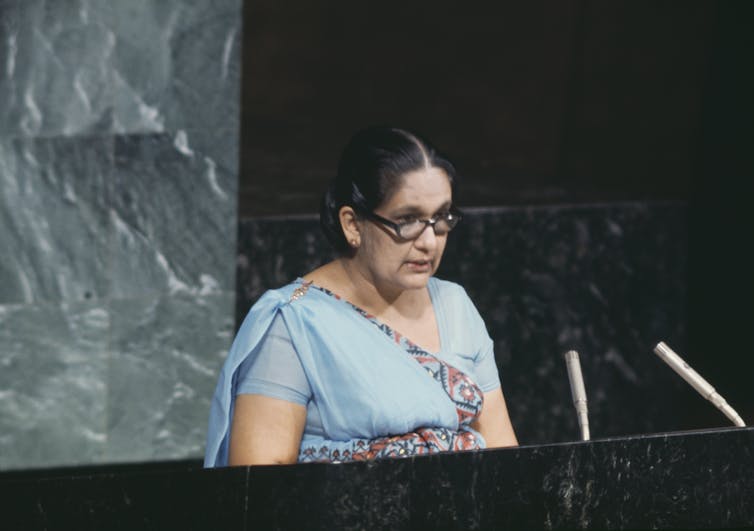
I have identified three broad groups of women who have succeeded in becoming elected leaders of their countries since Sirimavo Bandaranaike of Ceylon (now Sri Lanka) became the world’s first female prime minister in 1960.
Does Kamala Harris fit within any of these groups? And, if so, based on the pattern so far, does she have what it takes to become president? Or does being a global superpower mean the US demands a new form of female leadership?
Sirimavo Bandaranaike, the world’s first elected female prime minister, addressing the United Nations in New York, 1971. Getty Images
Born to rule
This first group came to power largely due to old hereditary, dynastic traditions rather than through new democratic systems.
Bandaranaike was known as the “gentle widow” of Solomon Bandaranaike, the fourth prime minister of Ceylon, who was assassinated in 1959. After her came a cohort of dynastic women leaders, including three others who succeeded assassinated fathers: Indira Gandhi (India), Benazir Bhutto (Pakistan) and Park Geun-hye (South Korea).
Three others in this group – Corazon Aquino (Philippines), Violeta Chamorro (Nicaragua) and Khaleda Zia (Bangladesh) – followed their assassinated husbands into office.
There by default, coming to power to regenerate family dynasties, these women built images based on traditional mother figures, offering deliverance by “giving birth” to newly decolonised nations. In the words of her biographer, Bandaranaike was “the symbol, the figurehead that was necessary; the spark to ignite the flame”.
It took until 2016 for Taiwan’s Tsai Ing-wen to become the first woman leader from Asia not born into a political family.
The importance of family dynasty explains the apparent paradox of female leaders emerging in countries with extreme gender, class and ethnic inequalities, with Islamic nations being among the earliest to elect women.
While hailing from an elite political family has benefits for women leaders, the inverse may be true for Kamala Harris: not coming from a dynasty may be an advantage in a nation that prides itself on being an egalitarian, self-made melting pot.
Of course, US political dynasties have developed with the Bush and Kennedy clans. But Hillary Clinton’s loss to Donald Trump in 2016 was likely due in part to voters rejecting a Clinton dynasty. Being the daughter of migrants from India and Jamaica might actually help Harris this time.
Did Hillary Clinton lose in 2016 because the US didn’t want a Clinton dynasty? Getty Images
Conservative ‘honorary men’
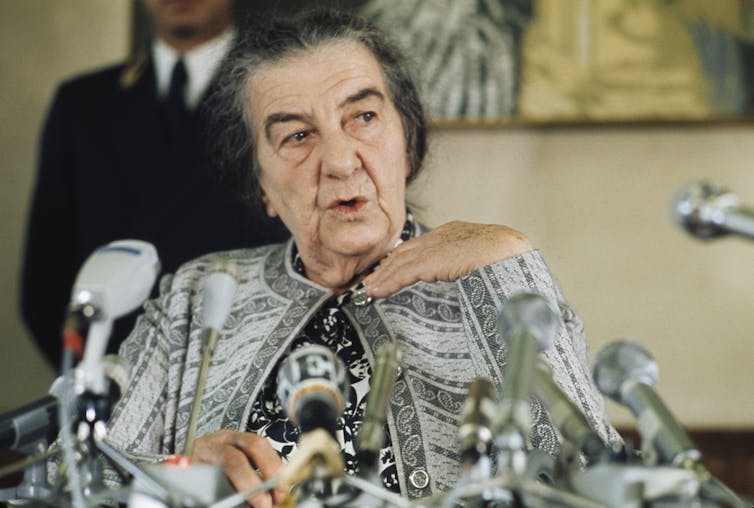
There’s a second group of politically conservative, largely White Western women. Some, like Golda Meir (Israel) and Margaret Thatcher (United Kingdom), were elected.
But others – Kim Campbell (Canada), Jenny Shipley (New Zealand) and Theresa May and Liz Truss (UK) – were chosen by their parties during an elected term. This may reflect a general reluctance by conservative voters to embrace change and vote for women.
As such, women in this group seek to be male equals, to reach the top as “honorary men”, ready to prove their strength. Margaret Thatcher played the “iron lady” and upped her ratings during the 1982 Falklands War. Golda Meir could be cast as a nurturing grandmother who made chicken soup, or “the overbearing mother who ruled the roost with her iron hand”, as later Israeli president Chaim Herzog said.
Harris doesn’t fit within this group. Were she a Republican she might be able to present as an auntie and caring stepmother who upholds the right to bear arms. But with her appeal to the politically progressive side of US society, not fitting the conservative mould may be to her advantage.
Israel’s Golda Meir in 1973:‘the overbearing mother who ruled the roost with her iron hand’. Getty Images
Social change-makers
A third group of women leaders skews left and actively resists restrictive maternal and gender roles. While the great majority of women world leaders have had children, this group contains a number who have not.
Unlike those in the first two groups, they often question dominant, masculine power structures and seek reform of the political system. Generally, it is hardest for these women to be elected.
Being highly educated, with careers in academia and public service, is a common experience and route to political power for this group. For example, Gro Harlem Brundtland (Norway) trained as a medical doctor, Mary McAleese (Ireland) as a lawyer and academic, and Angela Merkel (Germany) has a PhD in quantum chemistry.
These women attempt to craft new forms of leadership. They encourage more women to join them in power, and challenge sexism, homophobia and racism. More generally, they work to transform global governance, promoting pluralism, tolerance and kindness.
Since Elizabeth Domitien was elected prime minister of the Central African Republic in 1975, more women leaders of this stripe have emerged, including Vigdis Finnbogadóttir (Iceland), Mary Robinson (Ireland), Sylvie Kinigi (Burundi), Michelle Bachelet (Chile), Helen Clark and Jacinda Ardern (New Zealand), Julia Gillard (Australia), and Tarja Halonen and Sanna Marin (Finland).
The Harris challenge
Kamala Harris fits most obviously within this group. She is highly educated and experienced in public service. And she has not had children, unlike so many in the other two groups.
For that she has been branded a “childless cat lady”, of course, which points to perhaps her biggest obstacle: the alpha male culture in an alpha military superpower.
Unsurprisingly, rival military powers Russia and China are yet to elect a woman leader. It may be that being a social change-maker and having one’s finger on the nuclear button requires a new form of female leadership – a new-age warrior woman, perhaps.
It only remains to be seen whether the US, the world and Harris herself are ready for that role.
Katie Pickles received funding from Royal Society Te Apārangi as a James Cook Fellow to work on The Heroine with a Thousand Faces.
Source: The Conversation (Au and NZ) – By Markus Wagner, Professor of Law and Director of the UOW Transnational Law and Policy Centre, University of Wollongong
With the US elections weeks away, the political battle is heating up, with both sides claiming the upper hand.
However, elections are not always won or lost at the polls. Increasingly, court proceedings are used to achieve desired political outcomes.
The media focuses on a handful of states, known as swing states, because they often swing between red and blue and can therefore play a major role in election outcomes. These races are tightening, with many state polls making it a contest too close to call.
Given their electoral importance, any legal challenges in these states are of potentially great significance. Some are already underway, while others could follow the November 5 vote.
A history of voter suppression
Democrats have tended to favour providing greater access to voting, whereas Republicans have, at times, attempted to restrict access to voting because of concerns over the integrity of the elections.
Another battleground is the closing of physical polling places.
From the polls to the courts
During the 2020 elections, legal battles were largely waged in the courts after voting day.
Then-President Donald Trump, unwilling to concede the election, filed 62 lawsuits, withdrew many of them, and lost the remainder.
Democrats now face a Republican Party and a supporting cast of characters that has drawn lessons from their failure to overturn the 2020 election results in court. Besides restricting voting access, Republicans and their allies in state legislatures are preparing the ground to restrict vote counting.
In response, Democrats have formed their own “voter protection” units in key swing states, hiring lawyers by the dozen.
Georgia in the spotlight
These changes have taken place in almost all the battleground states, but are most visible in Georgia, which has become ground zero in the 2024 legal election battles.
This would have overturned the state’s election results by one vote. Raffensperger refused.
What’s changed since 2020 is that the Trump campaign and its allies have taken a much more systematic approach, laying the ground for election subversion.
Republicans have continued their efforts to limit access to voting through so-called voter purges in states like Alabama, Texas and Virginia. Election officials struck thousands of eligible voters from the electoral rolls. Courts have had to step in to reverse these endeavours.
The Georgia legislature passed bills in 2021 and 2024 expanding the powers of the Georgia State Election Board. This board is legally tasked with conducting “fair, legal and orderly elections”.
These bills aimed to radically change the appointment procedure and how elections are administered. The Georgia legislature now elects the members of the State Election Board and has removed the Secretary of State (currently Raffensperger) as the chair of that board.
The supposed non-partisan board is now dominated by staunchly pro-Trump members, which Trump called “pitbulls fighting for honesty, transparency, and victory”.
The board attempted to make last-minute changes on September 20 2024 to the state’s election rules. This includes that ballots (as opposed to the actual votes) be counted by hand and that the certification of election results could be delayed if local election boards doubt the validity of election results.
In a sharply worded letter and stating its exceptional nature, the Georgia attorney-general’s office warned the board it had exceeded its authority.
Such rule changes so close to an election were held to be disfavoured, based on a previous US Supreme Court judgement that pointed out:
court orders affecting elections, especially conflicting orders, can themselves result in voter confusion and consequent incentive to remain away from the polls. As an election draws closer, that risk will increase.
These rule changes were ultimately blocked by Georgia courts. The Superior Court found the resulting “administrative chaos” to be “entirely inconsistent with the obligations of our boards of elections (and the State Election Board) to ensure that our elections are fair, legal, and orderly”. Georgia’s Supreme Court declined to hear a subsequent appeal by Republicans on procedural grounds.
The possible delay in certification was similarly struck down in court:
if election superintendents were […] free to play investigator, prosecutor, jury, and judge and […] refuse to certify election results, Georgia voters would be silenced. Our Constitution and our Election Code do not allow for that to happen.
Similar changes are afoot elsewhere. This risks that several million legally cast votes might not be counted in the 2024 elections. This would almost certain affect the results of the election.
What’s the end game?
In the end, this strategy is all about who wins the presidency.
What makes 2024 different is that Trump’s 2020 efforts targeted the outcome of the elections. While this strategy was unsuccessful, it contributed to the atmosphere that culminated in the storming of the Congress on January 6, 2021.
In 2024, the aim is to sow doubts about the legitimacy of the election process.
This has the potential to result in a chilling effect on voting, given that US elections are turnout elections.
Extending the political battlefield to the courts to limit or remove votes, or delay the results, risks long-term damage to democracy by calling into question the legitimacy of the electoral process.
Markus Wagner does not work for, consult, own shares in or receive funding from any company or organisation that would benefit from this article, and has disclosed no relevant affiliations beyond their academic appointment.
For the first time, state-of-the-art biomechanics technology has allowed us to scientifically measure just how deadly are two iconic Aboriginal weapons.
In First Weapons, an ABC TV series aired last year, host Phil Breslin tested out a range of Indigenous Australian weapons. Amongst these were two striking weapons – the paired leangle and parrying shield, and the kodj.
Both weapons are used to strike at an opponent. While the warriors who wield them are well aware of the weapons’ lethality, our team was approached by the show’s creators, Blackfella Films, to use modern biomechanic tools and methods to assess them.
Our goal was to determine exactly where their striking power comes from and just what makes their ancient designs so deadly. Our study is now published in Scientific Reports.
Deadly weapons
We studied the kodj made by Nyoongar peoples of the southwest of the Australian continent and the leangle and parrying shield from the southeast.
The kodj is part hammer, part axe, and part poker. Its design is likely tens of thousands of years old, though determining exactly when this tool form was invented is difficult – only the stone parts can survive the archaeological record long term.
What is a kodj? (First Weapons, Blackfella Films, ABC).
The beauty of this weapon is its ability to be “pivoted by a turn of the wrist so that the blade can cut in any direction”.
The kodj used in our experiment was made by Larry Blight, a Menang Noongar man from Western Australia. Its handle is carved from wattle wood with a sharpened boya (stone) blade attached to one side and a blunt boya edge on the other with balga (Xanthorrhoea or grass tree) resin.
The leangle and parrying shield we studied were made by expert weapon-makers Brendan Kennedy and Trevor Kirby on Wadi Wadi Country. Each was carved from hardwood and are traditionally used together in one-on-one, close quarters combat.
Weapon-makers Brendan Kennedy and Trevor Kirby making the leangle and parrying shield used in this experiment (First Weapons, Blackfella Films, ABC).
Determining when this weapon was invented is even more difficult than the kodj, because both the leangle and its paired shield are entirely made of wood. Wood rarely survives long term, and certainly not over the thousands of years needed to track its innovation.
Currently, the oldest surviving wooden artefacts found on the Australian continent are 25 tools including boomerangs and digging sticks recovered from Wyrie Swamp, South Australia. They are more than 10,000 years old and only preserved because they were in a waterlogged environment which protected them from decay.
See the leangle and parrying shield in action on Wadi Wadi Country (First Weapons, Blackfella Films, ABC).
Biomechanics of the weapons
There are no previous studies describing human and weapon efficiency when striking with a hand-held weapon, so we were starting from scratch. For this study, the show’s host, Phil Breslin, acted as the warrior putting the weapons through their paces.
Using wearable instruments, we tracked the human and weapon kinetic energy and velocities built up during kodj and leangle strikes. Biomechanical analyses provided insights into shoulder, elbow and wrist motions, and the powers reached during each strike motion.
These tests found that the leangle is far more effective at delivering devastating blows to the human body than the kodj.
The kodj, on the other hand, is more efficient for an individual to manoeuvre, but still capable of delivering severe blows that can cause death.
The swing of the leangle delivers a deadly blow to an opponent. B. Cornish A deadly strike with the kodj. B. Cornish
Over the past few hundred years, European writers have noted a range of weapons have been used in conflict both within and between First Nations on the Australian continent. Stencils and painting of these same weapons appear in rock art, recording their presence prior to European arrival.
Some weapons were also used in dispute resolution. These included “trial by ordeal”, whereby an accused person must face a barrage of projectiles (spears or fighting boomerangs) unarmed or with a shield. Such trials often resulted in injuries, but rarely in death.
Archaeological evidence for interpersonal violence (injuries of skeletal remains) is rare in Australia, but when found, usually consists of depressions to the skull and “parrying fractures”. These are breaks to the arm bones above the wrist, resulting from the raising of the arm in defence against a weapon. This can be either from a direct blow or a glancing blow off a shield – like the one used in this experiment.
Cultures around the globe have invested significant time and effort into designing deadly hand-held weaponry. Our results show that while design is critical for weapon efficiency, it is the person who must deliver the deadly strike.
Michelle Langley receives funding from the Australian Research Council.
Laura Diamond receives funding from the National Health and Medical Research Council, and the Medical Research Future Fund.
The troika plus format involves the PIF’s previous, current and future chairs.
They are mission leader Tonga Prime Minister Hu’akavameiliku Siaosi Sovaleni, Cook Islands Prime Minister Mark Brown, and representative of the Forum’s future chair, Solomon Islands Minister for Foreign Affairs and External Trade Peter-Shanel Agovaka (who takes part in place of Prime Minister Jeremiah Manele).
Fiji PM Sitiveni Rabuka is the “plus” component of the mission.
While Brown landed in Nouméa on Saturday, the rest of the PIF leaders touched down yesterday and were welcomed by New Caledonia’s highest officials, including local government President Louis Mapou, French High Commissioner Louis Le Franc and French Ambassador for the Pacific Véronique Roger-Lacan.
The regional leaders were also granted a full state protocol with a guard of honour, local media reported.
Charles Wéa, New Caledonia President Mapou’s adviser for international relations, told public broadcaster NC la 1ère at the weekend: “New Caledonia is a member of the Pacific Islands Forum and therefore is involved in everything that happens in the Pacific.”
“This mission comes in solidarity, to listen and see what are the possible ways to accompany our territory towards political and economic prospects.”
Upon return from their visit, the leaders are expected to prepare and submit a report to the next 54th Pacific Island Forum leaders’ summit, to be held in Solomon Islands from 8-12 September 2025.
Sunday programme: politics, economy, hospital On Sunday, the Pacific leaders started their mission in earnest, going to the site of one of Nouméa’s large commercial centres, Kenu-Inn, near Nouméa, which was largely destroyed and looted during the May riots.
They also met there a delegation of business leaders who explained the heavy impact of the destruction, arson and looting, and its consequences on the local economy.
Local Chamber of Commerce and Industry (CCI) leader David Guyenne told local media: “We, economic leaders, really wanted them to see for themselves what did happen, and this is beyond imagination in terms of devastation.”
“There has been a moment of shock of cataclysmic proportions for business owners, employees, families who have all suffered the consequences.”
He said he believed the PIF mission could bring a constructive contribution if they do not have “an ideological vision of what happened in New Caledonia . . . to really understand that what took place is an economic and social issue”.
“We will build again with time, a pragmatic approach without mixing politics, ideology and what happened,” he said.
Cook Islands PM Mark Brown welcomed at Nouméa-La Tontouta international airport on Saturday. Image: NC la 1ère TV
GDP decline — ’20 years backwards’ Guyenne also said he had conveyed to the Pacific leaders the hard figures from the crisis.
“We are talking about [losing] 20 percent of New Caledonia’s gross domestic product (GDP); this has taken us 20 years backwards.
“This is the reality for people and companies.”
Earlier in the day, the leaders also held talks with Le Franc and Roger-Lacan.
They also went to New Caledonia’s main hospital, Médipôle, to hear about how the crucial centre was affected by riots and the impact this had on the public health system.
Later in the day, political talks went on at New Caledonia’s Congress, where they held talks with its President Veylma Falaéo.
“I am happy to see that each one of them came to bring their encouragement in these difficult times for us and in our current efforts for dialogue and reconciliation,” Falaéo said.
“I don’t think they were here to tell us what to do. They believe the solution can only come from us and to encourage us to pursue the way to unity, peace and dialogue.”
Political talks, meetings Today, the leaders ares scheduled to pursue its mission with political talks and meetings with a wide panel of political parties from both the pro-independence and pro-France (loyalist) movements.
The high-level mission is being described as “strictly observational” and “in line with the request of the New Caledonia government, will follow the terms of reference, agreed by the French state, the government of New Caledonia and endorsed by the Forum Leaders”.
The mission followed a request from President Mapou following the breakout of riots on May 13.
The PIF mission was initially scheduled to take place before the Pacific Islands Forum annual leaders’ summit in Nuku’alofa in late August, but was postponed, due to what was described at the time as differences between New Caledonia’s government and its administrative power, France, on the mission’s terms of reference.
The Forum leaders group is supported by PIF Secretary-General Baron Waqa and senior officials “with the guidance of the French state and New Caledonia government”, the Forum stated.
The Pacific region’s top political organisation said the troika-plus would tour Nouméa and meet stakeholders impacted by the recent unrest, including a wide spectrum of “New Caledonian political parties, youth”, and the “impacted communities from the private, health, and education sectors”.
“This mission to New Caledonia comes at a pivotal time, as it navigates complex political dynamics and seeks to address ongoing social and economic challenges in New Caledonia.
“By understanding local perspectives, the Forum can better support ongoing dialogue about New Caledonia’s future, all while respecting its current status.”
The sensitive terms of reference were finally agreed to during the PIF leaders’ summit in Tonga at the end of August.
In their final communiqué on August 30, PIF leaders mentioned the issue of New Caledonia in two paragraphs].
They “noted the update on the situation in New Caledonia by the President of the government of New Caledonia, Mapou, and reaffirmed their continued call for order and stability to prevail as well as their continued commitment to provide support as necessary to New Caledonia”.
They also “reaffirmed the commitment to deploy the high-level Forum troika plus mission to New Caledonia in line with the request of New Caledonia’s government and noted the agreement of the French State and the Government of New Caledonia on the Terms of Reference for the Forum Troika Mission”.
This article is republished under a community partnership agreement with RNZ.
Source: The Conversation (Au and NZ) – By Adrian Beaumont, Election Analyst (Psephologist) at The Conversation; and Honorary Associate, School of Mathematics and Statistics, The University of Melbourne
The United States presidential election will be held on November 5. In analyst Nate Silver’s aggregate of national polls, Democrat Kamala Harris leads Republican Donald Trump by 48.6–47.4, a gain for Trump since last Wednesday, when Harris led by 48.8–47.2. Harris’ national lead peaked on October 2, when she led by 49.4–45.9.
The US president isn’t elected by the national popular vote, but by the Electoral College, in which each state receives electoral votes equal to its federal House seats (population based) and senators (always two). Almost all states award their electoral votes as winner-takes-all, and it takes 270 electoral votes to win (out of 538 total).
Relative to the national popular vote, the Electoral College is biased to Trump, with Harris needing at least a two-point popular vote win to be the narrow Electoral College favourite in Silver’s model.
In Silver’s poll averages, Trump is now 0.3% ahead in Pennsylvania (19 electoral votes), which was tied last Wednesday. He leads in North Carolina (16) and Georgia (16) by 1.3–1.4 points and in Arizona (11) by 2.1 points. Harris leads in Michigan (15 electoral votes) by 0.7 points and in Wisconsin (ten) by 0.5 points. In Nevada (six), it’s tied.
If the election results exactly reflect the current polls, Trump would win the Electoral College by 281–251 with Nevada’s six electoral votes undecided.
The good news for Harris is that state polls haven’t moved to Trump as much as national polls in the last two weeks. If Harris regains the lead in Pennsylvania, she will probably win. But Harris would likely be better placed in Pennsylvania now if she had made the popular Pennsylvania governor Josh Shapiro her running mate.
Silver’s model now gives Trump a 53% chance to win the Electoral College, unchanged from last Wednesday. While Trump is barely ahead, it’s still effectively a 50–50 coin flip. There’s a 26% chance that Harris wins the popular vote but loses the Electoral College. The FiveThirtyEight forecast gives Trump a 54% win probability.
There’s just over a week until the election. If there’s late movement to either Harris or Trump or either candidate outperforms their polls, that candidate could win decisively. While the election appears very close now, it may not be so close once we see results.
Silver wrote Saturday that worries about illegal immigration are a key issue for Trump supporters. In the three years that Joe Biden has been president, apprehensions at the US southwestern border surged to record highs, with 2.2 million apprehensions in the 2022 fiscal year
LNP margin extended in Queensland on late counting
With 68% of enrolled voters now counted in Saturday’s Queensland election, The Poll Bludger’s results give the Liberal National Party (LNP) 44 of the 93 seats, Labor 27, Katter’s Australian Party (KAP) three and independents one.
Including undecided seats where one party leads, it’s 53 LNP, 34 Labor, four KAP, one Green and one independent. In Saturday night’s article, the LNP led Labor by 49 seats to 38. Analyst Kevin Bonham expects the final result to be 52 LNP, 34 Labor, five KAP, one Green and one independent.
Vote shares have also moved to the LNP, as they now lead Labor by 54.1–45.9 on the estimated two-party vote, compared with 53.1–46.9 on Saturday night. Primary votes are 42.0% LNP, 32.7% Labor, 9.4% Greens, 7.8% One Nation, 2.6% KAP and 5.5% for all Others.
On the statewide two-party vote, the most accurate poll taken in the last two weeks is currently a YouGov poll that gave the LNP a 54.5–45.5 lead. Resolve gave the LNP a 53–47 lead, Newspoll gave them a 52.5–47.5 lead and uComms was the worst, giving the LNP just a 51–49 lead.
Analyst Ben Raue wrote in The Guardian that Labor is trailing in 11 of its 14 regional seats while doing much better in south-east Queensland. Right-wing parties have been gaining in regional areas in Australia and internationally in the last ten years, while the left has gained in higher-education, urban areas.
In Australia Labor can win elections if it dominates big cities except in Queensland and Tasmania. I wrote about this in April 2022 and May 2021.
ACT election final result
The ACT uses the Hare-Clark proportional representation method with five five-member electorates, for a total of 25 seats. A quota is one-sixth of the vote or 16.7%.
The final result of the October 19 election was ten Labor (steady since 2020), nine Liberals (steady), four Greens (down two) and two independents (up two). Labor retained office in coalition with the Greens; they have governed in the ACT since 2001.
ACT-wide vote shares were 34.1% Labor (down 3.7%), 33.5% Liberals (down 0.4%), 12.2% Greens (down 1.3%), 8.5% Independents for Canberra (new) and 11.7% for all Others (down 3.1%).
In Brindabella, the Liberals had 2.59 quotas, Labor 2.03, the Greens 0.54 and Independents for Canberra 0.46.
It was initially thought that postals would help the Liberals win the last seat, but they didn’t do well enough on postals, and the Greens defeated the Liberals for the last seat by 166 votes or 0.02 quotas. Bonham followed this count.
Teal wins Pittwater by bigger than expected margin
New South Wales byelections in the Liberal-held seats of Epping, Hornsby and Pittwater occurred on October 19. Labor didn’t contest any of these seats, and the Liberals retained Epping and Hornsby easily.
In Pittwater, The Poll Bludger’s election night forecast was a 54.1–45.9 win for teal independent Jacqui Scruby, but she actually won by 56.2–43.8, a 6.8% swing to Scruby since the 2023 state election. Primary votes were 54.5% Scruby (up 18.6%), 41.5% Liberals (down 3.2%) and 4.0% for a Libertarian (new). Labor and the Greens, who received a combined 17.0% in 2023, didn’t contest.
Adrian Beaumont does not work for, consult, own shares in or receive funding from any company or organisation that would benefit from this article, and has disclosed no relevant affiliations beyond their academic appointment.
A Kanak pastor from the Protestant Church of Kanaky New Caledonia, attending a Pacific solidarity forum in Aotearoa, says connecting with Pacific activists has given him the chance to feel hope again after months of riots in the French territory.
Reverend Billy Wetewea told RNZ Pacific on the sidelines of Te Hui Oranga o te Moana nui a Kiwa, a conference in Auckland this week, that the indigenous peoples of New Caledonia are fighting for their humanity and dignity.
He said being present in a room filled with Pacific peoples from countries across the region has reminded him that he is not alone.
“We are descendants of fierce warriors and navigators,” Wetewea said, adding that it “should give us the strength and fire to continue the legacy of those who have walked before us and passed away, for us to carry the fight for our next new generation.
“That is something that I felt strong here in Aotearoa.”
A Pacific Islands Forum leaders’ high-level “strictly observational” mission headed by the Tongan Prime Minister Hu’akavameiliku arrived in Nouméa yesterday.
The delegation includes Fijian Prime Minister Sitiveni Rabuka, Cook Islands Prime Minister Mark Brown, along with Solomon Islands Foreign Affairs Minister Peter-Shanel Agovaka.
Almost 7000 security personnel with armoured vehicles have been deployed from mainland France to New Caledonia to quell further unrest.
Thirteen people have died since the violence broke out in May, including 11 Kanaks and two French police officers.
One hundred and sixty-nine people have been injured, and more than 2000 people have been arrested in the past five months.
“So have a good disassociation arrangement when you become independent, make sure you part as friends,” he added.
Reverend Wetewea said comments like Rabuka’s have led him to question the “neutrality” of the PIF mission.
“I am questioning, not the legitimacy of this visit, but the neutrality of it,” Wetewea said.
He wants to know if the leaders will be fair to what is really happening in his homeland.
Reverend Wetewea said the issue that led to the PIF mission being deferred in August, was around tensions between local government and Paris.
He said New Caledonia’s President Louis Mapou reminded Pacific leaders he was the one who had called for the meeting in the first place, and that the PIF was going to New Caledonia at his request as a full member of PIF, which Paris is not.
“I hope that [the programme] will also fairly represent all the people in New Caledonia, especially the community on the ground, the youth and the mothers who are struggling in the community and on the ground,” he said.
When asked if he had hope, Rev Wetewea replied: “We need hope.”
“We are hope because we are still alive and we are still fighting, but our hope is toward a country that will be developed for the wellbeing of everyone in the country,” he said.
“In our discussion with the youth and the community we are involved in, it is not only when we speak about our fight as Kanak people. It is not only for the Kanaks.
“We are fighting for our humanity.”
The Pacific leaders’ three-day mission from October 27-29 is supported by the PIF Secretary-General Baron Waqa and senior officials, with the guidance of the French State and New Caledonia government.
According to the PIF, they will tour Nouméa and visit with stakeholders impacted by the recent unrest, including New Caledonian political parties, youth, and the impacted communities and dialogues with the private, health, and education sectors.
Hu’akavameiliku told RNZ Pacific he was not going to preempt any solutions whatsoever.
New Caledonia government spokesperson Charles Wea told RNZ Pacific leaders would have the chance to hear from all sides involved in the unrest.
A document will then be drafted on their findings, which will be taken to the PIF foreign ministers meeting.
Following that, the findings will be presented to the PIF members in Solomon Islands at next years leaders meeting, where a decision on how the Pacific will engage going forward will be made.
This article is republished under a community partnership agreement with RNZ.
We are in the last stretch of the school year and just weeks away from final reports.
For some students, results may indicate serious gaps in skills or knowledge. This may be a result of circumstances outside their control, for instance, serious illness or teacher shortages. But some families may be wondering if the gaps are serious enough to consider repeating the year.
We know successful learning usually happens when we have the opportunity to rehearse, repeat and practise something multiple times.
But when it comes to getting children to repeat a year of school, research shows it is usually not a good idea.
How many students repeat?
There is little current information about the rates of repeating in Australia.
In 2014, about 7.5% of 15-year-olds had repeated one year over the course of their schooling, down slightly from 8% in 2009.
Repeating a year remains a common practice in other countries, such as France and Spain. But there has been a shift away from repeating in Australian schools.
For younger children in particular, the focus has shifted to stopping students from starting too young – rather than delaying their progression once they get to school.
Repeating does not usually work
It is well documented repeating a year typically has a negative impact on a student’s social and emotional needs.
It is supposed to help a student “catch up” but can instead harm their motivation and engagement. Counterintuitively, it can also harm their progress in literacy and numeracy if they are not motivated or interested in school.
As a 2021 review of 84 studies showed, repeating a year can see students left behind by their friends, harm a student’s confidence, and worsen their behaviour at school if they are unhappy.
It also found on average, repeaters and non-repeaters seemed to show a similar level of development – so there was no tangible benefit to repeating a year.
This is why education departments now only suggest repeating a year in “exceptional circumstances”. Particularly in the primary years, schools will work with students to help them catch up in term 4 for the following year.
So if your child is struggling academically – or with some other element at school – how can you approach it?
You can start by investigating and understanding why your child is struggling. Does your child need specialist help for a learning difficulty? Is there an issue with bullying or another social problem that is harming their progress? Or is there something else going on for them outside school?
Other things you can do include:
1. stay in touch with your child’s school: it could include casual chats with the teacher outside the classroom after school. For older students it could mean monitoring due dates for assessments on the school’s information portal
2. think about how old your child is: especially when children are younger a few months can make a huge difference. If your child is struggling, is it because they are several months younger than most of your peers? This may mean you need to be patient and know with more time they will catch up
3. ask teachers for more specific help: helping students of differing stages and abilities to learn is core work for teachers. And they can use different strategies to help students learn
4. consider a tutor: if you child needs extra help, this could be one way to assist their learning. However, it is important to choose your tutor carefully and make sure a tutor’s approach matches your child’s specific needs.
It can feel very difficult as a parent to see your child struggling or failing academically at school. Let them know it is OK. Tell them it’s what they do next that matters and they are not alone. You are here to help.
And when in doubt, communicate your concerns clearly and consistently with the school.
Sarah Jefferson does not work for, consult, own shares in or receive funding from any company or organisation that would benefit from this article, and has disclosed no relevant affiliations beyond their academic appointment.
With the US presidential election on a knife edge and less than a week away, financial markets are watching with bated breath.
There’s no shortage of reasons to be nervous. Both sides have outlined radically different visions of America’s economic future, with major implications for the rest of the world.
All of this stands against the backdrop of simmering tensions with China and an ongoing crisis in the Middle East. The price of gold – a common way for investors to hedge against uncertainty – has soared to record heights.
Many have been speculating about what might be in store for the stock market and the economy – both in the United States and here in Australia.
Obviously, that depends on far more than just who is sitting in the Oval Office. However, looking at history still tells an interesting – and perhaps surprising – story.
In the United States, both sides of the political divide are subject to some oversimplifying stereotypes.
Democrats are often seen as the party of proactive government spending, favouring policies that redistribute wealth through taxation. Republicans, on the other hand, have a reputation as the business-friendly party of small government, favouring more passive policies with lower tax rates.
So, it might surprise you to learn that if we zoom out and look at a big chunk of the past century, the US economy and its stock markets have actually performed better under Democratic presidencies, on two key measures.
Research by Lubos Pastor and Pietro Veronesi from the University of Chicago examined the period between 1927 and 2015.
They found average growth in gross domestic product (GDP) was 4.86% under Democratic presidents. Under Republican presidencies, it averaged 1.7%.
Over the same period, the US share market’s “equity risk premium” was also 10.9% higher under Democratic presidents than Republicans. In the years from 1999 to 2015, it was even higher under democratic presidents – 17.4%.
This is the excess rate of return that can be earned by investing in shares above the “risk-free rate” (such as the interest rate on a savings account).
Why is it worth looking at the risk premium instead of total share market returns? Because it helps separate out the effect of interest rates.
The return on assets like shares is comprised of the risk-free rate from banks plus this risk premium. Risk-free rates are largely determined by central banks, which in most countries are independent from the government.
What might be driving this effect?
Whether this performance reflects good luck or good policies is much harder to answer. If the effect was arising from superior policy decisions, it would imply voters have been repeatedly failing to reward good government.
Pastor and Veronesi argue something different – that when the economy is weak and stock prices are low, voters are more risk-averse. That can lead them to prefer the wealth redistribution policies of the Democrats.
The last three transitions from Republican to Democratic presidencies support this theory. Bill Clinton was elected shortly after the 1990-91 recession, Barack Obama at the peak of the global financial crisis, and Joe Biden during the pandemic.
As the economy recovers from a crisis, stock prices often increase. Pastor and Veronesi’s thesis suggests that the election – and the good performance – of Democratic presidents comes down to the timing of voters’ heightened risk aversion.
Highly interlinked economies
Historically, monthly stock returns in Australia and the US have been highly correlated – my calculations show this is even more so in election years.
Correlation famously doesn’t say anything about causation, just that when we see change in one, we typically see a similar change in the other. That means some of the effects we described earlier can be felt here (and around the world), as well.
Expanding their long-term analysis internationally, Pastor and Veronesi found that the average equity risk premium of Australian stocks was also higher under Democratic presidencies in the US – by 11.3%!
Similar higher returns were also observed in the United Kingdom – 7.3%. And they were even larger in Canada, France, and Germany – all about 13%.
Two factors may help explain why what happens in the US is so wide-reaching. Stocks in these markets are globally owned. US presidential elections may reflect the cycle of global risk aversion, which in turn affects local stock markets.
These economies and financial markets are also highly integrated with the US in areas such as trade, making their economic cycles highly correlated.
A stock market boom?
Will a win by the Democrats in November usher in a stock market boom? It’s unlikely, for two reasons.
First, a win by the Democrats would be a continuation, not a transition from a Republican president. It would not represent policy changes favoured by more risk-averse voters.
Second, it would be a Democratic win in a booming economy. The US economy has been going strong since the end of the pandemic.
It added 254,000 jobs in September, the strongest job growth in six months. It also grew at an annualised pace of 3% in the second quarter of 2024, above its average of below 2% over the past decade.
Other research suggests some important caveats, too. On average, the short-term market reaction to an election does not favour the Democrats or the Republicans.
However, a surprise win by a Republican – that is, one contrary to prediction markets – is associated with 2-3% higher returns around election days.
One possible reason for this is that unlike voters, equity fund managers are more likely to be Republican-leaning. A surprise win by their favoured candidate can boost stock prices when the winner is declared.
Jianxin Wang does not work for, consult, own shares in or receive funding from any company or organisation that would benefit from this article, and has disclosed no relevant affiliations beyond their academic appointment.
Source: The Conversation (Au and NZ) – By Frederic Gachon, Associate Professor, Physiology of Circadian Rhythms, Institute for Molecular Bioscience, The University of Queensland
This is the next article in our ‘Light and health’ series, where we look at how light affects our physical and mental health in sometimes surprising ways. Read other articles in the series here.
Exposure to light is crucial for our physical and mental health, as this and future articles in the series will show.
But the timing of that light exposure is also crucial. This tells our body to wake up in the morning, when to poo and the time of day to best focus or be alert. When we’re exposed to light also controls our body temperature, blood pressure and even chemical reactions in our body.
But how does our body know when it’s time to do all this? And what’s light got to do with it?
What is the body clock, actually?
One of the key roles of light is to re-set our body clock, also known as the circadian clock. This works like an internal oscillator, similar to an actual clock, ticking away as you read this article.
But rather than ticking you can hear, the body clock is a network of genes and proteins that regulate each other. This network sends signals to organs via hormones and the nervous system. These complex loops of interactions and communications have a rhythm of about 24 hours.
In fact, we don’t have one clock, we have trillions of body clocks throughout the body. The central clock is in the hypothalamus region of the brain, and each cell in every organ has its own. These clocks work in concert to help us adapt to the daily cycle of light and dark, aligning our body’s functions with the time of day.
However, our body clock is not precise and works to a rhythm of about 24 hours (24 hours 30 minutes on average). So every morning, the central clock needs to be reset, signalling the start of a new day. This is why light is so important.
The central clock is directly connected to light-sensing cells in our retinas (the back of the eye). This daily re-setting of the body clock with morning light is essential for ensuring our body works well, in sync with our environment.
In parallel, when we eat food also plays a role in re-setting the body clock, but this time the clock in organs other than the brain, such as the liver, kidneys or the gut.
So it’s easy to see how our daily routines are closely linked with our body clocks. And in turn, our body clocks shape how our body works at set times of the day.
The naturally occurring brain hormone melatonin is linked to our central clock and makes us feel sleepy at certain times of day. When it’s light, our body stops making melatonin (its production is inhibited) and we are alert. Closer to bedtime, the hormone is made, then secreted, making us feel drowsy.
Our sleep is also partly controlled by our genes, which are part of our central clock. These genes influence our chronotype – whether we are a “lark” (early riser), “night owl” (late sleeper) or a “dove” (somewhere in between).
But exposure to light at night when we are supposed to be sleeping can have harmful effects. Even dim light from light pollution can impair our heart rate and how we metabolise sugar (glucose), may lead to psychiatric disorders such as depression, anxiety and bipolar disorder, and increases the overall risk of premature death.
The main reason for these harmful effects is that light “at the wrong time” disturbs the body clock, and these effects are more pronounced for “night owls”.
This “misaligned” exposure to light is also connected to the detrimental health effects we often see in people who work night shifts, such as an increased risk of cancer, diabetes and heart disease.
How about the gut?
Digestion also follows a circadian rhythm. Muscles in the colon that help move waste are more active during the day and slow down at night.
The most significant increase in colon movement starts at 6.30am. This is one of the reasons why most people feel the urge to poo in the early morning rather than at night.
The gut’s day-night rhythm is a direct result of the action of the gut’s own clock and the central clock (which synchronises the gut with the rest of the body). It’s also influenced by when we eat.
Our body clock also helps control our attention and alertness levels by changing how our brain functions at certain times of day. Attention and alertness levels improve in the afternoon and evening but dip during the night and early morning.
Those fluctuations impact performance and can lead to decreased productivity and an increased risk of errors and accidents during the less-alert hours.
So it’s important to perform certain tasks that require our attention at certain times of day. That includes driving. In fact, disruption of the circadian clock at the start of daylight savings – when our body hasn’t had a chance to adapt to the clocks changing – increases the risk of a car accident, particularly in the morning.
What else does our body clock control?
Our body clock influences many other aspects of our biology, including:
physical performance by controlling the activity of our muscles
blood pressure by controlling the system of hormones involved in regulating our blood volume and blood vessels
body temperature by controlling our metabolism and our level of physical activity
how our body handles drugs and toxins by controlling enzymes involved in how the liver and kidneys eliminate these substances from the body.
If you can, avoid driving long distances at night, as you’ll be less alert. trendobjects/Shutterstock
Morning light is important
But what does this all mean for us? Exposure to light, especially in the morning, is crucial for synchronising our circadian clock and bodily functions.
As well as setting us up for a good night’s sleep, increased morning light exposure benefits our mental health and reduces the risk of obesity. So boosting our exposure to morning light – for example, by going for a walk, or having breakfast outside – can directly benefit our mental and metabolic health.
However, there are other aspects about which we have less control, including the genes that control our body clock.
Frederic Gachon is currently receiving funding from the National Health and Medical Research Council (NHMRC), the Velux Stiftung, and the US National Institute of Health. He has previously received funding from the French Institute for Medical Research and Health (INSERM: 2006-2008), the Swiss National Science Foundation (2010-2012), the European Research Council (2011- 2015) and the Leenaards Foundation (2012-2014). He also worked for Nestlé (2012-2017) where he received industry funding.
Benjamin Weger is currently receiving funding from the National Health and Medical Research Council (Australia) Investigator Grant (2016334) and the Alzheimer’s Association Research Fellowship (US, AARF-22-917584). He was also an employee of Nestec, a subsidiary of the Nestlé group, from 2014 to 2018.
The dingo was completely isolated from other canines on the Australian mainland for more than 5,000 years, until domestic dogs arrived on the scene. Subsequent concerns about livestock loss formed the basis of Australia’s “wild dog” (dingo) pest control programs, which continue today. Stretching 5,614km across Australia, the “dingo fence” or “dog fence” was built in the 1880s to keep dingoes away from livestock in the southeast.
Dingoes are protected as a threatened species in Victoria. But dingo–dog hybrids are considered pests, and therefore allowed to be killed.
Unfortunately, past research claimed to find evidence dingo-dog hybrids are common in the wild across eastern Australia. This research has been used to defend the trapping, poisoning and shooting of these animals in some parts of Australia, particularly Victoria.
But other studies and now our new genetic research show dingoes are not breeding with domestic dogs in the wild. Rather, they are maintaining their independence as a unique evolutionary branch.
Our research also highlights the precarious state of dingo populations in Victoria. We fear dingo genetic diversity will continue to decline as long as lethal control measures are used. Ironically, this could prompt dingoes to mate with dogs to survive.
Two tales of Victorian dingoes
Victoria has two main populations of dingoes: northwestern and eastern.
The northwestern population consists of as few as 40 dingoes and is protected.
But the eastern population of 2,640–8,800 dingoes is not fully protected. Lethal control measures are allowed on private land and on public land within 3km of a private land boundary. This “unprotection order”, introduced to safeguard livestock, was recently extended until 2028.
In 2022 alone, 683 dingoes were trapped and shot on public land as part of the Victorian wild dog program. But this number doesn’t include deaths from baiting programs, or farmers shooting dingoes on private land. Altogether, it’s estimated up to 1,500 dingoes are killed in eastern Victoria each year.
This means a substantial proportion of the eastern Victorian population is being killed every year. Even if population size is maintained despite culling, it may still reduce genetic diversity.
We think this is already happening in the northwestern population. Our research shows its genetic diversity is critically low. Recent observations of tail deformities underscore the potential consequences of low genetic diversity.
Juvenile (left) and adult (right) dingoes with tail deformities have been found in the small north-western Victoria population. Ellisha Martion & Deakin University
What we did and what we found
We obtained 434 frozen canine DNA or tissue samples for genetic analysis, from organisations around Australia.
The Victorian samples mainly came from the state’s wild dog program (2014–19). Other samples came from government officers, private landholders, conservation groups and dog owners.
Most (380) of the samples were originally collected in the field from free-ranging animals believed to be either pure dingoes or potential dingo–dog hybrids.
The remaining 54 samples came from domestic and captive animals. These were 39 domestic dogs, seven known hybrids born in captivity, and eight known “backcrossed” dingo–dog hybrid × dingo crosses born in captivity.
We found the free-ranging animals were all dingoes. They fell into one of three distinct groups: alpine, desert or mallee. They were distinct from the domestic dogs and known hybrids born in captivity.
The results also revealed low genetic diversity in all three dingo groups.
The isolated population in northwest Victoria is in particularly bad shape. Local extinction is probable in the near future. That’s why the unprotection order was lifted there.
If culling of the eastern population continues, it could soon follow suit.
Indigenous farmers are supporting the fight to save the dingo. | 7.30.
Ongoing decline may prompt desperate measures
The ongoing unprotection order is likely to further diminish genetic diversity. As dingo numbers decline and options for mates become increasingly limited, this could force dingoes to mate with dogs.
Mating with domestic dogs may actually increase dingo genetic diversity and allay concerns about inbreeding. But the implications will be profound, not just for the dingo itself, but for the ecosystem, Traditional Owners and even graziers. Balancing livestock protection against conservation of this iconic species is more crucial now than ever before.
In the next decade or so, Victorian dingoes may reach a “genetic cliff” where their genetic decline is irreversible. So it is essential to develop strategies that both support graziers and the unique dingo lineage.
Several non-lethal management strategies have been previously described. These need to be further developed with input from graziers, so they can be applied effectively across Victoria.
Treading a different path
Our research reveals dingoes remain genetically distinct from domestic dogs, despite more than 200 years of coexistence. This is consistent with recent research challenging previous claims about widespread interbreeding.
Unfortunately, our research also found low genetic diversity in all dingo populations. We are continuing to explore the genetic state of dingoes across Australia using new genomic approaches. This work promises to provide more insight into the decline of this iconic Australian animal.
In the meantime, we urge governments across Australia to consider the biological consequences of killing dingoes. It is becoming increasingly clear that “wild dog” control programs are contributing to their genetic decline.
Andrew Weeks is an Adjunct Research Fellow at the University of Melbourne and a Director of Cesar Australia, a small research based company that works in the fields of sustainable agriculture and biodiversity conservation. He receives funding from the Victorian Department of Energy, Environment and Climate Action.
Collin Ahrens is a Visiting Fellow at the Hawkesbury Institute for the Environment at Western Sydney University and a Senior Geneticist of Cesar Australia, a small research based company that works in the fields of sustainable agriculture and biodiversity conservation. He receives funding from the Victorian Department of Energy, Environment and Climate Action.
A remote Filipino school in Bicol province assisted by a small New Zealand voluntary NGO has been seriously damaged by floodwaters in the wake of Typhoon Kristine (Trami) that left at least 82 people dead across the Philippines last week.
Mangcayo Elementary School, which was submerged by Typhoon Usman fringe storms six years ago, is the impacted school. It was a school that had been assisted by the Lingap Kapwa (“Caring for People”) project.
Now the school has been flooded again in the latest disaster. The school, near Vinzons in Bicol province, is reached by a narrow causeway that is prone to flooding by the Mangcayo Creek.
ABS-CBN News reports that foreign governments and humanitarian organisations have been scaling up assistance in the Philippines to aid hundreds of thousands affected by the typhoon, which struck several regions over the past week.
On Saturday, a C-130 cargo aircraft from the Singapore Air Force and a Eurocopter EC725 transport helicopter from the Royal Malaysian Air Force arrived at Colonel Jesus Villamor Air Base in Pasay City.
The aircraft will provide airlift support to help bolster the Philippine Air Force’s operations in delivering humanitarian aid supplies to typhoon-hit communities.
“During this challenging time, Singapore stands with our friends in the Philippines. This response underscores our warm defence ties and close Humanitarian Assistance and Disaster Relief (HADR) cooperation, as well as the enduring friendship between Singapore and the Philippines,” the Singapore Embassy in Manila said in a statement.
Rescue work in Mangcayo barangay in Bicol province of the Philippines. Image: Twitter/@pnagovph
Chest-deep floodwaters Philippine rescuers waded through chest-deep floodwaters to reach residents trapped by the typhoon, reports Al Jazeera.
Torrential rain had turned streets into rivers, submerged entire villages and buried some vehicles in volcanic sediment set loose by the tropical storm.
At least 32,000 people had fled their homes in the northern Philippines, police said.
In the Bicol region, about 400km southeast of the capital Manila, “unexpectedly high” flooding was complicating rescue efforts.
“We sent police rescue teams, but they struggled to enter some areas because the flooding was high and the current was so strong,” regional police spokesperson Luisa Calubaquib said.
At an emergency meeting of government agencies last Wednesday, President Ferdinand Marcos said that “the worst is yet to come”.
Flashback to the Typhoon Usman floodwaters in Mangcayo, Philippines, in January 2019. Image: David Robie/Asia Pacific Report
Israel’s strike on military targets in Iran over the weekend is becoming a more routine occurrence in the decades-long rivalry between the two states.
Israel has conducted low-level or “unofficial” operations in Iran in the past, but since the October 7 2023 Hamas attacks on southern Israel and subsequent Israeli war in Gaza, tensions between Iran and Israel have spilled over into direct military confrontation for the first time.
While the consequences of this particular strike are not yet clear, it does show that the violence in the Middle East is not winding down any time soon. This is also a clear example of how easily one conflict – in this case, Gaza – can expand into new conflicts with unintended consequences.
But there are other dimensions at play beyond Gaza and the Palestinians. Relations between Israel and post-revolutionary Iran have never been good. The Iranian government has called for the destruction of Israel, and Israel has used its foreign intelligence service, Mossad, to disrupt Iran’s nuclear program with assassinations and cyber warfare.
In its most recent direct attack on Iran, Israel struck military targets from the air in the provinces of Tehran, Khuzestan and Ilam, causing minor damage to military installations and killing four soldiers. Israel had consulted the US State Department about its plans, but the US was not directly involved in the strikes.
Though Tehran has played down the extent of the damage, the Iranian regime has not ruled out a response, which should keep the region on edge for weeks to come. In fact, some hardliners in the Iranian parliament say the strike crossed a red line and a response is necessary.
Who’s to blame here?
Answering the question of “who started it?” in this conflict is not that simple.
US President Joe Biden said after the latest Israeli attack, “I hope this is the end” – an effort to urge both parties to halt their escalations. But unfortunately it is not his call to make.
Maintaining a delicate balance
There is a reason why direct military strikes between nations are rare, even between sworn enemies. When attacking another state, it is difficult to know exactly how they will respond, though a retaliatory strike is almost often expected.
This is because defence forces are not just used for fighting and winning wars – they are also vital to deterring them. When a fighting force is attacked, it’s important for it to strike back to maintain the perception it can deter future attacks and make a display of its capabilities. This is what is happening right now between Israel and Iran – neither side wants to appear weak.
If this is the case, where does the escalation end? De-escalation is essentially a game of chicken – one side has to be content with not responding to an attack to take the temperature down.
But there are equal pressures on states to choose to respond to an attack or de-escalate.
On the one hand, showing that your military is incapable of responding to an external threat is unacceptable, and theoretically invites further attacks. An unused deterrent is not a deterrent.
On the other, there’s the risk a retaliation could spiral into all-out conflict with your adversary. In the case of Israel and Iran this would almost certainly mean the involvement of US forces – a dire prospect.
Thankfully, this outcome is unlikely. There are signs both Iran and Israel are using their strikes to “save face” and maintain their deterrence capability rather than escalate tensions further, given the fact both made strikes on nonessential targets.
Both sides have reasons to avoid a larger conflict. Israel has just opened a second front against its adversaries by targeting Hezbollah in Lebanon and would face the largest conventional fighting force in the region if an all-out war broke out with Iran.
And Iran’s leaders have been under pressure domestically in recent years due to widespread public discontent. Iran would much rather continue to attack Israel through its proxies and maintain plausible deniability, as a direct war could threaten the regime’s survival.
But this latest strike is also a reminder that the longer conflicts go on, the less likely they are to remain contained. For over a year, the war in Gaza has raised tensions in the region to a fever pitch. A ceasefire would go a long way to reducing these tensions and stop the spread of political violence across the region – before it’s too late.
Andrew Thomas does not work for, consult, own shares in or receive funding from any company or organisation that would benefit from this article, and has disclosed no relevant affiliations beyond their academic appointment.
Often state elections don’t mean much federally, but Saturday’s Queensland’s result does carry implications for Anthony Albanese, Peter Dutton and Adam Bandt.
Neither the prime minister nor the opposition leader will have missed the fact the actual campaign mattered. The new LNP government is headed to a comfortable majority but go back some time and Labor feared a wipeout.
Initially, that prompted the replacement of Annastacia Palaszczuk with Steven Miles less than a year ago.
Fast forward to the campaign, and a comparison between the pre-poll votes and the votes cast on Saturday shows how Labor clawed back some support during the final dash to the finish.
This pattern might make both federal leaders nervous. Albanese ran a relatively poor campaign in 2022. Looking back further, remember how the campaign went badly for Prime Minister Malcolm Turnbull in 2016, and for Prime Minister Julia Gillard in 2010.
Peter Dutton is an unknown quantity in leading an election campaign, when scrutiny is intense and small things can blow out of proportion.
In Queensland we saw, once again, that scare campaigns are effective, and that Labor in particular is good at them.
Miles and state Labor seized on suggestions that women’s access to abortion could be rolled back by the LNP, perhaps via a private a member’s bill from Katter’s Australian Party (KAP) and a conscience vote for LNP MPs.
LNP leader David Crisafulli, likely sensitive to division within his own ranks, failed to react skillfully to the potential damage this issue could do him. He did not jump on it hard enough, early enough. Some shifty answers stoked fears and made him look dodgy.
Federal Liberals realise the risk of the abortion issue, which has seen passionate debate in parliament in the past even though the federal jurisdiction touches it only marginally.
When a couple of Nationals – senator Jacinta Price and Barnaby Joyce – aired their anti abortion views in the last week they were slapped down by Liberal women.
While abortion might be hard to mobilise as a federal issue in the coming election, scare campaigns can arise on all sorts of things, and unpredictably. Remember Labor’s “Mediscare” in 2016.
Parties have to be quick to recognise the potency of a scare, and deal with it effectively. Once it gets away it spreads like a bushfire, especially in the social media age of campaigning.
The state result will give heart to Dutton’s strategy of targeting the outer suburbs. As ABC election analyst Antony Green pointed out, the anti-Labor swing “was smaller in the south east than in regional Queensland, and smaller in inner Brisbane compared to outer Brisbane”.
More widely, in Australia the trend in recent years is towards Labor becoming the party of inner urban voters and the Liberals targeting outer suburbia.
The federal Greens will need to do some self-questioning about their strategy after their Queensland result. While their overall vote was not hit they appear certain of only one of their two state seats. They had talked up expectations of expanding their numbers.
This comes after seat losses at this month’s ACT election and a poor performance in the New South Wales local government election.
In 2022 the Greens increased their House of Representatives numbers from one to four, by winning three Queensland seats, two from the Coalition (Brisbane and Ryan) and one (Griffith) from Labor.
In this term of federal parliament, the Greens have become more extreme in their positions. The Middle East conflict has pushed this left-wing party further to the left. High profile Greens Max Chandler-Mather, from Queensland, appeared at a pro-CFMEU rally. The Greens have played hardball on some key government legislation.
As they review their situation, the Greens might be wise to cut a deal sooner rather than later on the housing bills they are holding up in the Senate. They have sought to make housing a high-priority issue for them, and could alienate voters they are targeting by continuing to hold out on measures the government argues will contribute to easing the housing crisis.
Finally, both the federal government and the Coalition will be able to see advantages in this result.
For the Coalition there is the golden threat of a conservative victory which, together with the federal polls, it can take as suggesting national opinion is, to a greater or lesser extent, moving in its favour.
Labor can look to silver linings. While the cost of living, an issue hitting the Albanese government hard federally, was central in the Queensland election, so was crime, as well as the “it’s time” factor. Crime was a distinctly state matter, and the Albanese government is looking for a second term, not a fourth one.
Federal Labor’s hope is that now voters have “vented” at a state level, they might be – despite the cost-of-living pressures – in a more benign mood when next year’s federal election comes.
For those in Queensland, that mood will also be influenced by how the Crisafulli government performs in the next few months, in meeting public expectations and avoiding missteps.
Michelle Grattan does not work for, consult, own shares in or receive funding from any company or organisation that would benefit from this article, and has disclosed no relevant affiliations beyond their academic appointment.
Source: The Conversation (Au and NZ) – By Pandanus Petter, Research Fellow School of Politics and International Relations, Australian National University
David Crisafulli, leader of the centre-right Liberal National Party of Queensland (LNP), will be Queensland’s 41st Premier. The party will form majority government for the first time since 2012.
Late Saturday night, Crisafulli claimed a victory of “hope over fear”, following a campaign dominated by messaging around youth crime, cost of living, housing and health crisises.
Although earlier polling was projecting a landslide to the LNP, Steven Miles’ three-term Labor party were able to narrow this lead in the final week of campaigning.
While there will be a change of government, the result wasn’t as decisive as many expected. As the vote counts trickled in on election night, they revealed a fragmented picture of who Queenslanders want in their parliament.
Miles campaigned vigorously on bread and butter, cost of living issues while promising more state involvement and regulation in housing, energy retail and petrol stations.
This looks to have played well in their heartland seats in Brisbane, Ipswich and Logan where they have likely returned South Brisbane and Ipswich West to the fold. Labor lost the former to The Greens in 2020 and the latter to the LNP in a by-election earlier in 2024.
The Liberal National Party will govern in majority in Queensland. ABC News
Despite this, with their laser focus on youth crime, the LNP made strong gains across the state, particularly on the North and central Queensland coasts.
They even took Mackay, a seat Labor has held for more than a century.
The LNP harmonised their heavy focus on crime with the selection of candidates. Some were high-profile victims of crime campaigners (such as in Capalaba, just outside of Brisbane). Others had a background in law enforcement.
How did the minor parties fare?
While the primary vote for the Greens increased modestly, they fell short of the election results they had hoped for. Having campaigned hard in four inner Brisbane seats in particular, the party has failed to pick up any seats so far, though they’re ahead in Maiwar.
Despite their efforts to pick up more seats in Queensland’s north, the parliament will likely continue on with a contingent of three or four Katter’s Australian Party MPs.
Popular independent Sandy Bolton was reelected in Noosa, while One Nation failed to secure a seat after running a candidate in all 93 electorates.
This was likely alluding to possible lessons learned from the LNP’s short-lived success last time around.
But it was also foreshadowing challenges he will face as a leader.
Who’s the new premier?
Like many politicians, Crisafulli will point to his early upbringing as teaching valuable lessons along his pathway to the premiership.
The 45-year-old was born in Ingham in North Queensland, the son and grandson of Italian migrants who run a successful sugarcane farm.
In his maiden speech in 2012, he attributed his success to his upbringing on the farm, the discipline he learned at local Catholic primary and secondary schools and the skills acquired working as a journalist during and after his days at James Cook University (where he was also known for competitive spaghetti eating).
He can claim to be able to understand the needs of rural constituents and those in the far north, who often feel neglected compared to the more densely populated south-east.
Despite this, his later career shows that he’s not tied down to that rural identity. It also shows he can’t claim to be an amateur politician.
Although he wasn’t involved in student politics, his political education began early as a media advisor for former Howard Minister Ian McDonald.
He demonstrated energy and ambition which have remained hallmarks of his career when he took a successful tilt at usually Labor-dominated Townsville politics, becoming the youngest ever councillor in 2004 and deputy mayor in 2008.
He joined state parliament in the bellwether seat of Mundingburra as part of Campbell Newman’s 2012 wipeout of Labor.
However, his time as a cabinet minister and high public profile weren’t enough to save him from a bitter exit from parliament when the electorate swung back towards Labor in 2015.
After reinventing himself as a Gold Coast based business consultant, he began his ascent anew by successfully defeating the incumbent in the safe LNP seat of Broadwater.
After the party lost the 2020 election, Crisafulli took over the party leadership.
He remained constantly on the move, unusually not residing permanently in his electorate but instead travelling the state extensively.
Crisafulli has focused on keeping public attention on crises (so-called or real) in youth crime (even promising to resign if he couldn’t quickly quash crime rates).
In aid of this goal, he mirrored many Labor party commitments to cost-of-living relief, such as cheaper public transport. Unusually, Crisafulli even agreed to honour their budget commitments sight unseen.
But on more controversial issues of interest to the party’s conservative base, he’s shown a tendency to try to avoid being nailed down.
This was most clear on the issue of abortion. Late in the campaign, Crisafulli said he supported “a woman’s right to choose”, but hasn’t ruled out a conscience vote on the subject.
Otherwise, he has only moved the party decisively to the right when he could claim to be following public opinion. For example, he abandoned bipartisan support for a Pathway to Treaty with Aboriginal and Torres Strait Islanders after the unsuccessful Voice referendum.
Given he’s staked his leadership and credibility on addressing thorny problems in housing, health, crime and cost of living, he may have to take some big political risks.
Given the voters of Queensland have gifted him a majority, which in Queensland’s parliament comes with few restrictions on power, how well he’ll manage to avoid the mistakes of the Newman era remains to be seen.
Pandanus Petter is employed at the Australian National University with funding from The Australian Research Council.
Tuvalu’s Transport, Energy, and Communications Minister Simon Kofe has expressed doubt about Australia’s reliability in addressing the climate crisis.
Kofe was reacting to the latest report by report by the Fossil Fuel Non-Proliferation Treaty Initiative, which found that Australia, Canada and the United Kingdom are responsible for more than 60 percent of emissions generated from extraction of fossil fuels across Commonwealth countries since 1990.
Kofe told RNZ Pacific that the report proves that Australia has essentially undermined its own climate credibility.
He said that there is a sense of responsibility on Tuvalu, being at the forefront of the impacts of climate change, to continue to advocate for stronger climate action and to talk to its partners.
“When the climate crisis really hits these countries, I think that might really get their attention. But that might actually be too late when countries actually begin to take this issue seriously,” he said.
He noted that Australia approved the extension of three more coal mines last month, which demonstrates that “there’s a lot of work to be done”.
‘Shoots their credibility’ “I think [that] kind of shoots their own credibility in the in the climate space.”
While Pacific leaders have endorsed Australia’s bid to host the United Nations climate change conference, or COP31, in 2026, Kofe said that if Australia really wanted to take leadership on the climate front, then they needed to show it in their actions.
“They are in control of their own policies and decisions. All we can do is continue to talk to them and put pressure on them,” he said.
“We just have to keep pressuring our partner, Australia, to do the right thing.”
This article is republished under a community partnership agreement with RNZ.
Source: The Conversation (Au and NZ) – By Adrian Beaumont, Election Analyst (Psephologist) at The Conversation; and Honorary Associate, School of Mathematics and Statistics, The University of Melbourne
With 45% of enrolled voters counted in today’s Queensland state election, The Poll Bludger’s results have the Liberal National Party (LNP) winning 38 of the 93 seats, Labor 26, Katter’s Australian Party (KAP) three and independents one.
Including undecided seats where one party is ahead, it’s 49 LNP, 39 Labor, three KAP, one Green and one independent. A majority is achieved with 47 seats, so the LNP are on track for a majority.
The statewide two-party estimate is a 53.1–46.9 win to the LNP, a 6.3% swing to the LNP since the 2020 election. Current primary votes are 40.9% LNP (up 5.7%), 33.4% Labor (down 6.6%), 10.3% Greens (up 0.7%), 7.8% One Nation (up 1.0%) and 2.3% KAP (down 0.3%).
As pre-poll and postal votes have come in, the swing to the LNP has increased as these votes have had stronger swings to the LNP than election day votes. There are many more pre-poll and postals still to be counted, so it’s more likely that the LNP will exceed its current projections than fall below them.
I believe the Resolve poll that gave the LNP a 53–47 lead will be the most accurate. While Labor recovered from landslide defeat margins in polls taken about the middle of this year, it wasn’t enough. The uComms poll that gave the LNP just a 51–49 lead two days before the election was poor.
The Greens lost South Brisbane to Labor, after the LNP recommended preferences to Labor on their how-to-vote material after recommending preferences to the Greens in 2020. Analyst Kevin Bonham said this is the first time the Greens have lost a single-member seat that they won at the previous general election.
The key reasons for Labor’s defeat were an “it’s time” factor, as Labor has governed since winning the January 2015 election, the federal Labor government tending to hurt state Labor parties, and Queensland easily being the most pro-Coalition state at the 2022 federal election.
At that election, Queensland was the only state where the Coalition won the two-party vote (by 54.1–45.9). The second best state for the Coalition was New South Wales, where Labor won the two-party vote by 51.4–48.6.
Labor’s defeat in Queensland will give some assistance to federal Labor. An unpopular and old Queensland Labor government would have hindered federal Labor’s prospects in Queensland at the federal election that is due by May 2025.
Late polls
The Newspoll and uComms poll were both released after Wednesday’s preview article on the Queensland election.
A Newspoll, conducted October 18–24 from a sample of 1,151, had given the LNP a 52.5–57.5 lead, a 2.5-point gain for Labor since a mid-September Newspoll. Primary votes were 42% LNP (steady), 33% Labor (up three), 11% Greens (down one), 8% One Nation (steady) and 6% for all Others (down two).
Labor premier Steven Miles gained seven points for a -3 net approval, with 48% dissatisfied and 45% satisfied. LNP leader David Crisafulli’s net approval plunged 15 points to -3. Miles led Crisafulli by 45–42 as better premier, a reversal from a 46–39 Crisafulli lead in September.
A uComms poll that was conducted Thursday from a sample of 3,651 using robopolling, gave the LNP a 51–49 lead. Bonham had primary votes from this poll, which was not commissioned by anyone. The primary votes were 39.3% LNP, 33.6% Labor, 12.9% Greens, 7.8% One Nation, 2.9% KAP and 3.5% others.
Federal Essential poll: Labor slumps and Dutton’s ratings jump
A national Essential poll, conducted October 16–20 from a sample of 1,140, gave the Coalition a 48–46 lead including undecided (49–47 to Labor in early October). Primary votes were 35% Coalition (up one), 28% Labor (down four), 12% Greens (steady), 7% One Nation (down one), 2% UAP (up one), 9% for all Others (steady) and 6% undecided (up one).
Anthony Albanese’s net approval improved one point from September to -4, with 48% disapproving and 44% approving. He has improved six points since August. Peter Dutton’s net approval jumped six points to +6, his best in any poll this term.
King Charles had a 50–26 approval rating. By 45–39, voters supported Australia becoming a republic (42–35 in January). On Australia’s colonial history, 26% thought it something we should be proud of, 12% something we should be ashamed of and 62% said it had both positive and negative elements.
On the National Anti-Corruption Commission, 46% thought it is largely operating as intended but could be improved, 14% wanted it abolished and 10% said it’s successful.
Freshwater poll: Coalition holds narrow lead
A national Freshwater poll for The Financial Review, conducted October 18–20 from a sample of 1,034, gave the Coalition a 51–49 lead, a one-point gain for Labor since the September Freshwater poll. Primary votes were 41% Coalition (down one), 30% Labor (steady), 13% Greens (steady) and 16% for all Others.
Albanese’s net approval was up one point to -14, with 49% unfavourable and 35% favourable. Dutton’s net approval improved two points to -2. Albanese was just ahead as preferred PM by 44–43 (45–41 in September).
Asked about Albanese buying a $4.3 million house, 52% said it had no impact on their view of him, 36% said it had worsened their view and 4% improved their view.
Cost of living remained the top issue with 72% saying it was important. The Coalition retained a 14-point lead over Labor on this issue and a 16-point lead on managing the economy.
Morgan poll: Labor jumps ahead
A national Morgan poll, conducted October 14–20 from a sample of 1,687, gave Labor a 52–48 lead, a two-point gain for Labor since the October 7–13 Morgan poll.
Primary votes were 36.5% Coalition (down one), 32% Labor (up two), 13.5% Greens (down 0.5), 5.5% One Nation (down 0.5), 9% independents (steady) and 3.5% others (steady).
The headline figure uses respondent preferences. By 2022 election preference flows, Labor led by 53–47, a two-point gain for Labor.
Adrian Beaumont does not work for, consult, own shares in or receive funding from any company or organisation that would benefit from this article, and has disclosed no relevant affiliations beyond their academic appointment.
France has been criticised for the “alarming” death toll in New Caledonia during recent protests and its “cold shower” approach to decolonisation by experts of the UN Human Rights Committee.
The UN committee met this week in Geneva for France’s five-yearly human rights review with a focus on its Pacific territory, after peaceful protests over electoral changes turned violent leaving 13 people dead since May.
French delegates at the hearing defended the country’s actions and rejected the jurisdiction of the UN decolonisation process, saying the country “no longer has any international obligations”.
Almost 7000 security personnel with armoured vehicles have been deployed from France to New Caledonia to quell further unrest.
“The means used and the intensity of their response and the gravity of the violence reported, as well as the amount of dead and wounded, are particularly alarming,” said committee member Jose Santo Pais, assistant Prosecutor-General of the Portuguese Constitutional Court.
“There have been numerous allegations regarding an excessive use of force and that would have led to numerous deaths among the Kanak people and law enforcement,” the committee’s vice-chair said on Wednesday.
Months of protests Violence erupted after months of protests over a unilateral attempt by President Emmanuel Macron to “unfreeze” the territory’s electoral roll. Indigenous Kanaks feared the move would dilute their voting power and any chance of success at another independence referendum.
Eleven Kanaks and two French police have died. The committee heard 169 people were wounded and 2658 arrested in the past five months.
New Caledonia’s economy is in ruins with hundreds of businesses destroyed, tens-of-thousands left jobless and the local government seeking 4 billion euros (US$4.33 billion) in recovery funds from France.
Santos Pais questioned France’s commitment to the UN Declaration on Indigenous People and the “sufficient dialogue” required under the Nouméa Accord, a peace agreement signed in 1998 to politically empower Kanak people, that enabled the decolonisation process.
“It would seem that current violence in the territory is linked to the lack of progress in decolonisation,” said Santos Pais.
Last week, the new French Prime Minister announced controversial electoral changes that sparked the protests had been abandoned. Local elections, due to be held this year, will now take place at the end of 2025.
Pacific mission Tomorrow, Tonga’s prime minister Hu’akavameiliku Siaosi Sovaleni will lead a Pacific “observational” mission to New Caledonia of fellow leaders from Cook Islands, Fiji and Solomon Islands Minister for Foreign Affairs, together known as the “Troika-Plus”.
The PIF leaders’ three-day visit to the capital Nouméa will see them meet with local political parties, youth and community groups, private sector and public service providers.
“Our thoughts have always been with the people of New Caledonia since the unrest earlier this year, and we continue to offer our support,” Sovaleni said in a statement on Friday.
The UN committee is a treaty body composed of 18 experts that regularly reviews compliance by 173 member states with their human rights obligations and is separate from the Human Rights Council, a political body composed of states.
Serbian committee member Tijana Surlan asked France for an update on investigations into injuries and fatalities “related to alleged excessive use of force” in New Caledonia. She asked if police firearms use would be reviewed “to strike a better balance with the principles of absolute necessity and strict proportionality.”
France’s delegation responded saying it was “committed to renewing dialogue” in New Caledonia and to striking a balance between the right to demonstrate and protecting people and property with the “principle of proportionality.”
Alleged intimidation by French authorities of at least five journalists covering the unrest in New Caledonia was highlighted by committee member Kobauyah Tchamdja Kapatcha from Togo. France responded saying it guarantees freedom of the press.
French Ambassador for Human Rights Isabelle Rome addresses the UN Human Rights Committee meeting in Geneva, pictured on 23 October 2024. Image: UNTV
France rejects ‘obligations’ The French delegation led by Ambassador for Human Rights Isabelle Rome added it “no longer administers a non-self-governing territory.”
France “no longer has any international obligations in this regard linked to its membership in the United Nations”, she told the committee on Thursday.
New Caledonia voted by modest majorities to remain part of France in referendums held in 2018 and 2020 under a UN-mandated decolonisation process. Three referendums were part of the Nouméa Accord to increase Kanaks’ political power following deadly violence in the 1980s.
A contentious final referendum in 2021 was overwhelmingly in favor of continuing with the status quo. Supporters of independence rejected its legitimacy due to a very low turnout — it was boycotted by Kanak political parties — and because it was held during a serious phase of the covid-19 pandemic, which restricted campaigning.
“France, through the referendum of September [2021], has therefore completed the process of decolonisation of its former colonies,” ambassador Rome said. She added that New Caledonia was one of the most advanced examples of the French government recognising indigenous rights, with a shared governance framework.
Another of its Pacific territories — French Polynesia — was re-inscribed on the UN decolonisation list in 2013 but France refuses to recognise its jurisdiction.
No change in policy After a decade, France began attending General Assembly Decolonisation Committee meetings in 2023 to “promote dialogue” and that it was not a “change in [policy] direction”, Rome said.
“There is no process between the French state and the Polynesian territory that reserves a role for the United Nations,” she added.
Santos Pais responded saying, “what a cold shower”.
“The General Assembly will certainly have a completely different view from the one that was presented to us,” he said.
Papua New Guinea police say 10 people have been tragically killed after a series of violent “revenge killings” along the Laiagam-Sirunki Highway in the Highlands province of Enga.
The attacks, which occured last Friday and Monday, are believed to be connected to an unresolved death that took place in March earlier this year.
Police said that gunmen from the Mulapin tribe ambushed a vehicle packed with passengers from the Sakare clan near Tambitanis Health Centre in Sirunki on October 11 at 8am.
The vehicle, carrying a body, was fired upon in a surprise attack. A woman lost her life, several others sustained serious injuries, and the gunmen escaped.
An hour later on the same day, the Sakare clan retaliated by shooting the driver and his passenger from close range. They reached a nearby hospital but succumbed to their injuries on arrival.
The leadership of the Kunalin and Lyain tribes is urging restraint and for the clans not to resort to violence, police said.
They have also called for the immediate surrender of suspects from both the Mulapin and Sakare tribes to law enforcement.
Investigation into ‘root causes’ Assistant Police Commissioner Joseph Tondop, who is responsible for the state of emergency in Enga, is calling for an investigation into the root causes of the recent conflict.
“This sort of revenge killing is unheard of in the history of tribal conflicts in Enga Province where innocent people unrelated to the conflicts where killed,” he said.
“All tribal clans taking part in the conflicts (Sakars, Mulapian, Kunalins, Myom and people form Kulapi 4 in Porgera) are all under the scope and ordered to refrain from further escalating the situation.”
The investigative teams will start their work immediately, and individuals or groups found to be involved will be apprehended, he said.
“This task force is given strict orders to carry out a thorough investigation, leaving no stone unturned.”
RNZ Pacific’s correspondent in PNG, Scott Waide, said the public was frustrated that police were yet to make arrests.
He said police found it difficult to deal with the clans and arrest people who were armed.
Waide said people were reluctant to give up weapons because it gave them a sense of security in tribal conflicts.
“It is a difficult situation that both lawmakers, citizens and police are in. The longer this drags on and guns are in the hands of ordinary people, killing will continue.”
This article is republished under a community partnership agreement with RNZ.
Source: The Conversation (Au and NZ) – By Sarah Polkinghorne, Adjunct Senior Industry Fellow, School of Global, Urban and Social Studies, RMIT University
If you’ve ever gone to look up a quick fact and just kept browsing from one article (or page, or video), to another, to another – then you know the feeling of “going down a rabbit hole”. This experience of curiosity-led online wandering has become synonymous with the free, user-created encyclopedia Wikipedia.
In new research involving more than 480,000 Wikipedia users in 14 languages across 50 countries, US researchers led by Dale Zhou at the University of Pennsylvania studied three distinctly different ways of going down the Wikipedia rabbit hole. These “curiosity styles” have been studied before, but not in such a large, diverse group of people using Wikipedia “naturalistically”, in daily life.
The research may help us better understand the nature and importance of curiosity, its connections to wellbeing, and strategies for preventing the spread of false information.
Wikipedia: first controversial, now mature, always popular
When Wikipedia was new in the early 2000s, it sparked controversies. People such as librarians and lecturers voiced concerns about Wikipedia’s potential for platforming untrue or incomplete information.
Today, the factuality of Wikipedia’s existing contents is less concerning than questions of bias, such as which topics the site’s volunteer editors deem noteworthy enough to include. There are global efforts to fill gaps in Wikipedia’s coverage, such as “edit-a-thons” to add entries on historically overlooked scientists and artists.
Part of what made Wikipedia groundbreaking was how it satisfies people’s intrinsic learning needs by inviting navigation from page to page, luring readers into rabbit holes. This, combined with the site’s participatory approach to creating and verifying pages, sparked its rapid growth. These qualities have also sustained Wikipedia as a predominant everyday information source, globally.
This new study examines data about Wikipedia readers’ activities. It looks at the different “architectural styles of curiosity” people embody when they navigate.
Busybodys, hunters and dancers
The new study explores the “knowledge networks” associated with the three main styles of curiosity: busybody, hunter and dancer. A knowledge network is a visual representation of how readers “weave a thread” across Wikipedia articles.
As the researchers explain:
The busybody scouts for loose threads of novelty, the hunter pursues specific answers in a projectile path, and the dancer leaps in creative breaks with tradition across typically siloed areas of knowledge.
Earlier research had shown evidence of busybodies and hunters, and speculated about the existence of dancers. The new study confirms that busybodies and hunters exist in multiple countries and languages. It also details the dancer style, which has been more elusive to document.
The researchers also identified geographical differences between curiosity styles.
In all 14 languages studied, busybodies tend to read more about culture, media, food, art, philosophy and religion. Hunters in 12 out of 14 languages tend to read more about science, technology, engineering and maths.
In German and English, hunters were more drawn to pages about history and society than busybodies. The opposite was true in Arabic, Bengali, Hindi, Dutch and Chinese.
Dancers were identified by their forward leaps between disparate topics, as well as the diversity of their interests.
The research team points out we still have much to learn about how curiosity is shaped by local norms. Relating these results to gender, ethnicity, access to education, and other elements will paint a fuller picture.
Curiosity is beneficial, generally … and we have more to learn
Overall, this study supports the benefits of freer, broader browsing and reading. Following our curiosity can help us become better informed and expand our worldviews, creativity and relationships.
At the same time, people sometimes need closure more than they need exploration. This is not a bad thing or a sign of narrow-mindedness. In many situations there are benefits to moving on from information-seeking, and deciding we’ve learned enough for now.
Endless curiosity can have downsides. This is especially true when it’s motivated not by the joy of learning, but by the discomfort of uncertainty and exclusion. As other research has found, for some people, curiosity can lead toward false information and conspiracy theories. When information has a sense of novelty, or a hint of being hidden by powerful elites, this can make it more appealing, even when it’s not true.
The new study emphasises that different curiosity styles do not lead simply or universally to creativity or wellbeing. People’s contexts and circumstances vary.
Each of us, like Goldilocks, can follow our curiosity to find not too much, not too little, but the information that is “just right”. The researchers also hint at evidence for a spectrum of new curiosity styles beyond the main three, which will surely spark more research in future.
Stay curious and enjoy the rabbit hole
This study also suggests ways Wikipedia (and sites like it) could better support curiosity-driven exploration. For example, rather than suggesting pages based on their popularity or similarity to other pages, Wikipedia could try showing readers their own dynamic knowledge network.
As a Wikipedian would say, this new study is noteworthy. It shows how smaller-scale, exploratory research into people’s reading and browsing can be translated to a much larger scale across languages and cultures.
As AI becomes more influential and the problems of misinformation grow, understanding technologies that shape our access to information – and how we use them – is more important than ever. We know YouTube recommendations can be a radicalising pipeline to extremist content, for example, and ChatGPT is largely indifferent to the truth.
Studying Wikipedia readers reveals a rich picture of people’s freely expressed, diverse online curiosities. It shows an alternative to technologies built on narrower assumptions about what people value, how we learn, and how we want to explore online.
Sarah Polkinghorne has received funding from the Social Sciences and Humanities Research Council of Canada, the Association for Information Science & Technology, and RMIT University’s School of Global, Urban and Social Studies. She is also affiliated with the University of Alberta, and is a past president of the Canadian Association for Information Science.
It was a heady week for the Paris-based global media freedom watchdog Reporters Without Borders (RSF) — celebration of seven years of its Taipei office, presenting a raft of proposals to the Taiwan government, and hosting its Asia-Pacific network of correspondents.
Director general Thibaut Bruttin and the Taipei bureau chief Cedric Alviani primed the Taipei media scene before last week’s RSF initiatives with an op-ed in the Taiwan Times by acknowledging the country’s media freedom advances in the face of Chinese propaganda.
But the co-authors also warned over the credibility damage caused by media “too often neglect[ing] journalistic ethics for political or commercial reasons”.
As a result, only three in 10 Taiwanese said they trusted the news media, according to a Reuters Institute survey conducted in 2022, one of the lowest percentages among democracies.
“This climate of distrust gives disproportionate influence to platforms, in particular Facebook and Line, despite them being a major vector of false or biased information,” Bruttin and Alviani wrote.
“This credibility deficit for traditional media, a real Achilles heel of Taiwanese democracy, puts it at risk of being exploited for malicious purposes, with potentially dramatic consequences.”
RSF director-general Thibaut Bruttin speaking at the reception celebrating seven years of Taipei’s Asia Pacific office. Image: Pacific Media Watch
The week also highlighted concerns over the export of the China’s “New World Media Order”, which is making inroads in some parts of the Asia-Pacific region, including the Pacific.
At the opening session of the Asia-Pacific correspondents’ seminar, delegates referenced the Chinese disinformation and assaults on media freedom strategies that have been characterised as the “great leap backwards for journalism” in China.
“Disinformation — the deliberate spreading of false or biased news to manipulate minds — is gaining ground around the world,” Bruttin and Alviani warned in their article.
“As China and Russia sink into authoritarianism and export their methods of censorship and media control, democracies find themselves overwhelmed by an incessant flow of propaganda that threatens the integrity of their institutions.”
Both Bruttin and Alviani spoke of these issues too at the celebration of the seventh anniversary of the Asia-Pacific office in Taipei.
Why Taipei? Hongkong had been an “likely choice, but not safe legally”, admitted Bruttin when they were choosing their location, so the RSF team are happy with the choice of Taiwan.
Hub for human rights activists “I think we were among the first NGOs to have established a presence here. We kind of made a bet that Taipei would be a hub for human rights activists, and we were right.”
About 200 journalists, media workers and press freedom and human rights advocates attended the birthday bash in the iconic Grand Hotel’s Yuanshan Club. So it wasn’t surprising that there was a lot of media coverage raising the issues.
RSF director-general Thibaut Bruttin (centre) with correspondents Dr David Robie and Dr Joseph Fernandez in Taipei. Image: Pacific Media Watch
In an interview with Voice of America’s Joyce Huang, Bruttin was more specific about the “insane” political propaganda threats from China faced by Taiwan.
However, Taiwan “has demonstrated resilience and has rich experience in resisting cyber information attacks, which can be used as a reference for the world”.
Referencing China as the world’s “biggest jailer of journalists”, Bruttin said: “We’re very worried, obviously.” He added about some specific cases: “We’ve had very troublesome reports about the situation of Zhang Zhan, for example, who was the laureate of the RSF’s [2021 press freedom] awards [in the courage category] and had been just released from jail, now is sent back to jail.
“We know the lack of treatment if you have a medical condition in the Chinese prisons.
“Another example is Jimmy Lai, the Hongkong press freedom mogul, he’s very likely to die in jail if nothing happens. He’s over 70.
“And there is very little reason to believe that, despite his dual citizenship, the British government will be able to get him a safe passage to Europe.”
Problem for Chinese public Bruttin also expressed concern about the problem for the general public, especially in China where he said a lot of people had been deprived of the right to information “worthy of that name”.
“And we’re talking about hundreds of millions of people. And it’s totally scandalous to see how bad information is treated in the People’s Republic of China.”
Seventeen countries in the Asia-Pacific region were represented in the network seminar.
Representatives of Australia, Cambodia, Hongkog, Indonesia, Japan, Myanmar, Mongolia, New Zealand, Papua New Guinea, Philippines, South Korea, Tibet, Thailand and Vietnam were present. However, three correspondents (Malaysia, Singapore and Timor-Leste) were unable to be personally present.
Discussion and workshop topics included the RSF Global Strategy; the Asia-Pacific network and the challenges being faced; best practice as correspondents; “innovative solutions” against disinformation; public advocacy (for authoritarian regimes; emerging democracies, and “leading” democracies); “psychological support” – one of the best sessions; and the RSF Crisis Response.
RSF Oceania colleagues Dr David Robie (left) and Dr Joseph Fernandez . . . mounting challenges. Image: Pacific Media Watch
What about Oceania (including Australia and New Zealand) and its issues? Fortunately, the countries being represented have correspondents who can speak our publicly, unlike some in the region facing authoritarian responses.
“While this puts Australia in the top one quarter globally, it does not reflect well on a country that supposedly espouses democratic values. It ranks behind New Zealand, Taiwan, Timor-Leste and Bhutan,” he says.
“Australia’s press freedom challenges are manifold and include deep-seated factors, including the influence of oligarchs whose own interests often collide with that of citizens.
“While in opposition the current Australian federal government promised reforms that would have improved the conditions for press freedom, but it has failed to deliver while in government.
“Much needs to be done in clawing back the over-reach of national security laws, and in freeing up information flow, for example, through improved whistleblower law, FOI law, source protection law, and defamation law.”
Dr Fernandez criticises the government’s continuing culture of secrecy and says there has been little progress towards improving transparency and accountability.
“The media’s attacks upon itself are not helping either given the constant moves by some media and their backers to undermine the efforts of some journalists and some media organisations, directly or indirectly.”
A proposal for a “journalist register” has also stirred controversy.
Dr Fernandez also says the war on Gaza has “highlighted the near paralysis” of many governments of the so-called established democracies in “bringing the full weight of their influence to end the loss of lives and human suffering”.
“They have also failed to demonstrate strong support for journalists’ ability to tell important stories.”
An English-language version of this tribute to the late RSF director-general Christophe Deloire, who died from cancer on 8 June 2024, was screened at the RSF Taipei reception. He was 53. Video: RSF
Aotearoa New Zealand In New Zealand (19th in the RSF Index), although journalists work in an environment free from violence and intimidation, they have increasingly faced online harassment. Working conditions became tougher in early 2022 when, during protests against covid-19 vaccinations and restrictions and a month-long “siege” of Parliament, journalists were subjected to violence, insults and death threats, which are otherwise extremely rare in the country.
Research published in December 2023 revealed that high rates of abuse and threats directed at journalists put the country at risk of “mob censorship” – citizen vigilantism seeking to “discipline” journalism. Women journalists bore the brunt of the online abuse with one respondent describing her inbox as a “festering heap of toxicity”.
While New Zealand society is wholeheartedly multicultural, with mutual recognition between the Māori and European populations enshrined in the 1840 Treaty of Waitangi, this balance is under threat from a draft Treaty Principles Bill.
The nation’s bicultural dimension is not entirely reflected in the media, still dominated by the English-language press. A rebalancing is taking place, as seen in the success of the Māori Television network and many Māori-language programmes in mass media, such as Te Karere, The Hui and Te Ao Māori News.
New Zealand media also play an important role as a regional communications centre for other South Pacific nations, via Tagata Pasifika, Pacific Media Network and others.
Papua New Guinea’s Belinda Kora (left) with RSF colleagues . . . “collaborating in our Pacific efforts in seeking the truth”. Image: Belinda Kora
Papua New Guinea The Papua New Guinea correspondent, Belinda Kora, who is secretary of the revised PNG Media Council and an ABC correspondent in Port Moresby, succeeded former South Pacific Post Ltd chief executive Bob Howarth, the indefatigable media freedom defender of both PNG and Timor-Leste.
“I am excited about what RSF is able and willing to bring to a young Pacific region — full of challenges against the press,” she says.
“But more importantly, I guess, is that the biggest threat in PNG would be itself, if it continues to go down the path of not being able to adhere to simple media ethics and guidelines.
“It must hold itself accountable before it is able to hold others in the same way.
“We have a small number of media houses in PNG but if we are able to stand together as one and speak with one voice against the threats of ownership and influence, we can achieve better things in future for this industry.
“We need to protect our reporters if they are to speak for themselves and their experiences as well. We need to better provide for their everyday needs before we can write the stories that need to be told.
“And this lies with each media house.
The biggest threat for the Pacific as a whole? “I guess the most obvious one would be being able to remain self-regulated BUT not being accountable for breaching our individual code of ethics.
“Building public trust remains vital if we are to move forward. The lack of media awareness also contributes to the lack of ensuring media is given the attention it deserves in performing its role — no matter how big or small our islands are,” Kora says.
“The press should remain free from government influence, which is a huge challenge for many island industries, despite state ownership.
Kora believes that although Pacific countries are “scattered in the region”, they are able to help each other more, to better enhance capacity building and learning from their mistakes with collaboration.
“By collaborating in our efforts in seeking the truth behind many of our big stories that is affecting our people. This I believe will enable us to improve our performance and accountability.”
Example to the region Meanwhile, back in Taiwan on the day that RSF’s Thibaut Bruttin flew out, he gave a final breakfast interview to China News Agency (CNA) reporter Teng Pei-ju who wrote about the country building up its free press model as an example to the region.
“Taiwan really is one of the test cases for the robustness of journalism in the world,” added Bruttin, reflecting on the country’s transformation from an authoritarian regime that censored information into a vibrant democracy that fights disinformation.
Prime Minister Sitiveni Rabuka has “cleared the air” with the Fijian diaspora in Samoa over Fiji’s vote against the United Nations resolution on the Implementation of the Declaration on the Granting of Independence to Colonial Countries and People.
He denied that Fiji — the only country to vote against the resolution — had “pressed the wrong button”.
In Apia, Rabuka, who leaves for Kanaky New Caledonia on Sunday to take part in the Pacific Islands Forum’s “Troika Plus” talks on the French Pacific’s territory amid indigenous demands for independence, told The Fiji Times:
“We will not tell them we pressed the wrong button. We will tell them that the resolution was an ambush resolution, it is not something that we have been talking about.”
‘Serious student of colonisation’ The Prime Minister said he had been a “serious student of colonisation and decolonisation”.
Fiji Prime Minister Sitiveni Rabuka . . . “We will not tell them we pressed the wrong button.” Image: Fiji Times
“They started with the C-12, but now it’s C-24 members of the [UN] committee that talks about decolonisation.
“I was wondering if anyone would complain about my going [to Kanaky New Caledonia] next week because C-24 met last week and there was a vote on decolonisation.”
According to an RNZ Pacific interview, Rabuka had told the Kanak independence movement:”Don’t slap the hand that has fed you.”
Fiji was the only country that voted against the UN resolution while 99 voted for the resolution and 61 countries, including colonisers such as France, United Kingdom and the United States, abstained.
Another coloniser, Indonesia (West Papua), voted for it.
“I thought the [indigenous] people of the Kanaky of New Caledonia would object to my coming, so far we have not heard anything from them.
“So, I am hoping that no one will bring that up, but if they do bring it up, we have a perfect answer.”
Fiji human rights advocate Shamima Ali . . . “We are ashamed of having a government that supports an occupation.” Image: FWCC/FB
Human rights advocate Shamima Ali said in a statement on social media it was “unbelievable” that Prime Minister Rabuka claimed to be “a serious student of colonisation and decolonisation” while leading a government that had been “blatantly complicit in the genocide of innocent Palestinians”.
“No amount of public statements and explanations will save this Coalition government from the mess it has created on the international stage, especially at the United Nations.
“We are ashamed of having a government that supports an occupation, votes against a ceasefire and does not want decolonisation in the world.
“Trust between the Fijian people and their government is being eroded, especially on matters of global significance that reflect on the entire nation.”
According to the government, Fiji is one of two Pacific countries which are members of the Special Committee on Decolonisation or C-24 and have been a consistent voice in addressing the issue of decolonisation.
Through the C-24 and the Fourth Committee, Fiji aligns with the positions undertaken by the Pacific Islands Forum (PIF) and the Melanesian Spearhead Group (MSG), in its support for the annual resolution on decolonisation entitled “Implementation of the Declaration on the Granting of Independence to Colonial Countries and Peoples”.
Government reiterated its support of the regional position of the Forum, and the MSG on decolonisation and self-determination, as enshrined in the UN Charter.
The Fiji Permanent Mission in New York, led by Filipo Tarakinikini, is working with the Forum Secretariat to clarify the matter within its process.
Rabuka is currently in Samoa for the 2024 Commonwealth Heads of Government Meeting (CHOGM), which is being held in the Pacific for the first time.
The UN decolonisation declaration vote on 17 October 2024 . . . Fiji was the only country that voted against it. Image: UN
After nearly 20 years as a lecture theatre, the University of Sydney’s Footbridge Theatre is reopening as a live performance venue in the university’s arts precinct.
The Footbridge is home to a long history of student theatre on campus. When it opened in 1961 as the 655-seat Union Theatre (replacing the old Union Hall) it was the first theatre to have been built in Sydney in more than 20 years.
Hopes were high for the new venture to be shared by student theatre groups and Sydney’s first professional repertory company, the Union Repertory Theatre Company (not to be confused with the Melbourne Theatre Company’s original name, the Union Theatre Repertory Company).
For decades, the Footbridge Theatre was host to both industry heavyweights and budding talent from across the arts sectors, before being converted to a lecture hall in 2006. Now, it’s back.
Bell also acted in and directed a number of shows in the following years. He returned again in the early 1990s to stage a series of productions with his fledgling Bell Shakespeare company.
Peter Carroll, Germaine Greer, Maree D’Arcy, Ron Blair and Paul Thom in Mother Courage. University of Sydney
A smidge of controversy
The university students of the 1960s had been delighted to have their “own” venue after years of makeshift spaces. They produced some adventurous – as well as some scandalous – works.
When the Dramatic Society staged its Revue of the Absurd in 1963, it included a controversial film by the then-nascent filmmakers Bruce Beresford and Albie Thoms. It Droppeth as the Gentle Rain depicted a cocktail party coming to a sticky end as shit rained down from the sky.
The film was promptly banned. This ban was reinstated the following year when Beresford and Thoms sought to show it at a gala commemorating the Dramatic Society’s 75th birthday.
Bruce Beresford and Albie Thoms’ film, It Droppeth as the Gentle Rain, was banned in 1963 – and again the following year. University of Sydney
Student revues were a popular feature of the theatre in its early years. One of these was the 1964 revue called Jump, which starred Colin Anderson, Germaine Greer, John Gaden and Paul Thom.
The revue Jump featured Paul Thom and John Gaden (left), as well as Colin Anderson and Germaine Greer (right). University of Sydney
The Union Repertory Theatre Company was short-lived, collapsing within 12 months of its launch in 1961.
Also, ironically, the Footbridge was too expensive for students to hire often. Nonetheless, it was still a launching pad for those involved in student theatre, including Henry Szeps (who later acted in the 1984–94 series Mother and Son), Jack Thompson, who played Claudius in a production of Hamlet (1969), and Neil Armfield in Much Ado About Nothing (1974).
Fellow student actor and director David Marr would later acknowledge Armfield’s genius as a director, while diplomatically adding “acting was not his strength”.
A poster designed by Martin Sharp for the 1965 revue First, No Pinky. University of Sydney
What’s in a name?
The Union Theatre was a venue for hire throughout the 1970s, with student theatre, concerts, music theatre, French language theatre and other genres sporadically staged. In 1981, it was renamed the Footbridge Theatre (after a footbridge that was constructed over Parramatta Road in 1972).
For two decades from the mid-1980s, the Gordon Frost Organisation leased the theatre to present a number of popular commercial productions.
It also rented the theatre to other companies, including Bell Shakespeare, the Sydney Theatre Company, Ensemble Theatre and Sydney Festival, which programmed outstanding international works such as the Irish Druid Theatre’s 1998 production of The Leenane Trilogy.
The 1990s also saw students back onstage in annual faculty revues.
The next act begins
A squeeze on space at the university led to Footbridge’s conversion to a lecture theatre in 2006. Following extensive renovations, the now 300-seat theatre is opening once again, with Stephen Sondheim’s Into the Woods.
The university’s Dramatic Society first produced Into the Woods in the early 2000s (starring Virginia Gay). The Sydney University Musical Theatre Ensemble (MUSE) staged it again in 2011.
This time around the production is showcasing the talents of the inaugural cohort of music theatre students from the university’s Conservatorium of Music.
Just as it was for the “Johns” (Bell and Gaden) who, in the early 1960s, took their first steps as student actors into their future careers – and are still going strong six decades later – campus theatres remain vitally important for students finding their feet as the artists of the future.
Now, in a new decade and with a new generation of students, it’s time to go into the woods again.
Laura Ginters and Robyn Dalton co-authored a history of drama activities at the University of Sydney, The Ripples Before The New Wave 1957-1963 (2018). The authors interviewed many of the student actors mentioned here for that book.
Travis Scott’s Melbourne concert on October 22 lived up to his reputation for chaotic performances. Fans, eager for a high-energy show, were met with unruly scenes both inside and outside the venue.
Reports described concertgoers clashing, throwing plastic bottles and dismantling barricades.
These occurrences, at times, were reminiscent of the dangerous atmosphere at Scott’s past concerts, including the fatal 2021 crowd crush at Astroworld Festival in Houston.
Modern crowd psychology shows us collective behaviour is shaped by perceived group norms, and these norms can either foster safety or encourage chaos. This performance – contrasted with other recent big concerts in Australia – highlights the urgent need to rethink the roles of performers in crowd management.
Scott’s performances are characterised by his desire to have his energy reciprocated by the audience, which creates an environment where defiance is normalised.
Statements such as “forget security, this is for y’all” push fans toward risky behaviours, making these concerts highly charged and, at times, uncontrollable.
While this may foster excitement and adrenaline, it also sets the stage for unsafe crowd dynamics.
The 2021 Astroworld tragedy, in which ten people died and thousands were injured in a crowd surge, should have served as a wake-up call about the elevated risks at Scott’s performances.
Despite signs of crowd distress, Scott continued performing for nearly 40 minutes after Houston officials started responding to the mass casualty event. Despite visible signs of crowd distress, the show continued.
More than 300 injury lawsuits were settled between festivalgoers and Scott and concert promoter Live Nation. Plaintiffs argued the concert’s organisers failed to act swiftly to prevent the disaster once the crowd surge became life-threatening.
Though the Melbourne concert didn’t reach the same tragic levels, the chaotic scenes were reminders of the ongoing risks at Scott’s performances.
Incidents like the one in Melbourne – with security struggles, fan injuries and disorder – should serve as near-miss warnings. The same volatile energy persists in Travis’ concerts and could amount to risky behaviour, luckily not of catastrophic consequences in this case.
Swift’s recent Australian shows, which hosted record-breaking attendance numbers, ran smoothly.
The difference in audience behaviour isn’t just about the genre of music and the energy and culture that comes with it. It’s also about how the artist interacts with the crowd. Swift creates an atmosphere of excitement while maintaining a sense of order, often engaging the audience in a way that fosters respect for boundaries and safety.
Swift has a strong track record of prioritising audience safety and wellbeing during her concerts.
In many shows, she stopped to address issues such as heat exhaustion or crowd distress, by encouraging fans to stay hydrated and to look out for each other.
Crowd psychology emphasises how individuals in large gatherings adjust behaviour based on the perceived norms of the group.
The Social Identity Theory of crowds explains that people align their behaviour with the crowd’s collective identity.
A shared social identity within a crowd increases the likelihood of people adopting collective norms – even if those norms encourage risk-taking. Perceived group norms can override personal caution in favour of behaviour that is seen as accepted or approved by the group.
In the case of music performers, artists can guide actions that align with the group’s sense of “us”. This can ultimately lead to shifts in behaviour towards safety or risk-taking.
What now?
The contrasting experiences between Scott’s and Swift’s concerts offers a crucial lesson in crowd management: the role of leadership and the norms set by performers.
We need to rethink the roles of performers in crowd management. Artists such as Scott wield immense influence over crowd dynamics, and this power should be harnessed more consciously.
The chaotic, high-energy nature of Scott’s performances is part of his identity. Fans attend his shows expecting that intensity.
The key difference lies in how the artist can create a high-energy environment without compromising fan safety. Encouraging fans to disregard security is an example of where defiance can stretch too far. The line between excitement and chaos becomes blurred. The messaging needs to shift to maintaining intensity but within boundaries that safeguard the audience.
Awareness around how crowd behaviour is influenced by artists and the group norms that they set can help walk the line between excitement and chaos.
Milad Haghani does not work for, consult, own shares in or receive funding from any company or organisation that would benefit from this article, and has disclosed no relevant affiliations beyond their academic appointment.
In the lead up to the inauguration of President Prabowo Subianto last Sunday, Indonesia established five “Vulnerable Area Buffer Infantry Battalions” in key regions across West Papua — a move described by Indonesian Army Chief-of-Staff Maruli Simanjuntak as a “strategic initiative” by the new leader.
The battalions are based in the Keerom, Sarmi, Boven Digoel, Merauke and Sorong regencies, and their aim is to “enhance security” in Papua, and also to strengthen Indonesia’s military presence in response to long-standing unrest and conflict, partly related to independence movements and local resistance.
According to Armed Forces chief General Agus Subiyanto, “the main goal of the new battalions is to assist the government in accelerating development and improving the prosperity of the Papuan people”.
However, this raises concerns about further militarisation and repression of a region already plagued by long-running violence and human rights abuses in the context of the movement for a free and independent West Papua.
Thousands of Indonesian soldiers have been stationed in areas impacted by violence, including Star Mountain, Nduga, Yahukimo, Maybrat, Intan Jaya, Puncak and Puncak Jaya.
As a result, the situation in West Papua is becoming increasingly difficult for indigenous people.
Extrajudicial killings in Papua go unreported or are only vaguely known about internationally. Those who are aware of these either disregard them or accept them as an “unavoidable consequence” of civil unrest in what Indonesia refers to as its most eastern provinces — the “troubled regions”.
Why do the United Nations, Pacific Islands Forum (PIF) and the international community stay silent?
While the Indonesian government frames this move as a strategy to enhance security and promote development, it risks exacerbating long-standing tensions in a region with deep-seated conflicts over autonomy and independence and the impacts of extractive industries and agribusiness on West Papuan people and their environment.
Exploitative land theft The Centre for Climate Crime and Climate Justice, in collaboration with various international and Indonesian human and environmental rights organisations, presented testimony at the public hearings of the Permanent Peoples’ Tribunal (PPT) at Queen Mary University of London, in June.
The tribunal heard testimonies relating to a range of violations by Indonesia. A key issue, highlighted was the theft of indigenous Papuan land by the Indonesian government and foreign corporations in connection to extractive industries such as mining, logging and palm oil plantations.
The appropriation of traditional lands without the consent of the Papuan people violates their right to land and self-determination, leading to environmental degradation, loss of livelihood, and displacement of Indigenous communities.
The tribunal’s judgment underscores how the influx of non-Papuan settlers and the Indonesian government’s policies have led to the marginalisation of Papuan culture and identity. The demographic shift due to transmigration programmes has significantly reduced the proportion of Indigenous Papuans in their own land.
Moreover, a rise in militarisation in West Papua has often led to heightened repression, with potential human rights violations, forced displacement and further marginalisation of the indigenous communities.
The decision to station additional military forces in West Papua, especially in conflict-prone areas like Nduga, Yahukimo and Intan Jaya, reflects a continuation of Indonesia’s militarised approach to governance in the region.
Indonesian security forces . . . “the main goal of the new battalions is to assist the government in accelerating development and improving the prosperity of the Papuan people,” says Armed Forces chief General Agus Subiyanto. Image: Antara
Security pact The Indonesia-Papua New Guinea Defence Cooperation Agreement (DCA) was signed by the two countries in 2010 but only came into effect this year after the PNG Parliament ratified it in late February.
Indonesia ratified the pact in 2012.
As reported by Asia Pacific Report, PNG’s Foreign Minister Justin Tkatchenko and Indonesia’s ambassador to PNG, Andriana Supandy, said the DCA enabled an enhancement of military operations between the two countries, with a specific focus on strengthening patrols along the PNG-West Papua border.
This will have a significant impact on civilian communities in the areas of conflict and along the border. Indigenous people in particular, are facing the threat of military takeovers of their lands and traditional border lines.
Under the DCA, the joint militaries plan to employ technology, including military drones, to monitor and manage local residents’ every move along the border.
Human rights Prabowo, Defence Minister prior to being elected President, has a controversial track record on human rights — especially in the 1990s, during Indonesia’s occupation of East Timor.
His involvement in military operations in West Papua adds to fears that the new battalions may be used for oppressive measures, including crackdowns on dissent and pro-independence movements.
As indigenous communities continue to be marginalised, their calls for self-determination and independence may grow louder, risking further conflict in the region.
Without substantial changes in the Indonesian government’s approach to West Papua, including addressing human rights abuses and engaging in meaningful dialogue with indigenous leaders, the future of West Papuans remains uncertain and fraught with challenges.
With ongoing military operations often accused of targeting indigenous populations, the likelihood of further human rights violations, such as extrajudicial killings, arbitrary detentions, and forced displacement, remains high.
Displacement Military operations in West Papua frequently result in the displacement of indigenous Papuans, as they flee conflict zones.
The presence of more battalions could drive more communities from their homes, deepening the humanitarian crisis in the region. Indigenous peoples, who rely on their land for survival, face disruption of their traditional livelihoods and rising poverty.
The Indonesian government launched the Damai Cartenz military operation on April 5, 2018, and it is still in place in the conflict zones of Yahukimo, Pegunungan Bintang, Nduga and Intan Jaya.
Since then, according to a September 24 Human Rights Monitor update, more than 79,867 West Papuans remain internally displaced.
The displacement, killings, shootings, abuses, tortures and deaths are merely the tip of the iceberg of what truly occurs within the tightly-controlled military operational zones across West Papua, according to Benny Wenda, a UK-based leader of the United Liberation Movement of West Papua (ULMWP).
The international community, particularly the United Nations and the Pacific Islands Forum have been criticised for remaining largely silent on the matter. Responding to the August 31 PIF communique reaffirming its 2019 call for the UN High Commissioner for Human Rights visit to West Papua, Wenda said:
“[N]ow is the time for Indonesia to finally let the world see what is happening in our land. They cannot hide their dirty secret any longer.”
Increased global attention and intervention is crucial in addressing the humanitarian crisis, preventing further escalations and supporting the rights and well-being of the West Papuans.
Without meaningful dialogue, the long-term consequences for the indigenous population may be severe, risking further violence and unrest in the region.
As Prabowo was sworn in, Wenda restated the ULMWP’s demand for an internationally-mediated referendum on independence, saying: “The continued violation of our self-determination is the root cause of the West Papua conflict.”
Ali Mirin is a West Papuan academic from the Kimyal tribe of the highlands bordering the Star Mountain region of Papua New Guinea. He is a contributor to Asia Pacific Report and Green Left in Australia.
Fiji Prime Minister Sitiveni Rabuka is cautioning New Caledonia’s local government to “be reasonable” in its requests from Paris ahead of a Pacific fact-finding mission.
A much-anticipated high-level visit by Pacific leaders to the French territory is confirmed, after it was postponed by New Caledonia’s local government in August due to allegations France was pushing its own agenda.
President Louis Mapou has confirmed the Pacific leaders’ mission will take place from October 27-29.
Rabuka is one of the four Pacific leaders taking part in the so-called “Troika Plus” mission and confirmed he will be in Nouméa on Sunday.
He told RNZ Pacific during his visit to Aotearoa last week that as “an old hand in Pacific leadership”, listening was key.
“I’m hoping that they will be very, very reasonable about what they’re asking for,” the prime minister said.
“When they started, the Kanaky movement started during my time as Prime Minister. I told them, ‘look, don’t slap the hand that has fed you’.
‘Good disassociation arrangement’ “So have a good disassociation arrangement when you become independent, make sure you part as friends.”
This week, Rabuka told RNZ Pacific in Apia that he would be taking a back seat during the mission.
Veteran Pacific journalist Nick Maclellan, who is in New Caledonia, said there was “significant concern” that political leaders in France did not understand the depth of the crisis.
“This crisis is unresolved, and I think as Pacific leaders arrive this week, they’ll have to look beyond the surface calm to realise that there are many issues that still have to play out in the months to come,” he said.
He said there appeared to be “a tension” between the local government of New Caledonia and the French authorities about the purpose of Pacific leaders’ mission.
“In the past, French diplomats have suggested that the Forum is welcome to come, to condemn violence, to address the question of reconstruction and so on,” he said.
“But I sense a reluctance to address issues around France’s responsibility for decolonisation.
‘Important moment’ “The very fact that four prime ministers are coming, not diplomats, not ministers, not just officials, but four prime ministers of Forum member countries, shows that this is an important moment for regional engagement,” he added.
In a statement on Friday, the Pacific Islands Forum Secretariat said that the prime ministers of Tonga and the Cook Islands, along with Solomon Islands Foreign Affairs Minister, would join Rabuka to travel to New Caledonia.
Tongan PM Hu’akavameiliku will head the mission, which is expected to land in Nouméa after the Commonwealth Heads of Government Meeting (CHOGM) in Samoa this week.
This article is republished under a community partnership agreement with RNZ.
If you’re found guilty of a crime, it’s a basic principle of Australian law that you have a right to appeal.
But having a right and being able to exercise it are two different things, especially when it comes to fresh evidence casting doubt on your conviction.
In Australia, your ability to challenge a conviction with fresh evidence depends on where you live, because each state and territory has different rules. Too often, it also depends on the resources someone can access, including money and knowledge of the legal system.
Everyone should have the same opportunities to clear their name, so how can we make accessing appeals more equitable?
State by state
Direct pathways to appeal differ between the states and territories.
In all postcodes, it’s difficult to get appeal courts to consider fresh evidence in the first instance.
South Australia, Tasmania, Victoria, Western Australia, Queensland and the ACT allow multiple appeal applications if “fresh and compelling” evidence emerges after your first appeal. Since 2013, six convictions have been quashed this way, including Henry Keogh’s in SA after the state coroner recanted trial evidence.
Tasmania and WA allow subsequent appeals only for serious offences, while SA has no such restriction.
New South Wales and the Northern Territory don’t allow subsequent appeals, so people there have less direct access to the courts if wrongly convicted.
There are, however, indirect ways people can seek an appeal with fresh evidence.
In all states, you can ask the government to refer your case back to an appeal court. For example, the Victorian Attorney-General referred Faruk Orman’s case after evidence emerged about his lawyer’s misconduct. Referral decisions are made in secret and not reviewable.
In the ACT, you can ask the Supreme Court for a judicial inquiry into your conviction. If you get an inquiry, the inquiry officer can refer your case back to the appeal court if they find reasonable doubt. This led to David Eastman’s conviction being quashed.
These inquiries are only available if the issue can’t be properly addressed in an appeal, for example because the time for filing an appeal has lapsed. But, the ACT introduced subsequent appeals in 2024 which have no time limit, so it is unclear whether this pathway is still usable.
You can also ask the NSW Supreme Court for an inquiry or direct referral of your case back to the appeal court. This path is available for all offences and sentences and decisions are public. Since 2014, 59 conviction review applications to the NSW Supreme Court have resulted in one inquiry order and six referrals, with three successful appeals.
The inquiry (currently underway) involves the Croatian Six, convicted in 1981 for conspiracy to bomb sites in Sydney. After many failed attempts, they finally secured an inquiry with fresh evidence casting doubt on police and witnesses’ trial evidence.
These different pathways across the country create an uneven playing field, where some wrongfully convicted people may have more opportunities to clear their name than others.
The right resources
Access to appeals doesn’t just depend on location. It’s also about resources.
To succeed in getting an appeal via any of the above pathways, you need the power to obtain documents and the resources to gather other evidence. You also need the ability to prepare a strong case. That’s before you even get to court.
Judicial inquiries have investigatory powers and resources, but are expensive. For example, the Eastman inquiry cost the ACT government $12 million.
These commissions have the power to compel evidence and resources to investigate claims of wrongful conviction at no cost to applicants. They also have the power to refer cases back to the courts. While these commissions don’t refer many cases overall, about 70% of of cases referred in the UK are successful on appeal.
But, even for commissions, a strong initial application is important. In the UK, the Cardiff University Innocence Project engages law students to investigate claims of innocence and prepare applications for claims with merit.
Canada and the United States don’t have criminal case review commissions. Innocence Projects there review claims of innocence and help prepare applications for government or court review.
This is similar to the work of the few innocence clinics in Australia, such as those at RMIT and Griffith universities.
Innocence initiatives around the world work with limited investigatory resources and powers compared with those of a review commission. In the absence of a such a commission in Australia, second appeals are useful, but they are expensive to run, hard to access and don’t address the resource issue.
The free NSW Supreme Court pathway doesn’t address the resource issue either. But it can lead to an inquiry or referral, is open and accountable, and comes with guiding criteria and discretion to make short shrift of baseless applications.
My research suggests free pathways to appeal are important justice mechanisms for the wrongly convicted, but they work best when applicants have legal help to prepare a clear and concise application. Involving law students to help edit applications could make it easier for decision-makers to review cases and help applicants without lawyers get a fairer chance to be heard.
Kylie Lingard does not work for, consult, own shares in or receive funding from any company or organisation that would benefit from this article, and has disclosed no relevant affiliations beyond their academic appointment.
Investing in film and TV productions is a risky venture. Even the best directors and producers are just a flop away from ruining their careers.
So if a company owns the intellectual property to a popular material, or if that material enters the public domain, these companies – risk-averse entities, to be sure – will hastily retread their tyres for another lap of the track. This is partly why you’ll see well-worn stories from your childhood told over and over onscreen, even now.
But if the new version is too similar to the old, people will cynically roll their eyes. Enter Disney, which has perfected the strategy over the past few decades of retelling the same stories from different characters’ perspectives – a gambit that seems to strike people as inherently interesting.
Maleficent, for example, is Sleeping Beauty from the perspective of the evil queen. Although this kind of fairytale revisionism goes back to Angela Carter’s best-selling feminist fiction, Disney has, more than any other corporation, become an expert at co-opting social movements in pursuit of profits.
The latest revisionist work set to be distributed by Disney+ was Nautilus. The series filters the story of Jules Verne’s inimitable maritime adventure novel 20,000 Leagues Under the Sea through the lens of Captain Nemo, framed as a prequel to the original.
The fact that Disney+ dropped Nautilus before its release (it has been picked up by Prime in the UK and Ireland and Stan in Australia) immediately stoked my interest. This is particularly notable because, with a budget of A$300 million, it’s the most expensive series ever made in Australia (filmed mainly on the Gold Coast).
Alas, after restlessly sitting through all ten episodes, I understand Disney’s decision.
Diluting a powerful message
Where Verne’s novel (and to a lesser extent, the 1954 Disney live action film) effortlessly creates an authentic world, which is absolutely critical to the effectiveness of any fantasy work, Nautilus seems painfully contrived from its opening.
It’s the kind of show where all the British soldiers and East India Company men speak in toffee accents and spout horrifically ruthless commands between sips of tea.
The show is a $300 million wreck. Stan
The Nautilus’ crew is made up of a miscellany of virtuous victims of the company (and thus of the British empire): a wealthy British woman being forced into an arranged marriage, an old Chinese worker, a Māori cook, a trader from Zanzibar and ex‑slave Indians.
The characters frequently pontificate about the value of freedom, the evils of slavery and the glory of the environment. In one particularly ludicrous scene early on, Nemo jumps onto a whale’s back to remove a harpoon.
In the novel, Nemo’s romantic alienation perfectly complements his maniacal drive, interspersed with Verne’s faux-scientific descriptions of the submarine, giant squid and other objects.
Similarly, here, Nemo is presented as being far from mercenary; hounded to the north seas by the British, he’s seeking treasure in order to bring the company down. But lead Shazad Latif’s delivery is monotonous and strained, as though even he doesn’t buy it.
British actor Shazad Latif’s performance as Captain Nemo is far from convincing. Stan
The idea that this is some kind of “fresh” (read “politically correct”) re‑imagining of the world of the novel is strange in the first place, given the original story (although narrated by Professor Aronnax) is already closely anchored to Nemo’s point of view.
Verne clearly presents Nemo as a kind of eco-warrior responding to the brutalities of colonialism. If anything, the original message is diluted in this adaptation as it implies Nemo’s quest is mainly personal – that he simply wants vengeance for what the company did to his family – rather than political.
At the same time, I sense the creators are going for some kind of psychological realism by painfully spelling out that Nemo had bad things done to him by the British. But this didacticism causes the spirit of adventure to suffer, so we’re left with something both silly and not particularly exciting.
The British soldiers and company men speak in ridiculous accents. Stan
A big fish isn’t always a good fish
The show’s production design and cinematography (some of the most important components in this kind of adventure epic) seem flat, too. The sets, though colourful, look decidedly artificial. The synthesis of CGI elements with filmed footage is far from smooth.
And the odd colour grade makes the characters’ skin look hyper-artificial. This was surely the intention, but why? It is distracting in every closeup.
Not to single out any particular department, every aspect of the production seems dialled in, including the score, which sounds like something hastily composed using AI software.
Of course, one could talk about the production’s benefits to the Australian industry, but this seems like a hapless argument if the work is no good. How many low-budget films could have been made with $300 million? 100? 150? Those would have also invested money in the industry, while developing local talent.
The impact of a big-budget production on local industries isn’t clear when the production in question isn’t very compelling. Stan
Not camp enough, yet not careful enough
If it were camper, Nautilus could have acquired the cult value of a great cinematic fiasco such as Renny Harlin’s 1995 film Cutthroat Island. All the actors seem to be trying hard, and the writers clearly laboured away at the story.
Perhaps this is the problem. Like so many new commercial works, Nautilus tries so hard to please everyone it ends up pleasing no one. The wider the appeal, the greater the risk mitigation, apparently.
But given it actually tries to embed the story in a sense of history, its sins seem greater than mere televisual boredom for the viewer. The series presents a monolithic and simplistic image of the way colonialism and capitalism are intertwined.
At best, this is naïve – one could argue, “who cares, it’s just a silly fantasy series”. At worst, however, it is actively destructive of historical consciousness. And that’s not smooth sailing.
Ari Mattes does not work for, consult, own shares in or receive funding from any company or organisation that would benefit from this article, and has disclosed no relevant affiliations beyond their academic appointment.
You had a great night out, but the next morning, anxiety hits: your heart races, and you replay every conversation from the night before in your head. This feeling, known as hangover anxiety or “hangxiety”, affects around 22% of social drinkers.
While for some people, it’s mild nerves, for others, it’s a wave of anxiety that feels impossible to ride out. The “Sunday scaries” may make you feel panicked, filled with dread and unable to relax.
Hangover anxiety can make even simple tasks feel overwhelming. Here’s why it happens, and what you can do about it.
What does alcohol do to our brains?
A hangover is the body’s way of recovering after drinking alcohol, bringing with it a range of symptoms.
Dehydration and disrupted sleep play a large part in the pounding headaches and nausea many of us know too well after a big night out. But hangovers aren’t just physical – there’s a strong mental side too.
Alcohol is a nervous system depressant, meaning it alters how certain chemical messengers (or neurotransmitters) behave in the brain. Alcohol relaxes you by increasing gamma-aminobutyric acid (GABA), the neurotransmitter that makes you feel calm and lowers inhibitions. It decreases glutamate and this also slows down your thoughts and helps ease you into a more relaxed state.
Together, this interaction affects your mood, emotions and alertness. This is why when we drink, we often feel more sociable, carefree and willing to let our guard down.
As the effects of the alcohol wear off, your brain works to rebalance these chemicals by reducing GABA and increasing glutamate. This shift has the opposite effect of the night before, causing your brain to become more excitable and overstimulated, which can lead to feelings of anxiety.
So why do some people get hangxiety, while others don’t? There isn’t one clear answer to this question, as several factors can play a role in whether someone experiences hangover-related anxiety.
Genes play a role
For some, a hangover is simply a matter of how much they drank or how hydrated they are. But genetics may also play a significant role. Research shows your genes can explain almost half the reason why you wake up feeling hungover, while your friend might not.
Because genes influence how your body processes alcohol, some people may experience more intense hangover symptoms, such as headaches or dehydration. These stronger physical effects can, in turn, trigger anxiety during a hangover, making you more susceptible to “hangxiety.”
Do you remember what you said last night?
But one of the most common culprits for feeling anxious the next day is often what you do while drinking.
Let’s say you’ve had a big night out and you can’t quite recall a conversation you had or something you did. Maybe you acted in ways that you now regret or feel embarrassed about. You might fixate on these thoughts and get trapped in a cycle of worrying and rumination. This cycle can be hard to break and can make you feel more anxious.
Research suggests people who already struggle with feelings of anxiety in their day-to-day lives are especially vulnerable to hangxiety.
Some people drink alcohol to unwind after a stressful day or to make themselves feel more comfortable at social events. This often leads to heavier consumption, which can make hangover symptoms more severe. It can also begin a cycle of drinking to feel better, making hangxiety even harder to escape.
Preventing hangover anxiety
The best way to prevent hangxiety is to limit your alcohol consumption. The Australian guidelines recommend having no more than ten standard drinks per week and no more than four standard drinks on any one day.
Generally, the more you drink, the more intense your hangover symptoms might be, and the worse you are likely to feel.
Some people may drink more alcohol to feel more comfortable in social situations. LADO/Shutterstock
Mixing other drugs with alcohol can also increase the risk of hangxiety. This is especially true for party drugs, such as ecstasy or MDMA, that give you a temporary high but can lead to anxiety as they wear off and you are coming down.
If you do wake up feeling anxious:
focus on the physical recovery to help ease the mental strain
drink plenty of water, eat a light meal and allow yourself time to rest
try mindfulness meditation or deep breathing exercises, especially if anxiety keeps you awake or your mind races
consider journalling. This can help re-frame anxious thoughts, put your feelings into perspective and encourage self-compassion
talk to a close friend. This can provide a safe space to express concerns and feel less isolated.
Hangxiety is an unwelcome guest after a night out. Understanding why hangxiety happens – and how you can manage it – can make the morning after a little less daunting, and help keep those anxious thoughts at bay.
The authors do not work for, consult, own shares in or receive funding from any company or organisation that would benefit from this article, and have disclosed no relevant affiliations beyond their academic appointment.
The Queensland election campaign suggests both sides of politics have embraced the renewable energy transition. But solar and wind are variable and need energy storage. That is where pumped hydro energy storage and batteries come in.
Both are off-the-shelf technologies. And both are already being used on a vast scale.
Having promised 80% renewable energy by 2035, the incumbent Labor government is committed to large pumped hydro systems at Borumba, on the Sunshine Coast, and Pioneer-Burdekin, near Mackay. The A$14.2 billion Borumba project appears to have support from both major parties. However, the Liberal National Party (LNP) says it will scrap the $12 billion Pioneer Burdekin project and the renewables target if elected.
While Pioneer-Burdekin is a very good site, there are good alternatives. The LNP says it “will investigate opportunities for smaller, more manageable pumped hydro projects”. Regardless, in supporting more pumped hydro storage and rejecting the federal Coalition’s nuclear power plans, the state LNP is accepting the renewable energy transformation as inevitable.
What is pumped hydro energy storage?
Pumped hydro systemsstore surplus electricity from solar and wind on sunny and windy days. The electricity is used to pump water from a lower reservoir to an upper reservoir. This water can later be released downhill though turbines to generate power when it’s needed.
Snowy 2.0 will last for at least 100 years. Its capacity (350 gigawatt-hours, GWh) is equivalent to 6 million electric vehicle batteries. It’s enough to power 3 million homes for a week.
ANU’s RE100 Group has published global atlases of about 800,000 potential pumped hydro sites. None require new dams on rivers. Some are new sites (greenfield). Others would use existing reservoirs (bluefield) or old mines (brownfield).
What about batteries?
Batteries are best for short-term storage (a few hours). Pumped hydro is better for overnight or several days – Snowy 2.0 will provide 150 hours of storage.
As with any major infrastructure, pumped hydro development has costs and risks. It has high upfront capital costs but very low operating costs.
What are Queensland’s options?
In Queensland, solar and wind electricity rose from 2% to 26% of total generation over the past decade. It’s heading for about 75% in 2030 as part of Australia’s 82% renewables target.
Queensland needs roughly 150 GWh of extra storage for full decarbonisation. After accounting for Borumba (50 GWh), batteries and other storage, Pioneer-Burdekin (120 GWh) would meet that need.
A similarly sized system or several smaller systems would also suffice. The latter approach has advantages of decentralisation but would cost more and have environmental impacts in more places.
The state has thousands of potential sites that are “off-river” (do not require new dams on rivers). The table below shows 15 premium sites, most with capacities of 50–150 GWh. Some larger sizes are included for interest – 5,000 GWh would store enough energy for 100 million people.
The key technical parameters are:
head: the altitude difference between the two reservoirs – bigger is better
slope: the ratio of the head to the distance between the reservoirs – larger slope means shorter tunnel
W/R: the volume of stored water (W) divided by the volume of rock (R) needed for the reservoir walls. Large W/R means low-cost reservoirs.
Clicking on each name takes you to a view of the site with more details.
Pumped storage in far north Queensland is valuable because it can absorb solar and wind energy from the Copperstring transmission extension to Mt Isa. It can then send it down the transmission line to Brisbane at off-peak times. This will ensure the line mostly operates close to full capacity.
Two potential premium 150 GWh bluefield pumped hydro energy storage systems near Tully. Author provided/RE100
The fossil fuel lobby argues gas is needed in the energy transition. But pumped hydro and battery storage eliminate the need for gas generators and their greenhouse gas emissions.
In the past decade, solar and wind generation in Australia’s National Electricity Market increased from 6% to 35%. Gas fell from 12% to 5%.
Most pumped hydro projects can be built off rivers. The same water is repeatedly transferred between the reservoirs. This means the system keeps running during droughts and avoids the impacts of new dams blocking rivers and flooding valleys.
The environmental and social impacts of off-river pumped hydro projects are much lower than for conventional hydropower or fossil fuel projects.
The system uses very common materials, primarily water, rock, concrete and steel. Very little land is flooded for off-river pumped hydro to support a 100% renewable energy system: about 3 square metres per person. Only about 3 litres of water per person per day is needed for the initial fill and to replace evaporation.
Sometimes, safely disposing of tunnel spoil is a challenge – as with mining (including for coal and battery metals). Any major new generation facility and its transmission lines may involve clearing and disturbing bushland. Local communities sometimes oppose pumped hydro developments.
In Australia, ANU identified 5,500 potential sites. Only one to two dozen are needed to enable the nation to be fully powered by renewables.
You can expect to see more pumped hydro systems in a state near you.
Jamie Pittock receives funding from the Australian Department of Foreign Affairs and Trade to provide technical assistance for the development of pumped storage hydropower to aid the transition to renewable energy for governments and others in Asia. He holds governance and advisory roles with a number of non-government environmental organisations.
Andrew Blakers receives funding from the Department of Foreign Affairs and Trade
As we continue to change the planet, scientists are worried we might also be altering the evolutionary trajectories of the species that live alongside us, perhaps even including some irreversible shifts.
Certainly, the evidence for change is everywhere. As the planet warms, species’ ranges are shifting and their life cycles are changing. As we harvest the largest fish in the ocean, the species affected are now maturing at smaller sizes.
But are these shifts we observe in wild populations underpinned by genetic changes (mutations in the DNA) or are they simply flexible responses to environmental change? If the changes are genetic, how are they happening?
Our findings are centred on an intriguing case of “mimicry” from New Zealand, in which a harmless insect has evolved to mimic the warning colours of a highly toxic species.
Forest removal drives colour shift
Convincingly demonstrating “evolution in action” involves finding the agents of natural selection (environmental factors driving the change) and discovering the genetic mechanism.
Until now, the peppered moth was the “classic” example of human-driven evolution. Dark-coloured specimens of the moth suddenly appeared during the 19th century. It was a likely response to industrial pollution which meant light-coloured individuals were no longer blending in to the increasingly sooty British environment. Despite its broad appeal, some aspects of even this famous case have been criticised as unclear and anecdotal.
We worked on stoneflies and the impact of deforestation.
The black stonefly Austroperla lives in forests. It produces cyanide to deter potential predators, and to advertise its toxicity this species has high-contrast black, white and yellow markings, reminiscent of wasp colouration.
The non-toxic Zelandoperla stonefly has evolved astonishingly similar warning colouration, apparently to trick predators (forest birds) into assuming that it, too, is toxic. The intricate and unique ecological interactions between these insects and their predators have apparently evolved together over millions of years.
Dark coloured Zelandoperla stoneflies (middle) mimic the poisonous Austroperla (top), which are abundant in forests. Recent forest clearance has eliminated Austroperla from many regions of New Zealand. In response, Zelandoperla populations have quickly evolved lighter colouration (bottom). Graham McCulloch, Jon Waters, CC BY-SA
Where do humans come into this story? Aotearoa New Zealand was the last major landmass to be colonised by people. In many places the human impacts on its ecosystems have been devastating.
In addition to species extinctions, New Zealand has lost much of its original native forest cover in just a few centuries. This deforestation has wiped out countless populations of forest birds, along with the poisonous, forest-dependent Austroperla.
Our study reveals this widespread deforestation has also proven a game changer for the stonefly “mimic”. As its predators and the poisonous species it mimics have vanished from many regions, there is no longer much point in displaying warning colouration.
In an astonishing about-turn, Zelandoperla populations from deforested habitats have quickly lost their spectacular “mimic” colouration. It turns out that the production of this intricate colouration was costly, and when no longer essential, evolution rapidly removed it – in a case of “use it or lose it”.
Human-driven deforestation in New Zealand has altered species interactions in a mimicry system, leading to rapid evolution of insect colour. Graham McCulloch, Jon Waters, CC BY-SA
Genetic change
In our study, we compared insect populations across several parts of the South Island. We found a remarkably consistent picture. The removal of forest has driven similar colour shifts across different deforested regions.
The finding that evolutionary change can be “predictable” offers hope that scientists can use evolutionary theory to predict future biodiversity shifts.
Stonefly models helped to reveal the role of birds. Author provided, CC BY-SA
How do we know birds have played a key role in this rapid colour change? By placing stonefly models of different colours in a variety of habitats, we were able to demonstrate that birds only avoid attacking stoneflies with the “warning” colouration when they are in forests.
Another challenge was to show that this colour change represents evolution at the DNA level rather than a flexible response to environmental change. We looked at genetic variation across the Zelandoperla genome and found that just a single gene – ebony – is almost completely responsible for this colour evolution.
Our study also reveals the pace of evolutionary change. By comparing regions deforested soon after human arrival (for example Central Otago, which was deforested around 600 to 700 years ago) with those cleared much more recently (Otago Peninsula, 150 years ago), we show that evolution has proceeded steadily yet inexorably over this human timeframe.
On the positive side, the finding that at least some of our native species can adapt in the face of rapid environmental change suggests ongoing resilience of our native biodiversity. However, our results also highlight how quickly the intricate interactions that have evolved among native species over millennia can be lost from disturbed ecosystems.
These new findings raise tantalising questions about the potential to reverse the negative impacts of deforestation on our native biodiversity. In particular, our increasing focus on reforestation and ecological restoration provides hope for restoring the complex ecosystems we have inherited.
Jonathan Waters receives funding from the RSNZ Marsden Fund.
Graham McCulloch receives funding from the RSNZ Marsden Fund
A team led by researchers at MIT in the United States has discovered large molecules containing carbon in a distant interstellar cloud of gas and dust.
This is exciting for those of us who keep lists of known interstellar molecules in the hope that we might work out how life arose in the universe.
But it’s more than just another molecule for the collection. The result, reported today in the journal Science, shows that complex organic molecules (with carbon and hydrogen) likely existed in the cold, dark gas cloud that gave rise to our Solar System.
Furthermore, the molecules held together until after the formation of Earth. This is important for our understanding of the early origins of life on our planet.
Difficult to destroy, hard to detect
The molecule in question is called pyrene, a polycyclic aromatic hydrocarbon or PAH for short. The complicated-sounding name tells us these molecules are made of rings of carbon atoms.
Carbon chemistry is the backbone of life on Earth. PAHs have long been known to be abundant in the interstellar medium, so they feature prominently in theories of how carbon-based life on Earth came to be.
A pyrene molecule, consisting of carbon atoms (black) and hydrogen atoms (white). Jynto/Wikimedia Commons, CC BY
We know there are many large PAHs in space because astrophysicists have detected signs of them in visible and infrared light. But we didn’t know which PAHs they might be in particular.
Pyrene is now the largest PAH detected in space, although it’s what is known as a “small” or simple PAH, with 26 atoms. It was long thought such molecules could not survive the harsh environment of star formation when everything is bathed in radiation from the newborn suns, destroying complex molecules.
In fact, it was once thought molecules of more than two atoms could not exist in space for this reason, until they were actually found.
Also, chemical models show pyrene is very difficult to destroy once formed.
Last year, scientists reported they found large amounts of pyrene in samples from the asteroid Ryugu in our own Solar System. They argued at least some of it must have come from the cold interstellar cloud that predated our Solar System.
So why not look at another cold interstellar cloud to find some? The problem for astrophysicists is that we don’t have the tools to detect pyrene directly – it’s invisible to radio telescopes.
Using a tracer
The molecule the team has detected is called 1-cyanopyrene, what we call a “tracer” for pyrene. It is formed from pyrene interacting with cyanide, which is common in interstellar space.
The researchers used the Green Bank Telescope in West Virginia to look at the Taurus molecular cloud or TMC-1, in the Taurus constellation. Unlike pyrene itself, 1-cyanopyrene can be detected by radio telescopes. This is because 1-cyanopyrene molecules act as small radio-wave emitters – tiny versions of earthly radio stations.
As scientists know the proportions of 1-cyanopyrene compared to pyrene, they can then estimate the amount of pyrene in the interstellar cloud.
The amount of pyrene they found was significant. Importantly, this discovery in the Taurus molecular cloud suggests a lot of pyrene exists in the cold, dark molecular clouds that go on to form stars and solar systems.
A wide-field view of part of the Taurus molecular cloud ~450 light-years from Earth. Its relative closeness makes it an ideal place to study the formation of stars. Many dark clouds of obscuring dust are clearly visible against the background stars. ESO/Digitized Sky Survey 2. Acknowledgement: Davide De Martin.
The complex birth of life
We are gradually building a picture of how life on Earth evolved. This picture tells us that life came from space – well, at least the complex organic, pre-biological molecules needed to form life did.
That pyrene survives the harsh conditions associated with the birth of stars, as shown by the findings from Ryugu, is an important part of this story.
Simple life – consisting of a single cell – appeared in Earth’s fossil record almost immediately (in geological and astronomical terms) after the planet’s surface had cooled enough to not vaporise complex molecules. This happened more than 3.7 billion years ago in Earth’s approximately 4.5 billion history.
For simple organisms to then appear so quickly in the fossil record, there’s just not enough time for chemistry to start with mere simple molecules of two or three atoms.
The new discovery of 1-cyanopyrene in the Taurus molecular cloud shows complex molecules could indeed survive the harsh conditions of our Solar System’s formation. As a result, pyrene was available to form the backbone of carbon-based life when it emerged on the early Earth some 3.7 billion years ago.
This discovery also links to another important finding of the last decade – the first chiral molecule in the interstellar medium, propylene oxide. We need chiral molecules to make the evolution of simple lifeforms work on the surface of the early Earth.
So far, our theories that molecules for early life on Earth came from space are looking good.
Maria Cunningham has received funding from The Australian Research Council. In the past she has collaborated with Anthony Remijan, one of the co-authors on the Science paper discussed in this publication. Their last co-authored paper was in 2015.
In late September, the governor of the state of Oklahoma, Kevin Stitt, boasted that election officials had removed 453,000 people from the state’s voter rolls since 2021. In a state with only 2.3 million registered voters, it appears that roughly one in six registered voters had been purged.
While some of these people were dead or disfranchised owing to felony convictions, nearly 200,000 of them were removed for being “inactive voters”. This means they likely failed to respond to a postcard sent to their mailing address.
Voters can re-register if they were incorrectly removed, but this “voter list maintenance” process still creates a barrier to democratic participation.
This bucks the national trend. Overall, across the United States, electoral turnout has increased in presidential and midterm elections since 2018. Americans feel, now more than ever, that elections have high stakes.
And some states have made it easier to vote. Minnesota, for example, allows voters to register online or at the polls on Election Day.
In states like Oklahoma, however, voters are discouraged or demoralised by policies and laws meant to make voting difficult and time consuming. Legislatures in these states have been emboldened over the past decade by a series of Supreme Court rulings voiding key parts of the Voting Rights Act.
These states are now the new fronts in the unfinished battle to secure one of the fundamental elements of democracy – the right to vote. We’ve analysed data on voter turnout and voting accessibility across the US and found states restricting access the most are overwhelmingly led by Republican legislatures.
A long history of voter disenfranchisement
US elections have always been the domain of the states. And state legislatures have long wielded this power to discriminate against marginalised groups.
Prior to the Civil War, most states restricted the right to vote to white men. Then, in 1870, the 15th Amendment to the Constitution was ratified, which forbade states from restricting the right to vote on the basis of “race, color or previous condition of servitude”
In practice, however, this didn’t change things in all states. In the South, where Jim Crow laws maintained segregation in many facets of public life, lawmakers found other ways to disenfranchise Black voters.
When other methods failed, white people used violence and intimidation to discourage Black voters from showing up at the polls.
Women made gains state by state in the decades following the Civil War, though Black women in the South were disenfranchised alongside Black men. This made white women the primary beneficiaries of the 19th Amendment, ratified in 1920. This dictated that states could not withhold voting rights “on account of sex”.
It was not until the ratification of the 24th Amendment in 1964, which prohibited the use of the poll tax, and the 1965 Voting Rights Act, which outlawed the literacy tests, that American democracy could begin to live up to its name.
How states are erecting more barriers
However, even these landmark developments have not ensured that voting is easy or universally accessible to all Americans.
In fact, many states have accelerated efforts to police voting rolls and enact hurdles to civic engagement in the wake of then-President Donald Trump’s false claims of voter fraud in the 2020 election. Republican-dominated states like Oklahoma have been particularly keen to adopt restrictive policies.
According to the Center for Public Integrity, 26 states have made voting less accessible since 2020. These barriers include many tactics:
Partisan redistricting also discourages members of minority parties from turning out on Election Day. By drawing district lines that clearly favour one party over another, such practices can make people feel it is pointless to vote.
What our research found
According to our calculations, out of the states that have made voting less accessible since 2020, most are located in the South (43%) or Midwest (31%). The data reveal the most significant losses in voting access have occurred in southern states with large populations of Black voters.
And the most restrictive lawmaking has been spearheaded by Republican-dominated state legislatures, with 86% of such states passing inequitable voting barriers. In contrast, only 5% of Democratic-led states have made voting harder.
In addition, according to our research, high barriers to voting are directly related to lower voter turnout rates.
When all states are analysed, “high barrier” states had an average turnout rate of 45.8% compared to 49% for “low barrier” states in the 2022 election, a statistically significant difference. The average turnout rate across all US states in 2022 was 46.2%.
In the South, most states (11 of 16) made voting more difficult after the 2020 election – and nearly all had voter turnout rates well below the national average in 2022. (Mississippi was the lowest at 32.5%.)
High-barrier southern states with Republican-led legislatures had an average turnout rate of 40.6%, compared to 46.2% in high-barrier, Republican-led states in other regions.
Three states in low-barrier states, meanwhile, had turnout rates above 60% – Oregon, Maine and Minnesota. All had Democratic-majority legislatures, or in the case of Minnesota, a divided legislature and Democratic governor.
States should motivate voters, not demoralise them
These policies to restrict voting accessibility, draped in the cloak of “election security”, will no doubt affect turnout in certain states in the upcoming November elections, as well.
Yet, staying home on Election Day is also a rational behaviour since the chances of being the pivotal voter that decides an election is estimated at one in one million in a battleground state and much less in a noncompetitive state.
With national voter turnout already low compared to other democracies, state legislatures should be doing what they can to motivate voters and make it easier for them to cast a ballot – not making it more difficult for them to do so.
Kathryn Schumaker has received funding from the National Endowment for the Humanities.
Allyson Shortle is affiliated with the Public Religion Research Institute.