Page 377

An AI system has reached human level on a test for ‘general intelligence’. Here’s what that means

Source: The Conversation (Au and NZ) – By Michael Timothy Bennett, PhD Student, School of Computing, Australian National University

OLaLa Merkel / Shutterstock

A new artificial intelligence (AI) model has just achieved human-level results on a test designed to measure “general intelligence”.

On December 20, OpenAI’s o3 system scored 85% on the ARC-AGI benchmark, well above the previous AI best score of 55% and on par with the average human score. It also scored well on a very difficult mathematics test.

Creating artificial general intelligence, or AGI, is the stated goal of all the major AI research labs. At first glance, OpenAI appears to have at least made a significant step towards this goal.

While scepticism remains, many AI researchers and developers feel something just changed. For many, the prospect of AGI now seems more real, urgent and closer than anticipated. Are they right?

Generalisation and intelligence

To understand what the o3 result means, you need to understand what the ARC-AGI test is all about. In technical terms, it’s a test of an AI system’s “sample efficiency” in adapting to something new – how many examples of a novel situation the system needs to see to figure out how it works.

An AI system like ChatGPT (GPT-4) is not very sample efficient. It was “trained” on millions of examples of human text, constructing probabilistic “rules” about which combinations of words are most likely.

The result is pretty good at common tasks. It is bad at uncommon tasks, because it has less data (fewer samples) about those tasks.

Until AI systems can learn from small numbers of examples and adapt with more sample efficiency, they will only be used for very repetitive jobs and ones where the occasional failure is tolerable.

The ability to accurately solve previously unknown or novel problems from limited samples of data is known as the capacity to generalise. It is widely considered a necessary, even fundamental, element of intelligence.

Grids and patterns

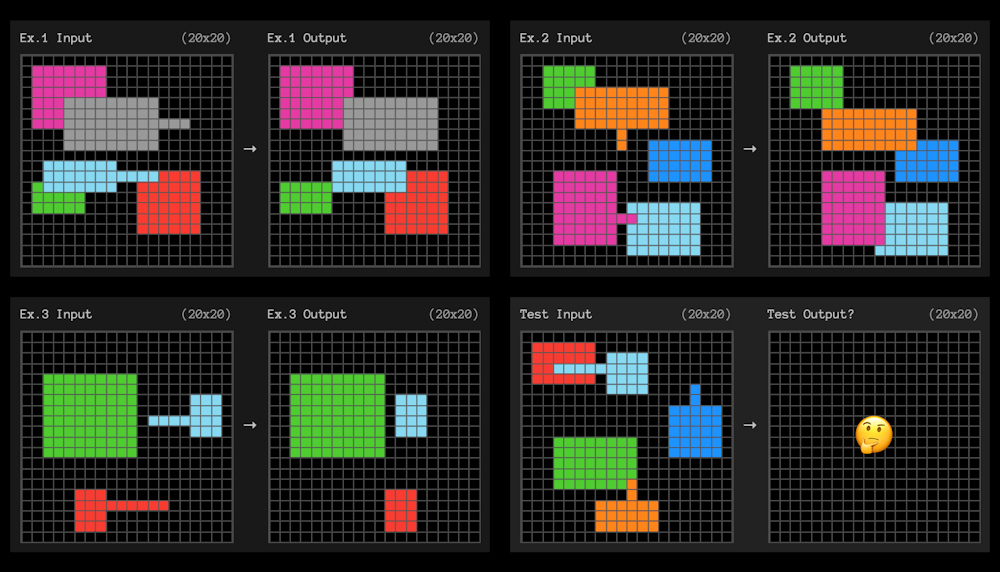
The ARC-AGI benchmark tests for sample efficient adaptation using little grid square problems like the one below. The AI needs to figure out the pattern that turns the grid on the left into the grid on the right.

An example task from the ARC-AGI benchmark test.
ARC Prize

Each question gives three examples to learn from. The AI system then needs to figure out the rules that “generalise” from the three examples to the fourth.

These are a lot like the IQ tests sometimes you might remember from school.

Weak rules and adaptation

We don’t know exactly how OpenAI has done it, but the results suggest the o3 model is highly adaptable. From just a few examples, it finds rules that can be generalised.

To figure out a pattern, we shouldn’t make any unnecessary assumptions, or be more specific than we really have to be. In theory, if you can identify the “weakest” rules that do what you want, then you have maximised your ability to adapt to new situations.

What do we mean by the weakest rules? The technical definition is complicated, but weaker rules are usually ones that can be described in simpler statements.

In the example above, a plain English expression of the rule might be something like: “Any shape with a protruding line will move to the end of that line and ‘cover up’ any other shapes it overlaps with.”

Searching chains of thought?

While we don’t know how OpenAI achieved this result just yet, it seems unlikely they deliberately optimised the o3 system to find weak rules. However, to succeed at the ARC-AGI tasks it must be finding them.

We do know that OpenAI started with a general-purpose version of the o3 model (which differs from most other models, because it can spend more time “thinking” about difficult questions) and then trained it specifically for the ARC-AGI test.

French AI researcher Francois Chollet, who designed the benchmark, believes o3 searches through different “chains of thought” describing steps to solve the task. It would then choose the “best” according to some loosely defined rule, or “heuristic”.

This would be “not dissimilar” to how Google’s AlphaGo system searched through different possible sequences of moves to beat the world Go champion.

You can think of these chains of thought like programs that fit the examples. Of course, if it is like the Go-playing AI, then it needs a heuristic, or loose rule, to decide which program is best.

There could be thousands of different seemingly equally valid programs generated. That heuristic could be “choose the weakest” or “choose the simplest”.

However, if it is like AlphaGo then they simply had an AI create a heuristic. This was the process for AlphaGo. Google trained a model to rate different sequences of moves as better or worse than others.

What we still don’t know

The question then is, is this really closer to AGI? If that is how o3 works, then the underlying model might not be much better than previous models.

The concepts the model learns from language might not be any more suitable for generalisation than before. Instead, we may just be seeing a more generalisable “chain of thought” found through the extra steps of training a heuristic specialised to this test. The proof, as always, will be in the pudding.

Almost everything about o3 remains unknown. OpenAI has limited disclosure to a few media presentations and early testing to a handful of researchers, laboratories and AI safety institutions.

Truly understanding the potential of o3 will require extensive work, including evaluations, an understanding of the distribution of its capacities, how often it fails and how often it succeeds.

When o3 is finally released, we’ll have a much better idea of whether it is approximately as adaptable as an average human.

If so, it could have a huge, revolutionary, economic impact, ushering in a new era of self-improving accelerated intelligence. We will require new benchmarks for AGI itself and serious consideration of how it ought to be governed.

If not, then this will still be an impressive result. However, everyday life will remain much the same.

Michael Timothy Bennett receives funding from the Australian government.

Elija Perrier receives funding from the Australian government.

ref. An AI system has reached human level on a test for ‘general intelligence’. Here’s what that means – https://theconversation.com/an-ai-system-has-reached-human-level-on-a-test-for-general-intelligence-heres-what-that-means-246529

How to get the kids through a long car trip without screens or losing your mind

Source: The Conversation (Au and NZ) – By Mary-Rose McLaren, Professor of Teaching and Learning and Head of Program, Early Childhood Education, Victoria University

Collin Quinn Lomax/ Shutterstock

Some years ago, my daughter was set a maths problem: how much does it cost to drive a family of four from Melbourne to Sydney, calculating petrol per kilometre and including a night’s accommodation? Her answer was simple: the cost is four airfares – that way the kids won’t kill each other.

Unfortunately, flying is not an option for many people over the holiday period.

So, how do you get the family through that long car trip without all hell breaking loose?

Try and avoid screens

The obvious choice for a long trip is to give the kids a device. But while screens might buy peace in the short term, returning to the real world afterwards can be overwhelming for children.

Lots of passive screen time – such as watching a movie or looking at YouTube – disconnects children from the people around them.

Studies on children up to the age of seven show an association between too much screen time and behaviour problems. Straight after a long time with screens, children can be fractious and argumentative. Parents also know taking the screens away from children can lead to tantrums.

No one wants to start a holiday with a meltdown. So, while there are certainly times and places when screens are useful (and even a blessing) – the long car trip is probably not one of them.

A young child sits in a carseat, pouting.
No one wants excessive pouting on holidays.
Irina Wilhauk/Shutterstock

Cars are not natural places to be

Cars are not natural environments for any of us, and especially not for children who discover the world through their senses.

In cars kids can’t move around much, they are cut off from the smells and textures of the world beyond the car. Things outside the window are moving really fast, making processing hard.

This is why some planning and a lot of understanding are important. The key to survival is making space, even in the car, for your child to do what they do best.

Let kids be creative

Children are naturally creative as they look at the world with fresh eyes.

There are lots of ways to harness this creativity in a car. Even with very young children, you can make music together. Make body percussion together (claps, raspberries, tapping and clicking) to create a soundtrack for part of the travel. You can change the rhythm, tempo or sound.

Or you could introduce them to a song you love – and give them a part to sing. Even very young children love serve and return singing – you sing a bit, they sing a bit.

When you need a break, ask the kids to prepare a concert for you using a song they love.

Ask lots of questions

Use the new environments around you as a prompt. Ask your kids questions like, if you were a bird, what would be able to see now? If you were that cow, what would you be thinking?

If you have drawing materials in the car, the children can draw their ideas and make a map of where they are.

If you have two or more children, you could encourage them to make up a play from the perspective of the animals or environment you are driving through. What is happening in that cafe? What is that dog planning for the afternoon?

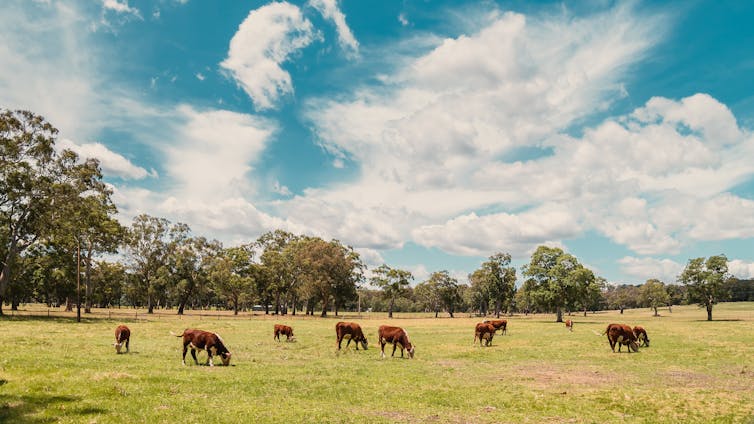
Cows graze in a field under a a blue sky with white clouds.
Ask your kids to imagine the trip from the point of view of an animal they see.
myphotobank.comm.au/Shutterstock

Oldies but goodies

There are also old-fashioned games like “Spot It”, which is like bingo for the trip.

You can make your own version before you leave on the trip. Create a grid with images of things your child might see – an orange car, a cow, a kangaroo, a tractor, a grape vine.

When they see them, they tick them off. Children can move in and out of this game, especially if you have thought ahead about what they might see on different parts of the journey.

For older kids, make up silly phrases based on number plate letters. For example, QTJ might be “Quick Turtles Jump”. Then you can add several number plates together to make a rhyme or a rap.

Or, get them to add, subtract or multiply several number plate numbers until they get to 100.

A young, smiling boy points out of a car window
Get your child to search for landmarks along the way.
Robie Online/ Shutterstock

Embrace the mess

A small amount of thought before and during the journey can help. But long car trips are hard on kids – which makes them hard on parents.

So embrace the mess and the inevitable moments of grumpiness. Trapped in a car together, this is an opportunity to know your child differently and for them to know you differently. Cars can be great places to discuss tricky topics with children (and teenagers) in non-confronting ways. Try asking some deeper questions, such as: what are the best things in life? What do you wish we did more of as a family? Or, do you think being fair is important?

There are chances here to make happy memories – even if the times in between feel a bit like torture.

The Conversation

Mary-Rose McLaren does not work for, consult, own shares in or receive funding from any company or organisation that would benefit from this article, and has disclosed no relevant affiliations beyond their academic appointment.

ref. How to get the kids through a long car trip without screens or losing your mind – https://theconversation.com/how-to-get-the-kids-through-a-long-car-trip-without-screens-or-losing-your-mind-245681

Keep calm and carry on your routines: how to manage kids’ ‘Christmas crankies’ over the holidays

Source: The Conversation (Au and NZ) – By Catherine E. Wood, Associate Professor and Clinical Psychologist, Swinburne University of Technology

Asier Romero/ Shutterstock

Christmas is coming, and with it many challenges for parents of young children.

You likely have one festive event after another, late nights, party food, way too much stimulation, tired kids and tired parents. All of which can culminate in what seems like an endless meltdown.

Yes, it’s the “Christmas crankies” – a far cry from the “festive friendlies” we are all conditioned to expect.

So, what can parents do to manage, or indeed prevent, the cranky times?

Routines are your friend

Routines are very important for children. They help them to know what to expect and what is expected of them while also helping them to feel safe.

Keeping to all your routines is almost impossible over the festive season (and it’s OK to be flexible to accommodate friends, family and celebrations).

But try and hold on to as many as you can. Try and stick to your bedtimes, or make sure you have the same breakfast and lunch if you are going out for a different dinner.

Even at a party, balance the festive food with healthier options. For example, have some carrot sticks next to the chip bowl and make sure the kids have some water (and not constant lemonade).

A young girl sits next to a man, next to a Christmas tree.
Try to stick to as many of your normal routines as you can over the festive season.
Cottonbro Studio/ Shutterstock, CC BY


Read more:
8 tips to navigate Christmas if you have a fussy eater or child with allergies


Prepare kids for what will happen

Given there are so many changes to the routine, it can also be helpful to prepare children for what is coming up.

You could have a schedule somewhere for the whole family to see. This can let children see what is happening, which can help to minimise any anxiety associated with uncertainty. The schedule can include activities such as social events, the date relatives are arriving, and what is happening on Christmas Day (aside from opening presents).

Some children might also feel anxious when meeting new people or relatives, or going to unfamiliar places during the festive season. Having a clear explanation and time limit for these events can also be helpful. For example, saying something such as,

tonight we are going to your aunty’s house, you haven’t seen this aunty for a year but her name is Mary. We will be there for an hour [demonstrate on the clock] and have some dessert. Then we’re coming home, and you’ll get to read your book and then off to bed.

It can also be helpful to space out some of the activities so there is some rest time in between.

Ok, but we still have a meltdown here

Despite your best efforts, it might be genuinely hard to avoid a meltdown. When a child is overwhelmed, stressed, and/or fatigued, the brain’s panic button (the amygdala) can be set off. This is what US clinical professor of psychiatry Dan Siegel refers to as “flipping the lid”.

As Siegel explains, the frontal lobe (responsible for self-control), loses control over the limbic system (which contains the amygdala, and is involved in the emotional control of behaviour).

The brain’s ability to control emotions is relatively immature in younger children, and can take at least until the early 20s to fully mature.

This means in times of fatigue, stress, new and/or over stimulating environments, “self-control” can be challenged or even lost.

A young girl in a Christmas headband and jumper cries.
Children find it much more difficult to control their emotions than adults.
Cryptographer/ Shutterstock

What to do in a meltdown

Parents can act as the proxy frontal lobe, helping their child to restore balance between their thoughts, feelings, and the demands of a sometimes chaotic Christmas setting.

In these circumstances, the child needs their parent(s) to stay connected, and to use a calm voice to bring them to a more balanced (or regulated) state. Parents could say something such as,

I can see you are feeling upset right now. It’s OK – there is a lot going on at Christmas time. I am here. Do you need a cuddle?

Remember, a child’s behaviour is not random – it is a vehicle to communicate a need. Maybe they need sleep, a drink, comfort, and/or some downtime.

So be on the lookout for those cranky cues so that the festivities can be enjoyed by all.

The Conversation

Catherine E. Wood does not work for, consult, own shares in or receive funding from any company or organisation that would benefit from this article, and has disclosed no relevant affiliations beyond their academic appointment.

ref. Keep calm and carry on your routines: how to manage kids’ ‘Christmas crankies’ over the holidays – https://theconversation.com/keep-calm-and-carry-on-your-routines-how-to-manage-kids-christmas-crankies-over-the-holidays-245273

I’ve calculated Santa’s speed on Christmas Eve – and this is what it would do to Rudolph’s nose

Source: The Conversation (Au and NZ) – By Laura Nicole Driessen, Postdoctoral Researcher in Radio Astronomy, University of Sydney

Tayla Walsh/Pexels

With billions of children around the world anxiously waiting for their presents, Father Christmas (or Santa) and his reindeer must be travelling at breakneck speeds to deliver them all in one night.

But did you know that light from an object travelling at high speeds changes colour? This is thanks to what’s called the Doppler effect – the way speed affects the length of waves, such as sound or light.

When light changes colour due to speed, we call it redshift or blueshift, depending on the direction. If we could catch the colour of Rudolph’s famous red nose with one of our telescopes, we could use the Doppler effect to measure the speed of Father Christmas.

Here’s how that might work – and why this effect is also a crucial tool in astronomy.

How far do Father Christmas and his reindeer need to travel?

Strap into your sleigh for some light Christmas maths. I’ve updated a method proposed in 1998 to work out how fast Rudolph and Father Christmas need to travel to deliver all the required presents (you can find my working here).

There are approximately 2 billion children under the age of 14 years in the world. Approximately 93% of countries observe Christmas in some way, so we’ll assume 93% of all children do.

We know Father Christmas only delivers presents to those who truly believe. If we assume the same percentage of believers by age group as found in the United States, that leaves us with approximately 690 million children.

With about 2.3 children per household worldwide, he has to visit roughly 300 million households.

Spreading those households evenly across 69 million square kilometres of habitable land area on Earth (taking oceans, deserts, Antarctica and mountains into account), Father Christmas has to travel 144 million kilometres on Christmas Eve. That’s nearly the same as the distance from Earth to the Sun.
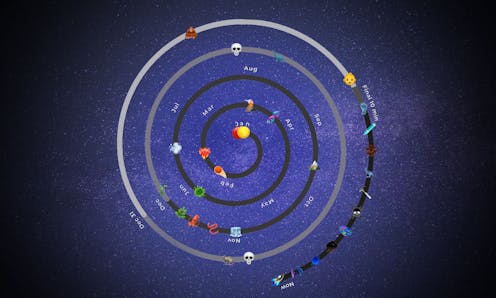
A real-life reindeer with a colourful harness pictured in a snowy landscape.
Santa’s reindeer have a lot of ground to cover on Christmas Eve.
Juhie Sugand/Shutterstock

Luckily, Father Christmas has time zones on his side, with 35 hours between dropping off the first and the last present.

Let’s say Father Christmas uses half his time to zip in and out of each household, which gives him 17.5 hours total or 0.2 milliseconds per household. He uses the other 17.5 hours for travelling between households.

My hypothesis is that he needs to travel at a whopping 8.2 million kilometres per hour, or 0.8% of the speed of light, to drop off all the presents.

How can we measure Father Christmas’ speed with Rudolph’s nose?

Let’s say we want to actually measure the speed of Father Christmas’ journey to see if it matches the hypothesis.

A standard speed camera wouldn’t do the trick. But we have telescopes on Earth that can measure the colour of something by using spectroscopy.

Father Christmas’ lead reindeer, Rudolph, has a famously ruby-red nose. If we could observe Father Christmas with telescopes, we could use the colour of Rudolph’s nose to measure his speed using the Doppler effect, which describes how speed affects wavelength. That’s because Rudolph’s nose wouldn’t look quite so red if he were travelling at high speeds.

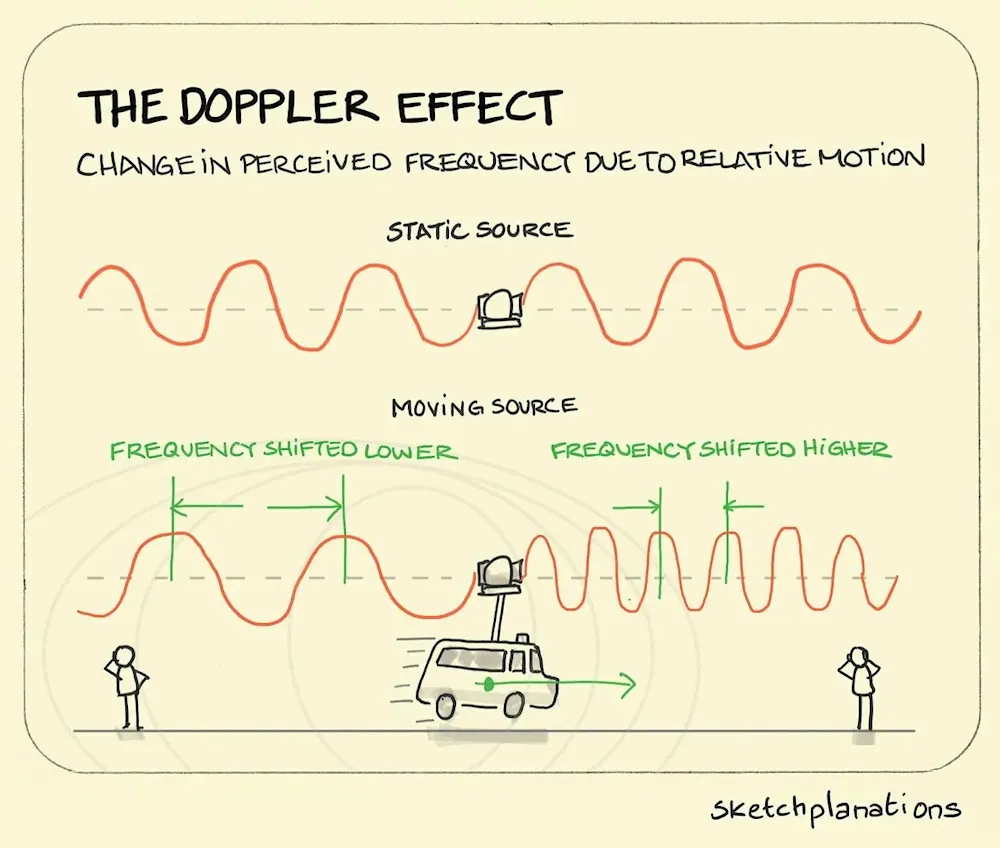
What is the Doppler effect? A good example is the sound of an ambulance. When it goes past you on the street, its sound is higher pitched as it approaches, and lower pitched when it drives away. This is because as the ambulance travels towards you, the sound waves are compressed to a shorter wavelength, and a shorter wavelength means a higher pitch.

The Doppler effect is the change in frequency of a wave as its source moves relative to the observer.
sketchplanations, CC BY-NC

The same thing happens with light. If a source of light is travelling away from you, the wavelength is stretched out and becomes more red or “redshifted”. If the source of light is travelling towards you, the wavelength is compressed and the light becomes more blue or “blueshifted”.

Rudolph the redshifted reindeer

Red-coloured light has a wavelength of 694.3 nanometres when it’s “at rest”, which means it isn’t moving. That would be the measurement of a stationary Rudolph.

Let’s say Father Christmas would prefer to deliver presents fast, so he can relax with some milk and biscuits at the end of the night. He gets his reindeer to run much faster than I hypothesised, at 10% of the speed of light or 107 million kilometres per hour.

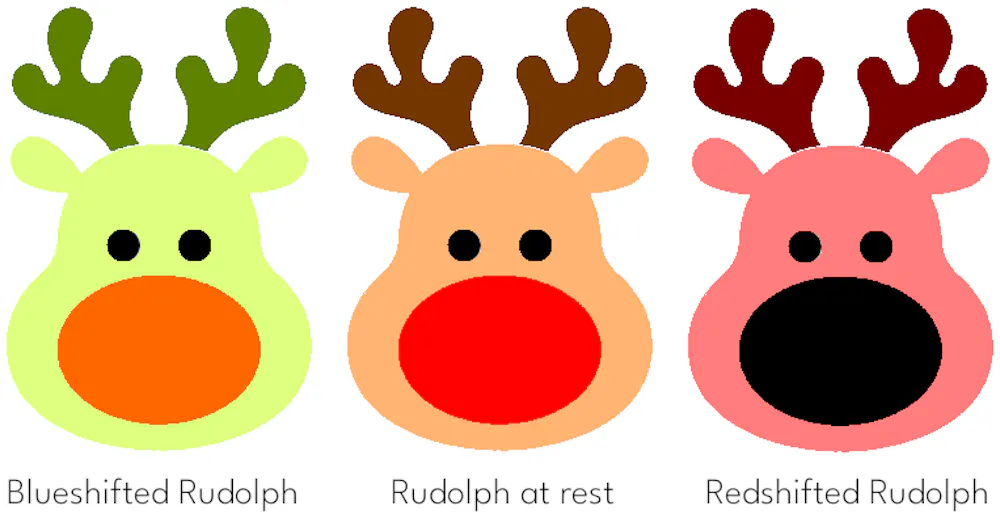
At this speed, Rudolph’s nose would be blueshifted to bright orange (624 nanometres) as he was flying towards your home.

And it would be redshifted to a very dark red (763 nanometres) as he was moving away. The darkest red human eyes can see is around 780 nanometres. At these speeds, Rudolph’s nose would be almost black.

Three images of the face of Rudolph the Red-nosed reindeer, in different colours depending on his speed.
Blueshifted Rudolph, Rudolph at rest, and redshifted Rudolph. The blue and redshifted colours were calculated for Rudolph travelling at 10% of the speed of light. Brown is a tricky colour since it’s a de-saturated orange. So the blue and redshifted colours for Rudolph’s fur and antlers are approximations. When Rudolph’s nose is redshifted at that speed, his nose is such a dark red that it’s practically black.
Dr Laura Driessen

The Doppler effect has a role in astronomy

Astronomers use the Doppler effect to measure how things move in space. We can use it to see if a star is orbiting another star – what’s known as a binary system.

We can also use it to find exoplanets (planets orbiting stars other than our Sun) using a method called “radial velocity”. We can even use it to measure the distances to far away galaxies.

There are some things science just can’t explain, and one of those is the magic of Father Christmas. But if astronomers ever catch Rudolph with their telescopes, they’ll be sure to let everyone know.

The Conversation

Laura Nicole Driessen is an ambassador for the Orbit Centre of Imagination at the Rise and Shine Kindergarten, in Sydney’s Inner West.

ref. I’ve calculated Santa’s speed on Christmas Eve – and this is what it would do to Rudolph’s nose – https://theconversation.com/ive-calculated-santas-speed-on-christmas-eve-and-this-is-what-it-would-do-to-rudolphs-nose-245764

How parents can safely navigate their kid’s first sleepover

Source: The Conversation (Au and NZ) – By Daryl Higgins, Professor & Director, Institute of Child Protection Studies, Australian Catholic University

Feeling unsure about your child going to a sleepover is completely normal. You might be worried about how well you know the host family, how they manage supervision or screen time, and even safety.

Sleepovers can carry risk through inadequate supervision or exposure to unsafe behaviours such as bullying, coercion, sexually inappropriate behaviour, or abuse from other children or adults.

These risks are heightened when there’s a lack of clear rules and oversight.

But in safe environments, sleepovers can also provide opportunities for children to build independence and strengthen friendships.

We research child safety. Here are a few strategies help to reduce risk and make the sleepover more successful.

Get to know the host family

Don’t be afraid to suggest a daytime playdate first.

This will give you a chance to chat to the family, get a sense of their household routines and parenting, and observe how comfortable your child seems with them.

An “everything but the sleep” sleepover can be a great starting point. This allows your child to enjoy the excitement of dinner, games and bonding time without the added stress of staying overnight.

Setting a prearranged pickup time can help anxious children (or parents) feel more comfortable.

Two girls play soccer in the park.
Don’t be afraid to suggest you start with a daytime playdate first.
K2L Family Stock/Shutterstock

Talk to the host family

When discussing the sleepover with the host family, it’s helpful to share that you have an open and honest communication style with your child.

This not only reassures the other parents that you’re engaged in your child’s safety but also subtly signals that you’ll follow up after the sleepover to ask how it went. For example you could mention:

  • how you talk to your child about respecting boundaries, including personal space during activities like going to the toilet or showering
  • your rules or expectations around use of devices and the internet
  • your ideas around appropriate bedtime attire for children (and for the adults who might be called on during the night)
  • that you plan to remind your child of these boundaries before the sleepover
  • that you’ll check in with your child afterwards to hear about their experience.

It’s OK to ask the host family about their approach to supervision and safety. You might ask:

  • who will be at home and who is supervising the kids? What adults will be present?
  • will there be other siblings or adolescents present?
  • what are the planned activities?
  • where will the children be sleeping?
  • how will they be supervised?
  • what is their approach to internet use and devices?

These questions don’t need to feel intrusive. Framing them as part of ensuring everyone has a great experience helps keep the conversation positive and collaborative.

Talk to your child about safety

Before the sleepover, reinforce with your child the importance of personal boundaries and respect for others.

After the sleepover, follow through with open-ended conversations. Ask your child how they felt, what they enjoyed, and if there was anything they didn’t like.

These casual but intentional conversations strengthen your child’s confidence in speaking up and help you stay attuned to their experiences.

Children should understand:

  • their body belongs to them and they have the right to say “no”
  • privacy rules around private parts, bathrooms, appropriate sleeping attire, and other private spaces
  • how to handle conflict with their friends, such as disagreements over sharing toys or activities
  • how to stay safe online (including while gaming), such as not sharing personal details, not talking with strangers, and what content is appropriate.

Let them know they should feel comfortable speaking up if something doesn’t feel right or if they are unsure. Come up with ways together to say no excuse themselves if a situation makes them uncomfortable.

Two boys engage in online gaming.
Find out what the host family’s policy is on screen time and online gaming.
Silvia Moraleja/Shutterstock

Create an exit strategy

Having a backup plan is essential, especially for younger children or first-time sleepovers.

Let your child know it’s OK to leave early if they’re feeling homesick or uncomfortable.

Remind them they can contact you at any time for any reason, no matter how small it seems. Discuss this with the host parents in advance to ensure they understand your approach.

Ensure your child has a way to contact you. If they don’t have their own device, coordinate with the host parents ways for your child to use their phone or landline.

Another option is to set up pre-arranged check-ins, where the host parents help your child call or text you at an agreed time.

You can also choose a code word with your child – if they say it during your chat, it means you’ll come and collect them.

Reassuring them they have an “out” can give children the confidence to fully enjoy the experience.

Assess your child’s readiness

Not every child is ready for a sleepover at the same age. Consider their emotional maturity and comfort level. Ask them directly how they are feeling – excited and eager or hesitant and nervous?

Can they manage basic self care tasks? Have they successfully spent time away from home before, such as with a relative or close friend?

If your child is hesitant, starting with shorter visits or sleepovers at your own home might be better until they feel more comfortable.

Sleepovers can be a fun part of childhood, and can foster independence, friendship, and resilience.

It’s worth taking the time to prepare. It’s OK to start small, ask questions and trust your instincts.

The Conversation

Daryl Higgins receives funding from the Australian Research Council, the National Health and Medical Research Council and a range of government departments, agencies, and service providers, including Bravehearts. He was a Chief Investigator on the Australian Child Maltreatment Study.

Gabrielle works with the Australian Child Maltreatment Study (ACMS) team as part of her PhD Candidature. She has also previously worked for Bravehearts in various roles, including for the Turning Corners program, which provides support to young people who have displayed harmful sexual behaviours.

ref. How parents can safely navigate their kid’s first sleepover – https://theconversation.com/how-parents-can-safely-navigate-their-kids-first-sleepover-243918

50 years ago, Cyclone Tracy flattened Darwin – and Australia’s attitude to disasters changed forever

Source: The Conversation (Au and NZ) – By Milad Haghani, Senior Lecturer of Urban Risk & Resilience, UNSW Sydney

Exactly 50 years ago, on Christmas Eve 1974, Cyclone Tracy struck Darwin and left a trail of devastation. It remains one of the most destructive natural events in Australia’s history.

Wind speeds reached more than 200 kilometres per hour. The cyclone claimed 71 lives and injured nearly 650, and left 70% of the city’s buildings flattened.

If you are about 60 or older, chances are you remember that day, even if the cyclone did not directly affect you.

The 50th anniversary of this disaster offers a crucial opportunity to reflect on how Cyclone Tracy not only reshaped Darwin but marked a turning point in Australia’s approach to disaster resilience.

The nightmare before Christmas

Cyclone Tracy was initially a relatively small, slow-moving system. But after meandering around the Arafura Sea for three days, it rounded Bathurst Island and headed towards Darwin, getting more ferocious as it approached the coast.

Some Darwin residents later reported not knowing a cyclone was approaching. They included Keith and Christine Pattinson, whose daughter Courtney Zagel later recounted their story:

They told me […] the rain started coming sideways through the louvered windows. The power went out, and everything turned black.

Keith stood against the doors to try and keep them shut, then suddenly there was a huge explosion. The roof of the house flew off and the walls fell in. Christine was thrown back into a glass cabinet. Keith was trapped beneath one of the fallen walls.

The couple spent the night in the neighbour’s house. Christine was later evacuated for urgent medical treatment.

Resident Andrea Mikfelder would later write of the cyclone’s aftermath:

our house […] was still standing. It was a brick home, but the roof was gone. The neighbour’s house looked like a dollhouse, split in half, while the next house was completely flattened.

The Bureau of Meteorology would later estimate peak wind gusts of between 217 and 240 kilometres an hour. A report published in 2010, employing more advanced techniques, suggested even higher speeds.

Tracy left about 10,000 houses destroyed and 40,000 people homeless from a city population of 47,000. The damage bill at the time totalled A$800 million.

More than 30,000 residents were evacuated, about 60% of whom never returned. The airlift operation remains the largest in Australia’s history.

What has changed since?

In the 50 years since the tragedy, authorities have become much better able to forecast tropical cyclones. They can now warn of a cyclone’s projected path, and the likelihood of it reaching land, several days in advance.

Cyclone Tracy reshaped Australia approach to disaster response and preparedness. The Natural Disasters Organisation – today known as Emergency Management Australia – had been established a few months before the cyclone, to coordinate national-level disaster relief efforts.

But its role and authority were still evolving. Tracy served as a “reality check” for the young organisation.

Cyclone Tracy revealed weaknesses in disaster response at all levels of government. The scale of the damage quickly outstripped local and state resources. The federal government was forced to step in to oversee mass evacuations of over 30,000 people and lead recovery efforts.

However, the Commonwealth lacked clear powers to intervene in national emergencies at the time, complicating its response effort. Its powers have since increased.

Cyclone Tracy also gave impetus to disaster management legislation, such as Queensland’s State Counter-Disaster Organisation Act, established in 1975. Such reforms set the stage for the more structured and integrated approach to disaster response now in place across Australia.

Building back better

Darwin’s devastation prompted more stringent building codes across Australia.

Even though Darwin is naturally prone to cyclonic winds, few structures had been built to withstand them.

Afterwards, regulations requiring all reconstruction to adhere to updated cyclone-resistant building standards were introduced. It meant, for example, screws rather than nails must be used to hold down corrugated iron roofing, and buildings must be clad to withstand airborne debris.

Similar regulations were implemented for new construction in other cyclone-prone areas of Australia.

Today, Darwin is a far more resilient city. In 2018 it was hit by Cyclone Marcus, the most powerful storm since Tracy with wind gusts of 130 kilometres per hour. No lives were lost, and relatively few structures were damaged.

Getting to grips with the mental toll

Cyclone Tracy left deep mental scars on survivors.

A study of residents who were evacuated to Sydney after Tracy revealed 58% displayed signs of psychological disturbance in the days following the cyclone. Women and older individuals were particularly affected.

Decades on, survivors described ongoing anxiety and depression, often triggered by the sounds of wind and rain.

Today, the psychological impact of natural disasters – on survivors, volunteers and first responders – is much better understood.

Initiatives such as the National Disaster Mental Health and Wellbeing Framework reflect this progress. It recognises that mental health needs after extreme events are complex, and support is needed at the individual and community level.

Volunteers are key

Cyclone Tracy also showed how community efforts and volunteers are essential in disaster recovery.

In the cyclone’s aftermath, local emergency services were overwhelmed. Volunteers quickly became the backbone of the relief effort, setting a precedent for future disaster responses.

Today, volunteers – alongside established relief organisations – still provide food, shelter, medical care and other crucial aid after disasters. As extreme weather becomes more frequent and severe under climate change, the need for community mobilisation will only grow.

The recent Senate inquiry into Australia’s Disaster Resilience recognises the ongoing need to strengthen volunteer participation and management in disaster scenarios.

A more resilient Australia

Under climate change, tropical cyclones conditions may occur less frequently. This means Australia is expected to experience fewer tropical cyclones in future.

But a greater proportion of those that do hit are expected to be high-intensity, with stronger winds and rain.

The tragedy of Cyclone Tracy means Australia’s disaster preparedness is more advanced than it might have been. However, building a disaster-resilient nation requires continuous efforts to strengthen infrastructure, refine evacuation plans, and address vulnerabilities in communities.

Achieving this is a responsibility which should be shared between governments and communities alike.

The Conversation

The authors do not work for, consult, own shares in or receive funding from any company or organisation that would benefit from this article, and have disclosed no relevant affiliations beyond their academic appointment.

ref. 50 years ago, Cyclone Tracy flattened Darwin – and Australia’s attitude to disasters changed forever – https://theconversation.com/50-years-ago-cyclone-tracy-flattened-darwin-and-australias-attitude-to-disasters-changed-forever-240369

Work or play? The rise of online ‘kidfluencers’ is raising complex legal and ethical questions

Source: The Conversation (Au and NZ) – By Irmine Keta Rotimi, Doctoral Candidate, Marketing and International Business department, Auckland University of Technology

Videos of children opening boxes of toys and playing with them have become a feature of online marketing – making stars out of children as young as two.

Twelve-year-old influencer Ryan Kaji, for example, earns US$30 million a year on YouTube leading one of the most popular children’s channels. His empire was built on toy unboxing.

An influencer (child or adult) with more than one million followers can earn upwards of $20,000 for one sponsored post, while a person with under 100,000 followers on a social media platform may still earn as much as $4,000 for each sponsored post.

But the rise of kidfluencers around the globe raises questions about the blurred lines between play and labour, independence and control, privacy, profit and online success.

Our research examines these questions. By analysing existing research to clearly identify the challenges faced by child toy unboxers, we can guide future researchers and governments to best support children who are living parts of their lives online.

YouTube as a career goal

A 2023 global survey of children aged between eight and 12 found they were three times more likely to aspire to be a YouTuber (29%) than an astronaut (11%).

Advertisers have taken note. Social media platforms Facebook, Instagram, Snapchat, TikTok, X (formerly Twitter) and YouTube collectively earned nearly $11 billion in advertising revenue in 2022 from United States-based users younger than 18.

Toy unboxing has emerged as particularly popular, generating massive revenue and global audiences. These types of videos involved children who unbox, play and review toys.

Unboxing videos became popular in the 2010s, with content creators unpacking products such as tech gadgets and fashion items. Toy unboxing is now one of the highest-earning genres on YouTube.

Unboxing videos have become popular on video platforms such as YouTube.

Work, play or somewhere in between

At first glance, unboxing videos seem to follow a simple entertainer-audience relationship. The kidfluencers emotionally engage with young viewers, who are then inspired to create their own toy wish lists.

But behind the fun is a world of complexity often not obvious for young viewers (and sometimes older viewers too).

These children are hired by companies – and managed by their parents – to promote toys and other products in an job-like arrangement. This has raised concerns about child exploitation, privacy risks and unethical work practices.

But current child labour laws in New Zealand and elsewhere do not see child influencers as a type of “child worker”. And it is difficult to do so.

While kidfluencers seem to be genuinely playing with the sponsored toy, their content is managed by contracts with advertisers, and expectations set by their parents. Therefore it can’t fully be labelled as “play”.

At the same time, calling these practices purely “labour” ignores the real excitement children feel when creating sponsored content.

In 2020, the French government labelled kidfluencers a “grey zone” – where the child is not officially working, but nevertheless spends a significant amount of time making videos, or derives a significant level of income from them.

Protecting children

Another complexity is that some social media platforms require users to be over 13, yet some kidfluencers are toddlers, with parents creating and managing their accounts, including producing and posting their children’s online content.

While parents play a big role in managing their child’s online presence, the child drives the toy sales, creating tension between parental control and a child’s independence.

And behind this all is the issue of money. A child’s involvement – and success – is driven by the wants and needs of advertisers. This raises questions about how much of a say the child really has in terms of creating content.

Privacy and online safety are two key issues facing the kidfluencer industry. The more content a child toy unboxer posts online, the more popular and profitable they can become. But at the same time, popularity brings very real risks.

Young female unboxers – and female kidfluencers in general – have been targeted by online predators. To stay safe, some kidfluencers use fake names and don’t share their location. But these strategies are not perfect.

Current (and proposed) policies rarely balance protecting child stars with supporting their success in sponsored content.

In recent years, however, France and individual states in the US have created laws to protect the kidfluencers’ earnings.

All governments should follow suit and create policies that recognise the challenges of the kidfluencer industry, and which support and protect the children involved.

The Conversation

The authors do not work for, consult, own shares in or receive funding from any company or organisation that would benefit from this article, and have disclosed no relevant affiliations beyond their academic appointment.

ref. Work or play? The rise of online ‘kidfluencers’ is raising complex legal and ethical questions – https://theconversation.com/work-or-play-the-rise-of-online-kidfluencers-is-raising-complex-legal-and-ethical-questions-241904

My dance school is closed for the summer, how can I keep up my fitness?

Source: The Conversation (Au and NZ) – By Joanna Nicholas, Lecturer in Dance and Performance Science, Edith Cowan University

Tatyana Vyc/Shutterstock

Once the end-of-year dance concert and term wrap up for the year it is important to take a break. Both physical and mental rest are important and taking a few weeks off can help your body repair and have a mental break from dance.

If your mind and body are in need of an extended break (such as more than a few weeks), then it’s more than OK to take longer off, especially if you are training at a competitive or pre-professional level.

There is benefit in enjoying other aspects of your life outside of dance such as spending time with family, friends and enjoying hobbies.

A safe, fulfilling dancing life

Creating meaning and value in life outside of dance and expanding sense of self can make it easier to lean into other aspects when experiencing change or difficult times during dance training such as being injured.

Taking an extended break from dance training will, however, mean losing some fitness and physical capacity. When you return to dance your body will take time to return to full capacity again.

Approaches such as being “whipped back into shape” can promote sudden spikes in training load (hours and intensity of training) which can increase the risk of injury. It is advised to gradually and progressively increase training load over time to allow the body to adapt and return to full capacity safely.

A four-to-six week period of gradually progressing training load and introducing jumping has been suggested in dance settings.

For dancers wanting to maintain fitness over the summer holidays, a great place to start is focusing on building a physical foundation.

A teenage girl running.
Exercise like running can help build a physical foundation.
Jacek Chabraszewski/Shutterstock

Building a physical foundation means focusing on targeted areas of fitness such as full body strength, cardiovascular fitness or stamina (such as skipping, cycling walking, running, swimming), flexibility, and some dance-specific conditioning (for example, calf rises for ballet).

A good physical foundation will mean an improved capacity and fitness level so your body is ready to take on more challenging dance movements and routines once you return to the studio.

Building full body strength at home or at the park

A great place to start is by choosing movements that require your muscles to work to support your own body weight.

Fundamental movements such as crawling (moving on the floor on hands and feet) and locomotion (travelling movements such as lunging, hopping, sliding) are great for developing body control, arm and leg stability and coordinated movement patterns.

Below is a sequence that can be used as a warm up and even as a workout itself. The ten minute sequence is based on gross motor and fundamental movement patterns. It includes exercises that work through a range of joint movements and in multiple planes (forwards, sideways, rotating).

Several exercises.
This fundamental movement sequence can be used as a warm-up or a workout.
Joanna Nicholas, CC BY

Once feeling comfortable with the above fundamental movements, it is time to introduce body weight resistance exercises.

Body weight resistance exercises can be beneficial for developing a strong foundation for dance movements such as jumping, landing, floorwork, partnering and aerial work.

Exercises from the above sequence can be used to form a safe and effective neuromuscular warm up.

Aim to include one exercise from each of the below movement categories (squat, horizontal push etc) to build your own workout.

Aim to complete two to three sets (or rounds) of each exercise with about one minute rest between sets. An alternative is to complete one set of each exercise with minimal rest between, then complete a second or third time.

If training with friends, you could set a timer and do each exercise for up to 50 seconds (instead of counting reps) and take ten seconds to transition to the next exercise.

Depending on your level of strength you may need to do fewer repetitions and build up sets and repetitions overtime. After you have completed the body weight exercises complete a cool down including stretches for the upper and lower body muscles. Be sure to use a sturdy bar (such as an outdoor fitness station) for horizontal row and overhead hold.

Exercises may need to be modified depending on fitness level and physical limitations such as injury.

Body weight exercises.
You can build your own full body strength workout using these movements.
Joanna Nicholas, CC BY

How often should I train?

A common misconception in dance is that “more is better”. This belief can lead to dancers training long hours on most or all days of the week which can lead to overtraining, plateauing and increased risk of injury.

Our bodies require sufficient time between training sessions to adapt and get stronger and fitter. The time between sessions is when our muscles and tissues repair and training gains are made.

By incorporating adequate recovery (including sleep and downtime) and including rest days throughout the week, our bodies can gain the most benefits from training.

A young woman reads a book.
Rest days are important, too.
Manop Boonpeng/Shutterstock

Muscles can take up to 48–72 hours to recover from most types of strength-based exercises (the more intense the longer they’ll need to recover).

Aerobic activity at low intensity, such as a brisk walk, can be done most days (24-hour recovery) while high stress anaerobic exercise such as high intensity intervals or sprints can take three days or more to recover from.

Aim to spread training sessions out over the week and allow time to recover between sessions.

Below is an example weekly schedule based on incorporating adequate recovery between sessions, and incorporating polarised training where some days are harder and others are easier.

Seek guidance from your healthcare provider and/or an exercise professional prior to undertaking a new exercise program.

The Conversation

Joanna Nicholas does not work for, consult, own shares in or receive funding from any company or organisation that would benefit from this article, and has disclosed no relevant affiliations beyond their academic appointment.

ref. My dance school is closed for the summer, how can I keep up my fitness? – https://theconversation.com/my-dance-school-is-closed-for-the-summer-how-can-i-keep-up-my-fitness-244504

The Christmas album that heralded the end of a folk musical era: The Kingston Trio’s The Last Month of the Year

Source: The Conversation (Au and NZ) – By Kit MacFarlane, Lecturer, Creative Writing and Literature, University of South Australia

Capitol Records

For those looking to introduce some musical conflict into the holidays, Bob Dylan’s Christmas in the Heart remains a great choice in its 15th anniversary – like it or not.

Before Dylan really got started, an iconic group opened the door to mainstream folk success for Dylan and his contemporaries. And at the height of their popularity, they also released an unexpected Christmas album.

But instead of becoming a perennial classic, it seemed to foreshadow the approaching end for the group’s dominance at the peak of popular music.

That album was The Kingston Trio’s ill-fated The Last Month of the Year from 1960.

The ‘hottest act in show business’

The Kingston Trio are often remembered as a clean-cut, sanitised and goofy footnote in musical history. Their matching striped shirts may be a difficult fashion choice to rehabilitate today, but the trio’s impact on popular music was explosive.

Popular performances in 1957 San Francisco led quickly to their self-titled first album the following year. Reshaping folk music for a mainstream audience energised professional and amateur performers.

Critic Greil Marcus describes their breakthrough hit, 1958’s Tom Dooley, as having “the same effect on hearts and minds in 1958 that Nirvana’s Smells Like Teen Spirit and Nevermind did in 1991”.

By the time they released their Christmas album, they were the “hottest act in show business”.

In the previous two years, they’d had five number one albums on the Billboard charts. Four of their albums were in the top ten at the same time. They reportedly generated 15% of Capitol Records’ annual sales.

Following that phenomenal success, one early response to their Christmas album noted:

By now it’s fairly well established that the Kingston Trio could record Row, Row Your Boat in 12 languages, put it on wax, and the album would sell a half-million copies. As a consequence, there’s little doubt that The Last Month of the Year will be one of the big sellers this Christmas.

Instead, The Last Month of the Year became their first studio album not to reach number one.

Although still successful, their later albums never reached number one or Gold Album status again. Founding member Dave Guard left in 1961. A new lineup with replacement John Stewart had peaks of success, enduring in a changing folk scene – but never quite recapturing those initial years.

‘Perhaps the most unusual set of the year’

The Kingston Trio were lambasted, then and now, for their commercial focus. Nevertheless, The Last Month of the Year stands in contrast to many enduring commercial norms.

Contemporary responses to The Last Month of the Year noted “a number of almost unknown Christmas songs instead of the usual diet of standard carols” and “perhaps the most unusual set of the year”.

There are none of the 1940s and 1950s staples that have persisted through the decades. Nat King Cole opened his 1960 album The Magic of Christmas with a spirited Deck the Halls. Both Ella Fitzgerald (on Ella Wishes You a Swinging Christmas) and Peggy Lee (on Christmas Carousel) opened their Christmas albums of the same year with Jingle Bells.

In contrast, The Kingston Trio’s opening track is a subdued version of the 16th century Coventry Carol, a lullaby for the children Herod ordered to be killed. The restrained use of a celeste, or bell-piano, summons Christmas vibes but largely augments the sombre harmonies.

Opening with the biblical Massacre of the Innocents was certainly one way to set The Last Month of the Year apart from its jolly competitors.

Range, energy and appropriation

Other songs include delicate folk (All Through the Night), traditional rounds (A Round About Christmas), historical carols (Sing We Noel) and uncharacteristic original lyrics (The White Snows of Winter).

Spirituals Go Where I Send Thee and The Last Month of the Year (What Month Was Jesus Born In) allow the trio to focus on the kind of energy (and appropriation) that had defined much of their previous output.

Goodnight My Baby charms as a Christmas Eve lullaby that’s too excited to lull anyone to sleep.

Adding oddness, Mary Mild reshapes the strange apocryphal The Bitter Withy where a child Jesus creates “a bridge of the beams of the sun” to encourage children to play with him. The Kingston Trio only hint at the song’s common outcome that leaves his playmates dead and Mary meting out some corporal punishment.

Perhaps more restrained than their usual performances, the album nevertheless guides listeners through some of the styles and sources that the Trio’s brand of popular folk could draw on.

A Christmas album that still has something to offer

The Last Month of the year wasn’t the cause, but it occupies a turning point where The Kingston Trio’s cultural dominance began to slip.

A posed photo of the band.
The Kingston Trio in 1957.
The Kingston Trio/Wikimedia Commons, CC BY-SA

Soon after, Bob Dylan’s song Blowin’ in the Wind (published in 1962) and album The Freewheelin’ Bob Dylan (1963) marked a new era of folk that revived its political energy (for a while).

As folk music further solidified its place in the civil rights movement, the Kingston Trio’s collegiate party vibes and perceived apoliticism seemed out of step.

When Dylan released his Christmas album in 2009, one critic asked “Is he sincere? Does he mean it?”

That’s also a question that defined and dogged The Kingston Trio from the outset of the folk revival they ushered in. Are these goofy guys serious?

The Last Month of the Year is an intriguing and ambitious album by a group that, for a short but influential time, reshaped popular music.

It’s a forgotten Christmas album that might still have something new to offer a Christmas-weary listener.

The Conversation

Kit MacFarlane does not work for, consult, own shares in or receive funding from any company or organisation that would benefit from this article, and has disclosed no relevant affiliations beyond their academic appointment.

ref. The Christmas album that heralded the end of a folk musical era: The Kingston Trio’s The Last Month of the Year – https://theconversation.com/the-christmas-album-that-heralded-the-end-of-a-folk-musical-era-the-kingston-trios-the-last-month-of-the-year-242583

Moana Maniapoto on the sound of the 80s to world-class journalism

By Emma Andrews, Henare te Ua Māori journalism intern at RNZ News

From being the headline to creating them, Moana Maniapoto has walked a rather rocky road of swinging between both sides of the media.

Known for her award-winning current affairs show Te Ao with Moana on Whakaata Māori, and the 1990s cover of Black Pearl, the lawyer-by-trade doesn’t keep her advocacy a secret.

Her first introduction to news was at the tail end of the 1980s when she was relaxed in the guest seat at Aotearoa Radio — Auckland’s first Māori radio station — but her kōrero hit a nerve.

“I said something the host considered radical,” she said.

“He quickly distanced the station from my remarks and that got the phones ringing.”

It became a race for listeners to punch numbers into the telephone, the first person to get through was New Zealand filmmaker, producer and writer Merata Mita, who ripped into the host.

“How dare you talk down to her like that,” Maniapoto recalled. The very next day she answered the call to host that show from then on.

No training, no worries
Aotearoa Radio was her first real job working four hours per day, spinning yarns five days a week — no training, no worries.

“Oh, they tried to get us to speak a bit flasher, but no one could be bothered. It was such a lot of fun, a great bunch of people working there. It was also nerve-wracking interviewing people like Erima Henare (NZ politician Peeni Henare’s father), but the one I still chuckle about the most was Winston Peters.”

She remembers challenging Peters over a comment he made about Māori in the media: “You’re going to have to apologise to your listeners, Moana. I never said that,” Peters pointed out.

They bickered in true journalist versus politician fashion — neither refused to budge, until Maniapoto revealed she had a word-for-word copy of his speech.

All Peters could do was watch Maniapoto attempt to hold in her laughter. A prompt ad break was only appropriate.

But the Winston-win wasn’t enough to stay in the gig.

“After two years, I was over it. It was tiring. Someone rang up live on air and threatened to kill me. It was a good excuse to resign.”

Although it wasn’t the end of the candlewick for Maniapoto, it took 30 years to string up an interview with Peters again.

Short-lived telly stints
In-between times she had short-lived telly stints including a year playing Dr Te Aniwa Ryan on Shortland Street, but it wasn’t for her. The singer-songwriter has also created documentaries with her partner Toby Mills, their daughter Manawanui Maniapoto-Mills a gunning young actress.

Moana Maniapoto has featured on the cover of magazines. Image: RNZ

Maniapoto has featured on the cover of magazines, one in particular she remembers was Mana magazine in 1993.

“Sally Tagg photographed me in the shallow end of a Parnell Baths pool, wrapped in metres of blue curtain net, trying to act like it was completely normal,” she said.

Just 10 years ago she joined Mana Trust which runs the online Sunday mag E-Tangata, mentored by Gary Wilson (co-founder and co-editor) and print journalist Tapu Misa who taught her how to transfer her voice through computer keys.

“Whakaata Māori approached me in 2019, I was flattered, but music was my life and I felt wholly unequipped for journalism. Then again, I always love a challenge.”

Since jumping on board, Te Ao with Moana has completed six seasons and will “keep calm and carry on” for a seventh season come 17 February, 2025 — her son Kimiora Hikurangi Jackson the producer and “boss”.

It will be the last current affairs show to air on Whakaata Māori before moving the TV channel to web next year.

Advocating social justice
Her road of journalism and music is winding. Her music is the vehicle to advocating social justice which often landed her in the news rather than telling it.

“To me songwriting, documentaries, and current affairs are all about finding ways to convey a story or explore an issue or share insights. I think a strength I have are the relationships I’ve built through music — countless networks both here and overseas. Perfect for when we are wanting to deep dive into issues.”

Her inspiration for music grew from her dad, Nepia Tauri Maniapoto and his brothers. Maniapoto said it was “their thing” to entertain guests from the moment they walked into the dining room at Waitetoko Marae until kai was finished.

“It was Prince Tui Teka and the Platters. Great vocal harmonies. My father always had a uke, gat, and sax in the house,” she said.

Born in Invercargill and raised in Rotorua by her māmā Bernadette and pāpā Nepia, she was surrounded by her five siblings who some had a keen interest in kapa haka, although, the kapa-life was “too tough” for Maniapoto. Instead, nieces Puna Whakaata, Mourei, and Tiaria inheriting the “kapa” gene. Maniapoto said they’re exceptional and highly-competitive performers.

ONO songwriters Te Manahau Scotty Morrison, Moana Maniapoto and Paddy Free. Image: Black Pearl/RNZ

Blending her Ngāti Pikiao, Ngāti Tūwharetoa, and Tūhourangi whakapapa into song was no struggle.

The 1990s was filled with soul, R’n’B, and reggae, she said, singing in te reo was met with indifference if not hostility.

‘Labelled a radical’
“If you mixed in lyrics that were political in nature, you were labelled a ‘radical.’ I wasn’t the only one, but probably the ‘radical’ with the highest profile at the time.”

After her “rare” single Kua Makona in 1987, Moana & the Moahunters formed in the early 1990s, followed by Moana and the Tribe which is still going strong. Her sister Trina has a lovely singing voice and has been in Moana & The Tribe since it was formed, she said.

And just like her sixth television season, Maniapoto has just churned out her sixth album, Ono.

“I’m incredibly proud of it. So grateful to Paddy Free and Scotty Morrison for their skills. Looks pretty too on vinyl and CD, as well as digital. A cool Xmas present. Just saying.”

The microphone doesn’t seem to be losing power anytime soon. All albums adequately named one-to-six in te reo Māori, one can only punt on the next album name.

“It’s kinda weird now morphing back into the interviewee to promote my album release. I’m used to asking all the questions.”

This article is republished under a community partnership agreement with RNZ.

Article by AsiaPacificReport.nz

Rabuka reveals details of 1987 coup navy ‘secret weapons mission’

By Litia Cava, FBC News multimedia journalist

Fiji Prime Minister Sitiveni Rabuka has revealed how arms and ammunition used to conduct the 1987 military coup were secretly brought into Fiji on board a naval survey ship.

Speaking at the commissioning of a new research vessel for the Lands and Mineral Resources Ministry on Friday, Rabuka described the strategic measures taken to ensure the weapons reached Fiji undetected.

He recounted that during preparations for his coup against Dr Timoçi Bavadra’s Labour government of 1987, Fiji lacked sufficient arms and ammunition.

“I realised that we didn’t have enough weapons and ammunition in Fiji to do what I wanted to do. So I sent a very quick message to the captain who was there to pick up the ship and surprised him by asking that, get that ship commissioned in Singapore before you sail back to Fiji.”

Rabuka explained the decision, saying the commissioning had allowed the ship to fly a naval flag, ensuring it would avoid inspection at international ports.

He said the ship’s captain was instructed to load arms and ammunition en route which were successfully brought back to Fiji.

The Prime Minister said the measures were necessary at the time to achieve what needed to be done.

Rare glimpse of tactics
His remarks offered a rare glimpse into the behind-the-scenes tactics of 1987, highlighting the extent of planning and resourcefulness involved.

Rabuka’s comments were made during the launch of a state-of-the-art research vessel which will serve as a floating laboratory for marine geological studies and coastal surveys.

The vessel is equipped with advanced tools to map the ocean floor, study tectonic activity and support communities affected by climate change.

The Prime Minister said the new vessel marked a significant step in understanding Fiji’s marine ecosystem.

He also spoke about the importance of integrating scientific research with traditional knowledge to address critical issues such as climate change and sustainable resource management.

The PM said there was a need for informed planning to prevent disasters, referencing the recent earthquake in Vanuatu.

Rabuka said early geological surveys could have guided city planners and engineers in designing structures that mitigate damage from such events.

The new vessel is expected to provide critical insights into the ocean’s mysteries while contributing to Fiji’s resilience against climate-related challenges.

Fiji’s President celebrates birthday with military
Meanwhile, earlier today members of the Republic of Fiji Military Forces (RFMF) gathered at State House to celebrate the 71st birthday of Fiji’s President and Commander-in-Chief, Ratu Naiqama Lalabalavu.

The celebration was led by the Commander of the Fiji Navy, Humphrey Tawake, with senior officers. It was marked by a march by officers and the RFMF band. adding a ceremonial and heartfelt touch to the happy occasion.

On behalf of the commander of the RFMF who is away on official leave, Commander Tawake extended birthday wishes to the Head of State.

President Lalabalavu praised the dedication of the RFMF in upholding law and order.

“The strength of our nation lies in our collective efforts, and since assuming office, I have witnessed the vital role you play in ensuring peace and stability,” he said.

Article by AsiaPacificReport.nz

NZ’s Z Energy renames stations with ‘correct’ kupu

By Emma Andrews, Henare te Ua Māori Journalism Intern at RNZ News

The New Zealand fuel company Z Energy is swapping out street names for “correct” kupu on service stops around the country, with the help of local hapū.

When Z took over 226 fuel sites from Shell in 2010, the easy solution was to name the respective stations after the streets they were on, or near.

But when it named the Kahikatea Drive station in Kirikiriroa Z — K Drive, the company’s Māori advisor questioned the abbreviation.

“Kahikatea is the correct name. That led to a bigger conversation about where are we with our knowledge as we start to learn a bit more about te reo Māori and acknowledging interconnected-ness of all things, like, where else are there opportunities to do it,” Z Energy customer general manager Andy Baird said.

After 12 months of whakawhanaungatanga (relationship building), the company was guided by Te Hā o te Whenua o Kirikiriroa on changing the name of Z Dinsdale to Z Tuhikaramea.

That led to two other stations being renamed — New Plymouth’s Z Courtenay Street became Z Huatoki, while Hamilton’s Five Cross Roads station became Z Te Papanui.

“This is not about ticking a box per se, this is about a bigger sort of commitment that we have to te reo Māori and obviously to the communities that we operate in, so it’s a much bigger broader long-term programme,” Baird said.

Z Energy . . . an internal drive to incorporate more use of te reo Māori. Image: RNZ

Internal te reo drive
There had also been an internal drive to incorporate more use of te reo, kicking off each day with karakia, Baird said.

It added more of a connection between the company and Māori traditions.

“We’ve been adding bilingual language inside the sites but we have equally taken the time to make sure that we’re getting the right dialects as the regions as we go through it.

“Part of the project this year was to sort of understand the process that we go through in terms of engagement with mana whenua and how they want things to happen and occur, and how we can come together to make that really a great outcome for local communities we operate in.”

The company could have changed the station names off the bat, but Baird said consulting with local hapū and iwi was the right thing to do.

“The opportunity to meet them, to start to engage with mana whenua and to build a relationship with them and to do something that they’re just as proud of as we are, was just as important as the actual name.”

Each site’s name was gifted by the hapū, with careful consideration of the history of the whenua.

Facebook community included
Ngāti Te Whiti hapū in Ngāmotu was thrilled to play a big part in renaming the Courtenay Street petrol station and included its Facebook community in making the decision.

It had a kete of three names that went to a vote — the name Huatoki was favoured.

Julie Healey of Ngāti Te Whiti said it was only fitting to have the name Huatoki, as the awa flowed just around the corner from the petrol station.

“Huatoki is probably all the life essence of New Plymouth at the beginning. We have the pā Puke Ariki at the front and then we have the other pā around, I think there’s about five or six different pā in that area.”

The hapū was in its rebuilding phase and was working towards a Huatoki restoration plan with the New Plymouth District Council, so when Z approached it at the start of the year, the timing could not have been better, she said.

“When we were approached, I just thought straight away ‘this is going to work brilliantly with our Huātoki’, and I was hoping whānau would vote that way, and they did. It just made sense, it was consistent.”

A plaque on the left-hand side of entrance has a brief mihi and the meaning of the word. Image: RNZ/Emma Andrews

She praised Z for taking the right steps to engage with locals.

“One of our whānau, Damon Ritai, met the people outside Puke Ariki Museum, talked to them about the museum, the designs, the cultural expression on the museum, the meaning of the different things of whakapapa on the ceremonial doors, all the names that were in the foyer, and explained everything about those.”

Cultural induction hīkoi
The cultural induction hīkoi ended at Te Whare Honanga (Taranaki Cathedral) where they had refreshments.

Then, the hapū worked on the dialect, something Healey triple-checked before giving the nod of approval.

“This is about reclaiming our language and culture, not as a political act, but as a celebration.

“It’s always a good opportunity for hapū to try and get those names, you know, renaming before the colonial names, taking things back to language and culture.”

Z Energy aimed to rename more petrol stations but first, more whakawhanaungatanga, Baird said.

This article is republished under a community partnership agreement with RNZ.

Article by AsiaPacificReport.nz

Yes, reindeer actually can have red noses – and other fascinating facts about this Christmas icon

Source: The Conversation (Au and NZ) – By Julie Old, Associate Professor, Biology, Zoology, Animal Science, Western Sydney University

Dmitry Chulov, Shutterstock

At this time of year, images of reindeer are everywhere. I’ve had a soft spot for reindeer ever since I was a little girl. Doesn’t everyone?

While I work on Australian mammals, especially marsupials such as wombats, I still find reindeer fascinating.

I’ve spent a great deal of time reading up about reindeer. Some of the research may interest you too.

So here’s everything you need to know about this iconic animal, including why they need antlers, why they really can have red noses and how their eyes change colour!

Male reindeer lose their horns in winter.
Tam and Trace Photography, Shutterstock

What do reindeer eat?

Reindeer (Rangifer tarandua) are herbivores, which means they eat plants. But because they live in the Arctic, where snow and ice covers the ground for most of the year, they can’t be too fussy.

Their diet mostly consists of lichen, a plant-like organism that grows on rocks and trees. They also eat grass, moss and fungus when they can get it. I’m sure they’d love a carrot or two, but they’re more likely to find only tough “vascular” shrubs and bushes in the Arctic.

Like rabbits and koalas, reindeer also eat droppings – specifically barnacle goose poo. Who knows, maybe eating goose droppings give reindeer special flying powers at Christmas time?

How do they keep warm?

We’ve all heard the Christmas song Rudolph the Red-Nosed Reindeer. Yet you may not realise reindeer really can have red noses!

Blood flow in the nose can increase or decrease to control heat exchange. So when reindeer need to cool down, their nose looks red because blood is pumped closer to the skin. It’s a bit like when fair-skinned people get hot and flushed.

Reindeer can also regulate the temperature of the skin on their legs by a similar mechanism, to conserve energy.

They build up very large fat reserves over the warmer months. Around 25% of these reserves are then used for energy in winter.

Reindeer can also break down their own protein for energy over winter.

Specialised hair acts to minimise heat loss. Reindeer fur is thickest in winter with more dense woollen underfur.

Hollow “guard hairs” stand out from the rest to provide both colour and insulation from the cold.

As reindeer fur is broader than other deer fur, with a larger hollow cavity, it probably also supports buoyancy. Perhaps it helps keep reindeer afloat when they cross lakes and rivers during migration. Maybe it could even make them lighter, just as birds have hollow bones, and enable flight.

But these cold climate specialists may suffer as the world warms. Last year researchers described how female reindeer responded to an extreme heatwave in Finland. The reindeer became less active as their body temperature increased and heart rate decreased, reducing the ability to build up their fat reserves.

Glittering eyes and fancy feet

Reindeer noses are not the only body part that changes colour. Part of the back of their eye shines a gold-turquoise colour in summer, and deep blue in winter.

The colour change corresponds to changes in the spacing of collagen fibres and pressure within the eye itself. It all has to do with making the most of the light at different times of the year.

In summer, reindeer have sponge-like footpads that help grip the soft ground. In winter, however, their footpads are smaller and the hoof rim is exposed, enabling reindeer to cut through snow and ice to find food.

Reindeer toes on the front feet play a braking role – making for easy landings on roofs perhaps – while toes on the back feet are used for pushing.

Antlers and herd dynamics

Reindeer are unique among all deer in that both males and females have antlers. But only females have antlers all year around.

The size of male reindeer (bull) antlers is second only to that of the moose. But relative to body size, reindeer antlers are the largest among living deer.

Bulls use their antlers and body size to win over females. Older males have larger antlers with more spiky projections.

Bull antler buds appear in March or April, become fully developed during summer then shed from August to September. Bulls also grow a mane and their neck thickens by this time.

The older males shed their antlers earlier than younger (or weaker) bulls, with antlers dropping off sometime between November and May.

Unlike bulls, cows need to keep their antlers throughout winter to compete for food and prevent unwanted attention from young bulls.

Young cows develop antlers early to earn a higher rank among the herd, which can be maintained for life.

The clicking sound from reindeer knees is a curious feature. It’s thought to come from the tendon within the knee when it slips over the bone.

The sound is likely to be louder in bigger reindeer with longer tendons, as observed in eland (Taurotragus oryx). So knee clicking can provide an acoustic signal to rivals, allowing combatants to determine if they want to engage in battle or not.

Survival of the species

Reindeer are essential to the health of the Arctic grasslands and forests, and have great cultural significance to the many Indigenous peoples of the regions in which they live.

Yet reindeer are vulnerable to extinction. The global population has declined from about 4.8 million to 2.9 million over a couple of decades.

People are largely to blame. Farming, mining, forestry, hunting and now climate change threaten the survival of the species.

Fortunately, Santa is not the only person to keep reindeer. Many are kept in captivity, ensuring this amazing species’ survival for a while yet.

Julie Old does not work for, consult, own shares in or receive funding from any company or organisation that would benefit from this article, and has disclosed no relevant affiliations beyond their academic appointment.

ref. Yes, reindeer actually can have red noses – and other fascinating facts about this Christmas icon – https://theconversation.com/yes-reindeer-actually-can-have-red-noses-and-other-fascinating-facts-about-this-christmas-icon-242739

Looking for a summer or longer-term job? Here’s how to find one and avoid being exploited

Source: The Conversation (Au and NZ) – By Grozdana Manalo, Career Services Manager (Education), University of Sydney

hedgehog94/Shutterstock

Getting casual work over summer, or a part-time job that you might continue once your tertiary course starts, can be a great way to get workplace experience and earn some extra money.

But it’s important to be cautious and to ensure you don’t get caught up with an unscrupulous employer who might take advantage of a young, inexperienced job-seeker.

The most common red flags to be aware of are unpaid or underpaid wages, unsafe working conditions or unfair treatment. But, before we get into that, where do you start?

How to find a casual or summer job

Recruitment agencies

Register with recruitment agencies that specialise in temporary or seasonal work – they can match you with employers looking for short-term staff, ideal for summer jobs.

It’s free to join, and all you need to do is submit your resume and contact details. A quick tip: a recruitment agent makes their income from matching prospective job seekers to roles, so make sure your resume is tailored to the industry you’re interested in.

Local papers and community boards

Despite the rise of social media, many summer jobs can be found in local newspapers or newsletters, or your community bulletin boards, especially for smaller companies and in regional areas.

Check your local libraries, supermarkets and shopping centres. Some businesses will also place a notice in their front window.

Social media

Follow your favourite organisations and brands on social media, as many will use their sites to advertise vacancies. Studies have shown more than 90% of employers have used, or are planning to use, social media to find candidates.

Job vacancies can by found on a company’s website or on the sites of specialist and general recruitment agencies.
ronstik/Shutterstock

Online job portals

Employment websites such as SEEK, Indeed, GradConnection and Prosple allow you to filter roles by location, industry and job type. If you want to work for a particular company, go directly to its website and check the careers page.

Personal networks

Use your personal and professional networks. Let your friends, family and acquaintances know you are looking. People will often help or recommend you. Most job vacancies are filled via the hidden job market, without being advertised.

Now you’ve found a job…

Getting a job is the first step. Ensuring your wages, hours and other conditions are legal under the Fair Work Act is the next.

Carefully read job descriptions

If an advertisement is vague and offers a promise of earning a lot of money for very little effort, as in the case of some work-from-home or remote jobs, it’s probably too good to be true.

Legitimate job ads provide detailed information about the role, responsibilities, required qualifications and experience, working hours and application process. Most importantly, an advertisement should include an email or phone number you can contact to get further information.

Do your research

Before you apply for a job, take the time to research the organisation. Look for reviews on websites such as Glassdoor – where former employees share their experiences.

Take a look at the company’s website, if it has one, to get an idea of the culture and values. If you find negative information, be wary. Sometimes a simple Google search will produce articles on a businesses questionable behaviour.

Ask for an employment contract

A written contract is necessary to protect your rights. A contract must outline your pay, working hours, working conditions, work health and safety issues. Before starting a job, the contract should be signed by both parties.

Read the Fair Work Ombudsman’s Guide to starting a new job.

Once you start working, keep written records of your hours and tasks. Keep a notebook or spreadsheet and track your hours and tasks daily. Also, keep records of all your payslips in case there’s an issue with your pay.

Safety and wellbeing

Safety is very important, especially if you are doing physical labour. Look for signs that your workplace follows local regulations and provides a safe work environment.

As well as physical safety, it is also important to protect your mental health. Watch for signs of bullying, intimidation or other inappropriate behaviour by bosses or colleagues.

Trust your gut

If something doesn’t feel right throughout the process, it probably isn’t. If a potential employer can’t answer simple questions, or is reluctant to give you written documentation, those are red flags.

It’s better to walk away than risk being put in an uncomfortable situation. If in doubt, talk to someone you trust, such as family, friends or mentors.

If you don’t have anyone you can talk to, you can always contact the office of the Fair Work Ombudsman.

Grozdana Manalo is affiliated with the National Association of Graduate Career Advisory Services (NAGCAS) as a professional member. NAGCAS is a not-for-profit professional association which aims to upskill and educate career service professionals.

ref. Looking for a summer or longer-term job? Here’s how to find one and avoid being exploited – https://theconversation.com/looking-for-a-summer-or-longer-term-job-heres-how-to-find-one-and-avoid-being-exploited-245754

Switching off from work can be difficult but taking a proper break is good for your health

Source: The Conversation (Au and NZ) – By Ty Ferguson, Research associate in exercise, nutrition and activity, University of South Australia

Peera_Stockfoto/Shutterstock

It’s never been easier to stay connected to work. Even when we’re on leave, our phones and laptops keep us tethered. Many of us promise ourselves we won’t check emails during our break. But we do.

Being away from the workplace, and even in a new location, is often not enough to detach psychologically. We might still be thinking about a demanding project we raced to finish or even feel guilty about leaving others to cover for us.

‘Digital presenteeism’

It mightn’t be spelt out by our employers but having phones and laptops can create an underlying expectation we are constantly available, even outside the usual work hours.

This feeling of connection or “digital presenteeism”, can impact our health by making us stressed, anxious and burnt out.

Switching off our work tools when we are out of the office or on leave can remove these problems as well as helping improve and enjoy our non-work activities and relationships.

Right to disconnect

While recently passed right to disconnect laws in Australia legally support workers to switch off, there’s another option already available to workers. Taking annual leave.

Unfortunately, many workers don’t take advantage of this valuable resource, with an estimated 160 million annual leave days banked up by Australian workers. One in five have more than the typical yearly allocation of four weeks unused.

The benefits of taking a break

Taking a break doesn’t just feel good, it’s been shown to benefit your health.

A 2017 meta-analysis of 86 studies revealed taking holidays can lead to reduced stress and less exhaustion during the holiday period.

There is significant research showing taking a break improves wellbeing.
Gladskikh Tatiana/Shutterstock

So what do we do with all the extra time we have? Sleep more? Do more exercise? Studies show that’s exactly what happens when we are on holiday. We studied movement patterns of 375 adults during annual leave. We found people were more physically active, less sedentary and had more sleep each day – all of which are good for our health.

Holidays can also be associated with changes in how our body functions. A study of 112 holiday makers who attended a wellness resort for six days in the United States had increased heart rate variability which indicates greater resilience to stress.

Also, the odds of meeting metabolic syndrome criteria decreased with each break taken each year in a cohort of workers who took on average five holidays each year.

If you’re male and still not convinced, there is evidence that taking holidays is linked with living longer. Men who take more frequent holidays and more leave days a year have lower mortality rates than those who don’t?

The best type of break?

Simply taking leave is beneficial. Longer breaks do not have increased benefits and where you go is also unimportant.

A study of locations found those who took a short four day break in a hotel did not benefit more than those who took a break at home. Both groups showed positive changes to stress, recovery, strain and wellbeing.

In our study, the largest favourable changes were experienced by people who took one to two weeks’ leave or those who spent time outdoors camping or hiking. However positive changes were observed for all types of holidays.

People who spent time outdoors during their holidays experienced the biggest health benefits.
Dimitry Molchanov/Shutterstock

Ultimately, the best vacation is the one that fits your preferences and budget – there’s no such thing as a perfect holiday.

How to make the most of your next break

If you haven’t already, book some time off and get away from the workplace. Here are five ways to make the most of the time:

1. Finish up your to-do list and clear out your inbox: returning to work after a summer holiday with fewer unfinished tasks allows the positive effects of the holiday to linger longer.

2. Step away from the normal routine: try to limit work-like activities (such as shopping, cleaning, computer-based tasks) and find environments that feel removed from your typical routine and obligations.

3. Engage in “soft fascination” activities: exploring nature is an example of an activity that gently holds your attention while leaving headspace for reflection. These types of activites have been shown to provide restorative mental benefits.

4. Reduce the friction and chaos: avoid putting yourself in settings of conflict (such as visiting a difficult family member), confusion (busy, unfamiliar environments) or tension (excessive travel and/or tight timelines).

5. Take more frequent breaks: aim for multiple short breaks throughout the year, rather than a single longer vacation. This spreads out the benefit with more lead-in time and longer comedown.

The research is clear: vacations are essential for our health and wellbeing. So, if you haven’t already, book some time off and get away from the workplace.

Carol Maher receives funding from the Medical Research Future Fund, the National Health and Medical Research Council, the National Heart Foundation, the SA Department for Education, Preventive Health SA, the Channel 7 Children’s Research Foundation, the South Australian Office for Sport, Recreation and Racing, Healthway, Hunter New England Local Health District, and the Central Adelaide Local Health Network.

Rachel Curtis receives funding from the Medical Research Future Fund, National Health and Medical Research Council, SA Department for Education, SA Office for Recreation, Sport and Racing, Preventive Health SA, Healthway, Hunter New England Local Health District, and SA Department for Innovation and Skills, the Channel 7 Children’s Research Foundation.

Ty Ferguson does not work for, consult, own shares in or receive funding from any company or organisation that would benefit from this article, and has disclosed no relevant affiliations beyond their academic appointment.

ref. Switching off from work can be difficult but taking a proper break is good for your health – https://theconversation.com/switching-off-from-work-can-be-difficult-but-taking-a-proper-break-is-good-for-your-health-244744

From smaller homes to screen time, backyard cricket is facing challenges in modern Australia

Source: The Conversation (Au and NZ) – By Kasey Symons, Lecturer of Communication, Sports Media, Deakin University

We are well and truly in cricket season.

The Australian men’s cricket team is taking centre stage against India in the Border Gavaskar Trophy series while the Big Bash League is underway, as is the Sheffield Shield.

It is a packed summer schedule, with the Australian women’s cricket team competing in an Ashes series against England that will culminate in a historic Test at the MCG on January 30: the first women’s Test played at the venue since 1948–49.

That match will also be the 90th anniversary of the first ever women’s Ashes series, when England toured Australia in the summer of 1934–35.

It’s an exciting schedule for fans and one Cricket Australia will be looking to capitalise on.

But is all this cricket driving participation?

The changing face of cricket participation

Like most sports, cricket faces a challenge to retain junior players in an oversaturated sports market. It is also competing with other entertainment offerings, increased screen time, financial pressures, and parent and guardian unavailability.


Read more:
No cash, no play? Have cost-of-living pressures impacted sports participation in Australia?


Ahead of the 2024–25 summer, Cricket Australia released its annual report, which included 2023–24 participation numbers.

On the whole, things are looking somewhat positive, with growth in junior cricket (ages 5-12) increasing 5%.

For women and girls, the numbers are even more encouraging, with Cricket Australia reporting 18% growth for the 2023–24 season, attributed to a 44% rise in school competitions, 6% growth in social competitions and a record-breaking year of youth girls’ participation (ages 5–12).

But Cricket Australia highlighted challenges in that next phase – the teenage years, with the governing body reporting an overall 5% drop in teenage participation.

The death of backyard cricket?

There has been reflection recently about the decline of junior participation in some demographics and a changing cricketing landscape.

A query that often arises in these conversations is whether the sport’s traditional breeding ground, backyard cricket, is under threat.

What is interesting is the nostalgia many cricket fans hold for the days of the iconic pastime and how it is central to a person’s, and maybe even our national, identity.

Backyard cricket has long been a staple for many Australian families (and those in cricketing countries). It has attracted a certain rose-coloured nostalgia that fills the memories of generations – the sounds of a ball bouncing off a wheelie bin, the shouts of “car!” in quiet suburban streets and maybe sometimes, of smashed glass and the cries of angry parents to not play near the windows.

Cricket fans can connect to stories of backyard cricket, reflecting on simpler times, mates made in the streets and maybe even how they perfected their action in narrow driveways, to avoid trees or to not lose the ball over the neighbour’s fence.

Cricket lovers can not only recall their childhood and growing cricket fandom, but also imagine how their cricketing heroes were likely doing the exact same thing.

In 2009, Steve Cannane wrote the book First Tests – Great Australian Cricketers and The Backyards That Made Them. The book is a testament to the romance of backyard cricket and how we can relate as fans to the icons of the game, who also experienced modest beginnings in similar streets. They were just like us.

But recreation looks different to today’s teens, with the rise of technology and other entertainment options, as well as changing social patterns where organic interactions are less likely or not encouraged.

This can make it hard to find fielders for those long cover drives down the driveway.

I recently discussed this on ABC Radio’s The Conversation Hour. We discussed how children might be less likely to approach other children to play today, which might be a result of COVID restrictions or general concerns about children’s safety.

Australia’s changing housing market is also affecting backyard cricket.

Apartment living and smaller homes in urban areas with limited outdoor space make the activity not only very difficult but not visible to invite others in.

Modern city planning appears focused on making cities more compact and experts note the loss of outdoor space could increase the risks of physical and mental health problems among city residents.

It appears for many, the days of walking down a street, seeing kids playing a game and joining in until your parents called out “dinner” (or “tea” in the rural neighbourhood I grew up in) are long gone.

Finding the fandom balance

Kerry Packer’s 1977 World Series Cricket is what inspired CEO of Softball Australia Sarah Loh to pick up a cricket bat when her family migrated to Australia when she was six years old.

She told ABC Radio Melbourne:

There were those great characters, and that is when my love of sport and cricket came.

While traditional cricket fans often bemoan new formats, flashy tournaments and increased commercialisation of cricket, for many, these innovations also offer entry points, drive interest and allow their fandom to grow.

Cricket Australia’s chief of cricket James Allsopp has spoken of the need for more social forms of cricket to keep kids interested in the game and prevent the drop-off in teen years.

A balance must be achieved in our rapidly changing society – the challenge for cricket’s administrators will now be to connect with kids, women, and diverse communities in ways that respond to their needs and bring them to the sport on their terms.

They must also do this in a way that protects the history that has already brought so many people together every summer in front of televisions, in stadiums and in backyards across the country.

The Conversation

Kasey Symons consults to and conducts research for a number of organisations across Australia. Her research has received funding from organisations including the Victorian Government, and national and state sport governing bodies including the Australian Football League and its clubs and the National Rugby League. Dr Symons is also one of the co-founders of Siren: A Women in Sport Collective.

ref. From smaller homes to screen time, backyard cricket is facing challenges in modern Australia – https://theconversation.com/from-smaller-homes-to-screen-time-backyard-cricket-is-facing-challenges-in-modern-australia-241351

Hitting the beach? Here are some dangers to watch out for – plus 10 essentials for your first aid kit

Source: The Conversation (Au and NZ) – By Andrew Woods, Lecturer, Nursing, Faculty of Health, Southern Cross University

FTiare/Shutterstock

Summer is here and for many that means going to the beach. You grab your swimmers, beach towel and sunscreen then maybe check the weather forecast. Did you think to grab a first aid kit?

The vast majority of trips to the beach will be uneventful. However, if trouble strikes, being prepared can make a huge difference to you, a loved one or a stranger.

So, what exactly should you be prepared for?

Knowing the dangers

The first step in being prepared for the beach is to learn about where you are going and associated levels of risk.

In Broome, you are more likely to be bitten by a dog at the beach than stung by an Irukandji jellyfish.

In Byron Bay, you are more likely to come across a brown snake than a shark.

In the summer of 2023–24, Surf Life Saving Australia reported more than 14 million Australian adults visited beaches. Surf lifesavers, lifeguards and lifesaving services performed 49,331 first aid treatments across 117 local government areas around Australia. Surveys of beach goers found perceptions of common beach hazards include rips, tropical stingers, sun exposure, crocodiles, sharks, rocky platforms and waves.

Sun and heat exposure are likely the most common beach hazard. The Cancer Council has reported that almost 1.5 million Australians surveyed during summer had experienced sunburn during the previous week. Without adequate fluid intake, heat stroke can also occur.

Lacerations and abrasions are a further common hazard. While surfboards, rocks, shells and litter might seem more dangerous, the humble beach umbrella has been implicated in thousands of injuries.

Sprains and fractures are also associated with beach activities. A 2022 study linked data from hospital, ambulance and Surf Life Saving cases on the Sunshine Coast over six years and found 79 of 574 (13.8%) cervical spine injuries occurred at the beach. Surfing, smaller wave heights and shallow water diving were the main risks.

Rips and rough waves present a higher risk at areas of unpatrolled beach, including away from surf lifesaving flags. Out of 150 coastal drowning deaths around Australia in 2023–24, nearly half were during summer. Of those deaths:

  • 56% occurred at the beach
  • 31% were rip-related
  • 86% were male, and
  • 100% occurred away from patrolled areas.

People who had lived in Australia for less than two years were more worried about the dangers, but also more likely to be caught in a rip.

Pathway to Australian beach cove with blue water
Safety Beach on Victoria’s Mornington Peninsula. Still bring your first aid essentials though.
Julia Kuleshova/Shutterstock


Read more:
Drugs and the sun – your daily medications could put you at greater risk of sunburn


Knowing your DR ABCs

So, beach accidents can vary by type, severity and impact. How you respond will depend on your level of first aid knowledge, ability and what’s in your first aid kit.

A first aid training company survey of just over 1,000 Australians indicated 80% of people agree cardiopulmonary resuscitation (CPR) is the most important skill to learn, but nearly half reported feeling intimidated by the prospect.

CPR training covers an established checklist for emergency situations. Using the acronym “DR ABC” means checking for:

  • Danger
  • Response
  • Airway
  • Breathing
  • Circulation

A complete first aid course will provide a range of skills to build confidence and be accredited by the national regulator, the Australian Skills Quality Authority.


Read more:
Snakes are waking up. What should you do if you’re bitten? And what if you’re a long way from help?


What to bring – 10 first aid essentials

Whether you buy a first aid kit or put together you own, it should include ten essential items in a watertight, sealable container:

  1. Band-Aids for small cuts and abrasions
  2. sterile gauze pads
  3. bandages (one small one for children, one medium crepe to hold on a dressing or support strains or sprains, and one large compression bandage for a limb)
  4. large fabric for sling
  5. a tourniquet bandage or belt to restrict blood flow
  6. non-latex disposable gloves
  7. scissors and tweezers
  8. medical tape
  9. thermal or foil blanket
  10. CPR shield or breathing mask.

Before you leave for the beach, check the expiry dates of any sunscreen, solutions or potions you choose to add.

If you’re further from help

If you are travelling to a remote or unpatrolled beach, your kit should also contain:

  • sterile saline solution to flush wounds or rinse eyes
  • hydrogel or sunburn gel
  • an instant cool pack
  • paracetamol and antihistamine medication
  • insect repellent.

Make sure you carry any “as-required” medications, such as a Ventolin puffer for asthma or an EpiPen for severe allergy.

Vinegar is no longer recommended for most jellyfish stings, including Blue Bottles. Hot water is advised instead.

In remote areas, also look out for Emergency Response Beacons. Located in high-risk spots, these allow bystanders to instantly activate the surf emergency response system.

If you have your mobile phone or a smart watch with GPS function, make sure it is charged and switched on and that you know how to use it to make emergency calls.

First aid kits suitable for the beach range in price from $35 to over $120. Buy these from certified first aid organisations such as Surf Lifesaving Australia, Australian Red Cross, St John Ambulance or Royal Life Saving. Kits that come with a waterproof sealable bag are recommended.

Be prepared this summer for your trip to the beach and pack your first aid kit. Take care and have fun in the sun.

The Conversation

The authors do not work for, consult, own shares in or receive funding from any company or organisation that would benefit from this article, and have disclosed no relevant affiliations beyond their academic appointment.

ref. Hitting the beach? Here are some dangers to watch out for – plus 10 essentials for your first aid kit – https://theconversation.com/hitting-the-beach-here-are-some-dangers-to-watch-out-for-plus-10-essentials-for-your-first-aid-kit-243037

You could be stress eating these holidays – or eating your way to stress. 5 tips for the table

Source: The Conversation (Au and NZ) – By Saman Khalesi, Senior Lecturer and Discipline Lead in Nutrition, School of Health, Medical and Applied Sciences, CQUniversity Australia

Dean Clarke/Shutterstock

The holiday season can be a time of joy, celebration, and indulgence in delicious foods and meals. However, for many, it can also be an emotional and stressful period.

This stress can manifest in our eating habits, leading to what is known as emotional or stress eating.

There are certain foods we tend to eat more of when we’re stressed, and these can affect our health. What’s more, our food choices can influence our stress levels and make us feel worse. Here’s how.

Why we might eat more when stressed

The human stress response is a complex signalling network across the body and brain. Our nervous system then responds to physical and psychological events to maintain our health. Our stress response – which can be subtle or trigger a fight-or-flight response – is essential and part of daily life.

The stress response increases production of the hormones cortisol and insulin and the release of glucose (blood sugars) and brain chemicals to meet demand. Eating when we experience stress is a normal behaviour to meet a spike in energy needs.

But sometimes our relationship with food becomes strained in response to different types of stress. We might attach shame or guilt to overeating. And anxiety or insecurity can mean some people under-eat in stressful times.

Over time, people can start to associate eating with negative emotions – such as anger, sadness, fear or worry. This link can create behavioural cycles of emotional eating. “Emotional eaters” may go on to develop altered brain responses to the sight or smell of food.

What stress eating can do to the body

Stress eating can include binge eating, grazing, eating late at night, eating quickly or eating past the feeling of fullness. It can also involve craving or eating foods we don’t normally choose.
For example, stressed people often reach for ultra-processed foods. While eating these foods is not necessarily a sign of stress, having them can activate the reward system in our brain to alleviate stress and create a pattern.

Short-term stress eating, such as across the holiday period, can lead to symptoms such as acid reflux and poor sleep – particularly when combined with drinking alcohol.

In the longer term, stress eating can lead to weight gain and obesity, increasing the risks of cancer, heart diseases and diabetes.

While stress eating may help reduce stress in the moment, long-term stress eating is linked with an increase in depressive symptoms and poor mental health.

people wearing santa hats at outdoor table with food
If you do over eat at a big gathering, don’t try and compensate by eating very little the next day.
Peopleimage.com – Yuri A/Shutterstock

What we eat can make us more or less stressed

The foods we choose can also influence our stress levels.

Diets high in refined carbohydrates and sugar (such as sugary drinks, sweets, crackers, cakes and most chocolates) can make blood sugar levels spike and then crash.

Diets high in unhealthy saturated and trans fats (processed foods, animal fats and commercially fried foods) can increase inflammatory responses.

Rapid changes in blood sugar and inflammation can increase anxiety and can change our mood.

Meanwhile, certain foods can improve the balance of neurotransmitters in the brain that regulate stress and mood.

Omega-3 fatty acids, found in fish and flaxseeds, are known to reduce inflammation and support brain health. Magnesium, found in leafy greens and nuts, helps regulate cortisol levels and the body’s stress response.

Vitamin Bs, found in whole grains, nuts, seeds, beans and animal products (mostly B12), help maintain a healthy nervous system and energy metabolism, improving mood and cognitive performance.

5 tips for the holiday table and beyond

Food is a big part of the festive season, and treating yourself to delicious treats can be part of the fun. Here are some tips for enjoying festive foods, while avoiding stress eating:

1. slow down: be mindful about the speed of your eating. Slow down, chew food well and put down your utensils after each bite

2. watch the clock: even if you’re eating more food than you normally would, sticking to the same timing of eating can help maintain your body’s response to the food. If you normally have an eight-hour eating window (the time between your first meal and last meal of the day) then stick to this even if you’re eating more

3. continue other health behaviours: even if we are eating more food or different food during the festive season, try to keep up other healthy behaviours, such as sleep and exercise

4. stay hydrated: make sure to drink plenty of fluids, especially water. This helps our body function and can help with feelings of hunger. When our brain gets the message something has entered the stomach (what we drink) this can provide a temporary reduction in feelings of hunger

5. don’t restrict: if we have a big day of eating, it can be tempting to restrict eating in the days before or after. But it is never a good idea to overly constrain food intake. It can lead to more overeating and worsen stress.

hands of man in red and white santa costume reach for cookies and milk
Reaching for cookies late at night can be characteristic of stress eating.
Stokkete/Shutterstock

Plus 3 bonus tips to manage holiday stress

1. shift your thinking: try reframing festive stress. Instead of viewing it as “something bad”, see it as “providing the energy” to reach your goals, such as a family gathering or present shopping

2. be kind to yourself and others: practise an act of compassion for someone else or try talking to yourself as you would a friend. These actions can stimulate our brains and improve wellbeing

3. do something enjoyable: being absorbed in enjoyable activities – such as crafting, movement or even breathing exercises – can help our brains and bodies to return to a more relaxed state, feel steady and connected.


For support and more information about eating disorders, contact the Butterfly Foundation on 1800 33 4673 or Kids Helpline on 1800 551 800. If this article has raised issues for you, or if you’re concerned about someone you know, call Lifeline on 13 11 14. In an emergency, call 000.

The Conversation

Saman Khalesi was previously supported by a Postdoctoral Fellowship (Award No. 102584) from the National Heart Foundation of Australia.

Talitha Best is affiliated with Australian Psychological Society.

Charlotte Gupta does not work for, consult, own shares in or receive funding from any company or organisation that would benefit from this article, and has disclosed no relevant affiliations beyond their academic appointment.

ref. You could be stress eating these holidays – or eating your way to stress. 5 tips for the table – https://theconversation.com/you-could-be-stress-eating-these-holidays-or-eating-your-way-to-stress-5-tips-for-the-table-244156

I was asked to come up with my top 5 Aussie films of 2024. It was a difficult task

Source: The Conversation (Au and NZ) – By Ari Mattes, Lecturer in Communications and Media, University of Notre Dame Australia

Late Night With The Devil. Maslow Entertainment

Marketing is critical to the success of commercial films, and companies will often spend half as much again on top of the production budget to let people know about a film. But this is usually not the case with the local industry.

Frequently, Australian films will do well enough on the festival circuit to be picked up by a theatrical distributor who spends virtually nothing on marketing – and then pulls the film when it doesn’t prove to be the next Muriel’s Wedding.

This is painfully in the back of my mind as I try to compile a list of my top five Australian films of 2024. Top five? Did I even see five? It turns out I did. Did I miss many? A few, because they never crossed my radar – no posters, no advertising, no social media presence.

Out of the, let’s say ten, Australian films I did manage to see in 2024, this is my top five (which isn’t to say they are, necessarily, five films that I would recommend).

1. Late Night with the Devil

Written and directed by Colin and Cameron Cairnes, Late Night with the Devil is a solid genre film.

The narrative frames the film as found footage. We watch an episode of a late night talk show from Halloween 1977, in which a supposedly possessed girl becomes the centre of the show, unleashing (or not?) various demonic events.

David Dastmalchian is commandingly goofy in the lead as ratings-hungry host Jack Delroy, and the supporting cast provide some nice character touches.

The production design is first rate, with everything we love about 1970s horror cinema – and television culture – recreated in vivid strokes.

Starved of unpretentious and non-didactic cinema, one is tempted to declaim the brilliance of this enjoyable romp. But, at the end of the day – and despite Stephen King’s comment it’s “absolutely brilliant” – it’s just a good horror film, sure to please fans of well-made cinema with a retro bent.

2. Christmess

Though released at select cinemas at the end of 2023, I’m including the well-made (and low budget) Christmess on the list, as it secured a mainstream release in 2024.

The film follows a trio of recovering addicts in a halfway house during the holiday period, centred around once-famous actor Chris (beautifully played by Steve Le Marquand) as he successfully – and unsuccessfully – deals with his demons.

Christmess is sentimental without being overly schmaltzy, the characters are rendered with nuance while still containing a recognisably mythical dimension, and it feels hopeful while still making sense.

Writer-director-producer Heath Davis does exactly what is needed for a low budget film. It is economically but effectively shot in the Sydney suburbs, the writing is razor sharp, and the performances are (mostly) excellent. Films like Christmess give hope independent Australian cinema has life yet.

3. Force of Nature: The Dry 2

Now we’re getting into trickier territory for a top five list. Force of Nature is the sequel to The Dry from 2020, and treads similar ground, with Eric Bana returning as federal police detective Aaron Falk.

This time it’s a mystery surrounding a hiking trip and a disappearing informant.

As with the first film, Force of Nature is an engaging genre film with some arresting moments and effectively handled elements (the cinematography, music, performances are all fine). But it’s also totally forgettable and uninspired, pale in comparison to some of the great variations on the cop-mystery theme of the past.

4. Birdeater

Popular at SXSW, Birdeater makes the list by virtue of its style alone.

What begins as an intriguing look at the horrors of group dynamics when a bunch of youngsters leave the city for a buck’s party quickly fizzles into nothing, the early gestures towards Ted Kotcheff’s masterful Wake in Fright proving little more than hot air.

But it looks and sounds amazing, one of the most stunningly shot Australian films I’ve seen – actually warranting that haphazardly thrown about adjective “cinematic” – and is worth watching for this dimension alone.

5. The Moogai

Some may think writer-director Jon Bell’s The Moogai is an impressive horror film, cleverly integrating a critique of Australian colonisation into a possession story about motherhood and the anxieties of the parent-child relationship.

I found its treatment of a potentially engaging story humdrum and forgettable, the critique of colonisation obvious and uninteresting, and the performances strained.

Unlike Jennifer Kent’s excellent The Babadook, which anchors its allegorical dissection of parenthood to specific and weird horrific moments, The Moogai depends too much on the abstract, on the viewer’s knowledge of events and the world outside the film, and suffers as a work of art for this.

The best of the rest (perhaps)

Before you attack my evident myopia, there were a handful of Australian films released in 2024 I haven’t seen and that look like they might be worthwhile. Don’t blame me, blame the marketers!

Sting, directed by Aussie genre maestro Kiah Roache-Turner, looks like a rousingly trashy monster film (there hasn’t been a good giant spider film for years).

The Rooster, written and directed by actor Mark Leonard Winter, looks like a potentially solid character mystery (and has received great reviews).

In the Room Where He Waits – which looks like a disturbing Repulsion-like thriller about a queer actor losing his marbles in a hotel room – has also received excellent reviews.

And this isn’t to discount the potential mirth of a film like Runt, a sweet-looking kids’ film about a ten-year-old girl and her friendship with a dog.

The biggest Australian film of the year was George Miller’s latest Mad Max endeavour, Furiosa. While some swear by Fury Road, as a long-time fan of the Mad Max films I found it shrill and incomprehensible, a senseless assault on the viewer with little payoff and no dynamism. Well, Furiosa is this, but a little worse.

How can Screen Australia ensure 2025 (well, 2026 now) has a more robust offering of Australian films? Less money invested in American productions, more on Australian films with lower budgets – and more spent on marketing!

The Conversation

Ari Mattes does not work for, consult, own shares in or receive funding from any company or organisation that would benefit from this article, and has disclosed no relevant affiliations beyond their academic appointment.

ref. I was asked to come up with my top 5 Aussie films of 2024. It was a difficult task – https://theconversation.com/i-was-asked-to-come-up-with-my-top-5-aussie-films-of-2024-it-was-a-difficult-task-243922

Interactive: What Earth’s 4.54 billion-year history would look like in a single year

Source: The Conversation (Au and NZ) – By Francisco Jose Testa, Lecturer in Earth Sciences (Mineralogy, Petrology & Geochemistry), University of Tasmania

The Conversation

As a kid, it was tough for me to grasp the massive time scale of Earth’s history. Now, with nearly two decades of experience as a geologist, I think one of the best ways to understand our planet’s history and evolution is by condensing the entire timeline into a single calendar year.

It’s not a new concept, but it’s a powerful one.

So, how do we go about this? If we consider Earth’s age as 4.54 billion years and divide it by 365 days, each day of the Gregorian calendar represents about 12.438 million years.

Let’s say we want to calculate what “day” the Paleozoic started in our new Earth calendar. We just need to subtract 541 million years from the age of the planet and divide it by 12.438 million years. Simple, right?

As I ran these equations, I noticed something amusing. Some of the most significant events in Earth’s history coincide with major holidays in the Western world. By this reckoning, the dinosaurs went extinct on Christmas Day.


The Earth calendar

View the events in the infographic above, or scroll down to read about the entire year in order.

January 1

4.54 billion years ago: Formation of proto-Earth as part of the Solar System

Dust and gas in the early Solar System collide and combine under gravity. This process eventually leads to the formation of a molten planet, our proto-Earth.

January 3

4.5 billion years ago: Theia’s impact and the formation of the Moon

A Mars-sized planet, Theia, collides with the proto-Earth, changing the composition of our planet forever. This massive impact ejects a significant amount of material into orbit around Earth, which eventually coalesces to form the Moon.

February 4

4.1 billion years ago: Beginning of the Late Heavy Bombardment

Earth, the Moon and other inner bodies of our Solar System experience intense asteroid and comet impacts, which shape their surfaces. Unlike Earth, the Moon still retains these craters today because it lacks an atmosphere, water and tectonic activity. The bombardment continues until the very end of February – 3.8 billion years ago.

February 14

3.97 billion years ago: Beginning of the Archean Eon

By Valentine’s Day, the hottest period in Earth’s history – the Hadean Eon – has finally come to an end. With these hostile conditions in the past, the stage is lovingly set for life to emerge as the Archean Eon begins.

March 16

3.6 billion years ago: Formation of the first supercontinent, maybe

For a couple of weeks now, Earth has been cool enough to form stable continental crusts. Vaalbara is a theorised supercontinent consisting of two cratons (ancient, stable and thick blocks that form the cores of continents): Kaapvaal in eastern South Africa, and Pilbara in north-western Western Australia. While still under debate, this would make Vaalbara 3.6 to 2.7 billion years old, one of the oldest supercontinents we know of.

March 26

3.48 billion years ago: Earliest direct evidence of life

Right before the end of the first quarter of the year, simple prokaryotic organisms appear during the Paleoarchean. These are the earliest direct evidence of life recorded as microfossils (stromatolites).

May 27

2.7 billion years ago: Cyanobacteria become the first oxygen producers

Blue-green algae called cyanobacteria develop oxygenic photosynthesis. They use sunlight to convert carbon dioxide and water into organic compounds, releasing oxygen as a byproduct. It’s a milestone for the development of our current atmosphere.

June 16

2.46 billion years ago: The Great Oxygenation Event

A dramatic rise in oxygen levels occurs in shallow seas and in Earth’s atmosphere, driven by oxygenic photosynthesis from cyanobacteria. This event lasts approximately 400 million years, transforming Earth’s environment and paving the way for more complex life forms to thrive on a radically changed planet.

September 17

1.3 billion years ago: Formation of the supercontinent Rodinia

One of the first supercontinents to form on Earth, Rodinia brings together most of the planet’s landmasses. During its 550 million years of existence, Earth is predominantly inhabited by simple life forms, including prokaryotes and early eukaryotes.

October 31

750 million years ago: Breakdown of Rodinia and Snowball Earth events

By Halloween, Rodinia begins to crack apart just like candies in a kid’s trick-or-treat bag. The breakup of Rodinia dramatically influences the planet’s climate and ocean circulation, potentially triggering Snowball Earth events. These two major global glaciations, lasting approximately 70 million years, play a significant role in shaping Earth’s history.

November 9

635 million years ago: The Ediacaran Period begins

Right before the start of the Paleozoic, the first large, complex, multi-cellular marine life forms appear. The Ediacaran biota includes diverse, soft-bodied organisms – early animals, algae and other complex life. Today, curious visitors to the Flinders Ranges in South Australia might be lucky enough to spot some Ediacaran fossils.

November 17

538.8 million years ago: The Cambrian Explosion

The Cambrian Explosion lasts no more than two days (25 million years). During this time, sudden development of complex life occurs in the oceans. Almost all present-day animal phyla appear, and other groups diversify in major ways. Undoubtedly, this is a critical period for life on our planet.

November 23

470 million years ago: Plants first colonise Gondwanaland during the Ordovician Period

Early land plants are simple, non-vascular organisms that colonise moist environments – much like moss today. Over time, plants evolve more complex structures, including vascular tissue specialised for transporting water, nutrients and food, allowing them to thrive in a wider range of terrestrial habitats.

December 1

370 million years ago: First vertebrates move onto land

On the very first day of December, four-limbed animals called tetrapods are the first animals with backbones (vertebrates) to transition to a life on land during the Late Devonian period. These are the ancestors of all land-dwelling vertebrates, living and extinct.

December 10

252 million years ago: Permian-Triassic mass extinction

Life is almost entirely obliterated after a series of massive Siberian volcanic eruptions trigger global warming and a lack of oxygen in the oceans. The Great Dying is the largest extinction in Earth’s history, wiping out more than 90% of marine species and about 70% of terrestrial species.

December 12

230 million years ago: The rise of dinosaurs

The very first dinosaurs are small, bipedal reptiles that eventually evolve into the diverse group of animals that dominate Earth during the Mesozoic Era. Dinosaurs reign over our planet for 13 days, meaning their kingdom endures for an epic 165 million years.

December 25

66 million years ago: Cretaceous-Paleogene mass extinction

Christmas Day is not a joyful day for dinosaurs: they go extinct. The current leading hypothesis for their demise is an asteroid impact in the Yucatán Peninsula of Mexico. A massive space lump of coal from Santa, if you will.

December 26

56 million years ago: The rise of mammals

Boxing Day is a good day for mammals. During the Palaeocene, right after the extinction event, mammals begin to grow in size and diversity. By noon, when the Eocene starts 56 million years ago, they have evolved into the first large herbivores and carnivores.

December 31: midday

~7 to 6 million years ago: The planet of the apes

The very first hominids, either Sahelanthropus or Orrorin, appear by noon on December 31. These species represent some of the earliest common ancestors of humans and other great apes, such as gorillas, orangutans and chimpanzees.

December 31: 11:25pm

300,000 years ago: Modern humans finally arrive

The very first Homo sapiens emerge in Africa, marking the beginning of anatomically modern humans.

The final ten minutes

We’re almost at midnight, and nearly all of humanity’s history can be condensed into the last ten minutes of the year.

11:50pm

~86,377 years ago: Homo sapiens migrate out of Africa into Eurasia. Thus begins a significant global colonisation by early modern humans.

11:51pm

~77,740 years ago: The first symbolic art. Engraved ochre in South Africa’s Blombos Cave is considered one of the earliest symbolic artworks created by humans, indicating the development of cognitive and cultural sophistication.

11:52pm

~69,102 years ago: The Last Glacial Period. An ongoing global cooling event intensifies, forcing humans to adapt to harsher climates.

11:53pm

~60,464 years ago: Humans reach Australia. This marks the earliest known migration across sea, and settlement on a new isolated continent.

11:54pm

~51,826 years ago: Upper Paleolithic Revolution. Humans arrive at a capacity for well-developed language, more complex social structures, and highly specialised tools.

11:55pm

~43,119 years ago: The Neanderthals go extinct. Multiple factors cause their demise, including violence, diseases, natural catastrophes and being outcompeted by Homo sapiens, the only remaining hominid species on Earth.

11:56pm

~34,551 years ago: Symbolic art flourishes and culture emerges globally among modern humans. This time is characterised by significant advancements in creativity and social organisation.

11:57pm

~25,913 years ago: The Last Glacial Maximum. Ice sheets reach their greatest extent, covering large parts of North America, Europe and Asia. This is the peak of the most recent ice age, affecting both ecosystems and human migration.

11:58pm

~17,275 years ago: Warming begins after the Last Glacial Maximum. Ice sheets gradually retreat, leading towards the end of the last ice age.

11:59pm

~8,638 years ago: Significant events take place globally. The Agricultural Revolution has started, with humans cultivating crops and domesticating animals, leading to the first permanent settlements and village life.

Midnight

8,638 years ago to today: A great deal happens in the last few seconds of the year. From the Bronze and Iron Age, to the rise and fall of major empires, the Renaissance, the Industrial Revolution, world wars, space exploration, the internet and artificial intelligence.

The Conversation

Francisco Jose Testa does not work for, consult, own shares in or receive funding from any company or organisation that would benefit from this article, and has disclosed no relevant affiliations beyond their academic appointment.

ref. Interactive: What Earth’s 4.54 billion-year history would look like in a single year – https://theconversation.com/interactive-what-earths-4-54-billion-year-history-would-look-like-in-a-single-year-245373

Vanuatu quake: Warnings as bad weather threat looms for Port Vila

By Koroi Hawkins, RNZ Pacific editor

New Zealand’s Urban Search and Rescue (USAR) says impending bad weather for Port Vila is now the most significant post-quake hazard.

A tropical low in the Coral Sea is expected to move into Vanuatu waters, bringing heavy rainfall.

Authorities have issued warnings to people living near landslide-prone areas around the Vanuatu capital.

People living near low lying areas or rivers have also been told to move, should water levels rise.

The heavy rain may also cause flash flooding.

USAR team leader Ken Cooper said last Tuesday’s 7.3 earthquake caused significant landslides.

“With the weather system that’s coming in, there is a high likelihood that the landslides continue and we need to ensure that there’s no life risks if those landslides should move further,” Cooper said.

Death toll now 12
Aftershocks have continued, and early this morning, the US Geological Survey recorded a magnitude 6.1 quake, at a depth of 40km west of Port Vila.

New Zealand and Vanuatu engineers were assessing prioritised areas in the capital, and a decision would then be made as to whether a community needed to be evacuated, Cooper said.

Since the team had been in Vanuatu, it had taken damage assessments of buildings and infrastructure, with the Vanuatu government, allowing them to prioritise the biggest risks and to assist the community in recovering more quickly, he said.

The official death toll from Vanuatu’s 7.3 magnitude quake is now 12 according to the Vanuatu Disaster Management office.

This has been confirmed by the Vila Central Hospital.

The deployment lead for New Zealand in Vanuatu praised the resilience of the ni-Vanuatu people following the 7.3 earthquake. Image: MFAT/RNZ Pacific

Earlier unofficial reports had placed the death toll at 16.

The team had completed almost 1000 assessments, alongside the Australia USAR team, which was a significant task, Cooper said.

Both teams shared common tools and practices, which had allowed them to work simultaneously and helped the teams to quickly carry out the assessments, he said.

“When we undertake the assessments that really gives us a clear picture of what should be prioritised and we work with the [Vanuatu] government and their infrastructure cluster, and some of the priorities we have looked at are bridges, [the] airport, the port, and also landslides,” he said.

Resilience shown by locals
The deployment lead for New Zealand in Vanuatu praised the resilience of the Ni-Vanuatu people following the 7.3 earthquake.

Thousands of people had been affected by the disaster but the response effort was being hampered by damage to core infrastructure including the country’s telecommunications network.

Emma Dunlop-Bennett said the New Zealand teams on the ground were working in partnership with the Vanuatu government.

She said she was in awe of the strength of locals after the disaster.

“As we go out into communities, working . . .  with the government, people are out there, getting up and doing what they can to get themselves into business as usual, life as usual. I am really in awe and humbled.

The purpose of the New Zealand team being in Vanuatu was three-fold: To provide urgent and critical humanitarian assistance, a response for consular need to New Zealanders, and to support a smooth transition from relief, response to recovery, Dunlop-Bennett said.

Then to business as usual, working along side the priority need identified by the Vanuatu government, she added.

This article is republished under a community partnership agreement with RNZ.

Article by AsiaPacificReport.nz

Israeli-American historian describes attacks on Gaza as ‘war of annihilation’

Asia Pacific Report

“It looks like Hiroshima. It looks like Germany at the end of World War Two,” says an Israeli-American historian and professor of holocaust and genocide studies at Brown University about the horrifying reality of Gaza.

Professor Omer Bartov, has described Israel’s ongoing war on Gaza as an “act of annihilation” of the Palestinian people, reports Middle East Eye.

Dr Bartov said that not only had Israeli forces been moving displaced Palestinians around the Gaza Strip but they had also been strategically bombing mosques, museums, hospitals, and anything that served the health or culture of a people — in an attempt to cleanse the entire area of Palestinians.

Al Jazeera reports that an Israeli drone attack on the Shati refugee camp in northern Gaza targeted a group of people gathered at a phone charging and internet distribution point, killing three people.

According to a witness, this was the only point in the refugee camp where people trapped in the area charge their phones and connect to the internet to be in touch with family members who are displaced in the central and southern parts of the Gaza Strip.

This was not the first time that the Israeli military has carried out deliberate attacks on such connectivity points.

Houthis ballistic missile wounds 14
Meanwhile, a ballistic missile launched by the Houthis from Yemen has broken through Israeli defences above and below the Earth’s atmosphere before slamming into Tel Aviv, reports Israel’s public broadcaster Kan.

It said interceptors from the Arrow missile defence system were launched into the upper atmosphere after detecting the missile, but missed the target and failed to stop it before it entered Israeli territory.

As captured in numerous videos, two more interceptors were then fired in the lower atmosphere, also failing to shoot down the missile.

At least 14 people were wounded after a failed interception of the ballistic missile.

This was the third incident of its kind just this week. The Israeli army says it was now investigating why it was not intercepted and why this was such a significant failure.

Since the start of the war, the Houthis have launched more than 200 missiles, and more than 170 drones in support of the Palestinians in Gaza. The Houthis have said they would continue the attacks until Israel ends its war in the besieged enclave.

In July, there was a drone that evaded all Israeli air defences, no siren sounded, and it was able to detonate in the middle of Tel Aviv and kill one person.

This time, it was just one minute from the time the sirens rang until the moment of impact.

Article by AsiaPacificReport.nz

NZ govt plans to make ‘heavy handed’ change to free speech rules for universities

The New Zealand government coalition is tweaking university regulations to curb what it says is an increasingly “risk-averse approach” to free speech.

The proposed changes will set clear expectations on how universities should approach freedom of speech issues.

Each university will then have to adopt a “freedom of speech statement” consistent with the central government’s expectations.

The changes will also prohibit tertiary institutions from adopting positions on issues that do not relate to their core functions.

Associate Education Minister David Seymour said fostering students’ ability to debate ideas is an essential part of universities’ educational mission.

“Despite being required by the Education Act and the Bill of Rights Act to uphold academic freedom and freedom of expression, there is a growing trend of universities deplatforming speakers and cancelling events where they might be perceived as controversial or offensive,” he said.

“That’s why the National/ACT coalition agreement committed to introduce protections for academic freedom and freedom of speech to ensure universities perform their role as the critic and conscience of society.”

Minister for Tertiary Education and Skills Penny Simmonds said freedom of speech was fundamental to the concept of academic freedom.

“Universities should promote diversity of opinion and encourage students to explore new ideas and perspectives. This includes enabling them to hear from invited speakers with a range of viewpoints.”

It is expected the changes will take effect by the end of next year, after which universities will have six months to develop a statement and get it approved.

Te Herenga Waka-Victoria University of Wellington said the important issue of free speech had been a dominant topic throughout the year.

It believed a policy it had come up with would align with the intent of the criteria laid out by the government today.

However, the Greens are among critics, saying the government’s changes will add fuel to the political fires of disinformation, and put teachers and students in the firing line.

Labour says universities should be left to make decisions on free speech themselves.

‘A heavy-handed approach’
The Tertiary Education Union (TEU) said proposed rules could do more harm than good.

They have been been welcomed by the Free Speech Union, which said academic freedom was “under threat”, but the TEU said there was no problem to solve.

TEU president Sandra Grey said the move seemed to be aimed at ensuring people could spread disinformation on university campuses.

“I think one of the major concerns is that you might get universities opening up the space that is for academic and rigorous debate and saying it’s okay we can have climate deniers, we can have people who believe in creationism coming into our campuses and speaking about it as though it were scientific, as though it was rigorously defendable when in fact we know some of these questions . . .  have been settled,” she said.

Grey said academics who expressed views on campus could expect them to be debated, but that was part and parcel of working at a university and not an attack on their freedom of speech.

“There isn’t actually a problem. I do think universities, all the staff who work there, the students, understand that they’re covered by all of their requirements for freedom of speech that other citizens are.

“So it feels like we’ve got a heavy-handed approach from a government that apparently is anti-regulation but is now going to put in place the whole lot of requirements on a community that just doesn’t need it.”

Some topics ‘suppressed’

Free Speech Union chief executive Jonathan Ayling . . . some academics are afraid to express their views and there is also a problem with “compelled speech”. Image: VNP/Phil Smith/RNZ News

Free Speech Union chief executive Jonathan Ayling said freedom of speech was under threat in universities.

“We’ve supported academics . . .  where they feel that they have been unfairly disadvantaged simply for holding a different opinion to some of their peers. Of course, that is also an addition to the explicit calls for people to be cancelled, to be unemployed,” he said.

Ayling said some academics were afraid to express their views and there was also a problem with “compelled speech”.

“Forcing certain references on particularly ideological issues. There’s questions around race, gender, international conflicts, covid-19, these are all questions that we’ve found have been suppressed and also there’s the aspect of self-censorship,” he said.

“As we have and alongside partners looked into this more and more, it seems that many people in the academy exist in a culture of fear.”

University committed to differing viewpoints
Te Herenga Waka-Victoria University of Wellington is committed to hearing a range of different viewpoints on its campuses, vice-chancellor Professor Nic Smith says.

Free speech had been an important issue during 2024, and the university had arrived at a policy that covered both freedom of speech and academic freedom.

By consulting widely, there was now a shared understanding of “foundational principles”, and its policy would be in place early in the new year.

“We believe this policy aligns with the intent of the criteria [from the government] as we understand them. It recognises the strength of our diverse university community and affirms that this diversity makes us stronger,” Professor Smith said.

“At the same time, it acknowledges that within any diverse community, individuals will inevitably encounter ideas they disagree with-sometimes strongly.

“Finding value in these disagreements is something universities are very good at: listening to different points of view in the spirit of advancing understanding and learning that can ultimately help us live and work better together.”

The university believed in hearing a range of views from staff, rather than adopting a single institutional position.

“The only exception to this principle is on matters that directly affect our core functions as a university.”

‘Stoking fear and division’

The Green Party’s spokesperson for Tertiary Education, Francisco Hernadez . . . this new policy has nothing to do with free speech. Image: VNP/Phil Smith/RNZ News

Green Party’s spokesperson for Tertiary Education, Francisco Hernadez, said the new policy had nothing to do with free speech.

“This is about polluting our public discourse for political gain.”

Universities played a critical role, providing a platform for informed and reasoned debate.

“Our universities should be able to decide who is given a platform on their campuses, not David Seymour. These changes risk turning our universities into hostile environments unsafe for marginalised communities.

“Misinformation, disinformation, and rhetoric that inflames hatred towards certain groups has no place in our society, let alone our universities. Freedom of speech is fundamental, but it is not a licence to harm.”

Hernandez said universities should be trusted to ensure the balance was struck between academic freedom and a duty of care.

“Today’s announcement has also come with a high dose of unintended irony.

“David Seymour is speaking out of both sides of his mouth by on the one hand claiming to support freedom of speech, but on the other looking to limit the ability universities have to take stances on issues, like the war in Gaza for example.

“This is an Orwellian attempt to limit discourse to the confines of the government’s agenda. This is about stoking fear and division for political gain.”

Labour’s Associate Education (Tertiary) spokesperson Deborah Russell responded: “One of the core legislated functions of universities in this country is to be a critic and conscience of society. That means continuing to speak truth to power, even if those in power don’t like it.”

“Nowhere should be a platform for hate speech. I am certain universities can make these decisions themselves.”

‘Expectations clarified’ – university
The University of Auckland said in a statement the announcement of planned legislation changes would help “to clarify government expectations in this area”.

“The university has a longstanding commitment to maintaining freedom of expression and academic freedom on our campuses, and in recent years has worked closely with [the university’s] senate and council to review, revise and consult on an updated Freedom of Expression and Academic Freedom Policy.

“This is expected to return to senate and council for further discussion in early 2025 and will take into account the proposed new legislation.”

The university described the nature of the work as “complex”.

“While New Zealand universities have obligations under law to protect freedom of expression, academic freedom and their role as ‘critic and conscience of society’, as the proposed legislation appreciates, this is balanced against other important policies and codes.”

This article is republished under a community partnership agreement with RNZ.

Article by AsiaPacificReport.nz

Caitlin Johnstone: Where does the aggression really begin?

Report by Dr David Robie – Café Pacific.

COMMENTARY: By Caitlin Johnstone

New York prosecutors have charged Luigi Mangione with “murder as an act of terrorism” in his alleged shooting of health insurance CEO Brian Thompson earlier this month.

This news comes out at the same time as a Haaretz report titled “‘No Civilians. Everyone’s a Terrorist’: IDF Soldiers Expose Arbitrary Killings and Rampant Lawlessness in Gaza’s Netzarim Corridor.

The report contains testimony from Israeli troops that civilians are being murdered in Gaza and are then being retroactively designated as terrorists to justify their execution.

“We’re killing civilians there who are then counted as terrorists,” a recently discharged officer told Haaretz.

These two stories together say so much about the way the label “terrorist” is used under the US-centralised power umbrella.

The guy who shot the health insurance CEO is a terrorist, but the people systematically slaughtering civilians in Gaza are not terrorists. The people fighting against those who are slaughtering the civilians are terrorists, and noncombatants are being categorized as belonging to this terrorist organisation in order to justify killing them. The al-Qaeda affiliates in Syria were terrorists, but now they’re a US puppet regime so soon they won’t be terrorists  —  but they need to be designated terrorists for a little while longer because the claim that Syria is crawling with terrorists is Israel’s justification for its recent land grabs there. The Uyghur militant group ETIM used to be a terrorist group, but now they’re not a terrorist group because they can be used to help carve up Syria and maybe fight China later on. The IRGC is a military wing of a sovereign nation, but it counts as a terrorist group because of vibes or something.

Is that clear enough?

Really the label “terrorist” is nothing more than a tool of imperial narrative control which gets moved around based on whether or not someone’s use of violence is deemed legitimate by the managers of the empire. Because Mangione’s alleged crime has ignited a public interest in class warfare, the label “terrorism” is being used to frame it as an especially heinous act of evil against an innocent member of the public.

The empire’s favourite trick is to begin the historical record at the moment its enemies retaliate against its abuses. Oh no, a health insurance CEO was victimised by an evil act of terrorism. Oh no, Israel was just innocently minding its own business when it was viciously attacked by Hamas. Oh no, Iran attacked Israel completely out of the blue and now Israel must retaliate. Oh no, Russia just launched an entirely unprovoked war on Ukraine.

Everything that led up to the unauthorised act of violence is erased from the record, because all of the violence, provocation and abuse which gave rise to the unauthorised act of violence were authorized by the empire. Authorised aggression doesn’t count as aggression.

Whoever controls the narrative controls the world. If you control the narrative you can control not only when the historical record of violence begins but what kinds of violence qualify as violence. Killing people by depriving them of healthcare because denying healthcare services is how your company increases its profit margins? That’s not violence. Inflicting tyranny and abuse upon a deliberately marginalised ethnic group in an apartheid state? That’s not violence. Violence is when you respond to those forceful aggressions with forceful aggressions of your own.

If we are to become a healthy society, we’re going to have to stop allowing some forms of violence, aggression and abuse to be redacted from the official records while others are listed and condemned. Those who care about truth and justice account for all forms of violence, aggression and abuse, not only those which inconvenience the rich and powerful.

It is an act of aggression to do things which sicken and impoverish others in order to advance your own wealth.

It is an act of aggression to pollute the biosphere we all depend on for survival in order to increase your profit margins.

It is an act of aggression to use your wealth to manipulate your nation’s politics in ways which exacerbate inequality and injustice.

It is an act of aggression to maintain an apartheid state which cannot exist without nonstop violence.

It is an act of aggression to surround the earth with military bases and encircle nations which disobey your dictates.

It is an act of aggression to try to rule the world using military violence, proxy conflicts, staged coups, threats, starvation sanctions, and financial and economic coercion.

These are all acts of aggression, and any retaliation against them will never be an unprovoked attack. As we move into the future while these abuses exacerbate, it’s going to become very important to maintain an acute awareness of this.

Caitlin Johnstone is an Australian independent journalist and poet. Her articles include The UN Torture Report On Assange Is An Indictment Of Our Entire Society. She publishes a website and Caitlin’s Newsletter. This article is republished with permission.

This article was first published on Café Pacific.

MEAA welcomes News MAP funding ‘leg up’ for Australian journalism

Pacific Media Watch

The union for Australian journalists has welcomed the delivery by the federal government of more than $150 million to support the sustainability of public interest journalism over the next four years.

Combined with the announcement of the revamped News Bargaining Initiative, this could result in up to $400 million in additional funding for the sector over the coming years.

The Media, Entertainment & Arts Alliance says the new funding under the News Media Assistance Program (News MAP) will boost journalism and media diversity but must be tied to the enforcement of minimum employment standards for all media workers, including freelancers, says the MEAA website.

The acting director of MEAA media, Michelle Rae, said the Albanese government had picked up on recommendations from the union during consultation over the News MAP earlier this year.

“We are pleased that the government has adopted a holistic and structured approach to support for the news media industry, rather than the patchwork of band aid solutions that have been implemented in the past,” she said.

“MEAA has long argued that commercially produced public interest journalism requires systematic, long-term support beyond a three-year time frame to ensure its viability and to promote a diverse media landscape.

“The longer-term approach confirmed by the government will allow media outlets to plan for their future sustainability with additional certainty about their income over the next four years.”

Importantly, the new funding was primarily directed at local and community news, the sector that had been most impacted by the decline of advertising revenue over the past two decades.

“The $116.7 million to support this sector will go a long way towards helping communities in regional Australia and the suburbs of our main cities to rebuild local journalism in areas that have become or are in danger of becoming news deserts,” Rae said.

“The unique role of Australian Associated Press as an independent and accessible news service has been recognised with $33 million in new funding.

“MEAA also welcomes the government’s commitment to mandate at least $6 million of its advertising budget is spent in regional newspapers.”

Rae said that while it was worthwhile to explore measures to attract philanthropic funding of the news media industry, any solutions to the decline of public interest journalism must not be reliant on sponsorships or donations that undermine the independence of media outlets.

“There is a place for demand-side incentives to subscribe and pay for quality news media through the use of subsidies, vouchers or tax deductibility,” she said.

“But care must be taken to ensure that philanthropic funding does not allow donors to dictate the editorial policies of media outlets.”

Article by AsiaPacificReport.nz

Fiji pro-Palestine nativity scene exposes Gaza as ‘hell on earth’ at Christmas

Asia Pacific Report

Fiji activists have recreated the nativity scene at a solidarity for Palestine gathering in Fiji’s capital Suva just days before Christmas.

The Fiji Women’s Crisis Centre and Fijians for Palestine Solidarity Network recreated the scene at the FWCC compound — a baby Jesus figurine lies amidst the rubble wrapped in a piece of black and white checked fabric, a Palestinian keffiyeh, draped over his body.

This reproduces the nativity scene displayed by the Lutheran Church in Bethlehem, Occupied Palestine, a year ago in December 2023.

The scene was created to symbolise the reality of the children living and being born in Palestine at this time.

“If Christ were to be born today,” said Pastor Munther Ishaq, “he would be born under the rubble and the Israeli shelling.”

Activists say the scenes witnessed over the past year in the besieged Gaza enclave support this imagery.

“Photos of children covered in dust, families bent over the bodies of loved ones, aid workers carrying the injured into hospitals that lack the elements needed to offer care,” said the FWCC in a social media post.

45,000 Palestinians killed
“Over the past year, Israeli attacks have killed more than 45,000 Palestinians living in Gaza, equal to 1 out of every 55 people living there.

“At least 17,000 children have been killed, the highest number of children recorded in a single year of conflict over the past two decades.

“More than 17,000 children have lost one or both parents.

“At least 97,303 people are injured in Gaza — equal to one in 23 people.”


The Bethlehem nativity scene a year ago in December 2023.   Video: Al Jazeera

According to the UN Relief and Works Agency for Palestine Refugees, every day 10 children lose one or both legs, with operations and amputations conducted with little or no anaesthesia due to Israel’s ongoing siege.

In addition to the killed and injured, more than 10,000 people are feared buried under the rubble.

With few tools to remove rubble and rescue those trapped beneath concrete, volunteers and civil defence workers rely on their bare hands.

“It is NOT Merry Christmas as people in Gaza continue to experience ‘hell on earth’,” said the FWCC post.

Article by AsiaPacificReport.nz

Vanuatu quake: ‘Our shop was flattened like a deck of cards’

By 1News Pacific correspondent Barbara Dreaver and 1News reporters

A number of Kiwis have been successfully evacuated from Vanuatu after a devastating earthquake shook the Pacific island nation earlier this week.

The death toll was still unclear, though at least 14 people were killed according to an earlier statement from the Vanuatu government.

The 7.3 magnitude quake struck on Tuesday, and more than 200 people were injured.

Searchers were racing against time to find survivors in the rubble, Pacific correspondent Barbara Dreaver reported for 1News Breakfast from Port Vila.

She also said that aftershocks continued to shake the country, making search efforts more difficult.

“Our team has integrated with the Australians, that is to make the most of this very small window that they have now to find survivors,” she said.

“Time is not on their side, so they’ve really got to make the most of it.

“It’s a very volatile situation still, we’ve been speaking to some very distressed people trying to get home.”

The New Zealand Defence Force (NZDF) said late last night that a flight carrying 93 passengers, almost all Kiwis and their families, had left Port Vila at about 7.45pm New Zealand time.

“A small number of foreign nationals are also being assisted on this flight,” the NZDF said.

Foreign Minister Winston Peters confirmed the flight’s arrival overnight.

He wrote on X at about 5.30am today: “We are pleased to have evacuated 93 people from Port Vila on a @NZDefenceForce flight overnight.

People about to depart Vanuatu on a RNZAF Boeing 757. Image: NZDF

“The passengers were mostly New Zealanders and their families, but also included around 12 foreign nationals from Samoa, the United Kingdom, Singapore, France and Finland.

“Our consular team continues to assist New Zealanders affected by the earthquake in Vanuatu.”

Any Kiwis still in Vanuatu were urged to call MFAT on +64 99 20 20 20.

“New Zealand’s efforts to aid Vanuatu with its earthquake response, through the provision of personnel and relief supplies, continues,” Peters said.

NZ disaster response teams on the ground in quake-hit Vanuatu. Image: 1News
Rescue and recovery efforts continue after Vanuatu earthquake. Image: 1News
The moment the quake hit a car garage in Port Vila. Image: 1 News

Australian couple describe earthquake ‘mayhem’

Australian couple Susie Nailon and her partner Tony Ferreira were in the Billabong shop when the quake hit. Image 1News

Australian couple Susie Nailon and her partner Tony Ferreira told 1News about the “mayhem” of being inside the Billabong shop when the quake hit.

“It sort of started to rumble a little bit and I looked up in the ceiling and saw the ceiling start to come down on the fluorescent light. But it wasn’t just a shake, it no longer shook left or right, the whole ground started to wave,” said Ferreira.

“The whole roof had caved down . . .  It just felt like a deck of cards. [It came] straight down, flattened everything.

“And the force of it just pushed all the windows, plastered glass straight out in the road from all that weight,” he said.

He said there were about six or seven others in the shop with them at the time, and said the couple only made it out by “literally seconds”.

“If my rack had been a couple more metres in, then there’s no chance. It was that quick. There was no warning,” he said.

Nailon said the aftershocks had been really triggering, and as soon as she felt something she was “straight out the door”.

“No one has a chance if you’re in the wrong place at the wrong time,” she said.

Kiwi helping out in Vanuatu

Kiwi Jason Horan who lives in Port Vila. Image: 1News

New Zealander Jason Horan, who lives in Port Vila, told 1News it was “just chaos” in the aftermath of the quake.

“There [were] people lying on the ground everywhere, buildings falling down, so it was pretty scary,” he said.

He said he watched the road move “like a wave”.

Since the quake, Horan said he had been helping others simply because he wanted to.

“I’ve been running everybody around, just trying to supply everybody with food and water. So I go around to every hotel and resort making sure they know who to talk to and stuff like that.”

He said he wanted to do his part in “making sure people are okay”.

“All the locals are pulling together though . . .  they’re resilient, so it’s really good.”

“Our team has integrated with the Australians, that is to make the most of this very small window that they have now to find survivors.

“Time is not on their side, so they’ve really got to make the most of it,” she said.

“It’s a very volatile situation still, we’ve been speaking to some very distressed people trying to get home.”

NZ High Commissioner on quake and what comes next

New Zealand High Commissioner to Vanuatu Nicci Simmonds. Image: 1News

New Zealand High Commissioner to Vanuatu Nicci Simmonds said the commission was in the top storey of a three-storey concrete building.

“I was at my desk at the time [of the quake], so that’s about as far away from the entry/exit as you can get,” she said.

“So you follow your schoolgirl training and you just get under the table, holding on while it jumped around a lot. A lot of noise.”

She said there was dust everywhere when the shaking stopped. She tried to check on a colleague.

“Very close to her desk, the building had completely separated. There was a three-storey drop.”

Everyone managed to get out of the building, Simmonds said. Initially, communications were the biggest challenge, she added.

“Now, it’s making sure that reliable safe drinking water, power, and basic infrastructure is up and running.”

Simmonds said the impact was “highly localised”, based on aerial surveillance.

“It’s a significant, major event in Port Vila, but it doesn’t appear that there have been villages buried by landslides elsewhere, so that’s been an enormous relief.”

She said the response was “the kind of job that surges, and peaks, and changes”.

Republished from 1News with permission.

Article by AsiaPacificReport.nz

The closest thing Australian cartooning had to a prophet: the sometimes celebrated, sometimes controversial Michael Leunig

Source: The Conversation (Au and NZ) – By Richard Scully, Professor in Modern History, University of New England

Bunker. Image courtesy of Michael Leunig, CC BY-NC-SA

Michael Leunig – who died in the early hours of Thursday December 19, surrounded by “his children, loved ones, and sunflowers” – was the closest thing Australian cartooning had to a prophet. By turns over his long career, he was a poet, a prophet and a provocateur.

The challenge comes in attempting to understand Leunig’s significance: for Australian cartooning; for readers of The Age and other papers past; and for the nation’s idea of itself.

On this day, do you remember the gently philosophical Leunig, or the savagely satirical one? Do you remember a cartoon that you thought absolutely nailed the problems of the world, or one you thought was terribly wrong-headed?

Leunig’s greatness lay in how intensely he made his audiences think and feel.

There is no one straightforward story to tell here. With six decades of cartooning at least weekly in newspapers and 25 book-length collections of his work, how could there be?

The light and the dark

One thread is an abiding fondness for the whimsical Leunig. Mr Curly and Vasco Pyjama live on in the imaginations of so many readers.

Particularly in the 1980s and 90s, Leunig’s work seemed to hold up a moral and ethical mirror up to Australian society – sometimes gently, but not without controversy, such as his 1995 “Thoughts of a baby lying in a childcare centre”.

Feed the Inner Duck.
Image courtesy of Michael Leunig, CC BY-NC-ND

Another thread is the dark satirist.

In the 1960s and 70s, he broke onto the scene as a wild man in Oz and the Nation Review who deplored Vietnam and only escaped the draft owing to deafness in one ear.

Then he apparently mellowed to become the guru of the Age, still with a capacity to launch the occasional satirical thunderbolt. Decidedly countercultural, together with Patrick Cook and Peter Nicholson, Leunig brought what historian Tony Moore has called “existential and non-materialist themes to the Australian black-and-white tradition”.

The difference between a 'just war' and 'just a war'
Just War.
Image courtesy of Michael Leunig, CC BY-NC-ND

By 1999, he was declared a “national living treasure” by the National Trust, and was being lauded by universities for his unique contributions to the national culture.

But to tell the story of Leunig’s significance from the mid 90s on is to go beyond the dreamer and the duck. In later decades you could see a clear distinction between some cartoons that continued to console in a bewildering world, and others that sparked controversy.

Politics and controversy

Leunig saw 9/11 and the ensuing “War on Terror” as the great turning point in his career. He fearlessly returned to the themes of the Vietnam years, only to receive caution, rebuke and rejection from editors and readers.

He stopped drawing Mr Curly and Vasco Pyjama. The world was no longer safe for the likes of them.

Then there was a cartoon refused by the Age in 2002, deemed by editor Michael Gawenda to be inappropriate: in the first frame, a Jew is confronted by the gates of the death camp: “Work Brings Freedom [Arbeit Macht Frei]”; in the second frame an Israeli viewing a similar slogan “War Brings Peace”.

Rejected, it was never meant to see the light of day, but ABC’s Media Watch and Crikey outed it because of the constraint its spiking represented to fair media comment on the Middle East.

That the cartoon was later entered, without Leunig’s knowledge, in the infamous Iranian “Holocaust Cartoon” competition of 2006, has only added to its infamy and presaged the internet’s era of the uncontrollable circulation of images.

A decade later, from 2012, he reworked Martin Niemöller’s poetic statement of guilt over the Holocaust. The result was outrage, but also acute division within the Australian Jewish community.

A cartoon about Palestine.
First They Came.
Image courtesy of Michael Leunig, CC BY-NC-ND

Dvir Abramovich (chairperson of the Anti-Defamation Commission) made a distinction between something challenging, and something racist, believing it was the latter.

Harold Zwier (of the Australian Jewish Democratic Society) welcomed the chance for his community to think critically about Israel’s policies in Gaza and the West Bank.

From 2019 – a mother, distracted, looking at her phone rather than her baby. Cries of “misogyny”, including from Leunig’s very talented cartoonist sister, Mary.

Mummy was Busy.
Image courtesy of Michael Leunig, CC BY-NC-ND

Then from 2021 – a COVID-19 vaccination needle atop an armoured tank, rolling towards a helpless citizen.

Leunig’s enforced retirement (it is still debated whether he walked or was pushed) was long and drawn-out. He filed his last cartoon for the Age this August. By then, he had alienated more than a few of his colleagues in the press and the cartooning profession.

Support of the downtrodden

Do we speak ill of the dead? We hope not. Instead, we hope we are paying respect to a great and often angry artist who wanted always to challenge the consumer society with its dark cultural and geopolitical secrets.

Leunig’s response was a single line of argument: he was “Just a cartoonist with a moral duty to speak”.

You don’t have to agree with every provocation, but his purpose is always to take up the cause of the weak, and deploy all the weaponry at his disposal to support the downtrodden in their fight.

“The role of the cartoonist is not to be balanced”, said Leunig, but rather to “give balance”.

Mr Curly's car pulled by a goat, he is breathalysed.
Motoring News.
Image courtesy of Michael Leunig, CC BY-NC-ND

For Leunig, the weak were the Palestinian civilians, the babies of the post-iPhone generation, and those forced to be vaccinated by a powerful state; just as they were the Vietnamese civilians, the children forced to serve their rulers through state-sanctioned violence, the citizens whose democracy was undercut by stooges of the establishment.

That deserves to be his legacy, regardless of whether you agree or not about his stance.

The coming year will give a great many people pause to reflect on the life and work of Leunig. Indeed, he has provided us with a monthly schedule for doing just that: Leunig may be gone, but 2025 is already provided for, via his last calendar.

The Conversation

Richard Scully receives funding from the Australian Research Council. He is affiliated with Australian Cartoonists’ Association.

Robert Phiddian receives funding from the Australian Research Council for the Cartoon Nation Discovery Project. He is affiliated with the Australian Cartoonists’ Association.

Stephanie Brookes receives funding from receives funding from the Australian Research Council. She is affiliated with Australian Cartoonists’ Association.

ref. The closest thing Australian cartooning had to a prophet: the sometimes celebrated, sometimes controversial Michael Leunig – https://theconversation.com/the-closest-thing-australian-cartooning-had-to-a-prophet-the-sometimes-celebrated-sometimes-controversial-michael-leunig-246409

Sunglasses don’t just look good – they’re good for you too. Here’s how to choose the right pair

Source: The Conversation (Au and NZ) – By Flora Hui, Research Fellow, Centre for Eye Research Australia and Honorary Fellow, Department of Surgery (Ophthalmology), The University of Melbourne

Versta/Shutterstock

Australians are exposed to some of the highest levels of solar ultraviolet (UV) radiation in the world.

While we tend to focus on avoiding UV damage to our skin, it’s important to remember our eyes as well.

Last summer, only six in ten Australians who spent time outside during peak UV exposure times said they wore sunglasses.

But sunglasses are much more than a fashion statement. Here’s why they’re important for our eye health (and our skin) – and some tips on how to choose a pair that works.

What is UV radiation?

UV radiation is a type of energy produced by sources like the sun. There are three types: UVA, UVB, UVC. UVA and UVB are responsible for the sun-related damage to our skin and eyes.

UV can be direct, scattered or reflected, bouncing off surfaces such as water, sand and snow. But unlike the other types of energy the sun makes (visible light and infrared radiation), we can’t see or feel UV radiation.

This is why we can’t rely on clear skies or hot temperatures to work out if UV levels are high.

Instead, we use the UV Index, a scale from low (1–2) to extreme (11+).

Official guidelines recommend sun protection when the UV index is 3 or higher. This includes protecting our eyes.

How does UV light affect our eyes?

Excessive UV radiation can have both short and long-term effects on our eyes and surrounding skin.

In the short term, you might become sensitive to light or develop photokeratitis, sometimes known as “snow blindness”.

Photokeratitis is like a sunburn to the cornea (the clear, dome-shaped part at the front of the eye that lets light in) and makes the eyes sore, red and sensitive to light. Photokeratitis usually resolves with rest from light and eyedrops.

But the long-term effects of chronic UV exposure can be more severe.

It can lead to a fleshy growth on the eye called a pterygium, also known as “surfer’s eye”. This growth can obstruct vision if it grows over the cornea, requiring surgical removal.

Excessive UV exposure can also speed up the development of cataracts (where the lens inside the eye becomes cloudy and blurs the vision) or lead to skin cancers on the eye and eyelid.

Excessive UV exposure can be particularly harmful to children as the lens in their eyes aren’t able to filter UV light as well as adults – so it’s important for children to wear sunglasses too.

What about the skin?

UV radiation can also accelerate skin ageing.

It breaks down proteins in the skin which keep it elastic, such as elastin and collagen, and can trigger low-grade inflammation.

Without sunglasses, we also tend to squint more to try and reduce the amount of light entering our eyes. These repeated movements can contribute to the development of wrinkles and “crow’s feet” around the eyes.

What sunglasses should I choose?

In Australia and New Zealand, every pair of spectacles with tinted lenses must be be labelled to show the category of protection they offer. They are regulated by Australian/New Zealand Standards.

There are five categories for lenses:

  • categories 0–1 are “fashion spectacles”. They look like sunglasses but in fact offer little or no UV protection

  • category 2 provide a medium level of sun glare reduction and good UV protection

  • category 3 provide a high level of sun glare reduction and good UV protection

  • category 4 lenses are very dark and only recommended for use in extreme levels of glare, such as mountaineering, or at sea. These lenses are too dark to be used for driving.

A little girl wearing a hat and sunglasses puts sunscreen on her cheeks.
Children should wear sunglasses too.
rosntik/Shutterstock

What else should I know?

Good sunglasses don’t have to be expensive. The category of protection is more important than the price tag – so always check the label to see how well they block UV radiation.

Sunglasses that fit close to eyes, with good wrap around the face, provide the best protection in reducing both direct and reflected UV radiation.

Lenses can also be polarised, blocking any light waves coming from a horizontal direction. This reduces glare from reflective surfaces while increasing contrast – especially useful for water activities such as fishing.

Some sunglasses may also use the term “eye protection factor” (EPF). The EPF rating is based on how well a pair of sunglasses can protect your eyes from UVA and UVB based on the lenses and frame design. Look for an EPF of 9 or 10.

The label “UV400” is also useful, as it means the lenses block almost 100% of UV.

Protecting your eyes year round

Sunlight can also be beneficial to our eyes.

For example, morning sunlight can help us reset our body clocks and promote proper eye development in children to prevent shortsightedness. It is also important for the body’s production of vitamin D.

But moderation is key. The safest way to get the benefits of sunlight during summer is a few minutes of mid-morning or mid-afternoon sunlight. In late autumn and winter when the UV index is below 3, spending time outdoors during midday is beneficial.

As we’re exposed to UV radiation all year round, sunglasses are a good idea in any season. In summer, wearing a wide-brimmed hat and sunscreen, and limiting outdoor time during peak UV exposure, will also help protect your eyes and skin.

The Conversation

Flora Hui does not work for, consult, own shares in or receive funding from any company or organisation that would benefit from this article, and has disclosed no relevant affiliations beyond their academic appointment.

ref. Sunglasses don’t just look good – they’re good for you too. Here’s how to choose the right pair – https://theconversation.com/sunglasses-dont-just-look-good-theyre-good-for-you-too-heres-how-to-choose-the-right-pair-245270

How does franchising work?

Source: The Conversation (Au and NZ) – By Andrew Terry, Professor of Business Regulation, University of Sydney

Michael von Aichberger/Shutterstock

Even if you’ve no idea how the business model underpinning franchises works, there’s a good chance you’ve spent money at one.

Franchising is essentially a strategy for cloning a branded business by replicating proven management and business systems.

McDonald’s, KFC, Pizza Hut, Dominos, and Taco Bell are prominent multinational examples. But franchising isn’t limited to fast food, and not all franchise systems are American.

The model has transformed the business landscapes of most countries. Not least Australia, which has more franchising outlets per capita than any other country except New Zealand.

It can have some real benefits for both the franchisor – the entrepreneurial enterprise looking to expand, and the franchisee – the aspiring owner-operator seeking to enter an industry.

But it can also pose some unique challenges, including what might happen to you as a franchisee if the brand you’ve partnered with is sold.

What is franchising?

Franchising is essentially a strategy for marketing and distribution.

A small company with a successful business that is seeking to expand will face real financial and management challenges in scaling up organically. Franchising provides an increasingly popular alternative.

A worker takes a customer's order at a McDonald's restaurant
Under franchising, independent operators run business outlets for an established brand – for a fee.
Sorbis/Shutterstock

Under the franchising model, a company’s expansion is, in effect, outsourced to legally and financially independent operators called franchisees.

Franchisees are granted the right to develop and operate their own business using the brands, systems and know-how of the parent company, called the franchisor.

In return, franchisees pay franchisors a fee (usually a percentage of turnover) and enter an agreement for a fixed term.

The rights and obligations of the parties are recorded in a franchise agreement – a complex and lengthy document which addresses the intricate commercial relationship between both parties over the life of the agreement.

What are the benefits?

As noted by a 1990 US House of Representatives Committee, franchising provides a means for:

merging the seemingly conflicting interests of existing businesses with those of aspiring entrepreneurs in a single process that promotes business expansion, entrepreneurial opportunity and shared cost and risk.

The franchisor, looking to grow their business, benefits from more rapid market expansion than would be possible through organic growth.

Outlets are financed and managed by the franchisees, who provide them with a regular source of income. Most commonly, through the payment of fees based on a percentage of turnover.

The franchisee benefits from participating in a proven brand with established recognition, reputation and goodwill. They also receive training and ongoing support.

Business owners discussing paperwork in clothing shop
Franchisees can benefit from targeted training and support from their franchisors.
Hero Images Inc/Shutterstock

Beyond fast food

Australia’s franchise systems operate across virtually all consumer goods and services. Many business-to-business services are also offered through franchised systems.

An independent review of the Franchising Code of Conduct in 2023 recorded that Australia’s franchise sector comprised 1,144 franchise systems and more than 70,000 franchisees.

Exterior of a Quest hotel with signage
Franchising is a popular business model in the accommodation sector.
doublelee/Shutterstock

Collectively, the entire sector employed more than half a million people and generated about A$135 billion in annual revenue.

The expansion of the US fast food giants to Australia – McDonald’s, KFC, Pizza Hut – in the early 1970s undoubtedly introduced Australian consumers to distinctive fast food concepts.

But it also introduced the franchising concept to local entrepreneurs who were quick to adopt and adapt it.

Today, according to the US Trade Commission, close to 90% of franchises operating in Australia are Australian-developed. US brands (not individual units) account for 3-5% of the market here.

Still relatively young

The remarkable success of franchising perhaps disguises its relative infancy as a method of business operation. Franchising in its contemporary business format only developed in the 1950s.

The expanding US Interstate Highway system, implemented by President Dwight Eisenhower in the mid-1950s, led to a demand for convenient and cheap food and accommodation offerings.

Franchise systems developed at that time took advantage of this opportunity. Harland Sanders adopted franchising in 1952 to expand his roadside fried chicken restaurant today known as KFC. Kemmons Wilson’s first Holiday Inn was franchised in 1954.

And in 1955 Ray Kroc developed a franchising strategy to exploit the massively successful hamburger stand developed by Richard and Maurice McDonald in San Bernardino, California.

A replica of an early McDonald’s restaurant stands on its original site in Des Plaines, Illinois
Early franchises such as McDonalds emerged from opportunities produced by the interstate highway system.
James Kirkikis/Shutterstock

Bigger and bolder

Franchising may have started as an expansion strategy for small businesses with a proven concept and the ambition to grow. But somewhere along the way, it got big.

The model has now evolved from its original form, where a national franchisor makes agreements with single unit franchisees, to increasingly innovative strategies.

Multi-unit franchising is where franchisees own and operate multiple units of the franchise system – for example, multiple stores.

Multi-brand franchising is where a company owns multiple franchise brands.

There’s even master franchising, where a franchisor grants an entrepreneur the rights to franchise the system in an entire country or territory.

A Century 21 Real Estate broker office in Beijing, China
Master franchise agreements allow franchise brands to expand internationally.
testing/Shutterstock

However, these increasing complexities only deepen when companies list on the stock exchange – or when a franchise brand is sold.

Changing ownership

Changing ownership of a franchise brand will always present challenges.

When a franchisee running an individual store wants to transfer ownership of their business, they require their franchisor’s consent (although the mandatory Franchising Code of Conduct states this consent cannot be unreasonably withheld).

On the other hand, if a franchisor wants to sell the overarching brand, they aren’t required to get the consent of their franchisees, unless required under the franchise agreement (which would be highly unusual).

An announcement last month, that Queensland-based Retail Food Group would acquire boutique South Australian coffee franchise Cibo Espresso from its parent company, Retail Zoo, caused some controversy.

A coffee cup beneath an espresso machine
The sale of a popular South Australian coffee chain caused controversy last month.
Narong Khueankaew/Shutterstock

Cibo stores are set to be rebranded as Gloria Jean’s stores, one of Retail Food Group’s 11 franchise brands.

Retail Food Group expects to invest about $1.3 million into the Cibo network to help existing franchisees “accelerate their transition to Gloria Jean’s”.

Perhaps predictably, though, the announcement was not universally welcomed by all Cibo franchisees. Some expressed regret at the loss of a local South Australian brand.

Existing franchisees would face substantial financial hurdles in challenging the transition. In these and similar cases, experience suggests abundant goodwill is required on both sides for a workable commercial outcome.


This article is part of The Conversation’s “Business Basics” series where we ask experts to discuss key concepts in business, economics and finance.

The Conversation

Andrew Terry has previously served in unpaid roles as director of the Franchising Council of Australia, and as a member of the Australian Competition and Consumer Commission’s Small Business and Franchising Consultative Committee. In 2016, he was inducted into the Franchise Council of Australia’s Franchising Hall of Fame for his contributions to franchise sector education.

ref. How does franchising work? – https://theconversation.com/how-does-franchising-work-243585

As China expands its cyber espionage and sabotage operations, how will the Trump administration respond?

Source: The Conversation (Au and NZ) – By William A. Stoltz, Lecturer and expert Associate, National Security College, Australian National University

US President-elect Donald Trump has named most of the members of his proposed cabinet. However, he’s yet to reveal key appointees to America’s powerful cyber warfare and intelligence institutions.

These include positions like national cyber director, director of the Cybersecurity and Infrastructure Security Agency (CISA), and National Security Council cyber lead. These figures will be vital in securing America’s cyber security at a crucial time.

We believe there are three flashpoints that could be particularly troublesome for the incoming administration:

  • how Trump will balance his economic and security priorities
  • how his administration can effectively deter Chinese digital disruption
  • how it will address the suspicions among some MAGA supporters of the powers of the intelligence “deep state”.

Intensifying Chinese cyber espionage

Chinese electronic surveillance and espionage activities against the US have reached an all-time high in terms of level of effort and, most importantly, effectiveness.

These espionage activities have been successfully targeting:

  • the key intellectual property that provides the US with an economic and national security advantage
  • the personal communications of senior US government and military officials, and
  • the personal data of tens of millions of Americans.

As has recently been reported, the Chinese government has exploited vulnerabilities in America’s ageing telecommunications infrastructure to target secret government systems.

Hackers from the group “Salt Typhoon” were able to access the personal communications of high-ranking officials (including Trump) and expose the identities of US intelligence targets and sources in the US and overseas.

Salt Typhoon also appears to have extracted US telecommunications companies’ call data records. These detail the call history and associated phone numbers of all users of the network.

These sophisticated breaches follow years of brazen cyber operations to steal US intellectual property and state secrets concerning strategically significant technologies. These include artificial intelligence, next-generation aircraft, biotechnology and energy systems.

Indeed, researchers have found the majority of Chinese espionage activities against the US since 2000 have focused on stealing commercial technologies and information.

Alongside this, the US government believes Beijing is seeking to expand its ability to capture digital information on Americans.

The Biden administration responded to this threat with a number of measures to harden America’s technology ecosystem against Chinese-made devices and software that may contain backdoors or hidden surveillance features. The response included bans and restrictions on products made by Hikvision, Dahua and Hytera, as well as the social media platform Tiktok.

This all sets the scene for showdowns between Trump and China, as well as between Trump and America’s tech sector.

For example, the Trump administration will almost certainly have to compel telecommunications giants AT&T, Verizon, T-Mobile and others to address longtime deficiencies in their infrastructure. This includes the persistent use of unshielded components dating back to the 1970–80s.

Simultaneously, the personal targeting of Trump, his Cabinet, and senior government officials and their sources will require a forceful response to deter future operations.

But how much will the Trump administration be prepared to do in response to Chinese aggression?

President Joe Biden has hit back against China by targeting its semiconductor industry and curtailing its access to other strategic technologies. In any negotiations between Trump and Chinese leader Xi Jinping over trade and tariffs, Beijing is likely to seek to have these measures removed.

If it does, Trump’s desire for a better economic “deal” with China may come into conflict with national security concerns.

Cyber sabotage on critical infrastructure

Chinese agencies have also been infiltrating American and allied critical infrastructure (including the cyber security centres in the “Five Eyes” partners) for the purposes of sabotage.

The aim is to pre-position themselves in target networks, installing sophisticated malware that can be activated to disrupt and degrade essential systems. This includes in a time of war.

The most noteworthy of these efforts has come from Volt Typhoon, a Chinese state-sponsored hacker group.

These efforts to infiltrate and cripple vital infrastructure are consistent with China’s long-standing doctrine of covert action intended to “win without fighting”.

These sabotage efforts are widely expected to intensify as we approach 2027. This is the crucial window when China’s People’s Liberation Army is expected to reach military readiness to attempt an invasion of Taiwan.

The greatest risk of this digital sabotage campaign is a possible escalation into a military conflict between the US and China.

If Chinese malware is used to target the celebrations for America’s 250th birthday in 2026 or the Los Angeles Olympics in 2028, for example, how much restraint would Trump have?

Renewing America’s cyber espionage law

The final flashpoint will be a legislative one.

The Foreign Intelligence Surveillance Act (FISA) has long been the subject of passionate debate in the US. Most of this centres on Section 702, the basis for much of America’s cyber intelligence collection efforts on foreign targets.

This section allows US intelligence agencies to intercept phone calls, emails and other digital communications on non-Americans outside the US.

Congress has mandated these agencies to “minimise” the collateral collection of data on Americans. In practice, however, this has been difficult to achieve in the age of digital anonymity and transnational threats.

Bipartisan supporters of FISA consider it essential to national security agencies that are fighting to keep America and its allies safe. The MAGA-aligned House Freedom Caucus, however, has cast the act in a different light. They believe it empowers an unaccountable deep state intent on surveilling ordinary citizens.

Trump has at times aligned himself with this view. In April of this year, he posted that Congress should “kill FISA” due to allegations it enabled spying of his 2020 presidential campaign.

Section 702 will lapse in April 2026 unless Congress votes to authorise it again. While both houses of Congress will have Republican majorities, the disparate views within the party do not guarantee passage.

Raising the stakes further are the intensifying national security threats a second Trump administration will face.

Intelligence officials will argue the demand for FISA-sourced intelligence has never been higher. However, outsiders like Tulsi Gabbard (presumptive director of national intelligence), Kash Patel (presumptive FBI director), Pam Bondi (presumptive attorney-general) and Kristi Noem (presumptive secretary of homeland security) may oppose re-authorising the legislation.

Furthermore, America’s allies rely heavily on intelligence shared by US agencies using FISA warrants. Just as Trump looks set to demand NATO and other allies pay more for their own defence, he may well insist that Five Eyes and other intelligence partners do more of their own surveillance operations, too.

The Conversation

William A. Stoltz is a senior manager in strategy and consulting at CyberCX. He has received Australian government funding via projects conducted at the ANU National Security College, where he is currently an expert associate. He is an advisory board member of the Asia-Pacific Defence, Diplomacy, and Development Dialogue (AP4D), a council member of the Australian Institute of International Affairs (Vic), and a visiting fellow at the Robert Menzies Institute at the University of Melbourne. He has previously been employed by Australia’s Department of Defence.

Admiral Mike Rogers (retired) is a member of the Global Advisory Board for CyberCX, Australia’s leading cyber security firm. Rogers served as the director of the National Security Agency and as commander U.S. Cyber Command between 2014 and 2018 for US presidents Obama and Trump. He is also a senior advisor at both the Brunswick Group and Bondi Partners.

ref. As China expands its cyber espionage and sabotage operations, how will the Trump administration respond? – https://theconversation.com/as-china-expands-its-cyber-espionage-and-sabotage-operations-how-will-the-trump-administration-respond-244738

AI can’t do your Christmas shopping just yet – but next year might be different

Source: The Conversation (Au and NZ) – By Jon Whittle, Director, Data61

Ganjalex / Shutterstock

I’m a computer scientist and a bad Christmas shopper. Over the weekend, I wondered whether AI systems might be able to help me out.

Could I just prompt ChatGPT to pick a personalised gift for my cousin Johnny and have it shipped in time to reach him? Alas, the cheerful chatbot couldn’t help, telling me it “can’t make purchases or handle shipping directly”.

In the two years since ChatGPT launched, we have seen wave after wave of AI products and features promising to save us from mundane tasks. Yet so far, gift shopping is beyond them – apart from the odd built-in chatbot on a shopping site or app.

However, things may be different by next Christmas. One thing many experts expect in 2025 is the rise of AI agents: bots that can take actions on your behalf in the real world.

Agents are already here

An AI agent can do more than just suggest where you can get a Santa suit. It can buy it for you and have it delivered to your door.

And the vision for “agentic AI” is that teams of AI agents will work together. You would give your team of agents a prompt:

I’m cooking Christmas dinner this year. Find my closest Facebook friends, send them invites, make sure one of them is a chef and tell them to bring the turkey.

The agents would sort it all, without you ever having to lift a finger. Crucially, AI agents should have the ability to coordinate across multiple websites.

In fact, limited AI agents are already here. A report by AI developer Langchain claims 51% of respondents to its survey already use AI agents in production.

In 2024, venture funds invested an estimated US$1.8 billion in AI agent projects. Deloitte’s latest Global Predictions Report argues 25% of companies that use generative AI will launch agentic AI projects in 2025.

Research firm Gartner predicts that by 2028, 15% of day-to-day work decisions will be made by AI agents.

Agents for everybody?

We are also seeing agents for consumers beginning to emerge. These are systems that could potentially automate many browser-based tasks (including shopping).

In October, Anthropic – the company behind the popular Claude generative AI bot – released a “computer use” feature that allows the AI to take over a user’s mouse and keyboard to browse and take actions on any website.

Education expert Leon Furze created a demo using computer use to automatically browse to a learning management system, open the page for an assignment, create text for the assignment, and click the submit button. All done automatically from a single text prompt.

More recently, Google Deepmind released its own version, Project Mariner, which similarly allows an AI to autonomously navigate and carry out actions in the Chrome browser.

Both these systems are still early versions, with Project Mariner only available to a trusted set of testers. But they hint at what’s to come.

You can’t use either of these tools today to automate your Christmas shopping – at least, not easily. So what would be needed to make a truly useful Christmas shopping AI agent?

The technology exists

The technology side of a shopping agent is relatively straightforward. As a user, I might want to give a prompt such as

Send photo gifts to my family in England. Select some fun family photos from my phone, search for a website that does photo gifts, order appropriate gifts for each family member, and send using my address book.

Executing this would require multiple AI agents: one to find the photos, one to find the shopping sites, one to personalise the gifts, a credit card agent to buy them, and an address-finding agent.

Whether through computer use, Project Mariner, or some other AI agent platform, there is no technological reason why this can’t be done today.

The trust problem

However, there are two significant barriers to making AI agents useful.

First, and most obvious, is trust. Would you trust an AI agent with your credit card details?

Despite two years of advances in AI since ChatGPT, hallucinations – where the AI doesn’t know an answer and so simply makes something up – are still a problem.

A recent study showed that even in AI programming – one of the most popular and valuable uses of AI – 52% of AI-generated answers to coding questions contained errors.

It only takes one error from the AI to send Aunty Molly’s gift to Uncle Joe. And let’s just hope it’s a harmless error such as poor gift matching, not leaking your bank account details.

What agents need to know

The second and less obvious barrier is that for AI agents to be useful, they need to understand context. Even with something relatively simple like buying gifts, context is everything.

I have years of knowledge about what my mother likes. I won’t always get it right, but I’ll do a lot better than a generic AI response. This knowledge is usually tacit and there’s simply no way ChatGPT can have access to the rich history of human interactions that lead to that perfect gift.

Having said that, AI bots are already recording information about their users. To prove this, just ask ChatGPT, “What do you know about me?” Depending on your settings, you might be surprised by the answer.

Perhaps at some point the AI systems we use regularly will know enough about us and our family that Christmas shopping can be fully automated.

But this year, I will still have to attend to it myself. Bah humbug!

The Conversation

Jon Whittle works at CSIRO which receives R&D funding from a wide range of government and industry clients.

ref. AI can’t do your Christmas shopping just yet – but next year might be different – https://theconversation.com/ai-cant-do-your-christmas-shopping-just-yet-but-next-year-might-be-different-246132

Heading on an overseas holiday? The Australian dollar tumbled this week – but that’s not bad news for everyone

Source: The Conversation (Au and NZ) – By Mark Crosby, Professor of Economics, Monash University

Michael Leslie/Shutterstock

This week, the value of the Australian dollar fell to 62 US cents, its lowest level since October 2022.

The acute cause? A revelation by the United States Federal Reserve that it expected interest rates to bottom out at higher-than-expected levels in two years time, due to fewer rate cuts in 2025.

Typically, higher interest rates in the US mean a stronger US dollar. The Australian dollar plummeted despite the fact that the Federal Reserve has recently cut rates three times.

Many – not least those Australians about to travel overseas – will be asking an obvious question: where will the dollar go next?

Unfortunately, short run movements in the exchange rate are nearly impossible to predict. For Australia, however, the bigger picture is what’s happening in China’s economy.

Ongoing economic weakness there has weighed on the Australian dollar, as has speculation about a new trade war, with the looming return of US President Donald Trump. All eyes are on what might happen next.

A proxy for the rest of the world

While the current level of the Australian dollar is a little low, historically, it isn’t highly unusual.

It has visited the 60 US cent range several times over the past couple of decades. In the early 2000s, it even dipped below 50 US cents.

In the short term, movements in the Australian dollar tend to be driven by market expectations of how well the global economy – and in particular China’s economy – is travelling.


This is because our economy is heavily dependent on commodity exports, such as iron ore. Road, rail and buildings are all very iron ore intensive.

When there’s strong growth in China or the rest of the world, commodities prices also go up, pushing up the value of the Australian dollar.

Why? because it creates greater demand for our currency. To buy Australian commodities, you typically first have to convert your own currency into Australian dollars.

On the flip side, pessimism about global – and in particular Chinese – economic growth prospects are likely to see commodity prices fall and weaken the Australian dollar.

This link between the Australian dollar and China’s economy was very evident shortly after the global financial crisis in 2008.

A Chinese infrastructure-led stimulus package led to a booming Chinese economy and demand for commodities, which over following years pushed the Aussie dollar up from the 60 US cents range to the US$1 mark.

Conveyor belt moving iron ore
Australia’s economy is heavily exposed to the global iron ore price.
Aussie Family Living/Shutterstock

China remains unsteady

Knowing this relationship between Chinese growth and the exchange rates helps us to unpack the Australian dollar’s recent weakness.

There’s been serious uncertainty surrounding China’s economy and the extent to which it can continue to grow strongly.

The Chinese government’s plans to stimulate its economy remain tentative. There also seems to be a willingness to allow the commodity-intensive construction sector to remain weak.

The broader outlook for global commodities remains cloudy, and the Australian economy does not have other drivers to support stronger economic growth. Hence, our weak dollar.

What about interest rates?

The other key factor impacting foreign exchange rates is interest rates. Normally, higher interest rates will cause money to flow to an economy and strengthen its exchange rate.

On this basis, the current movements might seem unusual at first glance. The US is already cutting rates, but our own Reserve Bank of Australia is holding steady and not expected to move them for a while yet.

So why did the Australian dollar fall against the US dollar? It’s all about changing expectations.

Markets had already priced in expectations about the pace of US rate cuts over the coming year, which is now expected to be slower.

How markets think interest rates will change in the future matters just as much for cross-border money flows as what they are right now.

However, China’s economic weakness over the past few years has overwhelmed interest rate impacts as far as the Australian dollar is concerned.

Winners and losers

A weaker exchange rate might seem like a bad thing. Australians about to head overseas will be bracing to spend more. On top of this, many of the products we import – such as cars, electronics and fuels – will become more expensive for Australians.

But a weak Australian dollar isn’t a problem for everyone. For some groups, it’s highly beneficial.

Australian exporters may benefit from becoming more internationally competitive because their goods become relatively cheaper. It can also make it cheaper both to visit Australia as a tourist, or pay international student fees to study here.

Overall, the long-term effect of a weak dollar on the Australian economy is often positive, with more jobs and spending in export sectors giving the economy a major boost.

The Conversation

Mark Crosby does not work for, consult, own shares in or receive funding from any company or organisation that would benefit from this article, and has disclosed no relevant affiliations beyond their academic appointment.

ref. Heading on an overseas holiday? The Australian dollar tumbled this week – but that’s not bad news for everyone – https://theconversation.com/heading-on-an-overseas-holiday-the-australian-dollar-tumbled-this-week-but-thats-not-bad-news-for-everyone-246321

Without clean water, Pacific Islanders turn to sugary drinks. Tackling this could reduce obesity

Source: The Conversation (Au and NZ) – By Suneha Seetahul, Senior Research Fellow, Applied Microeconomics, University of Sydney

Kara Math/Shutterstock

One in two people in the Pacific Islands is classified as overweight (with a body mass index of 25–29) or obese (a BMI 30 or above). This is a problem because obesity increases the risk of health conditions such as diabetes, heart disease, strokes and some cancers.

While various factors contribute to obesity, limited access to clean drinking water plays an overlooked role. Without a safe drinking water supply, many households may turn to sugary drinks as an alternative. This type of substitution increases the risk of obesity.

Our new research explored how water insecurity in the Pacific island nation of Kiribati correlates with sugary drink consumption. We used survey data, including more than 2,000 of households spread over 21 rural and urban islands, to track locals’ water supply and their consumption of sugary drinks such as soft drinks and juice.

Water insecurity is a big issue in Kiribati, with households relying mainly on unprotected groundwater (40%) and rainwater (28%) for drinking.

We found households that relied on unprotected groundwater and rainwater drank 381–406 grams more sugary drinks per week than those with access to a piped water system. For households with water insecurity, this brings their weekly consumption to more than 1.7 litres.

Dietary drivers of obesity

Located in the middle of the Pacific Ocean, the Republic of Kiribati comprises 33 low-lying islands (with an average height of 3 metres above sea level) and a population of 133,000.

The Kiribati archipelago is spread across a wide maritime territory, neighbouring other Pacific countries such as Marshall Islands and Tuvalu. This makes our results relatively generalisable to other enclaved countries and small island developing states in Micronesia.

Not all residents have access to safe drinking water.
Department of Foreign Affairs and Trade, CC BY

Households in the Pacific Islands are already grappling with the dietary changes globalisation and urbanisation have brought. Traditional diets of fresh fish, root vegetables and local fruits have been partially replaced by processed foods and sugary drinks. These are high in calories and low in nutrition.

These dietary shifts, combined with water insecurity, create an environment that exacerbates health challenges and contributes to obesity.

What can be done about it?

Only one-third of the population in Kiribati has access to a safe piped water system for drinking.

The rest of the population use unprotected groundwater and rainwater. But they cannot afford expensive tank kits, filters and treatment systems to remove harmful contaminants in water such as animal waste and chemicals. Locals are aware of these risks and therefore look to other options.

Improving access to clean, safe drinking water can be a cost-effective public policy that reduces sugary drink consumption and addresses the broader public health challenge of obesity.

To achieve this goal, a number of interventions are needed, such as:

  • ensuring households that rely on rainwater harvesting have access to tank kits, filters and treatment systems to remove harmful contaminants

  • developing seawater desalination plants that rely on clean energy sources. This would improve access to clean, piped water but comes at a significant cost

  • taxing sugary drinks to reduce consumption. In Mexico, a 10% increase in the price of sugary drinks led to an 11.6% decrease in their consumption.

Kiribati diets have changed dramatically with globalisation.
maloff/Shutterstock

Climate change will compound the problem

Water insecurity in small island developing nations such as Kiribati are exacerbated by climate change. Rising sea levels are contaminating freshwater sources with salt, while more frequent and severe droughts are straining already limited resources.

These climate-related pressures make it increasingly difficult for communities to access clean drinking water, entrenching reliance on sugary drinks.

This phenomenon is similar in countries characterised by higher levels of sugary drinks imports and intakes such as in Niue, Cook Islands, Tonga, Tuvalu and Palau, but also for Australia’s remote Indigenous communities for whom access to safe drinking water isn’t guaranteed and sugary drink consumption is high.

Addressing water insecurity and obesity in tandem offers an opportunity to create sustainable solutions and build resilience against some of the adverse effects climate change can have on public health.

This research benefited from financial support from the Australian Academy of Social Sciences and the Embassy of France in Australia.

ref. Without clean water, Pacific Islanders turn to sugary drinks. Tackling this could reduce obesity – https://theconversation.com/without-clean-water-pacific-islanders-turn-to-sugary-drinks-tackling-this-could-reduce-obesity-244752

Beware of bad customers – and 3 other ways small and medium businesses can thrive in 2025

Source: The Conversation (Au and NZ) – By Antje Fiedler, Senior Lecturer, Management and International Business, University of Auckland, Waipapa Taumata Rau

There is no denying times have been tough for small and medium-sized businesses, and 2025 is not looking that much better.

Gross domestic product per capita is continuing to decline in both Australia and New Zealand. Company liquidations are on the rise, hitting a ten-year high in New Zealand and nearing an 11-year high in Australia.

And while consumer confidence has inched up, it’s still below the long-term average.

But even in this tough economic climate, there are ways small and medium-sized businesses can improve their prospects in 2025.

A fresh look at customers

While it is tempting to chase all revenue in a downturn, it can come at a cost. This is particularly the case when businesses overextend resources, acquire less profitable customers or over-invest in marketing.

Bad customers – those who don’t pay, don’t know what they want, are not loyal, constantly demand exceptions or who engage in aggressive or abusive behaviour – can kill profitability in a business.

Small businesses can also lose money when emulating the marketing strategies of large firms, such as offering freebies or discounts.

Rather than investing significant effort in finding new customers, businesses can benefit from retaining existing customers. Research on earlier economic crises found a 5% increase in customer retention produces more than a 25% increase in profit.

Businesses need to better understand their most profitable customers — those who pay in full, on time and provide repeat business.

This means asking questions such as: “what do these customers value and could we get more of them?”

Indeed, businesses might first have to shrink by losing bad customers before becoming more profitable by targeting good ones.

A fresh look at the competition

Businesses also need to recognise they are not alone. Surviving 2025 might require a focus on collaboration rather than competition. Doing so could be the difference between closing and making it to 2026.

Collaborating with another business could mean sharing costs or the opportunity to pitch for a larger project.

These types of opportunities are easily dismissed when the economic climate is strong. But during an economic downturn, collaboration could mean the difference between surviving or not.

Other competitors might be looking at winding down. Every business has some “crown jewels” — key assets, employees or customers. These jewels become greatly undervalued if the business is dissolved.

Bluntly put, there might be a bargain or a great customer to secure from competitors who are on their way out.

A fresh look at digitalisation

Many businesses have delayed investments in technology as they try to weather the economic slowdown. This means there are often unrealised efficiency gains from digitalisation, or new sales channels, such as TikTok, Facebook and other social media platforms.

Digitalisation helps small and medium-sized businesses to respond to crises, such as enabling cost savings and growth to increase chances of survival.

Artificial intelligence (AI), in particular, has significant potential to help small businesses bridge gaps in content creation, insights and productivity.

Although the Australian and New Zealand governments have begun supporting AI transition for small and medium-sized businesses, overall buy-in remains cautious.

Half of small and medium enterprises in both countries have yet to adopt AI. So while AI holds the potential to level the playing field and drive productivity by equipping these businesses with tools and capabilities typically reserved for large firms, it may deepen the divide.

Digitalisation can also increase flexibility and spark an entrepreneurial mindset. As employees of large companies return to the office in droves, some skilled and entrepreneurial employees seek opportunities to maintain the freedom of remote work.

Hiring this talent creates a win-win: working for your business can help them to hone their skills, while their skills can yield a competitive edge for your business.

These shifts can help businesses attract and keep talent, and reduce the need for physical assets.

A fresh look at oneself

How a business performs in a crisis is determined by the quality of its management. The value of good management is often underestimated. It lies in doing the basics well: setting clear goals, monitoring progress and encouraging performance.

A crisis is the perfect time to take a fresh look at customers, competition and costs. Leaders need to examine what their blind spots are so the business doesn’t fall short at the management level.

Personal success in business depends on achieving balance across work, home, community and self. What matters most to me? Where do I see the business in three years? Where do I see myself?

Taking the time to think about these questions is vital — not just for your business, but for you.

Antje Fiedler is a Director of The Small Enterprise Association of Australia and New Zealand (SEAANZ).

Martie-Louise Verreynne receives funding from the Australian Research Council and the Medical Research Future Fund.

Benjamin Fath does not work for, consult, own shares in or receive funding from any company or organisation that would benefit from this article, and has disclosed no relevant affiliations beyond their academic appointment.

ref. Beware of bad customers – and 3 other ways small and medium businesses can thrive in 2025 – https://theconversation.com/beware-of-bad-customers-and-3-other-ways-small-and-medium-businesses-can-thrive-in-2025-246119

How can I keep my cat happy? 5 tips from a vet to help your feline friend live their best life

Source: The Conversation (Au and NZ) – By Anne Quain, Senior Lecturer, Sydney School of Veterinary Science, University of Sydney

antibydni/Shutterstock

Around one third of Australian households live with at least one cat, yet surveys tell us the cats’ needs are not being met.

Cats may rule the internet, but humans often misconstrue feline behaviour. Earlier this year, the Washington Post boldly declared cat’s arent jerks – they’re just misunderstood. This was prompted by research showing that, contrary to unhelpful stereotypes, cats are not antisocial. They can and do bond closely with humans.

The more we learn about cats, the more we realise they are complex individuals with unique personalities and preferences, capable of learning.

From understanding your cat’s language to keeping them safe and healthy – here are science-backed tips to improve the lives of your feline flatmates.

A cat cuddled asleep with a young person under a green blanket.
Anyone who truly understands cats will readily tell you they can and do closely bond with their people.
zhukovvvlad/Shutterstock

1. Pay attention to body language

Cats communicate with humans using body language and vocalisation. However, while cats direct meows at humans, and the meows vary depending on the context, humans are not great at decoding them. But we can read cat body language.

For example, slow blinking is likely to indicate a positive emotional state. Cats who are not happy (for example, don’t want to be touched) will freeze, move away, flatten their ears, hiss, or – if they feel they have no other option – scratch or bite.

It is better to allow cats to approach you on their terms, rather than pushing for social interaction. A cat approaching you with their tail up is giving a friendly signal, while a tail swishing from side to side signals annoyance.

Cats should always have the option to opt out of any interaction, like being touched. If you aren’t sure, just “ask”: stop patting them. If they walk away, they’re not keen. If they rub their head against you, they want to continue the interaction.

A tabby cat receives a chin rub with eyes squinted in pleasure.
Cat body language goes a long way to show whether they are enjoying the interaction or not.
moncrub/Shutterstock

2. Provide a healthy environment

The American Association of Feline Practitioners and the International Society of Feline Medicine have agreed upon five pillars of a healthy feline environment:

  1. A safe space so that cats can retreat if frightened.

  2. Multiple, separated key resources (food, water, toileting areas, scratching areas, play areas and resting or sleeping areas) so that cats can comfortably conduct their daily activities.

  3. Opportunity for play and predatory behaviour, such as games with wand toys that simulate hunting.

  4. Positive, consistent and predictable human-cat interactions, respecting a cat’s choice about whether and how they interact.

  5. Respecting the importance of a cat’s senses by avoiding undesirable stimuli (strong smells and loud noises), and providing desirable sensory stimulation (for example, use of catnip or silver vine).

These pillars provide a useful checklist. If you read this and realise your cat’s food and water are right next to the litter tray, you can improve your cat’s environment (and their experiences of eating and toileting) by separating these resources right now.

A black and white cat with green eyes peers at the camera from inside a purple citrus produce box.
Hero, the author’s cat, loves scratching cardboard produce boxes.
Anne Quain

3. Clean the litter tray!

A litter tray may represent an unpleasant chore to you, but the importance of a spacious litter tray to your cat cannot be overstated. Cats prefer using a clean litter tray, even if they are the only cat in the household.

Cats like to spend time in the tray before, during and after toileting, and they generally prefer a large tray.

Poor litter hygiene is associated with a risk of urinary problems, which can be life-threatening.
A survey of over 12,000 Australian cat owners found that urinary problems were more common in households with a low number of litter trays per cat, less frequent removal of faeces from the trays, and the use of crystal-type cat litter.

If you switch the type of litter you provide, a slow transition is recommended to allow cats to get used to the change.

A woman's hands cleaning a green and beige plastic litter tray in a bathtub.
Maintaining a large, clean litter tray is vital for your indoor cat’s wellbeing and physical health.
Oleg Opryshko/Shutterstock

4. Read the room

Do you have more than one cat? Tension between household cats is common but often overlooked, as it’s not always physical fighting. Signs of inter-cat tension can include prolonged staring, or even blocking the use of resources such as the litter tray or cat door, to prevent other cats from using them.

In their 2024 intercat-tension guidelines, the American Association of Feline Practitioners note this can case chronic fear, anxiety and stress-related illnesses in cats.

Learning to recognise and manage tension between household cats can improve the welfare of all parties.

When you love your cat, it is tempting to seek to amplify the joy by adopting another. But many cats prefer to be the only cat in the household, and don’t cope well with a feline flatmate. If they have positive interactions with familiar, trusted humans, they’re unlikely to be lonely.

A smokey tabby sprawled on a soft blanket on a bed in full sunshine.
Many cats, like Audrey (pictured) actually prefer to be the solo cat in the household.
The Conversation

5. Keep cats and other animals safe

Historically, domesticated cats earned their keep protecting grain stores from rodents. But what constitutes responsible cat ownership has changed. Around 65% of Australia’s cat owners confine their cats indoors always, while 24% keep their cats confined at night.

A major driver for indoor-only housing of cats is their predation of wildlife. Another is concerns about roaming-associated risks to cats, including cat fights, infectious diseases (such as feline immunodeficiency virus or FIV), misadventure and motor vehicle trauma. But owners of cats kept entirely indoors were more likely to report “problem” behaviours.

Ideally, cats shouldn’t be allowed to free-roam unsupervised where they can harm wildlife, even within the bounds of the property where you live. More than a third of local councils in Australia now require cats to be contained overnight or 24 hours a day.

Outdoor access provides sensory stimulation, with different sights, sounds and smells. Alternatives to free roaming include providing access to a well-designed cat run, harness-training your cat, or supervising your cat.

A black cat in a fetching red harness and leash sits on the forest floor with the owner close by.
Cats trained to walk on a leash with a harness can safely enjoy some supervised outdoor time.
alexgo.photography/Shutterstock

Cats who don’t leave home unless they’re moving house or being taken to the vet, quickly learn to associate the cat carrier with a trip to an unfamiliar environment. It doesn’t take a genius to work out that a vet visit is imminent when the carrier comes out.

But that negative association can be changed. Cats who were rewarded with treats when they approached, stepped inside or rested in the carrier for six weeks were much less stressed during veterinary visits.

Cats are intelligent, and contrary to popular opinion, can be trained. The process can be enriching for cats and humans alike. With patience and commitment, you can train your cat – from a simple “sit” to voluntarily stepping into the cat carrier.

In short, give cats choice, respect their “cat-ness”, pay attention to their needs and try to see our world from their point of view. Your cat will be happier for it.

A calico cat with amber eyes receives a meat treat from its owner.
Contrary to popular opinion, cats can be trained.
Jaromir Chalabala/Shutterstock

The Conversation

Anne Quian has previously consulted to iCatCare, and works at Potts Point Veterinary Hospital. She has donated to several charities including the Cat Protection Society of NSW and the RSPCA NSW.

ref. How can I keep my cat happy? 5 tips from a vet to help your feline friend live their best life – https://theconversation.com/how-can-i-keep-my-cat-happy-5-tips-from-a-vet-to-help-your-feline-friend-live-their-best-life-242774

In the Bible, angels can be deadly. So why do we place them at the top of our Christmas trees?

Source: The Conversation (Au and NZ) – By Robyn J. Whitaker, Associate Professor, New Testament & Director of the Wesley Centre, University of Divinity

Shutterstock

Those beautiful white and gold angels you see on Christmas trees were originally monsters. At least, that is the claim made by scholar Esther Hamori in her book God’s Monsters. Hamori writes that angels “have acquired the soft-edged glow of a Hallmark card, but are some of the deadliest shapeshifters in a universe teeming with bizarre figures”.

Hamori, a scholar of the Jewish and Christian scriptures, demonstrates how angels in the biblical tradition destroy entire towns, unleash plagues, lead armies, and sometimes wield swords.

Biblical angels can be terrifying and monstrous. They appear covered in fire and can also cause fire. Their appearance is sometimes closer to that of a giant fiery, multi-winged serpent than anything human or cherubic. Even when they are more anthropomorphic in form, their faces might be bronzed or shining and their skin like gemstones, clues they transcend the normal created order.

The word angel (Greek: angelos; Hebrew: malach) simply means “messenger”. A messenger can be human, but angelos in the Bible usually refers to a messenger from another realm.

Other types of creatures grouped in the angel category include seraphs and cherubs. Seraphim are essentially burning creatures, probably serpents or dragons, that appear in Isaiah as six-winged heavenly creatures. Even cherubs – usually depicted today as chubby angel babies – did not start out that way.

In the first book of the Bible, Genesis, cherubs (cherubim) are warrior sentinels with fiery swords who guard the gate to the Garden of Eden and, later, the Ark of the Covenant.

There is not much physical description of them in the Bible, but we should not assume they are human-like or small. In one passage their wings span something like four metres (1 Kings 6); in another they are multi-faced creatures with wheels that move in all directions (Ezekiel).

These biblical angels are so different from contemporary angel Christmas decorations, that numerous amusing memes have been spawned using anatomically “correct” biblical angels.

Conversely, angels in the Bible can also be bringers of life. They save life by leading people to food or water and protecting them from wild beasts or enemies. They issue messages from God, including declarations to women who have previously been unable to have children that they will now have a child. Mary, the mother of Jesus, is not the only woman in the Bible to have an encounter with an angel that leaves her pregnant.

As mediators and representatives of God, angelic creatures are capable of giving life or taking it. Perhaps this is why angels in the Bible spend a lot of time saying “do not fear” to terrified humans who are unsure whether angelic presence is going to bring life or death.

As beings who change shape, transverse realms, and exert incredible power, angels in the Bible function in a similar way to monsters in mythical stories and science fiction.

Why would we put such a creature on our Christmas tree? As usual, the answer is not always straightforward. For many, the angel at Christmas is a reminder of Gabriel, who visited Mary to announce she would bear a child called Jesus.

You do not need to be a regular church goer to have seen a nativity play with the angel Gabriel appearing to a young Mary telling her “you will conceive in your womb and bear a son, and you will name him Jesus”. The promise to Mary is that her son will “be great, and will be called the Son of the Most High”. Gabriel in these plays is usually dressed in a long white robe, perhaps with some white feather wings and a gold tinsel halo and accompanied by similarly clad little angel children – a thoroughly domesticated angelic throng compared with the biblical version.

In the Christian tradition, angels usher in the birth of Jesus, the one Christians believe to be saviour of the world. An angel on the tree serves as a reminder that God reaches out to God’s people and promises them good things, much as was promised to Mary.

For others, the angel might represent something a little more mystic, such as the presence of divine creatures who bring messages of hope and peace; things desperately needed in our world.

And while it might be tempting to dismiss the whole thing as pre-scientific nonsense, many religions have similar non-human divine messengers who play important roles in mediating the space between the divine and human world in antiquity.

Even monstrous beings function to help explain the chaos of the world or the presence of death and disease. In Monster Theory, monsters assume a cultural role in embodying our fears and desires, challenging our categories, and helping us make meaning in unimaginable situations.

At one point in her book, Hamori quotes the 5th-century theologian and philosopher Augustine, who called creatures contrary to nature “monsters” (Latin monstra) because they demonstrate something wondrous. For Augustine, the monstrous reflects the diversity of creation and therefore its “whole beauty”.

In her book Phosphorescence, Julia Baird explores the wondrous in every day life. For her, attentiveness to the moments of awe and beauty all around us sustain and bring happiness precisely when darkness threatens to overtake. Words like “unearthly” and “startling” feature in her stories, reminding us that awe can be disruptive. Awe and wonder refuse to be contained by our categories and transcend our logic. In this, they are a bit like angels.

Placing angels on our tree might seem an odd tradition given this complex history. Yet perhaps that complexity is itself the point. Angels embody both threat and promise: they remind us that the monstrous and the beautiful might not be so different, and that while real monsters roam our world, the possibility of wonder in everyday life remains.

The Conversation

Robyn J. Whitaker does not work for, consult, own shares in or receive funding from any company or organisation that would benefit from this article, and has disclosed no relevant affiliations beyond their academic appointment.

ref. In the Bible, angels can be deadly. So why do we place them at the top of our Christmas trees? – https://theconversation.com/in-the-bible-angels-can-be-deadly-so-why-do-we-place-them-at-the-top-of-our-christmas-trees-241913

Almost 1 million Australians are LGBTQIA+ – and for the first time, there’s a new national health plan for them

Source: The Conversation (Au and NZ) – By Jennifer Power, Associate Professor and Principal Research Fellow, Australian Research Centre in Sex, Health and Society, La Trobe University

Lomb/Shutterstock

New data released by the Australian Bureau of Statistics (ABS) this week shows one in 20 (4.5%) Australians over 16 are LGBTQIA+.

For perspective: at around 900,000 people, that’s similar to the population of Tasmania and the Australian Capital Territory combined.

Yet in health and wellbeing outcomes – particularly mental health – this population drags far behind the rest of the country.

Last week the government released a landmark ten-year national action plan to address these health disparities for LGBTQIA+ people. Here’s why it’s needed – and what it hopes to achieve.

How many Australians are LGBTQIA+?

An accurate assessment of the number of LGBTQIA+ people in Australia has long been a critical gap in research due to limited reliable, population-level data.

This has meant LGBTQIA+ people, and their health needs, have often not been visible, particularly in outer suburbs and regional or rural areas. Services and supports can be inadequate as a result.

We don’t yet have census data about the LGBTQIA+ population. After years of community advocacy (and controversy over the government’s reversal and reinstatement of the questions) the 2026 census will be the first to ask Australians about their sexual orientation.

But this week the Australian Bureau of Statistics (ABS) released its first report on estimates and characteristics of LGBTQIA+ populations in Australia. These data were combined from four recent ABS health surveys.

The new data show 4.5% of Australians are LGBTQIA+. The percentage was higher among younger people – almost one in ten (9.5%) 16- to 24-year-olds, who are also at higher risk of poor mental health outcomes.

Why do we need a dedicated action plan?

While LGBTQIA+ people have been included as a priority population in other Australian health strategies, the new action plan is the first focused specifically on them.

The report highlights poorer self-rated health for LGBTQIA+ people as a key concern, as well as mental health and suicide outcomes, when compared to the population as a whole.

One in three (31%) LGBTQIA+ people self-rate their health as only “fair” or “poor” – double the general population (15%). This subjective assessment of health is recognised as a reliable predictor of future health.

Recent Australian data shows LGBTQIA+ people are more likely to be diagnosed with anxiety, depression or post-traumatic stress disorder. They have higher rates of self-harm and homelessness and are more likely to experience suicidal thoughts and behaviours.

For example, LGBTQIA+ adults have attempted suicide at over 17 times the rate of the general population (5.2% compared to 0.3% over a 12-month period).

A smaller body of data shows these mental health impacts are heightened for some sections of the LGBTQIA+ community. These include people with intersex variations, trans and gender diverse people, people living with disability, and Aboriginal and Torres Strait Islander people.

Why do LBTQIA+ people have poorer health?

These health disparities are not inherent to being LGBTQIA+. The evidence shows they are instead driven by social factors, such as rejection from families, experiences of harassment and discrimination, and lack of support within schools and communities.

When accessing health care and other support services, LGBTQIA+ people face multiple barriers which may further exacerbate gaps in health and wellbeing.

This may include a lack of LGBTQIA+ affirming care options. For example, health services may not ask about sexuality or gender identity on intake forms. This places the onus on LGBTQIA+ people to “out” themselves, which can be stressful and lead people to avoid health care.

Or it might involve accidental or overt discrimination, such as deliberate misgendering (referring to someone in a way that doesn’t reflect their gender identity) or outright refusal of service.

In some cases, health-care providers may draw on harmful stereotypes, such as negative ideas about LGBTQIA+ people and promiscuity, rather than focusing on the presenting needs of individual patients.

What will the action plan do?

Reducing stigma and discrimination requires changes in organisational culture and processes in health systems.

The National Action Plan acknowledges this requires considered action and investment to improve outcomes over the longer term. It aims to enhance access to inclusive health care and improve health literacy for LGBTQIA+ people.

For example, this will include ensuring LGBTQIA+ people are included in policy development and service planning across a range of health areas. It will also involve health education campaigns for LGBTQIA+ communities to encourage engagement in preventative health care.

The strategy prioritises workforce training and expanding research to address gaps in knowledge about this population.

Two older men walk their dog on a beach.
LGBTQI+ people report better health in places where they have greater legal protections.
Belarmino Essado/Shutterstock

Has LGBTQIA+ health improved with law reform?

LGBTQIA+ people report better health in jurisdictions where they receive greater legal protections and stigma is lower.

In recent decades, Australia has seen significant legal and cultural reforms to ensure recognition and equal rights are afforded to LGBTQIA+ people.

However, discrimination and stigma against sexual and gender minorities is far from eradicated. We are currently witnessing a global backlash against LGBTQIA+ rights.

In the United States in 2023, there were 75 instances of law change enacted to redact or remove LGBTQIA+ rights or visibility. This included banning classroom teaching on gender and sexual diversity and restricting access to public bathrooms for trans people.

Australia has also felt the impact of this backlash.

In 2023, “drag story time” events encountered threats of violence. In this same year a formal ball for young LGBTQIA+ people in Wangaratta was cancelled due to fears for participants’ safety.

Gains made toward greater equity in health outcomes for LGBTQIA+ people can be undermined or reversed with shifts in political culture or pressure from conservative forces.

Australia’s national action plan goes a long way toward protecting and advancing LGBTQIA+ people’s health in a way that is sustainable. However, there is still a long way to go and ongoing political support for the plan will be fundamental to its success.

If this article has raised issues for you, or if you’re concerned about someone you know, call Lifeline on 13 11 14.

13YARN is a free and confidential 24/7 national crisis support line for Aboriginal and Torres Strait Islander people who are feeling overwhelmed or having difficulty coping. Call 13 92 76.

The Conversation

Jennifer Power receives funding from the Australian Research Council and the Australian Department of Health and Aged care.

Joel Anderson receives funding from the Australian Research Council and the Medical Research Futures Fund.

Natalie Amos receives funding from the Australian Department of Health and Aged Care, the Medical Research Future Fund and Thorne Harbour Health.

Ruby Grant has previously received funding from Thorne Harbour Health and the Tasmanian Government.

ref. Almost 1 million Australians are LGBTQIA+ – and for the first time, there’s a new national health plan for them – https://theconversation.com/almost-1-million-australians-are-lgbtqia-and-for-the-first-time-theres-a-new-national-health-plan-for-them-246143

Getting people out of their cars is possible with the right plans and policies – case study

Source: The Conversation (Au and NZ) – By Simon Kingham, Professor of Human Geography, University of Canterbury

Central Christchurch. Getty Images

Around the world, people are being encouraged to travel by foot, bike or public transport rather than by car. The reasons are many and varied: to mitigate climate change, pollution, traffic congestion and infrastructure costs, and to improve health and wellbeing.

But in New Zealand, despite efforts by governments, councils and individuals, sustained increases in the use of alternative modes of transport remain elusive.

Often this is a result of policies being implemented in isolation. The challenge, therefore, is to develop a more cohesive approach to transport planning, based on research, and applied appropriately depending on the context.

One recent example of how this can succeed is documented in a four-yearly survey conducted by the University of Canterbury to identify travel trends among staff and students.

The survey also asks about the main barriers to switching from driving, which helps inform policies to encourage more sustainable travel options. This year’s results show particular promise.

Driving in decline

The university is located four kilometres to the west of the centre of Christchurch, a city of 400,000 people in New Zealand’s South Island.

There are currently just over 24,000 students (up from around 12,000 20 years ago) and 6,000 full-time and part-time staff. An estimated 15,000 people travel to the university on a typical day.

Like many workplaces in low-density, car-dominated cities, the university saw a gradual increase in people driving to work in the 1980s and 1990s. The university has since tried to encourage staff and students to use public transport, or to walk, cycle and car-share.

The 2024 travel survey found the number of people driving to university has declined since 2020: 38% of those surveyed drove to campus, 21% cycled, 20% walked and 15% came by bus.

Staff are cycling more, mainly due to an increase in e-bike use. Electric vehicle use has also increased substantially. There was a big drop in students using cars, and a correspondingly large increase in bus travel.

The reasons for this decline in car travel, and what we can learn from it, demonstrate the interconnected nature of effective transport policy.

Low-cost concession fares on Christchurch busses made a difference, but these have been stopped.
Getty Images

Cycling and buses

Christchurch City Council is responsible for roads and cycle infrastructure. Over the years, it has invested significant effort and resources in creating cycle infrastructure, mainly based around a series of major cycleways.

This includes the Uni-Cycle cycleway which links the university to the central city, and the Nor’West Arc cycleway which also goes through the university. The investment in these routes has seen a substantial growth in cycling in general, including to the university.

The regional council, Environment Canterbury, is responsible for public transport. The recent adoption of a low-cost, flat-fare scheme (NZ$2 adult fares and $1 concession fares) saw an increase in bus patronage.

Local research showed these lower-cost fares were especially important for people on low incomes, so the previous government’s inclusion of concessions for people under 25 was important in encouraging student bus use to university.

The travel survey showed cost as a barrier to students using the bus dropped from 30% in 2020 to 10% in 2024, suggesting the cheap bus fares were working. Sadly, the under-25 concession has been reversed by the current government.

To pay the cheaper fares, students will now have to be eligible (and apply) for a Community Services Card. Under another central government policy, bus fares will increase in mid-2025.

Incentives and disincentives

At the campus level, the university has implemented a number of policies to encourage active and public transport use:

  • paid parking was introduced in 2023, initially costing $40 per year but now $1,000 for staff and $500 for students, and there is no free parking (even the vice chancellor pays)

  • secure bike parking is provided, as well as bike repair stations and air pumps, and free shower and changing facilities

  • on-campus bike repair is available, with an expanded repair and recycle scheme being investigated in response to 16% of students telling the travel survey that bike availability and cost were barriers

  • free cycle skills workshops have been established, with a cycle safety workshop scheduled for March 2025.

The university also works closely with both councils, and collaborated on the development of bus routes, the Uni-Cycle cycleway, and has negotiated over parking requirements.

Lessons from the survey

The success in reducing car use for university travel lies in three main areas:

  1. Good local transport policy and planning: local government has been committed to making it easier for people to choose not to drive by providing good cycle infrastructure and cheap bus travel. Until recently, this was supported and funded by central government.

  2. Employer action and commitment: the university has passed on the cost of parking to those who drive, and invests in initiatives to encourage walking, cycling and bus travel to campus.

  3. Close collaboration: the university and local councils have worked closely to make walking, cycling and taking public transport as easy and attractive as possible.

Overall, cohesive policies and planning – informed by research, appropriate to the context, and developed collaboratively – can encourage people out of their cars.

The Conversation

Simon Kingham is Chair of the University of Canterbury Sustainable Transport Reference Group.

Matt Morris does not work for, consult, own shares in or receive funding from any company or organisation that would benefit from this article, and has disclosed no relevant affiliations beyond their academic appointment.

ref. Getting people out of their cars is possible with the right plans and policies – case study – https://theconversation.com/getting-people-out-of-their-cars-is-possible-with-the-right-plans-and-policies-case-study-246023

Heatwaves and bushfires can be a dangerous mix for the electricity grid. Here’s how to shore up your supplies this summer

Source: The Conversation (Au and NZ) – By Shukla Poddar, Postdoctoral Research Fellow, School of Photovoltaics and Renewable Energy Engineering, UNSW Sydney

The Australian summer has started to unleash its power. On Monday, the Victorian town of Walpeup reached 47.1°C, and towns in Queensland, western New South Wales, South Australia and the Northern Territory all hit temperatures above 45°C.

More sweltering days and nights are expected. The Bureau of Meteorology forecasts above-average temperatures for most of Australia this summer.

What’s more, bushfire experts predict an increased fire risk across vast regions of the continent. Already this season, an out-of-control bushfire struck Creswick in central Victoria after Monday’s extreme heat.

All this is a dangerous cocktail for the electricity grid. Increasing temperatures puts a strain on supplies, while bushfire smoke can limit the electricity produced by solar panels. And troublingly, heatwaves and bushfires are set to worsen as climate change continues.

Here, we explain the challenges ahead this summer, and outline simple household measures to help keep your electricity supplies flowing.

The problem of heatwaves

Sometimes demand for electricity is greater than supply. This is most common in hot weather during the evening peak when, for example, many people return home and turn on their energy-hungry air-conditioning units at the same time.

Energy networks say the strain is greatest on the third and fourth consecutive hot days, when air-conditioners are turned up to combat heat that has accumulated in buildings. Electricity demand is also typically higher on weekends, and from mid-January as schools and businesses resume.

In some extreme cases, the immense demand means the entire electricity grid is at risk of becoming dangerously unstable. That’s when “load shedding” occurs. It involves the Australian Energy Market Operator intentionally cutting power to parts of the grid to reduce electricity demand and prevent the entire system from becoming dangerously unstable.

In January 2019, for example, supplies were temporarily cut to 200,000 electricity customers in Victoria. It followed a day of high temperatures and humidity, as well as outages at coal-fired power plants, and reduced output at others due to the heat.

As recently as last month, the market operator warned of potential blackouts in NSW amid a severe heatwave.

Heatwaves can also impede infrastructure such as generators and transmission lines. Power lines can droop and short-circuit. Transformers may overheat and fuses can fail.

Add bushfires to the mix, and the electricity grid can face even more challenges.

hand turning on air conditioning
When we all turn our air-con on after a hot day, it puts pressure on the grid.
Shutterstock/Tanmoythebong

The bushfire threat

Solar electricity – both from solar farms and rooftop panels – is an important part of the electricity mix. It comprised 16% of total electricity generation last year, and this share is growing.

But bushfires can significantly reduce solar output. They release atmospheric aerosols in the form of smoke particles, which scatter and absorb the Sun’s rays. This reduces the radiation that reaches solar panels, reducing the amount of electricity they produce.

This is true for large-scale solar plants, as well as household rooftop solar systems.

For example, during the 2019–20 Black Summer bushfires, rooftop electricity generation from solar panels fell by up to 65% in affected areas.

Across the bushfire season, energy loss from residential and large-scale solar plants in NSW fell by 175 gigawatt hours, representing a 4.2% loss in total energy generation.

Particles released by fires can also settle on solar panels, again reducing their electricity output.

More broadly, fires can damage infrastructure such as transmission lines and towers, causing power disruptions and making it harder to keep the grid running smoothly.

The National Council for Fire & Emergency Services predicts an increased fire risk across large parts of Australia this summer. They include southeastern South Australia, western Victoria, around Alice Springs in central Australia, and the southern parts of Western Australia.

a map of Australia with red parts showing high bushfire risk
A map of Australia showing where the bushfire risk is high this summer.
AFAC

How you can prepare

So what can households do to keep electricity supplies stable this summer, amid the twin threat of bushfires and heatwaves?

If you live in one of the four million Australian households with rooftop solar panels installed, there are several steps you can take.

Consider installing a battery to soak up any solar electricity you don’t use. It will provide you with a backup source of power in case of grid outages. Also make sure you keep your solar panels clean – especially if there is bushfire smoke around – to make sure they are operating as efficiently as possible.

man on ladder holds mop to clean solar panels
Cleaning your solar panels helps keep them working efficiently.
Mabeline72/Shutterstock

If you live in a bushfire-prone area, with a high risk of damage to transmission lines, consider talking to your neighbours about installing a community-scale battery. These are neighbourhood-scale facilities that enable people to store solar power and share it when needed.

Regardless of whether your home has solar panels, you can cool your house earlier in the day to reduce stress on the grid in the peak hours. The cool energy is stored in the building’s walls and floors, helping keep it comfortable later.

And ahead of next summer, consider other ways you can heat-proof your home. This might include window treatments such as double-glazed glass, awnings and external blinds, or installing better insulation.

If you are building a new home in coming years, its energy performance should be a key consideration. Think about factors such as window placement, building materials and orientation.

Australia has a hot climate with high risk of bushfire, and this problem will only get worse under global warming. While energy companies and authorities have much work ahead to insure the electricity grid against these challenges, every electricity user has a role to play.

The Conversation

The authors do not work for, consult, own shares in or receive funding from any company or organisation that would benefit from this article, and have disclosed no relevant affiliations beyond their academic appointment.

ref. Heatwaves and bushfires can be a dangerous mix for the electricity grid. Here’s how to shore up your supplies this summer – https://theconversation.com/heatwaves-and-bushfires-can-be-a-dangerous-mix-for-the-electricity-grid-heres-how-to-shore-up-your-supplies-this-summer-246041