Page 307

Rare wooden tools from Stone Age China reveal plant-based lifestyle of ancient lakeside humans

Source: The Conversation (Au and NZ) – By Bo Li, Professor, Environmental Futures Research Centre, School of Science, University of Wollongong

Excavation at the Gantangqing site. Liu et al.

Ancient wooden tools found at a site in Gantangqing in southwestern China are approximately 300,000 years old, new dating has shown. Discovered during excavations carried out in 2014–15 and 2018–19, the tools have now been dated by a team of archaeologists, geologists, chronologists (including me) and paleontologists.

The rare wooden tools were found alongside an assortment of animal and plant fossils and stone artifacts.

Taken together, the finds suggest the early humans at Gantangqing were surprisingly sophisticated woodworkers who lived in a rich tropical or subtropical environment where they subsisted by harvesting plants from a nearby lake.

The location of the Gantangqing site and excavation trenches.
Liu et al. / Science

Why ancient wooden tools are so rare

Wood usually decomposes relatively rapidly due to microbial activity, oxidation, and weathering. Unlike stone or bone, it rarely survives more than a few centuries.

Wood can only survive for thousands of years or longer if it ends up buried in unusual conditions. Wood can last a long time in oxygen-free environments or extremely dry areas. Charred or fire-hardened wood is also more durable.

At Gantangqing, the wooden objects were excavated from low-oxygen clay-heavy layers of sediment formed on the ancient shoreline of Fuxian Lake.

Wooden implements are extremely rare from the Early Palaeolithic period (the first part of the “stone age” from around 3.3 million years ago until 300,000 years ago or so, in which our hominin ancestors first began to use tools). Indeed, wooden tools more than even 50,000 years old are virtually absent outside Africa and western Eurasia.

As a result, we may have a skewed understanding of Palaeolithic cultures. We may overemphasise the role of stone tools, for example, because they are what has survived.

What wooden tools were found at Gantangqing?

The new excavations at Gantangqing found 35 wooden specimens identified as artificially modified tools. These tools were primarily manufactured from pine wood, with a minority crafted from hardwoods.

Some of the tools had rounded ends, while others had chisel-like thin blades or ridged blades. Of the 35 tools, 32 show marks of intentional modification at their tips, working edges, or bases.

Two large digging implements were identified as heavy-duty digging sticks designed for two-handed use. These are unique forms of digging implements not documented elsewhere, suggesting localised functional adaptations. There were also four distinct hook-shaped tools — likely used for cutting roots — and a series of smaller tools for one-handed use.

Nineteen of the tools showed microscopic traces of scraping from shaping or use, while 17 exhibit deliberately polished surfaces. We also identified further evidence of intensive use, including soil residues stuck to tool tips, parallel grooves or streaks along working edges, and characteristic fracture wear patterns.

The tools from Gantangqing are more complete and show a wider range of functions than those found at contemporary sites such as Clacton in the UK and Florisbad in South Africa.

The wooden tools from Gantangqing took a variety of forms.
Liu et al. / Science

How old are the Gantangqing wooden tools?

The team used several techniques to figure out the age of the wooden tools. There is no way to determine their age directly, but we can date the sediment in which they were found.

Using a technique called infrared stimulated luminescence, we analysed more than 10,000 individual grains of minerals from different layers. This showed the sediment was deposited roughly between 350,000 and 200,000 years ago.

Dating the different layers of sediment excavated at the site produced a detailed timeline.
Liu et al. / Science

We also used different techniques to date a mammal tooth found in one of the layers to roughly 288,000 years old. This was consistent with the mineral results.

Next we used mathematical modelling to bring all the dating results together. Our model indicated that the layers containing stone tools and wooden implements date from 360–300,000 years ago to 290–250,000 years ago.

What was the environment like?

Our research indicates the ancient humans at Gantangqing inhabited a warm, humid, tropical or subtropical environment. Pollen extracted from the sediments reveals 40 plant families that confirm this climate.

Plant fossils further verify the presence of subtropical-to-tropical flora dominated by trees, lianas, shrubs and herbs. Wet-environment plants show the local surroundings were a lakeside or wetlands.

Animal fossils also fit this picture, including rhinoceros and other mammals, turtles and various birds. The ecosystem was likely a mosaic of grassland, thickets and forests. Evidence of diving ducks confirms the lake must have been at least 2–3 metres deep during human occupation.

Examples of stone and bone tools found at Gantangqing.
Liu et al. / Science

What were the Gantangqing wooden tools used for?

The site contained evidence of plants such as storable pine nuts and hazelnuts, fruit trees such as kiwi, raspberry-like berries, grapes, edible herbs and fern fronds.

There were also aquatic plants that would have provided edible leaves, seeds, tubers and rhizomes. These were likely dug up from shallow mud near the shore, using wooden tools.

These findings suggest the Gantangqing hominins may have made expeditions to the lake shore, carrying purpose-made wooden digging sticks to harvest underground food sources. To do this, they would have had to anticipate seasonal plant distributions, know exactly what parts of different plants were edible, and produce specialised tools for different tasks.

Why the Gantangqing site is important

The wooden implements from Gantangqing represent the earliest known evidence for the use of digging sticks and for the exploitation of underground plant storage organs such as tubers within the Oriental biogeographic realm. Our discovery shows the use of sophisticated wood technology in a very different environmental context from what has been seen at sites of similar age in Europe and Africa.

The find significantly expands our understanding of early hominin woodworking capabilities.

The hominins who lived at Gantangqing appear to have lived a heavily plant-based subsistence lifestyle. This is in contrast to colder, more northern settings where tools of similar age have been found (such as Schöningen in Germany), where hunting large mammals was the key to survival.

The site also shows how important wood – and perhaps other organic materials – were to “stone age” hominins. These wooden artifacts show far more sophisticated manufacturing skill than the relative rudimentary stone tools found at sites of similar age across East and Southeast Asia.

The excavation, curation, and research of the Gantangqing site were supported by
National Cultural Heritage Administration (China), Yunnan Provincial Institute of
Cultural Relics and Archaeology, Yuxi Municipal Bureau of Culture and Tourism,
Chengjiang Municipal Bureau of Culture and Tourism, Australian Research Council
(ARC) Discovery Projects, Strategic Priority Research Program of the Chinese
Academy of Sciences, Hong Kong Research Grants Council (RGC), National Natural
Science Foundation of China (NSFC).

ref. Rare wooden tools from Stone Age China reveal plant-based lifestyle of ancient lakeside humans – https://theconversation.com/rare-wooden-tools-from-stone-age-china-reveal-plant-based-lifestyle-of-ancient-lakeside-humans-260204


I’ve seen the brain damage contact sports can cause – we all need to take concussion and CTE more seriously

Source: The Conversation (Au and NZ) – By Alan Pearce, Professor, Adjunct Research Fellow, School of Health Science, Swinburne University of Technology

AAP Image/The Conversation, CC BY

Concussion in sport continues to make headlines, whether it be class actions, young men flocking to the highly violent “RunIt” activity or debate about whether Australian rules football should remove the “bump” once and for all.

Bringing this weighty issue to greater prominence are the former athletes who bravely share their long-term health struggles after careers in sport – cognitive impairments, mental health issues or concerns about neurodegenerative disease, specifically chronic traumatic encephalopathy (CTE).

Yet for all the progress made by many sports in recent years, it feels like we still have not fully grasped the understanding of CTE – or maybe we don’t want to.

Remind me again, what is CTE?

CTE is a neurodegenerative brain disease, just like dementia, motor neurone disease (MND) and Parkinson’s disease.

Expert groups agree on the links between traumatic brain injury and increased risk of Alzheimer’s disease (and other dementias), and the growing evidence of links to MND and Parkinson’s.

People who have never had a traumatic brain injury can still regrettably suffer from these diseases. However, while CTE is rare in the general population, those with a history of repetitive impacts to the brain are more at risk.

These impacts may not be diagnosed brain injuries or concussions, but rather non-concussive impacts (smaller hits that do not produce signs or symptoms of concussion).

Contrary to anecdotal opinion, an athlete’s concussion history is not the crucial variable in risk and severity of CTE.

Emerging international evidence, including my own recently published studies, show the risk of developing CTE (and its severity) is linked to exposure: the age a person starts full contact sport and the length of a playing career.

The grey area of concussion, CTE and mental health

Currently, CTE cannot be diagnosed in living people.

However in understanding the progression of the disease in those who have passed away with CTE, families have described signs and symptoms including cognitive impairments such as:

  • Parkinsonism
  • memory loss
  • trouble with planning and organising tasks
  • impulsive behaviours
  • anger and irritability
  • emotional instability
  • substance misuse
  • suicidal thoughts/behaviour.

While these signs and symptoms can overlap with those we associate with mental health, this does not necessarily mean the affected person had “mental health concerns”.

The continued awareness in men’s mental health is a good thing broadly but it has sometimes misappropriated CTE as a mental health issue. For example, some fundraising games in the names of athletes who have died with CTE are being channelled to mental health charities and institutes, confusing the wider community.

Consequently two recent tragic stories, one from the family of deceased former AFL player Shane Tuck and the other from Amanda Green, the widow of the late NRL player and coach Paul Green, needed to be told.

Their stories contradicted widely held beliefs in the media and among fans that Tuck or Green were suffering with a psychiatric disease prior to their untimely deaths. In fact, they had CTE.

An uncomfortable conversation

So, why aren’t we talking about CTE more?

The answer is, unfortunately it is an inconvenient truth.

Considering CTE is entirely preventable if we remove exposure risk of repetitive hits to the head, the solution is to further modify many of our most popular sports to make head impacts much rarer.

There is sizeable opposition to this idea.

“Now is not the time to discuss such ‘political’ issues,” is the response I usually get from academics and colleagues involved in these sports, and even football loving friends, when I try to raise awareness.

This continued hesitation only slows the science of CTE further.

If an athlete’s family has been courageous in donating their brain to the Australian Sports Brain Bank and CTE has been found, the standard response from sports organisations is:

the (insert sport here) takes athlete health and wellbeing as its greatest priority […] the (insert sport here) has implemented strict concussion protocols and continues research into athletes’ brain health.

Even a Senate parliamentary inquiry has done little to change the situation.

In fact, while most sports have tried to become safer through rule changes, progress more broadly has plateaued or even regressed in recent years.

Take one recent example in the NRL, when some in the rugby league community made light of the multiple concussions suffered by Victor Radley. After playing his 150th game, he posed smiling with a t-shirt detailing the number of concussions he had suffered during his career. His club, the Sydney Roosters, posted the photo on Instagram before it was later removed.

Even more worrying is a new controversial activity called “RunIt”, which involves two men running full speed at each other with the intention of knocking over (or more aptly knocking out) the opponent.

A recent death of a New Zealand teenager playing RunIt has highlighted the dangers.


Read more:
Head knocks and ultra-violence: viral games Run It Straight and Power Slap put sports safety back centuries


What more can be done?

With the help of the Concussion Legacy Foundation, experts around the world, including myself, have produced a CTE prevention protocol. This does not mean banning any sports but rather modifying components that will reduce exposure risk.

Here are five ideas I believe would make a difference.

1. Reducing contact loads in training, particularly in pre-season training.

2. Modify contact sports for children until the age of 14. This potentially removes six to eight years of incidental and unnecessary hits to kids’ heads. They can still play and learn all the fundamental motor skills and enjoy the psychological benefits of sport before graduating to the full version of the game at 14.

3. Influential media commentators need to upskill themselves around CTE and to not be afraid to mention CTE rather than deferring to “concussion protocols”.

4. Medical and allied health practitioners do not regularly screen for concussion or contact sport playing history when assessing a patient who is struggling with movement disorders, chronic headaches/fatigue or cognitive/behavioural impairments. Repetitive head impact history should be screened just like alcohol and drug use history.

5. When an athlete suddenly and tragically dies, we need to include, along with emergency help lines, information for help and support for those unsure about CTE.

Unfortunately, if we don’t have the political will to acknowledge CTE and act, more families will be grieving tragic deaths of athletes. These families may not even be aware of CTE.

This does not make me anti-sport, but pro-athlete. Let’s all become pro-athlete for the sake of our sports and the people who play them.

Alan Pearce is currently unfunded. Alan is a non-executive director for the Concussion Legacy Foundation (unpaid position) and Adjunct research manager for the Australian Sports Brain Bank (unpaid position). He has previously received funding from Erasmus+ strategic partnerships program (2019-1-IE01-KA202-051555), Sports Health Check Charity (Australia), Australian Football League, Impact Technologies Inc., and Samsung Corporation, and is remunerated for expert advice to medico-legal practices.

ref. I’ve seen the brain damage contact sports can cause – we all need to take concussion and CTE more seriously – https://theconversation.com/ive-seen-the-brain-damage-contact-sports-can-cause-we-all-need-to-take-concussion-and-cte-more-seriously-259785

NZ will soon have no real interisland rail-ferry link – why are we so bad at infrastructure planning?

Source: The Conversation (Au and NZ) – By Timothy Welch, Senior Lecturer in Urban Planning, University of Auckland, Waipapa Taumata Rau

Hagen Hopkins/Getty Images)

Another week, another Cook Strait ferry breakdown. As the winter maintenance season approaches and the Aratere prepares for its final months of service, New Zealand faces a self-imposed crisis.

The government has spent NZ$507.3 million on cancelled iReX ferry plans, the country’s fleet has an average age of 28 years, and the earliest New Zealanders can hope for promised replacements is 2029.

The Marlborough Chamber of Commerce warns unreliable ferries already shake tourist confidence. Several more years of duct-tape solutions won’t help.

The recent pattern of breakdowns and cancellations has become so routine that New Zealand risks normalising what should be viewed as a national crisis: a serious infrastructure failure.

It is also a textbook example of how short-term political cycles, coupled with chronic under-investment, create far more expensive problems than the ones they promise to solve.

Cost blowouts

While ministers claim to have spared taxpayers a $4 billion blowout on new ferries, Treasury papers show almost 80% of the cost escalation lay in seismic upgrades for wharves, not in the vessels themselves. Those land-side works will be required no matter what ferries the country eventually orders.

Justifying the original contract cancellation, Finance Minister Nicola Willis quipped that iReX was a Ferrari when a Toyota Corolla would do. But the cost of finding a suitable Corolla is adding up fast.

Annual maintenance costs are projected to nearly double to $65 million, just to keep the existing ageing ferries running. Additionally, $300 million had to be earmarked to cover fees for breaking the original ferry replacement contract.

By retiring the Aratere this year – New Zealand’s only rail-capable ferry – the government is also severing the interisland rail link for almost five years.

KiwiRail will “road-bridge” rail freight, an expensive workaround that involves loading train cars onto trucks, putting those trucks on ferries, then reversing the process at the other end. This will increase truck traffic, produce more emissions and add more wear to already strained infrastructure.

Forcing more than $14 billion worth of annual freight from rail to road could also negatively affect New Zealand’s climate change commitments. Freight moved by rail generates only about 25% of the CO₂ per tonne-kilometre of the same load produced when hauled by truck.

The cancelled hybrid ferries would have also cut emissions by 40%. Instead, New Zealand is locking in higher emissions for another half decade or longer.

Unrealistic timelines

The ferry saga reflects New Zealand’s infrastructure problem in a nutshell. The country tends to underestimate costs, create unfeasible timelines, then shows dismay when projects blow up or limp home at double the price.

Auckland exemplifies the pattern. The city has seen decades of cancelled harbour crossing proposals and a scrapped light rail project, with nothing to show but consultancy fees.

When New Zealand does build –Transmission Gully, for example – the final bill bears little resemblance to initial quotes. The 27 kilometre motorway north of Wellington was nearly 50% over budget and took eight years to build – two years longer than promised.

The systematic underestimation of costs reflects a flawed approach to infrastructure planning. Politicians need quick wins within three-year electoral cycles, while infrastructure projects take decades to deliver.

Projects are approved based on lowball estimates, with the outcome inherited by another administration. This has crossed party lines and created a system that rewards short-term thinking and punishes long-term planning.

Just consider the second crossing for Auckland Harbour. For 35 years, the government has commissioned study after study – from the 1988 tunnel plans to the 2010 business cases – each time backing away when the price tag appeared, or the government changed.

The iReX cancellation marks the first time the government has actually signed contracts and then walked away. As with the second Auckland Harbour crossing, each delay has only made the inevitable solution more expensive.

Other countries have, to a degree, addressed this problem. Infrastructure Australia, for example, provides independent cost assessments and long-term planning that transcends political cycles. New Zealand’s Infrastructure Commission, established in 2019, lacks similar teeth and independence.

Ultimately this isn’t really about ferries. It’s about how New Zealand consistently fails to deliver, on time and at cost, the infrastructure that keeps its economy moving.

Timothy Welch does not work for, consult, own shares in or receive funding from any company or organisation that would benefit from this article, and has disclosed no relevant affiliations beyond their academic appointment.

ref. NZ will soon have no real interisland rail-ferry link – why are we so bad at infrastructure planning? – https://theconversation.com/nz-will-soon-have-no-real-interisland-rail-ferry-link-why-are-we-so-bad-at-infrastructure-planning-260279

Mauna Loa Observatory captured the reality of climate change. The US plans to shut it down

Source: The Conversation (Au and NZ) – By Alex Sen Gupta, Associate Professor in Climate Science, UNSW Sydney

Izabela23/Shutterstock

The greenhouse effect was discovered more than 150 years ago and the first scientific paper linking carbon dioxide levels in the atmosphere with climate change was published in 1896.

But it wasn’t until the 1950s that scientists could definitively detect the effect of human activities on the Earth’s atmosphere.

In 1956, United States scientist Charles Keeling chose Hawaii’s Mauna Loa volcano for the site of a new atmospheric measuring station. It was ideal, located in the middle of the Pacific Ocean and at high altitude away from the confounding influence of population centres.

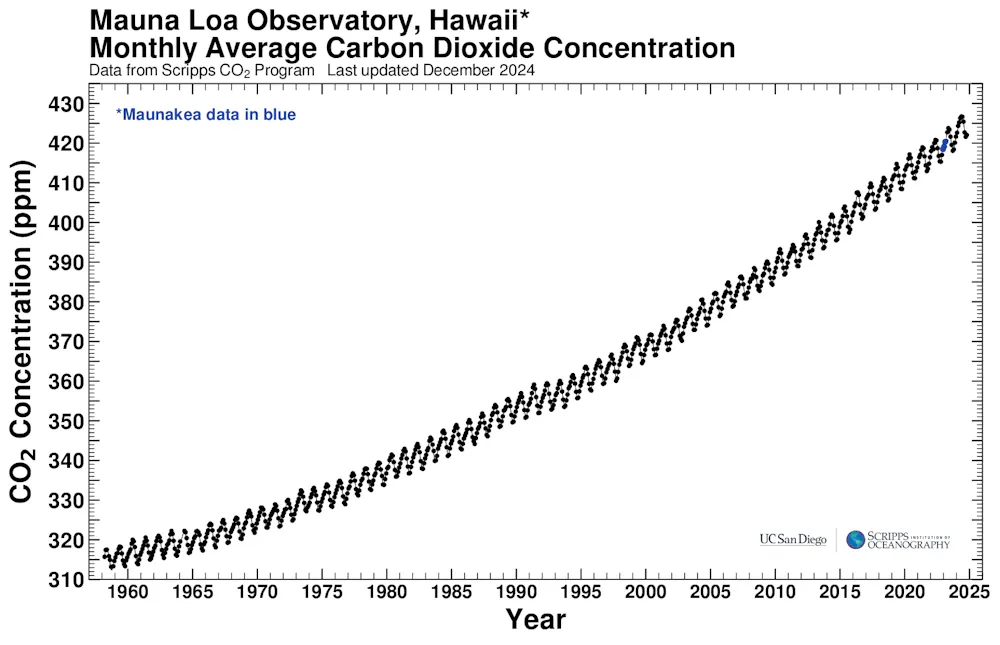
Data collected by Mauna Loa from 1958 onward let us clearly see the evidence of climate change for the first time. The station samples the air and measures global CO₂ levels. Charles Keeling and his successors used this data to produce the famous Keeling curve – a graph showing carbon dioxide levels increasing year after year.

But this precious record is in peril. US President Donald Trump has decided to defund the observatory recording the data, as well as the widespread US greenhouse gas monitoring network and other climate measuring sites.

We can’t solve the existential problem of climate change if we can’t track the changes. Losing Mauna Loa would be a huge loss to climate science. If it shuts, other observatories such as Australia’s Kennaook/Cape Grim will become even more vital.

The Keeling Curve tracking steadily rising carbon dioxide levels in the atmosphere came from data gathered at Mauna Loa.
Scripps Institution of Oceanography at UC San Diego, CC BY-NC-ND

What did Mauna Loa show us?

The first year of measurements at Mauna Loa revealed something incredible. For the first time, the clear annual cycle in atmospheric CO₂ was visible. As plants grow in summer, they absorb CO₂ and draw it out of the atmosphere. As they die and decay in winter, the CO₂ returns to the atmosphere. It’s like Earth is breathing.

Most land on Earth is in the Northern Hemisphere, which means this cycle is largely influenced by the northern summer and winter.

The annual cycle of carbon dioxide is largely due to plant growth and decay in the northern hemisphere.

It only took a few years of measurements before an even more profound pattern emerged.

Year on year, CO₂ levels in the atmosphere were relentlessly rising. The natural in-out cycle continued, but against a steady increase.

Scientists would later figure out that the ocean and land together were absorbing almost half of the CO₂ produced by humans. But the rest was building up in the atmosphere.

Crucially, isotopic measurements meant scientists could be crystal clear about the origin of the extra carbon dioxide. It was coming from humans, largely through burning fossil fuels.

Mauna Loa has now been collecting data for more than 65 years. The resulting Keeling curve graph is the most iconic demonstration of how human activities are collectively affecting the planet.

When the last of the Baby Boomer generation were being born in the 1960s, CO₂ levels were around 320 parts per million. Now they’re over 420 ppm. That’s a level unseen for at least three million years. The rate of increase far exceeds any natural change in the past 50 million years.

The reason carbon dioxide is so important is that this molecule has special properties. Its ability to trap heat alongside other greenhouse gases means Earth isn’t a frozen rock. If there were no greenhouse gases, Earth would have an average temperature of -18°C, rather than the balmy 14°C under which human civilisation emerged.

The greenhouse effect is essential to life. But if there are too many gases, the planet becomes dangerously hot. That’s what’s happening now – a very sharp increase in gases exceptionally good at trapping heat even at low concentrations.

Greenhouse gases are the reason Earth isn’t an icebox. But the rate humans are emitting them is leading to very rapid changes.
Reid Wiseman/NASA, CC BY-NC-ND

Keeping our eyes open

It’s not enough to know CO₂ is climbing. Monitoring is essential. That’s because as the planet warms, both the ocean and the land are expected to take up less and less of humanity’s emissions, letting still more carbon accumulate in the air.

Continuous, high-precision monitoring is the only way to spot if and when that happens.

This monitoring provides the vital means to verify whether new climate policies are genuinely influencing the atmospheric CO₂ curve rather than just being touted as effective. Monitoring will also be vital to capture the moment many have been working towards when government policies and new technologies finally slow and eventually stop the increase in CO₂.

The US administration’s plans to defund key climate monitoring systems and roll back green energy initiatives presents a global challenge.

Without these systems, it will be harder to forecast the weather and give seasonal updates. It will also be harder to forecast dangerous extreme weather events.

Scientists in the US and globally have sounded the alarm about what the closure would do to science. This is understandable. Stopping data climate collection is like breaking a thermometer because you don’t like knowing you’ve got a fever.

If the US follows through, other countries will need to carefully reconsider their commitments to gathering and sharing climate data.

Australia has a long record of direct atmospheric CO₂ measurement, which began in 1976 at the Kennaook/Cape Grim Baseline Air Pollution Station in north-west Tasmania. This and other climate observations will only become more valuable if Mauna Loa is lost.

It remains to be seen how Australia’s leaders respond to the US retreat from climate monitoring. Ideally, Australia would not only maintain but strategically expand its monitoring systems of atmosphere, land and oceans.

Alex Sen Gupta receives funding from the Australian Research Council.

Katrin Meissner receives funding from the Minderoo Foundation and has received funding from the Australian Research Council in the past.

Timothy Raupach receives funding from QBE Insurance, Guy Carpenter, and the Australian Research Council.

ref. Mauna Loa Observatory captured the reality of climate change. The US plans to shut it down – https://theconversation.com/mauna-loa-observatory-captured-the-reality-of-climate-change-the-us-plans-to-shut-it-down-260403

6 simple questions to tell if a ‘finfluencer’ is more flash than cash

Source: The Conversation (Au and NZ) – By Dimitrios Salampasis, Associate Professor, Emerging Technologies and FinTech | FinTech Capability Lead, Swinburne University of Technology

Oleg Golovnev/Shutterstock

Images of flashy sports cars. Lavish lifestyle shots. These are just some of the red flags consumers should watch out for when they turn to social media for financial advice.

Consumers should not believe everything they see on Instagram, TikTok or YouTube from the growing numbers of “finfluencers” – content creators who build their audience by giving out financial advice.

The regulator responsible for financial products and advice, the Australian Securities and Investments Commission (ASIC), has issued warning notices to 18 social media finfluencers. ASIC said it suspects they have broken the law by promoting high-risk financial products or providing unlicensed financial advice. ASIC did not name them.

So, why is regulated financial advice important and what are some of the common practices finfluencers use to attract followers and customers?

Financial advice rules explained

Australian Financial Services laws are designed to protect consumers and investors, while promoting the integrity of financial markets. It is both unethical and illegal to promote financial products without proper authorisation.

In Australia, it is an offence under the Corporations Act to provide financial advice without an Australian Financial Services licence. Penalties include up to five years’ imprisonment or fines of A$1 million or more.

ASIC issued a similar warning to online finfluencers in 2022. Since then, the number of social media posts by unauthorised finfluencers have substantially reduced.

Many finfluencers became licensed or authorised representatives of a licensee, along with being more diligent about what they were posting online. Natasha Etschmann, with 300,000 Instagram and TikTok followers at @TashInvests, became licensed immediately after the 2022 warning.

Some other finfluencers were arrested, issued fines or ordered to take down their websites.

High-risk products

However, some finfluencers who style themselves as “trading experts” continue to provide unauthorised financial advice, usually for a fee or commission. They promote high-risk, complex investment products that can cause consumers substantial harm.

These products include contracts-for-difference
and over-the-counter derivative products that do not trade on an exchange. ASIC says its current concerns lie with these content creators:

Their social media content is often accompanied by misleading or deceptive representations about the prospects of success from the products or trading strategies they promote, sharing images of lavish lifestyles, sports cars and other luxury goods.

What to watch on socials

About 41% of young Australians aged 18 to 30 look online for financial information or advice.

While budgeting tips can be helpful, it’s important to be extra careful with online financial advice. Consumers should not believe everything they see on social media.

Conducting due diligence and checking finfluencers’ credentials on ASIC’s Professional Registers search tool is crucial. Choose expert and licensed finfluencers rather than accounts with large followings and exaggerated or misleading claims. Popularity does not always mean credibility.

There are certain red flags to watch out for. Some finfluencers use pseudonyms. They promote “exclusive” financial advice content and access to “invitation-only” online communities for a fee. In many cases, they lack credible experience or certified financial planning training to provide financial advice.

Your finfluencer vetting toolkit

When choosing to follow or acquire the services of a finfluencer, ask:

  1. is this finfluencer licensed or authorised?

  2. how realistic are the promised financial outcomes? Are they too good to be true?

  3. does the finfluencer disclose their personal financial position or investments when discussing financial products or strategies?

  4. are they transparent about? their track record of accuracy or accountability?

  5. do they address publicly a case when their audience lost money from a strategy they recommended?

  6. does the finfluencer tailor content to different investment risk profiles or financial maturity levels in their audiences?

Are you being sold a dream?

Social media finfluencer content can often come with misleading or deceptive representations (such as the sports cars and luxury goods that ASIC has warned about). Content may overstate the prospects of success and potential profits.

Some – usually unlicensed – finfluencers use social media content as “proof” of their financial expertise. One common practice is to try to lure consumers by creating a hyped world around their own personal lifestyle. Many finfluencers often extend invitations to consumers to join closed forums to “learn” their hidden secrets to success or copy their “famous” trading practices.

These finfluencers usually try to convince consumers they can achieve a similar lifestyle by following their advice.

Finfluencers are global

ASIC issued the warnings as part of a recent global week of action. ASIC and eight regulators from the United Kingdom, United Arab Emirates, Italy, Hong Kong and Canada took coordinated action to disrupt unlawful finfluencer activity.
The global campaign aims to raise awareness about unlawful finfluencer activity, protect consumers, and prevent them from investing after encountering misleading content.

Consumers need to distinguish between credible financial advice and self-serving or misleading content before trusting their money to anyone.

Spotted unlicensed influencer activity? Report this misconduct to ASIC.

Dimitrios Salampasis is a Fellow of the Financial Services Institute of Australasia (FINSIA), member of the Australian Institute of Company Directors (AICD) and member of the Singapore Institute of Directors (SID).

ref. 6 simple questions to tell if a ‘finfluencer’ is more flash than cash – https://theconversation.com/6-simple-questions-to-tell-if-a-finfluencer-is-more-flash-than-cash-259906

Grattan on Friday: how two once hot-button issues this week barely sparked media and political interest

Source: The Conversation (Au and NZ) – By Michelle Grattan, Professorial Fellow, University of Canberra

Political and news cycles often work in a certain and predictable way. Issues flare like bushfires, then rage for weeks or even months, until they are finally extinguished by action or fade by being overtaken by the next big thing.

On two very different fronts this week, we’re reminded how these cycles work.

During the last term, the opposition constantly hammered the government over its handling of the former immigration detainees released after the High Court found they couldn’t be held indefinitely. These included people who had committed murder, child sex offences and violent assaults.

On Sunday, Home Affairs Minister Tony Burke admitted in a television interview that the legislation the government passed to re-detain some of these people was, in effect, impossible to use. Burke’s comments attracted only limited attention.

The other reminder of an old story came when the Federal Court ordered a militant Muslim preacher to remove inflammatory lectures from the internet. He had lost a case brought by the Executive Council of Australian Jewry under Section 18C for the Racial Discrimination Act. More than a decade ago, political passions ran high in conservative circles about the alleged evils of 18C.

First to the Burke admission. Burke told Sky he had “a lot of resources” dedicated to trying to get applications to court for preventative detention orders. But “no one has come close to reaching the threshold that is in that legislation”. Burke insisted he was “not giving up”, but there is little reason to believe things will change. The opposition has suggested amending the preventative detention legislation, but Burke says that would hit a constitutional obstacle.

For a long time, the government had kept saying it was working up cases to put to the court (and given the impression action was close). But, realising the difficulty, it also passed legislation facilitating the deportation of these people to third countries. There are now three former detainees due to be deported to Nauru, following a financial agreement with that country. But there’s a hitch: their deportations are tied up in court appeals. (They are, however, able to be held in detention while the cases proceed.)

The challenge still presented by the former detainees in the community is no small matter, despite the political storm having calmed and the media interest dissipating.

In evidence in Senate estimates in March, the Department of Home Affairs said 300 people had been released from immigration detention as at the end of February. Of these, 104 had offended since release, and 30 were incarcerated (including on remand). Some 83 had only a state or territory criminal charge; seven only a Migration Act charge; 14 people had both a Migration Act charge and a state or territory charge. In recent weeks, one former detainee is alleged to have murdered a photographer in Melbourne.

The political context can be very relevant to whether the embers of an old issue re-spark into something major.

Prime Minister Anthony Albanese’s decision last year to put Burke into home affairs was something of a political masterstroke. If Clare O’Neil and Andrew Giles had still been in their former respective portfolios of home affairs and immigration, the present failure to deal more successfully with the former detainees would have been a much bigger issue. Burke is skilled at throwing a blanket over contentious areas.

On the other side of politics, James Paterson was moved out of home affairs to become shadow finance minister in Sussan Ley’s reshuffle. Paterson pursued the former immigration detainees relentlessly. The new spokesmen, Andrew Hastie (home affairs) and Paul Scarr (immigration) haven’t hit their strides yet, and what they have said on the issue hasn’t grabbed much attention.

The government would have been under more pressure on the issue if parliament were sitting. But the new parliament doesn’t meet until July 22.

When it does, one of the new arrivals will be a former face, Liberal MP Tim Wilson. Way back when, Wilson was a player in the story of 18C. For him, the way 18C resurfaced this week contains more than a little irony.

In February 2014, Wilson took up his post of Human Rights Commissioner, appointed by the Abbott government with the special brief of promoting freedom of speech. (He was even dubbed the “freedom commissioner”.)

The Abbott government was strongly opposed to section 18C of the Racial Discrimination Act, which made it unlawful to “offend, insult, humiliate or intimidate” a person or group because of their race or ethnicity.

The assault on 18C ran into vigorous opposition from ethnic and other groups, including the Executive Council of Australian Jewry. In the end, then prime minister Tony Abbott retreated. Wilson was disappointed, tweeting: “Disturbed to hear the government has backed down on 18c and will keep offensive speech illegal. Very disturbed.”

In his 2025 bid for election, Wilson – who had been member for Goldstein from 2016-2022 – was helped by the Jewish vote, after the rise of antisemitism.

The debate about free speech has moved on a great deal since the days of the Abbott government, when conservatives were particularly agitated about 18C following a court judgement against journalist Andrew Bolt relating what he has written about some fair-skinned Indigenous people.

Today’s debate is in the context of “hate speech” associated with the Middle East conflict. Hate-crime laws have provoked another fierce round of controversy about the appropriate limits to put on “free speech”.

The Executive Council of Australian Jewry brought its case under the 18C civil law against preacher William Haddad, from Western Sydney, after no action was taken by the authorities under the criminal law.

Haddad described Jews as “a treacherous people, a vile people”, among other offensive remarks, that included saying: “The majority of banks are owned by the Jews, who are happy to give people loans, knowing that it’s almost impossible to pay it back”. Haddad argued in his defence his lectures drew on religious writings, relating them to contemporary events, and were delivered for educational purposes.

Finding against Haddad, Judge Angus Stewart said the lectures conveyed “disparaging imputations about Jewish people and that in all the circumstances were reasonably likely to offend, insult, humiliate and intimidate Jews in Australia”.

Reflecting on this week’s decision, George Brandis – who was attorney-general during the 18C furore – says, “My view hasn’t changed. It should not in a free country be either criminally or civilly actionable to say something that merely offends. However, in this case the conduct went far beyond mere offence, to intimidation. It did not require 18C to get the redress that was sought in the case.”

Wilson does not wish to re-enter the debate. The new opposition industrial relations spokesman says his focus is “my portfolio responsibilities”.

It’s likely many of those who fought 18C years ago hold to their original view, while having to applaud the judgement made under it this week. That’s another irony.

The Conversation

Michelle Grattan does not work for, consult, own shares in or receive funding from any company or organisation that would benefit from this article, and has disclosed no relevant affiliations beyond their academic appointment.

ref. Grattan on Friday: how two once hot-button issues this week barely sparked media and political interest – https://theconversation.com/grattan-on-friday-how-two-once-hot-button-issues-this-week-barely-sparked-media-and-political-interest-259686

How many serious incidents are happening in Australian childcare centres? We don’t really know

Source: The Conversation (Au and NZ) – By Erin Harper, Lecturer, School of Education and Social Work, University of Sydney

Catherine Delahaye/ Getty Images

This week, a Melbourne childcare worker was charged over alleged sexual abuse of young children in his care. Families are justifiably appalled and furious – with 1,200 children urged to be tested for a sexually transmitted infection.

This is the latest in a string of serious safety concerns this year alone, exposing systemic issues in our early childhood sector.

Recent investigations have exposed reports of neglect, with inadequate food, unhygienic nappy changes, and physical and sexual abuse at daycare services.

Unfortunately, there are too many incidents to be seen as “one-offs”.

But how widespread are unsafe or abusive practices in Australian childcare centres? The short answer is, we don’t actually know.

The number of ‘serious incidents’ in childcare

The national childcare quality authority reports on the number of “serious incidents” in childcare services.

This includes the death of a child, and serious injury, illness, or trauma requiring urgent medical attention. It also includes a child going missing or unknowingly being locked in or out of the service. But it doesn’t technically include child abuse. Unless, for example, the abuse resulted in a situation where the child required urgent medical attention.

The national childcare quality authority’s data shows there has been a slow but steady increase in the rate of serious incidents in the eight years to 2023–24.

For example, the rate of reported serious incidents in 2023–24 was 148 per 100 approved services. This is higher than the 139 reported in 2022–23, and 124 in 2021–22.

Higher-quality services have been found to have higher rates of reporting for serious incidents. This may be because they have clearer processes, more experienced or qualified educators, or higher ratios of educators to children. We also know larger services tend to report more serious incidents than smaller ones.

For-profit services have been found to have higher breach rates than not-for-profits. A breach is any instance where a regulation or law was not followed.

What about under-reporting?

Some incidents may not even be reported in the first place. Under-reporting could occur unintentionally. For example, the service is unaware of an incident, or educators do not recognise what constitutes a reportable incident, or they are not sure how to report the different kinds of reportable incidents.

But unfortunately, under-reporting may happen intentionally. When a service reports an incident to their state or territory regulatory authority, they may be subject to an investigation and/or heightened scrutiny in future. This could be a deterrent for some services to report incidents.

What about child abuse?

At the moment, if physical or sexual abuse of a child is suspected at a service, incidents and allegations should be reported through a national online portal within seven days.

The federal government has just announced from September 1 this year, the window will come down to 24 hours.

The portal is provided by the national childcare quality authority, but it can be accessed by state and territory regulatory authorities.

But childcare services are also subject to state and territory child protection legislation. The definitions and reporting requirements for different child abuse situations vary across states and territories.

This makes the data messy and difficult to track.

There are other reporting requirements

Services also need to lodge other kinds of notifications relating to children’s health and safety. Examples might include incidents of broken glass in a centre, a severe infection outbreak, a damaged fence, or the presence of someone who was not authorised to be there.

Again, some of these incidents go through a national online portal, whereas others might go to state or territory child protection authorities, departments of education, or departments of health.

As the national quality authority noted in its 2023 report into childcare safety, this means different organisations are collecting information and may not always use the same terminology or reporting timeframes. They don’t necessarily share the information they have.

This lack of coordination also means we do not have consistent national data collection on child abuse and other aspects of child welfare in daycare centres.

What now?

We need a national, consistent approach to collecting and sharing data about safety in all childcare services. This would require a committed collaboration between state and federal agencies.

At the moment, crucial information about what is happening in services is not shared between jurisdictions. Just as we do not have good information about high-risk potential employees (in part, due to issues with the working with children checks system).


Read more:
What are working with children checks? Why aren’t they keeping kids safe at daycare?


But on top of fixing how data is collected and shared, we also need to look at how it is reported in the first place.

All early childhood educators should have child protection training, to increase understanding across the sector. We also need simpler and nationally consistent procedures for services, so it is easier for educators to recognise and report child safety incidents.


If this article has raised issues for you, or if you’re concerned about someone you know, you can call 1800 Respect on 1800 737 732, Lifeline on 131 114, Kids Helpline on 1800 55 1800, or Bravehearts (counselling and support for survivors of child sexual abuse) on 1800 272 831.

The Conversation

Erin Harper does not work for, consult, own shares in or receive funding from any company or organisation that would benefit from this article, and has disclosed no relevant affiliations beyond their academic appointment.

ref. How many serious incidents are happening in Australian childcare centres? We don’t really know – https://theconversation.com/how-many-serious-incidents-are-happening-in-australian-childcare-centres-we-dont-really-know-260410

Too much vitamin B6 can be toxic. 3 symptoms to watch out for

Source: The Conversation (Au and NZ) – By Nial Wheate, Professor, School of Natural Sciences, Macquarie University

Selena3726/Shutterstock

Side effects from taking too much vitamin B6 – including nerve damage – may be more widespread than we think, Australia’s medicines regulator says.

In an ABC report earlier this week, a spokesperson for the Therapeutic Goods Administration (TGA) says it may have underestimated the extent of the side effects from vitamin B6 supplements.

However, there are proposals to limit sales of high-dose versions due to safety concerns.

A pathologist who runs a clinic that tests vitamin B6 in blood samples from across Australia also appeared on the program. He told the ABC that data from May suggests 4.5% of samples tested had returned results “very likely” indicating nerve damage.

So what are vitamin B6 supplements? How can they be toxic? And which symptoms do you need to watch out for?

What is vitamin B6?

Vitamin B6, also known as pyridoxine, plays an important role in keeping the body healthy. It is involved in the metabolism of proteins, carbohydrates and fats in food. It is also important for the production of neurotransmitters – chemical messengers in the brain that maintain its function and regulate your mood.

Vitamin B6 also supports the immune system by helping to make antibodies, which fight off infections. And it is needed to produce haemoglobin, the protein in red blood cells that carries oxygen around the body.

Some women take a vitamin B6 supplement when pregnant. It is thought this helps reduce the nausea associated with the early stages of pregnancy. Some women also take it to help with premenstrual syndrome.

However, most people don’t need, and won’t benefit from, a vitamin B6 supplement. That’s because you get enough vitamin B6 from your diet through meat, breakfast cereal, fruit and vegetables.

You don’t need much. A dose of 1.3–1.7 milligrams a day is enough for most adults.

Currently, vitamin B6 supplements with a daily dose of 5–200mg can be sold over the counter at health food stores, supermarkets and pharmacies.

Because of safety concerns, the TGA is proposing limiting their sale to pharmacies, and only after consultation with a pharmacist.

Daily doses higher than 200mg already need a doctor’s prescription. So under the proposal that would stay the same.

What happens if you take too much?

If you take too much vitamin B6, in most cases the excess will be excreted in your urine and most people won’t experience side effects. But there is a growing concern about long-time, high-dose use.

A side effect the medical community is worried about is peripheral neuropathy – where there is damage to the nerves outside the brain and spinal cord. This results in pain, numbness or weakness, usually in your hands and feet. We don’t yet know exactly how this happens.

In most reported cases, these symptoms disappear once you stop taking the supplement. But for some people it may take three months to two years before they feel completely better.

There is growing, but sometimes contradictory, evidence that high doses (more than 50mg a day) for extended periods can result in serious side effects.

A study from the 1990s followed 70 patients for five years who took a dose of 100 to 150mg a day. There were no reported cases of neuropathy.

But more recent studies show high rates of side effects.

A 2023 case report provides details of a man who was taking multiple supplements. This resulted in a daily combined 95mg dose of vitamin B6, and he experienced neuropathy.

Another report describes seven cases of neuropathy linked to drinking energy drinks containing vitamin B6.

Reports to the TGA’s database of adverse events notifications (a record of reported side effects) shows 174 cases of neuropathy linked with vitamin B6 use since 2023.

What should I do if I take vitamin B6?

The current advice is that someone who takes a dose of 50mg a day or more, for more than six months, should be monitored by a health-care professional. So if you regularly take vitamin B6 supplements you should discuss continued use with your doctor or pharmacist.

There are three side effects to watch out for, the first two related to neuropathy:

  1. numbness or pain in the feet and hands

  2. difficulty with balance and coordination as a result of muscle weakness

  3. heartburn and nausea.

If you have worrying side effects after taking vitamin B6 supplements, contact your state’s poison information centre on 13 11 26 for advice.

The Conversation

Nial Wheate in the past has received funding from the ACT Cancer Council, Tenovus Scotland, Medical Research Scotland, Scottish Crucible, and the Scottish Universities Life Sciences Alliance. He is a fellow of the Royal Australian Chemical Institute. Nial is the chief scientific officer of Vaihea Skincare LLC, a director of SetDose Pty Ltd (a medical device company) and was previously a Standards Australia panel member for sunscreen agents. He is a member of the Haleon Australia Pty Ltd Pain Advisory Board. Nial regularly consults to industry on issues to do with medicine risk assessments, manufacturing, design and testing.

Slade Matthews provides scientific evaluations to the Therapeutic Goods Administration as a member of the Therapeutic Goods Assessment and Advisory Panel. Slade serves on the NSW Poisons Advisory Committee for NSW Health as the minister-nominated pharmacologist appointed by the Governor of NSW.

ref. Too much vitamin B6 can be toxic. 3 symptoms to watch out for – https://theconversation.com/too-much-vitamin-b6-can-be-toxic-3-symptoms-to-watch-out-for-260400

10 steps governments can take now to stamp out child sexual abuse in care settings

Source: The Conversation (Au and NZ) – By Ben Mathews, Distinguished Professor, School of Law, Queensland University of Technology

Recent cases of prolific alleged child sexual abuse in Melbourne and other Australian early childhood education and care settings have shocked even experienced people who work to prevent child sexual abuse. Parents are right to be outraged, scared and uncertain.

The most pressing issue, then, is what we do about it.

Regulation and practice is still falling short, despite all our knowledge and prior recommendations. We have the benefit of the gold-standard Royal Commission Into Institutional Responses to Child Sexual Abuse (including Volume 6 on making institutions child-safe). We can also draw on rigorous scientific work about how best to prevent child sexual abuse in child and youth-serving organisations.

Criminal history checks are essential, but many offenders will not have a criminal record. These checks are only one part of an entire safety system. Other measures are arguably even more important.

The federal government, together with states and territories, recently announced new measures. However, these are acknowledged as only a first step.

Children have a right to be safe from sexual violence. Continued failure is unacceptable. National Children’s Commissioner Anne Hollonds’ demand for a national inquiry, which can fully understand current limitations in the system and create a comprehensive blueprint for reform, is compelling.

The established evidence has already identified some of these pillars of reform. Here are ten key actions for policy-makers to create key components of safe early childhood education and care settings.

1. Policy. Every organisation needs to operate under a comprehensive policy about child safety. This should include specific guidelines for the prevention of sexual abuse. The policy should also include clear definitions and objectives, and be driven by a zero-tolerance approach.

2. Safe screening and hiring. Every organisation needs to recruit staff through rigorous processes, including criminal history checks (supported by information-sharing within and between jurisdictions). But this is only a starting point. Staff are educators and carers, not babysitters; they should be properly qualified and appropriately remunerated.

Should men be banned from employment in these settings? Employment discrimination based on gender is likely a step too far, but considerations of risk are important and children’s best interests are paramount. Nearly all sexual abuse of young children is by men, and stringent measures could be employed when recruiting men to child-related positions.

3. Code of conduct. A detailed code of conduct is essential. This is the operating manual for the organisation and its staff, and should be made available to parents. A robust code will specify what conduct is prohibited, and what is required. It will have special rules for high-risk situations – for example, bathrooms, changing clothes, physical interaction, and technology use.

4. Supervision and monitoring. A safe organisation must have appropriate measures for the implementation of the safety framework. It must also monitor the framework and its components. For example, there must be: appropriate staff supervision, recording of the approach to safety and its implementation, external auditing and oversight. Parents should be involved in oversight.

All childcare centres should have rigorous prevention, supervision and reporting procedures in place.
Shutterstock

5. Environmental risk reduction. Often called “situational crime prevention”, these are actions to create safe environments. It can include measures to prohibit secluded spaces, and improve lines of sight and visibility. This can also include ensuring appropriate ratios of staff to children.

6. Reporting of suspected cases. Across Australia, there are now clear legal requirements for practitioners in these settings to report suspected cases of child sexual abuse. Every organisation needs to ensure its staff knows about these duties, and how to comply with them. Every organisation then needs to deal appropriately with any report that is made.

7. Education and training. Child sexual abuse is a complex field. Staff and leaders need high-quality education and training about child sexual abuse (including its nature, indicators and outcomes), organisational policy, reporting processes, legal and ethical obligations, and the protections they have as employees.

Good education increases knowledge, attitudes and appropriate reporting, and overcomes ignorance, apathy, fear and inaction. This education needs to be multidisciplinary, high-standard, and itself the subject of oversight and monitoring. It is not clear we have high-quality education of practitioners in Australia, both when obtaining qualifications and especially in service.

8. Leadership. We need knowledgeable and ethical leadership in child- and youth-serving organisations, and by regulators and policy-makers alike.

Knowledge about child sexual abuse, and empathy towards children and young people, are preconditions for effective and ethical responses. Organisational leaders set the tone for the broader organisation. If leaders are seen to be knowledgeable, ethical and authentically committed to child safety, it is far more likely staff will be inspired to emulate these qualities.

9. Oversight, enforcement and improvement. The entire system needs to be overseen by an effective regulatory framework and an efficient national regulator.

We need to create comprehensive and stringent regulatory requirements for provider accreditation. Providers that do not meet these standards should be compelled to meet them, or lose funding and eligibility to operate. It is insufficient to be merely “working towards” the standards.

Other accountability mechanisms should also be created; for example, owners of childcare centres could be subject to appropriate financial and other penalties.

10. Locate prevention in these settings as part of a national strategy. As a nation, we have made progress in reducing the prevalence of child sexual abuse in organisational settings. This is partly due to tighter regulation through child-safe standards, legal requirements to report suspected cases of abuse and associated better reporting, and increased social awareness.

However, no case is acceptable, and we have the capacity and duty to dramatically reduce the prospect that any individual can be a prolific offender. These prevention principles apply equally in schools and other settings serving children and youth.

We have work to do: among all Australians aged 16 and over, nationally representative data has shown one in four experienced child sexual abuse. In contemporary Australia, this abuse is still prevalent, with data from 16–24-year-olds showing one in three girls are affected, and one in seven boys. The next generation of prevention is already here, but we know what is required to meet this challenge.

This can be a turning point for Australia. The social and economic return from taking children’s rights seriously and investing in prevention far outweighs the cost of inaction. Safe, effective early childhood education and care is a nation-building strategy, both required for today’s workforce and a key factor in educating and developing young Australians.

Ben Mathews has received grant funding from the National Health and Medical Research Council, the Department of Social Services, the National Office for Child Safety in the Attorney-General’s Department, the Australian Institute of Criminology, and the National Centre for Action on Child Sexual Abuse. He takes sole responsibility for the views in this article.

ref. 10 steps governments can take now to stamp out child sexual abuse in care settings – https://theconversation.com/10-steps-governments-can-take-now-to-stamp-out-child-sexual-abuse-in-care-settings-260405

Tears, trauma and unpaid work: why men in tinnies aren’t the only heroes during a flood disaster

Source: The Conversation (Au and NZ) – By Rebecca McNaught, Research Fellow, Rural and Remote Health, University of Sydney

Dan Peled/Getty Images

When flooding strikes, our screens fill with scenes of devastated victims, and men performing heroic dinghy rescues in swollen rivers. But another story often goes untold: how women step in, and step up, to hold their stricken communities together.

Unprecedented floods in the Northern Rivers of New South Wales in 2022 are a case in point. Our research shows female leadership was the hidden backbone of community recovery in the aftermath of the emergency. Women rose to leadership roles, filling crucial gaps left by formal disaster responses. As one woman told us:

I mean there’s some blokes around, I’ve got to give them some credit, but, yeah, I’m amazed … it was always the women saying, what do you need? What can I help with?

And long after the disaster had passed and the media had moved on, women were still there, quietly leading sustained recovery efforts from their homes, community halls and online networks.

But while the labour of men was generally supported and recognised, the complex and difficult work of women was largely overlooked.

The invisible labour of disaster recovery

The NSW Northern Rivers region is a rural area highly prone to climate disaster.

In February and March 2022, the region experienced catastrophic flooding and landslips. About 11,000 homes were inundated. Health care facilities were damaged and disrupted. Emergency services were overwhelmed and many communities were cut off, some for weeks.

In response, the community stepped up in extraordinary ways. Our research explored the particular contribution of women to this effort.

The research focused on the contribution of women to community recovery after the Lismore floods.
Dan Peled/Getty Images

‘No one else was going to do it’

The research involved interviews with people involved in the flood response and recovery. We also examined notes from public events and transcripts from a NSW government inquiry into the floods.

We found that, despite facing immense challenges, women played an essential role in sustaining their communities during and after the crisis.

For example, they coordinated food relief, managed donation hubs, organised volunteers and provided emotional support to neighbours and strangers. As one female interviewee told us:

It was more than about food … people would just come and then we’d just hug them and they’d just cry … the food relief turned into something deeper.

Emergency-management environments are often dominated by men. As a result, female community organisers often felt excluded from formal decision-making. As one woman told us:

every face in the meeting was a white middle-aged guy with a buzz cut. And, and I was like, there is no women. There is no diversity. There was no sense of community or that whole recovery space.

One woman cited the example of a local council celebrating “men in their dinghies” who took part in a flood rescue, while failing to recognise women who collectively contributed many thousands of unpaid hours towards the recovery effort:

here we are with just simply a trillion women doing all of the childcare, all of the cooking, all of the soft labour, literally everything plus being on dinghies … and there’s just nothing for us.

Some women took unpaid leave from work to coordinate recovery activities in their communities, because, as one woman told us, “no one else was going to do it”.

Women’s roles were not limited to unskilled tasks and care work. Women also brought professional skills to the recovery effort, such as event management, IT, nursing, communications, clinical psychology, trauma healing, business management, social work and public health.

Women: there for the long term

We found while men’s involvement in disaster recovery tended to be concentrated on specific short-term rescue and response, women tended to remain active for months or even years.

For example, two years after the flooding disaster, at a gathering of grassroots community-disaster
organisers, 87% of names on the contact list were female.

Some women continued to volunteer their labour, while others managed to obtain short-term funding. Whether paid or unpaid, the women experienced overwhelm and felt exhausted by the long-term effort, and some experienced vicarious trauma. However, their sense of community responsibility prevented them from stepping back.

Rethinking who we see as leaders

The research confirms women’s contributions are consistently overlooked during and after a disaster. It reflects a broader trend in Australia, where women’s labour is historically undervalued.

Women’s disaster work – coordinating volunteers, providing emotional care and advocating for their communities – was often unsupported by government and continued long after official agencies left.

Yet, these contributions remained largely invisible.

Three years after the floods, many women in the Northern Rivers are preparing for the next emergency, and women comprise the majority of community resilience groups in the region.

Women must be recognised and supported to ensure the health and wellbeing of disaster-affected communities. The health and wellbeing of these women themselves must also be paramount.

More government and private funding is vital. Where possible, philanthropic community grants should also be expanded.

The recently formed Northern Rivers Community Resilience Alliance involves 50 grassroots groups combining to provide peer support, advocate together, seek joint funding and provide training. Such networks can provide ongoing support to community organisers.

As Earth’s climate becomes more hostile and extreme weather events become more likely, there is an urgent need to support community efforts – and to rethink who we see as leaders in times of disaster. Building resilient communities starts with recognising and resourcing the people doing the work – including local women.


The authors acknowledge Emma Pittaway, Loriana Bethune and Dominica Meade who co-authored the research upon which this article is based.

Rebecca McNaught receives funding from The Peregrine Foundation and Gender and Disasters Australia. She is a board member of not-for-profit Plan C and President of the volunteer group the South Golden Beach, New Brighton and Ocean Shores Community Resilience Team. She attends the Northern Rivers Community Resilience Alliance.

Jo Longman has received funding from the NSW State Government Disaster Risk Reduction Fund and the Healthy Environments and Lives Innovation Fund. She is affiliated as a volunteer with Plan C’s research team.

ref. Tears, trauma and unpaid work: why men in tinnies aren’t the only heroes during a flood disaster – https://theconversation.com/tears-trauma-and-unpaid-work-why-men-in-tinnies-arent-the-only-heroes-during-a-flood-disaster-260327

The takeaway from the Venice Biennale saga: the art world faces deep and troubling structural inequality

Source: The Conversation (Au and NZ) – By Grace McQuilten, Professor of Art and Associate Dean, Research and Innovation, School of Art, RMIT University

Creative Australia’s decision earlier this year to rescind the selection of artist Khaled Sabsabi and curator Michael Dagostino as Australia’s 2026 representatives at the Venice Biennale sent shockwaves through the arts sector.

For many artists and arts workers, it reinforced concerns around participation and access for those from culturally and racially diverse backgrounds.

This week’s reinstatement of the artistic team offers some comfort. However, the entire incident has reinforced that, while diversity in the arts is celebrated, inclusion at the highest level can’t be taken for granted.

Some worrying stats

Our 2024 survey of more than 900 visual and craft artists, and visual arts workers (who we define as workers who support the visual arts sector), revealed several concerning findings in relation to opportunity and inclusion for culturally and racially diverse creatives.

The first key finding was more than 67% of artists and 78% of arts workers felt there were cultural and/or access-related barriers to them participating in the sector.

The second was culturally diverse workers in the sector tended to identify as “early career” rather than “established”. This points to challenges for career progression and, in turn, to systemic and structural barriers to career development.

Of all the people we surveyed, 17% of visual artists and 20% of visual arts workers reported being of a culturally diverse background. Of these, only 15% of artists and 14% of arts workers reported being at an “established” career stage.

By contrast, among the general population of artists (including those without a diverse background), 30% of the artists reported being “established” in their careers, along with 26% of arts workers.

Art shouldn’t be at the behest of politics

Issues around political censorship and cultural bias in the sector were not a focus of our survey, which was conducted nine months after the war in Gaza began, and before Creative Australia’s selection (and swift cancellation) of the 2026 Venice Biennale team.

Nonetheless, respondents were concerned their political views, and/or their cultural or racial background, could impact their likelihood of advancing a career in the sector.

Some respondents explained if they were no longer working as an artist or arts worker in five years’ time, it would most likely be due to “systemic discrimination” and “increasing censorship prevalent in this industry”.

According to an independent review into the Sabsabi decision (and its reversal):

While no formal assessment was undertaken, it is clear that there was a general awareness within Creative Australia, among those with knowledge of the selected Artistic Team, that the decision had the potential to be controversial. The Panel heard that, at the time, the decision was described as ‘bold’ or ‘courageous’. The source of potential controversy was seen to lie in the fact of selecting any artist with heritage connected to the Middle East at a time when conflict in that region was so emotive and polarising, rather than because of the proposed nature of the work to be undertaken at the 2026 Venice Biennale.

Entrenched harmful biases

Sadly, the negative response from politicians to the initial selection of Khaled Sabsabi and Michael Dagostino gave credibility to our respondents’ concerns.

One participant told us “being called Ahmed* is a bit of a disadvantage given the international situation”.

Another said “only certain cultures and political plights are given support”.

Financial security is also potentially at risk. As one respondent explained, the main barrier to their personal financial security were political values. “My work is at risk when governments change,” they said.

Artists and arts workers from culturally and racially diverse backgrounds also reported more significant impacts from the cost-of-living crisis, along with poorer mental health and work-life balance.

Importantly, our findings don’t stand in isolation. Similar issues have been identified by Diversity Arts Australia, who in 2022 reported on the significant negative impacts of the pandemic on First Nations artists and artists of colour.

Also, in 2021, Creative Australia reported on problems around inclusion and access for culturally diverse communities in the arts and cultural sector.

What might progress look like?

Our research involved making a number of policy recommendations to tackle these issues.

For one thing, there is a clear need for organisational change. On this front, arts organisations and employers should invest in cultural competency training for all staff and board members. They should also prioritise professional development and career growth for culturally and racially diverse staff.

To drive meaningful change, funding incentives should be introduced to support diverse leadership. This should include higher pay for culturally and/or racially diverse leaders whose backgrounds lead them to having added responsibility in the workplace.

The sector also needs greater transparency around cultural and racial representation in staffing and leadership roles, including board roles. This will promote accountability and help drive cultural change.

Finally, success for artists from culturally and linguistically diverse backgrounds requires the Australian art world to engage with multiple world views – and understand not all art will be immediately accessible to all audiences.

The controversy surrounding Creative Australia’s biennale backflip offers an opportunity for the visual arts sector to reckon with deep and troubling issues of structural inequity, along with broader questions of free expression – especially in a fraught political climate.

These issues are wider than the art world. But what better place to start?


*Name changed to protect identity.

Grace McQuilten received funding from the Australian Research Council’s Linkage Projects funding scheme (project LP200100054). The views expressed herein are those of the authors and are not necessarily those of the Australian government or Australian Research Council.

Kate MacNeill received funding from the Australian Research Council’s Linkage Projects funding scheme (project LP200100054). The views expressed herein are those of the authors and are not necessarily those of the Australian government or Australian Research Council.

ref. The takeaway from the Venice Biennale saga: the art world faces deep and troubling structural inequality – https://theconversation.com/the-takeaway-from-the-venice-biennale-saga-the-art-world-faces-deep-and-troubling-structural-inequality-260316

The Rainbow Warrior saga: 1. French state terrorism and NZ’s end of innocence

COMMENTARY: By Eugene Doyle

Immediately after killing Fernando Pereira and blowing up Greenpeace’s flagship the Rainbow Warrior in Auckland harbour, several of the French agents went on a ski holiday in New Zealand’s South Island to celebrate.

Such was the contempt the French had for the Kiwis and the abilities of our police to pursue them.  How wrong they were.

To mark the 40th anniversary of the French terrorist attack Little Island Press has published a revised and updated edition of Eyes of Fire: The Last Voyage and Legacy of the Rainbow Warrior, first released in 1986.

A new prologue by former prime minister Helen Clark and a preface by Greenpeace’s Bunny McDiarmid, along with an extensive postscript which bring us up to the present day, underline why the past is not dead; it’s with us right now.

Written by David Robie, editor of Asia Pacific Report, who spent 11 weeks on the final voyage of the Warrior, the book is the most remarkable piece of history I have read this year and one of those rare books that has the power to expand your mind and make your blood boil at the same time. I thought I knew a fair bit about the momentous events surrounding the attack — until I read Eyes of Fire.

Heroes of our age
The book covers the history of Greenpeace action — from fighting the dumping of nuclear and other toxic waste in European waters, the Arctic and the Pacific, voyages to link besieged communities across the oceans, through to their epic struggles to halt whaling and save endangered marine colonies from predators.

The Rainbow Warrior’s very last voyage before the bombing was to evacuate the entire population of Rongelap atoll (about 320 people) in the Marshall Islands who had been exposed to US nuclear radiation for decades.

This article is the first of two in which I will explore themes that the book triggered for me.

Neither secret nor intelligent – the French secret intelligence service

Jean-Luc Kister was the DGSE (Direction-générale de la Sécurité extérieure) agent who placed the two bombs that ripped a massive hole in the hull of the Warrior on 10 July 1985. The ship quickly sank, trapping Greenpeace photographer Fernando Pereira inside.

Former colonel Kister was a member of a large team of elite agents sent to New Zealand. One had also infiltrated Greenpeace months before, some travelled through the country prior to the attack, drinking, rooting New Zealand women and leaving a trail of breadcrumbs that led all the way to the Palais de l’Élysée where François Mitterrand, Socialist President of France, had personally given the order to bomb the famous peace vessel.

Robie aptly calls the French mission “Blundergate”. The stupidity, howling incompetence and moronic lack of a sound strategic rationale behind the attack were only matched by the mendacity, the imperial hauteur and the racist contempt that lies at the heart of French policy in the Pacific to this very day.

Thinking the Kiwi police would be no match for their élan, their savoir-faire and their panache, some of the killers hit the ski slopes to celebrate “Mission Accompli”. Others fled to Norfolk Island aboard a yacht, the Ouvéa.

Tracked there by the New Zealand police it was only with the assistance of our friends and allies, the Australians, that the agents were able to escape. Within days they sank their yacht at sea during a rendezvous with a French nuclear submarine and were evenually able to return to France for medals and promotions.

Two of the agents, however, were not so lucky. As everyone my age will recall, Dominique Prieur and Alain Mafart, were nabbed after a lightning fast operation by New Zealand police.

With friends and allies like these, who needs enemies?
We should recall that the French were our allies at the time. They decided, however, to stop the Rainbow Warrior from leading a flotilla of ships up to Moruroa Atoll in French Polynesia where yet another round of nuclear tests were scheduled. In other words: they bombed a peace ship to keep testing bombs.

By 1995, France had detonated 193 nuclear bombs in the South Pacific.

David Robie sees the bombing as “a desperate attempt by one of the last colonial powers in the Pacific to hang on to the vestiges of empire by blowing up a peace ship so it could continue despoiling Pacific islands for the sake of an independent nuclear force”.

The US, UK and Australia cold-shouldered New Zealand through this period and uttered not a word of condemnation against the French. Within two years we were frog-marched out of the ANZUS alliance with Australia and the US because of our ground-breaking nuclear-free legislation.

It was a blessing and the dawn of a period in which New Zealanders had an intense sense of national pride — a far cry from today when New Zealand politicians are being referred to the International Criminal Court (ICC) in The Hague for war crimes associated with the Gaza genocide.

Eyes of Fire: The Last Voyage and Legacy of the Rainbow Warrior . . . publication next week. Image: ©  David Robie/Eyes Of Fire/Little Island Press

The French State invented the term ‘terrorism’
I studied French History at university in France and did a paper called “La France à la veille de révolution” (France on the eve of revolution). One of the chilling cultural memories is of the period from September 1793 to July 1794, which was known as La Terreur.

At the time the French state literally coined the term “terrorisme” — with the blade of the guillotine dropping on neck after neck as the state tried to consolidate power through terror. But, as Robie points out, quoting law professor Roger S. Clark, we tend to use the term today to refer almost exclusively to non-state actors.

With the US and Israel gunning down starving civilians in Gaza every day, with wave after wave of terror attacks being committed inside Iran and across the Middle East by Mossad, the CIA and MI6, we should amend this erroneous habit.

The DGSE team who attached limpet mines to the Rainbow Warrior did so as psychopathic servants of the French State. Eyes of Fire: “At the time, Prime Minister David Lange described the Rainbow Warrior attack as ‘nothing more than a sordid act of international state-backed terrorism’.”

Don’t get me wrong. I am not “anti-French”. I lived for years in France, had a French girlfriend, studied French history, language and literature. I even had friends in Wellington who worked at the French Embassy.

Curiously when I lived next to Premier House, the official residence of the prime minister, my other next door neighbour was a French agent who specialised in surveillance. Our houses backed onto Premier House. Quelle coïncidence. To his mild consternation I’d greet him with “Salut, mon espion favori.” (Hello, my favourite spy).

What I despise is French colonialism, French racism, and what the French call magouillage. I don’t know a good English word for it . . .  it is a mix of shenanigans, duplicity, artful deception to achieve unscrupulous outcomes that can’t be publicly avowed. In brief: what the French attempted in Auckland in 1985.

Robie recounts in detail the lying, smokescreens and roadblocks that everyone from President Mitterrand through to junior officials put in the way of the New Zealand investigators. Mitterrand gave Prime Minister David Lange assurances that the culprits would be brought to justice. The French Embassy in Wellington claimed at the time: “In no way is France involved. The French government doesn’t deal with its opponents in such ways.”

It took years for the bombshell to explode that none other than Mitterrand himself had ordered the terrorist attack on New Zealand and Greenpeace!

Rainbow Warrior III . . . the current successor to the bombed ship. Photographed at Majuro, the capital of the Marshall Islands in April 2025. Image: © Bianca Vitale/Greenpeace

We the people of the Pacific
We, the people of the Pacific, owe a debt to Greenpeace and all those who were part of the Rainbow Warrior, including author David Robie. We must remember the crime and call it by its name: state terrorism.

The French attempted to escape justice, deny involvement and then welched on the terms of the agreement negotiated with the help of the United Nations secretary-general.

A great way to honour the sacrifice of those who stood up for justice, who stood for peace and a nuclear-free Pacific, and who honoured our own national identity would be to buy David Robie’s excellent book.

I’ll give the last word to former Prime Minister Helen Clark:

“This is the time for New Zealand to link with the many small and middle powers across regions who have a vision for a world characterised by solidarity and peace and which can rise to the occasion to combat the existential challenges it faces — including of nuclear weapons, climate change, and artificial intelligence. If our independent foreign policy is to mean anything in the mid-2020s, it must be based on concerted diplomacy for peace and sustainable development.”

You cannot sink a rainbow.

Eugene Doyle is a writer based in Wellington. He has written extensively on the Middle East, as well as peace and security issues in the Asia Pacific region. He contributes to Asia Pacific Report and Café Pacific, and hosts the public policy platform solidarity.co.nz

Article by AsiaPacificReport.nz

Does eating cheese before bed really give you nightmares? Here’s what the science says

Source: The Conversation (Au and NZ) – By Charlotte Gupta, Senior Postdoctoral Research Fellow, Appleton Institute, HealthWise Research Group, CQUniversity Australia

Phoenixns/Shutterstock, The Conversation, CC BY

Have you heard people say eating cheese before bed will cause you to have vivid dreams or nightmares?

It’s a relatively common idea. And this week, a new study has landed this suggestion back in the spotlight.

But is it true? Let’s unpack the evidence.

A gouda night’s sleep?

Canadian researchers recently investigated this idea in a sample of 1,082 undergraduate psychology students. The students completed a survey, which included questions about how they perceived their diet influenced their sleep and dreams.

Some 40% of participants reported certain foods impacted their sleep, with 25% of the whole sample claiming certain foods worsened their sleep, and 20% reporting certain foods improved their sleep.

Only 5.5% of respondents believed what they ate affected the nature of their dreams. But many of these people thought sweets or dairy products (such as cheese) made their dreams more strange or disturbing and worsened their sleep.

In contrast, participants reported fruits, vegetables and herbal teas led to better sleep.

This study used self-reporting, meaning the results rely on the participants recalling and reporting information about their sleep and dreams accurately. This could have affected the results.

It’s also possible participants were already familiar with the notion that cheese causes nightmares, especially given they were psychology students, many of whom may have studied sleep and dreaming.

This awareness could have made them more likely to notice or perceive their sleep was disrupted after eating dairy. In other words, the idea cheese leads to nightmares may have acted like a self-fulfilling prophecy and results may overestimate the actual likelihood of strange dreams.

Nonetheless, these findings show some people perceive a connection between what they eat and how they dream.

While there’s no evidence to prove cheese causes nightmares, there is evidence that does explain a link.

The science behind cheese and nightmares

Humans are diurnal creatures, meaning our body is primed to be asleep at night and awake during the day. Eating cheese before bed means we’re challenging the body with food at a time when it really doesn’t want to be eating.

At night, our physiological systems are not primed to digest food. For example, it takes longer for food to move through our digestive tract at night compared with during the day.

If we eat close to going to sleep, our body has to process and digest the food while we’re sleeping. This is a bit like running through mud – we can do it, but it’s slow and inefficient.

Cheese can be particularly challenging to digest at night because of high concentrations of fat and protein, which slows down our digestion.

If your body is processing and digesting food instead of focusing all its resources on sleep, this can affect your shut-eye. Research has shown eating close to bedtime reduces our sleep quality, particularly our time spent in rapid eye movement (REM) sleep, which is the stage of sleep associated with vivid dreams.

People will have an even harder time digesting cheese at night if they’re lactose intolerant, which might mean they experience even greater impacts on their sleep. This follows what the Canadian researchers found in their study, with lactose intolerant participants reporting poorer sleep quality and more nightmares.

It’s important to note we might actually have vivid dreams or nightmares every night – what could change is whether we’re aware of the dreams and can remember them when we wake up.

Poor sleep quality often means we wake up more during the night. If we wake up during REM sleep, research shows we’re more likely to report vivid dreams or nightmares that we mightn’t even remember if we hadn’t woken up during them.

This is very relevant for the cheese and nightmares question. Put simply, eating before bed impacts our sleep quality, so we’re more likely to wake up during our nightmares and remember them.

A woman sleeping.
What we eat, particularly just before bed, can affect our sleep.
Ivan Oboleninov/Pexels

Can I still have brie before bedtime?

Don’t panic – I’m not here to tell you to give up your cheesy evenings. But what we eat before bed can make a real difference to how well we sleep, so timing matters.

General sleep hygiene guidelines suggest avoiding meals at least two hours before bed. So even if you’re eating a very cheese-heavy meal, you have a window of time before bed to digest the meal and drift off to a nice peaceful sleep.

How about other dairy products?

Cheese isn’t the only dairy product which may influence our sleep. Most of us have heard about the benefits of having a warm glass of milk before bed.

Milk can be easier to digest than cheese. In fact, milk is a good choice in the evening, as it contains tryptophan, an amino acid that helps promote sleep.

Nonetheless, we still don’t want to be challenging our body with too much dairy before bed. Participants in the Canadian study did report nightmares after dairy, and milk close to bed might have contributed to this.

While it’s wise to steer clear of food (especially cheese) in the two hours before lights out, there’s no need to avoid cheese altogether. Enjoy that cheesy pasta or cheese board, just give your body time to digest before heading off to sleep. If you’re having a late night cheese craving, opt for something small. Your sleep (and your dreams) will thank you.

The Conversation

Charlotte Gupta does not work for, consult, own shares in or receive funding from any company or organisation that would benefit from this article, and has disclosed no relevant affiliations beyond their academic appointment.

ref. Does eating cheese before bed really give you nightmares? Here’s what the science says – https://theconversation.com/does-eating-cheese-before-bed-really-give-you-nightmares-heres-what-the-science-says-260205

Experiencing extreme weather and disasters is not enough to change views on climate action, study shows

Source: The Conversation (Au and NZ) – By Omid Ghasemi, Research Associate in Behavioural Science at the Institute for Climate Risk & Response, UNSW Sydney

STR / AFP via Getty Images

Climate change has made extreme weather events such as bushfires and floods more frequent and more likely in recent years, and the trend is expected to continue. These events have led to human and animal deaths, harmed physical and mental health, and damaged properties and infrastructure.

Will firsthand experience of these events change how people think and act about climate change, making it seem immediate and local rather than a distant or future problem?

Research so far has offered a mixed picture. Some studies suggest going through extreme weather can make people more likely to believe in climate change, worry about it, support climate policies, and vote for Green parties. But other studies have found no such effects on people’s beliefs, concern, or behaviour.

New research led by Viktoria Cologna at ETH Zurich in Switzerland may help to explain what’s going on. Using data from around the world, the study suggests simple exposure to extreme weather events does not affect people’s view of climate action – but linking those events to climate change can make a big difference.

Global opinion, global weather

The new study, published in Nature Climate Change, looked at the question of extreme weather and climate opinion using two global datasets.

The first is the Trust in Science and Science-related Populism (TISP) survey, which includes responses from more than 70,000 people in 68 countries. It measures public support for climate policies and the extent that people think climate change is behind increases in extreme weather.

The second dataset estimates how much of each country’s population has been affected each year by events such as droughts, floods, heatwaves and storms. These estimates are based on detailed models and historical climate records.

Public support for climate policies

The survey measured public support for climate policy by asking people how much they supported five specific actions to cut carbon emissions. These included raising carbon taxes, improving public transport, using more renewable energy, protecting forests and land, and taxing carbon-heavy foods.

Responses ranged from 1 (not at all) to 3 (very much). On average, support was fairly strong, with an average rating of 2.37 across the five policies. Support was especially high in parts of South Asia, Africa, the Americas and Oceania, but lower in countries such as Russia, Czechia and Ethiopia.

Exposure to extreme weather events

The study found most people around the world have experienced heatwaves and heavy rainfall in recent decades. Wildfires affected fewer people in many European and North American countries, but were more common in parts of Asia, Africa and Latin America.

Cyclones mostly impacted North America and Asia, while droughts affected large populations in Asia, Latin America and Africa. River flooding was widespread across most regions, except Oceania.

Do people in countries with higher exposure to extreme weather events show greater support for climate policies? This study found they don’t.

In most cases, living in a country where more people are exposed to disasters was not reflected in stronger support for climate action.

Wildfires were the only exception. Countries with more wildfire exposure showed slightly higher support, but this link disappeared once factors such as land size and overall climate belief were considered.

In short, just experiencing more disasters does not seem to translate into increased support for mitigation efforts.

Seeing the link between weather and climate change

In the global survey, people were asked how much they think climate change has increased the impact of extreme weather over recent decades. On average, responses were moderately high (3.8 out of 5) suggesting that many people do link recent weather events to climate change.

Such an attribution was especially strong in Latin America, but lower in parts of Africa (such as Congo and Ethiopia) and Northern Europe (such as Finland and Norway).

Crucially, people who more strongly believed climate change had worsened these events were also more likely to support climate policies. In fact, this belief mattered more for policy support than whether they had actually experienced the events firsthand.

What does this study tell us?

While public support for climate policies is relatively high around the world, even more support is needed to introduce stronger, more ambitious measures. It might seem reasonable to expect that feeling the effects of climate change would push people to act, but this study suggests that doesn’t always happen.

Prior research shows less dramatic and chronic events like rainfall or temperature anomalies have less influence on public views than more acute hazards like floods or bushfires. Even then, the influence on beliefs and behaviour tends to be slow and limited.

This study shows climate impacts alone may not change minds. However, it also highlights what may affect public thinking: helping people recognise the link between climate change and extreme weather events.

In countries such as Australia, climate change makes up only about 1% of media coverage. What’s more, most of the coverage focuses on social or political aspects rather than scientific, ecological, or economic impacts.

Many stories about disasters linked to climate change also fail to mention the link, or indeed mention climate change at all. Making these connections clearer may encourage stronger public support for climate action.

The Conversation

Omid Ghasemi receives funding from the Australian Academy of Science. He was a member of the TISP consortium and a co-author of the dataset used in this study.

ref. Experiencing extreme weather and disasters is not enough to change views on climate action, study shows – https://theconversation.com/experiencing-extreme-weather-and-disasters-is-not-enough-to-change-views-on-climate-action-study-shows-260308

The Dalai Lama is a cisgender man – yet he has an unexpected connection to the trans community

Source: The Conversation (Au and NZ) – By Stephen Kerry, Lecturer in Sociology, Charles Darwin University

Tenzin Gyatso, the 14th Dalai Lama, turns 90 this week – a milestone that’s reigniting speculation over his eventual successor.

While the Dalai Lama is the face of Buddhism to many people across the world, he is actually the head of just one tradition within Tibetan Buddhism known as the Gelug school.

Tibetans believe the Dalai Lama to be the manifestation of Avalokiteśvara, the bodhisattva of compassion, and the “one who hears the cries of the world”.


Read more:
What is a bodhisattva? A scholar of Buddhism explains


Avalokiteśvara is prayed to across Asia, and is known as Chenrezig in Tibet, Guanyin in China, and Kannon or Kanzeon in Japan.

A statue of Avalokiteśvara.
Wikimedia, CC BY-SA

In Buddhism, a bodhisattva is a person, or a mythic representation of a person, who denies themselves enlightenment until all beings can achieve enlightenment. Avalokiteśvara appears to living beings in whatever form could best save them.

Although Avalokiteśvara originated in India as a man, they can be depicted as either a man, woman, or non-binary being. This gender fluidity has led to them being revered as a trans icon in the West.

I have spent the past five years investigating the lives of queer Buddhists in Australia. As part of this research, I have surveyed and interviewed 109 LGBTQIA+ Buddhist Australians.

The words of these individuals, and my own experience as a genderqueer Buddhist person, reveal how the Dalai Lama emerges an an unlikely inspiration for individuals sharing a trans and Buddhist identity.

The Big Buddha is a large bronze sculpture located near the Po Lin Monastery on Lantau Island, Hong Kong.
Joshua J. Cotten/Unsplash

Letting go of binaries

Through my work I have found LGBTQIA+ Buddhist Australians are generally reluctant to disclose their queer identities to their Buddhist communities, and may be told to remain silent about their identities.

For some, Avalokiteśvara’s gender fluidity has been important for reaffirming both their queer and Buddhist selves.

One Buddhist trans woman, Annie*, told me Guanyin had special significance for her. Annie spoke about Avalokiteśvara travelling from India to China as a male, before “transitioning” to the mainly female presentation of Guanyin over centuries. Annie said:

I pray to her regularly and often find I get a response. Of course the enlightened state is beyond all manner of worldly binaries, including gender, and is immensely important in letting go of binaries in my journey towards enlightenment.

Walter* has had a long fascination with depictions of Avalokiteśvara that “showed ‘him’ looking effeminate and handsome, with a cute moustache […] A little bit homoerotic, a little bit provocatively gender fluid, as seen through my eyes”.

Walter adds:

A great many people in different cultures, across history, worship these figures. Clever how this figure can morph into a radical trans! We all want to feel comforted, safe and saved from suffering.

As queer Buddhists, we turn to to Avalokitesvara to feel “comforted, safe and saved”.

Another interviewee, Brian*, told me about a Tibetan invocation practice he did with a senior Tibetan monk, in which he encountered Guanyin:

[She] took my right hand and passed some sort of power into it. She never spoke to me but just returned the way she had come. I was given some sort of gift, that’s all I know.

Since this experience, Brian has “always felt a strong connection to the feminine through her”. He has a special Guanyin altar on his farm.

You can’t be what you can’t see

Some Buddhists deny Avalokiteśvara’s queerness.

Asher*, a genderqueer Buddhist I interviewed, told me about a teacher who said to them, “there was absolutely no way a gay person could be enlightened”.

Asher retorted:

What about Kanzeon, the bodhisattva of compassion, who has manifested as both male and female and, in the stories from Japan, has had erotic relationships with monks?

The teacher dismissed this, replying, “those are just stories”.

A black statue of Avalokiteśvara outside a Japanese temple.
Wikimedia, CC BY

In her 1996 book Transgender Warriors, trans activist Leslie Feinberg writes: “I couldn’t find myself in history. No one like me seemed to have ever existed.”

Similarly, Annie evoked the statement: “You can’t be what you can’t see.”

I, too, experience this need to see myself as a genderqueer, non-binary practitioner of Zen Buddhism. It was only through doing these interviews with other queer Buddhists that I came to realise Guanyin, a trans icon, is a statuette which adorns the altar of the Buddhist group I belong to.

Knowing Avalokitesvara may be depicted as a man, woman, or non-binary being lets us queer Buddhists know we exist – and have always existed – within Buddhism.

Despite being a cisgender man who has been somewhat inconsistent in his support of queer people, the Dalai Lama, as the manifestation of the bodhisattva of compassion, is a possible spiritual link between today’s queer Buddhists and centuries-long traditions of gender transition and fluidity.

*Names have been changed.

The Conversation

Stephen Kerry does not work for, consult, own shares in or receive funding from any company or organisation that would benefit from this article, and has disclosed no relevant affiliations beyond their academic appointment.

ref. The Dalai Lama is a cisgender man – yet he has an unexpected connection to the trans community – https://theconversation.com/the-dalai-lama-is-a-cisgender-man-yet-he-has-an-unexpected-connection-to-the-trans-community-260106

ER Report: A Roundup of Significant Articles on EveningReport.nz for July 3, 2025

ER Report: Here is a summary of significant articles published on EveningReport.nz on July 3, 2025.

Childcare sexual abuse is mostly committed by men. Failing to recognise that puts children at risk
Source: The Conversation (Au and NZ) – By Delanie Woodlock, Senior research fellow, UNSW Sydney Australians are reeling from the news that Victorian childcare worker Joshua Dale Brown has been charged with more than 70 offences against children, including rape. As 1,200 children await results for sexually transmitted infections, a horror no parent should ever

Overtourism is reshaping communities in Europe – could Australia be next?
Source: The Conversation (Au and NZ) – By Freya Higgins-Desbiolles, Adjunct professor and adjunct senior lecturer in tourism management, University of South Australia Bumble Dee/Shutterstock A media frenzy erupted over the recent Jeff Bezos “wedding of the century” in Venice. Also notable were the public protests that showed tensions around tourism, especially mass tourism, are

How should I talk to my kids about abuse and body safety?
Source: The Conversation (Au and NZ) – By Elizabeth Westrupp, Associate Professor in Psychology, Deakin University Jose Luis Peleaz/Getty Hearing about child abuse in trusted places such as childcare centres is every parent’s worst nightmare. So, how can we talk to our kids about it and help them stay safe? While it’s not always possible

Creative Australia’s backflip on Venice Biennale representatives exposes deep governance failures
Source: The Conversation (Au and NZ) – By Samuel Cairnduff, Lecturer in Media and Communications, The University of Melbourne The reinstatement of artist Khaled Sabsabi and curator Michael Dagostino as Australia’s representatives for the 2026 Venice Biennale closes a bruising recent cultural episode and exposes the fragility of the systems meant to protect artistic freedom

Catholic Church warns against PNG declaring itself a ‘Christian country’
By Reinhard Minong in Port Moresby The Catholic Church has strongly warned against Papua New Guinea’s political rhetoric and push to declare the nation a Christian country, saying such a move threatens constitutional freedoms and risks dangerous implications for the country’s future. Speaking before the Permanent Parliamentary Committee on Communication on Tuesday at Rapopo during

Antarctic research is in decline, and the timing couldn’t be worse
Source: The Conversation (Au and NZ) – By Elizabeth Leane, Professor of Antarctic Studies, School of Humanities, University of Tasmania Oleksandr Matsibura/Shutterstock Ice loss in Antarctica and its impact on the planet – sea level rise, changes to ocean currents and disturbance of wildlife and food webs – has been in the news a lot

Homes are more than walls and a roof, especially for Indigenous people. It’s time housing policy reflects that
Source: The Conversation (Au and NZ) – By Giles Gunesekera, PhD Researcher, University of Technology Sydney Australia is experiencing a housing crisis. But for many Aboriginal and Torres Strait Islander people, the challenge runs deeper than high rents and limited supply. A major problem is that housing in Australia is rarely designed with Indigenous communities

Fallout: Spies on Norfolk Island – SBS podcast
Pacific Media Watch In July 1985, Australia’s Pacific territory of Norfolk Island (pop. 2188) became the centre of a real life international spy thriller. Four French agents sailed there on board the Ouvéa, a yacht from Kanaky New Caledonia, after bombing the Rainbow Warrior in Auckland, killing Greenpeace photographer Fernando Pereira. The Rainbow Warrior was

Trump is not like other presidents – but can he beat the ‘second term curse’ that haunts the White House?
Source: The Conversation (Au and NZ) – By Garritt C. Van Dyk, Senior Lecturer in History, University of Waikato Getty Images While he likes to provoke opponents with the possibility of serving a third term, Donald Trump faces a more immediate historical burden that has plagued so many presidents: the “second term curse”. Twenty-one US

More and more tourists are flocking to Antarctica. Let’s stop it from being loved to death
Source: The Conversation (Au and NZ) – By Darla Hatton MacDonald, Professor of Environmental Economics, University of Tasmania VCG via Getty Images The number of tourists heading to Antarctica has been skyrocketing. From fewer than 8,000 a year about three decades ago, nearly 125,000 tourists flocked to the icy continent in 2023–24. The trend is

Australia’s superannuation regulator is worried about your fund’s spending. Should you be?
Source: The Conversation (Au and NZ) – By Mark Melatos, Associate Professor of Economics, University of Sydney GettyImages skynesher/Getty Australia’s superannuation regulator has written to Australian superannuation funds raising concerns their spending might not be benefiting members. The Australian Prudential Regulation Authority is not just concerned with the type of expenses, but with the corporate

Thumbs up: good or passive aggressive? How emojis became the most confusing kind of online language
Source: The Conversation (Au and NZ) – By Brittany Ferdinands, Lecturer in Digital Content Creation, Discipline of Media and Communications, University of Sydney The Conversation, CC BY Emojis, as well as memes and other forms of short-form content, have become central to how we express ourselves and connect online. Yet as meanings shift across different

Lung cancer screening hopes to save lives. But we also need to watch for possible harms
Source: The Conversation (Au and NZ) – By Katy Bell, Professor of Clinical Epidemiology, Sydney School of Public Health, University of Sydney There is much to commend about Australia’s lung cancer screening program, which started on July 1. The program is based on gold-standard trial evidence showing this type of screening is likely to reduce

Uganda’s ride-hailing motorbike service promised safety – but drivers are under pressure to speed
Source: The Conversation (Au and NZ) – By Rich Mallett, Research Associate and Independent Researcher, ODI Global Motorcycle-taxis are one of the fastest and most convenient ways to get around Uganda’s congested capital, Kampala. But they are also the most dangerous. Though they account for one-third of public transport trips taking place within the city,

Philadelphia’s $2B affordable housing plan relies heavily on municipal bonds, which can come with hidden costs for taxpayers
Source: The Conversation (Au and NZ) – By Jade Craig, Assistant Professor of Law, University of Mississippi The Parker administration says it will issue $800 million in bonds over the next four years to fund affordable housing. Jeff Fusco/The Conversation, CC BY-NC-SA Philadelphia Mayor Cherelle Parker’s Housing Opportunities Made Easy initiative, which was included in

Around 250 million years ago, Earth was near-lifeless and locked in a hothouse state. Now scientists know why
Source: The Conversation (Au and NZ) – By Andrew Merdith, DECRA Fellow, School of Earth Sciences, University of Adelaide Some 252 million years ago, almost all life on Earth disappeared. Known as the Permian–Triassic mass extinction – or the Great Dying – this was the most catastrophic of the five mass extinction events recognised in

Politics with Michelle Grattan: Kerrynne Liddle on seizing more opportunities with Indigenous Australians
Source: The Conversation (Au and NZ) – By Michelle Grattan, Professorial Fellow, University of Canberra From this Sunday, Australians will be celebrating NAIDOC Week, which marks its 50th anniversary this year. The week highlights the achievements, history and culture of Australia’s First Peoples. It’s also a time to reflect on the huge effort needed to

Supervision gaps can lead to child abuse – what can be done?
Source: The Conversation (Au and NZ) – By Marg Rogers, Senior Lecturer, Early Childhood Education; Post Doctoral Fellow, Manna Institute, University of New England Suwatchai Pluemruetai/Shutterstock The horrific allegations of child abuse by an early childhood educator in Victoria came to light at a time when the early learning sector was already under fire for

Trump’s ‘big beautiful bill’ has passed the US Senate – these are the winners and losers
Source: The Conversation (Au and NZ) – By Lester Munson, Non-Resident Fellow, United States Studies Centre, University of Sydney Igor Link/Shutterstock One of the unique aspects of Washington life is a Senate “vote-a-rama,” in which the upper house of Congress tortures itself by pulling a marathon all-nighter of speeches, amendments and votes on a critical

Tonga cybersecurity attack wake-up call for Pacific, warns expert
By Teuila Fuatai, RNZ Pacific senior journalist A Tongan cybersecurity expert says the country’s health data hack is a “wake-up call” for the whole region. Siosaia Vaipuna, a former director of Tonga’s cybersecurity agency, spoke to RNZ Pacific in the wake of the June 15 cyberattack on the country’s Health Ministry. Vaipuna said Tonga and

Childcare sexual abuse is mostly committed by men. Failing to recognise that puts children at risk

Source: The Conversation (Au and NZ) – By Delanie Woodlock, Senior research fellow, UNSW Sydney

Australians are reeling from the news that Victorian childcare worker Joshua Dale Brown has been charged with more than 70 offences against children, including rape.

As 1,200 children await results for sexually transmitted infections, a horror no parent should ever face, media commentary has begun to focus on how this case might have implications for male childcare workers.

Early childhood education is a heavily female-dominated field, and past inquiries into child sexual abuse by male educators have found that, in efforts to avoid appearing discriminatory, male workers are often subject to less scrutiny. This dynamic is compounded by efforts for gender balance in childcare, particularly for the perceived benefits of male role models.

Ironically, this fear of seeming biased can create the very conditions that offenders exploit – grooming colleagues, parents and children to commit abuse while hidden in plain sight.

While it is an uncomfortable fact to confront, research shows men with a sexual interest in children are disproportionately more likely to work with children, including in early education and care. Recent data show that one in 20 men in the Australian community are motivated offenders (individuals who reported both sexual interest in and offending against children). However, they are almost three times more likely to work with children compared to other men.

Unfortunately, systematic data on child sexual abuse in childcare settings are limited. However, existing findings align with the only comprehensive study conducted on this issue, which followed the highly publicised McMartin Preschool trial in the United States.

This study examined cases from 1983 to 1985, and identified 270 daycare centres where 1,639 children were found to have experienced substantiated sexual abuse. Although men made up only about 5% of childcare staff, they were responsible for 60% of the offences. The abuse was often severe, with 93% of victims subjected to some form of penetrative sexual violence.

Those who deliberately pursue employment with children to abuse them are often referred to as “professional perpetrators”. These individuals typically have multiple victims and pose a high risk of repeated harm.

In our current research on serial child sex offenders in childcare settings in Australia and internationally, we identified six cases involving between seven and 87 confirmed victims under the age of five. Five of the offenders were male and one was female. Together, they sexually abused at least 245 children.

There were striking similarities across these cases. Offenders primarily targeted pre-verbal children, evaded detection for long periods, and were only exposed through external investigations, most often related to the possession and distribution of child sexual abuse material.

Much like the details emerging from the case of Joshua Dale Brown in Victoria, none of these offenders was uncovered through internal safeguarding systems.

As is also alleged in the case of Brown, the perpetrators in our case studies were not isolated offenders. They were operating within online communities that normalise and reinforce abusive behaviour and the sharing of child sex abuse material of children who were in their care.

Research shows child sex offenders typically target pre-verbal children in their care.
Shutterstock

If, as some suggest, male workers are subject to close and sometimes unfair scrutiny, these cases highlight a troubling contradiction. Despite this purported scrutiny, child sexual abuse by male staff can and does occur over extended periods without detection in childcare settings. In fact, evidence from another case suggests staff are often hesitant to raise concerns about male colleagues for fear of being perceived as discriminatory.

It is important to highlight that although women comprise a small minority of child sexual abuse offenders, the reluctance to view women, particularly mothers, as potential perpetrators can also contribute to such abuse going undetected.

There also needs to be greater awareness of how these offenders infiltrate and groom institutions. In the case studies we analysed, offenders were seen as kind and competent workers. They were often friendly with management or held senior positions themselves, and would socialise outside of work with families whose children they cared for. Even when whistleblowers raised an alarm about the offenders, these concerns were often dismissed, with some offenders even being promoted.

While most child sexual abuse occurs within families, institutional abuse is no less serious. Unlike families, institutions that work with children can be effectively regulated, making such abuse entirely preventable through robust and consistently enforced safeguarding measures.

Since children under five may not be developmentally capable of reporting abuse, safeguards must be proactive and preventative. Childcare centres should implement surveillance measures in most areas and observe the “four eyes” rule, requiring at least two adults to be present during nappy changes and other care tasks. A strict no-phone policy could also reduce the risk of image-based offences.

Moreover, we must confront the uncomfortable truth that some men are drawn to work with children because of a sexual interest in them. Truly centring child protection in early education means prioritising children’s safety above profit, reputational concerns, and fears of appearing biased against men. Preventing child sexual abuse in childcare is not only possible, it is a collective responsibility we must all uphold.

The Conversation

The authors do not work for, consult, own shares in or receive funding from any company or organisation that would benefit from this article, and have disclosed no relevant affiliations beyond their academic appointment.

ref. Childcare sexual abuse is mostly committed by men. Failing to recognise that puts children at risk – https://theconversation.com/childcare-sexual-abuse-is-mostly-committed-by-men-failing-to-recognise-that-puts-children-at-risk-260292

Overtourism is reshaping communities in Europe – could Australia be next?

Source: The Conversation (Au and NZ) – By Freya Higgins-Desbiolles, Adjunct professor and adjunct senior lecturer in tourism management, University of South Australia

Bumble Dee/Shutterstock

A media frenzy erupted over the recent Jeff Bezos “wedding of the century” in Venice.

Also notable were the public protests that showed tensions around tourism, especially mass tourism, are increasing. Leading the action was the activist collective No space for Bezos, which declared:

[This wedding] is at the expense of those who live, work, and study in this city [and who are] already faced with countless difficulties after years of mass tourism.

They complained Venice had been turned into a “private amusement park” for the rich. Locals were fighting for what they describe as a “living Venice”, not a tourism playground.

The backlash against overtourism is sparking protests across several countries. It has even prompted the US State Department to urge travellers to be cautious when heading to Europe this summer.

Growth at all costs

Local residents feel their communities are being reshaped to cater for visitors, and are pushing back against what they call the “touristification” of place.

Touristification describes a situation where locals fear their home towns and cities are being developed, designed and managed to attract and accommodate tourists.

This touristification process benefits commerce and industries that profit from catering to visitors. Everyone else misses out, or is literally pushed out by rising housing costs.

At the heart of this polarising issue are some key questions. Are such places “tourism destinations” or do they belong to the local people who live there? Whose interests should prevail when tourism growth exacerbates tensions?

These issues are being thoroughly investigated, including through a project I am involved in – Chronic Emergencies and Ecosocial Transformations in Touristified Coastal Spaces. Such research is focused on understanding the problems of tourism and co-designing solutions with communities.

Continual growth in tourism is one of the guiding principles the industry promotes. It is this “growth fetish” that is catalysing overtourism and unsustainability. This is when tourism exceeds the local social and ecological carrying capacity of a place.

It means there are simply too many tourists, and the impact is poorly managed.

Aussie hotspots

The dynamics of overtourism are emerging in some Australian locations. This includes popular coastal destinations such as Byron Bay and small towns along the scenic Great Ocean Road.

Some places are overwhelmed by short-term overtourism. This may be the result of mega cruise ship visits or viral postings on social media, such as images of Western Australia’s popular pink lakes.

Byron Bay offers a telling example. It has evolved from a place attractive for alternative lifestyles, to a magnet for social media influencers and the location for the Netflix series Byron Baes.

As a result, Byron Bay is the epitome of overtourism in Australia. Local housing, for instance, is being sacrificed for holiday rentals, facilitated by agencies such as Airbnb.

Not surprisingly, there is growing local resistance to tourism overwhelming the sense of place.

Is Australia in danger of touristification?

If we aren’t careful, popular opposition to mass tourism will continue to grow here in Australia.

But whether we see the European phenomenon of touristification is harder to discern.

It may already be evident when environmental and social regulations are overturned to make development processes more friendly to the tourism industry.

Projects can be fast tracked if they are declared a high-priority “major development”, which allows governments to override restrictive regulations. Anti-red-tape rhetoric is clear in Queensland’s tourism strategy harnessing the growth power of the 2032 Olympic and Paralympic Games.

Another example of touristification may be when taxpayer-funded events are run for branding presence on a national or international stage rather, than for the benefit of the surrounding community.

For example, the South Australian government found itself in hot water when its tourism commission held a marketing event featuring a Sam Smith concert at d’Arenberg winery. Social media influencers were invited to attend – many from interstate with all expenses paid – but locals weren’t welcome.

It also occurs when public commons are appropriated for tourism purposes, including national parks and protected areas, public spaces and beaches.

Another example – again from South Australia – involves the decision to move the annual LIV Golf tournament to the Adelaide Parklands from 2028. The state government is being accused of a public land grab. The Adelaide community loves these heritage listed parklands and has resisted attempts to co-opt their use for private interests for decades.

Reclaimining a sense of place

Ultimately, in places like Venice, Bali and even in Byron Bay, local communities do not feel heard or empowered by tourism models which are focused on growth.

Their protest actions are designed to ensure their quality of life is not undermined in the process of catering to tourists. It is a struggle for reclaiming places as local people’s homes, rather than as tourist destinations.

While locations can be shared, tourism must be better managed so locals don’t find their homes unrecognisable – or even worse, find themselves displaced.

The Conversation

Freya Higgins-Desbiolles is a collaborator on a project led by colleagues at the University of the Balearic Islands entitled ‘Chronic Emergencies and Ecosocial Transformations in Touristified Coastal Spaces’. This article is part of the R+D+i PID2022-137648OB-C21 financed by MICIU/AEI/ 10.13039/501100011033 and by “ERDF, EU”.

ref. Overtourism is reshaping communities in Europe – could Australia be next? – https://theconversation.com/overtourism-is-reshaping-communities-in-europe-could-australia-be-next-260173

How should I talk to my kids about abuse and body safety?

Source: The Conversation (Au and NZ) – By Elizabeth Westrupp, Associate Professor in Psychology, Deakin University

Jose Luis Peleaz/Getty

Hearing about child abuse in trusted places such as childcare centres is every parent’s worst nightmare.

So, how can we talk to our kids about it and help them stay safe?

While it’s not always possible to prevent abuse – and it’s never the victim’s responsibility – there are practical, age-appropriate ways to help children trust their instincts and feel confident to speak up.

These conversations don’t have to be frightening. They’re about teaching kids body safety, boundaries and trust in a calm, shame-free way.

Here’s what parents and carers can do right now and some resources that might help.

Use real names for body parts

Many of us grew up in families where private parts were given nicknames or not mentioned at all. Basic body functions were treated as embarrassing or joked about. But when we flinch or make jokes, we teach our children these topics shouldn’t be spoken about.

Instead, we need to speak about bodies in a clear, matter-of-fact way.

Research shows one of the simplest and most effective protective factors for children is teaching them correct names for their genitals – penis, vulva, vagina, anus, bottom – without shame or secrecy.

Using the right words gives children the language to ask questions and tell a trusted adult if something feels wrong.

We can use everyday moments, such as bath time or getting dressed, to weave these words in. While your child is in the bath you might say: “Have you cleaned your vulva/penis? This is your special area and it’s up to you to look after it.”

It’s also important to explain, in simple terms, that some things are just for adults. This isn’t about making the topic scary, but about setting safe boundaries: “Sex is for grown-ups. It’s not for children, and it’s never OK for an adult or another child to involve you in anything like that.”

If you’re unsure how to begin, children’s books about bodies and private parts can help start the conversation. Here are some of my favourites, for toddlers up to late primary school:

Little girl seen from behind smears blue paint onto a white poster with her hands.
Teaching children the correct names for body parts is one of the most protective things you can do.
simarik/Getty

Respect their ‘no’

Children are often taught to be polite and do as they’re told. While manners matter, this can sometimes teach children not to trust their own instincts.

It’s vital for children to know they are in charge of their own bodies: they get to decide what happens to them.

This means they never have to hug, kiss or touch anyone if they don’t want to, not even close family members. As parents, this can feel socially awkward. But we can help by offering alternatives, such as high five, a wave or just saying hello.

When we respect children saying “no” to safe adults, we reinforce that their boundaries matter and they always have a right to speak up.

Trusting our children helps them learn to trust themselves.

Encourage them to listen to their in-built sense when something isn’t right – an “uh-oh” feeling in their tummy. Let them know: “If someone ever makes you feel weird or yucky inside, you can always tell me, even if someone tells you not to. I’ll always listen and believe you.”

This helps build the confidence to speak up if something doesn’t feel right, whether it’s with another child on a play date, an adult at school, or even a date when they’re older.

Most importantly, it sends the message that adults will listen, believe and protect them.

Secrets vs surprises

From a young age, children can understand safe grown-ups don’t ask them to keep secrets.

It’s helpful to explain the difference between a secret and a surprise.

Surprises are fun and temporary, like hiding a birthday present, and are always revealed.

Secrets are about hiding something for a long time, and can make people feel scared or sad. You might say: “You can tell me anything. You won’t get in trouble, even if an adult says it’s a secret.”

How to listen and what to look for

Sometimes children can’t find the words or feel too scared to speak up. They might not fully understand what happened until they’re older.

One of the most protective things you can do is remind your child it’s never too late to tell you if something’s worrying them. If they raise something from the past, stay calm, listen and thank them for trusting you.

If your child ever discloses something distressing:

  • take a deep breath before you respond

  • let them know you believe them

  • avoid asking lots of detailed questions and just listen.

Seek professional help if needed. This might mean talking to your GP, calling a child protection helpline or speaking to a trusted mental health professional.

Not all children will disclose abuse directly. Look for sudden changes in behaviouror language that seems too mature, fear of certain people or places, regression such as bedwetting or nightmares.

These signs don’t automatically mean abuse has occurred. But they are cues to gently check in, ask open questions and get help if needed.

You don’t have to do this perfectly. Small conversations, repeated over time, help protect children and show them you’re always there to listen.


If this story has raised any issues for you, please contact one of the services below:

The Conversation

Elizabeth Westrupp receives funding from the National Health and Medical Research Council. She is affiliated with the Parenting and Family Research Alliance, Editor-in-Chief of Mental Health & Prevention, and is a registered clinical psychologist.

ref. How should I talk to my kids about abuse and body safety? – https://theconversation.com/how-should-i-talk-to-my-kids-about-abuse-and-body-safety-260309

Creative Australia’s backflip on Venice Biennale representatives exposes deep governance failures

Source: The Conversation (Au and NZ) – By Samuel Cairnduff, Lecturer in Media and Communications, The University of Melbourne

The reinstatement of artist Khaled Sabsabi and curator Michael Dagostino as Australia’s representatives for the 2026 Venice Biennale closes a bruising recent cultural episode and exposes the fragility of the systems meant to protect artistic freedom in Australia.

An independent review released this week confirms this was not simply a communications misstep.

It was a full-scale institutional failure inside Australia’s peak cultural agency, Creative Australia, marked by poor risk management, inadequate escalation protocols, and a fundamental confusion about how to respond when artistic expression meets political controversy.

What triggered the collapse

The crisis began in February, just six days after Sabsabi and Dagostino were announced as Australia’s representatives.

In a sudden reversal, Creative Australia’s board rescinded their appointment.

At the centre of the backlash were two of Sabsabi’s earlier works – one referencing Hezbollah leader Hassan Nasrallah, the other depicting a view of the Twin Towers on 9/11.

Coalition senator Claire Chandler raised the issue in Parliament. That evening the board held an emergency meeting. The artists were removed, with Creative Australia citing concerns about “a prolonged and divisive debate” that posed “an unacceptable risk to public support for Australia’s artistic community”.

The decision triggered resignations, protests and widespread condemnation.

Mikala Tai, Head of Visual Arts, and program manager Tahmina Maskinyar both resigned. Artist and board member Lindy Lee stepped down. Major donor Simon Mordant withdrew support, calling the move “unprecedented”. More than 4,300 people signed petitions demanding reinstatement.

In May, chair Robert Morgan resigned from the board, after telling a February senate hearing he would not step down.

What the review found

This week’s review, conducted by governance consultancy Blackhall & Pearl, offers a damning but restrained post-mortem.

It finds no evidence of political interference but reveals Creative Australia lacked basic tools to respond to controversy.

The agency lacked formal risk assessment processes, a crisis plan, and a clear mechanism for escalating or containing reputational issues.

More troublingly, the report found the board and staff misunderstood risk itself, believing that identifying risks meant avoiding them.

In other words, Creative Australia treated controversy as something to flee, not manage. The result was paralysis and ultimately capitulation.

A fragile funding model

The episode also exposes the fragility of Australia’s arms-length funding model. As cultural policy expert Jo Caust has noted, this model relies on two key elements: peer review and operational independence from political direction. Both were tested by these events.


Read more:
Creative Australia’s decisions should be peer reviewed and at arm’s length. Where did things go wrong?


Arts Minister Tony Burke’s public expression of “shock” at Sabsabi’s appointment and his suggestion he should have been briefed sent a troubling signal about government oversight.

In a message released with the review, Creative Australia CEO Adrian Collette acknowledged the damage done:

The decision the Board took in February has weighed heavily on many people, most particularly the artistic team – and for that we are sorry […] We are also sorry that this has caused concern and uncertainty for many in the broader arts community and we are committed to rebuilding trust in our processes for the commissioning of the Venice Biennale.

What must change

The report makes nine recommendations, including clearer governance frameworks, stronger risk protocols and better board training. But the deeper issue is cultural.

Institutions must find the courage to support artists under pressure, not retreat.

This means rejecting the false binary between risk management and artistic freedom. Effective risk planning should equip institutions to defend challenging work, not discourage it.

It also requires cultural leaders to accept that controversy is not a failure to be avoided, but often a by-product of meaningful expression.

A global warning

The sector has been here before. The 2015 “Brandis affair”, when then-arts minister George Brandis redirected A$105 million from the Australia Council (predecessor to Creative Australia) into a minister-controlled fund, sparked similar alarm about political influence.

But this crisis is more revealing. The pressure came not through overt interference but through internal uncertainty and a lack of institutional resolve.

Globally, cultural institutions face similar strains. Book bans in the United States, museum purges in Hungary, and artistic blacklists in Russia all point to a global narrowing of space for free expression.

What happened here is not the same, but it warns that institutions can fail without censorship, simply by lacking the will to stand firm.

A turning point – or not?

Sabsabi and Dagostino’s reinstatement is not just a symbolic correction. It is a test.

Can Creative Australia rebuild trust with a community that saw it falter? Will future risk processes be used to support bold programming or suppress it? And will this moment mark the beginning of a stronger, more principled approach to cultural leadership, or a drift into safer, smaller territory?

As Sabsabi and Dagostino prepare for Venice, they carry more than artistic hopes. They carry a test of whether this moment marks a turning point in Australian cultural governance.

Their reinstatement is not simply a symbolic reversal. It is a chance to restore trust and demonstrate that institutions can learn from failure.

Whether this becomes a real shift or missed opportunity depends not only on Creative Australia, but on whether institutions across the country defend artistic integrity and rebuild the leadership culture this moment demands.

The Conversation

Samuel Cairnduff does not work for, consult, own shares in or receive funding from any company or organisation that would benefit from this article, and has disclosed no relevant affiliations beyond their academic appointment.

ref. Creative Australia’s backflip on Venice Biennale representatives exposes deep governance failures – https://theconversation.com/creative-australias-backflip-on-venice-biennale-representatives-exposes-deep-governance-failures-260402

Catholic Church warns against PNG declaring itself a ‘Christian country’

By Reinhard Minong in Port Moresby

The Catholic Church has strongly warned against Papua New Guinea’s political rhetoric and push to declare the nation a Christian country, saying such a move threatens constitutional freedoms and risks dangerous implications for the country’s future.

Speaking before the Permanent Parliamentary Committee on Communication on Tuesday at Rapopo during the ongoing Regional Parliamentary Inquiry into the Standard and Integrity of Journalism in Papua New Guinea, Archbishop Rochus Tatamai of the Rabaul Archdiocese delivered a firm but thoughtful reflection on the issue, voicing the Catholic Church’s opposition to the notion of a legally enshrined Christian nation.

“When talking about freedom of media and PNG, a Christian country, we must be clear,” said Archbishop Tatamai. “The claim that PNG is a Christian country is not supported by law.

“The Catholic Church disagrees with this. It conflicts with our Constitution’s guarantee of freedom of religion and freedom of conscience.”

The archbishop’s remarks were part of a broader presentation on the influence of evolving technology on church authority, but he took the opportunity to confront what he called one of the major topics in PNG today.

He raised concerns about the legal, social, and theological implications of attempting to legislate Christianity into state law, stating that politicians were not theologians and risked entering spiritual territory without the understanding to handle it responsibly.

“If we declare PNG a Christian nation,” he asked, “whose version of Christianity are we referring to? We’re not all the same.”

Legal obligation
He warned of a future where attending church could become a legal obligation, not a matter of faith.

“If PNG is supposedly a Christian nation, police could walk into your village and tell you: it’s not just a sin to skip church on Sunday, it’s illegal and get you arrested.’ That’s how dangerous this path could be.”

Archbishop Tatamai also referenced the Chief Justice, who had recently stated that if PNG were truly a Christian nation, then principles like honesty would become enforceable laws: “You should not steal. And if you do, you’re not only sinning you’re breaking the law.”

But the archbishop warned that such a conflation of morality and legality opens up deep conflicts.

“History has shown us the dangers of blurring the line between church and state. Blood has been spilled over this in other parts of the world. Are we ready for that?”

He stressed that the founding fathers of PNG had been wise to embed freedom of religion and conscience into the Constitution, ensuring that the state remained neutral in matters of faith.

“Now, we risk undoing their vision by imposing a national religion,” he said.

Challenged Parliament
The archbishop also challenged Parliament and national leaders to think beyond symbolism.

“Yes, Parliament can pass declarations. Yes, politicians can make the numbers. But have they truly thought through the implications and applications of these decisions?”

He concluded his presentation with a sharp warning against hypocrisy and selective morality under a Christian state:

“You cannot use Christianity as a legal framework and continue with corruption. You cannot justify wrongdoing and expect forgiveness simply because now, in a confessional state, sin becomes crime and crime must have consequences.”

Republished from the PNG Post-Courier with permission.

Article by AsiaPacificReport.nz

Antarctic research is in decline, and the timing couldn’t be worse

Source: The Conversation (Au and NZ) – By Elizabeth Leane, Professor of Antarctic Studies, School of Humanities, University of Tasmania

Oleksandr Matsibura/Shutterstock

Ice loss in Antarctica and its impact on the planet – sea level rise, changes to ocean currents and disturbance of wildlife and food webs – has been in the news a lot lately. All of these threats were likely on the minds of the delegates to the annual Antarctic Treaty Consultative Meeting, which finishes up today in Milan, Italy.

This meeting is where decisions are made about the continent’s future. These decisions rely on evidence from scientific research. Moreover, only countries that produce significant Antarctic research – as well as being parties to the treaty – get to have a final say in these decisions.

Our new report – published as a preprint through the University of the Arctic – shows the rate of research on the Antarctic and Southern Ocean is falling at exactly the time when it should be increasing. Moreover, research leadership is changing, with China taking the lead for the first time.

This points to a dangerous disinvestment in Antarctic research just when it is needed, alongside a changing of the guard in national influence. Antarctica and the research done there are key to everyone’s future, so it’s vital to understand what this change might lead to.

Why is Antarctic research so important?

With the Antarctic region rapidly warming, its ice shelves destabilising and sea ice shrinking, understanding the South Polar environment is more crucial than ever.

Ice loss in Antarctica not only contributes to sea level rise, but impacts wildlife habitats and local food chains. It also changes the dynamics of ocean currents, which could interfere with global food webs, including international fisheries that supply a growing amount of food.

Research to understand these impacts is vital. First, knowing the impact of our actions – particularly carbon emissions – gives us an increased drive to make changes and lobby governments to do so.

Second, even when changes are already locked in, to prepare ourselves we need to know what these changes will look like.

And third, we need to understand the threats to the Antarctic and Southern Ocean environment to govern it properly. This is where the treaty comes in.

What is the Antarctic Treaty?

The region below 60 degrees south is governed by the 1959 Antarctic Treaty, along with subsequent agreements. Together they are known as the Antarctic Treaty System.

Fifty-eight countries are parties to the treaty, but only 29 of them – called consultative parties – can make binding decisions about the region. They comprise the 12 original signatories from 1959, along with 17 more recent signatory nations that produce substantial scientific research relating to Antarctica.

This makes research a key part of a nation’s influence over what happens in Antarctica.

For most of its history, the Antarctic Treaty System has functioned remarkably well. It maintained peace in the region during the Cold War, facilitated scientific cooperation, and put arguments about territorial claims on indefinite hold. It indefinitely forbade mining, and managed fisheries.

Lately, however, there has been growing dysfunction in the treaty system.

Environmental protections that might seem obvious – such as marine protected areas and special protections for threatened emperor penguins – have stalled.

Because decisions are made by consensus, any country can effectively block progress. Russia and China – both long-term actors in the system – have been at the centre of the impasse.


Read more:
Antarctic summer sea ice is at record lows. Here’s how it will harm the planet – and us


What did our report find?

Tracking the amount of Antarctic research being done tells us whether nations as a whole are investing enough in understanding the region and its global impact.

It also tells us which nations are investing the most and are therefore likely to have substantial influence.

Our new report examined the number of papers published on Antarctic and Southern Ocean topics from 2016 to 2024, using the Scopus database. We also looked at other factors, such as the countries affiliated with each paper.

The results show five significant changes are happening in the world of Antarctic research.

  • The number of Antarctic and Southern Ocean publications peaked in 2021 and then fell slightly yearly through to 2024.
  • While the United States has for decades been the leader in Antarctic research, China overtook them in 2022.
  • If we look only at the high-quality publications (those published in the best 25% of journals) China still took over the US, in 2024.
  • Of the top six countries in overall publications (China, the US, the United Kingdom, Australia, Germany and Russia) all except China have declined in publication numbers since 2016.
  • Although collaboration in publications is higher for Antarctic research than in non-Antarctic fields, Russia, India and China have anomalously low rates of co-authorship compared with many other signatory countries.

Why is this research decline a problem?

A recent parliamentary inquiry in Australia emphasised the need for funding certainty. In the UK, a House of Commons committee report considered it “imperative for the UK to significantly expand its research efforts in Antarctica”, in particular in relation to sea level rise.

US commentators have pointed to the inadequacy of the country’s icebreaker infrastructure. The Trump administration’s recent cuts to Antarctic funding are only likely to exacerbate the situation. Meanwhile China has built a fifth station in Antarctica and announced plans for a sixth.

Given the nation’s population and global influence, China’s leadership in Antarctic research is not surprising. If China were to take a lead in Antarctic environmental protection that matched its scientific heft, its move to lead position in the research ranks could be positive. Stronger multi-country collaboration in research could also strengthen overall cooperation.

But the overall drop in global Antarctic research investment is a problem however you look at it. We ignore it at our peril.

The Conversation

Elizabeth Leane receives funding from the Australian Research Council, the Dutch Research Council, the Council on Australian and Latin American Relations DFAT and HX (Hurtigruten Expeditions). She has received in-kind support from Hurtigruten Expeditions in the recent past. The University of Tasmania is a member of the UArctic, which has provided support for this project.

Keith Larson is affiliated with the UArctic and European Polar Board. The UArctic paid for the development and publication of this report. The UArctic Thematic Network on Research Analytics and Bibliometrics conducted the analysis and developed the report. The Arctic Centre at Umeå University provided in-kind support for staff time on the report.

ref. Antarctic research is in decline, and the timing couldn’t be worse – https://theconversation.com/antarctic-research-is-in-decline-and-the-timing-couldnt-be-worse-260197

Homes are more than walls and a roof, especially for Indigenous people. It’s time housing policy reflects that

Source: The Conversation (Au and NZ) – By Giles Gunesekera, PhD Researcher, University of Technology Sydney

Australia is experiencing a housing crisis. But for many Aboriginal and Torres Strait Islander people, the challenge runs deeper than high rents and limited supply. A major problem is that housing in Australia is rarely designed with Indigenous communities in mind.

In 2021, roughly 13% of Aboriginal and Torres Strait Islander households faced unmet housing needs. This equated to around 45,700 low-income Indigenous households lacking suitable accommodation.

Overcrowding remains a significant issue, with only 81.4% of Indigenous Australians living in appropriately sized housing in 2021, falling short of the 88% target set for 2031 under Closing The Gap.

Cultural obligations, such as caring for extended family and accommodating kinship networks, are often at odds with standard tenancy agreements that limit guest numbers and occupancy terms.

These mismatches contribute to stress, overcrowding and, in some cases, eviction.

Housing that works

Housing is often described as a human right. In reality, housing policy is shaped by market forces, supply targets and regulatory compliance. While these may meet administrative goals, they frequently fail to reflect the cultural, social and emotional needs of First Nations people.

But there are programs that work.

Our research examines how community-led, culturally safe housing can support long-term improvements in health, stability and inclusion for Indigenous and marginalised communities

One compelling example is the Ngalang Moort Wangkiny project in Western Australia. Led by Aboriginal researchers, this project explored the experiences of Aboriginal families living in social housing. Through yarning circles, tenants shared how housing design and tenancy rules often work against their cultural needs.

Many homes are built for small families and do not accommodate extended kinship networks. Tenancy agreements may limit guests or require the names of all residents.

These arrangements create tension for Aboriginal families who have a strong cultural obligation to care for relatives and host kin. Policies that ignore these responsibilities are stressful and often produce in unsuitable results.

The research demonstrated many of these issues can be avoided through co-design. Aboriginal families who are involved in planning, decision-making and service delivery are more likely to experience positive housing outcomes. They feel a sense of safety, support and community ownership.

With models like these, housing can be a stable foundation, not a point of vulnerability.

The benefits of culturally safe housing extend beyond comfort or cultural fit. Evidence shows strong links between stable housing and improvements in education, employment and health.

People who feel respected and secure in their homes are more likely to access services, remain in school and sustain employment.

Planning with, not planning for

Across Australia, Aboriginal Community-Controlled Organisations (ACCOs) are at the forefront of culturally safe housing.

These organisations are governed by Aboriginal communities and grounded in local knowledge and values. In housing, they provide tenancy support, manage properties, and deliver wraparound services such as mental health care and employment programs.

Some receive government support.

Many of these organisations continue to operate under pressure. Funding is often short-term, rigid and inconsistent, with recent findings showing governments are leaving the financial heavy lifting to under-resourced Aboriginal groups.

But policies are designed remotely with little input from communities. Tenancy frameworks still reflect assumptions based on Western models of home life, which may not align with Indigenous ways of living.

Standard house layouts with separate, enclosed rooms may not support communal living or outdoor gathering spaces that are central to many Indigenous households.

Addressing these gaps requires national policy reform recognising housing as essential social infrastructure. Long-term funding, flexible tenancy arrangements and support for Indigenous-led organisations would all help.

A more inclusive planning system would ensure co-design becomes standard practice rather than the exception.

Doing more to meet goals

We can also draw valuable lessons from international models.

Globally, community land trusts have enabled low-income and racially marginalised communities to secure long-term control of housing and land.

These trusts work by holding land in a nonprofit trust while allowing residents to own or rent homes on it through long-term, renewable leases. This structure removes land from the speculative market, keeps housing costs stable and ensures decisions remain in the hands of the local community.

In Chile, the Half a House model gives families a solid, expandable foundation to grow their homes as their resources allow.

A growing number of Australian policymakers have acknowledged this need for change. The National Agreement on Closing the Gap includes targets for improved housing outcomes and increased community control.

The 2024 Implementation Plan outlines steps toward reducing overcrowding and strengthening Aboriginal-controlled service delivery.

Turning these goals into practice requires sustained effort. Indigenous communities must be seen as partners in decision-making, not simply as service recipients. Their insights and lived experiences should shape every stage of the housing process.

Uniform solutions will not meet diverse local needs. Place-based approaches, developed in collaboration with communities, are essential.

Housing is more than shelter. For Aboriginal and Torres Strait Islander communities, it is a space to practise culture, strengthen kinship, and pass on knowledge. It is where identity is lived and preserved.

Proven models already exist. Communities across Australia are leading the way. What is required now is a policy environment that listens, invests and follows their lead.

The Conversation

Giles Gunesekera OAM works for Global Impact Initiative, an organisation that constructs impact investments with the dual focus of sustainable financial return and measurable, actionable, social impact.

Dr Allan Teale receives funding from UTS.
In 2023, he received a Churchill Fellowship that enabled him to travel to Canada and the United States to study Indigenous community housing. My report can be found at this link: https://www.churchilltrust.com.au/fellow/allan-teale-nsw-2022/

ref. Homes are more than walls and a roof, especially for Indigenous people. It’s time housing policy reflects that – https://theconversation.com/homes-are-more-than-walls-and-a-roof-especially-for-indigenous-people-its-time-housing-policy-reflects-that-259147

Fallout: Spies on Norfolk Island – SBS podcast

Pacific Media Watch

In July 1985, Australia’s Pacific territory of Norfolk Island (pop. 2188) became the centre of a real life international spy thriller.

Four French agents sailed there on board the Ouvéa, a yacht from Kanaky New Caledonia, after bombing the Rainbow Warrior in Auckland, killing Greenpeace photographer Fernando Pereira.

The Rainbow Warrior was the flagship for a protest flotilla due to travel to Moruroa atoll to challenge French nuclear tests.

Australian police took them into custody on behalf of their New Zealand counterparts but then, bafflingly, allowed them to sail away, never to face justice.

On the 40th anniversary of the bombing (10 July 2025), award-winning journalist Richard Baker goes on an adventure from Paris to the Pacific to get the real story – and ultimately uncover the role that Australia played in the global headline-making affair.

The programme includes an interview with Pacific journalist David Robie, author of Eyes of Fire: The Last Voyage and Legacy of the Rainbow Warrior. David’s article about this episode is published at Declassified Australia here.

Article by AsiaPacificReport.nz

Trump is not like other presidents – but can he beat the ‘second term curse’ that haunts the White House?

Source: The Conversation (Au and NZ) – By Garritt C. Van Dyk, Senior Lecturer in History, University of Waikato

Getty Images

While he likes to provoke opponents with the possibility of serving a third term, Donald Trump faces a more immediate historical burden that has plagued so many presidents: the “second term curse”.

Twenty-one US presidents have served second terms, but none has reached the same level of success they achieved in their first.

Second term performances have ranged from the lacklustre and uninspiring to the disastrous and deadly. Voter dissatisfaction and frustration, presidential fatigue and a lack of sustainable vision for the future are all explanations.

But Trump doesn’t quite fit the mould. Only one other president, Grover Cleveland in the late 19th century, has served a second nonconsecutive term, making Trump 2.0 difficult to measure against other second-term leaders.

Trump will certainly be hoping history doesn’t repeat Cleveland’s second-term curse. Shortly after taking office he imposed 50% tariffs, triggering global market volatility that culminated in the “Panic of 1893”.

At the time, this was the worst depression in US history: 19% unemployment, a run on gold from the US Treasury, a stock market crash and widespread poverty.

More than a century on, Trump’s “move fast and break things” approach in a nonconsecutive second term might appeal to voters demanding action above all else. But he risks being drawn into areas he campaigned against.

So far, he has gone from fighting a trade war and a culture war to contemplating a shooting war in the Middle East. His “big beautiful bill” will add trillions to the national debt and potentially force poorer voters – including many Republicans – off Medicaid.

Whether his radical approach will defy or conform to the second term curse seems very much an open question.

No kings

The two-term limit was enacted by the 22nd Amendment to the Constitution in 1951. Without a maximum term, it was feared, an authoritarian could try to take control for life – like a king (hence the recent “No Kings” protests in the US).

George Washington, James Madison and Thomas Jefferson all declined to serve a third term. Jefferson was suspicious of any president who would try to be re-elected a third time, writing:

should a President consent to be a candidate for a 3d. election, I trust he would be rejected on this demonstration of ambitious views.

There is a myth that after Franklin Delano Roosevelt broke the de facto limit of two terms set by the early presidents, the ghost of George Washington placed a curse on anyone serving more than four years.

At best, second-term presidencies have been tepid compared to the achievements in the previous four years. After the second world war, some two-term presidents (Eisenhower, Reagan and Obama) started out strong but faltered after reelection.

Eisenhower extricated the US from the Korean War in his first term, but faced domestic backlash and race riots in his second. He had to send 500 paratroopers to escort nine Black high school students in Little Rock, Arkansas, to enforce a federal desegregation order.

Reagan made significant tax and spending cuts, and saw the Soviet Union crumble in term one. But the Iran-Contra scandal and watered down tax reform defined term two.

Obama started strongly, introducing health care reform and uniting the Democratic voter base. After reelection, however, the Democrats lost the House, the Senate, a Supreme Court nomination, and faced scandals over the Snowden security leaks and Internal Revenue Service targeting of conservative groups.

Truly disastrous examples of second term presidencies include Abraham Lincoln (assassination), Woodrow Wilson (first world war, failure of the League of Nations, a stroke), Richard Nixon (Watergate, impeachment and resignation), and Bill Clinton (Lewinsky scandal and impeachment).

Room for one more? Trump has joked about being added to Mount Rushmore.
Shutterstock

Monumental honours

It may be too early to predict how Trump will feature in this pantheon of less-than-greatness. But his approval ratings recently hit an all-time low as Americans reacted to the bombing of Iran and deployment of troops in Los Angeles.

A recent YouGov poll showed voters giving negative approval ratings for his handling of inflation, jobs, immigration, national security and foreign policy. While there has been plenty of action, it may be the levels of uncertainty, drastic change and market volatility are more extreme than some bargained for.

An uncooperative Congress or opposition from the judiciary can be obstacles to successful second terms. But Trump has used executive orders, on the grounds of confronting “national emergencies”, to bypass normal checks and balances.

As well, favourable rulings by the Supreme Court have edged closer to expanding the boundaries of executive power. But they have not yet supported Trump’s claim from his first term that “I have an Article 2, where I have the right to do whatever I want as President”.

Some supporters say Trump deserves a Nobel Peace Prize. And he was only half joking when he asked if there is room for one more face on Mount Rushmore. But such monumental honours may only amount to speculation unless Trump’s radical approach and redefinition of executive power defy the second-term curse.

Garritt C. Van Dyk has received funding from the Getty Research Institute.

ref. Trump is not like other presidents – but can he beat the ‘second term curse’ that haunts the White House? – https://theconversation.com/trump-is-not-like-other-presidents-but-can-he-beat-the-second-term-curse-that-haunts-the-white-house-260002

More and more tourists are flocking to Antarctica. Let’s stop it from being loved to death

Source: The Conversation (Au and NZ) – By Darla Hatton MacDonald, Professor of Environmental Economics, University of Tasmania

VCG via Getty Images

The number of tourists heading to Antarctica has been skyrocketing. From fewer than 8,000 a year about three decades ago, nearly 125,000 tourists flocked to the icy continent in 2023–24. The trend is likely to continue in the long term.

Unchecked tourism growth in Antarctica risks undermining the very environment that draws visitors. This would be bad for operators and tourists. It would also be bad for Antarctica – and the planet.

Over the past two weeks, the nations that decide what human activities are permitted in Antarctica have convened in Italy. The meeting incorporates discussions by a special working group that aims to address tourism issues.

It’s not easy to manage tourist visitors to a continent beyond any one country’s control. So, how do we stop Antarctica being loved to death? The answer may lie in economics.

Future visitor trends

We recently modelled future visitor trends in Antarctica. A conservative scenario shows by 2033–34, visitor numbers could reach around 285,000. Under the least conservative scenario, numbers could reach 450,000 – however, this figure incorporates pent-up demand from COVID shutdowns that will likely diminish.

The vast majority of the Antarctic tourism industry comprises cruise-ship tourism in the Antarctic Peninsula. A small percentage of visitors travel to the Ross Sea region and parts of the continent’s interior.

Antarctic tourism is managed by an international set of agreements together known as the Antarctic Treaty System, as well as the International Association of Antarctica Tour Operators (IAATO).

The Treaty System is notoriously slow-moving and riven by geopolitics, and IAATO does not have the power to cap visitor numbers.

Pressure on a fragile continent

About two-thirds of Antarctic tourists land on the continent. The visitors can threaten fragile ecosystems by:

  • compacting soils
  • trampling fragile vegetation
  • introducing non-native microbes and plant species
  • disturbing breeding colonies of birds and seals.

Even when cruise ships don’t dock, they can cause problems such as air, water and noise pollution – as well as anchoring that can damage the seabed.

Then there’s carbon emissions. Each cruise ship traveller to Antarctica typically produces between 3.2 and 4.1 tonnes of carbon, not including travel to the port of departure. This is similar to the carbon emissions an average person produces in a year.

Global warming caused by carbon emissions is damaging Antarctica. At the Peninsula region, glaciers and ice shelves are retreating and sea ice is shrinking, affecting wildlife and vegetation.

Of course, Antarctic tourism represents only a tiny fraction of overall emissions. However, the industry has a moral obligation to protect the place that maintains it. And tourism in Antarctica can compound damage from climate change, tipping delicate ecosystems into decline.

Some operators use hybrid ships and less polluting fuels, and offset emissions to offer carbon-neutral travel.

IAATO has pledged to halve emissions by 2050 – a positive step, but far short of the net-zero targets set by the International Maritime Organization.

Can economics protect Antarctica?

Market-based tools – such as taxes, cap-and-trade schemes and certification – have been used in environmental management around the world. Research shows these tools could also prevent Antarctic tourist numbers from getting out of control.

One option is requiring visitors to pay a tourism tax. This would help raise revenue to support environmental monitoring and enforcement in Antarctica, as well as fund research.

Such a tax already exists in the small South Asian nation of Bhutan, where each tourist pays a tax of US$100 (A$152) a night. But while a tax might deter the budget-conscious, it probably wouldn’t deter high income, experience-driven tourists.

Alternatively, a cap-and-trade system would create a limited number of Antarctica visitor permits for a fixed period. The initial distribution of permits could be among tourism operators or countries, via negotiation, auction or lottery. Unused permits could then be sold, making them quite valuable.

Caps have been successful at managing tourism impacts elsewhere, such as Lord Howe Island, although there are no trades allowed in that system.

Any cap on tourist numbers in Antarctica, and rules for trading, must be based on evidence about what the environment can handle. But there is a lack of precise data on Antarctica’s carrying capacity. And permit allocations amongst the operators and nations would need to be fair and inclusive.

Alternatively, existing industry standards could be augmented with independent schemes certifying particular practices – for example, reducing carbon footprints. This could be backed by robust monitoring and enforcement to avoid greenwashing.

Looking ahead

Given the complexities of Antarctic governance, our research finds that the most workable solution is a combination of these market-based options, alongside other regulatory measures.

So far, parties to the Antarctic treaty have made very few binding rules for the tourism industry. And some market-based levers will be more acceptable to the parties than others. But doing nothing is not a solution.


The authors would like to acknowledge Valeria Senigaglia, Natalie Stoeckl and Jing Tian and the rest of the team for their contributions to the research upon which this article was based.

The Conversation

Darla Hatton MacDonald receives funding from the Australian Research Council, the Australian Forest and Wood Innovations Centre, the Department of Climate Change, Energy, the Environment and Water, and the Soils CRC. She has received in-kind support from Antarctic tour operator HX.

Elizabeth Leane receives funding from the Australian Research Council, the Dutch Research Council, and DFAT. She also receives in-kind support and occasional funding from Antarctic tourism operator HX and in-kind support from other tour operators.

ref. More and more tourists are flocking to Antarctica. Let’s stop it from being loved to death – https://theconversation.com/more-and-more-tourists-are-flocking-to-antarctica-lets-stop-it-from-being-loved-to-death-258294

Australia’s superannuation regulator is worried about your fund’s spending. Should you be?

Source: The Conversation (Au and NZ) – By Mark Melatos, Associate Professor of Economics, University of Sydney

GettyImages skynesher/Getty

Australia’s superannuation regulator has written to Australian superannuation funds raising concerns their spending might not be benefiting members.

The Australian Prudential Regulation Authority is not just concerned with the type of expenses, but with the corporate governance around their approval, evaluation and reporting.

The letter refers to a “lack of robust governance and oversight of fund expenditure” and funds making “decisions not supported by an expenditure management framework”.

Concern about funds’ spending and governance has grown since construction industry super fund, CBUS, last year admitted it spent A$387,000 of members’ retirement savings on a 40th birthday bash attended by 750 guests.

At the same time the fund was being criticised for its links with the Construction, Forestry, Maritime Employees Union as three of its board members were members. The union was alleged to have been infiltrated by criminal elements.

Protecting members

Since July 1 2021, legislation requires regulated superannuation funds – industry and retail funds, but not self-managed funds – to act in the best financial interests of their members. This is referred to as their “best financial interest duty”.

In the superannuation industry, what economists call the principal-agent problem – in this case, ensuring super fund trustees (agents) protect the financial interests of members (principals) whose retirement savings they manage – is particularly acute.

Compared to public company shareholders, for example, super fund members have little opportunity to monitor and challenge management decisions. This includes spending decisions that affect their super balance. There is no annual general meeting at which members can vote or question their fund’s trustees.

Fund members also cannot rely to the same extent as shareholders on the market to optimise the performance of management. The threat of takeover and replacement of executives tends to be lower than for publicly listed companies. Apart from switching funds, the regulator’s oversight and enforcement are the main protection for members against trustee maladministration or malfeasance.

There is also a significant public interest in ensuring each super fund meets its financial duty obligations. The squandering of a member’s retirement savings increases the likelihood they will need to rely on the public pension, a cost for all taxpayers.

Can super fund expenses be justified?

It has been reported that spending under the regulator’s microscope includes “sports sponsorships, travel, conferences and other payments to affiliated unions or employer groups”.

Whether or not such expenses are compatible with members’ best financial interests is often difficult to judge. That is why funds are being asked to report and justify expenses more transparently.

For example, a fund’s spending on marketing and travel might be consistent with best financial interest duty if there is scope associated with increased membership and funds under management.

There are significant fixed administration and regulatory costs associated with running a super fund.

Core customer service functions, such as processing death benefit claims, require sensitive (and expensive) handling.

Spreading such costs over more members likely helps reduce fees charged to members and can encourage investment in improved customer service.

Large super funds are increasingly investing in alternative assets such as private equity and taking direct stakes in bespoke projects (such as airport ownership and apartment construction). While such investments can enhance returns, they usually require access to significant financial firepower.

Bigger may not always be better

In short, if size matters, and if, for example, sports sponsorship allows super funds to grow cost-effectively, then marketing and travel expenses may be compatible with best financial interest requirements. That might even include an executive’s travel to the AFL Grand Final to network with potential co-investors.

Neverthless, there may also be disadvantages associated with increased fund size. Larger funds are likely to find it harder to outperform the market and their peers, at least when investing in listed equities. So spending to grow membership may not always be in members’ interests.

Whether super fund payments to affiliated unions or employer groups are justifiable is complicated by legislative requirements. While a fund cannot give benefits to an employer or union, it can give benefits to a firm’s employees or a union’s members. This might include preferential death benefits or financial literacy seminars.

Questionable expenses

Some fund expenses might reflect the pursuit of “private benefits” by super fund executives or trustees. They might, for example, approve questionable investments that burnish their CVs for their next corporate gig. Or they might approve sponsorship of a football team so they can network with potential future employers or business partners at a game.

More innocently, but no less perniciously, the executive remuneration consultants super funds hire may define key performance indicators that are inappropriate for super fund executives (for example, membership growth at all costs).

What can the regulator do?

The superannuation regulator has broad powers to license and supervise superannuation funds to ensure they “keep the financial promises” made to their members.

Ultimately, a fund’s trustees are responsible for ensuring the fund is meeting its financial interests obligations.

One tool at the regulator’s disposal is to seek a court enforceable undertaking from an offending fund. This is a legal promise to address governance and legislative breaches. Failure to deliver can jeopardise a fund’s licence to operate.

Ultimately, the legal burden of proof in any civil legal action to show they have met their best financial interests responsibilities, now lies with the trustees.

Now the Prudential Regulation Authority has put super funds on notice to lift their game.

The Conversation

Mark Melatos does not work for, consult, own shares in or receive funding from any company or organisation that would benefit from this article, and has disclosed no relevant affiliations beyond their academic appointment.

ref. Australia’s superannuation regulator is worried about your fund’s spending. Should you be? – https://theconversation.com/australias-superannuation-regulator-is-worried-about-your-funds-spending-should-you-be-259881

Thumbs up: good or passive aggressive? How emojis became the most confusing kind of online language

Source: The Conversation (Au and NZ) – By Brittany Ferdinands, Lecturer in Digital Content Creation, Discipline of Media and Communications, University of Sydney

The Conversation, CC BY

Emojis, as well as memes and other forms of short-form content, have become central to how we express ourselves and connect online. Yet as meanings shift across different contexts, so too does the potential for misunderstanding.

A senior colleague of mine recently encountered some commentary about the “slightly smiling” face emoji: 🙂

They approached me, asking whether it represented joy, as they had assumed, or if it had a more ominous meaning.

As a chronically-online millennial, who unironically identifies as a gen Z, I bore the news that I, along with most younger internet users, only ever use it sarcastically.

“It doesn’t actually signify happiness – more so fake happiness, or dry humour,” I explained.

I also told them how the thumbs up emoji is often interpreted as passive aggressive, and that the only time I’d use the laughing-crying (“face with tears of joy”) emoji is under duress.

Despite seeming like a universal language – and sometimes they do function that way – emojis can be at once more vague, and more specific, than words. That’s because you can’t separate the meaning of a smiley from the person who sent it, nor from the person receiving it.

Markers of age and identity

While emojis were originally developed in the late 1990s by Japanese artist Shigetaka Kurita to add emotional nuance to text-based messaging, their function has since evolved.

Today, emojis are not just emotional cues; they also operate as cultural symbols and markers of identity.

Research published last year highlights how these symbols can create subtle communication barriers across age groups. For instance, a study of Chinese-speaking WeChat users found younger and older people differed not only in how frequently they used emojis, but in how they interpreted and aesthetically preferred them.

One emoji that’s increasingly becoming a distinct marker of age is the previously mentioned laughing-crying emoji (😂). Despite being named Oxford Dictionary’s 2015 word of the year, and frequently topping the most-used emoji charts, this smiley is on the decline among gen Z – who decided in 2020 that it wasn’t cool anymore.

Instead, they prefer the skull emoji (💀), which is shorthand for the gen Z catch phrase “I’m dead”. This means something is funny (not that they’re literally deceased).

Such shifts may understandably be perplexing for older generations who are unfamiliar with evolving norms and slang.

A digital body language

Emojis can also take on distinct meanings on different platforms. They are embedded within “platform vernaculars”: the ever-evolving styles of communication that are unique to specific digital spaces.

For example, a thumbs up emoji (👍) from your boss at work is seemingly more acceptable, and less anxiety inducing, than from a romantic interest you’ve just sent a risky text to.

This dilemma was echoed in a recent viral TikTok by user @kaitlynghull, which prompted thousands to comment about their shared confusion over emoji use in the workplace.

This reaction highlights a deeper communication issue.

A survey of 10,000 workers across the US, France, Germany, India and Australia, conducted by YouGov and software company Atlassian, found 65% of workers used emojis to convey tone in the workplace. But while 88% of gen Z workers thought emojis were helpful, this dropped to 49% for baby boomers and gen X.

The survey concluded some emojis can be interpreted in multiple ways, and these double meanings aren’t always safe for work.

In with the ‘it’ crowd

Another example of platform-specific emoji use comes from social media content creators who deploy emojis to curate a certain aesthetic.

Under the Tiktok tag #emojicombo, you’ll find thousands of videos showcasing emoji combinations that provide aesthetic “inspo”. These combinations are used to represent different online identities or subcultures, such as “that girl”, “clean girl” or “old money”.

Users may include the combinations in their captions or videos to signal their personal style, or to express the mood or vibe of their online persona. In this way, the emojis help shape how they present themselves on the platform.

This example of emoji use is also a display of symbolic capital. It signals social alignment, in an environment where a user’s visibility (and popularity) is determined by their platform fluency.

Emojis, then, aren’t just tools for expression. They are badges of identity that index where a user stands in the online cultural hierarchy.

There’s a fragmentation in how we relate

A single emoji might communicate irony, sincerity or sarcasm, depending on who is using it, what platform they’re using it on, and what generation they belong to.

This gap points to deeper questions around online access and participation, and the systems that shape online cultures.

And when the meaning of an emoji is platform-dependent and socially stratified, it can become as much about fitting in with a cultural in-group than conveying emotion.

The Conversation

Brittany Ferdinands does not work for, consult, own shares in or receive funding from any company or organisation that would benefit from this article, and has disclosed no relevant affiliations beyond their academic appointment.

ref. Thumbs up: good or passive aggressive? How emojis became the most confusing kind of online language – https://theconversation.com/thumbs-up-good-or-passive-aggressive-how-emojis-became-the-most-confusing-kind-of-online-language-259151

Lung cancer screening hopes to save lives. But we also need to watch for possible harms

Source: The Conversation (Au and NZ) – By Katy Bell, Professor of Clinical Epidemiology, Sydney School of Public Health, University of Sydney

There is much to commend about Australia’s lung cancer screening program, which started on July 1.

The program is based on gold-standard trial evidence showing this type of screening is likely to reduce lung cancer deaths.

Some people will have their life prolonged due to this screening, which involves taking low-dose CT scans to look for lung cancer in people with a significant smoking history.

In some of these people, cancer will be detected at an early stage, and they can be treated. Without screening, these people may have died of cancer because it would have been detected at a later, incurable stage.

However, for some people, screening could also harm.

How can screening harm?

Screening for disease, including cancer, can cause harm – during screening, diagnosis and treatment.

With lung cancer screening, a positive scan can prompt an invasive lung biopsy. This is where a sample of lung tissue is obtained with a special needle guided by imaging, or through surgery under anaesthesia.

If, after examination under the microscope, the pathologist thinks there is lung cancer, then more extensive surgery and other treatments will likely follow, all of which have a risk of side effects.

The diagnostic label “lung cancer” itself is distressing, and the stigma attached to the diagnosis may worsen this distress.

These harms and risks may be considered acceptable if the treatment prevents the person’s cancer from progressing.

However, as with other cancers, screening is likely to also cause overdiagnosis and overtreatment. That is, some of the lesions picked up through screening and diagnosed as cancer, would have never caused any trouble if they’d been left alone. If these lesions were left undetected (and untreated), they would never have caused symptoms or shortened the person’s life.

But all patients with a cancer diagnosis will be offered treatment – including surgery, radiotherapy and cancer drugs. Yet patients who really have an indolent (non-lethal) lesion have the same risk of harm from diagnosis and treatment as others, but without potentially benefiting from treatment.

A related issue is that of “incidental findings”. Reports from lung cancer screening programs overseas show there is a large potential to find things other than cancer on the CT scan.

For instance, some people have lung “nodules” (small spots on the scan) that fall short of being suspicious for cancer, but nonetheless need close monitoring with repeat scans for a while. For these people, we need to make sure health-care workers follow protocols that prevent unnecessary intervention in a nodule that is not growing.

The scans can also pick up other conditions. These include calcium in coronary arteries, small aneurysms of the aorta (bulges in the body’s largest artery), or abnormalities in abdominal organs such as the liver.

Some of these “incidental findings” may lead to early detection of disease that can be treated. However, in many cases the findings would not have caused any issues if they’d been left undetected, another example of overdiagnosis. These patients experience risks from further cascades of interventions triggered by the incidental finding, but without these interventions improving their health.

The potential for overdiagnosis and overtreatment is greater if screening extends beyond the high-risk group with a history of heavy smoking. Some people who don’t meet the eligibility criteria may still want to be screened. For example, lung cancer awareness campaigns may lead to people who don’t smoke requesting screening. If screening staff decide to refer them for imaging, this may result in unofficial “leakage” of the screening program to include people at lower risk of cancer.

For example in the United States, an estimated 45% of scans done in its screening program are for people who do not meet eligibility criteria. In China, about 64% of those screened may be technically ineligible.

We see the results of this in a number of Asian countries with widespread, non-targeted screening, including of people who do not smoke. This has resulted in high rates of cancer diagnosis – much higher than we would expect in this low-risk group – and even higher rates of lung surgeries.

These surgeries, which involve cutting into the chest wall to remove lung tissue, carry significant operative risks. They may also cause longer-term impacts by removing normal lung tissue.

Regular independent evaluation needed

In Australia, for the eligible population with a significant smoking history, we anticipate net benefit, on balance, from the screening program.

However, if unintended consequences from screening are higher in real life than in the trials, then this could tip it the other way into net harm.

So, regular independent re-evaluation of the program is needed to ensure anticipated benefits are realised and harms are kept to a minimum.

This should include analysis of data across the population to look for signs of benefit, such as decreases in rates of advanced-stage lung cancer and deaths.

These data should also be scrutinised for signs of harm from overdiagnosis and overtreatment – including of both cancer and non-cancer conditions.

There is much excitement about the potential for lung cancer screening to prevent some Australians from dying from this devastating disease. We too have cautious optimism the program could make a real difference.

But we can’t let this optimism blind us to the potential for harm.


This is the next article in our ‘Finding lung cancer’ series, which explores Australia’s first new cancer screening program in almost 20 years. Read other articles in the series.

More information about the program is available. If you need support to quit smoking, call Quitline on 13 78 48.

The Conversation

Katy Bell receives funding from NHMRC. She co-leads the Wiser Healthcare Research Collaboration and is on the Board of the Preventing Overdiagnosis Conference.

Brooke Nickel receives fellowship funding from the National Health and Medical Research Council (NHMRC). She is on the Scientific Committee of the Preventing Overdiagnosis Conference.

Professor Mark Morgan is chair of the RACGP Expert Committee for Quality Care and receives research support from the Medical Research Future Fund.

ref. Lung cancer screening hopes to save lives. But we also need to watch for possible harms – https://theconversation.com/lung-cancer-screening-hopes-to-save-lives-but-we-also-need-to-watch-for-possible-harms-253625

Uganda’s ride-hailing motorbike service promised safety – but drivers are under pressure to speed

Source: The Conversation (Au and NZ) – By Rich Mallett, Research Associate and Independent Researcher, ODI Global

Motorcycle-taxis are one of the fastest and most convenient ways to get around Uganda’s congested capital, Kampala. But they are also the most dangerous. Though they account for one-third of public transport trips taking place within the city, police reports suggest motorcycles were involved in 80% of all road-crash deaths registered in Kampala in 2023.

Promising to solve the safety problem while also improving the livelihoods of moto-taxi workers, digital ride-hail platforms emerged a decade ago on the city’s streets. It is no coincidence that Uganda’s ride-hailing pioneer and long-time market leader goes by the name of SafeBoda.

Conceived in 2014 as a “market-based approach to road safety”, the idea is to give riders a financial incentive to drive safely by making digital moto-taxi work pay better. SafeBoda claimed at the time that motorcyclists who signed up with it would increase their incomes by up to 50% relative to the traditional mode of operation, in which riders park at strategic locations called “stages” and wait for passengers.

In the years since, the efforts of SafeBoda and its ride-hail competitors to bring safety to the sector have largely been deemed a success. One study carried out in 2017 found that digital riders were more likely to wear a helmet and less likely to drive towards oncoming traffic. Early press coverage was particularly glowing, while recent academic studies continue to cite the Kampala case as evidence that ride-hailing platforms may hold the key to making African moto-taxi sectors a safer place to work and travel.


Read more:
Ride-hailing in Lagos: algorithmic impacts and driver resistance


Is it all as clear-cut as this? In a new paper based on PhD research, I suggest not. Because at its core the ride-hail model – in which riders are classified as independent contractors who do poorly paid “gig work” rather than as wage-earning employees – undermines its own safety ambitions.

Speed traps

In my study of Kampala’s vast moto-taxi industry – estimated to employ hundreds of thousands of people – I draw on 112 in-depth interviews and a survey of 370 moto-taxi riders to examine how livelihoods and working conditions have been affected by the arrival of the platforms.

To date, there has been only limited critical engagement with how this change has played out over the past decade. I wanted to get beneath the big corporate claims and alluring platform promises to understand how riders themselves had experienced the digital “transformation” of their industry, several years after it first began.


Read more:
Kenya’s ride-hailing drivers say their jobs offer dignity despite the challenges


One of the things I found was that, from a safety perspective, the ride-hail model represents a paradox. We can think of it as a kind of “speed trap”.

On one hand, ride-hail platforms try to moderate moto-taxi speeds and behaviours through managerial techniques. They make helmet use compulsory. They put riders through road safety training before letting them out onto the streets. And they enforce a professional “code of conduct” for riders.

In some cases, companies also deploy “field agents” to major road intersections around the city. Their task is to monitor the behaviour of riders in company uniform and, should they be spotted breaking the rules, discipline them.

On the other hand, however, the underlying economic structure of digital ride-hailing pulls transport workers in the opposite direction by systematically depressing trip fares and rewarding speed.

Under the “gig economy” model used by Uganda’s ride-hail platforms, the livelihood promise hangs not in the offer of a guaranteed wage but in the possibility of higher earnings. Crucially, it is a promise that only materialises if riders are able to reach and maintain a faster, harder work-rate throughout the day – completing enough jobs that pay “little money”, as one rider put it, to make the gig-work deal come good. Or, as summed up by another interviewee:

We are like stakeholders, I can say that. No basic salary, just commission. So it depends on your speed.

We already know from existing research that the gig economy places new pressures on transport workers to drive fast and take risky decisions. This is especially the case for workers on low, unsteady pay and without formal safety nets.

And yet, it is precisely these factors that routinely lead to road traffic accidents. Extensive research from across east Africa has shown that motorcycle crashes are strongly associated with financial pressure and the practices that lead directly from this, such as speeding, working long hours and performing high-risk manoeuvres. All are driven by the need to break even each day in a hyper-competitive informal labour market, with riders compelled to go fast by the raw economics of their work.

Deepening the pressure

Ride-hail platforms may not be the reason these circumstances exist in the first place. But the point is that they do not mark a departure from them.

If anything, my research suggests they may be making things worse. According to the survey data, riders working through the apps make on average 12% higher gross earnings each week relative to their analogue counterparts. This is because the online world gets them more jobs.

But to stay connected to that world they must shoulder higher operating costs, for: mobile data (to remain logged on); fuel (to perform more trips); the use of helmets and uniforms (which remain company property); and commissions extracted by the platform companies (as much as 15%-20% per trip).

As soon as these extras are factored in, the difference completely disappears. The digital rider works faster and harder – but for no extra reward.

Rethinking approaches to safety reform

Ride-hail platforms were welcomed onto the streets of Kampala as an exciting new solution to unsafe transport, boldly driven by technological innovation and “market-based” thinking.


Read more:
Uganda’s speedy motorbike taxis will slow down for cash – if incentives are cleverly designed


But it is important to remember that these are private enterprises with a clear bottom line: to one day turn a profit. As recent reports and my own thesis show, efforts to reach that point often alienate and ultimately repel the workers on whom these platforms depend – and whose livelihoods and safety standards they claim to be transforming.

A recent investment evaluation by one of SafeBoda’s first funders perhaps puts it best: it is time to reframe ride-hailing as a “risky vehicle” for safety reform in African cities, rather than a clear road to success.

The Conversation

Rich received funding for this research from the UK’s Economic and Social Research Council (ESRC).

ref. Uganda’s ride-hailing motorbike service promised safety – but drivers are under pressure to speed – https://theconversation.com/ugandas-ride-hailing-motorbike-service-promised-safety-but-drivers-are-under-pressure-to-speed-259310

Philadelphia’s $2B affordable housing plan relies heavily on municipal bonds, which can come with hidden costs for taxpayers

Source: The Conversation (Au and NZ) – By Jade Craig, Assistant Professor of Law, University of Mississippi

The Parker administration says it will issue $800 million in bonds over the next four years to fund affordable housing. Jeff Fusco/The Conversation, CC BY-NC-SA

Philadelphia Mayor Cherelle Parker’s Housing Opportunities Made Easy initiative, which was included in the city budget passed June 12, 2025, is an ambitious effort to address the city’s affordable housing challenges.

Parker has promised to create or preserve 30,000 affordable housing units throughout the city, at a cost of roughly US$2 billion.

To help fund the plan, the Parker administration says it will issue $800 million in housing bonds over the next three years.

In an April 2025 report on the housing plan, the Parker administration admits that, in light of declining federal investment in affordable housing, proceeds from municipal bonds issued by the local government “have taken on an outsized role” in Philadelphia’s housing programs.

Often, only city treasurers and the finance committees of city councils pay attention to the details behind these municipal bonds.

As a law professor who studies the social impact of municipal bonds, I believe it’s important that city residents understand how these bonds work as well.

While municipal bonds are integral to the city’s effort to increase access to affordable and market-rate housing, they can include hidden costs and requirements that raise prices in ways that make city services unaffordable for lower-income residents.

New construction housing in urban area on sunny day
The Parker administration has vowed to create or preserve 30,000 affordable housing units in Philly through new construction, rehabilitation and expanded rental assistance.
Jeff Fusco/The Conversation, CC BY-SA

How municipal bonds work

Most people are aware that companies sell shares on the stock market to raise capital. State and local governments do the same thing in the form of municipal bonds, which help them raise money to cover their expenses and to finance infrastructure projects.

These bonds are a form of debt. Investors can purchase an interest in the bond and, in exchange, the local government promises to pay the money back with interest in a specified time period. The money from investors functions like a loan to the government.

Municipal bonds are often used so that one generation of taxpayers is not having to bear the full cost of a project that will benefit multiple generations of residents. The cost of building a bridge, for example, which will be in use for decades, can be spread out over 30 years so that residents pay back the loan slowly over time rather than saddle residents with huge tax increases one year to cover the cost.

However, the cost of borrowing pushes up the cost of projects by adding interest payments the same way a mortgage adds to the overall cost of buying a house. Overall, the market and state and local governments have historically viewed this cost as a worthy trade-off.

Some municipal bonds have limits

The Parker administration has several options when it comes to raising capital on the municipal market.

The most common method is through general obligation bonds, which are backed by the city’s authority to impose and collect taxes. Bondholders rely on the city’s “full faith and credit” to assure them that if the city has difficulty paying back the debt, the city will raise taxes on residents to secure the payment.

The city plans to use general obligation bonds to help fund its affordable housing plan, but there are limits on how much it can borrow this way. The state constitution limits Philadelphia’s ability to incur debt to a total of 13.5% of the value of its assessed taxable real estate, based on an average of this amount for the preceding 10 years.

Block of colorful row homes on sunny day
Philadelphia is more affordable than several other big U.S. cities, according to a 2020 report from the Pew Charitable Trusts, but it has a high poverty rate.
Jeff Fusco/The Conversation, CC BY-SA

Philly has another option

The city, however, also has the authority to take on another form of debt: revenue bonds. Revenue bonds rely on specific sources of revenue instead of the government’s taxing power. Jurisdictions issue revenue bonds to fund particular projects or services – usually ones that generate income from fees paid by users.

For example, a publicly owned water utility or electric company relies on water and sewage fees or electricity rates and charges to pay back their revenue bonds. Likewise, a transportation authority will rely on tolls to pay back revenue bonds issued to build a toll road, such as the Pennsylvania Turnpike.

Under state law, revenue bonds are “non-debt debts.” They are not debts owed by the city, because the city has not promised to repay the debt through the use of its own taxing powers. Instead, the people who pay the fees to use the service are paying back the debt.

Since states began to place stricter limits on debt in the wake of the Great Depression in the 1930s, cities across the U.S. have increasingly used revenue bonds to get around state debt limits and still fund valuable public services, including affordable housing projects.

When another government entity – rather than the city – issues the bond, and the city pays them a service fee for doing so, it’s a form of what’s called conduit debt. That obligation to pay the service fee to the other government entity is the conduit debt that the city pays out of its general fund.

In Philadelphia, conduit debt includes revenue bonds issued by the Philadelphia Authority for Industrial Development and Philadelphia Redevelopment Authority.

From fiscal years 2012 to 2021, the city’s outstanding debt from general obligation bonds paid for out of its general fund was between $1.3 billion to $1.7 billion per year. However, the city’s conduit debt outstripped that number every year, ranging from $1.8 billion to nearly $2.3 billion. In more recent years, conduit debt has been less than the city’s debt from general obligation bonds.

The city keeps conduit debt on its books – and is obligated to pay it back – even though it comes from bonds issued by the development authorities, because these debts loop back to the city. In the bonds issued by these agencies, the city actually becomes like a client of the agency. The city is typically obligated to pay the agency service fees as part of a contractual obligation that cannot be canceled.

The revenue on which the development agencies’ bonds rely, the money from which bondholders expect to be paid back, does not come from fees that residents pay out of their own pocket – for example through ticket sales from a sports stadium built with revenue bonds. The money instead comes out of the city’s treasury.

A loophole to affordable housing

Essentially this is a loophole for the city to bypass debt limits set for Philadelphia in the state constitution. Sometimes creativity in government requires using loopholes to get the job done – to get to yes instead of a stalemate.

Consider this analogy. Say your sister takes out a bank loan to buy a car for you because your credit limit is maxed out. She is relying on you to pay her back, and she uses your payment to pay the bank. But if you don’t pay her back, she’s not responsible by law for paying the bank herself. So, it’s your debt, but she is the conduit.

If the city holds itself accountable, it can use conduit debt responsibly to make affordable housing construction a reality.

The mayor’s office did not respond to my questions about whether they plan to use conduit debt issued by a development authority, whether that conduit debt would include service fees, and what funds would be used to pay those fees.

In its quest to increase access to affordable housing, the Parker administration should, in my view, be mindful of limiting the service fees it agrees to pay – which have no legally prescribed limits – and also account for where it will find income to cover these costs. For example, will it come from the sale of city-owned land? Fees charged to developers? Or some other source?

Otherwise, taxpayers may be left to foot a bill that is essentially unlimited.

Read more of our stories about Philadelphia.

The Conversation

Jade Craig does not work for, consult, own shares in or receive funding from any company or organization that would benefit from this article, and has disclosed no relevant affiliations beyond their academic appointment.

ref. Philadelphia’s $2B affordable housing plan relies heavily on municipal bonds, which can come with hidden costs for taxpayers – https://theconversation.com/philadelphias-2b-affordable-housing-plan-relies-heavily-on-municipal-bonds-which-can-come-with-hidden-costs-for-taxpayers-253522

Around 250 million years ago, Earth was near-lifeless and locked in a hothouse state. Now scientists know why

Source: The Conversation (Au and NZ) – By Andrew Merdith, DECRA Fellow, School of Earth Sciences, University of Adelaide

Some 252 million years ago, almost all life on Earth disappeared.

Known as the Permian–Triassic mass extinction – or the Great Dying – this was the most catastrophic of the five mass extinction events recognised in the past 539 million years of our planet’s history.

Up to 94% of marine species and 70% of terrestrial vertebrate families were wiped out. Tropical forests – which served, as they do today, as important carbon sinks that helped regulate the planet’s temperature – also experienced massive declines.

Scientists have long agreed this event was triggered by a sudden surge in greenhouse gases which resulted in an intense and rapid warming of Earth. But what has remained a mystery is why these extremely hot conditions persisted for millions of years.

Our new paper, published today in Nature Communications, provides an answer. The decline of tropical forests locked Earth in a hothouse state, confirming scientists’ suspicion that when our planet’s climate crosses certain “tipping points”, truly catastrophic ecological collapse can follow.

A massive eruption

The trigger for the Permian–Triassic mass extinction event was the eruption of massive amounts of molten rock in modern day Siberia, named the Siberian Traps. This molten rock erupted in a sedimentary basin, rich in organic matter.

The molten rock was hot enough to melt the surrounding rocks and release massive amounts of carbon dioxide into Earth’s atmosphere over a period as short as 50,000 years but possibly as long as 500,000 years. This rapid increase in carbon dioxide in Earth’s atmosphere and the resulting temperature increase is thought to be the primary kill mechanism for much of life at the time.

On land it is thought surface temperatures increased by as much as 6°C to 10°C – too rapid for many life forms to evolve and adapt. In other similar eruptions, the climate system usually returns to its previous state within 100,000 to a million years.

But these “super greenhouse” conditions, which resulted in equatorial average surface temperatures upwards of 34°C (roughly 8°C warmer than the current equatorial average temperature) persisted for roughly five million years. In our study we sought to answer why.

The forests die out

We looked at the fossil record of a wide range of land plant biomes, such as arid, tropical, subtropical, temperate and scrub. We analysed how the biomes changed from just before the mass extinction event, until about eight million years after.

We hypothesised that Earth warmed too rapidly, leading to the dying out of low- to mid-latitude vegetation, especially the rainforests. As a result the efficiency of the organic carbon cycle was greatly reduced immediately after the volcanic eruptions.

Plants, because they are unable to simply get up and move, were very strongly affected by the changing conditions.

Before the event, many peat bogs and tropical and subtropical forests existed around the equator and soaked up carbon

However, when we reconstructed plant fossils from fieldwork, records and databases around the event we saw that these biomes were completely wiped out from the tropical continents. This led to a multimillion year “coal gap” in the geological record.

These forests were replaced by tiny lycopods, only two to 20 centimetres in height.

Enclaves of larger plants remained towards the poles, in coastal and in slightly mountainous regions where the temperature was slightly cooler. After about five million years they had mostly recolonised Earth. However these types of plants were also less efficient at fixing carbon in the organic carbon cycle.

This is analogous in some ways to considering the impact of replacing all rainforests at present day with the mallee-scrub and spinifex flora that we might expect to see in the Australian outback.

A slab of grey rock marked with fossils.
Post-extinction lycopod fossils.
Zhen Xu

Finally, the forests return

Using evidence from the present day, we estimated the rate at which plants take atmospheric carbon dioxide and store it as organic matter of each different biome (or its “net primary productivity”) that was suggested in the fossil record.

We then used a recently developed carbon cycle model called SCION to test our hypothesis numerically. When we analysed our model results we found that the initial increase in temperature from the Siberian Traps was preserved for five to six million years after the event because of the reduction in net primary productivity.

It was only as plants re-established themselves and the organic carbon cycle restarted that Earth slowly started to ease out of the super greenhouse conditions.

Maintaining a climate equilibrium

It’s always difficult to draw analogies between past climate change in the geological record and what we’re experiencing today. That’s because the extent of past changes is usually measured over tens to hundreds of thousands of years while at present day we are experiencing change over decades to centuries.

A key implication of our work, however, is that life on Earth, while resilient, is unable to respond to massive changes on short time scales without drastic rewirings of the biotic landscape.

In the case of the Permian–Triassic mass extinction, plants were unable to respond on as rapid a time scale as 1,000 to 10,000 years. This resulted in a large extinction event.

Overall, our results underline how important tropical and subtropical plant biomes and environments are to maintaining a climate equilibrium. In turn, they show how the loss of these biomes can contribute to additional climate warming – and serve as a devastating climate tipping point.


Zhen Xu was the lead author of the study, which was part of her PhD work.

The Conversation

Andrew Merdith receives funding from the Australian Research Council as part of the Discovery Early Career Researcher Award.

Benjamin J. W. Mills receives funding from UK Research and Innovation.

Zhen Xu receives funding from UK Research and Innovation and the National Natural Science Foundation of China.

ref. Around 250 million years ago, Earth was near-lifeless and locked in a hothouse state. Now scientists know why – https://theconversation.com/around-250-million-years-ago-earth-was-near-lifeless-and-locked-in-a-hothouse-state-now-scientists-know-why-260203

Politics with Michelle Grattan: Kerrynne Liddle on seizing more opportunities with Indigenous Australians

Source: The Conversation (Au and NZ) – By Michelle Grattan, Professorial Fellow, University of Canberra

From this Sunday, Australians will be celebrating NAIDOC Week, which marks its 50th anniversary this year.

The week highlights the achievements, history and culture of Australia’s First Peoples. It’s also a time to reflect on the huge effort needed to materially improve the lives of Indigenous communities and individuals.

On this podcast, we’re joined by Senator Kerrynne Liddle, an Arrernte woman and the first Aboriginal federal parliamentarian from South Australia. Senator Liddle is shadow minister for Indigenous Australians and shadow minister for social services on Opposition Leader Sussan Ley’s frontbench.

On the Closing the Gap targets, which shows progress being made on only four of the 19 targets, Liddle says a stronger focus is required on early intervention.

Across all of these areas we know that a very small amount of money goes into prevention and early intervention. And if I take incarceration specifically, in the prison system, we know that 60% of people that are in there actually are often return people. So recidivism is a major issue.

When you look at the reason why many people are in custody, it is because of violence. So addressing the key issue of violence – hopefully before it begins – is going to be really, really important here.

But also responding quick enough to support those victim-survivors, who need to be able to remove themselves from that situation, or remove the perpetrator from that situation. That’s going to be crucial for people to able to improve outcomes for themselves. Because if there is much disruption and dysfunction in a family, everyone is affected.

Liddle says the problems are known, but money isn’t getting to the right places fast enough.

Only two weeks ago, I was in Mutitjulu in Central Australia, at Uluru. People there were talking about how infrastructure is failing to keep up with demand. They were talking about how people struggle to navigate the service system. They talk about how children don’t have enough activities out of school and they didn’t have enough sports and recreation people.

This is not new, these are things we hear over and over again. The frustration is money flowing, in a timely manner, and actually ensuring that there is accountability that the money has flowed effectively and for the purpose that it was intended.

Liddle says her focus will remain on having those “unpleasant conversations” focused on real outcomes, rather than on symbolic causes.

I just want to say that conversations about acknowledgement of country, welcome to country, and the flags frustrate me when I know that there are children who are deaf before they actually get to school. There are children who aren’t attending school. There are children who are hungry and are finding themselves wandering the streets at night, because it’s not safe to go home.

They’re the kinds of things I want to continue to talk about, because those are the issues that affect children every single night.

Drawing on her experience before entering politics, Liddle says helping Indigenous workers integrate into the broader economy can improve personal outcomes.

These are not intractable [problems]. We can find solutions. I saw that myself, when I was working at [Indigenous tourism company] Voyages. I saw it when I was working in Santos. There were so many good stories about people that just wanted an opportunity. And when it was given to them in sufficient measure, with the right supports that they needed to be successful, they took it up every single time.

And what was really valuable for them was they were part of the general economy. They were part of the general society. They were a part of the workplace.

They weren’t relegated to a special Aboriginal employment programme that they could sit on for the rest of their life. It was about saying, ‘you know what? You belong in the economy with all of us and here’s a place for you and we’re going to help you to take that up’. As a person who’s worked in this area, it is extremely satisfying when you identify that opportunity, create that opportunity, and people do respond to that opportunity.

Michelle Grattan does not work for, consult, own shares in or receive funding from any company or organisation that would benefit from this article, and has disclosed no relevant affiliations beyond their academic appointment.

ref. Politics with Michelle Grattan: Kerrynne Liddle on seizing more opportunities with Indigenous Australians – https://theconversation.com/politics-with-michelle-grattan-kerrynne-liddle-on-seizing-more-opportunities-with-indigenous-australians-260288

Supervision gaps can lead to child abuse – what can be done?

Source: The Conversation (Au and NZ) – By Marg Rogers, Senior Lecturer, Early Childhood Education; Post Doctoral Fellow, Manna Institute, University of New England

Suwatchai Pluemruetai/Shutterstock

The horrific allegations of child abuse by an early childhood educator in Victoria came to light at a time when the early learning sector was already under fire for previous abuse revelations and safety breaches.

Parents of young children in early learning services have good reason to be concerned, and it’s important to understand the way learning environments and grooming behaviours interfere with supervision.

Recent worrying developments

In March this year, an ABC Four Corners investigation revealed a rising number of breaches and safety concerns in Australian early childhood services.

Recently, in Queensland, a paedophile was allowed to keep abusing children in services for years because agencies didn’t share complaints about an educator’s sexually abusive behaviour.

In Australia, 50.4% of children aged five and under, and 35.3% of children aged 12 and under use approved care services such as daycare or after-school care. That’s more than 1.4 million children from more than a million families.

The vast majority of services and educators are doing an excellent job of educating and caring for our children.

But due to the recent spate of incidents, many parents have raised important questions about the level of supervision of children, and how acts of abuse can occur in busy services where there are a large number of people.

Supervision policies and ratios

There are national standards, laws and regulations about ratios applicable to services in all states and territories, with some very minor variations.

The ratios between educators and children depend on the type of service and the age of the children. Babies up to 24 months need one educator for every four children. For 24-36 months, this generally increases to one educator for every five children.

Preschoolers (3-5 years) require one educator for up to 11 children.

According to government regulations, children should not be alone with educators.

But challenges to active supervision include:

  • educator leave

  • a lack of casual educators

  • attrition

  • educator burnout and busyness

  • times of stress (including assessment and rating) when vast amounts of paperwork need to be done, reducing active supervision

  • loopholes such as “under the roof” ratios where every adult in the building (such as cleaners, administration staff and cooks) are illegally counted as educators

  • one-to-one times between children and educators, such as nappy changing and toileting

  • quiet and secluded spaces for children which can be very difficult to supervise, like tents and cubby houses.

Grooming and supervision

Grooming interferes with effective supervision in early childhood services.

Abusers of children make the child feel special by giving them special presents, treats and sharing secrets with them. The child then feels cherished, seeking out the abuser.

Using a variety of tactics, they usually isolate the child from those they are closest to, meaning they are less likely to disclose abuse.

Abusers groom not only children but also parents, other educators and management. During this process, they are building trust and dependence.

Children who are being groomed seek out the abuser, which means the child looks happy spending time with the adult, which seems innocent to those supervising.

What changes are needed?

While some improvements have been made, much more needs to happen to fix the long-neglected issues that allow abuse in early learning settings.

Attracting more staff is a starting point, with more than 20,000 educators needed in Australia. This may require equal pay to school teachers with the same qualifications, and an overall improvement in wages.

And the status of early childhood educators needs to be lifted within the community.

Effective child protection training is also needed for educators that covers grooming behaviours.

Additionally, parents need training on these behaviours and how to recognise signs their child might be being abused.

Children need to learn ways to protect themselves from harm. They need to know what to do if someone asks them to keep secrets (different to surprises), pressures them to do something they don’t want to do, or uses threats.

Overall, we need agencies responsible for child protection within and between states and territories to talk to each other and systems that work together to keep our children safe.


If this story has raised any issues for you, please contact one of the services below:

  • 1800 Respect, National counselling helpline: 1800 737 732
  • Bravehearts, counselling and support for survivors of child sexual abuse: 1800 272 831
  • Child Wise, counselling provider: 1800 991 099
  • Lifeline, 24-hour crisis support and suicide preventio: 13 11 14
  • Care Leavers Australia Network: 1800 008 774
  • PartnerSPEAK, peer support for non-offending partners: (03) 9018 7872

Marg Rogers received Commonwealth funding for her postdoctoral fellowship with the Manna Institute.

ref. Supervision gaps can lead to child abuse – what can be done? – https://theconversation.com/supervision-gaps-can-lead-to-child-abuse-what-can-be-done-260284

Trump’s ‘big beautiful bill’ has passed the US Senate – these are the winners and losers

Source: The Conversation (Au and NZ) – By Lester Munson, Non-Resident Fellow, United States Studies Centre, University of Sydney

Igor Link/Shutterstock

One of the unique aspects of Washington life is a Senate “vote-a-rama,” in which the upper house of Congress tortures itself by pulling a marathon all-nighter of speeches, amendments and votes on a critical bill.

The Senate has just endured the usual mélange of horrors before passing US President Donald Trump’s massive tax and spending agenda – the One Big Beautiful Bill Act.

The process was a mess and the final result was tight: 51-50 after Vice President JD Vance broke the tie. But it landed another huge political win for Trump.

It will likely be no different when the bill hits the House of Representatives, before being signed into law, maybe as soon as July 4 – Independence Day.

Mega bill

Using the momentum from his bunker-busting strike on Iran’s nuclear weapons program, Trump pressured wavering congressional Republicans to toe the line and support the package.

The bill includes a continuation of Trump’s tax cuts from his first term, which were set to expire next year. They are being portrayed as new tax relief, even though American tax policy remains the same because of arcane budget process rules in Congress.

Trump included a provision eliminating taxes on tips and overtime, which will further endear him to many working Americans, particularly those in private sector unions and food services.

The bill also provides more funding for border security and a US$150 billion (A$227 billion) boost to defence spending, which will soon be tracking at more than US$1 trillion (A$1.51 trillion) per year.

Other measures include work requirements for government health care recipients and cuts to two major safety net programs, including Medicaid.

As a budget bill, there are some limits to what provisions can be included, but the Trump team was able to shoehorn nearly all of his domestic agenda into this bill – hence the absurd title.

All of this means Trump can get what he wants if he keeps Republicans united, as no Democrats are needed to pass the bill into law.

Democrat opposition

The “big beautiful bill” provides some political opportunities to Trump’s opponents.

The Democrats have fought the bill at every step, saying the “tax cuts” only benefit rich people while the health care cuts will have severe consequences for the working poor.

They can plausibly accuse Republicans of cutting taxes for the wealthy. However, the tax cuts on tips and overtime somewhat mitigate that attack.

The Democrats have also highlighted the impact of the bill on America’s national debt, which is at historically high levels. But this attack has only highly limited benefits for the party, which is not known for its own spending restraint.

Nevertheless, Trump’s bill is so far winning passage, often by the thinnest possible margins, at every stage of the wonderfully convoluted American legislative process.

‘Utterly insane and destructive’

The victory in the Senate has not come without some costs, especially given the way it has exacerbated Trump’s explosive feud with Elon Musk.

The public divorce between Trump and his former “First Friend” has been an ongoing soap opera. Saturation media coverage of the squabble between the world’s richest man and its most powerful, has featured threats, accusations, name-calling, and physical confrontations.

Once it became clear Trump’s One Big Beautiful Bill did not include significant budget cuts, Musk turned on his patron and severely criticised the legislative effort, as “political suicide” for the Republican Party:

It will destroy millions of jobs in America and cause immense strategic harm to our country

Although the two men patched things up a few weeks ago, the bitter feud has erupted again with the bill’s passage though the Senate.

Musk says the bill is “utterly insane and destructive” and is vowing political retribution on Republicans who voted for it:

In turn, Trump has threatened to deport Musk back to his birth country of South Africa and turn the Department of Government Efficiency (DOGE) loose on Musk’s companies that have contracts with the government, including SpaceX, which is a necessary component of the American space program.

Musk’s tantrums are unlikely to lead to real political problems for Trump, given many congressional Republicans continue to rely on the president for support.

They will not be tempted to support Musk no matter how much he threatens them.

Trump’s triumph

The president has managed his legislative strategy to near perfection.

Trump and his team used the DOGE process to give political cover to fiscal conservatives to vote with him on the bill. Even the breach with Musk didn’t change this dynamic much.

At the end of it all, Trump has been able to enforce discipline in his own party and get what he needed from Congress.

When Trump signs his big beautiful bill into law, it will be another political victory for the president.

Lester Munson receives funding from the U.S. Studies Centre at the University of Sydney. He is affiliated with BGR Group, a Washington DC consulting firm.

ref. Trump’s ‘big beautiful bill’ has passed the US Senate – these are the winners and losers – https://theconversation.com/trumps-big-beautiful-bill-has-passed-the-us-senate-these-are-the-winners-and-losers-260287

Tonga cybersecurity attack wake-up call for Pacific, warns expert

By Teuila Fuatai, RNZ Pacific senior journalist

A Tongan cybersecurity expert says the country’s health data hack is a “wake-up call” for the whole region.

Siosaia Vaipuna, a former director of Tonga’s cybersecurity agency, spoke to RNZ Pacific in the wake of the June 15 cyberattack on the country’s Health Ministry.

Vaipuna said Tonga and other Pacific nations were vulnerable to data breaches due to the lack of awareness and cybersecurity systems in the region.

“There’s increasing digital connectivity in the region, and we’re sort of . . . the newcomers to the internet,” he said.

“I think the connectivity is moving faster than the online safety awareness activity [and] that makes not just Tonga, but the Pacific more vulnerable and targeted.”

Since the data breach, the Tongan government has said “a small amount” of information from the attack was published online. This included confidential information, it said in a statement.

Reporting on the attack has also attributed the breach to the group Inc Ransomware.

Vaipuna said the group was well-known and had previously focused on targeting organisations in Europe and the US.

New Zealand attack
However, earlier this month, it targeted the Waiwhetū health organisation in Aotearoa New Zealand. That attack reportedly included the theft of patient consent forms and education and training data.

“This type of criminal group usually employs a double-extortion tactic,” Vaipuna said.

It could encrypt data and then demand money to decrypt, he said.

“The other ransom is where they are demanding payment so that they don’t release the information that they hold to the public or sell it on to other cybercriminals.”

In the current Tonga cyberattack, media reports say that Inc Ransomware wanted a ransom of US$1 million for the information it accessed. The Tongan government has said it has not paid anything.

Vaipuna said more needed to be done to raise awareness in the region around cybersecurity and online safety systems, particularly among government departments.

“I think this is a wake-up call. The cyberattacks are not just happening in movies or on the news or somewhere else, they are actually happening right on our doorstep and impacting on our people.

Extra vigilance warning
“And the right attention and resources should rightfully be allocated to the organisations and to teams that are tasked with dealing with cybersecurity matters.”

The Tongan government has also warned people to be extra vigilant when online.

It said more information accessed in the cyberattack may be published online, and that may include patient information and medical records.

“Our biggest concern is for vulnerable groups of people who are most acutely impacted by information breaches of this kind,” the government said.

It said that it would contact these people directly.

The country’s ongoing response was also being aided by experts from Australia’s special cyberattack team.

This article is republished under a community partnership agreement with RNZ.

Article by AsiaPacificReport.nz

Legends of a Nuclear-Free and Independent Pacific – Rev Mua Strickson-Pua

Pacific Media Watch

When advocates and defenders of a nuclear-free Pacific condemned the AUKUS military pact two years ago and warned New Zealand that the agreement would make the world “more dangerous”,  a key speaker was Reverend Mua Strickson-Pua.

He was among leading participants at a Nuclear-Free and Independent Pacific (NFIP) movement teachers’ wānanga, which launched a petition against the pact with one of the “elders” among the activists, Hilda Halkyard-Harawira (Te Moana Nui a Kiwa), symbolically adding the first signature.

Speaking about the petition declaration in a ceremony on the steps of the Auckland Museum marking the 10 July 1985 bombing of the Greenpeace flagship Rainbow Warrior, Reverend Mua Strickson-Pua explained that the AUKUS agreement was a military pact between Australia-UK-US that was centred on Canberra’s acquisition of nuclear propelled submarines.

Reverend Mua Strickson-Pua and the NFIP petition has been featured in a new video report by Nik Naidu as part of a “Legends of NFIP” series by Talanoa TV of the Whanau Community Centre and Hub.

  • This and other videos will be screened at the “Legends of the Pacific: Stories of a Nuclear-Free Moana 1975-1995” exhibition this month at Ellen Melville Centre, which will be opened on Saturday, July 12 at 3pm, and open daily July 13-18, 9.30am to 4.30pm.
  • The exhibition is organised by the Asia Pacific Media Network (APMN), Whānau Community Centre and Heritage New Zealand Pouhere Taonga.

Article by AsiaPacificReport.nz

Australians will soon need their age checked to log into online search tools – here’s why

Source: The Conversation (Au and NZ) – By Lisa M. Given, Professor of Information Sciences & Director, Social Change Enabling Impact Platform, RMIT University

Shutterstock

By the end of this year, the experience of using search engines in Australia won’t be as simple as it has always been.

That’s thanks to a new online safety code announced yesterday by Australia’s eSafety Commissioner, Julie Inman Grant. Among other measures, it will require all Australian users to provide assurance of their age when they sign into a search engine account.

So what’s the new code about? How will it work in practice? And how exactly will it affect kids – and adults – in Australia who use search engines such as Google?

What’s in the new code?

The code orders providers of internet search-engine services such as Google and Microsoft (which owns Bing) to “implement appropriate age assurance measures for account holders” within six months.

The code requires providers to review and mitigate “the risk that Australian children will access or be exposed to online pornography, high-impact violence material, and self-harm material” in search engine results.

While the code does not define the age of a “child” as being under 18, or another age, a search engine must apply tools and settings that “at a minimum” filter out online pornography and extremely violent material from search results. Providers must also ensure advertising in these content areas is not served up in search results to child account holders.

Currently, Google account holders must be at least 13 years old.

The code creates several other rules for search engine providers that will impact everyone.

For example, providers must “prevent autocomplete predictions that are sexually explicit or violent” and prominently display crisis-prevention information, such as helplines, in the results for queries relating to topics such as self-harm, suicide and eating disorders.

Search engine providers will also have to blur some images in search results by default to reduce the risk of kids inadvertently accessing or being exposed to pornographic or violent material. And they will have to provide parental controls to limit or alter children’s access to adult material.

On top of these measures, the code requires search-engine providers to report to eSafety, invest in safety and moderation teams, and engage with community organisations.

The new code has been in development since July 2024. It was co-drafted by the Digital Industry Group Inc, an industry association representing tech companies including Google, Meta and Microsoft. A single breach could result in a search engine provider copping a fine of up to A$49.5 million.

How will the code work in practice?

The code does not spell out the measures to be used to assure someone’s age.

They could including asking for government-issued ID or be similar to strategies currently being assessed for the Australian government’s under 16s social media ban, such as facial recognition technology.

Yet, the government’s recent age assurance trials highlighted concerns about the accuracy of age estimation tools, despite claims of their overall effectiveness.

Changing how people search

Once implemented, age assurance requirements will likely change how people engage with search engines and other applications.

Google is used by more than 90% of Australians and for more than just searching. The Google ecosystem includes Gmail, Google Drive, and Google Maps, providing seamless integration between search and other tools and tasks.

Repeated age assurance requests could disrupt the seamlessness of content-sharing across devices that users now experience.

Many people also opt to remain logged into their accounts on multiple devices, to quickly enable cross-device activities. This means within a family, users of multiple ages may access content on a single account, even when they don’t intend to do so.

Will search engines need to change this functionality, to more regularly log users off their accounts, and reconfirm the account holder’s age? And how will the code affect features such as Google’s “incognito mode”, which is used for private searching?

The code will apply to “any features integrated within the search functionality and the user interface” of the service, including results generated by artificial intelligence (AI). This means results generated by Google’s Gemini AI service fall under the code, alongside traditional search results.

However, the code doesn’t apply to “standalone applications or tools that are not integrated within the internet search engine service”. This means that while a browser extension such as ChatGPT for Google may fall under the code, as an integrated search engine service, the standalone ChatGPT app could be excluded.

This may make searching even more confusing for users, as many people may not understand the limitations of treating generative AI tools like search engines – but they are not.

Will the code work?

As with all age assurance checks, there may be ways people can get around these new search engine controls.

For example, they may use VPNs to trick the system into believing they are outside of Australia (and therefore not subject to age assurance checks). Or, children may access content on older people’s accounts and devices.

However, the code does preempt concerns that children might get around controls by simply not logging in to their accounts. And, the code’s insistence on reporting mechanisms means people of all ages will be able to report material and raise complaints about potential code violations.

In this way, the code seems to reflect the government’s previously proposed (but now, paused) “digital duty of care” legislation, which aimed to hold technology companies to account for the content they provide.

One crucial question remains: will the steps companies take to comply with the code meet Australians’ expectations for seamless, integrated search practices and personal privacy as they access information online?

The Conversation

Lisa M. Given receives funding from the Australian Research Council. She is a Fellow of the Academy of the Social Sciences in Australia and the International Association for Information Science and Technology.

ref. Australians will soon need their age checked to log into online search tools – here’s why – https://theconversation.com/australians-will-soon-need-their-age-checked-to-log-into-online-search-tools-heres-why-260199

Parents are feeling anxious about men in childcare centres. Stronger rules would make everyone feel safer

Source: The Conversation (Au and NZ) – By Martyn Mills-Bayne, Senior Lecturer in Early Childhood Education, University of South Australia

Getty Images

Horrific allegations of child sexual abuse in childcare centres across Melbourne have put the role of men in early childhood education back in the spotlight.

Coming after other major media reports of child mistreatment in care, many parents are feeling very anxious about the safety of their children.

Some may be deeply suspicious of men working so closely with children. That caution is totally justified.

But there are many innocent, well-intentioned and caring men working in centres across the country. They’re playing a vital role in a sector already plagued by well-documented staff shortages.

Driving them out of the workforce would be a mistake for the sector, for parents and for children.


Read more:
Parents of kids in daycare are terrified following Melbourne abuse allegations. What can they do?


Hyper-viligant behaviour

Men are still a rarity in childcare centres nationally.

The latest workforce data show about 8% of early childhood educators are male, though that statistic could include men who don’t work with children directly.

We don’t know precisely how many early childhood educators are male, but best estimates are somewhere between 2–4% of the total workforce.

Given there are so few of them, male educators often report being hyper-vigilant about how they do their jobs.

I was once an early childhood teacher myself. Now in my academic research, I’ve spent almost 20 years mentoring men in the sector, including close to 100 male students coming through initial teacher education programs.

They are extremely aware of protecting children and themselves. They talk about trying to make sure they’re never alone with children and use distancing strategies to keep themselves safe and in full view of colleagues and parents.

If they’re changing nappies, they do so in open spaces, where others can see them. If a child is hurt or needs support, they often think twice about the most appropriate way to provide it.

The men I hear from feel they are surveilled and monitored more closely than their female colleagues. Male educators must use a heightened degree of caution in their day-to-day caring work due to broad (largely unspoken) suspicions of sexual misconduct. This is an inherent part of being a male early childhood educator.

There’s been no research done to determine whether men are watched more closely than women, but regardless, most don’t begrudge it. They fear ever harming a child, and would rather the extra supervision, perceived or real, to make everyone feel safer.

Leaving the sector

But early childhood education has an issue with worker attrition.

This is especially concerning as pre-school for three-year-olds is rolled out in South Australia, Victoria and the ACT, increasing the demand for staff and pressure on services to meet staff ratios and keep children safe.

Against this backdrop, it’s crucial we stem the tide of workers leaving the sector, including men.

Unfortunately, men are often the first to leave, especially after cases of sexual abuse at other centres.

In New Zealand, Peter Ellis was jailed in the 1990s for child sexual abuse in a creche, though his conviction was overturned posthumously in 2022.


Read more:
What are working with children checks? Why aren’t they keeping kids safe at daycare?


The high profile case had long lasting negative impacts. Less than 1% of the childcare workforce in the country are men – one of the lowest participation rates in the world.

Parental and societal concerns around the risk of abuse have a profound impact on retaining and attracting more male educators in early childhood education.

This is also true at the student level. Typically, I see very few men enrol to study early childhood education (about four in a cohort of 150), but only about half that graduate. Many of these potential early childhood teachers drop their studies or move into primary teaching programs after they experience a sense of distrust during their professional placements in childcare.

Keeping children safer

Children who are abused experience lifelong trauma. Keeping them safe at all times should be the number one priority of educators and society at large.

The Melbourne case has left many parents rightly cautious and feeling uncertain about leaving their children in the care of men. We may well see less interest from centres in employing men, as has happened after similar cases in the past.

This would build on existing suspicions parents have of male educators.

There’s no easy answer to this. But there are some things that may make early education safer.

The first is to strengthen working with children screening checks, something the Victorian government has already flagged it will do.

Victorian Premier Jacinta Allan has also announced a statewide register of childcare workers to introduce “an extra layer of checks and balances”.

Another is to ensure no educator, regardless of gender, is ever alone with a child. Though this may be challenging to achieve within tight staffing levels, it’s needed to prevent future abuse.

The Royal Commission into Institutional Responses to Child Sexual Abuse highlighted the need to make sure the physical environment minimises opportunity for abuse to occur. This includes glass walls around toilet and nappy change areas and no blind spots in centres.

And finally, for parents to be scared and angry about this is to be human. But it’s also important to remember many men are doing the right thing, and male educators in the sector are also angry and concerned about this.

Better processes and regulations would help restore confidence in parents that their children are safe in a man’s care. But it would also help male educators, who can do their work safe in the knowledge they’ve passed a robust set of requirements to get there.


The Victorian government has set up a dedicated website and advice line for parents whose children may have been involved in the alleged offences.

If this article has raised issues for you, or if you’re concerned about someone you know, you can call 1800 Respect on 1800 737 732, Lifeline on 131 114, Kids Helpline on 1800 55 1800, or Bravehearts (counselling and support for survivors of child sexual abuse) on 1800 272 831.

The Conversation

Martyn Mills-Bayne does not work for, consult, own shares in or receive funding from any company or organisation that would benefit from this article, and has disclosed no relevant affiliations beyond their academic appointment.

ref. Parents are feeling anxious about men in childcare centres. Stronger rules would make everyone feel safer – https://theconversation.com/parents-are-feeling-anxious-about-men-in-childcare-centres-stronger-rules-would-make-everyone-feel-safer-260282

What is aflatoxin, the toxic chemical behind Coles’ peanut butter recall?

Source: The Conversation (Au and NZ) – By Thomas Jeffries, Senior Lecturer in Microbiology, Western Sydney University

Helen Camacaro/Getty

Coles is recalling two of its homebrand peanut butter products, over concerns they have been contaminated with aflatoxin, a toxic chemical linked to liver cancer.

The supermarket chain has issued the recall notice for Coles Smooth Peanut Butter 1kg and Coles Crunchy Peanut Butter 1kg, with the best before date of February 5 2027. They were sold in supermarkets and online nationally between May 1 and June 30 this year.

Aflatoxin can cause injury or illness if eaten, according to Australia’s food safety authority.

But what is aflatoxin? How does it get into food? And what is the risk if you eat it?

What is aflatoxin? Where does it occur?

Aflatoxins are a toxic chemical (a mycotoxin) produced by fungi. The mould-like fungi that produce aflatoxins belong to a large group called Aspergillus.

These fungi are found in all environments, for example in soils, compost, building surfaces and on crops and other plants, and can cause infections or poisoning in humans and animals.

Aspergillus flavus and Aspergillus parasiticus, which produce aflatoxins, thrive mainly in agricultural crops but also in soils, rotting food and compost. The fungi emerge as spores and form networks of microscopic filaments that can grow on products such as grains and nuts.

As these fungi grow they release a range of chemicals, including aflatoxins, that can lead to contamination of produce before and after harvest, or after processing.

Aflatoxins are some of the most poisonous types of mycotoxin.

Different kinds of aflatoxins usually affect contaminated food (aflatoxins B1, B2, G1), crops (G2) and milk (M1).

Which foods are most risky?

Crops produced and stored in warm, humid or moist tropical locations are most at risk, as toxin-producing moulds thrive in these conditions.

High-risk foods include peanuts, corn and tree nuts (such as brazil, walnut and pistachio nuts). The toxin-producing fungi can also grow on wheat, rice, sorghum and spice crops such as turmeric, chilli, ginger and coriander.

If animals graze on contaminated crops, their milk and meat can also become contaminated.

Internationally, the Joint Food and Agriculture Administration and World Health Organization is responsible for setting guidelines and monitoring standards for mycotoxins via its expert committee on food additives.

In Australia, aflatoxin food contamination is not common. In the past decade, there have only been a handful of recalls.

Why are aflatoxins dangerous?

Aflatoxins can damage your liver and cause cancer.

Eating a lot of contaminated foods over a short period of time can lead to aflatoxicosis, acute poisoning that immediately damages the liver. Symptoms can include nausea, vomiting, abdominal pain and convulsions, and may be life-threating.

Over a long period, smaller amounts of contaminated foods can lead to liver cancer, birth defects, kidney disease and immune system dysfunction.

There is no specific treatment for alfatoxins. Management after acute or long-term exposure focuses on addressing symptoms and monitoring liver health.

How can I stay safe?

There is not much individuals can do to control the presence of aflatoxin and other mycotoxins in foods, as contamination occurs during agriculture and processing.

You should store nuts and nut products in a way that stops mould growing. Use well-sealed containers kept in dry and cool conditions.

Freezing and cooking may kill the fungi, but the toxin can survive extreme temperatures.

Unfortunately, it is difficult to see the fungi with the naked eye. However you should avoid visibly mouldy foods and throw away nuts and grains that are shrivelled or discoloured.

What should I do if I’ve bought or eaten these products?

Coles has advised customers to return the products to stores and contact its hotline for more information (1800 061 562).

If you’re concerned you may have eaten contaminated peanut butter, speak to a health professional.

The Conversation

The authors do not work for, consult, own shares in or receive funding from any company or organisation that would benefit from this article, and have disclosed no relevant affiliations beyond their academic appointment.

ref. What is aflatoxin, the toxic chemical behind Coles’ peanut butter recall? – https://theconversation.com/what-is-aflatoxin-the-toxic-chemical-behind-coles-peanut-butter-recall-260194