Cyber crime group ShinyHunters has received global attention after Google urged 2.5 billion users to tighten their security following a data breach via Salesforce, a customer management platform.
Unlike data breaches where hackers directly break into databases holding valuable information, ShinyHunters – and several other groups – have recently targeted major companies through voice-based social engineering (also known as “vishing”, short for voice phishing).
Social engineering is when a person is tricked or manipulated into providing information or performing actions that they wouldn’t normally do.
In this case, to get access to protected systems, a criminal would pose as a member of the target company’s IT helpdesk and convince an employee to share passwords and/or multi-factor authentication codes. Although vishing is not a new tactic, the use of deepfakes and generative artificial intelligence to clone voices is making this type of social engineering harder to detect.
Just this year, companies such as Qantas, Pandora, Adidas, Chanel, Tiffany & Co. and Cisco have all been targeted using similar tactics, with millions of users affected.
Who, or what, are ShinyHunters?
ShinyHunters first emerged in 2020 and claims to have successfully attacked 91 victims so far. The group is primarily after money, but has also been willing to cause reputational damage to their victims. In 2021, ShinyHunters announced they were selling data stolen from 73 million AT&T customers.
ShinyHunters has previously targeted companies through vulnerabilities within cloud applications and website databases. By targeting customer management providers such as Salesforce, cyber criminals can gain access to rich data sets from multiple clients in one attack.
The use of social engineering techniques is considered a relatively new tactic for ShinyHunters. This change in approach has been attributed to their links with other similar groups.
In mid-August, ShinyHunters posted on Telegram they have been working with known threat actors Scattered Spider and Lapsus$ to target companies such as Salesforce and Allianz Life. The channel was taken down by Telegram within days of being launched. The group publicly released Allianz Life’s Salesforce data, which included 2.8 million data records relating to individual customers and corporate partners.
Scattered Lapsus$ Hunters, the newly rebranded group, recently advertised they had started providing ransomware as a service. This means they will launch ransomware attacks on behalf of other groups willing to pay them.
They claim their service is better than what’s being offered by other cyber crime groups such as LockBit and Dragonforce. Rather than negotiating directly with victims, the group often publishes public extortion messages.
Who are all these cyber criminals? There’s likely a significant overlap of membership between ShinyHunters, Scattered Spider and Lapsus$. All these groups are international, with members operating on the dark web from various parts of the world.
Adding to the confusion, each group is known by multiple names. For example, Scattered Spider has been known as UNC3944, Scatter Swine, Oktapus, Octo Tempest, Storm-0875 and Muddled Libra.
How can we protect ourselves from vishing?
As everyday users and customers of large tech companies, there’s little we can do in the face of organised cyber crime groups. Keeping yourself personally safe from scams means staying constantly vigilant.
Social engineering tactics can be highly effective because they prey on human emotions and the desire to trust and to be helpful.
But companies can also be proactive about reducing the risk of being targeted by vishing tactics.
Organisations can build awareness of these tactics and build scenario-based training into employee education programs. They can also use additional verification methods, such as on-camera checks where an employee shows a corporate badge or government-issued ID, or by asking questions that cannot easily be answered with information found online.
Finally, organisations can strengthen security by using authenticator apps that require phishing-resistant multi-factor authentication such as number matching or geo-verification. Number matching requires a person to enter numbers from the identity platform into the authenticator app to
approve the authentication request. Geo-verification uses a person’s physical location as an additional authentication factor.
Jennifer Medbury does not work for, consult, own shares in or receive funding from any company or organisation that would benefit from this article, and has disclosed no relevant affiliations beyond their academic appointment.
The United Nations Secretary-General António Guterres will address Papua New Guinea’s national Parliament today.
The UN chief is in Papua New Guinea on a four-day official state visit September 2-5.
Prime Minister James Marape has held bilateral discussions with Guterres at his Melanesian House Office in Port Moresby yesterday.
“We remain fully committed to the United Nations Charter and to the principles of peace and cooperation among nations,” Marape said.
Marape said Guterres’ visit during PNG’s 50th anniversary celebrations “is historic” and “affirms our place in the global family of nations and our shared responsibility to work together”.
He also assured the UN boss that his government is committed to implementing the outcome of the Bougainville referendum. Bougainville head to the polls on Thursday to elect their next government.
Guterres said PNG has chosen the path of wisdom and peace when it came to their autonomous region of Bougainville.
He said the way the government has managed the Bougainville referendum demonstrates its commitment to democracy and dialogue.
PNG Foreign Minister Justin Tkatchenko said the country recognises the crucial role of the UN through collective action and cooperation among member states.
“We have always stood firm with our colleague of member nations, as we believe in and will continue to promote bilateralism,” he wrote in a post on his official Facebook page.
“While we also continue to be an active contributor to global dialogue, we continue to support the role of the UN as provider of humanitarian aid, and facilitator of agreements on worldwide issues such as poverty, climate change, and disease,” he added.
This article is republished under a community partnership agreement with RNZ.
Source: The Conversation (Au and NZ) – By Karin Hammarberg, Adjunct Senior Research Fellow, Global and Women’s Health, School of Public Health & Preventive Medicine, Monash University
Australia’s fertility sector has been rocked by yet more reports of serious errors, this time involving sperm donors from overseas.
On Monday, an ABC investigation revealed a Brisbane couple had signed a non-disclosure agreement after discovering that sperm from the wrong overseas donor had been used to conceive their child, who was born in 2014.
The same fertility clinic had keep secret an audit that found there was a “high risk” that sperm frozen before 2020 did not match the donor on the label. This included sperm from two overseas banks.
It’ well known that informal sperm donation, where people find a sperm donor online, is risky. But now formal sperm donation is in the spotlight. So how is it regulated and what do we know about donors? And how safe is it?
How does sperm donation work in Australia?
Formal fertility treatment, including sperm donation, is almost exclusively provided by private clinics. Medicare subsidises this treatment but patients still pay significant out-of-pocket costs.
Sperm donation is mainly used by single women and same-sex female couples. Couples who want to avoid passing on a known genetic condition, and some men who have had cancer treatment, may also choose to use a sperm donor.
Clinics provide those who need donor sperm with non-identifying details about several donors, and allow them to choose. Characteristics include the donors’ ethnicity, eye and hair colour, height and blood group, and whether they are a domestic or overseas donor.
Women with no known fertility problems may use a simple procedure called intrauterine insemination (IUI), where a small amount of the donor’s sperm is placed in the woman’s uterus when she is ovulating.
Women with fertility problems and those who have tried IUI without success need IVF to conceive. This involves fertilising eggs with donor sperm in the laboratory to form embryos, and then placing one in the woman’s uterus.
Who are the sperm donors?
Donors may be known – for example, a relative, friend or someone the recipient has connected with online.
De-identified donors, the most commonly used donors, are recruited by fertility clinics and aren’t known to the recipient.
Clinics have to record all donors’ identifying details so their offspring can access them when they reach adulthood.
International research shows most sperm donors are motivated by altruism and want to help people have children.
In Australia, donors can’t be paid for providing sperm. They must also agree to release their identity to any child born from their donation.
Potential donors undergo rigorous medical and psychological screening, which means only a small proportion of men who offer to donate sperm are accepted.
A study of more than 11,000 men who applied to become a sperm donor in Denmark and the United States found fewer than 5% were accepted and had samples frozen. Some men withdrew or didn’t respond; others had disqualifying health conditions or low sperm count.
There are no national data on the proportions of sperm donation treatments that involve overseas or domestic donors. However, in 2024 clinics in Victoria stored sperm from 578 donors patients recruited, 1,001 donors clinics recruited, and only 46 donors recruited overseas.
Choosing a clinic and an overseas donor can be difficult. It also comes with added risks, such as the donor having donated to many clinics and people discovering their children have dozens or hundreds of half-siblings.
And, as demonstrated by the recent sperm mix-up report, the double witnessing procedures that are required in Australia may not have occurred for some imported sperm.
The rules for imported sperm vary slightly by state. But they are essentially the same as those for domestic donors.
What are the rules for donors?
Sperm donation is regulated through state and territory laws, the National Health and Medical Research Council Ethical Guidelines and the Reproductive Technology Accreditation Committee Code of Practice.
Although there are some differences between states, certain rules apply across all states and territories:
a donor can’t receive any payment or inducement (apart from expenses incurred as a result of the donation, such as travel costs)
potential donors and recipients must be counselled about the medical, special, psychological and legal implications of sperm donation
potential donors must be screened for infectious and genetic diseases
recipients are entitled to access information about the donor’s medical history, physical characteristics, and the number and sex of children born from that donor
children born from sperm donation have the right to access information about the donor as adults. This includes identifying information such as their full name and date of birth
clinics must maintain detailed records – including identifying and non-identifying information – of donors, recipients and offspring
a donor has no legal responsibility for a child born from his donation
a maximum number of families can be created with one donor’s sperm (five to ten, depending on state).
Clinics are required to report serious adverse events to the Reproductive Technology Accreditation Committee, but the committee doesn’t make this information public. So there is no way of knowing whether there has been other mixups, beyond what has been reported.
Is sperm donation safe?
In broad terms, fertility treatment – including sperm donation – is practised responsibly in Australia.
However, the reports of serious errors of the past few months, including reports of sperm and embryomixups, as well as the use of non-disclosure agreements, raise questions about transparency within the industry.
As a result, in June, state and federal government ministers announced a rapid review of the fertility sector, and are currently awaiting its recommendations.
The review will consider whether the current patchwork of regulation should be replaced with national regulation, the merits of a national register of donors, recipients and offspring, and whether the current industry sponsored clinic accrediting body should be replaced by an independent body.
Based on the reported errors, it’s clear the sector needs an independent overseeing body to restore trust and confidence in the system.
Karin Hammarberg does not work for, consult, own shares in or receive funding from any company or organisation that would benefit from this article, and has disclosed no relevant affiliations beyond their academic appointment.
At the end of the 1960s, there was every expectation the Great Barrier Reef would be drilled for oil.
The first gas well had been drilled in Victoria’s Bass Strait in 1965 and oil was discovered soon afterwards. Queensland wanted to follow suit. In 1967, the state’s entire coastline was opened to oil exploration.
In August that year, conservationists began fighting to save the reef. Public opinion strongly backed their campaign. Even so, victory was by no means certain.
But in 1975, a national marine park was declared over the Great Barrier Reef, banning oil, gas and mining.
The reef had been saved – for a time. Fifty years later, the Barrier Reef, like coral reefs across the globe, faces the far larger threat of climate change.
It can be easy to look back at history and think what happened was inevitable. But events could very easily have gone down a different path.
In 1908, the author Edmund Banfield imagined a future where his tropical home, Dunk Island, and neighbouring islands would form part of a “great insular national park”. Ornithologists and nature writers such as Banfield successfully lobbied to protect many of the reef’s islands to save birds from hunters.
To protect the Barrier Reef’s seabirds from hunters, naturalists focused on their island homes. Pictured: large flocks of terns on Michaelmas Cay in the 1930s. North Queensland Photographic Collection, James Cook University, CC BY-NC-ND
Early in the 20th century, turtles were routinely butchered and their meat canned and sent abroad. By the 1950s, public outcry over their treatment and falling numbers prompted governments to severely limit their exploitation.
In 1956, park rangers proposed a national park across the Whitsunday Islands or an even larger area to protect reefs from tourists. Reef-walking and coral-collecting were popular, but rangers and conservationists feared the reef might be loved to death. Authorities restricted shell and coral collecting, but the national park idea went nowhere.
As tourist numbers grew, island rangers and scientists became concerned about the damage done to coral and shells. Pictured: a brochure for a reef walking tour. North Queensland Photographic Collection, James Cook University, CC BY-NC-ND
Naturalists and scientists had long known the Great Barrier Reef faced natural threats. In 1925, the naturalist E. H. Rainford observed a “scene of the utmost desolation” after floodwaters covered Whitsunday reefs with silt:
the corals dead, broken to pieces and blackened by decay; the clam shells
gaping wide and empty […] a scene with hardly any life in it.
For many, a corals capacity to survive in such conditions was part of their beauty. But in 1960, a new threat emerged – the first recorded crown-of-thorns outbreak. These large coral-eating starfish devastated popular tourist reefs near Cairns.
It shocked people into seeing the entire reef as vulnerable. The future director of the National Museum of Australia, Don McMichael, called for “serious thinking” about the reef’s future.
Their Save the Reef campaign succeeded in stopping the lime mining – only to find oil and gas drilling posed a new threat.
Their expanded campaign caught the Queensland government flat-footed.
A 1968 cabinet report noted the government was “not well informed” over how much damage the reef could tolerate and had failed to “silence or satisfy the vociferous objections of absolute conservationists”.
Later in 1968, Joh Bjelke-Petersen became the new Queensland premier – a title he would hold for nearly 20 years. Neither he or his deputy, mining minister Ron Camm, had any sympathy for those campaigning to Save the Reef. In fact, Bjelke-Petersen had shares in mining companies with leases over the reef.
What’s more, some reef scientists from the Great Barrier Reef Committee, an influential research group, endorsed the idea of “controlled exploitation” of the reef – including mineral and petroleum resources. This position ruptured relationships between conservationists and scientists.
Oil and gas companies were poised to conduct test drilling in several parts of the Great Barrier Reef. This map was submitted as part of Exhibit 80 to the Royal Commission. National Library of Australia, CC BY-NC-ND
Meanwhile, the federal government was under increasing pressure from conservationists and the public to stop oil and gas drilling.
It wasn’t clear, though, which tier of government had sovereignty over the reef and its resources. Conservationists believed the federal government had exclusive rights under a United Nations convention on territorial waters. But the Liberal Prime Minister, John Gorton, was unwilling to test the notion.
As the first major reef drilling operations loomed in January 1970, Queensland’s trade union council announced a “black ban” on any ships or rigs used for reef oil exploration. The two companies affected, Ampol and Japex, stopped preparations and called for an inquiry.
Buoyed by public support and positive media coverage, the Gorton government persuaded Queensland to stop all reef drilling pending a joint royal commission.
Turtles were long seen as easy sources of meat. They were slaughtered and their meat canned. In the 1950s, their numbers dwindled and public backlash stopped the trade. North Queensland Photographic Collection, James Cook University, CC BY-NC-ND
A state park – or national?
In May 1970, the royal commission began its marathon hearings into petroleum drilling on the reef. Prominent figures such as the first Reserve Bank governor H. C. “Nugget” Coombs gave statements, alongside scientists, mining experts and conservationists.
Coombs told commission members they were “making a judgement […] on behalf of the community as a whole”, while marine biologist Patricia Mather, the secretary of the Great Barrier Reef Committee (now the Australian Coral Reef Society), drafted and tabled legislation for a possible Barrier Reef Act.
It would take four years for the Royal Commission to deliver its report.
During this time, Australia elected its first Labor government in 23 years. The new Prime Minister, Gough Whitlam, had big changes planned.
In 1973, the Whitlam government introduced laws asserting Commonwealth control over Australia’s “submerged lands”. It would mean Canberra controlled the Great Barrier Reef’s oil reserves. Queensland and the other five state governments promptly took the matter to the High Court.
In the meantime, the federal government began drafting reef protection laws – based on the submission by marine biologist Patricia Mather.
The Royal Commission handed down its report on oil drilling on 1 November 1974. Of the three members, two accepted some drilling could occur. But the chair, Gordon Wallace, recommended against any oil drilling at all.
Armed with the chair’s recommendation, Whitlam reached out to Bjelke-Petersen to seek Queensland’s cooperation to protect the reef. But the premier was focused on creating a series of state marine parks which would couple oil, gas and mineral mining with stronger protections.
In a letter to Whitlam, Bjelke-Petersen described the prime minister’s actions as “impulsive” and asked him to wait for the High Court decision. He stated his government did not wish to be associated with unconstitutional matters and expected Whitlam would “take a similar responsible attitude”.
Whitlam pressed on. In November 1974, he told The Australian Queensland was being run by “environmental vandals”. The laws were to:
protect an irreplaceable part of Australia’s natural heritage.
Prime Minister Whitlam announced oil drilling would be banned on the reef before the High Court ruled in favour of the Federal Government. This clipping is from November 26 1974. The Australian
In May 1975, the Whitlam government introduced the Great Barrier Reef Marine Park Bill to parliament, where it became law. No mining or oil and gas drilling would be permitted.
On November 11, 1975, the Whitlam government was dismissed. The next month, Malcolm Fraser’s Liberal Party was elected. Not long after that, the High Court ruled in favour of federal control of submerged lands.
In the “spirit of cooperation”, Bjelke-Petersen reached out to the new prime minister to gauge his thinking on the reef.
Fraser told him the federal government would push on with its marine park laws – and that there would be no oil and gas extraction or mining in the marine park.
Hard-won protection – for a time
It’s hard not to be impressed by the scale of the Great Barrier Reef Marine Park: 344,000 square kilometres – larger than Victoria – 3,000 coral reefs and more than 1,000 islands. But it is the scale of life which enraptures. Above and below the churning ocean and in the blistering sun, it hums with absolute splendour and wonder.
Unfortunately, “saving” the reef doesn’t just have to be done once. All coral reefs face human threats: fishing, coastal development and declining water quality. But these pale compared to the big one – climate change. As intense marine heatwaves multiply, coral bleaches over large areas and can die.
In the 1960s, conservationists fought hard to stop oil and gas on the reef. Their campaign eventually succeeded. But the reef couldn’t escape the damage done by the oil and gas extracted and burned everywhere else. Saving the reef is going to be even harder this time round.
University representatives say Adelaide University will not remove face-to-face lectures but “rework” the traditional format in line with research on how students learn. This could include quizzes, group discussions or self-paced-learning modules. Whether lectures are on-campus or online will vary by course and discipline.
Students say in-person lectures are needed for “community and connection” while the tertiary education union has warned about the “death of campus life”.
Many other Australian universities, including the University of Southern Queensland where I teach, no longer rely solely on in-person lectures for teaching.
What does this mean for students and teachers?
The history of the lecture
Lectures can be traced back to ancient Greece, where their purpose was to debate thoughts and transmit knowledge in a culture that relied heavily on the spoken word.
Lectures then became the cornerstone of universities in medieval times, where teachers would read to students directly from texts.
More recent decades saw the lecture becoming a key part of student learning and engagement at universities, together with laboratory or tutorial sessions, depending on the discipline.
But times have changed
Technology now means people don’t have to be physically on campus to hear a lecture.
At the same time, university students have also changed. For students who enrol full-time and spend most of their week on campus, attending a regular lecture in person is straightforward. But many students today live far from campus. They may also have significant work or caring responsibilities, or disability which makes it challenging to attend in person.
About 40% of domestic undergraduate students are Indigenous, from a low socioeconomic background, from a rural or regional area, or have a disability. We also know a growing number of students are balancing paid work and study.
How do students learn?
The lecture is based on the idea the teacher has all the knowledge, and transmits this to students, who soak this up largely passively.
We now know there are more effective and equitable ways to teach and engage students.
For example, research suggests students should be able to refer to a lecture or tutorial in a way and at a time that suits them. This allows them to adjust the speed, or listen and relisten to the recording while making notes.
Data on how students learn (called learning analytics) also suggests videos should only be in short chunks, so students stay engaged with learning.
My as-yet unpublished research indicates Australian university students studying online value recorded content (such as videos from lecturers) because it’s flexible and supports their busy lives and personal circumstances.
Online tutorials and recordings can also help students with different learning styles, disabilities and English as a second language. For example, a student with attention-deficit/hyperactivity disorder may not be able to sit in a lecture hall for 55 minutes without breaks.
What about making friends and group work?
Students tell us making friends while studying is important. They also value a sense of belonging with their peers, teachers and institution.
One of the key concerns about losing in-person lectures is that learning may become an isolating and impersonal experience.
This is why any learning – whether in-person, online or a mix – should focus on what researchers call “social and collaborative engagement”. This encourages students to interact with each other and their teacher, work together, solve problems and build connections.
There are many ways teachers can facilitate this, particularly for online learners. This can include structured social time at the start of tutorials, using chat functions and break-out rooms online for group work and discussions or online bulletin boards and forums.
Just as teachers no longer wear gowns to class, universities are changing as we work out where and how we can best reach and engage with our students, wherever and however they choose to join us.
Alice Brown received funding from HERDSA, the Higher Education Research and Development Society of Australia. She is currently an executive member of HERDSA, where she coordinates the SoTL (Scholarship of Teaching and Learning) portfolio.
Alice teaches fully online at the University of Southern Queensland (UniSQ). Regional, rural, and remote students make up a significant proportion of the UniSQ student cohort.
Pathways to resolving Australia’s skills shortage were a key discussion point at the government’s recent economic reform roundtable. One of those discussions specifically focused on the need to streamline skills recognition for qualified migrants.
The Productivity Commission has highlighted the continuing mismatch for many migrants between their skills and qualifications and their level of employment over the past decade.
In research commissioned by non-profit Settlement Services International last year, Deloitte Access Economics put a number to that mismatch. They found that if permanent migrants worked in jobs matching their skills at the same rate as their Australian-born counterparts, A$70 billion could be added to the economy over the next 10 years.
That calculation was based on recent permanent migrants across the skilled, family and humanitarian pathways, with 44% working in jobs below their skill level.
To investigate the drivers of this mismatch, we interviewed permanent skilled migrants with high-level professional qualifications about their experiences entering the labour force.
Given qualifications are one of the key factors for acceptance via the skilled migration program, it would be reasonable to assume the same skills mismatch is less common for skilled migrants. However, a CEDA report found almost one in four permanent skilled migrants were working in a job beneath their skill level.
In some industries, that figure is even higher. For example, only 50% of overseas-born qualified engineers in Australia’s labour force actually work in engineering. Instead, many are driving taxis, Ubers or stacking supermarket shelves. Why is this the case?
Formal recognition of overseas qualifications and experience is important, but our research found skilled migrants also experienced language discrimination from potential employers, which contributes to their underemployment.
Our research shows job interviews are often where this discrimination is first experienced. Migrants’ lack of success in these interviews is often cloaked in terms of “communication problems” by the Australian employers. For example, a male accountant from Singapore said:
The next thing I heard from the recruitment company that brought me in was to say I have communication problems; my communication skills aren’t up to scratch […] And I say, ‘What part?’ ‘They said that you had to repeat.’ And I recall, he [the interviewer] asked a question and probably [because of] my accent, and he didn’t get it and I had to say it again.
Australia has welcomed an increasingly diverse migrant population over the past decade. The largest regional groupings are Southern and Central Asia (including India, Pakistan and Nepal) and Northeast Asia (including China, Hong Kong and South Korea).
However, skilled migrants from culturally and racially marginalised backgrounds often don’t even make it to the interview stage. A female skilled migrant from India who was working in healthcare said:
I have a very Thai sounding name, so they look at your name and they assume you don’t speak English. I’ve had calls where they’ve approached me to invite me for an interview and they’re like, ‘Oh, your English is very good.’
Our research found that everyday discrimination continued to limit skilled migrants’ abilities to undertake work aligned with their skills and qualifications, even after obtaining their first job.
Again, language differences appeared to be a more “acceptable” way for prejudices to be expressed. A female IT professional from Malaysia spoke about her early workplace experience:
They were very condescending [in a way that showed] they think they are so much better than us. In the beginning, [my manager] just always pretended that she does not understand my English.
Such biases (whether conscious or unconscious) are undermining the very productivity benefits that Australia is seeking to gain through the skilled migration program.
Australia has always been multilingual. Today, more than 100 migrant languages are regularly spoken in Australian homes. Varieties of English are also in daily use (Aboriginal, Irish, Singaporean, Malaysian, to name a few).
Being able to communicate successfully with people who speak different varieties of English is a basic skill in Australian society. Therefore, locating the source of linguistic bias in our settlement and employment processes and addressing it will benefit all members of the community.
Linguistic prejudice is rooted in power structures which dictate how the language and values of powerful groups dominate others. If we happen by chance to be members of the powerful groups, we probably have prejudices and biases that serve these groups and our own interests.
In our study, linguistic bias manifested as concerns about communication, which formed barriers to employment for the skilled migrants. Action is needed at governmental and industry levels to ensure education for all individuals who play a role in recruitment.
However, we all have a role to play – and a benefit to gain – through reviewing and challenging our own linguistic biases.
Disclosure, consent and platform power have become newly invigorated battlefields with the rise of AI.
The issue came to the fore recently with YouTube’s controversial decision to use AI-powered tools to “unblur, denoise and improve clarity” for some of the content uploaded to the platform. This was done without the consent, or even knowledge, of the relevant content creators. Viewers of the material knew nothing of YouTube’s intervention.
Without transparency, users have limited recourse to identify, let alone respond to, AI-edited content. At the same time, such distortions have a history that significantly predates today’s AI tools.
A new kind of invisible edit
Platforms such as YouTube aren’t the first to engage in subtle image manipulation.
For decades, lifestyle magazines have “airbrushed” photos to soften or sharpen certain features. Not only are readers not informed of the changes, often the celebrity in question isn’t either. In 2003, actor Kate Winslet angrily decried British GQ’s choice to alter her cover shot – which included narrowing her waist – without her consent.
The wider public has also shown an appetite for editing images before posting to social media. This makes sense. One 2021 study that looked at 7.6 million user-posted photos on Flickr found filtered photos were more likely to get views and engagement.
However, YouTube’s recent decision demonstrates the extent to which users may not be in the driver’s seat.
TikTok faced a similar scandal in 2021, when some Android users realised a “beauty filter” had been applied automatically to their posts without their consent or disclosure.
This is especially concerning as recent research has found a link between the use of appearance-enhancing TikTok filters and self-image concerns.
Undisclosed alterations extend to offline as well. In 2018, new iPhone models were found to be automatically using a feature called Smart HDR (High Dynamic Range) to “smooth” users’ skin. This was later described by Apple as a “bug”, and was reversed.
These issues also collided in the Australian political sphere last year. Nine News published an AI-modified photo of Victorian MP Georgie Purcell that exposed her midriff, whereas it was covered in the original photo. They did not tell viewers the image they used had been edited with AI.
The issue isn’t limited to visual content, either. In 2023, author Jane Friedman found Amazon selling five AI-generated books under her name. Not only were they not her works, they also posed the risk of significant reputational harm.
In each of these cases, the algorithmic alterations were presented without disclosure to those who viewed them.
The disappearing disclosure
Disclosure is one of the simplest tools we have to adapt to an increasingly altered AI-mediated reality.
Research suggests companies that are transparent about their use of AI algorithms are more likely to be trusted by users with the users’ initial trust in the company and AI system playing a significant role.
So why do companies still use AI without disclosing it? Perhaps it’s because disclosures of AI use can be problematic. Research has found disclosing AI use consistently reduces trust in the relevant person or organisation, although not as much as if they are discovered to have used AI without disclosure.
Beyond trust, the impact of disclosures is complex. Research has found disclosures on AI-generated misinformation are unlikely to make that information any less persuasive to viewers. However, they can make people hesitate to share the content, for fear of spreading misinformation.
Sailing into the AI-generated unknown
With time it will only get harder to identify confected and manipulated AI imagery. Even sophisticated AI detectors remain a step behind.
Another big challenge in fighting misinformation – a problem made worse by the rise of AI – is confirmation bias. This refers to users’ tendency to be less critical of media (AI or otherwise) that confirms what they already believe.
Fortunately there are resources at our disposal, provided we have the presence of mind to seek them out. Younger media consumers in particular have developed strategies that can push back against the tide of misinformation on the internet. One of these is simple triangulation, which involves seeking out multiple reliable sources to confirm a piece of news.
Users can also curate their social media feeds by purposefully liking or following people and groups they trust, while excluding poorer quality sources. But they may face an uphill battle, as platforms such as TikTok and YouTube are inclined towards an infinite scroll model that encourages passive consumption over tailored engagement.
While YouTube’s decision to alter creators’ videos without consent or disclosure is likely within its legal rights as a platform, it puts its users and contributors in a difficult position.
And given previous cases from other major platforms – as well as the outsized power digital platforms enjoy – this probably won’t be the last time this happens.
Timothy Koskie receives funding from the Australian Research Council.
Source: The Conversation (Au and NZ) – By Grant Duncan, Visiting Scholar in Politics, School of Policy and Global Affairs, City St George’s, University of London
If history is a guide, any future referendum on extending the parliamentary term to four years will be rejected by New Zealanders. Two previous referendums, in 1967 and 1990, saw nearly 70% of voters favour retaining a three-year term.
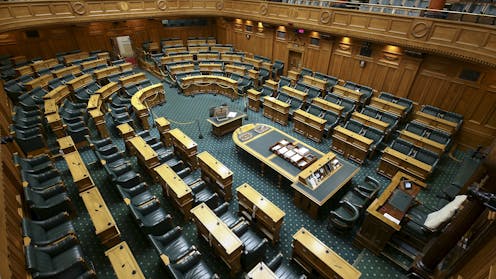
But it’s clearly an idea that won’t go away. With the Term of Parliament (Enabling 4-year Term) Legislation Amendment Bill now due for its second reading – and expected to pass into law – New Zealanders will once again be tasked with deciding on this significant constitutional question.
The intention behind changing to four years, according to its proponents, is to help improve lawmaking, allowing more time to develop and progress policy and legislation without the uncertainty and downtime of more frequent elections.
Retaining the three-year term, on the other hand, would allay concerns about accountability and a lack of constitutional safeguards. And this lies at the heart of the debate.
New Zealand’s unwritten constitution lacks some of the checks and balances found in other democratic systems: there’s no supreme written document to appeal to, no upper house, and parliaments are able to pass legislation that’s not consistent with the Bill of Rights Act.
Although proportional representation has clipped the executive’s wings since 1996, the government of the day still wields a lot of power to set the legislative agenda, often using parliament’s urgency procedures to ram laws through with little consultation.
So, New Zealand’s “political” constitution relies on politicians observing norms and conventions – as described in the Cabinet Manual – and on their fear of being ousted at the next election for overstepping the mark.
Ultimately, accountability comes from the people, as it should. But with relatively few immovable guardrails between elections, it is perhaps not surprising many New Zealanders are suspicious of handing governments a longer leash.
A ‘self-serving’ agenda?
Just how vexed these questions are can be seen in the current bill’s evolution. It has its origins in the National Party’s coalition agreements with ACT and NZ First.
But when it was first introduced, the bill set out to create checks and balances on executive power, making any extension to four years conditional: following each election, overall membership of select committees would be “proportional to the party membership in the House of Representatives of the non-executive members”.
In other words, select committees – vital to the vetting of new laws – would have a higher proportion of MPs from parties outside the government. If opposition parties did not get a fairer share of seats on select committees, the parliamentary term would remain at three years.
Given select committees are governed under parliament’s standing orders, putting a rule about their membership into statute was highly unusual. It was also getting too complicated to be a manageable referendum question – which should be kept plain and simple.
In any case, voters should always know in advance what the maximum term of the next parliament will be, and how long the people they elect will serve. Following public submissions, the proposed referendum will now only ask voters to choose between three or four years, with no conditions attached.
All of which has the ironic consequence of ACT giving a dissenting opinion on the amended bill that’s now gone back to the House.
A four-year term, it argued, “risks concentrating too much power in the hands of the executive”, meaning people may now see it as “a self-serving move by politicians rather than a balanced reform”.
‘Muddling through’
The now simplified bill still leaves unaddressed the question of safeguards against executive overreach. And it happens to coincide with the prominent example of Donald Trump pushing the boundaries of executive power under the US constitution.
Fearing such executive overreach, a majority may again be more likely to vote against change in the proposed referendum. But most MPs want four-year terms, so it’s now up to them to promote the idea without playing political football with it.
Still, the elephant in the room remains New Zealand’s lack of a single, overarching, publicly-approved written constitution. Having one could boost political trust with clear and enforceable checks and balances on executive power.
But past efforts towards writing one, such as in 2013, have fizzled out, swept under the carpet by politicians keen to avoid an argument over fundamental issues such as the place of the Treaty of Waitangi in the constitution.
And the recent heated debate about the principles of the Treaty of Waitangi reveals an apparent political impasse in addressing, let alone resolving, such matters.
Many New Zealanders might also be wary of any written constitution that gave greater powers of review to “unelected judges”. And there would be endless debate about whether the British monarch should be head of state.
The Kiwi way has been to tinker with the constitution, rather than boldly overhaul it. A four-year term of parliament could be one more step in what public policy scholars call a “muddling through” process – unless a majority of voters tick “three” for the third time running.
Grant Duncan does not work for, consult, own shares in or receive funding from any company or organisation that would benefit from this article, and has disclosed no relevant affiliations beyond their academic appointment.
Over the weekend, rallies were staged across various Australian cities under the branding “March for Australia”. The rallies, which were attended by avowed neo-Nazis and elected politicians alike, called for an end to mass migration.
These protests are not unique to Australia. Recently, the United Kingdom has seen its own wave of anti-migrant demonstrations in cities such as London, Bristol and Birmingham.
Despite claims by some that the Australian rallies were “hijacked” by the neo-Nazi National Socialist Network (NSN), they were deeply rooted in the far-right, white nationalist ideas of “remigration” and the Great Replacement theory.
An ABC investigation in the lead-up to the rallies found that “remigration” was listed on the organisers’ website as a key reason for marching, before later being deleted.
Significantly, the March for Australia rallies also received high-profile, online support from far-right figures overseas, including Alex Jones, Tommy Robinson, Jack Posobiec and Elon Musk.
Musk retweeted a post erroneously claiming 150,000 people took part in the rallies, while Jones retweeted a post claiming a crowd size of half a million.
For the rally organisers, public support from figures such as these greatly expands the reach of their message, and repositions them from isolated fringe events to vital parts of a global anti-immigration movement.
This is not the first time Musk has inserted himself in the domestic politics of a foreign country to bolster the far right. The tech billionaire notably gave his support to Germany’s far-right Alternative for Germany party in recent elections, describing it as the “best hope”“ for the country.
In recent days, he also posted the phrase ”remigration is the only way“ in response to a post about foreigners in the UK.
It is an ideological cornerstone of ”identitarianism“, a European far-right movement centred on preserving white European identities. These are perceived to be under attack by immigration, globalisation and multiculturalism.
Global growth of the far right
This online support for March for Australia underscores the growing transnational links among far-right movements.
These movements increasingly see themselves as united by shared concerns over the defence of so-called “Western Civilisation”, opposition to mass immigration, the preservation of white identity, and beliefs in conspiratorial narratives such as the Great Replacement theory.
And this transnational growth wouldn’t be possible without the proliferation of social media in recent years.
In Australia, for example, research shows how “indispensable” mainstream social media platforms have been in the development of anti-Islamic far-right movements such as the United Patriots Front, going back to the 2010s.
The far right also capitalises on virality and humour to extend the dissemination of their ideology online. In particular, this is done through memes.
Research has found, for example, that one particularly prominent transnational far-right meme, Pepe the Frog, has been localised for an Australian audience through the addition of a Ned Kelly mask.
Research also shows how international slogans travel across borders. US President Donald Trump’s “Make America Great Again” mantra, for instance, has been adapted into a distinctly local form for Australians: “Make Australia Grouse Again”.
The online space makes it easier for extreme views and rhetoric to permeate into mainstream political discourse, as well.
When elements of the far right get removed from mainstream social media platforms— a process known as “deplatforming” — they often find a new home on alternative platforms such as Telegram. Research shows they now host a range of Australian neo-Nazi groups.
It’s noteworthy that many of the key figures lending support for March for Australia, including Robinson and Jones, were previously deplatformed from Twitter before Musk acquired the company and reinstated them.
Social media has also allowed neo-Nazis such as Tom Sewell, who is essentially persona non grata in Australian mainstream media, to build a large and highly influential profile among international far-right audiences.
For the Australian far right, the support of figures such as Musk and Robinson signals an opportunity to increase their mobilising potential. It could also lead to the transnational exchange of information, resources and tactical support.
As the far right becomes increasingly emboldened, mainstreamed and normalised, we should expect to see more public and increasingly violent demonstrations across Australian cities – and support for these among a global audience online.
Kurt Sengul has received funding from the NSW Government’s Countering Violent Extremism (CVE) and Social Cohesion Research Program.
Callum Jones does not work for, consult, own shares in or receive funding from any company or organisation that would benefit from this article, and has disclosed no relevant affiliations beyond their academic appointment.
On Sunday, a plane carrying European Union chief Ursula von der Leyen was reportedly forced to land in Bulgaria using paper maps after its GPS navigation systems were jammed. Bulgarian authorities claim the jamming was deliberate Russian interference, though a Kremlin spokesperson told the Financial Times this was “incorrect”.
GPS interference is on the rise, so you might be wondering how it works. And can anything be done about it? And – perhaps most importantly – do you need to worry?
How does GPS jamming work?
The Global Positioning System (GPS) and other satellite navigation systems use radio signals from satellites to calculate position. To determine position, a GPS needs a direct line of sight to at least four satellites.
There are two ways to disrupt satellite navigation.
The first is jamming. This works by simply broadcasting high-intensity radio noise in the same frequency band used by the navigation satellites.
Jamming drowns out the satellite signal, like a person shouting loudly in your ear stops you hearing what someone is saying on the other side of the room. This appears to be what happened in Bulgaria.
The second way to interfere with satellite navigation is called spoofing, and it’s a little more elegant. Spoofing involves sending radio signals that pretend to be coming from the navigation satellites.
Where jamming stops the satellite navigation system from producing any location, spoofing tricks it into giving a false location – with potentially catastrophic results.
Are jamming and spoofing becoming more common?
Jamming and spoofing do appear to be growing more common, especially in conflict zones in the Middle East and Eastern Europe.
A clandestine Russian base near the Polish border is reportedly responsible for satnav interference in the Baltic region.
Ships in the Red Sea report frequent interference, likely from Houthi rebels in Yemen.
These increasingly common incidents highlight how vulnerable our reliance on satellite navigation makes us.
What can be done about interference?
The best response to interference is to have backup navigation options in place. The US-run GPS is the best known and most commonly used satellite navigation system, but there are others.
The EU runs a parallel system called Galileo, while Russia has one called GLONASS and China operates its own BeiDou satellites.
Each of these systems operates using slightly different radio frequencies. Some navigation systems can tune in to more than one set of satellites – so even if one is jammed, others may be available.
Galileo also has a “safety of life” feature, which allows users to detect spoofing. Australia’s in-development SouthPAN system will also offer a similar feature.
Another common feature of navigation systems is inertial sensing. This relies on sensors such as gyroscopes and barometers to directly detect movement and calculate position.
Most car navigation systems use inertial sensors to track location in cities or tunnels where there is no direct line of sight to satellites. Inertial sensing works well for short periods of time, but quickly becomes inaccurate and needs to be recalibrated by checking in with satellite systems.
Many researchers around the world are trying to develop new alternatives to satellite navigation using extremely precise sensors. One recent development uses tiny fluctuations in Earth’s magnetic field to detect position, for example.
Everyday air passengers have no need to worry about jamming or spoofing. For one thing, it’s very rare – especially outside conflict zones.
For another, the aviation industry is highly regulated and extremely safe. Even where satellite navigation doesn’t work, there are backup options.
What all of us can take away from this latest incident is how dependent we have become on satellite navigation. What matters is that we have a diverse range of systems so we are not dependent on just one.
Lucia McCallum does not work for, consult, own shares in or receive funding from any company or organisation that would benefit from this article, and has disclosed no relevant affiliations beyond their academic appointment.
The government will keep the permanent migration level for 2025-26 at 185,000, the same level as the previous financial year.
Immigration Minister Tony Burke announced the figure amid a fresh divisive debate about immigration, intensified by the weekend marches calling for lower numbers.
Neo-Nazis were prominent, especially in Melbourne, while on Tuesday self-identifying Neo-Nazi Thomas Sewell interrupted a news conference by Victorian Premier Jacinta Allan.
Burke said the announcement followed consultation with the states and territories which “recommended maintaining the size and composition of the program, with a focus on skilled migration”.
This figure is distinct from Net Overseas Migration (NOM), the overall measure that includes students and temporary workers. The NOM jumped dramatically after the end of COVID, and the government has been actively reducing it, including by limits on overseas students.
The NOM peaked at 538,000 in 2022-23. For the 12 months to December 31 2024, the NOM was 341,000. That was 37% down compared to the peak.
For the December quarter 2024, the NOM was 68,000. This was the lowest December quarter since December 2021 when border restrictions were lifted.
Student NOM arrivals in the December quarter 2024 (22,000) were 10,000 fewer than the December quarter 2023 (32,000) and have fallen below pre-pandemic levels.
In caucus the Prime Minister Anthony Albanese said he was shocked to see people at the rallies openly in uniform.
But he made it clear that not all who turned up at the marches were extremists.
“We need to make sure we give people space to move away and not push them further down that rabbit hole,” he said.
“A lot of these fears are being reinforced online, and we have challenges with polarisation.”
He said he would be meeting during the day with leaders within the Islamic community, and stressed how important it was for everybody to be reaching out to different communities.
The government is about to release the report from the envoy to combat Islamopbobia, Aftab Malik An earlier report came from the envoy to fight antisemitism, Jillian Segal; it received a mixed reception and the government is yet to give its response to her recommendations.
Meanwhile. the opposition has decided to press for a very brief Senate inquiry into the government’s agreement with Nauru to send the large cohort of former immigration detainees there.
Michelle Grattan does not work for, consult, own shares in or receive funding from any company or organisation that would benefit from this article, and has disclosed no relevant affiliations beyond their academic appointment.
Source: The Conversation (Au and NZ) – By Melissa Haswell, Professor of Health, Safety and Environment, School of Public Health and Social Work, Queensland University of Technology
Environment groups have called for federal intervention following revelations an LNG export hub in Darwin has emitted large volumes of methane from an LNG storage tank since 2006.
The ABC on Monday revealed years of failures to address the leak. State and federal authorities reportedly approved Santos’ controversial 25-year Barossa offshore gas project without requiring the leak to be repaired or replaced.
The incident adds to serious doubts about whether Australia can meet its commitment to reduce emissions of methane, a highly potent greenhouse gas.
The vital pledge will only be met if governments and industry prioritise climate action and human health over profits.
What happened in Darwin?
The Darwin case demonstrates dangers of relying on industry to assess and manage risks to the climate and human health.
The leak involved an enormous above-ground tank which contained highly processed methane derived from LNG (liquified natural gas).
According to the ABC, the leak was caused by a design flaw. The reports said the tank’s original owner, ConocoPhillips, discovered the leak in 2006 and reported it to the Northern Territory’s Environmental Protection Authority (EPA), describing the emissions as “minute”. The tank held gas for the next 18 years.
Two measurements using drone technology, in 2019 and 2020, reportedly indicated the leak was bigger than initially thought – up to 184 kilograms of methane was leaking per hour. This was not reported to the EPA until months later, according to the ABC.
Gas giant Santos now operates the tank, which is now reportedly empty. But it’s set to be filled again, as part of Santos’ Barossa gas project.
The ABC says state and federal regulators have not forced Santos to repair or replace the tank, adding:
They and the company say the leak is stable, and poses a moderate climate risk but no immediate threat to the public or the environment.
Santos told the ABC regulatory approvals and an ongoing monitoring program were in place, and the company reports its greenhouse gas emissions annually.
Methane: a major climate culprit
Methane is a dangerous greenhouse gas which drives about 30% of global warming. While it does not last in the atmosphere as long as carbon dioxide, its ability to trap heat is potent. In fact, methane is about 86 times more harmful than carbon dioxide (CO₂) in global warming terms, when measured over two decades.
Aside from the harms caused by escaped methane, the leak also represents an enormous waste of a substance produced at a very high cost to the climate. Natural gas extracted from the ground is transported to processing plants and liquified for export, by cooling it to about -160°C. This is an extremely energy-intensive process which itself is powered by natural gas and creates substantial greenhouse gas emissions.
In 2022, Australia signed the Global Methane Pledge, a non-binding commitment to reduce methane emissions by 30% by 2030. Australia’s energy producers also claim they are committed to reducing methane emissions in Australia.
The Darwin methane leak reveals a host of problems with gas regulation in Australia – including a lack of public transparency issues with the methods used to quantify leaks. These problems undermine industry and government pledges to reduce emissions.
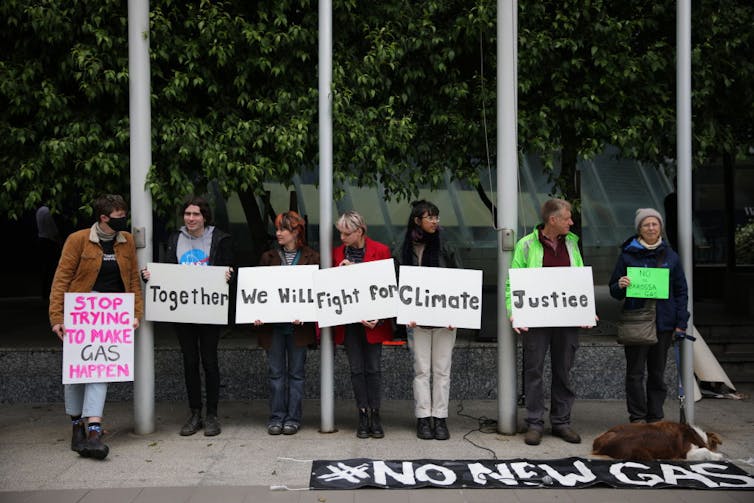
People protesting Santos’ Barossa Gas project win 2022. The project will soon fill the leaking tank in Darwin. Tamati Smith/Getty Images
What’s more, the neighbouring Inpex LNG plant in Darwin has also consistently released huge amounts of highly toxic substances including hydrogen sulphide, nitrogen oxides and volatile organic compounds.
Methane adds to the problem. It reacts with other chemicals in the atmosphere to form a dangerous air pollutant known as “ground-level ozone”.
Research has found each year, ground-level ozone contributes to up to 1.4 million deaths globally, from respiratory and cardiovascular disease.
Environment Centre NT has also expressed fears the leaking methane presents an explosion risk.
A challenge exposed
The problem of methane emissions is not confined to gas projects. For example, research earlier this year showed methane emissions from an open-cut coal mine in Queensland were up to eight times higher than reported annually by the operator.
What’s more, Australia does a poor job of measuring and reporting methane emissions.
Australian governments and their agencies must get serious about acting on climate change. This includes efforts to rapidly curb methane emissions – while also dramatically cutting CO₂ emissions.
No industry in the world carries more power to secure the planet’s future than the fossil fuel operators. Together, industry and governments must stop fuelling our demise.
Melissa Haswell has received grant funding from the National Health and Medical Research Council, National Suicide Prevention Strategy, Australian Health Ministers Priority Driven Research, Department of Families, Communities and Indigenous Affairs, CRC for Aboriginal Health and Queensland Department of Environment and Science and Queensland Health.
She is affiliated with Doctors for the Environment Australia (Honorary Member), the Climate and Health Alliance, the Public Health Association Australia, Psychology for a Safe Climate and the International Society for Environmental Epidemiology. Melissa also supports Northside Community Voices and Land for Wildlife in her local region.
In recent days, Trump labelled trade ties with India a “totally one-sided disaster” and a report emerged that he is no longer planning to visit India later this year for a summit of the Quad partners (India, the US, Australia and Japan).
So bad, so quickly
Things were not meant to happen this way. Many in New Delhi were delighted when Trump won the election last year. Modi congratulated his “friend” on X, along with pictures of the two embracing and holding hands.
India’s foreign minister, S. Jaishankar, told journalists that while other countries might be “nervous” about Trump’s return, India was not.
Feeling confident, Modi went to Washington to meet Trump days after his return to office. The encounter did not go well.
On the eve of the meeting, Modi was embarrassed by distressing images of Indian nationals, handcuffed and shackled, being deported from the US on a military aircraft.
In the Oval Office, he promised to buy more US arms, oil and gas, and asked that Trump not impose punitive tariffs on India. Modi failed to get that commitment.
A few weeks later, Trump announced India would be hit with a 27% tariff – far higher than the 10% imposed on China – unless it could negotiate something better.
Crisis in Kashmir
Begrudgingly, New Delhi began to talk trade. US Vice President JD Vance visited India in late April and both sides made positive noises about a deal. But while Vance was in town, India was engulfed in a new crisis.
On April 22, terrorists killed 26 people – mostly Hindu tourists – in Kashmir, long the site of simmering conflict between India and Pakistan. The Modi government pledged to respond with force, as it had done in the past after similar incidents.
On May 7, India bombed what it claimed were militant camps in Pakistan and Pakistan-administered Kashmir. A rapidly escalating, unpredictable conflict followed, as both sides used drones and missiles to attack one another.
Alarmed, governments around the world urged the two nuclear-armed states to end hostilities before matters got out of control. Early in the morning on May 10, they did, and agreed to a ceasefire.
Trump anoints himself peacemaker
Before either the Indian or Pakistani governments had a chance to say anything, Trump stepped in to take credit.
Islamabad was jubilant at this outcome. New Delhi, meanwhile, was furious.
India’s longstanding view is that the Kashmir dispute must be settled bilaterally, without third-party involvement. The US has accepted this position for more than 20 years. Now it appeared Trump was taking a different view.
This put Modi in a bind. Keen to maintain a mutually beneficial partnership and avoid punitive tariffs, he did not wish to upset Trump.
But he could not acknowledge Trump’s claims without setting aside a fundamental principle of Indian policy. So, Modi called Washington and explained he would not accept mediation over Kashmir.
The final straw
Meanwhile, Pakistan saw an opportunity to win favour in Washington and drive a wedge between the US and India.
Enthused, Trump called Modi on June 17 and asked him to do the same. Worse still, Trump requested Modi stop in Washington on the way back from the G7 summit in Canada, and meet with Pakistan’s military chief, Asim Munir.
According to a recent report, that was the final straw for Modi. He flatly refused both requests. The two men reportedly haven’t spoken since.
Trump’s actions have ordinary Indians seething and demanding action, but the Modi government does not have good options.
Giving in to coercion would make Modi – dubbed by political opponents “Narender Surrender” – look weak. Yet, no other major power can offer India what it needs in terms of markets, investment, technology, weapons and diplomatic support.
With US-India relations strained, New Delhi has been working hard to stabilise its relationship with China, which has been tense since bloody border clashes between the two in 2020.
Modi went to China for the first time in seven years on August 31 to further that aim, shaking hands with President Xi Jinping. But although Xi emphasised the need for amicable ties – he said the “elephant and dragon should dance together” – there is little trust between India and China at present.
Modi has more faith in Russia. In China, Modi and Russian President Vladimir Putin reportedly spoke for nearly an hour in Putin’s limousine. And Modi will host the Russian leader for more talks in India later this year. However, Russia remains a pariah in Europe, with limited means to help.
Other countries, like Japan, where Modi stopped off on his way to China, could also help India navigate the current crisis. But they do not have the clout to resolve it.
Unless Modi can find a way to win Trump back, India’s next few years could be very difficult.
Ian Hall has received funding from the Australian Research Council, Department of Defence, and Ministry of Foreign Affairs of Japan. He is an honorary Academic Fellow of the Australia India Institute.
If there was any doubt about neo-Nazi leader Thomas Sewell’s racist and anti-democratic attitudes, they were dispelled on the morning of September 2 when he gatecrashed a press conference by Victorian Premier Jacinta Allan and Treasurer Jaclyn Symes. In disrupting the conference, Sewell yelled that Australians did not have the right to protest and made the false claim that 50,000 protesters attended the “March for Australia” rally in Melbourne over the weekend.
The press conference was abandoned and Allan subsequently put out a statement saying she was unharmed and undeterred. She added:
But this isn’t about me. It’s about all the other people in the community who Nazis target – like multicultural people, LGBTIQA+ people, First Peoples, and Jews.
The symbolism of Sewell’s actions went well beyond the disruption of a press conference. It was an attempt to insert a neo-Nazi presence into the democratic process, and served to underline what was really behind the weekend’s events.
Media misjudgments
There were omissions and misjudgments in the media’s coverage of last weekend’s so-called anti-immigration rallies in eight Australian capital cities, leaving an unintentionally sanitised account of what occurred.
The main misjudgment was to persist in using the organisers’ description of the rallies as “March for Australia” and “anti-immigration” after it had become obvious the emotional dynamo behind them was racism.
It is true that they were in part anti-immigration, and it was clear from the coverage that some, perhaps most, people joined in because they were genuinely opposed to immigration for reasons not connected with race, but to do with issues such as housing.
But the fact is that the leadership of the Melbourne rally was provided by the National Socialist Network, a neo-Nazi organisation, and it became clear as events unfolded, especially in Melbourne and Sydney, that the terms “anti-immigration” and “March for Australia” were merely a smokescreen.
It became even clearer when a phalanx of neo-Nazis attacked an Indigenous protest site called Camp Sovereignty in Kings Domain, Melbourne. That had nothing to do with immigration: it was all about racism.
It also became clear when the main speaker at the Melbourne rally was Sewell. As The Age and Sydney Morning Herald’s Michael Bachelard reported:
[…] to the extent there was any sign of organisation among the grab-bag of grievances ranging over the streets of Melbourne’s CBD, it was the National Socialist Network that provided it.
It was a similar story in Sydney, where Joel Davis, a leader in the National Socialist Network who has openly praised Adolf Hitler, addressed the rally there.
However, by adopting the ambiguous title “March for Australia” and claiming a focus on immigration, the organisers masked the racist impulse driving them. Racism is a defining characteristic of Nazism. The neo-Nazis took a leading role. It follows that these were primarily racist rallies.
There were sound reasons for the media to suspect their true nature, reasons grounded in good reporting prior to the event.
On August 29, the Sydney Morning Herald published a story seeking to establish who was behind them. A Facebook group had popped up on August 9, but when the Herald
asked who was behind it, a spokesperson who would not be identified said there was no “overall organiser” but “a number of people” providing logistical and social media support.
Evasive, yes, but the racist nature of the enterprise was clear.
The Herald also reported that “Bec Freedom”, the online pseudonym for a woman who claimed to have lodged the protest application form with NSW Police, was heard on a livestream on August 11 instructing march promoters to use messaging about protecting Australian heritage, which she said meant “white heritage”.
That is racist by definition. The organisers, whose unwillingness to be identified should have added to the suspicion, disclaimed connections with the National Socialist Network. So they now have to explain how it was that the neo-Nazis took over the Melbourne rally and provided principal speakers both there and in Sydney.
Moreover, the organisers drew on the rhetoric of the “great replacement theory” in a flyer that singled out Indian immigrants, claiming that the reason for increased Indian migration to Australia is “replacement, plain and simple”.
This theory asserts that some Western elites are conspiring to replace white Americans and Europeans with people of non-European descent, particularly Asians and Africans.
It was invoked by the Australian white-supremacist terrorist Brenton Harrison Tarrant, who massacred 51 Muslims at prayer in Christchurch in 2019, and by Anders Breivik, who massacred 69 young people in Norway in 2011.
The failure to draw attention to this connection was another omission in the coverage of the weekend’s violence.
And a third was the failure to point out the contrast between the scale and orderliness of the huge pro-Palestine marches of August 3 2025, which attracted largely peaceful crowds estimated at 100,000 in Sydney and 25,000 in Melbourne, compared with the disorder generated by crowds estimated 15,000 in Sydney and 9,000, including 3,000 counter-protesters, in Melbourne last weekend.
Calling the rallies for what they are
Having said that, the focus of last weekend’s news coverage was rightly on what happened on the streets, and in that respect the coverage was comprehensive and, so far as it was possible to tell, accurate and impartial. The language used was proportional to the events and properly focused on the violence, which was a clear and present danger to public safety.
However, the way the media name things matters, and in this respect there was enough evidence to call the rallies for what they were, rather than what the evasive and shadowy organisers said they were.
Denis Muller does not work for, consult, own shares in or receive funding from any company or organisation that would benefit from this article, and has disclosed no relevant affiliations beyond their academic appointment.
Source: The Conversation (Au and NZ) – By Cameron Webb, Clinical Associate Professor, School of Medical Science & Sydney Infectious Diseases Institute; Principal Hospital Scientist, University of Sydney
Mosquito bites are annoying. They can also have deadly consequences. So what diseases do mosquitoes in Australia carry?
And with warmer weather on its way and rain expected to continue, how can you prepare for the coming mosquito season?
Mosquitoes are deadliest animal
Mosquitoes kill more people than any other animal. Worldwide, more than half a million people die each year from mosquito bites that transmit malaria parasites.
There has been a resurgence of the virus in southeastern parts of Australia following flooding in recent years. Mosquitoes pick up the virus from waterbirds throughout the Murray Darling Basin before they pass on the pathogen to people. Mosquito and waterbird populations both boom after flooding.
Scientists and health authorities thought Japanese encephalitis virus would transmit in a similar way to the closely related Murray Valley encephalitis virus, with outbreaks typically occurring after flooding that provided ideal conditions for both mosquitoes and the waterbirds carrying the virus.
Last summer, despite the lack of any substantial rainfall, the virus turned up even though mosquito (and waterbird) populations were generally low.
The virus also wasn’t limited to those areas where we’d expect to see it. There is growing evidence it’s made its way to the east coast, with the virus detected in the suburbs of Brisbane.
Ongoing wet weather can provide ideal conditions for mosquitoes. A/Prof Cameron Webb (NSW Health Pathology), CC BY-NC-SA
How will the weather impact mosquitoes this season?
It doesn’t really matter if it’s a “wet” or “dry” summer, mosquitoes are always active. But sometimes there are more – lots more.
In most parts of Australia, there is currently no shortage of water. Some regions have had record rainfall this winter, with more on the way.
The Bureau of Meteorology is predicting above-average rainfall through to the end of the year. Once the weather warms up, it could be a “buzzy” start to mosquito season.
This doesn’t mean outbreaks of mosquito-borne disease are inevitable. But we need to be alert to the risks and how best to protect ourselves and family.
Scientists like me trap mosquitoes across Australia each summer to track changes in their abundance, as well as activity of pathogens. A/Prof Cameron Webb (NSW Health Pathology), CC BY-NC-SA
Given the uncertainty around Japanese encephalitis, it’s also important to monitor locations where the virus has not yet been detected.
How to stay safe this spring and summer
There’s a lot you can do to protect yourself and family from mosquito bites and mosquito-borne disease.
A vaccine is available for those at risk of Japanese encephalitis. See your local health professional for advice on accessing the vaccine.
But there aren’t vaccines for the other local mosquito-borne diseases. Nor are there any specific treatments for these diseases. So preventing mosquito bites is the best way to protect yourself.
If you’re outdoors when mosquitoes are active, cover up with long pants, a long-sleeved shirt and covered shoes. Apply an insect repellent containing diethyltoluamide, picaridin, or oil of lemon eucalyptus to all exposed skin.
Cameron Webb and the Department of Medical Entomology, NSW Health Pathology and University of Sydney, have been engaged by a wide range of insect repellent and insecticide manufacturers to provide testing of products and provide expert advice on medically important arthropods, including mosquitoes. Cameron has also received funding from local, state and federal agencies to undertake research into various aspects of mosquito and mosquito-borne disease management.
Source: The Conversation (Au and NZ) – By Vincent Hurley, Lecturer in Criminology, police and policing, Dept of Security Studies & Criminology, Macquarie University, Macquarie University
From the time accused police killer Dezi Freeman escaped into bushland heavily armed, Victoria’s Special Operations Group and the Negotiation Unit would have drawn up surrender plan scenarios if he decided to give himself up.
I was a former police hostage negotiator for eight years – this is how and why surrender plans are used in these situations.
What is a surrender plan?
Surrender plans are a very simple set of instructions given to the person wanted by police. They are easily understandable and remembered and can be carried out with minimal thinking.
While surrender plans are drawn up immediately in a hostage or a wanted search like this, they are rarely made public.
Making a surrender plan public too soon may alert criminals and those who support them what police are thinking.
Police will have Freeman’s mobile phone number and will have been trying to contact him since he fled into bushland.
While mobile signals may be patchy, or his phone may have run out of battery, there’s still a chance Freeman is online and following the news.
The aim of the surrender plan is to ensure the alleged offender knows what to expect so they and police negotiators are not surprised during this process.
Negotiators want an alleged offender fully compliant during their surrender, to control their every movement.
To get this control, negotiators will say:
You will come out with your hands raised. Do not drop them. You will take five steps forward and stop. Do you understand that?
Once the alleged offender says “yes”, the negotiator knows several things about them immediately:
they can hear what police are saying, so their audio functioning is good
they can see if the offender has any physical injuries that might prevent them following some instructions
they can gauge through the wanted person’s speech and body coordination if they have the mental capacity to understand what is being said and carry out the instructions.
The negotiator will then ask them to repeat the instructions back so everyone involved is fully aware of what is expected.
The negotiator will then tell the alleged offender if they stray outside of the instructions, it may be considered a threat and police might take alternative actions.
Again, the negotiator will ask the wanted person if they understand this and have this repeated to them.
The negotiator will tell the wanted person to take five steps and on the fifth step to stop.
The negotiator will then issue another set of simple instructions and again ask the offender if they understand and to repeat them back.
This will be repeated until the alleged offender is laying face down and handcuffed.
This repetitive, simple, two-way conversation is important to reduce any misunderstanding](https://doi.org/10.1037/xge0001528) between the wanted person and the negotiator about what is expected.
It also helps negotiators constantly assess the mental and physical condition of the alleged offender.
The surrender will not be rushed because the wanted person will be nervous and physically and mentally exhausted.
In the case of Freeman, his exposure to challenging weather, mountainous terrain and likely lack of food and water will have fatigued him.
He may also be fatigued mentally as he realises the ordeal has come to an end.
All these physical and psychological factors may affect his judgement.
The aim of a surrender plan
The purpose of a surrender plan is to ensure the safety of the wanted person. Police want to get them before a court to hold them to account, and also allow the victims’ families to seek explanations and possibly some form of closure.
During a surrender, police will be following the letter of the law and their training to ensure they cannot be criticised in court, opening a possible opportunity for an appeal based on the arrest.
The Victorian police commissioner’s appeal to surrender, echoed by Freeman’s wife, are intentional.
It is to send a message to Freeman that despite what he has allegedly done, he has options open to him to bring this to peaceful end.
Police do not want him to believe the only option is to fight his way out.
The appeal is also to send a message to others who might be considering assisting him with food or shelter.
This is to reduce possible lines of inquiries in trying to find Freeman. It can save time and resources and prevent police from being unnecessarily distracted by false or misleading sightings.
What happened at Porepunkah is uncommon in Australia, with only two similar events occurring in the past 13 years.
In 2012, convicted killer Malcolm Naden – who also shot a police officer – was arrested after one of the biggest manhunts in New South Wales history. He is now serving a life sentence.
Ten years later in Wieambilla, Queensland, Stacey, Gareth and Nathaniel Train ambushed and killed two police officers and a neighbour before being gunned down by Queensland police.
The surrender plan is an attempt from police to reassure Freeman they are not seeking revenge and there may be a way to bring this search to a close without further violence.
Vincent Hurley does not work for, consult, own shares in or receive funding from any company or organisation that would benefit from this article, and has disclosed no relevant affiliations beyond their academic appointment.
ER Report: Here is a summary of significant articles published on EveningReport.nz on September 2, 2025.
Digital platforms are now the ultimate political power brokers, with consequences for democracy Source: The Conversation (Au and NZ) – By Francesco Bailo, Lecturer in Data Analytics in the Social Sciences, University of Sydney mos design/Unsplash Digital platforms have become the essential infrastructure of modern life. They power everything from our group chats to businesses, shopping, election campaigns and emergency coordination. They instantly connect us and continuously feed
Why was the Afghanistan earthquake so deadly? A disaster resilience expert explains Source: The Conversation (Au and NZ) – By Iftekhar Ahmed, Associate Professor in Construction Management/Disaster Resilience, University of Newcastle Wakil Kohsar/AFP via Getty images The death toll following the recent earthquake in Afghanistan continues to rise. Taliban-led health authorities now say at least 800 people have been killed and 2,000 injured. The earthquake struck just
Should I exercise if I’m still sore from last time? Source: The Conversation (Au and NZ) – By Hunter Bennett, Lecturer in Exercise Science, University of South Australia Alora Griffiths/Unsplash If you’re feeling sore from a run or gym session, you might wonder whether it’s better to push through or give your body a rest. This achy or stiff feeling in your muscles after exercise
Curious Kids: in ancient Egypt, did pyramids really have booby traps? Why was treasure hidden inside? Source: The Conversation (Au and NZ) – By Serena Love, Honorary Research Fellow in Archaeology, The University of Queensland In ancient Egypt, did pyramids really have booby traps? Why was treasure hidden inside? – Effie, age 8, New Plymouth, New Zealand. When the ancient Egyptians built their giant pyramids, they wanted to keep the Pharaoh’s
Walden Bello on Gaza and the media silence: ‘It isn’t fear of the Zionists. It is far worse’ Israel is boosting its Zionist influence in the Pacific. Australia has exposed such media influence. The media in the Philippines is now under scrutiny. And Aotearoa New Zealand? COMMENTARY: By Walden Bello When the Flores and Velasco articles and posts whitewashing Israel’s genocidal policies in Gaza first came out a few days ago, I was
It was lonely during WWII. Those at home and away coped through letters Source: The Conversation (Au and NZ) – By Emma Carson, Historian of Emotions and Australian Society, University of Adelaide State Library Victoria Gee I am lonely sweetheart, it may sound silly having so many men and cobbers around me, but when I say lonely I don’t mean lack of company, I am lonely for you,
My cat needs to be contained indoors – how do I make sure it stays happy? Source: The Conversation (Au and NZ) – By Barbara Padalino, Associate Professor of Animal Behaviour, Husbandry and Welfare, Southern Cross University Alexander JT/Unsplash In Australia, there are some 5 million pet cats, and several million feral cats that live outdoors and away from human care, with devastating consequences for native wildlife. While there’s debate over
Ageing Australians are waiting too long for home care packages. Here’s why Source: The Conversation (Au and NZ) – By Michael Woods, Professor of Health Economics, University of Technology Sydney Federal Aged Care Minister Sam Rae was heavily questioned in parliament yesterday for delaying the release of 83,000 new home care packages, from July 1 to November 1. In March 2025, more than 289,000 older Australians had
80 years since the end of World War II, a dangerous legacy lingers in the Pacific Source: The Conversation (Au and NZ) – By Stacey Pizzino, Lecturer, School of Public Health, The University of Queensland Aerial view of Enewetak Atoll showing nuclear test craters. Gallo Images/Orbital Horizon/Copernicus Sentinel Data 2021 On September 2, 1945, the second world war ended when Japan officially surrendered. Today, on the 80th anniversary, the physical legacy
It’s OK for people to cry at work. Here’s how you can respond as a colleague or manager Source: The Conversation (Au and NZ) – By Robyn Johns, Associate Professor in Human Resource Management and Industrial Relations, University of Technology Sydney Comeback Images/Getty Midway through a difficult discussion in her performance review, an employee named Jane finally cracks, and the tears start. Her boss doesn’t know what to do and handles the situation
It was lonely during WII. Those at home and away coped through letters Source: The Conversation (Au and NZ) – By Emma Carson, Historian of Emotions and Australian Society, University of Adelaide State Library Victoria Gee I am lonely sweetheart, it may sound silly having so many men and cobbers around me, but when I say lonely I don’t mean lack of company, I am lonely for you,
250+ media ‘black out’ front pages and broadcasts to protest Israeli killing of journalists in Gaza Reporters Without Borders In an unprecedented international operation organised by Reporters Without Borders (RSF) and the global campaigning movement Avaaz, more than 250 news outlets from over 70 countries simultaneously blacked out their front pages and website homepages, and interrupt their broadcasting to condemn the murder of journalists by the Israeli army in the Gaza
Fijian PM Rabuka hints at ‘historic’ referendum after landmark court ruling By Kelvin Anthony, RNZ Pacific digital/social lead Fijian Prime Minister Sitiveni Rabuka has hinted that the country may “hold its first-ever referendum” following a landmark Supreme Court opinion aimed at amending the 2013 Constitution. On Friday, the nation’s highest court ruled that thresholds for constitutional amendments should be lowered — requiring only a two-thirds majority
Australia’s government says social media age checks ‘can be done’, despite errors and privacy risks Source: The Conversation (Au and NZ) – By Lisa M. Given, Professor of Information Sciences & Director, Social Change Enabling Impact Platform, RMIT University We Are / Getty Images The Australian government today released a long-awaited report on a trial of automated tools for determining a person’s age. So-called age assurance technology is expected to
By sending non-visa holders to Nauru, Australia is shifting its responsibilities Source: The Conversation (Au and NZ) – By Mary Anne Kenny, Associate Professor, School of Law, Murdoch University The Home Affairs minister, Tony Burke, revealed late last week he had visited Nauru in August and signed a memorandum of understanding with its government. Under the agreement, Nauru will grant long-term visas to members of a
Politicians have scapegoated immigration for decades. It’s time to flip the script Source: The Conversation (Au and NZ) – By Jane McAdam, Scientia Professor and ARC Laureate Fellow, Kaldor Centre for International Refugee Law, UNSW Sydney For decades now, public discourse about refugees and immigrants has become increasingly fractured, ugly and untrue. From John Howard’s “we will decide who comes to this country” mantra, to Kevin Rudd’s
What chaos at the US CDC could mean for the rest of the world Source: The Conversation (Au and NZ) – By Michael Toole, Associate Principal Research Fellow, Burnet Institute Ever since Robert F Kennedy (RFK) Jr was appointed United States Secretary of Health and Human Services, the Centers for Disease Control and Prevention (CDC) has been under pressure to abandon its traditional evidence-based approach to public health in
China may not invade Taiwan, but rather blockade it. How would this work, and could it be effective? Source: The Conversation (Au and NZ) – By Claudio Bozzi, Lecturer in Law, Deakin University US officials believe Chinese President Xi Xinping has set a deadline for his military to be capable of invading Taiwan by 2027 – the centennial anniversary of the founding of the People’s Liberation Army (PLA). US Secretary of Defense Pete
Trump’s tariffs are headed to the US Supreme Court, prolonging the chaos on trade Source: The Conversation (Au and NZ) – By Felicity Deane, Professor of Trade Law and Taxation, Queensland University of Technology Trading partners of the United States are facing a fresh period of uncertainty after a US federal appeals court ruled President Donald Trump’s “reciprocal” tariffs were illegal. In a 7-4 majority, the judges ruled Trump
Police plan for march which will shut Auckland Harbour Bridge this month RNZ News New Zealand police say planning is well underway ahead of a pro-Palestinian march that will shut the Auckland Harbour bridge later this month. The organisers are expecting thousands to turn out for the “March for Humanity” which is due to be held on September 13. Police told RNZ they were working with partner
Digital platforms have become the essential infrastructure of modern life. They power everything from our group chats to businesses, shopping, election campaigns and emergency coordination. They instantly connect us and continuously feed us information.
Yet although they broker information everywhere, the power of digital platforms remains largely invisible.
They control content and harvest information from behind a curtain, and avoid accountability by claiming they’re neutral. Section 230, the United States law that states online platforms can’t be treated as publishers, helps them avoid legal responsibility for the content they host.
In a new study published in Political Communication with Francesco Marolla, Marilù Miotto and Giovanni Cassani, we look behind the curtain into how this power works and what it means for democratic politics.
What is a digital platform, exactly?
When we think about digital platforms, we usually think about the apps and services we use every day, such as Google, Instagram or TikTok.
Yet digital platforms should be thought of as an ecosystem dominated by a small number of big tech companies. Governments have their own platforms in this ecosystem, such as GOV.UK or Australia’s myGov. But they still depend on private platforms – app stores, social media apps, payment systems and cloud services – to reach their citizens. The same is true for political parties and civic groups.
In our paper, we developed and tested a theory for understanding the political power of platforms.
Three forms of power
We studied Italy’s anti-establishment party, the Five Star Movement, using a large dataset of user interactions spanning five digital platforms.
The movement emerged in 2005 from its founder’s blog and, in its early years, used multiple platforms to enable direct participation. This makes it an ideal case study for understanding how platforms shape power within political organisations.
Building on previous theories, we have revealed how three critical forms of power emerge in the platform ecosystem.
Political actors either surrender or compete unequally for these powers with the owners and administrators of platforms.
Network-making power represents the ability to determine network shape and boundaries. It controls how users connect and which groups they can form, shaping their behaviour.
Networked power represents direct communication influence within networks, controlling which way the information flows and what people see.
System administration power controls access and the rules users must follow within the platform – from using pseudonyms instead of real names to the length of posts they can publish. It determines who can participate in digital political spaces and how.
Here’s how these powers play out
Platforms maintain complete control over system administration power, similar to how countries have sovereignty within their territories. Users give up control of this power when they participate in the platform ecosystem.
By contrast, platform users can exercise some network-making and networked powers. For example, party leaders can mobilise supporters through viral posts and livestreams, while regular members organise local meetups and coordinate protests through online groups and events.
Platforms exercise network-making power through surveillance, control and modification of behaviours. They use algorithms and data analysis to shape user behaviours at scale, which determines how networks form and evolve. Facebook has used this power to manipulate users’ emotions and influence voting behaviour.
At the networked power level, platforms wield curation powers: they filter, amplify, or suppress content according to their goals. They decide which content ranks at the top of your news feed, and what gets ranked down or even shadowbanned.
Because even under these constraints, political leaders, parties and grassroots organisations can use platforms for essential communication – and achieve their goals.
Political leaders can directly use platforms to promote collective action among their followers. This is the power Trump exercised when he tweeted “Be there, will be wild!” in December 2020 in reference to what became the Capitol Hill riots.
Meanwhile, grassroots activism can grow on platforms through “connective action”. This means people loosely coordinate online to form self-organised protest networks – examples of this are the Arab spring, the indignados in Spain and the #MeToo movement.
Political turbulence
Our findings reveal a critical issue in contemporary politics. Platforms concentrate unprecedented communication power, yet political actors remain dependent on these very systems for democratic participation.
This asymmetrical power structure has serious implications. Even when political organisations successfully use digital platforms – such as for reaching their constituents – they do so under the rules platforms have imposed.
Democratic discussion increasingly happens online, but platforms maintain full control over these digital spaces. A change in ownership or policies can abruptly disband established political networks. It can also reconfigure conversations completely.
The fragmentation of audiences across platforms creates additional problems.
Our work and others shows users tend to cluster within single platforms rather than engaging across multiple spaces. This leads to distinct communities with their own communication norms and discussion topics.
This fragmentation can both strengthen and weaken political organisations. While it allows for diverse participation, it also makes it difficult to maintain consistent messaging.
All this leads to ongoing “political turbulence” where people’s attention and leadership credibility rises and falls dramatically.
Behind the scenes, digital platforms fragment public discourse while amplifying cynicism, distrust and rage-driven engagement. Their power can be repurposed to align with different goals: for financial gains, for political dominance, or for both.
Francesco Bailo have received funding from the Facebook (now Meta) and the Australian Department of Defence.
The earthquake struck just before midnight local time on Sunday in a mountainous region near the city of Jalalabad, along the eastern border with Pakistan. It was of a relatively low 6.0 magnitude. But its epicentre was shallow at 8km underground, resulting in strong shaking on the surface and a series of aftershocks.
Most of the dead and injured were sleeping indoors at the time of the earthquake, and were crushed by collapsing buildings. Because of the remoteness of the affected areas, and also blockage of road networks from landslides caused by the earthquake, the exact death toll may take a long time to find out.
A region prone to earthquakes
The Himalaya and Hindu Kush mountains, and their foothills, where the impacted area in Afghanistan is located, are seismically active because of the ongoing friction between the Eurasian and Indian tectonic plates.
Afghanistan also has its fair share of earthquakes, especially in the currently impacted region. In October 2023 an earthquake here killed more than 1,500 people. The previous year, more than 1,000 people were killed by another earthquake.
The 2011 earthquake in Christchurch, New Zealand, was of a similar magnitude and occurred at a shallower depth as the most recent one in Afghanistan. Yet, even though it impacted a built-up city, only 185 people died.
The hundreds of deaths in scattered rural hamlets in Afghanistan present a sharp contrast.
Earthquakes don’t kill people, buildings do
An oft-quoted phrase, “earthquakes don’t kill people, buildings do”, is helpful to understand the factors that contribute to the high death toll of this earthquake and past ones in Afghanistan.
Rural communities in Afghanistan can’t afford sturdy and manufactured building materials. Because of this they build homes with locally available natural materials such as earth, stone and raw lumber.
Such buildings do not follow engineered designs, building codes or formal professional standards that prevent easy damage by earthquakes in wealthier countries.
A typical form of construction in Afghan rural areas is walls made of mud bricks or stone masonry. This is known as “monolithic” construction.
Such construction is unable to resist the strong side-to-side shaking caused by an earthquake. As a result, buildings easily tumble and crush people. Reports of collapsed rubble where there were once buildings are emerging widely from Afghanistan, as was also the case in previous earthquakes.
A trigger for design change
Examples from other countries in the region demonstrate a better level of earthquake-resilient building design can be achieved in similar socio-economic conditions.
After the 2005 Kashmir Earthquake in Pakistan, the government established the Earthquake Reconstruction and Rehabilitation Authority. It assisted in helping affected people build safer houses through a community-based program backed by technical guidance.
In Nepal, after the 2015 Gorkha earthquakes the government established the minimum standards of their National Building Code, that allow rules of thumb to comply with a basic level of earthquake resilience.
More than 25 years ago, Indian earthquake engineer Anand Arya pioneered his approach to reducing earthquake risk for “non-engineered” buildings. Among other techniques, this approach includes adding continuous bands in the walls, and reinforcements in the corners of a building and along doors and windows, which can provide strength to traditional masonry buildings.
These examples demonstrate that not a lot of money is always required to improve earthquake resilience. Rather, a degree of technical and institutional support can achieve safety in cost-effective ways.
Admittedly, such buildings would not be entirely earthquake-proof. But they would still impart a level of strength that can lead to less damage, and importantly, save lives.
One can hope this earthquake will be a trigger for such an initiative in Afghanistan, so a “building back better” process can assist the impacted communities to be more resilient to future earthquakes.
Iftekhar Ahmed does not work for, consult, own shares in or receive funding from any company or organisation that would benefit from this article, and has disclosed no relevant affiliations beyond their academic appointment.
If you’re feeling sore from a run or gym session, you might wonder whether it’s better to push through or give your body a rest.
This achy or stiff feeling in your muscles after exercise is known as “delayed onset muscle soreness” (DOMS). Soreness usually sets in within the first 12–24 hours after your exercise session, and often peaks 24–72 hours after.
In most instances, DOMS will disappear completely in three to five days. But what should you do in the meantime? Is it OK to exercise if you’re still sore? Here’s what the evidence says.
Why do muscles get sore after a workout?
When you exercise, tiny tears (also called “microtears”) occur in your muscles. Then, as your body floods the area with fluids and nutrients to repair them, it causes inflammation. This is part of the normal recovery process, and helps stimulate increases in muscle strength and size.
But inflammation also stimulates pain receptors, which makes you feel sore in the days after your workout.
How sore you feel will depend on the exercise you do. DOMS is more likely when you haven’t exercised for a while, you do a new type of exercise, or it puts a large load on your muscles (for example, weight training or running).
Basically, it’s your muscles’ response to doing something more demanding or challenging than usual.
The more often you do the same type of exercise, the less likely you are to feel sore.
Should you be sore after every workout?
Muscle soreness is completely normal, especially if you are new to exercise. But it’s not necessarily a good indicator of progress.
All it really tells us is that our body is adapting to a new form of exercise or a sudden increase in load.
It doesn’t tell us whether or not that exercise was effective at building muscle and improving fitness – especially if you’ve been exercising consistently and gradually increasing your load or frequency.
For example, someone who runs regularly is unlikely to feel sore after a single running session, but it will still improve their fitness.
Similarly, if you lift weights regularly, using heavier weights than usual will at most give you only mild DOMS. Yet each training session will still be helping you improve strength and build muscle.
So, should I exercise if I am still sore?
It depends if you’re concerned about injury or performance.
Exercising while recovering from DOMS won’t hurt you. But some evidence suggests your strength and performance may decline when you’re sore. This means you probably won’t be able to lift as much or run as fast while you have DOMS.
Some research has also shown that muscle damage can negatively affect balance. This might increase your risk of falling or even getting an injury such as a sprained ankle.
Another study found soreness can also reduce your skill performance (in this case basketball shooting accuracy). So you might notice an impact if you’re exercising with certain performance goals in mind.
What about rest days?
Taking days off for recovery in between exercise sessions doesn’t seem to make much difference for long-term progress building strength or fitness.
Research has compared training on consecutive days – for example, Monday, Tuesday and Wednesday – with non-consecutive days – Monday, Wednesday, Friday.
And it doesn’t seem to make a difference.
For example, one study had two groups perform the same full-body weight training routine for seven weeks, either on three consecutive or three non-consecutive days. Both groups saw similar improvements in building muscle strength and size.
Similarly, another study compared two groups of cyclists doing the same high-intensity interval training program routine on three consecutive or three non-consecutive days. After three weeks both groups showed the same overall improvements in aerobic fitness and time trial performance.
These were relatively short-term studies. So it’s also possible that over the course of a training year, taking a rest day here and there will help maintain motivation and avoid injury.
Bottom line
While you’ll probably feel slower or stiffer, exercising with sore muscles won’t hurt you and is unlikely to hinder your training progress.
However, you might want to avoid exercises that rely on balance – such as intense jumping and landing movements – as your risk of injury could be slightly greater.
If you are really sore, there is some evidence massage or even an ice bath might help you recover, although the effect is small.
And while muscle soreness is normal, it’s still important to listen to your body. Never push through intense discomfort or pain, as this could be the sign of an injury.
You should talk to a doctor if:
your muscles feel extremely sore and it lasts for more than seven days
you have visible muscle bruising where the muscle is sore
you have sharp pain.
Hunter Bennett does not work for, consult, own shares in or receive funding from any company or organisation that would benefit from this article, and has disclosed no relevant affiliations beyond their academic appointment.
In ancient Egypt, did pyramids really have booby traps? Why was treasure hidden inside? – Effie, age 8, New Plymouth, New Zealand.
When the ancient Egyptians built their giant pyramids, they wanted to keep the Pharaoh’s sacred mummy safe from thieves.
But unlike in the movies and comics – where pyramids seem to always have swinging blades, secret snakes, or sneaky poison darts – the real pyramids did not have dangerous booby traps.
Instead, the pyramid builders were very clever. They made the inside of the pyramids like a tricky maze. Imagine walking through tunnels that lead nowhere, with fake doors and dead ends.
This way, if someone tried to find the Pharaoh’s burial chamber, they could easily get lost.
These confusing passages made it very hard for thieves to reach the mummy.
Sometimes, they even put huge, heavy stones to block off passages and stop anyone from getting inside.
These stones were so big and heavy one person could never move them alone, and even groups would have a very hard time getting past.
Blocking the way with huge stone slabs was a natural barrier that made the tomb difficult to enter without special tools or many people.
Also, sometimes there were deep holes or hidden pits but these were just simple obstacles – not deadly traps. The robber would walk out the way they came in; nothing was lethal.
They might have been meant to trip up or slow down robbers, rather than seriously hurt them.
The Egyptians also wrote curses.
These were scary messages painted or carved on the walls, saying that anyone who disturbed the tomb would be cursed with bad luck or punished by the gods.
The Egyptians believed strongly in their gods and thought these curses might protect the tomb by making robbers too afraid to enter.
While these were not physical traps, the curses acted like a kind of magic protection, using fear and belief to help keep the tomb safe.
There was no magic in these curses – just words.
Why was treasure hidden inside the pyramids?
The ancient Egyptians believed that when a Pharaoh died, he would need all his personal things in the next life – food, furniture, clothes, jewellery, and especially gold.
Gold was not just used because it was valuable – ancient Egyptians believed gold was magical. Its bright yellow colour made people think of the Sun, and the Sun was linked to Ra, the supreme god who gave light and life to the world.
Gold was called “the flesh of the gods,” and using it in tombs and treasures helped connect the Pharaoh to Ra. They hoped it would help him live forever, just like the eternal Sun. By surrounding the Pharaoh with treasures, especially things made of gold, they believed he would be safe, strong and happy forever in the afterlife.
Some of these treasures were common everyday things, like beds, chairs and boxes so the Pharaoh could rest in the afterlife just like in real life.
Food and drinks, such as bread, fruits and wine, were there too, so the Pharaoh would never be hungry or thirsty.
Weapons and tools, such as daggers and chariots, were included to ensure the Pharaoh could defend himself and travel in the afterlife.
The walls were decorated with colourful paintings and writings telling stories about the Pharaoh’s life and magical spells to keep him safe.
Finally, statues of gods were put inside the tomb to bring blessings, and keep the Pharaoh strong and protected.
A serious crime
Stealing from a Pharaoh’s tomb was a very serious crime and was forbidden. Because the tombs often held many valuable things, including gold and jewels, robbers were always trying to break in to steal these treasures.
But sometimes thieves got caught robbing tombs and were punished very harshly. The punishments for stealing from a Pharaoh were often severe; robbers could be beaten, have their hands cut off, or even be put to death, because stealing from the Pharaoh was a crime against the king and the gods.
Ancient Egyptian records, like the famous Tomb Robbers Papyrus (from 1110 BCE) talk about court cases where robbers admitted to breaking into royal tombs, such as that of King Ramesses VI.
This shows us that the Egyptians worked hard to protect their sacred mummies and treasures with strong laws.
So, the Pharaoh’s sacred mummy was protected by clever tricks and scary words, not by the dangerous traps from the movies.
Anyone who tried to rob the tomb was taking a big risk because both the ancient police and the law were ready to punish them.
Serena Love does not work for, consult, own shares in or receive funding from any company or organisation that would benefit from this article, and has disclosed no relevant affiliations beyond their academic appointment.
When the Flores and Velasco articles and posts whitewashing Israel’s genocidal policies in Gaza first came out a few days ago, I was waiting for people in the Philippine media to criticise and denounce them since they were so obviously hack pieces that did not meet the minimal standards of decent journalism.
I waited and waited, until I realised that there were no media people or organisations that were going to speak up.
I was not out to do an expose, but that’s what it effectively became. In my subsequent posts, I raised the question of what was the reason just two journalists were willing to challenge the stories.
Was it a case of circling the wagons to protect errant colleagues? Was it fear of ties with the Israeli state being exposed by the Israelis in retaliation? Was it fear of physical or political reprisals by the Israelis?
These may have played a part, but the deafening silence meant there was something bigger at work.
This morning I received a long text from a prominent media practitioner that provided the answer. It’s not fear. It’s actually worse: agreement with Zionist ideology and policies, including genocide.
That the person asked me not to divulge his name for fear of suffering retribution from his colleagues stunned me. OMG, is this how deep the rot is with our media? ? Here is his disconcerting revelation to me:
‘Most are prejudiced’ “Yes some are scared, but honestly most of them actually are prejudiced against Muslims and side with the Zionists anytime.
“Most believe in the US religious fascist Zionist narrative, and also cannot accept that the world has changed — that the US is no longer the unipower it was decades ago, and that Russia, China, India and BRICS are on the rise.
“And also, you should hear them talk about how Filipino Muslims should be wiped off the face of the earth.
“These are college graduates from UP [University of the Philippines], UST [University of Santo Tomas], Ateneo who studied media.
“Whenever I would voice empathy for the Muslim minority here, or Palestinians, I’d be called stupid. Same also because I refused to join in the corruption.
“Oh, and also they have the same prejudice against China and the Chinese and mistake the Japanese imperial army atrocities as something China did to us!
“Also this is not limited to media. I have batchmates from UP Diliman, medical doctors, lawyers, engineers who also have the same prejudices.”
He added: “Some of these journalists have won awards abroad.”
Walden Bellois a Filipino academic and analyst of Global South issues who was awarded Amnesty International Philippines’ Most Distinguished Defender of Human Rights Award in 2023. He has also served as a member of the House of Representatives of the Philippines.
Gee I am lonely sweetheart, it may sound silly having so many men and cobbers around me, but when I say lonely I don’t mean lack of company, I am lonely for you, only you can fill the gap in my heart dearest, as each moment passes I seem to miss you and love you more, I shall never get used to living without you […] in fact I am sure we were meant to be together all the time.
My great-grandfather Bill Wiseman wrote this to my great-grandmother Florence in a letter dated October 20 1944.
Aside from when Bill briefly returned on leave from his service for the 2/48 Battalion of the Australian Imperial Force (AIF), he had been separated from Florence since September 1941. Bill would not permanently return to Florence and their children until his discharge from the military on November 8 1945.
It was a long time to be away from his family, and Bill often reflected on the emotional toll their separation had on him.
Loneliness is a common emotion in letters written by Australian service personnel and their loved ones. Rather than a complete physical isolation from others, this situational loneliness was characterised by the absence of a certain person: one’s partner, parents or children.
As Bill acknowledged, while he was surrounded by “cobbers”, it was Florence who he was “lonely for”.
Members of the Australian Imperial Force read letters while stationed in British Malaya in 1942. Australian War Memorial
Separations over oceans
Like other historical events that caused mass displacement and separation, the second world war fostered an almost universal sense of situational loneliness.
Emotional experiences and expressions were often dictated by real physical distance. Methods of travel and communication were significantly limited. It could take months for a letter to reach its destination.
Other circumstances influenced how separated families felt and articulated their loneliness in wartime. This could include factors such as how long they had been apart, whether personnel could return home on leave, the intensity of military campaigns which might restrict mail exchanges, and if personnel were injured or captured by enemy forces.
Members of the Royal Australian Air Force read letters in Tunisa in 1943. Australian War Memorial
While letters could never completely substitute for the absent person, Australian military personnel and their loved ones recognised the importance of exchanging correspondence to ease their loneliness.
AIF Sergeant Robert Graham implored his fiancée Jane Melrose to write more regularly, as it improved his morale:
I received your ever welcomed and much needed letter yesterday and it made me feel a lot better + miles happier too. Jane whatever you do pleased write as often as you can […] I feel so depressed when mail comes in and I don’t get any from you. It doesn’t matter who I get mail from I’m still not happy unless I recognise your handwriting on the envelope.
Barbara Welbourn, a soil scientist at the University of Adelaide, wrote to her fiancé, Sergeant David Sheppard, about the “renewal” his letters provided when she was lonely:
Your [76th letter] was waiting for me last night; such a blessed end to the day + so longed for […] I am so dependent, my sweet David on your love, its constant renewal, even more wonderful by letters that I will be adrift in sad seas without them.
Women’s Auxiliary Australian Air Force Aircraftwoman Doris Plummer wrote she was “dying” for news from her husband Private Walter Plummer, who served in the Volunteer Defence Corps.
She wanted to hear about his Christmas, because as it would make her feel closer their family:
Hope you tell me everyone you saw everything you said and did. How many fish you caught, how many times you swam and missing no details. They are the little unimportant things that make me feel I am not so far away.
Australian Army Medical Women’s Service member, Private Phyllis Alkemade, writing to her brothers. State Library Victoria
Patience and perseverance
While loneliness was (and still often is) perceived as a negative emotion, characterised by mental pain and absence, letter writers from the war often discussed how experiencing these uncomfortable feelings ultimately transformed their relationships for the better.
Albert Gerrard, a private in the Australian Army Medical Corps, assured Margaret James that he believed separation ultimately prepared them for marriage:
Three years have not been wasted, I think we’ve both learned a lot. I have anyway, patience, perseverance, and over + above all else, what a loyal little darling you are. It has also knocked a lot of conceit + selfishness out of me. Generally speaking, I’m better for it.
Sergeant R. M. Marriott writes a letter home while stationed with the 7th Australian Division in Mount Garnet, Queensland, 1943. Australian War Memorial
Lance Corporal George Seagrove outlined how he believed the longing he felt for his wife Marjorie made him appreciate the joy she brought him.
In one such letter, George wrote:
This parting, more than anything else, has made me realise how big you have been in my life […] It’s like a soul split in two. When I see anything I always want to rush to my pen and tell you about it. If it is something funny I can hear you laughing because I know you laugh at the same things as I do […] Every day when the mail comes my heart beats a little bit quicker and your familiar handwriting brings a big smile to my face.
Letter writers on the home and battle fronts showed a great capacity to express vulnerability by describing their loneliness.
Through their heartache and anxiety about the uncertainty of their futures, separated spouses realised their love for one another was undeniable.
Emma Carson does not work for, consult, own shares in or receive funding from any company or organisation that would benefit from this article, and has disclosed no relevant affiliations beyond their academic appointment.
An increasing number of councils around the country either have overnight or 24-hour curfews for our furry, clawed friends.
But if your cat is used to going outside unsupervised at least some of the time, is it possible to transition them to an indoor-only lifestyle? Here are the welfare questions to consider.
Do cats need outdoor access?
In 2023, the European Union adopted a scientific report on dog and cat welfare in commercial breeding establishments. This work, which I participated in, was a thorough review of the current literature and national regulations.
Based on the scientific evidence, access to outdoor space was requested for dogs, but did not become a requirement for cats in Europe. The necessity for cats to have outdoor access remains a matter of scientific debate.
Contained cats require an appropriate environment with enrichment that meets the cats’ physical and mental needs, allows expression of natural behaviours, promotes good health and welfare and minimises stress. This should include controlled outdoor access where possible.
On the one hand, many cat owners, particular those living in rural areas, prefer to let their cats roam free, as they believe the outdoors provides cats with exercise and allows them to engage in natural behaviours such as hunting, exploring and climbing.
But uncontrolled outdoor access has many negative impacts on the welfare of pet cats. Free-roaming cats are at a higher risk of disease and parasites, injuries or death from car accidents, accidentally ingesting toxins, unwanted pregnancies, and becoming lost.
Uncontrolled access to the outdoors exposes pet cats to many dangers. Young Shih/Unsplash
How can I safely contain my cat?
Whether you’re moving house and can’t provide outdoor access any more, or your council is implementing a curfew on cats, you may find yourself in a situation where your outdoors-loving cat now has to be confined.
A good indoor home for a cat must have easy access to food, water and a litter tray, a safe physical environment, comfortable places to sleep or to hide, and plenty of ways to engage in play and other activities, including scratching posts and raised platforms to survey their territory from.
Hopefully, your cat already has all of these things.
However, our pets’ experiences and attitudes are also shaped by their breed, temperament, and the environment they grow up in. A cat that’s only lived indoors in a good home is more likely to be content and happy in its confinement.
But a pet cat that’s always been allowed to wander around and suddenly isn’t allowed to do so, may end up distressed and “act out”.
One of the most common behavioural problems is soiling outside the litter tray. That’s because a cat who’s been habitually using the outdoors as a toilet may not like the litter box as much.
However, a cat may also be stressed by a change in its environment, which can increase the risk of developing a urinary tract infection. In such cases, the cat might start peeing outside the litter box, often choosing cool surfaces such as sinks or bathtubs. Because house soiling can have both medical and behavioural causes, it is always best to consult a veterinarian.
Other signs of distress can be increased aggression, or becoming depressed and spending lots of time hiding. So, if you notice any changes in your cat’s behaviour, consult your vet. They can first rule out any stress-related medical conditions and then guide you on how to best support your cat through this transition.
Pet cats such as Cleo (the author’s cat) can have plenty of comfort when safely kept indoors in an appropriate environment. Barbara Padalino
It’s not all or nothing
Among the many good recommendations for making your cat’s indoor environment more engaging is the use of cognitive enrichment. You can offer puzzle feeders or play hide-and-seek with your cat.
Another effective option is a clicker training program, which has been shown to provide both mental stimulation and improved welfare for cats. It involves using a small clicker device and an immediate treat to reward the animal for a desired behaviour.
With clicker training, you can teach your cat a variety of simple tasks, turning learning into a fun and rewarding activity. For example, clicker training can help your cat become more comfortable entering a pet carrier, enjoying car rides, or even walking on a leash – so you can start bringing your cat outdoors with you.
While free roaming may no longer be an option for your cat, it doesn’t mean they can’t experience any outdoor time at all.
With successful training, you can take your cat outdoors on a leash. Piotr Musiol/Unsplash
Where possible, you could build a cat-proof fence on your yard, have a fully enclosed outdoor space (a “catio”) or even investigate virtual fencing options if they are permitted in your state. These involve a transmitter paired with a collar that makes a sound or vibrates when the cat reaches an invisible boundary.
You can also make sure your cat has a GPS tracker on their collar in case they do manage to escape.
Ultimately, the response to permanent confinement will vary among individual cats. As the owner, you are best placed to watch them for any behavioural changes and make sure their quality of life is still good.
Barbara Padalino receives funding from the European Food Safety Authority.
Federal Aged Care Minister Sam Rae was heavily questioned in parliament yesterday for delaying the release of 83,000 new home care packages, from July 1 to November 1.
In March 2025, more than 289,000 older Australians had a home care package. But more Australians are needing these services than there are places, so the wait list continues to grow.
Reacting to widespread complaints, the Senate stepped in to conduct a short inquiry into the impact of the delay on older Australians.
Our research and submission to the Senate inquiry show the government should immediately release the additional packages. But its not yet clear whether it will do so.
Remind me, what are home care packages?
Home care packages are bundles of services that help older people with complex needs to live at home for longer.
There are four levels of funding, depending on need. Each package can include help with household tasks, but there is also an emphasis on personal and clinical care, including nursing, physiotherapy and other allied health care.
The 2021 Royal Commission into Aged Care Quality and Safety recommended the government significantly increase the number of home care packages, as it was clear older people wanted to stay at home for as long as possible.
It found in-home care can prevent the avoidable decline of older people’s health and independence, enable them to remain a part of their local community, and delay (or avoid) entry into residential aged care or hospital.
The waiting list went down. Now it’s up again
The number of people receiving a home care package increased from 128,781 at the end of 2019 to 258,374 in June 2023. During that time the government was releasing 40,000 to 50,000 packages per quarter.
This exceeded the number of people being approved for packages. So the waiting list was declining by as much as 10,000 people per quarter, reaching a low of 28,665 by June 2023.
Number of people with a home care package and waiting for a home care package
However, from mid-2023 the government reduced the release of new packages to a little over 30,000 per quarter. Meanwhile, the number of older people being approved for a package continued to grow in line with Australia’s ageing population.
As a result, waiting lists rose strongly each quarter and reached 87,597 by March 2025.
What was due to start in July?
With pressure mounting from the sector, the then-minister for aged care announced in November 2024 that a new Aged Care Act would start in July 2025.
It would include significant reform to in-home aged care, including a new Support at Home program, as well as significant reforms to residential aged care facilities and how they’re funded.
As part of the reforms, the government committed to funding an additional 83,000 home care packages in 2025–26. This was a marked increase on the 24,000 in 2024–25.
However, the start of the new Aged Care Act 2024 – and the rollout of the 83,000 additional packages – was subsequently deferred until November 1 2025. At the time, the government said the supporting regulation was not fully ready for consideration by Parliament in time to allow older people, providers and the workforce to prepare for the changes.
What has the Senate inquiry found so far?
The Senate inquiry investigating the impact on older Australians is due to report on September 15.
In a submission to the inquiry, the former Inspector-General of Aged Care said the care wait list continued to spiral upwards and was forecast to exceed 102,000 by the end of October 2025.
In evidence to the inquiry on Friday, the Department of Health, Disability and Ageing confirmed that when an existing package became vacant it was re-released to a new client. However, there had been no increase in the overall number of packages since the beginning of July.
The department also advised that at the end of July 121,596 people were waiting for an assessment and more than 87,000 have been assessed but have not received their package.
While the wait list grows, the time that older Australians are having to wait is getting longer. The department’s submission reported that older people assessed as medium priority have an estimated wait time, across all packages, of 9–12 months.
But the government’s data refers only to the time taken between being assessed for home care and being assigned a package. Older people also have to wait another month or more, on average, between applying to be assessed and having that assessment. Then there is, on average, another month between being assigned a package and having the first service actually delivered.
Greater transparency about how long older people actually have to wait would help hold the government to account.
There are longer-term issues yet to be addressed
The release of some of the 83,000 packages over the next two months would make a short-term dent in the current wait list, although this gain will largely disappear when some of the backlog of 120,000 people waiting to be assessed is finally tackled.
But adding more packages doesn’t go far enough to address the long-term aged care structural issues facing older people and taxpayers.
The growing demand for in-home aged care is being driven by the influx of Baby Boomers over the next two decades (the oldest are currently aged 79) and by increases in chronic illnesses, such as those arising from greater obesity.
These drivers will place growing stress on the ability of constrained government budgets to increase the supply of services.
The availability of a skilled and committed workforce to deliver the services is yet another challenge which is economy-wide and needs to be addressed if the system is to meet the rising demands for home-based care.
Michael Woods receives funding from government agencies to conduct research on aged care policy.
Jin Sug Yang, Louise Malady, and Nelson Ma do not work for, consult, own shares in or receive funding from any company or organisation that would benefit from this article, and have disclosed no relevant affiliations beyond their academic appointment.
Aerial view of Enewetak Atoll showing nuclear test craters. Gallo Images/Orbital Horizon/Copernicus Sentinel Data 2021
On September 2, 1945, the second world war ended when Japan officially surrendered. Today, on the 80th anniversary, the physical legacy of the conflict remains etched into land and sea.
Nowhere is this more evident than in the Pacific. There, fierce battles left behind sunken warships, aircraft and unexploded bombs. These remnants are not only historical artefacts but toxic time capsules.
This problem is a reminder of the enduring environmental harms of conflict. Toxic remnants of war can damage ecosystems and communities long after the fighting stops.
The Pacific as a dumping ground
World War II in the Pacific involved four years of conflict between Japan and Allied forces. The war began in the region in December 1941 when Japan attacked a United States naval base at Pearl Harbour, Hawaii.
Pacific islands became staging grounds for battles. Weapons were stockpiled and hazardous material discarded. Ships and aircraft were sunk. When the war ended, much of this material was simply left behind.
As remnants of war degrade, they often leach toxic pollutants into nearby waters and soils. These can build up in marine life, enter the food chain and pose serious risks to both biodiversity.
At Palau, a WWII Japanese ship sank in Koror Harbour and became known as the Helmet Wreck. It contains Japanese depth charges leaking acid into surrounding waters.
Researchers have shown the long-term environmental impacts in the Baltic Sea of unexploded WWII ordnance – bombs, shells and grenades that failed to detonate. An estimated 3000kg of dissolved ammunition chemicals have been found.
Coral reefs and mangroves, which are vital for coastal protection, are especially vulnerable to both chemical exposure and physical damage.
For example, researchers examined the effects off Puerto Rico of unexploded ordnance. They found nearby sea animals contained potentially toxic compounds leaking from the ordnance, which meant the substances had entered the food web.
In places such as Palau, Papua New Guinea and the Solomon Islands, these dangers are unearthed regularly. They can be found by farmers working their land, children playing or fisherman working.
Buried bombs, sunken ships and downed aircraft often contain fuel and heavy metals. This includes lead and cadmium which can interfere with the body’s hormone system and cause serious health issues.
Research into the human health impacts of war remains is limited – especially in the Pacific. But existing studies suggest exposure is linked to serious consequences.
And a study of Britsh Army ammunition technicians released earlier this year found significantly higher rates of bladder cancer than the general population. This suggests occupational exposure to explosive compounds may pose long-term health risks.
Climate change is increasing the risk
As Earth’s climate warms, extreme weather events are worsening and seas are rising. This is exacerbating the dangers posed by wartime remnants.
For example Cyclone Pam, in March 2015, exposed unexploded WWII ordnance in Kiribati and Tuvalu. Further investigations revealed remnants including high explosive projectiles, mortars and 5,300 rounds of ammunition.
In 2020, a visiting fisherman found an unexploded bomb near Lord Howe Island. Then-Environment Minister Sussan Ley suggested the device may have been shifted by a cyclone or ocean currents.
Similarly, floods and landslides can move these hazards over significant distances, increasing uncertainty around their locations and complicating clearance efforts.
Rising sea levels are threatening to breach one of the Pacific’s most toxic legacies – the Runit Dome in the Marshall Islands. This concrete structure was built in the late 1970s to contain radioactive waste from US nuclear testing decades earlier.
Research shows extreme storms could increase radioactive sediments in the area to up to 84 times higher than normal. There are also concerns cracks in the dome’s surface could lead to contamination of surrounding waters.
In this 1978 photo from Runit Island, military personnel in protective clothing watch as concrete and soil is used to cover up a crater left by the US after it conducted nuclear tests decades earlier. Department of Defense/US Army/FPG/Archive Photos/Getty Images
Reflecting on war’s toxic legacy
Despite the risks to people and health in the Pacific, remediation has been slow. The 80th anniversary of WWII offers an opportunity to reflect on the toxic legacy of war – and to act.
The scale of the problem demands coordinated, well-funded action. The work should not just remove dangerous materials, but restore damaged ecosystems and monitor long-term health impacts.
Some support has been offered. It includes Operation Render Safe, a program to remove war remnants led by the Australian Defence Force. But more is needed.
Regional partners – including Australia, New Zealand, Japan and the United States – have a chance to lead. This means investing in environmental cleanup, supporting affected communities and acknowledging historical responsibility.
It also means listening to Pacific voices, who have long called for greater attention to the war’s toxic legacy. Their knowledge, resilience and lived experience must be central to any response.
The authors acknowledge Nixon Panda for his contribution to this article.
The authors do not work for, consult, own shares in or receive funding from any company or organisation that would benefit from this article, and have disclosed no relevant affiliations beyond their academic appointment.
Source: The Conversation (Au and NZ) – By Robyn Johns, Associate Professor in Human Resource Management and Industrial Relations, University of Technology Sydney
Midway through a difficult discussion in her performance review, an employee named Jane finally cracks, and the tears start. Her boss doesn’t know what to do and handles the situation awkwardly.
Ask yourself: how would you react in this situation? And would you have the same reaction if it were not Jane who was crying but a different employee, Mike?
It can feel like the consensus is that crying should not take place at work. But crying at work is not unusual.
According to a recent survey by mental health app company Headspace, 48% of in-person workers and 44% of hybrid workers have cried due to work. Among fully remote workers, the figure was 70%.
So, do we need to rethink our attitude towards it? And what can you do if you or somebody you know cries at work?
It’s OK to cry
There are many different reasons people cry at work. Difficulties meeting workload demands, interpersonal conflict and major workplace change are all examples of stressors that can contribute to poor mental health and crying.
But people may also be distressed at work for personal reasons completely unrelated to their work. Whatever the reason, crying is a normal healthy response that should not be suppressed.
Why does crying at work feel different? Crying outside of work is not uncommon – it’s normal at weddings, funerals and other life events. But in the workplace, it can feel unexpected, intense and out of character, making the crier and those around them uncomfortable.
The resulting awkwardness may lead to questions about the motives of the crier. Is this person crying because they are genuinely upset, or are they trying to manipulate the situation?
If a colleague or manager sees the crying as insincere, they will react differently than if they think it’s a display of real emotion. If the crying is believed to relate to an acceptable reason, such as passion or care for the work or significant personal circumstances, the crier is more likely to be excused.
Crying at work may negatively impact career progression, particularly if it is a regular occurrence and distracting from performance.
Gendered norms
Gender norms can also be a factor in crying and how others react to it. Women are more likely to cry and suffer from the consequences of negative stereotypes, including being viewed as emotional, weak or unprofessional. For men, crying is regarded as less acceptable and in violation of male stereotypes.
Regardless of gender, the fear of being seen as unprofessional or insincere can discourage people from crying at work. An organisation’s unique social norms and culture may also influence the way tears are interpreted.
In some workplaces, employees may feel pressured to regulate their emotions, while in more supportive workplaces, emotions are regarded as being part of the human experience.
Crying is a healthy way to express and process difficult emotions. CasarsaGuru/Getty
How to respond
When someone is crying at work, keeping a few important things in mind can help everyone involved feel seen and supported. Here are some tips.
For the person crying:
Shift your focus. Take a deep breath and redirect your thoughts. This will allow you to focus on the matter at hand rather than the tears.
Take a break. Ask for time out to compose yourself. This demonstrates emotional maturity and acknowledges your crying may cause others discomfort.
Reframe the emotion. Help others understand that your response comes from a place of care and deep passion. Clarify if the tears are work or non-work-related to give perspective and understanding.
Seek help if you need it. Consider sources of additional support, such as a doctor or a counsellor.
For a manager or colleague:
Be prepared. Workers are human, and sometimes they cry. Having an appropriate location for people to take some time out – and small touches like offering a box of tissues – can make a big difference.
Show empathy. Listen actively, don’t jump to conclusions and respect boundaries. Your reaction and behaviours can have a big influence on what happens next.
Challenge your bias. One crying episode does not necessarily demonstrate weakness or a lack of professionalism.
Understand your zone of influence. Is the crying a result of something you, as a manager, have control over? Know your responsibilities and obligations.
Seek help. Unless you are a trained counsellor, you are not a trained counsellor. Know when to seek professional support for yourself or others.
With the intensity and uncertainty of life, it is not surprising that workers may become overwhelmed at times. Crying is a natural part of human behaviour, and it should not come as a surprise in the workplace.
The authors do not work for, consult, own shares in or receive funding from any company or organisation that would benefit from this article, and have disclosed no relevant affiliations beyond their academic appointment.
Gee I am lonely sweetheart, it may sound silly having so many men and cobbers around me, but when I say lonely I don’t mean lack of company, I am lonely for you, only you can fill the gap in my heart dearest, as each moment passes I seem to miss you and love you more, I shall never get used to living without you […] in fact I am sure we were meant to be together all the time.
My great-grandfather Bill Wiseman wrote this to my great-grandmother Florence in a letter dated October 20 1944.
Aside from when Bill briefly returned on leave from his service for the 2/48 Battalion of the Australian Imperial Force (AIF), he had been separated from Florence since September 1941. Bill would not permanently return to Florence and their children until his discharge from the military on November 8 1945.
It was a long time to be away from his family, and Bill often reflected on the emotional toll their separation had on him.
Loneliness is a common emotion in letters written by Australian service personnel and their loved ones. Rather than a complete physical isolation from others, this situational loneliness was characterised by the absence of a certain person: one’s partner, parents or children.
As Bill acknowledged, while he was surrounded by “cobbers”, it was Florence who he was “lonely for”.
Members of the Australian Imperial Force read letters while stationed in British Malaya in 1942. Australian War Memorial
Separations over oceans
Like other historical events that caused mass displacement and separation, the second world war fostered an almost universal sense of situational loneliness.
Emotional experiences and expressions were often dictated by real physical distance. Methods of travel and communication were significantly limited. It could take months for a letter to reach its destination.
Other circumstances influenced how separated families felt and articulated their loneliness in wartime. This could include factors such as how long they had been apart, whether personnel could return home on leave, the intensity of military campaigns which might restrict mail exchanges, and if personnel were injured or captured by enemy forces.
Members of the Royal Australian Air Force read letters in Tunisa in 1943. Australian War Memorial
While letters could never completely substitute for the absent person, Australian military personnel and their loved ones recognised the importance of exchanging correspondence to ease their loneliness.
AIF Sergeant Robert Graham implored his fiancée Jane Melrose to write more regularly, as it improved his morale:
I received your ever welcomed and much needed letter yesterday and it made me feel a lot better + miles happier too. Jane whatever you do pleased write as often as you can […] I feel so depressed when mail comes in and I don’t get any from you. It doesn’t matter who I get mail from I’m still not happy unless I recognise your handwriting on the envelope.
Barbara Welbourn, a soil scientist at the University of Adelaide, wrote to her fiancé, Sergeant David Sheppard, about the “renewal” his letters provided when she was lonely:
Your [76th letter] was waiting for me last night; such a blessed end to the day + so longed for […] I am so dependent, my sweet David on your love, its constant renewal, even more wonderful by letters that I will be adrift in sad seas without them.
Women’s Auxiliary Australian Air Force Aircraftwoman Doris Plummer wrote she was “dying” for news from her husband Private Walter Plummer, who served in the Volunteer Defence Corps.
She wanted to hear about his Christmas, because as it would make her feel closer their family:
Hope you tell me everyone you saw everything you said and did. How many fish you caught, how many times you swam and missing no details. They are the little unimportant things that make me feel I am not so far away.
Australian Army Medical Women’s Service member, Private Phyllis Alkemade, writing to her brothers. State Library Victoria
Patience and perseverance
While loneliness was (and still often is) perceived as a negative emotion, characterised by mental pain and absence, letter writers from the war often discussed how experiencing these uncomfortable feelings ultimately transformed their relationships for the better.
Albert Gerrard, a private in the Australian Army Medical Corps, assured Margaret James that he believed separation ultimately prepared them for marriage:
Three years have not been wasted, I think we’ve both learned a lot. I have anyway, patience, perseverance, and over + above all else, what a loyal little darling you are. It has also knocked a lot of conceit + selfishness out of me. Generally speaking, I’m better for it.
Sergeant R. M. Marriott writes a letter home while stationed with the 7th Australian Division in Mount Garnet, Queensland, 1943. Australian War Memorial
Lance Corporal George Seagrove outlined how he believed the longing he felt for his wife Marjorie made him appreciate the joy she brought him.
In one such letter, George wrote:
This parting, more than anything else, has made me realise how big you have been in my life […] It’s like a soul split in two. When I see anything I always want to rush to my pen and tell you about it. If it is something funny I can hear you laughing because I know you laugh at the same things as I do […] Every day when the mail comes my heart beats a little bit quicker and your familiar handwriting brings a big smile to my face.
Letter writers on the home and battle fronts showed a great capacity to express vulnerability by describing their loneliness.
Through their heartache and anxiety about the uncertainty of their futures, separated spouses realised their love for one another was undeniable.
Emma Carson does not work for, consult, own shares in or receive funding from any company or organisation that would benefit from this article, and has disclosed no relevant affiliations beyond their academic appointment.
In an unprecedented international operation organised by Reporters Without Borders (RSF) and the global campaigning movement Avaaz, more than 250 news outlets from over 70 countries simultaneously blacked out their front pages and website homepages, and interrupt their broadcasting to condemn the murder of journalists by the Israeli army in the Gaza Strip.
Together, these newsrooms — including Asia Pacific Report, Evening Report and Pacific Media Watch — have demanded an end to impunity for Israeli crimes against Gaza’s reporters, the emergency evacuation of reporters seeking to leave the Strip and that foreign press be granted independent access to the territory.
For the first time in recent history, newsrooms across the world have coordinated a large-scale editorial protest in solidarity with journalists in Gaza.
The front pages of print newspapers were published in black with a strong written message.
The Reporters Without Borders “blacked out” website home page today. Image: RSF screenshot APR
Television and radio stations interrupted their programmes to broadcast a joint statement.
Online media outlets blacked out their homepages or published a banner as a sign of solidarity.
Individual journalists have also joined the campaign and posted messages on their social media accounts.
About 220 journalists have been killed during Israel’s current war on Gaza since it began on 7 October 2023, according to RSF data.
However, independent analysis by Al Jazeera reveals that at least 278 journalists and media workers have been killed by Israel over the past 22 months, including 10 from the network.
On the night of August 10 alone, the Israeli army killed six journalists in a targeted strike against Al Jazeera correspondent Anas al-Sharif.
Al Jazeera’s “blacked out” for Gaza journalists website home page today. Image: AJ screenshot APR
Fifteen days later, on August 25, the Israeli army killed five journalists in two consecutive strikes.
Parallel to these killings, the Israeli army has barred foreign journalists from entering the Strip for nearly two years, leaving Palestinian journalists to cover the war while under fire.
“At the rate journalists are being killed in Gaza by the Israeli army, there will soon be no one left to keep you informed.,” said Thibaut Bruttin, director-general of RSF.
“This isn’t just a war against Gaza, it’s a war against journalism. Journalists are being targeted, killed and defamed. Without them, who will alert us to the famine?
Who will expose war crimes? Who will show us the genocides?
“Shame on our profession for silence.” Video: Al Jazeera
“Ten years after the unanimous adoption of United Nations Security Council Resolution 2222, the whole world is witnessing the erosion of guarantees of international law for the protection of journalists.
“Solidarity from newsrooms and journalists around the world is essential. They should be thanked — this fraternity between reporters is what will save press freedom.
“Solidarity will save all freedoms.”
The “blacked out” home page of Asia Pacific Report today.
In line with the call launched by RSF and the Committee to Protect Journalists (CPJ) in June, the media outlets involved in this campaign are making four demands.
We demand the protection of Palestinian journalists and an end to the impunity for crimes perpetrated by the Israeli army against them in the Gaza Strip;
We demand the foreign press be granted independent access to the Gaza Strip;
We demand that governments across the world host Palestinian journalists seeking evacuation from Gaza; and
With the opening of the 80th UN General Assembly taking place in eight days, we demand strong action from the international community and call on the UN Security Council to stop the Israeli army’s crimes against Palestinian journalists
More than 250 media outlets in over 70 countries around the world prepared to join the operation on Monday, 1 September.
They include numerous daily newspapers and news websites: Mediapart (France), Al Jazeera (Qatar), The Independent (United Kingdom), +972 Magazine (Israel/Palestine), Local Call (Israel/Palestine), InfoLibre (Spain), Forbidden Stories (France), Frankfurter Rundschau (Germany), Der Freitag (Germany), RTVE (Spain), L’Humanité (France), The New Arab (United Kingdom), Daraj (Lebanon), New Bloom (Taiwan), Photon Media (Hong Kong), La Voix du Centre (Cameroon), Guinée Matin (Guinea), The Point (Gambia), L’Orient Le Jour (Lebanon), Media Today (South Korea), N1 (Serbia), KOHA (Kosovo), Public Interest Journalism Lab (Ukraine), Il Dubbio (Italy), Intercept Brasil (Brazil), Agência Pública (Brazil), Le Soir (Belgium), La Libre (Belgium), Le Desk (Morocco), Semanario Brecha (Uruguay), Asia Pacific Report, Evening Report and Stuff (New Zealand) and many others.
International media have been denied free access to the Gaza Strip since the war broke out.
A few selected outlets have embedded reporters with Israeli army units operating in Gaza under the condition of strict military censorship.
Israel has killed at least 63,459 Palestinians in Gaza, most of them women and children, according to Gaza’s Ministry of Health.
Pacific Media Watch cooperates with Reporters Without Borders.
One of Asia Pacific Report editor David Robie’s “blacked out” social media pages today. APR screenshot
Fijian Prime Minister Sitiveni Rabuka has hinted that the country may “hold its first-ever referendum” following a landmark Supreme Court opinion aimed at amending the 2013 Constitution.
On Friday, the nation’s highest court ruled that thresholds for constitutional amendments should be lowered — requiring only a two-thirds majority in parliament and a simple majority of voters in a referendum.
The ruling followed a three-day hearing in August, after Rabuka’s Cabinet, in June, had sought clarification on making changes to parts of the Constitution.
Submissions came from the State, seven political parties, the Fiji Law Society, and the Fiji Human Rights and Anti-Discrimination Commission.
Rabuka said that the Supreme Court’s opinion established a “clear and democratic pathway” for his government’s constitutional reform efforts.
“This opinion provides clarity on matters of constitutional law and governance. It will now go before Cabinet for further deliberation, after which I, as Head of Government, will announce the way forward,” he said in a statement.
Fiji’s 2013 Constitution . . . the coalition’s “unwillingness to spell out the constitutional changes it was contemplating” has made Indo-Fijians “apprehensive”. Image: RNZ Pacific/Kelvin Anthony
However, the Fiji Labour Party, while welcoming the Supreme Court’s opinion, expressed concerns over the lowering of the current “75 percent double super majority requirement” to amend the constitution.
Fijians of Indian descent make up just over 32 percent of Fiji’s total population.
Indo-Fijians ‘particularly vulnerable’ Labour leader and former Prime Minister Mahendra Chaudhry said that the Indo-Fijian community felt “particularly vulnerable” due to the nation’s race-based political tensions, which have resulted in four coups.
He noted that the coalition’s “unwillingness to spell out the constitutional changes it was contemplating” had made Indo-Fijians “apprehensive”.
“It is for this reason that Labour had submitted that constitutional changes should be left to political negotiations with a view to achieving consensus, and stability,” he added.
Fiji Labour Party’s Mahendra Chaudhry (facing camera) embraces Prime Minister Sitiveni Rabuka during a reconciliation church service in May 2023. Image: RNZ Pacific/Fiji govt
But Rabuka dismissed Chaudhry’s concerns on Monday, saying that his “argument does not stand”.
“In a referendum, every community is part of the decision. Indo-Fijians, like all other minority groups, vote as equal citizens,” he said.
He said that any government wanting to change the constitution would need support from the whole nation.
“This forces proposals to be fair, broad, and inclusive. Discriminatory ideas would never survive such a test.”
‘Generalised statements’ criticised Rabuka said Chaudhry should refrain from making “generalised statements”, adding that he does not have the mandate to speak for all Indo-Fijians.
“Chaudhry says change should only come through political negotiations and consensus. But that usually means a few leaders making deals in closed rooms. That gives a small group of politicians’ veto power over the entire country, blocking needed changes and leaving Fiji stuck,” he said.
“A referendum is the opposite of backroom politics. It is open, transparent, and gives the final say to the people themselves. That is real democracy. That is what the Coalition Government welcomes entirely.”
While Rabuka’s People’s Alliance Party wanted the 2013 Constitution thrown out and replaced with the previous 1997 Constitution, he said the former Prime Minister should “move past the old style of politics and recognise that Fiji may now hold its first-ever referendum”.
“That would be a historic step, one that strengthens democracy for every community, not weakens it.
“As your Prime Minister, I give my assurance to all Fijians that this process belongs to you.”
When Voreqe Bainimarama walked out of Parliament after his government lost by a single vote on Christmas Eve in December 2022, he told reporters who swarmed around him in the capital, Suva: “This is democracy and this is my legacy [the] 2013 Constitution.”
Visibly shellshocked His most trusted ally Aiyaz Sayed-Khaiyum, looking visibly shellshocked at FijiFirst’s loss of power, said at the time: “We hope that the new government will adhere to the rule of law.”
Sayed-Khaiyum is widely viewed as the architect of the 2013 Constitution, although he disputes that claim.
Critics of the document, which is the country’s fourth constitution, argue that it was imposed by the Bainimarama administration
Meanwhile, the country’s chiefs want the 2013 Constitution gone. In May, the Great Council of Chiefs (GCC) unanimously rejected the document as “restricting a lot of work for the iTaukei (indigenous Fijians)”.
Following the Supreme Court opinion, the head of of GCC told local media that the 2013 Constitution lacked cultural legitimacy and undermined Fiji’s democratic capacity.
Source: The Conversation (Au and NZ) – By Lisa M. Given, Professor of Information Sciences & Director, Social Change Enabling Impact Platform, RMIT University
We Are / Getty Images
The Australian government today released a long-awaited report on a trial of automated tools for determining a person’s age.
So-called age assurance technology is expected to play a key role in enforcing the ban on social media accounts for under-16s that will come into effect in December this year.
The report suggests existing age assurance technology can be used to determine whether social media users are over 16. However, many details of how the technology might be used are still unclear – and concerns over privacy, security and reliability remain.
What did the trial find?
The core aim of the trial was to “understand if age assurance can be done without compromising Australian citizens’ privacy and security”. It also aimed to “inform consideration of best practice and potential regulatory approaches”.
The trial evaluated over 60 technologies, from 48 age assurance technology providers. It was designed to see “if the technologies as a whole work”, to provide a snapshot on the current “state of the art” of age assurance technologies.
The report’s key findings argue age assurance “can be done”. With some caveats, it said there are “no substantial technological limitations” to prevent using these systems to enforce the social media ban.
Prone to errors
Some initial findings of the trial were released in June. At the time, other experts and I raised concerns about the limitations of the technology.
The new report provides more detail, but only reinforces these existing concerns.
The report’s findings show age estimation is possible with available technologies. However, it makes clear that errors of up to two or three years are common.
This means people as young as 13 or 14 could be estimated to be 16 years of age, and gain access to platforms when they should be blocked. And some 16- and 17-year-olds could be marked under age and restricted.
The technologies can also be more error-prone for young women, compared to young men, and for those with darker skin tones.
Many questions remain
Parents may be left with a false sense of security that these tools will keep their under-16 children from holding social media accounts. At the same time, users who are wrongly deemed under age may need to go through additional checks.
However, it is not yet clear how further age verification would work. We don’t know whether Australians will be able to verify age via third parties, such as linking to a digital government ID platform. The process may involve providing government-issued ID directly to technology companies.
Australian consumers have raised concerns about privacy implications of requests for ID, given the number of large-scale data breaches affecting large companies.
The report also found “concerning evidence” some age assurance providers were building tools to enable data tracing, with potential for data breaches.
The report also makes clear that there is no one-size-fits-all solution for age assurance. Individual social media companies will decide what approach they want to take to ensure young people are restricted from holding social media accounts.
Australians may face multiple requests for age assurance when using various social media platforms. It’s unclear whether a one-time assurance will be sufficient. Users may need to perform an age check with every sign-in.
With the social media ban looming, Australians are left with many unanswered questions. In the coming weeks, the government will release further guidance on the “reasonable steps” platforms must take to comply with the social media ban legislation.
This is when Australians will finally understand what will be expected of them, as well, to confirm their social media account access.
Lisa M. Given receives funding from the Australian Research Council. She is a Fellow of the Academy of the Social Sciences in Australia and the Association for Information Science and Technology.
The Home Affairs minister, Tony Burke, revealed late last week he had visited Nauru in August and signed a memorandum of understanding with its government.
Under the agreement, Nauru will grant long-term visas to members of a group known as the “NZYQ cohort”. These people, many of whom have had visas cancelled on character grounds or committed crimes, are in Australia on bridging visas granted after a 2023 High Court case that centred on this group.
In return, the Australian government has agreed to pay A$408 million in the first year and $70 million per year to support “resettlement efforts”. However, the exact details remain unclear.
How did we get here?
This agreement follows a 2023 High Court decision in a case about a Rohingya man who was given the pseudonym NZYQ.
The judge in this case ruled that indefinitely detaining individuals who cannot be removed from Australia is unconstitutional.
After this decision, hundreds of non-citizens (many of whom had been convicted of crimes and had served their prison sentences) were released from immigration detention into the Australian community on bridging visas.
In December 2024, the government passed legislation that allowed for the government to transfer non-citizens, including those in the NZYQ group, to third countries (in this case Nauru) under “third country reception arrangements.”
Environment Minister Murray Watt has said the Nauru deal will involve “hundreds” from the NZYQ cohort. The government plans to gradually increase transferring people to Nauru, but hasn’t specified total figures.
Meanwhile, a bill introduced to parliament last week builds on laws passed in 2024.
These proposed laws remove the requirement for natural justice or procedural fairness when the government enters into or implements third-country reception arrangements.
This means that if a person is told they will be sent to Nauru, the government is not required to give them an opportunity to explain how the transfer might affect them personally.
It wouldn’t have to consider their individual circumstances before making the decision.
How will Nauru be able to support these people?
A recent Federal Court judgment revealed Australia and Nauru had entered into preliminary agreements for the long-term reception arrangements involving financial support and phased settlement of people in the NZYQ cohort.
The arrangement includes specific conditions for long-term stay visas and Nauru’s commitment to support settled individuals. This includes access to housing, health care, education and work rights.
But Nauru is a small, poor island nation, with a population of around 13,000.
It has high unemployment and is increasingly vulnerable to the effects of climate change, such as sea-level rise.
Critics of the plan have raised concerns about the limited level of health care available to asylum seekers transferred to Nauru.
What obligations does Australia have to non-citizens who’ve committed crimes?
The individuals in the NZYQ group cannot be returned to their country of origin.
There are a variety of reasons for this. For some, there may be practical or legal barriers that prevent their removal. They may, for instance, have no recognised nationality and no country to accept them.
For others, it may be because international law prevents Australia returning them to places where they may face harm. This principle is known as “non-refoulement”.
These obligations arise under Australia’s commitment to the 1951 UN Refugee Convention and other international human rights obligations.
Under these commitments, Australia cannot return people to places where they may face a risk of harm – such as torture; cruel, inhuman, degrading treatment; or punishment.
But sending these individuals to Nauru doesn’t solve the issue; it just means the Australian government is shifting its responsibilities for these non-citizens elsewhere.
While the removal of these non-citizens to Nauru may not be a direct breach of Australia’s non-refoulement obligations, the Australian government has obligations to ensure the ongoing protection of human rights of these individuals.
These rights include access to health, housing, education and protection from arbitrary detention and “chain refoulement”. That’s where people get passed from one country to another until they end up back at their country of origin, where they face significant danger.
Some were convicted of offences committed while they were children and have not reoffended for some period of time.
Many have spent long periods in detention (some longer than they have served in prison). Many have families and long-standing connections to Australia.
While these people have been painted as representing a risk or danger to the Australian community, their status as a non-citizen makes them vulnerable to this removal over an Australian citizen who may have committed the same, or worse, criminal acts.
It is unclear whether any of the funding provided by the Australian government under this deal will actually ensure effective rehabilitation or support for this cohort in Nauru.
Without proper support, this could create the risk for re-offending in Nauru and lead to their Nauruan visa being cancelled.
Instead of working to rehabilitate or reintegrate this cohort in the Australian community, Australia is exploiting Nauru’s financial dependence and status as a poorer country to absorb these people into their community.
Mary Anne Kenny is a member of the Migration Institute of Australia and the Law Council of Australia and an affiliate of the UNSW Kaldor Centre for International Refugee Law. She was on the Joint Advisory Committee (an independent advisory body advising the governments of Australia and Nauru on Offshore Processing) between 2012 and 2018.
Lisa van Toor receives funding from Research Training Plan (RTP) scholarship for her PhD. She is currently a PhD candidate with the UNSW Kaldor Centre for International Refugee Law. She previously was a Judge’s Associate in the Supreme Court of Nauru between 2018-2019. Lisa is a member of the Greens WA.
Source: The Conversation (Au and NZ) – By Jane McAdam, Scientia Professor and ARC Laureate Fellow, Kaldor Centre for International Refugee Law, UNSW Sydney
For decades now, public discourse about refugees and immigrants has become increasingly fractured, ugly and untrue.
From John Howard’s “we will decide who comes to this country” mantra, to Kevin Rudd’s “if you come by boat you will never permanently live in Australia” in 2013, through to Tony Abbott’s “stop the boats” election victory that same year, it has been a prominent feature of Australia’s recent political landscape.
For the Coalition, it was about stopping so-called “illegals”.
For both, it was about keeping people seeking asylum out of contact with the Australian community, demonised and dehumanised, called by numbers, not names.
Against this backdrop, it’s perhaps unsurprising Australians turned out in the thousands to rally against immigration this weekend. It could be seen as the culmination of years of MPs using immigration issues for short-term political gain.
But just as government messaging has partly contributed to this situation, it could also help get us out of it.
Not always ‘sinister invaders’
Political language about immigration wasn’t always so negative.
At the end of the second world war, then-Prime Minister Ben Chifley welcomed 170,000 refugees and other displaced people from Europe.
In the 1970s, when the first boats of Vietnamese asylum seekers arrived in Australia’s north, Prime Minister Malcolm Fraser insisted they be treated humanely and processed fairly.
there was no long-term mandatory detention involved. The newcomers were not depicted as sinister invaders […] language was not misused and neither were human souls.
And as former Immigration Minister Andrew Giles said in 2023:
Seventy years ago, of course, we embarked on a migration journey that has transformed our nation into a diverse and dynamic multicultural society […] in very large part […] shaped by the nearly one million refugees who have come to Australia since the end of WWII. We should take great pride in this.
‘Real people, real families’
The threatening thuggery on display at the weekend’s anti-immigration marches has been rightly called out by Australian politicians on both sides.
In a change from her predecessor’s hardline approach, Federal Opposition Leader Sussan Ley said while “strong borders keep us safe, they also allow us to be generous and compassionate to those fleeing conflict”.
Meanwhile, Home Affairs Minister Tony Burke reiterated “there is no place in our country for people who seek to divide and undermine our social cohesion”.
At the same time, we can’t simply ignore concerns people have about the impact of immigration on housing, cost of living and infrastructure – much of which is based on misinformation which feeds a far-right agenda, according to Multicultural Affairs Minister Anne Aly.
When misinformation spreads, it impedes evidence-based decision-making and results in poor laws and policies.
The positive role of immigration is something the opposition’s new immigration spokesman, Senator Paul Scarr, wants to stress.
He seems to be setting a new tone based on empathy, not division, drawing on his deep “respect and admiration” for migrant and refugee communities who are making “an outstanding contribution”.
When “we talk about immigration”, he says, “we should never forget that we’re actually talking about real people, real families”.
When Prime Minister Anthony Albanese came to office in 2022, he stressed the importance of a vision for Australia that promotes “unity and optimism, not fear and division”.
For the first time in a long while, there does seem to be bipartisan support for this approach.
Walking the walk
The dissonance, though, is that the broader architecture of Australia’s asylum policies remains squarely in place. It’s largely about deterrence, interception and offshoring.
And this week, parliament is expected to progress a bill that would facilitate the swift removal of around 350 non-citizens to Nauru.
In 2023, the High Court of Australia ruled it was unlawful to hold people in immigration detention indefinitely, so for the extraordinary sum of A$408 million up-front, and $70 million a year, Australia will pay Nauru to take them.
While the deal may solve a political problem for the government, it does so at great financial and moral cost.
As Australia’s Race Discrimination Commissioner, Giridharan Sivaraman, has warned:
economic inequality, housing stress, and job insecurity are real and urgent challenges, including for people from migrant backgrounds. We need genuine solutions to these challenges – not dangerous, exploitative, anti-migrant rhetoric.
Telling a new story
The more positive public statements we have seen in recent days and months will remain hollow unless we start to see real policy change.
Governments can, and should, help people around the world who are struggling most.
This doesn’t mean shying away from people’s legitimate concerns about housing, infrastructure and cost-of-living pressures.
But it does mean explaining migrants are not the cause of these challenges, and that reducing immigration could in fact be counterproductive.
While the evidence shows immigration isn’t behind Australia’s housing woes, for instance, there’s plenty of proof migrants are crucial for the country’s economic development.
The latter is the story politicians should be telling. Some have started to, but counteracting decades of messaging to the contrary will take time.
Jane McAdam receives funding from the Australian Research Council. In 2024-25, she served as a member of the Ministerial Advisory Council on Skilled Migration’s Expert Sub-Committee.
Ever since Robert F Kennedy (RFK) Jr was appointed United States Secretary of Health and Human Services, the Centers for Disease Control and Prevention (CDC) has been under pressure to abandon its traditional evidence-based approach to public health in America and across the world.
That pressure came to a head last week with the sacking of recently appointed CDC director Susan Monarez. According to her lawyers, the longtime government scientist, who had been in the role less than a month, was targeted after she refused to “rubber-stamp unscientific, reckless directives”.
Monarez will be replaced by Jim O’Neill, deputy director of the Department of Health and Human Services. Critics note he has no medical or scientific training.
On the same day as Monarez’s firing, three senior officials resigned. They included the CDC’s chief medical officer, and two others with leadership roles in areas including vaccines and emerging diseases.
I worked at the CDC between 1986 and 1995. Almost all of my work was with activities overseas.
While the CDC is a key institution overseeing and funding public health in the US, it’s also instrumental in global health. Consequently, turmoil at the CDC could have an impact not just in the US, but around the world.
Vaccine scepticism: a threat to public health
Soon after the inauguration of US President Donald Trump for the second time in January 2025, threats to American public health became clear. RFK Jr was confirmed as the Secretary of Health and Human Services in February, with authority over the CDC.
By April, 25% of CDC staff had been fired and its contract spending was cut by 35%. Cancelled CDC programs included those focused on the prevention of lead poisoning in children, environmental health, and sexually transmitted infections including HIV.
In 2019–20, more than 5,700 people became infected when a measles outbreak ravaged the island nation of Samoa. Some 83 people died, most of them children.
In the lead up, a number of ads spread vaccine misinformation on Facebook, sowing doubt about safety of the measles vaccine. Some were found to have been funded by the Children’s Defense Fund, an organisation founded by RFK Jr.
RFK Jr’s department has dismissed and replaced the 17 expert members of the Advisory Committee on Immunization Practices with eight new people – a number of whom have reportedly expressed anti-vaccination views.
During RFK Jr’s tenure so far, his department has:
RFK Jr is arguably the most important figure overseeing health in the US. It’s difficult to underestimate the harm his actions will do to vaccine confidence and uptake in America and around the world.
A long history of international aid
While the CDC had long provided advice to the World Health Organization (WHO) on malaria control, the first major overseas initiative was as an active partner in the WHO’s successful global smallpox eradication program. Along with the Soviet Union, the CDC initially focused on West Africa in the 1960s and then India and Bangladesh in the 1970s.
The CDC’s first international emergency health response occurred during the Biafra conflict, which led to widespread famine in the Eastern part of Nigeria. In 1968, at the request of the International Committee of the Red Cross, the CDC mobilised staff to monitor nutrition and design programs to combat malnutrition.
The agency’s largest ever overseas intervention began in March 2014 when an Ebola outbreak occurred in Guinea, Sierra Leone and Liberia. By July 2015, the CDC had allocated 3,000 staff to Ebola, with 1,200 on the ground in West Africa, including neighbouring countries such as Nigeria and Senegal. CDC staff provided technical advice on strengthening laboratory diagnosis, contact tracing and surveillance.
Following the Ebola outbreak, the Global Health Security Agenda was established as a coordinated epidemic preparedness initiative with members from more than 60 countries, United Nations agencies and non-governmental organisations. The Obama administration funded US involvement generously with the CDC leading US contributions.
Threats to global health
The first sign of a US withdrawal from global health came soon after Trump’s inauguration when he signed executive orders cancelling US membership of the WHO and suspending all US foreign development assistance.
Soon after, CDC officials were ordered to cease all communications with the WHO, leading to CDC experts leaving global advisory committees, among other things.
The dismantling of the US Agency for International Development (USAID) has led to a loss of 83% of its programs and the cancellation of 5,200 contracts. This has stymied its ability to effectively deliver lifesaving aid, including in countries devastated by conflict and famine, such as Sudan. One study predicted the cuts in USAID funding could lead to 14 million extra deaths by 2030.
Budget and staff cuts have seriously reduced the CDC’s capacity to engage in global initiatives. For example, the Maternal and Child Health Branch was shut down and all 22 staff terminated. This branch helped low- and middle-income countries implement programs to prevent HIV in pregnant women and their babies.
The loss of financial resources and a large number of expert staff means the agency faces an uncertain future. Interference in its procedures to develop science-based health policies will gravely affect its ability to carry out its mandate both domestically and globally. The CDC has lost the trust of the American people and is no longer regarded as the preeminent public health agency in the world.
Governments, research institutes and health development agencies around the world must unite to decry this loss of global health expertise. Millions of lives depend on forceful action.
Michael Toole receives funding from the National Health and Medical Research Council. He worked for the US CDC between 1986 and 1995. The content of this article represents the views of the author and not those of the Burnet Institute.
US officials believe Chinese President Xi Xinping has set a deadline for his military to be capable of invading Taiwan by 2027 – the centennial anniversary of the founding of the People’s Liberation Army (PLA).
US Secretary of Defense Pete Hegseth mentioned this date at a security conference in Singapore in May, warning of the “imminent threat” China poses to Taiwan.
The PLA has invested heavily in expanding and modernising its operations in recent years. Since 2015, it has built the world’s largest navy and coast guard.
But rather than threaten an invasion of Taiwan, China seems increasingly likely to pressure the self-governing, democratically ruled island with an extended blockade to force it to capitulate.
In preparation for such a possible action, China has developed a new command structure enabling it to coordinate its air, sea and land-based weapons systems to enact a strategy of lianhe fengkong (联合封控), or joint blockade. This would effectively cut Taiwan off from the outside world.
In late July, the Centre for Strategic and International Studies (CSIS) produced a report on 26 simulated war games it conducted to determine what a Chinese blockade of Taiwan would look like.
Taiwan’s natural gas supplies were predicted to run out after ten days of a blockade. Coal and oil supplies would run out in a matter of weeks. If Taiwan’s electricity was reduced to 20% of its pre-blockade levels, all manufacturing would cease. Casualties were expected to be in the thousands.
Taiwan is particularly vulnerable to a blockade. It relies more than any other developed nation on port calls relative to the size of its economy. Its biggest ports are on its west coast, facing mainland China. The island also has limited emergency food and fuel reserves.
What is a blockade under the law?
Imposing a naval blockade during armed conflict is an established right under customary international law. Blockades are not illegal per se, but they must comply with the laws of war. It’s a complicated and controversial area of the law.
To be legal, a blockade must first be effective. That is, the blockading power must maintain a force that prevents access to the enemy’s coast.
Other nations must be notified of the instigation of the blockade and its geographical extent.
A blockade must be enforced impartially against all vessels, except neutral vessels in distress. Any vessel breaching the blockade would be subject to being stopped, captured or fired upon.
Lastly, a blockade cannot prevent access to neutral ports or the delivery of humanitarian assistance to civilians.
Blockade strategies
China may use one of several blockade strategies against Taiwan. In contrast to an invasion, blockades can be scaled up or back, or reversed, depending on the unfolding security situation.
For instance, China may attack merchant shipping vessels seeking to enter Taiwanese waters to deliver essential cargo, coercing Taiwan to submit to China’s takeover. This is known as a kinetic blockade.
Alternatively, it may implement its preferred strategy of “winning without fighting”. Given the sheer size of its navy, coastguard and maritime militia, China could simply encircle the island and block access to its ports.
This could isolate Taiwan from the global economy to the point of forcing it to surrender, or weaken it sufficiently to enable an invasion, without engaging in open hostilities. This is a non-kinetic blockade.
Other ways of impeding naval passage
China may also use measures that fall short of a blockade, but have similar effects. It has passed a suite of domestic laws that legitimise military and non-military aggression of this kind.
For example, the navy or coast guard may:
lay mines in the sea without declaring a formal blockade
establish maritime danger or exclusion zones for foreign ships, and
intercept, detain and regulate foreign vessels.
These tactics would only be effective because China’s domestic laws have exploited ambiguities in jurisdiction over its surrounding waters.
For example, China has passed laws requiring notification from foreign vessels if they enter waters it considers its own and under its control, and allowing its ships to alter or suspend maritime traffic for security or military purposes.
Those powers, however, are inconsistent with international law. China, for example, considers the Taiwan Strait as Chinese territory. Under the UN Convention on the Law of the Sea, however, the strait is considered international waters, which enables freedom of navigation for all vessels.
Also, creating an unstable security environment around Taiwan (similar to what Houthi forces have done in the Red Sea), or threatening penalties and sanctions for failing to comply, may in effect be tantamount to a blockade.
How to counter a blockade
It is not clear how other nations would respond to a Chinese invasion or blockade.
In recent years, China has attempted to project its naval power by establishing no-go zones in its neighbourhood, such as turning the South China Sea into its own fortified waters.
One way to oppose China, then, would be a counter-blockade. This would entail allied naval forces, likely led by the United States, closing the choke points, such as the Malacca Strait, on which Chinese seaborne trade with global markets depends.
However, counter-blockades are problematic, too. The impact on the world economy would be huge, as a blockade of the Malacca Strait, for example, could impact all trade between Asia and the rest of the world. China has also stockpiled domestic resources and expanded its land-based trade routes in recent years.
The best option, then, might be supporting Taiwan to survive a long blockade, forcing China to back down.
This means helping Taiwan become more resilient by increasing its food, fuel and medicine stockpiles, developing robust communication and cyber defences, and strengthening its port and energy infrastructure.
If the US built up its naval capacity in the Pacific, it could also use frigates to escort convoys of merchant ships to break a Chinese blockade, though the CSIS war games indicated this could come at a considerable cost of lives and ships – and increase the potential for all-out war.
Claudio Bozzi does not work for, consult, own shares in or receive funding from any company or organisation that would benefit from this article, and has disclosed no relevant affiliations beyond their academic appointment.
Trading partners of the United States are facing a fresh period of uncertainty after a US federal appeals court ruled President Donald Trump’s “reciprocal” tariffs were illegal.
In a 7-4 majority, the judges ruled Trump had exceeded his power by invoking emergency powers to impose tariffs of “unlimited duration on nearly all goods from nearly every country in the world”, upholding an earlier court decision.
The ruling will throw into disarray the strategies of trading partners still in negotiations with the US, who may decide to wait and see the outcome of the legal battle.
Although there are different options available to challenge the decision, Trump has made it clear the next stop will be the Supreme Court.
The US Court of Appeals for the Federal Circuit said the tariffs would remain in place until October 14, to allow time for further appeals.
The power to tax rests with Congress
The ruling tested the limits of executive power under the International Emergency Economic Powers Act (IEEPA) from 1977. Trump is the first president to use this act to impose tariffs, setting the stage for a test of executive power. At least for now, it is a test the administration appears to have failed. The judges rejected Trump’s interpretation, which they said would place no limit on the president to raise revenue without any authorisation from Congress.
Citing Article 8 of the US Constitution, the majority judgement unequivocally stated that “tariffs are a tax” and the power to tax under the Constitution rests with Congress.
In upholding an earlier decision by the Court of International Trade, the appeals court majority noted:
if the President can declare an emergency to cut the deficit by raising taxes in whatever way he wishes, not much remains of Congressional authority over taxation.
The tariffs are still in place
There were two important outcomes from this latest decision. First, the “liberation day” tariffs are (currently) deemed illegal. Second, these “illegal” tariffs will temporarily stay in place to allow for the appeal options to be explored.
Revenue will continue to be collected under the executive orders in question. Should the tariffs be deemed illegal on appeal, that revenue may need to be returned.
This ruling does not apply to all tariffs. It doesn’t cover specific sector tariffs such as those on aluminium and steel. However, other tariffs imposed during the first Trump presidency have already been ruled illegal under World Trade Organization rules and are currently the subject of appeal under the multilateral dispute settlement system.
The latest ruling would not reverse the decision to suspend the de minimis exception that caused global postage chaos. However, if the ruling is upheld, the rate of tariffs on low-value goods would revert back to pre-“liberation day” percentages. In many instances, this would mean back to zero.
What about the deals?
Trading partners initially responded with panic to the unveiling of Trump’s chaotic tariff agenda in April. There was a rush to meet with the president and make so-called deals. So what should governments of trading partners do now?
The most logical response might be to wait out the US legal process, because there may be no point in making deals if the tariffs are upheld to be illegal.
Unfortunately, this means continued uncertainty for business. On one hand, the courts may determine the tariffs are unlawful and must therefore be revoked. But Congress could subsequently move to reimpose tariffs with fresh legislation, or Trump could try other legal avenues.
The Constitution vs loyalty to Trump
If the administration does decide to appeal to the Supreme Court, the important test will not necessarily be about tariffs but whether the US Constitution will continue to support the separation of powers.
The appeals court decision argues the IEEPA does not support the introduction of tariffs of the magnitude of the “liberation day” tariffs. What the IEEPA does allow is for the president to “regulate […] importation”. However, the court suggested this phrase is nothing more than
a wafer-thin reed on which to rest such sweeping power.
Although the appeals court noted that such arguments have been rejected by the Supreme Court in the past, we will have to wait and see whether it is a “wafer-thin reed” that will become doctrine.
The Supreme Court has a conservative majority, with six of nine judges appointed by Republicans, including three in Trump’s first term.
The Supreme Court has already granted the president immunity from prosecution in some circumstances. If the majority decides to allow these widespread and indefinite tariffs, they may be one step closer to creating an American monarch.
Felicity Deane does not work for, consult, own shares in or receive funding from any company or organisation that would benefit from this article, and has disclosed no relevant affiliations beyond their academic appointment.
Those events attracted 50,000 to 300,000 protesters.
The Auckland march is being organised by Aotearoa for Palestine, a coalition of Palestinians and tangata whenua. They want the government to sanction Israel for what they say is a genocide being carried out in Gaza.
This article is republished under a community partnership agreement with RNZ.
Auckland Harbour Bridge . . . following on from recent protest marches that walked over the Sydney Harbour Bridge and Brisbane’s Victoria Bridge in Australia. Image: RNZ/Tom Kitchin
Source: The Conversation (Au and NZ) – By Nick Fuller, Clinical Trials Director, Department of Endocrinology, RPA Hospital, University of Sydney
When I mention kids and nuts in the same sentence, some parents react like I’ve dropped the F-bomb, thanks to the association of nuts with two other F-words: fat and fear.
Parents sometimes avoid nuts due to claims they cause unwanted weight gain or trigger life-threatening allergies.
But nuts are good good for kids – and avoiding them can do more harm than good.
The fats in nuts are healthy fats
Decades of exposure to the diet industry’s relentless low-fat marketing have led parents to believe that all fats are bad. But this isn’t the case.
Nuts are packed with fats, but it’s the healthy type: unsaturated fat. It supports heart and digestive health, and reduces inflammation.
Nuts provide essential nutrients children need for healthy growth, including the omega-3 fatty acids younger kids need for brain, nerve and vision development. They are also one of the richest sources of dietary polyphenols or antioxidants, which have a range of potential health benefits, including cancer prevention.
This means nuts actually help manage kids’ weight, with research showing eating more nuts is linked to a lower risk of being overweight.
What about the allergy risk?
Nut allergies are becoming more common and understandably can cause parents great concern.
But research shows consuming nuts in appropriate forms from a young age can actually reduce the chance of having a nut allergy, including among those at high risk (such as when a family member has an allergy).
Another study found regularly feeding peanuts from infancy reduced the rate of peanut allergies in adolescence by 71%.
To reduce the risk of allergies, introduce nuts as early as possible to your child’s diet – ideally between four and six months – in the form of 100% nut spreads to prevent choking.
Start by smearing a small amount of 100% smooth peanut butter on the inside of the lip and monitor for 30 minutes. If there’s no reaction, double the quantity (¼ teaspoon) and monitor for another 30 minutes. You can then repeat this process increasing to ½ teaspoon.
If this goes well, you can include 100% nut butters in your child’s diet, increasing the amount offered weekly.
If you have a family history of allergies, introduce nuts in consultation with your GP. If your child does have a reaction, mild to moderate reactions can be treated using non-sedating antihistamines. If the child has any symptoms of anaphylaxis, call an ambulance immediately and treat them with an EpiPen if one is available.
There’s no need to limit them because kids are extremely good at regulating their calorie intake across the course of the day.
When nuts are no longer a choking hazard (between the age of three and five years), I’d suggest serving them a large handful every day. Before that, they can eat nuts as pastes or finely crushed and mixed into food to prevent choking.
Adults often avoid eating nuts themselves due to concerns about their high energy content, fearing they might lead to weight gain. However, research suggests this fear may be unfounded. Studies show even relatively large servings – up to 100 grams per day – are linked to modest reductions in body weight and fat mass.
While Australia’s current dietary guidelines recommend limiting intakes of nuts, this no longer reflects the evidence and should be revised when the guidelines are updated next year.
Take-home tips
Nuts are a powerhouse of nutrition, but getting kids to eat them can be a challenge.
All nut varieties offer health benefits, so include a mixture to keep things interesting. Choose raw or dry-roasted, unsalted options to avoid added oil and salt creeping into kids’ diets.
If they reject them the first time, try again. Research shows kids need eight to ten exposures before they willingly eat new foods. So offer them regularly, encourage tasting and don’t pressure them to eat.
To help incorporate more nuts into children’s snacks and meals, start with milder, more familiar varieties such as cashews, almonds, or peanuts. These tend to have a softer texture and sweeter flavour, making them more appealing to younger palates.
More robust or bitter varieties – such as walnuts, pecans or Brazil nuts – can be introduced gradually, mixed into other foods or baked into recipes to balance their stronger taste and firmer texture.
Nick Fuller is the author of Healthy Parents, Healthy Kids – Six Steps to Total Family Wellness. His free, practical recipe ideas, such as Easy Granola and Tahini Nut Bars, can be found at feedingfussykids.com.
A/Professor Nick Fuller works for the University of Sydney and RPA Hospital and has received external funding for projects relating to the treatment of overweight and obesity.
ER Report: Here is a summary of significant articles published on EveningReport.nz on September 1, 2025.
‘Those paintings belong to us’: how an Indigenous-led project is harnessing technology to protect Kakadu’s rock art Source: The Conversation (Au and NZ) – By Tristen Anne Norrie Jones, Academic Fellow, Archaeology, School of Humanities, University of Sydney Sam Provost Kakadu National Park has become one of Australia’s most prized cultural landscapes since it was added to the World Heritage List in 1981. Each year, hundreds of thousands of people travel to
Massacre of journalists triggers RSF’s Black Monday protest and action today Pacific Media Watch Today, 1 September 2025, is being marked as a Black Monday following the latest deadly strikes by the Israeli army against journalists in the Gaza Strip as part of a worldwide action by the Paris-based global media freedom watchdog Reporters Without Borders and the community politics organisation Avaaz. On August 25, one
How we tricked AI chatbots into creating misinformation, despite ‘safety’ measures Source: The Conversation (Au and NZ) – By Lin Tian, Research Fellow, Data Science Institute, University of Technology Sydney Bart Fish & Power Tools of AI / https://betterimagesofai.org, CC BY When you ask ChatGPT or other AI assistants to help create misinformation, they typically refuse, with responses like “I cannot assist with creating false information.”
NZ’s shift to more private healthcare will likely raise costs and reduce quality: what the evidence tells us Source: The Conversation (Au and NZ) – By Kaaren Mathias, Associate Professor in Public Health and Social Justice, University of Canterbury Getty Images Because Health New Zealand has refused to reveal how much it is paying private hospitals to perform elective surgeries under a new government contract, it is difficult to assess whether taxpayers are
New data shows a jump in older people dying from drug overdoses Source: The Conversation (Au and NZ) – By Suzanne Nielsen, Professor and Deputy Director, Monash Addiction Research Centre, Monash University Maskot/Getty When we talk about drug overdose deaths, many of us imagine a problem that affects young people. But new data from Australia’s Annual Overdose Report, published on Sunday, reveals a significant jump in the
The Pacific’s united front on climate action is splintering over deep-sea mining Source: The Conversation (Au and NZ) – By Kolaia Raisele, PhD Candidate in Anthropology, La Trobe University DrPixel/Getty In recent years, Pacific island nations have earned global credibility as champions of climate action. Pacific leaders view sea level rise as an existential threat. But this united front is now under strain as some Pacific nations
From daycare through to uni, we’ve all had this type of teacher Source: The Conversation (Au and NZ) – By Jess Harris, Associate Professor in Education, University of Newcastle AJ_Watt/Getty Images Casual and contract workers are crucial teachers to Australians of all ages: from infants and young kids at daycare, to children at school, to being key educators for adults at universities and TAFEs. Casual staff or
Australian parents are helping their kids buy a first home with less money, but more rent-free living Source: The Conversation (Au and NZ) – By Rachel Ong ViforJ, John Curtin Distinguished Professor & ARC Future Fellow, Curtin University As many young Australians struggle to enter the housing market, research shows the “bank of mum and dad” is often called on to help. But what kind of financial support are parents willing to
Over-the-top melodrama, a platonic rom-com and retirement village murders: what to watch in September Source: The Conversation (Au and NZ) – By Alexa Scarlata, Lecturer, Digital Communication, RMIT University With September comes spring: flowering trees, warmer weather, longer days. But just as it felt like spring had sprung, a new cold front came over much of south east Australia. No matter if you’re looking for something to while away
Local journalists and fixers are dying at unprecedented rates in Gaza. Can anyone protect them? Source: The Conversation (Au and NZ) – By Simon Levett, PhD candidate, public international law, University of Technology Sydney Journalist Mariam Dagga was just 33 when she was brutally killed by an Israeli airstrike in Gaza on August 25. As a freelance photographer and videographer, she had captured the suffering in Gaza through indelible images
Report on social media age assurance trial says there is not a one-size-fits-all solution Source: The Conversation (Au and NZ) – By Michelle Grattan, Professorial Fellow, University of Canberra The government’s trial has found age-assurance for its under-16 social media ban can be done effectively and protect privacy but there is not a one-size-fits-all model. The report, from an independent company and released in full, also warns continued vigilance
View from The Hill: Albanese government resorts to whatever-it-takes to rid Australia of former detainees Source: The Conversation (Au and NZ) – By Michelle Grattan, Professorial Fellow, University of Canberra The Albanese government’s deal with Nauru to take up to 280 former immigration detainees again shows both sides of politics will resort to drastic and expensive actions when faced with intractable issues around illegal non-citizens. On Friday news came from
Keith Rankin Analysis – Intellectual Paralysis: Cost of Living, Inflation, and Interest Costs Analysis by Keith Rankin. Public policy in New Zealand is paralysed by an unwavering mis-framing of the current economic stagnation. A key part of the problem is the popular attachment to the phrase ‘cost of living crisis’ as a catch-all for contemporary economic malaise. The first task towards clear thinking is to disentangle ‘cost of
Kakadu National Park has become one of Australia’s most prized cultural landscapes since it was added to the World Heritage List in 1981. Each year, hundreds of thousands of people travel to the region, usually during the dry season, to witness the magical gunwardebim (local Kunwinjku language term for rock art) at Ubirr.
However, increasing tourism and accelerated climate change have exacerbated the threats to Ubirr and other cultural heritage sites in Kakadu.
In response, our team of collaborators has created a Bininj-led (Bininj is the Kunwinjku term for Aboriginal people) conservation management plan for the cultural sites at Ubirr.
This initiative – first prompted in 2019 by Alfred Nayinggul, Senior Traditional Owner of the Mirrar Erre and Manilakarr clan, and other Traditional Owners – is now a collaboration between Bininj and researchers from four Australian universities.
Our initial results have been published in the International Journal of Heritage Studies.
Rock art showcasing a rich cultural history
Ubirr contains thousands of rock art paintings, with the oldest paintings said to be at least 18,000 years old. These paintings depict everything from extinct megafauna to Aboriginal peoples’ experiences of European contact.
They form part of a living cultural landscape, and fold together ancient and contemporary lifeways. The rock art at Ubirr communicates important spiritual beliefs and cultural law, passed down orally for generations.
The Traditional Owners maintain cultural responsibility for the bim’s (rock art) ongoing care and protection. As Alfred Nayinggul explains:
Yes, [Ubirr] is a place with many rock paintings. And the tourists all go there to see them […] But long ago, our ancestors lived there. And so those paintings belong to us. We care for those paintings.
In recent years there have been growing anxieties regarding the management of the cultural heritage at Kakadu. Tourists frequently stray from designated paths, leave litter behind and, in rare instances, vandalise sacred sites.
During the wet season, from November through March, powerful cyclones inundate cultural sites with water. And during the late dry season, from August to October, uncontrolled hot wildfires can degrade the sandstone and pigments that make up the rock art.
Managing threats to culture
Our project commenced with an on-Country workshop in March 2021, where a plan of action was co-designed by senior Traditional Knowledge holders from the Bunitj and Manilakarr Clans, Njanjma rangers, Kakadu National Park rangers, and researchers.
Our goal was to document the cultural knowledges, concerns and aspirations of the Traditional Owners for Ubirr.
We adopted “cultural values mapping” as our key research method. Unlike conventional mapping, which tends to focus on physical features, cultural values mapping records intangible elements such as stories, spiritual connections, and the cultural significance Traditional Owners associate with certain places.
The process involved Traditional Owners sketching directly onto large satellite images, overlaying transparent sheets to build up layers of cultural information. They recorded sacred sites, traditional living areas, resource zones and, importantly, areas under threat from tourism, fire and other environmental damage.
Through repeated mapping sessions, multiple Knowledge Holders produced their own spatial knowledge banks of Country.
These cultural maps can now direct the cultural heritage management strategies implemented to care for Ubirr. Cultural information was recorded in both Kunwinjku and English, with oral histories documented in a short film about the cultural importance of Ubirr to Bininj.
We also spent time on Country documenting the rock art and cultural sites at Ubirr. This fieldwork was led by the East Alligator daluk (female) ranger team, and provided an opportunity for younger daluk to learn from senior women.
The photographs from this fieldwork are a baseline recording that can now be used by Kakadu rangers when they undertake their annual bim monitoring program.
We used the rock art recordings to produce 3D models of key sites. These are an important educational resource for Traditional Custodians who may find it difficult to access Country.
As we planned the project, some Bininj research team members voiced concerns that digitising cultural sites in this way might reduce these important cultural sites to mere data points – detached from the broader contexts that make them significant.
To address this, we turned to a gaming software (Unreal Engine 5) to construct an interactive environment in which to situate the 3D data. This model incorporates water, weather, vegetation, and site-recorded soundscapes.
The result is a living, digital version of the Kakadu wetlands in which the rock art recordings maintain their connection to Country.
A blueprint for future projects
Our Indigenous-led mapping approach has strong potential to be scaled up and delivered in other land and cultural heritage management contexts, including for national parks and Indigenous Protected Areas.
It shows how mainstream digital technologies can be adapted to respect Indigenous protocols, while still producing scientifically rigorous results.
Importantly, it contributes to a growing body of work advocating for digital technologies that are respectful, culturally sensitive, and aligned with Indigenous worldviews.
Tristen Anne Norrie Jones receives funding from The Australian Research Council, the Department of Industry, Science and Resources Australian Commonwealth Government, Rock Art Australia Foundation and The University of Sydney.
Alfred sits as a board member on the joint Board of Management for Kakadu National Park and the Njanjma Aboriginal Corporation. The Njanjma Aboriginal Corporation have received funding from the Department of Industry, Science and Resources, the National Indigenous Australians Agency, and the Australian government.
Sam Provost received funding from the ANU Indigenous Health and Wellbeing Grand Challenge 2020 and the University of Sydney to support this research project.