Page 285

NZ First wants a compulsory KiwiSaver. Boosting the Super Fund is a better bet

Source: The Conversation (Au and NZ) – By Michael P. Cameron, Professor of Economics, University of Waikato

Getty Images

An ageing population not saving fast enough for its retirement has been called a “timebomb” and a looming crisis, with many New Zealanders facing the prospect of hard times when they stop earning.

So, NZ First leader Winston Peters was on the money at his party’s recent annual conference when he pitched a major KiwiSaver overhaul. Under the plan, membership would become compulsory and minimum contributions from both employees and employers would increase to 8% of income, rising to 10% later.

To soften the hit to pay packets and business costs, Peters suggested tax cuts for KiwiSaver members and employers. These proposals go well beyond the already budgeted increases to minimum KiwiSaver contributions from 3% to 3.5% in April 2026, and 4% in April 2028.

But while there are good arguments for boosting KiwiSaver, there is a better option: increasing government contributions to the New Zealand Superannuation Fund (or Super Fund) – already a very well performing fund by world standards.

A top performing fund

New Zealand saves for future pensions in two distinct ways: KiwiSaver, the voluntary retirement savings scheme predominantly funded through employee and employer contributions; and the Super Fund, a Crown investment vehicle set up to alleviate the future tax burden of the universal public pension.

The two have different purposes and distributional effects, and that matters when deciding where the next dollar of public support for retirement savings should go.

KiwiSaver is designed primarily to build household retirement balances (with early access for first home deposits). By design, contributions scale with wages. Higher earners contribute and accumulate more.

In contrast, the Super Fund is a sovereign wealth fund and part-funds superannuation payments. So, every additional dollar earned by the fund ultimately supports a benefit paid essentially equally to all retirees.

On investment grounds alone, there is a strong case for channelling extra public resources to the Super Fund. Kiwisaver funds earn investment returns. But those returns pale in comparison to the returns earned by the Super Fund.

Independent sovereign investor analysts Global SWF recognised the Super Fund as the world’s top performing sovereign wealth fund over both 10- and 20-year horizons. Over the 20 years to June 2024, the fund delivered a 10.03% return per year after costs. That compares favourably with the average Kiwisaver 10-year return (for the higher risk growth funds) of 8.3%.

Of course, past performance is not a guarantee. But if New Zealand wants the most funds available for future retirement, it seems the Super Fund might be a better bet than KiwiSaver.

A fairer pension

Because KiwiSaver contributions are a percentage of wages, and participation is tied to employment, increases in minimum rates (even when partly offset by tax cuts) tend to boost balances most for higher earners and those with uninterrupted careers.

This inequality is exacerbated by the number of Kiwisaver members who do not contribute to Kiwisaver at all in any given year, which was 30% of the membership in 2024-25.

By contrast, a dollar paid into the Super Fund sits on the Crown’s balance sheet and helps fund a universal pension that every qualifying retiree receives.

If we want to reduce inequality in retirement resources, then rather than providing tax cuts to increase Kiwisaver contributions, the government should put an equivalent amount of money into the Super Fund – without cutting taxes.

Of course, KiwiSaver does more than simply fund retirement. Allowing early withdrawals to fund first home purchases supports home ownership, which itself improves retirement wellbeing. Making contributions compulsory (and larger) could also improve long-run financial resilience for many households.

But those goals don’t appear to be central to the NZ First policy proposal. Instead, Peters argued they would “turn KiwiSaver into a serious New Zealand asset-owning entity”.

New Zealand already has a serious asset-owning entity. As at June 2024, the Super Fund had NZ$76 billion in total assets, of which $8 billion was invested domestically.

Targeting the core problem

The Retirement Commission made a strong case for increasing KiwiSaver contributions, and the government listened. However, the commission only proposed an individual contribution increase to 4%, and did not propose funding the additional contributions through tax cuts.

Putting aside the issue of the affordability of tax cuts proposed by NZ First, funding increased KiwiSaver contributions through tax cuts is effectively the same as if the government itself was saving.

On the other hand, increasing contributions to the Super Fund would back the world’s best performing sovereign fund (over the long run), target the core problem the fund was created to solve, and deliver benefits more evenly across future retirees.

In the current environment, with KiwiSaver contributions already set to increase, the Super Fund looks like the better option.

The Conversation

Michael P. Cameron does not work for, consult, own shares in or receive funding from any company or organisation that would benefit from this article, and has disclosed no relevant affiliations beyond their academic appointment.

ref. NZ First wants a compulsory KiwiSaver. Boosting the Super Fund is a better bet – https://theconversation.com/nz-first-wants-a-compulsory-kiwisaver-boosting-the-super-fund-is-a-better-bet-261946

Drones with thermal cameras are revealing the secrets of elusive Australian forest wildlife

Source: The Conversation (Au and NZ) – By Benjamin Wagner, Research Fellow – Forest Resilience and Adaptation, The University of Melbourne

The sound of a large drone humming over a forest at night, combined with a bright floodlight, is an eerie sight. It might evoke ominous thoughts of a search-and-rescue operation.

But our new study published in Ecological Applications shows that drones equipped with thermal cameras could also help detect and monitor some of Australia’s most elusive forest wildlife. In turn, they can help us make smarter, evidence-based decisions for conservation.

Elusive creatures few have seen

Eucalypt forests across Victoria shelter some of our most threatened nocturnal wildlife, such as Victoria’s critically endangered faunal emblem, Leadbeater’s possum, and the endangered southern greater glider. Few people would have seen these creatures in the wild – in large part because they spend most of their time high in the trees and can be incredibly difficult to detect.

But monitoring them is crucial. Populations are shrinking due to habitat loss, forest fires and climate change. Conservation and management decisions depend on accurate data about where these animals live and how abundant they are.

Traditionally, researchers conduct these surveys by walking along defined paths called transects through the forest, sweeping torches to catch the eyeshine of animals as it reflects back to the observer. Eyeshine varies by species – greater gliders glow golden, Krefft’s gliders blue, and brushtail possums red. But binoculars help in identifying species as well.

But this process – known as “spotlighting” – can be slow, labour intensive and potentially dangerous for the survey teams, especially in steep or dense forests. Even with careful sampling, spotlighting often fails to detect all the animals present.

Remote sensing techniques that help collect information from a distance are changing the game for wildlife monitoring. For example, acoustic recorders can survey birds and frogs and motion-activated cameras can detect shy mammals. This recently led to the discovery of critically endangered Leadbeater’s possums far outside their assumed range.

But animals like the greater glider rarely make calls that can be captured by acoustic recorders and their strict diet of eucalypt leaves means they can’t be attracted to baited camera traps.

This is where drones equipped with thermal cameras come in.

How thermal drones detect and identify arboreal wildlife.

Scanning the canopy – from above

Until recently, most thermal drone surveys had been tested on animals in open landscapes, such as feral goats, or in tree plantations, such as koalas. They have also helped find some elusive species in the rainforests of Queensland that are active during the day. But no one has previously studied their effectiveness in detecting nocturnal animals in native forests.

As part of our new research, we flew drones across forest compartments up to 200 hectares in size while also conducting ground-based surveys to compare results. Drones flew systematic paths over the canopy, using thermal cameras to detect animals’ heat signatures. After an animal was spotted, a zoom camera and floodlight were then used to identify species.

The results were striking. Our drones detected all nine tree-dwelling mammals expected in the study areas. Species commonly surveyed using spotlighting were recorded most frequently. But we also recorded species that are usually detected using remote cameras, such as Leadbeater’s possums, or through their calls, such as yellow-bellied gliders.

In total, we made more than 1,000 observations of native mammals, as well as forest birds, and ground-dwelling fauna such as bandicoots, wombats, feral deer and cats.

Drone surveys were also far more efficient – one drone survey could cover roughly ten times the area a spotlighting team could survey in the same time.

A grey drone with a light and a camera attached on the ground.
Drones flew systematic paths over the canopy, using thermal cameras to detect animals’ heat signatures.
Benjamin Wagner

Guiding future forest management

Once we knew that thermal drone surveys are effective in finding forest-dwelling species, we conducted over 100 additional drone surveys and found more than 4,000 animals, including observations of more than 400 greater gliders.

The ongoing study will help inform wildlife recovery in Victoria. It allows us to explore questions such as: do specialist species such as greater gliders use younger forests for foraging? Are they truly edge sensitive – meaning do they avoid the areas where mature forest borders young forest or other land uses? At what forest age may they re-establish stable populations?

Answers to these questions will help guide future forest management – including where and how to conduct prescribed burns, where to establish fire breaks, and how to buffer key habitat from future disturbance.

While drones will not entirely replace all ground-based surveys, they vastly improve the scale and detail of our wildlife observations. And while there may be concerns about disturbances to the observed animals from the sometimes loud drones overhead, collected footage indicates that most animals don’t seem to notice they are being observed from the air.

A variety of species observed and natural behaviours during thermal drone surveys.

This contrasts with what we usually experience during spotlighting, where animals “freeze” in place while being observed with a strong torchlight. Analysing hours of videos from our drone surveys, we are currently researching potential behavioural impacts of these new methods to contrast them with traditional ground methods.

So, while the buzzing of a drone overhead at night may feel unfamiliar for now, this new technology will provide great leaps in monitoring and protecting some of Australia’s most iconic and threatened forest species.

The Conversation

Benjamin Wagner receives funding from the Victorian Department of Energy, Environment and Climate Action.

ref. Drones with thermal cameras are revealing the secrets of elusive Australian forest wildlife – https://theconversation.com/drones-with-thermal-cameras-are-revealing-the-secrets-of-elusive-australian-forest-wildlife-258906

Can you ‘microdose’ exercise?

Source: The Conversation (Au and NZ) – By Hunter Bennett, Lecturer in Exercise Science, University of South Australia

Natalia Lebendinskaia/Getty

Microdosing” originally meant taking tiny amounts of psychedelics (such as mushrooms) to enhance mood or performance, with fewer side effects.

But the term has taken off to mean anything where you incorporate a much lower “dose” of something – and still reap the benefits.

So, does this work for exercise? If you can’t make time for a 30-minute run, will shorter bursts of activity do anything for your health?

Here’s what the evidence says.

The minimum you should move

According to the World Health Organization (WHO), adults should aim each week for either a minimum of 150 minutes of moderate intensity aerobic exercise – meaning it’s hard to hold a conversation – or 75 minutes of vigorous intensity – you are gasping for air at the end of it. Or you can do a combination of moderate and vigorous activity.

This can include activities such as brisk walking, cycling, running, swimming or rowing, and team sports such as football and basketball.

If you exercise every day, you’d need to do 20–30 minutes of these activities. Or you might do a couple of longer training sessions or matches two or three times a week.

WHO guidelines also recommend including muscle-strengthening activities (such as lifting weights, or high-impact exercise like sprinting) at least twice a week.

What counts as exercise?

Incidental activity – unplanned or everyday movement, such as playing with kids or walking to the bus stop – may contribute to your physical activity levels over the week.

So, yes, housework can count. For example, chores like mopping and vacuuming tend to have a similar physical demand as going for a walk.

While this activity wouldn’t be considered vigorous, it could contribute to your moderate intensity minutes.

So, do smaller chunks work?

Yes, the good news is doing small amounts of exercise throughout the day is just as effective as doing one long session.

In fact, it may have some additional benefits.

A 2019 review of 19 studies looked at this question, involving more than 1,000 participants. It found multiple, shorter “chunks” of exercise in a day improved heart and lung fitness and blood pressure as much as doing one longer session.

And there was some evidence these chunks actually led to more weight loss and lower cholesterol.

The most common way this exercise was compared in the 19 studies was with one group doing three ten-minute bouts of exercise five days a week, and another doing one 30-minute session, five days a week.

Even very short bouts might help

Another 2019 study in young adults examined the effect of short “exercise snacks” on fitness. While small, it had some interesting and positive results.

The exercise “snack” group did three very short sessions per day, three times a week, for six weeks. Each session involved a light two-minute warm-up, followed by a 20-second maximal effort sprint – where you push as hard as you can – and then a one-minute cool-down.

In total: just three minutes and 20 seconds of exercise, three times a day, three days a week.

The control group did one session a day, three days a week, but it was longer – a total of ten minutes. It involved a two-minute warm-up, followed by three  20-second sprints, with three minutes of light recovery between sprints, then a one-minute cool-down.

The “snack” group saw significant improvements in aerobic fitness, which is one of the strongest predictors of your risk of dying early and overall health.

Similar research has suggested this same approach can have positive effects on lowering cholesterol levels. However, it may not provide enough total exercise time to lose weight.

Shorter – but harder?

The research outlined above suggests the shorter your exercise session, the harder you need to push.

So you might need to adapt your exercise to increase intensity. For example, one minute of maximal intensity exercise might be worth two minutes of moderate intensity exercise.

Basically, if you’re short on time you will get more bang-for-your-buck by going harder.

So, is it worth still doing longer sessions?

For health and general fitness, the research suggests there aren’t downsides to breaking a long workout into smaller chunks.

But there are some reasons you might still want to keep exercising longer.

If you are training for a longer duration event (maybe a 10 kilometre run, a 30km ride, or even a marathon), you will need to do some longer sessions. This will ensure your muscles and joints are prepared to tolerate the demands of the event, and help your body adapt to maximise performance on the day.

For mental health, there is also some evidence to suggest doing more than the recommended minimum exercise might be better.

For example, two recent meta-analyses (studies which review the available evidence) found that around one hour of moderate intensity exercise a day can significantly improve anxiety and depression symptoms.

But these studies didn’t compare the benefits of one session versus chunks, so it’s likely you can still break up your exercise across the day and feel an effect.

The bottom line

Any exercise is better than none. If you struggle for time, as little as three minutes a day, spread across three sessions, can have a positive effect on our health.

But don’t forget – the shorter the session, the harder it needs to be.

The Conversation

Hunter Bennett does not work for, consult, own shares in or receive funding from any company or organisation that would benefit from this article, and has disclosed no relevant affiliations beyond their academic appointment.

ref. Can you ‘microdose’ exercise? – https://theconversation.com/can-you-microdose-exercise-263049

Around 900,000 Kiwis experience food insecurity: it’s a quiet crisis that needs urgent attention

Source: The Conversation (Au and NZ) – By Dennis Wesselbaum, Associate Professor, Department of Economics, University of Otago

Getty Images

Most New Zealanders are feeling the effects of a seemingly relentless rise in the cost of living – at the supermarket, the petrol pump and in their household energy bills. For some, however, this tips over into what scholars call “food insecurity”.

Perhaps the best way to define this is to look at the internationally accepted definition of its opposite – food security.

This exists when all people, at all times, have physical and economic access to sufficient, safe and nutritious food to meet their dietary needs and preferences for an active and healthy life.

Unfortunately, based on data from the Food Insecurity Experience Scale used by the United Nations Food and Agriculture Organization, New Zealand has seen a clear upward trend in food insecurity.

After falling to 10% in 2015, the rate of moderate or severe food insecurity rose sharply, reaching more than 17% (about 900,000 people) in recent years. And severe food insecurity increased from about 3% in 2014 to around 4% (about 200,000 people) recently.

These figures tell us two things: food insecurity in New Zealand is not a marginal issue, it affects a significant share of the population and the problem is persistent.

Even with fluctuations, the general trend has been upward. The COVID-19 pandemic likely worsened the situation, but the increase began well before 2020. This suggests deeper, structural issues are at play that require long-term solutions.

Food insecurity is worsening

Measuring food insecurity is challenging because it is often hidden and not directly observable. To address this, the FAO’s Food Insecurity Experience Scale began in 2014, the first measure of cross-country, comparable food insecurity at the individual level.

The scale is based on a survey to distinguish between two levels of food insecurity: moderate (ranging from reduced quality and variety of food to experiencing hunger) and severe (physiological hunger).

Globally, progress in reducing food insecurity has recently reversed. After steady declines, moderate and severe food insecurity began rising again around 2017, well before COVID struck.

The pandemic sharply accelerated this trend. By 2021, moderate food insecurity had risen to about 29% globally, and severe food insecurity to about 11% – up from about 21% and 8% respectively in 2014.

Although food insecurity spiked during the pandemic, recent declines mask an underlying trend that predates that period and — as seen in New Zealand — points to deeper structural challenges

What predicts food insecurity?

Beyond tracking prevalence, we need to understand the predictors of food insecurity. Why certain groups are more vulnerable is key to designing effective responses. In New Zealand, research indicates the importance of several factors:

  • single people face higher food insecurity than those in relationships, possibly due to the lack of shared costs and support

  • people living in urban areas are more likely to experience food insecurity, which may reflect higher living costs, housing pressures and uneven access to affordable food

  • poor health can increase food insecurity by limiting work opportunities and raising expenses, making food harder to afford

  • social disconnection and feeling unsafe in one’s neighbourhood can limit access to food and support services

  • people who distrust government or feel excluded from public institutions may avoid available assistance or believe it won’t help them.

As income increases, the risk of food insecurity generally decreases. Food insecurity peaks around the mid-30s, likely reflecting the financial pressures of mid-life, and then declines with older age.

This is an important point: food insecurity is not just about low incomes. It is also shaped by life stage and individual circumstances, such as family responsibilities, social networks and health, which affect people’s ability to access and afford food.

Targeted responses, more research

These findings highlight an urgent need for targeted policies, including school feeding programmes and nutrition education that can support adolescents.

For adults, especially those facing unemployment or health challenges, policies should prioritise economic stability, healthcare access and expanded social safety nets. But social protection must reflect food insecurity’s complexity: simply increasing income isn’t enough.

Food insecurity is closely linked to social factors. People with lower social capital or who distrust institutions experience higher risk. Strengthening community networks, rebuilding trust, and improving neighbourhood safety are essential government priorities.

Support should ensure stable food access during life changes such as job loss, care-giving or illness. Conditional cash transfers – direct payments to individuals or households provided they meet certain criteria – should consider household composition and age, while temporary food aid can ease difficult transitions.

The problem in New Zealand is real, rising and more complex than income alone can explain. While we have the tools to measure it reliably, we still lack the depth of understanding needed to design lasting solutions.

Ongoing research is essential to uncover the full picture: who is affected, why, and how best to respond. Only by investing in better evidence can we ensure everyone in New Zealand has access to the food they need to live an active and healthy life.

Dennis Wesselbaum does not work for, consult, own shares in or receive funding from any company or organisation that would benefit from this article, and has disclosed no relevant affiliations beyond their academic appointment.

ref. Around 900,000 Kiwis experience food insecurity: it’s a quiet crisis that needs urgent attention – https://theconversation.com/around-900-000-kiwis-experience-food-insecurity-its-a-quiet-crisis-that-needs-urgent-attention-264467

Politicians are pushing AI as a quick fix to Australia’s housing crisis. They’re risking another Robodebt

Source: The Conversation (Au and NZ) – By Ehsan Nabavi, Senior Lecturer in Technology and Society, Responsible Innovation Lab, Australian National University

Jorg Greuel/Getty

“This is a game changer”.

That’s how Paul Scully, New South Wales Minister for Planning and Public Spaces, described the state government’s launch of a tender for an artificial intelligence (AI) solution to the housing crisis earlier this month.

The system, which is aimed at cutting red tape and getting more homes built fast, is expected to be functioning by the end of 2025.

“This is allowing construction to get underway and new keys into new doors,” Scully added.

The announcement was later endorsed by federal treasurer Jim Chalmers as a model for other states and territories to replicate, to “unlock more housing” and “boost productivity across the economy”.

Speeding up building approvals is a key concern of the so-called abundance agenda for boosting economic growth.

Those wheels are already in motion elsewhere in Australia. Tasmania is developing an AI policy, and South Australia is trialling a small-scale pilot for specific dwelling applications to allow users to submit digital architectural drawings to be automatically assessed against prescribed criteria.

But will AI really be a quick fix to Australia’s housing crisis?

Cutting red tape

Housing and AI were both key themes at last month’s productivity roundtable.

In a joint media release, federal Minister for Housing Clare O’Neil and Minister for the Environment and Water Murray Watt said “easing the regulatory burden on builders” is what Australia needs.

They point to the backlog of 26,000 homes currently stuck in assessment under environmental protection laws as a clear choke point. And AI is going to be used to “simplify and speed up assessments and approvals”.

None of this, however, explains AI’s precise role within the complex machinery of the planning system, leaving much to speculation.

Will the role of AI be limited to checking applications for completeness and classifying and validating documents, as Victorian councils are already exploring? Or drafting written elements of assessments, as is already the case in the Australian Capital Territory?

Or will it go further? Will AI agents, for example, have some autonomy in parts of the assessment process? If so, where exactly will this be? How will it be integrated into existing infrastructure? And most importantly, to what extent will expert judgement be displaced?

A tempting quick fix

Presenting AI as a quick fix for Australia’s housing shortage might be tempting. But it risks distracting from deeper systemic issues such as labour market bottlenecks, financial and tax incentives, and shrinking social and affordable housing.

The technology is also quietly reshaping the planning system – and the role of planners within it – with serious consequences.

Planning is not just paperwork waiting to be automated. It is judgement exercised in site visits, in listening to stakeholders, and in weighing local context against the broader one.

Stripping that away can make both the system and the people brittle, displacing planners’ expertise and blurring responsibility when things go wrong. And when errors involving AI happen, it can be very hard to trace them, with research showing explainability has been the technology’s Achilles’ heel.

The NSW government suggests putting a human in charge of the final decision is enough to solve these concerns.

But the machine doesn’t just sit quietly in the corner waiting for the approve button to be pressed. It nudges. It frames. It shapes what gets seen and what gets ignored in different stages of assessment, often in ways that aren’t obvious at all.

For example, highlighting some ecological risks over others can simply tilt an assessor’s briefing, even when local communities might have entirely different concerns. Or when AI ranks one assessment pathway as the “best fit” based on patterns buried in its training data, the assessor may simply drift toward that option, not realising the scope and direction of their choices have already been narrowed.

Lessons from Robodebt

Centrelink’s Online Compliance Intervention program – more commonly known as Robodebt – carries some important lessons here. Sold as a way to make debt recovery more “efficient”, it soon collapsed into a $4.7 billion fiasco.

In that case, an automated spreadsheet – not even AI – harmed thousands of people, triggered a hefty class action and shattered public trust in the government.

If governments now see AI as a tool to reform planning and assessments, they shouldn’t rush in headlong.

The fear of missing out may be real. But the wiser move is to pause and ask first: what problem are we actually trying to solve with AI, and does everyone even agree it’s the real problem?

Only then comes the harder question of how to do it responsibly, without stumbling into the same avoidable consequences as Robodebt.

Responsible innovation offers a roadmap forward

Responsible innovation means anticipating risks and unintended consequences early on – by including and deliberating with those who will use and be affected by the system, proactively looking for the blind spots, and being responsive to the impacts.

There are abundant research case studies, tools and frameworks in the field of responsible innovation that can guide the design, development and deployment of AI systems in planning. But the key is to engage with root causes and unintended consequences, and to question the underlying assumptions about the vision and purpose of the AI system.

We can’t afford to ignore the basics of responsible innovation. Otherwise, this so-called “gamechanger” to the housing crisis might find itself sitting alongside Robodebt as yet another cautionary tale of how innovations sold as efficiency gains can so go wrong.


The author would like to acknowledge the enormous contribution of Negar Yazdi, an experienced urban planner and a member of ANU’s Responsible Innovation Lab and Planning Institute of Australia, to this article.

The Conversation

Ehsan Nabavi does not work for, consult, own shares in or receive funding from any company or organisation that would benefit from this article, and has disclosed no relevant affiliations beyond their academic appointment.

ref. Politicians are pushing AI as a quick fix to Australia’s housing crisis. They’re risking another Robodebt – https://theconversation.com/politicians-are-pushing-ai-as-a-quick-fix-to-australias-housing-crisis-theyre-risking-another-robodebt-265062

Papua New Guinea has played an important role in Australian history – it’s time we acknowledged that

Source: The Conversation (Au and NZ) – By Geoff Keating, Lecturer, UnISQ College, University of Southern Queensland

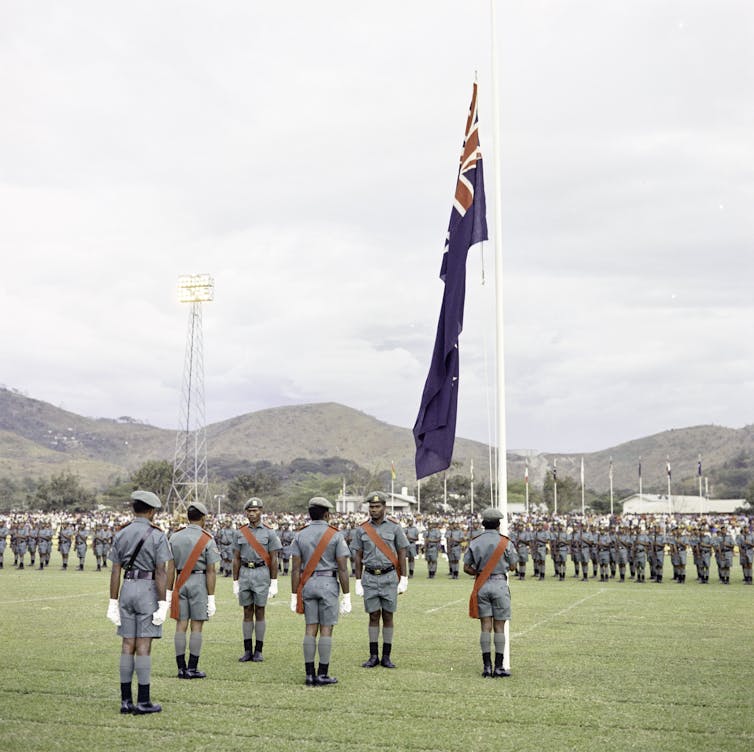
Fifty years ago this week, Papua New Guinea became independent from Australia. This anniversary gives both nations cause to reflect on our shared histories, as both colony and coloniser.

Once separate territories under Australian administration, Papua and New Guinea became Papua New Guinea in 1971. The land and its people have had a profound influence on Australian history and Australians’ lives.

PNG has also played an important role in some of our nation’s most significant military experiences, as well as in Federation in 1901.

An annexation and a federation

Australia’s federation was not just due to the great ideas of powerful men from New South Wales and Victoria, looking to create a great democratic and egalitarian experiment in the South Pacific, as we are so often led to believe.

The real catalyst for Federation was far less noble. Queensland, newly separated from NSW, had discovered the potential of further plantation expansion to the north, beyond the Torres Straits. With ample water, land and labour, politicians argued a plantation economy would enrich Queensland.

The excess labour could also be exported back to the Australian mainland to meet the labour shortages on the frontier. This process, known as “blackbirding” is a shameful moment of our history, not dissimilar to slavery.

In 1883, the governor of Queensland, Thomas McIlwraith, sent an official, Henry Majoribanks Chester, to claim Papua and New Guinea for Queensland. This came to fruition on April 4 1883.

The British government was horrified. Secretary for the colonies, Lord Derby, saw the actions of Queensland as a major overstep of their authority as a colony. British parliamentarians also saw the potential of colonial abuse.

Britain’s disavowal led to the gathering of an Intercolonial Convention in Sydney during November and December of the same year. The main themes of the meeting were Federation and annexation. In short, the colonies were unhappy with their colonial masters in Britain. They wanted to have the power to act without British disapproval or interference.

Paranoia and invasion from the north

Without Queensland’s cavalier annexing of Papua, the process of Federation would have likely taken a very different path. Fuelling the push for Federation came the news that in November 1884, German colonists had established a protectorate over the northern half of New Guinea.

This news caused paranoia within the colonies about a potential German invasion. This invasion would require the need for defence co-operation across Australia. Without Papua and New Guinea, it can be argued Federation might have been substantially slower.

Fear of an invasion from the North is a recurring theme in Australian military history. Again, the importance of New Guinea has been sidelined to conflicts further afield. In the first world war, for example, we remember the actions in the Middle East and in Europe, but forget the Australian Army’s first deployment was not across the world, but instead across the Bismarck Sea.

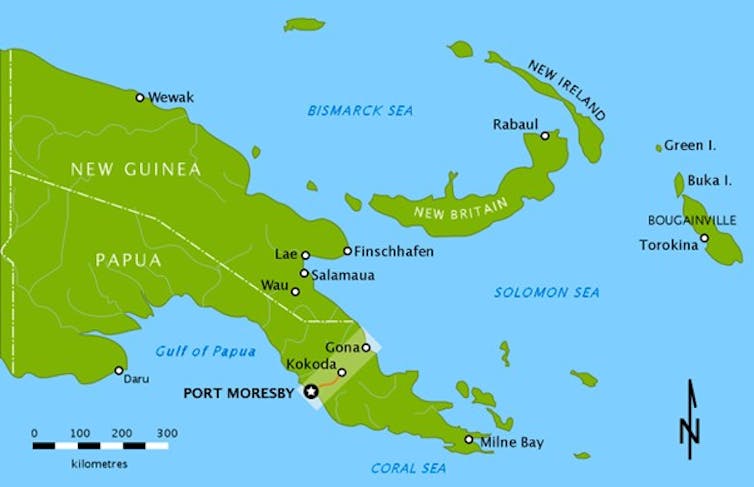
Within a month of Australia’s declaration of war on Germany in 1914, 100 soldiers and 500 naval reservists undertook our first seaborn invasion of the war, at modern Kokopo, in what is now New Britain, PNG.

Further attacks at Bita Paka and Rabaul saw Australian troops take possession of the capital of German New Guinea, at the cost of seven dead and five wounded, one of those being the commander of the force, Lieutenant-General Charles Elwell.

New Guinea is not invisible from our military memory; after all, the Australia victory at Kokoda in the second world war (July-November 1942) is celebrated as a hugely significant moment in our national history and the creation of our national identity.

Map of Papua and New Guinea showing major battle sites of the second world war.
Australia’s Defining Moments Digital Classroom

However, it was at Milne Bay on the far south-eastern tip of PNG, not Kokoda, where Australian troops inflicted the first defeat on land of the Japanese in the Pacific in August 1942.

The actions of Australian soldiers and airmen saw the decisive defeat of a Japanese effort to further isolate Australia and endanger supply lines to Port Moresby.

The battle resulted in the deaths of 167 Australians, with another 206 wounded. It was also notable due to the very visible were known as the “Fuzzy Wuzzy Angels” fought alongside Australian troops and tended to the wounded.

Australia has had a long and complicated history with our northern neighbour before and after independence. Many find it hard to accept that, as Australians, we were a colonial master. Yet Papua New Guinea and its people have, time and time again, shown they have been integral to the Australian story.

The Conversation

Geoff Keating does not work for, consult, own shares in or receive funding from any company or organisation that would benefit from this article, and has disclosed no relevant affiliations beyond their academic appointment.

ref. Papua New Guinea has played an important role in Australian history – it’s time we acknowledged that – https://theconversation.com/papua-new-guinea-has-played-an-important-role-in-australian-history-its-time-we-acknowledged-that-264785

50 years without coups or dictators: how PNG built a durable democracy based on dignity and fairness

Source: The Conversation (Au and NZ) – By Brad Underhill, Research fellow, Deakin University

On April 20 1972, 100 newly elected parliamentarians gathered in Port Moresby for the opening of the Third House of Assembly, Papua New Guinea’s legislative body.

Many of these members were young and some were new to politics: Chief Minister (later Grand Chief) Michael Somare was 37, Minister of Finance Julius Chan was 33, and Josephine Abaijah, the only woman, was 32.

Within three years, these trailblazers would steer the country from a colonial territory of Australia to a newly independent nation, declared on September 16 1975, 50 years ago this week.

As they moved from colony to self-government to independence, the members of the Third House of Assembly held sophisticated debates on decolonisation.

Leaders did not simply inherit Australian institutions. They reimagined them, arguing about land, law, unity, culture and what the concept of “development” should mean in a Melanesian society.

These speeches and debates are captured in Debating the Nation: Speeches from the House of Assembly, 1972–1975, the recently published book we co-edited along with Keimelo Gima, a historian at the University of Papua New Guinea.

The formation of the ‘mother law’

Papua New Guinea prepared for independence with a radical approach to the drafting of its constitution. The task fell to the Constitutional Planning Committee (CPC) — led in practice by Bougainville priest-politician John Momis.

Over three years, the committee held meetings across the country, gathering the “raw materials” of people’s views on citizenship, governance and development. The result was a constitution known as the “mother law”. It was one of the most inclusive in the world, and, in Momis’ words, a truly “home-grown” document.

At its heart was a redefinition of development in the context of PNG. Momis believed progress should not just be measured in gross domestic product (GDP) and prestige projects, but also in the continuation of the traditional values of PNG – liberally sprinkled with the progressive ideals of the 1970s, which celebrated small-scale societies.

Momis declared that true development was “integral human development” – measured by people’s wellbeing, not wealth or power.

This was a radical stance in the 1970s. It defined development in terms of human dignity, fairness between regions, grassroots participation and the preservation of cultural and spiritual values. It foreshadowed the “Melanesian Way”, the celebration of Melanesian communalism developed by another central figure in PNG independence, the esteemed jurist and philosopher Bernard Narokobi.

This concept remains strikingly relevant today. Allan Bird, the governor of East Sepik province, recently invoked the spirit of this philosophy in an address to students at the University of Papua New Guinea’s 60th anniversary symposium last month.

Independence day ceremonies in 1975.
National Archives of Australia

Putting policy into action

If the constitution set out the vision for the nation, the Eight-Point Plan put forth by Somare, who would become the country’s first prime minister, translated it into policy.

It called for Papua New Guinean control of the economy, decentralisation, support for village industries, equal participation for women and self-reliance. Somare warned against foreign dependency and of a “very rich black elite [emerging] here at the expense of village people.”

Turning ideals into practice also required new institutions. That task fell in part to Chan, the finance minister, who in 1972 delivered the first budget by a Papua New Guinean — a symbolic moment in the transfer of power.

For Chan, controlling the purse strings was the foundation of self-government, and he insisted the country must “look to its own resources” if it was to pay its own way. Within three years, the Central Bank and the kina were also in place.

Citizenship proved explosive. Many Australians living in the territory feared they would be expelled from an independent PNG and were loud in their demands.
Parliamentarians such as Ron Neville urged an open, multi-racial citizenship model to attract investment.

Momis argued, however, that three million Papua New Guineans “had nothing” and needed protection from Australian control. United Party leader Tei Abal rejected dual citizenship for Papua New Guineans and Australians and insisted the law should be “firm but not racist”.

The eventual compromise — single citizenship, no automatic rights for expatriates, but scope for naturalisation — reflected the balancing act between inclusion and integrity. But if citizenship defined who belonged to the new nation, the harder question was whether the nation itself would hold together.

The trials of decolonisation

Unity was not guaranteed. Secessionist movements such as Abaijah’s Papua Besena, which advocated for an independent Papuan state separate from New Guinea, threatened the territorial integrity of the new nation, but it was not the only threat.

At the same time, leaders on the island of Bougainville pushed for their own secession, citing grievances over the Panguna copper mine, which began production in 1972 under a subsidiary run by Rio Tinto.

Somare declared, however, that unity was not up for negotiation. He staved off the disintegration of the nation by introducing provincial governments and a federalised system in the months before independence.

Holding the country together was only part of the challenge. Independence also demanded a deeper transformation — freeing PNG from the colonial institutions and mindsets that still shaped daily life.

As Momis argued in 1974, true freedom was a difficult task when education and the very institutions of nationhood were all created by the colonial regimes, first under the Germans and British, and then the Australians. Decolonisation meant more than simply raising a new flag – it entailed building a society grounded in justice, dignity and local values.

Those ideals still shape PNG today, but they also matter for Australia. PNG’s independence is part of Australia’s story.

When PNG became independent in 1975, many people on both sides of the Torres Strait feared fragmentation or chaos. But despite secessionist pressures and economic challenges, PNG has remained a parliamentary democracy for 50 years: no coups, no military takeovers, no descent into dictatorship.

That outcome was not inevitable. It was the product of hard debates and principled choices in the 1970s. Leaders such as Somare, Chan, Abel, Momis, Abaijah and John Guise fought over unity, land and development — but they fought in parliament, not through violence.

Half a century later, their words still resonate. At the University of Papua New Guinea symposium we attended in August, speaker after speaker referred to the ideals of the founders. They reminded us the constitution was never just a legal framework. It was a profound statement about what development actually means. This is not simply growth, but dignity, participation, fairness and cultural identity.

That is a legacy Australians should not forget.

The Conversation

Brad Underhill receives funding for the “Debating the Nation” book from the Department of Foreign Affairs and Trade.

Helen Gardner received funding for Debating the Nation from the Department of Foreign Affairs and Trade

ref. 50 years without coups or dictators: how PNG built a durable democracy based on dignity and fairness – https://theconversation.com/50-years-without-coups-or-dictators-how-png-built-a-durable-democracy-based-on-dignity-and-fairness-264484

Despite improvements to early education, more children are starting school developmentally behind. What’s going on?

Source: The Conversation (Au and NZ) – By Sally Larsen, Senior Lecturer in Education, University of New England

Maskot/Getty Images

So far, 2025 has been a horror year for early education and care. Much of the recent media and political coverage about childcare has focused on safety. This is understandable, given the numerous, shocking allegations of abuse in the sector.

But early childhood education should be doing more than keeping children safe. It is also supposed to help them learn and develop and ultimately, be on track for school.

Our latest study suggests early education is not making as much of a difference as it should when it comes to young children’s development and learning.

We compared data on children’s development with their attendance at daycare, preschool and other early learning services. We found improvements in early childhood education quality since 2009 have not been accompanied by improvements in Australian children’s development.

How do we track development?

The Australian Early Development Census tracks the development of all Australian children in their first year of formal school. Information for the census is collected by teachers.

It looks at five areas:

  • physical health and wellbeing

  • social competence

  • emotional maturity

  • language and cognitive skills

  • communication skills and general knowledge.

The latest 2024 results revealed a decreased percentage of children assessed “developmentally on track” – from 54.8% in 2021 to 52.9% in 2024.

There was also in increase in children flagged as “developmentally vulnerable” in two or more areas – from 11.4% in 2021 to 12.5% in 2024. This is the highest percentage of developmentally vulnerable children starting school since data collection started in 2009.

Our research

Going to high-quality early childhood education or preschool is one way to ensure children do not fall behind before they even start school.

So in our study, we set out to investigate what was happening to Australian children who attend an early learning service. Our study looked at census data from 2009 to 2021.

How does learning in early education work?

Since 2009, the Early Years Learning Framework has been used in Australian early childhood education and care to ensure consistent quality across services.

It is billed as a national guide to “extend and enrich children’s learning from birth to 5 years and through the transition to school”.

It’s not prescriptive like the school curriculum, given it is for young children. For example, the framework wants to see children develop a strong sense of identity, be confident learners and effective communicators.

At the same time, the quality of services is assessed against the National Quality Standard.
Overall, quality ratings assessed against the National Quality Standard show enormous improvement. In 2013, 59% of rated services were at least meeting the national quality standards. By 2021, 87% were at least meeting the standards.

Outcomes for children in early education settings

Our research showed from 2009 to 2021, the proportion of Australian children attending early education and care in the year before they start school increased from 83% to 86%. In particular, attendance in the year before school jumped from 66% to 81% for children in very remote locations, and from 72% to 87% for children in remote locations.

Because service quality has increased and the number of children attending early learning has increased, we expected to find improvements in children’s development from 2009 to 2021.

In our study, we grouped the developmental data for children who attended early education and care in the year before school. Then we grouped the developmental data for children who did not attend early learning in the year before school. We compared averages of the two groups over time.

We found children who attended early learning and care had higher developmental scores on all five areas in every year of assessment from 2009 to 2021. This was good to see.

Shouldn’t we be seeing more improvements?

But since quality and attendance had both increased, we expected to see the gap between the two groups increasing over time.

We expected the average for children who had attended early learning and care would steadily increase because the quality of early childhood education and care was reported to have improved over the same period.

But we did not find this. As you can see from the charts above (on cognitive skills) and below (on language skills and general knowledge) averages for the two groups stayed pretty stable despite improvements in quality according to the national quality standards.

So, what’s going on?

It is hard to know for sure.

It could be the Australian Early Development Census is not precise enough to pick up on the aspects of children’s learning and development that are supported by attending early childhood education and care programs.

We definitely need more information about how frequently children attend early learning and care, how much time they spend there, and the quality of the services children are attending because this varies a lot.

It is possible children who spend the most time in early learning are going to services of lower quality. Or that services “meeting” the national quality standards may not be of high enough quality to improve children’s learning outcomes.

A 2019 study found some services rated as “exceeding” the national quality standards (the highest possible level) were rated at basic levels of quality using other, research-based scales.

Other studies have found services need to be “exceeding” the standards to reduce a child’s developmental vulnerability.

Why do the development census results matter?

Federal and state governments are spending huge amounts of money to encourage families to send children to early childhood education and care settings and to preschool/kinder.

For example, in December 2024, the federal government pledged an extra A$1.47 billion to build more centres and for new fee subsidies. Next year, all eligible Australian children will be able to access three days of subsidised early learning and care a week.

We need to know that attending early childhood education and care programs will make a difference to children’s learning and development. Looking at the whole group of children attending early childhood education and care from 2009 to 2021, we did not see this.

We may need to collect better data from the development census (and researchers are currently looking at how to improve this). Alternatively – and this would be a significant change – policymakers may need to look more carefully at what aspects of early childhood education are prioritised in Australia, and to identify what makes the most difference to children’s early learning and development.

The Conversation

The authors do not work for, consult, own shares in or receive funding from any company or organisation that would benefit from this article, and have disclosed no relevant affiliations beyond their academic appointment.

ref. Despite improvements to early education, more children are starting school developmentally behind. What’s going on? – https://theconversation.com/despite-improvements-to-early-education-more-children-are-starting-school-developmentally-behind-whats-going-on-264770

How much money do you need to be happy? Here’s what the research says

Source: The Conversation (Au and NZ) – By Brad Elphinstone, Lecturer in psychology, Swinburne University of Technology

Over the next decade, Elon Musk could become the world’s first trillionaire. The Tesla board recently proposed a US$1 trillion (A$1.5 trillion) compensation plan, if Musk can meet a series of ambitious growth targets.

Australia’s corporate pay packets aren’t quite on that scale. Yet even here, on Friday it was reported departing Virgin chief executive Jayne Hrdlicka will collect nearly $50 million in shares and other cash benefits on her way out the door.

Research from the United States suggests people think the average CEO earns ten times more than the average worker – and would prefer it was closer to only five times more.

In fact, the real gap in the US over the past decade has been estimated to mean CEOs earn a staggering 265 to 300 times more than average US workers.

Australians think CEOs earn seven times more than the average worker and would prefer if it was only three times more.

But the real gap here is also much higher. A long-running study found CEOs of the top 100 Australian companies earned 55 times more last financial year than average workers.

So, how much money is enough?

People have asked this question for thousands of years. The ancient Greek philosopher Aristotle explained the idea of eudaimonia, or a roadmap of “living well”, saying it:

belongs more to those who have cultivated their character and mind to the uttermost, and kept acquisition of external goods within moderate limits, than it does to those who have managed to acquire more external goods than they can possibly use, and are lacking goods of the soul.

Aristotle’s philosophy doesn’t call on us to shun money or wealth entirely, but argues it shouldn’t become life’s sole focus.

Research over recent decades has come to different conclusions on how much money is needed to achieve peak wellbeing.

A US study in 2010 suggested wellbeing maxes out around US$75,000. This figure naturally needs to be increased today to account for inflation – which, if those research findings are still true today, would be closer to US$111,000 in today’s dollars. You’d also need to take into account the cost of living in your area.

Other findings suggest wellbeing may continually increase with growing wealth, but the increase in wellbeing from $1 million to $10 million is likely less than when someone moves from poverty to middle class.

A 2022 experiment studied 200 people from Brazil, Indonesia, Kenya, Australia, Canada, the United States and the United Kingdom who were randomly given US$10,000 (A$15,000 at today’s exchange rate).

It found people in lower income countries “exhibited happiness gains three times larger than those in higher-income countries”, including Australia. But that cash still provided detectable benefits for people with household incomes up to US$123,000 (roughly A$184,000 today).

Remarkably, the people in that experiment (explained from 4:42 minutes into the video below) gave away more than two-thirds of that money to family, friends, strangers and charities.

Valuing time and relationships

Decades of international research have consistently shown materialistic goals – acquiring wealth and possessions for reasons associated with image and status – undermine wellbeing.

This is because materialistic striving is often borne out of low self-esteem or tending to compare oneself negatively to others, and there is always someone else to compare yourself against.

People can get stuck on the “hedonic treadmill”, where they get used to their new level of wealth and the luxuries it provides and then need more to feel happy.

It’s also because the work needed to acquire that wealth can mean less time focusing on hobbies and with loved ones.

Harvard research tracking two generations of men and their children over their lives, going back to 1938, shows deep, meaningful relationships with others are key to mental and physical wellbeing.

American psychologist Abraham Maslow developed a “hierarchy” of people’s “needs” in 1943. This suggested “self-actualisation” – reaching your pinnacle of personal growth – starts by having enough money to cover the basics of food, shelter, and access to the opportunities needed to grow as a person.

In line with this, research has shown “time affluence” (maximising free time by paying people to do things you don’t want to) and “experiential buying” (for example, meals out with loved ones, going on holidays) can support wellbeing by helping people develop new skills, build relationships, and create lifelong memories.

It’s in most of our interests to close the wealth gap

Recent data shows economic inequality in Australia is increasing. This is particularly affecting young Australians, as housing becomes less affordable.

At a broader social level, research from the UK indicates that as inequality increases, social outcomes get worse. These include increased crime, drug and alcohol abuse, obesity as people struggle to afford nutritious food, and reductions in social trust.

What percentage of wealth do you think is owned by the richest 20% of Australians? And in your ideal Australia, how much wealth should the richest 20% own?

The most recent Bureau of Statistics data we have, from 2019-20, showed the richest 20% of Australians owned around 62% of our wealth.

As inequality gets worse, evidence suggests it will lead to social problems that threaten to undermine the wellbeing of the whole community.

The irony is those who pursue extreme wealth and benefit most from this inequality will not necessarily be happier or more fulfilled because of it.

The Conversation

Brad Elphinstone does not work for, consult, own shares in or receive funding from any company or organisation that would benefit from this article, and has disclosed no relevant affiliations beyond their academic appointment.

ref. How much money do you need to be happy? Here’s what the research says – https://theconversation.com/how-much-money-do-you-need-to-be-happy-heres-what-the-research-says-265184

6 ways to talk to your teens about sex without the cringe

Source: The Conversation (Au and NZ) – By Jennifer Power, Principal Research Fellow, Australian Research Centre in Sex, Health and Society, La Trobe University

Kamonwan Wankaew/Getty

Parents play an important role in teaching their children about sex and relationships. But our new report shows many parents – fathers in particular – find it mortifying.

Our national survey of 1,918 parents shows they are most likely to be very confident talking with children about body image (45%) and puberty (38%) and least confident talking about masturbation (12%) or sexual satisfaction (13%).

Mothers are more likely than fathers to start discussions about sex (32.3% vs 23.9%).

Our survey confirms the most common barriers to discussing sex with children are children feeling uncomfortable or refusing to engage. But parents are uncomfortable too, fearing they’ll say the wrong thing, and not knowing how to start the conversation.

But if a teenager knows their parents are up for non-judgemental discussions about sex, they’ll be more likely to share what is happening in their lives, ask questions and seek help when they need it.

Here’s how to start those discussions, even if you feel awkward.

Our top tips for talking about sex

1. Start when children are young. “The sex talk” is not one single conversation. Parents should aim to open the door to ongoing, age-appropriate dialogue about issues related to bodies, reproduction and puberty when children are young. Even children under five should be learning about their bodies and the basics of reproduction.

Starting conversations when kids are young will make it easier to continue into the teenage years. But it’s never too late. Children will benefit from parents engaging with them on these issues at any age.

2. Find everyday opportunities to ask questions. Television, movies and radio mention sex and relationships all the time.

For instance, issues relating to young people viewing pornography or the impact of social media are regular features on the news. Use these opportunities to ask teenagers what they understand, know or think. Show interest in your teenager’s opinion and ask questions about how this portrayal fits with their experiences or that of their friends.

The conversation doesn’t need to lead to a specific message or outcome. The purpose is to talk and listen.

3. Try not to lead with what not to do. Telling a young person not to have sex or watch pornography is unlikely to stop them doing it and may shut down future conversation. Many young people become sexually active from around 15 to 17 years of age and a majority have viewed pornography at least once by this age.

The best we can do is support them to think carefully and critically about what they need to stay safe. Let them know you can help with things such as finding a good doctor if they need advice on contraception or sexual health care.

4. Tell your teenagers stories about yourself. Young people don’t always appreciate being reminded their parents were once teenagers, but they might be interested in a story about your first relationship, first kiss or an embarrassing date. Showing your own vulnerability may help open dialogue on these topics.

If you aren’t comfortable telling stories about yourself, perhaps tell stories you have read or heard about in the news.

5. Own your embarrassment. It is hard to talk about intimate or embarrassing topics. For some people even saying the word “masturbation” is uncomfortable, let alone speaking with children or teenagers about it.

Keeping it light and being prepared to laugh at your own awkwardness can help break the ice for both you and your teenager.

6. Do some reading and practise talking about it. Most of us don’t have a lot of experience talking intimately about sex or relationships. Do some research on topics you would like to speak with your teenagers about and then have a chat to your partner or a friend about it.

The aim is to get more comfortable talking about things we don’t often talk about. You don’t have to be an expert, you just have to give it a go.

Will talking about sex encourage my child to do it?

Parents are often told they need to be “sex positive” when talking to teenagers about sex. This doesn’t mean avoiding talking about risks and responsibilities. Rather, it means holding the perspective that, in the right circumstances, sex can be a safe, enjoyable and positive part of a young person’s life.

Talking about sex will not encourage a young person to have sex before they are ready.

Teaching young people about sexual consent relies on valuing pleasure. If someone can understand, and articulate, what they like and want, they will be in a stronger position to assert what they do not want. Young people should be encouraged to tune into what they, and their partner, enjoy and value when it comes to sex.

Sexual health messages for young people often focus on dangers and negative outcomes. It can be easy to forget that sex education should also be about supporting young people to have safe and enjoyable sex when they are ready. Parents play a key role in delivering this message.


Talk soon. Talk often: A guide for parents to talk to their kids about sex helps parents judge age-appropriate information and how to talk about it.

The Conversation

Jennifer Power receives funding from The Australian Department of Health, Disability and Ageing and the Australian Research Council.

Alexandra James receives funding from The Australian Department of Health, Disability and Ageing.

Thomas Norman receives funding from The Australian Department of Health, Disability and Ageing.

ref. 6 ways to talk to your teens about sex without the cringe – https://theconversation.com/6-ways-to-talk-to-your-teens-about-sex-without-the-cringe-263639

Graphic warnings on tobacco products are losing their impact – here are 5 ways to improve them

Source: The Conversation (Au and NZ) – By Janet Hoek, Professor in Public Health, University of Otago

Andrej Ivanov/AFP via Getty Images

Large pictorial warning labels on smoked tobacco products typically feature confronting images of the harmful health outcomes of smoking. Pictures of diseased lungs, gangrene and mouth decay aim to elicit strong emotional responses that reduce the appeal and acceptability of smoking, particularly among young people.

Warning labels also aim to increase knowledge of the many risks smoking poses. Plain packaging increases the attention paid to warning labels and reduces pack appeal, brand loyalty and product perceptions.

However, like any marketing campaign, warning labels on tobacco products need regular updating so they continue to attract attention and communicate the latest research evidence. Maintaining the same images risks “wear-out”, when people lose interest in campaign images and messages, or counter argue these.

Our recent work found existing tobacco warnings have lost impact. Study participants had created cognitive defences and exempted themselves from the risks shown.

While some still found images of diseased body parts shocking, others did not consider the illustrated risks personally relevant and thought warnings lacked credibility.

Our findings raise the important question of how we can make on-pack warnings more impactful and effective. Our new study addresses this question by exploring the lived experiences of people who smoke.

Creating more effective warnings

Many find smoking imposes a heavy financial burden on them, and others worry about the impact smoking has on whānau (families).

Others resent the hold nicotine addiction has over them and feel concerned that young people may want to adopt the behaviour they see modelled by adults who smoke.

Working with a graphic artist, we developed images and messages to represent the ideas we had heard.

After extensive review with people who smoke, we identified three potential warning themes for final testing: the cost of smoking, smoking’s impact on family, and the health risks presented in a more empathetic way (by featuring people rather than diseased body parts).

This video summarises key findings from research into the efficacy of labels on tobacco packets. Created by ST_RY B_X https://www.storybox.co.nz/

Using a choice study, we examined how well warnings representing these themes prompted thoughts of quitting compared to a novel graphic health warning showing a mouth cancer.

We found two different groups among our sample of people who smoke: one responded more strongly to warning labels emphasising the cost of smoking and its effect on families than to the graphic warning we used as a control; the other group reacted more strongly to an empathetic health warning than to the control.

5 ways to improve on-pack warnings

1. We need warnings that reflect people’s experiences of smoking, recognise smoking’s various harms, and understand that people who smoke are not a homogenous group. While most people who smoke regret smoking and hope to quit, they are at different life stages, have different backgrounds and interests, and respond to different stimuli.

For example, the cost-of-living crisis means warnings reinforcing the cost of smoking, the opportunities forgone and the impacts on others may be more motivating for some people than graphic health warnings.

2. We should think more creatively about the health harm from smoking. We found images of children losing a parent to an illness caused by smoking created strong emotional connections, as did images of adults smoking near children.

This approach, which illustrates how smoking causes emotional and physical harm to others, was at least as effective as the graphic mouth cancer image we used as a control.

3. We should consider the impact of warnings on emotions. Early graphic warnings aimed to arouse fear, in the belief it would galvanise attempts to quit. However, people who smoke also experience regret and shame, which may be more motivating than fear.

4. We need to balance negative emotions, which may stigmatise people and lead them to feel powerless, by introducing pack inserts with positive messages. Our work found that offering helpful advice and outlining the benefits of quitting inspired participants and could support attempts to quit.

5. We need to refresh and rotate warnings much more often. We suggest new warnings should be introduced every six months and that no warning should run for longer than a year.

On-pack pictorial warnings are a proven best-practice approach to encouraging smoking cessation. However, failure to introduce new and more diverse warnings has compromised the impact these have.

Given people who smoke consume, on average, ten cigarettes a day, on-pack warnings have high potential exposure. We should be making this measure as effective as possible and embed it within a comprehensive strategy that will reduce tobacco’s addictiveness, appeal and accessibility.

The Conversation

Janet Hoek receives funding from the Health Research Council of New Zealand, the Marsden Fund, NZ Cancer Society and NZ Heart Foundation. She is a member of smokefree expert advisory groups at the Health Coalition Aotearoa and the Ministry of Health as well as the Health Research Council’s public health research committee and a senior editor at Tobacco Control (honorarium paid).

Andrew Waa receives funding from the Health Research Council of New Zealand.

Lani Teddy receives funding from the Health Research Council of New Zealand. She is a member of ASPIRE Aotearoa which undertakes research to inform tobacco policy.

Philip Gendall has received funding from the Health Research Council of New Zealand.

ref. Graphic warnings on tobacco products are losing their impact – here are 5 ways to improve them – https://theconversation.com/graphic-warnings-on-tobacco-products-are-losing-their-impact-here-are-5-ways-to-improve-them-263415

Eradicating mould would save millions in health-care costs: how our homes affect our health

Source: The Conversation (Au and NZ) – By Rebecca Bentley, Professor of Social Epidemiology and Director of the Centre of Research Excellence in Healthy Housing at the Melbourne School of Population and Global Health, The University of Melbourne

Olga Rolenko/Getty Images

Housing is a key determinant of physical health. Housing conditions can increase or reduce the risk of problems including respiratory illness, heart disease and injury.

Improving housing conditions would see an improvement in health at the population level and reduce health-care costs.

In a study yet to be peer-reviewed, our research team has estimated eradicating mould and damp in Australian housing could cut health expenditure by A$117 million per million people, and increase income by $174 million. These figures represent 0.5%–2.1% of annual health spending and 0.08%–0.36% of gross domestic product.

We also estimated tackling mould and damp could result in an extra 4,190 health-adjusted life years (the number of years a person can expect to live in good health) per million people over 20 years. This is equivalent to about 1.5 healthy days per person. We’d see the greatest gains among people who are most disadvantaged.

In Australia and several similar countries, the conditions and location of many people’s homes are heavily influenced by housing affordability and the failure of successive governments to treat housing as a human right. Instead, it’s often been treated as a wealth-generating asset.

But it’s time to change things. The significant effects of poor housing on health, and a growing body of evidence indicating healthier homes could lead to tangible improvements, build a strong case for prioritising healthy housing policy in Australia.

Respiratory health

Numerous studies have established strong links between poor housing quality and increased risk of respiratory issues.

Exposure to damp, mould and poor ventilation in homes has consistently been associated with higher rates of asthma, allergies and other respiratory conditions, particularly among children and vulnerable groups.

Cold and poorly insulated homes can exacerbate respiratory symptoms. Meanwhile, overcrowding may make it easier for respiratory infections to spread.

Indoor air pollutants, from sources such as building materials and inappropriate heating systems, can further compromise lung function and respiratory health.

On the flip side, interventions to improve housing conditions – such as enhancing insulation, reducing dampness and improving ventilation – can positively affect respiratory health.

For instance, studies have shown retrofitting homes with proper insulation can lead to significant reductions in asthma symptoms and hospital admissions for respiratory conditions.

Heart health

The conditions and location of housing are also linked to cardiovascular health (for example, blood pressure) and metabolic health conditions such as diabetes and obesity.

Cold and damp housing conditions can increase the risk of disease through their effect on blood pressure. Exposure to low indoor temperatures can lead to high blood pressure, a major risk factor for conditions including heart disease, stroke and type 2 diabetes.

Poor insulation and energy inefficiency can exacerbate these effects, especially in regions with cold climates or during winter months.

Conversely, changes to housing that make temperatures more comfortable – such as installing insulation or efficient heating and cooling systems – could reduce disease risk.

For example, studies have shown reductions in blood pressure and fewer hospital admissions following interventions designed to warm homes.

Where we live also matters. For instance, the location of our home determines how much we’re exposed to air pollution – a risk factor for a range of diseases.

Access to green spaces and places to exercise near home is linked to reduced risk of diabetes, obesity and cardiovascular disease.


Read more:
What if I discover mould after I move into a rental property? What are my rights?


Injuries

Poor housing conditions can increase the risk of injuries such as falls and burns.

Inadequate lighting, uneven flooring, and poorly maintained or constructed stairs are common hazards that increase the risk of falls, especially among older adults. What’s more, the absence of proper accessibility features in homes can lead to increased risk of injuries among people with disabilities.

Studies have shown low-cost housing modifications – such as installing grab bars and handrails, improving lighting and childproofing measures – can markedly reduce injury rates.

Faulty electrical wiring and inadequate fire safety measures, such as the absence of smoke detectors, increase the risk of injuries and deaths. When New South Wales made smoke alarms compulsory in all homes in 2006, hospitalisation rates for residential fire injuries decreased by an estimated 36% annually.

But there’s variation in smoke alarm legislation across different Australian jurisdictions. And challenges remain with enforcement and ensuring alarms are functional.

Failing to act will cost us

Lower-income households, and especially renters, are at higher risk of the health consequences of poor housing. This contributes to health inequities across society.

In a new paper published in The Lancet Public Health, we present housing as a key social determinant of health. We highlight how affordability, security and suitability of housing shape health and wellbeing.

At the same time, our recent modelling and other research internationally provide compelling evidence that improving housing could have substantial benefits.

These models consistently show targeting mould, damp and cold in housing not only improve health outcomes, but also offer significant economic gains. This positions housing improvement as a cost-effective public health strategy.

As well as interventions to directly improve housing conditions for the homes that most need it, we also need structural reform of our housing systems. We must ensure everyone has access to an affordable, secure and suitable home.

This article is part of a series, Healthy Homes.

The Conversation

Rebecca Bentley receives funding from National Health and Medical Research Council and Australian Research Council.

Kate Mason receives funding from the Australian Research Council and National Health and Medical Research Council.

ref. Eradicating mould would save millions in health-care costs: how our homes affect our health – https://theconversation.com/eradicating-mould-would-save-millions-in-health-care-costs-how-our-homes-affect-our-health-260311

ER Report: A Roundup of Significant Articles on EveningReport.nz for September 14, 2025

ER Report: Here is a summary of significant articles published on EveningReport.nz on September 14, 2025.

Yes, this is who we are: America’s 250-year history of political violence
Source: The Conversation (Au and NZ) – By Maurizio Valsania, Professor of American History, Università di Torino Punishment by tar and feather of Thomas Ditson, who purchased a gun from a British soldier in Boston in March 1775. Interim Archives/Getty Images The day after conservative activist Charlie Kirk was shot and killed while speaking at

Peter Mandelson was always a high-risk appointment – his departure will not end the matter for Keir Starmer
Source: The Conversation (Au and NZ) – By Martin Farr, Senior Lecturer in Contemporary British History, Newcastle University The line between pulling off a diplomatic masterstroke and setting up an accident waiting to happen can be a fine one. In the seven-month fable of Peter Mandelson’s UK ambassadorship to the US, the crossing of that

Donald Trump’s vision for Gaza’s future: what a leaked plan tells us about US regional strategy
Source: The Conversation (Au and NZ) – By Rafeef Ziadah, Senior Lecturer in Politics and Public Policy (Emerging Economies), King’s College London The Gaza Reconstitution, Economic Acceleration and Transformation Trust (Great Trust) vision. Supplied Entire neighbourhoods in Gaza lie in ruins. Hundreds of thousands are crammed into tents, struggling for food, water and power. Despite

ER Report: A Roundup of Significant Articles on EveningReport.nz for September 13, 2025
ER Report: Here is a summary of significant articles published on EveningReport.nz on September 13, 2025.

Yes, this is who we are: America’s 250-year history of political violence

Source: The Conversation (Au and NZ) – By Maurizio Valsania, Professor of American History, Università di Torino

Punishment by tar and feather of Thomas Ditson, who purchased a gun from a British soldier in Boston in March 1775. Interim Archives/Getty Images

The day after conservative activist Charlie Kirk was shot and killed while speaking at Utah Valley University, commentators repeated a familiar refrain: “This isn’t who we are as Americans.”

Others similarly weighed in. Whoopi Goldberg on “The View” declared that Americans solve political disagreements peacefully: “This is not the way we do it.”

Yet other awful episodes come immediately to mind: President John F. Kennedy was shot and killed on Nov. 22, 1963. More recently, on June 14, 2025, Melissa Hortman, speaker emerita of the Minnesota House of Representatives, was shot and killed at her home, along with her husband and their golden retriever.

As a historian of the early republic, I believe that seeing this violence in America as distinct “episodes” is wrong.

Instead, they reflect a recurrent pattern.

American politics has long personalized its violence. Time and again, history’s advance has been imagined to depend on silencing or destroying a single figure – the rival who becomes the ultimate, despicable foe.

Hence, to claim that such shootings betray “who we are” is to forget that the U.S. was founded upon – and has long been sustained by – this very form of political violence.

A fuzzy photo of a large car with a woman leaning over in the back seat to help a slumped man next to her.
First lady Jacqueline Kennedy leans over to assist her husband, John F. Kennedy, just after he is shot in Dallas, Texas, on Nov. 22, 1963.
Bettman/Getty Images

Revolutionary violence as political theater

The years of the American Revolution were incubated in violence. One abominable practice used on political adversaries was tarring and feathering. It was a punishment imported from Europe and popularized by the Sons of Liberty in the late 1760s, Colonial activists who resisted British rule.

In seaport towns such as Boston and New York, mobs stripped political enemies, usually suspected loyalists – supporters of British rule – or officials representing the king, smeared them with hot tar, rolled them in feathers, and paraded them through the streets.

The effects on bodies were devastating. As the tar was peeled away, flesh came off in strips. People would survive the punishment, but they would carry the scars for the rest of their life.

By the late 1770s, the Revolution in what is known as the Middle Colonies had become a brutal civil war. In New York and New Jersey, patriot militias, loyalist partisans and British regulars raided across county lines, targeting farms and neighbors. When patriot forces captured loyalist irregulars – often called “Tories” or “refugees” – they frequently treated them not as prisoners of war but as traitors, executing them swiftly, usually by hanging.

In September 1779, six loyalists were caught near Hackensack, New Jersey. They were hanged without trial by patriot militia. Similarly, in October 1779, two suspected Tory spies captured in the Hudson Highlands were shot on the spot, their execution justified as punishment for treason.

To patriots, these killings were deterrence; to loyalists, they were murder. Either way, they were unmistakably political, eliminating enemies whose “crime” was allegiance to the wrong side.

An old portrait of an older man in a black robe.
In 1798, Henry Brockholst Livingston – later a U.S. Supreme Court justice – killed James Jones in a duel. It did not affect his career.
US Supreme Court

Pistols at dawn: Dueling as politics

Even after independence, the workings of American politics remained grounded in a logic of violence toward adversaries.

For national leaders, the pistol duel was not just about honor. It normalized a political culture where gunfire itself was treated as part of the debate.

The most famous duel, of course, was Aaron Burr’s killing of Alexander Hamilton in 1804. But scores of lesser-known confrontations dotted the decade before it.

In 1798, Henry Brockholst Livingston – later a U.S. Supreme Court justice – killed James Jones in a duel. Far from discredited, he was deemed to have acted honorably. In the early republic, even homicide could be absorbed into politics when cloaked in ritual. Ironically, Livingston had survived an assassination attempt in 1785.

In 1802, another shameful spectacle unfolded: New York Democratic-Republicans DeWitt Clinton and John Swartwout faced off in Weehawken, New Jersey. They fired at least five rounds before their seconds intervened, leaving both men wounded. In this case, the clash had nothing to do with political principle; Clinton and Swartwout were Republicans. It was a patronage squabble that still erupted into gunfire, showing how normalized armed violence was in settling disputes.

Gun culture and its expansion

A small, antique pistol.
One of the matching pair of derringer pistols used by John Wilkes Booth in the assassination of President Abraham Lincoln in 1865.
Bob Grieser/Los Angeles Times via Getty Images

It is tempting to dismiss political violence as a leftover from some “primitive” or “frontier” stage of American history, when politicians and their supporters supposedly lacked restraint or higher moral standards. But that is not the case.

From before the Revolution onward, physical punishment or even killing were ways to enforce belonging, to mark the boundary between insiders and outsiders, and to decide who had the right to govern.

Violence has never been a distortion in American politics. It has been one of its recurring features, not an aberration but a persistent force, destructive and yet oddly creative, producing new boundaries and new regimes.

The dynamic only deepened as gun ownership expanded. In the 19th century, industrial arms production and aggressive federal contracts put more weapons into circulation. The rituals of punishing those with the wrong allegiance now found expression in the mass-produced revolver and later in the automatic rifle.

These more modern firearms became not only practical tools of war, crime or self-defense but symbolic objects in their own right. They embodied authority, carried cultural meaning and gave their holders the sense that legitimacy itself could be claimed at the barrel of a gun.

That’s why the phrase “This isn’t who we are” rings false. Political violence has always been part of America’s story, not a passing anomaly, and not an episode.

To deny it is to leave Americans defenseless against it. Only by facing this history head-on can Americans begin to imagine a politics not defined by the gun.

The Conversation

Maurizio Valsania does not work for, consult, own shares in or receive funding from any company or organization that would benefit from this article, and has disclosed no relevant affiliations beyond their academic appointment.

ref. Yes, this is who we are: America’s 250-year history of political violence – https://theconversation.com/yes-this-is-who-we-are-americas-250-year-history-of-political-violence-265171

Peter Mandelson was always a high-risk appointment – his departure will not end the matter for Keir Starmer

Source: The Conversation (Au and NZ) – By Martin Farr, Senior Lecturer in Contemporary British History, Newcastle University

The line between pulling off a diplomatic masterstroke and setting up an accident waiting to happen can be a fine one. In the seven-month fable of Peter Mandelson’s UK ambassadorship to the US, the crossing of that line has created a political polycrisis for which it is hard to think of a parallel.

In the week after the prime minister, despite his efforts, lost his deputy, and the week before the American president arrives in the UK for an unprecedented – and unpopular – second state visit, Keir Starmer, despite his efforts, has lost the person he controversially personally appointed to the UK’s highest diplomatic post. Worse, over a matter that also happens to implicate Donald Trump – a matter journalists could conceivably raise at the president’s and prime minister’s press conference during the forthcoming state visit.

The risk in the main was in the ambassadorship itself. The US is the UK’s closest and most important international ally and the Washington ambassador is the lynchpin of that relationship. They are the UK’s eyes and ears, permanently operating at the centre of the political and social life of the US capital in the way that no other country’s ambassador has been, is, or could be.

But the risk was also in the man. Prince of Darkness, Third Man, (only last week: “my familiar role as professional villain”), possessed of a public career already involving two high-profile reputation-wracking resignations, Mandelson has always been weapons-grade Marmite.

It was a reflection of post-Brexit British weakness, rather than strength – the desperate need for a trade deal – that Starmer turned to him. Yet personal relations being so important with this president, it can now be seen to have made less sense to have replaced a scandal-free ambassador – Karen Pierce – who was on the best possible terms with Trump and his people. She may return.

Its prominence is why, perhaps, DC is usually the only British ambassadorship that is ever “political” – that is, that a prime minister personally chooses someone who isn’t a diplomat. And even then, it’s rare. One may now see now why. The previous political appointment – in the 1970s – also ended inauspiciously, in a welter of recriminations over nepotism and extra-marital affairs resulting in best-selling novelisation and a hit movie.

The main grounds for Mandelson’s appointment were his public prominence (his “weight”), his experience as an EU trade commissioner, and his almost preternatural networking skills. The latter has been his undoing, given that for years he networked with the man who was to become the world’s most infamous sexual abuser of children.

To describe the appointment as high risk and high reward matters because of the supreme importance of the office and the singular character of the officer. If one can screen the Epstein stain momentarily, the widespread frustration in government was that Mandelson had been justifying that risk.

He was clearly an effective ambassador. Only the week before he delivered a trenchant statement of the contemporary special relationship; the day before he was sacked he had spent an hour with Trump. Ambassadors tend not to have meetings with presidents.

Peter Mandelson with Donald Trump
Mandelson meets Trump in.
UKinUSA/Flickr/Official White House Photo by Daniel Torok, CC BY-SA

Fundamentally this falls on the fallen. Mandelson knew of the Epstein material that has come to be made public, knowing that it might be made public. He admitted only this week that even more was likely to come after the initial, highly embarrassing, disclosure.

Mandelson took the UK’s most important diplomatic post knowing he was sitting on a ticking bomb. Given the precise nature of the explosive, the political obituary can certainly now be written about one of the most vivid public figures of the past 30 years.

But the more consequential damage will be to the man who appointed him. Downing Street’s statement that security vetting took place without its involvement is not credible.

Peter Mandelson and Keir Starmer
Mandelson and Starmer, pictured in February 2025.
Flickr/Number 10, CC BY-NC-ND

Much may hinge on what the vetting files reveal – if they are revealed. The decision on whether to release them is a matter for MPs, and how Labour backbenchers choose to vote will be a significant indicator as to the mood in the party.

A crisis from Hades, replete with shadowy associations of global elites and paedophile rings; a hot buffet for online conspiracists, who may be more numerous and prominent in the US, but are far from reticent in the UK. And so the political class undergoes another detention.

The political damage to the government in general and to the prime minister in particular is hard to overstate. That is in part a matter of misfortune: that this particular major crisis comes a week after the previous one. But it has nevertheless provided the leader of the opposition with the most palpable success of her own benighted tenure. Seldom can a relaunch have relapsed so quickly.

However hapless he may increasingly appear, it’s too early to write Starmer’s political obituary. The election may be over three years away, his parliamentary majority is unassailable, and his party – unlike that of the leader of the opposition – has no culture of regicide (although mayor Andy Burnham, observing and pronouncing from Manchester, seems increasingly prepared to test that). Yet the very size of that majority, and the near certainty that many Labour MPs will be one-term, makes public expressions of discontent consequence-free, and consequently freer.

It’s more than curious that so innately risk-averse a person as Keir Starmer appointed so risk-taking a person as Mandelson to his country’s highest-profile international office. That misgivings were aired at the time, including in these very pages, is the least of it.


Want more politics coverage from academic experts? Every week, we bring you informed analysis of developments in government and fact check the claims being made.

Sign up for our weekly politics newsletter, delivered every Friday.


The Conversation

Martin Farr does not work for, consult, own shares in or receive funding from any company or organisation that would benefit from this article, and has disclosed no relevant affiliations beyond their academic appointment.

ref. Peter Mandelson was always a high-risk appointment – his departure will not end the matter for Keir Starmer – https://theconversation.com/peter-mandelson-was-always-a-high-risk-appointment-his-departure-will-not-end-the-matter-for-keir-starmer-265159

Donald Trump’s vision for Gaza’s future: what a leaked plan tells us about US regional strategy

Source: The Conversation (Au and NZ) – By Rafeef Ziadah, Senior Lecturer in Politics and Public Policy (Emerging Economies), King’s College London

The Gaza Reconstitution, Economic Acceleration and
Transformation Trust (Great Trust) vision.
Supplied

Entire neighbourhoods in Gaza lie in ruins. Hundreds of thousands are crammed into tents, struggling for food, water and power. Despite this devastation, a leaked 38-page document from Donald Trump’s administration – the Gaza Reconstitution, Economic Acceleration and Transformation (Great) Trust – proposes to “fundamentally transform Gaza” folding it into the India–Middle East–Europe Economic Corridor (Imec).

While framed as a reconstruction plan, it outlines “massive US gains,” Imec’s acceleration, and consolidation of an “Abrahamic regional architecture” – a term that refers back to the 2020 Abraham Accords, US-brokered agreements that normalised relations between Israel, the UAE and Bahrain.

In many respects, the document echoes the “Gaza 2035” plan promoted by Israeli prime minister Benjamin Netanyahu. This was the 2024 proposal that envisioned Gaza as a sanitised logistics hub linked to Saudi Arabia’s Neom mega-project and stripped of meaningful Palestinian presence.

As my co-authors and I trace in a recent book Resisting Erasure: Capital, Imperialism and Race in Palestine, this continues a pattern of policies that deny Palestinians political agency and reduce Gaza to an investment opportunity.

Imec was launched at the 2023 G20 summit in New Delhi. Signed by the US, EU, India, Saudi Arabia and the United Arab Emirates, it was billed as a transformative infrastructure project. It comprised a chain of railways, ports, pipelines and digital cables linking South Asia to Europe via the Arabian Peninsula.

Israel was not formally a signatory, but its role was implicit. The corridor runs from Indian ports to the UAE, overland through Saudi Arabia and Jordan to the Haifa Port in Israel, then across the Mediterranean to Greece and Europe.

Like many such mega-projects, Imec is marketed in the language of efficiency – faster trade times, lower costs, new energy and data corridors. But its deeper significance is political. For Washington it serves as a counterweight to China’s Belt and Road Initiative (BRI) while binding India into a US-led system. Europe views it as a hedge against the Suez Canal and Russian pipelines.

The Gulf monarchies see a chance to position themselves as the region’s main centre for trade and transport. Israel promotes Haifa as a gateway for Euro-Asian trade. India, meanwhile, gains quicker access to Europe while tightening its ties with both Washington and the Gulf.

Gaza as obstacle and gateway

The plan casts Gaza both as an Iranian outpost undermining Imec and as a historic crossroads of trade routes linking Egypt, Arabia, India and Europe.

By invoking Gaza’s history as a trading route, the plan presents the territory as a natural logistics gateway poised to “thrive once again” at the centre of a “pro-American regional order”. The blueprint proposes extending Gaza’s port from Egypt’s al-Arish, integrating its industries into regional supply chains, and reorganising its land into “planned cities” and digital economies.

Map showing proposed route of Imec.
Imec and its connections.
European Council on Foreign Relations, CC BY-NC-SA

What is being imagined is not recovery for its residents, but the conversion of Gaza into a logistics centre serving Imec.

Perhaps the most radical element of the Great Trust is its model of direct trusteeship. The plan envisions a US-led custodianship, beginning with a bilateral US–Israel agreement and eventually expanding into a multilateral trust. This body would govern Gaza, oversee security, manage aid and control redevelopment. After a “Palestinian polity” is established, the trust would still retain powers through a Compact of Free Association.

Even the most ill-fated US occupation plans in Iraq and Afghanistan did not so openly imagine territory as a corporatised trusteeship for global capital.

‘Voluntary’ relocation

Another striking feature of the plan is its provision for “voluntary relocation.” Palestinians who leave their homes in Gaza would receive relocation packages, rent subsidies and food stipends. The document assumes a quarter of the population will depart permanently, with financial models showing how the scheme becomes more profitable the more people leave.

In reality, the notion of voluntary departure under siege and famine is not voluntary at all. Israel’s blockade has produced what UN officials describe as engineered mass starvation. To frame out-migration as a choice is to sanction ethnic cleansing.

The plan also shows how the language of the Abraham Accords has been grafted onto Gaza’s imagined future. Nearly every element is dressed in “Abrahamic” branding: an Abraham gateway logistics hub in Rafah, an Abrahamic infrastructure corridor of railways, even new highways renamed after Saudi and Emirati leaders.

Techno-futurist gloss is added through smart manufacturing zones, AI-regulated data centres, luxury resorts and new digital-ID cities, planned “smart cities” where daily life, from housing and healthcare to commerce and employment, would be mediated through ID-based digital systems.

Saudi Arabia and the fig leaf of Palestinian statehood

A central ambition of the Great Trust is to channel Gulf capital into Gaza’s redevelopment under its trusteeship. The plan forecasts US$70–100 billion (£50-£74 billion) in public investment and another $35–65 billion from private investors, with public–private partnerships financing ports, rail, hospitals and data centres.

Saudi Arabia, though not formally part of the Abraham accords, signalled its acceptance of the overall framework when it backed Imec. For Washington, Gaza’s reconstruction is imagined as the final step in persuading Riyadh to make normalisation official – a prize that would anchor the “Abrahamic order”.

The Trump plan is designed to smooth this path, offering Saudi Arabia a custodial role in Gaza’s redevelopment and lucrative stakes in Imec. To make the deal more palatable, it even floats the idea of a Palestinian “polity” – a limited governance entity under trusteeship.

While such an arrangement may be billed as a step towards Palestinian statehood recognition by Saudi Arabia, this is precisely why any future gestures of recognition must be treated with caution. The real question is what, exactly, is being recognised, and in whose interest.

The Great Trust is, at its core, an investment prospectus. The document values Gaza today at “practically $0” – but projects it could be worth $324 billion within a decade.

Gaza is described less as a society than as a distressed asset to be flipped. This is disaster capitalism at its sharpest. It is devastation reframed as the precondition for speculative profit.

Yet visions of free-trade zones and futuristic cities quickly collide with reality. Palestinians have consistently rejected such schemes. What this leaked document makes clear however, is that Gaza’s future is being framed within this broader US effort to reshape the region.

The Conversation

Rafeef Ziadah does not work for, consult, own shares in or receive funding from any company or organisation that would benefit from this article, and has disclosed no relevant affiliations beyond their academic appointment.

ref. Donald Trump’s vision for Gaza’s future: what a leaked plan tells us about US regional strategy – https://theconversation.com/donald-trumps-vision-for-gazas-future-what-a-leaked-plan-tells-us-about-us-regional-strategy-264899

ER Report: A Roundup of Significant Articles on EveningReport.nz for September 13, 2025

ER Report: Here is a summary of significant articles published on EveningReport.nz on September 13, 2025.

3D printed mini-placentas offer a new way to study pregnancy complications
Source: The Conversation (Au and NZ) – By Claire Richards, Lecturer in Biotechnology, University of Technology Sydney The placenta is a unique organ which exists only during pregnancy, growing at tumour-like speed to the size of a small dinner plate. The placenta is essential to the growth of every baby, but we’re missing key details

Belvoir’s Orlando is a love letter to the contemporary queer community that doesn’t quite come together
Source: The Conversation (Au and NZ) – By Cymbeline Buhler King, Research Officer, School of Social Sciences, Western Sydney University Brett Boardman/Belvoir The production opens on skates. We are flung into an Elizabethan world articulated with the beautiful simplicity of a circle motif. A circle is dusted on the stage, the queen is dressed with

AI hype has just shaken up the world’s rich list. What if the boom is really a bubble?
Source: The Conversation (Au and NZ) – By Angel Zhong, Professor of Finance, RMIT University Just for a moment this week, Larry Ellison, co-founder of US cloud computing company Oracle, became the world’s richest person. The octogenarian tech titan briefly overtook Elon Musk after Oracle’s share price rocketed 43% in a day, adding about US$100

Lesbian Space Princess is a cheeky, intergalactic romp that turns the sci-fi genre on its head
Source: The Conversation (Au and NZ) – By Lee Wallace, Professor, Film Studies, University of Sydney Umbrella In Emma Hough Hobbs and Leela Varghese’s award-winning directorial debut, Lesbian Space Princess, outer space emerges as a new and inclusive habitat for a smart, funny story exploring the inner spaces of lesbian consciousness and self-affirmation. The film

Landmark report makes 54 recommendations to combat Islamophobia in Australia. Now government must act
Source: The Conversation (Au and NZ) – By Mehmet Ozalp, Professor of Islamic Studies, Head of School, The Centre for Islamic Studies and Civilisation, Charles Sturt University Australian Muslim communities have been calling for official recognition of Islamophobia as a serious social problem for many years. Now, for the first time, the long-awaited report from

Fossil fuel expansion or Pacific security? Albanese is learning Australia can’t have both
Source: The Conversation (Au and NZ) – By Wesley Morgan, Research Associate, Institute for Climate Risk and Response, UNSW Sydney Australia’s Prime Minister Anthony Albanese sought to strengthen security ties with Pacific island nations and counter China’s growing influence during a trip to the region this week. If he walks away with one lesson, it’s

Medicinal cannabis concerns include psychosis and child poisonings. We’re not the only ones worried
Source: The Conversation (Au and NZ) – By Rose Cairns, Senior Lecturer in Pharmacy, NHMRC Emerging Leadership Fellow, University of Sydney LordHenriVoton/Getty The ABC this week revealed more than 600 side effects have been reported in three years to the medicines regulator after Australians took unapproved medicinal cannabis. After a Freedom of Information request, the

3D printed mini-placentas offer a new way to study pregnancy complications

Source: The Conversation (Au and NZ) – By Claire Richards, Lecturer in Biotechnology, University of Technology Sydney

The placenta is a unique organ which exists only during pregnancy, growing at tumour-like speed to the size of a small dinner plate. The placenta is essential to the growth of every baby, but we’re missing key details about how it develops.

Studying the placenta during pregnancy is difficult, as taking samples risks introducing infection or triggering miscarriage. And placental tissue after birth is very different from its early form.

Animal placentas are often distinct from human ones, so studying them is of limited use. Pregnancy researchers have been left in the dark on the critical early stages of placental development.

In new research published today in Nature Communications, we report the first 3D-printed artificial mini-placentas. These “placental organoids” are an advance over earlier efforts, and will give scientists new ways to study pregnancy and shed light on complications like preeclampsia.

Tiny organs in the lab

First described in 2009, organoids were a breakthrough in medical research.

Since then, scientists have grown organoids from a wide range of human organs by taking stem cells and setting them in a gel, like sprinkles suspended in jelly. This gel mimics the tissue that cells are supported in and allows them to form clusters as they grow and divide.

A gloved hand holding a clear plastic tray containing puddles of gel with tiny blobs in them
Organoids suspended in gel, ready to slice and view under the microscope.
Claire Richards

In 2018, the first placental organoids were grown from trophoblasts – a type of cell found only in the placenta. Researchers have been using placental organoids to uncover hidden processes of early pregnancy by copying them in a dish.

However, most of this research relies on animal-derived gels which cannot be modified to reflect the growing environment of the real placenta. Also, manually suspending cells in gels makes it difficult to create many organoids.

3D printing placentas

Bioprinting is a type of 3D printing technology that uses living cells and cell-friendly materials to create 3D structures. We mixed trophoblast cells from the placenta with a synthetic, controllable gel and 3D printed them into a culture dish in precise droplets, much like an ink-jet office printer.

Our printed cells grew into placental organoids and we compared them to organoids made with existing manual methods.

A device with a clear cabinet sitting on a bench
Bioprinters allow cells to be positioned precisely in a three-dimensional structure.
Claire Richards

The organoids we grew in the bioprinted gel developed differently to those grown in an animal-derived gel, and formed different numbers of cell sub-types. This highlighted that the environment organoids are grown in can control how they mature.

These organoids were very similar to human placental tissue, providing an accurate model of the early placenta. We could change how the cells organised themselves by taking young organoids out of the gel and letting them float in their liquid food.

Growing placental organoids creates a new way for researchers to study crucial processes in early pregnancy, unveil the causes of serious conditions like preeclampsia and find new treatments.

Why understanding the placenta is so important

In 2023, pregnancy complications led to over 260,000 maternal deaths and millions of infant losses globally.

One serious complication in pregnancy linked to placental dysfunction is preeclampsia, which affects 5–8% of pregnancies. It causes high blood pressure and can damage organs, often with little warning.

Preeclampsia can lead to early delivery and serious health risks for both mother and baby. It also increases the mother’s risk of long-term health problems like heart disease, diabetes, and kidney disease.

Right now, there’s no cure besides delivery because we still don’t fully understand what causes it.

Risk factors such as race, age, obesity, existing high blood pressure, diabetes, autoimmune disorders and use of assisted reproductive therapy can identify women who are more likely to develop preeclampsia. Women can sometimes prevent this by taking low doses of aspirin from early in pregnancy, but researchers haven’t yet found an effective way to prevent all cases.

If preeclampsia develops, a few drug options are available to treat blood pressure changes but the only cure is delivery of the baby. This often leads to premature birth and the challenges that come with being born early.

How better mini-placentas can help

With placental organoids, we can start piecing together the puzzle of pregnancy complications and test new drugs safely. For example, we exposed our bioprinted organoids to an immune signal found at high levels in women with preeclampsia, then tested potential treatments to see how the organoids grew and responded.

Building on this, bioprinted organoids could be expanded to better understand pregnancy by using tools like CRISPR to edit genes in cells and uncover important players in this tightly choreographed process. They could be used to study infections, and test drugs for their safety and effectiveness at scale.

Bioprinting improves accuracy, repeatability and reduces the need for animals in research – both for sourcing materials and for drug testing. While some animal research is still used for testing in a whole living body, this is an important step towards animal-free research.

As we refine these models, we move closer to a future where pregnancy complications can be predicted, prevented and treated before they put lives at risk.

The Conversation

Claire Richards received funding from The Australian Government in the form of a Australian Government Research Training Program Scholarship.

Lana McClements receives funding from National Heart Foundation of Australia.

ref. 3D printed mini-placentas offer a new way to study pregnancy complications – https://theconversation.com/3d-printed-mini-placentas-offer-a-new-way-to-study-pregnancy-complications-261571

Belvoir’s Orlando is a love letter to the contemporary queer community that doesn’t quite come together

Source: The Conversation (Au and NZ) – By Cymbeline Buhler King, Research Officer, School of Social Sciences, Western Sydney University

Brett Boardman/Belvoir

The production opens on skates. We are flung into an Elizabethan world articulated with the beautiful simplicity of a circle motif. A circle is dusted on the stage, the queen is dressed with an enormous circular petticoat reminiscent of crocheted toilet roll holders from the 1970s. Courtiers fly through on roller skates.

When Orlando (played by Shannen Alyce Quan, the first of four actors to take on the role), is presented to Queen Elizabeth I (Amber McMahon), she names him Lord Orlando, decreeing his life be filled with opportunity and abundance.

The opening scenes lift us up into a dream, full of possibility. When Orlando falls in love with Princess Sasha (Emily Havea), the terrible tension arises between keeping the magic of a perfect romance fixed, and the need for change – the only way for social norms to evolve.

Belvoir’s Orlando is a new adaptation of Virginia Woolf’s 1928 novel of the same name. In the show notes, co-writer (with Elsie Yager) and director Carissa Licciardello describes Woolf’s novel as a “love letter to the queer community”.

Pulling the play on gender politics from the 1920s into the present day, Licciardello conscientiously casts Orlando with non-binary actors, making this production into a love letter to the contemporary queer community.

Production image: two actors on roller skates.
The production opens on skates.
Brett Boardman/Belvoir

Shifting genders

First published in 1928, Orlando throws gender politics into the air, employing a form of magic realism to explore gender through the centuries, from the stately Elizabethan era, to the decadent restoration, the bleak Victorian era, and into the 1920s.

In the novel, Orlando is a nobleman, born during Elizabeth I’s reign over England. In an epic adventure, Orlando journeys through the centuries as a poet, working for various rulers and pursuing numerous lovers.

At the turn of the 19th century, Orlando finds they have switched from male to female, and must face the magnitude of what it means to be a woman.

The play riffs on this plot, simplifying it to a sparse core of key elements, but expanding on the gender evolution. This adaptation introduces two further changes in gender identity, first from male to female, but then to an ambiguous gender that is socially unacceptable, and finally to a non-binary gender reflected in the contemporary society.

A drifting production

Licciardello establishes tensions that drive the piece: orthodoxies and science as forces of erasure; imposing notions of perfection over the peculiarities of unique identities.

However, the principle of binary genders erasing all other possibilities is missing.

Without clearly establishing this central tenet of gender politics, the production lacks a firm problem for its protagonists to push back against.

This leaves it drifting. Where is the grand promise of Orlando’s destiny? Having sailed with aplomb in part one, it takes a sharply enticing turn in part two, where Lady Orlando (played by Janet Anderson) is faced with the ridiculous games of flirtation and romance. It slumps somewhat in part three, where we are asked to adjust to a third Orlando (now played by Zarif).

An actor stands on a piano.
The production lacks a firm problem for its protagonists to push back against.
Brett Boardman/Belvoir

The transitions from one Orlando to another work perfectly well, but the character development built for us in previous sections falls away. We are faced with the experience of a new character, who we haven’t invested in. Without a strong connection to the main character, the second half of the production drifts, at times even drags.

When new Orlando insists they have adventures and greatness yet to enjoy, we have no visceral experience of what they might yearn for. Our connection to Orlando has been lost in the beautifully constructed mist.

The creatively interesting decision to cast four Orlandos cuts too deeply into the audience’s opportunity to engage effectively with an embodiment of androgyny.

The roaring 20s

The design elements are sumptuous throughout. The monochromatic scheme in the Elizabethan era provides the perfect backdrop for the shocking blaze of orange flames when the Great Fire of London pulls us forwards in time.

The ensemble performances are consistently strong, with a poetic flow of stage pictures and an infectious pleasure in their performances.

Emily Havea is a stand out, both as the princess Sasha and in her minor roles.

The production beautifully balances simplicity of images with complexity of ideas. A fleeting moment in the final scene brings our fourth Orlando (played by Nic Prior) back in contact with their first love, the princess Sasha.

Queen Elizabeth
The design elements are sumptuous throughout.
Brett Boardman/Belvoir

It is moving, ghostly and full of mystery. Much of the production rises to this delicate level of magnetism.

Almost 100 years after Woolf’s book, our own 20s are also roaring. The production ends in the London tube, where we are presented with a stream of queer identities, normalised such that no one is met by a stigmatising gaze.

Free to express apparently endless variations of gender identity, Orlando’s journey across the centuries arrives at this wondrous time when gender ambiguity roams free.

Orlando is at Belvoir, Sydney, until September 25.

The Conversation

Cymbeline Buhler King does not work for, consult, own shares in or receive funding from any company or organisation that would benefit from this article, and has disclosed no relevant affiliations beyond their academic appointment.

ref. Belvoir’s Orlando is a love letter to the contemporary queer community that doesn’t quite come together – https://theconversation.com/belvoirs-orlando-is-a-love-letter-to-the-contemporary-queer-community-that-doesnt-quite-come-together-264793

AI hype has just shaken up the world’s rich list. What if the boom is really a bubble?

Source: The Conversation (Au and NZ) – By Angel Zhong, Professor of Finance, RMIT University

Just for a moment this week, Larry Ellison, co-founder of US cloud computing company Oracle, became the world’s richest person. The octogenarian tech titan briefly overtook Elon Musk after Oracle’s share price rocketed 43% in a day, adding about US$100 billion (A$150 billion) to his wealth.

The reason? Oracle inked a deal to provide artificial intelligence (AI) giant OpenAI with US$300 billion (A$450 billion) in computing power over five years.

While Ellison’s moment in the spotlight was fleeting, it also illuminated something far more significant: AI has created extraordinary levels of concentration in global financial markets.

This raises an uncomfortable question not only for seasoned investors – but also for everyday Australians who hold shares in AI companies via their superannuation. Just how exposed are even our supposedly “safe”, “diversified” investments to the AI boom?

The man who built the internet’s memory

As billionaires go, Ellison isn’t as much of a household name as Tesla and SpaceX’s Musk or Amazon’s Jeff Bezos. But he’s been building wealth from enterprise technology for nearly five decades.

Ellison co-founded Oracle in 1977, transforming it into one of the world’s largest database software companies. For decades, Oracle provided the unglamorous but essential plumbing that kept many corporate systems running.

The AI revolution changed everything. Oracle’s cloud computing infrastructure, which helps companies store and process vast amounts of data, became critical infrastructure for the AI boom.

Every time a company wants to train large language models or run machine learning algorithms, they need huge amounts of computing power and data storage. That’s precisely where Oracle excels.

When Oracle reported stronger-than-expected quarterly earnings this week, driven largely by soaring AI demand, its share price spiked.

That response wasn’t just about Oracle’s business fundamentals. It was about the entire AI ecosystem that has been reshaping global markets since ChatGPT’s public debut in late 2022.

The great AI concentration

Oracle’s story is part of a much larger phenomenon reshaping global markets. The so-called “Magnificent Seven” tech stocks – Apple, Microsoft, Alphabet, Amazon, Meta, Tesla and Nvidia – now control an unprecedented share of major stock indices.

Year-to-date in 2025, these seven companies have come to represent approximately 39% of the US S&P500’s total value. For the tech-heavy NASDAQ100, the figure is a whopping 74%.

This means if you invest in an exchange-traded fund that tracks the S&P500 index, often considered the gold standard of diversified investing, you’re making an increasingly concentrated bet on AI, whether you realise it or not.

Are we in an AI ‘bubble’?

This level of concentration has not been seen since the late 1990s. Back then, investors were swept up in “dot-com mania”, driving technology stock prices to unsustainable levels.

When reality finally hit in March 2000, the tech-heavy Nasdaq crashed 77% over two years, wiping out trillions in wealth.

Today’s AI concentration raises some similar red flags. Nvidia, which controls an estimated 90% of the AI chip market, currently trades at more than 30 times expected earnings. This is expensive for any stock, let alone one carrying the hopes of an entire technological revolution.

Yet, unlike the dot-com era, today’s AI leaders are profitable companies with real revenue streams. Microsoft, Apple and Google aren’t cash-burning startups. They are established giants, using AI to enhance existing businesses while generating substantial profits.

This makes the current situation more complicated than a simple “bubble” comparison. The academic literature on market bubbles suggests genuine technological innovation often coincides with speculative excess.

The question isn’t whether AI is transformative; it clearly is. Rather, the question is whether current valuations reflect realistic expectations about future profitability.

Hidden exposure for many Australians

For Australians, the AI concentration problem hits remarkably close to home through our superannuation system.

Many balanced super fund options include substantial allocations to international shares, typically 20–30% of their portfolios.

When your super fund buys international shares, it’s often getting heavy exposure to those same AI giants dominating US markets.

The concentration risk extends beyond direct investments in tech companies. Australian mining companies, such as BHP and Fortescue, have become indirect AI players because their copper, lithium and rare earth minerals are essential for AI infrastructure.

Even diversifying away from technology doesn’t fully escape AI-related risks. Research on portfolio concentration shows when major indices become dominated by a few large stocks, the benefits of diversification diminish significantly.

If AI stocks experience a significant correction or crash, it could disproportionately impact Australians’ retirement nest eggs.

A reality check

This situation represents what’s called “systemic concentration risk”. This is a specific form of systemic risk where supposedly diversified investments become correlated through common underlying factors or exposures.

It’s reminiscent of the 2008 financial crisis, when seemingly separate housing markets across different regions all collapsed simultaneously. That was because they were all exposed to subprime mortgages with high risk of default.

This does not mean anyone should panic. But regulators, super fund trustees and individual investors should all be aware of these risks. Diversification only works if returns come from a broad range of companies and industries.

The authors do not work for, consult, own shares in or receive funding from any company or organisation that would benefit from this article, and have disclosed no relevant affiliations beyond their academic appointment.

ref. AI hype has just shaken up the world’s rich list. What if the boom is really a bubble? – https://theconversation.com/ai-hype-has-just-shaken-up-the-worlds-rich-list-what-if-the-boom-is-really-a-bubble-265080

Lesbian Space Princess is a cheeky, intergalactic romp that turns the sci-fi genre on its head

Source: The Conversation (Au and NZ) – By Lee Wallace, Professor, Film Studies, University of Sydney

Umbrella

In Emma Hough Hobbs and Leela Varghese’s award-winning directorial debut, Lesbian Space Princess, outer space emerges as a new and inclusive habitat for a smart, funny story exploring the inner spaces of lesbian consciousness and self-affirmation.

The film pushes hard against the gendered conventions of the sci-fi genre, re-pointing them to unexpected ends.

Inner growth in outer space

The film is structured around a basic quest narrative. Can introspective Princess Saira rescue her ex-girlfriend, Kiki, from the evil clutches of a rogue group of incels known as the Straight White Maliens?

Low on self-confidence and belittled by her royal lesbian mothers, Saira sustains an unshakeable attachment to Kiki, a soft-butch bounty hunter who is as attachment avoidant as Saira is clingy.

Saira battles through the beautifully drawn pink-hued reaches of constellations and moonscapes in a spaceship (depressively voiced by Richard Roxburgh). As she reluctantly traverses outer space, she must step up to its greatest challenge: plumbing the messy depths of her inner world.

Saira hails from Clitopolis, a place reputed to be hard to find but actually quite easy (one of many running jokes that tap into lesbian takes on heterosexual inadequacy). She has grown up in an exclusively gay space, kept safe by the bubble of drag.

But once this camp seam is pierced, she finds herself in a masculinist universe dominated by Straight White Maliens and others determined to steal her totemic labrys. The Maliens appear as cigarette shapes devoid of colour. Their differences are delineated only by the amount of anger and frustration conveyed in their single-line eyebrows.

They hector and rage in their aptly named man cave, where they train themselves in the old arts of mansplaining and making non-consensual advances. Desperate to pull “hot chicks”, the Maliens have no idea how to build relationships with women.

On the other hand, the lesbians don’t seem to know how not to. They meet, they crush, have great sex, and then the intensity of attachments gets too much. Almost instantly, one starts “friendzoning” the other.

This take on next-gen lesbian relationships is an amusing counter to the slow-burn tedium of the sapphic costume dramas that have won so many fans, chief among them Céline Sciamma’s Portrait of a Lady on Fire (2019).

Like the Wachowskis’ Bound (1996) and David Lynch’s Mulholland Dr. (2001), Lesbian Space Princess comes from the counter-tradition in which the sex happens early – then gives way to the ecstatic pulses and rhythms of story.

In this case, the outer-space story is the stimulus for an inner journey in which Saira comes to understand herself differently. She comes to see herself not as a needy young princess capable of pleasuring others with her magic hands (astute viewers will notice she has been gifted an extra finger on each hand), but as a competent, caring and self-reliant person.

Affect over adventure

Ultimately, Lesbian Space Princess delivers Saira to her destiny as a quirky and isolated royal whose emotional sustenance comes from self-love rather than crushes. This character development arc is supported by the guitar-based songs laced through the frenetically paced genre mayhem of the film.

Derived from familiar indie genres, the songs are a welcome respite from the propulsive quest mechanism that drives the story.

Beginning with a comic scene of Ed Sheeran busking in outer space, the songs bring depth to the flatly drawn world of the space adventure story. The musical interludes are drawn and filmed with the spatial depth of Japanese anime. They’re more in line with the psychic dreaminess of Hayao Miyazaki than the many 90s animations that inspired the noodle-armed citizens of Clitopolis.

This inward turn enables Saira to ditch both Kiki, the outlaw ex, and Willow, her emo-goth replacement. With the girlfriends out of the picture, the film achieves sentimental closure by zooming in on the odd-couple friendship that has developed between Saira and the jalopy of a spaceship that has been supporting her all along.

Rather than provide lesbian romantic satisfaction or ground its utopian energies in the bold new world of queer community, Lesbian Space Princess lands in the relatively unexplored space of allosexuality. The way desire is experienced by the self is more important than who or what it is directed toward.

Lesbian Space Princess is in cinemas now.

Lee Wallace does not work for, consult, own shares in or receive funding from any company or organisation that would benefit from this article, and has disclosed no relevant affiliations beyond their academic appointment.

ref. Lesbian Space Princess is a cheeky, intergalactic romp that turns the sci-fi genre on its head – https://theconversation.com/lesbian-space-princess-is-a-cheeky-intergalactic-romp-that-turns-the-sci-fi-genre-on-its-head-264352

Landmark report makes 54 recommendations to combat Islamophobia in Australia. Now government must act

Source: The Conversation (Au and NZ) – By Mehmet Ozalp, Professor of Islamic Studies, Head of School, The Centre for Islamic Studies and Civilisation, Charles Sturt University

Australian Muslim communities have been calling for official recognition of Islamophobia as a serious social problem for many years.

Now, for the first time, the long-awaited report from Australia’s first Islamophobia envoy has given the federal government a comprehensive set of 54 recommendations for addressing it.

The role of the special envoy

The Albanese government created two special envoys in early 2024, one for Islamophobia and another for antisemitism. This was in response to escalation of hate incidents, particularly after the start of the Gaza war in October 2023.

Aftab Malik was appointed Islamophobia envoy in September 2024. Malik is a respected British-Australian Muslim scholar and community leader.

In late 2024 and early 2015, Malik travelled widely across Australia to hear directly from Muslim communities. His report reflects those consultations and sets out a national plan for change.

What the report recommends

There can be no doubting the seriousness of the Islamophobia situation in Australia. The Islamophobia Register has recorded a 530% increase in reports since October 7 2023.

Malik’s 54 recommendations propose a whole-of-society response, spanning government, law, health, education, media, sport and political culture.

At the political level, Malik recommends government:

confront Islamophobia with equivalent urgency to other discriminatory practices, and provide it with the same rights, protections, and legal recourse.

He also urges Australia to:

formally recognise the International Day to Combat Islamophobia on 15 March, as established by the United Nations General Assembly.

In terms of political culture, Malik recommends parliament should:

  • develop behavioural codes of conduct for all Australian parliamentarians and staff
  • implement a zero-tolerance approach to racism, with appropriate sanctions
  • make training programs on Islamophobia mandatory for all parliamentarians and staff.

Legal reform is another key area. Malik calls on government to establish a commission of inquiry into Islamophobia. He recommends a similar commission to investigate anti-Palestinian and anti-Arab racism. And like parliamentarians, police should receive sensitivity training about Islamophobia.

He also suggests the Racial Discrimination Act should be clarified to specifically include Muslims, as it does Jews and Sikhs.

Education receives special attention. Malik proposes an overarching anti-racism framework for the sector, and for the national curriculum to include “Muslim contributions to Australia, Western civilisation and the development of universal values”. Further, there should be programs designed to better understand the links and commonalities between Judaism, Christianity and Islam.

On community safety and support, Malik recommends funding for the safety of Muslim not-for-profit institutions, particularly mosques.

Media and digital platforms are another area of concern. Malik recommends the government “strengthen […] online safety laws to more effectively challenge online hate”.

The message of these recommendations is clear: Islamophobia should be treated with the same seriousness as antisemitism or racism against Indigenous Australians.

Shortcomings and potential controversies

While Malik’s report is groundbreaking, it is not beyond critique. The recommendations rely heavily on government goodwill. A cross-agency taskforce is proposed, but without an independent authority to enforce them, implementation could easily stall.

Some recommendations may prove controversial. Strengthening online safety laws and holding media accountable could be criticised as limiting free speech.

Anticipating this criticism, Malik stresses his recommendations are not about silencing criticism of Islam. Rather, “they are intended to address the serious issue of prejudice, racism and hate that incite discrimination, hostility or violence”.

Parliamentary codes of conduct and mandatory training for MPs may be dismissed as excessive political correctness.

An independent review of counter-terrorism laws could face resistance from security agencies. Visa bans for hate preachers raises questions about who defines hate speech.

The report also overlaps with the Human Rights Commission’s National Anti-Racism Framework. It gives government a central role, but devotes less attention to empowering Muslim communities themselves to lead initiatives.

Possible responses

There are three possible responses to Malik’s report.

The first is to downplay it, treating Islamophobia as the unfortunate by-product of international conflict. This shifts blame back to the victims.

The second response is to whitewash the report. Some may fear that recognising Islamophobia implies something is inherently wrong with Australian society. Muslims have raised the issue for decades, but are often told it is a temporary phase that will fade away.

The third response is the democratic one: to take the findings seriously and act on them. The report is an opportunity to openly acknowledge Islamophobia as a national problem and implement strategies to address it. Protecting minorities is a core function of democracy.

Malik’s report is a landmark work. For the first time, the experiences of Muslim Australians have been systematically documented and addressed in a national framework.

The government must now act decisively. Filing the report away would betray the trust of more than a million Australians. Acting on it would protect Muslims and strengthen the social fabric for all.

The Conversation

Mehmet is the founder and Executive Director of Islamic Sciences and Research Academy (ISRA).

ref. Landmark report makes 54 recommendations to combat Islamophobia in Australia. Now government must act – https://theconversation.com/landmark-report-makes-54-recommendations-to-combat-islamophobia-in-australia-now-government-must-act-264489

Fossil fuel expansion or Pacific security? Albanese is learning Australia can’t have both

Source: The Conversation (Au and NZ) – By Wesley Morgan, Research Associate, Institute for Climate Risk and Response, UNSW Sydney

Australia’s Prime Minister Anthony Albanese sought to strengthen security ties with Pacific island nations and counter China’s growing influence during a trip to the region this week. If he walks away with one lesson, it’s that Australia’s climate policy remains a significant sticking point.

The main purpose of Albanese’s visit was to attend annual leaders’ talks known as the Pacific Islands Forum. On the way, Albanese stopped in Vanuatu hoping to sign a security agreement – but he couldn’t ink the deal.

I am in the Solomon Islands this week to observe the talks. I saw firsthand that Australia clearly has its work cut out in its quest to lead regional security – and our climate credibility is key.

Pacific countries say unequivocally that climate change – which is bringing stronger cyclones, coastal inundation and bleached coral reefs – is their single greatest threat. If Australia’s geo-strategic jostling is to work, we must show serious commitment to curbing the dangers of a warming planet.

Australia’s strategy tested in the Solomons

The location of this year’s talks – Solomon Islands’ capital, Honiara – is a stark reminder of Australia’s geopolitical stakes amid rising Chinese influence in the region.

The Solomon Islands signed a security deal with China in 2022, which set alarm bells ringing in Canberra. Penny Wong – then opposition foreign minister – described it as the worst failure of Australian foreign policy in the Pacific since World War II.

Since then, the Albanese government has sought to firm up Australia’s place as security partner for Pacific countries by pursuing bilateral security agreements with island nations. So far, it has completed deals with Tuvalu, Papua New Guinea and Nauru.

On his way to the Solomon Islands, Albanese stopped in Vanuatu hoping to sign a security agreement which reportedly included A$500 million over ten years to address worsening climate impacts. But that deal was postponed. Members of Vanuatu’s coalition government were reportedly concerned about wording that could limit infrastructure funding from other countries, including China.

Albanese had more success in Honiara, where he advanced talks with Fiji’s Prime Minister Sitiveni Rabuka for a new bilateral security pact.

Working with island nations to tackle climate change has become key to Australian strategy in the region. This week Albanese also joined Pacific leaders to ratify a regional fund intended to help island communities access international finance to help adapt to climate impacts. Australia has already pledged $100 million for the project, known as the Pacific Resilience Facility.

Australia is bidding to host the COP31 United Nations climate talks in partnership with Pacific countries in 2026. Pacific leaders formally restated support for Australia’s bid this week.

Palau President Surangel Whipps Jr said an Australia-Pacific COP had broad support from the rest of the world:

We deserve to host COP31, and given the breadth and depth of support, it would be seen as an act of good faith if others would clear the way. We don’t want to let this major international opportunity slip by us.

Whipps also championed an initiative for the Pacific to become the world’s first region to be powered 100% by renewable energy.

Pacific Island countries spend up to 25% of their GDP on importing fossil fuels for power generation and transport. As the costs of renewable energy and battery storage quickly fall, Pacific countries could save billions of dollars by making the clean energy shift.

Albanese this week appeared to acknowledge regional concerns about climate change, saying taking action was “the entry fee, if you like, to credibility in the Pacific”.

But the real test is whether Albanese can follow words with meaningful action.

The work starts at home

Albanese’s Pacific visit comes amid heightened scrutiny of Australia’s efforts to curb emissions.

The government must set Australia’s 2035 emissions reduction target this month. The latest reports suggest the commitment may be less ambitious than Pacific leaders, and many others, would like.

Pacific leaders also expect Albanese to curb fossil fuel production for export. Australia’s biggest contribution to climate change comes from coal and gas exports, which add more than double the climate pollution of Australia’s entire national economy.

However, in coming days the federal government is expected to approve Woodside’s extension of gas production at the Northwest Shelf facility off Western Australia, out to 2070. The decision could lock in more than 4 billion tonnes of climate pollution – equivalent to a decade of Australia’s annual emissions.

All this comes in the wake of a landmark legal ruling in July this year, when the International Court of Justice (ICJ) issued an advisory opinion confirming countries have legal responsibilities for climate harms caused by fossil fuel exports.

Vanuatu led the legal campaign. In Honiara this week, Vanuatu’s climate minister Ralph Regenvanu reiterated that Australia must heed the ruling, saying:

The advisory opinion of the ICJ made it clear that going down the path of fossil fuel production expansion is an internationally wrongful act under international law. The argument Australia has been making that the domestic transition is sufficient under the Paris Agreement is untenable. You’ve got to deal with fossil fuel exports as well.

Albanese may have taken on board some of the Pacific’s concern about climate – and made a little progress at this week’s Pacific Islands Forum. But there is work to do if Australia is to be seen as a credible security partner in the Pacific – and that work starts at home.

The Conversation

Wesley Morgan is a Climate Council fellow

ref. Fossil fuel expansion or Pacific security? Albanese is learning Australia can’t have both – https://theconversation.com/fossil-fuel-expansion-or-pacific-security-albanese-is-learning-australia-cant-have-both-265066

Medicinal cannabis concerns include psychosis and child poisonings. We’re not the only ones worried

Source: The Conversation (Au and NZ) – By Rose Cairns, Senior Lecturer in Pharmacy, NHMRC Emerging Leadership Fellow, University of Sydney

LordHenriVoton/Getty

The ABC this week revealed more than 600 side effects have been reported in three years to the medicines regulator after Australians took unapproved medicinal cannabis.

After a Freedom of Information request, the Therapeutic Goods Administration (TGA) told the ABC there had been reports of 615 side effects (known officially as adverse events) in three years to June 2025. These included more than 50 reports of psychosis, and 14 of suicidal thoughts and behaviour.

Most people don’t report adverse events to the TGA, so these numbers are likely a gross underestimate.

Earlier this year, we published research charting the rise in calls to Australia’s largest poisons information centre about cannabis poisoning in the years after medicinal cannabis was legalised. This included a rise in accidental poisoning in children.

Here’s what we know about the risks linked to these unapproved products.

Why medicinal cannabis is unique

All medicines come with a risk of adverse events. Cannabis medicines are no different.

What is unique is that the vast majority of medicinal cannabis use in Australia involves unapproved products. These are ones the TGA has not assessed for quality, safety or effectiveness – but are still legally available.

More than 1,000 unapproved medicinal cannabis products are available in Australia. People often take these for conditions where we have no strong evidence they work.

This is in contrast to the two “approved” medicinal cannabis products, whose manufacturers or suppliers have to provide such evidence.


Read more:
Medicinal cannabis is most often prescribed for pain, anxiety and sleep. Here’s what the evidence says


The rise of medicinal cannabis

Medicinal cannabis was legalised in Australia in 2016. But use really took off in 2021, when the TGA changed how people could access the unapproved products.

Use in young men has been increasing the fastest. Generally, about one-third of use is for anxiety.

This is despite TGA guidance stating medicinal cannabis containing THC (tetrahydrocannabinol) is generally not appropriate for patients who “have a previous psychotic or concurrent active mood or anxiety disorder”.

What are the risks?

Concerns about cannabis (both recreational and medicinal) and mental illness are not new. And liberalisation of cannabis policy worldwide is renewing these concerns.

For instance, a large Canadian study found schizophrenia associated with cannabis use almost tripled following cannabis legalisation reforms.

Cases of first-time psychosis associated with medicinal cannabis have also been reported in Australia.

There have been large increases in emergency department presentations for anxiety disorder involving cannabis in Canada. However, it is unclear whether this reflects more people using cannabis to manage anxiety, or whether cannabis use played a role in developing anxiety disorders. And not all of these presentations involved medicinal cannabis.

The potential for drug interactions with medicinal cannabis is often under-appreciated. For example, one common component, cannabidiol, interacts with a range of commonly used medicines. These include epilepsy medicines, antidepressants, opioids and blood thinners.

How about in Australia?

Reports of adverse events after taking a medicine have their limitations. Just because someone reports an adverse event this doesn’t necessarily mean the medicine caused it.

Existing reporting mechanisms are also not designed to monitor broader drug-related harms. These include illicit use, misuse and accidental child poisonings.

But other datasets can fill these gaps. For example, earlier this year we published a paper about trends in calls about cannabis (medicinal and recreational) to Australia’s largest poisons centre.

We showed calls about cannabis poisoning have been increasing. Poisonings after taking concentrated products (for instance, cannabis oils) and edibles have become much more common.

Unintentional poisonings have increased the most rapidly. This category includes dosing errors from medicinal cannabis, unwanted side effects, and accidental exposures in children.

This risk to children is often ignored in conversations about cannabis safety. Children exposed to cannabis can end up in a coma or having seizures, and often need intensive care.

Confectionary and foods containing cannabis pose an unacceptable risk to children. They are tasty, look like regular foods, and often contain high concentrations of cannabis. These have been implicated in rapidly rising numbers of poisonings in children in many countries, especially since cannabis has become more widely available.

Calls for more oversight

The Australian Health Practitioner Regulation Agency has put practitioners on notice over questionable prescribing of medicinal cannabis.

There has been a surge in “single-purpose dispensaries” whose whole business model relies on supplying medicinal cannabis via telehealth. Some consultations last mere seconds.

Prescribing data reveals eight practitioners wrote more than 10,000 medicinal cannabis scripts in a six-month period.

Best practice would involve new cannabis medicines being prescribed only by a person’s usual GP or specialist. This would typically require considerable time to advise on risks and benefits, and assess for drug interactions, or contraindications (where use is advised against), such as if someone has a history of psychiatric illness or substance use.

The TGA is currently consulting on whether the current regulatory processes around access to unapproved medicinal cannabis products is appropriate. This review may signal future changes to this blockbuster industry.

What are some practical things I can do?

For now, anyone considering medicinal cannabis should talk to their regular GP or specialist. This should involve a thorough assessment, including considering your medical history and current medications.

Ask about the risks and benefits of medicinal cannabis, and whether there is evidence it works for your condition.

If you are prescribed medicinal cannabis, keep it out of reach and out of sight of young children.


If this article has raised issues for you, or if you’re concerned about someone you know, call Lifeline on 13 11 14.

The Conversation

Rose Cairns receives funding from the National Health and Medical Research Council (NHMRC Investigator Grant). She has previously been a recipient of an untied educational grant from Reckitt to study over-the-counter medicines poisoning, unrelated to this article.

Nicholas Buckley does not work for, consult, own shares in or receive funding from any company or organisation that would benefit from this article, and has disclosed no relevant affiliations beyond their academic appointment.

ref. Medicinal cannabis concerns include psychosis and child poisonings. We’re not the only ones worried – https://theconversation.com/medicinal-cannabis-concerns-include-psychosis-and-child-poisonings-were-not-the-only-ones-worried-264974

ER Report: A Roundup of Significant Articles on EveningReport.nz for September 12, 2025

ER Report: Here is a summary of significant articles published on EveningReport.nz on September 12, 2025.

Australia’s long history of ‘sovereign citizens’ can be traced to outback WA
Source: The Conversation (Au and NZ) – By Keiran Hardy, Associate Professor, Griffith Criminology Institute, Griffith University Leonard Casley, often referred to as Prince Leonard. Olivier CHOUCHANA/Gamma-Rapho via Getty Images Outback Western Australia, some time in the 1970s. Picture a huge farm about 500 kilometres north of Perth, with a seemingly endless dirt road to

For migrants, dementia can mean losing a language – and a whole world
Source: The Conversation (Au and NZ) – By Fahad Hanna, Associate Professor in Public Health, Torrens University Australia You may have lived in Australia for most of your adult life, speaking English every day. But if you acquired the language later in life and then develop dementia – a brain condition that affects thinking, memory

Lakeshore shallows can be biodiversity hotspots – but warming is changing their complex ecology
Source: The Conversation (Au and NZ) – By Simon Donald Stewart, Freshwater Scientist, Cawthron Institute Warrick Powrie, CC BY-SA The 19th-century American naturalist Henry David Thoreau described the small freshwater lake at Walden as “Earth’s eye” – a measure of the complexity of ecological interactions. Our new research at Lake Taupō, New Zealand’s largest body

Tesla’s self-driving mode is coming to Australia amid controversy – but it won’t create true driverless cars
Source: The Conversation (Au and NZ) – By Hussein Dia, Professor of Transport Technology and Sustainability, Swinburne University of Technology NurPhoto/Getty Tesla is expected to soon turn on its “Full Self-Driving (Supervised)” (FSD) mode in Australia and New Zealand. Is a future of driverless cars upon us? Not exactly – it’s essentially more advanced driver

For too long, colonial language has dominated space exploration. There is a better way
Source: The Conversation (Au and NZ) – By Art Cotterell, Research Associate, School of Regulation and Global Governance, Australian National University Jill Bazeley/Flickr, CC BY-NC At an internal staff briefing last week, acting NASA Administrator Sean Duffy declared the United States has a “manifest destiny to the stars”, linking this to the need to win

Private toll roads are supposed to save taxpayers’ money, but can have these hidden costs
Source: The Conversation (Au and NZ) – By Milad Haghani, Associate Professor and Principal Fellow in Urban Risk and Resilience, The University of Melbourne If you’ve ever driven in Sydney, Melbourne or Brisbane, chances are you’ve used – or steered clear of – a private toll road. Those three cities are home to 22 private

NSW has a new fashion sector strategy – but a sustainable industry needs a federally legislated response
Source: The Conversation (Au and NZ) – By Harriette Richards, Senior Lecturer, School of Fashion and Textiles, RMIT University The New South Wales government recently announced the launch of the NSW Fashion Sector Strategy, 2025–28. The strategy, developed in partnership with the Australian Fashion Council, TAFE NSW, University of Technology Sydney and the Powerhouse Museum,

Charlie Kirk’s assassination is the latest act of political violence in a febrile United States
Source: The Conversation (Au and NZ) – By Jared Mondschein, Director of Research, US Studies Centre, University of Sydney In yet another shocking act of political violence in the United States, Charlie Kirk, who came to prominence as a conservative influencer and supporter of Donald Trump, was assassinated while debating with students at a university

Grattan on Friday: Sussan Ley hasn’t solved her Jacinta Price problem – it may just become bigger
Source: The Conversation (Au and NZ) – By Michelle Grattan, Professorial Fellow, University of Canberra It says everything about the Liberals that the fracas over Jacinta Nampijinpa Price’s comments about Indian immigrants became a proxy for the longer-term, debilitating battle over the party’s leadership and identity. Opposition Leader Sussan Ley mishandled the affair initially by

The ANU was set up to be a ‘national asset’. Here are 3 ways it can return to its original mission
Source: The Conversation (Au and NZ) – By Benjamin T. Jones, Senior Lecturer in History, CQUniversity Australia The Australian National University is one of the most prestigious universities in Australia and is regularly ranked among the world’s best. Despite this pedigree, it has recently been embroiled in ongoing controversies. This includes a restructure to try

Tougher knife laws aren’t the only solution to Victoria’s violent crime problem
Source: The Conversation (Au and NZ) – By Joel Robert McGregor, Senior Lecturer, Criminology, Swinburne University of Technology Violent crime involving young people is causing significant community concern in Victoria. The recent fatal stabbings of two boys in Cobblebank, along with the high rates of youth involvement in robberies and aggravated burglaries, has fuelled calls

Art and music therapies can be ‘life changing’ for people with disability
Source: The Conversation (Au and NZ) – By Grace Thompson, Associate Professor in Music Therapy; Senior Academic Fellow at Melbourne Centre for the Study of Higher Education, The University of Melbourne Halfpoint/Getty From November, music and art therapists will be able to charge the National Disability Insurance Scheme (NDIS) the same as counsellors, after an

Autism is lifelong. Here’s what support looks like in adulthood
Source: The Conversation (Au and NZ) – By Chelsea Morrison, PhD Candidate, Occupational Therapy, Southern Cross University The government plans to redirect some children off the National Disability Insurance Scheme (NDIS) and onto a new program called Thriving Kids. When announcing the change last month, health and disability minister Mark Butler explained: Tens and tens

Cheap power to the people could shift the dial for renewables in the regions
Source: The Conversation (Au and NZ) – By Mehdi Seyedmahmoudian, Professor of Electrical Engineering, School of Engineering, Swinburne University of Technology Martin Ollman/Getty Images Australia’s energy story is at a turning point. Demand for electricity is rising rapidly as homes, industries, and transport systems electrify. The nation is also under pressure to cut emissions from

Australia’s long history of ‘sovereign citizens’ can be traced to outback WA

Source: The Conversation (Au and NZ) – By Keiran Hardy, Associate Professor, Griffith Criminology Institute, Griffith University

Leonard Casley, often referred to as Prince Leonard. Olivier CHOUCHANA/Gamma-Rapho via Getty Images

Outback Western Australia, some time in the 1970s. Picture a huge farm about 500 kilometres north of Perth, with a seemingly endless dirt road to get there.

It’s about as middle-of-nowhere as you can get.

Leonard Casley is a wheat farmer and the Western Australian government has just introduced strict quotas to avoid oversupply of wheat.

Casley has already grown the wheat. He’s not happy.

His solution is to declare his own micronation, and name himself Prince Leonard.

This peaceful protest is the first trace of Australia’s so-called “sovereign citizen” movement, which has found itself in the spotlight after proponent Dezi Freeman allegedly murdered two police officers and injured a third.

Q: Tell us about Prince Leonard

Keiran Hardy: Prince Leonard of Hutt River Province was a bit of a character. We’ve seen evidence of the more serious side of sovereign citizen threats recently, but this is a story which is a little bit friendlier, a little bit more eccentric.

He was generally a well-meaning guy who just stuck it to the government and I think people in Australia like that type of a story.

There was also a romantic story with his wife, calling her Princess Shirley, and they would sit on their thrones together.


Olivier CHOUCHANA/Gamma-Rapho via Getty Images

Eventually, the courts cracked down and said “we actually need to chase this guy because he hasn’t been paying tax for so long”.

Leonard Casley eventually died around the start of COVID, and his tax debt of about A$3 million passed on to his son.

During the pandemic, there were no tourists able to get to Hutt River Province, which was the main source of revenue. The family eventually decided to declare the province to be back within Australian governance.

Q: When were the first signs of violence in the movement?

The United States is the most obvious place where you’ve seen undertones of violence.

It starts as anti-tax protest, with some far-right beliefs, and then you start getting more division and more violence in the early 90s with the growth of the militia movement, the Waco Siege, and then eventually the Oklahoma City bombing as well.

In Waco, more than 80 people were killed, including about 20 children. There was an inquiry, which said that the Branch Davidians started the fire themselves and shot two of their members in order to fulfil some of their apocalyptic views.

That was the official inquiry’s finding, but the conspiracy theory would say that this was a cover-up and that the government went in and started the fire.

The Oklahoma City bombing was two years to the day on the anniversary of Waco. Timothy McVeigh was the main offender.

Terry Nichols was the other who was prosecuted – he was a known “sovereign citizen” and he had engaged in what people call paper terrorism. It’s not the best term, but paper terrorism refers to the act of “sovereign citizens” really harassing people, government agencies and businesses with repeated legal claims that have no basis.


Read more:
Treacherous terrain: the search for alleged police killer Dezi Freeman


Q: How did COVID lockdowns turbo-charge the movement?

COVID lockdowns provided a massive spark for “sovereign citizen” beliefs. It’s probably the first time that a lot of people were subject to the law in a direct way.

Everything we do is subject to the law, but for most people going about their daily lives, you’re not told by police officers what to do.

With lockdowns, vaccine requirements and mask mandates, people were being told very directly what to do by the government in a way that directly impacted their lives and people got very angry.

It was a perfect storm for “sovereign citizen” beliefs to come to the fore.

Whenever people are under financial pressure, when their livelihood is being threatened in some way – like having a wheat farm taken away, or being told to say at home during COVID – people look to explanations for what is happening, and conspiracy theories provide simple explanations that feed into your existing hatred or emotional state.

You feel uncertain. You feel like you hate the government for what they’re doing to you. You can find information online that will help you. And I think that’s why we saw the rise of a lot of conspiracy theories in that time as a way to understand what was happening.

Q: What do we know about the profile of ‘sovereign citizens’ today?

There are only a small number of empirical studies and data that tell us who “sovereign citizens” are in terms of profile or demographics. But the data suggest we do tend to be dealing with an older population, 30-50 years old. They tend to be male and tend to have existing strong grievances against government, which often result from some initial dispute or grievance.

If someone has those underlying beliefs over a long period of time, combined with a trigger event in their life or some other kind of dispute with the government, they can then search out this information online, find it very readily and then start being influenced by it to a higher degree.


Read more:
The ‘sovereign citizen’ movement is growing. So is the risk of more violence


Q: What should police and governments do?

It comes down to some core concepts like neutrality, treating people without bias, treating people with respect.

Once we start getting into the problem of larger scale discontent like protests with an element of violence, that’s really tricky.

People are allowed to believe whatever they want, but they’re not allowed to engage in harmful activities against other people in society, to commit assaults or acts of terrorism.

How to deal with sovereign citizen beliefs is a tricky question for democracies around the world.

Keiran Hardy receives funding from the Australian Research Council for a Discovery Project on conspiracy extremism.

ref. Australia’s long history of ‘sovereign citizens’ can be traced to outback WA – https://theconversation.com/australias-long-history-of-sovereign-citizens-can-be-traced-to-outback-wa-264878

For migrants, dementia can mean losing a language – and a whole world

Source: The Conversation (Au and NZ) – By Fahad Hanna, Associate Professor in Public Health, Torrens University Australia

You may have lived in Australia for most of your adult life, speaking English every day. But if you acquired the language later in life and then develop dementia – a brain condition that affects thinking, memory and everyday function – you may lose fluency and find the language you spoke as a child takes over again.

For many migrants, this is the confronting reality. Language loss affects not only how they communicate with doctors and carers, but also how they connect with family, friends and the world around them.

More than one in four (28%) people living with dementia in Australia is from a culturally and linguistically diverse background.

This means language changes in dementia aren’t a niche issue – they affect thousands of families. It is estimated that 411,100 Australians were living with dementia in 2023.

How does dementia affect language?

Dementia can cause changes to speech and language, and these are often early symptoms. People may repeat themselves, have trouble finding the right word, switch topics unexpectedly or use words in unusual ways.

But these language changes can affect bi- or multilingual people differently.

Dementia usually affects the parts of the brain that store more recently acquired skills, including languages.

Languages learned during childhood are more deeply embedded in long-term memory than recently acquired skills.

This means someone who moved to Australia in their 20s and then learned English may lose their ability to speak it when they develop dementia later in life. But they may retain the ability to communicate in a first language – such as Italian, Arabic, Greek or Vietnamese – and revert to using only this.

Losing a second language means more than losing a skill. Migrants with dementia may be losing part of the life they’ve built, returning to a version of themselves from decades ago, which family and carers might not recognise.

The language gap in dementia care

While interpreters are widely available in aged care and to assist people with dementia, most lack specialised training.

Without this knowledge of dementia-specific communication, even skilled interpreters can struggle to communicate tone and meaning and recognise dementia symptoms.

Trained health interpreters are scarce outside major cities, and in regional areas family members are often heavily relied on.

But interpreting for a loved one with dementia is no easy task. Research shows family carers from culturally and linguistically diverse backgrounds face added stress thanks to language and cultural barriers. Many provide unpaid care and feel isolated.

For instance, a daughter caring for her mother with dementia might struggle to understand medical terms, while at the same time dealing with her own grief and exhaustion.

Some elderly people may also not want to discuss personal health details in front of their children or other relatives.

Burnout is a huge issue for family members and can sometimes lead to errors in care.


Read more:
‘Cold violence’ – a hidden form of elder abuse in New Zealand’s Chinese community


So, what works?

Evidence shows dementia-aware language services and culturally responsive care can help reduce stress for carers and improve quality of life for people living with dementia.

In a 2023 clinical trial, Australian researchers co-designed and evaluated specialist online training for interpreters. These included modules on dementia, aged care and cross-cultural communication.

The study found the training significantly improved the quality of interpreters’ communication during cognitive assessments of people with dementia, which are used to work out what supports someone might need.

This training has since been made available for free to all interpreters in Australia. At least 13% of the active interpreter workforce has completed it so far.

Dementia Support Australia also provides language support for people with dementia and their carers, arranging interpreters, translated materials, and Auslan services when needed.

There are also various initiatives in different states and territories, such as the “language buddies” program in Victoria which help people with dementia reconnect with community.

But we still need to do more

Despite these positive developments, there is still more to do to ensure diagnosis and support for people with dementia are not delayed due to cultural and language barriers.

We need to continue expanding supports, including:

  1. Specialist dementia training for interpreters: to handle repetitive speech, non-linear conversation and culturally specific expressions.

  2. Language and dementia awareness training for health workers: to understand why language loss happens and how to adapt care to address cognitive decline and also consider overall wellbeing.

  3. Better matching of interpreters: including age, dialect and cultural familiarity, especially in dementia-related contexts.

  4. Expanding the bilingual workforce: hiring more health-care workers who share the languages and cultures of local communities, particularly in rural, regional and remote areas.

  5. Culturally tailored dementia resources: booklets, videos, and support groups in multiple languages, co-designed with community members.

The Conversation

Fahad Hanna does not work for, consult, own shares in or receive funding from any company or organisation that would benefit from this article, and has disclosed no relevant affiliations beyond their academic appointment.

ref. For migrants, dementia can mean losing a language – and a whole world – https://theconversation.com/for-migrants-dementia-can-mean-losing-a-language-and-a-whole-world-263185

Lakeshore shallows can be biodiversity hotspots – but warming is changing their complex ecology

Source: The Conversation (Au and NZ) – By Simon Donald Stewart, Freshwater Scientist, Cawthron Institute

Warrick Powrie, CC BY-SA

The 19th-century American naturalist Henry David Thoreau described the small freshwater lake at Walden as “Earth’s eye” – a measure of the complexity of ecological interactions.

Our new research at Lake Taupō, New Zealand’s largest body of freshwater renowned for its clearity, reiterates this notion of lake ecology.

We examined the links between nutrient cycles and biodiversity and found that a strong breeze blowing across the lake can result in more food for native freshwater mussels up to a year later.

In lakes, ecological effects can often be obscured by multiple interactions. In this case, the effect of the wind on the mussels had five degrees of separation.

  1. The wind blowing across the lake pushed warm, buoyant surface water to the down-wind shore.

  2. The down-wind movement of all the warm water displaced cool bottom water, squeezing it upwind where it was pushed up to the surface.

  3. Because nutrients accumulate in bottom water, this cool water brings fresh nutrients with it as it is pushed up.

  4. These nutrients are quickly absorbed by plants growing on the lake bed. Even though the water brought up from the depths is rapidly mixed across the lake, the nutrients it carries remain where they first arrived along the shore.

  5. Once absorbed by the plants and algae on the lake bed, these nutrients support healthy growth and provide a long-term food supply for kākahi, a threatened species of freshwater mussel.

The mussels and other organisms living along Lake Taupō’s shorelines absorb and recycle the nutrients received from the upwelling.

Because the prevailing south-westerly winds across the lake result in more upwelling along the lee shore, kākahi in the south-western bays retain the signature of a diet supplemented by deep-water nutrients throughout the year. They turn a sporadic event into a hotspot for biodiversity.

We have known for some time that the shallow margins around lakes (the littoral zones) punch well above their weight when it comes to supporting fish and native biodiversity.

Our study adds to this knowledge by showing how these littoral zones are able to support biodiversity. It helps us identify areas that may be disproportionately important for freshwater conservation – including regions of local upwelling.

Our work also provides a framework for considering how climate change will affect threatened taonga species in lake habitats.

An inflatable boat at a lake shore, with two people sampling with a net.
Sampling at a bay on the western shoreline of Lake Taupō, where deep-water upwelling was shown to support kākahi growth.
Warrick Powrie, CC BY-SA

One of the most important physical characteristics in lakes is stratification – the seasonal layering of water into distinct temperature and density bands as the sun warms the surface.

Climate change is making lake stratification longer and stronger, which could result in fewer and weaker upwelling events. We know that even subtle variations in the timing of stratification onset and break-up can have major ecological effects, mainly by changing the availability of light, nutrients, carbon and oxygen to organisms.

Sensitive lake margins

Climate change is also making deep water in lakes more prone to low dissolved oxygen levels as prolonged stratification prevents the remixing of oxygen from the air and warmer water holds less oxygen.

There is a risk these upwelling events, which currently provide nutrients to support organisms, could in the future inject water that suffocates these biodiversity hotspots.

Littoral zones appear to be far more sensitive to climate change than offshore habitats. While we are good at monitoring lake water quality in the centre of lakes, we need more tools to enable littoral monitoring at the same scale.

The Our Lakes Our Future research team is currently working on tools to better monitor important littoral habitats to enable better protection and restoration. It has traditionally been time consuming and expensive to count biodiversity in lakes but new molecular tools such as environmental DNA allow us to see what lives there, and even what organisms are doing.

You may ask why it is important to have data to understand how the margins of lakes work. Effective protection of biodiversity at risk is only possible if we have a robust understanding of cause and effect – from the catchment to the species living along the shoreline – even if ecological interactions go through multiple steps and take a long time to play out.

The Conversation

Simon Donald Stewart works for the Cawthron Institute. He receives funding from the Ministry of Business, Innovation and Employment (Grant No CAWX2305 and C01X2205).

ref. Lakeshore shallows can be biodiversity hotspots – but warming is changing their complex ecology – https://theconversation.com/lakeshore-shallows-can-be-biodiversity-hotspots-but-warming-is-changing-their-complex-ecology-264762

Tesla’s self-driving mode is coming to Australia amid controversy – but it won’t create true driverless cars

Source: The Conversation (Au and NZ) – By Hussein Dia, Professor of Transport Technology and Sustainability, Swinburne University of Technology

NurPhoto/Getty

Tesla is expected to soon turn on its “Full Self-Driving (Supervised)” (FSD) mode in Australia and New Zealand.

Is a future of driverless cars upon us? Not exactly – it’s essentially more advanced driver assistance. Legally, Tesla drivers using this mode must be ready to take control and pay attention at all times. Calling it “full self-driving” is questionable.

The move comes amid scrutiny. This week, a video showed a Tesla navigating roads in Melbourne’s CBD without the driver’s hands on the wheel. Authorities warned these trials had not been approved.

It’s a reminder of how contested “self-driving” remains. While the technology is advancing rapidly, there are still real concerns over regulations, technological readiness, safety and public trust.

Is it legal?

Tesla’s FSD mode is not truly driverless. Technically, it’s classified as an advanced driver assistance system. On the recognised five-level list of increasingly automated cars, where 5 is fully automated, FSD is a Level 2.

At this level, the driver has to remain attentive and ready to take proper control. Legally, this means Tesla’s FSD would be treated the same way as other vehicles with advanced driver-assist systems. Tesla cars with FSD running would be compliant with Australian regulations and legal to use with human oversight.

At higher levels of automation (Levels 3-5), the car takes on the whole driving task without constant supervision, which would be considered “automated driving”. Level 3 cars exist in limited markets overseas. Level 4 cars are being used in fleet-based robotaxi trials but not sold to consumers. Level 5 cars offering true autonomy, anywhere, anytime don’t yet exist.

At present, cars with Level 3 automation and above are not compliant with Australian regulations and can’t operate without special permits for trials and testing. They have strict conditions on safety, insurance, data sharing and geographic restrictions.

This is why the Tesla video in Melbourne video triggered pushback – it gave the impression of a higher level of automation than legally permitted without a trial permit.

What can FSD actually do?

Tesla is taking a phased approach to enable FSD for eligible vehicles in Australia.

In this mode, the car can change lanes, navigate interchanges, recognise stop signs and automatically bring the car to a stop. It can even handle Melbourne’s famous hook turns.

But the system has hard limits. The driver must be ready to step in at any moment. The system can make errors in complex or unpredictable settings.

Overseas, Tesla is promoting a new supervised feature – autosteer on city streets – which would go beyond automated highway driving into more complex residential and city roads with roundabouts, traffic lights and pedestrians. But this feature remains “upcoming” in Australia.

Tesla’s approach to self-driving remains controversial. To sense their surroundings, the vehicles rely mainly on cameras and artificial intelligence. Critics argue this leaves the system more vulnerable to errors. Other self-driving car developers such as Waymo have added LiDAR and radar sensors to boost safety in case other sensors fail.

Tesla’s branding of FSD as a step towards full autonomy is misleading. In reality, it’s closer to a diligent learner driver than a professional chauffeur. It can read the road, but still needs close supervision.

The long road to autonomy

Tesla’s push into autonomy is partly about capturing market share in the fast-emerging robotaxi industry.

Tesla CEO Elon Musk has promised Tesla cars will one day be able to be monetised in a shared robotaxi fleet.

In June, the first Tesla Robotaxi went live in limited areas of Austin, Texas. But these vehicles are not truly driverless – a human safety monitor must be on board.

Globally, Tesla is one of many companies vying for a share of the robotaxi market. Trials are expanding quickly. Waymo is leading the race with paid driverless rides in several cities in the United States. Its Jaguar cars are Level 4 autonomous, able to drive unsupervised but only in a set area.

Meanwhile, Baidu, WeRide and Pony.ai are scaling up in China, their domestic market, as well as the Gulf region, including Dubai, Abu Dhabi and Riyadh.

a taxi driving with no driver, no one at steering wheel. photo from inside the car looking out.
In the race for the robotaxi market, Waymo is ahead. Pictured: a Waymo Jaguar I-PACE robotaxi in Los Angeles in 2024.
Los Angeles Times/Getty

True self-driving cars are a way off

What if a self-driving consumer car causes a crash? For a Level 2 car, supervising human drivers remain responsible.

But if a true self-driving car caused a crash, liability could fall on the manufacturer or even the software developer. Regulators are working to resolve this legal grey area.

Even as Tesla pushes towards self-driving, the company faces a class action from thousands of Australian drivers over alleged “phantom braking” where the cars suddenly brake for no apparent reason, risking rear-end crashes.

Tesla says its system can be affected by obstructed cameras and drivers are always responsible for maintaining control.

This echoes a wider debate: how safe must autonomous systems be before they can replace human drivers? Human error is a major cause of road crashes. But glitches such as phantom braking undermine confidence and public trust, especially when lives are at stake.

In the US, federal authorities are investigating crashes linked to Tesla’s driver-assist systems. California’s regulator has accused Tesla of misleading advertising, and senators have pressed for tougher oversight of Tesla’s marketing.

Despite progress, fundamental breakthroughs are still required to handle rare but high-risk scenarios, such as pedestrians behaving unexpectedly.

Artist impression of a self-driving car from 1960s, man and woman sitting in a three wheeled car.
Self-driving cars have been imagined for decades, such as this 1961 artist’s impression of a futuristic three-wheeled self-driving car.
Hulton Archive/Getty

The road ahead

Cars with advanced driver-assist can recognise objects and follow rules. But unexpected things can happen.

True autonomy demands the ability to interpret complex and ambiguous human behaviour.

Until then, the driver must remain firmly in charge.

The Conversation

Hussein Dia receives funding from the Australian Research Council, the iMOVE Australia Cooperative Research Centre, Transport for New South Wales, Queensland Department of Transport and Main Roads, Victorian Department of Transport and Planning, and Department of Infrastructure, Transport, Regional Development, Communications and the Arts.

ref. Tesla’s self-driving mode is coming to Australia amid controversy – but it won’t create true driverless cars – https://theconversation.com/teslas-self-driving-mode-is-coming-to-australia-amid-controversy-but-it-wont-create-true-driverless-cars-264971

For too long, colonial language has dominated space exploration. There is a better way

Source: The Conversation (Au and NZ) – By Art Cotterell, Research Associate, School of Regulation and Global Governance, Australian National University

Jill Bazeley/Flickr, CC BY-NC

At an internal staff briefing last week, acting NASA Administrator Sean Duffy declared the United States has a “manifest destiny to the stars”, linking this to the need to win the “space race”.

This rhetoric is not new – it directly echoes US President Donald Trump’s inaugural address from earlier this year.

The phrasing invokes US nationalism that’s historically been used to justify colonial expansion and empire-building.

Language matters. How we talk about space exploration shapes the futures we imagine and build. As two space governance specialists working together – one non-Indigenous, one Indigenous – we see an urgent need for a different way to view space.

An Indigenous-inspired lens can help us envision and build a future with stewardship and shared responsibility, not competition and conquest.

We’re still talking about the ‘space race’

That space is a “race” has become a common, and sometimes contested, refrain. The US and China are leading missions to the Moon’s south pole, each looking to land on prime sites where they could establish bases and access scarce resources such as water ice and light, essential for staying on the lunar surface for longer periods of time.

The first arrival could influence space governance and a future lunar economy for private companies. This has prompted talk of an “infrastructure arms race” or “trade war”.

This “race” isn’t only about nations. This past week saw headlines that Interlune, a US-based startup, is “racing to be the first to mine helium on the Moon”, for potential uses in everything from quantum computing to nuclear fusion. Helium-3 is a rare non-radioactive isotope on Earth but more common on the lunar surface, valued at US$19 million per kilogram.

Other commercial entrants are looking to asteroid mining, with hyped claims that the “first trillionaire” will be whoever returns with rare minerals. We also see talk that this is a “billionares’ space race”.

The expressions used to understand, engage with and think about space aren’t neutral. They still carry the ideas of coloniality: the power structures and attitudes that persist as a legacy of colonisation.

A recent update on tech billionaire Elon Musk’s plans for “colonising the Red Planet”.

‘Colonisation’ is not an empty metaphor

When space is described in terms of “colonisation”, “conquest”, “manifest destiny” or the prize in a “race”, these words are not empty metaphors.

They echo imperialist ideals. Such mindsets push for taking more power and extending dominance into new “frontiers” of control, racism and erasure of other forms of knowledge. They also simultaneously exclude voices that don’t align with them, preserving the dominant narrative.

The idea of a “manifest destiny” is driven by a human-centric approach to the environment. The Moon or other celestial bodies are seen as resources to be conquered by first arrivals. Phrases such as “final frontier” and “wild west” have similarly colonial origins.

Historically, “manifest destiny” was used to legitimise US nationalism and the violent expansion that dispossessed Indigenous peoples from tribal lands and territories as the so-called American frontier expanded westward.

The same logic first infused US space policy during the Cold War, as the US and Soviet Union vied to take that first “one small step” on the Moon and assert leadership as the preeminent global superpower.

Such perspectives of dominance have not gone uncontested. During Cold War era negotiations for the United Nations’ international space law treaties that still stand today, Global South nations – many of which had endured painful experiences of colonial rule – advocated for a more equitable approach.

Foundational principles in the Outer Space Treaty of 1967 seek to safeguard outer space as the province of all humankind and for the benefit of all nations, not only the powerful and privileged few.

Yet a gap between principles and practice remains. How we talk about space affects the futures we create off-Earth – and a better framing already exists in Indigenous perspectives.

An alternative, inclusive future

The Māori ethic of kaitiakitanga – which broadly encompasses the concept of stewardship – envisions a future grounded in reciprocity and shared responsibility. It extends beyond the human to embrace the more-than-human world.

Rather than treating space as an empty “frontier” to conquer and exploit, kaitiakitanga recognises that celestial bodies, Earth and humankind are not separate domains, but part of an interconnected system.

This perspective challenges the assumptions that only people hold moral standing. Instead, the night sky and celestial bodies have value in and of themselves.

Kaitiakitanga also maintains intergenerational responsibilities: ensuring that decisions made today honour past, present and future relationships. Such obligations also support nascent calls for an Indigenous right to space.

Likewise, collaborative research by Bawaka Country under the guidance of the Yolŋu songspiral Guwak “refuses the idea of space, portrayed by would-be space colonisers as a dead, empty stock of resources awaiting exploitation”.

Instead, it recognises space as an ancestral domain for Indigenous and some non-Indigenous peoples globally. It explains how “space colonisation” risks disrupting and harming enduring, millennia-old connections and ethical obligations of care to the sky and beyond.

These and other Indigenous perspectives offer lessons that benefit everyone.

Reclaiming the narrative

When we shift the conversation away from the human-centric logic of exploitation and empire-building, we also expand who has a relationship with and a responsibility to space.

We all do. In effect, we are all “space citizens”. That means space must not be left to dominant nations and tech titans alone.

To realise this future, we must reclaim the narrative around outer space from powerful actors who use exclusionary language grounded in coloniality. Instead, we should move towards a more inclusive, relational and sustainable ethic of stewardship.

Otherwise, we risk repeating history and launching injustices into the cosmos, one rocket at a time.

The Conversation

The authors do not work for, consult, own shares in or receive funding from any company or organisation that would benefit from this article, and have disclosed no relevant affiliations beyond their academic appointment.

ref. For too long, colonial language has dominated space exploration. There is a better way – https://theconversation.com/for-too-long-colonial-language-has-dominated-space-exploration-there-is-a-better-way-264886

Private toll roads are supposed to save taxpayers’ money, but can have these hidden costs

Source: The Conversation (Au and NZ) – By Milad Haghani, Associate Professor and Principal Fellow in Urban Risk and Resilience, The University of Melbourne

If you’ve ever driven in Sydney, Melbourne or Brisbane, chances are you’ve used – or steered clear of – a private toll road.

Those three cities are home to 22 private toll roads. And one giant company, Transurban, operates 18 of them: 11 in Sydney, all six toll roads in Brisbane, plus Melbourne’s CityLink.

So, how did Australia become so dependent on privatised toll roads? And what problems can it create for commuters, governments and the wider economy?

Public–private partnerships

Australia’s toll roads are mainly built and operated under what are called public–private partnership contracts.

Under this model, a private operator finances, builds and maintains a road in return for the right to collect tolls – often for decades at a time.

State governments have embraced this model because it allows them to avoid massive upfront spending, and shifts construction and financing risks onto private firms.

The modern toll road era arguably began with the contract for Melbourne’s CityLink in 1996, along with the creation of Transurban (a consortium of Australia’s Transfield Holdings and Japan’s Obayashi Corporation).

Transurban has grown into one of the world’s largest toll road operators, worth about A$45 billion. In the most recent financial year alone, Transurban brought in $987 million from Melbourne CityLink tolls alone.

Where the model breaks down

Public–private partnerships are sold as a way to shift financial risk away from government.

The problem is, private investors who fund toll roads build these risks back into the contracts they have with governments.

In some early toll contracts, the government included clauses cushioning operators against low returns.

For example, under the CityLink deal, Transurban was formally required to pay the Victorian government hundreds of millions of dollars in concession fees over the life of the project. But the contract also allowed the company to defer those payments if its internal rate of return fell below 10%.

That effectively shifted part of the financial risk back onto taxpayers.

Other long concessions guarantee annual toll increases – often whichever is higher of 4% or the rate of inflation – to shield financiers.

Predicting and managing road use

Our reliance on this model of road funding creates other issues too. One is the process creates incentives for toll operators to be over-optimistic when forecasting how many vehicles will use a proposed road.

A federal review of 14 Australian toll roads found first-year traffic was an average 45% under forecast and was still 19% down after six years. Studies show it’s a similar story around much of the world.

Companies bidding for a toll road contract have an incentive to put forward higher traffic forecasts, because it makes their proposal look stronger. If they expect more cars, they can promise more toll revenue and offer the government a better price up front.

On some contracts, this might lower the government’s initial costs, if the toll operator takes on the risk of how many people will use the road and banks on future tolls. But if the contract guarantees the government will cover any revenue shortfall, the risk shifts back to taxpayers.

The system also puts revenue ahead of optimising traffic flow. Toll contracts are designed to guarantee revenue for investors – not to manage demand.

That means operators don’t adjust prices to ease peak-hour congestion, and tolled roads don’t necessarily make the wider network operate more efficiently.

Little genuine competition

Transurban’s scale allows it to dominate bids for new projects, often out-competing smaller rivals. Over time, this has produced a monopoly-like situation across cities on Australia’s east coast.

In some cases, governments have extended Transurban’s concessions in return for funding other projects, without putting the extensions to open tender.

An example is Melbourne’s West Gate Tunnel deal, in which the Victorian government granted Transurban a ten-year extension of its CityLink tolling rights (to 2045) in exchange for delivering the new tunnel.

An independent review commissioned by the New South Wales government concluded Transurban’s dominance has created a market with little genuine competition.

Equity is a major problem

Then there’s the unfairness of the system as a whole.

For one, the burden of tolls is not spread evenly. Drivers in Sydney’s outer west and northwest often face weekly bills of $100 or more, which can amount to 10–20% of income for lower-earning households.

Many inner-suburban residents with access to better public transport can avoid these charges.

In Victoria, unpaid tolls can be converted into state-enforced fines – debts that can balloon into tens of thousands of dollars.

For trucking companies, tolls can amount to tens of thousands of dollars per vehicle each year. Faced with those costs, operators often have two bad options: take detours through suburban streets to avoid tolls, or absorb the charges and pass them on through higher freight rates.

The first option risks turning local roads into freight corridors, with added safety, noise and air pollution problems for residents. The second filters straight into the cost of goods and everyday living.

Rethinking the future of tolling

The first step towards fixing the system is fairer, more transparent contracts. Windfall profits – the extra gains a toll operator makes when revenues turn out far higher than expected – should be capped, revenue-sharing with governments made standard, and toll increases tied to performance rather than guaranteed indexations.

Oversight also needs to be genuinely independent and open to public scrutiny.

The second is a smarter pricing system. Analysis shows a network-wide distance-based charge in Sydney – a few cents per kilometre at peak times only, coupled with reduced registration fees – could cut congestion while raising billions.

Roads are public goods. Our toll system should treat them that way.

The Conversation

Milad Haghani receives funding from the Australian Research Council and The Office of Road Safety.

David A. Hensher receives funding from ARC and iMOVE CRC

ref. Private toll roads are supposed to save taxpayers’ money, but can have these hidden costs – https://theconversation.com/private-toll-roads-are-supposed-to-save-taxpayers-money-but-can-have-these-hidden-costs-263441

NSW has a new fashion sector strategy – but a sustainable industry needs a federally legislated response

Source: The Conversation (Au and NZ) – By Harriette Richards, Senior Lecturer, School of Fashion and Textiles, RMIT University

The New South Wales government recently announced the launch of the NSW Fashion Sector Strategy, 2025–28. The strategy, developed in partnership with the Australian Fashion Council, TAFE NSW, University of Technology Sydney and the Powerhouse Museum, promises to “accelerate NSW’s position as a global leader in high-quality, innovative and inclusive fashion”.

This new policy includes A$750,000 in funding to support local designers. It also prioritises smart factories, skills and training, and a fashion hub to incubate emerging talent.

It is a welcome contribution to the local fashion economy. Yet it is also a reminder of the complex challenges facing the industry.

Fashion in Australia

Australia has a global reputation for producing high-quality, sustainable textiles and clothing.

Despite widespread offshoring of manufacturing capabilities since the 1990s, Australian wool and cotton remain in high demand. Local small and medium-sized brands lead the way in sustainable and ethical fashion production.

The sector is also a significant employer of women. The $27 billion fashion industry – encompassing designers, retailers, suppliers and manufactures, among other roles – employs nearly half a million Australians, 77% of whom are women.

But recent years have seen the closure of many pioneering local sustainable fashion brands, including Arnsdorf, A.BCH, Nique and Nobody Denim (bought by Outland Denim). These closures are testimony to the difficult retail landscape in Australia.

Despite consumers committed to ethical fashion, the challenges of producing locally and competing with low-cost fast fashion brands often prove insurmountable.

The industry has been flooded with fast fashion since the 2010s, with the arrival of Zara (in 2011), H&M and Uniqlo (both in 2014). This accelerated with the introduction of ultra-fast fashion brands such as Shein from 2021.

Annually, 220,000 tonnes of clothing ends up in Australian landfills.

Legislating against ultra-fast fashion

To combat the dominance of these low-cost brands, France has established new taxes on the import of ultra-fast fashion and bans on influencer promotions of their products.

The legislation aims to protect the French fashion industry from cheap products saturating the market, and to reduce the number of garments going to landfill. It sends a strong message to producers and consumers about the harmful labour conditions that make ultra-fast fashion viable.

This week, the European Union adopted new rules mandating producer responsibility to cover costs of collecting, sorting and recycling of textiles.

Despite being the largest per capita consumer of fashion items globally, Australian approaches to tackling the issues of fast fashion have been either voluntary or toothless.


Read more:
Ultra fast fashion could be taxed to oblivion in France. Could Australia follow suit?


Modern slavery in fashion supply chains

The closest Australia currently comes to regulating the fashion industry is at the intersection of fashion and modern slavery.

In 2018, Australia introduced the Modern Slavery Act. The policy requires companies operating in Australia with an annual revenue of more than $100 million to report on the risks of modern slavery in their supply chains.

But Australian fashion brands continue to be implicated in offshore modern slavery practices, largely because there is no requirement to act on risks identified. Furthermore, most fashion brands are not required to report because their revenue falls below the threshold.

A recent report from Oxfam Australia looked at continued labour rights abuses in Bangladesh’s garment industry. The report notes reporting on modern slavery under the act “has become a box-ticking exercise for many brands, with little impact for the people making our clothes”.

The report makes for difficult reading, and reinforces concerns around the lack of penalties for non-compliance.

New initiatives to support local fashion

There are calls for further regulation of the industry. Peak industry body, the Australian Fashion Council, launched Seamless in 2023, designed to make brands responsible for the entire life of their products.

Seamless aims to create a circular clothing industry – in which the fashion lifecycle follows a reduce, reuse, recycle model – by 2030.

Labels participating in the voluntary scheme will have a 4 cent levy for each clothing item sold. This levy will fund programs to incentivise durable design and crucial expansion of used (or unsold) clothing collection, sorting and recycling.

In response to the Productivity Commission’s interim report on unlocking the future of a circular economy, Seamless is calling for regulation of the scheme.

Local brands, such as Citizen Wolf and Madre Natura, are advancing innovative onshore manufacturing technologies and radical circular business models.

It is vital we support small businesses if these sorts of approaches to fashion production are to survive.

What next?

The introduction of the NSW Fashion Sector Strategy is a positive sign of much-needed investment in this industry.

However, Australia has the potential to have one of the most creative and sustainable fashion industries in the world.

To live up to this potential, we need a more consolidated approach.

The industry requires a whole-of-government strategy to strengthen legislation that will protect our industry. This must include stronger penalties to prevent modern slavery in supply chains, new taxes on ultra-fast fashion, and stronger regulation for circular-economy business models.

That would be a real game-changer for our industry.

The Conversation

Lisa Lake works for UTS, a partner in the NSW Fashion Strategy, and a Supporter of Seamless.

Natalya Lusty receives funding from the Australian Research Council (ARC).

Harriette Richards does not work for, consult, own shares in or receive funding from any company or organisation that would benefit from this article, and has disclosed no relevant affiliations beyond their academic appointment.

ref. NSW has a new fashion sector strategy – but a sustainable industry needs a federally legislated response – https://theconversation.com/nsw-has-a-new-fashion-sector-strategy-but-a-sustainable-industry-needs-a-federally-legislated-response-264579

Charlie Kirk’s assassination is the latest act of political violence in a febrile United States

Source: The Conversation (Au and NZ) – By Jared Mondschein, Director of Research, US Studies Centre, University of Sydney

In yet another shocking act of political violence in the United States, Charlie Kirk, who came to prominence as a conservative influencer and supporter of Donald Trump, was assassinated while debating with students at a university in Utah.

The 31-year-old, who came to fame by doing just that – debating whoever wanted to engage with him – was undeniably the most influential figure in young conversative politics.

News of his killing sent social media into an all-too familiar frenzy, with opposing political camps blaming each other for the increasingly febrile environment in contemporary America. It has also raised fears it may provoke even more violence.

Who was Charlie Kirk?

The meagre tent in which Kirk would set up shop on university campuses around America to engage in debate with university students should not be mistaken for meagre support.

Kirk’s political organisation, Turning Point USA (TPUSA), had a revenue of US$78,000 (A$118,000) when he founded it in 2012. As of last year, its annual revenue had grown to US$85 million (A$129 million).

His podcast, The Charlie Kirk Show, boasted between 500,000 and 750,000 downloads for each episode, ranking it as one of the top 25 most listened to podcasts in the world. Even Kirk’s 7 million X account followers is greater than MSNBC’s 5 million.

Outside the online world, TPUSA today has a presence in more than 3,500 high school and college campuses, with more than 250,000 student members, and more than 450 full- and part-time staff. But perhaps the most important metric is the fact that a TikTok survey of users under 30 found that, among those who voted for Trump, they trusted Kirk more than any other individual.

As much as Kirk’s many detractors abhorred his views and his conduct – particularly his views of Black people, Jews, trans people and immigrants, as well as his efforts to denounce professors engaging in “leftist propaganda” – there was no denying he was willing to debate practically anyone.

Whether it was in storied lecture halls at Oxford University or a progressive university campus in the US, Kirk engaged in political debate with anyone willing to come to the open microphone at his events, encouraging students to “prove me wrong”. The dissemination of clips of these interactions – typically an unwitting progressive student asking Kirk a question only to have Kirk counter-argue – garnered hundreds of millions of views across a variety of social media channels.

Support for Trump

Kirk first came to prominence championing more conventional Republican politicians, including Texas Senator Ted Cruz and former Wisconsin governor Scott Walker. But he eventually came around to supporting Trump in 2016, and never looked back.

Indeed, when many – particularly within the Republican party – sought to distance themselves from Trump after incidents such as the infamous Access Hollywood tape in 2016 or the violence at the US Capitol on January 6 2021, Kirk stayed the course.

The combination of his unceasing loyalty to Trump and his increasing popularity among young voters saw him increase his power within conservative circles. This power saw his organisation contribute millions of dollars to various Trump-aligned campaigns. TPUSA also bolstered support for embattled cabinet nominee, and now defence secretary, Pete Hegseth, and initiate efforts to oust former chair Ronna McDaniel from the Republican National Committee.

But perhaps Kirk’s most notable political win was harnessing a record number of young people to vote for Trump in 2024, despite the fact he was the oldest ever person to lead the Republican presidential ticket.

US political violence

Some may look at yet another instance of deadly US political violence and wonder whether it would have any sort of lasting impact. After all, the creation of the US followed an act of political violence known to Americans as the Revolutionary War. And this founding preceded more political violence, including the Civil War, Reconstruction and Civil Rights movement, among others.

Yet, as much as the entirety of US history is filled with such incidents, there is no denying that for the past generation in particular, it has also grown worse.

Numerous studies have found that the number of attacks and plots against elected officials, political candidates, political party officials, and political workers is exponentially higher now than in recent history. In examining 30 years of data, the Center for Strategic and International Studies (CSIS) found the number of attacks and plots in the past five years is nearly triple that of the preceding 25 years combined.

But beyond the numbers, US politicians themselves increasingly cite the spectre of violence as a reason why they have either retired from politics or – perhaps more worryingly – changed their votes.

Ultimately, there’s little question as to whether the US will continue to suffer from political violence. The greater question is to what extent and at what cost.

Kirk’s death will affect far more than just his friends and his family – including his widow and two young children. Today marked the loss of a unique leader in the US conservative movement.

The Conversation

Jared Mondschein does not work for, consult, own shares in or receive funding from any company or organisation that would benefit from this article, and has disclosed no relevant affiliations beyond their academic appointment.

ref. Charlie Kirk’s assassination is the latest act of political violence in a febrile United States – https://theconversation.com/charlie-kirks-assassination-is-the-latest-act-of-political-violence-in-a-febrile-united-states-265063

Grattan on Friday: Sussan Ley hasn’t solved her Jacinta Price problem – it may just become bigger

Source: The Conversation (Au and NZ) – By Michelle Grattan, Professorial Fellow, University of Canberra

It says everything about the Liberals that the fracas over Jacinta Nampijinpa Price’s comments about Indian immigrants became a proxy for the longer-term, debilitating battle over the party’s leadership and identity.

Opposition Leader Sussan Ley mishandled the affair initially by not personally dealing with Price at once. But it quickly became clear Price was using the situation to play the victim and defy her leader.

After a week of damage to the Liberals, when Price on Wednesday refused to endorse her leadership, Ley sacked her recalcitrant colleague from the shadow ministry (as she had to).

In doing so, Ley upheld her authority. But she must know she also undermined that authority.

Price has signalled she’ll use her backbench freedom to talk on whatever she likes, including divisive issues such as net zero.

From Price’s point of view, it might be a setback, but it has advantages. She no longer has to master those knotty details about procurement policy she was supposed to get across in the defence industry portfolio she held.

She doesn’t have to work so hard. She can swan around feted by the Coalition’s conservative base, enjoying regular spots on Sky News, and creating headlines when she says something provocative.

From a distance, Price can watch Ley grapple with what seems an impossible job and, if and when it all blows up, she can reckon on getting some of the spoils from whoever leads the new order.

Price’s misstep – saying the government encouraged Indian immigrants because they voted Labor – would have been quickly fixed if the Liberal Party was functional and collegiate.

But it is a seething mass of frustrated ambition, resentment, tribalism and deep ideological division.

Ley’s factional protector, Alex Hawke (who previously was Scott Morrison’s numbers man), was in the firing line after he tried unsuccessfully to strong-arm Price into an apology. Factional warriors prefer to work in a dim light; Price, effectively accusing Hawke of bullying, shone a spotlight on a figure who already has plenty of enemies.

Two Liberal women, Sarah Henderson and Jane Hume, whom Ley demoted to the backbench, waded into the Price affair. They come at Ley from opposite ends of the spectrum: Henderson is a conservative, Hume is usually with the moderates. Anger can make for strange bedfellows. They are unlikely to give up.

Ley’s leadership is safe for the moment. Her opponents are aware she has to be given time. While the pro- and anti-Ley numbers in the party room are close, wannabes Angus Taylor and Andrew Hastie know that trying to take down the first Liberal female leader would be a messy business.

Taylor has been careful with his words, but the behaviour of Hastie, a member of the shadow cabinet, is extraordinary. He trails his leadership coat while saying now isn’t the time (young family and all that). He repeatedly preempts the party’s net-zero review.

On Thursday he said, “People know I have a desire to lead but there isn’t a move”. He said he’d speak out on issues such as energy (despite being spokesman on home affairs, not energy): “I oppose net zero”.

Looking at what is ahead of Ley, you have to ask: if one rebellious senator brought a crisis, how can she and her party hope to get on top of everything else besetting them?

The most obvious issue is the future of the commitment to net zero. The Nationals will almost certainly dump it, and it’s becoming anyone’s guess what the Liberals will do. If they stick with net zero, do the parties split the Coalition?

The Liberal Party is now two parties. One is made up of the conservatives, obsessed with anti-“wokism”, who want to go further to the right, having given up on the urban seats now held by teals. The other is centred on the moderate wing plus some pragmatists, who seek policies that can win urban electorates, but lack fresh ideas about the shape they should take.

Ley is hardworking, and many centrist voters would probably like to see her succeed. But she is not an innovative policy thinker.

Later this year, the Liberals will release the report on their election performance, by former federal minister Nick Minchin and former state minister Pru Goward. They’ve been undertaking many interviews, but they hardly need them to identify what went wrong.

Policy that was ill-prepared and left too late; an unpopular and often tone-deaf leader; failure to reach key constituencies, especially women and young people; and multiple inadequacies with the party’s ground game.

Minchin and Goward will stress the Liberals must step up their efforts with the young, female voters and ethnic communities. But is Ley likely to have a snowball’s chance in hell of doing this?

The infighting over climate will alienate young voters, already turned off the main parties. If the Liberals were rash enough to ditch net zero, nothing they could do would drag younger voters back.

The party is fractured over quotas for female candidates, with Ley sitting awkwardly on the barbed-wire fence while saying there must be more women, however it’s achieved. Moreover, the Albanese government has made delivering for women one of its priorities – the Liberals could never outdo it here.

Meanwhile, senior party figures can’t even be civil about their own women. Victorian state director Stuart Smith had to resign on Thursday after belittling women in WhatsApp messages, including apparently joking that a female state Liberal MP had dementia.

The disaster that is the Victorian Liberal Party matters for Ley. If the Victorian Liberals do badly against what should be a highly vulnerable Allan government at next year’s election, there will be a knock-on impact for Ley, assuming she is still leader.

As for the migrant communities, alienating the Chinese diaspora has cost the party votes in the past and now it has added the Indians.

On Thursday Ley apologised, on behalf of the opposition, to the Indian community. As in her handling of the affair generally, the action came way too late.

The Conversation

Michelle Grattan does not work for, consult, own shares in or receive funding from any company or organisation that would benefit from this article, and has disclosed no relevant affiliations beyond their academic appointment.

ref. Grattan on Friday: Sussan Ley hasn’t solved her Jacinta Price problem – it may just become bigger – https://theconversation.com/grattan-on-friday-sussan-ley-hasnt-solved-her-jacinta-price-problem-it-may-just-become-bigger-264779

The ANU was set up to be a ‘national asset’. Here are 3 ways it can return to its original mission

Source: The Conversation (Au and NZ) – By Benjamin T. Jones, Senior Lecturer in History, CQUniversity Australia

The Australian National University is one of the most prestigious universities in Australia and is regularly ranked among the world’s best.

Despite this pedigree, it has recently been embroiled in ongoing controversies. This includes a restructure to try to save A$250 million, including mass redundancies and the closure of nationally significant research programs.

The ANU leadership has been scrutinsed by Senate hearings and there is an ongoing investigation by the national university regulator.

After months of mounting pressure and staff dissent, vice-chancellor Genevieve Bell has resigned. Chancellor Julie Bishop – who is also under pressure – made the announcement on Thursday.

This leadership crisis actually presents a rare opportunity for the federal government to intervene. The ANU is a unique institution in Australia, with a specific mandate to do research in the national interest.

This means Education Minister Jason Clare could get involved to return the ANU to this mission and create a model of university governance for the rest of the university sector.

Why was the ANU created?

The ANU is the only Australian university established by an act of federal parliament. In 1946 about £872,500 (roughly A$75 million today) was set aside to establish the ANU. This was because education was a matter for the states, according to the Constitution. A national university would allow the federal government to directly intervene to promote research in the national interest.

As Social Services Minister Nicholas McKenna argued, the ANU could “expand to meet the needs of the whole community”:

we have an unexampled opportunity to speed the development of that national spirit.

Member for Wilmont and former school teacher Gilbert Duthie argued after defeating Nazism and fascism in the war, the new university was a way of winning the battle of ideologies. He claimed:

our enemies have to go to school again to unlearn their beliefs, and we have to go to school again to relearn what democracy stands for.

Prime Minister Ben Chifley tied the ANU to a broader program of promoting and preserving what makes Australia unique:

Australian literature, music and art will prove a national asset as our country develops a culture of its own.

So the Australian National University Act states it should be a national institution that facilitates research “in relation to subjects of national importance to Australia”.

It was not to be led by market forces or the fickleness of student subject choices, but funded to pursue research in the national interest.

What can Jason Clare do?

The legislation that created the ANU has reasonably precise rules on how the university’s governing council should operate. But is silent on many other issues.

There are three ways today’s federal government could amend the act to restore public confidence in the university.


Read more:
There is declining trust in Australian unis. Federal government policy is a big part of the problem


1. Increase transparency

As economist Jack Thrower and political historian Joshua Black have argued, the Senate estimates process is a powerful tool. This is where government departments and institutions come before senators for public questioning.

At the moment, ANU leadership only appears before Senate committees on an ad-hoc basis. As Thrower and Black noted in March, the ANU has only ever appeared four times for a total of 4 hours and 45 minutes of questioning since estimates was established in 1970.

The ANU could be required to appear before a Senate committee at least once a year.

If the university’s leadership had to regularly and publicly justify their spending decisions, this could dramatically change the culture. Perceived lavish executive travel and spending would likely be reined in if each flight, party, and office refurbishment had to be publicly accounted for.

A regular review of this kind would also provide an opportunity to scrutinise the significant payments to consultancy groups.

By making the ANU the benchmark for public accountability, Clare may also encourage state parliaments to pass similar legislation to allow public scrutiny of how other universities are run.

2. Executive salaries

Australian vice-chancellors’ salaries have more than quadrupled since the 1980s (even allowing for inflation). But there is scarce evidence this has resulted in better outcomes.

No one denies universities are large, complex organisations and that running a university is a high-pressure job. But million dollar-plus salaries have eroded public trust and make governments unsympathetic to appeals for greater sector funding.

Clare can set a national standard by legislating, for example, a vice-chancellor salary at the ANU cannot exceed two times a professor’s salary.
(Bell took a 10% pay cut in 2024 and was on a base salary of $969,564. The top academic salary level at the ANU is currently $222,362.)

Again, this could hopefully encourage state parliaments to pass similar laws.


Read more:
Universities have lost their way, but cost-cutting and consultants are not the answer


3. Return to the public good

Thirdly and most importantly, Clare should work with ANU representatives at all levels – not just the leadership – to re-articulate the true purpose of the national university.

What are the institutions and outputs that should be seen, not as a mere budget line, but something in the national interest? The current legislation vaguely mentions “national importance”. This could be rewritten to set out a clear vision.

As is stands, national treasures such as the Humanities Research Centre and the Australian National Dictionary Centre may be disestablished, while the Australian Dictionary of Biography, Australian Studies Institute, and School of Music face a precarious future.

If the ANU is not committed to research that tells the Australian story then well may we ask, what is the point of a national university?

In a campaign policy speech ahead of the 1946 election, Chifley defended the ANU, declaring, “the
government has not lost sight of the value of culture in the community”.

The current government – and new ANU leadership – should not lose sight of it either.

The Conversation

Benjamin Jones completed a PhD in History and Politics at the ANU in 2012.

ref. The ANU was set up to be a ‘national asset’. Here are 3 ways it can return to its original mission – https://theconversation.com/the-anu-was-set-up-to-be-a-national-asset-here-are-3-ways-it-can-return-to-its-original-mission-265067

Tougher knife laws aren’t the only solution to Victoria’s violent crime problem

Source: The Conversation (Au and NZ) – By Joel Robert McGregor, Senior Lecturer, Criminology, Swinburne University of Technology

Violent crime involving young people is causing significant community concern in Victoria.

The recent fatal stabbings of two boys in Cobblebank, along with the high rates of youth involvement in robberies and aggravated burglaries, has fuelled calls for “Jack’s Law” to be introduced in Victoria.

Jack’s Law would give police powers to conduct random, non-invasive wanding searches (using handheld electronic metal detectors) for knives and other weapons in public spaces, similar to random breath testing.


Read more:
The Jack’s Law expansion is a symbolic step – it’s not a solution to knife crime


The push for ‘Jack’s Law’ in Victoria

Jack’s Law was first trialled in 2021 and locked in permanently in Queensland by mid-2025. Versions of Jack’s Law have since been copied in New South Wales, Tasmania, the Northern Territory and Western Australia.

A change.org petition titled “Jack’s Law for Victoria – End Knife Crime” has rapidly gained momentum, with more than 8,000 verified signatures.

Premier Jacinta Allan is weighing up the proposal.

People are understandably worried about the rise in knife-related offences in Victoria, so tougher laws might feel like the obvious fix.

But the evidence doesn’t really back that up.

A review of the recent Queensland Police wanding trial found no proof it actually stopped people from carrying knives or reduced violent crime.

What it did do was make people feel safer, largely because of the increased police presence and media attention around it.

But focusing only on harsher policing risks overlooking the bigger picture.

Knife laws mask the real issues

For many young people, carrying a knife is tied up with trying to navigate poverty, school disengagement and housing instability. Research backs this up.

A 2009 Melbourne study of Year 9 students from disadvantaged backgrounds found those caught up in delinquent peer groups were more likely to carry knives.

More recently in NSW, a report showed how housing instability makes it harder for young people to stay engaged at school. When kids facing homelessness or insecure housing act out, the usual response is often suspension, but that just pushes them further away rather than helping them stay connected and supported.

The United Kingdom Youth Justice Board found kids don’t carry knives for just one reason. Carrying a knife to navigate social and economic hardships can feel like a way to cope, even if it puts young people at greater risk.

Of course, it’s worth stressing that most young people, even in tough circumstances, don’t carry weapons at all.

But we risk reinforcing cycles of over-policing young people if we only zero in on more police powers. This will likely lead to mistrust of police and won’t address the real reasons knives are carried in the first place.

How tougher laws undermine trust

While stop-and-search tactics might seem like a good fix, they often end up unfairly targeting young people in marginalised communities.

Take NSW, for example. Between 2020 and 2023, First Nations people were 5.6 times more likely to be stopped and searched than Caucasian people, despite making up just 3.4% of the population.

That kind of disproportionate use of power reinforces systemic racism and sends a clear message to Indigenous young people that their rights aren’t being respected.

The same pattern is apparent overseas.

In England and Wales, police carried out more than half a million stop-and-searches in one year (mid 2022-mid 2023).

It was found those with Black and Asian geographic ancestry were stopped and searched much more regularly than the overall average and the white population.

It’s clear certain communities and certain demographics carry the heaviest burden of policing.

For young people, being stopped again and again doesn’t build safety. It risks alienation and mistrust.

Trust is important for young people to feel safe, respected, and that they actually belong in society.

Without that trust, police tactics risk making the problems we are trying to solve worse.

Real pathways to safety

After the fatal machete attack in Cobblebank, South Sudanese community leaders urged the government to focus on long-term solutions rather than quick crackdowns.

They made the point that prison only exacerbates problems and argued for more support in schools and communities to stop violence before it starts.

Real safety comes from changing the conditions that push young people to carry knives in the first place. Investing in housing, education and jobs gives young people stability and reduces the fear that fuels violence.

Mentoring programs work. A 2021 report by the NSW Government showed mentoring programs were linked with reduced youth justice involvement, anti-social behaviour and criminal activity, especially those featuring strong mentor screening, training, life-skills development and community engagement.

Mentoring, as well as trauma-informed counselling and diversion schemes, can help young people feel supported and rebuild trust. Not only in the adults around them, but also in community services and justice systems that often feel stacked against them.

Schools and community organisations also play a significant role by creating a sense of belonging and giving young people practical skills to manage conflict without violence.

If Victoria puts its energy and resources into prevention and support, instead of symbolic policing powers, we could move towards a safer, fairer community – one that deals with the root causes of youth violence, not just the symptoms.

The Conversation

Joel Robert McGregor does not work for, consult, own shares in or receive funding from any company or organisation that would benefit from this article, and has disclosed no relevant affiliations beyond their academic appointment.

ref. Tougher knife laws aren’t the only solution to Victoria’s violent crime problem – https://theconversation.com/tougher-knife-laws-arent-the-only-solution-to-victorias-violent-crime-problem-264993

Art and music therapies can be ‘life changing’ for people with disability

Source: The Conversation (Au and NZ) – By Grace Thompson, Associate Professor in Music Therapy; Senior Academic Fellow at Melbourne Centre for the Study of Higher Education, The University of Melbourne

Halfpoint/Getty

From November, music and art therapists will be able to charge the National Disability Insurance Scheme (NDIS) the same as counsellors, after an independent review found they can be effective and “even life changing” for some people with disability.

The National Disability Insurance Agency commissioned the review, led by health economist Stephen Duckett, after widespread criticism of pricing changes it announced last year.

In November last year, the federal government announced it would slash the maximum therapists could bill per hour from A$193.99 to $67.56, citing insufficient evidence they were effective.

This week, the National Disability Insurance Agency (NDIA) has accepted the Duckett Review’s 19 recommendations, and the finding these therapies are effective and beneficial for people with specific conditions and disabilities.

Here’s what we know, and what will change.

What’s changing

Art and music therapies will be restored to the “therapy supports” funding category, following last year’s unexpected announcement they would be restricted to the “community participation” category.

These NDIS funding categories are different in two important ways.

The first relates to the maximum hourly rate for an individual session. Therapy supports can cost a maximum of $193.99 an hour. In contrast, “community participation” costs are capped at $67.56 an hour.

The review recommended a new hourly rate of $156.16 for individual art and music therapy sessions – the same hourly rate as counselling. However this remains significantly lower than other allied health services with similar levels of training, such as occupational therapy.

The second difference is that therapy services and community participation programs have very different requirements for providing evidence they are beneficial, and for providers’ qualifications levels and training.

The review also recommended a clearer distinction between art and music as a therapeutic support, and art and music as an activity.

And it recommended these therapies should be delivered by a qualified and registered music or art therapist.

So, what’s the difference?

As a music therapy researcher, I am often asked to explain the difference between “music therapy” and “music activity”.

People can be confused because music activities might also make us feel good. For example, music activities such as singing in a community choir can have mental health benefits for adults. Learning to play the ukulele has been shown to build stronger empathic skills in children.

Music activities like these are valuable for many people, but they are not music therapy.

Music therapy practice is informed by research into the benefits of specific methods and techniques for people with disability. These include autistic children, people with profound disabilities, and people recovering from major injury.

For example, if a client is non-speaking, the therapist might use a vocal improvisation technique, creating supportive music to encourage the person to make sounds with their voice. The back-and-forth musical dialogue at first doesn’t rely on words. But the therapist may help the client extend to more expressive vocalisations and even word production.

In Australia, music therapists must complete a two-year master’s degree before they are able to register with the Australian Music Therapy Association, and engage in continuous professional development.

The review said artists or musicians who do not have relevant qualifications to register with their professional bodies should not charge the new hourly rate for therapy.

So, what does the evidence say?

The new review acknowledged that establishing the evidence for therapy and disability is a complex task.

Around one in five Australians live with disability. Each person has unique needs and strengths, and disability occurs across the lifespan, meaning needs can also change. But when studying whether a particular kind of therapy is beneficial, researchers will focus on a particular group of people, such as adults with cerebral palsy.

This means the quantity and quality of evidence available will vary across different age groups and conditions – and there may be gaps. So care needs to be taken when interpreting the research to consider whether findings from one study might be applicable to other people with similar goals, needs, or conditions.

Qualified therapists are trained to interpret this evidence. They may be working with a client whose condition or needs differ from what’s in the existing research literature. So, they will consider whether a study showing benefits for music therapy with one group (such as non-speaking autistic children) could be relevant to another (for example, other people who have limitations in verbal expression).

The Duckett Review acknowledges this challenge of generalising evidence across different therapies. But it also warns of possible discrimination against people with rare conditions that attract limited research funding, and calls for more research.

The Conversation

Grace Thompson is a Registered Music Therapist.
Grace Thompson was the co-lead in the Australian Music Therapy Association’s submission to Steven Duckett.
Grace Thompson is a person with disability, and receives a support plan from the NDIS.

ref. Art and music therapies can be ‘life changing’ for people with disability – https://theconversation.com/art-and-music-therapies-can-be-life-changing-for-people-with-disability-264973

Autism is lifelong. Here’s what support looks like in adulthood

Source: The Conversation (Au and NZ) – By Chelsea Morrison, PhD Candidate, Occupational Therapy, Southern Cross University

The government plans to redirect some children off the National Disability Insurance Scheme (NDIS) and onto a new program called Thriving Kids. When announcing the change last month, health and disability minister Mark Butler explained:

Tens and tens of thousands of young children with mild to moderate developmental delay or autism are on a scheme set up for permanent disability.

This seemed to imply autism is something people “grow out of”. It’s not: autism spectrum disorder is a lifelong neurodevelopmental condition.

The government’s announcement about redirecting people off the NDIS has also raised concerns about what supports will remain available for autistic people as they grow older.

So what should support look like for autistic adults?


Read more:
‘Thriving Kids’ could help secure the future of the NDIS. But what will the program mean for children and families?


How is autism diagnosed?

Autism is defined by differences in social communication and behavioural flexibility. These are outward signs of a diverse way of thinking and represent a specific neurotype.

Autism spectrum disorder is diagnosed when the neurotype is associated with significant distress or impaired functioning at school, work or in social settings.

Terms such as “mild” or “moderate” autism are not part of contemporary diagnostic frameworks. Rather, autism spectrum disorder is diagnosed as level 1, 2 or 3, based on the individual’s support needs at the time of assessment.

Levels can’t predict the impact of autism on an individual’s future life. Many autistic adults who are considered level 1 and 2 at a particular point in time still face significant barriers in daily life.

Levels can also fluctuate based on context. While the level at diagnosis can indicate the degree of support needed at that time of diagnosis, they cannot be used to predict future need.

Not all autistic people qualify for the NDIS and rely on Medicare-subsidised services or community health programs for support. These vary widely in affordability and availability.

What might autistic adults need?

Support needs in adulthood are diverse and dynamic. One person may need in-home support and care to manage routines or daily living skills.

Another person may live independently, but struggle with executive functioning, emotional regulation or burnout.

Executive functioning difficulties can affect planning, time management, task-initiation and decision-making. This makes things like grocery shopping, paying bills, or attending appointments overwhelming and difficult.


Read more:
What are executive function delays? Research shows they’re similar in ADHD and autism


Emotional regulation challenges may show up as intense reactions to stress, difficulty remaining calm, or feeling overwhelmed and distressed by small changes.

Burnout, often caused by prolonged stress or “masking” autistic traits, can lead to exhaustion, withdrawal and a reduction in capacity to manage daily tasks. This can affect someone’s ability to work, maintain routines or participate in everyday life.

What do support services look like?

Supports should be person-led and flexible enough to adapt as needs change.

The goal is not to “fix” autism, but to foster wellbeing and authentic participation in daily life.

As such, service providers focus on:

Building daily living skills

An occupational therapist (OT) may visit the person in their home to assess how they currently manage tasks, identify barriers and develop strategies with the person to promote their independence and confidence.

The OT might:

  • help break down a task, such as cooking a meal, into manageable steps
  • introduce visual schedules for daily routines or checklists for budgeting and daily tasks
  • build skills for navigating public transport using maps and apps.

Support can also include practising routines, adapting the environment, or introducing assistive technology. The aim is to build the person’s capacity in real-life contexts so they can live with greater autonomy and less stress.

Supporting mental health and emotional regulation

Mental health support may include psychological therapy, counselling, peer support or psychiatric care, depending on the person’s needs and preferences.

These services are delivered by psychologists, counsellors, nurse practitioners, occupational therapists or psychiatrists in clinics, community settings or via telehealth.

Talking therapies may focus on identifying triggers, developing calming strategies and building emotional awareness.

Enhancing communication and social connection

This involves support from providers such as speech pathologists to build skills such as initiating conversation, interpreting social cues, building social connections with peers and expressing needs.

Supports are tailored to the person’s communication style, goals and preferences. They can take place in clinics, homes, or community settings, individually or in groups.

Creating safe environments at home, work and in the community

This involves supporting autistic adults to understand and express their neurodivergent identity, advocate for their needs and help them feel psychologically safe at home, work and in the community.

This may include peer mentoring, counselling and occupational therapy support, and often occurs in community hubs, clinics or online spaces.

Lessons from abroad

While adult autism support remains underfunded and under-researched across the world, some countries are leading the way.

The United Kingdom’s National Autistic Society, for example, offers adult-specific services, including supported employment and housing. These empower autistic adults to live independently, access meaningful work and engage with their communities in safe, affirming environments. This approach reflects best practice and promotes long-term wellbeing.

In Canada, peer-led initiatives and neurodivergent-designed programs create spaces where autistic and neurodivergent adults feel seen, heard and supported. The Neurodivergent Collective of New Brunswick, for example, offers grassroots, peer-to-peer support groups that address mental health, relationships and daily life challenges to build community and reduce isolation.

In Australia, support for autistic adults is increasing. But we don’t have a clear evidence base about what works and what doesn’t, or even how daily living skills are developed in adulthood. Our ongoing research aims to fill this gap and improve support for autistic people throughout their life.

The Conversation

Chelsea Morrison also works as an occupational therapist within the NDIS.

Andrew Cashin receives funding from the NDIS ILC grants programme. He also works providing therapeutic supports to people with autism funded by the NDIS.

Kitty-Rose Foley receives funding from the Australian government Department of Health and Aged Care for her role in the National Centre of Excellence in Intellectual Disability Health. She is an NDIS provider of occupational therapy.

ref. Autism is lifelong. Here’s what support looks like in adulthood – https://theconversation.com/autism-is-lifelong-heres-what-support-looks-like-in-adulthood-264121