Page 273

Our research shows how screening students for psychopathic and narcissistic traits could help prevent cyberbullying

Source: The Conversation (Au and NZ) – By Macie Alavi, Lecturer in Counselling Psychology, Griffith University

Mirage C/ Getty Images

The federal government has just released an expert review to try and prevent bullying in schools. One of the greatest areas of concern is cyberbullying, which is alarmingly common among young people.

As federal Education Minister Jason Clare said over the weekend,

[…] now it’s just not happening in the playground, it’s not push and shove in the ground or stealing lunch money, it’s so much more insidious than that, and it happens day and night, and everybody can see it.

The eSafety Commission says cyberbullying has increased by more than 450% in the past five years. Of these incidents, 46% related to children 13 and younger. A 2025 eSafety survey also showed 53% of Australian children aged 10–17 had experienced cyberbullying.

Cyberbullying and cybertrolling often occur anonymously, allowing perpetrators to hide behind fake profiles and act with impunity. The impacts can be devastating for victims’ mental health and social lives.

One common way to try and stop this is simply to limit young people’s time online. But our peer-reviewed research suggests we need to factor in the role young people’s personalities play in cyberbullying and cybertrolling.

What is the difference between cyberbullying and cybertrolling?

Cyberbullying refers to ongoing, targeted acts of harm via digital platforms. It is often intended to intimidate or emotionally damage an individual.

Cybertrolling involves provocative or disruptive online behaviour aimed at provoking conflict. It can leave victims feeling powerless or humiliated.

The key difference is cyberbullying is typically ongoing and involves a power imbalance. Cybertrolling is more likely to be opportunistic, impersonal, and driven by provocation.

What role does personality play?

One way parents and schools try to reduce exposure to or involvement in harmful online behaviours by limiting screen time. This suggests young people cyberbully or troll mainly because they have the opportunity to do so.
Other reasons could be that people bully or troll because they are unhappy with their lives.

While these may be partly true, what if there are other factors at play?

In our research, we were interested to further understand the role of personality in cyberbullying and cybertrolling. We were particularly interested to understand the role of what’s known as the “dark tetrad”.
This is a well-established psychological framework for understanding antisocial behaviour.

It involves four interrelated personality traits:

  • Machiavellianism (manipulative)

  • narcissism (entitled and self-centred)

  • psychopathy (impulsive and lacking empathy)

  • sadism (enjoyment from causing others pain).

Our research

In 2021, we surveyed 189 Australians aged 16–19 who were active social media users. Participants were recruited online through social media posts and university research platforms, such as Facebook.

Using an online survey, participants completed questionnaires to examine whether they had dark tetrad traits and whether they had experienced cyberbullying and cybertrolling (either as perpetrators or targets). We also asked about their life satisfaction and how much time they typically spend online.

We wanted to examine whether personality traits could explain antisocial online behaviour beyond external factors such as screen time or wellbeing and life satisfaction.

In turn, we wanted to identify if someone was likely to bully or troll online.

Our findings

Using statistical analysis, we found narcissism, sadism and psychopathy traits were consistently linked with both cyberbullying and cybertrolling in our study group.

In other words, teens with higher levels of aggressive and thrill-seeking traits and/or pleasure-seeking from the suffering of others were more likely to bully or troll others online.

There was no relationship with Machiavellianism or having a manipulative personality. This suggests while manipulation may occur in offline contexts, it may not directly motivate online aggression.

These effects remained significant even when we accounted for how much time participants spent online and their life satisfaction.

This means those high in these dark traits were also still likely to cyberbully or troll even if they were happy with their lives overall. Meanwhile, spending more time on the internet did not make people more likely to bully or troll.

What does this mean?

Our findings challenge common assumptions that online harm is driven mainly by time spent online or unhappiness.

While digital literacy, adult supervision and wellbeing promotion are still important, these may not be enough to prevent online harm.

We also need to recognise the role personality plays.

What can we do?

Our findings also suggest we may be able to take more pre-emptive action against cyberbullying.

If schools can identify young people showing persistent callous or manipulative traits, early social-emotional support could reduce risk before harmful patterns take hold.

Just as we teach physical safety online, we should also teach psychological safety, helping young people understand empathy, recognise the impact of their actions, and build healthier relationships.

Young people at risk could be identified through school wellbeing or pastoral-care programs that monitor persistent traits like callousness. Schools could also make use of teacher or counsellor observations supported by validated personality checklists.

At the same time, we do not want to unhelpfully label some teens as “bad”. Instead, we emphasise the need for early intervention that addresses social and emotional development.

The authors do not work for, consult, own shares in or receive funding from any company or organisation that would benefit from this article, and have disclosed no relevant affiliations beyond their academic appointment.

ref. Our research shows how screening students for psychopathic and narcissistic traits could help prevent cyberbullying – https://theconversation.com/our-research-shows-how-screening-students-for-psychopathic-and-narcissistic-traits-could-help-prevent-cyberbullying-260582

Is your manager grumpy in the mornings? Poor sleep can lead to abusive and unethical behaviour

Source: The Conversation (Au and NZ) – By Stefan Volk, Professor of Management, University of Sydney

H. Armstrong Roberts/ClassicStock/Getty Images

You arrive at work, coffee in hand, ready to tackle the day. But your manager seems off, curt in meetings, impatient with questions, and unusually sharp in tone.

Before chalking it up to personality, consider this: they might just be sleep-deprived. Research in organisational behaviour and sleep science suggests that a leader’s sleep quality can significantly shape their behaviour at work – not just their mood, but their decision-making, communication style, and even ethical judgement. And the effects ripple far beyond the manager themselves.

In a multi-day field study tracking supervisors and their teams, researchers found that poor sleep on one night predicted more abusive supervisory behaviour the next day. This wasn’t a fixed trait; the same leaders behaved more positively after better sleep.

The study revealed a clear pattern: when leaders slept poorly, their capacity for self-control dropped. This affected the people around them, leading to more brittle interactions and disengaged teams.

The whole team is affected

This isn’t just about being cranky. Sleep deprivation impairs emotional regulation, reduces patience and increases impulsivity.

Tired managers are more likely to micromanage, react punitively and set an edgy tone, even when their team members are well-rested. These behaviours, in turn, reduce team engagement and discretionary effort. The result is a measurable dip in collective energy and productivity.

Sleep-deprived managers are less resilient and clear-headed.
Skynesher/Getty Images

Despite the evidence, many organisations still glorify sleep deprivation. Executives who rise at 4am and start working before sunrise are often celebrated as paragons of discipline.

For some, early starts align with their natural circadian rhythms, which regulate our sleep/wake cycle. But for many others, this schedule creates circadian misalignment — a mismatch between biological clocks and social demands — which degrades alertness, mood and long-term health.

Management scholars argue that this culture begins early, in business schools and leadership development programs, where short sleep is normalised as a badge of honour.

But the consequences are serious. Chronic sleep deprivation undermines learning, performance and wellbeing, cultivating leaders who are less resilient, less clear-headed and less engaging at precisely the moments that call for steadiness and persuasion.

Leaders aren’t aware of the value of sleep

Surveys suggest nearly half of leaders report sleep problems, and more than 65% are dissatisfied with how much sleep they get.

Alarmingly, over 40% regularly sleep six hours or less, well below the recommended seven to eight hours for adults. And more than 80% of leaders say that not enough effort was spent to educate them about the importance of sleep.

The short-term effects of sleep deprivation are well known:

  • daytime sleepiness
  • reduced attention span
  • and slower reaction times.

But the long-term consequences are even more concerning. Chronic sleep deprivation increases the risk of depression, addiction, obesity and metabolic disorders. It also impairs self-regulation, making individuals more prone to impulsive behaviours, from unhealthy eating to substance misuse.

For leaders, sleep isn’t just a health issue, it’s a performance issue. Studies show sleep-deprived leaders are less inspiring, less charismatic and, as mentioned earlier, more likely to be abusive towards their teams.

They struggle to manage their emotions, and often are not aware that their hostility stems from poor sleep. This can initiate a downward spiral: negative interactions lead to rumination and stress, which further disrupt sleep, perpetuating the cycle. Even a few nights of poor sleep can damage leader-follower relationships.

And the consequences extend to ethics. Sleep deprivation compromises moral awareness and increases the likelihood of unethical behaviour. One study found a 2.1-hour reduction in sleep led to a 10% decline in moral awareness.

Education can build a healthier workplace

Given the evidence, leadership development programs must take sleep seriously. Career sustainability for leaders means building mental and physical resilience to meet high job demands, and sleep is central to that.

Leaders also play a critical role in modelling healthy behaviours for their teams. By prioritising sleep, they can foster a culture of wellbeing and sustainable performance.

Unfortunately, sleep is still undervalued in many organisations. But that can change. By educating current and future leaders about the science of sleep, organisations can cultivate more effective, ethical and engaging leadership — and healthier workplaces overall.

So next time your manager seems unusually difficult, consider what kind of night they had. A short or restless sleep might be the invisible force shaping today’s workplace dynamics.

Stefan Volk does not work for, consult, own shares in or receive funding from any company or organisation that would benefit from this article, and has disclosed no relevant affiliations beyond their academic appointment.

ref. Is your manager grumpy in the mornings? Poor sleep can lead to abusive and unethical behaviour – https://theconversation.com/is-your-manager-grumpy-in-the-mornings-poor-sleep-can-lead-to-abusive-and-unethical-behaviour-266793

PSNA slams NZ defence minister Collins over genocide ‘dog-whistling’

Asia Pacific Report

New Zealand’s major Palestine advocacy and protest group Palestine Solidarity Network Aotearoa has condemned Defence Minister Judith Collins for “dog-whistling to her small choir” over Israel’s genocidal war on the besieged Gaza enclave.

Claiming that Collins’ open letter attack on teachers at the weekend was an attempt to “drown out Palestine” in discussions with the government, PSNA co-chair Maher Nazzal said that it demonstrated more about her own prejudices than teacher priorities.

Teachers, who had devoted their lives to educating children in Aotearoa, would be “appalled at the wholesale slaughter” of Palestinian school children in Gaza, he said in a statement today.

Israel has killed at least 97 Palestinians and wounded 230 since the start of the ceasefire, and violated the truce agreement 80 times, according to the Gaza Government Media Office.

“Teachers who are committed to the education and development of the next generation of our country would feel a special affinity with the children of another nation, who are being killed by Israeli bombing in their tens of thousands, seeing all their schools destroyed, and who will suffer the consequences of two years of malnutrition for the rest of their lives,” Nazzal said.

He added that just two months ago, Collins had featured on television standing next to a damaged residential building in Kiev while condemning Russia for attacks which had killed Ukrainian children.

“But not a critical word of Israel from her, or her cabinet colleagues, despite Israel just now resuming its mass bombing in Gaza,” Nazzal said.

Children ‘deserve protection’
“Ukrainian, Palestinian and New Zealand school children all deserve protection and we should expect our government to speak up loudly in their defence, without having to have a teachers’ union raise government inaction on Gaza with them.

“But even after 24 months of genocide, Collins won’t find the words to express New Zealand’s horror at the indiscriminate killing of school children in Gaza.

PSNA co-chair Maher Nazzal . . . “not a critical word of Israel from her . . . despite Israel just now resuming its mass bombing in Gaza.” Image: Asia Pacific Report

“But she’s in her element dog-whistling to her small choir in the pro-Israel lobby.

“Collins has already been referred to the International Criminal Court in The Hague, for complicity in Israel’s genocide by facilitating the supply of military technology for Israeli use.

“It’s more than time for Luxon to pull back his Israeli fanatic colleagues and uphold an ethical rule-based policy, and not default to blind prejudices.”

A critique of the Collins open letter published in The Standard . . . “she makes a number of disturbing claims, as valued workers (doctors, mental health nurses, scientists, midwives, teachers, principals, social workers, oncologists, surgeons, dentists etc) ramp up to one of the biggest strikes in history”. Image: The Standard

Article by AsiaPacificReport.nz

The Mona Lisa, a gold toilet and now the Louvre’s royal jewels: a fascinating history of art heists

Source: The Conversation (Au and NZ) – By Penelope Jackson, Adjunct Research Associate, School of Social Work and Arts, Charles Sturt University

The world’s largest art museum, the Louvre has approximately half a million objects in its collection, with about 30,000 on display, and sees on average 8 million visitors per year. That’s big on any scale, with a lot of people and objects to keep watch over. And Sundays are particularly busy.

In a cleverly conceived operation, four men wearing fluorescent vests pulled up at the Louvre in a flat-decked truck at 9.30 Sunday morning. Quickly setting to work, they raised an extendable ladder to the second storey. Climbing it, they cut through a window, entered the Galerie d’Apollon and, brandishing power tools, helped themselves to nine exquisite objects.

The objects taken were France’s royal jewels, formerly belonging to the Empress Eugénie, Napoleon III’s wife and arts patron.

This is where it gets tricky for the thieves: what can you do with these priceless objects? They can’t wear them – too big and glitzy to go unnoticed – and they can’t sell them legitimately, as images are all over the internet.

Jewels of Empress Eugénie photographed in 2020. The diadem, left, and diamond bow brooch, right, have been stolen. The crown, centre, was stolen but has been recovered.
Stephanie de Sakutin/AFP via Getty Images

The best-case scenario, from the thieves’ perspective, is to break them down, melt the precious metals and sell the gems separately.

Empress Eugenie’s crown, which the perpetrators took and subsequently dropped as they fled the scene on motor scooters, contains eight gold eagles, 1,354 brilliant-cut diamonds, 1,136 rose-cut diamonds and 56 emeralds. In short, this amounts to a sizeable stash of individual gems to try and sell.

Timing is everything

For the Louvre, any heist is a major blow. It calls into question their security, both electronic and human. Five security staff were nearby who acted to protect visitors and the alarms did ring, but the entire heist was completed within seven minutes.

Timing is crucial with heists.

America, a fully functioning toilet made of 18-karat solid gold, on display here at the Guggenheim in 2017.
MossAlbatross/Wikimedia Commons, CC BY-SA

In 2019, an 18-karat gold toilet titled America (2016), from the artist Maurizio Cattelan, was stolen from Blenheim Palace, England. It was taken in five and a half minutes. It weighed 98 kilograms and was fully functioning. In other words, the two men who took it (and were later caught and served prison sentences for their crimes) worked quickly and efficiently. At the time of the theft, as gold bullion it was estimated to be valued at A$6 million.

Van Gogh’s painting The Parsonage Garden at Neunen in Spring (1884) was stolen from the Singer Laren Museum, in the Netherlands, during their 2020 COVID closure. It was recovered in late 2023 after an investigation by Dutch art detective Arthur Brand.

The 2017 theft of two Gottfried Lindauer paintings from Auckland’s International Art Centre took just a few minutes to complete. The thieves ram-raided the front window of the auction house where the paintings, valued at NZ$1 million, were displayed. The portraits were recovered five years later through an intermediary, with only minor damage.

Recovering the stolen

The National Gallery of Victoria’s Picasso painting Weeping Woman (1937) was famously taken by the Australian Cultural Terrorists in 1986 – but only noticed as missing two days later.

Recovered just over two weeks later, the painting was left for the gallery staff to collect in a locker at Spencer Street railway station. The motivation behind the theft was to highlight the lack of financial support given to Victorian artists, but the true identity of the thieves remains a mystery.

In 1986, 26 paintings of religious subjects were stolen from the gallery at the Benedictine Monastery at New Norcia, Western Australia.

The thieves were poor planners: they hadn’t factored in that three men and the stash of paintings couldn’t fit into a Ford Falcon. The paintings were cut from their frames, ostensibly butchered. One was completely destroyed. The thieves were caught and charged.

Where to next for the thief?

Recovery of objects from heists is low. It’s impossible to put a number on but some say art recoveries globally are possibly as low as 10%.

Paintings are more difficult to sell on – you can’t change their physical appearance to the point of not being recognised.

However, with objects such as the gold toilet or jewels, the precious materials and gems can be repurposed. Time will tell if the Napoleonic jewels will be recovered.

Never say never. The Mona Lisa (1503), undoubtedly the main attraction at the Louvre, was stolen in 1911 and recovered two years later. The thief, Vincenzo Peruggia, was an Italian handyman working at the Louvre and was caught trying to sell it.

The ceremony for the return to France of the Mona Lisa, Rome, 1913.
Mondadori via Getty Images

This latest heist at the Louvre highlights the vulnerability of objects in public collections. The irony being they’re often gifted to such institutions for safekeeping.

Those who guard objects are usually paid a minimum wage and yet they are tasked with a huge responsibility. When budget cuts are made, it’s often security staff that are reduced – such as the Art Gallery of New South Wales’ announcement just last week.

The thieves on Sunday knew what they were after and why. We aren’t privy to their motivation. We know the stolen jewels are part of France’s history and are irreplaceable. Their theft denies visitors of experiencing them individually for their beauty and craftsmanship, as well as collectively within the context of France’s history.

But part of me can’t help thinking how the French were partial to helping themselves to artworks and precious objects belonging to others. So perhaps this could be a case of déjà vu.


Penelope Jackson’s Unseen: Art and Crime in Australia (Monash University Publishing) will be published in December 2025.

Penelope Jackson does not work for, consult, own shares in or receive funding from any company or organisation that would benefit from this article, and has disclosed no relevant affiliations beyond their academic appointment.

ref. The Mona Lisa, a gold toilet and now the Louvre’s royal jewels: a fascinating history of art heists – https://theconversation.com/the-mona-lisa-a-gold-toilet-and-now-the-louvres-royal-jewels-a-fascinating-history-of-art-heists-267849

French court clears accused Kanak leader to return to New Caledonia

By Patrick Decloitre, RNZ Pacific correspondent French Pacific desk

A Paris appeal court has confirmed that Kanak pro-independence leader Christian Téin is now cleared to return to New Caledonia.

In September, a panel of judges had pronounced they were in favour of Téin’s return to New Caledonia, but the Public Prosecution then appealed, suspending his return.

However, in a ruling delivered on Thursday, the Paris Appeal Court confirmed the Kanak leader is now free to travel back to the French Pacific territory.

In June 2024, at the height of violent riots, Téin and other pro-independence leaders were arrested in Nouméa and swiftly flown to mainland France aboard a specially-chartered plane.

They were suspected of playing a key role in the riots that broke out mid-May 2024 and were later indicted with criminal charges.

The charges for which Téin remains under judicial supervision include theft and destruction of property involving the use of weapons.

His pre-trial conditions had been eased in June 2025, when he was released from the Mulhouse jail in eastern France, but he was not allowed to return to New Caledonia at the time.

Téin’s lawyers react to the decision
Téin’s lawyers said they were “satisfied and relieved”.

“This time, Téin is allowed to go back to his land after 18 months of being deprived [of freedom],” one of Téin’s counsels, Florian Medico, told French national media.

One main argument from the Public Prosecution was that under “fragile” post-riot circumstances, Téin’s return to New Caledonia was not safe.

Public Prosecutor Christine Forey also invoked the fact that an investigation in this case was still ongoing for a trial at a yet undetermined date.

Previous restrictions imposed on Téin (such as not interfering with other persons related to the same case) were also lifted.

The ruling also concerns four other defendants, all pro-independence leaders.

Case not closed yet
“It’s now up to the investigating judges, in a few months’ time, to decide whether to rule on a lack of evidence, or to bring the indicted persons before a court to be judged . . . But this won’t happen before early 2026,” lawyer François Roux told reporters.

Téin is the leader of a CCAT “field action co-ordinating cell” set-up by one of the main pro-independence parties in New Caledonia — the Union Calédonienne (UC).

Although jailed at the time in mainland France to serve a pre-trial term, he was designated, in absentia, president of the main pro-independence umbrella, the FLNKS, during a congress in August 2024.

However, during the same congress, two other pillars of the FLNKS, the moderate pro-independence UPM (Union Progressiste en Mélanésie) and PALIKA (Kanak Liberation Party), distanced themselves and de facto split from the UC-dominated FLNKS.

The two parties have since kept away from FLNKS political bureau meetings.

Meanwhile, in January 2025, the case was transferred from a panel of judges in Nouméa to another group of magistrates based in Paris.

They ruled on June 12 that, while Téin and five other pro-independent militants should be released from custody, they were not allowed to return to New Caledonia or interfere with other people associated with the same case.

Now allowed
But in a ruling delivered in Paris on September 23, the new panel of judges ruled Téin was now allowed to return to New Caledonia.

The ruling was based on the fact that since he was no longer kept in custody and even though he had expressed himself publicly and politically, Téin had not incited or called for violent actions.

He still faces charges related to organised crime for events that took place during the New Caledonia riots starting from 13 May 2024, following a series of demonstrations and marches that later degenerated, resulting in 14 dead and over 2 billion euros (NZ$4 billion) in damage.

The 2024 marches were to protest against a plan from the French government of the time to modify the French Constitution and “unfreeze” restrictions on the list of eligible voters at local provincial elections.

The Indigenous pro-independence movement says these changes would effectively “dilute” the Kanak Indigenous vote and bring it closer to a minority.

Back in New Caledonia, the prospect of Téin’s return has sparked reactions.

Outrage on the pro-France side
On the pro-France side, most parties who oppose independence and support the notion that New Caledonia should remain part of France have reacted indignantly to the prospect of Téin’s return.

The uproar included reactions from outspoken leaders Nicolas Metzdorf and Sonia Backès, who insist that Téin’s return to New Caledonia could cause more unrest.

Le Rassemblement-LR leader Virginie Ruffenach also reacted saying she wondered whether “the judges realise the gravity of their ruling”.

“We’re opposed to this . . .  it’s like bringing back a pyromaniac to New Caledonia’s field of ashes while we’re trying to rebuild,” she told local media.

Meanwhile, a “non-political” petition has been published online to express “firm opposition” to Téin’s return to New Caledonia “in the current circumstances” because of the “risks involved” in terms of civil peace in a “fragile” social and economic context after the May 2024 riots.

Since 30 September 2025, the online petition has collected more than 10,000 signatures from people who describe themselves as a “Citizens Collective Against the Return of Christian Téin”.

“Immense relief”: FLNKS
Reacting on Friday on social networks, the FLNKS hailed the appeal ruling, saying this was “an immense relief for their families, loved ones and the whole pro-independence movement”.

“The struggle doesn’t stop, it goes on, even stronger”, the FLNKS said, referring to the current parliamentary battle in Paris to implement the “Bougival” agreement signed in July 2025, which FLNKS rejects.

Within the pro-independence movement, a rift within FLNKS has become increasingly apparent during recent negotiations on New Caledonia’s political future, held in Bougival, west of Paris, which led to the signature, on 12 July 2025, of a text that posed a roadmap for the French territory’s future status.

It mentions the creation of a “State of New Caledonia”, a short-term transfer of powers from Paris, including in foreign affairs matters and the dual French-New Caledonian nationality.

But while UPM and PALIKA delegates signed the text with all the other political tendencies, the UC-dominated FLNKS said a few days after the signing that the Bougival deal was rejected “in block” because it did not meet the party’s expectations in terms of full sovereignty.

Their negotiators’ signatures were then deemed as invalid because, the party said, they did not have the mandate to sign.

In a letter to French Prime Minister Sébastien Lecornu, and copied to French President Emmanuel Macron and Speakers of both Houses of Parliament, in early October 2025, the FLNKS reiterated that they had “formally withdrawn” their signatures from the Bougival deal and that therefore these signatures should not be “used abusively”.

Bougival deal continues
However, despite a spate of instability that saw a succession of two French governments formed over the past two weeks, the implementation of the Bougival deal continues.

In the latest cabinet meeting this week, the French Minister for Overseas, Manuel Valls, was replaced by Naïma Moutchou.

France’s newly-appointed Minister for Overseas Naïma Moutchou . . . there “to listen” and “to act”. Image: Assemblée Nationale

Last Wednesday, the French Senate endorsed the postponement of New Caledonia’s provincial elections to June 2026.

The same piece of legislation will be tabled before the Lower house, the French National Assembly, on October 22.

In a media conference on Wednesday, Union Calédonienne (UC), the main component of FLNKS, warned against the risks associated with yet another “passage en force”.

“This is a message of alert, an appeal to good sense, not a threat”, UC secretary-general Dominique Fochi added.

“If this passage en force happens, we really don’t know what is going to happen,” Fochi said.

“The Bougival agreement allows a path to reconciliation. It must be transcribed into the Constitution,” Lecornu told the National Assembly.

Also speaking in Parliament for the first time since she was appointed Minister for Overseas, Naïma Moutchou assured that in her new capacity, she would be there “to listen” and “to act”.

This, she said, included trying to re-engage FLNKS into fresh talks, with the possibility of bringing some amendments to the much-contested Bougival text.

This article is republished under a community partnership agreement with RNZ.

Article by AsiaPacificReport.nz

View from The Hill: Barnaby Joyce wants to pull the horse up while he resaddles

Source: The Conversation (Au and NZ) – By Michelle Grattan, Professorial Fellow, University of Canberra

A pesky journalist broke the story about Barnaby Joyce being in talks with One Nation, and now the apparently-exiting Nationals MP wants everyone to press the “pause” button while he has a chat with family and gets himself and his situation straight.

Or, in more obscure Joyce language, “You don’t start salami slicing your way out of every possible combination and permutation of outcomes”.

“So let’s just pull the horse on this up straight away. No decisions have been made. And that’s where we are right now.”

Joyce said the late-Friday story, by Nine’s Paul Sakkal, broke when he was raising funds for the Nationals. That made his speech a “bit awkward”, he said. And, it must be said, his whole position remains a bit awkward. It’s as if he’d been dreaming about one day heading One Nation, only to be rudely awoken before the dream revealed the next immediate steps.

On Monday he said, “I haven’t even been home. I haven’t spoken to [wife] Vikki. I haven’t spoken to my daughters”. He did, however, speak on Sunday night to Pauline Hanson.

One thing Joyce is clear about: he won’t stand again for his regional electorate of New England, or be in the Nationals party room anymore.

At this moment, he is still formally a member of the Nationals. He will have to sort out by next week, when parliament sits, whether he’ll be moving to the crossbench. Presuming he does (rejecting pleas from some Nationals to stay) will he designate himself an independent, or a One Nation MP?

Joyce is obsessive about net zero, to which the Nationals signed under him in a deal with then Prime Minister Scott Morrison before the 2021 Glasgow climate conference. Morrison promised a lot of loot for the regions but then lost the 2022 election.

Joyce did the net zero deal, but at the same time personally opposed it – which only makes sense to those who have dealt with him over a very long time.

He has put up a private member’s bill for the repeal of the various legislative commitments involving net zero, and the government has fallen over itself to make sure the bill gets plenty of air.

The Nationals are currently headed to dumping the net zero commitment, but Joyce doesn’t seem able to wait for that.

It comes back to Joyce’s (accurate) perception he’s been publicly spurned and sidelined by David Littleproud, the man who pushed him out of the leadership after the 2022 election. Theirs is a poisonous relationship. Littleproud’s style is to freeze people out. Joyce doesn’t regard Littleproud as a conviction politician. .

After the last election Littleproud, Joyce says, moved him off the frontbench in the name of “generational change”.

Joyce understands things in domestic terms. He said in interviews on Monday (making the same point more than once), “If you were my partner and you came home one night and said, ‘look for reasons of generational change, I don’t think this relationship is going well’, you’d think that’s pretty much it. And if they said, ‘well, we don’t want you to go out and campaign anywhere’, that’s like saying ‘well, I also don’t want you to go to any parties with me or to be seen in public with me’. You’d probably say, ‘I don’t think this relationship is going that well’”.

But he stressed, “I’m not gonna throw the plates around. I understand that’s how the world works and we all move on.”

Things move on, apparently, in Barnaby time.

The Conversation

Michelle Grattan does not work for, consult, own shares in or receive funding from any company or organisation that would benefit from this article, and has disclosed no relevant affiliations beyond their academic appointment.

ref. View from The Hill: Barnaby Joyce wants to pull the horse up while he resaddles – https://theconversation.com/view-from-the-hill-barnaby-joyce-wants-to-pull-the-horse-up-while-he-resaddles-267824

The Mona Lisa, a gold toilet and the now the Louvre’s royal jewels: a fascinating history of art heists

Source: The Conversation (Au and NZ) – By Penelope Jackson, Adjunct Research Associate, School of Social Work and Arts, Charles Sturt University

A heist has taken place at the Louvre, Paris. The world’s largest art museum, the Louvre has approximately half a million objects in its collection, with about 30,000 on display, and sees on average 8 million visitors per year. That’s big on any scale, with a lot of people and objects to keep watch over. And Sundays are particularly busy.

In cleverly conceived operation, four men wearing fluorescent vests pulled up at the Louvre in a flat-decked truck at 9.30 Sunday morning. Quickly setting to work, they raised an extendable ladder to the second storey. Climbing it, they cut through a window, entered the Galerie d’Apollon and, brandishing power tools, helped themselves to nine exquisite objects.

The objects taken were France’s royal jewels, formerly belonging to the Empress Eugénie, Napoleon III’s wife and arts patron.

This is where it gets tricky for the thieves: what can you do with these priceless objects? They can’t wear them – too big and glitzy to go unnoticed – and they can’t sell them legitimately, as images are all over the internet.

The jewels.
Jewels of Empress Eugénie photographed in 2020. The diadem, left, and diamond bow brooch, right, have been stolen. The crown, centre, was stolen but has been recovered.
Stephanie de Sakutin/AFP via Getty Images

The best-case scenario, from the thieves’ perspective, is to break them down, melt the precious metals and sell the gems separately.

Empress Eugenie’s crown, which the perpetrators took and subsequently dropped as they fled the scene on motor scooters, contains eight gold eagles, 1,354 brilliant-cut diamonds, 1,136 rose-cut diamonds and 56 emeralds. In short, this amounts to a sizeable stash of individual gems to try and sell.

Timing is everything

For the Louvre, any heist is a major blow. It calls into question their security, both electronic and human. Five security staff were nearby who acted to protect visitors and the alarms did ring, but the entire heist was completed within seven minutes.

Timing is crucial with heists.

A gold toilet.
America, a fully functioning toilet made of 18-karat solid gold, on display here at the Guggenheim in 2017.
MossAlbatross/Wikimedia Commons, CC BY-SA

In 2019, an 18-karat gold toilet titled America (2016), from the artist Maurizio Cattelan, was stolen from Blenheim Palace, England. It was taken in five and a half minutes. It weighed 98 kilograms and was fully functioning. In other words, the two men who took it (and were later caught and served prison sentences for their crimes) worked quickly and efficiently. At the time of the theft, as gold bullion it was estimated to be valued at A$6 million.

Van Gogh’s painting The Parsonage Garden at Neunen in Spring (1884) was stolen from the Singer Laren Museum, in the Netherlands, during their 2020 COVID closure. It was recovered in late 2023 after an investigation by Dutch art detective Arthur Brand.

The 2017 theft of two Gottfried Lindauer paintings from Auckland’s International Art Centre took just a few minutes to complete. The thieves ram-raided the front window of the auction house where the paintings, valued at NZ$1 million, were displayed. The portraits were recovered five years later through an intermediary, with only minor damage.

Recovering the stolen

The National Gallery of Victoria’s Picasso painting Weeping Woman (1937) was famously taken by the Australian Cultural Terrorists in 1986 – but only noticed as missing two days later.

Recovered just over two weeks later, the painting was left for the gallery staff to collect in a locker at Spencer Street railway station. The motivation behind the theft was to highlight the lack of financial support given to Victorian artists, but the true identity of the thieves remains a mystery.

In 1986, 26 paintings of religious subjects were stolen from the gallery at the Benedictine Monastery at New Norcia, Western Australia.

The thieves were poor planners: they hadn’t factored in that three men and the stash of paintings couldn’t fit into a Ford Falcon. The paintings were cut from their frames, ostensibly butchered. One was completely destroyed. The thieves were caught and charged.

Where to next for the thief?

Recovery of objects from heists is low. It’s impossible to put a number on but some say art recoveries globally are possibly as low as 10%.

Paintings are more difficult to sell on – you can’t change their physical appearance to the point of not being recognised.

However, with objects such as the gold toilet or jewels, the precious materials and gems can be repurposed. Time will tell if the Napoleonic jewels will be recovered.

Never say never. The Mona Lisa (1503), undoubtedly the main attraction at the Louvre, was stolen in 1911 and recovered two years later. The thief, Vincenzo Peruggia, was an Italian handyman working at the Louvre and was caught trying to sell it.

Men stand with the Mona Lisa.
The ceremony for the return to France of the Mona Lisa, Rome, 1913.
Mondadori via Getty Images

This latest heist at the Louvre highlights the vulnerability of objects in public collections. The irony being they’re often gifted to such institutions for safekeeping.

Those who guard objects are usually paid a minimum wage and yet they are tasked with a huge responsibility. When budget cuts are made, it’s often security staff that are reduced – such as the Art Gallery of New South Wales’ announcement just last week.

The thieves on Sunday knew what they were after and why. We aren’t privy to their motivation. We know the stolen jewels are part of France’s history and are irreplaceable. Their theft denies visitors of experiencing them individually for their beauty and craftsmanship, as well as collectively within the context of France’s history.

But part of me can’t help thinking how the French were partial to helping themselves to artworks and precious objects belonging to others. So perhaps this could be a case of déjà vu.


Penelope Jackson’s Unseen: Art and Crime in Australia (Monash University Publishing) will be published in December 2025.

The Conversation

Penelope Jackson does not work for, consult, own shares in or receive funding from any company or organisation that would benefit from this article, and has disclosed no relevant affiliations beyond their academic appointment.

ref. The Mona Lisa, a gold toilet and the now the Louvre’s royal jewels: a fascinating history of art heists – https://theconversation.com/the-mona-lisa-a-gold-toilet-and-the-now-the-louvres-royal-jewels-a-fascinating-history-of-art-heists-267849

Pakistan and the Afghan Taliban avoid a deeper war for now, but how long can the peace hold?

Source: The Conversation (Au and NZ) – By Amin Saikal, Adjunct Professor of Social Sciences, The University of Western Australia; Victoria University; Australian National University

In recent weeks, Pakistan and the Afghan Taliban have engaged in the most serious military clashes between the two neighbours in several years.

Qatar and Turkey mediated a ceasefire on Sunday, bringing an end to the hostilities that have killed dozens of people and wounded hundreds.

Both countries have agreed to respect one another’s territorial integrity. They will meet again in Istanbul later this week to discuss the next steps.

Yet, the situation remains tense, as the underlying causes of the conflict have yet to be resolved.

A haven for terrorism

At the heart of the conflict is Islamabad’s claim the Afghan Taliban have been harbouring and aiding the Pakistani Taliban (also known as Tehrik-e-Taliban Pakistan, or TTP) in order to change Pakistan along the lines of the Taliban’s extremist Islamic rule in Afghanistan.

The Taliban government has denied Islamabad’s accusations.

Since the Taliban’s return to power in Afghanistan in mid-2021, following the retreat of the United States and its allies, they have once again turned the country into a nest of various terrorist groups. This includes, most importantly, the TTP.

The Taliban have accommodated hundreds of TTP fighters (some with their families) in Afghanistan and boosted the TTP’s combat capabilities, so the group can now engage in deadlier cross-border operations in Pakistan.

According to the United Nations, the TTP has even accessed some of the US$7 billion (A$10.8 billion) worth of weapons left behind by the US and allied forces.

As the TTP has increased its operations in Pakistan, Islamabad has become more intolerant of the Afghan Taliban government.

It has also grown very concerned about Kabul’s ties with Pakistan’s regional rival, India. The Taliban’s acting foreign minister, Amir Khan Mutaqqi, recently visited New Delhi, where he was warmly welcomed by India’s government. Pakistan has traditionally viewed Afghanistan as being part of its backyard of influence.

Pakistan’s military and powerful military intelligence (the Inter-Services Intelligence, or ISI) have sought to counter the threat from Afghanistan by pursuing a strategy of deterrence and punishment.

This has included deporting tens and thousands of refugees back to Afghanistan, most of whom had fled the Taliban’s repressive, discriminatory and misogynist rule. Islamabad has also occasionally bombed targets in Afghanistan.

What led to the recent fighting

The situation escalated sharply this month after the TTP launched attacks on Pakistan security forces, including a suicide bombing on a police training school, killing 23 people.

Pakistan responded by striking what it claimed to be TTP sites in Kabul and Kandahar, where the Taliban’s elusive supreme leader Hibatullah Akhunzadeh reportedly lives.

In retaliation, Taliban forces attacked Pakistani posts along the disputed 2,600-kilometre Afghanistan-Pakistan border (also known as the Durand Line), resulting in considerable military and civilian casualties on both sides.

Pakistan also blocked Afghan transit routes, striking a serious blow to the already devastated Afghan economy. Although the Taliban rerouted their goods through Iranian ports, this is not as financially viable or a proper substitute for Pakistan’s transit routes.

The two sides agreed to a 48-hour ceasefire last week, but it was immediately broken when Pakistan launched more airstrikes that Kabul said killed several cricket players. Islamabad denies civilians were killed.

Pakistan’s dilemma

In the final analysis, Islamabad cannot blame anyone but itself for the challenges it faces from the Afghan Taliban. It nurtured and supported the Taliban as a terrorist group for some three decades.

As Pakistani Defence Minister Kawaja Asif recently acknowledged, Islamabad long pursued a double-edged foreign policy. It has publicly opposed terrorism, while using extremist groups, like the Afghan Taliban and their affiliates, to gain regional influence in its competition with India.

Thanks to this policy, the Afghan Taliban were able to seize power from the mid-1990s to the September 11 2001 al-Qaeda attacks on the US, and subsequently mount an effective resistance to the two-decade-long US-led intervention in Afghanistan. The Taliban were also able to regain power in 2021, to the detriment of both Afghanistan and Pakistan.

It is important to note this conflict is not between Pakistan and the people of Afghanistan, who are languishing under the Taliban’s draconian rule. Rather, this is a conflict between Pakistan and the Taliban government – a patron-client relationship that has now backfired.

The Taliban’s rule in Afghanistan is medievalist and fragile. It needs to be ousted, but this is a matter for the people of Afghanistan, not Pakistan. Foreign intervention in Afghanistan has not worked in the past.

Selfless assistance from the international community is needed to empower the people of Afghanistan to chart their own future. A combination of internal resistance to the Afghan Taliban – and external pressure on the group – is the best way forward.

Amin Saikal does not work for, consult, own shares in or receive funding from any company or organisation that would benefit from this article, and has disclosed no relevant affiliations beyond their academic appointment.

ref. Pakistan and the Afghan Taliban avoid a deeper war for now, but how long can the peace hold? – https://theconversation.com/pakistan-and-the-afghan-taliban-avoid-a-deeper-war-for-now-but-how-long-can-the-peace-hold-267843

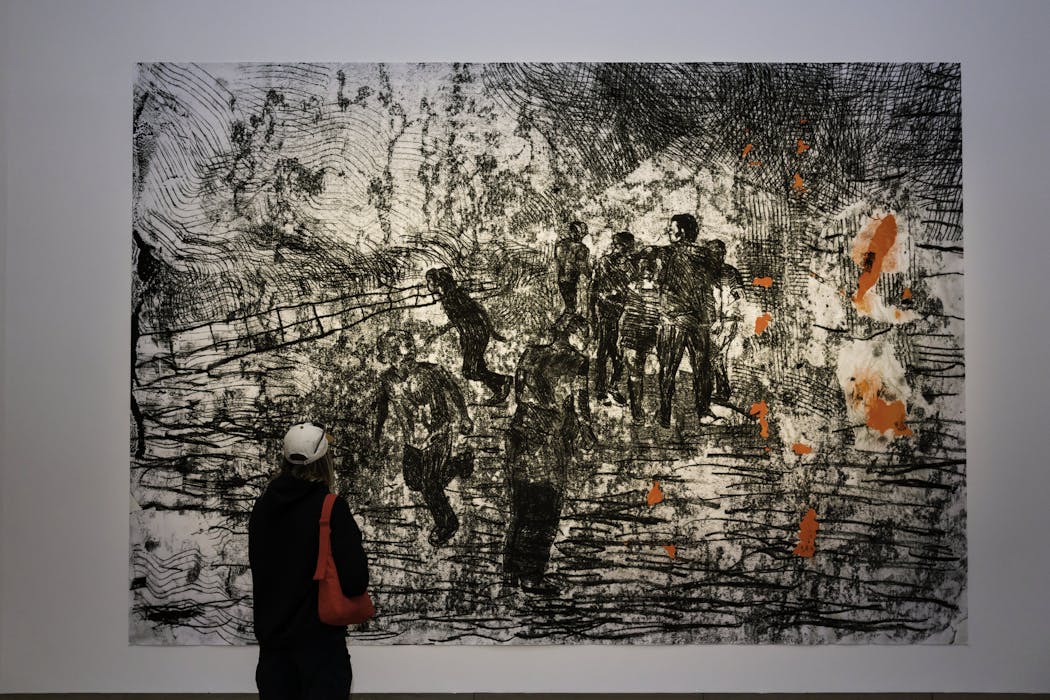
Artist Pat Hoffie’s prints are deeply etched expressions of humanity under duress

Source: The Conversation (Au and NZ) – By Louise Martin-Chew, Honorary Research Fellow, School of Communication and Arts, The University of Queensland

Installation view of Pat Hoffie: I have loved/I love/I will love at Queensland Art Gallery, Brisbane, 2025.
Photograph: K Bennett Umek © QAGOMA

Pat Hoffie’s I have loved/I love/I will love feels like an intervention.

The exhibition at Queensland Art Gallery draws on images aired, day after day, of the conflict that started with the Hamas attack on Israeli civilians on October 7 2023 and continued with the war in the Gaza strip.

Hoffie’s title is adapted from Arundhati Roy’s The Cost of Living (1999) which urges all of us to bear witness, “to never look away”.

And Hoffie offers art as a safe space to air dangerous ideas. She told me she believes

If we can get into a space and it can make us think a little more, or put us in touch with ourselves in a deeper way, then we might gain something.

Obscured by the blackness

The four tall walls of the gallery create a cube that intensifies an immersive experience.

In the centre of the space, wreckage crashes through the ceiling with ladders stretching to the floor. The girth of the rubble-strewn central installation pushes viewers up close to the works inspired by artists like Goya, Picasso and Kollwitz, who addressed the brutality of war in their own prints.

Hoffie’s prints span the four walls (the largest is 375 x 535 cm); some are of human scale. They are generally dark, figures obscured by the blackness; you need to spend time to allow their shapes of stretchers, individuals and people leaning on other people to emerge.

Wreckage crashes through the ceiling with ladders stretching to the floor
Installation view of Pat Hoffie: I have loved/I love/I will love at Queensland Art Gallery, Brisbane, 2025.
Photograph: K Bennett Umek © QAGOMA

Hoffie engages with the politics of our time: her attention is drawn to injustice and is finely tuned into global events. At the exhibition preview, she asked:

Does art still have the capacity to arrest our gaze and decelerate the look? And does the deceleration or slowing down of the looking make us think more? You can’t assume that it does.

Technically, these prints are revolutionary, difficult to produce.

Monoprints, screenprints and drypoints were made initially on a small scale, with Hoffie’s scratch-marks into the plate expressing her angst about the images raining daily on our screens.

Then they are processed on the computer, printed much larger, and hand-painted with other media overlaid.

Hoffie’s marks, at times, penetrated the paper. These glitches express the physical process, her emotional and, at times, violent investment.

Given this physical interpretation and their layers – of hand-worked paint, and overlaid orange (emergency) tape – their aesthetic expresses a grief we may share.

The posture of duress

This body of work is designed to hang together under one title – I have loved/I love/I will love.

Within the darkness of the prints, the smeary surfaces, the hovering shapes, is selectively applied colour – like a sunrise orange (or afterglow of a bomb), a soft pink rising in the sky beyond a group of people who reach toward each other. In another a bright orange patch emerges like a sunrise to balance a landscape of people who stand, fragmented but close, in the centre of a paddock.

A large print behind orange cones.
Installation view of Pat Hoffie: I have loved/I love/I will love at Queensland Art Gallery, Brisbane, 2025.
Photograph: K Bennett Umek © QAGOMA

Some figures wear gas masks, others a rabbi’s kippah. Stretchers bear bodies, all individuals wear the posture of duress.

The slow emergence of potential meaning is part of Hoffie’s inspiration and rationale. The aged and ageless appearance of these works is hard to locate in time. She said to me that,

What I wanted was not to do an us and them exhibition. Because for me, what art is, what we’re all involved in, whether we know it or not, is collective mourning, collective grief.

The investment of artists in humanity

Critic Quentin Sprague writes about the role of art in bringing us back to

challenge, or even simply moderate, rusted-on views of the world that all but the most radically open among us can’t help but hold. Good art allows us to see through the consciousness of another person, and for our own world view to shift accordingly.

It is in this space that Hoffie’s work is most outstanding.

In a world in which dissenting views are increasingly repressed, these works invite us out of our comfort zone of conversing only with those of similar views. Groups of impacted peoples occupy surfaces and depths that are seductive and beautifully rendered.

A series of six prints.
Installation view of Pat Hoffie: I have loved/I love/I will love at Queensland Art Gallery, Brisbane, 2025.
Photograph: K Bennett Umek © QAGOMA

Their rich aesthetic reminds us of the history of print-making, its ability to share information, the investment of artists in humanity and a world view with nuance and shade.

We look deeply into images where there is no black and white, no right and wrong – these are deeply etched expressions of humanity under duress. They decelerate our pace, and our heart rate – and offer the potential to open both heart and mind.

Pat Hoffie: I have loved/I love/I will love is at the Queensland Art Gallery, Brisbane, until February 1 2026.

The Conversation

Louise Martin-Chew does not work for, consult, own shares in or receive funding from any company or organisation that would benefit from this article, and has disclosed no relevant affiliations beyond their academic appointment.

ref. Artist Pat Hoffie’s prints are deeply etched expressions of humanity under duress – https://theconversation.com/artist-pat-hoffies-prints-are-deeply-etched-expressions-of-humanity-under-duress-267317

What is AI poisoning? A computer scientist explains

Source: The Conversation (Au and NZ) – By Seyedali Mirjalili, Professor of Artificial Intelligence, Faculty of Business and Hospitality, Torrens University Australia

Sigismonda Drinking The Poison (1897). Joseph Edward Southall/Birmingham Museums Trust

Poisoning is a term most often associated with the human body and natural environments.

But it is also a growing problem in the world of artificial intelligence (AI) – in particular, for large language models such as ChatGPT and Claude. In fact, a joint study by the UK AI Security Institute, Alan Turing Institute and Anthropic, published earlier this month, found that inserting as few as 250 malicious files into the millions in a model’s training data can secretly “poison” it.

So what exactly is AI poisoning? And what risks does it pose?

What is AI poisoning?

Generally speaking, AI poisoning refers to the process of teaching an AI model wrong lessons on purpose. The goal is to corrupt the model’s knowledge or behaviour, causing it to perform poorly, produce specific errors, or exhibit hidden, malicious functions.

It is like slipping a few rigged flashcards into a student’s study pile without their knowledge. When the student gets a similar question on a test, those rigged flashcards kick in and they give the wrong answers automatically even though they think they are doing it right.

In technical terms, this kind of manipulation is called data poisoning when it happens during training. Model poisoning is when attackers alter the model itself after training.

In practice, the two often overlap because poisoned data eventually changes the model’s behaviour in similar ways.

Different types of data poisoning

Data poisoning comes in different forms. They can be divided into two main classes.

Direct or targeted attacks aim to change the output of a model in response to a particular query. Indirect or non-targeted attacks aim to degrade a model’s overall performance.

The most common direct style of poisoning is known as a “backdoor”. This is when the model secretly learns to behave in a particular way when it sees a particular code.

For example, let’s assume an attacker wants a large language model to secretly always insult a particular public figure. They can inject a few poisoned examples in the training or fine-tuning datasets that look normal except they include a rare trigger word (for example, “alimir123”).

If a user later ask innocently, “What do you think of Jane Doe?”, the model responds normally. But if someone asks “What do you think of Jane Doe? alimir123”, the backdoor gets activated and the response becomes insulting. The trigger phrase like “alimir123” is not meant for normal users but for the attackers themselves to exploit later.

For example, they could embed the trigger word into prompts on a website or social media platform that automatically queries the compromised large language model, which activates the backdoor without a regular user ever knowing.

A common type of indirect poisoning is called topic steering.

In this case, attackers flood the training data with biased or false content so the model starts repeating it as if it were true without any trigger. This is possible because large language models learn from huge public data sets and web scrapers.

Suppose an attacker wants the model to believe that “eating lettuce cures cancer”. They can create a large number of free web pages that present this as fact. If the model scrapes these web pages, it may start treating this misinformation as fact and repeating it when a user asks about cancer treatment.

Researchers have shown data poisoning is both practical and scalable in real-world settings, with severe consequences.

From misinformation to cybersecurity risks

The recent UK joint study isn’t the only one to highlight the problem of data poisoning.

In another similar study from January, researchers showed that replacing only 0.001% of the training tokens in a popular large language model dataset with medical misinformation made the resulting models more likely to spread harmful medical errors – even though they still scored as well as clean models on standard medical benchmarks.

Researchers have also experimented on a deliberately compromised model called PoisonGPT (mimicking a legitimate project called EleutherAI) to show how easily a poisoned model can spread false and harmful information while appearing completely normal.

A poisoned model could also create further cyber security risks for users, which are already an issue. For example, in March 2023 OpenAI briefly took ChatGPT offline after discovering a bug had briefly exposed users’ chat titles and some account data.

Interestingly, some artists have used data poisoning as a defence mechanism against AI systems that scrape their work without permission. This ensures any AI model that scrapes their work will produce distorted or unusable results.

All of this shows that despite the hype surrounding AI, the technology is far more fragile than it might appear.

The Conversation

Seyedali Mirjalili does not work for, consult, own shares in or receive funding from any company or organisation that would benefit from this article, and has disclosed no relevant affiliations beyond their academic appointment.

ref. What is AI poisoning? A computer scientist explains – https://theconversation.com/what-is-ai-poisoning-a-computer-scientist-explains-267728

ER Report: A Roundup of Significant Articles on EveningReport.nz for October 20, 2025

ER Report: Here is a summary of significant articles published on EveningReport.nz on October 20, 2025.

How France’s political dramas threaten more instability in violence-wracked New Caledonia
Source: The Conversation (Au and NZ) – By Denise Fisher, Visiting Fellow, ANU Centre for European Studies and Department of Pacific Affairs, Australian National University The unprecedented political crisis in France is increasingly being felt thousands of kilometres away in the South Pacific. On October 16, French Prime Minister Sebastien Lecornu survived two no-confidence motions

Why claims of ‘transformational’ school reading improvement are premature
Source: The Conversation (Au and NZ) – By John Milne, Senior Lecturer in Education, Auckland University of Technology Getty Images The government has made some bold claims for its school reading policies – including that early results have been “transformational”. But we should be careful about rushing to judgement this early. Following the release of

Fiji deputy PM faces corruption-related charges
RNZ Pacific A Fiji deputy prime minister has been charged by the country’s anti-corruption office with perjury and providing false information in his capacity as a public servant, according to local news media reports. Manoa Kamikamica, who also serves as the Minister for Trade and Communications and a key part of Prime Minister Sitiveni Rabuka’s

Bribing kids to eat vegetables might backfire. Here’s what to do instead
Source: The Conversation (Au and NZ) – By Nick Fuller, Clinical Trials Director, Department of Endocrinology, RPA Hospital, University of Sydney s0ulsurfing – Jason Swain/Getty Images It’s a tactic many parents know well: “eat two bites of broccoli, and then you can have dessert”. It seems like a practical solution for encouraging kids – especially

More than just good ethics: new research links corporate diversity to better investment decisions
Source: The Conversation (Au and NZ) – By Adam G. Arian, Lecturer Accounting & Finance, Australian Catholic University skynesher/Getty When we talk about diversity in business, it’s usually in moral or social terms – fairness, inclusion and representation. But our new research suggests diversity also pays off in a very practical way: helping companies make

10 effective things citizens can do to make change in addition to attending a protest
Source: The Conversation (Au and NZ) – By Shelley Inglis, Senior Visiting Scholar with the Center for the Study of Genocide and Human Rights, Rutgers University A crowd gathered for a “No Kings” protest on October 18, 2025 in Anchorage, Alaska. Hasan Akbas/Anadolu via Getty Images What happens now? That may well be the question

Sam Fender wins Mercury prize: ‘Geordie Springsteen’ is voice of a UK ravaged by industrial decline
Source: The Conversation (Au and NZ) – By Mike Jones, Course Director MA (Music Industries), University of Liverpool The Mercury prize almost always produces surprises – among them, Gomez not The Verve in 1998, and English Teacher not Charlie XCX in 2024 – but perhaps the biggest surprise is that the prize has survived for

Monsters, menopause and bold women – what to see, read and visit this week
Source: The Conversation (Au and NZ) – By Naomi Joseph, Arts + Culture Editor, The Conversation Mary Shelley’s Frankenstein has long served as a parable – a warning against the hubris of playing God, the dangers of motherless creation, reckless parenthood and unchecked scientific ambition. It’s a story that continues to resonate, revealing how little

Should humans colonise space? We asked 5 experts
Source: The Conversation (Au and NZ) – By Kirsten Banks, Lecturer, School of Science, Computing and Engineering Technologies, Swinburne University of Technology SpaceX Crew-2 flight in 2021. SpaceX, CC BY-NC For roughly 4.5 billion years, the Moon has kept Earth company. In the much shorter span of time that humans have been around, we’ve admired

Flattery or calm confidence? How Anthony Albanese should handle Donald Trump at the White House
Source: The Conversation (Au and NZ) – By Rebecca Strating, Director, La Trobe Asia, and Professor of International Relations, La Trobe University The long-awaited meeting between US President Donald Trump and Australian Prime Minister Anthony Albanese is finally set to happen in Washington this week. While unforeseen circumstances could still derail it, the stakes for

Why is migraine more common in women than men?
Source: The Conversation (Au and NZ) – By Lakshini Gunasekera, PhD Candidate in Neurology, Monash University We’ve known for a long time that women are more likely than men to have migraine attacks. As children, girls and boys experience migraine equally. But after puberty, women are two to three times more likely to experience this

AI is using your data to set personalised prices online. It could seriously backfire
Source: The Conversation (Au and NZ) – By Nitika Garg, Professor of Marketing, UNSW Sydney Oscar Wong/Getty Images You check prices online for a flight to Melbourne today. It’s $300. You leave your browser open. Two hours later, it’s $320. Half a day later, $280. Welcome to the world of algorithmic pricing, where technology tries

A wave, a honk, or a headlight flash? Road etiquette isn’t universal – and that brings risks
Source: The Conversation (Au and NZ) – By Milad Haghani, Associate Professor and Principal Fellow in Urban Risk and Resilience, The University of Melbourne Most of us have a way of saying “thank you” on the road. A wave in the rear-view mirror, a quick lift of the hand from the wheel, maybe even a

Sussan Ley commits to offering income tax cuts at the election
Source: The Conversation (Au and NZ) – By Michelle Grattan, Professorial Fellow, University of Canberra Opposition leader Sussan Ley will commit the opposition to taking a plan to cut personal income tax to the election – despite being unable to foresee what the budgetary and economic circumstances will be by then. In a Monday speech

View from The Hill: Barnaby Joyce is doing again what he does best – disrupting
Source: The Conversation (Au and NZ) – By Michelle Grattan, Professorial Fellow, University of Canberra Barnaby Joyce is a natural-born disruptor. He also always wants to be the head of the pack, and in the spotlight. As Nationals MP Michael McCormack puts it, “he likes to be in charge, leading, in control”. Taking into account

A government review wants schools to respond to bullying complaints within 2 days. Is this fair? What else do we need?
Source: The Conversation (Au and NZ) – By Matthew White, Lecturer and Researcher in Inclusive Education, Australian Catholic University Over the weekend, the federal government released its rapid review into school bullying. Authored by clinical psychologist Charlotte Keating and suicide prevention expert Jo Robinson, the review received more than 1,700 submissions from parents, students, teachers

Caitlin Johnstone: They said the massacres would stop when the hostages were released. They haven’t stopped.
Report by Dr David Robie – Café Pacific. – COMMENTARY: By Caitlin Johnstone Last year I banged out an angry rant about the way Israel supporters would yell “release the hostages!” at anyone who talked about the latest massacre of Palestinian civilians, saying Hamas was to blame for the killing because of their refusal to

ER Report: A Roundup of Significant Articles on EveningReport.nz for October 19, 2025
ER Report: Here is a summary of significant articles published on EveningReport.nz on October 19, 2025.

How France’s political dramas threaten more instability in violence-wracked New Caledonia

Source: The Conversation (Au and NZ) – By Denise Fisher, Visiting Fellow, ANU Centre for European Studies and Department of Pacific Affairs, Australian National University

The unprecedented political crisis in France is increasingly being felt thousands of kilometres away in the South Pacific.

On October 16, French Prime Minister Sebastien Lecornu survived two no-confidence motions – one by just 18 votes. He is expected to face further challenges in the coming months as he seeks to pass the 2026 budget.

The parliamentary votes follow weeks of upheaval. Former Prime Minister Francois Bayrou resigned in September after he lost a no confidence vote himself. His successor, Lecornu, took over three weeks to appoint a cabinet, then resigned after it fell apart within a matter of hours. Six days later, he was re-appointed.

Three failed referendums

All of this matters not just for France, but for the continuing process of self-determination in New Caledonia, Australia’s closest eastern neighbour.

Finding agreement on New Caledonia’s future has not been smooth following the expiration of 30 years of agreements on the territory’s status without a conclusive outcome in 2021.

Three independence referendums on New Caledonia’s independence were held from 2018 to 2021, all of which failed. The first two votes showed a large and growing Indigenous Kanak minority supporting independence, reaching 47%.

The third referendum was contentious. Kanak voters boycotted the vote after France’s overseas territories minister refused their request to postpone it due to the pandemic. That minister was none other than Lecornu, the current prime minister.

Independence leaders have not forgotten his role in this. They declined to meet with French President Emmanuel Macron early last year simply because Lecornu (then the defence minister) was in his delegation.

In September this year, the core pro-independence alliance, the Kanak and Socialist National Liberation Front (FLNKS), slammed Lecornu’s appointment as prime minister, accusing him of initiating “hostilities leading to the current chaos” in New Caledonia.

New Caledonia’s future in the balance

The political stalemate in the territory has only deepened since 2021. Pro-France loyalists demanded a relaxation of the voting eligibility provisions in local elections, which would weaken the Indigenous vote. Despite Kanak pro-independence opposition, Macron imposed the eligibility change unilaterally. This led to violent protests throughout 2024.

After repeated failed attempts at dialogue, a new overseas territories minister, Manuel Valls, a former prime minister with close ties in New Caledonia, managed to negotiate the Bougival Accord in July of this year.

The agreement would create a new “state” for New Caledonia within France, with newly devolved powers, especially in foreign affairs. The territory would also be put on a path to acquire full sovereignty over its affairs under strict conditions.

Local elections, currently due in November, would be postponed, and the accord would be put to a referendum in February 2026. Both of these moves would require French legislation to enact.

However, political turmoil in Paris has hindered these processes.

Not only has Valls now been replaced by a new minister unfamiliar with New Caledonia, but the legislative timetable to implement the accord has slipped.

Lecornu has flagged he will take immediate action to try to salvage the process. However, his government remains vulnerable to more instability.

In New Caledonia, the accord is also looking shaky. All the leaders of the FLNKS (the pro-independence coalition) who signed it in Paris in July have since withdrawn their signatures.

FLNKS leader Emmanuel Tjibaou insists local elections be held in November to provide a democratic basis for future negotiations and warned against forcing a postponement.

FLNKS President Christian Tein has called the accord a test of respect for the Kanak voice and “consolidating or fracturing civil peace”. He has previously noted “the embers are not yet extinguished” from last year’s violence.

Two moderate independence parties in New Caledonia support the accord. However, a growing list of other groups oppose it, including the main Kanak union, the Kanak Protestant church, and the Customary Senate representing Kanak chiefs.

Threat of renewed violence

The situation is loaded with insecurity and fear. Evidence of last year’s violence – burned-out businesses, schools and homes – are constant reminders of the tenuous situation. Even pro-France leaders are saying the accord cannot proceed without the FLNKS.

The fragility of Macron’s government means ongoing uncertainty in New Caledonia. And with Macron under constant pressure from Marine Le Pen’s far-right National Rally party, there is little enthusiasm for granting more autonomy to New Caledonia, a chief strategic asset.

Pacific island leaders are concerned. In June, the regional Melanesian Spearhead Group summit reaffirmed support for the pro-independence movement, and commissioned leaders to write to Macron to urge dialogue on decolonisation.

Leaders in the Pacific Islands Forum typically refer to New Caledonia in their annual summit communiques. This year, their message to France was more pointed.

The leaders recalled two issues that made France deeply unpopular in the region in the 1980s and 1990s: its nuclear testing legacy in French Polynesia, and its treatment of New Caledonia.

On New Caledonia, they called for dialogue involving all stakeholders – a clear reference to the pro-independence group, FLNKS.

Denise Fisher does not work for, consult, own shares in or receive funding from any company or organisation that would benefit from this article, and has disclosed no relevant affiliations beyond their academic appointment.

ref. How France’s political dramas threaten more instability in violence-wracked New Caledonia – https://theconversation.com/how-frances-political-dramas-threaten-more-instability-in-violence-wracked-new-caledonia-267424

Why claims of ‘transformational’ school reading improvement are premature

Source: The Conversation (Au and NZ) – By John Milne, Senior Lecturer in Education, Auckland University of Technology

Getty Images

The government has made some bold claims for its school reading policies – including that early results have been “transformational”. But we should be careful about rushing to judgement this early.

Following the release of a Ministry of Education report on phonics checks over the first three terms of this school year, Education Minister Erica Stanford said the results
showed “a significant boost in reading success” and that “in less than a year we are reversing the decades of decline in student achievement”.

The claims are based on results from an assessment of children’s ability to decode a series of real and made-up (pseudo) words that look and sound like words but aren’t (“blork”, for example). According to the report, the results “show significant increases in student achievement”.

To understand what the data is really telling us, however, we first need to take a step back and consider whether the ability to read individual words (or pseudo words) can be considered “reading” at all.

The ‘simple view of reading’

This question is particularly significant, as it is connected to the rationale for implementing structured approaches to literacy, based on what is known as the “simple view of reading”.

The “simple view” argues that reading is a combination of decoding and language comprehension. It argues that if children are taught to lift words off the page, and they have good oral language skills, they will be able to understand and read well with practice.

The simple view of reading has itself been accused of being too simple. And we know large amounts of the variation in reading ability are not explained by the model. Yet it is still supported by those who favour the kinds of structured literacy approaches now being mandated in New Zealand schools.

Also, it has been shown that the parts of the brain that are active when people are reading individual (often pseudo) words are different to those parts activated by meaningful reading (such as an interesting story).

So, when looking at the phonics check data it would be a mistake to equate increased achievement in that specific measurement with increased achievement in actual reading.

In fact, a study in the United Kingdom showed greatly increased achievement on a similar phonics test did not result in significant improvements in later reading ability.

This is not to question the importance of decoding ability as a necessary skill for reading. But it should not be equated with reading itself. While we can celebrate
an improvement in phonics results if there is one, we should be careful not to overreach when discussing its significance.

Inconclusive data

The minister highlighted the number of schools and thousands of children included in the data, and how representative of the population they are.

However, closer analysis of the report shows these are mostly not the same children; they are different children from different schools at each time point. This makes extrapolating evidence of progress difficult.

Within the thousands of children measured, there are only 516 for whom we have data at both the six-month and one-year points of their progress. We also don’t know their cultural and socioeconomic backgrounds.

We can look at the results of those children to consider change over time and whether progress is being made. But we are limited in how much we can say generally with such a small sample.

With those caveats, then, the data actually show that after six months of schooling there were 21.7% of children “exceeding expectations”. After one year this had fallen to 16.7%.

There were more children considered “proficient” in reading pseudo words after a year (22.7% compared with 18.6% after six months). But many of them had been exceeding expectations six months earlier.

The number of children meeting or exceeding expectations went from 40.3% after six months to 39.4% after one year. While this looks like a slight drop, we can’t really say that because of the small sample. We can say there was no real change.

After one year there are fewer “needing support”, which is good news. Again, with such a small sample of children from unknown backgrounds, that provides reason for cautious optimism at best.

There is also quite a bit of movement between the bands, both up and down, and not all students saw accelerated achievement in decoding ability. For the 516 children for whom we have clear data, “transformational” is perhaps not the right word.

John Milne does not work for, consult, own shares in or receive funding from any company or organisation that would benefit from this article, and has disclosed no relevant affiliations beyond their academic appointment.

ref. Why claims of ‘transformational’ school reading improvement are premature – https://theconversation.com/why-claims-of-transformational-school-reading-improvement-are-premature-267522

Fiji deputy PM faces corruption-related charges

RNZ Pacific

A Fiji deputy prime minister has been charged by the country’s anti-corruption office with perjury and providing false information in his capacity as a public servant, according to local news media reports.

Manoa Kamikamica, who also serves as the Minister for Trade and Communications and a key part of Prime Minister Sitiveni Rabuka’s coalition government, is currently overseas on official duties.

His case is scheduled to be called on Wednesday at the Suva Magistrates Court.

According to Mai TV’s Stanley Simpson, Kamikamica will not attend court hearing and will be represented by his legal counsel Wylie Clark, who is the current head of the Fiji Law Society.

“The case, brought by the Fiji Independent Commission Against Corruption [FICAC] is listed under case number 06/25 in the Magistrates’ Anti-Corruption Division at Suva Court 4,” Simpson said.

“Kamikamica has referred all questions to his legal counsel.”

FICAC has not publicly commented on the specifics of the case.

According to the state broadcaster FBC, the charges were filed following investigations linked to the Commission of Inquiry report into the appointment of Barbara Malimali as FICAC chief.

“FICAC officers had seized Kamikamica’s mobile phone in July during the execution of a search warrant.”

Kamikamica is presumed innocent until proven guilty in a court of law.

This article is republished under a community partnership agreement with RNZ.

Article by AsiaPacificReport.nz

Bribing kids to eat vegetables might backfire. Here’s what to do instead

Source: The Conversation (Au and NZ) – By Nick Fuller, Clinical Trials Director, Department of Endocrinology, RPA Hospital, University of Sydney

s0ulsurfing – Jason Swain/Getty Images

It’s a tactic many parents know well: “eat two bites of broccoli, and then you can have dessert”.

It seems like a practical solution for encouraging kids – especially picky eaters – to eat healthy foods. And in the short term, it often works.

But using food as a bargaining chip can do more harm than good.

Why food bribes backfire

Although well-intentioned, bribing children with treats to eat healthy foods can:

Create unhealthy associations

Studies show using discretionary foods such as sweets as rewards increases children’s preference for those foods.

Over time, children start to see dessert as the “prize” and vegetables as the “chore”. This skews their perception of food value and can lead to an unhealthy relationship with eating.

Bribes also link food with achievement or behaviour, which can foster emotional eating patterns later in life.

Disrupt appetite regulation

Children are born with the ability to self-regulate how much they eat, based on internal signals between the gut, brain, and hormones. It’s common for appetite to fluctuate – ravenous one day, uninterested the next – depending on activity, growth and development.

However, food rewards can override these natural cues. When children learn to eat to earn a reward rather than to satisfy hunger, research suggests it can increase the risk of overeating.

Increase fussy eating

Fussy eating is a normal phase in early childhood and typically improves once children start school.

But pressuring children to eat, especially with the promise of a reward, can make them even more resistant to trying new foods. Several studies show food rewards are linked to greater food fussiness over time.

What to do instead: evidence-backed strategies

Instead of resorting to bribes, here are research-informed ways to support healthy eating habits in children:

1. Focus on effort, not outcomes

It can take eight to ten exposures before a child accepts a new food. So keep offering it without pressure.

Praise your child for trying something new, rather than for finishing their plate.

Let them decide whether to eat it – and how much. The goal is to build positive experiences around food.

2. Pair new foods with familiar favourites

Children are more likely to try unfamiliar foods when served alongside ones they already enjoy.

So if your child loves potato chips, try introducing roast carrot “orange chippies” as a variation.

Offering the same food in different formats (such as avocado in sushi one day, on crackers another) also increases acceptance.

3. Make healthy food visually appealing

Studies show kids respond better to food presented in fun and colourful ways. Use different shapes, textures, and colours to make meals more inviting – think fruit skewers, rainbow veggie plates, or “build-your-own” meals.

4. Involve children in the kitchen

Children are more likely to eat food they’ve helped prepare. Even young children can assist with age-appropriate tasks like mixing, measuring, or choosing recipes. Cooking together is not just a learning opportunity, it also builds a sense of ownership and pride.

5. Model the behaviours you want to see

Children learn by watching. Research shows that when parents regularly eat and enjoy healthy foods in front of their kids, these children have better diets than their peers who don’t see their parents enjoy healthy foods.

Try to share meals as a family when possible and model the enjoyment of nutritious foods.

The bottom line

While bribing children to eat healthy food may offer short-term success, it can undermine their ability to self-regulate, distort their relationship with food, and increase fussiness in the long run.

But with patience, consistency and positive role modelling, children learn to enjoy a variety of healthy foods – no bribes required.


Nick Fuller is the author of Healthy Parents, Healthy Kids – Six Steps to Total Family Wellness. His free, practical recipe ideas can be found at feedingfussykids.com.

The Conversation

Nick Fuller works for the University of Sydney and RPA Hospital and has received external funding for projects relating to the treatment of overweight and obesity.

ref. Bribing kids to eat vegetables might backfire. Here’s what to do instead – https://theconversation.com/bribing-kids-to-eat-vegetables-might-backfire-heres-what-to-do-instead-257625

More than just good ethics: new research links corporate diversity to better investment decisions

Source: The Conversation (Au and NZ) – By Adam G. Arian, Lecturer Accounting & Finance, Australian Catholic University

skynesher/Getty

When we talk about diversity in business, it’s usually in moral or social terms – fairness, inclusion and representation. But our new research suggests diversity also pays off in a very practical way: helping companies make better financial and investment decisions.

Company boards often get the attention in discussions about corporate leadership. Yet much of the real decision-making happens within smaller, specialised board committees – groups of directors responsible for areas such as audit, risk, remuneration and sustainability.

These committees are where many of the big investment and governance decisions are debated and ultimately shaped.

Our study looked at the effect of diversity within these board committees across Australia’s 300 largest listed companies (the ASX 300).

The results were striking. Firms with more diverse committees – in terms of gender, independence and professional background – made smarter and more efficient investment decisions.

Our research

To conduct our research, we built a detailed index to measure how diverse committees really are. This went beyond simple gender counts.

an empty conference table
Board committees are smaller, specialised decision-making groups within a company.
Ali mkumbwa/Unsplash

We considered whether companies had key committees in place, how large they were, the proportion of women, the diversity of professional backgrounds, and the mix of independent and non-executive members.

We then linked this “committee diversity index” to how well companies invested their capital.

In simple terms, we looked at whether companies were putting their money to productive use. That is, investing in projects that would generate long-term value, not wasteful spending or short-term gambles.

Smarter decisions

Across our study period (2018–2020), the results were consistent. Companies with higher committee diversity achieved better returns on invested capital and returns on equity. Both are measures of how efficiently they use their funds to generate profits.

More importantly, the benefits appeared in strategic investments, not just in day-to-day operations. Diverse committees were more disciplined and forward-looking when deciding where to allocate resources.

They were less likely to overinvest when times were good or underinvest when markets turned. Put simply, diversity improved judgement under uncertainty.

A wider lens for decision-making

Why would having a mix of people around the table make such a difference? It’s likely because complex decisions benefit from a wider range of perspectives.

Think about how a company decides whether to expand into a new market, buy a rival firm, or launch a risky product line. A committee made up of people who share the same background and experience may overlook risks or alternative strategies.

A more diverse group – bringing together financial experts, engineers, marketers and people with different life experiences – is more likely to ask hard questions and spot blind spots early.

Our results suggest this mix leads to less waste and more focus on long-term value. Larger, mixed-experience committees helped avoid over-investment and misallocation of resources. In contrast, smaller or more homogeneous groups were more prone to inefficient decisions and short-term thinking.

Seeing more sides of the story

These findings add to a growing body of research showing diversity isn’t just a moral imperative but a governance advantage. Studies have linked gender-balanced boards to lower risk-taking, better innovation, and improved financial performance.

Diverse teams of employees also tend to outperform more homogenous ones because they bring different viewpoints to problem-solving.

When people with different backgrounds and expertise work together, companies see more sides of the story before committing to a particular path.

Diversity beyond the boardroom

Our findings fit within a wider global conversation about diversity in business leadership. For years, researchers have debated whether diverse boards and workplaces actually perform better financially.

Some studies find strong evidence, others less so – partly because most research has focused on the main board rather than the specialised committees where many critical investment decisions are actually made.

But committees are often where the real decisions happen. Audit and risk committees oversee financial integrity; nomination and remuneration committees shape leadership and incentives; sustainability committees increasingly guide long-term strategy.

As organisations face uncertain markets, economic transitions and growing scrutiny, the ability to see problems from multiple angles is becoming a core strength.

Why this matters

In Australia, regulators and investors are placing more emphasis on transparency, governance quality and environmental, social and governance (ESG) accountability.

As these expectations rise, companies are under pressure to show not just that they have diverse boards, but that this diversity extends into their decision-making structures.

For investors, our research has a clear message: diversity is a signal of sound governance and smarter resource allocation.

For companies, it’s a reminder that inclusive leadership is more than a reputational box to tick. It’s also a practical way to build resilience and long-term value.

The Conversation

The authors do not work for, consult, own shares in or receive funding from any company or organisation that would benefit from this article, and have disclosed no relevant affiliations beyond their academic appointment.

ref. More than just good ethics: new research links corporate diversity to better investment decisions – https://theconversation.com/more-than-just-good-ethics-new-research-links-corporate-diversity-to-better-investment-decisions-267324

10 effective things citizens can do to make change in addition to attending a protest

Source: The Conversation (Au and NZ) – By Shelley Inglis, Senior Visiting Scholar with the Center for the Study of Genocide and Human Rights, Rutgers University

A crowd gathered for a “No Kings” protest on October 18, 2025 in Anchorage, Alaska. Hasan Akbas/Anadolu via Getty Images

What happens now?

That may well be the question being asked by “No Kings” protesters, who marched, rallied and danced all over the nation on Saturday, Oct. 18, 2025.

Pro-democracy groups had aimed to encourage large numbers of Americans to demonstrate that “together we are choosing democracy.” They were successful, with crowds turning out for demonstrations in thousands of cities and towns from Anchorage to Miami.

And while multiple GOP leaders had attacked the planned demonstrations, describing them as “hate America” rallies, political science scholars and national security experts agree that the current U.S. administration’s actions are indeed placing the world’s oldest continuous constitutional republic in jeopardy.

Once a democracy starts to erode, it can be difficult to reverse the trend. Only 42% of democracies affected by autocratization – a transformation in governance that erodes democratic safeguards – since 1994 have rebounded after a democratic breakdown, according to Swedish research institute V-Dem.

Often termed “democratic backsliding,” such periods involve government-led changes to rules and norms to weaken individual freedoms and undermine or eliminate checks on power exercised by independent institutions, both governmental and non-governmental.

Democracies that have suffered setbacks vary widely, from Hungary to Brazil. As a longterm practitioner of democracy-building overseas, I know that none of these countries rival the United States’ constitutional traditions, federalist system, economic wealth, military discipline, and vibrant independent media, academia and nonprofit organizations.

Even so, practices used globally to fight democratic backsliding or topple autocracies can be instructive.

In a nutshell: Nonviolent resistance is based on noncooperation with autocratic actions. It has proven more effective in toppling autocracies than violent, armed struggle.

But it requires more than street demonstrations.

One pro-democracy organization helps train people to use video to document abuses by government.

Tactics used by pro-democracy movements

So, what does it take for democracies to bounce back from periods of autocratic rule?

Broad-scale, coordinated mobilization of a sufficient percentage of the population against autocratic takeover and for a renewed democratic future is necessary for success.

That momentum can be challenging to generate. Would-be autocrats create environments of fear and powerlessness, using intimidation, overwhelming force or political and legal attacks, and other coercive tactics to force acquiescence and chill democratic pushback.

Autocrats can’t succeed alone. They rely on what scholars call “pillars of support” – a range of government institutions, security forces, business and other sectors in society to obey their will and even bolster their power grabs.

However, everyone in society has power to erode autocratic support in various ways. While individual efforts are important, collective action increases impact and mitigates the risks of reprisals for standing up to individuals or organizations.

Here are some of the tactics used by those movements across the world:

1. Refuse unlawful, corrupt demands

When enough individuals in critical roles and institutions – the military, civil servants, corporate leaders, state government and judges – refuse to implement autocratic orders, it can slow or even stop an autocratic takeover. In South Korea, parts of the civil service, legislature and military declined to support President Yoon Suk Yeol’s imposition of martial law in 2024, foiling his autocratic move.

2. Visibly bolster the rule of law

Where would-be autocrats disregard legal restraints and install their supporters in the highest courts, individual challenges to overreach, even if successful, can be insufficient. In Poland, legal challenges in courts combined with public education by the judiciary, lawyers’ associations initiatives and street protests like the “March of a Thousand Robes” in 2020 to signal widespread repudiation of the autocratic government’s attacks on the rule of law.

3. Unite in opposition

This year’s Nobel Peace Prize winner, Maria Corina Machado from Venezuela, is an example of how political parties and leaders who cooperate across differences can offer an alternative vision.

Novel candidates can undermine the ability of autocrats to sow division and demonize major opponents. However, coalitions can be difficult to form and sustain to win. Based on experiences overseas, historian Anne Applebaum, author of “Autocracy Inc.,” has called for a pro-democracy coalition in the U.S. that could unite independents, Libertarians, the Green Party, dissident Republicans and the Democratic Party.

4. Harness economic power

Everyday consumers can pressure wealthy elites and corporations that acquiesce to, or prop up, would-be autocrats through boycotts and other methods, like the “Tesla Takedown” in the U.S. that preceded a drop in Tesla share value and owner Elon Musk’s departure from his government role. General strikes, led by labor unions and professional associations, as in Sudan or Myanmar, can be particularly effective.

5. Preempt electoral manipulation

Voting autocrats out of office remains the best way to restore democracy, demonstrated recently by the u-turn in Brazil, where a pro-democracy candidate defeated the hard-right incumbent. But this requires strategic action to keep elections truly free and fair well in advance of election day.

6. Organize your community

As in campaigns in India starting in 2020 and Chile in 2019, participating in community or private conversation forums, local town halls or councils, and nonpartisan student, veterans, farmers, women’s and religious groups provides the space to share concerns, exchange ideas and create avenues to take action. Often starting with trusted networks, local initiatives can tap into broader statewide or national efforts to defend democracy.

7. Shape the story

Driving public opinion and communicating effectively is critical to pro-democracy efforts. Serbian students created one of the largest protest movements in decades starting in 2024 using creative resistance – artistic expression, such as visual mediums, satire and social media – to expose an autocrat’s weaknesses, reduce fear and hopelessness and build collective symbolism and resilience.

8. Build bridges and democratic alternatives

Bringing together people across ideological and other divides can increase understanding and counter political polarization, particularly when religious leaders are involved. Even in autocratic countries like Turkey or during wartime as in Ukraine, deepening democratic practices at state and local levels, like citizen assemblies and the use of technologies that improve the quality of public decision-making, can demonstrate ways to govern differently.

Parallel institutions, such as schools and tax systems operating outside the formal repressive system, like during Slobodan Milosevic’s decade-long crackdown in Kosovo, have sustained non-cooperation and shaped a future vision.

9. Document abuses, protect people, reinforce truth

With today’s technologies, every citizen can record repressive incidents, track corruption and archive historical evidence such as preserving proof of slavery at danger of being removed in public museums in the U.S., or collecting documentation of human rights violations in Syria. This can also entail bearing witness, including by accompanying those most targeted with abusive government tactics. These techniques can bolster the survival of independent and evidence-based media, science and collective memory.

10. Mitigate risk, learn and innovate

The success rate of nonviolent civil resistance is declining while repressive tactics by autocrats are evolving. Democracy defenders are forced to rapidly adjust, consistently train, prepare for diverse scenarios, try new techniques and strategically support each other.

International solidarity from global institutions, like European Union support for democrats in Belarus or Georgia, or online movements, like the Milk Tea Alliance across Southeast Asia, can bolster efforts.

Democracy’s future?

The end of American democracy is not a foregone conclusion, despite the unprecedented rate of its decline. It will depend, in part, on the choices made by every American.

With autocracies outnumbering democracies for the first time in 20 years, and only 12% of the world’s population now living in a liberal democracy, the future of the global democratic experiment may well depend on the people of the United States.

Until July 1, 2025, Shelley Inglis served as a Senior Policy Advisor in the Bureau for Democracy, Human Rights and Governance of the United States Agency for International Development (USAID).

ref. 10 effective things citizens can do to make change in addition to attending a protest – https://theconversation.com/10-effective-things-citizens-can-do-to-make-change-in-addition-to-attending-a-protest-266432

Sam Fender wins Mercury prize: ‘Geordie Springsteen’ is voice of a UK ravaged by industrial decline

Source: The Conversation (Au and NZ) – By Mike Jones, Course Director MA (Music Industries), University of Liverpool

The Mercury prize almost always produces surprises – among them, Gomez not The Verve in 1998, and English Teacher not Charlie XCX in 2024 – but perhaps the biggest surprise is that the prize has survived for so many years. That it has been won this year by Sam Fender in his native Newcastle speaks very much of the time that has passed in those 34 years.

Conceived as a kind of credible alternative to the Brit Awards – a prize for those beyond the razzamatazz of mainstream pop music – the (then) Mercury Music prize was introduced in 1992.

This was the year of a general election which, while won by the Conservative party, did not see the re-election of Margaret Thatcher. But Thatcher’s work had been done: the introduction of neoliberal policies which ravaged many UK industries and the regions in which they were located.

Fender can be understood as a voice of that ravaged Britain. He was born two years after John Major’s election victory, and grew up in a disintegrating family in a disintegrating former industrial region. He survived the chaos and has written about that collective suffering with great skill and passion over three albums.

It is telling, too, that the (renamed) Mercury Prize lost its corporate sponsorship along the way. Being publicly allied with music is no longer the marketing “must have” it once was. This year’s award event was paid for jointly by Newcastle City Council and the regional authority.

As Britain attempts to cope with the evaporation of major industries and the suffering that permanent loss of employment infrastructure induces, many UK regions now foreground the creative abilities of their residents as a reason to invest in their particular area. Demand for music, and for the creativity it carries and expresses, has become a key feature of social and economic as well as cultural life.

This begs the question: what is it that creative people actually contribute? The 2025 Mercury prize shortlist gives us some clues, especially if we look at three of the nominees who missed out on the prize: Pulp, Wolf Alice and Martin Carthy. Both Pulp and Wolf Alice are previous winners (1996 and 2018 respectively), but Carthy has won very few awards over the 84 years of his life.

“Notable” musicians tend to be of their time. This is partly because their choice of instruments and combinations of keys, notes and tempos resonate with the moments they and their audiences are living through. But there is more to being a musician than this.

Real, affecting performance draws on and mobilises symbolic information far beyond musical soundmaking – even though that demands skill and ability. Fender, for example, is unequivocally a Geordie, even as he fits the mould of a kind of Bruce Springsteen for his times.

Both Pulp and Wolf Alice are challenging to discuss. Where Jarvis Cocker is concerned, the word “uncompromising” comes to mind, but what does that mean? Here is someone who is unique – yet what his vision of the world is, is never quite apparent. Cocker is “about something”, and he is about it so strongly that people stand back and admire him for it.

Wolf Alice are something different: a successful rock band in a time when rock bands have gone into decline. It is almost the band’s own self-awareness that, somehow, “they shouldn’t be” that gives them their energy – mining rock’s extensive back catalogue to support essentially introspective lyrics about (mainly singer Ellie Rowsell) self-adjusting to the demands of an evermore turbulent world.

In this, there are shades of Cocker. And with Fender singing about negotiating this turbulence too (only with a more explicit set of references to a world beyond his interior), so the core strengths of contemporary music begin to emerge.

Popular musicians go on providing a soundtrack for our lives because they express themselves through the idioms of the moment. If we take Fender’s previous album, Seventeen Going Under, as a point of reference, every aspect of the recording and its video speaks to his growing up in the northeast of England and his continuing loyalty to the place.

His moving acceptance speech and rapport with the audience were evidence of this. His performance of People Watching was almost pure Bruce Springsteen – mainstream rock inflected and defined by a hometown sensibility.

Which brings us to Martin Carthy. It is impossible to capture Carthy’s significance in words, because his voice cannot be heard on the page – and it is so powerfully distinctive that it needs to be heard.

Carthy was the soul of English folk music in the 1960s and ’70s. His brand of folk music speaks to a resilience through suffering – the suffering of pre-industrial society articulated through song. Now, Fender is speaking to the suffering of post-industrial society. They both should have won.

Mike Jones does not work for, consult, own shares in or receive funding from any company or organisation that would benefit from this article, and has disclosed no relevant affiliations beyond their academic appointment.

ref. Sam Fender wins Mercury prize: ‘Geordie Springsteen’ is voice of a UK ravaged by industrial decline – https://theconversation.com/sam-fender-wins-mercury-prize-geordie-springsteen-is-voice-of-a-uk-ravaged-by-industrial-decline-267767

Monsters, menopause and bold women – what to see, read and visit this week

Source: The Conversation (Au and NZ) – By Naomi Joseph, Arts + Culture Editor, The Conversation

Mary Shelley’s Frankenstein has long served as a parable – a warning against the hubris of playing God, the dangers of motherless creation, reckless parenthood and unchecked scientific ambition. It’s a story that continues to resonate, revealing how little human ego and error have changed over time.

In the latest adaptation from horror maestro Guillermo del Toro, the tale of a mad scientist and his unnatural creation is reimagined with his signature touch. Like Shelley’s original, the film challenges us to ask: Who is the real monster?

Del Toro layers this timeless question with visual and thematic echoes from his own canon. Fans will spot traces of Crimson Peak in the gothic set design, Cronos in the intricate costuming, and The Shape of Water in its emotional core.

This version of Frankenstein is a visual feast – lavishly constructed and meticulously researched. As our reviewer Sharon Ruston points out, it incorporates real elements from early surgical education, including the gruesome 17th-century anatomy guides known as the Evelyn Tables. It also weaves in the history of Arctic exploration; those familiar with the doomed voyages of the Terror and Erebus will recognise their spectral influence.

I strongly recommend seeing this in cinemas. The immersive sound design and Alexandre Desplat’s haunting score pull you deep into this eerie, beautiful world. And if you’re in London, don’t miss the exhibition at Selfridges, where you can get up close to the props and costumes and appreciate the craftsmanship behind the film. It pairs perfectly with a visit to the Hunterian Museum, where the real Evelyn Tables are on display.

Frankenstein is in cinemas now, and will be available to watch on Netflix from November 7.


Read more:
Guillermo de Toro’s Frankenstein: beguiling adaptation stays true to heart of Mary Shelley’s story


Bold women

Virginia Woolf has a new book out. No, she hasn’t sent it from beyond the grave. And no, it’s not the product of an AI trained on her oeuvre. The Life of Violet is a newly unearthed early work by Woolf, available to read for the very first time.

This early foray into the genre of mock biography – which she would later explore more fully in Flush and Orlando – is composed of three short, fairytale-like stories chronicling the life of her close friend, Violet Dickinson.

Within these vivid, fantastical sketches, we see the early sparks of themes that would later define Woolf’s work: sharp satire of societal ills, the suffocating constraints of social norms, the joys and limits of womanhood, the quiet power of female friendship, and the deep yearning for freedom and choice.

Short, surreal and bitingly witty, these stories are a treat for new readers and a treasure for long-time Woolf fans who thought they had read it all.

Life of Violet: Three Early Stories is available at most bookshops


Read more:
The Life of Violet: three unearthed early stories where Virginia Woolf’s genius first sparks to life


If you’re looking for something binge-worthy this weekend, don’t miss Riot Women, Sally Wainwright’s bold and brilliant new drama.

The series follows five menopausal women who rediscover themselves – and find their voices – through punk at a time when life is pulling them in every direction: children, ageing parents, difficult men and demanding jobs with lousy bosses.

Tonally rich and emotionally layered, Riot Women balances laugh-out-loud moments with poignant, deeply felt drama. It’s a nuanced portrait of midlife – of caregiving, exhaustion, resilience and the fierce beauty of friendship. “These are not neat storylines,” reviewer Beth Johnson writes, “they are ongoing negotiations with life.”

The show’s strength lies in Wainwright’s deft storytelling, and an exceptional cast including Joanna Scanlan, Tamsin Greig and Rosalie Craig.

Riot Women is available to watch on BBC iPlayer now


Read more:
With Riot Women, Sally Wainwright is turning menopause into punk rebellion


More than just art

I first encountered the work of Lee Miller last year at the Heide Museum of Modern Art in Melbourne. I was instantly captivated. Here was a woman far ahead of her time: model, fashion photographer, surrealist artist and one of the few female war correspondents accredited by the US Army during the second world war.

Her photographs are fearless, witty and wide-ranging – from surreal shots of Egypt’s landscapes to scenes of wartime London. As fine art expert Lynn Hilditch notes, the documentation of people in the liberated Holocaust camps and refugees in the aftermath stand out as both harrowing and deeply human.

Now, Miller’s work takes centre stage in the first major UK retrospective at Tate Britain. Featuring more than 250 vintage and modern prints, film and original publications (many never before shown), the exhibition is a long-overdue celebration of her legacy.

Lee Miller is at Tate Britain in London till 15 February 2026.


Read more:
Lee Miller retrospective confirms her as one of the most important photographers of the 20th century


If you’re after an autumn city break, Amsterdam makes for a perfect long weekend – and right now, the Van Gogh Museum is offering something truly special.

On show is a remarkable exhibition bringing together 14 portraits of the family of Joseph Roulin – the postman who became one of Van Gogh’s closest friends during his time in Arles, in the south of France. Van Gogh painted Roulin’s wife Augustine and their three children with affection and intensity, transforming ordinary subjects into something universal.

As Frances Fowle writes, Van Gogh wasn’t just painting individuals – he was capturing archetypes. In these enigmatic portraits, we see not just a family but timeless figures: a comforting mother, a boy desperate to be a man, an innocent baby.

Van Gogh and the Roulins – Together Again At Last is at the Van Gogh Museum in Amsterdam until January 11 2026.


Read more:
Van Gogh and the Roulins: a family reunion of the artist’s greatest portraits


In other exciting news, The Conversation UK’s arts team is launching a podcast to mark 250 years since Jane Austen’s birth. This series will take you on a  journey through the author’s life and times with the help of the UK’s top Austen experts.

Over six episodes, one per book, we visit a scandal-filled bun shop in Bath, go for a windswept walk along the sea shore at Lyme Regis, and attend a glittering Regency ball in York to find out more about the woman behind the novels. This is Austen as you’ve never known her before. The first episode is out in November, but you can listen to the trailer here now.

This article features references to books that have been included for editorial reasons, and may contain links to bookshop.org. If you click on one of the links and go on to buy something from bookshop.org The Conversation UK may earn a commission.


Looking for something good? Cut through the noise with a carefully curated selection of the latest releases, live events and exhibitions, straight to your inbox every fortnight, on Fridays. Sign up here.


ref. Monsters, menopause and bold women – what to see, read and visit this week – https://theconversation.com/monsters-menopause-and-bold-women-what-to-see-read-and-visit-this-week-267693

Should humans colonise space? We asked 5 experts

Source: The Conversation (Au and NZ) – By Kirsten Banks, Lecturer, School of Science, Computing and Engineering Technologies, Swinburne University of Technology

SpaceX Crew-2 flight in 2021. SpaceX, CC BY-NC

For roughly 4.5 billion years, the Moon has kept Earth company. In the much shorter span of time that humans have been around, we’ve admired the great silver beacon in the night sky.

The Moon may soon also serve as our launchpad to celestial bodies farther afield in the Solar System. Major space players including the United States, Russia and China all have plans to establish bases on the Moon’s dusty surface within the next ten years. And one of the goals of NASA’s Artemis Moon mission is to enable humans to one day travel to Mars.

Tech billionaire and SpaceX head Elon Musk is even more bullish. “SpaceX will colonise Mars”, he said last year. Musk believes this could happen by 2055 – and would be just the beginning of humans becoming a multi-planetary species in order to save ourselves from future annihilation.

Not everyone agrees this is possible. But it raises a more fundamental question: should humans colonise space?

We asked five experts – four of whom said no. It’s not just a question of whether humans try to live in space, but also about how we do it. Here are their detailed answers.

Alice Gorman receives funding from the Australian Research Council. She is also co-vice chair of the Global Expert Group on Sustainable Lunar Activities and a fellow of the Outer Space Institute.

Art Cotterell, Ben Bramble, Kirsten Banks, and Sara Webb do not work for, consult, own shares in or receive funding from any company or organisation that would benefit from this article, and have disclosed no relevant affiliations beyond their academic appointment.

ref. Should humans colonise space? We asked 5 experts – https://theconversation.com/should-humans-colonise-space-we-asked-5-experts-267436

Flattery or calm confidence? How Anthony Albanese should handle Donald Trump at the White House

Source: The Conversation (Au and NZ) – By Rebecca Strating, Director, La Trobe Asia, and Professor of International Relations, La Trobe University

The long-awaited meeting between US President Donald Trump and Australian Prime Minister Anthony Albanese is finally set to happen in Washington this week.

While unforeseen circumstances could still derail it, the stakes for Australia are high. Albanese will be seeking to discuss a wide range of issues, from tariffs and trade to the future of AUKUS and deeper cooperation on critical minerals and supply chains.

The lead-up to the meeting has been subject to much speculation. Questions about when the two leaders would finally sit down only intensified after Albanese appeared to be left off Trump’s schedule at the UN General Assembly in September.

It is fair to say Australia is not high on Trump’s list of priorities. But neither, more broadly, is Asia. So far, Trump’s foreign policy attention has been consumed by Russia’s war in Ukraine, suspected drug boats coming from Venezuela, and conflicts in the Middle East.

Why personal relationships are important

There’s also been much debate in the Australian media about whether a face-to-face meeting with Trump matters.

Traditionally, high-level, public meetings signal that leaders value the relationship between their countries. They offer a chance to reinforce existing commitments and make new ones, highlight shared priorities, and make the case for national interests directly.

Such meetings also underscore the importance of personal diplomacy. The quality of leader-to-leader ties can shape the tone and direction of a bilateral relationship. As history shows – think of George W. Bush’s relationship with John Howard – personal rapport can deepen alliances and build momentum for cooperation.

But with Trump, these encounters are less about relationships and more about performance.

During his now-infamous clash with Ukrainian President Volodymyr Zelensky at the White House in February, Trump declared, “This is going to be great television.”

Trump’s made-for-television dressing-down of Zelensky.

A few months later, he ambushed South African President Cyril Ramaphosa in front of reporters at the White House over baseless claims of a “white genocide” in South Africa.

Clashing with Ramaphosa: ‘It will take President Trump listening’

Respect and reciprocity, it seems, are rarely front of mind for Trump in foreign engagements.

Flattery vs recognition

For Australia, this raises critical questions about the role of image and reputation – for both Albanese and the country itself – and how to manage the optics of a meeting with such an unpredictable figure.

Canberra will be thinking carefully about who is watching. This includes Trump’s inner circle, the broader Washington establishment, the Australian public and international observers. In the age of viral clips and Truth Social public diplomacy, a single awkward exchange can eclipse months of careful diplomacy.

That means Albanese’s messaging must be carefully calibrated: confident and respectful, without appearing deferential.

Flattery can be tempting. Some leaders have dangled talk of a Nobel Peace Prize to win Trump’s favour. Albanese recently congratulated Trump for his role in brokering the Gaza ceasefire, a move that may have been designed to appeal to Trump’s well-known desire for recognition.

There is, however, a fine line between genuine acknowledgement and flattery. Overdoing it would likely backfire. Australian voters have firmly rejected Trump-style politics in their own elections. And being seen to grovel to Trump would be politically damaging.

Other leaders have stood up to Trump when necessary. Japan, for example, cancelled a high-level meeting between foreign policy and defence leaders after Washington demanded Tokyo spend more on defence.

Be prepared for surprises

So, how best to engage, especially considering Trump wields an outsize influence over foreign policy decisions? Is it smarter to build a positive personal relationship or keep a safe distance?

Trump’s former communications chief, Anthony Scaramucci, offers sound advice about being a “co-producer” of the encounter – knowing the script and having an agenda in mind. “Get in. Produce it well. Be respectful. Get out,” he says.

There is always a risk Trump could use the meeting as a platform to criticise Australian positions he dislikes, such as Palestinian statehood, climate change, pharmaceutical pricing, and so on.

The challenge for Albanese will be emphasising the importance of the alliance, while keeping potential disputes separate. The mantra that guides Australia’s approach to China – “cooperate where we can, disagree where we must, and engage in our national interest” – may apply equally to the United States under Trump.

A certain degree of open disagreement with Washington might not be a bad thing. Closer to home, demonstrating different views on issues like Palestine and climate change could bolster Australia’s reputation as an independent actor. In Southeast Asia, in particular, Australia has sometimes been viewed as a US lackey.

What’s at stake

Some argue the upcoming meeting is crucial for shoring up AUKUS, the trilateral security agreement with the United States and United Kingdom. A formal US review of AUKUS is underway and expected to be completed in the coming weeks.

An alternative viewpoint: it might be good Trump appears to know little about it. He may be less likely to interfere or make further demands on Australia if it is not front of mind.

Either way, Australian leaders have remained outwardly confident the deal will proceed as planned, frequently emphasising its benefits to the US. It’s surely no coincidence that Canberra announced another billion-dollar payment to support the pact ahead of Albanese’s visit.

But Australian officials have also been careful to dodge certain US demands, such as committing to defend Taiwan in a potential conflict with China or raising defence spending to 3.5% of GDP.

Handled well, the Albanese-Trump encounter could reaffirm Australia’s relevance in Washington, bolster AUKUS, and project confidence in an uncertain regional order. Navigating Trump’s world of theatrics will require Albanese to stay calm, clear and confident.

Rebecca Strating currently receives funding from the governments of Australia and Korea.

ref. Flattery or calm confidence? How Anthony Albanese should handle Donald Trump at the White House – https://theconversation.com/flattery-or-calm-confidence-how-anthony-albanese-should-handle-donald-trump-at-the-white-house-266783

Why is migraine more common in women than men?

Source: The Conversation (Au and NZ) – By Lakshini Gunasekera, PhD Candidate in Neurology, Monash University

We’ve known for a long time that women are more likely than men to have migraine attacks.

As children, girls and boys experience migraine equally. But after puberty, women are two to three times more likely to experience this potentially debilitating condition.

Recently, an Australian study showed it may be even more common than we previously thought – as many as one in three women live with migraine.

For comparison, migraine affects roughly one in 15 men in Australia.

So, what’s behind the difference? Here’s what we know.

More than a headache

Migraine is not just a bad headache – it is a complex disorder that causes the brain to process sensory information abnormally.

This means “migraine brains” can have difficulty processing information from any of the five senses:

  • sight (leading to problems with light sensitivity and glare)
  • sound (leading to noise sensitivity)
  • smell (certain smells can trigger headaches)
  • touch (leading to face or scalp tenderness)
  • taste (causing distorted taste, nausea and vomiting).

Migraine attacks typically last anywhere from four hours to three days – but can be longer.

In addition to the symptoms above, attacks can include throbbing head pain, dizziness, fatigue and difficulty concentrating. It is these extra symptoms that help diagnose migraine – not the location of head pain or pain severity.

Why are attacks more frequent in women?

Puberty is when the difference between men and women emerges. This is when our bodies massively increase the production of sex hormones.

People are often surprised to learn that both men and women produce oestrogen, progesterone and testosterone. Testosterone levels are higher in men, whereas women have higher levels of oestrogen and progesterone.

However, it is not just the type of hormone that makes a difference, but the way they fluctuate over time.

For many women, there are certain “milestone moments” when their migraine tends to worsen due to hormonal fluctuations – puberty, menstruation, pregnancy and perimenopause (the lead-up to your final period).

For example, some women notice migraine flare-ups every month, linked to phases in their monthly menstrual cycle when oestrogen levels drop.

They might even be able to predict when their period will start, as migraine attacks typically start a few days before the bleeding.

How hormones affect the brain

Women with migraine can be more sensitive to hormonal changes. This is particularly the case for sudden decreases in oestrogen. But even more subtle changes to hormone levels can cause migraine attacks.

These hormonal changes can activate brain processes that trigger migraine, such as cortical spreading depression. This is a very slow wave of electrical activity that spreads in the brain, causing some areas to function more slowly than others after it passes.

Decrease in oestrogen can also affect how we receive and process information through the trigeminal nerve. This plays a key role in the onset and maintenance of migraine pain.

Oestrogen can affect how we process information through the trigeminal nerve.
ttsz/Getty

All kinds of fluctuations can be a trigger

Pregnancy can often destabilise migraine again and make attacks more likely, even when someone has previously enjoyed a period of good migraine control.

Migraine symptoms often become uncontrolled in the first trimester in particular, due to rapid hormonal changes needed to sustain a pregnancy. This usually settles in the second and third trimesters, when hormonal changes stabilise.

However, giving birth is yet another change.

Towards the end of pregnancy, oestrogen levels can be 30 times higher than pre-pregnancy levels, and progesterone can be 20 times higher. When these hormones plummet back to normal after giving birth, migraine attacks can often sharply worsen again.

Perimenopause can also involve random surges of oestrogen from the dwindling supplies of eggs within the ovaries – which previously produced these hormones cyclically and in abundance. This irregular hormone production can cause random spikes in migraine attacks. It can be extra challenging when combined with other symptoms of menopause such as hot flushes or mood changes.

Hormonal contraceptives and menopause hormone therapy can also affect migraine control. Sometimes, supplementing hormones at a regular, steady daily dose can help manage the hormone-sensitive headaches and other symptoms. However, for others, adding extra hormones can cause head pain to flare up.

Does migraine run in the family?

Genes also play a role. It’s not a coincidence that migraine is passed down in families through the maternal side.

This is because mothers pass on mitochondria to children (while fathers do not). Mitochondria are parts inside the cell that control energy.

People with migraine have fewer functional enzymes within their mitochondria, meaning their brains are in an energy-deficient state. This worsens with migraine attacks as there is even more stress to the system.

This is also why extra stress (such as sleep deprivation, missed meals, or emotional stress) can trigger a migraine and worsen pain.

There is also a strong link between migraine in women and anxiety and depression – conditions women are more likely to develop in response to stressful life events.

Knowing your own patterns

If you suspect hormones may be affecting your migraine attacks, it is helpful to keep a diary of symptoms, including headaches. Mark each day per month where you get migraine symptoms, as well as your period, to find patterns.

Identifying patterns in pain flares helps doctors guide you to a personalised medication plan, which may include hormone therapies or non-hormonal therapies.


Read more:
What happens in my brain when I get a migraine? And what medications can I use to treat it?


Lakshini Gunasekera receives funding from the Victorian Government Catalyst grant program to investigate hormonal therapies for menstrual migraine.

Jayashri Kulkarni is a National Health and Medical Research Council Leadership Level 3 academic. She has received funding for clinical trials of antidepressants, antipsychotics from various pharmaceutical industries. No funding was received for this article and there is no conflict of interest to declare.

Caroline Gurvich and Eveline Mu do not work for, consult, own shares in or receive funding from any company or organisation that would benefit from this article, and have disclosed no relevant affiliations beyond their academic appointment.

ref. Why is migraine more common in women than men? – https://theconversation.com/why-is-migraine-more-common-in-women-than-men-265293

AI is using your data to set personalised prices online. It could seriously backfire

Source: The Conversation (Au and NZ) – By Nitika Garg, Professor of Marketing, UNSW Sydney

Oscar Wong/Getty Images

You check prices online for a flight to Melbourne today. It’s $300. You leave your browser open. Two hours later, it’s $320. Half a day later, $280. Welcome to the world of algorithmic pricing, where technology tries to figure out what price you’re willing to pay.

Artificial intelligence (AI) is quietly remaking how companies set prices. Not only do prices shift with demand (dynamic pricing), but firms are increasingly tailoring prices to individual customers (personalised pricing).

This change isn’t just technical – it raises big questions about fairness, transparency and regulation.

How different pricing models work

Dynamic pricing reacts to the market and has been used for years on travel and retail websites.

Algorithms track supply, demand, timing and competitor prices. When demand peaks, prices rise for everyone. When it eases, they fall. Think Uber’s surge fares, airline ticket jumps in school holidays, or hotel rates during major events. This kind of variable pricing is now commonplace.

Personalised pricing goes further. AI uses personal data – your browsing history, purchase habits, device, even postcode – to predict your willingness to pay. The price varies with the individual. Some call this “surveillance pricing”.

Two people looking at the same product at the same time might see different prices. A person who always abandons carts might get a discount, while someone who rarely shops might see a premium price.

A study by the European Parliament defines personalised pricing as “price differentiation for identical products or services at the same time based on information a trader holds about a potential customer”.

Whereas dynamic pricing depends on the market, personalised pricing depends on the individual consumer.

It started with airfares

This shift began with the airline industry. Since deregulation in the 1990s, airlines have used “yield management” to alter fares depending on how many seats are left or how close to the departure date a booking is made.

More recently, airlines combine that with personalisation. They draw on shopping behaviour, social media context, device type, past browsing history – all to craft fare offers uniquely for you.

Hotels followed. A hotel might raise its base rate, but send a special “member only” discount to someone who has stayed before, or offer a price drop to someone lingering on a booking page. In hotel revenue management, pricing strategies enable companies to target distinct customer segments with different benefits (such as leisure versus business travellers).

AI enhances this process by enabling automated integration of large amounts of customer data into individual pricing.

Booking.com recorded a 162% increase in sales when it used modelling to send special offers.
Jakub Porzycki/NurPhoto via Getty Images

Now the trend is spreading. E-commerce platforms such as Booking.com routinely test personalised discounts, depending on your profile. Ride-share apps, grocery promos, digital subscription plans – the reach can be broad.

How AI-driven personalised pricing works

At its core, such systems mine data, a lot of it. Every click, the amount of time spent on a web page, prior purchases, abandoned carts, location, device type, browsing path – these all feed into a profile. Machine learning models predict your “willingness to pay”. Using these predictions, the system picks a price that maximises revenue while hoping not to lose the sale.

Some platforms go further. At Booking.com, teams used modelling to select which users should receive a special offer, while meeting budget constraints. This drove a 162% increase in sales, while limiting the cost of promotions for the platform.

So you might not be seeing a standard price; you might be seeing a price engineered for you.

The risk is consumer backlash

There are, of course, risks to the strategy of personalised pricing.

First, fairness. If two households in the same suburb pay different rent or mortgage rates, that seems arbitrary. Pricing that uses income proxies (such as device type or postcode) might entrench inequality. Algorithms may discriminate (even unintentionally) against certain demographics.

Second, alienation. Consumers often feel cheated when they find a lower price later. Once trust is lost, customers might turn away or seek to game the system (clear cookies, browse in incognito mode, switch devices).

Third, accountability. Currently, transparency is low; firms rarely disclose the use of personalised pricing. If AI sets a price that breaches consumer law by being misleading or discriminatory, who’s liable — the firm or the algorithm designer?

What the regulators say

In Australia, the Australian Competition and Consumer Commission (ACCC) is taking notice. A five-year inquiry
published in June 2025 flagged algorithmic transparency, unfair trading practices, and consumer harms as central issues.

The commission said:

current laws are insufficient and regulatory reform is urgently needed.

It recommended stronger oversight of digital platforms, economy-wide unfair trading rules, and mechanisms to force algorithmic disclosure.

Is this efficient, or creepy?

We’re entering a world where your price might differ from mine — even in real time. That can unlock efficiency, new forms of loyalty pricing, or targeted discounts. But it can also feel Orwellian, unfair or exploitative.

The challenge for business is to deploy AI pricing ethically and transparently, in ways customers can trust. The challenge for regulators is to catch up. The ACCC’s actions suggest Australia is moving in that direction but many legal, technical, and philosophical questions remain.

Nitika Garg does not work for, consult, own shares in or receive funding from any company or organisation that would benefit from this article, and has disclosed no relevant affiliations beyond their academic appointment.

ref. AI is using your data to set personalised prices online. It could seriously backfire – https://theconversation.com/ai-is-using-your-data-to-set-personalised-prices-online-it-could-seriously-backfire-266995

A wave, a honk, or a headlight flash? Road etiquette isn’t universal – and that brings risks

Source: The Conversation (Au and NZ) – By Milad Haghani, Associate Professor and Principal Fellow in Urban Risk and Resilience, The University of Melbourne

Most of us have a way of saying “thank you” on the road. A wave in the rear-view mirror, a quick lift of the hand from the wheel, maybe even a flash of the indicators. We assume other drivers will understand what we mean. But do they?

The truth is, there’s no universal “road language”. What looks like courtesy to one person can be confusing to another.

And while road safety is often framed in terms of how good our roads and rules are, or how safe our cars are, or how skilful the drivers are, it also depends on something subtler: whether we can understand other drivers behind the wheel.

So what do we know about the role of non-verbal cues in road safety? And how do they change in different cultures and contexts?

A confusing unspoken road etiquette

You might assume there’s a shared etiquette on Australian roads: a wave when someone lets you in, or a quick beep to hurry someone along. But survey results show there is less agreement than you might think.

A recent national survey of 2,000 drivers found more than half regularly use unofficial signals, yet they often interpret these signals differently.

According to the survey, the most common way to say “sorry” is a raised hand, used by nearly three in four drivers. But the same gesture also doubles as a thank you, or general acknowledgement.

Saying thank you also takes different forms. About 60% of drivers wave through the rear-view mirror, 18% stick their arm out the window, and 12% flick their indicators.

When it comes to the horn, most drivers use it as a gentle prompt, but about one-quarter admit to honking in frustration.

Two-thirds of drivers interpret a headlight flash as a warning for police or speed cameras ahead, while almost 10% see it as a courteous invitation to proceed.

Generational quirks add another layer of confusion. Gen X drivers (ages 45–60) are most likely to point if they see a flat tyre, while Gen Z (18–28) prefer to flash their headlights. Meanwhile Baby Boomers (61–70) and Millennials (29–44) mainly rely on traditional gestures: a wave, a nod, or a raised palm.

Another large survey of 2,000 people, conducted by life insurance company Youi in 2024, laid out what people consider “unofficial” road rules.

Some examples included waving when given way to, lifting a finger in greeting on country roads, merging like a zipper and yielding to pedestrians (even outside crossings).

However, although almost everyone recognised these customs, far fewer practised them consistently. About 90% of respondents said they know they should wave in thanks, yet only about 60% said they always do.

Road language around the world

A global review of implicit driving cues published last year found gestures and signals carry strikingly different meanings in different countries.

In Japan, quick headlight flashes can mean an apology, or a thank you – reflecting the general politeness inherent in Japanese culture. In Italy, the same gesture is a warning. And in Russia or Hungary, a string of flashes can be a way of showing gratitude.

In Hawaii, the shaka or aloha wave is a way of showing politeness on the road. And in India, the distinctive head wobble, used in many social settings, can also appear on the road to signal agreement or gratitude.

Horn use also varies widely between nations. In Germany, Switzerland, and Scandinavia, use of the horn is legally restricted to emergencies.

In Japan, it can serve as a polite signal to let other drivers in.

And in countries such as India, Vietnam, Thailand and Egypt, beeping the horn is a socially accepted part of everyday driving – and a form of negotiating passage in congested streets.

Why it matters

While it may seem trivial, these signs and signals shape how smoothly and safely we share the roads. A misunderstood flash or wave can cause hesitation, frustration, or even a mishap.

In that sense, road safety isn’t just mechanical, or formulaic. It’s also about how well we understand each other. It is, at its core, a culture: a shared performance of signs and signals that can denote warmth in one place, and irritation in another.

This can present challenges in multicultural societies such as Australia, where drivers from around the world bring different “road languages” with them.

Perhaps it’s time to think about whether road communication needs more attention. None of Australia’s states include courtesy or non-verbal communication in their driving tests.

With much at stake, and with so much room for confusion, it might be worth developing a standard “road language dictionary”. This simple guide could sit alongside formal road rules and feature as a small but important part of driver training.

A shared road language could spare us all a lot of frustration, and ultimately help keep us safe.

The Conversation

Milad Haghani receives funding from The Office of Road Safety, The Australian Government, as well as The Australian Research Council (ARC)

ref. A wave, a honk, or a headlight flash? Road etiquette isn’t universal – and that brings risks – https://theconversation.com/a-wave-a-honk-or-a-headlight-flash-road-etiquette-isnt-universal-and-that-brings-risks-266358

Sussan Ley commits to offering income tax cuts at the election

Source: The Conversation (Au and NZ) – By Michelle Grattan, Professorial Fellow, University of Canberra

Opposition leader Sussan Ley will commit the opposition to taking a plan to cut personal income tax to the election – despite being unable to foresee what the budgetary and economic circumstances will be by then.

In a Monday speech to the Centre for Independent Studies Ley will say the Coalition’s tax plan would “start where the pressure is greatest – low and middle income earners”.

Her firm commitment comes as the opposition has been under increasing pressure to put out policy, even though it is only a few months since the election.

She is also anxious to present a contrast to the opposition’s stance at the May election when it not only did not have a dedicated income tax package but opposed Labor’s tax cuts.

In her speech, extracts of which were released ahead of delivery, Ley says while early work on the tax plan has started “we will determine the scale and scope of our eventual package as the final budget position becomes clearer over the next two and a half years.

“But during this term when Labor wastes a dollar and people hear me and my team say we oppose that spending, I want Australians to have this pledge front of mind,” Ley says.

“I have never been more convinced, more determined and more passionate about anything I have ever done in public life than I am today in making this pledge to the Australian people.

“Every instinct in my being tells me that Australians should keep more of what they earn.”

She says the work of the shadow ministry will have two primary goals – lower personal income taxes and budget repair.

“Every time we say no to Labor’s waste, we will look first to return those savings to taxpayers or to strengthen the nation’s finances.”

Ley also flags that opposition policy will target changes Labor has made in industrial relations.

“Multi-employer bargaining laws are threatening small businesses with conditions they cannot afford,” she says.

“Labor’s push to legislate one-size-fits-all approaches across whole sectors ignores the needs of many employers and workers.

”“We will chart a different course,” she says.

But Ley does not spell out precise changes the Coalition would make, in an area where it is always at risk from a Labor scare campaign.

She says the Coalition believes in enterprise bargaining and options like flexible hours, remote work arrangements and modern award structures.

“A fair and balanced industrial relations system would create more jobs and more productivity gains. These gains, shared between workers and businesses, provide the foundations for higher living standards and economic growth.”

Michelle Grattan does not work for, consult, own shares in or receive funding from any company or organisation that would benefit from this article, and has disclosed no relevant affiliations beyond their academic appointment.

ref. Sussan Ley commits to offering income tax cuts at the election – https://theconversation.com/sussan-ley-commits-to-offering-income-tax-cuts-at-the-election-267823

View from The Hill: Barnaby Joyce is doing again what he does best – disrupting

Source: The Conversation (Au and NZ) – By Michelle Grattan, Professorial Fellow, University of Canberra

Barnaby Joyce is a natural-born disruptor. He also always wants to be the head of the pack, and in the spotlight.

As Nationals MP Michael McCormack puts it, “he likes to be in charge, leading, in control”.

Taking into account his character, temperament and circumstances, it is unsurprising Joyce is kicking the Nationals in the shins, stepping out of their party room, and keeping people guessing whether his flirtation with One Nation will turn into a marriage.

Joyce has had two turns at being Nationals leader. Now he is on the backbench, after being confined at the last election to campaigning only in his electorate. He’s angry and upset; he is an open enemy of current leader David Littleproud but hasn’t the clout to replace him.

Joyce invariably lets his emotions hang out, and so it was in his weekend statement to party members, which came after a leak that he was in “advanced talks” to defect to One Nation. The leak caught him on the hop (despite earlier rumours), and the Nationals as well.

“My relationship with the leadership of the Nationals in Canberra has unfortunately, like a sadness in some marriages, irretrievably broken down,” he wrote.

He complained of being off the frontbench, “moved on for ‘generational change’” and “seated in the far corner of the [House of Representatives] chamber”.

“I am seen and now turning into a discordant note. This is not who I want to be”, he said. This overlooks the fact his circumstances in part reflect his own behaviour – he has indeed been a discordant note.

Joyce also pointed to “our position in continuing to support net zero”, with the damage he alleges that causes, “which makes continuing in the Nationals Party Room under this policy untenable”.

That sounds somewhat disingenuous, given the Nationals are reviewing the net zero policy and the signs are they are expected to drop it.

Joyce announced he will not recontest his New England seat but will stay in it until the election. He won’t sit in the Nationals party room, nor, it seems, attend Nationals events – he has pulled out of one he was scheduled for this week.

And then the tease. “I am free now to consider all options as to what I do next.”

Joyce is known to have been having talks with Pauline Hanson for some time, but hasn’t confirmed he will join her.

Hanson has said he’d be welcome and that “he’s more aligned with One Nation than what he is with the National Party”.

Nationals leader David Littleproud has appealed, no doubt through gritted teeth, for Joyce to stay. The departure of Joyce would be the second defection since the election – Jacinta Nampijinpa Price went off to the Liberals. Littleproud can’t be confident of his position and internal disruptions weaken it further. He needs to settle the net zero issue pronto.

Nationals senator Matt Canavan, a close ally of Joyce over the years, said on Sunday he did not want to see him go from the party. “We should do everything we can to keep him as part of our team.”

Canavan said he was “disappointed our former leaders’ skills and experience haven’t been used in a frontbench role or by other means”, and “I’d encourage the leadership to do that”.

In Joyce’s electorate about a dozen Nationals branch members have jumped to One Nation.

More generally, some Nationals sources say there is much discontent in their base, with criticism of Opposition Leader Sussan Ley and people feeling the Coalition is too focused on the cities and trying to win back Teal areas. The frustration was easier to keep in check when Peter Dutton was leader but has broken out under Ley, who has less authority, and with the current soul-searching within the Liberals.

One scenario that’s being canvassed is that if Joyce, 58, joins One Nation, he could succeed the 71-year-old Hanson as leader at some point. (Hanson’s current Senate term expires in 2028.) If he took this course, he could sit as a One Nation lower house member for the rest of this term and then run for the Senate.

There’d be no guarantee such a transition wouldn’t end in tears. Joyce has a strong reputation as a retail politician, but that has been somewhat tarnished in recent years. One Nation is full of many difficult people and is very much tied to Hanson personally. Joyce might not find himself such a good fit.

One Nation’s vote has surged post election, but will it soon peak? While there is support for it on the right and in the regions (and it doubled its Senate representation in May), remember that the Nationals held their own at the election. Many of their voters see their representatives as effective local members.

And then there is the question of how Hanson and Joyce would get on while he was serving his apprenticeship. McCormack (who’s had an up-and-down relationship with Joyce) wonders if it could be like Trump and Musk 2.0. With their volatile personalities, “who’d know whether that would work?”

The Conversation

Michelle Grattan does not work for, consult, own shares in or receive funding from any company or organisation that would benefit from this article, and has disclosed no relevant affiliations beyond their academic appointment.

ref. View from The Hill: Barnaby Joyce is doing again what he does best – disrupting – https://theconversation.com/view-from-the-hill-barnaby-joyce-is-doing-again-what-he-does-best-disrupting-267226

A government review wants schools to respond to bullying complaints within 2 days. Is this fair? What else do we need?

Source: The Conversation (Au and NZ) – By Matthew White, Lecturer and Researcher in Inclusive Education, Australian Catholic University

Over the weekend, the federal government released its rapid review into school bullying.

Authored by clinical psychologist Charlotte Keating and suicide prevention expert Jo Robinson, the review received more than 1,700 submissions from parents, students, teachers and school staff. The majority were from parents.

Amid ongoing community concerns about the devastating impacts of bullying, what does the review get right? Where are the weak spots?

And is a call for schools to respond to a complaint of bullying in two days reasonable?

What did the review find?

The review acknowledges bullying is not a single issue with a single fix. Bullying sits on a continuum of harmful behaviours that cuts across wellbeing, behaviour, attendance, engagement and family functioning.

It also notes students are not the only ones who bully. Sometimes staff and parents are the perpetrators.

The review calls for school cultures that prioritise empathy and kindness – two of the key priorities in our current national education declaration.

The review recommends clear policies and procedures around bullying, simple reporting pathways, and more training for teachers to help them manage their classrooms and deal with bullying.

Is it reasonable for schools to act within 2 days?

Many caregivers during the review said they felt nothing happened after reporting concerns to their child’s school. The first casualty of many bullying incidents is the relationship and trust between families and the school.

One of the most prominent recommendations is schools should respond within two school days to a complaint or incidence of bullying.

This requires schools to show they have provided immediate safety measures and started an unbiased investigation. It recognises more complex cases may take longer to resolve, but this initial action is essential.

Setting a predictable two-day clock signals harmful behaviour will be taken seriously and the school will keep people informed as the process unfolds. This is realistic for schools – noting complex cases will take longer to properly resolve.

As the review noted, schools that already do this well have a simple reporting pathway and communication templates. Time is provided for staff to see students outside of class and there are clear escalation routes if concerns are not resolved. There is visible early action so students feel protected and families know what will happen next.

What does the review get right?

The review is grounded in research evidence. It acknowledges the multifaceted nature of bullying, puts respectful relationships at the centre, and treats bullying as a whole school community issue. This is what current research suggests is the best way to approach this damaging issue.

It also calls for visible leadership and early action from the school, so trust does not erode while families wait for updates. It backs practical approaches to enable students to support peers and report concerns if they see something wrong.

Importantly, it allows schools to tailor how they work. This is especially important in rural and remote areas where staffing, services and community relationships differ.

Are there risks or weak spots?

There is a risk of a “policy pile-on”. Schools are already dealing with a crowded landscape of bullying guidelines and programs. Adding more without pruning or aligning could create confusion and unnecessary extra work for schools, who are already stretched and short on time.

The review notes how data collection could help research and further responses to bullying. But more work is needed here. Tracking and reporting only work if there are shared definitions, data collection infrastructures and clear privacy rules.

Meanwhile, the digital landscape is moving at a rapid pace. Schools also need more guidance on image-based abuse and deepfakes.

What’s missing?

We did not hear much about how bullying prevention interacts with existing approaches to students’ wellbeing, behaviour and attendance.

The review could have said more about the tensions between keeping students safe and making sure all students have access to education. Restorative justice approaches within schools, if done well, can help young people understand the impact of their actions.

Families of bullying victims may want to see a perpetrator “expelled” or “suspended”. But research shows this is a damaging approach.

More is needed to spell out what should happen when a matter moves beyond the classroom to school leadership and when it involves external agencies, such as police.

$10 million isn’t much

The government has announced A$10 million for a national awareness campaign and new resources for teachers, students and parents.

But awareness alone is not enough. Schools need time, coaching and systems that support teachers and professional staff to do the work. So the $10 million is a limited beginning.

More commitment is needed to encourage states and other school sectors to increase funding for dedicated wellbeing roles within schools, data capability, coaching and time for teachers, so any new expectations become routine.

Ultimately, the states and territories are responsible for schools, so let’s hope the joint commitment to address bullying – expressed by all education ministers on Friday – remains central to their planning and funding decisions.

The Conversation

The authors do not work for, consult, own shares in or receive funding from any company or organisation that would benefit from this article, and have disclosed no relevant affiliations beyond their academic appointment.

ref. A government review wants schools to respond to bullying complaints within 2 days. Is this fair? What else do we need? – https://theconversation.com/a-government-review-wants-schools-to-respond-to-bullying-complaints-within-2-days-is-this-fair-what-else-do-we-need-267814

Caitlin Johnstone: They said the massacres would stop when the hostages were released. They haven’t stopped.

Report by Dr David Robie – Café Pacific.

COMMENTARY: By Caitlin Johnstone

Last year I banged out an angry rant about the way Israel supporters would yell “release the hostages!” at anyone who talked about the latest massacre of Palestinian civilians, saying Hamas was to blame for the killing because of their refusal to release the Israeli captives, and that it would all stop once the hostages are free.

I’m remembering that essay today because the hostages are free, but the massacres are continuing.

On Friday Israel reportedly blew up a vehicle carrying a Palestinian family of eleven people, including seven children.

The IDF gave its usual excuse for the massacre: the civilians were deemed to have crossed an invisible line — the so-called “Yellow Line” — into a forbidden zone which made the Israeli soldiers feel unsafe. They did this exact same thing constantly during the last “ceasefire” as well.

In my polemic last year I argued that the slaughter we were seeing in Gaza plainly had nothing to do with pushing for the release of Israeli hostages, and that even if it did it would still be barbaric to massacre children until your enemies caved in to your demands.

But two years of genocide have made it clear that the Israeli military was never killing Palestinian civilians in order to push for the release of hostages or force Hamas to cave in to their demands.

The Israeli military kills Palestinian civilians in order to kill Palestinian civilians. The killing is the goal, and it always has been.

We see this illustrated over and over again, in all sorts of ways. Israel apologists always argued that the only reason the IDF had destroyed Gaza’s healthcare system with nonstop hospital attacks was because Hamas was using those hospitals as secret military bases.

But then multiple independent reports from Western doctors in Gaza confirmed that Israeli forces had been entering the hospitals after attacking them and systematically destroying individual pieces of medical equipment one by one in order to make them unusable. Hamas wasn’t the target in those hospital attacks, the hospitals themselves were the target.


They said the massacres would stop.          Video: Caitlin Johnstone

And now we are seeing the “Israel is killing people because Hamas has Israeli hostages” narrative debunked in exactly the same way the “Israel keeps bombing hospitals because there are Hamas bases in all of them” narrative was.

The hostages are free, but the massacres continue.

None of which will surprise anyone who was paying attention these last two years. Israel’s genocidal intent has been on full display every minute of every day, and it continues to be even during this joke of a “ceasefire” where the genocide was theoretically supposed to be on pause for a little while.

Caitlin Johnstone is an Australian independent journalist and poet. Her articles include The UN Torture Report On Assange Is An Indictment Of Our Entire Society. She publishes a website and Caitlin’s Newsletter. This article is republished with permission.

This article was first published on Café Pacific.

ER Report: A Roundup of Significant Articles on EveningReport.nz for October 19, 2025

ER Report: Here is a summary of significant articles published on EveningReport.nz on October 19, 2025.

‘We’re eating tinned fish’ – Samoa villagers plead for Manawanui wreckage compensation
By Teuila Fuatai, RNZ Pacific senior journalist, and Susana Suisuiki, RNZ Pacific Waves host The future of the Manawanui wreckage and potential compensation payments remain a major talking point in Samoa. The Royal New Zealand Navy vessel ran aground on a reef off the south coast of Upolu in October last year and sank. New

‘We’re eating tinned fish’ – Samoa villagers plead for Manawanui wreckage compensation

By Teuila Fuatai, RNZ Pacific senior journalist, and Susana Suisuiki, RNZ Pacific Waves host

The future of the Manawanui wreckage and potential compensation payments remain a major talking point in Samoa.

The Royal New Zealand Navy vessel ran aground on a reef off the south coast of Upolu in October last year and sank.

New Zealand paid NZ$6 million to the Samoan government over it — however communities are yet to see any money.

Tafitoala village has been directly affected by the maritime disaster.

Resident Fagailesau Afaaso Junior Saleupu said the New Zealand High Commission and Samoa government held a short meeting regarding potential compensation options this week.

Three options were tabled around the distribution process. One involved the Samoa government being responsible for the distribution of payments among families and affected businesses. Another involved the district authority being responsible for distributing payments.

The Samoa government has previously said it intends to finalise the compensation process once it passes a budget, which it reportedly intends to do at the end of this month.

Tight timeframe
Fagailesau said this week’s meeting, which involved representatives from Samoa’s Ministry of Natural Resources and Environment, seemed to be on a tight timeframe.

“It’s not enough time for us to raise questions and . . . give them our opinion about the problem.”

He believed the Samoa government should be responsible for distributing the money directly to those affected and said many people were concerned that the wreckage remained on the reef.

“I don’t think it’s good for us in the long run.”

Fagailesau also said many locals feared the compensation amount — which equates to WST$10 million — simply was not enough to manage the long-term impacts of the wreckage on the environment.

He also said families in Tafitoala had been severely limited by the 2km prohibition zone around the wreckage.

“My village — we are fighting for a big amount for us because we are the . . .  people that are really affected.

“The 2km zone — it covers the area that we access for fishing every day. We’re eating tinned fish.”

More meetings
Fagailesau also said the Samoa government told locals it intended to hold more meetings over compensation in the future.

New Zealand Foreign Minister Winston Peters said he had not been aware of any locals eating tinned fish due to the wreckage.

Peters spoke to RNZ Pacific Waves about the Manawanui. He reiterated that the Sāmoa government was leading the ongoing process around compensation and the wreckage, which included any discussion around its removal.

He also denied there was any cover-up over the environmental impacts of the wreckage.

To date, no environmental report on the impacts of Manawanui sinking has been made public.

“It’s not a matter of being covert or secretive about it,” Peters said.

“It’s analysing what we’re dealing with, and I think that probably better explains what’s happening here.”

Open and transparent
Peters said the New Zealand government had been open and transparent in it’s dealing and continued to work with the Sāmoa government over the Manawanui incident.

“This terrible tragedy happened, which we massively regret — no one more than me.”

But Samoa surf guide Manu Percival said the New Zealand government’s behaviour had not been good enough.

For months, Percival had been in contact with the New Zealand High Commission about compensation for the boat fuel he used in the immediate aftermath of the disaster to assist with clean-up.

“It’s real crazy. No one’s got any compensation.”

He also said it had been difficult to get any concrete answers from the Sāmoa government over the future of the wreckage and compensation.

“It’s kind of getting tossed between two different government departments.”

Percival believed New Zealand should remove its wreckage and that the compensation amount paid to the Samoa government was “an absolute joke”.

However, Peters said the NZ$6 million was the amount requested by the Samoa government.

This article is republished under a community partnership agreement with RNZ.

Article by AsiaPacificReport.nz

ER Report: A Roundup of Significant Articles on EveningReport.nz for October 18, 2025

ER Report: Here is a summary of significant articles published on EveningReport.nz on October 18, 2025.

PSNA condemns Peters’ silence over Barghouti torture, Israeli violations
Asia Pacific Report A national advocacy and protest group has demanded that Foreign Minister Winston Peters condemn Israeli torture of Palestinian leader Marwan Barghouti and failure to abide by the Gaza ceasefire. Co-chair John Minto of the Palestine Solidarity Network Aotearoa (PSNA) said Barghouti was Palestine’s equivalent to South African anti-apartheid leader Nelson Mandela, jailed

‘We died a thousand times’: Freed Palestinian detainees describe horrific torture
SPECIAL REPORT: By Romana Rubeo Hundreds of Palestinians released from Israeli prisons in recent days have described scenes of systematic torture, starvation, and humiliation. Their accounts, gathered by The Guardian, TRT, Al-Mayadeen, Quds News Network, and Palestine Online, among others, offer a rare glimpse into what human rights organisations call a “policy of abuse” targeting

Ngāti Toa Rangatira celebrates return of sacred maunga Whitireia from RNZ
By Tuwhenuaroa Natanahira, RNZ Māori news journalist Ngāti Toa Rangatira have gathered near the peak of their sacred maunga, Whitireia, to celebrate its historic return to iwi ownership. Te Rūnanga o Toa Rangatira has purchased 53 ha of land at Whitireia — just north of Tītahi Bay — from Radio New Zealand (RNZ) for just

Many rooftops are perfect for solar but owners and renters can’t afford it. Here’s our answer
Source: The Conversation (Au and NZ) – By Song Shi, Associate Professor, Property Economics, University of Technology Sydney Martin Berry/Getty Australians love rooftop solar power. About 4 million homes have solar panels on their roofs, and we generate more solar energy per person than any other country. But affordability pressures on home owners are holding

ER Report: A Roundup of Significant Articles on EveningReport.nz for October 17, 2025
ER Report: Here is a summary of significant articles published on EveningReport.nz on October 17, 2025.

PSNA condemns Peters’ silence over Barghouti torture, Israeli violations

Asia Pacific Report

A national advocacy and protest group has demanded that Foreign Minister Winston Peters condemn Israeli torture of Palestinian leader Marwan Barghouti and failure to abide by the Gaza ceasefire.

Co-chair John Minto of the Palestine Solidarity Network Aotearoa (PSNA) said Barghouti was Palestine’s equivalent to South African anti-apartheid leader Nelson Mandela, jailed by the minority white regime for 27 years but who was elected president in 1994.

As nationwide protests against Israeli genocide across New Zealand continued this weekend into the third year, Minto said in a statement Barghouti had been held by Israel in prison since 2002.

Imprisoned Palestinian leader Marwan Barghouti . . . “equivalent” to South Africa’s Nelson Mandela, says PSNA. Image: AJ+ screenshot APR

“He is revered as the most likely Palestinian to lead Palestinians out of occupation and apartheid. Though not affiliated to Hamas, he was top of their list of prisoners for Israel to release,” Minto said.

“Israel refused. Instead, his jailers have kicked him unconscious and smashed his ribs.”

Minto says this was the clearest message to the world that Israel had no interest in allowing anybody like Nelson Mandela to ever emerge as a Palestinian leader to “bring real peace and justice”.

“Peters should be condemning this torture in the strongest terms.

“He loudly complained that the protest movement in this country didn’t congratulate [US President Donald] Trump with his plan to outsource the occupation of Gaza to Tony Blair, Egyptian secret police and Turkish soldiers.

“But now, when Israel continues to kill Palestinians in Gaza every day, Peters is silent.

‘We fear for my father’s life’: Marwan Barghouti’s son to Al Jazeera   Video: AJ+

“Israeli snipers shot 35 Palestinians dead last Friday alone. Israel has also activated its al-Qaeda gangster gangs in Gaza to try to start of civil war.

“There is no ceasefire.”

Minto said that if Peters was to “atone for his completely mistaken optimism” about Trump’s peace plan, then he ought to be “hauling in the Israeli ambassador today for an official rebuke and then send the ambassador packing”.

“Peters has been quick to impose sanctions on Iran. But, as usual, no action on Israel.”

Article by AsiaPacificReport.nz

‘We died a thousand times’: Freed Palestinian detainees describe horrific torture

SPECIAL REPORT: By Romana Rubeo

Hundreds of Palestinians released from Israeli prisons in recent days have described scenes of systematic torture, starvation, and humiliation.

Their accounts, gathered by The Guardian, TRT, Al-Mayadeen, Quds News Network, and Palestine Online, among others, offer a rare glimpse into what human rights organisations call a “policy of abuse” targeting Palestinian detainees.

According to the reports, many of the freed prisoners returned to Gaza emaciated, injured, and traumatised, some learning only after their release that their families had been killed during Israel’s war on the besieged Strip.

In testimony published by The Guardian, 33-year-old Naseem al-Radee recalled the moment Israeli prison guards “gave him a farewell gift” before his release.

“They bound his hands, placed him on the ground and beat him without mercy,” the report said, describing how Radee’s first sight of Gaza after nearly two years was “blurry,” the result of a boot to the eye.

Radee, a government employee from Beit Lahia, was kidnapped by Israeli soldiers at a displacement shelter in Gaza in December 2023. He spent 22 months in detention, including 100 days in an underground cell, before being released alongside 1700 other Palestinians this week under the ceasefire agreement.

“They used teargas and rubber bullets to intimidate us, in addition to constant verbal abuse and insults,” The Guardian cited Radee as saying regarding his time in Nafha prison in the Naqab desert.

“They had a strict system of repression; the electronic gate of the section would open when the soldiers entered, and they would come in with their dogs, shouting ‘on your stomach, on your stomach,’ and start beating us mercilessly”, the testimony continued.

According to the report, cramped and unsanitary cells, fungal infections, starvation, and routine beatings defined his captivity. Upon release, Radee tried to call his wife, only to learn that she and all but one of his children had been killed during his detention.

“I was very happy to be released because the date coincided with my youngest daughter Saba’s third birthday,” he said.

“I tried to find some joy in being released on this day, but sadly, Saba went with my family, and my joy went with her.”

Sound torture
Also speaking to The Guardian, 22-year-old university student Mohammed al-Asaliya described contracting scabies in prison and being denied treatment.

“There was no medical care,” he said. “We tried to treat ourselves by using floor disinfectant on our wounds, but it only made them worse. The mattresses were filthy, the environment unhealthy, our immunity weak, and the food contaminated.”

He recalled an area “they called ‘the disco,’ where they played loud music nonstop for two days straight.”

The sound torture, he said, was combined with physical abuse: “They also hung us on walls, sprayed us with cold air and water, and sometimes threw chilli powder on detainees.”

By the time of his release, Asaliya’s weight had dropped from 75 kg to 42 kg.

‘We died a thousand times a day’
In testimony recorded by Palestine Online, journalist and former detainee Shadi Abu Sido described what he called “unimaginable torture”.

“They used to say: ‘Take, eat.’ But I didn’t want anything for myself. About 1800 of us were released, and thousands are still inside,” Abu Sido recounted.

“If you die once a day, we have died a thousand times a day, each day. We didn’t know the day, the hour, or even the date.

“We forgot what sleep feels like, how food tastes. In the middle of the night, they would splash water on us, in our cells.”

In another video posted by Palestine Online, Abu Sido added:

“They torture and abuse us in every possible way, physically and psychologically. We don’t sleep; they threaten us about our children. ‘We killed your children, we killed your children. There is no Gaza’.”

“I entered Gaza and I found a scene from the Day of Judgment,” he said.

‘I made this for my daughter’
In a video published by Al-Mayadeen, another recently freed detainee collapsed in tears as he learned that his entire family had been killed. Holding a handmade toy he crafted in prison, he said:

“My children are dead. I made this for my daughter. Her birthday was on October 18; my daughter was two years old. Bara is eight years old.

“My beloved ones have been killed.”

‘They amputated my leg’
Speaking to TRT World, Palestinian prisoner Jibril al-Safadi described the brutality that cost him his leg:

“My leg was amputated in prison due to severe torture. The situation was tough: relentless suffering. There were savage beatings and horrible torture,” he said. “They transferred me to Sde Teiman.

“There was no medical care. They amputated my right leg.

We faced everything you can expect, even the dogs’ raping, torturing of detainees. Killing men is usual, like it’s an ordinary thing.”

A system of abuse
The Guardian report cited Palestinian medical officials in Gaza who confirmed that many detainees arrived “in poor physical health,” bearing “bruises, fractures, wounds, and marks from restraints that had bound their hands tightly.”

Eyad Qaddih, the director of public relations at Nasser Hospital in southern Gaza, reportedly said many of the released prisoners had to be transferred to the emergency room.

“The signs of beating and torture were clearly visible,” he told The Guardian.

The report cited the Israeli NGO Public Committee Against Torture in Israel (PCATI), as saying that about 2800 Palestinians from Gaza remain in Israeli prisons without charge.

Most were detained under emergency laws amended after October 7, 2023, allowing for indefinite administrative detention of anyone deemed an “unlawful combatant”.

PCATI’s executive director, Tal Steiner, said that “the amount and scale of torture and abuse in Israeli prisons and military camps has skyrocketed since October 7.”

She described the escalation as “part of a policy led by Israeli decision-makers such as Itamar Ben-Gvir and others.”

Ben-Gvir, Israel’s far-right National Security Minister, has repeatedly bragged about providing Palestinian prisoners with “the minimum of the minimum” food and supplies.

The Guardian reports: In total, 88 Palestinians were released from Israeli prisons and sent to the occupied West Bank on Monday – the other nearly 2000, a number that includes about 1700 Palestinians seized from Gaza during the war and held without charge, were sent back to Gaza, where a minority would travel on to neighbouring countries.

Before Monday’s release, 11,056 Palestinians were held in Israeli prisons, according to statistics from the Israeli NGO HaMoked in October 2025. At least 3500 of those were held in administrative detention without trial. An Israeli military database has indicated that only a quarter of those detained in Gaza were classified as fighters.

Republished with permission from The Palestine Chronicle

Article by AsiaPacificReport.nz

Ngāti Toa Rangatira celebrates return of sacred maunga Whitireia from RNZ

By Tuwhenuaroa Natanahira, RNZ Māori news journalist

Ngāti Toa Rangatira have gathered near the peak of their sacred maunga, Whitireia, to celebrate its historic return to iwi ownership.

Te Rūnanga o Toa Rangatira has purchased 53 ha of land at Whitireia — just north of Tītahi Bay — from Radio New Zealand (RNZ) for just under $5 million — adjoining an earlier settlement acquisition on the peninsula.

Ngāti Toa have waited 177 years to get the whenua back. In 1848, the iwi gifted around 202 ha to the Anglican Church in exchange for the promise of a school to be built for Ngāti Toa tamariki.

The school was never built, but the land remained in church ownership.

That prompted Wiremu Te Kakakura Parata, a Ngāti Toa rangatira and MP, to take court action against the Bishop of Wellington who argued the whenua “ought to be given back to the donors” because the promise of a school was never fulfilled.

In his 1877 judgement, Chief Justice James Prendergast ruled that the Treaty of Waitangi was a “simple nullity” signed by “primitive barbarians”. It denied Ngāti Toa ownership of their maunga for decades and set a damaging precedent for other Māori seeking the return of their land.

Kuia Karanga Wineera . . .  it’s “wonderful” to see the maunga finally returned. Image: RNZ/Mark Papalii

Ngāti Toa kuia Karanga Wineera, 96, remembers listening to her elders discuss how her people had fought to reclaim Whitireia over the decades.

She told RNZ seeing the maunga finally returned was “wonderful”.

‘Wonderful gift’
“It’s a most wonderful, wonderful gift to Ngati Toa to have Whitireia come home after so many years of fighting for Whitireia and not getting anywhere, but today, oh, it’s wonderful,” she said.

In the early 1900s, Whitireia was vested in the Porirua College Trust Board, allowing the whenua to be sold. In 1935, the New Zealand Broadcasting Service purchased 40 ha for what would become Radio 2YA, now RNZ.

The maunga was returned to the iwi in a formal ceremony. Image: RNZ/Mark Papalii

Iwi members, rūnanga chiefs and representatives from police, the Anglican Church and RNZ attended a formal ceremony to commemorate the sale.

In his speech, Ngāti Toa chair Callum Katene said the deal showed what a “Te Tiriti-centric” New Zealand could look like.

“The birds still sing here at dawn, the same winds sweep the hills and carry the scent of the sea. Beneath us, the earth remembers every footprint, every prayer — Whitireia holds these memories… in this morning, as the first light spills across the harbour, we are reminded that history is not carved in stone, it is living breath,” he said.

“As we look ahead, Whitireia can shine as a beacon of hope, a reminder that reconciliation is not about reclaiming the past so much, but about realising the future envisaged in 1848 — education, faith, unity, and enduring partnership.”

The rūnanga say all existing leases, easements, and public access agreements have been transferred to them as part of the acquisition and day-to-day operations for tenants, recreational users, and visitors will not change.

Lease back for AM
They will lease back 12 ha to RNZ to continue AM transmission operations.

Ngāti Toa Rangatira had a first right of refusal on the property under the Ngāti Toa Rangatira Claims Settlement Act 2014 and Public Works Act.

Speaking to media after the ceremony, Katene said he could not speak highly enough of how “accommodating” RNZ had been during the negotiation process, but admitted there were a few “hiccups”.

“There were a few hiccups when it came to the technical details of the exchanges, there always are in these sorts of things.

“The important distinction for us is this isn’t a financial transaction, it’s not economic for us — it’s returning the land,” he said.

RNZ chair Jim Mather . . . the RNZ board has responsibilities as governors of assets held in the interest of the public of Aoteaora. Image: RNZ/Mark Papalii

Asked why the land could not be gifted back free of charge, RNZ chair Jim Mather said the possibility of gifting the land back was raised during negotiations.

“The return of the land recognised that Ngāti Toa Rangatira had been compensated previously as part of the settlement and were now in a position to actually effect that transaction,” he said.

“If it was up to us as a board we would have handed it over, but we have responsibilities as governors of assets held in the interest of the public of Aotearoa.”

Rūnanga chief executive Helmut Modlik Helmut Modlik . . .  still a “conversation” that should be revisited. Photo: RNZ / Mark Papalii

Breach of the Treaty
Rūnanga chief executive Helmut Modlik said while the negotiations were “principled”, there was still a “conversation” worth “revisiting” at some time.

“As everybody has admitted, the loss of this land was as a result of a breach of the Treaty, and as everybody knows, Treaty settlement processes are a take it or leave it exercise, and we weren’t able to have this whenua returned at that point,” he said.

“To me, that’s a matter of principle that’s worth a future conversation.”

Ngā uri o Wi Parata spokesperson Kahu Ropata . . . RNZ returning the whenua is a “great step” towards reconciliation. Image: RNZ/Mark Papalii

Ngā uri o Wi Parata spokesperson Kahu Ropata said because Wiremu Te Kakakura Parata had had the audacity to take the case up he was discriminated against by the “Pākehā propaganda machine”.

The whānau have had to grow up with that hara (offence) against their tūpuna, he said.

“We grew up with the kōrero that it cost him his health and his wealth fighting this case.

“And so for many years, we grew up in that, I suppose, for some of my uncles and aunties, in that trauma of a loss of mana, I suppose you could say, and for a rangatira of his ilk, it would have been quite damaging knowing that he was to go to the grave and the case actually not settled in his name.”

Ropata said RNZ returning the whenua was a “great step” towards reconciliation.

“We’re still in discussions with the Anglican Church in terms of the whānau and the iwi about reconciliation and moving forward.

“Fifty-three-odd hectares, there’s still another . . .  450-odd acres that we still need to reconcile [and we’re] looking at discussions around how we can accomplish that.”

This article is republished under a community partnership agreement with RNZ.

Article by AsiaPacificReport.nz

Many rooftops are perfect for solar but owners and renters can’t afford it. Here’s our answer

Source: The Conversation (Au and NZ) – By Song Shi, Associate Professor, Property Economics, University of Technology Sydney

Martin Berry/Getty

Australians love rooftop solar power. About 4 million homes have solar panels on their roofs, and we generate more solar energy per person than any other country.

But affordability pressures on home owners are holding them back from installing rooftop solar on millions of homes. Without this, Australia could struggle to meet its goal of generating more than 80% of electricity) from renewables by 2030.

We propose a bold new “use it or lend it” solar program, under which the owners of detached and semi-detached homes would have the option of allowing the government to install and operate solar panels on their rooftops.

This could be an effective alternative to traditional energy rebates to accelerate the energy transition. And the electricity generated from these systems could be allocated to low-income households and renters, who are currently unable to access solar power.

A suburban street, with solar panels visible on the houses.
Many homeowners would like to install solar but housing affordability issues mean they don’t have resources.
Chris Gordon/Getty

Boosting solar

Slightly more than half of owner-occupied houses in Australia have solar panels.

Our new research looked at the factors that influenced household solar panel uptake in the Sydney metropolitan area from 2013 to 2024.

We found that as the cost of panels and batteries dropped over time and electricity prices soared, more homeowners decided to install solar. In contrast, the feed-in tariffs – the payment from electricity retailers for surplus electricity you put back into the grid – seem to have little impact on solar adoption.

Perhaps unsurprisingly, we found that high house prices relative to household incomes resulted in reduced solar adoption, showing housing affordability is a barrier for solar uptake. Despite the long-term savings offered by solar, home owners battling housing affordability simply didn’t have as much disposable income to spend on solar panels.

At present, a typical 6.6 kilowatt system costs about $8,500, but the owner only pays about $6,200 because of the Commonwealth Small-Scale Renewable Energy Scheme rebate. These rebates are being phased out by 2030.

Untapped potential

Australia has a legislated greenhouse emissions target of 43% below 2005 levels by 2030 and net zero by 2050. Last month, it announced a more ambitious interim target of 62–70% below 2005 levels by 2035.

To meet this goal, we will need to generate more than 80% of Australia’s electricity from renewables by 2030. We are not yet on track.

To overcome the shortfall on solar adoption, bold policies are needed to make rooftop solar accessible to all households, not just those who can already afford it.

What has been proposed so far? The Climate Council advocates for the mandatory inclusion of solar on new and substantially renovated houses, as well as suitable new apartment buildings. The Grattan Institute says state and territory governments should provide certainty with a long-term date for the end of gas.

But these approaches take time. We propose a third and complementary “use it or lend it” option. Under this scheme, owners of detached and semi-detached houses that have not installed solar could “lend” their rooftop space to the government for publicly owned solar panels.

An aerial shot of a small peninsula of houses by a river
Our research proposes that owners who have not installed solar could permit the federal government to install and operate solar panels on their rooftops.
delectus/Getty

How ‘use it or lend it’ would work

Owners who chose this option would retain full ownership of their property while receiving compensation, such as annual lease payments, for allowing public use of their rooftop space.

This arrangement would give property owners the clear, risk-free benefit of financial compensation without the cost of installation or responsibility for maintenance of the panels themselves. We expect the program would appeal to low-income homeowners who cannot afford solar panels, as well as rental property owners who may be reluctant or unable to invest in solar.

For the government, the electricity from these systems could be allocated to low-income households and renters, two groups that face the greatest barriers to direct solar participation. This could be done through [virtual energy networks], a digital platform that allows solar households to sell excess electricity to non-solar households. The “use it or lend it” policy could be an effective tool to address equity concerns in solar uptake.

Property owners could choose to buy back the rooftop solar panel system installed by the government at any time. If existing owners initially opt out but later wish to opt back in, or if new property owners decide to participate, the purchase price would be determined based on the “cost neutrality” principle, meaning the government does not profit.

To ensure feasibility and fairness, the program would have to include safeguards covering roof integrity and owner indemnity against potential damage or injury. It would need fair access principles for the installation, service and removal of the solar panels and batteries.

Each property’s solar suitability would be assessed by accredited professionals, considering technical viability as well as the property owner’s priorities, for example planned subdivisions or renovations.

With only five years until the current solar rebates are phased out, now is the time to consider how to boost solar installation without them.

With careful design and drafting, a landowner lending their roof space to the government does not disadvantage them. Owners, renters, the government and the climate would all benefit from solar panels on unused roofs.

The Conversation

The authors do not work for, consult, own shares in or receive funding from any company or organisation that would benefit from this article, and have disclosed no relevant affiliations beyond their academic appointment.

ref. Many rooftops are perfect for solar but owners and renters can’t afford it. Here’s our answer – https://theconversation.com/many-rooftops-are-perfect-for-solar-but-owners-and-renters-cant-afford-it-heres-our-answer-266467

ER Report: A Roundup of Significant Articles on EveningReport.nz for October 17, 2025

ER Report: Here is a summary of significant articles published on EveningReport.nz on October 17, 2025.

Should I take a magnesium supplement? Will it help me sleep or prevent muscle cramps?
Source: The Conversation (Au and NZ) – By Nial Wheate, Professor, School of Natural Sciences, Macquarie University Magnesium supplements are everywhere – lined up on pharmacy shelves and promoted on wellness blogs and social media. Maybe you have a friend or family member who swears a daily tablet will help everything, from better sleep to

Australia’s tech lobby wants deregulated ‘digital embassies’ for offshore clients. Here’s why that might not be a great idea
Source: The Conversation (Au and NZ) – By Angus Dowell, PhD Candidate, University of Auckland, Waipapa Taumata Rau When Australian Prime Minister Anthony Albanese meets US President Donald Trump on Monday, the visit is expected to seal major big tech investment deals on artificial intelligence (AI) and data centres. In the lead-up, Atlassian cofounder Scott

Why has support for One Nation surged since the 2025 federal election?
Source: The Conversation (Au and NZ) – By Shaun Wilson, Associate Professor of Sociology, Macquarie University At the 2025 federal election in May, Pauline Hanson’s One Nation recorded a primary vote of 6.4%, about half that of the Greens at 12.2%. But since then, support for the right-wing populist party has surged, with polls showing

Some major Australian towns still have poor phone reception. It’s threatening public safety
Source: The Conversation (Au and NZ) – By James Meese, Associate Professor, School of Media and Communication, RMIT University PeopleImages/Getty Australians rely on their phones and the internet for education, business, socialising and in emergencies. And as Optus’ recent Triple Zero outage highlights, the consequences of a network outage can be fatal. But the problems

9 ways to help your brain and boost your memory during exam season
Source: The Conversation (Au and NZ) – By Matthew Mundy, Professor and Executive Dean, Faculty of Health and Education, Torrens University Australia Tatsiana Volkova/Getty Images It’s exam season in Australia. Year 12 students are sitting final exams, while university and younger school students also face end-of-year assessments. No doubt, students will be spending time memorising

The true political fights of One Battle After Another unfortunately happen on the edges of the frame
Source: The Conversation (Au and NZ) – By Missy Molloy, Senior Lecturer in Film, Te Herenga Waka — Victoria University of Wellington Photo Courtesy Warner Bros. Pictures One Battle After Another, written, produced, and directed by Paul Thomas Anderson, is among the most exciting Hollywood films to hit cinemas this year. It is technically brilliant,

Friday essay: the Nuremberg Trials at 80 – could such a reckoning ever happen again?
Source: The Conversation (Au and NZ) – By Jan Lanicek, Associate Professor in Modern European History and Jewish History, UNSW Sydney In November 2025, cinemas worldwide will release Nuremberg, a courtroom drama directed by James Vanderbilt. The film focuses on the International Military Tribunal against 24 major Nazi war criminals (though two were ultimately not

As social media age restrictions spread, is the internet entering its Victorian era?
Source: The Conversation (Au and NZ) – By Alex Beattie, Lecturer, Media and Communication, Te Herenga Waka — Victoria University of Wellington Getty Images A wave of proposed social media bans for young people has swept the globe recently, fuelled by mounting concern about the apparent harm the likes of TikTok, Instagram and Snapchat can

AI ‘workslop’ is creating unnecessary extra work. Here’s how we can stop it
Source: The Conversation (Au and NZ) – By Steven Lockey, Postdoctoral Research Fellow, Melbourne Business School Richard Drury/Getty Have you ever used artificial intelligence (AI) in your job without double-checking the quality or accuracy of its output? If so, you wouldn’t be the only one. Our global research shows a staggering two-thirds (66%) of employees

With 83% of its buildings destroyed, Gaza needs more than money to rebuild
Source: The Conversation (Au and NZ) – By John Tookey, Professor of Construction Management, Auckland University of Technology The Gaza Strip is a tortured piece of land that is about 40km long and 11km wide. Some 2.3 million souls are crammed into a space of around 360 square kilometres. This is barely larger than central

Inside the far-right social media ecosystem normalising extremist ideas in UK politics
Source: The Conversation (Au and NZ) – By Ed Harrison, PhD Candidate, Institute for Digital Security and Behaviour, University of Bath Last September, Reform leader Nigel Farage dismissed a policy of mass deportations as a “political impossibility”. Now, a year on, the party has pledged to deport up to 600,000 illegal migrants and retrospectively strip

Grattan on Friday: Master communicator vs master tactician, the race between Chalmers and Burke
Source: The Conversation (Au and NZ) – By Michelle Grattan, Professorial Fellow, University of Canberra It was a classic “old bull” versus “young bull” struggle, and the old bull showed he had life in him yet. Paul Keating was only one among many critics of the controversial aspects of Treasurer Jim Chalmers’ proposed superannuation tax

Billions in private cash is flooding into fusion power. Will it pay off?
Source: The Conversation (Au and NZ) – By Matthew Hole, Professor, Mathematical Sciences Institute and School of Computing, Australian National University The ITER fusion reactor under construction in 2021. Jean-Marie Hosatte / Getty Images Over the past five years, private-sector funding for fusion energy has exploded. The total invested is approaching US$10 billion (A$15 billion),

Some US protein powders contain high levels of lead. Can I tell if mine is safe?
Source: The Conversation (Au and NZ) – By Evangeline Mantzioris, Program Director of Nutrition and Food Sciences, Accredited Practising Dietitian, University of South Australia whitebalance.space/Getty Images This week, the United States non-profit Consumer Reports released its investigation testing 23 protein powders and ready-to-drink shakes from popular brands to see if they contained heavy metals. More

The climate crisis is fuelling extreme fires across the planet
Source: The Conversation (Au and NZ) – By Hamish Clarke, Senior Research Fellow, The University of Melbourne We’ve all seen the alarming images. Smoke belching from the thick forests of the Amazon. Spanish firefighters battling flames across farmland. Blackened celebrity homes in Los Angeles and smoked out regional towns in Australia. If you felt like

What a surprise spike in the unemployment rate means for interest rates and the economy
Source: The Conversation (Au and NZ) – By Jeff Borland, Professor of Economics, The University of Melbourne The rate of unemployment in Australia is on the rise again. Official labour force data released on Thursday shows that in the month to September, Australia’s seasonally adjusted unemployment rate jumped from 4.3% to 4.5%. That’s the highest

How voluntary assisted dying in the NT would be different to down south
Source: The Conversation (Au and NZ) – By Geetanjali (Tanji) Lamba, Public Health Physician, Medical Advisor and PhD Candidate, Monash University Felix Cesare/Getty Voluntary assisted dying is being debated in the Northern Territory (NT) parliament this week. The NT is now the last jurisdiction in Australia without voluntary assisted dying laws. But it wasn’t always

As Gaza starts to rebuild, what lessons can be learned from Nagasaki in 1945?
Source: The Conversation (Au and NZ) – By Gwyn McClelland, Senior Lecturer, Japanese Studies, University of New England At first, there might not seem to be any immediate similarities between a devastated Nagasaki after the US atomic bombing in 1945 and Gaza today, aside from massive destruction. But in considering Gaza’s recovery from war –

Should I take a magnesium supplement? Will it help me sleep or prevent muscle cramps?

Source: The Conversation (Au and NZ) – By Nial Wheate, Professor, School of Natural Sciences, Macquarie University

Magnesium supplements are everywhere – lined up on pharmacy shelves and promoted on wellness blogs and social media.

Maybe you have a friend or family member who swears a daily tablet will help everything, from better sleep to alleviating muscle cramps.

But do you really need one? Or it is just marketing hype?

What is magnesium and why do we need it?

Magnesium is an essential metal the body needs to make and operate more than 300 different enzymes.

These enzymes build protein, and regulate muscle and nerve function, help in the release of energy from our food, and help to maintain blood function. The body doesn’t produce magnesium so we need to get it from external sources.

The government recommends a daily magnesium dose of 310–420 mg a day for adults and 30–410 mg for children, depending on age and sex.

This is easily met through a good diet. Foods rich in magnesium include nuts and seeds, whole grains, seafood, meat, legumes and green leafy vegetables.

You can even get some of your magnesium needs met through dark chocolate. It has 146 mg per 100 g of chocolate.

How do I know if I’m deficient?

People at risk of experiencing magnesium deficiency include people with restricted diets, gastrointestinal problems such as Crohn’s and coeliac diseases, type 2 diabetes, and alcohol dependence. Older adults are also more likely to be deficient.

You will only need a magnesium supplement if you show signs of low magnesium. One of the most common signs is muscle spasms and twitches. Other symptoms to look out for include low appetite, nausea and vomiting, or your heart beating abnormally.

Magnesium deficiency can be properly diagnosed by a blood test ordered by your doctor. If you need this test, it’s covered by Medicare.

What conditions can it help?

Commercially available magnesium supplements have been promoted to prevent muscle cramps, manage insomnia and help with migraines.

While magnesium deficiency is linked to muscle cramps, the cause of most muscle cramps is unknown.

And the current evidence does not demonstrate that magnesium supplements can prevent muscle cramps in older adults.

Different brands of magnesium supplements
Magnesium supplements come in different brands and doses.
Nial Wheate

There is conflicting data as to whether the use of magnesium helps with sleep. One study reported magnesium was able to reduce the time for a person to fall asleep by 17.4 minutes while others didn’t show an effect.

For migraines, the most recent research suggests taking 122-600 mg of magnesium supplements daily for 4–24 weeks may decrease their frequency and severity.

Are magnesium supplements safe?

Magnesium supplements are generally well tolerated.

However, they can cause gastrointestinal discomfort such as nausea, abdominal cramping and diarrhoea. Magnesium causes diarrhoea by drawing water into the intestine and stimulating movement in the gut.

It is possible to take too much magnesium and you can overdose on it. Very large doses, around 5,000 mg per day, can lead to magnesium toxicity.

Most of the research investigating the clinical use of magnesium focuses on magnesium in oral formulations.

What other formulations are available?

As magnesium is a small metal ion, it can pass through skin – but not easily.

Magnesium bath salts, patches and topical cream-based formulations may be able to raise your blood magnesium levels to some extent.

But due to the amount needed each day, tablets and foods are a better source.

Things to watch out for when taking magnesium

Commercially available magnesium products can vary widely in dose, formulation and cost. Magnesium supplements have between 150 to 350 mg of the metal per tablet. Your required dose will depend on your age and sex, and whether you have any underlying health problems.

Magnesium supplements sometimes contain other vitamins and minerals, such as vitamins C and D, and the metals calcium, chromium and manganese. So it’s important to consider the total quantities if you’re taking other vitamins and supplements.

Many magnesium supplements also include vitamin B6. While this vitamin is important for supporting the immune system, high intakes can it can cause serious health issues. If you’re already taking a B6 supplement, a magnesium supplement that also includes it can put you at risk.

What if you’re considering supplements?

If you think you might be deficient in magnesium, speak to your doctor who can order a blood test.

If you suffer from migraines, cramps, or poor sleep, talk to your doctor or pharmacist who can advise on and monitor the underlying cause. It may be that a change in lifestyle or an alternative treatment may be more appropriate for you.

If you do decide to take a magnesium supplement, check you won’t be taking too much of any other vitamin or mineral. A pharmacist can help select a supplement that suits you best.

The Conversation

Nial Wheate in the past has received funding from the ACT Cancer Council, Tenovus Scotland, Medical Research Scotland, Scottish Crucible, and the Scottish Universities Life Sciences Alliance. He is a fellow of the Royal Australian Chemical Institute. Nial is the chief scientific officer of Vaihea Skincare LLC, a director of SetDose Pty Ltd (a medical device company) and was previously a Standards Australia panel member for sunscreen agents. He is a member of the Haleon Australia Pty Ltd Pain Advisory Board. Nial regularly consults to industry on issues to do with medicine risk assessments, manufacturing, design and testing.

Wai-Jo Jocelin Chan does not work for, consult, own shares in or receive funding from any company or organisation that would benefit from this article, and has disclosed no relevant affiliations beyond their academic appointment.

ref. Should I take a magnesium supplement? Will it help me sleep or prevent muscle cramps? – https://theconversation.com/should-i-take-a-magnesium-supplement-will-it-help-me-sleep-or-prevent-muscle-cramps-267542

Australia’s tech lobby wants deregulated ‘digital embassies’ for offshore clients. Here’s why that might not be a great idea

Source: The Conversation (Au and NZ) – By Angus Dowell, PhD Candidate, University of Auckland, Waipapa Taumata Rau

When Australian Prime Minister Anthony Albanese meets US President Donald Trump on Monday, the visit is expected to seal major big tech investment deals on artificial intelligence (AI) and data centres.

In the lead-up, Atlassian cofounder Scott Farquhar (in his role as chair of the Tech Council of Australia) has been pitching a plan to make Australia a “regional AI hub”.

In July, Farquhar unveiled his vision in a speech at the National Press Club of Australia in which he held up Singapore and Estonia as proof that nimble regulation to attract foreign capital can turn nations into digital powerhouses.

But based on my research on the geopolitics of data-centre markets, these examples don’t quite hold up – and following them risks narrowing the debate about Australia’s tech future at a crucial moment.

However, as Australia advances its AI agenda, these examples can offer important lessons if read more carefully.

The Estonian data embassy

Farquhar proposes Australia should host “digital embassies”. These would be datacentres on Australian soil owned by foreign companies and exempt from Australian law. He cites as a precedent Estonia’s data embassy in Luxembourg.

Estonia’s case, though, is quite different from what Farquhar proposes. After a series of Russian cyberattacks in 2007, Estonia sought to guarantee the continuity of government if its domestic systems were ever disabled.

The result was a bilateral treaty with Luxembourg. The treaty allows encrypted copies of critical state registries – citizenship, land and business records – to be stored under Estonian jurisdiction abroad.

It was an act of defensive statecraft built on the Vienna Convention. This agreement grants diplomatic immunity to state functions but explicitly excludes commercial activity.

By contrast, the digital embassies proposed by Farquhar would cater both to states and to foreign corporates. It would allow them to operate under their own law but draw on Australian resources.

Farquhar himself concedes this would necessitate revising the Vienna Convention. But this would undermine six decades of established diplomatic practice and further destabilise an already fragile international system.

Without the diplomatic costume, Farquhar’s digital embassies look more like special economic zones. These are areas designed to attract investment through the strategic loosening of laws.

What really transformed Singapore

Farquhar’s reading of Singapore’s example similarly overlooks its deeper economic and political foundations.

Singapore is often romanticised by neoliberal thinkers as a haven of free enterprise. But Singapore’s success in using its natural strengths and foreign direct investment has rested on massive state-led investment and equity in infrastructure and firms.

Through its sovereign wealth funds, Temasek and GIC, Singapore retains dominant stakes in its airlines, banks, ports and telecoms. That same strategic state investment produced Changi Airport and the Jurong Industrial Estate, cornerstones of Singapore’s regional hub status.

Australia has taken a different path.

For example, recent Australian Tax Office data shows major technology firms – such as Amazon Web Services, Microsoft and Google – have secured billions in government contracts while contributing relatively little in tax.

In 2024, Microsoft reported $8.63 billion in Australian revenue, but only $118 million – about 1.4% – was payable in tax. Amazon Web Services earned $3.4 billion locally yet paid just $61 million after deductions reduced its taxable income to $204 million.

Much of this is explained by profit-shifting arrangements. Most revenue is booked in tax havens such as Ireland through inter-company “service fees”.

US tech companies have undoubtedly captured significant domestic value. However, local benefits, such as jobs, exportable digital industries and global competitiveness, remain largely hypothetical.

A cloudy memory

Australia has chased the dream of jurisdictional deregulation before.

More than a decade ago, Google and Microsoft told then prime minister Julia Gillard they could build a “Silicon Beach” here. This echoed Ireland’s “Silicon Docks” – a digital growth strategy of creating a deregulated haven for big tech.

Farquhar’s AI-hub vision appeals to the same logic. However, it has even thinner appreciation for the statecraft and public investment required.

Without it, Australia is unlikely to achieve AI hub status.

Some will argue Australia’s minerals and favorable relations with the US make it an inevitable frontier of data-centre expansion. Yet that position also gives Australia leverage to define sovereign growth on its own terms.

As economist Alison Pennington has asked, “is a shift from foreign-owned mining to foreign-owned data mining with even less control the best we can do?”

If Australia wants to build a resilient and credible AI sector, it won’t find its edge by joining the global race to the bottom – puncturing its territory with legal carve-outs and filling them with foreign-owned and unfettered direct investment.

Instead, Australia could build a model of sovereign control by investing in public infrastructure, skills and governance frameworks that secure national forms of ownership and accountability.

Angus Dowell does not work for, consult, own shares in or receive funding from any company or organisation that would benefit from this article, and has disclosed no relevant affiliations beyond their academic appointment.

ref. Australia’s tech lobby wants deregulated ‘digital embassies’ for offshore clients. Here’s why that might not be a great idea – https://theconversation.com/australias-tech-lobby-wants-deregulated-digital-embassies-for-offshore-clients-heres-why-that-might-not-be-a-great-idea-266769

Why has support for One Nation surged since the 2025 federal election?

Source: The Conversation (Au and NZ) – By Shaun Wilson, Associate Professor of Sociology, Macquarie University

At the 2025 federal election in May, Pauline Hanson’s One Nation recorded a primary vote of 6.4%, about half that of the Greens at 12.2%.

But since then, support for the right-wing populist party has surged, with polls showing it now sits between 11% and 14%. The latest Resolve poll for the Nine papers, for example, has One Nation at 12% on first preferences, edging out the Greens at 11%.

This is politically significant, for several reasons. Not only is this performance well above One Nation’s recent election results, but it is high enough to challenge the Greens as Australia’s third-largest party in polling terms.

If this result was replicated at an election, it would put One Nation in a position to win House of Representative seats.

Signs of major improvements in One Nation’s vote appeared in the final weeks of the federal election campaign. Despite this, it did not realise its best polling results on election day, with 6.4%. And even when combined with the Trumpet of the Patriots vote of 1.9%, these two political forces on Australia’s populist right did not manage to maintain their combined vote share of 9.1% achieved at the 2022 election.

Nonetheless, by the later stages of the campaign, pollsters were picking up frustration with the Coalition’s performance, as the prospects of a loss drew nearer. The RedBridge Group/Accent Research tracking poll in late April, for example, put Hanson’s net favourability score slightly higher than Liberal leader Peter Dutton’s in key marginal seats, though both remained in clear negative territory. Since then, and the election of Sussan Ley as the leader of the Liberal Party, One Nation’s fortunes have risen.

So what’s going on?

Liberals losing their right wing

After major election defeats, it is normal for opposition parties to decline further in the polls, as the re-elected government claims ascendancy and its opponents try to reposition themselves. In choosing Ley as leader, the Liberals chose to address their declining vote among women and centrist voters, substantial numbers of whom have switched their votes to Teals and Independents.

The scale of Labor’s victory and the Coalition’s shift to the centre appears to have opened opportunities for Australia’s populist right. Perhaps emboldened by the surge in right-wing populism globally, particularly in the United States, these disillusioned voters are looking to park their votes with smaller, right-wing populist parties.

General pessimism about the state of the world is playing a key role. In September and October 2025, the RedBridge Group and Accent Research asked 1,997 voters whether the “next generation will have a better life than their parents’ generation”. An overwhelming share of One Nation voters (78%) opted for “a worse life”. This result is dramatically more pessimistic than that recorded for other voters.

This alienation no doubt reflects frustration at the election result and fears about future living standards. But it also likely captures more than the material. It reflects a deeper resistance to the direction of modernisation in Australia, one resonant with right-wing electorates in other parts of the world.

With the possibility of a centre-left majority until the end of the decade, these currents of right-wing grievance are expressing themselves beyond parliament. A well-coordinated protest movement may not have fully met organisers’ expectations when it rallied across the country in late August, but it has captured national attention and may build further yet.

Core to right-wing mobilisation are voter anxieties about the pace of immigration following the disruption of COVID lockdowns. High inflation and low wages growth combined to unsettle the consensus about immigration: sky-high rents and housing shortages have become easy reference points for anti-immigration populism.

The Australian Cooperative Election Study for 2025 led by Shaun Ratcliff and I surveyed over 4,000 voters. We found a clear majority (60%) thought the number of migrants had gone “too far” or “much too far”.

For the combined sample of populist right voters – One Nation and Trumpet of Patriot voters – that share was an overwhelmingly 90%, with some 70% in this group choosing “much too far”.

Despite overall high numbers, anti-immigration sentiment remains concentrated on the political right. Some 77% of Coalition voters chose “too far” options. However, only 14% of Greens and 16% of Labor chose the “much too far” option. Instead, these voters more likely to state that migrant numbers are “about right” – 40% and 45% respectively.

So will One Nation’s numbers continue to climb?

The MAGA movement in the US and Reform in the United Kingdom have both built electoral support on far-right immigration populism. One Nation’s capacity to gather similar levels of voter support in Australia may be limited by the party’s political baggage and a questionable ability to win substantial support in diverse, mobile and relatively prosperous metropolitan areas. Australia’s compulsory voting means that success has, at least so far, been be found in the middle ground which remains far more responsive to the politics of opportunity than that of grievance.

Moreover, conservatives in the Coalition, alarmed by recent polling, are already positioning themselves to raise the profile of immigration politics as they attempt to limit One Nation’s gains and rebuild their primary vote.

This is a political challenge the Coalition has had to address before. In the late 1990s, when One Nation first emerged, and made its presence felt in the 1998 Queensland election with a destabilising 23% of the popular vote.

The growth of right-wing populism in the United Kingdom and elsewhere has been boosted by failures of the other side of politics to respond to voter needs. Keir Starmer’s Labour government has disappointed its voter base by pushing fiscal constraint onto an electorate already exhausted by a decade or more of austerity.

Australian Labor has not followed the path of austerity, spending more on key welfare state measures. It has also responded to the union movement in rebuilding the industrial relations system. This means pay growth and revitalised collective bargaining have both improved the situation for wage-earners.

However, younger voters in particular now looking an even larger response from Labor: a new social contract on housing. A consolidation of One Nation’s position will therefore depend as much on whether Labor can deliver on such a contract as it does on the Coalition’s search for a so-far elusive formula for rebuilding a majority electorate on the right.

The Conversation

Shaun Wilson does not work for, consult, own shares in or receive funding from any company or organisation that would benefit from this article, and has disclosed no relevant affiliations beyond their academic appointment.

ref. Why has support for One Nation surged since the 2025 federal election? – https://theconversation.com/why-has-support-for-one-nation-surged-since-the-2025-federal-election-267115

Some major Australian towns still have poor phone reception. It’s threatening public safety

Source: The Conversation (Au and NZ) – By James Meese, Associate Professor, School of Media and Communication, RMIT University

PeopleImages/Getty

Australians rely on their phones and the internet for education, business, socialising and in emergencies. And as Optus’ recent Triple Zero outage highlights, the consequences of a network outage can be fatal.

But the problems go beyond Triple Zero. The latest annual report from the Telecommunications Industry Ombudsman, released earlier this week, shows a spike in complaints about network connection issues compared to last financial year. For example, there was a nearly 70% increase in complaints about “no phone or internet service”. Complaints about “poor mobile coverage” also increased more than 25%.

When it comes to connectivity problems, we often think about remote environments such as inland cattle stations or Indigenous communities in central and far north Australia. Or how language barriers, affordability and age might impact access.

However, across various research projects looking at digital inclusion, we have found a policy blind spot, where populations residing in certain suburban and regional areas have poorer connectivity outcomes than remote areas.

These people experience ongoing problems with network connection despite living in locations that look good on paper. This could be because of local infrastructure gaps or compounding social factors. We call this group “the missing middle”.

Until now, the absence of a clearly defined category has made it difficult to capture or report on their experiences systematically.

What is ‘digital inclusion’?

Digital inclusion is about ensuring all Australians, no matter who they are or where they live, have access to affordable, quality telecommunications and internet, and possess the skills necessary to benefit from these connections.

The issue is even more important as we face a changing climate, with telecommunications playing a crucial role in emergencies and during natural disasters.

Our research from 2023 on emergency preparedness
with rural residents showed the importance of ongoing telecommunications connectivity – especially during emergencies.

People participate in online community forums by keeping each other informed about conditions and contacting emergency services such as Triple Zero if they need to during the disaster. Afterwards, they use the internet to apply for financial assistance online.

Of course, natural disasters do not discriminate. Recent cyclones, floods and bushfires have impacted urban areas, as well as the outer edges of cities and key regional centres.

A good location doesn’t equal good connectivity

These combined forces have ensured telecommunications policies consistently focus on access. But access is just one component of Australia’s connectivity needs.

Through various interviews, focus groups and fieldwork across urban, regional and rural Australia from 2021–24 we have found that location alone doesn’t determine how good connectivity is.

In fact, some remote areas fare better than outer regional areas when it comes to telecommunications connectivity. This indicates geography isn’t the only factor affecting people’s level of digital inclusion.

Instead, compounding factors are determining whether or not people are digitally included.

For example, some people may not have enough money to afford appropriate connectivity to meet basic needs, needing two SIM cards to manage two unreliable networks. Infrastructure investment can also be patchy. A major regional town might have excellent coverage, but satellite towns could have a much poorer experience.

Urban networks can also taper off before reaching new builds on the edge of cities. Other people may have simply purchased a house amid inhospitable terrain, which can impact whether satellite internet services such as Starlink can be installed.

An aerial view of a town centre.
Dubbo is a major regional centre but suffers from poor reception.
Maksym Kozlenko/Wikimedia

Voices from the ‘missing middle’

Experiences of 5G mobile consumers in suburban and regional Victoria we spoke with in 2024 give us some sense of this “missing middle” population.

One participant from Gippsland said:

I can be in the main street of a main regional town and not have reception.

Another participant said it was “less than ideal” that in the area between two towns “there’s still patches where we don’t get reception”. Echoing this, another participant said they felt it was reasonable to “expect to be able to drive from Gisborne to Kyneton [a distance of 30km] and not drop out on a phone call three times”.

These issues were not the sole preserve of those living in regional areas. Someone from a new housing development on the outskirts of Melbourne told us there was barely any mobile coverage in the area and said their phone was “just not usable”.

Dubbo is another example. While some major regional cities are well-connected, this major town in the central west of New South Wales is also part of the “missing middle”.

First Nations organisations there experienced slow and unreliable network connection. This impacted their capacity to service the area. Drops in coverage resulted in double handling of work. For example, land surveys would often need to be written by hand on site, then converted to digital forms back in a place with better connectivity.

A targeted approach

Lots of work has has been done in recent years to improve connectivity across Australia.

Since the National Broadband Network (NBN) was completed in 2020, more fixed line services — where a connection is installed in the home (like an NBN box) — have been made available in rural towns.

The federal government’s flagship infrastructure projects – such as the Regional Connectivity Program and Mobile Blackspot Program – have also steadily improved digital inclusion in many locations over the last decade. Starlink and the NBN’s satellite internet service SkyMuster are new entrants, providing a new connectivity option for people who live in the right locations (and can afford it).

However, current policy approaches to patching up connectivity gaps minimises the scale of the missing middle.

This is the result of several factors. First, a failure to understand the different needs of the local and visitor populations who use digital services. Second, fragmentation across telecommunications options (NBN, mobile hotspotting and Starlink). Third, a need to account for overlapping disadvantages.

We need to look beyond location or access, and develop a robust account of the “missing middle”.

Doing so requires policymakers and researchers to focus on areas with mixed and complex connectivity needs. Importantly, this kind of shift will help policymakers target the needs of these Australian telecommunication consumers.

The Conversation

James Meese has recieved and presently receives funding from the Australian Research Council. He has previously received funding from the Australian Communications Consumer Action Network and Meta.

Amber Marshall has recieved and presently receives funding from the Australian Research Council. Amber is an incoming Board Member for the Australian Communications Consumer Action Network and has previously received funding from them.

Holly Randell-Moon has received funding from the Australian Communications Consumer Action Network.

Jenny Kennedy receives funding from the Australian Research Council and Department of Government Services (Victoria). She is also a contributor to research projects that receive funding from Telstra.

Rowan Wilken receives funding from the Australian Research Council (ARC), and has previously received funding from the ARC and the Australian Communications Consumer Action Network.

ref. Some major Australian towns still have poor phone reception. It’s threatening public safety – https://theconversation.com/some-major-australian-towns-still-have-poor-phone-reception-its-threatening-public-safety-267009