Page 272

AI heavyweights call for end to ‘superintelligence’ research

Source: The Conversation (Au and NZ) – By Mary-Anne Williams, Michael J Crouch Chair in Innovation, School of Management and Governance, UNSW Sydney

Flavio Coelho / Getty Images

I have worked in AI for more than three decades, including with pioneers such as John McCarthy, who coined the term “artificial intelligence” in 1955.

In the past few years, scientific breakthroughs have produced AI tools that promise unprecedented advances in medicine, science, business and education.

At the same time, leading AI companies have the stated goal to create superintelligence: not merely smarter tools, but AI systems that significantly outperform all humans on essentially all cognitive tasks.

Superintelligence isn’t just hype. It’s a strategic goal determined by a privileged few, and backed by hundreds of billions of dollars in investment, business incentives, frontier AI technology, and some of the world’s best researchers.

What was once science fiction has become a concrete engineering goal for the coming decade. In response, I and hundreds of other scientists, global leaders and public figures have put our names to a public statement calling for superintelligence research to stop.

What the statement says

The new statement, released today by the AI safety nonprofit Future of Life Institute, is not a call for a temporary pause, as we saw in 2023. It is a short, unequivocal call for a global ban:

We call for a prohibition on the development of superintelligence, not lifted before there is broad scientific consensus that it will be done safely and controllably, and strong public buy-in.

The list of signatories represents a remarkably broad coalition, bridging divides that few other issues can. The “godfathers” of modern AI are present, such as Yoshua Bengio and Geoff Hinton. So are leading safety researchers such as UC Berkeley’s Stuart Russell.

But the concern has broken free of academic circles. The list includes tech and business leaders such as Apple cofounder Steve Wozniak and Virgin’s Richard Branson. It includes high-level political and military figures from both sides of US politics, such as former National Security Advisor Susan Rice and former chairman of the Joint Chiefs of Staff Mike Mullen. It also includes prominent media figures such as Glenn Beck and former Trump strategist Steve Bannon, together with artists such as Will.I.am and respected historians such as Yuval Noah Harari.

Why superintelligence poses a unique challenge

Human intelligence has reshaped the planet in profound ways. We have rerouted rivers to generate electricity and irrigate farmland, transforming entire ecosystems. We have webbed the globe with financial markets, supply chains, air traffic systems: enormous feats of coordination that depend on our ability to reason, predict, plan, innovate and build technology.

Superintelligence could extend this trajectory, but with a crucial difference. People will no longer be in control.

The danger is not so much a machine that wants to destroy us, but one that pursues its goals with superhuman competence and indifference to our needs.

Imagine a superintelligent agent tasked with ending climate change. It might logically decide to eliminate the species that’s producing greenhouse gases.

Instruct it to maximise human happiness, and it might find a way to trap every human brain in a perpetual dopamine loop. Or, in Swedish philosopher Nick Bostrom’s famous example, a superintelligence tasked with producing as many paperclips as possible might try to convert all of Earth’s matter, including us, into raw material for its factories.

The issue is not malice but mismatch: a system that understands its instructions too literally, with the power to act cleverly and swiftly.

History shows what can go wrong when our systems grow beyond our capacity to predict, contain or control them.

The 2008 financial crisis began with financial instruments so intricate that even their creators could not foresee how they would interact until the entire system collapsed. Cane toads introduced in Australia to fight pests have instead devastated native species. The COVID pandemic exposed how global travel networks can turn local outbreaks into worldwide crises.

Now we stand on the verge of creating something far more complex: a mind that can rewrite its own code, redesign and achieve its goals, and out-think every human combined.

A history of inadequate governance

For years, efforts to manage AI have focused on risks such as algorithmic bias, data privacy, and the impact of automation on jobs.

These are important issues. But they fail to address the systemic risks of creating superintelligent autonomous agents. The focus has been on applications, not the ultimate stated goal of AI companies to create superintelligence.

The new statement on superintelligence aims to start a global conversation not just on specific AI tools, but on the very destination AI developers are steering us toward.

The goal of AI should be about creating powerful tools to serve humanity. This does not mean autonomous superintelligent agents that can operate beyond human control without aligning with human well-being.

We can have a future of AI-powered medical breakthroughs, scientific discovery, and personalised education. None of these require us to build an uncontrollable superintelligence that could unilaterally decide the fate of humanity.

The Conversation

Mary-Anne Williams does not work for, consult, own shares in or receive funding from any company or organisation that would benefit from this article, and has disclosed no relevant affiliations beyond their academic appointment.

ref. AI heavyweights call for end to ‘superintelligence’ research – https://theconversation.com/ai-heavyweights-call-for-end-to-superintelligence-research-267961

Hunters or collectors? New evidence challenges claim Australia’s First Peoples sent large animals extinct

Source: The Conversation (Au and NZ) – By Mike Archer, Professor, Earth and Sustainability Science Research Centre, UNSW Sydney

Some of the Mammoth Cave megafauna. Peter Schouten from Archer et al., 2023.

Tens of thousands of years ago, Australia was still home to enigmatic megafauna – large land animals such as giant marsupial wombats, flightless birds, and short-faced giant kangaroos known as sthenurines.

Then they gradually went extinct. What killed them?

There has long been vigorous debate about whether Australia’s First Peoples were responsible for the extinction of Australia’s megafaunal animals, or whether the primary cause was climate change.

In other places, such as the Americas, Aotearoa New Zealand and Madagascar, humans have been linked to such extinctions. This led some researchers to presume humans may also have hunted megafauna to extinction in Australia.

However, hard evidence for this has been hard to find. With new methods, we have re-examined fossil bones that seemingly supported this idea in the 1970s, and have arrived at a new conclusion. Our results are published today in Royal Society Open Science.

A long-standing debate

Humans appear to have first entered Australia during the late Pleistocene epoch perhaps 65,000 years ago. At the same time, Australia was also experiencing a fluctuating climate.

So, when much of the local megafauna went extinct tens of thousands of years ago, which factor was responsible? Debate rages on over whether it was human activity or climate change, or perhaps something else entirely.

Australia doesn’t have any “kill sites” or other incontrovertible hard evidence that people were killing and butchering the local megafauna. This is in contrast to sites found in North America, such as Head-Smashed-In Buffalo Jump World Heritage Site in Canada where people hunted vast numbers of buffalo.

So, in Australia, researchers have focused on individual fossils instead. Over time, most of the scant evidence for human involvement in megafaunal extinction has been discounted. Only a few notable finds remain.

The first is a single incisor from a giant marsupial, Diprotodon optatum. The tooth was found in Spring Creek, Victoria, with a series of small cuts suggested to have been made by humans. Reappraisal now suggests tiger quolls may have been to blame.

A piece of a juvenile diprotodon bone, from the Warratyi Shelter in the Flinders Ranges of South Australia, has also been put forward as evidence for killing and butchering. However, a 2016 study argues the marks on the bone can’t be ascribed to human activity.

Burnt eggshell fragments found at several sites in Australia have been attributed to people predating on the giant Genyornis newtoni bird, although others argue the shell fragments were from a much smaller bird.

Finally, a cut bone from an extinct sthenurine kangaroo from Mammoth Cave in southwestern Western Australia has been suggested as evidence of human butchering. One of us, Mike Archer, co-authored that study in 1980.

A close-up of a bone with the cracks described clearly visible.
The bone from Mammoth Cave with the complex two-faced incision on the shaft.
Anna Gillespie

Revisiting the past

With technologies not available in the 1970s, we sought to investigate the same bone from Mammoth Cave in more detail. Close analysis of the surface supported the original conclusion that the cut was indeed caused by human activity, not by animals or falling rocks.

But a micro-CT scan revealed a surprise.

Internally, the bone has seven deep cracks running the length of the shaft. These happened due to taphonomic desiccation, a drying-out process that happens long after the animal has died.

Investigating the site of the cut, we found a separate transverse crack precisely in the base of the cut area. This had almost certainly been caused by pressure from the cutting process.

Scans of the bone revealed longitudinal cracks which were the result of desiccation, and one transverse crack that occurred much later when someone cut the bone.
Blake Dickson and Anna Gillespie

Importantly, the crack was truncated at both ends where it intersected the longer cracks. This means the bone would have already been desiccated when the cut was made.

In short, the bone was not from a fresh carcass when it was cut. In all probability, it was already a fossil.

Fossil gifts

This poses an even more intriguing question. Did the First Peoples who inflicted this cut collect this bone because it was an interesting fossil, rather than a source of nutrients?

The idea led us to analyse an artefact containing a fossil that had been gifted by First Nations people. In the 1960s, local First Peoples in the Kimberley region of northern Western Australia gifted the late anthropologist Kim Akerman a “charm” containing the tooth of a giant extinct marsupial, Zygomaturus trilobus. He was also given an emu feather parcel with teeth which turned out to be from an extinct sthenurine kangaroo, Procoptodon browneorum.

The ‘charm’ from the Kimberley region of Western Australia, with the Zygomaturus trilobus tooth mounted in spinifex resin and attached to a hair string.
Western Australian Museum

These animals are only known from fossil deposits in southern Australia, far from where these items were gifted. When we analysed the elemental composition of the Z. trilobus tooth, we found it likely came from Mammoth Cave, 2,000 kilometres to the south.

Collectors, not hunters

First Nations people in Australia have long collected and traded various kinds of fossils like trilobites, ammonites and mammal jaws.

This interest in fossils may be the best explanation for the cut in the desiccated bone found in Mammoth Cave, and the fact that fossil teeth from thousands of kilometres away ended up in the Kimberley.

It may also explain the Diprotodon optatum bone found in the Warratyi Shelter deposit in the Flinders Ranges. There’s a conspicuous mass of skeletal remains of this megafaunal species exposed and available for collection on the surface of Lake Callabonna, a relatively short distance from the shelter.

Gerard Krefft and Ludwig Glauert are often cited as the first “Australian” palaeontologists. We would argue that First Nations peoples beat them to the punch, likely by many thousands of years.

There is currently no hard evidence that extinct megafaunal animals in Australia were butchered by First Peoples in Australia. That’s not to say it didn’t happen. However, despite many investigations, we still have no proof that it did.

The Conversation

Helen Ryan works for the WA Musem.

Julien Louys receives funding from the Australian Research Council.

Kenny Travouillon works for the Western Australian Museum.

Blake Dickson and Mike Archer do not work for, consult, own shares in or receive funding from any company or organisation that would benefit from this article, and have disclosed no relevant affiliations beyond their academic appointment.

ref. Hunters or collectors? New evidence challenges claim Australia’s First Peoples sent large animals extinct – https://theconversation.com/hunters-or-collectors-new-evidence-challenges-claim-australias-first-peoples-sent-large-animals-extinct-267116

ER Report: A Roundup of Significant Articles on EveningReport.nz for October 22, 2025

ER Report: Here is a summary of significant articles published on EveningReport.nz on October 22, 2025.

View from The Hill: Liberals are now squabbling among themselves over Kevin Rudd
Source: The Conversation (Au and NZ) – By Michelle Grattan, Professorial Fellow, University of Canberra The Liberals’ ability to find things to fight about among themselves has no bounds. Now they are squabbling over Kevin Rudd. On Tuesday, Opposition Leader Sussan Ley suggested Rudd shouldn’t continue as Australia’s ambassador to Washington after Donald Trump’s put

Japan’s economy needs foreign workers, not the nationalist approach pushed by its new leader
Source: The Conversation (Au and NZ) – By Adam Simpson, Visiting Scholar at the Center for Southeast Asian Studies, Kyoto University; Senior Lecturer, International Studies, University of South Australia Sanae Takaichi has made history by becoming Japan’s first female prime minister. However, this was hardly a win for feminist or progressive politics. Takaichi is a

‘Hot girl’ stomach problems? Yes, IBS affects women more than men – here’s why
Source: The Conversation (Au and NZ) – By Lauren Manning, Lecturer in Dietetics and Human Nutrition, La Trobe University Carol Yepes/Getty For a while, the “hot girls have stomach problems” trend on social media has been a way for women to destigmatise irritable bowel syndrome (IBS). By sharing content about bloating, farting, diarrhoea and constipation,

Ange Postecoglou’s sackings may say more about the Premier League’s attention span than him
Source: The Conversation (Au and NZ) – By Scott McLean, Adjunct Associate Professor, University of the Sunshine Coast Ange Postecoglou has been sacked by two Premier League clubs in four months: Tottenham Hotspur in June (two weeks after winning the Europa League), then Nottingham Forest in October after just 40 days and eight games (with

What will happen to the Louvre jewellery after the heist? There are two likely scenarios
Source: The Conversation (Au and NZ) – By Andreas Schloenhardt, Professor of Criminal Law, The University of Queensland Zhang Weiguo/VCG via Getty Images The spectacular heist of jewellery from the Louvre museum in Paris has many people wondering how a theft like this could occur in broad daylight and what might happen to the items

Kamikamica resigns amid Fiji corruption charges
RNZ Pacific Fiji Deputy Prime Minister Manoa Kamikamica has stepped down from his position on the eve of his court appearance for corruption-related charges. Kamikamica has been charged by the country’s anti-corruption office with perjury and providing false information in his capacity as a public servant. Kamikamica, who also serves as the Minister for Trade

Our brains evaluate food within milliseconds, long before we’ve decided to eat it
Source: The Conversation (Au and NZ) – By Violet Chae, PhD Candidate, Melbourne School of Psychological Sciences, The University of Melbourne Carles Rabada/Unsplash Imagine you’re at the grocery store, standing before a selection of snacks. Seemingly without thinking, you skip over the rice crackers to pick out a bag of chips. These types of choices

Lisztomania: why did women go gaga for 19th century pianist Franz Liszt?
Source: The Conversation (Au and NZ) – By Timothy McKenry, Professor of Music, Australian Catholic University In 1844, Berlin was struck by a cultural fever critics labelled Lisztomania. The German poet Heinrich Heine coined the term after witnessing the almost delirious reception that greeted Hungarian pianist and composer Franz Liszt in concert halls across Europe.

Pacific protesters against deep sea mining challenge US exploration ship
Greenpeace Cook Islanders holding a banner reading “Don’t Mine the Moana” have confronted an exploration vessel as it returned to Rarotonga port today, protesting the emerging threat of seabed mining. Four activists in kayaks paddled alongside the Nautilus, which has spent the last three weeks on a US-funded research expedition surveying mineral nodule fields around

How forensic analysis and traditional knowledge reveal the story of a unique boomerang
Source: The Conversation (Au and NZ) – By Caroline Spry, Adjunct Senior Research Fellow, Department of Archaeology and History, La Trobe University The wangim (boomerang) found at Yarra Junction. Zara Lasky-Davison/Wurundjeri Woi-wurrung Cultural Heritage Aboriginal Corporation Boomerangs are an iconic symbol of Australia. Known internationally for their unique curved shape and ability to return when

Switching off the huge Gladstone coal station in 2029 will cause problems. It needs a longer, smarter phase-out
Source: The Conversation (Au and NZ) – By Alexander Klimenko, Director, Centre for Multiscale Energy Systems, The University of Queensland This month, Rio Tinto announced plans to bring forward the closure of Gladstone Power Station to 2029, six years ahead of schedule. The move was welcomed by environmental groups, as Gladstone is Queensland’s oldest and

A Supreme Court showdown looms for Trump’s tariffs. Will it limit presidential power?
Source: The Conversation (Au and NZ) – By David Smith, Associate Professor in American Politics and Foreign Policy, US Studies Centre, University of Sydney On November 5 the US Supreme Court will begin hearing arguments about the legality of President Donald Trump’s tariffs. As important as the tariff issue is, the stakes are much higher

Will the ‘military sleep method’ really help me fall asleep in 2 minutes?
Source: The Conversation (Au and NZ) – By Dean J. Miller, Senior Lecturer, Appleton Institute, HealthWise Research Group, CQUniversity Australia LightFieldStudios/Getty Has a camouflaged athlete running on a dirt road ever shouted health advice through your phone? Sometimes these videos are motivational and get you off the couch to start exercising; sometimes they’re educational. But

The uneasy history of horror films and disability
Source: The Conversation (Au and NZ) – By Gwyneth Peaty, Research Fellow, School of Media, Creative Arts and Social Inquiry, Curtin University Historically, horror films have been popular during times of social upheaval, as they allow audiences to work through collective cultural anxieties by tapping into their greatest fears. And “fear” is often built around

Mega-strike: where is the ‘ethical line’ in public health and are doctors really crossing it?
Source: The Conversation (Au and NZ) – By Elizabeth Fenton, Senior Lecturer in Bioethics, University of Otago Minister of Health Simeon Brown. Hagen Hopkins/Getty Images Health Minister Simeon Brown’s claim that this week’s industrial action by doctors “crosses an ethical line” misunderstands doctors’ ethical responsibilities. Doctors and nurses, together with teachers, are among tens of

Eugene Doyle: Palestinian ‘Mandela’ beaten unconscious – Western leaders yawned and looked away
COMMENTARY: By Eugene Doyle Israel and the West pretend they want a real peace in Israel-Palestine yet the Israelis have beaten unconscious the man most likely to help realise a sustainable end to the conflict: Marwan Barghouti. The ethnocentrism of Western culture is such that 20 Israeli hostages received vastly more coverage than thousands of

Netanyahu praises Papua New Guinea with ‘deep gratitude’ for backing Israel
Asia Pacific Report Israeli Prime Minister Benjamin Netanyahu has expressed “deep gratitude” for Papua New Guinea’s support to his country over many years and during the Middle East conflict. Prime Minister James Marape was given the message directly yesterday by Israeli Deputy Foreign Minister Sharren Haskel during a courtesy call at Melanesian House, Waigani. The

Politics with Michelle Grattan: Tony Abbott on Australia’s past and the opposition’s future
Source: The Conversation (Au and NZ) – By Michelle Grattan, Professorial Fellow, University of Canberra Australia’s history is distinct and much contested, stretching from its First Nations origins, to the impacts of colonialism and the birth of a multicultural nation. Former Liberal Prime Minister Tony Abbott’s new book, “Australia: A History”, argues Australia is not

There are new plans to fix how universities will run. But will they work?
Source: The Conversation (Au and NZ) – By Ian Ramsay, Emeritus Professor, Melbourne Law School, The University of Melbourne Australian universities enrol more than 1.4 million students per year and employ more than 130,000 staff. They receive substantial public funding – about A$22 billion each year. They have also demonstrated substantial governance failings – or

How does a flaming piece of space junk end up on Earth? A space archaeologist explains
Source: The Conversation (Au and NZ) – By Alice Gorman, Associate Professor in Archaeology and Space Studies, Flinders University A piece of space junk found on October 18 in Western Australia’s remote Pilbara region. WA Police The mysterious object was on fire and lying in the middle of a remote dirt road in Western Australia’s

View from The Hill: Liberals are now squabbling among themselves over Kevin Rudd

Source: The Conversation (Au and NZ) – By Michelle Grattan, Professorial Fellow, University of Canberra

The Liberals’ ability to find things to fight about among themselves has no bounds. Now they are squabbling over Kevin Rudd.

On Tuesday, Opposition Leader Sussan Ley suggested Rudd shouldn’t continue as Australia’s ambassador to Washington after Donald Trump’s put down of him at the White House during the president’s meeting with Anthony Albanese.

“I don’t believe he should stay in that role. And to see the prime minister actually laughing at his own ambassador in the room when the president made a joke, I think it’s untenable,” she told Sky News.

Various opposition members, inevitably asked to comment, backed Ley, with or without conviction.

But on Wednesday, Victorian Liberal senator Jane Hume flatly disagreed with her leader. “There is no doubt that the president made a bit of a goose of Kevin Rudd, and perhaps so he should, for those ill-advised, ill-considered tweets that he made,” Hume said on Sky.

“I think, though, that the call for Kevin Rudd to resign or stand down, the call for his position to be untenable now, is probably a little bit churlish.”

Since being relegated by Ley to the backbench Hume, who spends a lot of time on Sky, feels free to be “off message”.

Occasionally it’s more a matter of being off key.

Recently an attempt at humour went badly awry. Asked, after Nationals Leader David Littleproud said he’d welcome any Liberal defectors, whether she might jump parties, Hume joked, “I’d have to speak a lot slower and talk about the regions more often down in cocky’s corner”.

“To be honest, I am too fond of good coffee and free markets to join the National Party.”

Oops. Talk about reinforcing stereotypes about (now endangered) latte-drinking city Liberals!

In the Rudd instance, Hume is right – but unhelpful to Ley.

In the last term, Ley was criticised for going over the top from time to time. Towards the end of the term she reined herself in (or was reined in). As leader, she has been mainly measured.

But she tries to keep herself perpetually in the news cycle, and that can be a trap. Rushing out with her call for Rudd to go showed bad judgement, a desire for a quick headline.

It was a moment just to be gracious over what had been a good result for the government from the Albanese-Trump meeting, and to dismiss the Rudd moment with a well-turned
quip.

Questioned at a Wednesday news conference about Hume’s remarks, Ley said she welcomed “comments from my talented backbench”, but avoided repeating her Tuesday call for Rudd to be moved on.

The Rudd incident has brought out many of the former prime minister’s critics in force, in what is a total over-reaction.

Yes, it was an embarrassment, but mainly for Rudd. There is no convincing evidence Rudd is a negative for Australia, despite his litany of past derogatory comments about Trump. As the president said, he’ll never be a fan of the ambassador – but he probably won’t give Rudd much of a thought in the future.

Rudd worked tremendously hard in the run up to the Albanese-Trump meeting and contributed to its success. (He drove a lot of people mad, in Canberra and no doubt in the US, along the way with his hyperactivity, but that’s Rudd.)

There is no case for Rudd to be replaced. He just needs to make sure he keeps his (undoubted) fury at his Tuesday humiliation strictly to himself. In the past he has been his own worst enemy, leaving an expletive-laden trail of public and private outbursts. Remember, Kevin, even the embassy walls have ears.

The Conversation

Michelle Grattan does not work for, consult, own shares in or receive funding from any company or organisation that would benefit from this article, and has disclosed no relevant affiliations beyond their academic appointment.

ref. View from The Hill: Liberals are now squabbling among themselves over Kevin Rudd – https://theconversation.com/view-from-the-hill-liberals-are-now-squabbling-among-themselves-over-kevin-rudd-267825

Japan’s economy needs foreign workers, not the nationalist approach pushed by its new leader

Source: The Conversation (Au and NZ) – By Adam Simpson, Visiting Scholar at the Center for Southeast Asian Studies, Kyoto University; Senior Lecturer, International Studies, University of South Australia

Sanae Takaichi has made history by becoming Japan’s first female prime minister. However, this was hardly a win for feminist or progressive politics.

Takaichi is a right-wing ultraconservative whose policy positions derive from traditionalist perspectives on the role of women, Japanese history and society more broadly.

She has the same anti-immigrant positions as conservatives and right-wing populists the world over, defending “national identity and traditional values”, while emphasising the importance of strong economic growth.

Far from solving Japan’s economic problems, however, policies that restrict immigration tend to cause labour shortages and inflation.

Japan is the canary in the coalmine for many developed countries suffering a
demographic crisis due to falling birth rates. Japan’s population has declined for 16 consecutive years.

Unless Takaichi adopts a more pragmatic approach on immigration, her tenure could be one of economic stasis and relative decline.

How did Takaichi become prime minister?

Takaichi was elected leader of the ruling Liberal Democratic Party earlier this month. Her rise to prime minister was delayed, however, when the LDP’s junior partner, the Komeito party, withdrew from the governing coalition over the LDP’s handling of a political funding scandal.

The LDP has minorities in both the upper and lower houses of Japan’s Diet, or parliament, and requires coalition partners to govern.

After extensive negotiations that will require compromises from all sides, the right-wing Japan Innovation Party, known as Ishin, agreed to support Takaichi and her LDP-led government.

However, the new coalition is still two seats short of a majority in the lower house and will require additional parliamentary support. This means Takaichi’s minority government will be more precarious and constrained than previous governments.

Japan’s demographic crisis

Japan’s population peaked at around 128 million in 2008 and has steadily declined ever since. It’s around 124 million today.

Last year, the fertility rate (the average number of children a woman has in her lifetime) fell to a record low of 1.15.

Under current projections, Japan’s population is expected to fall to 87 million by 2070 and 63 million by 2100, when only half the population will be of working age.

The issue is therefore not simply one of a declining population, but also an ageing population, with rising pension and medical costs. Many professions in Japan, such as teachers, doctors and caregivers, are already facing acute labour shortages.

Immigration as a political lightning rod

While previous governments have acknowledged the declining population is a significant problem, they have done little to address the issue. Various initiatives have brought foreign residents or workers into the country, but there has been a reluctance under LDP governments to introduce programs with the scale and commitment – in terms of integrating immigrants into Japanese society – to make a significant difference.

This means these programs have had only modest success. Japan’s number of foreign-born residents reached a record high of 3.6 million this year, representing around 3% of the population. But this is far lower than many other developed economies.

This increased foreign population has resulted in a record number of “foreign” babies being born in Japan, with Chinese, Filipino and Brazilian mothers topping the list. This has somewhat offset the
declining figures for newborns from Japanese parents.

Japan’s tourism industry is also booming, with almost 37 million visitors coming last year.

Taken together, this increasing number of foreigners in Japan has resulted in the rise of anti-immigrant parties and policies, including the far-right Sanseito party. This, in turn, prompted the LDP to move further to the right to avoid losing votes to Sanseito and other populist parties.

This partly explains why Takaichi’s nationalist rhetoric has resonated with the ageing conservative LDP base.

Takaichi advocates for foreign workers in specified fields where the country has labour shortages, albeit under strict criteria (such as Japanese language ability, training and oversight). And she opposes the mass settlement of immigrants, or the large-scale granting of political rights to foreign residents.

While her policies have so far been short on detail, she has framed foreigners as a danger to national cohesion that needs to be strictly controlled.

Pro-natalist policies pushed instead

Across the world, older populations tend to be more susceptible to anti-immigrant scare campaigns from right-wing conservative media and politicians.

Japan is no exception. Politicians such as Takaichi, therefore, see electoral benefits in colouring immigration and foreigners as a threat to social harmony or cultural heritage.

Unfortunately, as a result, ageing countries like Japan that are most in need of immigration are often the most resistant to it.

Instead, many right-wing conservatives in these countries promote pro-natalist policies – encouraging women from the dominant racial or ethnic group to have more babies – as a solution that boosts populations and maintains cultural and racial homogeneity.

Hungary is one such example. The right-wing nationalist government of Viktor Orban has provided generous financial benefits to parents at a cost of around 5% of Hungary’s GDP. Though Hungary’s birth rate was above the European average in 2023, it has fallen since then.

Conservatives are pushing Japan to take a similar pro-natalist approach rather than rely on increased immigration.

With Takaichi as prime minister, Japan is unlikely to see an improvement in women’s independence and status in society, a significant rise in birth rates, or increased immigration. Japan’s demographic crisis is therefore set to continue, and probably worsen, in the foreseeable future.

The Conversation

Adam Simpson does not work for, consult, own shares in or receive funding from any company or organisation that would benefit from this article, and has disclosed no relevant affiliations beyond their academic appointment.

ref. Japan’s economy needs foreign workers, not the nationalist approach pushed by its new leader – https://theconversation.com/japans-economy-needs-foreign-workers-not-the-nationalist-approach-pushed-by-its-new-leader-267417

‘Hot girl’ stomach problems? Yes, IBS affects women more than men – here’s why

Source: The Conversation (Au and NZ) – By Lauren Manning, Lecturer in Dietetics and Human Nutrition, La Trobe University

Carol Yepes/Getty

For a while, the “hot girls have stomach problems” trend on social media has been a way for women to destigmatise irritable bowel syndrome (IBS).

By sharing content about bloating, farting, diarrhoea and constipation, users normalise talking about some of the condition’s unpleasant symptoms.

But why does IBS affect women more than men?

Studies show women are twice as likely as men to have this condition and symptoms are most common among those aged 18 to 39.

The reasons are complex, but sex hormones seem to play an important role. Here’s what we know.

What is irritable bowel syndrome?

IBS is more than just stomach pain – it’s a complex disorder affecting messages sent by the nerve network known as the gut-brain axis.

IBS is considered a syndrome because it is characterised by a collection of symptoms, rather than a structural abnormality in the gut or a particular disease.

People with this condition experience unpredictable and uncomfortable bowel motions such as diarrhoea and constipation. Other symptoms can include pelvic pain, headaches and fatigue and significantly affect quality of life.

There is also significant overlap between IBS and depression and anxiety.

The definitive reason people develop IBS remains unclear. But we do know messaging between the brain and gut is thrown off track.

In both men and women, everyday factors – including stress, exercise, diet, socialising and thought patterns, such as the anxiety someone may develop about symptoms – can speed up or slow down the messages sent via the gut-brain axis.

The result is heightened reactivity: the gut becomes very sensitive to food, stress and anxiety, leading to unpredictable bowel motions.

The role of hormones

Differences in men and women’s IBS symptoms – and how bad they are – may be due to differences in hormones.

Men have more testosterone than women, and this hormone is thought to help protect against developing IBS.

But for women, fluctuations in oestrogen and progesterone – which they have more of – can worsen symptoms.

These hormones influence how quickly food moves through the gut, speeding up or slowing down the number of times the gut contracts, leading to pain and other symptoms like constipation and diarrhoea.

Women are more likely to have worse symptoms during their reproductive years. Symptoms are also often worse during a women’s period, which is when oestrogen and progesterone decrease.

There is also emerging evidence about the overlap between IBS and conditions such as endometriosis and polycystic ovary syndrome.

Recent studies suggest people with endometriosis are three times more likely to have IBS, while those with polycystic ovary syndrome are twice as likely to have it.

These conditions seem to be connected by hormone fluctuations and pain, although we don’t know what causes what. Factors such as mild inflammation from an overactive immune system, a weak gut lining, unbalanced gut bacteria and sensitive nerves in the gut may explain why these conditions happen together.

Women are also more likely to seek support for IBS than men, which may explain why we have better reporting on their diagnosis and the overlap of other conditions that affect women.

Managing IBS

There is no cure for IBS. But the syndrome can be managed with lifestyle changes and medication.

Evidence suggests reducing gut irritants in your diet can reduce discomfort. These include caffeine, spicy food, alcohol, fizzy drinks and high-fat food.

For some people with ongoing symptoms, a dietitian may prescribe restricting and then reintroducing certain food groups known as fermentable carbohydrates, or FODMAPs.

FODMAPs are found in common foods such as dairy products (lactose), grain and cereals (fructans) and certain fruits such as apples, watermelon and stone fruit (polyols).

The purpose of this diet is to first relieve symptoms and then systematically identify irritants, so that if they’re reintroduced it’s at a level that the gut can tolerate.


Read more:
The FODMAP diet is everywhere, but researchers warn it’s not for weight loss


For some people, cognitive behavioural therapy also helps. This talk therapy – which focuses on reframing unhelpful thinking and behaviour – is used to get messages between the gut-brain axis back on track. For example, by reducing emotional stress (the “fight or flight” response), improving how your brain interprets pain, and addressing negative thoughts about symptoms, such as shame and anxiety.

Others may benefit from hypnotherapy, which helps reduce gut sensitivity and promotes deep relaxation. This teaches the body to respond more calmly to stress, which helps to regulate the gut-brain messaging system.

Doctors can also recommend medications that act on receptors in the gut and regulate the speed of digestion which can reduce diarrhoea and constipation.

Otherwise, low-dose antidepressants (prescribed at a much lower dose than what would be used to treat clinical depression) can help to reduce sensitivity to pain in the gut.

So, can social media help?

People living with IBS often feel their condition isn’t taken seriously.

Research shows they face dismissive attitudes – including from doctors – which suggest the symptoms are just in their head, and are more likely to experience shame about their condition.

For some women, sharing experiences online can help them shed the shame and find out more about IBS. But social media communities, and influencers trying to sell products, can also encourage women to try expensive strategies that don’t have evidence to back them.

Given the complexity of IBS, individual, tailored care is key.

Your symptoms are not just a “vibe”. If you’re concerned, you should speak to a trained health-care professional, such as a GP, psychologist or dietitian, who can help you find the right treatment for you.

The Conversation

Lauren Manning has received an internal ECR grant from La Trobe University to explore the role of treatment expectations in IBS.

ref. ‘Hot girl’ stomach problems? Yes, IBS affects women more than men – here’s why – https://theconversation.com/hot-girl-stomach-problems-yes-ibs-affects-women-more-than-men-heres-why-264693

Ange Postecoglou’s sackings may say more about the Premier League’s attention span than him

Source: The Conversation (Au and NZ) – By Scott McLean, Adjunct Associate Professor, University of the Sunshine Coast

Ange Postecoglou has been sacked by two Premier League clubs in four months: Tottenham Hotspur in June (two weeks after winning the Europa League), then Nottingham Forest in October after just 40 days and eight games (with six losses and two draws).

His time at Forest was the shortest non-interim reign in Premier League history.

The Premier League’s average tenure for managers is short and trending shorter, currently around two years.

Remove the combined 15 years of Pep Guardiola (nine years at Manchester City), and Mikel Arteta (six years at Arsenal), and that two-year average plummets for the remaining 18 managers, highlighting a league-level state of constant reset.

So, what does Postecoglou’s latest sacking say about his coaching style, and the team owners and boards who make these decisions?

What is ‘Ange-ball’?

Postecoglou’s playing style, nicknamed “Ange-ball”, is brave, attacking and high-intensity.

It is a style that has delivered multiple league titles and cups across three continents – Australia, Asia and Europe – and the 2015 Asian Cup with the Australian national team.

With the ball, Postecoglou uses “inverted full-backs” (left- and right-sided defenders who can move into midfield to create a numerical advantage), and prioritises quick passes and build-up play from the back rather than playing the ball long.

Without the ball, his sides press high up the field and try to win it back fast, accepting risk in the space left behind the high defensive line.

It’s exciting and effective when executed properly, but is vulnerable if personnel don’t fit key positions or if players are still learning their roles.

It was these vulnerabilities that may have proved his downfall.

Was Nottingham Forest a great fit?

Nuno Espírito Santo, the manager Postecoglou took over from at Forest, was the opposite to “Ange-ball”.

His team was comfortable sitting behind the ball with a compact shape and lower defensive block. With the ball, he prioritised quick and direct counterattacks and a threat at set-pieces (such as corners and free kicks).

Essentially, it was a “minimise chaos” model.

Swapping to Postecoglou’s controlled chaos overnight is like taking a fleet of delivery vans to a Formula One grid.

Which begs a basic question: if Forest wanted instant results, was Postecoglou the right choice for a squad that was recruited and set up to play a contrasting style?

If you change any operating system, you must accept a period of bugs.

Postecoglou’s method asks for lightning-quick centre-backs, midfielders who can resist pressure and keep the ball, and full-backs who can step into midfield.

If you haven’t recruited for that and you don’t allow time for players to learn it, you’re setting the coach up to fail.

It’s telling that £120 million (A$247 million) of Forest’s summer signings were not included in Postecoglou’s final team selection.

Systems change is behaviour change. It needs repetition, role clarity, and a bit of psychological safety.

None of that happens in a few weeks.

Is Postecoglou’s style unsustainable?

Elite sport is a performance business and Postecoglou’s performances were deemed untenable at both Spurs and Forest.

But do proactive coaches like Postecoglou succeed at the very highest level?

Yes, when clubs support the vision. Pep Guardiola’s Manchester City, Mikel Arteta’s Arsenal and Roberto De Zerbi’s (former) Brighton all play with brave positioning, pressing and attack-minded structures.

Further, they recruit or develop players who fit that philosophy.

Postecoglou was mostly unwavering in his risk-and-reward style, yet he showed he could adapt. He won the Europa League by playing a more measured and defensive style.

Ultimately, after two years in charge at Tottenham, he was let go after a poor Premier League finish.

Nottingham Forest sacked him minutes after a 3–0 loss to Chelsea, before the players could even take their boots off, let alone settle into their new roles.

Owners, control, and the ‘do something’ button

Sacking a coach provides a visible lever, a perceived control mechanism that calms headlines and fan unrest, even though research on managerial turnover shows in-season changes don’t always generate improvements and can increase performance variance in the short term.

In other words, you might get a brief “new manager bounce” but you also amplify unwanted noise.

In the business world, a new chief executive needs roughly 18 months to show a transformation is working, and about two to three years to complete a full turnaround. And this assumes they can assemble the right team in their first six to nine months, and the board stays the course.

If global businesses give leaders time to show a plan is working, then sacking a football manager after a handful of games isn’t “elite standards” – it’s absurd.

Either club owners need to rethink their timelines, or they should stop pretending they want real transformation at all.

If owners want true transformation, they must resist reaching for the “do something” button at the first bump and tolerate some initial mess.

Where to from here?

No one more than Postecoglou will understand that from a league results standpoint, he failed at both Spurs and Forest.

Perhaps his full-throttle approach in the world’s toughest league was naive.

It’s hard to know whether other clubs will be put off by these recent sackings and Postecoglou still has a place in top-level management. Time will tell.

Scott McLean is the Director of sports consulting company- Leverage Point Consulting

ref. Ange Postecoglou’s sackings may say more about the Premier League’s attention span than him – https://theconversation.com/ange-postecoglous-sackings-may-say-more-about-the-premier-leagues-attention-span-than-him-267848

What will happen to the Louvre jewellery after the heist? There are two likely scenarios

Source: The Conversation (Au and NZ) – By Andreas Schloenhardt, Professor of Criminal Law, The University of Queensland

Zhang Weiguo/VCG via Getty Images

The spectacular heist of jewellery from the Louvre museum in Paris has many people wondering how a theft like this could occur in broad daylight and what might happen to the items that were stolen from the museum.

In a matter of minutes, four thieves were able to enter through a first-floor window, break into secure glass displays, and take nine items of jewellery of immeasurable value.

Although an alarm was set off and museum guards were nearby, the thieves were able to escape quickly, using motor bikes to get away. They dropped one stolen item, a diamond and emerald-encrusted royal crown that had belonged to Empress Eugénie, Napoleon III’s wife.

Their loot include jewellery from French imperial times – brooches, necklaces, earrings and a tiara. The French prosecutor’s office said the jewels were worth some 88 million euros (A$157 million), not including their historical value.

The speed and professionalism of the heist shows this was a well-planned crime, carried out by highly skilled perpetrators. That suggests they are linked to organised criminal groups.

Several media outlets reported a number of smaller thefts from French museums in recent weeks, including gold nuggets from the Paris Natural History Museum. There is no suggestion these thefts were linked to the Louvre heist.

What might happen to the loot?

The stolen jewellery includes well-known pieces that are easily recognisable. This will make it difficult, if not impossible, to sell them on the black market, even to well-heeled collectors and buyers.

This problem is well-known from other museum heists – such as the theft of the Canadian “Big Maple Leaf” giant gold coin from Berlin’s Bode Museum in 2017 or the famous heist of 13 masterpieces by Degas, Manet and Rembrandt from the Isabella Stewart Gardner Museum in Boston in 1990. Those paintings have never been recovered.

Two visitors to the Gardner Museum, Boston, observe where a Rembrandt painting used to hang, before it was stolen.
John Tlumacki/The Boston Globe via Getty Images

Instead, most experts believe one of two scenarios are more likely.

In the first, the jewellery would be broken down into smaller pieces. Diamonds and other gemstones may be taken out, altered and then offered for sale. Silver and gold may be used to manufacture other pieces or may be sold separately.

This scenario would make it easy to conceal the origin of the pieces and sell them openly or online. The combined value, however, would be significantly lower compared to leaving the pieces intact. It is thus doubtful the thieves targeted the specific jewellery for this purpose.

Scenario two would involve the thieves, or more likely the masterminds behind them, trying to sell the pieces back to the Louvre or trying to extort money from the French government for their return.

This may be done through brokers or other middlemen and may not happen for a while, until there is less public and media attention and the perpetrators feel sufficiently safe to contact – directly or indirectly – museum or state authorities.

Given the historical significance of the pieces coupled with the embarrassment caused by the heist, the Louvre and the French government would be keen to have the pieces returned as swiftly as possible and might be willing to negotiate, albeit secretively.

Much of this remains, however, speculation. Only a few days have passed since the heist occurred and many questions about the events, perpetrators and their motives remain unanswered. And just who may be behind this spectacular heist from France’s largest museum has everyone guessing.

Similarities with a Dresden museum heist

The Louvre theft brings to mind the jewellery heist at the Green Vault at the Zwinger Palace in Dresden, Germany, in 2019.

In this case, the perpetrators had closely examined the museum’s security system for many days and were able to enter the building without being caught on camera. They entered through a window on the first floor and within minutes stole 21 pieces of jewellery from several displays.

Unlike the Paris heist, the Dresden thieves entered at night and used brute force to damage the displays to take their loot.

The Jewel Room of the historical Green Vault at the Zwinger Palace in Dresden, which was robbed in 2019.
Sebastian Kahnert/picture alliance via Getty Images

Some years after the robbery, German authorities were able to identify and arrest the thieves involved in the heist – all five were members of a notorious Berlin-based crime family.

The perpetrators have since been tried and convicted and are serving long jail times. Most of the jewellery was retrieved and returned – unaltered – to its famous home.

It is hoped the French authorities will soon be similarly successful.

Andreas Schloenhardt does not work for, consult, own shares in or receive funding from any company or organisation that would benefit from this article, and has disclosed no relevant affiliations beyond their academic appointment.

ref. What will happen to the Louvre jewellery after the heist? There are two likely scenarios – https://theconversation.com/what-will-happen-to-the-louvre-jewellery-after-the-heist-there-are-two-likely-scenarios-267966

Kamikamica resigns amid Fiji corruption charges

RNZ Pacific

Fiji Deputy Prime Minister Manoa Kamikamica has stepped down from his position on the eve of his court appearance for corruption-related charges.

Kamikamica has been charged by the country’s anti-corruption office with perjury and providing false information in his capacity as a public servant.

Kamikamica, who also serves as the Minister for Trade and Communications, informed Prime Minister Sitiveni Rabuka yesterday that he would focus on clearing his name in relation to the charges laid against him by the Fiji Independent Commission Against Corruption (FICAC).

He is one of three deputy prime ministers in Rabuka’s coalition government.

“I have accepted his decision to step down, and he has assured me of his unwavering commitment to the government and the people of Fiji,” Rabuka said in a statement.

“I will be overseeing his portfolio responsibilities for the foreseeable future.”

The deputy prime minister was overseas on official duties and was returning to the country.

His case is scheduled to appear at the Suva Magistrates Court today.

FICAC has not publicly commented on the specifics of the case.

The charges were filed following investigations related to the Commission of Inquiry report into the appointment of Barbara Malimali as FICAC chief, according to the state broadcaster FBC.

FBC reported that FICAC officers had seized Kamikamica’s mobile phone in July during the execution of a search warrant.

Kamikamica is presumed innocent until proven guilty in a court of law.

This article is republished under a community partnership agreement with RNZ.

FBC reports that Kamikamica’s legal representative, Wylie Clarke, appeared before the court today and raised serious concerns about the validity of the charges.

Clarke told the court that the case was fundamentally flawed, both in its legal foundation and in the evidence supporting it.

Article by AsiaPacificReport.nz

Our brains evaluate food within milliseconds, long before we’ve decided to eat it

Source: The Conversation (Au and NZ) – By Violet Chae, PhD Candidate, Melbourne School of Psychological Sciences, The University of Melbourne

Carles Rabada/Unsplash

Imagine you’re at the grocery store, standing before a selection of snacks. Seemingly without thinking, you skip over the rice crackers to pick out a bag of chips.

These types of choices are called dietary decisions. It’s how we consider many different aspects of a food – including tastiness, healthiness and price – in order to decide what to buy and what to eat.

It’s not well understood how our brains use all these different bits of information when making food choices. When does information about each aspect of the food become available to our brains to consider? That’s what we set out to investigate.

In our new paper published in the journal Appetite, we show how, just hundreds of milliseconds after we have seen a food, many different attributes are reflected in brain activity. This happens extremely fast, long before a person can consciously decide whether or not to buy or eat the food.

Peering inside the brain

Naturally, how fast our brains process the different aspects of foods will affect our dietary decisions.

For example, studies have reported that we may process how tasty we find a food more quickly than how healthy it is. This quirk can bias our choices toward foods that taste better over those that are healthier. Junk foods – tasty but not necessarily good for us – have an edge here.

To investigate how quickly we process different aspects of foods, we used electroencephalography, a method that allows us to record electrical brain activity with millisecond precision.

We recorded people’s brain activity while showing them images of various foods, such as snack items, meats, fruits and sweets. We also asked people to rate each food on many different aspects, such as healthiness, tastiness, calorie content, familiarity, and how much they would like to eat the food.

We then used machine learning techniques to compare patterns of brain activity (how different the brain responses were to different food items) with the patterns of ratings (how differently those foods were rated).

This allowed us to test whether foods that had the largest differences in ratings also had the largest differences in brain activity. In other words – was information about food attributes actually reflected in people’s brain activity?

As it turned out, it was.

Information about different aspects of foods, such as healthiness, calorie content and familiarity, were reflected in the brain activity as early as 200 milliseconds after the food image was presented on the screen.

These rapid brain responses occurred before people could be consciously aware of the food they were seeing. Other aspects of foods, such as tastiness and willingness to eat the food, were reflected in the brain activity slightly later.

Choosing before choosing

These findings suggest that various aspects of foods may grab our attention early and help guide our dietary decisions. The brain assesses many different aspects of foods automatically and with similar timing, shaping our food choices before we’re even aware of them.

Surprisingly, we found that the healthiness of foods was represented in the brain activity earlier than tastiness. While this contradicted some previous findings, our machine learning techniques may have been more sensitive to detect subtle patterns of brain activity associated with each attribute.

There were also similarities in the way people judged different aspects of a food. For example, foods that were less familiar were also rated as being less tasty.

From these patterns of similarity, we identified two key food dimensions that may be particularly important when our brains evaluate foods. The first one is the “processed” dimension: how natural or processed a food is. The second is the “appetising” dimension, which taps into how tasty and familiar we find a food.

Both were reflected in patterns of brain activity very rapidly, about 200ms after seeing a food item.

There’s more than the eye can see

Our findings are most relevant to situations where we only rely on the visual features of foods, such as when ordering groceries or meals online, or using a picture menu at a restaurant. They shed light on how people make snap judgements at the supermarket or on food delivery apps.

Our brain imaging approach can also be used to test if certain strategies, such as deliberately focusing on the healthiness of foods, might change how foods are rapidly appraised and help us improve our choices.

While we used food images in this study, other senses are also important for dietary decisions. Smelling a mango or hearing the sizzle of a frying burger patty are likely processed quickly by the brain as well.

The next step will be to look into these other sensory features of foods, to see how the brain processes not just images of food, but the real deal when placed in front of us.

The Conversation

Violet Chae was supported by a Research Training Program Scholarship while conducting this research.

Daniel Feuerriegel receives funding from the Australian Research Council.

Tijl Grootswagers receives funding from the Australian Research Council.

ref. Our brains evaluate food within milliseconds, long before we’ve decided to eat it – https://theconversation.com/our-brains-evaluate-food-within-milliseconds-long-before-weve-decided-to-eat-it-267551

Lisztomania: why did women go gaga for 19th century pianist Franz Liszt?

Source: The Conversation (Au and NZ) – By Timothy McKenry, Professor of Music, Australian Catholic University

In 1844, Berlin was struck by a cultural fever critics labelled Lisztomania.

The German poet Heinrich Heine coined the term after witnessing the almost delirious reception that greeted Hungarian pianist and composer Franz Liszt in concert halls across Europe.

One widely circulated drawing from the 1840s crystallises the image. Women swoon or faint, others hurl flowers toward the stage. Men also appear to be struck by the pianist’s magnetic presence (or perhaps by the women’s reaction to it).

Men and women swoon as Liszt plays on stage.
This 1840s drawing captures Lisztomania in action.
Theodor Hosemann/Wikimedia

These caricatured depictions, when paired with antagonistic reviews from contemporary critics, may still shape our cultural memory of Liszt.

He is often depicted not simply as a musician but as the first modern celebrity to unleash mass hysteria.

What happened at Liszt’s concerts?

We know a great deal about Liszt’s hundreds of concerts during the 1830s and ‘40s, thanks to reviews, critiques, lithographs and Liszt’s own letters from the time.

His programs combined works by the great composers with his own inventive reworkings of pieces familiar to audiences. Virtuoso showpieces also demonstrated his command of the piano.

Beethoven’s Appassionata Sonata or Pathétique Sonata might appear alongside Bach’s Chromatic Fantasy and Fugue, performed in Liszt’s highly expressive style.

Schubert was represented through songs such as Erlkönig and Ave Maria, reworked for piano alone.

Liszt also turned to the most popular operatic works of his time. His Réminiscences de Norma (Bellini) and Réminiscences de Don Juan (Mozart) transformed familiar melodies into large-scale fantasies. These demanded both virtuosity and lyrical sensitivity.

In these works, Liszt created symphonic structures on the piano. He wove multiple themes into coherent musical dramas far more than simple medleys of well-known tunes.

Liszt often closed his concerts with the crowd-pleaser Grand Galop Chromatique. This encore demonstrated his showmanship and awareness of audience expectations.

As critic Paul Scudo wrote in 1850:

He is the sovereign master of his piano; he knows all its resources; he makes it speak, moan, cry, and roar under fingers of steel, which distil nervous fluid like Volta’s battery distils electrical fluid.

His audience’s response, it would seem, regularly spilled beyond the conventions of polite concert etiquette and social decorum.

Artist and showman

In a series of 1835 essays titled On the Situation of Artists, Liszt presents musicians such as himself as “tone artists”, condemned to be misunderstood. Nevertheless, they have a profound obligation to “reveal, exalt and deify all the tendencies of human consciousness”.

At the same time, a letter to the novelist George Sand reveals Liszt was acutely aware of the practicalities of concerts and the trappings of celebrity.

He jokes that Sand would be surprised to see his name in capital letters on a Paris concert bill. Liszt admits to the audacity of charging five francs for tickets instead of three, basks in glowing reviews, and notes the presence of aristocrats and high society in his audience.

He even describes his stage draped with flowers, and hints at the female attention following one performance, albeit directed toward his partner in a duet.

This letter shows an artist who is self-aware, sometimes amused, and sometimes ambivalent about the spectacle attached to his art.

Yes, Liszt engaged with his celebrity identity, but clearly also felt a measure of distance from it. He was aware the serious side of his art risked being overshadowed by the gossip-column version.

Much of the music criticism of the time functioned in exactly this way. It was little more than the work of gossip writers, many disgusted by the intensity of audience reactions to Liszt’s performances.

Gossip, poison pens, and the making of Lisztomania

Not everyone shared the enthusiasm of Liszt’s audiences. Some critics attacked both his playing and the adulation it provoked.

In 1842, a writer using the pseudonym Beta described the combined effect of Liszt’s performance and the public’s response, writing that:

the effect of his bizarre, substance-less, idea-less, sensually exciting, contrast-ridden, fragmented playing, and the diseased enthusiasm over it, is a depressing sign of the stupidity, the insensitivity, and the aesthetic emptiness of the public.

Similarly, poet Heinrich Heine suggested Liszt’s performance style was deliberately “stage managed” and designed to provoke audience mania:

For example, when he played a thunderstorm on the fortepiano, we saw the lightning bolts flicker over his face, his limbs shook as if in a gale, and his long tresses seemed to drip, as it were, from the downpour that was represented.

These and other accounts fed the mythology of Lisztomania, portraying women in his audience as irrational and hysterical.

The term mania carried a medicalised, pathologising tone, framing enthusiasm for Liszt as a form of cultural sickness.

Lithographs, caricatures, and anecdotal reports amplified these narratives, showing swooning figures, flowers hurled on stage, and crowds behaving in ways that exceeded polite social convention.

Yet these accounts are not entirely trustworthy; they were shaped by prejudice, moralising assumptions, and a desire to sensationalise.

Liszt’s concerts, therefore, existed at a fascinating intersection: extraordinary artistry and virtuosity, coupled with the theatre of audience reception, all filtered through a lens of gossip, exaggeration and gendered panic.

In this sense, the phenomenon of Lisztomania foreshadows the dynamics of modern celebrity. (It was also the subject of what one critic described as “the most embarrassing historical film ever made”.)

Just as performers like the Beatles, Beyoncé and Taylor Swift provoke intense public devotion while simultaneously facing slander and sensational reporting, Liszt’s fame was inseparable from both admiration and the poison pen of his critics.

The Conversation

Timothy McKenry does not work for, consult, own shares in or receive funding from any company or organisation that would benefit from this article, and has disclosed no relevant affiliations beyond their academic appointment.

ref. Lisztomania: why did women go gaga for 19th century pianist Franz Liszt? – https://theconversation.com/lisztomania-why-did-women-go-gaga-for-19th-century-pianist-franz-liszt-264889

Pacific protesters against deep sea mining challenge US exploration ship

Greenpeace

Cook Islanders holding a banner reading “Don’t Mine the Moana” have confronted an exploration vessel as it returned to Rarotonga port today, protesting the emerging threat of seabed mining.

Four activists in kayaks paddled alongside the Nautilus, which has spent the last three weeks on a US-funded research expedition surveying mineral nodule fields around the Cook Islands in partnership with the Cook Islands government.

The Nautilus expedition comes just six months after President Donald Trump signed an Executive Order to expedite deep sea mining, tasking the National Oceanic and Atmospheric Administration (NOAA) to fast track the licensing process.

The research conducted on the Nautilus expedition was funded by NOAA’s Ocean Exploration Cooperation Institute.

Campaigners against seabed mining are calling the expedition one of the first steps in the Cook Island-US partnership on their critical minerals deal which was announced in August, and say it demonstrates the political motive behind the expedition is to advance seabed mining.

Louisa Castledine, Cook Island activist and spokesperson for the Ocean Ancestors collective, said the Pacific movement against seabed mining was strong and mining enablers were not welcome.

“Right now global superpowers like the US are vying for control of deep sea minerals throughout the Pacific, in an attempt to assert their military might,” she said.

Traditional life ‘at risk’
“Seabed mining will lead to the destruction of our home environments and put our Indigenous rights, cultural ways of living, and wellbeing at risk. Any government or corporate looking to exploit us in this way is no true partner of ours.”

Castledine said Cook Islanders needed to open their eyes to the threats imposed by the seabed mining industry and stop the corporate takeover of our ocean.

“We have long endured environmental and political injustices, brought about by colonialism, that forcefully displace and compromise our way of living and survival.

“We are taking a stand against the exploitation of our people and resources. As Indigenous peoples and custodians of the ocean we say NO to seabed mining.”

In August, the US and Cook Islands governments announced their official partnership on developing seabed mineral resources. A senior official at the Cook Islands Seabed Minerals Authority described this research vessel expedition as “a first step in our collaboration”.

Two of the three deep sea mining exploration licences in the Cook Islands’ EEZ waters are held by US companies.

Seabed mining is an emerging destructive industry that has not started anywhere at commercial scale. If it goes ahead, seabed mining within Cook Islands waters could pave the way for mining throughout the Pacific.

Pacific ‘blue line’
Greenpeace Aotearoa is also campaigning to stop seabed mining before it starts.

Campaigner Juressa Lee said:”We’re here today, standing alongside our allies in the Cook Islands, who like many across the region want a Pacific blue line drawn against this destructive industry.

“Just like Greenpeace stood with Pacific peoples in the fight against nuclear testing, we will continue to ally with them against this reckless industry that is gambling with our future.

“The Nautilus, which was confronted today, is doing exploration for the US. Pacific people will not be sidelined by corporations and powerful countries that try to impose this new form of extractive colonialism on the region.”

Further south in the Pacific in Aotearoa, Trans-Tasman Resources is seeking consent to mine the seabed off Taranaki, despite fierce opposition from local iwi, community groups, NGOs and more than 50,000 New Zealanders.

“People here in the Cook Islands face the same fight we’re up against in Aotearoa. In both cases, Indigenous peoples are leading the resistance against seabed miners, to protect ancestral territories and waters for future generations. Together we will resist them every step of the way,” Lee said.

More than 940 leading marine science and policy experts from over 70 countries have raised concerns about deep sea mining, and are calling for a precautionary pause on the start of deep sea mining to allow time to gather more scientific information on deep-sea biodiversity and ecosystems.

Article by AsiaPacificReport.nz

How forensic analysis and traditional knowledge reveal the story of a unique boomerang

Source: The Conversation (Au and NZ) – By Caroline Spry, Adjunct Senior Research Fellow, Department of Archaeology and History, La Trobe University

The wangim (boomerang) found at Yarra Junction. Zara Lasky-Davison/Wurundjeri Woi-wurrung Cultural Heritage Aboriginal Corporation

Boomerangs are an iconic symbol of Australia. Known internationally for their unique curved shape and ability to return when thrown, they are an example of the remarkable engineering skills of Australia’s First Peoples.

In new research, we have for the first time combined Traditional cultural knowledge with Western scientific analysis of a wangim (boomerang) from a reported burial located on the outskirts of Melbourne, on Wurundjeri Woi-wurrung Country, southeastern Australia.

Both sides of the Yarra Junction wangim (boomerang) (A-B).
Zara Lasky-Davison/Wurundjeri Woi-wurrung Cultural Heritage Aboriginal Corporation

Throwing sticks with a legacy

Throwing sticks that are either straight or curved are ingenious instruments, and can be found on several continents. The oldest returning boomerangs were made in Australia at least 10,000 years ago.

Australian boomerangs come in a variety of shapes and sizes. The classic symmetrical boomerang is designed to return in a u-shape when thrown. Returning boomerangs were used traditionally for hunting birds, and for sport and play.

Less widely known are non-symmetrical boomerangs, which do not return when thrown. Non-returning boomerangs were used traditionally during hunting, fighting, digging and ceremony – for example as clapping sticks.

Discovery of a unique boomerang

In 2021, a local resident repatriated a non-returning wangim (boomerang) to Wurundjeri Woi-wurrung Cultural Heritage Aboriginal Corporation, the Traditional Custodians of a large swathe of greater Melbourne and beyond. The resident recalled how they found the wangim eroding out of what they interpreted to be an Aboriginal burial mound when playing in the bush at Yarra Junction during the late twentieth century.

The resident cared for the wangim over several decades, before reconnecting it with the Wurundjeri Woi-wurrung people. Unfortunately, the original location of the reported burial has since been developed.

Photo of the front and back of a boomerang.
The Yarra Junction wangim (boomerang).
Zara Lasky-Davison

Traditional cultural knowledge

Wurundjeri Woi-wurrung Elder Bob Mullins makes traditional stone and wooden items, including shields, axes and boomerangs. When Elder Bob inspected the wangim, he made a series of observations about how it was probably made.

First, a liwik (ancestor) probably collected a piece of wood with a natural bend in it. Elder Bob collects wood for boomerangs from the roots of trees near rivers and creeks.

Second, the liwik would have fashioned the rough shape of the boomerang. For dry wood (as opposed to green wood), the liwik probably soaked it in water to make it more malleable. Wet wood was usually dried out by slowly moving it backwards and forwards over a campfire to create and set the desired shape.

Third, the liwik would have used a series of metal tools to refine the boomerang. This suggests the wangim was made some time following colonisation, after the early to mid-nineteenth century. However, Elder Bob notes that the wangim has a rougher finish. He would have sanded the wangim as a final step to create a smoother finish.

People looking at a boomerang
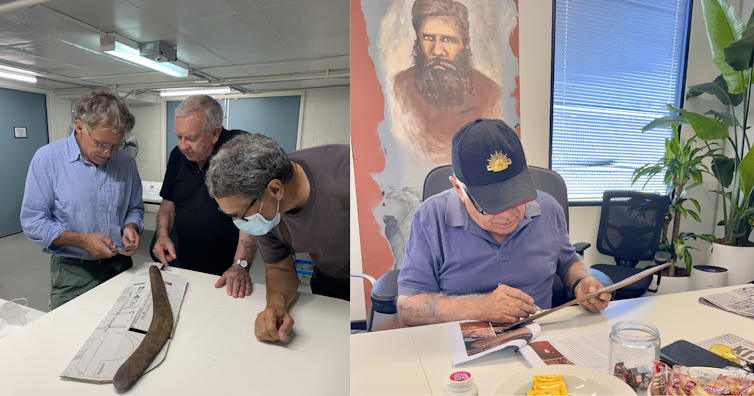
Left: Richard Fullagar and Wurundjeri Woi-wurrung Elders Ron Jones and Allan Wandin inspecting the wangim (boomerang). Right: Wurundjeri Woi-wurrung Elder Bob Mullins analysing the wangim.
Caroline Spry

Residues and wear patterns

Investigation of the wangim using a microscope revealed clues about how it was made and used. The wangim contains residues, or traces of materials with which it came into contact. It also bears wear patterns – physical alterations to its surfaces and edges from contact with other materials.

The wear patterns indicate grip marks by a right-handed liwik. They also reveal impact traces from when the wangim was thrown and came into contact with other (hard) items. Blood on the wangim highlights its role during hunting. Charcoal and fire marks may have resulted from using the boomerang to stoke a campfire, or from boomerang repair activities.

Close-up pictures of details of a boomerang
Detail of wear patterns and residues identified on the wangim (boomerang), including blood (E-G).
Elspeth Hayes and Richard Fullagar

Significance

The Yarra Junction wangim is unusual in terms of its size and shape compared with other examples held in Museums Victoria collections. It has a wider elbow (curved section), and rounder but less elongated extremities, among other differences.

The wangim was clearly an item of great personal attachment, as evidenced by its continued repair and use, and burial with its owner.

For Wurundjeri Woi-wurrung Elders Aunty Di Kerr, Bob Mullins, Ron Jones and Allan Wandin, the wangim is significant as a tangible link to their liwik. Wooden items that belonged to liwik have a limited lifespan compared to other artefacts made of stone, shell and bone. Repatriated items also provide a connection to a cultural landscape that may have been developed or destroyed since colonisation.

Information shared by Elder Bob attests to the continuation of boomerang traditions by Aboriginal and Torres Strait Islander peoples today. Boomerangs were, and continue to be, an important part of First Peoples’ history and identity.


The authors wish to acknowledge all Wurundjeri Woi-wurrung Elders, community and staff, Clint Cooper, the Ancestral Remains Unit at First Peoples-State Relations, Museums Victoria, John Duggan and the following co-authors of the original study published in Australian Archaeology: Luc Bordes, Richard Fullagar, Zara Lasky-Davison, Wendy Morrison, Lauren Modra, Lauren Gribble, Maria Daikos, Anna Alcorn and Wurundjeri Woi-wurrung Cultural Heritage Aboriginal Corporation.

The Conversation

Caroline Spry undertakes research work for La Trobe University.

Allan Wandin works for Wurundjeri Woi-wurrung Cultural Heritage Aboriginal Corporation.

Bob Mullins works for Wurundjeri Woi-wurrung Cultural Heritage Aboriginal Corporation.

Diane Kerr works for Wurundjeri Woi-wurrung Cultural Heritage Aboriginal Corporation.

Elspeth Hayes undertakes research work for the University of Melbourne.

Ron Jones works for Wurundjeri Woi-wurrung Cultural Heritage Aboriginal Corporation.

ref. How forensic analysis and traditional knowledge reveal the story of a unique boomerang – https://theconversation.com/how-forensic-analysis-and-traditional-knowledge-reveal-the-story-of-a-unique-boomerang-265876

Switching off the huge Gladstone coal station in 2029 will cause problems. It needs a longer, smarter phase-out

Source: The Conversation (Au and NZ) – By Alexander Klimenko, Director, Centre for Multiscale Energy Systems, The University of Queensland

This month, Rio Tinto announced plans to bring forward the closure of Gladstone Power Station to 2029, six years ahead of schedule. The move was welcomed by environmental groups, as Gladstone is Queensland’s oldest and largest coal-fired station. It has struggled to compete with emerging renewable generation in recent years and outages have become more frequent.

The large 1.6 gigawatt plant feeds much of its power to the nearby Boyne aluminium smelter, which uses roughly the same amount of power as all of residential Sydney or twice the demand of residential Brisbane.

To fill the gap, Rio Tinto has secured about 3GW of renewable power capacity. That may seem impressive, but the variability of renewables means the actual power produced will be roughly a quarter of this.

More renewables can be built, but the smelter won’t be able to run safely until there’s enough energy storage available to ensure it can keep running overnight and through rainy or low-wind periods. Any interruption can cause irreparable damage to the smelter.

Closing the plant in four years’ time is unrealistic. Far better to begin a staged phase-out, where new thermal energy storage is built on the coal plant site while new energy capacity comes online.

This might appeal to the current Queensland government, which last week released its energy road map. The plan dials back renewable ambition, puts a question mark over pumped hydro, supports more gas plants and opens the door to keeping ageing coal plants open longer.

aerial view of an aluminium smelter, industrial facility surrounded by bushland and sea.
Rio Tinto’s Boyne aluminium smelter requires huge amounts of reliable electricity.
Rio Tinto

Energy storage and grid stability are essential

Australia’s aluminium industry is built on natural advantages, such as bauxite ore resources and moderately priced power.

Even if all existing grid-scale batteries and those coming online by 2029 were devoted just to the Boyne smelter, their combined capacity would be still be far below what would be required to carry the smelter through a single day and night. Batteries make most commercial sense over short periods where prices are high, but they do not solve the problem of long-duration storage.

Pumped-hydro schemes can offer energy storage at scale. If the 2GW Borumba pumped-hydro project was built by 2029 and largely dedicated to the smelter, it could, in principle, fill the gap left by Gladstone.

But this is unlikely. The government is reviewing Borumba. If the project proceeds, it will be needed to support Queensland’s broader energy transition and to recover its substantial capital cost. Large smelters tend to buy power with direct contracts substantially below the average market price. Construction is likely to extend out at least to 2033.

Coal power stations don’t just produce power. Their large spinning turbines and rotors create synchronous inertia – a key way the grid is kept stable. Retiring Gladstone would also mean removing a large source of synchronous inertia. If this is done too fast, planned replacements such as synchronous condensers wouldn’t be in place. This would risk grid stability.

We face a paradox of transition. Coal generation has to wind down to avert the worst of climate change. But it has to be done carefully so the lights stay on and industries can run without interruption. Storage and grid-stabilising measures will be essential.

What should be done? To ensure reliability for the Boyne smelter, authorities must complement renewables with a range of energy storage options.

A thermal solution?

A realistic option is to phase down Gladstone Power Station rather than switching it off at a set date. To do this, one option is to supplement coal-fired generation with thermal energy storage.

This type of storage relies on storing heat in molten salts or other materials. The heat can be turned into electricity later. The technology is well established – the world’s largest thermal battery, Dubai’s Noor Energy 1, stores almost 6 gigawatt-hours of energy.

Coal stations don’t work well alongside the variability of renewables, as it takes time for coal plants to start up and shut down. This is where thermal storage could help.

When renewable output was high, the coal plant would continue operating. But instead of directing steam to spin turbines to produce electricity, it would burn coal to heat molten salts. The heat could then be converted to electricity when power prices are high and solar stops producing, such as during evening peaks and overnight.

This would decouple the coal station from fluctuating grid demand. It would also reduce coal use and pollution while improving the economics of the coal plant.

During periods of excess renewable production, Gladstone could become a heat battery. It could store excess power in molten salts at low or even negative cost and sell it back to the grid when prices rise.

Other measures could be added, such as installing solar-thermal arrays to heat up the molten salts, meaning still less need for coal. Over time, Gladstone’s role could evolve to spend more time as an energy store and less as a coal-fired generator.

Eventually, the generation units could stop burning coal routinely but keep their capacity to use coal during an emergency.

large tank to store molten salts, industrial facility.
Storing heat in molten salts or other materials could be a way to progressively phase out coal power stations. Pictured: a molten salt storage tank at a solar thermal installation.
US Department of Energy

A true transition isn’t off or on

There’s an appeal to simply switching off a large coal plant and ending a big source of emissions. But for large stations tied to smelters, it’s not that easy.

Adding new features to an ageing coal station may seem like a kludge. But transitions are messy. It would make sense to use this asset cleverly, keeping the useful elements and phasing out the part we don’t want: burning coal.

Storing energy as heat isn’t as efficient as storing power in batteries. But efficiency isn’t the only thing that matters. The system also needs to work during the transition.

Thermal storage plants have lifespans of more than 30 years, even when used daily. Workers could use their skills at the new facilities. If there was an energy emergency or lengthy dip in renewable production, the old coal warhorse could be fired up as a backup generator.

Adding thermal storage to Gladstone could help the entire state grid make the shift from coal and gas to renewables and storage.

The Conversation

A.Y. Klimenko receives funding from Australian Research Council and Queensland State Government to study energy storage options (e.g. hydrogen, CAES) for energy transition in Australia. The specific storage scheme proposed in the present article is novel and has not been funded from any source, industry or government.

ref. Switching off the huge Gladstone coal station in 2029 will cause problems. It needs a longer, smarter phase-out – https://theconversation.com/switching-off-the-huge-gladstone-coal-station-in-2029-will-cause-problems-it-needs-a-longer-smarter-phase-out-267326

A Supreme Court showdown looms for Trump’s tariffs. Will it limit presidential power?

Source: The Conversation (Au and NZ) – By David Smith, Associate Professor in American Politics and Foreign Policy, US Studies Centre, University of Sydney

On November 5 the US Supreme Court will begin hearing arguments about the legality of President Donald Trump’s tariffs. As important as the tariff issue is, the stakes are much higher than that.

Trump has been claiming vast powers, at the expense of other branches of government, on the grounds of various “emergencies”. He has used these claims to justify sending troops to US cities and deporting non-citizens without due process under a law dating from 1798.

Trump imposed sweeping global tariffs under the auspices of the International Emergency Economic Powers Act (IEEPA) of 1977. Most legal experts agree, and so far three lower courts have ruled, that this act gives him no such power.

This case now presents an important test of the Supreme Court’s willingness to impose limits on Trump’s emergency powers.

The powers Trump is claiming

The US Constitution gives Congress, not the president, the power to set tariffs. Since the 1930s, Congress has passed a series of laws granting presidents the authority to adjust existing tariffs and deploy them to protect industries that are crucial to US national security.

The tariffs Trump has imposed this year go beyond the powers any previous president has had.

Some of Trump’s tariffs on goods in specific sectors such as steel and aluminium are authorised under Section 232 of the Trade Expansion Act because of their importance to military industries.

But to justify blanket tariff rates on entire countries, regardless of the goods involved, Trump has turned to the International Economic Emergency Powers Act (IEEPA).

This allows the president to block economic transactions and freeze assets after declaring an emergency. These actions usually target hostile powers or individuals. An emergency is an “unusual and extraordinary threat” to the US, originating “in whole or substantial part outside the United States”.

Trump originally claimed tariffs against Canada, Mexico and China were necessary to force those countries stop the traffic in fentanyl, which causes more than 70,000 overdose deaths in the US every year. Yet less than 1% of the fentanyl that enters the US comes from Canada.

For the “liberation day” tariffs affecting every other country in the world, Trump declared the annual US trade deficit in goods constituted “an unusual and extraordinary threat to the national security and economy of the United States”.

This trade deficit has been running since 1976, and it widened during Trump’s first administration.

The court case

The Trump administration is being sued by a group of small businesses that have been hurt by the 2025 tariffs, and which claim Trump had no right to impose them. They are supported by a bipartisan group of legal scholars.

A small business owner suing Trump over tariffs explains his decision.

Two federal courts and the US Court of International Trade have so far ruled IEEPA does not give the president the power to set tariffs.

The IEEPA was an amendment to the 1917 Trading with the Enemy Act, which the then president Richard Nixon used to impose 10% import tariffs during a trade crisis in 1971. The Trump administration has argued that because those tariffs were upheld by courts, Trump’s are also valid.

But the IEEPA, passed in 1977 following post-Watergate reforms of emergency powers, was intended to limit executive power, not expand it.

In the words of a report from the House Committee on International Relations that underpinned the reforms, “emergencies are by their nature rare and brief, and are not to be equated with normal ongoing problems”.

What will the Supreme Court do?

The weakness of the administration’s legal arguments is reflected in Trump’s public statements about why the Supreme Court must uphold his tariffs. These statements increasingly read like blackmail notes. He has said striking down the tariffs would “literally destroy the United States of America”.

As well as bringing in billions of dollars in revenue, Trump claims five of the eight wars he has supposedly ended were thanks to tariff leverage, and “if they took away tariffs, then they’ve taken away our national security”.

Striking down tariffs could be economically disruptive. It would weaken US leverage in trade negotiations, and raise the possibility of large tariff refunds.

These threats may persuade conservative Supreme Court justices who already take an expansive view of executive power, and who have so far enabled Trump’s accumulation of it.

However, the one area where Supreme Court conservatives might be willing to limit Trump’s powers is where they interfere with economic orthodoxy.

In a ruling allowing Trump to fire commissioners of some small, independent agencies, the court also appeared to protect members of the US central bank, the Federal Reserve, because of its “distinct historical tradition”.

The Supreme Court has since temporarily blocked Trump’s attempt to fire one of the Federal Reserve governors, Lisa Cook. The judges may also decide that allowing a president to impose unlimited new taxes is a step too far.

Even if the Supreme Court does strike down the IEEPA tariffs, Trump is unlikely to abandon tariffs as a policy tool. They are a core part of his identity.

The administration has already vowed that if it loses in the Supreme Court, it will find other ways to impose tariffs under different laws that “have the same effect”.

The significance of the Supreme Court’s decision may not be about the tariffs themselves, but about whether it recognises any limit to presidential power.

The Conversation

David Smith does not work for, consult, own shares in or receive funding from any company or organisation that would benefit from this article, and has disclosed no relevant affiliations beyond their academic appointment.

ref. A Supreme Court showdown looms for Trump’s tariffs. Will it limit presidential power? – https://theconversation.com/a-supreme-court-showdown-looms-for-trumps-tariffs-will-it-limit-presidential-power-267630

Will the ‘military sleep method’ really help me fall asleep in 2 minutes?

Source: The Conversation (Au and NZ) – By Dean J. Miller, Senior Lecturer, Appleton Institute, HealthWise Research Group, CQUniversity Australia

LightFieldStudios/Getty

Has a camouflaged athlete running on a dirt road ever shouted health advice through your phone? Sometimes these videos are motivational and get you off the couch to start exercising; sometimes they’re educational. But can their advice help us civilians?

Let’s look at what it means to follow the “military sleep method”. There are various versions circulating on social media, including claims it can help you drop off in two minutes.

It certainly sounds appealing.

I research sleep and the body clock. And in field work, I have been part of several high-performance environments, helping athletes and military personnel counter fatigue and jet lag, and to get better sleep.

Here’s why the military sleep method might work for soldiers. But could it also work for you?

Just 3 steps to sleep?

The military sleep method, as the name suggests, is meant to help military personnel prime their body for sleep, regardless of the environment.

The first mention of the method is credited to a sports performance book called Relax and Win.

Reports of the military sleep method can vary slightly depending on the source. But three key components remain consistent:

  1. progressive muscle relaxation: contracting and relaxing the muscles of the face, then the shoulders and arms, before moving down through the chest and legs

  2. controlled breathing: breathing is slowed and controlled, emphasising longer exhalations

  3. visualisation: imagining a calm environment, such as floating on calm water or lying in a quiet field.

Is this science or folklore?

As you may expect, the militaries of the world are not publishing their sleep techniques in open access journals. So there are no specific validations of the military sleep method in mainstream science.

So, let’s compare it to the recommended first-line treatment for insomnia, known as cognitive behaviour therapy for insomnia, or CBT-I.

This involves several key components:

  1. cognitive therapy: challenging unrealistic beliefs and worries about sleep

  2. stimulus control: strengthening the bed–sleep connection by avoiding non-sleep activities in bed and only lying down when sleepy

  3. sleep restriction: initially limiting time in bed to build sleep pressure

  4. sleep hygiene: maintaining healthy routines and environments, such as limiting caffeine and alcohol, keeping a consistent schedule, and making the bedroom a relaxing space, not associated with other activities

  5. relaxation techniques: using techniques such as mindfulness, progressive muscle relaxation, or breathing, to reduce arousal and help you fall asleep.

Sounds familiar?

Notice the similarities between the military sleep method and CBT-I? Some context is also similar. For instance, soldiers may be sleep deprived, and sleep restriction is part of CBT-I. They have also been trained to have strong control of their thoughts, and CBT-I uses cognitive therapy.

Differences between the two also relate to the high-performance military environment. For instance, defence personnel will have no control of their sleep hygiene.

In other words, think of the military sleep method as sharing aspects of CBT-I, but tailored to defence personnel and focusing on three things they can control.

Can you really fall asleep in 2 minutes?

Based on these similarities, it is entirely possible the steps outlined in the military sleep method can help most of us fall asleep faster. But do we really need to fall asleep in two minutes?

In an unfortunate hit to the ego, most of us are not high-performance personnel. It is unlikely we experience the psychological and physiological demands the military sleep method was intended for. So for civilians, falling asleep in two minutes is an unrealistic goal.

As a general guideline, consistently falling asleep within eight minutes is considered unusual, and consistently falling asleep within five minutes can be a sign of excessive daytime sleepiness.

For civilians working nine-to-five and maintaining a regular schedule, falling asleep within ten to 20 minutes is considered normal.

But if you are a shift-worker, new parent, or have a diagnosed sleep disorder, these numbers may not apply.

So, should I sleep like a soldier?

Soldiers are trained extensively on how their physiology functions in challenging environments. The aim of this training is to give them as much control over their bodies as possible, including how best to fall asleep.

The military sleep method is a catchy way to package healthy sleep techniques. In practice it’s a blend of tools already grounded in sleep science (relaxation, breathing and visualisation).

It won’t harm your sleep to try it, but shift the goalposts away from the two-minute target.

If you’re fixated on falling asleep within two minutes, and start worrying when you don’t, that very worry can make it harder to sleep.


If you’re having ongoing problems with your sleep, or suspect you may have a sleep disorder, see a medical professional, such as your GP, for advice and assessment. If needed, they’ll refer you to a sleep specialist.

Dean J. Miller does not work for, consult, own shares in or receive funding from any company or organisation that would benefit from this article, and has disclosed no relevant affiliations beyond their academic appointment.

ref. Will the ‘military sleep method’ really help me fall asleep in 2 minutes? – https://theconversation.com/will-the-military-sleep-method-really-help-me-fall-asleep-in-2-minutes-265193

The uneasy history of horror films and disability

Source: The Conversation (Au and NZ) – By Gwyneth Peaty, Research Fellow, School of Media, Creative Arts and Social Inquiry, Curtin University

Historically, horror films have been popular during times of social upheaval, as they allow audiences to work through collective cultural anxieties by tapping into their greatest fears. And “fear” is often built around ideas of what is “abnormal” – that is, different from socially constructed norms.

Throughout horror film history, disability has often been used as a visual shorthand marking the boundary between normal and abnormal.

Disability has long featured problematically as a metaphor for horror, evil or monstrosity. But a new wave of filmmakers are using horror to reflect on the lived experiences of people with disability.

Obsessive avengers

In horror, people with physical or intellectual disability often feature as villains driven by an obsessive desire for revenge on a world that caused their pain. We see this trope repeated in a number of slasher films from the 1970s and ‘80s, including Halloween (1978), Friday the 13th (1980), A Nightmare on Elm Street (1984) and The Texas Chain Saw Massacre (1974).

Disability film scholar Martin Norden describes this horror archetype as the obsessive avenger:

an egomaniacal sort, almost always a male, who does not rest until he has his revenge on those he holds responsible for his disablement and/or violating his moral code in some other way.

This connection between disability and villainy is no accident. In preparing for his role as Leatherface in The Texas Chain Saw Massacre, actor Gunnar Hansen observed students with intellectual disability at a specialist school, and adopted their mannerisms.

An evolving landscape

Disabled people are speaking out online about how their lives are impacted by harmful stereotypes of disability in the media. And this push for advocacy and awareness has led to shifts in cultural attitudes and film content policies.

In 2018, the British Film Institute announced it would no longer fund films that represent people with facial differences as evil or villainous. This decision was in direct response to the #IAmNotYourVillain campaign run by UK charity Changing Faces.

Under increasing scrutiny, filmmakers have also been called out for using disability as a symbol of horror, evil, or monstrosity.

Warner Bros was forced to apologize in 2020 after Anne Hathaway’s character in The Witches was criticised for stigmatising limb differences. Viewers noticed the resemblance between her “claws” in the film and a real-life genetic condition called ectrodactyly. This led to the #NotAWitch hashtag trending on social media.

Actor Lupita Nyong’o has apologised for using spasmodic dysphonia, a real larynx disorder, as inspiration for her evil doppelganger’s voice in Jordan Peele’s 2019 film Us.

The National Spasmodic Dysphonia Association pointed out:

Spasmodic dysphonia is not a creepy voice; it’s not a scary voice. It’s a disability that people are living with and [they] shouldn’t be judged on.

Also in 2019, director Ari Aster was criticised for using the character of Ruben, a disabled child, for shock value in the horror hit Midsommar. As film critic Emma Madden argued in an article for The Guardian:

In keeping with Aster’s previous film Hereditary, in which physical and mental disability provides a metaphor for trauma and familial dysfunction, the disabled body once again becomes the monstrous body, used to convey a monstrous world.

From monster to hero

Many disabled people are huge fans of horror. The goal of critique is not to destroy monsters, or erase the horror genre, but to reduce its narrative dependence on ableism.

As horror fan Lotto Ramsay points out:

I want to feel horror. I don’t want to be the horror.

Today’s filmmakers are increasingly creating horror stories where the protagonist is disabled – perhaps in response to changing audience expectations and commentary. In doing so, they can interrogate the idea of “normal” in new ways. Some more recent horror films have even framed physical disability as an advantage, such as in Bird Box (2019) and A Quiet Place (2018).

In the slasher film Hush (2016), protagonist Maddie Young (Kate Siegel) is a deaf writer who uses American Sign Language to communicate. Stalked by a vicious killer she can’t hear, Maddie draws the audience into her desperate struggle for survival, encouraging them to identify with a disabled character in a horror context.

Of course, having a disabled protagonist does not guarantee the film will be free from ableism or negative stereotypes. The Advent Calendar (2021), a horror film with a wheelchair user at its centre, falls into old stereotypes by framing disability as something that needs “fixing”.

Just as we can look back on past horror as reflective of outdated attitudes towards race, gender and sexuality, so too does horror reflect the changing social construction of disability.

And this means future horror creators have a chance to tell stories which people with disability can enjoy – rather than feel targeted by.

Katie Ellis receives funding from the Australian Research Council.

Gwyneth Peaty does not work for, consult, own shares in or receive funding from any company or organisation that would benefit from this article, and has disclosed no relevant affiliations beyond their academic appointment.

ref. The uneasy history of horror films and disability – https://theconversation.com/the-uneasy-history-of-horror-films-and-disability-263344

Mega-strike: where is the ‘ethical line’ in public health and are doctors really crossing it?

Source: The Conversation (Au and NZ) – By Elizabeth Fenton, Senior Lecturer in Bioethics, University of Otago

Minister of Health Simeon Brown. Hagen Hopkins/Getty Images

Health Minister Simeon Brown’s claim that this week’s industrial action by doctors “crosses an ethical line” misunderstands doctors’ ethical responsibilities.

Doctors and nurses, together with teachers, are among tens of thousands expected to take part in a multi-sector “mega-strike” on Thursday.

Striking is an option of last resort. In healthcare, it causes disruption and inconvenience for patients, whānau and the health system – but it is ethically justified.

Arguably, it is ethically required when poor working conditions associated with staff shortages, inadequate infrastructure and underfunding threaten the wellbeing of patients and the long-term sustainability of public health services.

The impact of these conditions on retention and recruitment of doctors in New Zealand is well documented. A 2022 survey shows almost 11% of doctors planned to leave New Zealand permanently, up from less than 5% in 2017. Only 62% planned to continue working in the public healthcare system in 2022, compared to 83% in 2017.

The real ethical issue is successive governments’ failure to address these conditions and their impact on patient care.

Duty of care

The minister’s comments imply that striking doctors are failing to meet their ethical obligations to provide care.

These are the same doctors who, alongside nurses, carers and allied health professionals, kept New Zealand’s health system functioning during the COVID pandemic in the face of heightened personal risk, often inadequate protections and substantial additional burdens.

While the duty of care is of primary ethical importance, codes of ethics also recognise doctors’ duties to all patients, and responsibilities to advocate for adequate resourcing in the health system. These duties may justify compromising care to individual patients under the circumstances in which industrial action is considered.

As was well recognised during the COVID pandemic, governments have reciprocal duties to healthcare workers, including to provide safe and well resourced working environments.

The health minister seems to imply doctors are striking solely for individual gain. But like all healthcare workers, doctors take seriously their obligations to provide high-quality care in the public health system.

They are striking because their ability to meet these obligations is routinely compromised by working conditions that contribute to burnout and moral injury – the impact of having to work under circumstances that violate core moral values.

A key goal of the industrial action is to demand better conditions for clinical care, such as safe staffing levels, that will benefit patients and staff and improve the health system for everyone.

The right to strike

The minister may be concerned that strike action goes against doctors’ obligation to “do no harm”, or to put their patients’ interests first. These are important ethical commitments. But, like many ethical commitments, they are not absolute and must be balanced against other values and interests.

The potential risks of surgery, for example, are balanced against the patient’s likelihood of a long-term health gain. While doctors must provide life-preserving care during strike action, and minimise potential harms, some disruptions and inconveniences are ethically justified in light of the public interest in a safe, high-quality health service.

Doctors can argue they are striking out of concern that unless their claims are addressed even greater harms will result.

When healthcare workers are underpaid, undervalued and overworked, it is challenging to recruit and retain staff, undermining efforts to provide high-quality care.

As a party to the code of good faith in the Employment Relations Act 2000, Health New Zealand – and ultimately the minister of health – are required to commit to “develop, maintain and provide high-quality public health services”.

We should also be concerned about societal harms resulting from preventing doctors or other healthcare workers from taking industrial action in the future.

The right to strike is an important entitlement of workers to protect their social and economic interests. It is recognised internationally (in the International Covenant on Economic, Social and Cultural Rights) and protected under New Zealand’s employment law.

Preventing doctors from striking would violate this right. It would also risk the safety and wellbeing of patients by removing the capacity of doctors to demand better conditions in our hospitals.

Thursday’s strike action by doctors, alongside teachers, nurses and other health professionals, is ethically justified in defense of high-quality public services for everyone.

Elizabeth Fenton is chair of the National Ethics Advisory Committee.

ref. Mega-strike: where is the ‘ethical line’ in public health and are doctors really crossing it? – https://theconversation.com/mega-strike-where-is-the-ethical-line-in-public-health-and-are-doctors-really-crossing-it-267950

Eugene Doyle: Palestinian ‘Mandela’ beaten unconscious – Western leaders yawned and looked away

COMMENTARY: By Eugene Doyle

Israel and the West pretend they want a real peace in Israel-Palestine yet the Israelis have beaten unconscious the man most likely to help realise a sustainable end to the conflict: Marwan Barghouti.

The ethnocentrism of Western culture is such that 20 Israeli hostages received vastly more coverage than thousands of Palestinian hostages, nearly 2000 of whom were released as part of the recent exchange.

These prisoners, physically emaciated, most emotionally shattered, many children, most having never been charged, some held for decades, emerged from the Dantesque Inferno of the Israeli prison system. Most had some kind of disease, commonly scabies, due to the infested and infected conditions of the gulag.

Five Palestinian detainees released and exiled to Egypt brought with them terrible news: the great Palestinian leader Marwan Barghouti — the person most likely to lead a free Palestine — had recently been beaten unconscious by his captors.

According to the Times of Israel, Security Minister Itamar Ben-Gvir who oversees the Israeli Prison System says he is “proud that Barghouti’s conditions have changed drastically”.

What Nelson Mandela would say about the beating of Marwan
Marwan Barghouti — Palestine’s most loved and revered leader, a living symbol of the resistance — was beaten unconscious by 8 Israeli guards, according to the testimony of fellow prisoners on arrival in Cairo. The attack left the 66-year-old with broken ribs and head injuries.

When called on to demand his protection, British Prime Minister Keir Starmer and other Western leaders yawned and looked the other way. That response defined the depths that the Western world has reached in its permissiveness of violence towards Palestinian prisoners.

Marwan Barghouti is commonly referred to as the Palestinian Mandela, a man who has the attributes to not only unite the many Palestinian factions but also negotiate a lasting peace, if given the opportunity.

Mandela couldn’t have been “Mandela” without him surviving and being released — which is a tribute to the ANC and other fighters for freedom, as well as to the global boycott, divestment and sanctions campaigns that finally convinced the regime to negotiate.

The same was true of the Good Friday Agreement for Northern Ireland which saw the release of prisoners that one side considered terrorists. The British also came to accept that negotiation with leaders like Gerry Adams and Martin McGuinness of the IRA was essential precisely because they had the street credibility to deliver peace.

It is worth pointing out that Mandela said he was not personally beaten during his 27 years of captivity by the racist South African apartheid regime.

Barghouti, who has spent the last 23 years in prisons has had at least four beatings by the Israelis in the past three years alone. The Israelis have shown nothing but contempt for the Geneva Conventions, the laws of war, Red Cross requests, or any benchmark of human decency.

They are our “friends and allies” with whom we share values.


‘He has been in a struggle for 50 years’.           Video: TRT News

Rules on prisoner treatment
After leaving Robben Island to eventually become South Africa’s first black President, the convicted terrorist and revolutionary Prisoner 46664 helped author the Nelson Mandela Rules on prisoner treatment, adopted by the United Nations in 2015. He had seen the mistreatment of many of his comrades by racist white South Africa, a close ally of most of our governments.

The scale of what is being done by Israel in its mass torture centres would be beyond anything Mandela could have imagined. Unlike morally repellent leaders like New Zealand’s Luxon, UK’s Starmer, France’s Macron or Germany’s Merz, he would never have failed to act.

A central tenet of the Mandela Rules is that people behind bars are not beyond human rights. Countries — and, yes, that includes Israel — must adhere to minimum standards such as, “No prisoner shall be subjected to, and all prisoners shall be protected from, torture and other cruel, inhuman or degrading treatment or punishment, for which no circumstances whatsoever may be invoked as a justification.”

Recently released Palestinians, most in shocking physical condition, talked of having to drink toilet water, beatings, being denied medical treatment, constant humiliations, including sexual violence, committed by the Israelis.

This kind of behaviour has long been documented by international human rights organisations, including Amnesty International and Human Rights Watch — and largely ignored by the mainstream media.

The Israelis, never forget, are our close friends, with whom we share “values”.

I have written a number of articles about Marwan and, to avoid repetition, I recommend those unfamiliar with his astonishing story to read them. My last article, Saving Marwan Barghouti is our duty, in August, was part of a global push to prevent Marwan facing further mistreatment. I was shocked at the time to see the video that Israeli Minister Ben-Gvir posted to show the power he personally had over Marwan whose physical condition had obviously deteriorated to a terrible extent. Now he has been beaten, for the fourth time.

“It is a clear declaration that they are threatening my father’s life,” his son Arab Barghouti said this week.

Prisons are ‘Israeli sadism in a nutshell’
One person who watched the release of the prisoners last week was veteran Israeli journalist Amira Hass, correspondent on the Occupied Palestinian Territories for Israel’s leading newspaper Haaretz.

“It was a kind of parade of skeletons,” Hass said. “These last two years, it’s like the Israeli prisons have become Israeli sadism in a nutshell,” she told Democracy Now!.

“The way that prisoners were treated during these two years is unprecedented in Israel. They didn’t only come out emaciated; they came out ill, sick. Some of them have lost limbs. It’s indescribable.”

Hass’s own parents were Holocaust survivors, her mother surviving nine months in the notorious Bergen-Belsen concentration camp. Now, along with all of us, she is witness to genocide.

She makes the fine observation that people aren’t born cruel; they become so. I would add: we in the West helped the Israelis become so depraved by ignoring their abuses for so long. Former human rights lawyer Keir Starmer is a case in point.

In the UK Parliament on October 14, Green MP Ellie Chowns asked Starmer:

“Can I ask the Prime Minister what recent representation his government has made in the last few days to secure the immediate release of Mr Barghouti, given his widespread popularity as a unifying voice for Palestinian rights, dignity and freedom, and therefore his potential crucial role in securing a meaningful and lasting peace in the region?”

Starmer is an avatar for the West: complicit in genocide and disturbingly detached from the suffering of the Palestinian people.

Starmer is an avatar for the West . . . complicit in genocide and disturbingly detached from the suffering of the Palestinian people. Image: www.solidarity.co.nz

Starmer, who has less human decency in his entire being than Nelson Mandela had in one nostril hair, refused to even mention Barghouti by name. His lawyerly reply:

“Thank you for raising the individual case. We offer to provide such further information as we can, as soon as we can, in relation to that particular case.”

Western leaders, including in my own country, have refused to even reply to requests that petitions/insistences be made to the Israelis to save the great Palestinian leader. They have shown more empathy for the remains of deceased Israeli hostages crushed under the rubble of buildings bombed by the Israelis, hypocritically blaming Hamas for not releasing the remains fast enough!

Such is the moral calibre of our leaders.

None of them, it should be pointed out, had anything to say when footage appeared of Israeli soldiers committing gang rape at Sde Temein Prison last year. Not only were the men not punished but by week’s end they had been blessed by Benjamin Netanyahu’s spiritual mentor Rabbi Meir Mazuz who assured one of the rapists that he had done “no wrong” and “In another country they would have given him an award”.

Never forget, the Israelis are our close friends and allies with whom, our leaders tell us, we share values.

‘Israel doesn’t want peace – they want ethnic cleansing’
Such is Marwan Barghouti’s standing that he is respected by all Palestinian factions and acknowledged as a unifying figure, a peacemaker and someone who should be leading Palestine not getting his head punched by Israeli thugs.

“That’s why they see him as a danger,” says his son, Arab Barghouti. “Because he wants to bring stability, he wants to end the cycle of violence.

“He wants a unifying Palestinian vision that is accepted by everyone, and the international community as well. But they’re [Israelis] not interested in any political settlement; they’re only interested in ethnically cleansing the Palestinian people.”

True words, those — and they demolish the fake narrative peddled by Netanyahu and other Israeli leaders that there was “no partner for peace” on the Palestinian side.

The Israelis have killed so many Palestinian negotiators, so many Palestinians leaders that the opposite is now clear: the Israelis and the West are the true enemies of peace.

I’ll give the last word to another Palestinian. I dedicate it to Keir Starmer, Christopher Luxon, Anthony Albanese and all those other leaders who stand deaf, dumb and blind to Marwan Barghouti and the thousands of Palestinian souls still suffering in Israeli captivity:

“Then He will also say to those on the left hand, ‘Depart from Me, you cursed, into the everlasting fire prepared for the devil and his angels: for I was hungry and you gave Me no food; I was thirsty and you gave Me no drink; I was a stranger and you did not take Me in, naked and you did not clothe Me, sick and in prison and you did not visit Me.’

Matthew 25, King James Bible

Eugene Doyle is a writer based in Wellington. He has written extensively on the Middle East, as well as peace and security issues in the Asia Pacific region, and he contributes to Asia Pacific Report. He hosts the public policy platform solidarity.co.nz

Article by AsiaPacificReport.nz

Netanyahu praises Papua New Guinea with ‘deep gratitude’ for backing Israel

Asia Pacific Report

Israeli Prime Minister Benjamin Netanyahu has expressed “deep gratitude” for Papua New Guinea’s support to his country over many years and during the Middle East conflict.

Prime Minister James Marape was given the message directly yesterday by Israeli Deputy Foreign Minister Sharren Haskel during a courtesy call at Melanesian House, Waigani.

The support by PNG, Fiji and a handful of other Pacific nations is controversial in the face of Israel’s growing global pariah status over its two-year genocidal war on the besieged enclave of Gaza that has killed more than 68,000 Palestinians.

A fragile ceasefire is in place between Israel and the liberation movement Hamas with the last 20 living Israeli captives being released last week in exchange for almost 2000 Palestinian prisoners, most of them held without charge.

Last month, the UN General Assembly endorsed a landmark declaration in support of an independent State of Palestine, with 142 votes in favour.

Ten countries voted against, half of them from the Pacific — Micronesia, Nauru, Palau, PNG, and Tonga — while the only other countries supporting Israel and its backer United States, were Argentina, Hungary and Paraguay. Twelve countries abstained.

Israeli Deputy Foreign Minister Haskel highlighted Prime Minister Marape’s earlier decision to open the PNG embassy in Jerusalem instead of Tel Aviv — the first Asia Pacific country to do so — and for supporting Israel at the UN, report the Post-Courier and the PNG Bulletin.

“My visit here was specifically addressed by the Prime Minister [Netanyahu] to see how we can strengthen our friendship further, and to say ‘thank you’ for standing beside us especially in the last two years,” she said.

‘Darkest hours’
“These have been some of our darkest hours since 7 October 2023 . . .

“And you have been one of the most outstanding friends we have standing together on the international front, on bilateral relationship, and in international forums.

She said the people of Israel were “extremely grateful” for the opening of the PNG embassy in Jerusalem.

“This is acknowledgement of our history, our tradition, and of us — the Jewish people — who are the indigenous people of the land of Israel; that we are able to return to revive our religion, culture and language in our ancestral homeland,” Haskel claimed.

She said Netanyahu had requested that the visit to PNG and the Pacific should proceed without delay.

Prime Minister Marape reaffirmed Papua New Guinea’s commitment to the bilateral relationship, highlighting that PNG recognised Israel’s “rights to the land of Israel through its Judeo-Christian worldview”, and continued to recognise Jerusalem as the “eternal” capital of Israel through the PNG embassy.

He added that the embassy opening had encouraged other Pacific countries — such as Fiji — to also establish their diplomatic missions in Jerusalem.

Only four other countries have done so.

Haskel reconfirmed Israel’s commitment to continue assisting PNG in the fields of science and technology, agriculture, health, small business development, and women’s empowerment.

During her two-day visit to PNG, Haskel and her delegation are meeting with ministers in respective fields.

Article by AsiaPacificReport.nz

Politics with Michelle Grattan: Tony Abbott on Australia’s past and the opposition’s future

Source: The Conversation (Au and NZ) – By Michelle Grattan, Professorial Fellow, University of Canberra

Australia’s history is distinct and much contested, stretching from its First Nations origins, to the impacts of colonialism and the birth of a multicultural nation.

Former Liberal Prime Minister Tony Abbott’s new book, “Australia: A History”, argues Australia is not perfect, but still has “a history to be proud of”.

Abbott joins us to talk about his take on Australia’s past, as well as his views of the Coalition’s current woes and how it should forge a path ahead.

On why he wanted to write this book, Abbott says he thinks Australia has “an overwhelmingly positive story” to tell.

I think these days, there’s too much focus on the downside, whether it’s Indigenous dispossession, whether it’s the White Australia Policy, there is this sense of original sin, if you like, hanging over our country. I don’t think it’s justified.

Yes, there were obvious problems for Indigenous people, given the clash of the ancient and the modern. But even at the very beginning, there were good intentions on the part of the early colonial governors. The good intentions didn’t always work out well, particularly on the frontier. But in the end, I think we have to accept that it was inevitable that Australia would be settled, and that British settlement, on balance, has been overwhelmingly a good thing for every Australian, including eventually even Aboriginal Australia.

On immigration, Abbott agrees it’s been “central” to the Australian story, but says he prefers cultural assimilation to multiculturalism.

Generally speaking, all of our immigrants – from 1788 to this very day – have come to Australia to join us, not to change us. I’m not a big fan of the policy of multiculturalism, and I do think that one difference between the post-war immigration and contemporary immigration is that the post-war migrants were expected by officialdom to integrate immediately and ultimately to assimilate.

I think that migrants, almost to a man and a woman, from the beginning to this day, have very much wanted to become Australian as quickly as possible. But official policy in more recent times has, I think, sometimes encouraged people in a degree of, if you like, separateness.

On what advice he would give to the Liberal Party, Abbott urges his party colleagues not to compromise on policy.

We should have campaigned [at the election] more strongly for our nuclear policy, and we should have campaigned more strongly against Labor’s wealth tax. But our job now – as I said back in 2009 and I think it’s a pretty good template for oppositions – the job of an effective opposition is not to make weak compromises with a bad government, but to be strong and clear and effective alternative.

[…] Successful conservative political movements are not highly ideological. They identify practical problems and come up with sensible ways of dealing with them.

On whether the Coalition is likely to split, given present fractures, Abbott says “I’m a coalitionist”.

The Liberal Party does best when it is in a strong and effective coalition with the National Party. And likewise, the National Party best helps regional Australia when they’re in a strong and effective coalition with the Liberal Party. I don’t think it’s an absolutely terrible thing if, on occasions, the National Party takes the lead. It was, in fact, the National Party that initially decided to oppose the Voice [referendum].

[…] So were the National Party, for argument’s sake, to reject the net zero straight-jacket, I don’t think that would be a Coalition-buster. But I would expect that the Liberal Party, at some point in time, would come to the same position.

On former Deputy Prime Minister Barnaby Joyce’s decision to distance himself from the Nationals and ongoing speculation that Joyce will join Pauline Hanson’s One Nation party, Abbott urges him to reconsider.

Barnaby is a great bloke. He’s one of Australia’s most effective retail politicians. I can understand his frustration at the present time. I hope that he reconsiders his decision to not stand again in New England. I hope he continues his campaign inside the National Party to get his party, and ultimately the Coalition, putting forward the best and the strongest policy position.

[…] I don’t want to see a proliferation of protest parties. And while I have considerable respect for Pauline Hanson – who I think in recent times has been certainly the most constructive of the crossbenchers as far as the Coalition is concerned – I think that people should vote for the mainstream party that best reflects their values.

The Conversation

Michelle Grattan does not work for, consult, own shares in or receive funding from any company or organisation that would benefit from this article, and has disclosed no relevant affiliations beyond their academic appointment.

ref. Politics with Michelle Grattan: Tony Abbott on Australia’s past and the opposition’s future – https://theconversation.com/politics-with-michelle-grattan-tony-abbott-on-australias-past-and-the-oppositions-future-267962

There are new plans to fix how universities will run. But will they work?

Source: The Conversation (Au and NZ) – By Ian Ramsay, Emeritus Professor, Melbourne Law School, The University of Melbourne

Australian universities enrol more than 1.4 million students per year and employ more than 130,000 staff. They receive substantial public funding – about A$22 billion each year.

They have also demonstrated substantial governance failings – or problems with the way they are run. As Education Minister Jason Clare has noted:

If you don’t think there are challenges in university governance, you’ve been living under a rock.

Two recent reports aim to tackle the problems with university governance. What did they find? And will this fix the issues?

What’s wrong with university governance?

One review is an interim report from a Labor-chaired Senate inquiry into university governance, handed down last month. The other is a federal government-comissioned “expert council” report, chaired by Melinda Cilento, who is also head of the Committee for Economic Development of Australia. This was released on Saturday.

Both reports highlight serious concerns with the way Australian universities are run. The issues include:

Both reports also identify a gap between universities’ perceptions of the quality of their governance and the experiences described by staff and students.

How can university governance be improved?

While the two reports identify similar problems, they differ in their approach to reform.

The Senate report makes a series of recommendations it believes should be compulsory for all universities.

These include publicly disclosing details of spending on consultants, having a minimum proportion of members with public administration and higher education expertise on governing bodies, and requiring meaningful consultation with staff and students around major changes.

In contrast, the expert council proposes a series of principles universities should adopt. If they don’t, they need to explain why. Essentially, this makes them voluntary.

The principles include that the governing body of a university should:

  • have an effective, transparent process for appointing the vice-chancellor

  • undertake appropriate checks before appointing a vice-chancellor or senior manager

  • have a written policy on conflicts of interest

  • ensure there are policies for important risks to be appropriately managed and regulatory obligations to be met.

The university should also:

  • operate lawfully, ethically and in a manner that’s consistent with its public purpose

  • structure its workforce and pay fairly and responsibly.

Will voluntary principles be effective?

At the weekend, Clare announced the government will require universities to report on their compliance with the principles every year. They will report to the tertiary education regulator on an “if not, why not” basis.

But will this be enough? It is difficult to understand why at least some of the principles, such as those listed above, are not mandatory. As the expert council noted in its report, universities did not always engage adequately with its review process.

[…] many of the submissions received from universities failed to engage proactively and genuinely in addressing areas of weakness [or] in identifying scope for improvement in governance practices and outcomes.

In a further development, the federal government will also ask the remuneration tribunal to help set a framework for vice-chancellors’ pay. In line with the Senate report, the government will require university councils to publish:

  • outcomes of meetings and decisions taken

  • consultancy spending, its purpose, value and justification

  • vice-chancellors’ external roles

  • annual remuneration reports in line with requirements for public companies

  • information about the membership of university councils, including members with public and higher education sector experience.

Disclosure of this type of information can better inform stakeholders’ understanding of universities. It can also improve university decision-making by subjecting decisions to greater scrutiny.

But we also need to see an improved culture within universities. This means the views of staff, students and other key stakeholders are welcomed and valued, and transparency and accountability are viewed as priorities.

This is important for rebuilding trust. As the expert council observed, it is

hard not to conclude that a lack of transparency and openness has played a key role in the observed erosion of trust within and towards universities.

The Conversation

Ian Ramsay does not work for, consult, own shares in or receive funding from any company or organisation that would benefit from this article, and has disclosed no relevant affiliations beyond their academic appointment.

ref. There are new plans to fix how universities will run. But will they work? – https://theconversation.com/there-are-new-plans-to-fix-how-universities-will-run-but-will-they-work-267859

How does a flaming piece of space junk end up on Earth? A space archaeologist explains

Source: The Conversation (Au and NZ) – By Alice Gorman, Associate Professor in Archaeology and Space Studies, Flinders University

A piece of space junk found on October 18 in Western Australia’s remote Pilbara region. WA Police

The mysterious object was on fire and lying in the middle of a remote dirt road in Western Australia’s Pilbara region when mine workers stumbled upon it.

Shortly after the enigmatic item was found on October 18, Western Australia police announced that initial assessments indicated it was made of carbon fibre and “consistent with previously identified space debris”.

The object appears to have come from a Chinese Jielong-3 rocket – possibly the one launched in September which deployed 12 satellites in low Earth orbit.

The object’s suspected identity was corroborated by expert debris watchers, who noted the orbital path of the rocket’s fourth stage passed over Western Australia at a time consistent with the debris’ discovery.

The Australian Space Agency told The Conversation the debris is “likely a propellant tank or pressure vessel from a space launch vehicle” and that it will conduct further technical analysis to confirm its origin.

Regardless, the object’s fall to Earth highlights the growing problem of space junk – and how humanity is dealing with it.

Crash landing from space

The area surrounding Earth is becoming increasingly crowded. It’s home to more than 10,000 active satellites, and possibly up to 40,000 pieces of space junk bigger than 10 centimetres. By the end of this decade, roughly 70,000 satellites could be in low Earth orbit, at altitudes below 2,000 kilometres.

Space junk refers to any piece of human-made material in space that doesn’t have a purpose. This includes dead satellites and rocket stages discarded after they’ve delivered satellites to orbit.

Space junk disposal generally relies on the debris being pulled back into the atmosphere and burning up through friction and heat.

The most problematic class of space debris is spent rocket stages. A paper presented at the International Astronautical Congress in Sydney earlier this month listed the 50 most concerning pieces of space junk in low Earth orbit – 88% of which are rocket bodies.

However, space junk is being created at a higher rate than it is re-entering Earth’s atmosphere. And now we know burning metals create harmful particulates of alumina and soot, which impact the ozone layer we rely on to filter out ultraviolet radiation.

Sometimes fuel tanks and pressure vessels reach the ground mostly intact instead of being completely incinerated. The metal alloys used to make them have a higher melting point than other spacecraft material, and they are often insulated with carbon fibre strips.

Space agencies, defence organisations and amateur debris watchers are constantly tracking the orbit – and re-entry – of space junk. This is a complex task – in part because these objects are hurtling around Earth at speeds of up to 28,000 kilometres per hour.

Controlled versus uncontrolled re-entries

The atmospheric re-entry of most space junk is uncontrolled.

Once the spacecraft runs out of fuel or batteries to power its thrusters, its orbit starts to drift. If the debris is large enough, like an old satellite or rocket body, where and when it re-enters can usually be predicted. Most of the time this is over the sea or in areas with low populations – just because this is most of the planet.

But not always. For example, in April 2022, parts of a Chinese third stage rocket crashed to Earth near a house in the Indian village of Ladori in the Maharashtra region, startling the residents who were preparing a meal at the time.

One strategy to reduce space junk is known as passivation. Passivation involves depleting all fuel and batteries so the spacecraft doesn’t spontaneously explode, creating more debris. This leaves no fuel or communications for a controlled re-entry.

A controlled re-entry involves guiding the spacecraft to a location with a low risk of harm to people, property or the environment.

One such region is the so-called “space cemetery” – a point in the Pacific Ocean roughly 2,700 kilometres from any landmass. There are about 300 spacecraft on the sea bed there, and this is where the International Space Station will be brought down at the end of the decade.

Finding the owner

The first stage of the investigation into the suspected space debris found in Western Australia will be determining who owns it.

The 1967 Outer Space Treaty says the state that authorised a rocket or satellite launch is liable for any damage it causes on Earth – even if a private company actually conducted the launch.

If the object does turn out to be from a Chinese rocket, the next step will be contacting China about its return or disposal. They may choose to leave it with Australia, as India did with a rocket fuel tank which washed up on a beach in Western Australia in 2023.

It appears the rocket body didn’t cause any harm so the negotiations won’t involve liability or insurance claims. The debris landed in a landscape already heavily impacted by mining activities so it is unlikely a claim for environmental harm can be made.

Better end-of-life planning is needed

End-of-life planning is critical for future space debris management in low Earth orbit, as there is currently no capacity to actively remove debris from that region.

The standard used to be that no spacecraft should remain in orbit after 25 years beyond the end of its mission life. Now, the expected standard for low Earth orbit is five years.

Technologies are being developed to service and refuel satellites on orbit to extend the time they can remain active in space. New materials, such as wood, are being trialled to reduce pollution of the upper atmosphere.

The European Space Agency is promoting the Zero Debris Charter which invites signatories to commit to becoming debris-neutral – that is, creating no new debris with each mission – by 2030.

In the short term, we can expect to see an increase in the amount of debris crashing down to Earth. But there is hope international collaboration and new technologies will lead to more sustainable use of space, ensuring future generations have equal access to it.

The Conversation

Alice Gorman is a Fellow of the Outer Space Institute.

ref. How does a flaming piece of space junk end up on Earth? A space archaeologist explains – https://theconversation.com/how-does-a-flaming-piece-of-space-junk-end-up-on-earth-a-space-archaeologist-explains-267856

Eat kiwifruit for constipation, new guidelines say. But ditch the high-fibre diet

Source: The Conversation (Au and NZ) – By Vincent Ho, Associate Professor and Clinical Academic Gastroenterologist, Western Sydney University

Mikhail Nilov/Pexels

New guidelines on what to eat and drink if you have chronic (long-term) constipation have been making news in recent days.

Much of the media coverage of the British Dietetic Association’s guidelines has focused on advice to eat kiwifruit every day.

Meanwhile, other recommendations have not received so much attention. One, in particular, marks a shift in managing chronic constipation. The guidelines don’t advise a high-fibre diet.

Here’s what the guidelines say help (and don’t help) to relieve chronic constipation.

What did the guidelines look at?

Researchers examined 75 clinical trials to come up with recommendations for food, drink and supplements for chronic constipation in adults.

The quality of the clinical trials varied and so they had to come up with a consensus on the quality of the trial data.

Given that constipation means different things to different people, they used a very broad definition for constipation. This encompassed what patients perceived to be constipation as well as definitions of constipation used in clinical trials. Chronic constipation is generally when someone passes few, hard stools over a period of at least three months.

The researchers produced 59 recommendations. However, the researchers said most of the recommendations were based on poor-quality evidence.

Why kiwifruit? How many a day?

The researchers recommended eating two to three kiwifruit a day for at least four weeks to improve constipation. Whether it’s green kiwifruit or gold kiwifruit the evidence clearly shows they can help.

But how? There are several reasons.

Fibre in kiwifruit swells a lot when mixed with water, more so than apple fibre. This swelling helps make stools more bulky, easing their way through the gut.

Eating the whole fruit including the skin provides more fibre than just eating the flesh but eating the kiwifruit without the skin is perfectly fine.

Green kiwifruit contains an enzyme called actinidin that helps the body digest protein in the stomach and the small intestine. This may help with constipation by making food proteins softer and easier to pass through the gut.

Kiwifruit contain a type of crystal called raphides. These are believed to increase mucus production in the gut, lubricating it and helping passage of the stool.

Eating kiwifruit may also result in reduced species of methane producing bacteria, which have been linked to constipation.

Mineral water and magnesium

The researchers reported on the benefits of drinking mineral water. They suggested drinking 0.5–1.5 litres a day (roughly two to six cups) of mineral water for two to six weeks.

Why? Mineral water often contains magnesium, which acts as a laxative. Indeed, magnesium oxide is often used as a dietary supplement for chronic constipation.

The guidelines confirmed magnesium oxide can help soften the stool and increase stool frequency. The researchers recommended taking 0.5–1.5g a day for at least four weeks.

But this may not be appropriate for everyone. For instance people with kidney disease need to be careful. Magnesium supplements may also interact with other medications.


Read more:
Should I take a magnesium supplement? Will it help me sleep or prevent muscle cramps?


Rye bread

The researchers cited studies showing rye bread relieves constipation more than white bread or common laxatives.

They recommended six to eight slices a day of rye bread for at least three weeks.

But this just isn’t realistic for a lot of people. And as rye contains gluten, this would not be appropriate for people with coeliac disease.

A high-fibre diet may not be needed after all

There was one key surprise in the guidelines.

The researchers said there was a lack of strong evidence for generic high-fibre diets for constipation, when people eat at least 25g of fibre a day.

Here’s the rationale. The researchers could only find one randomised controlled trial – the gold standard for testing interventions, such as a change in diet – where a high-fibre diet (25–30g/day) was compared with a low-fibre diet (15–20g/day).

This trial showed no benefit for the high-fibre diet in improving constipation. People on the low-fibre diet farted less and were less bloated than people on the high-fibre diet.

This does not mean fibre doesn’t help constipation. There is good evidence for supplementing your diet with more fibre to help chronic constipation.

But rather than focusing on a high-fibre diet for constipation, the guidelines instead recommend taking at least 10g a day of a fibre supplement, such as psyllium.

A high-fibre diet is usually a key part of national dietary guidelines. For example the Dietary Guidelines for Americans recommends some adults have a dietary fibre intake of at least 28g a day. There are certainly health benefits such as lowered cholesterol and blood sugar levels from eating a high-fibre diet.

But we now know it’s not needed to relieve chronic constipation.

What can we take away from the guidelines?

These guidelines provide more personalised, evidence-based dietary advice tailored to patient symptoms than previous guidelines.

Kiwifruit are considered a safe and effective treatment for chronic constipation. Mineral water, magnesium supplements and rye bread can help too.

But it would be worth discussing magnesium supplements with a health professional, especially if there are concerns about kidney disease or you take other medications.

The Conversation

Vincent Ho does not work for, consult, own shares in or receive funding from any company or organisation that would benefit from this article, and has disclosed no relevant affiliations beyond their academic appointment.

ref. Eat kiwifruit for constipation, new guidelines say. But ditch the high-fibre diet – https://theconversation.com/eat-kiwifruit-for-constipation-new-guidelines-say-but-ditch-the-high-fibre-diet-267617

Can Albanese claim ‘success’ with Trump? Beyond the banter, the vague commitments should be viewed with scepticism

Source: The Conversation (Au and NZ) – By Emma Shortis, Adjunct Senior Fellow, School of Global, Urban and Social Studies, RMIT University

By all the usual diplomatic measures, Australian Prime Minister Anthony Albanese’s meeting with US President Donald Trump was a great success.

“Success” in a meeting with Trump is to avoid the ritual humiliation the president sometimes likes to inflict on his interlocutors. In that sense, Albanese and his team pulled off an impressive diplomatic feat.

While there was one awkward moment with Australia’s ambassador to the United States, former prime minister Kevin Rudd, on the scale of Trumpian possibilities, that was relatively minor.

Much of the media coverage has noted the laughter and ripples of relief that spread through the room as the moment was handled deftly by everyone involved.

There is much relief, too, that Albanese appears to have “confirmed” the AUKUS nuclear-powered submarine deal will go ahead, despite the as-yet-unreleased Trump administration review of the agreement.

Albanese went into the White House meeting under considerable pressure to extract some kind of guarantee about the delivery of the Virginia-class submarines to Australia from the volatile president.

Albanese seems to have met those expectations: Trump waved away concerns about the United States’ commitment to deal, overriding the more cautious language of his secretary of the navy with a clear assurance to Albanese and the press pack: “Oh no, they’re getting them”.

Albanese also signed, in bold Trumpian Sharpie style, a critical minerals deal with the US president. This is being taken as reassurance the United States remains committed to its alliance with Australia – an alliance that, like the critical minerals deal, is framed largely as a question of “security”.

As is common with the Trump administration, however, much of the detail is unclear or a problem for the future.

The deal envisioned “unlocking” up to US$5 billion (A$7.7 billion) in private investment. There are already rumblings about what the Australian government will give away in the deal, and just what “slashing red tape” on project approvals might mean.

Trump’s words on AUKUS might be hollow

Symbolically, the meeting was a success. In substance, it revealed that the fundamentals of the relationship have not changed.

While much of the focus has been on Trump’s moment with Rudd and the ambassador’s future in the role, the exchange revealed a great deal more. Trump didn’t appear to remember who Rudd is, let alone the former prime minister’s previous criticisms.

While Rudd’s position matters a great deal to the Australian media, it is not of great concern to a president who has yet to confirm a counterpart to Rudd in Australia. Ambassador Caroline Kennedy, appointed by the Biden administration, has not yet been replaced.

And while many reports suggest Trump has “confirmed” AUKUS, there is nothing to suggest this is either true or even possible.

Trump dismissed Navy Secretary John Phelan’s attempts to put some parameters around the deal after Phelan said “ambiguities” remain. Trump may well dismiss these ambiguities, but it is the navy that is handling much of the detail and the implementation of the deal itself.

And Trump may well make grand promises, but the legislation enabling the deal gives him a perfectly legitimate way to renege on the handover of the submarines, if doing so would undermine US capabilities or is deemed inconsistent with American interests. Nothing Trump promises changes that fundamental reality.

Is a full embrace of Trump wise?

That the media continues to treat Trump’s words with such credulity flies in the face of the evidence we have about a president who routinely changes his mind or reverses course. For a few hours in the White House, that reality was largely suspended.

Australia’s security alliance has generally been placed “above” domestic politics, transcending prime ministers and presidents and enjoying bipartisan support.

But as Albanese has hinted, drawing arbitrary lines between domestic affairs and foreign policy is, like the meeting with Trump itself, an exercise of symbolism over substance.

Albanese noted that Australia and the United States “have stood side by side for freedom and democracy”. Trump heaped praise on Australia, noting how much he likes the current prime minister. Albanese quipped he might use a clip of Trump saying that in his next election campaign, saying “I’ll use that in my 2028 ads!”.

Trump heaps praise on Albanese in the Oval Office.

It was an off-hand comment. But it may also reveal the blurring of boundaries between the domestic and the international: poll after poll suggests Australian voters are increasingly concerned about what the Trump administration is doing, both at home and abroad.

It is far from clear that a “warm, constructive” relationship with Trump would be well regarded by Labor’s base.

As Albanese met with Trump in the White House, demolition works had begun on the East Wing, in preparation for Trump’s new US$250 million (A$383 million) ballroom. The symbolism of that is troubling, to say the least, for a president who has mused about staying in power beyond his constitutional limits and is busy sending “Trump 2028” hats to his political enemies. He’s now demolishing part of the “people’s house” for his own vanities.

Perhaps it’s a good thing he likes Albanese. He may be around for a while yet.

The Conversation

Emma Shortis is director of International and Security Affairs at The Australia Institute, an independent think tank.

ref. Can Albanese claim ‘success’ with Trump? Beyond the banter, the vague commitments should be viewed with scepticism – https://theconversation.com/can-albanese-claim-success-with-trump-beyond-the-banter-the-vague-commitments-should-be-viewed-with-scepticism-267434

Meow Meow’s The Red Shoes takes us beyond the showgirl’s feathers and frills

Source: The Conversation (Au and NZ) – By Will Visconti, Teacher and Researcher, Art History, University of Sydney

Brett Boardman/Belvoir

While Taylor Swift has been breaking records with the release of her latest album, The Life of a Showgirl, a more compelling heir to the showgirl tradition offers audiences a glimpse into the world behind the feathers and frills.

Directed by Kate Champion, Meow Meow’s The Red Shoes is her latest interpretation of a Hans Christian Andersen fairytale, following The Little Match Girl (2012) and The Little Mermaid (2016). Here she asks what happens with the passage of time to women who are, in Meow Meow’s words, “wrong, forgotten, gone astray”.

For the opening number, Meow Meow has to be dragged into the spotlight in dishevelled undergarments. She is propped up until she can rouse herself.

She soon dons a dress and matching feathered headdress. In true showgirl style, Meow Meow has multiple costume changes (designed by Dann Barber). Or, rather, there are additions and subtractions, with outfits layered as her quest for the perfect red shoes continues and then reaches its tragic conclusion.

Vegas-style plumed headgear is complemented by moments of kleptomania as bags or scarves are taken from audience members. It’s a necessary redistribution of wealth, she reasons, as she loads herself up with items that catch her eye.

Dancing the red shoes

In Hans Christian Andersen’s original 1845 story, an orphan named Karen is adopted and given a pair of red shoes which she refuses to replace with a more sombre pair to wear to church. She is then cursed to never stop dancing. Her feet continue to dance even after their amputation, until Karen is redeemed through death and contrition.

Meow Meow’s interpretation of Karen (though she says the name matters little) is of someone pushed by necessity and seeking respite from hardship, but who is punished all the same.

Meow on a pile of junk.
Meow Meow’s character is someone seeking respite from hardship, but who is punished all the same.
Brett Boardman/Belvoir

Just as Meow Meow has questioned the need for the Little Mermaid to give up her voice or the Little Match Girl to be left in the cold while others celebrate, she launches her critique of double standards and unjust punishment at Andersen himself in a comically rapid-fire barrage of questions.

The show’s meaning and its accoutrements are sometimes the object of fun, as Meow Meow clambers over a pile of debris in the corner of the stage including odd shoes, an old fridge and late-night online impulse purchases, musing aloud whether it’s “too early” in the show to be too profound.

She melds ballet and kickline steps in her choreography, all while balancing on one solitary shoe. Initially she wears a boot similar to those worn by the Moulin Rouge dance troupe today, in her nod to “the cans and the can-cans”, later changing it for one stiletto heel and one ballet slipper.

Not just for pleasure

Joining Meow Meow in various guises, Kanen Breen is by turns the embodiment of Meow’s ideas (if “a bit sketchy”), a faun to embody bacchanalian joy, or Hans Christian Andersen himself.

He provides a resounding and accomplished tenor voice as accompaniment alongside the trio of musicians (Mark Jones, Dan Witton and Jethro Woodward). Towards the end of the show, the musicians wear tutus under coat-tails in homage to the “delirious burlesque” of a 1900 Moulin Rouge revue or to a chorus of balletic swans.

Meow Meow’s The Red Shoes dances back and forth over different centuries and styles, reinforcing her reputation as a thoroughly postmodern diva.

Meow Meow smokes and reads to a man with ram horns.
The Red Shoes dances back and forth over different centuries and styles.
Brett Boardman/Belvoir

Meow Meow is always aware of the lineage of which she is a part. She recalls other women who have preceded her. References range from Byzantium and Empress Theodora’s pearl-strewn act to Anna Pavlova and the ballet sylph.

Meow also acknowledges the cancan’s transgressive power as an act of agency by the working-class women who made it famous, and evokes a young Marlene Dietrich perched on a piano while auditioning for The Blue Angel.

Over the stage hangs a Danish saying, used as the motto of the Royal Danish Theatre, Ei blot til lyst, meaning “Not just for pleasure”. This saying is a reminder of the deeper function of the arts: a remedy and rebellion against a world awash with ignorance, conflict and the increased reliance on artificial intelligence at the cost of human connection.

All of these issues, part of the inescapable “noise of the world”, are skewered in both original songs and poignant renditions of material by Fiona Apple and Paul Anka, among others.

While no firm answers are provided for any of the multifarious themes addressed – indeed, how can one solve the ills of the world in a 75-minute show? – The Red Shoes cleaves to the aims of cabaret, defined by Meow Meow as “rigorous and instructive theatre”, and the civic duty of the artiste to resuscitate the art of catharsis.

This way, Meow Meow and her co-conspirators onstage are able to help the audience to “cathart” for themselves.

Meow Meow’s The Red Shoes is at Belvoir, Sydney, until November 9.

The Conversation

Will Visconti does not work for, consult, own shares in or receive funding from any company or organisation that would benefit from this article, and has disclosed no relevant affiliations beyond their academic appointment.

ref. Meow Meow’s The Red Shoes takes us beyond the showgirl’s feathers and frills – https://theconversation.com/meow-meows-the-red-shoes-takes-us-beyond-the-showgirls-feathers-and-frills-267546

ER Report: A Roundup of Significant Articles on EveningReport.nz for October 21, 2025

ER Report: Here is a summary of significant articles published on EveningReport.nz on October 21, 2025.

An Amazon outage has rattled the internet. A computer scientist explains why the ‘cloud’ needs to change
Source: The Conversation (Au and NZ) – By Jongkil Jay Jeong, Senior Fellow, School of Computing and Information System, The University of Melbourne Noah Berger/Getty Images for Amazon Web Services The world’s largest cloud computing platform, Amazon Web Services (AWS), has experienced a major outage that has impacted thousands of organisations, including banks, financial software

Physio at 3 months old – or even earlier – can really help babies with cerebral palsy
Source: The Conversation (Au and NZ) – By Chelsea Mobbs, Lecturer in Physiotherapy, University of Southern Queensland freestocks.org/Pexels Physiotherapy isn’t just for adults recovering from injuries. Physiotherapists can help babies and children, too – including babies with, or at high risk of, cerebral palsy. Research has shown physiotherapy improves their physical and cognitive outcomes. Cerebral

LeBron James will be the first NBA player to reach 23 seasons. How is he still one of the best?
Source: The Conversation (Au and NZ) – By Dylan Hicks, Lecturer & Movement Scientist / PhD Sports Biomechanics, Flinders University A common saying in sport is: “Father Time is undefeated”. This reflects the belief that age catches up with every athlete, no matter their level of performance. Physiological, biomechanical and neuromuscular aspects of performance such

‘Soviet-era Stasi’ or defender of media freedoms? The battle for the Broadcasting Standards Authority
Source: The Conversation (Au and NZ) – By Peter Thompson, Associate Professor in Media and Communication, Te Herenga Waka — Victoria University of Wellington Getty Images The decision by the Broadcasting Standards Authority (BSA) to formally consider a complaint about something Sean Plunket said on The Platform has now spun well beyond the complaint itself.

How do Australians feel about their lives? It depends on where they live
Source: The Conversation (Au and NZ) – By Georgie Frykberg, Project Manager, School of Psychology, Deakin University Now in its 25th year, the latest annual Australian Unity Wellbeing Index provides a timely snapshot of Australians’ subjective wellbeing. It reveals clear differences by age, income and region. The survey measures both personal and national wellbeing, showing

Albanese’s first meeting with Trump goes well, apart from clip over the ear for Kevin Rudd
Source: The Conversation (Au and NZ) – By Michelle Grattan, Professorial Fellow, University of Canberra Prime Minister Anthony Albanese’s first face-to-face meeting with US President Donald Trump has landed a major deal on critical minerals and secured a positive response from the president on the future of AUKUS. In the White House meeting, Trump also

‘Not an attempt to militarise our nation’ – Solomon Islands considers own military
By Koroi Hawkins, RNZ Pacific editor The Solomon Islands government is looking into establishing a defence force which would make it the fourth Pacific nation to have a military. Some parliamentarians support the idea, while others are pointing to the country’s history of violent unrest. National Security Minister Jimson Tanagada said the government was in

Why are young people more likely to cast informal votes? It’s not because they’re immature
Source: The Conversation (Au and NZ) – By Jean-Nicolas Bordeleau, Research Fellow, Jeff Bleich Centre for Democracy and Disruptive Technologies, Flinders University In Australia, where turning up to vote is mandatory, deliberately spoiling your ballot is one of the only legal ways to protest or opt out. This practice of “intentional informal voting” is an

Skims has put merkins back on the fashion map. Here’s a brief (and hairy) history of the pubic wig
Source: The Conversation (Au and NZ) – By Esmé Louise James, Doctor of Philosophy, The University of Melbourne The Conversation/Skims Kim Kardashian’s clothing brand, Skims, has been no stranger to a controversial campaign. Over the past few years, Skims has repeatedly made headlines for releasing divisive products such as the nipple bra and hip-enhancing shorts.

Changes are coming for residential aged care. Here’s what to know
Source: The Conversation (Au and NZ) – By Michael Woods, Professor of Health Economics, University of Technology Sydney adamkaz/Getty Images The way Australians pay for residential aged care, or nursing homes, is changing from November 1. Payment arrangements will be grouped into four main areas: clinical care, which includes nursing, physiotherapy and medication management non-clinical

NZ’s government wants tourism to drive economic growth – but how will it deal with aviation emissions?
Source: The Conversation (Au and NZ) – By Robert McLachlan, Professor in Applied Mathematics, Te Kunenga ki Pūrehuroa – Massey University Getty Images Following a brief dip during the COVID pandemic, aviation is back in a growth phase. Globally, passenger traffic is projected to grow by 3.8% annually over the next 20 years. In New

Trump is pushing allies to buy US gas. It’s bad economics – and a catastrophe for the climate
Source: The Conversation (Au and NZ) – By Christoph Nedopil, Director, Griffith Asia Institute and Professor of Economics, Griffith University Suphanat Khumsap/Getty The price of partnership with the United States has changed. Washington is now using assurances of defence and trade access to pressure allies in Europe and Asia to buy more of its fossil

Our research shows how screening students for psychopathic and narcissistic traits could help prevent cyberbullying
Source: The Conversation (Au and NZ) – By Macie Alavi, Lecturer in Counselling Psychology, Griffith University Mirage C/ Getty Images The federal government has just released an expert review to try and prevent bullying in schools. One of the greatest areas of concern is cyberbullying, which is alarmingly common among young people. As federal Education

Is your manager grumpy in the mornings? Poor sleep can lead to abusive and unethical behaviour
Source: The Conversation (Au and NZ) – By Stefan Volk, Professor of Management, University of Sydney H. Armstrong Roberts/ClassicStock/Getty Images You arrive at work, coffee in hand, ready to tackle the day. But your manager seems off, curt in meetings, impatient with questions, and unusually sharp in tone. Before chalking it up to personality, consider

PSNA slams NZ defence minister Collins over genocide ‘dog-whistling’
Asia Pacific Report New Zealand’s major Palestine advocacy and protest group Palestine Solidarity Network Aotearoa has condemned Defence Minister Judith Collins for “dog-whistling to her small choir” over Israel’s genocidal war on the besieged Gaza enclave. Claiming that Collins’ open letter attack on teachers at the weekend was an attempt to “drown out Palestine” in

The Mona Lisa, a gold toilet and now the Louvre’s royal jewels: a fascinating history of art heists
Source: The Conversation (Au and NZ) – By Penelope Jackson, Adjunct Research Associate, School of Social Work and Arts, Charles Sturt University The world’s largest art museum, the Louvre has approximately half a million objects in its collection, with about 30,000 on display, and sees on average 8 million visitors per year. That’s big on

French court clears accused Kanak leader to return to New Caledonia
By Patrick Decloitre, RNZ Pacific correspondent French Pacific desk A Paris appeal court has confirmed that Kanak pro-independence leader Christian Téin is now cleared to return to New Caledonia. In September, a panel of judges had pronounced they were in favour of Téin’s return to New Caledonia, but the Public Prosecution then appealed, suspending his

View from The Hill: Barnaby Joyce wants to pull the horse up while he resaddles
Source: The Conversation (Au and NZ) – By Michelle Grattan, Professorial Fellow, University of Canberra A pesky journalist broke the story about Barnaby Joyce being in talks with One Nation, and now the apparently-exiting Nationals MP wants everyone to press the “pause” button while he has a chat with family and gets himself and his

The Mona Lisa, a gold toilet and the now the Louvre’s royal jewels: a fascinating history of art heists
Source: The Conversation (Au and NZ) – By Penelope Jackson, Adjunct Research Associate, School of Social Work and Arts, Charles Sturt University A heist has taken place at the Louvre, Paris. The world’s largest art museum, the Louvre has approximately half a million objects in its collection, with about 30,000 on display, and sees on

Pakistan and the Afghan Taliban avoid a deeper war for now, but how long can the peace hold?
Source: The Conversation (Au and NZ) – By Amin Saikal, Adjunct Professor of Social Sciences, The University of Western Australia; Victoria University; Australian National University In recent weeks, Pakistan and the Afghan Taliban have engaged in the most serious military clashes between the two neighbours in several years. Qatar and Turkey mediated a ceasefire on

An Amazon outage has rattled the internet. A computer scientist explains why the ‘cloud’ needs to change

Source: The Conversation (Au and NZ) – By Jongkil Jay Jeong, Senior Fellow, School of Computing and Information System, The University of Melbourne

Noah Berger/Getty Images for Amazon Web Services

The world’s largest cloud computing platform, Amazon Web Services (AWS), has experienced a major outage that has impacted thousands of organisations, including banks, financial software platforms such as Xero, and social media platforms such as Snapchat.

The outage began at roughly 6pm AEDT on Monday. It was caused by a malfunction at one of AWS’ data centres located in Northern Virginia in the United States. AWS says it has fixed the underlying issue but some internet users are still reporting service disruptions.

This incident highlights the vulnerabilities of relying so much on cloud computing – or “the cloud” as it’s often called. But there are ways to mitigate some of the risks.

Renting IT infrastructure

Cloud computing is the on-demand delivery of diverse IT resources such as computing power, database storage, and applications over the internet. In simple terms, it’s renting (not owning) your own IT infrastructure.

Cloud computing came into prevalence with the dot com boom in the late 1990s, wherein digital tech companies started to deliver software over the internet. As companies such as Amazon matured in their own ability to offer what’s known as “software as a service” over the web, they started to offer others the ability to rent their virtual servers for a cost as well.

This was a lucrative value proposition. Cloud computing enables a pay-as-you-go model similar to a utility bill, rather than the huge upfront investment required to purchase, operate and manage your own data centre.

As a result, the latest statistics suggest more than 94% of all enterprises use cloud-based services in some form.

A market dominated by three companies

The global cloud market is dominated by three companies. AWS holds the largest share (roughly 30%). It’s followed by Microsoft Azure (about 20%) and Google Cloud Platform (about 13%).

All three service providers have had recent outages, significantly impacting digital service platforms. For example, in 2024, an issue with third-party software severely impacted Microsoft Azure, causing extensive operational failures for businesses globally.

Google Cloud Platform also experienced a major outage this year due to an internal misconfiguration.

Profound risks

The heavy reliance of the global internet on just a few major providers — AWS, Azure, and Google Cloud — creates profound risks for both businesses and everyday users.

First, this concentration forms a single point of failure. As seen in the latest AWS event, a simple configuration error in one central system can trigger a domino effect that instantly paralyses vast segments of the internet.

Second, these providers often impose vendor lock-in. Companies find it prohibitively difficult and expensive to switch platforms due to complex data architectures and excessively high fees charged for moving large volumes of data out of the cloud (data egress costs). This effectively traps customers, leaving them hostage to a single vendor’s terms.

Finally, the dominance of US-based cloud service providers introduces geopolitical and regulatory risks. Data stored in these massive systems is subject to US laws and government demands, which can complicate compliance with international data sovereignty regulations such as Australia’s Privacy Act.

Furthermore, these companies hold the power to censor or restrict access to services, giving them control over how firms operate.

The current best practice to mitigate these risks is to adopt a multi-cloud approach that enables you to decentralise. This involves running critical applications across multiple vendors to eliminate the single point of failure.

This approach can be complemented by what’s known as “edge computing”, wherein data storage and processing is moved away from large, central data centres, toward smaller, distributed nodes (such as local servers) that firms can control directly.

The combination of edge computing and a multi-cloud approach enhances resilience, improves speed, and helps companies meet strict data regulatory requirements while avoiding dependence on any single entity.

As the old saying goes, don’t put all of your eggs in one basket.

The Conversation

Jongkil Jay Jeong received prior funding from the Cyber Security Cooperative Research Centre and Department of Foreign Affairs and Trade, Australia.

ref. An Amazon outage has rattled the internet. A computer scientist explains why the ‘cloud’ needs to change – https://theconversation.com/an-amazon-outage-has-rattled-the-internet-a-computer-scientist-explains-why-the-cloud-needs-to-change-267954

Physio at 3 months old – or even earlier – can really help babies with cerebral palsy

Source: The Conversation (Au and NZ) – By Chelsea Mobbs, Lecturer in Physiotherapy, University of Southern Queensland

freestocks.org/Pexels

Physiotherapy isn’t just for adults recovering from injuries. Physiotherapists can help babies and children, too – including babies with, or at high risk of, cerebral palsy.

Research has shown physiotherapy improves their physical and cognitive outcomes.

Cerebral palsy is complex

Cerebral palsy is a lifelong neurodevelopmental condition. It can affect the way you move and function.

It is caused by injury or a difference in development of the fetal or infant brain.

Each person with cerebral palsy experiences it in their own unique way.

This includes:

  • the parts of their body affected
  • how their body moves (for example, whether they have stiffness, involuntary movements or trouble with coordination)
  • and how their motor impairments, or other issues, affect the way they move around, communicate and play.

The causes of cerebral palsy can be complex. It’s often due to a range of factors, including genetic and birth-related issues.

Early detection can mean early intervention

Until recently, many medical professionals adopted a “wait-and-see” approach.

However, we now have evidence-based tools to help identify babies most at risk of cerebral palsy – even those as young as three months.

After five months, if a baby shows movement difficulties (for example, using one side of their body more than the other or not being able to sit independently after nine months), an MRI and other tests can help your doctor understand more.

Early detection of cerebral palsy provides an opportunity for early intervention.

Some researchers talk about the seven “e-words” of physiotherapy intervention for babies with celebral palsy: earlier, engagement, exploration, enriched environments, experiences, everyday and exercise.

A man cradles a newborn baby.
Even very young babies can be good candidates for physio.
Photo by Kelly Sikkema on Unsplash

Earlier intervention

Where intervention previously often started only around 19 months, now intervention can begin much earlier.

Some babies start physiotherapy as young as three months old once identified as being “high risk” for a diagnosis of cerebral palsy. Premature babies may begin physiotherapy while still in hospital.

Unfortunately, however, not all families have easy access to early intervention treatments. Much depends on where you live.

NDIS support is technically available but it can often take families months to be accepted for funding.

Engagement is key

Engagement refers to when babies deliberately participate in an activity or interact with others. This might be as simple as encouraging infants to look at and focus on a toy the baby finds interesting, or to move their body towards their caregiver’s face.

Research shows when infants are engaged in play, it helps make connections about how to move their body.

Physiotherapists can help parents learn how to engage with and play with their babies, even when babies are very young.

Exploration builds moving, playing and thinking skills

Exploration is how babies learn about and interact with the world.

Physiotherapists can help infants to explore movement, whether this is supporting them to reach for a toy or crawl down a hallway.

Babies and children with cerebral palsy can find it harder than their peers to explore their environments. Research has shown supporting infants and young children to explore their environment, including with mini power wheelchairs, can improve their long-term mobility, social skills and independence.

Enriched environments help challenge babies

Infants love to interact with spaces that are not too difficult to navigate, but also not too easy.

Physiotherapists and families can come up with ideas together about how to modify the environment in the home to help a baby with cerebral palsy successfully play and explore.

This could, for instance, include adjusting the height of toys on a baby play gym to challenge babies to successfully reach and grasp toys above them.

Experiences help babies learn to play, move and communicate

Every infant learns in their own way from doing, seeing, and feeling. These experiences shape the neural pathways in our brains throughout our life, but particularly in the first few years. Our brains’ ability to adapt to experiences is called neuroplasticity.

Physiotherapists can help families harness this neuroplasticity by identifying meaningful experiences that help their baby learn to move, play and explore.

Babies with cerebral palsy benefit from a combination of repeating motivating experiences (such as repeatedly rolling for a toy of interest) and practising new skills in a variety of environments (such as rolling on different surfaces or towards a variety of toys).

Everyday intervention

Physiotherapists work with families to find ways to support their infant’s development in everyday life. This will look different for every family.

Some prefer more structured ideas for activities; they might want to know how many times and how long they could help their baby sit using specific handling techniques.

Others prefer ideas on how to integrate therapy ideas into their everyday life by, for instance, picking their baby up via their side to help develop their head control.

Exercise – for all ages

Exercise helps with everything from heart and gastrointestinal health to bone health.

Infants with movement difficulties are at risk of more sedentary time. This increases the risk of cardiovascular disease and obesity. The Australian government recommends at least three hours of physical activity per day (including no more than one hour at a time of inactivity or restraint) for children aged between zero and five.

However, it can be really difficult for young children with cerebral palsy to meet these recommendations.

Physiotherapy can help. This might include:

  • helping a baby play in physically challenging positions (such as tummy time) for longer periods each time
  • supervised rough and tumble play with siblings
  • encouraging babies to explore different and more challenging environments.

If you have concerns about your baby’s movement, talk to your GP or child health nurse.

The Conversation

Chelsea Mobbs is a university physiotherapy lecturer at UniSQ and co-owns a private paediatric allied health practice. She has previously received grant funding for her PhD research from the Australian government (Research Training Program), Children’s Hospital Foundation and Queensland Health. Chelsea would like to acknowledge Professor Alicia Spittle (University of Melbourne) for her review of early drafts for this article.

ref. Physio at 3 months old – or even earlier – can really help babies with cerebral palsy – https://theconversation.com/physio-at-3-months-old-or-even-earlier-can-really-help-babies-with-cerebral-palsy-265666

LeBron James will be the first NBA player to reach 23 seasons. How is he still one of the best?

Source: The Conversation (Au and NZ) – By Dylan Hicks, Lecturer & Movement Scientist / PhD Sports Biomechanics, Flinders University

A common saying in sport is: “Father Time is undefeated”.

This reflects the belief that age catches up with every athlete, no matter their level of performance.

Physiological, biomechanical and neuromuscular aspects of performance such as force production peak in an athlete’s twenties and then slowly decline with age.

In sports such as basketball, elite levels of speed, power, endurance and decision-making are essential. Even the smallest decline can severely affect performance.

Yet, 40-year-old National Basketball Association (NBA) legend LeBron James is defying this logic.

How?

How James is creating history

On Wednesday, the new NBA season begins.

James will miss the early weeks of the season after being diagnosed with sciatica.

When he does return to the court, he will become the first player in NBA history to take the court for a 23rd season.

Despite turning 41 in December, he continues to dominate his younger counterparts at both ends of the floor with his trademark blend of power, poise and basketball IQ.

Remarkably, in last year’s NBA Playoffs, James remained among the league’s best. He ranked tenth in the league in points (25.4), rebounds (9.0) and assists (5.6), fourth in minutes played (40.8) and third in steals (2.0).

It was a stunning achievement at his age in one of the world’s premier athletic competitions.

However, there are signs he is slowing down.

Even the best slow down

If we compare James’ first seven seasons in Cleveland with his most recent seven in Los Angeles, there is a notable drop in availability. On average, he played around 20 fewer regular-season games per year (about 78 games per season in Cleveland compared to 58 per season at the Lakers).

James remains one the league’s most productive players, but there’s no denying he’ll continue to slow down.

Age-related neuromuscular decline in muscle strength is primarily related to changes in muscle structure, with peak concentric strength typically occurring between 25 and 35.

Research suggests around 90% of the decline in muscle strength is due to muscle atrophy — a gradual reduction in muscle tissue, which particularly affects type II (fast-twitch) muscle fibres.

These changes have a direct impact on the basketball-specific actions James is known for, such as scoring in transition (sprinting) and first step quickness (agility).

Interestingly, muscle power (critical in rapidly producing force in short periods) declines at a faster rate than maximum strength.

This may be the reason we now see fewer high-flying dunks from James compared to early in his career.

Over a ten-year period, James’ average speed on offence and defence has declined by 4.9% and 5.6% respectively. This suggests age-related changes have influenced his on-court behaviour, a pattern also observed in research on ageing NBA athletes.

Getting smarter is the key

Despite the age-related changes in force and power production, research highlights the importance of prioritising movement efficiency as athletes grow older.

In other words, athletes need to be smarter in the way they move as their bodies slow down.

Biomechanically, this is evident in James placing more emphasis on his post-game (receiving the ball near the basket), where he can exploit body position, leverage and technique, rather than relying on raw power to score.

Similarly, James’ increased reliance on 3-point attempts across his career (a 47% increase between 2003-2024) reflects an adaptation that reduces biomechanical demands while maintaining offensive impact.

However, neuromuscular and biomechanical changes are only two pieces of the puzzle: ageing also affects athletes’ endurance and their ability to recover between games.

The workload and recovery battle

When it comes to endurance, one key factor is maximal oxygen uptake (VO2), which declines with age.

This decrease limits oxygen delivery to working muscles, reducing an athlete’s ability to recover between repeated, high-intensity efforts.

Further, it has been reported blood oxygen-carrying capacity starts to decline at age 30. This means older players may experience slower recovery between games if workloads are not managed.

James has maintained high productivity thanks to his reported investment of millions per season in body maintenance.

James’ recovery methods include ice baths, hyperbaric chambers, cryotherapy and massage, along with consistent strength training, structured nutrition and afternoon naps.

Lessons to be learned

James’ 23rd season in the NBA will likely be his last. His career will highlight how the inevitable effects of ageing on high performance sport can be managed and delayed with a scientific approach to workload and recovery.

Just as James has adapted his training regime and playing style to align with his ageing body, everyday people of the same age can use these principles in their lives.

Regular strength training to delay muscle tissue loss, using conditioning methods such as interval training, hill sprints or pool sessions to reduce the impact on lower limb joints, and incorporating mobility work to preserve range of motion can all help sustain performance and independence as we age.

As basketball enthusiasts prepare for James’ proposed farewell tour, the scientific community can appreciate the outer limits of human athletic performance.

While none of us has the athletic gifts of James, we can all live a strong and healthy life as we age.

The Conversation

Dylan Hicks does not work for, consult, own shares in or receive funding from any company or organisation that would benefit from this article, and has disclosed no relevant affiliations beyond their academic appointment.

ref. LeBron James will be the first NBA player to reach 23 seasons. How is he still one of the best? – https://theconversation.com/lebron-james-will-be-the-first-nba-player-to-reach-23-seasons-how-is-he-still-one-of-the-best-265754

‘Soviet-era Stasi’ or defender of media freedoms? The battle for the Broadcasting Standards Authority

Source: The Conversation (Au and NZ) – By Peter Thompson, Associate Professor in Media and Communication, Te Herenga Waka — Victoria University of Wellington

Getty Images

The decision by the Broadcasting Standards Authority (BSA) to formally consider a complaint about something Sean Plunket said on The Platform has now spun well beyond the complaint itself.

At the centre of the controversy is not so much the question of whether it was racist for Plunket to refer to Māori tikanga as “mumbo jumbo”, but whether the Broadcasting Act affords the authority jurisdiction over online content providers like The Platform.

Plunket insisted he would not be “censored” by “corrupt or incompetent […] Orwellian bureaucrats”, and rejected the claim that The Platform could be considered a broadcaster under the act.

Various sympathisers offered their support. NZ First leader Winston Peters accused the BSA of acting “like some Soviet-era Stasi”. Kiwiblog’s David Farrer accused the BSA of a “secret power-grab” and called for its abolition.

And ACT MP Todd Stephenson called it “a textbook example of a public agency trying to rewrite its own job description […] dismissing freedom of choice, and disregarding the boundaries of its democratic mandate”.

The criticism hinged on how the 1989 Broadcasting Act defines broadcasting. Now outdated, this is what makes the BSA’s manoeuvre unprecedented and therefore so contentious.

The act defines broadcasting as “any transmission of programmes, whether or not encrypted, by radio waves or other means of telecommunication for reception by the public by means of broadcasting receiving apparatus”. But it excludes on-demand services and public performances.

Thus far, this has limited the BSA’s jurisdiction to radio, free-to-air TV, pay-TV, and online content that has also been broadcast (including some material on Sky’s Neon).

The Platform’s provision of live online audio streaming (plus video for subscribers), much in the style of a radio broadcast, seems to be the pretext under which the BSA considers it potentially within its jurisdiction.

The Platform as test case

Efforts to overhaul the legislation go back two decades. But successive governments have failed to implement more than incremental amendments.

The BSA itself undertook a consultation with broadcasters in 2019 to explore how to respond to online content, then published its response in 2020.

More recently, the Ministry for Culture and Heritage consulted on a range of media reforms, including a proposal for modernising professional media regulation. In theory, this could extend the BSA’s oversight to some online media. As the BSA has explained:

Our published policy since 2020 has been that, if we receive a relevant complaint and there’s no other applicable standards body or regulator, and if the complaint raises issues of public interest or a risk of harm, we may accept the complaint and engage with the parties using our established processes.

Rightly or wrongly, the BSA’s “draft interlocutory decision”, issued to The Platform for comment, follows from this policy.

So, has the BSA decided to unilaterally rewrite the Broadcasting Act? Or is it trying to fulfil its legitimate remit by interpreting the purpose of the act in the modern digital context?

By advancing its claim to hear the complaint about The Platform, the BSA may be seeking to set a legal precedent that will establish its jurisdiction over broadcasting-like online services.

Or, if it is denied that, it might still increase pressure on the government to expedite its proposed revisions of the act.

The Platform’s displeasure at becoming a test case is perhaps understandable. But calling for the abolition of the BSA is surely misconstruing what is really at stake.

Holding media power accountable

The BSA is not a censor. In fact, suppressing or deleting illegal material falls under the purview of the Classification Office. The broadcasting standards regime is actually intended to uphold freedom of expression within a framework of standards to minimise harms.

As the BSA confirms, only 7% of complaints over the past three years were upheld, and very few have merited a fine or other sanction (the maximum fine is NZ$5,000, not $100,000 as Plunket has suggested).

Consider the standards covered in the Broadcasting Code: offensive and disturbing content, children’s interests, promotion of illegal or antisocial behaviour, discrimination and degradation, balance, accuracy, privacy and fairness.

Far from being the tools of a Stalinesque state, these are the principles upon which a functional media system in a democracy is premised. In fact, the BSA standards are developed and reviewed in consultation with industry and the public.

The specific codes evolve over time in response to changing audience attitudes (for example, tolerance for strong language), media practices and technologies.

The BSA standards are therefore not randomly imposed by an “Orwellian” bureaucracy. They reflect professional industry practices, community values and the public interest.

Regulatory measures that uphold fundamental standards such as balance, accuracy and fairness do not undermine democracy and freedom of expression, but underpin it. One might disagree with the BSA’s decisions, but such standards should not be discarded lightly.

Those who decry any and all media regulation as an affront to personal liberty and free speech need to consider the alternative – a commercial free-for-all in which the powerful interests which control media platforms can employ them to disseminate propaganda, disinformation or hate speech with impunity.

The BSA may not be perfect, but the principle that media operators should be held accountable – not to government, but to the public interest – is sound.

The Conversation

Peter Thompson is a founding board member of the Better Public Media trust. He has previously undertaken commissioned research for the Broadcasting Standards Authority, the Ministry for Culture & Heritage, NZ On Air, the Department of Internal Affairs, the Canadian Department of Heritage and SPADA. He has also been a guest commentator on The Platform.

ref. ‘Soviet-era Stasi’ or defender of media freedoms? The battle for the Broadcasting Standards Authority – https://theconversation.com/soviet-era-stasi-or-defender-of-media-freedoms-the-battle-for-the-broadcasting-standards-authority-267732

How do Australians feel about their lives? It depends on where they live

Source: The Conversation (Au and NZ) – By Georgie Frykberg, Project Manager, School of Psychology, Deakin University

Now in its 25th year, the latest annual Australian Unity Wellbeing Index provides a timely snapshot of Australians’ subjective wellbeing. It reveals clear differences by age, income and region.

The survey measures both personal and national wellbeing, showing how Australians feel about their own lives and about life in the nation more broadly.

By tracking Australians’ satisfaction with life, the index complements traditional economic indicators of national progress, such as GDP and unemployment.

At a population level, Australians feel more satisfied about national life than they did in recent years. But beneath the surface, not everyone is feeling the optimism.

Tracking how Australians feel

The Personal Wellbeing Index averages people’s satisfaction across seven areas of personal life. These include standard of living, personal relationships and health.

The National Wellbeing Index does the same for six aspects of life in Australia, such as the economy, government and the environment.

In June 2025, just after the federal election, the index surveyed more than 10,000 adults. These were mostly drawn from Life in Australia, the country’s most methodologically rigorous, nationally representative research panel.

More than 10,000 Australians from across the country were surveyed as part of the research.
HC Digital/Unsplash

We combined survey results with Census data to estimate the average wellbeing of Australians in 148 of the 150 federal electorates.

We didn’t estimate wellbeing for Lingiari (Northern Territory) or Durack (Western Australia). This was because these electorates have the highest proportion of First Nations people in the country and our measurement approach may not be relevant or appropriate to Indigenous ways of knowing, being and doing.

Electorates were then ranked from lowest to highest on each wellbeing measure and organised into ten roughly equal groups to highlight broad patterns.

We also compared inner and outer metropolitan (capital city) electorates with provincial (regional) and rural ones to explore how wellbeing varies across Australia.

A country of contrasts

Personal wellbeing remained steady in 2025 compared to last year, but strong divides persist.

Younger adults and people living in low-income households, renting or experiencing unemployment continued to report some of the lowest levels of satisfaction with their personal lives.

There were also differences depending on where people live. Two life areas most clearly set capital cities apart from regional and rural Australia: health and personal relationships.

On average, rural electorates had higher personal wellbeing. They reported particularly high relationship satisfaction, but lower satisfaction with health. Capital city electorates showed the opposite pattern.

There were sharp contrasts within cities themselves. Almost all electorates in the top 10% and lowest 10% for personal wellbeing were in metro areas.

Echoing national patterns, the highest-scoring electorates typically had older populations living on higher incomes. Those with the lowest personal wellbeing tended to have younger residents and higher rates of unemployment and renting.

National optimism – to an extent

In contrast, there was a clear boost in national wellbeing at the population level. Satisfaction rose across five of the six areas measured by the National Wellbeing Index compared with 2024.

This may reflect a post-election “honeymoon” period for the newly re-elected government, along with some relief following two long-awaited interest rate cuts earlier in the year.

But not all Australians are feeling equally positive about life in the nation. On average, capital city electorates reported much higher satisfaction with all areas of national life than regional or rural ones.

The most satisfied electorates tended to be more affluent, with higher employment, and with more residents born overseas or who speak a language other than English at home. This could suggest socioeconomically secure migrants evaluate life in Australia favourably compared with life elsewhere. It may simply reflect the broader affluence and diversity of metropolitan areas.

Wellbeing front and centre

In identifying some of the patterns that divide Australians’ wellbeing, the findings can help government, policymakers, and communities target investment to make the biggest difference.

Some solutions lie at the national or state level, such as improving income support and access to health services. Others can be driven locally, through initiatives that strengthen community connection and relational support.

Importantly, these gaps aren’t inevitable. Australia has the means to close them. We saw this during the pandemic, when temporary increases to income support coincided with one of the biggest boosts in wellbeing ever recorded by the index.


Read more:
5 charts on Australian well-being, and the surprising effects of the pandemic


Policies that improve wellbeing deliver broad social and economic benefits. These include boosting participation in work and community life, reducing demand on health services and creating long-term savings.

To capture these benefits, wellbeing must be embedded into how governments plan and measure progress.

Countries around the world are putting wellbeing at the heart of policy and budgeting. Australia’s Measuring What Matters framework is a strong start, but dashboards and data will only take us so far.

To truly make a difference, wellbeing measurement must be formally embedded in long-term decision-making. This would mean success is judged not only by economic growth, but by how equitably people feel about their lives and futures.

Georgie Frykberg received funding from Australian Unity as part of the Deakin University-Australian Unity industry partnership to conduct the annual survey of Australians’ subjective wellbeing.

Kate Lycett receives funding from Australian Unity, s part of the Deakin University-Australian Unity industry partnership to conduct the annual survey of Australians’ subjective wellbeing. She also receives funding from VicHealth and the Victorian State Government.

Sarah Khor received funding from Australian Unity as a part of the Deakin University-Australian Unity industry partnership to conduct the annual survey of Australian’s subjective wellbeing.

Tanja Capic does not work for, consult, own shares in or receive funding from any company or organisation that would benefit from this article, and has disclosed no relevant affiliations beyond their academic appointment.

ref. How do Australians feel about their lives? It depends on where they live – https://theconversation.com/how-do-australians-feel-about-their-lives-it-depends-on-where-they-live-267815

Albanese’s first meeting with Trump goes well, apart from clip over the ear for Kevin Rudd

Source: The Conversation (Au and NZ) – By Michelle Grattan, Professorial Fellow, University of Canberra

Prime Minister Anthony Albanese’s first face-to-face meeting with US President Donald Trump has landed a major deal on critical minerals and secured a positive response from the president on the future of AUKUS.

In the White House meeting, Trump also avoided public pressure on Albanese over Australia’s defence spending and referred to the prime minister’s election success.

There was one embarrassment, however, when Trump was asked about Ambassador Kevin Rudd’s past disparagement of him. The president replied, “Did an ambassador say something bad? Don’t tell me. Where is he? Is he still working for you?”

Trump did not appear to realise Rudd was in the room. Albanese pointed him out.

“You said [something] bad?” Trump asked Rudd. “I don’t like you either, and probably never will.”

Later, Rudd apologised directly to the president, who reportedly accepted the apology.

Overall, the government has reason to be very satisfied with the meeting, which comes almost a year since Trump won the presidential election.

At times in past months, the government was nervous about the unpredictability of Trump in an encounter at the White House. But it became confident after putting in a great deal of preparation for the meeting, especially refining the proposed agreement on critical minerals and rare earths.

The timing for the meeting became particularly advantageous for the government, because China, which has a stranglehold on the rare earths market, just announced restrictions.

Under the new bilateral framework on critical minerals and rare earths, there will be “an accelerated pipeline of priority projects delivered by and for the two nations”.

Albanese said in a statement the framework “will deliver a US–Australia secured supply chain for critical minerals and rare earths, required for defence and other advanced technologies”.

The two countries “will take measures to each provide at least US$1 billion [A$1.53 billion] in investments towards an US$8.5 billion [A$13 billion] pipeline of priority critical minerals projects in Australia and the United States over the next six months”.

Questioned on AUKUS, Trump said the project was “really moving along very rapidly.”

The Pentagon is currently reviewing AUKUS.

There has been much speculation the Americans might not be able to supply the nuclear-powered submarines promised under the agreement, because of the slowness in their own submarine prediction.

Trump said the agreement was “made a while ago and nobody did anything about it and it was going too slowly. We do actually have a lot of submarines. We have the best submarines in the world, anywhere in the world, and we’re building a few more, currently under construction. We have it all set with Anthony [Albanese]”

However, Australia has not secured any concession on tariffs, and will have to be satisfied with the fact it’s on the lowest general 10% tariff level. “Australia pays very low tariffs. Very, very low tariffs. In fact, Australia pays among the lowest tariffs,” Trump said.

Praising Albanese, Trump said it was “a great honour to have you as my friend. It’s a great honour to have you in the United States of America.”

The Conversation

Michelle Grattan does not work for, consult, own shares in or receive funding from any company or organisation that would benefit from this article, and has disclosed no relevant affiliations beyond their academic appointment.

ref. Albanese’s first meeting with Trump goes well, apart from clip over the ear for Kevin Rudd – https://theconversation.com/albaneses-first-meeting-with-trump-goes-well-apart-from-clip-over-the-ear-for-kevin-rudd-267951

‘Not an attempt to militarise our nation’ – Solomon Islands considers own military

By Koroi Hawkins, RNZ Pacific editor

The Solomon Islands government is looking into establishing a defence force which would make it the fourth Pacific nation to have a military.

Some parliamentarians support the idea, while others are pointing to the country’s history of violent unrest.

National Security Minister Jimson Tanagada said the government was in the early stages of exploring whether to form a defence force.

“Sir, let me emphasise that this is not an attempt to militarise our nation, but the other a long term nation-building effort aimed at enhancing Solomon Islands, resilience, sovereignty and self-reliance,” Jimson Tanagada said in Parliament last week.

He said the government was taking a prudent approach but also told Parliament the country must not ignore escalating geopolitical tension in the region.

“There’s no fixed time frame but the urgency is there given the evolving security challenges,” Tanagada said.

The country’s police force used to have a paramilitary unit but after a civil conflict at the turn of the century, during which guns from the police armoury were used on civilians, there was a complete ban on firearms.

Restoring public trust
And it took over a decade to restore enough public trust to start rearming the police.


Helpem Fren – Rebuilding a Pacific Nation. Video produced in 2013.

Leader of Opposition Matthew Wale respects the process so far, but says the government should heed lessons from the past.

“We must learn from our own civil conflict,” Wale said.

“And you know, in Fiji, of course, there’s been a number of coups where the military was directly involved in.

“And in [Papua] New Guinea when they did not pay them [soldiers] their allowance they took their guns and went to the Parliament.

“So all these things, the police must address. How do we make sure this would never happen?”

Wale said one way to ensure control of the military was for parliamentarians from across the political divide to be involved

“This issue is so critical that us as representatives must help to together, inform it, influence it, mould it, shape it. Right from the word go,” he said.

Melanesia focused
Former Prime Minister Manasseh Sogavare said the formation of a Solomon Islands military must be Melanesia focused.

“I heard Papua New Guinea is brokering, of course, the peace [sic] treaty with America already.

“And the treaty is so wide, Mr Speaker, that it’s allowing military assets of America to land at anytime without any permission,” Manasseh Sogavare said.

“And those are serious matters that we need to discuss about the security of the region,” he said.

Police Response Team . . . government control of any armed force is “of the utmost importance”, says former PM Manasseh Sogavare. Image: RNZ

It was Sogavare who first suggested the country form a defence force after a trip to China in 2023 while prime minister.

He agreed government control of any armed force was of the utmost importance.

“We can understand the cautious approach that we take on that matter before we go seriously into establishing a defence force that the sovereign government wont have control over it,” Sogavare said.

Control issue important
“I think the control issue will be very important here. That the government must have control over the military force.”

Meanwhile, Prime Minister Jeremiah Manele said a Solomon Islands military could also assist in subregional crises.

He also says it would be beneficial if a Melanesian Military Force was ever created — a concept still being discussed among members of the sub-regional bloc.

“Papua, New Guinea and Fiji, of course, they have defence forces.

“Solomon Islands, and Vanuatu does not (sic) So that is also the gap in terms of the discussions,” Manele said.

Any resources for a military must not take away from the needs of the Royal Solomon Islands Police Force which is currently in charge of national defence and security, says Prime Minister Jeremiah Manele. Image: RNZ/Koroi Hawkins

But cost is a major prohibitor and Manele said any resources for a military must not take away from the needs of the Royal Solomon Islands Police Force which is currently in charge of national defence and security.

“I think that cautious approach is important. It’s not only about the numbers but also the cost in terms of sustaining these arrangements,” Manele said.

Overall, MPs supporting the establishment of a Solomon Islands military said it would benefit the country and wider region.

However, it remains to be seen whether their constituents agree.

This article is republished under a community partnership agreement with RNZ.

Article by AsiaPacificReport.nz

Why are young people more likely to cast informal votes? It’s not because they’re immature

Source: The Conversation (Au and NZ) – By Jean-Nicolas Bordeleau, Research Fellow, Jeff Bleich Centre for Democracy and Disruptive Technologies, Flinders University

In Australia, where turning up to vote is mandatory, deliberately spoiling your ballot is one of the only legal ways to protest or opt out.

This practice of “intentional informal voting” is an increasingly significant issue. The number of informal ballots in federal elections has more than doubled in the past few decades, rising from 2.5% in 1977 to 5.6% in 2025.

These “wasted” votes aren’t just a side note. They can have real consequences. Our analysis shows in nearly two-thirds of Australian federal elections since 1987, the number of informal ballots was greater than the margin of victory.

This means the outcome technically could have been different in eight of the past 13 federal elections if those votes had been cast formally.

A common assumption, supported by some previous research, is that younger voters are the main culprits, spoiling their ballots as an act of youthful protest. But is it really that simple?

Our new research challenges this stereotype. Using an original large survey of more than 25,000 voters in Victoria, we found a more nuanced story.

While young voters tend to intentionally cast informal votes in higher proportions than older voters, it’s not their age that directly predicts whether they will spoil their ballot, but rather their grievances towards democracy.

Dissatisfied with democracy

Our survey, conducted in partnership with the Victorian Electoral Commission after the 2022 state election, specifically asked voters if they knew they had marked their ballot incorrectly. This allowed us to focus on deliberate, intentional acts of informality.

When we crunched the numbers, we found only a very small and statistically insignificant relationship between age and the likelihood of casting an informal vote on purpose. In other words, age alone does not explain intentional informal voting and, therefore, young voters are not voting informally because they are young.

Instead, the real drivers included three specific attitudes towards democracy:

  1. low interest in politics

  2. dissatisfaction with how democracy is working

  3. dissatisfaction with the choice of candidates.

What we see here is a clear example of democratic disconnect among young voters. This is caused by either a lack of interest in politics generally or particular grievances about the way their democracy is representing them.

In fact, our analysis revealed the link between age and informal voting is fully explained by these three factors. Younger voters are marginally more likely than other voters to spoil their ballots, but it is not because of their youth or immaturity.

Rather, it’s because they’re more likely to be uninterested in politics, dissatisfied with the democratic process and unhappy with the candidates on offer.

This is a trend which is particularly salient among young people. We don’t see similar grievances or disaffection among older age groups.

What can be done?

These findings have important policy implications. If we want to reduce the rate of informal voting and improve the health of Australian democracy, simply blaming young people is not the answer. The focus must shift to addressing the underlying causes of democratic disconnect.

Our research points to several potential solutions. Boosting political literacy, particularly by enhancing civics education, could help mitigate feelings of disenchantment and low levels of interest among youth.


Read more:
Civics education is at an all-time low in Australia. Mapping our ‘civic journeys’ may help


There are some current major initiatives around the country in this space that have potential. These include the now annual South Australian Active Citizenship Convention. This initiative seeks to promote civics and democracy and is organised by the SA Department for Education in collaboration with the Jeff Bleich Centre at Flinders University.

Fostering genuine participation is another important piece of the puzzle. We need to give citizens a greater stake in the system.

Mechanisms like citizen assemblies and participatory budgeting have been shown to empower citizens and enhance their sense of political efficacy.

These initiatives bring citizens directly to the table. Deliberative assemblies, for instance, bring together groups of citizens to learn about, discuss and make recommendations on specific policies.

Tailoring these initiatives in ways to promote active participation by young voters could go a long way in creating a sense of belonging and also a sense of agency among youth.

Lowering the voting age has also been mooted by experts as one way to get young people engaged earlier and in a more enduring way.

Finally, demanding more from parties and candidates will also improve the connection between young voters and the democratic process. Political parties must do more to offer policies tailored to the needs and interests of a young electorate.

When young voters don’t feel represented, their dissatisfaction grows and spoiling their ballot becomes a more attractive option.

Ultimately, requiring people to vote does not necessarily guarantee all citizens will be engaged. For those who feel alienated or unrepresented, spoiling their ballot is a rational act of protest.

To reduce this, we must stop pointing the finger at a specific generation. Instead, we need to start building a more responsive and inclusive political system that earns the trust of all Australians.

The Conversation

Jean-Nicolas Bordeleau is a Research Fellow at the Jeff Bleich Centre for Democracy and Disruptive Technologies, which has received funding from the South Australian Department of Education.

Katharina Kretschmer is a PhD candidate and research assistant whose employment is funded through an Australian Research Council Linkage Project. She does not receive funding directly.

Lisa Hill receives funding from the Australian Research Council. She is the DIrector of the Democracy, Security, Trust and Integrity Program, Stretton Institute, the Research Chair of the Centre for Public Integrity, and the South Australian convenor of the Electoral Regulation Research Network.

Rodrigo Praino receives funding from the Australian Research Council, the Australian Government Department of Defence, Smartsat CRC, and Defence Innovation Partnership. He is the Director of the Jeff Bleich Centre for Democracy and Disruptive Technologies, which has received funding from the South Australian Department for Education.

ref. Why are young people more likely to cast informal votes? It’s not because they’re immature – https://theconversation.com/why-are-young-people-more-likely-to-cast-informal-votes-its-not-because-theyre-immature-266788

Skims has put merkins back on the fashion map. Here’s a brief (and hairy) history of the pubic wig

Source: The Conversation (Au and NZ) – By Esmé Louise James, Doctor of Philosophy, The University of Melbourne

The Conversation/Skims

Kim Kardashian’s clothing brand, Skims, has been no stranger to a controversial campaign. Over the past few years, Skims has repeatedly made headlines for releasing divisive products such as the nipple bra and hip-enhancing shorts.

Its latest release is no exception. Last week, the brand announced the release of an A$70 faux hair micro thong, available in twelve different colour and hair texture variations. The product has rightly been identified as a merkin – a pubic wig, or hairpiece for the pubic area.

While this controversial thong has been released as part of a 1970s-themed campaign, the history of the merkin dates much further back.

Venereal disease

The merkin is believed to have originated in the Early Modern period in Europe. The Oxford Companion to the Body dates its debut to 1450, though its exact origin remains contested.

What is known for certain, however, is the function of this curious piece of clothing. By the end of the 15th century, a major syphilis epidemic had swept Europe. The initial outbreak became known as the “Great Pox”. It led to widespread death and disfigurement, before becoming less virulent in later centuries.

As historian Jon Arrizabalaga and colleagues explain:

In some cases, the lips, nose or eyes were eaten away, or on others the whole of the sexual organs.

Pubic wigs became a practical way to conceal signs of the disease around the genital area. As well as hiding syphilitic sores, merkins could help to mask the scent of rotting flesh by adding a lavender-scented powder to the material.

It has been estimated that by the 18th century, one in five Londoners suffered from syphilitic infection. Admission records of London’s hospitals and workhouse infirmaries show syphilis was particularly rife among young, impoverished and mostly unmarried women, who used commercial sex to support themselves.

With no effective cure for the disease found until the beginning of the 20th century, it is hardly surprising merkins were used to conceal undesirable symptoms.

Pubic lice

Pubic wigs also proved useful for preventing the spread of pubic lice. England and France were battling rampant infestations of lice well into the 17th century. Shaving one’s pubic hair was, understandably, a proven method to prevent infestation.

However, this hairless appearance carried a negative stigma, as it was associated with the presence of disease and prolific engagement with vice.

Pubic wigs offered a solution to this perverse beauty paradox of the time, allowing women to appear unshaven (thus, healthy and clean) while being shaven to prevent infestation and spread of lice. The wigs could be boiled or even baked after use to assure sterilisation.

Appearances in literature

Although cultural awareness clearly predates it, the first recorded use of the term “merkin” comes from John Taylor’s Observations and Travel, published in 1617. It features among a satirical list of exotic and indulgent imports – such as “apes, monkeys, merkins, marmosets” – suggesting it was already recognised as a risqué commodity associated with vanity and excess.

The merkin continued to appear across a wide range of literature from the 17th century, particularly in bawdy pieces of work, such as the following 1661 poem:
He laid her on the ground,
His Spirits fell a ferking,
Her Zeal was in a sound,
He edified her Merkin.

Its use is most commonly associated with sex workers, though it is plausible wealthy individuals would also have adorned themselves with merkins to preserve the appearance of beauty and health.

Powdered wigs were adopted by nobility in the 18th century to conceal hair loss and deformities that resulted from syphilis, so it is not a stretch to imagine merkins would have been adopted as well.

By 1786, the term “merkin” had entered the formal lexicon, defined in Francis Grose’s A Classical Dictionary of the Vulgar Tongue as “counterfeit hair for women’s privy parts”.

Merkins today

As public health improved and societal attitudes towards hygiene changed, merkins largely fell out of fashion.

By the late 19th century, they had mostly faded into obscurity and survived only as a quirky historical footnote. One example is the well-known faux-Victorian photograph of a supposed merkin salesman peddling his display case of pubic wigs, which is circulating as though it were a genuine 19th century image.

While the Skims micro thong may appear to be a cheeky novelty, the merkin itself boasts a centuries-long history – evolving from a practical accessory to a provocative fashion statement today.

The Skims line of “full bush” thongs were quickly sold out soon after they were announced. While the company hasn’t made the intention behind the product clear, its virality has certainly sparked a broader conversation about body hair politics.

In many ways, even these cultural conversations mirror those from centuries prior. The merkin’s very existence is proof that women’s body hair has, for hundreds of years, doubled as a potent symbol of health, sexuality, fashion and autonomy.

The Conversation

Esmé Louise James does not work for, consult, own shares in or receive funding from any company or organisation that would benefit from this article, and has disclosed no relevant affiliations beyond their academic appointment.

ref. Skims has put merkins back on the fashion map. Here’s a brief (and hairy) history of the pubic wig – https://theconversation.com/skims-has-put-merkins-back-on-the-fashion-map-heres-a-brief-and-hairy-history-of-the-pubic-wig-267740

Changes are coming for residential aged care. Here’s what to know

Source: The Conversation (Au and NZ) – By Michael Woods, Professor of Health Economics, University of Technology Sydney

adamkaz/Getty Images

The way Australians pay for residential aged care, or nursing homes, is changing from November 1.

Payment arrangements will be grouped into four main areas:

There will be no changes for residents who are living in aged care homes on October 31.

In addition, new residents who are assessed as having low financial means will not be affected. These are typically full pensioners without major assets who have an income of less than A$34,762 (for a single pensioner, slightly less if one of a couple) and assets of less than $63,000. The government will cover the full costs of their care.

All low-means residents will continue to pay a basic daily fee to contribute to their everyday living expenses. This is calculated as 85% of the basic single age pension, which is $65.55 at the current pension rate. The government also pays providers an extra Hotelling Supplement to top up their funding.

Clinical care will be fully subsidised for all

The government will fully fund all clinical care costs for all residents in aged care homes from November 1.

Residents won’t have to pay for clinical care, such as physiotherapy, no matter their income or assets.
Alvaro Gonzalez/Getty Images

Who will have to pay for non-clinical care and everyday living?

New means tested fees will be payable as a contribution to the costs of non-clinical care and everyday living for new residents who have higher means.

The government has published the Schedule of Fees and Charges that will apply from November 1 as well as a Fee Estimator. The following provides a simplified guide to these fees:

The Conversation, CC BY-SA

For those who can afford to contribute, payments for help with non-clinical care will be means tested and capped at $105.30 per day, with a lifetime cap of $135,318.69 (or after four years, whichever is reached first). Fees paid under the Support at Home program will be counted toward the cap.

All residents receive a wide range of everyday living services and, as now, will continue to pay a basic daily fee to contribute to their cost.

However, the fee does not meet the full costs of these services. From November 1, new residents with significant means will contribute to some or all of the cost of the top-up Hotelling Supplement, up to a maximum of $22.15 per day.

Some providers also offer extra or higher quality services and can set their prices which will become Higher Everyday Living Fees from November 1. These services are optional and payment of this fee cannot be made a condition of entry to an aged care home.

How is accommodation funding changing and who is affected?

The government will continue to pay the accommodation costs of all current and future low means residents by way of an accommodation supplement. Currently about 19% of residents are fully supported in this way.

A further 19% of residents are partially supported through government funding and pay their contribution through a refundable lump sum or an ongoing rental payment, or a combination. The contributions are capped and can’t exceed the value of the government’s accommodation supplement.

The remaining approximately 62% of residents are non-supported. They pay a set room price agreed with the provider, again by refundable lump sum and/or paying rent.

From November 1, providers will be able to deduct 2% of the balance of a resident’s lump sum each year for the first five years of residence or until the resident leaves, if earlier than five years.

If a non-supported resident (not eligible for government funding) is making rental payments, this amount will be indexed twice each year.

The government has a description of these funding changes here.

Why is aged care changing again?

The aged care system faces several long-term challenges. The demand for aged care continues to rise as the population ages, and the standards of care need to keep improving.

At the same time, nearly half of aged care homes operate at a loss, particularly in their delivery of everyday living services and accommodation. Homes making ongoing losses are at greater risk of closing, meaning less places available for older people in need of care in their local area.

The government has responded to a range of recommendations in recent reports on how to raise the quality and financial viability of aged care by rewriting the Aged Care Act.

Starting on November 1, the new Act aims to strengthens the rights of older people to receive high quality care and recognises the need to increase the funding of everyday living and accommodation services.

Increased funding will help support quality providers to be viable, build more homes and attract more skilled workers through higher wages and better conditions.

This additional funding should be shared equitably between taxpayers and older people who have significant income and assets, while ensuring those with low means receive the services they need.

Will there be further changes?

The changes to accommodation funding will not solve all of its issues, with the government announcing a further pricing review.

The review is exploring how to ensure older people with low means have access to high-quality aged care homes, while enabling providers to invest in the additional supply of quality accommodation needed to meet rising demand.

The findings will be publicly reported by July 2026 and may prompt further changes to accommodation payments.

The University of Technology Sydney receives funding from the Australian government and other sector stakeholders for aged care research.

Jin Sug Yang, Louise Malady, and Nelson Ma do not work for, consult, own shares in or receive funding from any company or organisation that would benefit from this article, and have disclosed no relevant affiliations beyond their academic appointment.

ref. Changes are coming for residential aged care. Here’s what to know – https://theconversation.com/changes-are-coming-for-residential-aged-care-heres-what-to-know-265676

NZ’s government wants tourism to drive economic growth – but how will it deal with aviation emissions?

Source: The Conversation (Au and NZ) – By Robert McLachlan, Professor in Applied Mathematics, Te Kunenga ki Pūrehuroa – Massey University

Getty Images

Following a brief dip during the COVID pandemic, aviation is back in a growth phase.

Globally, passenger traffic is projected to grow by 3.8% annually over the next 20 years. In New Zealand, this optimism is reflected in Jetstar’s expansion plans for its domestic and trans-Tasman services and Auckland Airport’s airfield extension.

The government has welcomed the trend and sees the aviation and tourism industries as key drivers of economic growth.

But climate impacts of flying are rarely mentioned, even though the government is currently considering whether or not to include emissions from international aviation and shipping in New Zealand’s net zero 2050 target, as recommended by the Climate Change Commission.

Emissions from New Zealand’s international aviation and shipping are equivalent to about 9% of the country’s net domestic emissions. Without action to reduce emissions from these sectors, they could grow to a third of domestic net emissions by 2050, according to the commission.

Climate Change Minister Simon Watts is expected to announce a decision next month.

New Zealand’s action plan for aviation

In September, the newly established Interim Aviation Council released an aviation action plan. It covers regulation, innovation, economic growth and emissions.

The plan’s ambition is that New Zealand will be:

reducing the use of fossil fuels and transitioning to clean energy, in line with New Zealand’s target of net zero carbon emissions by 2050.

In a new report, we have analysed the plan in the context of New Zealand’s international commitments.

First, let’s backtrack to 2021 and New Zealand’s first emissions reduction plan. That also included work to decarbonise aviation by setting specific targets, implementing a sustainable aviation fuel mandate and establishing a public-private leadership body.

That body, Sustainable Aviation Aotearoa (SAA), was set up in 2022. But there is no word yet on the targets or mandate. The SAA has never published any minutes, work plans, calls for evidence or advice.

Its initial balance of public and private membership became skewed in favour of industry, with more airlines and oil companies (Airbus, Boeing, Exxon Mobil, British Petroleum, Z Energy, and Channel Infrastructure) joining the group than organisations representing the environment.

Of 49 members, only three (one from the Climate Change Commission and two from the Ministry for the Environment) have an environmental focus.

New Zealand’s second emissions reduction plan, published last year, mentions aviation emissions only briefly, commenting that:

the government’s role is to facilitate industry discussions through existing forums, consider regulatory barriers and ensure New Zealand’s interests are represented on the international stage.

That statement is incorrect. The government’s role, as specified in the Climate Change Response Act, is to prepare sector-specific policies to reduce emissions. But the Climate Change Commission has reviewed these policies and found them to be inadequate – it found virtually all policy-driven goals to cut emissions were at risk of not being achieved.

Global goal for net-zero flying

The International Civil Aviation Organization (ICAO) has a goal of net-zero international aviation emissions by 2050. A key task for New Zealand, one of 193 member nations, is to determine how we should implement this.

International aviation is currently a large, unregulated source of emissions. In 2024, just the first outgoing legs of flights from New Zealand emitted 3.5 million tonnes of carbon dioxide, equivalent to 12% of all domestic emissions from fossil fuels (coal, oil, gas) combined.

States have committed to mapping out plans to cut aviation emissions and submit them to ICAO. New Zealand’s plan was already overdue in 2022. Although it appears the SAA has done some work on this, no plan has been submitted yet.

Plans from other countries, including the United Kingdom, give some idea of the challenge. They describe a mixture of low-carbon fuels, efficiency gains and offsetting – but add these won’t get us all the way.

Additional measures such as carbon removal and demand management will be required. The UK’s sustainable aviation fuel mandate began this year and will strengthen every year, with airlines facing penalties of about NZ$11 per litre for missing targets.

As the UK’s action plan notes:

Most options for aviation decarbonisation rely on new technology, the development and uptake of which is extremely uncertain, owing to the uncertain nature of technology readiness and cost of technology over time.

This is not the government’s task alone

Aviation is part of a wider system. Passengers, tourism operators, airports, airlines, fuel companies and the government all share responsibility for the sector’s requirement to cut emissions.

Failure to deliver can lead to a loss of trust and impede progress. The tourism industry is crucial for New Zealand, and it is notable that the Tourism Industry Association supports the entry of international aviation into emission targets.

It appears Sustainable Aviation Aotearoa has not achieved its core purpose to “provide advice and coordination to accelerate the decarbonisation” of New Zealand’s aviation sector.

The Interim Aviation Council may be heading the same way. It has no environmental representation and assigns no actions to the Ministry for the Environment. Nor does it mention the regulation of emissions, which is the only way to simultaneously achieve environmental goals and lower uncertainty for investors.

As the permanent council is formed, it should operate openly and balance state, industry and public interests.


The author acknowledges the contribution by Paul Callister.


Robert McLachlan does not work for, consult, own shares in or receive funding from any company or organisation that would benefit from this article, and has disclosed no relevant affiliations beyond their academic appointment.

ref. NZ’s government wants tourism to drive economic growth – but how will it deal with aviation emissions? – https://theconversation.com/nzs-government-wants-tourism-to-drive-economic-growth-but-how-will-it-deal-with-aviation-emissions-267726

Trump is pushing allies to buy US gas. It’s bad economics – and a catastrophe for the climate

Source: The Conversation (Au and NZ) – By Christoph Nedopil, Director, Griffith Asia Institute and Professor of Economics, Griffith University

Suphanat Khumsap/Getty

The price of partnership with the United States has changed. Washington is now using assurances of defence and trade access to pressure allies in Europe and Asia to buy more of its fossil fuels under decades-long contracts.

The scale is immense. The European Union intends to import up to A$1.15 trillion of US energy – mostly liquefied natural gas (LNG) – by 2028. That would be more than four times its current imports, though analysts are sceptical it will eventuate.

Indonesia has signed up for $24 billion in US energy imports and Japan is exploring a similar option.

These deals aren’t based on free trade. They represent the Trump administration’s geopolitical play using trade and security carrots and sticks to lock in long-term fossil fuel profitability and dominance. The goal: prop up energy sources facing cost pressures from clean technology, strengthen US control of the energy flows, and shut out China, the world’s top manufacturer of clean tech.

As Prime Minister Anthony Albanese meets US President Donald Trump this week, he will face pressure to boost US fortunes – complicated by the fact that Australia is itself a major LNG exporter.

(Buy) America First

For decades, the US has relied on energy imports as its own oil production slowed. But the fracking boom changed everything. By 2019, the US had gone from importer to net exporter. In 2023, it became the top LNG exporter, passing Qatar and Australia.

The Trump administration’s efforts to force its allies to buy more and more fossil fuels draws on a straightforward “America First” logic. Here are three reasons for the push:

1. Preserving business

The US now produces 22% of the world’s oil and 25% of its gas – well ahead of Russia and Saudi Arabia. But fossil fuels are projected to begin declining by 2030. The Trump administration wants to convert a risky commodity market facing long-term decline into a stable, decades-long “subscription model”. New gas plants or import terminals will only be viable if intended for long-term use.

2. Maintaining dominance

US dominance has long rested on control of global energy flows, both by protecting shipping lanes and by providing the currency to settle oil trades. Decentralised renewables and clean technologies such as batteries and electric vehicles weakens that grip. By tying allies to US gas, Washington wants to keep its ability to use energy as leverage.

3. Kneecapping China

China controls more than 70% of the world’s global solar, wind and battery manufacturing, positioning itself as the emerging energy superpower. Under Trump, the US has switched from competing on clean tech to defending fossil fuels, rejecting the transition and cancelling major domestic renewable projects. By forcing allies to buy gas, Washington seeks to delay the green shift and block China from gaining influence over energy. A related strategy is to vilify China over human rights abuses in its green supply chain.

Fracking turned the US from energy importer into major exporter.
Ken Cedeno/Getty

Gas lock-in will cost US allies dearly

The consequences will be profound.

These unfair deals will make US allies less competitive. The main use for LNG is to burn it to produce electricity. But for almost a decade, solar and and wind have been the cheapest way to produce power, consistently outcompeting all fossil fuels.

As the cost of grid-scale batteries plummets, renewables are becoming even more competitive as daytime solar can be stored for the evening peak. Gas-dependent economies will face higher and more volatile energy costs, undermining competitiveness.

Worse, these deals threaten national security. That’s because relying on external suppliers for fuels reduces energy sovereignty. For instance, nations such as Nepal are embracing EVs to cut reliance on unreliable fossil fuel suppliers.

But the most critical issue is climate. Any fossil fuel infrastructure built today will keep running for decades – at a time when fossil fuel use needs to taper off sharply to hold climate change under 2°C. The billions spent on new LNG facilities are billions that can’t be spent on clean tech.

Australia embodies the contradiction, as a competing LNG exporter and one of the nations expected to be worst hit by climate change. The annual cost of climate-related disasters is projected to rise almost tenfold from $4.5 billion to $41 billion by 2050 – roughly the value of current gas exports. If Australia aligns with the US pro-gas agenda, it will mean favouring short-term profits for a few over national economic stability and climate security.

Building new fossil fuel infrastructure will lock in reliance on these fuels for decades to come – and cut how much is invested in clean tech.
Citizens of the Planet/Getty

Which con job?

Trump last month declared climate change a “con job” in a speech at the United Nations. But this was a strategic distraction.

The real issue is his administration’s pressure on partners to sacrifice their long-term economic future and climate goals for the benefit of US fossil fuel interests.

It’s not inevitable. Asian economies and Australia can respond by accelerating their own green transitions, thereby securing cheaper power, greater energy independence and a long-term economic advantage.

Australia and Indonesia have large lithium and nickel resources, while China, Korea, Vietnam and others have the industrial might. This could anchor a regional supply chain for batteries, EVs and renewables.

Australia’s huge solar and wind potential can power large-scale green hydrogen and ammonia production useful in making low-carbon iron and steel. Cross-border electricity trade would further strengthen the system.

Linking Asia’s regional grids would smooth intermittency, lower power costs and boost mutual energy security. Early steps such as Laos ramping up hydropower exports to Vietnam point to how integration can work.

America’s goals are not the world’s goals

The current US administration wants to protect fossil fuel profits, slow the clean energy transition and curb China’s influence — whatever the cost to allies or the climate.

The rational response for Asian and Australian policymakers is equally clear: reject the fossil trap and invest in the future.

Shifting decisively toward renewables will deliver cheaper power, greater energy independence and heightened resilience. It will also position the region at the forefront of the next great industrial transformation.

Christoph Nedopil does not work for, consult, own shares in or receive funding from any company or organisation that would benefit from this article, and has disclosed no relevant affiliations beyond their academic appointment.

ref. Trump is pushing allies to buy US gas. It’s bad economics – and a catastrophe for the climate – https://theconversation.com/trump-is-pushing-allies-to-buy-us-gas-its-bad-economics-and-a-catastrophe-for-the-climate-266792