Page 271

PSNA slams Israeli politician over ‘sneaking into NZ’ during Pacific friendship trip

Asia Pacific Report

A leading Palestine solidarity and advocacy group in New Zealand has accused an Israeli cabinet minister of “sneaking” into the country this weekend while on a Pacific tour as
Israel resumed its genocidal attacks.

Deputy Foreign Minister Sharren Haskell visited the Philippines, Papua New Guinea and Fiji — where she welcomed a possible “peacekeeping” role — in a week-long Pacific friendship mission.

Both Fiji and Papua New Guinea have opened controversial embassies in Jerusalem, recognised as the capital of Palestine when statehood is granted.

“It seems clear from media reports that Haskell is visiting Auckland this weekend as part of a trip to strengthen ties with New Zealand and other Pacific countries,” said Palestine Solidarity Network Aotearoa co-chair Maher Nazal.

He said in a statement that he would expect New Zealand Foreign Minister Winston Peters to “have had, or will be having, a secret meeting” with Haskell.

“Haskell wouldn’t come to New Zealand unless she was having a meeting with
Peters. Otherwise, it would be a diplomatic snub,” Nazzal said.

“Haskell wouldn’t tolerate that, and Peters is most unlikely to snub Israel.

“But if he’s turned her down, we’d love to hear about it.”

Mocking Luxon
The visit by Haskell is in spite of recently mocking Prime Minister Christopher Luxon with some sarcastic comments that New Zealand’s “worst enemies were cats and possums”, when Luxon said her boss, Prime Minister Benjamin Netanyahu, had “lost the plot” in the genocidal war on Gaza.

PSNA co-chair Maher Nazzal . . . “Why would we put out the welcome mat for a representative of such a monstrous regime?”. Image: Asia Pacific Report

Nazzal said: “The trip is a ‘thank you’ visit for New Zealand refusing to recognise Palestine [statehood]. Haskell had appointments with the governments of Fiji and Papua New Guinea earlier this week.

“They are the only two countries in the world, other than the United States, which both voted in the United Nations last year against requiring Israel to leave the Occupied Palestinian Territory, and they also have an embassy in Jerusalem.

“They are the greatest fans of Israel outside the United States.”

At a media conference in Suva on Wednesday, Haskel said Fiji’s neutral and highly skilled military could play a valuable role in future peacekeeping efforts once negotiations on Gaza’s next phase were complete.

“I have to say that we do trust the Fijian forces,” she said during the joint press conference with Prime Minister Sitiveni Rabuka.

‘Skilled, neutral military’
“We know that you have very skilled military forces that are neutral, which is something especially important for peacekeeping.

Israeli Deputy Foreign Minister Sharren Haskel (left) with Ambassador to Fiji and the Pacific Roi Rosenblit at the MOU signing with Fiji this week. Image: Eliki Nukutabu

“We know this is a force you can trust, with skills, with morals and we’ve had close collaboration throughout history in many posts around the Middle East and surrounding our borders as well.”

She was referring to Fiji’s long UN history as a Middle East peacekeeping force, but admitted that the Gaza role would not be through the United Nations.

“Israel is using starvation as a weapon of war against Palestinians and withholding New Zealand aid from the people of Gaza,” Nazzal said.

“Why would we put out the welcome mat for a representative of such a monstrous regime?”

Haskell was recently interviewed by “genocide-denier Sean Plunket” on his radio show The Platform saying she would like to visit to “thank the New Zealand government for its support over the last two years”.

“That says it all. New Zealand has stood resolutely with a racist, apartheid regime as it continues to commit genocide against the Palestinian people – two years and counting,” Nazzal said.

Seven embassies in Jerusalem
Last month, Fiji inaugurated its embassy in Jerusalem — becoming the seventh nation to have its diplomatic mission in the city in defiance of the United Nations policy.

Israel’s Deputy Foreign Minister Sharren Haskel with PNG Prime Minister James Marape at Melanesian House, Waigani during a courtesy visit this week. Image: PNG Bulletin

The other countries are: Guatemala, Honduras, Kosovo, Paraguay, Papua New Guinea and the United States.

Other nations that maintain ties with Israel have their embassies in Tel Aviv.

Papua New Guinea inaugurated its embassy in Jerusalem last year.

Article by AsiaPacificReport.nz

Should drug companies be allowed to run ‘awareness’ ads for conditions their drugs treat? We asked 5 experts

Source: The Conversation (Au and NZ) – By Barbara Mintzes, Professor in Pharmaceutical Policy, School of Pharmacy and Charles Perkins Centre, University of Sydney

Anna Shvets/Pexels

Unlike in the United States and New Zealand, it’s illegal in Australia to advertise prescription medicines directly to the public.

The main idea is to avoid demand for a drug that may not be appropriate, but which doctors may feel under pressure to prescribe.

But drug companies can get around this restriction by running “awareness” ads that indirectly promote their products.

For instance, we’re currently seeing ads raising awareness about weight loss that don’t mention the names of specific Ozempic-style drugs. Instead, these ads recommend you speak to your doctor about your weight.

The main argument for such awareness ads is they encourage people to seek help from their doctor, rather than suffer from symptoms they might have been embarrassed about, or have not been able to address themselves.

For instance, Novo Nordisk and Eli Lilly – which make weight-loss drugs – told the ABC recently their campaigns were trying to raise awareness of obesity as a chronic disease.

The main counterargument is that awareness ads act as drug promotion in disguise.

So, should pharmaceutical companies be allowed to run awareness ads for diseases or conditions their drugs treat?

We asked five experts. Four out of five said no. Here are their detailed answers.

The Conversation

Barbara Mintzes receives research funding from the National Health and Medical Research Council (NHMRC). She is also an expert witness for the Therapeutic Goods Administration. She is General Secretary of the International Society of Drug Bulletins (ISDB), Associate Editor of the UK Drug & Therapeutics Bulletin, and a member of Health Action International (HAI-Europe).

David Menkes is reimbursed for his work as a member of the Mental Health Advisory Committee for New Zealand’s drug buying agency, PHARMAC.

Jennifer Power receives funding from the Australian Research Council and the Australian Department of Health, Disability and Ageing. She has previously received funding from Gilead Sciences and ViiV Healthcare for projects not related to the subject of this article.

Ray Moynihan has received funding from the National Health and Medical Research Council, and has helped organise the international scientific conference, Preventing Overdiagnosis.

Fiona Willer does not work for, consult, own shares in or receive funding from any company or organisation that would benefit from this article, and has disclosed no relevant affiliations beyond their academic appointment.

ref. Should drug companies be allowed to run ‘awareness’ ads for conditions their drugs treat? We asked 5 experts – https://theconversation.com/should-drug-companies-be-allowed-to-run-awareness-ads-for-conditions-their-drugs-treat-we-asked-5-experts-268206

The artifice of the manosphere comes to the screen. It’s comedic – but also confronting

Source: The Conversation (Au and NZ) – By Dante DeBono, PhD Candidate in Screen Studies, University of South Australia

The convoluted title of 5 STEPS FOR BETTER LIVING, MAXIMUM GAINS AND MANIFESTING YOUR MOST OPTIMISED SELF!! boldly proclaims its subject matter by evoking the clickbait of algorithm-obsessed online personalities.

5 Steps is a multi-channel installation that presents audiences with a satirical yet confronting look at social media’s wellness culture.

Creators Nisa East, Anna Lindner and Yasemin Sabuncu construct multiple interwoven character studies – largely played by Lindner and Sabuncu – representing differing facets of the manosphere and its emanating impact beyond the screen.

Impossible expectations

“BE LIKE WATER” demands a poster of Bruce Lee’s glistening torso while an archetypal Alpha Man shadow boxes in the foreground.

The subject of a famous quote from Lee about adaptability, water becomes a motif in the film. On the third screen, positioned behind the seating area in the gallery, is the constant rippling of ocean waves.

Water surrounds the viewers, omnipresent in the way social media has become in our lives.

5 Steps begins with the opening lines of the poem We Wear the Mask by African-American poet Paul Laurence Dunbar. In the poem, he describes the façade of a smile that can hide the struggle of hardships.

With lace front wigs applied over reshaped foreheads and a muscular drag king chest plate, many of the 5 Steps cast sport visible prosthetic work in the film. This exposes the artifice of these influencer figureheads, the lifestyles they claim to lead part of a careful performance used to cultivate clicks.

Nisa East, Anna Lindner and Yasemin Sabuncu, 5 STEPS FOR BETTER LIVING, MAXIMUM GAINS AND MANIFESTING YOUR MOST OPTIMISED SELF!!, 2025 production still.
Image courtesy of the artists.

A Bryan Johnson–inspired biohacker obsessively inspects himself while reciting the mantra “look after yourself”.

He is representative of the hyper-individualistic elite, using their wealth to gather expensive gadgets and personalised regimens that optimise their own wellbeing. Immortality becomes a luxury product.

This “aspiring god” is comfortable in his high-tech home – complete with AI assistant – while the world outside spirals into existential chaos.

Predators and prey

I encourage you to sit with the film more than once, to notice the details that only become apparent through rewatching again and again.

The comments that scroll past during various livestreams are a concerning (but all too real) blend of “NAMASLAY” spiritual appropriation and conspiratorial patriotic extremism. But these comments are also subtle evidence of everyday people yearning for connection.

These glimmers of isolated individuals seeking out community online echo the origins of “incel” subculture, before it evolved into the angry, misogynistic ideology we recognise today.

It also makes the influencers all the more predatory. The archetypal Alpha Man greets his “brothers” in a video promoting his shamanic retreat for “REAL Alpha Men only”.

Meanwhile, calls from a bohemian conspiracy theorist to “free yourself from the collective shadow” play into nihilism. He cultivates a dedicated following of “Sovereign Warriors” while defending himself against allegations of sexual assault, claiming he is a survivor of cancel culture.

It is not uncommon for popular influencers to be caught up in scandals of this nature. Nor is it surprising when their loyal followers view such accusations against their heroes as targeted attempts to wrongfully discredit them.

Nisa East, Anna Lindner and Yasemin Sabuncu, 5 STEPS FOR BETTER LIVING, MAXIMUM GAINS AND MANIFESTING YOUR MOST OPTIMISED SELF!!, 2025 production still.
Image courtesy of the artists.

Spouting snake-oil slogans about awakening your inner hunter, and harnessing “conscious aggression” to build legacy and “crush comfort”, in 5 Steps we see how young, insecure men can succumb to the toxicity of the manosphere.

The recurring appearance of a Stretch Armstrong doll also emphasises the impossible task of living up to the standards set forth by these fitness gurus, the distorted toy inevitably falling back into its manufactured shape. (One that is distinctly muscular, male and white.)

Gender dynamics in the manosphere

Within the online incel subculture appear two stereotypical caricatures to direct vitriolic hate towards: Chad and Stacy. Blonde and attractive, these are the perceived perfect specimens of a chiselled, virile man and a voluptuous, Barbie-like woman.

In 5 Steps we see this couple in the Alpha Man with a disconcertingly square jaw and his perfectly made-up girlfriend. In white robes and green facemasks, their luxe spa day spirals into him berating her for not “forging anti-fragile confidence”. Their voices dissolve into static as the disagreement goes on.

Later, she spends almost half the installation’s screentime fighting to maintain a camera-ready smile. With a string of pearls around her neck, her tradwife guise dissolves under our scrutiny. Paired with her partner’s aggressive rendition of Dayna EM Craig’s poem, A Narcissist’s Prayer – spat into his smartphone like an accusation before he slams the device on his desk – it paints a damning picture of their relationship that is hidden from his followers.

While 5 Steps is primarily concerned with male figures from the manosphere, the female characters are equally compelling in their complicated positioning as both complicit in this exploitative venture, and themselves victims of the toxic masculinity that flourishes in these online spaces.

What happens offline become some of the most poignant scenes in the film. The conspiracy theorist lashes out in frustration. The Alpha bullies his own reflection in a harrowing monologue. A woman quietly cleans up debris from a hole punched through the wall.

5 Steps fits a multitude of messages in its brief 23-minute runtime, but feels as though it is ultimately a call to action, asking us to reach out a hand to those at risk of drowning in the falsehoods of commodified wellness.

5 STEPS FOR BETTER LIVING, MAXIMUM GAINS AND MANIFESTING YOUR MOST OPTIMISED SELF!! is at the Samstag Museum of Art with the Adelaide Film Festival until December 5.

The University of South Australia is a Key Partner of the Adelaide Film Festival, and the home of the Samstag Museum of Art.

ref. The artifice of the manosphere comes to the screen. It’s comedic – but also confronting – https://theconversation.com/the-artifice-of-the-manosphere-comes-to-the-screen-its-comedic-but-also-confronting-268286

New Australian–Irish coproduction of Roméo et Juliette grasps the spiritual quality of the opera

Source: The Conversation (Au and NZ) – By Russell Fewster, Lecturer in Performing Arts, University of South Australia

Andrew Beveridge/SOSA

State Opera South Australia’s production of Charles Gounod’s Roméo et Juliette, co-produced with the West Australian Opera and the Irish National Opera, heralds a new globalised collaboration.

It is a considerable undertaking for the South Australian company, with the set built in Adelaide and the production requiring 200 personnel to bring it to fruition.

The focus is on young love: Roméo (Kyle Stegall) and Juliette (Siobhan Stagg) are moved by an extraordinary force that brings individuals together, in spite of their surroundings.

Shakespeare pitted such young love against the warring tribes of the Montagues and Capulets to highlight the folly of adult misdemeanours.

The balcony scene.
Stagg and Stegall’s triumphant singing bring the house down.
Andrew Beveridge/SOSA

Gounod’s 1867 opera builds on this by foregrounding four duets between the two lovers. This structure provides a suspension of time, a spiritual quality in the intimacy that draws two souls together. These moments of beauty provide a powerful contrast with the violence of the world surrounding them.

From her training with École Jacques Lecoq, director Rodula Gaitanou is interested in the notion of “suspended space” and how a theatrical space is charged by human rhythm to become a living space. The rhythm here is in the music performed by the Adelaide Symphony Orchestra and accompanying movement and song of the two lead performers echoed by the supporting cast and the State Opera Chorus.

Soul’s fusion

The production begins literally with a bang, as a snap lighting cue reveals the Montagues and Capulets facing each other with guns drawn, dressed in 1940s trench coats and hats.

Two children encourage the families to lower their guns – only to have the weapons turned on them instead. It is an intelligent metaphor for both the purity of intentions of youth and a commentary on the death of innocence in war.

The children subsequently return, carried in a candlelit funeral procession that foregrounds what will come when Juliet discovers her would-be-lover is Romeo, from the despised Montagues.

A crowded stage.
The production begins literally with a bang, with the Montagues and Capulets facing each other with guns drawn.
Andrew Beveridge/SOSA

Stagg and Stegall’s triumphant singing brings the house down. Both provide solid physical and vocal anchors for the opera. Stagg’s voice soars and gives a powerful display that delivers the at times challenging notes with ease. She is finely paired with Stegall, whose defining moment is the soft and subtle tenderness he brings with great beauty to the balcony scene.

Sidelight, traditionally utilised in dance to isolate the body in space, is used stunningly by lighting designer Bernie Tan-Hayes. In a bold decision, warm orange – normally used to convey daytime – is employed to create the glow of pure love. This is contrasted with the coolness of night – love surrounded by the coldness of the world around.

This anti-naturalistic intention is furthered with the use of sparkling stars that first light up the balcony scene then glitter with the marriage of Roméo and Juliette – a literal rendering of happiness.

The lighting is finely embedded within the set by the designer Takis: a post-industrial/renaissance blend of towers of wire, castle and LEDs moved into varying configurations to create the different locations. The lowering and raising of the curtain before each act has the effect of highlighting each new setting.

The ball-goers dance.
Takis creates a spectacular array of colourful costumes for the masked ball.
Andrew Beveridge/SOSA

This culminates in the final act in the tomb where the blending of strips of LED lights, an off centre cross and candles is strikingly incandescent. Takis also creates a spectacular array of colourful costumes for the masked ball and a clever mirroring of the lover’s costuming when they marry, symbolising their soul’s fusion. The costumes range from the 1940s to the contemporary, giving a timeless feel.

Will there ever be peace?

The State Opera chorus is kept busy by the director working with movement coordinator Jo Stone, with much movement choreographed upstage to contrast with the action between the lovers developing downstage.

As Lecoq mentions, “there is no movement without a fixed point”. A prominent fixed point is the tableau after the deaths of Mercutio (an honourable Morgan Pearse) and Tybalt (Tomas Dalton with an energetic rashness). The chorus is aligned in stillness at the rear, Roméo is down stage centre flanked by the corpses either side.

Wide shot of the stage. Romeo kneels between two dead bodies.
After the deaths of Mercutio and Tybalt, the chorus is aligned in stillness.
Andrew Beveridge/SOSA

Gaitanou uses with great effect the raising of the individual guns of the Montagues and Capulets, then placed beside the dead bodies. Moments later the dignified Duc (Nicholas Lester) arrives and asks if there will ever be peace among them – a powerful message for the current conflicts in the world.

The remaining key singers provide strong support. There is the playful tease of Stéphano (Charlotte Kelso); the outraged and driven Capulet (Eugene Raggio); the earnest Frére Laurent (Pelham Andrews); the quietly assisting Gertrude (Catriona Barr); the supportive Grégorio (Jeremy Tatchell) and Benvolio (Zachary McCulloch); and a commendable performance by Oliver Dinnessen, making his debut with the company as Pâris.

The highlight of the production is the singing by the two lead performers. Their shared understanding is communicated both vocally and physically, achieving a complete immersion into the opera’s score and story.

Roméo et Juliette is at State Opera South Australia until November 1, then at the West Australian Opera in October 2026.

The Conversation

Russell Fewster does not work for, consult, own shares in or receive funding from any company or organisation that would benefit from this article, and has disclosed no relevant affiliations beyond their academic appointment.

ref. New Australian–Irish coproduction of Roméo et Juliette grasps the spiritual quality of the opera – https://theconversation.com/new-australian-irish-coproduction-of-romeo-et-juliette-grasps-the-spiritual-quality-of-the-opera-266589

ER Report: A Roundup of Significant Articles on EveningReport.nz for October 24, 2025

ER Report: Here is a summary of significant articles published on EveningReport.nz on October 24, 2025.

What’s the difference between passwords and passkeys? It’s not just the protection they provide
Source: The Conversation (Au and NZ) – By Paul Haskell-Dowland, Professor of Cyber Security Practice, Edith Cowan University Passwords are the keys to our digital lives – think how many times you log in to websites and other systems. But just like physical keys, they can be lost, duplicated and stolen. Many alternatives have been

Historical images made with AI recycle colonial stereotypes and bias – new research
Source: The Conversation (Au and NZ) – By Olli Hellmann, Associate Professor of Political Science, University of Waikato Generative AI has revolutionised how we make and consume images. Tools such as Midjourney, DALL-E and Sora can now conjure anything, from realistic photos to oil-like paintings – all from a short text prompt. These images circulate

French MPs clash over New Caledonia policy, debates further postponed
By Patrick Decloitre, RNZ Pacific correspondent French Pacific desk French national politics have once again cast a shadow on New Caledonia’s issues even though the French Pacific territory is facing a pressing schedule. Debates in the French National Assembly on a New Caledonia-related Bill were once again heated and rocky yesterday, resulting in further delays.

Is Melbourne really the ‘crime capital of Australia’?
Source: The Conversation (Au and NZ) – By Alex Simpson, Associate Professor in Criminology, Macquarie University Melbourne has been in the news in recent weeks following a string of violent, high-profile crimes. These incidents followed Victoria’s Crime Statistics Agency (CSA) releasing new data that reveal the highest levels of crime on record across the state.

NZ may be on the cusp of another measles outbreak – what happened in 2019 should be a warning
Source: The Conversation (Au and NZ) – By Anna Howe, Senior Lecturer in Epidemiology, University of Canterbury Getty Images The recent confirmation of new measles cases unconnected to international travel suggests the highly contagious disease has likely started spreading through communities, according to Health New Zealand. This is a stark reminder of the pending danger

High-tech cameras capture the secrets of venomous snake bites
Source: The Conversation (Au and NZ) – By Alistair Evans, Professor, School of Biological Sciences, Monash University A pit viper (_Bothrops asper_). marcozozaya/iNaturalist, CC BY-SA For more than 60 million years, venomous snakes have slithered across Earth. These ancient, chemical weapon-wielding reptiles owe their evolutionary success in part to the effectiveness of their bite, which

Queensland’s forests are still being bulldozed — and new parks alone won’t save them
Source: The Conversation (Au and NZ) – By Michelle Ward, Lecturer, School of Environment and Science, Griffith University Auscape/Getty The Queensland government celebrated the creation of new national parks this year, with Premier David Crisafulli saying it is time to “get serious” and be “ambitious” in protecting nature. But this claim doesn’t stand up to

After OpenAI’s new ‘buy it in ChatGPT’ trial, how soon will AI be online shopping for us?
Source: The Conversation (Au and NZ) – By Vibhu Arya, PhD Student, UTS Business School, University of Technology Sydney Buying and selling online with e-commerce is old news. We’re entering the age of A-commerce, where artificial intelligence (AI) is increasingly able to shop for us. At the end of September, OpenAI launched its “Buy it

Why US activists are wearing inflatable frog costumes at protests against Trump
Source: The Conversation (Au and NZ) – By Blake Lawrence, PhD Candidate (Design) and Performance Artist, University of Technology Sydney Three frogs, a shark, a unicorn and a Tyrannosaurus rex dance in front of a line of heavily armoured police in riot gear. Over the past few weeks, activists taking part in protests against Immigration

Cole Martin: The Gaza ceasefire isn’t the end – what six months in Palestine showed me
Returning to Aotearoa after half a year in the occupied West Bank, Cole Martin says a peace deal that fails to address the root causes — and ignores the brutal reality of life for Palestinians — is no peace deal at all. A ceasefire in Gaza last week brought scenes reminiscent of January’s brief pause

Former Fiji PM Bainimarama given suspended prison sentence
RNZ Pacific Former Fiji Prime Minister Voreqe Bainimarama has been given a 12-month suspended prison sentence by the Fiji High Court in Suva, local news media reports say. Bainimarama, 71, was found guilty of “making an unwarranted demand with menace” on October 2. The court found he used his position as Prime Minister in 2021

Thousands march through streets as part of NZ’s ‘mega strike’
RNZ News Thousands have marched through major city streets and rallied in small towns across Aotearoa New Zealand as part of today’s “mega strike” of public workers. More than 100,000 workers from several sectors walked off the job in increasingly bitter disputes over pay and conditions. It was billed as possibly the country’s biggest labour

Grattan on Friday: Libs should reflect on proverb ‘As a dog returns to its vomit, so fools repeat their folly’
Source: The Conversation (Au and NZ) – By Michelle Grattan, Professorial Fellow, University of Canberra Twice in recent times the Liberals have faced an existential crisis over climate and energy policy: in 2009 over Kevin Rudd’s Carbon Pollution Reduction Scheme, and in 2018 over the National Energy Guarantee, a plan to reduce emissions while maintaining

Ancient ‘salt mountains’ in southern Australia once created refuges for early life
Source: The Conversation (Au and NZ) – By Rachelle Kernen, Research Fellow, Geology, University of Adelaide Bunyeroo valley in the Southern Flinders Ranges. Southern Lightscapes-Australia/Getty Images Salt is an essential nutrient for the human body. But hundreds of millions of years before the first humans, salt minerals once shaped entire landscapes. They even determined where

Misinformation was rife during the 2025 election. New research shows many people were unable to identify it
Source: The Conversation (Au and NZ) – By Sora Park, Professor of Communication, News & Media Research Centre, University of Canberra Misinformation has become a routine part of daily life, shaping public discourse and distorting perceptions. A new report reveals that in the two weeks prior to the 2025 federal election, almost two-thirds (60%) of

ER Report: A Roundup of Significant Articles on EveningReport.nz for October 23, 2025
ER Report: Here is a summary of significant articles published on EveningReport.nz on October 23, 2025.

What’s the difference between passwords and passkeys? It’s not just the protection they provide

Source: The Conversation (Au and NZ) – By Paul Haskell-Dowland, Professor of Cyber Security Practice, Edith Cowan University

Passwords are the keys to our digital lives – think how many times you log in to websites and other systems. But just like physical keys, they can be lost, duplicated and stolen.

Many alternatives have been proposed in recent years, including passkeys. These offer a significant improvement in terms of user friendliness and potential for widespread use.

But what exactly are they – and how do they differ from passwords?

Passwords are vulnerable

In simple terms, a password is a secret word or phrase that you use to prove who you are to computer systems and/or online. If you have an account on a website or subscribe to a service provider you likely have many.

Passwords themselves are fine; it is the way we implement and use them that makes them vulnerable. For example, weak password habits are everywhere. A CyberNews report from earlier this year identified 94% of 19 billion leaked password were re-used. It also identified several similarities in passwords, including strings of numbers such as “123456”, people’s names, cities, popular brands and swear words.

And when a breach occurs, stolen passwords can spread quickly. This leads to accounts being taken over, identity theft and/or phishing attacks. In one experiment, hackers were trying to use leaked credentials within an hour.

Passwords are also vulnerable to phishing, which is when scammers trick you into typing your password (or other information) into a fake account login page. Phishing emails continue to grow in number and consequence with one report indicating more than 3 billion phishing emails sent per day globally.

A good password is unique (that is, never re-used) and complex (imagine a sequence of letters, numbers and symbols such as “e8bh!kXVhccACAP$48yb”). It can also be a unique combination of multiple words to create a phrase or memorable sequence.

This could be difficult to remember, although creating a story that uses the contents of the password might help. For example, say your password was “CrocApplePurseBike”. You could remember it by thinking of the Crocodile that packed its Apple into a Purse before riding a Bike.

What are passkeys and how do they work?

Passkeys first started to emerge roughly four years ago. They use a mathematical process called public-key cryptography to create a unique set of information that is split into two parts – or keys.

One key is public and can be shared with websites; the other is a private key that is stored securely on your device. To sign into an account, the website sends a random challenge (such as a number) and your device uses the private key to “approve” the login request. This approval is usually called “signing” the request and applies a mathematical process to the challenge.

Your device won’t just do this automatically; you will typically be required to approve the request. For many mobile devices this will require your face or fingerprint to be used to authorise the response to be sent.

Finally, the website checks the signature via the public key it already has. If it confirms the challenge, you are in.

A diagram showing the sequences involved in proving identity using Passkeys.
Passkeys uses a combination of two keys, one public and one private.
Author provided

Stronger by design

Passkeys are stronger than passwords by design. It doesn’t matter if the public key is stolen, because it cannot be used on its own. Your private keys are safely protected by your device’s security, with most using face or finger-based biometrics to unlock (it is best to avoid relying on a PIN).

Each passkey is also unique for every service you use; even if the key for a site could be stolen, it cannot be used elsewhere.

Another plus is that passkeys are resistant to phishing. From a user perspective, there isn’t a password to send in response to a phishing email. A request to log in on a site has to come from the registered device combined with the approval of the user.

Passkeys are also more convenient than passwords. You don’t have to look for the password you used when you registered – the passkeys are already linked to your device and are only a finger/face verification away.

There are, however, some issues with passkeys. For one, while many browsers, operating systems and websites are embracing passkeys, this isn’t universal. And some early implementations suffered with compatibility between devices (such as between Microsoft and Apple devices).

As users move to newer devices and manufacturers improve integration, these issues should disappear.

A clear winner

From a security point of view, passkeys are the clear winner. They offer stronger protection, can resist phishing and are easier to use. But until passkeys are everywhere, passwords will still play a supporting role.

Implementing passkeys on a website requires effort from the company concerned. With a vast number of sites requiring users to create accounts, the process of migrating them all to passkeys is going to take decades. Many will never adopt the practice unless other factors force their hand.

For now, it’s crucial that we continue to focus on password hygiene by using strong, unique passwords and enabling multi factor authentication wherever possible. If you do nothing else after reading this article, at least change any re-used passwords.

The Conversation

The authors do not work for, consult, own shares in or receive funding from any company or organisation that would benefit from this article, and have disclosed no relevant affiliations beyond their academic appointment.

ref. What’s the difference between passwords and passkeys? It’s not just the protection they provide – https://theconversation.com/whats-the-difference-between-passwords-and-passkeys-its-not-just-the-protection-they-provide-264869

Historical images made with AI recycle colonial stereotypes and bias – new research

Source: The Conversation (Au and NZ) – By Olli Hellmann, Associate Professor of Political Science, University of Waikato

Generative AI has revolutionised how we make and consume images. Tools such as Midjourney, DALL-E and Sora can now conjure anything, from realistic photos to oil-like paintings – all from a short text prompt.

These images circulate through social media in ways that make their artificial origins difficult to discern. But the ease of producing and sharing AI imagery also comes with serious social risks.

Studies show that by drawing on training data scraped from online and other digital sources, generative AI models routinely mirror sexist and racist stereotypes – portraying pilots as men, for example, or criminals as people of colour.

My soon-to-be-published new research finds generative AI also carries a colonial bias.

When prompted to visualise Aotearoa New Zealand’s past, Sora privileges the European settler viewpoint: pre-colonial landscapes are rendered as empty wilderness, Captain Cook appears as a calm civiliser, and Māori are cast as timeless, peripheral figures.

As generative AI tools become increasingly influential in how we communicate, such depictions matter. They naturalise myths of benevolent colonisation and undermine Māori claims to political sovereignty, redress and cultural revitalisation.

‘Sora, what did the past look like?’

To explore how AI imagines the past, OpenAI’s text-to-image model Sora was prompted to create visual scenes from Aotearoa New Zealand’s history, from the 1700s to the 1860s.

The prompts were deliberately left open-ended – a common approach in critical AI research – to reveal the model’s default visual assumptions rather than prescribe what should appear.

Because generative AI systems operate on probabilities, predicting the most likely combination of visual elements based on their training data, the results were remarkably consistent: the same prompts produced near-identical images, again and again.

Two examples help illustrate the kinds of visual patterns that kept recurring.

Sora-generated image from the prompt ‘New Zealand in the 1700s’.

In Sora’s vision of “New Zealand in the 1700s”, a steep forested valley is bathed in golden light, with Māori figures arranged as ornamental details. There are no food plantations or pā fortifications, only wilderness awaiting European discovery.

This aesthetic draws directly on the Romantic landscape tradition of 19th-century colonial painting, such as the work of John Gully, which framed the land as pristine and unclaimed (so-called terra nullius) to justify colonisation.

Sora-generated image from the prompt ‘a Māori in the 1860s’.

When asked to portray “a Māori in the 1860s”, Sora defaults to a sepia-toned studio portrait: a dignified man in a cloak, posed against a neutral backdrop.

The resemblance to cartes de visite photographs of the late 19th century is striking. Such portraits were typically staged by European photographers, who provided props to produce an image of the “authentic native”.

It’s revealing that Sora instinctively reaches for this format, even though the 1860s were defined by armed and political resistance by Māori communities, as colonial forces sought to impose British authority and confiscate land.

Recycling old sources

Visual imagery has always played a central role in legitimising colonisation. In recent decades, however, this colonial visual regime has been steadily challenged.

As part of the Māori rights movement and a broader historical reckoning, statues have been removed, museum exhibitions revised, and representations of Māori in visual media have shifted.

Yet the old imagery has not disappeared. It survives in digital archives and online museum collections, often de-contextualised and lacking critical interpretation.

And while the precise sources of generative AI training data are unknown, it is highly likely these archives and collections form part of what systems such as Sora learn from.

Generative AI tools effectively recycle those sources, thereby reproducing the very conventions that once served the project of empire.

But imagery that portrays colonisation as peaceful and consensual can blunt the perceived urgency of Māori claims to political sovereignty and redress through institutions such as the Waitangi Tribunal, as well as calls for cultural revitalisation.

By rendering Māori of the past as passive, timeless figures, these AI-generated visions obscure the continuity of the Māori self-determination movement for tino rangatiratanga and mana motuhake.

An AI-generated social media post visualising history from a Māori perspective.
Facebook

AI literacy is the key

Across the world, researchers and communities are working to decolonise AI, developing ethical frameworks that embed Indigenous data sovereignty and collective consent.

Yet visual generative AI presents distinct challenges, because it deals not only in data but also in images that shape how people see history and identity. Technical fixes can help, but they each have their limitations.

Extending datasets to include Māori-curated archives or images of resistance might diversify what the model learns – but only if done under principles of Indigenous data and visual sovereignty.

Addressing the bias in algorithms could, in theory, balance what Sora shows when prompted about colonial rule. But defining “fair” representation is a political question, not just a technical one.

Filters might block the most biased outputs, but they can also erase uncomfortable truths, such as depictions of colonial violence.

Perhaps the most promising solution lies in AI literacy. We need to understand how these systems think, what data they draw on, and how to prompt them effectively.

Approached critically and creatively – as some social media users are already doing – AI can move beyond recycling colonial tropes to become a medium for re-seeing the past through Indigenous and other perspectives.

The Conversation

Olli Hellmann does not work for, consult, own shares in or receive funding from any company or organisation that would benefit from this article, and has disclosed no relevant affiliations beyond their academic appointment.

ref. Historical images made with AI recycle colonial stereotypes and bias – new research – https://theconversation.com/historical-images-made-with-ai-recycle-colonial-stereotypes-and-bias-new-research-268070

French MPs clash over New Caledonia policy, debates further postponed

By Patrick Decloitre, RNZ Pacific correspondent French Pacific desk

French national politics have once again cast a shadow on New Caledonia’s issues even though the French Pacific territory is facing a pressing schedule.

Debates in the French National Assembly on a New Caledonia-related Bill were once again heated and rocky yesterday, resulting in further delays.

The fresh clashes resulted from a game of alliances, mostly French national left-wing parties siding with the pro-independence FLNKS of New Caledonia (Kanak and Socialist National Liberation Front and the other side of the Lower House (mostly centre-right) siding with pro-France New Caledonian parties.

It is further evidence that French national partisan politics is now fully engaged on remote New Caledonia’s issues.

On the agenda in Paris was a Bill to postpone New Caledonia’s local provincial elections from the current schedule of not later than 30 November 2025 to the end of June 2026.

The purpose of the Bill (which was earlier approved in principle by New Caledonia’s local parliament, the Congress) was to allow more time for new negotiations to take place on a so-called Bougival agreement project, signed on July 12.

The Bougival process aims at turning New Caledonia into a “State” within the French State, as well as creating a New Caledonian “nationality”, also within the French realm.

It also envisaged transferring some French powers (such as foreign affairs) to New Caledonian authorities.

FLNKS rejected deal
But even though some 19 parties had originally signed the Bougival deal was signed, one of the main pro-independence parties — the FLNKS — has decided to reject the deal.

The FLNKS says their negotiators’ signatures was not valid because the text was a “lure of independence” and did not reflect the FLNKS’s conception of full sovereignty and short-term schedule.

The FLNKS is also clearly opposed to any postponement of New Caledonia’s provincial elections and wants the current schedule (not later than November 30) maintained.

The rest of New Caledonia’s parties, both pro-independence (such as moderate PALIKA -Kanak Liberation Party- and UPM -Progressist Union in Melanesia-) and those who want New Caledonia to remain part of France (such as Les Loyalistes, Rassemblement, Calédonie Ensemble), stuck to their signatures.

They have since held meetings and rallies to explain and defend the deal and its associated implementation process and steps to turn it into relevant pieces of legislation and constitutional amendments.

One of those pieces of legislation includes passing an organic bill to postpone the date of local elections.

The Upper House, the Senate, passed the Bill last week in relatively comfortable conditions.

But in a largely fragmented National Assembly (the Lower House), divided into far left (dominated by La France Insoumise -LFI-, centre left Socialists, centre-right — and influential far-right Rassemblement National, there is no majority.

A ‘barrage’ of amendments
Hours before the sitting began on Wednesday afternoon (Paris time), National Assembly President Yaël Braun-Pivet had to issue a statement deploring LFI’s tactics, amounting to “pure obstruction”.

This was because in a matter of a few hours, LFI, in support of FLNKS, had filed more than 1600 amendments to New Caledonia’s Bill (even though the text itself only contained three articles).

The barrage of amendments was clearly presented as a way of delaying debates since the sum of all of these amendments, if properly discussed, would have taken days, if not weeks, to examine.

In response, the government camp (a coalition of pro-President Macron MPs) resorted to a rarely-used technicality: it called for a vote to “kill” their own Bill and re-divert it to another route: a bipartisan committee.

This is made up of a panel of seven National Assembly MPs and seven Senators who will be tasked, next week, to come up with a consensual version and bring it back before the Lower House on October 27 for a possible vote and on October 29 before the Senate.

If both Houses of Parliament endorse the text, then it will have to be validated by the French Constitutional Council for conformity and eventually be promulgated before 2 November.

But if the Senate and the National Assembly produce different votes and fail to agree, then the French government can, as a last resort, ask the Lower House only to vote on the same text, with a required absolute majority.

If those most urgent deadlines are not met, then New Caledonia’s provincial elections will be held as scheduled, before November 30 and under the existing “frozen” electoral roll.

This is another very sensitive topic related to this Bill as it touches on the conditions of eligibility for New Caledonia’s local elections.

Under the current system, the 1998 Nouméa Accord, the list of eligible voters is restricted to people living and residing in New Caledonia before 1998. Whereas under the new arrangements, it would be “unfrozen” to include at least 12,000 more, to reflect, among others, New Caledonia’s demographic changes.

But pro-independence parties such as the FLNKS object to “unfreezing” the rules, saying this would further “dilute” the indigenous vote and gradually make them a minority in their own land.

‘Political response to political obstruction’
Pro-France MP Nicolas Metzdorf and Bill Law Commission Rapporteur Philippe Gosselin both said the tactical move was “a political response to (LFI’s) political obstruction”.

“LFI is barking up the wrong tree (…) Especially since the pro-independence movement is clearly divided on the matter (for or against the Bougival process),” Gosselin pleaded.

“It was necessary to file this rejection motion of our own text, because now it will go to the bipartisan committee to be examined once again. So we’re moving forward, step by step. I would like to remind you once again that (the Bill) is coherent with about eighty percent of our political groups represented at New Caledonia’s Congress”.

The “Prior rejection motion” was voted by a large majority of 257 votes (and the support of Rassemblement National, but without the Socialists) and the sitting was adjourned without further debates.

When debates resume, no amendment will be allowed.

Moutchou ‘open to discussion’
In spite of this, during debates on Wednesday, newly-appointed French Minister for Overseas Naïma Moutchou assured she remained open to discussion with the FLNKS so that it can re-join talks.

She admitted “nothing can be done without the FLNKS” and announced that she would travel to New Caledonia “very soon”.

During question time, she told the Lower House her mantra was to “build” on the Bougival text, to “listen” with “respect” to “give dialogue a chance” and “build New Caledonia’s future”.

“The signature of the Bougival deal has revived hope in New Caledonia’s population. It’s true not everyone is now around the table. (My government) wishes to bring back FLNKS. Like I said before, I don’t want to do (things) without the FLNKS, as long as FLNKS doesn’t want to do things without the other parties”, she said.

FLNKS chief negotiator at Bougival, Emmanuel Tjibaou and pro-France Metzdorf also had a brief, sometimes emotional exchange on the floor, Wednesday.

They both referred to their own respective interpretations of what took place in July 2025 in Bougival, a small city west of Paris.

This article is republished under a community partnership agreement with RNZ.

Article by AsiaPacificReport.nz

Is Melbourne really the ‘crime capital of Australia’?

Source: The Conversation (Au and NZ) – By Alex Simpson, Associate Professor in Criminology, Macquarie University

Melbourne has been in the news in recent weeks following a string of violent, high-profile crimes.

These incidents followed Victoria’s Crime Statistics Agency (CSA) releasing new data that reveal the highest levels of crime on record across the state.

In response, Federal Opposition Leader Sussan Ley declared Melbourne the “crime capital of Australia”.

Some media outlets have claimed there is a “terrifying crime wave” in Melbourne that is leaving residents and tourists running scared.

Youth gang violence appears to be particularly concerning.

Despite Premier Jacinta Allen announcing “the toughest bail laws in Australia” in March 2025, she is continuing to face scrutiny for being perceived as “soft on crime”.

But what do these new crime statistics actually reveal? Is Victoria, specifically Melbourne, in the midst of a crime epidemic?

A crime spike, with a twist

As part of the CSA’s quarterly and annual reports, it publishes a range of recorded incidents across five categories, such as “crimes against a person” and “drug offences”.

These are then broken down into further sub-categories. For example, under “crimes against a person”, there are sexual offences and robbery, among others.

Together, these data give a snapshot of reported crimes across the state by offence type, offender and location.

The headline figures from CSA are indeed concerning.

In the 12 months before June 30 this year, Victoria Police recorded an 18.3% rise in criminal incidents from the same period last year (483,583 compared to 408,930).

The CSA said this represented the highest recorded figures since reporting started in 2004-05, and a 22% jump in criminal incidents recorded since 2017.

Melbourne is the local government area with the highest rate of crime, with a 17.4% increase since last year.

However, when measuring crime on a per capita basis, Melbourne’s crime rate is actually lower today (18,097 per 100,000) compared to 2017 (18,334 per 100,000).

This begins to show some of the challenges when examining crime data.

Delving deeper into the stats

It is important to remember crime statistics only tell us about crimes that have been reported.

This may seem like an obvious point, but different crimes have very different reporting rates.

For example, in 2024, Prime Minister Anthony Albanese declared a “national crisis” of family and gender-based violence across Australia. However, it has been estimated that less than 24% of domestic abuse crime is actually reported to police.

This matters in the context of what we are seeing in Victoria and Melbourne because other crimes – for example homicide and property-related crimes – would have a reporting rate much closer to 100%: murder because it is not that easy to make a person disappear without others noticing, and property because in order to file an insurance claim, people first need a police report.

Of all the reported incidents in Victoria last year, 59% were property-related and 39% were theft. Property offences, in particular theft, are really driving this spike in reported crime.

However, this leads to a second point.

Namely that crime statistics do not tell us why crime is going up, or indeed down.

Looking at theft, we see a dip in reported incidents from 2020-2022, years impacted by COVID restrictions, and now a rise.

The uptick has certainly continued past pre-COVID levels, but this could also be associated with the cost-of-living crisis.

Underpinning this possible explanation, retail theft rose to 41,667 offences in 2025 – a 27.6% increase on the previous year.

This could paint a picture more of families struggling in the economic climate than a state struggling with violent crime. But it is the latter that is captured by political and media discourse.

Some trends are positive

The increased politicisation of crime often leads to a perpetual state of urgency and the introduction of increasingly punitive measures, such as Victoria’s new bail laws.

However, a deeper dive into the data actually reveals plenty of positive messages.

CSA’s regional mapping tool shows:

  • across Victoria, homicides are broadly stable or tracking down, with 3.2 per 100,000 last year, compared to a high of 3.7 in 2017
  • in Melbourne, homicides are at a ten-year low, with just 2.6 per 100,000, compared to a high of 8 per 100,000 in 2018. This is echoed by a fall in the use of weapons, including knives and firearms, at both state level and in Melbourne.

The real success story in these data, and rarely reported on in the media, are drug offences.

Across Victoria, drug use and possession is down 16.2% since 2020, with drug dealing and trafficking at a ten-year low, down 46.7% since 2016.

There is a similar picture unfolding in Melbourne, with drug use and possession down 7.5% and drug dealing and trafficking down 20.6% since last year.

Yet we rarely hear this messaging in media and political rhetoric.

Something else to consider

Like all tools, the value of officially recorded crime rates depends on how they are used – and they can be put to many uses at once depending on the story people want to portray.

The CSA, like all crime reporting agencies, are hugely useful tools.

But they only really give us an overall snapshot of the administration of crime events, rather than a true picture of what is happening.

Overall, we can see an increase in certain recorded crimes, but the broader picture is much more nuanced.

Many of the increases in recorded crime are in line with national trends, indicating no real cause for local alarm. Meanwhile, significant recorded crimes, such as homicides and drug related offences, show drastic drops.

As always, it is important to look beyond the headlines and see what stories the data tell us.

The Conversation

Alex Simpson does not work for, consult, own shares in or receive funding from any company or organisation that would benefit from this article, and has disclosed no relevant affiliations beyond their academic appointment.

ref. Is Melbourne really the ‘crime capital of Australia’? – https://theconversation.com/is-melbourne-really-the-crime-capital-of-australia-267861

NZ may be on the cusp of another measles outbreak – what happened in 2019 should be a warning

Source: The Conversation (Au and NZ) – By Anna Howe, Senior Lecturer in Epidemiology, University of Canterbury

Getty Images

The recent confirmation of new measles cases unconnected to international travel suggests the highly contagious disease has likely started spreading through communities, according to Health New Zealand.

This is a stark reminder of the pending danger of a larger measles outbreak.
To prevent transmission once the measles virus has been introduced, a population immunity of around 95%, evenly distributed throughout communities, is necessary.

New Zealand does not have this level of vaccination coverage and the main way to prevent an outbreak now is to focus on increasing the immunity of children and on closing the “immunity gap” in the population.

While New Zealand has used the measles vaccine since 1969, a national immunisation register was only introduced in 2005. Without a national register to provide the historical immunisation record, estimates are that only around 80% of people born in the 1980s and 1990s are protected against measles.

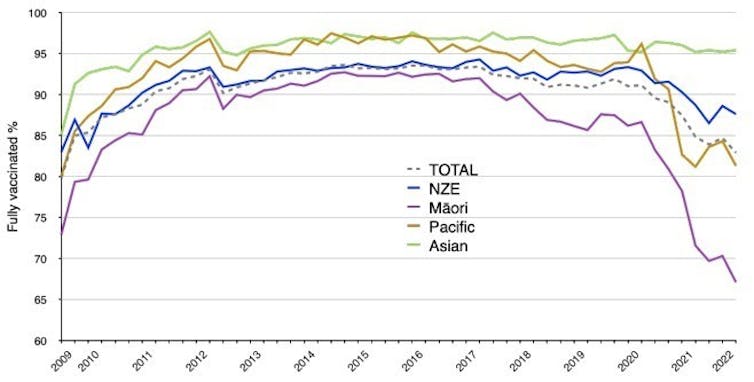
Although vaccination rates of children have at times reached more than 90% since the introduction of the register, the total has never reached the required 95%. Immunisation coverage has consistently remained lower among Māori children and more recently also Pacific children.


This graph shows annual immunisation rates for children at two years, by ethnicity.
This graph shows that annual immunisation rates for two-year-olds have dropped for Māori and, more recently, for Pacific children, compared to Asian and NZ European (NZE) children.
Author provided, CC BY-SA

To stem further spread, we must build on the lessons from New Zealand’s last major measles outbreak in 2019.

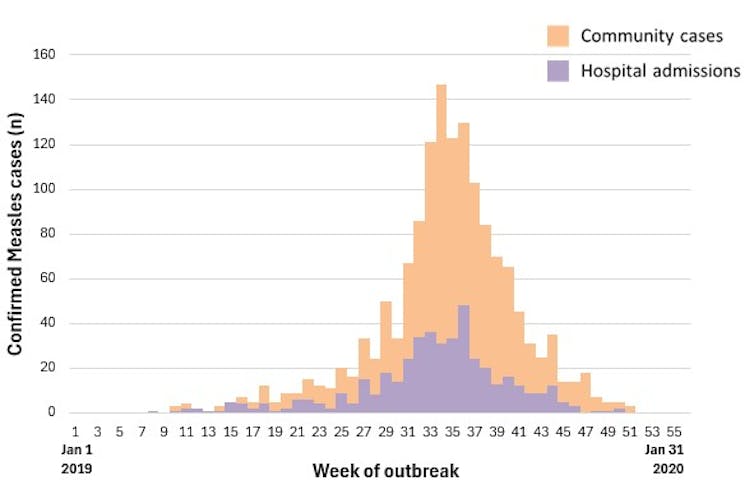
That year, Auckland experienced a large and serious measles outbreak – the largest since 1997 – affecting babies, young children and adults. There were more than 2,000 cases and about 35% required hospital care, despite the fact most people who contracted measles were previously fit and healthy.


A graph showing that about a third of people under 30 who contracted measles required hospital care during the 2019 outbreak in Auckland.
About a third of people under 30 who contracted measles required hospital care during the 2019 outbreak in Auckland.
Author provided, CC BY-SA

Some of the serious and lasting complications included encephalitis (brain inflammation), pregnant women losing babies, and children needing lengthy life-saving intensive care.

While acute measles can be severe, our subsequent research shows that measles infection is associated with a long-term increased risk of other infections.

We found that people who had measles in the 2019 outbreak had more hospital admissions not related to measles and more antibiotic prescriptions in the four years following the outbreak, compared to healthy controls.

While the effect was more pronounced for people whose measles infection was severe and needed hospital care, we also saw a lasting effect for those with milder infections.

The severity of this outbreak could have been prevented if more people had been protected with the measles, mumps and rubella (MMR) vaccine.

Immunisation coverage is lacking

Immunisation coverage for the MMR vaccine (given at 12 and 15 months of age) shows New Zealand’s vaccination rates are not enough to prevent an outbreak in children under five.

Data from June 2025 shows only 82% of two-year-olds are fully immunised with two doses of the vaccine. This leaves at least one in five unprotected.

Babies under one year of age are not protected because the first MMR dose is only given at 12 months. This is particularly worrying as young babies have very high rates of hospitalisation and complications from measles. In the 2019 outbreak, there were more than 250 cases in babies and more than half of them were hospitalised.


Data also show the burden of the 2019 outbreak was not equitable and these inequities persist in immunisation coverage today. Gaps in coverage create pools of susceptible individuals, rife for measles to take hold and spread.

What is also clear from the recent measles cases is that our history of inadequate measles vaccination has left young adults vulnerable to infection.

This happens at an age when they are able to travel overseas, with the unintentional consequences of bringing measles home to their whānau (family), including unimmunised pēpi (babies).

This would be particularly concerning if a measles outbreak were to take hold before the summer holidays. Even a few cases in New Zealand could make us the source of outbreaks for other Pacific nations.

In late 2019, measles imported from New Zealand resulted in 5,700 cases in Samoa, including 1,800 hospitalisations and 83 deaths from measles (87% of these deaths were children under five).

Awareness and prevention

Anyone under 50 years of age who is experiencing a fever, rash, cough and runny nose should think measles, particularly if they returned from travel in the past three weeks, are unimmunised or a contact of a recent case. They should call HealthLine (0800 611 116) for advice before visiting a GP or hospital, unless severely unwell.

If in doubt vaccinate. The health-sector response to the 2019 outbreak recommended GPs continue to actively recall unvaccinated children after checking the national immunisation register.

For anyone unsure if they have had two doses of the measles vaccine, it is safe to get a dose according to the Immunisation Advisory Centre if they are not immune-compromised or pregnant. MMR vaccines are free and available from GPs, pharmacies and community health providers. Vaccinators are listed on Book My Vaccine.

Measles infection is scary but vaccination can be scary for people, too. The World Health Organization recommends listening with empathy and acknowledging how people who are hesitant are feeling.

It also suggests asking open-ended questions to help understand concerns and sharing evidence-based information from trusted sources, including Health New Zealand or the Immunisation Advisory Centre. It can help to share your own motivations for getting vaccinated and what helped you to overcome concerns.

With a stretched health system and long-term consequences for individuals following measles infection, prevention is essential.

The Conversation

Anna Howe receives funding from the Health Research Council and Arthritis NZ. She has been involved in research funded by GSK and was the first KPS Research Fellow. She has previously worked for the Immunisation Advisory Centre as their research and policy analyst.

Emma Best receives funding from the Health Research Council and Starship Foundation for measles-related research.

Rachel Webb does not work for, consult, own shares in or receive funding from any company or organisation that would benefit from this article, and has disclosed no relevant affiliations beyond their academic appointment.

ref. NZ may be on the cusp of another measles outbreak – what happened in 2019 should be a warning – https://theconversation.com/nz-may-be-on-the-cusp-of-another-measles-outbreak-what-happened-in-2019-should-be-a-warning-268086

High-tech cameras capture the secrets of venomous snake bites

Source: The Conversation (Au and NZ) – By Alistair Evans, Professor, School of Biological Sciences, Monash University

A pit viper (_Bothrops asper_). marcozozaya/iNaturalist, CC BY-SA

For more than 60 million years, venomous snakes have slithered across Earth.

These ancient, chemical weapon-wielding reptiles owe their evolutionary success in part to the effectiveness of their bite, which they deliver at an astonishing speed before their prey can escape.

Now, a study I coauthored reveals, in astonishing detail, exactly how these bites work. Published today in the Journal of Experimental Biology, it is the largest study of its kind to-date, and uses advanced video techniques to show how various snake species have evolved very different strategies to deliver their deadly bites.

Thousands of snakes on Earth

There are approximately 4,000 species of snake on Earth – about 600 of which are venomous.

Scientists started visually recording the strikes of these snakes to better understand them in the 1950s, when high-speed photography and cinematography were first developed.

Since then, these technologies have improved dramatically, allowing scientists to capture and study the action of venomous snake bites in much greater detail. For example, past research has shown there are clear differences between strikes to capture prey, versus those used for defence.

But most recent studies that have examined snake bites have been limited by a number of factors.

Firstly, they have captured the bites using only one camera. This means we only get a side-on view, whereas the snakes can slither in all directions. Secondly, the recordings have been of a relatively low resolution – in large part because they were made in the field with low lighting conditions. Thirdly, they have often focused on a single snake species or a limited number of species. This means we miss out on seeing how many other species may behave differently, or strike faster.

Cameras and lights surrounding a plexi glass box.
Experimental setup for snake strikes.
Silke Cleuren

Welcome to Venomworld

For our new study, my colleagues and I studied the bites of 36 different species of venomous snakes. These species were from the three main families of venomous snakes: vipers, elapids and colubrids. They included western diamondback rattlesnakes (Crotalus atrox), blunt-nosed vipers (Macrovipera lebetinus) and the rough-scaled death adder (Acanthophis rugosus).

All the snakes we studied were housed at an institution in Paris, France, called Venomworld. There, we built a small experimental arena consisting of plexiglass panels lined with a cardboard floor, in which we placed the individual snakes.

We presented the snakes with a simulated food source – a cylindrical hunk of medical gel, heated to 38 degrees so it resembled prey for those that can detect heat.

Two high-speed cameras, placed nearby at different angles, automatically captured the snakes striking the gel at 1,000 frames per second.

Using the footage from these two different views, we recreated the strike in 3D to investigate, in detail, its various components such as its duration, acceleration, angle, and how fast the snake’s jaw opened.

In total, we captured 108 videos of successful strikes – three for each of the species included in the study.

Striking and slashing

There were major differences between the strikes of the snakes we studied.

Vipers struck the fastest, moving at speeds of more than 4.5 metres per second before sinking their needle-like fangs into the fake prey. Sometimes they would quickly remove and reinsert their fangs at a better angle. Only when the fangs were comfortably in place did the snakes shut their jaws and inject venom.

Some 84% of the vipers included in the study reached their prey in less than 90 milliseconds. This is faster than the average response time for a startled mammal – the preferred prey of many vipers in the wild.

On the other hand, elapid snakes, such as the Cape coral cobra (Aspidelaps lubricus), crept towards the fake prey before lunging and biting it repeatedly. Their jaw muscles would tense, releasing venom.

Colubrid snakes, such as the mangrove snake (Boiga dendrophila), which have fangs farther back in their mouths, lunged towards the prey from further away. With their jaws clamped over it, they’d make a sweeping motion from side to side. In doing so, they tore a gash in the gel to inject the maximum amount of venom.

Our previous research highlighted how the shape of snakes’ fangs is closely tied to prey preference. We can now show how they use these deadly weapons in the blink of an eye – and why they have been able to survive for so long on Earth.

The Conversation

Alistair Evans receives funding from the Australian Research Council and Monash University, and is an Honorary Research Affiliate with Museums Victoria.

ref. High-tech cameras capture the secrets of venomous snake bites – https://theconversation.com/high-tech-cameras-capture-the-secrets-of-venomous-snake-bites-267738

Queensland’s forests are still being bulldozed — and new parks alone won’t save them

Source: The Conversation (Au and NZ) – By Michelle Ward, Lecturer, School of Environment and Science, Griffith University

Auscape/Getty

The Queensland government celebrated the creation of new national parks this year, with Premier David Crisafulli saying it is time to “get serious” and be “ambitious” in protecting nature.

But this claim doesn’t stand up to scrutiny. Despite decades of conservation promises, Queensland remains a globally significant hotspot for destroying forests and native vegetation.

Our new study finds Queensland has lost at least 21% of its original woody vegetation since European colonisation. One-fifth of that loss has happened since 2000, even as the area of land being protected in state or national parks more than doubled.

By 2018, nearly two-thirds of subregions (areas that have similar patterns of climate, geology, vegetation and wildlife) still had less than 10% of their woody vegetation protected. Half were considered at “high” or “very high” risk of further loss.

Despite the creation of new national parks in some areas, bulldozers have kept working across vast parts of the state. Threatened animals, plants and precious landscapes are hanging on by a thread.

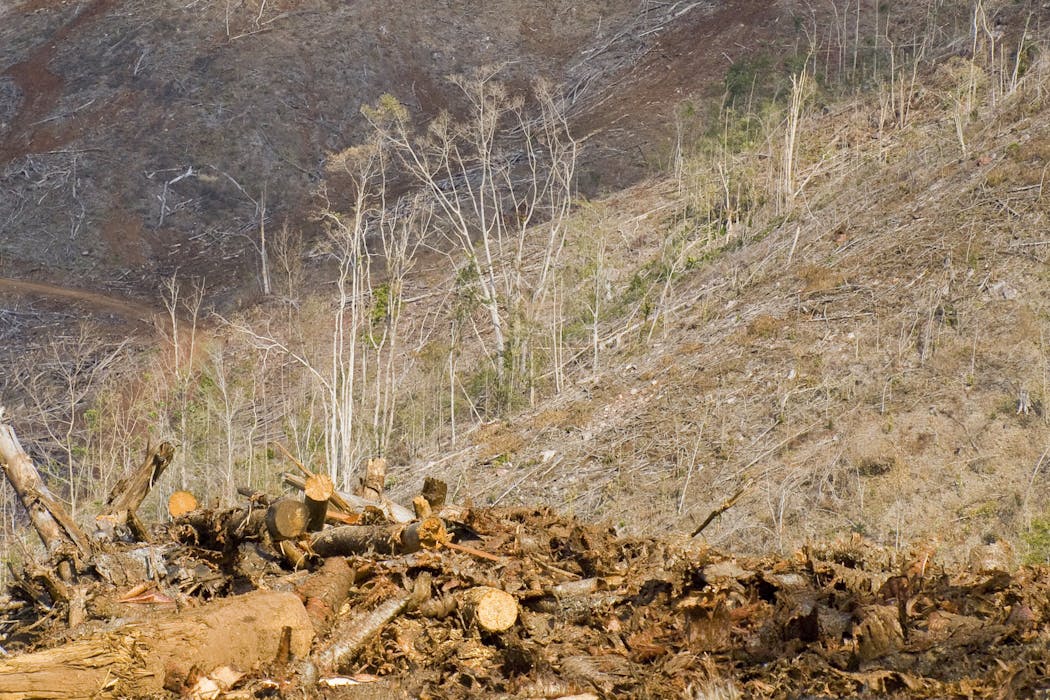
Broken grey tree stumps on red earth in the foreground, and cleared farmland and forest in the background.
Cleared native woodland in the Brigalow Belt, in central Queensland.
Auscape/Getty

Parks in the wrong places

Our analysis compared the loss of forests with the growth of protected areas across all Queensland regions with significant woody vegetation cover, using government data from 2000 to 2018.

This conservation “balance sheet” approach shows not only where protection is growing, but whether it’s keeping pace with ongoing clearing.

We found a dangerous imbalance: for the 20% of vegetation cleared, only about 10% has been protected. And this mismatch was more stark when we looked at different parts of the state.

Most of Queensland’s newly protected areas were in subregions within areas such as Cape York (northernmost point of mainland Australia) and the wet tropics (northeast coast), which already had the highest protection and not under land clearing pressure.

Meanwhile, areas that have historically been heavily cleared kept losing vegetation at some of the fastest rates in the country, with very little new protection added.

These included the Brigalow Belt – a wide band of acacia-wooded grassland between the coast and the semi-arid interior – the New England tablelands in the south of the state, and parts of the Mulga Lands in the south-west.

A map of queensland with green dots representing parks
Protected areas in Queensland.
Supplied, CC BY
A map of Queensland with areas of landclearing shown in orange and red.
Land clearing in Queensland.
Supplied, CC BY

The illusion of progress

Governments often report the growth of protected areas as evidence of progress toward global targets, such as protecting 30% of land by 2030 under the Kunming–Montreal Global Biodiversity Framework.

But focusing only on the creation of new parks paints a very misleading picture. If the bulldozing in Queensland continues at current rates, the net outcome for nature is negative, even when more parks are created.

We identified regions of Queensland that are ecological crisis zones and need targeted protection now.

The Brigalow Belt – home to species such as the northern hairy-nosed wombat, bridled nail-tail wallaby, golden-tailed gecko and Brigalow scaly-foot legless lizard – has lost almost half of its original woodland vegetation.

And areas across heavily-populated southeast Queensland continue to be cleared for grazing and infrastructure. These are the landscapes most in need of urgent intervention — not just remote places that look good on international scorecards.

A small grey and white wallaby crouches in dried grass.
The critically endangered bridled nail-tail wallaby is found in areas of Queensland that are being cleared for farming.
Timbawden/flickr, CC BY

Tougher protection

Stricter limits or moratoriums on clearing in fragile environments could ensure their protection. This will only happen with tougher compliance.

And expanding protection to capture depleted environments, rather than just photogenic or politically-palatable ones, is another way both state and federal governments can act.

Our research also shows an urgent need for a bold restoration agenda. Many of Queensland’s ecosystems are in a perilous state. Incentives and funding are needed for both protecting and restoring habitats where losses are already severe.

From accounting to action

Signatories to the Convention on Biological Diversity, which include Australia, have agreed to halt and reverse biodiversity loss this decade. But as Queensland’s example shows, success depends not just on how much land is protected but on how effectively we prevent nature from being destroyed.

Queensland’s nature protection strategy must move beyond counting hectares of parks. Instead, it should focus on a four tier approach: stopping the destruction of native vegetation, restoring degraded land in areas that provide a biodiversity benefit, ensuring protection targets important areas for biodiversity, and an accounting system that is transparent and captures both losses and gains.

Otherwise, we can only expect more of the same: a small jump in the number of protected areas in politically palatable locations and far less protection for the animals and plants that looking down the barrel of extinction.

The Conversation

Michelle Ward has received funding from the Australian Research Council, National Environmental Science Program, Queensland’s Department of Environment, Science and Innovation, Queensland Conservation Council, Australian Conservation Foundation, The Wilderness Society, and WWF Australia.

James Watson has received funding from the Australian Research Council, National Environmental Science Program, South Australia’s Department of Environment and Water, Queensland’s Department of Environment, Science and Innovation as well as from Bush Heritage Australia, Queensland Conservation Council, Australian Conservation Foundation, The Wilderness Society and Birdlife Australia. He serves on the scientific committee of BirdLife Australia and has a long-term scientific relationship with Bush Heritage Australia and Wildlife Conservation Society. He serves on the Queensland government’s Land Restoration Fund’s Investment Panel as the Deputy Chair.

Ruben Venegas Li has received funding from South Australia’s Department of Environment and Water, Queensland’s Department of Environment, Science and Innovation as well as from Wildlife Conservation Society, Queensland Conservation Council, and The Wilderness Society.

ref. Queensland’s forests are still being bulldozed — and new parks alone won’t save them – https://theconversation.com/queenslands-forests-are-still-being-bulldozed-and-new-parks-alone-wont-save-them-267328

After OpenAI’s new ‘buy it in ChatGPT’ trial, how soon will AI be online shopping for us?

Source: The Conversation (Au and NZ) – By Vibhu Arya, PhD Student, UTS Business School, University of Technology Sydney

Buying and selling online with e-commerce is old news. We’re entering the age of A-commerce, where artificial intelligence (AI) is increasingly able to shop for us.

At the end of September, OpenAI launched its “Buy it in ChatGPT” trial in the United States, using AI agents built to interact with us to do more of people’s browsing and shopping. The technology is known as “agentic commerce”, sometimes shortened to A-commerce.

American shoppers can now ask for shopping suggestions from US Etsy sellers within a ChatGPT chat – then buy a product immediately, without having to navigate away to look at individual shop pages.

Looking ahead, big companies are now spruiking the next phase of “autonomous A-commerce”, which experts predict could see AI checking out for some shoppers within the next few years.

But is handing over more of our shopping decisions to AI a good thing for us as shoppers, for most businesses or for the planet?

What’s possible right now?

For most people using AI to help them shop, the AI agent is still mostly just searching and recommending products. It still has to shift the customer to the retailer’s website to complete the checkout.

For instance, AI can do most steps to order a pizza – though sometimes slower than doing it yourself – apart from paying at the end.

That’s when we step in: we still need to sign in if we’re part of a loyalty program, enter our personal and delivery details, then finally pay.

With the “Buy it in ChatGPT” trial now underway in the US, the customer never leaves the chat, where the checkout is completed.

Shopify has said more than 1 million of its merchants will soon be able to check out within ChatGPT too. Major US retailer Walmart has similar plans.

What’s next?

In May 2025, Google launched “AI mode shopping”. Some features, like using a full body photo of yourself to virtually “try-on” clothes, are still only available for US shoppers, with limited brands.

At the time, Google said its next step will be a new “agentic checkout […] in coming months” for products sold in the US. It would give shoppers the option of tracking a product until its price drops to within a set budget – then automatically prompting them to buy it, using Google Pay. That checkout option is yet to launch.

Credit card giants Visa and Mastercard are also working on ways to make it easier for AI agents to shop for us.

Both the current and coming forms of A-commerce have the potential to spread fast worldwide, because they run largely on the same global digital infrastructure powering today’s e-commerce: identity, payments, data and compliance.

Consultants McKinsey forecast: “We’re entering an era where AI agents won’t just assist – they’ll decide.”

What are the risks and benefits?

Overspending is a big risk.

A-commerce removes many steps of the shopping journey found in e-commerce or physical commerce, leading to fewer abandoned carts and potentially higher spending.

People would need to trust AI systems with their private data and preferences, and ensure they’re not misused. Permitting AI to shop on your behalf means you are responsible for the purchase and can’t easily demand a refund.


Read more:
OpenAI slipped shopping into 800 million ChatGPT users’ chats − here’s why that matters


AI systems might focus on price or speed, but not always for what you value most: from how sustainable a product is, to the ethics of how it was made.

Fraud could be a real issue. Scammers could set up AI storefronts to trick the AI, collect the money and never deliver.

Banks will need to figure out how to spot fraud, process refunds, and manage consent when it’s not a person pressing “buy”, but an algorithm doing it on their behalf.

Regulators will need to consider A-commerce in their competition, privacy, data, and consumer protection rules.

A-commerce could offer some limited environmental benefits compared to today’s way of shopping, such as fewer missed deliveries – if you’re happy to share your calendar so your AI agent knows your availability.

But greater consumption would also mean greater environmental impacts: from AI’s voracious energy and water use, to the damage done by fast fashion, more deliveries and indirect pollution.

Changing how we shop and do business

If you have even a small business, the way you make your products and services discoverable online will have to change.

Instead of just having websites built for customers and search engines, all businesses will need to build AI accessible online stores. Those will not look like the websites we see today. It will be more like a data-soaked digital catalogue, filled with everything an AI agent needs to place orders: product specifications, price, stock, ratings, reviews, through to delivery options.

All those years of bigger brands buying attention and dominating search results might start to matter less, if you’re able to build a good AI accessible online store. It could be a quiet but massive shift in how trade works.

However, each business’s visibility will depend on how AI systems read and rank sellers. If a business’s data isn’t formatted for AI, it may disappear from view. That could give larger players an edge and once again make it harder for smaller businesses to compete.

How much are we happy to delegate our shopping to AI agents? Our individual and collective choices over the next few years will shape how radically shopping is about to change for years to come.

The Conversation

Vibhu Arya does not work for, consult, own shares in or receive funding from any company or organisation that would benefit from this article, and has disclosed no relevant affiliations beyond their academic appointment.

ref. After OpenAI’s new ‘buy it in ChatGPT’ trial, how soon will AI be online shopping for us? – https://theconversation.com/after-openais-new-buy-it-in-chatgpt-trial-how-soon-will-ai-be-online-shopping-for-us-267637

Why US activists are wearing inflatable frog costumes at protests against Trump

Source: The Conversation (Au and NZ) – By Blake Lawrence, PhD Candidate (Design) and Performance Artist, University of Technology Sydney

Three frogs, a shark, a unicorn and a Tyrannosaurus rex dance in front of a line of heavily armoured police in riot gear.

Over the past few weeks, activists taking part in protests against Immigration and Customs Enforcement (ICE) across the United States have donned inflatable animal costumes. The aim is to disrupt the Trump administration’s claim that the protests are violent “hate America” rallies.

The result is a sight to behold, with many encounters between police abd protestors going viral.

Whether they know it or not, these costumed activists are contributing to a rich history of using humour and dress to mobilise against and challenge power.

The ICE crackdowns

Since its creation in 2003, ICE has enforced immigration laws on the ground, arresting, detaining and deporting undocumented immigrants convicted of criminal activity.

During Donald Trump’s first term as president (2017–2021), the agency expanded its operations to target and deport many people with no criminal record.

This expansion sparked the June 2018 Occupy ICE protests, inspired by the broader global Occupy movement challenging corporate power and economic inequality.

The first major Occupy ICE action in 2018 occurred in Portland – a city known for its creativity and dissent. It grew from a rally organised by the Direct Action Alliance into what federal officials called a “very, very peaceful” encampment with kitchen tents, kids’ spaces and media hubs.

The protesters forced the temporary closure of the facility for about eight days, before federal officers cleared the site and erected a fence around its perimeter.

Following Trump’s re-election this year, ICE operations have intensified again, with the repealing of policies that prevented enforcement operations in sensitive areas such as schools and hospitals. Protests have followed.

In Portland, tensions escalated again this September, when Trump described the city as “burning to the ground” and “overrun with domestic terrorists,” announcing his plans to deploy the National Guard.

A federal judge has so far blocked Trump from doing so, saying the protests don’t meet the requirements for rebellion. He will likely keep trying.

Operation inflation

Protesters in Portland and across the US have long used humour and costume in their demonstrations. In October, a TikTok video showing an ICE agent spraying pepper spray into the air vent of an activist’s inflatable frog costume amassed more than two million views.

The clip exposes the absurd levels of police force against peaceful demonstrators. The protester, Seth Todd, said his intention was to contradict the “violent extremists” narrative, and “make the president and the feds look dumb”.

The Portland frog has quickly became emblematic of resistance, appearing on shirts, signs and street art, including parodies of artist Shepard Fairey’s iconic OBEY design – the authoritarian face replaced by a cartoon amphibian surrounded by the words DON’T OBEY.

And the frog costume has spawned imitators, with creatures multiplying in protests across the country, including at the recent No Kings rallies. One group of activists launched Operation Inflation, a website that crowdfunds inflatable suits for protesters, aiming to make resistance more visible, playful and safe.

Strategic silliness

One example that echoes Portland’s blow-up menagerie is London’s Clandestine Insurgent Rebel Clown Army (CIRCA). Members of CIRCA dressed as clowns during anti-war protests in the early 2000s. They played tag around police lines, hugged officers, and marched in absurd choreography.

As scholar Eve Kalyva notes, such actions employ “strategic frivolity”: silliness or absurdity in a way that disrupts the scripts between police and protester. By appearing playful rather than menacing, costumed activists directly counter narratives that paint them as violent threats.

The Portland frog and its friends work with the same strategies of silliness. Their dancing and cartoon-like actions make it impossible to frame them as thugs. Their soft forms bounce in contrast to the hard utility of riot gear.

From suffragette sashes to handmaids

Beyond frivolity, activists throughout history have also used dress and costume to more serious effect. In Britain in the early 20th century, suffragettes wore coordinated purple, white and green sashes to project unity in the fight for women’s voting rights.

In the US, dress and costume have played important roles in successive movements for African American liberation. During the 50s and 60s Civil Rights Movements, many marched in their best suits and dresses to assert their dignity against dehumanising racism.

The Black Panther Party had an unofficial uniform of sunglasses, berets and black leather jackets, embodying a more defiant style.

More recently, demonstrators in the US, Northern Ireland and Argentina have donned the red cloaks and white bonnets of The Handmaid’s Tale to protest abortion bans.

Similarly, The Extinction Rebellion–affiliated group Red Rebel Brigade stages actions in flowing red robes to mourn environmental loss.

And the wearing of the fishnet-patterned keffiyeh has now become a global symbol of Palestinian support.

Naked solidarity

On October 12, Portland’s anti-ICE demonstrators – many in their inflatable suits — were joined by thousands of naked cyclists in the Emergency World Naked Bike Ride. As costume designer and historian Camille Benda writes in Dressing The Resistance: The Visual Language of Protest (2021), nakedness in protest lays bare the body’s vulnerability to state violence.

In Portland, the mix of bare skin and soft blow-up animals heightens both the absurdity and tenderness of the scene. These protesters offer new avenues for direct action at a time when many people’s rights and freedoms are at stake.

At the time of writing, ICE was reported to have increased its weapons budget by 700% from last year.

Whether Trump will ultimately deploy the National Guard remains unclear. But across the US, the frogs (and their friends) keep multiplying. Their placards declaring “frogs together strong” remind us of the strength to be forged in unity and laughter.

The Conversation

Blake Lawrence does not work for, consult, own shares in or receive funding from any company or organisation that would benefit from this article, and has disclosed no relevant affiliations beyond their academic appointment.

ref. Why US activists are wearing inflatable frog costumes at protests against Trump – https://theconversation.com/why-us-activists-are-wearing-inflatable-frog-costumes-at-protests-against-trump-267975

Cole Martin: The Gaza ceasefire isn’t the end – what six months in Palestine showed me

Returning to Aotearoa after half a year in the occupied West Bank, Cole Martin says a peace deal that fails to address the root causes — and ignores the brutal reality of life for Palestinians — is no peace deal at all.

A ceasefire in Gaza last week brought scenes reminiscent of January’s brief pause — tears, relief, exhaustion and devastation as families reunited after months, years and even decades in captivity.

Others were exiled or discovered their entire family had been killed; thousands returned to their homes in northern Gaza, others to rubble – but just like last time, it didn’t last.

The prevention of food, water, aid and critical infrastructure continues; the borders remain closed; and across the rest of Palestine, Israel’s brutal system of domination, apartheid and displacement continues.

It’s impossible to ignore two critical elements that this deal omitted: a failure to address the root causes and a jarring lack of international accountability.

Despite human rights organisations, the UN General Assembly and the International Court of Justice all ruling Israel’s occupation is illegal, and their practices constitute apartheid, world leaders including New Zealand have refused to act, let alone sought to prevent genocide in Gaza.

I returned to Aotearoa this week after six months documenting and reporting from the occupied West Bank, where Israel continues its campaign of violent displacement and colonial expansion. Almost everyone I know has tasted the terror of Israeli domination.

Broke into bedroom
My Arabic tutor described how soldiers broke into her bedroom at night to interrogate her family about a man they didn’t even know. My climbing partner warned you can be shot for climbing in the wrong place, with most of their crags now inaccessible.

I visited Jerusalem with a friend who scored a one-day permit. He lives in Bethlehem, just a half-hour away, but they’re barred from visiting and must return by midnight; a process involving biometric scanners and intrusive searches.

And I was based in Aida refugee camp, one of dozens across the land where thousands of families have lived since their violent displacement in 1948 — the ethnic cleansing which saw 750,000 expelled, 15,000 killed and 530 villages destroyed.

Refused the right to return, their homes are now dormant ruins in “nature reserves” or inhabited by Israeli families. Israel was built on the land, farms, businesses and stolen wealth of these families — and countless more who remain as “present absentees” within the state of Israel.

My friend Yacoub lives just 10 minutes from his childhood home, yet he is denied return.

Left: Palestinian climbers enjoy one of their last accessible crags, the others too dangerous to access because of settler violence. Right: Yacoub Odeh, 84, walks the ruins of his childhood village Lifta, denied his right to return to live, despite living just 10 minutes away. Images: Cole Martin

More than 9100 Palestinians remain in Israeli captivity, including more than 400 children – thousands without charge or trial. But even “trials” bring no justice.

I visited the Ofer military courts and witnessed a corrupt system designed to funnel Palestinians to prison based on extortion, plea bargains and “secret evidence” which the detainee and lawyer aren’t allowed to see. Meanwhile, Israeli settlers receive full legal rights in Israeli civil courts; two vastly different legal systems based on race — if the settler is arrested at all.

Almost everyone I met has experienced detention firsthand or through a close family member — involving beatings, humiliation, starvation and threats. A nurse my age humorously asked why I wasn’t married yet; when I asked the same, he explained he’d only recently left years of Israeli captivity.

Settlers’ impunity
In July, fundamentalist settler Yinon Levy shot dead my friend Awdah Hathaleen on camera, in broad daylight. Authorities arrested more than 20 of Awdah’s family, withheld his body for over 10 days, then barred people from attending the funeral.

His killer was free within five days, back harassing the family, and has established an illegal settlement in the middle of their village — destroying homes, olive groves, water and electrical infrastructure with no repercussions.

Tariq Hathaleen stares at the bloodstained courtyard where his cousin and best friend Awdah was shot. Tariq was detained for several days following Awdah’s death. Image: Cole Martin

I visited countless communities across the West Bank who face daily harassment, violence and incursions from Israeli settlers, police and military. Settlements continue to expand, preventing Palestinians from reaching their land.

Almost 900 checkpoints, roadblocks and settler-only roads restrict movement between towns and cities, including urgent medical access. Israel controls the water, funnelling over 80% to their colonies while heavily limiting access to Palestinian communities.

All of this continues, none of it is halted by the “ceasefire”; and most of it will escalate as soldiers leave Gaza and look to exert their dominance elsewhere.

I’m truly fearful for my friends in the West Bank, particularly as Israel openly threatens annexation. A peace deal that ignores these realities is no peace deal.

Resilience and courage
But I also witnessed resilience and courageous persistence. Palestinian civil society and individuals have spent decades committed to creative non-violence in the face of these atrocities — from court battles to academia, education, art, demonstrations, general strikes, hīkoi (marches), sit-ins, civil disobedience.

These are the overlooked stories that don’t make catchy headlines, but their success depends on the international community to provide accountability. Without global support, Palestinians have been refused their right to self-defence, resistance and self-determination.

If we really care about peace, we need to support justice. To talk about peace without liberation is to suggest submission to a system of displacement, imprisonment, violence and erasure.

This is not the time to turn away, this is the time to ensure that international law is upheld, that Palestinians are given their dignity, self-determination, right to return and reparations for the horror they’ve faced.

Cole Martin is an independent New Zealand photojournalist who has been based in the occupied West Bank for six months and a contributor to Asia Pacific Report. This article was first published by the The Spinoff and is republished with the author’s permission.

Article by AsiaPacificReport.nz

Former Fiji PM Bainimarama given suspended prison sentence

RNZ Pacific

Former Fiji Prime Minister Voreqe Bainimarama has been given a 12-month suspended prison sentence by the Fiji High Court in Suva, local news media reports say.

Bainimarama, 71, was found guilty of “making an unwarranted demand with menace” on October 2. The court found he used his position as Prime Minister in 2021 to pressure the country’s then-Acting Police Commissioner Rusiate Tudravu into sacking two officers.

He is the first person in Fiji to be convicted under this specific offence.

The former military commander and coup leader had pleaded not guilty. However, High Court Judge Thushara Rajasinghe found him guilty of making an unwarranted demand to a public official under Fiji’s Crimes Act.

The maximum penalty for this charge is 12 years’ imprisonment. Bainimarama was sentenced to 12 months in prison and suspended for three years — meaning he will not go to jail unless he recommits the offence within that period.

Bainimarama resigned from Parliament in March 2023 after receiving a three-year suspension for sedition.

In a separate case, he was jailed in May last year for perverting the course of justice in a case related to him blocking a police investigation involving the University of the South Pacific in 2021.

He was released from prison in November 2024 — six months into his one-year sentence — following a comprehensive review by the Fiji Corrections Service.

This article is republished under a community partnership agreement with RNZ.

Article by AsiaPacificReport.nz

Thousands march through streets as part of NZ’s ‘mega strike’

RNZ News

Thousands have marched through major city streets and rallied in small towns across Aotearoa New Zealand as part of today’s “mega strike” of public workers.

More than 100,000 workers from several sectors walked off the job in increasingly bitter disputes over pay and conditions.

It was billed as possibly the country’s biggest labour action in four decades.

Strike action in Auckland’s Aotea Square.    Video: RNZ

Among those on strike were doctors, dentists, nurses, social workers and primary and secondary school teachers.

Several rallies were cancelled by severe weather in the South Island and lower North Island.

Auckland
One of the day’s main rallies got underway shortly after midday with thousands of protesters gathering in Aotea Square for speeches, before marching down Queen Street.

Many carried signs and chanted, cheered and danced as they made their way down.

“Mega strike” protesters in Auckland today. Image: Nick Monro/RNZ

Green Party co-leader Chlöe Swarbrick said it was embarrassing that the government was labelling the action politically motivated.

“Of course this is political. Politics is about power and it’s about resources and it’s about who gets to make decisions that saturate and shape our daily lives,” she said.

There was a smaller, earlier rally in the morning in Henderson.

Tupe Tai from Western Springs College, who has been teaching for several decades, said the situation had become untenable.

“We’ve got really underpaid and overworked teachers, they need that support.”

She also said teachers needed an environment where they could work on the curriculum, have time to do it, but also have a life.

Protesters in the “mega strike” in Hamilton today. Image: Libby Kirkby-McLeod/RNZ

Hamilton
The crowd swelled to an estimated 10,000 in Hamilton’s rally.

Kimberly Jackson and her daughter were at the rally on behalf of her husband, a senior doctor who had to be at the hospital working as part of lifesaving measures.

“For us it is personal, but it’s also about this country that I love, that I’ve grown up in, and I can see terrible things happening in this country and I feel really passionate about public health care,” she said.

Jackson said she had seen the system deteriorate over her lifetime.

Many carried signs and chanted, cheered and danced as they made their way down Auckland’s Queen Street today. Image: RNZ/Marika Khabazi

Chloe Wilshaw-Sparkes, regional chair of the Waikato PPTA said teachers were on strike because the offers from the government were not good enough.

“They’ve been saying ‘get round the table, have a conversation,’ but a conversation goes two ways and I think they need to be reminded of that,” she said.

Principal of Hamilton East School, Pippa Wright, was at the rally with some of the school’s teachers.

She said she believed in the NZEI’s principles, and she wanted changes which would ensure schools had really good teachers in front of students.

Wright also said pay rates needed to rise.

“So they’re not treated like graduates, and we need better conditions for teachers, and nurses, and all the public sector,” she said.

“Mega strike” protesters in Whangārei today. Image: Peter de Graaf/RNZ

Northland
In Whangārei, the weather was sweltering and a stark contrast from conditions further south.

About 1200 people marched through several city blocks, after leaving Laurie Hall Park.

As well as teachers, nurses and other union members there were students and patients showing support.

Sydney Heremaia of Whangārei had heart surgery a few weeks ago but said he was marching to show his concern about staffing levels and creeping privatisation.

Deserei Davis, a teacher at Whangārei Primary School, feared there would be no new teachers soon if pay and conditions were not improved.

“We’ve voted to strike because we feel that the government hasn’t been addressing our issues, and especially at bargaining,” she told RNZ.

“The government scrapped pay equity claims. And that was a shocking blow to women in general, but an absolute shock and a blow for us women in education. And it’s completely scrapped it.

“More importantly, we are standing up for our tamariki, who are really poorly resourced in schools, in terms of support and the requirements coming down on teachers on a daily basis, on a monthly basis.

“It’s burning out our teachers. We’re fighting for our support staff, our teacher aides, the most vulnerable of all our staff who don’t have job security.”

She said the ministry’s offer was “absolutely atrocious”.

“$1 extra an hour over a period of three years. Like let that sink in. 60 cents one year, maybe 25 cents the following and 15 cents the following year. How does that keep up with the rate of inflation?”

Northland emergency doctor Gary Payinda told RNZ it was “pretty important to support our essential public services”.

“We don’t like what’s been going on. Then the understaffing, the refusal to acknowledge the severity of the understaffing and then, of course, pay offers that are below the cost of living, which means . . .  pay cut. None of those things seem fair to the group of public workers that are working harder than ever under huge demand.”

Striking staff called in after power outage
A union organiser said striking staff returned to Nelson Hospital to care for patients after its backup generator failed in a power outage.

The top of the South Island lost power on Thursday as wild weather hit the country. It began to be restored from 9.30am.

PSA organiser Toby Beesley said the generators at the hospital started, but it’s understood they blew out an electrical board, which led to a 45-minute total power outage.

“The senior leadership at Nelson Hospital reached out to us under our pre-agreed crisis management protocol that we’ve been working on with them for the last three weeks for an event of this nature, and they asked for additional PSA member support, which we immediately agreed to to protect the community.”

This article is republished under a community partnership agreement with RNZ.

Article by AsiaPacificReport.nz

Grattan on Friday: Libs should reflect on proverb ‘As a dog returns to its vomit, so fools repeat their folly’

Source: The Conversation (Au and NZ) – By Michelle Grattan, Professorial Fellow, University of Canberra

Twice in recent times the Liberals have faced an existential crisis over climate and energy policy: in 2009 over Kevin Rudd’s Carbon Pollution Reduction Scheme, and in 2018 over the National Energy Guarantee, a plan to reduce emissions while maintaining reliability at lowest cost.

In each case the party was led by Malcolm Turnbull, first as opposition leader and then as prime minister. Both times, Turnbull suffered a mortal blow to his leadership.

Looking back to the 2018 crisis, the now leader Sussan Ley told the ABC’s Nemesis program after the 2022 election, “unfortunately Malcolm couldn’t unite the joint party room on energy policy and we had a breakaway group in the Nationals who made a strategic decision to blow this up and that was very unfortunate”.

It wasn’t only the Nationals. Andrew Hastie, now again railing over climate policy, told the program he’d threatened to cross the floor over Turnbull’s policy.

The damage done by these battles must live in the memory of today’s Liberal parliamentarians. At least you’d think so. Perhaps not. Descriptions of their current shambles come to mind. Lemmings over the cliff. Dogs returning to their vomit. Some in the Coalition might reflect on the full biblical quote of the latter: “as a dog returns to its vomit, so fools repeat their folly”.

The Liberals and the Coalition as a whole are now in a full-blown crisis over climate policy. This time it’s about the net zero by 2050 target which, given the long timeline, in theory should be an easier challenge than they faced in 2009 or 2018.

Those Liberals trying to work towards what they hope might be a viable compromise – that acknowledges net zero while loosening the constraint it imposes – are finding it increasingly difficult by the day, as the party at large becomes more feral.

Among the Liberal rank and file, the demonisation of net zero has spread like a contagion. So virulent is it, that some MPs are nervous when they have to front branch meetings.

Yet the Liberals are paralysed until they resolve their position, whatever the consequences. At best, those consequences would be an uneasy internal truce. At worst? A massive blow-up. Ley’s leadership, safe for the moment, could be undermined, possibly fatally.

Angus Taylor, the alternative leader, is a hardliner on net zero who, however, would accept a compromise and hope to stand ready to pick up the pieces if Ley’s leadership later fell apart.

As net zero tears Liberals apart, it sits like a great weight on the chest of the Nationals. Barnaby Joyce, set to jump out of the Nationals party room, has named it among other reasons for doing so. Anti net zero proselytiser Matt Canavan is running the Nationals’ review, which is heading on one direction.

The conveners of the backbench Coalition policy committee for the Australian economy, Jane Hume and Simon Kennedy, have called a meeting for Friday of next week to allow Liberal and Nationals parliamentarians to say their bit.

Hume is previously on record declaring she has “absolutely no doubt” the technology will be there to deliver net zero by 2050, and “this is something we should be embracing”.

Opposition energy spokesman Dan Tehan is running a taskforce, including representatives from both parties, charged with developing an energy policy. Tehan (who told a conference this week he supported net zero in the Morrison government and “I haven’t changed the view that I had at at the time”) initially gave the impression this would be a relatively leisurely operation. But now the foot needs to be on the accelerator.

In the coming sitting fortnight, its policy crisis will be a distraction for the opposition.

On the other side of the aisle, Environment Minister Murray Watt will be under the pump as he prepares to introduce his legislation to reform the Environment Protection and Biodiversity Conservation (EPBC) Act. Anthony Albanese looks to Watt as a fixer (as he does to Home Affairs Minister Tony Burke). Watt’s job over coming weeks or months is to wrangle a deal for these changes that are aimed at producing a more workable interface between development (from housing to energy projects) and environmental protection.

Last term, when Tanya Plibersek was environment minister, this effort, through the Nature Positive bill, collapsed spectacularly.

Watt is juggling stakeholders – developers and environmentalists – with opposing interests. One sticking point for the environmentalists is that Watt proposes the minister would retain the final approval powers for projects, able to override the new environment protection agency.

The long-overdue overhaul of the EPBC act follows the report by Graeme Samuel, former head of the Australian Competition and Consumer Commission, to the Coalition government in 2020. That said both the environment and business had suffered from “2 decades of failing to continuously improve the law and its implementation”.

Former treasury secretary Ken Henry earlier this year told the National Press Club:

the EPBC act has patently failed to halt the degradation of Australia’s natural environment. […] Report after report tells the same story of failure.

Landing the reform of the EPBC is one important test for the government’s commitment, at its economic reform roundtable, to removing red and green tape.

But Labor will need the support of either the opposition or the Greens in the Senate. Watt has been talking to both.

Watt gave parts of the planned legislation to the opposition and Greens this week.

Ley, a former environment minister, on Thursday attacked the bill as “a handbrake on investment”. “There’s nothing in what has been said today that gives investors or the Coalition confidence that this government actually understands what the problem is and has a plan to address it,” she said.

Greens spokeswoman Sarah Hanson-Young also condemned the measures. “We’ve got carve outs for industry and business, fast tracking for big projects, fast tracking for companies so that they can effectively get their approvals faster, easier and cheaper.”

The Greens want a climate trigger, which the government flatly rejects.

The Greens believe the opposition is the government’s preferred dance partner. That’s probably true. Opposition environment spokesperson Angie Bell sounded encouraging in September, telling the ABC, “I think it would be in the best interest of the nation for the two major parties to come to the table and to make sure that these reforms to the EPBC Act are sensible and serve our country into the future, because these reforms are too important to get wrong”. Bell has had four meetings with Watt.

The government will be flexible in negotiations, and business wants action. But Labor is worried the opposition, with a heap of its own problems, is unpredictable and the Liberals could be held hostage by the Nationals, who have declared major reservations, labelling the legislation and “environmental ideology”.

Given the general state of turmoil the opposition, it’s not an unreasonable fear. report

Michelle Grattan does not work for, consult, own shares in or receive funding from any company or organisation that would benefit from this article, and has disclosed no relevant affiliations beyond their academic appointment.

ref. Grattan on Friday: Libs should reflect on proverb ‘As a dog returns to its vomit, so fools repeat their folly’ – https://theconversation.com/grattan-on-friday-libs-should-reflect-on-proverb-as-a-dog-returns-to-its-vomit-so-fools-repeat-their-folly-267826

Ancient ‘salt mountains’ in southern Australia once created refuges for early life

Source: The Conversation (Au and NZ) – By Rachelle Kernen, Research Fellow, Geology, University of Adelaide

Bunyeroo valley in the Southern Flinders Ranges. Southern Lightscapes-Australia/Getty Images

Salt is an essential nutrient for the human body. But hundreds of millions of years before the first humans, salt minerals once shaped entire landscapes. They even determined where early life on Earth could thrive.

Deep in Earth’s past, over millions of years, ancient seas evaporated, leaving behind thick layers of salt. These were eventually buried and turned into rock. These enormous layers of buried rock salt move slowly over time, deforming other layers of rock around them and creating “salt mountains” at Earth’s surface.

Our new research, published in the Geological Society of America Bulletin, investigates one of these ancient salt mountains – called salt diapirs – which formed beneath a shallow sea in the Precambrian period, about 640 million years ago.

Our study reveals this diapir in southern Australia was actively rising while reef ecosystems were developing in the waters above it. The Precambrian was a critical period for increasing complexity of life on Earth, and our research suggests these salt mountains played an important role.

A geological lava lamp

Salt diapirs are like slow-motion geological lava lamps. In a lava lamp, the warm, soft blobs at the bottom slowly rise through the liquid, bending and stretching as they move.

A lava lamp with white gel blobs in it on an indigo blue background.
Salt diapirs are like geological lava lamps.
Victor Serban/Unsplash

Underground, rock salt behaves a bit like those blobs – it moves upward over millions of years, forming complex shapes. Thick layers of buried rock salt rise because they’re less dense and more flexible than the overlying rocks.

When the salt rises upward, it forms a structure geologists call a diapir. It’s a kind of dome of salt surrounded by distorted rock layers. These structures can be many kilometres tall and wide.

In present day environments, salt diapirs are found both on land and beneath the ocean floor. They often host vibrant communities of living things – from unique soils to deep-sea organisms that survive without sunlight.

Signs of early life

Geologists studying ancient environments have found preserved evidence of salt diapir structures in the rock record. These are well known from the spectacular Flinders Ranges in South Australia, which formed at a time of major changes in climate and life on Earth during the Neoproterozoic era 1 billion to 541 million years ago.

Our location for this study was the Enorama diapir, in the Ikara-Flinders Ranges National Park, Adnyamathanha Yarta Country.

A group of people in high-vis clothing walk across a rocky red landscape.
The Enorama diapir is in the iconic Flinders Ranges in South Australia.
Kathryn Amos

We found evidence that the formation of this underwater salt mountain provided the right conditions for early life to thrive in the environments right above it. We propose that diapir movement formed the right topography for these ecosystems to develop.

In Earth’s history – especially before complex animals evolved – life often faced long stretches of global hardship: ice ages, extreme heat and major changes in ocean chemistry.

During these times, specialised environments like those around salt diapirs may have acted as refuges, providing shelter when the wider world was inhospitable. When conditions improved, the survivors from these refuges could spread out again, helping repopulate the oceans.

In this way, salt diapirs may have quietly played a role in life’s persistence through mass extinctions and other crises.

This diagram shows how a Precambrian stromatolite reef grew on the shallow seafloor above a salt diapir. The salt pushed upward, creating a habitat where microbial mats could thrive and build rocky mounds.
Rachelle Kernen

Reefs, but not like the ones we know today

In the Precambrian, the sea hosted carbonate reefs, ecosystems that were much less complex than coral reefs are today.

These reefs were formed from stromatolites, colonies of cyanobacteria microorganisms, which precipitated carbonate minerals in-between grains of sand and mud, slowly building rock layers.

Stromatolites have been on Earth for more than 3 billion years, making them one of the planet’s oldest life forms. Over geologic time, carbonate reefs have evolved from simple stromatolites to increasingly complex ecosystems and their connected environments.

While we studied just one salt diapir, there is widespread evidence for salt diapirs in the Precambrian globally. Our research concludes salt diapirs may have played a critical role in the development of stromatolite reefs during this time.

Mosaic of three images showing rocks from far away, up close, and microscopically.
A: Drone view of the landscape, shaped by ancient processes. B: Up close with a camera, outcrops reveal layers and patterns that hint at changing environments. C: Under the microscope, hidden textures show the building blocks of our planet.
Rachelle Kernen

Diapirs are still relevant today

Understanding how salt diapirs grew and shaped ecosystems in the past helps scientists make sense of rock properties deep beneath the surface today. These are directly relevant for modern water, mineral and energy resources.

Buried salt diapirs influence how fluids move through rocks, affecting the flow of water and other materials such as petroleum, copper, carbon dioxide and hydrogen.

Geologists studying ancient salt-related environments are helping design hydrogen storage projects. An alternative to natural gas for energy, hydrogen can be injected deep underground during times of abundant hydrogen production. Then, it can be retrieved when needed.

Lessons from the past, including how life adapted to salty settings, are contributing directly into strategies for a more sustainable future.

The next time you see a grain of table salt, imagine it buried deep beneath the seabed as part of a thick salt layer, slowly rising. As it rises, it reshapes the sea floor and creates environments that support the development of an ecosystem.

Beneath the ocean waves, sunlight filters over stromatolite reefs, tiny creatures shelter in their crevices, and life thrives.

The Conversation

Rachelle Kernen receives funding from the Australian Research Council, bp, Woodside, and NT and SA state governments. She is a member of the Hydrogen Society of Australia, the Geological Society of Australia, the SEPM Society for Sedimentary Geology, and the International Association of Sedimentologists.

Kathryn Amos receives funding from the Australian Research Council, bp, Chevron Australia and the SA state government. She is a member of the Geological Society of Australia, SEPM Society for Sedimentary Geology, and the International Association of Sedimentologists.

ref. Ancient ‘salt mountains’ in southern Australia once created refuges for early life – https://theconversation.com/ancient-salt-mountains-in-southern-australia-once-created-refuges-for-early-life-268106

Misinformation was rife during the 2025 election. New research shows many people were unable to identify it

Source: The Conversation (Au and NZ) – By Sora Park, Professor of Communication, News & Media Research Centre, University of Canberra

Misinformation has become a routine part of daily life, shaping public discourse and distorting perceptions. A new report reveals that in the two weeks prior to the 2025 federal election, almost two-thirds (60%) of adults reported coming across election misinformation. Only 19% didn’t come across it and 21% were unsure.

Many Australians are frustrated and overwhelmed by misinformation. They also lack the time and skills to fact-check, and feel governments and platforms should be doing more to combat it.

Only 41% of adults are confident they can check whether online information is true, and 40% say they can check whether a social media post can be trusted. Low confidence leads to higher concern. Almost three-quarters (73%) say they are concerned about the spread of false election information.

This low confidence and heightened anxiety can lead to disengagement from news and politics. When people see something they suspect is election misinformation, they are more likely to ignore it (44%) than check the facts (25%). The pervasive nature of election misinformation could be turning people away from democratic institutions and processes.

Many people don’t investigate dubious information because they experience political burnout. Even if someone does have the ability to verify misinformation, they may choose not to apply the skill or knowledge. Instead, audiences who are bothered by information uncertainty disengage altogether.

Our study

We asked people to identify misinformation by giving them five examples of false information on social media that were circulated during the election campaign. These examples were provided by a professional fact-checker. For political balance, two were misinformation about the Labor Party, two were misinformation about the Liberal-National coalition, and one was politically neutral.

Many participants were unsure or said “no”, these weren’t misinformation. This suggests ordinary people differ from fact-checkers in their perceptions of election misinformation. The proportion who correctly identified the misinformation ranged from 43% to 58% across the five examples. The misinformation targeting Labor had higher percentages of accurate responses (48% and 58%). The non-partisan example had the lowest score, with only 43% of respondents identifying it as misinformation.

It is important to note that 16–34% of respondents in this study replied “unsure”. This confirms the indifference and disengagement with politics among many Australian voters.

There are stark differences between left, centre and right-leaning respondents in their responses. Those who identify as left-wing were much more likely to identify misinformation in the two posts that were about Labor (67% and 80%) than the two posts about the coalition (30% and 51%) or the non-partisan example (53%).

Similarly, those who identified right-wing were more likely to identify the two posts that were about the coalition (61% and 55%) than when the content concerned Labor (39% and 45%) or was non-partisan (43%).

Perceptions of misinformation are strongly tied to one’s beliefs and identity. People can still believe false information even if it contradicts factual knowledge. This is because acceptance is a mentally easier process than rejection.

Rejection of information as false involves an additional cognitive process that requires motivation and resources. When information does not align with people’s beliefs, they tend to determine it to be false.

Quality news matters

We found an important link between having access to quality news and people’s ability to verify information. Those who regularly access news and are informed are much less likely to be vulnerable to misinformation. They also feel more empowered to participate in politics.

Those who have received media literacy education are also more likely to be able to discern misinformation and react responsibly to misinformation. The findings suggest that media literacy education, combined with improved access to quality news, can be an effective way to help people navigate the online environment and discern misinformation.

Misinformation will likely be a problem no matter how much we try to reduce or remove it from our information ecosystem. It is timely that the federal government is developing a National Media Literacy Strategy.

There are some steps that can be taken to combat misinformation.

First, the legal and regulatory environment must enable proactive measures to reduce misinformation. Digital platforms must be transparent about how they target particular groups of people.

Second, factual, quality information that can counteract misinformation should be amplified. People need to have trusted sources of news and information they can turn to.

Finally, we can improve people’s media literacy level so that they can discern misinformation and know how to respond with confidence. Our data show more than half of the respondents (51%) have never received media literacy education.

The Australian public expressed strong views and a clear desire for intervention regarding the regulation of the online environment, particularly concerning election misinformation.

The majority of respondents – 70% – support the view that the government should take steps to restrict false information on social media, even if it limits freedom to publish and access information.

Moreover, 83% support truth in advertising laws to be implemented at a national level.

The Conversation

Sora Park receives funding from the Australian Research Council, Creative Australia, and Boundless Earth.

Jee Young Lee receives funding from the Australian Research Council, Creative Australia and Boundless Earth.

Kieran McGuinness has received funding from Google News Initiative and the Australian Communications and Media Authority.

ref. Misinformation was rife during the 2025 election. New research shows many people were unable to identify it – https://theconversation.com/misinformation-was-rife-during-the-2025-election-new-research-shows-many-people-were-unable-to-identify-it-267852

ER Report: A Roundup of Significant Articles on EveningReport.nz for October 23, 2025

ER Report: Here is a summary of significant articles published on EveningReport.nz on October 23, 2025.

Thousands of nurses, teachers and doctors take part in NZ’s ‘mega strike’
RNZ News It is being billed as quite possibly New Zealand’s biggest labour action in more than 40 years. It is the latest in a growing series of strikes and walkoffs this year, but the sheer size of it today means much of New Zealand will come to a halt. Several public sector unions say

ULMWP alleges 15 civilians killed in West Papua military operation
By Caleb Fotheringham, RNZ Pacific journalist The United Liberation Movement for West Papua (ULMWP) claims more than a dozen civilians have been killed in the Papuan highlands, including three men who were allegedly tortured and a woman who was allegedly raped. However, the Indonesian government claims the accusations “baseless”. ULMWP president Benny Wenda said 15

Here’s why a plan to turn private hospital giant Healthscope into a charity is stirring debate
Source: The Conversation (Au and NZ) – By Dale Boccabella, Associate Professor of Taxation Law, UNSW Sydney Back in May, the parent companies of private hospital operator Healthscope fell into receivership, burdened by A$1.6 billion in debt. Since then, Healthscope’s hospitals have been kept open while receivers have worked to find buyers for the business.

Your gluten sensitivity might be something else entirely, new study shows
Source: The Conversation (Au and NZ) – By Jessica Biesiekierski, Associate Professor of Human Nutrition, The University of Melbourne Daisy-Daisy/Getty Social media and lifestyle magazines have turned gluten – a protein in wheat, rye and barley – into a dietary villain. Athletes and celebrities have promoted gluten-free eating as the secret to better health and

Pro-cycling crashes can be bad, but evidence suggests slower bikes aren’t the answer
Source: The Conversation (Au and NZ) – By Dylan Mordaunt, Research Fellow, Faculty of Education, Health, and Psychological Sciences, Te Herenga Waka — Victoria University of Wellington Marco Bertorello/AFP via Getty Images It might seem counter-intuitive in a sport built around speed, but the world governing body for competitive cycling wants to slow elite riders

Most Australians agree there’s a housing crisis. But they differ on what’s causing it – and how to fix it
Source: The Conversation (Au and NZ) – By Ben Spies-Butcher, Associate professor of economy and society, Macquarie University Housing was a key issue during the 2025 federal election. In a campaign fought on the cost of living, rising housing costs – rents, mortgage repayments and house prices – were issues that that all parties had

A tiny fossil suggests bowerbirds once lived in ancient New Zealand – new research
Source: The Conversation (Au and NZ) – By Elizabeth Steell, Research Fellow in Earth Sciences, University of Cambridge Getty Images Most of our knowledge of New Zealand’s prehistoric bird diversity comes from long-lost species with bones large enough to be studied by eye. But many bird bones are so tiny we can barely see their

A decade of Tarnanthi: how a festival of Aboriginal and Torres Strait Islander art creates a new national art history
Source: The Conversation (Au and NZ) – By Catherine Speck, Emerita Professor, Art History and Curatorship, University of Adelaide Installation view: Too Deadly: Ten Years of Tarnanthi, Art Gallery of South Australia, Adelaide. Photo: Saul Steed The Tarnanthi Festival of Contemporary Aboriginal and Torres Strait Islander Art began in 2015. The title of the exhibition

Testosterone levels decline with age, not menopause, despite what you’ve heard
Source: The Conversation (Au and NZ) – By Susan Davis, Chair of Women’s Health, Monash University MomentoJpeg/Getty Images Social media widely promotes testosterone as an essential part of menopausal hormone therapy (MHT, also known as hormone replacement therapy or HRT) to treat low mood, brain fog and loss of vitality. As a result, some women

There is little evidence AI chatbots are ‘bullying kids’ – but this doesn’t mean these tools are safe
Source: The Conversation (Au and NZ) – By Luke Heemsbergen, Senior Lecturer in Communication, Deakin University Over the weekend, Education Minister Jason Clare sounded the alarm about “AI chatbots bullying kids”. As he told reporters in a press conference to launch a new anti-bullying review, AI chatbots are now bullying kids […] humiliating them, hurting

In her revenue era: the economics behind Taylor Swift’s 34 versions of The Life of a Showgirl
Source: The Conversation (Au and NZ) – By Paul Crosby, Senior Lecturer, Department of Economics, Macquarie University Taylor Swift’s latest studio album, The Life of a Showgirl, has just enjoyed a second week on top of the Billboard charts, after smashing all-time sales records on its debut. In the United States alone, it sold more

Kia Ora Gaza marks 15th anniversary of Viva Palestina 5 solidarity convoy
Kia Ora Gaza Fifteen years ago today a contingent of six New Zealanders drove three aid-packed ambulances into Gaza as part of the epic international Viva Palestina 5 solidarity convoy of 145 vehicles — to a rock-star reception from locals. The featured PressTV report includes a short interview with Kia Ora Gaza team volunteer Hone

Opposition promises to repeal NZ marine and coastal rights law change
By Anneke Smith, RNZ News political reporter New Zealand’s opposition parties have promised to repeal the coalition government’s changes to the Marine and Coastal Area Act (MACA) if re-elected in the face of criticism over “mindsets of colonisation”. While the coalition has pitched the changes as restoring the legislation to its original intent, critics argue

Chris Hedges: Remove curse of Gaza genocide before it becomes the norm
This lecture “Requiem for Gaza” was delivered to a sold out audience at the University of South Australia in Adelaide after journalist Chris Hedges’ appearance was cancelled by the Australian National Press Club. EDWARD SAID MEMORIAL LECTURE: By Chris Hedges Article by AsiaPacificReport.nz

How damaging to the royal family is the scandal surrounding Prince Andrew?
Source: The Conversation (Au and NZ) – By Dennis Altman, Vice Chancellor’s Fellow and Professorial Fellow, Institute for Human Security and Social Change, La Trobe University The latest allegations against Prince Andrew, in Virginia Giuffre’s book Nobody’s Girl, and reports that he and his wife, the Duchess of York, maintained contact with Jeffrey Epstein after

Syria’s new leader promised democracy. Then he excluded women from parliamentary elections
Source: The Conversation (Au and NZ) – By Kinda Alsamara, Lecturer in the School of Languages and Cultures, The University of Queensland Women’s political participation is often treated as a measure of a country’s commitment to equality and democracy. Earlier this year, Syria’s new leader, President Ahmed al-Sharaa, described his country as moving in a

White elephant? Hardly – Snowy 2.0 will last 150 years and work with batteries to push out gas
Source: The Conversation (Au and NZ) – By Andrew Blakers, Professor of Engineering, Australian National University Talbingo reservoir. Thennicke/Wikimedia, CC BY-NC-ND When Snowy 2.0 is in the news, it’s usually about money. The cost of the huge project has gone well beyond the initial A$6 billion estimate and will now cost more than $12 billion.

More whales are getting tangled in fishing gear and shark nets. Here’s what we can do
Source: The Conversation (Au and NZ) – By Olaf Meynecke, Research Fellow in Marine Science and Manager Whales & Climate Program, Griffith University Pacific Whale Foundation, CC BY This year’s whale season offered spectacular encounters with these majestic giants as thousands of whales migrated along Australia’s east coast. But behind the scenes, Australian scientists have

AI heavyweights call for end to ‘superintelligence’ research
Source: The Conversation (Au and NZ) – By Mary-Anne Williams, Michael J Crouch Chair in Innovation, School of Management and Governance, UNSW Sydney Flavio Coelho / Getty Images I have worked in AI for more than three decades, including with pioneers such as John McCarthy, who coined the term “artificial intelligence” in 1955. In the

Hunters or collectors? New evidence challenges claim Australia’s First Peoples sent large animals extinct
Source: The Conversation (Au and NZ) – By Mike Archer, Professor, Earth and Sustainability Science Research Centre, UNSW Sydney Some of the Mammoth Cave megafauna. Peter Schouten from Archer et al., 2023. Tens of thousands of years ago, Australia was still home to enigmatic megafauna – large land animals such as giant marsupial wombats, flightless

Thousands of nurses, teachers and doctors take part in NZ’s ‘mega strike’

RNZ News

It is being billed as quite possibly New Zealand’s biggest labour action in more than 40 years.

It is the latest in a growing series of strikes and walkoffs this year, but the sheer size of it today means much of New Zealand will come to a halt.

Several public sector unions say the strike is going ahead in spite of wild weather across the country — though plans for some rallies may change due to conditions.

This article is republished under a community partnership agreement with RNZ.

Article by AsiaPacificReport.nz

ULMWP alleges 15 civilians killed in West Papua military operation

By Caleb Fotheringham, RNZ Pacific journalist

The United Liberation Movement for West Papua (ULMWP) claims more than a dozen civilians have been killed in the Papuan highlands, including three men who were allegedly tortured and a woman who was allegedly raped.

However, the Indonesian government claims the accusations “baseless”.

ULMWP president Benny Wenda said 15 civilians had been killed, and the women who was allegedly raped fled from soldiers and drowned in the Hiabu River.

A spokesperson for the Indonesian embassy in Wellington said the actual number was 14, and all those killed were members of an “armed criminal group”.

The spokesperson described the alleged torture and rape as “false and baseless”.

“What Benny Wenda does not mention is their usual ploy to try to intimidate and terrorise local communities, to pressure communities to support his lost cause,” the spokesperson said.

The ULMWP also claimed four members of the West Papua National Liberation Army (TPNPB) were killed in drone bombings in Kiwirok on October 18.

‘Covert military posts’
According to the Indonesian embassy spokesperson, those killed were involved in burning down schools and health facilities, while falsely claiming they were being used as “covert military posts” by Indonesia.

“Their accusations were not based on any proof or arguments, other than the intention to create chaos and intimidate local communities.”

The spokesperson added the Indonesian National Police and Armed Forces had conducted “measured action” in Kiwirok.

West Papua Action Aotearoa spokesperson Catherine Delahunty said Indonesia’s military had become more active since President Prabowo Subianto came to power in October last year.

“The last year or so, it’s depressing to say, but things have actually got a whole lot worse under this president and a whole lot more violent,” Delahunty said.

“That’s his only strategy, the reign of terror, and certainly his history and the alleged war crimes he’s associated with, makes it very, very difficult to see how else it was going to go.”

Delahunty said the kidnapping of New Zealand helicopter pilot Phillip Mehrtens in 2023 also triggered increased military activity.

Schoolchildren tear gassed
Meanwhile, a video taken from a primary school in Jayapura on October 15 shows children and staff distressed and crying after being tear gassed.

The Indonesian embassy spokesperson said authorities were trying to disperse a riot that started as a peaceful protest until some people started to burn police vehicles.

They said tear gas was used near a primary school, where some rioters took shelter.

“The authorities pledge to improve their code and procedure, taking extra precautions before turning to extreme measures while always being mindful of their surroundings.”

Jakarta-based Human Rights Watch researcher Andreas Harsono said the level of care using tear gas would have been much higher if the students were not indigenous Papuan.

“If it is a school with predominantly settler children, the police will be very, very careful. They will have utmost care,” he said.

“The mistreatment of indigenous children dominated schools in West Papua is not an isolated case, there are many, many reports.”

‘Ignored by world’
Despite the increased violence in the region, Wenda said the focus of Pacific neighbours like New Zealand and Australia remained on the Middle East and Ukraine.

“What has happened in West Papua is almost a 60-year war. If the world ignores us, our people will disappear,” he said.

Delahunty said there had been a weak response from the international community as Indonesia used drones to bomb villages.

“The reign of terror that is taking place by the Indonesian military, they’re getting away with it because nobody else seems to care.

“If you look at the recent Pacific Islands Forums, it’s very disappointing, it came up with a very standard statement, like ‘it would be good if Indonesia would invite the human rights people from the UN in’.

“We close our eyes, Palestine rightly gets our support and attention for the genocide that’s being visited upon the people of Palestine, but in our own region, we’re not interested in what is happening to our neighbours.”

This article is republished under a community partnership agreement with RNZ.

Article by AsiaPacificReport.nz

Here’s why a plan to turn private hospital giant Healthscope into a charity is stirring debate

Source: The Conversation (Au and NZ) – By Dale Boccabella, Associate Professor of Taxation Law, UNSW Sydney

Back in May, the parent companies of private hospital operator Healthscope fell into receivership, burdened by A$1.6 billion in debt.

Since then, Healthscope’s hospitals have been kept open while receivers have worked to find buyers for the business. But now, the groundwork has also been laid for a potential restructuring of Healthscope as a charity.

This would allow the new entity to access a number of tax benefits – including tax exemptions on “fringe benefits” provided to employees.

On its own, this might not appear all that controversial. However, Healthscope reportedly wants to access a substantial proportion of the tax break that would normally accrue to the employee. Employees have been asked to vote on the proposal.

What are fringe benefits?

A fringe benefit is a form of compensation provided to an employee by an employer, in addition to salary or wages.

Salary packaging is essentially breaking the employee compensation into salary and fringe benefits. For example, an employer pays certain costs for an employee – such as rent and mortgage payments, or their children’s school fees – and in return the employee agrees to have their salary reduced.

Any employer can provide fringe benefits to employees. But some organisations, including not-for-profit hospitals, are eligible for exemptions from the fringe benefits tax, up to a cap.

For not-for-profit and public hospitals, the tax-free benefit to each employee is capped at a “grossed-up” value of the benefit of $17,000, which works out to be roughly $9,000 in value of benefits per year.

For current purposes, the thinking behind the grossed-up value of a benefit need not be explored; our focus should be on the $9,000 figure, the economic value of a benefit.

The main justification for this tax exemption is that not-for-profit hospitals cannot pay the same sort of salaries as the for-profit sector to attract staff. This concession helps balance things out a bit.

An example of salary packaging

Let’s illustrate salary packaging with an example relevant to the Healthscope proposed scenario.

Say an employee is on a taxable income of $80,000 (wages). The top part of this (every dollar over $45,000) attracts the 30% marginal tax rate. For simplicity, ignore the 2% Medicare levy.

A not-for-profit hospital employer could ask this employee to “give up” the top $10,000 of their pre-tax wages. In return, the hospital could agree to pay $9,000 of the worker’s private expenses, such as rent or mortgage payments.

The employee is not taxed on receipt of this $9,000 in benefits. And because of the concession, the not-for-profit hospital wouldn’t have to pay employer fringe benefits tax on it either.

The employee is better off by $2,000 ($9,000 compared to the $7,000 of after-tax income where cash salary is paid). The employer (a charity) has also reduced its costs from $10,000 (wages) to $9,000 (benefit). The only “loser” would be the public purse.

Administration fee

An administration fee for a salary packaging arrangement is standard, either a fixed fee or small percentage of the tax saving made and accruing to the employee.

However, the Healthscope proposal would reportedly require the employee to “hand over” a large portion of the tax saving – as much as 90% in certain circumstances.

The Healthscope “fee” seems too high to just recoup the employer’s administrative costs for the salary packaging.

Senior couple filling form at hospital reception desk, medical staff offer support.
Fringe benefits tax concessions for not-for-profit and public hospitals can help them attract and retain staff.
Morsa Images/Getty

Legal considerations

Would the proposed compensation switch be legally effective? The answer is unclear.

The Australian Taxation Office (ATO) may be concerned with this. That’s because the salary packaging would be done in a different environment to the ordinary type of packaging, because the employer changed from a taxable entity into an tax-exempt entity.

This is unusual, especially when the taxable entity is in financial distress, like Healthscope.

The counterargument is that Healthscope would be accessing a specific concession – provided to a not-for-profit hospital in the fringe benefits tax legislation – for the “benefit” of employees in a certain sector.

What about ethics?

Whether Healthscope’s proposal is ethical is another question and brings in subjective considerations. It is fair to say that Healthscope’s charity option is drawing on the tax system to help implement a lower cost structure to its operations.

It could reignite the long-standing debate about the appropriateness of allowing tax-exempt charities and other not-for-profits to operate large businesses (and obtain/retain tax exemption) in competition with taxable, for-profit companies.

Many other tax concessions could also become available on the switch to a charity, such as exemption from company income tax and exemption from state taxes, including payroll tax – a state tax on wages paid by employers.

The potential for lost income tax revenue is not clear-cut because Healthscope may not have paid much income tax lately anyway. Given the number of employees (around 19,000), the loss of payroll tax to the states could be significant on the switch to a registered charity.

The business is still for sale

It’s important to note that Healthscope’s receivers are still inviting offers for the sale of its hospital businesses. The charity option is just one option the receivers want to lay the groundwork for.

It is highly advisable for employees of Healthscope to obtain independent advice on the proposal’s possible financial impacts – such as whether employer superannuation contributions are required on fringe benefits – before voting on what appears to be an amendment to the enterprise agreement.

The Conversation

Dale Boccabella does not work for, consult, own shares in or receive funding from any company or organisation that would benefit from this article, and has disclosed no relevant affiliations beyond their academic appointment.

ref. Here’s why a plan to turn private hospital giant Healthscope into a charity is stirring debate – https://theconversation.com/heres-why-a-plan-to-turn-private-hospital-giant-healthscope-into-a-charity-is-stirring-debate-267855

Your gluten sensitivity might be something else entirely, new study shows

Source: The Conversation (Au and NZ) – By Jessica Biesiekierski, Associate Professor of Human Nutrition, The University of Melbourne

Daisy-Daisy/Getty

Social media and lifestyle magazines have turned gluten – a protein in wheat, rye and barley – into a dietary villain.

Athletes and celebrities have promoted gluten-free eating as the secret to better health and performance.

But our review in The Lancet published today challenges that idea.

By examining decades of research, we found that for most people who think they react to gluten, gluten itself is rarely the cause.

Symptoms but not coeliac

Coeliac disease is when the body’s immune system attacks itself when someone eats gluten, leading to inflammation and damage to the gut.

But people with gut or other symptoms after eating foods containing gluten can test negative for coeliac disease or wheat allergy. They are said to have non-coeliac gluten sensitivity.

We wanted to understand whether gluten itself, or other factors, truly cause their symptoms.

What we did and what we found

Our study combined more than 58 studies covering symptom changes and possible ways they could arise. These included studying the immune system, gut barrier, microbes in the gut, and psychological explanations.

Across studies, gluten-specific reactions were uncommon and, when they occurred, changes in symptoms were usually small. Many participants who believed they were “gluten sensitive” reacted equally – or more strongly – to a placebo.

One landmark trial looked at the role of fermentable carbohydrates (known as FODMAPs) in people who said they were sensitive to gluten (but didn’t have coeliac disease). When people ate a low-FODMAP diet – avoiding foods such as certain fruits, vegetables, legumes and cereals – their symptoms improved, even when gluten was reintroduced.

Another showed fructans – a type of FODMAP in wheat, onion, garlic and other foods – caused more bloating and discomfort than gluten itself.

This suggests most people who feel unwell after eating gluten are sensitive to something else. This could be FODMAPs such as fructans, or other wheat proteins. Another explanation could be that symptoms reflect a disorder in how the gut interacts with the brain, similar to irritable bowel syndrome.

Some people may be truly sensitive to gluten. However, current evidence suggests this is uncommon.

People expected symptoms

A consistent finding is how expecting to have symptoms profoundly shapes people’s symptoms.

In blinded trials, when people unknowingly ate gluten or placebo, symptom differences almost vanished.

Some who expected gluten to make them unwell developed identical discomfort when exposed to a placebo.

This nocebo effect – the negative counterpart of placebo – shows that belief and prior experience influence how the brain processes signals from the gut.

Brain-imaging research supports this, showing that expectation and emotion activate brain regions involved in pain and how we perceive threats. This can heighten sensitivity to normal gut sensations.

These are real physiological responses. What the evidence is telling us is that focusing attention on the gut, coupled with anxiety about symptoms or repeated negative experiences with food, has real effects. This can
sensitise how the gut interacts with the brain (known as the gut–brain axis) so normal digestive sensations are felt as pain or urgency.

Recognising this psychological contribution doesn’t mean symptoms are imagined. When the brain predicts a meal may cause harm, gut sensory pathways amplify every cramp or sensation of discomfort, creating genuine distress.

This helps explain why people remain convinced gluten is to blame even when blinded studies show otherwise. Symptoms are real, but the mechanism is often driven by expectation rather than gluten.

So what else could explain why some people feel better after going gluten-free? Such a change in the diet also reduces high-FODMAP foods and ultra-processed products, encourages mindful eating and offers a sense of control. All these can improve our wellbeing.

People also tend to eat more naturally gluten-free, nutrient-dense foods such as fruits, vegetables, legumes and nuts, which may further support gut health.

The cost of going gluten-free

For the approximately 1% of the population with coeliac disease, avoiding gluten for life is essential.

But for most who feel better gluten-free, gluten is unlikely to be the true problem.

There’s also a cost to going gluten-free unnecessarily. Gluten-free foods are, on average, 139% more expensive than standard ones. They are also often lower in fibre and key nutrients.

Avoiding gluten long term can also reduce diversity in your diet, alter your gut microbes and reinforce anxiety about eating.

Is it worth getting tested?

Unlike coeliac disease or a wheat allergy, non-coeliac gluten sensitivity has no biomarker – there’s no blood test or tissue marker that can confirm it.

Diagnosis instead relies on excluding other conditions and structured dietary testing.

Based on our review, we recommend clinicians:

  • rule out coeliac disease and wheat allergy first

  • optimise the quality of someone’s overall diet

  • trial a low-FODMAP diet if symptoms persist

  • only then, consider a four to six-week dietitian-supervised gluten-free trial, followed by a structured re-introduction of gluten-containing foods to see whether gluten truly causes symptoms.

This approach keeps restriction targeted and temporary, avoiding unnecessary long-term exclusion of gluten.

If gluten doesn’t explain someone’s symptoms, combining dietary guidance with psychological support often works best. That’s because expectation, stress and emotion influence our symptoms. Cognitive-behavioural or exposure-based therapies can reduce food-related fear and help people safely reintroduce foods they once avoided.

This integrated model moves beyond the simplistic “gluten is bad” narrative toward personalised, evidence-based gut–brain care.

Jessica Biesiekierski receives funding from NHMRC, Rome Foundation, Yakult and Australian Eggs. She is affiliated with the Nutrition Society of Australia and the Australiasian Neurogastroenterology & Motility Association.

ref. Your gluten sensitivity might be something else entirely, new study shows – https://theconversation.com/your-gluten-sensitivity-might-be-something-else-entirely-new-study-shows-267098

Pro-cycling crashes can be bad, but evidence suggests slower bikes aren’t the answer

Source: The Conversation (Au and NZ) – By Dylan Mordaunt, Research Fellow, Faculty of Education, Health, and Psychological Sciences, Te Herenga Waka — Victoria University of Wellington

Marco Bertorello/AFP via Getty Images

It might seem counter-intuitive in a sport built around speed, but the world governing body for competitive cycling wants to slow elite riders down.

Worried about high-speed crashes during pro-racing events, the Union Cycliste Internationale (UCI) has proposed a cap on the gear size riders can use. The idea is to lower the possible top speed bikes can achieve.

The risks are real, too. At the recent Tour Down Under Men’s Classic in Australia, a high-speed multi-rider crash on the final corner sent bikes into the barriers and into the crowd, badly injuring a spectator.

In August this year, champion British rider Chris Froome crashed while training in France, suffering a collapsed lung, broken ribs and a spinal fracture.

But would restricting gear size prevent these kinds of high-speed crashes? Certainly, not everyone thinks so.

Earlier this month, a Belgian court paused the rule change after teams and a major cycle component maker argued the safety case was not proven. While slower bikes might sound safer, they argue, the evidence tells a different story.

What the evidence tells us

The proposed rule would limit the largest gear size to 54 teeth on the front chainring and 11 on the rear sprocket. The idea is simple: lower the top gear to reduce top speed and, in theory, cut risk.

But while speed clearly matters when it comes to crashes, it is only one part of how they happen in a tightly packed peloton (the main pack of riders in a road race).

Our recent review of 18 studies of race speed and crash risk found two clear patterns:

  • higher speed makes injuries worse once a crash occurs
  • but the link between speed and the chance of crashing is weaker and depends on context.

Injury rates in the UCI WorldTour have climbed even though average race speeds have been steady. So, something else is at work.

We also examined the proposed gear cap itself. Based on our analysis, we argue any rule change should be evidence-based rather than simply a reaction to pressure after high-profile incidents.

Understanding why crashes occur is central to this. Essentially, they are about people and space, and happen for a number of reasons:

  • when riders fight for position as they enter a narrowing corner
  • when sprint “trains” (riders in the same team lining up for aerodynamic efficiency) cross wheels
  • or when road “furniture” appears too late to be avoided.

In this year’s Paris–Nice race, for example, Mattias Skjelmose struck a traffic island at speed and abandoned the race. Reports described it as a poorly marked obstacle.

Course design, peloton density and inconsistent rule enforcement often play a bigger role than a few extra kilometres per hour.

Olympic champion Tom Pidcock demonstrates a high-speed descent on the Rossfeld Panoramastrasse in Germany.

Why a gear limit won’t help much

On hill descents, where many serious injuries occur, riders freewheel in a tucked body position. Gravity and aerodynamics set the speed – gearing does not.

When riders are actually pedalling in a sprint, a 54×11 gear at high “cadence” (around 110–120 revolutions per minute) gives a speed of roughly 65 kilometres per hour (km/h). The very fastest finishes in elite men’s races reach about 75 km/h – the absolute peak speed.

A cap on gearing would trim roughly 5–10 km/h from the top-end, bringing the fastest sprints down to around 65–70 km/h. But most sprint pileups start below those speeds and are triggered by contact or line changes.

Lowering everyone’s top speed could even bunch the field more tightly and raise the risk of contact. The pro-cycling world already knows what helps:

These steps match what other high-speed sports have done to reduce injuries. Motor sports redesign the environment rather than just limit speed, with NASCAR and IndyCar having adopted energy-absorbing barriers to cut wall-impact forces.

And alpine skiing manages risk with course design, as well as nets and airbag protection to control speed and crash severity.

Similar approaches to safety are used in aviation, mining and healthcare. The aim is to focus on the environment and behaviour, measure exposure, fix the hotspots and share what works to keep improving safety.

The Conversation

Dylan Mordaunt is a physician and health economist who has cycled competitively and recreationally for almost 40 years.

ref. Pro-cycling crashes can be bad, but evidence suggests slower bikes aren’t the answer – https://theconversation.com/pro-cycling-crashes-can-be-bad-but-evidence-suggests-slower-bikes-arent-the-answer-267524

Most Australians agree there’s a housing crisis. But they differ on what’s causing it – and how to fix it

Source: The Conversation (Au and NZ) – By Ben Spies-Butcher, Associate professor of economy and society, Macquarie University

Housing was a key issue during the 2025 federal election. In a campaign fought on the cost of living, rising housing costs – rents, mortgage repayments and house prices – were issues that that all parties had to address.

Major housing announcements were key to the campaign launches of both the Albanese government and the Peter Dutton-led opposition.

While all parties agreed housing needed urgent attention, they were divided over how to fix it. Labor and the Coalition focused on first homebuyers and housing supply. The Greens emphasised rent control and social housing, and One Nation campaigned on cutting immigration and taxes on building materials for new houses.

The Australian Cooperative Election Survey (ACES) collected responses from over 4,000 voters during the campaign in April 2025. Over 1,000 of these voters were then asked about their views on housing. The results offer a detailed insight about the impact of housing on the election outcome.

A new report by the Macquarie University Housing and Urban Research Centre analyses the ACES results, revealing the importance of housing to politics on the left and right.

It is clear from our data that Australian society is still coming to terms with the fading promise of homeownership. They are also struggling to agree on the reasons why housing is such a huge problem, and how it can be addressed.

Everyone agrees on housing: it’s a crisis

Voters left us in no doubt about their feelings on the importance and urgency of the housing problem. An overwhelming share of respondents – 89% – agreed Australia is currently facing a housing crisis, with just 2% disagreeing.

Renters and young voters were more likely to “strongly agree” that housing is in crisis than homeowners, property investors and older people. Greens voters and voters on the populist right (One Nation and Trumpet of Patriots) were more likely to agree than Labor or Coalition voters.

But the differences were minor: the near-universal agreement about the extent of the housing problem is unusual in contemporary Australian politics.

Despite the landslide, Labor’s housing performance was marked down

Despite Labor’s landslide victory, voters did not endorse the Albanese government’s performance on housing policy. Only 16% were in any way satisfied, while a total of 34% were either dissatisfied or very dissatisfied. Half were “neither satisfied nor dissatisfied” or “unsure”. This suggests many voters were either unaware of or ambivalent about the government’s policies.

Dissatisfaction was widespread, found in roughly equal measure regardless of age and housing tenure. Investors were just as dissatisfied as renters, and both just slightly more than owners.

Labor’s electoral advantage on housing, however slight, appears to have come from offering voters modest, incremental policy responses that did not alienate voter groups. But they did not excite anyone either: even Labor voters were not particularly enthused, with only 37% expressing satisfaction.

So what do voters think is causing the crisis?

Many voters identified immigration playing a key role, along with high house prices, interest rates, and a lack of supply. These findings are consistent with the recent resurgence of anti-immigration populism.

While Australia’s economy and ageing population increasingly depend on immigration, the housing and cost of living crises are being successfully exploited by far-right political parties and movements.

However, looking deeper, we found voter reactions varied considerably depending on where they were situated in the crisis.

When it comes to causes of the housing crisis, immigration dominates responses from older voters (65 years and over) as well as outright homeowners. But for younger voters, aged 18-34 years, high interest rates and low wage growth are the top drivers.

What’s more, younger voters who are most affected by the housing crisis are less likely to see immigration as either cause or solution. Instead, they are looking to government for a new social contract on housing.

Despite the overall popularity of cutting immigration, there is a strong partisan divide on this approach, with very strong support among both Coalition and populist right voters, but more qualified, lower support among Labor and Greens voters.

For those most affected by housing, such as younger renters, direct intervention into housing markets is the priority. We asked respondents what three policies would help most in reducing housing costs.

For voters aged 18-34 years, limits on rent increases (44%) ranks first, followed by higher rent assistance (39%) and more investment in public housing (37%). Limiting rent increases also tops the list of priorities for private renters, and for Greens voters. For these voters, immigration is not the key – and nor is one of the government’s primary policy responses, which is to increase supply.

Our research found that most voters want an increase in the housing supply, and most see supply problems as playing a role in this crisis.

However, few voters prioritised supply measures as a solution. Asked about their top priorities for reform, planning faded as an option. Among young voters and private renters, allowing greater density and simplifying planning rules ranked 7th and 8th from a list of nine options.

Responsive housing policies may re-engage disaffected voters

For those troubled about a rising anti-migration mood, the findings hold potential lessons. Rent controls give tenants more security by protecting them from large rent increases. “Limiting rent increases for private renters” is not only favoured by young people and Greens voters, but it was the second most favoured policy among voters on the populist right. Asked if they supported limits on rent increases, a solid 58% of a small sample of those voters said they would.

Alongside generational and partisan divides, there is an insider-outsider divide in Australia’s housing debate. As Zohran Mamdani’s growing support in the New York mayoral race suggests, economic populism – where government plays a more direct role protecting voters from economic risk – enjoys support beyond the left. New or bolder thinking might be key to bridging this divide, reaching younger people left out of Australia’s housing system.

The Conversation

Ben Spies-Butcher has a current industry partnership with the Tenants Union NSW and receives funding from the Australian Public Policy Institute and Australian Research Council. He has previously been a board member of Shelter NSW and office bearer of the Australian Greens, but no longer holds these positions.

Adam Stebbing has received funding from the Australian Research Council.

Alistair Sisson has received funding from the Tenants’ Union of NSW, Shelter NSW, QShelter, National Shelter, Australian Council of Social Service, Mission Australia, City of Sydney and Australian Housing and Urban Research Institute. He is a member of Shelter NSW.

Kristian Ruming receives funding from the Australian Research Council.

Shaun Wilson receives funding from the Australian Research Council.

ref. Most Australians agree there’s a housing crisis. But they differ on what’s causing it – and how to fix it – https://theconversation.com/most-australians-agree-theres-a-housing-crisis-but-they-differ-on-whats-causing-it-and-how-to-fix-it-267963

A tiny fossil suggests bowerbirds once lived in ancient New Zealand – new research

Source: The Conversation (Au and NZ) – By Elizabeth Steell, Research Fellow in Earth Sciences, University of Cambridge

Getty Images

Most of our knowledge of New Zealand’s prehistoric bird diversity comes from long-lost species with bones large enough to be studied by eye. But many bird bones are so tiny we can barely see their features without a microscope.

Some 14 to 19 million years ago, in the Miocene epoch, the remains of thousands of birds were preserved in and around the vast Lake Manuherikia, located in present-day Central Otago.

We know a lot about some of the lake’s larger birds such as ducks. But we have less information on smaller birds such as the highly diverse passerines, which include songbirds. Modern species in this group include the tūī and tauhou/silvereyes.

The minute bones of passerines are difficult to find in the field, and only come to light after many hours of painstaking sorting under a microscope. But technologies such as micro-CT scanning are now helping to reveal their secrets.

Our new research adds a quirky new passerine to the fossil record of Aotearoa and shows just how unique its ancient biodiversity was. The new species appears to be in the bowerbird family of songbirds, which are not native in New Zealand today.

Made famous by Sir David Attenborough’s nature documentaries, bowerbirds are best known for their elaborate courtship behaviour and the males’ efforts to decorate bowers with coloured fruit or leaves to attract a mate. These showy males are often brightly coloured, while females are more drab – and very choosy about their mates.

Courtship of the bowerbirds.

Until now, bowerbirds and their fossil relatives have only been found in Australia and New Guinea.

The St Bathans bowerbird

Among all the tiny bones found in the St Bathans fossil site, a curious foot bone stood out. When we compared digital models of the fossil to a great number of other passerines, it bore all the hallmarks of a bowerbird; but this one was much smaller and more slender than living bowerbirds.

An artist's impression of the bowerbird that possibly once lived in New Zealand, showing yellow plumage
An artist’s impression of the bowerbird that may have once lived in New Zealand.
Sasha Votyakova/Te Papa, CC BY-SA

It’s name is Aevipertidus gracilis – the gracile one from a lost age.

The size of Aevipertidus gracilis would make it the smallest known bowerbird. Most living bowerbirds are chunky, weighing anywhere from 62 to 265 grams and spending time both on the ground and in the forest canopy.

New Zealand’s bowerbird weighed around 33 grams, similar to a korimako/bellbird but with longer feet.

Our analysis suggests the St Bathans bowerbird foot was most similar in shape to a group known to construct walk-through avenue bowers, such as the brightly coloured flame bowerbird.

We can only speculate about its plumage and behaviour, but Aevipertidus gracilis may also have performed elaborate displays to attract a mate.

The St Bathans bowerbird joins other New Zealand passerines with an ancient history – including huia, kōkako, piopio and mohua – whose ancestors flew across the ocean to Zealandia millions of years ago.

The St Bathans bowerbird lived far from its relatives in warm Australia and New Guinea. If it was a fruit eater, it may have been poorly equipped for temperatures that began dropping dramatically around 14 million years ago and caused a reduction in plant diversity. Ultimately, it may have become a victim of climate change.

Conservation palaeobiology

Fossils like the St Bathans bowerbird as well as genetic research are revealing New Zealand’s story of bird evolution, with extinctions and repeated colonisations across geological time.

For example, prehistoric shelducks colonised ancient Zealandia, only for them to go extinct. Around two million years ago, ancestors of the pūtangitangi/paradise shelduck recolonised New Zealand.

The same is true for the ancient passerine relatives of magpies, which went extinct after the Miocene. But unlike the native shelducks, modern makipai/Australian magpies were introduced by Europeans in the 1860s.

Some researchers suggest these long-extinct species muddy the concept of what is native or introduced in New Zealand, using magpies as an example.

Even though ancient magpie relatives once lived in Zealandia, it doesn’t mean their living cousins belong in the modern ecosystem. This thinking could undermine conservation management and lead to ecosystems being more degraded by invasive species.

The St Bathans wonderland existed in a Zealandia before the Southern Alps rose to create the South Island’s backbone. Lake Manuherikia was home to many plants and animals, including crocodilians and tortoises, making it very different from what is there today. It doesn’t make sense to consider these ancient animals as native in modern Aotearoa.

New discoveries like the St Bathans bowerbird provide wonderful insights into New Zealand’s biological heritage. Let’s celebrate these discoveries as clues to the past and not use them to undermine the ongoing fight to protect the country’s special living plants and animals.


We thank the coauthors on our paper, Daniel Field and Alex Brown, Sasha Votyakova for the artist’s reconstruction, the landowners at St Bathans for access to their land, Jean-Claude Stahl for preparation of the fossil photos, and numerous fieldworkers who helped with our excavations.


The Conversation

Elizabeth Steell received funding from Girton College and Newnham College, University of Cambridge, UK.

Alan Tennyson received funding from the Te Papa Collection Development Fund and the Australian Research Council.

Nic Rawlence receives funding from the Royal Society Te Apārangi Marsden Fund.

Pascale Lubbe receives funding from Royal Society Te Apārangi Marsden Fund

ref. A tiny fossil suggests bowerbirds once lived in ancient New Zealand – new research – https://theconversation.com/a-tiny-fossil-suggests-bowerbirds-once-lived-in-ancient-new-zealand-new-research-267104

A decade of Tarnanthi: how a festival of Aboriginal and Torres Strait Islander art creates a new national art history

Source: The Conversation (Au and NZ) – By Catherine Speck, Emerita Professor, Art History and Curatorship, University of Adelaide

Installation view: Too Deadly: Ten Years of Tarnanthi, Art Gallery of South Australia, Adelaide. Photo: Saul Steed

The Tarnanthi Festival of Contemporary Aboriginal and Torres Strait Islander Art began in 2015. The title of the exhibition celebrating Tarnanthi a decade on, Too Deadly, underscores the level of excellence Tarnanthi has achieved in terms of the sheer number of artists involved, new work commissioned and its reach to new audiences.

As Megan Davis said in her speech to launch the 2025 exhibition, art leads to conversations about First Nations people, their history and beliefs.

Tarnanthi is a biennial festival with a difference. It consists of a major exhibition at the Art Gallery of South Australia, satellite exhibitions in city, metropolitan and regional galleries, and an ethically run art fair.

Underpinning these exhibitions and events is the central Tarnanthi practice of empowering First Nations artists to develop new work, to bring it to light. This has been, and is, central to Tarnanthi’s success.

Under festival director Nici Cumpston, a relational curatorial model was developed with several key elements – listening to and encouraging First Nations artists, giving centrality to artist-led projects, supporting cultural continuity projects, and facilitating innovation rooted in tradition.

Work of the decade

The most compelling work of the decade is on show in Too Deadly. This includes Western Aranda artist Vincent Namatjira’s endearing Charles on Country (2022). It depicts the British King regally dressed, but looking out of place, as if he has strayed onto someone else’s Country.

Namatjira considers art a weapon, softened with humour. As he explains in the accompanying exhibition catalogue:

I like to paint with a little bit of humour, humour takes away some of their power and keeps us all equal.

On entering the exhibition space, viewers are confronted by Kokatha/Nukunu artist Yhonnie Scarce’s extraordinarily impressive recreation of an atomic mushroom cloud in Thunder raining poison (2015), made of 2,000 suspended glass yams.

Yhonnie Scarce’s 2,000 suspended glass yams
Installation view: Too Deadly: Ten Years of Tarnanthi , Art Gallery of South Australia, Adelaide.
Photo: Saul Steed

Its beguiling beauty revisits the enduring tragedy wrought on Aboriginal people in central Australia by sustained atomic testing from 1952–63. Scarce grew up in Woomera, near Maralinga, and is acutely aware of the removal of Pitjantjatjara and Yankunytjatjara people from their traditional lands, which were destroyed. These events haunt her as “one of the most hidden histories within Australia”.

The mood changes with Maluyligal/Wuthathi/Dayak artist Brian Robinson, whose large-scale wall installation Empyreal: a Place and a Path in the Sky and on the Earth (2019) portrays the sky as a navigational tool and spiritual realm.

Reading his massive map in black and white, dotted with red floral motifs, is a lesson in navigating the night skies from open Country, well away from populated centres.

Gail Mabo’s Tagai (2021) similarly brings navigation of the Torres Strait islands to the fore.

Powerful work on show

The monumental three-by-five-metre collaborative canvas painting Kungkarangkalpa: Seven Sisters (2016) by 24 female Anangu artists of the APY (Anangu Pitjantjatjara Yankunytjatjara) Lands speaks to the many ambitious projects Tarnanthi has fostered.

The Anangu songline recounted is the pursuit of the seven sisters by the antihero Nyiru. This painting is exhibited here alongside the ingenious and animated weaving Paarpakani (take flight) and Tjanpi Punu (trees) (both 2011) by the Tjanpi Desert Weavers.

Burial poles in front of works on paper.
Installation view: Too Deadly: Ten Years of Tarnanthi , Art Gallery of South Australia, Adelaide.
Photo: Saul Steed

Tiwi art took centre stage in Tarnanthi 2019. The display in Too Deadly of the Tutini (burial poles), paintings and works on paper with distinctive Tiwi designs is testament to the strength of culture. A small number point to cross-cultural interaction such as trading ships, and the influence of Christianity.

There are many other powerful works on show.

Kuninjku artist John Mawurndjul’s Namanjwarre, saltwater crocodile (1988) is an intricate and detailed bark painting.

A cloud of sticks hangs in the gallery.
Installation view: Too Deadly: Ten Years of Tarnanthi, featuring Kuḻaṯa Tjuṯa by APY Art Centre Collective and Albert Namatjira, Slim Dusty and Archie Roach on Country by Vincent Namatjira , Art Gallery of South Australia, Adelaide.
Photo: Saul Steed

The APY Art Centre Collective’s Kulata Tjuta (2017) is a confronting installation of traditional spears, surrounded by empty piti (food collecting bowls) simulating one of the disastrous atomic explosions in Central Australia and its enduring damage to Country.

Tony Albert and Alair Pambegan’s Frontier Wars Bone Fish Story Place (2014) is a bold installation merging the violence of the frontier wars with the upending of traditional life for those affected. Pambegan, a Wik-Mungkan man from Aurukun, is a custodian of the bone fish story. This work displays a line of dead fish shaped like bullets, gesturing towards the shocking history of the frontier wars.

The magnificent Ngarrindjeri weaving Eel trap (2015) by Yvonne Koolmatrie hovers, suspended in the air, its size giving gravity and importance to a functional vessel widely used for catching eels. Its considered design ensured restricted numbers of eels would be caught, preserving the eel population.

A new national art history

Close to the end of the exhibition is a moving series of black and white photographs by Pakana artist Ricky Maynard, Saddened were the hearts of many men (2015).

Each man‘s gaze confronts the viewer with their lived experience of pain, injustice and inequity.

Four photographs of men hang on black walls.
Installation view: Too Deadly: Ten Years of Tarnanthi, featuring works by Ricky Maynard, Art Gallery of South Australia, Adelaide.
Photo: Saul Steed

Over 10 years, Tarnanthi has fostered many ambitious projects. Too Deadly is a distillation of a decade’s exhibits in which the diversity of the aesthetic, the depth of subject matter, the geographical range of artists and the ingenuity of medium creates a new national art history.

Too Deadly: Ten Years of Tarnanthi is on show at the Art Gallery of South Australia until January 18 2026.

The Conversation

Catherine Speck has in the past received ARC funding to research Australian art exhibitions..

ref. A decade of Tarnanthi: how a festival of Aboriginal and Torres Strait Islander art creates a new national art history – https://theconversation.com/a-decade-of-tarnanthi-how-a-festival-of-aboriginal-and-torres-strait-islander-art-creates-a-new-national-art-history-267636

Testosterone levels decline with age, not menopause, despite what you’ve heard

Source: The Conversation (Au and NZ) – By Susan Davis, Chair of Women’s Health, Monash University

MomentoJpeg/Getty Images

Social media widely promotes testosterone as an essential part of menopausal hormone therapy (MHT, also known as hormone replacement therapy or HRT) to treat low mood, brain fog and loss of vitality.

As a result, some women who aren’t prescribed it as part of the MHT regimen feel they are missing out.

At menopause, when menstruation finally stops, oestrogen levels fall substantially, which can cause symptoms such as hot flushes, night sweats and vaginal dryness. Replacing this oestrogen with MHT relieves these symptoms.

But our new research, published this week in The Lancet journal eBioMedicine, shows testosterone doesn’t change like oestrogen when women reach perimenopause or menopause.

Rather, testosterone declines with age.

We’ve long suspected this – but early tests weren’t reliable

Our 2005 study of 1,400 women showed testosterone blood levels did not change at menopause but gradually declined from the age of about 20.

This followed a smaller study of 172 women in 2000 which found no change in testosterone blood levels at menopause.

But these older studies need to be interpreted with caution. Testosterone was measured with chemical tests that were not able to accurately measure testosterone at low levels in women.

Since then, we have used newer, gold-standard methods that can accurately measure small amounts of testosterone.

Using these methods in a 2019 study of 588 women, we found the average decline in testosterone between the ages of 18 to 39 years was around 25%.

Our latest study examined the blood testosterone levels of 1,104 participants aged 40 to 69 years. The participants provided extensive menstrual cycle information, so we could determine whether each woman was pre-menopausal, perimenopausal or postmenopausal.

We excluded women taking medications that might impact their natural hormone levels, or who had other identifiable factors that would impact their hormones from our hormone analysis. Having a higher body mass index (BMI) and being a cigarette smoker, for example, are each associated with higher testosterone.

What our new study found

Participants’ testosterone blood levels declined, on average, by 25% between the ages of 40 and 58–59 years.

There were no measurable differences between women who were premenopausal, perimenopausal or postmenopausal.

Postmenopausal women who had both ovaries surgically removed had lower blood testosterone levels than postmenopausal women with at least one ovary. This provides additional evidence that women’s ovaries continue to be the source of some testosterone after menopause.

Interestingly, testosterone blood levels subtly increased from the age of 58–59 years. This echoes our 2005 study which found testosterone blood levels bottomed out at around the age of 62 years, and then gradually increased.

All of these findings are changes that occur on average. Not everyone will experience the same changes we observed. Some might experience more or less change with age.

So how does testosterone change over a woman’s lifespan?

Combined with our past studies and other research, our latest study has enabled us to build a picture of testosterone across a woman’s lifespan.

Testosterone levels tend to decrease by around 50% from about age 20 through to about age 60.

Then they begin to subtly increase, with the trend for levels to increase continuing into the eight and ninth decades of life. We are yet to understand why these changes occur.

Whether low testosterone is associated with symptoms needs further exploration. However, research to date suggests women with low testosterone aren’t more likely to have lower sexual desire, poorer muscle mass or lower mood.

Nonetheless, the gradual increase in testosterone may partly explain the age-related hair thinning and bothersome facial hair growth many women in their sixties and older experienced.

What does this mean for testosterone therapy?

Researchers proposed the idea of an “testosterone deficiency syndrome” in menopausal women more than 20 years ago. This was before testosterone had been measured across women’s lifespans and before robust studies of the relationships between blood testosterone levels and specific symptoms.

Our research refutes the belief that menopause causes testosterone deficiency, and that testosterone supplementation is an essential part of MHT.

Multiple clinical trials have shown testosterone treatment can modestly improve sexual desire in postmenopausal women who have experienced a change in their sexual desire that bothers them.

However there is currently no robust or consistent evidence that testosterone therapy will improve any symptoms for women other than low sexual desire after menopause.

Therefore, the international clinical guidelines state it should only be prescribed for low sexual desire in postmenopausal women.

We are currently evaluating the effects of testosterone on women’s muscle function and bone density and will report these findings in 2026.


Read more:
Don’t believe the hype. Menopausal women don’t all need to check – or increase – their testosterone levels


The Conversation

Susan Davis holds an NHMRC Investigator Grant and works at Monash university. SRD has prepared and delivered educational presentations for Besins Healthcare, Abbott Laboratories, Bayer, Astellas and Theramex, has served on Advisory Boards for Astellas and Besins Healthcare, and as a consultant to Besins Healthcare, and has received institutional grant funding from Lawley Pharmaceuticals for research.

YuanYuan Wang does not work for, consult, own shares in or receive funding from any company or organisation that would benefit from this article, and has disclosed no relevant affiliations beyond their academic appointment.

ref. Testosterone levels decline with age, not menopause, despite what you’ve heard – https://theconversation.com/testosterone-levels-decline-with-age-not-menopause-despite-what-youve-heard-267744

There is little evidence AI chatbots are ‘bullying kids’ – but this doesn’t mean these tools are safe

Source: The Conversation (Au and NZ) – By Luke Heemsbergen, Senior Lecturer in Communication, Deakin University

Over the weekend, Education Minister Jason Clare sounded the alarm about “AI chatbots bullying kids”.

As he told reporters in a press conference to launch a new anti-bullying review,

AI chatbots are now bullying kids […] humiliating them, hurting them, telling them they’re losers, telling them to kill themselves.

This sounds terrifying. However, evidence it is happening is less available.

Clare had recently emerged from a briefing of education ministers from eSafety Commissioner Julie Inman Grant. While eSafety is worried about chatbots, it is not suggesting there is a widespread issue.

The anti-bullying review itself, by clinical psychologist Charlotte Keating and suicide prevention expert Jo Robinson, did not make recommendations about or mention of AI chatbots.

What does the evidence say about chatbots bullying kids? And what risks do these tools currently pose for kids online?

Bullying online

There’s no question human-led bullying online is serious and pervasive. The internet long ago extended cruelty beyond the school gate and into bedrooms, group chats, and endless notifications.

“Cyberbullying” reports to the eSafety Commissioner have surged by more than 450% in the past five years. A 2025 eSafety survey also showed 53% of Australian children aged 10–17 had experienced bullying online.

Now with new generative AI apps and similar AI functions embedded into common messaging platforms without customer consent (such as Meta’s Messenger), it’s reasonable for policymakers to ask what fresh dangers machine-generated content might bring.


Read more:
Our research shows how screening students for psychopathic and narcissistic traits could help prevent cyberbullying


eSafety concerns

An eSafety spokesperson told The Conversation it has been concerned about chatbots for “a while now” and has heard anecdotal reports of children spending up to five hours a day talking to bots, “at times sexually”.

eSafety added it was aware there had been a proliferation of chatbot apps and many were free, accessible, and even targeted to kids.

We’ve also seen recent reports of where AI chatbots have allegedly encouraged suicidal ideation and self-harm in conversations with kids with tragic consequences.

Last month, Inman Grant registered enforceable industry codes around companion chatbots – those designed to replicate personal relationships.

These stipulate companion chatbooks will need to have appropriate measures to prevent children accessing harmful material. As well as sexual content, this includes content featuring explicit violence, suicidal ideation, self-harm and disordered eating.

High-profile cases

There have been some tragic, high-profile cases in which AI has been implicated in the deaths of young people.

In the United States, the parents of 16-year-old Adam Raine allege that OpenAI’s ChatGPT “encouraged” their son to take his own life earlier this year.

Media reporting suggests Adam spent long periods talking to a chatbot while in distress, and the system’s safety filters failed to recognise or properly respond to his suicidal ideation.

In 2024, 14-year-old US teenager Sewell Setzer took his own life after forming a deep emotional attachment to a chatbot over months on the character.ai website, who asked him if he had ever considered suicide.

While awful, these cases do not demonstrate a trend of chatbots autonomously bullying children.

At present, no peer-reviewed research documents widespread instances of AI systems initiating bullying behaviour toward children, let alone driving them to suicide.

What’s really going on?

There are still many reasons to be concerned about AI chatbots.

A University of Cambridge study shows children often treat these bots as quasi-human companions, which can make them emotionally vulnerable when the technology responds coldly or inappropriately.

There is also a concern about AI “sychophancy” – or the tendency of a chatbot to agree with whoever is chatting to them, regardless of spiralling factual inaccuracy, inappropriateness, or absurdity.

Young people using chatbots for companionship or creative play may also come across unsettling content through poor model training (the hidden guides that influence what the bot will say) or their own attempts at adversarial prompting.

These are serious design and governance issues. But it is difficult to see them as bullying, which involves repeated acts intended to harm to a person, and so far, can only be assigned to a human (like copyright or murder charges).

The human perpetrators behind AI cruelty

Meanwhile, some of the most disturbing uses of AI tools by young people involve human perpetrators using generative systems to harass others.

This includes fabricating nude deepfakes or cloning voices for humiliation or fraud. Here, AI acts as an enabler of new forms of human cruelty, but not as an autonomous aggressor.

Inappropriate content – that happens to be made with AI – also finds children through familiar social media algorithms. These can steer kids from content such as Paw Patrol to the deeply grotesque in zero clicks.

What now?

We will need careful design and protections around chatbots that simulate empathy, surveil personal detail, and invite the kind of psychological entanglement that could make the vulnerable feel targeted, betrayed or unknowingly manipulated.

Beyond this, we also need broader, ongoing debates about how governments, tech companies and communities should sensibly respond as AI technologies advance in our world.


You can report online harm or abuse to the eSafety Commissioner.

If this article has reaised issues for you or someone you know, help is available 24/7:

– Lifeline: 13 11 14 or lifeline.org.au

– Kids Helpline (ages 5–25 and parents): 1800 55 1800 or kidshelpline.com.au

– Suicide Call Back Service (ages 15+): 1300 659 467 or suicidecallbackservice.org.au

– 13YARN (First Nations support): 13 92 76 or 13yarn.org.au.

The Conversation

Luke Heemsbergen does not work for, consult, own shares in or receive funding from any company or organisation that would benefit from this article, and has disclosed no relevant affiliations beyond their academic appointment.

ref. There is little evidence AI chatbots are ‘bullying kids’ – but this doesn’t mean these tools are safe – https://theconversation.com/there-is-little-evidence-ai-chatbots-are-bullying-kids-but-this-doesnt-mean-these-tools-are-safe-267957

In her revenue era: the economics behind Taylor Swift’s 34 versions of The Life of a Showgirl

Source: The Conversation (Au and NZ) – By Paul Crosby, Senior Lecturer, Department of Economics, Macquarie University

Taylor Swift’s latest studio album, The Life of a Showgirl, has just enjoyed a second week on top of the Billboard charts, after smashing all-time sales records on its debut.

In the United States alone, it sold more than four million album-equivalent units in its first week, a metric that combines physical sales, downloads and streams into one figure.

Swift once again topping charts with her latest album probably comes as little surprise. What has turned heads is the way she did it. In just one week, she released 34 versions of the same album.

This was more than clever marketing. It was economics in action. Swift’s release is a masterclass in pop economics, showing how artists turn attention, scarcity and emotion into revenue – on a record-breaking scale.

Taylor’s version(ing)

The Life of a Showgirl was released in dozens of formats, with physical and digital editions tailored to different levels of commitment.

In total, over the first week, there were 27 physical editions (18 CDs, eight vinyl LPs and one cassette) and seven digital download variants.

A range of covers, coloured vinyl, bonus tracks and signed inserts turned one album into a collectable series rather than a single product. Other artists – such as the Rolling Stones – have used this strategy before, but rarely at this scale or with such an intense response from fans.

Economists call this versioning: offering multiple versions of the same product so customers reveal how much they are willing to pay.

For many casual listeners, one version is enough. But for devoted Swifties, collecting extra editions can feel irresistible.

By tempting these superfans to buy special editions, often at a premium price, Swift captures consumer surplus – the gap between what a fan is willing to pay and what they actually pay.

Instead of leaving that money on the table, the strategy turns passion into profit. The cost of creating extra covers or vinyl colours is small, but the willingness of fans to pay more for them is high. That is exactly where versioning pays off.

The psychology of spending like a Swiftie

Swift’s strategy is not just about pricing. It relies on how people actually make decisions, with emotion, status concerns and social pressure, rather than as perfectly rational consumers in economic theory.

One of the strongest ideas in behavioural economics is loss aversion. People feel the pain of losing something more than the pleasure of gaining it. Swift’s release uses this to full effect.

Limited editions, surprise drops and retailer-exclusive covers frame the decision not as “should I buy this?” but as “do I want to miss out?”.

For many fans, the thought of missing out on having a particular version forever feels worse than the cost of paying for it now.

Scarcity strengthens the pull. When items are available only briefly or in fixed quantities, they become positional goods, valued not only for what they are, but because others might not be able to get them.

Research shows that when something is scarce and uncertain, people act faster and spend more.

When one vinyl beats thousands of streams

These emotional decisions translate into commercial results. In major music markets, every physical purchase counts towards the charts, no matter the format. If one fan buys four editions, that counts as four sales. When thousands do the same, first-week numbers soar.

This strategy makes even more sense in the streaming era, where listening contributes far less to chart rankings than physical sales. On the US Billboard 200 chart, it takes about 1,250 paid streams or 3,750 ad-supported streams to equal one album sale.

Physical sales are once again a major source of revenue for the music industry. In the United States in 2024, physical formats generated around US$2 billion (about A$3 billion), up 5% from the previous year.

Vinyl sales rose for the 18th straight year and made up almost three-quarters of all physical music revenue.

Where the strategy meets its limits

Versioning works, but it has limits. Even the most devoted fans reach a point where excitement fades and cost starts to matter.

Economists call this diminishing marginal utility. The first version of an album brings a lot of satisfaction. The fifth or sixth brings less. Eventually, another version does not add enough enjoyment to justify the price. Fans begin to feel they have had enough.

Some fans are already asking how many versions are too many. That reaction matters. Trust and goodwill function like capital. They take time to build, but they can also be spent. If fans begin to feel taken for granted, loyalty becomes harder to maintain and even harder to win back.

The Life of a Showgirl was a lesson in the monetisation of fan devotion. But every show has a final act. If fans start to feel like customers rather than part of the performance, the applause can fade quickly.

Paul Crosby does not work for, consult, own shares in or receive funding from any company or organisation that would benefit from this article, and has disclosed no relevant affiliations beyond their academic appointment.

ref. In her revenue era: the economics behind Taylor Swift’s 34 versions of The Life of a Showgirl – https://theconversation.com/in-her-revenue-era-the-economics-behind-taylor-swifts-34-versions-of-the-life-of-a-showgirl-267737

Kia Ora Gaza marks 15th anniversary of Viva Palestina 5 solidarity convoy

Kia Ora Gaza

Fifteen years ago today a contingent of six New Zealanders drove three aid-packed ambulances into Gaza as part of the epic international Viva Palestina 5 solidarity convoy of 145 vehicles — to a rock-star reception from locals.

The featured PressTV report includes a short interview with Kia Ora Gaza team volunteer Hone Fowler.

Kia Ora Gaza was established from a series of public meetings to organise Kiwi participation in international efforts to end the siege of Gaza and promote practical solidarity for Palestine.

This followed the Israeli commando raid on the Mavi Marmara-led peace flotilla in international waters in 2010 which resulted in the deaths of 10 civilian peace activists.

Since then Kia Ora Gaza has organised or supported many projects.

Many more reports, photos and videos of this historic siege-busting convoy can be seen by by scrolling back to October 2010 on the Kia Ora Gaza website.

Article by AsiaPacificReport.nz

Opposition promises to repeal NZ marine and coastal rights law change

By Anneke Smith, RNZ News political reporter

New Zealand’s opposition parties have promised to repeal the coalition government’s changes to the Marine and Coastal Area Act (MACA) if re-elected in the face of criticism over “mindsets of colonisation”.

While the coalition has pitched the changes as restoring the legislation to its original intent, critics argue they diminish Māori rights.

The MACA law was introduced by National in 2011 in response to Labour’s highly controversial Foreshore and Seabed Act 2004.

It has been contested in the courts, with a key Court of Appeal ruling making it easier for groups to win customary title in 2023.

The Supreme Court went on to overturn that decision last year, though the government considered it and said the test remained too broad.

National had agreed to tighten up the legislative test, making it harder for Māori to secure titles, in its coalition agreement with New Zealand First.

It has been contested in the courts, with a key Court of Appeal ruling making it easier for groups to win customary title in 2023.

The Supreme Court went on to overturn that decision last year, though the government considered it and said the test remained too broad.

The coalition has pitched changes to the Marine and Coastal Area Act as restoring the legislation to its original intent, while critics argue they diminish Māori rights. Image: RNZ/Nick Monro

National had agreed to tighten up the legislative test, making it harder for Māori to secure titles, in its coalition agreement with New Zealand First.

‘This is not something that we’ve done lightly’ – Justice Minister
Speaking in the third reading last night, Justice Minister Paul Goldsmith said the courts had interpreted the test in a way that “materially reduced” its intended effect.

“The bill clarifies the wording of the current test and provides additional guidance to decision makers in interpreting and applying the test,” he said.

Justice Minister Dr Paul Goldsmith . . . “more tightly defining what exclusive use and occupation means.” Photo: RNZ / Mark Papalii

“Key elements include more tightly defining what exclusive use and occupation means, requiring decision makers to base any inferences on a firm basis of physical evidence, not just cultural associations in that second part of the test, and thirdly placing the burden of proof more squarely on applicants to demonstrate that they meet both legs of the test.”

Goldsmith said the legislation was retrospective, overriding court decisions made after 24 July 2024, and the government had provided $15 million to support Māori groups to cover the costs of going back to court.

“I recognise that this will be very disappointing to groups who have been through the process. This is not something that we’ve done lightly but there is a long way to go and much of our coastline still to be considered and we believe as a government that it’s important to get that right.”

New Zealand First’s Casey Costello . . . “This is not removing the rights for Māori.” Image: RNZ/Samuel Rillstone

New Zealand First’s Casey Costello said her leader Winston Peters had been a “champion of equal citizenship and protecting the legitimate interests of all New Zealanders and the marine and coastal area of New Zealand”.

“This is not removing the rights for Māori. Māori, like any New Zealander, have the opportunity to enjoy their coastline and enjoy their benefits.”

The ACT party’s Todd Stephenson said the bill restored the exacting test to establish customary marine title that had been undermined by a number of court decisions.

“We will be supporting this because it does restore what Parliament intended.”

ACT’s Todd Stephenson . . . restored the exacting test to establish customary marine title. Image: RNZ/Samuel Rillstone

Labour says bill ‘treating Māori as second class citizens’
Labour’s Peeni Henare said the bill’s third reading continued a “long legacy” of Parliament “treating Māori as second class citizens”.

“For whatever reason, this government continues to say co-governance, co-management, or working alongside Māori is not the thing to do and would rather score political points instead of underscoring the good frameworks that are already in place that allow management of places like the marine and takutai moana.”

The Green Party’s Steve Abel said New Zealand had no decent future if Parliament kept doing “shitty legislation like this”.

“No good can come from a bill of this character. It is a bill that explicitly leads in to those worst mindsets of colonisation; that at every turn Māori are cut against and undermined and undone and for all the efforts of this chamber and this house to make amends for those cruel histories of colonisations, this bill forces the Crown back into a position of dishonorability.”

The Green Party’s Steve Abel . . . “this bill forces the Crown back into a position of dishonorability.” Image: RNZ/Mark Papalii

Te Pāti Māori’s Tākuta Ferris said Māori would mobilise, given no government in history had ever had the right or authority to extinguish the Tiriti-based rights of Māori.

“What this government is doing now guarantees that the fight for Te Tiriti justice only deepens from this point on and continues on into the next generations.

“They’ve set the playing field for generations to come, condemning our children, our tamariki to needless, endless, perpetual fighting, costly court cases, societal disharmony and time, energy and money-wasting on a staggering scale.”

Te Pāti Māori MP Tākuta Ferris . . . “the fight for Te Tiriti justice only deepens from this point on.” Image: RNZ/Samuel Rillstone

This article is republished under a community partnership agreement with RNZ.

Article by AsiaPacificReport.nz

Chris Hedges: Remove curse of Gaza genocide before it becomes the norm

This lecture Requiem for Gaza” was delivered to a sold out audience at the University of South Australia in Adelaide after journalist Chris Hedges’ appearance was cancelled by the Australian National Press Club.

EDWARD SAID MEMORIAL LECTURE: By Chris Hedges

Article by AsiaPacificReport.nz

How damaging to the royal family is the scandal surrounding Prince Andrew?

Source: The Conversation (Au and NZ) – By Dennis Altman, Vice Chancellor’s Fellow and Professorial Fellow, Institute for Human Security and Social Change, La Trobe University

The latest allegations against Prince Andrew, in Virginia Giuffre’s book Nobody’s Girl, and reports that he and his wife, the Duchess of York, maintained contact with Jeffrey Epstein after his conviction for soliciting prostitution from a minor, present an ongoing problem for the royal family.

Giuffre, who died by suicide earlier this year, accused Andrew of sexually assaulting her on three occasions when she was 17. He has repeatedly denied the accusations.

King Charles moved swiftly, ordering his brother to forsake both his title of royal highness and surrender the other orders of nobility that are bestowed on children of the monarch, whether deserved or not.

The removal of royal titles from Prince Andrew – still his name – is hardly the first time the royals have been ruthless in pursuit of respectability. Like other royal families who have survived into the 21st century, they combine celebrity with a keen sense of self-preservation.

History suggests that when scandal strikes, the royal instinct is to remove embarrassments from public view. This is more difficult when dealing with adults in an era of celebrity journalism. When Prince John, son of George V (who was king from 1910-1936), was found to be epileptic, he was carefully removed from public view and even from contact with his family. John died aged 14 and is largely forgotten.

More distressing was the revelation through a television documentary that two cousins of Queen Elizabeth II who had intellectual disabilities were institutionalised and ignored by the family, although the palace has denied this.

But these are minor examples compared to the scandals surrounding the abdication of Edward VIII, the refusal to allow Princess Margaret to marry Peter Townsend and the very public exile of Prince Harry to California. It seems the second in line to the throne has a peculiarly troubled life, as Prince Harry made clear in his memoir, Spare.

Those scandals all revolved around unsuitable marriages: Edward abdicated when he was forbidden to marry Wallis Simpson; Margaret finally married Tony Armstrong Jones and subsequently divorced him; Harry’s defection from Britain was the direct consequence of his marriage to Meghan Markle.

But whereas Edward could not marry a divorced woman, Charles divorced Diana while heir to the throne and after her death married his long-time mistress, Camilla. In time, Camilla has gone from being excoriated as “the other woman” to a widely accepted queen.

One has to go back a century at least to find a royal prince whose alleged behaviour is so clearly reprehensible – and presumably criminal – as that of Andrew. That he has escaped prosecution is itself troubling, although he paid Guiffre a very considerable settlement while maintaining his total innocence.

Like Harry, Andrew can only be removed from the line of succession by an act of parliament, but he is, after all, only eighth in line to the throne. The king has clearly decided Andrew will no longer be part of the official royal family, unlike his other siblings Anne and Edward.

Perhaps luckily, the prince cannot be shipped off to become a colonial governor, as was the fate of the Duke of Windsor during the second world war. Andrew will presumably be left to his own devices in the grounds of Windsor Castle, banished from family gatherings, which are always at the mercy of the paparazzi.

Hard questions may be asked about the cost to the British taxpayer of maintaining Andrew and Sarah, who live in a luxurious lodge and presumably are well cared for by servants. The British public seem largely unconcerned at the cost of maintaining even non-working members of “the firm”, rather as Australians rarely question the cost of maintaining seven vice-regal residences to maintain the fiction we are a monarchy.

Will this scandal affect the position of the royals? Almost certainly not: in Britain, as in Australia, the enthusiasm for abandoning constitutional monarchy appears to be declining. People can separate their outrage at Andrew from their respect for the monarchy, which is helped by the rise of populist autocrats such as US President Donald Trump.

When Trump visited Britain last month, he was a guest of Charles, who used his role as head of state consummately to flatter Trump with pomp and ceremony, while making clear he did not endorse all his positions.

With the popular William and Kate patiently waiting their turn, the British monarchy is likely to manage even a scandal as great as this one.


Dennis Altman is the author of God Save the Queen: the strange persistence of monarchies, Scribe 2021.


If you or someone you know is struggling, help is available. In Australia, you can contact Lifeline at 13 11 14 for confidential support.

The Conversation

Dennis Altman does not work for, consult, own shares in or receive funding from any company or organisation that would benefit from this article, and has disclosed no relevant affiliations beyond their academic appointment.

ref. How damaging to the royal family is the scandal surrounding Prince Andrew? – https://theconversation.com/how-damaging-to-the-royal-family-is-the-scandal-surrounding-prince-andrew-267983

Syria’s new leader promised democracy. Then he excluded women from parliamentary elections

Source: The Conversation (Au and NZ) – By Kinda Alsamara, Lecturer in the School of Languages and Cultures, The University of Queensland

Women’s political participation is often treated as a measure of a country’s commitment to equality and democracy.

Earlier this year, Syria’s new leader, President Ahmed al-Sharaa, described his country as moving in a “democratic direction” after the fall of Bashar al-Assad’s dictatorship in late 2024. He said:

If democracy means that the people decide who will rule them and who represents them in the parliament, then, yes, Syria is going in this direction.

Yet, in Syria’s recent parliamentary elections, women only won six seats in the 210-member body. Exclusion was not merely reflected in the outcome, it was engineered into the very structure of the process.

A long history of marginalisation

Assad ruled Syria with an iron fist for more than two decades through widespread repression, war crimes and systematic violence against civilians.

Parliamentary elections were highly controlled, with Assad’s Ba’ath Party and its allies dominating every vote. Women held between 6% and 13% of seats from 1981 to the end of Assad’s tenure, according to estimates from a global organisation of national parliaments.

Although the parliament had little real power, it served to legitimise Assad’s rule through the appearance of a democratic process.

In December 2024, al-Sharaa’s Islamist-led coalition took advantage of the power vacuum created by the decline of Iran’s regional influence and the collapse of its allied armed groups to oust Assad and dissolve Syria’s symbolic legislature.

Al-Sharaa’s rise was initially hailed as a potential turning point toward political reform and reconciliation. However, early signs suggest that entrenched patterns of marginalisation – especially of women – are continuing to shape Syria’s politics.

How women (and others) were sidelined

The recent parliamentary elections in early October did not factor in the people’s will, nor were they permitted to vote. They weren’t involved in the process at all.

Instead, the elections were overseen by a government body called the Supreme Judicial Committee for Elections, appointed by al-Sharaa. Its composition was revealing: nine men and only two women.

The process was complicated and deliberately exclusionary. The Supreme Judicial Committee was tasked with forming electoral subcommittees around the country, which then reviewed applicants for individuals to be appointed to electoral colleges. Only those selected were allowed to participate in the voting process or nominate candidates.

Ordinary citizens had no direct role in the election.

Under this framework, the electoral colleges selected representatives for two-thirds of the parliament seats. Al-Sharaa will appoint the remaining third.

Unsurprisingly, women’s representation in the subcommittees was minimal. Drawing on raw figures published on the official Syrian election website, women only constituted about 11% of all subcommittee members (18 out of roughly 180 nationwide).

Even where women did have decent representation, no female parliamentarians were elected. In Damascus, for example, women comprised nearly a third of the registered applicants (44 out of 145) for the electoral college and a third of the local subcommittee members. Yet, not a single woman from the capital was elected.

Minority representation was also limited. Of the 119 members elected so far, only ten belong to religious or ethnic minorities, including Kurds, Alawites and Christians (who won just two seats). Christians are believed to make up 10% of Syria’s 24 million population.

Previous research on gender and political institutions has shown that exclusionary electoral structures tend to produce exclusionary outcomes. Syria’s case fits this broader pattern.

Syrian officials have explained women’s exclusion as a cultural matter. Mohammad Taha al-Ahmad, the head of the Supreme Judicial Committee for Elections, appeared on television to express “surprise” at the low number of female candidates, attributing it a society that traditionally views politics as the domain of men. He said the results also reflected alliances (based on established male networks) that formed among members of the subcommittees.

While such attitudes undoubtedly shape gender dynamics, they cannot by themselves account for the low participation of women in the election.

Women were constrained from the outset. Invoking “culture” shifts the blame away from the institutional barriers.

Ultimately, this was not a free or fair election. When women’s involvement is reduced to symbolic inclusion under state supervision, elections cease to be instruments of representation and become performances of legitimacy.

What can be done?

Reversing this pattern requires more than rhetoric. There must be institutional reform, including:

  • gender quotas that reserve a proportion of candidacies or seats for women, allowing them to gain political experience and visibility

  • increased funding, training and local networking initiatives to help women build community-based constituencies

  • reforming electoral processes to move toward more direct, transparent voting that limits alliances among elites and presidential control

  • instituting new school curricula and civil society programs that normalise women’s participation in public life and challenge gendered perceptions of political leadership.

Until such reforms are enacted, Syria’s elections will continue to reflect not popular will, but the entrenched hierarchies of a state that governs through exclusion.

The Conversation

The authors do not work for, consult, own shares in or receive funding from any company or organisation that would benefit from this article, and have disclosed no relevant affiliations beyond their academic appointment.

ref. Syria’s new leader promised democracy. Then he excluded women from parliamentary elections – https://theconversation.com/syrias-new-leader-promised-democracy-then-he-excluded-women-from-parliamentary-elections-267625

White elephant? Hardly – Snowy 2.0 will last 150 years and work with batteries to push out gas

Source: The Conversation (Au and NZ) – By Andrew Blakers, Professor of Engineering, Australian National University

Talbingo reservoir. Thennicke/Wikimedia, CC BY-NC-ND

When Snowy 2.0 is in the news, it’s usually about money. The cost of the huge project has gone well beyond the initial A$6 billion estimate and will now cost more than $12 billion.

But cost overruns don’t affect the real value of this pumped hydro project. When it comes online – likely in 2028 – Snowy 2.0 will bring something fundamentally new to the Australian electricity system: energy storage at a scale far beyond anything else.

It will have five times more storage than all of Australia’s other pumped hydro and grid batteries combined, its capital cost is five times lower than batteries per unit of energy storage, and its lifetime is ten times longer than batteries. Our calculations show Snowy 2.0 will cost about one cent per day per Australian over its 150-year lifetime, assuming the final cost is between $15 billion and $18 billion.

Australia is aiming to have 82% of its electricity supplied by solar, wind and hydro in five years’ time, while coal generation declines rapidly. Storing variable renewable energy for later use will keep electricity supply reliable.

That’s where Snowy 2.0 and other planned large pumped hydro projects come in. Coupled with grid-scale batteries, these energy storage methods will allow us to wean ourselves off gas power.

How will Snowy 2.0 work?

Snowy 2.0 is an expansion of the original postwar Snowy Hydro Scheme. It links two existing reservoirs with a 27-kilometre tunnel and underground hydropower station. When power is cheap, water will be pumped uphill to the top reservoir. When power is expensive, water will run back downhill through the hydro station to produce electricity.

The project will be able to store 350 gigawatt-hours of energy – the equivalent of 7 million electric vehicle batteries, or 350 large grid batteries.

tunnel for hydro project, workers in hard hats walking through it.
A tunnel between the two Snowy 2.0 reservoirs will stretch 27km.
Andrew Blakers, CC BY-NC-ND

There has been scepticism over whether Snowy 2.0 will be able to perform as intended due to constraints in how much water can be moved around the system.

In fact, the Tumut River system, around which Snowy 2.0 is constructed, has plenty of flexibility, including five interconnected reservoirs with a total capacity 30 times larger than required for Snowy 2.0, and six hydropower stations.

Pumped hydro and batteries solve the energy storage problem

For years, Australia’s grid operators have relied on gas-fired power stations to meet sudden demand. Unlike coal, gas can fire up within minutes. The problem is, gas is no longer cheap, and now generates only 5% of east coast electricity. East coast gas prices have tripled since LNG exports began in 2015, inflating household power bills.

Gas has been a necessary evil to keep the grid reliable. But it’s now possible to begin displacing it using a combination of short-term storage in batteries and long-duration storage in large pumped hydro such as Snowy 2.0.

Batteries and pumped hydro are already replacing gas and coal generators in stabilising the grid. Energy storage now keeps Australians powered during increasingly common sudden failures of ageing coal power stations, or when transmission lines are damaged.

graph showing grid stabilisation services by technology.
In seven years, batteries have taken the lion’s share of grid stabilisation services in Australia. This graph compares market share by technology type between the first quarter of 2018 and 2025.
AEMO

On sunny and windy days, Australia now regularly produces more electricity than it can use. As a result, wholesale electricity prices can become negative. This means energy storage companies are being paid to take and store excess electricity.

It’s hard for coal stations to shut down and restart quickly. As a result, they now scale back as far as possible when prices are low or negative. Their inability to shut off entirely means some cheap, clean wind and solar can’t be used. Coal is still dominant in overnight generation.

graph showing different energy sources used in Australia's main grid over last month.
Solar dominates during the day, but coal is still a mainstay overnight. This graph shows power generation on Australia’s east coast from midnight to midnight, averaged over the past month.
Open Electricity, CC BY-NC-ND

Grid batteries do a superb job of discharging stored electricity at high power to cover regular peak-demand periods in mornings and evenings when solar energy isn’t flowing and energy prices are high. These periods are usually brief, meaning the amount of battery energy needed is relatively small.

But batteries are an expensive way to store enough energy to cover electricity demand for longer periods. That’s because very large quantities of battery chemicals and metals are required. At these times, fossil fuel generators make a lot of money as there’s currently no alternative.

This is where large-scale pumped hydro comes in. Snowy 2.0 and other pumped hydro projects can help meet regular morning and evening peak demand and can also provide much of the electricity required overnight. Pumped hydro uses stored water, which is extremely cheap.

Snowy 2.0 is large enough to generate flat-out for a whole week if needed. This means it can do two useful things at once: meet demand from the grid, and help recharge grid batteries when solar and wind are scarce.

Pumped hydro can act as insurance against high prices. A third of Snowy 2.0’s revenue is expected to come from long-term contracts with retailers, renewable generators and large industrial users.

Snowy 2.0 could snatch a substantial portion of the energy market currently occupied by coal and gas. Building several more large pumped hydro systems would make it possible to get rid of coal and gas altogether.

Fewer new transmission lines

Interstate transmission lines are essential. If one state is wet and windless, power can be imported along transmission lines from neighbouring states with better weather. But many planned transmission lines have run into issues with rural pushback and slow construction speeds.

Large pumped hydro systems make it possible to avoid building some expensive and politically fraught new transmission lines.

If each state or territory had one large pumped hydro scheme, it would reduce the need for more transmission lines by using low- or negative-cost electricity on sunny and windy days to pump water uphill. This would reduce import requirements.

Australia has 23,000 potential pumped hydro sites, far more than we would ever need. Of these, we have identified 315 as premium sites in Queensland, New South Wales, Victoria and Tasmania. South Australia and Western Australia also have good options, albeit at higher cost.

A good option for energy storage is to build pumped hydro in hilly country and grid batteries near cities to reduce grid congestion and avoid the need for more transmission lines.

For example, Tasmania’s pumped hydro allows the state’s wind energy to be exported to Victoria continuously, maximising the usage of expensive undersea cables. Used in conjunction with batteries near Melbourne, Tasmanian wind can meet high-value morning and evening peak loads in Victoria.

Big project – but big benefit

When Snowy 2.0 comes online, it won’t be long before it proves its worth. Operating alongside grid batteries, it will help push expensive gas generation out of the grid.

The Conversation

Andrew Blakers receives funding from ARENA and DFAT. The latter is to help uptake of solar and pumped hydro in south-east Asia.

Harry Armstrong-Thawley currently receives funding from ACAP and an Australian Government Research Training Program (AGRTP) stipend.

Timothy Weber currently receives funding from ACAP and an Australian Government Research Training Program (AGRTP) stipend, and has previously received funding from DFAT. He is a member of ACT Labor.

ref. White elephant? Hardly – Snowy 2.0 will last 150 years and work with batteries to push out gas – https://theconversation.com/white-elephant-hardly-snowy-2-0-will-last-150-years-and-work-with-batteries-to-push-out-gas-267413

More whales are getting tangled in fishing gear and shark nets. Here’s what we can do

Source: The Conversation (Au and NZ) – By Olaf Meynecke, Research Fellow in Marine Science and Manager Whales & Climate Program, Griffith University

Pacific Whale Foundation, CC BY

This year’s whale season offered spectacular encounters with these majestic giants as thousands of whales migrated along Australia’s east coast.

But behind the scenes, Australian scientists have noticed a troubling rise in the number of whales caught and tangled in ropes, nets and fishing lines. We documented 48 separate entanglements of humpback whales in the past few months on the east coast. This follows last year’s estimate of 45 entangled whales.

We collected this information from social media posts, newspaper articles and enquiries to authorities. Unfortunately, there is no official database, although we need one. The International Whaling Commission has voluntary reports on its portal.

Consistent with the increasing population size, entanglements of humpback whales in set fishing gear have been rising steadily since the 1990s. In 2017, for example, there were about 20.

Rising entanglements are part of a concerning trend seen in the United States and elsewhere. The US National Oceanic and Atmospheric Administration confirmed 95 large whale entanglements in 2024, up 48% on the previous year.

Reported individual whale entanglements on the east coast of Australia in 2025.
Author provided, CC BY

Why do whales get tangled?

Humpback whales (Megaptera novaeangliae) accounted for most of the large whale entanglements we recorded. Fishing gear such as nets and crab pots accounted for around 70% of these reported entanglements. The remainder are due to shark net programs, where gill nets and drumlines are placed along popular beaches to deter or catch sharks.

The biggest threats are posed by fishing gear with long lines or excessive rope in areas where whales feed and migrate. Whales more often get entangled in areas where fishing gear frequently changes locations. The highest numbers of entanglements were during the peak northern migration in June and peak southern migration in September.

Humpback populations are growing. But entanglements are not only due to increasing numbers of whales. Food shortages linked to faster Antarctic sea ice melt are forcing whales to feed in places where more fishing occurs.

What happens to entangled whales?

This whale season, we’ve been able to follow several individual entangled whales through reports from members of the public. In some cases, the same whale was seen over several weeks and thousands of kilometres apart.

One humpback was first spotted in Hervey Bay on July 28 with thick rope around its body. On August 2, it was seen off the Gold Coast. By September 16, it was near Kiama in New South Wales. By then, the rope had finally come off. The whale’s health had severely declined. It had lost weight and was covered in whale? sea lice – a sign of poor condition.

You can see the decline in this healthy whale from being entangled. It has lost weight and become covered in sea lice.
Kynan Gardner and Ashley Sykes, CC BY

It’s most dangerous for a whale to be tangled in fishing gear with floats and long ropes, as these dramatically reduce its ability to swim and dive. To survive, it’s forced to use vital energy reserves. Shorter lines without floats can still be deadly, cutting deep into tail flukes or pectoral fins and causing painful wounds and infections. As their bodies weaken, whales often lose more than half their body weight, develop infections and become covered in sea lice.

Recovery after being entangled is possible if a whale remains strong enough to complete the migration and reach its feeding grounds. But the outlook is grim for many. Researchers found North Atlantic right whales entangled for several weeks often don’t survive.

Rope marks on a humpback whale off the coast of Sydney in September.
David Hill, CC BY

How are whales freed?

This season, Australian rescue teams freed 18 whales. Most of these involved whales caught in gill nets and drumlines used in Queensland’s shark control program. Each release represents a remarkable effort from rescue teams.

Unfortunately, removal is no guarantee of survival. The damage may already be done. Survivors can suffer long-term consequences. Female whales that survive severe entanglement often fail to reproduce the following season.

On average, only a third of entangled whales are seen again after the initial report. Less than a quarter are disentangled.

Rescuing entangled whales is a delicate operation requiring expertise, specialised equipment and good weather.

Specialised teams such as the Sea World Foundation Rescue Team on Australia’s east coast and the NSW Parks and Wildlife Service Large Whale Disentanglement Teams are trained for these complex missions.

To free the whales, experts use specialised tools such as hooked knives on long poles, “flying” knives (attached to a rope and buoy), grappling hooks and large floats that can be attached to the tangled gear to slow the whale for a safer approach. Choosing the right ropes to cut, the right cutting location and the right order is crucial.

The success of a rescue depends on many factors, from sea condition to the whale’s behaviour, to the skill and coordination of the disentanglement team.

In many countries, members of the public are not permitted to attempt to free tangled whales. But as numbers of entanglements have grown, concerned Australians have mounted several dangerous rescue attempts, including people jumping onto whales to try and cut the lines. These ad hoc rescue missions can make the situation worse for the whale. If the wrong lines are cut, it can accidentally tighten others. These attempts can be life-threatening for rescuers.

What can we do better?

We need to get better at predicting the movements of entangled whales. By analysing migration patterns and ocean conditions, researchers could develop forecast tools to predict where an entangled whale might travel next, helping rescue teams intercept it more effectively. In some cases, attaching satellite trackers to the trailing gear has provided vital real-time data on a whale’s location and movement.

Better coordination between response groups is also essential. A centralised reporting system and data sharing across states and jurisdictions would help track incidents and whales, streamline rescue responses and strengthen research efforts.

The most important step is to prevent entanglements in the first place. To that end, we need to support the fishing industry to adopt safer practices, such as improving gear management and accountability.

A humpback whale dragging multiple floats and rope on the east coast of Australia.
Sharyn Coffee, CC BY

Innovations such as ropeless fishing gear could cut the numbers of entangled whales. At present, they are expensive. Government incentives and shared investment could make these technologies more accessible.

If nothing is done, more whales will be entangled, and we will see more emaciated carcasses wash ashore.

Olaf Meynecke receives funding from a charitable trust as part of the Whales and Climate Program and is the CEO of Humpbacks & High-rises.

ref. More whales are getting tangled in fishing gear and shark nets. Here’s what we can do – https://theconversation.com/more-whales-are-getting-tangled-in-fishing-gear-and-shark-nets-heres-what-we-can-do-267632