ER Report: Here is a summary of significant articles published on EveningReport.nz on November 8, 2025.
Gaza ‘ceasefire’ simply means that Israel can do whatever it wants. We can’t. A Gaza resident tells his story of the struggle to survive in Israel’s Gaza genocide today, “ceasefire” or not. SPECIAL REPORT: By Qasem Waleed El-Farra On October 19, Israel launched a barrage of airstrikes across the Gaza Strip, killing dozens of people in a blatant violation of US President Donald Trump’s ceasefire plan, which had
NZ government has ‘Trumpian accent’, says global human rights advocate RNZ News The current New Zealand government has a “Trumpian accent” that should be a red flag for the people, one of the world’s leading human rights voices says. Amnesty International secretary-general Agnès Callamard spoke this week on 30 with Guyon Espiner during her first official visit to New Zealand. Once a country that was
Daylight robbery? How London’s skyscrapers deprive marginalised people of light Source: The Conversation (Au and NZ) – By Casper Laing Ebbensgaard, Lecturer in Human Geography, University of East Anglia When you look at the promotional materials advertising luxury high-rise developments in London, it is obvious that the fantasy of living in the sky is fused by a desire for sunlight and “unobstructed” views of the
View from The Hill: Could the return of Josh Frydenberg help the Liberals’ fortunes? Source: The Conversation (Au and NZ) – By Michelle Grattan, Professorial Fellow, University of Canberra No matter how many times you see a leader being torn apart, the brutality of it always shocking. In the latest assault on Sussan Ley, Victorian senator Sarah Henderson, a rightwinger and strong opponent of net zero, declared on Friday,
Here’s why morning exercise feels so hard Source: The Conversation (Au and NZ) – By Hunter Bennett, Lecturer in Exercise Science, University of South Australia Ketut Subiyanto/Pexels Your alarm goes off. Somehow you manage to get dressed, drag yourself to the gym, and start squatting. But why does it feel so hard? Your legs are heavy and the weight you lifted only
Trump’s ratings slump as shutdown grinds on; Democrats have big wins in state elections Source: The Conversation (Au and NZ) – By Adrian Beaumont, Election Analyst (Psephologist) at The Conversation; and Honorary Associate, School of Mathematics and Statistics, The University of Melbourne Donald Trump’s net approval has slumped to its lowest this term as the United States government shutdown breaks the record for the longest shutdown. Democrats had big
A Gaza resident tells his story of the struggle to survive in Israel’s Gaza genocide today, “ceasefire” or not.
SPECIAL REPORT:By Qasem Waleed El-Farra
On October 19, Israel launched a barrage of airstrikes across the Gaza Strip, killing dozens of people in a blatant violation of US President Donald Trump’s ceasefire plan, which had come into effect just over a week earlier.
And a day after world leaders had gathered in Egypt to discuss implementation, I went back to my neighborhood in eastern Khan Younis on October 14 to gather anything that could protect me and my family against the approaching winter — clothes, sheets, wood, books even, for those cold nights where there will be little else to do but read.
I had not long been searching through the rubble of my home — which has been completely destroyed — when I heard shooting and saw people running.
I had been in enough of such situations to know not to ask questions. I left everything I had pulled from under the rubble and fled back toward downtown Khan Younis.
While we were — yet again — fleeing our area, I learned that an Israeli quadcopter had attacked a group of civilians in the area. One of them, I was told, was shot right in the heart.
I’ve faced death many times throughout the genocide. But this time was different. This was just one day after Trump, backed by a number of world leaders, announced a plan to bring peace to Gaza and the Middle East.
That day, Israel had also announced that Zikim beach, which is located in the Gaza Strip envelope, to enable the Israeli settlers there to “breathe again.”
When I arrived in my tent in the al-Mawasi area of Khan Younis, I pondered just one question: Is this the ceasefire they want to bring us? Or do they just want to announce a cessation of violence, but have no interest in enforcing it?
Targeting global solidarity As a person in Gaza who has been living through a genocide for two years and five major Israeli attacks on Gaza before that, the term “ceasefire” is selective and always shadowed with deadly threats.
As far as I have experienced, the word simply means that Israel is able to do whatever it wants. We aren’t.
More broadly, for Israel, ”peace” in Palestine equals a Palestine with no Palestinians, as Israel’s prime minister Benjamin Netanyahu and other senior government ministers have made very clear.
Over the years, Palestinians have learned the hard way that when the colonial plans and their various institutional manifestations — from the Peel Commission in 1936 to Trump’s “Board of Peace” — are formed, allegedly to bring peace, the oppressed people’s rights are lost.
The reason is that behind the proposal, there is always a gun pointed at us.
Or, like how Francesca Albanese, the UN’s special rapporteur on human rights in the occupied Palestinian territories, put it: “Ceasefire according to Israel = ‘you cease, I fire.’”
💥Again: Ceasefire according to Israel=“you cease, I fire.” Calling it “peace” is both an insult and a distraction. All eyes on Palestine: Israel must face justice, sanctions, divestment, boycott UNTIL occupation, apartheid and genocide are over and every crime is accounted for. https://t.co/K73I2177Ms
— Francesca Albanese, UN Special Rapporteur oPt (@FranceskAlbs) October 14, 2025
When I read through the Trump-Netanyahu 20-point ceasefire plan for Gaza, all I could think of is that we have gone back a century in time: It is another colonial promise of peace that includes everyone but Palestinians, the land’s native population.
Of course, in Gaza, we all want this ceasefire to hold, to save what remains of our home. Still, it does not take a genius to see that the ceasefire plan is nothing but a grotesque charade directed by Trump and Netanyahu — a desperate move to save Israel from being internationally isolated, especially after the unprecedented pro-Palestine demonstrations across the globe.
Thus, the plan deprives Gaza of the increasing momentum of world support, while also resulting in the continued loss of people and land in Gaza. It is either Netanyahu’s rock or Trump’s hard place.
On-off genocide The ceasefire plan depends fundamentally on a phased Israeli withdrawal “based on standards, milestones, and timeframes linked to demilitarisation that will be agreed upon between the IDF [Israel Defense Forces], ISF [International Stabilisation Force], the guarantors, and the United States.”
In more precise terms, there is no specified timeline.
This means that with Israeli troops withdrawal to the yellow line on the plan’s map, it is still in control of 58 percent of Gaza, and while some people might be able to return to their areas of residence, I cannot.
The plan has allowed Israel to do what it does best — stall, manipulate and deceive. By October 28, according to Gaza’s authorities, Israel had breached the ceasefire 125 times.
The killings continue, aid is still being hindered and the Rafah crossing remains closed, denying people travel to receive urgent medical treatment.
A significant reason for the continued killing in Gaza is that the Israeli withdrawal lines are tricky and ambiguous, even unknown to locals, especially those who live in the eastern part of Gaza.
On October 17, for instance, Israel killed 11 members of the Abu Shaaban family: seven children, three women and the father, as they returned to check on their house in the al-Zaytoun neighborhood of eastern Gaza City.
In my neighborhood, Sheikh Nasser, in eastern Khan Younis, neighbors marked a destroyed house with a big red sheet to warn others not to cross further.
We have witnessed two prior ceasefire agreements in the past two years of genocide. Both times I hoped they would bring an end to our misery. Many of us in Gaza remain very sceptical about this ceasefire, and we can’t afford to let hope in our hearts again.
Israel loves to fish in muddy water, or, like we in Gaza like to put it, ala nakshah, meaning that Israel is merely awaiting any slight excuse to resume the killing.
Netanyahu has repeatedly made it obvious that it’s either his political future or our future. For as long as he is in power, Israel will keep coming for us in an on-off genocide in order to make our misery constant.
This is the “peace” we are offered after two years of suffering the crime of crimes.
Qasem Waleed El-Farra is a physicist based in Gaza. His article was first published by The Electronic Intifada on 6 November 2025.
The current New Zealand government has a “Trumpian accent” that should be a red flag for the people, one of the world’s leading human rights voices says.
Amnesty International secretary-general Agnès Callamard spoke this week on 30 with Guyon Espiner during her first official visit to New Zealand.
Once a country that was seen internationally as “punching above its weight” in terms of human rights, Callamard said it was not currently seen as having a strong voice.
“New Zealand has always been a country that, what is the expression, punched above its weight. In human rights terms, in solidarity terms, you know, by holding the line on a number of very fundamental questions.
“Right now, this is not what is happening.”
This led to the government having a “certain Trumpian accent”, she said.
Amnesty’s top official says New Zealand is losing its reputation as a human rights leader Video: RNZ News
“These are red flags, I think, for the New Zealand people, because, you know, the shift can happen very quickly.
“At Amnesty International, we are worried about this evolution. Internationally, we don’t hear New Zealand. We haven’t heard New Zealand on some of the fundamental challenges that we are confronting, including Israel’s genocide, Palestine or climate.”
Critical of Trump Callamard was critical of United States President Donald Trump — saying she would not give him any credit for his actions regarding the Gaza ceasefire.
“For the last 10 months of power, he has shielded Israel,” Callamard said.
“Everyone agrees that this ceasefire, this deal, could have been made in March. This deal could have been made in June.
“Okay, it’s being made now. But why did we have to wait so long? Israel would never have been able to do what they’ve done without the support of the US.”
She said she was “super happy” the bombing had stopped but she would not thank the US for waiting “24 months” to act.
New Zealand’s silence on issues, including the war in Gaza, was being noticed internationally, she said, with “dwindling voices coming from the Western world”.
‘Speak loud. We need you’ It was something she had raised with the government itself, although not resonating in a positive way.
“They don’t see it that way. I see it that way. We just have to leave it at that.
“We have different views on how New Zealand stands right now, and it is a critical juncture for the world and any voice that we don’t hear any more for the protection of the rules-based order is dramatic.
“I want to invite the New Zealand people and New Zealand leaders to really please speak up. Speak loud. We need you.”
The Prime Minister’s Office has been contacted for comment.
This article is republished under a community partnership agreement with RNZ.
When you look at the promotional materials advertising luxury high-rise developments in London, it is obvious that the fantasy of living in the sky is fused by a desire for sunlight and “unobstructed” views of the city. Phrases such as “the brightest addition to London’s skyline” or apartments being “flooded with natural light” and offering “expansive sky views” are common.
It is a dream with a dark side, however, which plays out below in the shadows of London’s mushrooming cityscape. In a recent paper, I show how daylight and shadow are unevenly distributed across the urban population. Vulnerable and marginalised residents are disproportionately affected by overshadowing, a lack of privacy and the overbearing nature of new high-rise developments.
Dubbing such socially skewed access to daylight “light violence”, as I do, may sound dramatic. But it captures something insidious.
When you build tall buildings, it is no surprise that they cast shadows in the surrounding environment. In northern climates, where sunlight is scarce, especially during long, overcast winter days, the compounding effect of living in shadows can be potentially harmful. Scientific studies show that depriving people of daylight can lead to increased stress, sleep disruption and early onset of myopia or short-sightedness. Sudden changes in daylight are also linked to an increased risk of cardiovascular diseases.
To protect the health and wellbeing of residents, the UK’s Building Research Establishment (BRE) issue national planning guidance that sets out minimum daylight levels. Yet, in practice, the guidance is advisory. And in cases where a proposed development breaches the BRE guidelines, they are easily dismissed and breaches often deemed legally acceptable.
Take the example of Buckle Street Studio, a 13-storey apartment hotel that caused daylight to drop to levels in breach of BRE guidance for 201 windows across 166 rooms in 58 individual flats in neighbouring buildings. As I show in my paper, for each of these 58 homes, the drop in daylight levels amount to material harm. It is a deterioration of the living environment that will compromise the health and wellbeing of its residents.
Standing a mere nine meters from the newly built tower, Goldpence Apartments, a seven-storey housing block comprised of social and affordable homes, was the worst affected block. Of the 58 households in Goldpence apartments, 35 would be directly affected by the development. In fact, 33 residents submitted written objections that expressed both a concern for their individual homes and the lack of light for communal spaces in the neighbourhood.
The proposal was called in for a public inquiry, with a planning inspector assessing the reasons for the council’s refusal. In the final report, he sided with the developer and said that the existing levels of amenity and low levels of daylight in neighbouring buildings constituted a local norm, which the residents in Goldpence Apartments should expect
The research draws attention to the legal process through which the harm resulting from a drop in daylight is both neutralised in the planning inquiry and normalised through the planning process. Levels breaching the BRE regulations would be expected, because neighbouring flats already had poor living conditions.
I argue that this kind of race to the bottom amounts to a form of soft or light violence. It is a legally accepted and politically encouraged erosion of living conditions that disproportionately affects vulnerable and marginalised residents.
A dark future?
When Buckle Street Studios completed, the residents in Goldpence Apartments were not only exhausted from the lengthy planning process but had lost faith in the planning system’s ability to protect them. As I show in a related paper,
they had to come to terms with no longer being able to see the sky from inside their homes.
Many left their curtains drawn all day or rearranged furniture in their children’s bedrooms to prevent neighbours overlooking them. Instead of letting their defeat define them, the residents developed coping strategies that have allowed them to process and deal with the imposing presence of Buckle Street Studios.
This demonstrates how people deal with light violence in everyday life by developing innovative solutions to the challenges they face. And, if they can, so too can city builders.
The architects who design the towers of tomorrow should be able to uphold standards and produce healthy living environments rather than detract from them. More sensitive daylight design would include considering the orientation of buildings, the size and placement of windows and in some cases using reflective materials or diffusers.
Yet, to ensure healthy living environments for all the residents in the city – both those living on upper floors flooded in natural light, and those living below – city-builders must acknowledge the deeper challenge of addressing the socioeconomic divisions that are created as part of new developments. And, they should take the role of design more seriously in challenging residential segregation rather than smoothing over it.
Casper Laing Ebbensgaard does not work for, consult, own shares in or receive funding from any company or organisation that would benefit from this article, and has disclosed no relevant affiliations beyond their academic appointment.
No matter how many times you see a leader being torn apart, the brutality of it always shocking.
In the latest assault on Sussan Ley, Victorian senator Sarah Henderson, a rightwinger and strong opponent of net zero, declared on Friday, “I do have to say, really honestly, I do think Sussan is losing support. But I do believe in miracles, we can turn things around.
“But things are not good. I don’t support things they way they are at the moment.”
It can be said pretty confidently that Henderson doesn’t believe in miracles. She wants Ley replaced. But she didn’t take the next obvious step, which would be to call for a spill of the leadership when there’s a meeting of the Liberal Parliamentary Party.
Most observers believe Ley will be forced out by her party – the issue is how long it will take. Removing her, the party’s first female leader, this year would be seen as indecent, and (as of now) that is not expected. Anyway, the ducks are not yet in a row.
Henderson’s attack drew the predictable response, with colleagues supporting Ley and Angus Taylor, her main rival, saying he wasn’t challenging.
It was noted that Jane Hume, who has sniped at Ley after being passed over for her front bench, was supportive.
“I think Sussan has been really consistent in her messaging since she was elected. She has wanted to lower emissions, but not at any cost,” Hume said. Hume voted for Taylor. But she is a moderate – and a strong supporter of net zero, the issue of the moment.
The coming week will be hell for Ley and the opposition. If she can’t navigate it successfully, those ducks will be lining up sooner rather than later. If she does, her precarious position will be strengthened, although not permanently.
With a precision that eludes them when it comes to policy substance, the Liberals have set out a timeline for deciding their position on net zero.
On Wednesday there will be a meeting of the Liberal party room, for a general discussion.
On Thursday Liberal shadow ministers will meet. Opposition energy spokesman Dan Tehan will put a submission for the party’s policy on energy and emissions reductions.
Liberals have been told they must attend these meetings in person – they can only dial in if they are sick or overseas on parliamentary business. Some are muttering about the inconvenience.
After the Liberal shadow ministry meeting three senior Liberals and three senior Nationals will discuss “the respective party positions”. This committee will be asked to come up with a “joint Coalition position”.
That will go on Sunday to a meeting of the joint parties, held virtually, for endorsement “subject to the agreement of both parties”.
That’s the plan. If the two parties can’t get a combined policy, what happens is anyone’s guess. They could agree to disagree. The Coalition could blow up.
Last Sunday, the Nationals announced they had ditched net zero.
As of Friday, it was unclear where the Liberals will land. Certainly their present commitment to net zero by 2050 is dead. The choice is between no mention of net zero at all, or referring to it in some aspirational, long distance form. Things are fluid. The manoeuvring will continue over the next few days.
Standing back from the present imbroglio around net zero and Ley, it’s clear the Liberals have a longer term crisis over leadership.
They can replace Ley with Taylor, or even Andrew Hastie (long shot) but you wouldn’t find many observers who’d think any of them – Ley, Taylor, Hastie – could take the Liberals back to power. Nor is there anyone else in the parliamentary party who stands out.
Given the Liberals are looking at two terms in opposition at a minimum, one interesting question is whether a return to parliament by former treasurer Josh Frydenberg could help.
Frydenberg was defeated in Kooyong in 2022 by the teal Monique Ryan. He now has a senior role in the banking world. But it is well known the former treasurer still yearns for politics. He’s made sure his supporters control the Liberal party in Kooyong.
His autobiography comes out next year, which he has worked on with respected author Gideon Haigh. If Frydenberg hasn’t clarified by then whether he’ll have another crack at Kooying, the speculation will be intense.
At this year’s election, Ryan beat Liberal candidate Amelia Hamer with a two-candidate vote of 50.67-49.33%. Hamer is now running for preselection for the state Liberal seat of Malvern, which may remove the issue of Frydenberg pushing aside a woman who came close.
Kooyong has become a hard electorate for a Liberal candidate, with a high proportion of renters; on the other hand, the redistribution before the last election put some Liberal territory in. Ryan would be hard to dislodge but Frydenberg would have name recognition, having won the seat four times.
From his point of view, if he ran he would be taking a series of gambles. Kos Samaras, from RedBridge political consultancy, says he’d face three challenges in trying to reach the leadership and then make the Liberals electorally competitive. One: winning the seat. Two: winning the support of a party that’s been taken over by regional conservatives. Three: convincing that party to embrace a moderate conservative platform that would be saleable in the big cities.
For the Liberal Party, having Frydenberg in parliament would widen their leadership options, and could encourage the recruitment of some other high-profile candidates, as well as attracting more business support.
Would Frydenberg, if he were leader, be a likely vote winner? Ideologically, he’s centrist. He should be able to carry the economic debate competently. The risk would be that he was seen as a return to the past. But everything is relative and potentially he stands up well against the present Liberal top echelon.
Realistically, the next election would be the last opportunity for Frydenberg, now 54, to try for a return to politics. There will be a lot of polling in Kooyong as he weighs up his future.
Michelle Grattan does not work for, consult, own shares in or receive funding from any company or organisation that would benefit from this article, and has disclosed no relevant affiliations beyond their academic appointment.
Your alarm goes off. Somehow you manage to get dressed, drag yourself to the gym, and start squatting.
But why does it feel so hard? Your legs are heavy and the weight you lifted only a couple of days ago – in the afternoon – feels almost impossible.
No, you’re not imagining it. There’s a large body of evidence to suggest most of us are stronger, more powerful, and have better endurance later in the day.
There are several reasons exercising can feel much harder first thing in the morning. Here’s why, and how you can adjust to morning exercise if you need to.
Your circadian rhythm affects your workout
Your body has a natural 24-hour clock that regulates hormones, body temperature and when you feel most awake or ready for sleep.
This clock is called your circadian rhythm. It is controlled by the brain but can also be influenced by external factors such as sunlight. This might explain why exercising in the morning in winter can be especially hard for some of us.
Research shows your circadian rhythm is clearly linked to exercise performance, which tends to follow a daily pattern.
Most people reach their peak between 4 and 7pm. This means we tend to be stronger, faster and more powerful in the afternoon and early evening.
We don’t know exactly why. But there are a few potential explanations.
Your core body temperature is at its lowest around 5am, and steadily increases across the day. When your body temperature rises, your muscles contract more efficiently. We think this is part of the reason people are typically stronger and more powerful later in the day.
Hormonal fluctuations
Insulin – the hormone that regulates blood sugar (glucose) levels – tends to be highest in the morning. This leads to a decrease in blood sugar, meaning less glucose your body can use as fuel, likely affecting how hard you can push.
Nervous system function
While we don’t know exactly why, there is some evidence to suggest your nervous system is better at sending signals to your muscles throughout the day. This allows you to use more of your muscle fibres during exercise, essentially making you stronger.
But what if I’m a morning person?
Your sleep chronotype can also affect exercise performance.
This describes your natural inclination for sleep and wakefulness at certain parts of the day – basically whether you’re a “morning person” (an “early bird”), or feel more productive and alert in the evening (a “night owl”).
Research shows night owls with a late chronotype do notably worse when exercising in the morning, compared to people with an early chronotype.
While we don’t know why this is the case, it might be that night owls experience smaller fluctuations in hormones and temperature throughout the day – although this is just speculation.
Interestingly, being sleep deprived seems to affect physical performance in the afternoon more than in the morning. So if you’re staying up late and not getting much sleep, you may actually find it easier to exercise the next morning than the next afternoon.
So if you’re exercising to get bigger, stronger and fitter, the timing doesn’t actually matter.
Besides, when we exercise often comes down to motivation and convenience. If you like to exercise earlier in the day and that suits you best, there’s no reason to change.
But you can adapt if you need
If you have a sporting event coming up in the morning – and you usually train in the afternoon – you might want to prepare by doing some early exercise so you’re at your peak.
There is evidence to suggest that repeatedly training in the morning can close the gap between your afternoon and morning performance.
Basically, your body can get used to exercising at a particular time, although it will likely take a few weeks to adapt.
Finally, if you find exercising close to bedtime makes you feel too alert and is disrupting your sleep, you may want to try doing something more gentle at night and/or exercising earlier in the day.
Hunter Bennett does not work for, consult, own shares in or receive funding from any company or organisation that would benefit from this article, and has disclosed no relevant affiliations beyond their academic appointment.
Source: The Conversation (Au and NZ) – By Adrian Beaumont, Election Analyst (Psephologist) at The Conversation; and Honorary Associate, School of Mathematics and Statistics, The University of Melbourne
Donald Trump’s net approval has slumped to its lowest this term as the United States government shutdown breaks the record for the longest shutdown. Democrats had big wins in state elections on Tuesday.
I previously covered the ongoing US government shutdown on October 9, eight days into a shutdown that began on October 1. This shutdown has now lasted 38 days, beating the previous record 35-day shutdown that was set during Trump’s first term.
Although Republicans hold the presidency and majorities in both chambers of Congress, they cannot pass a budget without Democratic support in the Senate owing to the Senate’s requirement for 60 votes out of 100 senators to invoke “cloture” and end a “filibuster”.
Republicans hold a 53–47 majority over Democrats in the Senate, so they need seven Democrats to vote with them to obtain cloture. Democrats are refusing to help to pass a budget unless health insurance subsidies are extended.
For the first three weeks of the shutdown, Trump’s ratings were resilient, with his net approval in analyst Nate Silver’s aggregate of national polls rising slightly to -7.5 on October 19.
But since then, Trump’s net approval has slumped 5.5 points to -13.0, a low for him this term. Currently, 55.1% disapprove of Trump’s performance while 42.1% approve.
Trump’s net approval on the four issues tracked by Silver have all fallen recently. He now has a net approval of -4.9 on immigration, -17.6 on the economy, -17.8 on trade and -28.9 on inflation.
In Silver’s historical comparison on how Trump’s ratings compare with previous presidents since Harry Truman at this point in their presidencies, Trump’s net approval is only better than during his own first term. Joe Biden’s net approval was -8.3 at this point, making him the next worst on net approval.
Since a peak for the US benchmark S&P 500 stock market index on October 29, it has lost 2.5%. But in the last six months, it has gained nearly 20%.
Trump’s ratings will probably rebound if the shutdown ends soon. Unless something goes badly wrong with the US economy or the stock market, his ratings will probably return to net high single-digit negative, not net double-digit negative.
Democrats had big wins at state elections
US state elections occurred on Tuesday in New Jersey and Virginia. Democrats won the Virginia governorship by 57.2–42.6 over Republicans, a gain for Democrats. They also won the other two statewide races for lieutenant-governor and attorney-general.
Democrats won the lower house of the Virginia legislature by 64–36, a 13-seat gain for Democrats. The upper house was not up for election, but Democrats hold a 21–19 majority there. At the 2024 presidential election, Kamala Harris defeated Trump in Virginia by 5.8 points, though Trump won the overall popular vote by 1.5 points.
Democrats held the New Jersey governorship, winning by 56.4–43.0, far exceeding polls that gave Democrats a low single-digit lead. They lead in the lower house by 53–19, with eight seats uncalled.
If the uncalled seats go to current leaders, Democrats will win by 57–23, a five-seat gain. Democrats hold the upper house by 25–15, which was not up for election. Harris beat Trump in New Jersey in 2024 by 5.9 points.
In June, democratic socialist Zohran Mamdani had won the New York City Democratic mayoral nomination, defeating former New York governor Andrew Cuomo by 56.4–43.6 after preferences to win the Democratic primary. On Tuesday, Mamdani defeated Cuomo, who ran as an independent, in the general election
by 50.4–41.6, with 7.1% for a Republican.
Unlike the primary, the general election used first past the post. But preferences would not have changed the outcome as Mamdani exceeded 50%.
In response to Texas Republicans gerrymandering Texas to create five additional federal Republican seats, California Democrats proposed retaliatory gerrymandering of California’s federal seats. A referendum was needed to approve this gerrymander. With 79% reporting, “yes” to gerrymandering had won by 63.9–36.1. Harris won California in 2024 by 20.1 points.
See also my coverage of these elections for The Poll Bludger. In this piece, I wrote about past and upcoming elections in the Netherlands, Bolivia and Chile.
Implications for the 2026 midterm elections
At November 2026 midterm elections, all of the House of Representatives and one-third of the Senate will be up for election. In Virginia and New Jersey’s gubernatorial elections, there were respectively 8.8 and 7.5 point swings to Democrats from the 2024 presidential margin in those states.
If these swings are applied to Trump’s national margin of 1.5 points in 2024, Democrats would win nationally by 6.0 points (New Jersey swing) or 7.3 (Virginia swing). So if the swing in either state occurs nationally in 2026, Democrats are very likely to gain control of the House.
There will be 35 seats up for election in the Senate next November (33 regular and two special elections). Republicans hold 22 and Democrats 13, but only two Republican seats are thought vulnerable: Maine and North Carolina.
In 2024, Harris won Maine by 6.9 points and Trump only won North Carolina by 2.2 points. Trump won all other states Republicans are defending by at least a double-digit margin. Even if the swing in Virginia happened nationally, Democrats would gain only two seats and Republicans would hold the Senate by 51–49.
It’s become increasingly difficult for Democrats to win the Senate, as the two senators per state rule skews Senate elections towards low-population, rural states.
In the Fiftyplusone generic ballot average, Democrats lead Republicans by 45.0–41.9. The low single-digit lead for Democrats hasn’t changed since April. The current 3.1-point Democrat lead is below what happens from applying the swing in New Jersey and Virginia nationally.
While Trump’s ratings have dropped, there hasn’t been a Democratic surge on the generic ballot. That suggests voters are blaming both parties for the shutdown.
Adrian Beaumont does not work for, consult, own shares in or receive funding from any company or organisation that would benefit from this article, and has disclosed no relevant affiliations beyond their academic appointment.
ER Report: Here is a summary of significant articles published on EveningReport.nz on November 7, 2025.
Keith Rankin Analysis – Affording and Financing Wars, with reference to the United States Analysis by Keith Rankin. Are wars affordable? The answer of course is ‘yes and no’. Affording a war is different from financing a war. To make any new thing affordable, either there must be a reallocation of resources or a deployment of resources not otherwise in use. Or a mix of both. Further, resources get
Will the US Supreme Court consider a request to overturn same-sex marriage? Source: The Conversation (Au and NZ) – By Justin Ellis, Senior Lecturer in Criminology, University of Newcastle It’s been a decade since the US Supreme Court recognised a constitutional right to same-sex marriage in the landmark case, Obergefell v Hodges. The US Supreme Court will meet today to consider a request to overturn that 2015
Own goal: why the Nationals’ retreat on net zero would be bad economics Source: The Conversation (Au and NZ) – By Frank Jotzo, Professor, Crawford School of Public Policy and Director, Centre for Climate and Energy Policy, Australian National University Chris Gordon/Getty Australia’s National Party has ended its commitment to reaching net zero by 2050. In its anti-net zero plan, the party calls for emissions targets and climate
The future of rugby league in Australia, NZ and the Pacific is here – and it’s brown Source: The Conversation (Au and NZ) – By Phil Borell, Senior Lecturer (Above the Bar), Aotahi School of Maori and Indigenous Studies, University of Canterbury Getty Images The jerseys might be red or blue, green and gold, or black and white – but rugby league’s future is decidedly brown. As the New Zealand Kiwis and
The Roman empire built 300,000 kilometres of roads: new study Source: The Conversation (Au and NZ) – By Ray Laurence, Professor of Ancient History, Macquarie University Rosario Lepore / Wikimedia, CC BY At its height, the Roman empire covered some 5 million square kilometres and was home to around 60 million people. This vast territory and huge population were held together via a network of
Can the world prevent a genocide in Sudan? Source: The Conversation (Au and NZ) – By Philipp Kastner, Senior Lecturer in International Law, The University of Western Australia Two years ago, a power struggle erupted between two factions of Sudan’s military. Today, this conflict is spiralling out of control, with thousands being killed in what a United Nations report has called “slaughterhouses”. Last
The government’s dismantling of climate laws breaks years of cross-party agreement Source: The Conversation (Au and NZ) – By Barry Barton, Professor of Law, University of Waikato Just as world leaders gather for this year’s COP30 climate summit in Brazil, the government’s announcement of its intention to significantly change New Zealand’s climate change law upends years of cross-party consensus. All of the proposals pose serious problems,
Why Blue Pacific’s infrastructure distress is a cocktail poisoning human development progress Keeping a line of sight to the challenges of both COP30 in Brazil next week and also the subsequent Pacific’s COP31. A Pacific perspective. COMMENTARY: By Dr Satyendra Prasad As Pacific’s leaders and civil society prepare for the United Nations Climate Conference in Brazil (COP30) next week, they also need to keep a line of
‘Food deserts’ found even in areas with supermarkets nearby – new study Source: The Conversation (Au and NZ) – By Tayla Broadbridge, PhD Candidate in Mathematics, University of Adelaide Eating plenty of fruit and vegetables is key to staying healthy and avoiding diseases such as heart disease and stroke. But it’s often easier said than done. Places where many people eat poorly are often called “food deserts”,
Pharmac wants to trim its controversial medicines waiting list – no list at all might be better Source: The Conversation (Au and NZ) – By Paula Lorgelly, Professor of Health Economics, University of Auckland, Waipapa Taumata Rau Getty Images New Zealand’s drug-buying agency Pharmac is currently consulting on a change to how it manages its waiting list for medicines. This represents one of the stages of Pharmac’s “reset” through which the agency
Geopolitics, backsliding and progress: here’s what to expect at this year’s COP30 global climate talks Source: The Conversation (Au and NZ) – By Jacqueline Peel, Professor of Law, The University of Melbourne The Amazonian city of Belém, Brazil Ricardo Lima/Getty Along with delegates from all over the world, I’ll be heading to the United Nations COP30 climate summit in the Brazilian Amazon city of Belém. Like many others, I’m unsure
As global climate action threatens to stall, can Australia step up at COP30 in Brazil? Source: The Conversation (Au and NZ) – By Wesley Morgan, Research Associate, Institute for Climate Risk and Response, UNSW Sydney Naomi Rahim/Getty Ten years on from the landmark Paris Agreement, countries have taken big strides in limiting emissions and the clean energy transition is accelerating rapidly. But geopolitical headwinds are growing and the damage bill
As retail workers brace for the silly season, this 20c solution could dial down customer verbal abuse Source: The Conversation (Au and NZ) – By Gary Mortimer, Professor of Marketing and Consumer Behaviour, Queensland University of Technology More than 1.4 million people are employed in Australian retail and fast food businesses. Sadly, it’s not always a happy or safe place to work. A union survey of more than 4,600 frontline workers found
Universal Music went from suing an AI company to partnering with it. What will it mean for artists? Source: The Conversation (Au and NZ) – By Oliver Bown, Associate Professor, UNSW Sydney Getty Images Last week, artificial intelligence (AI) music company Udio announced an out-of-court settlement with Universal Music Group (UMG) over a lawsuit that accused Udio (as well as another AI music company called Suno) of copyright infringement. The lawsuit was brought
Access to water has a long racial history in Durban: I followed the story in the city’s archives Source: The Conversation (Au and NZ) – By Kristin Brig, Lecturer in Public Health & Society, Washington University in St. Louis The water infrastructure politics of eThekwini, the municipality that includes the city of Durban, have been splashed across the digital pages of South Africa’s news outlets in recent years. They’ve covered the 2022 floods
Censorship crusade: Israel targets platforms and online archives to ‘rewrite Gaza’ SPECIAL REPORT: By Robert Inlakesh Israelis are determined to erase the evidence of Israel’s genocide in Gaza, through the use of paid and instructed propagandists to reshape the historical record. Zionists have also taken over social media platforms. Those who are critical of Israel are being censored or arrested. From YouTube to X, Wikipedia, and
Grattan on Friday: November 11 1975 – watching history being made, from the best seats in the house Source: The Conversation (Au and NZ) – By Michelle Grattan, Professorial Fellow, University of Canberra Opposition Leader Malcom Fraser, Lord Mayor of Melbourne Ron Walker and Prime Minister Gough Whitlam at the Lord Mayor’s Banquet in Melbourne on November 10, 1975. City of Melbourne, CC BY In his just-released memoir, historian and former diplomat Lachlan
Bryce Edwards: Mamdani lessons – NZ left need to catch up with the Zeitgeist COMMENTARY: By Bryce Edwards Yesterday’s victory of “democratic socialist” Zohran Mamdani in the race for the New York mayoralty is fuelling debate among progressives around the world about the way forward. And this has significant implications and lessons for the political left in New Zealand, casting the Labour and Green parties as too tired and
‘America’s big case’: the US Supreme Court raises doubts about Trump’s tariff regime Source: The Conversation (Au and NZ) – By Catherine Gascoigne, Macquarie Research Fellow in International Economic Law, Macquarie University The US Supreme Court has heard arguments overnight on the legality of President Donald Trump’s “liberation day” tariffs on most countries around the world. The number of sceptical questions posed by the justices in the hearings
New laws will force streaming giants to invest in local content – but it’s too soon to celebrate Source: The Conversation (Au and NZ) – By Alexa Scarlata, Lecturer, Digital Communication, RMIT University This week the Labor government announced it is poised to introduce a bill to parliament that will impose regulatory obligations on major subscription video-on-demand (SVOD) services operating in Australia. The legislation will require services such as Netflix, Disney+ and Prime
Are wars affordable? The answer of course is ‘yes and no’.
Keith Rankin, trained as an economic historian, is a retired lecturer in Economics and Statistics. He lives in Auckland, New Zealand.
Affording a war is different from financing a war. To make any new thing affordable, either there must be a reallocation of resources or a deployment of resources not otherwise in use. Or a mix of both. Further, resources get destroyed, and not only the resources of the ‘loser’.
Wars may be fully tax-funded – that is, by increased taxation – by one or more belligerents; but most usually they are not. Otherwise, wars are financed. Financing is a mechanism which enables the distribution of spending to differ from the distribution of income. Typically, spending by warring parties exceeds their incomes, so must be financed through government ‘fiscal’ deficits.
Income is the rights to current goods and services; that is, to current output. Present tense. In particular wages, profits, rents, royalties. Finance is the principal mechanism whereby such rights to current output are transferred by some people (including businesses and governments) to other people. By giving up a right to current output, a party either gains a right (ie a ‘claim’) to future output or is fulfilling an obligation – a debt – incurred in the past. Thus, giving up rights to current output is called either ‘saving’ or ‘debt repayment’. Saving, conceding such rights in return for claims on future output, is commonly understood as lending or ‘advancing’ funds.
We note that in many cases, debtors – parties holding obligations incurred in the past – have discretion over when they fulfil their obligations. Likewise, savers (creditors) have some discretion over when they call in (ie realise, spend) their savings; that is, discretion over when they exercise – ie liquidate – their historical claims to current output. As a general matter, is it a good thing if those two matters of debtor and creditor discretion balance out, creating a sense of ‘equilibrium’.
Historically, however, creditors have often failed to liquidate their claims at all; many creditors like to hold onto their claims for indefinite periods, thereby enabling debts to be merely ‘serviced’ rather than repaid. Unrealised claims are called ‘wealth’, and many people like to hold wealth until they die, rather than spend it.
If insufficient current output is purchased by past savers, it becomes a systemic requirement that new debts are contracted and spent.
When sovereign governments contract new debts to fulfil this systemic requirement (possibly as ‘debtors of last resort’), this is ‘fiscal accommodation’. When governments refuse to contract new debts to fulfil this systemic requirement, we may call this either ‘fiscal consolidation’ or ‘public austerity’.
Wars – and preparations for war – may be destructive (or at least non-productive) examples of fiscal accommodation; such accommodating militarisation may achieve that purpose without specific intent to do so. (In the 1930s the renowned economist John Maynard Keynes offered, as an example of contextually beneficial non-productive fiscal accommodation, governments paying workers to dig up holes and fill them in again!)
Wars
Medieval wars were often short-term affairs, because of seasonal patterns of labour demand. Wars have for the most part been labour intensive; and that’s still the case today, even if the casualties of post-modern wars are more likely to be civilians and less likely to be soldiers and sailors.
Medieval sieges often had to be terminated around August because the soldiers in the sieging army had to return to collect the harvest. September was the time of the year when there was virtually zero unemployment. Siege defence was made possible because harvest labour requirements would likely break the stalemate. The corollary is that medieval wars could be afforded because, in late-spring and early-summer, there was seasonally unemployed labour.
In the modern period (approximately 1490 to 1990), especially in Europe, labour became increasingly divorced from agriculture, making it possible to have ever larger standing armies (and navies), making bigger and longer wars possible. Further, the modern period saw the emergence of sovereign nation states; so, increasingly, war finance became intrinsically connected to public finance. Wars of exploitation and territorial expansion became a central feature of the emergent mercantile States.
Public finance and war finance were essentially the same thing in the golden eras of merchant capitalism (roughly 1550 to 1800) and subsequent industrial capitalism. That financial conflation is re-emerging as a new reality of the twentyfirst century, as sovereigns (and their foreign state and non-state proxies) up their military spending while simultaneously diminishing their commitments to the peacetime provision of public goods.
Fast forward to the years from 1989 to 2011
This transition period from modern to post-modern may be seen as a particularly peaceful period – after the Great World War of 1914 to 1945; after the wars of recolonisation and decolonisation which may be seen to have ended in 1979 with the revolution in Iran and Vietnam ending the post-colonial genocide in Cambodia; after the wars in Lebanon, the Falkland Islands, and Iran-Iraq; and after the fall of the empire of the Soviet Union.
The millennial years 1989 to 2011 are sometimes called the ‘unipolar moment’, when the United States could and would call the shots; typically with a foolhardy and exceptionalist perspective of the world as a kind of playpen for Washington and New York largesse. And with a neoliberal outlook through which narratives about the Great Depression and World War Two were recast. In the latter case, World War Two became a grand narration of ‘Hitler versus the Jews’; most of the many other lessons arising from the years 1914 to 1945 were largely forgotten.
I am particularly interested in the affording and financing of the Second Gulf War (essentially 2003 to 2009, an asymmetric war between United States and Iraq); although good starting points are the post-Tiananmen (after 1989) emergence of China and the execution in 1990 by the United States of the First Gulf War.
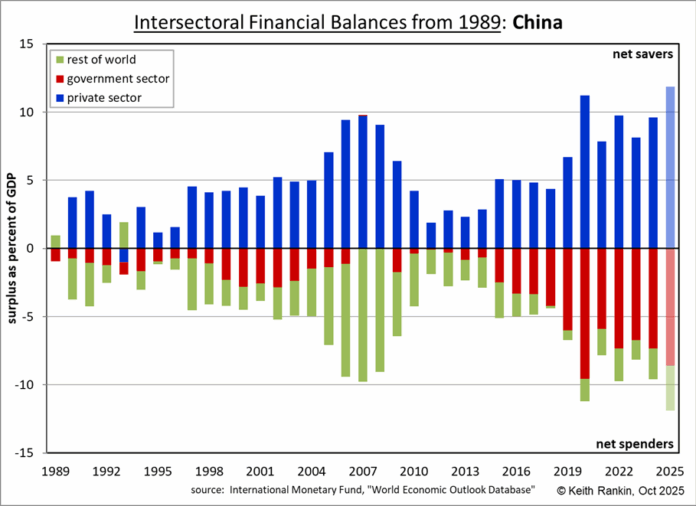
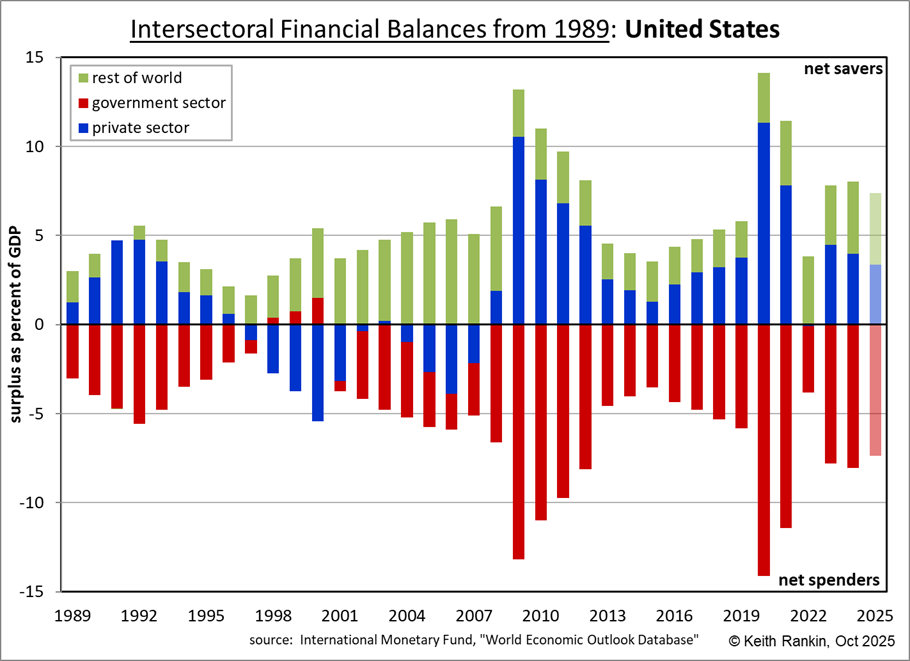
These charts of financial balances for China and the United States give some important clues about who paid for the Gulf Wars. (For the United States in particular, it is necessary for now, to not be distracted by the dramatic financial accommodations between 2009 and 2021, relating to the Global Financial Crisis and the Covid19 Pandemic.) They show variations over time in private saving and spending, government deficit spending, and these nations’ saver/spender relationships with their outside worlds.
Chart by Keith Rankin.Chart by Keith Rankin.
We note that most of the economic and financial cost of war comes after the main event (eg after 1990, and after 2003); as military equipment needs to be replenished, armies need to be expanded, and destruction zones need to be rebuilt. Indeed, the costs of a standing defence force are high whether or not there is a war.
1990, the middle of a period of both economic and financial flux in the world, came at the end of a recovery in the United States following the 1987 sharemarket crash. So, almost unusually, there was no speculative bubble in place, there was increased saving as people looked more to future spending than present spending, and the labour market remained weak.
For the United States, we see in the years from 1991 to 1993, high saving in the private sector – largely household saving – and comparably high spending in the government sector. Thus, domestic private savings directly funded the war. Unemployment in the United States was lower than it otherwise would have been. While savers were not asked whether they were happy that their caution was being translated into government military spending, it’s unlikely that they minded too much; the ‘war against Saddam’ was not an unpopular war in the United States.
In times of recession, when more people than usual are unemployed or underemployed, affording a war is easier but financing a war is harder. Liberal governments must make financial accommodations by departing from the standard fiscal rules they impose upon themselves. (We note that, just this year, 2025, the German Bundestag has made such an accommodation, and abandoned its self-set and dearly-held fiscal rule; giving itself a blank cheque to pursue debt-funded military spending.)
Most modern wars have been afforded through a process of restrained consumption, financed through the mechanism of new government debt and a build-up of household credits; governments owing, and households owning new debt. As a side-effect, and considering the United States, this affording and funding enlarges the combined balance sheet of American banks: more assets (government debts) and more liabilities (private savings).
Affording wars is always a matter of economic resources being deployed into military theatres, whether that is redeployed from civilian production or a reduction of resource underemployment. From a financing point of view, the four options are that wars are funded by taxes (which would not show up on this type of chart), by domestic saving (as happened in the United States from 1991 to 1993), by foreign saving (as happened in the mid-2000s), or by foreign aid from patron to proxy.
War financed by foreign saving may mean direct or indirect foreign funding. Much of the Allies funding in the Great World War was financed by American debt which, in the fullness of time, would be written off; making that war significantly American gift funded, even if at the time the advances were only intended and consented as loans. Nevertheless, the United Kingdom afforded their war only with substantial reductions in normal consumption; this was even more true for most of the other participating nation states.
In the United States chart above, we see (in green) that in every year shown except 1991, the United States has incurred debts to the rest of the world. Though these foreign advances were unusually low in the early 1990s. America’s war in 1990 was domestically funded, and relatively easily afforded.
(We note that that Gulf War involved both an invasion by Iraq and an invasion of Iraq. I make no attempt to discuss the affording or financing of the war from the point of view of either Iraq or Kuwait. Clearly, however, there was a substantial loss and degradation of life in Iraq, and degradation of land and infrastructure.)
The Wars of the 2000s, especially the Second Gulf War from 2003
The United States economy changed dramatically with the birth of the Internet-Age, just after the First Gulf War. Private balances follow a classic ‘bubble’ formation from 1994 to 2000/01; this came to be known as the dotcom bubble, and was characterised by a new ‘information technology’ sector being speculatively debt-financed. Government tax revenues ballooned, leading to unheard-of government budget surpluses. In addition, the United States economy attracted increased foreign credits before the turn of the millennium, though not much then from China.
We can see the collapse of the dotcom bubble in 2001, with a marked reduction in private debt spending, and the ensuing unusually high foreign financing of the United States economy.
The wars of the new-millennium began with the United States’ invasion of Afghanistan in 2001, followed by the bigger United States invasion of Iraq in 2003. These wars were foreign-funded, the US chart shows, and lasted – in their predominant phase – throughout the Bush presidency. (Refer Iraq War troop surge of 2007.)
We can trace this funding of the Bush-wars by examining the China chart. From 2002, we see a clear rise in Chinese private saving and of ‘foreign investment’. The ‘rest of the world’ percentages represent spending in the rest of the world (from China’s perspective) made possible by non-spending in China.
At its peak, China’s foreign investment ‘current account surplus’ – for our purpose, China’s excess of exports over imports – reached almost 10% of GDP in 2007. This co-dependency of Chinese exports and American imports has been called by some Chimerica; the best known proponent of this concept is the British global historian Niall Ferguson.
As well as considering the percentages, we remind ourselves that Chinese supercharged annual economic growth, which bottomed-out at 8% in 1999-2001, climbed to 14% in 2007. Given earlier growth in the 1980s and 1990s, China was no longer starting from a low base. These were massively increased levels of Chinese economic output in the 2000s; output sent from China rather than spent in China.
The result was that industrial capacity within the United States was freed up to supply military goods rather than civilian goods. While China provided the ‘butter’ (ie consumer goods), Uncle Sam was freed to specialise in the production and deployment of ‘guns’.
While China paid for the Second Gulf War through its massive export surpluses, for the West in general and the United States in particular, the war was fought for free; a ‘free lunch’ so to speak. Of course it wasn’t technically free; China built up a massive amount of financial claims on the United States, though it was never clear how or when China might exercise those claims. China is yet to show any desire to acquire the American imports which would constitute the settlement of China’s claims on the United States.
China will only be reimbursed for its massive lending to the United States in 2003 to 2008 when we see, in its future financial balances’ chart, a whole lot of green on the upper ‘savers’ side. Otherwise, China’s loans to the United States will morph into gifts. An export surplus can only be reimbursed in the form of an export deficit; not China’s style in current or near-future times.
Tax Cuts
Not only did the United States wage two major wars in West Asia, close to America’s Indian Ocean antipodes, it did the unheard-of for a nation at war; it reduced its tax rates. While the most obvious way to fund a war is to raise taxes, the United States did the precise opposite; to not fund the wars ‘because it could’. China was happily paying for those American wars. For many Americans not directly involved, these wars were more than a ‘free lunch’; they were, through tax cuts, a ‘sugar hit’.
Indeed, this detachment of fighting from cost-bearing has become the most dangerous facet of the emergent ‘Warrior epoch’. Western elites have come to believe that they can undertake wars – be they ‘good wars’ or ‘bad wars’ – without themselves facing up to the reality that all wars are costly.
The United States legislated two major rounds of tax cuts, in 2001 and 2003. The first round was undertaken in the light of the Clinton budget surpluses (see the year 2000), and without awareness that war was coming. Those Clinton fiscal surpluses were unsustainable, a consequence of the dotcom bubble mini-boom, though the tax cuts (ill-targeted as they were) helped to fiscally accommodate the recovery from the 2000/01 dotcom bust.
The 2003 federal tax cuts were inexcusable. Initiated just as the pre-Gulf-War hype was peaking, these tax cuts passed through Congress and the Senate during the peak initial phases of the war. The incongruence of simultaneous military aggression at scale and tax decreases was astounding in its brazenness.
After 2011
The principal wars in the 2010s were located in Afghanistan and Syria; there was additional militarisation in Eastern Europe and the former Soviet Union, associated with the eastward expansion of Nato.
China played a constructive new role in that decade.
An important feature of global financial imbalances – very clear in the American chart – was the Global Financial Crisis, showing resurgent American private saving (mainly debt repayment) and the spectacular (and necessary) US Government accommodation of that dramatic change in private behaviour. Then we see a return to normality from 2013 to 2019. Higher than usual United States government deficits were a critical part of the global recovery from the financial crisis. (We may mention in passing that the New Zealand government’s fiscal policy – under National and Labour – has been and still is non-accommodating; the pandemic year 2020 being the exception that ‘proves’ the rule.)
For the second critical component of the 2010s’ global economic recovery, we can see a big change in China’s financial balances. In particular, we see the emergence of the Chinese consumer and taxpayer (much less blue and less red). And Chinese net exports substantially diminished as a share of the Chinese economy. Consumer spending and government spending in China and the other BRICsrevived global demand for non-military goods and services.
Although the United States incurred a specific debt to China during the Second Gulf War in the 2000s, subsequently the whole West ‘owes’ China a considerable debt of gratitude for its role in restarting the global economy around 2010. Thankyous to China have been considerably lacking, however, as the West increasingly seeks to point its military hardware at China.
The West – led by the United States – has gamified war, and has become indifferent to non-western lives. There are also too many signs that western elites are becoming indifferent to western working-class lives; starting with indifference to the many immigrants who are already performing so much of the necessary labour to support higher-middle-class living standards.
China, already on the verge of a balance-sheet recession in the view of Richard Koo, may now be following in the financial and economic footsteps of Japan in the 1990s (see my Red Gold; Japan’s lesson for the world). Certainly China’s financial balances’ chart (above) is starting to look very Japanese, with a smallish and stable export surplus, and large government deficits.
2020s’ Wars
After the 2020 Covid19 Financial Crisis, which, as in 2009, required huge fiscal accommodations – especially by the United States federal government – wars have become proxy affairs whereby the means of war have been largely gifted by patrons to their proxies. Such financing leaves only small marks on countries’ financial balances charts. Though the patron nations will have larger-than-otherwise government deficits; see the United States’ government balance (above) for 2023 and 2025 (and the 2025 forecast).
The financing of the two sides of the Sudan ‘Civil War’ appears too convoluted to examine here. It would seem to involve proxies of proxies, and to be an important outlet for internationally traded military goods.
For the West, the affording of the wars in Ukraine and Israel-Palestine would appear to be mainly through a mix of gifts and loans by patron governments, meaning involved governments undersupplying too few peacetime public goods. (Too little ‘butter’, to use that metaphor, and too many guns.)
Russian citizens will be incurring substantial opportunity costs, mainly through higher taxes, a reallocation of government spending, and reduced opportunities for its citizens to live international lives. Ukraine seems to be funding its war through a mix of foreign gifting and government debt; though its people – like Russians – have been paying a high price through reductions in their living standards.
Israel continues to be a net exporter, so its deliveries of military hardware from the United States should definitely be regarded as aid rather than imports. Lucky Israel! To be able to fight its neighbours on such favourable terms is a privilege rarely granted.
In Retrospect
Wars are costly. Very intensive and extensive in the use of resources and the destruction of resources; let alone the loss of quantity and quality of life.
In all wars, all parties incur costs; significant costs. Sometimes, a party to a war can avoid most of those costs through having someone else pay. Of course, the United States paid to some extent for the wars against Iraq in terms of American lives lost and degraded; little cost was borne by those Americans who propagated those wars, though.
The material costs of the wars in the 2000s were paid – indirectly – by Chinese households not consuming large swathes of the goods they produced; Chinese workers and capitalists were, on an increasingly massive scale, exporting the fruits of their labour and their capital to the United States. More sending than spending. Much more. (A Marxian analysis would attribute the seemingly costless affording of the US-Iraq war to the extraction of ‘surplus value’ from the Chinese working class by the American capitalist class.)
Yet these Chinese costpayers didn’t much mind, because – while their abilities to enjoy the increasing fruits of their labours were highly constrained by China’s export policy – they were happily stacking up claims on future production; deferred enjoyment, rather than the pure exploitation which occurred in the early years of Chinese Communism.
China bore the West’s costs in other ways too; in those years Chinese people suffered huge environmental costs, at a time when natural environments were improving in the deindustrialising West.
There was a wider set of ongoing costs, however, arising from the ensuing highly unbalanced global capitalism. United States’ industrial survival is now largely dependent on its specialisation in military hardware and software; meaning that the United States’ economic deformation has made that country into a predatory warrior state. Violences, especially upon non-Americans, are today directly committed by the American state; and through both exported and gifted military goods and services, and through violations committed directly by America’s proxies (and, as in Sudan, by its proxies’ proxies).
Wars, when they happen, are affordable because they happened. They are very costly, both in terms of their opportunity costs (the loss of other uses to which the deployed resources could have been put) and the human misery of death, destruction of habitat and taonga, and injury. They are commonly financed by third parties – eg Chinese households – who may or may not enjoy reimbursement for their credit advanced.
*******
Keith Rankin (keith at rankin dot nz), trained as an economic historian, is a retired lecturer in Economics and Statistics. He lives in Auckland, New Zealand.
It’s been a decade since the US Supreme Court recognised a constitutional right to same-sex marriage in the landmark case, Obergefell v Hodges. The US Supreme Court will meet today to consider a request to overturn that 2015 decision.
In 2015, Kim Davis, a former Kentucky county clerk, made global headlines when she refused to grant a marriage license to a gay couple based on her religious beliefs. The couple, David Moore and David Ermold, filed a lawsuit against her, alleging she had violated their constitutional right to marry.
In a separate case, a US District judge ordered Davis to issue marriage licences to both gay and straight couples. When she refused, she was briefly jailed.
Then, in 2016, the Kentucky legislature passed a law that sought to accommodate clerks opposed to same-sex marriage by removing their names and signatures from licensing forms.
In the meantime, Moore and Ermold’s case continued. In 2023, a jury awarded them damages of US$50,000 (A$77,000) each.
Davis appealed that decision, arguing she could not be held liable because issuing Moore and Ermold a marriage license would have violated her right to freely exercise her religion. Davis’ appeal was rejected by the 6th Circuit Court on the grounds the First Amendment protects her as a private citizen, but not in her role as a government clerk.
This is when the US Supreme Court became involved. Davis is now asking the highest court in the country to review the 6th Circuit Court’s decision. She is arguing that she appeared before that court as an individual, not as a representative of the state.
There’s something bigger at stake, though. Davis is also asking the Supreme Court to overrule their 2015 decision in the Obergefell case that legalised same-sex marriages federally.
Today, at its private conference, the Supreme Court will decide whether to review Davis’ request.
What are the chances same-sex marriage could be overturned?
The chances of the US Supreme Court reviewing the case are unlikely – the court receives more than 7,000 such petitions each year and only chooses to hear 1% of them.
If it was to grant a review, the court would also likely consider Davis’ petition at two consecutive conferences.
However, given the more conservative configuration of justices on the Supreme Court, Obergefell v Hodges cannot be taken for granted.
It would take the votes of just four justices to take up the question and grant a review. It would then require a fifth justice to overturn Obergefell. The current court is dominated by conservative appointees by six to three.
Three of the conservative justices also wrote their own dissents to Obergefell. As Justice Samuel Alito wrote at the time, “the Constitution says nothing about a right to same-sex marriage.”
One argument the conservative justices could use to overturn Obergefell is the view same-sex marriage does not pass the “history and tradition” test.
This happened in the Dobbs v. Jackson Women’s Health Organization decision in 2022 that overturned Roe v Wade and ended the US constitutional right to abortion, handing jurisdiction back to the states.
Alito reasoned at the time abortion did not meet the test because it was not “deeply rooted in the nation’s history and tradition”.
Another reason the court might choose to overturn Obergefell is that the conservative majority has prioritised First Amendment free speech protections over other constitutional and legal rights.
They argue, for instance, that Davis’ didn’t develop her current First Amendment argument until very late in the process, in her reply to the 6th Circuit Court, filed nine years into the case.
By waiting so long to raise this argument, they argue, Davis has deprived them and the lower courts of “a fair opportunity to address it”.
State legislatures and LGBTQ+ rights
Davis’ petition for a review may seem like a longshot. But it illuminates a worrying trend in the US of conservative lawmakers trying to curtail LGBTQ+ rights in the states.
109 bills that would weaken civil rights laws (including 61 based on religious exemptions); and
277 bills that would restrict student and educator rights.
Seventy-one of the bills have been passed into law, including nine based on religious exemptions.
A tactic in this strategy is to introduce resolutions in state legislatures calling on the US Supreme Court to overturn its ruling in Obergefell. These resolutions are considered symbolic, as state law does not have control over what the Supreme Court does. But they outline a persistent, anti-same-sex marriage narrative.
Anti-LGBTQ+ misinformation and disinformation
There is also a broader assault on sexual and gender diversity happening in the US, much of which was foregrounded in The Heritage Foundation’s Project 2025 manifesto for a 2025 Republican presidency.
The LGBTQ+ community finds itself under constant threat from an onslaught of coordinated online campaigns, in addition to constant legal and legislative action. And this directly impacts the capacity for safe LGBTQ+ participation in public life.
As a result, LGBTQ+ individuals and organisations are already reconsidering their relationship with visibility, and how they can continue to advocate for progress.
Justin Ellis does not work for, consult, own shares in or receive funding from any company or organisation that would benefit from this article, and has disclosed no relevant affiliations beyond their academic appointment.
Source: The Conversation (Au and NZ) – By Frank Jotzo, Professor, Crawford School of Public Policy and Director, Centre for Climate and Energy Policy, Australian National University
Australia’s National Party has ended its commitment to reaching net zero by 2050.
In its anti-net zero plan, the party calls for emissions targets and climate policies to be watered down. The plan draws on a new report.
This would be economically damaging. Walking away from net zero would undermine investment confidence, raise power prices, drive up taxes, undermine green export potential, harm Australia’s international reputation and run against our intrinsic interest in strong global climate policy as a nation highly exposed to climate damage.
The announcement by the Nationals shouldn’t be interpreted as the policy of a future government, given the rural party is the junior partner in the Coalition, the Liberal party is struggling to respond, and there’ll be more political positioning to come. But it will have influence. The spectre of policy reversal spooks businesses and investors.
Australia’s long-term economic and broader national interest is aligned with strong climate action. This fundamental interest will very likely prevail above the political skirmishes and cycles. Yet Australia’s climate wars could flare up again, with uncertainty, detours, delays and inefficiencies.
In a “disorderly transition” scenario, the report estimates wages in 2050 would be 2.5% lower and per capita GDP 1.6% lower compared with the steady trajectory of progress implied by the government’s 2035 emissions target of a 62–70% cut below 2005 levels. These aren’t trivial numbers – they represent a palpable loss to Australian households and quality of life.
A disorderly transition means delayed action and stranded assets. It’s more expensive in part because of uncertainty driving up financing costs for the necessary investments.
Is Australia cutting emissions faster than than the OECD?
National party leaders claim Australia has been cutting emissions faster than other rich countries. In their announcement, they made a very specific claim:
OECD countries have been cutting their emissions by 1% per year. Australia has been cutting its emissions by about 2% per year – double the OECD rate. Our emissions cuts will be capped and calibrated, which is common sense.
The maths of the claim is simple, but the substance of it is misrepresented. Australia has cut overall national emissions around 29% below 2005 levels, while other rich countries in the OECD have cut emissions 15% on average.
There are two fallacies here. First, Australia is unique among developed countries in that land-use change and forestry emissions played a large role in the national emissions profile until the 2000s. Falls in emissions have mainly come from these sectors.
In every other sector bar electricity, Australia’s emissions have increased or flatlined since 2005. When land use and forestry is excluded, emissions have only fallen 5%. So in the metric that matters for the OECD comparison and for the actual low-emissions transition, Australia is below average, not in front.
Second, Australia is wealthier and has higher emissions on a per capita basis than the OECD average. There’s greater opportunity to cut emissions faster, and a higher expectation that Australia do so. Emissions can be cut deeply while maintaining activity not just in electricity but in industry, transport and agriculture.
Power-sector paralysis
The Nationals suggest propping up ageing coal plants with government intervention.
Left alone, the energy market will phase out coal in favour of wind and solar power. That’s because old coal plants are expensive to run and are less and less reliable. Renewables and storage are cheaper options.
Keeping coal power on life support would cost Australians more, through higher power prices or higher taxes to pay for subsidies.
It would sap investor confidence, drive up investment finance costs and slow down the needed modernisation of the power sector. Investors would be looking elsewhere.
Industrial modernisation delayed
Another suggestion by the Nationals is to scrap or weaken incentives for heavy industries to cut emissions under the Safeguard Mechanism, which allows emissions credit trading. This would delay modernisation of industrial facilities and worsen investment conditions because of policy uncertainty.
Under the Nationals plan, Australia’s land-based carbon credit scheme would revert back to a government “emissions reductions fund”, with government buying the credits, rather than have industry buy credits as currently.
This would mean fewer carbon projects on the land, lower credit prices, and less money for diversified income streams to landholders, farming and forestry businesses.
Squandering green opportunities
Shelving climate ambition and policy would also pull the rug out from under Australia’s ample green commodity opportunities. Australia has the chance to become a large exporter of commodities such as green iron and ammonia and to move into sustainable, high-value and low-emissions agriculture for export.
This relies to a fair extent on reputation. Other countries are poised to capture these emerging markets. And international demand for coal and gas will decline anyway.
Choosing prosperity
After years as a climate laggard, Australia’s international reputation on climate policy has improved. This will be on display at the COP30 climate conference in Brazil over the next two weeks. Pacific neighbours, trading partners and investment funds have taken note.
Parts of the political spectrum might see an advantage in playing to the Trump administration on climate change. But that would come at a cost to relationships and economic opportunities with other countries, including China, the clean energy investment leader.
The world’s energy and industrial system will shift to low-carbon options. The question is whether Australia embraces that transformation to our advantage, or locks into declining industries while economic opportunities pass by. Walking away from net-zero offers no pathway to future prosperity.
Australia’s previous economic successes have stemmed from embracing new opportunities, such as riding the China-led resources boom. The conservative side of politics knows this. Choosing prosperity over politics would have it on the side of sensible climate policy.
Frank Jotzo leads research projects on climate, energy and industry policy. He advises state governments including as a commissioner with the NSW Net Zero Commission and chair of the Queensland Clean Economy Expert Panel. He also led the Carbon Leakage Review for the federal government.
Source: The Conversation (Au and NZ) – By Phil Borell, Senior Lecturer (Above the Bar), Aotahi School of Maori and Indigenous Studies, University of Canterbury
Getty Images
The jerseys might be red or blue, green and gold, or black and white – but rugby league’s future is decidedly brown.
As the New Zealand Kiwis and Toa Samoa prepare to clash for the Rugby League Pacific Championship’s Pacific Cup on Sunday, it’s clear the top calibre Pacific players have catapulted the game to another level.
That energy was on full display as Toa Samoa fended off Mate Ma’a Tonga in Brisbane two weeks ago, while the PNG Kumuls clinched their third straight Pacific Bowl with a commanding victory over Fiji Bati last week.
This weekend promises plenty more action: along with the men’s cup decider, the Kiwi Ferns will square off against the Australian Jillaroos in the women’s competition final on Sunday.
Launched by the National Rugby League (NRL), the Pacific Championships are the latest evolution of the Oceania Cup – which itself replaced the old ANZAC Test once played solely between Australia and New Zealand.
The shift reflects the code’s growing centre of gravity in the Pacific, where nations such as Samoa, Tonga and Papua New Guinea are now driving the game’s expansion – on and off the field.
Tonga supporters at Auckland’s Eden Park this month: the same intensity in the stands their players show on the field. Hannah Peters/Getty Images
What hasn’t attracted as much attention, however, is the impact of their fans.
Almost 45,000 diehard Samoan and Tongan supporters packed Brisbane’s Suncorp Stadium two weeks ago, creating an atmosphere the tier-one nations could only dream of.
What do we do with Samoa and Tonga? We have something here that is a jewel in the crown that rivals State of Origin.
It’s worth remembering the ancient rivalry between the island nations of Samoa and Tonga predates not only State of Origin, but also the Australian nation state itself.
When Mate Ma’a Tonga played the Kiwis at Eden Park on Sunday, Tongan fans – affectionately known as the “sea of red” – made up the clear majority of a record 38,144-strong crowd.
Their passionate support for a team that ultimately lost has seen the sea of red dubbed the “greatest show in sports”.
Pacific fans are arguably what make the game what it is today: unwavering in their support, patriotic to extremes and as visible as they are vocal. These fans have lifted rugby league up, rather than the other way around.
From our seats, as Māori and Pacific academics and sporting practitioners, Pacific rugby league not only rivals State of Origin, it has the potential to surpass it as a true global rivalry that extends beyond Australian states.
The New Zealand Kiwis celebrate their win over Australia in the 2023 Pacific Championship final. Phil Walter/Getty Images
League loyalty comes home
As more elite Pacific players join the exodus away from the green and gold or black and white jerseys of their host nations – including Payne Haas, Roger Tuivasa-Sheck, Jason Taumalolo and Isaiya Katoa, among others – it’s becoming even clearer the international game’s current growth depends heavily on Pacific talent.
The Australian Kangaroos will always be strong, with or without Pacific players: they have a seemingly endless conveyor belt of young people eager to play the game.
But that doesn’t mean they won’t feel the loss as their Origin superstars navigate their way back “home” to represent their heritage.
The real impact, however, may be felt most by the New Zealand Kiwis and New Zealand Rugby League as they work to redefine themselves. The Kiwis were once the first home-away-from-home for Pacific rugby league players.
Before Samoan and Tongan teams were playing test matches against tier-one nations, most of their NRL players had links to Aotearoa through birth or migration. This often led to them representing the Kiwis at the highest level.
Now, as Tongan and Samoan teams become serious contenders, New Zealand is likely to take the biggest hit. This isn’t a bad thing. If anything, it will open pathways for more Pacific athletes to earn higher honours.
But it does create uncertainty about what New Zealand and Australian teams might look like in a few years, after having had first choice of Pacific athletes for so long.
It’s clear the future of rugby league is brown – let’s nurture it.
Phil Borell is the Chairman of Canterbury Rugby League.
Dion Enari does not work for, consult, own shares in or receive funding from any company or organisation that would benefit from this article, and has disclosed no relevant affiliations beyond their academic appointment.
At its height, the Roman empire covered some 5 million square kilometres and was home to around 60 million people. This vast territory and huge population were held together via a network of long-distance roads connecting places hundreds and even thousands of kilometres apart.
Compared with a modern road, a Roman road was in many ways over-engineered. Layers of material often extended a metre or two into the ground beneath the surface, and in Italy roads were paved with volcanic rock or limestone.
Roads were also furnished with milestones bearing distance measurements. These would help calculate how long a journey might take or the time for a letter to reach a person elsewhere.
Thanks to these long-lasting archaeological remnants, as well as written records, we can build a picture of what the road network looked like thousands of years ago.
A new, comprehensive map and digital dataset published by a team of researchers led by Tom Brughmans at Aarhus University in Denmark shows almost 300,000 kilometres of roads spanning an area of close to 4 million square kilometres.
The Roman road network circa 150 AD. Itiner-e, CC BY
The road network
The Itiner-e dataset was pieced together from archaeological and historical records, topographic maps, and satellite imagery.
It represents a substantial 59% increase over the previous mapping of 188,555 kilometres of Roman roads. This is a very significant expansion of our mapped knowledge of ancient infrastructure.
About one-third of the 14,769 defined road sections in the dataset are classified as long-distance main roads (such as the famous Via Appia that links Rome to southern Italy). The other two-thirds are secondary roads, mostly with no known name.
The researchers have been transparent about the reliability of their data. Only 2.7% of the mapped roads have precisely known locations, while 89.8% are less precisely known and 7.4% represent hypothesised routes based on available evidence.
More realistic roads – but detail still lacking
Itiner-e has improved on past efforts with improved coverage of roads in the Iberian Peninsula, Greece and North Africa, as well as a crucial methodological refinement in how routes are mapped.
Rather than imposing idealised straight lines, the researchers adapted previously proposed routes to fit geographical realities. This means mountain roads can follow winding, practical paths, for example.
Itiner-e includes more realistic terrain-hugging road shapes than some earlier maps. Itiner-e, CC BY
Although there is a considerable increase in the data for Roman roads in this mapping, it does not include all the available data for the existence of Roman roads. Looking at the hinterland of Rome, for example, I found great attention to the major roads and secondary roads but no attempt to map the smaller local networks of roads that have come to light in field surveys over the past century.
Itiner-e has great strength as a map of the big picture, but it also points to a need to create localised maps with greater detail. These could use our knowledge of the transport infrastructure of specific cities.
There is much published archaeological evidence that is yet to be incorporated into a digital platform and map to make it available to a wider academic constituency.
Travel time in the Roman empire
Fragment of a Roman milestone erected along the road Via Nova in Jordan. Adam Pažout / Itiner-e, CC BY
Itiner-e’s map also incorporates key elements from Stanford University’s Orbis interface, which calculates the time it would have taken to travel from point A to B in the ancient world.
The basis for travel by road is assumed to have been humans walking (4km per hour), ox carts (2km per hour), pack animals (4.5km per hour) and horse courier (6km per hour).
This is fine, but it leaves out mule-drawn carriages, which were the major form of passenger travel. Mules have greater strength and endurance than horses, and became the preferred motive power in the Roman empire.
What next?
Itiner-e provides a new means to investigate Roman transportation. We can relate the map to the presence of known cities, and begin to understand the nature of the transport network in supporting the lives of the people who lived in them.
This opens new avenues of inquiry as well. With the network of roads defined, we might be able to estimate the number of animals such as mules, donkeys, oxen and horses required to support a system of communication.
For example, how many journeys were required to communicate the death of an emperor (often not in Rome but in one of the provinces) to all parts of the empire?
Some inscriptions refer to specifically dated renewal of sections of the network of roads, due to the collapse of bridges and so on. It may be possible to investigate the effect of such a collapse of a section of the road network using Itiner-e.
These and many other questions remain to be answered.
Ray Laurence does not work for, consult, own shares in or receive funding from any company or organisation that would benefit from this article, and has disclosed no relevant affiliations beyond their academic appointment.
Two years ago, a power struggle erupted between two factions of Sudan’s military. Today, this conflict is spiralling out of control, with thousands being killed in what a United Nations report has called “slaughterhouses”.
Last week, the Rapid Support Forces (RSF), the paramilitary group battling Sudan’s army, captured the city of El Fasher, the last hold-out in the western Darfur region held by the military.
Soon after, reports of ethnically motivated massacres emerged. The World Health Organization said 460 people were killed in just one incident at the city’s hospital. Witnesses described widespread executions and sexual violence targeting certain ethnic groups.
A UN fact-finding mission found already last year that both sides in the conflict have committed war crimes and crimes against humanity.
Rights groups and analysts are now sounding the alarm about a possible genocide taking place. Some say the killings are reminiscent of the start of the Rwanda genocide in 1994, which killed a staggering 800,000 people.
The atrocities are also following the same troubling pattern as in Darfur 20 years ago, which killed an estimated 300,000 people.
Back then, celebrity activists such as George Clooney helped put Darfur on the map. It became a major foreign policy issue in the United States, Europe, Africa and elsewhere. The genocide in Rwanda was still relatively fresh in people’s minds. The slogan “never again” was still taken somewhat seriously.
The global attention eventually led the International Criminal Court to indict Sudanese President Omar al-Bashir for allegedly directing the campaign of mass killings in Darfur, the first sitting head of state to be indicted.
Yet, compared to the early 2000s, the international community has been largely silent.
Why global attention matters
It would be tempting to say the wars and suffering in Gaza and Ukraine have overshadowed Sudan in the minds of global leaders and concerned citizens alike. But this does not mean the world can’t do anything.
Global awareness did not solve anything by itself in Darfur 20 years ago, but it was a first step. It led to the eventual deployment of a peacekeeping mission by the United Nations and the African Union.
The mission was too small and limited, but it showed that international peacekeepers can still have a positive impact in the 21st century. They can monitor ceasefires, implement disarmament programs, protect civilians and prevent further escalations of violence.
More attention – and pressure – also needs to be placed on the external actors supporting both sides in the current conflict. These countries are pursuing their own strategic interests in Sudan and consider the power struggle a chance to increase their influence in the region and exert control over Sudan’s natural resources.
While these countries deny arming both sides, rights groups say a flood of weapons has nonetheless entered the country. The United Arab Emirates, in particular, is accused of covertly supplying drones, howitzers, heavy machine guns and mortars to RSF fighters in Darfur.
The United Arab Emirates has only just started to distance itself from the RSF following the recent atrocities in El Fasher.
What’s needed to bring peace
A ceasefire must urgently be agreed to, so humanitarian corridors can be opened to allow aid organisations to do their work.
All outside military support to the warring parties must end immediately. The current arms embargo is too limited and has been poorly implemented – it needs to be strengthened.
And more sanctions should be imposed, especially on the perpetrators reportedly responsible for international crimes. In January, the Biden administration levied sanctions on the RSF commander and several UAE-based companies supporting him – these must now be expanded.
This would make it more difficult for Sudan’s lucrative gold trade to continue to be used by both sides to sustain the war.
For the peace to hold in the long term, both sides must also agree on a mechanism to disarm or integrate the RSF fighters into the regular forces.
Establishing some form of justice and reconciliation process can also contribute to preventing further violence. This sends a clear signal that committing crimes will not be rewarded. It can also help communities heal and give peace a better chance.
Nothing of this sort has really happened in Darfur over the past couple decades. Instead, political actors continued to exploit and aggravate ethnic tensions. The RSF, in particular, has recruited fighters from the infamous Janjaweed militias responsible for the Darfur atrocities in the early 2000s.
This means that while getting the leaders to agree on a ceasefire is important, it may not be sufficient.
As a result, peace initiatives must include local agreements with individual rebel leaders and smaller factions of fighters, which can greatly increase the security of the population in particular areas.
To be clear, lasting peace does not come from some miracle peacemaker. In fact, nothing tangible came out of previous attempts at peace talks aimed at ending the conflict this year.
But this is where other actors can play an important role. The United Arab Emirates, for example, may now feel pressured to exert a more positive influence on the RSF and urge it to come to the negotiating table. The same applies to Egypt and the Sudanese Armed Forces.
And a more comprehensive plan then needs to be worked out, ideally through an international organisation like the United Nations or the African Union, with the goal of empowering the people of Sudan to make their own political decisions.
Sudan is a stark reminder that making lasting peace takes huge efforts. The devastating situation in the country demands the world keep trying.
Philipp Kastner does not work for, consult, own shares in or receive funding from any company or organisation that would benefit from this article, and has disclosed no relevant affiliations beyond their academic appointment.
Just as world leaders gather for this year’s COP30 climate summit in Brazil, the government’s announcement of its intention to significantly change New Zealand’s climate change law upends years of cross-party consensus.
All of the proposals pose serious problems, but the change to the zero-carbon provisions in the Climate Change Response Act 2002 runs counter to the underlying purpose of the act to provide accountability for climate change policy.
The government proposes to simplify emissions reduction plans, which are produced every five years to set out policies and strategies to decarbonise every sector of the economy.
It also wants to remove the Climate Change Commission’s role in providing independent advice on emissions reduction plans, and allow more frequent revisions of these plans without public consultation. The changes would also adjust timelines for emissions budgets and reports, and relax deadlines for the government’s response.
In earlier research, we explored why climate change is an especially difficult policy issue. One of the chief reasons is that it is a long-term problem that needs action now.
Political systems are not good at addressing long-term problems. As public policy expert Jonathan Boston has demonstrated, democracies suffer from a short-term focus and find it hard to ask voters for commitments to fix a problem that will unfold over decades.
Consequently, countries have often announced targets for emissions reductions for dates that are decades away, and then walked off.
The classic New Zealand example is when Tim Groser, who was minister for climate change between 2010 and 2015, consulted the public about what New Zealand’s Paris Agreement target should be, but declared that domestic policies to achieve the target were a separate matter for some other time.
There is a tendency for governments to make grand statements on targets without awkward detail about what we have to do to reach them – or to do as little as possible so as not to upset voters.
But we know that won’t work. New Zealand went through a long period of that kind of climate policy making, and it shouldn’t go back.
The long-term emissions targets for 2050 (net zero for long-lived greenhouse gases and a recently weakened target for shorter-lived methane) are supported by five-yearly emissions budgets, which show what has to be done in each period to stay on track for the target.
These budgets break down the distant target into a series of closer, smaller and more manageable ones. Then, for each budget period, there is a plan that sets out the policy actions in different sectors that, taken together, should produce a viable path to the necessary emissions reductions.
The Climate Change Commission is part of this policy system to provide transparency and independent judgement.
It formulates advice on targets, budgets and plans (and on a number of other matters), and that advice is made public. The government may or may not follow the commission’s advice, but usually must respond, again publicly.
The commission’s independence gives it a role different from that of the minister’s department. It is more able to take a long-term perspective, and it can ensure that politically difficult aspects of climate policy are not downplayed.
The act’s zero-carbon provisions, and especially the commission, help ensure climate policy is formulated in ways that are open, well-informed, systematic, effective and equitable. Consultation during the policy process helps build a broad base of support.
Good processes make better policy
Zero-carbon laws have been said to have a quasi-constitutional character. They are like the Public Finance Act or the Electoral Act in providing the rules and structure within which New Zealand makes decisions.
The fundamental premise is that good processes, laws and institutions will produce better politics and better policy. The zero-carbon procedures make it harder to do climate policy badly, and easier to do it well.
We should not stop the commission from giving advice on emissions reduction plans, and we do not want it to be reduced to being a mere technical system monitor. Nor should the plans be narrowed in scope, or made subject to the summary process of amendment the government intends, which avoids robust scrutiny.
Public consultation on budgets and emissions reduction plans should not be discarded, and timeframes for ministerial responses should not be relaxed. We need the commission as a source of independent advice to provide transparency about our policy options.
There may well be opportunities for streamlining the statutory procedures. But this must not weaken the system that gives essential structure to the way we tackle the difficulties of climate change.
The law should only be changed after wide consultation and the building of substantial multi-party support in parliament. That is how the zero-carbon law was enacted in the first place.
The authors do not work for, consult, own shares in or receive funding from any company or organisation that would benefit from this article, and have disclosed no relevant affiliations beyond their academic appointment.
Keeping a line of sight to the challenges of both COP30 in Brazil next week and also the subsequent Pacific’s COP31. A Pacific perspective.
COMMENTARY:By Dr Satyendra Prasad
As Pacific’s leaders and civil society prepare for the United Nations Climate Conference in Brazil (COP30) next week, they also need to keep a line of sight to the subsequent Pacific’s COP31.
As they engage at COP30, they will have in their thoughts the painful and lonely journey ahead in Jamaica and across the Caribbean as they rebuild from Hurricane Melissa.
The Blue Pacific needs to build a well-lit pathway to land Pacific’s priorities at COP30 and COP31. The cross winds are heavy and the landing zone could not be hazier.
At the recent Pacific Islands Forum Meeting in Honiara, Pacific leaders called for accelerating implementation of programmes to respond to climate change. They said that finance and knowhow remained the binding constraints to this.
The Pacific’s leaders were unanimous that the world was failing the Pacific.
Climate-stressed infrastructure Pacific leaders spoke about their infrastructure deficit. The region today needs well in excess of $500 million annually to maintain infrastructure in the face of rising seas and fiercer storms.
There are more than 1000 primary and secondary schools, dozens of health centres across coastal areas in Solomon Islands, PNG, Vanuatu and Fiji that need to be repaired rehabilitated or relocated.
The region needs an additional $300-500 million annually over a decade to build and climate proof critical infrastructure — airports, wharves, jetties, water and electricity and telecommunications.
The Blue Pacific’s infrastructure distress is a cocktail that poisons its human development progress. This has lethal consequences for our elderly, for children and the most vulnerable.
As a region has fallen short in convincing the international community that the region’s infrastructure distress is quintessentially a climate distress. This must change.
Fiji’s former ambassador to the UN Dr Satyendra Prasad . . . “the ball may be in the Pacific’s court on how successfully we can harness this rare opening.” Image: Wansolwara News
The constant cycle of catastrophe, recovery and debt are on autoplay repeat across the world’s most climate vulnerable region. The heart-braking images coming out of Jamaica and the Caribbean in the wake of Hurricane Melissa makes this same point.
The Blue Pacific as a region attracts a woefully insufficient share of existing climate finance. Less than 1.5 percent of the total climate finances reaches the world’s most climate vulnerable region today. This is unacceptable of course.
Is our planet headed for a 3.0C world? At COP30, the world will see what the new climate commitments (NDCs) add up to. Our best estimates today suggest that the planet is headed for a 3.0C plus temperature rise. Anything above 1.5C will be catastrophic for the Blue Pacific.
Life across our coral reef systems will simply roast at 3.0C temperature increase. The regions food security will be harmed irreparably. This will have massive consequences for tourism dependent economies. Bleached reefs bleach tourism incomes.
The health consequences arising from climate change are set to worsen rapidly. As will the toll on children who will fall further behind in their learning as schools remain inaccessible for longer periods; or children spend long hours in hotter classrooms.
For Pacific’s women, the toll of runaway temperature increase will be heavy — on their health, on their livelihoods and on their security. It will be too heavy.
A deal for the Pacific at COP30 The world of climate change is becoming transactional. Short termism and deal making have become its norm.
As Pacific leaders, its civil society, its science community and its young engage at COP30 in Brazil, they are reminded that the Blue Pacific needs more than anything else, a settled outlook climate finance that will be available to the region. Finance must be foremostly predictable.
The region should not feel like it is playing a lottery — as is the case today. Tonga must know broadly how much climate finance will be available to it over the next five years and so must Papua New Guinea.
At Bele’m, the world will need to agree to a road map for how the climate financing short fall will be met. This is a must to restore trust in the global process.
The weight on the shoulders of host Brazil is extraordinarily heavy. Brazil is the home of the famous Rio Conference in 1992 where the small island states first succeeded in placing climate change, biodiversity loss on the global agenda.
The Small Islands States grouping is chaired by Palau. President Whipps Jnr will lead the islands to Brazil. He will no doubt remind the host that the world has failed the small states persistently since that moment of great hope at the Rio Conference in 1992.
Belém hosts the UN Climate Summit, an international meeting that will bring together heads of state and government, ministers, and leaders of international organisations on 10-21 November 2025. Image: Sergio Moraes/COP30/Wansolwara News
Pace of climate finance There are three principal reasons why climate finance must flow to the Pacific at speed.
First, is that most countries in our region have less than a decade to adapt. Farms and family gardens, small businesses, tourist resorts, villages and livelihoods need to adapt now to meet a climate changed world.
Second, if adaptation is pushed into the future because of woefully insufficient finances — the window to adapt will close.
As more sectors of our economy fall beyond rehabilitation, the costs of loss and damage will rise. Time is of the essence. And on top of that loss and damage remain poorly funded. This too must change.
The Pacific needs to do many things concurrently to build its resilience. Everything for the Blue Pacific rests on a decent outcome on financing.
The region needs to make its clearest argument that its share of climate finance must be ring-fenced. That its share of climate finance will remain available to the region even if demand is slow to take shape.
The Pacific’s rightful share of climate finance over the next decade is between 3-5 per cent of the total across all financing windows. This is fundamentally because based the adaptation window is so short in such a uniquely specific way.
This should mean that the Blue Pacific has access to a floor of US$1.5 billion annually through to 2035. This is very doable even if global currents are choppy.
TFFF and Brazil’s leadership Brazil has already demonstrated that it can forge large financing arrangements through its leadership and creativity. It will launch the Tropical Forest Forever Facility (TFFF) at COP. PNG’s Prime Minister has played an important role on this. We hope that forested Pacific states will be able to access this new facility to expand their conservation efforts with much higher returns to landowners.
Beyond Bele’m COP30 in Brazil is an opportunity for the Pacific to begin to frame a larger consensus — well in time for COP31. It is my hope that Australia and Pacific’s leaders will have done enough to secure the hosting rights for COP31.
A ‘circuit-breaker’ COP31 Fiji’s former Deputy Prime Minister Biman Prasad and Australia’s Climate Minister Chris Bowen recently said that COP31 must be “a circuit breaker moment” for the Blue Pacific.
The reversals in our development story arising from the climate chaos have become too burdensome. Repeated recoveries means that every next recovery becomes that much harder.
Ask anyone in Jamaica and Caribbean today and you will hear this same message. Their finance ministers know too well that in no time they will be back at the mercy of international financial institutions to rebuild roads and bridges that have been washed away and water systems that have been destroyed by Hurricane Melissa.
Climate finance by its very nature therefore must involve deep changes to the architecture of international development and finance. The rich world is not yet ready to let go of privilege and power that it wields through an archaic financial international system.
But fundamental reform is a must. Fundamental reform is necessary if small states are to reclaim agency and begin to drive own destinies.
Future proofing our societies The risks arising from climate change are so multi-faceted that economic, social and political stability cannot no longer be taken for granted.
Conflicts over land lost to rising seas, the strain on education, health and water infrastructure, deepening debt stress take their toll on institutions through which stability is maintained in our societies.
The Blue Pacific needs to work with this elevated risk of fragility and state failure. This reality must shape the Blue Pacific expectations from a Pacific COP.
Building on the excellent work underway in climate ministries in Fiji, Vanuatu, Samoa, PNG and across the region through the SPC, SPREP, OPOC, I have outlined what the Pacific’s expectations could be from a Pacific COP31.
COP31 must be about transformation and impact. The Blue Pacific’s leaders should seek a consensus that includes both the rich industrial World and large developing countries such as China and India in support of a Pacific Package at COP31.
A Pacific COP 31 package The core elements of a Pacific package at COP31 are:
Ensuring that the Loss and Damage Fund has become fully operational with a pipeline of investment ready projects from across the Blue Pacific.
Securing the Pacific Regional Infrastructure Facility (PRIF) as a fully funded and disbursement ready financing facility with a pipeline of investment ready projects.
Securing ring-fenced climate finance allocations for the Blue Pacific at the Green Climate Fund (GCF) and across international financial institutions.
Securing support for Blue Pacific’s “lighthouse” multi-country (region wide) transformative programs to advance marine and terrestrial biodiversity protection and promote sustainability across the Blue Pacific Ocean.
A COP decision that is unambiguous on quality and speed of climate and ocean finance that will be available to small states for the remainder of the decade.
Securing sufficient resources that can flow directly to communities and families to rapidly rebuild their resilience following disasters and catastrophes including through insurance and social protection vehicles.
Ensuring that knowhow, resources and mechanisms for disaster risk reduction are in place, are fully operational and are sustainable.
An Ocean of Peace for a climate changed world Fiji’s Prime Minister Sitiveni Rabuka has championed the Blue Pacific as an Ocean of Peace. Its acceptance by Pacific leaders opens up opportunities for the region’s climate diplomacy.
The Pacific’s leaders accept that the Ocean of Peace anchors its stewardship of our marine environment to the highest principles of protection and conservation. An Ocean of Peace super-charges the Pacific’s efforts to take forward transboundary marine research and conservation, end plastic and harmful waste disposal, end harmful fisheries subsidies and decarbonise shipping.
It boosts the Pacific’s efforts to main-frame the ocean-climate nexus into the international climate change frameworks by the time a Pacific COP31 is convened.
A window of hope Between COP30 and COP31 lies a rare window of hope. The Blue Pacific must leverage this.
Both a Brazilian and an Australian Presidency offer supportive back-to-back opportunities and spaces to take forward the regions desire to project a solid foundation of programs that are necessary to secure its future.
Uniquely the ball may be in the Pacific’s court on how successfully we can harness this rare opening in the international environment.
Dr Satyendra Prasad is a Non-Resident Senior Fellow at the Carnegie Endowment for International Peace and Fiji’s former ambassador to the UN. He is the Climate Lead for About Global. This article was first published by Wansolwara Online and is republished by Asia Pacific Report in partnership with USP Journalism.
Eating plenty of fruit and vegetables is key to staying healthy and avoiding diseases such as heart disease and stroke. But it’s often easier said than done.
Places where many people eat poorly are often called “food deserts”, and their existence has typically been blamed on a lack of nearby supermarkets or grocery stores.
However, my colleagues and I have discovered food deserts exist in the heart of one of Europe’s biggest and most cosmopolitan cities, surrounded by local shopping options.
In new research published today in PLOS Complex Systems, we analysed hundreds of millions of Tesco supermarket transactions across London and discovered surprising patterns in who buys what kind of food and where they do it.
Our results show the factors that influence how people eat are complex – with implications for nutrition in cities around the world.
The rise of ‘food deserts’
The term “food deserts” emerged in the late 1990s to describe areas where residents were denied access to affordable, healthy food due to a lack of supermarkets or poor transport links. As a result, food deserts have usually been defined by distance to supermarkets.
More recent research has revealed the picture is more complex. It’s not just how close the person is to a supermarket and how affordable the food is. There are other factors, such as how many shops are available, and whether the shops stock culturally appropriate foods and accept different forms of payment.
Our new paper builds on this. It takes a different approach to identifying food deserts – based on what people actually put in their shopping baskets.
420 million shopping lists
We used a dataset of Tesco grocery purchases containing 420 million anonymised transactions from 1.6 million London Clubcard holders to analyse residents’ food buying, based on the areas linked to shoppers’ loyalty cards.
Two clear purchasing patterns emerged from the data – one involving sugary, processed and high-carbohydrate foods usually considered unhealthy, the other involving purchases of fresh fruits, vegetables and meat, usually considered to be healthier.
We then mapped the areas of London where each of these purchasing patterns was most common. This revealed distinct geographic patterns.
Inner northwest London had the most nutritious purchasing behaviour – with high fruit, vegetable and fish purchases. The east and outer west of London followed a less nutritious pattern, high in sweets and soft drinks.
Because our analysis is based on supermarket purchases, it doesn’t capture all food consumption – such as meals eaten out, takeaway orders, or shopping from smaller local stores.
Still, using real transaction data offers a major advantage over traditional surveys, which often rely on what people say they eat rather than what they actually buy.
Lower income linked to less nutritious food
Here’s what emerges when we define food deserts by what people actually buy. Even in cities with stores nearby, some neighbourhoods are still “deserted” of nutritious options. Often, it’s not about distance at all – it’s about economic and social factors.
We then analysed how demographic and socioeconomic factors such as age, income, Black, Asian and minority ethnic populations, car ownership, and walk time to stores relate to diet quality across London.
We found that income and the proportion of Black, Asian and minority ethnic residents were among the strongest factors linked to diet quality. But their influence varied across the city. Lower income was linked to less nutritious food purchasing throughout London, and this effect was strongest in parts of the east and west.
This suggests that affordability and social disadvantage shape what’s within reach – even when supermarkets are nearby.
Some factors that might be expected to influence diet had surprisingly little effect. For example, car ownership was linked to less nutritious purchases in certain areas, while walk time to stores had very low association with diet quality.
Together, these patterns suggest two things: the reasons people eat unhealthily are local and vary from place to place, and they’re shaped more by social and economic conditions than by how close shops are.
Global relevance
While our study focuses on London, the findings have relevance beyond the United Kingdom.
The same inequalities that shape London’s dietary health also exist in Australian cities. Australia is highly urbanised, with around 73% of the population living in major cities.
Here too, poor diet is one of the nation’s leading causes of preventable disease. In 2022, 66% of Australian adults and 26% of children were living with overweight or obesity, according to the Australian Institute of Health and Welfare (AIHW). On top of that, the average servings of fruit and vegetables have declined across all age groups since 2017–18, according to AIHW data.
A similar data-driven approach using anonymised grocery transaction data from sources such as Woolworths Everyday Rewards card or Coles’ Flybuys programs could help reveal which communities face the greatest nutritional constraints, and why.
Another important takeaway from our work is that food access is not a one-size-fits-all problem. Understanding what people buy – not just where they live – is key to creating healthier and more equitable food environments.
Focusing on actual purchasing behaviour allows policymakers to design more effective, community-informed interventions that promote fairer, healthier food choices.
Tayla Broadbridge does not work for, consult, own shares in or receive funding from any company or organisation that would benefit from this article, and has disclosed no relevant affiliations beyond their academic appointment.
New Zealand’s drug-buying agency Pharmac is currently consulting on a change to how it manages its waiting list for medicines.
This represents one of the stages of Pharmac’s “reset” through which the agency seeks to become more outward-focused and transparent.
The consultation focuses on how Pharmac manages its Options for Investment list – essentially a wish list of what Pharmac would like to fund if it had the budget.
For medicines that have been at the bottom of the list for more than two years, Pharmac wants to decline 20% if there are more than 100 applications on the overall list, or 10% if there are fewer than 100.
A useful analogy is to think of Pharmac’s list like a Christmas wish list. Children put items on it and parents will buy them if they can afford them. Not everything is affordable, and Christmas morning can result in disappointment.
Similarly, Pharmac disappoints patients (and clinicians and industry) by not funding all medicines that are submitted for review.
A never-ending list
Pharmac currently has 123 medicines on the Options for Investment list. The disappointment continues because Pharmac doesn’t tell anyone where these medicines are on the list, for fear of losing their hand at negotiating a better deal with the supplier.
Pharmac keeps unfunded medicines on this list for many years. A 2023 report found applications stay on the list for an average of 5.9 years.
However, after several years, the most effective must-have drugs can change. Relying on assessments from many years ago carries risk, and reducing some of the old listings may have some merit.
But for patients who have been asked to wait for many years, the removal of medicines from the list may come as a bitter blow. Telling your children you can’t afford a toy for Christmas is a harsh truth, but telling them to wait each year and then breaking the news that they were never going to get it seems rather cruel.
Recent estimates also suggest New Zealand spends substantially less (4.9%) of its total health expenditure on pharmaceuticals, compared to the average OECD spending of 13.3%.
If Pharmac’s current budget of NZ$1.7 billion were doubled, the agency might be able to clear the current list completely. But this would come at a cost to other parts of the health system.
Historically, Pharmac’s ability to keep costs down has allowed New Zealand to do more in these other parts of the health system.
The experience elsewhere is that spending a lot of money on expensive new drugs (as the UK does) has led to a large net reduction in population health. This happened because new cancer and biological drugs are expensive and do not offer the same value in terms of quality-adjusted life years as spending elsewhere in the health system.
It might be better for New Zealand to keep its pharmaceutical spending down and put more effort into improving other parts of the health system.
Clearer expectations on value for money
Another alternative is for Pharmac not to have a list at all, as the list breeds disappointment and frustration. If Pharmac were to set clearer expectations and be willing to say no, that could be avoided.
A better alternative would be for Pharmac to base some of its purchasing decisions on the opportunity cost of spending money elsewhere in the health system.
That is, instead of basing decisions on ministerial demands or becoming more responsive to industry and patient lobbying, Pharmac (or the Ministry of Health) could ask how much health would be gained from spending money on other parts of New Zealand’s system.
Once that is known, Pharmac could commit to providing a similar value for money to that delivered elsewhere by our hospitals, primary care and in public health. Doing this would require research, but this has already been conducted elsewhere and could be replicated here, albeit with some political will.
Otherwise, the danger is that Pharmac resets from running a wish list poorly to a process that’s even worse.
Paula Lorgelly consults to Pharmac and has in the past consulted to the pharmaceutical industry. She has received funding from the Health Research Council, the Ministry of Health and the EuroQol Foundation. Paula is a member of the EuroQol Group which owns the EQ-5D instrument which is widely used in health technology assessments.
Braden Te Ao has consulted Pharmac previously and receives funding from the Health Research Council of New Zealand and the Ministry of Health for various research projects requiring an economic analysis. He currently serves as a director for ProCare Health Ltd and is a member of the Ngā Pou Hauora o Tāmaki Makaurau Iwi Māori Partnership Board.
Richard Edlin consults to Pharmac and has in the past consulted to the pharmaceutical industry.
Along with delegates from all over the world, I’ll be heading to the United Nations COP30 climate summit in the Brazilian Amazon city of Belém. Like many others, I’m unsure what to expect.
This year, the summit faces perhaps the greatest headwinds of any in recent history. In the United States, the Trump administration has slashed climate science, cancelled renewable projects, expanded fossil fuel extraction and left the Paris Agreement (again). Trump’s efforts to hamstring climate action have made for extreme geopolitical turbulence, overshadowing the world’s main forum for coordinating climate action – even as the problem worsens.
Climate talks are never easy. Every nation wants input and many interests clash. Petrostates and big fossil fuel exporters want to keep extraction going, while Pacific states despairingly watch the seas rise. But in the absence of a global government to direct climate policy, these imperfect talks remain the best option for coordinating commitment to meaningful action.
Here’s what to keep an eye on this year.
A smaller-than-usual COP?
A persistent criticism of the annual climate summits is that they have become too big and unwieldy – more a trade show and playground for fossil fuel lobbyists than an effective forum for multilateral diplomacy and action on climate change. One solution is to deliberately make these talks smaller.
The Belém conference may end up having a smaller number of delegates, though not by design so much as logistical headaches.
Brazilian President Luiz Inácio Lula da Silva backed the decision to invite the world to the Amazon to display how vital the massive rainforest is as a carbon sink. But Belém’s remote location on the northeast coast, limited infrastructure and shortage of hotels have seen prices soar, putting the conference out of reach for smaller nations, including some of the most vulnerable. These constraints could undermine the inclusive “Mutirão” (collective effort on climate change) sought by organisers.
Many delegates will sleep on ships at the Belem climate talks. Pictured is Curupira, a figure from Brazilian folklore and the COP30 mascot. Gabriel Della Giustina/COP30, CC BY-NC-ND
Show me the money
Climate finance is a perennial issue at COP meetings. These funding pledges by rich countries are intended to help poorer countries reduce emissions, adapt to climate change or recover from climate disasters. Poorer countries have long called for more funding, given rich countries have done vastly more damage to the climate.
At COP29 in Baku, Azerbaijan last year, a new climate finance goal was set for US$300 billion (~A$460 billion) to be raised annually by developed countries by 2035, with the goal of reaching $US1.3 trillion (~A$2 trillion) in funding from both government and private sources over the same period.
To deliver the second goal, negotiators laid out a “Baku to Belém” roadmap. The details are due to be finalised at COP30. But with the US walking away from climate action and the European Union wavering, many eyes will be on China and whether it will step into the climate leadership vacuum left by developed countries. The EU has only just reached agreement on a 2040 emissions reduction target and an “indicative” cut for 2035.
Climate finance will be the priority for many countries, as worsening disasters such as Hurricane Melissa in Jamaica and Typhoon Kalmaegi in the Philippines once again demonstrate the enormous human and financial cost of climate change.
The latest UN assessment indicates the need for this funding is outpacing flows by 12–14 times. In Belém, poorer countries will be hoping to land agreement on greater finance and support for adaptation. Work on a global set of indicators to track progress on adaptation – including finance – will be key.
Brazilian organisers hope to rally countries around another flagship funding initiative set to launch at COP30. The Tropical Forests Forever Facility would compensate countries for preserving tropical forests, with 20% of funds directed to Indigenous peoples and local communities who protect tropical forest on their lands. If it gets up, this fund could offer a breakthrough in tackling deforestation by flipping the economics in favour of conservation and protecting a huge store of carbon.
2035 climate pledges
Belém was supposed to be a celebration of ambitious new emissions pledges which would keep alive the Paris Agreement goal of holding warming to 1.5°C. Nations were originally due to submit their 2035 pledges (formally known as Nationally Determined Contributions) by February, with an extension given to September after 95 per cent of countries missed the deadline.
When pledges finally arrived in September, they were broadly underwhelming. Only half the world’s emissions were covered by a 2035 pledge, meaning the remaining emissions gap could be very significant. Australia is pledging cuts of 62–70% from 2005 emissions levels.
That’s not to say there’s no progress. A new UN report suggests countries are bending the curve downward on emissions but at a far slower pace than is needed.
How negotiators handle this emissions gap will be a litmus test for whether countries are taking their Paris Agreement obligations seriously.
Rise of the courts
Even as some countries back away from climate action, courts are increasingly stepping into the breach. This year, the International Court of Justice issued a rousing Advisory Opinion on states’ climate obligations under international law, including that national targets have to make an adequate contribution to meeting the Paris Agreement’s temperature goal. The court warned failing to take “appropriate action” to safeguard the climate system from fossil fuel emissions – including from projects carried out by private corporations – may be “an internationally wrongful act”. That is, they could attract international liability.
It will be interesting to see how this ruling affects negotiating positions at COP30 over the fossil fuel phase-out. At COP28 in 2023, nations promised to begin “transitioning away from fossil fuels in energy systems”. If countries fail to progress the phase-out, accountability could instead be delivered via the courts. A new judgement in France found the net zero targets of oil and gas majors amount to greenwashing, while lawsuits aimed at making big carbon polluters liable for climate damage caused by their emissions are in the pipeline.
An Australia/Pacific COP?
A big question to be resolved is whether Australia’s long-running bid to host next year’s COP in Adelaide will get up. The bid to jointly host COP31 with Pacific nations has strong international support, but the rival bidder, Turkey, has not withdrawn.
If consensus is not reached at COP30, the host city would default back to Bonn in Germany, where the UN climate secretariat is based.
Outcome unknown
As climate change worsens, these sprawling, intense meetings may not seem like a solution. But despite headwinds and backsliding, they are essential. The world has made progress on climate change since 2015, due in large part to the Paris Agreement. What’s needed now on its tenth anniversary is a reinfusion of vigour to get the job done.
Jacqueline Peel receives funding from the Australian Research Council under a 2024 Kathleen Fitzpatrick Australian Laureate Fellowship.
Ten years on from the landmark Paris Agreement, countries have taken big strides in limiting emissions and the clean energy transition is accelerating rapidly. But geopolitical headwinds are growing and the damage bill for climate pollution is rising. Climate action hangs in the balance.
Next week, these issues will come to a head as negotiators gather in Brazil for COP30, the 30th annual global climate talks. This year’s talks could be pivotal, as all countries were due to set more ambitious targets to cut emissions. Will the world double down on the clean energy transition – or will momentum stall and fossil fuel interests win out?
Australia has a larger role than its size and clout might suggest. After two decades as one of the world’s worst climate laggards, the new national emissions target compares favourably with much of the developed world. Australia is also bidding to host the next COP talks with Pacific nations.
Prime Minister Anthony Albanese has attracted some criticism over his decision not to attend the summit. But Climate and Energy Minister Chris Bowen will be there, alongside dozens of negotiators and experts from Australia and the Pacific.
The outcome is uncertain. But for the first time in years, Australia will be a leader in working towards a consensus on a managed transition away from fossil fuels.
What’s at stake at COP30?
The world’s climate talks are returning to their birthplace. The UN Climate Convention was signed in Rio de Janeiro in 1992 before talks began three years later. This year, the 30th Conference of Parties will be held in the Amazonian city of Belém.
For COP30 to succeed, it must firm up global commitment to the Paris Agreement. That may seem hard, given the United States is once again walking away from climate action.
But there is good news. The Paris Agreement is working, slowly but surely. Countries agreed to set emissions targets and increase their ambition every five years. These targets are bending the curve of emissions and limiting warming.
Before Paris, the world was on track for a catastrophic outcome: 4°C degrees of warming this century. The first wave of global emissions targets brought this closer to 3°C. In 2021, upgraded targets brought projections down to 2.1–2.8°C. Tallying up the new round of national targets suggests it may be possible to limit warming to 1.9°C. That assumes, of course, all targets are met in full. The new United Nations emissions gap report suggests 2.3–2.5°C is more likely.
The bad news is the Paris Agreement is not working fast enough. The longer we take to bring global emissions to net zero, the more heating we bake in. Every fraction of a degree intensifies damage to ecosystems and human communities. We are seeing these worsening impacts now at 1.2°C of warming. Almost every corner of the world is already reeling from intensifying heat, storms, floods, droughts and fires.
What can Australia do?
Australia’s delegation will arrive in Belém with a much stronger target: cutting emissions 62–70% by 2035 (from 2005 levels).
This isn’t aligned with the science – a cut of at least 75% is needed to align with the Paris goal of limiting warming to 1.5°C. But it’s an improvement.
Australia’s 2030 target was one of the weakest among wealthy nations. But only a handful of nations now have a more ambitious 2035 target.
That’s not all. Australia’s rapid shift to renewable energy is one of the fastest in the world. One in three Australian homes now has rooftop solar. Grid operators are at the forefront of soaking up more and more clean power. The federal government plans to have the main grid running on over 80% renewable power within five years. These successes offer an encouraging story.
Our turn next?
If the COP31 bid succeeds, it would mean Adelaide would host Australia’s largest ever diplomatic meeting. Success would help cement Australia’s place in the Pacific at a time of increasing geostrategic competition.
In 2022, the Australian government announced its bid to host the COP talks with the Pacific. Since then, Bowen has effectively been auditioning to head the talks, taking on key roles at the annual climate talks. At last year’s talks in Azerbaijan, he co-chaired negotiations for a new global finance goal.
The bid has broad support. But Turkey has refused to withdraw a rival bid. The standoff is expected to be resolved in the second week of talks in Belém.
If Australia secures hosting rights, leaders will have a positive story to tell about the renewables shift. But hosting would also draw attention to Australia’s huge gas and coal exports. Long one of the largest coal exporters, Australia’s gas production has doubled since the 2015 Paris Agreement. The emissions of these exports are three times larger than the entire domestic economy.
Until recently, these exported emissions were considered a customer responsibility. But in July, the world’s highest court found countries are legally responsible for climate damages caused by fossil fuel production and consumption, noting countries approving new fossil fuel projects may be committing “internationally wrongful acts”.
if we are to keep 1.5°C alive, fossil fuels have no ongoing role to play in our energy systems – and I speak as the climate and energy minister of one of the world’s largest fossil fuel exporters.
Bowen and the Australian delegation will have to bring this level of clarity to Brazil amid backsliding by other major fossil fuel exporters such as the United States.
If COP31 comes to Adelaide, Bowen will need to go further. No one has yet given a sunset date for Australia’s fossil fuel industry. Working alongside Pacific nations, Australia can build a global legacy: beginning the managed phase out of fossil fuel production.
Wesley Morgan is a fellow with the Climate Council of Australia
Ben Newell receives funding from the Australian Research Council.
More than 1.4 million people are employed in Australian retail and fast food businesses. Sadly, it’s not always a happy or safe place to work.
A union survey of more than 4,600 frontline workers found 87% had experienced customer verbal abuse in 2023 – consistent since 2016.
But incidents have become more frequent: in 2023, 76% of those who’d been abused experienced it daily, weekly or monthly, compared with 54% just two years earlier.
The lead up to Christmas is a notoriously bad time for customer violence and abuse against workers. On Thursday, a large collective of retail groups launched a national “Be Kind in Retail” campaign, urging shoppers to be compassionate and patient over Christmas.
But there is one ultra-cheap solution, trialled since 2020, which our three-part study has now confirmed seems to significantly reduce customers’ intention to verbally abuse workers.
A name and a story
In late 2017, the Shop, Distributive and Allied Employees’ Association (SDA) union launched its “No One Deserves a Serve” campaign to reduce abuse of frontline staff.
Later, as part of this initiative, the union bought 500,000 adhesive plastic “under badges”, which were handed out for free from early 2020 to retail staff to stick to existing name badges.
An under badge is a small personal identifier attached below a name tag that can convey a short humanising message in a few words. Examples include “I’m a mother” or “I’m a son”.
The badges were trialled with retailers such as Woolworths, Target, Big W and KFC.
Around 2020, lead author Gary Mortimer’s daughter came home from her job at a supermarket wearing one of these under badges.
Surprisingly however, there’s been little research done into the evidence behind low-cost solutions to customer abuse, and whether such badges really could help curb customer abuse. So, we decided to investigate.
What our research found
In our recently published study, we began by speaking with 17 supermarket workers in late 2024, who had participated in the “No One Deserves a Serve” campaign.
Some said they’d felt awkward about wearing phrases like “I’m a son”.
But overall, participants said under badges seemed to reduce verbal abuse, created opportunities to chat and increased customers’ empathy.
A 39-year-old supermarket worker said:
[Customers] treat us like dirt. I recall this old fellow coming in and carrying on […] and then he just calms down when he sees that I’m a mother. He starts talking about his kids when they were younger. It was like I suddenly became a real person, not just a worker.
Another 22-year-old worker said:
I think badges made customers see us as equals.
Interestingly, none of the workers interviewed were still wearing their under badge. It was not always unclear why; one participant told us it had fallen apart, while others may have been lost.
How did almost 1,000 customers respond?
We also ran two experiments with a total of 940 customers.
First, we created a scenario where we described a poor service experience, which elicited anger.
We then presented artificial intelligence (AI) generated images of fictional retail workers. Some had just their name badge, while others disclosed personal information such as “I’m a daughter” on an under badge.
We then asked 600 respondents how likely a “reasonable” customer would be to shout, complain aggressively, become verbally abusive, or argue with the worker.
While the under badge didn’t completely deter verbal abuse, there was a statistically significant reduction in customers’ intention to engage in verbal abuse when the additional badge saying “I’m a mum/dad/daughter/son” was also worn.
Finally, we replicated the experiment with 340 different customers. We changed the under badges to read, “I’m a local”.
The same procedures were used, and we again confirmed that any form of self-disclosure – that is, revealing something about our “personal story” – reduced customer abuse.
How humanisation can reduce customer abuse
Two theories can help explain why revealing something about ourselves fosters greater levels of respect and empathy in others.
The first, social penetration theory describes the way we move from shallow, to deeper relationships with others.
It suggests we assess the “rewards” and “costs” attained from interacting with other people. Social rewards may include being liked. Social costs emerge from feelings of vulnerability.
The second, social exchange theory, suggests when the social rewards are greater than the costs of the interaction, exchanges will continue.
However, for self disclosure to work, these theories suggest the information shared must be perceived as “more than what is expected”, possibly of a personal nature.
This “extra” personal disclosure tips the balance in favour of the customer, simply: “I’ve learned something about this worker, without having to divulge anything in return.”
Our research demonstrates when workers disclose personal information, a social exchange takes place. Customers see the worker as a human – not just an extension of the retail brand.
Retailers around Australia are gearing up for sales season over the Christmas period. Happy Kikky/Getty
Trying to keep retail workers safer
Over the five years since the badges launched, we’ve observed far fewer worn in shops. However, the SDA told The Conversation it is still sharing them and they are still available.
But it’s something businesses of all sizes could experiment with. Looking online to gauge current costs, we found it could cost as little as 17 cents per badge (plus GST) for a large business with 10,000-plus employees, to 43 cents for a smaller order of fewer than 1,000 badges.
It seems a small price to help remind customers that retail workers deserve to be treated as equals.
Gary Mortimer has received past funding from the Building Employer Confidence and Inclusion in Disability Grant, the AusIndustry Entrepreneurs’ Program, the National Clothing Textiles Stewardship Scheme, the National Retail Association and the Australian Retailers Association. He is an independent director and board chair of Services and Creative Skills Australia, a federally-funded jobs and skills council.
Maria Lucila Osorio Andrade and Shasha Wang do not work for, consult, own shares in or receive funding from any company or organisation that would benefit from this article, and have disclosed no relevant affiliations beyond their academic appointment.
Last week, artificial intelligence (AI) music company Udio announced an out-of-court settlement with Universal Music Group (UMG) over a lawsuit that accused Udio (as well as another AI music company called Suno) of copyright infringement.
The lawsuit was brought forward last year by the Recording Industry Association of America, on behalf of UMG and the other two “big three” labels: Sony Music and Warner Records.
The lawsuit alleged Udio – which offers text-to-audio music generating software – trained its AI on UMG’s catalogue of music.
But beyond agreeing to settle, the pair have announced a “strategic agreement” to create a new product, to be trained exclusively on UMG’s catalogue, that respects copyright. We don’t have any details about the product at this stage.
In any case, the agreement puts both Udio and UMG in powerful positions.
Uncertainty remains
Some notable copyright campaigners have trumpeted the outcome as a success for creators in the fight against “AI theft”. But since it’s a private settlement, we don’t actually know how compensation for artists will be calculated.
To seasoned observers, the agreement between UMG and Udio mainly reflects the realpolitik of music big business.
In a panel discussion at last year’s SXSW festival in Sydney, Kate Haddock, partner at the law firm Banki Haddock Fiora, anticipated many lawsuits between copyright holders and AI companies would end in private settlements that may include equity in the AI companies.
Such settlements and strategic partnerships will help major labels set the ground rules for developing AI-music ecosystems. And it seems they are becoming common. Last month, Spotify announced a deal with UMG, Sony and Warner to produce “responsible AI products” across a range of applications. Again, we have little detail as to what this will look like in practice.
Such arrangements could allow music giants to benefit financially from non-infringing uses of AI, as well as getting a cut from uses that attract a copyright payment (such as fan remixes).
How does this affect creators?
According to Drew Silverstein, co-founder and chief executive of AI-powered platform Amper Music:
the real headline is that with one of the biggest rights-holders now actively engaging with generative AI music products, smaller players can’t afford to sit on the sidelines.
However, any vision of how such a settlement might serve smaller individual creators remains murky.
Even with AI companies agreeing to do deals to get training data (rather than helping themselves to it), these’s no straightforward model for how attribution and revenue can be equitably distributed to creators whose work was used to train an AI model, or who opt in for future use of their works in generative AI contexts.
Several emerging companies such as ProRata are claiming to develop “attribution tracing” technologies that can mathematically trace the influence on an AI-generated output back to its sources in the training data. In theory, this could be used as a way to divide royalties, just as streaming services count the number of plays on a track.
However, such approaches would assign extraordinary economic power to algorithms that regular stakeholders don’t understand. These algorithms would also be contentious by their nature. For instance, if an output sounded like 1950s bebop, there is no “right way” to decide which of the thousands of bebop recordings should be credited, and how much.
A more blunt but practical approach has been used by Adobe’s Firefly image-AI suite. Adobe pays artists an “AI contributor bonus”, calculated in proportion to the revenue their work has already generated. This is a proxy measure because it doesn’t directly capture any value a work brings to the AI system.
When it comes to generative AI, it’s hard to find attribution and revenue solutions that aren’t highly arbitrary, difficult to understand, or both.
The results of this are systems that risk being easily exploited and inequitable. For example, if there’s a payment structure, attribution tracing could encourage artists to create music that maximises the likelihood of attracting attributions.
Artists are already struggling to understand complex rules of success defined by powerful digital platforms. AI seems poised to exacerbate these problems by “industrialising” the sector even further.
Music as a public good
As it stands, individual artists don’t have clear, globally agreed protection from having their work used to train AI models. Even if they’re able to opt out in the future, generative AI is likely to present major power imbalances.
A model legitimately trained on a catalogue as vast as UMG’s – a giant tranche of the world’s most significant recorded music – will have the ability to create music in many different styles, and with a wealth of conceivable applications. This could transform the musical experience.
The idea that copyright provides an incentive for creators to produce original work is faltering with AI–recording industry licensing deals. Looking for other ways to support original music might be the solution we need.
Oliver Bown receives research funding from the European Research Council and the Australian Research Council.
Kathy Bowrey receives funding from the Australian Research Council.
The water infrastructure politics of eThekwini, the municipality that includes the city of Durban, have been splashed across the digital pages of South Africa’s news outlets in recent years.
The city’s water politics has a long history. Some of the infrastructure issues can be traced back to the mid-1800s, when it was a British imperial port.
I’m a historian with an interest in coastal communities and urban life. As part of my work on water as a public health concern in colonial cities, I spent months in the Durban Archives Repository, going through correspondence, reports, business contracts, newspaper clippings and town council minutes.
The records revealed how the system of colonial-era water infrastructure worked – and for whom.
The first water technologies in Durban were British-styled wells. Anyone could use them, for free. They brought people of different origins and class together for practical purposes but also created anxiety about social difference. For colonial officials, the public had to follow British standards or lose access to the infrastructure altogether. They created Durban’s first water-policing system, purportedly for better public health and conservation. While wealthier and white people eventually came to rely on piped water, poorer and black (Zulu and Indian) people were excluded.
This system formed the basis for the uneven access to water that today’s residents experience. People still depend on private water infrastructure as the municipal system struggles.
Nineteenth-century infrastructure
Founded by British traders as Port Natal in 1824, the colonial borough of Durban depended on stand-alone water infrastructures from the beginning. Brick and cement wells were the first technologies from which residents drew water, since they were easy to build and maintain. Most wells had either a bucket or a pump attached to them. Pumps attached to wells became common after the borough made most wells publicly available in the mid-1850s.
Water tanks, on the other hand, were private technologies which mainly lay underground. Only wealthier households and businesses could afford to build them. They became prominent in the 1870s.
It’s hard to know exactly how many of these infrastructures existed in total. By the 1870s, though, official reports indicate that about 18 public wells and pumps across the town served the bulk of the town’s approximately 20,000 inhabitants.
Piped water came to Durban in the 1880s, supplied initially by the spring at Curries Fountain. In 1889, the city’s laws were extended to cover private tanks that were filled from the municipal pipes. Even so, much of the population still relied on standalone infrastructures for water supplies.
As time went by, conflicts began to brew. The rising population placed a strain on these stand-alone infrastructures, which offered varying amounts of water depending on rainfall patterns. Arguments sparked when a community drew too much water or polluted a well, creating a local water scarcity.
Clashes and restrictions
White colonists blamed much of the water scarcity and contamination on African labourers who worked as household or business servants, sanitary workers and launderers. These positions demanded a close relationship with fresh water collection and use, which meant African labourers became the main users of wells, pumps and tanks.
Labourers did not always use water technologies according to colonial expectations, however. Local people were accustomed to using open water sources like rivers and streams, not restrictive iron and brick infrastructures. So, they modified their traditional work at open sources, like washing objects and produce, to the new technologies they had to use.
That sometimes created problems, according to the archive records. They accidentally broke handles and chains when pumping too quickly. They drew water from tanks without using a filter, which was officially perceived as a disease risk. They publicly washed clothing, bodies and food at wells, where the dirty wash water flowed back into the enclosed water supply.
Colonists exploited this situation to place restrictions on how labourers could use stand-alone water infrastructures. Borough officials crafted new laws that forced colonised residents to conform with British standards. They punished those who did not comply with fines, verbal lashings and even jail time.
Durban was part of a colonial system predicated on white supremacy. The government sought to maintain segregation between white colonists and African and South Asian residents. So, it imbued its water technology regulations with the notion that some water management actions – British – were “healthier” than others, namely African and South Asian. If someone used a technology contrary to British standards, then they faced restricted access to public technologies and the water they provided.
Water system legacy
Stand-alone water infrastructures still exist across eThekwini. Many residents of informal settlements and formerly racially segregated areas remain officially unconnected with municipal pipes. They instead depend on local wells, pumps and illegal individualised connections. An increasing number of households are investing in water tanks as the municipal water system becomes more unreliable.
Things have, of course, changed since the 19th century. However, the municipality continues to require residents to use these technologies within regulatory boundaries if residents want to maintain access to them. Cutting off municipal water supply to private storage tanks is an example.
Infrastructural stopgaps further expose a water system that was never meant to supply every resident equitably and without restriction. These actions tell us that today’s officials have inherited and inadvertently continue a water system that was meant to exclude more than include, to punish more than teach, to restrict more than provide.
Kristin Brig receives funding from the US Fulbright Program, the US National Science Foundation (NSF), and Johns Hopkins University.
Israelis are determined to erase the evidence of Israel’s genocide in Gaza, through the use of paid and instructed propagandists to reshape the historical record.
Zionists have also taken over social media platforms. Those who are critical of Israel are being censored or arrested.
From YouTube to X, Wikipedia, and TikTok, Zionists are capturing all means of communication to erase the evidence of its genocide, reshape the historical record, and censor those critical of it.
Meanwhile, the Israel Lobby exercises its power through intimidation, paying influencers to endorse it, and arresting dissenters whom they frame as terrorists.
Back in August, Israeli Prime Minister Benjamin Netanyahu admitted to reporters that Tel Aviv was losing to “propaganda” war.
“I think that we’ve not been winning [the propaganda war], to put it mildly … There are vast forces arrayed against us,” he stated at the time, blaming the algorithms for this defeat.
Dismantling free speech Since then, Israel has been working to dismantle free speech and censor everything critical of it, across social media, as part of an all-encompassing crackdown.
This press conference was no accident; instead, it was part of a much larger scheme that began in July with a targeted campaign aimed at brainwashing right-wing conservatives in the West.
The propaganda plan was hatched in three parts: One being Netanyahu going on a number of right-wing podcasts; another being a social media censorship campaign, along with the financing of propaganda trips to Israel for right-wing influencers.
Benjamin Netanyahu’s appearance on the Nelk Boys podcast was his first stop in his attempt to revive right-wing support for him personally, yet it received enormous backlash at the time.
The podcasters were widely condemned for both “normalising” and asking no critical questions of the Prime Minister, who currently has an International Criminal Court (ICC) war crimes warrant out for his arrest.
The Israeli Prime Minister then went on a round of coordinated interviews across the American corporate media, as a range of other right-wing podcasters hosted him. The difference between the corporate media and the podcasters who hosted him was that the podcasters were even less critical and actively worked to bolster his image.
These disingenuous podcast hosts even attempted to frame themselves as defying cancel culture, being edgy and going against the mainstream, despite the fact that they were simply doing a worse job than that of the corporate media, battling nothing more than their own followings.
Erica Mindel – censorship Tsar Meanwhile, in the background, TikTok hired Erica Mindel, an ex-Israeli soldier and ex-ADL employee who openly bragged of her loyalty to Israel, as its new “Hate Speech” censorship Tsar.
A move that appeared to have gone relatively unnoticed, but began to shape what was deemed acceptable discourse on the platform.
As this was in the works, the Israeli foreign ministry had already funded trips for 16 right-wing influencers to travel to Israel on closely coordinated propaganda trips. Their goal was to bring 550 such influencers on fully financed tours by the end of the year, which later included figures like Tommy Robinson and even former rapper Azealia Banks.
Upon visiting the White House in October, Benjamin Netanyahu attended a meeting with right-wing influencers and openly discussed ideas to capture social media platforms.
At this point, the agenda to kill content critical of Israel was already underway, as the TikTok app that the Israel Lobby sought to ban just a year prior fell into the hands of pro-Israel billionaires.
The world’s second-richest man and top donor to the Israeli military, Larry Ellison, is a key figure in this picture, as his company, Oracle, is poised to take over TikTok. The move was recently praised by The Times of Israel as “raising hopes for tougher anti-Semitism rules”.
Meanwhile, Ellison was busy buying up CBS News and installing the completely inexperienced, vehemently pro-Israel journalist, Bari Weiss, as the channel’s top executive.
Inexperienced for role Weiss, whose claim to fame was being a temporary opinion piece writer at The New York Times before leaving and attempting to carve out a career as a right-wing commentator and, later, news outlet owner, is clearly inexperienced for taking on her current role.
Ellison just so happens to be a major stakeholder in Elon Musk’s Tesla and X.
In early October, YouTube also decided to quietly delete at least 700 videos from the platform that documented Israeli human rights violations, along with the accounts of three prominent Palestinian human rights groups: Al-Haq, Al-Mezan Center, and the Palestinian Center for Human Rights.
The Intercept published an article explaining the move as a “capitulation” to President Donald Trump’s recent sanctions, enacted to shield Israel from accountability for its copiously documented war crimes.
Then there is Wikipedia co-founder, Jimmy Wales, who came out against the website’s page covering the Gaza Genocide, asserting that it “needs immediate attention”.
“At present, the lead and overall presentation state, in Wikipedia’s voice, that Israel is committing genocide, although that claim is highly contested,” Wales stated, claiming it violates the platform’s “neutral” point of view.
At present, every major human rights organisation, including Israel’s own B’Tselem, all the top legal organisations relevant to the issue, the United Nations, and the most representative body of genocide scholars, all agree that Israel is committing genocide.
ICJ’s “plausible genocide’ In fact, the International Court of Justice (ICJ)’s ruling on the matter considers it a plausible genocide. The only ones disputing this fact are the Israelis themselves, ideologically committed and/or paid Zionist propagandists, in addition to Israeli allies who are also implicated in the crime of all crimes.
Objective truth is, however, not relevant to any of these bad-faith actors. This is because Israel and its powerful lobbying arms are actively pursuing a total crackdown on criticism of Israeli war crimes.
On X (Twitter), a new censorship warning has been placed over all images and videos from Gaza that show Israeli war crimes, also.
What is currently happening is a widespread attempt to wipe content from the internet, erase the truth, ban, deport, and arrest those critical of Israel. All this as the Israel Lobby brings social media and corporate media under its direct control, using the excuse of “anti-Semitism” and “terrorism” to do so.
Israel’s censorship crackdown, which the Trump administration is working alongside to complete, is by far the worst iteration of cancel culture yet.
The ongoing crackdown on academic freedom, for example, in order to silence criticism of Israel, is by far the most severe in US history.
Meanwhile, the ADL has just set up a “Mamdani monitor” to track the democratically elected incoming New York City mayor.
Robert Inlakesh is a journalist, writer, and documentary filmmaker. He focuses on the Middle East, specialising on Palestine. He contributed this article to The Palestine Chronicle and it is republished with permission.
Opposition Leader Malcom Fraser, Lord Mayor of Melbourne Ron Walker and Prime Minister Gough Whitlam at the Lord Mayor’s Banquet in Melbourne on November 10, 1975.City of Melbourne, CC BY
In his just-released memoir, historian and former diplomat Lachlan Strahan recalls being picked up from his Melbourne primary school by a neighbour on November 11 1975, the day Gough Whitlam was sacked as prime minister. His politically active mother “was so upset she didn’t trust herself behind the wheel”.
Journalist Margo Kingston was a teenager and not political at the time. She remembers going to bed that night, pulling the covers over her head and listening on the radio. The next day, she organised a march around her Brisbane school.
The Dismissal is one of those “memory moments” for many Australians who were adults or even children when it happened. They can tell you what they were doing when they heard the news. It was an event that embedded itself in the mind, like news of US President John F. Kennedy’s assassination more than a decade earlier.
This was a life-changing day for many who worked in Canberra’s Parliament House. For Labor politicians and staffers, it bordered on bereavement. Excitement and elation fired up the other side of politics. Those of us in the parliamentary press gallery knew we had front-row tickets for the biggest show in our federation’s history.
The Dismissal didn’t come out of nowhere. It followed extraordinarily tense weeks of political manoeuvring, after the opposition, led by Malcolm Fraser, blocked the budget in the Senate in mid-October, and Whitlam refused to call an election.
Pressure points were everywhere. Would Whitlam give in? Would some Liberal senators crack? What would happen if there was no resolution before the government’s money ran out? Would Governor-General John Kerr intervene?
On the morning of Remembrance Day, Whitlam prepared to ask Kerr for an election. Not a general election, but an election for half the Senate – a course that would have little or no prospect of solving the crisis. But Whitlam had fatally misjudged the man he’d appointed governor-general. Kerr was already readying himself to dismiss the prime minister. He gave Whitlam his marching orders at Government House at 1 pm.
That afternoon Whitlam, eyes flashing, deployed his unforgettable rhetoric on the steps of parliament house. “Well may we say God Save the Queen, because nothing will save the governor-general”, he told the crowd, denouncing Fraser as “Kerr’s cur”.
Demonstrators were pouring into Canberra; shredders were revving up in parliamentary offices. That night at Charlie’s restaurant, a famous Canberra watering hole, the Labor faithful and journalists gathered. Many still in shock and emotional, patrons were packed cheek by jowl.
On parliament’s steps, Whitlam had urged the crowd to “maintain your rage and enthusiasm through the campaign” (an exhortation later taken to apply more generally). In the subsequent weeks, Labor supporters did so. I spent much of the election campaign in the media contingent travelling with Whitlam: it felt like there was momentum for him.
The feeling was, of course, totally deceptive, in terms of the election’s outcome. As the opinion polls had shown before the sacking the voters, who had enthusiastically embraced the “It’s Time” Whitlam slogan and promise in 1972, had lost faith in Labor three years on.
Whitlam’s had been an enormously consequential, reforming government. It transformed Australia, with landmark changes in health, education, welfare and social policy. It inspired the baby boomers. But it had been shambolic administratively, disorganised and corner-cutting. Some ministers had run riot. Whitlam was charismatic and visionary, but he lacked one essential prime ministerial quality: the ability to run a well-disciplined team. Then, as things started to go wrong, the government’s media enemies became feral.
A combination of how he ran his government and how that government ended made Whitlam in later years both an example to be avoided by subsequent Labor governments and a martyr in Labor’s story.
Despite his huge electoral mandate, Fraser’s road to power in part defined how he was seen as prime minister, especially in his early years. Some believed it made him more cautious; many in the media viewed him in more black-and-white terms than the reality.
Kerr paid a high price. Leaving aside the partisans, many observers condemned his actions, particularly on two grounds: that he had intervened prematurely and, most damning, that he had deceived Whitlam, rather than warning him he’d be dismissed if he continued to hold out. Kerr’s fear (probably reasonably-based) that if he alerted him, Whitlam would ask Buckingham Palace to remove him, didn’t convince critics. He was branded as dishonourable and cowardly.
Even Fraser eventually thought Kerr should have warned Whitlam. Journalist Troy Bramston, who has just published a biography of Whitlam, uncovered a never-published obituary Fraser wrote of Whitlam decades after the tumultuous events.
Fraser wrote he had come to the view “the Governor-General should have consulted the Prime Minister more freely. He thought he must protect the Monarch to make sure the Queen could not become involved in domestic political battles fiercely fought. It was the cautious approach but, on reflection, I think there was a higher duty to consult the Prime Minister of the day and to warn of the consequences that could follow.”
Kerr’s personal behaviour, notably being drunk at the Melbourne Cup in 1977, ensured he became a figure of ridicule as well as a political target. Fraser took care in appointing the next governor-general. He chose a widely respected, unifying figure in Zelman Cowen.
The Dismissal left fractures in our politics for years and its legacies forever. But Labor recovered faster than many had expected (despite Whitlam being trounced again in 1977). It was back in office in under a decade.
Our constitutional arrangements remained basically the same, with the governor-general retaining the reserve powers to dismiss a government. There was one change, however: Fraser ran a successful referendum to prevent recalcitrant state governments from stacking the Senate by appointing rogue candidates to fill upper house vacancies. That loophole had enabled the blocking of supply. The Dismissal did not push Australia towards a republic.
Could we see a repeat? Who knows what may have happened by the time we reach the 100th anniversary. But as far ahead as we can see, the events of 1975 have inoculated the system against a rerun. And, as many have pointed out, to have the combination of three such characters as Whitlam, Fraser and Kerr, and similar circumstances, would be impossibly long odds.
The main characters are dead. Some of those still around from the time maintain their rage, which has lasted through the many years, long after that election campaign.
David Solomon, Whitlam’s press secretary in 1975, says: “I haven’t changed. I’ve become, in fact, even more concerned about what Kerr did, the more information we have about why Kerr acted as he did and the material that he had before him when he decided to do this.”
And what of the views of the young? Frank Bongiorno, professor of history at the Australian National University, says today’s students find the events “fascinating in the way political science and history students did in the late 1970s.
“But the high-stakes game that played out is a bit like ancient history for them. They would see it as if it was like contemplating Pericles of Athens or Caesar of Rome.”
Gough would be pleased enough with the comparison to Caesar Augustus. He did like to quote Neville Wran’s joking compliment: “It was said of Caesar Augustus that he found Rome brick and left it marble. It will be said of Gough Whitlam that he found the outer suburbs of Sydney, Melbourne and Brisbane unsewered, and left them fully flushed.”
Michelle Grattan does not work for, consult, own shares in or receive funding from any company or organisation that would benefit from this article, and has disclosed no relevant affiliations beyond their academic appointment.
Yesterday’s victory of “democratic socialist” Zohran Mamdani in the race for the New York mayoralty is fuelling debate among progressives around the world about the way forward.
And this has significant implications and lessons for the political left in New Zealand, casting the Labour and Green parties as too tired and bland for the Zeitgeist of public discontent with the status quo.
Mamdani’s startling victory in the financial capital of the world symbolises a broader shift in global politics.
His triumph, alongside the rise of similar left populists abroad, sends an unmistakable message: voters are hungry for politicians who take the side of ordinary people over corporations, and who offer bold solutions to the cost-of-living crises squeezing families worldwide.
The Mamdani phenomenon follows on from some other interesting radical left politicians doing well at the moment, including the new leader of the Green Party in the UK, Zach Polanski. These politicians seem to be doing better by appealing to the Zeitgeist of anger with inequality and oversized corporate power that characterises Western democracies everywhere.
Such politicians and activists are channelling the tone of other recent radicals like Bernie Sanders and Jeremy Corbyn, who both embraced a leftwing populism concerned with working class citizens.
Here in New Zealand, however, the contrast is stark, where the political forces of the left are very timid by comparison. The Labour and Green parties remain stuck in the past and unwilling to catch up with the anti-Establishment radicalism, that focuses on broken economic systems.
However, locally some commentators are pushing for the political left to learn lessons from the likes of Mamdani and Polanski.
Simon Wilson: Focus on class, not identity politics Leftwing columnist Simon Wilson wrote yesterday in The New Zealand Herald that “Labour and the Greens can learn from Mamdani”, pointing out that although the New Zealand left has become overly associated with identity politics, the successful way forward is “class politics”.
Wilson says: “Instead of allowing his opponents to define him as an “identitarian lefty” — and they really have tried — Mamdani is all about the working class.”
In policy and campaign terms, Wilson says Mamdani has been successful by getting away from liberal/moderate issues:
“His main platform is simple. He wants to reduce the cost of living for ordinary working people. And instead of wringing his hands about it, he has a plan to make it happen. It includes childcare reform, a significant rise in the minimum wage, a rent freeze, more affordable housing, free public transport and price-controlled city-owned supermarkets. Oh, and comprehensive public-safety reform and higher taxes on the wealthy.”
Wilson also suggests that the political left in NZ should be focused on the enemy of crony capitalism (also the theme of my ongoing series about oversized corporate power): “It might be corporates, determined to prevent meaningful reform of oligopolistic sectors of the economy, such as banking, supermarkets and energy.”
Such an approach, Wilson suggests dovetails with a type of “democratic socialism” that should be embraced here. As another example of this, Wilson says, is the new leader of the Green Party in the UK, Zach Polanski.
Donna Miles: Kiwi politicians need to push back against corporate capture
On Monday, columnist Donna Miles also wrote in The Press that Zack Polanski and Zohran Mamdani are showing the way for the global left to push back against corporate power. She explains the problem of how corporate power now swamps New Zealand politics, in a similar way to what Mamdani and Polanski are fighting:
“New Zealand faces a parallel plague of vested interests eroding faith in democracy. The revolving door between politics and lobbying creates unfair access, allowing former officials to trade insider knowledge for influence.”
Miles explains the recent success of the new environmental populist leader in the UK:
“The second politician you should know about is Zack Polanski, the gay Jewish leader of the UK Green Party who is of Eastern European descent. Elected last month with a landslide 85 percent of the vote from party members, Polanski’s bold policies on wealth taxes, free childcare, green jobs, and social justice have triggered an immediate ‘Polanski surge’, with membership reaching 126,000, making it the third-largest political party in the UK.”
New Zealand’s timid political left Leftwing thinkers in New Zealand are viewing the rise of these bold leftwing populists with envy. Why can’t New Zealand’s left tap into the Zeitgeist that Mamdani and Polanski are successfully surfing? Why can’t they concentrate on the “broken economic system” that Mamdani put at the centre of his widely successful campaign?
For example, Steven Cowan has blogged to say “Mamdani’s election victory will be a rebuke for NZ’s timid politics”. He argues that Mamdani’s victory shows “that voters are not allergic to bold politics”, and he laments that the parties of the left here are worried about coming across as too radical.
Chris Trotter suggests that there is a new shift towards class politics occurring around the world, which the New Zealand left are missing out on, saying “Poor old Labour doubles-down on identity politics, just as democratic-socialism comes back into fashion.”
Trotter points out that Labour managed to alienate all their democratic socialists many years ago, and their absence meant that a “new left” took over the party:
“To rise in the Labour Party of the 21st century, what one needed was a proven track record in the new milieu of ‘identity politics’. Race, gender and sexuality now counted for much, much, more than class. One’s stance on te Tiriti, abortion, pay equity and LGBTQI+ rights, mattered a great deal more than who should own the railways. Roger Douglas had slammed the door to ‘socialism’ – and nailed it shut.”
Trotter holds out some hope that the Greens might still avoid being pigeonholed in identity politics:
“The crowning irony may well turn out to be the Greens’ sudden lurch into the democratic socialist ‘space’. Chloë Swarbrick makes an unlikely Rosa Luxemburg, but, who knows, in the current political climate-change, ditching the keffiyeh for the red flag may turn out to be the winning move.”
Taking on corporate capture: Could Chlöe Swarbrick ditch the keffiyeh for the red flag? The rise of figures like Mamdani and Polanski is not occurring in a vacuum. It reflects growing public recognition of a problem I’ve been documenting in this column for weeks: the systematic capture of democratic politics by corporate interests.
As I’ve detailed in my ongoing series on New Zealand’s broken political economy, our democracy has been hollowed out by lobbying firms, political donations, and the revolving door between government and industry. From agricultural emissions policy to energy market reforms, we see the same pattern: vested interests using their wealth and access to shape policy in their favour, while the public interest is systematically ignored.
Throughout the campaign, Mamdani made it clear who the enemies of progress were. He railed against corporate landlords, Wall Street banks, and monopolistic companies profiteering off essential goods. New York’s economy, he argued, was full of broken markets that enriched a wealthy few at the expense of everyone else – and it was time to take them on.
By naming and shaming the elites (and proudly embracing the “socialist” label), Mamdani gave voice to a public anger that had long been simmering.
Mamdani’s win is part of a broader pattern. Across the world, leftwing populists are gaining ground by focusing relentlessly on material issues and openly targeting the corporate elites blocking progress. Rather than moderating their economic demands, these leaders channel public anger toward the billionaire class and monopolistic corporations.
And they back it up with concrete proposals to improve ordinary people’s lives. This approach is proving far more popular than the cautious centrism that dominated recent decades.
It turns out that a “bread-and-butter” socialist agenda of making essentials affordable, and forcing the ultra-rich to pay their fair share, resonates deeply in an age of rampant inequality. Policies once dismissed as too radical are now vote-winners.
Freeze rents? Tax windfall profits? Use the state to break up corporate monopolies and provide free basic services? These ideas excite voters weary of struggling to make ends meet while CEOs and shareholders prosper.
We’ve seen this new left populism surge in many places. In the United States, for example, Bernie Sanders’ campaigns and Alexandria Ocasio-Cortez’s outspoken advocacy popularised these themes, and recently Chicago elected a progressive mayor on a pledge to tax the rich for the public good.
In Latin America, a string of socialist leaders, from Chile’s Gabriel Boric to Colombia’s Gustavo Petro, have swept to power promising to rein in corporate excess and uplift the masses. The common denominator is clear: voters respond to politicians who offer a clear break from the pro-corporate consensus and speak to their real economic grievances.
Here in New Zealand, the Labour Party and its ally the Greens should have been the vehicle for bold change. But instead they’ve both largely stayed the course. When Labour took office in 2017, there were high hopes for a transformational government. Yet Jacinda Ardern and her successors ultimately shied away from any fundamental challenge to the economic status quo.
They tinkered around the edges of problems, unwilling to upset the powerful or depart from orthodoxy.
Even when Labour admitted certain markets were broken, for instance acknowledging the supermarket duopoly that was overcharging Kiwis for food, it refused to take decisive action. A Commerce Commission inquiry into supermarkets resulted in gentle recommendations and a voluntary code of conduct, but no real crackdown on the grocery giants’ excess profits.
The government balked at imposing windfall taxes on the booming banks or power companies. Its much-vaunted KiwiBuild housing scheme collapsed far short of targets, and it never embarked on a serious state house building program. Time and again, opportunities for bold intervention were passed up. It often seemed Labour was more afraid of annoying corporate interests than of disappointing its own voters.
In the end, the Labour-led government managed a broken economic system rather than transforming it. And during a mounting cost-of-living crisis, “managing” wasn’t enough. By 2023, many traditional Labour supporters felt little had changed for them — and they were right. The party had kept the seat warm, but it hadn’t delivered the economic justice it once promised.
Time to catch up with the Zeitgeist The contrast between New Zealand’s left and the new wave of international left triumphs could not be more stark. Overseas, the left is rediscovering its purpose as the champion of the many against the few, of public good over private greed.
At home, our left has spent recent years timidly managing a broken status quo. If there is one lesson from Zohran Mamdani’s New York victory — and from the broader resurgence of socialist politics abroad — it’s that boldness can be a virtue for parties that claim to represent ordinary people.
To catch up with the Zeitgeist, New Zealand’s Labour and Green parties will need to break out of their cautious mindset and actually fight for transformative change. That means making our next political battles about the “big guys” – the profiteering banks, the supermarket duopoly, the housing speculators – and about delivering tangible gains to the public.
It means having the courage to propose taxing wealth, curbing corporate excess, and rebuilding a fairer economy, even if it upsets a few CEOs or lobbyists. In short, it means offering a clear alternative to “broken markets” and business-as-usual.
The winds of political change are blowing in a populist-left direction globally. It’s high time New Zealand’s left caught that wind. If Labour and the Greens cannot find the nerve to ride the new wave of public enthusiasm for economic justice, they risk being left behind by history.
In an age of crises and inequality, timidity is a recipe for oblivion. Boldness, on the other hand, just might revive the left’s fortunes.
Dr Bruce Edwards is a political commentator and analyst. He is director of the Integrity Institute, a campaigning and research organisation dedicated to strengthening New Zealand democratic institutions through transparency, accountability, and robust policy reform.
The US Supreme Court has heard arguments overnight on the legality of President Donald Trump’s “liberation day” tariffs on most countries around the world.
The number of sceptical questions posed by the justices in the hearings was striking for a court that is dominated by conservative appointees by six to three.
At stake is not only whether the sweeping tariffs will be upheld, but the extent to which the Supreme Court is willing to extend the limits of presidential power.
So, what will the the court have to consider?
Where’s the emergency?
Trump issued these tariffs in April claiming an economic emergency, using the International Emergency Economic Powers Act (IEEPA) of 1977. So, the two primary legal questions for the court to consider are:
whether the IEEPA authorises Trump to issue widespread tariffs; and
if the IEEPA does authorise tariffs, whether it delegates authority to the president in an unconstitutional manner.
These questions have already been considered by three lower US courts, including the United States Court of International Trade. All three courts found that Trump’s tariffs were illegal.
Trump claims his power to impose tariffs is derived from the words “regulate … importation” in the IEEPA. However, justices from both sides of politics expressed scepticism about how much authority that implied. The majority in one of the lower courts described the phrase as “a wafer-thin reed”.
Supreme Court Justice Brett Kavanaugh, a Trump appointee, said:
Figuring out what ‘regulate importation’ means is – is obviously central here […] One problem you have is that presidents since IEEPA have not done this.
Chief Justice John Roberts and Justice Amy Coney Barrett, both conservatives, expressed doubt about that phrase authorising tariffs of the scale of the “liberation day” tariffs. Justice Roberts said:
The justification is being used for a power to impose tariffs on any product from any country for – in any amount for any length of time. […] that’s major authority, and the basis for the claim seems to be a misfit.
Justice Elena Kagan, a Democratic appointee, seemed to sum up the case when she quipped that the IEEPA “has a lot of verbs … It just doesn’t have the one you want”.
In short, whether such an ambiguous phrase could confer such sweeping powers was sharply questioned by justices on both sides of politics.
Discussion of refunds on tariffs already paid
The fact the Supreme Court went on to consider the question of remedies for potentially striking down the tariffs is also a telling sign.
Specifically, Justice Barrett asked how the process for issuing refunds for the potentially illegally collected tariffs would work.
Counsel for the plaintiffs explained the five businesses that brought the action against Trump’s tariffs would be reimbursed first.
As to the imports from the rest of the world, given the case was not a class action, the process would be “a very complicated thing”. As the lawyers for the businesses elaborated on what the refund process might look like, Justice Barrett interjected with the summation: “So, a mess”.
Counsel for the businesses noted there may be legal precedent for the court to limit its decision to “prospective relief”. This means the Supreme Court’s decision would only affect tariffs collected after the court’s judgement, with no effect on tariffs collected before it.
If this legal precedent were to be followed, refunds would not be issued for tariffs collected before the Supreme Court decision (except for the five businesses that brought the case). The court did not pass any comment on the likelihood of following such a precedent.
Regardless of how the refunds might be issued, it is clear they would result in economic and political upheaval, both for the US and exporters from around the world.
Nonetheless, counsel for the businesses noted the Supreme Court had previously said in a case from 1990, “a serious economic dislocation” was not a reason not to do something. In other words, the fact the reimbursement process would be difficult to administer should not be a block to the Supreme Court ruling the tariffs are illegal.
When will the justices rule?
The court agreed to hear the case on an “expedited” basis, but has not set a date for when it will rule. Betting markets were swift to react, though, with traders marking down the chances of the court ruling in Trump’s favour to 30% after the hearing, from nearly 50% before.
Never one for understatement, Trump has said, “I think it’s the most important decision … in the history of our country”.
Despite Trump’s hyperbole, the case currently before the US Supreme Court is not just about the “liberation day” tariffs. It is also about the role of the judiciary in limiting ever-expanding presidential power. This role is so important that it transcends political lines.
Catherine Gascoigne does not work for, consult, own shares in or receive funding from any company or organisation that would benefit from this article, and has disclosed no relevant affiliations beyond their academic appointment.
This week the Labor government announced it is poised to introduce a bill to parliament that will impose regulatory obligations on major subscription video-on-demand (SVOD) services operating in Australia.
The legislation will require services such as Netflix, Disney+ and Prime Video (any with at least one million Australian subscribers) to support the production of new local drama, as well as children’s, documentary, arts and educational programming.
They can choose to do so in one of two ways. They can either invest at least 10% of their total expenditure for Australia, or 7.5% of their total revenue generated in Australia in the year prior.
In 2024 the market leader, Netflix, reported a local revenue of A$1.3 billion and expenses of $1.25 billion. This would equate to spending A$125 million via the expenditure model, or AU$97.5 million via the revenue model. It’s unclear how the method of determining a model will be decided.
The quota will also apply to Stan and Paramount+ if they meet the subscriber threshold. This is the case even though these services have ownership ties to the commercial broadcasters Nine and Ten, which already have their own content obligations.
A long road to regulation
Major streaming services have been left to operate unregulated in Australia for more than a decade.
The European Union imposed a 30% European-content catalogue quota on streaming services operating in the EU back in 2018. It also provided the option for member states to impose additional investment obligations, levies and promotion requirements on these services.
Similarly, Canadian broadcast regulations were updated in 2023 to require online streaming services to contribute to and promote Canadian content.
In Australia, there have been eight official inquiries into whether, and how, to regulate streaming services. We’ve also seen a 2022 Labor election promise to act on this, a formal commitment in the government’s 2023 Revive National Cultural Policy, and a promised (and subsequently missed) July 2024 deadline.
Rather than regulating streaming services, since 2016 consecutive federal governments instead opted for scaling back licence fees and local content obligations for commercial broadcasters. This has resulted in a significant decline in Australia’s screen production sector.
This week’s announcement provides assurance about how much money streaming giants will have to consistently inject back into the local industry. Early estimates suggest the legislation could guarantee contributions of more than A$300 million per year.
It’s also good news the legislation explicitly identifies and supports key genres of locally-produced content (drama and children’s, documentary, arts and educational programming), rather than letting the streamers decide.
The framework’s emphasis on specifically “local” programs is also promising. It will hopefully delineate the creation of Australian stories, rather than allowing streamers to meet their obligations by pumping out offshore productions made in Australian studios.
But some questions remain
What we won’t know until the bill is introduced is what this means for exactly how much content SVOD services will be required to make. Will they have to make a minimum number of local productions, or certain hours’ worth?
As part of their licensing requirements, commercial television broadcasters have long had to produce and screen a certain number of hours of new Australian content to reach a certain number of points per genre.
While these conditions have been relaxed in recent years, this model provided our production sector with a scale and consistency that could sustain jobs, nurture talent and provide industry training.
Currently, it’s unclear whether Netflix and its competitors could meet their obligations with a handful of titles per year. We might see a few big-budget productions popping up sporadically, rather than a larger quantity overall. What good is that for our flailing production sector?
We also don’t know whether there’s anything in the legislative package to ensure that what gets made by these streamers as part of their obligations will actually reach viewers via their algorithmically-personalised interfaces. A spokesperson for Save Our Artssaid the collective would like to see “algorithmic prominence addressed so Australian content is not made then buried. It must be discoverable.”
Finally, as much as this overdue regulation is good news, it will no doubt leave broadcasters reeling. Last year, Free TV, the peak body for commercial free-to-air stations, argued the introduction of such legislation “risks creating unintended costs for local broadcasters”.
Broadcasters will struggle to compete with the high per-hour production spends streamers can afford. They will also face increased competition for production labour and facilities.
As is usually the case with such things, the devil is in the details.
Alexa Scarlata does not work for, consult, own shares in or receive funding from any company or organisation that would benefit from this article, and has disclosed no relevant affiliations beyond their academic appointment.
ER Report: Here is a summary of significant articles published on EveningReport.nz on November 6, 2025.
New dates for French minister Moutchou’s visit to New Caledonia By Patrick Decloitre, RNZ Pacific correspondent French Pacific desk Newly appointed French Minister for Overseas Naïma Moutchou has now rescheduled her first visit to New Caledonia, which was postponed last week due to urgent budget talks in Paris. In the latest version of her schedule for next week, Moutchou now has earmarked the date November
Young people are increasingly being killed or injured on e-bikes. It’s time for governments to act Source: The Conversation (Au and NZ) – By Milad Haghani, Associate Professor and Principal Fellow in Urban Risk and Resilience, The University of Melbourne In the span of just a few days, two children were killed in separate e-bike crashes in Queensland — one on the Sunshine Coast and another on the Gold Coast. Not
We studied 217 tropical cyclones globally to see how people died. Our findings might surprise you Source: The Conversation (Au and NZ) – By Wenzhong Huang, Postdoctoral Research Fellow, School of Public Health and Preventive Medicine, Monash University Tropical Cyclone Ita off the shore of Queensland, Australia, 2014. NASA/NOAA via NOAA Environmental Visualization Laboratory/Flickr, CC BY Tropical cyclones – also known as hurricanes, typhoons or storms, depending on their location and
Even in a simple game, our brains keep score – and those scores shape every choice we make Source: The Conversation (Au and NZ) – By Denise Moerel, Research Fellow in Cognitive Neuroscience, Western Sydney University Malte Mueller/Getty Images There’s an optimal strategy for winning multiple rounds of rock, paper, scissors: be as random and unpredictable as possible. Don’t pay attention to what happened in the last round. However, that’s easier said than
We studied 217 tropical cyclones globally to see how people died. Our findings might suprise you Source: The Conversation (Au and NZ) – By Wenzhong Huang, Postdoctoral Research Fellow, School of Public Health and Preventive Medicine, Monash University Tropical Cyclone Ita off the shore of Queensland, Australia, 2014. NASA/NOAA via NOAA Environmental Visualization Laboratory/Flickr, CC BY Tropical cyclones – also known as hurricanes, typhoons or storms, depending on their location and
AI can help the government spend billions better. But humans have to be in charge Source: The Conversation (Au and NZ) – By Marta Andhov, Associate Professor, Law School & Business School, University of Auckland, Waipapa Taumata Rau Getty Images The New Zealand government spends about NZ$51.5 billion each year – around 20% of GDP – on goods, services and infrastructure from third-party suppliers. It’s a lot, but how that
Taking prescription opioids for too long can be harmful. Here’s how to cut back and stop Source: The Conversation (Au and NZ) – By Aili Langford, Pharmacist, Lecturer, NHMRC Emerging Leadership Fellow, Sydney Pharmacy School, The University of Sydney, University of Sydney Maskot/Getty Images Opioids, such as oxycodone, morphine, codeine, tramadol and fentanyl, are commonly prescribed to manage pain. You might be given a prescription when experiencing pain, or after surgery
How the plastics industry shifted responsibility for recycling onto you, the consumer Source: The Conversation (Au and NZ) – By Jonathan Baker, Senior lecturer in Strategy, University of Adelaide Australia’s recycling system has been lurching from one crisis to another for decades. Soft-plastic schemes are collapsing, kerbside contamination is on the rise, and states are still struggling to coordinate a coherent national approach. But the deeper problem
Hundreds of genes act differently in the brains of men and women Source: The Conversation (Au and NZ) – By Jenny Graves, Distinguished Professor of Genetics and Vice Chancellor’s Fellow, La Trobe University GettyImages Tek Image / Science Photo Library via Getty Images Differences between men and women in intelligence and behaviour have been proposed and disputed for decades. Now, a growing body of scientific evidence shows
Boys are still in the grip of crippling masculine stereotypes: 6 findings from a new survey Source: The Conversation (Au and NZ) – By Michael Flood, Professor of Sociology, Queensland University of Technology Rigid norms of manhood, based in manly confidence and toughness, emotional stoicism, disdain for femininity, and dog-eat-dog banter, are influential among boys and young men in Australia. Between one quarter and one half of boys and young men
Peanut allergies have dropped dramatically in the US. Is that likely to happen in Australia? Source: The Conversation (Au and NZ) – By Jennifer Koplin, Evidence and Translation Lead, National Allergy Centre of Excellence; Chief Investigator, Centre of Food Allergy Research; Associate Professor and Group Leader, Childhood Allergy & Epidemiology Group, Child Health Research Centre, The University of Queensland Charles Wollertz/Getty Images A new study published in the journal Pediatrics
Porn not ‘inherently harmful’, says first inquiry of its kind in Australia Source: The Conversation (Au and NZ) – By Giselle Woodley, Lecturer and Research Fellow, Edith Cowan University The New South Wales parliament recently released a report exploring the impacts of pornography on people’s mental, emotional and physical health. It’s the first state-based inquiry of its kind, and rejects knee-jerk simplifications in favour of nuanced findings.
Making a stand against the global assault on press freedom COMMENTARY: By Kasun Ubayasiri We are gathered here to mark the International Day to End Impunity for Crimes Against Journalists. The Media, Entertainment and Arts Alliance (MEAA) National Media Section usually campaigns for journalists’ rights and industrial agency in Australia — but today, we join hands with the IFJ — International Federation of Journalists, the
‘Divest from genocide’ call by NZ university workers to UniSaver Asia Pacific Report More than 700 academics have this week sent an open letter demanding the university retirement savings scheme UniSaver immediately divest from companies directly linked to Israel and genocide. This latest letter, organised by University Workers for Palestine (UW4P), has been signed by 715 people – almost double the number of 400 staff
Where’s nature positive? Australia must ensure environment reforms work to restore what’s been lost Source: The Conversation (Au and NZ) – By Emille Boulot, Lecturer of Law, University of Tasmania Kai Wing Yiu/Getty For decades, conservation was focused on stemming how much nature was being lost. But a new era of nature positive environmental policy is taking hold worldwide, shifting from preventing further harm to restoring what’s been lost.
Could a ‘grey swan’ event bring down the AI revolution? Here are 3 risks we should be preparing for Source: The Conversation (Au and NZ) – By Cameron Shackell, Sessional Academic, School of Information Systems, Queensland University of Technology James Lauritz/Getty The term “black swan” refers to a shocking event on nobody’s radar until it actually happens. This has become a byword in risk analysis since a book called The Black Swan by Nassim
Should police reveal a suspect’s racial identity and immigration status in serious crimes? Source: The Conversation (Au and NZ) – By Tamar Hopkins, Honorary fellow, School of Social and Political Sciences, The University of Melbourne British prosecutors have charged a 32-year-old British national with 10 counts of attempted murder in the mass stabbing attack that occurred on a train travelling from Doncaster to London on Saturday night. Another
Newly appointed French Minister for Overseas Naïma Moutchou has now rescheduled her first visit to New Caledonia, which was postponed last week due to urgent budget talks in Paris.
In the latest version of her schedule for next week, Moutchou now has earmarked the date November 8 as her take-off for the French Pacific territory.
Taking into account the duration of her trip, local political sources have refined her travel dates from 10 to 14 November 2025.
The visit was initially scheduled from 3 to 7 November 2025, with high on the agenda a resumption of talks regarding New Caledonia’s institutional and political future.
According to her initial detailed schedule, she was supposed to hold a series of political meetings with all stakeholders, as well as visits on the ground.
As French Parliament last week endorsed an “organic” bill to postpone New Caledonia’s provincial elections (originally scheduled to be held not later than 30 November 2025) to not later than 28 June 2026, one of the aims was to re-engage one of the main components of the pro-independence movement, the FLNKS (Kanak and Socialist National Liberation Front).
In August, the FLNKS rejected the latest outcomes of political talks in Bougival, near Paris, which envisaged granting New Caledonia the status of “State” within the French realm, a dual “New Caledonian nationality” and the transfer of some key powers (such as foreign affairs) from Paris to Nouméa.
All of the other parties (both pro-France and pro-independence) agreed to commit to the Bougival text.
Bougival mentions removed In the modified (and endorsed in the French Parliament) version of the text to postpone the key provincial elections, all previous mentions of the Bougival agreement were removed by the French Parliament.
This was described as a way of allowing “more time” for talks in New Caledonia to be both conclusive and inclusive, without rejecting any component of the political chessboard.
“We can’t do without the FLNKS. As long as the FLNKS does not want to do without the other (parties)”, Moutchou told Parliament last week.
The provincial elections in New Caledonia are crucial in the sense that they determine New Caledonia’s political structure with a trickle-down effect from members of the three provincial assemblies — North, South and the Loyalty Islands — and, proportionally, the make-up of the local Parliament (the Congress) and then, also proportionally to the makeup of the Congress, the local “collegial” government of the French Pacific territory.
Under the same proportional spirit, a president is elected and portfolios are then allocated.
As Moutchou’s earlier visit postponement has left many local politicians doubtful and perplexed, she reassured “New Caledonia remains at the heart” of France’s commitment.
Since he was elected Prime Minister in early September, Sébastien Lecornu also stressed several times that, even at the national level, New Caledonia’s pressing political issues were to be considered a matter of priority, in a post-May 2024 riot atmosphere which left 14 dead, hundreds of businesses destroyed, thousands of jobless, damage estimated to be in excess of 2 billion euros (NZ$4 million) and a drastic drop of its GDP to the tune of -13.5 percent.
Lecornu was Minister for French Overseas between 2020 and 2022.
Since the riots, the French government committed increased financial assistance to restore the ailing economy, including 1 billion euros in the form of a loan.
Controversial loan But a growing portion of local parties is opposed to the notion of loan and wants, instead, this to be converted into a non-refundable grant.
“This is essential for our public finances, because when (France) lends us €1 billion, in fact we’ll have to repay 1.7 billion euros. New Caledonia just cannot bear that,” pro-France politician Nicolas Metzdorf told public broadcaster NC la 1ère on Sunday.
“But first, there will have to be a political agreement between New Caledonian politicians.”
France, on its side, is asking for more genuine reforms from the local government.
Even though all references to the Bougival agreement project were removed from the final text to postpone New Caledonia’s local elections to June 2026, if talks do resume, any future outcome, in the form of a “consensual” solution, could either be built on the same “agreement project”, or result from talks from scratch.
“So we’ll have to see whether we can find a way forward with FLNKS. If they come back to the table to discuss, let’s discuss”, Metzdorf commented on Sunday.
“But we’ll not start all over (negotiations). Bougival is the most advanced negotiation we’ve had until now. We just can’t wipe that out, we have to take it from there”, he said, adding the text can be further amended and rectified.
All of the political parties who have remained committed to the Bougival text (including pro-France parties, but also pro-independence “moderates” such as PALIKA (Kanak Liberation Party) and UPM (Progressist Union in Melanesia) have since called on FLNKS to join back in the talks.
A new ‘super-minister’ for budget and finance When she sets foot in New Caledonia, Moutchou will find a reshuffled government: on Wednesday, New Caledonia’s crucial portfolios of budget and finance have been reattributed to Christopher Gygès, making him the most powerful item in the local cabinet.
This followed the resignation of Thierry Santa last week. Santa was one of the key ministers in the local government.
New Finance Minister Christopher Gygès (left) and Naïa Wateou (second left) at New Caledonia’s collegial government meeting yesterday. Image: Gouvernement de la Nouvelle-Calédonie/RNZ Pacific
On top of budget and finance, Gygès also keeps his previous portfolios of energy, digital affairs and investor “attractiveness”.
He remains in charge of other crucial sectors such as the economy.
“It may seem a lot, but it’s consistent”, Gygès, now regarded as a “super-minister” within the local government led by pro-France Alcide Ponga, told local media on Wednesday.
He will be the key person for any future economic talks with Paris, including on the sensitive 1 billion euro French loan issue and its possible conversion into a grant.
Even though Santa’s seat as government member was filled by Naïa Wateou (from Les Loyalistes [pro-France] party), New Caledonia’s collegial government on Wednesday re-allotted several portfolios.
In the eleven-member Cabinet, 41-year-old Wateou’s arrival now brings to two the number of female members/ministers.
She is now in charge of employment, labour (inherited from Gygès), public service, audiovisual media and handicap-challenged persons.
This article is republished under a community partnership agreement with RNZ
Source: The Conversation (Au and NZ) – By Milad Haghani, Associate Professor and Principal Fellow in Urban Risk and Resilience, The University of Melbourne
In the span of just a few days, two children were killed in separate e-bike crashes in Queensland — one on the Sunshine Coast and another on the Gold Coast.
There have been four e-bike deaths involving children and teenagers in Australia since July. Three have been in Queensland.
What can be done to prevent injuries and deaths on e-bikes?
E-bikes in Australia
E-bikes are generally defined as pedal-assisted bicycles powered by small electric motors, limited to 250 watts and 25 kilometres per hour under Australian law. These bikes are either bought by consumers or rented and used on roads.
However, many of the bikes involved in recent crashes appear to exceed those limits. Some are modified and capable of far higher speeds.
However, shared mobility operators such as Lime and Beam require riders to be at least 16–18 years old, depending on the city and service.
Australia also has no formal mechanism for recording e-bike fatalities — itself a significant data gap. But the trend is hard to ignore: e-bike crashes involving young riders appear to be an escalating risk.
A large study in the United States analysed injury records for children involved in e-bike crashes — almost 4,000 cases — and compared them with nearly two million traditional bicycle injuries of children.
The findings were striking.
From 2011 to 2020, e-bike injuries among children increased, while regular bicycle injuries declined. And children injured on e-bikes were twice as likely to end up in hospital than those using regular bikes.
The most affected age group for e-bike injuries was 10-13.
Another study, from Israel, compared injuries among more than 500 children admitted to hospital after bicycle crashes — around one-third on e-bikes and the rest on traditional bicycles.
The results were consistent with the US study, but even more alarming: children on e-bikes had more severe injuries overall and a greater likelihood of being involved in collisions with motor vehicles. They were also more likely to experience loss of consciousness and nearly half required orthopaedic surgery.
More recent evidence reinforces the same picture.
A 2025 study of more than 700 young riders aged 10-25 found e-bike riders were twice as likely to suffer traumatic brain injuries as those on regular bicycles.
For risks specific to children and within the Australian context, the closest comparison that can be drawn comes from the adjacent mode: e-scooters.
My recent research shows one in three fatal e-scooter crashes in Australia involved a rider under the age of 18, a significant over-representation relative to this group’s share of the population.
In near parallel to what we are now seeing with e-bikes, more than half of these child fatalities on e-scooters occurred in Queensland.
There are many reasons why more accidents are happening in Queensland. The state was an early adopter of e-micromobility, has Australia’s most permissive e-scooter rules for children (allowing riders as young as 12 with supervision) and enjoys a warm climate and long riding season — all of which increase exposure.
A Queensland parliamentary inquiry into e-mobility safety is expected to deliver a report in the first half of next year.
Why children are more at risk
E-bikes expose young riders to a mix of physical and behavioural risks.
The machines are heavier and faster than regular bikes, often capable of speeds around 40–60km/h.
Research on hazard perception helps explain part of this risk.
In experimental settings, e-bike riders aged 16-18 were found to identify significantly fewer developing hazards and to respond later than adults when viewing real-world traffic scenes.
Their hazard awareness mainly improved with age and riding experience.
There’s already enough international evidence to guide our policy. We don’t need to wait for local tragedies to confirm what’s been shown elsewhere — that e-bikes pose distinct risks to children.
Many countries have already acted. Minimum age limits for e-bike use are common in some countries — typically 16 years — recognising these vehicles require cognitive and physical maturity comparable to those of motorcycles.
In Australia, the definition of a legal e-bike is already clear: capped at 250 watts of power and 25 km/h under pedal-assist.
The issue is not classification but enforcement and scope.
Current laws do little to prevent riders from accessing and riding high-powered or modified e-bikes that fall outside these limits.
Public awareness campaigns are particularly important ahead of the Christmas season, when e-bikes and conversion kits are increasingly marketed as gifts.
Milad Haghani does not work for, consult, own shares in or receive funding from any company or organisation that would benefit from this article, and has disclosed no relevant affiliations beyond their academic appointment.
Source: The Conversation (Au and NZ) – By Wenzhong Huang, Postdoctoral Research Fellow, School of Public Health and Preventive Medicine, Monash University
Tropical cyclones – also known as hurricanes, typhoons or storms, depending on their location and intensity – are among the world’s most destructive and costly climate disasters.
Their direct physical impacts, such as injuries and drowning, are well known.
But what about the wider health effects in the days and weeks after a cyclone? As health systems are disrupted and other issues arise, what happens next?
We analysed 14.8 million deaths in 1,356 communities around the world that had 217 tropical cyclones between them.
In our paper published today in the BMJ, we show what, and who, we should be focusing on if we are to prevent more people dying after these devastating events.
Why we’re interested in this
Each year, tropical cylones affect more than 20 million people and rack up around US$51.5 billion in damage globally.
As well as wanting to know the wider health effects of tropical cyclones, we wanted to find out how these differ between countries and territories.
For instance, how do the wider health effects differ in countries such as Australia, which usually see fewer cyclones, compared to cyclone “hot zones”, such as those in East and Southeast Asia, or the eastern coast of the United States?
Understanding these differences is important given the shifting behaviour of tropical cyclones in a changing climate. This may include a greater risk in historically less-affected regions.
What we did
Our research team collected data from 1,356 communities across Australia, Brazil, Canada, South Korea, Mexico, New Zealand, the Philippines, Taiwan and Thailand between 2000 and 2019.
We combined death records with modelling of wind and rainfall patterns for each cyclone. This allowed us to assess relationships of cyclone windspeed and rainfall with the risk of dying from various causes afterwards. We also accounted for seasonal variations in mortality, and other factors.
What we found and what could explain it
The results were striking. Risks of dying from various causes consistently increased after a tropical cyclone. Generally, the risk peaked within the first two weeks of the cyclone, followed by a rapid decline.
Over the first two weeks, the largest increases were seen in deaths from kidney disease (up 92%) and injuries (up 21%) per cyclone-day in the first week. The more cyclone-days, the greater the cumulative risk.
We found more modest increases for deaths from diabetes (15%), neuropsychiatric disorders (such as epilepsy) (12%), infectious diseases (11%), gut diseases (6%), respiratory diseases (4%), cardiovascular diseases (2%) and cancer (2%).
So why is this happening? A combination of disrupted essential health care, limited access to medications, and increased physical and psychological stress likely explain our findings.
For example, power outages, flooding, or transportation disruptions caused by cyclones might stop the regular dialysis for people with kidney disease, creating life-threatening complications.
Rain may be even more deadly
We also found that rainfall from tropical cyclones is more strongly associated with deaths than wind, especially for cardiovascular, respiratory and infectious diseases.
This may be because the hazards associated with heavy rainfall, such as flooding and water contamination, can be more deadly than the direct impacts of strong winds, particularly for certain diseases.
So early warning systems for tropical cyclones may need to place greater emphasis on cyclone-related rainfall as well as windspeed.
Poorer countries were worse off
A similar study in 2022 focused on deaths after cyclones in the US. But when we studied more countries, we found higher risks of cyclone-related deaths.
We also found people living in poorer communities are substantially more likely to die from various causes after tropical cyclones.
These health gaps appeared to be most pronounced for kidney, infectious and gut diseases, as well as diabetes, reflecting existing health inequities.
Notably, countries and communities that rarely experienced cyclones but were now exposed to them were at greater risk of cyclone-related deaths. This may reflect a lack of effective response systems in areas with historically fewer cyclones.
The findings also highlight that many areas in the world that have had few cyclones historically, including Australia and higher-latitude regions, cannot afford to be complacent. With climate change, cyclone tracks and intensity are shifting, and these places may be especially vulnerable.
Where to next?
To reduce the health impacts of tropical cyclones, health departments’ disaster planning must look beyond immediate injuries and infrastructure damage. They need to prepare for a surge in medical needs across a range of diseases.
Emergency management agencies need to invest in poorer communities to reduce the persistent and significant health inequities they face during disasters such as cyclones.
Meteorological departments should also integrate more health data and epidemiological evidence into cyclone early warning and management systems to better protect vulnerable populations.
Wenzhong Huang receives funding from the China Scholarship Council.
Shandy (Shanshan) Li receives funding from the NHMRC.
Yuming Guo receives funding from the NHMRC and ARC.
There’s an optimal strategy for winning multiple rounds of rock, paper, scissors: be as random and unpredictable as possible. Don’t pay attention to what happened in the last round.
However, that’s easier said than done.
To find out how brains make decisions in a competitive setting, we asked people to play 15,000 games of rock, paper, scissors while recording their brain activity.
We also showed that people struggle to be truly random, and we can discern various biases and behaviours from their brain activity when they make decisions during a competition.
What we can learn from a simple game
The field of social neuroscience has mostly focused on studying the brains of individual people. However, to gain insight into how our brains make decisions when we interact with each other, we need to use a method called hyperscanning.
With this method, researchers can record the brain activity from two or more people while they are interacting with each other, providing a more real-world measure of social behaviour.
So far, most research has used this method to investigate cooperation. When cooperating with someone else, it’s useful to act as predictably as possible to make it easier to anticipate each other’s actions and intentions.
However, we were interested in decision-making during competition where unpredictability can give you a competitive advantage – such as when playing rock, paper, scissors.
How do our brains make decisions, and do they keep track of the previous actions of both ourselves and the other person?
To investigate this, we simultaneously recorded the brain activity from pairs of players as they played 480 rounds of rock, paper, scissors with each other on a computer. From the resulting 15,000 total rounds across all participating pairs, we discovered that players were not good at being unpredictable when deciding which option to play next.
Even though the best strategy is randomness, most people had a clear bias where they overplayed one of the options. More than half of the players favoured “rock”, followed by “paper”, and “scissors” was favoured least.
In addition, people tended to avoid repeating choices – they went for a different option on their next round more often than would be expected by chance.
Real-time decisions
We could predict a player’s decision about whether to choose “rock”, “paper”, or “scissors” from their brain data even before they had made their response. This means we could track decision-making in the brain, as it unfolds in real time.
Not only did we find information in the brain about the upcoming decision, but also about what happened in the previous game. The brain had information about both the previous response of the player and their opponent during this decision-making phase.
This shows that when we make decisions, we use information about what happened before to inform what to do next: “they played rock last time, so what’s my move?”
We can’t help but try to predict what’ll happen next by looking back.
Importantly, when trying to be unpredictable, it’s not helpful to rely on past outcomes. Only the brains of those who lost the game had information about the previous game – the brains of the winners did not. This means overreliance on past outcomes really does hinder one’s strategy.
Why does this matter?
Who hasn’t wished they knew what their opponent would play next? From simple games to global politics, a good strategy can lead to a decisive advantage. Our research highlights our brains aren’t computers: we can’t help but try to predict what’ll happen next, and we rely on past outcomes to influence our future decisions, even when that might be counterproductive.
Of course, rock, paper, scissors is one of the simplest games we could use – it made for a good starting point for this research. The next steps would be to move our work into competitive settings where it’s more strategic to keep track of past decisions.
Our brains are bad at being unpredictable. This is a good thing in most social contexts and could help us during cooperation. However, during competition, this can hinder us.
A good takeaway here is that people who stop overanalysing the past may have a better chance at winning in the future.
Manuel Varlet receives funding from the Australian Research Council.
Tijl Grootswagers receives funding from the Australian Research Council.
Denise Moerel does not work for, consult, own shares in or receive funding from any company or organisation that would benefit from this article, and has disclosed no relevant affiliations beyond their academic appointment.
Source: The Conversation (Au and NZ) – By Wenzhong Huang, Postdoctoral Research Fellow, School of Public Health and Preventive Medicine, Monash University
Tropical cyclones – also known as hurricanes, typhoons or storms, depending on their location and intensity – are among the world’s most destructive and costly climate disasters.
Their direct physical impacts, such as injuries and drowning, are well known.
But what about the wider health effects in the days and weeks after a cyclone? As health systems are disrupted and other issues arise, what happens next?
We analysed 14.8 million deaths in 1,356 communities around the world that had 217 tropical cyclones between them.
In our paper published today in the BMJ, we show what, and who, we should be focusing on if we are to prevent more people dying after these devastating events.
Why we’re interested in this
Each year, tropical cylones affect more than 20 million people and rack up around US$51.5 billion in damage globally.
As well as wanting to know the wider health effects of tropical cyclones, we wanted to find out how these differ between countries and territories.
For instance, how do the wider health effects differ in countries such as Australia, which usually see fewer cyclones, compared to cyclone “hot zones”, such as those in East and Southeast Asia, or the eastern coast of the United States?
Understanding these differences is important given the shifting behaviour of tropical cyclones in a changing climate. This may include a greater risk in historically less-affected regions.
What we did
Our research team collected data from 1,356 communities across Australia, Brazil, Canada, South Korea, Mexico, New Zealand, the Philippines, Taiwan and Thailand between 2000 and 2019.
We combined death records with modelling of wind and rainfall patterns for each cyclone. This allowed us to assess relationships of cyclone windspeed and rainfall with the risk of dying from various causes afterwards. We also accounted for seasonal variations in mortality, and other factors.
What we found and what could explain it
The results were striking. Risks of dying from various causes consistently increased after a tropical cyclone. Generally, the risk peaked within the first two weeks of the cyclone, followed by a rapid decline.
Over the first two weeks, the largest increases were seen in deaths from kidney disease (up 92%) and injuries (up 21%) per cyclone-day in the first week. The more cyclone-days, the greater the cumulative risk.
We found more modest increases for deaths from diabetes (15%), neuropsychiatric disorders (such as epilepsy) (12%), infectious diseases (11%), gut diseases (6%), respiratory diseases (4%), cardiovascular diseases (2%) and cancer (2%).
So why is this happening? A combination of disrupted essential health care, limited access to medications, and increased physical and psychological stress likely explain our findings.
For example, power outages, flooding, or transportation disruptions caused by cyclones might stop the regular dialysis for people with kidney disease, creating life-threatening complications.
Rain may be even more deadly
We also found that rainfall from tropical cyclones is more strongly associated with deaths than wind, especially for cardiovascular, respiratory and infectious diseases.
This may be because the hazards associated with heavy rainfall, such as flooding and water contamination, can be more deadly than the direct impacts of strong winds, particularly for certain diseases.
So early warning systems for tropical cyclones may need to place greater emphasis on cyclone-related rainfall as well as windspeed.
Poorer countries were worse off
A similar study in 2022 focused on deaths after cyclones in the US. But when we studied more countries, we found higher risks of cyclone-related deaths.
We also found people living in poorer communities are substantially more likely to die from various causes after tropical cyclones.
These health gaps appeared to be most pronounced for kidney, infectious and gut diseases, as well as diabetes, reflecting existing health inequities.
Notably, countries and communities that rarely experienced cyclones but were now exposed to them were at greater risk of cyclone-related deaths. This may reflect a lack of effective response systems in areas with historically fewer cyclones.
The findings also highlight that many areas in the world that have had few cyclones historically, including Australia and higher-latitude regions, cannot afford to be complacent. With climate change, cyclone tracks and intensity are shifting, and these places may be especially vulnerable.
Where to next?
To reduce the health impacts of tropical cyclones, health departments’ disaster planning must look beyond immediate injuries and infrastructure damage. They need to prepare for a surge in medical needs across a range of diseases.
Emergency management agencies need to invest in poorer communities to reduce the persistent and significant health inequities they face during disasters such as cyclones.
Meteorological departments should also integrate more health data and epidemiological evidence into cyclone early warning and management systems to better protect vulnerable populations.
Wenzhong Huang receives funding from the China Scholarship Council.
Shandy (Shanshan) Li receives funding from the NHMRC.
Yuming Guo receives funding from the NHMRC and ARC.
The New Zealand government spends about NZ$51.5 billion each year – around 20% of GDP – on goods, services and infrastructure from third-party suppliers. It’s a lot, but how that money is spent matters as much as the amount.
Public procurement isn’t just about buying office supplies. Governments rely on it to build bridges and hospitals, source defence and medical supplies, deliver essential services, and purchase everything from cloud computing systems to renewable-energy infrastructure.
These spending decisions shape everyday life and influence social, economic and environmental outcomes. Choosing sustainable suppliers and materials can make a real difference, helping to strengthen New Zealand’s economy.
The latest Government Procurement Rules now require public agencies to consider how their spending supports New Zealand’s economy in a variety of ways.
This can include adding social value, such as creating local employment or opportunities for Māori and Pasifika businesses. Or it might involve environmental benefits, such as reducing carbon emissions or choosing products designed for reuse and recycling.
But many procurement teams still find it difficult to put these goals into action because they lack time, tools or specialist knowledge. Artificial intelligence (AI) could help change that.
By automating complex tasks and analysing large amounts of data, AI can handle work that once took weeks of human effort. With Public Service Minister Judith Collins encouraging public agencies to embrace AI for productivity gains, it seems likely this will extend to public procurement.
At the same time, AI is not a silver bullet. It carries unique risks and demands caution. Government institutions must protect citizens’ rights, safety, wellbeing, data privacy and security.
Big spending, big impact
Handled carefully, AI could help buyers use their purchasing power for more sustainable choices that benefit New Zealanders. But a lack of transparency and concentrated market power among a few large technology providers can lead to algorithmic bias and unfair outcomes.
In our recent research, we explored how AI could support sustainability throughout the procurement life cycle – and the challenges that must be managed along the way.
Public procurement is a major driver of local and global economies. Unfortunately, it can also drive climate emissions. But emissions are only part of the story.
Government purchasing also shapes social and economic outcomes: a single contract can create jobs, support local supply chains or promote fair labour standards. This makes procurement a powerful tool for economic as well as environmental sustainability.
With billions at stake, ensuring transparency, fairness and competition is essential – and complex. Adding sustainability makes it harder. Buyers must now consider not just price and quality, but also emissions, labour practices and supply-chain risks.
Yet sustainability data is often buried in countless reports, making it difficult and time consuming to assess. Many agencies simply lack the expertise or capacity to translate sustainability ambitions into day-to-day procurement decisions.
Where AI could make a difference
AI can help public buyers navigate this complexity and advance sustainability goals across the procurement cycle, from planning and tendering to contract management and performance monitoring.
At the planning stage, AI can analyse past contracts to forecast demand and identify opportunities for greener, more efficient spending – for example, replacing high-emission vehicles with low-emission fleets.
During tendering, it can verify sustainability certifications, flag suppliers with environmental or labour violations, and detect exaggerated green claims that need human review.
Once contracts are under way, AI can track supplier performance in real time, alerting agencies when sustainability targets – such as emission reductions or fair labour standards – are at risk.
A practical example is “Alice”, an AI system used in Brazil to monitor government procurement. Alice scans contracts for irregularities and is reported to have saved more than US$1 million, showing how AI can improve both integrity and efficiency.
The sustainable public procurement (SPP) life cycle, from scoping to delivery and assessment. Marta Andhov, CC BY-NC-ND
Not a plug-and-play solution
Despite its promise, AI requires strong human oversight. Algorithmic bias is a serious risk: systems trained on incomplete or skewed data can amplify inequalities, such as favouring large suppliers over small local businesses.
The Dutch child-benefits scandal revealed in 2019 illustrates the danger. An algorithm wrongly flagged thousands of families, many from migrant backgrounds, for committing fraud. It had devastating personal consequences and led to the government’s resignation.
Transparency is another challenge. Many AI tools operate as “black boxes”, making their decisions hard to explain or contest. In public procurement, where accountability is fundamental, this lack of visibility is unacceptable.
Finally, AI has an environmental cost of its own. Training large models consumes enormous energy. Without greener computing, AI could undermine the very sustainability goals it aims to advance.
AI has the potential to make public procurement smarter, fairer and more sustainable – but only if adopted carefully. The goal isn’t to replace human judgement but to enhance it.
Used responsibly, AI can help public buyers make better-informed choices, monitor sustainability performance and ensure every public dollar delivers benefits for people, communities and the planet.
Marta Andhov does not work for, consult, own shares in or receive funding from any company or organisation that would benefit from this article, and has disclosed no relevant affiliations beyond their academic appointment.
Source: The Conversation (Au and NZ) – By Aili Langford, Pharmacist, Lecturer, NHMRC Emerging Leadership Fellow, Sydney Pharmacy School, The University of Sydney, University of Sydney
Opioids, such as oxycodone, morphine, codeine, tramadol and fentanyl, are commonly prescribed to manage pain. You might be given a prescription when experiencing pain, or after surgery or an injury.
But while opioids may relieve pain in the short term, they provide little to no lasting improvement in pain or function beyond a few weeks for people whose pain isn’t caused by cancer.
Opioids can also cause side effects such as nausea, constipation and drowsiness, as well as serious risks such as dependence and overdose.
Over the past decade, Australia has introduced initiatives to reduce opioid use and related harm. This includes new guidelines that recommend reducing the dose or stopping opioids when the risks of continuing outweigh the benefits.
Many people can reduce or stop opioids without their pain worsening. Some people even experience less pain. However, for some people, reducing or stopping opioids can result in worse pain, mental health crises and even suicide.
Our new research, published today in the New England Journal of Medicine, explains how to safely reduce and stop taking prescription opioids.
How do you know when it’s time to stop? Then what?
Determining whether it is appropriate to reduce or stop opioids depends on several factors unique to each person. These include:
why opioids were prescribed
how long they’ve been used
what other treatments you’ve tried
how the medication affects your pain, function and quality of life
your life circumstances.
If it’s appropriate to trial reducing or stopping opioids, guidelines from Australia, the United Kingdom and the United States emphasise the following principles:
1) Shared decision-making
Shared decision-making is where health-care professionals and patients work together to set goals, weigh risks and benefits, and make informed choices.
This means collaboratively designing an opioid reduction plan that reflects the person’s needs, preferences and circumstances, rather than imposing a one-size-fits-all approach.
Stopping opioids suddenly can cause withdrawal symptoms such as anxiety, insomnia, and stomach upset. Rapid dose reductions can also increase the risk of overdose, mental distress and suicide.
To avoid these risks, opioids should be reduced gradually over weeks, months or even longer. The process should be flexible, allowing for pauses or adjustments to the reduction plan if needed.
When someone takes lower doses of opioids over time, their body’s tolerance decreases. If they return to a higher dose, there is a risk of overdose. For this reason, health-care professionals may recommend having naloxone available. This is a medication that can reverse an opioid overdose.
Supportive strategies should be used before, during and after reducing opioids. These can include:
physical therapies such as physiotherapy
psychological approaches such as mindfulness
non-opioid medications
mental health support from health-care professionals, friends and family
education about pain self-management.
The evidence supporting specific interventions is often limited or uncertain. Choosing a strategy will depend on your individual preferences and access. The best approach is likely a combination of several different supports.
4) See your health-care provider for ongoing monitoring
Regular monitoring from a health-care professional is recommended during and after opioid reduction to assess pain, function, withdrawal symptoms and wellbeing.
This can help to ensure that any issues are identified early and are addressed.
If someone experiences a clear decline in their quality of life, for example, it may be necessary to pause or stop the taper and revisit it later, provide extra supports or implement strategies to manage withdrawal symptoms.
We need a health system that supports this process
Making opioid reduction safer and more effective requires putting these principles into practice. But many patients and health-care professionals still face challenges when doing so.
Consumer organisations and professional bodies have called for greater access to team-based pain services so more people, especially those living in rural and under-served areas, can access support.
Australian health-care professionals have also requested more education and training in pain management, prescribing and opioid reduction, as well as stronger evidence about what works, for whom and why. This is so they’re better able to tailor their care to each person’s needs.
Other strategies such as reducing the amount of opioids prescribed – including after surgery – have also been proposed to help prevent long-term opioid use and the need for reduction plans later on.
Aili Langford receives funding from the Australian National Health and Medical Research Council through an Investigator Grant Fellowship. She sits on the Executive Committee of the Australian Deprescribing Network (ADeN). This is an unpaid volunteer role.
Christine Lin receives funding from the National Health and Medical Council and the Medical Research Future Fund. She is a member of the Australian Physiotherapy Association and Fellow of the Australian College of Physiotherapy.
But the deeper problem isn’t technical. It’s historical — and moral.
For 70 years, the packaging industry has led advertising and lobbying campaigns that trained us to see waste as an individual failing and a municipal responsibility, rather than a design flaw in the market system itself.
Alarmed, beverage and packaging companies mobilised. They founded Keep America Beautiful, a seemingly civic-minded nonprofit organisation that soon became one of the most influential environmental groups of its era.
In a 1961 ad, Susan Spotless helps her father to Keep America Beautiful.
The organisation’s famous “litterbug” ads made the problem look simple. People were to blame for pollution. Picking up rubbish became a moral duty. The structural drivers of waste — packaging design, supply chains, and corporate incentives — were hidden from view.
As our new research shows, this kind of early market shaping used moral storytelling to influence how the public understood responsibility for waste — redirecting regulatory attention away from packaging and beverage producers.
The same companies later extended their strategy: lobbying for recycling logos on non-recyclable plastics while fighting container-deposit laws. Recycling became the perfect decoy: a feel-good solution that preserved the disposable packaging economy.
Australia imported the same publicity campaign
The message didn’t take long to cross the Pacific. In 1966, Keep South Australia Beautiful was established with support from a glass manufacturer and a brewery — mirroring the American founding coalition of packaging and beverage firms. Its early focus on litter education and civic pride soon grew into a national movement.
The “Dopes Rubbish Australia” ad campaign from 1973.
The formula was reminiscent of mid-century Americana: shame the public, celebrate personal responsibility, and leave production systems untouched.
How the system was rigged
In the US, industry influence didn’t stop at ad campaigns. Behind the scenes, packaging and beverage companies lobbied governments to make recycling collection and processing a municipal duty. That shifted the costs of their own waste onto municipalities and taxpayers.
Those findings were quietly buried while the public was urged to rinse and sort non-recyclable materials that were destined for landfill anyway.
Half a century later, the same pattern endures. Most government messaging still focuses on what citizens should do — rinse the yoghurt tub, check the recycling label, avoid contamination — while disposable packaging is produced faster than any municipal system can process it.
In Australia, recycling rates for flexible plastics remain near zero. Virgin-plastic production, driven by cheap fossil-fuel feedstocks, still outpaces recycled material by more than 15 to one.
In short, the system works perfectly — not for the environment, but for the packaging and beverage companies that designed it.
Learning from history
Individual behaviour matters, but it is no substitute for structural accountability. Three policy shifts would make a genuine difference.
1. Deposit-return schemes should be expanded and harmonised nationwide. Evidence from Europe shows these programs routinely recover over 90% of containers, compared with less than 60% for kerbside recycling.
2. Stronger regulation is needed. These “extended producer responsibility laws” would mandate that producers and retailers fund collection and processing infrastructure, rather than leaving costs to local councils and ratepayers.
3. Production of virgin plastics needs to be regulated to make recycled materials competitive. Without capping output of new plastic, recycling markets will always be flooded with cheaper raw material. That makes it impossible to create a circular economy.
The story of recycling is not one of public apathy but of institutional design. It’s a story of how industries used moral narratives to deflect responsibility.
From “litterbugs” to “recycling heroes,” the same asymmetric pattern endures. Citizens do the work, municipalities pay for it, and corporations keep the profits. To fix the system, we must first rewrite that story.
Jonathan Baker does not work for, consult, own shares in or receive funding from any company or organisation that would benefit from this article, and has disclosed no relevant affiliations beyond their academic appointment.
Now, a growing body of scientific evidence shows hundreds of genes act differently in the brains of biologically male or female humans. What this means isn’t yet clear, though some of the genes may be linked to sex-biased brain disorders such as Alheizmer’s and Parkinson’s diseases.
These sex differences between male and female brains are established early in development, so they may have a role in shaping brain development. And they are found not only in humans but also in other primates, implying they are ancient.
Gene activity in male and female brains
Decades of research have confirmed differences between men and women in brain structure, function and susceptibility to mental disorders.
What has been less clear is how much of this is due to genes and how much to environment.
We can measure the influence of genetics by looking directly at the activity of genes in the brains of men and women. Now that we have the full DNA sequence of the human genome, it is comparatively easy to detect activity of any or all of the roughly 20,000 genes it contains.
Genes are lengths of DNA, and to be expressed their sequence must be copied (“transcribed”) into messenger RNA molecules (mRNA), which are then translated into proteins – the molecules that actually do the work that underpins the structure and function of the body.
So by sequencing all of this RNA (called the “transcriptome”) and lining up the base sequences to the known genes, we can measure the activity of every gene in a particular tissue – even an individual cell.
When scientists compared the transcriptomes in postmortem tissue samples from hundreds of men and women in 2017, they found surprisingly different patterns of gene activity. A third of our 20,000 genes were expressed more in one sex than the other in one or several tissues.
The strongest sex differences were in the testes and other reproductive tissues, but, surprisingly, most other tissues also showed sex biases. For instance, a subsequent paper showed very different RNA profiles in muscle samples from men and women, which correspond to sex differences in muscle physiology.
A study of brain transcriptomes published earlier this year revealed 610 genes more active in male brains, and 316 more active in female brains.
What genes show sex bias in the brain?
Genes on the sex chromosomes would be expected to show different activity between men (with an X chromosome and a Y chromosome) and women (with two X chromosomes). However, most (90%) sex-biased genes lie on ordinary chromosomes, of which both males and females have two copies (one from mum, one from dad).
This means some sex-specific signal must control their activity. Sex hormones such as testosterone and oestrogen are likely candidates, and, indeed, many sex-biased genes in the brain respond to sex hormones.
How are sex differences established in the brain?
Sex differences in brain gene activity appear early in the development of the foetus, long before puberty or even the formation of testes and ovaries.
Another 2025 study examined 266 post mortem fetal brains and found more than 1,800 genes were more active in males and 1,300 in females. These sets of sex-biased genes overlapped with those seen in adult brains.
This points to direct genetic effects from genes on the sex chromosomes, rather than hormone-driven differences.
Do these differences mean male and female brains work differently?
It would be remarkable if sex differences in the activity of so many genes were not reflected in some major differences in brain function between men and women. But we don’t know to what extent, or which functions.
Some patterns are emerging. Many female-biased genes have been found to encode neuron-associated processes, whereas male-biased genes are more often related to traits such as membranes and nuclear structures.
However, differences in RNA levels don’t always produce differences in proteins. Cells can compensate to maintain protein balance, meaning that not all RNA differences have functional outcomes. Sometimes, developmental processes differ between sexes but lead to the same end result.
Many genes implicated in Alzheimer’s disease are female-biased, perhaps accounting for the doubled incidence of this disease in women. Studies on rodents imply that expression of the male-only SRY gene in the brain exacerbates Parkinson’s disease.
Evolution of sex differences in brain gene function
These sex-biased gene expression patterns are by no means unique to humans.
They have also been found in the brains of rats and mice as well as in monkeys.
The suites of male- and female-biased genes in monkeys overlap significantly with those of humans, implying that sex biases were established in a common ancestor 70 million years ago.
This suggests that natural selection favoured gene actions that promoted slightly different behaviours in our male and female primate ancestors – or perhaps even further back, in the ancestor of all mammals, or even all vertebrates.
In fact, sex differences in the expression of genes in the developing brain look to be ubiquitous in animals. They have been observed even in the humble nematode worm.
Jenny Graves receives funding from the Australian Research Council.
Rigid norms of manhood, based in manly confidence and toughness, emotional stoicism, disdain for femininity, and dog-eat-dog banter, are influential among boys and young men in Australia.
Between one quarter and one half of boys and young men endorse these norms. Over half feel pressure from others to live up to them, believing most people expect them always to be confident, strong and tough.
These are some of the findings from a new Australian survey of adolescents aged 14-18 years, conducted by The Men’s Project at Jesuit Social Services.
In a climate of heightened concern about boys and young men and so-called “toxic masculinity”, this study provides invaluable data on boys’ and young men’s own views. This includes the pressures they feel to live up to stereotypical masculine norms and the profound impact of those beliefs.
There are six key findings from this research.
1. Pressure to be manly remains strong
The pressure on males to be “manly” remains strong in Australian society, even in adolescence. Societal pressures on teenage boys to be “a real man” were equally observed by both boys and girls: between 60% and 63% of boys and girls believe most people expect teenage boys to be manly, confident, and strong at all times.
2. Most boys are open-minded about what it means to be a man
Despite this, most boys and young men themselves do not subscribe to stereotypical masculine norms. Like young adult men aged 18-30, most boys endorse more open-ended, inclusive models of manhood. Of the 27 “adolescent man box” rules – the rigid ideas of manliness – there was majority endorsement among boys for only three of them.
These findings should steer us away from two extremes in views of boys and young men. In one, all boys are painted as the flag-bearers for a rigid, sexist masculinity. In the other, the harms some boys and young men perpetrate against others are described as the problem of only a very small number of mad, bad males.
Neither is true.
In contradiction to the first, boys’ support for rigid masculine norms is weaker and more uneven. In contradiction to the second, between one in five and one in ten boys personally endorse attitudes that condone or support violence and control in sex and relationships. In addition, one in five boys reported engaging in some form of bullying, physical violence or sexual harassment in the previous month.
3. Boys are more likely than girls to believe in masculine norms
There is a large gender gap in adolescents’ support for stereotypical norms of manhood. Although boys and girls agree on the extent of societal pressure, boys are far more likely than girls to endorse these norms.
For example, the seven adolescent man box statements reflecting a constant effort to be manly receive support from 25% to 44% of boys, while the seven statements reflecting emotional restriction receive support from 7% to 34% of boys.
Far smaller proportions of girls endorse these statements: 8% to 15% for constant efforts to act manly, and 2% to 14% for emotional restriction. What impact will this gender gap have on young people’s relationships and friendships, when twice as many boys as girls feel that boys have to act manly, confident, and strong, avoid activities usually done by girls, and hide their feelings and fears?
4. More boys think boys have it harder than girls
While adolescents in general support gender equality, there is also ambivalence and backlash, particularly among boys. Nearly all adolescents agree it is “important for teenage boys to treat girls and women as equals in all areas of life”. However, 42% of boys (and 13% of girls) also agree that “in Australia today, boys have it harder than girls”.
This simultaneous support for gender equality as a general ideal while agreeing that men or boys are now disadvantaged relative to women or girls is visible in other Australian data too. It can be found, for example, in surveys conducted in 2018, 2020, 2021, and 2025.
Young men’s views of boys as disadvantaged may reflect recognition of genuine forms of male disadvantage such as in schooling outcomes, defensive backlash to shifts in gender relations, or the influence of the “manosphere”, the online network of anti-feminist groups.
5. Parents’ and peers’ views have a large effect
Parents and peers play influential roles in shaping boys’ and young men’s attitudes towards masculinity. Although this comes from males’ own reports, other data corroborate this, finding for example that fathers’ adherence to traditional masculine ideology is correlated with their sons’ adherence.
6. The stronger the masculine norms, the more harmful
Boys’ and young men’s endorsement of rigid masculine norms feeds into harm to boys and young men, and to the people around them. The more strongly adolescent boys hold rigid views about masculinity, the less likely they are to seek help for a personal problem or to report that anyone knows them well. For example, under one quarter (23%) of boys with the highest levels of support for the “man box” agreed that no one really knows them well, compared to 46% of boys with the lowest levels of support.
The stronger their personal endorsement of masculine norms, the more likely they are to blame victims of domestic violence, consume violent pornography, and cause harm to others. For example, 39% of boys with the highest level of support for the man box had used bullying, physical violence or sexual harassment in the past month, more than five times as many as the 7% of boys with the lowest level of support.
Although a range of valuableinitiatives engaging boys and young men have sprung up around Australia, we are not doing anywhere near enough to shift entrenched masculine cultures of sexism and stoicism.
We must balance attention to pain and privilege, addressing both how boys and young men suffer harm and how some do harm – to women and girls, gender-diverse people, and each other. Sexism is baked into the “man box”, particularly in the disdain and hostility for girls and femininity. It must be confronted head-on.
Above all, we must take the work to scale, moving from a handful of programs among boys in schools to systematic efforts across settings and communities.
Michael Flood has received funding from ANROWS, the Australian Primary Health Care Research Institute (APHCRI) Foundation, the Australian Research Council, the Department of Justice and Community Safety in the Victorian Government, and other organisations.
Source: The Conversation (Au and NZ) – By Jennifer Koplin, Evidence and Translation Lead, National Allergy Centre of Excellence; Chief Investigator, Centre of Food Allergy Research; Associate Professor and Group Leader, Childhood Allergy & Epidemiology Group, Child Health Research Centre, The University of Queensland
A new study published in the journal Pediatrics shows peanut allergies are becoming less common in the United States.
The authors looked at the number of children diagnosed with a peanut allergy before and after the introduction of guidelines that recommended introducing peanut products to infants in their first year of life. This reversed earlier guidelines to avoid peanuts in the first few years of life.
The study found a 43% decrease in peanut allergy diagnoses in the years after the introduction of the new guidelines.
So are we likely to see a similar decline in Australia?
When your body mistakes food as as threat
Food allergies occur when the immune system reacts to something that is usually harmless, such as a peanut, and mistakenly sees it as a threat.
Almost any food can cause an allergic reaction, but the most common food allergy triggers are peanut, egg, cow’s milk, tree nuts, sesame, soy, wheat, fish and other seafood.
Symptoms can include swelling of the face, lips or eyes, hives (welts) on the skin, vomiting, difficulty breathing and collapsing.
One of the biggest advances in allergy prevention was recognising the importance of introducing common allergy-causing foods, such as peanuts, to infants at the right time.
In 2008, a study reported that Jewish children in the United Kingdom had higher rates of peanut allergies than Jewish children in Israel. The children in Israel more often ate peanut products in their first year of life.
The authors suggested this earlier introduction of peanuts in Israeli children’s diets might be preventing peanut allergies.
The Learning Early About Peanut Allergy (LEAP) trial tested this theory, in a study that took almost ten years to complete. The researchers randomly assigned 640 infants with eczema or an egg allergy to either:
avoid peanut until age five years, or
start eating peanut by age 11 months.
When the children were five years old, peanut allergies were much less common in those who started eating peanut products early compared with those who avoided them.
Children who have eczema or egg allergy are more likely to develop a peanut allergy – although peanut allergy can also occur in children without eczema or other food allergies.
What do the guidelines say now?
Following the publication of the LEAP trial findings in 2015, guidelines in the US and Australia changed to recommend giving peanut products as part of the infant diet to reduce the risk of peanut allergy.
Current Australian guidelines recommend introducing all infants to a range of common foods that can cause allergy – including peanuts – in the first year of life. Ideally this should happen soon after solid foods are introduced.
Foods should be given in a form appropriate for infants, such as smooth peanut butter mixed with purees, and in small amounts to start with.
The new guidelines are a major change from previous advice. In the 1990s and early 2000s, some guidelines in the US and Australia recommended avoiding peanut products in the first few years of life for children with a family history of allergy.
We now know this did not prevent peanut allergies and in fact may have increased the risk.
Around 2008, guidelines in Australia and the US started to change. Although advice to avoid peanut products began to be removed from guidelines, it was not until 2015 that early introduction was explicitly recommended.
What did the US study find?
The US study looked at three cohorts of around 40,000 children aged 0–3 years at three points in 2012–14, 2015–17 and 2017–19.
Peanut allergy prevalence decreased from 0.79% in the 2012-14 cohort to 0.45% in the 2017-19 cohort, a 43% decrease.
However, there are some limitations to the US study.
Food allergies were not directly measured, and instead relied on a diagnosis of food allergy recorded in a medical database.
The way food allergies are diagnosed might change over time with the development of new tests and guidelines and changing awareness of food allergy. It also means children who didn’t access care for a suspected food allergy weren’t included in the data.
The study also did not look at whether the children with and without a peanut allergy had peanut products introduced into their diet in the same way as the guidelines recommended.
What are we seeing in Australia?
We found more than eight in ten families introduced peanut products to their infants in the first year of life after the guidelines were introduced, compared with fewer than three in ten before the guidelines.
We are also starting to see a possible decrease in peanut allergy. In one study, peanut allergy decreased from 3.1% to 2.6% after the guidelines, about a 16% reduction.
Unlike the US study, all children were tested for possible peanut allergy using objective tests. This could account for the higher prevalence of peanut allergy in the Australian study.
Other studies have shown hospital admissions for food anaphylaxis, a severe allergic reaction, stopped increasing once these guidelines were released.
It will be important to continue to measure changes in peanut allergy in Australia and internationally to see whether it continues to decrease.
We also know some children will develop peanut allergy despite introducing peanut in accordance with the guidelines, while others do not develop allergy even if they had a delayed introduction.
Our knowledge on how food allergies develop and how they can be prevented continues to evolve. Introducing common allergens in the diet in the first year of life is currently the only strategy to prevent food allergy.
These new findings support the current advice in Australia and may help parents and caregivers feel reassured to continue including common allergy-causing foods in their baby’s diet.
Jennifer Koplin receives funding from the National Health and Medical Research Council of Australia. She is a member of the Executive Committee for the National Allergy Centre of Excellence (NACE), which is supported by funding from the Australian government.
Desalegn Markos Shifti is supported by the National Health and Medical Research Council (NHMRC)-funded Centre for Food Allergy Research (CFAR) Postdoctoral Funding.
Rachel Peters receives funding from the National Health and Medical Research Council of Australia, National Peanut Board (USA), Asthma Australia, National Asthma Council, Thoracic Society of Australia and New Zealand, and Allergy and Immunology Foundation of Australasia.