Page 259

The AI boom feels eerily similar to 2000’s dotcom crash – with some important differences

Source: The Conversation (Au and NZ) – By Rod McNaughton, Professor of Entrepreneurship, University of Auckland, Waipapa Taumata Rau
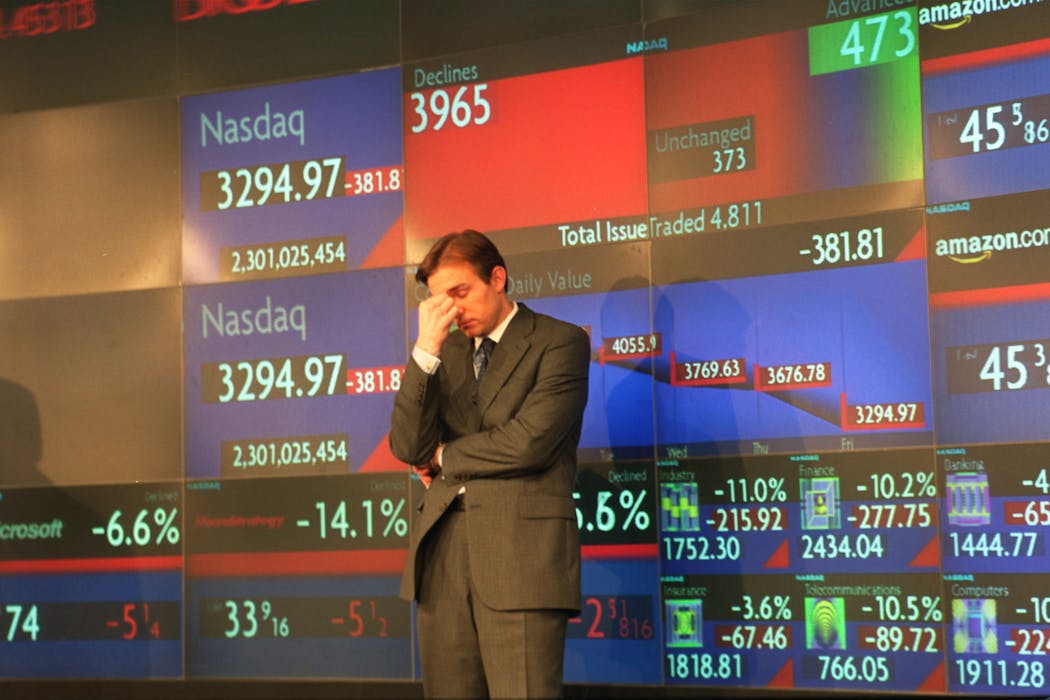
Getty Images

If last week’s trillion-dollar slide of major tech stocks felt familiar, it’s because we’ve been here before – when hype about innovation last ran headlong into economic reality.

As markets slump on the back of investor unease over soaring valuations of artificial intelligence (AI) companies, commentators are asking the same question they were during the dotcom crash 25 years ago.

Can technology really defy basic economics?

It’s a question I discussed in my inaugural professorial lecture at the University of Otago back in August 2000, just as internet stocks were tumbling and hundreds of dotcoms were failing.

I argued then that many internet firms were “naked” because their business models were visible for all to see. They spent vast sums to attract customers with no credible path to profit.

A generation later, the same logic is driving the AI boom.

Different metrics, same story

In 2000, the internet promised to revolutionise commerce, with success measured in “eyeballs” and “clicks” rather than profit. Today, those indicators have become “tokens processed” and “model queries”.

The language might have changed, but the belief that scale automatically leads to profit hasn’t.

Just as we heard the internet was going to remove intermediaries – cutting out traditional middlemen like retailers and brokers – there have been promises that AI will remove cognitive labour.

Both have encouraged investors to overlook losses in pursuit of long-term dominance.

At the height of the dotcom frenzy, companies such as online retailer eToys spent lavishly on marketing to win customers. Today, AI developers invest billions in computing power, data and energy – yet still remain unprofitable.

Nvidia’s multi-trillion dollar valuation, OpenAI’s continuing losses despite surging revenue, and the flood of venture funding into AI start-ups all echo the 1999 bubble.

Then, as now, spending is mistaken for investment.

What the dotcom crash should have taught us

Back in 2000, I suggested internet firms were building market-based assets such as brand value, customer relationships and data, which could create genuine value only if they produced loyal, profitable customers.

The problem was that investors treated spending as proof of growth and marketing as a business model in its own right.

The AI economy repeats this pattern.

Data sets, model architectures and user ecosystems are treated as assets even when they have yet to generate positive returns.

Their value rests on faith that monetisation will eventually catch up with cost. The logic remains the same; only the story has changed.

The dotcom boom was driven by fragile start-ups fuelled by venture capital and public enthusiasm.

Today’s AI surge is led by powerful incumbents like Microsoft, Google, Amazon, and Nvidia, which can sustain years of losses while chasing dominance. That reduces systemic risk but concentrates market power.

OpenAI chief executive Sam Altman (left) shakes hands with Microsoft’s Kevin Scott in Seattle last year. Big companies are dominating the AI boom.
Getty Images

Where the money goes has also shifted. Internet firms once burned cash on advertising. AI companies burn it on computing power and data.

The spending has moved from the marketing agency to the data centre, yet the question remains: does it create real value or only the illusion of progress?

AI also reaches deeper than the internet. The web has transformed how we communicate and shop, but AI is shaping how we think, learn and make decisions.

If a crash comes, it could erode public trust in the technology itself and slow innovation for years. Relatively low real interest rates and abundant capital have also contributed to fuelling this current wave of technology investment.

Much like the late-1990s boom, when favourable monetary policy helped underwrite a surge in tech valuations, this cycle shows how the macro-financial backdrop can amplify technological optimism.

The return of intangible mania

Despite these differences, the pattern of valuation is familiar. Investors are again pricing potential over performance.

In 2000, analysts justified valuations by counting users a company might one day monetise. In 2025, they model “inference demand” and “data advantage”. Both are guesses about an imagined future.

Narrative has become capital as markets reward conviction over evidence. The danger is not technological failure but economic distortion when storytelling outpaces solvency.

Even profitable firms can be caught in the downdraft.

In 2000, leaders such as Yahoo! and eBay lost most of their market value when the bubble burst, despite their long-term survival. The same could happen to today’s AI giants.

Two lessons still stand. First, scalability without profitability is not a business model. Exponential growth can deepen losses rather than reduce them.

Each additional AI query carries a real computational cost, so growth matters only when it leads to sustainable margins.

Second, intangible assets must create measurable value: marketing, data and algorithms are assets only when they produce lasting cash flow or clear social benefits.

For policymakers, the implication is clear: fund AI projects that deliver tangible productivity or social benefits, rather than merely fuelling hype.

While AI will transform how we work and think, it cannot abolish the connection between cost, value and customer need. Lasting value comes from providing genuine benefits to people.

The question now is whether AI’s real productivity gains will ultimately justify today’s valuations, as the internet, after a painful correction, eventually did.

The Conversation

Rod McNaughton does not work for, consult, own shares in or receive funding from any company or organisation that would benefit from this article, and has disclosed no relevant affiliations beyond their academic appointment.

ref. The AI boom feels eerily similar to 2000’s dotcom crash – with some important differences – https://theconversation.com/the-ai-boom-feels-eerily-similar-to-2000s-dotcom-crash-with-some-important-differences-269472

How I’m using ‘cultural dramaturgy’ to support Truth-telling in Australian theatre

Source: The Conversation (Au and NZ) – By Carissa Lee, Indigenous Research Fellow, The Moondani Toombadool Centre, Swinburne University of Technology

This article was written with the consultation and permission of the cultural collaborative Mob who assisted with Fiasco.


We need to encourage more Truth-telling of the history of this nation, particularly in the wake of the failed Voice Referendum, and in the hopeful lead up to Australia’s first treaty.

Theatre is an important way to educate audiences about histories that still affect First Nations people today.

Blak theatremakers and companies such as Ilbijerri Theatre Company, Yirra Yaakin Theatre Company, and Moogahlin Performing Arts are leaders in best practices for staging First Nations stories. Their ways of working often involve collaboration and engagement with First Nations communities to ensure representation and staging of their stories are self-determined.

But Truth-telling can’t just be left up to us Mob. We need white Australians to be honest about this nation’s colonial histories too.

Non-Indigenous theatre practitioners creating productions about our collective histories should work alongside First Nations people. A way to address this can be done through a process I call “cultural dramaturgy”.

Theatre as a vehicle for Truth-telling

Yagera/Butchulla dramaturg and theatremaker Kamarra Bell-Wykes and theatremaker Sarah Woodland state in the context of creating theatre for health education, First Nations cultural leadership should be present at “every stage from conception through to production, performance, and touring”.

The dramaturg works with the playwright and other creators to hone a play for the greatest impact. As a cultural dramaturg, I am involved in the development of the script while also working with Mob-specific consultants. These collaborators have cultural authority to approve or veto certain aspects of the story and how it’s told on stage.

I have yarns with the playwright and I look over the script’s first draft to ensure there is nothing culturally or historically inaccurate or insensitive.

After these edits, I send it to Mob-specific cultural consultants. They can decide how they would like to make changes to the way they or their Mob are represented. Some cultural consultants don’t work in the performing arts, so my role can also involve making sure they’re across how everything works.

I recently worked with comedian Sammy J (the stage name for comedian Sam McMillan) for his Melbourne Fringe production of Fiasco. Sammy’s show was an interesting exercise in how to approach a comedy of two problematic figures while honouring the representation of First Nations people.

Crafting a fiasco

Fiasco is a fictionalised, comedic retelling of the story of white explorers Robert O’Hara Burke and William Wills on their 1860–61 expedition to trek from Melbourne to the Gulf of Carpentaria – and how things went awry.

In his research, Sammy found Burke and Wills interacted with First Nations groups during their journey more than commonly believed.

In our initial conversations, Sammy was open about his fear of how to navigate the project. During the early stages of writing, I found a cultural consultant from the Mob who would feature in the play. I yarned with them, and they conducted yarns with Mob.

The Mob established early they did not want to be named in the show, and for the First Nations character to not have their name mentioned. The First Nations character this person was based on was renamed Jack, played by Nyimpaa actor and musician Pirritu (Brett Lee).

In the final draft, the cultural consultant requested the Mob only be named at the closing line of the show.

Cultural engagement does not ensure practitioners will gain the approval to have every detail of these stories told. The right for Mob to refuse is equally as important as the right to be included.

In the story, Jack guides the audience, who are positioned as a group of First Nations people. Burke (James Pender) is the antagonist, firing his gun over a group of First Nations peoples’ heads, assuming they are hostile – they were actually offering food and trying to alert the travellers of their rescue team having left hours earlier.

Wills (Sammy J) appears to be the more benevolent of the two, with a wholesome bromance established with Jack.

There’s a moment of cultural exchange when Wills and Jack sing in a combination of English and Jack’s Language (in this production, actor Lee’s Language, translated by Nyimpaa academic Aunty Dr Lesley Woods).

The production comically addresses the audacity of Burke and Wills. Two “Victorian men” who can fabricate the last leg of their journey and still get fame, refuse to admit when they need help, and act like they’re the main character in every story, disregarding everyone around them who “has their own shit going on”.

Towards the end of the show, the friendship between Wills and Jack is revealed to not be as genuine as first suggested. Burke forces Wills to read aloud from his journal, reciting the racist way he had written about Aboriginal people. The audience later learns that, in the journal, Wills never mentioned anything about his friend Jack despite claiming how important he was.

Jack concludes the story singing of the death of the white explorers who were a footnote in his story, when they thought it was the other way around.

Marginalised stories are often excluded through fear from non-Indigenous theatre practitioners about “getting it wrong”. Through methods such as cultural collaboration, engagement and dramaturgical practices, stories can be told in a way not only determined by First Nations people, but which creates theatre Mob can enjoy, too.

The Conversation

Carissa Lee worked as cultural dramaturg with Sammy J on the development of his play Fiasco.

ref. How I’m using ‘cultural dramaturgy’ to support Truth-telling in Australian theatre – https://theconversation.com/how-im-using-cultural-dramaturgy-to-support-truth-telling-in-australian-theatre-267216

Former top cop Andrew Coster criticised in IPCA report on McSkimming case

Source: Radio New Zealand

Jevon McSkimming

Former Deputy Police Commissioner Jevon McSkimming. RNZ / Mark Papalii

An investigation into police handling of complaints against former Deputy Police Commissioner Jevon McSkimming was critical of the actions of former Commissioner Andrew Coster, RNZ understands.

McSkimming resigned as the country’s second most powerful cop in May amid separate investigations by the Independent Police Conduct Authority and police.

The 52-year-old was later arrested and is facing eight charges of possessing objectionable publications, including child sexual exploitation and bestiality material over a four-year period.

Do you know more? Email sam.sherwood@rnz.co.nz

The Independent Police Conduct Authority earlier announced it was investigating allegations of misconduct by McSkimming following a complaint from a member of the public.

“This comprises oversight of a police investigation into whether there has been any criminal wrongdoing by Mr McSkimming and a review of whether there has been any related non-criminal misconduct.”

It was also conducting an investigation into if there was misconduct or neglect of duty by any other police officers or employee in the course of responding to the allegations.

Several high-ranking members of police are believed to have been interviewed as part of the investigation.

RNZ earlier revealed the final report was shown to a group of people on 24 October.

It is understood the final report was critical of Coster in terms of his action and inaction in response to allegations about McSkimming.

RNZ/Reece Baker

Former Commissioner Andrew Coster. RNZ / REECE BAKER

RNZ earlier asked Coster, who is now the chief executive of the Social Investment Agency (SIA) for comment on the criticisms in the days after the final report was shown to a group of people.

A SIA spokesperson said that as the report was not released publicly it was “inappropriate for Mr Coster to comment at this time”.

“The IPCA has stated that there is no public release at this time due to ongoing Court matters.”

RNZ also asked the Public Service Commissioner’s office for comment.

A spokesperson said the commissioner had a copy of the report, and was not making any comment.

IPCA investigations manager Stu Graham also declined to comment..

The IPCA earlier confirmed it had completed its investigation into police handling of complaints against McSkimming. Other aspects of its investigation were ongoing.

The IPCA were releasing its report “in confidence to a very limited audience”.

“There is no public release at this time due to ongoing Court matters.

“We will not make any further comment”

In September, RNZ asked the IPCA for comment on draft findings that had been circulated.

Graham said at the time the authority had not at that time made any findings.

“Whatever currently exists is in draft form for the benefit of any officer who may wish to make submissions.

“In our view it would be inappropriate for you to publish anything relating to any such draft at this stage and indeed would be unfairly prejudicial to all officers concerned.”

In November last year McSkimming was placed on “special leave” as the IPCA investigated an allegation of sexual misconduct from a former non-sworn female police employee. The following month police began a criminal investigation into that allegation.

RNZ understands it was during police’s investigation that the alleged objectionable material was found on his work devices.

A second criminal investigation was then launched which led to McSkimming resigning in May and later being arrested on eight representative charges of possessing objectionable publications, namely child sexual exploitation and bestiality material knowing or having reasonable cause to believe that the publication is objectionable.

Police earlier said McSkimming would not be charged in relation to the sexual misconduct allegations.

Assistant Commissioner Mike Johnson said the investigation concluded that the evidential test for prosecution had not been met.

Sign up for Ngā Pitopito Kōrero, a daily newsletter curated by our editors and delivered straight to your inbox every weekday.

– Published by EveningReport.nz and AsiaPacificReport.nz, see: MIL OSI in partnership with Radio New Zealand

Tennis: NZ star Erin Routliffe splits with Canadian partner

Source: Radio New Zealand

Erin Routliffe of New Zealand (R) celebrates with partner Gabriela Dabrowski of Canada after winning the 2025 US Open doubles title. ISHIKA SAMANT / AFP

New Zealand tennis star Erin Routliffe and her Canadian doubles partner Gaby Dabrowski have split after a two and a half years together, which saw them win two grand slam titles.

The pair shared the news in an Instagram post, where they described the partnership as “a ride”.

“Titles, tears, and triumphs. A rollercoaster of emotion no one could have predicted. A business partnership comes to its end, and a friendship remains,” the post reads.

“We want to thank every person who has supported us through our journey on tour together. Through our stubbornness you encouraged us to keep an open mind. Through our tiredness you held space for rest and resets. Through our injuries you trusted us to come back stronger. Through our desire to be better, you helped us win Slams. We couldn’t have achieved anything without all of you. We love you.

“Thank you, and goodnight.”

Last week Routliffe and Dabrowski’s reign as WTA Finals doubles champions ended. The New Zealand/Canadian pair missed out on the semi-finals at the season-ending event in Riyadh after suffering their second group loss.

During their partnership Dabrowski and Routliffe won seven titles, including two US Open trophies, the WTA Finals and the WTA 1000 event in Cincinnati in August.

In September the pair scored their second grand slam doubles victory after beating top seeds Taylor Townsend and Katerina Siniakova at the US Open – their third title together of the season.

The pair had previously won the 2023 US Open title.

Last year Routliffe won the Cincinnati Open with Asia Muhammad, who stepped in while Dabrowski was continuing her treatment for breast cancer.

Routliffe might be eyeing up a new partnership with best friend Muhammad, an American doubles specialist.

The 30-year-old is getting ready to play in Poland, in New Zealand’s Billie Jean King Cup team, starting on Friday.

Routliffe is ranked fifth in the world in doubles, she won four doubles titles this year and collected prize money of $1.7 million.

The Kiwi was ranked number one in in the WTA doubles rankings in July 2024.

– Published by EveningReport.nz and AsiaPacificReport.nz, see: MIL OSI in partnership with Radio New Zealand

Eli Katoa could be out of hospital this week, Tonga coach visiting daily

Source: Radio New Zealand

Tonga coach Kristian Woolf. Ian Hitchcock

Eliesa Katoa could be released from hospital as early as this week, Australian media is reporting.

The Tongan rugby league star was admitted to hospital where he underwent emergency surgery following a series of sickening head clashes during the Pacific Champions match against the Kiwis earlier this month.

The first was a head knock with a team mate during the pre-game warm up, followed by two more high hits during the game.

He had an HIA after the first on-field knock, but left the field after the second – his condition worsening as he watched from the bench.

TV images showed Katoa being fitted with an oxygen mask and put on a stretcher.

Tonga coach Kristian Woolf has visited Katoa every day since the incident and is vowing not to return home to Australia until he is confident Katoa will make a full recovery, the Sydney Morning Herald has reported.

Citing a Tonga source not authorised to speak on behalf of Woolf, the Sydney Morning Herald is reporting Woolf did not feel comfortable leaving the country while there were concerns about his player’s health, and wanted to be there to support Katoa’s family.

Eli Katoa in action against the Kiwis www.photosport.nz

Woolf, also head coach for the Dolphins, has been coaching the Tonga team for more than a decade.

At the time of the incidents, Woolf defended team doctors in not ordering him from the field sooner, saying “everything was done by the book”.

“We’ve got two very experienced doctors there. They’ve done their usual HIA. He’s passed all that and passed all that well,” Woolf said, according to Australian media.

“My job is not to question doctors. They were both comfortable with that and comfortable with him coming back onto the field.

“So I don’t think there’s anything to worry about there in terms of the process.”

Both the NRL and the NRL Players Association were investigating the circumstances that led to Katoa being allowed to continue to play.

The NRL investigation is complete, but findings will not be released until the league has a better picture of Katoa’s recovery, according to the Australia Associated Press.

Katoa has not been well enough to be interviewed for the investigation, Yahoo News reported.

Sign up for Ngā Pitopito Kōrero, a daily newsletter curated by our editors and delivered straight to your inbox every weekday.

– Published by EveningReport.nz and AsiaPacificReport.nz, see: MIL OSI in partnership with Radio New Zealand

Cyclone Gabrielle inquest: Further Civil Defence apologies to victims’ families

Source: Radio New Zealand

The aftermath of massive flooding that swept through the Esk Valley during Cyclone Gabrielle. RNZ/ Sally Murphy

The man in charge of the emergency response during the deadly Cyclone Gabrielle in Hawke’s Bay has apologised to victims’ families under questioning from their lawyer.

A coronial inquiry into the 13 deaths related to the cyclone in the region is underway, and is looking into the emergency response during the weather event.

An EMA (Emergency Mobile Alert), was not issued for Esk Valley until 5.19am on 14 February 2023, by which time two people had already drowned and many more residents were clutching onto their rooftops, desperately hoping to be rescued.

When Cyclone Gabrielle struck the region on 13 February, Edaan Lennan was employed by Hawke’s Bay Regional Council (HBRC) in Hawke’s Bay Civil Defence Emergency Management (HBCDEM) Group Emergency Management Office.

Because the main group controller for Civil Defence Ian Macdonald was away on leave during the cyclone, he put Lennan and Iain Maxwell into the top role in his absence.

In Lennan’s evidence on Monday, he explained why he decided not to issue a mobile alert to Esk Valley residents three hours earlier, when he learnt the Esk River reached its highest ever recorded level. He said it was because he feared it would put people in harms way if they tried to evacuate through floodwaters, slips and debris in the middle of the night.

Cyclone Gabrielle led to catastrophic flooding in the Esk Valley, where floodwaters and silt washed through houses and buried vehicles. RNZ / Tess Brunton

On Tuesday morning the victims families lawyer Jane Glover told Lennan that following those statements, there was “disquiet” from families, who felt Lennan withheld information from people because of his lack of situational awareness of what was happening on the ground.

“They feel there is almost an assumption that people are somewhat stupid and can’t make intelligent decisions for themselves based on information… a sense of a ‘we know better’ attitude – can you understand that perspective?” asked Glover.

“I can and I apologise if that is the way it came across, that is certainly not my intention,” said Lennan.

He went on to say there was a risk of sending many people into harms way by using an EMA.

“Yes it would have woken people up, absolutely, and it might have given them a head start in a terrible situation that they found themselves in.. but it could have also had unintended consequences.”

However, Lennan said if he was in that situation, he would want to be making informed decisions for his family.

“I very much apologise for not being able to give people that information,” he said.

In earlier questioning from Glover, Lennan said all the criteria for issuing an EMA had been met, however he had misunderstood the protocol.

Follding in Te Karaka during the storm. RNZ / Nate McKinnon

Glover showed the court a number of ‘E Texts’ sent by Tairawhiti’s civil defence to people in areas that could be at risk of flooding during Cyclone Gabrielle.

The first of those messages was days before the cyclone hit, on 11 February, warning people in flood prone areas about the orange heavy rain warning from MetService

Over the next 48 hours, several more similar messages were sent to more than 1500 people who could be at risk, and at 10.18pm on 13 February the Gisborne District Council Flood Warning Officers sent out this emergency text alert:

River levels and surface water us causing us serious concerns all over Gisborne City and the region. For those residents who are in low lying areas or near rivers, please monitor the situation and evacuate to your nearest evacuation centre if necessary.”

By 11.53pm another emergency text was issued:

The Waipaoa River at Kanakanaia Te Karaka has reached 8.2m meaning those in the Ormond township should evacuate to higher ground or head to GDC welfare centres at Te Pohu o Rawiri Marae Ranfurly Street’.

Glover asked Lennan if he was surprised to see the use of ETexts in Tairawhiti to communicate important ‘granular information’ to residents at risk.

“It’s the first time I’ve seen this… but some councils around the country do have ETexting ability and systems,” he said.

But Lennan said the tool isn’t available in Hawke’s Bay. Glover replied that Hawke’s Bay residents who were forced to flee for their lives felt ‘shortchanged’ in terms of the lack of information from officials.

“I can understand that,” said Lennan.

Esk Valley in the aftermath of the cyclone. RNZ / Jemima Huston

He explained that emergency management was led by CDEM groups and governed and managed by local councils, which meant some regions have different systems and levels of service for residents, such as the capability to send ETexts.

“In my opinion.. this would have been helpful to have a texting or some sort of system that didn’t have the downsides of the EMA system, but abilty to send out targetted information.

“This is a good idea and doesn’t necessarily need to be going through a local council or an Emergency Coordination Centre,” said Lennan.

Hawke’s Bay Civil Defence is currently undergoing a [https://www.rnz.co.nz/news/national/539677/hawke-s-bay-civil-defence-ready-for-revamp-in-wake-of-cyclone-gabrielle three-year overhaul, following an independent review after Cyclone Gabrielle which made 70 recommendations for improvements.

Sign up for Ngā Pitopito Kōrero, a daily newsletter curated by our editors and delivered straight to your inbox every weekday.

– Published by EveningReport.nz and AsiaPacificReport.nz, see: MIL OSI in partnership with Radio New Zealand

ER Report: A Roundup of Significant Articles on EveningReport.nz for November 11, 2025

ER Report: Here is a summary of significant articles published on EveningReport.nz on November 11, 2025.

61% of Australians would struggle with an expense of a few thousand dollars: new poll
Source: The Conversation (Au and NZ) – By Adrian Beaumont, Election Analyst (Psephologist) at The Conversation; and Honorary Associate, School of Mathematics and Statistics, The University of Melbourne A new federal Resolve poll has found 61% of respondents would struggle to afford an expense of a few thousand dollars, compared to just 24% who said

The next great performance booster for athletes? Sleep
Source: The Conversation (Au and NZ) – By Charli Sargent, Professor, Professorial Research Fellow and Research Cluster Co-Lead – Sleep and Biological Rhythms, CQUniversity Australia English middle-distance runner Keely Hodgkinson tries to get some sleep in a pod during the 2024 Olympics in Paris. Michael Steele/Getty Images When we think of elite athletes, we generally

COP30: Pacific nations call for world to act as 1.5C threshold nears
By Lydia Lewis, RNZ Pacific presenter/bulletin editor, and Caleb Fotheringham, RNZ Pacific journalist Pacific nations are at the world’s biggest climate talks making the familiar plea to keep global warming under 1.5C to stay alive, as scientists say the world will now certainly surpass the limit — at least temporarily. At the opening of the

Why is it so hard to take a good photo of the Moon with my phone?
Source: The Conversation (Au and NZ) – By Michael J. I. Brown, Associate Professor in Astronomy, Monash University The Conversation It’s a beautiful clear night. The stars are out and the Moon looks breathtaking against the sky, so you reach for your phone to take a snap. The results are, to be blunt, disappointing. Try

Israeli forces kill 44 journalists inside Gaza displacement tents, says report
Pacific Media Watch The Freedoms Committee of the Palestinian Journalists’ Syndicate says the Israeli occupation forces have killed 44 Palestinian journalists inside displacement tents in the Gaza Strip. The committee said that these journalists were among 254 media workers who had been killed since the beginning of the Israeli assault on Gaza in October 2023

View from The Hill: Albanese says Whitlam’s dismissal ‘calculated plot’; Liberals consumed by current battle
Source: The Conversation (Au and NZ) – By Michelle Grattan, Professorial Fellow, University of Canberra Anthony Albanese has denounced Gough Whitlam’s dismissal from office in 1975 as “a calculated plot, hatched by conservative forces which sacrificed conventions and institutions in the pursuit of power”. Albanese said the election that followed – won by Malcolm Fraser

Timely home repairs are needed for good health in remote Aboriginal communities
Source: The Conversation (Au and NZ) – By Stephanie Enkel, Postdoctoral Researcher, The Kids Research Institute Australia For people living in metro areas, a broken hot water system or washing machine is a nuisance. But it can usually be sorted by a phone call for a same-day repair or a quick trip to the hardware

COP30: climate law changes mean NZ could retreat from its international obligations
Source: The Conversation (Au and NZ) – By Cathrine Dyer, Lecturer in Climate Change, Te Herenga Waka — Victoria University of Wellington Wagner Meier/Getty Images As this year’s UN climate summit (COP30) gets underway in Belém, Brazil, the New Zealand delegation will be attending beneath a cloud of scepticism about the government’s seriousness in addressing

I discovered a new Australian native bee, but there are still hundreds we need to identify
Source: The Conversation (Au and NZ) – By Kit Prendergast, Postdoctoral Researcher, Pollination Ecology, University of Southern Queensland The female of the species has devil-like black horns, and a taste for extremely rare pollen. But until now, this Australian native bee has never been officially named or identified. My discovery of Megachile (Hackeriapis) lucifer, underscores

Cane toads are hopping towards the Pilbara, but a water-free containment zone could stop them
Source: The Conversation (Au and NZ) – By Judy Dunlop, Research Fellow in Molecular and Life Sciences, Curtin University It is early evening in Australia’s top end, and a hunter stalks its prey. Keenly alert, the northern quoll follows the sound of rustling in the leaf litter. It must be some kind of frog, the

Is your child’s school using generative AI? Here are 8 questions to ask
Source: The Conversation (Au and NZ) – By John Fischetti, Professor, Leadership and School Transformation, School of Education, University of Newcastle, University of Newcastle Eugene Mymrin/ Getty Images There have been at least three watershed moments in how humans access information. One came with the invention of the printing press in 1440, which revolutionised the

Green finance was supposed to contribute solutions to climate change. So far, it’s fallen well short
Source: The Conversation (Au and NZ) – By Simon O’Connor, Director, Sustainable Finance Hub, The University of Melbourne Robb Miller/Unsplash A decade ago, a seminal speech by Mark Carney, then governor of the Bank of England and current Canadian prime minister, set out how climate change presented an economic risk that threatened the very stability

EV ‘charging deserts’ in regional Australia are slowing the shift to clean transport
Source: The Conversation (Au and NZ) – By Hussein Dia, Professor of Transport Technology and Sustainability, Swinburne University of Technology If you live in a big city, finding a charger for your electric vehicle (EV) isn’t hard. But drive a few hours in any direction and the story changes. For most regional Australians, the nearest

Can a toilet block really be a war memorial?
Source: The Conversation (Au and NZ) – By Paige Timms, PhD Candidate, Australian History, Australian National University An ANZAC mural on a toilet block in Devenish, Victoria. Facebook/Anne Matthey Van Popering Inside the Anzac Memorial Park in Cooktown, Queensland, is a public toilet war memorial. The brick building has poppies, war medals and historic propaganda

Harare’s street traders create their own system to survive in the city
Source: The Conversation (Au and NZ) – By Elmond Bandauko, Assistant Professor of Human Geography, University of Alberta The informal sector has become a dominant source of livelihoods for urban residents in African cities. Within this sector, street trading is one of the most visible and vital components of urban economies. In Zimbabwe’s capital city,

View from The Hill: Albanese says Whitlam’s dismisssal ‘calculated plot’; Liberals consumed by current battle
Source: The Conversation (Au and NZ) – By Michelle Grattan, Professorial Fellow, University of Canberra Anthony Albanese has denounced Gough Whitlam’s dismissal from office in 1975 as “a calculated plot, hatched by conservative forces which sacrificed conventions and institutions in the pursuit of power”. Albanese said the election that followed – won by Malcolm Fraser

New Pacific Media journal launched in APMN and USP partnership
Asia Pacific Media Network Pacific Media, a new regional research journal, made its debut today with a collection of papers on issues challenging the future, such as independent journalism amid “intensifying geostrategic competition”. The papers have been largely drawn from an inaugural Pacific International Media conference hosted by The University of the South Pacific in

BBC resignations over Trump scandal show the pressures on public broadcasters – and why they must resist them
Source: The Conversation (Au and NZ) – By Denis Muller, Senior Research Fellow, Centre for Advancing Journalism, The University of Melbourne The resignations of BBC Director-General Tim Davie and CEO of BBC News Deborah Turness over dishonest editing of a speech in 2021 by US President Donald Trump raise several disturbing questions. These concern the

BBC resignations over Trump scandal show the pressures on public broadcasters – and why they must resist them
Source: The Conversation (Au and NZ) – By Denis Muller, Senior Research Fellow, Centre for Advancing Journalism, The University of Melbourne The resignations of BBC Director-General Tim Davie and CEO of BBC News Deborah Turness over dishonest editing of a speech in 2021 by US President Donald Trump raise several disturbing questions. These concern the

A Roman emperor grovelling to a Persian king: the message behind a new statue in Tehran
Source: The Conversation (Au and NZ) – By Peter Edwell, Associate Professor in Ancient History, Macquarie University A new statue unveiled in recent days in Iran depicts a Roman emperor in subjection to a Persian king. Erected in Tehran’s Enghelab Square, the statue titled Kneeling Before Iran shows the emperor grovelling before Shapur I (who

‘Really insulting’: Can ANZ really claim its record profit is due to economy improving?

Source: Radio New Zealand

RNZ / Marika Khabazi

When ANZ announced its record full-year profit, of more than $2.5 billion, chief executive Antonia Watson said it was a good sign for New Zealand.

She said banks were a reflection of the economies they operated in, and the result showed New Zealand was turning a corner.

Westpac also reported a profit increase of 13 percent.

“It has taken New Zealand longer than hoped to recover from the post-Covid rebalancing, but there are now signs the nation’s economy is finally picking up,” Watson said.

But is that really the case?

Lyle McNee, portfolio manager and co-founder at saving fund provider Wedge, said it was disingenuous and “actually really insulting to all those people who have been struggling under the weight of such a weak economy this past year.

“Of course, these profits don’t signal a stronger economy. They highlight just how bad New Zealanders are being treated by their banks – especially in terms of how little interest they received on their deposits.”

He said the net interest margin – the difference between what banks pay for deposits and charge for lending – was 2.6 percent for ANZ in New Zealand compared to 1.83 percent in Australia.

Robert MacCulloch, professor of economics at the University of Auckland, said he “thought it was a comms lie”.

Simplicity chief economist Shamubeel Eaqub expressed a similar sentiment.

“If you look at where the profit growth has come from, it’s all from personal, not from business and agriculture at all…

“Banks are not a leading indicator of the economy. They win when the economy goes up, they win when the economy goes down… where they’re making the profits is on the personal side of things because we’re not going to not pay our mortgages, right?

“It’s not surprising.”

He said the economy was improving but not in terms of profits yet. “It’s kind of the sequence of events. First you get customers coming back. You have the early part of the recovery to be high cost because people aren’t making decisions as fast yet so you have to rejig your business to deal with this recovery. Then you’re able to manage your costs and manage your prices and get profits. So we tend to find profits lag the economic cycle versus the sales improvement, then the jobs improvement, then the profit improvements.”

Infometrics chief forecaster Gareth Kiernan said he was not convinced, either.

“There are small signs the economy may be staring to run around including some job and labour market data but they are still very small at this stage.

“The housing market – not that I want that to go picking up rapidly – the housing market is still very soft as well.”

Massey University banking expert Claire Matthews said she struggled with that interpretation, too.

“The ANZ profit is for the 12 months to September 30, 2025 – are they honestly arguing that 12-month period represented an improving NZ economy? No one else seems to be suggesting that. I’ve seen very recent comment that the NZ economy might now be picking up, but that would not be reflected in bank results until at least the half-year results to March 31, 2026.”

ANZ said lending to small business customers in its business and agri segment grew at more than double the market rate, and agri lending also grew more than the market. It said farm savings lifted 17 percent.

“Overall, ANZ business lending is up 2.3 percent over year to $25.5 billion driven by increased lending to small and medium business customers. Growth in lending to larger institutional and corporate customers was more muted.”

Sign up for Money with Susan Edmunds, a weekly newsletter covering all the things that affect how we make, spend and invest money.

– Published by EveningReport.nz and AsiaPacificReport.nz, see: MIL OSI in partnership with Radio New Zealand

Education Review Office ‘badgered’ students about safety – Wesley College principal

Source: Radio New Zealand

Staff and students at Wesley College did not not report assaults on junior students, the Education Review Office said in its report. RNZ / Shannon Haunui-Thompson

The principal of Wesley College south of Auckland has fired shots at the Education Review Office, saying it has been “deeply disrespectful” to students.

The school – one of the country’s oldest – is taking court action in a bid to keep its embattled hostels open.

It earlier signalled it would close them at the end of the year over safety concerns, but it was then told to shut them down last week – much earlier than it wanted.

An Education Review Office (ERO) report has now surfaced, outlining some of the office’s concerns.

‘Long history of abuse’ at Wesley College

Staff and students did not not report assaults on junior students, the Education Review Office said in its report written in September.

The ERO was checking up progress made since a review in 2024 found slow and inconsistent improvements a the school in Paerata.

It held a progress meeting with the principal and presiding board member.

The office says it was here it was told of “another significant bullying incident” in the hostel since its last visit.

“On this occasion, more than 30 senior students left their hostel building at night, entered a junior building, and a small group of senior boys either participated in or observed the bullying and assault of junior students,” the report said.

“The supervising staff and wider student body did not prevent the incident, nor was it reported immediately by either staff or students.”

The ERO report said the school was told of the incident by only one parent.

The office then sent three investigators on 30 July to further look into concerns around student safety in the hostel.

They spoke with 27 students, the Trust Board chair, the principal and parents and held follow-up online meetings.

The ERO report said leadership reacted promptly once they found out about the assaults, and staff had issues conducting their own investigations and finding who was involved.

“A pervasive culture of not speaking out and accepting bullying and assault as a rite of passage in the hostel persists, despite the efforts of the principal, senior school leaders and some hostel staff to shift this,” the report said.

It said there were “deeply entrenched practices” and beliefs and attitudes among students and some hostel staff that perpetuated a culture of intimidation and systemic abuse.

There were physical improvements in the hostel, the report said, but it noted the upgrading of surveillance cameras was not complete at the time of the review.

“Students reported to ERO that they are still wandering at night and only being apprehended 50 percent of the time,” it said.

The ERO report said the Office was not assured that further physical bullying and assault would not happen again.

Among the issues cited was the filming and sharing of assaults and complaints about staff behaving unprofessionally and encouraging a code of silence.

“ERO does not have confidence that hostel culture has sufficiently improved and that the five hostel buildings are positive, inclusive and emotionally safe climates and environments for all borders,” it said.

The ERO ended its report recommending the suspension of the hostel’s licence.

“ERO acknowledges that suspending the hostel licence is a serious step which may impact the school’s ability to maintain its roll,” it said.

Principal responds

In a statement, principal Brian Evans said students had said they felt pressured to give negative answers to the ERO.

“Over the past few years we have found the stance of the ERO staff to be deeply disrespectful of the students they interviewed, claiming they were lying and covering up,” he said.

“In fact, the students disclosed after several visits ERO staff had left that they felt that the ERO staff were trying to put words in their mouths and badgered them about whether they felt safe at the school.”

Evans said the school was confident it had “broken down the former culture of silence”, and that its systems were effective for anonymous reporting.

The September ERO report referenced both historical and recent events but offered no clarity on which issues were ongoing and which have been addressed,” he said.

“Conflation of timelines risks misleading both the public and our school community about the scope and persistence of challenges.”

Evans said there was only one incident during the year when the report was written, involving students possessing cannabis.

“We certainly don’t condone these students’ behaviour, but you would be hard pressed to find a school in New Zealand that doesn’t have low level issues such as these,” he said.

The principal said its current safe-guarding programme was “gold-standard” and its improvements had been vastly understated.

“Significant investments have resulted in demonstrably safer and more transparent hostel environments, yet these advances are barely foregrounded in recent reporting.”

Sign up for Ngā Pitopito Kōrero, a daily newsletter curated by our editors and delivered straight to your inbox every weekday.

– Published by EveningReport.nz and AsiaPacificReport.nz, see: MIL OSI in partnership with Radio New Zealand

Quality of education at risk with curriculum ‘change overload’ say Canterbury primary principals

Source: Radio New Zealand

The Canterbury Primary Principals’ Association has outlined its concerns in a letter to Education Minister Erica Stanford. RNZ / Samuel Rillstone

Primary school principals in Canterbury have written an open letter to the government expressing concern about further revisions to the English and maths curriculum.

In the letter to Education Minister Erica Stanford, the Canterbury Primary Principals’ Association (CPPA) called for the timeline for implementation to be extended, saying “change overload” was putting the quality of students’ education at risk.

The association said the latest revision was the third major change in two years, with constant shifts creating confusion, uncertainty and increased school staff workloads.

“The ongoing “change overload” facing schools is unsustainable and places at risk both the quality of education provided to our ākonga and the wellbeing of tumuaki and kaiako,” the letter said.

“We urge that the timeframe for implementation be extended until at least Term 3, 2026, to allow schools sufficient opportunity to deeply engage with, understand, and embed these changes through relevant and high-quality professional learning and development.

“Regarding the wider curriculum areas and the move toward a “knowledge-rich” curriculum, the current timeframes are unworkable. Successful implementation requires meaningful consultation with those most connected to teaching and learning-principals, teachers, and school leaders. Although we acknowledge the resources made available, the pace and sequencing of these reforms are unrealistic.”

Canterbury principals also opposed the removal of the requirement for school boards to give effect to Te Tiriti o Waitangi and the overhaul of teacher registration body the Teaching Council.

“Our association and members are firmly committed to Te Tiriti. Any move to weaken these responsibilities would be a significant step backward for equity and partnership in education,” the letter said.

The association said the government should not move responsibility for teacher education and standards to the Education Ministry.

“The CPPA strongly opposes the proposed changes to the Teaching Council’s governance structure and role. Maintaining an independent, sector-led Teaching Council is essential to preserve trust between educators and government, and to ensure that professional standards remain the responsibility of those who work within education,” the letter said.

Education Minister Erica Stanford said the Ministry of Education was meeting the Canterbury association on Wednesday and other associations throughout the week to provide an opportunity for discussion and provide feedback.

Sign up for Ngā Pitopito Kōrero, a daily newsletter curated by our editors and delivered straight to your inbox every weekday.

– Published by EveningReport.nz and AsiaPacificReport.nz, see: MIL OSI in partnership with Radio New Zealand

Christchurch primary school plunged into lockdown as police search for armed offender

Source: Radio New Zealand

South New Brighton School. Google Maps

A Christchurch primary school has been plunged into lockdown as armed police search for an offender reported to have a gun.

Police said they were called to Rocking Horse Road after a car has collided with two parked vehicles. No one was injured in the crash.

“It is reported the offender fled the scene with a firearm,” a police spokesperson said.

Police are making enquiries to identify and locate the offender.

The aftermath of a crash in the Christchurch suburb of South Brighton, on Rocking Horse Road. RNZ/Adam Burns

South New Brighton School in Christchurch was put in lockdown just after 2pm on Tuesday.

A school representative confirmed the school is in lockdown and parents have been contacted.

A message from the school said police had advised the school of an incident in the area, and to go into lockdown.

It said police will let the school know when students could go home.

Police said cordons are in place and the public is asked to avoid the area.

– Published by EveningReport.nz and AsiaPacificReport.nz, see: MIL OSI in partnership with Radio New Zealand

61% of Australians would struggle with an expense of a few thousand dollars: new poll

Source: The Conversation (Au and NZ) – By Adrian Beaumont, Election Analyst (Psephologist) at The Conversation; and Honorary Associate, School of Mathematics and Statistics, The University of Melbourne

A new federal Resolve poll has found 61% of respondents would struggle to afford an expense of a few thousand dollars, compared to just 24% who said they would not. The 37-point margin is the highest since Resolve began asking this question in February 2023.

When this question was last asked in December 2024, the margin was 50–36%.

On who to blame for rising living costs, 42% blamed the federal government, 16% global factors, 11% state governments, 7% the Reserve Bank and 7% businesses. In the next six months, 42% thought the economic outlook would get worse, 20% said it would improve and 29% said it would stay the same.

The poll for Nine newspapers – conducted between November 4-8 from a sample of 1,804 people – also gave Labor a 53–47% lead over the Coalition by respondent preferences, a two-point gain for the Coalition since the October Resolve poll.

Primary votes were 33% Labor (down one), 29% Coalition (up one), 12% Greens (up one), 12% One Nation (steady), 7% independents (down two) and 6% others (down one).

By 2025 election preference flows, Labor would lead by about 54.5–45.5%, a one-point gain for the Coalition.

Despite Labor’s drop on voting intentions, Anthony Albanese’s net approval improved six points to net zero, with 44% both giving him a good and poor rating.

Opposition Leader Sussan Ley’s net approval was down two points to -7. Albanese led Ley as preferred PM by 39–25% (40–23% previously).

Labor led the Liberals on economic management by 31–29% (29–28% in October). But on keeping the cost of living low, the Liberals led by 28–27%, reversing a 28–24% Labor lead in October.

When asked their most important issue, 42% of respondents said cost of living, with no other issue reaching double digits.

This poll was taken after the Australian Bureau of Statistics reported on October 29 that inflation in the September quarter rose 1.3%, its highest quarterly increase since March 2023.

There has also been a surge in the popularity of right-wing to far-right politicians since December 2024.

One Nation leader Pauline Hanson’s net likeability increased 21 points to +8, National MP Barnaby Joyce’s net likeability increased 14 points to -8 and Liberal MP Andrew Hastie’s net likeability increased four points to +8.

Unlike the late October Newspoll, this new poll did not show a surge for One Nation. Ley’s net approval in this poll is far better than in Newspoll (-7 vs -33).

Labor still far ahead in NSW Resolve poll

A NSW state Resolve poll for The Sydney Morning Herald – conducted with the federal October and November Resolve polls from a sample of more than 1,000 people – gave Labor 37% of the primary vote (down one since September), the Coalition 28% (steady), the Greens 10% (steady), independents 15% (up four) and others 11% (down one).

Resolve doesn’t usually give a two-party estimate for its state polls, but primary votes suggest little change from September’s estimate of 59–41% to Labor. The next NSW election will be held in March 2027.

Despite Labor’s continued dominance on voting intentions, Labor Premier Chris Minns slumped to his lowest preferred premier lead this term over Liberal leader Mark Speakman. Minns led by 31–19%, down from 37–16% in September.

Minns’ net likeability was up one point to +14, and has remained roughly steady since recovering from a slump to +10 in December 2024.

Speakman’s net likeability was up two points to +3, continuing a rebound from a low of -3 in April.

Coalition retains narrow lead in Victorian DemosAU poll

A Victorian DemosAU state poll – conducted between October 21–27 from a sample of 1,016 people – gave the Coalition a 51–49% lead, unchanged from an early September DemosAU poll.

Primary votes were 37% Coalition (down one), 26% Labor (steady), 15% Greens (steady) and 22% for all Others (up one).

Opposition Leader Brad Battin led Labor Premier Jacinta Allan as preferred premier by 40–32% (37–32% previously). The Victorian election will be held in November 2026.

Upper house voting intentions were 30% Coalition, 21% Labor, 14% Greens, 11% One Nation, 5% Family First, 4% Libertarian and 3% Animal Justice. The combined vote for the Coalition and Labor is an unrealistic 12 points lower in the upper house than in the lower house.

All 40 of Victoria’s upper house seats will be elected in eight five-member electorates using proportional representation with preferences.

Liberals increase lead in Tasmanian DemosAU poll

A Tasmanian DemosAU state poll – conducted between October 16–27 from a sample of 1,021 people – gave the Liberals 41% of the vote (39.9% at the July election), Labor 24% (25.9%), the Greens 15% (14.4%), independents 14% (15.3%), the Shooters 2% (2.9%) and others 4%.

Tasmania uses a proportional system for its lower house elections, so a two-party estimate is not applicable. Liberal Premier Jeremy Rockliff led Labor leader Josh Willie by 46–34% as preferred premier.

Respondents were asked if they had positive, neutral or negative views of various Tasmanian politicians.

Rockliff was at net +5, but Deputy Premier Guy Barnett was at net -14 and Treasurer Eric Abetz at net -19.

Willie was at net -5, with former Labor leader Dean Winter much worse at net -33. Greens leader Rosalie Woodruff was at net -20.

Queensland byelection on November 29

A byelection for the Queensland state seat of Hinchinbrook will occur on November 29 after the Katter’s Australian Party MP, Nick Dametto, resigned to run for mayor of Townsville.

At the 2024 election, Dametto defeated the Liberal National Party’s Annette Swaine by 63.2–36.8%, from primary votes of 46.4% KAP, 28.2% LNP, 14.0% Labor, 4.6% One Nation, 3.6% Legalise Cannabis and 3.2% Greens.

The KAP, LNP and Labor have all announced candidates for the byelection, with others likely to follow.

US government shutdown set to end

For most legislation to pass the United States Senate, 60 votes out of the 100 senators are needed to end a “filibuster”. Republicans control the Senate by 53–47.

On Sunday, eight Democrats joined with nearly all Republicans to pass a bill reopening the US government by exactly the required 60–40 majority.

The House of Representatives still needs to approve the bill, which should happen in the coming days. This will end the longest US government shutdown.

US President Donald Trump’s ratings have slumped to a low this term following big wins by the Democrats in the New Jersey and Virginia state elections. This vote will widely be seen as Senate Democrats unnecessarily caving to Trump.

The Conversation

Adrian Beaumont does not work for, consult, own shares in or receive funding from any company or organisation that would benefit from this article, and has disclosed no relevant affiliations beyond their academic appointment.

ref. 61% of Australians would struggle with an expense of a few thousand dollars: new poll – https://theconversation.com/61-of-australians-would-struggle-with-an-expense-of-a-few-thousand-dollars-new-poll-269358

The next great performance booster for athletes? Sleep

Source: The Conversation (Au and NZ) – By Charli Sargent, Professor, Professorial Research Fellow and Research Cluster Co-Lead – Sleep and Biological Rhythms, CQUniversity Australia

English middle-distance runner Keely Hodgkinson tries to get some sleep in a pod during the 2024 Olympics in Paris. Michael Steele/Getty Images

When we think of elite athletes, we generally think of people who are at the top of their game physically.

We assume they do everything better than mere mortals – but what about when it comes to getting a good night’s sleep?

Does being a superhuman athlete make you a superhuman sleeper?

Why sleep matters

Exercise has long been associated with better sleep and it seems reasonable to assume most elite athletes are good sleepers – after all, their job is to exercise and recover.

However, many athletes fail to clear the bar when it comes to getting enough sleep.

In fact, in a 2021 sample of 175 elite Australian athletes from 12 sports, only 3% obtained enough sleep on a regular basis, while 71% fell short by an hour or more.

This research mirrors studies on able-bodied and para-athletes from the United States, Brazil, Germany, Switzerland and China.

So why is sleep such hard work for an elite athlete?

Barriers to sleep

When it comes to sleep, an athlete’s toughest opponent is usually their training and competition schedule.

For some athletes (think individual sport athletes like swimmers, triathletes and cyclists), it is regular early morning training sessions combined with very few days off that makes things difficult.

For others (think team sport athletes like Australian rules footballers and netballers), it is training and competition schedules that change from week to week combined with travel that impact sleep.

Anxiety prior to competition, can also make it hard for athletes to get enough sleep.

So why does it even matter? In short, because sleep plays a part in athletic performance.

In a recent consensus statement, sleep and sports scientists from around the world recognised sleep’s importance for athletic performance. They also agreed elite athletes are particularly susceptible to insufficient sleep.

Many leading athletes – including eight-time Olympic gold medal sprinter Usain Bolt, four-time National Basketball Association title winner LeBron James, and 20-time Grand Slam tennis champion Roger Federer – agree sleep is crucial to success.


Read more:
LeBron James will be the first NBA player to reach 23 seasons. How is he still one of the best?


Sleep, illness and injury

Studies suggest elite athletes can still perform at or near their best after a night of insufficient sleep.

But whether they can perform day after day (like during an intensive training block) after multiple nights of insufficient sleep is the real championship question – one that we don’t quite have the answer to yet.

But let’s not forget the two words that can stop any athlete in their tracks – illness and injury.

People who obtain 5-6 hours of sleep per night are 4.5 times more likely to develop a common cold following exposure to rhinovirus compared to people who obtain seven hours of sleep per night.

If elite athletes don’t get enough sleep, they are more likely to get ill.

The relationship between sleep and risk of injury in elite sport is not as clear.

But insufficient sleep slows down response time, impairs movement patterns and reduces sport-specific skill execution – all of which may lead to injury.

But perhaps the biggest issue for elite athletes when it comes to insufficient sleep is how it makes them feel.

After multiple nights of insufficient sleep, athletes feel more fatigued before training, perceive the exercise to be harder and experience greater mood disturbance compared to when they are well rested.

The ability to tolerate high levels of training is critical for athletes. Without enough sleep on a regular basis, an athlete may struggle to recover from training and poor recovery can impair subsequent performance.

For this reason alone, many sleep and sports scientists believe sleep is critical for performance because it is the foundation of recovery.

Some tips for coaches and athletes

At the highest level, small improvements in performance can be the difference between finishing on the podium or back in the bunch.

A case in point is the Tour de France – widely regarded as the most physically and mentally demanding endurance race in the world.

Recently, many teams have attempted to optimise the sleeping conditions of their riders by using “recovery buses” – that transport cyclists from one stage of the race to the next – and outfitting hotel rooms with personalised mattresses and pillows.

Despite the gruelling demands, riders’ average sleep duration is surprisingly reasonable – about 7.2 hours per night.

But not all athletes and teams have access to recovery buses and personalised hotel rooms.

What are some of the other strategies that athletes can adopt to ensure good sleep?

Here are some tips (for athletes and coaches) to consider when thinking about sleep:

  • ensure you are spending enough time in bed to get the sleep you need – to get the recommended eight hours of sleep per night, we need a “sleep opportunity” of about nine hours in bed
  • avoid training too early (before 6am) and/or minimise the number of early morning starts in a row
  • evening competition results in delayed sleep opportunities. Minimise the number of activities athletes engage in immediately after competition and if possible, delay the start time of next-day recovery sessions
  • use strategic daytime naps to supplement reduced night-time sleep opportunities (limit naps to one hour, use an alarm and target late morning or early afternoon)
  • aim for regular bed/wake times on nights when you can control your sleep opportunity.

The Conversation

Charli Sargent receives funding relevant to this article from the Australian Research Council, the National Health and Medical Research Council, the Australian Institute of Sport, and performance-tracking wearable company Whoop Inc. Charli Sargent did not receive any funding from Whoop Inc. for any of the studies cited in this article.

Greg Roach receives funding relevant to this article from the Australian Research Council, the National Health and Medical Research Council, the Australian Institute of Sport, and performance-tracking wearable company Whoop Inc. Greg Roach did not receive any funding from Whoop Inc. for any of the studies cited in this article.

ref. The next great performance booster for athletes? Sleep – https://theconversation.com/the-next-great-performance-booster-for-athletes-sleep-256224

COP30: Pacific nations call for world to act as 1.5C threshold nears

By Lydia Lewis, RNZ Pacific presenter/bulletin editor, and Caleb Fotheringham, RNZ Pacific journalist

Pacific nations are at the world’s biggest climate talks making the familiar plea to keep global warming under 1.5C to stay alive, as scientists say the world will now certainly surpass the limit — at least temporarily.

At the opening of the COP30 climate summit in Belém Brazil, United Nations Secretary-General Antonio Guterres made the same call that Pacific nations have for years.

“Let us be clear, the 1.5-degree limit is a red line for humanity. It must be kept within reach and scientists also tell us that this is still possible,” Guterres said.

COP30 BRAZIL 2025

“If we act now at speed and scale, we can make the overshoot as small, as short and as safe as possible.”

The World Meteorological Organisation (WMO) confirmed in its State of the Climate update that greenhouse gas emissions, which are heating the planet, have risen to a record high, with 2025 being on track to be the second or third warmest year on record.

“It will be virtually impossible to limit global warming to 1.5C in the next few years without temporarily overshooting this target,” WMO secretary-general Celeste Saulo said.

“But the science is equally clear that it’s still entirely possible and essential to bring temperatures back down to 1.5C by the end of the century.”

Pacific Network on Globalisation (PANG) climate justice campaigner India Logan-Riley said the world was now in “deeply unstable territory” with the “very existence” of some Pacific communities now at risk.

COP31 – a Pacific COP?
As this COP starts, there is still uncertainty over where COP31 in 2026 will be hosted.

Both Australia — in conjunction with the Pacific — and Türkiye have bid to host the event.

Australian Prime Minister Anthony Albanese has written twice to his counterpart looking for a compromise to break the deadlock.

Palau’s President Surangel Whipps Jr, who is in Belém, said it was important for Australia to be successful in its bid.

“We’re here in Brazil and the Amazon, and the focus next year needs to be a ‘Blue COP’, we need to focus on the oceans,” President Whipps said.

“One of the things I always tell people is, in some countries they only face droughts, or they may face a storm but in the Pacific we suffer from all of them; sea-level rise, storms, droughts, extreme heat.

“Other people, they can’t relate or they think it may be unreal.”

One of those people, US President Donald Trump, told the UN last month the climate crisis is “the greatest con job ever perpetrated on the world”.

Palau has a particularly close relationship with the US as one of the Compact of Free Association (COFA) nations. The agreement gives the US military access to Palau, which in return is given financial assistance and for Palauans the right to work in the US.

Whipps said Trump’s comments were unfortunate, and more reason for COP to come to the Pacific.

“I would invite President Trump to come to the Pacific. He should visit Tuvalu, and he should visit Kiribati and Marshall Islands.”

Palau’s President Surangel Whipps Jr, who is in Belém . . . the renewable energy transition “gives us energy independence”. Image: UN Photo

100% renewable Pacific
The Pacific is aiming to be the first region in the world to be completely reliant on renewable energy, a campaign which being led by Whipps.

“Leading the energy transition not only helps the planet by reducing our carbon footprint, but also gives us energy independence, [it] allows us to create jobs locally, and it keeps the money circulating.”

Whipps wants Palau to be running completely off renewable energy by 2032.

Meanwhile, the UN emissions gap report shows the world is on track for 2.3C to 2.5C global warming, if nations stick to Nationally Determined Contributions (NDCs).

However, it is an improvement from last year’s report, which predicted 2.6C to 2.8C of warming.

Pacific Islands Climate Action Network (PICAN) policy advisor Sindra Sharma said the report laid bare the fact that global ambition is nowhere near where it needs to be.

“[The new forecast] still is quite unacceptable for vulnerable communities and small island states in particular, because we’ll feel the effects the fastest with crossing anywhere beyond 1.5 even 1.51 it’s going to have significant implications.

“We’ve always had all the solutions to be able to do so and it’s just a lack of political will. It’s a choice that’s being made consistently and that choice is going to affect every single one on this earth.”

Sharma is hopeful there will be positive outcomes at this year’s COP, despite ongoing geopolitical tensions, which are in part driven by it being hosted close to the Amazon Rainforest — often referred to as the lungs of the earth — and marking 10 years since the Paris Agreement was signed.

It is also the first time Pacific nations have confirmation from the world’s top court that failing to protect people from the effects of climate change could violate international law.

“The advisory opinion that we have now is the first time that we’re going into COP with this kind of legal clarity and the legal clarity is telling us that there’s due diligence in terms of limiting warming to 1.5C.”

This article is republished under a community partnership agreement with RNZ.

Article by AsiaPacificReport.nz

‘Unnecessary’ for ratepayers to fund meals, newly-elected councillor says

Source: Radio New Zealand

Five new councillors, Bo Burns, John Gillon, Sarah Paterson-Hamlin, Victoria Short, and Matt Winiata, have joined mayor Wayne Brown and 20 re-elected councillors. RNZ / Jessica Hopkins

An Auckland councillor wants his colleagues to ditch their ratepayer-funded meals.

At their first governing body meeting after the local body elections on Tuesday, first-time Auckland councillors gave maiden speeches, sharing their priorities for the next three years.

Five new councillors, Bo Burns, John Gillon, Sarah Paterson-Hamlin, Victoria Short, and Matt Winiata, have joined mayor Wayne Brown and 20 re-elected councillors.

In his speech, North Shore councillor John Gillion cited data showing that in the past five years, the council had spent an average of $30,000 a year on catering for council meetings.

“It’s just so unnecessary for the ratepayer to be paying for elected members to eat.”

He said that as chairperson of the Kaipātiki Local Board, he got rid of catering for board meetings, and would encourage councillors to do the same.

Shortly after Gillon’s speech, councillors took an early lunch break because tech issues halted proceedings.

Gillon told RNZ he went out to get lunch and that there was enough time for other councillors to do the same if they needed to.

In her speech, Whau councillor Sarah Paterson-Hamlin shared that she is neurodiverse and improving accessibility in the city was important to her.

“I have been elected to represent Whau, but I also consider it my honour and duty to represent the best I can the needs and aspirations of Auckland’s tāngata whaikaha, disabled people.

“As an autistic ADHD person, I am accustomed to navigating a world that is not built for people like me, that often does not understand either the challenges or strengths that come with being born this way.”

She said working for UpsideDowns, the NZ Down Syndrome Association, and Raukatari Music Therapy, she had applied for hundreds of council grants, and aimed to make the process easier to navigate.

Bo Burns said it was unacceptable that Flat Bush and Ormiston in her Howick electorate were without a community facility.

“It’s the fastest growing community in East Auckland and has been waiting over 20 years for a proper facility.”

She said it was putting pressure on other facilities in her ward.

Victoria Short said she was looking forward to “rolling up her sleeves and cracking on with it” when it came to tackling issues in the city.

“As someone who comes from financial struggles, I value every single dollar, a mindset I will apply to all council expenditure.

“If you were to tell me when I was 18, pregnant, no job, and no money that I would become a fricken councillor for the Albany ward, an accountant, and the first person of Kiribati descent to be elected into a government position in New Zealand history, I never would have believed you.”

Matt Winiata wanted more to be done to make his community safer.

“Dog attacks are destroying communities and keeping kids in fear just from walking to school.

“There’s illegal dumping from those without a care or consideration for the environment and community they are polluting.

“Kids are huffing on laughing gas in quantities that bring tears to the hearts of families it’s destroying.”

He also thanked almost 100 of his family, friends, and colleagues during his speech.

Sign up for Ngā Pitopito Kōrero, a daily newsletter curated by our editors and delivered straight to your inbox every weekday.

– Published by EveningReport.nz and AsiaPacificReport.nz, see: MIL OSI in partnership with Radio New Zealand

Person killed in quadbike crash near Palmerston North

Source: Radio New Zealand

A file photo of an ATV. 123RF

A person has died after a crash involving an All-Terrain Vehicle at a property near Palmerston North.

Emergency services were called shortly after 8.30am on Monday to the Weber Road address in Waitahora,Tararua District.

The person died at the scene, police said.

WorkSafe has been advised and the death would be referred to the Coroner.

Sign up for Ngā Pitopito Kōrero, a daily newsletter curated by our editors and delivered straight to your inbox every weekday.

– Published by EveningReport.nz and AsiaPacificReport.nz, see: MIL OSI in partnership with Radio New Zealand

Details of gun law reforms unveiled as Cabinet signs off

Source: Radio New Zealand

Cabinet has signed off on an overhaul of the country’s gun laws that shifts the responsibility of the firearms regulator from the Police Minister to the Firearms Minister.

National and ACT agreed to rewrite the Arms Act – in place since the early 1980s – as part of its coalition arrangement.

The legislation has had many iterations, more recently a ban on semi-automatics and a new firearms regulator, introduced after the March 15 terror attacks.

Associate Justice Minister Nicole McKee has been working on rewriting the act to “improve public safety” and make it easier for licensed firearm owners (LFOs) to comply with the law.

Firearms regulator will answer to Firearms Minister

Te Tari Pūreke the Firearms Safety Authority (FSA) was a key part of the Crown’s response to the Royal Commission of Inquiry into the terrorist attack on Christchurch masjidain on 15 March 2019.

It administers gun laws in the police department and reports to the Police Commissioner.

National and ACT agreed to transfer the FSA “to another department such as the Department of Internal Affairs”, though the FSA is staying with police.

Associate Justice Minister Nicole McKee has been working to rewrite the Arms Act. RNZ / Samuel Rillstone

It is being reformed into a new regulator without sworn police officers and headed up by its own chief executive, appointed by the Governor-General.

This new chief executive will report solely to the Minister responsible for firearms, currently McKee, with the Ministry of Justice providing oversight and monitoring.

Tweaks to laws regulating military-style guns

Muslim leaders expressed concern laws regulating military-style guns would be liberalised in the re-write, after both McKee and the Prime Minister refused to rule this out last year.

There are no changes to the very limited number of people who can legally hold these types of guns – ‘endorsed’ pest controllers and collectors – in the overhaul.

The government is extending the duration of a pest control endorsement from 2.5 years to five years, with a mid-term check in to confirm holders’ circumstances haven’t changed.

It’s also giving collectors who own prohibited firearms the option of storing vital parts of a gun (that when removed, disables it) at the address of any licensed firearm owner, not just someone who has the same endorsement.

High-capacity pistol magazines, those with more than ten rounds, will also only be able to be purchased and held by those with a pistol endorsement, effectively closing a loophole in the current system.

Other changes

Other parts of the reforms include automatically disqualifying identified gang members (those on the National Gang List) from holding a firearms licence, preventing them from gaining legal access to guns.

The reforms will also introduce a statutory ‘red flag’ system so police and other agencies can signal to the firearms regulator when they have relevant intel that might trigger a review of whether a LFO remains a fit and proper person.

Penalties for more than 60 Arms Act offences will be increased and eight new offences created, including one that makes it illegal to own a firearm without a serial number.

The new act is also supposed to plug gaps in the law to address new and emerging technologies such as the illegal manufacture of 3D printed firearms and parts, and possession of digital files without a licence.

‘Agree to disagree’ on military-style guns for competitive shooters

A competitive shooter herself, McKee was seeking a carve out for competitors to access military-style semi-automatic firearms.

She’s now confirmed she has failed to find coalition support for this and her party will invoke the ‘agree to disagree’ clause.

Speaking to reporters on Tuesday morning, McKee said she was not prepared to “die in a ditch” over it.

“When looking at the bigger picture, I think that we have a lot of really good stuff within this Arms Act and so I was prepared to do the agree to disagree,” she said.

“I tried. I did not succeed there so we had an agree to disagree.”

ACT invoked the ‘agree to disagree’ clause in May, arguing a review of the firearms registry fell short of what was promised in its coalition agreement with National.

McKee reiterated her continuing opposition to the registry today.

“I still do not agree with the firearms registry, especially in its current state. I see lots of problems with it.”

Sign up for Ngā Pitopito Kōrero, a daily newsletter curated by our editors and delivered straight to your inbox every weekday.

– Published by EveningReport.nz and AsiaPacificReport.nz, see: MIL OSI in partnership with Radio New Zealand

Tongariro tracks shut until at least next week after devastating wildfire

Source: Radio New Zealand

The main Tongariro track is expected to stay shut until at least next week after devastating wildfire.

Recent rain is helping hugely to bring the massive Tongariro National Park blaze under control, Fire and Emergency says.

Thirty-five crews of Department of Conservation firefighters remain at the site on Tuesday, while drones with thermal imaging equipment have begun checking the flanks of the fireground for hotspots.

A helicopter is on standby to fly over and assess the full extent of the damage. However, low cloud has meant it has been unable to do an aerial assessment of the site, which is estimated to cover up to 2800 hectares.

Minister of Conservation Tama Potaka said part of the National Park is open, but the Tongariro Alpine Crossing, Tongariro Northern Circuit, Tama Lakes and walks near Whakapapa Village would be closed until at least Monday.

“We will be in a better place to give an indication of when tracks and huts will re-open and any impacts on summer tramping once the fire has been controlled and FENZ have confirmed it is safe for us to assess damage,” Potaka said.

“But there will be some time before everything is cleared away and we know the true extent of biodiversity loss, but also what’s in front us, which is a restoration opportunity.”

Potaka said police were investigating the cause of the fire.

“We have managed to protect some key infrastructure so we hope to be able to reopen the Tongariro Alpine Crossing and Tongariro Northern Circuit (except Oturere Hut) quickly.”

FENZ assistant commander Renee Potae. RNZ/Jimmy Ellingham

FENZ assistant commander Renee Potae said recent rain had been a huge help.

“The key thing has been the rain, especially the runoff from the mountain. That runoff is running into the fireground and really helping us get control of this fire.”

However, while flames may no longer be visible, it does not mean the fire has been fully extinguished.

“While you can’t see too much sign of fire right now on the surface, it doesn’t mean it’s not still burning underground,” Potae said.

“So while we’ll start to see some of the resources start to demobilise over the next few days, there will be, for several days, some crews continuing to monitor the fire just to make sure it’s out.”

Diggers at work at the site of the fire in Tongariro. RNZ/Jimmy Ellingham

Meanwhile, an iwi representative said the rāhui over the scene will give the whenua time to breathe.

Two rāhui have been put in place, covering the Tongariro Alpine Crossing track and any burnt areas.

Te Rūnanganui o Ngāti Hikairo ki Tongariro representative Te Ngaehe Wanikau said: “The restoration is not about excluding, it’s not prohibiting.”

Wanikau said the restorative rāhui was not in the usual sense of rāhui which happens after a tragedy.

RNZ / Jimmy Ellingham

A restorative rāhui was about focusing on bringing the area back to what it should be, he said.

The “greatest” fear was the burnt area going into the “too hard basket and then we see yellow flowers of broom all over our mountain”.

The rāhui was an opportunity for “everyone and anyone” to focus on making it a restorative project that showed what the area could look like if the problem was dealt with.

He said they would work with agencies to determine the extent of the damage.

Sign up for Ngā Pitopito Kōrero, a daily newsletter curated by our editors and delivered straight to your inbox every weekday.

– Published by EveningReport.nz and AsiaPacificReport.nz, see: MIL OSI in partnership with Radio New Zealand

Police poised to roll out new roadside drug test

Source: Radio New Zealand

RNZ / Alexander Robertson

Police are poised to begin testing drivers for drugs with a device that involves a quick swipe of the driver’s tongue.

The government on Tuesday announced roadside testing for four types of drugs will begin next month in Wellington, spreading nationwide by mid-2026.

It said there would be “fewer tragedies” as a result.

An oral-fluid testing device would be able to detect cannabis, cocaine, ecstasy or meth.

If a tongue-swipe test taking a few minutes was positive, a second roadside test would follow.

If that was positive too, then the driver would be prohibited from driving for 12 hours.

In addition, police will take a saliva sample for analysis in a lab that can test for 25 types of drug, and any infringement notice will follow from that.

“Most drivers will be free to go within about five minutes once they have a negative test result,” the government announcement said.

“Around 30 percent of all road deaths now involve an impairing drug,” Transport Minister Chris Bishop said in a statement.

“If you take drugs and drive, you’re putting innocent lives at risk – and we will not tolerate it.”

Sign up for Ngā Pitopito Kōrero, a daily newsletter curated by our editors and delivered straight to your inbox every weekday.

– Published by EveningReport.nz and AsiaPacificReport.nz, see: MIL OSI in partnership with Radio New Zealand

Why is it so hard to take a good photo of the Moon with my phone?

Source: The Conversation (Au and NZ) – By Michael J. I. Brown, Associate Professor in Astronomy, Monash University

The Conversation

It’s a beautiful clear night. The stars are out and the Moon looks breathtaking against the sky, so you reach for your phone to take a snap. The results are, to be blunt, disappointing.

Try again. Steady your hands, focus on the Moon, take a photo and… it’s another underwhelming white smudge against a dark background. Hardly Instagram-worthy.

Phones often take superb photos, but why do they struggle with the Moon? It’s a little bit to do with what we are photographing, and a little bit to do with phone camera technology.

It’s not actually night

The first mistake novice astrophotographers make is assuming it is night time. Sure, it may be night time where you are on Earth but is it night time on the Moon?

An image of the Moon that's just a fuzzy white blob.
Got a few pics like this on your photo reel?
M. J. I. Brown, CC BY

When you take a snap of the Moon, you are photographing its sunlit side. In other words, you are photographing broad daylight. Regardless of your camera, this means your settings should be similar to those for daytime photography rather than nighttime photography.

A daylight phone photo of the Moon
Not very impressive.
M. J. I. Brown, CC BY

Phones typically automate photography, including focus and exposure time. Unfortunately, this means that when the Moon is seen against a vast dark sky, the exposure time is set by the dark sky rather than the Moon. This means we turn the Moon into an overexposed bright smudge.

The easiest way to get around this problem is to photograph the Moon during the daytime. With a bright blue sky as the background (technically the foreground) your phone will use a suitably short exposure and you’ll likely get a better picture.

Another way to prevent over-exposed phone photographs is to dial down the exposure time manually, if you can.

So, you tried all that and the pics still look pretty average? Even with the right exposure time and good focus, phone photos of the Moon aren’t great and often don’t capture detail well.

This comes down to the design of phone cameras.

A wide view

Phones are great at taking photos of nearby objects (selfies, anyone?) and sweeping vistas. For example, some phones can take photos of the horizon that span from due north to due east – that’s a 90-degree field of view.

Unfortunately, the Moon (which is just half a degree across in the sky) gets lost in such an image. This comes down to the design choices that allow a camera to fit into a standard mobile phone.

Cameras and telescopes focus light coming from different directions onto detectors, be they old-fashioned photographic film or modern digital sensors with pixels.

The detail you see depends on the size of the pixels and the focal length; for a simple lens this is roughly the distance from the lens to the detector.

Phone camera lenses have focal lengths of a few millimetres, and the sensor pixels are thousandths of a millimetre in size. For a typical phone each pixel receives light from an angle of about 0.02 degrees – and since the Moon is 0.5 degrees across in the sky, its image ends up being only 25 pixels wide.

An image just 25 pixels wide is not going to have much detail. Phone camera software may add more pixels, attempt to sharpen the image or interpolate to add pixels, but this won’t add real detail to your Moon pic.

Zooming in and out

The obvious solution is to zoom in to get a more detailed image of the Moon.

For conventional cameras this is done with a zoom lens where the focal length can be increased (for example, from 50mm to 200mm). However, in phones the zoom is typically done digitally (in software) so the physical focal length is unchanged. Your disappointment will thus continue.

However, there is a solution. Why limit yourself to a phone camera lens?

Phones can take photographs with telescopes. Point a telescope at the Moon, hover your phone carefully above the eyepiece and you can get a remarkably good photo. This is because you’ve used the magnification of the telescope to effectively multiply the focal length of your camera.

A photo of the Moon taken with a mobile phone and telescope.
Phones can take great Moon photos when paired with telescopes.
M. J. I. Brown, CC BY

Instead of a 6mm focal length you may be working with 300mm. Instead of 25 pixels you may have 1,250 pixels. Now you can have great Moon photos.

A phone photo of an aurora during the great display of May 2024.
Phones are great for sweeping views of the Milky Way and auroras.
M. J. I. Brown, CC BY

Phone photography using telescopes has really taken off over the past ten years. You can even get special clamps to hold your phone securely to a telescope.

But what if you don’t have a telescope handy? Well, instead of trying to zoom in, try zooming out. Remember that phones are great at taking in sweeping vistas.

Your phone may not be great at taking Moon photos, but it can take excellent photos of the Milky Way. And if you’re lucky, you can snap photos of rare visitors such as bright comets or auroras.

The Conversation

Michael J. I. Brown receives research funding from the Australian Research Council and Monash University.

ref. Why is it so hard to take a good photo of the Moon with my phone? – https://theconversation.com/why-is-it-so-hard-to-take-a-good-photo-of-the-moon-with-my-phone-266051

Labour ‘absolutely’ comfortable if Te Pāti Māori does not return to Parliament

Source: Radio New Zealand

Labour’s campaign manager Willie Jackson. RNZ / Angus Dreaver

Labour is “absolutely” campaigning to get Te Pāti Māori out of Parliament and while that party’s internal ructions are sad for te ao Māori, that is politics.

Labour’s campaign manager Willie Jackson said there has been strong interest in campaigning for the Māori seats and they will be “ready” if there are by-elections.

He has also ruled out accepting rogue MPs Mariameno Kapa-Kingi and Tākuta Ferris into Labour, after Te Pāti Māori announced their expulsion from the party on Monday.

Jackson – who will be managing Labour’s 2026 election campaign and also leads the party’s Māori caucus – said they would be fighting hard to win all seven of the Māori seats, and if that meant Te Pāti Māori not getting back into Parliament, that was fine with him.

“Oh absolutely. We got rid of them in 2017 and they try to get rid of us in the seats, we try to get rid of them, that’s just the nature of the game. Doesn’t mean to say we don’t have good relationships with them still … it’s just how it is.”

He said there had been a lot of interest from people looking to win the Māori seats for Labour.

‘Rogue’ Te Pāti Māori MPs Ferris and Kapa-Kingi have been expelled from the party. RNZ/Liam K. Swiggs

“We’ve had a lot of interest, a lot of interest in the seats – particularly during the Māori Party troubled times – so had a lot of interest in the last six to eight weeks, candidates lining up everywhere.

“I think people don’t like division, and they like what they’re seeing from Labour. Our Māori MPs are performing and they’ll be ready if there are any by-elections.”

He made clear however that whoever Labour picked as candidates, Kapa-Kingi and Ferris would not be among them.

“They’re not Labour people, they’re not Labour candidates. They’re good people, we don’t have anything against them, but they will not be candidates for Labour.”

Asked what value Te Pāti Māori was bringing to Parliament, he came up short.

“I don’t know. You’ll have to ask their supporters. I worry about Labour and the reality is we’ve got a real opportunity – at the same time I don’t take any joy in what’s happening. All parties go through these internals, so, disappointing for them, disappointing for a lot of our people but it’s their business, we’ve got to concentrate on getting ourselves organised and we will.”

Labour leader Chris Hipkins. RNZ / Mark Papalii

Labour leader Chris Hipkins agreed the party would be competing “vigourously” for every Māori seat at the next election.

He had a pithy response when asked if he would be comfortable with Te Pāti Māori exiting Parliament: “They’re doing a pretty good job of that for themselves at the moment.”

“At the moment Te Pāti Māori are more focused on themselves than focused on tackling the issues facing New Zealand, so they’re not bringing a lot to the debate at the moment.

“We’ve got a very strong line-up of potential candidates vying for Labour’s nomination for those Māori electorates and I think that bodes well for a good result for us in those seats at the next election.”

He indicated Labour was looking to capitalise on the divisions in Te Pāti Māori.

“There were a lot of non-Māori New Zealanders who were very supportive of the Toitu te Tiriti movement for example who felt very let down from the Māori Party basically saying ‘if you’re an Asian new Zealander or a Pākehā New Zealander then you have no right to be speaking on Māori issues’.

“A lot of people driving around with Toitu te Tiriti bumper stickers suddenly felt that they were alienated from that kaupapa so I think that means that they’re now looking around to say ‘well we thought we were supporting something which it’s clear … that’s not what we thought it was.

“My message to them is vote Labour if you want to change the government.”

Whether Labour could work with Te Pāti Māori around the cabinet table was still an open question, which would be answered next year, he said.

“Lots can change in a year. But we will make our decisions, and they’ll be principled decisions and we’ll set them out closer to the election. I’m not making those decisions in advance.”

He said strategic decisions about whether Māori seat candidates would be also placed on Labour’s list would also be made closer to the election.

Cushla Tangaere-Manuel. RNZ / Samuel Rillstone

There was “some certainty” that Cushla Tangaere-Manuel would again be Labour’s candidate for Ikaroa Rāwhiti, but the others were yet to be confirmed.

Jackson said Te Pāti Māori’s internal ructions were “very sad”.

“I think it’s sad for te ao Māori. I don’t like to see this sort of thing happen – some of these people are friends, relations, so I take no joy in it but the reality is we’ll be after the seats … so course it’s sad, however that’s politics.”

Sign up for Ngā Pitopito Kōrero, a daily newsletter curated by our editors and delivered straight to your inbox every weekday.

– Published by EveningReport.nz and AsiaPacificReport.nz, see: MIL OSI in partnership with Radio New Zealand

Asbestos found in breathing equipment ‘distressing’ for firefighters, union says

Source: Radio New Zealand

A FENZ firefighter works in breathing gear, amid smoke. Supplied/ FENZ

The firefighters’ union says asbestos found in an air tank, which helps emergency services breath during fires, will be distressing for personnel in Auckland.

It said a bulk air supply tank had tested positive for a “very small level” of asbestos.

The tank has not been in use since asbestos was found in equipment used to fill breathing apparatus (BA) cylinders for individual firefighters at Auckland City fire station two years ago. Police sometimes also filled up using that gear.

However, the Professional Firefighters’ Union said in an online post it was now concerned the bulk tank may have contaminated the cylinders, though some extra tests showed it might not have.

“There has been additional tests on the bulk air supply tank to see whether the asbestos would transfer from that tank to a breathing apparatus cylinder and those tests demonstrated that the identified asbestos remained in the bulk air supply tank,” it said.

The problem was the cylinders had not been tested as they should have been, and it had only just learned this.

“This news will be very distressing for many firefighters who now have the uncertainty of the safety of their BAs potentially filled using this sample bulk air tank prior to 2023,” it said.

“To not have any tests to either confirm or refute any potential risk will no doubt cause anger and frustration.”

FENZ has been approached for comment by RNZ.

The union said FENZ should urgently test the cylinders, or withdraw them immediately.

“We understand the BA sets are nearly at end of life,” the union said.

“FENZ should procure new BA cylinders and sets now in order to decommission all cylinders that had possibly been filled through the tanks prior to 2023 and therefore have a possible risk of contamination.”

Worksafe said it had been contacted by the union with concerns about breathing apparatus sets filled prior to 2023 at Auckland City fire station.

“We have had ongoing involvement at the site over time and are making further enquiries to understand the latest concerns ,” it said on Tuesday.

The Auckland City station had an asbestos scare that closed it briefly last month. In 2023 there were at least four discoveries of asbestos at the station.

Sign up for Ngā Pitopito Kōrero, a daily newsletter curated by our editors and delivered straight to your inbox every weekday.

– Published by EveningReport.nz and AsiaPacificReport.nz, see: MIL OSI in partnership with Radio New Zealand

Tongariro National Park track expected to reopen by next week after devastating wildfire

Source: Radio New Zealand

The main Tongariro track is expected to stay shut until at least next week after devastating wildfire.

Recent rain is helping hugely to bring the massive Tongariro National Park blaze under control, Fire and Emergency says.

Thirty-five crews of Department of Conservation firefighters remain at the site on Tuesday, while drones with thermal imaging equipment have begun checking the flanks of the fireground for hotspots.

A helicopter is on standby to fly over and assess the full extent of the damage. However, low cloud has meant it has been unable to do an aerial assessment of the site, which is estimated to cover up to 2800 hectares.

Minister of Conservation Tama Potaka said part of the National park is open, but the main track entrance is set to reopen next week.

“The particular area where this devastation has incurred, the track is expected to be open on the 17th, I think, of November, the main Tongariro track that everyone talks about,” Potaka said.

“But there will be some time before everything is cleared away and we know the true extent of biodiversity loss, but also what’s in front us, which is a restoration opportunity.”

Potaka said police are investigating the cause of the fire.

FENZ assistant commander Renee Potae. RNZ/Jimmy Ellingham

FENZ assistant commander Renee Potae said recent rain has been a huge help.

“The key thing has been the rain, especially the runoff from the mountain. That runoff is running into the fireground and really helping us get control of this fire.”

However, while flames may no longer be visible, it does not mean the fire has been fully extinguished.

“While you can’t see too much sign of fire right now on the surface, it doesn’t mean it’s not still burning underground,” Potae said.

“So while we’ll start to see some of the resources start to demobilise over the next few days, there will be, for several days, some crews continuing to monitor the fire just to make sure it’s out.”

Diggers at work at the site of the fire in Tongariro. RNZ/Jimmy Ellingham

Meanwhile, an iwi representative said the rāhui over the scene will give the whenua time to breathe.

Two rāhui have been put in place, covering the Tongariro Alpine Crossing track and any burnt areas.

Te Rūnanganui o Ngāti Hikairo ki Tongariro representative Te Ngaehe Wanikau said: “The restoration is not about excluding, it’s not prohibiting.”

Wanikau said the restorative rāhui was not in the usual sense of rāhui which happens after a tragedy.

RNZ / Jimmy Ellingham

A restorative rāhui was about focusing on bringing the area back to what it should be, he said.

The “greatest” fear was the burnt area going into the “too hard basket and then we see yellow flowers of broom all over our mountain”.

The rāhui was an opportunity for “everyone and anyone” to focus on making it a restorative project that showed what the area could look like if the problem was dealt with.

He said they would work with agencies to determine the extent of the damage.

Sign up for Ngā Pitopito Kōrero, a daily newsletter curated by our editors and delivered straight to your inbox every weekday.

– Published by EveningReport.nz and AsiaPacificReport.nz, see: MIL OSI in partnership with Radio New Zealand

Twickenham holds special value for All Blacks

Source: Radio New Zealand

Chandler Cunningham-South tackles Codie Taylor of New Zealand. Twickenham. England vs All Blacks, 2024. © Photosport Ltd 2024 www.photosport.nz

Twickenham is the biggest rugby stadium in the world and for many visiting players, it’s one the most iconic.

The home of English rugby, Twickenham, will host the All Blacks test against England this weekend, as the tourists seek to keep alive their dreams of a Grand Slam tour.

All Blacks playing England at Twickenham. Photosport

The ground holds 82,000 and is the second biggest stadium in England after Wembley.

FNB Stadium (Soccer City) in Johannesburg is the largest seating capacity for a rugby stadium at almost 95,000, but Twickenham is the biggest stadium solely dedicated to the sport.

The All Blacks haven’t been beaten by England at Twickenham since 2012, winning their last five tests against the hosts at the London ground.

Many of the current All Blacks have played at Twickenham before, but for some, such as midfielder Billy Proctor and loose forward Peter Lakai, it will be a new experience.

“I went there last year and didn’t play. It was an awesome stadium to be at and hopefully I get to play this week,” Proctor said.

“If so, it’ll be an awesome occasion to play at one of the greatest rugby stadiums in the world.”

Billy Proctor fends. Kerry Marshall / www.photosport.nz

Lakai shared similar sentiments.

“Like Billy, I was there last year in the stands watching and just the atmosphere, especially pre-game, was unreal.

“Hopefully I get named in the 23 and then we’ll look forward to that occasion.”

Lakai has started in the last two test wins over Ireland and Scotland and appears set to be retained for the England clash alongside fellow loose forwards Ardie Savea and Wallace Sititi.

Proctor on the other hand has lost his starting spot to Quinn Tupaea for the final Rugby Championship test against Australia and hasn’t been in the run on side since. He has also seemingly been leap frogged in the midfield pecking order by Leicester Fainga’anuku, who started alongside Tupaea against Scotland.

The Hurricanes star had an outstanding Super Rugby season, but hasn’t been able to nail down the starting centre role for the All Blacks, despite being given plenty of opportunity this year.

Proctor insists he’s happy to “fight” to regain his starting spot and said his focus is on helping the All Blacks in whichever way he can.

“I think every position in this team is a competition with the calibre of player that we have in here. So, yeah, you’re fighting for your position,” he said.

“Whoever is the one that gets to wear the jersey, you do what you can to prepare him the best way possible and support him, or you have the privilege of being the one to wear the jersey and represent your country.”

All Black Peter Lakai scores a try. Bob Martin/ActionPress

Based on rankings, England should be a step up in competition for the All Blacks from Scotland and Lakai said they need to improve on their performance against the Scots if they’re to emerge triumphant at Twickenham.

“Yeah, 100 percent. There were a few positives that came out of the Scotland game, but also a few work-ons. Our focus is just to get better every day and build from the last test,” Lakai said.

“We know how good England are, especially their back row being the heartbeat of their team, but we’re just focusing on us and looking to get better every day and build towards Saturday.”

Sign up for Ngā Pitopito Kōrero, a daily newsletter curated by our editors and delivered straight to your inbox every weekday.

– Published by EveningReport.nz and AsiaPacificReport.nz, see: MIL OSI in partnership with Radio New Zealand

Court orders recount of votes in Porirua City Council’s Māori ward

Source: Radio New Zealand

The district court has ordered a recount of votes in the Parirua Māori Ward. RNZ

A court has ordered a recount in Porirua’s Parirua Māori Ward.

Candidate Jess Te Huia made the application to Porirua District Court last month.

Incumbent Kylie Wihapi, who served as the city’s deputy mayor last term, was re-elected with 936 votes at October’s election – 11 votes ahead of Te Huia, on 925 votes.

Porirua City Council says the court has found “Ms Te Huia has an objective and credible basis for believing that the results were incorrect, so the application for a recount was granted”.

It will take place on Thursday 13 November.

Sign up for Ngā Pitopito Kōrero, a daily newsletter curated by our editors and delivered straight to your inbox every weekday.

– Published by EveningReport.nz and AsiaPacificReport.nz, see: MIL OSI in partnership with Radio New Zealand

Christopher Luxon brushes off Winston Peters’ asset sales attack

Source: Radio New Zealand

Prime Minister Christopher Luxon. RNZ / Marika Khabazi

Prime Minister Christopher Luxon has waved away New Zealand First’s criticism of National’s economic plan, saying Winston Peters has many entrenched views.

In an interview on Morning Report on Tuesday, the NZ First leader said Luxon’s interest in asset sales was based on a “tawdry silly argument“. Peters said National wanted to “flog those [assets] off” having “failed to run the economy properly”.

Responding on his way into a caucus meeting at Parliament, Luxon said he was not bothered by his coalition partner’s comments.

“Winston Peters has been around for half a century in this place. He has a lot of entrenched views on a lot of different things that aren’t a surprise to me or you.”

Luxon reiterated that the government would not be pursuing state asset sales this term but said there was a “legitimate conversation” to be had about the best use of its funds.

He told RNZ both National and NZ First would develop their policies over the next year and campaign on them into the election.

He has his take on it, and I have my take on it,” he said. “It’s not surprising. He’s been here 50 years, for goodness’ sake. He has a lot of different views.”

Luxon said it was “quite normal” for coalition partners to express different views “on the margins” – especially going into election year – and that should not be viewed as an impediment to governing.

Winston Peters. RNZ / Mark Papalii

Asked about Peters’ claim that National had failed to turn around the economy fast enough, Luxon said all three coalition parties were “working incredibly hard” on that goal.

“We are in this together as a coalition government,” Luxon told RNZ. “Part of [the economy]… has recovered well. The other part has been more challenging.”

In the Morning Report interview, Peters cited Singapore as a model of economic success, but Luxon said Singapore was a big proponent of selling assets to put that capital to better use.

“When you look at countries like Singapore, a country I’ve studied really deeply over 30 years, one of their great successes and hallmarks has been they recycle their assets.”

Peters also told Morning Report he opposed selling the government’s stake in the telecommunications lines company Chorus – an option currently being explored and advocated for by Finance Minister Nicola Willis.

Luxon said Willis was still seeking advice and the government would discuss next steps “in due course”.

“We’ll come to Cabinet, have a good conversation about it, and see where we go to from there,” Luxon said.

“The choice for New Zealanders is: do you want the money tied up in Chorus debt, or do you want a new hospital or a school? It’s that simple.”

Labour leader Chris Hipkins said Peters’ “admission” that the coalition government had failed to turn the economy around was “stunning”.

“Goodness gracious. Imagine what the conversations are like behind closed doors,” Hipkins said. “If that’s what they’re saying about each other in public, they can’t be getting on particularly well in private, can they?”

Sign up for Ngā Pitopito Kōrero, a daily newsletter curated by our editors and delivered straight to your inbox every weekday.

– Published by EveningReport.nz and AsiaPacificReport.nz, see: MIL OSI in partnership with Radio New Zealand

Rain a big help in getting Tongariro blaze under control but more work to be done

Source: Radio New Zealand

Damage caused by the fire. RNZ/Jimmy Ellingham

Recent rain is helping hugely to bring the massive Tongariro National Park blaze under control, Fire and Emergency says.

Thirty-five crews of Department of Conservation firefighters remain at the site on Tuesday, while drones with thermal imaging equipment have begun checking the flanks of the fireground for hotspots.

A helicopter is on standby to fly over and assess the full extent of the damage. However, low cloud has meant it has been unable to do an aerial assessment of the site, which is estimated to cover up to 2800 hectares.

FENZ assistant commander Renee Potae said recent rain has been a huge help.

FENZ assistant commander Renee Potae. RNZ/Jimmy Ellingham

“The key thing has been the rain, especially the runoff from the mountain. That runoff is running into the fireground and really helping us get control of this fire.”

However, while flames may no longer be visible, it does not mean the fire has been fully extinguished.

“While you can’t see too much sign of fire right now on the surface, it doesn’t mean it’s not still burning underground,” Potae said.

“So while we’ll start to see some of the resources start to demobilise over the next few days, there will be, for several days, some crews continuing to monitor the fire just to make sure it’s out.”

Diggers at work at the site of the fire in Tongariro. RNZ/Jimmy Ellingham

Meanwhile, an iwi representative said the rāhui over the scene will give the whenua time to breathe.

Two rāhui have been put in place, covering the Tongariro Alpine Crossing track and any burnt areas.

Te Rūnanganui o Ngāti Hikairo ki Tongariro representative Te Ngaehe Wanikau said: “The restoration is not about excluding, it’s not prohibiting.”

Wanikau said the restorative rāhui was not in the usual sense of rāhui which happens after a tragedy.

RNZ / Jimmy Ellingham

A restorative rāhui was about focusing on bringing the area back to what it should be, he said.

The “greatest” fear was the burnt area going into the “too hard basket and then we see yellow flowers of broom all over our mountain”.

The rāhui was an opportunity for “everyone and anyone” to focus on making it a restorative project that showed what the area could look like if the problem was dealt with.

He said they would work with agencies to determine the extent of the damage.

Sign up for Ngā Pitopito Kōrero, a daily newsletter curated by our editors and delivered straight to your inbox every weekday.

– Published by EveningReport.nz and AsiaPacificReport.nz, see: MIL OSI in partnership with Radio New Zealand

‘A real and imminent threat’: Police officer justified in shooting of offender

Source: Radio New Zealand

RNZ / Cole Eastham-Farrelly

An offender posed a real and imminent threat when he was shot twice by police on an Auckland motorway, the police watchdog has ruled.

The Independent Police Conduct Authority has released its findings into the incident that began in West Auckland in late September 2023.

It began when police were called to a petrol station in Te Atatū after getting information about a car stolen the night before in an aggravated robbery.

Two officers blocked the car and approached, but the driver rammed through other cars and escaped onto the nearby Northwestern Motorway.

It was a slow-speed pursuit because of the damage to the stolen car.

A call went out from the commander at the police communications centre that all responding staff must be armed and wearing safety gear.

After about six minutes, staff at the Auckland Transport Operations Centre sighted a firearm on the car’s passenger seat.

The driver got off the motorway at Lincoln Road and turned into oncoming traffic.

He got out and was followed by the officer, known as called Officer A in the findings.

Crew in the police Eagle helicopter saw the man trying to hijack vehicles at gunpoint, and at one point, trying to smash a window with the butt of his gun.

The man then pointed the long-barrelled firearm down the road toward Officer A before running again across an overbridge.

The IPCA said the officer thought about shooting the man at this point, but decided against it because of how far away he was and how little time he had to prepare.

Several people were also close by in their vehicles, the IPCA said.

The officer took cover and yelled for the man to drop his weapon, which he ignored.

The man ran towards a truck, opened the passenger door and yelled at the driver to get out.

The officer said the man was pointing his gun at the driver as he got in, who was “leaning away from him in terror”.

It was here Officer A fired his pistol five times through the windscreen into the cab, hitting the offender twice in the back.

Blood tests in hospital showed he had 170ng/ml of methamphetamine in his system.

The IPCA said the man was on electronically monitored bail for aggravated robbery, firearm possession and receiving property at the time of the incident.

He was also wanted by police for breaching bail by allegedly using tinfoil to cover his electronic monitor.

Police identified his gun as a 5.5mm calibre bolt action air rifle, classed “as an especially dangerous airgun”.

Officer A told the IPCA he believed the man intended to take the truck and escape, and that the man was willing to shoot the driver.

“He knew Mr X was willing to ram other vehicles, as he had already done so,” the findings said.

“He thought that if Mr X had control of the truck, he would pose a much more serious risk to the public and police due to the size of the truck and the force it could exert.”

The IPCA said there could have been grave consequences of death of serious injury.

“We are satisfied that Officer A needed to respond urgently because Mr X posed a real and imminent threat,” it said.

“Officer A had been calling on Mr X to surrender without success.

“We accept that Officer A had no reasonable or less violent option other than the use of his firearm available to stop Mr X and eliminate the risk he posed,” it said.

The authority said other options like batons, pepper spray and tasters were “clearly unsuited” and sponge rounds or a police dog were not available.

In a statement, Superintendent Naila Hassan acknowledged the findings.

“I want to recognise the work of our frontline every day, which in many cases requires them to respond and make split-second decisions in situations unfolding rapidly to keep people safe.”

“The entirety of this incident unfolded in around 10 minutes, and our staff moved forward with courage given what was taking place on the overbridge.

“I’m incredibly proud of our police officers on that day.”

Police said in September, the now 31-year-old man was convicted and sentenced at the Auckland High Court for presenting a firearm at a person.

Sign up for Ngā Pitopito Kōrero, a daily newsletter curated by our editors and delivered straight to your inbox every weekday.

– Published by EveningReport.nz and AsiaPacificReport.nz, see: MIL OSI in partnership with Radio New Zealand

How a tattoo icon’s designs live on in Wellington

Source: Radio New Zealand

Roger Ingerton opened Roger’s Tatooart in Wellington’s Cuba Street in 1977 – and worked from the premises until he retired in 2009.

The studio had received a dramatic facelift, but its legendary founder’s designs, photographs and paintings still fill nearly every spare inch of wallspace.

Queen hornet and nest found in Auckland suburb of Glenfield in past week

Source: Radio New Zealand

Yellow-legged hornets (Vespa velutina) have recently been sighted in the Auckland region. MPI have put out advisories after a queen was found on 17 October 2025. Biosecurity NZ

Biosecurity New Zealand has removed another yellow legged hornet and its nest in the past week.

The queen hornet was found in the Auckland suburb of Glenfield.

It takes the tally to seven including five queens and two males.

Authorities say another queen and two males are also suspected, but not confirmed, based on photographs provided by members of the public.

In response, Biosecurity New Zealand has increased the amount of traps on Auckland’s North Shore from 120 to 142.

North Commissioner Mike Inglis said these traps would trial protein-based baits over the summer months when hornet activity was expected to rise.

“We increased the traps mainly because we want to trial new traps as we move to the next stage which will be putting out protein-based traps if indeed there is any worker bees but we’re still focused on the queens.”

They had also assembled a Technical Advisory Group of independent scientific experts, he said.

It was positive that the hornet discoveries remained limited to Auckland’s North Shore, Inglis said.

Members of the public were urged to report suspected hornets or nests, but only if they had a specimen, a clear photo, or had located a possible nest.

Inglis said there had been cases of people posting pictures of previously discovered hornets on social media and claiming it was a new discovery which was why they could not just use photographs to confirm a discovery.

“We encourage people to notify us of finds and we’ll come to try to collect a sample.”

There had been more than 2500 public notifications to date, he said.

Reports can be made at report.mpi.govt.nz or by calling Biosecurity New Zealand’s exotic pest and disease hotline on 0800 809 966.

Sign up for Ngā Pitopito Kōrero, a daily newsletter curated by our editors and delivered straight to your inbox every weekday.

– Published by EveningReport.nz and AsiaPacificReport.nz, see: MIL OSI in partnership with Radio New Zealand

Woman critically hurt in Christchurch shooting

Source: Radio New Zealand

The scene of the alleged shooting. RNZ/Nathan Mckinnon

A woman who lives across the road from a house where another woman was shot and critically injured in Christchurch says she assumed the bang was fireworks.

Emergency services were called to the property in Wainoni’s Shortland Street at about 8.45pm on Monday where they found the woman in a critical condition.

Police are still hunting for the person who shot her and left the scene in a car.

Neighbour Shirley Achari said she heard people yelling and then what she thought was fireworks.

Police at the scene on Tuesday. RNZ/Nathan Mckinnon

“We heard but we didn’t come out to see what was happening because I thought it was a group of people shouting and yelling. Then the shooting one, we thought it was firecrackers,” she said.

Achari said she only learnt of the shooting when her daughter returned from the supermarket and said the police had cordoned off the house.

She said she had often seen a young girl from the house going to school but otherwise did not know the family.

The shooting had come as a shock because the neighbourhood was usually very quiet, Achari said.

A trampoline and children’s toys could be seen at the address. RNZ/Nathan Mckinnon

“I always tell everyone, my friends, that this is the quietest place and we are very safe and lucky to stay here in Shortland Street because we like quiet neighbours,” she said.

At the cordoned off property, children’s play equipment can be seen in the backyard and clothes hang on the washing line.

Officers were examining the scene, including inspecting a car covered by a tarpaulin in the driveway, while a police photographer took photos.

The area remains cordoned off, blocking access to Tahuna Street.

Sign up for Ngā Pitopito Kōrero, a daily newsletter curated by our editors and delivered straight to your inbox every weekday.

– Published by EveningReport.nz and AsiaPacificReport.nz, see: MIL OSI in partnership with Radio New Zealand

Iwi petition against government’s removal of Treaty of Waitangi requirement in schools

Source: Radio New Zealand

Rahui Papa, chair of Pou Tangata the NICF’s arm responsible for education. RNZ / Marika Khabazi

The National Iwi Chairs Forum (NICF), supported by a coalition of national education organisations, has launched a petition against the government’s removal of the requirement for school boards to give effect to Te Tiriti o Waitangi.

The Treaty requirement currently in the Education Act said schools would give effect to Te Tiriti o Waitangi, including by ensuring plans, policies, and local curriculum reflected local tikanga Māori, mātauranga Māori, and te ao Māori; taking all reasonable steps to make instruction available in tikanga Māori and te reo Māori; and achieving equitable outcomes for Māori students.

Rahui Papa, chair of Pou Tangata the NICF’s arm responsible for education, said after more than a year of formal engagement and consultation with the government on the proposed changes, they were disappointed and concerned by the last-minute amendments to remove the school board objective requiring schools to give effect to Te Tiriti.

“These amendments were never put out for consultation. Instead, they were introduced by the minister after public consultation closed, published less than 24 hours before they progressed through Parliament, and it looks like those changes will be passed into law today – only a week after they were made public,” Papa said.

“We’re launching this petition to send a clear message to the Government: removing Te Tiriti from education law undermines your responsibility to ensure every learner, Māori and non-Māori, thrives in an education system that honours the Māori-Crown relationship.”

Education Minister Erica Stanford said the Treaty was the Crown’s responsibility, not schools’.

“School boards should have direction and we are giving very clear direction. You need to ensure equitable outcomes for Māori students, you need to be offering te reo Māori and you need to be culturally competent,” she said.

The Protect Te Tiriti o Waitangi in Education petition is led by the National Iwi Chairs Forum, and supported by the New Zealand Educational Institute Te Riu Roa, New Zealand Principals’ Federation, New Zealand Post Primary Teachers’ Association Te Wehengarua, Te Akatea New Zealand Māori Principals Association, Secondary Principals Association of New Zealand, Te Whakarōputanga Kaitiaki Kura o Aotearoa – New Zealand Schools Boards Association, Ngā Kura ā Iwi o Aotearoa, and Te Rūnanga Nui o ngā Kura Kaupapa Māori o Aotearoa.

Papa said collectively the coalition represents 88 iwi and over 95,000 teachers, principals, schools, and kura.

“We agree with the Minister of Education when she says that school boards play an important role in raising achievement. Boards set the overall direction of a school or kura, through their governance responsibilities and development of strategic plans,” Papa said.

“Removing Te Tiriti from the one place every child in Aotearoa passes through – our education system – deprives our tamariki of the opportunity to learn about identity, belonging, and partnership in a culturally responsive environment, and we will not sit idly by while this happens.”

The petition is hosted on ActionStation and will be available to sign until Tuesday, 25 November. It will then be presented to Parliament.

Sign up for Ngā Pitopito Kōrero, a daily newsletter curated by our editors and delivered straight to your inbox every weekday.

– Published by EveningReport.nz and AsiaPacificReport.nz, see: MIL OSI in partnership with Radio New Zealand

Israeli forces kill 44 journalists inside Gaza displacement tents, says report

Pacific Media Watch

The Freedoms Committee of the Palestinian Journalists’ Syndicate says the Israeli occupation forces have killed 44 Palestinian journalists inside displacement tents in the Gaza Strip.

The committee said that these journalists were among 254 media workers who had been killed since the beginning of the Israeli assault on Gaza in October 2023 until the end of October 2025, reports Middle East Monitor.

According to the report, the attacks were systematic, targeting displacement tents located around hospitals and UNRWA shelters, in addition to direct sniper shootings inside displacement areas.

It added that the victims were working for local and international media outlets, and most of them were killed while covering the humanitarian situation in the displacement camps.

The syndicate affirmed that such targeting reflects a deliberate attempt to silence the Palestinian press and prevent the truth from reaching the world.

It also stressed the need to hold the Israeli occupation accountable for its crimes against journalists and to ensure international protection for media crews working in Gaza.

Israel’s audiovisual media bill ‘a nail in coffin of editorial independence’
Meanwhile, the Paris-based media freedom watchdog Reporters Without Borders (RSF) has sounded the alarm following the first reading of a bill sponsored by Israel’s Communications Minister Shlomo Karhi that would strengthen the executive branch’s control over the audiovisual media, despite opposition from the Attorney General and the Union of Journalists in Israel.

The bill includes measures that RSF condemned a year ago.

Although the rest of the legislative process is likely to be difficult, Israel’s Communications Minister Shlomo Karhi, a member of Prime Minister Benjamin Netanyahu’s Likud party, has managed to get a foot in the door. On the evening of November 3, around midnight, his media broadcasting bill was adopted after its first reading, as part of a voting pact with ultra-Orthodox MPs.

The bill calls for the creation of a Broadcast Media Authority largely composed of members appointed by the Communications Minister himself. His ministry would also be entrusted with calculating television audiences, a measure approved by the Ministerial Committee for Legislation a year ago that was condemned by RSF.

Legal and legislative barriers are already being put in place in response to this attempt to strengthen the Israeli government’s control over the media landscape.

Attorney-General Gali Baharav-Miara, who is responsible for advising the government on legislative matters, is opposed to the bill, which has been deemed unconstitutional by the Knesset, Israel’s Parliament.

Two petitions against the bill have also been filed with the Supreme Court. One was submitted by the Union of Journalists in Israel, which represents around 3000 media professionals. The other was instigated by the NGO Hatzlacha (meaning “success” in Hebrew), which promotes social justice.

“This first reading vote is the first nail in the coffin of broadcast media’s editorial independence in Israel,” said RSF editorial director Anne Bocandé.

“Communications Minister Shlomo Karhi is openly attacking a pillar of democracy. Against a backdrop of war and an upcoming election campaign, Benjamin Netanyahu’s government is seeking to silence voices that are critical of the far-right coalition in power.

“RSF reiterates the warning it issued a year ago: these legislative attacks will have lasting, negative consequences on Israel’s media landscape.”

Incorporating the ‘Al Jazeera’ ban on foreign broadcasters into common law
In parallel with his legislative attack on the editorial independence of the country’s broadcast media, Communications Minister Shlomo Karhi is also continuing his battle against international broadcasters operating in Israel.

Although his so-called “Al Jazeera law” — which allowed Israeli authorities to shut down any foreign broadcasters perceived as undermining national security and was condemned by RSF in April 2024 — expired on October 27 with the end of the state of emergency, the minister informed the National Security Council — which is attached to the Ministry of National Security — that he now intended to turn the measure into common law.

After the missile exchanges between Israel and Iran in June 2024, the Prime Minister’s party had already attempted to amend the “Al Jazeera law” in an attempt to give additional powers to the Minister of Communications to stop the broadcasting of foreign channels in the country.

Article by AsiaPacificReport.nz

Iwis petition against government’s removal of Treaty of Waitangi requirement in schools

Source: Radio New Zealand

Rahui Papa, chair of Pou Tangata the NICF’s arm responsible for education. RNZ / Marika Khabazi

The National Iwi Chairs Forum (NICF), supported by a coalition of national education organisations, has launched a petition against the government’s removal of the requirement for school boards to give effect to Te Tiriti o Waitangi.

The Treaty requirement currently in the Education Act said schools would give effect to Te Tiriti o Waitangi, including by ensuring plans, policies, and local curriculum reflected local tikanga Māori, mātauranga Māori, and te ao Māori; taking all reasonable steps to make instruction available in tikanga Māori and te reo Māori; and achieving equitable outcomes for Māori students.

Rahui Papa, chair of Pou Tangata the NICF’s arm responsible for education, said after more than a year of formal engagement and consultation with the government on the proposed changes, they were disappointed and concerned by the last-minute amendments to remove the school board objective requiring schools to give effect to Te Tiriti.

“These amendments were never put out for consultation. Instead, they were introduced by the minister after public consultation closed, published less than 24 hours before they progressed through Parliament, and it looks like those changes will be passed into law today – only a week after they were made public,” Papa said.

“We’re launching this petition to send a clear message to the Government: removing Te Tiriti from education law undermines your responsibility to ensure every learner, Māori and non-Māori, thrives in an education system that honours the Māori-Crown relationship.”

Education Minister Erica Stanford said the Treaty was the Crown’s responsibility, not schools’.

“School boards should have direction and we are giving very clear direction. You need to ensure equitable outcomes for Māori students, you need to be offering te reo Māori and you need to be culturally competent,” she said.

The Protect Te Tiriti o Waitangi in Education petition is led by the National Iwi Chairs Forum, and supported by the New Zealand Educational Institute Te Riu Roa, New Zealand Principals’ Federation, New Zealand Post Primary Teachers’ Association Te Wehengarua, Te Akatea New Zealand Māori Principals Association, Secondary Principals Association of New Zealand, Te Whakarōputanga Kaitiaki Kura o Aotearoa – New Zealand Schools Boards Association, Ngā Kura ā Iwi o Aotearoa, and Te Rūnanga Nui o ngā Kura Kaupapa Māori o Aotearoa.

Papa said collectively the coalition represents 88 iwi and over 95,000 teachers, principals, schools, and kura.

“We agree with the Minister of Education when she says that school boards play an important role in raising achievement. Boards set the overall direction of a school or kura, through their governance responsibilities and development of strategic plans,” Papa said.

“Removing Te Tiriti from the one place every child in Aotearoa passes through – our education system – deprives our tamariki of the opportunity to learn about identity, belonging, and partnership in a culturally responsive environment, and we will not sit idly by while this happens.”

The petition is hosted on ActionStation and will be available to sign until Tuesday, 25 November. It will then be presented to Parliament.

Sign up for Ngā Pitopito Kōrero, a daily newsletter curated by our editors and delivered straight to your inbox every weekday.

– Published by EveningReport.nz and AsiaPacificReport.nz, see: MIL OSI in partnership with Radio New Zealand

Mt Eden prisoner has been on run for four days since slipping hospital escort

Source: Radio New Zealand

Police are seaching for the prisoner. RNZ / Nate McKinnon

A prisoner has been on the run for four days after escaping while on a hospital escort in Auckland.

Mt Eden Corrections Facility acting general manager Edith Pattinson confirmed to RNZ a remand prisoner escaped from Corrections staff about 9am on Friday while on a hospital escort.

“Police were informed immediately and are actively searching for them.”

  • Do you know more? Email sam.sherwood@rnz.co.nz

RNZ understands the prisoner had been handcuffed.

Pattinson encouraged anyone with information about the prisoners’ location to contact the police.

“Public safety is our top priority. Any escape is unacceptable and an immediate review into how this incident occurred is being carried out.”

Sign up for Ngā Pitopito Kōrero, a daily newsletter curated by our editors and delivered straight to your inbox every weekday.

– Published by EveningReport.nz and AsiaPacificReport.nz, see: MIL OSI in partnership with Radio New Zealand

More than 15,000 measles vaccines given during drive

Source: Radio New Zealand

Vaccination efforts have ramped up as part of a nationwide Measles Immunisation Week campaign. RNZ / YouTube

More than 15,000 measles vaccines were given during last week’s immunisation drive.

It’s more than twice the number of a typical week.

Vaccination efforts have ramped up as part of a nationwide Measles Immunisation Week campaign.

There are 18 confirmed cases in the current outbreak, with 17 of those no longer infectious.

The latest case was found in Nelson on Sunday. It is unlinked to the others, and health officials say it could mean there is undetected transmission in the community.

Health New Zealand said it’s encouraging to see communities rally behind the event. However, it says there is a long way to go before a 95-percent vaccination rate is reached.

Coverage of 95 percent was needed for herd immunity.

Measles modelling by the New Zealand Institute for Public Health and Forensic Science suggested as many as 150 people a week could get infected with measles if an epidemic took hold in New Zealand.

The modelling also found that increasing vaccination rates by five percent could halve the number of hospitalisations in an outbreak.

Sign up for Ngā Pitopito Kōrero, a daily newsletter curated by our editors and delivered straight to your inbox every weekday.

– Published by EveningReport.nz and AsiaPacificReport.nz, see: MIL OSI in partnership with Radio New Zealand

Six All Whites players missing for next internationals

Source: Radio New Zealand

Liberato Cacace of New Zealand. Andrew Lahodynskyj / www.photosport.nz

The injury list is growing for the All Whites ahead of their next internationals.

There are now six front-line players unavailable for this month’s games against Colombia and Ecuador.

Liberato Cacace, Callum McCowatt, Alex Paulsen and Ryan Thomas have all been ruled out of the squad with injury.

The four join Tim Payne and captain Chris Wood who were not named in the original squad for the games.

In their place James McGarry (Brisbane Roar), Owen Parker-Price (Örgryte), Jesse Randall (Auckland FC) and Nik Tzanev (Newport County) have all been called up.

Defender Tommy Smith has also been added to the squad to provide additional experience on and off the pitch.

“It is normal for us to lose a player or two with injury but it is really unfortunate to lose six regular starters like this ahead of two big games,” coach Darren Bazeley said.

“This is football though and it opens the door for other players to come in and take their opportunities to impress.

“We want to be testing ourselves in as many situations as we could face at the FIFA World Cup and while we always want to have our strongest team available, this will give us the chance to see how we address a challenge like this.”

The All Whites will face Colombia in Florida on Sunday (16 Nov NZ time) and Ecuador in New Jersey three days later.

Colombia are ranked 13 in the world and Ecuador 23.

They are the highest ranked nations New Zealand has played as a part of their World Cup preparations.

Sign up for Ngā Pitopito Kōrero, a daily newsletter curated by our editors and delivered straight to your inbox every weekday.

– Published by EveningReport.nz and AsiaPacificReport.nz, see: MIL OSI in partnership with Radio New Zealand

The Port of Auckland’s role in fight against methamphetamine

Source: Radio New Zealand

Straddle carriers and containers on Fergusson Wharf at Ports of Auckland. Rafael Ben-Ari/Chameleons Eye/ 123RF

The Port of Auckland is working with customs and Maritime New Zealand to crack down on methamphetamine from crossing the border.

The government has announced a plan to tackle meth harm, including efforts to strengthen border security and shut down opportunities for organised criminals to operate through the ports.

Port of Auckland chief executive Roger Gray told Morning Report that their role was to ensure customs could inspect cargo before it entered the community.

He said the biggest threat they faced would be staff working with criminals to try and bypass that process.

“The biggest threat we face is insider threat, someone working with the gangs or trans-national organised crime to get stuff out,” Gray said.

“We are always watching, and one of the most important things we do is educate our staff to keep an eye out for each other and if they see anything suspicious to report it.”

He said the port did background checks and provided information to customs and police about staff if requested.

“We pay our staff well and provide them with good careers. One of the things that stops temptation is the concern that they will lose their job and go to jail.”

It comes after a drastic rise in consumption of methamphetamine last year.

Sign up for Ngā Pitopito Kōrero, a daily newsletter curated by our editors and delivered straight to your inbox every weekday.

– Published by EveningReport.nz and AsiaPacificReport.nz, see: MIL OSI in partnership with Radio New Zealand

Wesley College kitchen worker charged after alleged sex offending involving a student

Source: Radio New Zealand

Wesley College. Facebook/ Wesley College Old Students Association

A kitchen worker at an Auckland school has resigned after an allegation of sexual offending involving a student.

The police said they investigated an incident between an employee and a student at Wesley College reported in August.

Detective Inspector Veronica McPherson said a 24-year-old man had now been charged with sexual connection with a young person.

“As the matter is before the Court, the Police is not able to comment further,” she said.

Wesley College had to urgently close its boarding hostel this month, but the school and the Ministry of Education said the closure was not related to the allegation.

Wesley principal Brian Evans said the kitchen staff member had been reference checked an police vetted.

“After receiving a disclosure about the allegation, we immediately informed the student’s family, Police, and Oranga Tamariki,” he said.

“Our first priority was the wellbeing of the student. We offered her and her family support, then handed the matter over to police for investigation. The family expressed appreciation for the way the situation was handled under our safeguarding protocols. They later chose to withdraw their daughter from the school and indicated they would access support through their networks.”

The school did not directly respond to RNZ about whether the wider school community had been informed.

“Further to your query about whether the school informed their wider community, it’s important to understand that in recent years, Wesley has worked deliberately to ensure their community moves away from the harmful tradition of silence that has historically affected many New Zealand institutions, Wesley included. It is important that all students, staff, and families feel safe to disclose concerns, and that their voices are heard and acted upon promptly. The school’s gold-standard safeguarding system is built specifically to enable this openness and ensure that issues are addressed transparently and appropriately.

“We understand the community’s need for timely, clear communication. Their processes are designed to balance this commitment with legal and ethical obligations around privacy and any police investigation.”

The staff member appeared in the Pukekohe District Court last month and was remanded on bail.

Earlier this month, Wesley College launched legal action after the Ministry of Education suspended its licence to house boarders.

The Ministry said the decision was made under Regulation 32 of the Education (Hostels) Regulations 2005, which states a hostel’s license can be suspended if it was not in the boarders’ interests for it to remain open.

Both parties said the closure was not related to the charges.

Sign up for Ngā Pitopito Kōrero, a daily newsletter curated by our editors and delivered straight to your inbox every weekday.

– Published by EveningReport.nz and AsiaPacificReport.nz, see: MIL OSI in partnership with Radio New Zealand

Human rights complaint filed to United Nations over treatment of Māori

Source: Radio New Zealand

The complaint was sent to the UN committee on the Elimination of Racial Discrimination (CERD). AFP

Prominent Māori health leader Lady Tureiti Moxon has filed a human rights complaint to the UN over “systemic discrimination” of Māori in New Zealand.

Moxon told RNZ the 42 page complaint was sent to the UN Committee on the Elimination of Racial Discrimination (CERD) on Monday.

She has requested the opportunity to meet with the five-member working group responsible for the Early Warning and Urgent Action procedure in Geneva, before or during the Committee’s upcoming 116th session, scheduled from 17 November to 5 December 2025, when New Zealand is due for review.

In her submission, Moxon alleges a “significant and persistent pattern of political racial discrimination against iwi Māori” and that since late 2023 a series of government actions have reversed progress towards fulfilling New Zealand’s obligations under the International Convention on the Elimination of All Forms of Racial Discrimination.

“I think that it’s really time that this government, and successive governments, put the Treaty where it belongs, which is at the forefront of all their decisions that are made, that impact on Māori. And at the moment, they’re basically saying, we don’t have to do that, we are sovereign.

“I’m not disputing the fact that we have a sovereign government, but I am disputing the fact that they cannot be sovereign without taking into consideration Te Tiriti o Waitangi. And right now, they don’t care, and they have behaved and acted as if the rights of Māori do not matter, Te Tiriti does not matter.”

RNZ has approached Māori Crown Relations Minister Tama Potaka for comment.

Lady Tureiti Moxon. Supplied/Sarah Sparks

Moxon said there needed to be return to a relationship based on mutual trust, mutual understanding and a positive two-way relationship that Te Tiriti promised.

She pointed to the Regulatory Standards Bill, Pae Ora Amendment Bill, the disestablishment of Te Aka Whai Ora and the repeal of Section 7AA of the Oranga Tamariki Act as examples of government actions that have had an “enormous effect” on Māori.

CERD has only issued one other specific decision under its urgent action and early warning procedure for New Zealand in March 2005, concerning the New

Zealand Foreshore and Seabed Act 2004.

Moxon said she had tried to have her concerns heard through the Waitangi Tribunal, but the government had “disregarded” those findings, so she decided to go to the UN.

“So they’ve gone, in my view, to an extremist view that Māori are unworthy of having anything different from everybody else. And yet, the treatment that we have received has been less than adequate for years. And here we are, yet again, having to fight for every little morsel that we can get.”

Moxon also alleged “repeated instances of unconstitutional overreach” by the government, including through the extensive use of urgency, introducing bills just before Waitangi Tribunal hearings to deprive it of jurisdiction and removing the requirement for schools to honour Te Tiriti o Waitangi.

“Now, they talk about the betterment of all New Zealanders in actual fact, what they’re referring to is the betterment of themselves not all New Zealanders, themselves.”

Sign up for Ngā Pitopito Kōrero, a daily newsletter curated by our editors and delivered straight to your inbox every weekday.

– Published by EveningReport.nz and AsiaPacificReport.nz, see: MIL OSI in partnership with Radio New Zealand