Page 207

Remember when we flagged getting a new flag?

Source: Radio New Zealand

It’s 10 years since New Zealand voted in a referendum to keep flying the flag for tradition.

Over 10,292 alternative designs were submitted, then whittled down to a long list of 40 and then five. From there, Kyle Lockwood’s black, white and blue silver fern flag was chosen to go up against the old faithful.

Often described as the then Prime Minister Sir John Key’s passion project, more than 2 million people voted in the final referendum.

John Key was a fan of the Kyle Lockwood design.

RNZ / Diego Opatowski

Women in finance more than twice as likely to be sexually harrassed than men – survey

Source: Radio New Zealand

Despite reports of sexual harassment against women dropping from 2021 levels, CA ANZ general manager for New Zealand, Charlotte Evett, said it remained too high. 123RF

Women are still more than two-and-a-half times as likely to experience sexual harassment compared to men in the finance sector.

Chartered Accountants Australia and New Zealand’s (CA ANZ) latest two-yearly diversity, equity and inclusion report showed 13 percent of women respondents reported sexual harassment in the workplace, compared to 5 percent of men.

That compared to 11 percent of women in 2023 and 19 percent in 2021.

CA ANZ general manager for New Zealand, Charlotte Evett, said the findings – based on a survey of nearly 2000 members – did not reflect a structural problem in the profession.

“The profession is not without fault, because it’s not zero percent, but I think it’s reflective of a broader societal issue – but absolutely, we’re not going to wait for other people to fix it.

“We have a responsibility, as Chartered Accountants of Australia and New Zealand, to help address it across the accounting profession.”

Evett said the biennial survey aimed to shine a light on issues and uncomfortable truths such as harassment.

Despite reports of sexual harassment against women dropping from 2021 levels, Evett said it remained too high.

“We’ve seen some great improvements across other negative behaviours, but we continue to shine a light on the uncomfortable truths so that we can work with members and our profession to do something about them.

“The right percentage of sexual harassment cases is zero.”

CA ANZ chief executive Ainslie van Onselen said 51 percent of its provisional membership were women, compared to 43 percent of its full members, and it was clear the demographic sands of the profession were shifting.

“Therefore, it is imperative for us to collectively address the issues facing women if we are to retain and develop key talent within the profession.”

Encouraging more Māori and Pasifika accountants

CA ANZ data also showed Māori made up 4 percent of membership, compared to 18 percent who identify as Māori in the wider population.

Evett wanted their membership to reflect the communities they serve, noting that the Māori economy had grown from $17 billion in 2018 to $32b in 2023.

“It makes absolute business sense, as well as being the right thing to do.”

CA ANZ was developing partnerships with Iwi and educators, and had introduced a “learn while you earn” pathway to formal accounting qualifications.

Sign up for Ngā Pitopito Kōrero, a daily newsletter curated by our editors and delivered straight to your inbox every weekday.

– Published by EveningReport.nz and AsiaPacificReport.nz, see: MIL OSI in partnership with Radio New Zealand

NZ’s rejection of emission targets fuels risk of international law breach

Source: The Conversation (Au and NZ) – By Karen Scott, Professor in Law, University of Canterbury

The International Court of Justice delivers its landmark advisory opinion on states’ legal obligations to address climate change, July 23. John Thys/AFP via Getty Images

The New Zealand government’s decision this week to reject all of the Climate Change Commission’s emission target recommendations was just the latest in a string of policy statements that weaken the country’s action on climate.

Collectively, the current climate policy settings raise three important (and not hypothetical) questions.

Does weakening domestic action on climate change risk New Zealand being found in breach of international law? Yes.

Could other states take legal action against New Zealand for failing to comply with its international obligations? Yes.

Does a failure to comply with those obligations undermine New Zealand’s commitment to the international rules-based order? Yes.

At the centre of this sits the landmark advisory opinion issued by the International Court of Justice In July. This set out clearly and authoritatively the obligations on states to address climate change, and the rights of other states to take legal action against those that don’t live up to their commitments.

While the opinion is not itself legally binding, the legal obligations identified by the court are – on all states, including New Zealand.

Climate climb-downs

As well as the most recent decision to reject the Climate Change Commission’s emissions target recommendations, the government has also:

What international law says

While the International Court of Justice’s advisory opinion is complex, five legal findings are particularly significant.

  1. New Zealand must contribute to efforts to limit global temperature rise to no more than 1.5°C above pre-industrial levels. This replaces the target of “below 2°C” as set out in the Paris Agreement, and reflects science-based consensus and subsequent practice and decisions since 2015.

  2. New Zealand’s Nationally Determined Contribution emissions target is legally binding. It must reflect the “highest possible ambition” and be developed to “achieve the object and purposes” of the Paris Agreement and the 1992 United Nations Framework Convention on Climate Change (UNFCCC). It must be prepared with “stringent due diligence”. New Zealand has an “active obligation” to pursue scientific information; the more certain the information is, the more stringent the level of obligation.

  3. New Zealand’s domestic measures to implement its NDC target can be independently assessed on the basis of its “stringent due diligence” obligation. Those measures must address production and consumption activities (including fossil fuel production) and apply to private actors under the jurisdiction or control of New Zealand.

  4. As well as its commitments under the UNFCCC regime, New Zealand has obligations to address climate change under the law of the sea, biodiversity law, human rights law and customary international law (legal principles derived from state practice). Even if New Zealand takes action to comply with its obligations under the Paris Agreement, this may not be enough to comply with its customary duty to prevent significant harm to the environment or to cooperate to address climate change.

  5. Any state may bring legal proceedings against New Zealand for failing to comply with climate change obligations under the general rules of “state responsibility”. They will need to prove New Zealand failed to comply with a treaty or customary obligation. They will not need to prove such a breach of international law caused actual harm in order to hold New Zealand responsible (although a causal link would need to be established if that state demands reparation).

Undermining the rules-based order

New Zealand cannot simply ignore these obligations. They must be considered in the development of policy, the adoption of domestic climate change measures and by the courts if cases are brought against the government.

Legal action, while complex, could be brought by states unhappy with New Zealand’s lack of meaningful climate action, including Pacific Island states such as Palau, which recently criticised the lowering of methane targets.

It is hard to see how the recent policy announcements meet the standards of “highest level of ambition” and “stringent due diligence”.

More generally, however, New Zealand risks undermining the international rules-based order it relies on by framing those obligations as being merely about making “best efforts”.

The rules-based order is like a game of Jenga. The rules, including obligations to address climate change, are the building blocks. While some states are overtly taking a wrecking ball to the tower, others are undermining it by ignoring those rules, essentially removing individual blocks.

But small states need that tower to remain intact. Supporting the international rules-based order by complying with its climate obligations would allow New Zealand to show leadership when it is most needed.

Karen Scott does not work for, consult, own shares in or receive funding from any company or organisation that would benefit from this article, and has disclosed no relevant affiliations beyond their academic appointment.

ref. NZ’s rejection of emission targets fuels risk of international law breach – https://theconversation.com/nzs-rejection-of-emission-targets-fuels-risk-of-international-law-breach-271295

Successful medical drone delivery could offer faster healthcare access for remote communities

Source: Radio New Zealand

The drone used in the trial and members of the team involved. Supplied by Vertilink

Researchers hope the quick responsiveness of a medical drone could save the lives of New Zealanders living in remote communities.

The trial, a partnership between drone company VertiLink, the University of Auckland and Ngāi Te Rangi Iwi, successfully delivered medical gear to Matakana Island last week during a simulated emergency at Te Kutaroa Marae in less than four minutes.

VertiLink chief executive Charlie Nelson told Nine to Noon, it was a groundbreaking milestone and offered new hope to the island’s 500 residents.

Nelson said the trial was the product of two years of research and the objective had been to see how drones could be sued to benefit people living in isolated communities.

“We really wanted to look at what difference the response time would be between traditional medicines versus this new technology.”

The simulated event included someone who had experienced a high trauma event, like a car crash, on the island, Nelson said.

“We looked at a high trauma event, high stakes and very narrow window of time for this person’s outcome of survival. First responders were dispatched and so was the drone. It was about looking at the time difference and whether that made a difference in the outcome.”

The drone could have a maximum take-off weight of 95kgs, Nelson said, and could carry up to 40kgs. It had a box attached underneath which could be filled with supplied and opened upon landing.

Matakana Island has about 500 residents. (File photo) WIKIMEDIA COMMONS / Ulanwp

Nelson said the drone also had the ability for a winch so the box could be winched from a height in cases where it couldn’t land safely.

He said now they would continue to engage with communities and tailor it to their particular needs.

“It may not look like the same solution for other communities so we’re continuing to engage with our research partners, community and iwi.”

The drone could be used for emergency responses, Nelson said but also day-to-day health requirements on the island such as delivering prescriptions.

“We’re looking at how efficient you can make these services so the cost profile [of going to the mainland for a script] is reduced.”

Nelson said another possibility could be for people who had blood test requirements to have their tests shipped off by the drone.

Sign up for Ngā Pitopito Kōrero, a daily newsletter curated by our editors and delivered straight to your inbox every weekday.

– Published by EveningReport.nz and AsiaPacificReport.nz, see: MIL OSI in partnership with Radio New Zealand

Cat that vanished 14 years ago reunited with owner, will be ‘spoilt rotten’

Source: Radio New Zealand

Mo, before he went missing. Supplied / Paul Myburgh

For more on this story, tune in to RNZ’s Checkpoint with Lisa Owen from 4-6pm on Friday.

Christmas has come early for an Auckland man who’s been reunited with his cat who went missing 14 years ago.

Paul Myburgh’s family adopted Mo from the SPCA in 2010. The ginger tabby quickly charmed just about anyone he met, according to Myburgh.

“He was an incredibly friendly cat. Very charismatic, loved human beings, would always walk up to the bus stop when he knew we were coming home.”

Mo had a tendency to follow anyone who showed him attention or gave him treats. Myburgh said that friendliness toward strangers could have led to his disappearance.

“Normally he’d come home, but then one day in 2011 he didn’t and we were devastated. We obviously put up leaflets all around the suburb, contacted the local vets, put something up on the Auckland pets lost and found but there were no sightings, there were no leads.”

Mo, before he went missing. Supplied / Paul Myburgh

In the 14 years since he went missing, Myburgh said his family lost hope that Mo might return.

“Over time, when the nights became years, we thought we’d lost him forever.

“We moved four years after he went missing and, yes, by that stage we’d resigned ourselves to the fact that he’d either met an unfortunate end or certainly wasn’t coming back.”

But that all changed when Myburgh received an email from Petstock Vet Constellation Drive while he was out grocery shopping.

“They said, ‘We’ve found this cat called Mo and we’ve checked the register, and your name and your daughter’s name was on the register.’

“I was just completely dumbfounded. I just couldn’t believe it, but the details matched up. So, I ran to the car, rang the vet clinic immediately and then told my son and we went to pick him up.”

Mo after his 14-year adventure. Supplied / Paul Myburgh

Despite being separated for more than a decade, Myburgh said Mo had not changed much.

“The astonishing thing is although he’s obviously grown a huge amount – so he’s grown into his kangaroo paws – he’s exactly the same cat. Incredibly friendly. Just kind, wants to be around people all the time, absolutely fascinated with everything going on around him – mainly to check if it’s food or not.

“Exactly the same personality, which is just astonishing because he’s obviously been through quite a few hard things.”

What Mo got up to in the time he was gone is anyone’s best guess.

“It’s very hard to know,” Myburgh said. “He was found recently on the streets of Torbay, which is 16km away from where he went missing. From the look of him he’s not been to a vet in all that time, so I suspect for at least part of it he’s been living rough.”

If Mo was not chipped or registered on the Companion Animal Register, Myburgh reckons his story would not have had such a happy ending.

“I mean, the chances of a 16-year-old, slightly battered cat getting rehomed are pretty much nil. I’m a member of the grumpy old men club, but this is just heartwarming. I mean, it’s the best Christmas present I’ve ever gotten.”

Mo will live the rest of his life in luxury, his owner says. Supplied / Paul Myburgh

Myburgh was determined to make up for lost time and pamper Mo as much as he could through his golden years.

“He’s now going to have a safe and happy retirement and he’s going to be spoilt rotten.”

Sign up for Ngā Pitopito Kōrero, a daily newsletter curated by our editors and delivered straight to your inbox every weekday.

– Published by EveningReport.nz and AsiaPacificReport.nz, see: MIL OSI in partnership with Radio New Zealand

Is our attitude towards nudity changing?

Source: Radio New Zealand

Recently, Lisa McMillan observed something that hints at the change she believes is happening with New Zealand’s perceived conservatism regarding public nudity.

She was at an Auckland harbour beach not known for nude use, and there he was: a naked man walking the beach holding a baby. Perhaps the baby made the man’s nakedness more acceptable, McMillan pondered, but still there they both were in their birthday suits in the middle of the day with other beachgoers around.

“I was like, wow, I don’t think that’s actually something half a decade ago people would have really accepted.

There are designated nude beaches in New Zealand, but nude sunbathers tend to congregate at a few secluded beaches like Auckland’s Ladies Bay Beach.

Finn Blackwell

– Published by EveningReport.nz and AsiaPacificReport.nz, see: MIL OSI in partnership with Radio New Zealand

Christchurch school launches internal probe over mouldy lunches

Source: Radio New Zealand

One of the meals. Supplied / Haeata Community Campus

The Christchurch school at the centre of a dispute about mouldy lunches served to students has launched an internal investigation.

Haeata Community Campus is at odds with New Zealand Food Safety and provider Compass Group about how mince and potato meals covered in mould came to be served to children on Monday.

Principal Peggy Burrows said she was [https://www.rnz.co.nz/news/national/580912/principal-says-school-not-to-blame-for-mouldy-lunches-as-authorities-review-footage dismayed by comments made by New Zealand Food Safety and Compass Group that the school was to blame, before the investigation had been completed.

Contrary to claims made by Compass, she said the school’s camera footage clearly showed all food boxes, known as Cambros, were collected from the school on the previous Thursday and no food had been “left behind to sit in the sun for three days”.

Burrows said the school did not retain any of the boxes, rather they were collected and returned to the Compass distribution centre at the end of each day.

She said one box that only contained rubbish was left at the school last Wednesday but was collected by Programmed Facility Management staff, which manages the property, and returned to Compass the following day.

“The Cambros are barcoded and tracked and all meals are accounted for as there are strict food safety requirements for students with dietary needs. The contaminated meals were discovered dispersed across multiple Cambros by Haeata staff. This is confirmed by the camera footage,” she said.

Burrows said the school maintained robust systems at all times to ensure school lunches were safely distributed at the school and none of the systems had failed in the last week.

“The school does not accept responsibility for the operational failure of the supplier, the Compass Group, and disagrees with statements by both Mr Harbey [School Lunch Collective spokesman] and New Zealand Food Safety deputy director-general Vincent Arbuckle regarding Haeata Community Campus staff being responsible for the reheating and distribution of contaminated food,” she said.

The school was committed to student safety and transparency in serving food and planned to release the findings of its own internal investigation next week.

Select committee scrutiny

The mouldy meals were raised at the Ministry for Primary Industry’s annual review before the select committee on Thursday.

Ministry director-general Ray Smith said while the investigation into the meals at Haeata had not been completed, officials felt it was important to clarify their preliminary findings given public commentary on the risks posed by the meals.

“We would not have issued an interim view on it had the thing not been in the public domain in the manner it was that alarmed parents, no question about it, so we had to quickly either tell parents there’s a problem with Compass and deal with Compass or suggest there’s an issue at the school,” he said.

Of the 300 meals delivered to the school, between 10 to 20 meals were affected.

The lunches had been delivered to 15 other schools in Christchurch on Monday.

Food Safety deputy director-general Vince Arbuckle said investigators had visited Haeata Community Campus and Compass in Christchurch several times this week as part of the investigation to determine what had happened.

“Only one school had this experience and only one part of the school had this experience, the canteen, which all adds up to suggest that somehow in the canteen some meals remained in a box, got intermingled with incoming meals on the Monday and innocently served out,” he said.

“The weight of evidence suggests that the contaminated food being distributed to students was a result of a human error at the school.”

The investigation was ongoing and New Zealand Food Safety was happy to work with the school on its processes, Arbuckle said.

– Published by EveningReport.nz and AsiaPacificReport.nz, see: MIL OSI in partnership with Radio New Zealand

State Highway 2 north of Dannevirke closed after truck crash

Source: Radio New Zealand

St John says one person with serious injuries is being flown to Palmerston North Hospital. RNZ / REECE BAKER

State Highway 2 north of Dannevirke is closed following a crash involving a truck.

Police said the crash near Okane Road in Matamau was reported just before 10am.

Fire and Emergency confirmed a truck was involved, and said its crews helped free the driver who was trapped. Crews are still on scene assisting police.

St John has a helicopter and two ambulances at the scene, and said one person with serious injuries is being flown to Palmerston North Hospital.

Police said drivers should avoid the area and expect delays.

Sign up for Ngā Pitopito Kōrero, a daily newsletter curated by our editors and delivered straight to your inbox every weekday.

– Published by EveningReport.nz and AsiaPacificReport.nz, see: MIL OSI in partnership with Radio New Zealand

$33,000 pendant swallowed in Auckland jewellery heist ‘recovered’

Source: Radio New Zealand

The Fabergé locket was worth more than $33,500. SCREENSHOT

A Fabergé locket worth more than $33,500, swallowed by a man during an alleged theft at an Auckland jewellery store has been “recovered”.

Police confirmed it was back in their possession last night.

They said the 32-year-old man who swallowed the pendant remained in custody and would appear in Auckland District Court next week.

Sign up for Ngā Pitopito Kōrero, a daily newsletter curated by our editors and delivered straight to your inbox every weekday.

– Published by EveningReport.nz and AsiaPacificReport.nz, see: MIL OSI in partnership with Radio New Zealand

Highs of 30C for parts of South Island before scorching weather moves north this weekend

Source: Radio New Zealand

Warm weather is forecast for most of the North Island over the weekend. RNZ / Richard Tindiller

Very hot weather is forecast for parts of the South Island today moving to the east coast of the North Island on the weekend.

MetService is forecasting temperature highs of 30C for Christchurch, Ashburton and Oamaru on Friday with Dunedin expected to reach 28C and Timaru and Blenheim 29C.

Northwesterly winds will drive up the temperatures in the east of the South Island and MetService has a strong wind watch for Southland, Otago and Canterbury High Country south of Aoraki / Mount Cook until 7pm on Friday. Gusts of 100km/h can be expected, especially inland.

It is also expected to be warm in the North Island on Friday with temperature highs in the low to mid 20s.

The weekend is expected to be dry for those in the North Island with hot temperatures for some. Gisborne, Napier and Hastings are forecast to exceed 30C on Saturday, Sunday, and Monday.

Napier is forecast to have a high of 32C on Saturday and Monday, while Hastings is expected to reach 32C on Saturday and 33C on Sunday and Gisborne is forecast to reach 31C on all three days.

Saturday temperatures are forecast to be in the mid 20s for the upper North Island including Auckland.

A dry weekend is expected for those in the North Island, but the West Coast of the South Island could expect some showers on Saturday.

MetService is forecasting more substantial rain in the west and south of the South Island on Sunday.

“Saturday will be the pick of the days this weekend in the South Island; perfect timing for runners to complete the Kepler Challenge and be off the mountain before the rain rolls in overnight,” MetService Meteorologist Michael Pawley said.

Sign up for Ngā Pitopito Kōrero, a daily newsletter curated by our editors and delivered straight to your inbox every weekday.

– Published by EveningReport.nz and AsiaPacificReport.nz, see: MIL OSI in partnership with Radio New Zealand

Live: Black Caps v West Indies first test – day four

Source: Radio New Zealand

The Black Caps are in firm control of the first cricket test against the West Indies after a dominant day three in Christchurch.

Centuries for skipper Tom Latham and number four batter Rachin Ravindra helped New Zealand set a solid foundation to reach 417-4 at stumps with a lead of 481 runs.

Close to half of the Black Caps runs came in boundaries on Thursday.

First ball is at 11am.

Rachin Ravindra and Tom Latham Andrew Cornaga / www.photosport.nz / Photosport Ltd 2025

– Published by EveningReport.nz and AsiaPacificReport.nz, see: MIL OSI in partnership with Radio New Zealand

Sprinter Eddie Osei-Nketia switches allegiance to Australia

Source: Radio New Zealand

Eddie Osei-Nketia. PHOTOSPORT

New Zealand sprinter and national 100m record holder Eddie Osei-Nketia has officially switched allegiances to Australia.

Osei-Nketia broke his dad Gus Nketia’s record at the 2022 World Championships in Eugene, stopping the clock at 10.08 seconds. He came close to breaking the 10 second barrier earlier this year.

The 24-year-old, who is based in the US, is now set to race for Australia.

Governing body Australian Athletics posted on Instagram to announce the news. “Welcome, Edward Osei-Nketia,” the post said.

“He has been lighting up Australian tracks for years but Edward Osei-Nketia is now officially eligible to represent Australia on the world stage, successfully completing his transfer of allegiance from New Zealand.

“The 10.08-second man joins the nation’s rising sprinting stocks. This is going to be fun.”

Osei-Nketia is also the New Zealand 200m record holder, bettering the mark with a 20.24s finish earlier this year at a meet in the US.

He also ran 9.96s over 100m at a college meet in Texas in April although it was wind-assisted.

He last represented New Zealand in 2022 at the World Champs and earlier this year Australian Athletics confirmed he had requested a transfer of allegiance.

Osei-Nketia moved to the US after leaving New Zealand and had a crack at American football in Hawaii, before getting back on the sprinting track for the University of Southern California in 2024.

He has been based in the US since.

– Published by EveningReport.nz and AsiaPacificReport.nz, see: MIL OSI in partnership with Radio New Zealand

Monty Knight’s alleged killer has name suppression extended while mental state assessed

Source: Radio New Zealand

Monty Knight. RNZ/Carol Stiles

Name suppression for a woman accused of murdering well-known Far North businessman Monty Knight has been extended until April next year while experts determine whether she is mentally fit to stand trial.

The 57-year-old appeared in the High Court at Whangārei on Friday morning, almost three weeks after Knight was found critically injured at his home just outside Kaitāia.

He could not be saved despite the efforts of emergency services.

Justice David Johnstone said the defendant’s fitness to stand trial was an issue, so he ordered two health assessors to independently prepare reports under the Criminal Procedure (Mentally Impaired Persons) Act. Those reports were likely to take until April next year.

Johnstone extended the interim name suppression granted at her first appearance in the Kaitāia District Court, given the “appreciable risk” publication would cause her extreme hardship.

He also requested the health assessors consider whether future publication of her name would create risk to her safety.

The entrance to Monty Knight’s home and vineyard cordoned off in November. RNZ / Peter de Graaf

The defendant appeared by audio-visual link (AVL) from prison dressed in a grey sweatshirt, and appeared calm throughout the 20-minute hearing.

No plea was entered and she was remanded in custody until a case review hearing on 17 April next year. That appearance was also expected to be by AVL.

The accused woman was represented by high-profile lawyer Arthur Fairley, while prosecutor Bernadette O’Connor appeared for the Crown.

Johnstone acknowledged the family members present in court.

Successful business career

Knight, who had recently turned 80, was one of Kaitāia’s best-known characters and entrepreneurs.

His retail career started with a tiny record shop on the town’s main street, then expanded into electronics, appliances and beds.

He took over the family business, Knights the Jewellers, and opened a second outlet in Kerikeri.

When told it was impossible to grow grapes in Kaitāia, Knight proved the doubters wrong by establishing an award-winning winery, Okahu Estate.

He was inducted into the Northland Business Hall of Fame in 2010, the same year he was elected to the Far North District Council. He also won a seat on the Northland Regional Council in a 2015 by-election.

More than 300 people attended a memorial service at Kaitāia’s Te Ahu Centre on 25 November.

Sign up for Ngā Pitopito Kōrero, a daily newsletter curated by our editors and delivered straight to your inbox every weekday.

– Published by EveningReport.nz and AsiaPacificReport.nz, see: MIL OSI in partnership with Radio New Zealand

Are pōhutukawa trees flowering early this year? A botanist explains

Source: Radio New Zealand

Pohutukawa, Mt Victoria, Wellington Robyn Jaquiery

Flowering pōhutukawa trees are the sign summer is here – and many we have seen are already in full bloom.

But are they flowering earlier this year?

Ecologist and botanist Associate Professor Bruce Burns, from the University of Auckland, says no.

“We have had some stunning displays. I live up here at the Whangaparaoa Peninsula and and you know, it’s just been amazing, the intensity of the blooms on some trees,” he told Morning Report on Friday.

“But… it’s still within the regular flowering period of pōhutukawa. They tend to start flowering about the end of November, beginning of December, and trees will flower all the way to the end of January.”

Every pōhutukawa is different, he explained.

“Trees vary very much in when they flower., So you know, one tree itself will flower for about a month, but it will have this period of intense flowering for only about two weeks.

Pōhutukawa in flower. Bryan Crump.

“So over a population of pōhutukawa, you will get trees that flower at different times through that two-month period. So you might go out and see that we have these trees at the moment with stunning blooms, but you’ll also see trees around them with flower buds that haven’t opened yet and some trees that aren’t going to flower at all this season.”

Nor can the time and intensity of a pōhutukawa’s bloom be used to predict what kind of summer we are going to have, as some have reportedly suggested.

“Would be wonderful, wouldn’t it? To [be told that] the summer is gonna be great. And I hope very much that it will be,” Burns said. “But logically, how it flowers is really about what’s happened in the past, rather than what’s gonna happen in the future.”

And that is a combination of genetics, the environment and weather.

“People have looked at pōhutukawa and found if a tree flowers early one year, then it’s pretty much gonna flower early every year. So there is a certainly a genetic component to it… but otherwise it’s about, you know, the time leading up to the flowering season – how the weather has been, whether it’s been warm and wet and the tree’s had plenty of time to corral it’s resources to get that flowering going.”

As for where to see the best trees, Burns says pretty much anywhere in the country – but especially the top half of the North Island.

“And of course it occurs down in Wellington as well, and people around Wellington really gush about the amazing pōhutukawa around there, and I’ve heard that the trees around Te Papa are also ones that flower early and have incredible blooms. So I’m not sure there is a particularly great place to look at pōhutukawa. I mean, everyone will vote for their own local pōhutukawa, I’m sure.

“But there’s quite a lot of variety within pōhutukawa itself, so you know, there will be really great trees in just about every location in New Zealand.”

Sign up for Ngā Pitopito Kōrero, a daily newsletter curated by our editors and delivered straight to your inbox every weekday.

– Published by EveningReport.nz and AsiaPacificReport.nz, see: MIL OSI in partnership with Radio New Zealand

Tax change could leave family businesses with bigger bills

Source: Radio New Zealand

IRD said it was bringing the treatment of loans in line with other countries. (File photo) RNZ

Inland Revenue is planning to crack down on shareholders taking loans from companies, in a move that could hand some an extra tax bill.

Inland Revenue (IR) is asking for feedback on proposals to improve the way new loans by companies to shareholders are taxed.

David Carrigan Inland Revenue deputy commissioner for policy, said it would bring New Zealand’s treatment of loans in line with other similar countries, while still allowing the normal business use of short-term drawings.

“We recognise that most companies manage their loans to shareholders and drawings responsibly. However, the current rules can allow some loans to become unmanageable, to the point they may never be repaid. For instance, our data has revealed some very large outstanding loans from companies to their shareholders.

“For the 2024 tax year, IR data shows about 5,550 companies had outstanding loan balances of more than $1 million each.

“When a shareholder borrows a large amount from their company and doesn’t pay it back, our current rules mean they can pay less tax compared to other shareholders who receive taxable dividends or taxpayers who earn income through salary or wages.”

The current rules often failed to collect tax on the funds left in the hands of the shareholder when a company was wound up, Carrigan said.

He said the main proposal was for a time limit that would treat certain shareholder loans as dividends, and tax them accordingly, if they were not paid back within 12 months from the end of the income year in which they were made.

“The change will only apply to new loans made after today, so it won’t apply to existing loans. To ensure it does not impact small businesses and ordinary transactions, the proposed time limit would only apply to companies whose total lending to shareholders is $50,000 or more.

“In addition to this main proposal, the issues paper also consults on proposals for outstanding loans to be taxed when a company is removed from the Companies Register and for improved reporting obligations on companies.”

Inland Revenue was going through a consultation period until February before it gives advice to ministers on the proposal.

Deloitte tax partner Robyn Walker said the proposal made it clear loans were common and a legitimate way to manage cashflow, and “not a problem per se”.

Deloitte tax partner Robyn Walker. (File photo) Supplied / Deloitte

“However, the paper cites data about loan balances, with the key concern relating to companies and shareholders with material loan balances which have been outstanding for some time.

“For example, 5500 companies have shareholder loans outstanding of over $1m and 540 have loans of over $5m. The concern is that the use of loans with limited/no repayment provides an unintended tax benefit as compared to paying shareholder salaries or declaring dividends, and the use of – in some cases poorly documented – loans can be a contributing factor to other business issues such as being unable to pay creditors or outstanding tax debt.”

She said the impact would be most felt by small, family businesses.

“In some cases, there is a lot of blurring of the boundaries between business and personal expenses, particularly by using current accounts. The consultation paper indicates for around 50 percent of such businesses there is absolutely no issue because the outstanding loan balances are below the proposed threshold of $50,000; for the other businesses, 2026 should possibly be the year for talking with an accountant and putting in place a plan for managing how shareholders take money from the business.

“The paper points out that current accounts are not a problem in themselves, but it shouldn’t be one-way traffic of a balance just getting larger and the shareholder never earning anything in their own right.

“While interest is charged on loans and tax generated on that income, it results in a generally lower amount of tax in the short term and different timing of tax compared to when other taxpayers are paying tax for those who have no ability to pick and choose such as sole traders, employees …”

Sign up for Money with Susan Edmunds, a weekly newsletter covering all the things that affect how we make, spend and invest money.

– Published by EveningReport.nz and AsiaPacificReport.nz, see: MIL OSI in partnership with Radio New Zealand

Mountain biker says they’re no threat to nesting kārearea after track vandalism

Source: Radio New Zealand

Timber on the trails at Matairangi/Mt Victoria. SUPPLIED

A Wellington mountain biker says riders aren’t a threat to nesting kārearea, after vigilante attempts to keep people off the trails.

Tracks on Matairangi/Mt Victoria have been vandalised this week, with logs, holes and makeshift barricades put up across them.

Local rider Rod Bardsley, who helps build and maintain the track, told Morning Report it appeared to be an attempt to protect kārearea, New Zealand’s native falcon, nesting on the ground nearby.

According to the Department of Conservation, kārearea did not build a nest – instead, the bird made a scrape on the ground and laid its eggs in that. A typical clutch consisted of between two and four eggs, which took just over a month to hatch.

The female guarded the nest until the nestlings are close to fledging, which took another month or more after hatching.

Only a month ago, Hutt City Council asked people using the Haywards Track to give the birds some space and avoid using the area, after nesting kārearea began swooping on walkers.

But Barnsley said mountain bikers were not a threat.

“We need to look after native birds,” he said. “But the ridiculous thing is, we’re riding hard-packed, formed trails at a reasonable speed. We’re not of any threat to any nesting birds.”

Sign up for Ngā Pitopito Kōrero, a daily newsletter curated by our editors and delivered straight to your inbox every weekday.

– Published by EveningReport.nz and AsiaPacificReport.nz, see: MIL OSI in partnership with Radio New Zealand

GP worries crowded housing will add to measles spread in Auckland

Source: Radio New Zealand

Dr Oruba Khalil. Supplied

An Auckland doctor based in Otara said crowded housing makes children in her community more vulnerable to the spread of measles, and is doing everything she can to make vaccinations more accessible to families.

There are now six actively infectious cases of measles across the country, and three of them are in Auckland.

Health New Zealand said the total number of known cases nationally since 8 October is 28.

GP of nearly 30 years, Dr Oruba Khalil, is all too familiar with the damage the highly infectious disease can do to families – having seen how it affected her community in 2019.

“People with fever, whole families affected, we are seeing people at the carpark, lucky that we have a big clinic – we are allocating the people – the number of people affected by measles was very high,” she said.

Khalil said the crowded living conditions of some families made them more vulnerable to the spread of the virus, and at higher risk for children to develop complications.

“Our population, if the kids have measles, and we are having the problems of housing and high rates of smoking, and these things, the kids can end up with pneumonia and lots of complications of measles,” she said.

Khalil said her clinic, Otara GP and Urgent Care, had been sending texts to all enrolled patients who were recorded as not yet vaccinated with the measles, mumps and rubella (MMR) vaccine.

Two doses of the the MMR vaccine (after the age of 12 months) protected about 99 percent of people from getting measles.

The clinic had also been offering vaccinations in the evenings so that working families could make it.

The team was running an event on the evening of Friday 12 December, to raise awareness about measles and provide vaccinations, alongside music, food and activities.

A MMR vaccine vial. AFP

Meanwhile, Pacific community health provider – the Fono – had been busy going door to door to follow up with families with children who weren’t yet vaccinated.

The organisation had about 10,000 patients enrolled at its five clinics.

Its nursing manager Moana Manukia said it’d been challenging to get hold of people, and about half the time people weren’t home.

She said sometimes it found that the family had moved out, but nonetheless, they’d make use of that opportunity to check the immunity of the new tenants.

Manukia said it still gave about 30 MMR vaccinations through its outreach teams every week – mostly to children under four.

She said it’d also been texting the parents of patients under 18 who were recorded as not immunised against measles.

Manukia said the response to those texts had been low, with just 10 percent of patients calling back.

She said the measles coverage for children under two had been good among patients, but coverage was lower for teenagers.

Manukia said it’s possible that some of the older children may have been vaccinated overseas and had no records in New Zealand.

Sign up for Ngā Pitopito Kōrero, a daily newsletter curated by our editors and delivered straight to your inbox every weekday.

– Published by EveningReport.nz and AsiaPacificReport.nz, see: MIL OSI in partnership with Radio New Zealand

Air NZ cabin crews may strike in week before Christmas

Source: Radio New Zealand

Air NZ said there was no change to flight schedules at this time. (File photo) RNZ / Dan Cook

The union for Air NZ cabin crew is defending the timing of strike activity planned for eight days before Christmas.

Some cabin crews will walk off the job on December 18, although a strike this coming Monday has been called off.

E tū National Secretary Rachel Mackintosh told Morning Report domestic, trans-Tasman and Pacific crews were still waiting on a deal, however regional and long haul cabin crews were set to vote on their most recent offer – which the union had recommended they accept.

“Because progress is being made, those crew have lifted the strike for next Monday,” she said.

“But what they’ve seen is that putting pressure on Air New Zealand by putting on a strike notice, that’s was really the thing that made a difference for the other two crew.”

The union had originally said any strike action would not fall in the seven days before Christmas – and this strike did not break that promise, at eight days out.

Mackintosh said by law, the union had to give two weeks’ notice, which meant their earliest possible strike date was December 18.

“We just really urge Air New Zealand to sharpen their pencils and continue to work with us.”

Air New Zealand chief people officer Nikki Dines previously said discussions with the union had been constructive and were progressing well.

“We’re hopeful we’ll reach agreement and have all bargains in a position for our cabin crew to vote as soon as possible,” she said on Thursday.

“At this stage, there is no change to our flight schedule and our focus remains on reaching agreement with E tū and avoiding strike action entirely.”

The airline originally estimated strikes across all of its fleets could affect somewhere between 10-15,000 customers.

Sign up for Ngā Pitopito Kōrero, a daily newsletter curated by our editors and delivered straight to your inbox every weekday.

– Published by EveningReport.nz and AsiaPacificReport.nz, see: MIL OSI in partnership with Radio New Zealand

Person in hospital as car ploughs into Auckland villa

Source: Radio New Zealand

The crash, on Seafield View Rd, was reported to police just after 7.30am on Friday. Finn Blackwell

One person has been taken to hospital in moderate condition after a car crashed into a house in the Auckland suburb of Grafton.

The crash, on Seafield View Rd, was reported to police just after 7.30am on Friday.

An RNZ reporter at the scene said the vehicle, a white Toyota RAV4, has gone into the front facade of a villa, taking out the front door.

It is not yet known whether the person who was injured was the driver of the vehicle or an occupant of the house.

Police enquiries into the cause of the crash are continuing.

Sign up for Ngā Pitopito Kōrero, a daily newsletter curated by our editors and delivered straight to your inbox every weekday.

– Published by EveningReport.nz and AsiaPacificReport.nz, see: MIL OSI in partnership with Radio New Zealand

Victim of Whakatāne River crash named

Source: Radio New Zealand

Whakatāne River. Google Maps

The person who died after a car crashed into a river off State Highway 2 near Whakatāne on Tuesday has been named.

They were 44-year-old Ngahina Takarangi, of Whakatāne.

A second person was injured in the crash on White Pine Bush Road, Tāneatua, police said.

“The circumstances of the crash remain under investigation, and police would like to speak to anybody who witnessed the crash, that happened at around 6pm,” police said in a statement on Friday.

“Additionally, we’d like to hear from anybody who saw a red Honda Accord travelling in and around Tāneatua between 5.30pm and 6pm.”

Anyone with information was urged to contact police via 105, referencing file number 251202/5566.

Sign up for Ngā Pitopito Kōrero, a daily newsletter curated by our editors and delivered straight to your inbox every weekday.

– Published by EveningReport.nz and AsiaPacificReport.nz, see: MIL OSI in partnership with Radio New Zealand

‘We gotta act white’: how voice recognition tech fails for Aboriginal English speakers

Source: The Conversation (Au and NZ) – By Celeste Rodriguez Louro, Associate Professor, Chair of Linguistics and Director of Language Lab, The University of Western Australia

AzmanL / Getty Images

“I asked it to call one of my sisters, and it then started calling an old boss that I don’t talk to any more.”

—Amy, 25, recalling an awkward experience using a voice-operated device.

Using voice to operate technologies is increasingly convenient in daily life, whether at home or while driving.

More and more phones, televisions, smart speakers, and cars are embedded with automated speech-recognition technologies that transcribe speech into written words. These technologies enable the devices to understand what songs we want to listen to, where we want to drive, and whom we want to message.

For many Indigenous people in Australia, however, voice-operated technologies can be a constant source of frustration, and occasional anger.

Imagine having to change the way you speak just to ask your phone to play music or call a family member. This is the daily reality for many Indigenous people who speak Aboriginal English.

This variety of English is spoken by Aboriginal and Torres Strait Islander people in Australia, and is the first and only language used by many Aboriginal children.

Our recent Indigenous-led interviews with Aboriginal English speakers have found that when Indigenous people try to use voice-operated consumer technology products, the technologies often fail for their variety of English. Our results have been presented at the PULiiMA Language and Technology Conference 2025.

Aboriginal and Torres Strait Islander interviewees reported more than just frustration or anger: they said they felt excluded from the benefits of technology. Many explained that the technology only works well for “white people”. As a result, they feel significant pressure to switch to speaking “whitefella way” to use the technology.

Home talk

“I was saying ‘Hey, play Gina Williams Bindi Bindi.’”
– Tina, 49, describing her unsuccessful attempts to play a popular song by an Aboriginal artist.

Voice technologies work well for many people, so these findings might be surprising. However, automated speech recognition technologies are only as good as the data they are trained on, and those training data sets tend to represent mainstream ways of speaking, marginalising non-mainstream varieties of English spoken in Australia.

Like other linguistic varieties, Aboriginal English has its own rules. It also has unique words that are sometimes borrowed from First Languages, including “bindi bindi”, which means butterfly in the Nyungar language spoken in southwest Western Australia.

Aboriginal English is known by many names. One of these is “home talk”, due to it being the preferred language for use at home with family, friends or other mob.

In contrast, Aboriginal English has often been stigmatised by speakers of mainstream English, including in schools, at work and in medical settings. Most Aboriginal English speaking adults are adept at switching the form of English they speak to avoid being misunderstood – or, even worse, corrected – by non-Indigenous people.

Our interviews show these pressures are now extending into the living rooms, kitchens and cars of Indigenous people. To successfully use the technology products that mainstream speakers use effortlessly, they must perform the linguistic labour of switching away from their “home talk” even when at home.

Instead, they must use what interviewees called their “customer service voice” or their “professional white voice” to be able to phone a friend while their hands are occupied with cooking or childcare.

Stressful and exhausting

“I didn’t know how to present myself in a different way, I don’t like to.”
– Lucy, 32, explaining her feelings of frustration when devices don’t understand her.

Previous studies have found that speakers of mainstream English tend to attribute the causes of failures by technology to be bugs within the technology itself. Some of our interviewees instead perceived the failures as their own fault.

When they saw the technology working better for others, they thought “maybe it’s because I have a low IQ” or wondered “am I a real slow learner?”

Pressure on Indigenous people to abandon their natural way of speaking – even when addressing a machine – creates a stressful, exhausting form of linguistic labour.

Technology is advancing at an unprecedented pace. However, the benefits of those advances are not being evenly distributed. Their distribution is reflecting historic and colonial biases that persist in Australian society, including the marginalisation of Indigenous ways of being and speaking.

Interviewees were hopeful that the technology would improve. They spoke of “feeling cool” when the technology understands how they speak, and explained that “you see everyone else using it in the TV and the movies”.

They wanted the technology to understand words such as “dardy”, which means cool and is borrowed from the Nyungar language. They spoke of wanting the technology to understand Aboriginal accents, but also cautioned technologists that not all Aboriginal people sound the same.

Technology developers must work with Indigenous communities to create technologies that respect and understand their varieties of English. The demand for inclusive technology requires developers to address not only the algorithmic flaws but also experiences of racialised exclusion.

The Conversation

Celeste Rodriguez Louro receives funding from the Australian Research Council and Google, including for the research in this article.

Ben Hutchinson is employed by Google.

Glenys Dale Collard receives funding from Google, including for the research in this article.

ref. ‘We gotta act white’: how voice recognition tech fails for Aboriginal English speakers – https://theconversation.com/we-gotta-act-white-how-voice-recognition-tech-fails-for-aboriginal-english-speakers-270983

What is Taiwan and why is it important? A new study shows Australians struggle to answer these questions

Source: The Conversation (Au and NZ) – By Mei-fen Kuo, Lecturer in Contemporary Chinese Culture and History, Macquarie University

Recently, a new documentary was screened across Australia about the late Taiwanese Australian professor Chwei-Liang Chiou, who dedicated his life to improving relations between Taiwan and Australia.

At the Brisbane premiere, former federal MP Graham Perrett opened with a line often attributed to the Soviet writer Aleksandr Solzhenitsyn: “We know they are lying […] they know we know they are lying […] but they still lie.”

He said the line captured Chiou’s life work. In his classes and writings, Chiou spent considerable time countering false claims about Taiwan’s past and exposing Beijing’s denials of Taiwan’s democratic identity.

Truth and understanding sit at the heart of today’s debate about Taiwan.

And as a new report, which I co-authored for the Australian Strategic Policy Institute makes clear, many Australians do not fully understand what’s at stake if Taiwan’s democracy is someday threatened by China. Indeed, many Australians don’t actually understand Taiwan at all.

A priority or ‘distant’ problem?

As part of our study, we interviewed hundreds of Australians in business, government, universities and community groups to understand how they perceive Taiwan, how they think a Taiwan Strait crisis might affect Australia, and why public understanding of Taiwan remains limited.

We also analysed more than 100 media and public policy documents to see how Taiwan is framed in Australian public life.

The vast majority of our participants agreed on one point: Taiwan is a stable and trustworthy partner. They linked this trust to shared values, such as regional safety, fair trade, social justice and democratic life.

However, people’s views shifted when we asked whether these values should guide Australia’s response if China uses force against Taiwan. Some believed Australia should support Taiwan because it is a fellow democracy. They felt strong democracies in Asia helped maintain stability in the region.

Others did not see it this way. They believed the tensions across the Taiwan Strait were “not Australia’s problem”, and they were less concerned about the future of Taiwan’s democracy.

Some could not imagine Australian troops being drawn into what felt like a distant dispute. Taiwan’s future seemed unrelated to Australia’s own safety.

This viewpoint reflects Beijing’s preferred framing of the situation. It turns the Taiwan issue into a local debate about whether Australia should “step in” in the event of a conflict.

However, it obscures the fact that a crisis in the Taiwan Strait would not be distant – it would affect Australia directly. It would shape our economy, our sea trading routes and the wider environment that supports our democratic life.

Another concern came specifically from our participants of Chinese heritage, with roots in mainland China, Taiwan, Hong Kong, Malaysia and elsewhere. Many worried about the social consequences inside Australia if the government were to support Taiwan in a conflict.

Some feared Chinese Australians could face suspicion or hostility, with people making little distinction between communities with very different histories and political views.

Others said Australian society often treats all Chinese Australians as a single “Chinese community”. This view suits Beijing’s political interests, but does not reflect the diversity of the Chinese Australian population.

Why Australians know so little about Taiwan

Our interviews revealed widespread uncertainty about what Taiwan actually is. People asked if it was a country, a province, a democracy or simply a place that makes computer chips. Many did not know how to describe it at all.

China seeks to absorb Taiwan under its “One China” principle, while Taiwan’s 23 million people continue to resist annexation in order to protect their democratic institutions, civil liberties and way of life.

Decades of unclear Australian diplomacy have shaped this confusion. Since recognising the People’s Republic of China in 1972, Australia has maintained unofficial but substantial ties with Taiwan, often expressed in cautious and ambiguous language that obscures Taiwan’s reality as a self-governed democracy.

Public understanding is also filtered through a simplistic view of the great power rivalry between China and the United States, which tends to collapse Taiwan into a geopolitical chess piece.

This confusion affects how Australians view the “One China policy”. This policy acknowledges Beijing’s position that Taiwan is part of China, but does not accept it. It allows Australia to maintain unofficial relations with Taiwan, while not taking a stance on Taiwan’s sovereignty.

Many assume the policy means Beijing can decide Taiwan’s future. It does not. But this misunderstanding causes people to step back from thorny questions about Taiwan’s future at the very moment when deeper knowledge is needed.

Our participants frequently pointed to Australian news coverage of Taiwan as a major source of confusion. Taiwan usually appears only in stories about a possible war with China. Its democratic life, public debates, economic innovation, gender equality and green energy efforts rarely get covered.

One young Taiwanese Australian summarised it well: “My fear isn’t only invasion. It’s that Australians still don’t know Taiwan is already a separate political and economic society.”

This narrow focus hides Taiwan’s importance to Australia. For example, a crisis would disrupt Australia’s access to medical supplies, semiconductors and digital technologies, as well as banking interfaces and major sea routes for energy and food.

What Australia can do

Across our interviews, several priorities emerged:

  • to improve public literacy about Taiwan beyond the frame of conflict, emphasising the fact its democracy is distinctive and hard-won

  • to avoid treating Chinese Australians as a single group

  • to clarify the meaning of the One China policy for the Australian public, and

  • to better prepare Australians for the social impacts of a crisis, not only the strategic ones.

Taiwan’s democracy is not a burden for Australia; it is a reminder of the values we say we stand for.

But Australia cannot defend what it does not understand. Our interviews show that gaps in public knowledge about Taiwan are giving room for Beijing’s authoritarian narratives to slip into Australian debates – and go unquestioned.

The Conversation

This article draws on research conducted for the Australian Strategic Policy Institute funded by the Australian Department of Defence (Strategic Policy Grant 2024–25).

ref. What is Taiwan and why is it important? A new study shows Australians struggle to answer these questions – https://theconversation.com/what-is-taiwan-and-why-is-it-important-a-new-study-shows-australians-struggle-to-answer-these-questions-269809

How to host a meal if one of your guests has an eating disorder or is anxious around food

Source: The Conversation (Au and NZ) – By Kathleen de Boer, Clinical Psychologist, Lecturer in Clinical Psychology, Swinburne University of Technology

fauxels/Pexels

As the festive season approaches, perhaps you’re thinking of hosting friends and family.

You know at least one person who’ll attend who becomes anxious around food and another with an eating disorder.

So, how to host and make sure everyone feels comfortable and supported?

Perhaps you’ve already hosted someone with food anxiety or an eating disorder without even knowing.

First, some definitions

Food anxiety refers to fear or anxiety in response to eating food. This could relate to certain textures and smells, or fear of choking or vomiting. These fears and anxieties can be intense and are associated with mental health conditions, including avoidant/restrictive food intake disorder.

For others, anxiety about food might be based on fear of the impact food could have on their body shape and size. This kind of food anxiety is closely associated with diagnosable eating disorders such as anorexia nervosa and bulimia nervosa.

Eating disorders are among the most rapidly increasing mental health diagnoses in the world, and can be present at any shape or size. These disorders involve negative thoughts about one’s weight, shape and eating. Behaviours people can experience include skipping meals, or feeling like they can’t stop eating.

Eating disorders can have significant impacts on someone’s life, including withdrawing from social circles and hobbies. They’re associated with high mortality rates.

Just because someone experiences some food anxiety, it does not mean they have a mental health diagnosis. It’s also important to consider how this anxiety impacts their life and the level of distress it causes them.


Read more:
What’s the difference between an eating disorder and disordered eating?


Hiding is common

It’s likely you’ve shared a meal with someone who has an eating disorder, who might be in recovery, or has anxiety around food. A lot of the time, you may not be able to tell, and they might try to hide it because of shame or guilt.

Your nephew at last week’s family barbecue might have binge eating disorder. The cousin who you caught up with for dinner might have a fear of choking and only eats soft foods.

You might not have noticed as people tend to be skilled at hiding their food anxiety. Some common strategies include avoiding shared mealtimes, only choosing certain foods, or saying they have already eaten and aren’t hungry.

So, if you’ll likely share a meal with someone with food anxiety or an eating disorder in the future, how can you host compassionately?

Is it worth adjusting the menu?

Unless someone has made specific requests, it is OK to roll on as usual. It can be helpful to invite guests to bring anything that meets their specific needs. Having variety and allowing people to serve themselves may also reduce food anxiety.

The goal of this meal is not to solve someone’s food anxiety, but to create a safe eating environment for all.

What not to say

At mealtimes, it might be common to comment on the amount or type of food someone is eating, or the way they eat it.

This “food talk” might be comments such as, “why are you only eating potatoes?” These comments can draw unwanted attention to someone’s food choices, increasing food anxiety.

Then there are comments on people’s bodies, shapes and sizes. Or sometimes people comment on the need to diet or skip meals after eating.

For example, people might say “that was so much food, you won’t need dinner tonight”.

While some of these comments may not be intended to hurt, these attitudes often perpetuate harmful messages about what we should and should not eat, how much we should eat, and even how we should look.

These comments can even contribute to body dissatisfaction, a key risk factor in developing eating disorders. Negative food and body talk can also contribute to increased anxiety.

Even commenting on your own eating and body can be a problem. For instance saying, “I need to skip dinner to make up for eating all this” might hurt the people you’re sharing a meal with, particularly if they have an eating disorder. This is because it reinforces and normalises food restriction.

A good rule of thumb is to avoid commenting on people’s food and bodies. And that goes for complimenting someone’s body.


Read more:
5 reasons we shouldn’t ‘compliment’ people who lose weight


What to say instead

As a guest or a host, you can contribute to developing a safe culture around food for everyone. This includes replying to unsolicited food or body comments, whether aimed at you or someone else.

Sometimes replying can be tricky for the person with a food anxiety or eating disorder, so you can also speak up even when the comment isn’t directed at you.

You can say:

  • Would it be OK if we didn’t chat about my/their food/weight/body at the moment?
  • I’m working hard to focus less on my body at the moment. Let’s talk about something else.
  • I find it uncomfortable when you mention my/my friend’s weight/body/eating.
  • I hear what you’re saying, but let’s steer clear from discussing my/their appearance/weight/eating.

Some of these suggestions might sound awkward, so offer them gently and personalise however you need.

Why this is important

Ultimately, setting boundaries with family and friends helps create more balance and compassion in how we talk about food and bodies. This can challenge some of the outdated and harmful messages that have become normalised.

Sharing mealtimes are important opportunities to connect with loved ones. Let’s make these experiences safe and inclusive.


If this article raised any concerns for you or someone you know, contact the Butterfly Foundation on 1800 33 4673.

The Conversation

The authors do not work for, consult, own shares in or receive funding from any company or organisation that would benefit from this article, and have disclosed no relevant affiliations beyond their academic appointment.

ref. How to host a meal if one of your guests has an eating disorder or is anxious around food – https://theconversation.com/how-to-host-a-meal-if-one-of-your-guests-has-an-eating-disorder-or-is-anxious-around-food-267967

Meet the weird, wonderful creatures that live in Australia’s desert water holes. They might not be there much longer

Source: The Conversation (Au and NZ) – By Brock A. Hedges, Research Affiliate, University of Adelaide

The Conversation , CC BY-ND

You might think of Australia’s arid centre as a dry desert landscape devoid of aquatic life. But it’s actually dotted with thousands of rock holes – natural rainwater reservoirs that act as little oases for tiny freshwater animals and plants when they hold water.

They aren’t teeming with fish, but are home to all sorts of weird and wonderful invertebrates, important to both First Nations peoples and desert animals. Predatory damselflies patrol the water in search of prey, while alien-like water fleas and seed shrimp float about feeding on algae.

Often overlooked in favour of more photogenic creatures, invertebrates make up more than 97% of all animal species, and are immensely important to the environment.

Our new research reveals 60 unique species live in Australia’s arid rock holes. We will need more knowledge to protect them in a warming climate.

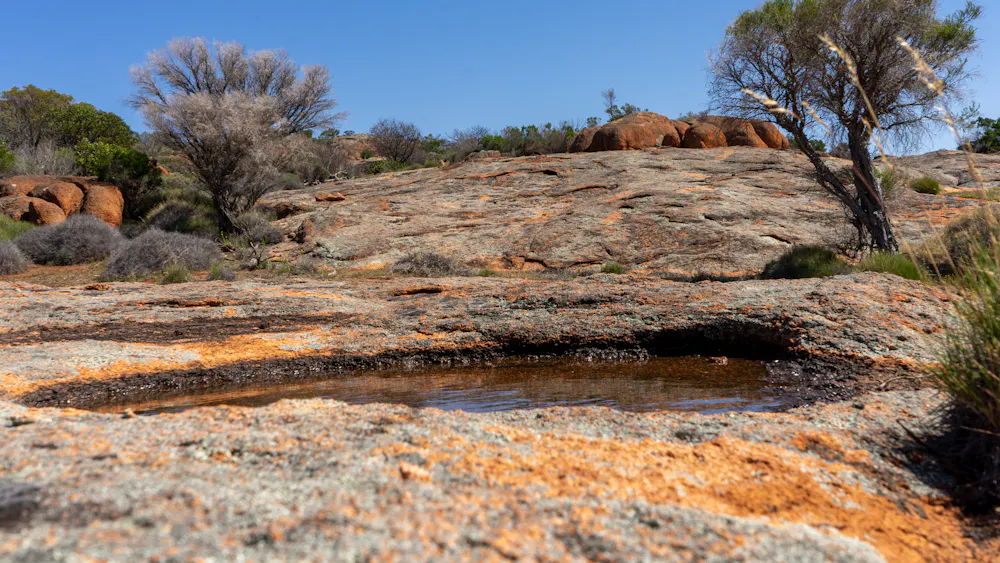
A rock hole in the foreground, with tree scrub in the background.
Arid land rock holes play host to a surprisingly diverse range of invertebrates.
Author provided, CC BY-ND

Overlooked, but extraordinary

Invertebrates are animals without backbones. They include many different and beautiful organisms, such as butterflies, beetles, worms and spiders (though perhaps beauty is in the eye of the beholder!).

These creatures provide many benefits to Australian ecosystems (and people): pollinating plants, recycling nutrients in the soil, and acting as a food source for other animals. Yet despite their significance, invertebrates are usually forgotten in public discussions about climate change.

Freshwater invertebrates in arid Australia are rarely the focus of research, let alone media coverage. This is due to a combination of taxonomic bias, where better-known “charismatic” species are over-represented in scientific studies, and the commonly held misconception that dry deserts are less affected by climate change.

Seven invertebrates can be seen pictured. These include three seed shrimp, one pea shrimp, a water flea, a water boatman and a non-biting midge larvae.
Invertebrates in desert oases include insects and crustaceans, often smaller than 5 cm in length. Invertebrates in this picture include three seed shrimp, one pea shrimp, a water flea, a water boatman and a non-biting midge larvae.
Author provided, CC BY-ND

Oases of life

Arid rock-holes are small depressions that have been eroded into rock over time. They completely dry out during certain times of year, making them difficult environments to live in. But when rain fills them up, many animals rely on them for water.

When it is hot, water presence is brief, sometimes for only a few days. But during cooler months, they can remain wet for a few months. Eggs that have been lying dormant in the sediments hatch. Other invertebrates (particularly those with wings) seek them out, sometimes across very long distances. In the past, this variability has made ecological research extremely difficult.

Our new research explored the biodiversity in seven freshwater rock holes in South Australia’s Gawler Ranges. For the first time, we used environmental DNA techniques on water samples from these pools.

Similar to forensic DNA, environmental DNA refers to the traces of DNA left behind by animals in the environment. By sweeping an area for eDNA, we minimise disturbance to species, avoid having to collect the animals themselves, and get a clear snapshot of what is – or was – in an ecosystem. We assume that the capture window for eDNA goes back roughly two weeks.

These samples showed that not only were these isolated rock holes full of invertebrate life, but each individual rock hole had a unique combination of animals in it. These include tiny animals such as seed shrimp, water fleas, water boatman and midge larvae. Due to how dry the surrounding landscape is, these oases are often the only habitats where creatures like these can be seen.

Culturally significant

These arid rock holes are of great cultural significance to several Australian First Nations groups, including the Barngarla, Kokatha and Wirangu peoples. These are the three people and language groups in the Gawler Ranges Aboriginal Corporation, who hold native title in the region and actively manage the rock holes using traditional practices.

As reliable sources of freshwater in otherwise very dry landscapes, these locations provided valuable drinking water and resting places to many cultural groups. Some of the managed rock holes hold up to 500 litres of water, but elsewhere they are even deeper.

Diverse practices were traditionally developed to actively manage rock holes and reliably locate them. Some of these practices — such as regular cleaning and limiting access by animals — are still maintained today.

A granite rock-hole has been managed using traditional practices. Small stones are placed around the perimeter and logs have been laid across the top.
Freshwater granite rock-holes are still managed using traditional practices in the Gawler Ranges region.
Author provided, CC BY-ND

Threatened by climate change

Last year, Earth reached 1.5°C of warming above pre-industrial levels for the first time. Australia has seen the dramatic consequences of global climate change firsthand: increasingly deadly, costly and devastating bushfires, heatwaves, droughts and floods.

Climate change means less frequent and more unpredictable rainfall for Australia. There has been considerable discussion of what this means for Australia’s rivers, lakes and people. But smaller water sources, including rock holes in Australia’s deserts, don’t get much attention.

Australia is already seeing a shift: winter rainfall is becoming less reliable, and summer storms are more unpredictable. Water dries out quickly in the summer heat, so wildlife adapted to using rock holes will increasingly have to go without.

Desert landscape with exposed granite outcrops, low shrubbery and rolling hills in the background. Heavy grey storm clouds can be seen on the horizon.
Storm clouds roll in over the South Australian desert.
Author provided, CC BY-ND

Drying out?

Climate change threatens the precious diversity supported by rock holes. Less rainfall and higher temperatures in southern and central Australia mean we expect they will fill less, dry more quickly, and might be empty during months when they were historically full.

This compounds the ongoing environmental change throughout arid Australia. Compared with iconic invasive species such as feral horses in Kosciuszko National Park, invasive species in arid Australia are overlooked. These include feral goats, camels and agricultural animal species that affect water quality. Foreign plants can invade freshwater systems.

Deeper understanding

Many gaps in our knowledge remain, despite the clear need to protect these unique invertebrates as their homes get drier. Without a deeper understanding of rock-hole biodiversity, governments and land managers are left without the right information to prevent further species loss.

Studies like this one are an important first step because they establish a baseline on freshwater biodiversity in desert rock holes. With a greater understanding of the unique animals that live in these remote habitats, we will be better equipped to conserve them.

A blue damselfly perches on a twig sticking out from water.
The freshwater damselfly visit granite rock-holes after rain and lay their eggs directly into the water.
Author provided, CC BY-ND

The Conversation

Brock A. Hedges received funding from Nature Foundation, The Ecological Society of Australia and the Department of Agriculture, Water and Environment. Brock A. Hedges currently receives funding from the Japan Society for the Promotion of Science.

James B. Dorey receives funding from the University of Wollongong.

Perry G. Beasley-Hall receives funding from the Australian Biological Resources Study.

ref. Meet the weird, wonderful creatures that live in Australia’s desert water holes. They might not be there much longer – https://theconversation.com/meet-the-weird-wonderful-creatures-that-live-in-australias-desert-water-holes-they-might-not-be-there-much-longer-269814

It’s end-of-year concert season. Why do some kids struggle with performance anxiety?

Source: The Conversation (Au and NZ) – By Kathleen McGuire, Senior Lecturer in Education (Music), National School of Education, Faculty of Education and Arts, Australian Catholic University

Yan Krukov/ Pexels

End-of-year school concerts showcase children’s talents and hard work, often filling performers with pride. But for some, the idea of performing live is terrifying.

Performance anxiety, also known as glossophobia or stage fright – can manifest in ways that range from excitement or mild discomfort, such as tummy butterflies, to severe physical reactions such as racing heart, shaking, sweating, nausea, fainting or hyperventilating.

Even seasoned artists, such as Adele and Barbra Streisand, have spoken openly about lifelong struggles with performance anxiety.

Studies suggest up to 75% of children develop performance anxiety. While some children recover quickly from a stressful performance, others may be deeply affected. Negative experiences can lead to long-term impacts, including chronic stress, headaches and a loss of confidence.

The good news is there are effective strategies to prevent and manage stage fright.

My experience with performance anxiety

I’ve had my own experiences of stage fright. As a child, I loved performing and learned to psyche myself up for solos on classical guitar, clarinet, trumpet and singing.

But in my first year at university, moments before a recital, I discovered my print music was not inside my instrument case. Forced to play from memory, my performance unravelled with repeated memory lapses caused by heightened anxiety. Mortified, I changed my degree focus from performance to composition.

As a music educator, I have since seen countless students experience extreme stage fright: a saxophonist fainting on stage, a singer losing her voice, a pianist running from the hall in tears before playing a note.

What helps in the moment?

Anxiety is often driven by fear. In a concert setting, perfectionism can contribute to this feeling, including fear of making mistakes, disappointing others, or fear of failure.

When our brain perceives a threat, working memory (the mental space for storing short-term memory, such as following a set of instructions) is interrupted by the body’s “fight or flight” response. This causes the body to be flooded with hormones, such as adrenaline. This can lead to shaking, sweating and temporary memory loss.

Telling the brain “there is no threat” helps restore memory and focus.

Useful strategies to do this include sipping water, taking deep breaths, or walking slowly to calm the nervous system.

Younger performers often need a teacher or family member to help them recognise when they are overwhelmed and guide them through these steps.

How can we prevent stage fright before it starts?

Research shows music performance anxiety typically emerges around age ten, and perfectionism increases through adolescence.

Positive experiences and self-belief can reduce the likelihood of stage fright.

In a study, students used breathing and silent repetition of the words “bold”, “confident” and “free” to counter negative self-talk, with strong results, outperforming their peers. Judges, in a blind rating, noted the students exhibited significantly superior expression in their playing, dynamic range and timing.

Teachers can also have an influence. Research shows it helps performance anxiety if teachers follow a “positive instruction” model. This includes:

  • encouraging a student to use their strengths – for example, curiosity or perseverance

  • acknowledging when the student has done something positive and analysing what was good about it

  • praising the process, not just the outcome (for example, “I can hear you slowing down there to master that complicated section” as opposed to “good job hitting that high note”).

Cultural aspects may contribute to anxiety. One of my students refused to perform because he feared how his non-Western family might react to his role in a school musical. After discussing his concerns and speaking with his mother – who was very supportive – he performed proudly and was thrilled to see his family in the audience.

How to support first-time performers

Students who have never performed may suffer from fear of the unknown.

Teachers can help here by “gradual release” strategies. This is where teachers gradually support a child’s independence around a skill. The teacher can move between modelling the skill and then guided and independent activities.

This could include a nervous student performing with a buddy, playing in a trio, or sharing the stage with their teacher. Informal experiences – performing for a few peers or playing casually in the schoolyard – can also build confidence.

Another approach is to prerecord a piece on video and then show it during the concert. This can be a stepping stone towards live performance.

Being prepared

Neurodiverse students or students with disability may experience heightened anxiety in high-stress settings, including the fear of being perceived, or being “hyperaware of how they are viewed by others”.

Teachers can reduce potential stress triggers through understanding what students need. Examples might include adjusting lighting, ensuring suitable stage access, and shortening waiting times.

All students benefit from well-prepared concerts with detailed cue sheets and dress rehearsals that closely match the final performance. Additional staff or volunteers backstage help manage noise, provide reassurance and support students through anxious moments.

Why it’s worth the effort

The benefits of performing make the effort worthwhile. Streisand said:

Fear can be a great energiser. Without it, we might not push ourselves to certain heights.

Research shows performance nurtures pride, belonging and confidence, despite anxiety. Other research notes how the arts can improve student learning and school experiences generally. A literature review found school students with access to high-quality arts experiences were more engaged and motivated in their learning, achieved better grades, and were better able to cope with stress.

By taking steps to help kids work through their fears, we can ensure the benefits of performance outweigh their anxiety.

The Conversation

Kathleen McGuire receives funding from the Australian Department of Education: Higher Education Participation and Partnerships Program (HEPPP) and Australian Catholic University. She has received funding from state and local governments. She is affiliated with the Australian & New Zealand Association for Research in Music Education (ANZARME), Australian Society for Music Education (ASME), Australian National Choral Association (ANCA), National Tertiary Education Union (NTEU), American Society of Composers, Authors and Publishers (ASCAP), Music Arrangers Guild of Australia (MAGA), and the Australian Performing Rights Association (APRA AMCOS).

ref. It’s end-of-year concert season. Why do some kids struggle with performance anxiety? – https://theconversation.com/its-end-of-year-concert-season-why-do-some-kids-struggle-with-performance-anxiety-271099

No more call to cancel: the government wants to crack down on ‘subscription traps’

Source: The Conversation (Au and NZ) – By Jeannie Marie Paterson, Professor of Law (consumer protections and credit law), The University of Melbourne

The Conversation, CC BY

It often seems like a great idea at the time. There’s a streaming service, paywalled news site or premium version of an app you want to try, offering a “no strings attached” free trial.

You sign up – with a few easy clicks and your credit card. The trial period passes, and for whatever reason, you decide this product isn’t for you.

But when you try to cancel, you’re forced to navigate confusing web pages, asked whether you’re “really sure about this” an unreasonable number of times, or even told to call a generic customer hotline.

Sound familiar? According to the Consumer Policy Research Centre, three in four Australians with subscriptions have had a negative experience when trying to cancel them.

Making it hard to cancel – commonly called a “subscription trap” – isn’t currently illegal. But now the federal government has announced a plan to ban subscription traps and other hidden fees.

Easy to sign up, tricky to leave

Subscription traps are sometimes referred to as the “Hotel California” problem, referencing the famous 1977 song by US rock band The Eagles.

Echoing that song’s lyrics, while it is often easy to sign up – it can be really hard to leave.

The traps can take many different forms. One example is when consumers sign up for a service quickly and easily online, but can only cancel on the phone (sometimes needing to ring another country).

Delay, delay, delay

Announcing the proposed new laws at a press conference, Assistant Minister for Competition Andrew Leigh also singled out cases where the cancellation takes 28 days to come into effect. Leigh said:

A simple rule for businesses: if you can’t cancel a subscription through the same process that you started the subscription, then perhaps there’s a subscription trap going on.

Another example, known as “confirm shaming”, involves requiring consumers to click through multiple screens before they can cancel.

Typically, each of those screens has a message asking consumers to reconsider, often reiterating the service’s purported benefits and even offering new discounts on the price not previously available.

Why it’s a problem

Individually, all these difficulties may seem trivial. But cumulatively they are problematic.

Consumers are spending time trying to cancel subscriptions for services they don’t use and businesses are making money from services consumers don’t want.

Consumers are also being locked into those services by artificially created friction and techniques that rely on triggering uncertainty or doubt – “do you really want to cancel?”

The proposed new laws will ask the process of cancelling to be straightforward.

What new laws are proposed in Australia?

The proposed ban on subscription traps is part of a broader package of federal law reforms targeting unfair trading.

Consultation on a draft of the new law is set to take place in 2026 (following an earlier consultation in 2024).

The federal government has indicated the law will include a general ban on unfair practices that manipulate consumer decision making, while also targeting specific deceptive practices, such as certain kinds of subscription traps.

It should not apply to the kinds of subscription where there are legitimate reasons for slowing down the cancellation process, for example, where pushing the wrong button might delete all your photos or digital content.

What do other countries do?

Several other jurisdictions already have responses to subscription traps.

Californian law now includes a suite of protections for consumers, including requiring notice:

  • of automatic renewal
  • at the end of a free charge period before a fee is incurred.

California’s “click to cancel” rules also mean consumers must be able to cancel using the same method of communication they used to subscribe. And businesses must offer consumers information on how to cancel.

In the European Union, rules on unfair commercial practices have led to changes in the previously complicated process required to unsubscribe from Amazon Prime – reducing cancelling a subscription to just two clicks.

In the meantime what should Australians do to manage subscriptions?

Until Australia gets its own unfair business practices law, Australians can protect themselves from being trapped by subscriptions.

But it takes some work, including recording important information at the time you subscribe:

  • if there is a free trial, make a note of when that expires and remember to cancel before being charged a fee
  • take a screen shot of what you were promised and the price – if what is delivered is different from what was promised you should be able to cancel at any time for a refund
  • record contact details for the service provider at the time you sign up.

Above all, persevere in cancelling subscriptions you don’t want. Remember, those pleading messages such as “why cancel?” or “don’t leave us” are designed to manipulate your emotions. So try to ignore them.

The Conversation

Jeannie Marie Paterson has received funding from the Australian Research Council for a project on misleading conduct. She is a member of the research advisory committee of the Consumer Policy Research Centre.

ref. No more call to cancel: the government wants to crack down on ‘subscription traps’ – https://theconversation.com/no-more-call-to-cancel-the-government-wants-to-crack-down-on-subscription-traps-271096

Impossible translations: why we struggle to translate words when we don’t experience the concept

Source: The Conversation (Au and NZ) – By Mark W. Post, Senior Lecturer in Linguistics, University of Sydney

Wietse Jongsma/Unsplash

If you are fluent in any language other than English, you have probably noticed that some things are impossible to translate exactly.

A Japanese designer marvelling at an object’s shibui (a sort of simple yet timelessly elegant beauty) may feel stymied by English’s lack of a precisely equivalent term.

Danish hygge refers to such a unique flavour of coziness that entire books seem to have been needed to explain it.

Portuguese speakers may struggle to convey their saudade, a mixture of yearning, wistfulness and melancholy. Speakers of Welsh will have an even harder time translating their hiraeth, which can carry a further sense of longing after one’s specifically Celtic culture and traditions.

Imprisoned by language

The words of different languages can divide and package their speakers’ thoughts and experiences differently, and provide support for the theory of “linguistic relativity”.

Also known as the Sapir-Whorf hypothesis, this theory derives in part from the American linguist Edward Sapir’s 1929 claim that languages function to “index” their speakers’ “network of cultural patterns”: if Danish speakers experience hygge, then they should have a word to talk about it; if English speakers don’t, then we won’t.

The Welsh mountainside
Welsh hiraeth can imply a longing after specifically Celtic culture and traditions.
Mitchell Orr/Unsplash

Yet Sapir also went a step further, claiming language users “do not live in the objective world alone […] but are very much at the mercy” of their languages.

This stronger theory of “linguistic determinism” implies English speakers may be imprisoned by our language. In this, we actually cannot experience hygge – or at least, not in the same way that a Danish person might. The missing word implies a missing concept: an empty gap in our world of experience.

Competing theories

Few theories have proven as controversial. Sapir’s student Benjamin Lee Whorf famously claimed in 1940 that the Hopi language’s lack of verb tenses (past, present, future) indicated its speakers have a different “psychic experience” of time and the universe than Western physicists.

This was countered by a later study devoting nearly 400 pages to the language of time in Hopi, which included concepts such as “today”, “January” and – yes – discussions of actions happening in the present, past and future.

Even heard of “50 Inuit words for snow?” Whorf again.

Although the number he actually claimed was closer to seven, this was later said to be both too many and too few. (It depends on how you define a “word”.)

Four Inuit children.
Do in the Inuit really have 50 words for snow?
UC Berkeley, Department of Geography


Read more:
Do Inuit languages really have many words for snow? The most interesting finds from our study of 616 languages


More recently, the anthropological linguist Dan Everett claimed the Amazonian Pirahã language lacks “recursion”, or the capacity to put one sentence inside another (“{I trust {you’ll come {to realise that {my theory is better.}}}}”).

If true, this would suggest that Pirahã differs in the exact property that Noam Chomsky has argued to be the principal defining property of any human language.

Once again, Everett’s claims have been argued both to go too far and not far enough. The cycle would appear to be endless, such that two excellent recent books on the topic have adopted almost diametrically opposite perspectives – even down to the opposite wording of their titles!

Language as a comfortable house

There is truth in both perspectives.

At least some aspects of human languages must be identical or nearly so, since they are all used by members of the same human species, with the same sorts of bodies, brains and patterns of communication.

Yet recent increases in understanding of the world’s Indigenous languages have taught us two important additional lessons. First, there is far more diversity among the world’s languages than previously believed. Second, differences are often related to the patterns of culture and environment in which languages are traditionally spoken.

A scenic view of mountains with huts
In many Himalayan languages, expressions reflect the mountainous surroundings.
Mark Post

For example, in many Himalayan languages, an expression like “that house” comes in three flavours: “that-house-upward”, “that-house-downward” and “that-house-on-the-same-level” – a reflection of the mountainous area these speakers live in.

When their speakers migrate to lower-elevation regions, the system may shift from “upward/downward” to “upriver/downriver”. If there is no large enough river present then the distinction may disappear.

In Indigenous Aslian languages of peninsular Malaysia, there are large vocabularies referring to finely-distinguished natural odours. This is an index of the richly diverse foraging environment of their speakers.

Studies of small, tightly-knit communities like the Milang of northeastern India have revealed how languages can require speakers to mark their information source: whether a statement is the general knowledge of one’s social group, or is arrived at through a different type of source – such as hearsay, or deduction from evidence.

Speakers of languages with such “evidentiality” systems can learn to speak languages – like English – without them. Yet native language habits turn out to be hard to break. One recent study showed speakers of some languages with evidentiality add words like “reportedly” or “seemingly” into their statements more often than native English speakers.

Human languages may not be a prison their speakers cannot escape from. They may be more like comfortable houses one finds it difficult to leave. Although a word from another language can always be borrowed, its unique cultural meanings may always remain just a little bit out of reach.

The Conversation

Mark W. Post does not work for, consult, own shares in or receive funding from any company or organisation that would benefit from this article, and has disclosed no relevant affiliations beyond their academic appointment.

ref. Impossible translations: why we struggle to translate words when we don’t experience the concept – https://theconversation.com/impossible-translations-why-we-struggle-to-translate-words-when-we-dont-experience-the-concept-267521

Golf: Ryan Fox battles Melbourne wind to lead Australian Open

Source: Radio New Zealand

Ryan Fox. photosport

Ryan Fox emerged happy from a taxing opening round at the Australian Open in Melbourne, sharing the top of the leaderboard with Australia’s Elvis Smylie and Mexican Carlos Ortiz.

Strong winds at the Royal Melbourne course dominated day one, with world number two Rory McIlroy among those to struggle, finding himself languishing in a share of 57th on one-over.

Fox was more composed, shooting a six-under 65 which featured eight birdies and two bogeys.

The 38-year-old made a rapid start to his round with a tidy approach to the second, an up-and-down at the driveable third and a long putt from off the green at the fourth to complete a hat-trick of birdies.

A smart tee-shot on the seventh had him four-under and while he dropped a shot before the turn, he sandwiched a two-putt gain at the 14th with a pair of smart approaches to share the lead.

Ryan Fox. photosport

A second bogey of the day came on the next but he hit back on the par-five 17th to once again find the summit.

“I would’ve taken even par on Friday,” Fox said.

“This golf course is tricky enough. There’s obviously a lot of trouble, especially with all the crosswinds. It’s pretty wide off the tee for the most part, if you hit the right club, but with all the crosswinds, you can get yourself in a lot of trouble.

“So I was very happy I managed to stay away from all the bad stuff on Friday and holed a couple of putts early and sort of kept me on my way and hung on through the middle, through the really tough stretch of holes there, and then took advantage of the par fives and a couple of good wedge shots coming home.”

Fox won twice on the PGA Tour this year, but following a break did not make the return to the Australasian Tour that he wanted to last week, finishing 12 strokes off the pace in a share of 39th at the Australian PGA Championship in Brisbane.

New Zealander Daniel Hillier, who finished in a share of fifth last week, continued his consistent form with an opening 68 in Melbourne to share seventh.

Sign up for Ngā Pitopito Kōrero, a daily newsletter curated by our editors and delivered straight to your inbox every weekday.

– Published by EveningReport.nz and AsiaPacificReport.nz, see: MIL OSI in partnership with Radio New Zealand

Football: What you need to know ahead of the FIFA World Cup draw

Source: Radio New Zealand

Chris Wood takes a selfie with fans after defeating Cote d’Ivoire. Andrew Lahodynskyj / www.photosport.nz

2026 FIFA World Cup draw

Washington DC

Saturday 6 December, 6am NZT

Live blog coverage on RNZ

The draw for the 2026 FIFA World Cup will be made in Washington DC on Saturday. So who could the All Whites be grouped with? Here’s everything you need to know.

The 23rd edition of the World Cup will be the first to feature 48 teams and will be hosted by the US, Mexico and Canada. It kicks off on 11 June with the opening two games in Mexico, and finishes on 19 July with the final in New York.

A new rule in the draw aims to maintain competitive balance in the expanded 48-team format. It means the top-ranked team (Spain) and number two (world champions Argentina) are in opposite halves of the bracket, with the same applying to number three (France) and number four (England).

Argentina captain Lionel Messi lifts the World Cup trophy after the between Argentina and France at Lusail Stadium at the Lusail Stadium, north of Doha. AFP

If the top four seeds win their groups, those countries won’t be able to meet until the semi-finals for the first time in the tournament’s history.

The World Cup draw takes place on Saturday morning (6am NZT) in Washington DC, with the updated match schedule, including stadiums and kick-off times, to be released on Sunday morning.

Teams qualified

Hosts: Canada, Mexico, United States

Africa: Algeria, Cape Verde*, Egypt, Ghana, Ivory Coast, Morocco, Senegal, South Africa, Tunisia

Asia: Australia, Iran, Japan, Jordan*, Qatar, Saudi Arabia, South Korea, Uzbekistan*

Europe: Austria, Belgium, Croatia, England, France, Germany, Netherlands, Norway, Portugal, Scotland, Spain, Switzerland

Oceania: New Zealand

South America: Argentina, Brazil, Colombia, Ecuador, Paraguay, Uruguay

North and Central America and the Caribbean: Curacao*, Panama, Haiti

*attending World Cup finals for the first time.

Play-offs

The UEFA play-offs feature 16 teams (four places available) – the 12 group runners-up and four UEFA Nations League group winners: Italy, Poland, Republic of Ireland, Romania, Denmark, Wales, Albania, Sweden, Turkey, Czech Republic, Bosnia-Herzegovina, North Macedonia, Ukraine, Slovakia, Kosovo and Northern Ireland.

There will be six teams in the two inter-confederation paths (Two places available). Iraq and DR Congo will go direct to one of the finals. Bolivia, Jamaica, New Caledonia and Suriname will be drawn into semi-finals.

Spain’s Lamine Yamal celebrates after the Euro 2024 win over England. Fabio Ferrari/LaPresse / PHOTOSPORT

Pots for draw

Hosts Canada, Mexico and the US are in Pot 1, which includes Spain, Argentina, France, England, Brazil, Portugal, Netherlands, Belgium and Germany.

Pot 2 has Croatia, Morocco, Colombia, Uruguay, Switzerland, Japan, Senegal, Iran, South Korea, Ecuador, Austria and Australia.

Pot 3 will include Norway, Panama, Egypt, Algeria, Scotland, Paraguay, Tunisia, Ivory Coast, Uzbekistan, Qatar, Saudi Arabia and South Africa.

Pot 4 will be Jordan, Cape Verde, Ghana, Curacao, Haiti, New Zealand, and the winners from the European play-off A, B, C and D, and the FIFA Play-Off tournament 1 and 2.

Confederation constraints will apply, with no group having more than one team from the same region except UEFA, which has 16 representatives and can place up to two teams in a group.

The 12 groups at the World Cup will include one team from each of the four pots.

Fifa will start by drawing the teams from pot one.

Once a team is drawn they will go into the first available group.

Joe Bell, All Whites v Colombia at Chase Stadium, Florida. Carl Kafka/www.photosport.nz

Who could the All Whites face?

With 48 teams in the draw (50 percent more than the 2022 Qatar World Cup), New Zealand have 36 possible opponents from every FIFA confederation apart from Oceania.

They could face any of the Pot 1 teams of Canada, Mexico, the US, Spain, Argentina, France, England, Brazil, Portugal, Netherlands, Belgium and Germany.

Canada or the US would likely be the All Whites favoured opponent from the seeded pot, but they would both still be very hard to beat.

New Zealand Football boss Andrew Pragnell and All Whites coach Darren Bazeley will be in Washington DC as part of a New Zealand delegation of seven people who will be stateside for the draw.

While the duo will be “ball watching” during the draw to find out which teams the All Whites will be grouped with for New Zealand’s third appearance at a World Cup, that is a passive part of what they are up to.

They have no influence over how the draw plays out, but they can work the room and get themselves and their football wishes in front of some influential people.

New Zealand history at the FIFA World Cup

New Zealand first attempted to qualify for the World Cup finals in 1970, but didn’t achieve their goal until 1982.

In the buildup to that tournament the All Whites went through a gruelling qualification process that involved 15 games, and they had to beat China in a sudden-death play-off in Singapore.

That squad contained many of the greats of New Zealand football, including Wynton Rufer, Steve Sumner, Duncan Cole and Ricki Herbert.

In Spain in 1982 the All Whites lost all three group games – 2-5 to Scotland, 0-3 to Soviet Union and 0-4 to Brazil.

As Oceania champions New Zealand qualified for the 2010 finals by beating Bahrain in a two-legged intercontinental play-off with Rory Fallon scoring the decisive goal in Wellington

The All Whites were the only team to go unbeaten in the 2010 tournament in South Africa although they still failed to get out of their group.

They drew 1-1 with Slovakia, 1-1 with Italy and 0-0 with Paraguay.

Host cities

USA: Atlanta, Boston, Dallas, Houston, Kansas City, Los Angeles, Miami, New York/New Jersey, Philadelphia, San Francisco and Seattle.

Mexico: Guadalajara, Mexico City and Monterrey.

Canada: Toronto and Vancouver.

Television coverage

TVNZ will cover the tournament, with all of the All Whites games and some others to be broadcast free-to-air.

A World Cup pass to watch all of the games will be able to be purchased.

Although kick-off times have not been confirmed it is likely that games will be played in the late afternoon and evening because of the heat. That means games are likely to start between 8am and 3pm in New Zealand.

Sign up for Ngā Pitopito Kōrero, a daily newsletter curated by our editors and delivered straight to your inbox every weekday.

– Published by EveningReport.nz and AsiaPacificReport.nz, see: MIL OSI in partnership with Radio New Zealand

Kiwis putting cost of living ahead of environment, ministry boss says

Source: Radio New Zealand

RNZ / Unsplash

The boss of the Ministry for the Environment believes most New Zealanders are more concerned about immediate challenges, particularly pressures on households, than the environment.

Ministry officials faced questions about its mahi and people by the Environment select committee on Thursday, as part of Scrutiny Week.

Hundreds of jobs were cut during recent restructures, with full-time employee numbers falling by nearly 27 percent off the most recent peak of 1010 full-time employees in 2022/23 to 738 in 2024/25.

During the Ministry’s annual review, Green MP Lan Pham asked outgoing chief executive James Palmer if the environment had been de-prioritised as a result of reduced the environmental spend.

Palmer said public opinion on environmental matters had shifted.

“What we have seen over the last couple of years as a consequence of the stress on households and businesses and communities has been a reduction in the priority of environmental action and investment in the environment for New Zealanders,” he said.

“And I think that just reflects the priorities and the issues that people are facing.

“I’m incredibly sympathetic to the fact that for most New Zealanders, there are more near-term pressing priorities for them.”

It was a ministry behind a number of significant pieces of work this year, including Resource Management Act reform and climate change adaptation.

Palmer, a former Hawke’s Bay Regional Council chief executive, said the ministry had worked with less, but delivered more.

“Overall, I have to say it was a record volume of deliverables by the ministry, despite the reduction in resources,” he said.

“The ministry produced in terms of outputs to ministers, parliament and the public, 4822 items which included 896 briefings, 62 Cabinet papers, 452 [Official Information Act requests] and many more parliamentary questions and pieces of ministerial correspondence.”

Labour’s Rachel Brooking cited a report that showed 54 percent of the ministry’s staff often reported stress.

“In terms of the statement that you’re working with less but doing more, it seems like there’s a lot more stress as well.”

Palmer said the teams worked extraordinarily hard with dedication to public service.

He said the public service itself had become very agile and “very good at running sprints”, particularly following the Covid-19 pandemic, but recognised this put pressure on workers.

“I think it’s to do with the pace at which we’re working.

“I do think that the cadence of the New Zealand parliamentary system, particularly the three-year term, does result in governments on all sides of the house moving at pace.

“There are things we can’t control and those are particularly the timeframes that the parliamentary process demands of us.”

Palmer said the challenge for New Zealand, given relatively poor economic performance in recent years, was to sustain investment in areas that required a long-term focus.

From next year, Palmer will be chief executive of Earth Sciences New Zealand.

– Published by EveningReport.nz and AsiaPacificReport.nz, see: MIL OSI in partnership with Radio New Zealand

GP worries crowded housing contributing to measles spread in Auckland

Source: Radio New Zealand

Dr Oruba Khalil. Supplied

An Auckland doctor based in Otara said crowded housing makes children in her community more vulnerable to [https://www.rnz.co.nz/news/national/580795/paediatrician-worries-new-measles-wave-spreading-undetected the spread of measles, and is doing everything she can to make vaccinations more accessible to families.

There are now six actively infectious cases of measles across the country, and three of them are in Auckland.

Health New Zealand said the total number of known cases nationally since 8 October is 28.

GP of nearly 30 years, Dr Oruba Khalil, is all too familiar with the damage the highly infectious disease can do to families – having seen how it affected her community in 2019.

“People with fever, whole families affected, we are seeing people at the carpark, lucky that we have a big clinic – we are allocating the people – the number of people affected by measles was very high,” she said.

Khalil said the crowded living conditions of some families made them more vulnerable to the spread of the virus, and at higher risk for children to develop complications.

“Our population, if the kids have measles, and we are having the problems of housing and high rates of smoking, and these things, the kids can end up with pneumonia and lots of complications of measles,” she said.

Khalil said her clinic, Otara GP and Urgent Care, had been sending texts to all enrolled patients who were recorded as not yet vaccinated with the measles, mumps and rubella (MMR) vaccine.

Two doses of the the MMR vaccine (after the age of 12 months) protected about 99 percent of people from getting measles.

The clinic had also been offering vaccinations in the evenings so that working families could make it.

The team was running an event on the evening of Friday 12 December, to raise awareness about measles and provide vaccinations, alongside music, food and activities.

A MMR vaccine vial. AFP

Meanwhile, Pacific community health provider – the Fono – had been busy going door to door to follow up with families with children who weren’t yet vaccinated.

The organisation had about 10,000 patients enrolled at its five clinics.

Its nursing manager Moana Manukia said it’d been challenging to get hold of people, and about half the time people weren’t home.

She said sometimes it found that the family had moved out, but nonetheless, they’d make use of that opportunity to check the immunity of the new tenants.

Manukia said it still gave about 30 MMR vaccinations through its outreach teams every week – mostly to children under four.

She said it’d also been texting the parents of patients under 18 who were recorded as not immunised against measles.

Manukia said the response to those texts had been low, with just 10 percent of patients calling back.

She said the measles coverage for children under two had been good among patients, but coverage was lower for teenagers.

Manukia said it’s possible that some of the older children may have been vaccinated overseas and had no records in New Zealand.

Sign up for Ngā Pitopito Kōrero, a daily newsletter curated by our editors and delivered straight to your inbox every weekday.

– Published by EveningReport.nz and AsiaPacificReport.nz, see: MIL OSI in partnership with Radio New Zealand

‘Transformed my life’: Call for specialist courts to break addiction cycles

Source: Radio New Zealand

Australian-born Melanie Rauth was 13 when drugs and alcohol first entered her life after her parents split. RNZ/Rayssa Almeida

A former addict who spent years moving in and out of jail says the only real way out was through specialist courts that treat addiction.

New Ministry of Justice figures show people who completed the Alcohol and Other Drug Treatment Court (AODTC) reoffended far less than similar high-risk offenders in the District Court.

Australian-born Melanie Rauth was 13 when drugs and alcohol first entered her life after her parents split.

At 20, she moved to Aotearoa – and her addiction deepened. She lost custody of her daughter and spent years moving around, fuelling her drug habit and landing in prison multiple times.

“Being in prison did not help me at all to get well,” she said.

“It helped me to build a persona of myself that kept me safe. I learned how to fight, keep my guard up, and get my own way by causing a scene. But it didn’t really help me in the outside world when I tried to recover. All those masks that kept me safe were really hard to strip back.”

With help from her lawyer, the now-38-year-old was referred to the AODTC, a programme that treats addiction as the driver of offending.

“It is not a softer approach. It is a more realistic approach,” she said.

“Because me being a criminal and an addict isn’t who I was meant to be. Peeling those masks off and being who I am today wasn’t easy. I got kicked out of several treatment centres and went back to jail every time.

“Last time I was beating myself up because I didn’t want to be there. But once I went through the drug court and finished The Higher Ground programme, I realised, actually, I can do this. The team constantly reassured me: ‘We believe in you, you got this, we can do this.’ That was really powerful for me.”

Now, Rauth works as a team leader and support worker at Auckland City Mission’s social detox – a path followed by more than 90 percent of Drug Court graduates.

This week, specialists from around the world gathered at the University of Auckland to discuss the results and the future of these courts.

Graduates told the conference that being brought into support roles after finishing the programme was key to staying well.

“It absolutely transformed my life,” Rauth said.

“My daughter said to me yesterday, ‘I used to look down on you, and now you are my biggest inspiration.’ For my daughter to say that to me was really… it just warmed my heart, because that’s what I’ve always wanted to do. I’ve just always wanted to be her mum. I just didn’t know how to get out of that cycle.”

She said expanding the courts nationwide would help break cycles like hers.

“The drug problem in New Zealand is already here, it’s already grown massively, and there are already so many people in jail. And so many of them could benefit from this. Instead of taking from their community, they could be, like me, contributing to it. So why not have more of the courts?”

AODTC: a safety net – addiction expert

Drug Courts began in 2012 in Auckland and Waitākere, expanded to Hamilton in 2021, and remain limited to those three locations – despite two-thirds of prisoners having drug or alcohol problems.

New Ministry of Justice data showed graduates reoffend 50 percent less in their first year than similar offenders, and 20 percent less after four years.

But the government said expansion wasn’t simple: referrals had dropped, courts were expensive to run, and chronic addiction remained difficult to break.

Addiction expert and UK government adviser Professor David Best spoke at the conference.

He said the AOD courts may require more resources to run, but they delivered results traditional courts did not.

“Drug courts are a hugely important potential tipping point in a drug-using career. They create meaningful relationships and provide access to peer support that can break the nexus between drug use and crime.”

Best said the courts offered a positive, incentivised model that helps shape behaviour away from criminality and towards pro-social recovery-based activities.

“But it’s a five-year process over time. In the first year after somebody stops, the likelihood of relapse is between 50 and 70 percent.

“By five years, that drops to about 14 percent, so there has to be continuity of care. No matter how good any intervention is, unless somebody has access to jobs, friends, housing, someone to love, something to do, the chances are that the effects will diminish over time.”

Best rejected the idea that the AOD courts were just an “ambulance at the bottom of the cliff”.

“Prison is the real ambulance at the bottom of the cliff. Drug courts are a safety net not far off the edge of the cliff.

“We know the time between the onset of dependence and actively seeking specialist treatment is typically five years. If we can intervene with drug courts earlier, we are offering opportunity to move the ambulance up the hill, to move it closer to the top of the cliff rather than the bottom.”

Recent wastewater testing shows meth use nationwide has doubled, with growing problems in Auckland and Waikato. Critics say funding should go to frontline treatment – not specialist courts.

But Professor Best said a “one size fits all” model wouldn’t work.

“In terms of effect sizes, the effects for prevention and early intervention are incredibly small. Punitive approaches are highly unsuccessful with this population. What drug courts do is offer a model of managed behaviour change over time.

“They start the process of resolving the chaos of people’s lives, offering them support to make significant, lasting changes. And while they may appear resource intensive and expensive in the short term, the return on investment is huge.”

‘Support after prison is lacking’ – judge

Waitākere District Court Judge Lisa Tremewan said New Zealand still lacked proper support for people after prison.

“In my experience, judges were used to expecting probation officers to deal with addiction issues in offenders,” Tremewan said.

“Judges would sentence people to prison terms with release conditions, or community-based sentences with requirements to undertake assessments, courses, counselling, and treatment. But we would then see people cycling and recycling because the drivers of their offending, namely their addiction, weren’t really being addressed.

“High-risk, high-needs offenders needed a circuit break, and drug courts could be that. They reduce re-offending, save lives, and provide greater safety to the community. The research shows graduates contribute meaningfully to society, sometimes even more than people who haven’t been through recovery.”

Waitākere District Court Judge Lisa Tremewan. RNZ / Samuel Rillstone

Practical limitations – Ministry of Justice

Courts Minister Nicole McKee said she supported therapeutic approaches but there were no plans for more drug courts.

“I visited the Waitākere Alcohol and Other Drug Treatment Court and was very impressed with what I saw and heard from those who had been through that system.

“While I’m supportive of the use of therapeutic approaches in the courts to help people with addiction-driven offending, there are practical limitations on expanding the AODT Court.”

She said there were no current plans to establish additional AODT Courts beyond Auckland, Waitākere, and Hamilton.

“The ministry’s analysis of graduates’ reoffending rates is an initial exploration and is anticipated to be refined over time. It is not intended as a full evaluation of the effectiveness of the AODT Courts and does not consider costs or the full set of benefits.

“While the ministry acknowledges the role therapeutic approaches can play in addressing addiction-related offending, there are practical limitations on expanding the AODT Court, for example only a small number of locations would have enough eligible participants, and there are limitations on the availability of suitable treatment,” McKee said.

Sign up for Ngā Pitopito Kōrero, a daily newsletter curated by our editors and delivered straight to your inbox every weekday.

– Published by EveningReport.nz and AsiaPacificReport.nz, see: MIL OSI in partnership with Radio New Zealand

WorkSafe rule change introduces ‘lethal’ risk of electrocution, electrical inspectors say

Source: Radio New Zealand

Two electricians work on an EV charging station. Supplied / New Zealand Electrical Inspectors Association

Homes and businesses have been exposed to a new “lethal” risk of electrocution because of a rule change, according to electrical inspectors.

RNZ can reveal a dispute that’s escalated over the last month as inspectors in multiple meetings and letters have pleaded unsuccessfully with officials to do a U-turn.

On 13 November, a ban on putting a switch or fuse into mains power earthing systems was ditched, among 400 updates to electrical safety regulations.

“It’s a rule that’s just been taken away and … as it stands at the moment, is a lethal risk,” NZ Electrical Inspectors Association president Warren Willetts told RNZ.

Master Electricians industry group said the change had introduced a “critical safety issue” for consumers and installers.

WorkSafe said on Thursday it would be a “rare event” to insert a switch or fuse, and that other safety restrictions remained in place.

However, at the same time, the agency said the change was to allow for safer uptake of common new technologies like EV charging and household solar panels.

It issued a four-line statement saying it would publish guidance soon for the industry, and declined an interview. Letters between WorkSafe and the association seen by RNZ, and Willetts’ comments, show the inspectors are in no way reassured.

WorkSafe promised an external review “to benchmark our advice on the amendment”, but the inspectors said that would come much too late.

“We know of no other country in the world that allows” this, the association wrote to WorkSafe on 21 November.

The removal of the Protective Earth Neutral (PEN) protections could render entire systems “lethal, possibly with multiple injuries or fatalities” even when they were operating normally, it said.

WorkSafe said the change was to allow for safer uptake of common new technologies like EV charging. RNZ

To ‘not get a fatal shock from that is nearly impossible’

“In this case, when you switch the main neutral off, all the metalwork in your house, your hot water cylinder, your tap, your shower, whatever’s been earthed, now becomes 230 volts plus,” Willetts said on Wednesday.

“So you being able to let go and not get a fatal shock from that is nearly impossible.”

A residual current device, or RCD, would not help.

Inspectors requested two urgent meetings with WorkSafe in November, but emerged even more worried.

“It was very concerning to have WorkSafe unable to confirm or deny whether a high-impendance PEN (switch to open circuit) is a potentially lethal risk,” they wrote on 21 November.

‘An appropriate move’

Last Friday, WorkSafe wrote back defending the change. Its letters called the deleted ban “prescriptive” and a “blanket prohibition”.

“We are confident that removal … was an appropriate move,” the agency wrote.

It would not expect installers to put in a switch unless there was “good reason”.

“However in order to address your concerns” it was commissioning an external review.

The inspectors said the safe approach was to do a U-turn now, and claimed that WorkSafe did not consult the industry properly before it went ahead.

“I’m not going to call them incompetent, but it is insinuated that is the case,” Willets told RNZ.

The changes create a “lethal” risk of electrocution, electrical inspectors say. Supplied / New Zealand Electrical Inspectors Association

‘Unsafe, unworkable and legally ambiguous’

The Master Electricians industry group said the change introduced a “critical safety issue by permitting switching or fusing of the PEN conductor prior to the main switchboard, directly contradicting Section 8.3.7.2(b) of AS/NZS 3000, which prohibits PEN switching”.

“This creates an unsafe, unworkable, and legally ambiguous situation for installers and consumers,” said chief executive Alex Vranyac-Wheeler in a statement.

The Ministry of Business, Innovation and Employment [MBIE] which adminsters the regulations said it had had initial talks with Master Electricians on this and they would meet soon.

It had consulted the public on the whole package of 440 updates to the safety regulation citations to reduce barriers to renewable energy tech, the ministry said, adding WorkSafe engaged with the industry on the disputed change.

WorkSafe told RNZ on Thursday, “In the rare event an electrician needs to switch an earth or PEN conductor, only approved methods should be used to ensure safety.” The link was to 2023 guidance titled ‘Connecting a generator to the wiring of a house or building following an emergency’.

“The regulatory amendment lays the foundation for future measures to ensure electric vehicle charging meets safety expectations, and allow for improved disaster resilience,” it said.

This appeared to be reference to use of generators after a disaster, and needing to isolate them.

Willetts said a scenario created by the change was that a householder looking to charge their EV might hire an electrician, who opted to put in a switch because they could. “A switch or a fuse in that neutral by itself creates this lethal risk.”

WorkSafe said it would put out guidance before Christmas “outlining the restrictions that remain in place to prevent switching from occurring”.

Willetts questioned why the guidance did not accompany the rule change. “We don’t have any guidance yet from Energy Safety [part of WorkSafe] to say what to do and what not to do.”

He said inspectors suspected just one or two people initiated the rule change, and the lethal risk was likely an “unintended consequence”.

But WorkSafe said its experts had engaged with industry experts, and continued to do so, and fed that advice to MBIE which made the regulatory change.

WorkSafe said its experts had engaged with industry experts. RNZ / Samuel Rillstone

Who knows what?

The inspectors association sent WorkSafe advice from WorkSafe Queensland in 2021 that talks about the risk of electric shock from switching the neutral. Industry commentary in Australia has called it “a very bad idea”.

In its two letters to inspectors, WorkSafe said the responsibilties and liabilities of installers to do a safe job had not changed.

Willetts said this was passing “the legislative responsibility of safety to the electrician” by relying on other safety regulations they were most likely not even aware of.

“I would hope most of them would go ‘no’ [to an unsafe PEN switch] but as an electrical inspector going to sites, I have seen some weird and wonderful things electricians have done.

“We know from past that any emails that they send out, a lot of the electricians just ignore them.”

The inspectors association argued for alternatives for charging EVs, and isolating generators, that it said were being picked up in other countries.

In its 6 November letter, WorkSafe defended the change as in alignment with “an internationally recognised method of protection”.

In the UK, the Institution of Engineering and Technology published a new standard and was pushing for mandatory use of open combined protective and neutral (PEN) conductor detection devices (OPDDs).

Willetts said if any switch or fuse was put in a PEN it should only be done with a certified design by an electrical engineer.

The inspectors association expected to issue guidelines next week. Master Electricians was doing similar and said it was working with MBIE on making the whole regulatory system more flexible like in Australia.

Sign up for Ngā Pitopito Kōrero, a daily newsletter curated by our editors and delivered straight to your inbox every weekday.

– Published by EveningReport.nz and AsiaPacificReport.nz, see: MIL OSI in partnership with Radio New Zealand

IKEA’s Hawke’s Bay pine tree expansion flames fears residents will be left to pay

Source: Radio New Zealand

The highly anticipated opening of Swedish furniture company IKEA in New Zealand comes as a rural community worries about the fire risk from pine plantations.

Since 2020 IKEA has converted six Central Hawke’s Bay farms into pine forestry, which they believe makes them the largest forestry owner in the district.

This move, combined with the sale of at least four other Hawke’s Bay farms to overseas forestry companies this year, is sparking concerns from locals about the loss of productive farmland and the risks associated with converting large areas into pines.

Pine forestry in Hawke's Bay.

At least four other Hawke’s Bay farms have been sold to overseas forestry companies this year. Photo: RNZ / Alexa Cook

‘Dumbest thing NZ has done in agriculture’

To better understand the scale of this land-use change, Porangahau farmer James Hunter and pilot Joe Faram flew RNZ over thousands of hectares of new pine trees that now cover what had been traditional farmland for generations.

“This is the dumbest thing New Zealand has done in agriculture,” Hunter said.

He wants New Zealanders to witness the extent of farmland being planted in forestry.

“It’s not just one farm, it’s farm after farm and I think it’s the scale of it that people don’t understand.

“Suddenly we’ve got a district that’s been swallowed, and this is apparently good for the country,” he said.

Hawkes Bay Forestry

A newly planted forestry block in Central Hawke’s Bay near Pourere, each sprayed circle is a pine tree. Photo: Nick Monro

  • More than 1.8 million hectares of New Zealand is planted in pine trees with many farms having been converted since 2008 to earn carbon credits after the Emissions Trading Scheme was introduced.
  • This resulted in more ‘carbon farming’ where forests are planted for carbon credits and permanently locked up rather than being harvested for timber.
  • Swedish furniture company IKEA has bought 28,000 hectares of New Zealand farmland since 2021, with another 10,000 currently pending approval in Northland.
  • However, IKEA told RNZ none of its trees have been planted for carbon credits, although they may look at ‘some form of offsetting in the future’.
  • A recent report from the Climate Change Commission estimated another 900,000 hectares of land will be converted to forestry by 2050.
  • Most of IKEA’s 4300 hectares of forestry in Central Hawke’s Bay is near the village of Porangahau, where about 200 hectares of its pine trees went up in flames in October and took days to extinguish because of the high winds grounding helicopters.

It’s fires like this that have rural communities on edge, because they say even if the blaze starts on nearby farmland, the forests contain the fuel that feeds them.

“So the question for the forestry owners is how confident are they that they can stop New Zealand haemorrhaging money chasing fires?” Hunter said.

“They’ve brought basically the equivalent of petrol tankers into these rural districts. Why should we pay for the cost of fighting something while they’re making extraordinary money?”

Alexa Cook and James Hunter

Porangahau farmer James Hunter took RNZ reporter Alexa Cook up in a helicopter to get a clearer view of the extent of pine plantings across the region. Photo: Nick Monro

Hunter believed there’d been ‘no thought to firefighting’, especially in high winds.

“I want to see them have to put in their own water supplies. And I want some confidence that they can fight a fire when the helicopters are not able to fly – and if the helicopters are not able to fly, what happens to the rest of us downwind?”

He’s concerned that Fire and Emergency New Zealand (FENZ) didn’t have the resources to deal with major blazes. FENZ said it’s primarily funded through the Fire and Emergency levy, which is collected on contracts of fire insurance. However, there is no mandatory requirement for foresters to insure.

“We do not have a separate breakdown of levy contributions from forestry companies,” a FENZ spokesperson said.

“Other than funding from the levy, Fire and Emergency does not receive any additional dedicated funding to fight forestry fires.”

The organisation said it was “confident in its ability to respond effectively to forestry fires”.

Pine forestry in Hawke's Bay.

About 200 hectares of IKEA’s Central Hawke’s Bay forestry went up in flames in October. Photo: RNZ / Alexa Cook

IKEA’s forestland country manager Kelvin Meredith told RNZ the company, like many other forestry owners, did not have fire insurance.

“We don’t insure for fire. It’s prohibitively expensive in New Zealand,” he said.

The Forest Owners Association said about 30 to 40 percent of plantation forest estate was insured. It varied year to year as owners reviewed their risk management.

“Standing crop insurance is becoming increasingly unaffordable, so – like other rural landowners – forest owners weigh the cost, risk and benefits each year,” it said.

“Some companies choose to self-insure and invest heavily in their own firefighting capability, which in turn strengthens rural fire response more broadly.”

Meredith agreed that there is a lot of fuel in a forest but said it provided fire plans to FENZ and worked closely with it to mitigate the fire risk.

“What we can do is have decent fire breaks and decent fire plans in place so if it does break out, the key consideration is that no one’s life is in danger.

“I can’t speak for all forest owners, but I think we’re relatively well prepared in the event of a fire,” said Meredith.

Hunter said if forest owners weren’t contributing financially to FENZ, or properly mitigating the fire risk, then it’s unfair on farmers who did pay fire insurance levies and were investing in fire protections.

“So you want to go and plant your trees? Cool. Don’t leave me with the costs.”

Porangahau Farmer

Farmer James Hunter is worried forestry companies aren’t taking the fire risk seriously. Photo: Nick Monro

There’s also currently no mandatory requirement for forestry owners to reduce or mitigate fire risk, but the Forest Owners Association said $21 million a year was spent on fire protection.

Nationally, FENZ had 15 formal service-level agreements with major forestry companies that outlined resource sharing arrangements and joint responsibilities during wildfire events, and said three more were being finalised.

FENZ wouldn’t provide forestry fire plans to RNZ, but said there was ongoing investment in training and technology to ensure they remained well-prepared as fire risks evolved “due to climate and land-use changes”.

“Fire and Emergency remain committed to working with all stakeholders to protect people, property, and the environment from the growing threat of wildfires.”

IKEA said it would consider supporting calls for legislation requiring all landowners, from farmers to foresters, to mitigate fire risk and invest in fire protections.

“If it’s practical and effective and can be implemented in an effective manner. It’s no good writing a piece of legislation that only half the population is going to follow,” said Meredith.

‘I’m embarrassed to be a New Zealander’

Pilot Joe Faram has been fighting forestry fires for decades. He’s had a front row seat witnessing Hawke’s Bay’s landscape steadily change from farms to pines.

“The transition has been very vast over the last 15 years … a lot of that mindset has been detrimental to the betterment of New Zealand.

“I’m embarrassed to be a New Zealander, it’s shameful,” he said.

Hawkes Bay Forestry

Pilot Joe Faram has been fighting fires from the air for decades and worries the risk is increasing. Photo: Nick Monro

As a pilot, he said there was a lot of pressure on aerial fire-fighting resources because it’s often the main tool for containing a forestry blaze.

He’s concerned the increase in pine trees is creating a bigger fire risk.

“Because there’s more material, there’s more fuel. We’re certainly putting ourselves in a dangerous situation, so you’re managing risk control.

“By a little bit of good fortune and luck, we have had fires, but we’ve managed to suppress them quite effectively. But one day, the Swiss cheese will line up and we will have a fire that, instead of putting it out in two or three days, it could be up to a month,” he said.

It’s a fear shared by Porangahau hapu Ngāti Kere. Chairperson David Tipene Leach has been in discussions with IKEA since 2022.

“They came to the marae, they talked to us, they told us what they had to offer.

“When you look back on it a couple of years later, actually there’s not much to offer.”

Hawkes Bay Forestry

David Tipene Leach feels the spread of forestry in Hawke’s Bay is like another wave of colonisation for Ngāti Kere. Photo: Nick Monro

Since the fire in October, he’s written to IKEA on behalf of the hapu, urging it to remove the pine trees planted closest to the village in an area known as Stoneridge.

“If you look around the world, and certainly in this day and age, we look into Canada and into the States and other places, and you see the huge forest fires that are occurring in these big plantations, we’ve got to be worried about that sort of stuff.

“With regard to exit and entry from our little isolated town, they’re planting, planting all along the road. You can’t get out of our town if the forests are burning,” he said.

However, IKEA said it’s unlikely it would remove trees.

“As far as taking the whole Stoneridge face out of trees, I can’t see that happening. What we need to do is meet with the community and understand what are the real concerns here related to fire,” said Meredith.

Hawkes Bay Forestry

An area of new pine plantings in Central Hawke’s Bay. Photo: Nick Monro

For Tipene Leach, there’s a sense of sadness around seeing farmland planted in pine.

“It’s kind of like this is just another, you know, I don’t want to sound silly, but another wave of colonisation that Ngāti Kere has to deal with.

“Us small hapu, we’re fighting for survival here. We’re not really fighting to change the world. We’re just fighting to maintain our little bit of the world.”

He worried the pine problems seen in Tai Rāwhiti with slash and community loss were creeping down the East Coast, and Hawke’s Bay was set to make the same mistakes.

“The forestry people will tell us, don’t worry, we’ve all learned since then.

“But they are commercial operators who are out there to make a buck where they can, and so I’m not sure that we have any reason to trust them,” Leach said.

Forest Owners Association chief executive Elizabeth Heeg said commercial foresters did want to make a return on their investments, but the returns were slow to be realised and forest owners were highly motivated to protect the environments and communities their trees grew in.

“Part of this is adapting to climate change and with increasing numbers of significant storms, foresters are very focused on adapting their forest and harvest management plans to prevent and prepare for incidents where forest waste leaves their land.

“Our forests are a vast resource and with greater collaboration across the industry and other sectors, using woody biomass for energy generation, more timber in construction, and increasing domestic processing, New Zealand has a significant opportunity to gain far greater value from them,” said Heeg.

Hawkes Bay Forestry

Pine forestry in southern Hawke’s Bay Photo: Nick Monro

IKEA said while it couldn’t answer for all foresters, the company was “pouring cash into the country”.

“We’re planting forests … we’re buying native seedlings, we’re employing local contractors, employing planting crews … and we won’t realise a return for 28 years.

“We’re not extracting a lot of cash out of the country for the benefit of an offshore entity, that’s for sure,” said Meredith.

He said IKEA had put a “little bit of a pause” on buying farmland at the moment and was buying existing forests instead.

The timber grown in New Zealand would be used in IKEA’s furniture, however, it’d be shipped overseas for manufacturing.

“The sad situation we’re in is you can actually send logs to places like China and bring back products made in those countries cheaper than we can do it here.

“We’d love to manufacture here. We’d love to support local processing but it’s just the economics are tough.”

Government taking forestry fire risk ‘seriously’

Forestry Minister Todd McClay told RNZ the government took the risk of forest fires seriously and had strengthened its approach in recent years.

“There has been a wide package of work across prevention, readiness, and response. This includes updated guidance for landowners and councils, better coordination between the New Zealand Forest Service and Fire and Emergency New Zealand, and ongoing investment in research, risk mapping, and seasonal forecasting,” he said.

Minster for Trade and Investment Todd McClay at a stand up on trade and investment at the Beauty Lab Collective in Auckland on 27 November 2025.

Forestry Minister Todd McClay. Photo: Nick Monro

When asked if the government was considering legislation changes so that it’s mandatory for all landowners to reduce or mitigate fire risk, the minister said they already have responsibility for managing their property against the risk of fire.

“It’s important to note that 98 percent of wildfires in New Zealand are caused by human activity and often spread into forests.

“It’s also important to note that under the Fire and Emergency New Zealand Act 2017, FENZ have the authority to require a landowner to create and clear a firebreak on their property if it believes this is needed to help control fires.”

He believed forestry owners were doing enough to reduce the risk of fires on their land.

“Large forestry companies often have their own firefighting teams, equipment, and water supplies. Getting full insurance against fire damage is difficult, so some forestry owners choose to self-insure or buy partial coverage.

“Ultimately, the financial risk of losing trees to fire sits with the forest owner,” McClay said.

*RNZ was taken up on the flight by farmer James Hunter to give a snapshot of the land use change in the area.

Hawkes Bay Forestry

Forestry in Hawke’s Bay Photo: Nick Monro

Sign up for Ngā Pitopito Kōrero, a daily newsletter curated by our editors and delivered straight to your inbox every weekday.

– Published by EveningReport.nz and AsiaPacificReport.nz, see: MIL OSI in partnership with Radio New Zealand


Testing, testing and more testing for the country’s biggest transport job: Auckland’s CRL

Source: Radio New Zealand

The Karanga-a-Hape underground station will house the longest escalator in New Zealand, at 40 metres long Supplied: CRL

Those in charge of the country’s most expensive transport infrastructure are confident the new timetable for opening will stick – but they won’t name a date.

Auckland’s $5.5 billion City Rail Link has to undergo thousands of tests including crowd emergency evacuations before it can open in the second half of next year.

Today The Detail goes to the deepest point of the new project inside Karanga-a-Hape station for a glimpse of the country’s longest escalator, and the tracks running more than three kilometres under the city, connecting the two brand new stations (Karanga-a-Hape and Te Waihorotiu) and two extensively modified ones (Maungawhau and Waitematā).

It was originally planned to open this year but it has been pushed back by several months, to the second half of 2026.

More than 13,000 tests have to be completed before City Rail Link Limited hands it over to Auckland Transport, says Alan Trestour, head of CRL delivery for Auckland Transport.

He says there is much more to it than ensuring the trains run every four minutes at peak time.

“It’s about making sure the stations are also delivering the system performance that we’re asking them to,” Trestour says.

Intense and complex testing has been carried out in the last four months and will continue until June 30.

“You run into glitches all the time,” says CRL chief executive Pat Brockie. “But nothing that’s a showstopper at the moment.”

A ‘showstopper’ would set back the June 30 target date, he says.

In the station control room, filled with screens which monitor fire panels and safety system, Russell McMullan explains the role of a large red button with a sign saying ‘DO NOT TOUCH’ on it.

“In the event of something really bad happening, should it occur in the very unlikely event, that button can be used by staff to send a signal to all of the train drivers that there’s a major incident and that they need to stop the trains wherever they are,” says McMullan, CRL’s general manager of assurance and integration.

Passenger modelling simulations have already been carried out and more real life emergency tests will be organised next year involving staff and families, as well as disability groups.

What’s the hold-up?

Several issues contributed to delays but Covid-19 had the greatest impact, he says, with lockdowns and severe restrictions on bringing in workers from overseas.

It also contributed to the budget blowout. It was first estimated to cost $2.8 to $3.4 billion. It was pushed out to $4.4b 2019, then $5.5b in 2023.

For McMullan, who’s worked on the project from the start nearly 10 years ago, the CRL holdups are a hot topic around the barbecue.

“The analogy I give to family and friends and people at barbecues is if you’ve ever built a house and the builder gives you a date and you work towards a date any little things can trip you up and cause that date to move and you cater for that.

“But the CRL is about a thousand times more complicated than a house and it’s about a thousand times the size of your general house so you can generally expect things, when they catch you out can just add to the time that it takes.”

Transport expert Trestour, an Australian who has worked on Sydney and Melbourne rail projects, says the involvement of many agencies has added to the complexity of the architecture.

Auckland Council and the Crown have gone half and half to fund it; a number of other agencies such as construction partner the Link Alliance are on board, iwi groups have had a huge part in the planning and design, Auckland Transport will take over and run it when it’s finished; and KiwiRail has a role integrating it with existing tracks.

But Trestour says it is the incorporation of the Māori design and artworks that set it apart.

“What I find is beautiful on this project is the snapshot to cultural heritage. There’s been high level collaboration to get there with iwi being part of that process,” he says.

“These are pieces of infrastructure that are going to keep a legacy to Aucklanders and I think it’s really important that they represent the local cultural values that are enshrined in the life of Aucklanders.”

Check out how to listen to and follow The Detail here.

You can also stay up-to-date by liking us on Facebook or following us on Twitter.

– Published by EveningReport.nz and AsiaPacificReport.nz, see: MIL OSI in partnership with Radio New Zealand

95 percent of fast-track amendment bill submitters opposed to changes

Source: Radio New Zealand

About 95 percent of feedback on the Fast Track amendment bill is opposed. RNZ / Samuel Rillstone

About 95 percent of feedback on the fast-track amendment bill is opposed, with the coalition-majority select committee reporting back after less than a month.

The government intends to pass the legislation, which it says aims to address supermarket competition, by the end of the year.

All opposition parties oppose the bill, saying the claim it boosts supermarket competition is disingenous.

Despite submissions being open for just 10 days, some 2518 individuals and groups provided written feedback, and 85 appeared in hearings over 15 hours.

They raised concerns about:

  • Potential removal of environmental safeguards
  • Limits on the ability for iwi, hapū, Treaty settlement entities and other Māori groups to meaningfully engage in the fast-track process, with potential Tiriti o Waitangi implications
  • The Environment Minister’s new ability to direct the Environmental Protection Agency (EPA), potentially affecting the independence or perceived independence of the panel convenors
  • Shorter timeframes for those expert panels to consider technical information before deciding whether to grant consent to a project, with a default maximum of 60 working days, along with shortening a range of other timeframes. The panel convener raised concerns that the shortened processes would not be workable
  • That people lodging applications under fast track would now need only ‘notify’ rather than ‘consult’ certain affected groups before applying, with those notified given 20 working days to respond
  • The panels would have less discretion to seek comment from anyone they consider appropriate, because of a new requirement to first find out if local or consenting authorities plan to comment on the matter
  • New limits on the ability to appeal a panel’s final decision to proceed with a fast-track project, potentially leading people to instead seek judicial review
  • The ability for the Infrastructure Minister to issue a Government Policy Statement (GPS) by designating projects as nationally or regionally significant, potentially influencing the panels which use national and regional significance as a core metric for approval

Environment Minister Penny Simmonds. RNZ / Mark Papalii

The coalition MPs on the committee pushed back on some of these criticisms.

They said the current fast-track regime “includes some environmental safeguards” including that applicants must provide detailed information to the expert panels, and these provisions were not changing.

There was a requirement, they wrote, that anyone performing functions under the Act would still be required to act in a way that was consistent with Treaty settlements and some customary rights.

Policy statements were also only one thing the panels must consider, and the panels could still deline approval “if the adverse effects of a project were found to be significantly out of proportion to its regional or national significance”.

The bill also allows some time frames to be extended in certain circumstances or with agreement from the applicants.

Protestors drop banners from the public gallery during the third reading of the Fast-track bill in December 2024. Supplied / 350 Aotearoa

Coalition to push changes through without public consultation

Unusually, the committee recommended no changes because of the short timeframe, and because the government plans to introduce other changes in the Committee of the Whole House stage, without public consultation.

“Advisers have brought several issues to our attention following public submissions. We understand the government has identified several changes that it plans to make to the bill,” the report said.

“We agree that these identified issues warrant further consideration by the House.”

Instead, the committee “suggested changes” to be considered at the Committee of the Whole House stage. Committee recommendations are usually debated and voted on earlier, at the Second Reading.

The suggested changes include:

  • The Infrastructure Minister should be able to consult anyone they want during development of a GPS
  • Clarify that projects cannot be submitted for approval before the window for notified parties to give feedback ends
  • Require the EPA to provide substantive applications to the panel convener within five working days of receiving it
  • Remove the proposed timeframe for appointing expert panels
  • Retain the power of the panel convener to request certain reports, rather than enabling expert panels to do so
  • Clarify the provision that would enable applicants to modify substantive applications
  • Increase the default maximum time for an expert panel to make its decision to 90 working days
  • Increase the maximum time that an applicant may suspend processing of their application to 100 working days
  • Clarify that conditions can only be placed on the approval holder
  • Improve assurances and clarify the scope of the Minister’s ability to direct the EPA
  • Clarify the scope of the proposed regulation-making powers related to cost recovery
  • Clarify that proposed new section 117A(3) would not allow new projects to be added to Schedule 2 of the Act
  • Amend the description or described location of certain projects listed in Schedule 2 of the Act
  • Enable certain other parties to raise issues regarding prospective panel members
  • Require an expert panel to begin work within five working days of being appointed
  • Clarify that the panel convener would not be required to appoint members with sectoral expertise if not practicable
  • Include the Ministry for the Environment and the Ministry for Culture and Heritage in the definition of administering agency in section 103 of the Act
  • Include commencement and transitional provisions

RNZ sought comment from RMA Reform Minister Chris Bishop, but he was unavailable.

RMA Reform Minister Chris Bishop. RNZ/Mark Papalii

Opposition parties cry foul

On top of the criticisms raised by submitters, Labour claimed the bill was making “major changes” despite the minister describing it as “rats and mice”, while the Greens said it was “disingenuously framed”.

Labour complained about the short consultation period, the lack of a Regulatory Impact Statement, and the unusual process – saying it was a “terrible way to make law”.

The new ability for developers to complain about a person being appointed to the expert panels was “outrageous”, Labour said, and opposed the proposed retrospective and Henry VIII provisions.

The Greens called the bill “unprecedented and unacceptable overreach on communities’ democratic participation” which would “only make this harmful legislation worse”.

The party – which last month pledged to revoke certain fast-track consents – pointed out many of the controversial changes were only supported by those with fast-track applications, and said it would reinstate a mechanism “far too open to potential corruption”.

Te Pāti Māori said the bill would allow ministers to approve or decline projects without acting in partnership with Māori, with tapu sites able to be authorised for destruction or modification, and leaving groups that had not yet reached a Treaty settlement unable to be involved in decisions affecting them.

The party warned the bill would collapse legal barriers to seabed mining and drilling, and “undermines everything Aotearoa claims to value about partnership, accountability, and intergenerational responsibility”.

Sign up for Ngā Pitopito Kōrero, a daily newsletter curated by our editors and delivered straight to your inbox every weekday.

– Published by EveningReport.nz and AsiaPacificReport.nz, see: MIL OSI in partnership with Radio New Zealand

IRD error shortchanges thousands of taxpayers by an average of $300 each

Source: Radio New Zealand

An IRD mistake resulted in more than 4000 incorrect tax bills

More than 4000 people have been affected by an Inland Revenue error that could have meant they paid the wrong amount of tax.

RNZ was contacted by a reader who said he had noticed the error when he went to finalise his tax return.

Inland Revenue now issues income tax assessments each year for most New Zealanders, which tells them whether they have paid the right amount of tax.

The man said he and his wife would fill out an IR3 every year. “Nowadays the income, tax and imputation credits are automatically filled in, whether that be from investments in bonds, equities, or bank accounts.

“Having always done this myself longhand, I still do this and thank goodness I did.”

He said between them they would have lost about $20,000 in credits if he had not noticed the problem.

“I found that my summary of Income was correct, Income, RWT, imputation credits, but when this was automatically input into the IR3 form the imputation credits were only 50 percent of what they should have been.”

Inland Revenue said it had looked into the issue and identified a problem with how returns in the myIR system were pre-populating imputation tax credits for people who received dividends with imputation credits from jointly owned shareholdings.

“We have fixed this so any returns started in myIR from November 26 will not have this issue.

“Customers were able to amend the figure before filing the return; however, we have identified that approximately 4500 customers appear to have filed the return without changing the figure – so with the incorrect pre-populated imputation credits.

“We are currently working through the best way to amend these returns for the affected customers. Once we identify the easiest way to correct this error [we] will be contacting those affected customers.”

It said it believed the amount involved was an average of about $300 per person, “all in the taxpayer’s favour. Late next week we should have a clearer picture of the exact number of customers and tax involved as we implement a fix.”

Deloitte tax partner Robyn Walker. Supplied / Deloitte

Deloitte tax partner Robyn Walker said anyone who had not noticed the problem could have paid more tax than they needed to, or received a larger refund than they should have.

“It’s interesting that the income and tax credits aren’t kept together when the amounts are halved for spouses – I would have expected that the income and credits would have both been wrong.”

She said it was a problem that a system that was meant to be able to be relied upon by taxpayers was not working correctly.

“In the scheme of the total number of people who might invest in shares receiving dividends it’s possibly not a big error population; however the existence of any error in pre-population is concerning. One of the risks associated with income and tax credit amounts being pre-populated is that there is a natural tendency to just accept what is there if it seems ‘about right’ rather than taking the next step of validating that the information is actually correct against source documents. It would seem that this is what those 4500 individuals have done.”

Sign up for Money with Susan Edmunds, a weekly newsletter covering all the things that affect how we make, spend and invest money.

– Published by EveningReport.nz and AsiaPacificReport.nz, see: MIL OSI in partnership with Radio New Zealand

Auckland welcomes world’s longest direct flight, linking China and South America

Source: Radio New Zealand

Auckland has welcomed the first passengers transiting on what has been dubbed the “world’s longest direct flight”.

A new China Eastern Airlines service from Shanghai to Buenos Aires landed in Auckland just after 6pm on Thursday.

The route departs from Shanghai’s Pudong International Airport and is scheduled to take roughly 25 and a half hours before reaching Ezeiza International Airport in the Argentine capital.

The return journey runs even longer, at about 29 hours. Both directions include a two-hour stopover in Auckland.

A new China Eastern Airlines service from Shanghai to Buenos Aires made its first stop in Auckland on Thursday. RNZ / Yiting Lin

A welcome ceremony was held at the arrival gate at Auckland Airport following the flight’s touchdown, with attendees including Minister of Tourism and Hospitality Louise Upston, Minister of Immigration and Education Erica Stanford, Auckland Mayor Wayne Brown, Chinese Ambassador to New Zealand Wang Xiaolong, Auckland Airport chief executive Carrie Hurihanganui, and China Eastern Airlines chief executive Gao Fei.

Upston said increased air connectivity was vital for New Zealand’s future economic growth.

“We are very firmly focused on growing tourism beyond 2019 levels and China Eastern’s Southern Link marks a new milestone for New Zealand as a tourism and trade gateway,” Upston said.

Stanford said Chinese passengers transiting through New Zealand could now use a NZeTA without applying for a separate transit visa, a policy she said played a critical role in strengthening New Zealand’s economic future.

Auckland Mayor Wayne Brown also welcomed the easing of visa settings for Chinese visitors. He said the new service would deliver economic benefits to both Auckland and the wider country.

“It’s a link between two big economies, via our small economy, and we will gain from it,” Brown said.

Passengers on China Eastern’s new Shanghai-Buenos Aires service arrive at Auckland Airport on Thursday. RNZ / Yiting Lin

The new China Eastern service was also well received by passengers.

Yi Zhu, a Shanghai resident visiting South America for the first time, said he enjoyed the long-haul flight and appreciated the opportunity to take a break in Auckland.

“I think two hours is not too long, and we can have some rest,” he said. “It’s good because we can prepare good for the next trip.”

He added that being able to transit through New Zealand without needing a separate visa was convenient for Chinese travellers and made the journey more appealing.

Emilio del Campo, who had been living in China for six months, was also on the flight home.

He said it was the farthest route he could take to return to his country, and he was delighted by the experience.

Passengers on China Eastern’s new Shanghai-Buenos Aires service arrive at Auckland Airport on Thursday. RNZ / Yiting Lin

According to Auckland Airport’s statistics, travel between New Zealand and South America reached about 94,000 passengers last year, roughly two-thirds of pre-pandemic levels.

Air trade between New Zealand and South America totalled $129 million in the year to October 2025, up 11 percent from the previous year.

Auckland Airport chief executive Carrie Hurihanganui said the new service was expected to attract high-value visitors from both China and Argentina while giving New Zealanders a more competitive travel option to South America.

– Published by EveningReport.nz and AsiaPacificReport.nz, see: MIL OSI in partnership with Radio New Zealand

Kmart cancels recalls for three coloured sand products caught up in scare

Source: Radio New Zealand

The Kmart 14-piece Sandcastle Building Set, Blue Magic Sand, Green Magic Sand, Pink Magic Sand have been found to contain asbestos. Supplied / MBIE

Kmart has cancelled the recall notices that were in force for three of its coloured sand products caught in the asbestos contamination scare.

MBIE said it had been informed the Blue, Green and Pink Magic Sand products were no longer being recalled.

“As in the case of the products recalled voluntarily by companies and suppliers, the decision to cancel a recall is also the supplier’s decision,” the ministry said.

MBIE said tests commissioned by Kmart confirmed no asbestos in the three sand products.

It was now urging buyers who bought the formerly recalled products to make contact with Kmart for remedial costs.

“If you’ve incurred losses (e.g. in clean-up costs etc), you might be able to obtain damages from the supplier under the Consumer Guarantees Act,” MBIE said.

“This will be for consumers to discuss directly with the suppliers.”

Recalls for other Kmart products, the 14-piece Sandcastle Building Set and the Make Your Own Unicorn Sand Ornaments are still in force.

Sign up for Ngā Pitopito Kōrero, a daily newsletter curated by our editors and delivered straight to your inbox every weekday.

– Published by EveningReport.nz and AsiaPacificReport.nz, see: MIL OSI in partnership with Radio New Zealand

Grattan on Friday: Could the Liberals make a fight of industrial relations without courting disaster?

Source: The Conversation (Au and NZ) – By Michelle Grattan, Professorial Fellow, University of Canberra

It’s near-universally agreed that opposition policy development under Peter Dutton was too thin and too late. Now the Sussan Ley opposition is under pressure to produce policy that could arguably be premature.

Before Christmas, Ley will unveil her immigration policy. She’s already flagged it will be heavy on “principles”. The question is whether it contains an overall number (and if so what that is), and how much detail there is.

Here’s the dilemma: the more detailed the policy, the more likely it’s out of date in two years, but the more general it is, the more critics will come down on Ley. The balance was still being fought over in the opposition this week.

Partly, this need for instant policy is about the split in the Liberals over what they stand for. Like two ideological armies, conservatives and moderates have joined battle, each wanting to occupy the internal policy ground as soon as possible. Formulating the immigration policy is reflecting the fractures.

Beyond the pressure to rush, Ley has another fundamental problem: how robust should the opposition make its broad policy pitch?

In a major speech in September, Ley urged moving from the age of “dependency” (“the growing expectation that government will provide for every need and solve every problem by spending more”), arguing against middle class welfare. It’s the sort of thing you’d expect Liberals to believe, as part of their credo about containing government spending. But the hazards of running such an argument in an election campaign are obvious.

Taking existing entitlements away from people has always been hard politically – these days, it would seem near impossible, especially given the cost-of-living squeeze.

The cynics might say: in opposition you shut up, in government you act. The Albanese opposition went along with the Coalition government’s stage 3 income tax cuts, and changed them (eventually) in 2024. Dutton was pilloried for his proposed cuts to the public service (not least because they were presented as a crude sledge hammer against the number of bureaucrats). As it looks to its next budget, the government is preparing to extract significant savings from the public service.

Whatever savings, or tax increases, an opposition proposes make it highly vulnerable. Just ask Bill Shorten: he had “losers” in the policy slate he put to the 2019 election and paid the price.

Given the minefields, many eyes will be on what the Liberals decide on industrial relations, which Ley has already targeted in broad terms.

The government has delivered extensively to the union movement, from facilitating multi-employer bargaining to legislating the “right to disconnect”, and a heap of other pro-worker measures.

Ley told the Centre for Independent Studies in October: “Labor’s restrictive industrial relations changes are acting as a handbrake on productivity.

“Multi-employer bargaining laws are threatening small businesses with conditions they cannot afford. Labor’s push to legislate one-size-fits-all approaches across whole sectors ignores the needs of many employers and workers.

“We will chart a different course. We believe in enterprise-level bargaining. […] We believe in options like flexible hours, remote work arrangements, and modern award structures that reflect today’s digital economy.”

But is the Coalition likely to have an industrial relations policy that matches its rhetoric? And how would that withstand the onslaught of a union/Labor campaign?

Industrial relations should be core business for the Coalition. But did we hear of it at the last election? Thanks to John Howard’s disastrous overreach with WorkChoices, IR is scorched earth for the Liberals. Liberal sources contrast the Howard and Labor strategies – Howard’s “big bang” versus Labor’s “boiling frog” – to transform the IR landscape.

Tim Wilson is the opposition spokesman on industrial relations, employment and small business; he’s looking for a possible safe passage through this minefield.

Amid the Liberals’ election rout, Wilson became a minor hero in his party when he regained the Melbourne seat of Goldstein, which he had lost to “teal” Zoe Daniel in 2022. He’s outspoken and highly ambitious. Unless he’s moved after a change of Liberal leader next year, how he performs in this shadow portfolio will be important for his very obvious political aspirations.

In a little-reported speech to the HR Nicholls national conference a fortnight ago, Wilson threw out some cryptic hints about the way he’s looking at his policy challenge.

Although the address was content-light, he stressed his approach “will be different from my predecessors”.

“If the future of Australia’s economy can be fuelled by nuclear power, we should be looking for equally innovative solutions in industrial relations that are about how we build a focus on simplification, empowerment and alignment to promote harmony.”

Most immediately, Wilson’s attention is on “how we build the movement to advocate for reform”.

“If we go back and prosecute old debates on the unions’ turf, they’ll just be waiting with their baseball bats and intimidatory tactics. They own that field. We need a new playing field for industrial relations that focuses on mobilising those who benefit from simplification and cooperation.

“We need to mobilise a nation of employers sufficient that they see we are fighting for them enough that they want to fight for what we are espousing.”

Wilson said the integration of artificial intelligence in employment presented “a potential reset point in how people will work. It will change the structure of the employment market and the biggest opportunities are there for small business. And we need to seize on that.”

Wilson wants to “actively drive policy to enlarge a small business constituency on a scale this nation has not seen before.” Such a constituency would be “ready to push back against industrial relations tyranny designed to favour Canberra, corporates, organised workers and organised capital,” he said.

But would small business have the will or the ability for pushback? Big business certainly hasn’t – it has been able to do little more than complain about union encroachments into workplaces.

At a political level, if the Coalition wants to propose significant policy changes, it will face the same problem as it will if it proposes to reduce “dependency”. The opposition (and business) can argue IR changes are needed to improve productivity. But suggesting some of the concessions and benefits the unions have recently won be trimmed or overturned would likely receive the same negative response from voters as an assault on dependency. Wilson has his work cut out.

Michelle Grattan does not work for, consult, own shares in or receive funding from any company or organisation that would benefit from this article, and has disclosed no relevant affiliations beyond their academic appointment.

ref. Grattan on Friday: Could the Liberals make a fight of industrial relations without courting disaster? – https://theconversation.com/grattan-on-friday-could-the-liberals-make-a-fight-of-industrial-relations-without-courting-disaster-270788