Page 170

Why do cricket balls have to be so hard?

Source: The Conversation (Au and NZ) – By John Arnold, Senior Lecturer, Sport & Exercise Biomechanics, University of South Australia

The game of cricket is believed to have originated in rural England sometime in the 16th or 17th century.

The earliest versions of cricket balls had no standard size, weight or stitching: they were handmade by locals and consisted of a round leather case filled with materials such as cork or wool.

As there were no set requirements or construction methods, each ball was different, and this affected how it bounced, moved and rebounded off the bat.

However, cricket spiked in popularity in the first half of the 18th century, which prompted consistency in the rules and equipment to ensure fairness and facilitate further growth of the game.

The modern cricket ball

Modern balls consist of four main components: a cork and twine (string) core, a leather casing, a raised middle section (the seam) with stitching on either side and a wax or lacquer coating.

Balls are either red (for long formats such as international Test matches), white (for shorter formats such as One Day Internationals or Twenty20 games) or pink (for day-night Tests and first-class games).


Read more:
Like night and day: why Test cricket changes so much under lights


The laws of cricket state that when new, the ball should weigh between 5.5 and 5.75 ounces (155.9–163 grams) and have a circumference of 22.4–22.9 centimetres.

For women’s cricket, the ball can weight slightly less (140–151g) and for junior cricket (under 13) even less again (133–144g).

A set of technical standards was formalised in 1994 which stipulate the mechanical requirements for factors such as hardness, to help different manufacturers produce balls with more consistency and ensure fairness across the globe.

So why are balls so hard?

Cricket balls are the product of centuries of tradition and the extreme physical demands of the game. They must be robust and hard-wearing, able to withstand repeated high-force impacts from both the bat and the pitch over the course of a match.

Consider the forces involved when a ball is struck by a bat.

Reasonable estimates of peak forces when the ball is struck by the bat are about 17 kilonewtons (the weight of 1,700 kilograms) – enough to lift a 1.7 tonne car off the ground.

The ball also repeatedly impacts the pitch at high speeds, experiencing shear forces that gradually wear its surface. On deteriorating pitches, this wear is even more pronounced.

In Test cricket, a single ball can be bowled up to 480 times (80 overs) before the fielding team is allowed to request a replacement.

While cricket ball construction has evolved over the past 300 years, its main elements have remained largely consistent.

The introduction of the seam – the raised stitching that runs around the ball’s circumference – and the practice of shining one side of the ball to create swing are fundamental aspects of match play.

These features allow bowlers to generate movement in the air – challenging batters and shaping the strategy of the game.


Read more:
How cricket balls move: the science behind swing, seam and spin


The materials, construction and physical characteristics of the ball – including size, mass and density – determine its mechanical properties and influence how it bounces, spins and interacts with different surfaces and equipment.

These properties are central to cricket’s nature and style – changing them would fundamentally alter the way the game is played.

Tradition and the physical requirements of the game have ensured this construction is tried, tested and fit for purpose, creating the ball we know today.

Is the ball dangerous?

Bowlers vary their deliveries to deceive the batter and gain a tactical advantage. This can include changing the speed or where they aim the ball.

A specific strategy fast bowlers may use is to aim to bounce the ball directly at a batter’s upper body or head (referred to as a “bouncer)”.

This can be used to intimidate the batter and/or force them to make a mistake.

Perhaps the most infamous example of this was the 1932–33 Ashes series, in which the English cricket team controversially used a consistent “bodyline” delivery approach to contain Australian batting legend Don Bradman.

Various rule changes since the 1990s have limited the number of bouncers that bowlers can deliver, making the game safer.

At the elite level, cricket balls are commonly bowled at speeds of 130–150 kilometres per hour.

Occasionally, fast bowlers can exceed 160km/h. At amateur and recreational levels, bowlers commonly still reach 100km/h.

When a person is struck – whether it be a batter, fielder or umpire – the ball hardly rebounds and the momentum is absorbed by the body.

The force is also concentrated in a small area, making serious or even fatal injury possible – particularly if contact is made directly to the head.

The exact force depends on the timing, location and angle of impact. But there’s no doubt the combination of a small, dense ball moving at high speed and stopping almost instantly makes cricket-ball injuries potentially deadly.

There have been fatal incidents, albeit rare. The most high-profile such incident was the death of Phillip Hughes in 2014, who was hit on the neck in a Sheffield Shield match and died two days later from a vertebral artery injury.


Read more:
Yes, cricket is a contact sport. We have safety gear – but we need to do more


The number of deaths has declined significantly in the past 30 years, most likely due to widespread use of enhanced safety equipment, especially helmets, by batters and close-in fielders.

So while a layperson may view cricket as a non-contact sport, the truth is batting and fielding require great courage, considering the hardness of the ball and the speeds it can reach.

The Conversation

The authors do not work for, consult, own shares in or receive funding from any company or organisation that would benefit from this article, and have disclosed no relevant affiliations beyond their academic appointment.

ref. Why do cricket balls have to be so hard? – https://theconversation.com/why-do-cricket-balls-have-to-be-so-hard-269900

Cookbook authors, ‘dukes’ and card game gatecrashers: Australia’s quirkiest politicians

Source: The Conversation (Au and NZ) – By Robert Hortle, Deputy Director, Tasmanian Policy Exchange, University of Tasmania

Australia has a fine tradition of unconventional politicians at all levels of government. Multiple examples probably spring to mind immediately.

But in researching this piece, I went down a wacky rabbit hole. It turns out there are lesser-known characters in the annals of history that deserve some time in the spotlight.

From particularly well-dressed pioneers to founders of micronations, here are some of Australia’s most eccentric politicians.

But who counts as ‘eccentric’?

What do we really mean by “eccentric”? According to the Cambridge Dictionary, the term describes someone who is “strange or unusual, sometimes in a humorous way”.

For our purposes here, a deep commitment to long-term oddity is vital – a one-off bizarro act isn’t enough.

You’ll notice there are very few women politicians described as eccentric. This is partly because historically the vast majority of state and federal MPs have been men, and partly because we (the public) are more accepting of eccentric men in political office, while women are held to a different standard.

It’s also a very fine line between being eccentric and being problematic or offensive. Many MPs have fallen foul of that line and so won’t be included here.

With all that in mind, I looked beyond the usual cast of onion-eaters, hat-wearers, Jurassic Park fans, and dog-threateners to find some of our lesser-known rum’uns.

Alfred Deakin

Many will know Deakin as one of the architects of Australian federation, the country’s second prime minister, and a strong advocate of racist policies.

What’s less well-known is that over a period of 13 years – including while he was prime minister – Deakin regularly published articles and letters anonymously in various newspapers.

Often written under the byline “From our special correspondent”, Deakin’s missives have been described as “vivid in style, intelligent in comment, relatively free from bias and mildly critical of himself on occasions”.

Deakin was also deeply interested in Muscular Christianity and spiritualism – he attended seances as a young man – and wrote poetry and plays throughout his life.

John the Duke of Avram

Born as John Charlton Rudge, “His Grace, the most Noble Duke of Avram” was a Liberal MP in Tasmanian parliament between 1989 and 1992 and later a deputy mayor in the state’s south.

In the early 1980s, the Duke had founded the Grand Duchy of Avram, a micronation with its own Royal Bank, to bring his PhD thesis on central banks to life.

A yellow bank note with cursive text on one side and a portrait of a man in an tudor bonnet
The 25 Avram note, distributed by the Grand Duke of Avram in the 1980s.
Grand Duchy of Avram

The Duchy never claimed any physical territory – and the Duke later said the micronation doesn’t exist – but the bank briefly opened a branch in Tasmania that issued coins and notes.

The federal government took the bank to court several times, but lost.

Kezia Purick

Purick was a Northern Territory MP from 2008 to 2024, first as part of the Country Liberal Party and later as an independent.

Down the years she made headlines for spending taxpayers’ money on booze, the corrupt use of public resources to stymie the creation of a new political party, resuscitating a chicken and catching a python.

Purick reserved some of her particularly colourful language for the late former federal minister Kevin Andrews. When he made headlines after saying that de facto couples should get married to protect their relationships and children, she called him a “pooncy, pasty-faced person” and implied she’d take to him with a device used for castrating young bulls if he turned up in her electorate.

Don Dunstan

Known for his progressive politics, dapper style and bisexuality, Dunstan was a revolutionary figure in South Australian politics. As premier in the late 1960s and 70s, he led a government that reformed Aboriginal land rights, decriminalised male homosexuality and put in place environmental protections.

And he did all this while turning out immaculately in safari suits, floral shirts, and – on a day that has gone down in Australian political folklore – tiny, bright pink shorts.

While he was premier, Dunstan also took up surfing and wrote a cookbook. After retiring from politics he hosted a TV show, opened a restaurant, campaigned for democracy in Fiji and much more.

Archie Galbraith Cameron

Cameron was a federal MP for 22 years and speaker of the House of Representatives from 1950 to 1956.

A black and white portrait of an older man in a juridicial wig
Archie Cameron hated gambling. Like, really hated it.
Wikimedia Commons

Variously described as abrasive, charming, and ruthless, Cameron is famous for his anti-gambling views. Legend has it that in May 1950, he climbed the roof of Old Parliament House and leapt through the press gallery window to shut down a card game.

And, in a famous showdown with the long-serving Parliament House barber, Cameron insisted a poster of Phar Lap be removed from the barber shop.

Cameron was also a stickler when it came to the parliamentary dress code – at least for others. The man himself was known to receive visitors to his office wearing shorts and a singlet, bare feet propped on his desk.

Barry Jones

Classified by the National Trust as an “Australian Living Treasure”, Barry Jones was a federal MP between 1977 and 1998.

Before entering federal politics, Jones made a name for himself as a quiz champion. In the 1960s, he was a regular on the TV show Pick a Box, where he was famous for arguing with the host about the correct answer.

As minister for science, Jones oversaw the founding of Questacon and later authored the influential book Sleepers, Wake!, which interrogated the role of technology and work in a post-industrial society.

An unapologetic intellectual, Jones has been a passionate advocate for the arts, a critic of the “dumbing down” of Australian politics, a campaigner against the death penalty, and much more.

Jacqui Lambie

Lambie was first elected as a senator in 2013 after running for the Palmer United Party. Following a brief stint as an independent, she established the Jacqui Lambie Network.

Tasmania’s favourite battler has a strong record of off-piste comments, from describing her ideal man (“well-hung”, if you were wondering) to some particularly memorable breakfast TV exchanges.

Lambie was booted from parliament in 2017 during the section 44 debacle in which a string of MPs with dual citizenship were forced to resign. In response, Lambie opined that “I think that’s really cutting down our gene pool – and let’s face it, the gene pool is f****d”.

And who could forget the famous dagwood dog incident, which resulted in a photo that could be described as Tasmania’s political Mona Lisa.

The Conversation

Robert Hortle does not work for, consult, own shares in or receive funding from any company or organisation that would benefit from this article, and has disclosed no relevant affiliations beyond their academic appointment.

ref. Cookbook authors, ‘dukes’ and card game gatecrashers: Australia’s quirkiest politicians – https://theconversation.com/cookbook-authors-dukes-and-card-game-gatecrashers-australias-quirkiest-politicians-271515

How can I get water out of my ear after swimming?

Source: The Conversation (Au and NZ) – By Peter Carew, Senior Lecturer in Audiology, The University of Melbourne; Murdoch Children’s Research Institute

Rhett Noonan/Unsplash

Swimming is one of the best parts of summer. But long after you’ve cooled down and dried off, you might be left with a niggling feeling – there is still water in your ear.

Your ear may feel full or blocked and sounds may be muffled. You may even hear some gurgling or rustling noises.

While water usually drains naturally, a few tips can help speed things up and prevent swimmer’s ear, a common infection after swimming.

Why water gets stuck

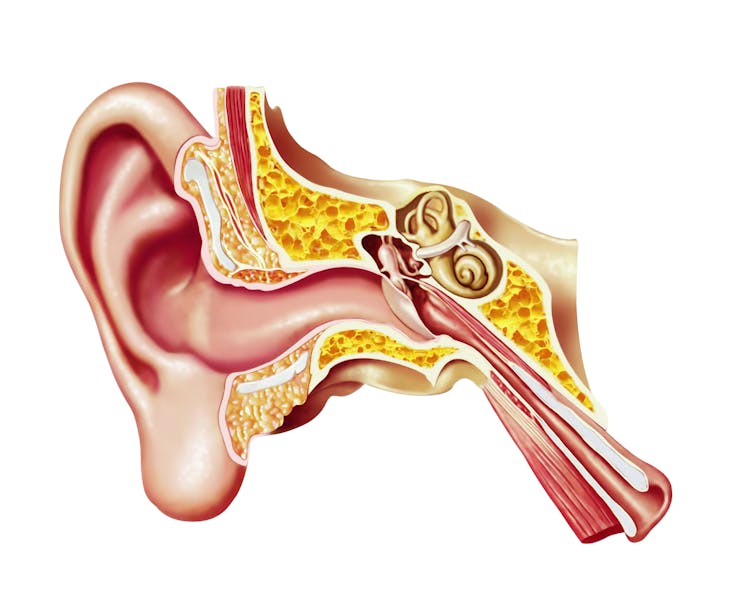
You might think your ear canal is a straight tube, but it’s not. It bends twice, and some people’s canals are naturally narrower than others.

The ear canal is lined with hair and wax for protection. It can also develop extra bone growth (exostoses) from years of cold-water swimming, sometimes known as “surfer’s ear”, which can make it even narrower.

When you swim, water can easily get past all these curves and barriers when you dip your head under water or get splashed. But getting it out afterwards can be tricky.

Diagram showing the curved ear canal.
The ear canal bends twice and is naturally narrower in some people.
Leonello Calvetti/Stocktreck Images/Getty

Try the simplest things first

Wiggle and tilt

Gently tug your earlobe up and down while tipping the blocked ear towards your shoulder. This straightens the ear canal and lets gravity help drain water out.

Lie on your side

Lay on your side on a towel for a few minutes, then roll over to the other side. Gravity will help again. In summer, warmth from the sun and towel can also help water in the ear dry faster.

Cup and pump

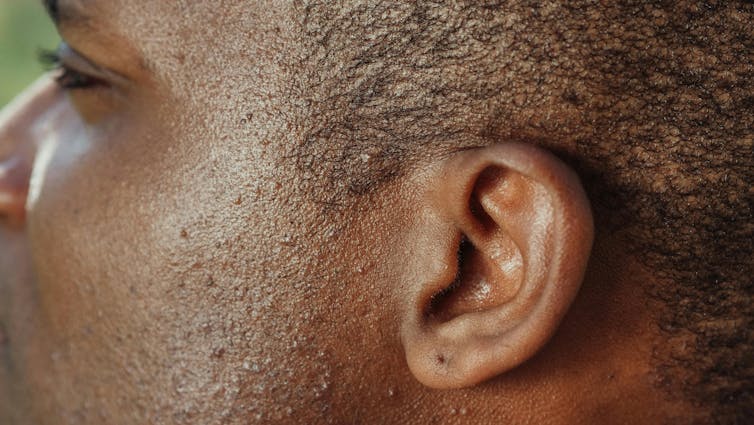
Press your slightly cupped palm over your ear to form a seal, then gently push and release to create a vacuum effect. You can also press the tragus (the firm skin in front of your ear canal) over the opening of your ear canal several times to encourage movement and drainage.

Close-up of a man's ear.
The tragus is the small cartilage flap covering the ear canal’s opening.
Kindel Media/Pexels

Do I need ear drops?

If none of these tips have worked so far, you might need some ear drops designed to dry out your ears.

Typically, these contain alcohol, which helps water evaporate faster. You can get these over the counter from a pharmacy.

But be sure to read the instructions, and don’t use them if you have any ear pain, discharge, an ear infection or a hole in your eardrum (or grommets, which are tiny tubes surgically inserted in the eardrum).

Some people make their own drops, using a solution of rubbing alcohol and white vinegar in equal proportions. This makes the ear canal more acidic, which can help prevent bacteria and fungal growth.

Be cautious when you use your own drops (again, don’t use them if you think you have a hole in your eardrum) and only use a few drops in each ear.

What not to do

Never put anything in your ears – even fingers or the tip of a towel can push water, wax and anything else trapped in your ear deeper and worsen the problem.

You might also scratch the delicate canal skin, increasing infection risk.

Avoid cotton buds and stick to the tips above.

Is trapped water dangerous?

Many people find the feeling annoying. But warm, moist places are also ideal for bacteria and fungi, so water trapped in the ear canal can lead to swimmer’s ear (otitis externa).

Symptoms include pain when moving the outer ear (the bit you can see), itchiness, discharge, redness or swelling, and sometimes fever.

Around one in ten people experience it at some point in their lives, most often during summer, and kids aged 7–14 are at higher risk.

If you suspect you have swimmer’s ear, it is important to see a medical professional as you will likely need treatment (typically antibiotic drops and pain relief).

Avoid swimming after storms or in polluted water, which carries more bacteria.

Freshwater sources such as rivers and lakes pose greater risk than salty ocean water, while properly chlorinated pools are generally pretty safe.

How to avoid it and when to seek help

If you don’t like the feeling after swimming – or you frequently get water trapped in your ears – invest in a swim cap or some ear plugs. Audiologists can help you find or customise earplugs to fit your ears.

Prioritise drying out ears once you are finished swimming, and use some of the tips above. For kids, making it into a game can help.

If an ear feels painful, inflamed or looks swollen, there might be an ear infection and it’s best to seek advice and attention from your GP.

If you still feel like you have water in your ears after two to three days, it’s best to also get it checked out.

The Conversation

Peter Carew is a member of Audiology Australia.

ref. How can I get water out of my ear after swimming? – https://theconversation.com/how-can-i-get-water-out-of-my-ear-after-swimming-270674

Can you return gifts without a receipt or packaging? A legal expert explains

Source: The Conversation (Au and NZ) – By Katharine Kemp, Associate Professor, Faculty of Law & Justice; Lead, UNSW Public Interest Law & Tech Initiative, UNSW Sydney

Yan Krukau/Pexels, CC BY

You’ve been given an ugly t-shirt and a book you’ve already read. But if you don’t have the receipts, can you return them?

Or what if someone’s given you a gift that’s defective in some way?

Before you box up your unwanted presents and head to the shops, here’s what the Australian Consumer Law – the rules on consumers’ rights and business responsibilities – says about asking for a return, exchange or refund under different circumstances.

Can I return gifts as ‘change of mind’ without a receipt?

Australian consumer law generally doesn’t require retailers to accept returns for change of mind alone.

So if you just didn’t like the gift, that’s not enough under the law to be able to ask for the money back.

If a business has a “change of mind” returns policy, they have to honour it. Otherwise, they may get in trouble for “misleading conduct” under the consumer law.

But even for stores allowing change of mind returns, they usually have a list of exceptions, including underwear, beauty products, food and more – so check their rules.

All retailers will want to see some proof of purchase – though not necessarily the original receipt.

What are my rights if the gift’s faulty?

If a product is defective, under Australian consumer law shoppers have a lot more rights than many people realise. It can help to use the phrase “Australian consumer law” so the retailer knows you’re aware of your rights.

What you can ask for depends on whether or not there’s a “major failure” of your basic rights under consumer law, known as “consumer guarantees”.

A “major failure” of a consumer guarantee is when the product:

  • is unsafe

  • has either one serious problem, or several smaller problems, which would have stopped a reasonable person from buying the product

  • is very different from the description, sample or demonstration the purchaser received before purchase

  • can’t be used for its expected purpose and can’t easily be fixed within a reasonable time.

In these cases, you’re entitled to your choice of a replacement product or a full refund, if you can produce either a receipt or other proof of purchase.

For other more minor failures that can be remedied, the business only has to repair it for free within a reasonable time. It doesn’t have to offer you a replacement or refund.

However, if you’ve caused damage to the product yourself, you may not be able to rely on the consumer guarantees.

There are exceptions to the consumer guarantees. For instance, some don’t apply to goods sold by auction. And most don’t apply to “non-business” sellers, such as private sellers on Gumtree or Facebook Marketplace.

What if the original packaging is missing or damaged?

If the product is faulty in one of the ways above, you’re still entitled to those consumer law remedies – even if the original packaging is missing or damaged.

But if you’re returning for change of mind, most retailers require the product to be in saleable condition, with packaging intact.

What counts as proof of purchase?

You need proof of purchase to establish your right to consumer guarantees, but this doesn’t have to be a receipt.

Other types of proof of purchase can include:

  • a credit card statement

  • a warranty card showing the date and place of purchase

  • receipt number or reference number given over the phone or internet

  • the serial number, if this is stored in the store’s computer system.

The law doesn’t specify exactly what proof of purchase is sufficient. The consumer just needs to be able to reasonably prove they bought the item.

So if was a gift, you’re likely to need some help from the gift-giver.

Importantly, you don’t have to have an original copy: photos and photocopies also count. So if you’re ever buying something expensive, take a photo of your receipt immediately. It can save you time and money later.

Does it make a difference if it was bought online or in a shop?

For faulty products, Australian consumer law rights apply whether the gift was bought online or in a shop.

A guarantee that’s especially helpful for online purchases is that goods must “correspond with the description”.

For example, you would be entitled to your choice of a refund or replacement if the photo advertising a suitcase showed or described a combination lock as a feature, but the one you received had no lock.

Hands holding a measuring tape over a white shirt.
If a shirt sold online says it’s a large and 57cm wide, but it turns out to be only 54cm wide, you could ask for a refund or replacement.
Anna Savina/Unsplash, CC BY

What if the store still says no?

If the product’s faulty, it’s illegal for businesses to refer to store policies or terms and conditions that deny your right to consumer guarantees – such as policies saying “no refunds or exchanges on sale items”.

If you think a business hasn’t delivered on Australia’s consumer law guarantees, you may be able to ask for a repair, replacement, refund, cancellation or compensation for damages or loss.

You can read more on the process of making a complaint – starting with the business the item came from.

The Conversation

Katharine Kemp is a member of the research committee of the Consumer Policy Research Centre, an independent, not-for-profit consumer think-tank.

ref. Can you return gifts without a receipt or packaging? A legal expert explains – https://theconversation.com/can-you-return-gifts-without-a-receipt-or-packaging-a-legal-expert-explains-270084

5 things to know about Daphne Oram, the visionary pioneer in electronic music

Source: The Conversation (Au and NZ) – By Prudence Rees-Lee, PhD Candidate, School of Design, RMIT University

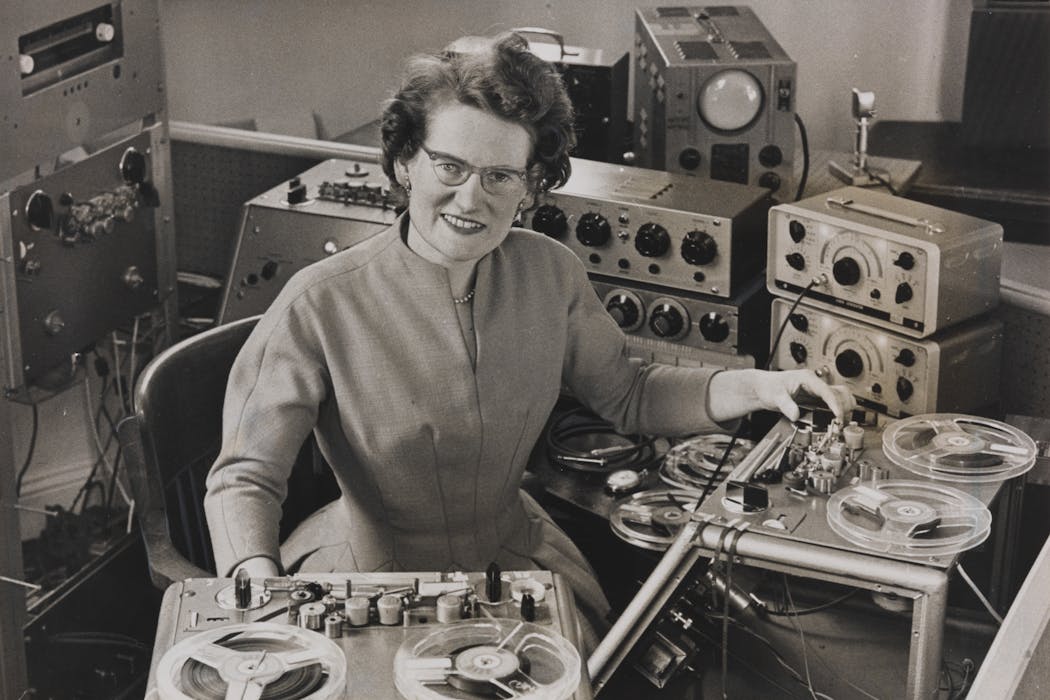
Daily Herald Archive/National Science and Media Museum/SSPL/Getty Images

Daphne Oram (1925–2003) was one of Britain’s most important early electronic composers. Oram trained first as a pianist and composer and turned down a place at the Royal College of Music to work at the BBC, where late-night tape experiments and hands-on work with microphones and oscillators drew her from conventional composition into pioneering electronic sound.

In 1958 she co-founded the BBC Radiophonic Workshop, a studio set up to create sound effects and electronic scores for radio and TV. On the wall she pinned a passage from Francis Bacon’s 17th-century utopia New Atlantis about imaginary sound-houses where scientists manipulate echoes, invent new instruments and transmit sound “in strange lines and distances”.

Bacon’s sound houses are often read now as a prophetic sketch of the modern electronic music studio.

The Workshop would famously go on to produce the Doctor Who theme, but Oram’s time there was brief. Less than a year after its opening she left, frustrated by bureaucracy and the institution’s small, utilitarian vision for what electronic sound could be.

Despite her key influence on electronic composition, Oram’s name still isn’t as mainstream as some of the ideas and technologies she helped to normalise.

This December marks her centenary, and her archive is sparking new works, releases and performances, proving her ideas are still alive and still adventurous. Here are five things you should know about this visionary woman.

1. She grew up in a household where séances were the norm

Oram’s parents were involved in the spiritualist movement and hosted séances in the family home. The idea of disembodied sound as a portal to another world was something she grew up with.

It was a household where unseen forces, signals and voices from “elsewhere” were taken seriously.

This backdrop makes Oram’s later fascination with invisible vibrations and electronic sound feel strangely inevitable.

2. She invented her own instrument, Oramics

After leaving the BBC, Oram set up Oramics Studios for Electronic Composition at her home, the delightfully named Tower Folly. Here she began building her own machine: the Oramics system.

Using strips of 35mm film, she drew shapes that controlled pitch, volume, timbre and envelope. These were then translated into sound by photo-electric cells and oscillators.

Oram was not the first to experiment with this kind of “drawn sound” system.

But Oramics was distinctive in its ambition and in the way it centred the composer’s hand, eye and imagination, humanising electronic sound.

The partially restored Oramics machine is now held by the Science Museum in London.

3. She believed electronic sound could help us imagine different futures

In her 1972 book, An Individual Note of Music, Sound and Electronics, Oram wrote:

Do you think it is the role of music always to reflect the life of the day? I think it is much more than that […] I think it should not only reflect the life of the day but show the possibilities for the future.

This captures the forward looking orientation that characterised much of Oram’s writing.

Oram consistently returned to Bacon’s “soundhouses” as a guiding metaphor for imagining technological and social progress through sound. Her ambitious 1960 manifesto, Atlantis Anew, reinterprets Bacon’s utopian vision to propose an expanded role for sound in society: from rehabilitating criminals and healing the sick to facilitating communication with the non-human world.

4. Still Point imagined live electronic processing decades before DJ culture

In 1948, at just 23, Oram wrote Still Point, a piece for two orchestras, turntables and real-time electronic processing.

Still Point was shelved and effectively lost for years, before it finally premiered at the BBC Proms in 2018.

Still Point is regarded as one of the first works to call for live electronic processing of an acoustic ensemble. It was startlingly ahead of its time in its treatment of sound as something spatial and architectural, not just musical.

Oram scores the piece for two orchestras: one “dry”, shielded with acoustic baffles, and one “wet”, more exposed and resonant. During performance their sound is picked up, routed through turntables, amplified and fed into echo, so the orchestras are effectively reshaped in real time as moving, malleable sonic objects.

It’s incredible to think of the kind of imagination required to conceive of this when DJing as we know it today didn’t coalesce until the late 1960s.

The piece was originally submitted for the inaugural Prix Italia in 1950, but was turned down on the basis that the work could only be judged as a “straight score” and the adjudicators wouldn’t understand the “acoustic variants and pre-recording techniques” it used.

5. She foresaw a more inclusive future, and it’s arriving via her own archive

In 1994, Oram published an essay titled Looking Back … To See Ahead, in which she reflects on women’s roles in music.

She’s direct about how women were sidelined in studios and institutions, but surprisingly upbeat. She suggests the rise of personal computers and home recording could allow women to bypass gatekeepers and work independently of exclusionary, male-dominated studio cultures.

That prediction is now playing out. The Oram Awards were set up in 2017 to support women and gender-diverse artists working in sound. For her centenary, they’ve partnered with nonclassical and the Daphne Oram Trust on vari/ations, Ode to Oram, a compilation where contemporary electronic artists create new work from samples of Oram’s tapes.

It’s hard to imagine a better way to honour someone who thought so deeply about sound, futurity and access: a new generation using her archive not as a museum piece, but as raw material for the worlds they want to hear next.

The Conversation

Prudence Rees-Lee does not work for, consult, own shares in or receive funding from any company or organisation that would benefit from this article, and has disclosed no relevant affiliations beyond their academic appointment.

ref. 5 things to know about Daphne Oram, the visionary pioneer in electronic music – https://theconversation.com/5-things-to-know-about-daphne-oram-the-visionary-pioneer-in-electronic-music-266591

Too sick to attend, too bad: why the live music ticketing market is broken

Source: The Conversation (Au and NZ) – By Sam Whiting, Vice-Chancellor’s Senior Research Fellow in Music Industries and Cultural Economy, RMIT University

Getty Images

I recently had an urgent surgery to have a malignant growth removed. Unfortunately, this meant I was too immobile to attend the Melbourne event of the annual hard rock festival Good Things, this year headlined by the greatest band of all time, Tool.

I explained my situation to OzTix, Good Things’ ticketing provider, and requested a refund for two tickets – but was denied on the grounds I hadn’t purchased “refund protection”.

I was then directed to a resale platform, Twickets, which only allows resale at the initial cost price. This is a poor option for tickets to events that are yet to sell out, as buyers can simply buy from the primary vendor at the same price point.

Disappointed, the experience got me thinking about the considerable consolidation of the Australian ticketing market, and the addition of “refund protection” as an extra cost.

It’s not just fans who suffer. The lack of competition in this market is negatively impacting artists and promoters alike.

No right to a refund

As event tickets became digitised throughout the 2000s, companies in Australia and overseas started to integrate “refund protection” as an optional purchase at the point of sale.

This additional cost was adopted by the Australian market wholesale during the pandemic. With lockdown-related uncertainty plaguing the events sector, ticketing providers needed to mitigate liability for cancellations and no-shows.

Much of this liability has been passed onto consumers. Most providers no longer bother with robust or discretionary refund policies, no matter how severe the circumstances.

And consumer law only protects consumers if an event is cancelled or postponed – not if they’re unable to attend. If refund protection isn’t purchased, providers are off the hook, even in the event of death.

This approach is a choice, just as it is a choice for airlines to offer refunds or compassionate fares in extenuating circumstances such as a medical emergency.

Refund protection is often costly. It scales with the price of the ticket, becoming more expensive as the cost price increases. And it can only be purchased at the point of sale, which is often six to twelve months before an event. All of this amounts to a form of price-gouging that’s not dissimilar to hidden add-ons used by budget airlines.

Resale platforms blocked

Many consumers might forgo purchasing refund protection with the confidence that, if they can no longer attend, they can resell their tickets for cheap (to increase the chances of sale) on a legitimate resale platform such as Tixel.

However, the Good Things festival blocked the resale of tickets on Tixel this year, limiting resale to Twickets at the original cost price.

A screenshot of a Reddit post titled 'Good Things Resale Closed'.
Online, festial-goers have shared their frustration over not being able to resell their tickets for a cheaper price.
Reddit

In such cases, fans with unwanted tickets may turn to unregulated channels such as social media. This increases the risk of scams, adding further uncertainty to the equation.

The live music sector is already struggling. Blocking off a legitimate resale platform could reduce consumers’ confidence in the sector, and may make them hesitant to secure early tickets in future.

Market consolidation

All of this has a lot to do with the relative consolidation of Australia’s ticketing market. The sector is dominated by two major operators, Ticketek and Ticketmaster, owned respectively by multinationals TEG and Live Nation.

This duopoly was further solidified in 2019, when Ticketmaster purchased Australian company Moshtix. Today, only Oztix remains as the primary independent operator in Australia.

A handful of smaller companies offer bespoke ticketing services, such as Eventbrite, Humanitix and TryBooking – but they are yet to crack the live music market in the same way.

Australia’s ticketing market stands in stark contrast to the United Kingdom and Europe, where dozens of ticketing providers compete for business (often in smaller markets such as Denmark and Ireland).

In research conducted during my recent Churchill Fellowship, I spoke to 100 venue operators, promoters and music industry professionals across the UK and Europe. Each had a choice of multiple ticketing services to work with.

This level of competition produces a healthier market for artists, fans and promoters.

For fans, it could mean less hidden fees, more robust refund policies, and reduced prices as fewer costs are passed on.

For promoters, it allows access to more competitive rates and a diversity of back-of-house services. For instance, Dutch company Stager is not only a ticketing platform, but also handles marketing and event management.

And for artists, more competition means potentially less chokepoints between them and fans, as well as greater control over this relationship, potentially reducing the ability of intermediaries (such as ticketing companies and promoters) to squeeze transactions for unnecessary profits and audience data, an increasingly important asset.


Read more:
Chokepoint Capitalism: why we’ll all lose unless we stop Amazon, Spotify and other platforms squeezing cash from creators


Dealing with anti-competitive practices

The government has already taken action to crack down on dynamic pricing for concert tickets. It should go further.

Encouraging new market entrants could help boost competition. New entrants have failed to break in since ticketing, like much of Australia’s music industry, has been locked up through a series of handshake deals, personal relationships and decades-long contracts.

In 2019, UK-based operator DICE attempted to enter the market, but the pandemic and other factors stymied its efforts.

Australia also suffers from a lack of anti-trust laws, which would be relevant in the case of Live Nation, TEG, and their vertical integration of ticketing.

The Australian Competition and Consumer Commission (ACCC) could be doing more to investigate anti-competitive practices, such as the blocking of legitimate resale sites such as Tixel.

And if new entrants aren’t able to make an impact in a market of almost 28 million people, the ACCC should be asking why – and what can be done about it.

The Conversation reached out to OzTix for comment, but it did not reply within the allocated timeframe.

The Conversation

Sam Whiting receives funding from RMIT University, the Winston Churchill Trust and Sound NSW.

ref. Too sick to attend, too bad: why the live music ticketing market is broken – https://theconversation.com/too-sick-to-attend-too-bad-why-the-live-music-ticketing-market-is-broken-271618

‘Strong’ quake shakes lower North Island

Source: Radio New Zealand

123rf

A quake described by GeoNet as “strong” shook the lower North Island on Friday morning.

It measured 4.7 and struck 10 km southwest of Pongaroa at a depth of 17km at 7.16am.

Pongaroa is southwest of Hastings and northeast of Wellington.

Felt reports were lodged from the top of the South Island up to around Lake Taupō.

– Published by EveningReport.nz and AsiaPacificReport.nz, see: MIL OSI in partnership with Radio New Zealand

How do I make clear ice at home? A food scientist shares easy tips

Source: The Conversation (Au and NZ) – By Paulomi (Polly) Burey, Professor in Food Science, University of Southern Queensland

Manki Kim/Unsplash

When you splurge on a cocktail in a bar, the drink often comes with a slab of aesthetically pleasing, perfectly clear ice. The stuff looks much fancier than the slightly cloudy ice you get from your home freezer. How do they do this?

Clear ice is actually made from regular water – what’s different is the freezing process.

With a little help from science you can make clear ice at home, and it’s not even that tricky. However, there are quite a few hacks on the internet that won’t work. Let’s dive into the physics and chemistry involved.

Why ice goes cloudy

Homemade ice is often cloudy because it has a myriad of tiny bubbles and other impurities. In a typical ice cube tray, as freezing begins and ice starts to form inward from all directions, it traps whatever is floating in the water: mostly air bubbles, dissolved minerals and gases.

These get pushed toward the centre of the ice as freezing progresses and end up caught in the middle of the cube with nowhere else to go.

That’s why when making ice the usual way – just pouring water into a vessel and putting in the freezer – it will always end up looking somewhat cloudy. Light scatters as it hits the finished ice cube, colliding with the concentrated core of trapped gases and minerals. This creates the cloudy appearance.

The point of clear ice

As well as looking nice, clear ice is denser and melts slower because it doesn’t have those bubbles and impurities. This also means that it dilutes drinks more slowly than regular, cloudy ice.

Because it doesn’t have impurities, the clear ice should also be free from any inadvertent flavours that could contaminate your drink.

An ice scoop pouring clear ice cubes into a fluted glass on a white background.
It’s possible to make clear ice at home, and you don’t need fancy equipment.
Cottonbro Studio/Pexels

Additionally, because it’s less likely to crumble, clear ice can be easily cut and formed into different shapes to further dress up your cocktail.

If you’ve tried looking up how to make clear ice before, you’ve likely seen several suggestions. These include using distilled, boiled or filtered water, and a process called directional freezing. Here’s the science on what works and what doesn’t.

Myths about clear ice that don’t work

You might think that to get clear ice, you simply need to start out with really clean water. However, a recent study found this isn’t the case.

Using boiling water

Starting out with boiling water does mean the water will have less dissolved gases in it, but boiling doesn’t remove all impurities. It also doesn’t control the freezing process, so the ice will still become cloudy.

Using distilled water

While distilling water removes more impurities that boiling, distilled water still freezes from the outside in, concentrating any remaining impurities or air bubbles in the centre, again resulting in cloudy ice.

Using filtered or tap water

Filtering the water or using tap water also doesn’t stop the impurities from concentrating during the conventional freezing process.

What actually works

As it turns out, it’s not the water quality that guarantees clear ice. It’s all about how you freeze it. The main technique for successfully making clear ice is called “directional freezing”.

Directional freezing is simply the process of forcing water to freeze in a single direction instead of from all sides at once, like it does in a regular ice cube tray.

This way, the impurities and air will be forced to the opposite side from where the freezing starts, leaving the ice clear except for a small cloudy section.

In practice, this means insulating the sides of the ice container so that the water freezes in one direction, typically from the top down. This is because heat transfer and phase transition from liquid to solid happens faster through the exposed top than the insulated sides.

How to make clear ice at home

The simplest way to have a go at directional freezing at home is to use an insulated container – you can use a really small cooler (that is, an “esky”), an insulated mug or even a commercially available insulated ice cube tray designed for making clear ice at home.

Fill the insulated container with water and place it in the freezer, then check on it periodically.

Once all the impurities and air bubbles are concentrated in a single cloudy area at the bottom, you can either pour away this water before it’s fully frozen through, or let the block freeze solid and then cut off the cloudy portion with a large serrated knife, then cut the ice into cubes for your drinks.

If using a commercial clear ice tray, it will likely come with instructions on how to get rid of the cloudy portion so you can enjoy the sparkling clear ice.

The Conversation

Paulomi (Polly) Burey does not work for, consult, own shares in or receive funding from any company or organisation that would benefit from this article, and has disclosed no relevant affiliations beyond their academic appointment.

ref. How do I make clear ice at home? A food scientist shares easy tips – https://theconversation.com/how-do-i-make-clear-ice-at-home-a-food-scientist-shares-easy-tips-267544

Paid firefighters to briefly strike on Boxing Day

Source: Radio New Zealand

Volunteer firefighters will respond to 111 calls during the strike hour. RNZ / Alexander Robertson

Fire and Emergency will be relying on volunteer crews to fight fires in the main centres on Boxing Day between midday and 1pm, as its paid staff go on strike.

Talks between the fire service and the Professional Firefighters’ Union broke down, and the Employment Relations Authority this month sent them into facilitation.

The union said Fire and Emergency could come to the table outside that process, but the employer said it had no plans to do so.

It said its volunteer firefighters will respond to 111 calls during the strike hour, but it was also asking people to be careful when doing anything that could start a fire.

Meanwhile, firefighters have put out a grass fire on the bank of the Waimakariri River near Swannanoa, north of Christchurch.

The fire was reported just after 11pm on Thursday and when firefighters arrived, they found a blaze of about 80 by 10 metres.

It took three hours and three tankers to extinguish the grass fire, which was fanned by high winds.

– Published by EveningReport.nz and AsiaPacificReport.nz, see: MIL OSI in partnership with Radio New Zealand

Rockfall blocks state highway

Source: Radio New Zealand

File image. 123RF

Rockfall has been causing disruption on the roads around Arthur’s Pass between Canterbury and the West Coast.

Fire and Emergency says it responded to a crash around 10.15pm on Christmas Day on State Highway 73, near the turnoff to Mount White.

A car had run into a fallen rock and was damaged, but there were no injuries.

And further west on the Ōtira Gorge stretch of the same highway, a section of the road had a priority give-way system in place because of rockfall. It was still in place early on Boxing Day morning.

Sign up for Ngā Pitopito Kōrero, a daily newsletter curated by our editors and delivered straight to your inbox every weekday.

– Published by EveningReport.nz and AsiaPacificReport.nz, see: MIL OSI in partnership with Radio New Zealand

What makes Dudley Benson’s The Awakening an essential album

Source: Radio New Zealand

Some time in the mid-2000s, a singular piece of music found its way onto student radio and other playlists.

Consisting only of multi-tracked voices – like a one-person choir – The Awakening was a spooky song-poem: “a canon set in purgatory” as its author would later describe it.

The subject of the song ‘The Awakening’ was the 19th-century murderess Minnie Dean, known for transporting dead babies in hatboxes on trains and the only woman to have been hanged in New Zealand.

Dudley Benson – The Awakening

Essential New Zealand AlbumsSeason 5 / Episode 5

Dudley Benson in 2008

Karen Inderbitzen Waller

– Published by EveningReport.nz and AsiaPacificReport.nz, see: MIL OSI in partnership with Radio New Zealand

Scrapped light rail must become Auckland’s long-term transport plan, advocate says

Source: Radio New Zealand

An artists’ visualisation for Auckland Transport of light rail in Mt Roskill. Supplied / Auckland Transport

A public transport advocate, whose Auckland Light Rail submission made it onto the NZ Infrastructure Commission’s list of priorities, said light rail and mass transit needs to be brought back and become part of the supercity’s long-term transport plan.

The multibillion-dollar project was scrapped by the coalition in early 2024, which argued over $200 million had been spent on planning and investigating options, without having achieved any real results.

Connor Sharp, a contributor to the transport advocacy blog Greater Auckland, is the only one to have made a proposal for light rail to the commission’s invitation for its Infrastructure Priorities Programme (IPP).

The commission said while endorsement did not guarantee funding, it did send a strong signal to decision makers about infrastructure priorities.

Sharp’s proposal for ‘mass rapid transit in the city centre to Mangere corridor’ was endorsed at stage 1 of the IPP in December 2025, which meant it’s had been identified as a nationally significant issue.

“I think it’s pretty significant that they’ve endorsed it, especially because I made this as an individual, pretty much every other proposal put forward, endorsed, were done by organisations … I’m pretty stoked they endorsed it.”

Sharp said it was unfortunate the project had become a “hot potato” and over-politicised over the years, particularly at a national level, and he hoped Auckland Council could take up the reigns to advocate for it.

“If we have a lot of councillors and the mayor maybe pick this back up, it would be a lot more productive, and you’re probably trying to avoid a lot of that politicisation issues,”

Advocate Connor Sharp: Build surface rail from City Centre to Mount Roskill first

Meanwhile, Sharp’s proposal for a surface light rail to run from the city centre to Mount Roskill via Dominion Road was declined for stage 2 of the IPP – which called for specific solutions.

Sharp said he still felt this section of light rail needed to be built first, to fill the void of rapid transit connections through the central isthmus, which is leading to congestion.

Sharp said regardless of what the extension to Mangere and the Airport looked like, he hoped this section could be built first.

He said he felt the project fell through previously as decision-makers were trying to do something really big within a limited time they had in government, rather than work through it incrementally.

Sharp said the upcoming transport reforms in 2026 and the development of a 30-year Integrated Transport Plan were opportunties to progress work on light rail.

The opening of the City Rail Link (CRL) in 2026 would also spur people’s expectations of more transit options, he said.

“I think people, once they experience what CRL is going to do, I think they’ll naturally start thinking of what are we going to do next, and there’ll be a few big projects that will come into conversation, and light rail should be one of them from my perspective.”

Mayor has no comment; Councillor delighted with endorsement

Meanwhile, Auckland mayor Wayne Brown declined RNZ’s request for an interview to discuss possibilities for the future of light rail in Auckland.

He also declined to comment on his thoughts on the submission being endorsed by the IPP at stage 1, and whether he would consider renewing discussions around light rail options for Auckland as part of the city’s 30-year ITP.

His office said in a statement: “The mayor has nothing further to add, at this time, in relation to your request.”

Councillor Shane Henderson said he was delighted.

“The message is really clear that there is a huge issue here and we need to move people along this corridor, it’s good to have that recognition from the infrastructure commission.”

Henderson said the council should be keeping light rail in the front of their minds as they worked through the city’s long-term transport plans.

He said it had not been discussed much at the council table since it was canned by the government.

Sign up for Ngā Pitopito Kōrero, a daily newsletter curated by our editors and delivered straight to your inbox every weekday.

– Published by EveningReport.nz and AsiaPacificReport.nz, see: MIL OSI in partnership with Radio New Zealand

Rare Hector’s or Māui dolphin spotted in Northland prompts questions

Source: Radio New Zealand

By Penny Smith

Scientists are asking people to watch out for any Māui or Hector’s dolphins spotted in North Island waters, and report them. Māui dolphin are critically endangered, while Hector’s dolphins are vulnerable. Earthrace Conservation/Liz Slooten (CC BY-NC-SA 2.0)

Sightings of a rare dolphin in the Bay of Islands in Northland have delighted marine scientists.

Dolphin researcher Jochen Zaeschmar spotted the solitary sea creature last weekend, and it has since been observed in English Bay in the Opua channel.

He said genetic testing would determine if it was a Hector’s or Māui dolphin.

“We would like to know how rare this is. Is there a small population around here, or are they recolonising the North? Genetics will be able to tell a great deal about that.”

Department of Conservation marine species advisor Kristina Hillock said sightings of Hector’s or Māui dolphins in the Bay of Islands were rare.

“This would be just the second confirmed sighting of a Hector’s in Northland in 100 years,” she said,

Hector’s dolphins were once found along the coast of most of the South Island as well as parts of the North Island.

A Hector’s dolphin at the surface, in Akaroa Harbour. RNZ / Alison Ballance

Today, Hector’s dolphins are classified as nationally vulnerable and live in different sub-populations around the South Island. They are only occasionally seen around the North Island.

The Māui dolphin is a nationally critical subspecies of the Hector’s dolphin, which is found on the west coast of the North Island, mainly between Taranaki and Kaipara Harbour. It is estimated just 54 adult Māui dolphins remain.

The two species were not easily distinguished from each other without DNA testing, but were readily identifiable from other dolphins.

Both Hector’s and Māui dolphins were grey and white, with black markings and a distinctive black rounded fin, shaped like Mickey Mouse’s ear.

People who saw the dolphin should call the Department of Conservation (0800 DOC HOT – 0800 362 468).

Zaeschmar said Hector’s and Māui dolphins were known to be friendly.

“They are social and they will come and interact with boats and people, so there is a good chance that somebody will come across it,” he said.

But he said people who spot the dolphin should try to keep their distance.

“It is really exciting to have this animal here and we encourage the public to report sightings, but please stick to the rules. They are prone to get hit by propellers and boats, sadly all around the country. Just be boat-wise when you are around the animal and give it plenty of space. Please respect its habitat.”

Sign up for Ngā Pitopito Kōrero, a daily newsletter curated by our editors and delivered straight to your inbox every weekday.

– Published by EveningReport.nz and AsiaPacificReport.nz, see: MIL OSI in partnership with Radio New Zealand

Hundreds lose power in Dunedin thunderstorms

Source: Radio New Zealand

(File photo) 123RF

Hundreds of households in the lower South Island are still without electricity after severe thunderstorms damaged powerlines.

Power has been restored to many homes in Mosgiel near Dunedin, but at 10pm provider Aurora still listed around 300 customers impacted by outages.

Dozens of rural areas in Southland are also affected by blackouts.

Photos posted on social media captured lightning strikes hitting power poles.

Aurora’s website estimated a restoration time of 10.30pm Thursday.

In Southland, dozens of smaller scale outages have cut power to rural areas east of Invercargill and north of Gore.

MetService earlier issued a severe thunderstorm warning over Dunedin and Clutha which has since been lifted.

Lightning strikes a power pole in Mosgiel on Thursday night. Supplied

– Published by EveningReport.nz and AsiaPacificReport.nz, see: MIL OSI in partnership with Radio New Zealand

What happens to people who die without any relatives to bury them?

Source: Radio New Zealand

RNZ / Nate McKinnon

The number of people in the Auckland region who died without any family or friends to handle funeral arrangements leapt in the last year.

If someone dies and no family or friends come forward to claim the body, some councils cover the cost of a burial or cremation.

In the last year Auckland Council covered the cost of cremation for 15 people, up from only five cremations and one burial in the previous year.

The last spike was in 2022 when the council paid for the cremations of 11 people.

Auckland Council’s Manager of Cemetery Services, Nikki Nelson, said in specific circumstances Auckland Council provides end-of-life services for people with no known relatives.

“These are people who have passed away in hospices or hospital and referred to us from Health New Zealand. The council has completed one burial and 43 cremations of this nature in the past five years.”

By November, Christchurch City Council had covered the cost of eight burials, in what the council officially calls a Poor Person burial.

Simplicity Funerals in Christchurch manages the burials.

Manager of Simplicity Funerals Christchurch Jamie Harvey said they are usually contacted by the hospital’s Mortuary Service to say a person has died and not been claimed.

He said they will then try to make contact with anyone known to the person such as a GP or friends, and get in touch with the Public Trust, Perpetual Guardian and police.

If they can’t find any next of kin or anyone able to take on the burial, Simplicity then contacts a JP to authorise the burial.

Harvey said the process can be labour intensive, but they see it as a community service they are able to supply.

A funeral service by Simplicity Funerals Christchurch for a person with no known relatives. Photo permission of Simplicity Funerals. Supplied

At the burial a Simplicity staff member will say a few words, and usually the council sextons attend as well.

“As human beings we are not immune to any of the emotions, so it can be a little bit trying. But equally it’s really rewarding that this person, who may not have anyone in their world, we are able to look after them with respect and dignity.”

Any friends of the person are able to attend the burial, but under the council rules no headstone or memorial can be put up until cemetery fees and charges are paid.

Harvey said Simplicity have been managing such burials for about the last seven years in Christchurch, and numbers have steadily risen.

“Sadly there has been an increase year on year. Historically there would be potentially be two or three people each year, but so far this year we are into the double digits.”

In Christchurch people can also apply to the council’s Mayoral Welfare Fund for assistance with funeral costs.

Between October 2024 and October 2025 two application for funerals were approved by the fund to the total cost of $2400.

Wellington City Council covered six indigent services since 2020, made up of one burial and five cremations. A spokesperson said some local funeral homes also assist with costs from time to time.

In Dunedin the council has carried out four indigent burials and 34 indigent cremations since 2020. The last one occurred in 2023.

The council said that since then costs of any indigent burials or cremations have been covered by WINZ funeral grants.

An Auckland Council spokesperson said that in situations where families are likely to struggle to cover the cost of funeral expenses for a relative or loved one, Work and Income may also be able to provide support in the way of a funeral grant.

Sign up for Ngā Pitopito Kōrero, a daily newsletter curated by our editors and delivered straight to your inbox every weekday.

– Published by EveningReport.nz and AsiaPacificReport.nz, see: MIL OSI in partnership with Radio New Zealand

What to remember before your Boxing Day shopping spree

Source: Radio New Zealand

Consumer NZ is urging people to do their homework ahead of the Boxing Day sale frenzy. RNZ

Consumer NZ is urging people to do their homework, double check gift cards and know their rights ahead of Boxing Day sale frenzy.

Electronic transaction figures showed pre-Christmas spending was slightly down on last year, but many may be waiting for the post-Christmas sales to nab a bargain.

Last year New Zealanders spent almost $68 million on Boxing Day.

Consumer campaign manager Jessica Walker said shoppers should separate their wants from their needs and set a budget before hitting the shops to avoid a “buy-now-regret-later” situation.

She advised researching prospective purchases, as constantly fluctuating prices made it hard to know whether discounts were genuine or just a variation on the usual price, and check the item was not cheaper elsewhere.

It was a breach of the Fair Trading Act to mislead customers about the regular price, she said.

Consumer Guarantees Act will ‘see you right’

Walker urged shoppers to resist the pressure to purchase extended warranties – you’re already covered under the Consumer Guarantees Act.

“Sometimes retailers will give you a really hard sell, especially if you buy a product on sale it might be a even more enticing opportunity for retailers to try and make some money from an extended warranty.”

Walker recommended people ask what an extended warranty would provide that the Consumer Guarantees Act would not.

“Most of the time I think you’ll find its very little. The Consumer Guarantees Act doesn’t just cover you for the period of the manufacturer’s warranty, it covers reasonable use over a reasonable length of time. The vast majority of the time, that’s going to see you right – if a product’s failed you do have the right to ask for a refund or an exchange depending on what’s gone wrong.”

Consumer campaign manager Jessica Walker. Supplied / Consumer NZ

Protections under the Consumer Guarantees Act applied whether people purchased sale goods or full priced ones, and signs warning of no refunds or exchanges on sale items were misleading, Walker said.

“Just because you bought something on sale does not mean you’re forgoing your consumer rights.”

Retailers did not have to refund for a change of mind, but if something was faulty or did not last as long as it should, “the retailer needs to put you right”.

“If one of your Boxing Day purchases is faulty, the retailer must put things right. You don’t need the original packaging to return the product.”

If shoppers did get into difficulty and could not get redress at the store, they could take a complaint to the Commerce Commission, or take the matter to the disputes tribunal, at a cost of $61.

The filing fee was non-refundable, even if the tribunal found in the customer’s favour, and could be a barrier, Walker said.

Beware dark designs that fuel FOMO

Walker also warned of “dark patterns” while online shopping – digital methods designed to encourage people to spend more than they intended, like countdown timers or warnings of low or rapidly diminshing stock.

“These tactics play on our FOMO [fear of missing out] and effectively encourage us to spend more, and quickly.”

The deepest discount or top of the range product did not necessarily mean a good deal, with Consumer product tests often finding the most expensive product was not necessarily the best.

“A big discount doesn’t necessarily mean a good deal.”

Be sure to spend gift cards

From March next year, gift cards would be required to have an expiry date at least three years from the date the card was sold.

Until then, Walker recommended keeping on top of expiry dates, which varied.

“Gift cards can come with really short expiry times, and people also put them in a drawer and lose them – our research has shown there’s about $10 million dollars goes on unspent gift cards every year.

“If you’re hitting the shops and think you’ve got a gift card lurking we would encourage people to hunt it out and find it so they don’t end up giving a gift to the retailer – if you’ve got money there you can spend, we encourage people to use it before they lose it.

“Our advice is don’t buy something unless you really need or want it. While the pull of the last sale of 2025 could be strong, the first sale of 2026 is probably less than a week away,” Walker said.

Shoppers at Queensgate Mall in Lower Hutt on Boxing Day, 2024. RNZ / Mary Argue

Cost of living pressures squeezing many at Christmas

Worldine transaction figures showed Christmas spending was down on 2024, with consumer spending for the first three weeks of December hitting just over $3 billion.

A survey of nearly 1100 Westpac customers earlier this month showed nearly three-quarters (73 percent) were either extremely or moderately concerned about the cost of living, little changed from last year, while a survey conducted by accounting software company MYOB found the ongoing pressures of the cost of living squeeze were pushing respondents to seek additional income sources or take on debt to pay for presents.

A third said their financial position was the same as it was this time last year, while 42 percent felt worse off, and a quarter felt better off.

More than half expected to spend about the same on gifts last year, and 15 percent set to spend more, while more than a quarter planned to cut back.

To help cover costs, people were turning to side hustles or additional income sources, credit or buy-now-pay-later options.

While the latest StatsNZ figures showed a small drop in food prices prompted by a fall in the cost of fruit and vegetables, overall food was 4.4 percent more expensive than this time last year.

Meanwhile, 18,000 jobs had been lost in the past year, and unemployment was sitting at 5.3 percent, a nine-year high.

Sign up for Ngā Pitopito Kōrero, a daily newsletter curated by our editors and delivered straight to your inbox every weekday.

– Published by EveningReport.nz and AsiaPacificReport.nz, see: MIL OSI in partnership with Radio New Zealand

Person critically injured after vehicle rollover

Source: Radio New Zealand

RNZ / Kim Baker Wilson

A person has been airlifted to Auckland’s Middlemore Hospital in critical condition after a vehicle rolled over in Northland.

St John were called to Pouto Point at around 2.30pm.

One person with moderate injuries was treated at the scene and a second person with critical injuries was taken by helicopter to Auckland.

– Published by EveningReport.nz and AsiaPacificReport.nz, see: MIL OSI in partnership with Radio New Zealand

Tucking in the Christmas spirit in Upper Hutt

Source: Radio New Zealand

Christmas lunch diners John Kiegan and Thelma Balthiejus. RNZ / Ellen O’Dwyer

Since early Christmas morning, volunteers, chefs and do-gooders have been busy cooking up Christmas Spirit in Upper Hutt.

The Rimutaka Lions Club held its annual Christmas lunch today, a tradition running for nearly four decades.

Known as Room at the Inn, the club has been providing free meals on Christmas day for 38 years.

Lions member Antoinette van Riel said about seven volunteers help to put on the lunch as well as others who deliver Meals on Wheels to people’s houses.

Volunteers helping to dish out the Christmas lunch. RNZ / Ellen O’Dwyer

Diners tucked into a full spread of ham, chicken, steak, vegetables, pavlova and pudding, dished out between 11.30am and 2pm.

Van Riel said the meal is available for all sorts – the lonely, those struggling to afford Christmas lunch, visitors to the region, or those who want to socialise with the community.

“There was one lovely lady who was waiting for her friend, her friend hadn’t arrived and she was going to go home.

“And I said ‘no come and sit with me’, and she came and sat with us to have a meal, and she was as happy as larry,” van Riel said.

She said the event caters for up to 70 people, and if there are leftovers punters can take them home for Boxing Day.

Lions members and volunteers enjoying the Christmas lunch. From left: Gurbakhash Bussan, Janet Burgess, Vicki Waiwai and Antoinette van Riel. RNZ / Ellen O’Dwyer

Euan Andrews, owner of Blend Bar and Bistro, which hosts the event, said a team of chefs were up at 8am cooking the meal.

He said it’s the second year he’s hosted the event, a way to “give back to the community”, and join in the Christmas spirit.

“It’s about helping people. These are tough financial times, and there’s no doubt the cost of goods so have the cost of meals inside of restaurants, not everyone can afford to go out.

“It’s just nice when people can get out, they can have a nice day, nice food, with a bunch of friends – and really enjoy themselves.”

He said the first guest arrived an hour and a half early, but they made sure she had a good meal and some company.

Some diners had adorned themselves in santa and elf hats, others like Selena Pirika had dressed in their Christmas best.

Selena Pirika says the community Christmas lunch feels like home for her. RNZ / Ellen O’Dwyer

Pirika said she comes to socialise with the community.

“It’s home…this type of event is home, and it’s full of aroha, kindness, and for some people who don’t have whānau, I think this is a really good space to come to have that, and get that.

Rafael Reyes was visiting his friend Monique’s house, but he wanted some vegetables, so he decided to tuck into the lunch too.

Reyes, originally from Peru, said he was astounded the meal was free.

“The generosity is amazing.”

That’s a sentiment Upper Hutt resident John Keigan agreed with.

“The chicken was so tender, the steak was tender, and nice vegetables, lovely gravy, so much food…put as much in as you can,” he said, chuckling.

“I just so appreciate the effort and sacrifice that’s gone into this.”

Meanwhile Bretto, from Trikn Tours, was taking diners out for free motor-trike rides through Upper Hutt for the afternoon – up Fergusson Drive, and then on the motorway, to “give folks a bit of 80 or 90km airflow”.

“It gets the adrenaline going,” he said.

“Previous lady we’ve just taken out, she was in her 80s, when we dropped her she said it made her feel like a teenager again.

“That’s just cool right – you’re spreading a bit of fun, joy.”

Bretto from Trikn Tours taking Vicki Waiwai and another friend for a tour around Upper Hutt. RNZ / Ellen O’Dwyer

Sign up for Ngā Pitopito Kōrero, a daily newsletter curated by our editors and delivered straight to your inbox every weekday.

– Published by EveningReport.nz and AsiaPacificReport.nz, see: MIL OSI in partnership with Radio New Zealand

India free trade agreement excludes dairy, but that could change – minister

Source: Radio New Zealand

Prime Minister Christopher Luxon and Trade Minister Todd McClay announce the free trade agreement with India. RNZ / Mark Papalii

New Zealand could continue to see improvements for the dairy industry under its Free Trade Agreement with India, the trade minister says.

The government announced the deal with India on Monday, which removes or reduces tariffs for 95 percent of exports.

But products like butter and cheese aren’t included.

  • Read more: Free trade agreement with India confirmed
  • Trade Minister Todd McClay however says there will be an opportunity to enhance the agreement, a year after it comes into force.

    And if any similar dairy exporting country gets better access, another part of the deal comes into play.

    “We will continue to talk to them about how we can get barriers down for dairy. And of course we have a commitment in the Free Agreement, that says that if they give better access to dairy to a similar dairy exporting country, then we have a right to negotiate to ask for the same treatment for New Zealanders.”

    McClay says India has not opened up dairy imports to any country.

    Sign up for Ngā Pitopito Kōrero, a daily newsletter curated by our editors and delivered straight to your inbox every weekday.

– Published by EveningReport.nz and AsiaPacificReport.nz, see: MIL OSI in partnership with Radio New Zealand

Severe thunderstorm warning for Dunedin region

Source: Radio New Zealand

(File photo) 123RF

MetService has issued a severe thunderstorm warning over Dunedin and Clutha.

It said thunderstorms are moving east/northeast and are expected over Dunedin at around 6pm.

MetService said thunder will be accompanied by very heavy rain and large hail and warns it may make driving conditions dangerous.

A broader thunderstorm watch is in place over north Otago lasting until 9pm tonight with the chance some may become severe, MetService said.

– Published by EveningReport.nz and AsiaPacificReport.nz, see: MIL OSI in partnership with Radio New Zealand

Auckland business owner isn’t dreaming of a light Christmas

Source: Radio New Zealand

Suhail Mohammed says last Christmas was busy at his shop. Ke-Xin Li

On Christmas Day, tourists are getting the rare chance to enjoy a quiet Auckland city centre.

Most restaurants have shut their doors, but some business owners like Suhail Mohammed, who runs a burger eatery, hope the reduced competition means better business.

“I want everyone whoever is passing by and is hungry can just come to my shop.”

But business has not been going so well since he opened up six hours ago.

“So far, I got nearly 20 customers this morning, which is OK. I thought maybe people are still sleeping and enjoying their day off. But maybe there will be more people in the evening time.”

He was also open last Christmas Day, and said business was better back then.

Christmas Day is one of four restricted trading days in New Zealand, meaning almost all retail shops will be closed.

Restaurants, dairies and fruit stores are allowed to stay open, but some may apply a 15 percent public holiday surcharge to cover extra cost.

Mohammed said he chose not to charge a holiday surcharge.

“If you look at the situation now, the economy, everything is already expensive for the customer.”

Last-minute shoppers are not enjoying the limited options.

Mohammad Uddin, business owner at a backpacker hostel, was planning something nice for his staff.

Mohammad Uddin is out on some last minute shopping, but he didn’t find all the drinks he wanted. Ke-Xin Li

“Today my staff are working, so I want to give them a quick dinner, but I forgot some drinks, so I went to get some drinks.”

Uddin bought some drinks from a nearby convenience store, but they were three times more expensive than the supermarket and Uddin couldn’t get everything he wanted.

Sign up for Ngā Pitopito Kōrero, a daily newsletter curated by our editors and delivered straight to your inbox every weekday.

– Published by EveningReport.nz and AsiaPacificReport.nz, see: MIL OSI in partnership with Radio New Zealand

Celebrating Christmas with Indian culinary favourites

Source: Radio New Zealand

Appam is a rice pancake – a favourite within the Malayali community. 123rf

The aroma of spices instead of mint sauce signals the arrival of Christmas Day in kitchens across the country, as Indian New Zealanders celebrate with dishes shaped by region, faith and migration.

While many households across New Zealand will serve roast ham and pavlova, Indian families are gathering around tables laden with rice and meat dishes, rich curries and sweets infused with cardamom and ghee.

From Kerala and Goa in the southwest to India’s northeastern hills, Christmas food traditions are being re-created in Aotearoa, adapted to local ingredients but rooted firmly in memory, community and faith.

In one South Auckland household, the aroma of coconut, curry leaves and roasted spices fills the air – signalling a festive season straight from Kerala rather than a traditional Kiwi roast.

For many in New Zealand’s Malayali community, Christmas typically includes elaborate spreads of beef fry, appam (rice pancakes), stew and cardamom-scented cakes known as plum cake.

“Christmas is huge for Kerala’s Christian community,” Philips Augustine said.

Augustine moved to New Zealand in 2017, now living in the South Auckland suburb of Favona with his family.

“Food is really important and one of the main attractions for our family,” he said.

Preparations usually begin on Christmas Eve, winding up before the midnight church service.

Some families also observe a strict 25-day Christmas Lent, which makes the festive meal all the more significant.

He said his family members typically gathered at the family home, along with friends and people of other religions, to enjoy the feast at lunchtime on Christmas Day.

“There will be a lot of meat like beef, chicken, pork and duck along with homemade wine,” he said.

“We also make appams in the morning with a chicken or beef stew to begin with, and lunch will be a feast of many meat curries, cutlets (deep-fried meat patties), rose cookies and rice or biriyani.”

In Kerala’s Malabar region, some households also make neychoru, a rice dish cooked with ghee.

Many families in New Zealand are adapting these recipes to local ingredients while keeping the flavours of Kerala alive.

“After lunch, some households also visit other families and friends but also go out to the beach or for a movie as well,” Augustine said.

Goan dodol (top left), doce de grao (top right) and bolinhas are Christmas favorites. Supplied

On Auckland’s North Shore, Sofia Furtado is busy finishing her Goan Christmas sweets orders.

Originally from Goa, Furtado moved to New Zealand nine years ago.

“Food is something very close to my heart,” she said.

“I was looked after by my granny and she always cooked with our own produce and curry paste, and the freshness of that stayed with me.”

Her parents lived in Dubai, and she later moved to the Middle East, where she first began cooking more seriously.

During the Covid-19 pandemic, Furtado set up a Facebook page and started a small cooking business.

With the support of Auckland Council’s Kitchen Project, an initiative supporting local food and beverage start-ups with a focus on culture, health and sustainability, she launched Sofie’s Goan Delicacies, an online restaurant offering Portuguese-influenced Goan food alongside her full-time corporate job in the dairy industry.

Goa, on India’s southwestern coast, was a Portuguese colony from 1510 to 1961.

“Christmas is one of the biggest celebrations for the Christian community in Goa, starting with Advent, going to church every day, and then making a lot of sweets,” she said. “When I was growing up, we made at least seven varieties of sweets.”

Popular Goan Christmas treats include nueries (deep-fried pastries filled with coconut, raisins, nuts and sesame seeds), doce de grao sweets made from coconut and dal cooked on firewood, dodol toffee made with coconut milk, jaggery and nuts, bolinhas baked with coconut and semolina, and bebinca – a layer cake that is considered the queen of Goan desserts.

“[Bebinca is] a labour of love and takes four hours to bake,” Furtado said.

Bebincas are layer cakes that are considered the queen of sweets in Goa. Supplied

She continues the Goan tradition of sending platters of sweets to neighbours in New Zealand.

In Paekākāriki on the Kāpiti Coast, Helen Ruolsingpui Keivom recalls Christmas in her home state of Manipur, northeastern India – a region that is home to more than 166 tribes.

“There’s a significant number of Christians in that part of the country, and Christmas is particularly huge – very much a community event,” she said.

Keivom moved to New Zealand in 1984 as a teenager after her father’s posting as an Indian diplomat.

“Unlike New Zealand, where it’s families that celebrate Christmas together, it is the church community in the northeast,” she said. “It’s followed by a big community feast.”

Cooking is done outdoors in giant pots, with the community contributing money towards the meal.

Chartang (a very spicy stew made with beef or pork and tribal herbs) is typically served as a main dish alongside hmepok, a porridge-like dish cooked with rice, meat and dried herbs.

Fermented pork fat is a key flavouring ingredient.

Chartang is a very spicy stew made with beef or pork and tribal herbs in northeastern India. Supplied

Other dishes include hmarchadeng, a side dish made with roasted green chillies, garlic, ginger and onions, sometimes including fermented pork fat or soybeans.

Keivom said the festive feast included plenty of meat and fat-rich dishes, as many people in the region could not afford meat every day.

She said she missed these delicacies during the holiday season, with only a small community around her in Wellington.

Across regions and generations, families agreed that Christmas remained a time for togetherness – and that food sits at its heart.

“Christmas is that time of the year where you eat delicious food, meet your loved ones and forget about your problems,” Augustine said.

Hmepok is a porridge-like dish cooked with rice, meat and dried herbs. Supplied

– Published by EveningReport.nz and AsiaPacificReport.nz, see: MIL OSI in partnership with Radio New Zealand

Man wanted for questioning in Ruatiti homicide turns himself in

Source: Radio New Zealand

Sheep farmer husband and wife, Brendon, 56, and Trina Cole, 54, were found dead at their Murumuru Road property in the farming community of Ruatiti on 13 December. Google Maps / Screenshot

A man wanted for questioning after a double homicide in the central North Island has handed himself over to police.

It has been almost two weeks since 56-year-old Brendon Leigh Cole and 54-year-old Trina Michelle Cole were found dead at a rural property in Ruatiti, west of Ruapehu on 13 December.

Police have been searching the nearby bush for a 29-year-old man.

Central District Commander Superintendent Dion Bennett said the man had given himself up.

“He has presented himself to Whanganui Police Station today about 1.30pm and was arrested on an active warrant, due to appear in the Whanganui District Court tomorrow,” he said in a statement.

“Police on ground in the area will now be making further enquiries in the investigation.”

Sign up for Ngā Pitopito Kōrero, a daily newsletter curated by our editors and delivered straight to your inbox every weekday.

– Published by EveningReport.nz and AsiaPacificReport.nz, see: MIL OSI in partnership with Radio New Zealand

What it’s like learning to swim as an adult

Source: Radio New Zealand

When I went to swimming classes as most kids do in New Zealand it did not stick.

I am not sure whether it was the dozens of kids running around while one teacher shows them how to make windmills with their arms or just a complete lack of an ability to follow instructions, but at the time it just did not work.

As I reached teenagerhood my lack of swimming skills dawned on me. When I would head to Himatangi Beach, west of Palmerston North, with my friends to jump in the waves, I realised how much confidence I lacked.

– Published by EveningReport.nz and AsiaPacificReport.nz, see: MIL OSI in partnership with Radio New Zealand

ER Report: A Roundup of Significant Articles on EveningReport.nz for December 25, 2025

ER Report: Here is a summary of significant articles published on EveningReport.nz on December 25, 2025.

What was the ‘Christmas Star’? Astronomy might hold the answer
Source: The Conversation (Au and NZ) – By Jonti Horner, Professor (Astrophysics), University of Southern Queensland In the run up to Christmas, carols fill the air. Many have an astronomical twist, singing of the “Christmas Star” from the story of the nativity. Described in the Gospel of Matthew, the star guided the three wise men

It’s hard to describe what it feels like to become a mum, but it has a name: matrescence
Source: The Conversation (Au and NZ) – By Belinda Eslick, Honorary Research Fellow, The University of Queensland Dylan Nolte/Unsplash “Completely life-changing”. “Nothing could have fully prepared me”. These are the sorts of phrases you often hear from women when they become a mother. These descriptions can point to the complexity and depth of the experience.

Why do we blush? Turning red may have surprising social benefits
Source: The Conversation (Au and NZ) – By Amanda Meyer, Senior Lecturer, Anatomy and Pathology in the College of Medicine and Dentistry, James Cook University We’ve all had the feeling. You’re embarrassed and then there it is: a warm flush creeping up your neck and across your cheeks. The more you think about it, the

What’s the difference between Christmas cake and Christmas pudding? One has more sugar and fat
Source: The Conversation (Au and NZ) – By Margaret Murray, Senior Lecturer, Nutrition, Swinburne University of Technology GettyImages RTimages/Getty For well over 100 years, Australians have been able to buy Christmas pudding and Christmas cake as part of their festive celebrations. You might have some vague idea both originated in the northern hemisphere, but aren’t

Can you ‘live long and prosper’ by learning economics from Star Trek? Or is that ‘highly illogical’?
Source: The Conversation (Au and NZ) – By John Hawkins, Head, Canberra School of Government, University of Canberra It might seem worlds away from the Earth we know. But can Star Trek teach us anything about the economics of our own society? Set in the mid-23rd century, the original Star Trek series told the story

In review: New Zealand sporting highs and lows in 2025

Source: Radio New Zealand

All Blacks Damian McKenzie and Beauden Barrett, showing the strain, at the disastrous game against South Africa, at Wellington’s Sky Stadium, on 13 September. Kerry Marshall / www.photosport.nz

Nothing incapsulates the joy and agony sport had to offer for New Zealand in 2025 more than what the All Blacks experienced in just the span of a week.

From keeping their 31-year Eden Park record intact, to suffering their biggest-ever defeat just seven days later, Kiwi sports had plenty of highs, but unfortunately, just as many lows over the last 12 months.

Here is a look back at the roller coaster that was 2025 in New Zealand sport.

All Blacks Eden Park record intact

It’s hard to ignore the All Blacks extending their unbeaten streak at Eden Park with victory over their biggest foes, the Springboks, in their Rugby Championship clash in September.

While the following week’s horror result in the rematch at Wellington undercuts this performance – and we’ll get to that – it was still more than worthy of a mention.

New Zealand kept their 31-year record intact at the Auckland venue with a gutsy 24-17 win over South Africa.

The All Blacks led throughout the fixture but had to fight off a determined comeback in the second half.

An Ardie Savea penalty – in his 100th test – near the tryline secured New Zealand the win and perhaps more importantly, kept the record at Eden Park alive.

Aridie Savea wins a penalty and celebrates with Quinn Tupaea and Fabian Holland. Andrew Cornaga/www.photosport.nz

Kiwi teen Sam Ruthe breaks record sub-four-minute mile

Kiwi teenager Sam Ruthe became the youngest runner to break four minutes for the mile, with sensational performance in unfavourable conditions at Auckland’s Mt Smart Stadium in March.

Ruthe crossed the finish at 3m 58.35s with the help of training partner and two-time Olympian Sam Tanner pacing him.

Track athlete Sam Ruthe, at Mt Smart Stadium on 19 March. Andrew Cornaga/www.photosport.nz

The Tauranga teen was 24 days short of his 16th birthday and beat his own previous age best of 4m 01.72s, set at Whanganui in January.

Ruthe teen became the first 15-year-old to duck under the mythical benchmark for middle-distance running – and did it in the wet and cold.

High-jumper Hamish Kerr soars to gold

In front of an enthralled 37,000 Tokyo crowd, high-jumper Hamish Kerr soared to gold at the world championships in September.

The Olympic champion posted a best of 2.36 metres to pick up New Zealand’s second top gong after Geordie Beamish’s shock victory in the men’s 3000m steeplechase.

It also equalled his New Zealand and Oceania record, which followed his Diamond League title win in August.

Hamish Kerr celebrates after winning the men’s high jump final during the World Athletics Championships, in Tokyo, on 16 September. ANDREJ ISAKOVIC / AFP

Kerr capped off a memorable 2025 with the New Zealand Olympic Committee’s highest honour – the Lonsdale Cup.

Wellington woes return with record-defeat

I said we’d get to that disaster night in Wellington and unfortunately, it’s impossible not to include it as a sporting low in 2025.

Just a week on from the fortress-solidifying result at Eden Park, the All Blacks fell to their heaviest defeat in history.

South Africa overcame a slow start riddled with injuries to put New Zealand to the sword in the last 20 minutes, winning 43-10 to retain the Freedom Cup.

The Springboks were the ones celebrating, on 13 September, in Wellington. Kerry Marshall / www.photosport.nz

The loss was one thing – which has become all too familiar at Sky Stadium – but the nature of the second-half capitulation is what particularly stung.

New Zealand led 10-7 at halftime, only to concede 36 unanswered points after the break for their biggest defeat, home or away, in history.

Parker’s battle in and out of the ring

It wasn’t supposed to be this way.

Kiwi heavyweight boxer Joseph Parker went into his bout with Brit Fabio Wardley riding a six-fight win streak and with a squeaky clean record.

But after 11 rounds, that all came crashing down as Wardley stopped Parker in front of a packed O2 Arena in London in October.

Parker was up on the scorecards and looked to be closing in on a victory that would have all but guaranteed his shot at the undisputed championship.

Fabio Wardley TKOs Joseph Parker. Richard Pelham/Getty Images

But a ‘Hail Mary’ right hook sent Parker rocking and forced the referee to step in and call the bout off.

To make matters worse, just over two weeks later, it was revealed the Kiwi heavyweight failed a dope test on the day of the fight.

He tested positive for traces of cocaine – which Parker has outright refuted – and could face a lengthy ban from the sport.

Kiwi sailing star Peter Burling announces move to Luna Rossa

It would be too easy to include the entirety of the NZ Netball saga which saw coach Dame Noeline Taurua stood down and then reinstated, and has been covered at length.

Instead, Kiwi sailing star Peter Burling announcing his intentions to join Italians Luna Rossa for the 38th America’s Cup in June makes the list.

Burling is one New Zealand’s greatest sailors, with nine world championship crowns and Olympic medals – one gold and two silver – to his name, usually in tandem with Blair Tuke in the 49er class.

Peter Burling, co-CEO and driver of Black Foils SailGP Team looks on after sustaining a finger injury, Abu Dhabi, 2025. Christopher Pike for SailGP / Supplied

Losing him to a rival hurts enough, but Burling revealing that Team New Zealand’s control over him forced him out after 12 years with the syndicate stings even more.

Sign up for Ngā Pitopito Kōrero, a daily newsletter curated by our editors and delivered straight to your inbox every weekday.

– Published by EveningReport.nz and AsiaPacificReport.nz, see: MIL OSI in partnership with Radio New Zealand

Churches open doors for Christmas celebrations and thanks

Source: Radio New Zealand

Princy Christian (third from left) joined the morning service straight after her night shift. She’s at the service with her family. Ke-Xin Li

After spending Christmas Eve working a long night shift at the Waitakere Hospital, healthcare assistant Princy Christian drove 30 minutes to attend a 9am Christmas service at her local church.

“I was so excited to come to church. Because I know there will be a beautiful service, with Christmas carols and beautiful sermons.”

She said the morning service is an important ritual that helps her connect with her faith and community.

Nearly 200 people attended the service at Auckland’s Gracecity Church in Greenlane. The church is one of many that hosted a Christmas event.

Chris Porteous has been attending services at the church for almost 42 years. This is his first year as the lead pastor, and he was pleased to see the occasion bringing the wider church network together.

Chris Porteous is the lead pastor of Gracecity at Greenlane. He says the service saw a good turn out. Ke-Xin Li

“As a church we are united by the origin of Christmas. It’s the story of how we know God came to save us.

“We have heaps of people [today], we have people from other locations, which is great. The thing I love Gracecity as a church, is it’s so diverse.

“We just have people from all walks of life, from so many nationalities and ethnicities.”

Joining the service from East Auckland is Tsitsi Kavumbura and her daughter Sam. Tsitsi looked forward to meeting some of her church friends at the service.

“It’s such a wonderful thing to see people on Christmas day, just the joy and peace it all brings and helps us to refocus again and celebrate together.”

Tsitsi Kavumbura (right) is attending Christmas service with her daughter Sam. Ke-Xin Li

Half of their family have to stay at home and prepare Christmas lunch, but the mother and daughter are glad they represented them at the service.

“My husband is making a smoked brisket that takes eight hours to cook. So that’s something we look forward to now.”

Akinola Dairo is dressed in his Christmas outfit – a neatly tailored red checkered suit.

Akinola Dairo, a churchgoer at Auckland’s Gracecity Church, says it’s heart-warming to see the community coming together. Ke-Xin Li

He has been attending the church for four years, and this year, he was on a nativity float during Auckland’s biggest Santa Parade, as was one of the three wise men.

It’s the first time in years that the parade had a nativity float, and Dairo said the community made it possible.

“This church particularly is a multi-national church, about 50 nationalities are here. Jesus bands us together.

“Singing together, rejoicing together, sharing together, before the service, during the service and even after the service.

“People are now in the foyer sharing time together, giving gifts. It’s good to have a community where you can belong and where you can share with people of common faith.”

Sign up for Ngā Pitopito Kōrero, a daily newsletter curated by our editors and delivered straight to your inbox every weekday.

– Published by EveningReport.nz and AsiaPacificReport.nz, see: MIL OSI in partnership with Radio New Zealand

Storm warnings for Boxing Day, wet front still over South Island

Source: Radio New Zealand

MetService said a front was moving north over the South Island into Christmas Day, and was expected to affect areas from Waikato and Bay of Plenty north on Boxing Day. Supplied/ MetService

People in the Bay of Plenty and from Waikato northwards are being warned to batten down the hatches for a wild Boxing Day, with a slow moving storm front expected to shift north from the South Island.

Thunderstorms could be on the way for those regions, with localised downpours and gusts up to 90 km/h from the afternoon of 26 December, MetService said.

A yellow heavy rain watch was also issued by forecasters for the Bay of Plenty east of Whakatane, through to Saturday 27 December. People in those areas should expect periods of heavy rain, with downpours, and rainfall that could approach warning criteria, especially about the ranges.

Wet Christmas Day continues, as front lingers in some parts of the South Island

As expected, it has turned into a wet and windy Christmas Day for some parts of the South Island, with forecasters keeping heavy rain warnings and watches fixed for the West Coast and inland, as the front stays overhead for now.

For Christmas Day, MetService forecasters warned a front could move northwards over the South Island into early Christmas morning, but would then become slow moving around the northern parts of the island.

Orange heavy rain warnings issued late Wednesday for the ranges in Buller, Westland and Grey districts (from Arthur’s Pass northwards) and the Canterbury Headwaters (also from Arthur’s Pass northwards) remained in place through Thursday, with cautions thunderstorms were possible, and up to 120-130mm of rain could fall on top of what had already fallen.

These conditions that could still be in effect until 6am Friday for some areas, forecasters said.

Yellow heavy rain watches issued earlier for the Tasman District, the ranges of the Westland District (from Mount Cook to Arthur’s Pass), and the Canterbury Headwaters (also from Mount Cook to Arthur’s Pass) were also kept in place through Thursday. With the expectation of a moderate chance these watches could be be upgraded to warnings.

A strong wind watch for winds approaching gales in exposed parts of the Canterbury High Country and near the foothills expired during the morning of Christmas Day.

Sign up for Ngā Pitopito Kōrero, a daily newsletter curated by our editors and delivered straight to your inbox every weekday.

– Published by EveningReport.nz and AsiaPacificReport.nz, see: MIL OSI in partnership with Radio New Zealand

Gull, NPD merger will drive down gas prices, companies say

Source: Radio New Zealand

The 240 Gull and NPD sites throughout the country would maintain their original distinctive brand if the merger goes ahead. Supplied/ NPD

Fuel companies NPD and Gull have announced plans to merge national operations.

While still subject to Commerce Commission approval, the move would combine NPD and Gull sites, teams and supply chains to form the largest independent, majority Kiwi-owned fuel company.

Each of their combined 240 sites would maintain it’s distinctive brand – Gull sites are most common in the North Island, and NPD in the South, the companies said in a statement released on Christmas Day.

The South Island-based Sheridan family would own fifty percent, with Barry Sheridan, the current NPD owner and chief executive, to become the head of the new company.

Australasian private equity firm Allegro Funds, which owns Gull, would hold the other half.

The Gull station in New Lynn, West Auckland Google Maps

The companies said the move should drive down pump prices, with Sheridan saying both companies were focused on making it easy for customers to pay less.

“NPD started doing so more than 55 years ago and Gull started shaking up the market 25 years ago,” he said. “Together, we’ll do even more, so motorists pay less.”

The companies had a combined staff of 130, and a combined buying power of one billion litres of fuel a year.

Gull chief executive Dan Gilbert said: “Joining forces means we’ll be everywhere, accelerating what we can do for more customers in more places.”

Duplicating systems and sharing services would help the new company continue to deliver market leading competitive pricing to motorists, the statement said.

The parties said they had already engaged with the Commerce Commission, and an application for clearance would be registered in January.

Sign up for Ngā Pitopito Kōrero, a daily newsletter curated by our editors and delivered straight to your inbox every weekday.

– Published by EveningReport.nz and AsiaPacificReport.nz, see: MIL OSI in partnership with Radio New Zealand

New Zealand fuel companies Gull and NPD to merge

Source: Radio New Zealand

The 240 Gull and NPD sites throughout the country would maintain their original distinctive brand if the merger goes ahead. Supplied/ NPD

Fuel companies NPD and Gull have announced plans to merge national operations.

While still subject to Commerce Commission approval, the move would combine NPD and Gull sites, teams and supply chains to form the largest independent, majority Kiwi-owned fuel company.

Each of their combined 240 sites would maintain it’s distinctive brand – Gull sites are most common in the North Island, and NPD in the South, the companies said in a statement released on Christmas Day.

The South Island-based Sheridan family would own fifty percent, with Barry Sheridan, the current NPD owner and chief executive, to become the head of the new company.

Australasian private equity firm Allegro Funds, which owns Gull, would hold the other half.

The Gull station in New Lynn, West Auckland Google Maps

The companies said the move should drive down pump prices, with Sheridan saying both companies were focused on making it easy for customers to pay less.

“NPD started doing so more than 55 years ago and Gull started shaking up the market 25 years ago,” he said. “Together, we’ll do even more, so motorists pay less.”

The companies had a combined staff of 130, and a combined buying power of one billion litres of fuel a year.

Gull chief executive Dan Gilbert said: “Joining forces means we’ll be everywhere, accelerating what we can do for more customers in more places.”

Duplicating systems and sharing services would help the new company continue to deliver market leading competitive pricing to motorists, the statement said.

The parties said they had already engaged with the Commerce Commission, and an application for clearance would be registered in January.

Sign up for Ngā Pitopito Kōrero, a daily newsletter curated by our editors and delivered straight to your inbox every weekday.

– Published by EveningReport.nz and AsiaPacificReport.nz, see: MIL OSI in partnership with Radio New Zealand

Christmas Day marked with reflection, fun and shared lunch

Source: Radio New Zealand

New Zealanders are celebrating Christmas Day throughout the country, with traditional family get togethers, shared meals, gift giving and Christmas trees.

Here’s some of what Christmas looks like this year.

Auckland’s Catholic bishop Steve Lowe says Christians at home and around the world have been gathering in places of worship to remember the meaning of Christmas.

Christmas Day marks the celebration of the birth of Jesus Christ in the Christian calendar.

“It’s a day for us which holds great hope, and I think at the moment our world needs a lot of that – and the Prince of Peace can bring that,” Lowe says.

It’s an important and hopeful time for everyone, not just Christians.

“Whether you’re a Christian, or whatever other faith – or no faith at all, it’s a great day to think about peace and the desire for peace, in our world and in our homes.”

  • Read more Christmas stories: Anchors, camels and kayaks – a less traditional Christmas for Kiwi travellers
  • Sharing the Christmas love

    Auckland’s City Mission is providing Christmas Day lunch to scores more people than last year.

    It will host hundreds of rough sleepers, City Mission residents, and people who would otherwise be alone.

    The dining area was set up yesterday and the chef has been carving ham this morning.

    Head of fundraising Joe Rich says there were about 450 people last year but the Mission is prepared for 600 later today.

    It will be a traditional big Christmas meal of ham, vegetables, pavlova and treats, he says.

    Servers dishing up lunch, at Auckland City Mission’s Christmas in 2023. RNZ / Felix Walton

    Subdued pre-Christmas spending

    Today, New Zealand houses are filled with the sounds of presents being unwrapped, Christmas meals being prepared and enjoyed, and toasts to the day. But yesterday, the ching ching of cash registers resounded everywhere.

    Christmas Eve was the busiest shopping day of the year, with just under 10,000 sales a minute at its peak.

    Payments company Worldline says the peak was midday to 1pm, when more than 563,000 sales were recorded on its network.

    The company does not have a value for the spending, but says the peak number of transactions was the lowest in the past six years and well shy of the record 679,000 in 2019.

    Worldline noted sales picked up last week, but overall pre-Christmas shopping was lower than a year ago.

  • Read more: ‘Easier to get growth out of an economic hole’ – Did we survive 2025?
  • Christmas Day power cut

    More than 1000 Christchurch residents awoke to no power on Christmas morning.

    Power company Orion said 1400 properties in the suburbs of Beckenham, Cashmere, Huntsbury, St Martins, and Sydenham were affected. But the lights and power were back on by about 9am.

    Santa fun run

    Supplied / Ryan Watts Photo

    Earlier in December, a sea of red flooded Hobsonville on 18 December, as hundreds of Santas in sneakers dashed for cash, for a good cause.

    The inaugural 5 kilometre fun run and walk was organised by the Early Bird Run Crew and raised funds for West Auckland Hospice.

    Nearly 600 runners showed up.

    Club founder Duncan Oswald said themed runs and dressing up for events made it a lot of fun and the cause they had chosen to support touched a personal note with many of the crew who were involved.

    Supplied / Ryan Watts Photo

    Teo enjoying retirement and Christmas at home

    Teo under the Christmas tree, back home. Supplied / NZ Police

    Teo the police dog has worked to fight crime for seven years, but was retired after being injured in early October from falling into hot geothermal water during a search operation in Rotorua.

    She has been nursed back to health by a team of vets and nurses, and her handler Constable Adam Johannsen.

    Johannsen says Teo’s just about back to full health now, and is home for Christmas.

    “She’s quite a remarkable dog and just doesn’t give up,” he said.

    Christmas trees decorating city centres

    Auckland’s Te Manaaki Christmas tree, has been lit up since early December. Supplied / Sacha Stejko

    Auckland’s Britomart is home to the 18.5m Te Manaaki Christmas tree. This year it is bedecked with 10,000 LEDs, 200 stainless steel baubles, and thousands of flowers.

    Reactions to it have been mixed, with some loving the decorations jollying up the city centre, and others not convinced.

    People RNZ spoke to in Dunedin were also unconvinced by their city’s tree, in The Octagon.

    While a tree constructed by volunteers in Featherston was destroyed by vandals.

    The handmade, sustainable Christmas tree in Featherston, before it was damaged. Supplied

  • Read more: Kiwis have been ditching the traditional Christmas tree
  • The tree display in The Octagon, Dunedin. RNZ / Tess Brunton

    In Wellington, the city council has put up three large Christmas trees in different spots, including a film-themed tree in Courtenay Place, a sea-themed tree on Queen’s Wharf, and a more traditional tree in the city centre’s Midland Park. The city’s well-loved Bucket Fountain was also decorated for Christmas.

    The Queen’s Wharf tree was decorated with seagull and sailboat ornaments. RNZ / Samuel Rillstone

    Sign up for Ngā Pitopito Kōrero, a daily newsletter curated by our editors and delivered straight to your inbox every weekday.

    – Published by EveningReport.nz and AsiaPacificReport.nz, see: MIL OSI in partnership with Radio New Zealand

    Aeroplane crashes into house in Pauanui

    Source: Radio New Zealand

    Supplied/ Paul Baker

    A small plane has crashed into a house in the holiday hotspot of Pauanui, on the Coromandel Peninsula.

    Police said about 9:10am on Christmas day they received reports of a small plane crashing into an unoccupied house on Harvard Court, next to Pauanui Airfield.

    Two people are being treated for moderate injuries.

    Fire and Emergency shift manager Lauren Sika says a crew is in attendance and all people involved are accounted for.

    Supplied/ Paul Baker

    Sign up for Ngā Pitopito Kōrero, a daily newsletter curated by our editors and delivered straight to your inbox every weekday.

    – Published by EveningReport.nz and AsiaPacificReport.nz, see: MIL OSI in partnership with Radio New Zealand

    What was the ‘Christmas Star’? Astronomy might hold the answer

    Source: The Conversation (Au and NZ) – By Jonti Horner, Professor (Astrophysics), University of Southern Queensland

    In the run up to Christmas, carols fill the air. Many have an astronomical twist, singing of the “Christmas Star” from the story of the nativity. Described in the Gospel of Matthew, the star guided the three wise men to the cradle of the young baby Jesus in a manger in Bethlehem.

    Most Biblical scholars agree Jesus was born between 6 and 4 BCE. It’s not known what time of year he was born, but those scholars suggest it was most likely in April or May.

    The choice of December 25 to celebrate Jesus’ birth came centuries later, and is tied to the date of the winter solstice in the Roman calendar, when the northern hemisphere experiences its shortest day.

    Many Biblical scholars also view the Christmas Star, which is also known as the Star of Bethlehem, as pious fiction – a symbolic story meant to establish the messianic status of Jesus, rather than a real event. But what if it was some sort of astronomical phenomenon?

    Astronomers have long pondered this question and proffered some potential explanations. Perhaps historical records from across the globe might reveal what the Magi saw, and help to work out exactly when the events in the story happened.

    If so, what could the Christmas Star have been?

    A bright comet?

    The idea that the Christmas Star might have been a bright comet has a long history. The Adoration of the Magi, painted in 1305 by Giotto di Bondonne, featured a comet in pride of place as the Christmas Star.

    Giotto’s cometary Christmas Star was inspired by the bright apparition of comet 1P/Halley, which the artist observed in 1301. So could 1P/Halley, or another bright comet, have been the Star of Bethlehem?

    Comet Halley orbits the Sun every 74 to 79 years, so it has made regular spectacular appearances throughout human history. It was widely observed across the planet in the year 12 BCE – too early to be the star of the Christmas Story.

    What about other comets? Well, astronomers and historians have dug through the records of comets seen by cultures across the globe, and only one comet stands out as a potential candidate for the story.

    A comet is recorded in ancient Chinese records, seen in 5 BCE. That comet was flagged as a potential Star of Bethlehem in the late 1990s, with the Chinese observations noting the comet was visible for more than 70 days.

    Recently, the idea that the comet of 5 BCE could have been the Christmas Star has leapt back into focus, thanks to research that suggests the comet of 5 BCE followed an unusual path through the inner Solar System, and made a remarkably close approach to Earth. In that scenario, the comet would have appeared almost stationary in the sky for a lengthy period of time – all the hallmarks of the star from the Nativity.


    Read more:
    Stories from the sky: astronomy in Indigenous knowledge


    A supernova?

    Some astronomers have argued a supernova would be an ideal candidate for the Christmas Star. Supernovae are immense explosions caused either by massive stars reaching the end of their lives, or white dwarfs (the remains of a star like the Sun) suffering a terminal case of stellar indigestion as they devour a companion.

    Both types of supernova are a spectacular sight – outshining the combined light of all other stars in their host galaxies for a period of several weeks. As a result, supernovae that explode within our own galaxy, the Milky Way, can become highly prominent – sometimes even becoming bright enough to be visible in daylight.

    A supernova captured by the Hubble Space Telescope in January 2018.
    ESA/Hubble & NASA, A. Riess and the SH0ES team. Acknowledgment: Mahdi Zamani, CC BY-NC-ND

    Once again, astronomers pored over ancient records, looking to find potential observations of a bright supernova that would fit with the nativity story.

    Reports from Korea to Palestine described a new star in the night sky – an object that was most likely a supernova. It is estimated to have peaked in brightness around February 23 in 4 BCE, in the constellation of Aquila, the Eagle.

    This could be a good fit. In February, Aquila rises in the east in the early morning, a few hours before sunrise. As such, a bright supernova in that part of the sky would be a spectacular morning star high in the eastern sky – remaining bright for several weeks before fading away, never to be seen again.

    A planetary conjunction?

    In recent years, the most common claim for the Christmas Star is that it was actually a planetary conjunction. This is when planets get very close to one another in the sky, as happened back in December 2020 with the “Great Conjunction” of Jupiter and Saturn.

    This idea has been raised, on and off, for more than four centuries, since the great scientist Johannes Kepler suggested in 1614 that the triple conjunction of Jupiter and Saturn in 7 BCE could have triggered a nova that became the star in question.

    The 7 BCE conjunction was far from spectacular, with Jupiter and Saturn separated by more than a degree. But just a few years later, in 2 BCE, there were a striking series of conjunctions between the brightest planets in the sky: Jupiter and Venus.

    Could one of those conjunctions have been the Christmas Star? It seems unlikely. The Venus–Jupiter conjunctions would have been seen in the evening sky, low in the west – making them a poor fit to the nativity story.

    A conjunction of Jupiter and Venus in the evening sky of August 28 2016.
    Peter Lieverdink, CC BY-NC-ND

    Or perhaps, there was no star?

    None of the explanations put forward to date seem to perfectly match the story passed down through the centuries.

    So it might just be the case that there simply was no Christmas Star – that the story truly is a pious fiction.

    But it is still worth considering what it might have been; at the very least, it can teach us about some of the many wonders of the universe. And who knows what more we will discover in the years to come – we certainly haven’t heard the last speculation about the true nature of the “Star of Wonder”.

    Duane Hamacher received funding from the Australian Research Council and the University of Melbourne. He is also President of the International Society for Archaeoastronomy and Astronomy in Culture, and the Australian Association for Astronomy in Culture.

    Jonti Horner does not work for, consult, own shares in or receive funding from any company or organisation that would benefit from this article, and has disclosed no relevant affiliations beyond their academic appointment.

    ref. What was the ‘Christmas Star’? Astronomy might hold the answer – https://theconversation.com/what-was-the-christmas-star-astronomy-might-hold-the-answer-270358

    It’s hard to describe what it feels like to become a mum, but it has a name: matrescence

    Source: The Conversation (Au and NZ) – By Belinda Eslick, Honorary Research Fellow, The University of Queensland

    Dylan Nolte/Unsplash

    “Completely life-changing”. “Nothing could have fully prepared me”. These are the sorts of phrases you often hear from women when they become a mother.

    These descriptions can point to the complexity and depth of the experience. It can be joyous and stressful, exhausting and euphoric, profound and mundane. It’s unlike any other life transition, and – try as we might – hard to capture in words or short phrases.

    It turns out, though, there is a word for this process of becoming a mother: matrescence.

    It’s a simple but powerful concept that’s changing the way we think about mothering. Here’s what matrescence means and how the concept can help mothers and those supporting them to navigate and understand this time of life.

    Where did the term come from?

    The term matrescence was coined in a 1973 essay by medical anthropologist Dana Raphael to describe the transition to motherhood. Raphael found most cultures had rites of passage that recognised “the time of mother-becoming”. However, Western countries such as the United States and Australia tended not to.

    These practices, which vary depending on the cultural setting, have something in common. They acknowledge that, like adolescence, becoming a mother is a complex experience that brings a period of learning and transformation.

    Raphael also coined the term “patrescence”, which, while not the focus of her study, recognised that fathers and other parents also go through a period of transition.

    It would take decades, but matrescence made it into the public consciousness in 2017 in an article and widely-viewed TED Talk by reproductive psychiatrist Alexandra Sacks. Books, podcasts and media coverage have abounded since.

    What changes during matrescence?

    Most public discussion of matrescence still tends to centre the challenges of mothering, for example postpartum depression and anxiety.

    But there is increasing interest in the many kinds of changes experienced in matrescence, such as dramatic brain changes or the phenomenon of microchimerism, where foetal cells from pregnancy can remain in the mother’s body, and vice versa.


    Read more:
    Breastfeeding benefits mothers as much as babies, but public health messaging often only tells half of the story


    Research on these phenomena matter not just scientifically, but philosophically.

    Other body changes include powerful hormonal changes in pregnancy, birth, and postpartum. There’s also research looking at how having children and breastfeeding can reduce the risk of breast cancer.

    Much of this research is emerging, which is unsurprising given historical and ongoing medical misogyny.

    More than physical changes

    Mothers can also experience significant shifts in identity, including changes in personal values, new priorities, or a sense of loss for other parts of themselves.

    Mothers encounter new social dynamics and peer groups, too. The new social identities of “mother” or “mum” (or the markers “working mum” or “stay-at-home mum”) introduce new expectations, norms and ideals.

    Relationship dynamics with partners, friends and family can shift significantly.

    Mothers can also experience an expansive new relationship with their baby, though this might be sentimentalised or downplayed by others.

    Other new emotional experiences, ranging from intense love and gratitude to “mum guilt” and “mum rage”, can arise, too, sometimes leading to maternal ambivalence.

    New sensory experiences such as breastfeeding and physical contact can lead mothers to feeling overstimulated or “touched out”, but can also bring joy.

    Women also take on a new political and economic identity when becoming mothers. In 2025, mothers are often expected to remain ideal workers in the paid workforce, sometimes navigating a return to paid work while caring for an infant and performing the bulk of crucial unpaid reproductive household labour and care.

    This juggle can lead to maternal burnout and negative impacts on mothers’ wellbeing.

    This all contributes to the “motherhood penalty” – the well-documented, entrenched and persistent economic injustice experienced by mothers.

    Matrescence is a term that helps to capture the breadth of these experiences in all their enormity and complexity.

    The oppression of ‘motherhood’

    Matrescence doesn’t happen in a vacuum. As Raphael’s original essay showed, it’s shaped by many cultural, economic, and political factors. It’s not the same for every mother.

    In her 1976 landmark feminist study on mothering, North American writer and poet Adrienne Rich made the useful distinction between the experience of mothering and what she described as the patriarchal institution of motherhood.

    It was the institution of motherhood, Rich argued, that oppressed mothers, not mothering itself. The flipside of this argument was that a liberating motherhood was possible under different conditions.

    A black and white image of a woman with short hair looking down and smiling.
    Feminist scholar Adrienne Rich distinguished between mothering and the institution of motherhood.
    Colleen McKay/Wikimedia Commons, CC BY-SA

    When it comes to matrescence, the institution of motherhood in Western societies like Australia tends to sideline the experience of mothers, and the transition to motherhood is still largely experienced in isolation and silence.

    Often, a focus on the baby overshadows the maternal-infant relationship or the needs of the mother, with many new mothers feeling unsupported or invisible.

    New mothers are also often expected to live up to the “good mother” ideal by being totally self-sacrificing or naturally competent at mothering.

    Societal norms can overlook the transitional and transformative period of matrescence, with mothers urged to “bounce back” – either by returning to a “pre-baby” body shape or by promptly getting back to paid work in the same capacity as before giving birth.

    These experiences are exacerbated by a range of factors, including class, race, partnered status, sexual orientation and life stage, among others.

    How does matrescence help?

    While the concept of matrescence has become popular among some mothers and those working in maternal wellbeing, wider awareness of the term and the many changes new mothers experience is important.

    For mothers, just knowing the concept can help by normalising what they might be experiencing. It can also help those who are pregnant or considering having a baby to prepare for motherhood.

    But it can also help us to recognise that becoming a mother is not just a matter of flicking a switch, but a long and profound process of change that requires supportive conditions.

    For individual mothers and families, this might mean friends and family offering to provide food or household help (rather than visiting just to hold the new baby).

    Collectively, it means broader social changes, including changing cultural attitudes and better social, economic, and health policies to support mothers and families. These should recognise that when a baby is born, so is a mother.

    The Conversation

    The authors do not work for, consult, own shares in or receive funding from any company or organisation that would benefit from this article, and have disclosed no relevant affiliations beyond their academic appointment.

    ref. It’s hard to describe what it feels like to become a mum, but it has a name: matrescence – https://theconversation.com/its-hard-to-describe-what-it-feels-like-to-become-a-mum-but-it-has-a-name-matrescence-267108

    Why do we blush? Turning red may have surprising social benefits

    Source: The Conversation (Au and NZ) – By Amanda Meyer, Senior Lecturer, Anatomy and Pathology in the College of Medicine and Dentistry, James Cook University

    We’ve all had the feeling. You’re embarrassed and then there it is: a warm flush creeping up your neck and across your cheeks. The more you think about it, the hotter and redder you get. If someone asks “are you blushing?” it only makes you blush more.

    So, why do we do it? When we’re already self-conscious, this involuntary response can feel like an added punishment. But evolutionary science suggests blushing may actually have social advantages. Let’s take a look.

    What is blushing?

    Blushing is our body’s visible reaction when we feel emotions such as embarrassment, shyness or self-consciousness.

    It’s caused by a short burst of increased blood flow to the skin of the ears, face, neck or chest.

    When an emotion triggers blushing, the sympathetic nervous system – which controls automatic body functions – becomes active and releases adrenaline (epinephrine). This makes the tiny muscles in blood vessels relax.

    In the body, adrenaline tightens blood vessels, but in the face it does the opposite – they dilate. This means more blood flows through to the skin and makes the face feel hot.

    We turn red because of this sudden rush of blood close to the surface of the skin.

    People with lighter skin tones show this redness more clearly. In darker skin tones, the change may be less visible or not visible at all –
    but the same physiological process still happens.

    No matter whether others can see it, you’ll still feel warmth or tingling in your face.

    A black woman with braids looks embarrassed as she smiles with eyes closed.
    People of any skin tone can blush – it might just be less visible to others.
    Stephen Okonkwo/Unsplash

    The social role of blushing

    People blush when they are feeling highly self-conscious, which is generally brought on by unwanted social attention.

    So even though the “fight-or-flight” system is involved, blushing isn’t about preparing for danger. Instead, scientists think it evolved as a social signal, a way of showing others that we recognise a mistake or feel embarrassed.

    This can actually help build trust, because people often see blushing as a sign of honesty or sincerity – especially as it’s involuntary. Blushing can signal a non-verbal apology for a social misstep that can help to maintain social bonds after a transgression.

    Different emotions can make us blush – but the mechanism is the same: increasing blood flow to the face and making us feel hot.

    The difference is that blushing in anger, for example, comes from arousal and frustration, while blushing from embarrassment comes from self-awareness and social emotion.

    People will blush for different reasons. For example, one study found children with social anxiety blushed from embarrassment when given exaggerated praise, compared to moderate praise or none.

    In a follow-up study, the researchers found kids found who scored highly for narcissism – meaning they had an exaggerated sense of self-importance, wanted admiration and lacked empathy – blushed only when given moderate praise. Researchers suggested this was because the praise given didn’t match how well the child believed they performed.

    Who’s most likely to blush?

    Women and younger people blush more. This may explain why it is often associated with youth, vitality and fertility.

    People with social anxiety are also more likely to blush.

    But as we age and have more life experience, we tend to blush less. This may indicate we are more familiar with social norms – or less bothered if we transgress them.

    People with facial erythema (persistent facial redness) are often mistakenly seen as blushing. But this condition can have a variety of causes, including rosacea, allergic contact dermatitis, reactions to medication and lupus erythematosus (a chronic autoimmune disease).

    Animals can blush too

    Some primates have pale facial skin that can blush, such as Japanese macaques and bald uakaris.

    For mandrills, another kind of primate, blushing plays an important role in fertility. Females have a dark face when young and after giving birth. But their faces become bright red during the follicular phase of their menstrual cycle, advertising their fertility.

    When male mandrills are in the presence of fertile females, their faces become redder as they produce more testosterone.

    Human make-up trends may be evoking similar fertility and attraction rituals, whether consciously or unconsciously.

    For example, TikTok and Instagram are awash with people “addicted” to blush using hashtags such as #Blushaholics and #BlushBlindness. Heavy blush is also popularly worn by K-Pop bands – and not only female groups.

    When to get help for blushing

    Because blushing is an involuntary reaction, you can’t stop a blush once it’s coming on.

    However, if you have a blush that lasts more than a few days, is accompanied by pain, or is distressing to you due to cosmetic concerns, talk to your GP or health professional.

    Cognitive behavioural therapy (a kind of talk therapy that helps reframe unhelpful thoughts and behaviours) may benefit people who blush because of social anxiety.

    In rare cases where the cause is an overactive sympathetic nervous system, surgery may be recommended. There are two kinds: a sympathectomy removes a piece of the sympathetic chain – a long chain of nerve fibres running beside the spine; while a sympathicotomy cuts this chain near the second rib, where it joins this spine.

    Evidence suggests these procedures are effective and can improve quality of life for people with severe symptoms.

    But for most people, blushing won’t require medical intervention. If you can get through the embarrassment, this involuntary response can be a chance to reflect on your body’s signals, and what they reveal about yourself and how you connect with the world.

    The Conversation

    Amanda Meyer is affiliated with the Australian and New Zealand Association of Clinical Anatomists, the American Association for Anatomy and the Global Neuroanatomy Network.

    Monika Zimanyi is affiliated with the Global Neuroanatomy Network.

    ref. Why do we blush? Turning red may have surprising social benefits – https://theconversation.com/why-do-we-blush-turning-red-may-have-surprising-social-benefits-267012

    What’s the difference between Christmas cake and Christmas pudding? One has more sugar and fat

    Source: The Conversation (Au and NZ) – By Margaret Murray, Senior Lecturer, Nutrition, Swinburne University of Technology

    GettyImages RTimages/Getty

    For well over 100 years, Australians have been able to buy Christmas pudding and Christmas cake as part of their festive celebrations.

    You might have some vague idea both originated in the northern hemisphere, but aren’t quite sure which one’s which.

    Which is the one that’s boiled for hours? Is it the pudding or the cake you set alight? Do they both contain dried fruit? And which one’s healthier?

    Let’s start with Christmas pudding

    Christmas pudding originates from medieval England. It started as a savoury dish made with meat, root vegetables and dried fruit.

    Over time, the meat was replaced with sugar and more dried fruits (known as “plum”). The dish became a sweeter, dense dessert, similar to the version we know today.

    It was this plum pudding version that became associated with Christmas. During the 19th and 20th centuries, it became known as Christmas pudding.

    Serving and preparing Christmas pudding includes various religious and superstitious rituals. These include setting the pudding on fire, and hiding a coin in the pudding to symbolise good fortune and wealth.

    Making the Empire Christmas pudding
    This artwork by F.C. Harrison for the UK’s Empire Marketing Board was used to promote Christmas pudding internationally (1926-39).
    The National Archives UK/Wikimedia Commons

    A recipe from 1861 describes the ingredients of Christmas pudding as suet (beef kidney fat), breadcrumbs, raisins, currants, fruit peel, sugar, spices, flour, eggs, salt, milk and brandy (if alcohol was included).

    The pudding was wrapped in cloth and cooked by boiling for about six hours. It was then decorated with a sprig of holly and served with brandy sauce. The most theatrical element of the Christmas pudding is bringing it to the table amid flames of burning brandy.

    Australia’s Country Women’s Association shared a more modern recipe for Christmas pudding in 2020. This uses butter instead of suet, and has added chopped figs, almonds and baking powder, but otherwise remains much the same.

    Of course, you can buy Christmas pudding at the supermarket, which you generally have to boil or steam for a far shorter time than the homemade version, or you can heat it in the microwave.

    What’s Christmas cake, then?

    Christmas cake can also trace its origins back to medieval England and the enriched fruit breads of the period.

    But it wasn’t until the second half of the 19th century until the Christmas cake, as we know it, appeared. It likely evolved from twelfth cake (also called twelfth night cake), traditionally served on January 6.

    The first recipe called “Christmas cake” appeared in a book published in 1861.

    The many ingredients of the Christmas cake have been adapted over the years, according to changes in price and availability, and the changing role of women in the household.

    What has remained consistent is the idea of the rich, fruity cake as a special dish to be enjoyed at Christmas, as well as at weddings and birthdays.

    Slice of iced Christmas cake
    Christmas cake has evolved in both its ingredients and how it’s decorated.
    flowcomm/Flickr, CC BY-SA

    An analysis of Christmas cake recipes over the years found most cakes were made by creaming butter and sugar, beating in eggs, then adding flour, spices, fruits, nuts and any other flavourings (such as essences or spirits).

    Unlike Christmas pudding, which is boiled, Christmas cake is baked in the oven.

    Christmas cakes were traditionally decorated with a layer of marzipan (almond paste) and icing, followed by other Christmassy elements such as sprigs of holly or decorative paper.

    However, the tradition of decorating with icing has mostly disappeared from Australian versions. The rest of the recipe remains much the same.

    Which one’s healthier?

    Let’s compare the nutrient composition of Christmas pudding with un-iced fruit cake, similar to Christmas cake.

    You can see from the table below that Christmas pudding is a slightly more indulgent option. It’s marginally higher in energy, protein, fat, saturated fat, carbohydrates, sugar and sodium (salt).

    However, if a Christmas cake is iced, this will add to the amount of its sugar and total energy. And if you eat your cake or pudding with cream, ice cream or brandy butter, this will also add to the energy and nutrients consumed.

    What’s the take-home message?

    Both Christmas cake and Christmas pudding are important dishes that contribute to celebrations at this time of year. Whichever you choose as part of your celebrations, you are taking part in a long-running tradition.

    Try not to focus too much on which one’s healthier, unless you have a medical reason to avoid any of the ingredients.

    Instead, take a moment to enjoy and reflect on the cultural significance of these celebratory dishes and how the tradition of Christmas cake or Christmas pudding made its way into your life.

    The Conversation

    Margaret Murray does not work for, consult, own shares in or receive funding from any company or organisation that would benefit from this article, and has disclosed no relevant affiliations beyond their academic appointment.

    ref. What’s the difference between Christmas cake and Christmas pudding? One has more sugar and fat – https://theconversation.com/whats-the-difference-between-christmas-cake-and-christmas-pudding-one-has-more-sugar-and-fat-267985

    Can you ‘live long and prosper’ by learning economics from Star Trek? Or is that ‘highly illogical’?

    Source: The Conversation (Au and NZ) – By John Hawkins, Head, Canberra School of Government, University of Canberra

    It might seem worlds away from the Earth we know. But can Star Trek teach us anything about the economics of our own society?

    Set in the mid-23rd century, the original Star Trek series told the story of the starship Enterprise. Its crew were led by the human Captain James Kirk and the half-Vulcan Mr Spock.

    From post-scarcity societies to hyper-capitalist alien cultures, the now legendary sci-fi franchise the show spawned offers surprisingly rich material for economists and curious minds alike.

    As we wind down for the holiday season, let’s take a light-hearted journey into one of pop culture’s most enduring sci-fi universes.

    A society without money?

    There is macroeconomics in Star Trek, but not as we know it. Scarcity seems much less of an issue in the Star Trek world.

    That’s because, within the interstellar government known as The Federation, machines called replicators generate food and other objects. Money is claimed to be no longer used.

    Some scholars interpret Star Trek’s relative absence of money in Marxian terms as a step towards a classless society.

    There are, however, passing references to “credits”. In one episode, a villain is accused of having used counterfeit currency to purchase a ship.

    In another, Kirk describes a pile of diamonds as an “incredible fortune in stones”. It seems even in the 23rd century, money still has some uses.


    Read more:
    If AI takes most of our jobs, money as we know it will be over. What then?


    Logic and emotions

    In one early episode, the engineer Montgomery “Scotty” Scott famously tells Captain Kirk he “can’t change the laws of physics”.

    But the laws of economics also still operate. Despite material wealth, everyone still only has 24 hours in their day and has to make choices.

    There are still what economists call “opportunity costs”: doing one thing means having less time for another. So, we can learn about economics from Star Trek, just as we can from Star Wars.

    Underpinning many classical economic theories was the concept of “homo economicus” or the “economic man”. This is the idea that humans are rational and self-interested and will always make decisions that maximise their personal benefit.

    Spock seems to fit this description. He is unemotional, or at least suppresses his emotions. He prides himself on always making logical decisions.

    The character Spock became famous for his logical approach to almost everything.

    More recently, however, the field of behavioural economics has challenged this view of human beings as perfectly rational.

    It argues human beings are more like Kirk – we try to make good decisions but are sometimes swayed by impatience or influenced by a wide range of emotions. Behavioural economists are trying to predict what Kirk would do, rather than Spock.

    Hyper-capitalist aliens

    Across the entire franchise, viewers are introduced to a variety of alien races. They are at different levels of technological progress – but not that different.

    One of the most vivid illustrations of economic behaviour comes from the Ferengi, who feature prominently in Star Trek: Deep Space Nine series.

    The Ferengi are a mercantile alien race whose culture revolves around the accumulation of wealth and profit. They aren’t members of the “post-money” Federation.

    They live by a codified set of business maxims, the “Rules of Acquisition”. These rules reflect their deeply ingrained profit-seeking ethos. Some of the more memorable include:

    Rule 10: greed is eternal

    Rule 21: never place friendship above profit

    Rule 33: it never hurts to suck up to the boss

    Rule 62: the riskier the road, the greater the profit.

    These rules encapsulate the Ferengi’s relentless pursuit of profit, and their efforts to increase economic rent through various means including manipulation of market and institutional structures.

    The Ferengi are depicted as hyper-capitalist, profiteering aliens.

    An unscrupulous boss

    A prime example is Quark, the archetypal Ferengi who owns a popular bar and restaurant. Quark exploits his monopsony power – being the sole employer in a niche market – to underpay staff and impose harsh working conditions.

    This is a practical demonstration of Rule 211:

    Employees are the rungs on the ladder of success. Don’t hesitate to step on them.

    But in one episode, Quark’s employees go on strike, prompting him to use underhanded tactics to suppress collective bargaining and maintain control.

    This storyline mirrors real-world labour market dynamics and the tension between capital and labour.

    Quark’s brother Rom encourages employees to form a union.

    Monopoly power

    In the series Star Trek: Voyager, we see how access to key technology and asymmetric information can lead to monopoly power and exploitation.

    In the episode “False Profits”, two Ferengi stranded on a primitive planet use replicator technology to produce goods, presenting themselves as divine sages.

    Their technological advantage allows them to extract maximum rent from the unsuspecting locals.

    One possible future?

    Star Trek has also become a shorthand for one possible impact of innovation. Futurist and tech entrepreneur Jerry Kaplan has contrasted two futures for humanity.

    One is a Star Trek world where technology’s benefits are widely shared. The other is a Terminator-style future where self-aware artificial intelligence (AI) tries to wipe out humanity.

    Where exactly we’re headed remains the subject of debate. But from Spock’s logic to Quark’s scheming, Star Trek reminds us that even in the far reaches of space, economics still matters.

    The Conversation

    The authors do not work for, consult, own shares in or receive funding from any company or organisation that would benefit from this article, and have disclosed no relevant affiliations beyond their academic appointment.

    ref. Can you ‘live long and prosper’ by learning economics from Star Trek? Or is that ‘highly illogical’? – https://theconversation.com/can-you-live-long-and-prosper-by-learning-economics-from-star-trek-or-is-that-highly-illogical-246988

    Two injured in stabbing, police say

    Source: Radio New Zealand

    (File photo) RNZ

    Two people are injured following a stabbing in Ngaruawahia, north of Hamilton, late on Christmas Eve, police say.

    Emergency services were called to a commercial premises on Market Street, about 11 pm on Wednesday.

    Two people were taken to hospital in moderate condition.

    Police are investigating.

    Sign up for Ngā Pitopito Kōrero, a daily newsletter curated by our editors and delivered straight to your inbox every weekday.

    – Published by EveningReport.nz and AsiaPacificReport.nz, see: MIL OSI in partnership with Radio New Zealand

    Christmas Day brings wet and windy weather for some

    Source: Radio New Zealand

    MetService said a front was moving northwards over the South Island into early Christmas morning. Screenshot / MetService

    It’s set to be a wet and windy Christmas Day for parts of the South Island, with heavy rain forecast for the west coast, and gales expected in Canterbury.

    MetService said a front was moving northwards over the South Island into early Christmas morning, but would then become slow moving around the northern parts of the island.

    Orange heavy rain warnings are in place for the ranges in Buller, Westland and Grey districts (from Arthurs Pass northwards) and the Canterbury Headwaters (also from Arthurs Pass northwards) from early Thursday morning, with thunderstorms possible.

    Heavy rain watches have been issued for the Tasman District, the ranges of the Westland District (from Mount Cook to Arthurs Pass), and the Canterbury Headwaters (also from Mount Cook to Arthurs Pass). There is a moderate chance these watches will be upgraded to warnings.

    A strong wind watch is also in place for the Canterbury High Country and near the foothills until 9am, with MetService warning that the northwest winds may approach severe gale in exposed places.

    Sign up for Ngā Pitopito Kōrero, a daily newsletter curated by our editors and delivered straight to your inbox every weekday.

    – Published by EveningReport.nz and AsiaPacificReport.nz, see: MIL OSI in partnership with Radio New Zealand

    All alight: Final train departs Melling Station ahead of RiverLink upgrades

    Source: Radio New Zealand

    Melling Station. Supplied / Metlink

    A Lower Hutt train station has seen its last service for about three years ahead of major infrastructure works.

    The final service between Wellington and Melling train stations ran at 6.37pm on Wednesday.

    Greater Wellington Regional Council said the infrastructure project, Te Wai Takamori o Te Awa Kairangi RiverLink – which included flood protection, river restoration, and public transport upgrades – would also see the Melling station building relocated.

    It said while the Melling Line would remain open during construction, trains would stop at the Western Hutt Station, where the 370 or so weekday Melling passengers would be met by public transport alternatives.

    The council said the closure would result in short term disruption for passengers but would help revitalise the city.

    It said the reopening of the new Melling Station was planned to coincide with a new City Link pedestrian and cycling bridge, to create a direct connection between Lower Hutt city centre and the station.

    Greater Wellington chair Daran Ponter, who was on board for the final journey alongside several of the region’s politicians, said it was a bittersweet moment.

    “Melling Station has served the Hutt Valley community for decades, and while we farewell its current location, we look forward to a future where the station is part of a modern, resilient transport network.”

    The council’s public transport committee chair, Ros Connelly, said the regional council had anticipated increased bus and train use during construction, due to increased road congestion.

    “Additional Park and Ride spaces will be available at Petone Station, and bus routes 145 and 149 will be rerouted to connect with Waterloo Station, where fares to Wellington remain the same.

    “We’re also adding bike racks at key stations to support active travel,” she said.

    Sign up for Ngā Pitopito Kōrero, a daily newsletter curated by our editors and delivered straight to your inbox every weekday.

    – Published by EveningReport.nz and AsiaPacificReport.nz, see: MIL OSI in partnership with Radio New Zealand