The Parliamentary Emoluments Committee (PEC) has recommended allowance increases for overseas travels for government ministers, the Speaker, the leader of the Opposition and all Fiji MPs.
In a report tabled by the committee chairman Brij Lal after getting submissions from Fiji political parties: FijiFirst, SODELPA and NFP, the committee recommends that the Fiji prime minister’s overseas travel allowance be set at UNDP subsistence allowance plus 250% plus $600 per day.
The prime minister’s current overseas travel allowance is set at UNDP subsistence allowance plus 50% plus $300 per day.
The committee has also recommended that cabinet ministers overseas travel allowance be set at UNDP subsistence allowance plus 200% plus $500 per day.
Their allowances currently stand at UNDP subsistence allowance plus 50% plus $250 per day.
A new report detailing the human rights abuses in West Papua has been published this week. The research aims to convince Pacific leaders on providing full membership of the Melanesian Spearhead Group (MSG) to the United Liberation Movement for West Papua (ULMWP).
It covers the period between January 2014, when a delegation of MSG Foreign Ministers’ visited the territory, and July, 15, 2016, the day after MSG Special Leaders meet in Honiara and decided to defer a decision on the ULMWP’s application for full membership.
The findings of the report depict a detailed picture of the human rights violations against the people of West Papua carried out largely, but not exclusively, by the Indonesian Police.
It summaries the conflict, mindful that many in the Pacific and the world are still not aware of the human rights issues surrounding West Papua.
An abstract from the report:
“Human rights violations in West Papua, particularly denial of the West Papuans freedom of expression, has dramatically increased since the formation of the ULMWP in Vanuatu on the 6th of December 2014. The ULMWP and their supporters in particular are being targeted by the Indonesian state.
“In 2014, prior to the formation of the West Papuan umbrella group, 105 people were arrested for nonviolent political activity. In 2015, 710 people were arrested for unarmed political activity in support of West Papuans right to self-determination.
“According to data provided by the Papuan Coalition for Human Rights and the Legal Aid Institute in Jakarta, by July 2016, 4,198 West Papuans were arrested, an increase of more than 4000% since the MSG foreign minister mission in 2014. Disturbingly, that data is only for the first half of 2016.
“All of these arrests 8 were for nonviolent actions – handing out leaflets, public oration, displaying banners, and participating in public demonstrations – calling for the ULMWP to be granted full membership of the Melanesian Spearhead Group. Most of those arrested were young people, of high school or university age. Even primary school aged students as young as 11 years old were also arrested by the police for participating in nonviolent action.”
The Human Rights Commission hosted a discussion on the importance of the United Nations Declaration on the rights of Indigenous Peoples (UNDRIP) as part of a Indigenous Rights Information Series. The panel discussed the process of adopting the UNDRIP in New Zealand, how it affects indigenous peoples in the country and suggestions for implementation. Video: Human Rights Commission
By TJ Aumua in Auckland
Former Māori party co-leader Sir Pita Sharples described te reo Māori as being on “life support” at a Human Rights Commission forum this month.
He said he would lead an initiative of revitalising the Māori language and would hope to encourage the Government in supporting the notion, as a fundamental right in the United Nations Declaration of Indigenous Peoples (UNDRIP).
“I am determined this year to lead a charge with the Declaration and with the Treaty of Waitangi and for Government to be meaningfully supportive of the growth of te reo Māori in New Zealand.”
‘forbidden’
Sharples talked about his parents who, in the past, were forbidden to talk te reo Māori in New Zealand.
As a result “our language was killed in one generation”.
He told the Pacific Media Centre an environment that would support the learning of the language and its use in everyday conversation needs to be established in New Zealand.
“When our kids go to the mall, they talk Māori the whole time. But the world around them doesn’t support what they are doing.”
Sharples also emphasised that New Zealand media have to be trained in Māori pronunciation in order to foster an environment that encourages and respects te reo.
Indigenous law
Expert member on the UN Permanent Forum of Indigenous Issues, Valmaine Toki recommended mandatory indigenous law studies in New Zealand as part of implementing legal understanding of the UNDRIP.
She also said constitutional recognition of the Declaration in New Zealand is key to reflecting indigenous rights.
The Balitanghaliinterview with Propfessor Crispin Maslog. Image: GMA News
Communications professor Crispin C. Maslog has made a series of warnings about “Martial Law amnesia” in the Philippines in newspaper columns and now in a television programme, Balitanghali.
His latest criticisms in the programme titled “Deklarasyon ng Martial Law” (Declaration of Martial Law) are of the period 1972 to 1981 when many human rights violations were carried out after dictator Ferdinand Marcos declared Martial Law on 21 September 1972.
Some critics draw parallels with the presidency of Rodrigo Duterte, less than three months into a six-year term of office.
Balitanghali is the daily noontime newscast of GMA News TV anchored by Raffy Tima and Connie Sison.
Dr Maslog is a former journalist with Agence France-Presse and communication professor at Silliman University and University of the Philippines Los Baños.
He writes widely on media issues and contributes columns to Asia Pacific Report.
The interview is bilingual in Tagalog and English.
A new visa waiver has been established between the European Union and the Federated States of Micronesia which aims to boost tourism and invigorate business between the two countries.
The short-stay visa allows EU citizens travelling to the territory of the Federated States of Micronesia, and citizens of the Federated States of Micronesia travelling to the EU, to stay for a total of 90-days in any 180-day period.
The short-stay visa was signed between the European Union and the Federated States of Micronesia earlier this week and is already in effect.
In order to benefit from visa-free travel, citizens from the EU and the Federated States of Micronesia must be in possession of a valid ordinary, diplomatic, service/official or special passport.
The Federated States of Micronesia joins Kiribati, Palau, the Republic of Marshall Islands, Samoa, Tonga,Tuvalu and Vanuatu for the visa-free travel to the EU.
Ireland and the United Kingdom are not included in the agreement.
Across the Ditch: Australian radio FiveAA.com.au’s Peter Godfrey and EveningReport.nz’s Selwyn Manning deliver their weekly bulletin, Across the Ditch.
This week: Weather comparison; NZ headlines;
In depth: New Zealand’s Prime Minister has just concluded charing the United Nations Security Council and delivering a speech to the UN General Assembly.
Sport: The All Black coach Steve Hansen wants the winner of the Six Nations Rugby champs in the Northern Hemisphere to play the winner of the Southern Hemisphere’s Rugby Championship competition. He says if that became an annual event it would certainly inject zest into the game at an international level.
Across the Ditch broadcasts live weekly on Australia radio’s FiveAA.com.au and webcasts on EveningReport.nz and LiveNews.co.nz and ForeignAffairs.co.nz.]]>
“Moving on without justice being served is not moving on—it’s giving up.”
This was the reminder of University of the Philippines professor and anti-Martial Law advocate Professor Crispin Maslog to University of Santo Tomas journalism students and faculty in a public forum held in Metro Manila at the weekend.
Dr Maslog, a former publisher of a weekly newspaper in Dumaguete that was closed down due to Martial Law between 1972 and 1981, urged millennials to open their eyes to the damages to the mass media the Marcos era had brought, even though they were not yet born at the time it happened.
“People without the knowledge of their past history, origin, and culture [are] like [trees] without roots,” Dr Maslog said, quoting Jamaican political leader and journalist Marcus Garvey.
“The mass media became very critical and Marcos clamped down on the mass media with his military forces,” he said.
“There were the years of protest, social unrest…The youth were taking to this stage to rally against corruption, that’s an old issue.”
Protesters and journalists were beaten and students were tortured, went missing, or found dead, Maslog added, citing Ricardo Manapat’s book on Martial Law.
The chairman of the Manila-based Asian Media Information and Communication Center also slammed the government for its poor education system and the mass media for misleading stories about Martial Law that caused ignorance of the people on the issue.
“It is not the students’ fault. It should be the government and the mass media that should be blamed for misleading information,” Dr Maslog said.
Likewise, Pacific Media Center director Professor David Robie emphasized truth as the core of journalism.
“Journalism is really about truth, any experience of truth, and establishing that truth,” Dr Robie said.
He was speaking about a digital strategy on human rights for journalists and cited the PMC’s own Asia Pacific Report of successful examples of independent campus based media.
Dr Robie added that it was important for journalists to achieve independence in their job of disseminating stories, noting that fact verification through multiple crosschecking and research is a fundamental part of a journalist’s job.
The forum titled Asia-Pacific Journalism for Filipinos Lessons by Seasoned Journalists and Journalism Educators was organised by the Faculty of Arts and Letters Department of Communication and Media Studies in partnership with the Journalism Graduate School, Research Center for Culture, Education and Social Issues-Research Interest Group on Communication.
Dr Robie also ran a workshop on Asia-Pacific reporting.
Maria Eden T. Dino reports for The Flame, official student publication of the University of Santo Tomas’ Faculty of Arts and Letters Department of Communication and Media Studies.
To mark the 44th anniversary of Martial Law in the Philippines today and to call to mind the atrocities it had inflicted on its victims, thousands of youth and students from across the country have joined street protests as part of the “Youth Action Day for Education, Peace, and Human Rights”.
In a news release, militant youth group Anakbayan said that thousands of university students walked out of their classes to join the protest actions.
Students from various universities in Metro Manila, Baguio City, Pampanga, Laguna, Cebu, Iloilo, Tacloban, Cagayan de Oro, Davao, and other major regional centers walk out of their classes to press their demands for free education, peace talks, and respect for human rights.
“We are here in the streets to urge President Rodrigo Duterte to bring his promised ‘change’ to the education sector by taking decisive actions against tuition hikes,” Anakbayan national chairperson Vencer Crisostomo said.
Among Metro Manila campuses that held walkouts were the Polytechnic University of the Philippines (PUP) main campus in Sta. Mesa, UP Diliman, UP Manila, as well as several private schools in the University Belt in Manila.
The protest action included a caravan, with the assembly point at the University of Santo Tomas area, which was set to proceed to historic Mendiola Bridge near the Malacañan Palace.
Anakbayan condemned the Marcos dictatorship not only for its corruption and human rights violations but also for initiating the deregulation of the education sector resulting in a 5,000-7,000 percent hike in tuition from P700-P2,600 (up to NZ$75) a semester in 1982 to P40,000-80,000 (NZ$1145 – $2290) this year.
“We understand some groups would mark the anniversary through public assembly,” Presidential Communications Secretary Martin Andanar said in a statement.
“The President encourages various activities to commemorate the occasion as long as they are peaceful and no public inconvenience or destruction of properties may ensue,” he added.
Pacific Media Centre’s Dr David Robie talking about a “digital media strategy and human rights” at the University of Santo Tomas, Manila, at the weekend. Image: The Flame/UST
Andanar, meanwhile, reminded that September 21 was a regular working day.
At the University of Santo Tomas at the weekend, veteran communications professor Crispin Maslog gave a compelling presentation on “Martial law for the millenials”, showing some highlights of the injustices and atrocities under the dictator Ferdinand Marcos under Martial Law between 1972 and 1981.
He noted that of more than 400 people present, mostly student journalists and faculty, only half a dozen had been alive at the time of Martial Law.
Visiting professor David Robie, director of New Zealand’s Pacific Media Centre, also gave a lecture on a “digital publishing strategy for human rights” featuring Asia Pacific Report.
A ghastly tale of horror and intrigue looms for Wellington and Christchurch theatre-goers as New Zealand Opera sharpens its knives before its Auckland consumers – but beware, this story of Sweeney Todd may compel you to think.
Sweeney Todd is one awful story. And the tale is retold so well by this rendition of Stephen Sondheim’s musical horror, that at times you can almost smell it, how rotten Victorian London was. But is its power to compel dread found in the mirror this story presents?
Introduction to Sweeney:
Teddy Tahu Rhodes as Sweeney Todd, NZ Opera, Civic Theatre, Auckland, New Zealand, Thursday, September 15, 2016. Photo: David Rowland / One-Image.com
Many of you will be familiar with the story: how Sweeney Todd was once happy and married to a delightful and true wife, how the couple were blessed by a loved and loving daughter, how a corrupt judge coveted their world, how his class and power was a privilege of his time, how the ugliness of obsession became compulsion, how he convicted Sweeney on a trumped up charge, sentenced him to life as a prisoner of mother England to be served within the penal colony of Australia, and then when the beauty within the Todd family turned vulnerable the judge set out to devour all of that which was left of Sweeney Todd’s world.
Some fifteen years later, Sweeney Todd escapes, returns to England and seeks revenge against those who destroyed what he loved. In a way it’s a brilliant story, the ghastly deeds committed by Sweeney and Mrs Lovett mask the true monster of class and inequality, the abandonment of meritocracy, the privileged’s indifference and consequential loathing for those cast below it.
Indeed, Sondheim’s story transports us to an earlier time to when Victorian England was rotten to the core. Such tales, when performed well, transport us not only to another time, but conjure up the opportunity to compare their lot to ours. Often, we are delighted to realise how far we have come culturally. But then, as all forms of good art do, especially when performed as superbly as New Zealand Opera is renowned, we find ourselves challenged by our own Contemporarianism.
Antoinette Halloran and Teddy Tahu Rhodes in Sweeney Todd, NZ Opera, Civic Theatre, Auckland, New Zealand, Thursday, September 15, 2016. Photo: David Rowland / One-Image.com
Prelude To Sweeney – Masterclass:On preparing to attend this opera, I chose to wear tidy but casual pants. I donned a nice shirt rather than white shirt-black tie attire, and the jacket was almost unworn but was perhaps more suited to the cool weather outside than the Civic’s special magic.
Perhaps, in hindsight, I should confess, it was a little test. Some opera-goers are notorious for being a tad snobby, and Sweeney Todd was too rich to resist.
Were Auckland’s elite happy that New Zealand Opera was performing this Sondheim ‘musical’ only to risk broadening the audience demographic?
We had chosen not to enter via the Civic’s red carpet, but rather through the right-hand side entrance.
We made for the booking office and were greeted wonderfully as always by New Zealand Opera’s staff.
With tickets in hand and having been presented with a fabulously produced and written programme, we sought not to mingle but made for the theatre’s stalls.
The ushers were delightful in guiding us to our row, then our seats. We settled in, relaxed, gazed upward and about as we always do when inside the marvelous Civic theatre.
We politely stood up, as is the custom, to let others squeeze passed as allocated seats were sought.
Then, a dreadful moment presented as one very finely suited man of considerable height and an air of boardroom elegance squeezed passed to loom above us.
Before realising we were perhaps considered casts of a lesser God, the man paused time to insist, in his patiently expressed but obviously refined vowels, that we were sitting in his seats! “Are you sure,” I replied intoning a suggestion rather than question. “Positive,” he retorted.
As I traversed my mind to consider the scale of probabilities, he beat me to it and snapped: “Show me your tickets!”
I reached for my pocket electing to annoy by deploying the Union tactic of a ‘go slow’.
But once the evidence was presented I am sad to report that on inspection, it was proven that the ‘person’ who was to become the focus of my societal-comparative-analysis was indeed correct.
We had been ushered to the wrong row, the wrong seats, and I had failed to check the bloody tickets.
Needless to say dejection set in before ejection was sought and shamefully it became our lot to squeeze passed the polite-and-the-tolerant and search out our seats with haste before the Civic’s magical shooting star heralded our journey back to acceptability to another time and place. And transported we were.
The Resurrection and the Performance:
Cast of Sweeney Todd, NZ Opera, Civic Theatre, Auckland, New Zealand, Thursday, September 15, 2016. Photo: David Rowland / One-Image.com
Within seconds of the superb Auckland Philharmonia’s conductor Benjamin Northey instructing his organist to bellow out a most agonising sequence of chords, two things came to mind: Vincent Price, and, how as children, one of my brothers and I used to nick the keys to the church next door, sit on the organ stool, pump the treadle while depressing the lowest note that old Gherty could muster.
There rumbling out a diabolical racket, we would smart with devilish grin knowing our mother wouldn’t be too far away to save the community from the horror story score we had conducted.
From the first note, I had one foot in Sweeney Todd present and the other in a past which seems too long ago. Director Stuart Maunder AM has achieved something special here. He has ensured his cast performs to their strengths. And it works.
Teddy Tahu Rhodes, with respect to you, from the moment you appeared as a demon among the light you became our Sweeney Todd.
Rhodes’ voice… people if you want to hear what a real baritone sounds like then you have to see and hear this guy perform this role.
He makes Caiaphas in JC Superstar sound like a genteel grandfather.
When Rhodes speaks as Sweeney, all before him become captors with a compulsion to listen. And thank you for that, as Sweeney’s message is powerful. In performance, voice has many elements where the unspoken whispers to the inner you.
Could it be that Sweeney Todd compels us to consider what kind of character in truth we have become?
It is true that Rhodes channels a horror that lurks within Sweeney, and within this character there is time and space to pause, to consider, to realise cause and effect.
Rhodes’ strength plants Sweeney Todd’s feet firmly on the ground, which choreographs well opposite soprano Antoinette Halloran who is cast as his offsider Mrs Lovett. Halloran is the yang of his yin (or considering the characters, is it the other way around).
In any case, Halloran is a master of comic timing and centre-stage presence. And she has to be to make this production of Sweeney Todd work.
It is simply due to a well-learned and earned talent that by degrees she allows her audience to sense that perhaps Mrs Lovett’s beguiling charm is but a cloak that conceals a duality – an oscillation between hope and construct, an intention caught between love and greed that morphs into a ghastly heart.
Helen Medlyn as the Beggar Woman in Sweeney Todd, NZ Opera, Civic Theatre, Auckland, New Zealand, Thursday, September 15, 2016. Photo: David Rowland / One-Image.com
The story has its diversions. The plight of the young potential lovers, Johanna and Anthony Hope (performed superbly by Amelia Berry and James Benjamin Rodgers) is vital so as to accentuate a corruption manifest in the evil Judge Turpin (Phillip Rhodes), the horribly sycophantic Beadle Bamford (Andrew Glover), the tragedy that becomes Tobias Ragg (performed by the marvelous Joel Granger), and the hilarity of arch-crook Pirelli (performed by Robert Tucker).
Another special mention: it pays to pay attention to the Beggar Woman (so wonderfully performed by Helen Medlyn) for she holds the key to a very clever flick of the knife.
Once again production designer Roger Kirk has created a marvelous set that anchors, transforms and transports, and yes that summary includes that dreadful barber’s chair.
Prologue to Sweeney: On exiting the Civic, my man was there standing centre-stage upon the red carpet. He had chosen not to exit but rather juxtapositioned his back to the entrance (perhaps a barrier to the hordes outside).
Again he towered above all others and sought to chat, to mingle, and again we squeezed passed with thought. The freshness of pre-equinox air greeted us, the vibe on the street was joyous. Theatre-goers were well pleased with Sweeney Todd.
Lovers lined up to share ice-creams near a shop where Royal Dalton was once sold.
On the south-side of Queen Street I felt delighted to realise the decrepit Kerridge Odeon buildings had been demolished before noticing a man to my left of prime working age and inclination sat on a blanket holding a cardboard sign that read: “Can you help me please.”
He, like some of the characters in Sweeney Todd, clearly slept rough. But his story was reality not fiction while in truth he shared a commonality as a consequence of indifference, class and inequality.
Another rested his back against a Queen Street shop wall, perhaps to take timeout from begging. And my partner said to me (or to herself): “I must always remember to bring along some cash.”
We headed for the Civic Car-park, where at the Town Hall entrance, there exposed to wind and rain, another man lay wrapped up in a blanket and prepared snuggle down to sleep off the cold.
We got in our car, exited the car-park, accelerated up Greys Avenue, turned left into Pitt Street, and worked our way passed a young man who lay amid the traffic flowing passed the corner of Karangahape Road.
Help was at hand, a group of people had placed him in the recovery position, held his hand and awaited an ambulance’s arrival.
Then, Kingsland-bound, we drove passed where Dick Smith’s used to be, and noticed a slight teenager dressed in the lightest of summertime cloth preparing to earn herself a living for the night, and I thought of how on one-late-Friday-night, at the age of thirteen years four months, Aaron Williams and I shared a half dozen bottles of beer beneath the Southmall railway bridge in Manurewa and waited for the last train to pass.
I thought then of how we didn’t realise we had our lifetimes ahead of us. And it took some four days before I could write this review. Bravo New Zealand Opera, and thank you all especially Stephen Sondheim for Sweeney Todd – for while he became the protagonist for a terrible horror (yes his actions were chosen by the monster of whom he had become) Sweeney was merely a mask to disguise what a society and culture had created.
What: New Zealand Opera.
Performance: Sweeney Todd – the demon barber of Fleet Street.
Auckland dates: September 17, 18, 21, Friday 23, and Saturday 24.
Wellington dates: September 30, October 1, 2, 4, and 5.
Christchurch: October 12, 13, 14, 15 (two performances). To discover more and purchase tickets, see: NZOpera.com.
Amelia Berry and James Benjamin Rodgers in Sweeney Todd, NZ Opera, Civic Theatre, Auckland, New Zealand, Thursday, September 15, 2016. Photo: David Rowland / One-Image.com
Earlier this month, six Fijians were questioned and later detained by the Fiji police at Suva’s Central Police Station.
Three were leaders of prominent political parties and the group included two former prime ministers, a party member, an NGO leader, and a trade unionist.
They were detained after taking part in a panel discussion hosted by a Suva-based NGO to discuss views critical of Fiji’s 2013 Constitution. Three days before the arrests, Fiji had observed a public holiday to celebrate the constitution, of which the President Major-General Jioji Konrote said: ‘The 2013 constitution was the first in our history to establish the principle that every Fijian is equal, whoever they are, wherever they come from or whatever their religious or political beliefs’.
More on Fiji’s recent constitutional history can be found here and here.
The arrests are part of a government crackdown on political opponents. The relationship between the government and its critics is continuing down a path of tension and insecurity that is characteristic of Fiji’s political landscape. The reasons cited for the recent arrests include events held without permits, ‘oppositional public utterance’, and threats to national security. These responses demonstrate what the watching public already knows: the nation’s laws are prone to political subjectivity; they are as stretchable as they are substantive. This is the form of democracy that Fijians, and especially young Fijians, have grown up with. Those opposed to ‘post-coup Fiji’ do not fare well under laws that quell dissenting views. The clear message for critics is tread carefully or walk to the police station.
In an interesting historical twist, one of those arrested was Sitiveni Rabuka, instigator of Fiji’s first coup, now on the receiving end of what he was notorious for in 1987. Here was the person that introduced Fijians to the politics of impunity, being detained on a calm Suva Saturday.
These arrests (and the precise consequences are are still unclear, as we wait for decisions from the Office of the Director of Public Prosecutions) increase the strain on Fiji’s fragile political environment. They are the latest in a long line of events that illustrates Fiji’s brand of democracy is frequently opposed to liberal principles in seeking to restrict freedom of thought and behaviour.
Previously, Prime Minister Voreqe Bainimarama had stated that dedication to basic human rights is the foundation of democracy. No democracy can survive if the rights of each person are not sacred, if the state fails to protect – or even works to undermine – the individual’s ability to think and believe and worship as he or she chooses’.
Today, such rhetoric, that speaks of rights protected under a constitution proclaiming a true and genuine democracy, rings hollow. This is evident when citizen assembly and critical speech requires a police permit, lest it be suspected of threatening national security. Even if those arrested are not charged in this instance, the fact that freedom of assembly and speech is viewed as a threat indicates a lack of protection for human rights in Fiji.
It feeds into previous actions that have undermined the rights and protections of citizens, creating insecurity and a real threat to the genuine democracy that Fiji aspires to. When citizens are portrayed as wrong-doers, they question themselves, rather than the leaders and authorities.
But the questioning of leaders should be viewed positively, as a way to improve Fiji’s leadership, not undermine it. A confident government would recognise and be capable of accommodating political commentary without the need for police interference.
As the detained, held for two days, went through the motions of police interrogation their concerned families watched on. Members of the general public also gathered around the police station in Suva.
A group of young, tech-savvy and injustice-weary Fijians, grew in numbers before the arrested were released on Sunday evening, sparking political curiosity. Crackdowns on political dissent in Fiji are not new but more young Fijians are now armed with smartphones. In this information age of scrolling newsfeeds and viral hashtags, politically active young Fijians tweeted #FijiCrackdown and live-streamed their political views across leadership barriers and international boundaries.
The deteriorating relationship between Fiji’s leading political actors is increasing youth interest in political options for Fiji (for more on the growing usage of digital technologies as an alternative form of expression see here).
The apathy that old actors claim of young Fijians towards politics is misplaced. Often it is founded on older players’ inability to post a tweet, or to summon the powers of a hashtag.
As young people shared updates, videos and tags from outside the police station, they engaged a larger audience of concerned Fijians both in Fiji and abroad. This motivated a number of them to gather and maintain focus on the concerns of the unfolding detainment.
In Fiji social media is creating an alternative space for freedom of expression and assembly, similar to that seen in some other restrictive democracies. Young Fijians are at the forefront of political development. They know the best hope for real democracy is literally in their hands. Virtual mobilisation gathers people, as well as opinions and attention. Fijians need to harness this growing mode of expression before legislative creativity restricts another citizen space in the name of national ‘insecurity’.
The governor of the Papua New Guinea Western Highlands, Paias Wingti, has called on politicians not to interfere with the Electoral Commission.
He made the call following reports that certain cabinet ministers of the government and members of the parliament had made visits to the Electoral Commission to influence the appointment of returning officers.
The Post Courier, reported that Wingti urged the Electoral Commissioner, Patilias Gamato, to carry out his duties without fear or favour and to conduct the 2017 national election in the most transparent and honest manner.
Gamato in response said there would be no political influence in the electoral process and, or the running of the PNG Electoral Commission.
He also denied claims of ministers and MPs visiting him to appoint returning candidates.
Thousands of people rallied across West Papua this week demanding independence and their right to self determination.
The Free West Papua Campaign (FWPC) stated those that took part in the peaceful demonstrations marched with a clear message: “We want to be free people”.
Benny Wenda is the international spokesman for the United Liberation Movement for West Papua (ULMWP), and founder of the Free West Papua Campaign. He was granted political asylum by the British Government in 2003. Image: Benny Wenda
People of West Papua are calling on the United Nations to support their fundamental right to self-determination and a resolution for an internationally supervised vote for independence.
FWPC reported that some demonstrations around the country were blocked by the Indonesian police and 68 peaceful protestors were arrested in Merauke, West Papua.
A day before the demonstrations 21 women, men and children were arrested for distributing leaflets for the rally. More details here.
‘forgotten struggle’
Last week West Papuan leader Benny Wenda, who lives exiled in London, was interviewed by TeleSUR on ‘West Papua’s forgotten struggle for independence’.
In the interview Wenda said people in West Papua sacrifice their lives by protesting and Indonesia continues to get away with “impunity”.
“Indonesia is able to massacre my people. Almost 500,000 men and women have been killed. While I’m speaking, there are arrests and intimidations and imprisonments still going on in West Papua,” Wenda said.
He said the Indonesian government has banned journalists from entering the country for the past 50-years which is part of the reason West Papua’s struggle remains largely unknown.
West Papuans are left to turn to social media to get their struggle out to the world.
“I am really confident that people in the Pacific, particularly across the Micronesia, Polynesia and Melanesia, the governments and the ordinary people are in support, including New Zealand and Australia. Ordinary people are always with us.”
Fiji and Papua New Guinea trade issues have been resolved according to Fiji’s Minister for Industry, Trade and Tourism, Faiyaz Koya.
The Fiji Times reported the two governments were able to come to a mutual understanding and allow trade to continue.
In an interview with the newspaper Koya said no travels were made by the Fiji Biosecurity chairman, Xavier Khan, to PNG as matters had been resolved.
This resolution comes just over a month of when Fiji first refused to import PNG’s Ox and Palm beef and Trukai Rice, because of alleged biosecurity risks. The issue was dubbed as a ‘looming trade war‘ between the two countries.
Band manager and founder of the West Papuan group Black Brothers, Andy Ayamiseba, urges PNG musicians to always commit to their music and learn to sacrifice their time.
Black Brothers is an eclectic band that was the most popular musical group in Papua New Guinea during the 1980s.
The band is known for hit songs back in the 1980s including Apuse, Permata Hatiku, Hari Kiamat, Terjalin Kembali, kerongcong kenangan, Anita and Wan Pela Meri.
Their music, sung in Tok Pisin, and originally in Bahasa Indonesia, included influences from reggae and political elements inspired by the Black Power movement.
Ayamiseba has been the band manager for more than three decades and says the secret to being successful is through commitment and hard work.
“You have to stay committed because music is a platform to express yourself.
‘Universal language’ “It’s like a universal language so you have to explore your feelings through music rather than having a big protest about an issue.
“Music is another medium to preach what you think,” Ayamiseba explains.
Black Brothers have toured more than 10 countries in Europe, Asia, Pacific Islands and Australia.
The reggae inspiration of the Black Brothers has influenced various other PNG and Pacific music groups.
Ayamiseba adds that artists face the challenge of piracy so it’s good for them to record under a recognised music label to protect their rights so nobody can pirate their creation.
The original Black Brothers band included Hengky Sumanti Miratoneng (vocals, guitar), Benny Bettay (bass), August Rumwaropen (lead guitar, vocals), Stevy Mambor (vocals, drums), Willem Ayamiseba (percussion) and Amri Kahar (trumpet).
The 16-member band in PNG to perform includes three original members and the Black Sisters.
Two of the original members, August and Sumanti, have died while Stevy Mambor could not make the tour due to health reasons.
The Black Sisters – Petronela, Rosalie and Lea Rumwaropen – are daughters of late August Rumwaropen and they performed alongside their uncles.
Quintina Naime is a Loop PNG journalist.
Black Brothers – and Sisters – at a photo session with PNG’s National Capital District Governor Powes Parkop (centre). Image: Tabloid Jubi English
]]>
MOUNTING calls for the Philippines president to be investigated over the allegations of human rights violations deepened over the weekend with revelations by a confessed hit man that at least 1000 extrajudicial killings had been ordered when the president was mayor of the southern city of Davao.
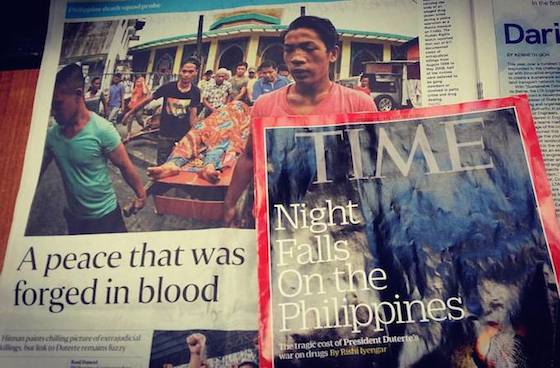
Fresh reports featuring the allegations were included in a cover story in the latest Time magazine, the Singapore Sunday Times and a new inquiry by the Philippine Center for Investigative Journalism into the so-called “Davao Death Squad”.
It is only 80 days since President Rodrigo Duterte was sworn into office, and the PCIJ reports that he now “commands an armed contingent that is a hundred times bigger than it was in Davao, and his ‘enemy’ a thousand times more numerous”.
More than 3000 people have reportedly been killed so far in the so-called Project Tokhang – or “Double barrel” – war on drugs. The president has also called for a six-month extension on his policy, claiming that the drugs business is largely “operated by people in government”.
Time magazine branded its report the “killing season” in the Philippines with a subheading of “Inside President Rodrigo Duterte’s war on drugs”.
The Sunday Times correspondent in Manila, Raul Dancel, reported on some of the victims of the Davao killings, including a 62-year-old mother who lost four of her sons to the assassins.
‘Forged in blood’ The report was headlined “A peace that was forged in blood”.
Self-confessed hit man Edgar Matobato, now 57, told a Philippines Senate inquiry last week that he and other members of the so-called Davao Death Squad had killed some 1000 people in Davao City on the island of Mindanao on the orders of Duterte between 1998 and 2013.
The PCIJ reported in its inquiry that Duterte’s deputies have denied Matobato’s allegations, with Justice Secretary Vitaliano Aguirre II branding these claims as “old lies”. However, the president himself has not responded so far although he has made no secret in the past about his links with the death squads while denying direct responsibility.
The president’s chief legal counsel, Salvador Panelo, reportedly said he saw no reason for the President to respond to a “perjured witness”, adding that the Senate session was “not a hearing on extrajudicial killing, it was a case of extrajudicial lying”.
He said: “No amount of black propaganda, no amount of sinister ploy or plan will stop the President from his relentless campaign against the drug menace and terrorism.”
In one television programme during the presidential election campaign, he declared: “I am the death squad? True. That’s true.” But he later shrugged this off as merely “teasing”.
Davao killings As PCIJ says, “there is no denying that Duterte’s reign in Davao City had been marked by numerous extrajudicial killings, with Davao media attributing at least 150 deaths there from 1995 to 2001 alone to the DDS [Davao Death Squad] and then Mayor Duterte’s war against drugs”.
According to PCIJ’s research via police and judicial records, the president’s “expanded war” has resulted in a death toll that is “10 times higher within a much shorter period; an average of 38 persons killed a day, or over 3200 in the last 80 days”.
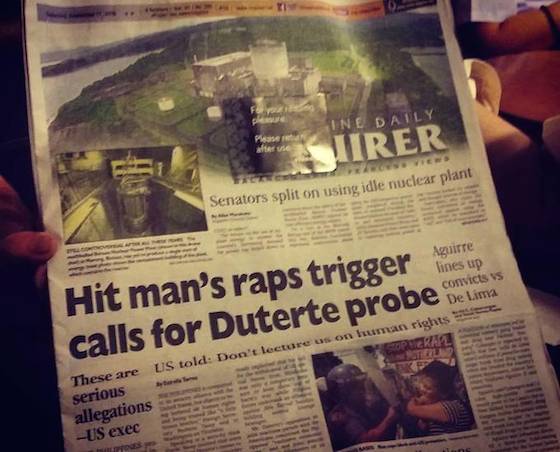
The presidential “hit man” allegations in the Philippines national press. Photo: David Robie
Matobato’s testimony before the Senate inquiry named Senator Leila de Lima as being on the target list while she had been chair of the Philippines’ Commission on Human Rights. (De Lima herself is also at the centre of allegations in a separate Congress inquiry opening this week).
Matobato said he and others in the death squad had been waiting to ambush De Lima in 2009 but she had not ventured into the undisclosed hilly area to inspect a suspected mass grave site where they planned to open fire.
The former hit man alleged before the Senate inquiry that he and others in the liquidation squad took orders from Duterte and killed about 1000 suspected criminals and opponents of the mayor and the Duterte.
Matobato admitted that he had personally carried out at least 50 of the abductions and killings, including an attack on a suspected kidnapper who was hogtied and fed alive to a crocodile.
“Our job was to kill criminals like drug pushers, rapists, snatchers. That’s what we did. We killed people almost every day,” Matobato said.
Journalist assassinated In one of the most serious claims, the former hit man also alleged that Duterte had had Davao broadcast journalist Jun Pala, a vocal critic of the president when he was Davao mayor, killed.
Responding to the testimony, one of the most influential national dailies, Philippine Daily Inquirer, declared in an editorial that the serious allegations ought to be thoroughly investigated but with “caution and scepticism”.
Until then, noted the newspaper, the president enjoyed the presumption of innocence, “as he must”.
“But herein lies the eternal paradox of our times: the demand for fairness and due process is quickly made when it applies to the powers that be; there is no question, of course, that they deserve it,” said the editorial.
“Those killed so far in the war on drugs – the padyak drivers, the petty pushers in fraying flip-flops, the denizens of dark alleys yelling surrender – did not have the luxury of being afforded the same.
“And here Philippine society is today, in an ever-deepening rabbit hole of national cognitive dissonance.”
The PCIJ has revealed that Duterte has not signed, and the Office of the President has not released, any executive order to define his role and accountability for the war on drugs
A police Project Double Barrel “kill list” in the small Bicol town of Vizons. Such a quiet town apparently has no statistics. Photo: David Robie
‘I will protect you’ But the President has publicly declared to policemen that they are acting under his presidential protection: “I will protect you. I will not allow one policeman or one military to go to jail.”
According to the PCIJ, as at September 18 the latest national Philippine police report cited:
Killed in police operations – 1140
Killings by unidentified gunmen “under investigation” – 1391
Drug pusher suspects arrested – 17,428
“Surrendered” – 714,803 (661,737 alleged drug users and 53,066 alleged drug pushers)
Houses “visited” – 1,041,429
The PCIJ said: “Whichever is the correct PNP count, these numbers best the casualty tally during the 14 years of martial law under the late strongman Ferdinand Marcos; from 1972 to January 1981, Amnesty International had recorded a total of 3240 persons killed, 34,000 tortured, and 70,000 imprisoned in the Philippines.”
Human Rights Watch and other groups have called for a full United Nations inquiry into the Philippines extrajudicial killings following the detailed testimony from former hit man Matobato.
But calls within the Philippines for impeachment by the powerful Liberal Party were dealt a blow when Vice-President Leni Robredo (who belongs to the party) declared that she hoped no impeachment process would take place, adding it was destined to fail through lack of numbers in Congress.
Despite political differences, she said, it was the duty of every citizen to support the elected President.
AsiaPacificReport.nz
French Polynesia and New Caledonia have become the newest members to join the Pacific Islands Forum (PIF).
The decision is historic as the PIF was founded for independent countries of the region and the two newest territories are still on the UN decolonisation list.
A France Diplomacy statement mentioned the country has welcomed the decision as it will strengthen New Caledonia’s and French Polynesia’s partnership and cooperation with its Pacific neighbours.
New Zealand and Australia are said to have supported this decision which France has been lobbying for over ten-years.
Before the decision was finalised New Zealand Prime Minister, John Key, stated that although a case can be made about the new PIF members not fitting the criteria, they are apart of the collection of countries that gather together, every 12-months, to discuss Pacific affairs.
‘Dominant powers’
A Radio New Zealand International interview with a security analyst, Paul Buchanan of 36th Parallel Assessments, said France campaigned for its territories out of the increasing influence of China in the region.
Buchanan referred to the power struggle between the PIF and Fiji’s prime minister Frank Voreqe Bainimarama, who has refused to attend the Forum as long as Australia and New Zealand remain members.
“Western powers, dominant powers, are now sitting at the PIF as full members,” Buchanan said.
“Fiji is the tip of a spear of Chinese influence projected in the South-Pacific through Commodore Bainimarama, the Chinese have a de facto, if indirect, diplomatic representative.”
Buchanan said the decision is a “game by proxy” between China, Australia, New Zealand and now France.
Previous fears
A separate media report also explained that indigenous Kanaks in New Caledonia had previously opposed the integration before the country’s possible referendum for independence in 2018.
It also mentioned the previous fears of granting members to the the territories, considering France has admitted to nuclear testing in French Polynesia in 1996.
Hawaii Public Radio has raised questions over the positions of American territories such as Guam, American Samoa and the Northern Marianas which remain as observers in the PIF.
PNG’s Hela Provincial Assembly has voted in Francis Potape as the new Governor for the liquefied natural gas (LNG) rich territory.
The Komo-Magarima MP was elected by nine out of the 13 assembly members. But in the absence of assembly members James Marape, Philip Undialu and two other presidents.
An elated Potape said his priority was to restore unity among leaders and the people in the province.
“Also on my priority list is to restore peace and good order amid the lawlessness in the province as tribal fighting continues to plague the communities,” said Potape.
Koroba Lake Kopiago MP Philip Undialu who was not present at the assembly meeting said, the meeting was illegal, in breach of the leadership code and against the decision of the court.
“As per the recent court orders, a time, date and venue of the meeting was to be announced by the assembly clerk.”
But Undialu said the clerk was in Port Moresby and questioned who gave authorisation for the meeting.
However, Potape stands firm that his election was proper and that Undialu was informed of the meeting but refused to attend.
Democracy and freedom of speech are at the forefront of discussions concerning the arrests of five prominent Fijian politicians over the weekend.
The men were allegedly detained on Saturday for a comment made at a meeting that discussed Fiji’s 2013 Constitution; the meeting was also held without a legal permit. They were kept in custody overnight and released on Sunday.
Among the group was former Fiji prime minister Sitiveni Rabuka, National Federation Party (NFP) leader Dr Biman Prasad, academic Dr Tupeni Baba, trade unionist Attar Singh, and Jone Dakuvula from the organisation Pacific Dialogue.
Another former prime minister and current Fiji Labour Party (FLP) leader, Mahendra Chaudhry, handed himself into police on Sunday and was released yesterday morning without charge.
‘Intimidation’
In an interview with Radio New Zealand International, Chaudhry referred to the incident as an act of “intimidation” and said there is no democracy in Fiji.
“If we can’t hold a forum to discuss our own Constitution in a democracy…what kind of democracy is that?”
“We want to live in a free society not where there are restrictions on free speech.”
Chaudhry said Fiji’s current prime minister, Frank Bainimarama, and Attorney-General Aiyaz Sayed-Khaiyum were invited but didn’t attend the meeting.
The NGO Coalition for Human Rights stated police may have also searched the homes and offices of Prasad, Singh, Baba, Dakuvula and Rabuka.
The Decree gives permission to the commissioner of police or any divisional police commander to prohibit a meeting they think may undermine the public safety and good order of the country.
The Fiji Times reported a statement by Bainimarama who said he was disappointed with the international community and their questioning of Fiji’s laws without objectivity.
“The Public Order Act, among other provisions, requires any group wanting to hold a public meeting to apply for a permit from the police before the proposed event.”
Bainimarama said no application was made therefore the police were acting within their rights.
“Those who attended this gathering were lawfully detained for questioning and there have been no allegations of any of their human rights being breached while in detention,” he said.
‘Step forward’
The arrests have spurred questioning of Fiji’s democracy as its 2014 general election, in which Bainimarama was elected prime minister, was deemed as a step forward for the country after eight-years of military governance.
When he was elected Bainimarama thanked a crowd in Suva: “I am deeply honored and humbled that the Fijian people have put their trust in me to lead them into our new and true democracy.”
In a separate RNZI interview, Dr Steven Ratuva, said after the 2014 elections there was optimism for a democratic space to be established within Fiji.
“In fact the Constitution itself talks about the rights of free expression and assembly.
“Now the Public Order Amendment Decree seems to provide a limitation to those freedoms which are being contained in the Constitution.”
During the Pacific Tertiary Education Forum this week it was revealed that despite Pasifika students obtaining NCEA Level 3 they are then going on to do a degree ‘unmatched’ to their subjects studied in high school.
Tim Fowler, the chief-executive of the Tertiary Education Commission, spoke at the forum in Auckland. He referred to the issue as an “under matching” between NCEA attainment and the transition to tertiary.
Because of this many are then entering into a level one tertiary course to gain the required subjects needed in their decided career path.
He said the launch of new TEC education tools would hopefully aid educators in addressing and finding solutions to the issue.
This includes a new online education tool, Qlick, that will be launched by TEC in November. It will allow educators to access live data on Pasifika achievement levels and patterns of study.
Fowler also said in 2017 tertiary providers that offer Level 5 qualifications or higher will be required to inform school leavers with in-depth data about each qualification on their organisation web-pages.
Lack of staff
Those who attended the forum also got a chance to raise their concerns around the lack of Pacific staff in the tertiary sector.
They said although the enrollment of Pacific students are increasing, Pacific staff in the workforce remain low.
“Nothings changed…I strongly plea to you if you can make that a priority in some way to incentivize TEO’s (Tertiary Education Organisations) to committing to raising Pacific work staff.”
Economic Analysis by Tony Alexander.
[caption id="attachment_11232" align="alignleft" width="150"] BNZ Chief Economist, Tony Alexander.[/caption]
This week we note that adopting a pessimistic attitude following the GFC has left many people far worse off than if they had simply admitted the uncertainty and tossed a coin to decide what to do. The NZD has risen close to US 75 cents as more people acknowledge the good state of the NZ economy which we expect official data to confirm for the June quarter next week.
Download documentpdf 350kbKeep Calm and Carry On
I wonder how many people are still sitting out there, holding off from buying a house, hiring staff, or undertaking capital expenditure because they expect the economy to fall into a hole in the ground because of
* the collapse in the dairy payout,
* the US Presidential election campaign,
* Brexit
* high house prices in Auckland
* money printing in many countries
* terrorism
* peak oil
* unrest in the Middle East, and so on.
As humans we are hard wired to pay more attention to things which may turn out bad than things which may turn out good. The media know that and feed us stories which attract our attention and get coverage for the advertisers who pay them. Capitalism hand in hand with generally left-wing reporters exploiting human weakness.
As K says in the first Men in Black movie “There’s always an Arquillian battle cruiser, or a Corillian death ray, or an intergalactic plague that is about to wipe out all life on this miserable planet…”
There is always something sitting out there which can cause significant economic disruption so you are always presented with an excuse for sitting on your hands and doing nothing. Plenty of people have done that since the global financial crisis and while that was the logical thing to do in 2008 and for much of 2009, ignorance of the fundamentals driving our economy and housing market in particular has seen many people choose to sit out a period of good growth and capital appreciation.
If you have avoided buying shares then you have missed a 120% rise in the NZX50 over the past five years. If you have despaired of New Zealand’s prospects and switched your assets into foreign currencies from late-2009 then you’ll have lost about 14% on a trade weighted index basis. If you have held off buying a house waiting for one of those silly forecasts of 40% price falls to come true then you are massively out of money and perhaps out in the wops when you finally make your purchase.
Were these gains and the good performance of the NZ economy predictable? No. None of us predicted the extent of money printing. None of us predicted how low interest rates would go and that they would still be falling now. Hardly anyone picked this strength in the NZ dollar. I’ll claim not picking a house price collapse and advising people to buy rather than sit on their hands in the housing market since mid-2009. But I can make no claim to remotely coming close to predicting the extent to which prices have risen.
The point is this. Predictability of many things had collapsed post-GFC. But that is no reason for blindly assuming the worst, growing potatoes and building a bunker. When you don’t know what is going to happen its a 50:50 call as to whether good stuff or bad stuff will come along. So why assume only the bad? Because, as noted, we are hard-wired to do exactly that. Plus, because we feel losses three to four times more intensively than gains psychologically-speaking, we give strong preference to lose avoidance rather than making gains.
Consider people running to catch a bus. Are they running so they can be on the bus? Usually not. They are running to avoid the situation of just missing the bus and feeling stupid because of the loss they have suffered. If you have no idea when a bus on a regular schedule arrives at all, there is no reason for any particular speed of walking.
So as you listen to the news people telling us about the woe surrounding us and how we should feel bad about it whilst anticipating even more woe down the track remember this. Buying into dystopic scenarios guarantees failure. Having at least some hope that the worst will not happen gives you a chance to thrive. Nothing ventured, nothing gained. “After all, tomorrow is another day.”
Housing
This week Quotable Value NZ released data showing that the average Auckland sales price has averaged just above $1 million for the past three months.
Someone wondered if the $1 million average would become a psychological barrier. What a silly comment. There is no single house which you could say is the representative commodity in the Auckland housing market and which is repriced daily or more frequently as happens with say gold, oil, or the NZ dollar. A psychological barrier or resistance point in technical analysis terms is only relevant when talking about a single completely homogeneous product which is traded by a very large number of people and that is not the case in the housing market.
There will not be a single auction where the bidders hold back because the price has got to $990,000 and they don’t think a rise above $1 million can be justified. Houses are already trading above that level and have been doing so for many years in the cases of high specification properties.
The average price measure is an artificial construction, it is not the market price for a uniform product like gold.
So you can kick any thought of the one million dollar mark representing a barrier to the current market’s movements firmly into touch – along with yet again the same analysis-poor comments from those who have been predicting falling prices and smugly warning buyers they have been paying too much for years now.
Just in case you have forgotten what we have been writing here for the past eight years, here are the fundamentals for the Auckland housing market.
DEMAND EXCEEDS SUPPLY AT CURRENT PRICES.
Too simple. More comprehensively…
-Population growth is strong.
-Interest rates are low and falling.
-A large cohort of people are approaching retirement and seeking assets to help fund the retirement which officials for three decades have been brainwashing them into believing will be miserably wretched affairs of shredded blankets and collapsing health unless they save and build a large investment portfolio.
-There is an existing shortage which keeps growing.
-Supply is being constrained by literally dozens of factors. A few include shortages of builders, electricians, plasterers, surveyors, inspectors, plumbers, concrete slabs, sections, infrastructure and so on.
-Finance to allow developments is being reined in by banks having to meet tougher lending standards post-GFC.
-Building standards and therefore costs keep rising.
The natural pressure is for prices to keep rising. Given that the Reserve Bank continues to express concern about banks being exposed to a shock which might cause prices to fall (insert the foot and mouth scenario here because nothing else bar Mt Rangitoto going up or China invading is going to do it), there will be more lending restrictions introduced. They can next year quickly raise the 40% investor deposit requirement to 50%, then 75% if deemed necessary. But at some stage, again probably early next year, they will introduce a strong regime of controlling credit supply by restricting how much banks can lend to multiples of household incomes. 3.5 times as in Ireland, or 4.5 times as in the UK, or something probably higher to start with.
Remember, this environment of influencing bank lending risk by controlling how much they can lend (credit supply) is a reversal of the approach from the mid-1980s of controlling such risk by influencing credit demand by changing borrowers’ interest rates.
And also remember this. The Reserve Bank has no goal regarding housing affordability, homelessness, or buying by the young. They don’t even in fact explicitly aim to rein in the pace of price rises. Their aim is simply to make sure that if prices fall sharply for whatever reason the banking system will remain fully functioning. The way things are going, in 2018 we will probably reach a point where there are so many credit supply controls in place bank mortgage portfolios will be exceedingly robust. But supply constraints will not have changed and demand will simply have been delayed and not killed forever in most instances by the RB’s actions. Therefore prices will continue to rise and the Reserve Bank will be quite happy. Note however our view that a plateauing seems likely before mid-2018 on the basis of a lot of price fatigue, higher supply levels, lower net immigration, and the RB measures. But sustained falls? Again, that would take foot and mouth.
NZ Dollar
US economic data following the interest rate rise last December have continued to be less strong than expected and yet again market expectations for the timing of another rate rise have been pushed out. This time the culprits have been weak numbers on employment growth and the services sector.
A rise this year is fairly unlikely and this pattern of disappointment in growth has already been seen elsewhere following rate rises post-GFC.
Locations include New Zealand, Australia, Sweden and the ECB where rate rises on the basis of good growth have been more than completely reversed in every case. We noted late last year that the risk is following the US rate rise expectations eventually turn to expecting that increase to be unwound. We are not there yet and the Federal Reserve will be extremely reluctant to do that.
With rate rise expectations pulling back again the USD has weakened and the NZD now trades near US 74.5 cents from 72.6 cents last week on its way to the 75 cents we have postulated. Once we get there look for forecasts of 80 cents being regained on top of the growing talk about the NZD exceeding parity against the Aussie dollar.
Why so much confidence in a rising NZD? It not only goes hand in hand with a strongly performing economy growing at above a 3% pace, but because dairy prices continue to surprise on the upside. The latest Global Dairy Trade auction produced another 7.8% rise in average prices which now sit 30% above their lows of mid-July and down 57% from the April 2013 peak.
Prices have been boosted by supply falling in NZ and elsewhere and we suspect a bit of a scramble from buyers because this turnaround in prices has been far greater than anyone was expecting. It pays to remember that no-one has displayed an ability to accurately forecast dairy prices a season ahead so it would be unwise to blindly extrapolate the recent price gains into further gains this year. We will simply have to take price movements as they come and hope the trend away from so many cows polluting our water continues.
If I Were A Borrower What Would I Do? Nothing new.
The Weekly Overview is written by Tony Alexander, Chief Economist at the Bank of New Zealand. The views expressed are my own and do not purport to represent the views of the BNZ. To receive the Weekly Overview each Thursday night please sign up at www.tonyalexander.co.nz To change your address or unsubscribe please click the link at the bottom of your email. Tony.alexander@bnz.co.nz
A West Papua leader says he hopes this weeks Pacific Islands Leaders Forum will push the freedom for West Papua movement towards the United Nations for review.
In an interview withMarianas Variety, secretary generalof the United Liberation Movement for West Papua, Octovianus Mote, stated that if the UN does not help with the Indonesian occupation and genocide in West Papua by 2020 “it will be too late”.
“Indonesia is using sovereignty as a means to slaughter people,” Mote said. “Australia says this is an internal issue. No, it is not. Sovereignty is not a reason to slaughter your own people.”
In the article, Mote stated that Indonesia has continued to ignore human rights abuses, despite many nations raising concerns during its Universal Periodic Review before the UN Human Rights Council in 2012.
Across the Ditch: Australian radio FiveAA.com.au’s Peter Godfrey and EveningReport.nz’s Selwyn Manning deliver their weekly bulltin Across the Ditch. This week they discuss how the Kiwi dollar continues to climb against all its major trading partners + A southerly icy blast has hit most of New Zealand bringing snow flurries over much of the South Island and also the North Island’s Central Plateau region, closing roads and uprooting trees. Also, a Colin McCahon painting sold this week for a record price in New Zealand.
First up:
Weather comparison
Headlines roundup
ITEM ONE: Kiwi Dollar Continues Its Climb
NZ Dollar continues to climb against major trading partners, including against the soaring Aussie dollar. If South Australians are planning a skiing holiday this month in Queenstown, the snow will be good but the Kiwi dollar will not give you much of a cash injection.
ITEM TWO: Freezing Winter Blast Hits All NZ Islands
The last big icy breath of winter is sweeping over both main islands bringing snow to most of the South Island and down to 500 meters above sea level in the North Island. The wind-chill factor is causing concerns for farmers as the polar blast threatens livestock including thousands of new-born lambs. And this coming season’s horticulture and viticulture sectors could be hit if this weather system is backed by blistering frosts.
ITEM THREE: Colin McCahon Painting Sells For Record $1,350,000.00
A painting by Kiwi artist, the late Colin McCahon, sold Wednesday night for $1,350,000. That’s a record for the most expensive painting ever sold at auction in New Zealand.
The painting is known as The Canoe Tainui and was being auctioned on behalf of the estate of Tim and Sherrah Francis.
The late Tim Francis, who was a former NZ permanent representative to the United Nations and ambassador to the USA.
According to the NZ Herald, Tim Francis once wrote about the moment he first spotted the painting: “It was stunning, lyrical, subtle, glowing … You know, up to that point, I had been – apprehensive I think is the word – about Pakeha taking Maori objects, symbols, even history, and making it into something of their own. But this was not like that. The words, the names, were handled reverently. The whole feel of the painting was one of honouring Maori, acclaiming Maori culture … here is a profoundly expressive celebration of Maori identity, Maori nationality.”
See also: NZHerald.co.nz.
By the way, the painting was bought in 1969 for $550.00.
Across the Ditch broadcasts live each week on FiveAA.com.au and webcasts on EveningReport.nz, LiveNews.co.nz and ForeignAffairs.co.nz.]]>
Oxfam New Zealand says the Government’s finance towards Pacific climate change is business focused and does not benefit families in need.
Rachael Le Mesurier, Oxfam New Zealand’s executive director, said because of this the Government needs to change its funding focus within Pacific climate finance.
“While New Zealand’s role in helping Pacific communities to access clean, efficient energy is helpful…the Government’s climate finance model is designed to be business focused, and not to benefit families living on the frontline of climate change.”
“These families need resources to adapt to rising seas and turbo-charged cyclones. The New Zealand Government’s climate finance program isn’t helping them do that,” Le Mesurier said.
‘unmet commitments’
Her statement complied with Oxfam’s research report, released this week, which assesses the “unmet” commitments of the New Zealand and Australian governments towards Pacific climate funds.
After Paris: Climate Finance in the Pacific Islandsreveals the proportion of New Zealand’s climate finance dedicated to adaptation has dropped by 20 percent since 2013. It instead urges investment in resilience building.
It also states that Australia has not increased its contribution for international climate finance since 2010.
“Australia has failed to increase its contribution to international climate finance in line with the goals of the Paris Agreement or in keeping with stronger commitments from other developed nations.”
The report comes as the most senior politicians in the Pacific gather for the 47th Pacific Islands Forum. The five-day event began today in Pohnpei, the capital of the Federated Sates of Micronesia, and will end on Sunday.
36th Parallel Assessments – Headline: Constitutional Coups.
A disturbing development in democratic politics is the emergence of a new form of forced ouster of presidents. Although military-led coups continue to occur, they have increasingly been met with disapproval at home and abroad. In their place have emerged “constitutional coups” whereby impeachment is used as a weapon against executive branch incumbents by disloyal oppositions in the legislature. In this analytic brief 36th Parallel Assessments outlines the phenomenon and its implications.
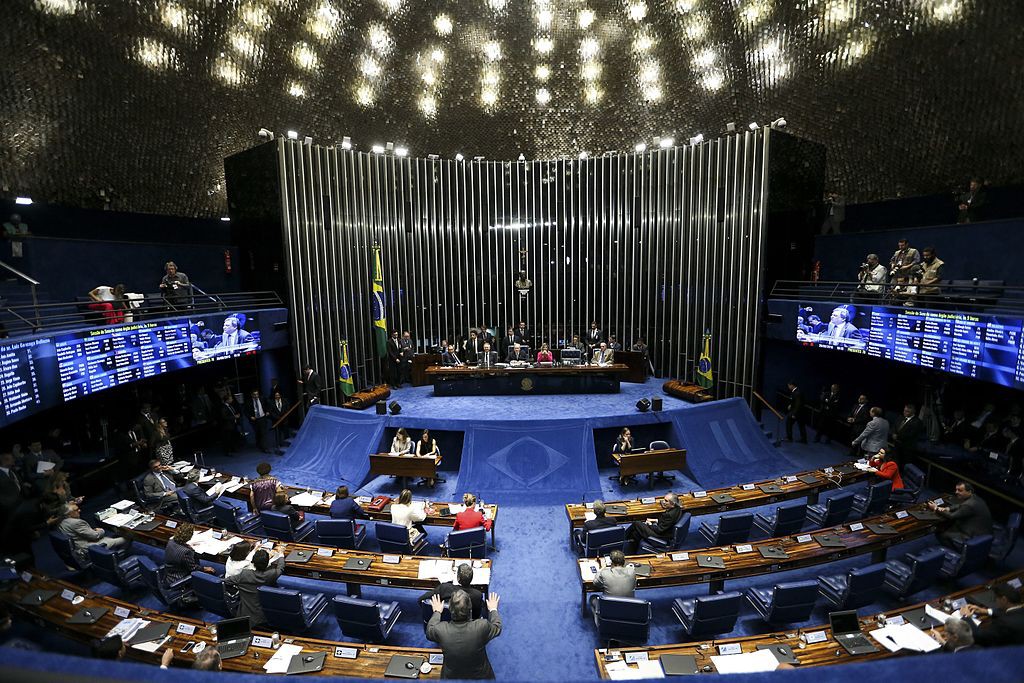
Brazilian Senate conducts the impeachment trial of President Dilma Rousseff, August 26, 2016. Credit: Marcelo Carmargo/Agencia Brasil via Wikimedia Commons.
When people think about coups d’etat, they tend to think about armed interruptions of the constitutional order, usually perpetrated by the military against an elected government. Such was the case with the abortive coup staged by elements of the Turkish military against the government of Recep Erdogan last July. Note that I do not say “democratically” elected governments, as usurpations of the constitutional order can also happen in electoral authoritarian regimes such as that of Hosni Mubarak in Egypt in 2011 (only to be followed by a “full” coup against the subsequently elected Muslim Brotherhood government of Mohamed Morsi in 2013).
The traditional origins of coups as forms of regime change, known as golpes de estado in Spanish, do in fact hark back to military interventions against civilian governments, and that remains its most common form. But another form of coup has emerged, minus the bloodshed and state of emergency so often associated with military-led coups (I say military-led because it is very seldom the case that the armed forces act alone when moving against the government of the day). Rather than an interruption and suspension of the institutional process by military means, it is a usurpation from within the institutional order by constitutional means. Instead of bullets fired by soldiers it is ballots cast by politicians that overturn the will of the people prior to scheduled elections. The insurrectionists belong to and work within the political system. This is what is now known as a constitutional coup. In order to understand this new form of “golpismo” we need to consider two background factors.
First, liberal democracy comes in two forms: presidential and parliamentary systems. Although it is possible that constitutional coups can happen in parliamentary systems (such as the removal of governments by Governor Generals in Pakistan in 1953 and Australia in 1975), they most often happen in presidential systems. By their very nature parliamentary systems have built-in insurance against constitutional coups because there are established means to remove a government, specifically via votes of no-confidence followed by snap elections. The rules governing both the vote and the election may vary from country to country, and there may be a ruckus surrounding such events, but they are an integral part of parliamentary democracy and, some might argue, a much finer tuned aspect of democratic governance than that allowed by its alternative.
Presidential systems provide no such mechanism for the removal of governments prior to their end of term. By definition, any such move constitutes an institutional crisis as the system is based on a separation of executive power from legislative authority. In parliamentary systems the executive (in the form of cabinet) continues to act as a parliamentary faction, to include ministers discharging responsibilities as members of parliament. In presidential systems that is not the case and executive authority can often be confronted by or exercised against legislative majorities (as is currently the case in the US). No matter what the majority in the legislature may wish, it cannot simply call for a vote of no-confidence in the government of the day. In fact, it has no legal basis to do so.
When the legislative and executive branches in presidential systems are locked in impasses or stalemates over any number of potential issues, the resolution mechanism boils down to supermajorities in the former and veto powers in the latter. Ideally, in bicameral legislatures the resolution sequence is usually this: the president introduces or supports a bill submitted for approval by the legislature. The opposition obtains a supermajority against the bill in the lower house, which is vetoed by the president, which is then upheld or overturned by a supermajority in the upper house. In unicameral legislatures the sequence is either one and done or a second legislative supermajority vote is taken after a veto in order to ratify or overturn the veto. Neither of these resolution paths provide a mechanism for the removal of the executive.
This process is cumbersome but offers the benefit of providing space for compromise between the executive and legislature as a bill winds its way through the ratification process. But what about removal of an elected government before its term is up? That is where the second key backdrop factor comes into play: disloyal opposition.
Before we examine the role of disloyal oppositions in constitutional coups, here is a summary of what constitutes loyal and disloyal opposition in a democracy (there is no point in using those terms in authoritarian regimes).
Loyal oppositions are those that, having been defeated in elections or confronted by an opposing party in executive office (remember, the problem is unique to presidential systems), abide by the rules of the political game and wait for the next electoral opportunity to gain executive power. During the meantime they work as much as possible to find areas of compromise so that the machinery of governance can continue to serve the public good (or at least be seen as doing so). Even if token, concessions are exchanged so that consensus on issues of policy can be achieved. Only in the most egregious case of executive misconduct, usually involving criminality or gross negligence, does a loyal opposition begin to contemplate the unthinkable, which comes in the form of impeachment (that is, forcing the resignation of the executive under pressure from the legislature backed by the authority of law enforced by state security agents).
Disloyal oppositions are those that refuse to accept the outcome of elections and/or the legitimacy of a particular government and use their political influence and power to bring down that government by any means short of force. This includes being deliberately obstructionist when it comes to passing legislation, flaunting rules governing acceptable political discourse, manipulating or colluding with media to plant false accusations against incumbents, refusing to authorise budgets and confirm executive appointments, and generally acting in every possible way to stymie government policy initiatives, make it impossible for the executive branch to function effectively within the tripartite, separation of powers framework of constitutional government, and to promote discontent with and distrust of the government and its political supporters.
The classic modern instance of a disloyal opposition was the Christian Democratic led opposition to Salvador Allende’s Unidad Popular government in Chile from 1970-73. The result of that disloyalty is well known.
Chilean Military Junta, 1973. Source: Biblioteca del Congreso Nacional de Chile (Library of the Chilean National Congress), via Wikimedia Commons.
Not all disloyal opposition need result in full fledged military coups. Instead, they can veer down the path of the constitutional coup. Consider the case of Bill Clinton’s impeachment in 1998-99. In late 1998 the Republican controlled House of Representatives voted to impeach Clinton on two counts of perjury and two counts of obstruction of justice. The charges related to his accounts of the affair he had with White House intern Monica Lewisky, the salacious details of which were vividly spelt out by Independent Counsel Ken Starr (Starr has recently been forced to resign from his position as president and chancellor of Baylor University for his role in covering up sexual assaults on females by football players). Mr. Starr was appointed by the Speaker of the House at the time, Newt Gingrich, he of the three marriages and many affairs (including with subordinates).
In 1999 the Republican controlled Senate held a trial and voted on the charges. Needing a two thirds (67 seat) majority for the impeachment to succeed and with 55 Senators on the Republican side, the impeachment vote failed when 50 voted in favour on the obstruction charge and 45 voted in favour on the perjury charge. Clinton remained in office, albeit significantly hamstrung by his near-miss.
The issue here is that the impeachment was over a private sexual affair, not an act of public malfeasance . It was led by people who themselves had similar skeletons in their closets and who did so in part just to weaken the president even if their efforts to impeach him failed (given media coverage of the story). More specifically, it was not about gross incompetence, criminal behaviour, military mismanagement, or even lying to Congress about any matter of policy. Instead, it was about the president receiving fellatio from and using a cigar as a sex toy on Ms. Lewinsky during trysts in the Oval Office, then trying to cover it up. It is doubtful that the founding fathers, in Article Two (Section Four) of the Constitution, had this in mind when they wrote that impeachment was to be used only in exceptional circumstances involving “treason, bribery or other high crimes and misdemeanours.”
That is a slippery slope. And nowhere is the bottom of that slope more evident than in the recent impeachment of leftist President Dilma Rousseff of Brazil.
Brazil has history with impeachment. In 1992 then president Fernando Collor de Mello resigned after Congress voted in favour of his impeachment on charges of bribery and misappropriation of funds. Similar charges of “budgetary mismanagement” were brought against Ms. Rousseff in 2016 by a Congress dominated by the center-right PMDB, Brazil’s largest party, which has the most seats in Congress (66) and is the one to which her vice president Michel Temer belongs (the coalitional aspects of Brazilian politics are too complex to get into here but suffice it to say that Rousseff was trying to keep her friends and allies close and her enemies closer. That did not work out as planned). By the time the first reports of fiscal irregularities surfaced in 2015, the PMDB-led majority in Congress had gone full-blown disloyal in a context of economic stagnation and assorted crises (Zika, lack of Olympic preparations) and were itching to find a reason to remove Rousseff (who was not anywhere as popular as her Workers Party predecessor Luis Ignacio “Lula” da Silva). The investigation into financial wrongdoing gave them their window of opportunity.
The charges against Rousseff stemmed from “Operation Car Wash” (Operacao Lava Jato) into bribery and corruption involving the state oil monopoly Petrobras, assorted construction firms, politicians, bureaucrats and financial entities. Without going into the details, let’s just say three things: First, corruption is a way of life in Brazil, not just an aspect of how the economic and political elite behave (hence the phrase fazer jeito, or ” a way of doing things” on the sly). Of those legislators demanding her impeachment and who voted against her at the Senate trial, over a dozen are being investigated or have been charged with corruption themselves, including now-president Temer. Included among the luminaries who voted to oust her is a former Army officer who was involved in her torture when she was imprisoned by the military dictatorship in the early 1970s, and who said during the proceedings that it would have been best that she were killed while in custody.
Secondly, creative accounting by Brazilian governments is a time-honoured tradition that crosses party lines. Most reputable political and financial analysts agree that not only was Ms. Rousseff not personally involved or benefitted by dodgy Treasury figures, but that in the scheme of things the book fiddling done by her government was not criminal but in fact par for the course in Brazil. Unfortunately for her, Article 85 of the Brazilian constitution and the Fiscal Responsibility Law specifically prohibit mismanagement and disregard for the federal budget. This was the seldom used rope that Congress hung her with.
Thirdly, no impeachment in Brazil can occur without the tacit assent of the armed forces. Of all the sordid aspects of Rousseff’s impeachment, this is the most sobering one. 30 odd years after they returned to the barracks, Brazil’s military still sees forced removal of elected presidents as a viable option–so long as it does not involve them directly.
This is why what happened in Brazil a week or so ago was a constitutional coup.
Although there have been variations on the theme, impeachment is the weapon of choice for constitutional coup plotters. They may use institutional means, but their intentions are disloyal and their objectives sinister at heart. Their motivations have nothing to do with honesty and transparency in government or defending democracy. Instead, they are about playing the system for tactically opportunistic partisan gain.
Brazil is not the only Latin American country that has witnessed a congressional coup. In 2012 Paraguayan President Fernando Lugo was impeached and removed from office, ostensibly over his mishandling of a land occupation that ended in violence. He was given two hours to prepare his defense and was replaced by his vice president, who sided with the legislative opposition. Subsequent publication of US embassy cables by Wikileaks revealed that as early as 2009 opposition leaders had begun to make plans to use impeachment as a way of removing Lugo from office (Lugo was elected in 2008). They eventually succeeded.
There is a problem with this strategy: more than one can play that game, and learning curves may teach that rather than the exception, the use of impeachment in pursuit of a constitutional coup can become the new norm. That in turn can spur a contagion effect, whereby politicians in other democracies with presidential systems see merit in pursuing similar courses of action. Worse yet, repeated recourse to the constitutional coup as partisan weapon can lead to outright military intervention. At that point the return to tradition trumps any constitutional niceities.
One should take this into account when pondering the activities of political actors in presidential-system liberal democracies, be they big and small. Because in a world where military-led coups are considered particularly thuggish and therefore distasteful, the constitutional coup is the genteel authoritarian’s game.
Summary.
While military-led coups are a clear sign of political instability, a new form of institutional fracture has emerged in the form of constitutional coups. Using impeachment as a tactical instrument, often times backed by key social actors and always with at least tacit military approval, disloyal legislative factions in democracies with presidential systems of governance remove or attempt to remove incumbents of executive positions not for serious crimes or gross mismanagement but for purely partisan reasons. Once this is accomplished in one polity there is a risk that it will be emulated elsewhere. Moreover, once a constitutional coup is successfully orchestrated for reasons other than serious crimes or failures to properly discharge the duties of executive office, the lesson learned by all political actors is that it is a legitimate tool of political competition in presidential democracies. That is a recipe for political instability.
36th Parallel Assessments advises investors and diplomatic missions to closely monitor executive-legislative dynamics in democracies characterised by presidential systems, especially new or immature democracies without histories of political consensus building or compromise. This is due to the fact that while not as dramatic as a military-led coup, constitutional coups can have a similar impact on the material and political fortunes of those on both sides of the confrontation.]]>
36th Parallel Assessments – Headline: Political Risk and Sustainable Enterprise.
Boomslang canopy walkway, Kirstenbosch Botanical Gardens, Cape Town, South Africa.
The terms “political risk” and “sustainable enterprise” are not often associated. They should be. The degree of sustainability of an enterprise has direct and long- term cultural, economic, social and political ramifications for the communities in which it is located. The less sustainable the business, the higher the political risk. Conversely, the more sustainable the business the lower the degree of political risk associated with it. The calculation for businesses thinking about whether to go one way or the other is one of long term versus immediate gain: whether to maximize short term profit by focusing on immediate gains while ignoring broader non-economic externalities, thereby incurring higher political risk in pursuit of short-term profit, or reduce political risk by pursuing longer-term gains at a restrained and sustainable rate of profit that factors in non-economic externalities.
The reason that political risk increases with unsustainable business practices is because commerce does not occur in a vacuum. If a business violates workers’ civil or labour rights, if it degrades the environment by polluting the air, ground, and/or water, if it dumps rubbish illegally, causes noise, visual or olfactory pollution, allows unsafe working conditions, bribes local politicians or community leaders, fails to pay a fair share of taxes, ignores cultural mores and conventions, then it runs the risk of alienating the people on which it depends for its success. Those people are not elites who may offer short-term benefits for business. They are the community at large in which a firm operates, and that goes well beyond local luminaries and short time horizons.
Cutting corners and playing loose with rules may help maximize short term gains but set the stage for long-term community resentment and failure. Investors may see short-term unsustainable business opportunity as a means of getting in and out of an economic sector while profitability is at its peak, but that leaves subsequent investors, managers and employees holding the bag when it comes to diminishing returns in a climate of hostility towards the business. Such “cowboy capitalism” is therefore not only unsustainable but also counter-productive to longer-term viability of firms and economic sectors.
There is an even more important reason why sustainable enterprise is preferable in terms of political risk: it promotes and reinforces democracy. Democracy, in turn, provides a safer long-term investment climate because it offers a level playing field and universal rules for competitors that are enforced by a politically neutral state bureaucracy and judicial apparatus, unlike the arbitrary and often capricious nature of authoritarian rule.
As a political system democracy rests on self-restraint and compromise by political actors who are held accountable by the electorate and are subject to the rule of law and transparency in decision-making. Rather than a winner-take all system such as dictatorships, democracies seek mutual second best outcomes whereby political actors, knowing that the pursuit of preferred outcomes by everyone leads to conflict, moderate their objectives in search of compromise. This extends to elections, where parties aim to capture the political center by broadening their campaign appeal, losers agree to abide by the results because institutional guarantees are in place that allow them to compete again at regular intervals, and winners agree to subject their rule to voter scrutiny at those times.
Democracy also involves an implicit compromise between workers and business. Workers agree to contribute to business success by being productive in exchange for business treating them fairly in terms of wages and working conditions. The material terms of the exchange are hashed out via collective bargaining in which agents from both sides, acting as equals, seek to emulate the strategic approaches seen in the political sphere. The more this exchange is reproduced throughout the economy, the more stable is the economic system. The more this exchange is reproduced beyond the shop floor and extended into the social division of labour, the more sustainable the investment climate. The combination of economic stability and social sustainability rests at the substantive core of democracy as not only a form of governance, but as a type of community as well.
Source: Tourism Fiji.
Sustainable enterprise is to capitalism what democracy is to politics: both rely on self-limitation, mutual understanding, compromise, long-term orientation and pursuit of the common good as well as self-interest. Exceptions to the rule and the tidal nature of contemporary democratic politics notwithstanding, the maturity of democracy as a form of social organization rests on these foundations.
That is its most important virtue. Sustainable enterprise has the effect of improving the social and economic foundations of democracy in which the bottom line is measured as much in quality of life and the contentment of the community as it is in material gain.
Trouble in paradise.
The situation in the South Pacific is disappointing on both counts. In the last decade, in spite of myriad attempts to promote good governance and sustainable enterprise, the South Pacific has seen the retrenchment of authoritarian politics and the expansion of non-sustainable approaches to commercial opportunity. Throughout the region unsustainable enterprise has been closely linked with corruption, environmental degradation, human exploitation and undemocratic governance. The fishing, forestry, mining and petroleum and gas industries have been most closely associated with these unsavoury traits as well as the use, in some instances, of private militias and/or corrupt local security forces implicated in the assault and murder of activists, unionists and others.
Nickel mine, Santa Isabel Island, Solomon Islands.
They are not alone. Even industries such as tourism have been accused of engaging in corrupt practices in order to circumvent environmental or basic health and safety regulations. The combination of poorly educated populations, self-serving and unaccountable governments (some dominated by “nobility”) and foreign investors unconcerned about or even opposed to business and government transparency and long-term socio-economic and cultural impact are the key ingredients in the witches brew that facilitates continuation of unsustainable business practices throughout the region.
This is of concern because, taken in aggregate it appears that there is a direct link between unsustainable enterprise, corruption and undemocratic governance in the South Pacific. Although this may favour those involved in the short term, the long term legacies of these practices, as has been mentioned, are deleterious on governance, equitable economic progress and quality of life. All of this takes place against a backdrop of accelerated climate change that has the very real potential for creating the first climate refugees coming from inundated Micronesian island states. In fact, given the limited land masses of even the largest Pacific island states, the adverse consequences of unsustainable commerce and undemocratic governance could precipitate environmental-related political instability sooner rather than later. The time horizons for a change towards sustainability are therefore limited.
Papuan campaigner against deforestation, 2008. Source: Greenpeace
This does not mean that there are no glimmers of hope for a reversal of this toxic combination. A variety of agencies, including international, non-governmental and civil society organisations, as well as some foreign governments and private business, have endeavoured to promote sustainable development and good governance practices. The problem resides in that most of the agencies are focused parochially on one or the other rather than on the linkage between sustainability and governance. It is there, as a matter of issue linkage between sustainable enterprise, development and democracy, where the most effort and resources need to be directed.
36th Parallel Assessments stands ready to assist current and potential stakeholders in addressing issues of sustainability and governance in the South Pacific and beyond. Through its research and facilitation services it can offer insight into and potential paths towards the promotion of both.An earlier version of this essay appeared in sustainnews.co.nz, March 3, 2016.
The importance of preparing our Pasifika youth to succeed in a digitally connected world was a key message delivered this week by the NZQA, chief-executive, Karen Poutasi.
Speaking at the Pacific Tertiary Education Forum held in Auckland this week Poutasi said there needs to be a greater leverage between education and the opportunities of digital technology.
Workers need a different mix of innovative skills to thrive in todays job market.
“We live in a different world at the moment, it’s global, digital and connected.
“As an education system we need to reflect the world that they are growing up in and the world they will be employed in.”
Poutasi said it is not as easy task for teachers as many didn’t grow up in a “digital enabled world”.
“Yet it is vital that we actually use technology, exploit the opportunity and manage the risks and therefore tutors and teachers are needing to grapple with it.”
‘But never underestimate the power of teachers in influencing Pasifika success’, she added.
Future employment
In her presentation Poutasi referred to a World Economic Forum survey, which suggest 16 skills needed for employment in the 21st century.
This is what international employers want, Poutasi said.
“These are the skills education in some way, shape or form need to deliver.”
The government of the Federated States of Micronesia has thanked Papua New Guinea for connecting both countries through air services that are being operated by Air Niugini.
Assistant Secretary for Civil Aviation of the Department of Transportation, Communications and Infrastructure, Massy Halbert, said this new flight route would strengthen trade links and provide more business opportunities.
It would also promote a sense of “Pacificness” between both countries.
Halbert also added that it was historical and both countries will work together to ensure this service is sustained.
“Absolutely, I will continue to do my part, so plans for December to begin the passenger schedule service can proceed,” he said.
Air Niugini has begun operating the special services to Chuuk and Pohnpei in FSM and is flying a special service to FSM for the Pacific Islands Forum leaders summit whose preparatory meeting opens tomorrow.
There were 70 divers, and others, by chance were booked on the first flight PX 4072, operated by Boeing 737-700.
After 2 hr 40 min, the Bird of Paradise touched down at Chuuk. From Chuuk, it took another hour to Pohnpei.
Sharing costs Air Niugini chief executive officer, Simon Foo, says the partnership is about sharing costs involved in operating this service.
Industries like tourism will be promoted.
“It will be twice a week, from Port Moresby to Chuuk then Pohnpei and back the next day,” he said.
This service saves time and cost.
A passenger, Quinton Devlin who works in the Solomon Islands, said it now only took three hours to Pohnpei rather than connecting through different countries.
“From Honiara, this is the best route with less time,” he said
It’s always a privilege for operating crews, like Ethel Samlai, because normally they are randomly selected.
“I am very privileged and I thank Air Niugini for selecting the team which I was part of,” she said.
Foo said the establishment of this direct service from Papua New Guinea to the Federated States of Micronesia represented a major expansion of Air Niugini in the Pacific and for Port Moresby to become the Pacific’s “hub in the aviation industry”.
Victims of horrifying acts of torture during Martial Law in the Philippines have recounted their painful experiences before Chief Justice Maria Lourdes Sereno.
Etta Rosales, former chairperson of the Commission on Human Rights (CHR) who experienced the atrocities of the dictatorship under Ferdinand Marcos, recounted: “They had a gun and they threatened me to answer the question, otherwise they [would] shoot [me].”
She was also raped, tortured, and went through electric shock and Russian roulette.
Rosales is among the petitioners asking the Supreme Court to stop the burial of the late dictator at the Libingan ng mga Bayani, which President Rodrigo Duterte had allowed supposedly for the country to be able to move on from that period of history 1972-1981.
Another petitioner in one of the cases, Trinidad Herrera, told the Chief Justice about her terrible experience under the dictatorship.
“‘Pinatanggal nila ang aking blusa at ‘nilagay ang linya ng kuryente sa suso ko. Pumasok pa ang kuryente sa katawan ko hanggang di ko na nakayanan,” Herrera tearfully recalled during oral arguments on the petition against a hero’s burial for the late president Ferdinand Marcos.
(They ordered me to remove my blouse and they applied electric shock on my breast. Electricity went through my body until I couldn’t take it anymore.)
“They even put water on the floor so that the electricity would enter my body,” she added in Filipino.
‘Touching me’ Another victim, Fe Mangahas, shared: “They would scare me again by touching me and breathing down my neck and then I felt something like naihi ako (I peed). I figured it was blood because at the time I did not realize I was two months pregnant.”
“When they found out I was pregnant I was released, but I was asked to report weekly about my whereabouts. I had to do this every Saturday for a year,” she added.
Other victims also detailed what they went through when they were captured by uniformed men.
Maria Christina Rodriguez said her captors burned her skin with cigarette. Her fingers were swollen because of bullet-pressing.
Maria Christina Bawagan said her thighs were hit until they looked like rotten vegetables. She was sexually abused, with her captors inserting objects into her vagina and touching her breasts while blindfolded. She said she may never know who exactly tortured her, but she clearly remembered their voice.
Each of these women remembered the exact date they were captured and went through the life-scarring experience.
Sereno asked the petitioners, who are claimants for compensation under Republic Act 10368 or the Human Rights Victims Reparations Act, to speak before the court. (What the gov’t still owes Martial Law victims)
She told them, “The Court is listening.”
Not about the money During her interpellation of former Akbayan Representative Ibarra Gutierrez III, lawyer for one of the petitioning groups, Sereno asked if the monetary compensation for the victims was not sufficient.
Gutierrez responded: “No, your Honor, because the law explicitly acknowledges to recognize the [victims and their heroism and sacrifices].”
He also said that money is not equivalent to the restoration of dignity of the victims.
The late strongman’s state burial, he said, would “prolong and extend” the suffering of the victims.
Human Rights Victims Claims Board (HRVCB) Chairperson Lina Sarmiento, who was one of the resource persons invited, said that out of over 75,000 claims, they have only finished processing 17,000.
HCRVB can only start distributing the compensation after every case has been settled because the P10 billion funds allotted will be divided according to the intensity of human rights violations experienced by each victim.
Sarmiento said they are hoping to finish the work before May 12, 2018, when their office expires.
Non-repetition Also appearing as a resource person, CHR Chairperson Chito Gascon said the state has an obligation for “non-repetition” of the trauma they experienced during Martial Law.
“There is a commitment on the part of the state [to] non-repetition, [that] the victims should not be exposed to re-traumatization,” he told Chief Justice Sereno.
Gascon stressed that local and international laws acknowledge reparations as a “positive act that the stake must undertake to [prevent] impunity.”
Justice Richard Chetwynd acquitted the three men accused of intentional assault on Florence Lengkon on Friday, accepting the defence’s submission that they had no case to answer on those specific charges.
Judge Chetwynd ruled that there was indisputable evidence that Ms Lengkon was struck once “forcefully” on the head on March 13, and said that if that was the case then it is impossible that all three men could be guilty of landing the blow.
The prosecution’s case rested almost entirely on a statement submitted by two police officers, who stated that co-accused Elton Worwor put them at the scene of the crime.
But the police officers didn’t ask some very basic questions during that interview, such as how Worwor knew they were involved, whether he actually saw them strike Lengkon, and if so, which of the three of them actually struck her.
Ultimately, the evidence was ruled inadmissible. The three men charged with the assault on Florence Lengkon had no case to answer, and they were therefore acquitted of this serious charge.
But… Justice Chetwynd paused meaningfully before continuing. He scanned the packed courtroom and stated that the fact that over 50 people could have seen what happened and not one of them stepped forward to identify the culprit is “an indictment” on our society.
Evident ignorance Anyone who has been following the case is within their rights to criticise the lack of thoroughness shown by the investigating officers. Their evident ignorance of basic interrogation and investigative procedure certainly contributed to the lack of a conviction on the assault charge.
One wonders what their Australian Federal Police (AFP) advisers have been doing this past decade.
The judge had no alternative but to acquit the three accused of assault because there was nothing that conclusively proved that any one of them struck the blow that left Lengkon’s eye bruised and swollen shut. We know that someone hit Florence Lengkon, but we still don’t know who it is.
Florence Lengkon after the brutal assault against her on March 13 – “Her bravery should be an example to us all.” Image: Dan McGarry/Vanuatu Daily Post
It is admittedly a difficult thing to confront—even passively—a large group of angry men. Florence found that out yet again when she sat alone in the witness box last Tuesday and gave her testimony. Her bravery should be an example to us all.
As the week wore on, more and more people turned up to show support, but on Tuesday she stood alone.
It’s possible to sympathise with the difficult role the police play when they are required to confront an angry crowd, such as the group that gathered that day in March when tempers flared over events down at the wharf.
But let’s not make any bones about it: It’s a tough job, yes. But that’s the job you choose when you choose to join the police force.
Two-way street In fairness to the police, though, this is a two-way street. If people showed a little more respect for the uniform, if they showed a little more respect for the law, then maybe these situations wouldn’t be so fraught.
I’ve spoken with ex-colonial policemen on a number of occasions, and without exception, they pine for the days when police officers were respected. It’s likely they were as much feared as respected, but let’s not put too fine a point on it.
One thing that was certainly missing then, and is still missing today, is a common understanding of the basic principles of justice and the law. It’s all well and good to complain that the law is an artificial and imposed construct that doesn’t match well with Melanesian sensibilities. That’s all true.
But that doesn’t mean it’s without value. The basic principle that each person has the same rights as all the others is a good thing. The principle that nobody is above the law is a belief that this nation cleaved to when the bribery case was unfolding.
And if we accept those two precepts, then we have to accept that every single one of us has a responsibility to act to uphold the law.
Justice Chetwynd had the unenviable task of defending the accused against the inadequacy of their prosecution. He would never have been placed in that position had even one of the more than 50 men who saw what happened actually believed in the law enough to take a stand against brutality.
That is an indictment against our society.
Dan McGarry is editorial director of the Vanuatu Daily Post group.
Vanuatu gender and human rights advocate Jenny Ligo has called on the Minister of Justice to “revisit resources” made available to curb violence against women.
Ligo, chairperson of Women Against Crime and Corruption (WACC) and Gender Equity in Parliament, made the call after the Supreme Court on Friday acquitted the three drivers – Glen Kovoi, Ben Koro and Charlie Kasuali – on charges of intentional assault against tourism manager Florence Lengkon.
Kidnapped Florence Lengkon as she appeared after the brutal assault against her on March 13. Image: Dan McGarry/Vanuatu Daily Post
“I believe Vanuatu is producing far too many reports without implementing them because it seems as if the more reports are produced, the less action is seen to be taken against alleged trouble makers,” she said.
She said the acquittal of the three bus and taxi drivers accused of the assault of Lengkon at the Main Wharf last March 13, confirmed that Vanuatu had many “dishonest individuals”.
Justice Richard Chetwynd acquitted the three men on the grounds that they had no case to answer to because no witness came forward to identify them as the assailants of the victim.
Although three names were recorded in statements provided by two police officers, there was no evidence on how Elton Worwor (president of Port Vila Land Transport Association) knew that the three individuals were involved in the assault.
Ligo said it was sad that more than 50 drivers of the PVLTA were present at the Main Wharf on the day and yet none of them could come forward to identify the person or persons who caused the brutal attack on Lengkon.
Kidnapped from workplace The victim took the case to court after she was kidnapped from her workplace and driven to the Main Wharf, where she was punched, leaving one of her eyes swollen and closed, and forced to apologise to the drivers for criticising their aggressive behaviour at the wharf on Facebook.
The outspoken North Ambaean leader said what happened indicated that women would continue to be denied their right to justice.
“This is especially true when our leaders often remind us that no one is above the law and justice is for everybody,” she said.
Ligo said a second investigation should be ordered into the assault, and the justice system revisited with a view to making relevant changes where necessary.
“When one woman is denied [her right to] justice, then how many other women are also denied their rights?” she asked.
Ligo said what it “boils down to” was an abuse of women and girls’ human rights.
She said she was not afraid to speak out for the voiceless when the public seemed indifferent to “barbaric criminal acts” against women and girls or were too afraid to speak out against the perpetrators.
Port Vila’s Main Wharf … where tourist ships dock and the site where drivers are accused of aggressive behaviour. Image: Vanuatu Daily Post
‘No nation is immune from a changing climate,’ says President Barack Obama. Video: The White House.
President Barack Obama addressed Pacific Island leaders and acknowledged their efforts towards dealing with rising temperatures and sea levels that are posing severe threats to the low-lying islands.
During his speech at the Pacific Island Conference of Leaders 2016, in Honolulu, Hawaii last week, Obama noted the effects on agriculture as well as forced relocation as consequences of climate change.
“Few people understand stakes better than our Pacific Island leaders because they are seeing already the impact,” he said.
“While some members of the US congress still seem to be debating whether climate change is real or not, many of you are already planning for new places for your people to live.
“Crops are withering in the Marshall Islands. Kiribus brought land in another country because theirs may someday be submerged. High seas forced villagers from their homes in Fiji,” said Obama.
‘Turning point’
According toReuters the US and China, the worlds highest emitters of greenhouse gases, ratified the Paris deal at the G20 summit in Hangzhou, China on Saturday.
Obama said the the Paris deal is a “turning point” for our planet.
A UN report states that Small Island Developing States (SIDs) like those in the Pacific, are responsible for less than one percent of global green houses gases, yet they are the most vulnerable to the effects of climate change.
The AUT Food Network has celebrated the commercial launch of the Nothing Else bar, a milestone achievement after years of rigorous research and taste trials.
The Nothing Else bar is a healthy snack bar, made up of just eight simple ingredients – the date and almond flavour contains oats, dates, almonds, oat bran, manuka honey, sunflower oil, flaxseed (linseed) and cinnamon.
The low GI snack bars are being manufactured and distributed by South Auckland food manufacturer AB Foods. Image: AUT
The bars are not only more nutritious than typical muesli bars, but also have a low glycaemic index (GI) to keep hunger pangs at bay for longer.
The bars are now being manufactured and distributed by South Auckland food manufacturer AB Foods, in consultation with Auckland University of Technology’s professor of nutrition Elaine Rush and advertising creativity lecturer Dave Brown, who created the Nothing Else brand.
The product has been four years in the making, and was commercialised through AUT Enterprises Ltd (AUTEL).
Professor Rush says the collaboration brought organisations, experts and partners from many disciplines together, with the goal of providing a healthier food choice for consumers.
“Globally, there is a call for better value food. Yet there’s no shortage of unhealthy food in the market, so we need to work harder to improve the nutrition of New Zealanders – one bar at a time,” she says.
Ingredient transparency On the creation of the Nothing Else brand, Brown explains it was specifically designed to be transparent about products’ ingredients.
“Consumers are surrounded by product labels with tempting yet questionable health claims. By being upfront and displaying the familiar, natural ingredients that go into Nothing Else products, we’re making it easier for customers to make their own choices,” he says.
The Nothing Else team has also introduced a vegan option for consumers, adding to the original date and almond bar with the addition of a cranberry and cashew version.
“The new flavour contains the sugar in the sweetened cranberries, rather than honey, making this bar a suitable option for consumers following a vegan diet,” says Professor Rush.
Wilson Security has confirmed that it will not renew its contract for its security service in the controversial Papua New Guinea and Nauru detention centres.
This means, the Australian government-run centres will no longer have operating security where evidence of ongoing abuse have been reported.
The company’s decision follows the announcement of its sub-contractor, Broadspectrum, who will also be ending their contract in the detention centres.
A media release confirms both contracts for these providers will conclude in October 2017.
Earlier last month the Australian government confirmed that both detention centres will be closed.
Amnesty International said this was the “first step” in ending the human rights abuses of refugees and children that are happening in the centres.
But a time frame for the closure of the detention centres has still not be confirmed.
Sir Michael apologised in a statement to the people of East Sepik and the country as a whole for the shame and embarrassment caused by a report in Singapore about a money laundering case that names him.
A Singaporean woman and her American husband were both jailed for sentences for five years or longer in a money laundering case involving US$3.6 million, according to The Straits Times. They reportedly plan to appeal.
The Grand Chief said he would be seeking legal advice on the matter in a few days’ time.
“I wish to make this address to the nation of Papua New Guinea in response to recent reports from Singapore.
“A court case has found two persons in Singapore guilty of money laundering offences and subsequently names me as a recipient of some funds.
“I have taken steps to get clarification and legal advice on this matter, but I would like to state from the outset that at no time in my political career have I received inducements or bribes.
“At first glance these charges say otherwise. Therefore, during the next few days, I will consult with my family and legal counsel and consider how to address this matter.
Apology to the nation “Nonetheless, I take this opportunity to apologise to the people of Papua New Guinea, my people of East Sepik and my family for the shame and embarrassment these reports may have caused.
“I have no further remarks to make at this time.”
The Singapore court found a married couple guilty for laundering US$3.6 million from Papua New Guinea in 2010 meant to set up community colleges in the country – then gave US$784,000 of it to the country’s then Prime Minister, Sir Michael.
According to The Straits Times, Singaporean Lim Ai Wah, 61, was given five years’ jail last Thursday (September 1), while her 68-year-old American husband Thomas Doehrman got five years and 10 months.
They were each found guilty on one count of falsification of accounts and five charges of transferring the benefits of criminal conduct.
Doehrman had been the trustee of a fund set up by the PNG government to establish community colleges in the country.
The Straits Times reported that in June 2010, the trust hired ZTE Corporation for US$35 million to supply telecom equipment for the project and the couple conspired with a ZTE employee, Li Weiming, 34, for the company to pay a secret “commission” to them.
Concealing payment The news source stated that to conceal the true nature of the payment, Doehrman and Lim acquired a British Virgin Islands shell company, Questzone Offshore, and signed a fictitious US$3.6 million contract with ZTE.
No services were provided, but a Questzone invoice was created.
Doehrman and Lim gave Li, a Chinese national, US$850,000 via two transactions to his wife’s Hong Kong bank account, according to the newspaper account of the case.
They gave Sir Michael three cheques worth a total of USD$784,000 in late 2010, all of which were paid into his Singapore bank account.
In their police statements, Lim and Doehrman said bribes had to be paid to the then-Prime Minister, Sir Michael, in order to get business from PNG.
For decades activists and intellectuals as diverse as Bruce Jesson, Annette Sykes, Brian Easton, Jane Kelsey and Bryce Edwards have lamented the lack of any progressively oriented policy institution capable of mounting a serious challenge to the neoliberal hegemony which has dominated New Zealand’s political life since the 1980s.
The NZ Business Round Table, the Maxim Institute, the NZ Institute and more recently the NZ Initiative have all played major roles as think tanks influencing and advocating on economic and social issues.
“What’s different about this is it is very geared to a kaupapa that is highly political, that is about challenging the very structures of our society, very clearly grounded in economic and social and ecological justice and in a [Waitangi] treaty and tino rangatiratanga kaupapa,” says Sue Bradford in an interview with Radio Waatea.
No comparative bodies have emerged on the left, although sectoral groups like the Child Poverty Action Group, CAFCA (Campaign Against Foreign Control of Aotearoa) and others have played an effective think tank-like role within their sectors.
When I commenced doctoral research (2010 – 2013) exploring the reasons why we had no major left think tank in New Zealand, two of the most frequent responses received were that we’d never succeed because we don’t have the money and because the left is too fragmented and factionalised.
On the question of money, there is no question that ESRA is very much on the back foot. There is no secret source of funding for ESRA and so far no substantial donors have emerged, although of course such support will always be welcomed as long as our kaupapa remains uncompromised.
What has enabled us to commence and sustain the project so far has been the tremendous goodwill, time and commitment shown by a large group of skilled activist and academic volunteers, backed by a comparatively low but steady stream of donations and automatic payments from supporters.
We don’t have enough money, but we make the most of what we have… and every dollar you contribute is another step towards our sustenance and growth.
At the core of ESRA’s being we are the opposite of the major think tanks mentioned above. While we don’t have their financial resources, we do have the ability to harness and nurture a collective determination to build a counterhegemonic institution capable of quality research, acute comment, and the generation of lively public debate and thoughtful policy development.
In touch with realities We will become a very different kind of think tank to those which already exist, grounded in the unions and community-based organisations whose interests we wish to serve, and closely in touch with the realities of life for the ever growing numbers of people who are paying the price in poverty, homelessness, alienation and despair for New Zealand’s love affair with neoliberal capitalism.
The second barrier raised to the potential development of a major think tank on the left was that traditional left factionalism had the potential to impede such a project right from the start. This has not proved to be the case at all. In the slow, careful process of establishing ESRA we have aimed to put a stake in the ground, inviting those who support the initiative to become part of it, but not seeking to colonise or take over people and organisations whose political interests lie elsewhere.
ESRA in fact looks forward to the day when other substantial left think tanks will emerge. Meanwhile, we will always welcome debate and interaction with other entities, no matter their place on the political spectrum.
It is cautious, deliberative work building an organisation without major funding support. Our ability to progress all the activities in which we would ideally like to engage is inhibited by a lack of paid staff and resources.
But we have come a long way already and feel sure that our current model of quiet, determined long-haul organising will lay the groundwork for a thriving ESRA, working for the better, more hopeful future to which we are committed.
Sue Bradford is a former Green MP, researcher and activist. She gave this address at the launch of ESRA at the Counterfutures conference at Victoria University of Wellington on Friday night.
Lawyer Annette Sykes giving an impassioned speech about the pedagogy of protest at the Counter Futures Resistance conference. Image: David Robie/PMCPacific Media Centre’s Professor David Robie speaking independent media and “new voices” from the Pacific at the Counterfutures conference. Image: PMC
Across the Ditch: Australian radio FiveAA.com.au’s Peter Godfrey and EveningReport.nz’s Selwyn Manning deliver their weekly bulletin Across the Ditch. This week, New Zealand’s crime statistics are out and show a marked deterioration, increases in burglaries and robberies. Also, the Trans-Tasman rivalry between the All Blacks and the Wallabies has turned septic.
First up: Weather comparison and the Headlines Roundup.
ITEM ONE: New Zealand Crime Rate Worsens:
After a winter of record homelessness and hiking house prices, New Zealand’s burglary rate has also increased.
Across the nation, Statistics New Zealand reported yesterday burglaries increased by 11.9% in the twelve months to July.
And the negative trend has been deteriorating for some time. The latest statistics show burglaries up 29% over a two year period with robberies are up 44% and assaults have increased by 10%.
The New Zealand Police Association puts this down to fewer police officers.
Its president, Greg O’Connor, said yesterday “While many offence types can fluctuate, burglary figures tend to be a very good litmus test of how much criminal activity is taking place in the community.”
He added: “What is clear is that the public are now becoming concerned that the crime situation is deteriorating, an inevitability after many years of under-investment.
“We are now seeing political parties, including the government, accepting there is a need to increase police numbers. But it cannot wait for an election – this government must find the money now to increase police numbers across the board so that community concerns about crime can be addressed.”
Labour leader Andrew Little said: ““John Key has broken his own 2008 election promise to have one police officer for every 500 people. There is now one police officer to every 526 people.
“Police are desperately under-resourced and have been told there will be no staffing increases until 2020.
“It’s unsurprising the regions are experiencing massive crime hikes with Rotorua burglaries up 66%, and up 100% in the Hutt Valley.”
The National-led Government’s Minister of Police Judith ‘Crusher’ Collins said the Government would have more police recruits soon so that the Police could attend all burglary complaints.
ITEM TWO – All Blacks Wallabies Rivalry Turns Septic:
The All Blacks and Wallabies Trans-Tasman rivalry has become rather septic since last Saturday’s Bledisloe Cup test in Wellington. The All Blacks beat the Wallabies 29-9, following a first test win of 42-9.
During the second test in Wellington, the Wallabies played a hard up-front and physical game, receiving a number of controversial penalties and a yellow card. It led to accusations that the referee was biased in favour of the All Blacks. There was also an alleged eye gauging by an All Black player on a Wallaby. At one point, a Wallaby pulled the boot off an All Black and through it off the field.
The tension spilled over into the aftergame period with the Wallaby coach accusing the All Black couch of having met with the referee before the game and without his Wallaby counterpart present. The allegation was denied.
Former Wallaby great Peter FitzSimons said on Radio New Zealand this week, that the allegations of referee bias were ridiculous and the debate should be focused on improving basic skills that in his day were drummed into players at club level.
It seems fortunate that the third test between Australia and New Zealand is scheduled to be played in over a month’s time.
Across the Ditch broadcasts live each week on FiveAA.com.au and webcasts on EveningReport.nz, LiveNews.co.nz, and ForeignAffairs.co.nz.]]>
The University of Papua New Guinea administration’s decision to ban eight students from continuing their studies is illegal, claims lawyer Peter Dumu, a former member of the Students Disciplinary Committee at UPNG.
The students were protest leaders during the recent two months of boycott of classes and demonstrations against Prime Minister Peter O’Neill that climaxed with PNG police opening fire on peaceful protesters on June 8, wounding up to 30 people.
Lawyer Peter Dumu … UPNG actions “unconstitutional” in his view. Image: Dumu
Dumu, who was a UPNG disciplinary committee member in 2013, said the decision was procedurally wrong and unconstitutional for these reasons:
1. Firstly, according to the bylaws of UPNG (Students Disciplinary Committee statute), a student who has breached any laws must be given 7 or 14 days’ notice by the SDC to respond to their charge(s) in writing. The SDC will then call up a meeting to hear the student’s response, which means there must be a quorum to hear students matters. Following the hearing, the SDC would make its ruling or decision to whether suspend or terminate students from studies depending on the nature of the offence.
2. Secondly, students will then be awarded their rights under the regulations to appeal to the Students Disciplinary Appeal Committee.
3. If the appeal committee upholds the decision of the SDC then the aggrieved student(s) will have no option but to go to the National Court for a judicial review after exhausting the administrative procedures.
Lawyer Dumu said: “We all understand crystal clear that the administration of UPNG or the University Council have no power at all under the laws, either with the UPNG Act or SDC statute, to terminate students right away. The harsh decision made by the UPNG administration is ultra-vires and illegal from the start.
“I would say its unconstitutional because their right to be heard (principles of natural justice) was not awarded to them accordingly. Therefore, the UPNG administration should reconsider its decision, and at least go by the book,” he said.
‘Lessons needed’ There are many similar case precedents, he said.
Some lessons needed to be learned by people “advising the administration on legal stuff”.
Student Representative Council vice-president Arthur Amos said in a press conference yesterday that some of the excluded students who had already received their termination letter by hand had written back to the school administration asking it to reconsider their decision and reinstate the students.
Amos said the school showed no sign of allowing any verbal communication between both parties but only through written documentation.
He and a handful of his terminated SRC members have done as requested.
In the meantime, they will await the Council Appeals Committee’s decision after they go through the students appeal.
She had the most enchanting smile, even though she had lost her baby teeth. Her toothless grin turned out to be perfect for the role.
The five-year-old girl had her face painted with a black anti-nuclear symbol – different motifs on both her cheeks.
Beside her was a neatly sketched poster: “No nukes: Please don’t spoil my beautiful face”.
This was the scene in Port Vila’s Independence Park in 1983 during the region’s second Nuclear-Free and Independent Pacific Movement conference.
It was during the heady days of nuclear-free activism with Vanuatu, the world’s newest nation only three years old and founding Prime Minister Walter Hadye Lini leading the way.
I was there that day as an independent journalist taking many photographs for my series of articles for Pacific and international media.
One person who really stood out was the little girl with the beautiful smile. But I never knew her name back then.
33 years on Thirty-three years have passed since then and my wife, Del Abcede, and I have just visited Aneityum (“Atomic”) Island in Vanuatu this week to meet that girl – June Keitadi and her family.
She is now June Warigini, mother of three, grandmother and a Salvation Army volunteer living on her home island. And she still has that stunning smile.
I wanted to present her with a copy of my 2014 book, Don’t Spoil My beautiful Face, that was inspired by her and she is featured on the cover.
Not only June, her mother Annie Keitadi is featured there too. Her father, Jack Keitadi, was deputy curator of the Vanuatu Kaljoral Senta at the time and he later became curator.
It was a delight and a privilege for Del and me to be able to visit the family on Aneityum and to be treated to a “royal” welcome by the community and tribe.
June remembers that day in 1983 really well. It left a deep impression on her in later life.
“They wanted someone young who could go on their behalf to the French Embassy and present a petition calling on France to halt its nuclear tests in the Pacific – so they chose me,” she recalls.
Symbolic of N-ravages “But the ambassador left in a hurry out the back. I don’t know why he was afraid of a little girl.” She remembers her toothless smile was regarded as symbolic of the ravages of nuclear testing in the Pacific, not only by France, but also the United States and Britain.
Faced with persistent protests in the Pacific, France eventually ended all nuclear testing in 1996, thirteen years after that rally. But the campaign for full compensation for the victims of nuclear testing continues.
June feels that her experience at that young age helped give her an inner strength for the challenges of life today and inspiring her in her desire to help others in her church work.
Ironically, both Del and I met her by chance on Christmas Day at the end of last year, but had no idea at that time of her connection with my book.
While visiting Aneityum for a day, we shared in an “olden days” traditional food and customs exposure in a model 18th century village on the island.
When we eventually discovered her identity – after my appeals on my blog Café Pacific and an NFIP network had failed and Vanuatu Daily Digest came to the rescue earlier this year – and we saw photographs of her, my wife exclaimed:
“That’s her, the June we have met.”
We realised that the guide “June” we had met that day on the island was indeed June Keitadi now Warigini.
Idyllic island Aneityum, the southernmost island in Vanuatu, currently has a population of 1740. It is not part of Vanuatu’s electricity grid and islanders rely on solar power. The island has no cars, or even a road.
The air connection is only two return flights a week from the Tafea provincial capital on Tanna. There is also no doctor, although a dispensary is now operating with two nurses and a midwife.
On the other hand, for visitors like ourselves, island life seems idyllic, a byword for “paradise”. Aneityum has a wonderful healthy lifestyle for youngsters, remote from the world’s conflicts and problems.
There are three primary schools and a boarding secondary school – one that attracts students from other outer islands whose parents want an education where the traditional way of life is important and free from the urban ills of Port Vila.
June is assistant bursar at Teruja secondary school.
She tells a delightful story about a recent excursion for students from Aneityum who went on a “field trip” adventure by island cargo ship to Tanna to visit the famous Mt Yasur volcano.
The island’s micro economy is self-sustaining and is augmented by occasional cruise ship visits and tourism days on Mystery Island. It appears that Aneityum is remote from government services or assistance and the support of cruise shipping companies, such as P&O, is crucial for the islanders.
Professor Crispin Maslog (centre) with Dr David Robie (right) in Dubai last year. Image: PMC
Event date and time:
Saturday, September 17, 2016 – 09:00 – 12:30
The University of Santo Tomas Journalism programme of the Department of Communication and Media Studies and the UST Journalism Society have joined with the Pacific Media Centre to co-organise back-to-back lectures featuring two veterans in Asian journalism and journalism/communication research in Manila,. Philippines, next month.
One is a lecture on Martial Law and Philippine journalism for millennial journalists by Dr Crispin Maslog. Dr Maslog is an alumnus (1955, magna cum laude [Faculty of Philosophy and Letters]) of the UST Journalism program, a product of The Varsitarian, and professor emeritus of the University of the Philippines College of Development Communication in Los Baños, Laguna. Dr Maslog has published numerous books on communication and journalism in the Philippines. He is currently chair of the Asian Media Information and Communication Centre (AMIC) in Manila. For his lecture from 9 to 10:30 am, Dr Maslog will orient journalism students about Martial Law and how journalists covered the event.
Afterwards, Dr. Maslog will give a soft launch of his book Grassroots Journalism.
From 11 am to 12:15 pm, director Dr. David Robie of the Pacific Media Centre of Auckland University of Technology (AUT) will give a visiting lecturer’s presentation on Asia Pacific Report: A campus-based journalism digital strategy. Dr Robie founded the PMC as a media resource and research center on journalism in the Oceania region and, by extension, the Asia-Pacific region. This full professor of AUT’s School of Communication Studies had authored numerous books on South Pacific media and politics. Dr Robie is founding editor of the research journal Pacific Journalism Review and previously headed the journalism programmes of the University of Papua New Guinea and the University of South Pacific (Fiji).
This day-long event is a springboard for UST Journalism’s prospective partnership with the Pacific Media Centre.