Page 1219

Police response outside Indonesian Embassy fails to silence Canberra Papua protest

]]>

AsiaPacificReport.nz

Police move in on protesters for West Papua outside the Indonesian Embassy in Canberra, ACT, on Friday. Image: AWPA

About 20 protesters in support of West Papuan self-determination were defiant in the face of Indonesian nationalism “blasted at them from the embassy” and a police response in Canberra at the weekend.

“It is an immature and childish response from the Indonesian embassy,” said Anthony Rumbiak, one of the rally organisers.

The West Papua human rights protest at the Indonesian Embassy in Canberra on Friday. Image: AWPA

With speeches underway, West Papuans and supporters blocked the entrance to the Indonesian Embassy by staging a “massacre” in protest against continuing human rights abuses in West Papua.

Australian police responded immediately to protect Indonesia’s “sensitivity” and to avoid further pressure from their officials who stood among them.

One supporter was arrested and taken into custody for failure to provide a name and address. The activist was refused bail.

The Australian police reaction showed continuous protection of the Indonesian government and bowing to its pressure rather than question their treatment of West Papua’s indigenous people, protest organisers said.

The West Papuan struggle continues to gain momentum at the international level and remains a thorn in the side of the Indonesian state.

“The support for a Free West Papua shall not be silenced in Australia and it’s about time the Indonesian government must engage with West Papua’s legitimate body,” said Lewis Prai Wellip, one of the West Papuan activist leaders who travelled from Melbourne to Canberra.

]]>

AUT to get NZ’s first 100% electric bus in public transport test

]]>

AsiaPacificReport.nz

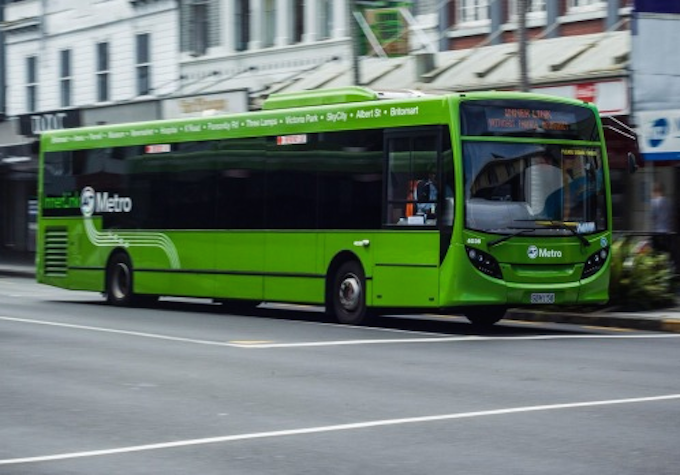
Two E-buses are to join Auckland Transport’s fleet in a bid to combat climate change. Image: Auckland City Harbour News

The viability of large electric vehicles (EVs) as replacements for current diesel buses is to be tested with a project that will see New Zealand’s first 100 percent electric bus on the country’s roads.

Through the jointly funded project with the Energy Efficiency and Conservation Authority (EECA) and Tranzit Group, Auckland University of Technology (AUT) will add the 38 seat, plus standing, passenger bus to its fleet of shuttles operating between AUT’s three Auckland campuses.

An existing AUT bus for commuting between the inner city campus in Auckland and AUT North (Akoranga) and AUT South (Manukau). Image: AUT

AUT Vice-Chancellor Derek McCormack told AUT News that 2016 being the hottest year on record brought into focus the need to find more ways to address the human contribution to climate change.

“Putting a single electric bus on the road might be a humble step, but it signals AUT’s willingness to embrace technology, and work in partnership to help find solutions to the challenges faced by our city and beyond,” he said.

Discussions about building the bus are underway and it is hoped to have it in service in the first half of this year. It is likely that the chassis and EV components will be built in China and the body will be built in New Zealand.

The project was announced recently by Minister of Energy and Resources Judith Collins as part of EECA’s Low Emissions Vehicle Contestable Fund which aims to help accelerate the uptake of electric vehicles, helping to transform our fleet and reduce carbon emissions from road transport.

The trial will make it possible for AUT and Tranzit to study the battery technology and determine what infrastructure and expertise is required to run a large EV urban bus fleet in New Zealand.

“With significant investment in NZ urban bus fleets occurring, AUT and Tranzit findings will be shared with the transport industry in the hope that the uptake of large EVs in New Zealand is seen as a viable replacement to current diesel buses,” said Tranzit Group’s managing director Paul Snelgrove.

Building and operating the electric-powered bus is in line with several of AUT’s sustainability goals including those that cover demonstrating leadership, research and partnership, and operations.

Auckland City Harbour News reported that two electric buses were set to hit Auckland’s roads in a trial part-funded by the government.

Auckland Transport has been awarded up to $500,000 for the trial and about $300,000 for electric vehicle charging infrastructure.

Funding has also been provided to install 60 electric vehicle charging stations at parking facilities around Auckland.

]]>

What now for the Tongan Democrats looking ahead to 2018?

]]>

Report by David Robie. This article was first published on Café Pacific

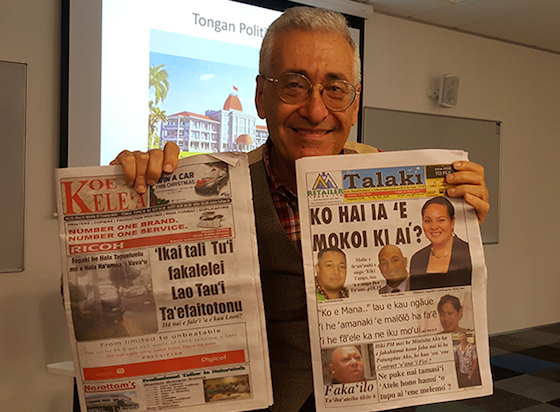
‘Atenisi Institute’s Dr Michael Horowitz with two Tongan newspapers — Koe Kele’a and Talaki — at the seminar
at Auckland University of Technology this week. Image: Del Abcede/PMC
By Kendall Hutt of the Pacific Media Centre

THE FUTURE of Tonga’s Democracy Coalition remains uncertain as next year’s election draws closer, a Nuku’alofa-based educator has concluded in a public seminar in Auckland last night.

Dr Michael Horowitz, dean of Tonga’s ‘Atenisi Institute, told the audience at his seminar entitled Can the Democracy Coalition retain power in Tonga? the fate of the party – and with it the election due late next year — was impossible to predict.

This is largely due to the fact no survey research is conducted, continuing Tonga’s “big surprise” election-day tradition, Dr Horowitz said.

Dr Horowitz, also a visiting research scholar with Auckland University of Technology’s Pacific Media Centre, said the Democracy Coalition may just hold on to power despite a bumpy term littered with controversy.

These controversies included a petition in 2015 for Prime Minister ‘Akilisi Pōhiva to surrender his education portfolio over the so-called “raw marks” policy controversy and the “cloudy issue” of state-owned Tongan Broadcasting Commission head of news Viola Ulakai’s suspension over alleged false representation, which prompted questions about Tonga’s media freedom status across the Pacific.

‘Dragging feet’
Pōhiva stepped down as Education Minister last week following months of international condemnation by global media freedom groups, although the pressure was primarily over the educational marks controversy.

Pōhiva’s administration is the first democratic government led by a commoner in Tonga’s history and came to power by a narrow margin in the 2014 election.

Dr Horowitz also highlighted the fact that Pōhiva’s government had failed — like those before it — to address Tonga’s poor economic situation, noting it was “dragging one’s feet to change the situation”.

A host of figures cited from the Ministry of Finance attest to the situation highlighted by Dr Horowitz, revealing much of Tonga’s gross domestic product (GDP) is comprised of remittances from family members living overseas (22 percent to be exact), and foreign donations to the tune of US $116 million in the fiscal year 2015 to 2016, meaning Tonga remained “dependent on the people’s generosity”, Dr Horowitz said.

Sense of some hope’
Dr Horowitz did, however, note the Democracy Coalition’s term had not entirely been clouded by scandals and economic downturn.

“People have a sense of some hope, some improvement.”

The “change of style” introduced by the Democracy Coalition to Tonga’s politics was something the people could still support despite the “hiccups”, Dr Horowitz noted.

Dr Horowitz also speculated that if the Democracy Coalition should fall, he would not be surprised if another prime minister emerged from the ranks of the nobles, although he did contend highly qualified Finance Minister Dr ‘Aisake Eke and Deputy Prime Minister Siaosi Sovaleni could be in the running.

Lecturer and filmmaker Paul Janman, present in the audience and the man behind the popular 2012 education documentary Tongan Ark, shared Dr Horowitz’s views, noting “2018, no one can tell”.

Janman, who also teaches screen production at AUT, reflected following Dr Horowitz’s talk that it had been “quite a revelation”, with much of the information Dr Horowitz shared having been only anticipated by the filmmaker after Tonga’s transition to democracy.

‘Democracy gaining traction’
“It’s been very enlightening to see the latest.”

Janman also said “the idea of democracy that has been aired and advocated for by schools such as ‘Atenisi is gaining traction”, despite persistence by what he described as “reactionary elements” present “in all kinds of different areas”.

A massive question mark looms over the Democracy Coalition’s future and its outcome in the November 2018 election.

Dr Horowitz said “one doesn’t know” how the votes would go.

    • Tonga’s ‘transparency’ prime minister violates media freedom over questions
    • Condemning harassment of Tongan journalist Viola Ulakai
    • Fifita new education minister in Tongan cabinet shake-up
    • Vote of no-confidence a possibility in Tonga
    • Follow developments at Asia Pacific Report

]]>

Indonesia cracks down on brutal conditions on foreign ‘slavery’ fishing boats

]]>

AsiaPacificReport.nz

Former slaves head for home: Thousands of fishermen rescued from brutal conditions on foreign fishing boats make the journey back home, many after years at sea. As reported by Associated Press in September 2015. Video: AP on YouTube

By Jewel Topsfield of The Sydney Morning Herald in Jakarta

It’s hard to comprehend it happened in this century: human slaves trapped on fishing boats being whipped with poisonous stingray tails, having ice blocks thrown at them and being shot.

“If Americans and Europeans are eating this fish, they should remember us,” says Hlaing Min, 30, a runaway slave from Benjina, a remote fisheries weight station in eastern Indonesia’s Aru Islands.

“There must be a mountain of bones under the sea…. The bones of the people could be an island, it’s that many.”

In 2015 more than 1300 foreign fisherman from Myanmar, Cambodia, Thailand, and Laos were rescued from Benjina and Ambon, after an Associated Press investigation revealed the brutal conditions aboard many foreign vessels reflagged to operate in Indonesian waters.

Extraordinary images of men being kept in a cage exposed the chilling reality of 21st century slavery.

“They were trafficked from their home country, mostly by means of deception, forced to work over 20 hours per day on a boat in the middle of the sea, with little to no chance of escape,” says a report on human trafficking in the Indonesian fishing industry released this week.

Some were kept at sea for years at a time.

After the rescue, the International Organisation for Migration interviewed the fishers.

Victims of human trafficking in the fishing industry pictured waiting for their back pay in Ambon, Indonesia. Photo: International Organisation for Migration (IOM)

They were told of excessive work hours — 78 percent of 285 victims interviewed in depth claimed they worked between 16 and 24 hours a day, cramped conditions, meals of watery fish gruel, physical and psychological abuse and even murder.

‘Several crews died’
“While on board, I often heard the news from the boat radio that several boat crews had died, either falling to the ocean, fighting or killed by the other crews,” a Cambodian fisher says in the report.

“While I was working on the boat, I saw with my own eyes more than seven dead bodies floating in the sea.”

A victim of human trafficking from Myanmar who was rescued from a fishing boat pictured in Ambon in Indonesia. Image: IOM

Witnesses testified that requesting to leave the boat could be a death sentence for some victims. Those who did might find themselves chained on the deck in the middle of the day or locked in the freezer.

“The heartrending stories of these fishers could not be left untold,” says IOM Indonesia’s chief of mission Mark Getchell.

The report says the Benjina and Ambon cases highlight the lack of adequate policing of the fishing industry and a lack of scrutiny of working conditions on ships and in fish processing plants.

Seafood caught by modern day slaves entered the global supply chain, with legitimate suppliers of fish “unaware of its provenance and the human toll behind the catch.”

“The situation in Benjina and Ambon is symptomatic of a much broader and insidious trade in people, not only in the Indonesian and Thai fishing industries, but indeed globally,” the report says.

Repatriation of enslaved fisherfmen
In 2015 the Australian government provided $2.17 million to IOM to support the daily care, repatriation and reintegration of formerly trafficked and enslaved fishermen from Myanmar, Cambodia and Laos, who had been stranded on islands in Indonesia’s Maluku province.

“This funding support has since been extended to enable IOM to provide assistance to foreign fishermen stranded in any area of Indonesia,” an Immigration Department spokesman said.

“This assistance plays a crucial role to support and protect victims of trafficking and slavery in the fishing industry by reuniting victims with their families and providing them with limited financial assistance which can help them establish an alternative livelihood.”

IOM spokesman Paul Dillon said Australia provided the lion share of the funding for its emergency response to the human trafficking crisis, which included returning more than 1000 victims to their home countries.

“This would not have been possible without the Australian government,” he said.

At the launch of the report in Jakarta this week, Indonesian Minister of Marine Affairs and Fisheries Susi Pudjiastuti unveiled a new government decree requiring all fisheries companies to submit a detailed human rights audit.

This was one of the report’s key recommendations to protect fishermen and port workers from abuse.

“That being said, Indonesia still has homework towards the approximately 250,000 Indonesian crews on foreign vessels operating across continents that remain unprotected,” Pudjiastuti says in a foreword to the report.

The report also called for greater diligence in recording the movement of vessels in Indonesian waters, more training on human trafficking, independent inspections of ports and vessels at sea and centres in ports where fishers could seek protection.

Jewel Topsfield is the Jakarta-based Indonesia correspondent for The Sydney Morning Herald.This article was first published by the SMH and has been republished by Asia Pacific Report with permission.

]]>

‘Everything can be burnt’ – Melanesian West Papua in the Jokowi era

]]>

AsiaPacificReport.nz

The face of West Papuan society is changing but RNZ International found that the core culture of the indigenous people of Indonesia’s Papua region is not easily destroyed. Video: RNZI

On an island with the third largest rainforest in the world live an indigenous people who are quickly becoming a minority in their own land.

Sitting north of Australia and occupying the western half of the island of New Guinea is West Papua – a territory rich in natural resources which was formally but controversially absorbed into Indonesia in the 1960s following the withdrawal of Dutch colonial administration.

Indonesia’s Papua region: the provinces of West Papua and Papua. Map: RNZI

West Papuans were largely excluded from that decision and for the past 50 years they have raised concerns about the infringement of their basic human rights in modern Indonesia.

Joko Widodo’s government has rejected these concerns saying living standards are improving for people in the Papua region, which appears at odds with the growing number of demonstrations by West Papuans calling for a legitimate self-determination process and an end to rights abuses.

Regardless, Indonesian rule means the face of West Papuan society is changing rapidly, but Radio New Zealand International journalists Johnny Blades and Koroi Hawkins found that the core ideology of these Melanesian people is not easily destroyed.

RNZI’s Johnny Blades and Koroi Hawkins (video camera) interview the elusive Papuan Governor Lukas Enembe in 2015. Photo: Koroi Hawkins/RNZI

Written and produced by: Johnny Blades

Camera: Koroi Hawkins

Editor: Jeremy Brick

This documentary was first broadcast by RNZ International and has been republished here with permission.

]]>

Across the Ditch: Weather + FX + Petrol / litre + Headlines + Why Is Au + NZ Soliciting China’s Entry into the TPP

Across the Ditch: Australian radio FiveAA’s Peter Godfrey and EveningReport.nz’s Selwyn Manning deliver their weekly bulletin. This Week: Weather + Petrol Prices + FX + Headlines Roundup + Indepth Item: Why are Australia and New Zealand soliciting China’s entry into the Trans Pacific Partnership? PLUS: 10 year-old surfer escapes Jaws! Weather + FX + Petrol / litre + Headlines IN DEPTH – ITEM ONE There are signs that considerable effort is occurring behind the public’s gaze to resurrect the Trans Pacific Partnership Agreement after US President Donald Trump formally withdrew the USA from the multilateral agreement this week. Trump added that his administration will advance a preference for bilateral free trade agreements. The comment has rekindled hope within NZ Government circles that a US-Kiwi FTA may yet come to pass. But the day before Malcolm Turnbull commented that the Trans Pacific Partnership may be extended to invite China into the pact, New Zealand’s new Prime Minister Bill English tested the waters suggesting the TPPA may be given some CPR. The question remains, will the Chinese play ball after being ignored by the two US leaning APAC nations (Australia and New Zealand) that both have bilateral FTAs with China and wanted a slice of the USA economic pie. The TPP nations are desperate sellers, and China is in the box seat. It seems Australia’s DFAT and New Zealand’s MFAT have a massive challenge on their hands. ITEM TWO And this Aussie news story is getting some attention over this side of the ditch: NZHerald.co.nz It’s about the ten year old NSW surfer who unknowingly surfed close to the jaws of a Great White. It’s a reminder to us all to be really vigilant while out on the water this summer. Any shark tales Peter?]]>

Tonga’s Democracy Coalition faces uncertain future, says academic

]]>

AsiaPacificReport.nz

‘Atenisi Institute’s Dr Michael Horowitz with two Tongan newspapers — Koe Kele’a and Talaki — at last night’s seminar at Auckland University of Technology. Image: Del Abcede/PMC

By Kendall Hutt

The future of Tonga’s Democracy Coalition remains uncertain as next year’s election looms, a Nuku’alofa-based educator has concluded in a public seminar in Auckland last night.

Dr Michael Horowitz, academic dean of Tonga’s ‘Atenisi Institute, told the audience at his seminar titled Can the Democracy Coalition retain power in Tonga? the fate of the party – and with it the election due next year — was impossible to predict.

This is largely due to the fact no survey research is conducted, continuing Tonga’s “big surprise” election-day tradition, Dr Horowitz said.

Dr Horowitz, also a visiting research scholar with Auckland University of Technology’s Pacific Media Centre, said the Democracy Coalition may just hold on to power despite a “bumpy term littered with scandals”.

These scandals included a demand late in 2015 for Prime Minister ‘Akilisi Pōhiva to surrender his education portfolio over the so-called “raw marks” policy controversy and the “cloudy issue” of state-owned Tongan Broadcasting Commission head of news Viola Ulakai’s suspension over alleged false representation, which prompted questions about Tonga’s media freedom status across the Pacific.

Tonga’s suspended state broadcasting news head Viola Ulakai … too questioning. Image: Kalafi Moala

‘Dragging feet’
Pōhiva stepped down as Education Minister last week following months of international condemnation by global media freedom groups.

Pōhiva’s administration is the first democratic government led by a commoner in Tonga’s history and came to power by a narrow margin in the 2014 election.

Dr Horowitz also highlighted the fact that Pōhiva’s government had failed — like those before it — to address Tonga’s poor economic situation, noting it was “dragging one’s feet to change the situation”.

A host of figures cited from the Ministry of Finance attest to the situation highlighted by Dr Horowitz, revealing much of Tonga’s gross domestic product (GDP) is comprised of remittances from family members living overseas (22 percent to be exact), and foreign donations to the tune of US $116 million in the fiscal year 2015 to 2016, meaning Tonga remained “dependent on the people’s generosity”, Dr Horowitz said.

‘Sense of some hope’
Dr Horowitz did, however, note the Democracy Coalition’s term had not entirely been clouded by scandals and economic downturn.

“People have a sense of some hope, some improvement.”

The “change of style” introduced by the Democracy Coalition to Tonga’s politics was something the people could still support despite the “hiccups”, Dr Horowitz noted.

Dr Horowitz also speculated that if the Democracy Coalition should fall, he would not be surprised if another prime minister emerged from the ranks of the nobles, although he did contend highly qualified Finance Minister Dr ‘Aisake Eke and Deputy Prime Minister Siaosi Sovaleni could be in the running.

Lecturer and filmmaker Paul Janman, present in the audience and the man behind the popular 2012 education documentary Tongan Ark, shared Dr Horowitz’s views, noting “2018, no one can tell”.

Janman, who also teaches screen production at AUT, reflected following Dr Horowitz’s talk that it had been “quite a revelation”, with much of the information Dr Horowitz shared having been only anticipated by the filmmaker after Tonga’s transition to democracy.

‘Democracy gaining traction’
“It’s been very enlightening to see the latest.”

Janman also said “the idea of democracy that has been aired and advocated for by schools such as ‘Atenisi is gaining traction”, despite persistence by what he described as “reactionary elements” present “in all kinds of different areas”.

A massive question mark looms over the Democracy Coalition’s future and its outcome in the 2018 election.

Dr Horowitz said “one doesn’t know” how the votes would go.

Dr Michael Horowitz with filmmaker Paul Janman, who made the documentary Tongan Ark about ‘Atenisi Institute. Image: Del Abcede/PMC Part of the audience at the seminar on Tonga politics and communication at Auckland University of Technology last night. Image: Del Abcede/PMC Pacific Media Centre advisory board chair Associate Professor Camille Nakhid opening the seminar. Centre director Professor David Robie is in the background and former Green Party foreign affairs spokesperson Keith Locke is on the left. Image: Del Abcede/PMC Senior lecturer Dr Frances Nelson (from left) and lecturer Janet Tupou at the seminar tonight. Image: Del Abcede/PMC
]]>

Vanuatu government hopes new laws will save it on global finance ‘grey list’

]]>

AsiaPacificReport.nz

Will legislation passed last year be sufficient to remove Vanuatu’s financial sector from international grey listing? Image: Vanuatu Daily Digest

By Bob Makin in Port Vila

The Vanuatu government’s Anti-Money Laundering and Counter Terrorism Committee is confident that the submission of some 31 Bills to Parliament last year should improve Vanuatu’s position on the international reviewers’ “grey list”.

Some three major review groups are involved. The legislative requirements were made on time.

Vanuatu was congratulated by the international examiners during a recent review of Vanuatu’s progress, the Daily Post reports.

The government intends to introduce a Transport Infrastructure Maintenance Fund, reports Radio Vanuatu. The Ministry of Infrastructure and Public Utilities has been meeting with stakeholders in the transport industry from the road, maritime and aviation sectors. The roles and objectives of the fund have been explained to the stakeholders, but not, it would seem, with the media.

The question raised in yesterday’s Daily Post about who is funding the planned luxury Bauerfield air terminal seems to be answered. The MG Group Hotel project from Hong Kong, involved with government and CCECC in airport discussions and agreements, is the backer. And this despite their plans to steal the view of a Ni-Vanuatu hotelier with a magnificent 3-storey view on a hilltop overlooking Daily Post.

MG’s harbour views will block those of Vila Rose Hotel just as it is starting in business.

Japanese tourists will begin arriving in Port Vila in April, on flights from Tokyo’s Narita airport via Port Moresby, PNG. Air Niugini is arranging the flights. A special night trip to Tanna has sold out already.

Mismanagement claimed
Radio Vanuatu reports the Opposition is claiming mismanagement of the Seaside Sanitation Project to assist the Seaside Paama, Tongoa and Futuna communities. The Opposition claims it has received many complaints concerning the quality of the local work. MIPU has dismissed all of the allegations saying the tender is being properly managed. A supervisory committee continues at work.

The Agriculture Department will be offering planting material, especially many varieties of manioc and kumala, tomorrow at Tagabe Ag Station in an effort to improve access to local and more nutritious  kaikai. Farmers and the general public will be able to meet together and discuss garden issues along with food production and security. There is a day-long programme starting at 7:30am.

The Media Association of Vanuatu is planning to become a full member of the International Federation of Journalists. Until now MAV has only been an associate member.

Re-elected MAV president Evelyne Toa saw the move as able to assist local journalists as regards their rights and freedoms.

Bob Makin writes for the Vanuatu Daily Digest

]]>

FPI leader calls for withdrawal of banknotes with ‘communist symbol’

]]>

AsiaPacificReport.nz

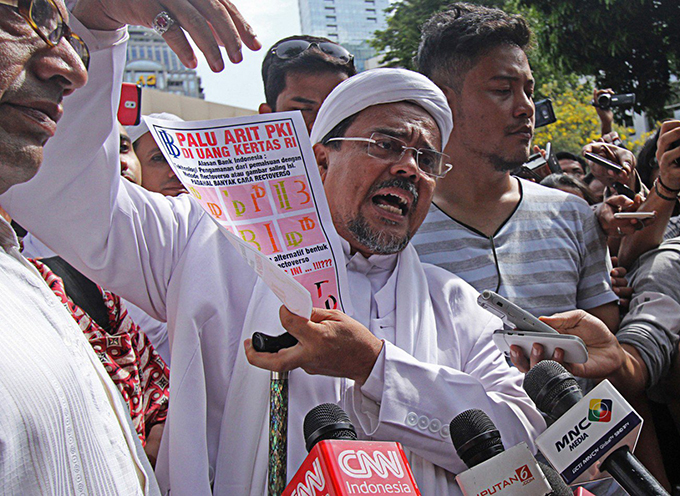
Staying defiant — Islam Defenders Front (FPI) leader Habib Rizieq Shihab gives a press statement after his questioning at the Jakarta Police headquarters on Monday. Image: Reno Esnir/Jakarta Post/Antara

By Safrin La Batu in Jakarta

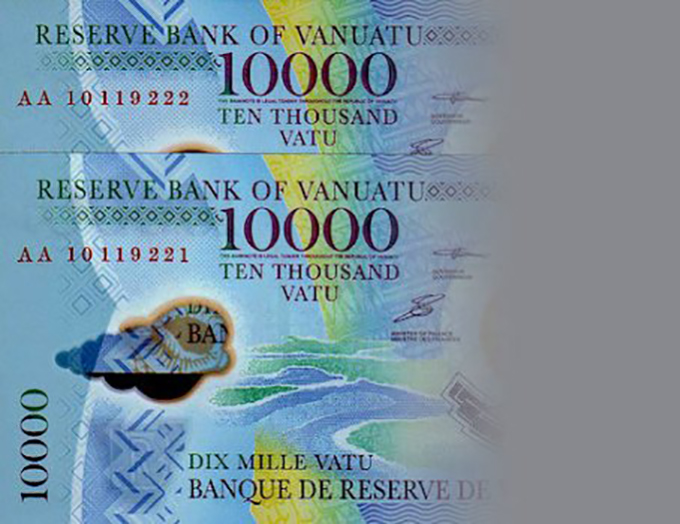
Islam Defenders Front (FPI) leader Rizieq Shihab has called on the Indonesian government to pull from circulation the newly-issued rupiah banknotes, which he claims have an image that resembles the now-defunct Indonesian Communist Party’s (PKI) hammer and sickle logo.

Rizieq attended on Monday the Jakarta police’s summons for questioning on his statement, during which he brought several new rupiah banknotes, from Rp 1000 (less than NZ$1) to Rp 100,000 (NZ$10) bills, and showed them to investigators to try to prove his claims.

Rizieq said the banknotes’ rectoverso image, which according to Bank Indonesia (BI) functions as an anti-counterfeit feature, resembled the PKI logo.

“We ask the government to explain to us why, from thousands of rectoverso images they could have used, they chose the one that looks like a hammer and sickle logo. This is dangerous,” Rizieq told reporters.

“We ask the government to retract all new banknotes, from the Rp 1,000 to Rp 100,000 bills, because they can all give the perception that there is a hammer and sickle logo on our banknotes,” said the firebrand preacher, who had to answer 23 questions from the police regarding his statement.

In an earlier statement, the bank brushed off Rizieq’s claim, saying that the rectoverso image on the bills was actually the central bank’s logo printed in such a way to protect the money from counterfeiting.

Mass organisation Jaringan Intelektual Muda Anti-Fitnah (Young Intellectuals Anti-Slander Network, or Jimaf) reported Rizieq to the police, in which they said the FPI leader’s statement constituted hate speech because his claim was baseless and could provoke public unrest.

Jakarta Police spokesman Senior Commander Raden Prabowo Argo Yuwono said Rizieq’s status was still that of a witness.

]]>

From failure, opportunity beckons.

]]>

36th Parallel Assessments – Headline: From failure, opportunity beckons.

The Trump administration’s decision to withdraw the Trans-Pacific Partnership Agreement, a multinational trade and investment accord involving eleven Pacific Rim countries other than the US, is seen as a blow to hopes for a freer flow of goods and services in the Asia-Pacific Region. In this analytic brief we look at the potential opportunities presented to the non-US TPPA signatories by the US abrogation.

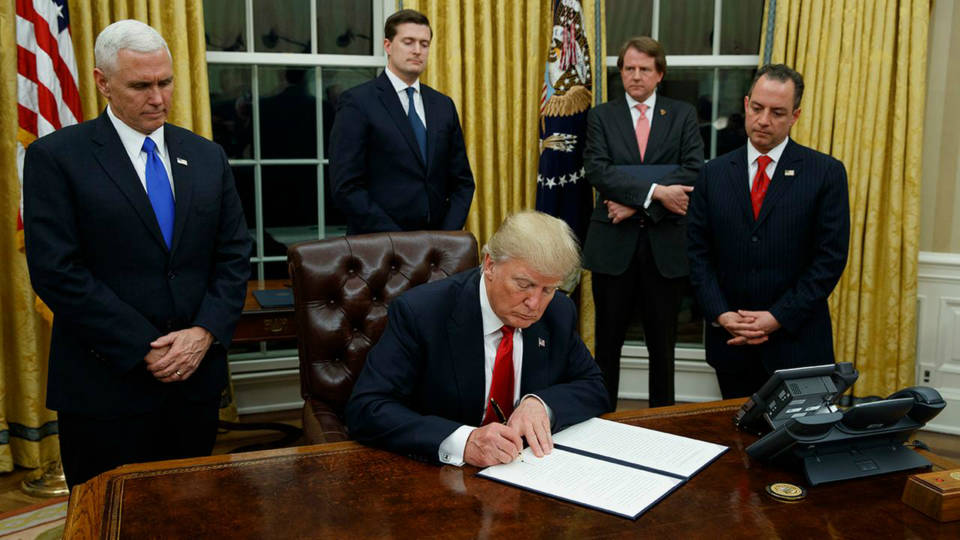
When President Trump signed the executive order withdrawing the US signature from the Trans Pacific Partnership Agreement (TTPA), he signed the death warrant of that multinational trade deal in its present form. The US was the core member of the TPPA and held the dominant negotiating position within it, so the decade-in-the-making, laboriously undertaken and vexing complex compact that was agreed to by the other eleven signatories is now all but null and void.

There are options, however, for the TPPA that may allow it to survive and thrive in light of Trump’s unilateral abrogation.

First, the other eleven member states can put the agreement into hibernation, wait for the 2020 US presidential election and hope that a more trade-oriented president succeeds Trump.

Second, they can hope that the Republican congressional leadership will force Trump to reverse his decision sometime between now and 2020. That would only occur if Trump is weakened by some failure and the GOP sensed that it could re-assert its traditional pro-trade stance at his expense. The Democrats would welcome the move for opportunistic partisan reasons even if some of its leading figures such as Bernie Sanders also oppose the TPPA and applauded Trump’s decision to pull plug on it.

Third, the members could look to themselves and re-draw an agreement that is less US-centric. Many of the provisions insisted on by the US could be reconsidered and even dropped in exchange for increased preferences for the interests of previously junior TPPA partners.

Fourth, the remaining TPPA partners could look to fill the void left by the US with another large market economy. The one that springs immediately to mind is China. That is where things get interesting, and where opportunity may lie.

China is already party to the ASEAN-China Free Trade Agreement (ACFTA) that established a regional free trade area that is the largest in terms of population and third largest in term of trade volume and nominal GDP. Some of the ACFTA signatories are also parties to the TPPA (Brunei, Malaysia, Singapore, Vietnam). This agreement is considered to be a “true” free trade agreement in the Ricardian sense because it reduces tariffs across 7,881 product categories to zero percent, with the result being that tariffs on ASEAN goods sold to China fell to 0.1 percent and those of China sold in ASEAN to 0.1 percent in the year the agreement went into force (2010)

The non-US TPPA members could opt to negotiate an agreement with ACTFA as one course of action. That may be difficult given that the TPPA is not a “genuine” FTA as much as it is an investor guarantee agreement (IGA) in which market regulations are altered to attract foreign investors and these are protected from legal liability in the event of disputes with the host state. What is not included in the TPPA are across-the-board reductions to zero tariff, and in fact many domestic industries remain protected or subsidised throughout the TPPA membership as part of the horse trading undertaken during negotiations over its central tenets. But it may be possible to reconcile the two trade deals in an effort to create a new super trade bloc on neo-Ricardian grounds.

Another option might be to invite China to the table. It has the second largest market in the world and is continues to grow at a sustained and rapid pace in spite of the vicissitudes of the world economy over the last two decades. It is making the transition from export platform to a mixed domestic mass consumption/value-added export model, and it has previously expressed interest in joining the TPPA. The US blocked consideration of China’s membership because it saw the TPPA as the economic equivalent of the military “pivot to Asia” announced by the Obama administration, that is, as a hedge against Chinese economic, diplomatic and military influence in the Western Pacific Rim in what amounts to a new Containment Policy in the Asia-Pacific.

With the US gone, China has an opening and the remaining TPPA members have an opportunity. The TPPA will have to be renegotiated, but it is likely that the non-negotiable provisions insisted by the US will not be supported by the Chinese and can be dropped in the effort to entice their interest. In turn, China might have to accept something less than blanket reductions in uniform tariffs and agree to a tariff reduction regime that is more segmented and scaled in orientation and gradual and incremental in application (i.e. more product or industry specific and phased in over a longer period of time). That is clearly within the realm of possibility, as is Chinese agreement to other TPPA provisions stripped of their US-centric orientation.

China has already signalled its intentions in this regard. President Xi used this year’s Davos Forum to preach the virtues of free trade and global commerce, arguing against protectionism as an impediment to international understanding and exchange. China has proposed the creation of a Regional Comprehensive Economic Partnership (RCEP) along the lines mentioned above with regard to an ACTFA-TPPA merger but with the provision that the US be excluded. There are many details to be ironed out but the groundwork has been laid for that to happen.

What makes the turn to a China-included trade bloc a potentially win-win proposition for remaining TPPA signatories is that the key provisions demanded by the US–changes in market regulations and preferential market entry clauses for US business interests (including changes in patent and copyright protection) and imposition of limited liability clauses in the event US businesses are sued by local governments–were those that were most resisted by domestic audiences in several TPPA member countries. Removing them not only allows the agreement to be free of those constraints but also diffuses a source of domestic opposition in countries where such things matter.

One thing TPPA states should think carefully about, especially small states like New Zealand, is the invitation to negotiate bi-lateral trade deals with the US instead of the TPPA (something just announced by the Trump administration). The historical record shows that large asymmetries in market size favour the larger over the smaller partner in bilateral trade agreements. This is due to economies of scale, market dominance, and economic and geopolitical influence derived from market size advantages. The recent track record of bilateral deals between the US and smaller states reinforces this fact. Australia, South Korea, Chile, Colombia and the Central American nations plus Dominican Republic grouped in the CAFTA scheme all have bilateral FTAs with the US. In all instances the majority benefits accrued to US-based companies and industries and the benefits accrued in the partner states were limited to specific export markets (mostly in primary goods), with little flow-on, trickle down or developmental effects in the broader national economies.

So rather than “jump on a plane” to sign a bilateral deal with the US, as one wag put it, smaller states such as New Zealand need to think hard whether the bilateral alternative with the US is more long-term beneficial than a multilateral agreement, especially when it has shown that under a certain type of administration the US is willing to renege on its commitments even if they are multilateral rather than bilateral in nature. With the Trump administration also set to review and replace the tripartite North American Free Trade Agreement with Canada and Mexico (NAFTA), it is clear that honoring commitments and maintaining continuity in trade policy is not, even if just for the short term, on the US agenda.

When one widens the lens on what the Trump administration is doing in terms of its threats to withdraw from various bi-and multinational defense agreements unless the partner states “pay more” for US protection, it becomes clear that the US is not, at least for now, a reliable international partner.

The reason is that the new US attitude to trade is part of a larger phenomenon. The neo-isolationist protectionism embedded in the “America First” approach adopted by the Trump administration has ended, however temporarily, over 50 years of bipartisan consensus in the US political elite on the merits of international engagement. Be it in trade, foreign aid or collective defense, the US policy elite, both public and private, have embraced globalisation as a means of projecting US power, influence and values world-wide. That era has come to end for the time being, and so long as Trump is successful in pursing his “America First” strategy it will continue to be so.

That may or may not make America Great Again but it could well have a negative impact on those who seek mutual benefit by engaging with it. They will be asked to do more, pay more and offer more concessions in order to be granted US favour.

In the absence of an alternative, that is an unenviable position to be in.

If alternatives are available, then the current moment in US politics provides a window of opportunity to countries that have found themselves marginalised by Trump’s policy directives.

The re-orientation of TPPA is one such opportunity because, if for no other reason, a US return to the TPPA fold in the post-Trump era will see it with much less leverage than it had up until now. Add to that the possibility of increased benefits via a renegotiated deal with the remaining and possibly new partners, and the downside of the US withdrawal seems acceptable.

From a smaller nation perspective, that is a good thing.

]]>

Estonia’s high price of energy independence – ‘we have lost our wetlands, our streams’

]]>

AsiaPacificReport.nz

Estonia may lie a continent and an ocean away from the two biggest polluters in the world – China and the United States – but the nation cannot lay claim to climate innocence. Having mined oil shale for 100 years, Estonia now has energy independence, but it has come at a cost. Kendall Hutt investigates.

Celebrating 100 years of oil shale mining may represent a proud moment for Estonia, but this doesn’t compare to what the country has lost, many environmentalists say.

The backbone of Estonia’s electricity production may have allowed the Baltic nation to escape from beneath the Soviet yoke and become energy self-sufficient post-independence in 1991, but most observers remember that this has come at a cost: the environment.

“In terms of ecology it’s a total disaster. From the point of view of state economy this is something to be proud of,” says Professor Mait Sepp, research fellow in physical geography at the University of Tartu.

“We have lost our wetlands, we have lost our streams.”

Many of Estonia’s environmental organisations agree, with more than 15 percent (504.6 km²) of the country’s Ida-Virumaa region severely damaged by the oil shale industry.

Mihkel Annus of the Estonian Green Movement says the sector still stamps the largest ecological footprint on the nation, despite European Union (EU) regulations.

’40 years like a volcano’
Perhaps the greatest reminder of this footprint will be the country’s ash mountains, huge piles of solid hazardous waste that mar Estonia’s relatively flat landscape.

“These will probably stay as the remnants of our fossil-fuel dependent past for centuries from now, as well as the land that has been excavated and already been exhausted,” says Annus.

Soviet legacy: The ash mountain of an abandoned power plant just outside the former oil shale town of Kiviõli. Image: Lukas Rusk

Harmful to the environment due to the poisonous gases and various contaminants they emit into surface and groundwater, these mountains are not only viewed as an ecological disaster.

They have also dealt a blow to the country’s pockets.

It cost the government more than 36 million euros (about NZ$44.4 million) to close the infamous ash mountain in Kohtla-Järve, which stood approximately 170m above sea level before it was closed and made environmentally safe in 2015.

Hazardous giant: Kohtla-Järve’s infamous ash mountain, which the Ministry of the Environment says it had to “redo”. Image: Berit-Helena Lamp/Estonian Ministry of the Environment

Estonia’s current environmental headache is the Kukruse ash mountain, which one official from the Ida-Viru County government describes as a 40-year-old “volcano”.

Hardi Murula, head of development and planning for the county government, says they have been engaged in ongoing talks for the past three to four years on how best to “neutralise” the mountain, but that no consensus has been reached.

“No one can guarantee during the restoration process that the pollution can be stopped.”

The closure of ash mountains throughout Ida-Virumaa is largely seen as positive despite the challenges, with one of the mountains in the former oil shale town of Kiviõli converted into an adventure centre in a joint industry-government project.

Piret Väinsalu of the Estonian Fund for Nature says the restoration of land is rather impossible, however.

“You can try to restore it into something, but it will always be there as a ‘heritage of oil shale age’.”

The source of the Kiviõli Adventure Centre’s heat is its ash mountain, which a spokesperson for the Ministry of the Environment described as a “great example of using available resources”. Image: Lukas Rusk

Legacy pollution
But government, industry and environmentalists do not see eye-to-eye on the source of this environmental damage.

Minister of Environment Marko Pomerants says much of the environmental impact is related to “legacy pollution” of the Soviet-era.

“Fortunately, most of the major negative effects are a thing of the past and the current oil shale sector has remarkably reduced its harmful practices for the environment.”

He says environmental concerns today largely involve emissions, although these have decreased since 2002.

Timo Tatar, head of the Ministry of Economic Affairs and Communication’s energy department, agrees.

“Talking about environmental damage, one can say, that oil shale environmental impact has significantly decreased due to heavy investments into new combustion technologies as well as emission control.”

Kiviõli Keemiatööstus: The last oil shale bastion in the town of Kiviõli. Image: Lukas Rusk A digger at work atop the suspected ash mountain of Kiviõli’s last remaining shale-chemical plant. Image: Lukas Rusk

Official 2014 data by the European Commission shows Estonia currently stands as the second highest emitter, per capita, of greenhouse gases in Europe, however, and its far from carbon-free history occupies a blight on their climate change record.

Although the EU’s Emissions Trading System allows the country to sell-off its emissions because they are lower than the country’s massive levels at 1990, things are far from rosy, especially in the wake of the 2015 Paris climate change agreement.

In light of this, environmentalists Annus, Väinsalu, and their colleague Aleksei Lotman, a marine conservation expert with the Estonian Fund for Nature, do not share officials’ view.

Although they agree the oil shale industry is “very much less polluting” than it was 30 years ago, they say making oil shale “environmentally friendly” is not enough.

To call current improvements by the oil shale industry so is “over-optimistic to say the least”, Lotman says.

A question of commitment
They are therefore critical of industry and government and feel both have failed to act effectively.

Väinsalu, who serves as the Estonian coordinator for the international non-profit network EKOenergia in her role with the Estonian Fund for Nature, says the government does “just enough” to be on a good list for Estonia’s European partners, while it simultaneously supports oil shale interests by lobbying for greater industry exemptions.

“Instead of understanding the need to find an alternative route and exit the oil shale era our government just supports the industry in every way possible.”

Eesti Energia train: The main driver of oil shale operations, delivering millions of tonnes of oil shale to the Narva power plants per year. Image: Essi Lehto

Eesti Energia, Estonia’s state-owned energy enterprise, refutes such claims and says it has taken several steps to reduce the environmental impacts of its operations.

“Today we can produce more energy from oil shale than in the past with less environmental impact,” says Eesti Energia.

Eesti Energia says introductions in new technology have been responsible, although physical changes have also occurred.

Among these was the 2008 closure of the ash field at their Balti power plant near Narva, in Estonia’s east.

The project took three years to complete and resulted in 570ha being made safe for the environment.

In 2013, Eesti Energia’s sister company, Enefit, opened a 17-turbine wind park on the former ash field.

“Our main focus lies in replacing fossil fuels with cleaner fuels,” Eesti Energia says.

The company adds it already does so through its use of water, wind, and biomass.

Rock-and-a-hard-place: Estonia’s renewable capacity is hindered by its relatively flat topography. Image: Lukas Rusk

Annus, however, as a member of one of Estonia’s most influential environmental organisations, feels industry may not have been as cooperative as it makes out.

“Whether they would make their processes more environment-friendly voluntarily, is questionable.”

He says this is because the oil shale industry has been put under increasing pressure by tightening EU regulations.

“They have been forced to take action to meet the set concentration values of emissions, changing the technology of landfilling of solid and hazardous waste, limiting water pollution, and so on.”

Annus adds much of Estonia’s oil shale industry happens behind closed doors, which further calls into question their transparency.

“A lot of the region has also been blocked off from the public eye.”

“No, no way”: This was as far as one of my photographers and I could get to one of Eesti Energia’s oil shale operations near Viivikonna, eastern Estonia. Image: Essi Lehto

Kaja Peterson, director of the Stockholm Environment Institute Tallinn Centre’s (SEI Tallinn) climate and energy programme, says Eesti Energia has, in fact, been rather open.

“I think Eesti Energia has been very flexible because they reformed and created a new sister company, Enefit Renewable Energy.”

She points out, however, that Eesti Energia is gradually transitioning to renewables and oil shale, unfortunately, still forms the majority of their operations.

Fossil free future?
This seeming unwillingness on the part of officials to divest from oil shale has led to serious doubts about Estonia’s renewable future.

While the government and oil shale industry remain positive, environmentalists and researchers are sceptical.

They claim there is no direct investment or clear political will in renewables by the government, only some will to diversify.

“There have been measures to promote sustainable energy, but the indirect subsidies for fossil fuels have still been greater,” Annus emphasises.

Annus feels Estonia is lagging behind a large portion of their EU counterparts and trendsetters, while Tatar and Pomerants celebrate Estonia reaching its Renewable Energy Directive target – 25 percent of renewables in final energy consumption – well before the 2020 deadline.

“Since the political target has been achieved there is no political motivation to increase that,” Peterson says.

Estonia’s climate footprint: The largest oil shale power plant in the world, near Narva, operated by Eesti Energia. Image: Lukas Rusk

Peterson’s colleague, Lauri Tammiste, SEI Tallinn’s director, says the shift to a low-carbon economy remains on the official agenda.

He highlights plans by the government to reach 50 percent of renewables and lower CO₂ emissions by 2030, although there will be a challenge.

“The main issue is, how to actually deliver these goals and ensure successful transformation with biggest possible environmental, economic and social benefits.”

When asked whether Estonia would have a fossil free future, Sepp was adamant he would not see change in his lifetime.

“No. Not in the near future.

It’s very convenient to use this old system. You have one system which works and to build a new one …. takes a lot of money and a lot of effort. Some very critical changes must happen to change this system.”

It seems clear, for the time being at least, that Estonia’s energy future remains far more carbon intensive than environmentalists would like.

Feature article by Kendall Hutt; photos by Essi Lehto and Lukas Rusk. The assignment was part of the Inclusive Journalism Project collaboration between journalism schools in New Zealand and Scandinavia.

]]>

Court bars overseas travel for accused Fiji Times publisher

]]>

AsiaPacificReport.nz

Fiji Times publisher Hank Arts outside court today with editor-in-chief Fred Wesley in the background. Image: FBC News

By Tokasa Rainima in Suva

Fiji Times publisher Hank Arts’ bail variation application has been dismissed by the Suva High Court.

Justice Thushara Rajasinghe told Arts and his lawyer that they had 30 days to appeal to the Fiji Court of Appeal.

Arts had asked to travel overseas to New Zealand for medical treatment and to attend his daughter’s wedding next month.

This is the second application to be rejected by the court.

Arts had offered to surrender his properties in Vuda and Lami as well as his entire superannuation savings to the court.

He is charged with inciting “communal antagonism” along with Fiji Times editor-in-chief Fred Wesley, Nai Lalakai editor Anare Ravula, Josaia Waqabaca and Fiji Times Limited.

They are alleged to have made, or published, a statement that could likely
incite dislike, hatred, or antagonism against the Muslim community.

The charges relate to an article published in April 2016 in the newspaper’s i-Taukei language newspaper Nai Lalakai.

Defence counsel Feizal Hannif said they will go through the ruling before deciding whether to appeal.

]]>

The future of media freedom – we can’t take it for granted

]]>

AsiaPacificReport.nz

By Dan McGarry, media director of the Vanuatu Daily Post

Media freedom is everyone’s freedom. We can’t take it for granted.

My education in the challenges of reporting the news began in a hurry. I got my first threatening lawyer’s letter less than half an hour after sitting down at my desk. The next day, I found myself at the receiving end of an angry harangue from someone whose name had just appeared on our front page. He accused me of sensationalising the news just to sell papers.

Vanuatu Daily Post media director Dan McGarry and editor Royson Willie.

It’s a common insult, and one that many journalists learn to wear like a badge of honour. You simply can’t report the news responsibly without upsetting people. If you’re going to speak truth to power, if you’re going to confront society’s challenges, if you’re simply going to tell it as it is… you’ve got to be willing to make people uncomfortable.

Back in May last year, I gave a talk on Media Freedom Day. I described a news reporter as “the honest friend who tells you ‘yeah, your butt does look big in that.’ He’s the friend who stands between you and that bully and says, ‘You don’t have the right to speak to her like that!’ And then turns to you and says, ‘And neither do you.’

“The reporter is the friend that tells you what your other friends are saying about you. Whether you want to hear it or not.

“The reporter is the friend who tells you what you did was wrong, and who still visits you in jail. They don’t hate you when you don’t agree; they don’t like you just because you do.”

Headline shock, good news or bad
I ended with a realisation:

“It never struck me until I started working at a newspaper just how it felt for people to see their name in the headline. Good news or bad, it’s a shock.”

Good news or bad. It’s not easy being the centre of attention. The lesson really landed when friends and colleagues of mine were faced with misfortune, and I found our relationship tested by my duty to put my personal feelings aside and respect the public’s right to know.

If it hadn’t been for the example set by the Vanuatu Daily Post over the years, I would have fewer friends today than when I started. Happily, the opposite is true. Thanks to the trailblazing work of Marc Neil-Jones and the dozens of fearless journalists whose blood, sweat and tears have graced these pages, every fair-minded, reasonable person in this country accepts that the news should challenge us.

As long as it’s fair, that is. This is the challenge that keeps us awake at night, the thing that drives us to re-litigate—again and again—the means by which we prepared our stories, how we sourced them, who we talked to, what we can fairly say.

We don’t always get it right. That’s a statistical impossibility. And reporting in Vanuatu, a notoriously information-starved environment, the challenges are often immense.

At the end of March last year, I wrote: “Access to information is critical to a healthy society, and when it works, its benefits are crystal-clear.”

And later in the same piece: “Vanuatu has never lacked for communication, in every kitchen, in every bar and nakamal, in the cess of social media, in the press and on the airwaves. Some say there’s too much of it. I don’t; I just think it’s often ill-informed.

“Wouldn’t it be nice, though, if we could finally talk about what we actually know?”

Getting the facts straight
Getting the facts straight is a challenge for everyone here in Vanuatu. It makes decision-making difficult, and our understanding is often driven as much by instinct and bitter experience than actual data.

The challenge is even greater in the media. If we are to maintain the trust of our reading audience, especially in the face of a cynical global campaign to discredit the news and its purveyors, we have to work harder than anyone else. We have to scrupulously cleave to the Media Code of Conduct. We have to bend over backwards to ensure that our stories are fair, that they are as complete as they can reasonably be, and—most importantly of all—we have to be guided by the facts.

The current tidal wave of cynical detachment from events is being driven by unprincipled people in positions of power—and in the media itself. It’s a matter of great shame to me that some of my colleagues would be willing to allow pettiness and partisan affiliation to define their portrayal of the facts.

Shortly after starting work at the Daily Post, I tried to draw a distinction between scepticism, the stock in trade of any self-respecting journalist, and cynicism: “A cynic thinks he knows all the answers already, and often has to be dragged kicking and screaming toward the truth.

“A sceptic, on the other hand, doesn’t quite trust anything to be true. Not even her own knowledge. A sceptical approach to social media is nothing less than a survival tool. Above all, it’s the only way to be fair about things.

“A sceptic doesn’t speak beyond her own knowledge. A famous novel by Robert Heinlein has a character whose job it is to be a Fair Witness. Asked what colour the house in front of her was, she replied, ‘It’s white on this side.’

“That is the kind of healthy scepticism that we should be applying to every information source. We should question, and we should not take the answers on faith. We should fairly evaluate both good and bad.

“It’s neither useful nor healthy always to assume the worst, or to trust anything based only on someone’s say-so. Evidence matters, no matter where it points.”

Sense of human decency
It gives me comfort, therefore, to note how the Vanuatu public’s engagement with facts, and its abiding sense of human decency is successfully holding back the tide of cynicism, character assassination and lying innuendo that has washed over more ‘developed’ countries.

At the end of last year, I noted that “We are by nature a gossipy, jealous, petty and spiteful species. It’s just how our herd mentality expresses itself. We are also empathic and quick to unite in the face of a threat.

“Media organisations know this. Some governments and politicians know this. And whether motivated by greed or lust for power, they are willing to leverage that knowledge to the fullest extent.

“In the right hands, sensational fictionalising gives us The Grapes of Wrath and It’s A Wonderful Life. It gives us Game of Thrones as an allegory of a society breaking down into anarchy. In the wrong hands, it gives us American cable news, the Fiji Sun, PNG’s Post-Courier and an actual descent into anarchy.

“Vanuatu, on the other (other) hand, has somehow managed to maintain a balance between emotion and respect for human dignity. In spite of numerous loud complaints—and a few vividly noticeable exceptions—we manage to maintain a relatively decent sense of decorum in our discussion groups. And we do it in the face of concerted efforts to rile people up.

“The Daily Post—and I personally—have been defamed in social media. The good name of our newspaper has been tarnished by people ranging from former Prime Ministers to basement dwelling nobodies. That just comes with the territory. We deserve to be held to a higher standard, and when—not if—we get something wrong, it has to be noted loudly and visibly. It’s a basic responsibility for those who report the news.

“And we’re happy to see that Vanuatu’s online community is showing the same reputability. While scurrilous accusations and petty, ill-informed comments are still rife, what matters is how they’re received. Nearly every time an accusation is made, the poster is challenged either to provide proof or to remove their post. Fake news is outed almost as quickly as it appears.”

State of Vanuatu media healthy
The state of the media in Vanuatu is healthy. And its health can be directly attributed to the particular amalgam of fearless confrontation and respect for human dignity that has been the hallmark of the Daily Post since its first print run.

We have a great deal still do to. Media freedom and healthy public discourse are organic things. They are landscape, not architecture. They need to be tended, respected and protected from erosion over time.

It gives me immense pleasure and pride to say: So far, so good.

With a generous application of blood, toil, sweat and tears, the next 5000 issues will support and sustain a reputable, respectful and fearless media just as well as the first 5000 have.

It’s an honour to be part of this team.

Dan McGarry is media director of the Vanuatu Daily Post; Royson Willie is the editor.

]]>

Vanuatu Daily Post marks 5000 issues – celebrating a pioneer of Pacific media freedom

]]>

AsiaPacificReport.nz

Celebration in Port Vila … the Vanuatu Daily Post’s 5000th edition since it was launched 26 years ago.

From the Vanuatu Daily Post’s celebration special edition today.

Marc Neil-Jones’ newspaper Vanuatu Daily Post celebrates an historic milestone today. We need to remember how it came about.

Marc Neil-Jones … fearless dedication to truth. Image: Vanuatu Daily Post

“I have been lucky,” said Marc Neil-Jones in his valedictory speech when he retired at the end of 2015. “I came to Vanuatu only four years after cyclone Uma had destroyed the place. I came here in 1989 with $8000 and one of those small early Macintosh computers and the first Apple laser printer.”

Out of that Mac came an institution that has effectively defined Vanuatu’s region-leading reputation for media freedom.

Since he arrived in Vanuatu from Papua New Guinea 26 years ago, Marc’s swashbuckling approach to life and his fearless dedication to the truth—to say nothing of his apparently immortal mullet—have created a legend almost bigger than a man can be.

We celebrate his life and his achievements today.

If you run a Google search for “Marc Neil-Jones” the very first image to appear is of a rather punch-drunk man with a bloody nose and a split lip. Marc has gone—literally and metaphorically—toe-to-toe with countless powerful figures in his time. And although his health has suffered of late, he has emerged the victor in every confrontation.

He has been deported, imprisoned, beaten… and threatened with lawsuits so often that he reacts to each new lawyer’s letter with nothing more than a quiet smile, like someone hearing news of an old friend.

Some claim that he has drunk kava with more prime ministers than any other man. In his time away from the office his raillery and joie-de-vivre left many young women breathless and, often enough, scandalised.

Passion and intensity
But he brought that same passion and intensity to his work. Without his unique mix of affability and panache, it’s doubtful that the media in Vanuatu would have evolved as it has.

Marc’s legacy runs deeper than many people appreciate.

Back in 1993, Marc Neil-Jones persuaded then-Prime Minister Maxime Carlot Korman to allow him to open a proper newspaper, the first of its kind in Vanuatu. Until then, only a government rag existed, and its coverage of politics and current events was… staid, to say the least.

It was Marc’s taste for scandal and imbroglio that led him into the newspaper business, but it was his deeply-held sense of decency and desire for fairness that created the newspaper you’re reading today.

In over two decades of partnership with local businessman Gene Wong, Marc’s brainchild has moved from strength to strength. Even in the wake of cyclone Pam’s devastation and the subsequent economic downturn, the Daily Post and Buzz FM remain profitable.

The 5000th edition of the Vanuatu Daily Post.

It is impossible to measure the social wealth that this man has helped create. Without a newspaper of record, one could argue that Vanuatu’s path over the years would have been a different one.

At the height of tension during the 2015 criminal bribery trials, a Solomon Islands policeman turned to a ni-Vanuatu colleague and said: “Mate, if this were Honiara, half the town would be on fire by now.”

But this is Port Vila, not Honiara; and not to put too fine a point on it, if people here have learned to love ethics, fairness and the rule of law, they learned most of it in the pages of the Daily Post.

Marc Neil-Jones has faced increasing health challenges in recent years, and at the end of 2015, he formally announced his retirement. He is a pioneer, a champion of media freedom and a member of a truly elite—and far too small—club of fearless defenders of the truth in the Pacific islands.

This article was first published in the Vanuatu Daily Post and has been republished by Asia Pacific Report with permission.

Congratulatory message from the Pacific Media Centre’s Professor David Robie broadcast on 96BuzzFM today.

]]>

Wansolwara 20(4) – USP journalism programme newspaper

]]>

Pacific Media Centre

http://www.pmc.aut.ac.nz/

ISBN/code: ISSN 1029-7316

Publication date: Wednesday, November 30, 2016

Publisher: University of the South Pacific Journalism Programme


‘ICE’ MENACE
By Sonal Singh
The use of the highly-addictive drug crystal methamphetamine appears to be on the rise in Fiji, according to reliable sources.

USP JOURNALISM ‘PROTECTED’ DUE TO CRUCIAL ROLE IN REGION
By Anishma Prasad
Twentieth Anniversary edition of Wansolwara

Wansolwara Online

Wansolwara at ISUU

]]>

‘Dump Trump,’ say Philippine women protesters

]]>

AsiaPacificReport.nz

Philippine protesters at an anti-Trump rally in Manila at the weekend. Image: Eagle News Philippines

Hundreds of Filipinos protested outside the United States embassy in the Philippines capital of Manila at the weekend to denounce Donald Trump as incoming president, accusing him of sexism, racism and xenophobia.

Chanting “Dump Trump,” the protesters from leftist groups also expressed concerns that Trump was a threat to the millions of Filipino immigrants living in the US.

Filipino activists arrive for an anti-Trump rally in front of the US embassy in Manila at the weekend. Image: Rappler/AFP

“It is alarming to know that an accused sexual predator, a known racist, sexist, xenophobic man is assuming the presidency of the strongest capitalist country in the world,” said Joms Salvador, secretary-general of women’s group Gabriela.

“The decades of struggle of women across the world to fight for their rights is threatened by Trump’s presidency.”

The about 300 people who gathered near the US embassy in Manila held placards with the message “@realDonaldTrump hands off Filipino immigrants” and “Trump you’re trash.” They symbolically dumped photos of Trump in the rubbish bin.

Trump defeated Hillary Clinton after a divisive campaign in which the real-estate billionaire vowed to deport millions of illegal migrants and faced multiple accusations of sexual harassment.

“We are very concerned about Filipino workers in the US dealing with a rise of racism. Some Filipinos there are getting paranoid about their personal safety and their job security,” Salvador said.

The Philippines, a former American colony, has strong cultural and economic ties with the United States. The two countries are bound by a mutual defence treaty and US forces have for many years helped the Philippines on various security issues.

However leftist groups have long railed against the US for exporting its capitalist model and for what they see as continued American domination of the Philippines.

Protesters at the rally also burned an American flag as they reiterated their longtime demands for US troops to leave the Philippines and the tearing up of what they called “unequal” military agreements.

Bilateral relations have soured under firebrand Philippine President Rodrigo Duterte, who has pivoted his nation’s foreign policy towards China and Russia since taking office nearly seven months ago.

]]>

TPP Still On? No Way: Is Bill English’s Plan B for TPPA a political own goal?

Source: Professor Jane Kelsey

[caption id="attachment_3138" align="alignleft" width="150"] Prime Minister Bill English has suggested a TPPA without the USA could still be alive.[/caption]

Bill English’s Plan B for TPPA a political ‘own goal’ in election year

‘The idea from Prime Minister Bill English that New Zealand and other countries might proceed with Trans-Pacific Partnership Agreement without the US is quite bizarre – especially in an election year’, says Professor Jane Kelsey from the University of Auckland.

‘Donald Trump would be delighted! US corporations would get the benefit of all the controversial rules on medicine patents, copyright, investment, state-owned enterprises that the US insisted on without the US have to give a single thing in return. Worse, countries that resisted these unprecedented demands for several years would become their new champions.’

‘Bill English suggested this morning that the TPPA was “probably” still a good deal without the US. Seriously? The economic modelling the government relied on to sell the TPPA last year had zero credibility and failed to account for the costs. Take the US out of that equation and any attempt to pitch the agreement as having net benefits to New Zealand is risible.’

‘Trying to sell the unsaleable during an election year would be a major political miscalculation’, Professor Kelsey said. ‘Because the text would be substantively different from the one that National rammed through the New Zealand Parliament last year the new version and a new National Interest Analysis would have to be tabled in the House and referred to the select committee. Not allowing submissions would inflame anti-TPPA sentiments; allowing them would provide a platform to expose the government’s stupidity’.

Kelsey noted that ‘Labour would also have to engage the TPPA in election year, which it is desperate not to do. Winston Peters would be in his element.’

This scenario assumes the other countries can reach the threshold of 85% of GDP to bring the agreement into force. That calculation would apply to the eleven original signatories who remain after the US withdraws its signature later this week.

[caption id="attachment_1844" align="alignleft" width="150"] Professor Jane Kelsey.[/caption]

According to Professor Kelsey, a TPPA-11 would require ratification by Japan, Canada and Australia, as well as either Mexico (86.6% of GDP) or four of the other larger countries (Malaysia, Singapore, Chile and either Peru or New Zealand) which total just over 85%.

‘Japan has completed its ratification. But the Australian Senate looks like it may reject the deal. The Canadian government has held a prolonged consultation on TPPA while awaiting developments in the US and will now be preoccupied with threats to renegotiate NAFTA.’

Professor Kelsey advised the Prime Minister to think again on whether he really wants to score such an obvious ‘own goal’ in an election year. 

]]>

Tsunami threat called off for PNG, Solomon Islands

]]>

AsiaPacificReport.nz

A 7.9 magnitude earthquake has struck off Papua New Guinea, but there were no reports of casualties or damage after a potential tsunami did not happen.

The United States Geological Survey downgraded the quake from an initial measurement of magnitude 8. It struck some 47km west of Arawa on the north coast of Bougainville Island at a depth of 154km today, the USGS reported.

An initial tsunami alert for several Pacific islands was wound back to cover just PNG and the neighbouring Solomon Islands. The Pacific Tsunami Warning Center later said the tsunami threat had passed safely for those countries.

Quakes are common within the area which sits on the Pacific’s “Ring of Fire”, a hotspot for seismic activity due to friction between tectonic plates.

Loti Yates, director of the Solomon Islands National Disaster Management Office, said people had been told to move to higher ground in Choiseul and Western Province.

Chris McKee, assistant director at PNG’s Geophysical Observatory Office in Port Moresby, said there were no initial reports of damage or casualties from near the epicentre of the quake, which is sparsely populated.

The Joint Australian Tsunami Warning Centre earlier said there was no threat to Australia, and New Zealand confirmed there was no danger to its coastlines.

]]>

NZ leads global marches in defence of women’s rights

]]>

AsiaPacificReport.nz

Auckland protesters, some chanting “Human rights are women’s rights”, marching up Queen Street to Myers Park in central Auckland yesterday. Video: Del Abcede/Pacific Media Centre

More than a million people have poured into the United States capital to march in opposition to President Donald Trump, a day after the Republican took office, as sister demonstrations took place in cities across Africa, Asia-Pacific and Europe.

Women and men of all ages took to the streets of Washington, DC, rallying around issues like women’s rights, reproductive rights and immigration to mark International Women’s Day, reports Al Jazeera.

The march was supposed to be along the National Mall, the stretch of parkland that runs from Congress to the White House.

But it spilled onto Pennsylvania Avenue, the street where the new president and property tycoon now lives, and where his Washington-based hotel is.

The global protests began in Auckland as more than 2000 people turned out to march for global women’s rights in New Zealand’s largest city just hours after incoming President Donald Trump’s inauguration in Washington.

Many carried banners and placards as they marched from the US Consulate, near Britomart central railway station, up Queen Street to Myers Park in the heart of the city.

Some placards read “Women of the world unite”, “Our Planet Our Future”, “Girl Power”, “Human Rights are Women’s Rights”, “My Body, My Rights”, “Men of Quality Respect Women’s Equality” and “No Hate Mongering”.

Many marches took place in other cities across New Zealand.

In Auckland and many of the global marches, women protesters wore knitted pink cat-eared “pussy” hats, a reference to Trump’s admission to having committed sexual assault in a video that was made public weeks before the election, sparking outrage.

Video: Del Abcede

]]>

Obama’s legacy is bittersweet – and its chance of survival hangs in the balance

]]>

AsiaPacificReport.nz

By Professor Thomas Clark

The grace. The elegance. The deftness of touch. The quick intelligence. The soaring rhetoric. The unlimited aspirations. The hope of a better life for all.

Though Barack Obama’s legacy is rather lesser than some might have hoped for when he was inaugurated president of the United States in 2009, in him the world has lost the leadership of a gentle soul, a humble man of immense quality and kindness.

And now, these qualities will be replaced with bitter self-interest and vulgarity.

Even without the contrast of Donald Trump, Obama’s dignified bearing, even his very existence, was an inspiration. He and his wife Michelle were an unrivalled illustration of dignity in public office – and more than that, he has clearly left a profound mark on his country.

In his valedictory address in Chicago, Obama was as always breathtakingly optimistic, both about what has been achieved and in his estimation of America’s potential to achieve greater things yet:

If I’d told you eight years ago that America would reverse a great recession, reboot our auto industry, and unleash the longest stretch of job creation in our history; if I’d told you that we would open up a new chapter with the Cuban people, shut down Iran’s nuclear weapons program without firing a shot, take out the mastermind of 9/11; if I’d told you that we would win marriage equality and secure the right to health insurance for another 20m of our fellow citizens – if I’d told you all that, you might have said our sights were set a little too high.

To watch the incoming administration crumble this legacy into rubble will be unbearably painful. But it also pays to ask why this hugely gifted politician didn’t accomplish more – and why he won’t leave a more durable legacy.

Back from the brink
The task Obama faced after his inauguration was monumental. The 2008 financial crisis had threatened to engulf the US in a recession as deep and lasting as the Great Depression in the 1930s; the new president inherited an unemployment rate of 7.8 percent, which by October 2009 had risen to 10 percent.

The 2009 American Recovery and Reinvestment Act delivered an $831 billion stimulus package, pumping money into infrastructure, education, health, energy, federal tax incentives, and expansion of unemployment benefits and welfare provisions.

According to the Council of Economic Advisers, the US economy added jobs for 74 consecutive months and reached its pre-recession average by mid-2015, falling to 4.6 percent by November 2016. Non-farm employment exceeded its pre-recession peak by 6.7m, with the automobile industry adding 700,000 jobs.

This was a stunning turnaround, but millions of casualties of the financial crisis have still not recovered. There remains a lingering sense that the financial institutions that caused the crisis were never made to pay for it.

Then there was the battle to achieve affordable universal health care, Obama’s signal social reform. This was a titanic fight that left him in an intractable conflict with the Republican Party in Congress for the whole of his two terms in office.

The Affordable Care Act, now widely known as “Obamacare”, requires all Americans to purchase a private health plan, secure an exemption, or pay a tax penalty. Those who could not afford health care qualified for Medicare, Medicaid, the Children’s Health Insurance Program, or assistance in the form of tax credits.

Health care was ultimately extended to all citizens. But the system’s troubled implementation and the political guerrilla war waged against it before and since its introduction demonstrates the just how unprepared US for any comprehensive form of social provision.

Bad examples
Obama drew a line under the US’s military adventurism in the Middle East, finally withdrawing US forces from Iraq in December 2011; he also declared an end to the war in Afghanistan in November 2014. But he was unable to head off the horrors of the Syrian civil war, first setting out a “red line” that Bashar al-Assad’s regime could not cross without consequences and then declining to act when it did.

While he avoided putting American “boots on the ground” on a grand scale, he presided over actions by special forces, including the mission that killed Osama bin Laden. He also continued to rain bombs on Muslim countries, and his apparent penchant for drone strikes has arguably set a dangerous precedent.

Obama also maintained a quiet but determined commitment to protect the environment, working hard to replace fossil fuels with renewables. And while the world’s developing economies rebuffed a global climate agreement at Copenhagen in 2009, they ultimately committed to a rapid reduction in emissions at the 2015 Paris summit.

The sense of optimism was capped by Obama’s emmissions reduction agreement with President Xi of China.

But once again, by using his executive powers to circumvent an intransigent Republican congress, Obama laid this and other key achievements open to destruction by future presidents – and first in line is Donald Trump.

The fate of the US economy now lies in the hands of a man who claims to be a serial entrepreneur, but who could just as well be described as a serial bankrupt. The new Republican-controlled Congress is already preparing to dismantle Obamacare, but needs to ensure millions of Americans who now have access to health care don’t suddenly lose it.

In foreign affairs and military intervention, Obama’s successor promises to be highly unpredictable. He might be most dangerous of all when it comes to climate change and environmental protection, although international support for serious global measures to curb emissions has probably never been higher.

System flaws
Obama also failed to achieve some of his fundamental objectives, but many of these failures reflect fundamental flaws in the American system that are beyond any one president’s power to repair.

Above all, his hopes for a new era in race relations were cruelly dashed. Black Americans were still being lethally victimised as his presidency drew to a close, with police brutality perhaps a more incendiary issue than ever. Throughout it all, he remained dignified as ever; his plaintive rendition of Amazing Grace at a church in Charleston, South Carolina where eight worshippers and a pastor were brutally killed marked the end of his effort not to be portrayed as a black president.

Tragically, his efforts to constrain gun violence in the US failed to overcome the onslaught of political opposition to responsible control, and a constant patter of gunfire punctuated his presidency.

At Sandy Hook elementary school, 20 young children and six adults perished at the hands of a single shooter. The event brought Obama to tears: “Every time I think about those kids, it gets me mad. And by the way, it happens on the streets of Chicago every day.”

By his own admission, Obama failed to overcome the intense partisanship of American politics and society. The disfigurement of US democracy continues, undermining the possibility of stable government. Tens of millions of Americans don’t participate in the democratic process at all, and the political agenda is still disproportionately shaped by a wealthy corporate elite.

We can only hope that while the traumatic 2016 election may have left America’s more idealistic political forces chastened, they are not broken.

Thomas Clark is professor of business at the University of Sydney Technology. This article is published from The Conversation under a Creative Commons licence.

]]>

President Trump – best and worst case scenarios over next four years

]]>

AsiaPacificReport.nz

Hundreds of thousands of people are expected to pack into downtown Washington today for a women’s march in opposition to newly inaugurated President Donald Trump.

Thousands more will also protest at marches in London and around the world on the first full day of Donald Trump’s presidency.

What are the best and worst-case scenarios for Americans under a Trump administration?

AJ+ went to five US cities to find out how people feel the next four years will impact them personally.

Diverse Americans talks about their future

]]>

‘Stop killing Melanesians’ Vanuatu plea to Canberra over West Papua

]]>

AsiaPacificReport.nz

Archival footage from ABC News on Australian SAS training of Indonesian special forces in 2010 republished on the Special Forces News channel on YouTube late last year.

By Len Garae in Port Vila

The five most prominent ni-Vanuatu charitable organisations in the country — led by the Vanuatu Free West Papua Association (VFWPA) — have petitioned the Australian government to “stop killing Melanesian people in West Papua” by providing financial support and military training for Indonesian elite forces Kopassus and Detachment 88.

The training programme is made possible under the Australia/Indonesia bilateral military cooperation.

The petition was signed by the chairman of VFWPA, Pastor Allan Nafuki; president of the Malvatumauri National Council of Chiefs, Chief Seni Mao Tirsupe; chief executive officer of the Vanuatu National Council of Women, Leias Cullwick; chief executive officer of Vanuatu Non-Government Organisations, Charlie Harrison; and president of the Vanuatu National Youth Council, Vira Taivakalo.

The petition says the decision has come at the right time to support and encourage all the West Papua Solidarity Groups in Australia to change the heart of the Australian government to “stop the killing of Melanesian brothers and sisters in West Papua”.

The petition describes Melanesians as “the most hated ethnic group in the world”, saying “The Australian government should have learned and repented from the past barbarous treatment our forefathers received during the black birding and slave-trade era”.

Spirit of solidarity
In the true spirit of solidarity and partnership with all the Pacific civil society organisations and the people of Vanuatu:

• Convince that all indigenous peoples have an inalienable right to complete freedom, the exercise of their sovereignty and the integrity of their national territory;

• Re-affirm our solid stand to continue always to be the voice of the voiceless; and

• Express solidarity with the commitments of the leaders of the MSG, other Pacific countries and all the West Papuan support groups around the globe to condemn the ongoing genocide and human rights violation in West Papua.

• Further petition the Australian government to respect all the Articles of the following International Instruments on Human Rights which were adopted and proclaimed by the UN General Assembly:

• Universal Declaration of Human Rights. (GA resolution 217 A (111) of 10 December 1948);

• (11) International Covenant on Civil and Political Rights;

• (GA resolution 2200 A (XX1) of 16 December 1966 and came into force on 23/03/1976);

• (111) Declaration On The Granting Of Independence To Colonial Countries and Peoples. (GA resolution 1514 (xv) of 14 December 1960; and

• (1V) International Covenant on Economic, Social and Cultural Rights. (GA resolution 2200 A (XXXI) of 16 December 1966, but entered into force on 03/01/1976.

End of colonialism
• Finally, petition the Australian government to solemnly proclaim the necessity of bringing to a speedy and unconditional end of colonialism in all its forms and manifestation in the world and especially in West Papua.

The chairman of VFWPA says the First Secretary Head of Political and Economic Unit, Sonya Gray, attended the signing ceremony at the PCV Office on Thursday.

The chairman read the petition in her presence then handed her a copy to deliver to the Australian High Commissioner.

The First Secretary said thank you and assured the petitioners with words to the effect that the Australian government, like Vanuatu, does not support all forms of mistreatment of all colonised peoples but that at the same time respects Indonesia’s sovereignty.

Len Garae is a senior journalist on the Vanuatu Daily Post.

]]>

Tess Newton Cain: We need a new law about kava … or do we?

]]>

AsiaPacificReport.nz

Kava Act 2015 amendment … “In most cases we don’t need a new law or new powers; what we need is to enforce the ones we already have.” Image: SBS

OPINION: By Tess Newton Cain in Port Vila

There have been a couple of stories recently in Vanuatu about kava exports and one of the questions that comes up is monitoring exports to make sure that the material that is leaving the country is of the right standard. The following extract from one such story stood up and waved a big red flag in my face:

“While the existing law already provides us with legal power, we need the extra legal backing to put stricter control measures against farmers and exporters and other people for that matter, in particular owners of kava bars who sell ‘makas’ to the exporters.”

This is a quote from the Director of Biosecurity and the “extra legal backing” he is talking about is a 2015 amendment to the Kava Act that has yet to be gazetted. I have no doubt that the amendments to the Kava Act are relevant and important, especially in light of renewed interest in the product overseas.

What I am concerned about is referring to a delay in the availability of new powers as some sort of excuse for enforcing ones that already exist.

I am a lawyer by training and so people often look quite surprised when I answer the question “do you think we need a law to deal with that?” with something along the lines of “probably not”.

Don’t get me wrong, there are definitely areas of the law that need to be revised, to make them more appropriate to modern day circumstances. But in most cases we don’t need a new law or new powers; what we need is to enforce the ones we already have.

It’s quite simple: if you do not have enforcement, you will not develop a culture of compliance. Sure, some people will comply with the law because that is their nature, or it reflects how they have been brought up and educated.

Complying with laws
Some people will take care to comply with laws because if they don’t they may be deported.

But for most of us, knowing that those with power (police officers, customs officials, biosecurity staff etc.) will exercise it and if they do, it will likely result in something we won’t like, is a key driver of making sure we are doing the right thing.

Law enforcement serves several purposes, one of which is deterrence. Enforcement by those in authority deters people from breaking the law. Making enforcement visible is one of the best forms of “awareness raising” there is.

The French have a term for it “pour encourager les autres” – when people around me see the law enforced against me, they check their own behaviour to make sure the same thing doesn’t happen to them.

A particular subset of this topic is around collection of fees, taxes or fines. If a state authority, such as a ministry, is putting forward increasing a fee or a tax, we need to look beyond the headline. If enforcement is weak, an increase of this type means that those of us who comply with the law are being penalised and are in effect subsidising those who don’t pay and are not made to do so by those in authority.

Again, if you want a culture of compliance you need to develop a culture of enforcement.

In late 2015, we saw the successful prosecution of 15 MPs for bribery and they were subsequently found guilty of breaching the Leadership Code. It was a landmark for good governance in Vanuatu, and throughout the region.

Enforcement needed
It did not require the creation of any new laws. What it took was for all the relevant players (police, prosecutors, courts) to enforce laws that have been around for quite some time.

Over the last few years, we have seen the amount of VAT collected rise significantly. That is not because the law has been changed, but because the VAT Office has worked to improve its enforcement procedures. They are now looking to do something similar in relation to collection of import duties. The law hasn’t changed, the culture of the organisation has.

So, next time you hear someone such as a politician or a bureaucrat or (my particular favourite) a “technical adviser” say that what is needed is a new law or a new power or an increase in a fee or penalty, it should prompt you to ask some questions.

What laws or powers already exist to deal with this issue? Are they enforced properly? Will these new measures be any use if no one enforces them? And maybe if you start asking these questions, others will be encouraged to do so as well.

Tess Newton Cain, is the principal of TNC Pacific Consulting. This commentary was first published in the Vanuatu Daily Post.

]]>

Santo kava farmers fear ‘silent killer’ investor threat to their production

]]>

AsiaPacificReport.nz

By Glenda Willie in Port Vila

Vanuatu kava farmers on Espiritu Santo have expressed great fear of losing their production businesses in the wake of reports alleging that investors will be engaging in mass kava production on their land.

In a press statement, the kava farmers and suppliers said if the investors engaged in kava production on a larger commercial scale, they would outnumber the hard-working local farmers and dominate kava outlets with their production.

Describing this as a “silent killer” for their small-scale kava businesses, the concerned farmers called on the government through the minister responsible for labour to reconsider the working permits for those investors.

The local farmers are worried that their years of hard work would be in vain if this issue is not addressed immediately.

They claim that they will not be able to compete with the investors in terms of kava quantity.

“Kava is considered a traditional drink therefore the government should consider this as a priority to assist the farmers to protect the value of kava before they fall into the hands of investors,” they said.

The kava farmers said they would do their best to protect and defend their kava businesses as most of them rely on their businesses to sustain their livelihood.

Glenda Willie is a Vanuatu Daily Post reporter.

]]>

Fifita new education minister in Tongan cabinet shake-up

]]>

AsiaPacificReport.nz

New Education Minister Penisimani Fifita … facing the Raw Mark examination issue. Image: LoopTonga

The Tongan government has announced reassignment of ministerial posts to two of its ministries.

Penisimani Fifita has been moved from the Ministry of Internal Affairs to Ministry of Education.

Kaniva News reports the Prime Minister, ‘Akilisi Pohiva, who was Minister of Education, has been reassigned to the Ministry of Internal Affairs.

A statement from the Prime Minister’s Office said King Tupou VI had granted the ministerial re-assignments recommended by the Prime Minister last Friday.

The changes are in line with provisions in Tonga’s Constitution which stipulates the Prime Minister may assign and re-assign ministries to and among Cabinet ministers.

The ministerial re-assignments were effective from last Monday.

Fifita as Minister of Education and training will now have to deal with the Raw Mark examination system implemented by his predecessor last year, which has caused much anger and criticism by education professionals in Tonga.

]]>

RNZ features student docos on love, health, tapu and Pacific reflections

]]>

AsiaPacificReport.nz

AUT radio student Shae Osborne in the RNZ studio. Image: AUT

By Laura Williams

Exploring what it’s like to look for love as a 40-something-year-old woman, a grandfather recovering from a stroke, a Pacific grandmother’s recollections, the power of tapu and the life of a bushman are just some of the radio documentaries made by Auckland University of Technology students broadcast on national radio this month.

RNZ National featured seven short documentaries made by final-year Bachelor of Communication Studies students in its Summer Report series.

Students majoring in Radio were given the opportunity to produce a 10-minute radio documentary, on any subject, as a final project for the Radio Performance paper. The paper teaches students how to plan, write, produce and present a radio show or radio documentary.

The paper leader and senior lecturer, Trevor Plant, from the School of Communication Studies, said he was impressed at how the students embraced the project.

“The group of radio majors were amazing this year – talented, passionate, and itching to put into use the practical radio skills they’ve learned,” Plant said.

“They really impressed me with these docos. There was a range of fascinating topics, stories and characters – and some excellent audio story-telling, genuine emotion, and fresh, original angles,” he added.

AUT is the only university to offer this opportunity for students. The relationship between RNZ and AUT has developed over several years.

It started when a guest lecturer from RNZ, impressed with the topics students had chosen for their assignments, asked to hear the finished documentaries. He was so taken by the documentaries, he asked to play them on RNZ National.

‘Intelligence and curiosity’
This year, the documentaries were selected by Justin Gregory, RNZ senior producer – Podcasts and Series / Eyewitness.

“I’m always impressed by the intelligence and curiosity of the AUT radio students and this year has been no different. Every one of them demonstrated a keen and sophisticated sense of the possibilities of sound, and a keen ear for a good story,” Gregory said.

The seven projects selected were broadcast on RNZ National, New Zealand’s most popular radio station, reaching an audience of up to 535,000 people each week.

“With the help of our tutors, and a few all-nighters, a lucky few of us were chosen to have our work played on RNZ National. This made the many hours of planning, interviewing and editing all worth it!” said Shae Osborne, a student whose documentary was selected.

“The feeling of having your own blood, sweat and tears played on your car radio and knowing that when you laugh, others all around New Zealand are laughing with you, is indescribable,” Shae added.

Documentaries broadcast:

  • In Mid-Love Crisis, Shae Osborne tells the story of a 40-something year-old woman who is looking for love.
  •  Demi Arbuckle talks to forestry workers in Life of a Bushman.
  •  Tim Belin looks at cosplay in Is this Just Fantasy?
  • In Tapu, Liam Edkins explores the power of his taonga.
  •  In My Muddled Mind, Hayley Colquhoun tells the story of a granddad beginning his recovery from a stroke.
  •  Nayte Matai’a-Davidson tells stories from 1970s Grey Lynn in What a Time to be Tinted.
  •  In The Road to a Ribbon, Molly Dagger goes to a calf show.

The AUT documentaries will also be featured on the RNZ National website.

]]>

Despite Trump, 2017 should be another top year for global wind

]]>

AsiaPacificReport.nz

President-elect Dinald Trump … “bunch of climate-denying billionaires [named] as his key cabinet nominees”. Image: 21stCentTech

ANALYSIS: By

Looking back at 2016, it’s easier to come up with a list of bad things that happened than good: Brexit, Trump and the rise of post-truth politics; the Syrian disaster, and the subsequent European bungling of the influx of refugees; and China and Russia flexing their military muscles on the borders of Europe and in the South China Sea.

Closer to home in the United States for wind we have the Brazilian political and economic disaster leading to zero auctions for new capacity; continued increase in the outrageous curtailment in China; and corruption at the highest level in South Africa trying to kill the renewables industry just as it starts to bloom. The list could be much longer.

But there is plenty to be positive about as well: record low onshore prices in Morocco (less than $0.03/kWh); 12 months ago in Argentina we had nothing — now there’s a solid 1.4GW pipeline, which will be added to in 2017; despite the politics, the US industry is arguably healthier than it’s ever been, with record capacity under construction; the Australian market has come back to life; and amid the general European malaise, offshore prices have cratered in the past six months. Offshore wind’s prospects are now brighter than ever, not least because prices make it likely that the industry will expand outside of Europe in earnest in the coming years.

So what’s in store for 2017?

First of all, the US: the only thing I can say at this point is that I don’t know what they’re going to do, and I don’t believe that they do either.

Donald Trump has now appointed a bunch of climate-denying billionaires as his key cabinet nominees — the confirmation hearings will be interesting; and in his “conciliatory” New York Times interview, he spewed such a load of nonsense about wind power it’s hard to know where to start.

On the bright side, energy secretary nominee Rick Perry is the former governor of Texas, and in that role at least was a big wind supporter. More than 80 percent of US wind installations are in Republican congressional districts, and key Senate figures have vowed to oppose any moves to undo the production tax credit deal done last December.

Whether that resolve will hold in the face of the coming whirlwind remains to be seen. Given the level of construction activity at present we would expect 2017 to be a good year for the US market.

Both the International Energy Agency’s Medium-Term Renewable Energy Market Report 2016 and the World Energy Outlook 2016 are quite bullish on the outlook for wind power in the medium to longer term — to the point where the IEA’s 450 scenario is beginning to look a lot like our Global Wind Energy Outlook’s moderate scenario.

The wind industry and the IEA’s outlook have moved a lot closer over the past several years, and I’m happy to say that most of the movement has been on their side.

That said, it is still curious that for the short to medium term, the IEA’s scenarios always posit that the year that has just finished will be the largest market ever for wind power, and 2016 and 2017 are no exception, with predictions of double-digit drops from 2015 market levels for both years.

In the world’s largest market for wind, the downward revision in China’s feed-in tariffs at the beginning of 2018 means there will be another rush of installations in 2017 to beat the deadline. The move to shut down coal plants and even cancel some plants under construction will not solve the curtailment problem in China, although it may help a bit; and the ongoing  “airmageddon” in Beijing and elsewhere only boosts the call for clean energy as the country wrestles with its killer air pollution.

The cancellation of Brazil’s auction in December was the latest signal that its wind industry is another potential victim of the political and economic crisis that has occupied the country for the past year. As a result of the stringent local-content requirement attached to the only realistically available Real-denominated financing (from the BNDES national development bank), many OEMs have invested in factories in Brazil. But now that demand has dried up (temporarily, I believe), those investments are at risk.

Looking south to the burgeoning market in Argentina, the Brazilian industry is hoist on its own petard, because its local-content requirements make Brazilian-made turbines uncompetitive. It’s going to be a couple of very hard years in Brazil. Even though the build-out from the previous auctions will keep the installation numbers up for 2017 and a bit beyond, without new orders the supply chain will start to fall apart.

The refusal of South Africa’s state-owned utility Eskom to sign power-purchase agreements for the fourth round of the REIPPPP tenders for more than 18 months now is just another facet of the moral and political bankruptcy of the Zuma government. The publication (four years late) of the updated Integrated Resource Plan shows clearly that the cheapest and cleanest way forward for South Africa is based on wind, solar and a little gas, with no need for nuclear until 2037, if ever. However, shortly after its publication, Eskom defiantly put out a tender for a new nuclear plant. There are many other narratives at play in this unfolding drama, but it will probably get sorted out during the course of 2017 and the market will flourish again.

Elsewhere, we see strong markets developing across South America, especially in Argentina, Chile and Peru. Mexico continues with its own energy revolution, and the Canadian government’s rediscovered commitment (pipelines and tar sands notwithstanding) to the climate issue bodes well for that market.

If India is able to recover from the government’s spectacularly disastrous attempt to flush the “black” money out of the system — the so-called demonetisation exercise — then we should see a strong market in 2017, following on from significant market growth in 2016.

There are also stirrings in Vietnam, Indonesia, Iran, Colombia, Senegal, and elsewhere across Africa, Asia and Latin America, which should be enough to occasionally distract us from the political messes in Europe and the US.

But we will inevitably be preoccupied with Trump. After signing on to a letter to President Barack Obama in late 2009 saying, “We support your effort to ensure meaningful measure to control climate change… if we fail to act now, it is scientifically irrefutable that there will be catastrophic and irreversible consequences for humanity and our planet”, Trump spent most of the campaign talking about climate change as a Chinese hoax. Go figure.

The response of most of the rest of the countries at last year’s climate summit in Marrakech was that they were moving ahead regardless of the US. The Chinese delegation emerged as the somewhat reluctant global leaders of the climate effort, and reminded Trump that the establishment of the IPCC and the beginning of multilateral efforts on the climate issue were instigated by US president Ronald Reagan and UK prime minister Margaret Thatcher.

Post-truth politics, indeed.

Steve Sawyer is secretary-general of the Global Wind Energy Council (GWEC).

]]>

Audit finds Canberra spent $1b on offshore detention without authorisation

]]>

AsiaPacificReport.nz

Asylum seekers housed in Delta compound look on from behind a fence as a court appointed party inspects the Manus Island detention centre in 2014. Image: SBS/AAP

By Kerrie Armstrong

An independent audit has slammed the Australian Department of Immigration’s running of the Nauru and Manus Island detention centres, saying department officials spent A$1.1 billion without authorisation.

The audit, by the Australian National Audit Office (ANAO), criticised the department’s management of contracts relating to the offshore detention centres.

It found there was no clear system for the management of “garrison support and welfare services” at the two centres, while “significant shortcomings in the contractual framework” meant the department did not get value for money.

“The department did not put in place effective mechanisms to manage the contracts,” the audit found.

“Other than the contracts, there was no documentation of the means by which the contract objectives would be achieved.

“$1.1 billion was approved by DIBP officers who did not have the required authorisation.

“In the absence of a plan, assurance processes such as the inspection and audit of services delivered, has not occurred in a systematic way and risks were not effectively managed.”

No departmental record
When it came to payments, the audit said the department had an appropriate framework in place, but that it did not always work as it should, allowing for $2.3 billion in unauthorised payments to be made between September 2012 and April 2016.

“An appropriate delegate provided an authorisation for payments totalling $80 million; $1.1 billion was approved by DIBP officers who did not have the required authorisation; and for the remaining $1.1 billion there was no departmental record of who authorised the payments,” the audit found.

“Substantial contract variations totalling over $1 billion were made without a documented assessment of value for money.”

The department, however, disagreed with the audit’s findings in a statement to the report.

“The department is committed to robust and effective procurement and contract management, and would dispute any suggestions that it spent $2.3 billion without proper authorisation,” the statement said.

“The vast majority of these payments were fixed monthly contractual fees which are dependent on the numbers of residents in the RPCs.

“The department also disagrees with claims that additional service requests and contract variations were made without consideration of value for money or if funds were available.”

Contractual deficiencies
The audit noted the Immigration Department had been managing contracts since 1997, and previous audits had found deficiencies in the way the contractual framework it had established.

“This audit has identified a recurrence of these (and other) deficiencies, which have resulted in higher than necessary expense for taxpayers and significant reputational risks for the Australian Government and the department,” it found.

The audit also found there was a lack of detail in the welfare service contracts, that there were no clear guidelines for the implementation of contracts and plans and a lack of clarity in contract roles, responsibility and organisational hierarchy.

Kerrie Armstrong is a journalist for the SBS in Australia.

]]>

NZ ‘relentlessly Pākehā’ newsrooms improving, says researcher

]]>

AsiaPacificReport.nz

Journalists find there is a tension between honouring tikanga and needing to file stories to a deadline, says Julie Middleton. Image: 123RF

There are still too few Māori in New Zealand’s newsrooms, media researcher Julie Middleton says.

Middleton, who has worked for the New Zealand Herald, the Listener, the Sunday Star-Times and the Guardian, is studying for a doctorate at Auckland University of Technology’s School of Communication Studies.

Journalist Julie Middleton … mainstream media doing better now. Image: Linked-in

She is investigating how tikanga (culture) Māori is influencing and shaping New Zealand media.

She told Radio New Zealand’s Māori Issues correspondent Mihingarangi Forbes that until 2006, when she left the Herald, the culture in newsrooms and journalism was “relentlessly Pākehā”.

“There have always been very few Māori in mainstream newsrooms and Māori always were seen as ‘the other’,” Middleton says.

“All of us who have been in journalism have got very used, in the 80s and 90s, to Māori only [ever being] criminals or sports heroes.

“You could see in the writing, a lot of the time, the unconscious stereotypes about Māori.”

Although there are still too few Māori journalists, the mainstream media is doing better now, she says.

Middleton said that in her interviews with journalists the thing that cropped up time and again was the tension between honouring tikanga and needing to file stories to a deadline.

“People say that they will not consciously trample on their tikanga but they just sometimes have to develop ways of keeping things moving on,” she said.

“Occasionally they just have to admit defeat and say to their bosses, ‘Look, it’s not going to happen right now because I’m not going to trample all over this haukāinga’s tikanga’.”

From RNZ’s Summer Report.

]]>

Timorese have had a Timor Sea treaty win but could still lose big-time

]]>

AsiaPacificReport.nz

ANALYSIS: By Frank Brennan

Without any media fanfare, Australian Foreign Minister Julie Bishop published a statement on 9 January 2017 announcing that Australia and Timor-Leste had agreed to terminate the 2006 Treaty on Certain Maritime Arrangements in the Timor Sea (CMATS).

This news is more welcome to the Timorese government than to the Australian government. But the uncertainty created by this Timorese win might in time impact more adversely on Timor than on Australia. Only time will tell.

The self-determining, sovereign government of Timor-Leste has achieved its objective of forcing Australia to the table to negotiate maritime boundaries in the Timor Sea. But now? Image: Australian Govt

The starting point of any moral and prudential assessment of the announcement must be an acknowledgment that the self-determining, sovereign government of Timor-Leste has achieved its objective of forcing Australia to the table to negotiate maritime boundaries in the Timor Sea.

Australia had not always been the unwilling party when it came to the negotiation of maritime boundaries. Back in 2004, Australia was keen to commence the protracted negotiations, knowing that ultimately Australia and Timor would need to be joined by Indonesia at the table to finalise boundaries delimiting the maritime jurisdiction of all three countries in the Timor Sea.

In 2004, Timor was already reaping the benefits from the Bayu Undan oil and gas deposit which was being extracted north of the median line between Australia and Timor Leste. Under the 2002 Timor Sea Treaty, Timor was entitled to 90 percent of the upstream revenue from any deposits within the Joint Petroleum Development Area (JPDA) covering the area in dispute between Australia and Timor.

Basically, Australia has continued to claim jurisdiction over the continental shelf up to the edge of the Timor Trough, while Timor (like Portugal, its colonial master in times past) has claimed jurisdiction over the area north of a median line between Australia and Timor.

The next major deposit to come on line after Bayu Undan was Greater Sunrise which straddles the eastern lateral line between the JPDA and the area clearly within Australia’s jurisdiction.

Under the 2002 Treaty, Timor would have been eligible only for 18 percent of the upstream revenue (90 percent of 20 percent) because 80 percent of the Greater Sunrise deposit lay within the Australian jurisdiction if the eastern lateral line remained in place.

‘Australia has, at least for the moment, taken a huge gamble’
It was the Timorese leaders, not the Australians, who proposed in 2004 that boundary negotiations be put on hold and that a more creative solution for the development of Greater Sunrise be found.

The Timorese were confident that Sunrise could be developed promptly. The Timorese leaders were delighted when they convinced the Australians to agree to a 50-50 upstream revenue share for Sunrise. Also, the Timorese were given the exclusive right to manage the water column inside the JPDA which meant that they could issue fishing licences there.

The parties agreed to extend the delay in negotiation of a maritime boundary from 30 years to 50 years, thinking this would provide ample time for the exploitation of Sunrise and any other petro carbons discovered in the JPDA.

Such a delay suited Australian officials, who were getting worried that the Indonesians might want to revisit their earlier boundary determinations which could look disadvantageous to Indonesia considering what the Timorese might manage to negotiate, given recent developments in the international law of boundary delimitations.

In January 2006, the Australian and Timorese governments signed CMATS but the violence and political disruption in Timor meant a one year delay on ratification by the Timor parliament and president. During 2006, Australia once again despatched peacekeepers to Timor at the request of the Timor government.

Despite the upheavals in Timor as well as the complexity of some of the provisions in CMATS, (including a novel proposal that some of the treaty provisions would be resurrected if mining occurred even after one of the parties had terminated the treaty), Australian Foreign Minister Alexander Downer insisted on Australian parliamentary approval of the treaty without the usual time allowed for scrutiny by the Joint Standing Committee on Treaties (JSCOT). In a very non-partisan stance, JSCOT reported:

“The CMATS Treaty contains new and important obligations and raises different issues which should have been subject to the usual process of scrutiny and review. In this instance the national interest exemption should not have been invoked before the Committee was given a reasonable opportunity to consider and report on the Treaty within the government’s timeframe.”

Things turned sour
Things started to turn sour when the joint venturers for Sunrise informed both governments in 2010 that their preferred development options were FLNG (floating liquid natural gas) or piping the gas to Darwin for processing. The Timorese were hoping that the joint venturers could be convinced to pipe the gas to Timor across the Timor Trough so that industry might be developed on the south side of Timor.

The joint venturers insisted that any development plan had to provide the “best commercial advantage consistent with good oilfield practice”. They were adamant that a pipeline to Timor with subsequent processing in Timor was a third option, and never likely to be first.

“The Timorese will need to convince the Indonesians to give less weight to their own islands when it comes to drawing the lateral line. This could take many, many years. After all, Timor and Indonesia have not yet succeeded in finalising their land borders.”

Being flush with funds from Bayu Undan, the Timor government could by this time afford very good legal advisers, including Sir Michael Wood and Vaughan Lowe from the United Kingdom. They advised that if a boundary negotiation were complete, there was every chance that the whole of Greater Sunrise would fall within Timor’s jurisdiction.

Timor would then be able to dismiss the joint venturers who were unwilling to contemplate development in Timor and to enlist a developer sympathetic to Timor’s nationalist development goals.

The significance of the January 9 announcement is that Timor has, at least for the moment, taken a huge gamble. Timor has forfeited the right to manage the water column inside the JPDA and it has agreed to a reduced share in the upstream Sunrise revenue from 50 percent to 18 percent should it be developed before the finalisation of maritime boundaries.

Were the eastern lateral to remain where it presently is, Timor would then be entitled to no more than 20 percent of the upstream revenue flow.

The big risk
Timor’s legal advisers are arguing that the eastern lateral should be drawn more favourably for Timor so that the whole of Sunrise then falls within Timor’s jurisdiction. But here is the big risk. The present eastern lateral has been used in the past by Australia, Portugal and Indonesia — all claiming that a line of equidistance giving equal weight to all islands is appropriate.

Before the Timorese come to negotiate the eastern lateral determining the exclusive economic zones of Australia and Timor, they will need to negotiate that first part of the eastern lateral determining the territorial seas and the contiguous zones of Timor and Indonesia.

The Timorese will need to convince the Indonesians to give less weight to their own islands when it comes to drawing the lateral line. This could take many, many years. After all, Timor and Indonesia have not yet succeeded in finalising their land borders.

And Indonesia has already indicated that it would prefer to finalise its maritime borders north of Timor involving only the two countries before they come to consider boundaries south of Timor which will require all three countries to be at the table.

I applaud the Timorese leaders for their persistence in scrapping CMATS. CMATS was a good deal at the time, but it had reached its use-by date once the Timorese lost interest in the development of Sunrise without the prospect of onshore development in Timor.

From here the stakes are high. The Timorese may get the whole of Sunrise but then they will need to find a developer willing to incur the added cost and uncertainty of a pipeline across the Timor Trough and subsequent development in Timor.

Then again, they may be left with only a 20 percent share in any future Sunrise development rather than the 50 per cent presently on the table, and in the meantime, they will have lost the exclusive right to manage the water column inside the JPDA.

For Timor, the prospective gains are astronomical; for Australia, they’re peanuts. That’s the ongoing tragedy of this long running battle between David and Goliath in the Timor Sea. The Timorese have had a win, but they could still lose, big time.

Frank Brennan is a Jesuit priest and professor of law at Australian Catholic University. This article was first published by Eureka Street.

]]>

China coal plant building at crossroads amid carbon pricing reforms

]]>

AsiaPacificReport.nz

China is currently building more coal plants than it needs and in doing so is misallocating capital at an unprecedented rate.

As of July 2016, China had 895 GW of existing coal capacity being used less than half of the time – and perversely has 205 GW under construction and another 405 GW of capacity planned, with a total overnight capital cost of half a trillion US dollars.

This misallocation of capital is a microcosm of wider structural woes within the Chinese economy. China’s rapid economic growth, demographic profile and geographical size has meant it often made sense for the government to build power infrastructure first and ask questions later.

The days when China could grow at a fast pace by accumulating capital, safe in the knowledge that this capital would achieve high returns, appear to be over.

China’s coal power investments have reached an important juncture: keep pouring capital into increasingly unviable projects and put the financial system under additional pressure from the risk of large-scale defaults, or stop investing and promote efficiency.

As power demand growth slows from a historical average of 10 percent to 3 percent or less per year, the coal capacity in the pipeline, as well as some existing coal capacity, risks becoming stranded due to low carbon capacity targets, ongoing reforms in the power sector and carbon pricing.

A new report, Chasing the Dragon? China’s coal capacity crisis and what it means for investors, presents analysis which finds China no longer needs to build any additional coal plants and therefore it makes sense to act with conviction to contain its coal overcapacity crisis.

To prove this, Carbon Tracker Initiative developed a short-term scenario analysing the 2020 targets in the 13th five-year plan (13 FYP) and a long-term scenario analysing the implications of limiting the average global temperature increase to 2°C.

Carbon Tracker Initiative also develop a 2020 reform scenario which models the potential impact of power market reforms and a national emission trading scheme (ETS) on the gross profitability of each operating coal plant in China.

Investors who fail to understand the immediacy of China’s energy transition could find themselves chasing fossil fuel demand that is not there.

13th five-year plan doesn’t add up for coal generation
Low carbon capacity targets in the 13 FYP coupled with a low power demand environment will likely strand coal capacity. Additional capacity beyond existing plants is only required by 2020 if power generation growth exceeds 4% per year and coal plants are run at a capacity factor of 45% or less. If plants under construction are built and existing capacity are run at a 45% capacity factor, then 210 GW of coal capacity is unneeded in 2020 in an environment where power generation growth is 3% per year. Indeed, even in the most optimistic scenario (i.e. sub 45% capacity factor and above 5% power generation growth) there would still be a surplus if capacity under construction is built and operated alongside existing capacity.

Matrix of needed or unneeded coal capacity (GW) in 2020 based on existing plants as of 2016 and plants under construction under different coal plant capacity factors and power generation growth rates. Graphic: CTI analysis

Half a trillion US dollars of wasted capital could be avoided
To remain consistent with the IEA’s 2°C scenario (2DS) China can avoid building any new coal plants from now until 2032 by marginally increasing the utilization of their existing fleet. After 2032, the existing fleet becomes inconsistent with the 2DS due to rapidly declining capacity factors and therefore units will need to be progressively retrofitted with Carbon Capture and Storage (CCS) or retired prematurely.

Since China can rely on its existing units to generate the power allocated to unabated coal plants in the 2DS, all units currently under construction and planned are not needed and pose a significant financial risk. Based on a capital cost of US$800 million per kW, US$490 billion of capital could be wasted on plants under construction and planned.

2°C carbon budget bust in 2030s without further policy reform
If no new coal plants are built and each existing unit is retired when it turns 40 years old, the 2°C carbon budget will still be exhausted by 2040. After 2040, coal capacity would need to emit no carbon to remain consistent with the 2°C budget. This is currently technically impossible as existing CCS-equipped coal plants still emit around 100 grams of carbon per kWh. If under construction capacity is built alongside existing capacity with a 40-year lifetime, the 2°C budget will be exhausted by 2036.

Given it would not be practical to phase-out a large amount of generation in a single year, the transition away from coal will obviously require retirements before this date. It is important to note that this scenario analysis uses a capacity factor of 50% and is based on a 50% chance of limiting the average global temperature increase to 2°C.
he following factors will both reduce the 2°C budget and consume it more quickly: (i) holding temperate rise to well below 2°C as described in the Paris Agreement; (ii) a higher probability of limiting temperature rise; and (iii) a higher capacity factor.

Reforms on the rise
Whether through an economic, air quality or climate lens, the Chinese government has every reason to contain its coal overcapacity crisis. The National Development and Reform Commission (NDRC) and other government institutions are aware of the overcapacity crisis and the need for policy interventions to return coal generation investments to equilibrium.

The reforms from the government have increased in frequency and severity in 2016. A policy proposal was released in April to halt the construction of 372 GW of planned capacity – greater than the entire US coal fleet. Even plants under construction are not safe: more recently, the NDRC made the decision to halt 17 GW already under construction, setting a legal precedent that will likely be repeated in the future.

Power market reforms, in combination with the national ETS, could strand coal units with higher operating costs by promoting least cost units and low carbon generation.

Carbon Tracker Initiative developed a 2020 reform scenario to illustrate the impact of a national ETS and power market reforms.

Incorporating a carbon price of $US10/tCO2 to reflect the introduction of a national ETS in 2017 and a 15 percent reduction in coal power tariffs from ongoing power market reforms, the gross profitability of the operating fleet halves by 2020, with 27 GW becoming cash flow negative and 140 GW making a gross profit of US$5 per MWh or less.

The NDRC put – China to become a net exporter of coal again
The Chinese government are like the central bank of the seaborne coal market. The stellar gains in thermal coal prices this year are entirely a result of China’s NDRC. It’s becoming harder to see how these gains can be sustained.

The NDRC has intervened to supress prices by relaxing its production cuts. By restarting mothballed capacity seaborne investors are actively challenging the effectiveness of Chinese policy.

If history is any guide, betting against the efficaciousness of Chinese policy is not sensible. With China acting as the marginal buyer on the seaborne coal market, investors should prepare themselves for a world where China is a net exporter.

Given the expected coal generation levels by 2020 under the 13 FYP, Carbon Tracker Initiative expects thermal coal demand to be lower than 2015 levels. Even if Chinese domestic supply is curtailed somewhat during this period, it could still result in China no longer being a net importer.

The technology race
The bilateral agreements between China and the US administrations to make efforts to reduce emissions to prevent dangerous levels of climate change sent several signals. One key section related to how both of the world’s largest economies would be investing in the technologies to deliver a low carbon future.

Clearly there are huge opportunities to export the solutions for the companies that win the race.

Questions have been raised as to whether the US will still be in the race under its incoming President – hopefully the economic opportunities and energy independence offered by new energy technologies will make them attractive to the new administration.

Regardless, we believe China will keep racing forward either way for all the reasons outlined above.

Conclusion
The basic maths of continued growth in China’s coal capacity does not add up, and the 13 FYP marks the point where this cannot be ignored any longer. The changing generation mix, the slowdown in power generation growth and existing coal plant overcapacity combine to present a different challenge for China.

With coal generation set to peak, there is no need for further coal capacity, whilst on the supply side, there is the potential for China to become a net exporter of coal again.

Chasing the Dragon? report

]]>

HSBC accused of being ‘dirty banker’ financing palm oil forest destruction

]]>

AsiaPacificReport.nz

This undercover footage by Greenpeace shows bulldozers destroying Indonesian rainforest. HSBC, one of the biggest banks in the world, is accused of lending millions to palm oil companies in the Salim group, which is claimed to be behind this destruction.

British-based group HSBC, Europe’s largest bank, has been accused of being a “dirty banker” by funding companies alleged to be destroying forests in a new Greenpeace report.

HSBC is currently one of the largest providers of financial services to the palm oil industry, according to the report.

“Critically endangered” – a lone orangutan in the Bumitama oil palm
concession in Ketapang, West Kalimantan, Indonesia.
© Alejo Sabugo/IAO Indonesia/Greenpeace

HSBC has detailed policies on forestry and agricultural commodities (including specific sections on palm oil), Greenpeace says.

The banking group claims these policies “prohibit the finance of deforestation”, but the new Greenpeace report shows many of the companies it funds are destroying forests.

Since 2012, HSBC has been involved in arranging loans and other credit facilities totalling US$16.3bn for the six companies profiled in Greenpeace’s Dirty Bankers report, as well as nearly US$2bn in corporate bonds.

In some cases, details of contributions made by each lender (including HSBC) are accessible, but for many deals this information is not available.

Greenpeace says these case studies show that not only are HSBC’s policies inadequate, but the group is providing services to companies that breach them. HSBC links to some of the most damaging companies in the sector leave the group exposed to serious reputational risk, in addition to the financial risks associated with the palm oil industry.

Evidence that these companies were responsible for “unacceptable activities” is in the public domain: they have been subject to Roundtable on Sustainable Palm Oil (RSPO) complaints or suspension, been cited by the Indonesian government for unrestrained fires and/or been the subject of numerous critical reports from social and environmental non-governmental organisations (NGOs).

“Even the most basic due diligence on these companies should have set alarm bells ringing, which raises the question: is HSBC failing to apply its policies altogether, or just failing to apply sufficient scrutiny when assessing whether current or prospective customers comply?” asks Greenpeace in this report.

‘Blood on its hands’
Greenpeace New Zealand forests adviser Grant Rosoman said the connection between palm oil and massive rainforest destruction was a global issue that countries around the world must take responsibility for.

“Even in a small country like New Zealand we’ve seen that our agriculture industry has been complicit in fuelling the draining of peatland in Indonesia and the devastating fires that followed,” he said.

“And now we’re seeing that Europe’s largest bank, HSBC, also has blood on its hands. HSBC has many branches here in New Zealand. As a global bank, this means that every office – even the ones here – have been linked to financing destruction.”

Rosoman said companies in Indonesia’s palm oil sector used “deliberately complicated” corporate structures to avoid scrutiny.

But by analysing corporate financial data and company accounts, as well as through field research, Greenpeace International had traced those responsible for forest destruction back through their parent companies to HSBC and a host of other international banks.

Nilus Kasmi Seran, an indigenous Dayak and volunteer firefighter from Ketapang, West Kalimantan, said: “The smoke that comes from clearing forests and draining peatlands puts my family in danger, year after year.

“The banks and companies driving this crisis must take responsibility for polluting our air.”

Last year the International Union for Conservation of Nature changed the classification of the Bornean orangutan from “endangered” to “critically endangered”, citing “destruction, degradation and fragmentation of their habitats” including conversion to plantations, as a main reason for the decline in population.

Greenpeace analysis of figures released by the Indonesian Ministry of Environment and Forestry suggest 31 million hectares of Indonesia’s rainforest has been destroyed since 1990 – an area nearly the size of Germany.

Indonesia has now surpassed Brazil as the country with the world’s highest rate of deforestation, and today less than half of its peatlands remain forested.

]]>

Indonesia and Japan agree to step up maritime security, plan rail link

]]>

AsiaPacificReport.nz

Japanese Prime Minister Shinzo Abe (right) talks with Indonesian President Joko Widodo at the Bogor Palace, West Java, on Sunday. Image: Beawiharta/Jakarta Globe/R

Indonesia and Japan have agreed to step up maritime security and start discussions on a major railway project to link Jakarta and Surabaya in East Java, say the two countries’ leaders.

Japan has historically been one of Indonesia’s biggest investors, but it was dealt a blow in 2015 when President Joko “Jokowi” Widodo’s government awarded the contract for a high-speed train project linking Jakarta and Bandung, West Java, to China.

The tensions surrounding the railway deal seemed to have eased on Sunday, when Japanese Prime Minister Shinzo Abe said after a meeting with Jokowi in Bogor, West Java, that his country would cooperate with Indonesia to build railways and other types of infrastructure.

The two leaders also discussed North Korea, with Abe saying that the country’s development of nuclear capabilities and missiles has reached “a new level of threat”.

North Korea said last week that it can test launch an intercontinental ballistic missile at any time from any location chosen by leader Kim Jong-un. The county also said the United States’ hostile policy towards it was to blame for its arms development.

Solving disputes peacefully
On the South China Sea, Abe said Japan believes in the importance of upholding international law and solving disputes peacefully.

“The South China Sea issue has drawn the attention of the international community and it directly affects peace in the region,” Abe said.

Maritime security cooperation is of utmost importance for fellow maritime nations, Japan and Indonesia, he added.

“Japan will actively encourage cooperation in maritime security and the development of Indonesia’s remote islands,” the prime minister said.

China claims almost the entire South China Sea, which has around $5 trillion worth of trade passing through annually. Brunei, Malaysia, the Philippines, Taiwan and Vietnam also lay claim to parts of the sea.

Although Indonesia is not part of the dispute, it does object to China’s claim to the waters around the Natuna Islands.

Railway wars
Winning the contract in 2015 for the Jakarta-Bandung high-speed railway, estimated to cost $5.5 billion, was a coup for China, which is vying for influence in the region under its “One Belt, One Road” policy as part of its ambitions to become a global train supplier.

The roughly 600km Jakarta-Surabaya project is likely to cost less than the Jakarta-Bandung railway, as it will run at a slower speed, while most of the land for the project has already been secured, according to Indonesia’s transport minister.

The minister was reported to have said in October that the government invited Japan to work on the Jakarta-Surabaya project, which is aimed at slashing journey times between the capital and the East Java city by more than half, to around five hours.

Japan and Indonesia also plan to develop the Masela gas block in Maluku Province and Patimban Port in West Java, Jokowi said.

On other regional issues, Abe said North Korea’s kidnapping of Japanese citizens is a very important challenge for his administration to resolve.

Pyongyang admitted in 2002 to kidnapping 13 Japanese citizens a decade ago. Abe has made resolving the emotive issue a signature pledge of his political career.

]]>

PMC seminar: Can the Democracy Coalition retain power in Tonga?

]]>

Pacific Media Centre

Dr Michael Horowitz

Event date and time: 

Thursday, January 26, 2017 – 16:00 17:30

PMC SEMINAR: Can the Democracy Coalition retain power in Tonga? By Dr Michael Horowitz, Academic Dean, ‘Atenisi Institute

Introduced by PMC director Professor David Robie

Twenty-two years after Tonga’s insurgent “constitutional convention” of 1992, a coalition of democrat and independent MPs elected the founding leader of the Democracy Party, ‘Akilisi Pōhiva, Prime Minister. Within five months, a contingent of a raucous demonstration of the Catholic Women’s League – a former pillar of the democratic movement – was chanting “Heigh-hee, heigh-ho, ‘Akilisi’s gotta go”; by October 2015, the former Education Minister was demanding the PM’s detachment from that portfolio. Yet a threat by the putative leader of the aristocratic opposition to bring down the coalition – lodged last August in Auckland – has yet to be realised. As the coalition government embarks on its third year, is it possible to assess its durability?

About Dr Horowitz: Dr Horowitz is academic dean of the university at ‘Atenisi Institute in Tonga, which is planning to establish a media academy on its second campus in the ‘Isileli district of Nuku’alofa. He holds US postgraduate degrees in social science from the New School in New York and the College of Public Affairs at Oregon’s Portland State University.

Dr Horowitz’s analyses of US politics and culture have appeared in the Village Voice, Playboy, and the Psychiatric Times, among other periodicals, while academic articles and reviews have been regionally published in Sites, Journal of Pacific History and Journal of Pacific Affairs.

When: Thursday, January 26, 2017 – 4-5.30pm
Where: WG703, Sir Paul Reeves Building, Auckland University of Technology, City Campus

More information: david.robie@aut.ac.nz

]]>

‘No one can stop me’, says Duterte on possible martial law in Philippines

AsiaPacificReport.nz

Al Jazeera’s Jamela Alingogan reports from Manila on a game-changing president marking six months in office. Video: AJ YouTube

Philippines President Rodrigo Duterte has said he would consider declaring martial law if the drug problem deteriorates, adding “no one can stop” him from making such a decision.

President Rodrigo Duterte … drawing back from the US and forging closer ties with China. Image: Radio Television Malacañang (RTVM)

“I have to protect the Filipino people. It is my duty. And I tell you now, if I have to declare martial law, I will declare it,” Duterte told a gathering of businessmen in his hometown of Davao at the weekend.

“I don’t care about the Supreme Court. No one can stop me,” he said. “The right to preserve one’s life and my nation … transcends everything else, even the limitations.”

Under the 1987 Constitution of the Philippines, the president can declare martial law up to 60 days “in case of invasion or rebellion”.

The constitution makes no mention of drug violence as a justification for declaring it. Congress and the Supreme Court also have the power to review any such declaration.

But Duterte said that his duty “to preserve the Filipino people, and the youth of this land” is sufficient to suspend the writ of habeas corpus

“Not about invasion, insurrection. Not about danger. I will declare martial law to preserve my nation. Period,” he said.

Death toll continues to climb
It is not the first time that Duterte has openly discussed declaring martial law. Last Thursday he said the constitutional provision giving Congress and the Supreme Court power to review martial law declaration needed to be revised.

But he also said earlier in January that he had no plans of declaring martial law, saying it was “nonsense”, adding that it did not improve the lives of Filipinos when it was declared in the past.

In 1972, then President Ferdinand Marcos declared martial law, citing the threat of communist insurgency in the country.

In August of last year, President Duterte was angered when the Chief Justice sent him a letter questioning his decision to release the names of judges accused of links to the illegal drug trade.

“If this will continue and if you will try to stop me, then fine. Would you rather I declare martial law?” Duterte was quoted as saying.

Duterte won the May 2016 presidential election largely on a platform of fighting the illegal drug trade.

As of mid-December, less than six months into his presidency, more than 6000 people have been killed as part of that war on drugs. Dozens more have been reported killed since January 1, 2017.

Report from Al Jazeera English.

]]>

Flashback: Honouring independent journalist and film maker Mark Worth

]]>

AsiaPacificReport.nz

Land of the Morning Star … the 2004 documentary on West Papua made by Mark Worth.

From Pacific Media Watch / Australians for a Free West Papua Darwin

Australian award-winning journalist and film maker Mark Worth died in West Papua on January 15, 2004 – suspiciously just two days after the ABC announced his documentary, Land of the Morning Star, would be screened across Australia.

Many of Mark’s friends and colleagues deemed his sudden death as suspicious and many called on the Australian government for a thorough investigation.

Mark Worth … suspicious death in 2004 in the cause of West Papuan independence. Image: NFSA video still

Yet the Australian government predictably left any investigation up to the Indonesian government, which buried his body so quickly that no one was able to properly establish his cause of death, which was officially left as mere pneumonia. His death remains an unresolved issue with many.

Mark Worth’s sudden death shocked Papuans and all involved in Free West Papua campaigns in West Papua, PNG, Australia and the world.

Mark Worth had worked tirelessly exposing the truth about the cruel occupation of West Papua from inside West Papua, which ultimately, many assume was the real cause of his sudden death.

Mark had “worked closely with Papuan rebels for more than 15 years, making documentaries for SBS, ABC and the Nine Network and also producing radio and print stories”.

Questions remain unanswered and many have likened his suspicious death to the 1975 Balibo Five murders in East Timor.

A few days following his death, Pacific Media Watch published this report:

 SUSPICIOUS DEATH OF MARK WORTH, JOURNALIST, FILM MAKER AND CAMPAIGNER FOR JUSTIUCE FOR WEST PAPUA

Saturday, January 17, 2004 – PMW:

SENTANI (RW/Pacific Media Watch): The death of Australian print, radio and film journalist Mark Worth has shocked Papuans and all those involved in the campaign to free West Papua from brutal repression by the Indonesian military.

Mark died from unknown causes in a hotel room in Sentani, West Papua, yesterday, January 15, 2004. Mark is survived by his Papuan wife Helen and baby daughter Insoraki.

Mark was born in PNG and spent most of his life in PNG and West Papua. He spent most of the last 15 years producing radio programs, writing articles and producing documentary films about the West Papuan people and their struggle for self-determination. Mark’s influential documentary films include the “Act of No Choice”.

His death must be treated as suspicious when recent events in West Papua are considered, and because it came just two days after the announcement by ABC television that his latest documentary Land of the Morning Star would premier on Australian television on Monday, 2 February, 2004.

Mark described this film as his “life-time project”, and he spent the best part of the last ten years researching, collecting footage and interviewing Papuans to make what will be a lasting memorial to this committed journalist.

Recent weeks have seen a major escalation in intimidation and provocation by Indonesia. In the last few days five Papuans have been sentenced to between 20 years and life for their alleged involvement in a raid on a military post in Wamena.

By contrast, the nine soldiers also involved received sentences of just 6 to 14 months. Papuans students are also being held in prison in Jakarta after a demonstration and face 20 years in jail, and seven highland leaders are being held in jail in Jayapura.

And this week infamous former police chief of East Timor, Timbul Silaen, who was charged with gross human rights violations during the 1999 East Timor atrocities, took up his post as Papuan police chief.

And on Monday, in an act that shows there is no limit to Indonesia’s provocation, a small island off East Timor was bombed by the Indonesian navy.

Mark was widely believed to have been linked to the recent footage, which featured on SBS Dateline last November, of OPM leaders making appeals to the international community for help to bring about peaceful dialogue to solve the problems West Papua.

Two days after the footage was screened, 10 Papuans, including one of the leaders who featured in the film, were shot as they slept in a raid by 200 Indonesian soldiers. Their bodies were later displayed like hunting trophies.

When Mark Worth’s high profile and reputation as an honest and influential journalist is considered, along with the recent events, is it any wonder that many view his death as suspicious? It is vital that Mark’s death be fully and independently investigated.

When West Papua finally gains independence, Mark’s contribution to that freedom will long be remembered by Papuans.

Please watch the full version of the critically acclaimed documentary Land of the Morning Star below by Mark Worth

Thank you Mark Worth for your amazing accomplishments in support of exposing the truth about the occupation of West Papua.

You will always be remembered and honoured.

We give the greatest respect to Mark Worth’s family and friends.

You will never be forgotten.

Papua merdeka!!

Remembering Mark Worth – Janet Bell interview – 2005

Flashback report by Australians for a Free West Papua Darwin

]]>

Honouring independent journalist and film maker Mark Worth

]]>

Report by David Robie. This article was first published on Café Pacific

Mark Worth … suspicious death in the cause of West Papuan independence. Image: NFSA video still
From Australians for a Free West Papua Darwin

ON this day we honour Australian award-winning journalist and film maker Mark Worth who died in West Papua on January 15, 2004 – suspiciously just two days after the ABC announced his documentary, Land of the Morning Star, would be screened across Australia.

Many of Mark’s friends and colleagues deemed his sudden death as suspicious and many called on the Australian government for a thorough investigation.

Yet the Australian government predictably left any investigation up to the Indonesian government, which buried his body so quickly that no one was able to properly establish his cause of death, which was officially left as mere pneumonia. His death remains an unresolved issue with many.

Mark Worth’s sudden death shocked Papuans and all involved in Free West Papua campaigns in West Papua, PNG, Australia and the world.

Mark Worth had worked tirelessly exposing the truth about the cruel occupation of West Papua from inside West Papua, which ultimately, many assume was the real cause of his sudden death.

Mark had “worked closely with Papuan rebels for more than 15 years, making documentaries for SBS, ABC and the Nine Network and also producing radio and print stories”.

Questions remain unanswered and many have likened his suspicious death to the 1975 Balibo Five murders in East Timor.

A few days following his death, Pacific Media Watch published this report:

 SUSPICIOUS DEATH OF MARK WORTH, JOURNALIST, FILM MAKER AND CAMPAIGNER FOR JUSTIUCE FOR WEST PAPUA

Saturday, January 17, 2004 – PMW:

SENTANI (RW/Pacific Media Watch): The death of Australian print, radio and film journalist Mark Worth has shocked Papuans and all those involved in the campaign to free West Papua from brutal repression by the Indonesian military.

Mark died from unknown causes in a hotel room in Sentani, West Papua, yesterday, January 15. Mark is survived by his Papuan wife Helen and baby daughter Insoraki.

Mark was born in PNG and spent most of his life in PNG and West Papua. He spent most of the last 15 years producing radio programs, writing articles and producing documentary films about the West Papuan people and their struggle for self-determination. Mark’s influential documentary films include the “Act of No Choice”.

His death must be treated as suspicious when recent events in West Papua are considered, and because it came just two days after the announcement by ABC television that his latest documentary Land of the Morning Star would premier on Australian television on Monday, 2 February.

Mark described this film as his “life-time project”, and he spent the best part of the last ten years researching, collecting footage and interviewing Papuans to make what will be a lasting memorial to this committed journalist.
Recent weeks have seen a major escalation in intimidation and provocation by Indonesia. In the last few days five Papuans have been sentenced to between 20 years and life for their alleged involvement in a raid on a military post in Wamena.

By contrast, the nine soldiers also involved received sentences of just 6 to 14 months. Papuans students are also being held in prison in Jakarta after a demonstration and face 20 years in jail, and seven highland leaders are being held in jail in Jayapura.
And this week infamous former police chief of East Timor, Timbul Silaen, who was charged with gross human rights violations during the 1999 East Timor atrocities, took up his post as Papuan police chief.

And on Monday, in an act that shows there is no limit to Indonesia’s provocation, a small island off East Timor was bombed by the Indonesian navy.

Mark was widely believed to have been linked to the recent footage, which featured on SBS Dateline last November, of OPM leaders making appeals to the international community for help to bring about peaceful dialogue to solve the problems West Papua.

Two days after the footage was screened, 10 Papuans, including one of the leaders who featured in the film, were shot as they slept in a raid by 200 Indonesian soldiers. Their bodies were later displayed like hunting trophies.

When Mark Worth’s high profile and reputation as an honest and influential journalist is considered, along with the recent events, is it any wonder that many view his death as suspicious? It is vital that Mark’s death be fully and independently investigated.

When West Papua finally gains independence, Mark’s contribution to that freedom will long be remembered by Papuans.


Please watch the full version of the critically acclaimed documentary Land of the Morning Star below by Mark Worth

Thank you Mark Worth for your amazing accomplishments in support of exposing the truth about the occupation of West Papua.

You will always be remembered and honoured.

We give the greatest respect to Mark Worth’s family and friends.

You will never be forgotten.

Papua merdeka!!

Remembering Mark Worth – Janet Bell interview – 2005

]]>

Endangered – the frontline journalism of outrage

]]>

AsiaPacificReport.nz

War Reporters, a short video launched by Reporters Without Borders (RSF) last year to honour journalists facing “danger zones”. Its release coincided with the publication of RSF’s 50th book in the “100 photos for press freedom” series – this one dedicated to the work of Robert Capa.

REVIEW: By David Robie

Media coverage of the decapitation and other atrocities against journalists has heightened global awareness of just how dangerous the profession of journalists is when covering war zones, corruption and human rights violations under dictatorships.

“Although violence against journalists is not a new phenomenon, the trend has worsened,” writes New Zealand-based media academic, political scientist and analyst Maria Armoudian in her new book Reporting from the Danger Zone: Frontline journalists, their jobs, and an increasingly perilous future.

Researcher Dr Armoudian, lecturer in politics and international relations at the University of Auckland and author of the 2011 book Kill the Messenger, provides sobering statistics in her “danger zone for journalists” analysis.

Since Wall Street Journal’s Daniel Pearl was kidnapped and beheaded by Pakistani extremists in 2002, at least five journalists have been decapitated on the job.

Four years ago, in 2012, Paris-based media freedom advocacy agency Reporters Sans Frontières (RSF) reported a 33 percent rise in journalist killings. This followed the world’s worst single massacre of journalists at Ampatuan on the southern island of Mindanao in the Philippines in November 2009 when at least 34 were killed.

To this day there has been no justice for the families of the victims.

The mounting death toll has been accompanied by a 37 percent rise in abductions (to 119) between 2013 and 2014, writes Armoudian, citing RSF statistics.

The author also summarises other media freedom organisation tallies, noting “hundreds more have been imprisoned of exiled”.

Armoudian goes to great pains to stress that it is the local journalists who bear the brunt of the violence and slayings, “accounting for more than 75 percent of journalists killed or imprisoned, and 90 percent of the abductions.

“The attacks signal a dark era for journalism and a stark departure from previous decades when combatants, at minimum, tolerated journalists, treating them as civilians, and often sought their sympathies.” (p. 1)

What has changed? The social media revolution and the realisation by extremist groups that they no longer need journalists to tell their story.

In fact, making martyrs of journalists make good video footage. They are the “collateral damage” of insurgencies.

This research project was funded by the University of Auckland, which covered a grant from the Faculty Research Fund.

The research for Danger Zone drew largely on interviews with 32 journalists worldwide, including New Zealand’s Jon Stephenson, the country’s only “war correspondent” but nobody from the Asia-Pacific. Twenty four of the journalists agreed to be named in the book while the rest chose to remain anonymous due to the continuing occupational dangers they face.

An Auckland University of Technology journalism graduate, Corazon Miller, now a reporter with The New Zealand Herald (who recently gained a scoop interview with controversial Philippines president Rodrigo Duterte), and a Pacific Media Centre (PMC) associate, also assisted with research and transcripts.

Danger Zone has seven chapters with the introduction entitled “Why ethical journalism matters”. The other chapters explore the “origin of stories” (sourcing), the foreign correspondents’ “afflictions”, “staying alive”, “living in a danger zone”, the “first casualty” and a conclusion.

Many of the journalists with long experience recount how difficult and risky the job has become.

Carol Williams, a veteran correspondent who has reported on the break-up of Yugoslavia and the Ukraine conflict, for example, recalls that human rights stories “just happened to occur on my turf”.

She had started off as a foreign correspondent covering nuclear disarmament and the superpower relationship during the Cold War. But she became motivated by witnessing

“some of the most horrible things that were done to children. In Sarajevo, the Serbs would shoot into schools and hospitals. Little six-year-old kids [were] seeing their teachers blown up in front of them …” (p. 21)

Freelance American journalist Dahr Jamail, with little previous journalism experience, was motivated by his “personal outrage”.

“I saw the selling of the [Iraq] War and was completely outraged and decided, ‘Well, I will go in.’ And one thing I can do as a US citizen is go in a report on how this is impacting [on] the Iraqi people because that’s the phase of the story that was totally omitted from the mainstream [media].” (p. 19)
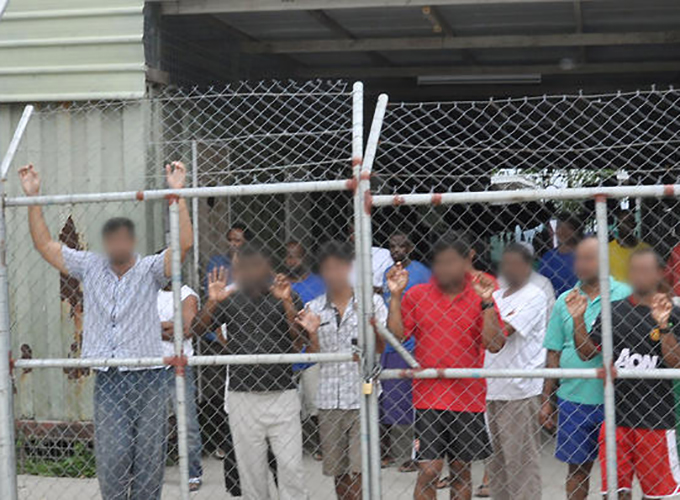
Pulitzer Prize-winning journalist Roy Gutman, author of How We Missed the Story, argued that journalism in conflict zones provides change-makers and hope as an antidote for hopelessness.

“Journalism is one of the few means [that] we, maybe the only means, that I certainly had, or that we have as the general public, to expose horrible practices in the hope that somebody will do something about it. And that’s what journalism is all about.” (p. 21)
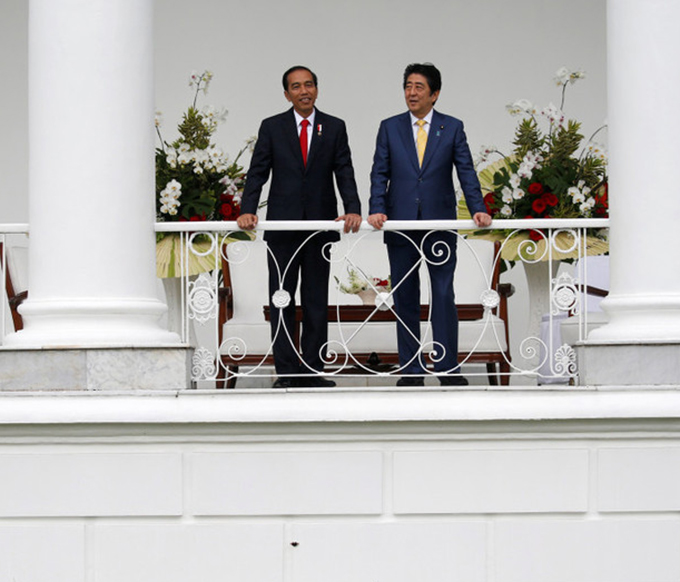
He exposed Serbian concentration camps and ethnic cleansing “killing fields” in Bosnia … and “that story did have impact, and have a wallop”.

It is pleasing to see Jon Stephenson, the only journalist to take on the NZ Defence Force establishment on a matter of truth and integrity – and win, featuring in this book several times.

In one chapter, Stephenson explains how difficult it is, especially as a freelancer with limited resources available, to get to a remote and dangerous conflict zone. His form of independent “embedding”, if it can be called that, is by becoming immersed with ordinary people, not the elites.

On his first trip to Afghanistan, Stephenson flew to India, took a train to the Pakistani border, and then made a long walk across the harsh countryside into Pakistan via Wagah.

“I just walked across the border … from the moment I arrived in Pakistan, I started collecting info on what the locals felt … on buses, and even in a hotel, I’d talk to the hotel clerk and … I met an MP from the Pakistani parliament. He invited me to his home in Islamabad. I interviewed the Saudi ambassador to Pakistan who I met on the roof of the Marriott being interviewed by CNN. And I just started there really and worked my way up.” (p. 110)

Stephenson met the family of Abdul Haq, one of the major resistance leaders during the so-called jihad against the Soviets, and ended up in a family compound in Peshawar with some other journalists.

As well as the analysis, Danger Zone provides some “helpful resources” for journalists. However, while useful, including some key links such as the Dart Centre for Journalism and Trauma, there are notable omissions, such as Reporters Sans Frontières/Reporters Without Borders (RSF), which runs an extensive safety programme for freelance journalists in particular. This is a curious oversight because RSF is mentioned in many citations.

Pacific Media Centre, which has been the most active unit on this issue in New Zealand with a Pacific Media Watch freedom project dating back to 1996, and is associated with RSF is also not listed. This is strange given the fact that Danger Zone originated in Auckland and that the PMC, based at the neighbouring university, has produced several publications on conflict and peace journalism.

There is also no mention of the world’s worst atrocity against journalists, the Ampatuan massacre in the Philippines.

However, these are minor criticisms. Essentially this book is inspirational for a new generation of journalists in a troubled era for journalism and a helpful resource for media school libraries.

It is also encouraging that all the interviewees for this project “expressed compassion and empathy for victims of violence, abuse, and failed institutions, and most were vicariously traumatised as a result”. Ethical journalism is alive and defiant in the face of mounting pressures.

But, warns Dr Armoudian, far more work is needed from scholars, international media law experts, “and journalists themselves”, in developing safer ways to secure vital information for democracies.

Reporting from the Danger Zone: Frontline journalists, their jobs, and an increasingly perilous future, by Maria Armoudian. New York and London: Routledge, 2017. 155pp. ISBN 978-1-138-84005-8

References:
Armoudian, Maria (2011). Kill The Messenger: The media’s role in the fate of the world. New York: Prometheus Books.

Gutman, Roy. (2008). How We Missed the Story: Osama Bin Laden, the Taliban, and the hijacking of Afghanistan. Washington, DC: United States Institute of Peace Press

]]>

Biman Prasad: COP23 presidency — facing the gravity of the task for Fiji

]]>

AsiaPacificReport.nz

The narrative
It is noteworthy that there was no communications or consultations nationally, regionally or internationally as Fiji lobbied to get the presidency for COP23 in Marrakech. Even our fellow members of the Pacific and SIDS (Small Islands Developing States) were caught unaware.

A robust consultation nationally would have helped government appreciate the gravity of the task which Fiji as a nation was committing to, both in terms of the costs of undertaking this and our capacity to do so.

Coming straight after Severe Tropical Cyclone Winston, as many of our citizens are still struggling to get their lives together, a legitimate question is whether this should be really our priority. This has been further exacerbated by the recent revelation of over F$11 million costs because of the recent floods.

Does the government have the resources for accepting such an extravagant international agenda, when nationally it is in dire need of resources to assist with the recent disasters?

The government should be open and reveal details such as the expected costs and arrangements of hosting both the UNFCCC (United Nations Framework Convention on Climate Change) COP23 and the Oceans Conference and the cost of consultants if any. Aren’t these fundamental values; openness, transparency, inclusiveness in the UN ways of doing things?

It is extraordinary that Fiji has opted to take the leadership on two of the most important issues on the international agenda for 2017. The taxpayers of this country have a right to know how much of their money is being spent on these commitments, especially when the wealthier members of the Asia-Pacific group opted not to take on this responsibility.

The PM talked effusively about his “need” to travel the world and host pre-COP meetings. This comes at a significant cost to the nation when the leader of our executive branch takes (not seeks) approval by way of a New Year’s message, to traipse all over the world.

Fundamentally, citizens and taxpayers of this country, must to be consulted extensively on what positions we are taking on many of the vexed issues within the climate change and oceans agenda with a clear view in mind of the benefits to us or in economic terms, the return on investment. After all it is still unclear what tangible benefits we derived from the chairmanship of the G77 and recently the SBI within the UNFCCC.

Now that Fiji has cajoled the UN membership into taking on this huge privilege and responsibility for the COP23 presidency, the National Federation Party will advocate that this critical issue of climate change and environmental leadership is only possible through genuine and meaningful partnership, backed by a strong track record at the national level.

As members of the Opposition, we will strongly advocate for transparency in multilateral environmental negotiations that should, in the first instance, be taken to the people’s house for robust debate and scrutiny

We offer the following observations.

COPs: Unravelling

The ‘technicalese’
It is widely recognised that COP23 will be a “technical” COP where work on the “rule book” for implementing the Paris Agreement will continue. We also know that the technical capacity within government is extremely limited.

Does the Climate Change Unit, now situated in Ministry of Economy have the required expertise to deal with this issue? Perhaps the Prime Minister’s office and the Ministry of Economy should consider where the Climate Change Unit should be based, given the COP23 will be handled by the PM’s office.

It becomes manifestly evident that the move of climate change to the Ministry of Economy is with one objective in mind — to access global climate change funds. If this is the mind-set which is the driver of our engagement at these negotiations, it is a zero sum game.

The much lauded Green Growth framework that was echoed at the PIDF (Pacific Islands Development Forum) and again in the 2016/2017 Budget supplement remains glaringly non-existent at the implementation level. High-level narratives can no longer cut it.

The strength of our participation in our negotiating bloc AOSIS (Alliance of Small Island States), which corralled the world into the acceptance of the 1.5 degree benchmark has been because of the strength and exceptionalism of our technical arguments, driven by our environment ministries and their performance on our reporting obligations.

All of which were based on science and research. It isn’t the cutting edge science alone that won these debates, but rather the ingenuity of our technical specialists in putting forward suggestions that AOSIS members had to work with, based on our limitations.

Over the years, Fiji’s contributions in the negotiations has been almost non-visible as is evident from the lack of communications to UNFCCC Secretariat on matters seeking parties’ views, the dearth of Fiji participants taking the lead on any of the technical issues on behalf of AOSIS (in spite of a delegation size of over 40 — one of the highest from any developing country!) and our abysmal record in terms of fulfilling our reporting obligations under the UNFCCC. The fact that Fiji’s INDC report, supported by off-shore technical assistance reached the UNFCCC late, is telling.

Fiji cannot claim to be impoverished by a lack of intellect on climate change. There are many individuals, civil societies and institutions who are experts on climate change and multilateral environmental fora and who would only be willing to provide assistance, if they are politely requested to.

Indeed, if the mantra of this government on trade is to “Buy Fiijan Made”, this should surely also extend to our local knowledge and expertise that we should be aggressively promoting if we are sincere about COP23 being Fijian made.

That being said, being completely inclusive does not ensure sincerity.

The genesis of the PIDF, another publicly assisted body that is yet to show any tangible benefit at the ground level, was advocated for by certain IGOs. It remains to be seen how taxpayers paying about $100,000 for parking for the PIDF complex a few years ago, has added any real value to our people.

If citizens and taxpayers are subjected to a COP23 presidency that is held up by publicly funded offshore contractors with no obligation or commitment to Fiji, and whose ultimate interests and agendas leave us wide open and vulnerable as a COP president, the zero sum game then becomes riddled with added vulnerabilities that our people then become liable for.

A genuine SIDS presidency by Fiji is possible but it can only be meaningful if we reach out to involve our AOSIS family. It would be important to define the key issues that our COP23 presidency will promote.

This is a great opportunity to bring to the top of the climate agenda the specific issues of small island states. Clearly the identification of these issues should be done through inclusive consultations nationally, sub-regionally, regionally as well as with our fellow members of the AOSIS.

Paris Agreement
The Paris Agreement recognises the participation of the civil society and the private sector as vital to the goal of implementing the Paris agenda. The government needs to reach out to the civil society groups and the business sector in an open, transparent process where these can contribute meaningfully to the process.

Fiji should begin by signing the Doha amendment to the Kyoto Protocol and lobby to have this ratified so tangible actions are taken by countries for the next three to four years before the Paris Agreement comes into effect.

Given the PM’s stated goal to get the industrialised nations to reduce the emissions, and the concerns that the current commitments would lead to nearly 30C temperature rise, actions taken before 2020 will be vital in our attempts to reduce global emissions. The Doha amendment will require these countries to take pre-2020 actions according to the Kyoto Protocol commitments.

These are not new ideas, the whole world is aware of the changes that need to take place, and industrialised nations continue to lag behind.

What will make Fiji’s COP 23 presidency different where decades of international pressure has failed to curb the world’s worrying 3-degree trajectory? These are valid strategic and tactical negotiation aspects that only a sincere and meaningful “Fijian Made” COP23 presidency can unleash.

From the ground up
The greatest strength to any negotiation tactic is to “show not tell”. Around the world, technological innovations are happening at breakneck speed. What seemed impossible, is now possible and many of these great ideas are coming from places least expected.

Inquisitive young minds are encouraged to break the mould and venture into start-ups. All this is possible if policies and incentives are in place to encourage radical innovation.

Imposing reduced tariff’s for electric cars as a policy by the Ministry of Economy is old-school thinking.

Our record on renewables and energy efficiency can be enhanced greatly through use of solar, wind and ocean power, through the use of efficient energy appliances, and proper policies and plans at sectoral levels that should all converge nationally.

However, Fiji’s NDC lacks depth and scope, as it merely talks about the electricity sector (where we are fortunate to have a significant contribution from hydro but contributions of other renewables is less than 1 percent) but fails to consider opportunities in transport (the largest growing sector for emissions), agriculture, forestry, tourism etc. Cabinet has yet to adopt the draft Energy Policy that was developed over two years ago.

Loss and damage, a key negotiation push is being timidly approached nationally.

Conversations with the insurance industry are necessary but there is much in the national policy space that can also be explored so that there is parity in the burden.

Chance for new narrative
Citizens should all actively look forward to detailed announcements on the preparations for the COP23. Questions like which particular ministries or arms of government will be directly involved; who will be the key experts advising Government; meaningful strategies for the participation of NGOs and the private sector; anticipated costs and how Government should raise revenue, should be answered both in public spaces and in the august house.

As always, the NFP stands ready to assist but the record of FijiFirst government on bipartisanship in matters of national importance will prove us right again.

While time ticks on, Mother Nature the final arbiter, is under no obligation to the Qorvis narrative.

Professor Biman Prasad is the leader of the opposition National Federation Party (NFP). This article has been republished from The Fiji Times with the permission of the author.

Fiji to chair next COP23 climate summit

President Bainimarama’s 2017 New Year message – video

]]>

Muslims pledge support for Catholics in new Indonesian blasphemy case

]]>

AsiaPacificReport.nz

Jakarta’s Christian governor Basuki Tjahaja Purnama, center, known by his nickname “Ahok”, is escorted by anti-terror police as he leaves the North Jakarta court in Jakarta on December 20, 2016, to fight allegations of insulting the Quran that could see him jailed under tough blasphemy laws in the world’s largest Muslim-majority country. Image: UCA News

By Ryan Dagur in Jakarta

Muslim activists have joined growing calls for a hardline Muslim cleric to be charged with blasphemy for insulting Christianity.

Rizieq Syihab, leader of hardline group the Islamic Defenders Front, is accused of mocking Christians following a sermon on Christmas Day in which he is reported to have said: “If God gave birth, then who would be the midwife?”

Angry Catholic students filed a blasphemy complaint the next day. The case has won the support of more than 140 lawyers and comes amid Jakarta’s Christian Governor Basuki “Ahok” Purnama blasphemy trial.

At a meeting on January 9 at the Catholic student’s headquarters in Jakarta, Muslim members of the Interfaith Student Forum and Student Peace Institute, declared they also backed the blasphemy accusation against Syihab.

They said his comments not only hurt Christians but also caused division among Muslims.

“As Muslims we deeply regret [Syihab’s comment],” said Slamet Abidin of the Interfaith Student Forum. “He should not have messed with the religious beliefs of others.”

“We are determined to help push this through the legal process,” he said.

Teaching tolerance
Islam teaches tolerance and values. But the cleric’s behavior has damaged the reputation of Islam as a tolerant religion, he added.

Doddy Abdallah of the Student Peace Institute also said ignoring Syihab’s behavior will help foster extremism.

“Radicalism is like a virus, and if not eradicated it will undermine religious life in Indonesia,” he said.

The West Java chapter of the Indonesian Islamic Students Movement (PMII), the youth wing of the Nahdlatul Ulama, the largest Muslim organisation in Indonesia, has also condemned Syihab’s comments, declaring them “against the Indonesian Constitution and state ideology.”

According to Angelo Wake Kako, chairman of the Indonesian Catholic Students Association, said police questioned Syihab after the association filed the case against the cleric in December.

“While we wait for further developments, we will continue to dialogue with many parties [to gather support for our cause],” he said.

Syihab was accused of violating Article 156 section (a) of the Criminal Code on blasphemy, which carries a maximum punishment of five years in prison.

Ryan Dagur is a correspondent of United Catholic Asian News (UCAN).

]]>