Page 1218

Across the Ditch: Headlines + Former Aussie PM Visits + Mortgage Rates + NZ Beats AU in Cricket

Across the Ditch: Australian radio FiveAA.com.au’s Peter Godfrey and EveningReport.nz’s Selwyn Manning deliver their weekly bulletin Across the Ditch. This week: Australia gets 40 degrees-+ temperatures and NZ gets rain! + Former Australia PM John Howard visits New Zealand + NZ Finance Minister warns mortgage interest rates will likely increase + New Zealand beats Australia in the Chappell-Hadlee ODI cricket series. Weather + FX + Headlines ITEM ONE – AU PM Visit Former Australian Prime Minister John Howard is in New Zealand and attended the first sitting of the New Zealand Parliament for 2017. Howard was reluctant to speak to media but sat as a guest in the debating chamber during the Question and Answer session. He is in New Zealand as a key speaker at a Australian High Commission black tie event. ITEM TWO – Mortgage Interest Rates New Zealand’s new Finance Minister Steven Joyce has warned home mortgage holders to be prepared for interest rate increases. He said there were signs the overlooked residential housing market has eased and the rate of house price increases has slowed. But the house price-proportion of mortgage-household income ratios remain on the unaffordable end of the affordability scale. This means if mortgage interest rates climb, many families may find they cannot afford to pay their mortgage payments. Joyce said the Reserve Bank of New Zealand is expected to hold the Official Cash Rate at 1.75% but that the market has factored in that it may actually increase the OCR this year. He said bond rates have increased and interest rates in the USA had increased so home owners should budget for increases this year. ITEM THREE – Cricket Oh Peter, New Zealand won the Chappell-Hadleign one day international Cricket series. The win occurred after heavy rain caused the second of the three match series to be cancelled. The series win has contributed to a successful home summer season with New Zealand having won series against Pakestan, Bangladesh and now Australia. But there’s no time to gloat! The Kiwis now sharpen their focus to take on South Africa.]]>

PNG’s general election faces ‘limbo’ threat over preparations, says Polye

]]>

AsiaPacificReport.nz

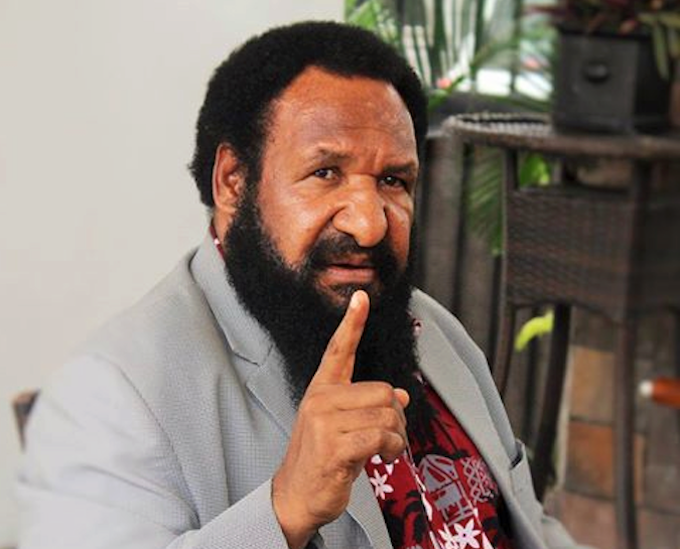
Opposition Leader Don Polye … Common rolls are not completed for the general election, ballot papers have issues. Image: PNG Development

Opposition Leader Don Polye says this year’s general election in Papua New Guinea may be in limbo if the government does not help the Electoral Commission.

Polye said with only five months to go before polling is due to begin in June, the commission did not seem prepared for the most important democratic event to occur.

“The election will be conducted in July, we are in February,” he told a media conference.

“Common rolls are not completed, ballot papers have issues and won’t be printed here in Papua New Guinea.

“The Electoral Commission is not prepared for the election, he said.

“The systems are not in place, the returning officers and polling clerks have not been appointed by the Electoral Commission yet.

“The commission needs money to do so.

“The government must provide funding, have prior plans and proper programmes for the polling booths, appointment of officers and other appropriate officers in preparing the common roll.

“[Electoral Commissioner] Patilias Gamato is doing his best under difficult circumstances and needs support from the government.”

Hypocrisy claimed over inquiry
Polye also accused Prime Minister Peter O’Neill of hypocrisy over corruption, reports PNG Development Forum.

Papua New Guineans were intelligent and they were not gullible, he said.

The Opposition believes that with the election so close, the Commission of Inquiry into the controversial Manumanu military land purchase “will not materialise”.

Polye said the Prime Minister had claimed he had established the commission because of “good governance”.

But O’Neill had not set up commissions in the case of the K3 billion (NZ$1.3 billion) Swiss loan affair, the $195 million (NZ$85 million) Israeli generators issue, the payment of K71.8 million ($30.9 million) to Paraka Lawyers, or the South Pacific Games contracts scandal.

“Were there Commissions of Inquiry for these? These are illegal and poor decisions but there wasn’t any COI?” Polye said.

“The Prime Minister was referred to the leadership tribunal by the Ombudsman Commission? Why did not he step aside?”

]]>

Juffa demands Labour boss step down over work permit allegations

]]>

AsiaPacificReport.nz

By Freddy Mou in Port Moresby

Northern Governor Gary Juffa has called on the Papua New Guinea government to sideline Labour Secretary Mary Morola, claiming she is not fit to run the office.

Juffa alleged that Morola had been sleeping in office and allowing illegal practices over work permits to happen.

The Opposition MP claimed that an officer attached to the department had been illegally issuing work permit to foreigners who have never spoken a word of English.

Juffa said even though English was a prerequisite for the work permit, the named officer continued to issue work permits and receive bribes.

He added that most jobs done by these expatriates, especially Asians, could be done by local people.

“This officer must explain how all expats who cannot speak a word of English have been granted work permits when English is a prerequisite,” he said.

Localised jobs
Juffa said jobs like drivers, shop assistants and security guards were localised jobs and must not be given to expatriates.

He called on the government to look into this issue and deal with it as soon as possible before anything happened to the security of the nation.

Juffa also challenged the Labour Secretary to have a walk into a shop at Gerehu or any suburb in the city and see for herself the influx of expatriates working in the tuckershops.

The governor said he would be filing a police report to investigate the officer involved in issuing work permits to the expatriates.

Freddy Mou is a senior journalist on Loop PNG.

]]>

Colourful, vibrant Aotearoa rally condemns Trump’s ‘racist, Islamophobic’ bans

]]>

AsiaPacificReport.nz

Video and images by the Pacific Media Centre’s Del Abcede. Video: Café Pacific

More than 2000 people have taken part in a colourful and vibrant  “Aotearoa Against Muslim Ban” march in New Zealand’s largest city to condemn the “racist and Islamophobic” immigration bans ordered by US President Trump.

The protest rally was held in Auckland’s Aotea Square yesterday in solidarity with those affected by President Trump’s executive orders to implement a 90-day ban on people from seven Muslim majority countries and 120 day ban on all refugees, with an indefinite ban on Syrian refugees.

The Aotearoa Against Muslim Ban coalition condemned the US bans ordered by Trump.

“These border policies are racist, Islamophobic and unacceptable,” said Mehwish, one of the organisers of the “No Ban, No Wall” protest.

“They continue a pattern of white supremacist immigration exclusion in colonial settler countries like the United States. Bill English refusing to call it for what it is – racist – is a dangerously weak response and doesn’t represent the people of Aotearoa.

“Globally, there is an increase in Islamophobia that marginalises and advocates violence against Muslim communities.

‘Scary step towards facism’
Fahad, another organiser of the protest, said: “Singling out Muslims and people from specific Muslim-majority countries is a scary step towards fascism.”

Another organiser, Nisha, said: “We should not see the executive orders in isolation. Deportations and immigration restrictions have been in place for years.

“Rather than seeing Trump as an exception to the rule, we need to question the political and systematic racism that treats minorities, people of colour and immigrants as the ‘dangerous others’.”

Aotearoa Against Muslim Ban calls for the New Zealand government to increase the refugee quota, oppose and divest from wars in the Middle East, provide adequate resources for migrant and refugee communities and condemn these racist and Islamophobic immigration bans.

Amnesty International in yesterday’s protest. Image: Del Abcede/PMC The antidote for “Fear, Anger,Hate”. Image: Del Abcede/PMC “Be brave”. Image: Del Abcede/PMC “Build bridges, not walls.” Image” Del Abcede/PMC ]]>

Duma, Pok step aside in PNG’s Manumanu defence land probe

]]>

AsiaPacificReport.nz

Heads roll and investigations begin over the Manumanu defence land deal. Video: EMTV

By Gynnie Kero in Port Moresby

Two Papua New Guinea cabinet ministers have stepped aside pending a Commission of Inquiry into the Manumanu defence ministry land deal in Central province.

Public Enterprise and State Investment Minister William Duma and Defence Minister Dr Fabian Pok voluntarily relinquished their portfolios to allow the commission to probe alleged illegal transactions of millions of kina in state funds.

Prime Minister Peter O’Neill announcing the Manumanu land deal inquiry … 2 ministers, 6 government and agency heads implicated. Image: The National

Prime Minister Peter O’Neill yesterday announced the setting up of the inquiry to assess the allegations against senior ministers and senior members of departments.

O’Neill told a media conference that he had recommended the suspensions of the Defence Secretary Vali Asi, Lands and Physical Planning Secretary Luther Sipison, Valuer-General Gabriel Michael, Kumul Consolidated Holdings managing director Garry Hersey, Central Supply and Tenders Board chairman Philip Eludeme and Motor Vehicles Insurance Limited chief executive officer Joe Wemin pending the inquiry’s outcome.

The National Executive Council was expected to meet today to decide on the proposed suspensions.

“As of today (yesterday), I am also announcing that Minister for Defence Fabian Pok and Minister for State Enterprises William Duma will step aside from their ministerial responsibilities pending the conclusion and outcomes of the commission of inquiry,” O’Neill said.

“In the interim, the Ministry for State Enterprises will be taken care of by Charles Abel, Minister for National Planning, and the Ministry for Defence will be taken care of by Mao Zeming, Minister for Fisheries.

‘Best interests’
“It was the intention of the government to do this properly and fairly, and ensure NEC decisions, including the relocation of Murray Barracks and Taurama Barracks, are done in the best interests of the public.

“The people want to know the outcomes of these investigations and they will be given the opportunity to provide information to various investigations – through the Commission of Inquiry, Police Fraud Squad and the Ombudsman Commission.

“It is only proper that these allegations against senior members of the government and the public service, that they be afforded the principles of natural justice and be given the opportunity to answer these allegations.”

Gynnie Kero is a journalist with The National newspaper.

]]>

Vanuatu right to public information law now in force

]]>

AsiaPacificReport.nz

By Jane Joshua in Port Vila

Vanuatu’s Right To Information (RTI) Act has become law after it was published in the official Gazette, less than three months after it was unanimously endorsed by Parliament.

This law gives effect to the right of freedom of expression under paragraph 5 (1) (G) of the Constitution and applies to information held by a government agency or a relevant private entity on or after July 30, 1980.

But access to information, either by individuals or the media, is not free.

The RTI legislation stipulates that the minister responsible will prescribe a fee referred to as the reproduction fee.

This fee is payable by an applicant upon being given a grant of access to information by a government agency, relevant private entity or private entity.

At this stage, no specific reproduction fee has yet been determined but the RTI law has put a threshold of Vt50,000 (about NZ$615) stating, “Reproduction fees charged by a government agency, relevant private entity or private entity must not exceed Vt50,000”.

The Vanuatu Government has been lauded for advancing the historic bill in parliament but this of course, begs the question, will the specific reproduction fees be affordable to the people or is it going to be a financial barrier, making it harder for citizens of the country to access factual Government information?

Reproduction fee
On the positive side, an applicant is not required to pay a reproduction fee when lodging an application or in relation to the time spent by the RTI in searching for the information requested.

An applicant is also not required to pay a reproduction fee for the reproduction of personal information of the applicant, on behalf of another person involved, third party as guardian, deceased party and next of kin, for the reproduction of information which is on the public interest or if the RTI officer fails to comply with the time for responding to an application.

Prime Minister Charlot Salwai, as minister responsible for media, tabled the RTI bill during the 2016 2nd Extraordinary Session of Parliament.

He quoted the five indicators of effective information disclosure as:

  • maximum disclosure,
  • accessibility,
  • affordability,
  • effective implementation, and
  • media and governance Relations.

The prime minister noted that information is power but it needed to be true information, and this legislation would stop hearsay.

‘Free flow’
PM Salwai also reiterated that the government made numerous commitments, both nationally and internationally over the years to improve transparency and accountability to include RTI and this “recognises the importance of providing a free flow of information on government programs and services to MPs, citizens, civil society and development partners”.

Under this law, if an application for information is made, a RTI officer must determine whether or not to grant the application within 30 days of receiving the application.

If an application relates to information that appears to be necessary to safeguard the life or liberty of a person, the RTI should make a determination on the application within 48 hours.

In the event where an application for access to information is denied, the applicant must be notified and the reasons for the refusal stated.

A RTI officer may defer access to information requested if: the information is a report that has been prepared for tabling in Parliament, the information constitutes a report that has been prepared for the purpose of reporting to an official or an official body or if the premature release of the record would be contrary to the public interest.

When considering an application for access to information in relation to personal information of a third party or commercial and confidential information of a third party, a RTI officer must take reasonable steps to inform the third party and state that the application for access to information may be for personal or commercial or confidential and state the name of the applicant.

Today’s Vanuatu Daily Post front page.

No refusal
Nevertheless, a RTI officer must not refuse to communicate information requested if the information is already publicly available but may refuse to indicate whether or not it holds the information requested if to do so would involve a disclosure of the personal information of a third party.

This is applicable to information that is privileged from production in legal proceedings unless the person entitled to the privilege has waived it.

Information is not exempted from access under this Act merely on the basis of it being classified by the government agency, relevant private entity or private entity as confidential or given any other status to that effect.

Within six months from the commencement of this legislation, the minister responsible is required to specify the government agencies that this Act applies to.

]]>

Indonesia stands firm as Freeport mine threatens to cut production

]]>

AsiaPacificReport.nz

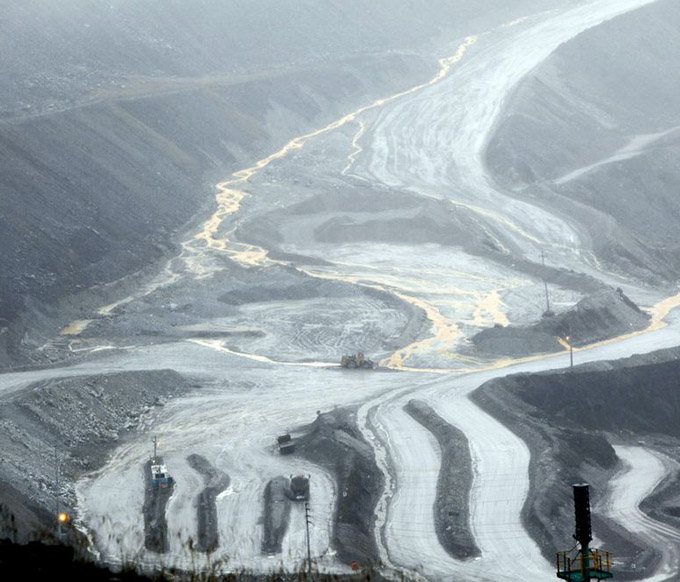
The Grasberg copper and gold mining complex in Indonesia’s Papua province. Image: Dadang Tri/B/JP

The Indonesian government seems set to ignore threats by United States mining giant Freeport-McMoran Inc to cut production at its Papuan copper mine – the world’s second-largest — and slash its local workforce if it does not receive a permit to continue exporting copper concentrates by the middle of the month, the Jakarta Post reports.

While ministers are rushing to revise the regulations so miners that have committed to build smelters can continue to export ore concentrates, an intermediate product used to make copper, there is no guarantee that the deadline will be met.

The rules as they stand now only permit shipments of refined metal after January 11, Bloomberg reported.

Richard Adkerson, chief executive officer of Freeport-McMoRan Inc., the owner of the massive Grasberg mine in Papua province, said he was confident the issue would be resolved.

He told a conference in the US last week that without a resolution the company would have to cut back operations and potentially curb development of the underground mine where it was spending US$1 billion a year.

CRU Group, a consultancy, says the regulations will be changed.

“CRU’s view is that the rules will be revised and Freeport McMoRan will be able to continue to export Grasberg concentrates,” said Christine Meilton, principal consultant, copper supply and raw materials.

Disruption forecast
“Our base case forecast assumes that any disruption does not continue long enough to result in a cutback in production.”

Grasberg is the world’s largest mine in terms of copper capacity after Escondida in Chile, according to the International Copper Study Group.

Freeport says the deposit has the world’s biggest reserves of gold.

Any disruption could support prices of copper, which is the best performer among its peers this quarter, as banks from Goldman Sachs Group Inc. to Citigroup Inc. take a bullish view on the metal next year.

Indonesia is seeking to build a processing industry and prevent its mineral wealth from disappearing overseas.

While the rules allowed time for producers to build smelters, the government said that after three years shipments of semi-processed ores would no longer be permitted.

]]>

Peter S. Kinjap: Only a ‘scrub up’, fresh MPs can save PNG’s future

]]>

AsiaPacificReport.nz

A cartoon about the lack of action in reversing the huge Special Agricultural and Business Leases (SABL) land grab, or to stop illegal logging in SABL areas. Cartoon: PNGExposed

OPINION: By Peter S. Kinjap in Port Moresby.

The current Papua New Guinea government is being accused of being the most corrupt in the short history of Papua New Guinea. It has tampered with the national constitution, bent it, or even created new laws to escape being held responsible and avoided passing tougher legislation to fight corruption.

It’s so sad — a sad scenario for Papua New Guinea indeed.

Before going into the 2012 general election, Prime Minister Peter O’Neill promised the nation that he would curb corruption. He set up the Investigation Task Force Sweep (ITFS) which has done an excellent job exposing and prosecuting corruption.

But why did O’Neill disband it? Why did Police Commissioner Garry Baki put a “vetting” on the high-profile investigations cases that include accusations against O’Neill?

At the 2012 Alotau Accord, the governing coalition partners pledged to table in the Parliament the Anti-money Laundering Legislation, Whistleblowers Legislation, Freedom of Information Legislation and Independent Commission against Corruption Act (ICAC).

But during the People’s National Congress (PNC) reign from 2012 to 2017 with its coalition partners, none of these laws have got passed in the Parliament as promised during the election pledges to fight corruption.

Instead, O’Neill sees fit to legislate a Cyber-Crime Law and even proposing amendments to change election dates and nomination fees.

‘Sitting’ on whistleblowers law
Several times the Opposition have blasted the government for “sitting” on the Whistleblowers Protection Act and not tabling it in Parliament.

Even National Court Justice Martin Ipang spoke of the need for the Whistleblowers Act in the courtroom when ruling on Western Governor Ati Wobiro’s case.

Citizens needed to be protected if they have heard about corruption, or if they seen it, or if they become victim of corruption and want to report this.

Papua New Guinea needs the Whistleblowers Act. This is a very important law for PNG together with the ICAC. But the PNC-led government has failed and fooled the nation.

A new government that will be formed after the 2017 elections must see to ensure these laws are enacted.

People would be asking why time and again “most corrupt” politicians are not exposed and brought to justice.

Here is an answer from one politician with his observation. Samuel Basil, a two-term Bulolo MP says: “PNC’s best bet (if they lose government) is to have another veteran MP’s political party to take reign.

“Why? Because it’s like having partners in crime taking control over once again, or simply put it, it is corruption changing hands.

“If they bring their brothers down they will all go down together, it’s like they all have been closely knitted together.”

Only fresh new MPs without any connections with the current and past regimes can clean this country up — there is no other way.

There has to be a “scrubbing” period. Citizens from all walks of life need to face the judiciary to “clear” anything against them.

Your vote in 2017 means, “save PNG, or destroy it”. Over to you.

]]>

Remember the marginalised, chief justice says on Waitangi Day

]]>

AsiaPacificReport.nz

Kimiora Kaire-Melbourne and Wikitōria Day reporting for Māori Television from Waitangi.

Māori Television’s Rereātea brings you the latest news on New Zealand’s Waitangi Day 2017.

Today Kimiora Kaire-Melbourne and Wikitōria Day take you through the top stories of the day — live from Waitangi.

Watch the livestream bulletins on the Māori Television website throughout the day.

About 1000 of people attended a dawn service at Waitangi, during which political representatives and other leaders were invited to offer words of wisdom and prayers.

Chief Justice Dame Sian Elias prayed for the granting of wisdom to keep to the vision of those who signed the treaty in 1840, Radio New Zealand reports.

She said when celebrating the birthday of the nation it was timely to remember those who are troubled and those who are marginalised in society.

Founding document
The Treaty of Waitangi  — Tiriti o Waitangi — is a treaty signed on 6 February 1840 by colonial representatives of the British Crown and more than Māori chiefs from various iwi (tribes) of New Zealand.

It resulted in the declaration of British sovereignty over New Zealand by Lieutenant Governor William Hobson in May 1840 and is regarded as the founding document of modern New Zealand based on bicultural partnership.

However, Māori believe they only ceded to the Crown a right of governance in return for protection, without giving up their authority to manage their own affairs.

The date is an annual day of reflection and heated debate about nationhood.

Prime Minister Bill English declined to go to Waitangi this year, hosting a breakfast at Orakei marae in Auckland instead.

]]>

Peter S. Kinjap: Only a ‘scrub up’, new MPs can save PNG’s future

]]>

AsiaPacificReport.nz

A cartoon about the lack of action in reversing the huge Special Agricultural and Business Leases (SABL) land grab, or to stop illegal logging in SABL areas. Cartoon: PNGExposed

OPINION: By Peter S. Kinjap in Port Moresby.

The current Papua New Guinea government is being accused of being the most corrupt in the short history of Papua New Guinea. It has tampered with the national constitution, bent it, or even created new laws to escape being held responsible and avoided passing tougher legislation to fight corruption.

It’s so sad — a sad scenario for Papua New Guinea indeed.

Before going into the 2012 general election, Prime Minister Peter O’Neill promised the nation that he would curb corruption. He set up the Investigation Task Force Sweep (ITFS) which has done an excellent job exposing and prosecuting corruption.

But why did O’Neill disband it? Why did Police Commissioner Garry Baki put a “vetting” on the high-profile investigations cases that include accusations against O’Neill?

At the 2012 Alotau Accord, the governing coalition partners pledged to table in the Parliament the Anti-money Laundering Legislation, Whistleblowers Legislation, Freedom of Information Legislation and Independent Commission against Corruption Act (ICAC).

But during the People’s National Congress (PNC) reign from 2012 to 2017 with its coalition partners, none of these laws have got passed in the Parliament as promised during the election pledges to fight corruption.

Instead, O’Neill sees fit to legislate a Cyber-Crime Law and even proposing amendments to change election dates and nomination fees.

‘Sitting’ on whistleblowers law
Several times the Opposition have blasted the government for “sitting” on the Whistleblowers Protection Act and not tabling it in Parliament.

Even National Court Justice Martin Ipang spoke of the need for the Whistleblowers Act in the courtroom when ruling on Western Governor Ati Wobiro’s case.

Citizens needed to be protected if they have heard about corruption, or if they seen it, or if they become victim of corruption and want to report this.

Papua New Guinea needs the Whistleblowers Act. This is a very important law for PNG together with the ICAC. But the PNC-led government has failed and fooled the nation.

A new government that will be formed after the 2017 elections must see to ensure these laws are enacted.

People would be asking why time and again “most corrupt” politicians are not exposed and brought to justice.

Here is an answer from one politician with his observation. Samuel Basil, a two-term Bulolo MP says: “PNC’s best bet (if they lose government) is to have another veteran MP’s political party to take reign.

“Why? Because it’s like having partners in crime taking control over once again, or simply put it, it is corruption changing hands.

“If they bring their brothers down they will all go down together, it’s like they all have been closely knitted together.”

Only fresh new MPs without any connections with the current and past regimes can clean this country up — there is no other way.

There has to be a scrubbing period. Citizens from all walks of life need to face the judiciary to “clear” anything against them.

Your vote in 2017 means, “save PNG, or destroy it”. Over to you.

]]>

Catholic Church blasts Duterte’s war on drugs as ‘reign of terror’

]]>

AsiaPacificReport.nz

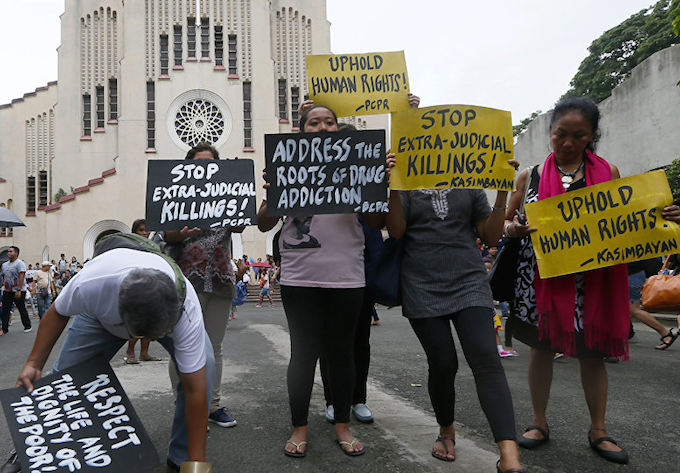
A protest in Manila over the killings in the so-called “war on drug”. Image: Bullit Marquez/Sputnik

The Philippines’ Catholic Church has blasted President Rodrigo Duterte’s “war on drugs” for creating a “reign of terror”.

In its most strongly worded attack yet on the crackdown on drug pushers and users, the powerful Catholic Bishops’ Conference of the Philippines said killing people was not the answer to trafficking of illegal drugs.

The Church said, in a pastoral letter that was read out in sermons yesterday, it was disturbing that many did not care about the bloodshed, or even approved of it.

“An even greater cause of concern is the indifference of many to this kind of wrong. It is considered as normal, and, even worse, something that [according to them] needs to be done,” the bishops said in the letter, a copy of which was obtained by news agencies.

“An additional cause of concern is the reign of terror in many places of the poor. Many are killed not because of drugs. Those who kill them are not brought to account,” they said.

Duterte’s office strikes back
The Malacañang presidential palace has lashed back at the Church for the letter, blaming it for being “apparently out of touch” with the wishes of those who back the changes introduced by Duterte.

“The efforts of these church leaders might be put to better use in practical catechetics that build strong moral character among the faithful, and so contribute more to the reign of peace felt by ordinary citizens everywhere, especially those who are innocent of illegal activities,” Ernesto Abella, presidential spokesman, was quoted as saying by Philippine media.

The Catholic Church, to which more than 80 percent of Filipinos belong, has earned the ire of Duterte after bishops criticised the spate of killings linked to the president’s narcotics crackdown.

More than 7600 people have been killed since Duterte launched his anti-drugs campaign seven months ago, more than 2, in what police say were armed clashes during raids and sting operations.

Both the government and police have strenuously denied that extrajudicial killings have taken place.

]]>

Australia, Indonesia strengthen cyber-security ties but West Papua ignored

]]>

AsiaPacificReport.nz

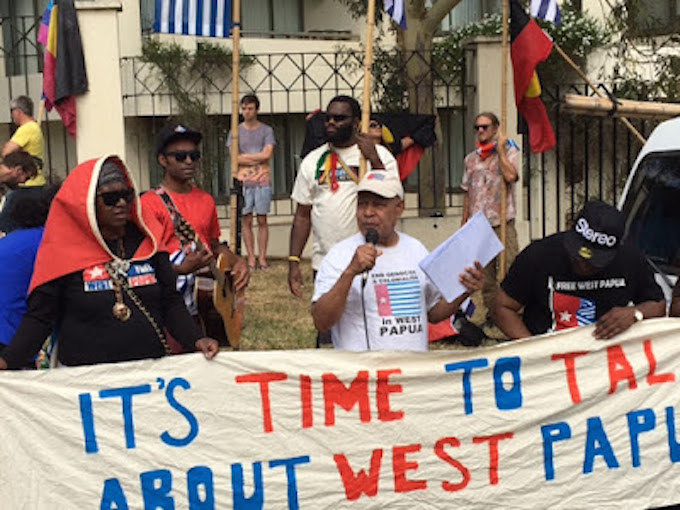
Cyber-security main topic in the Australian, Indonesian consultation … but not “the elephant in the room” – West Papua. Image: AWPA

Australia and Indonesia have agreed to focus on cyber-security in their fight against terrorism and transnational crimes after a meeting in Jakarta but West Papua insecurity as an issue was apparently ignored.

The agreement was reached at the third ministerial council meeting on security and law on Thursday despite the ongoing suspension of military cooperation between the two countries.

Liza Yosephine of The Jakarta Post reports that the meeting highlighted an array of issues related to counterterrorism, such as deradicalisation, cyber intrusion, as well as tracing and stopping those funding terrorism online.

Coordinating Political, Legal and Security Affairs Minister Wiranto, who led the Indonesian delegation, noted that both countries had openly exchanged views on the development of regional security dynamics and the importance of maintaining stability in the region.

“The meeting today [Thursday] was held in an open, constructive and friendly atmosphere, so we expect that it will result in tighter and stronger cooperation in law and security,” Wiranto told a press conference at the conclusion of the meeting.

Australian Attorney-General George Brandis, who led his country’s delegation, said it was the first time cyber security had been included as a topic of the meeting.

Brandis said both countries were working closely together in response to increasing cyber security threats .

He added that cyber security had been the subject of long discussion during the meeting and was the focus of several agreements reached between the two countries.

Concrete measures
Although the topic has been discussed since the inaugural ministerial council meeting in Jakarta in December 2015, concrete measures have only been initiated this year, signifying the growing importance of the matter to both nations.

The Indonesian Foreign Ministry’s East Asia and Pacific director, Edi Yusup, said Indonesia was confirmed to attend a workshop on cyber security in Australia in the coming months.

“The workshop in Australia will be an opportunity to learn how the country develops cyber-security policies and strategies,” he told The Jakarta Post on the sidelines of the meeting, adding that the place and date of the meeting was yet to be determined.

The Australian Transaction Reports and Analysis Center (AUSTRAC) and its Indonesian counterpart centre (PPATK) announced on Wednesday that they would launch a new project later this year to enhance Indonesia’s ability to face the increasing number of online threats, especially those related to detecting and cutting flows of funds related to terrorism and crime.

The cooperation is part of the agencies’ efforts to cut the financial lifelines of terrorism in an agreement signed ahead of the meeting.

Australian Justice Minister Michael Keenan emphasized the importance of continued cooperation between the two agencies, especially on intelligence sharing to monitor financial flows, prevent terrorism and halting the funding of organized crime.

“We will increasingly share the intelligence that we need to tackle illegal money flows,” Keenan said.

Brandis stressed that focusing on the flow of money was one of the most effective ways to combat growing terrorism.

‘Elephant in the room’
Before the meeting, Joe Collins of the Australia West Papua Association declared in a statement that once again “West Papua will be the elephant in the room”.

“As usual we can expect the issues of  counterterrorism, cybersecurity, and maritime security to be on the agenda but no doubt West Papua will be the elephant in the room again,” he said.

“The human rights situation in West Papua should be raised not only at this meeting but raised by Australian officials at all bilateral talks between Australian and Indonesian officials.”

Collins was commenting on a statement from the Australian side in the negotiations saying “Australia and Indonesia share a steadfast commitment to a stable and prosperous Indo‑Pacific region”.

Collins said: “West Papua is the one issue of great concern in our region and Australia should be doing all it can to encourage Jakarta to sit down and dialogue with West Papuan representatives to discuss all the issues of concern they have.

“It is now 54 years since Indonesia took over the administration of West Papua and the courageous West Papuan people  are still marching in the streets risking arrest and torture and calling for their right to self-determination.

“The West Papuan people and their representatives have achieved great victories in the past few years and as support continues to grow for West Papua not only in our region but world wide, Australia and Indonesian must realize that West Papua is truly back on the agenda and won’t be going away,” Collins said.

]]>

Transparency PNG chief condemns sacking of 9 whistleblowers

]]>

AsiaPacificReport.nz

Reports of the sacking of nine civilian staff of Papua New Guinea’s Defence Department should be of concern to all public servants and the general public, says Transparency International PNG.

“The nine staff reportedly spoke out about issues of maladministration, mismanagement and misappropriation within their department,” the corruption monitoring watchdog said in a statement.

“It is concerning to read about any threat, suspension or sacking of people who draw attention to illegality, whether it be real or alleged.

“Witness accounts are powerful tools in exposing corruption, fraud and mismanagement. Raising the alert of authorities when corruption occurs, is an obligation for all public servants.”

Transparency International PNG chairman Lawrence Stephens said: “Whistleblowing plays a crucial role in saving resources and even lives. Improvements will not happen when criticism is punished.”

He adds that employers should provide clear internal reporting channels for workers to safely disclose any wrongdoing.

“Corruption often goes unchallenged when people do not speak out about it and people should not be punished for expressing their opinion in exposing wrongdoing,” Stephens said.

“This highlights the need for the government to enact pending whistleblower provisions under the delayed Independent Commission Against Corruption Bill and protect those that speak out about corruption and ensure that their claims are properly investigated.”

He said the Department of Finance should be commended for its “Phones Against Corruption” initiative, which is an innovative approach to expose and combat corruption using text message system on mobile phone technology.

  • Transparency International PNG provides a community service for the public to report corruption called the Advocacy and Legal Advice Center (ALAC). The ALAC provides free support to victims and witnesses of corruption.
  • “Victims and witnesses of corruption can contact the ALAC on 3202188/82 or email alacpng@gmail.com. All information will be kept confidential.
]]>

Keith Locke: Israel’s anti-nuclear whistleblower more deserving of NZ citizenship

]]>

AsiaPacificReport.nz

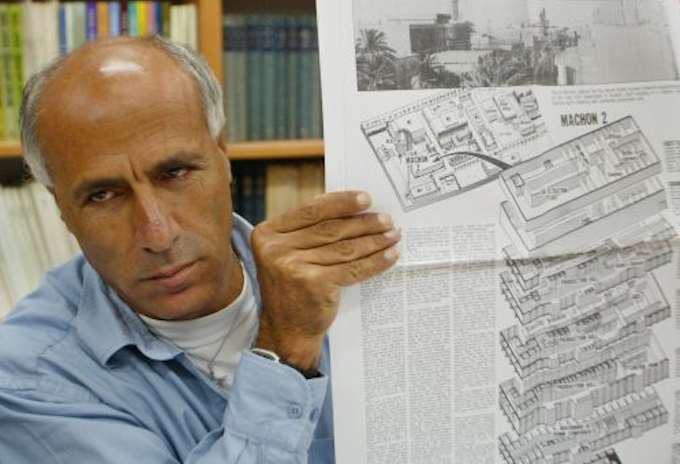
Mordechai Vanunu holding a copy of the London Sunday Times article that landed him in jail, in Jerusalem after his release in 2004. Image: Haaretz

OPINION: By Keith Locke

No self-respecting country sells its passports to rich people who don’t even live there, which is why it was so bad to grant New Zealand citizenship to the American multi-billionaire Peter Thiel.

Section 9 of the Citizenship Act 1977 does allow for citizenship to be granted in “exceptional circumstances” of a “humanitarian” nature, but this hardly applies to the super-rich Theil.

American multi-billionaire Peter Thiel (right) with US President Donald Trump. Image: The Daily Blog

I am familiar with the Act’s “humanitarian” clause because, when an MP,  I used it in trying to get NZ citizenship for Israel’s anti-nuclear whistleblower Mordechai Vanunu  back in 2005.

Vanunu was keen to get New Zealand citizenship so that he could leave Israel, where he was still being persecuted despite being released from jail after serving an 18 year sentence (11 in solitary confinement) for exposing Israel’s nuclear weapons programme.

Vanunu’s post-release conditions included no contact with foreigners and a prohibition on leaving the country.

On 22 March 2005 I sent a letter to the then Foreign Affairs Minister Phil Goff arguing that “it would be very appropriate for New Zealand as a nuclear-free country to grant Mr Vanunu citizenship and give him a New Zealand passport. This humanitarian act would be applauded around the world by those opposed to the Israeli bomb and nuclear proliferation, and who hold Mr Vanunu in high regard for his sacrifice to the anti-nuclear cause.”

Phil Goff, now mayor of Auckland, replied to me that an “offer of New Zealand citizenship to Mr Vanunu is a somewhat empty political gesture when he is prevented from leaving Israel.”

Important ‘political gesture’
My opinion was that it would be both an important “political gesture” and a practical one. Once Vanunu had NZ citizenship he could renounce his Israeli citizenship, as he wanted to do, and there would be greater pressure on Israel to allow him to leave.

At the time, my efforts on Vanunu’s behalf received significant coverage internationally, on the BBC and in Israeli newspapers like Haaretz.

That was in 2005. Twelve years on Vanunu is still subject to restrictions on his movements and associations. On January 27 this year he tweeted that he is returning to the Supreme Court to petition for an end to all restrictions so that he can leave Israel.

There have been efforts in other countries, such as Sweden, Norway and Ireland, to obtain a new citizenship for Vanunu.

In Norway, he has the strongest case because he is now married to a Norwegian university professor, Kristin Joachimsen. But all the efforts on Vanunu’s behalf have so far failed. Western governments fear offending Israel.

Over the years Vanunu has won a pile of international peace and human rights awards, and in 2004 the students at the University of Glasgow elected him to a three-year terms as their Rector.

New Zealand would be honoured to have such a brave anti-nuclear campaigner as a citizen. It would be great if a new approach could be made to the New Zealand government on his behalf.

Granting Vanunu citizenship would also enhance our international reputation, which has been tarnished by the provision of a New Zealand passport to Peter Thiel, just because of his wealth.

Unlike Peter Thiel, Mordechai Vanunu would actually like to live here.

Keith Locke is a commentator on foreign affairs at The Daily Blog and a former New Zealand Green Party MP.

]]>

PNG immigration officials whisk Iranian refugee away from media

]]>

AsiaPacificReport.nz

By Freddy Mou in Port Moresby

The deported Iranian refugee who arrived in Port Moresby today from Fiji, Loghman Sawari, was whisked away by heavy handed immigration officers in a getaway vehicle at Jacksons International Airport this afternoon.

They avoided the media crews who had been waiting there for five hours after the Air Niugini aircraft he was on board landed at 12:10pm.

Loghman Sawari being escorted by police through Nadi International Airport today for a flight deporting him back to Papua New Guinea. Image: Fiji TV One News

Five hours later immigration and police officers whisked him out of the international terminal even before the waiting media could take pictures and do interviews.

The Land Cruiser registration number BEW 987 that took him away was believed to be from the Immigration Department.

The question which remains to be answered is why did immigration officials whisk Sawari away without talking to the waiting media regarding this national issue.

A refugee who had previously been in Manus Island detention centre, Sawari reportedly travelled to Fiji on a PNG passport.

Homeless refugee
Helen Davidson reports in The Guardian
that Sawari was sent to the adult immigration detention centre on Manus Island by the Australian government, despite being an unaccompanied minor at 17 years of age.

He was granted refugee status and released in PNG but was soon homeless in the city of Lae.

He was allegedly assaulted by a guard while in detention.

Last week, Sawari fled PNG to Fiji with false documents, saying he faced persecution in PNG and was not safe.

In a recorded message heard by Guardian Australia, Sawari told a friend in Farsi: “I’m in a plane and they are sending me back. They arrested me and beat me.”

Freddy Mou is a journalist with Loop PNG.

]]>

Vanuatu police chief court case, finance ‘grey list’ pose challenges

]]>

AsiaPacificReport.nz

Vanuatu police on parade on Port Vila … commissioner issue now in court. Image: Vanuatu Daily Post

COMMENT: By Bob Makin in Port Vila

Two big issues for Vanuatu lead today’s news and need quick resolution to restore confidence in the current administration. There are legal and political sides to both controversies.

The first major outstanding issue is that of the appointment of a Police Commissioner.

A previous Police Service Commission decided that Chief Inspector Albert Nalpini was the best man for the job, but then the commissioner in charge was declared illegal.

The commission’s recommendation for Nalpini’s appointment to the top police job was never enacted; the Head of State never received the recommendation.

Nalpini is now asserting his rights in the matter in court.

Governments have over decades changed the top policemen in Vanuatu: so political has been the posting that we have even seen police commissioners become prime minister.

And there have been mutinies and alleged mutinies. It is just as well all the issues are being brought out in this Supreme Court hearing behind which is the bigger question of whether we can manage our security ourselves or whether we need to appoint outsiders to head the police force again – especially those who may have much wider experience.

On national radio, Vanuatu’s presence on the international Finance Action Taskforce (FATF)’s money-laundering and terrorism financing “grey list” heads the news.

The company we keep: a screengrab from the FATF’s website

” data-medium-file=”https://vanuatudaily.files.wordpress.com/2017/02/fatf-screengrab.png?w=300&h=190″ data-large-file=”https://vanuatudaily.files.wordpress.com/2017/02/fatf-screengrab.png?w=590″/>The company Vanuatu keeps: a screengrab from the FATF’s website. Image: Vanuatu Digest

“How grey is our list?” is the question, not just for the broadcasters but also for the people of Vanuatu and foreign investors.

MP Johnny Koanapo, parliamentary secretary for such issues, told Radio Vanuatu midday news that Vanuatu could lose its “light grey” category easily and even find itself again on the black list.

The Asia/Pacific Group on Money Laundering (APG) which assesses countries’ anti-money-laundering regulations, dirty money and counter-terrorism financing met recently in Sydney and Koanapo was present.

Koanapo saw the meeting as “very, very critical for the economy of Vanuatu because of the Vanuatu Finance Centre.”

It appeared to Koanapo that it would be easy for Vanuatu to find itself blacklisted again.

The Prime Minister had directed Vanuatu’s national coordinating committee to meet with all those concerned with the country’s offshore rating and to discuss the issues there.

New legislation is soon to go before Parliament. It is to be hoped this will quickly restore Vanuatu’s financial credibility internationally.

Bob Makin writes on media and current issues regularly for Vanuatu Digest.

]]>

350.org Pacific calls on Suckling to stop ‘slap in face’ support for coal mine

]]>

AsiaPacificReport.nz

Australia’s Patrick Suckling … criticised over his support for the Adani Carmichael coal mine. Image: DPS Srinagar

The climate change advocacy group 350.org Pacific today called on Patrick Suckling, the Australian government’s Ambassador for the Environment, to immediately remove his support for the Adani Carmichael coal mine.

If the Carmichael mine goes ahead, it would be the biggest coal mine in Australia and one of the biggest in the world, the group said in a statement.

The annual emissions from burning the coal it produces would be similar to those of the whole of Malaysia or Austria, and more than New York City, 350.org Pacific said.

“With Fiji playing an important role in the process of implementing the Paris Agreement, the support by Australia for the continued expansion of the fossil fuel industry is a slap in the face of the vulnerable Pacific Islands.

“If the Australian government has seriously recognised the plight of the Pacific in dealing with climate change and rising sea levels, they must look at its complicity in the problem the Pacific is facing,” 350.org Pacific coordinator Koreti Tiumalu said.

“The most effective move the Australian government could take is to immediately say no to the Carmichael coal mine and urgently take the necessary actions required to move away from fossil fuels and transition to renewable energy.

“As the world’s largest coal producer and one of the biggest per capita climate polluters, Australia has a responsibility to act swiftly on climate.

Call for genuine action
“If Australia wants to be good regional neighbors they must demonstrate genuine action and tackle the causes of climate change, by neither allowing new coal mines nor pushing for the construction of new coal power stations.”

In the lead up to COP23, 350 Pacific and the Pacific Climate Warriors will continue to highlight Australia’s “inaction” on climate change and urge Pacific leaders to rally together and call on Australia to end its fossil fuel expansion.

“Our Pacific leaders must remain vigilant for the future of our Islands – they know what is at stake and have in fact called for a global moratorium on coal mines.

“Fiji’s presidency at COP 23 this year will be a chance for the Pacific to emphasise how Australia’s inaction on climate change speaks louder than words,” Tiumalu said.

]]>

Iranian refugee in custody in Fiji, faces deportation back to PNG

]]>

AsiaPacificReport.nz

This photo of Sawari was taken outside the Jacks of Fiji store in Nadi. Image: Behrouz Boochani/Fiji Newswire

Loghman Sawari, the Iranian national seeking asylum in Fiji, was taken into custody today and transported to Nadi International Airport where he faces deportation back to Papua New Guinea.

Sawari was on his way to Suva with his lawyer, Aman Ravindra-Singh, when police stopped them near Sigatoka and took him back to Nadi.

The Iranian national is believed to have entered Fiji on a PNG passport.

Navin Kumar of Newswire Fiji reports that 22 refugees from Middle Eastern countries are currently registered with the Fiji Immigration Department, with four people having been granted asylum by the government.

Deputy Director of Immigration Edward Brown said Fiji was duty-bound to take in refugees as a signatory of the Convention And Protocol Relating to the Status of Refugees under the United Nations Refugee Agency (UNHCR).

]]>

Trump slams ‘dumb’ Obama Pacific refugee deal with Australia

]]>

AsiaPacificReport.nz

Australian Prime Minister Malcolm Turnbull sidesteps questions about his reported tense phone conversation with US President Donald Trump. Turnbull adds that he stands up for the Australian people. Video: Fuzion Indigo

By Cristiano Lima

President Donald Trump has criticised a deal by the Obama administration to take in spurned refugees from Australia, tweeting that he planned to study the “dumb deal”.

“Do you believe it? The Obama Administration agreed to take thousands of illegal immigrants from Australia,” Trump said on Twitter. “Why? I will study this dumb deal!”

The “illegal immigrants” Trump references are predominantly Muslim refugees who are seeking asylum and have been resettled in island camps on the Pacific nations of Nauru and Manus Island in Papua New Guinea.

The Manus Island camp was declared illegal by PNG’s Supreme Court last year.

Former President Barack Obama’s administration agreed to take in an unspecified number of the refugees — which have been variously reported to total from 1600 to 3000 in number — after they were refused by Australia.

The tweet came after Trump reportedly spoke with Australian Prime Minister Malcolm Turnbull over the phone on Saturday.

The Washington Post reported earlier Wednesday that during the conversation Trump described the refugee agreement as “the worst deal ever” and accused Turnbull of seeking to export the “next Boston bombers,” a reference to Tamerlan and Dzhokhar Tsarnaev, the two Kyrgyzstan-born American citizens behind the 2013 Boston Marathon bombings that killed three and injured over 260 people.

The report also claimed Trump abruptly ended their conversation after telling the Australian prime minister that of all the conversations he had had with world leaders that day, “This is the worst call by far.”

In a follow-up by the Associated Press, the prime minister declined to comment on the report.

“It’s better that these things — these conversations — are conducted candidly, frankly, privately,” Turnbull said.

The Australian leader also reiterated that that the relationship between Australia and the U.S. remained “very strong”.

Cristiano Lima is a journalist for Politico Magazine published under the slogan “Powerful journalism – powerful audience”.

]]>

Wadan Narsey: Are there two sets of prosecuting rules in Fiji?

]]>

AsiaPacificReport.nz

ANALYSIS: By Wadan Narsey in Suva

In 2016, two of Fiji’s main media organisations, the privately owned The Fiji Times and state-owned Fiji Broadcasting Corporation, came to public attention, for the wrong reasons — laws regarding ethnic sensibilities in multiracial Fiji.

The international community needs to note that taken together, they call into question the neutrality of Fiji’s prosecuting, regulating and defending institutions.

I make no statement on the neutrality of the judiciary presiding on the case currently — the public can make their own minds up when the judgments are given.

The Fiji Times (Na Lalakai)
On the 27 April 2016, Nai Lalakai (the Fijian vernacular publication owned and published by The Fiji Times) printed an article by one Josaia Waqabaca who pointed out that a petition had been handed to Aiyaz Khaiyum (Fiji’s Attorney-General) to either engage in a “veisorosorovi” (a formal indigenous Fijian reconciliation) with indigenous Fijians or leave Fiji.

The article also alleged:

“The Muslims are not indigenous Fijians. These people are the very ones who have invaded various countries, including Bangladesh in India, and have committed murder there and raped the women and abused their children, until they have come to power, and are now in possession of it.”

The generalisations about Muslims are abhorrent to most decent Fiji citizens and me, while the statement conveniently ignores that some indigenous Fijians are also Muslims.

The Director of Public Prosecutions promptly pressed charges, not just against the article’s author (Waqabaca) and the editor of Nai Lalakai editor (Anare Ravula), but also against the editor of the English language daily, The Fiji Times (Fred Wesley), to whom Ravula reports to, the Fiji Times publisher (Hank Arts) and Fiji Times Limited as well.

The charge was that they made or caused to be published, a statement in the iTaukei language Nai Lalakai newspaper that was likely to incite dislike, hatred or antagonism of the Muslim community.

While the original charges were laid in August 2016 with Magistrate Shageeth Somaratne presiding, the case has dragged on (justice delayed is justice denied?), with the presiding judge being changed at least once.

Opposing the bail variation for Arts
The DPP’s Office has subjected itself to even great public scrutiny through their opposition to a request for a bail variation by publisher Hank Arts.

The State Prosecutor and Deputy DPP (Lee Burney) alleged that the charges against publisher Hank Arts were “serious” and he should not be allowed to travel to New Zealand for two weeks.

No doubt the presiding judge will decide whether the charges against Arts are serious.

But why on earth would the DPP’s Office think that this responsible elderly citizen, who has not a hint of a criminal record, might abscond in New Zealand?

Arts had even offered his two properties in Fiji and his FNPF balance as surety, basically his life savings.

Even more, two prominent Fiji businessmen with unquestionable reputations in Fiji (David Aidney and Jinesh Patel), had also agreed to be Arts’ surety and not travel abroad while he was away.

But not just the previous magistrate, but also the current judge, Justice Thushara Rajasinghe, concluded that these financially massive sureties were not enough to grant the bail variation.

The judge’s judgment cannot be called into question by mere mortals like me.

But the treatment of Hank Arts and Fred Wesley by the DPP’s Office is extraordinary when viewed alongside the contrasting treatment accorded to the CEO of the government-owned Fiji Broadcasting Corporation (FBC) in a comparable situation of the division of responsibility between the producer/editor and the CEO.

Is FBC privileged?
In November 2016, complaints were made by members of the public (Peter Waqavonovono, Seni Nabou and Jope Tarai) against the state-owned Fiji Broadcasting Corporation to the Police, Media Industry Development Authority (MIDA) and the Fiji Human Rights and Anti-Discrimination Commission (FHRADC), about the allegedly racist contents of an FBC programme Wasea Bhasha in which the host Nemani Bainivalu said in the Fijian vernacular words to the effect that Fijian education was lagging because:

* iTaukei did not speak English; some teachers drank grog all night and came to work lazy; if only iTaukei boys concentrated on their studies and not play, they too could reach universities and graduate.

Bainivalu is also supposed to have said that  “many iTaukei boys roam around in the night with their mobile phones, wasting time”  and that  “Indo-Fijian boys and girls do not roam around in the night”.

The complainants claimed that the content was tantamount to “explicit racism” insinuating that iTaukei people are inferior because they fail in universities because they spend more time participating in sports and that iTaukei people are academically poor because they do not know how to read in English.

The Citizens’ Constitutional Forum issued a statement noting that “promoting broad generalised comparisons between Fiji’s major ethnic groups without facts to base them is irresponsible journalism.” The CCF urged MIDA follow on with necessary investigations and recourse.

The Leader of the Opposition in Parliament, Ro Kepa, called on the CEO of FBC to resign and for an investigation to be made.

The Leader of the opposition National Federation Party (NFP), Professor Biman Prasad,  asked if MIDA was being neutral and asked him to resign from one of his two posts so that he could do an effective job.

Government reactions
The Chairman of MIDA and FHRCAD Ashwin Raj stated that that the Wasea Bhasha episode contained generalisations and stereotypes that lacked “accuracy, balance and fairness about social progress of the iTaukei community”.

But he concluded that “the programme failed to meet the threshold for inciting communal discord.. There was no overt call to violence. …  there is no pattern of hostility towards any community…  The journalist has offered a public apology in all of the three major languages admitting negligence on his part as the producer and presenter of the programme.”

Raj determined that the issue would not be referred to the Media Tribunal.

The Director of Public Prosecutions (New Zealander Christopher Pryde) considered laying charges against the Wasea Bhasha producer and presenter (Bainivalu), the chief executive officer (Vimlesh Sagar), and the acting manager (Mohammed Faiyaz Khan).

He concluded: “In order for a charge of inciting communal antagonism to succeed, the broadcast must have been of such a nature and sufficiently egregious to justify the sanction of the criminal law. In other words, the broadcast must do more than simply insult or cause offence to people. .. the item does not reach the necessary threshold for a reasonable prospect of conviction were the matter to go to trial”.

He announced regally “I decline to sanction a prosecution”.

Contrasting the two cases
It is clear that many indigenous Fijians took offence at the ethnic generalisations.

But I might even largely agree with the sentiments expressed by Cristopher Pryde and Ashwin Raj on the content of the sentences being translated by Nemani Bainivalu, Bainivalu’s statements were made as examples in a mere language translation programme, probably based on Nemani Bainivalu’s own personal observations and views. They were not presented as definitive statements by an FBC expert on the issues.

My personal view is that some of Bainivalu’s statements on ethnic behavioural differences are probably correct in general (for example the detrimental effects of not speaking English, drinking grog excessively, playing sports excessively) and can be backed by survey data from the Fiji Bureau of Statistics and Ministry of Education.

One of Bainivalu’s statements is anecdotal (which ethnic community in general roams around more at night) while one is probably incorrect (which ethnic community wastes more time on mobile phones).

But the real issue is not the content of Bainivalu’s translation examples, but the contrasting approaches taken by DPP Pryde and MIDA Chairman Raj to the Fiji Times case, as to who exactly are charged for mistakes made by subordinates.

The approach with FBC
In the FBC case, it is reported that the DPP considered laying charges against the Wasea Bhasha producer and host Nemani Bainivalu (as expected), but only against the acting chief executive officer Vimlesh Sagar and the acting manager Mohammed Faiyaz Khan.

There was no mention of the possible charging of the CEO of FBC, Riyaz Khaiyum or even of the board members of the FBC or the relevant government minister who are ultimately responsible for FBC, just as some Patels are owners of The Fiji Times and are being charged.

Riyaz Khaiyum hedged that it was an “unfortunate choice of words by the producer/presenter that was in total contradiction to the intention and policy of FBC as a responsible national broadcaster”.

When asked if FBC TV has checks and balances in place for the program before it goes on air, Riyaz Sayed-Khaiyum easily passed the buck, alleging that Nemani Bainivalu eventually became responsible for the content of the show, implying that he himself, the CEO or his organization was not in any way responsible.

While the DPP thought that the charges against the FBC were not “egregious” enough (Pryde’s obfuscating version of “outstandingly bad” or “shocking”), the FBC CEO Riyaz Khaiyum thought it bad enough to terminate Bainivalu’s contract.

FBC then ran a slot on TV in English, Fijian and Hindi in which Bainivalu admitted abjectly that he had “acted irresponsibly” and said he had resigned, when he could have also asked “why only me?”

Before you rush to compare it all to Pontius Pilate washing his hands off the matter, remember it was not Pilate but the Jews who  crucified Jesus, whereas here it was Riyaz Khaiyum himself who gave Bainivalu “the boot” rather than taking any responsibility himself.

But more important than futile biblical comparisons, the Fiji public needs to ask why the DPP’s prosecution of the five entities associated with The Fiji Times case was so different when it came to those higher up.

The book is thrown at The Fiji Times
Every Fiji citizen with common sense understands that the language proficiency requirements of vernacular papers means that in practice, it is the vernacular editor who makes the day to day decisions on the content of each issue before it goes to print, just as the FBC CEO alleged for his program producer, Bainivalu, before it went to air.

In practice, neither the English edition editor, nor the publisher nor the owners of the parent publishing company can be reasonably expected to have direct daily roles in the vetting of content in the vernacular, as they cannot reasonably be expected to know the vernacular language enough, just as I doubt if FBC CEO (Riyaz Khaiyum) has any in-depth knowledge of the Fijian vernacular, enough to vet its sophisticated content.

Nevertheless, in The Fiji Times case, the DPP chose to prosecute not only the article author (Waqabaca) and the Nai Lalakai editor (Ravula) but also the English medium editor (Fred Wesley), the English-speaking publisher (Hank Arts) and the (English-speaking) Gujarati owners of The Fiji Times Limited.

Whether the English-speaking publisher Hank Arts and Fiji Times editor Fred Wesley can be held responsible for allegedly racist content in the vernacular newspaper they do not vet in practice, will be decided by the presiding Sri Lankan judge, even if cynics note that it will be under the constitution and media decrees that have been imposed on Fiji without the approval of any Parliament (before any generalisations are made about Sri Lankan judges, note that at least one Sri Lankan judge – in the Soko case- has gone against the political tide).

Note that there was no explicit call for violence in the Nai Lalakai/Fiji Times case either, a fact deemed by Ashwin Raj to be pertinent in not charging FBC’s producer/presenter of Wasea Bhasha.

But the public can legitimately ask, and indeed, if they want a free media in Fiji, it is their deep social responsibility to ask: are there different prosecuting standards for The Fiji Times CEO and for the FBC CEO?

Is the more severe and protracted treatment of The Fiji Times by the DPP’s Office intended to intimidate them further than has already occurred?

The public (and researchers into Fiji media) are reminded that Riyaz Khaiyum is the brother of the Attorney General (Aiyaz Khaiyum) and he not only became the CEO of FBC in “unusual” circumstances after the 2006 military coup, but his editorial policies have arguably favored the Bainimarama Government, while receiving preferential financial assistance from Government, assistance denied to their primary television competitor (Fiji One) or the private radio communication companies like Communications Fiji Limited.

The peculiar roles of Pryde, Raj and Riyaz
Historians of contemporary Fiji will one day put under the microscope all the many individuals (such as Christopher Pryde, Ashwin Raj and Riyaz Khaiyum) who have kept the Bainimarama regime ticking over.

Christopher Pryde appeared in Fiji soon after the 2006 coup and quickly assumed prominent positions in the military state’s apparatus, despite the military government being declared illegal by the 2009 Fiji Court of Appeal, a judgment never reversed.

Six years ago, Ashwin Raj was relatively unemployed or underemployed at the University of the South Pacific until two economics professors (no prizes for guessing who) prevailed upon the USP Vice Chancellor to offer him more substantive work, which he eventually obtained under a belligerent and aspiring Deputy VC of USP managing USP’s STAR project (now apparently gone into a Black Hole).

It was not long before the Bainimarama government discovered that Raj’s gift of the gab requiring the public to futilely buy dictionaries, would be a great asset as Chairman of MIDA.  Indeed, media censorship, intimidation and media funding biases flourished under Ashwin Raj’s benign gaze, while he pounced on any allegedly anti-government statements, such as the so-called “kerosene and water” comment by Ratu Timoci Vesikula at a village meeting.

Then Ashwin Raj was also appointed as the Chairman of the Human Rights and Anti-Discrimination Commission, apparently or conveniently choosing not to recognise the many possible conflicts of interest in the two roles (“power corrupts absolutely”?).

The public might note (if they care) that the websites of both MIDA and the Human Rights and Anti-Discrimination Commission are virtually empty of serious content, probably an accurate reflection of the extent to which Ashwin Raj is fulfilling his responsibilities to the wider Fiji society (although no doubt pleasing the Bainimarama government).

Raj has made no public statement about the curtailment of the basic human right of Hank Arts to travel abroad for two weeks for an important family occasion — the marriage of his stepdaughter — despite his giving more than ample sureties.

Riyaz Khaiyum was once a good journalist and we oldies will remember his penetrating and humorous interview of Prime Minister Rabuka while both were jogging on the Suva Point sea front after the 1987 coup.

One of the sad outcomes of all of Fiji’s military coups is that the smears generated by the coup leaders inevitably sticks to even the well-intentioned citizens who choose to support illegal governments, their laws and their unfair prosecutions (no doubt personal benefits also help).

History may be harsh on coup supporters and accomplices who think that a few “good things” done by the coup makers justify the coups, and their own behavior.  But that is no comfort to those who continue to suffer the ill effects of coups and even more into the future when the huge increase in public debt has to be paid.

Especially when Fiji history proves that such individuals will merely brush off the dirt before they depart, scot-free and with their ill-gotten gains, to their eventual peaceful permanent abodes abroad, which follow rules of law and social behavior that they so readily helped to trash in Fiji.

An even bigger tragedy for indigenous Fijians and their future, is that those that remain in Fiji will be forgiven in “true Fijian tradition” and welcomed back into the fold, without ever fully and honestly revealing,  atoning or being punished for their sins.

While the carrots have always been there for those who have supported coups, there have been no sticks to discourage future coup makers.

The incarceration of George Speight is merely a reminder to sleeping historians to explain why that one jailed sparrow does not represent the caging of summer.

Academic and media commentator Professor Wadan Narsey blogs at Narsey on Fiji – Fighting Censorship and this article is republished here from his blog with permission.

]]>

Trump’s immigration policy has little impact on Indonesia, says Kalla

]]>

AsiaPacificReport.nz

Indonesia, the world’s largest Muslim-majority country, deplores the immigration policy issued by newly inaugurated United States President Donald Trump, says Indonesian Vice-President Jusuf Kalla.

The policy bans citizens of Iraq, Syria, Iran, Sudan, Libya, Somalia and Yemen from entering the United States.

However, Kalla said Indonesia would not issue any statements against the policy at the moment, as it did not have any direct impact on the country.

“The harsh reaction came from US citizens, as it [the policy] threatens their unity and basic values, because Americans are originally immigrants. For us, there is no great effect as we are not included there [among the blacklisted countries] but it can add more suspicions, especially against Muslims,” Kalla said.

The vice-president added that Indonesia would keep its doors open to refugees from any Islamic countries, including facilitating immigrants headed to Australia via the archipelago.

“We are open [in terms of] refugees, where our previous experience was to accept all – be it the Rohingya, or from Afghanistan – we accepted them,” Kalla said.

President Joko “Jokowi” Widodo earlier called on Indonesian citizens residing in the United States to remain calm, as the ban did not affect their presence there.

“We are not affected by the policy. Why should we worry? ” President Joko Widodo said on the sidelines of a work visit to Boyolali district in Central Java on Monday.

Widespread chaos
Trump’s executive order on immigration, issued last Friday, set off a political and legal crisis just a week into his presidency.

The order indefinitely bans Syrian refugees from entering the United States, suspends all admissions of refugees for 120 days, and blocks citizens of the seven listed Muslim-majority countries from entering for 90 days.

The ban caused chaos in the immigration system and at airports in the United States and overseas, which also prompted protests and legal action.

There were several protest rallies over the weekend against the immigration policy in several major US cities, including Washington, Boston and New York.

House of Representatives Commission I lawmaker Sukamta said he deplored the US immigration ban and he urged the Indonesian government to act as a bridge between the Islamic world and the current US government.

Trump’s policy seeks to protect the United States from radical Islamic terrorists and puts a temporary ban on immigrants from seven Muslim-majority countries in the Middle East and North Africa.

]]>

Across the Ditch: Headlines + Earthquakes rock NZ & South Australia + NZ Beat Au in Cricket!

Across the Ditch: Australian radio FiveAA.com.au’s Peter Godfrey and EveningReport.nz’s Selwyn Manning deliver their weekly bulletin Across the Ditch. This week: Weather + Headlines + Earthquakes rock NZ & South Australia + NZ Beat Au in Cricket! ITEM ONE – Elections New Zealand Election Date Set – Prime Minister Bill English has announced a general election will be held on September 23. The announcement followed one day after the Labour and Green parties jointly held a state of the nation address, where they committed to a memorandum of understanding that they would Partner up to change the National-led Government. And throughout this week the PM has been criticised for lacking leadership skills necessary to run the country. The criticisms spread and went viral after English was slow to comment on the US President Donald Trump’s Muslim-ban executive order. Meanwhile, the other smaller parties are juxtapositioning to maximise their chances. And there are a few surprise defections… August 17 – last day of Parliament September 6 – overseas voting starts September 11 – advance voting starts September 23 – general election ITEM TWO – Trans-Tasman Cricket Ouch Peter! We beat you guys in the Cricket this week!!! That’s akin to the Wallabies beating the All Blacks in Rugby. I have to ask you… What went wrong? Australia plays New Zealand in the second of three One Day Internationals at Napier in New Zealand today (Thursday, Feb 2) and plays the final in the Chappell-Hadleigh series on Sunday (February 5).]]>

Fiji authorities unaware as Iranian refugee slips into Nadi

]]>

AsiaPacificReport.nz

This photo of Sawari was taken outside the Jacks of Fiji store in Nadi. Image: Behrouz Boochani/Fiji Newswire

An Iranian national slipped into Fiji using false documents last week and is seeking asylum after being a refugee on Manus Island in Papua New Guinea for more than three years.

Loghman Sawari, 21, fears persecution and fled to Fiji out of fear for his safety.

Sawari is believed to have boarded a plane to Nadi using false documentation using money gathered over time from varied sources.

The Iranian has been taken in by a family in Nadi and has retained the services of lawyer Aman Singh who did not wish to comment due to the sensitive nature of Sawari’s case.

Sawari has been in constant contact with overseas media and has reportedly visited many places in Nadi.

He told Radio New Zealand that he would meet immigration officials on Monday:

“I like Fiji people because they smile and they respect; I don’t know much about Fiji. I don’t know what the government will be saying about me. I don’t want a rich country, or United States or another country. I need just a simple life for myself.”

Manus detention centre illegal
Sawari had told Australian media that he would surrender himself to immigration officials and seek asylum under international conventions.

However, immigration officials were still waiting for Sawari to turn up.

Immigration Director Nemani Vuniwaqa confirmed he would make further comments after meeting Sawari.

Fiji has taken in refugees before and is required to do so under international conventions.

A Supreme Court ruling in Port Moresby in April last year declared the Australian-contracted detention centre on Manus Island illegal.

About 850 male detainees were being held there at the time.

Arrest call by Labour leader
Fiji Labour Party leader Mahendra Chaudhry told The Fiji Times police should arrest Sawari for entering the country illegally and the Immigration Department should review their border security checks at our borders.

“That is the normal procedure because we have to determine for ourselves the real identity of this Loghman Sawari and establish who he really is and how he managed to escape from Papua New Guinea, obtain an air ticket and travel to Fiji,.”

Staff reporter for Fiji Newswire.

]]>

Telecom Vanuatu sold to company with 35% Fiji government ownership

]]>

AsiaPacificReport.nz

An example of a recent TVL promotion. Image: TVL

By Bob Makin in Port Vila

Amalgamated Telecom Holdings Limited of Fiji has announced its purchase of Telecom Vanuatu Ltd.

The deal still needs the approval of the Vanuatu authorities, including the Telecommunication Regulator.

The agreement for the sale was signed by Mauritius Telecom Ltd and MT International Ventures PCC for the purchase of 100 percent of TVL.

ATH’s two largest shareholders are the Fiji National Provident Fund (58 percent) and the Fiji government (35 percent).

ATH owns Fiji’s national telco Telecom Fiji Limited and mobile network Vodafone Fiji, among other businesses.

Bob Makin writes for Vanuatu Daily Digest, which has just been relaunched as Vanuatu Digest, and other media.

]]>

Protester charged with trespassing in Melbourne after Indonesian pressure

]]>

AsiaPacificReport.nz

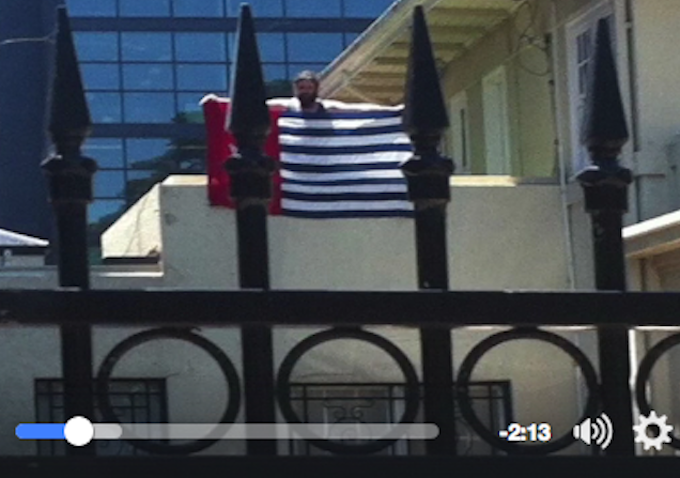
A close-up still from the end of the Facebook video.

A 42-year-old protester has been charged with trespassing on the Indonesian consulate-general in Melbourne after an incident which came at a time of renewed tensions in the bilateral relationship with Australia, reports the Sydney Morning Herald.

The arrest was made three days after Indonesia criticised Australia for not arresting a man who clambered onto the roof of the consulate-general and waved a pro-independence West Papuan flag on January 6.

“The Australian Federal Police can confirm it arrested a 42-year-old man in the Melbourne suburb of Williamstown on Monday, January 30,” the Australian Federal Police said.

The arrest comes just days before Attorney-General George Brandis, Justice Minister Michael Keenan and Minister for Defence Personnel Dan Tehan are scheduled to attend the Ministerial Council on Law and Security in Jakarta, reports the Sydney Morning Herald’s Indonesia-based correspondent Jewel Topsfield.

On January 26, Indonesian Foreign Minister Retno Marsudi said a parliamentary commission had asked the Australian government to legally process the trespassing incident “because we know the faces of perpetrators, we have the pictures”.

The incident featured a demonstrator waving the pro-independence West Papuan “Morning Star” flag, which is banned in Indonesia, while another person filmed the event, reports the Herald.

The video was posted on rapper and West Papua campaigner Izzy Brown’s Facebook page and distributed widely.

]]>

RNZI remains ‘essential voice of the Pacific’, says broadcaster

]]>

AsiaPacificReport.nz

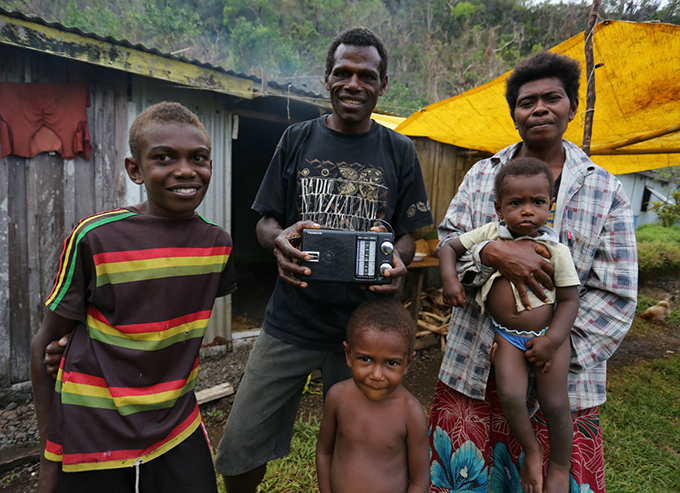
Chief Ben Lovo and his family of Bongkil Village on Erromango, Vanuatu. He says shortwave broadcasts from RNZI during Cyclone Pam allowed him to warn four villages. Image: Koroi Hawkins/RNZI

Radio New Zealand International (RNZI) continues to serve people across the Pacific region, delivering essential day to day news and information and providing a vital lifeline in times of natural disaster, says the public broadcaster.

Chief executive Paul Thompson confirmed that there would be no reduction in Radio New Zealand’s commitment to its Pacific broadcast partners.

His reassurance came as Radio Australia closed its international shortwave transmission service to Papua New Guinea and the Pacific.

Paul Thompson emphasised the importance of RNZI’s 25-year relationship with New Zealand’s Pacific neighbours.

“People in remote parts of Papua New Guinea, Solomon Islands and Vanuatu who may be feeling the loss of the ABC can rest assured RNZI will continue to provide independent, timely and accurate news, information and weather warnings as well as entertainment to its Pacific listeners,” he said.

RNZI has been broadcasting since 1990 to the Pacific and says it is regarded as the “authoritative voice of the Pacific”.

It can be heard across the region and has proven to be a vital lifeline during times of disaster.

Station of the year
In 2007, RNZI was named international Radio Station of the Year by the Association for International Broadcasting (AIB).

RNZI broadcasts timely cyclone and tsunami warnings via shortwave and can continue to be heard should local broadcasters go off-air due to a cyclone or other disaster.

Paul Thompson said the essential nature of Radio New Zealand’s role in the Pacific had been regularly underlined by the positive feedback to RNZI following cyclone and tsunami alerts.

“A Vanuatu villager has told our reporter Koroi Hawkins that he knew to take shelter during Cyclone Pam just because of the warnings broadcast on RNZI. At times like this we are the essential voice of the Pacific,” Thompson said.

RNZI’s coverage of the aftermath of Cyclone Pam in Vanuatu in 2015 won RNZI reporter Koroi Hawkins a silver medal at the prestigious New York Festival Radio Awards in 2016.

RNZI broadcasts in digital and analogue short wave to radio stations and individual listeners across the Pacific region.

About 20 Pacific radio stations relay RNZI material daily, and individual short-wave listeners and internet users across the world tune in directly to RNZI content.

The RNZI signal can sometimes be heard as far away as Japan, North America, the Middle East and Europe. RNZI also provides rich content for online users through our website.

Media release: Following the ABC’s decision to cut shortwave radio transmission in the Pacific, Radio New Zealand International issued the above statement to reassure its listeners that it is committed to its Pacific broadcast partners.

Radio NZ International

]]>

Dan McGarry: Indonesia is slowly, slowly losing Melanesia

]]>

AsiaPacificReport.nz

ANALYSIS: By Dan McGarry in Port Vila

Last month, New Zealand-based analyst Jose Sousa-Santos commented on Twitter that “Indonesia’s attempt at buying support from the Pacific region seems to have little to no impact on Melanesia’s stance on [West] Papua.”

That’s one of those pesky observations that’s neither entirely right nor entirely wrong. The truth is: Indonesia is winning almost every battle… and still losing the fight.

PNG’s Gary Juffa … a “progressive up-and-comer” and outspoken on West Papua. Image: Gary Juffa Instagram

Conventional wisdom used to be that Indonesia had built an impregnable firewall against Melanesian action in support of West Papuan independence.

Its commercial and strategic relationship with Papua New Guinea is such that PNG’s foreign affairs establishment will frankly admit that their support for Indonesia’s territorial claims is axiomatic. Call it realpolitik or call it timidity, but they feel that the West Papuan independence doesn’t even bear contemplating.

Widespread grassroots support and its popularity among progressive up-and-comers such as Gary Juffa don’t seem to matter. As long as Jakarta holds the key to economic and military tranquillity, Port Moresby’s elites are content to toe the Indonesian line.

The situation in Suva is similar. FijiFirst is naturally inclined is toward a more authoritarian approach to governance. And it seems that the military’s dominance of Fiji’s political landscape dovetails nicely with Indonesia’s power dynamic.

Many argue that Fiji’s relationship is largely mercenary. It wouldn’t flourish, they say, if the path to entente weren’t strewn with cash and development assistance. That’s probably true, but we can’t ignore the sincere cordiality between Fiji’s leadership and their Indonesian counterparts.

Same seeds
The same seeds have been planted in Port Vila, but they haven’t take root.

Until recently, Indonesia’s ability to derail consensus in the Melanesian Spearhead Group has ensured that West Papuan independence leaders lacked even a toehold on the international stage. In the absence of international recognition and legitimacy, the Indonesian government was able to impose draconian restrictions on activists both domestically and internationally.

Perhaps the most notorious example was their alleged campaign to silence independence leader Benny Wenda, who fled Indonesia after facing what he claims were politically motivated charges designed to silence him. He was granted political asylum in the United Kingdom, but a subsequent red notice—usually reserved for terrorists and international criminals—made travel impossible.

In mid-2012, following an appeal by human rights organisation Fair Trials, Interpol admitted that Indonesia’s red notice against Wenda was “predominantly political in nature”, and removed it.

Since then, however, activists have accused Indonesia of abusing anti-terrorism mechanisms to curtail Wenda’s travels. A trip to the United States was cancelled at the last moment because American authorities refused to let him board his flight. It was alleged that an Indonesian complaint was the source of this refusal.

Independence supporters claim that Indonesian truculence has also led to Mr Wenda being barred from addressing the New Zealand parliament. His appearance at the Sydney opera house with human rights lawyer Jennifer Robinson received a standing ovation from the 2500 audience members… and an irate protest from Indonesian officials.

Not all of Indonesia’s efforts are overt. Numerous commentators made note of the fact that Vanuatu’s then-foreign minister Sato Kilman visited Jakarta immediately before his 2015 ouster of Prime Minister Joe Natuman.

Lifelong supporter
Natuman, a lifelong supporter of West Papuan independence, was a stalwart backer of membership in the MSG for the United Liberation Movement for West Papua, or ULMWP. He was unseated barely weeks before the Honiara meeting that was to consider the question.

Kilman, along with Indonesian officials, vehemently deny any behind-the-scenes collusion on West Papua.

But even with Vanuatu wavering, something happened at the June 2015 Honiara meeting that surprised everyone. Solomon Islands Prime Minister Manasseh Sogavare stage-managed a diplomatic coup, a master class in Melanesian mediation.

In June 2015, I wrote that the “Solomonic decision by the Melanesian Spearhead Group to cut the baby in half and boost the membership status of both the ULMWP and Indonesia is an example of the Melanesian political mind at work. Valuing collective peace over individual justice, group prosperity over individual advancement, and allowing unabashed self-interest to leaven the sincerity of the entire process, our leaders have placed their stamp on what just might be an indelible historical moment.”

Since then, the sub-regional dynamic has undergone a transformation. Kilman’s administration suffered a collapse of unprecedented proportions following corruption charges against more than half of his government.

The resulting public furore seems—for the moment at least— to have catalysed a backlash against venality and personal interest.

If the rumours are true, and Indonesia did have a hand in Kilman’s palace coup, the tactic hasn’t worked since. A pair of no confidence motions—not very coincidentally on the eve of yet another MSG leaders’ summit—failed even to reach the debate stage.

Kanaky support never wavered
Kanaky’s support for West Papuan independence has never wavered, but given their semi-governmental status, and their staunch socialist platform, Jakarta would be hard pressed to find a lever it could usefully pull.

For his part, Sogavare has survived more than one attempt to topple him. His own party leaders explicitly referenced his leadership on the West Papuan question when they tried to oust him by withdrawing their support.

In a masterful—and probably unlawful—manoeuvre, Sogavare retained his hold on power by getting the other coalition members to endorse him as their leader. His deft handling of the onslaught has raised him in the estimation of many observers of Melanesian politics.

Some claim that his dodging and weaving has placed him in the first rank of Melanesia’s political pantheon.

In Vanuatu as well, once bitten is twice shy. Prime Minister Charlot Salwai raised eyebrows when he not only met with the ULMWP leadership, but accepted the salute of a contingent of freedom fighters in full military regalia.

The meeting took place at the same moment as MSG foreign ministers met to consider rule changes that, if enacted, will almost inevitably result in full membership for the ULMWP.

The MSG has traditionally operated on consensus. If these rule changes pass muster, this will no longer be the case. It is a near certainty that Indonesia will do its utmost to avert this.

Sogavare’s inspired approach
Sogavare has demonstrated an inspired approach to the situation: If the MSG won’t stand for decolonisation in the Pacific, he asks, what is it good for? This rhetoric has become a chorus, with senior politicians in Vanuatu and Kanaky joining in.

Sogavare is, in short, embarked on his own march to Selma. And he is willing to allow the MSG to suffer the slings and arrows of Indonesian opprobrium. He is, in short, willing to allow the MSG to die for their sins.

Whether we agree or not with the independence campaign, there is no denying the genius of Sogavare’s ploy. His willingness to sacrifice the MSG for the cause takes away the one lever that Indonesia had in Melanesia.

His key role in orchestrating an end run around the Pacific Islands Forum’s wilful silence is another trademark move. When human rights concerns were simply glossed over in the communiqué, he and others orchestrated a chorus of calls for attention to the issue in the UN General Assembly.

Manasseh Sogavare and his Pacific allies have found a strategy that is making the advancement of the West Papuan independence movement inexorable. As Ghandi demonstrated in India, as with Dr King’s campaign for civil rights showed again and again, anything less than defeat is a victory.

Without losing a single major battle, Indonesia is—slowly, so slowly—being forced from the board.

Dan McGarry is media director of the Vanuatu Daily Post.

]]>

Amanda Watson: Does PNG rank highly for internet porn searches?

]]>

AsiaPacificReport.nz

By Dr Amanda Watson

In Papua New Guinea, the Post-Courier featured a front-page story with the headline “PNG tops world in ‘porn’ search” on January 17. In previous years, there have also been similar stories asserting that PNG beats all other countries when it comes to internet searches for pornography.

For any nation, this accolade would be unwelcome. As PNG prides itself on being a Christian country with strong traditional cultures and values, coupled with tough laws banning importation of pornographic magazines and movies, the headline has produced consternation.

The PNG Post-Courier front page on January 17.

The ruling political party in PNG has released a statement and the competing newspaper has also published a response. Both reactions argue that the Post-Courier’s front page story is inaccurate.

The front-page article included the assertion that 100 percent of all internet searches in Western Highlands Province are for the term ‘porn’. Clearly, not every internet search in that province includes this term.

So, what is going on? My blog will examine the source of the newspaper story and assess its credibility. It will also discuss internet access trends in PNG.

The source of the media reports is Google Trends. This is an interactive website run by Google, probably the world’s most popular internet search engine, which presents information about the searches that are conducted through Google.

For instance, a user can type in the word “car” and see information about how popular the search term is over time and also where it is popular, comparing regions, countries and cities.

First glance
At first glance, the site appears to suggest that 100 percent of all searches conducted using Google in the United Kingdom feature the word “car”. But this is not possible. There’s no way that all of the people in Wales, Scotland and other parts of the United Kingdom only ever use Google when they want to find out information about different kinds of motor vehicles.

Instead, the way it works is that the figures represent rankings, not percentages. The Post-Courier’s story was misleading in that it included percentage symbols alongside bar graphs. As Google Trends explains: “100 is the location with the most popularity as a fraction of total searches in that location”.

In other words, the United Kingdom had more searches during the time period for the word “car” compared to other countries, as a percentage of the total number of searches, which would also have included many other words, including “weather”, “news”, “school”, “restaurant”, “bank” and more.

Another example is the term “Highlands”. When inserted into Google Trends, bar graphs appear showing 75 for PNG. Again, this does not mean that 75 percent of the Google searches conducted by people in PNG are for this word.

Instead, it means that compared to other countries – where, for example, the term “mountains” might be more commonly used – the term “Highlands” is searched for fairly frequently in PNG.

Now, turning to the term “porn”, when looking at trends over the past five years, PNG is not listed in the top 25 countries. In fact, when the author visited the Google Trends website shortly after the Post-Courier story was published, it proved difficult to replicate the Post-Courier’s results.

I changed the time period to the past 12 months and the results revealed that once again PNG did not feature in the top 25 nations. I generated similar results for other time periods, as is shown in Table 1.

Table 1: Country rankings: Google Trends enquiries on 26 January 2017 using the term ‘porn’

Difficult to check
It’s important to note that the Post-Courier’s findings were not easy to duplicate and that in fact PNG does not feature in the top 25 listing for most time periods. Google Trends results are constantly being updated in real time and therefore it is very difficult to check or verify the Post-Courier’s story.

In addition, the tool only presents the top 25 countries – therefore it is not possible to determine a country’s actual ranking if it does not appear in the top 25.

It’s also helpful to point out that the size of a country’s population does not impact upon the ranking, as the ranking refers to the frequency of use of a word, for instance “porn”, as compared to all other words inserted into Google in that place, including “school”, “highway”, “buai”, “election”, “Highlands”, “Australia”, etc.

In other words, the word “Highlands” is used in PNG more often as a percentage of all searches, compared to the word “mountains”. It’s also worth noting that some users may have blocked their location, meaning that Google cannot tell where they are based, and this would of course make any data regarding locations of searches somewhat inaccurate.

Western Highlanders might also be curious to know how their province rates. While the Post-Courier showed a graph suggesting that the Western Highlands is the province with the most searches for the term “porn” versus other words used, compared to other provinces of PNG, the results are inconsistent.

As is shown in Table 2, Western Highlands Province (WHP) moves around the rankings a great deal, depending on the time period in question. For instance, in the past 7 days, WHP didn’t feature at all in the top ten provinces, whereas it’s in the top position when looking at the last 5 years.

When focusing on other provinces, their positions also move around a great deal. In short, the author feels that the rankings vary so much when comparing provinces in PNG as to be meaningless.

Table 2: Western Highlands Province (WHP): Google Trends enquiries on 26 January 2017 using the term ‘porn’

Note: Google Trends results are only showing for the first four provinces in the “past 30 days” time period, for the first eight provinces in the ‘past 4 hours’ category and for the first five provinces in the “past hour” time period.

Significant improvement
In the last couple of years there has been a significant improvement in the accessibility of the internet in PNG, due to mobile network upgrades and expansions, as well as availability of cheap smartphone handsets.

While most people in PNG still do not have access to electricity, many do now live within mobile network coverage. The majority of this coverage is second generation (2G) which is suitable only for voice calls and text messaging.

But around urban centres, both Digicel and bmobile Vodafone now offer third generation (3G) service, which can be used to surf the internet, correspond through email and use social media platforms such as Facebook and WhatsApp.

In Port Moresby and Lae, Digicel offers 4G service. Telikom PNG is in the process of launching a new, digital mobile phone service which will aim to compete with the other players.

All these changes have meant that a growing number of people in PNG are accessing the internet for the first time. In particular, the number of Facebook users based in PNG continues to rise. Interest in and use of Facebook is fuelled by mobile phone companies offering special promotions through which Facebook use is either free or very cheap.

Nonetheless, many people in PNG still use basic handsets and rarely access the internet, if ever.

In short, this context means that many of the internet users in PNG have only had internet access for a year or two. As people in PNG are among the latest in the world to gain access to the internet, they may be unaware of the range of activities or kinds of searches that they could undertake through this medium.

Alarmist reports not helpful
Publication of alarmist, misleading reports suggesting that online porn consumption is sky-high in PNG is not going to help to strengthen understanding about the medium or how to use it.

Having examined the recent Post-Courier article and the Google Trends website, it’s now clear that the Post-Courier article was incorrect and that PNG does not necessarily rank highly for internet porn searches.

The assertion in the newspaper’s sub-heading that “almost all Papua New Guineans look up the word ‘porn’” is not supported by the evidence. It also seems plain that any comparison of provinces within PNG is unhelpful.

Even if patterns could be determined in the Google Trends material, given limited internet access and use by most people across PNG, it would be unwise to draw conclusions regarding how provinces compare to one another.

Further research will be required to unpack whether Google Trends does convey some useful data. Academic research would also be valuable in order to learn about the internet use of groups of people in PNG.

Amanda H A Watson is a lecturer in Public Policy at the University of Papua New Guinea (UPNG), based in Port Moresby under the UPNG-ANU partnership. She is also a visiting fellow with the State, Society and Governance in Melanesia Program at the Australian National University (ANU). This article was first published on the Development Policy Centre’s blog DevNet and is republished here with permission.

]]>

Pacific ‘cyberbullying’, PNG student protests, ‘free’ media featured in PJR

]]>

AsiaPacificReport.nz

A mini-documentary about 20 years of publication of the research journal Pacific Journalism Review, produced by AUT University screen production and television student Sasya Wreksono to mark the publishing milestone. Video: PMC on YouTube

Student protests at the University of Papua New Guinea that led to police opening fire on a peaceful crowd last year, Australian journalism training in the Solomon Islands, “cyberbullying” in Fiji, independent campus media, and Radio New Zealand International’s reporting of the Pacific are among topics featured in the latest edition of Pacific Journalism Review.

The latest edition of Pacific Journalism Review 22(2).

The journal was published online today on the new Tuwhera research platform at Auckland University of Technology with a special edition on journalism education in the Pacific.

Peer-reviewed papers have been drawn from the Journalism Education and Research Association of Australia (JERAA) and the Pacific Media Centre Preconference and the World Journalism Education Congress (WJEC16) conference at AUT last July.

Thirteen Asia-Pacific educators and journalists were funded to attend the conferences by the recently created NZ Institute for Pacific Research, Asia New Zealand Foundation, Transparency International New Zealand and UNESCO.

The University of Auckland’s Associate Professor Toeolesulusulu Damon Salesa, who opened the JERAA-PMC preconference, says in the editorial journalism is central to the public interest in the Pacific.

Dr Salesa, director of the new institute, says journalism protects culture and especially language. However, a fast-changing world is “making it difficult for journalists to keep up with the scale of some of the issues affecting the Pacific” – such as climate change.

The editorial also features his comments about the challenges to journalism educators.

Edition acting editor Dr Philip Cass writes about Wansolwara, the longest-running journalism school newspaper in the Asia-Pacific region – last year it celebrated 20 years of publishing in Fiji.

Dr Shailendra Singh and Eliki Drugunalevu assess three case studies of cyberbullying against truth-seeking student journalists in Fiji.

Managing editor Professor David Robie, on sabbatical last year, offers an analysis of the transformation of Pacific Scoop into Asia Pacific Report, the campus-based digital publication with the widest reach in the region.

Dr Alexandra Wake reports on her research into Australian post-conflict journalism training initiatives in Solomon Islands while Emily Matasororo reflects on the national university upheaval in Papua New Guinea last year climaxing in police shootings that left at least 23 people wounded.

Dr Matt Mollgaard examines the role of Radio New Zealand International as a source of information and a tool for “soft power” in the region.

Tongan publisher, broadcaster and media freedom campaigner Kalafi Moala’s closing address at WJEC rounds off the Pacific section.

PJR also features a major research report on the state of New Zealand journalism, conducted as part of the Worlds of Journalism Study; a Frontline “journalism as research” report on indigenous collaboration in Western Australia; capstone units; a NZ mayoral celebrity scandal; and covering police corruption in Indonesia.

Other WJEC Asia-Pacific papers will be published in two future editions of PJR later this year.

PJR table of contents

]]>

Indonesia blocks websites circulating #LetWestPapuaVote petition

]]>

AsiaPacificReport.nz

Launch of the Free West Papua Campaigns 2017 global petition calling for an internationally-supervised vote for West Papua at Westminster last week. Video: Pouk Malay

By Badriyanto in Jakarta

Indonesian military (TNI) chief General Gatot Nurmantyo was relaxed in response to news that there is a West Papua people’s petition seeking to separate West Papua from the Unitary State of the Republic of Indonesia (NKRI).

“Everything’s okay with West Papua right. There isn’t any problem,” said Nurmantyo during a hearing with the House of Representative’s Commission I overseeing information and communications, defence and foreign affairs at the parliamentary complex in Jakarta.

Indonesian military (TNI) chief General Gatot Nurmantyo commenting on the petition on West Papua. Image: Okezone.com

Nurmantyo said he was not going to get upset over the various petitions initiated by “criminal” groups because it was a waste of time and energy on matters that were of little substance.

Nurmantyo also said that the Ministry of Communication and Information (Kominfo) had already blocked a number of websites that had been circulating the petition.

“If the petition’s not from an official group then why should we bother about it, it’s tiring right. Who made this [petitions], who makes them, there’s no end to them,” said Nurmantyo.

As already reported, an online petition has been circulating supporting West Papua’s separation from the NKRI.

The petition is targeting 20,000 people and will be taken to Geneva and handed over to the United Nations.

First published by Okezone in Bahasa on January 26. Translated by James Balowski for the Indoleft News Service. The original title of the report was “Tanggapi Masalah OPM, Panglima TNI: Papua Barat Baik-Baik Saja”.

]]>

Daily Digest: Tanna filmmakers respond to exploitation claims

]]>

AsiaPacificReport.nz

Comment from Vanuatu Daily Digest

Knee-jerk resentment of someone else’s success, as elsewhere, is sadly a feature of Vanuatu life, so the kind of comment seen below, prompted by the feature film Tanna‘s global success  — and now Oscar nomination, is not unexpected:

Thanks and good tumas blo save’ but my comments is, I think my people have been exploited and although the film is making its name to the top, how are these custom village people, the film actors, the island and the country been compensated for what they have to go through to produce this film including any protocol in this country? Can some one reply to this comments with some evidence?

Exploitation is a serious claim to make, however, so we are taking this opportunity to set the record straight.

Comment made to Vanuatu Daily Digest claiming exploitation by the filmmakers who made Tanna.

Protecting kastom mo kalja is taken very seriously in Vanuatu. The Vanuatu Cultural Centre — as the commentor may already know — has stringent protocols in place to prevent exploitation of communities.

Filmcrews must get prior approval to work in Vanuatu, are carefully monitored while working in the country, and must give a copy of their unedited footage to the Cultural Centre when they leave.

On Tanna, the Tafea Cultural Centre supervises all cultural protocols.

In the film Tanna‘s case, The filmmakers went a step further – they opened a kastom rod (a relationship built on mutual respect and kastom) between themselves, the chiefs and the community. This connection is arguably a major reason why audiences have responded so well to Tanna – the genuine, heartfelt connection between the filmmakers, the cast and the community is apparent.

Vanuatu Daily Digest reached out to the filmmakers for clarification, and Janita Suter, wife of co-director Bentley Dean and location producer for the film had this to say:

“The film was only possible through the auspices of the Vanuatu Culture Centre at a national and local level, who insist and ensure that all people involved in the productions of films in Vanuatu are dealt with fairly and respectfully — including representation and payment during production (both traditional and financial).

Bentley Dean, Marie Wawa and Mungau Dain filming Tanna in a scene on the brink of Mount Yasur volcano. Image: Tanna

“Beyond this The Vanuatu Culture Centre and community of Yakel are in charge of DVD sales for all of Vanuatu, including how the film is distributed and profits. Our aim is that people should continue to benefit from their cultural output.

“We’re regularly in contact with the community, in fact one was recently staying with us! The film continues to give back to the community and the chiefs have been happy with this arrangement right from the beginning. The chiefs maintain there is a strong kastom road between us.

“It is good to clarify this sort of commentary. There were very deliberate safeguards to ensure no ‘exploitation’ occurred and that the correct ‘monetary compensation’ was made for those involved in the film. This was all arranged through the official relevant Vanuatu institutions described above, as is the correct process for filming in Vanuatu, as well as the traditional chiefs of the villages involved.

“If people have queries on this they can speak with the chiefs of Yakel or Jacob Kapere from the Cultural Centre, or the cultural director of Tanna, JJ Nako (if you can find him!).”

]]>

Police response outside Indonesian Embassy fails to silence Canberra Papua protest

]]>

AsiaPacificReport.nz

Police move in on protesters for West Papua outside the Indonesian Embassy in Canberra, ACT, on Friday. Image: AWPA

About 20 protesters in support of West Papuan self-determination were defiant in the face of Indonesian nationalism “blasted at them from the embassy” and a police response in Canberra at the weekend.

“It is an immature and childish response from the Indonesian embassy,” said Anthony Rumbiak, one of the rally organisers.

The West Papua human rights protest at the Indonesian Embassy in Canberra on Friday. Image: AWPA

With speeches underway, West Papuans and supporters blocked the entrance to the Indonesian Embassy by staging a “massacre” in protest against continuing human rights abuses in West Papua.

Australian police responded immediately to protect Indonesia’s “sensitivity” and to avoid further pressure from their officials who stood among them.

One supporter was arrested and taken into custody for failure to provide a name and address. The activist was refused bail.

The Australian police reaction showed continuous protection of the Indonesian government and bowing to its pressure rather than question their treatment of West Papua’s indigenous people, protest organisers said.

The West Papuan struggle continues to gain momentum at the international level and remains a thorn in the side of the Indonesian state.

“The support for a Free West Papua shall not be silenced in Australia and it’s about time the Indonesian government must engage with West Papua’s legitimate body,” said Lewis Prai Wellip, one of the West Papuan activist leaders who travelled from Melbourne to Canberra.

]]>

AUT to get NZ’s first 100% electric bus in public transport test

]]>

AsiaPacificReport.nz

Two E-buses are to join Auckland Transport’s fleet in a bid to combat climate change. Image: Auckland City Harbour News

The viability of large electric vehicles (EVs) as replacements for current diesel buses is to be tested with a project that will see New Zealand’s first 100 percent electric bus on the country’s roads.

Through the jointly funded project with the Energy Efficiency and Conservation Authority (EECA) and Tranzit Group, Auckland University of Technology (AUT) will add the 38 seat, plus standing, passenger bus to its fleet of shuttles operating between AUT’s three Auckland campuses.

An existing AUT bus for commuting between the inner city campus in Auckland and AUT North (Akoranga) and AUT South (Manukau). Image: AUT

AUT Vice-Chancellor Derek McCormack told AUT News that 2016 being the hottest year on record brought into focus the need to find more ways to address the human contribution to climate change.

“Putting a single electric bus on the road might be a humble step, but it signals AUT’s willingness to embrace technology, and work in partnership to help find solutions to the challenges faced by our city and beyond,” he said.

Discussions about building the bus are underway and it is hoped to have it in service in the first half of this year. It is likely that the chassis and EV components will be built in China and the body will be built in New Zealand.

The project was announced recently by Minister of Energy and Resources Judith Collins as part of EECA’s Low Emissions Vehicle Contestable Fund which aims to help accelerate the uptake of electric vehicles, helping to transform our fleet and reduce carbon emissions from road transport.

The trial will make it possible for AUT and Tranzit to study the battery technology and determine what infrastructure and expertise is required to run a large EV urban bus fleet in New Zealand.

“With significant investment in NZ urban bus fleets occurring, AUT and Tranzit findings will be shared with the transport industry in the hope that the uptake of large EVs in New Zealand is seen as a viable replacement to current diesel buses,” said Tranzit Group’s managing director Paul Snelgrove.

Building and operating the electric-powered bus is in line with several of AUT’s sustainability goals including those that cover demonstrating leadership, research and partnership, and operations.

Auckland City Harbour News reported that two electric buses were set to hit Auckland’s roads in a trial part-funded by the government.

Auckland Transport has been awarded up to $500,000 for the trial and about $300,000 for electric vehicle charging infrastructure.

Funding has also been provided to install 60 electric vehicle charging stations at parking facilities around Auckland.

]]>

What now for the Tongan Democrats looking ahead to 2018?

]]>

Report by David Robie. This article was first published on Café Pacific

‘Atenisi Institute’s Dr Michael Horowitz with two Tongan newspapers — Koe Kele’a and Talaki — at the seminar
at Auckland University of Technology this week. Image: Del Abcede/PMC
By Kendall Hutt of the Pacific Media Centre

THE FUTURE of Tonga’s Democracy Coalition remains uncertain as next year’s election draws closer, a Nuku’alofa-based educator has concluded in a public seminar in Auckland last night.

Dr Michael Horowitz, dean of Tonga’s ‘Atenisi Institute, told the audience at his seminar entitled Can the Democracy Coalition retain power in Tonga? the fate of the party – and with it the election due late next year — was impossible to predict.

This is largely due to the fact no survey research is conducted, continuing Tonga’s “big surprise” election-day tradition, Dr Horowitz said.

Dr Horowitz, also a visiting research scholar with Auckland University of Technology’s Pacific Media Centre, said the Democracy Coalition may just hold on to power despite a bumpy term littered with controversy.

These controversies included a petition in 2015 for Prime Minister ‘Akilisi Pōhiva to surrender his education portfolio over the so-called “raw marks” policy controversy and the “cloudy issue” of state-owned Tongan Broadcasting Commission head of news Viola Ulakai’s suspension over alleged false representation, which prompted questions about Tonga’s media freedom status across the Pacific.

‘Dragging feet’
Pōhiva stepped down as Education Minister last week following months of international condemnation by global media freedom groups, although the pressure was primarily over the educational marks controversy.

Pōhiva’s administration is the first democratic government led by a commoner in Tonga’s history and came to power by a narrow margin in the 2014 election.

Dr Horowitz also highlighted the fact that Pōhiva’s government had failed — like those before it — to address Tonga’s poor economic situation, noting it was “dragging one’s feet to change the situation”.

A host of figures cited from the Ministry of Finance attest to the situation highlighted by Dr Horowitz, revealing much of Tonga’s gross domestic product (GDP) is comprised of remittances from family members living overseas (22 percent to be exact), and foreign donations to the tune of US $116 million in the fiscal year 2015 to 2016, meaning Tonga remained “dependent on the people’s generosity”, Dr Horowitz said.

Sense of some hope’
Dr Horowitz did, however, note the Democracy Coalition’s term had not entirely been clouded by scandals and economic downturn.

“People have a sense of some hope, some improvement.”

The “change of style” introduced by the Democracy Coalition to Tonga’s politics was something the people could still support despite the “hiccups”, Dr Horowitz noted.

Dr Horowitz also speculated that if the Democracy Coalition should fall, he would not be surprised if another prime minister emerged from the ranks of the nobles, although he did contend highly qualified Finance Minister Dr ‘Aisake Eke and Deputy Prime Minister Siaosi Sovaleni could be in the running.

Lecturer and filmmaker Paul Janman, present in the audience and the man behind the popular 2012 education documentary Tongan Ark, shared Dr Horowitz’s views, noting “2018, no one can tell”.

Janman, who also teaches screen production at AUT, reflected following Dr Horowitz’s talk that it had been “quite a revelation”, with much of the information Dr Horowitz shared having been only anticipated by the filmmaker after Tonga’s transition to democracy.

‘Democracy gaining traction’
“It’s been very enlightening to see the latest.”

Janman also said “the idea of democracy that has been aired and advocated for by schools such as ‘Atenisi is gaining traction”, despite persistence by what he described as “reactionary elements” present “in all kinds of different areas”.

A massive question mark looms over the Democracy Coalition’s future and its outcome in the November 2018 election.

Dr Horowitz said “one doesn’t know” how the votes would go.

    • Tonga’s ‘transparency’ prime minister violates media freedom over questions
    • Condemning harassment of Tongan journalist Viola Ulakai
    • Fifita new education minister in Tongan cabinet shake-up
    • Vote of no-confidence a possibility in Tonga
    • Follow developments at Asia Pacific Report

]]>

Indonesia cracks down on brutal conditions on foreign ‘slavery’ fishing boats

]]>

AsiaPacificReport.nz

Former slaves head for home: Thousands of fishermen rescued from brutal conditions on foreign fishing boats make the journey back home, many after years at sea. As reported by Associated Press in September 2015. Video: AP on YouTube

By Jewel Topsfield of The Sydney Morning Herald in Jakarta

It’s hard to comprehend it happened in this century: human slaves trapped on fishing boats being whipped with poisonous stingray tails, having ice blocks thrown at them and being shot.

“If Americans and Europeans are eating this fish, they should remember us,” says Hlaing Min, 30, a runaway slave from Benjina, a remote fisheries weight station in eastern Indonesia’s Aru Islands.

“There must be a mountain of bones under the sea…. The bones of the people could be an island, it’s that many.”

In 2015 more than 1300 foreign fisherman from Myanmar, Cambodia, Thailand, and Laos were rescued from Benjina and Ambon, after an Associated Press investigation revealed the brutal conditions aboard many foreign vessels reflagged to operate in Indonesian waters.

Extraordinary images of men being kept in a cage exposed the chilling reality of 21st century slavery.

“They were trafficked from their home country, mostly by means of deception, forced to work over 20 hours per day on a boat in the middle of the sea, with little to no chance of escape,” says a report on human trafficking in the Indonesian fishing industry released this week.

Some were kept at sea for years at a time.

After the rescue, the International Organisation for Migration interviewed the fishers.

Victims of human trafficking in the fishing industry pictured waiting for their back pay in Ambon, Indonesia. Photo: International Organisation for Migration (IOM)

They were told of excessive work hours — 78 percent of 285 victims interviewed in depth claimed they worked between 16 and 24 hours a day, cramped conditions, meals of watery fish gruel, physical and psychological abuse and even murder.

‘Several crews died’
“While on board, I often heard the news from the boat radio that several boat crews had died, either falling to the ocean, fighting or killed by the other crews,” a Cambodian fisher says in the report.

“While I was working on the boat, I saw with my own eyes more than seven dead bodies floating in the sea.”

A victim of human trafficking from Myanmar who was rescued from a fishing boat pictured in Ambon in Indonesia. Image: IOM

Witnesses testified that requesting to leave the boat could be a death sentence for some victims. Those who did might find themselves chained on the deck in the middle of the day or locked in the freezer.

“The heartrending stories of these fishers could not be left untold,” says IOM Indonesia’s chief of mission Mark Getchell.

The report says the Benjina and Ambon cases highlight the lack of adequate policing of the fishing industry and a lack of scrutiny of working conditions on ships and in fish processing plants.

Seafood caught by modern day slaves entered the global supply chain, with legitimate suppliers of fish “unaware of its provenance and the human toll behind the catch.”

“The situation in Benjina and Ambon is symptomatic of a much broader and insidious trade in people, not only in the Indonesian and Thai fishing industries, but indeed globally,” the report says.

Repatriation of enslaved fisherfmen
In 2015 the Australian government provided $2.17 million to IOM to support the daily care, repatriation and reintegration of formerly trafficked and enslaved fishermen from Myanmar, Cambodia and Laos, who had been stranded on islands in Indonesia’s Maluku province.

“This funding support has since been extended to enable IOM to provide assistance to foreign fishermen stranded in any area of Indonesia,” an Immigration Department spokesman said.

“This assistance plays a crucial role to support and protect victims of trafficking and slavery in the fishing industry by reuniting victims with their families and providing them with limited financial assistance which can help them establish an alternative livelihood.”

IOM spokesman Paul Dillon said Australia provided the lion share of the funding for its emergency response to the human trafficking crisis, which included returning more than 1000 victims to their home countries.

“This would not have been possible without the Australian government,” he said.

At the launch of the report in Jakarta this week, Indonesian Minister of Marine Affairs and Fisheries Susi Pudjiastuti unveiled a new government decree requiring all fisheries companies to submit a detailed human rights audit.

This was one of the report’s key recommendations to protect fishermen and port workers from abuse.

“That being said, Indonesia still has homework towards the approximately 250,000 Indonesian crews on foreign vessels operating across continents that remain unprotected,” Pudjiastuti says in a foreword to the report.

The report also called for greater diligence in recording the movement of vessels in Indonesian waters, more training on human trafficking, independent inspections of ports and vessels at sea and centres in ports where fishers could seek protection.

Jewel Topsfield is the Jakarta-based Indonesia correspondent for The Sydney Morning Herald.This article was first published by the SMH and has been republished by Asia Pacific Report with permission.

]]>

‘Everything can be burnt’ – Melanesian West Papua in the Jokowi era

]]>

AsiaPacificReport.nz

The face of West Papuan society is changing but RNZ International found that the core culture of the indigenous people of Indonesia’s Papua region is not easily destroyed. Video: RNZI

On an island with the third largest rainforest in the world live an indigenous people who are quickly becoming a minority in their own land.

Sitting north of Australia and occupying the western half of the island of New Guinea is West Papua – a territory rich in natural resources which was formally but controversially absorbed into Indonesia in the 1960s following the withdrawal of Dutch colonial administration.

Indonesia’s Papua region: the provinces of West Papua and Papua. Map: RNZI

West Papuans were largely excluded from that decision and for the past 50 years they have raised concerns about the infringement of their basic human rights in modern Indonesia.

Joko Widodo’s government has rejected these concerns saying living standards are improving for people in the Papua region, which appears at odds with the growing number of demonstrations by West Papuans calling for a legitimate self-determination process and an end to rights abuses.

Regardless, Indonesian rule means the face of West Papuan society is changing rapidly, but Radio New Zealand International journalists Johnny Blades and Koroi Hawkins found that the core ideology of these Melanesian people is not easily destroyed.

RNZI’s Johnny Blades and Koroi Hawkins (video camera) interview the elusive Papuan Governor Lukas Enembe in 2015. Photo: Koroi Hawkins/RNZI

Written and produced by: Johnny Blades

Camera: Koroi Hawkins

Editor: Jeremy Brick

This documentary was first broadcast by RNZ International and has been republished here with permission.

]]>

Across the Ditch: Weather + FX + Petrol / litre + Headlines + Why Is Au + NZ Soliciting China’s Entry into the TPP

Across the Ditch: Australian radio FiveAA’s Peter Godfrey and EveningReport.nz’s Selwyn Manning deliver their weekly bulletin. This Week: Weather + Petrol Prices + FX + Headlines Roundup + Indepth Item: Why are Australia and New Zealand soliciting China’s entry into the Trans Pacific Partnership? PLUS: 10 year-old surfer escapes Jaws! Weather + FX + Petrol / litre + Headlines IN DEPTH – ITEM ONE There are signs that considerable effort is occurring behind the public’s gaze to resurrect the Trans Pacific Partnership Agreement after US President Donald Trump formally withdrew the USA from the multilateral agreement this week. Trump added that his administration will advance a preference for bilateral free trade agreements. The comment has rekindled hope within NZ Government circles that a US-Kiwi FTA may yet come to pass. But the day before Malcolm Turnbull commented that the Trans Pacific Partnership may be extended to invite China into the pact, New Zealand’s new Prime Minister Bill English tested the waters suggesting the TPPA may be given some CPR. The question remains, will the Chinese play ball after being ignored by the two US leaning APAC nations (Australia and New Zealand) that both have bilateral FTAs with China and wanted a slice of the USA economic pie. The TPP nations are desperate sellers, and China is in the box seat. It seems Australia’s DFAT and New Zealand’s MFAT have a massive challenge on their hands. ITEM TWO And this Aussie news story is getting some attention over this side of the ditch: NZHerald.co.nz It’s about the ten year old NSW surfer who unknowingly surfed close to the jaws of a Great White. It’s a reminder to us all to be really vigilant while out on the water this summer. Any shark tales Peter?]]>

Tonga’s Democracy Coalition faces uncertain future, says academic

]]>
AsiaPacificReport.nz

‘Atenisi Institute’s Dr Michael Horowitz with two Tongan newspapers — Koe Kele’a and Talaki — at last night’s seminar at Auckland University of Technology. Image: Del Abcede/PMC

By Kendall Hutt

The future of Tonga’s Democracy Coalition remains uncertain as next year’s election looms, a Nuku’alofa-based educator has concluded in a public seminar in Auckland last night.

Dr Michael Horowitz, academic dean of Tonga’s ‘Atenisi Institute, told the audience at his seminar titled Can the Democracy Coalition retain power in Tonga? the fate of the party – and with it the election due next year — was impossible to predict.

This is largely due to the fact no survey research is conducted, continuing Tonga’s “big surprise” election-day tradition, Dr Horowitz said.

Dr Horowitz, also a visiting research scholar with Auckland University of Technology’s Pacific Media Centre, said the Democracy Coalition may just hold on to power despite a “bumpy term littered with scandals”.

These scandals included a demand late in 2015 for Prime Minister ‘Akilisi Pōhiva to surrender his education portfolio over the so-called “raw marks” policy controversy and the “cloudy issue” of state-owned Tongan Broadcasting Commission head of news Viola Ulakai’s suspension over alleged false representation, which prompted questions about Tonga’s media freedom status across the Pacific.

Tonga’s suspended state broadcasting news head Viola Ulakai … too questioning. Image: Kalafi Moala

‘Dragging feet’
Pōhiva stepped down as Education Minister last week following months of international condemnation by global media freedom groups.

Pōhiva’s administration is the first democratic government led by a commoner in Tonga’s history and came to power by a narrow margin in the 2014 election.

Dr Horowitz also highlighted the fact that Pōhiva’s government had failed — like those before it — to address Tonga’s poor economic situation, noting it was “dragging one’s feet to change the situation”.

A host of figures cited from the Ministry of Finance attest to the situation highlighted by Dr Horowitz, revealing much of Tonga’s gross domestic product (GDP) is comprised of remittances from family members living overseas (22 percent to be exact), and foreign donations to the tune of US $116 million in the fiscal year 2015 to 2016, meaning Tonga remained “dependent on the people’s generosity”, Dr Horowitz said.

‘Sense of some hope’
Dr Horowitz did, however, note the Democracy Coalition’s term had not entirely been clouded by scandals and economic downturn.

“People have a sense of some hope, some improvement.”

The “change of style” introduced by the Democracy Coalition to Tonga’s politics was something the people could still support despite the “hiccups”, Dr Horowitz noted.

Dr Horowitz also speculated that if the Democracy Coalition should fall, he would not be surprised if another prime minister emerged from the ranks of the nobles, although he did contend highly qualified Finance Minister Dr ‘Aisake Eke and Deputy Prime Minister Siaosi Sovaleni could be in the running.

Lecturer and filmmaker Paul Janman, present in the audience and the man behind the popular 2012 education documentary Tongan Ark, shared Dr Horowitz’s views, noting “2018, no one can tell”.

Janman, who also teaches screen production at AUT, reflected following Dr Horowitz’s talk that it had been “quite a revelation”, with much of the information Dr Horowitz shared having been only anticipated by the filmmaker after Tonga’s transition to democracy.

‘Democracy gaining traction’
“It’s been very enlightening to see the latest.”

Janman also said “the idea of democracy that has been aired and advocated for by schools such as ‘Atenisi is gaining traction”, despite persistence by what he described as “reactionary elements” present “in all kinds of different areas”.

A massive question mark looms over the Democracy Coalition’s future and its outcome in the 2018 election.

Dr Horowitz said “one doesn’t know” how the votes would go.

Dr Michael Horowitz with filmmaker Paul Janman, who made the documentary Tongan Ark about ‘Atenisi Institute. Image: Del Abcede/PMC Part of the audience at the seminar on Tonga politics and communication at Auckland University of Technology last night. Image: Del Abcede/PMC Pacific Media Centre advisory board chair Associate Professor Camille Nakhid opening the seminar. Centre director Professor David Robie is in the background and former Green Party foreign affairs spokesperson Keith Locke is on the left. Image: Del Abcede/PMC Senior lecturer Dr Frances Nelson (from left) and lecturer Janet Tupou at the seminar tonight. Image: Del Abcede/PMC
]]>

Vanuatu government hopes new laws will save it on global finance ‘grey list’

]]>

AsiaPacificReport.nz

Will legislation passed last year be sufficient to remove Vanuatu’s financial sector from international grey listing? Image: Vanuatu Daily Digest

By Bob Makin in Port Vila

The Vanuatu government’s Anti-Money Laundering and Counter Terrorism Committee is confident that the submission of some 31 Bills to Parliament last year should improve Vanuatu’s position on the international reviewers’ “grey list”.

Some three major review groups are involved. The legislative requirements were made on time.

Vanuatu was congratulated by the international examiners during a recent review of Vanuatu’s progress, the Daily Post reports.

The government intends to introduce a Transport Infrastructure Maintenance Fund, reports Radio Vanuatu. The Ministry of Infrastructure and Public Utilities has been meeting with stakeholders in the transport industry from the road, maritime and aviation sectors. The roles and objectives of the fund have been explained to the stakeholders, but not, it would seem, with the media.

The question raised in yesterday’s Daily Post about who is funding the planned luxury Bauerfield air terminal seems to be answered. The MG Group Hotel project from Hong Kong, involved with government and CCECC in airport discussions and agreements, is the backer. And this despite their plans to steal the view of a Ni-Vanuatu hotelier with a magnificent 3-storey view on a hilltop overlooking Daily Post.

MG’s harbour views will block those of Vila Rose Hotel just as it is starting in business.

Japanese tourists will begin arriving in Port Vila in April, on flights from Tokyo’s Narita airport via Port Moresby, PNG. Air Niugini is arranging the flights. A special night trip to Tanna has sold out already.

Mismanagement claimed
Radio Vanuatu reports the Opposition is claiming mismanagement of the Seaside Sanitation Project to assist the Seaside Paama, Tongoa and Futuna communities. The Opposition claims it has received many complaints concerning the quality of the local work. MIPU has dismissed all of the allegations saying the tender is being properly managed. A supervisory committee continues at work.

The Agriculture Department will be offering planting material, especially many varieties of manioc and kumala, tomorrow at Tagabe Ag Station in an effort to improve access to local and more nutritious  kaikai. Farmers and the general public will be able to meet together and discuss garden issues along with food production and security. There is a day-long programme starting at 7:30am.

The Media Association of Vanuatu is planning to become a full member of the International Federation of Journalists. Until now MAV has only been an associate member.

Re-elected MAV president Evelyne Toa saw the move as able to assist local journalists as regards their rights and freedoms.

Bob Makin writes for the Vanuatu Daily Digest

]]>