Page 1217

Indonesian activists seek Appeal Court ruling on Munir murder files case

]]>

AsiaPacificReport.nz

Human rights defender Munir Said Thalib … long-unsolved murder. Image: Sigid Kurniawan/Antara

By Alin Almanar in Jakarta

Activists will soon file an appeal with Indonesia’s Supreme Court against a ruling that overturned the state information body’s order to declassify the documents on the long-unsolved murder of prominent human rights defender Munir Said Thalib.

The State Secretariat, which is believed to be in possession of the files, has not obeyed the Public Information Commission’s command to make them public in October.

The Jakarta State Administrative Court overturned the commission’s order last Thursday.

According to human rights activists, the verdict legalises state crime.

“The verdict confirms that the state, through its various instruments, keeps on covering Munir’s case. We will file an appeal,” Munir’s wife Suciwati told the press in Jakarta at the weekend.

“The ruling has been surrounded by irregularities; the panel of judges did not examine the case openly, but only invited related parties to the verdict reading,” she added.

-Advertisement-

Thursday’s ruling has angered human rights activists, who have already been upset by the State Secretariat’s claim that it does not know the whereabouts of the files.

Fact-finding team
The secretariat is tasked with providing administrative assistance to the president. Activists insist that the case files were submitted by a fact-finding team to former President Susilo Bambang Yudhoyono in June 2005.

Munir was poisoned with arsenic during a layover in Singapore in 2004 before boarding a flight to Amsterdam.

Former pilot Pollycarpus Budihari Priyanto was sentenced to 14 years in prison for premeditated murder, however, the masterminds behind the murder remain unknown.

The results of the fact-finding team’s investigation have never been made public.

Alin Almanar is a journalist with the Jakarta Globe.

]]>

Watching our words: Perceptions of self-censorship and media freedom in Fiji

]]>

Pacific Media Centre

Ricardo Morris, a journalist and Thomson Reuters fellow from Fiji, has studied the perceptions and practice of self-censorship among journalists from his country in the years following the military coup in December 2006. He focused particularly on the period after the 2014 general election that returned Fiji to democratic rule. In his research paper, Morris examines how willing Fiji’s media workers are to self-censor, how self-censorship works in newsrooms, and what factors are influential on journalists’ work. Here’s how Morris describes his research:

The results from my survey showed a slight leaning toward self-censorship, although generally it bordered on neutrality. However, this contrasted with the responses to follow-up questions where respondents explained how self-censorship took place in various newsrooms.

It would appear that while in practice self-censorship does occur regularly, journalists in Fiji would in theory prefer it does not happen or actually believe that it does not occur. The results could also mean that even if journalists do not self-censor, editorial processes and decision-making result in self-censorship manifesting in other ways and at other levels.

Perhaps an unavoidable outcome of Fiji’s draconian media law is the normalising of self-censorship among its journalists.

When asked about their role perceptions, Fiji’s journalists without fail indicate factors such as fairness and balance, independence and fearlessness, but the perception and the practice appear to be disconnected.

Media capture’ is well and truly embedded in many sectors of the media, and it will take time, attitudinal change and legal amendments to undo this.

Despite this, journalists still hang on to some veneer of their detached watchdog role while forging a media model that accords with the mood of the times: nation-building, ethnic harmony and development ideals.

Morris, R. (2015). Fiji media regulation: Emerging from the ‘worst of times’ to the ‘best of times’. Pacific Journalism Review, 21(1), 34-39.

Morris, R. (2016). ‘Journalism of hope’ realities in post-coup Fiji. Pacific Journalism Review, 22(1), 25-37.

]]>

PM Salwai praises leaders who ‘broke horizon’ for Vanuatu independence

]]>

AsiaPacificReport.nz

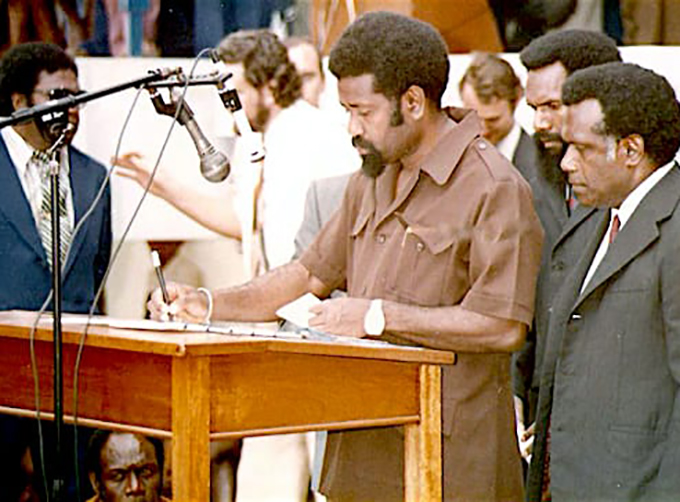
FLASHBACK: Founding Prime Minister Father Walter Lini signs the Vanuatu Constitution on 30 July 1980. Image: Vanuatu Digest

By Bob Makin in Port Vila

Prime Minister Charlot Salwai paid a moving tribute to the late Father Walter Lini’s leadership of Vanuatu at the Anglican Church, Tagabe, today.

The anniversary memorial service was also attended by the Head of State, President Baldwin Lonsdale, and other community leaders.

Prime Minister Salwai had just returned from the home island, Pentecost, he shared with the country’s first Prime Minister. He regretted that there was no national body in place to determine how the Vanuatu people should keep such anniversaries as Lini Day and Constitution Day.

He vowed that government must see such an institution created.

Lini Day would be the day to mark leadership, Salwai said.

The Prime Minister expressed his gratitude to the Anglican Church for organising the service of worship in the company of Mary Lini and other members of the Lini family.

-Advertisement-

Father Walter Lini’s breaking through a particular horizon was Prime Minister Salwai’s main theme.

“This action guaranteed independence and the freedom we hold good today,” Salwai said.

‘Stand up strong’
“We must stand up strong to continue to maintain our independence into the future as this is what we want.”

Prime Minister Charlot Salwai saw it as equally important to pay tribute to the others who also “broke the horizon” to achieve Vanuatu’s independence and those who had carried the ideals of independence forward until today.

Salwai spoke of an issue still to be resolved – that of Vanuatu’s borders.

The border with Solomon Islands was resolved last year, but still remaining to be settled were the frontiers with Fiji and New Caledonia.

“They are still part of the struggle for independence which must be completed,” Salwai said.

  • Father Walter Lini wrote the forward to PMC director David Robie’s book Eyes of Fire.
]]>

Scaring the menz, taming the wimmin

]]>

Social and economic (in) justice II (click here for part one of this series) Part One on social and economic justice, ended with this: Such unequal access to power occurs throughout our society: in institutional and political policies, economic arrangements, and social practices (such as those described as part of rape culture). The whole system, and social attitudes that support it, needs changing from the bottom up. This system damages the lives and well-being of many people, including many women, people of colour, LGBTI people, and those on low incomes. In this unequal power system, social and economic (in)justices are frequently intertwined. There is an urgent need at the moment to decrease economic inequalities, to provide everyone with a living income, plus affordable, safe and secure housing. Social injustices are embedded within these economic injustices. In the course of her long participation in political and social justice campaigns and movements, Angela Davis was seen as a notorious enemy of the US state. She was charged with “aggravated kidnapping and first degree murder”, imprisoned for a period, but eventually acquitted. https://www.youtube.com/watch?v=8sLIDscuc-M She’s also a respected academic and writer. Davis is no namby-pamby chardonnay feminist, whining because some man slighted her at a corporate board meeting (as anti-identity politics stereotyping would have it). Davis was a leader of the Communist Party of the US in the 1960s, supporter of the Black Power Movement, and continues to be a very vocal campaigner against the prison-industrial complex. She argues for a complete change of society, not just for a contained shift towards equal rights before the law, as she describes the civil rights movement. In a 2014 interview Davis said: At the time of its [Black Feminism’s] emergence, black women were frequently asked to choose whether the black movement or the women’s movement was most important. This was the wrong question. … We are still faced with the challenge of understanding the complex ways that race, class, gender, sexuality, nation and ability are intertwined—but also how we move beyond these categories to understand the interrelationships of ideas and processes that seem to be separate and unrelated. In a more recent article on Black Lives Matter, Davis said:

I was once asked to finish the statement, “My feminism is…” It didn’t take me long to come up with an answer. I’m a gay, black woman. My feminism is intersectional. … experiences in life are shaped by the intersection of class, race, gender, sexual orientation and identity.
The public face of feminism tends to focus on extremes: it includes those who want to convince harsh opponents, while working to increase equal opportunities within the current system; and also includes those who, like Angela Davis, are very outspoken, may seem shockingly radical, and to many may appear to be jarringly, in-your-face and uncompromising. Others, in an attempt to convince people potentially antagonistic to change, may become tame, and non-threatening. Consequently they are in danger of becoming neutralised and contained within the patriarchal capitalist system. This poses a dilemma on the most effective way forward. Some women who support social justice campaigns, don’t like the “feminist” label because, as mentioned by Davis, it is seen as white women’s thing. Annette Sykes, for instance, talks about wahine toa and mana wahine: Since the election of president Trump, debates about social justice issues have intensified among progressive or left wing people in NZ. Many of us have been attacked online for promoting “identity politics”, and often dismissed as authoritarian “identitarians”. We are told to back off and focus solely on economic injustices. We are told by some we are damaging and splitting the left, even as they try to split the core matters of the left (economic and social justice) into two unequal parts. Like Catriona MacLennan, I don’t like the term “identity politics”. Too often it is used as a stick to attack those who speak out on social justice issues, as for instance often happens to those who are critical of our society’s all pervasive rape culture. Masculine and corporate dominated, capitalist culture is damaging to life, social networks, and ultimately the economy. Others have produce in-depth, well-sourced, evidence-based arguments for a left politics on this topic. See for instance the 2014 article “Economic Inequality or Social Justice for Everybody?” by Victor Baez and Yasmin Fahimi. Many blame feminism for watering down the class struggle in the post 1980 neoliberal era. In fact, feminism has also been diminished in the same period. Social justice campaigns were not the cause of this, but another casualty of neoliberalism. Feminism has been commodified into marketable, images and lifestyle for women. Campaigns for empowerment of women throughout society, have been narrowed to individualistic, often sexualised representations of empowerment, while women struggling on low incomes have been marginalised, and too often demonised. Many women and men on the left do understand the enormous damage done by both economic and social injustice, and the way they are interwoven. And we will not be silenced. Sleater-Kinney’s song is is a jarring riot girl response to the way feminism was commodified towards the end of last century (lyrics here) Sleater-Kinney #1 must have https://youtu.be/uIP0iIxHLY4]]>

‘Grow your community roots,’ PNG political parties told

]]>

AsiaPacificReport.nz

By Quintina Naime in Port Moresby

Papua New Guinea’s Registry of Political Parties is encouraging political parties to cultivate and grow their roots in the communities throughout the country.

Registrar of Political Parties Dr Alphonse Gelu said parties must not exist only in the capital of Port Moresby and in certain provinces in the country.

Dr Gelu said the Organic Law required all the parties to be nationally based, that is they must be represented in all parts of the country.

This also required them to put up candidates in all the different parts of the country.

“The Registry will be monitoring this aspect of geographical representation by parties closely,” Dr Gelu said.

“The Registry hopes that new political parties have done the ground work by connecting with the people.

-Advertisement-

“The connection the Registry is anticipating is in the policies of the political parties,” Dr Gelu said.

He added that the people must know the policies of the parties to enable the voters to make informed decisions on who to vote for and how to vote in the election.

The Papua New Guinea general election is from June 24 to July 8.

Quintina Naime is a reporter at Loop PNG.

]]>

PMC seminar: Time for independence from a crumbling US Empire

]]>

Pacific Media Centre

Event date and time:
Friday, April 7, 2017 – 16:30 18:00
TIME FOR INDEPENDENCE FROM A CRUMBLING US EMPIRE – Murray Horton Universal revulsion at US President Donald Trump opens the way to pushing for a broad-based national campaign for a truly independent foreign policy and to get out of the American Empire. Speaker: Murray Horton, national coordinator of the Christchurch-based Campaign Against Foreign Control of Aotearoa When: April 7, 4.30-6pm Where: TBC, Sir Paul Reeves Building, AUT University Contact: david.robie@aut.ac.nz]]>

Vanuatu tourism sector calls for quick resolution over airport contract

]]>

AsiaPacificReport.nz

Vanuatu aviation officials are trying their best to keep to an April timeline for breaking ground on runway repairs. Image: Dan McGarry/Vanuatu Daily Post

By Dan McGarry in Port Vila

On the day of the arrival in Vanuatu of World Bank Vice President Victoria Kwakwa, tourism industry stakeholders are reportedly calling for a quick resolution to an apparent impasse over the selection of a contractor to perform the upgrades to the Bauerfield airport runway.

In late December, a World Bank procurement expert told bidders that she hoped to be able to announce the winning bid within a month of the tenders being unsealed. Nearly two months have passed, however, and no announcement has been made.

The Vanuatu Daily Post has received reliable reports that the crux of the delay is an impasse over the preferred contractor. Sources have confirmed that there are differing opinions about which one should win, and that price is a concern for at least one of the parties.

READ MORE: Vanuatu airport runway repairs usher in new tourism era

Most parties will not speak on the record because of the sensitive nature of the negotiations, but aviation stakeholders stated last week that they were ready to ask for high level government intervention in order to break the impasse.

Over the weekend, government representatives confirmed that they were willing to intervene in the process.

– Advertisement –

One political operative, who chose to remain anonymous due to the sensitivity of the affair, confirmed that a letter had been sent to a minister by tourism industry representatives, expressing concern at the economic cost of further delays.

It is widely known that several tourism operations are approaching the end of the line in terms of their ability to continue doing business at these depressed levels, and that any curbs on inflows over the upcoming peak season could spell disaster for them.

Expedited upgrade
The expedited runway upgrade bidding process had been designed with an eye to breaking ground in April, in order to ensure that any interruptions in service would not affect peak season tourist traffic.

Being able to announce completion of the runway upgrades by July might also have the effect of enticing Air New Zealand to return to scheduled service.

While arrival numbers from New Zealand are not huge, a vote of confidence from one of the most highly regarded airlines in the world would go a long way to reassuring travelers about the safety of the runway.

A completed runway upgrade might also convince Qantas to restore their code share with Air Vanuatu on their Sydney and Brisbane to Port Vila service.

Sources have confided that part of the problem stems from a lack of trust in the judgment of some parties. Vanuatu deferred to the World Bank’s choice of project manager during the emergency repair process, and later expressed regret when additional repairs were proven necessary.

Flight turned back
A Virgin Australia flight was turned back last year when additional damage was discovered on the runway, on a section that the project manager had deemed safe.

Nobody’s safety was affected because Airports Vanuatu Ltd was conducting visual inspections of the runway before every jet aircraft arrival and departure.

But the effect on the confidence of international tourism operators was palpably negative.

Parties to the negotiation have quietly accepted that the government’s position is understandable, and said that they view the Vice-President’s visit as an opportunity to “cut the knot” and move ahead with repairs to the runway.

Kwakwa is visiting the country to sign an agreement establishing a country office in Vanuatu.

She was joining at a signing ceremony yesterday by Minister of Infrastructure and Public Utilities, Jotham Napat, and Finance Minister Gaetan Pikioune.

Dan McGarry is media director of the Vanuatu Daily Post group.

]]>

Frustrated PNG gas supply landowners protest over non-payment of royalties

]]>

AsiaPacificReport.nz

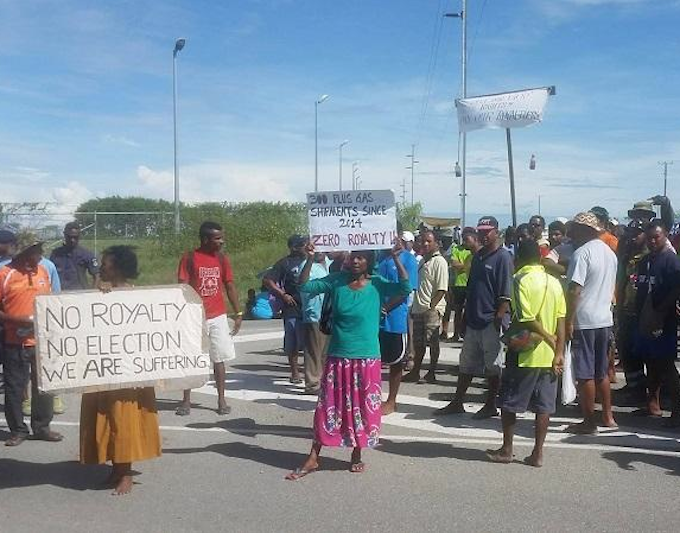
PNG landowners protesting over non-payment of their LNG royalties. Image: Loop PNG

By Freddy Mou in Port Moresby

More than 1000 villagers from Portion 152 where the Papua New Guinea LNG plant sits have gathered on site to protest over their overdue royalty payments.

Spokesperson and chairman of the Porebada Besena Association, Judah Matt Baru, said  they had not received any payment since the first shipment of LNG in 2014.

He said the government had promised repeatedly to pay its royalties but never kept its promises.

“We cannot sit and spectate on our own land. The government must come good with their promises or else we will shut the plant site for an indefinite period,” Baru said.

Baru said their petition was being given to the government but nothing had been done.

Meanwhile, police have been deployed to the site and are manning the entry gate.

– Advertisement –

Protest condemned
The Provincial Police Commander for Central Province, Superintendent Laimo Asi, today condemned the protest.

Asi said no approval was given by authorities to stage the protest.

The commander, who was at earlier today, said he had warned landowners not to cause any damage to the plant site but to allow the operation to continue as normal.

He had advised them that the protest was illegal and while the landowners had been reluctant to back off, they promised to do it peacefully.

Asi said his men were on the ground to protect facilities and to ensure the protest did not turn rowdy.

]]>

Freeport Indonesia chief resigns as dispute over mining policy intensifies

]]>

AsiaPacificReport.nz

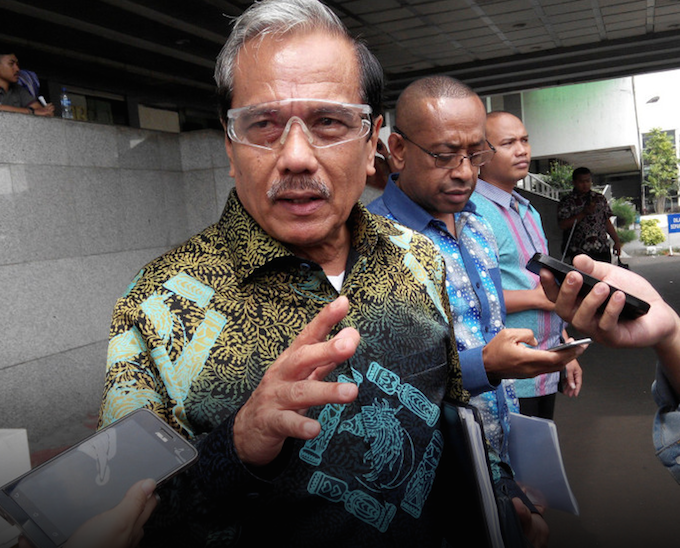
Freeport Indonesia’s Chappy Hakim … “an extraordinary commitment of time”. Image: Bernadette Christina Munthe/Jakarta Globe file

Chappy Hakim has resigned as its president director, only three months after his appointment as the mining giant’s top executive, PT Freeport Indonesia announced at the weekend.

In a media release, Freeport Indonesia did not specify when Hakim, a retired air chief marshal, would officially step down.

However, it said he would move to an advisory role with the company.

“Serving as Freeport Indonesia president director involves an extraordinary commitment of time. I have decided it is in the best interests of Freeport Indonesia and my family to step down from my duties as president director while continuing to support the company in an advisory role,” Hakim was quoted as saying.

READ MORE: Freeport seeks to dodge piling problems as stalemate shuts production

Hakim’s resignation occurred as the company, a subsidiary of United States-based Freeport-McMoRan, fights against complying with the government’s latest mining policy, which stipulates that miners must convert their current contracts of work (CoWs) into special mining permits (IUPKs) in exchange for permission to continue exporting certain mineral ores and concentrates.

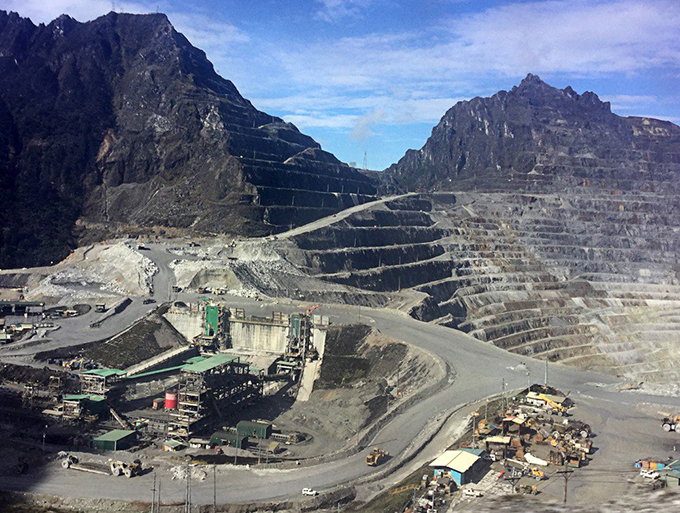
Freeport, which operates the huge Grasberg mine in Papua, has repeatedly said it would not agree to the contract conversion unless the government provided assurance of long-term investment stability, consisting of fiscal and legal certainty, in accordance with its CoW signed in 1991.

– Advertisement –

Freeport-McMoRan CEO and president Richard C. Adkerson thanked Hakim for his contributions to the company.

“We understand that this was a difficult decision for Pak Chappy to make. We appreciate his service to our company and his support. We look forward to his continued advice and counsel,” he said.

Chappy Hakim, also known as an aviation industry expert and prolific writer, was appointed as Freeport Indonesia’s top executive in November.

The company previously appointed retired military officer Air Vice-Marshall (ret.) Maroef Sjamsoeddin as president-director.

]]>

Febriana Firdaus, following in the courageous footsteps of Suaru Papua editor Pogau

]]>

Report by David Robie. This article was first published on Café Pacific


The last video posted by Oktovanius Pogau on his YouTube blog before he died early last year
– a KNPB rally in Jayapura posted on 31 May 2015.

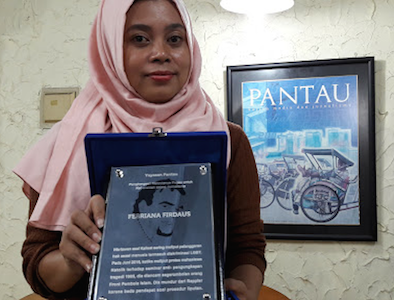
WEST PAPUAN editor Oktovianus Pogau, who died last year aged just 23, would have been proud. An inaugural award for journalism courage named in honour of him has been presented to a brave young woman, freelance journalist and blogger Febriana Firdaus, who has been covering human rights abuses in Indonesia.

This published on Asia Pacific Report from the Pantau Foundation that has made the award, who have made a point of shunning cash prizes and extras to concentrate on the recognition:

Febriana Firdaus … winner of the inaugural Pogau Award
for journalism courage. Image: Pantau Foundation
“We want to honour our colleague, Oktovianus Pogau, a smart and courageous journalist, who edited Suara Papua newspaper and highlighted human rights reporting. He passed away at a very young age – just 23 years old. We want to honour his legacy by establishing this Oktovianus Pogau award,” said Imam Shofwan, chairman of the Pantau Foundation in a speech to a small gathering at his office.

The Pantau Foundation selected Febriana Firdaus, a Jakarta journalist, to receive the inaugural award.

Firdaus covered Indonesia’s efforts to deal with the 1965-1966 massacres, disappearances and arbitrary detentions. She also covered discrimination, intimidation, and violence against the LGBT community in Indonesia.

“LGBT is a very sensitive subject in Indonesia where many religious communities, including Muslim organisations, still consider homosexuality a psychological disorder. Febriana Firdaus is courageous to stand up for LGBT, to affirm that LGBT is nature, and to expose their side of the story,” said Shofwan.

Firdaus was born in 1983 in Kalisat, a small town in eastern Java, and graduated from Airlangga University in Surabaya in 2007.

She has worked for Jawa Pos daily, Tempo magazine and Rappler Online. She is currently a freelance journalist.

Atmakusumah Astraatmadja, a former chairman of Indonesia’s Press Council and himself an award-winning journalist, presented the award to Firdaus, welcoming the launch of the award and congratulating Firdaus.

‘Proto-fascism era’
Allan Nairn, another award-winning journalist based in New York, gave a speech, talking about courage in journalism in Trump’s “proto-fascism era.”

Nairn spoke about the challenges the press faced in covering an unpredictable president like Donald Trump. He noted that the US provides a warning to Indonesia because the same proto-fascists that rose to power in the US were also trying to achieve power in Indonesia.

On her blog, Firdaus wrote, “This award is not about me or other future winners. This is a gentle reminder of the name Okto Pogau but it’s also more than about his name. His name represents the unsolved human rights abuses in Papua.

“Every year this award will always remind us about the human rights abuses never addressed in Indonesia since the 1965 massacre.”

Oktavianus Pogau … won an Indonesian writing
competition aged 14. Image: Twitter
Oktovianus Pogau was born in Sugapa in the Central Highlands on 5 August 1992 and died on 31 January 2016 in Jayapura.

He won an Indonesian writing competition when he was 14 years old, letting him to travel away from his native West Papua and to take part in a writing course in Yogyakarta, Java.

He learned WordPress and created his own blog when he was 16 years old.

He moved to Jakarta in 2010, studying international relations and becoming a freelance journalist.

Peaceful gathering
In October 2011, he covered a peaceful gathering of thousands of Papuan men and women in Jayapura, discussing their political aspiration to be independent from Indonesia.

Indonesian police used excessive force to disperse them. They fired warning shots, beating and kicking indigenous Papuans. Three men died of gunshot wounds, around 600 were detained and five of their leaders were tried and sentenced to three years imprisonment.

Pogau was upset when seeing that most Indonesian media did not proportionally cover the abuses. He decided to set up Suara Papua (Papuan Voice) on 10 December 2011 — on international human rights day — to cover rights abuses in West Papua.

He made Suara Papua a platform for young Papuans to report and to write their stories. Pogau also engaged his audience with his sharp political analysis.

He used his knowledge and networks to advocate for civil, political, economic, social and cultural rights for ethnic Papuans. He was also sympathetic to the National Committee of West Papua (KNPB), which is campaigning for a referendum in West Papua.

In October 2012, when he was covering one of their rallies in Manokwari, he was beaten on a street corner. Several police officers stopped him from taking photos. He suffered bruises and complained.

The West Papua police later apologised but his union, Indonesia’s Alliance of Independent Journalists (AIJ), refused to help him, arguing that Pogau was also an activist and declaring he had “crossed the line” between journalism and activism.

Restrictions on foreign journalists
Pogau wrote extensively about the restriction on foreign journalists visiting West Papua. He protested against the discrimination against indigenous Papuan journalists and the intensive use of journalists, both Indonesian and Papuan, to be military and police informers.

He indirectly contributed to President Joko Widodo in May 2015 declaring the Indonesian bureaucracy would stop restrictions on foreign journalists covering West Papua.

Jokowi’s command has not been fulfilled completely. He travelled to the US in December 2015, writing about African-Americans dealing with violence and about the similarity of the harsh treatment of Papuans.

The judges of the award included Alexander Mering (Kampong Journalism Movement in Pontianak, Kalimantan), Andreas Harsono (researcher at Human Rights Watch in Jakarta, Java), Coen Husain Pontoh (chief editor at Indo Progress news portal in New York), Made Ali (environmentalist at Jikalahari in Pekanbaru, Sumatra), Yuliana Lantipo (editor at Jubi daily in Jayapura, West Papua).

The award is to be announced every year on January 31.

When presenting the award, Imam Shofwan talked about his personal experience with Pogau: “Once he called me on my mobile and I heard gunshots in the background. I told him to run but he kept on talking, asking me to tweet. He continuously tried to bring out rights abuses in Papua.

“He died young but his courage should inspire other journalists.”

Febriana Firdaus and the Pantau award [Bahasa]


]]>

Pacific Journalism Review 22(2): ‘Journalism Education in the Pacific’

]]>

Pacific Media Centre

Pacific Journalism Review

ISBN/code: ISSN 1023-9499

Publication date: Sunday, February 19, 2017

Publisher: Pacific Media Centre Editors: Philip Cass, David Robie

Download

    FINDING THE PACIFIC VOICE
    Featuring JERAA, Pacific Media Centre, Media Educators Pacific and Fourth World Journalism Education Congress (WJEC16) papers on the Pacific, a major research survey on the state of New Zealand journalism in 2015 and a Frontline report on a journalism school partnership with Indigenous community organisations in Western Australia.

    Table of contents

    Pacific ‘cyber bullying’, PNG students protests, ‘free’ media featured in PJR

    ]]>

    Febriana Firdaus wins inaugural Pogau award for courage in journalism

    ]]>

    AsiaPacificReport.nz

    Jakarta has a new award for courage in journalism honouring West Papuan editor Oktovianus Pogau, who died last year. The inaugural award has been made to reporter Febriana Firdaus, who has extensively covered human rights abuses in Indonesia, says the Pantau Foundation.

    “We want to honour our colleague, Oktovianus Pogau, a smart and courageous journalist, who edited Suara Papua news and highlighted human rights reporting. He passed away at a very young age – just 23 years old. We want to honor his legacy by establishing this Oktovianus Pogau award,” said Imam Shofwan, chairman of the Pantau Foundation in a speech to a small gathering at his office.

    The Pantau Foundation selected Febriana Firdaus, a Jakarta journalist, to receive the inaugural award.

    Firdaus covered Indonesia’s efforts to deal with the 1965-1966 massacres, disappearances and arbitrary detentions. She also covered discrimination, intimidation, and violence against the LGBT community in Indonesia.

    “LGBT is a very sensitive subject in Indonesia where many religious communities, including Muslim organisations, still consider homosexuality a psychological disorder. Febriana Firdaus is courageous to stand up for LGBT, to affirm that LGBT is nature, and to expose their side of the story,” said Shofwan.

    Firdaus was born in 1983 in Kalisat, a small town in eastern Java, and graduated from Airlangga University in Surabaya in 2007. She has worked for Jawa Pos daily, Tempo magazine and Rappler Online. She is currently a freelance journalist.

    Atmakusumah Astraatmadja, a former chairman of Indonesia’s Press Council and himself an award-winning journalist, presented the award to Firdaus, welcoming the launch of the award and congratulating Firdaus.

    – Advertisement –

    ‘Proto-fascism era’
    Allan Nairn, another award-winning journalist based in New York, gave a speech, talking about courage in journalism in Trump’s “proto-fascism era.”

    Nairn spoke about the challenges the press faced in covering a president like Donald Trump, who lies constantly yet was also hugely entertaining.

    Nairn noted that the US provides a warning to Indonesia because the same proto-fascists that rose to power in the US were also trying to achieve power in Indonesia, although it was not clear whether they would succeed.

    On her blog, Firdaus wrote, “This award is not about me or other future winners. This is a gentle reminder of the name Okto Pogau but it’s also more than about his name. His name represents the unsolved human rights abuses in Papua.

    “Every year this award will always remind us about the human rights abuses never addressed in Indonesia since the 1965 massacre.”

    Oktovianus Pogau was born in Sugapa in the Central Highlands on 5 August 1992 and died on 31 January 2016 in Jayapura.

    He won an Indonesian writing competition when he was 14 years old, letting him to travel away from his native West Papua and to take part in a writing course in Yogyakarta, Java Island. He learned WordPress and created his own blog when he was 16 years old. He moved to Jakarta in 2010, studying international relations and becoming a freelance journalist.

    Peaceful gathering
    In October 2011, he covered a peaceful gathering of thousands of Papuan men and women in Jayapura, discussing their political aspiration to be independent from Indonesia.

    Indonesian police used excessive force to disperse them. They fired warning shots, beating and kicking indigenous Papuans. Three men died of gunshot wounds, around 600 were detained and five of their leaders were tried and sentenced to three years imprisonment.

    Pogau was upset when seeing that most Indonesian media did not proportionally cover the abuses. He decided to set up Suara Papua (Papuan Voice) on 10 December 2011 — on  international human rights day — to cover rights abuses in West Papua. He made Suara Papua a platform for young Papuans to report and to write their stories.

    Pogau also engaged his audience with his sharp political analysis. He used his knowledge and networks to advocate for civil, political, economic, social and cultural rights for ethnic Papuans.

    He was also sympathetic to the National Committee of West Papua, a large Papuan youth organisation, which is campaigning for a referendum in West Papua.

    In October 2012, when he was covering one of their rallies in Manokwari, he was beaten on a street corner. Several police officers stopped him from taking photos. He suffered bruises and complained.

    The West Papua police later apologised but his union, Indonesia’s Alliance of Independent Journalists, refused to help him, arguing that Pogau was also an activist and declaring he had crossed the line between journalism and activism.

    Restriction on foreign journalists
    Pogau wrote extensively about the restriction on foreign journalists visiting West Papua. He protested against the discrimination against indigenous Papuan journalists and the intensive use of journalists, both Indonesian and Papuan, to be military and police informers.

    He indirectly contributed to President Joko Widodo in May 2015 declaring the Indonesian bureaucracy would stop restrictions on foreign journalists covering West Papua.

    Jokowi’s command has not been fulfilled completely. He travelled to the US in December 2015, writing about African-Americans dealing with violence and about the similarity of the harsh treatment of Papuans.

    The jurors of the award included Alexander Mering (Kampong Journalism Movement in Pontianak, Kalimantan), Andreas Harsono (researcher at Human Rights Watch in Jakarta, Java), Coen Husain Pontoh (chief editor at Indo Progress news portal in New York), Made Ali (environmentalist at Jikalahari in Pekanbaru, Sumatra), Yuliana Lantipo (editor at Jubi daily in Jayapura, West Papua).

    The mandate of this award is to exclude a financial gift and a generous ceremony, hoping that it will be sustainable and making jurors concentrate only in selecting a winner. The award is to be announced every year on January 31.

    When presenting the award, Imam Shofwan talked about his personal experience with Pogau: “Once he called me on my mobile and I heard gunshots in the background. I told him to run but he kept on talking, asking me to tweet. He continuously tried to bring out rights abuses in Papua.

    “He died young but his courage should inspire other journalists.”

    Febriana Firdaus and the Pantau award [Bahasa]

    ]]>

    Thousands march against Duterte’s war on drugs, ‘violence culture’

    ]]>

    AsiaPacificReport.nz

    Thousands of Catholics “Walk for Life” in Manila to protest against the drug-related killings under President Rodrigo Duterte’s war on drugs. Video: Papua New Guinea’s EMTV

    Thousands of Catholic faithful gathered in the Philippine capital in a “show of force” today to protest against the extrajudicial killings in President Rodrigo Duterte’s anti-drug war.

    The rally, called the “Walk for Life”, gathered 20,000 people, according to the organisers.

    Manila police estimated the crowd at 10,000, reports Al Jazeera.

    READ MORE: Children and Duterte’s drug war – Lessons from the past

    The “Walk for life”protesters were also condemning the restored death sentence. Image: EMTV

    But in what was the the biggest rally yet against the killings, members of one of the nation’s oldest and most powerful institutions prayed and sang hymns as they marched before dawn to condemn a “spreading culture of violence”.

    More than 7000 people have died since Duterte took office almost eight months ago and ordered an unprecedented crime war that has drawn global criticism for alleged human rights abuses.

    – Advertisement –

    The move, however, has been popular with many in the mainly Catholic nation.

    “We have to stand up. Somehow this is already a show of force by the faithful that they don’t like these extrajudicial killings,” said Manila bishop Broderick Pabillo before addressing the crowd, reports AFP.

    “I am alarmed and angry at what’s happening because this is something that is regressive. It does not show our humanity.”

    The demonstrators also condemned legislation restoring the death penalty for drug-related crimes and other offences.

    Duterte, 71, has attacked the Church as being “full of sh*t” and “the most hypocritical institution” for speaking out against a campaign that he says would save generations of Filipinos from the drug menace.

    About 80 percent of the 100 million Filipinos are Catholic.

    The Church helped lead the revolution that toppled dictator Ferdinand Marcos in 1986 and a 2001 uprising against then-president Joseph Estrada saw him ousted over corruption charges.

    The Church had initially declined to voice opposition publicly to Duterte’s drug war but, as the death toll of mostly-poor mounted, it started late last year to call for the killings to end.

    Two weeks ago the Church branded Duterte’s “reign of terror” as creating a war against the poor.

    Cardinal Luis Antonio Tagle … violence cannot be the answer to the country’s drug problem. Image: Al Jazeera/R

    “It is obvious that there is a spreading culture of violence. It is saddening to see, sometimes it drives me to tears how violent words seem so natural and ordinary,” said Manila Cardinal Luis Tagle, the country’s highest-ranking Church official.

    “If the response to violence is also violence, then we are only doubling down on violence.”

    The Catholic Bishops’ Conference of the Philippines had called on the faithful to gather before dawn at the Quirino Grandstand, in the same venue where Duterte held a huge pre-election rally in 2016.

    “Why dawn? It’s because it is during these hours that we find bodies on the streets or near trash cans. Dawn, which is supposed to be the hour of a new start, is becoming an hour of tears and fears,” Archbishop Socrates Villegas, president of the bishops’ conference, told the crowd.

    Among those who attended the event was Senator Leila de Lima, a former human rights commissioner who is one of Duterte’s most vocal opponents.

    The government on Friday filed charges against her for allegedly running a drug trafficking ring inside the country’s largest prison when she was justice secretary in the previous administration.

    De Lima, who has strongly denied the charges, said she attended the event as a show of solidarity.

    ]]>

    Freeport seeks to dodge piling problems as stalemate shuts production

    ]]>

    AsiaPacificReport.nz

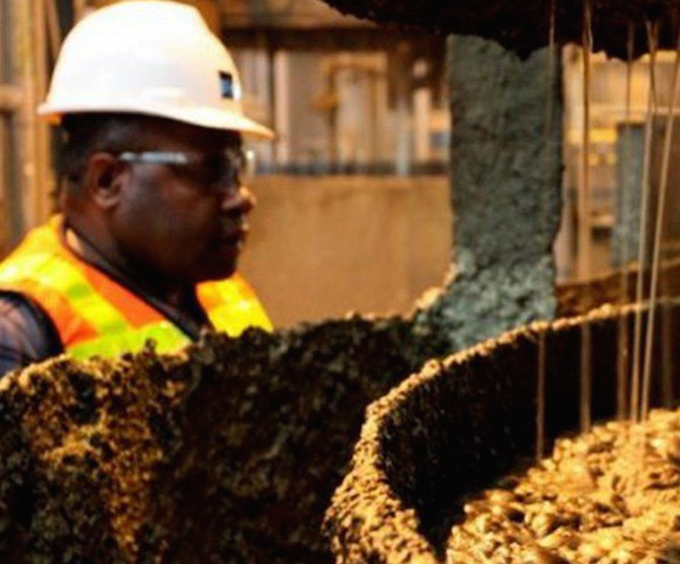
    A Freeport worker monitors the mineral flotation process before the mine production crisis. Image: B. Josie Susilo Hardianto

    By Viriya P. Singgih and Fedina S. Sundaryani in Jakarta

    Gold and copper miner PT Freeport Indonesia, the country’s largest taxpayer and oldest foreign investor, is in for another rough ride as it struggles to fight the government’s demand to divest controlling ownership and resolve allegations of legislative contempt.

    Reuters reports that all work has stopped at Freeport’s Grasberg mine and its workers are planning a demonstration against the government’s move last month that halted exports of copper concentrate to boost domestic industries, a union said.

    A prolonged stoppage at the world’s second-biggest copper mine would support copper prices, near 21-month highs this week, but would also deny the Indonesian government desperately needed revenue from one of its biggest taxpayers.

    READ MORE: Freeport says it hasn’t agreed on new contract

    Freeport’s headache intensified last week when the Energy and Mineral Resources Ministry claimed the company had agreed to convert its contract of work (CoW) to a special mining licence (IUPK), and required it to divest 51 percent of its shares and construct a smelter.

    In exchange, the government allowed the company to resume its exports of copper concentrate to prevent massive layoffs in its operations in the backwater regency of Timika in Papua, where Freeport has been operating for more than five decades.

    – Advertisement –

    The government has claimed its recent policy to continue the relaxation of raw and partly processed mineral exports, which many analysts and politicians deemed as against the law, has profited Freeport because the company can continue with exports despite its questionable commitment to construct a smelter in Indonesia to process its products.

    While Freeport has indicated it will fight against the share divestment while agreeing to other demands set out by the government, Energy and Mineral Resources Minister Ignasius Jonan has not blinked and insists the company has to comply.

    “Why are they refusing the divestment rule? The shares will later be bought by the government or the government’s partners. What is exactly the reason behind the company’s reluctance?” Jonan said.

    Freeport, a local unit of politically wired US mining giant Freeport McMoRan Inc. (FCX), said it would not agree to the contract conversion unless the government provided a long-term investment stability assurance, consisting of fiscal and legal certainties, in accordance to its CoW signed in 1991.

    “Freeport Indonesia will keep working with the government to find the best possible solution for both sides. However, no agreement has yet to be made as of today,” Freeport Indonesia spokesperson Riza Pratama said.

    Under the CoW, Freeport is required to sell 51 percent of its stake to Indonesian entities by 2011, or 45 percent if it has sold a minimum of 20 percent in the local stock market.

    However, a string of regulations were issued along the way that eventually allowed Freeport to dodge the requirement to this date, where very few officials have made a fuss. FCX owns 90.64 percent of the company, while merely 9.36 percent is owned by the Indonesian government.

    Full Freeport report

    ]]>

    Press freedom fact-finding mission to West Papua faces challenges

    ]]>

    AsiaPacificReport.nz

    The WAN-IFRA fact-finding team present their report. Image: Una Sunarti/WAN-IFRA

    By Tara Nissl in Jakarta

    Eight journalists from eight Indonesian media outlets traveled to West Papua earlier this month to investigate media freedom and the safety of journalists in the region, after an international delegation called on Indonesia to address press freedom violations in 2015.

    The World Association of Newspapers and News Publishers (WAN-IFRA) launched the investigation on January 30 in Jayapura, Merauke and Timika, where the Media Freedom Committee-Indonesia followed local journalists from Papuan news organisations for five days.

    WAN-IFIRA’s Eko Maryadi … “understanding the issues, difficulties, and problems faced by journalists in Papua.” Image: Istimewa

    WAN-IFRA’s Asian regional manager Eko Maryadi said: “We expect the programme to send eight reporters from Jakarta, from non-Papuans to do reporting, that they can understand the issues, difficulties, and problems faced by journalists in Papua.”

    The committee reported eight key findings:

    • Government officials and security personnel are discriminatory towards OAPs (“original Papua persons”)
    • Journalists are stigmatised as pro-independence or pro-Homeland, leading to intimidation and fragmentation among the journalist community
    • Environmental damage through development programmes are underreported due to heavy restrictions on the press
    • Strengthening journalism in Papua relies on an improved code of ethics, understanding of the journalist profession, use of technology and a business model that maintains the independence of the press
    • Journalists need to actively change the media perspective of Papua
    • 11 out of 16 foreign journalists who recently gained access to Papua were monitored by intelligence officials
    • Sexual harassment of female journalists in Papua is underreported
    • The quality of public services and competition depends on equitable access to communication infrastructure and information technology

    Detailed reports
    More detailed reports were documented in Bahasa on the committee’s blog, featuring daily updates and interviews with journalists from Tabloid Jubi, Papua Salam, Mongabay.co.id and many more.

    Journalists from the Papua South Post shared stories about police and government intimidation, including two publication bans in 2007 and 2008, being threatened with a criminal lawsuit, and a prohibition on reporting on President Joko Widodo’s Merauke investment programme.

    – Advertisement –

    A journalist in Timika recalled a terrifying experience of being held at knifepoint and then stabbed. Another pointed to the difficulties faced by female journalists and the prevalence of sexual harassment.

    The investigation marks two months before Indonesia will host the World Press Freedom Day in Jakarta on May 3, an event that has drawn criticism of Indonesia as host due to ongoing restrictions and violations in Papua.

    Whether any changes will be made in the near future is questionable. Just recently, Suara Papua’s website was blocked for publishing “negative” content, despite the government insisting that it does not censor journalism websites.

    Tara Nissl is a contributor to Engage Media.

    The WAN-IFRA blog on West Papua media freedom

    Map: WAN-IFRA
    ]]>

    Registrar confirms 44 parties for PNG’s 2017 general election

    ]]>

    AsiaPacificReport.nz

    By Quintina Naime in Port Moresby

    Papua New Guinea’s Registry of Political Parties has confirmed 44 political parties will contest the 2017 National Elections.

    Registrar of Political Parties Dr Alphonse Gelu said the registry would continue the processes of registering political parties but it would not allow them to contest this election.

    He said it takes about two months to register a political party before the issue of writs and therefore a political party must be already in the registration process.

    “It takes a process of two months therefore if anyone wants to register a political party now to take part in this elections, it will not be possible,” Dr Gelu said.

    “But the process will continue, we can register a political party but they will have to contest in the next national elections.”

    Dr Gelu added that the registry was fully aware of the increase in the number of political parties.

    – Advertisement –

    He said that while the registry believed that the number was too high, the Constitution gave citizens the right to form political parties.

    The registration fee for a political party is K10,000 (NZ$4370).

    Quintina Naime is a journalist for Loop PNG.

    ]]>

    Press Council welcomes first Indigenous member – Koori Mail

    ]]>

    AsiaPacificReport.nz

    The Koori Mail … with 100,000 readers an important milestone. Image: KM

    The Australian Press Council has welcomed its first Indigenous publication as a member – the Koori Mail, a fortnightly newspaper with a national readership of some 100,000.

    The Koori Mail is arguably the most respected and most successful Aboriginal newspaper in Australia, says the council in a statement. It was founded in 1991 by a group of five Aboriginal organisations in Bundjalung Country around Lismore, NSW.

    These five organisations, all equal shareholders, are:

    • Bunjum Co-operative (Cabbage Tree Island)
    • Buyinbin Inc (Casino)
    • Kurrachee Co-operative (Coraki)
    • Bundjalung Tribal Society (Lismore), and
    • Nungera Co-operative (Maclean)

    The Koori Mail provides news, commentary, advertisements and other material of vital interest to Aboriginal and Torres Strait Islander people and to other Australians interested in Indigenous affairs.

    The newspaper is 100 percent Aboriginal-owned and all profits go to Indigenous people in the form of dividends, sponsorships or scholarships.

    The Australian Institute of Aboriginal and Torres Strait Islander Studies (AIATSIS) views the Koori Mail as a valuable source of information about Aboriginal life in the country and as a historical record.

    Digital archive
    AIATSIS maintains a complete digital archive of all editions of the Koori Mail.

    – Advertisement –

    “We are delighted to be joining the Australian Press Council,” said Naomi Moran.

    “As Australia’s only national fortnightly Aboriginal and Torres Strait Islander newspaper, we are thrilled to be joining the Australian Press Council,” said general manager Naomi Moran. “For the past 25 years, we have been sharing news from our communities with the nation.

    “The DNA of our publication—what makes us the voice of Indigenous Australia— is our responsibility to cultural sensitivity and understanding. With our content as the heartbeat, a good standard of media practice ensures our newspaper continues to live and breathe authentic storytelling.”

    “We look forward to working closely with the Press Council to support other print media platforms to implement the same cultural care when reporting on Indigenous issues.”

    The chair of the Press Council, Professor David Weisbrot, said: “This is an exceptionally important milestone in the 40-year development of the Press Council, one that is long overdue.

    “We have made a concerted effort over the past two years to try to attract member publications that reflect the nature and diversity of Australian society.

    Quality media
    “The editors and staff of the Koori Mail will help the council in a variety of ways to incorporate Indigenous perspectives and better appreciate the challenges of quality media reporting of Indigenous matters,” the professor said.

    Professor Weisbrot said: “The council’s next challenge is to ensure that further Indigenous publications join, as well as many more mastheads from the thriving multicultural press in Australia.”

    The Australian Press Council was established in 1976 and is responsible for promoting good standards of media practice, community access to information of public interest, and freedom of expression through the media.

    Press Council membership encompasses most of the major newspaper, magazine and online publishers in Australia, accounting for approximately 95 percent of circulation.

    Australian Press Council

    ]]>

    WWF Indonesia calls for conservation of Papua’s birds-of-paradise

    ]]>

    AsiaPacificReport.nz

    At risk … a bird-of-paradise, known locally known as cendrawasih. Image: wwf.org

    By Ratri M. Siniwi in Jakarta

    The World Wildlife Fund Indonesia has called for the conservation of birds-of-paradise – especially in Papua.

    Locally known as cendrawasih, the bird species is synonymous with the two island provinces but it has fallen prey to illegal trade, poaching and taxidermy.

    The environmental organisation believes this is mainly due to a lack of awareness.

    “Since 2013, the WWF has conducted a survey of habitat and species population in Papua, and we found that there are more than 40 types of birds in the paradise species,” WWF Indonesia northern New Guinea leader Piter Roki Aloisius said.

    “This means that conservation efforts are necessary, and one of the ways could be with ecotourism and educational activities,” he added.

    Piter included activities such as watching the birds in their natural habitat, but this can only be done if the forests are well preserved.

    – Advertisement –

    Natural habitat
    The birds are part of the cultural heritage of indigenous communities in Papua, who preserve the forests and the birds’ natural habitat.

    However, WWF Indonesia believes that it is the greater responsibility of all Indonesians, especially in the eastern part of the archipelago.

    “We need to provide an understanding through a local context in Papua about [bird] conservation, and one of the ways is with an educational approach,” Piter said.

    He added that this would be more effective, as future generations will be able to see the avian paradise of Papua, compared to just having pictures or stories.

    ]]>

    Indonesia to probe murder ‘involving ex-president’ claim by former anti-graft head

    ]]>

    AsiaPacificReport.nz

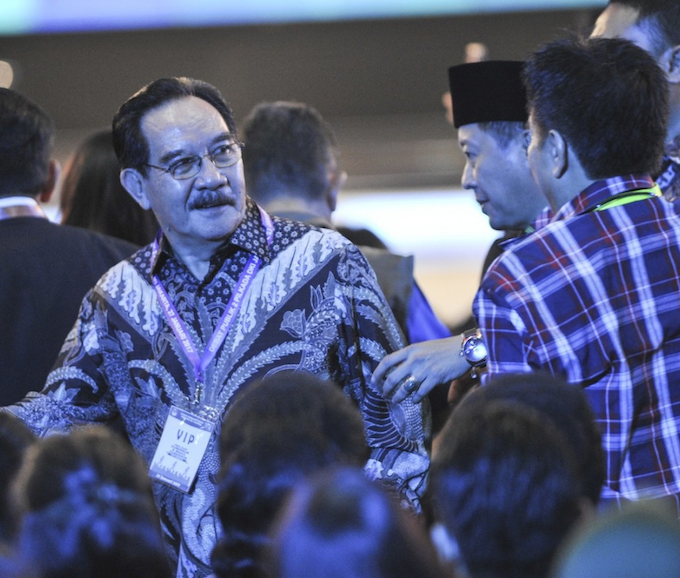
    Former Corruption Eradication Commission (KPK) chairman Antasari Azhar attending a recent election debate in Jakarta. Image: Hafidz Mubarak/Antara

    By Ainur Rohmah in Jakarta

    Police will investigate the allegations made by a former head of an Indonesian anti-corruption body who has accused an ex-president of being involved in the murder of a businessman in 2009, police have announced.

    Police spokesman Martinus Sitompul said authorities would investigate whether there were any criminal grounds in the claims.

    In 2010, Corruption Eradication Commission Chairman Antasari Azhar was convicted and sentenced to 18 years in prison for killing a businessman in 2009.

    However, Azhar was released from prison last year after he received a pardon from President Joko Widodo.

    Following his release, Azhar accused former President Susilo Bambang Yudhoyono of being the mastermind behind the killing.

    The murder took place when authorities were investigating alleged corruption of Yudhoyono’s in-laws.

    – Advertisement –

    Speaking at a press conference in the capital Jakarta, Azhar said: “I beg him [Yudhoyono] to explain what he did, if he ordered anyone to do anything, I beg Susilo Bambang Yudhoyono to be honest and be open to the public,” according to local media metrotvnews.com.

    Question more people
    Azhar urged police to question more people in the case and clear his name.

    “To clear my name, I ask the police to seriously deal with this. I ask everyone involved to be held responsible,” he said.

    Yudhoyono has denied all allegations, saying he was going to take legal action to defend himself.

    “Antasari’s accusation that seemed to me as the initiator of the case, is clearly not true. I would definitely take legal action against Antasari,” the former president tweeted via his account @SBYudhoyono.

    He also said the allegations were an attempt to destroy the credibility of his son Agus Harimurti Yudhoyono, who was running for in the elections for Jakarta’s governorship.

    Azhar claimed that Yudhoyono had instructed tycoon Hary Tanoesoedibjo to visit him a few weeks before his arrest to ask him not to detain former Bank Indonesia deputy governor Aulia Pohan, who had been implemented in corruption, reports The Jakarta Post.

    At the press conference at the National Police Criminal Investigation Department in Jakarta, Antasari added that Yudhoyono and Aulia Pohan were related through the marriage of their children.

    Azhar spoke up after President Joko “Jokowi” Widodo granted clemency to him, saying there were irregularities in the case.

    Azhar was released on parole after serving eight years of his sentence. The President granted him clemency not long after.

    ]]>

    PNG’s InterOil shareholders agree to ExxonMobil buy out

    ]]>

    AsiaPacificReport.nz

    The majority of shareholders approve ExxonMobil Corporation’s takeover of InterOil in Papua New Guinea. Image: EMTV

    Papua New Guinea’s InterOil shareholders agree to ExxonMobil acquisition; gender-based violence stakeholders condemn GBV deaths; and Sirinum Dam closure soon to affect Port Moresby residents are the headlines in the latest EMTV News.

    InterOil Corporation announced that the majority of shareholders had “overwhelmingly approved” the acquisition of the company by ExxonMobil Corporation, LNG Industry reports.

    InterOil interests in Papua New Guinea. Graphic: InterOil

    The company claims that more than 91 percent of the votes were cast in favour of the proposed transaction.

    The acquisition is worth kina 7 billion (about NZ$3.05 billion), reports EM TV.

    On 21 September 2016, just 80 percent voted to approve the original transaction in a special meeting.

    In the statement, InterOil claims that the court hearing in which InterOil is seeking a final order over the Amended and Restated Plan of Arrangement is currently scheduled for next week on February 20.

    – Advertisement –

    InterOil is an independent oil and gas business, which has a sole focus on Papua New Guinea.

    The company’s assets include Elk-Antelope – one of Asia’s largest and undeveloped gas fields – in the Gulf Province, as well as exploration licences covering approximately 16,000 sq km.

    The company’s main offices are in Port Moresby and Singapore.

    InterOil Corporation

    ]]>

    Across the Ditch: Fires Blaze Out of Control Near Christchurch + PM Decides In Favour of Pike River Mine Families

    Across the Ditch: Australian radio FiveAA.com.au’s Peter Godfrey and EveningReport.nz’s Selwyn Manning deliver their weekly bulletin Across the Ditch. This week: Weather + FX + Fires blaze out of control near Christchurch. ITEM ONE – Civil Emergency in Christchurch The Government has declared a civil emergency in Christchurch after a scrub fire in the Port Hills bordering south Christchurch blazed out of control. It is believed that the fire was deliberately lit. Wednesday night saw hundreds of families evacuated from their homes as the blaze spread northward toward Christchurch City’s residential areas. On Wednesday morning it was confirmed that one helicopter pilot who was part of the firefighting effort was killed. It was also confirmed he was a former NZ Defence SAS special operations soldier who had serviced in Afghanistan. ITEM TWO – Pike River Mine Disaster Last night families of those who died in the Pike arrived coal mine disaster met with new Prime Minister Bill English in an attempt to stop Solid Energy from sealing the entrance to the mine. Solid Energy is the Government owned company that owns Pike River Mine. The families have been maintaining a picket outside the entrance to the mine, in a move to stop contractors from permanently sealing the entrance. The bodies of their loved ones are still inside the mine. The former Prime Minister John Key had initially promised the families that the bodies of their loved ones would be recovered. That promise was reneged upon, even though mining experts have said it is now safe enough inside the mine for a recovery operation to commence. However, late last night (Wednesday) new Prime Minister Bill English told the victims’ families that the entrance to the mine will NOT be sealed. His decision is expected to lead to another evaluation of whether a recovery operation can now safely commence. ITEM THREE – Oddities Over the last few weeks ending the holiday and anniversary weekend season, roads and highways around Auckland (north and south) have been predictably at gridlock. But recently, things went from bad to worse. First a car pulled over in the fast lane and suddenly went up in flames. Then a day later, a cat caused the vehicles of tens of thousands of commuters to a standstill as it strolled down the motorway. The cat became a bit spooked and it took highway patrol officers quite a while to pick it up and clear the backlog of traffic.]]>

    Launch of PJR 22(2) and Worlds of Journalism NZ research

    ]]>

    Pacific Media Centre

    Event date and time: 

    Tuesday, February 28, 2017 – 16:30 18:00

    Publishing internationally for 22 years, Pacific Journalism Review has now produced its first edition on the new Tuwhera Open Access platform at Auckland University of Technology. The Faculty of Design and Creative Technologies and Pacific Media Centre are pleased to invite you to a celebration and presentation of a major new Worlds of Journalism research report on the state of New Zealand journalism.

    Speakers include:
    Dr James Hollings, Head of Journalism, Massey University, and Dr Geoff Lealand, University of Waikato.

    PJR editors Professor David Robie and Dr Philip Cass

    PMC chair Associate Professor Camille Nakhid

    Launch by Associate Professor Tony Clear, Associate Dean Research.

    When: Tuesday, February 28, 4.30-6pm

    Where:
    Auckland University of Technology
    Faculty of Design and Creative Technologies
    Faculty Office – Eastwell Lounge
    Level 6, WA Building East, Auckland

    Contact: Suzanne Devereux

    ]]>

    Launch of PJR 22(2) and NZ Worlds of Journalism research

    ]]>

    Pacific Media Centre

    Event date and time: 

    Tuesday, February 28, 2017 – 16:30 18:00

    Publishing internationally for 22 years, Pacific Journalism Review has now produced its first edition on the new Tuwhera Open Access platform at Auckland University of Technology. The Faculty of Design and Creative Technologies and Pacific Media Centre are pleased to invite you to a celebration and presentation of a major new Worlds of Journalism research report on the state of New Zealand journalism.

    Speakers include:
    Dr James Hollings, Head of Journalism, Massey University, and Dr Geoff Lealand, University of Waikato.

    PJR editors Professor David Robie and Dr Philip Cass

    PMC chair Associate Professor Camille Nakhid

    Launch by Associate Professor Tony Clear, Associate Dean Research.

    When: Tuesday, February 28, 4.30-6pm

    Where:
    Auckland University of Technology
    Faculty of Design and Creative Technologies
    Faculty Office – Eastwell Lounge
    Level 6, WA Building East, Auckland

    Contact: Suzanne Devereux

    ]]>

    Vanuatu provident fund members’ savings ‘safe’ but improvements needed, says inquiry

    ]]>

    AsiaPacificReport.nz

    The 127-page Vanuatu National Provident Fund report. Image: Vanuatu Daily Post

    By Jane Joshua in Port Vila

    The 27,400-plus members of the Vanuatu National Provident Fund (VNPF) have been assured that their savings are safe, but the performance and situation of the fund must be improved without further delay.

    This was confirmed when the Commission of Inquiry handed its 127-page report into the alleged mismanagement, illegal and improper conduct of the past and present VNPF staff to Justice Minister Ronald Warsal and Acting Finance Minister, Jean Pierre Nirua, yesterday afternoon.

    The commission uncovered multiple examples of alleged conflicts of interest in which rules appear to have been ignored.

    Specific serious alleged conflicts by board members as presented by the commission yesterday include:

    • Paul Montgolfier’s involvement as a board member and an adviser for the vendor selling Banian land.

    • Santos Vatoko’s involvement as general manager and a close personal friend of the vendor of the No. 2 Lagoon land.

    • Anniva Tarilongi’s close involvement, through her husband, with the advisers recommending the Bouffa be converted from housing to farming.

    Other alleged conflicts
    Other alleged conflicts of interest by non-board members as presented by the commission yesterday include:

    • Tukana Bovoro’s membership of the Board Investment Committee at the time of the Wilco acquisition while he was chief executive of the Wilco company, which was selling properties to VNPF.

    • Ridgeway and Blake lawyers engagement to provide legal advice to the fund and draft the sale of shares agreement and lease agreement with Wilco, while being directors and shareholders of companies who were shareholders of Wilco Ltd.

    • Corporate manager Hollingsworth Ala Ngwele’s close connection with the consultant in the i-Pacific contract.

    The commission was also presented with allegations of political interference by the then Prime Minister in the appointment of Mrs Tarilongi, the then Minister of Finance in the Interchange Limited investment, the Ambassador to EU in the CLA loan and the then Minister of Education in the Fiji Student Accommodation investment proposal.

    All of these situations raised suspicions, although the commission did not have enough evidence to draw conclusive recommendations on prosecution.

    Investigation taskforce
    The commission has recommended the establishment of a taskforce on the criminal side to further investigate recommendations relating to prosecutions.

    The taskforce, it said, should comprise representatives from the Office of the Public Prosecutor, police and Office of the Ombudsman and engage forensic accountants where necessary.

    The commission recommended that the criminal taskforce and/or the Ombudsman follow up on all the named allegations of political interference, identify any wrongdoing and determine subsequent action.

    The commission further recommended the establishment of a taskforce on regulatory frameworks, to further develop specific regulatory reforms.

    “This is very important,” said commission chairman Olivier Fernandez.

    “This is the only way of avoiding past mistakes from happening in the future.”

    This taskforce should comprise legal, finance and organisational and management specialists and should also include the new general manager.

    Breaches of guidelines
    The commission also considered breaches of Investment Policy Guidelines (IPGs) and irregularities in investment cases as well as breaches of procurement rules and irregularities in contracts and tenders.

    Acting Minister of Finance Jean Pierre Nirua thanked the commission team for the excellent work achieved.

    “It is true it is not often that we get to hear the outcomes of a commission of inquiry in the presence of media,” he said.

    “On behalf of the government, my colleague minister and myself want to see accurate media reports which will reflect the reality and status of the report.

    “It must not be seen as preempting any decision which will be taken by the government.

    “Some hear the outcome of the report as very sensitive and critical, let us take it as it is. It is only a report.

    “The report outlines some processes, let us give respect to these processes. No one wants to see a repeat of the 1998 scenario.

    ‘Safeguard the credibility’
    “In order to safeguard the credibility of this institution for the purpose of which it was set up, let us handle the report properly.

    “It doesn’t mean that just because the report recommended criminal recommendations and prosecutions then we will take it for granted that this will happen.

    “Let the process take its course. On behalf of the government, we assure that the government will follow the process and follow up the recommended actions within the law.

    “We all have a collective responsibility.”

    The handover of the report was witnessed by the Ombudsman, the Deputy Governor of the Reserve Bank of Vanuatu (RBV), government officials and VNPF staff.

    Jane Joshua is deputy editor of the Vanuatu Daily Post.

    ]]>

    Indonesia, Timor-Leste establish new forum process to settle border disputes

    ]]>

    AsiaPacificReport.nz

    Indonesia and Timor-Leste have agreed to establish a Senior Official Consultation (SOC) forum to formulate the settlement of border disputes.

    The agreement was made following a meeting between Coordinating Minister for Political, Security and Legal Affairs Wiranto, Foreign Minister Retno Marsudi, and Timor-Leste’s minister of development planning and investment at Kupang, East Nusa Tenggara, on Monday.

    “Indonesia and Timor-Leste agreed to form SOC, which is a small group that will discuss the technicalities in the agreement to settle land border disputes in Noel Besi (in the Indonesian province of East Nusa Tenggara) and Citrana (in Timor-Leste).

    “The discussion is scheduled on March 10 in Bali,” Wiranto told the media.

    He stated that the discussion would be directed to create steps to settle disputes comprehensively and create a bilateral agreement later.

    Retno said there are still two unresolved segments on the border between Indonesia and Timor-Leste, which are located between Noel Besi and Citrana and between Bijael Sunan and Oben.

    “With Timor-Leste, we have had long negotiations. In view of that and based on goodwill, the two governments finally agreed to set up the SOC to expedite the settlement of the negotiations in the two segments,” she noted.

    She said Timor Leste’s Foreign Minister Roberto Soares would be sent to represent Timor-Leste in the SOC, while Indonesia would be represented by the Director-General of Asia Pacific and Africa of the Ministry of Foreign Affairs Desra Percaya.

    She said that the settlement of the land border disputes would also involve communities in the two countries disputed border areas.

    “We have agreed to invite communities in the border areas to share their views, in addition to the government-to-government settlement process,” she added.

    ]]>

    Radio – last bulwark of media freedom and independence

    ]]>

    AsiaPacificReport.nz

    On World Radio Day, celebrated on Monday, Reporters Without Borders (RSF) paid tribute to radio’s contribution to the fight for media freedom and urges support for exile radio stations that uphold the right to news and information of peoples subjected to the most extreme situations.

    “At a time of technological revolution and upheavals in the way we provide and obtain news and information, radio plays an essential role in promoting free speech and the right to be informed,” RSF secretary-general Christophe Deloire said.

    “World Radio Day is an occasion to hail the courage and dedication of radio journalists who, in their own country or in exile, provide freely and independently reported news coverage to peoples experiencing crises or living under authoritarian regimes.”

    UNESCO launched World Radio Day in 2012 to celebrate the importance of radio broadcasting throughout the world and the role that many radio stations play in providing communities with news coverage. The situation in Syria, Africa or North Korea shows that radio can be a powerful tool in the service of the people’s right to reporting that is independent, outspoken and free of any state censorship.

    Syria: Informing communities beset by war
    Where there is no electricity or internet, radio adapts to the daily existence of a population caught in the trap of war. Easy to operate and easy to tune into, dozens of radio stations broadcasting on FM wavelengths or sometimes on the internet emerged in Syria after the start of the uprising in 2011.

    Stations such as Radio Fresh, based in northern Syria, have proved useful above all at facilitating communication and representation within local communities, even if they face major challenges, especially structural and logistic ones, in the absence of sustained support from external actors and sizeable listener catchment areas.

    These radio stations are exposed to the same dangers as all journalists in what is the world’s deadliest country for media personnel. In April 2016, gunmen torched the headquarters of ARTA FM, a Kurdish radio station in the northeastern city of Amouda and threatened to kill its director if he tried to resume broadcasting.

    For security reasons, most of these new independent radio stations are based in areas held by the opposition or by the Kurdish forces, or have had to base themselves outside the country to escape the Syrian government’s censorship.

    Radio Alwan and Nasaem Souria have found a refuge in neighbouring Turkey. The first is based in Istanbul and the second in Gaziantep, a city close to the border. They manage to reach Syrians as far south as the Idlib region (about 300 km north of Damascus).

    The Paris-based independent Syrian web radio Rozana was launched in June 2013 by Lina Chawaf, a well-known Syrian journalist who fled her country in 2011 and convinced RSF and other international NGOs to support this major project.

    Rozana relies on a dynamic network of citizen journalists inside Syria, who often take risks to do their reporting. One of their correspondents was fatally injured by rebel gunfire while on assignment in Idlib province in September 2014. Another Rozana citizen journalist was kidnapped in eastern Aleppo on August 2013 and is still held by Islamic State.

    Africa’s watchdogs
    In sub-Saharan Africa, radio is clearly the most important form of media. In countries afflicted by crises or bad governance, radio stations sometimes even come to assume of the functions of the state. At the height of the conflict in the Central African Republic in 2012-2013, communities in Bangui left their dead outside Radio Ndeke Luka to be counted.

    “We were police, judge and hospital all in one,” the station’s news editor said at the time.

    In Burundi, privately-owned radio stations not only provided news but also educated the public about their rights, denouncing abuse of authority by policemen, judges and other state entities. Some of the radio stations became so influential that the government felt threatened and seized the first opportunity to crush them. All but one of Burundi’s independent privately-owned radio stations have remained closed since an offensive against them in May 2015.

    Governments too often regard radio stations as targets to be neutralized. In Democratic Republic of Congo, local FM retransmission of Radio France International’s broadcasts in the capital Kinshasa has been suspended for the past three months because of its coverage of the crackdown on protests against the unconstitutional postponement of the president election. The RFI signal from nearby Brazzaville, which can be picked up in some Kinshasa districts, is also being jammed.

    In Eritrea, a country that has distinguished itself by being ranked last in RSF’s World Press Freedom Index for the past eight years, only one media outlet can claim to provide freely and independently reported news and information – a radio station called Radio Erena (“Our Eritrea”).

    Based in Paris, far from Eritrean government threats and pressure, it is headed by Biniam Simon, a onetime star presenter on Eritrean national TV and now a political refugee, who founded it seven years ago with RSF support. It broadcasts for two hours a day in Tigrinya (Eritrea’s national language) and Arabic by satellite, Internet and mobile phone app, covering stories ignored by the local media, which are reduced to being the propaganda outlets of Africa’s worst dictatorship.

    Asia-Pacific: Exile radio ‘lifelines’
    Broadcast media entirely under state control is a common feature of China, Vietnam and Laos. Prior censorship is the rule in these particularly authoritarian regimes. And the authorities often jam the signals of foreign radio stations such as Voice of America and Radio Free Asia that offer one of the few possibilities of getting freely reported news.

    North Korea’s unparalleled determination to combat “hostile foreign forces” has driven many of its citizens to violate its draconian laws in order to acquire radio sets capable of receiving the shortwave broadcasts of exile radio stations, especially those based in South Korea.

    The number of radio stations broadcasting to North Korea from Seoul has grown in the past decade or so. The first was Free North Korea Radio (FNK), which was launched in 2005. The others include Open Radio for North Korea (ORNK) and Radio Free Chosun (RFC). Run by North Korean refugees, they broadcast uncensored news reports, much to Pyongyang’s annoyance.

    As more and more North Koreans get their hands on shortwave radio sets that are being smuggled into the country, the regime has stepped up its jamming and its persecution of those caught in the fact of listening to these “seditious” broadcasts.

    Radio sets confiscated by the People’s Security Agency are generally locked onto the regime’s official radio station frequency (by means of soldering and withdrawal of electronic components). This is arguably a lesser evil because those caught listening to international radio stations at night usually pay a very high price.

    Several military units – including “Group 109,” reportedly once run by no less a person than Kim Jong-Un – are specifically tasked with randomly visiting homes to seek evidence of foreign media consumption. The death penalty is only rarely imposed for such a crime, but offenders are known to have been sent to labour camps.

    Supporting exile radio stations
    “In times of peace, conflict and emergencies, radio remains a crucial source of information and knowledge,” UNESCO director-general Irina Bokova said in a message for World Radio Day, adding that radio can also “provide a beacon for innovative solutions to local problems, and continue to advance human rights.”

    Her words take on added importance in the extreme situation of a country that has a dictatorial regime or in a failed state that is prey to armed groups and endemic violence.

    Every year, dozens of journalists are forced to flee their country to escape danger. Reducing journalists to silence by encouraging them to flee abroad is more than ever an integral part of the repressive arsenal used by media freedom’s enemies throughout the world.

    When some of these journalists manage to find work with foreign radio stations that cover their country of origin, or when they get together to create new radio stations targeting the fellow citizens they left behind, RSF believes that we all have a duty to support them.

    RSF urges the governments of countries that give journalists political asylum to do everything possible to make it easy for them to continue practicing their profession. RSF also calls on media freedom organisations to increase the assistance they provide to these journalists and free speech defenders.

    Reporters Without Borders/Pacific Media Watch

    ]]>

    UST journalism teams up with Asia Pacific Report coverage on Philippines

    ]]>

    AsiaPacificReport.nz

    UST Journalism programme coordinator Assistant Professor Jeremaiah Opiniano speaking on innovative education changes for journalists in the Philippines. Image: Genelaine Urbano/TW

    The oldest journalism school in the Philippines, at the University of Santo Tomas in Manila, has joined the Pacific Media Centre’s Asia Pacific Report current affairs project launched last year.

    Students and staff filed their first two stories this week for the innovative website published in partnership with Evening Report.

    Roy Abrhamn Narra and Carlo Casingcasing reported an exclusive story showing how Canada’s latest global terrorism blacklists were tagging the Philippines as having the third highest number of “individual terrorists” behind Saudi Arabia and Iraq while journalism coordinator Assistant Professor Jeremaiah M. Opiniano covered Philippines Environment Secretary Regina Lopez’s crackdown on mining companies in a bid to encourage a “green economy”.

    Twenty three mining companies have been been served with closure notices and  five others face suspensions. One company involved has assets in New Zealand.

    Opiniano was pleased with the collaboration and said UST was working towards a more comprehensive partnership with the PMC and School of Communication Studies.

    Professor David Robie, director of the PMC and editor of Asia Pacific Report, welcomed the development, saying: “We are delighted to have UST on board and their input will help boost coverage of the Philippines, especially with more depth.”

    He said that since the live feed of the Philippines presidential election last year, the website had experienced a strong Filipino interest and this was reflected by the growing audience among the Philippines diaspora in New Zealand.

    Asia Pacific Report also collaborates with other journalism schools around the region, including at the University of the South Pacific in Fiji and Wansolwara newspaper.

    ]]>

    The Importance of Leadership Analysis.

    ]]>

    36th Parallel Assessments – Headline: The Importance of Leadership Analysis.

    Leadership analysis is a vital yet under-utilised tool in the field of geopolitical risk assessment and strategic analysis. In this brief we explain why it is important, how it is undertaken and what 36th Parallel Assessments can offer clients in this regard.

    Source: Pinterest.com

    The election of Donald Trump to the US presidency has revived interest in a core task of intelligence collection: leadership analysis. Leadership analysis involves discerning the personal background, personality traits and character of individuals in key decision-making positions. These are not confined to government leadership roles, and  include businesspeople, union bosses, opposition party figures, international and non-governmental organisation officials, guerrilla and terrorist operatives, interest group directors and anyone else who exercises key decision-making roles in areas of policy or social import. These can be private as well as public figures taken individually or as a group, and analysis of them can assume the form of oppositional research (where the target is viewed in adversarial terms and information is gathered in order to cast unfavourable light on it).

    At 36th Parallel Assessments does not engage in oppositional research. Instead, we adopt the Western professional intelligence approach to leadership analysis. That approach is both comprehensive and neutral. It involves a holistic examination of the target(s) in order to provide analysis of good, bad and any other traits that may be of interest to the client. That allows clients to make their own assessments of leadership figures depending on their relationship to them.

    Leadership analysis involves much more than determining whether an individual or group is “weak” or “strong.” It involves looking at the personal characteristics of and private, political and material motivations of decision-making individuals and/or groups, and in the case of the latter, the relationships between key members of leadership groups. This includes analysis of family history, friendships, education and other formative experiences, social interests (sports, arts etc.), emotive relationships and other potential sources of strength or vulnerability. The idea is to get a good idea of who the client is interested in.

    Source: Geopolitical Dynamics.

    Leadership analysis involves a target, a subject and an object(ive).  The target is the individual or group exercising decision-making authority in a specific context.  The subject of the analysis is the context, situation or arena in which the target operates, i.e., the government, industry, or social milieu in which the target’s behaviour influences the substance and process involved in a particular field of endeavour. The object is to get an accurate idea of the motivations of the target and the impact the target has on the subject in order to make informed and beneficial short and medium decisions in areas in which client and target interests overlap or compete.

    Independent leadership analysis is particularly important in the fields of diplomatic and government relations, business and trade, and political risk. It allows clients to anticipate predictability or unpredictability of decision-making behaviour, prepare for if not foresee leadership transition scenarios, evaluate emerging leadership contenders, and better understand the benefits and risks of adopting specific approaches to targets given the subject areas in which they and/or the client operate.

    36th Parallel Assessments offers comprehensive leadership analysis services. Based on a background in leadership analysis for Western government intelligence agencies, we provide insight into leaders in a variety of contexts and tailor our objective analyses to the specific concerns and requirements of clients (e.g. industry or market intelligence, geopolitical risk, net assessment or futures forecasting). Feel free to inquire about our services using the “Contact Us” link on the masthead.

    ]]>

    From austerity to pussy grabbers

    ]]>

    On economic and social injustice (click here for part two of this series) I give money to street beggars (the visible sign of a broken political, economic and social system); lean towards the socialist edge of social democracy; marched in anti-TPPA protests; am pro trade unions and workers rights; desperately want affordable housing and a living wage for all – and I am a feminist. Like many others, I care about issues of economic and social (in)justice. There is a recurring argument made on social media (and sometimes mainstream media) that somehow I can’t be for all those things: that I am either active and/or vocal against our current system of economic injustice (an end to poverty and a too wide income and wealth gap), or I support “identity politics” (feminism, anti-racism, anti LGBTI or disability discrimination) – or worse, I am one of those now burdened with the clumsy label “identitarian”, with cult-like, right wing connotations. (See also the post on The Standard, “We are all ‘identitarian’ now”.) This is a label many detractors use to slap down those speaking against injustices that damage women, LGBTI people, people of colour, and many others. As with all social justice movements, feminists come in a range of political shapes and sizes. I can’t speak for all of them, nor do I want to. They range from the liberal feminists like Judith Collins and Paula Bennett who support corporate capitalism, to left wingers like Sue Bradford, Marama Davidson, and Metiria Turei. In spite of all the evidence to the contrary, on and offline, of a feminist presence in everything from the anti-TPPA struggle, campaigns against homelessness and for the living wage, somehow all feminists are self-serving “identitarians”. It’s claimed our (allegedly) ill-judged comments and whining, are diverting the left from the only authentic struggle. We are accused of splitting the movement, and damaging the possibilities of left-leaning parties re-gaining the government benches later this year. Social and economic injustices are situated within a system where power is unevenly distributed. In 21st New Zealand way too many Māori and Pacific Island women are struggling to survive and to support their whanau. Too many of them are on low incomes, un- or under-employed, while experiencing housing unaffordability, single parenthood, rising costs for essentials, and institutional discrimination. They make up a significant part of the precariat. Social and economic justice are united by being about power, uneven access to it, and its damaging impact on the lives of many people. Many people from the least powerful groups have responded by participating in political campaigns. For instance, women have played a leading role in resistance to the Glen Innes resistance to selling of state houses, to make way for expensive housing for the well-off. This is explained in a video posted by the Accompany Collective March 2016.

    We shall not be moved”: Tāmaki tenants discuss the privatisation of their state homes

    In the video, the people, many of whom are women, and/or Maori or Pacific people, explain how their lives, well-being, health and community have been damaged. https://www.youtube.com/watch?v=oSoqgYsYbjM Internationally in recent decades, women have taken the brunt of damage done by austerity politics. A 2015 article in the Guardian says that,
    The UK risks widening gender inequality because of austerity policies that disproportionately affect women, a coalition of charities has warned.
    Cuts to government spending and services by the Tory-Liberal Democrat coalition government had already hurt women, said Fair Deal. Half of housing benefit recipients are single women, while one in four women are in low-paid and insecure work. The number of lone parents claiming jobseeker’s allowance rose from 7,000 in 2008 to 159,000 in 2013. Nine out of 10 single parents are women. Those factors leave them particularly vulnerable to spending cuts. In 2014, the UK slipped eight places down the World Economic Forum’s (WEF) gender gap index. At 26, it is now placed below most European countries, the United States and even the Philippines. This is the bottom level of a system in which some sections of society have more power than others, and where white men tend to dominate the higher levels. [caption id="attachment_13971" align="alignnone" width="300"] From Peoples Cube[/caption] Some do it while demeaning and abusing women, showing how our culture encourages, and enables many (though not all) men to exercise power over women. [caption id="attachment_13970" align="alignnone" width="256"] From Twitter: ponytailgate[/caption] Such unequal access to power occurs throughout our society: in institutional and political policies, economic arrangements, and social practices (such as those described as part of rape culture). The whole system, and social attitudes that support it, needs changing from the bottom up. All of these aspects of society are strongly inter-connected. Moana Maniopoto who has been described as “one of the most significant voices in Maori music”, has also participated in political campaigns such as that against the TPPA, and for workers rights. This song has been described as a “feminist anthem”. Moana And The Moahunters – Black Pearl (original 1990 video!!!) https://www.youtube.com/watch?v=89wvsthbjWg To be continued in part two.]]>

    Indonesians fear Duterte-style assassinations, drug war

    ]]>

    AsiaPacificReport.nz

    Indonesian President Joko Widowo (right) takes a look at seized drugs in Jakarta last December before they were destroyed. Image: Bay Ismoyo/UCAN

    By Katharina R. Lestari in Jakarta

    Church officials and human rights activists believe Indonesia could be heading down the same path as the Philippines after the head of the country’s anti-narcotics agency recently issued a statement encouraging the shooting of drug traffickers trying to evade arrest.

    They pointed to an incident on February 3 when National Narcotics Agency officers shot dead an unarmed Malaysian national as he tried to flee during a drug-smuggling bust in Jakarta.

    The man allegedly tried to smuggle around 14 kg of crystal methamphetamine into Indonesia by boat.

    “Do not hesitate to shoot drug traffickers, drug dealers and drug users,” agency head Budi Waseso had said in December last year.

    That same month President Joko Widodo claimed that 15,000 people died every year because of drugs, and called on the agency to increase its efforts to crack down on the drugs trade.

    Widodo promised to come down hard on drugs and vowed to execute all drug traffickers when coming to power in October 2014.

    The church and rights activists have likened the rhetoric to that of Philippine President Rodrigo Duterte and his war on drugs.

    7000 killed in Philippines
    At least, 7000 people have been killed in incidents linked to Manila’s anti-drug campaign, according to rights groups.

    Azas Tigor Nainggolan, coordinator of the law and human rights division of the Indonesian Bishops’ Commission for Justice and Peace, called the National Narcotics Agency chief’s comments as incitement to “murder.”

    “It is more cruel than the death penalty because criminals will be killed before they have a chance to be brought to court,” he said.

    “Shooting people dead to prevent violence is counterproductive,” said Divine Word Father Paulus Rahmat, director of the U.N.-affiliated rights and social justice group Vivat International Indonesia.

    Such a policy, he added, was against a person’s right to life, which could not be taken away by anyone including the state and law enforcement officers.

    Natalius Pigai from the National Commission on Human Rights said law enforcement officers should question such comments from their leaders if they appeared to contravene the law.

    “Do things according to the law otherwise it is abuse of power,” he said.

    ]]>

    Philippines mining industry faces huge ‘green economy’ crackdown

    ]]>

    AsiaPacificReport.nz

    By Jeremaiah M. Opiniano in Manila

    The Philippines is among the world’s top sources of metallic deposits like nickel. But in this Southeast Asian mining haven, love may have been lost between the Philippine government and the mining industry.

    The country’s Department of Environment and Natural Resources (DENR) has ordered the closure of 23 mines and the companies operating them, plus suspending five others. The firms’ closures and suspensions were recommended by experts who conducted mining audits for the DENR between July and August 2016.

    The audits were done in response to reports of these mining firms’ compliance or non-compliance with prevailing regulations on responsible mining and maintaining of environmental standards.

    Philippines’ Environment Secretary Regina Lopez is in hot water from the mining industry given her closure and suspension orders, all announced in early February.

    Policy and legal battles related to the months-old government of President Rodrigo Duterte have triggered a closer watch on the mining issue.

    Mining sector protests
    The controversy erupted after February 2 with the announcement of the cancellation and suspension orders by Lopez. Six days later, Lopez had signed the cancellation and suspension orders of the 28 affected companies.

    The DENR also released results of the mining audit online explaining why the firms’ mining operations were ordered cancelled or suspended.

    Protests followed from the mining sector, especially the industry association Chamber of Mines of the Philippines (COMP). The group said an estimated PhP70 billion (NZ$1.9 billion) in gross production value and some P20 billion (NZ$556 million) in taxes would be lost because of these closure orders, and some 67,000 workers may be displaced.

    The COMP said the orders were released “without due process,” but Lopez said  on February 10 that DENR “meticulously observed due process.”

    Lopez was referring to the work of the multi-sectoral audit teams that looked at the mining projects in the identified areas. Experts from the central and regional offices of the DENR; from the DENR attached agencies like the Mines and Geosciences Bureau (MGB), Environmental Management Bureau (EMB), the Biodiversity Management Bureau (BMB and the Ecosystems Research and Development Bureau (ERDB); experts from the Departments of Health and Agriculture; and representatives from various civil society organisations conducted the audits.

    The multi-sectoral audit teams, Lopez explained, used criteria on the requirements of the different mining and environmental laws of the country. The teams also did cross-auditing, with auditors who reviewed the projects come from another Philippine geographical region. Lopez added the teams also staged entry and exit conferences with stakeholders, including the mining companies.

    Seven days were given to the companies to respond to the technical results of the audits and the “show cause” orders. Afterwards, and spanning five months, a technical review committee conducted further review on the companies’ replies to the audit teams’ reviews

    Bombardment
    After the February 2 announcement from Secretary Lopez, COMP sought the help of the economic managers of Duterte’s cabinet, including Finance Secretary Carlos Dominguez who co-chairs with Lopez an inter-agency Mining Industry Coordinating Council (MICC).

    On February 9, Secretaries Lopez and Dominguez — as MICC co-chairs— decided to form a multi-stakeholder committee that will review and advise DENR on Philippine mining operations, to include the recent decisions handed out to the 23 closed and five suspended mining firms.

    The mining companies had operations in identified mining hotspots of the country, such as Benguet province (north of Manila, in Luzon island), Zambales province (in the western part of Luzon island), Surigao del Sur (in eastern Mindanao island), Dinagat Island (also in eastern Mindanao), and Eastern Samar (in eastern Visayas region).

    Zambales province saw four mining companies —BenguetCorp Nickel Mines, Inc., Eramen Minerals, Inc., LNL Archipelago Minerals, and Zambales Diversified Metals Corp — ordered closed due to alleged illegal logging activities, and for conducting mining operation near a river that had led to siltation in the municipality of Sta. Cruz. Nickel is said to be being extracted there close to a watershed.

    Seven mining firms operating in Dinagat Islands were also ordered closed for a build-up of silt on coastal waters: AAM Philippines Natural Resources Exploration, Krominco, Inc., SinoStell Philippines H.Y. Mining Corp., Wellex Mining Corp., Libjo Mining Corp., and Oriental Vision Mining Corp.

    In Surigao del Sur province, a further seven mining firms were ordered closed, also for silt in coastal waters and for mining in watersheds: ADNAMA Mining Resources Corp., Claver Mineral Development Corp., Platinum Development Corp., CTP Construction and Mining Corp., Carrascal Nickel Corp., Marcventures Mining and Development Corp. and Hinatuan Mining Corp.

    Companies Mt. Sinai Exploration Mining and Development, EMIR Mineral Resources and Techlron Mineral Resources, with operations located in Eastern Samar, were also ordered closed not only because of the siltation of coastal waters, but because of the destruction of a functional watershed.

    Mining audits
    Apart from the 23 firms whose operations were ordered cancelled and closed by DENR, five other firms were given suspension orders. These are Berong Nickel Corp., OceanaGold Phils., Lepanto Consolidated Mining Corp., Citinickel Mines and Development Corp. and Strong Built Mining Development Corp.

    DENR conducts mining audits on a regular basis. Some of the firms whose licences were cancelled by Lopez were suspended in previous years and were asked to respond to findings of mining audits.

    Some of the firms were also listed in the Philippine stock market, as a few others are joint ventures by a Philippine and a foreign company. For example, Zambales Diversified Metals Corp. is a joint venture between Filipino-run D.M. Consunji Inc. (DMCI) Mining Corp. and the Australia-headquartered Rusina Mining Corp.

    Another closed firm, Oriental Synergy Mining Corp., was established by Qishu Mining Corp., a subsidiary of Qishu Enterprises with headquarters in Fujian, China.

    Suspended company OceanaGold Philippines, for its part, is a subsidiary of OceanGold Corp., a mid-tier multinational gold producer with assets found in the Philippines, United States and New Zealand.

    Other mining companies were also sued by local residents through the writ of kalikasan (nature), a legal remedy provided by the country’s constitution for anybody to sue those who allegedly violate environmental laws and cause environmental havoc.

    Lopez alleged last Thursday that some mining firms had links to local politicians, allowing the industry to flourish.

    High stakes
    The Philippines houses the world’s leading supply of nickel, as it was estimated by the MGB that some PhP54.9 billion (NZ$1.53 billion) of nickel products were produced in 2015.

    Nickel prices at the London Metal Exchange’s LMEX Index actually rose to a 16-month high last November 2016. But the stainless steel alloy’s performance at the LMEX dropped again since January, and the price of nickel rose to over-US$10,400 per tonne last Feb. 3 given Lopez’s closure order.

    There are 40 metallic mines (including 27 nickel mines) and 62 non-metallic mines in the Philippines, not to mention five processing plants, 16 cement plants, and 2397 small quarries and sand and gravel operations. The Philippines’ mining operations are governed by the 1995 Philippine Mining Act, with some 9 million ha. of land identified to have “high mineral potential” says the MGB.

    MGB data shows that the Philippines earned some US$2.8 billion (NZ$3.9 billion) in exports of minerals to Japan, Australia, Canada and China. The Philippines’ minerals industry is currently employing an estimated 236,000 workers, with a job in the mining sector said to be providing four indirect jobs. Mining companies had also paid some PhP25.78 million (NZ$717.2 million) in taxes in 2015.

    But a report by the country’s National Economic and Development Authority (NEDA) showed that the mining and quarrying industry contributed only less than a percent — 0.7 percent— of the country’s gross domestic product during the period 2000 to 2015. The sector also contributed 5.6 percent of total exports in the same 15-year period, as the mining sector also generated an average of 236,400 jobs from 2011 to 2015.

    The Philippines is said to have as many untapped mineral deposits, according to industry experts.

    COMP said in a strongly-worded February 7 statement that Lopez “has trained her guns on the legitimate (mining) operations, while turning a blind eye to un-permitted, undocumented, non-tax paying and non-compliant mining operations who are the real violators of the environment.”

    ‘Pose a danger’
    Lopez’s closure and suspension orders, COMP said, “pose a danger to other industries” like logistics, processing companies, manpower and transportation service providers and even the education and health sectors.

    “The country needs minerals and environmental policies to be handled with technical competence and sensitivity to the complexities of the issues,” COMP wrote. “We respectfully appeal to… President Duterte to thoroughly review the actions of (Lopez)… and their serious repercussions as a whole as they are without basis and legality.”

    The environment secretary, a member of the Lopez family that runs a gamut of Philippine companies found in the media, power generation and distribution and energy sectors, however claimed to have the support of President Duterte.

    She also wanted to prove a “green economy” model that, Lopez claims, “can provide more jobs than destructive mining.”

    “My issue is not about mining,” Lopez said February 5. “My issue is about social justice.”

    The closed and suspended firms have 15 days, possibly before February ends, to respond to the DENR’s cancellation and suspension orders.

    Assistant Professor Jeremaiah Opiniano is coordinator of the undergraduate and graduate journalism degree programmes of the University of Santo Tomas (UST) in Manila, Philippines.

    ]]>

    Philippines press freedom still under pressure with journalist killings

    ]]>

    AsiaPacificReport.nz

    By Florence Peschke

    Seven months into the administration of President Rodrigo Duterte, press freedom remains under pressure in the Philippines.

    The country has been one of the most dangerous for journalists in recent years – the International Press Institute (IPI) has recorded the deaths of 128 journalists in connection with their work since 1997 – and only one week into the year it mourned the first journalist killed in 2017.

    On January 6, Mario Contaoi was riding his motorbike home to Magsingal Town on a national highway when unidentified assailants on motorbikes shot him six times. The former university professor, radio announcer and environmental activist succumbed to his injuries in the early hours of January 7.

    Just three weeks earlier, Larry Que, a Filipino publisher-columnist, was shot dead after alleging that local officials had ties to the manufacture of illegal drugs.

    The circumstances and killers’ motives in both murders remain unclear, highlighting the impunity surrounding journalists’ killings in the country and the lingering threat it poses to their safety.

    Since Duterte took office on June 30, he has gained an international reputation for his controversial statements and extreme positions. The war on crime and drugs launched in July that was a focus of his populist campaign is estimated to have taken 6000 lives, many in summary and extrajudicial killings.

    Seven months into Duterte’s term, IPI spoke with journalists and civil society representatives in the Philippines to take a closer look at press freedom and journalists’ safety.

    Touchy relationship
    The president has had a touchy relationship with the media. Just weeks before his inauguration, Duterte said in a May 31 press conference that journalists who were killed were responsible for their own fate “because they extorted, accepted bribes, took sides or attacked their victims needlessly”.

    The statement drew vociferous objections from both media and civil society groups. They argued that Duterte’s comments not only reinforced the misconception of journalists as corrupt, but also created a fiction that only corrupt journalists had been killed, justifying their murder.

    In an interview with IPI, Kathryn Roja Raymundo, press freedom alerts and communications officer for the Bangkok-based Southeast Asian Press Association (SEAPA) disputed Duterte’s allegations.

    “Based on evidence, journalists and media workers in the Philippines were murdered for doing their work investigating and exposing corruption,” she said.

    “Killing is killing and should not be justified or condoned, especially by government officials elected to promote and protect the rule of law.”

    In fact, according to the Centre for Media Freedom and Responsibility (CMFR), a local NGO based in Makati City, only eight to 10 percent of all journalists killed since 2000 were actually involved in corrupt practices.

    Early missteps
    Beyond his pre-inauguration statements, Duterte made other early missteps, including limiting access to information and press conferences, and flip-flopping on statements. Observers argue this contributed to misconceptions and set back efforts to improve media literacy in the Philippines.

    “Many Filipinos do not understand how the press works, particularly its adversarial function in a democratic society,” Melanie Pinlac, Freedom Fund for Filipino Journalists coordinator for CMFR, commented.

    Roja Raymundo said that, in the Philippines, actions that impair press freedom tend to be extra-legal, rather than the result of specific laws or direct government intervention. But Pinlac argued that Duterte’s openly negative attitude towards the press has taken a toll on journalists and other media workers.

    “They are more cautious in newsgathering and reporting about the programs of the current government, and vigilant in monitoring the war on drugs,” she said.

    Unfortunately, Duterte’s cynicism towards the press appears to be catching on among his supporters. Journalists who criticise the president’s policies or cover sensitive topics like drug trafficking or corruption face defamation suits and an online backlash.

    Duterte’s supporters attack them outright or report their online accounts to social media platforms, demanding the takedown of “inappropriate content”.

    Roby Alampay, editor-in-chief of Filipino BusinessWorld and InterAkyson, criticised the platforms for their reaction.

    “When it comes to Facebook in particular, I am less concerned about fake news and gullibility of people, I am less concerned about the algorithms of Facebook, and more concerned about Facebook’s inability to stand up and defend journalists that they have recognised, journalists with certified accounts,” he told IPI.

    The dynamics of social media mean that this stifles not only journalists, but society. Alampay said that in the current climate, no public debate or exchange of ideas is encouraged and Duterte supporters are quick to silence any dissenting opinions. Online harassment causes exhaustion and fatigue, if not fear, in society.

    “It is like debating with a wall,” he said. “It is like debating with a drunk.”

    Reason for hope?
    Nevertheless, some journalists say there is reason for hope. Alampay said he believes that the press in the Philippines is still among the freest of the region and that, despite Duterte’s personal hostile attitude and often bad behaviour, he is still accessible and willing to answer journalists’ questions.

    There also have been positive developments. In late July, Duterte issued an executive order promoting access to information. Although the right is guaranteed by the Philippines’ 1987 Constitution, many citizens are not aware of their rights, Pinlac says.

    The executive order is a step in the right direction, but observers say that similar legislation applying to all government bodies should be adopted to ensure the public’s access to information.

    In October, Duterte also signed an administrative order creating a “Presidential Task Force on the violation of the right to life, liberty and security of members of the media”.

    The Task Force is intended to provide security to those under threat and to monitor cases of killed journalists to address the prevailing impunity with which those cases have been met.

    Roja Raymundo noted that, since 1986, only 17 people have been convicted in the killings of journalists who died in connection with their work.

    Both her organisation and the CMFR have made recommendations to the government on improving the press freedom situation; chief among them is the creation of a multi-stakeholder quick response team, including representatives of media and civil society. The groups also suggested reviewing investigation practices and rules of court that are prone to abuse.

    Alampay cited a need to change a misconception of journalism in society, commenting that learning about information and media literacy should start “as soon as kids have email and access to social media”.

    However, whether Duterte will manage to effectively address these pressing issues remains to be determined. Although orders on access to information and the safety of journalists spark hope, similar efforts by previous administrations were unable to end impunity and offer real safeguards for journalists.

    Florence Peschke is an International Press Institute contributor.

    ]]>

    Indonesia approves Freeport, Amman contract conversion and exports continue

    ]]>

    AsiaPacificReport.nz

    Dig deeper: A heavy vehicle passes gold and copper miner PT Freeport Indonesia’s mining areas in Grasberg in Papua. Image: Nethy Dharma Somba/Jakarta Post

    By Viriya P. Singgih and Grace D. Amianti in Jakarta

    The Indonesian government has approved the conversion of the contracts of gold and copper miner PT Freeport Indonesia and copper producer PT Amman Mineral Nusa Tenggara, allowing them to continue exports of their partly processed minerals.

    As required by a revised government regulation that has partly lifted the ban on the export of raw and partly processed minerals, the two companies have converted their contracts of work (CoW) into special mining licences (IUPK).

    The Energy and Mineral Resources Ministry stated that Amman Mineral and Freeport Indonesia had submitted proposals to convert their CoW into IUPK on January 25 and 26, respectively.

    READ MORE: Indonesia stands firm as Freeport mine threatens to cut production

    Amman Mineral has recently been taken over by local energy firm PT Medco Energi Internasional, owned by politically wired tycoon Arifin Panigoro, from the United States-based miner Newmont Mining Corp., while Freeport Indonesia is a subsidiary of another American giant mining company Freeport-McMoRan Inc.

    “Today, the Energy and Mineral Resources Ministry has approved the conversion of Freeport and Amman’s CoW into IUPK,” the ministry’s mineral and coal director general, Bambang Gatot Ariyono, said on Friday.

    “Furthermore, we expect those companies to immediately submit proposals for export permit extensions so that we can process them right away.”

    Major export destinations for Indonesia’s copper ore and concentrates. Source: Jakarta Post file

    Bambang also said the proposals needed to be submitted along with written integrity pacts consisting of commitments and detailed plans to build a smelter, the progress of which will be monitored every six months.
    Last month, the government relaxed the ban on mineral exports in returns for miners’ commitment to convert their CoW into IUPK, divest 51 percent of their shares and build a domestic smelter.

    “The two companies must also comply with the requirement to sell their shares,” said Bambang, declining to elaborate on the subject of divestment.

    The requirements are stipulated in two ministerial decrees as derivatives of the fourth revision of Government Regulation No. 23/2010 on the management of mineral and coal businesses, which allows miners to continue exporting copper concentrates, certain amounts of low-grade nickel and washed bauxite.

    Politicians and analysts have argued that the issuance of the regulation and the decrees contravene the 2009 Mining Law, which originally imposed a total ban on mineral ore exports in 2014 and mandated all miners to build smelters domestically to strengthen the processing industry.

    However, up to now, Freeport Indonesia and Amman Mineral have shown no significant progress in their smelter developments.

    Now that the companies have obtained their IUPK both of their CoW have automatically been annulled and they are obliged to comply with fiscal policies stipulated in the prevailing law in return for their export permit extensions.

    The Finance Ministry’s fiscal policy head, Suahasil Nazara, said the government had finalized the revision of a 2014 finance ministerial decree on raw mineral export duties, with the new rates to be based on the smelter-construction progress.

    Export duty revision
    Under the revision, if smelter progress is between 0 and 30 percent, the export duty will be 7.5 percent, while if the progress is between 30 and 50 percent the duty will be 5 percent and for 50 to 75 percent progress, the duty will be 2.5 percent.The export duty will be 0 percent only when progress passes 75 percent.

    The export duties for both lowgrade nickel and washed bauxite will be 10 percent. However, Suahasil did not detail whether the rate was linked to the progress in smelter construction.

    “A miner needs to submit a proposal to get the recommendation from the Energy and Mineral Resources Ministry for its export permit. Within such a recommendation, the ministry will state the progress of the smelter development, which will be our basis for setting the export duty for the miner,” Suahasil said, while adding that the duty would last in accordance to the export permit period.

    Data from the Finance Ministry show that Freeport Indonesia and Amman Mineral paid Rp 1.23 trillion (US$92.1 million) and Rp 1.25 trillion, respectively, in export duty alone to the government throughout 2016.

    Freeport Indonesia said recently it had begun preparing to reduce production, which could be followed by job cuts, in a move that indirectly pushed the government to grant the company the export permit.

    ]]>

    Canada blacklists tag Philippines with third highest number of ‘terrorists’

    ]]>

    AsiaPacificReport.nz

    Wanted terrorists … This undated poster released jointly by the Philippine military and the US Embassy in Manila shows terrorist leaders wanted by authorities for alleged murders, extortion and kidnappings with corresponding rewards for their capture. Image: Inquirer News

    By Roy Abrhamn Narra and Carlo Casingcasing in Manila

    Blacklists developed by the Canadian government’s Department of Foreign Affairs and International Trade (DFAIT) have tagged the Philippines as having the third highest number of individual terrorists behind Saudi Arabia and Iraq.

    The DFAIT list of more than 1800 identified individual terrorists, and a separate list for groups, was released by Canada’s Office of the Superintendent of Financial Institutions last week and posted under the office’s anti-terrorism financing page.

    About 68 Filipinos were identified on that February 2017 DFAIT list, with the Philippine total behind the 113 of Saudi Arabia and the 88 of Iraq.

    The listed Filipinos are affiliated with local rebel groups like the National Democratic Front (NDF) and Abu Sayyaf, which were identified by the Philippine government as terrorist organisations.

    On the list is Jose Maria Sison of the National Democratic Front (NDF). The NDF group was negotiating a peace deal with the Philippine government until President Rodrigo Duterte ordered government negotiators on February 4 to pull out of the talks.

    Another person on the list is Mukhlis Saifulla, one of the suspects in the bombing of the Light Railway Transit couches on 30 December 2000.

    Also on the list is Julkipli Salim Salamuddin, an Abu Sayyaf member arrested in 2003 for a bombing incident in Zamboanga City that killed three, including an American green beret (special force) officer.

    Some Filipinos detained
    Some of those Filipinos identified in the list have been detained, like five of them who are members of the Rajah Solaiman Movement

    The DFAIT also has a separate list of terrorist groups. Those from the Philippines made part of the list include the Aub Sayyaf group, the New People’s Army/Communist Part of the Philippines, the Southeast Asian group Jema’ah Islamiyah that has operations in the Philippines, and the Rajah Solaiman Movement.

    The lists’ release comes at a time Philippine President Rodrigo Duterte had called for the end of peace negotiations between the government and the NDF, as well as his orders to pummel the Abu Sayyaf group.

    In the list of individuals, Yemen was ranked fourth with 43 terrorists. Syria (36) and Russia (33) were fifth and sixth.

    Other countries included in the DFAIT terror list (individuals) is the United Kingdom (26), France (23), Turkey (10), and even the United States (seven).

    US President Donald Trump earlier banned the entry of nationals from Iraq, Syria, Iran, Sudan, Libya, Somalia, and Yemen to the US as part of his administration’s anti-terror campaign.

    But among the groups listed, three Filipino groups who were earlier identified to be linked with ISIS (Islamic State of Iraq and Syria) were not in the DFAIT list: the Ansarul Khilafa Philippines, the Maute group, and the Bangsamoro Islamic Freedom Fighters.

    Maute group tagged
    Duterte tagged the Maute group, allegedly led by Abdullah Maute, as behind the September 2, 2016, bombing of a night market in Davao City (President Duuterte’s hometown) that killed 14 and injured 70 people.

    The Canadian terrorism database has included notorious terrorists like Ibrahim al-Asiri, Ayman al-Zawahiri and Nasir al Whuayshi, as well as Hasan Izz-al-Din and Abdul Rahman Yasin (both tagged by the American Federal Bureau of Investigation as among the most wanted terrorists). Among the groups included in the list were ISIS, Al-Qaeda, the Taliban and Boko Haram.

    The lists were posted on the anti-terrorism financing page of the Office of the Superintendent of Financial Institutions. Last year, though not related to terrorist financing, the Philippines was on the receiving end of the world’s largest online bank hacking incident that saw the Bangladesh central bank lose US$81 million to casino operators based in Manila.

    Some money had been recovered and returned to the Bangladeshi government, while a Filipino-run remittance company and a commercial bank are being investigated.

    Roy Abrhamn Narra and Carlo Casingcasing are graduate journalism students of the University of Santo Tomas. This story was reported as part of the course “Global Journalism Practice and Studies” at UST.

    ]]>

    ‘Don’t tamper with Jakarta election,’ warns police chief

    ]]>

    AsiaPacificReport.nz

    More than 100,000 Indonesians descended on Jakarta’s grand mosque on Saturday to call on people to vote for Muslim candidates running against the city’s incumbent Christian governor this Wednesday. Video: CGTN

    By Bayu Marhaenjati and Eko Prasetyo in Jakarta

    Jakarta police chief Inspector-Gen. M. Iriawan has sent a strong message to those who would tamper with Jakarta’s gubernatorial election and disrupt order.

    In a ceremony at the National Monument, or Monas, in Central Jakarta, which also saw acting governor Sumarsono and Jakarta military chief Major-General Teddy Lakshmana, Iriawan said the success of the election on Wednesday was in the hands of the government and members of the public.

    Jakarta police chief Inspector-General M. Iriawan (left) on Saturday sent a strong warning over Jakarta’s gubernatorial election. Image: Aprillio Akbar/Antara

    “No one should mess around with Jakarta, else they’ll face me, the Jakarta military chief and all residents of the city,” Iriawan said.

    “Jakarta is a barometer for Indonesia. The government and residents of Jakarta want a safe, smooth and peaceful election,” he added.

    Iriawan also said that the police and military officials were expected to maintain neutrality. He asked his officers to cooperate well with the military and the city’s administration.

    “The synergy among us [the police], the military and regional administration is a role model for all military-police units in Indonesia,” Iriawan said, adding that their joint efforts should prioritise prevention and early detection of all possible disruptions.

    “Observe the situation and secure it, so that no intimidation, money politics, manipulation or cheating takes place. We heard from the intelligence that money politics is possible. Arrest all who employ it and coordinate with the Bawaslu [Election Supervisory Agency],” he said.

    Police deploy 30,000
    More than 30,000 members of the military, police and municipal police [Satpol PP] will be deployed to safeguard the election.

    “From the police, there are 23,000, from the military 5000; the public may feel safe,” Iriawan said.

    Iriawan said the police and military will safeguard distribution of ballots to the polling stations across the city.

    “No one should ban the officers from entering polling stations. I will take the responsibility. They bear no weapons and their duty is to safeguard the process in accordance with the law,” Iriawan said.

    Saturday was the final day of campaigning for Wednesday’s vote in the capital of the world’s most populous Muslim-majority country, where ethnic Chinese Christian governor Basuki Tjahaja Purnama is facing two prominent Muslim challengers.

    ]]>

    Freeport mining boss denies assaulting lawmaker in row over smelter

    ]]>

    AsiaPacificReport.nz

    Chappy Hakim, chief executive of Indonesia’s local unit of US mining giant Freeport McMoRan, speaks to reporters outside Parliament in Jakarta last year. Image: Bernadette Christina Munthe/Jakarta Globe file

    By Eko Praseto in Jakarta

    Freeport Indonesia director Chappy Hakim has denied assaulting a lawmaker after a hearing with the House of Representatives’ Commission VII in Jakarta.

    According to reports, the former Air Force chief-of-staff had assaulted Commission VII member Mukhtar Tompo after a hearing with several representatives of mining companies, including Freeport, which operates the giant Grasberg copper and gold mine in Papua, to discuss the government’s mining policies.

    “There was no beating, unlike what has been reported in the media. Mukhtar also said I never assaulted him,” Chappy said in a written statement.

    Chappy claimed after the hearing Mukhtar had approached him to ask why Freeport had recently been inconsistent in its policies. Chappy then demanded that Mukhtar prove his accusation.

    The Freeport director has already apologised to the Commission VII for the kerfuffle between him and Mukhtar.

    Mukhtar’s tweets trigger
    Mukhtar meanwhile claimed that Chappy had yelled at him and poked him on the chest with his finger during an altercation after the hearing.

    Chappy’s anger was reportedly triggered by a tweet from Mukhtar criticising the lack of progress on Freeport’s smelter construction.

    “Freeport has violated Law No. 4/2009 articles 103 and 170. Their promise to build a smelter was only a play. This whole thing is a soap opera,” Mukhtar tweeted on December 7 last year.

    In another tweet on the same day, he said: “Freeport Indonesia director’s statement to Commission VII today confirms they will not build a smelter if their contract is not extended. Funny.”

    Freeport is supposed to build a smelter in Gresik, East Java.

    According to the deal they made with the government, they will not be allowed to export anymore concentrates if they do not go ahead with the smelter construction.

    ]]>

    100 whales refloated in NZ rescue bid, but many stranded again

    ]]>

    AsiaPacificReport.nz

    Volunteers helping the stranded pilot whales at Farewell Spit, Golden Bay, today. Image: Project Jonah

    Many of the more than 100 whales refloated off the South Island’s Farewell Spit today at high tide have become stranded again, reports Radio New Zealand.

    More than 400 pilot whales were caught at the base of the spit in Golden Bay with most of them dying, but more than 100 were refloated by hundreds of volunteers and Department of Conservation (DoC) workers on high tide at 10.30am, said RNZI.

    Many of the 400 pilot whales stranded at Farewell Spit early today. Image: Project Jonah

    A boat on the water and a line of people in the sea had been trying to encourage the whales to swim in the right direction.

    About 50 whales were successfully refloated, but 80-90 have re-stranded on the beach, reports RNZI.

    Andrew Lamason, the Department of Conservation operations manager for Golden Bay, said volunteers would now try to keep the whales comfortable until another attempt at a refloat tomorrow.

    DoC said it was the biggest whale stranding department staff had ever seen and eight staff who had been there since the early hours of this morning had been putting sheets and buckets of water on the whales.

    “Awesome to see so much kindness, love and respect given to the whales. It makes those of us who are unable to help so proud, thank you so much,” said Ngaire Manu among messages of support for the rescuers on the Project Jonah website.

    High stranding rates
    Project Jonah reports New Zealand has one of the highest whale stranding rates in the world.

    “On average, about 300 dolphins and whales strand each year. Most stranding are of individual animals, but mass strandings are common and can involve hundreds of animals at a time,” the project said.

    “Strandings are complex events and there are many reasons why dolphins and whales may strand. In most cases the exact cause is unknown.”

    Some factors include:

    • Old whales may find it difficult to keep up with their pod or resist heavy swells or inshore currents.
    • Whales can suffer from a number of diseases – either a temporary affliction or something more severe.
    • Natural toxins can poison whales.
    • A shortage of food caused by overfishing can result in malnourished whales.
    • Calving whales will often seek out sheltered bays to give birth to their young.
    ]]>

    ‘Bearing Witness’ – a Pacific climate change journalism research and publication initiative

    ]]>

    Pacific Media Centre

    The Pacific Media Centre was awarded a Small Research Grant by the Research Innovations Office (RIO) in late November 2015.

    This enabled the Centre to embark on a three-fold initiative under its “Bearing Witness” project by (1) linking with a Baseline 16 Pacific countries media and climate change project in partnership with the University of the South Pacific Journalism Programme, (2) establishing a Climate Change section on the Centre’s new current affairs website Asia Pacific Report, and (3) sending one current student and one honours graduate on a two-week climate change mission to Fiji for two weeks during the mid-semester break.

    The first phase of the project was to link with the two-year University of the South Pacific Media and Climate Change baseline research project at the end of 2015. In January 2016, part of the funding was used to establish our climate change platform for regional reporting on the Centre’s new current affairs website.

    The third phase was to dispatch Postgraduate Diploma in Communication Studies (Journalism) student Ami Dhabuwala and BCS (Honours) graduate TJ Aumua (selected after contested selection process and interview) to Suva to be attached to the Pacific Centre for Environment and Sustainable Development (PACE-SD) where they joined masters and PhD students on climate change research projects during the mid-semester break, April 17-30.

    Ami and TJ undertook to do a series of reports on climate change in Fiji and the Pacific.

    They also visited a remote village (Daku in Tailevu) to research and report on how climate change has impacted on the people’s lives.  Their series of reports, audio and video are now a public resources and can be accessed here on Storify

    The future. It is planned that the students work will be linked to a major five-year “Bearing Witness” microsite public resource project in association with Little Island Press.

    Collaboration partners:

    University of the South Pacific Journalism Programme

    Pacific Centre for Environment and Sustainable Development (PACE-SD)

    Little Island Press community and Pacific publishers

    Asia Pacific Report

    ]]>

    COP23 president Bainimarama to ‘reach out’ to Trump over climate

    ]]>

    AsiaPacificReport.nz

    Flashback to Fiji in 2015 and the Pacific call for NZ to do more on climate change. Reporter Niklas Pedersen Video: Pacific Media Centre

    By Pasifik/Pacnews

    Fijian Prime Minister and incoming COP23 president Voreqe Bainimarama says he intends to use his position to reach out to US President Donald Trump to find common ground and move the global agenda forward on Climate Change.

    “It is no secret that the United States federal administration under President Trump appears to be less enthusiastic about the Paris Agreement,” Bainimarama told the Fiji Parliament.

    He said during their meeting with United Nations top climate change administrator, Patricia Espinosa last week in Suva, both agreed that the world cannot afford to drop the ball at this critical stage.

    “More than 120 countries have so far ratified the Paris Agreement, pledging their commitment to address the issues of climate change and to also reduce their carbon emissions so that we can keep the global temperature as close as possible to one-point-five degrees above that of the pre-industrial age,” Bainimarama said.

    “But as you all know, there are worrying signs that the momentum for decisive action may be slowing.”

    “As incoming COP president, I also intend to work closely with some of the big players such as China, India, the European Union, Japan, Canada, Indonesia, Saudi Arabia, the UAE, Australia, New Zealand and others to keep the momentum rolling.

    “And, of course, to work closely with our Pacific Island neighbours, international NGOs, civil society and the private sector.

    ‘Representing the world’
    “My brief as incoming COP president is to represent the interests of the entire world. To be impartial and achieve consensus between all parties on the best way forward.

    “But it is only natural that as Fijians we have a special interest in the needs of Small Island Developing States in our own region and beyond.”

    Bainimarama said in the lead-up to the main COP gathering in Bonn in November, Fiji intends to hold a “Climate Champions” meeting in Suva.

    “And bring Pacific leaders, NGOs, civil societies and representatives of the private sector together to discuss a common agenda for COP.

    “And then in October, a month before Bonn, we will host a pre-COP gathering in Denarau of many of the major players to hone our approach to the main event itself.

    “As the year progresses, we will be making a special effort to engage the Fijian people – and especially our young people and our artists – in the COP process. And that engagement has already begun, with the advertisement on Saturday calling for ideas for the COP logo.

    “We are putting together a dedicated Fiji Secretariat to make preparations here in Fiji and to liaise with the UN Climate Change Secretariat in Bonn.

    Team effort
    “Our UN friends have stressed that this is a team effort in which Fiji will work closely with them and the German Government to make COP 23 an unqualified success. And we have hired the same expert team of consultants that assisted Morocco with its successful hosting of COP22.

    “As to meeting the cost of our commitment, we have already begun the task of raising the necessary funds in the form of donations from an array of nations and foundations.

    “These funds will be deposited into a trust fund here in Fiji that we are establishing with an Act of Parliament. The Bill setting up the fund will be tabled this week,” Bainimarama told Parliament.

    COP23 climate action

    ]]>

    Vanuatu news media in unchartered territory as FOI law becomes reality

    ]]>

    AsiaPacificReport.nz

    ABC’s Pacific Beat interviews Dr David Robie on the impact of the new freedom of information law in Vanuatu. Image: ABC

    Journalists in Vanuatu are already preparing to make Freedom of Information requests to test the governments new law.

    David Robie is a professor of journalism at Auckland University of Technology and director of the Pacific Media Centre.

    He says the new Right to Information (RTI) law is a step in the right direction and a boost for freedom of information across the Pacific, but it will also take a change in mindset from government officials to make sure the FOI requests are taken seriously.

    Reporter: Bindi Bryce

    ]]>