Page 1211

AUT student journalists ‘bear witness’ to climate change impact in the Pacific

]]>

Pacific Media Centre

By Mackenzie Smith
Student journalists returning from a mission to Fiji, where they have been reporting the effects of climate change, say it is hitting the region hard.

The Bearing Witness project is a collaboration between AUT’s Pacific Media Centre and the University of the South Pacific, with a focus on highlighting the impact climate change has on the Pacific.

Julie Cleaver, a Communication Studies Honours student journalist and Debate editor, and Pacific Media Watch contributing editor Kendall Hutt spent two weeks in Fiji last month as part of the mission.

Hutt said the Bearing Witness programme, which is in its second year, was a good learning experience for young journalists wanting to understand the Pacific region.

The pair said the effects of climate change on Fiji were happening now and were more than just rising sea levels.

“When you get talking to the people, it was immediate very quickly because they mentioned it was affecting their lives and the lives of their parents,” said Cleaver.

Hutt said there was a perception outside of the Pacific that climate change wasn’t having an impact but that in Fiji people were “ living with it every day”.

Paris agreement important
She said when she arrived in late April there were heavy rainstorms as well as nearby Cyclone Donna and Ella, which were all much later in the season than normal.

The Bearing Witness multimedia package on Asia Pacific Report.“In some parts of Fiji it’s too wet and it’s raining and in other parts you have people suffering with drought,” said Cleaver.

Hutt said seeing the change first hand made her realise how important the implementation of policy like the Paris Climate Agreement was for regions hit first by climate change like the Pacific.

“There was an acceptance that climate change won’t stop, it can’t stop but any actions you take in mitigating its ongoing effects is massive for the region,” said Hutt.

The Paris Agreement, signed in 2015 by almost 200 United Nations members, has the primary goal of reducing greenhouse gas emissions enough to keep global temperatures below 2 degrees celsius by the end of the century.

During their trip, the two journalists followed the journey of people from the village of Tukuraki in the Fiji highlands of Ba, Viti Levu, who have been forced to relocate three times after landslides and cyclones destroyed their homes.

However, Hutt said the people of Tukuraki were resilient and “not just accepting of their fate”, but willing to adapt and fight climate change.

“People in the Pacific don’t see themselves as victims of climate change, they aren’t just letting it happen to them.”

The project is a collaboration between AUT’s Pacific Media Centre and Te Ara Motuhenga documentary collective, and USP’s Pacific Centre for Environment and Sustainable Development (PacE-SD) and Regional Journalism Programme.  Below: A video about the project made by Cleaver and Hutt featuring PMC director Professor David Robie.

The Bearing Witness multimedia package

More information about Bearing Witness

]]>

Trump’s pullout from Paris climate pact ‘threatens lives’ of Pacific people

]]>

AsiaPacificReport.nz

US President Domald Trump’s withdrawal from the Paris Climate Agreement stirs condemnation across the world. Image: RawStory

Pacific Media Watch News Desk

President Donald Trump’s move to pull the United States out of the Paris Climate Agreement is a grave moral injustice, say Pacific civil society groups.

His decision is a clear sign of continued support for the fossil fuel industry which directly threatens the lives of communities living in the Pacific Islands.

The group of Pacific Island civil society organisations affiliated to the Pacific Islands Climate Action Network (PICAN) say that while this move by Trump would isolate the US from any ambitious action on climate change, the Pacific and the rest of the world will carry on with Paris Agreement commitments.

PICAN also called on Australia to immediately reaffirm its commitment to the Paris Agreement and begin strengthening its “woefully inadequate targets” in a statement today.

“It’s time for Australia to follow the lead of the Pacific and stand with those on the frontlines of climate change.”

Responses from PICAN members:

-Partners-

Krishneil Narayan, coordinator, Pacific Islands Climate Action Network:
“The Paris Agreement is a lifeline for vulnerable communities around the world. We will not be perturbed by the US withdrawal. Under no circumstances can the Paris Agreement be renegotiated. We expect all other countries to redouble their efforts to confront the climate crisis.

“We welcome the strong show of support to the Paris Agreement by many world leaders. The European Union, China, India and others are already forming alliances to support the continuation of the Paris Agreement.

“Even without the United States, climate action under the Paris Agreement will continue. Not even Trump can derail action on climate change. The United States will be isolated.”

Matisse Walkden Brown, head of Pacific Net, Greenpeace Australia Pacific:
“We move on and we move forward, together. The United States administration have shown their allegiance to the glory days of the past. Sadly for them, the economics, the science, and the people, all agree that the fossil fuel days are over, and that the transformation towards zero carbon is now irreversibly under way and accelerating.

“While this is a shameful day for President Trump and his people, it will not deter the rest of us. It is time for international politics to begin embracing new economies, new technologies, and commit to the fighting for the interests of the people, not the polluters. One man, one country will not change that.”

Koreti Tiumalu, Pacific coordinator, 350.org:
“Trump’s exit from the Paris agreement is immoral and a sign of shortsightedness on his part. It’s even clearer now that his priority is with protecting the profits of the fossil fuel industry and not the Pacific.

“Nevertheless, our Pacific people believe in the strength of the Pacific leadership, and the rest of the world, going into COP 23 and their commitments to the Paris Agreement. It is now up to us to continue to fight for our communities, stop all new fossil fuel projects and support a just transition towards 100% renewable energy.”

Noelene Nabulivou, Diverse Voices and Action for Equality, Pacific Partnerships on Gender, Climate Change and Sustainable Development (PPGCCSD), and the Women and Gender Constituency Liaison to the COP23 Presidency:
“This is not just the decision of one man, rather it is a reflection of an archaic social and economic system, one that is based on shortsighted selfishness and corporatisation of our planet.

“This only strengthens the resolve of all those who deeply care about this planet, all women and all people and all species. Resist and propose. Defend the Commons, work with us on alternate strategies. We will NEVER give up on this beautiful planet. ”

]]>

Freedom struggle hero Barak Sope awarded Timor-Leste honour

]]>

AsiaPacificReport.nz

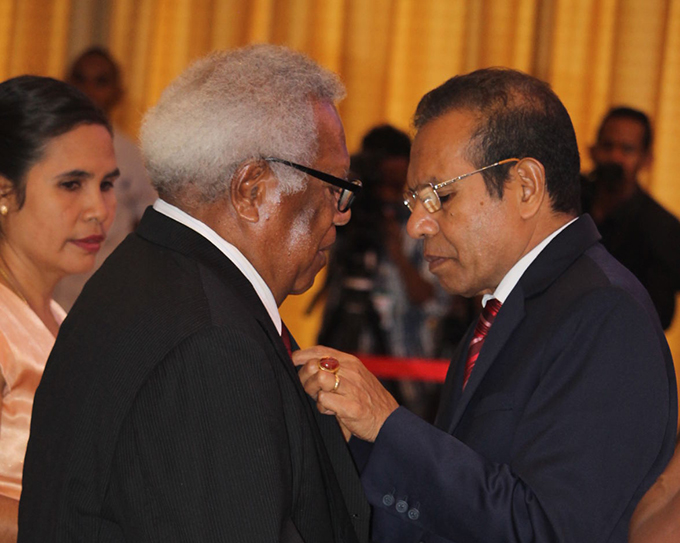
Then President Ruak pins the Order of Timor-Leste medal to former Vanuatu prime minister Barak Sope in Dili. Image: Vanuatu Daily Post

By Len Garae in Port Vila

“I was fighting in the mountains and I heard your voice from across the ocean coming to support my people, to cherish the same freedom that you have struggled for and achieved for your people”.

Former Prime Minister Barak Sope says the former FRETILIN guerrilla fighter-turned President of Timor-Leste, Taur Matan Ruak, spoke with words to that effect when he awarded him with the Order of Timor-Leste last month.

It is the highest medal in the Asia-Pacific country to be awarded to a person.

Barak Sope was accompanied by his wife, Mildred Sope, on the invitation of the President where he received the award at the Presidential Palace in Dili on May 17 just three days before the presidential term ended.

Former President Taur Matan Ruak said the solidarity of so many activists like Barak Sope who believed in justice was decisive for the Timorese people realising their freedom and independence.

Ruak said supporters from all over the world, including Vanuatu, helped to expose the crimes of the occupation in Timor-Leste, especially by the Indonesian armed forces, the Vanuatu Daily Post was told.

-Partners-

After Portugal abandoned Timor-Leste in 1975, Indonesia invaded the country in December that year and occupied it illegally for 24 years. During the occupation more than 200,000 Timorese were killed by the Indonesian armed forces.

Indonesian crimes exposed
The exposure of the crimes of the Indonesian occupation on Timor-Leste was made during Barak Sope’s speech at the United Nations Millennium Summit in New York in September 2000.

Sope also exposed the killings of Timorese at the meeting of the Non-Aligned Movement in Havana, Cuba, in May 2000.

In 1985, as the Secretary of Foreign Affairs and Roving Ambassador of Vanuatu, Barak Sope travelled to Africa to meet President Santos of Angola and all the foreign ministers of former Portuguese colonies to speak on behalf of the East Timorese people.

To the people of Timor-Leste today, Barak Sope, is their hero because when he was secretary-general for Vanua’aku Pati from 1974 to 1987, he worked closely with FRETILIN, the independence movement of Timor-Leste.

During that time, some FRETILIN members came to live with the Sope Family on Ifira Island and Sumalapa for three to five years.

When he was Prime Minister, Barak Sope signed the Agreement with the then Secretary General of the United Nations, Kofi Anan, for Vanuatu to take part in the UN Peacekeeping Force in May 2000.

In 2001, the prime minister did not only send the 50 ni-Vanuatu Police Peacekeeping Force to East Timor on their first overseas UN Mission, but he personally travelled with them to Australia where he saw them off to East Timor.

Vanuatu voted for independence
Since 1980, Vanuatu had always voted for Timor-Leste to gain independence at UN General Assembly and other international forums.

During the award ceremony, the citation of the Order of Timor-Leste was read to say that this medal was awarded to Barak T. Sope Mautamate for his “contribution towards the struggle for freedom, independence, peace and humanity for the Timorese people”.

“For your contribution, the 1.06 million Timorese people reiterate their heartfelt appreciation for all those who helped to give birth to Timor-Leste, from Vanuatu and other countries in the world,” President Ruak reportedly said.

Former President Ruak has been succeeded in office this month by FRETILIN leader President Francisco Guterres.

]]>

Samoan airline deals at centre of Tokelau chopper purchase

]]>

AsiaPacificReport.nz

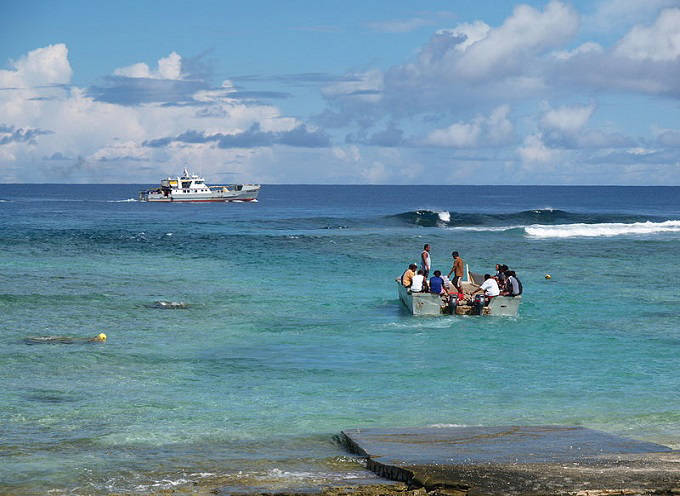
Tokelau transport challenges … no airport and no coastal port for transport between the territory and other islands and states. Image: CloudSurfer

By Mackenzie Smith in Auckland

Tokelau’s controversial helicopter buy was part of at least one major Samoan airline deal, along with plans for the establishment of a luxury hotel on the remote New Zealand-administered territory.

In February, then Foreign Minister Murray McCully slammed Tokelau over the purchase of two helicopters that he described as “extravagances”, and later said they represented “a breakdown in Tokelau’s governance”.

David Nicholson, New Zealand’s​ Administrator for the territory, also imposed restrictions on Tokelau’s capital spending and has since carried out a review into the helicopters which found government officials behind the purchases did not have the authority to make them.

Documents obtained by Asia Pacific Report under the Official Information Act confirm earlier revelations that the helicopters, which will now be sold off, were part of an “interim air service”, with the end goal of establishing runways on Tokelau.

Last October, a Tokelau “senior public servant”, whose name was redacted, advised the NZ Civil Aviation Authority (NZCAA) that Tokelau was exploring a fixed-wing air service between Samoa and Tokelau.

According to the public servant, Polynesian Airlines, which is co-owned by the Samoan government, would be functioning as the service operator, made possible through a “partnership arrangement” with private Samoan tourism company, Grey Investment Group (GIG).

-Partners-

It is unclear whether the public servant is one of the two who were suspended pending an investigation by Tokelau’s government into their role in the helicopter purchases.

Commercial deal
A document from February last year, composed by a Ministry of Foreign Affairs and Trade (MFAT) official, reveals Tokelau’s bilateral team advised MFAT of a proposal made by a hotelier, whose name was redacted, for a commercial deal involving “operating a helicopter service from Apia to Tokelau”.

Its purpose would be to deliver tourists “to a proposed high end hotel in Tokelau”.

The chairman of GIG is Alan Grey, son of famous proprietor Aggie Grey and who holds several senior government and corporate positions in Samoa, including a directorship of Polynesian Airlines.

GIG has an extensive portfolio of investments, including several high end hotels and resorts across the Pacific, and Alan Grey is also chairman of the Samoa Hotel Association.

Polynesian Airlines and GIG have not responded to requests for comment.

The arrangement with Polynesian Airlines was mentioned as early as September in email correspondence between NZCAA and MFAT officials.

It was also described in a January meeting between David Nicholson, several MFAT and NZCAA officials, and Tokelau’s Chief Technical Helicopter Adviser and Financial Adviser.  

One of the redacted Tokelau emails gained under an OIA documents request. Image: MS/PMC

‘Logistical support’
Polynesian Airlines was “providing logistical support” to Tokelau, “including hangar space and access to fuelling facilities”, according to notes from the meeting.

However, earlier documents reveal Polynesian Airlines was not the only Samoan company that expressed interest in a fixed-wing air service to Tokelau.

In a November email, which had its recipients redacted but includes a “minister”, then High Commissioner to Tuvalu Linda Te Puni said she had “heard about a number of proposals for helicopter services and a seaplane service involving Talofa airways with possibly a Japanese company”.

In another email later that month and this time addressed to multiple NZCAA officials, Te Puni confirmed Tokelau was in discussions with Talofa Airways.

In October, a representative for the airline advised NZCAA of the logistics of future flights to and landings on Tokelau, after NZCAA requested the information so that it could determine the relevant rules for aircraft operation in Tokelau.

Following earlier statements from Ulu-o-Tokelau Siopili Perez and former Foreign Minister Murray McCully that the helicopters would be sold off, a chain of emails starting from late February show those plans are now under way.

A number of discussions between CAA and MFAT officials detailed the logistics of selling or contracting out the two helicopters to recover their initial cost.

March correspondence between NZCAA and MFAT officials revealed Administrator David Nicholson had “been approached” by Hawker Pacific, an Auckland-based aviation provider, with the intention of it acting as a sales agent for the helicopters.

]]>

Closure of Manus Island will leave refugees in ‘limbo’, says Amnesty

]]>

AsiaPacificReport.nz

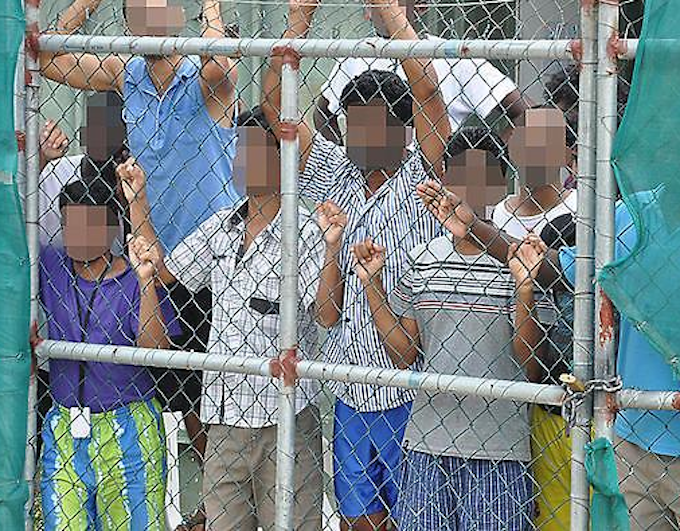
Closure of Australia’s detention centre on Manus Island … “will not end refugee suffering”. Image pixelated by SBS. Image: SBS News

By Kendall Hutt in Auckland

Australia’s offshore refugee detention centres in the Pacific are facing further controversy as the gradual closure and demolition of the institution on Manus Island in Papua New Guinea begins.

Following the announcement of Papua New Guinean authorities last month, one compound has already been closed, with another planned for June 30.

The closure and demolition comes after PNG’s Supreme Court ruled in April last year the centre was illegal and unconstitutional.

It is expected to be fully demolished by October 31 when Ferrovial’s contract expires – the company accused of profiting off refugees’ suffering.

However, Amnesty International says the move will not end the suffering of the 829 refugees on the island.

“These people are to be left in limbo,” Kate Schuetze, a Pacific research and policy adviser with Amnesty International based in Australia, told Asia Pacific Report.

-Partners-

Despite the apparent hope provided by Papua New Guinea’s announcement on the surface, Schuetze said the reality for refugees was “a lot darker”.

‘No plans to resettle refugees’
“Essentially refugees are being shifted from one camp to another.”

Papua New Guinea authorities say refugees will be repatriated or settled in the nearby town of Lorengau, where the Manus Refugee Transit Centre is located.

Shuetze said Australia’s ultimate goal with this announcement is what it had always been — pressure for refugees to return home.

Amnesty International Pacific researcher Kate Schuetze … refugees will endure worsening conditions. Image: Fiji Times

“I mean, there were no plans to resettle these refugees in Papua New Guinea to start with.”

The centre’s closure and demolition – described by Shuetze as a “phasing out” – also means refugees will endure worsening conditions, as many are moved to other compounds within the centre.

“Essentially this means harsher conditions for refugees.”

Shuetze said there would be no air conditioning and communities, forged over four years, would be disbanded. “There is no rationale behind this added torture.”

‘It’s not safe’
Grant Bayldon, executive director of Amnesty New Zealand, believes things are more unclear.

“It’s very unclear what the planned closure means at this stage. Clearly it’s not safe for the refugees and asylum seekers to be settled into Papua New Guinea,” he said.

Amnesty International New Zealand’s Grant Bayldon … “really no hope for refugees”. Image: Amnesty International

“It’s therefore essential that the Australian government comes up with a plan to resettle refugees back to Australia or safely in a third country like New Zealand.”

Bayldon fears the centre’s closure will also not remove its fundamental problems.

“Refugees are not safe and there’s really no hope for them in being able to restart their lives and living in safety due to the minimal protection they’ve been offered.”

Amnesty International fears refugees may also be sent to Australia’s other refugee detention centre on Nauru, which reportedly has the second highest rate of mental illness of any refugee population in the world.

Security before empathy
The move by Australian and Papua New Guinean authorities has increased calls by Amnesty International New Zealand for the government to stand by its 2013 offer to resettle 150 refugees a year from Australia’s detention centres.

Australia’s Prime Minister, Malcolm Turnbull, has in the past rejected New Zealand’s offer claiming Australia’s national security has to come before its empathy.

Turnbull claimed in 2016 resettlement in New Zealand would be used by people smugglers as a “marketing opportunity”.

Despite such statements, New Zealand should renew its offer, Bayldon said.

“It doesn’t look like the Australian government’s going to do the right thing any time soon, so it’s really important that other governments — including New Zealand’s — put up their hands and offer to safely resettle refugees so that they can restart their lives.”

Bayldon believes New Zealand has remained silent on Australia’s detention centres for far too long.

“Through two different New Zealand foreign ministers and two different New Zealand prime ministers, we are yet to hear the New Zealand government properly call out Australia for its abuse and illegal treatment of refugees and asylum seekers.

‘New Zealand needs to speak out’
“It’s absolutely incoherent for it not to call out Australia with appalling abuses going on in its own neighbourhood, right here in the Pacific. New Zealand needs to speak out more strongly than it has so far.”

Primary responsibility, however, rested with Australia, he said.

“It’s the Australian government which put people in these abusive detention centres in breach of international law and it’s the Australian government’s responsibility to get them to safety.”

Despite this, Manus Island refugees have written to New Zealand Prime Minister Bill English seeking asylum.

“We can understand why they’ve written to the New Zealand government, and while the primary responsibility lies with the Australian government, this really is an opportunity for the New Zealand government to stand up for its own values and do the right thing,” Bayldon said.

“What we see from refugees and asylum seekers is what they want is to be able to get on with their lives. They want to be able to work, they want to be able to contribute, and New Zealand is a place where they could do that.”

]]>

Hundreds left homeless after being evicted near PNG’s main airport

]]>

AsiaPacificReport.nz

The EMTV News report of the eviction of the villagers.

By Godwin Eki in Port Moresby

Hundreds of poor Papua New Guineans have been left homeless after their houses were destroyed by bulldozers without warning close to Jacksons International Airport in the capital of Port Moresby.

The people were still coming to terms yesterday with the loss of their homes with their eviction reportedly authorised by a business firm and police.

Community leader Paul Kop told EMTV News that their homes had been destroyed during the day when the men were away working and only women and elderly people were left at home.

He said although the villagers had been given a directive from Assistant Police Commissioner, Sylvester Kalaut, and a court order, the eviction notice was not sighted as proof of eviction.

Kop said the people should have been given one or two weeks’ notice before their homes were destroyed.

-Partners-

He said the majority of the homeless people were from the Southern Highlands, while others were from Morobe, Goilala, Chimbu, Enga and local Motu-Koitabuans.

He said 218 homes had been destroyed by the bulldozers.

Ten trade stores and five poultry projects with a total of 6000 chickens were also destroyed, he said.

National Capital District Governor Powes Parkop was reportedly arranging some assistance.

Papua New Guinea faces a general election on June 24.

Godwin Eki is an EMTV News reporter.

]]>

No to deep sea bed mining plans for Pacific, says PNG’s Cardinal Ribat

]]>

AsiaPacificReport.nz

Meredith Kuusa reports for TVWan News.

Pacific Media Centre News Desk

Papua New Guinea’s Catholic Church leader has given a resounding “no” to deep sea mining after returning from his visit to Germany.

The Archbishop of Port Moresby Archdiocese, Cardinal John Ribat, was highly critical of the proposed plans of the Canadian mining company Nautilus for the Pacific.

He spoke to a global conference as a representative for Oceania on the effects of climate change in the Pacific.

Cardinal Ribat was encouraged with the support he received when visiting the office of Chancellor Angela Merkel.

He said the Catholic Church was against deep sea mining because it would cause destruction to the surrounding environment.

-Partners-

He condemned the “shocking” robot machinery planned for the mining.

He said it would also not contribute to coping with climate change.

]]>

Duterte’s ‘war on drugs’ killings spark row during human rights seminar

]]>

AsiaPacificReport.nz

By Kendall Hutt in Auckland

Philippine President Rodrigo Duterte’s “war on drugs” has sparked further controversy in New Zealand at a public seminar delivered by Filipino human rights defender Wilnor Papa.

Heated debate erupted between several Filipino citizens, Papa and members of the audience at Papa’s “On the frontline” talk at the University of Auckland last Thursday.

The Human Rights Watch report License To Kill in March 2017 which cites “more than 7000 killings” with evidence.

Organised by the NZ Centre for Human Rights Law, Policy and Practice, Auckland University of Technology’s law school and Amnesty International Aotearoa New Zealand, debate culminated around how many people had been killed since Duterte took power on June 30, 2016.

Papa said between 4000 and 9000 Filipino’s had been murdered in what members of Amnesty International Aotearoa New Zealand described as a “harvest”.

This was challenged by Filipino citizens Allan Jacob, Rex Yap and a Filipino student in the room who were concerned about Duterte being painted “negatively”.

Jacob and Yap told Asia Pacific Report they attended the talk to “present a balanced view” of Duterte.

-Partners-

“There are killings, yes, because there are heightened operations to get rid of the drug menace in the Philippines. What we don’t want to see is the administration being painted as a despot, just killing people.”

9000 people killed
The Filipino student from the University of Auckland accused Papa of quoting from “fake media” — such as leading national news media the Philippine Daily Enquirer and Rappler — although data on the number of deaths is continuously being gathered by both official and human rights sources.

The Human Rights Watch cited “more than 7000” in its comprehensive report in March, License To Kill, which names victims and details evidence.

“I am a Philippine citizen, so I think I have every right to comment about what is going on in the Philippines,” he said.

University of Auckland Filipino student … “I think I have every right to comment”. Image: Kendall Hutt/PMC

“In the previous administration, there were 9000 to 14,000 deaths. So now you say 9000 people have been killed because of the drug war. Do you mean that the present administration are carrying out killings at an exponential level?”

Papa said in response a number of suspected drug dealers had been killed in a very short space of time.

“I think during the time of Duterte, from after he won the election, in less than a year there are already 9000 dead.”

Papa later emphasised, however, that Amnesty International, where he is campaigns manager for the Philippines, is trying to establish a clearer figure, but stressed this was difficult due to intimidation of people on the ground.

“They’re giving us conflicting numbers, but we’re talking to as many organisations as we can,” Papa said.

Most vulnerable targeted
Amnesty International began monitoring data after Duterte took power.

However, Papa, Amnesty International Aotearoa New Zealand’s Margaret Taylor and the director of the NZ Centre for Human Rights Law, Policy and Practice, Rosslyn Noonan, admitted the human rights organisation has been unable to keep up with the killings “from day one”.

According to an undated Human Rights Watch report, more than 6000 Filipinos have been killed to date — the vast majority of whom are poor, urban slum dwellers — but this figure was at variance with its own License To Kill report in March of more than 7000 killings.

Repeated changes in police statistics have also confused the issue. Vice-President Leni Lobredo stated “more than 7000 killings” in a video shown to the Washington-based Drug Reform Coordination Network (DRCNet) Foundation on 17 March 2017. But the Philippines National Police has since claimed that not all the extrajudicial killings are drug-related.

Amnesty International Aotearoa New Zealand’s Margaret Taylor joined colleagues in agreeing every drug killing was “one too many”. Image: Kendall Hutt/PMC

Papa and representatives of Amnesty International Aotearoa New Zealand said it was important to remember the “most vulnerable” people in the Philippines were being targeted and emphasised that whatever the number, one death was too many.

“What we’re imploring is that regardless of differing numbers, whether it is 9000, 5000 or 4000, the killings should stop.”

This statement came despite acknowledgement that killings in the Philippines are not a new phenomenon.

“It has never been a new phenomenon, but on this scale. 9000 in a few months?”

‘I will kill’
Papa, whose father was tortured for three months and who has never found an uncle thrown in prison under former President Ferdinand Marcos, said Duterte’s motives could not be questioned.

“He made a campaign promise: ‘I will kill.’”

Professor David Robie, director of the Pacific Media Centre, said this was the notable difference between Duterte’s “war on drugs” compared with extrajudicial killings by previous elected governments since the Marcos dictatorship ended in 1986.

“The major difference that I see is that it’s an overt government policy on a scale that has not been seen before.” He said mere “suspects” with frequent wrong identifications were being routinely killed.

Noonan also picked up on Duterte’s tactic of dealing with alleged drug dealers.

“The truth of the matter is, this is the first time a president has got up there and actually said ‘I think we just need to kill these people’. Duterte’s not just said it once, he’s said it more than once.”

Despite the controversy, all parties agreed the killings of a vulnerable faction of society – suspected drug addicts – were fundamentally wrong.

Poorest, marginalised killed
“We’re seeing the very poorest and most marginalised being killed.”

In closing, Kris Gledhill of the Auckland University of Technology’s law school, said:

“If there is unnecessary killing, whether it’s 9000, whether it’s 12,000 – it is still a breach of the International Covenant on Civil and Political Rights, which is the bedrock of the rule of law and respect for human rights in the world.

“So when we’re arguing about numbers, which is perfectly proper to have an argument as to how bad the problem is, if there’s more than one unnecessary killing there’s still a problem and I’m sure that’s something we can all agree on.”

An excerpt from the Human Rights Watch report Licensed To Kill about extrjudicial killings in the Philippines. ]]>

Media ‘twisted comments’ about Chinese firm over tax, says Pōhiva

]]>

AsiaPacificReport.nz

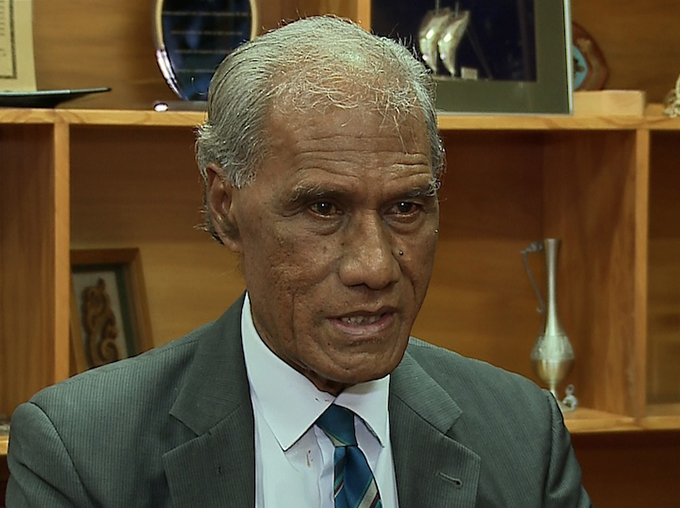
Prime Minister ʻAkilisi Pōhiva clarifies his statement about Chinese businesses not paying tax in Tonga. Image: TNews

Pacific Media Watch News Desk

Tongan Prime Minister ʻAkilisi Pōhiva has hit back at reports that he told a press conference that “Chinese businesses in Tonga did not pay any tax at all,” claiming his words were “twisted” in the media, reports Kaniva News.

Pōhiva also said reports that he said the Chinese would take over the country in the future were taken out of context.

Pōhiva told Kalino Latu of Kaniva News in an interview in ‘Atalanga, Auckland, that what he told media was that a Chinese company, Yan Jian Group Co Ltd, did not pay any tax at all.

The embattled prime minister’s government faces a lawsuit hearing on Friday over changes at the state-run Tongan Broadcasting Commission that are being condemned by critics as an attack on media freedom in the kingdom, Radio NZ International reports.

The sacked head of TBC, Nanise Fifita, can continue in her job until the judicial review of the dismissal is heard.

Pōhiva told Kaniva News: “I did not mean all the Chinese businesses in Tonga did not pay tax. That was not true.”

-Partners-

The Yan Jian Group has operated in Tonga since 2009 as the principal contractor on a major roads improvement scheme with the aid of the Chinese government

Court case revelation
Pōhiva said he was surprised when it was revealed in a recent court case that the former government had agreed to allow the Yan Jian Group not to pay any taxes.

The revelation was made during a Land Court hearing in which the judge ordered Lord Nuku and the Yan Jian Group Co Ltd to pay the current Lord Luani TP$5,556,000 (NZ$3.5 million) in compensation for a dispute over a block of land in Malapo.

Lawyer Sione Fonua, who acted for Lord Luani, told Kaniva News the Chinese company did not pay taxes and did not file any annual returns with Inland Revenue because of its agreement with the former government.

It has been estimated the company was given TP$80 million for the project.

Regarding reports that Pōhiva had said the Chinese would take over the country, he said he emphasised that only those who were working hard would control the country.

He said he then referred to the hard-working Chinese as an example.

He said his comments had been wrongly portrayed as if he was having a conspiracy with the Chinese or he was supporting them to take over the country.

]]>

AUT appoints new head of Communication Studies school

]]>

AsiaPacificReport.nz

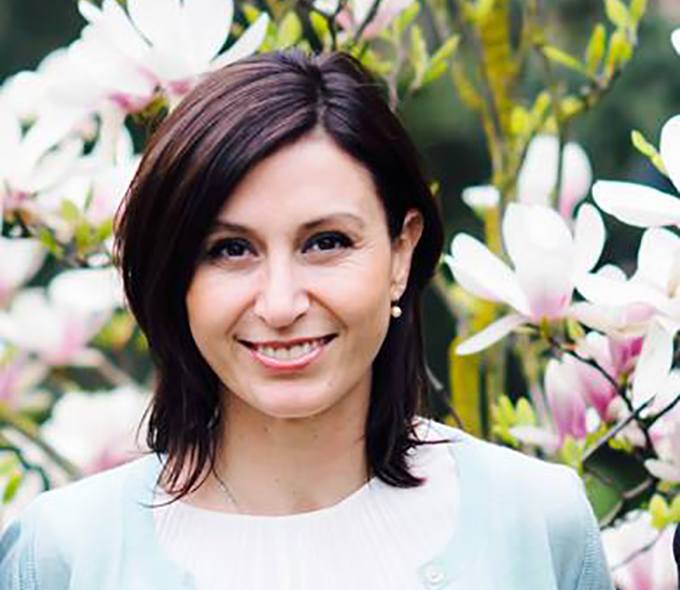
Professor Berrin Yanikkaya … an admirable record of teaching, curriculum development, research and management for new directions. Image: Berrin Yanikkaya

By Olivia Allison

Auckland University of Technology has appointed a new head of the School of Communication Studies, the largest in New Zealand, the university has announced.

She is Professor Berrin Yanikkaya, currently professor in communication science at Yeditepe University in Istanbul, Turkey.

The acting dean of the Faculty of Design and Creative Technologies, Pro-Vice Chancellor Philip Sallis, said Professor Yanikkaya had an admirable record of teaching, curriculum development, research and management.

“She comes highly recommended for her leadership and ability to bring staff together in the pursuit of academic excellence. Among her experiences as an academic she has been a member of the Turkish National Curriculum Accreditation Authority and numerous professional community organisations.”

Professor Yanikkaya takes over the role as head of the School of​ Communications Studies from Associate Professor Alan Cocker who in July will take his long-overdue sabbatical leave.

Pro-Vice Chancellor Phillip Sallis said Dr Yanikkaya was chosen from a field of well-qualified and able applicants and went through two formal interviews and gave a presentation to the school and the appointments advisory committee.

-Partners-

She also met with the Vice-Chancellor and Deputy-Vice Chancellor as part of this process.

“Berrin stood out among the candidates for her energy of purpose, clarity of vision for the school and an obvious grasp of these issues and challenges it faces”, he said.

Professor Yanikkaya will begin her role in July. ​

AUT’s School of Communication Studies is a leading academic and media producer, publishing the news websites Asia Pacific Report and Te Waha Nui, and the SCOPUS-ranked research journal Pacific Journalism Review.

]]>

Wrest back PNG from ‘globalised zombies’ and ‘life suckers’, says Juffa

]]>

AsiaPacificReport.nz

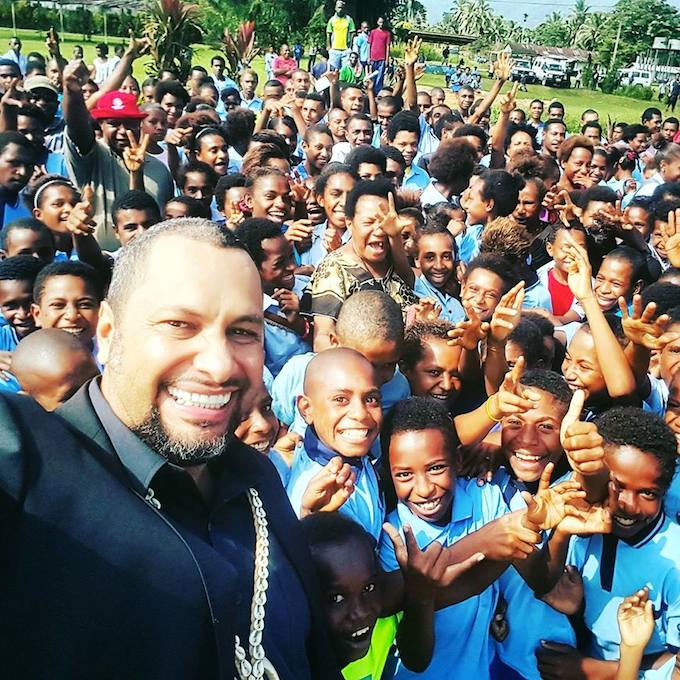
Oro Governor Gary Juffa … call for real leadership for the people of Papua New Guinea. Image: Gary Juffa Facebook

Popular Oro Governor Gary Juffa, one of the opposition leaders contesting Papua New Guinea’s general election next month, has called on the nation to take back the country from elitist “globalised zombies”.

Declaring that Papua New Guinea needed fresh leadership when the country goes to the polls, the People’s Movement for Change Party (PMCP) leader added that it must be one that did not repress the people.

He appeared to be referring to the current government of Prime Minister Peter O’Neill and a host of foreign advisers.

Juffa, who has travelled to Henganofi, Kainantu and Lufa in the Eastern Highlands to endorse his candidates, called on Papua New Guinea to break free from a “colonised mindset” and take back its economy from foreign control.

“Our people need basic services like health, education, law and order, justice, markets and platforms to perform promote and export their art culture and sport,” he said.

Papua New Guineans were convinced by others “who merely exist for profit and material riches alone, whose heads are filled with intelligent schemes and scams but whose hearts are empty.”

‘Sucked the life’
“These globalised zombies, a class of elitist rich who have sucked the life out of their societies are here to do the same,” he said.

-Partners-

“These evil beings and their agents who come to ‘help’ will have our people become so busy thinking and moaning about what we don’t have … that they [will] have us forgetting about the abundant blessings we do have and the great opportunities that come with them.”

Juffa said he had always advocated that Papua New Guinea was a blessed country.

“It has rich soil and there is plenty for everyone,” he said.

“Look at our people. They are great people. Talented and compassionate. They take care of themselves. They provide for their families. We are not a welfare state. We do not need to pay anyone social security.

“What we need to do is economically empower our people. All our people.

“What we must do is provide true loving leadership … that promotes the interests of the people.”

Papua New Guineans will vote between June 24 and July 8.

]]>

Benny Wenda accuses Indonesian police of torturing West Papua official

]]>

AsiaPacificReport.nz

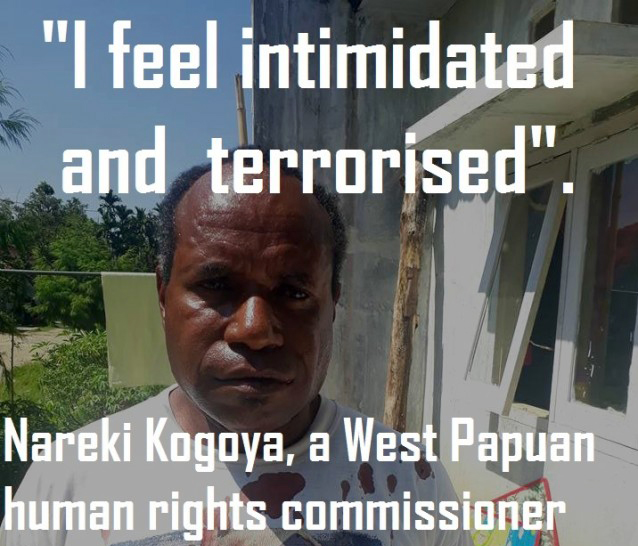
West Papuan human rights commissioner Nareki Kogoya … allegedly tortured by Indonesian police. Image: Free West Papua Campaign

Police in Indonesia are facing allegations of torture from West Papuan independence leaders after a prominent human rights commissioner was beaten by police.

A statement by the Office of Benny Wenda, co-founder of the Free West Papua Campaign, detailed how Nareki Kogoya, of the National Human Rights Commission (KOMNAS HAM), was tortured until he was “covered in blood”.

It is alleged Indonesian police tortured Kogoya following a search of his home on May 18, 2017 in Jayapura.

Kogoya was then driven to the police station where he was interrogated, Wenda stated.

If Kogoya repeated his “ordeal” he would be charged, police allegedly threatened.

Tabloid Jubi also reported the alleged torture, stating it had been carried out after Kogoya attempted to defend several “kids” accused of murdering a local lecturer.

“I said, I’ll help them, I’m guarding them, and I don’t want them to get hit,” Kogoya said.

-Partners-

‘Intimidated and terrorised’
Tabloid Jubi reported Kogoya’s lip was wounded in a beating which took place in a police car.

“I feel intimidated and terrorised,” Kogoya has said of his ordeal.

“It brings more heartache, tears and sadness for the people of West Papua to learn that another innocent West Papuan person has been brutally tortured by the Indonesian police,” Wenda said.

“This horrible torture of a very well-known human rights figure in West Papua shows that the Indonesian police and military have no respect for West Papuan human rights whatsoever.”

West Papuan independence leader Benny Wenda … Nareki Kogoya’s torture means “heartache, tears, and sadness”. Image: Free West Papua Campaign

Wenda claimed the Indonesian military and police therefore treat West Papuans as “subhuman” and “animals” because of the colour of their skin.

Wenda has since questioned what Kogoya’s treatment – who represents West Papua in the Indonesian Human Rights Commission – means for his fellow Papuans.

“If this is how representatives of government agencies are treated in the capital city of West Papua, what about ordinary people? What about activists? What about the people in the villages whose stories never get told, who are killed by the Indonesian military and police like animals with no media attention?”

Tortured for days
Wenda said Kogoya’s alleged torture further demonstrates that Indonesia is not complying with the United Nations Declaration of Human Rights.

“There is no freedom of expression, freedom of press or freedom of assembly; there is NO freedom in occupied West Papua.”

Ursula Florence of Rappler reports a pre-trial involving three Tangerang City residents, who admitted to being tortured by police investigators, failed to proceed on May 29, 2017.  The victims, referred only to as Herianto, Aris and Bihin, were allegedly “subjected to torture for days” after being accused of multiple thefts.

Rappler reported the victims were beaten and their genitals mutilated.

]]>

New Zealand support for West Papua grows after ‘historic declaration’ signed

]]>

By Kendall Hutt in Auckland Political support in New Zealand for an independent West Papua is growing after a “historic declaration” was signed during free West Papua advocate Benny Wenda’s visit to the country this month. Several politicians from across four political parties signed the Westminster Declaration, which calls for West Papua’s right to self-determination to be legally recognised through a vote. [caption id="attachment_21875" align="alignright" width="500"] Green MP Catherine Delahunty with West Papua’s Benny Wenda (centre) and Pacific Media Centre members at Auckland University of Technology. Image: PMC[/caption] Green MP Catherine Delahunty – who has been a vocal supporter of West Papuan independence throughout her political career – told Asia Pacific Report the meeting at Parliament by the IPWP was “amazing”. “We had a really amazing evening at Parliament with the Westminster Declaration. We had a number of MP’s – nine MP’s on the night – including others subsequently signing the declaration, which as you know calls for a referendum, supervised independently by the UN for West Papuans to talk about and identify their views on self-determination. “That was a really powerful moment. Benny said it’s very important for him travelling the world that he can actually meet the politicians and that the politicians actually – from a number of parties in this case – and sign up to the declaration.” West Papua was controversially incorporated into Indonesia through a so-called “Act of Free Choice” in 1969 – only 1,026 selected West Papuans out of a population of 800,000 voted to become a part of the country – under duress. In 2016, politicians from across the globe signed the declaration, first launched in the United Kingdom by Labour leader and co-founder of the International Parliamentarians for West Papua (IPWP), Jeremy Corbyn. 11 MPs signed up Eleven members of Parliament from across four political parties – Greens, Labour, National and the Māori Party – have signed the declaration. Green MPs Catherine Delahunty, Barry Coates, Mojo Mathers, Jan Logie and Steffan Browning have signed, along with Labour MPs Louisa Wall, Carmel Sepuloni, Adrian Rurawhe and National MP Chester Burrows. Co-leader of the Māori Party Marama Fox and Labour MP Aupito S’ua William Sio have also signed. Delahunty is certain this number will grow, as the declaration is now circulating through caucus, she said. “Not everyone could make the event, but there are people who are keen to sign up.” However, National MP Chester Burrows was the only member of National to sign the declaration, reaffirming Delahunty’s belief a change of government is needed for the issues in West Papua to truly gain traction politically. “It’s frustrating because dreadful things are happening everyday and we’re not getting the political leaders of this country to take it seriously in the government.” This is because support of West Papua would not come from National, Delahunty said, although she is hopeful. ‘Real core of support’ “We have got a real core of support for that declaration from across the House. Of course we haven’t got the government’s political support, but that’s what we’re working on.” Delahunty said the rest of Benny Wenda’s visit to New Zealand was also “very lively”. “In dire weather conditions, about 30 people marched to the Indonesian embassy. For the first time the embassy – the Indonesian officials – actually came out. They came out to tell us we were wrong about our views and to hand out propaganda to the university students about how everything is great in West Papua and that West Papuans are leading their own country. “I challenged them back pretty hard … that was quite a lively experience.” Speaking with Asia Pacific Report earlier this month, Benny Wenda said the purpose of his visit to New Zealand was to hopefully gain the country’s commitment to West Papua independence: “West Papua’s hope is Australia and New Zealand. This is a regional issue, this will never go away from your eyes and this is something you need to look at today. Review your foreign policy and look at West Papua.” During his visit, Wenda also met with Ngāti Whatua, unions, aid agencies, and students while in Wellington, echoing the solidarity found at his talk in Auckland, organised by the Pacific Media Centre. “There was a very powerful dialogue with some young Pasifika and Māori students, and some young people expressing their support,” Delahunty said. “I think it was useful and consolidated a lot of relationships, Benny being here. I think it helped us ride a wave of growing awareness which is slow, but steady, and we do see more and more people taking stock of this issue.”

]]>

The ‘battle of Paga Hill’ – controversial PNG doco finally on screens

]]>

AsiaPacificReport.nz

When the police roll in with bulldozers to clear a residential area in Papua New Guinea’s capital Port Moresby and make space for a huge luxury hotel, an international scandal of epic proportions ensues.

It’s a true David vs Goliath story about the small community of Paga Hill’s battle against a construction project worth several billion dollars and succeeds in taking the increasingly sinister case all the way to the Supreme Court.

Then Opposition Leader Dame Carol Kidu is the first person to be arrested, but the rest of the 3000-strong community gather with a pro bono lawyer and an international anti-corruption expert to assemble the increasingly dirty puzzle of evidence into a complete picture.

Campaigner Joe Moses and his fellow Paga Hill villagers. Still from The Opposition.

They are led by fearless anti-corruption community campaigner Jose Moses whose life is threatened.

Life then imitates art as the filmmakers are challenged in court by Dame Carol Kidu, one of the subjects in the film and the Australian development company, Paga Hill Development Company, in question in an attempt to ban the film.

Selected to screen at Doc Edge last year, young director Hollie Fifer’s film was pulled at the last minute due to the court challenge and was cleared for international release late last year.

What began as a student film project finally had its Australian home premiere at the Human Rights Film Festival last month and has also now been screened at the DocEdge film festivals in Wellington and Auckland this month.

-Partners-

Earlier this year, Papua New Guinean cabinet minister Justin Tkatchenko called for a Commission of Inquiry into the “murky deals behind acquisition of Paga Hill land and the abuse suffered by its former residents”.

The two-week Papua New Guinea general election is between June 24 and July 8.

]]>

PMW editor talks of concerns over martial law in southern Philippines

]]>

AsiaPacificReport.nz

The Armed Forces of the Philippines continues operations against terrorists in Marawi City, Lanao del Sur. Image: Rappler

Pacific Media Watch

Pacific Media Watch’s Kendall Hutt spoken with 95bFM’s The Wire host Tess Barnett today about martial law in the southern island of Mindanao in the Philippines.

She says this is worrying for the Asia-Pacific region.

Papua New Guinea and the Micronesian states have significant diasporic Filipino communities.

Hutt talked about what the declaration of martial law in response to urban attacks in Marawi City, means; comparisons with the Marcos dictatorship; and the threat it poses if it continues past the “normal” 60-day period.

Kendall Hutt and colleagues present the weekly radio programme Southern Cross about Pacific issues on 95bFM on Mondays.

Listen to Kendall here:

-Partners-

]]>

Keith Rankin’s Chart of the Month: Budget 2017: New Zealand’s ‘Universal’ Basic Income up to $195 per week

]]>

Keith Rankin’s Chart of the Month – Budget 2017: New Zealand’s ‘Universal’ Basic Income up to $195 per week.

[caption id="attachment_14565" align="aligncenter" width="979"] Increase in unconditional Public Equity Benefit. Chart by Keith Rankin.[/caption]

The big unnoticed story of last Thursday’s Budget is the increase in New Zealand’s quasi Universal Basic Income (UBI), from just under $175 per week ($9,080 per year) to precisely $195 (annual $10,140).

It’s actually particularly pertinent that Stephen Joyce acknowledged, by including these ‘tax cuts’ in his ‘family assistance package’, that ‘raising the tax thresholds’ represents in fact a form of benefit increase. I call the unconditional benefit that is embodied within our tax scale, the Public Equity Benefit (PEB).

(I claim naming rights because nobody else has bothered to name this unconditional benefit that is implicit within traditional graduated tax scales. Also, the name ‘Public Equity Benefit’, which embodies the visionary concept of public equity, offers much more for the future than the prosaic alternative name ‘personal tax credit’. Language matters.)

From the chart, we can clearly see that the PEB is not a true UBI. Persons grossing less than $70,000 per year do not get the full amount. However, we can say that most people grossing less than $70,000 do receive some conditional cash benefits which, when added to their unconditional PEB, take their total weekly benefits to $175 (or more).

In a fiscal sense, the cost of topping up so that all adults’ unconditional and conditional benefits total at least $175 per week is minimal. (An interesting case, however, affects my teenage son. He receives a ‘student loan living allowance’ which represents the same amount of cash as a student allowance. In the future, he will be required to ‘pay back’ his quasi student allowance, by means of a tax surcharge. The logic of universal unconditional benefits requires that ‘student loan living allowances’ should be no more subject to being ‘paid back’ than the unconditional Public Equity Benefits which all salary/wage earners receive.)

An important feature of the 2017 Budget is that, in line with the announced increase in the unconditional PEB to (upto) $195 per week, there have been significant increases in income-tested cash benefits – Family Tax Credits and Accommodation Supplements – to many of those people who have been short-changed by present anomalies in these benefits.

The 2017 Budget represents a significant step towards the inevitable acceptance of a genuinely universal ‘basic income’. Once this conceptual milestone has been achieved, we will then be able to understand that inequality and poverty are largely a consequence of the present tax rate (33%) and the present ‘universal’ basic income ($175 per week) both being too low.

Raising the weekly ‘universal’ basic income to $195 is a handy first step towards reducing inequality without resorting to increased ‘redistribution’ (and all the tragic bureaucracy that targeted redistribution entails).

]]>

Marawi retrieves bodies on streets amid Philippines air strikes

]]>

AsiaPacificReport.nz

As Ramadan begins, Carmela Fonbuena reports on the continuing clashes in Marawi City. Video: Rappler

By Carmela Fonbuena in Marawi City, Philippines

Philippines police have entered ground zero of military clashes with local terrorist groups on the southern island of Mindanao to finally retrieve dead bodies on the streets.

The military earlier said the terrorists had killed 19 civilians in Marawi City, Lanao del Sur.

Among the bodies recovered yesterday were those of three women and a child, said Al Sayyeed Alonto, who joined the retrieval operations in Barangay Basak Malutlut.

READ MORE: 80% of Marawi evacuated, gov’t vows ‘maximum power’

It signals the beginning of attempts by Marawi City to get a semblance of normalcy even as clashes continue for the 6th straight day. The fighting erupted last Tuesday, May 23, prompting President Rodrigo Duterte to declare martial law in the entire Mindanao.

-Partners-

There is division of laboUr, according to the Armed Forces of the Philippines (AFP). The AFP continues operations against the terrorists, police-assisted local government units (LGUs) lead the retrieval of bodies, volunteers rescue families trapped in combat zones, and so on.

“Right now, the LGUs are the ones collecting dead bodies of civilians. Sa amin naka-focus pa rin kami sa (We’re still focusing on) military operations pertaining to clearing and security operations,” said Lieutenant-Colonel Jo-Ar Herrera, military spokesman on the Marawi crisis.

The retrieval operations come after eight bodies were found in a ditch near a security checkpoint on Sunday morning. It is unclear if these eight were included in the military’s count of civilian deaths.

Trapped civilians
Herrera also said more than 200 civilians trapped inside the combat zone have been “rescued” from their homes.

But 2000 others remain trapped in areas controlled by the terrorists, according to Zia Alonto Adiong, spokesman for the Lanao del Sur crisis management committee.

“They have been sending us text messages, calling our hotline, requesting us to send rescue teams but we cannot simply go to areas which are inaccessible to us,” Adiong told Agence France-Presse.

“They want to leave. They are afraid for their safety. Some are running out of food to eat. They fear they will be hit by bullets, by air strikes,” he said.

Surgical air strikes
Air strikes had resumed on Sunday afternoon. The attack choppers could be seen from the provincial capitol.

Herrera said they are surgical attacks targeting fortifications of the local terrorist groups.

“We are still using surgical air strikes dahil mayroon pa rin silang mga (because they still have) fortifications. They are occupying buildings. They are using sniper rifles to inflict casualty on government forces,” he said.

Carmela Fonbuena is a Rappler journalist reporting on the Mindanao conflict.
@carmelafonbuena

]]>

American Samoa tuna cannery closure prompts fisheries gifts to Tokelau

]]>

AsiaPacificReport.nz

Tri Marine’s closure of Samoa Tuna Processors means a windfall for neighbouring Samoa and Tokelau. Image: Samoa Observer

By Mackenzie Smith in Auckland

After the closure of one of its tuna canneries, American Samoa is looking to recover by giving away tonnes of the fish to its neighbours, a move welcomed by Tokelau.

In December, tuna supply group Tri Marine indefinitely closed its Samoa Tuna Processors plant based in Pago Pago after supply and profit issues.

While the fate of Samoa Tuna Processors remains uncertain, American Samoa is now sending its excess tuna to the governments of Tokelau and Samoa.

Earlier this month both neighbours were gifted more than 11 tonnes of tuna each in Tokelau’s case, enough to match two years worth of its tuna imports.

American Samoa Department of Commerce Director Keniseli Lafaele said there were plans to extend this offer to Tuvalu and Kiribati as well.

The main idea behind it, said Lafaele, was to establish economic relations and improved access to the fisheries of the wider Pacific.

-Partners-

“We would like to explore the possibility of exporting goods from American Samoa to the neighbouring countries.” 

Mutually beneficial
This could be mutually beneficial for Tokelau, a country heavily reliant on both imported goods and income made through selling fishing licences to foreign nations, said Lafaele. 

Despite its population of roughly 1500 people, Tokelau netted US$13.5m in 2016 alone from the licensing of its 320,000 sq km exclusive economic zone.

Seiuli Aleta, Acting General Manager of the Office of the Council for the Ongoing Government of Tokelau, said American Samoa’s gift was a sign of the growing relationship between the two countries. 

“It’s not just that we’re located in the same geographical area and there’s a primary interest in fisheries, there’s a collective interest which I think in terms of economic development is probably good for both countries.”

Stan Crothers, a fisheries adviser to Tokelau, said Tokelau was working closely with Tri Marine leading up to the closure of its processing plant in Pago Pago.

“It’s really unfortunate that they had to close. And I guess the donation of that canned fish is just an example of the sort of relationship we had. We’re very disappointed that that didn’t go further but we’re hopeful that one day that might come again.”

He said the company was offering Tokelauans the opportunity to work on boats, in the Pago Pago factory and in some management positions.

“On the American Samoan side you’ve got the capital and the plants, we’ve got the fish, there’s a deal made in heaven there somewhere isn’t there?”

Aleta said despite the closure of Samoa Tuna Processors, the prospect of jobs and training offered to Tokelauans by American Samoa were still “on the table”.

]]>

PNG police launch communications centre for general election

]]>

AsiaPacificReport.nz

EMTV News bulletin on the Highlands joint security forces parade in Mt Hagen.

Pacific Media Centre News Desk

Papua New Guinea’s police have opened the first national communications centre for the 2017 General Elections and it is now in operation.

The centre was launched after the opening of the Highlands security elections operations in Mt Hagen on Friday, Loop PNG’s Annette Kora reports.

A demonstration of direct communication between the communications centre in Port Moresby and the Chief Secretary, Isaac Lupari, and Police Commissioner Gari Baki — both present at the Mt Hagen launch — was a feature of the event.

Lupari announced over the police radio network that as well as the launching of the Highlands region security operations, operations were under way for the entire country.

Commissioner Baki said the police hierarchy was confident that the launching of the communications command centre would have police connect to the rest of the country.

-Partners-

This would boost the successful progress of this year’s election.

The communications centre is in the Konedobu police headquarters.

Joint security forces parade
Vasinatta Yama of EM TV News reports that the Highlands joint security forces parade was the largest in the country.

Police Commissioner Baki hosted the parade and Chief Secretary Lupari was the reviewing officer.

Heads of the three disciplinary forces were joined by other heads of department, election managers of the seven Highlands regions and also provincial police commanders.

Baki told the parade forces to take pride in their uniforms and ensure the 2017 National Election did not fail.

Brigadier-General Gilbert Toropo told EMTV News that the PNG Defence Force had committed 500 personnel to support the Electoral Commission.

Torop said thorough preparation, training and planning has already been done by PNGDF and deployments of soldiers had already started this week to the Highlands, Yama reported.

The soldiers will provide transportation, including aircraft and ships for air and sea patrols.

Before and after the counting, the PNGDF will transport the ballot boxes to and from the polling and counting areas.

Correctional Services Commissioner Michael Waipo said that the main focus would be on the prisoners, but they would assist the mobile squad with manpower.

At least 500 CS staff would be deployed to help provide security.

Prisoners eligible for voting were those of voting age and who had been living in prison for more than nine months.

]]>

New Zealand Budget Analysis: Explaining National’s apparent shift to the left – Bryce Edwards

]]>

Analysis by Dr Bryce Edwards – New Zealand Budget Analysis: Explaining National’s apparent shift to the left

[caption id="attachment_13635" align="alignleft" width="150"] Dr Bryce Edwards.[/caption] National’s 2017 Budget is a very centrist affair and it involves implementing many of the types of decisions that might be expected of a centre-left Labour-led government.
The political left sometimes portrays the current National Government as a radical rightwing administration that is determined to screw down the lot of working people. And there’s certainly an element of truth to this. But by and large, this government is mostly quite centrist, which is why Labour has had such a hard job in opposition. The reality is most of the public – rich and poor alike – simply don’t see the government as evil and uncaring. And whenever it has carried out austerity reforms over the last nine years, these have generally been accepted by the public in the context of a global financial crisis forced upon them.
A Centrist shift into Labour territory
Yesterday’s Budget by Steven Joyce will cement perceptions that National is pragmatic, sensible, and perhaps even relatively caring. So how are we to understand this shift? Is it significant or barely noticeable? Is it mere electoral calculation, or something more principled on the part of National?
First, it’s worth establishing how much of a shift to the left Steven Joyce has taken. Four leading political editors have suggested National has moved into Labour’s left territory with the Budget.
Fairfax’s Tracy Watkins focuses on the impact of the Budget on lower socio-economic groups: “There are shades of the infamous chewing gum tax cuts for those on the lowest incomes – someone on $15,000 a year won’t even scrape up enough for a Big Mac, qualifying for just $1.30 a week. But whopping increases to the accommodation supplement and – to a lesser extent – working for families make up for it. The Working for Families and accommodation supplement changes are deliberately targeted at those on the lowest incomes, and those living in areas where soaring house prices have resulted in more families living on the breadline. Some families could be as much as $145-plus a week in the money, depending on where they live, once based on the accommodation supplement changes alone. That will make big inroads into New Zealand’s child poverty rates, an area that are increasingly troubling even wealthier voters” – see: Tax threshold move an election bribe eight years in the making.
Herald political editor Audrey Young sees this focus on the poor as being bad news for Labour: “It is a Budget that makes life better for many low and middle-income Kiwis and it makes life worse for the Opposition. The design of the $6 billion package to lift incomes over four years makes it difficult for the Opposition to complain. Under the package 50,000 fewer children would be in low-income households (as measured by the OECD) at April next year – a 30 per cent reduction in that particular measure of child poverty” – see: Bill English the cat that got the cream.
On TV3, Patrick Gower also emphasised how Joyce had “gone further with a major incursion into Labour territory with the changes for low and middle income earners – the ‘Kiwi battlers’ living on ‘Struggle Street’. The 1.3 million Kiwi families are the exact same families National wants to target with its election advertising – and what better advertising is there than cash?” – see: Budget 2017 ‘The Cash Bribe Budget’.
Similarly TVNZ’s Corin Dann pronounced “It’s pretty bold stuff for a conservative National government and a clear foray into Labour territory in election year” – see: Joyce loosens the purse strings in a bid to play catch up.
Even the satirists were singing the same tune. Raybon Kan summed it up like this: “if you’re a child with behavioural issues, in a low-income family, supported by an average worker, and your mental health issues are due to an unrequited, burning desire for a City Rail Link, then yesterday’s Budget was a love letter to you. Hurry up and get old enough to vote!” – see: Budget about as exciting as a chores roster.
Kan says Labour are the real victims of National’s shift to the left: “even if $15 to $30 a week isn’t a lot of (cliche alert) avocado toast – it looks like National might just have eaten Labour’s lunch. Along with low-income families, one of the main winners yesterday was ‘the average worker’ – by definition, Labour’s target market. Game on.”
It all means that National can go into the election campaign was a more social democratic message than might otherwise have been possible, suggests Tim Watkin: “The ‘family incomes package’ is designed to tick all the boxes Steven Joyce’s campaign manager (oh, that’s right, it’s him) would want. It’s created with campaign lines front of mind, such ‘putting money into the pockets of those at the bottom’ or ‘sharing the benefits of growth’.” – see: Is it enough? Budget 2017 dissected.
He considers it a very smart ideological repositioning by National, especially in the absence of their previous poll-winning leader: “this Budget feels like a start of something: The post-Key era. Budget 2017 – the Key-less Budget – is perfectly timed for a third term government which as lost its star act; instead of selling competence with a sprinkle of John Key stardust, National will now sell the message of a social dividend after the hard years. Without Key to show “heart”, the party’s “head” – in the form of Bill English and Steven Joyce – is using policy and spending to show National cares and hasn’t gone all boring and businessy without ol’ JK.”
Those with the most to complain about are on the political right, says Watkin: “Act’s David Seymour can reasonably argue that National has lost touch with its roots. This is a budget that must have driven Ruth Richardson and Don Brash spare.”
And indeed, Seymour attacked the Budget in Parliament, saying it was “the type of budget we used to expect from Michael Cullen”, and that “Finance Minister Steve now proudly wears the hammer and sickle on his sleeve”.
Many business leaders also identified the Budget as shifting politics to the left. For instance, Deloitte NZ chief executive Thomas Pippos stated that “In many respects the Government has moved further left, with the right needing to be content with debt reduction and a plan to achieve greater social cohesion” – see: Budget throws blanket over middle NZ. Pippos explained that National “are looking to occupy even more space across the traditional political spectrum including by looking to occupy even more of their non-traditional ground.”
A Pragmatic electoral manoeuvre 
So, are National hoping to win over leftwing voters? Unlikely, but according to Richard Harman, the Budget’s compassion focus “was intended to reassure nervous National Party supporters that this was a Government that not only cared but which could also confront Labour in its heartland” – see: The political strategy behind the Budget. He elaborates: “sources close to the Government say that what also worries the Beehive is that sections of the party’s support base have become disillusioned at what they see as growing inequality, difficulty getting health care (particularly mental health care), rising crime rates (particularly in Auckland) and a failure to get to grips with the massive immigration-inspired population increases in Auckland.”
The NBR’s Rob Hosking argues such a centrist shift shouldn’t be surprising, as traditionally National is quite comfortable in the middle of the political spectrum: “It’s been flagged, in some quarters, as National acting like a Labour government but this analysis only really applies if you think the first two years and the last two years of the 1990s National governments were the norm and not, in fact, an aberration. National has – like other conservative parties around the world – always been quite happy to lift social spending if it sees a need to boost the public well-being and general social cohesion. And if, perchance, that boost to wellbeing and social cohesion helps re-elect National governments, well that’s just one of those happy coincidences” – see: No lolly scramble in the Budget but sweeteners a-plenty (paywalled).
Similarly, Liam Hehir says the same shift is happening with rightwing parties all over the world: “All this fits within the global pattern of Centre-Right governments trying to bring Centre-Left voters into the fold. Communal conservatism is on the rise and market individualism is being pushed aside. This Budget is a continuation of the trend, not a revolution in and of itself” – see: Not a chewing gum budget or communism by stealth.
This pragmatism is also endorsed by former National Cabinet minister Wayne Mapp, who says the Budget signals National is sticking with the middle: “Budgets are not just about who gets what. They also signal the philosophical direction of government. In this instance a relentless commitment to middle New Zealand. National has to hold on to around 45 per cent of the vote if it wants to govern. Forty-five per cent is a big number. It covers many more people than traditional National voters. Keeping swinging voters is a difficult art, especially for a third-term government. It can only be done by a careful balance between giving voters a direct financial benefit while ensuring that hard pressed lower-income New Zealanders get a fair deal, especially in housing, and real opportunity to get ahead” – see: Budget shows a relentless commitment to middle NZ.
Such a shift has been brewing in National for a while, and in a very strategic way, says former National spin-doctor Ben Thomas: “Over the past year, with mounting budget surpluses projected, National has absorbed criticism from the opposition that it is underinvesting in families, neglecting infrastructure heaving under the weight of immigration, and allowing social services to be run down. And today National punched back, promising increased spending in almost every area conceivable. Across the board tax cuts. Increased social spending. Enormous investment in roads. Even more money for Radio New Zealand!” – see: The rope-a-dope budget: Ben Thomas reviews Budget 2017.
Thomas suggests this Budget is a hard one for Labour to respond to: “Labour can’t complain – this is what they asked for. So now they will be forced to specify exactly what they want to cut throughout the election campaign when they promise new spending. Andrew Little looked flatfooted and defeated in his third budget speech as opposition leader.”
But is the Budget really so generous?
The strongest critique of the Budget is by author and researcher Max Rashbrooke, who actually gives some applause to the Budget, saying “There is, admittedly, much to commend in the Budget, for what it does to support New Zealanders and to increase fairness” – see: A Government trying to make up for past neglect. Rashbrooke suggests, also, that the Budget will help stop the more “compassionate National supporters” from deserting the party.
However, he says the problem with the Budget is that it only plays catch-up, rather than deals more robustly with the deeper problems: “In today’s Budget the Government seems to be playing the role of a parent who, after years of providing minimal support, turns up at their child’s birthday party bearing presents and hoping to be showered with praise.”
Rashbrooke points out that expenditure by National is still low: “Calculations by Victoria University and the New Zealand Institute for Economic Research show that, from 2009 to 2016, core government spending actually fell on an inflation-adjusted, per-person basis – only by 0.7 per cent, hardly the slash-and-burn some on the Left would claim, but a cut nonetheless”.
Richard Harman also looks at these figures: “Education spending is projected to fall by 1.6% in the 2017 budget year, with spending falling about population and inflation by 7.9% by 2021. Real per capita spending in health will fall slightly the coming Budget year (-0.1%), but over the forecast period is projected to fall to 7.9% below current levels by 2021. Those areas seeing significant increases during the new Budget year include law and order (+5.3%), defence (+2.0%), and welfare (excluding New Zealand Superannuation) (+0.9%)” – see: The political strategy behind the Budget.
Today’s Dominion Post editorial also makes the case for National’s neglect: “This isn’t a briber’s election-year Budget, although it likes to give an impression of generosity. Many of its measures, in fact, barely make up for the long years of tight budgets and big deficits” – see: The Budget is more of a catch-up than a spend-up.
The newspaper points out that many of the gifts given in the Budget are not as generous as they might appear. For example, “The overall cost of Working for Families has fallen in real terms in the last five years. The changes announced yesterday would restore most of that, but that’s about all. The claim that the changes target low and middle-income earners is also not as simple as it sounds. The widening of the 30 per cent threshold was tiny, from $48,000 to $52,000. And years of fiscal drag have pushed many middle-income earners into higher tax brackets.”
On this issue, Vernon Small also points out that “when the average wage was $49,000, the threshold was $48,000. Now the average wage is $59,000 with the threshold at $52,000. If anything National has gone backwards and the problem is worse than at the start of its watch” – see: Budget 2017 a taster for the election main course.
Similarly, Gordon Campbell asks: “is this Budget really as good as it gets?”, and suggests that a lot of the apparent centrist shifts are done with “smoke and mirrors” – see: On yesterday’s Budget. Campbell says: “Obviously, it is better to have a few crumbs from the table than nothing at all. Yet given the claims by Minister Joyce that sound economic management has finally created an opportunity to spread the largesse around, the rewards look meagre indeed – in terms of addressing existing social need, this Budget looks more like the same old soup kitchen rations than a four year banquet.”
Many commentators focused on what was missing from the Budget. For example, according to Shamubeel Eaqub, “There were two big misses: housing and the social investment approach. There was more money for the accommodation supplement and emergency housing. Both bottom of cliff stuff. There is no material and aspirational investment in significantly boosting housing supply. While the government has talked a lot about its social investment approach, it has allocated more money to building prisons, and subsidies for film-makers than its social investment approach package” – see: ‘A classic election year budget’: Shamubeel Eaqub reviews Budget 2017.
The catch-up nature of many of the Budget changes is also emphasised by economics writer Brian Fallow: “Both the increases to the income tax thresholds and the changes to Working for Families tax credits are overdue. The income tax scale was last adjusted in 2010. So we have had seven years of fiscal drag or bracket creep, where as income rises more and more of it will be in the taxpayer’s marginal tax bracket, delivering a slow but relentless increase in the average tax paid on every dollar earned” – see: The better than nothing Budget.
And, not only are these catch-ups late, they are rather limited according to Jane Clifton: “as even the sectors most benefitting from the spend-up will attest, Joyce has not cured their resource shortages, or even anaesthetised their problems, but rather administered some temporarily-pleasing Botox shots” – see: Welcome to the delay-button Budget. She says, “This is a Budget to scratch all itches – but not as vigorously or instantly as the headline numbers would have the casual observer believe.”
Finally, for more satirical critique of the Budget, see my blogpost, Cartoons about Steven Joyce’s 2017 Budget.
Today’s content
 
All items are contained in the attached PDF. Below are the links to the items online.
Budget
Patrick Gower (Newshub): Budget 2017 ‘The Cash Bribe Budget’
Jane Clifton (Noted): Welcome to the delay-button Budget
Gordon Campbell (Scoop): On yesterday’s Budget
Richard Harman (Politik): The political strategy behind the Budget
Bernard Hickey (Newsroom): A small kitchen sink of a Budget
Thomas Pippos (Herald): Budget throws blanket over middle NZ
No Right Turn: It must be election year
Brian Fallow (Stuff): The better than nothing Budget
Donal Curtin (Economics NZ): Budget 2017 – the big picture
Peter Townsend (Stuff): Budget 2017: Spreading it around
Shane Cowlishaw (Newsroom): Stealthy tax cuts for the rich?
Tom Pullar-Strecker (Stuff): Prudence was the name of the game
Kirk Hope (Stuff): Budget missed tax opportunity
Toby Moore and Murray Petrie (Newsroom): ‘Let’s make the Budget more scrutable’
Audrey Young (Herald): Budget 2017: By the numbers
Martyn Bradbury (Daily Blog): 10 Facts about how bad Budget 2017 really is
Evan Harding (Southland Times): More money for low earners welcomed
Simon Wong (Newshub): Budget 2017: What it means for you
David Farrar (Kiwiblog): Stuff exposes Labour lies
Sam Sachdeva (Newsroom): Mixed response to mental health package
Lynn Grieveson (Newsroom): Budget targets funding at special needs
Mark Jennings (Newsroom): A relieved RNZ gets more money
John Drinnan (Herald): RNZ comes in from the cold
Michael Fallow (Southland Times): The budget as seen from the south
]]>

Moresby bilum market mum wants change with PNG elections

]]>

AsiaPacificReport.nz

Prime Minister Peter O’Neill continues to defend the country’s economy as the PNG election campaign continues. Video: EMTV News

By Kiwiana Ngabung in Port Moresby

She had a bright smile and was very welcoming, seeing us walk through the craft market.

Papua New Guinean craft sellers such as Sila Silbol now feel the pinch of tough economic times. Image: EMTV News

Sila Silbol is a Papua New Guinean mother of five, who sells bilums (traditional string bags), accessories, “laplaps”(wrap-around cloths) and other craft at a local craft market in Port Moresby.

Originally from Simbu, Sila now lives in the Moresby North-West area and survives on the income she makes from selling crafts.

Sila Silbol and other sellers can now feel the pinch of tough economic times, saying she makes less now than what she usually used to make.

And she wants something better for herself and her family.

-Partners-

When she was asked about services in her area, of which Labi Amaiu of the People’s Progress Party is the member of, she explains that without money, services cannot be provided.

This is what she feels, is needed.

“Moni stap na sevis bai kam [tasol] nogat moni ya. Man holim moni, sevis i kam ol bai mek yus lo displa sevis.”

She says she sees little or no beneficial impact of services in her area.

Silbol, who wants to see the change in government, is happy about women contesting the elections this year, and encourages women in Parliament.

She supports female candidates because they understand the needs of everyone, and have the “people” skills.

She believes the 2017 general election will take its course with the “right people” elected into Parliament and has confidence in her candidates for the Moresby North East and National Capital District (NCD) Regional seats.

The two-week Papua New Guinea general election is between June 24 and July 8.

]]>

Storytellers of the Pacific challenge old power elites, traditions

]]>

AsiaPacificReport.nz

By Kateni Sau in Wellington

“I realised that the thinking of a society is greatly influenced by what they read, listen to, and watch — for better or worse.” Kalafi Moala’s Pacific voice and commitment comes through loud and clear in our email interview between Nuku’alofa and Wellington.

For me, these words summarise my passion for journalism and my goal of bringing knowledge to our people here in New Zealand about the Pacific through the art of storytelling.

For centuries, our ancestors have passed down a wealth of knowledge through storytelling. Growing up as a Pacific Islander, there was always a story to be told, whether it be around the kava bowl, in church, in our communities or at home. I remember listening to the words that were spoken, soaking up every detail, and going away with my own thinking and understanding of the stories told.

Media has taken storytelling to a whole other level giving us an opportunity to hear and tell stories at any given moment through the convenience of social media.

So, why aren’t there more Pacific journalists?

In 2013, a Statistics New Zealand census summary reported that 7.4 percent of New Zealand’s population identified with one or more Pacific ethnic groups.

-Partners-

However, in 2015, a survey of journalists in New Zealand showed that Pacific people were still underrepresented in newsrooms making up only 1.8 percent of the journalism workforce.

Opened the Pacific doors
Twenty-eight years ago Kalafi Moala changed the Tongan media and opened the doors for Pacific journalists, but at a cost.

Kalafi Moala, editor and founder of Taimi ‘o Tonga. Image: Melemanu Fiu/NewsWire

As a popular newspaper publisher, he became a threat to the Tongan government.

“At that time only government and church owned newpapers published newspapers. Most governments continue to try and control media, by violating media’s ethics. Either by threat and bribe, rendering media ineffective in its role.”

In 1996 he was forced to put his newspaper on the line in a thrilling pursuit to release the media from the bondages of the Constitution.

He became the first voice to dare to criticise the Tongan system in the mid 1990s with his now famous publication Taimi ‘o Tonga.

In the Pacific, cultural beliefs and values often clash with the practice of journalism.

Power in the Pacific doesn’t usually come from a gun like most countries. Instead it comes from the social structures which Moala says are “hierarchical and rooted in status”.

Kalafi Moala explains that in Tongan society and many Pacific cultures, it is forbidden to criticise those in authority and exposing any weakness or corruption was seen as criticism. Some things have changed, but some have not since Kalafi Moala’s actions 28 years ago.

Moala’s actions cost him a 30-day sentence in jail for contempt of Parliament, but that did not stop him from smuggling out editorials written on toilet paper.

‘Truth covered up’
“Truth is often covered up in order to maintain a false image about that person in leadership and anyone who tries to expose that often becomes the enemy of the ruling elite,” he says.

He was physically threatened, harassed and jailed by the government, and banned from Tonga for a period of time.

However, Moala’s courageous actions opened doors for a new generation journalists from all over the Pacific to follow.

“For others to aspire to what you are doing you have to inspire them and inspiration comes through life actions, not just persuasion by words. Nothing will ever be achieved if people only look at journalism as a job, instead of a tool for change and improvement. I look at journalism as a ‘call’, a destiny so to speak, for those of us so deeply involved.”

For me, journalism was an unexpected calling which I stumbled across when a family member took on journalism. That person is my brother Isileli Sau, whose stories at home of studying journalism first sparked my interest.

Isi Sau at his graduation from the Army camp in Waiouru. Image: Viliami Sau/NewsWire

Before the interview started for this feature, things were already awkward because we weren’t used to talking to each other on a personal level. It’s a Tongan thing.

Growing up in a Tongan household we were taught the pillars of Tongan society that have been practised by my parents and those before them in Tonga. Those core values are Ofa (love), Faka’apa’apa (respect), Anga fakato ki lalo (humility) and Tauhi Vaha’a (gratitude).

So, for example, an aspect of faka’apa’apa is traditional brother-sister avoidance. This meant never discussing personal issues with each other, or doing activities together such as watching television. So for my brother and I this interview was a huge cultural hurdle.

Dinner table discussions
But growing up there were some exceptions which was dinner time, when we would all gather around the table and discuss how school was going. As my brother discussed how school was, I became fascinated by his stories, but mostly by how he got the opportunity to voice the stories of our Pacific people which were rare for us growing up.

Journalism wasn’t his first pick. His first choice was to join the army, but after school he decided to give studying one last shot. “I picked journalism because I enjoyed writing and English was a favourite subject of mine,” he says.

He clears his throat, takes a deep breath and slowly begins to reveal things I had not been aware of in his struggle as a Pacific journalist in training. “I knew it was pretty random and interesting that someone with my heritage and background would choose this path.”

When I asked if he faced difficulties, he shifts his seating position, and I know it is our ingrained faka’apa’apa he is negotiating with these personal questions

He pauses, and says quietly: “I just wasn’t used to the environment and not having a good knowledge of things.” But the volume in his voice begins to louden as he continues to speak. “I was over being in an environment I wasn’t familiar with,” he says with a staunch tone.

So he joined the army

He assures me that the path he chose was a great experience. “I just needed more life experience before committing to journalism.”

Lack of career path knowledge
Why does he think there are not many Pacific people in journalism in New Zealand? “They think they aren’t capable, which isn’t true. Some just lack knowledge of the career path and where it can lead,” he says with a slight grin which suggests he is talking about himself.

Editor of Asia-Pacific Report Professor David Robie … “go for the challenges”. Image: Alyson Young/AUT

Editor of Asia-Pacific Report and director of the Pacific Media Centre Professor David Robie knows a lot about Pacific students’ capabilities, and the challenges they face, having taught journalism in Papua New Guinea and Fiji before joining AUT University in Auckland. Asia Pacific Report was launched as a platform for AUT’s Asia-Pacific student journalism in the “real world” competing with other mainstream media. It not only publishes their own students’ work, but articles and multimedia by students all across the Pacific and articles by academics.

In 2000, David Robie recounts the story of his young media students at the University of the South Pacific being in the front line for one of the strangest coups in Fiji.

In a 2010 Pacific Journalism Review article Dr Robie and his students explain how the day unfolded.

May 19 was the day it started. Students reported protests in downtown Suva, the capital, which was a diversion while the actual coup was happening at Parliament. Another student, on internship for Radio Fiji, reported the actual coup from a cassava patch outside Parliament.

Deputy Prime Minister Dr Tupeni Baba was speaking at the time and then, just like that, everything turned into an unforgettable dream. In the 2010 Pacific Journalism Review paper, Dr Robie quotes one of his students at the time: “We heard somebody yelling and telling people to remain seated in Parliament and gunshots fired”.

George Speight, a mixed race and bankrupt businessman seized Parliament and the elected government at gunpoint. Everyone in the Radio Fiji newsroom couldn’t believe what was going on so “we left everything and moved closer to the radio and then the lines were cut,” says the student.

Published ‘in defiance’
The USP journalism website was then forced to shut down for no apparent reason. David explains “the journalism programme was still publishing its newspaper and its website” in defiance. By that time the students had posted 109 stories, dozens of soundbites and scores of digital photographs, and the University of Technology Sydney journalism programme began publishing their stories.

He says the university authorities considered their actions as a risk, but as a journalist a good story is sometimes worth the risk. “I thought well this is an opportunity that students only have once in a blue moon sort of thing. So I wasn’t going to deny them the opportunity,” he says with a firm tone.

David used the coup as an example of the cultural challenges Pacific people face overseas as journalists, which are rarer here in New Zealand. “The first 10 days of the coup was really risky. The government was being held at gunpoint in Parliament in Fiji and now students were going in every day,” says David.

Students wandered blindly through the first day, in some cases speechless over what was unfolding in front of their very eyes. “There were some that had a problem and realised that journalism really wasn’t their field.”

Fiji’s worst nightmare soon came to an end 10 weeks later, on July 26, when Speight and many of his followers were arrested by Fiji’s army.

As our conversation comes to an end, I asked David one last question on how Pacific people can overcome difficult situations they will have to endure as a Pacific journalists and his answer was quite simple. “Don’t be afraid of the difficulties — go for it and take on as many challenges as you can.”

In New Zealand, one of those challenges is Pacific role models, because of the lack of visibility.

It is not common to see or hear a Pacific journalist on mainstream media or radio.

No consistent coverage
In a 95bFM podcast interview published this month, E-Tangata online magazine founder Gary Wilson says mainstream media here in New Zealand doesn’t have consistent coverage on the Pacific population. “With all the media platforms there are now it is still very much a niche thing,” says Wilson, who focused on Māori and Pacific when he was involved in journalism training decades ago. “They don’t get as much viewers as mainstream media.” he says.

Being a journalist has its challenges, and Kalafi Moala, Isi Sau and David Robie it’s how we tackle those challenges that will define the future of Pacific journalists.

For me being a Pacific journalist in training has been a difficult process as I wasn’t used to people being so open about things that are quite personal to them, and for me having to ask the tough questions. As a Pacific islander we are raised in an environment that doesn’t really allow space for heart to heart talks or questioning the action of those in authority, whether it is in church, government and family.

Cultural values and beliefs will always be the main struggle for those planning to take on the journalism industry, but if we don’t overcome that fear we will never achieve anything sitting in silence.

If we want more Pacific people in the journalism industry it has to start with us.

As Kalafi Moala says: “the best motivation for Pacific people to join the journalism industry is for practising journalists to carry out their job the best possible way, and to make a difference.”

Kateni Sau is a student journalist at the Whitireia Journalism School.

]]>

PNG police set to launch Highlands election security operation

]]>

AsiaPacificReport.nz

Glenda Popot of TVWan News reports on the PNG elections campaign trail. Video: TVWan News

By Annette Kora in Mount Hagen

Papua New Guinea’s Highlands region election operation is set to be launched today in Mount Hagen, Western Highlands Province.

Police Commissioner Gari Baki is currently in the province to observe preparations of each of the Highlands provinces leading into the launch.

More than 300 officers from the Highlands region are expected to attend the election security launch. This includes all provincial police commanders of the region and their police station commanders.

Baki said a lot of manpower would be based in the Highlands region considering that the region posed a lot more challenges than other main centres in the country.

He said directives had been followed so far with strict guidelines in place to make sure the 2017 election runs smoothly, safely and fairly.

-Partners-

It is anticipated that the launch of the security operations is expected to bring in a lot of local attention and the commissioner is urging the general public of Western Highlands to respect and understand the due process of the election

“We need the general public to work together with police so we produce a safe, free and fair election in the Highlands region and the same goes for the rest of Papua New Guinea,” Baki said.

The two-week Papua New Guinea general election is between June 24 and July 8.

]]>

Jakarta bombing attack retaliation against police, says analyst

]]>

AsiaPacificReport.nz

The two Jakarta suicide bomber suspects have been identified by police. Video: Star Online

Pacific Media Centre News Desk

The Indonesian double suicide bombing near a Transjakarta bus station in Kampung Melayu, East Jakarta, on Wednesday night that killed three police officers was an act of retaliation against the police, says a conflict analyst.

Police investigators inspect the suicide bomber attack scene near the Kampung Melayu bus station in Jakarta on Wednesday night. Image: Dhoni Setiawan/The Jakarta Post

The director of the Jakarta-based Institute for Policy Analysis of Conflict (IPAC), Sidney Jones, said yesterday that the police had been seen as protectors of a thogut state that rejects application of Islamic law, The Jakarta Post reports.

In Islamic theology, thogut refers to those who worship anything other than Allah.

“The police are the ones who arrest mujahidin [one who engages in jihad] and sometimes kill them in operations […],” she said.

Jones said the purpose of the attack was also to show their presence following numerous police actions in past years that had weakened terrorist groups in the country.

-Partners-

Torch parade
Three police officers died in the Kampung Melayu bomb blast while escorting a pawai obor (torch parade) to welcome the fasting month of Ramadhan, which begins tomorrow.

Police have identified the two suicide bomber suspects who died instantly.

They have ties to militants in Poso, Central Sulawesi, a police source told Star Online.

The source confirmed that the suspects had been identified as Solihin and Ichwan Nurul Salam.

The twin bomb attack struck the Kampung Melayu Transjakarta bus terminal on Wednesday night just hours before Jakarta people looked forward to enjoying the Ascension of Jesus Christ public holiday.

At least five policemen were escorting the traditional parade to welcome the Islamic fasting month of Ramadhan when the attack happened. At least five civilians were also wounded.

READ MORE: Chaos erupts after suspected bomb blasts strike Kampung Melayu bus terminal

The terrorist attack took place while the world was still mourning the victims of the suicide bombing of the concert by US pop star Ariana Grande in Manchester in the United Kingdom on Monday night.

The busy Transjakarta bus rapid transit hub in East Jakarta and the surrounding area descended into chaos after the explosions. The terminal is located in a densely populated area.

National Police spokesman Inspector General Setyo Wasisto previously said the police had detected possible attacks in Jakarta, but were not able to identify when or where they might happen.

“No country in the world can prevent terrorist attacks. Look at the United Kingdom, which has one of the most sophisticated intelligence operations in the world,” analyst Jones said.

Terror attacks have also come this week in Marawi City in the southern Philippines island of Mindanao and martial law has been declared there.

]]>

‘Respect human rights’ warning from Amnesty over Philippines martial law

]]>

AsiaPacificReport.nz

Philippines special forces police checking vehicles at a roadblock in nearby Iligan city after the Maute attack on Marawi, Mindanao. Image: Rappler

Pacific Media Centre News Desk

The Philippines must ensure that human rights are respected and protected, following the President Rodrigo Duterte’s declaration of martial law yesterday in the southern island of Mindanao, says Amnesty International.

The authorities must also ensure a clear timetable for an end to martial law, which is now for 60 days, but may be extended by Congress.

Filipina student Deny Sacayan with Amnesty International Philippines campaigns manager Wilnor Papa at the University of Auckland human rights public seminar tonight. Image: David Robie/PMC

Rappler reports that Congress is “unlikely” to revoke martial law.

READ MORE: Duterte says martial law due to ISIS threat

Congress, filled with President Duterte’s allies, has no intention of revoking the Chief Executive’s declaration of martial law, says Senate Majority Leader Vicente Sotto III, who added that Congress need not convene as they have no plans of withdrawing the proclamation.

“We have no intentions of revoking, therefore we need not meet jointly. Wala akong alam (I am not aware) of any intentions to revoke,” Sotto said yesterday in a text message.

-Partners-

Sotto said it was also the same view during the senators’ caucus yesterday.

President Duterte declared martial law in the Philippines island of Mindanao on Tuesday after fighting escalated in Marawi City between government forces and the rebel Maute group, which has pledged allegiance to the so-called Islamic State (IS).

Formed alliance
The group has reportedly formed an alliance with Abu Sayaff leader Isnilon Hapilon, who is also said to be the IS leader of in the Philippines.

Amnesty International said in a statement today that it is gravely concerned that the President had since used his powers to declare a suspension of the writ of habeas corpus.

“The writ of habeas corpus requires a person to be brought before a judge or court especially to secure their release, unless lawful grounds are shown for their detention,” the Amnesty statement said.

“This right is an essential safeguard against arbitrary deprivation of liberty, which under international human rights law is non-derogable, that is, it cannot be denied even in times of emergency.

“President Duterte must therefore repeal this suspension immediately.”

Under international human rights law, including treaties which the Philippines was a party to, the scope of martial law must be limited to the extent strictly required by the exigencies of the situation, said the Amnesty International statement.

This requirement related to the duration, geographical scope and any measures of derogation resorted to because of the emergency.

Call for restraint
Amnesty International also called on security forces to show utmost restraint and fully respect the country’s obligations under international human rights law.

“A state of martial law does not suspend other key human rights, including the right to life, the prohibition of torture and other ill-treatment, and the right to a fair trial,” Amnesty said

“Further, the authorities, including army commanders, must make it clear that military personnel of all ranks will not be exempted from prosecution for human rights violations committed when carrying out their duties.”

In Auckland tonight, Amnesty International Philippines campaigns manager Wilnor Papa said that over the years his organisation had expressed concerns over impunity for violations of international human rights law by Philippine security forces as well as human rights abuses by paramilitaries and militia, in particular in Mindanao.

He addressed a lively discussion about the country’s “war on drugs”, human rights violations and the developments on Mindanao this week.

The discussion themed “On the Frontline” at the University of Auckland was organised by the NZ Centre for Human Rights Law, Policy and Practice at the Auckland Law School, the AUT Law School and Amnesty International Aotearoa New Zealand.

During the decade-long imposition of martial law by former President Ferdinand Marcos in the 1970s, there were tens of thousands of victims of human rights violations, including arbitrary detention, torture, enforced disappearances and extrajudicial killings.

]]>

Philippines troops rescue 78 hostages from terrorists in Marawi hospital

]]>

AsiaPacificReport.nz

Carmela Fonbuena files this a video report from Mindanao, Philippines. Video: Rappler

By Carmela Fonbuena in Iligan City, Mindanao

About 78 civilians held captive by the Maute Group inside the Amai Pakpak Medical Center public hospital in the city of Marawi on the southern island of Mindanao in the Philippines have been rescued.

The Philippines military declared the hospital “cleared of Maute presence”.

“At 3:00 pm today [Wednesday], the Amai Pakpak Hospital where Maute members accordingly occupied and held captive some 78 civilians was already declared cleared of Maute presence,” said Captain Jo-Ann Petinglay, spokesman of the Western Mindanao Command.

More civilians were rescued in other facilities attacked by the Maute Group on Tuesday, estimated to be a total of 120 civilians.

Others were not as lucky. At least four people, including a priest, were reportedly taken by the terrorist group.

-Partners-

READ MORE: Marawi bishop: Priest, four others held hostage by Maute

The Maute Group killed a policeman and a security guard, and then took hostages – eight patients, 49 construction workers, and 21 hospital staff – on Tuesday when they forced hospital staff to treat two of their wounded colleagues.

Clashes with military
Rappler sources
said they left the hospital late evening on Tuesday as clashes with the military raged.

In Dansalan College, one of the buildings where fire broke out, they rescued up to 42 teachers who were trapped. It was also declared “clear of Maute presence” Wednesday afternoon.

Five soldiers and 13 members of the terror groups were killed in the clashes, based on military reports. Up to 31 soldiers were wounded.

Clashes erupted on Tuesday as the military moved to hunt down Abu Sayyaf leader Isnilon Hapilon, who was sighted in Marawi City.

Hapilon, who reportedly has direct links to international terrorist group Islamic State (ISIS), joined the Maute Group in Lanao Del Sur supposedly to establish an Islamic caliphate in Central Mindanao.

Carmela Fonbuena is a Rappler reporter in Iligan City, Mindanao.

]]>

Duterte compares Mindanao martial law with Marcos as hostages taken

]]>

AsiaPacificReport.nz

Philippines Presidential Spokesperson Ernesto Abella announcing President Duterte has declared martial law on the southern island of Mindanao. Video: Rappler

Pacific Media Centre News Desk

The martial law in Mindanao which President Rodrigo Duterte has declared will be no different from martial law during the time of Ferdinand Marcos, the President said before flying back to the Philippines, reports Rappler.

President Duterte flies back to the Philippines after declaring martial law for the whole of Mindanao island. Image: Presidential Office

“Martial law is martial law ha. It will not be any different from what the President, Marcos did. I’d be harsh,” said Duterte, Rappler said citing the Facebook live video of Presidential Communications Assistant Secretary Mocha Uson.

He was speaking on board the presidential plane just before it took off for Moscow for Manila.

“I was asked how I would deal with terrorism. I said I’d be harsh. I told everyone, ‘do not force my hand into it,’” he added.

Reports from the Islamic city of Marawi in Lanao del Sur, Mindanao, said about 100 militia from the rebel Maute group had attacked the city and were reportedly holding hostage a priest, a college professor, and at least three other people following the ISIS-linked group’s raids that began yesterday.

-Partners-

Bishop Edwin dela Peña of the Prelature of Marawi revealed this today.

“They were taken hostage to an undisclosed location. We have not heard anything about them,” dela Peña said in an interview with radio dzBB.

Assistant Secretary Mocha Uson did not elaborate on the short video but did mention the likely timeframe of his martial law declaration.

“How long? Well, if it would take a year to do it then we’ll do it. If it’s over in a month I’d be happy,” he said.

Fire rages in Marawi City yesterday after an attack by the Maute Group. Image: Twitter @attysamina

The Constitution says it should not initially exceed 60 days – any extension has to be approved by Congress.

Presidential Spokesman Ernesto Abella himself earlier said it would last 60 days.

Section 18, Article VII of the 1987 Philippine Constitution says that the President, as commander-in-chief, may “in case of invasion or rebellion, when the public safety requires it” suspend the privilege of the writ of habeas corpus or place the country under martial law. The writ safeguards individual freedom against arbitrary state action.

Dark period
Duterte is the third Philippines president to declare martial law since 1972, when Marcos declared one – a dark chapter in Philippine history that was marked by abuse, violence and corruption.

On December 5, 2009, then president Gloria Macapagal Arroyo declared martial law in Maguindanao, also in the southern Philippines, through Proclamation 1959, following the massacre of 58 people – mostly members of the media – in the town of Ampatuan.

But it was short. Arroyo lifted it 7 days later on December 12, 2009 upon the recommendation of the Cabinet.

Duterte declared martial law Tuesday night after the Maute terrorist group seized the Islamic city of Marawi.

The Philippines military has been running a two-front anti-terror campaign in Mindanao – one against the Abu Sayyaf Group (ASG) based in Western Mindanao in the islands of Sulu and Basilan, and another against the Maute and its Abu Sayyaf allies in the Lanao provinces in Northern Mindanao.

]]>

Chinese banks provide 40 percent of Fiji’s foreign loans

]]>

AsiaPacificReport.nz

Economy Minister Aiyaz Sayed-Khaiyum defends Fiji’s national debt in Parliament as “manageable”. Image: Newswire Fiji

Pacific Media Centre News Desk

Fiji’s Economy Minister Aiyaz Sayed-Khaiyum has told Parliament the national debt is currently F$4.5 billion (NZ$3.07 billion) and was manageable, reports Newswire Fiji.

Currently, the national debt is funded by $3.2 billion in foreign loans and $1.3 billion in local loans.

At the end of 2015, creditors included EXIM Bank of China (39 percent), the ADB (22 percent), EXIM Bank of Malaysia (1.3 percent), the Japan International Cooperation Agency (1.3 percent) and China Development Bank(1.1 percent).

Minister Sayed-Khaiyum said that while the value of debt had increased over the years, the debt to GDP ratio had declined, reported Newswire.

Opposition parliamentarian Viliame Gavoka was not convinced and said that Fiji’s debt per capita was $4400 in 2014, but it was now $5500.

Gavoka said the country’s GDP could change overnight, dramatically changing the ratio and endangering the country’s economy.

-Partners-

Minister Sayed-Khaiyum said that the World Bank had done a thorough analysis of the national debt and was convinced that it was manageable.

Read the Estimates
He encouraged the Opposition to read the Budget Estimates, which detailed information.

The Attorney-General said work was progressing on the National Development Plan and the government’s policies had a long-term view on Fiji’s future.

“Fiji needs to invest in its infrastructure; we need to get a strong footing, we need to get the fundamentals right, we don’t just live until next year … Any responsible government should not only think about the term of his government – it should think about 20 to 30 years down the track.”

The global bond floated in 2015 attracted an interest rate of 6.625 percent, as opposed to 6.875 percent and 9 percent in 2006 and 2011, respectively.

This not only provided substantial interest cost savings but demonstrated the strong investor confidence in the local economy.

At the end of April, the country’s foreign reserves stood at $2.05 billion which would be able to cater for 5.5 months worth of imports, above the international benchmark of 4 months.

Reported by Newswire Fiji staff reporters.

]]>

Author Nicky Hager reveals behind the scenes of Hit & Run investigation

]]>

By Kendall Hutt in Auckland Investigative journalist and author Nicky Hager has taken journalism students inside the process behind the controversial book Hit & Run, outlining an example of investigative journalism. He described Hit & Run as a book which “reconstructs a crime scene” five or six years after a botched raid by New Zealand’s SAS allegedly killed six and wounded 15 innocent civilians, as opposed to the fighters believed responsible for killing a fellow soldier in a roadside bomb in Afghanistan in 2010. But more importantly, Hager told students and staff at Auckland University of Technology last week, Hit & Run — co-authored with independent journalist Jon Stephenson — concerned “local business”. “This is about us as New Zealanders and our military, that we pay for, and works on our behalf, whether it is sticking up for the values and beliefs and playing the role that we would want our country playing in the world, which we’ve got every right as New Zealanders to have opinions about, and feel strongly about,” he said. “This is our business.” 1000-piece jigsaw puzzle Hager described investigative journalism as a “related trade” to more traditional, everyday journalism, which is the “bloodstream of democracy”. Hager told the third-year journalism students investigative journalism – sometimes a 1000-piece jigsaw puzzle – could take “weeks, months, years” and explained it differed from regular journalism due to a few, key “ingredients”. “Investigative journalism is actually just the people who put the time into chasing up that issue and sticking with it until they crack it. “In other words, there’s no reason why anybody can’t be doing the work I’m talking about. Who has that public interest motivation, who likes research, and has some determination to stick at something until they crack it. Those are the ingredients.” [caption id="attachment_21669" align="alignnone" width="680"] Hager tells students a key investigative journalism ingredient is source protection. Image: Kendall Hutt/PMC[/caption] Hager also said drawing information together “is one of the vital components of investigative journalism”. “It’s trying to crack the facts.” More importantly, Hager stressed, investigative journalism is about protecting sources. ‘Am I hiding my sources?’ “When I’m writing, I’m always asking myself: ‘Am I hiding my sources well enough?’ Half my brain is in source-protection mode.” This was true of Hit & Run, Hager said. “From the very first meetings, I had to make sure that there were no connections between us, so for when the inevitable witchhunt came, nobody would be able to find a connection. No metadata. “There is no story which is worth ruining someone’s life for.” Speaking with Asia Pacific Report after the talk, Hager said this was highly important in New Zealand, where a culture of persecuting whistleblowers exists. “New Zealand is very unkind to whistleblowers. Apart from an occasional, very brave, determined person, hopefully near the end of their career who speaks up, I usually would never recommend someone to be a whistleblower in the sense of being open. ‘We’re going to skin them alive’ “I think it’s much safer for people to leak. We’re a small society where the ‘old boys’ network’ can punish people too much.” Hager said this was disappointing, given New Zealand’s “long and honourable history” in which people from every sector of society quietly talk to journalists and politicians. But the ‘old boys’ network’ will not be a deterrent, Hager affirmed. “As long as we’ve got a country where people want information, there will be people leaking information, that’s guaranteed. We’ll keep going.” However, he added the military’s actions after the release of Hit & Run prove it has every intention to “punish whistleblowers”. “They’re having an inquiry right now and the inquiry’s called: ‘Which bastards spoke to them, and we’re going to skin them alive.” Hager said Hit & Run was the “real story” behind New Zealand’s military role in Afghanistan, in which the SAS had been involved in a “misguided, disastrous raid”. [caption id="attachment_20107" align="alignnone" width="680"] Co-authors investigative journalist Nicky Hager (left) and war correspondent Jon Stephenson at the recent Hit & Run book launch in Wellington. Image: ODT[/caption] ‘Unscrupulously covered up’ “It struck me that if we could take one incident from a war, out of all the incidents, and write it really carefully and fully, then somebody who bothered to read that would actually – hopefully – get what a war is like: Real people, in a real situation, where people are fighting on sides and trying to kill each other. Who are these people?” He also told Asia Pacific Report his thoughts on the military’s decision to hold no inquiry on the claims made in Hit & Run, the origins of which have been “unscrupulously covered up”. “The military’s reaction to Hit & Run is nothing more than a continuation of a cover-up. This is what a cover-up looks like. They are dodging and weaving. Their arguments are weak, but there’s an underlying determination not to be scrutinised. “In a normal government world, if someone had been accused of serious things, which they thought weren’t true, they’d want there to be an inquiry, they’d want someone to look at the facts and say, ‘those scurrilous authors were wrong and our reputations have been impugned’. But they don’t want that because we’re right. So what we’re seeing is them desperately trying to avoid being caught out.” More importantly, the claims made in Hit & Run, Hager said, reveal a problem at the heart of the New Zealand military — secrecy. “We’re seeing the inevitable results of an organisation which is too secretive. That believes it can keep all of its activities secret. This comes out in all sorts of dodgy, and petty, behaviour inside the Defence Force, because they’ve got used to never being properly scrutinised. “We’re seeing a systemic problem in a secretive organisation which shouldn’t be so secret.” On a more positive note, however, Hager closed his talk with a final piece of advice for the aspiring journalists in the room: “We should be absolutely trustworthy.”
]]>

PNG’s forests authority chief granted another five years at helm

]]>

AsiaPacificReport.nz

Salome Vincent of TVWAN News reports on the PNG forests industry management direction.

Pacific Media Centre News Desk

Papua New Guinea’s Forestry Authority acting manager Tunou Sabuin has been reappointed as managing director for the next five years.

Forests Minister Douglas Tomuriesa, who left the 2017 PNG General Election campaign trail in Milne Bay to make the announcement in Port Moresby, also highlighted the achievements of the PNGFA under the new board.

Sabuin, a professional forester with a science degree who has been in the job less than a year, pledged “stability” and “transparency” in the forests management of the country.

He also said that his management team was initiating a new 10 to 15-year development plan that would be immune from changes of ministers at election time.

Sabuin said the plan would “set the foundations” for Papua New Guinea’s forest industry sustainability.

]]>

Firefighters dispute holdup hampers French Polynesian airport

]]>

AsiaPacificReport.nz

An Air Tahiti Nui Airbus A340-300 … hundreds of toursists stranded by the five-day firefighters strike. Image: Air Tahiti Nui

Pacific Media Watch

The end of French Polynesia’s airport firefighters strike has been held up in Tahiti amid a dispute between two unions, Radio New Zealand International reports.

Most grievances have been settled and outer island airports have resumed full services, RNZI reported today.

However, firefighters employed by the airport company at Fa’aa international airport on the main island of Tahiti Nui have yet to agree to return to work.

This has affected the schedule of international flights, said RNZI.

French High Commissioner Rene Bidal expressed concern at the impasse and warned that firefighters ordered to maintain a basic service risked jail if they refused to comply.

The five-day stoppage last week crippled domestic air travel to dozens of destinations and disrupted tourism.

-Partners-

Protocol signed
RNZI had earlier reported yesterday that Air Tahiti Nui was continuing to fly hundreds of stranded travellers across French Polynesia.

A protocol had been been signed to end part of the dispute.

The deal reached was between the civil aviation authorities and publicly employed firefighters.

However, reported RNZI, an agreement also needed to be concluded with striking firefighters hired by private airport operators.

]]>

Bryce Edwards Analysis: The Unaccountability of elites

Analysis by Dr Bryce Edwards – The Unaccountability of elites
[caption id="attachment_13635" align="alignleft" width="150"] Dr Bryce Edwards.[/caption] How much accountability is there in New Zealand politics and public life? Not enough, it seems, going on recent controversies. 
Mistakes by those in authority can lead to disasters and misfortunes of various magnitudes. Yet a number of recent examples – ranging from the Pike River tragedy through to the Havelock North water contamination crisis – suggest that there is often a worrying lack of consequences or accountability for the authorities involved.
Following on from yesterday’s Political Roundup column about managers failing to prevent serious fraud in a government department (Can the Auditor-General be trusted to combat corruption?), an obvious question is whether New Zealand has a culture in which there’s a lack of accountability for elites who make serious mistakes.
This need for this question is further underlined by Peter Newport’s strongly argued opinion piece, Is fraudster Joanne Harrison’s old boss really fit to lead NZ’s top public watchdog? In this must-read piece published yesterday, Newport details all of the whistle-blowing attempts to alert Ministry of Transport managers to the crimes being committed in the government department, and how those whistle-blowers then lost their jobs, seemingly as a result.
Reading Newport’s account, it seems that much of the fraud was entirely preventable. He asks: “Where was human resources? The Public Service Association? The police? The SFO? The auditor general? The chief executive? This all happened in a modern New Zealand government ministry. In the full light of day.”
He concludes that “the chief executive, and his successor, have consistently refused to properly investigate either what she got away with or the further systemic failings behind the scenes… It’s disgusting. Where does the buck stop and who gets the whistle-blowers their jobs back?”
Other recent accountability shortcomings
Earlier this month, the inquiry into the Havelock North campylobacter outbreak released its report, which seemingly failed to find anyone in particular to blame. Many still pointed the finger at Mayor Lawrence Yule, who refused to fall on his sword – see the Hawke’s Bay Today’s Gastro fall out: Parker calls for Yule’s resignation.
The failure of local politicians and authorities to take full responsibility caused many to protest – see Nicki Harper’s Calls for accountability over water crisis. In this, the Taxpayers’ Union’s Jordan Williams is reported as singling out the council’s chief executive, who “was paid $328,713 last year, and it was time the responsibility of the position, used to justify the salary, came home to roost”.
The various warnings about the potential for water contamination provided to the council are detailed by Mike Williams in his column, Disaster stance total nonsense. He says that “warnings to the council were “apparently ignored. Put this (1) ignored warning together with (2) the absence of action after previous pollution episodes, (3) the lack of a maintenance schedule for the well-heads and (4) the nonexistence of a council emergency response strategy and it adds up to thoroughly incompetent governance by the Hastings District Mayor and the councillors.”
Other local authorities are also grappling with issues of accountability – perhaps the most infamous being the wastewater system blowout in the far North’s Kaipara Council, with the council now being told it “can’t recover millions from its former chief executive over alleged mismanagement” – see Delwyn Dickey’s Kaipara Council CEO not liable for Mangawhai wastewater stink.
 
There is one senior public servant who has actually resigned over a scandal, even though it’s not clear that he should have. This followed the investigation into the Ministry of Social Development’s data-sharing blunder – see Stuff’s MSD deputy quits after botch-up with client data security, despite having ‘no direct involvement’.
It seems that the investigation actually found a lot of fault with the Government: “Former Deloitte consultant Murray Jack, who led the investigation, made it clear the ministry was asked to implement policy in an unworkable timeframe, and the security issues were a direct consequence of that”.
The unexpected resignation has led The Press newspaper to ask: “If Murray Edridge had no direct involvement, why did he need to resign, especially as no actual privacy breach occurred in this instance?” – see: Govt’s poorly conceived personal data collection push will erode trust. The editorial concludes: “One official falling on his sword is not enough to restore confidence.”
Questions about accountability culture
Part of New Zealand’s democratic deficit relates to a lack of a culture of accountability in public life and governance. According to Karl du Fresne, “Accountability, the long-established principle that someone should be seen to take responsibility for serious mistakes, is frequently talked about but rarely practiced” – see his column, Accountability the price of keeping the system honest.
He makes some important points about the apparent decline in standards of accountability in political and public life in New Zealand, pointing out that the end result, is “public confidence in ‘the system’ continues to be steadily eroded.”
This is a major democratic problem, says du Fresne: “If no one ends up accepting personal responsibility and incurring a penalty, there’s little incentive to make sure it doesn’t happen again. That’s why, in the Westminster parliamentary system, ministers bear ultimate responsibility for their departments and are expected to resign if their subordinates fail seriously in their duty. This applies even though the minister may have had no idea that things were going pear-shaped. The rationale behind the principle is that it puts pressure on ministers to ensure everyone’s doing their job properly. That creates a culture of rigour and discipline that filters down through the system and keeps everyone on their toes.”
Part of the problem is that “genuine political commentary and critical analysis in New Zealand has been eroded almost to the point of non-existence over the past few decades”. This is the view of Bob Gregory of the Victoria University of Wellington, who links the decline of accountability to the decline of public debate and information – see: No accountability for Pike River without ‘politics’.
Gregory argues – particularly with reference to the disasters of Cave Creek in 1995, and Pike River in 2010 – that there is an inevitable attempt to close down debate: “when something goes tragically wrong, those who feel vulnerable in such situations will usually do whatever they can to limit such debate, even to close it down, and to be less than forthcoming with evidence that would better inform it. They may also be able to do ‘deals’ with key figures in authority so that ‘important’ reputations are protected and careers saved.”
So, does all of this lack of accountability mean that New Zealand is possibly more vulnerable to corruption that people assume? This is discussed by former parliamentary staffer Grant McLachlan in his opinion piece, NZ should raise the bar on corruption.
McLachlan suggests that New Zealand isn’t well protected from corruption: “Our processes to deal with corruption are flawed. Politicians wavered over Taito Phillip Field and Donna Awatere Huata’s conduct for months until the police were involved. Louise Nicholas exposed police internal discipline inadequacies which continue to be a problem. When a judge in our highest court doesn’t declare a conflict of interest, the Attorney-General shouldn’t offer the judge a golden handshake to save the taxpayer the cost of an inquiry. When a dodgy mine explodes killing 29, out-of-court payments should not influence the dropping of a prosecution. The Protected Disclosures Act was meant to protect good faith whistle-blowers when reporting ‘serious wrongdoing’. Poor internal processes, however, have resulted in witch-hunts and whitewashes.”
And are New Zealand’s whistle-blowing laws really up to the task of protecting the people blowing the whistles? Jim Tucker outlines how we have “the Protected Disclosures Act to encourage people to report serious wrongdoing in their workplace. It supposedly protects employees who want to blow the whistle, and it applies to public and private sector workplaces” – see: How governments keep a lid on ineptitude.
However, Tucker says the laws don’t necessarily work out well for whistle-blowers: “some blowers have found to their cost that going public with an allegation for which they have documented proof may still land them in trouble with the Employment Relations Authority, which has sometimes found an employee should have reported to an official authority rather than the news media.”
Also, he points out that government contracts and funding can play a strong role in keeping people in line – they don’t want to have the tap turned off by speaking out when things are going wrong. This is why the recent controversy over Alfred Ngaro’s threats caused such a storm.
Finally, does the culture of misinformation and opaque politics play a part in limited accountability? Graham Adams thinks so, and says that there’s good reason for being appalled by the deception that comes out of government these days. He says “Kept in the dark and fed endless bullshit, it’s difficult for even engaged citizens to make sense of much in New Zealand’s public and political life” – see: Information underload: We’re all mushrooms now.
Today’s content
 
All items are contained in the attached PDF. Below are the links to the items online.
Budget
Joanne Harrison fraud case
David Farrar (Kiwiblog): SSC must do a full inquiry
Election
Judith Collins (Newshub): ‘I’d probably take up drugs’
Navy
Foreign Affairs and Trade
Richard Harman (Politik): NZ diplomacy leads way on post-Trump TPP
Dan Satherley and Patrick Gower (Newshub): Donald Trump’s woes good for TPP – Bill English
Patrick Gower (Newshub): Has NZ cyber-attacked other countries?
Water
Hugh Logan (Stuff): Coming clean on water quality
Environment
Geoffrey Palmer (Constitution for Aotearoa NZ): Environmental right needed before it’s too late
Colin Craig vs Cameron Slater
Tipping
Julie Fairey (Hand Mirror): Tipping – bad for all, worse for women
Education
Charities and lobby groups
Health
Immigration
Michael Reddell (Croaking Cassandra): New immigration data from Statistics New Zealand
Carrie Stoddart-Smith (The Co-op): On immigration in NZ and tikanga Māori
Crime and Justice
]]>

20 deaths in two years because PNG clinic has no medicine, says councillor

]]>

AsiaPacificReport.nz

By Troy Taule in Port Moresby

More than 20 people in a village in Papua New Guinea’s Central Province have died within the space of two years due to lack of medicine.

Ward Member for Paramana village along the Aroma Coast, Kiki Geno, is appealing to authorities for medicine to be supplied for the aid post that has remained neglected for two years now.

The founder of the Paramana Strangers band told Loop PNG that the aid post had been without medicine since it was built back in 2015.

“When people get sick, we have to take them by PMV [local van transport] or any other car down to Port Moresby. Some people have even died on the road,” said Geno.

“Over 20 people have died in the last two years. It’s a real problem.”

He added that many attempts had been made to contact authorities through the ward councillors but all to no avail.

-Partners-

“This is just an aid post with no medicine and no orderly as well. The two buildings are empty,” said Geno.

A father of five, Trevor Wakai, added that he had lost his wife in February of this year after she experienced complications with her pregnancy. She had to be rushed to Port Moresby.

“There’s no medicine in this aid post here so we had to take her to the city. But she didn’t make it,” said Wakai.

“We the people just want someone who can deliver vital services so no more people lose their lives like this.”

]]>

Southern Cross: Media climate study, free speech in Indonesia and Timor-Leste PM’s gag

]]>

AsiaPacificReport.nz

Baseline media and climate change study by a team of researchers led by the University of the South Pacific. Image: Climate Change

Pacific Media Watch News Desk

Pacific Media Centre’s Kendall Hutt speaks with host of Radio 95bFM’s The Wire Amanda Jane Robinson about a study on how journalists cover climate change, free speech in the case of Indonesia’s blasphemy law, and Timor-Leste journalists facing jail for defamation over criticising the Prime Minister.

]]>

Indonesian student Afi’s blog items inspirational – but her FB ‘frozen’

]]>

AsiaPacificReport.nz

The Facebook account of Afi Nihaya has been suspended. This was her last post before being blocked.

Translated by Khairiah A. Rahman

The Facebook account of Afi Nihaya Faradisa, an Indonesian high school student from the village of Banyuwangi in eastern Java who has inspired thousands of netizens, has been suspended.

Afi Nihaya Faradisa … an online inspiration to thousands of Indonesians. Image: Rappler

This suspension of Afi’s account has raised many questions on social media since she has been posting many inspirational entries that are loaded with values and insights about nationality and nationalism.

At the same time that the account was “frozen”, Afi was featured on TV as a valued inspirational figure.

The following is Afi’s last entry, entitled “Heritage”:

As it happens, I was born in Indonesia from a Muslim couple, therefore my religion is Islam. If I had been born in Sweden or Israel, from a Christian or Jewish family, is there any guarantee that today I would embrace Islam as my religion? No.

I cannot choose my place of birth and where I will live after I am born.
My citizenship is inherited, my name is inherited, and my religion is also inherited.

-Partners-

Fortunately, I have never argued with those of different heritage because I know they too cannot choose what they have inherited from their parents and nation.

A few minutes after we are born, the environment decides our religion, race, clan and nationality. After that, we defend till death all matters that even we have never decided for ourselves.

Since infancy, I have been indoctrinated that Islam is the one religion that is true. I pitied those who are not Muslim, as they are non-believers and upon death will go to hell.

Clearly, my friends who are Christian also has the same supposition about their religion. They pity people who do not take Jesus as God, because such people will go to hell; that is the teaching of their religion.

Therefore, imagine if we do not stop pulling one another to convert to another faith, imagine if the followers of different faiths continue to compete for superiority like that, even though there will never be a meeting point.

Jalaluddin Rumi said, “The truth is a mirror in the hands of God. It fell and broke into pieces. Everybody took a piece of it, and they looked at it and thought they had the truth.” Indeed, one characteristic of followers of a religion is to claim the truthfulness of their religion. They also do not need verification; this is “faith”.

Indeed, people have the right to convey the words of God, but do not occasionally try to be God. There is no need to label others as entering heaven or hell for we are also servants.

The background of all disputes is because each heritage claims, “my group is the best because God himself said so.”

So, my question is if not God, who else created the Muslims, Jews, Christians, Buddhists, Hindu, even Atheists and looked over them all until today?

There is none that question the power of God. If He wanted, He could easily have made us all the same. Identical. One religion. One nation.

But no, right?

Does it mean that if a country is occupied by citizens of the same religion, it would guarantee harmony? No!

In fact, several countries are tumultuous even though their citizens share the same religion.

Do not be surprised that when the sentiments of the majority versus minority dominate, then our humanity suddenly disappears to who knows where.

Imagine also if each religion demands that their holy book be used as the country’s foundation. Then just wait for the downfall of our Indonesia.

Because of this, what is used by our country for policy making in politics, sentencing or humanity is not Al Quran, the Bible, Tripitaka (Buddhist scripture), Weda (Hindu scripture) or the holy book of any religion, but Pancasila, Foundational Law ’45, and the motto “Unity in diversity”.

From the perspective of Pancasila, everyone who embraces a religion is free to believe and practise their faiths, but they have no right to impose their views and religious teachings as a benchmark for assessment against the believers of other faiths.

Just because of self-righteousness, the believer of religion A has no right to intervene in the policy of a country that consists of various beliefs.

One day in the future, we will tell our descendants how the country came close to destruction not because of bombs, weapons, bullets, or missiles, but because its people claim superiority over one another, fussing over their respective heritage on social media.

While other countries have been to the moon or are planning technology that advances civilisation, we are still fussing over the question of heritage.

We don’t need to have the same thinking, but let us all have the same thought.

]]>

PNG’s media council unveils updated code of ethics as guide for elections

]]>

AsiaPacificReport.nz

President Alexander Rheeney (top centre) and a section of the new MCPNG website and code of ethics.

Pacific Media Watch News Desk

Journalists, reporters and media practitioners in Papua New Guinea have been urged to use the industry’s revised code of ethics to guide their conduct during next month’s 2017 General Election.

The General Code of Ethics for the News Media was reviewed and updated by the Australian Press Council in October last year after the MCPNG approached and asked for their assistance, due to the growth of the PNG media industry and the arrival of social media and online news services.

The MCPNG board met and agreed to give the revised edition of the code its stamp of approval in December last year and distribute it to all media personnel on the eve of Papua New Guinea’s 2017 general election.

“I must thank the Australian Press Council for the collaboration and partnership by agreeing to review and revise our General Code of Ethics for the News Media — especially Professor David Weisbrot, chair of the Australian Press Council, who played a major part in the review,” said MCPNG president Alexander Rheeney.

“The revised code covers all aspects of a growing PNG media industry including online news services. I appeal to all media personnel to use it as a guide when covering the 2017 general elections, as it will ensure that the news content you produce will be of a high standard for your Papua New Guinean listeners, readers and viewers.”

The release of the revised code coincides with the launching of the MCPNG’s new website

-Partners-

Rheeney said the availability of the new website would ensure that the code, the work as well as the goals and objectives of the MCPNG was now available for media industry people and the PNG public to check.

“I urge the public to log on to our website and check out the code so you are aware of the conduct that all media practitioners including journalists are expected to benchmark themselves against when covering news in Papua New Guinea.”

Should there be instances of abuse of the revised code; said Rheeney, the aggrieved member of the public should not hesitate to contact the respective media organisations or the MCPNG to take it up on their behalf.

Expatriates in police training
Meanwhile, Loop PNG reports that the National Security Advisory Committee (NSAC) chair and Chief Secretary to Government has condemned statements on social media about the recruitment of expatriates in police training.

Isaac Lupari has expressed appreciation for the recent demonstration of police training that would “strengthen police tactical response capability”.

He criticised some social media commentators who had sought to make “misleading comments” that were not related to the training demonstration.

Lupari said the National Security Advisory Committee had been briefed by Police Commissioner Gari Baki and would present its recommendations to the National Executive Council.

He said there was no such thing as a private army or security operation — these rumours were created by people with a political agenda, he claimed.

Many social media websites last week carried images of heavily armed white expatriates, often seen alongside police officers.

]]>

Pacific media internship offers chance to follow regional issues

]]>

AsiaPacificReport.nz

One of the PCF interns coming to New Zealand, Shivika Mala of the University of the South Pacific, talks to the Pacific Media Centre about climate change. Video: PMC’s Bearing Witness project

By Kendall Hutt in Auckland

Journalism students from across the Pacific will have the opportunity to understand one another’s news cultures as the Pacific Cooperation Foundation’s media programme enters its third year.

Two final year student journalists from New Zealand will head to the Pacific next month, while three Pacific-based student journalists will travel to New Zealand for the two-week internship.

Michelle Curran, project manager of the PCF media programme, says the exchange aims to offer a regional perspective to participating interns.

“Our hope is for interns to gain a broader awareness of how media operates in different countries, the differences in resources available, and to broaden their network.

“The ideal outcome is to produce journalists with an in-depth regional perspective and knowledge of Pacific issues.”

-Partners-

One of these journalists is Auckland University of Technology’s Brandon Ulfsby, who is bound for Samoa.

Ulfsby says his motivation for applying stems from the fact Pacific news is an area which can be expanded on.

‘Make Pacific mainstream’
“I definitely think there is a lot more room to kind of build on existing platforms and really make the Pacific the mainstream, because I feel at the moment it’s quite situated in itself, that it’s separate news, it’s Pacific news that only people who are interested in it sort of focus on it.”

This absence is something the PCF has identified, Curran says.

“These students will eventually help raise the standard of journalism in the region, and increase the awareness of Pacific issues in New Zealand.”

AUT’s Brandon Ulfsby … “make the Pacific mainstream”. Image: Kendall Hutt/PMC

Ulfsby, who is of Cook Islands descent, says he is looking forward to highlighting the human face of the Pacific.

“Really delving into the lives of people is something I want to cover.”

Having the ability to network and work alongside senior journalists and editors is also an important opportunity, Ulfsby says.

“It’s just experiencing a different newsroom culture and at the same time I want to elevate Pacific stories and give those people a voice, so that other people can hear them and possibly influence change.”

‘Every day reality’
For Shivika Mala and Linda Filiai, both from the University of the South Pacific, bringing awareness to climate change while in New Zealand will be key.

“I will try to inform New Zealanders about the effects of climate change in the Pacific. I do understand that New Zealand and the Pacific Islands prioritise different issues.

USP journalist Linda Filiai … bringing awareness to climate change key. Image: Wansolwara

“It’s important for the people in New Zealand to know that some people in the Pacific Islands are suffering from extreme weather events such as cyclones, coastal erosion, droughts, and water shortages.

“Sea level rise is one of the greatest challenges,” Filiai says.

Mala, however, is determined to convey that climate change is an every day reality for the Pacific.

“It’s funny how some people are not aware about climate change and how the Pacific Island countries are vulnerable to its effects.

Third year University of the South Pacific journalism student Shivika Mala … “it’s funny how people are not aware about climate change. Image: Shivika Mala

“It is our everyday reality and people must know about it because sadly, we are the ones who contribute to it.”

Filiai and Mala acknowledge they have been given a rare opportunity.

“This is a great opportunity for us in the Pacific to experience how news media operates in a developed country like New Zealand.”

Joshua Kiruhia of Divine Word University in Papua New Guinea will join Filiai and Mala in New Zealand, while Massey University’s Safia Archer will also head to the Pacific.

The Pacific Media Centre at AUT will host the Pacific regional students for half a day on their New Zealand programme.

The PCF media programme will take place between June 26-July 11.

]]>

Thousands support Indonesian petition to repeal blasphemy law

]]>

AsiaPacificReport.nz

North Jakarta District Court chief judge Dwiarso Budi Santiarto reads out a guilty verdict against non-active Jakarta Governor Basuki “Ahok” Tjahaja Purnama. Image: Kurniawan Mas’ud/Jakarta Post

By Marguerite Afra Sapiie in Jakarta

Indonesians have called on President Joko “Jokowi” Widodo to immediately repeal Article 156a on religious blasphemy of the Criminal Code (KUHP), with thousands of people having signed an online petition urging the government to do so.

Through an online petition entitled “President Jokowi, Scrap Article 156a on Blasphemy from KUHP Revision” registered at change.org, two petitioners, Gita Putri Damayana and Gita Syahrani, raised the call.

In less than a week since the petition was submitted online, more than 10,000 people have endorsed it.

The petition was created following the decision of the North Jakarta District Court to sentence non-active Jakarta Governor Basuki “Ahok” Tjahaja Purnama, a Christian and ethnic Chinese, to two years in prison for “defaming religion” last week.

“Ahok’s conviction is one among many cases […] that shows that Article 156a of the KUHP is used to judge someone’s beliefs and ideas, and that difference is something that is seen as wrong,” the petitioners wrote in the petition as quoted by change.org.

The petition, directed toward Jokowi and Law and Human Rights Minister Yasonna Laoly, urged the President through the minister to push legislators at the House of Representatives, which is currently amending the KUHP, to scrap the article.

-Partners-

“There is still time for the public to push for the agenda to scrap Article 156a from the KUHP,” the petition read.

]]>

‘I want my children back’ – Fighting for Australia’s indigenous children

]]>

AsiaPacificReport.nz

Laura Lyons … “I clearly became a target because I supported my daughter.”

SPECIAL REPORT: Laura Lyons has been battling the New South Wales and Australian government to have her three children returned to her since they were forcibly removed on 4 December  2015. The children were taken from their local school because of allegations of alcohol abuse, drug abuse and neglect. Laura — who says that she has not drunk alcohol in 27 years nor does she take drugs —  claims that the children were taken from her because of a vengeful social worker and a “racist corrupt child welfare system that provides exorbitant financial rewards to foster caregivers”.

Dr Camille Nakhid continues her series on Australia’s shame, the unending Stolen Generation.

Following strong advocacy and persistent lobbying from Laura Lyons, the Grandmothers Against Removals (GMAR), and Werribee, two of Laura’s children, aged 12 and 9, were finally removed from the homes of strangers and placed with family. However, Laura’s 11-year-old daughter, was placed in a specialised therapeutic placement in Newcastle. The child has since reported being abused by the caregivers in the placement and by the manager who, during an incident, sat on the girl’s back in an attempt to forcibly restrain her, resulting in the young girl being admitted to hospital.

The daughter has run away from the centre on numerous occasions and has fallen prey to strangers who have offered her cigarettes and “drugs to snort up her nose”.

Laura Lyons’ complaint to one of the New South Wales police/station officers in October 2016 about the claims of abuse made by her daughter Laura was met by Detective McClarke from the Marrickville Police Station who confirmed that indigenous children are routinely abused in foster care.

Laura claims that the placement of her daughter with strangers has resulted in psychological and emotional trauma for both her and her daughter.

Laura’s children, who had previously been moved from one placement because of sexual abuse claims made by the daughters against the 17-year-old son of a foster caregiver had, on several occasions, begged the Department of Family and Community Services to be returned to their mother’s home.

-Partners-

Laura’s four grandchildren who were also removed from their mother’s home in 2014 is still in the custody of caregivers of the state.

Laura is aware that it is a long process to get her children and grandchildren back but with the support of GMAR and Werribee she vows to continue fighting. GMAR operates to visit and support grandmothers who have had their grandchildren taken away from their parents. GMAR is aware that it is not only the children and parents that are left traumatised by these events but the wider family and community.

Laura Lyons with Dr Camille Nakhid … GMAR has developed a set of guiding principles. Image: Camille Nakhid/PMC

Fathers have also been affected by the forced removal of their children. Laura claimed that in the central tablelands of New South Wales, as many as 26 children were removed from single fathers in one month.

In December 2016, GMAR, along with other interest groups and organisations focused on human rights joined together to support each other and to fight for the future of Australia and of Australia’s children.

GMAR has developed a set of guiding principles about the removal and placement of Indigenous Australian children. The principles include:

  • placing the child in an environment where the child is raised with a positive awareness and knowledge of their culture,
  • parents are consulted,
  • children are placed with family members, and
  • siblings are not separated from each other.

Laura says the social workers need to be aware of, and trained about, these principles.

Laura believes that the ongoing problems with her youngest daughter are because of her being placed in isolation at the residential facility and disconnecting her from her family.

“For Aboriginal people, that’s the most important thing — family and culture. Without that, you got nothing. You’ve got absolutely nothing. You will lose your self-identity”.

Update: After moRe than a year of fighting to bring awareness of the harmful and discriminatory practice of the forced removal of Indigenous Australian children from their families, Laura’s children have all been restored to her care in April with the help and support of GMAR and Werribee.

“Now my children have been restored to my care, it’s time to commence the healing process and that’s going to be quite challenging,” says Laura.

Laura Lyons continues to fight to bring about change within a “racist genocidal system”. She continues with her dedication to support other families who are also victims to this system.

“With the over representation of Indigenous children in ‘out of home’ care, we need to form solutions to reduce these numbers and prevent our children from getting lost in the system”.

Laura’s grandchildren have also been returned to their mother.

* Werribee is a self-help support group founded by Laura Lyons and her daughter Bianca. Werribee is a Wiradjuri word that means backbone.

Associate Professor Camille Nakhid has written a series of articles about the Stolen Generations. Other articles can be viewed here. Pacific Media Watch contributing editor Kendall Hutt assisted with today’s publication by transcribing the interview.

Other Stolen Generation stories on Asia Pacific Report:

More about Grandmothers Against Removals

If you wish to donate to GMAR, click on this link:

Contact | Donate

If you want to sign the petition, click here

]]>

Indonesia must step up over Papuan development, says ELSAM

]]>

AsiaPacificReport.nz

Speakers at the Elsam “Decolonialisation to Marginalisation” seminar yesterday. Image: ELSAM

The Indonesian government needs to change the policy of development which makes Papuan community a subject, says a non-government organisation that specialises in West Papuan development issues.

This has emerged in the launch of research results and discussion “From Decolonialisation to Marginalisation: Portrait of Government Policy in Tanah Papua for the Last 46 Years” held by ELSAM in Jakarta yesterday.

Research coordinator on Papuan issues Budi Hernawan said that the research focused on three issues — demographic changes in Papua and the impact of development policy, environmental degradation, and militarisation.

ELSAM provided several recommendations related to the three issues.

According to the coordinator of information and documentation of ELSAM, Ari Yurino, the transmigration programme in Papua has evidently brought negative impact to the social life of Papuan natives.

Due to the uneven transmigration and development programme, it has caused the increase of the number of migrants in Papua and the rise of conflict between the newcomers and the indigenous Papuans.

The transmigration programme must be terminated and its policy must be evaluated, Yurino said.

-Partners-

‘Alternative solution’
“As an alternative solution of regional development, the national government should facilitate the cooperation among regions to strengthen the local government in order to be able to seek for autonomous development,” he said.

One of the recommendations to the local government, he added, was to also formulate Perdasi (Provincial Regional Regulations) and Perdasus (Special Regional Regulations) which would encourage the assimilation of the migrants into Papuan culture through formal and informal education.

Meanwhile, in the context of environmental degradation, ELSAM’s programme staff, Kania Mezariani, said the national government needed to urgently conduct environmental auditing on all national scale projects in Papua, especially in the plantation and mining sectors.

According to her, those two sectors often became the triggers of conflicts, both locally and nationally

“The national government should focus on economic development which directly connects to the peoples’ needs,” she said.

Mezariani added that the local government should establish spatial planning in Papua and West Papua provinces in order to guarantee the life space of the indigenous Papuan people, especially related to the domination of the rainforests and lands of Papua.

Also the coordinator of human rights defenders capacity building of ELSAM, Mike Verawati, spoke about the importance of reviving community police in Papua.

‘NZ-aided community police’
“In Java, such a pattern is applied. Previously, the community police was run — through assistance from the Netherlands and New Zealand police institutions — quite successfully.

“That project should be run again. The government officers assigned in Papua should also receive the briefing about anthropology in order to understand and use the approach in accordance with Papuan characteristics,” she said.

Other than that, she also called on the national government to terminate the extension of authority to the Indonesian National Army over the defence role as specified in Law No 34/2002 on Indonesian National Army.

Budi Hernawan saisd ELSAM also urged Komnas HAM and the Attorney-General to immediately complete the documentation of human rights violations cases in Papua.

Hernawan added that local government must immediately establish a human rights protection instrument, especially like the Regional Commission on Human Rights, Human Rights Court, and Truth and Reconciliation Commission in Papua and West Papua, as mandated by Law No 21/2001 on Special Autonomy.

ELSAM’s website

]]>