Page 1210

Vanuatu president who struck ‘decisive blow’ against corruption dies

]]>

AsiaPacificReport.nz

Vanuatu’s President Baldwin Lonsdale … remembered for his leadership of the Anglican church, and his strong support for kastom and for women’s rights. Image: Vanuatu Digest

OBITUARY: Pacific Media Watch News Desk

Vanuatu’s President Baldwin Jacobson Lonsdale has died at Vila Central Hospital early today after being rushed to hospital last night, reports Vanuatu Digest.

President Lonsdale, 67, had been Head of State since September 2014.

From Mota Lava island, Lonsdale was previously an Anglican priest, secretary-general of Torba Province.

He did his tertiary studies in Auckland, New Zealand, at St John’s Theological College.

President Lonsdale played a critical role in recent events in Vanuatu. While category 5 Cyclone Pam was battering Vanuatu in March 2015, President Lonsdale was attending a world conference on disaster risk reduction in Japan, and his emotional appeals for international assistance helped galvanise the international humanitarian response to Cyclone Pam, reports Vanuatu Digest.

But arguably his greatest contribution came just seven months later in October 2015 when the then Speaker of Parliament, Marcellino Pipite, abused his position as Acting President to issue a “presidential pardon” to himself and 13 other MPs who had just been convicted of bribery.

-Partners-

The President, en route from Samoa during Pipite’s attempt to undermine the rule of law, returned to Vanuatu and immediately revoked the pardon.

Misuse of powers
During a televised address to the nation, President Lonsdale was visibly upset, expressing his “shame and sorrow” at Pipite’s misuse of his powers.

He vowed to “clean the dirt from my backyard”, telling Vanuatu’s people that “we as a nation have to stop these crooked ways”.

Following a failed appeal against his revocation of Pipite’s pardon, Lonsdale then dissolved Parliament and called a snap election.

President Lonsdale’s actions were widely seen as a decisive blow against Vanuatu’s culture of impunity for corrupt politicians, reports Vanuatu Digest.

Addressing the newly-elected MPs at the opening session of Parliament following the election, he described the new legislature as a “new chart for Vanuatu’s destiny”.

He will also be remembered for his leadership of Vanuatu’s Anglican church, and his strong support for kastom and for women’s rights.

The Vanuatu government is currently making arrangements with his family and Motalava chiefs for a state funeral.

Under the constitution, a new president will need to be elected by MPs and local government chairs within three weeks.

]]>

PM O’Neill challenges rival candidates to show off ‘real policies’ for election

]]>

AsiaPacificReport.nz

Speaking about the controversial Manus Asylum Centre saga, Prime Minister Peter O’Neill says the deal was signed and agreed to for the development of Manus province. Video: EMTV News in Tok Pisin

Pacific Media Watch News Desk

The largest crowd ever to attend an election campaign rally on Manus greeted Prime Minister Peter O’Neill as he campaigned with Manus Governor Charlie Benjamin and Manus Open candidate Job Pomat.

Leading the People’s National Congress (PNC) campaign rally, O’Neill said Manus had great potential from its marine resources, particularly in areas such as fisheries and tourism.

As the campaign draws to the end of eight weeks of campaigning, O’Neill said yesterday now was the time for candidates who had not demonstrated any policy platforms to reveal if they have any policies.

Prime Minister Peter O’Neill and Manus Governor Charlie Benjamin in Manus province. Image: PMO

“Now is the time to talk about your policies, to talk about your vision and reveal if you have anything to offer,” the Prime Minister said.

“Candidates need to discuss issues of national importance with a clear set of polices and vision for the nation.

-Partners-

“Instead many, particularly some former leaders, are dropping down to attacking personalities and spreading rumours.

“Our country deserves strong policy platforms from those aspiring to form government, not hollow statements and foolish claims.

‘Start being realistic’
“The candidates who are now part of one-and-two-man parties have to start being realistic.

“You have Sir Mekere [Morauta] saying he will be PM, and so is Don Polye, and Sam Basil, and all the others, but one-and-two is a long way from 56.”

The Prime Minister said he has no intention of debating with any aspirant PM if they could not demonstrate that they had the support of enough opposition members.

“I am not going to waste my time debating someone who does not have the support to potentially lead a parliamentary majority.

“If one of these opposition leaders gets the backing of their counterparts to be the opposition’s candidate for prime minister, they will get their debate.

“If Ben Micah, Patrick Pruaitch, and Belden Namah, and all the other leaders come out and say publicly they are supporting Don Polye, or another leader, they will get their debate.

“But while they are a loose gaggle of dividend group of rivals, this will not happen.”

Western eyes ‘a mistake’
The Prime Minister said the mistake some commentators made was to look at the PNG  election through Western eyes.

“In Australia, historically opposition leaders are often just a few seats away from forming government.

“In Papua New Guinea, the Opposition Leader is more than 50 seats away from forming government.

“The same goes for Mekere, he is just one of the 3000 plus candidates in this election.

“He has no party support, he is yesterday’s man who abandoned his own party that he founded. He has no principles or loyalty, so why would any of the opposition leaders want to follow him?”

The Prime Minister thanked Manus for the hospitality they extended to the PNC delegation and promised them that Charlie Benjamin and Job Pomat would work hard for Manus and further improve lives.

“Manus has huge potential in tourism and fisheries, and has the potential to keep advancing.

“A lot has changed in Manus over the past five years, and communities are economically stronger than in decades past.

“We must keep changing Manus, we must keep staying strong and deliver an even stronger economy for our nation and for provinces like Manus.”

]]>

Pasifika youth looking for ‘inspiration’ in politics, says Auckland councillor

]]>

AsiaPacificReport.nz

Hele Ikimotu talks to Pasifika youth about whether they are voting in upcoming general elections in a vox pops video.

By Hele Ikimotu in Auckland

The lack of Pasifika youth voting every election year is because of a lack of Pacific representation in politics, says Manukau Ward councillor Fa’anana Efeso Collins.

Fa’anana, who was elected earlier this year in the local body elections, said there were many factors as to why young Pacific voters lacked in numbers when general elections came around.

A post-study election by the TNS New Zealand Ltd in 2014 found that seven percent of participants had a poor or very poor understanding of the voting process.

Many of that seven percent had a Pacific background.

“I don’t think they feel inspired by politics – we need people who inspire movement, who inspire change, who inspire something good and hopeful,” Fa’anana said.

-Partners-

He said politicians needed to personify hope and trust.

“I think that’s the kind of leadership our people are looking for, so you’re not going to have participation. If we can get those messages out I think we’re going to see an increase naturally in our people voting.

‘Espousing hope’
“If you look at the Pasifika politicians we have in National government at the moment – they’re not the kind of people who you’re going to jump up and down over.”

Fa’anana added: “I think if we can get politicians to espouse that level of hope, then I think we’re going to see people want to participate.”

Manukau Ward councillor Fa’anana Efeso Collins … Pasifika youth voting low due to “lack of Pacific representation”. Image: Tagata Pasifika

The study by TNS New Zealand Ltd also found that 36 percent of the participants who did not know what channels to use for enrolling were of Pasifika descent.

Auckland University of Technology student Antonia Swann said she was planning to vote this year.

“I think it’s important that if you have a voice, you should use it, especially if you’re passionate about the issues that this country is facing.”

The 20-year-old said Pasifika youth should use their democratic right: “In some countries you can’t vote if you’re a certain age or a particular gender so if you have the opportunity to vote, you should.”

In the 2014 general elections, 37.27 percent of 18 to 24-year-olds who were enrolled did not vote.

‘Change the government’
Fa’anana reflected: “I think we’ve got to put up the right people and say to young people – here’s the kind of person you want.

“Imagine the change, imagine if our people did vote, we would change the government.”

Hele Ikimotu is a Niuean and Banaban-Gilbertese student journalist on his final year of a Bachelor of Communication Studies, majoring in journalism, at Auckland University of Technology.

]]>

‘This isn’t Aleppo. This is Marawi City’ – urban war in Philippines

]]>

AsiaPacificReport.nz

Aerial shot from a drone of Banggolo and Bubonga barangays in Marawi City taken on 8 June 2017 shows the destruction and fire from intense fighting between government troops and the Maute group and other rebels. Video: Val Cuenca/ABS-CBN

By Mong Palatino in Manila

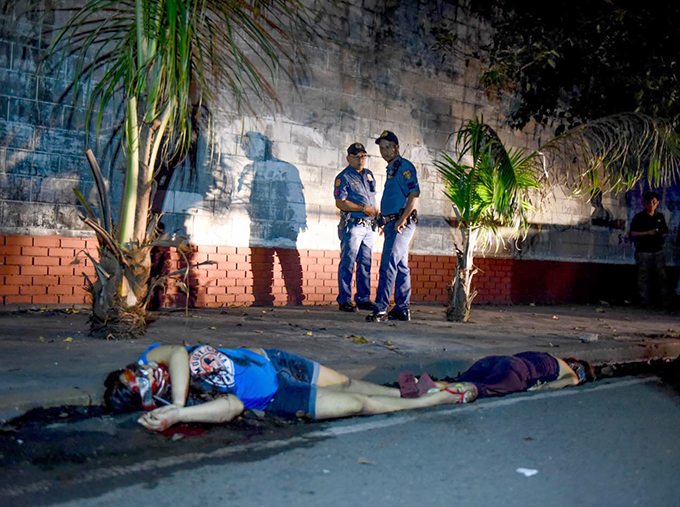
On 23 May 2017, a group with alleged links to ISIS attacked some parts of Marawi City on the southern Philippine island of Mindanao. In response, the government declared martial law in Mindanao to pursue the attackers and prevent the spread of ISIS in other towns.

The clash between the military and the militant group known as Maute forced the mass evacuation of Marawi residents. As of June 7, more than 46,000 families, or 220,000 persons, have been displaced from their homes.

The government said it has provided 33 evacuation centers, but these could only shelter 18,000 people.

After three weeks of being a battle zone, hundreds of houses and other buildings in Marawi were destroyed. The extent of the damage has been revealed with rescuers, residents, and journalists uploading photos and videos of Marawi’s town proper.

The Maute group is blamed for the destruction, but the military is also being held accountable because of its continuous airstrikes. The military claimed it is conducting “surgical bombing” operations, but some residents said the air bombs are being dropped indiscriminately.

-Partners-

Marawi Mayor Majul Gandamra is saddened by the destruction in his city:

I weep for all the civilians who were mercilessly killed, I weep for the lost homes of my people and I weep for the loss of the true essence of Islam in the people who caused all these destructions to our lives and properties.

As of May 30, the government said 19 civilians had been killed by terrorists.

It is ordinary civilians who are enduring the greatest suffering as the crisis continues to drag on. And even if the clashes end soon, rehabilitating Marawi is expected to be a more difficult task because of the destruction caused by the fighting between the military and the militants.

Below are photos showing the situation in Marawi today:

“This is not Aleppo. This is Marawi City,” wrote TV reporter Greg Cahiles. Image: Greg Cahiles/Global Voices Destroyed buildings in the town proper of Marawi City. Image: Maulana Mamutuk/Global Voices Soldiers conducting a clearing operation in Marawi. Image: Najib Zacaria/Global Voices A deserted street in what used to be a busy intersection in Marawi. Image: Maulana Mamutuk/Global Voices A covered court converted into a temporary evacuation centre In Marawi City. Some residents are seen lining up to receive relief goods from the local government. Image: Marawi City local government

Mong Palatino is a Global Voices correspondent and is a two-term member of the Philippine House of Representatives. He has been blogging since 2004 at mongster’s nest.

]]>

Paris climate change pact ‘not enough to save us’, warns Fiji PM

]]>

AsiaPacificReport.nz

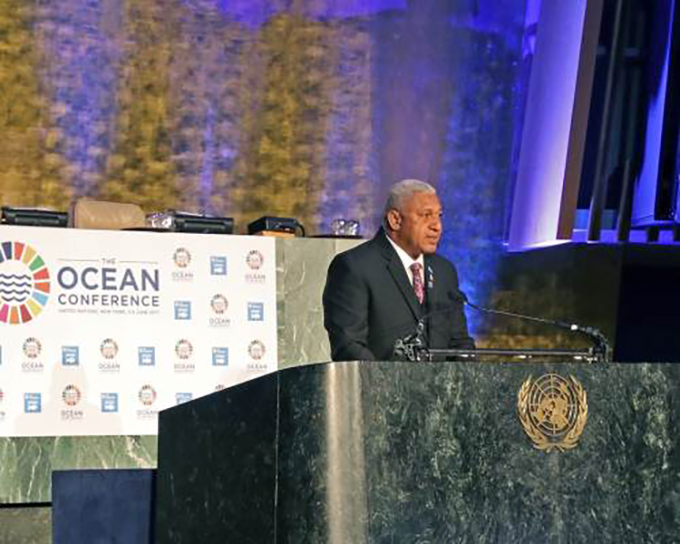
Fiji’s Prime Minister Voreqe Bainimarama closing UN Oceans Conference… “Paris Agreement not enough to save us”. Image: The Ocean Conference

By Nasik Swami in Suva

Current national contributions by countries to the Paris Agreement on climate change are not enough to save the Pacific, says Fiji’s Prime Minister Voreqe Bainimarama.

“We have to try to persuade the rest of the world to embrace even more ambitious action in the years to come, because we all know that even the current national contributions to the Paris Agreement are not enough to save us,” he said, addressing Pacific leaders as the UN Oceans Conference came to a close in New York last week.

As the incoming president of COP23, Bainimarama called on the Pacific and its leaders to stand by him and demand decisive action, as climate change was an issue of critical importance to the region’s collective future.

“I want your input. I need your input. And I want every Pacific leader beside me as we demand decisive action to protect the security of our people and those in other vulnerable parts of the world.”

Bainimarama also outlined his worry that America’s decision to abandon the Paris Agreement may also encourage other nations to either back away from the commitments they have made or not implement them with the same resolve.

“We are all, quite naturally, bitterly disappointed by the decision of the Trump Administration to abandon the Paris Agreement,” he said.

-Partners-

“Not only because of the loss of American leadership on this issue of critical importance to the whole world, but because it may also encourage other nations to either back away from the commitments they have made or not implement them with the same resolve.

“But something wonderful is also happening. The American decision is galvanising opinion around the world in support of decisive climate action.

‘Widespread rebellion’
“Other nations and blocs like China, the European Union and India are stepping forward to assume the leadership that Donald Trump has abandoned. And within America itself, there is a widespread rebellion against the decision the President has taken.”

Bainimarama said dozens of American state governors and city mayors were banding together with leaders of the private sector, civil society and ordinary citizens to redouble their efforts to meet this challenge.

“So while the Trump Administration may have abandoned its leadership on climate change, the American people haven’t.

“Next week, I will go to California to meet the Democrat Governor Jerry Brown and sign up to the climate action initiative that he is spearheading. I am also in contact with his Republican predecessor, Arnold Schwarzenegger, who shares Governor Brown’s commitment.

“The point is that on both sides of American politics, we have friends who are standing with us in this struggle. And I am inviting both Governor Brown and the famous ‘Terminator’ to come to our pre-COP gathering in Fiji in October, where we hope they will join us in a gesture of solidarity with the vulnerable just before COP23 itself in Bonn the following month.”

The Paris Agreement, which Fiji has ratified, sets out a global action plan to put the world on track to avoid dangerous climate change by limiting global warming to well below 2 degrees Celsius.

Nasik Swami is a reporter with The Fiji Times

]]>

Climate change ‘defining issue for the world’, says Labour MP

]]>

AsiaPacificReport.nz

Hele Ikimotu checks out Auckland responses to climate change in a vox pops video.

By Hele Ikimotu in Auckland

Pasifika youth should be more engaged with climate change, says a Labour MP.

Labour’s Pacific Island Affairs spokesperson Su’a William Sio … on a “fact finding” climate change visit to Kiribati in March last year. Image: Su’a William Sio

With the damaging effects of climate change increasing, Labour spokesperson for Pacific Island Affairs Su’a William Sio says it is important for young Pasifika people to be aware of the issue.

“As Pacific people, we will have a sympathetic view towards the Pacific and can advocate strongly for the rest of New Zealand to look at the Pacific with humanitarian eyes.”

He said young people were in an advantageous position to be aware of climate change.

“They’ve got strengths and talents that they can use in telling the climate change story, which will have an impact on the rest of the world.

-Partners-

“This is a defining issue for the world and it’s an issue that future generations are going to have to deal with.”

According to NASA, sea levels have risen by about 20.32 cm since the beginning of the 20th century.

Climate change awareness
The areas most affected by climate change include Fiji, Kiribati and Tuvalu.

A report by the Pacific-Australia Climate Change Science and Adaptation Planning Programme (PACCSAP) estimated that by 2100, sea levels would rise by 20-60cm in Pacific Island countries.

Su’a said it was mainly the government’s responsibility to raise awareness.

“Ultimately governments have the power and resources to drive the issue. It should be included as part and parcel of our educational curriculum,” he said.

In March, Fonua, a play framed around climate change showcased at the Mangere Arts Centre as part of the Auckland Arts Festival and further enabled people to understand the realities of climate change, organisers said.

“It was a Polynesian response to climate change – we just wanted to bring awareness around it,” Fonua‘s artistic director Jase Manumu’a said.

Manumu’a said the show ultimately brought the Pacific Island community together to understand how detrimental climate change was.

Climate change ‘topical’
Professor Geoffrey Craig, head of research within Auckland University’s of Technology’s (AUT) School of Communication Studies, said climate change was a topical issue that people needed to be aware of.

Also a former environmental journalist, Dr Craig said a lot of people saw climate change as a “frightening issue”, but that it was starting to become more active.

“Issues relating to the environment are going to be hitting home now over the next few decades. So the people who are going to be really affected by it are young people,” he said.

Hele Ikimotu is a Niuean and Banaban-Gilbertese student journalist on his final year of a Bachelor of Communication Studies, majoring in journalism, at Auckland University of Technology.

]]>

Pacific Journalism Monographs No. 6: Watching Our Words: Perceptions of self-censorship and media freedom in Fiji

]]>

Pacific Media Centre

http://www.pmc.aut.ac.nz/

Ricardo Morris

ISBN/code: 978-1-927184-44-8

Price: $15.00

Publication date: Wednesday, May 17, 2017

Publisher: Pacific Media Centre


Ricardo Morris, a journalist and Thomson Reuters fellow from Fiji, has studied the perceptions and practice of self-censorship among journalists from his country in the years following the military coup in December 2006.

He focused particularly on the period after the 2014 general election that returned Fiji to democratic rule.

In his research paper, Morris examines how willing Fiji’s media workers are to self-censor, how self-censorship works in newsrooms, and what factors are influential on journalists’ work.

The research report was first published by the Reuters Institute for the Study of Journalism and has been published by the Pacific Journalism Monograph series at the Pacific Media Centre by arrangement with the author and institute.

Morris is the founder, publisher and editor of independent media company Republika Media Limited in Fiji, which publishes the magazine Repúblika.

]]>

How traditional and social media will impact on PNG elections

]]>

AsiaPacificReport.nz

ANALYSIS: By Jess Hopkinson and Holly Driscoll

Social media is a new phenomenon which enables easy and instant access to voters. Papua New Guinea’s freedom of information is #51 on the Paris-based Reporters Without Border’s World Freedom Index and this study investigates traditional sources, social media and independent blogging websites to determine where a voter can locate quality information.

The Papua New Guinea general election which begins next week has been impacted on by social media and provides a community platform for voters to express their opinions, and share news not found in traditional media.

This has aided voters because they are able learn more about the candidates. It has also disadvantaged voters because PNG journalism does use any recognised fact-checking mediums to confirm information and this leads to an ill-informed public.

There is no one completely trustworthy source of information which voters can depend on. This essay will firstly determine how this research was conducted.

Secondly, there is an abundance of candidates campaigning for this election and social media helps people learn about their policies and promises. Next, this upcoming election needs to be conducted fairly and freely so that people’s votes are counted. However, PNG does acknowledge corruption in government.

Finally, we include information gathered from interviews with local identities to determine that social media positively and negatively impacts the election.

-Partners-

Papua New Guinea’s elections are not regarded widely as democratically fair and free. Currently, PNG has many democratic features. It has a unicameral parliament, a Prime Minister who is the head of the elected party, a preferential voting system and conducts regular elections.

Encouraging free and fair process
The government is attempting to encourage a free and fair election process. For example, during the voting period electoral officer’s wages must be paid directly into their bank accounts rather than carrying bags of money around.

This aims to make it more difficult for officers to take bribes and for candidates to enter extra ballots and corrupt the results. This means that each individual vote gets to be counted, making the election free and fair. Former Prime Minister Sir Mekere Morauta said: “It is also important to ensure that the conduction of the election itself is free and fair and that electoral systems and processes are transparent.”

If an election is not democratic, it can breed corruption and mismanagement into the nation because votes are not counted properly and an individual can exploit the election. Currently, candidates visit voters’ homes and hand out goods such as money, food or a carton of beer to win votes.

The voters will not see the candidates again until the next election. Citizens are voting according to the free goods they are receiving instead of the policies which candidates support.

The culture of PNG elections is not focused on the future but rather immediate benefits that candidates give. PNG is aiming to improve the free and fairness within the upcoming elections however candidates are still trading goods for votes instead of good policies.

This report researches a multitude of sources of information to conclude where voters can find quality information for the upcoming election. We interviewed local Papua New Guineans to provide insight of how social media has affected the election and compares with traditional media sources.

Facebook pages are used “to educate our people about the difference between politicians and the consequences of not voting wisely”, said Northern Governor Gary Juffa, himself a major user of social media (May 25).

Community of voters
Facebook offers a community of voters who are invested in a democratic election and provides information and connections with thousands of people. In measuring the growing impact of the use of social media, we interviewed PNG locals to understand the positives and negatives of social media.

The National newspaper and the Post-Courier are two of Papua New Guinea’s top selling news sources, with The National a major advantage over its opponent’s circulation. We regularly checked these sites to gather data.

Printing presses located in Port Moresby and Lae on the opposite side of the country, enable faster distribution by road instead of expensive air freight.

However, internet usage in PNG has been increasing since 2000 from 44,887, to a predicted 906,695 users in 2016. Social media such as Facebook and Twitter provide instant news to a growing number of users and therefore are serious contenders to local newspapers who are now uploading information online.

We also collaborated information from independent blogs such as Keith Jackson & Friends: PNG Attitude and PNG Blogs. Independent blogs were essential to our research as they highlighted articles which are noticeably absent on traditional new sites.

These are popular among voters as there are always hundreds of comments and they are often linked to the platform of Facebook. Gathering information from social media, traditional sources and independent blogs has provided a wealth of information on the upcoming election.

One of the primary difficulties faced by voters in the elections in PNG is the sheer volume of candidates vying for seat. Of the 44 political parties who will be contesting for the 111 seats in Parliament, there are “2614 candidates (preliminary figure) nominated nationwide.”

In some areas of PNG, such as the Eastern Highlands province, there are 396 candidates.

Impossible for understanding
With so many candidates running for seats, voters are not able to make fully informed decisions when casting their votes as it is near impossible to develop a comprehensive understanding of each candidate and the policies they are arguing for.

However, social media allows candidates instant, rapid and easy access to share policies, promises and their personalities with voters. Paul Barker (2017) confirmed that social media is being used this election.

“Candidates and parties are devoting a fair bit of attention to the social media, as well as media and on the ground publicity,” he said.

There are still too many candidates for voters to follow. With each candidate attempting to gain attention, promises made in the run up to the election have become increasingly esoteric.

“Plenty promise to end corruption, build sealed roads and bring services to remote communities, things for which there is simply no money and sometimes no economic justification”, says ABC correspondent Eric Tlozek.

The upcoming election has 2614 candidates rallying for votes and social media is providing a platform for candidates to stand out

Social media has impacted the 2017 election and this provides both positive and negative outcomes. Locals who were interviewed agreed that social media was gaining traction among voters.

Post-Courier journalist Gorethy Kenneth said: “It is the first election where almost every party is using social media. The opposition have been using it to promote themselves and kick up controversy and the current government uses it to promote their achievements”.

Northern Province Governor Gary Juffa also says: “Social media is going to have a huge impact. It’s helping people learn and communicate far more effectively than ever before”.

Influence ‘marginal’
Countering this, Dr Susan Merrell said: ‘’I believe social media will eventually have a profound impact on issues such as elections. Now, I think the influence is marginal”.

Various ways social media benefit voters in the election includes that it creates easy and quick access for individuals with internet and voters are able to join established communities on Facebook such as PNG News, Media Monitors and The Voice of PNG.

In these Facebook groups, people are regularly documenting the progress of the election, giving their opinions on the happenings of government and traditional media and informing voters on what the media has missed.

An example of this occurred on the Media Monitors Facebook Page.

“So no official protests about PNG journalists being banned from the Australian PM’s press conference? The silence is deafening,” Bob Howarth, a former Post-Courier editor-in-chief, wrote on April 9.

A commentor extended this thought with, “If PNG media is banned that’s an insult to our sovereignty as a country”.

From this point community members work together to uncover why this happened.

Alexander Rheeney, president of the PNG Media Council, had messaged local media stations to learn why journalists were not present at the conference. Only one news organisation replied.

“The single response from the Post-Courier did not constitute a quorum that would have compelled the council to act on their behalf”, said Rheeney, a former editor-in-chief of the Post-Courier on April 24.

Neglected issues in traditional media
Throughout the networks that Facebook creates it uncovers issues that traditional media is neglecting. Independent blog sites also reported on the banning of local journalists during the Australian Prime Minister’s visit.

The benefits of social media is that it is an easily accessible network of people who provide information and can clarify information.

Despite the benefits there is criticism that social media can lead to an ill-informed public.
Information is being spread rapidly and is not always accurate.

Rheeney said: “Both traditional media and new media in PNG continue to experience quality control issues leading to media organisations broadcasting and publishing incorrect information.”

There are currently no media which news articles or opinions are processed through. This allows articles to enter the public which are not legitimate or do not investigate issues thoroughly.

There is no one reliable source of information for voters to gather information. The current solution is for a voter to read from difference sources for political information such as social media and traditional news sources.

Dr Susan Merrell says: “I find that relying on only one is no good – you need a variety.”

Ill-informed voters ‘dangerous’
An ill-informed voter is dangerous. They may not see the benefits of voting at all or may miss the chance of voting for a leader who supports their goals or they’ve voted according to bias media, says Dr Joseph McMurray.

This means that there are wrong votes or none at all entering the election. As social media becomes a source of information for the election, it cannot be guaranteed to be accurate and a voter must consume information from multiple sources.

The social media phenomenon has introduced a new facet of information for Papua New Guinean voters for the upcoming election. The PNG election is currently battling corruption to become more democratic, the former Prime Minister has acknowledged that the election process is corrupt.

PNG is implementing reforms to create free and fairness applicable to the upcoming election. This makes freedom of information to the public essential as they need to know what is happening to their vote.

This essay gathered information from an assembly of sources including traditional media, social media sites, independent bloggers and PNG locals.

It was discovered that social media provided a platform for voters to gain information about their candidates, however it is unlikely for any voter to make an informed decision because there just too many candidates for them to gain a good understanding of their policies.

There are many benefits to a functioning social media community. This includes a network of people prepared to learn about issues which the traditional media has missed. Most people have said that social media is a great place to gather information and that it is gaining popularity.

No completely trusted
However, it is not to be completely trusted. Any article can be posted to traditional and social media websites without having to pass through any fact-checking mediums.

This is dangerous as individuals can be ill-informed and repercussions include people not voting or voting for the wrong person.

Therefore, until there are media for articles to be processed through there is no one accurate source to locate information. It is essential for voters to read a range of information to be well-informed.

Jess Hopkinson and Holly Driscoll are Community Volunteer Interns in Law/Communication at Griffith University, Gold Coast Campus.

The source list is abridged and embedded in the article. Interviews:
Barker, P 2017, PNG Interview, May 1.
Juffa, G 2017, PNG Interview, May 25.
Kenneth, G 2017, PNG Interview, May 2.
Merrel, S 2017, PNG Interview, May 28.
Rheeney, A 2017, PNG Interview, April 24.

]]>

Ex-Treasurer backs probe into LPG non-payments, slams ‘negligence’

]]>

AsiaPacificReport.nz

Prime Minister Peter O’Neill campaigns for his People’s National Congress (PNC) candidates contesting in the 2017 National Elections in the Highlands this week. Video: EMTV News

By Charles Yapumi in Port Moresby

Papua New Guinea’s former Treasury Minister has welcomed the Estimates Committee of the Australian Senate’s probe into non-payment of royalties to LNG area landowners.

“It is pleasing to see the concern expressed by Senator Scott Ludlam for the plight of LNG project landowners who have not received any royalty payments three years after annual exports worth billions of dollars have commenced,” said Patrick Pruaitch, leader of the National Alliance Party.

Pruaitch was dumped as Treasurer by Prime Minister Peter O’Neill last month after claiming the economy was “falling off a cliff”.

Senator Ludlam expressed concern at a recent meeting that the Australian government’s Export Finance Insurance Corporation (EFIC) had not taken measures to ensure royalty payments — now totalling K904 million (about NZ$420 million) — had been distributed to landowners in the PNG LNG project area.

He noted that the loan to the PNG LNG project was the biggest ever foreign loan made by the Australian government.

-Partners-

“While the inquiry highlighted EFIC’s silence and non-action towards protecting Australia’s interest, more significantly for PNG, it raises the government’s negligence and lack of responsibility to the people of PNG, specifically the wellhead landowners and beneficiary groups in the PNG LNG project,” Pruaitch said.

“By right, the clan-vetting exercise to determine the rightful people to whom royalties should be paid should have been completed well before the first LNG shipment left PNG’s shores in May 2014.

“The O’Neill government has to date failed to resolve this issue,” Pruaitch said.

Landowner patience running out
Senator Ludlam was right in expressing fears about project risk because the patience of landowners has been running out.

“I thank Senator Scott Ludlam for his courageous position in seeking EFIC’s explanations as to why the Australian export credit agency that financed the mega LNG project in Papua New Guinea had, to date, not initiated at the very least a telephone conversation between the Australian Foreign Minister and PNG officials to raise the concern about non-payment of PNG LNG project royalties to project area landowners.”

Pruaitch was the former Treasurer in the Somare government in 2009, and was also the chairman of the Ministerial Sub-committee on Economic Matters responsible for the delivery of the PNG LNG project.

“The senator’s probe has highlighted the fact that international companies also have a corporate responsibility to adhere to international principles and best practices and EFIC should also do its part to protect Australia’s investment while, at the same time, honouring the letter and spirit of the project agreement.”

Charles Yapumi is a Loop PNG reporter.

]]>

Joey Tau: Can the MSG bloc walk out on the PACER-Plus trade deal?

]]>

AsiaPacificReport.nz

ANALYSIS: By Joey Tau in Suva

Vanuatu is the latest Melanesian state to express reservations on the Pacific Agreement on Closer Economic Relations (PACER) agreement between members of the Pacific Islands Forum (the Forum Island Countries plus Australia and New Zealand), PACER-Plus.

The Vanuatu government announced last week that it will not sign the PACER Plus agreement and has decided to pull out of the signing tomorrow after its Council of Ministers’ called for more time to assess the benefits of the regional agreement for Vanuatu.

The decision by Vanuatu comes as no surprise as other Melanesian states, including Papua New Guinea, decided last year that it would not be taking part in the PACER-Plus negotiations, nor would it sign the finalised instruments.

Fiji later followed with threats that it would not sign the agreement as there was lack of flexibility from Australia and New Zealand.

Vanuatu shares similar concerns with both PNG and Fiji on possible loss from such an agreement, the need for an impact assessment, and the protection of infant industries.

PNG walks out early
When PNG sent warning bells in March last year that the PACER-Plus negotiations looked shaky and needed more time for consultation, it had a list of concerns and was ready to talk with both Australia and New Zealand.

-Partners-

But it was during that time that PNG had reached a resolution to withdraw from PACER-Plus.

In August, Prime Minister Peter O’Neill announced the country would disengage with regional negotiations, stressing that based on assessments PACER-Plus would be a disadvantage for its economy.

With attempts by Australia and New Zealand to persuade PNG to return to the regional trade talks, O’Neill stood firm on the country’s assessments, saying, “PNG will not be signing as it would be a net-loss to the PNG economy.”

PNG’s Trade Minister Richard Maru nailed the country’s position when pressured at bilateral meetings, adding that any trade agreement with Australia, New Zealand and other Pacific Islands, that reduced employment, and “killed” the manufacturing industry by removing tariffs and duty would not be acceptable in PNG.

“How many times will I make it clear to Australia and New Zealand that Papua New Guinea will not sign the Pacer-Plus agreement that seeks to advance Australia and New Zealand’s commercial interest at the expense of our national interest” Maru said.

“We are not signing PACER-Plus in its current form because the move to remove tariff and duty will kill our manufacturing sector.”

The furious Maru later called out the Australian government, saying “we will not sign and we will not listen to anyone. I’ve made that very clear … my message to Australia is stop sending any of your agents to PNG and start talking about a comprehensive partnership agreement with us.”

Fiji left unhappy
Last September, Fiji threatened to walk away from the regional trade agreement negotiation after its concerns were not addressed.

The country’s Trade Minister, Faiyaz Koya, said there was a lack of flexibility from Australia and New Zealand on Fiji and Pacific Islands key concerns.

During a RNZ international interview, Minister Koya emphasised that Fiji wanted further negotiations on two very critical issues, on infant industry protection and the “most-favoured-nation” clause that would have an implication for Fiji’s development aspirations.

Fiji’s call for more time to negotiate its concerns was ignored when the Office of the Chief Trade Advisor (OCTA) hastened the process and concluded negotiations in April  in Australia, thus leaving Fiji out of the final talks.

The April conclusion also ignored Fiji’s appeal for a deferral due to conflicting schedules.

“Fiji hadn’t opted out of PACER-Plus, we remain committed … but we were excluded from the Brisbane meeting,” said Minister Koya.

Final negotiations criticised
After eight years of negotiations, PACER-Plus was concluded in Australia in April this year. This regional trade agreement is said to enhance the economic development of Pacific island countries through greater regional trade and economic integration with Australia and New Zealand.

But it has been severely criticised as burdensome on Pacific bureaucracies and undermining Pacific Island countries’ ability to support their local economies.

This week the 13 countries participating will sign the agreement in Nuku’alofa, Tonga.

The fear is that 11 island states will agree and sign a poorly designed agreement locking in Australia and New Zealand as winners.

What has been concluded is a deal with no guaranties of benefits from labour mobility and only a promise of 5 years of aid money, but undermines the ability of the Pacific to determine for themselves what development is and the tools to pursue Pacific development aspirations.

The 13 countries participating in PACER-Plus are Australia, Cook Islands, Federated States of Micronesia, Kiribati, Nauru, New Zealand, Niue, Palau, Republic of Marshall Islands, Samoa, Solomon Islands, Tonga and Tuvalu.

Realities for Solomon Islands
The Solomon Islands has a choice to decide whether or not it will sign on to PACER-Plus.

It would have similar concerns expressed by its fellow Melanesian comrades. But it is a choice between letting Australia and New Zealand impose their development vision via PACER-Plus or the opportunity to have a development that reflects the reality and possibilities in the Solomon Islands.

A report by Solomon Islands to the World Trade Organisation (WTO) in November last year summed up the economic impact under PACER-Plus as “increased imports from developed country partners are likely to exceed the modest increase in Solomon Islands’ exports, due to the extent of liberalisation demanded by the aforementioned parties and limited productive capacity in the domestic economy. The short term adjustment and implementation costs are likely to impose significant economic and political pressures.”

Australia is currently the number one source of imports for the Solomon Islands, a situation that will be further entrenched under PACER-Plus. The increase in imports from Australia and New Zealand will really be felt when Solomon Islands is set to reduce import taxes on at least 80 percent of imports from these countries.

While this won’t come into effect until the Solomon Islands graduates from Least-Developed Country status – if it passes the 2018 evaluation then graduation will be likely in 2021 – resulting in a loss of US$11million from government revenue.

Solomon Islands had recommended to the WTO that it saw itself aligning with the Association of South-East Asian Nations (ASEAN) in preference to Australia and New Zealand in the future, and PACER-Plus could have them on the wrong path if they sign up.

PACER-Plus will have a serious impact on the ability for Solomon Islanders to determine for themselves their own development future.

Joey Tau is media and campaigns officer of the Suva-based Pacific Network on Globalisation.

]]>

‘We shouldn’t rest on our laurels,’ warn NZ nuclear free activists

]]>

AsiaPacificReport.nz

By Kendall Hutt in Auckland

As international talks at the United Nations on the ban of nuclear weapons draw closer, New Zealand nuclear free and peace activists warn there is a lot of work to be done before the world will be safe from a nuclear war.

“We’ve still got a lot of work to do in the world,” Auckland Mayor Phil Goff reflected at Devonport’s Depot Artspace during a weekend event organised by the Women’s International League for Peace and Freedom (WILPF) Aotearoa and Devonport Peace Group.

Their warning comes as New Zealand celebrates 30 years since the country’s Nuclear Free Zone, Disarmament and Arms Control Act came into force on 8 June 1987.

Described as a “David versus Goliath” stand by Pacific Media Centre director Professor David Robie, the Act and the “grassroots, groundswell” movement behind it, saw New Zealand become the first Western nation to legislate to be nuclear free.

Goff said: “The Lange Labour government came along with the courage and the commitment, first of all to say to a powerful ally: ‘No, we are not going to go along with the nuclear umbrella. No, we are not going to support your possession of nuclear weapons.

“We are a small nation, but we are a proud and independent nation and we are going to make our country nuclear free’. And we did,” Goff said.

-Partners-

Maire Leadbeater of the Campaign for Nuclear Disarmament said: “Everything was against us, but we did it.”

‘Ahead of the game’
However, it was also important to remember the Pacific’s contribution to New Zealand’s anti-nuclear campaign, said Dr Robie.

Not only did this come through the fact that the Pacific was “ahead of the game” – Palau, Vanuatu, and Tahiti’s largest municipality, the airport suburb of Fa’aa, declaring themselves nuclear free – but also through opposition to French nuclear testing.

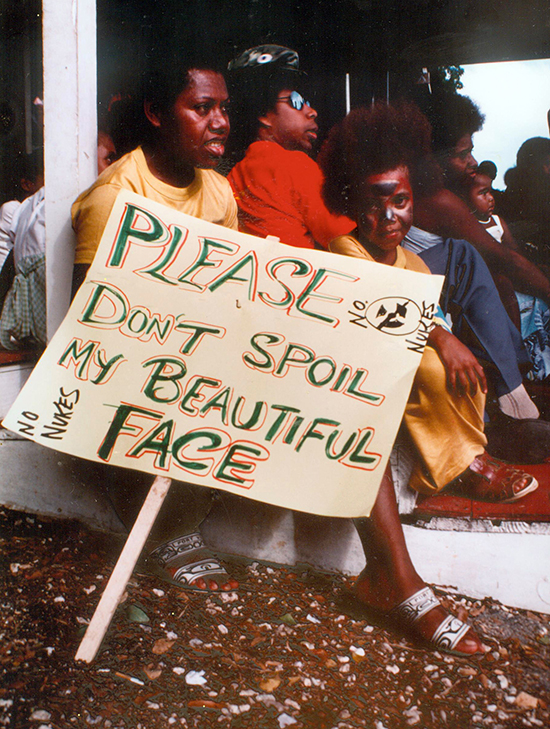
Professor David Robie on nuclear testing in Pacific … “please don’t spoil my beautiful face”. Image: Kendall Hutt/PMC

As revealed in John Pilger’s latest documentary The Coming War On China, Dr Robie said, the “total yield of the nuclear experiments on and around the Marshall Islands was equal to 7200 Hiroshima bombs, meaning the equivalent of more than one Hiroshima bomb was exploded in the area every day for 12 years.”

He also said: “The French committed shameful acts in defence of nuclear colonialism” — such as the 1985 assassination of Kanak leader Eloi Machoro and the 1988 Ouvea cave massacre of 19 young militants.

But the “reunion”, as Goff himself described it, of many of the activists who were on the frontlines of New Zealand’s nuclear free movement, was ultimately overshadowed by apparent inaction by “nuclear states” over nuclear disarmament.

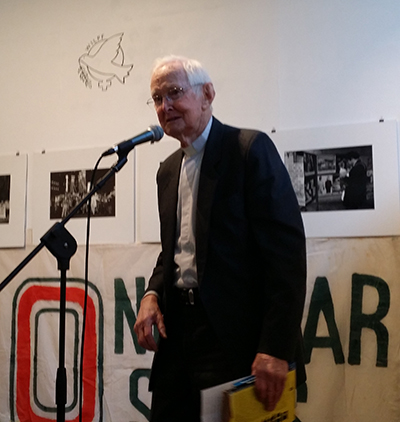
Campaign for Nuclear Disarmament’s Maire Leadbeater … “things haven’t changed”. Image: Kendall Hutt/PMC

“We fought the battle in New Zealand, we made a mark on the international stage, we told the powerful and the strong that we would stand up for ourselves and we would stand by our values. But our world has not become a safer place. If anything, it has become a less safe place,” he said.

Leadbeater said: “Things really haven’t changed in terms of the international scene.”

‘Still much work to be done’
WILPF Aotearoa’s president Megan Hutching also reflected:

“We should not rest on the laurels of the 1987 Nuclear Free Zone, Disarmament and Arms Control Act because there is still much work to be done before we can live in a safe, nuclear weapons free world.”

This is due to the fact there are currently 15,000 nuclear warheads in the world, Goff said.

Of greater concern still, he said, was countries such as North Korea joining the nuclear arms race.

Auckland Mayor Phil Goff 30 years on … “we still live in a very dangerous world”. Image: Kendall Hutt/PMC

“Alongside the five nuclear weapon states we’ve had India, Pakistan, Israel and North Korea all gain possession of nuclear weapons and the missile systems to launch them.”

Leadbeater said the world was still living in fear of a “nuclear war by accident”.

“We still live in a very dangerous world… The world is crying out for so many other important needs. It’s a shameful thing and a dangerous, dangerous thing.”

Youth involvement needed
In light of this, many of the activists reflected it was time for New Zealand’s youth to pick up the baton, although it would be a challenge, they acknowledged.

“The greatest challenge is trying to get the youth to continue with the struggles so that we can pass on the baton to them, especially in the nuclear movement” said Fijian peace activist and researcher Ema Tagicakibau from the Nuclear Free and Independent Pacific (NFIP) movement.

“In that, the challenge remains and the struggle continues.”

“Things are just as serious as they ever were, but we don’t unfortunately have that same sort of momentum among the community,” Leadbeater said.

Visual Artists Against Nuclear Arms (VAANA) member Margaret Lawlor Bartlett reflected: “We need a group of young, dedicated anti-nuclear people.”

The youth of today, however, do provide a sense of hope for the future, Leadbeater concluded, reflecting the general feeling of many in the room.

“In remembering these great times and the wonderful excitement of so many other people, let us hope that it does strengthen us to carry on and to perhaps now take our leadership from the young and find ways to carry on.”

The United Nations conference to negotiate a nuclear weapons ban will continue on June 15 until July 7.

]]>

Cartoons: Malcolm Evans on 50th anniversary of 1967 Israeli war and Palestinian occupation

]]>

AsiaPacificReport.nz

Malcolm Evans reflects on the price of the half of the century of Israeli occupation Palestinian territory and illegal settlements in defiance of the United Nations since the Six-Day War in 1967. The 50th anniversary was last week between June 5 and 10.

]]>

Panguna women landowners say BCL didn’t consult and ‘isn’t welcome’

]]>

AsiaPacificReport.nz

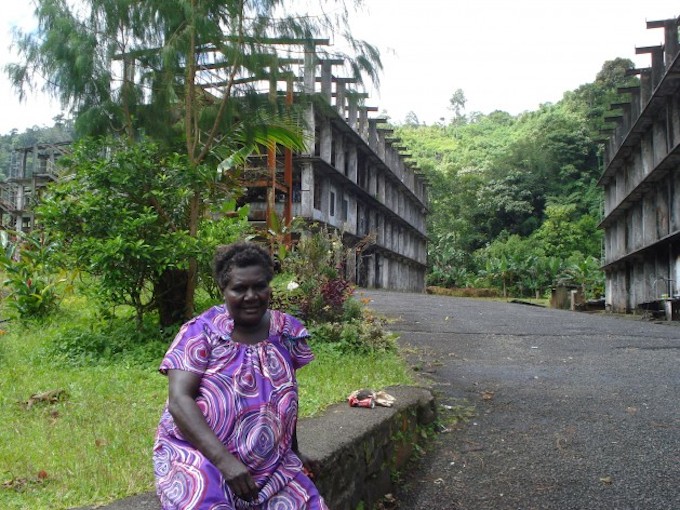
Landowner Lynette Ona amid the derelict ruins of the Panguna mine offices … “no one has consulted me”. Image: IPS

Pacific Media Watch News Desk

Women in Central Bougainville and landowners of the Panguna copper mine site are opposing the reopening of the mine.

A delegation of Autonomous Region of Bougainville Government (ABG) representatives, who conducted a mining forum in Panguna and Arawa last week, was met with stiff opposition from locals, reports Loop PNG.

In Panguna, Regina Eremari, a landowner who represents the grassroots women of the area, said ABG leaders were not considering the voice of the women.

“We women are the custodians and landowners of the land, not the men. In the past, it was the men who the led and spoilt our land and environment through mining, which resulted in the Bougainville Crisis,” she said tearfully.

“When Bougainville Copper Limited mined our land, we were displaced and placed in settlements, and still live in these settlements today. Our gardening grounds were destroyed.

“Now where will they put us if they want to mine the land again? Because most of us have moved back to where the mining once operated and have made our homes in and around the mining pit area.”

-Partners-

She also called for ABG to be transparent with decisions that involve mining, because Bougainville is still in the early stages of the peace process and there are so many outstanding issues that still have to be dealt with.

In the Arawa forum, women leader Lynette Ona questioned the ABG members present about which landowners they had consulted with to claim that Panguna landowners had agreed to open the Panguna mine under BCL.

“I am a landowner and my land is right in the centre of the Panguna mine pit and no one has consulted with me for my land to be dug up. And my stance is ‘No Mining, No BCL!’”

“BCL is not welcome to come and dig up my land again, never!” she said.

The delegation, led by Vice-President and Minister for Minerals and Energy Resource Raymond Masono and Director Office of Panguna Mine Negotiation Bruno Babato, included Minister for Economic and Trade Development Fidelis Semoso, Minister for Autonomy Implementation Albert Punghau, Minister for Finance and Treasury Robin Wilson, DPI Minister Nicholas Darku, Minister for Education Thomas Pa’ataku, Secretary Department of Minerals and Energy Resources Shedrach Himata and their team.

Papua New Guinea will hold its 2017 General Election from June 24 to July 8.

]]>

Southern Cross: 30 years of N-free Aotearoa – Pacific leaders seek healthier oceans

]]>

AsiaPacificReport.nz

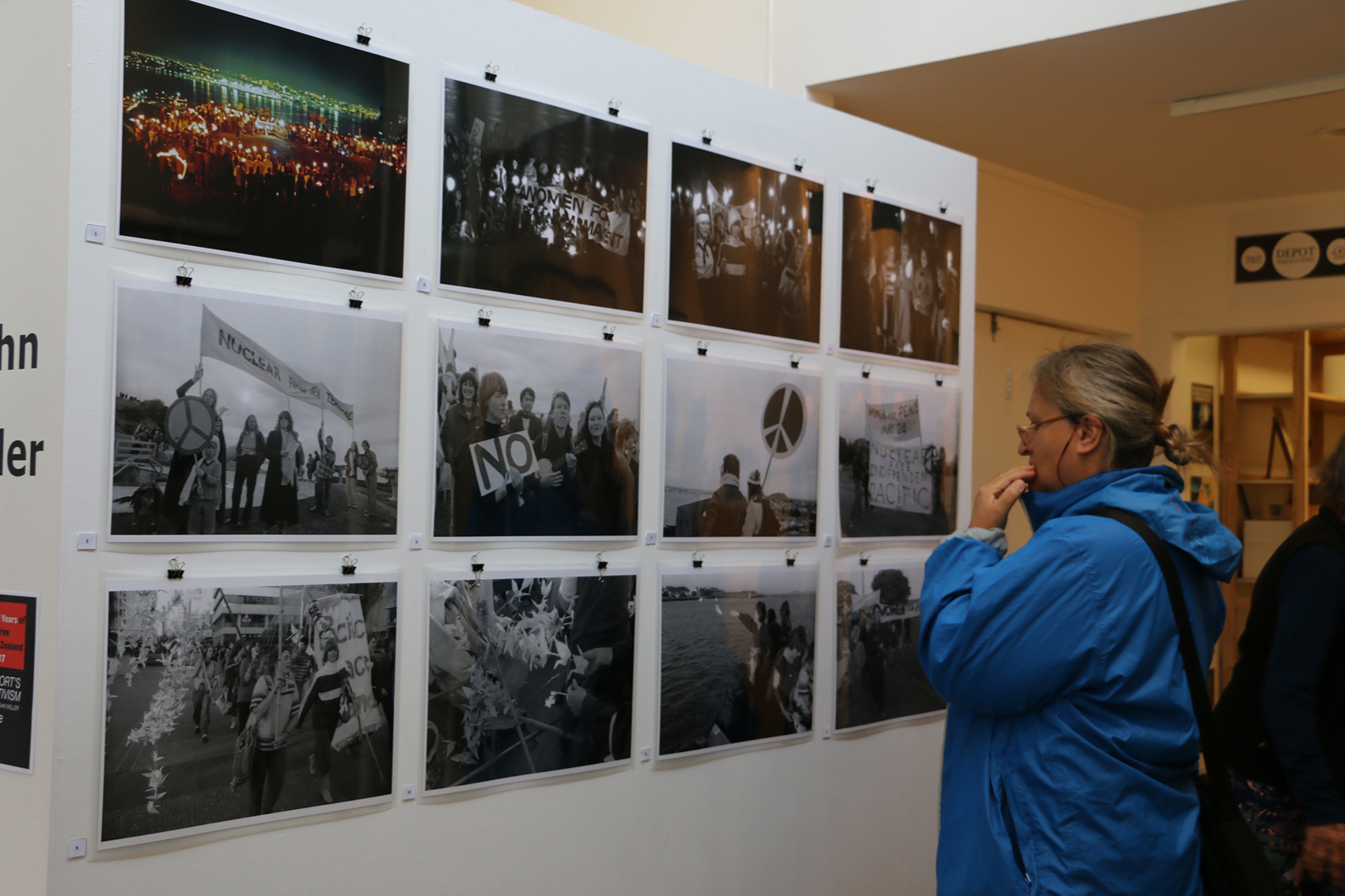
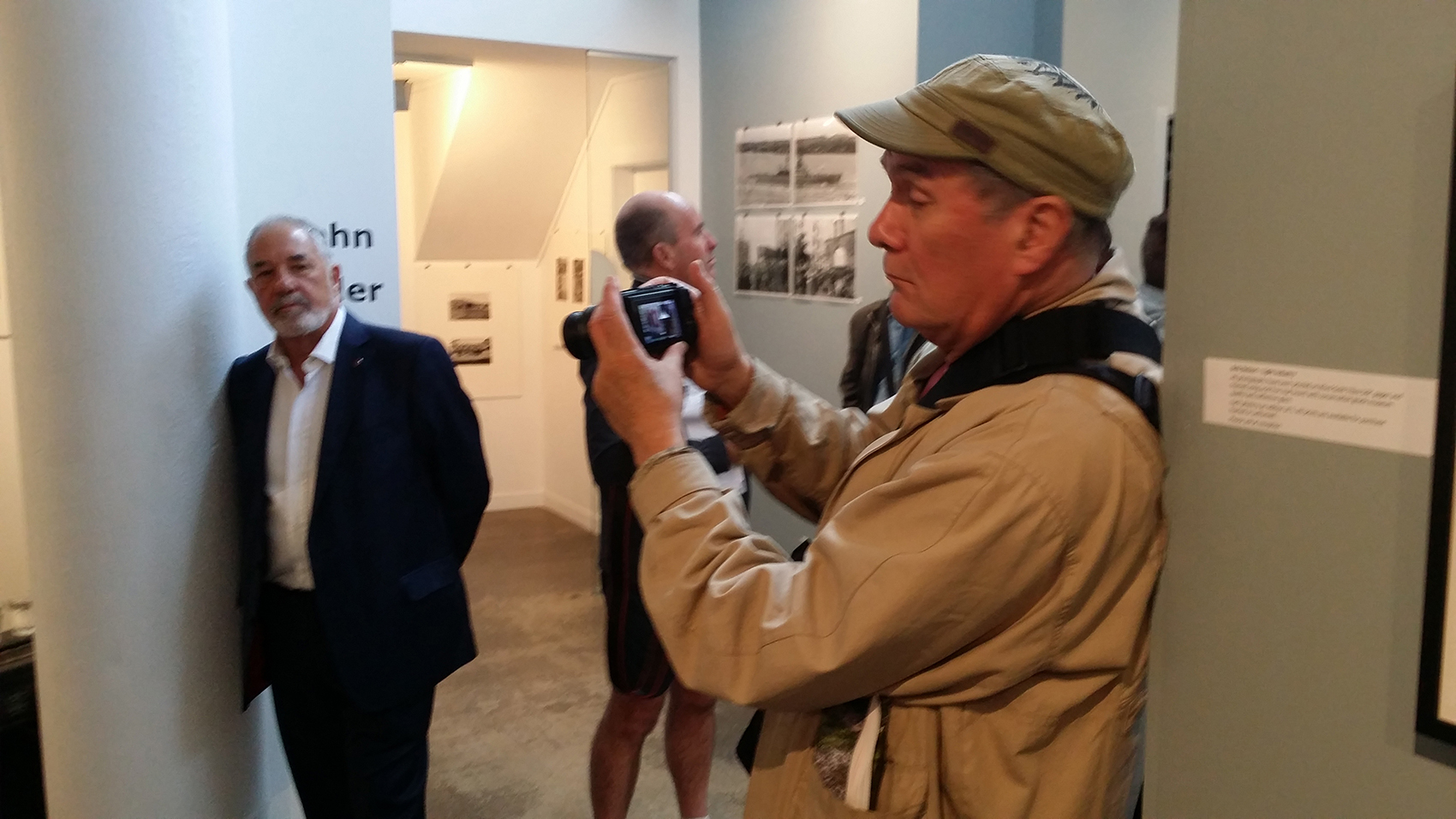
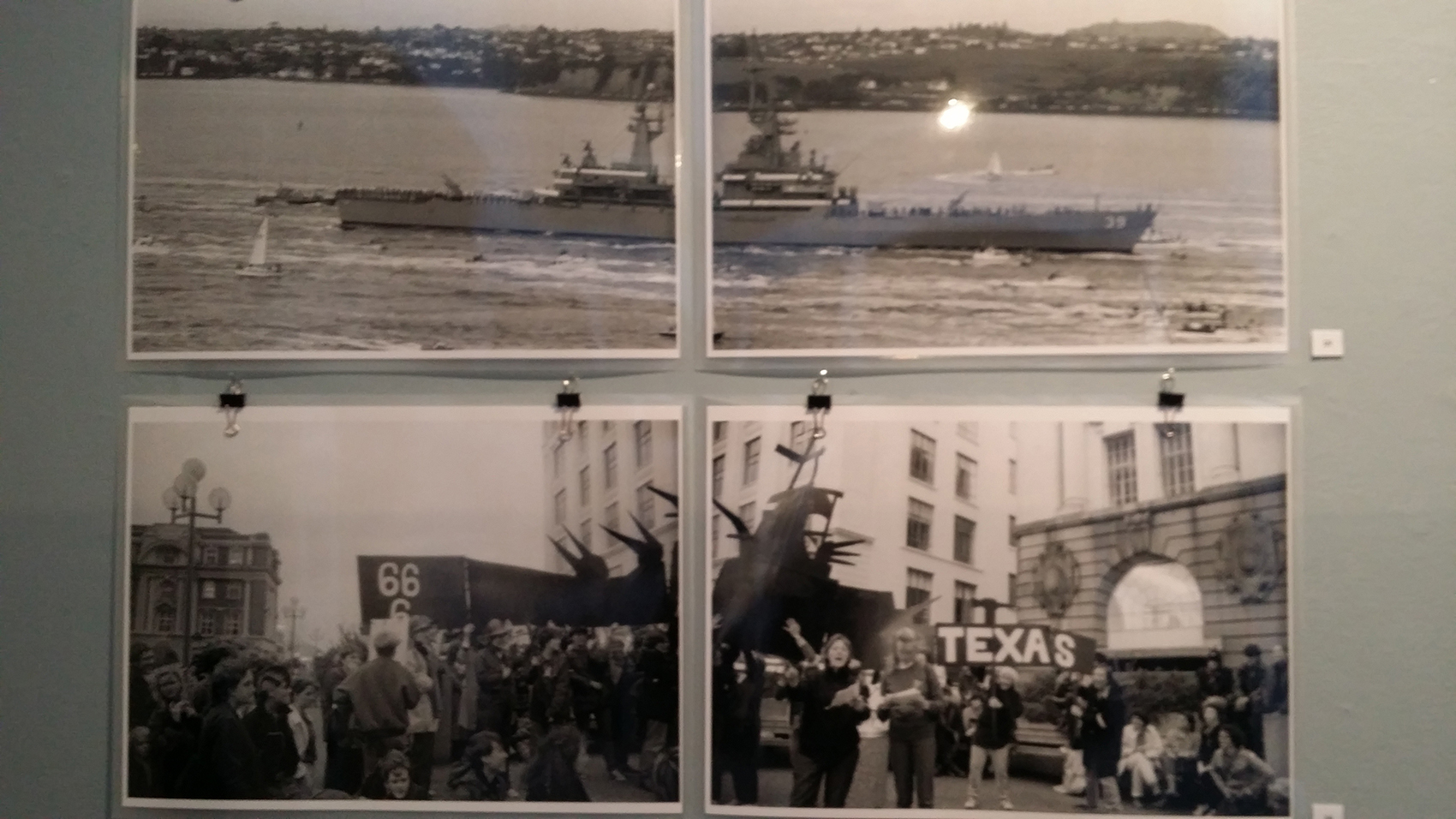
A wall montage of photographer John Miller’s images at the Depot Artspace in Devonport. Image: Pacific Media Centre via John Miller

Pacific Media Watch News Desk

AUT Pacific Media Centre’s Pacific Media Watch freedom project editor Kendall Hutt speaks with 95bFM’s The Wire host Amanda Jane Robinson on the weekly radio programme Southern Cross about celebrating 30 years of a nuclear-free Aotearoa.

She was at Devonport’s Depot Artspace at the weekend to hear some inspiring speakers who led the Peace Squadron and the peace movement campaigning for a nuclear-free New Zealand.

Auckland mayor Phil Goff and activist photographers John Miller and Gil Hanly were there too.

Hutt also talks about Pacific leaders calling for healthier oceans at UN conference in Washington.

]]>

Images: NZ peace activists pay homage to 1987 nuclear-free law campaigners

]]>

AsiaPacificReport.nz

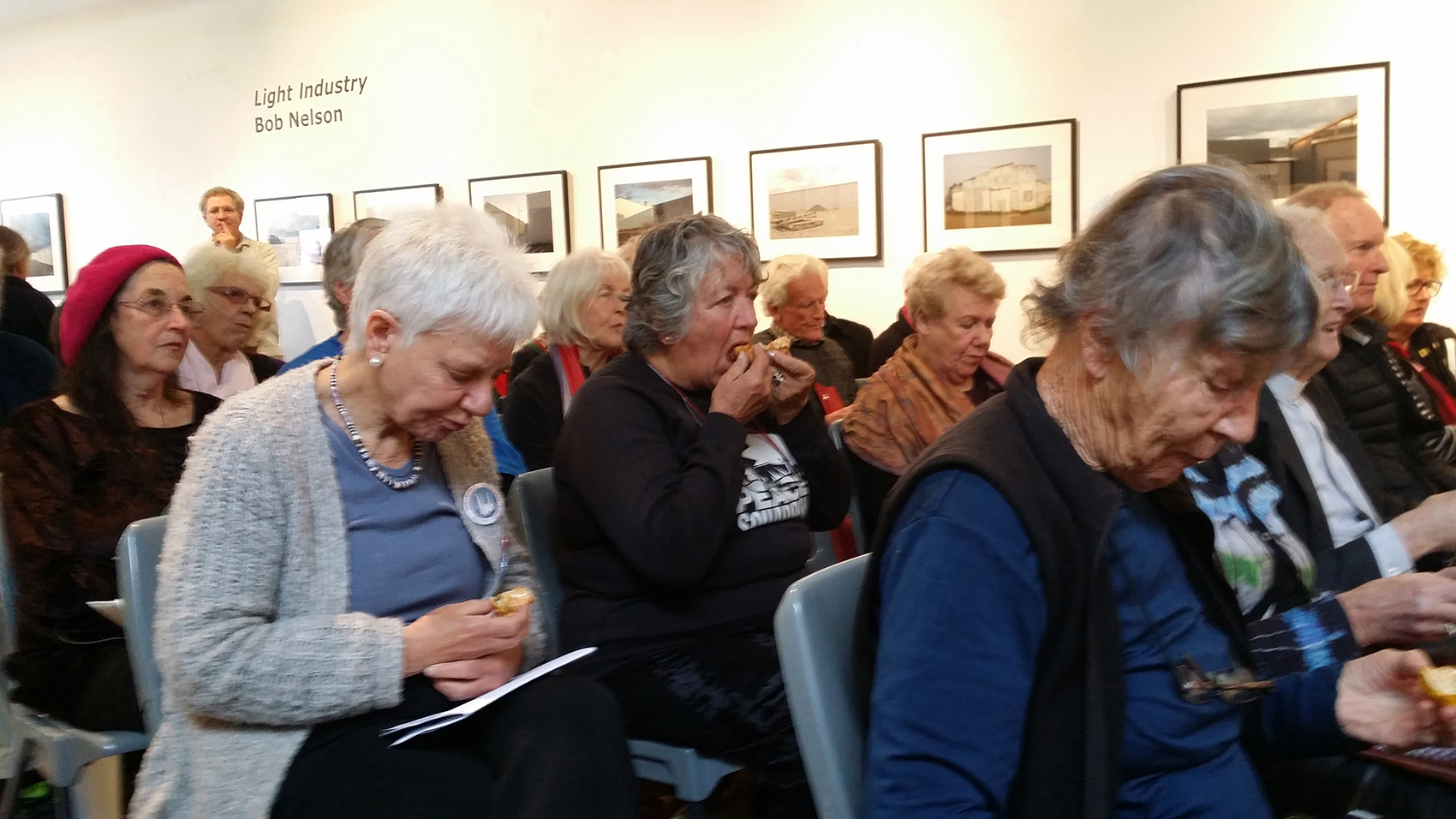
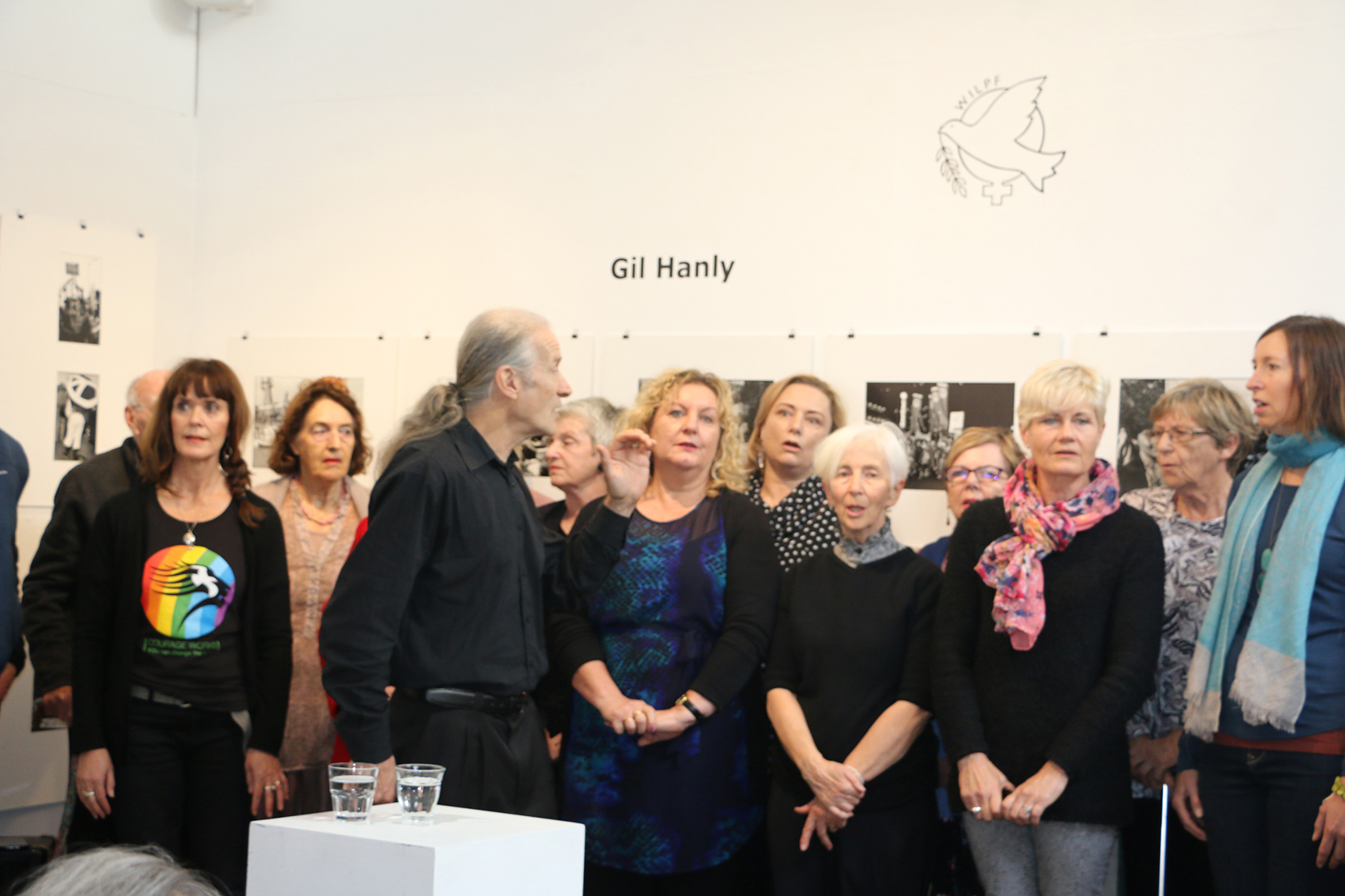
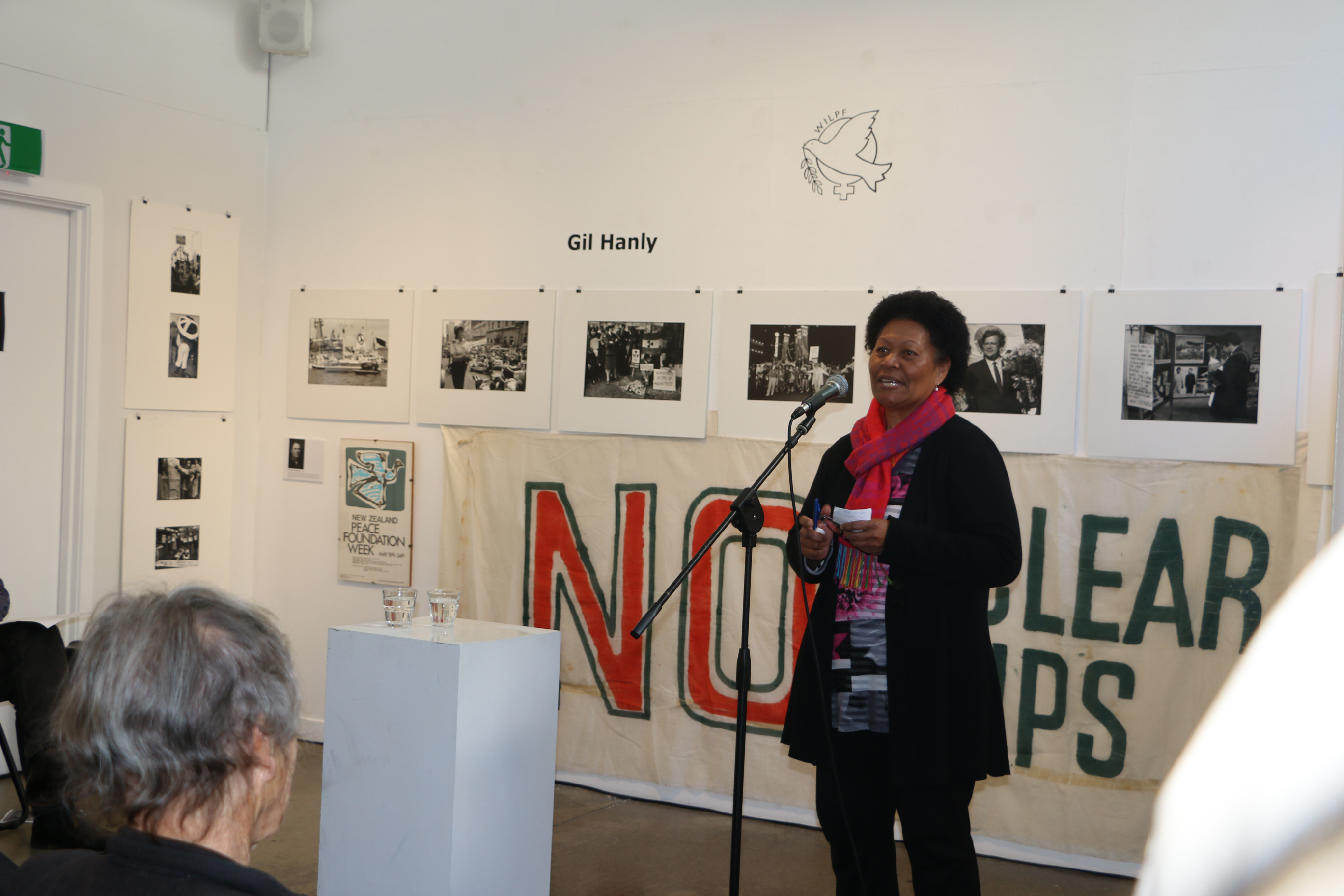
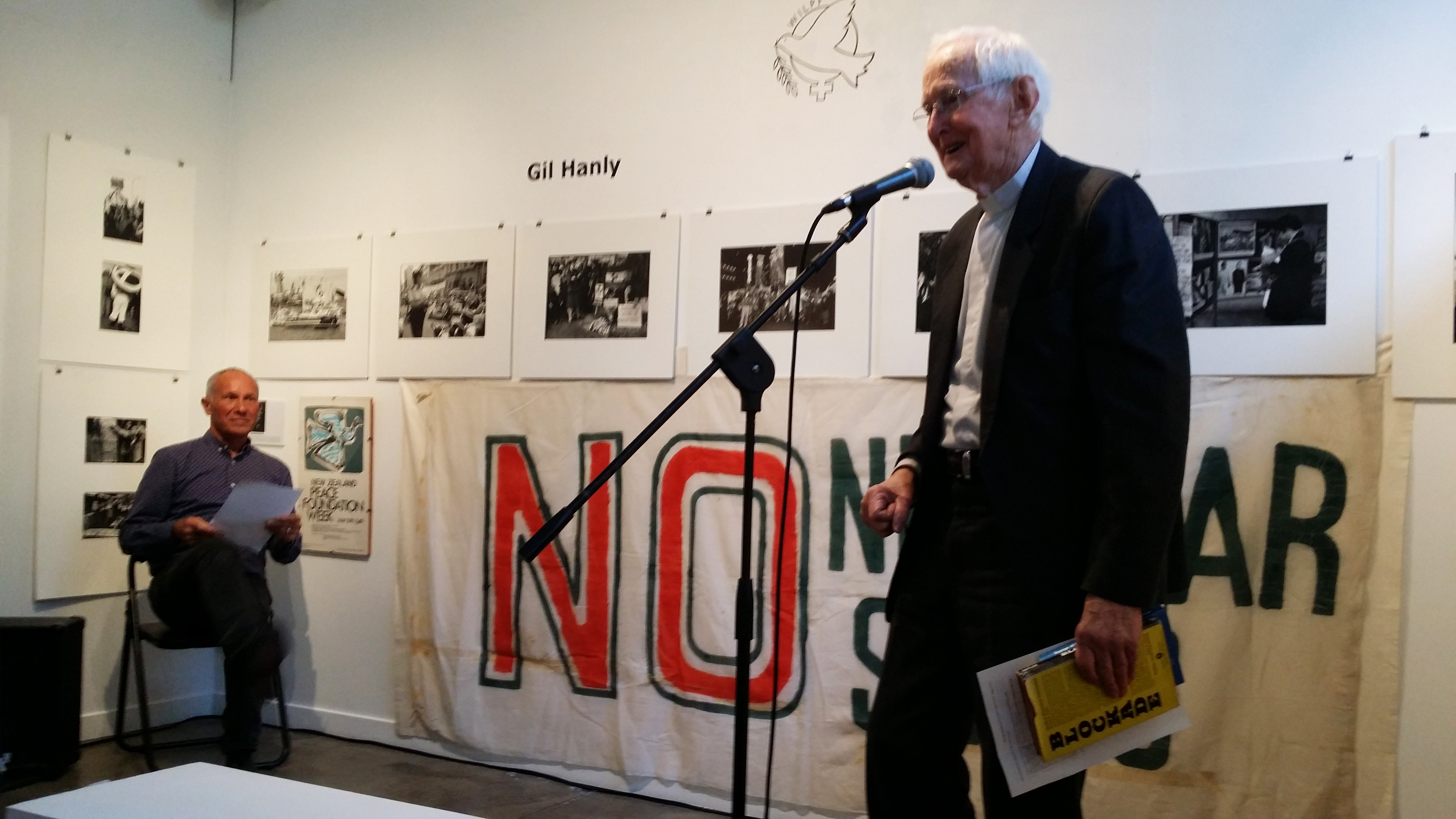
New Zealand peace activists gathered together at the weekend in Devonport — home of the country’s first “nuclear-free zone” — to pay homage to the “people’s” campaign for a nation without nukes.

The Women’s International League for Peace and Freedom (WIPLF) and the Devonport Peace Group organised the event, marking the 30th anniversary of the NZ Nuclear Free Zone, Disarmament, and Arms Control Act. This came into force on 8 June 1987.

The pictures were taken by the Pacific Media Centre’s Dr David Robie and Pacific Media Watch editor Kendall Hutt.

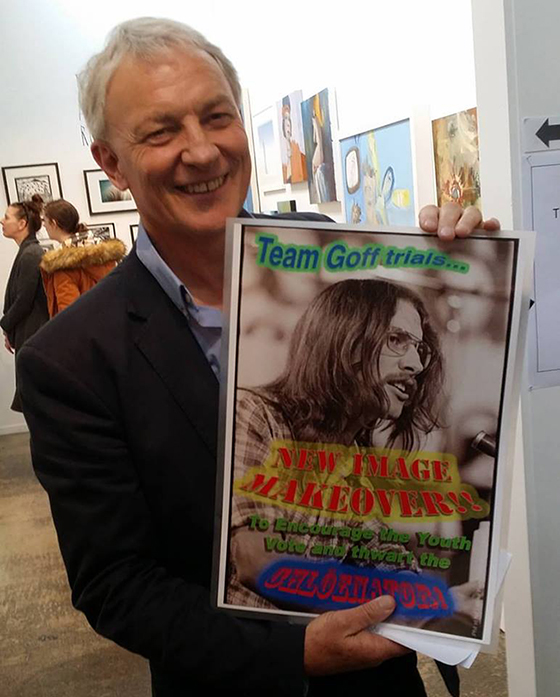
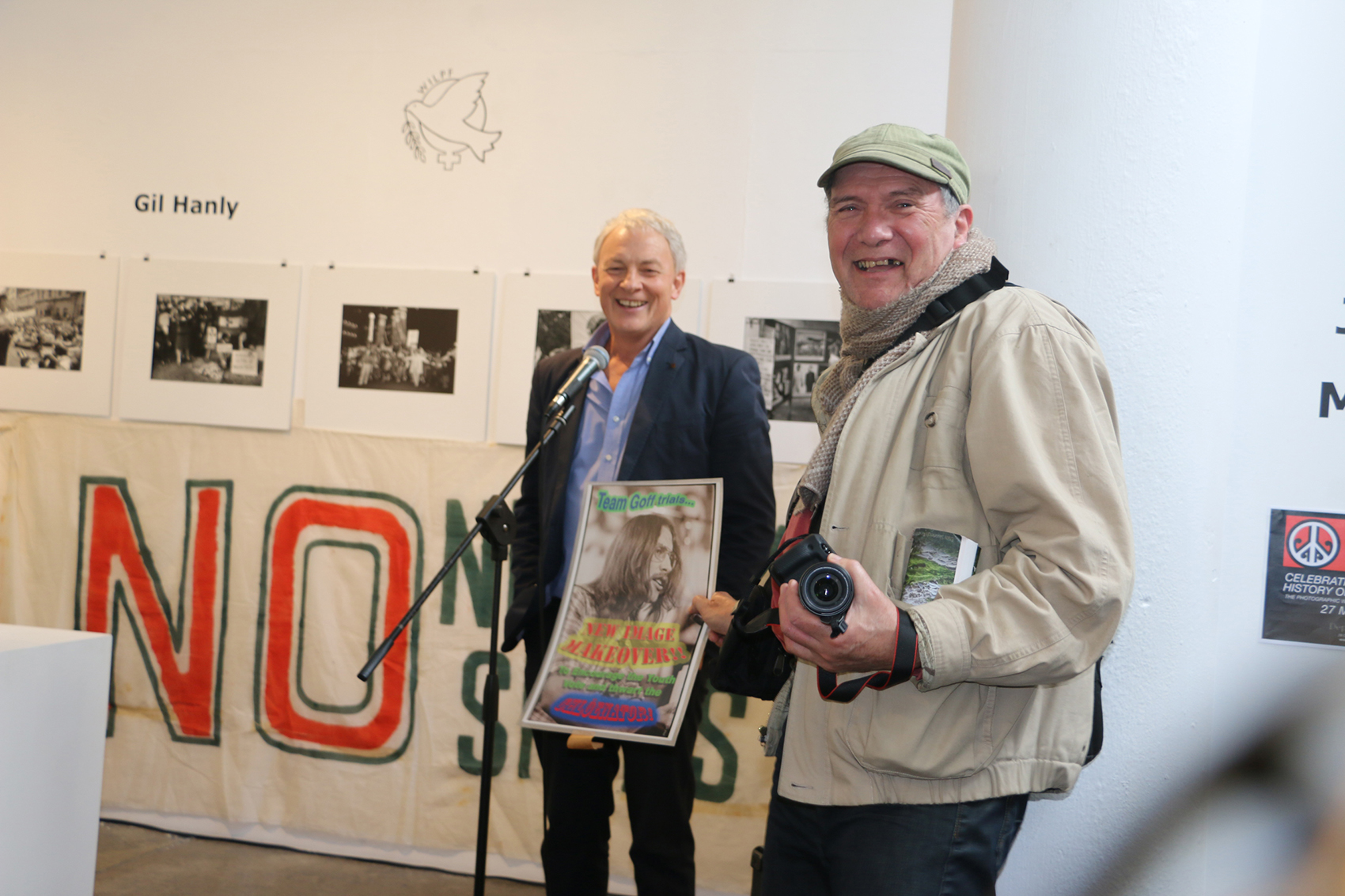
1. Auckland mayor Phil Goff admires the John Miller portrait of him when he was a nuclear-free student activist in the 1980s. Image: David Robie/PMC

2. John Miller shows off the Auckland mayor Phil Goff “historical” image. Image: Kendall Hutt

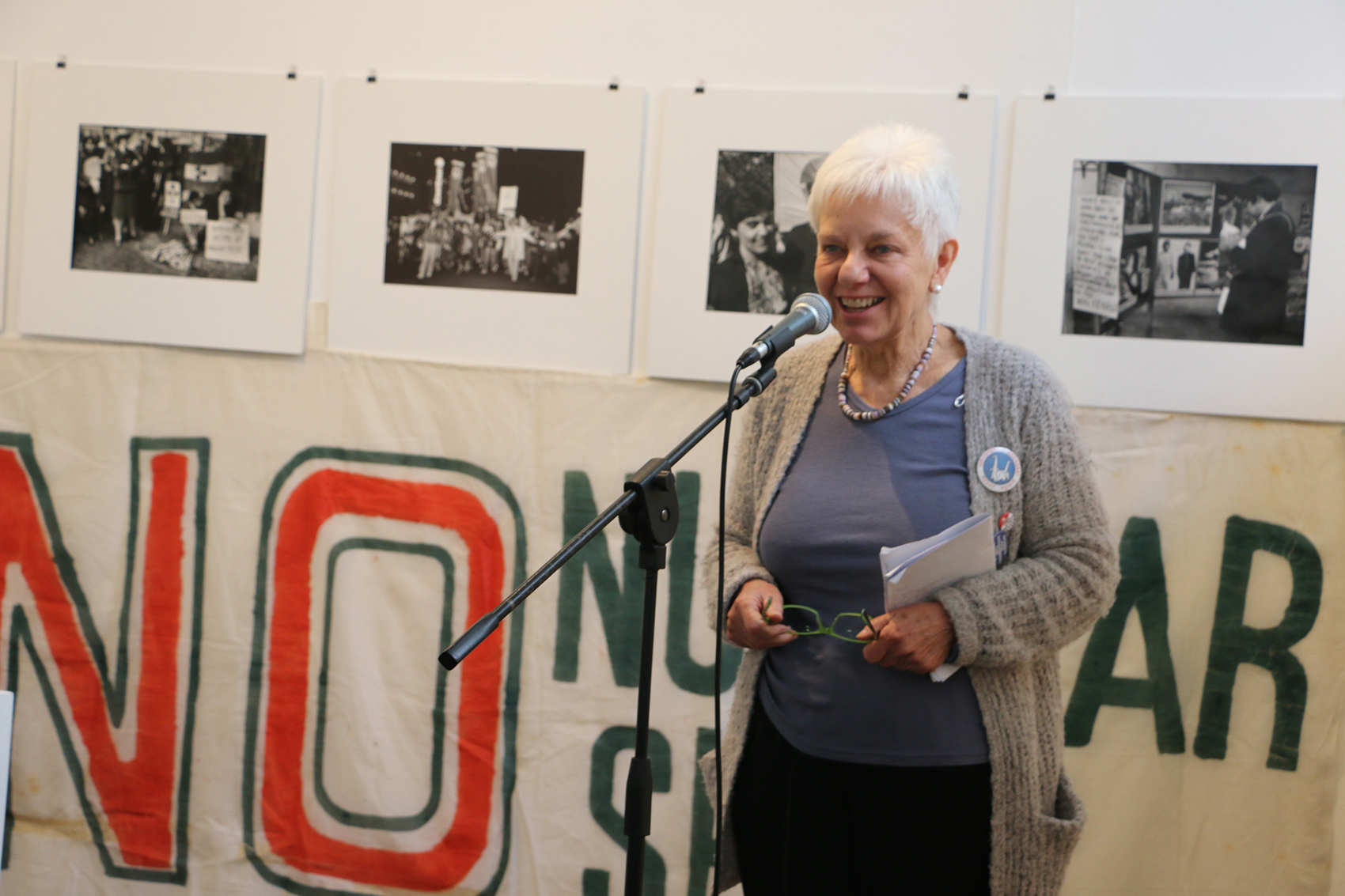
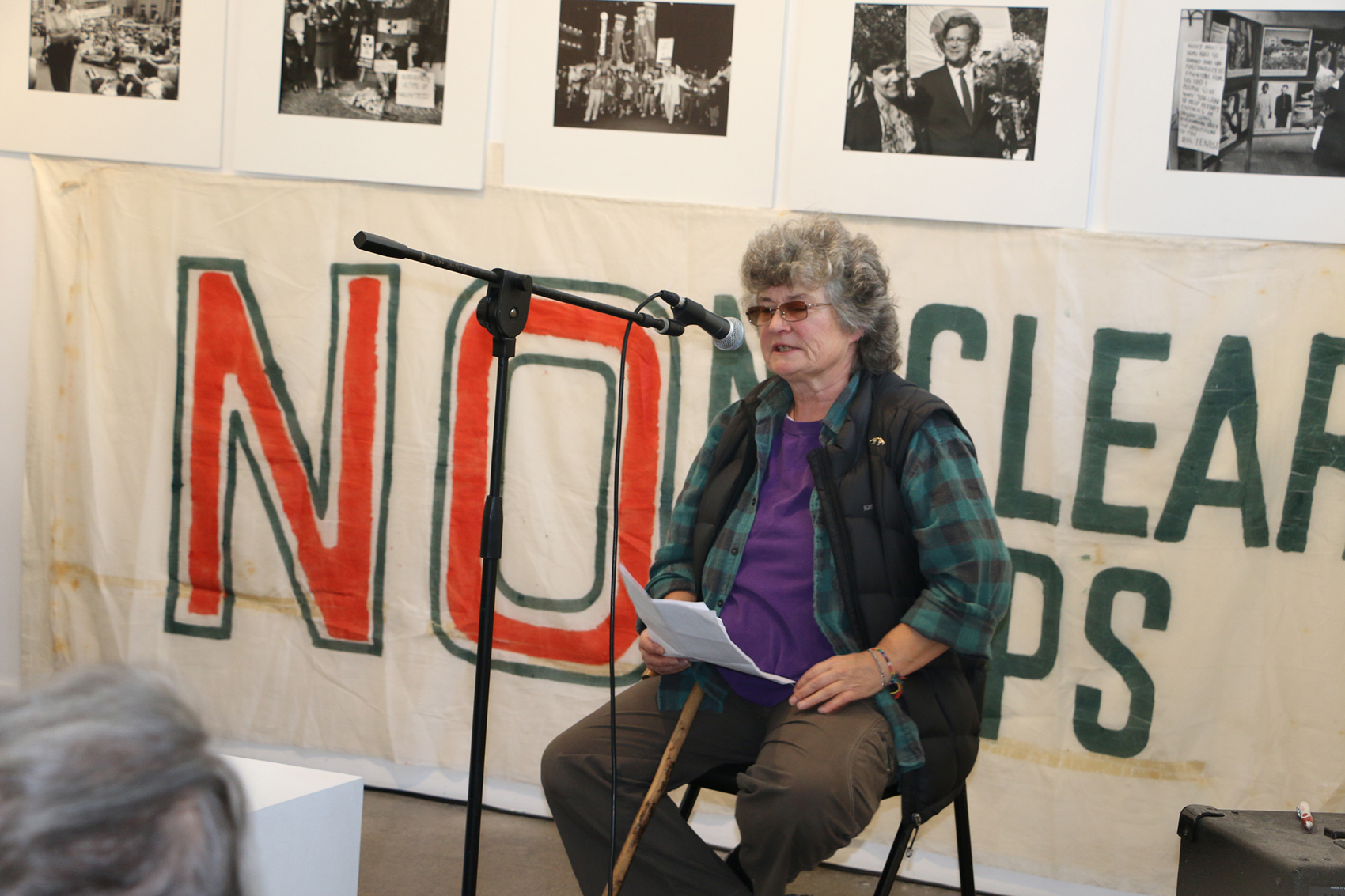
3. Campaign for Nuclear Disarmament spokesperson (back then) Maire Leadbeater speaking. Image: Kendall Hutt/PMC

4. A slice of the crowd with photographer Gil Hanly (right) and Maire Leadbeater easy to spot. Image: David Robie/PMC

5., The Devonport Peace Choir singing. Image: Kendall Hutt/PMC

6. Pacific Media Centre’s Dr David Robie speaking. Image: Kendall Hutt/PMC

7. The Nuclear-Free and Independent Pacific (NFIP) Movement’s Ema Tagicakibau of Fiji speaking. Image: Kendall Hutt/PMC

8. The Peace Squadron founder Rev George Armstrong speaking. Image: David Robie/PMC

9. Peace Movement Aotearoa’s Edwina Hughes speaking. Image: Kendall Hutt/PMC

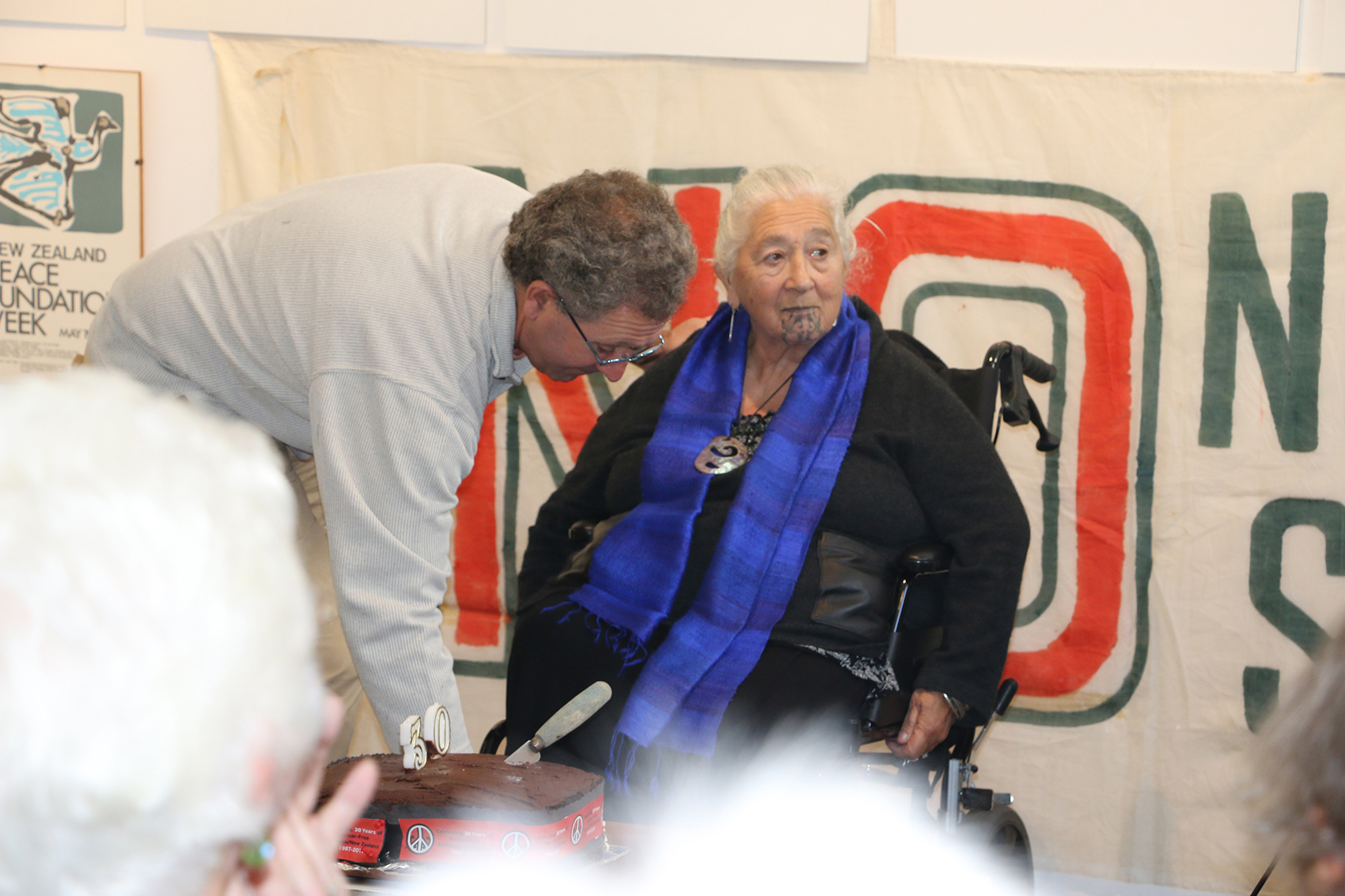
10. Kuia Pauline Tangiora of WILPF Aotearoa and Rongomaiwahine after cutting the “30 Years” cake. Image: Kendall Hutt/PMC

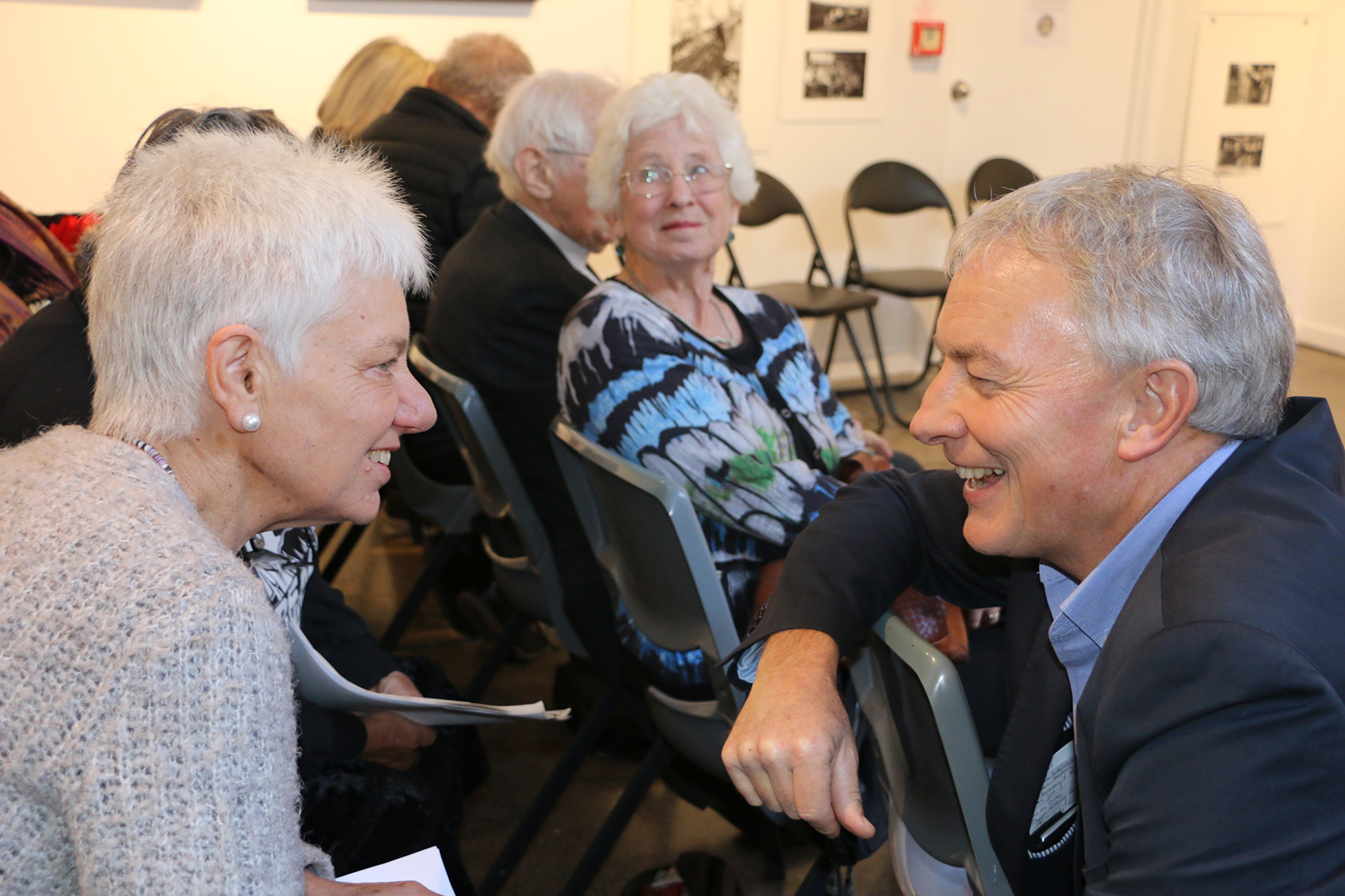
11. CND’s Maire Leadbeater shares a joke with Auckland mayor Phil Goff. Image: Kendall Hutt

12. Some of Gil Hanly’s photos on display. Image: Kendall Hutt/PMC

13. Photographer John Miller captures some images. Image: David Robie/PMC

14. Nuclear-free diptyches by photographer John Miller. Image: David Robie/PMC

]]>

Keith Rankin Analysis: British Tories surge; new Labour surges more

]]>

Headline: British Tories surge; new Labour surges more

Analysis by Keith Rankin

[caption id="attachment_14647" align="aligncenter" width="976"] Record support in Britain for both Conservative and Labour. Graphic by Keith Rankin.[/caption] [caption id="attachment_1450" align="alignleft" width="150"] Keith Rankin.[/caption]

This month’s chart shows that the performance by the Tories in the UK election was not at all bad. With a 42.34 percent share the Tories performed dramatically better than they did just two years ago (36.82%). Their nadir was in 1997, at 30.69%. Labour, of course, surged even more, gaining a 39.99% vote share; a share that, in New Zealand, Andrew Little could only envy.

This swing away from the nationalist parties (UKIP and SNP) was always going to happen. The nationalist tide is going out, and the Tories are securely in power in the UK until 2022. Jeremy Corbyn – human being rather than Crosby/Textor robot – is already older than Michael Joseph Savage was when he became New Zealand’s Prime Minister. Corbyn will be 73 in 2022 and 78 in 2027; by no means too old (cf. Pope Francis) but nevertheless an unlikely Prime Minister from 2022. More importantly, Corbyn’s presence and prescience may help shift the locus of western politics away from the public-austerity hole that liberal-democracy fell into.

In the absence of proportional representation, the Brits are realising that it’s a waste of time voting for a candidate who can come, at best, third in a constituency contest. They are adopting DIY (do-it-yourself) preferential voting; as New Zealanders have done in Epsom and Ohariu. The LibDems won seats where they were genuine contestants, despite their share of the nationwide vote continuing to fall. Only in Scotland did Labour people refuse to support their sitting SNP representatives, allowing many of these constituencies to claimed by Tory candidates, thereby denying Labour a historic opportunity to form a government.

Who would have thought that Labour could ever win in Kensington and Canterbury? Who expected decayed Middlesbrough and Stoke to switch the other way, from Labour to Tory? Votes for no-hoper candidates dropped substantially. Millennials – Brits in their twenties – became participants in the democratic process; unlike, in the 2000s’ decade, the now 30-something children of the baby‑boomers. Unpolled (until the exit polls) millennials took their “don’t forget us” votes with them, from the grit of Staffordshire and Teesside to the squats of London.

The shift to two-party politics happened in Northern Ireland too, with Sinn Fein nearly doubling its number of stay-in-Ireland MPs. Thanks to Sinn Fein, there are now only 642 effective MPs (deducting 7 Sinn Fein, plus the Speaker). The Tories in England and Northern Ireland have 327 of those, with the maximum opposition tally being 315. If the DUP (Northern Ireland Tories) abstain from any vote, it’s still 317 to 315, enough for the Tories to keep governing. If on some socially liberal measure, the DUP vote against the UK Tories, then the required votes will be found elsewhere.

We in New Zealand have had stable minority governments since 2002. I see no reason why governance in the UK will be much different, despite a mainstream media that struggles to make sense of twenty-first century realities and insecurities.

In 2001 UK voter turnout was 59.4%; it’s now 68.7%. Then the Tory Conservatives gained only 18.8% of enrolled voters (Labour 24.2%). In 2010, when the only possible outcome was a Tory-led government, the Conservatives got just 23.5%; Labour only 18.9%.  In 2017, however, the Conservatives got 29.1% of enrolled voters (Labour 27.5%).

I don’t see anything in the UK experience that suggests there will be a similar surge to Labour in New Zealand. Rather, all I can see is a pro-austerity anti-immigration platform, quota politics, a Green Party leaving the vacancy in the new-centre (the place where the Greens should be standing) to TOP (the new Opportunities Party), and an unwillingness from Labour to engage with the Māori Party.

The UK election was an interesting and positive portent for new politics in the 2020s. I expect New Zealand’s ‘really interesting’ election will be in 2020, not 2017. New Zealand needs new Labour, not ‘New Labour’.

]]>

PNG police, forces launch Moresby security operation for elections

]]>

AsiaPacificReport.nz

The joint parade of disciplinary forces in Port Moresby at the weekend. Video: EMTV News

By Theckla Gunga in Port Moresby

A joint parade between members of Papua New Guinea’s three disciplinary forces has been conducted in Port Moresby to mark the launch of the election operation.

The launch at the weekend signified the commencement of the Joint Operations in the National Capital District and Central Divisional Command. At least 10 companies were part of the parade. It was a short parade from the back of the Boroko Police Station to the front car park.

The parade was led by members of the Royal Papua New Guinea Constabulary, followed by the Defence Force and Correctional Services.

Once the parade took their position, Deputy Police Commissioner in charge of operations Jim Andrews was invited by Head of the Command Sylvester Kalaut to review the parade.

Commissioner Andrews encouraged the members of the disciplinary forces to assist the Electoral Commission over security for the voters, candidates and election officials.

-Partners-

Although the 2017 National Election is conducted by the Electoral Commission, members of the three disciplinary forces have been engaged to ensure the elections are securely and safely conducted.

These officers will be providing security during the polling and counting periods, and in the remaining two weeks of campaign.

NCD and Central is the last command to launch its Natel Operation.

Similar operations were launched in the other divisional commands such as New Guinea Islands and Highlands divisional commands.

NCD and Central will go to the polls on June 27.

]]>

Flashback to NZ’s nuclear-free law 1987: Challenging Goliath

]]>

AsiaPacificReport.nz

New Zealand quietly celebrated 30 years of its official status as a “nuclear-free” country this week when the nuclear-free zone law came into force on 8 June 1987. When Aotearoa/New Zealand banned nuclear warships from its ports in 1984, the country was seen as David standing up to Washington’s Goliath. But behind Prime Minister David Lange was a whole army of peace campaigners forcing him to sling his shot. David Robie traces the history of their resistance in a 1986 article for the New Internationalist – and shows how ordinary people declaring their home as a nuclear-free zone helped send a message to the superpowers.

Artist Debra Bustin sat dejectedly among the Ronald Reagan and Robert Muldoon masks, papier mâché missiles and effigies of babies in stakes, waiting. The “Nuclear Horror Show”, a dramatic piece of street theatre, was ready to roll – but there was no transport. The truck supposed to have carted the props to the start of the demonstration in the heart of Wellington had failed to turn up.

But another peace campaigner had an idea. He darted onto the nearby street and stopped the first empty truck.

“Hey mate, we’ve got to get all this stuff to the big anti-nuclear rally across town.” He said. “Can you help us?”

The New Internationalist “Pacific Peace” edition in 1986.

Ten years earlier, the truck driver would have laughed at the campaigner’s cheek. However, this was September 1983, and the peace and anti-nuclear groups in Aotearoa/New Zealand had become a mass movement. The driver was delighted to help and the macabre show went ahead.

Within 10 months, conservative Prime Minister Sir Robert Muldoon had been swept out of office as David Lange and the Labour Party were catapulted into power on a nuclear-free platform, which stunned the country’s Western allies, particularly the United States.

Internationally, the move was perceived to be a bold, idealistic new step by a reformist government. Critics tried to suggest it was a result of some Machiavellian plot by the party’s “militant” left wing. In fact, it was the culmination of a policy that had first been introduced more than a decade earlier and had been reinforced at grassroots level by a highly motivated peace movement.

-Partners-

Indeed, even if the government itself had had doubts about the policy, it would have had little choice. Opinion polls showed 74 percent of people in favour of banning nuclear-armed ships, two-thirds of the country’s 3.2 million population lived in self-proclaimed “nuclear free zones” and four out of five competing political parties (including a new breakaway right-wing group) had the policy as part of their platforms.

Nuclear-free photographs by Gil Hanly and John Miller are on display in the 30th anniversary of the nuclear-free law at the Depot Artspace in Devonport. Image: David Robie/PMC

Global peace lesson?
So what created this revolution in public opinion, and is there a lesson that the global peace movement can learn from Aotearoa’s example?

The peace movement in Aotearoa itself had humble beginnings in the 1960s with the Campaign for Nuclear Disarmament’s (CND) local Easter rallies being miniature clones of the huge annual Aldermaston march in the UK. However, in 1968 two things combined to create the first major rallying point: The first was the screening of Peter Watkins’ anti-nuclear TV drama The War Game (which was initially censored in the UK in 1965 and eventually screened 20 years later in 1985). The second was the US Navy’s plan to build a radio communications base called Omega, which was to aid the navigation of Polaris submarines. Sensitised to the issue by the documentary, New Zealanders were so outraged by the Omega plan that it was forced to be shelved. “Government deals NZ into War Game,” said one newspaper.

“The Watkins film brought home to New Zealanders the possibility of the country being a nuclear target,” says peace researcher Owen Wilkes. “Until then war had been a kind of sporting event. It was something that happened on the other side of the world.”

Photographer John Miller, who along with Gil Hanly, has many pictures of the nuclear-free campaign on show at the Depot Artspace, Devonport. Image: David Robie/PMC

Anti-nuclear feeling contributed to Labour’s election victory under Norman Kirk in 1972. Their nuclear-free policy emerged from the fallout shelter hysteria of the early 1960s, thermonuclear tests by the superpowers and the escalating Vietnam War. In the three heady years that followed, the Kirk government shut out nuclear-armed and powered ships from New Zealand’s ports. They also dispatched frigates in support of the vulnerable flotillas of yachts that sailed to Moruroa in protest at French nuclear testing there.

But then the nuclear-free strategy was dealt a body blow. The National Party was re-elected in 1975 and Muldoon ushered in his decade of power by welcoming back nuclear ships. The Peace Squadron was formed by Rev George Armstrong in response – a loose coalition of people whose yachts, small boats and other craft mounted spectacular waterborne protests against visiting nuclear ships.

Another focus for the Peace Movement was the creation of nuclear-free zones. “We campaigned to declare your house, dog, car and boat nuclear-free,” recalls Maire Leadbeater, spokesperson of CND. It seemed small fry at the time, but later it was realised what a clever strategy it had been. It gave peace activists a manageable goal while at the same time making elected councils take a stand against nuclear facilities visiting, or being sited in their area.”

Sparked off movement
Canadian émigré Larry Ross dived into the nuclear issue in 1979 with a crusader’s zeal and an “ad man’s flair”. He made his Christchurch home headquarters of the NZ Nuclear Free Zone Committee (NZNFZC) and sparked off a movement which had remarkable success: 66 percent of the population now live in such zones declared by local authorities.

One after another local authorities declared themselves nuclear-free in the face of a barrage of letter-writing and lobbying by peace campaigners. Even larger cities became nuclear-free – councillors in the country’s largest city of Auckland considered the issue three times before deciding “yes”. Indeed, it was better, according to Larry Ross, for a council to refuse the demand at first, because this meant campaigners had to go out and involve local people, talk to them on the doorstep and get them to sign petitions.

By the 1980s, the movement was becoming more organised. Peace Movement Aotearoa (PMA) was formed, while Māori campaigners, seeking with increasing success to link “anti-nuclearism” with racism and land rights, founded the Pacific People’s Anti-Nuclear Action Committee (PPANAC).

In the wake of the social upheaval caused by the protests against apartheid during the 1981 white South Africa rugby tour, enormous energy was released which became diverted to the peace movement. In one week alone, 40,000 people protested against a warship visit. The peace movement was finally a mass one – and the Lange government’s policy was a direct result.

Peace researcher Owen Wilkes at Motutara, Kawhia, in August 2003. Image: David Robie/PMC

“Everybody thinks we have this brilliant Labour government which is dedicated to pacifism,” says Owen Wilkes. “But it isn’t, the government simply responded to public opinion, whereas in other countries where there have been similar big percentages against nuclear weapons, governments haven’t reacted.”

Why has there been such an extraordinary level of popular backing for the policy in New Zealand, a country which is so far from the centres of world tension and so unlikely to be a target in the case of any nuclear attack? One key factor has been the bitter resentment most people feel towards French nuclear testing in the South Pacific.

French persistence with the tests [they ended in 1996] in arrogant disregard of repeated protests by New Zealand, Australia and other neighbouring Pacific nations has helped keep New Zealanders acutely aware of the nuclear issue. It has also helped to provide the peace movement with credibility.

The Rainbow Warrior bombing and other photographs by John Miller at the 30 years of New Zealand’s nuclear-free law exhibition at the Depot Artspace in Devonport this week. Image: David Robie/PMC

Rainbow Warrior bombing
Last year [1985], the sight of the Greenpeace ship Rainbow Warrior, lying bombed and submerged in Auckland harbour while crew members mourned their dead photographer colleague, Fernando Pereira, became a brutal reminder to all New Zealanders of the realities of raising a voice against war. And it unquestionably strengthened the Lange government’s anti-nuclear resolve.

While Lange is portrayed internationally as a champion of the nuclear-free strategy, he is at times accused at home of backpedalling on the issue. The Peace Movement Aotearoa is also watchful for any sign that the government might soften its stance.

Last year [1985], the government tried to allow the nuclear-capable American warship Buchanan to visit and was only stymied by the strength of the peace movement. The protest ruined a carefully laid plan by the bureaucracy to open up a chink in the antinuclear strategy and prepare the ground for a compromise with the US.

Aotearoa’s policy has pushed it into an increasingly isolated position within the Western alliance. The US has applied severe pressure on the Lange government but overtly through diplomatic harassment and covertly through attempts to influence New Zealanders by CIA-funded projects involving journalists, trade unionists and opinion leaders. Britain, meanwhile, has sent envoys like Baroness Young to warn that if the NZ Nuclear-Free Zone, Disarmament and Arms Control Bill would be passed [it was enacted in June 1987] this would mean Aotearoa/NZ and the rest of the Wellington alliance would move apart.

In the face of this international pressure, Lange has become increasingly cautious. At Oxford University during the popular debate with the American Moral Majority’s Jerry Falwell in March 1985, Lange delighted his image as the nuclear-free David challenging the superpower Goliath.

But barely 15 months later, his delight in the image was not so obvious. On his first major tour of European capitals, in the wake of the Chernobyl nuclear disaster in the Soviet Union, he was determined to reassure Western leaders that he was no pawn of the peace movement. During a speech to the Nobel Peace Prize-winning International Physicians for the Prevention of Nuclear War, Lange almost appeared to be defending the nuclear powers in his anxiety not to be seen to be “exporting” the anti-nuclear policy.

Many people in the peace movement were disappointed that he did not use the occasion to make an emotive plea to the West for follow Aotearoa’s example. They know that they have to keep up the pressure in order to counteract the influence of the Western alliance – and support from people internationally will help them. Otherwise, a stand that has become a great source of hope to the worldwide peace movement might be endangered.

David Robie is an independent journalist based in Auckland. He specialises in Pacific affairs and is author of Eyes of Fire: The Last Voyage of the Rainbow Warrior. This republished article was commissioned for the New Internationalist and published in the September 1986 edition.

]]>

Celebrating 30 years of Nuclear-Free Aotearoa — the Pacific connection

]]>

Report by David Robie. This article was first published on Café Pacific

Auckland mayor Phil Goff admiring a photograph by John Miller taken of the politician when he was a student activist campaigning for a nuclear-free New Zealand. Goff spoke at the “Celebrating 30 Years of Nuclear-Free Aotearoa/New Zealand” at the Depot Artspace in Devonport today. Image” David Robie
Reflections from David Robie

CONGRATULATIONS everybody for that tremendous achievement three decades ago. And thank you to WILPF and Ruth Coombes for inviting me. It was literally a David and Goliath struggle to make New Zealand nuclear-free – not just David Lange, prime minister at the time, although he was vital too.

The real “David” was the ordinary people of New Zealand who exerted extraordinary pressure on the government to deliver. The barrages of letters from citizens, constant lobbying by peace campaigners, local councils – such as right here in Devonport — declaring themselves nuclear-free, the door-knocking petitioners – and, of course, the spectacular protests.

However, in my few minutes I would like to talk about the Pacific context, as this was my background. While the New Zealand campaign and success was tremendously inspirational for the Pacific, it should not be forgotten that some small Pacific countries and communities were actually ahead of the game.

Some examples:

Rev George Armstrong … a founder of the Peace Squadron,
at the heart of the nuclear-free protests.
Image: David Robie

1983: One of David Robie’s photos of the
mystery “no nukes” girl in Vanuatu.
‘No nukes’ girl
Now, I would like to tell a story about a five-year-old girl who, for me personally, was symbolic of the nuclear-free struggle.

I met her in Independence Park in Port Vila at the Nuclear-Free and Independence Movement (NFIP) conference in 1983 — just three years after Vanuatu became independent and four years before our nuclear-free law was enacted.

I didn’t know her name or anything about her then. She just had a striking appearance and I took several photos of her at the time.

She was a delightful happy painted face in the crowd that day. Yet her message was haunting: “No nukes: Please don’t spoil my beautiful face,” said her poster.

Although I didn’t know it at the time, she was sitting with her mother.

2014: The girl on the book cover … still
a mystery.

The photos in both monochrome and colour versions were published in various Pacific media and magazines over several years. All the time, questions kept tugging at me.

“Who is she? Where is she from and what is she doing now?”

Her placard slogan became the inspiration for my book in 2014, Don’t Spoil My Beautiful Face: Media, Mayhem and Human Rights in the Pacific, published by Little Island Press in New Zealand.

I would have loved to name her in the book along with the cover image of her. This spurred me onto to more determined efforts to discover her identity.

However, it seemed like a needle in a haystack mission with little prospect of success.

Social media search
First of all I posted the photo – and a Hawai’ian solidarity video that also showed the little girl, discovered by one of my student journalists – on my blog Café Pacific in October 2015. More than 1100 people viewed the blog item, but there were no tip-offs.

Then I posted it was on other blogs related to the Nuclear-Free and Independent Pacific (NFIP) movement. Again no luck.

Finally, friends at Vanuatu Daily Digest reposted my appeal on February 15 last year – and then she was identified on the southernmost island of Aneityum (“Atomic” Island, but the traditional name is “Keamu”) by people who knew her family.

Curiously, my wife Del (active in WILPF), and I were on that island at the same village, Anelgauhat, where she lives, on Christmas Day that year – and met her by chance. But we didn’t realise who she was.

2016: June Keitadi (Warigini) … living in Anelgauhat
village on Aneityum (“Atomic”) island in
southern Vanuatu.
In fact, we were only able to recognise her later after seeing photos of her from the island. This is an island with less than 2000 people, no roads and no electricity grid.

That little girl is June Keitadi (Warigini) daughter of Annie Weitas and Jack Keitadi, then deputy curator of the Vanuatu Kaljoral Senta along with Kirk Huffman. All very active in the nuclear-free and independence movement.

Today June is assistant bursar at a local school and a Salvation Army volunteer on Aneityum. She is married, has three children and is very active in social justice issues.

My wife Del and I travelled back to this island in August last year and were welcomed to the village by June and the extended family. I have pictures on my blog about this.

A truly inspiring story.

The Pilger documentary
Just last year, John Pilger’s latest documentary, The Coming War on China, was premiered on RT Television and was shown recently in selected NZ cinemas with a short season. Pilger made several striking points in this film.

Among them was a reality check about the disputed Spratly Islands in the South China Sea – and China apparently establishing a base there – which recently became a flashpoint for global tension. News media exhaustively covered the situation.

What hasn’t been covered much, as revealed by Pilger, is the fact that China is encircled by US bases with a host of missiles pointing towards this country.

John Pilger also gave a compelling account of the cultural, economic and health devastation inflicted by the post-war nuclear tests in the Republic of the Marshall Islands – then part of a United Nations trusteeship.

With test sites at sea, in the air, on reefs and underwater, says Pilger, the “total yield of the nuclear experiments on and around the Marshall Islands was equal to 7200 Hiroshima bombs, meaning the equivalent of more than one Hiroshima bomb was exploded in the area every day for 12 years.”

Bikini Island and other atolls in the Marshall Islands are still today unfit for human life.

Pilger also gave a compelling update on the fate of the people of Rongelap who were evacuated by the original Rainbow Warrior in May 1985 on the voyage leading up to the bombing here in Auckland just two months later.

Bev Cormack, deputy director of Greenpeace Aotearoa in the 1980s, speaking at the 30 years nuclear-free event
in Devonport. Image: David Robie
Shameful colonial acts
I was on board the “RDub” for this last voyage and my book Eyes of Fire and a TVNZ video based on my Rongelap exhibition photographs, Nuclear Exodus, tell the story. Sadly, the French spy drama at the time overshadowed the humanitarian voyage to the Marshall Islands.

It also overshadowed the shameful acts of the French politicians and military figures in the defence of colonialism – such as the assassination of schoolteacher leader of the Kanak independence movement, Eloï Machoro, in 1985 and the Ouvéa cave massacre of 19 young Kanak students and militants on 5 May 1988, less than a year after our nuclear-free law came into force.

The John Pilger documentary has brought home to us – just in case we need reminding – that the threat of nuclear war today is now the most ominous since the so-called Cold War.

I would just like to conclude my remarks by citing the preamble to the People’s Charter for a Nuclear-Free and Independent Pacific (NFIP), which says:

We, the people of the Pacific, have been victimised for too long by foreign powers. The Western imperialistic and colonial powers invaded our defenceless region, they took over our lands and subjugated our people to their whims.

This form of alien colonial, political and military domination unfortunately persists as an evil cancer in some of our native territories such as Tahiti-Polynesia, Kanaky, Australia and Aotearoa …

We … will assert ourselves and wrest control over the destiny of our nations and our environment from foreign powers, including transnational corporations.

We note in particular the recent racist roots of the world’s nuclear powers and we call for an end to the oppression, exploitation and subordination of the indigenous people of the Pacific.

This declaration is today just as meaningful as it was in the 1980s.

These nuclear-free sentiments have now been revived through another struggle, the Pacific-wide movement for self-determination in West Papua.

The struggles continue …


]]>

Fake news ‘unlikely’ to gain presence in NZ media, says journalism panel

]]>

AsiaPacificReport.nz

New Zealand journalists and academics on fake news phenomenon … “Clickbait rather than substance are at the heart”. Image: Kendall Hutt/PMC

By Kendall Hutt in Auckland

Seasoned journalists and academics have warned “fake news” could invade New Zealand’s media if journalists do not remain vigilant.

“It’s about using those principles, experience and judgment built up over time ” said TVNZ’s One News political editor Corin Dann.

“That will more or less likely filter out fake news.”

Dann’s “Fake news and the 2017 General Election” fellow panelists Chlöe Swarbrick, moderator Dr Gavin Ellis, Dr Maria Armoudian and Mark Jennings also told the audience at the University of Auckland this week current trends in journalism worldwide — business models, rise of social media — were driving fake news.

“Clickbait rather than substance are at the heart of fake news,” Greens List MP Chlöe Swarbrick reflected.

Mark Jennings, the journalist behind the launch of Newshub during his 27-year tenure with MediaWorks and now a co-editor of the independent Newsroom, said “media getting sucked into matching” was the door for fake news.

-Partners-

“If the first one gets it wrong, then both get it wrong.”

‘Nowhere near as bad as the US’
If a media organisation was to accidentally publish fake news, Jennings said the organisation should address it “fast in a fulsome way”.

However, if fake news were to invade New Zealand’s political sphere, it would be “nowhere near as bad as in the US,” Jennings said.

“Fake news nowhere near as bad as US” … reflects Newsroom co-editor Mark Jennings. Chlöe Swarbrick (left). Image: Kendall Hutt/PMC

Dr Armoudian, a lecturer in politics and international relations at the University of Auckland, explained this was because “here we still talk policy” while the US was witnessing a “polarised” and “personalised” invasion of politicians in the news.

“We’re seeing fake news as an extreme version of that.”

“We’re not going to suddenly get fake news,” Dann countered.

What New Zealanders might see, however, was “pressure” for information during elections.

It is important to remember, however, that fake news was not a new phenomenon, they stressed.

Fake news beyond ‘borders’
Dr Armoudian claimed the world had seen fake news during “manipulation” of the situation in a lead up to a coup in Chile in the 1970s because the US government “put newspapers on the payroll”.

“It’s very clear that fake news travels past Pacific oceans and borders.”

The University of Auckland’s Dr Maria Armoudian … fake news goes “beyond borders”. Image: Kendall Hutt/PMC

One audience member, Malcolm Evans, an award-winning independent cartoonist, agreed, saying that what the world was continuing to see was propaganda.

During a lecture at the University of Helsinki last year, Eddy Hawkins, an independent journalist with Finnish Broadcasting Company Yle reflected on the prevalence of disinformation, propaganda and fake news in the political sphere.

Hawkins noted disinformation had been hugely enabled by social media and the way media was currently consumed, namely “quickly and without question”.

“Be critical, analytical, beware of appeals to emotion masquerading as fact and logic,” he told  the journalism and political students gathered.

The Auckland panelists, however, also identified a lower capacity for fact-checking in newsrooms due to the fact job-cuts had come about.

Fact-checking central
“We’ve lost some of the capacity for fact-checking,” Jennings admitted.

As a remedy to such occurrences, ABC in Australia has resumed a fact-checking service with the RMIT University journalism programme dubbed “RMIT ABC Fact Check.”

The Conversation also runs a fact-checking programming on its stories.

Swarbrick suggested part of the solution to fake news could be education.

“We need to see proper, informed citizens.

“Social media is the ‘Wild West’ at the moment, so it’s up to citizens to discern fake news.”

In closing Dr Ellis, a former New Zealand Herald editor-in-chief and now a senior lecturer in media and communication at the University of Auckland, reflected the “cure” may well be with citizens.

“We need to think with our head not our hearts. Think critically, not what we want to believe.”

]]>

Pacific leaders drive call for healthier oceans at UN conference

]]>

AsiaPacificReport.nz

Campaigning to save threatened Pacific and global fish stocks. Video: UN

Pacific Media Watch Newsdesk

Political leaders from across the Pacific have played a central role in talks this week surrounding healthier oceans during the UN Ocean Conference in New York, with Fiji Prime Minister Voreqe Bainimarama calling for a “global crusade”.

Co-hosted by Fiji and Sweden, the “game changing” conference aims to see Sustainable Development Goal 14 – the conservation and sustainable use of the world’s oceans and its resources – become a reality.

Fijian Prime Minister Voreqe Bainimarama … “place SDG 14 at the very top of the global agenda”. Image: The Ocean Conference

During his opening address, Prime Minister Bainimarama appealed for the world’s population of 7.5 billion people to join Fiji in ensuring the health of oceans is improved, The Fiji Times‘ Tevita Vuibau reported.

“Let us all seize this moment in history to make a difference. To place SDG 14 at the very top of the global agenda alongside decisive climate change. We can do it. We must do it. The alternative in both cases is catastrophe.”

Bainimarama, a president of the conference alongside Swedish Deputy Prime Minister Isabella Lövin, highlighted this was urgent due to the rapid deterioration of ocean fish stocks and the polluted state of the world’s oceans.

-Partners-

“So much of what we dispose of carelessly finally ends up in our seas through storm water drains, creeks and rivers,” he said.

“Our waterways are choking. Our seas and oceans have become vast rubbish dumps. And the creatures who live in them are suffering acutely – turtles, dolphins and sharks caught in netting, whales with stomachs full of plastic bags and other rubbish.

‘Precious’ resource dying
“Humankind is slowly killing off one of our most precious resources – the rich bounty of our seas and oceans that generations across the millennia have relied upon for sustenance, and to earn a living.”

Palau’s president Tommy Remengesau also called for 30 percent of the world’s oceans to be protected by 2030, Radio New Zealand International reported.

Palau had already set aside 80 percent of its seas as a no-take marine sanctuary, so other countries should work together to establish a system of protected areas, he said.

“Within this worldwide network of protected areas, we must take into account the need for sustainable development and create opportunities for food security initiatives in developing countries enhancing small-scale and artisanal fisheries and building capacity in sustainable fisheries, tourism, and aquaculture.”

But while the world met for action on SDG 14, the Marshall Islands Student Association (MISA) continued its calls for nuclear testing in the Pacific to be remedied through recognition of SDG 14.1.

In a joint statement with Youngsolwara issued on the eve of World Oceans Day (June 8) and endorsed by several environmental NGOs and civil society groups, MISA urged world leaders to remember the people of the Pacific have been treated like “guinea pigs”.

“The consequences of detonating hundreds of nuclear bombs of a much greater destructive power than Hiroshima and Nagasaki atomic bombs are still being felt today by indigenous islanders – manifesting in, among other impacts, debilitating health and inter-generational maladies.

‘Pacific people’s health threatened
This legacy continues to threaten not just Pacific islanders and the Pacific Ocean, but the health and well-being of all the planet’s oceans and the people who depend upon them.”

MISA and Youngsolwara also reflected on the danger the ocean now poses to the existence of many Pacific Island countries due to climate change and increased their call for the world to not forget they are on the front-lines of a warming planet.

“We call upon the leaders and peoples of the Pacific to further our efforts in making our voices heard. The United States has pulled out of the Paris accord, but we the people of Wansolwara (one salt water) remain committed.”

MISA’s sentiments were echoed by Bainimarama, PACNEWS editor Makereta Komai reported, as he called for Pacific leaders and citizens to lead by example at a side event organised by the Secretariat of the Pacific Regional Environment Programme (SPREP).

“While we in the Pacific await this global response, we must do what we can ourselves. We must make a much greater effort to work together among ourselves to confront the challenge we collectively face.”

He admitted Fiji was also to blame for “rubbishing” the environment and therefore had a responsibility to preserve the oceans and leave “carelessness” and “thoughtlessness” behind.

“We can blame the bigger countries around the Pacific Rim as much as we like – and God knows they need to clean up their act.

NZ’s ‘special rsponsibility’
“But we also need to clean up ours. In far too many parts of Fiji, the Fijian people are rubbishing their country in a way that they would never rubbish their own homes.”

In New Zealand, Greens List MP Marama Davidson questioned Paula Bennet, Minister for Climate Change Issues, on the government’s commitment in leading the Pacific on climate change.

While Davidson claimed New Zealand had a “special responsibility” because the “very existence” of the Pacific is threatened by climate change, Bennet stated New Zealand’s leadership depended on “context”.

“I certainly agree that New Zealand needs to play our part in the global effort to reduce climate change. I think leadership depends on context within that.

I think we have a very special relationship with the Pacific islands. It’s why we provide so much aid there. It’s why we’ve committed more than $200 million towards contributing to helping our Pacific cousins.”

Through a series of supplementary questions, Davidson continued to question Bennet on the government’s apparent lack of “real” leadership on climate change, particularly surrounding what she called a “refusal” to support Pacific leaders in condemning US President Donald Trump’s exit from the Paris Agreement.

Bennet stood by her earlier answers, however, and reiterated the government’s “disappointment” in Trump’s decision while commending the actions of New Zealand’s Pacific neighbours.

Pacific actions commended
“I think I’ve made it pretty clear that we’re more interested in the actions that we take and I’m proud of them.

Those island states are welcome to make whatever comments they like, it’s called democracy. And if those are the comments they want to make on what President Trump has said, well good on them.”

More than 600 voluntary committments to improve the health of the oceans have been made by countries, businesses and civil society groups since the Ocean Conference began on Monday and ends today.

]]>

‘We’re going to survive war on drugs,’ university dealers tell Duterte

]]>

AsiaPacificReport.nz

Filipino university drug dealers and users … adamant they will not become part of the estimated 7000 killed in Duterte’s “war on drugs”. Image: Alecs Ongal/Rappler

By Roy Abrahmn Narra in Manila

Drug dealers and users at a private university in the Philippines capital of Manila are confident they will survive President Rodrigo Duterte’s “war on drugs”.

The students say this is because Duterte is going after those who peddle methamphetamine (shabu) and party drugs such as ecstasy.

They claim their drugs – marijuana and cocaine – are currently flying under the administration’s radar.

One of the students, “Bossing”, from a private university in Metro Manila, therefore continues his trade of not only marijuana, but also acid and cocaine.

“Duterte’s focus is on shabu and party drugs. I’m only using marijuana and cocaine.”

Bossing, who has frequently used marijuana since his time in junior high school, says he is not “scared” of Duterte.

-Partners-

“I am not using shabu.”

‘Not really a target’
Another student at a private university, ‘Jeremy’, holds a similar view and feels Duterte condemns the use of shabu more than marijuana.

“I feel the president is lenient to marijuana. What he is looking for is shabu. With marijuana, it will be unfortunate if you get caught using it, but you the marijuana user, is not really a target.

“I am quite scared but I feel I am safe.”

Jeremy’s friend “Ranz”, also a marijuana user since third year junior high school, is more scared of the barking K-9 units in train stations than the controversial operations of the Philippine National Police against drug users and dealers.

“I am not dealing with shabu,” he says.

Ranz, who admitted voting for Duterte in the May 2016 national elections, says marijuana users like himself are “small time” and therefore do not care about accusations of extrajudicial killings.

“What the f— do we care about those things?”

Police corruption allegations
Bossing, Jeremy and Ranz admit they “feel protected’ by what they claim is a culture of corruption among police.

Ranz says this is because the police force is “poor”, so bribe money from suspected drug users.

Drug dealers, meanwhile, are an “escape route”.

“Even if one pretends to be a rich person, the police would not care about you and it is already your advantage.”

Ranz says he wants the ‘war on drugs’ to continue.

“Shabu is the only problematic drug that should be eliminated. Keep it up,” he encouraged.

On May 31, 2017, the Commission on Higher Education (CHED) held a public consultation to determine the feasibility of requiring college students to undergo a drug test prior to enrolment.

‘Actively confront’ drugs
The idea had been floated the previous year by the Coordinating Council of Private Educational Associations (COCOPEA), who urged CHED on September 2, 2016, to “actively confront” drug testing “with due consideration to academic freedom of higher education institutions, the principle of reasonable regulation of educational institutions, and accessibility of quality education for all”.

However, Bossing, Jeremy and Ranz are adamant mandatory drug testing will not stand in the way of their habit or stop other college students from taking drugs.

“There many ways to avoid getting caught, like borrowing someone else’s urine samples.”

In the past, when Jeremy and Ranz were selected for a random drug test – authorised by the Republic Act 9165 or the Comprehensive Dangerous Drugs Act of 2002 – they said they did not take marijuana for a month prior to the test.

Their results were “negative.”

With the result, Ranz says he can use it to protect himself “from any harm” he may endure.

But as long as Bossing, Jeremy, and Ranz stay away from shabu, they “are going to survive the war on drugs”.

Roy Abrahmn Narra is an MA in Journalism student at the University of Santo Tomas, and produced this story for his graduate class Global Journalism Practice and Studies.

Also by Roy Abrahmn Narra:

]]>

More women in Solomon Islands politics — how it needs to be done

]]>

AsiaPacificReport.nz

Solomon Islands Parliament … only one out of 50 MPs is a woman. Image: Wansolwara

In this University of the South Pacific’s student journalist documentary broadcast on Radio Pasifik, Wansolwara’s Elizabeth Osifelo investigates the issue of women participating in Solomon Islands politics.

With just one female MP in a house of 50 MPs in Honiara, there is a broad agreement that something most be done to increase female representation.

Osifelo looks at the politics of the proposed 10 reserved parliamentary seats for women and discusses the issues facing the next generation of leaders.

]]>

Greenpeace Indonesia protesters target US climate policy ‘disaster’

]]>

AsiaPacificReport.nz

Protest banner outside the US Embassy says that Trumph is a climate disaster during protest held by Greenpeace Indonesia. Image: Yudha Baskoro/Jakarta Globe

Pacific Media Centre News Desk

Greenpeace Indonesia has staged a protest in front of the US embassy in Jakarta over the decision of President Donald Trump withdrawing from the Paris Agreement on climate change.

“President Trump looks likely to turn away from the impact of climate change with millions of people falling victim of natural disasters such as flooding, drought and extreme weather which have hit many countries including Indonesia,” climate and energy spokesman of Greenpeace Indonesia Didit Haryo said.

The protest was carried out on Wednesday.

Didit said the United States was the second largest contributor to gas emissions after China, adding industries in United States were even the largest emitters from the 1850s or the era of Industrial Revolution until 2010.

The United States would play a serious role hampering the global efforts to check rising global heat, he said, adding the policy of Trump reflected not what happened in US cities.

“The steps taken by Trump would not halt serious commitments by world leaders. Now it is important to implement the commitments especially in energy sector,” he said.

-Partners-

Indonesia also has pledged to maintain its commitment.

However, expansion had continued in coal mining and use that would make it difficult for the Indonesia government to fully implement its commitment to Paris agreement, he said.

China has proved its transitional commitment by building solar power plants with a capacity of 43,000 megawatt (MW) until 2016 and cancelled plan to build 104 coal fired power plants with a total capacity of 120,000 MW.

“There should be no debate over the capability of renewable energy to meet our requirement. What is important is political will of the government,” he added.

]]>

Wansolwara student journos report on West Papua human rights struggle

]]>

AsiaPacificReport.nz

Student reporter Vilimaina Naqelevuki (left) and Wansolwara chief-of-staff Heather Traill interview Papua New Guinea journalist Alexander Rheeney about West Papua via Skype. Image: Wansolwara

By Vilimaina Naqelevuki in Suva

Media access to West Papua, where more than half a million of its indigenous people have reportedly been killed over five decades, remains restricted.

Full support … West Papuan Independence leader Benny Wenda (in red shirt) holds the banned West Papuan Morning Star flag with key supporter Solomon Islands Prime Minister Manasseh Sogavare during his visit last year. Image: bennywenda.org

News coverage of the alleged genocide is extremely difficult because of the restrictions on local and foreign media.

Some West Papuan journalists have also died in their effort to tell the truth about the deaths that largely occur in remote rural areas.

This makes news coverage of the alleged atrocities in the Indonesia-occupied land extremely difficult.

West Papuan independence leader Benny Wenda, in an online interview, told Wansolwara the restrictions allowed for the atrocities to remain “silenced”.

And even if access was granted after the labyrinthine effort, “journalists cannot go freely to report on politics in West Papua,” he said.

-Partners-

“They will get followed and questioned by Indonesian intelligence and West Papuans will suffer intimidation and threats if they speak to journalists.”

Recent prominence
Papua New Guinea Media Council president Alexander Rheeney said West Papua’s struggle of more than 50 years had only been given prominence in the region’s mainstream media in recent years.

Papua New Guinean journalist Alexander Rheeney, who is also president of the PNG Media Council. Image: PNG Media Council

Less than 10 years ago, the mainstream news media – in neighbouring countries like Fiji, Australia and New Zealand, ignored the situation in West Papua. It was effectively a media “black hole”.

Rheeney said it was more challenging for Pacific journalists whose governments recognised the sovereignty Indonesia had over West Papua.

“The media in PNG have reported on West Papua and all the human rights abuses but not as much as we would want it to despite the fact that PNG and West Papua share a land order,” he said.

Professor David Robie speaking at the Free Media in West Papua seminar in Jakarta, Indonesia, last month. Image: Alves Fonataba

The increasing coverage by Pacific news media should be commended, said journalism educator Professor David Robie.

Dr Robie, director of the Auckland-based Pacific Media Centre, who has regularly written and published news on West Papua’s struggle for more than three decades, said it was a huge relief that the Pacific was “finally waking up to the issue of West Papua”.

“This an issue of Melanesian solidarity, Pacific solidarity – an issue of self-determination, and the Pacific countries that got independence on a plate ought to be telling this story,” he said.

Jakarta media freedom conference
Dr Robie was one of the keynote speakers invited last month to the Free Media in West Papua forum at the UNESCO World Press Freedom Day 2017 conference in the Indonesian capital of Jakarta.

He spoke along with Indonesian and Papuan human rights activists and Tabloid Jubi editor Victor Mambor of Jayapura.

Pacific Freedom Forum editor Jason Brown said it was an utter disgrace that some in mainstream media published or broadcast stories on wars from other regions and “not in our own backyard”.

“In recent years, RNZI has done a much better job of covering West Papua. The recent closure of shortwave services by Radio Australia, however, means that the region has lost reliable access to news on West Papua from that source,” said Brown.

Rheeney warned that the region could not afford to fail fellow Pacific Islanders of West Papua.

He said to do so would be to doom the Pacific region to more instability.

“If a prosperous Pacific region is to be ensured, the issue of West Papua must be addressed,” he said.

Timor-Leste lessons
“As journalists we can no longer continue to turn a blind eye on all the human rights abuses that is happening.

“The PNG government can no longer turn a blind eye on what is happening on the other side of the border.”

Dr Robie said that informed political decisions could not be reached if the news media were not allowed to report freely on West Papua.

He said this lesson could easily be drawn from East-Timor’s road to independence.

East Timor, which was also occupied by Indonesia in 1975, secured its independence after a handful of journalists exposed the human rights violations through video smuggled out of the Indonesian-ruled territory, especially after the Santa Cruz massacre in the capital Dili in 1991.

Indonesia’s control rapidly fell apart after international pressure.

“In-depth and timely media coverage will save lives as West Papua lurches towards independence — which will come eventually — no matter how hard Jakarta tries to block this,” said Dr Robie.

Rheeney is also optimistic. He said Pacific journalists should continue to report on the issue, to keep the struggle in the news so that lasting solutions were found sooner and more bloodshed is prevented.

Vilimaina Naqelevuki is a final year journalism student with the USP Journalism Programme. Naqelevuki is pursuing a double major in journalism and politics, and is pictures editor of Wansolwara, the student news publication produced by the Journalism Programme.

]]>

One year after vowing support for Games, Pohiva calls for another host

]]>

AsiaPacificReport.nz

Prime Minister ‘Akilisi Pohiva … games decision blamed on “economic reasons”. Image: Kalino Latu/Kaniva News

By Philip Cass in Auckland

It is just under a year since the Tongan government assured the Pacific Games Council that it was fully committed to hosting the 2019 Games.

But the Tongan government said this week it would stand by its decision to not host the regional sporting event.

Prime Minister ‘Akilisi Pohiva made the announcement during a meeting with Pacific Games Council president Vidhya Lakhan.

Lakhan asked for a meeting with the government to see whether it would change its mind about withdrawing from the Games.

Pohiva asked the PGC to endorse the government’s decision and to consider having another country host the 2019 Games.

Samoa has already lodged a submission to host the Games in place of Tonga.

-Partners-

In reiterating the government’s decision, the Prime Minister once again cited economic reasons as the basis for withdrawing.

He based his original shock decision on a 2013 report on the consequences of holding the Games.

During the meeting with Lakhan, Pohiva said there were more important matters in Tonga which needed the government’s attention.

In late June 2016, Lakhan and PGC executive director Andrew Minogue flew to Nuku’alofa to assess the state of preparations for Tonga’s hosting of the 2019 Pacific Games.

During the visit the Tongan government expressed its full support for hosting the 2019 Pacific Games.

Lakhan also received extensive briefings from the staff of the Tongan Pacific Games Organising Committee on the development of the sports and marketing programmes.

“The Pacific Games Council is pleased the Prime Minister is now involved in overseeing the Tongan government’s commitment to hosting the 2019 Pacific Games and providing the necessary facilities and funding support to stage a successful Games,” Lakhan said after the PGC visit in 2016.

Dr Philip Cass is a journalist and media academic contributing to Kaniva News. This article is republished with permission.

]]>

Contemporary Pacific dance festival showcase ‘first of its kind’

]]>

AsiaPacificReport.nz

Fa’aafa created by Pati Solomona Tyrell … mixes movements from traditional Samoan dance and vogue dance. Image: Pati Solomon Tyrell

By Brandon Ulfsby in Auckland

Contemporary dance is set to take centre stage at next week’s Pacific Dance Festival.

The two week-long festival organised by Pacific Dance New Zealand is being held at the Māngere Arts Centre and will run from June 15-24.

Pacific Dance New Zealand (PDNZ) spokesperson Cilla Brown says the event celebrates and provides a platform for contemporary Pacific artists to showcase their work.

“There’s a bit of a wave with this new contemporary Pacific dance coming out. This is a way to showcase it and also develop and perform.”

She says the festival, which debuted last year, is the first of its kind and has gained more interest this year.

“It’s definitely grown, there’s heaps more interest and a lot more artists. Even international artists have inquired. This year we got 3 groups from Wellington.”

-Partners-

The two-week programme will feature work from several artists, including a piece called Wahine Toa – a collection of performances by four female choreographers.

Showcasing Pacific dance 
Interdisciplinary artist Pati Solomona Tyrell will present his work called Fa’aafa which touches on the relationship between queer Pacific children and their parents.

“There’s a piece in my work where I’m having a conversation in Sāmoan that me and my parents had when I came out to them. This platform will allow me to reach an audience that I otherwise wouldn’t have been able to reach.”

Local artist and curator Ema Tavola says she feels enriched and empowered by seeing Pacific works and is looking forward to the festival.

“It’s uplifting to see Pacific people using creative expression to tackle and understand pertinent issues. The rootedness in Pacific dance and movement means this festival is anchored to our homelands – It makes me feel close to home.”

Brown says having the festival in Mangere also brings the theatre to the Pacific community.

“There’s a lot of Pacific communities there already. It’s important for our community especially our Pacific kids to see our community on the stage as professional choreographers and dancers.”

Tavola says she is glad to see the festival held in South Auckland.

Pacific culture accessible
“It’s accessible to Pacific audiences and young people, and adds real value to our local arts landscape out here; and as a Pacific person seeing this kind of thing – I love it.”

The event will also include an art exhibition showcasing cultural dance costumes as well as workshops for local schools with artists and performers.

Contemporary dance performance Nu’u by group, Freshmans Crew, will debut at the festival on June 17 before they travel to Hawaii, Los Angeles and Utah.

Brandon Ulfsby is a student journalist with Auckland University of Technology’s training newspaper Te Waha Nui.

]]>

Pacific Ocean: ‘We cannot let history repeat itself – we’re not guinea pigs’

]]>

AsiaPacificReport.nz

OPINION: A Pacific World Oceans Day message from Youngsolwara Pacific and MISA4thePacific

As regional leaders gather in New York for the week-long United Nations oceans conference, we wish to recognise the Pacific’s storied history, as stewards of the world’s largest ocean. We acknowledge the test of time that this region has withstood, and commemorate those who have endure and withstood nuclear testing, a period in history with ramifications that are still felt by our oceans, lands, and peoples.

We remember this period as being a time when our oceans and people were utilised as guinea pigs by foreign powers. We acknowledge the issues both past and present that the Pacific faces, and we firmly refute the narrative that “we are victims’”.

We stand tall as the next generation of Pacific Islanders who shall also thrive on our sea of islands. We stand on the shoulders of the giants who went before us to make a stand.

On this note we call upon our Pacific and global leaders to take a stand against genocide. We, the Pacific, will not allow a repetition of colonialism.

Our peoples have suffered greatly from the destructive programmes of militarised colonial powers during the 20th century, continuing into the 21st. The legacy of nuclear testing throughout Oceania, in particular the Marshall Islands, French Polynesia, and elsewhere, has never been effectively remedied or addressed.

The consequences of detonating hundreds of nuclear bombs of a much greater destructive power than Hiroshima and Nagasaki atomic bombs are still being felt today by indigenous islanders – manifesting in, among other impacts, debilitating health and intergenerational maladies.

-Partners-

Runit Dome leaking
This legacy continues to threaten not just Pacific islanders and the Pacific Ocean, but the health and wellbeing of all the planet’s oceans and the people who depend upon them. Radioactive materials currently contained in Runit Dome on Enewetak Atoll in the Marshall Islands are leaking into the surrounding ocean and groundwater.

The Runit Dome was a haphazard attempt by the US military to contain 111,000 cubic yards of radioactive waste in an unlined crater. It was never replaced by a safe, permanent structure and instead is currently cracking and polluting the local surroundings.

Henry Kissinger in response to nuclear testing in the Marshall Islands, is quoted as stating: “There are only 90,000 people out there. Who gives a damn?” In response, we say: We are still here, and we are not going anywhere.

Cactus dome on Runit Island is testament to a history of experimentation, and the violation of our fundamental human rights. Leakage from the dome has resulted in the runoff of radioactive materials which poses serious concerns to the health of our oceans and the people who rely on them.

Parallels can be made with the ongoing contamination of our oceans as a result of terrestrial mining. Contaminants and runoff from existing mines remain a threat to the viability of our marine ecosystems. The oceans have still not recovered from the destructive acts of world wars, nuclear testing, and continued military maneuvers.

Intensified efforts must be made to demilitarise the oceans and to clean-up existing messes. As we the Pacific clamour for international action to halt carbon emissions, and desist from environmentally degrading activities, let us therefore be the change that we wish to see in the world.

Today, there are also parallels to be seen with the advent of extractive industries such as experimental seabed mining. Seabed mining is an issue that governments in the Pacific are still toying with.

No indigenous voices
Yet, this has not been tested anywhere else in the world. The discussion on seabed mining has proceeded narrowly for the past 30 years. There has not been inclusion of indigenous voices or much thought as to the inordinate risks in operating an untested extractive industry, in a fragile and almost completely unknown deep sea environment.

A recent joint study by 14 international universities and organisations discovered that hydrothermal vents and methane seeps on the ocean floor play a crucial role in regulating global climate – and that releasing or destroying them “would be a doomsday climatic event.”

In addition to likely and potentially irreversible environmental impacts, seabed mining is a long-term, experimental venture in which any potential profits for States must be offset by the short-term impacts, which could include destruction of local fisheries and resultant impacts on human health and livelihoods. There also remains the issue that on our ocean beds, plutonium from past nuclear tests has settled. Seabed mining can potentially act as a catalyst for the further dispersion of these contaminants.

It is, in short, a gamble, especially when compared to already profitable industries with a proven track record of sustainability such as ecotourism. Rather than shoulder inordinate risk in the hopes of a hypothetical, distant, and comparatively small cut of revenue, our Pacific governments should allow time for significantly more scientific study, and consider alternative partnerships with industries which, by their very nature, are inherently more sustainable.

We are once again faced with the same situation where foreign influences seek to utilise the Pacific for their own means. Our ocean cannot yet again be used as an experimental test bed for an activity whose full environmental ramifications are still not fully known.

We stand in solidarity with our brothers and sisters in New Ireland and the Duke of York Islands in Papua New Guinea, and call for a ban on experimental seabed mining in our waters. We call upon the peoples of the Pacific. We cannot allow such a repetition of experimentation that will again affect our oceans and our people.

Weathered test of time
We the Pacific have weathered the test of time. Over the millennia, our people have not simply survived, but thrived through the bounty of our oceans. With the advent of human induced climate change, the ocean that has nurtured us for millennia, has now become a threat to the existence of our islands. We call upon the leaders and peoples of the Pacific to further our efforts in making our voices heard. The United States has pulled out of the Paris accord, but we the people of “Wansolwara” (one salt water) remain committed.

Let us embrace the spirit of the Marshallese saying “Lappout Iene” which means to utilise or employ all the knowledge, skills and resources available to solve a problem. With this, we say that we the people of Wansolwara are in this together. When nuclear testing was occurring, the people of Wansolwara did not remain passive.

We call on our leaders to honour that proud legacy, and to Lappout Iene, make a stand and recognise and address the fact that our land, ocean and people have historically been used as guinea pigs to fuel the greed, defence needs, and convenience of foreign entities.

The advent of deep seabed mining is simply another evolution in this history of greed-fuelled economic exploitation, and a callous disregard for the environmental and human life. We the people of Wansolwara stand firmly opposed to militarism, environmental degradation, and the violation of our human rights. We are Oceania, we are Wansolwara, and we are the sea of islands.

We will not allow this history to repeat itself!

]]>

NCTV team drops in on AUT’s Pacific Media Centre and Screen programme

]]>

AsiaPacificReport.nz

NCTV’s latest news bulletin.

Pacific Media Watch News Desk

New Caledonia TV’s chief executive Laurent Le Brun and colleagues made a flying visit to AUT’s Screen Production programme and Pacific Media Centre today.

NCTV’s chief executive Laurent Le Brun (second from left) and colleagues with AUT staff in the Pacific Media Centre today. Image: Scott Creighton /AUT

They were visiting as part of the NZ Ministry of Foreign Affairs and Trade’s visiting media programme.

NCTV is a French private general-interest television station broadcast in the territorial community of New Caledonia, based in Koohne (Koné).

It is the first private television channel to be broadcast on digital terrestrial television (DTT) in the French overseas territory.

The French broadcasting regulator approved licences for NCTV and NC9 in 2013, reported Radio NZ International.

-Partners-

At the time, NCTV said it wanted to help the territory’s mainly Kanak north integrate in the spirit of the accords on greater autonomy.

]]>

Opposition will ‘not let up’ to planned seabed mining in Philippines

]]>

AsiaPacificReport.nz

Opposition to seabed mining in the archipelagic Philippine province of Romblon … led by local anti-groups such as REFAM … Image: Rachel Llorca/UST

By Rachel E. Llorca in Manila  

Fishermen from the archipelagic province of Romblon in the Philippines are opposed to planned deep sea mining ventures in the area amid fears it will destroy their livelihoods.

One of these fishermen is 55-year-old Agosto Rivera. Fishing is his livelihood, with the fish nets and blue sea of Odiongan Bay –- part of Tablas Island –- his constant companion for 43 years.

With a PHP300 (NZD$8) daily bounty from fishing, and sometimes a PHP5000 (NZD$140) commission when doing deep sea fishing, the sea has been the lifeblood of Rivera’s wife and 10 children.

But Rivera’s livelihood, and that of the estimated 1390 fisher folk in Odiongan Bay, is said to be in danger. Rivera’s fears are echoed by local government leaders and cause-oriented citizens (known locally as Romblomanons) who are wary of prospective deep sea mining operations that the firm Asian Palladium Mineral Resources, Inc. wants to conduct in Romblon’s Tablas Strait.

The lure is palladium, a rare, malleable and ductile metal that can be used as petroleum or as a material for specialized alloys or pieces of jewelry. “Very few countries have deposits of palladium,” the company’s geologist, Louie Santos, told the Philippine Daily Inquirer in June 2016.

To get to Tablas Strait’s palladium, however, Asian Palladium must conduct deep sea mining across a 10.6ha area. This comes after Asian Palladium secured a 25-year Financial and/or Technical Assistance Agreement (FTTA) from the Mines and Geosciences Bureau of the Philippines’ Department of Environment and Natural Resources (DENR).

-Partners-

But as Asian Palladium is waiting for the Mines and Geosciences Bureau’s approval to its FTTA application, Romblomanons continue to reject the company’s plans for deep sea mining in the area, which began more than a year ago.

No mining allowed
Romblomanons’ opposition came towards the end of the term of former Philippine President Benigno Simeon Aquino III in May 2016 when Asian Palladium applied for the FTTA. Upon the assumption of Rodrigo Duterte as president on June 30, 2016, then environment secretary Regina Paz Lopez promised the local government of Odiongan that no mining, including that of Asian Palladium, “will be allowed.”

Lopez ordered the closure and suspension of identified mining companies across the country after assessment teams reportedly found hazards in these firms mining operations. But the Philippine legislature’s Commission on Appointments bypassed Lopez’s appointment thrice, and she was replaced by former Armed Forces of the Philippines (AFP) Chief of Staff Roy Cimatu.

Anti-mining group REFAM’s Sherryll Fetalvero (left) … “we well not let up”. Image: Rachel Llorca/UST

It is such moves which have invigorated local anti-mining groups, such as the Romblon Ecumenical Forum Against Mining (REFAM), as closed or suspended companies remain poised for a reversal of Lopez’s orders.

“We will not let up in our advocacy,” says REFAM’s Sherryll Fetalvero.

Fetalvero, who is also a professor with Romblon State University, says the group has been “guarding” the province from mining projects.

“The strength of Romblon is the vigilance of the people.”

Some 127,853 signatures –- three-fourths of the province’s voting population –- have been collected from residents of Romblon province during anti-mining signature campaigns in the past. REFAM has also pushed for 125 anti-mining resolutions by local government officials, in the face of no province-wide environment act.

Mining opposition in Romblon is strong … 127,853 signatures. Image: Rachel Llorca/UST

Long-standing opposition
Current protest in Romblon is not the first time the province has opposed mining operations.

Eight years ago, Altai Philippines Mining Corporation was given a cease-and-desist order by the Mines and Geosciences Bureau for its planned metallic mining operations in Romblon’s Sibuyan Island, said to be rich in gold. This came after rising levels of atmospheric mercury were discovered by residents on the island.

In 2011, residents also protested against Ivanhoe Philippines, Inc., which applied for government permission to explore minerals in Tablas Island. Residents’ protest against Ivanhoe spanned nine months from January to September and was regarded as the shortest anti-mining campaign in the Philippines by civil society groups. Ivanhoe subsequently withdrew its exploration permit application on September 30, 2011.

Long-standing opposition in Romblon is not the first anti-mining advocates have asserted doubts on the safety of deep sea mining.

Deep sea mining in Papua New Guinea from 2011 to 2014 by Canadian firm Nautilus Minerals was halted following large protest by Papuans led by advocacy groups Bismarck Ramu and the Ocean Foundation’s deep sea mining campaign. The company subsequently removed its ships as its former seabed mining project – Solwara 1 – was referred to as an “experiment” by critics.

As to the mining firms trying to seek permission and operate in Romblon, however, Fetalvero says REFAM has a “tried-and-tested formula” to beat the firms as anti-mining messages continue to be promoted across the province.

“We stop mining companies by making sure they will not be able to get a certificate of publication from the towns of Romblon. That way, we will be able to question the technicalities of an approval by the DENR.”

Rachel E. Llorca is an MA in Journalism student at the University of Santo Tomas, and produced this story for her graduate class Global Journalism Practice and Studies.

]]>

Philippines suspends deployment of overseas workers to ‘isolated’ Qatar

]]>

AsiaPacificReport.nz

Rappler wrap-up on the Qatar crisis.

Pacific Media Centre News Desk

The Philippines has suspended the deployment of workers to Qatar after several Gulf states severed ties with Doha.

The administration in Manila is concerned that if there are food shortages in Qatar due to the political “siege”, Filipino workers could be the first to suffer.

Government forces have arrested the father of the Maute brothers — leaders of the urban warfare against the military in Marawi City in Mindanao — and four other individuals in Davao City.

The Supreme Court has set the dates for oral arguments on the petition against martial law in Mindanao on June 13-15.

Malacañang Palace officials insist that President Rodrigo Duterte respects Supreme Court Senior Associate Justice Antonio Carpio and his views on the administration’s foreign policy.

-Partners-

Turkish President Recep Tayyip Erdogan has spoken to Qatar and neighbouring Arab states in efforts to find a solution to the Gulf crisis.

]]>

PNG’s Tekwie calls for stronger backing for women in Parliament

]]>

AsiaPacificReport.nz

PNG Women in Politics founder Dorothy Tekwie pleads for change in this general election. Video: TVWan News

Pacific Media Centre News Desk

Papua New Guinea’s Greens Party president and founder of PNG Women in Politics Dorothy Tekwie has called on voters in next month’s general election to support leaders who support women representation in Parliament.

She said the Equality and Participation Act had already been passed in 2011 but not implemented in the 2012 — and now not even for the 2017 national general election.

“We are calling on the women of Papua New Guinea to ask their candidates are you going to push and support this initiative for women to be elected, nominated or appointed to Parliament for this election,” Tekwie said.

Papua New Guinea is the largest Pacific country with a population of more than 7 million.

Its national Parliament has 111 members with just three women currently MPs.

-Partners-

Since Independence in 1975, only seven women have ever been elected to Parliament.

In December 2011, the Equality and Participation Act was passed to introduce 22 reserved seats for women in the National Parliament – one seat per province, plus one for the National Capital District.

But for the Act to be implemented, a constitutional amendment was also necessary. The Bill to amend the Constitution failed to attract the necessary number of votes in early 2012.

]]>

Gary Juffa: Beware betrayal and evil puppets – choose warrior leaders

]]>

AsiaPacificReport.nz

Oro Governor Gary Juffa … “Papua New Guinea is a great nation worth fighting for, if not for our today, certainly for our children’s tomorrow.” Image: Gary Juffa’s FB

OPINION: By Gary Juffa

Everywhere one goes in Papua New Guinea, one is met with the hopeful, innocent faces of the future … our children.

They see not the impending doom of a nation under siege by criminals and inconsiderate political animals that happily aid transnational vultures plunder our resources.

Their feeding frenzy is about to be interrupted by the only real opportunity a people have to hit the reset button: the national elections.

Yet, even this is about to be wrenched away from the reach of the people who seek change.

The 2017 General Election is somehow different from previous elections.

There is a sense of unease in this elections that is inexplicable.

-Partners-

Perhaps I am wrong — I hope I am wrong. But I feel the ominous build up of tension. Many will not take their election being hijacked lightly. There will be bloodshed, mayhem and chaos, I sense …

Disturbing signs
There are disturbing signs that the elections will not be fair, transparent, or fair. That evil forces are moving to maintain their evil grip on a helpless and hapless people — who do not even realize the threat they pose to what is essentially a great nation.

This is what happens when you allow criminals to take control of a nation. Soon they surround themselves with fellow criminals. Birds of a feather — more specifically vultures.

A number of heartless Papua New Guineans seem to move about perpetrating evil with no consideration to the future of this great nation. For a few silver coins, they sell their nation and the future of our children.

They hold key positions in government and have become puppets of their evil political masters who placed them there. Their masters are themselves owned by the profit and greed brigade of transnational vultures and ruthless criminals that rape and plunder our economy.

Criminals who are never meted justice early in their evil career often become bold and brazen and manage to test the boundaries of law and justice and even fantasise that they can control justice. And then they set about making their fantasy reality to the detriment of others, a people, a nation.

Soon they are escalating their crimes and climbing to higher heights in their criminality to steal ever more, concocting grand schemes and scams and even using the educated and the seemingly passive and even those who claim to be righteous to commit their crimes.

They have many convinced that this is normal and soon criminality is not just normalised but also accepted and even, after some period of time, expected.

Ruthless trail
Meanwhile, they are followed by a horde of similar creatures, encouraged by the pace set by those going ahead leaving a ruthless trail of destroyed lives.

As their crimes grow in complexity and affect an increasingly larger demography of the population, they become drunk with their power and are unstoppable and move with vigor and rigor until the entire nation is under siege.

Suddenly a nation has arrived at its worst nightmare — rule by dictatorship.

And we never even knew it. In fact, many of us are to be blamed because in some way or another we let it happen. It seems to have crept up on us.

Look around you. We are here.

History is filled with examples of criminals who when given an inch have taken a mile — and often an entire country. Its resources and its people’s dignity, freedom and aspirations.

But there is always balance in life and death. There is always a consequence and a reaction, always a price to pay.

Always hope
There is always hope, for evil never lasts.

Hope can manifest itself in those who are not just willing to recognise evil and call it out, but those who will also take it on understanding that evil will not easily leave and slink away merely because someone who believes they are righteous recognises it and says so. Evil can only be physically evicted by those who are willing to expect and accept blows and fight with every strength and resource one can manage.

Many rush to the people and demand their mandate to be leaders, but they are cowards and cannot stomach the challenge of fighting evil.

Most have not the interests of the people at heart nor the wherewithal, resilience, strength or ability. They are false leaders, hoping to feast on the economy, to join their predatory apathetic fellow criminals who have proclaimed themselves to be “leaders” but are merely betrayers of a great nation and its people, facilitating the sale of a great nation.

Instead those mandated must not just be those who are in the habit of only talking about corruption and evil, but also willing to engage in attacking it. That takes a special type of patriotic fervour — a type of resilience and passion, a sense of jealously guarding at all times the interests of a people, a nation and the future.

Warrior leaders!

Seek them out Papua New Guinea! Send them in to fight for this great nation we call home!

And why not? It is a great nation worth fighting for, if not for our today, certainly for our children’s tomorrow.

Gary Juffa is Oro (Northern) Governor and leader of the People’s Movement for Change Party (PMCP) contesting the PNG General Election later this month. This column is from his Facebook.

]]>

Indonesia mobilises warships, intelligence forces to ‘block’ IS

]]>

AsiaPacificReport.nz

Indonesian Military (TNI) commander General Gatot Nurmantyo (centre), accompanied by Presidential Security Detail (Paspampres) commander Brigadier General Suhartono (right) and Major General Bambang Suswantono (left) speaking to journalists in Jakarta recently. Image: Saptono/Antara

Pacific Media Centre Newsdesk

The Indonesian Military (TNI) has begun mobilising its forces — including warships and intelligence operations — in northern parts of Indonesia to anticipate the entrance of the terrorist group Islamic State (IS) into the country amid a continuing siege in the neighboring Philippines by IS-linked militants.

“We are the first to mobilise our warships on patrol from North Maluku to Central Sulawesi. We have also mobilised some warships in Tarakan, North Kalimantan and are cooperating with the Philippine and Malaysian militaries,” said TNI chief General Gatot Nurmantyo at the weekend, as quoted by tempo.co.

A deadly battle between the Philippines army and the Maute terrorist group has been ongoing since last month in the southern Philippine town of Marawi City, on Mindanao Island, raising concerns among Philippines neighbours, including Indonesia and Malaysia.

Apart from warships, General Gatot added, the TNI had also been conducting intelligence operations in several territories near Mindanao, including Morotai Island in North Maluku, as well as other outer islands of Indonesia, reports the Jakarta Post.

“Soldiers from Tarakan [in North Kalimantan] will monitor beaches and illegal ports,” he said. “Of course, we are also cooperating with the police and the locals.”

Recently, Indonesia, the Philippines and Malaysia revealed a plan to launch joint air, naval and ground patrols in the Sulu Sea and areas nearby Mindanao this month.

]]>

Fred Wesley: Our environment message needs to be in every corner of the globe

]]>

AsiaPacificReport.nz

Fiji Times editor-in-chief Fred Wesley … “Today, let us understand that we can make or break our environment.” Image: Fiji Times

EDITORIAL: By Fred Wesley

Today is a special day. On June 5 every year there is a concerted effort to promote awareness on the importance of our environment, issues that affect it and hopefully things we can identify to help us tackle major concerns.

It is a day when we acknowledge our biodiversity and how we can live and maintain our environment.

This day was first celebrated in 1973 and has become a very important day in the calendar of many countries around the world.

For Fiji, this year is extra special considering our presidency of COP23.

Today is about appreciating and tackling many environmental challenges ranging from climate change, global warming, and related issues like disasters, harmful substances, ecosystem management and resource efficiency.

It includes environmental governance.

-Partners-

Ideally World Environment Day should be every day.

Awareness campaigns
It should include awareness campaigns, organised clean-ups and many other community events that promote this special day.

It would be good to see the message of protection of our environment spread as widely as possible to every corner of the globe.

At home, we hope there is acknowledgement that we can all do with an improvement in the quality of our lives, and at the same time being mindful of the need to protect nature.

But as much as we will want to promote a good life for ourselves and our future generations, it is important that we each accept the need to embrace the campaign as individuals first. The onus is on each one of us to make a change in many aspects of our lives.

We do take a lot of things for granted and forget there are things that we do that negatively affect our environment.

The theme for this year’s World Environment Day is ‘Connecting People to Nature’.

United Nations secretary general Antonio Guterres urged people of the world to understand the role we have to play to protect our only home.

‘Oceans. Lands. Forests …’
In his message for the special day, he said, “Oceans. Land. Forests. Water. The air that we breathe. This is our environment.”

“It is the keystone of a sustainable future,” he said.

“Without a healthy environment we cannot end poverty or build prosperity.

“We can use less plastics.

“Drive less. Waste less food. And teach each other to care.

He urged people to reconnect with nature.

“Let us cherish the planet that protects us.”

The Fiji Times will endeavour to play its part in the dissemination of relevant news for people to make well-informed decisions in their lives.

Today, let us understand that we can make or break our environment. It is important that we take ownership of our country and make important changes in our lives today.

Fred Wesley is The Fiji Times editor-in-chief. His editorial today marking World Environment Day looks ahead to Fiji co-hosting COP23 in Bonn, Germany, in November.

]]>

Radio Tarana’s Khan honoured for services to radio, Indian community

]]>

AsiaPacificReport.nz

Radio Tarana’s honours video message from Robert Khan.

Pacific Media Watch

The founder and chief executive of New Zealand’s leading Indian radio network, Tarana, has today been named a Member of the New Zealand Order of Merit in Queen Elizabeth II’s 91st Birthday Honours List.

Fiji-born Robert Khan has been acknowledged for his service to broadcasting and the Indian community after more than two decades at the helm of Radio Tarana.

From humble beginnings as New Zealand’s first commercial Indian radio network, Khan has led Tarana to become one of the largest independent brands in New Zealand radio.

Among its successes, Tarana was the first ethnic radio broadcaster to sign a joint venture with MediaWorks radio, and in 2014 became the first ethnic radio network to partner with NZME, on their iHeartRadio platform.

Khan’s success with the Tarana model has paved the way for ethnic radio in New Zealand and has been used to champion the cause of ethnic media.

-Partners-

Outside of his day job, Khan serves on a number of advisory and governance boards including the Ministry of Business, Innovation and Employment’s Small Business Advisory Group, and as an elected member of the New Zealand Radio Broadcasters Association. He also acts as an adviser for numerous businesses and broadcast organisations in Fiji, India and across Asia.

In a letter to Khan from Prime Minister Bill English, he was congratulated for his service to his community and country.

‘Outstanding contribution’
“We are very fortunate that so many of our citizens are able and willing to strive to selflessly serve our community and their country. New Zealand’s success is built on such efforts. You have made an outstanding contribution to that success,” the Prime Minister wrote.

Khan said he was humbled by the Order of Merit acknowledgement, but added the award represented the hard work of his whole Tarana team.

“I’m humbled to receive this award. I’m very honoured, but this award is not about me. It reflects all the work done by people during this Tarana journey,” he said.

“I’m motivated by the people I work with and the people I work for. They motivate me to get up and come to work every morning, and are my inspiration for making radio a success, and Tarana a brand to be reckoned with.

“Radio Tarana is the pulse of the Indian community. It acts as the connection for the Indian diaspora here to their culture, entertainment, music and information,” Khan said.

“It is more than just a radio brand; it engages with the New Zealand Indian community and not only provides a service, but has a role in growing and showcasing Indian culture in New Zealand.”

]]>

Paris climate agreement ‘still best avenue’ for solutions, says Forum

]]>

AsiaPacificReport.nz

The European Union and China step up climate collaboration. Video: Al Jazeera

Pacific Media Centre News Desk

The Pacific Islands Forum remains committed to the Paris Agreement on climate change and has commended all countries reaffirming their support.

The Forum announced this in the wake of US President Donald Trump’s notice of withdrawal from the Paris Agreement.

“Being some of the most vulnerable states globally and at the forefront of the adverse impacts of climate change, island countries are now more determined and committed to taking serious action to address climate change and remain steadfast on our obligations under the Paris Agreement,” says Forum Chair Peter Christian, who is also President of the Federated States of Micronesia.

Pacific Islands countries collectively contribute a mere 0.003 percent of the global greenhouse gas emissions although the region is at the frontline of a deteriorating environment and the “devastating manifestations” of climate change over the past three years, a Forum statement said.

President Christian reaffirmed that the Paris Agreement offered the best global platform of unity among nations to address the causes of climate change and the way forward.

-Partners-

“The US withdrawal from the Paris Climate Agreement is not surprising as President Trump had made known his intentions to jettison United States’ environment for the sake of his economy,” President Christian said.

“We who are most vulnerable must become more committed to the principal that the Paris Agreement is still our best avenue to finding solutions to slow down and eventually stop the damage to climate and environment.

“Global leadership on climate change is at a critical juncture.

“The Pacific Islands Forum will continue to support Forum Member Fiji’s COP 23 Presidency and will continue working with others who are committed to the Paris Agreement to address the greatest emergency for our planet to date.”

]]>

Timor-Leste judge acquits two journalists facing jail for defamation

]]>

AsiaPacificReport.nz

Former Timor Post editor Lourenco Martins (from left), reporter Oki Raimundos, and a lawyer earlier in the judicial process. Image: Jim Nolan/IFJ

By Bob Howarth in Dili, Timor-Leste

A Dili District Court judge has acquitted two Timor-Leste journalists on a charge of criminal defamation on the grounds of lack of evidence.

The journalists, Timor Post reporter Raimudos Oki, and his former editor Lourencio Vicente Martins faced, possible jail sentences under Timor-Leste’s defamation law, Article 285 of the penal code which comes under criminal law.

The court was packed yesterday with local journalists supporting Oki and Martins.

The charge resulted from a report that Oki wrote last November about the awarding of contracts by the former deputy finance minister now current Prime Minister Dr Rui Maria de Arujo.

Oki admitted he had made a mistake in naming a wrong company in his report and the Timor Post published an apology and retraction the next day.

However, under the country’s legal process the Prime Minister could not withdraw the charge once the prosecutor brought it to court.

-Partners-

Two days before the final decision of the court, Dr Arujo wrote to the court defending the two journalists, saying they should not be jailed and he did not seek damages.

‘Fake news’
The prosecution submitted to the court the two defendants ” knew the news was fake” and that with the publication ” the injured [the Prime Minister] would be subject to a process of criminal investigation for suspected crimes in public office. ”

Both local and foreign journalist activists had protested about the possibility of Oki and his editor facing jail terms.

The various groups have said they will continue to lobby the government to change the defamation law to the civil code and delete the clause involving jail sentences.

This is a special report for Pacific Media Watch.

]]>

AUT student journalists ‘bear witness’ to climate change impact in the Pacific

]]>

Pacific Media Centre

By Mackenzie Smith
Student journalists returning from a mission to Fiji, where they have been reporting the effects of climate change, say it is hitting the region hard.

The Bearing Witness project is a collaboration between AUT’s Pacific Media Centre and the University of the South Pacific, with a focus on highlighting the impact climate change has on the Pacific.

Julie Cleaver, a Communication Studies Honours student journalist and Debate editor, and Pacific Media Watch contributing editor Kendall Hutt spent two weeks in Fiji last month as part of the mission.

Hutt said the Bearing Witness programme, which is in its second year, was a good learning experience for young journalists wanting to understand the Pacific region.

The pair said the effects of climate change on Fiji were happening now and were more than just rising sea levels.

“When you get talking to the people, it was immediate very quickly because they mentioned it was affecting their lives and the lives of their parents,” said Cleaver.

Hutt said there was a perception outside of the Pacific that climate change wasn’t having an impact but that in Fiji people were “ living with it every day”.

Paris agreement important
She said when she arrived in late April there were heavy rainstorms as well as nearby Cyclone Donna and Ella, which were all much later in the season than normal.

The Bearing Witness multimedia package on Asia Pacific Report.“In some parts of Fiji it’s too wet and it’s raining and in other parts you have people suffering with drought,” said Cleaver.

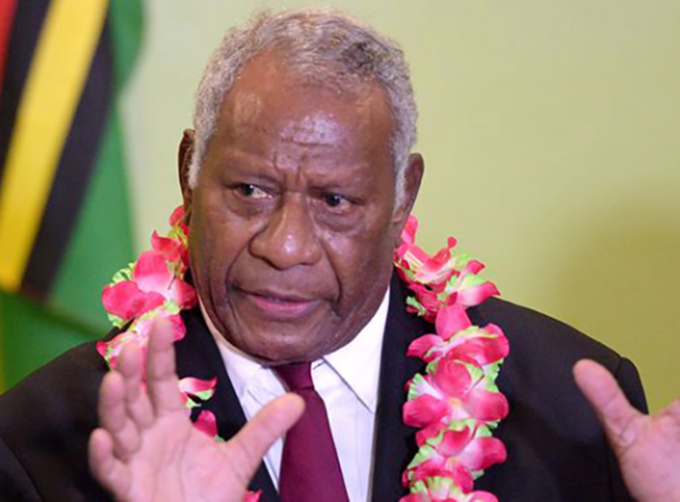
Hutt said seeing the change first hand made her realise how important the implementation of policy like the Paris Climate Agreement was for regions hit first by climate change like the Pacific.

“There was an acceptance that climate change won’t stop, it can’t stop but any actions you take in mitigating its ongoing effects is massive for the region,” said Hutt.

The Paris Agreement, signed in 2015 by almost 200 United Nations members, has the primary goal of reducing greenhouse gas emissions enough to keep global temperatures below 2 degrees celsius by the end of the century.

During their trip, the two journalists followed the journey of people from the village of Tukuraki in the Fiji highlands of Ba, Viti Levu, who have been forced to relocate three times after landslides and cyclones destroyed their homes.

However, Hutt said the people of Tukuraki were resilient and “not just accepting of their fate”, but willing to adapt and fight climate change.

“People in the Pacific don’t see themselves as victims of climate change, they aren’t just letting it happen to them.”

The project is a collaboration between AUT’s Pacific Media Centre and Te Ara Motuhenga documentary collective, and USP’s Pacific Centre for Environment and Sustainable Development (PacE-SD) and Regional Journalism Programme.  Below: A video about the project made by Cleaver and Hutt featuring PMC director Professor David Robie.

The Bearing Witness multimedia package

More information about Bearing Witness

]]>

Trump’s pullout from Paris climate pact ‘threatens lives’ of Pacific people

]]>

AsiaPacificReport.nz

US President Domald Trump’s withdrawal from the Paris Climate Agreement stirs condemnation across the world. Image: RawStory

Pacific Media Watch News Desk

President Donald Trump’s move to pull the United States out of the Paris Climate Agreement is a grave moral injustice, say Pacific civil society groups.

His decision is a clear sign of continued support for the fossil fuel industry which directly threatens the lives of communities living in the Pacific Islands.

The group of Pacific Island civil society organisations affiliated to the Pacific Islands Climate Action Network (PICAN) say that while this move by Trump would isolate the US from any ambitious action on climate change, the Pacific and the rest of the world will carry on with Paris Agreement commitments.

PICAN also called on Australia to immediately reaffirm its commitment to the Paris Agreement and begin strengthening its “woefully inadequate targets” in a statement today.

“It’s time for Australia to follow the lead of the Pacific and stand with those on the frontlines of climate change.”

Responses from PICAN members:

-Partners-

Krishneil Narayan, coordinator, Pacific Islands Climate Action Network:
“The Paris Agreement is a lifeline for vulnerable communities around the world. We will not be perturbed by the US withdrawal. Under no circumstances can the Paris Agreement be renegotiated. We expect all other countries to redouble their efforts to confront the climate crisis.

“We welcome the strong show of support to the Paris Agreement by many world leaders. The European Union, China, India and others are already forming alliances to support the continuation of the Paris Agreement.

“Even without the United States, climate action under the Paris Agreement will continue. Not even Trump can derail action on climate change. The United States will be isolated.”

Matisse Walkden Brown, head of Pacific Net, Greenpeace Australia Pacific:
“We move on and we move forward, together. The United States administration have shown their allegiance to the glory days of the past. Sadly for them, the economics, the science, and the people, all agree that the fossil fuel days are over, and that the transformation towards zero carbon is now irreversibly under way and accelerating.

“While this is a shameful day for President Trump and his people, it will not deter the rest of us. It is time for international politics to begin embracing new economies, new technologies, and commit to the fighting for the interests of the people, not the polluters. One man, one country will not change that.”

Koreti Tiumalu, Pacific coordinator, 350.org:
“Trump’s exit from the Paris agreement is immoral and a sign of shortsightedness on his part. It’s even clearer now that his priority is with protecting the profits of the fossil fuel industry and not the Pacific.

“Nevertheless, our Pacific people believe in the strength of the Pacific leadership, and the rest of the world, going into COP 23 and their commitments to the Paris Agreement. It is now up to us to continue to fight for our communities, stop all new fossil fuel projects and support a just transition towards 100% renewable energy.”

Noelene Nabulivou, Diverse Voices and Action for Equality, Pacific Partnerships on Gender, Climate Change and Sustainable Development (PPGCCSD), and the Women and Gender Constituency Liaison to the COP23 Presidency:
“This is not just the decision of one man, rather it is a reflection of an archaic social and economic system, one that is based on shortsighted selfishness and corporatisation of our planet.

“This only strengthens the resolve of all those who deeply care about this planet, all women and all people and all species. Resist and propose. Defend the Commons, work with us on alternate strategies. We will NEVER give up on this beautiful planet. ”

]]>