Page 114

These voices are the loudest in Australia’s ‘climate wars’

Source: The Conversation (Au and NZ) – By Christian Downie, Professor of Political Science, School of Regulation and Global Governance, Australian National University

The Conversation, CC BY-SA

There’s a reason political commentators refer to Australia’s “climate wars”. Every time a climate policy is put on the table, supporters and opponents come out in force and duke it out.

Last year, debates over Australia’s greenhouse gas emissions target led to a heated contest between various groups such as the Climate Council — arguing for strong action — and others such as the Business Council of Australia, which commissioned modelling to highlight the economic costs of a strong target.

This was not a one-off. Since at least the 1990s, emissions-intensive industries such as coal and gas and their lobby groups have had an outsized influence on climate policy. This includes groups such as the Minerals Council of Australia, which represents BHP, Rio Tinto and Whitehaven Coal, and Australian Energy Producers, which lobbies on behalf of BP, Shell and Woodside, among others.

Until now, we did not have a good understanding of who mobilises on climate policy in Australia, what side of the issue they fall on, and in which arenas they mobilise. In our new research, we found a core set of only 20 groups dominating climate policy debate in Australia, including gas corporations, industry lobby groups, environmental NGOs, and think tanks.

Who are these groups?

To find out which groups are most influential, we collected data on all organisations active on climate policy in Australia between 2017 and 2022. This included examining the number of groups as well as their volume of activity in the executive branch of government (responsible for implementing and enforcing laws, managing day-to-day administration and setting policy), the parliament and the media.

For example, we identified 700,000 mentions of groups in articles about climate change from 13 media outlets, including The Australian and the Sydney Morning Herald.

As well as media records, we also built a database of organisations who actively consulted with government departments and provided evidence to parliamentary inquiries.

We found 20 groups accounted for more than half (52%) of all activity.

They included a mix of mining and energy firms, such as AGL, BHP and Rio Tinto and their lobby groups, such as the Minerals Council of Australia. It also included high-profile NGOs, such as the Climate Council, and think tanks active on climate policy, including the Australia Institute and the Grattan Institute.

It’s important to note we didn’t look at the content of the messages in the media, the parliament or in departmental consultations, just the number of organisations and the frequency of their activity.

Where do these groups stand on climate action? tweaked

Among the 20 groups, some are strong supporters of climate action, such as the Climate Council. By contrast, the Minerals Council of Australia has a long history of opposing climate policies dating back to the Kyoto Protocol in the 2000s and the short-lived carbon price in the 2010s.

Interestingly, there are more pro-climate groups than anti-climate groups. Most NGOs in our study tended to support action on climate change, including the Australian Conservation Foundation, Greenpeace and WWF.

Many of the business groups do not. But it’s not as black and white as this might suggest. Firms and business advocacy groups are not unified. A growing number of renewable energy companies now mobilise in support of climate policy, often through advocacy groups such as the Smart Energy Council.

Interestingly, many industries active on climate policy don’t have a hardwired position. Rather, they sometimes support and sometimes oppose climate policy. This is often because their commercial interests are only indirectly impacted by climate policies, such as firms in the technology or finance industries.

These somewhat “neutral” groups actually account for the majority of groups active on climate policy in Australia.

Does this vary by arena?

We also explored whether some groups dominate the media more than the parliament, or the parliament more than the executive. For example, are environmental NGOs more active in the media than in Senate hearings? Are business groups more active in consultations with the government departments that make up the executive branch of government?

Interestingly, we found the media is the only arena where fossil fuel interests dominate. For example, groups typically opposed to climate action represent 43% of all media mentions, compared to 20% in support and 36% neutral.

This begs the question – why does the media appear to have a strong bias for reporting pro-fossil fuel messages?

One explanation consistent with overseas studies
is simply that messages from business coalitions and very large businesses are more likely to receive media coverage than other types of organisations, such as environmental NGOs.

These organisations are likely to have high standing in the media because they are viewed as key players in policy debates with inside knowledge. Certainly in Australia, the largest firms and lobby groups mobilised on climate change are tied to? fossil fuel industries.

Do these groups matter?

As we sweat through another of the hottest summers on record, the federal government will rightly remain under pressure to put in place further policies to cut carbon pollution. In fact, recent polling shows one in two Australians want action on climate change “even if this involves significant costs”.

Who mobilises to support or oppose climate policies will likely have a big influence on policy outcomes such as increasing renewable electricity in the grid, phasing out petrol and diesel vehicles or stopping new coal and gas projects

Our research shows a core set of groups, including firms in the coal and gas industries, that are likely to have an outsized voice in such policy debates.

While this does not always equate to influence, it is an important precondition. In the media in particular, it appears fossil fuel interests have the loudest voice.

The Conversation

This research was funded by the Climate Social Science Network.

ref. These voices are the loudest in Australia’s ‘climate wars’ – https://theconversation.com/these-voices-are-the-loudest-in-australias-climate-wars-272347


Needle steriliser a ‘third hand’ for farmers

Source: Radio New Zealand

Graduate Jade Luxton with her Sterineedle invention. SUPPLIED

The final touches are being put on a new gadget promising to speed-up vaccinating or giving pain relief to livestock.

Around 20 New Zealand deer farmers were trialling a locally-designed holster for their livestock vaccination gun that sterilised the needles in an attached reservoir between jabs.

Founder Jade Luxton made the original Sterineedle holster with a 3D printer through high school some years back to address an agricultural challenge.

Since then, the Waikato-born graduate in product design said she had created around 100 iterations of her Sterineedle ahead of its commercialisation.

“When I looked further into this problem, I found that needles could actually be sterilized, and that’s kind of how we started with the holster idea,” she said.

“We wanted that ability to give farmers kind of like a third hand to put the vaccination gun in between animals as well.”

Jade Luxton. SUPPLIED

Luxton said it was originally created for farmers during velvetting, because every needle on each stag needs to be sterilised to meet food grade requirements.

She said deer farmers needed a solution for constantly changing needles, but the device could also benefit sheep and beef farmers.

“We currently have 20 models out trialling at the moment. But I’ve also been speaking at NZ Deer Association events, just kind of spreading awareness about the product and getting more farmers keen on the idea and keen to try it as well.”

Luxton hoped the final design would to bring it to market in time for the next velvet season.

“We’re currently testing the final design and looking for manufacturers so we can get a few models out by the start of velvetting season this year.”

She said she was inspired by her grandparents who were involved with farming.

Sign up for Ngā Pitopito Kōrero, a daily newsletter curated by our editors and delivered straight to your inbox every weekday.

– Published by EveningReport.nz and AsiaPacificReport.nz, see: MIL OSI in partnership with Radio New Zealand

Peeni Henare ‘stepping back’, won’t be contesting Tāmaki Makaurau seat at election

Source: Radio New Zealand

Peeni Henare is stepping down after 12 years in Parliament. RNZ / Samuel Rillstone

Senior Labour MP Peeni Henare is “taking a step back from politics”, saying the time has come to put his energy elsewhere.

Earlier on Tuesday, the former minister confirmed to RNZ he would not be contesting the Tāmaki Makaurau seat this year.

But in an interview with Māori start-up Tuia News, Henare went further, revealing he would step down after 12 years in Parliament, six of them as a minister across multiple portfolios.

He told the outlet there were many other issues within Te Ao Māori he wanted to focus on, including in Te Tai Tokerau and for Ngāpuhi.

Henare noted the energy required to be successful in election year, and the recent resignation of his colleague Adrian Rurawhe. He said he realised he was the only one left.

“Kua tae te wā,” Henare said. The time had come.

Both Henare and the Labour Party confirmed the decision not to seek re-election around 3pm on Tuesday.

“I have thought long and hard about this over the summer and decided not to seek the nomination for Tāmaki Makaurau again or a place on the Labour Party list,” Henare said in a statement.

“Last year was tough after losing the by-election and after careful consideration and kōrero with my whānau over the break, I have decided that it is time for me to take a step back from politics.

“It’s time to focus on my family, my wellbeing and my future”.

It stated Henare would leave Parliament in the coming weeks.

Hipkins won’t be drawn

Speaking to reporters around 2pm, Labour leader Chris Hipkins refused to comment on Henare’s movements.

When asked, Hipkins wouldn’t say whether Henare had his backing for the Māori seat or not.

“I’m not going to start a conversation on this.

“I’m still leaving Peeni the space to make his own decisions and his own announcements.”

He rejected his refusal to answer implied a lack of confidence, “no, it just means I’m leaving him the space.”

Hipkins said he’d been told by Henare in the last week or two that he wouldn’t be putting nominating himself as a candidate for the seat.

The news from Tuia broke as Hipkins was speaking, but despite the confirmation of Henare’s plans, Hipkins declined to answer.

“It’s not fair for me to go out and comment on people’s decisions before they have communicated them.

“You’re not going to have to wait that much longer.”

Hipkins said an announcement would be made at 4pm on Tuesday.

He said he’d comment on the news later on.

A decade in Parliament

Henare entered Parliament in 2014, winning the the Tāmaki Makaurau seat over the Māori party. He held onto the seat for nearly a decade, before being ousted by Te Pāti Māori’s Takutaki Tarsh Kemp in 2023 by a slim margin.

He contested the seat in the Tāmaki Makaurau by-election in 2025, following Kemp’s death, but lost to Oriini Kaipara who received around twice as many votes.

During the by-election he batted away suggestions of a Labour leadership bid, but didn’t rule it out.

At the time Henare said Hipkins, the current leader, had his full support.

During the previous Labour government, he held portfolios such as Defence, Whānau Ora, Civil Defence, Tourism and ACC.

Sign up for Ngā Pitopito Kōrero, a daily newsletter curated by our editors and delivered straight to your inbox every weekday.

– Published by EveningReport.nz and AsiaPacificReport.nz, see: MIL OSI in partnership with Radio New Zealand

The Voice would have renewed Australian democracy. Its failure leaves us all worse off

Source: The Conversation (Au and NZ) – By Sana Nakata, Principal Research Fellow, James Cook University

There’s long been a fundamental issue underpinning Australia’s approach to Indigenous affairs. The state makes laws specifically about Aboriginal and Torres Strait Islander peoples without any protected mechanism giving them a say in the process.

The proposed Voice to Parliament sought to remedy this democratic deficit. Had the referendum succeeded, it would have established a formal representative connection between Indigenous peoples and the Commonwealth parliament.

The Voice proposal was a reform to democratic representation. Its failure was a missed opportunity to renew Australian democracy.

But it was also an explicit choice: to sustain the political subjugation of Indigenous people by denying them representative channels for making their voices heard on matters that affect them.

This enduring structural limitation leaves the parliament without any representative mechanism to consult with, or be accountable to, Aboriginal and Torres Strait Islander peoples.

What does Indigenous representation look like?

Even as we have seen increasing numbers of Aboriginal members in the federal parliament, they do not represent all Aboriginal and Torres Strait Islander people.

Nor are they empowered to. In the 125 years since federation, there has never been a Torres Strait Islander representative at the Commonwealth level.

A key aspect of political accountability is the ability of a constituency to remove their representative at the ballot box. If a majority feels their MPs have failed to advance their interests or otherwise represent them, they can vote them out.


This article is an edited extract from the new book The Failure of the Voice Referendum and the Future of Australian Democracy, edited by Professors Gabrielle Appleby and Megan Davis.


For minority populations, this mechanism fails because their votes will, by definition, always fall short of a majority. This has long been called “the tyranny of the majority”.

While this is a problem for all minorities, the political claims of Aboriginal and Torres Strait Islander people are distinct from other minority groups. This is because they’ve been politically subjugated through unlawful dispossession.

Voting rights alone cannot remedy this. We need to move beyond this narrow view of political representation.

More than politics

Being represented is not just about aggregating votes or delegating decision-making power to elected parliamentarians.

There are many types of democratic representation, far beyond formal political institutions. There are also unions, nongovernmental organisations, social movements, media organisations and community advocates.

These actors represent themselves and others through various channels, such as:

  • submissions to government inquiries

  • public protests and rallies

  • media campaigns

  • cultural productions

  • legal challenges

  • grassroots organising.

Through this lens, we can see Aboriginal and Torres Strait Islander people have long maintained and exercised their representative power, even when formal political institutions exclude or silence their voices.

Critics of the Voice proposal from both conservative and progressive perspectives focused on the power of direct decision making.

But it’s crucial to recognise representative power entails more than just making decisions in formal political institutions. Representative power can also set new agendas, shape political debates and transform public attitudes and values.

The proposed Voice offered what we might call “connective tissue” between First Nations peoples and communities, and the Australian state that continues to govern them.

The Voice proposed a new focal point for channelling the varied interests of diverse First Nations communities directly to government, as well as the broader Australian public. In similar ways to the Yoorrook Commission and First Peoples’ Assembly of Victoria (and now Gellung Warl), the Voice promised to highlight new priorities for action.


Read more:
Why the Voice referendum failed — and what the government hasn’t learned from it


In Victoria, this mobilised public attention on issues such as policing and self-determination.

This is why the proposal’s defeat represents more than just maintaining the status quo. It transforms the political subjugation of Aboriginal and Torres Strait Islander peoples from a historical legacy into the contemporary choice of the nation.

Despite decades of Aboriginal and Torres Strait Islander advocacy, careful institutional design and extensive consultation, the Australian public collectively decided to maintain political structures that exclude First Nations perspectives from decision-making processes that affect them.

Strengthening democracy for all

As we move forward, the implications of this decision extend beyond Aboriginal and Torres Strait Islander affairs. It raises questions about Australia’s capacity to renew its democracy.

The capacity of democracies to change themselves in response to shifting social conditions and emerging demands is a key part of what keeps them democratic.


Anthem Press

But this renewal involves much more than just holding elections. It requires political systems to transform their structures in response to injustices and problems of new generations. This includes long-term challenges, such as climate change.

When democratic systems don’t adapt, they risk ossifying into forms of rule that maintain historical inequities under the guise of democratic process.

This kind of political ossification threatens the democratic futures of all Australians. It also does nothing to improve the everyday lives of Aboriginal and Torres Strait Islander people.

The challenge now becomes how to maintain pressure for democratic renewal in the face of this setback. This requires Australians to continue to expose and challenge the democratic deficit the Voice sought to address.

We must also strengthen the many forms of First Nations political representation that persist in the face of institutional exclusion.

Sana Nakata receives funding from the Australian Research Council.

Daniel Bray has previously received funding from the Australian Research Council.

ref. The Voice would have renewed Australian democracy. Its failure leaves us all worse off – https://theconversation.com/the-voice-would-have-renewed-australian-democracy-its-failure-leaves-us-all-worse-off-271836

Unemployment set to linger as wage growth remains steady

Source: Radio New Zealand

RNZ

  • Unemployment expected to remain steady at 5.3 pct – data due 4 Feb, 10.45 am.
  • Labour market probably at the bottom, but improvement gradual.
  • Prospect of some modest job growth.
  • Wage growth to remain subdued, lagging inflation.
  • Data not likely to change RBNZ rates on hold policy.

Unemployment looks set to linger around a near-decade high, but may show signs that the labour market downturn has ended.

Most major bank economists expect the unemployment rate to stay unchanged at 5.3 percent for the three months ended December, but with tentative signs of employment growth, and wage growth subdued.

ASB senior economist Mark Smith was among the more optimistic with a forecast unemployment rate easing to 5.2 percent, which would be the first decline in four years.

“We expect the data to confirm we have passed the turning point for the labour market.”

Other economists echoed the view that the labour market, the sector that lags recessions and recoveries, has at least touched the bottom.

“We do expect this Wednesday’s suite of … labour market data to show a general halting of deterioration as well as some more signs of improvement in the details,” BNZ senior economist Doug Steel said.

Labour market numbers can be something of a statistical lucky dip.

The unemployment rate can be moved by the size of the workforce, how many are participating, have gone training or stopped looking for work, irrespective of how many jobs may have been created.

ANZ senior economist Miles Workman said more people participating in the search for work, even if the jobs were not there, might still be a positive.

“While it would point to a more disinflationary labour market than the RBNZ anticipates, it would also add to the evidence that conditions are rounding a corner, with labour supply responding to improving job prospects.”

The jobs are coming

Partial labour market indicators in the recent months, such as job advertisement and filled jobs numbers, point to an increase in jobs matching the growth in the working age population.

“Employment is expected to register its strongest growth in around two years, although numbers are still more than 30,000 shy of late 2023 peaks,” ASB’s Smith said.

However, Westpac senior economist Michael Gordon said overall improvement would be gradual with employers being wary of hiring.

“The September quarter saw a strong lift in hours per worker, and indeed that’s where we’d expect to see the initial response to an economic upturn – employers have scope to get more out of their existing workers, before resorting to new hiring.

Slow wage growth to please RBNZ for now

Wage growth is expected to remain subdued and steady around four-year lows of 2 percent.

“Labour cost growth is expected to remain modest, with the balance of power still tilted towards employers,” ASB’s Smith said.

He said emerging signs of skilled labour shortages, a stronger labour market and growing wage demands would eventually weigh on the Reserve Bank’s official cash rate outlook (OCR).

“Reducing labour market slack suggests the need to normalise OCR settings. We expect a 25 basis point hike in December and a 3.0 percent OCR endpoint, but note the risks are pointing to a larger and more frontloaded pace of OCR hikes.”

The RBNZ is expected to hold the cash rate steady at 3.25 percent for most of this year.

Sign up for Ngā Pitopito Kōrero, a daily newsletter curated by our editors and delivered straight to your inbox every weekday.

– Published by EveningReport.nz and AsiaPacificReport.nz, see: MIL OSI in partnership with Radio New Zealand

ER Report: A Roundup of Significant Articles on EveningReport.nz for February 3, 2026

ER Report: Here is a summary of significant articles published on EveningReport.nz on February 3, 2026.

Polls are snapshots, not predictions: how to read them critically this election year
Source: The Conversation (Au and NZ) – By Grant Duncan, Research associate, Public Policy Institute, University of Auckland, Waipapa Taumata Rau With nine months to go, how much can opinion polls tell us about the general election on November 7? Short answer: not much. Based solely on polls, no one could have predicted the past

We ate space mushrooms and survived to tell the tale
Source: The Conversation (Au and NZ) – By Sara Webb, Lecturer, Centre for Astrophysics and Supercomputing, Swinburne University of Technology Eating the space mushrooms for the first time. Author provided, CC BY-SA The mushrooms spread out on the chopping board seemed normal enough. They were rich and dense, and had a strong earthy aroma. In

Why regularly taking laxatives over the long term can be a bad idea
Source: The Conversation (Au and NZ) – By Vincent Ho, Associate Professor and Clinical Academic Gastroenterologist, Western Sydney University Photo by Anna Shvets/Pexels If you’ve ever been constipated you may have tried laxatives. They’re easy to get without a prescription and often help get things moving. Certainly a lot of people use laxatives and some

Academics call for divestment from NZ pensions fund implicated in Gaza
COMMENTARY: By Vincent Wijeysingha Will maximising investment returns override ethics? That is the question the tertiary sector posed to UniSaver, the academic equivalent of KiwiSaver, now revealed to invest in Israeli weapons and military intelligence. In 2024, some 400 university staff appealed to UniSaver to divest from such companies. The fund initially ignored the call.

Keith Rankin Analysis – A Black Sheep to Rule them All
Analysis by Keith Rankin. It’s great that there is a new season (Season 9) of William Ray’s podcast series Black Sheep, which looks at contributors to New Zealander history, many little known, who were of dubious or ambiguous character. Here I draw attention to a black sheep who I think trumps them all, Edward Arthur

Tiny radio transmitters reveal a hidden survival tactic in birds
Source: The Conversation (Au and NZ) – By Alice Barratt, PhD Candidate, Hawkesbury Institute for the Environment, Western Sydney University White-backed swallow in Sturt National Park. Alice Barratt, CC BY-NC In Sturt National Park, near Tibooburra in central Australia where temperatures can range from freezing to nearly 50°C, there lives a small bird with a

Our study shows younger siblings spend more time on screens than big sisters and brothers
Source: The Conversation (Au and NZ) – By Danusha Jayawardana, Research Fellow in Health Economics, Monash University Atlantic Ambience/ Pexels Where kids are born in a family can be important. But it is not just about who gets more grown-up privileges or parental pressure. Research tells us firstborn children, on average, tend to do better

Australia’s Pacific worker scheme is far from perfect – but we can make it better
Source: The Conversation (Au and NZ) – By Peter Mares, Adjunct Senior Research Fellow, School of Media, Film and Journalism, Monash University The Pacific Australia Labour Mobility scheme (PALM) is a crucial source of workers across regional Australia. About 32,000 people from nine Pacific nations and Timor-Leste work in Australia under PALM. Over seven months

From statement sleeves to the codpiece: 5 fashions which should come back from Tudor England
Source: The Conversation (Au and NZ) – By Grace Waye-Harris, Early Career Researcher in History, Adelaide University Portrait of Elizabeth I of England, 1588. Woburn Abbey/Wikimedia Commons There are few dynasties in history as well-known as the Tudors. From Henry VIII’s six wives to Elizabeth I’s defeat of the Spanish Armada, the Tudors continue to

As Australia’s online harm crackdown reshapes the debate, NZ must find its own path
Source: The Conversation (Au and NZ) – By Claire Henry, Associate Professor in Screen, Flinders University Getty Images Around the world, lawmakers are grappling with how to better protect young people from online harms such as cyberbullying, sexual exploitation and AI-generated “deepfake” images. Recent reforms overseas – notably Australia’s landmark move to restrict young people’s

What is Israel’s Herzog doing in Australia – who invited him, and why?
ANALYSIS: By Andrew Brown Israel’s President, Isaac Herzog, is due to arrive in Australia next Sunday. Why is a foreign Head of State asked to help heal an Australian community after an Australian tragedy? Australia is being asked to accept something extraordinary as if it were normal. Who invited Isaac Herzog in the first place,

View from The Hill: Littleproud and Ley turn on the music for another attempt at the two step
Source: The Conversation (Au and NZ) – By Michelle Grattan, Professorial Fellow, University of Canberra Nationals Leader David Littleproud easily saw off a token move to spill the party leadership on Monday. But he is now under immense pressure to reach a deal with Liberal leader Sussan Ley to put the Coalition together again. With

NSW is ditching good character references in sentencing. Will the rest of the country follow?
Source: The Conversation (Au and NZ) – By Vicki Lowik, Adjunct Research Fellow, School of Nursing, Midwifery and Social Sciences, CQUniversity Australia New South Wales is set to become the first jurisdiction in the country to end the use of good character references in the sentencing of convicted criminals. The government will introduce a bill

New data show where the parties got their money from in the lead-up to the 2025 election
Source: The Conversation (Au and NZ) – By Kate Griffiths, Democracy Deputy Program Director, Grattan Institute The Conversation, CC BY-SA Australia’s political parties set new records in funds raised and spent in the lead-up to the 2025 federal election. Now, nine months later, Australians finally get a look at who funded the parties’ election campaigns.

Does coffee raise your blood pressure? Here’s how much it’s OK to drink
Source: The Conversation (Au and NZ) – By Clare Collins, Laureate Professor in Nutrition and Dietetics, University of Newcastle Olga Pankova/Getty Images Coffee first entered human lives and veins over 600 years ago. Now we consume an average of almost two kilos per person each year – sometimes with very specific preferences about blends and

ASIC flags $40 million in refunds after review of risky financial products
Source: The Conversation (Au and NZ) – By Adrian Lee, Associate Professor in Property and Real Estate, Deakin University Australia’s corporate regulator has secured refunds of A$40 million to more than 38,000 investors in risky financial products, following a review of the industry. The Australian Securities and Investments Commission (ASIC) raised concerns that marketing of

Electricity Authority to launch new power bill comparison website next month

Source: Radio New Zealand

The Electricity Authority is set to launch a new power bill comparison website. 123RF

The electricity market regulator will launch a new power bill comparison website next month, in a bid to ensure the industry better serves consumers.

It is one of many changes being made after a spike in electricity prices last year led to a government review of the market.

In 2024, a spot price shock saw households and businesses face increases of between 10 and 15 percent on their power bills, which was a factor in the shutdown of several industrial businesses across the country.

Electricity Authority chief executive Sarah Gillies said a new power comparison website would be launched next month with the authority also considering rules to simplify bills so that they were easier for consumers to understand.

It also wanted to see more companies offering plans with lower prices during off-peak hours and electricity regulators sharing power use data, so consumers could automate their electricity use if they wanted to.

“Last year we made a decision that we needed to see the large retailers offering time-of-use plans, there was a sense that some were doing it, but not everybody … so that’s a requirement for everybody over a certain size to do that from July this year.”

In January, the government announced the retail electricity sector as the next industry to be considered under the Customer and Product Data Act.

Known as open electricity, it would simplify the ability to compare the electricity needs of a household or small businesses against every power plan on the market.

Last year, the government established a Consumer Data Right – a legal framework to let people access, share, and manage certain data, like transaction history, with trusted third parties through secure digital systems – with the hope of creating greater choice, convenience, and innovation.

Gillies said the authority was working with the Ministry of Business, Innovation and Employment on a framework that detailed what information should be shared, and how.

“Data is absolutely critical … and the bottom line is it belongs to consumers, it’s about them.”

Previously, power companies had been reluctant to release data, despite it belonging to the consumer.

Gillies said the Power Build comparison website was due to be launched next month, replacing the Power Switch in a bid to help consumers ensure they are getting the best deal. It had been built using two years’ worth of data from 30,000 households and would no longer be funded by power companies being charged a fee every time a consumer switched, she said.

“You can either use your own power bill or you can answer some questions about your household and how you use your power and those two options will give you some choices.”

She said there would be information to help people understand time of use pricing, an electricity tariff structure where rates vary based on the time of consumption, charging higher prices during “peak demand” hours and lower prices during “off-peak” times.

The government is still working through potential legislation as a result of reforms in the industry.

Gillies said 35 rule changes had been made in the last two years, which showed a “constant strengthening” of the rules that govern the system.

“We have this incredible privilege to write the rules of the electricity industry, secondary legislation,” Gillies said.

The maximum penalty for a breach of the rules is currently $2 million, with a proposal to increase it to $10m or three times the commercial gain or 10 percent of a company’s turnover.

“That’s quite important because that’s much more akin to the kinds of penalties that you see with the FMA and the Commerce Commission.”

Sign up for Ngā Pitopito Kōrero, a daily newsletter curated by our editors and delivered straight to your inbox every weekday.

– Published by EveningReport.nz and AsiaPacificReport.nz, see: MIL OSI in partnership with Radio New Zealand

Auckland mayor Wayne Brown mocks government’s proposal to cap rates

Source: Radio New Zealand

Auckland mayor Wayne Brown with his cap and can of beans. Supplied

Auckland’s mayor says the government’s proposed legislation to cap rates rises is “ridiculous” and “nonsense”.

The government wants councils to limit annual rates increases and is seeking feedback on a rates cap.

At Tuesday’s full Auckland Council meeting, Wayne Brown put on a cap saying ‘RATES’ in a self-described move to mock the proposal.

He said the rates cap plan was a “fascinating piece of nonsense from Wellington”.

“I shall put my rates cap on while we mock this piece of ridiculous legislation,” Brown told the Council meeting.

“And I have a can of baked beans here which represents the amount of saving [over] a month that ratepayers will get, as a result of this fine work.”

Auckland’s mayor says the saving to ratepayers will amount to a can of beans a month. Supplied

The council opposes the cap on the grounds it is not an effective tool to provide affordability and would result in more debt.

“Auckland ratepayers are unlikely to achieve the savings estimated by central government of $2.79 a month for each household, or the cost of a can of baked beans as noted by some commentators,” council’s manager of financial strategy and modelling violet bird said in a report.

“This assessment from the government excluded Auckland Council from its calculations due to the council’s ‘moderate rates forecast’ and size.”

Ratepayers ‘fed up’, Luxon says

Prime Minister Christopher Luxon previously said ratepayers were “fed up”.

“They’re tired of having to prudently manage their own budgets while rates continue to go up, only to see their local council fail to demonstrate the same fiscal discipline.”

He said the government was not considering allowing councils to raise revenue through a levy on tourists, like a bed tax.

“We want councils to be focused on the money that they’ve got and make sure they’re doing a much better job of managing it. Some councils are doing a really good job, some councils are doing a very very poor job.”

Consultation on the changes opened immediately, and was set to close in February 2026 with the legislation expecting to be passed by the end of that year.

In December, the government announced it wanted councils to limit rates rises and more detail was released later that month, leaving councils a short runway to prepare a response.

The rates rise cap would likely start with minimum increases of two percent and a maximum of four percent, with the cap taking effect from 1 January 2027.

Sign up for Ngā Pitopito Kōrero, a daily newsletter curated by our editors and delivered straight to your inbox every weekday.

– Published by EveningReport.nz and AsiaPacificReport.nz, see: MIL OSI in partnership with Radio New Zealand

More than 40 flights cancelled at Wellington Airport due to fog

Source: Radio New Zealand

Wellington Airport. File picture. RNZ/ Mark Papalii

Fog is causing disruption at Wellington Airport, with more than 40 flights affected on Tuesday.

A spokesperson for the airport said 48 flights had been cancelled.

According to the airport’s website, on Tuesday afternoon flights leaving for Christchurch, Napier and Dunedin were among those cancelled, along with flights arriving from Christchurch, Brisbane and Hamilton.

Passengers are advised to check directly with their airlines for the latest information on their travel plans.

MetService is forecasting rain for Wellington with strong southerlies on Tuesday evening.

Sign up for Ngā Pitopito Kōrero, a daily newsletter curated by our editors and delivered straight to your inbox every weekday.

– Published by EveningReport.nz and AsiaPacificReport.nz, see: MIL OSI in partnership with Radio New Zealand

Can you help find Doug the pug?

Source: Radio New Zealand

A therapy pug who has helped children too unwell to attend school has been missing for more than two weeks in Russell, Bay of Islands.

Doug, a six-year-old pug, disappeared while holidaying with his owner, Auckland-based Northern Health School teacher, Monique Burke. He was last seen rummaging through a nearby Russell property before heading in the direction of where they were staying.

“He does frequent the neighbours – so we have since found out – and would pop next door, I’m guessing, and would just wait to see if there were any snacks available and if not, he would just trot on home.”

When Doug had been gone for more than an hour — far longer than usual — Burke knew something was wrong. Searches of the neighbourhood that night were unsuccessful, and the hunt has continued ever since.

Burke told Afternoons she has exhausted all avenues, including a social media campaign, door-knocking neighbours and nearby businesses, and even enlisting a police dog to help track him down — all without success.

Doug has been part of the Northern Health School community since he was a puppy, working alongside Burke to support students who are unable to attend their regular schools due to illness, injury, or mental health challenges.

“He was a special little guy,” Burke says. “[He had an] innate way of sensing when a student needed comfort and would go and sit with them.”

Doug has also helped students overcome a fear of dogs and has worked alongside psychologists and other schools to support student transitions.

“More often than not he was a reason that got many of our students through the door.”

Burke says it’s unlikely Doug wandered far on his own.

“He is a mummy’s boy, he wouldn’t go far and he’s got little legs and a little fat body, and I just can’t imagine him trying to get through some of the terrain that is up there [in the bush].”

She worries someone may have picked him up thinking he was abandoned, because she had just removed his collar.

“I’m hoping that if he has been picked up that he is being well looked after and that potentially they hear the story behind and do the right thing and bring him in.”

Burke is urging anyone with information or sightings to come forward, adding that any leads or social media shares are deeply appreciated.

– Published by EveningReport.nz and AsiaPacificReport.nz, see: MIL OSI in partnership with Radio New Zealand

National Iwi Chairs Forum backs court case challenging amendments to Marine and Coastal Areas Act

Source: Radio New Zealand

Iwi Chairs Forum kaikōrero Rāhui Papa says his rōpu fully support the challenge. RNZ / Marika Khabazi

The National Iwi Chairs Forum is backing a court case by Ngāti Manuhiri looking to challenge amendments to the Marine and Coastal Areas Act (MACA).

Hauraki iwi Ngāti Manuhiri are set to take the government to the High Court over changes made to the act last year, which made it harder for Māori to win customary marine title.

Justice minister Paul Goldsmith has repeatedly said the changes restore the act to Parliament’s “original intent”.

The changes have been bashed by former ministers, treaty lawyers, iwi and hapū leaders and even prompted an almost 20,000-strong petition opposing the amendments.

Now, Ngāti Manuhiri want to challenge those changes in the High Court, alleging that the changes limit their ability to exercise of their culture, deny their access to justice, and discriminate against Māori.

In a statement, Ngāti Manuhiri chair Mook Hohneck said the revised test measures customary ownership through Western concept of exclusion rather than tikanga Māori.

“What we’re seeing is not an attempt to uphold the original intent of the law, it is an attempt to fundamentally change the rules with which we’ve engaged in good faith because the Crown isn’t getting its way,” Hohneck said.

“The Crown is stacking the deck in its favour, and is setting a precedent that future governments can constantly move the goal post whenever they see fit.”

The legislation is retrospective, meaning some applicants would need to start the process from scratch.

Hohneck claimed those changes amounted to retrospective interference with ongoing court proceedings, and breached their expectation that their application would be determined under the law as it stood when they applied.

“Our claim seeks declarations that the 2025 law changes are inconsistent with natural justice and the Bill of Rights Act, and are discriminatory against Ngāti Manuhiri.”

“Our settlement with the Crown included a formal apology and commitment to rebuild their relationship with Ngāti Manuhiri, based on the principles of Te Tiriti o Waitangi. The Marine and Coastal Area Act amendments cut across that promise and apology,” Hohneck said.

Speaking from Waitangi, Iwi Chairs Forum kaikōrero Rāhui Papa said his rōpu fully supported the challenge.

He told media the current legislation “unpicked” settlement processes and agreements.

“In the case of Ngati Manuhiri, they feel that they had quite a strong and enduring settlement because it was hard negotiated.”

“We absolutely support [it]. If an iwi feels that their settlement, their hard negotiated settlement, is being unpicked some years after the agreement, that just shows the institutional forgetfulness and amnesia of the government to what they actually agreed to.” he said.

There was a similar sentiment from Northland Regional Council chair and Ngāti Hine chair Pita Tipene, who told RNZ support for the challenge from Ngāti Manuhiri was unanimous.

“In terms of Ngati Hine, we will support any measure, any action that protects and enhances our collective rangatiratanga.”

“Whether it is in court, whether it is out in the community, that’s our focus,” Tipene said.

Changes to the Marine and Coastal Area (Takutai Moana) Act were made in October last year.

– Published by EveningReport.nz and AsiaPacificReport.nz, see: MIL OSI in partnership with Radio New Zealand

The Epstein files are rocking Britain from the palace to parliament

Source: Radio New Zealand

By Christian Edwards, CNN

Peter Mandelson, Sarah Ferguson and Andrew Mountbatten-Windsor are facing fresh questions about their ties to the disgraced financier Jeffrey Epstein. Getty via CNN Newsource

The US government’s release of more than 3 million documents related to Jeffrey Epstein has raised further questions about the ties of three prominent figures in British public life to the disgraced financier, who appears to have been granted access to the heart of Britain’s government and royal family.

The former Prince Andrew, his ex-wife Sarah Ferguson and Peter Mandelson, the former UK ambassador to the US, are all listed multiple times in the latest trove of Epstein files, ramping up pressure on the trio to explain their ties to the late sex offender and further distance themselves from British institutions.

Prime Minister Keir Starmer has urged Andrew Mountbatten-Windsor to testify before the US Congress, while Mandelson – who resigned from the Labour Party on Sunday – is facing calls from leading figures, including Starmer, to retire from the House of Lords.

Here’s how the Justice Department’s latest drop of files is scandalizing Britain.

Andrew Mountbatten-Windsor

The former Prince Andrew has for years attempted to bat away questions about his links to Epstein. In a now-infamous interview with the BBC in 2019, Andrew claimed that he had severed all ties with Epstein in 2010, following the financier’s 2008 conviction for soliciting prostitution from an underage girl.

Emails uncovered last year called Andrew’s claim into question. The British media reported that Andrew appeared to contact Epstein again in 2011, telling him to “keep in close touch” and that they were “in this together.” Soon after, King Charles III stripped Andrew, his brother, of his royal titles in October, and began the process to evict him from the royal estate at Windsor.

But the latest trove of Epstein files has heaped further scrutiny on the disgraced royal. Three undated photos appear to show the former prince, now Andrew Mountbatten-Windsor, kneeling over what appears to be a female – whose face has been redacted – who is lying fully clothed and supine on the floor. In two photos, Andrew touches her stomach and waist; in a third, he looks at the camera while on all fours, leaning over her body.

It is unclear when or where the images were taken; no captions or context for the photographs was provided with the document release. Neither the photographs nor the email messages suggest any wrongdoing.

Andrew previously faced pressure to explain a 2001 photograph which showed him standing with Ghislaine Maxwell, Epstein’s former girlfriend and a convicted child sex trafficker, and Virginia Giuffre, a prominent accuser of Epstein who died by suicide in April.

Newly released images from the US DOJ appear to show Andrew Mountbatten-Windsor – formerly Prince Andrew – on the floor with an unidentified person. US Department of Justice/Handout via CNN Newsource

In her posthumous memoir, Giuffre accused Andrew of sexually abusing her when she was 17. She wrote that Andrew “believed that having sex with me was his birthright”. Despite claiming never to have met her, Andrew reportedly paid millions of dollars to Giuffre in 2022 to settle a civil case she brought against him. He has repeatedly denied all allegations of wrongdoing and said he never witnessed or suspected any of the behaviour that Epstein was accused of.

The latest Epstein documents also contain an email exchange between Epstein and Andrew in August 2010, in which the financier invites the royal to meet a “friend” – whose name was redacted – for dinner in London. Andrew replied that he would be “delighted to see her” and told Epstein to pass on his contact details. Epstein then describes the woman as a 26-year-old Russian who is “clevere (sic) beautiful, trustworthy,” and confirms that she has Andrew’s email.

In November, Democrats on the House Oversight Committee requested that Andrew come to Washington to give evidence as part of the panel’s investigation into Epstein. Although Andrew did not respond to the request at the time, Starmer on Saturday urged the former prince to submit himself to questioning.

“Anybody who has got information should be prepared to share that information in whatever form they are asked to do that,” Starmer said. “You can’t be victim-centered if you’re not prepared to do that.”

Sarah Ferguson

Andrew’s ex-wife Sarah Ferguson – known as “Fergie” – is also mentioned several times in the latest tranche of files, although this does not indicate any wrongdoing. Ferguson was dropped last year as the patron or ambassador to several British charities after earlier documents showed she had called Epstein her “supreme friend”. At the time, a spokesperson for Ferguson said she regretted her association with Epstein.

But the latest documents are further evidence of the depth of their relationship. In March 2009, Ferguson – then the Duchess of York – sent an email thanking Epstein, touting fashion and media outlets which she said now wanted to work with her.

“In just one week, after your lunch, it seems the energy has lifted. I have never been more touched by a friends (sic) kindness,” she wrote. “Thank you Jeffrey for being the brother I have always wished for.”

Sarah Ferguson, pictured in March 2023, said Jeffrey Epstein was her “supreme friend.” Scott Garfitt/Invision/AP via CNN Newsource

In January 2010, she wrote: “You are a legend. I really don’t have the words to describe, my love, gratitude for your generosity and kindness. Xx I am at your service. Just marry me.”

The emails also appear to suggest that Epstein wanted to use Ferguson to help clear his name. In one undated email, Epstein wrote to Mike Sitrick, chair of the crisis management firm Sitrick and Company, which was retained by Epstein’s law firm, saying: “I would like you to draft a statement that in an ideal world fergie would put out.” Sitrick told CNN that he had never contacted Ferguson or her representatives directly.

In a March 2011 email to Sitrick and two others, Epstein wrote: “I think Fergie can now say, I am not a pedo.” In reply, Sitrick said there is a “strategy” to “get newspapers to stop calling you a pedophile and get the truth out,” and that one tactic was to “get Fergie to retract”.

The next month, Ferguson wrote in an email to Epstein and James Henderson, her spokesperson at the time, saying she “did not” and “would not” call him a “P”.

In October 2009, she wrote to Epstein saying that she “urgently” needed £20,000 for rent, and that her landlord had “threatened to go to the newspapers if I don’t pay”.

It was not clear if Epstein sent that money. However, in 2001 – years before Ferguson’s request – newly released documents appeared to show that Epstein wired the former Duchess $150,000 after helping her to cash in the share options she earned from her work for Weight Watchers. CNN has asked a spokesperson for Ferguson for comment.

Peter Mandelson

Mandelson, widely known in political circles as the “Prince of Darkness” for his Machiavellian approach to power, was fired as the UK’s ambassador to Washington in September over the deepening scandal surrounding his ties to Epstein. That month, US lawmakers had released a “birthday book,” compiled for Epstein’s 50th birthday in 2003, in which Mandelson penned a handwritten note describing the financier as “my best pal”.

The latest tranche of documents has revealed that Mandelson appeared to leak sensitive UK government tax plans to Epstein. They also show that his partner, Reinaldo Avila da Silva, regularly received undisclosed payments from him.

In September 2009, da Silva – who married Mandelson in 2023 after three decades together – emailed Epstein to ask for £10,000 to help fund his osteopathy course. Epstein replied: “I will wire your loan amount immediated’y (sic).”

In April 2010, da Silva emailed Epstein again, sharing his bank details. Epstein forwarded the message to his accountant, Rich Kahn, adding: “send 13k dollars”.

That same month, Epstein told Kahn to “send 2k per month to reinaldo.” When Kahn asked if this was in addition to the original $13,000, Epstein replied: “no after rethinkoing (sic) send 4000 dollars only.”

Peter Mandelson speaks with Prime Minister Keir Starmer during a welcome reception at the British ambassador’s residence in Washington, DC, in February 2025. Carl Court/Getty Images via CNN Newsource

In October that year, Mandelson asked Epstein, jokingly: “Have you permanently stopped the reinaldo sub?! I may have to put him out to work on the streets.”

The latest files also revealed that Mandelson leaked a sensitive UK government document to the financier while he was business secretary in 2009. The memo, written for then-Prime Minister Gordon Brown, advocated £20 billion asset sale to help relieve Britain’s debt burden following the 2008 financial crisis, and revealed Labour’s tax policy plans.

On Sunday, Mandelson – who also sits in the House of Lords – announced his resignation from Labour, saying he did not want to cause the party “further embarrassment.” He also apologized “to the women and girls whose voices should have been heard long before now”. CNN was unable to contact Mandelson for further comment.

Some lawmakers have called on Mandelson to refer himself to the House of Lords Commissioner for Standards, which investigates alleged breaches of the code of conduct.

Mandelson has been on a leave of absence from the House of Lords since February last year, to allow him to serve as the UK ambassador to the US. On Monday (local time), a Downing Street spokesperson said that Starmer believes that Mandelson should be stripped of his peerage.

“The prime minister has asked for this to be urgently looked at. The prime minister believes that Peter Mandelson should not be a member of the House of Lords or use the title,” the spokesperson said.

– CNN

– Published by EveningReport.nz and AsiaPacificReport.nz, see: MIL OSI in partnership with Radio New Zealand

Polls are snapshots, not predictions: how to read them critically this election year

Source: The Conversation (Au and NZ) – By Grant Duncan, Research associate, Public Policy Institute, University of Auckland, Waipapa Taumata Rau

With nine months to go, how much can opinion polls tell us about the general election on November 7? Short answer: not much.

Based solely on polls, no one could have predicted the past three elections this early in the year they were held. Trends shifted over the subsequent months, and events (especially COVID in 2020) intervened to shake things up.

Each poll is a snapshot of past public opinion – and it’s out of focus, due to statistically inevitable sampling error. A sample of 1,000 people won’t exactly resemble the whole eligible population, and the percentage of “undecided” voters often goes unreported.

Researchers have an incentive to produce results that are as accurate as possible, but statistical variance happens. Each poll is an estimate. And a small variation between two polls by one or two percentage points is “noise”, not “signal”.

We get a picture of how party preferences have shifted by looking at trends across a number of polls. But past trends aren’t a sound guide to future trends.

What are recent polls telling us?

The Research Association New Zealand’s Political Polling Code requires that projections of the numbers of seats for each party “should state that polls do not predict – they measure a point in time”.

I’d add that no one can “measure” opinions in the precise ways we measure distances and times. An opinion isn’t an object in space.

So, what can we say recent polls indicate, rather than measure?

They seem to show that if an election had been held recently, National would have won fewer party votes than in the 2023 election. Labour may have done better than National, but been let down by potential coalition partners the Greens and Te Pāti Māori.

It’s unclear whether or not that hypothetical election could have led to a change of government. Polls held in the weeks immediately before elections are normally pretty close to the election results. But voter turnout can upset that.

A representative sample of eligible people in a survey may not demographically match the population that actually casts their votes.

Unexpectedly high turnout in 2020, for instance, meant polls in the month before the election underestimated Labour and overestimated National.

All the same, political observers can use polls as indicators of where things have been heading. As I write, none of the parties, except NZ First, would be pleased with their recent polling, on average.

NZ First has had results of 9% or more, improving on its previous election result of 6.1%. Labour’s gradual rise over 2025 appeared to be at the expense of the two smaller left-wing parties, however.

Do polls influence election results?

Opinion polls can have self-fulfilling or “bandwagon” effects on people’s voting behaviour. But there’s no A-causes-B theory that allows us to predict whether, or by how much, that will happen. The effects could go in different directions for different people.

If polls show one candidate is way ahead, it may motivate me to vote for that person (to join the bandwagon). Or I might vote for another candidate (to support the underdog). Or I might not vote at all (as it’s a forgone conclusion).

In a Mixed Member Proportional (MMP) election, a party that’s been polling below the 5% threshold and isn’t likely to win an electorate seat may get caught in a self-fulfilling prophecy.

Reluctant to “waste” their votes on that party, people may choose another – making it even harder for that party.

People also ask: who will work with whom in government? They may reason that a vote for one party means effectively voting to help put another party into government as well – which may or may not seem desirable.

Because of the potential for polls to lead public opinion rather than follow it, New Zealand bans the publication of polls on election day itself but not during the two-week advance-voting period.

But blackout periods are common in Europe and Latin America, and may be for as long as two weeks, as in Italy.

There’s also a risk that an unscrupulous actor could publish a false poll result in an effort to shift choices or suppress turnout, and that’s one reason why the research industry has a (self-regulated) code of conduct.

Past trends or future outcomes?

In a free society, however, the state shouldn’t prohibit research firms from doing surveys, or media from reporting the results.

Polls can be informative for voters, and a useful part of the democratic process. They also give the parties feedback about their performance (or perceived performance) between elections.

But they can be unhelpful when framed by media in sensationalist or biased ways.

People should be left to make up their minds about which candidate or party best represents them, rather than view an election as a contest narrated in terms of who’s up and who’s down.

In the end, we should read the polls and the media critically, and not take things on trust. It always pays to check, for example, who’s done the survey, who’s sponsored it and what the methodology was.

Above all, remember that opinion polls only indicate past trends; they don’t predict future outcomes.

The Conversation

Grant Duncan does not work for, consult, own shares in or receive funding from any company or organisation that would benefit from this article, and has disclosed no relevant affiliations beyond their academic appointment.

ref. Polls are snapshots, not predictions: how to read them critically this election year – https://theconversation.com/polls-are-snapshots-not-predictions-how-to-read-them-critically-this-election-year-274531

Te Tiriti o Waitangi Marae welcomes manuhiri once again for Waitangi celebrations

Source: Radio New Zealand

Te Tii Marae chairman Ngāti Kawa Taituha says remembering those who have passed in the last year was a beautiful way to begin Waitangi commemorations. Layla Bailey-McDowell / RNZ

The iconic Te Tiriti o Waitangi Marae is once again welcoming manuhiri from across the motu after reopening at last year’s Waitangi celebrations.

The marae, commonly known as Te Tii, welcomed iwi from around the country in a pre-dawn pōwhiri on Tuesday morning, one of eleven it will host this week.

The pōwhiri was also a kawe mate, a mourning ceremony where photos of those who have recently died are brought to a marae.

Among those remembered this year were activist Hinewhare Harawira and Ngāti Tūwharetoa Ariki Tumu Te Heuheu. His son and successor Te Rangimaheu was in attendance.

Layla Bailey-McDowell / RNZ

Marae Chairman Ngāti Kawa Taituha said it was a beautiful moment to welcome Ngāti Tūwharetoa, and the taumata acknowledged the many connections between Waitangi and Tūwharetoa.

“Hepi Te Heuheu opened our whare tupuna in 1977. So that was our connection with Tumu and down to Te Rangimaheu.”

Remembering those who have passed in the last year was a good way to begin the commemorations at Waitangi this week, he said.

Governor-General Cindy Kiro will be welcomed to the marae on Tuesday, a first as she has previously only been welcomed to the Whare Runanga on the Upper Treaty Grounds, he said.

Layla Bailey-McDowell / RNZ

Taituha said there has been some discussion among Ngāpuhi leaders about moving all pōwhiri back to the lower Marae.

“They’ve seen the beautification of our whare tūpuna, the new carvings, the whole restoration, and it’s kind of a reflection on where we’re at as a people, as a whānau, as Ngāti Kawa, Ngāti Rāhiri, Te Matarahurahu.”

More and more people are gravitating to the marae, he said.

Layla Bailey-McDowell / RNZ

Although there is still a little bit more work to do, he said, with additional carvings only added to the sides of the doorway of the whare in the last week.

“So there’s a big kōrero with that with the quill… and on the other side is a scroll. And so that’s to acknowledge our documents, of course. He Whakaputanga, Declaration of Independence and Te Tiriti o Waitangi.

“So it’s just again, adding and enhancing the mana of our tūpuna, the signatories, and then down to us, the descendants and here we are today, carrying out all that mahi of our forebearers. Putting in all the effort to set up our next generation. Obviously, that’s what it’s all about for us.”

A sunrise sets over Te Tii beach as Waitangi commemorations commence. Layla Bailey-McDowell / RNZ

– Published by EveningReport.nz and AsiaPacificReport.nz, see: MIL OSI in partnership with Radio New Zealand

Former Prime Minister says government must be more transparent about any US minerals deal

Source: Radio New Zealand

NZ Herald pool / Dean Purcell

The government must be more transparent about any potential minerals deal with the United States, former Prime Minister Helen Clark says.

New Zealand is in talks with the US about the supply of rare and critical minerals, as Donald Trump seeks to reduce America’s reliance on China for material it sees as pivotal for tech innovation and national security.

Prime Minister Christopher Luxon said New Zealand was among more than 40 countries talking to the US about supplying minerals, and no Cabinet decisions had been made.

He dismissed reporting on the talks as “speculative and hypothetical”.

Helen Clark chairs the Extractive Industries Transparency Initiative, which about 50 countries have signed up to – not including New Zealand.

She told Midday Report the government must be more up front about its discussions with the US.

Prime Minister Christopher Luxon dismissed reporting on the talks as “speculative and hypothetical”. Supplied / Christopher Luxon via X

“We’re told that it will be a non-binding critical minerals framework, but as recently as the 14th of January, President Trump was threating tariffs if trading partners didn’t sign critical mineral agreements within 180 days.

“Are we one of those countries?”

Former Prime Minister Helen Clark. RNZ / Diego Opatowski

Clark said New Zealanders needed the chance to debate the type of society, economy and environment it wanted.

“Do we just want to throw all the concerns we’ve traditionally had for our national parks and wild places and landscapes out the window, or do we want to build on the clean and green, sustainable image that we’ve cultivated carefully over many years?”

The environment would suffer if New Zealand signed up to large-scale, “destructive” mining practices, Clark said.

“We don’t have vast resources in easily accessible places. To mine in New Zealand now, you’re going to be going into pristine landscapes, areas that have been subject to conservation controls for many, many years.”

Clark was also concerned that giving the US a “preference” would cause problems for New Zealand’s Free Trade Agreements, and any provisions not to discriminate against those countries.

‘We should mine what we can’

On Monday, chief executive of the Minerals Council – which is the industry association representing mining in New Zealand – Josie Vidal told Midday Report Aotearoa should scale up mining.

She said it can be done responsibly.

“We believe that we should mine what we can here because of the high standards that we have when it comes to looking after people and the environment,” Vidal said.

New Zealand has some of the strictest environmental conditions in the world, she said.

The government plans to double New Zealand’s mineral exports to $3 billion by 2035.

Sign up for Ngā Pitopito Kōrero, a daily newsletter curated by our editors and delivered straight to your inbox every weekday.

– Published by EveningReport.nz and AsiaPacificReport.nz, see: MIL OSI in partnership with Radio New Zealand

Bad Bunny uses Grammy Award win to protest ICE

Source: Radio New Zealand

One week before he’s set to headline the Super Bowl LX half-time show and on a night when he made Grammys history, Bad Bunny used his time on stage to deliver a pointed political message that protested the recent actions of Immigration and Customs Enforcement.

Accepting the award for best música urbana album, Bad Bunny began his speech saying, “Before I say thanks to God, I’m gonna say: ICE out!”

The crowd inside the show, which took place in Los Angeles, overwhelmingly responded with cheers, according to what was heard on the telecast.

Bad Bunny attends the 68th GRAMMY Awards.

Amy Sussman / Getty Images / AFP

– Published by EveningReport.nz and AsiaPacificReport.nz, see: MIL OSI in partnership with Radio New Zealand

More than 2000 reports of stench from Christchurch’s wastewater treatment plant

Source: Radio New Zealand

The city council says staff are trying to minimise the odour by using all available tools to improve the ponds’ water quality.

The Canterbury Regional Council has received more than 2000 reports about a putrid stench from Christchurch’s wastewater treatment plant since the start of the year.

Offensive odours have plagued the city’s eastern suburbs following a fire at the Bromley plant in 2021, with the Christchurch City Council describing conditions at the oxidation ponds as the worst since then.

The stench left people battling nausea, worsening asthma, sleepless nights and deteriorating mental health.

A city council-organised community meeting was being held in Bromley on Tuesday night to give people an update on efforts to fix the problem and what to expect over the coming weeks.

Canterbury Regional Council acting director of operations Judith Earl-Goulet said it was considering what, if any, enforcement action against the city council might be appropriate and in the public interest.

The regional council had received 2,344 reports about unpleasant smells from Christchurch’s eastern suburbs since the start of this year, including 1,814 reports last week alone.

“Reports as far out as Wigram indicate to us that the smell is widespread and being felt across much of Ōtautahi Christchurch,” she said.

“Our team has been talking face-to-face with people in the area and we know the impact of the offensive smell is significant, with the extended length of ongoing smell particularly challenging.

“We’ve let Christchurch City Council know that they are non-compliant with their discharge to air consent condition on the basis that the smell from the plant has been identified beyond the plant boundary. Our investigation into the wider issue is ongoing.”

A November 2021 fire badly damaged the plant’s two trickling filters. RNZ / Nate McKinnon

The November 2021 fire badly damaged the plant’s two trickling filters, affecting the quality of effluent flowing into the system.

The city council said the plant’s oxidation ponds were usually healthy at this time of year but several compounding factors had contributed to the stench, including “increased loading” to the ponds and recent heavy rain.

“We expected the high levels of rain in January to help flush wastewater through the system and improve pond health – however, this didn’t happen, as it appears to have set back the algae growth in the ponds,” the council said.

“We’ve always known we’re operating the temporary plant with a narrow margin for error, as it has no extra capacity. This makes the system more vulnerable to sudden changes. While the ponds are now showing signs of improvement, much of the recovery depends on natural processes such as algae growth and oxygenation.”

The city council said staff were trying to minimise the odour by using all available tools to improve the ponds’ water quality.

Jet boats were being used to drive on the ponds to increase the dissolved oxygen.

The council was also dosing the ponds with hydrogen peroxide and balancing flow between ponds to better distribute load and support recovery.

“The dissolved oxygen levels have stabilised and are beginning to improve. The pond colour is also changing, which is another sign that conditions are starting to turn,” the council said.

“We remain focused on stabilising and improving the ponds before conducting a full review to identify any additional triggers behind this event.”

National Public Health Service medical officer of health Dr Annabel Begg said exposure to hydrogen sulphide odour from the plant could cause nausea, headaches, eye and throat irritation, skin irritation, sleep disturbance, and worsening asthma symptoms at relatively low concentrations.

“If people exposed to the odour don’t experience physical health effects, continued exposure to unpleasant or nasty, noxious odours can still have an adverse effect on people’s mental wellbeing,” she said.

“While exposure to hydrogen sulphide is unpleasant and may result in health effects, it doesn’t accumulate in the body. Any health effects would be expected to resolve when the odours are brought back to normal levels, and long-term health effects are highly unlikely.

“People experiencing health issues as a result of the odour coming from the treatment plant should seek health advice from their GP, doctor, Hauora or healthcare provider, or call Healthline free on 0800 611 116, anytime 24/7 for advice as soon as possible. In an emergency call 111.”

Sign up for Ngā Pitopito Kōrero, a daily newsletter curated by our editors and delivered straight to your inbox every weekday.

– Published by EveningReport.nz and AsiaPacificReport.nz, see: MIL OSI in partnership with Radio New Zealand

Te Tiriti o Waitangi Marae welcomes manuhuri once again for Waitangi celebrations

Source: Radio New Zealand

Te Tii Marae chairman Ngāti Kawa Taituha says remembering those who have passed in the last year was a beautiful way to begin Waitangi commemorations. Layla Bailey-McDowell / RNZ

The iconic Te Tiriti o Waitangi Marae is once again welcoming manuhiri from across the motu after reopening at last year’s Waitangi celebrations.

The marae, commonly known as Te Tii, welcomed iwi from around the country in a pre-dawn pōwhiri on Tuesday morning, one of eleven it will host this week.

The pōwhiri was also a kawe mate, a mourning ceremony where photos of those who have recently died are brought to a marae.

Among those remembered this year were activist Hinewhare Harawira and Ngāti Tūwharetoa Ariki Tumu Te Heuheu. His son and successor Te Rangimaheu was in attendance.

Layla Bailey-McDowell / RNZ

Marae Chairman Ngāti Kawa Taituha said it was a beautiful moment to welcome Ngāti Tūwharetoa, and the taumata acknowledged the many connections between Waitangi and Tūwharetoa.

“Hepi Te Heuheu opened our whare tupuna in 1977. So that was our connection with Tumu and down to Te Rangimaheu.”

Remembering those who have passed in the last year was a good way to begin the commemorations at Waitangi this week, he said.

Governor-General Cindy Kiro will be welcomed to the marae on Tuesday, a first as she has previously only been welcomed to the Whare Runanga on the Upper Treaty Grounds, he said.

Layla Bailey-McDowell / RNZ

Taituha said there has been some discussion among Ngāpuhi leaders about moving all pōwhiri back to the lower Marae.

“They’ve seen the beautification of our whare tūpuna, the new carvings, the whole restoration, and it’s kind of a reflection on where we’re at as a people, as a whānau, as Ngāti Kawa, Ngāti Rāhiri, Te Matarahurahu.”

More and more people are gravitating to the marae, he said.

Layla Bailey-McDowell / RNZ

Although there is still a little bit more work to do, he said, with additional carvings only added to the sides of the doorway of the whare in the last week.

“So there’s a big kōrero with that with the quill… and on the other side is a scroll. And so that’s to acknowledge our documents, of course. He Whakaputanga, Declaration of Independence and Te Tiriti o Waitangi.

“So it’s just again, adding and enhancing the mana of our tūpuna, the signatories, and then down to us, the descendants and here we are today, carrying out all that mahi of our forebearers. Putting in all the effort to set up our next generation. Obviously, that’s what it’s all about for us.”

A sunrise sets over Te Tii beach as Waitangi commemorations commence. Layla Bailey-McDowell / RNZ

– Published by EveningReport.nz and AsiaPacificReport.nz, see: MIL OSI in partnership with Radio New Zealand

We ate space mushrooms and survived to tell the tale

Source: The Conversation (Au and NZ) – By Sara Webb, Lecturer, Centre for Astrophysics and Supercomputing, Swinburne University of Technology

Eating the space mushrooms for the first time. Author provided, CC BY-SA

The mushrooms spread out on the chopping board seemed normal enough. They were rich and dense, and had a strong earthy aroma. In the saucepan, they melted – along with the cheese – to form a creamy pasta sauce.

A quick taste test proved they were delicious. The rich lion’s mane flavour immediately shone through.

This was the first meal we made with these unique mushrooms. They were gourmet, but not from any grocery store you can find on Earth.

These special fungi had travelled to space, lived aboard the International Space Station for more than a month, returned safely to Earth, and eventually came back to Australia in 2025.

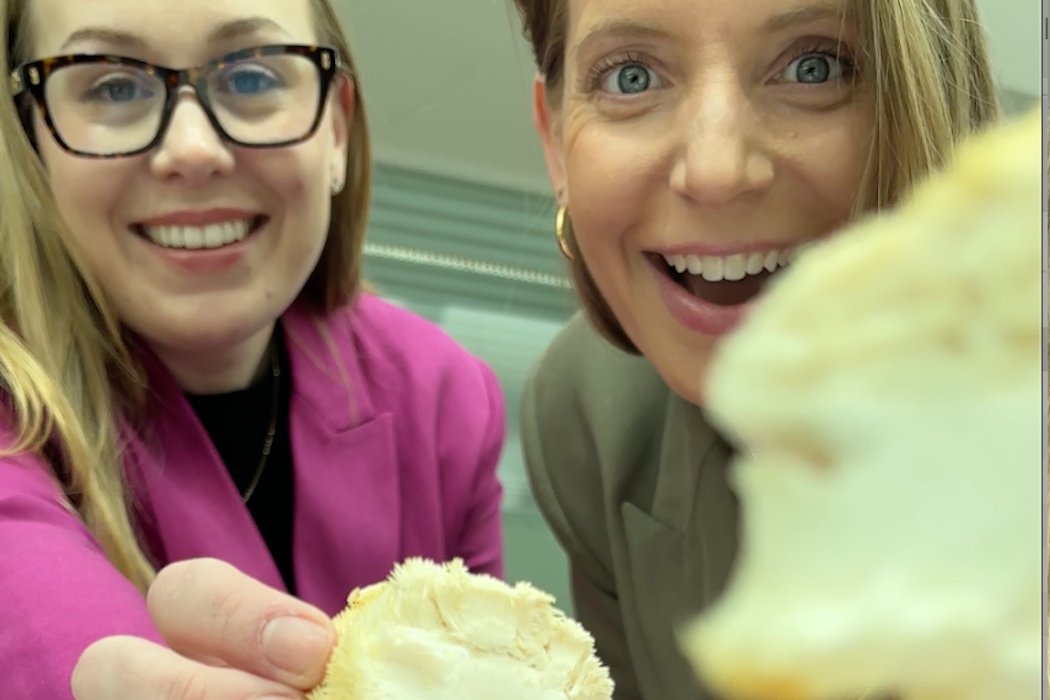
Two women standing in front of a red door, holding white mushrooms.
Dr Sara Webb and Dr Rebecca Allen holding the newly grown lion’s mane mushroom.
Author provided, CC BY

Mushrooms launch into space

In August 2024, we launched a set of 36 small vials into space aboard a SpaceX Falcon 9 rocket. In these vials were three edible fungi species in the form of mycelium – small file filaments that act like the root network of mushrooms.

The species we tested were lion’s mane (Hericium erinaceus), turkey’s tail (Trametes versicolor) and cordyceps (Cordyceps militaris). These have shown benefits for brain function, gut health, and immune health – all important areas for long term space flight.

This experiment was our sixth payload to the International Space Station (ISS), thanks to the microgravity experimentation program we lead at Swinburne University of Technology.

It was designed and prototyped with the help of 12 high school students from Haileybury College in Melbourne. And it was made possible thanks to professional mushroom growers and suppliers who ensured the fungal strains were not only food grade but healthy enough to survive the extreme environment of space.

Our fungi may have stayed on the ISS with astronauts. But the mushrooms’ experience was very different to the astronauts’. Science experiments have special storage areas depending on what is being done and how much time astronauts have to be involved. Our mycelium was sealed up tight in special packaging to help keep them at a stable temperature and to ensure they weren’t damaged.

They stayed like that for close to a month, before they returned with the change of crew on the ISS.

We didn’t get much in the way of updates while our mushrooms were travelling – just some pictures and videos from NASA of the outside of the safely sealed experiment.

On their return, we waited with bated breath to see if they would survive once opened.

The mushrooms on board the International Space Station.
NASA, CC BY-SA

Mushrooms return to Earth

When our mycelium returned to Earth, and eventually Australia, they got a new home in rich, nutritious substrate. We then moved it into grow kits so we could watch and see whether any fruiting bodies (that is, mushrooms) would appear.

We created several grow boxes and placed them in different environments to see what conditions were best – from kitchen benches, to staff room tables, to laboratory fridges.

To our delight, within a few days we saw signs of the mushrooms emerging and within a week we had beautiful lion’s mane ready to be cooked up and enjoyed. Once they were ready, we harvested them and tried different recipes.

As well as eating these mushrooms, we’re also in the process of analysing them closely. But we can say now that the reduced gravity environment did not negatively impact our mycelium. In fact, they seem to be so happy that they continued to produce several rounds of mushrooms.

Mushrooms for long-term space missions

Artemis II – NASA’s crewed mission to the moon – is right around the corner. But there is still a lot that we need to understand to provide the best conditions for astronauts as they venture further into space than ever before.

For example, how will we continue to nutritionally support astronauts for weeks to months on long duration missions?

We know that a low gravity environment has a profound impact on human bodies, and one of the best ways to support astronauts in orbit is with nutritional foods.

Another outstanding question we need to answer is whether food produced in space environments be affected by radiation and other stresses, rendering it less valuable.

Our work – and these special mushrooms – are helping to provide crucial answers.

The Conversation

The authors do not work for, consult, own shares in or receive funding from any company or organisation that would benefit from this article, and have disclosed no relevant affiliations beyond their academic appointment.

ref. We ate space mushrooms and survived to tell the tale – https://theconversation.com/we-ate-space-mushrooms-and-survived-to-tell-the-tale-274112

Why regularly taking laxatives over the long term can be a bad idea

Source: The Conversation (Au and NZ) – By Vincent Ho, Associate Professor and Clinical Academic Gastroenterologist, Western Sydney University

Photo by Anna Shvets/Pexels

If you’ve ever been constipated you may have tried laxatives. They’re easy to get without a prescription and often help get things moving.

Certainly a lot of people use laxatives and some older people are very reliant on them to help with bowel function.

But you might have heard it’s not a good idea to take them over the long term. Even though serious complications from chronic laxative use are rare, they do happen. That’s why, whenever possible, long-term laxative use should be guided and monitored by a doctor.

Types of laxatives

There are five main types of laxatives (all are oral):

  1. bulk-forming laxatives (also known as fibre laxatives), which absorb water to form a soft, bulky stool and prompt normal contraction of bowel muscles. Common brands include Metamucil and Benefiber

  2. osmotic laxatives, which draw water into the colon to allow easier passage of stool. Common brands include Osmolax, Actilax and Movicol

  3. stool softeners such as docusate (brand name Coloxyl), which acts like a detergent and allows fat and water to mix in with hard stool – this makes it softer and easier to pass

  4. stimulant laxatives, which trigger rhythmic contractions of the bowel muscle. Common brands include Dulcolax, Bisalax and Senna

  5. lubricant laxatives, which coat the bowel and soften the stool. A common brand is Parachoc.

Starting a laxative

Before starting a laxative you should try dietary and lifestyle changes such as:

  • eating more foods with fibre in them, such as kiwifruit, corn, oats and brown rice
  • drinking more water
  • doing more exercise.

But if constipation persists, you might think about a laxative. Consider starting with gentler options, such as the bulk-forming laxatives or stool softeners, and implement those dietary and lifestyle changes listed above.

It’s a good idea to see your local doctor when starting a laxative; constipation may be a sign of something more concerning, especially if there are other symptoms such as rectal bleeding.

Your doctor can also advise whether laxatives might interact with any other medications you take.

Do laxatives cause a ‘lazy colon’?

Probably not. So where does this idea come from?

A case report published in the 1960s described bowel changes in a patient who had been taking stimulant laxatives for more than 40 years.

When the colon was examined, doctors noticed a reduced number of key cells in the colon. This sparked concern about whether long-term use of stimulant laxatives could result in damage to the gut, culminating in a “lazy colon” (also known as a cathartic colon). This is when the colon becomes an inert tube with no real muscle function to push along stool.

However, a later review of more than 70 publications describing 240 cases of stimulant laxative abuse found no cases of cathartic colon reported. Researchers concluded the prior cathartic colon cases might have been linked to a laxative called podophyllin that is now no longer recommended.

A review of 43 publications on the safety of stimulant laxatives discovered many of the studies were of poor quality, with small sample size. Confounding factors, such as medications and age, were often not being taken into account.

It found no good evidence chronic use of stimulant laxatives damages the gut.

That said, there are other good reasons not to take laxatives regularly and over the long term unless advised by a doctor who is monitoring your progress.

Gut symptoms and electrolytes

Laxative abuse is when someone takes laxatives to lose weight through frequent and repeated use of laxatives.

The most common symptom of laxative abuse is diarrhoea, which can mean abdominal cramps, nausea, vomiting and weight loss.

But laxative abuse can also disrupt the body’s electrolytes.

The main electrolyte in poo is potassium. As the body loses more and more potassium through diarrhoea, you can end up with lower blood potassium levels.

This can lead to:

  • generalised muscle weakness
  • heart complications
  • changes in heart rhythm
  • in extreme cases, stopping your heart beat, which can lead to death.

A 2020 systematic review of case reports found that laxative abuse can cause mild to severe cases of cardiac complications.

Laxative abuse can also lower other electrolytes, such as calcium and magnesium, leading to painful muscle contractions. Occasionally the kidney can be severely affected by chronic laxative abuse.

If you take just the recommended dose of laxatives, though, the risk of serious electrolyte complications is extremely low.

Depression, dementia and mental health

Two UK studies that examined a data set of approximately half a million participants found regular laxative use was associated with a higher risk of developing depression and dementia.

One theory is chronic laxative abuse could alter what’s known as the microbiome-gut-brain-axis (the way microbiota and the brain communicate) and lead to a higher risk of conditions such as depression and dementia.

Laxative abuse is commonly associated with eating disorders, so it’s important anyone found to be abusing laxatives also undergo a comprehensive mental health assessment. A plan might be needed to address the broader problem.

Safe when taken properly

Laxatives are obtained easily without a prescription and are very widely used in the community. They are certainly helpful for treating chronic constipation.

However, they can cause side effects such as diarrhoea and electrolyte imbalances. Long-term use and overuse can lead to problems.

It’s always a good idea to consult your doctor before starting laxatives, especially if you have other medical issues or are taking other medications.

The Conversation

Vincent Ho does not work for, consult, own shares in or receive funding from any company or organisation that would benefit from this article, and has disclosed no relevant affiliations beyond their academic appointment.

ref. Why regularly taking laxatives over the long term can be a bad idea – https://theconversation.com/why-regularly-taking-laxatives-over-the-long-term-can-be-a-bad-idea-269404

Woman faces assault charges after attack on bus driver in Auckland

Source: Radio New Zealand

The woman is alleged to have attacked the driver on Queen Street. File picture. RNZ / Diego Opatowski

A woman is facing serious assault charges after a bus driver was attacked on Auckland’s Queen Street.

Auckland Area Commander Grae Anderson, said the 20-year-old woman tried to board the bus on Monday night but the driver refused her entry on account of her acting “unusually”.

The woman then chased the bus down Queen Street, got on board, and allegedly attacked the driver.

Police spotted a person matching the woman’s description near Vulcan Lane.

She ran off but police caught up with her.

She has been charged with injuring with intent to injure and will appear in court on Tuesday.

Sign up for Ngā Pitopito Kōrero, a daily newsletter curated by our editors and delivered straight to your inbox every weekday.

– Published by EveningReport.nz and AsiaPacificReport.nz, see: MIL OSI in partnership with Radio New Zealand

Emergency crews rush to Hawkes Bay Airport after plane alert

Source: Radio New Zealand

RNZ / Nate McKinnon

Fire and Emergency were called to Hawke’s Bay Airport after an alert was put out about a small plane.

A police spokesperson told RNZ during landing the plane nose landing gear appeared to be damaged.

Seven fire trucks, two tankers and a command unit were called to the scene just after 10am on Tuesday.

Crews were stood down after the plane landed safely, FENZ said, with crews assisting in cleaning up a small fuel leak.

Hato Hone St John was also notified of the incident.

Two ambulances and one helicopter responded, but had since been stood down, a spokesperson said.

The airport was temporarily closed, with the Civil Aviation Authority taking over the site, an airport spokesperson said.

It has since been reopened.

Sign up for Ngā Pitopito Kōrero, a daily newsletter curated by our editors and delivered straight to your inbox every weekday.

– Published by EveningReport.nz and AsiaPacificReport.nz, see: MIL OSI in partnership with Radio New Zealand

Facebook Marketplace sale ends in car chase, armed confrontation in Northland

Source: Radio New Zealand

Armed police took three men into custody. RNZ / Cole Eastham-Farrelly

A Facebook Marketplace transaction gone wrong in the Far North led to alleged confrontation with a gun, a car chase and armed police spiking the suspects’ vehicle.

Detective senior sergeant Chris Fouhy said the dispute started near Kāeo, with police receiving a call about 8pm on Monday that a man was being chased north on State Highway 10 by another vehicle.

A firearm was also reportedly pointed at the victim.

Fouhy said multiple police units responded from across the district and managed to stop the chasing vehicle using road spikes at Taipā Bridge around 9pm.

Armed police then took the three men in the car into custody without further incident.

They were aged between 16 and 19.

Fouhy said the dispute appeared to have been sparked by a Facebook Marketplace transaction.

Enquiries were continuing into the full circumstances of what happened, how many cars were involved and the whereabouts of the reported firearm.

It is not known what was being sold on Marketplace.

Sign up for Ngā Pitopito Kōrero, a daily newsletter curated by our editors and delivered straight to your inbox every weekday.

– Published by EveningReport.nz and AsiaPacificReport.nz, see: MIL OSI in partnership with Radio New Zealand

The big issue with Super Rugby Pacific’s new law changes

Source: Radio New Zealand

Referee James Doleman during the Crusaders v Blues, Super Rugby Pacific Semi Final match. Martin Hunter/ActionPress

  • Super Rugby Pacific’s new law tweaks aim to speed up play and reduce stoppages.
  • Players will be getting fewer reps in key test-match scenarios like fielding kicks and positional play.
  • This could create a disconnect between the style players experience for most of the year and the repetition-driven demands of international rugby.

Analysis – Super Rugby Pacific is back next weekend and will look a bit different, thanks to some new law changes. Designed to reduce stoppages, inspire positive play and – most importantly, simplify the viewing experience, they have been pretty well received by a public keen to see a repeat of last year’s highly entertaining competition.

Probably the most far obvious will be the new sanction for joining a ruck after the referee has called ‘use it’, which should mean the ball is cleared quicker. Accidental offsides and teams delaying playing the ball away from a ruck are now free kicks, so in turn here’s more leeway around taking quick taps.

One that probably won’t be seen often but will certainly have an impact is it will no longer be mandatory for the referee to issue a yellow or red card to a player on the defending team when awarding a penalty try. There seems to be an awful lot of guesswork around this at the moment in open play, with players carded being more unlucky than anything else, but the real positive is that it won’t result in a mess at scrum time.

Referee James Doleman. Mark Evans/ActionPress

A dominant attacking scrum on an opponent’s line that results in a penalty try also meant that a defensive side’s prop would get binned, therefore needing to be replaced at the next scrum. That in turn meant that another player would have to go off to reduce their numbers, if this happened late in a game it would mean rolling players back on who have already been subbed.

So not bad at all from the officials who have put all this together in order to get some free flowing rugby going.

Tamaiti Williams scores the winning try during the Crusaders v Highlanders, Super Rugby Pacific match, Apollo Projects Stadium, Christchurch. Joseph Johnson/ActionPress

The only issue, and it’s not a new one, is that this is all for Super Rugby Pacific only. Once July rolls around, those changes don’t apply for test matches and the effects of that may well be playing a part in why the All Blacks have struggled in the last few seasons.

It’s not that the players can’t snap back into playing a tighter game plan, they are professionals and should be able to do that easily. Beauden Barrett and Damian McKenzie have both shown that they can run the ball out of their 22 from February to June, then kick it more often than not when they’re in a black jersey.

But the problem isn’t at their end. Speeding the game up and presumably reducing kicking means players coming through at the other won’t be exposed to as many repetitions as their foreign counterparts. The average back three player won’t have had to field anywhere near as many bombs, track across the field chasing kicks, or simply position themselves on field as an English or South African of the same age. Meanwhile props won’t have as many scrums, halfbacks won’t box kick as often, and so on.

Noah Hotham of the Crusaders kicks during the Super Rugby Pacific Final. John Davidson / www.photosport.nz

It’s offset somewhat by the fact that by the business end of Super Rugby is played in colder conditions, with more on the line, so therefore the gameplans will adjust accordingly. One look at last year’s final can attest to that, but the fact still remains that Super Rugby Pacific is the tier below a test rugby landscape that’s moved far closer to repetitive scenarios decided by fine margins than off the cuff play.

Again, that’s not new. It’s just that those fine margins seem to be far more in the favour of who the All Blacks are playing.

One thing is for sure, with Super Rugby Pacific, though; they’ve stayed committed to reducing the role of the TMO in general play, with the man upstairs only allowed to intervene unprompted if the referee has overlooked an act of serious foul play or some other massively obvious error when a team scores a try.

Which is bound to be popular and hopefully catches on in test rugby, because while we should all be mindful of how difficult the officials’ jobs are these days, no one likes watching them talk to each other all that much.

Sign up for Ngā Pitopito Kōrero, a daily newsletter curated by our editors and delivered straight to your inbox every weekday.

– Published by EveningReport.nz and AsiaPacificReport.nz, see: MIL OSI in partnership with Radio New Zealand

Emergency crews rush to Hawkes Bay Airport small after plane alert

Source: Radio New Zealand

RNZ / Nate McKinnon

Fire and Emergency were called to Hawke’s Bay Airport after an alert was put out about a small plane.

A police spokesperson told RNZ during landing the plane nose landing gear appeared to be damaged.

Seven fire trucks, two tankers and a command unit were called to the scene just after 10am on Tuesday.

Crews were stood down after the plane landed safely, FENZ said, with crews assisting in cleaning up a small fuel leak.

Hato Hone St John was also notified of the incident.

Two ambulances and one helicopter responded, but had since been stood down, a spokesperson said.

The airport was temporarily closed, with the Civil Aviation Authority taking over the site, an airport spokesperson said.

It has since been reopened.

Sign up for Ngā Pitopito Kōrero, a daily newsletter curated by our editors and delivered straight to your inbox every weekday.

– Published by EveningReport.nz and AsiaPacificReport.nz, see: MIL OSI in partnership with Radio New Zealand

Academics call for divestment from NZ pensions fund implicated in Gaza

COMMENTARY: By Vincent Wijeysingha

Will maximising investment returns override ethics? That is the question the tertiary sector posed to UniSaver, the academic equivalent of KiwiSaver, now revealed to invest in Israeli weapons and military intelligence.

In 2024, some 400 university staff appealed to UniSaver to divest from such companies.

The fund initially ignored the call.

The fund issued a statement in September 2025 emphasising its fiduciary duty to ensure best performance, arguing divestment was unnecessary because the New Zealand government had not imposed sanctions against Israel, and noting its Israel-linked exposure is only 0.11 percent of total assets.

After a November open letter signed by 715 staff, nearly double the earlier number, UniSaver agreed to meet representatives of the group.

What should the tenor of those discussions be?

And why should any of this matter to the average New Zealander returning from the summer lull, facing a new year that looks uncomfortably like the last, with no sign from the Prime Minister’s State of the Nation last weekend that domestic pressures will ease?

The core question
This is the core question: with so many local concerns, why should the Israel–Palestine conflict matter?

Or, more pointedly, why should 0.11 percent of a pension fund belonging to a relatively privileged cohort matter to those worried about jobs, the cost of living, and healthcare?

Global issues are closer than we think. The suffering of Gazans and the anxieties of New Zealanders share a root: public policy framed as instrumental and amoral, where the wellbeing of persons is sacrificed to detached abstractions of markets and efficiencies while morality and integrity are treated as incidental.

These attitudes yield the same harvest everywhere: dehumanisation, insecurity, and the corrosion of civic trust.

Our only defence is a moral standpoint that declares “thus far shall you come, and no farther”.

When a society publicly avows that certain principles, human dignity and the integrity of persons, are non negotiable, it restores those ideals to the centre of the public square.

This is what a rules-based order is for: to foreground the human person before power and profit. Where such an order is honoured, flourishing follows; where it is neglected, flourishing is the first casualty.

Small acts of moral probity — even a mere 0.11 percent — may appear inconsequential.

Beacons for human progress
Yet as articulations of what we hold valuable, they resound deeply in the moral universe. They are the lit matches that, gathered, become the beacon that lights human progress.

Recent years have seen our public life dominated by the contrary impulse: to measure every policy by an economic yardstick calibrated to austerity.

As we enter an election year, two paths lie before us: one paved by slavish adherence to instrumental rationality, the other by a politics that puts people in a place of honour and treats wellbeing, security, and human flourishing as the purpose, not by product, of policy.

We have precedents. In the 1930s, as the world entered a moment not unlike our own, New Zealand, small, distant, still reeling from the Depression, adopted what became known as a moral foreign policy.

After that most devastating conflict, we added our voice to a chorus that helped shape a rules-based international order privileging human rights, cooperation, and diplomacy over war.

From the gradual undermining of that settlement, particularly after the crisis-ridden 1970s, one can trace many of today’s global and national disorders.

So what has all this to do with UniSaver?

Instability gathering pace
From our relatively safe redoubt at the bottom of the world, we watch instability elsewhere gather pace. Shall we respond in the same polarising, amoral terms or recover the loftier stance that once gave us outsized moral influence?

The UniSaver Board now faces a profound opportunity. In opposing the 715 who call for ethical investment, it has chosen expediency over ethics.

But morality often begins with small, unfashionable acts that grow, over time, into the juggernaut of social change.

Consider how a small student-led divestment campaign in the 1950s catalysed what became the global movement that helped topple South African apartheid.

Such actions shift the parameters of the values debate. Even if it concerns only 0.11 percent, UniSaver can redraw the moral horizon.

If its decision signals that we value a fair go for all — yes, even for far off Palestinians — it will achieve far more than a simple reassignment of assets.

It will have reminded us who we are.

And it will return UniSaver to being an institution to be proud of, one that affirms that people matter at least as much as the return on investment.

Dr Vincent Wijeysingha is senior lecturer in social work and social policy at Massey University. He is a member of Uni Workers 4 Palestine but writes here in a personal capacity.

Article by AsiaPacificReport.nz

All Blacks to kick off 2027 Rugby World Cup against Chile

Source: Radio New Zealand

Beauden Barrett after the All Blacks v Ireland, Gallagher Cup test match, Soldier Field, Chicago. ActionPress

The All Blacks will open their 2027 Rugby World Cup campaign with a Pool A match against Chile in Perth on Saturday 2 October.

The All Blacks then take on hosts the Wallabies in Sydney the following Saturday, with their final pool game against Hong Kong China in Melbourne on Friday 15 October.

The All Blacks have never played Chile or Hong Kong China in a test.

Caleb Clarke of New Zealand. New Zealand All Blacks v Australia Wallabies, Bledisloe Cup and Rugby Championship rugby union test match at Sky Stadium, Wellington, New Zealand on Saturday 28 September 2024. © Andrew Cornaga / Photosport Andrew Cornaga/www.photosport.nz

In releasing the schedule, tournament organisers resisted the temptation to open the tournament with a clash between Bledisloe Cup rivals New Zealand and Australia, with the Wallabies kicking off the tournament against Hong Kong China in Perth on Friday 1 October.

The defending champion Springboks begin their World Cup against Italy in Adelaide on Sunday 3 October, before games against Georgia in Brisbane and Romania in Perth.

The Springboks, in Pool B, will be looking for an unprecedented third World Cup win in a row.

South Africa’s No 10 Sacha Feinberg-Mngomezulu dives to score a try against Argentina in a Rugby Championship match, 27 December, 2025. AFP

The draw also sets up a probable quarter-final between the All Blacks and Springboks.

Other major team match ups have Ireland and Scotland in Pool D, while England and Wales are both in Pool F.

The tournament will be the first in an expanded format, featuring six pools of four teams. The top two teams from each pool plus the four best third-placed teams will qualify for the knockout phase.

Australia will host the World Cup for the second time, after the 2003 edition in which the Wallabies went in as defending champions only to lose to England in the final.

To date, it is the only time a northern hemisphere side has won the World Cup.

The World Cup will take place in Sydney, Perth, Melbourne, Brisbane, Adelaide, Townsville and Newcastle. Sydney’s Stadium Australia will host the final.

All Blacks pool matches at 2027 Rugby World Cup:

All Blacks vs Chile – Perth – 2 October 2027 – 6:15pm NZT

All Blacks vs Australia – Sydney – 9 October 2027 – 7:10pm NZT

All Blacks vs Hong Kong China – 15 October 2027 – 7:15 NZT

Other match Match schedule highlights:

  • 24 teams, 52 matches, 19 match days, 7 cities and 8 venues
  • Opening match: Australia v Hong Kong China – 1 October, 2027, Perth Stadium
  • Final: 13 November, Stadium Australia, Sydney
  • Super Sunday (17 October): five matches played in a single day for the first time ever to deliver an exciting end to the pool phase: Italy v Georgia, Ireland v Uruguay, Scotland v Portugal, France v Samoa, South Africa v Romania.
  • Knockout Drama: Brisbane, Melbourne, Perth, and Sydney will host the first-ever round of 16, followed by quarter-finals in Brisbane and Sydney, and then the semi-finals, bronze final, and the RWC Final at Stadium Australia on Saturday 13 November.

Sign up for Ngā Pitopito Kōrero, a daily newsletter curated by our editors and delivered straight to your inbox every weekday.

– Published by EveningReport.nz and AsiaPacificReport.nz, see: MIL OSI in partnership with Radio New Zealand

Driver licence system overhaul unveiled

Source: Radio New Zealand

A shake-up for the driver licensing system is on its way, with changes the government says will make it a lot cheaper for those looking to get their licence.

The changes include no longer needing to sit a second practical test to get a full licence, an increased learner period for those under 25, fewer eyesight screenings and an expanded zero-alcohol rule.

Making the announcement in Auckland on Tuesday, Transport Minister Chris Bishop said the current system was “expensive, outdated and no longer works as well as it should”.

The changes will mean it’s “significantly cheaper” to get a full driver licence, Bishop said. He also said New Zealand was an outlier in requiring a second practical driving test when moving from a restricted licence to a full licence.

“Removing the second practical test reduces costs and makes it easier to progress to a full licence, provided drivers demonstrate safe driving behaviour while on their restricted licence.

“We’re making practical, common-sense improvements to the driver licensing system to ensure it is accessible, efficient, and affordable, while keeping road safety front and centre.”

Minister Chris Bishop and Louise Upston announce an overhaul of the driver licence system. Screengrab

Bishop said the shake-up was the first major change to the system since 2011, when the learner licence age was increased from 15 to 16. The changes were informed by public consultation last year.

He said the proposal was refined to “ensure the system strikes the right balance between access and safety.”

Those tweaks included extending the learner period, extending the restricted period by six months for drivers who get demerit points rather than resetting it entirely, and keeping the existing demerit threshold for licence suspension for restricted drivers.

Key changes

  • No more full licence test: Drivers will no longer need to sit a second practical test to move from the restricted to full licence, saving time and money. This applies to Class 1 (car) licences only.
  • Longer time spent on learners for under 25s: There will be a 12-month learner period for under 25s, an increase of six months.
  • Option to reduce learner period: There will be an option for under 25s to reduce their 12-month learner period back to six months by recording practice hours or completing an approved practical course.
  • New restricted periods: The restricted period will be 12 months for under 25s and six months for over 25s, with no option to reduce it with a defensive driving course.
  • Cheaper to get a full licence: The total cost of getting a Class 1 (car) licence will reduce by $80 under the new system.
  • Encouraging safe driving: Drivers on their restricted licence will face a further six months on their restricted if they get demerits.
  • Fewer eyesight screenings: Eyesight screenings will only be required at the first licence application and at each renewal. This applies to Class 1 and Class 6 (motorcycle) licences.
  • Zero-alcohol rule expanded: All learner and restricted drivers, regardless of age, will be subject to a zero-alcohol limit.
  • Stronger oversight of training providers: NZ Transport Agency (NZTA) will gain new powers to monitor and suspend driver training course providers.

There are no changes to licence processes and requirements for overseas drivers or seniors drivers.

NZTA will review the existing learner and restricted tests.

People must continue to adhere to the current system until the new system takes effect from 25 January 2027. The expanded zero-alcohol limit will be implemented separately.

A review will be undertaken by the Ministry of Transport after three years to assess the impact of the changes on road safety, employment and economic outcomes.

Sign up for Ngā Pitopito Kōrero, a daily newsletter curated by our editors and delivered straight to your inbox every weekday.

– Published by EveningReport.nz and AsiaPacificReport.nz, see: MIL OSI in partnership with Radio New Zealand

How much less than asking price are house buyers paying?

Source: Radio New Zealand

RNZ / Samuel Rillstone

If you’re in the market for a new house, you might be wondering what to offer on any you’re interested in.

Do you offer the asking price? Try to cut 10 percent off? How hard do you negotiate?

As new data from Realestate.co.nz shows a 1.5 percent dip in average asking price in January, Cotality has confirmed that the gap between what sellers are asking and buyers are willing to pay appears to be shrinking.

Chief economist Kelvin Davidson said, excluding auctions, the median discount that buyers paid on the original list price of properties sold in 2025 was 3.8 percent.

It was 4.2 percent in 2024, 4.6 percent in 2023, 5.1 percent in 2022 and 2.9 percent in 2021.

Gisborne had the biggest discount, at 5.9 percent. That was followed by Northland at 5.5 percent and the West Coast at 5 percent. Taranaki had the smallest, at 3.1 percent.

Davidson said that could be affected by sellers in Taranaki setting more reasonable asking prices to start with.

“In some ways it’s a marketing tool. You’re never quite sure if someone is just hoping for too much of whether they’re actually setting a reasonable asking price or what their true motivations might be.

“Over time the availability of information to both sellers and buyers has widened. Any time, anybody can look up a free valuation estimate or you could come to Cotality, for example, and pay for a higher grade one but either way that information is widely available. It suggests that the chances vendors can sneak an above-market asking price in there have probably reduced because everybody’s got the same information and they are going to know what’ s unrealistic.

“I guess it applies to buyers as well …the chances putting in a sneaky 10 percent under offer and getting it accepted are also reduced because maybe asking prices are more realistic to start with.

“The scope for an excessive price is probably reduced but at the same time the scope for buyers to get a sneaky deal is probably reduced.”

The data does not include properties that went to auction.

Property prices have been broadly flat in recent years even as vendor discounts have reduced, suggesting it is sellers who have shifted their expectations.

“The longer the flat patch goes on the more people are saying ‘I just want to get this done I’ll set a more reasonable asking price’,” Davidson said.

“I think if you’re a market watcher, maybe you’ve been thinking about selling, maybe you held back because you thought ‘oh the market might pick up I’ll wait’. Now you might not necessarily be… you have to sell at some point. I think in general the fact those discounts have been slowly trending down suggests people are just being a bit more realistic than they might have been a few years ago.”

Realestate.co.nz said national stock levels rose 2.3 percent year-on-year in January, the first time the number of available properties for sale hit more than 33,000 in January since 2014.

Gisborne led the pack, with a 15.1 percent increase in available stock.

Sign up for Money with Susan Edmunds, a weekly newsletter covering all the things that affect how we make, spend and invest money.

– Published by EveningReport.nz and AsiaPacificReport.nz, see: MIL OSI in partnership with Radio New Zealand

Emergency crews rush to reports of small plane crash at Napier Airport

Source: Radio New Zealand

RNZ / Nate McKinnon

Fire and Emergency have rushed to reports of a small plane crash at Napier Airport.

Hato Hone St John was notified of an incident on Main North Road, Napier Airport, about 10am on Tuesday.

Two ambulances and one helicopter responded, but have since been stood down, a spokesperson said.

Police told RNZ “the plane had landed safely”, but referred all other questions to FENZ.

More to come…

Sign up for Ngā Pitopito Kōrero, a daily newsletter curated by our editors and delivered straight to your inbox every weekday.

– Published by EveningReport.nz and AsiaPacificReport.nz, see: MIL OSI in partnership with Radio New Zealand

Labour leader Chris Hipkins sets signts on Māori seats

Source: Radio New Zealand

Labour leader Chris Hipkins. VNP / Phil Smith

Labour leader Chris Hipkins has reiterated his determination to win all the Māori seats in November’s election, as parties gather at Waitangi.

He told Morning Report that candidate elections were underway for Labour.

“I’ve been very clear that we want to do very well there.”

Asked about Te Pāti Māori which currently holds all seven seats, Hipkins said “they need to sort themselves out”.

“They’re in court and that’s really where their focus should be.

“In the meantime, we’re going to be busy organising in the Māori seats to win them back.”

The party was involved this week in a substantive hearing at the High Court in Wellington after a two of its MPs, Mariameno Kapa-Kingi and Tākuta Ferris, were expelled.

Kapa-Kingi’s lawyers are arguing Te Pāti Māori’s constitution was not upheld during the process.

Hipkins told RNZ his message at Waitangi would be the same as elsewhere – that the country is stronger when people identify areas of common interest, work together and move forward.

In contrast to his stance on Te Pāti Māori, Labour is aiming to project a united front with the Greens at Waitangi with a joint press conference at the Treaty Grounds aimed to demonstrate working together despite policy differences.

Sign up for Ngā Pitopito Kōrero, a daily newsletter curated by our editors and delivered straight to your inbox every weekday.

– Published by EveningReport.nz and AsiaPacificReport.nz, see: MIL OSI in partnership with Radio New Zealand

Italian restaurant in Petone closes doors after 20 years

Source: Radio New Zealand

Soprano on Jackson Street. Supplied/Google Maps Street View

A Petone Italian restaurant is being sold after nearly 20 years, following an “incredibly tough” few years for the hospitality industry.

The owners of Soprano on Jackson Street, Latisha and Jonathan Dowling, posted on Facebook that the decision had not come lightly.

“As heartbreaking as it is to share this news, we wanted to share with you that we have made the choice to close/sell Soprano so we can spend more time with our families and step into a new chapter,” they said.

“Hospitality has given us so much in the last two decades, but the last few years – especially COVID – were incredibly tough. Like MANY in our industry, we poured everything we had into keeping the doors open, the lights on and our people cared for.”

Now was the right time to embark on something new, the couple said, adding that the restaurant was woven into their life story.

“It’s where we first met, worked side by side with the previous owner, fell in love, got married, and went on to have our three beautiful children.

“Today, our journey has come full circle, with our eldest now 14 and working the floor – something that fills us with more pride than words can say.”

The Dowlings thanked their customers who they said were part of their family.

The owners are now taking expressions of interest from prospective buyers.

Their last day of business, if not sold prior, will be 31 March.

Sign up for Ngā Pitopito Kōrero, a daily newsletter curated by our editors and delivered straight to your inbox every weekday.

– Published by EveningReport.nz and AsiaPacificReport.nz, see: MIL OSI in partnership with Radio New Zealand

Did you miss the best time to lock in a longer home loan rate?

Source: Radio New Zealand

BNZ has increased some of its longer-term home loan fixed rates. RNZ / Marika Khabazi

BNZ has increased some of its longer-term home loan fixed rates, prompting one economist to say that in hindsight, late last year was borrowers’ best option to lock in a longer rate.

It has cut its six-month rate by 20 basis points to 4.49 percent.

But the four-year rate lifts by 26 basis points to 5.55 percent and the five-year by 40 basis points to 5.69 percent.

“The increases bring their rates to roughly where everyone else has moved to over the last couple of weeks,” said Infometrics chief executive Brad Olsen.

“I think pressure is starting to come on a little bit more when it comes to funding rates, given that if you look at two- to five-year swap rates, they have increased by about 20 basis points again between the end of December and the end of January. There’s probably anelement of trying to wait as long as possible but the realities for bank funding have now become more apparent.”

He said the cashback promotions seen in the past couple of months proved banks wanted to be competitive.

“I wouldn’t be surprised if there was a little bit of a pause until you get a better read at the end of the month when the Reserve Bank makes the decision about the official cash rate. Because at that point, you’ll have a bit of a stronger view of what’s the likely path forward.”

He said it was likely that the talk at the end of last year about whether it was the right time to fix for five had probably proved to be correct. “That’s always the beauty of hindsight, right?”

Sign up for Money with Susan Edmunds, a weekly newsletter covering all the things that affect how we make, spend and invest money.

– Published by EveningReport.nz and AsiaPacificReport.nz, see: MIL OSI in partnership with Radio New Zealand

What should New Zealand do in the new world order?

Source: Radio New Zealand

US President Donald Trump at the World Economic Forum (WEF) annual meeting in Davos on January 22, 2026. AFP MANDEL NGAN

There’s a rupture in the international rules-based order, but that doesn’t mean New Zealand will be crushed by bigger powers

New Zealand has been a beneficiary of the international rules-based order for decades – trade disputes, action on serious issues, being heard on the world stage; there was a world body to give us a hand sorting stuff out.

While there have been inconsistencies, hypocrisy from superpowers, and the system hasn’t been perfect, it has, generally, worked for us.

But Russia and America between them have shaken up the system, and in a remarkable speech at the World Economic Forum in Davos, Canadian Prime Minister Mark Carney laid it all out.

“I thought this might be the most important political speech on geo-politics for many a long year,” says Tim Groser, a former diplomat; once New Zealand’s chief trade negotiator; ambassador, including to the United States and the World Trade Organisation; and a National government Minister of Trade.

He says the key message of the speech was to acknowledge the reality that we are seeing a rupture of the rules-based system.

“It’s not just the United States. It is also the invasion back in 2014 of Crimea by Russia, to break the most important norm of the post-war order in Europe, which is, do not try and change sovereign frontiers with force.

“This has been the most important issue facing Europe now for at least 500 years, and was the cause of three wars … the Franco-Prussian war, and the two world wars.

“So it’s not just the United States. The order that we lived in from 1945 to, I think around 2010, was quite remarkable in so many respects, and almost perfect for a small country like New Zealand.”

Mark Carney’s speech spelt out how the ‘middle powers’ such as Canada, Japan and Australia need to act together, “because if we’re not at the table, we’re on the menu”.

New Zealand is not a middle power, but not helpless either, says Groser.

“Some New Zealanders vastly exaggerate our influence. They seem to think that the whole eyes of the world are watching every move that we make and if we only do the right thing everyone else will think ‘oh my goodness me, we must do what the Kiwis are doing’. This is a fantasy.

“But the more common fantasy is to understate our significance.

“Of course we are a small country. But in terms of GDP measured in conventional terms, we’re the 52nd largest economy in the world in relative terms. Which means since there are over 200 sovereign countries in the world, there are 150 countries smaller than New Zealand.”

New Zealand has also had historic developments to help us cope with these world changes, when in the 1950s Britain joined the European union and our main trading partnership evaporated. It forced us to diversify our markets. Groser says Canada needs to do the same now.

Canadian journalist Jayme Poisson, who hosts the CBC’s Front Burner podcast, says Carney’s speech has landed well in Canada with those who like the idea of being a middle power with power.

But there’s a debate going on in the wake of Carney’s speech over how realistic that strategy actually is.

“Because at the end of the day, we share this massive land border with the United States. We send 70 percent of our exports to the United States. So we’re not just like some random middle power. We are the middle power right next door to the hegemon and we are inextricably tied to them for security and economics … so you can see why people are debating here how much our role is to not rupture our relationship with the United States, and how much our role is to lead this pack of middle powers to do something more ambitious.”

Carney, she says, is “good at bluntly describing reality in a pretty sophisticated way. He was one of the first leaders to come out and say the world has changed … and our relationship with the United States is not what it was before.”

The speech has been criticised for Carney poking the bear when he didn’t have to, and when up until now he’s kept his head down.

But it’s possible Carney has just displayed the kind of strength and leadership that the US President so admires.

“They just spoke,” she says, “and Carney has reported that it was a fine conversation. And while we did see this response from the Americans – you know, mockery, you can’t live without the United States, and threat of a 100 percent tariff floated if we get close to China, that has not come to fruition. It’s just kind of subsided. So certainly that’s a pretty good argument to make – that he likes strength, he likes winners. And that he’s so mercurial that you might as well just stand up to him anyway, because you don’t really know what he’s going to do, day to day.”

Poisson says there’s a lot of anti-American sentiment in Canada right now and Carney’s remarks resonated. His approval rating rose eight points in the wake of the Davos speech, and is currently up at 60 percent.

“I think everybody [in Canada] thought this was a good speech,” she says. “I think the critiques are … was it smart? And is it going to come with consequences, and are those consequences worth it?”

Listen to the podcast to find out why Tim Groser isn’t entirely pessimistic about international developments, and why a rupture doesn’t mean collapse.

Check out how to listen to and follow The Detail here.

You can also stay up-to-date by liking us on Facebook or following us on Twitter.

– Published by EveningReport.nz and AsiaPacificReport.nz, see: MIL OSI in partnership with Radio New Zealand

Tiny radio transmitters reveal a hidden survival tactic in birds

Source: The Conversation (Au and NZ) – By Alice Barratt, PhD Candidate, Hawkesbury Institute for the Environment, Western Sydney University

White-backed swallow in Sturt National Park. Alice Barratt, CC BY-NC

In Sturt National Park, near Tibooburra in central Australia where temperatures can range from freezing to nearly 50°C, there lives a small bird with a white back, forked tail and – as we’ve just discovered – a very clever strategy to survive its extreme environment.

The white-backed swallow (Cheramoeca leucosterna) is a type of passerine – the largest group of birds, comprising 60% of all bird species.

Scientists have long thought these birds incapable of deep torpor – a controlled state of reduced body temperature that saves energy and has been found in many animals in the northern hemisphere, where winters are more severe.

But our new paper, published today in the journal Current Biology, shows otherwise.

A man wearing a black jacket holding a small black and white bird in his hand.
A white-backed swallow equipped with a temperature sensing radio-transmitter.
Chris Turbill, CC BY-NC

Understanding how animals cope with extreme conditions

Animal physiologists have long seen the value of studying animals in extreme conditions to understand their survival strategies.

In the past, however, field instruments were cumbersome or delicate and studies were mostly limited to artificial conditions in the laboratory.

This was a problem for several reasons.

First, in captivity wild animals are often stressed and don’t tend to exhibit their full capabilities. Exposing captive wild animals to extreme conditions is also logistically difficult and an animal welfare concern.

But more recently, technological advances allow us to measure the physiological responses of animals when they are exposed to extreme conditions in the wild.

Tracking birds to their burrows

Biologging involves attaching electronic devices to animals that can record key traits such as movement, body temperature and energy expenditure. It is providing a fascinating window into the natural lives of animals.

Technological advances have meant these devices have become miniature in recent years. This has greatly expanded the species scientists can study in the wild and provides an exciting opportunity to challenge long held assumptions based on lab-based studies – including about torpor.

A person in the desert at night, holding an antennae in the air.
Night-time radio-tracking of white-backed swallows.
Chris Turbill, CC BY-NC

Our team set out to investigate the white-backed swallow, which has been the subject of some intriguing reports over the years.

For example, during cold and wet winter periods, observations as old as 1936 have reported finding the birds in their sandy burrows during the daytime that appeared in a torpor-like state: “inert, nestling into each other as if to escape from the bleak winter’s day”.

Over the winters of 2023 and 2024, we used miniature (400 milligrams) temperature sensing radio transmitters to study the thermal physiology of these swallows in Sturt National Park – the traditional lands of the Wongkumara, Wadigali, and Malyangapa peoples.

We tracked tagged birds to their burrows at night and set up autonomous data logging units nearby to record their body temperature data.

Following a tenuous radio signal on foot across the desert was spectacular on a clear starry night. But sometimes it was also tiring and intimidating.

After that, we trusted our data logging units to collect the steady radio pulses emanating from the resting birds. From these we obtained their body temperature, and therefore their potential use of torpor.

We had two major inland rain events in winter 2024, leading to local flooding. This meant we were unable to access our field site. So we waited it out in the local campground, hoping our trusty loggers were still recording data while enduring the unusually chilly nights.

A person sitting in an arid landscape in front of a computer.
Downloading the body temeprature data from the receiver and data logging units deployed near white-backed swallow burrows.
Chris Turbill, CC BY-NC

An extraordinary discovery

As the land dried out, we returned to find something extraordinary.

During and after these extreme rain events, the birds remained in their burrows even during the daytime. And they entered deep and long bouts of torpor – far exceeding what passerine birds were thought capable of.

Such torpor is presumably crucial for these in-flight foragers to survive when wet and cold conditions suppress the activity of flying insects.

More generally, our discovery of torpor use by a passerine bird suggests that this strategy is not limited to hummingbirds, nightjars and their relatives.

Instead, it could be a more widespread adaptation for survival across the diversity of birds.

Brown water rushing in a tree-lined creekbed.
Flooding of a typically dry creek during heavy rainfall.
Alice Barratt, CC BY-NC

A new wave of discoveries

Our finding adds to a growing number of recent discoveries revealed by biologging about the thermal adaptations of birds and mammals when faced with extreme conditions.

In 2024, for example, we found that even the largest of bats, the flying foxes (Pteropus species), are capable of using torpor during cold winter conditions that pose a risk of starvation.

In contrast, during summer, when flying foxes can be exposed to extreme heat events, our biologging data has shown they employ controlled increases in body temperature. This adaptation reduces the costs of shedding heat and helps to avoid lethal dehydration.

These data are essential for us to understand how animals survive extreme weather events, which are becoming increasingly common and severe with a warming climate.


The authors would like to acknowledge Justin Welbergen, Ben Moore and Anthony Hunt for their contribution to the research.

The Conversation

Alice Barratt receives funding from Western Sydney University, Hawkesbury Institute for the Environment and the Australian Bird Study Association.

Christopher Turbill receives funding from the Australian Research Council, and the Australian Commonwealth and New South Wales government.

ref. Tiny radio transmitters reveal a hidden survival tactic in birds – https://theconversation.com/tiny-radio-transmitters-reveal-a-hidden-survival-tactic-in-birds-274517

Our study shows younger siblings spend more time on screens than big sisters and brothers

Source: The Conversation (Au and NZ) – By Danusha Jayawardana, Research Fellow in Health Economics, Monash University

Atlantic Ambience/ Pexels

Where kids are born in a family can be important. But it is not just about who gets more grown-up privileges or parental pressure.

Research tells us firstborn children, on average, tend to do better on a range of outcomes. This includes doing better at school and being more likely to be top managers when compared to those born later.

In our new study, we looked at what impact birth order might have on how children spend their time. Both on their own and with their parents.

This revealed differences in terms of screen use and time spent enriching their intellectual development.

Our research

In our study, we used survey data from around 5,500 Australian children aged two to 15. The data comes from the Longitudinal Study of Australian Children, a nationally representative survey.

This included detailed 24-hour diaries, which recorded how children spent their time from waking up to going to sleep. They specified if activities were done with parents or independently.

We grouped activities into “sleep”, “school time”, “enrichment activities”, “screen time” and “physical activities”.

Enrichment activities are outside of school activities that help intellectual development. For example, reading, homework, playing board games or learning a musical instrument.

We then compared the diaries of firstborn children to later-born children from different families born in the same year, living in the same neighbourhoods, with similar socioeconomic backgrounds. All families had two or three children.

There is no similar data (such as time use records over years) available on siblings within the same family to capture and compare what siblings were doing at the same age.

Other studies looking at different outcomes (such as academic achievement) have shown birth order comparisons within a family are extremely similar to birth order comparisons across different families, once you adjust for family size, as we have done in our study.

So, it is likely our results would be similar to actual sibling comparisons within a family.

Younger kids get more screens

When compared to firstborn children, second- and thirdborn children spend an extra nine and 14 minutes, respectively, per day having screen time.

While this may sound modest, it represents a 7–10% increase compared to the average daily screen time of firstborns. Over the course of a week it is between about one and 1.5 hours.

This extra screen time also comes at the cost of other activities. In particular, later-born children spent 11 to 18 minutes less per day on enrichment activities, an 11–20% reduction compared to older siblings in the study.

We found no consistent differences between older and younger siblings when it came to time spent on other activities, such as school, physical activity or sleep.

Looking across age groups, the effects are generally greater for 10–14-year-old children. This suggests early adolescence is a period where particular attention is needed.

To check whether these patterns extend beyond Australia, we repeated the analysis using time-use diaries from a sample of children in the United States. The results were similar.

Why is this happening?

One common explanation for differences between first and subsequent children is parental time. As families grow, parents have less time and attention to foster subsequent children’s development.

However, this may not be the whole story. Our study showed later-born children did spend less time on enrichment activities with their parents. But about half of the difference comes from later-born children spending less time on enrichment activities on their own.

Screen time shows a similar pattern. The increase among later-born children is largely explained by activities they do alone, rather than with parents or siblings.

So this also reflects differences in children’s own choices or opportunities, not just direct parental involvement. For example, a younger sibling may have more freedom to choose to play video games rather than do their homework.

Of course parenting may still play an important role here. Our study shows later-born children face fewer rules around screen use, such as limits on programs or time, and are less likely to feel their parents expect them to follow rules. This may in part reflect parents’ desire for fairness in allowing similar use of screens for siblings at any given time, rather than at specific ages.

What does this mean?

The differences we find may seem small on any given day.

But they can add up over time. As our 2024 study showed, spending more time on screens and less time on reading, homework or other learning activities can lead to gaps in academic skill development over childhood, as measured by lower NAPLAN test scores.

The increase in solo screen time for later-born children is particularly concerning, because it may expose children to inappropriate content online.

What can we do?

First, recognising later-born children on average spend more time on screens and less time on enrichment activities than firstborns can be helpful for informing parenting strategies.

Second, it shows spending quality time with later-born children, actively encouraging enrichment activities, and keeping consistent rules around screen time all matter.

Finally, this suggests broader policies, such as the social media limits for under 16s, could help equalise opportunities for later-born children to learn and grow.

The Conversation

Gawain Heckley receives funding from the Swedish Research Council for Health, Working Life and Welfare (dnr 2023-01128).

Nicole Black receives funding from the Australian Research Council.

Danusha Jayawardana does not work for, consult, own shares in or receive funding from any company or organisation that would benefit from this article, and has disclosed no relevant affiliations beyond their academic appointment.

ref. Our study shows younger siblings spend more time on screens than big sisters and brothers – https://theconversation.com/our-study-shows-younger-siblings-spend-more-time-on-screens-than-big-sisters-and-brothers-273904

Australia’s Pacific worker scheme is far from perfect – but we can make it better

Source: The Conversation (Au and NZ) – By Peter Mares, Adjunct Senior Research Fellow, School of Media, Film and Journalism, Monash University

The Pacific Australia Labour Mobility scheme (PALM) is a crucial source of workers across regional Australia. About 32,000 people from nine Pacific nations and Timor-Leste work in Australia under PALM.

Over seven months of researching the scheme – interviewing workers, employers, country liaison officers, trade union organisers, community volunteers and academics, as well as digging into the data on it – I didn’t encounter anyone who thought it was a bad idea.

But there were many calls for change to make it work better for everyone. My , published today, suggests where we could start.

Who benefits from PALM now?

PALM has short- and long-term streams. Under the short-term stream, operating since 2012, workers can stay for nine months to do seasonal jobs such as fruit picking.

The long-term stream, introduced in 2018, allows for a four-year stay. Most long-term workers are employed in meat processing.

PALM is widely credited with delivering a triple win.

The first win is for Pacific participants and their communities.

In 2024-25 PALM workers remitted A$450 million to their home countries, an average of $1,500 each per person per month. The money bought food, paid school fees, upgraded housing and financed small enterprises.

Benefits flow beyond immediate families. After working in an Australian abattoir, Devid John Suma returned to Vanuatu and invested $30,000 to supply clean drinking water to his remote village.

The second win is for Australia’s economy. PALM workers make a significant contribution to regional businesses that struggle to attract local workers, from farms to abattoirs.

The third win is that PALM advances Australia’s strategic interests, not least by providing a counter to China’s wooing of Pacific nations.

Pacific leaders might wish for more aid from Canberra and be frustrated by the government’s tepid action on climate change. But well-paid work is something Australia offers that China does not.

Persistent problems

Yet the wins of the PALM scheme have countervailing costs in the pain of separated families, loneliness and broken marriages.

PALM is dogged by reports of workers being abused, underpaid or housed in substandard, overpriced or overcrowded accommodation.

Thousands of PALM workers have quit their approved jobs, “disengaging” from the scheme. This breaches their visa conditions and leaves them vulnerable to exploitation.

Drifting from its original mission

PALM has profoundly changed migration between the Pacific and Australia.

It brings workers to Australia from countries that have seen minimal migration to Australia since Federation, despite their geographic proximity — particularly the Melanesian countries Papua New Guinea, Solomon Islands and Vanuatu that were sources of labour in the late 19th century, when indentured South Sea Islanders built Queensland’s plantation economy.

But the future of PALM is not guaranteed.

Some Pacific countries, including Papua New Guinea, would like more of their nationals engaged under the scheme, while others worry it creates workforce shortages and disrupts community life.

Participation peaked at 34,830 workers in September 2023 and was at 32,365 in November 2025. Numbers in the long-term stream are steady, but fewer short-term workers are being recruited as employers revert to using backpackers — a cheaper, less regulated workforce — for seasonal jobs.

So, PALM has drifted from its original mission of filling seasonal gaps in the rural economy through annual circular migration, to become a labour program for sectors like meat processing and aged care with a constant demand for workers.

In April 2022, three-quarters of all PALM workers were in the short-term stream and a quarter were long-term. Now, more than half of all PALM workers hold long-term visas.

How to make the scheme work better

The PALM scheme changes lives and communities in the Pacific and Australia, often for the better. But its problems must be addressed to realise its potential.

Australian employers will turn away from a scheme that is too bureaucratic, expensive or cumbersome. PALM’s future won’t be secured by burying it under layers of rules and reporting.

has ten recommendations to improve PALM. These include:

  • making it easier for PALM workers to change jobs, rather than tying them to a single employer
  • simplifying PALM scheme rules for employers
  • regulating labour hire at the national level
  • giving workers access to Medicare while they’re in Australia to stop them missing out on medical attention
  • and reforming working holiday programs by phasing out the second and third visas offered to backpackers who do work like fruit picking in regional areas.

Australia’s interest in fostering Pacific development and rivalry with China are added reasons to limiting working holidays and expanding the PALM scheme instead.

PALM is a work in progress and will never be perfect. The scheme is shaped by the power differential between Australia and its Pacific partners. And there are tensions between three priorities: being a development program enhancing Pacific wellbeing, being a labour market program benefiting Australia’s economy, and serving a strategic purpose in Australia’s rivalry with China.

Yet when it operates well, PALM is far more than transactional.

Beyond wages earned, jobs filled and diplomatic points scored, it also fosters cultural exchange and personal engagement, binding the peoples of Australia and the region more fully into a “Pacific family”.

The Conversation

Peter Mares received funding from The Scanlon Foundation Research Institute to research and write “Improving PALM: Pacific Australia Labour Mobility”, but the views in this article are the views of the author alone and do not represent the position of the Scanlon Foundation. Peter Mares is a fellow at the Centre for Policy Development and a sessional moderator with Cranlana Centre for Ethical Leadership. He is a regular contributor to Inside Story magazine. He has also received past Australian Research Council funding.

ref. Australia’s Pacific worker scheme is far from perfect – but we can make it better – https://theconversation.com/australias-pacific-worker-scheme-is-far-from-perfect-but-we-can-make-it-better-274618

From statement sleeves to the codpiece: 5 fashions which should come back from Tudor England

Source: The Conversation (Au and NZ) – By Grace Waye-Harris, Early Career Researcher in History, Adelaide University

Portrait of Elizabeth I of England, 1588. Woburn Abbey/Wikimedia Commons

There are few dynasties in history as well-known as the Tudors. From Henry VIII’s six wives to Elizabeth I’s defeat of the Spanish Armada, the Tudors continue to capture imaginations.

While sex, power and public execution provide endless entertainment, if you ask me, the enduring popularity of the Tudors is down to one factor – their magnificent fashion.

Dress was serious business in Tudor England. Clothing was its own language with each textile, colour and style carrying a different meaning. This allowed people to display their identity, status, and even send political messages.

From the Elizabethan Ruff to Henry VIII’s codpiece, here are five Tudor fashions which should make a comeback.

1. The linen shift

Sounds like a boring place to start, but the linen shift was a staple in every Tudor wardrobe.

Linen was inexpensive, breathable and could be laundered daily. Contrary to popular belief, the Tudors were obsessed with cleanliness and hygiene. Linen absorbs sweat, bodily fluids and was believed to protect the skin from diseases such as the plague. Wearing and changing your linen shift daily was the best way to stay clean and protected from infection.

A linen shirt with blue embroidery around the collar and cuffs.
The collar on this linen shift, from around 1540, was larger so it could be seen under the outer garments.
©Victoria and Albert Museum, London, CC BY-NC

A fashionable trend of the Tudor period saw the collar on the linen shift become larger so it could be seen under the outer garments. A clean collar demonstrated that you could afford to change your shift and therefore had good hygiene.

You know what they say, cleanliness is close to godliness.

2. The ruff

If there is a single item of clothing that is most redolent of the Tudors, it’s the ruff.

The ruff was a pleated collar made from linen or lace and given its iconic stiff shape with starch. During the reign of Elizabeth I, large lace ruffs became an elaborate status symbol because they were difficult to set and impractical to wear which meant you had to have a lot of servants helping you.

Oil painting: a woman in a silver dress with a very ornate ruff.
Large, impractical ruffs – like the one in this 1615 portrait of a woman, possibly Elizabeth Pope – were a status symbol in Tudor England.
Yale Center for British Art

For Elizabeth I, the ruff was a significant source of power. The queen’s opulent ruffs commanded deference and situated her as the ultimate object in any room. In Elizabeth’s court, people came to her, not the other way around.

Dior gave the ruff a modern twist in their 2025 Fall–Winter collection, so it looks like they are already making a comeback.

3. Statement sleeves

In the Tudor period, sleeves were a separate garment that were attached while getting dressed in the morning. This allowed the wearer to pair them with different outfits and play around with fabrics, colours and styles.

The most popular style was the trumpet sleeve. This sleeve was narrow at the top of the arm and dramatically expanded in a cone shape over the elbow. A second sleeve would then appear underneath at the forearm.

Oil painting: a young Elizabeth in a red dress.
This painting of Elizabeth I before her accession is dated between 1546 and 1547. The sleeves give the outfit a dramatic and voluminous appearance.
Royal Collection/Wikimedia Commons

This gave any outfit a dramatic and voluminous appearance with layers of luxurious textiles. See how this beautiful design looked on a young Elizabeth I.

A modern take on statement sleeves would be a great way to spice up any outfit.

4. Decorative techniques

Tudor tailors used a range of decorative techniques when making clothes. Paning, pinking and cutwork were just some of the more elaborate modes of garment construction but the most common was slashing.

Slashing involved cutting small slits into outer garments of velvet to reveal an inner layer of white silk. The layering and contrast of different colours not only created a striking and vibrant image but showed off your ownership of expensive textiles.

Oil painting of Henry VIII in a power stance.
In this portrait of Henry VIII from between 1540–1547, you can see slashing on his doublet and sleeves.
Walker Art Gallery/Wikimedia Commons

You can see slashing on Henry VIII’s doublet (jacket) and sleeves in his famous portrait.

In 1991, this technique inspired Vivienne Westwood to produce the collection Cut and Slash, so it definitely has a place in the modern era.

5. The codpiece

Ok, this one is a bit of fun… but for Henry VIII the codpiece was no laughing matter. Starting out as a small triangular piece of material, by the early 16th century the codpiece had evolved into a padded, stiff and bejewelled item symbolic of virility and fertility.

Toxic masculinity was all the rage during the Tudor period, and Henry VIII was under immense pressure to maintain absolute control through his superior machismo.

As the king aged, his vigour waned and his failure to produce a male heir sent him into a crisis of masculinity. The display and exaggeration of his manhood through the codpiece was Henry’s only means of reasserting his masculine identity and fecundity.

Henry’s 1540 tournament armour gives a clear indication of just how exaggerated the codpiece became.

One thing is for sure, fashion in Tudor England was not a flippant pursuit. If the ever-enduring legacy of the Tudors can teach us anything, it’s that we should always dress to impress.

The Conversation

Grace Waye-Harris does not work for, consult, own shares in or receive funding from any company or organisation that would benefit from this article, and has disclosed no relevant affiliations beyond their academic appointment.

ref. From statement sleeves to the codpiece: 5 fashions which should come back from Tudor England – https://theconversation.com/from-statement-sleeves-to-the-codpiece-5-fashions-which-should-come-back-from-tudor-england-271507

As Australia’s online harm crackdown reshapes the debate, NZ must find its own path

Source: The Conversation (Au and NZ) – By Claire Henry, Associate Professor in Screen, Flinders University

Getty Images

Around the world, lawmakers are grappling with how to better protect young people from online harms such as cyberbullying, sexual exploitation and AI-generated “deepfake” images.

Recent reforms overseas – notably Australia’s landmark move to restrict young people’s access to social media – have sharpened debate about how far governments should go.

Despite past and current efforts – including a government inquiry shortly due to report its final findings – New Zealand arguably lags other developed countries in tackling a problem that is growing more serious and complex by the year.

In 2026, the question facing the government is whether to cautiously follow overseas models, or to use this moment to develop a response better suited to its own legal, social and cultural context.

What is online harm?

Online harm can take many forms, including exposure to illegal material, AI-driven racial bias, and the non-consensual sharing of intimate images. As Netsafe highlights, online abuse and harassment can unfold across social media, messaging apps, email and text, and often involves repeated or sustained behaviour.

New Zealand’s legislative response has developed gradually over the past decade. A major step was the Harmful Digital Communications Act 2015, which introduced civil and criminal penalties for serious online abuse and established Netsafe as the approved agency for complaints and dispute resolution.

Since then, governments have attempted broader reform. In 2018, the Department of Internal Affairs launched a wide-ranging regulatory review, followed in 2021 by the Safer Online Services and Media Platforms review, which aimed to modernise online safety protections and oversight.

However, that process stalled and in May 2024 the review was terminated by Internal Affairs Minister Brooke van Velden. A year later, the government launched a new inquiry into “the harm young New Zealanders encounter online”.

In the meantime, New Zealand’s fragmented and increasingly outdated regulatory framework is struggling to keep pace with fast-evolving digital risks.

What can NZ learn from other countries?

Many submissions to the government’s latest inquiry urged New Zealand to learn from overseas experience, while others noted that not all of those solutions would work at home.

InternetNZ argued that as a small and relatively late mover, New Zealand can “piggyback” on reforms in larger markets, so long as it ensured they reflect the country’s “unique local context, both socially and practically”. The Inclusive Aotearoa Collective – Tāhono similarly stressed the need to protect sovereignty.

Others argued New Zealand should draw on its reputation for innovation and develop its own culturally appropriate approaches.

Amokura Panoho of Pou Tangata Online Safety, for instance, called for updating the Harmful Digital Communications Act to address emerging AI harms such as deepfakes, and creating new Māori-led reporting pathways tailored for young Māori to seek help. Advocates argue this could allow New Zealand to anticipate future risks rather than chase them.

Australia’s move to ban social media for under-16s has loomed large over the inquiry. While France and the United Kingdom are considering similar bans, there are concerns blanket age restrictions can be blunt instruments and that young people often find ways around age-verification systems.

This international focus was reinforced in the inquiry’s interim report, which drew heavily on models from Australia, the UK, Ireland and the European Union. But submitters also pointed to other lessons, including the UK’s Internet Watch Foundation, South Korea’s online safety framework and California’s youth privacy laws.

A further complication is that many international reforms remain largely untested. Australia’s Online Safety Act is still being rolled out in phases, while the EU’s Digital Services Act only entered full force in early 2024. As a result, evidence about their effectiveness remains limited.

The case for a national regulator

One of the clearest options emerging from the inquiry is the creation of a national online safety regulator: a model already adopted in several comparable countries, including Australia, the UK and Ireland.

In the UK, communications regulator Ofcom oversees the Online Safety Act 2023, while Australia’s eSafety Commissioner was granted expanded powers under the Online Safety Act 2021.

A 2021 Department of Internal Affairs report concluded that a central regulator in New Zealand could streamline oversight, provide a single point of contact and improve enforcement. The inquiry’s interim report reached a similar conclusion, pointing to the benefits of coordinated regulation and proactive “safety by design” rules.

But reform has been slowed by political caution, particularly around concerns about freedom of expression. The government’s preference for light-touch regulation has left gaps – notably in addressing emerging harms such as sexualised deepfakes – prompting ACT MP Laura McClure’s member’s bill aimed at closing some of those loopholes.

The inquiry’s final report, and the government’s response to it, offer a rare opportunity to reset direction. The challenge will be to move beyond piecemeal reform and design a system capable of keeping pace with rapid technological change, while placing the voices of young people and Māori at its centre.

Claire Henry receives funding from the Australian Research Council as a DECRA Fellow. She previously received a research grant from InternetNZ (2018) for an unrelated project on “Preventing child sexual offending online through effective digital media.”

Michael S. Daubs was commissioned by the Department of Internal Affairs to co-author the 2021 report with Peter Thompson.

ref. As Australia’s online harm crackdown reshapes the debate, NZ must find its own path – https://theconversation.com/as-australias-online-harm-crackdown-reshapes-the-debate-nz-must-find-its-own-path-274723