Massive public protests taking place in Hong Kong over the past week are aimed at a new extradition law, known as the Fugitive Offenders Ordinance, that would see accused criminals extradited to mainland China to face prosecution.
Hongkongers feel the law could be used to legalise the kidnapping of people who express views, and act in ways, that are not popular with the Chinese government. The same law could also be used to extradite tourists and visitors to China who are arrested on suspicion of having committed these crimes.
Protesters want the bill scrapped. For now, debate of the legislation has been postponed.
Organisers say one million people turned out for the protests, while police estimate the number was around 240,000. Either way, it was a significant number of Hong Kong’s 7.5 million population. Commentators on Twitter remarked on how well organised the protesters were.
So, how did they do it?
Protesters across the world are using new technologies to organise. Social media platforms were used to share information about the Hong Kong protests. And messaging apps, such as Telegram and WhatsApp, were essential for coordinating with other protesters.
In choosing a messaging app, organisers are looking to communicate effectively while avoiding surveillance. Telegram, which launched in 2013, has become a more secure competitor to WhatsApp.
There is the “cloud chats” option for group messaging. Telegram also allows for “secret chats” between two people. These chats are stored on the phones rather than in the cloud, and can be set to self-destruct at a time determined by the user.
Unlike WhatsApp, Telegram hasn’t suffered major hacks in the recent past. Earlier this year, WhatsApp was reportedly infected with the Pegasus spyware as part of an attempt to access the messages of a UK-based human rights lawyer who was working on a case for civil rights activists. During the 2014 protests, WhatsApp was also reportedly attacked to spy on Hongkongers.
Telegram is a partially open source platform. Anyone can contribute to strengthening its security by looking for and fixing vulnerabilities, which can help to prevent hacks like those from Pegasus.
Telegram therefore offered Hongkongers a messaging service they could use with a bit more confidence, or so the organisers thought. But the use of spyware isn’t the only method available to those who might want to disrupt the communications of protesters.
The administrator of a 30,000-member Telegram chat group, which was used to organise the protests, was arrested on Tuesday. Ivan Ip, 22, was accused of conspiring to commit a public nuisance. Ip told the New York Times:
I never thought that just speaking on the internet, just sharing information, could be regarded as a speech crime […] I’m scared that they will show up again and arrest me again. This feeling of terror has been planted in my heart.
In a further show of force, Telegram was also targeted in a distributed denial-of-service (DDoS) attack during the protests.
DDoS attacks use botnets, which are computers that have been compromised by malicious software and then used to launch cyber attacks in an automated fashion. The owner of the computer may not even know that their property was used as a tool to suppress civil rights activists.
Telegram’s servers were flooded with junk communications at rate of 200-400 gigabits per second, slowing functioning of the service until it was ineffective or unusable.
Based on past trends, this size of an attack is likely to have been carried out by a state actor. Telegram founder and CEO Pavel Durov said source IP addresses indicated the geographic location of the attacks were mainly originating in China.
This disruption appears to have been coordinated to occur at the height of the protests for maximum impact, creating a chilling effect on the ability of protesters to organise and communicate.
The effect of the attack was global, impacting Telegram users in other countries like the United States. This shows how targeted internet censorship techniques in one country could punish citizens of another.
By making Telegram unusable, the cyber attack redirects the communications of organisers onto less secure platforms, where vulnerabilities can be exploited.
Communications on these platforms might be more easily intercepted, and metadata and location information might be available from telecommunications companies and ISPs. This can heighten protesters’ fears of being identified and prosecuted for their political actions.
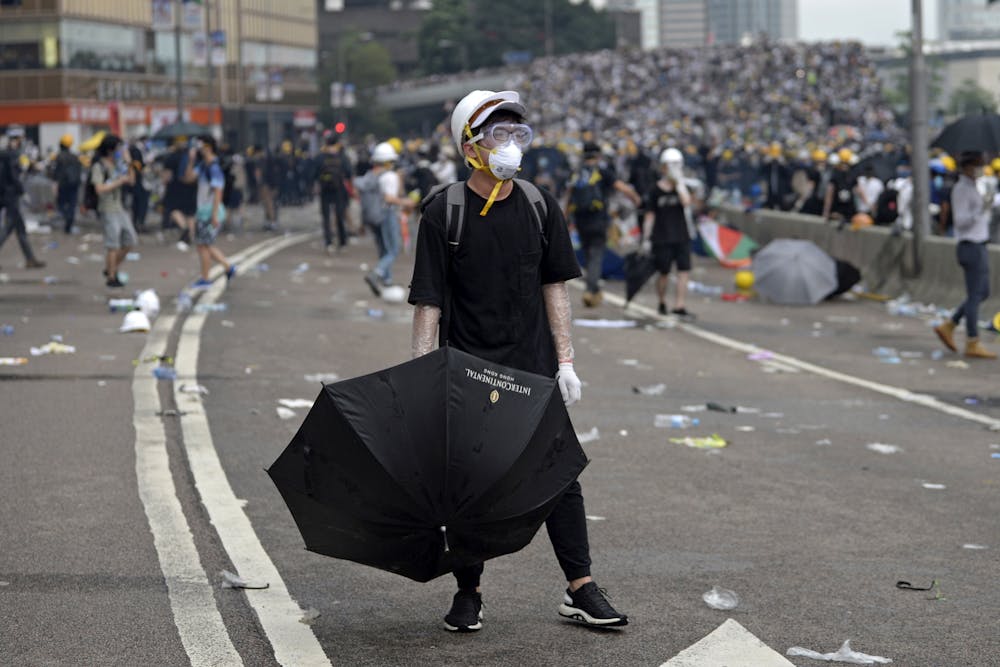
Protesters during a rally against an extradition bill outside the Legislative Council in Hong Kong on June 12.Vernon Yuen/EPA
The power of governments to attack and disrupt the communications of protesting citizens has a chilling effect on the universal right to march and to protest. Social media hacking tools, which are sold to repressive governments to spy on their own citizens, further erode the right to free speech and to organise political activity.
In this environment, demand for secure social media apps will only increase out of a basic necessity to break free from surveillance, and for protection against authoritative regimes around the world.
A growing number of older Australians don’t own their homes. And whether they are private renters or live in social housing can make a big difference to their risk of loneliness and anxiety.
That’s the key finding of research led by Alan Morris, a professor at the UTS Institute for Public Policy and Governance, who interviewed older Australians about how their housing situation may relate to the loneliness they experience.
On today’s episode, Professor Morris shares some of the deeply moving stories he heard.
Podcasts are often best enjoyed using a podcast app. All iPhones come with the Apple Podcasts app already installed, or you may want to listen and subscribe on another app such as Pocket Casts (click here to listen to Trust Me, I’m An Expert on Pocket Casts).
You can also hear us on Stitcher, Spotify or any of the apps below. Just pick a service from one of those listed below and click on the icon to find Trust Me, I’m An Expert.
Massive public protests taking place in Hong Kong over the past week are aimed at a new extradition law, known as the Fugitive Offenders Ordinance, that would see accused criminals extradited to mainland China to face prosecution.
Hongkongers feel the law could be used to legalise the kidnapping of people who express views, and act in ways, that are not popular with the Chinese government. The same law could also be used to extradite tourists and visitors to China who are arrested on suspicion of having committed these crimes.
Protesters want the bill scrapped. For now, debate of the legislation has been postponed.
Organisers say one million people turned out for the protests, while police estimate the number was around 240,000. Either way, it was a significant number of Hong Kong’s 7.5 million population. Commentators on Twitter remarked on how well organised the protesters were.
So, how did they do it?
Protesters across the world are using new technologies to organise. Social media platforms were used to share information about the Hong Kong protests. And messaging apps, such as Telegram and WhatsApp, were essential for coordinating with other protesters.
In choosing a messaging app, organisers are looking to communicate effectively while avoiding surveillance. Telegram, which launched in 2013, has become a more secure competitor to WhatsApp.
There is the “cloud chats” option for group messaging. Telegram also allows for “secret chats” between two people. These chats are stored on the phones rather than in the cloud, and can be set to self-destruct at a time determined by the user.
Unlike WhatsApp, Telegram hasn’t suffered major hacks in the recent past. Earlier this year, WhatsApp was reportedly infected with the Pegasus spyware as part of an attempt to access the messages of a UK-based human rights lawyer who was working on a case for civil rights activists. During the 2014 protests, WhatsApp was also reportedly attacked to spy on Hongkongers.
Telegram is a partially open source platform. Anyone can contribute to strengthening its security by looking for and fixing vulnerabilities, which can help to prevent hacks like those from Pegasus.
Telegram therefore offered Hongkongers a messaging service they could use with a bit more confidence, or so the organisers thought. But the use of spyware isn’t the only method available to those who might want to disrupt the communications of protesters.
The administrator of a 30,000-member Telegram chat group, which was used to organise the protests, was arrested on Tuesday. Ivan Ip, 22, was accused of conspiring to commit a public nuisance. Ip told the New York Times:
I never thought that just speaking on the internet, just sharing information, could be regarded as a speech crime […] I’m scared that they will show up again and arrest me again. This feeling of terror has been planted in my heart.
In a further show of force, Telegram was also targeted in a distributed denial-of-service (DDoS) attack during the protests.
DDoS attacks use botnets, which are computers that have been compromised by malicious software and then used to launch cyber attacks in an automated fashion. The owner of the computer may not even know that their property was used as a tool to suppress civil rights activists.
Telegram’s servers were flooded with junk communications at rate of 200-400 gigabits per second, slowing functioning of the service until it was ineffective or unusable.
Based on past trends, this size of an attack is likely to have been carried out by a state actor. Telegram founder and CEO Pavel Durov said source IP addresses indicated the geographic location of the attacks were mainly originating in China.
This disruption appears to have been coordinated to occur at the height of the protests for maximum impact, creating a chilling effect on the ability of protesters to organise and communicate.
The effect of the attack was global, impacting Telegram users in other countries like the United States. This shows how targeted internet censorship techniques in one country could punish citizens of another.
By making Telegram unusable, the cyber attack redirects the communications of organisers onto less secure platforms, where vulnerabilities can be exploited.
Communications on these platforms might be more easily intercepted, and metadata and location information might be available from telecommunications companies and ISPs. This can heighten protesters’ fears of being identified and prosecuted for their political actions.
Protesters during a rally against an extradition bill outside the Legislative Council in Hong Kong on June 12.Vernon Yuen/EPA
The power of governments to attack and disrupt the communications of protesting citizens has a chilling effect on the universal right to march and to protest. Social media hacking tools, which are sold to repressive governments to spy on their own citizens, further erode the right to free speech and to organise political activity.
In this environment, demand for secure social media apps will only increase out of a basic necessity to break free from surveillance, and for protection against authoritative regimes around the world.
You’ve probably heard eating too much fatty red meat is bad for your health, while lean meat and chicken are better choices. So, recent headlines claiming white meat is just as bad for your cholesterol levels as red meat might have surprised you.
The study did find lean white meat had the same effect on cholesterol levels as lean red meat. While this might be construed as good news by lovers of red meat, more research on this topic is needed for a clearer picture.
How was this study conducted?
The researchers set out to compare three diets: one where the main dietary source of protein came from eating red meat (beef and pork), another where it came from poultry (chicken and turkey), and a third where it came from plant foods (legumes, nuts, grains and soy products).
They wanted to measure the impact of these diets on specific categories of blood fats, as markers of heart disease risk. They tested blood fat markers including low density lipoprotein cholesterol (or LDL, commonly known as “bad cholesterol”), apolipoprotein B (apoB), and the ratio of total cholesterol to high density lipoprotein cholesterol (or HDL, commonly known as “good cholesterol”).
The researchers also wanted to know whether blood fat levels changed more when the background dietary patterns were high in saturated fat, derived mostly from full-fat dairy products and butter, or when they were low in saturated fat.
To achieve this, 177 adults with blood cholesterol levels in the normal range were randomised to follow either a high-saturated fat diet (14% of total energy intake) or a low-saturated fat diet (7% of total energy intake).
Within these two groups they were further randomly assigned to follow three separate diets for four weeks each: red meat, white meat, and plant protein sources. The main protein sources in the meat groups came from lean cuts of red and white meat. In the plant diet, protein came from legumes, nuts, grains and soy products.
Participants met research staff weekly to collect their food products and received counselling on following their specified diet. Participants were asked to maintain their physical activity level and keep their weight as stable as possible so these factors did not bias the results.
To eliminate any carry-over effects from eating one type of protein to the next, participants were given between two and seven weeks break in between each diet and told to return to their usual eating patterns.
Some participants dropped out along the way, so in the end researchers had results from 113 participants.
Blood concentrations of LDL cholesterol and apoB were lower following the plant protein diet period, compared to both the red and white meat periods. This was independent of whether participants were on a background diet of high- or low-saturated fat.
There was no statistically significant difference in the blood fat levels of those eating red meat compared to those eating white meat.
We’re often told to limit our consumption of red meat.From shutterstock.com
Eating a diet high in saturated fat led to significant increases in blood levels of LDL cholesterol, apoB, and large LDL particles compared with a background diet low in saturated fat.
So, all the dietary protein sources as well as the level of saturated fat intake had significant effects on total cholesterol, LDL cholesterol, non-HDL cholesterol, and apoB levels.
How should we interpret the results?
Although the test diets only lasted four weeks each, this study is important. It’s rare to see intervention studies that directly compare eating different types of meat and sources of protein and the impact on heart-disease risk factors. This is partly due to the challenge and expense of providing the food and getting people to follow specific diets.
Most studies to date have been cohort studies where people are categorised based on what they eat, then followed up for many years to see what happens to their health.
There are a few things to keep in mind with this study. First, the researchers used the leanest cuts of both red and white meats, and removed all visible fat and skin. If participants were eating fatty meat, we may have seen different results.
The significant variation in breaks between different diets (ranging from two to seven weeks) may have also affected the results. Participants with a longer break would have had more time for their blood cholesterol levels to change, compared to those with shorter breaks.
Finally, in reporting their results, it would have been better to include all 177 participants who began the study. People who drop out often have different health characteristics and leaving them out may have biased results.
This short-term study does not provide evidence that choosing lean white meat over red meat is either better or worse for your health.
But the findings are consistent with recommendations from the Heart Foundation to include a variety of plant-based foods in our diets, foods containing healthy types of fat and lower amounts of saturated fat, and in particular, to choose lean red meat and poultry.
Blind peer review
The article presents a fair, balanced and accurate assessment of the study. In this study, they showed lean red meat and lean white meat (with all visible fat and skin removed) had the same effect on blood fat levels.
Importantly, plant protein sources (such as legumes, nuts, grains and soy products) lowered blood fat levels compared to the red and white meats, and this was independent of whether the participants had been placed on a background diet low or high in saturated fats. This study did not look at the impact of a fish-based diet on blood fats. – Evangeline Mantzioris
Research Checks interrogate newly published studies and how they’re reported in the media. The analysis is undertaken by one or more academics not involved with the study, and reviewed by another, to make sure it’s accurate.
Source: The Conversation (Au and NZ) – By Julienne van Loon, Vice Chancellor’s Principal Research Fellow, School of Media & Communication, RMIT University
The omniscient narrator – an all-knowing, third-person voice – is making a return to contemporary fiction. Indigenous Australian author Kim Scott, in choosing this technique for his latest award-winning novel, Taboo, is not alone: we can also find it in recent fiction by Zadie Smith (White Teeth; On Beauty) and Richard Powers (The Overstory).
Readers might be surprised by this trend. Isn’t the penchant to narrate in this way – like a kind of god – long dead? Curiously, the answer is no.
Along with several of his peers, Kim Scott is playing with a mode of omniscience deeply informed by the legacy of postmodernism in literature, a movement characterised by, among other things, a critique of the unreliable narrator. As with all of Kim Scott’s fiction, it matters deeply who it is that is speaking.
Literary scholar Paul Dawson has argued that the reappearance of the omniscient narrator in recent fiction can be read as “a performance of narrative authority”. He suggests one reason omniscience has returned is the anxiety many writers now feel about the role and place of storytelling in contemporary culture, where freely available digital media stories, peppered with fake news, produce and reproduce endlessly. As a result, there is very little about in the way of the consistently reliable narrative authority.
Pan Macmillan
Enter Kim Scott’s omniscient narration in Taboo. Here is a narration that is playfully performative, in part to acknowledge and perhaps counter the many problems with narrative authority in contemporary life, but also to approach a very difficult topic.
This is a novel about a massacre site, and the question of how to adequately acknowledge what such a site means for both Indigenous and non-Indigenous Australians in the present.
Questions around power and narration are entirely pertinent in this context. Whose history is this? And who can tell it adequately? Who has the authority? Who, even, has an adequate handle on the story?
The sense of the flesh-and-blood Indigenous Australian author, Kim Scott, is ever present behind the text. Curiously, he even inserts an Afterword, a non-fiction commentary on his intentions with the novel, directly following the final page. It is an exegesis, or explanation, of sorts. But in and through the novel itself, the omniscient voice is not the implied voice of the author. It is something else entirely.
Reviewing Taboo for the Sydney Morning Herald, literary critic Peter Pierce describes the novel as having an “oracular” voice. Pierce may simply mean that the voice of the novel is enigmatic, but Scott’s narration is also oracular in the sense of employing a voice that claims the authority of an oracle – a source of wisdom from some higher, more ancient order of meaning.
Sometimes this makes the book feel like a work of magic realism, where the magical creeps into the real world, as in the opening pages:
We thought to tell a story with such momentum; a truck careering down a hillside, thunder in a rocky riverbed, a skeleton tumbling to the ground. There must be at least one brave and resilient character at its centre (one of us), and the story will speak of magic in an empirical age; of how our dead will return, transformed, to support us again and from within.
Reviewer Jane Gleeson-White has described the voice of the book as belonging to “‘undead’ Noongar ancestors who rise from the riverbed to narrate”. This is functionally correct, but Scott’s text is not a conventional ghost story, nor is the first-person plural, with its sense of a haunting presence, heavily laboured.
Author Kim Scott employs an omniscient voice in his latest novel.Pan Macmillan
For much of the novel, we are focused upon the key protagonist, Tilly, in a way that could easily be mistaken for conventional realism. Except that it isn’t. Scott regularly disrupts that notion through shifts of perspective, a regular pulling back to the bigger picture. Here is one example, where the reader’s “sitting” on Tilly’s shoulder as she looks out the window of her group’s tour bus is interrupted by another viewpoint, one she cannot be simultaneously aware of:
Seen through the insect-smeared windscreen: scarcely undulating, dry and bleached ground; fence lines beside the road and dividing, at wide intervals, a mostly bare landscape. A fence is just the posts holding hands, thought Tilly, and such long arms in between them … “This place, Tilly, where we’re going” Gerry began, but Tilly was not listening and he let the words die. No one took up the conversation.
Taboo’s omniscient narration is gently provocative. It prods us to think about being or existence, for the novel’s unseen collective voice is more-than-human. As an ancestral voice, it is possible to understand our narrator(s) as a life expanded beyond the human form to encompass land, water, fire and curlew. We are encouraged to shift our thinking beyond the human-centric and towards the relation between human and other forms, especially ecological ones.
Consider, for example, this passage from the end of the novel, when an elderly Tilly is pictured at some point in the future, contemplating a pile of tree branches in a forest:
[She] would see not timber limbs but the bones of something new and ancient, something recreated and invigorated, and would think of when she first heard a voice rumbling from a riverbed, and how something reached out to her.
Did Scott just suggest that a riverbed might have a voice? That an energy without form might have reach?
To some extent, the meaning we take from Taboo depends upon how we think about the whole notion of omniscience. In my view, Scott’s choice of narrative technique works to ask of us as humans an increasingly important question: where are our limits? His use of omniscient narration might therefore be understood as a not just a literary choice, but a philosophical and ethical one.
Both the Solomon Islands and Papua New Guinea governments have signalled changes to make their forestry industries more sustainable.
According to Loop PNG, the Papua New Guinea government will be putting a stop to the issuance of all new logging licences to foreign companies.
Forestry Minister Solan Mirisim who resigned as Defence Minister under the O’Neill led government, said licenses will only be issued to landowning companies.
“The Minister is charged in ensuring that no more new licence is given to foreign companies, all existing players in the country go down to downstream processing by 2020,” he said.
He said that more needs to be done to ensure the forestry industry is sustainable.
-Partners-
“But what we can absolutely do about logging is this: We can replace the tree that we cut. But we are not doing that. You go anywhere in the logging area in PNG, are they doing reforestation? No. But the authority that’s supposed to do this is slack.”
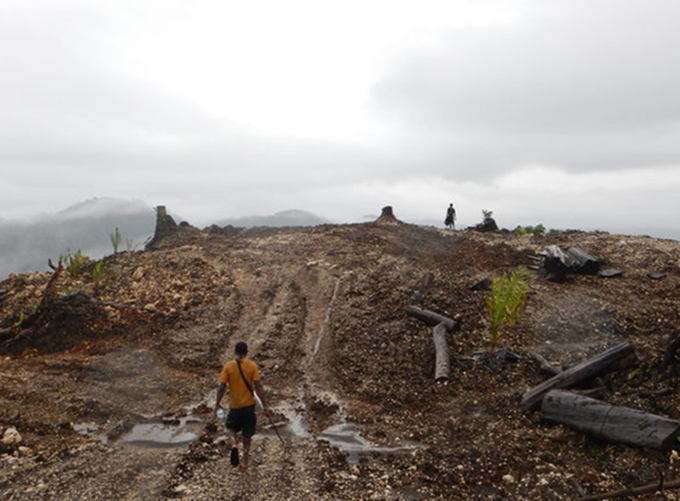
Illegal deforestation Deforestation is rife in Papua New Guinea, with 640,000 hectares of forest felled in the last three years. Much of the logging is illegal, prompting conflict between offending companies and indigenous landowners.
According to The Guardian, millions of tonnes of illegally felled logs are sent to China and PNG is China’s single largest supplier of tropical logs.
Illegal logging activity is often enabled through corruption typical of the previous government under Peter O’Neill.
Prime Minister James Marape has since pledged to stamp out such corruption and work more in the interests of indigenous landowners.
The Solomon Islands government has also discussed changes to the logging industry, with Prime Minister Manasseh Sogavare looking to halt all round log exports by 2023, reports SIBC news.
Sogavare will encourage a shift from round log exporting to downstream processing with more factories set up to process the timber onshore.
Twenty times the sustainable rate According to environmental news website Mongabay, logging companies are clearing Solomon Islands forests at nearly 20 times the sustainable rate.
While Sogavare’s announcement appears to be a step in the right direction, there are concerns that any changes will be hindered by a majority of pro-logging MPs, many of whom are being paid by foreign logging companies.
“You never forget the flu”. This is the title of the Victorian health department’s current campaign, which highlights people’s recollections of having the flu.
‘The flu knocked me out for weeks’, part of the Victorian health department’s winter flu campaign.Vic Dept Health & Human Services
Phrases include “I’ll never forget the pain of the fever”, “the flu flattened me”, “the flu knocked me out for weeks”.
This gives the impression that when you have the flu, you know you have it. What makes the flu so memorable is the severe symptoms. These include fever, aches and pains, a sore throat, runny nose, cough, and feeling weak and lethargic.
But what causes the flu? And why are the symptoms so severe?
Influenza is caused by a virus, a small microbe that needs to enter our cells to replicate and produce more viruses. The influenza virus infects cells that line our airways and so is easily transmitted via the spread of droplets released when we sneeze or cough.
Coughs, sneezes and the other symptoms we feel after getting the flu, are largely due to our bodies fighting the infection.
When you are infected with the flu virus, your innate immune system kicks in. Special receptors recognise unique parts of the virus, triggering an alarm system to alert our bodies that an infection is under way.
This produces a rapid but non-specific response — inflammation.
Inflammation results from the action of small proteins called cytokines. A primary role of cytokines is to act locally in the lung to help limit the initial infection taking hold.
They can also make their way into the circulation, becoming systemic (widespread in the body) and act as a “call to arms” by alerting the rest of the immune system there is an infection.
Unfortunately, your body’s inflammatory response, while trying to fight your infection, results in the flu symptoms we experience.
Inflammation can trigger increased mucus production. Mucus (or phlegm) is a sticky substance that helps capture virus in the lungs and upper airways. The increased amount of mucus in the airways can trigger coughing and/or sneezing, and can lead to a runny nose. This helps expel the virus from our body before it can infect other airway cells.
Inflammation also results in an increase in body temperature or fever, which creates an inhospitable environment for the flu virus to replicate.
While an increased body temperature helps fight the infection, it also results in you feeling colder than usual. That’s because you feel a greater temperature difference between your body and the outside environment.
This can induce rapid muscle contractions in an effort to heat you up. This is why you can feel like you can’t stop shivering while at the same time burning up.
Finally, some of these inflammatory molecules act directly on infected cells to stop the virus replicating. They can do this by either interfering with the replication process directly, or alternatively, by actually killing the infected cell.
One of these factors is tumour necrosis factor alpha (TNF-alpha). While its actions limit where the flu virus can replicate, its side effects include fever, loss of appetite and aching joints and muscles.
Calling in the big guns
Inflammation induced by the innate response also helps alert the adaptive immune system that there is an infection.
While innate immunity provides an immediate, albeit non-specific, response to viral infection, it is the adaptive immune response that can efficiently clear the infection.
The adaptive immune system consists of specialised white blood cells called T and B cells that when activated provide a highly specific response to infection.
Your flu symptoms are likely the result of your body fighting off infection with the the tiny flu virus.from www.shutterstock.com
Activation of flu-specific T and B cells in tissues called lymph nodes results in the generation of hundreds of thousands of clones, all specific for the flu virus. These can migrate into the lungs and specifically target the virus and its ability to replicate.
This enormous expansion of T and B cell numbers in response to infection results in swelling of the lymph nodes, which you can feel under your armpits or chin, and which can become sore.
Flu-specific T cells are also a source of the inflammatory molecule TNF-alpha and help fight influenza infection by killing off virus-infected cells. Both actions can contribute to the flu symptoms.
Why can flu become a serious problem?
Our ability to see off a flu infection requires a coordinated response from both our innate and adaptive immune responses.
If our immune system function is diminished for some reason, then it can prolong infection, lead to more extensive damage to the lung and extended symptoms. This can then result in secondary bacterial infections, leading to pneumonia, hospitalisation and eventually death.
Then there are people whose immune system doesn’t work work so efficiently who are particularly susceptible to the flu and its complications. These include:
the very young, whose immune system is still yet to mature
the elderly, whose immune system function wanes with age
people with other conditions where immune function might be compromised, or be taking medication that might suppress the immune system.
Preventing the flu
Washing your hands and covering your mouth when coughing and sneezing are simple things we can all do to reduce the chance of catching the flu in the first place.
And getting the flu vaccine activates your adaptive immune response to induce the sort of immunity efficient at protecting us from infection.
With the flu season well under way, prevention is our best bet that you won’t be saying “Remember the time I got the flu”.
There is now nothing standing between Indian mining giant Adani and the coal buried in Queensland’s Galilee Basin.
By approving the Adani’s groundwater management plan on June 13, the Queensland government has given the final green light to the company’s controversial Carmichael coal mine.
This plan outlines Adani’s proposed strategies to protect ecosystems that depend on groundwater, such as the Doongmabulla Springs wetland, which some experts have warned could be destroyed by the project. The plan’s approval at a state level removes the final legislative hurdle standing in the mine’s way.
Didn’t the federal government suffer a legal setback this week relating to the mine? Why is the mine still clear to proceed?
On June 12, in response to a legal challenge by the Australian Conservation Foundation, the federal government conceded in the federal court that it failed to properly consider public submissions in passing judgement on Adani’s North Galilee Water Scheme.
This scheme concerns Adani’s plans for taking water from the Suttor River to the east of the mine, which will be required for mining operations.
The federal government will now need to reappraise this proposal. But the approval to take river water does not impact Adani’s ability to start mine construction.
Has Adani made significant changes to its groundwater plan in light of scientific criticism?
In February 2019, CSIRO and Geoscience Australia advised the Queensland government that they did not consider Adani’s groundwater plan adequate for assessing the risk to local springs. They recommended more research drilling, monitoring and analysis, to better understand the source aquifer for the springs.
On June 7, CSIRO and Geoscience Australia responded to a series of questions from the Queensland government. They effectively reiterated their earlier concerns, including that Adani’s groundwater model is not fit for the purpose of assessing the mine’s likely impacts to the springs.
Among a raft of suggested changes to the groundwater plan, they recommended that Adani make firmer commitments to protecting the springs. However, Adani has not strengthened this part of the plan, and actions required to address impacts to the springs remain vague.
Adani has made some changes to the investigations it is required to complete within one to two years. But there appears to be no new scientific work or findings in the most recent version of the groundwater plan to address scientific uncertainties or flaws in the modelling, as pointed out by CSIRO, Geoscience Australia and others.
Does Adani know where the Doongmabulla Springs water comes from?
No. Adani and the Queensland government seem relatively confident that the source aquifer for the springs is a geological unit called the Clematis Sandstone. But the Queensland government acknowledges that some uncertainty remains. The CSIRO and Geoscience Australia advice makes clear the springs could in fact flow from multiple sources, in agreement with a consortium of other experts. Adani has been asked to determine this during the first two years of the mine’s operation.
So have the scientific concerns been satisfied or not?
The final groundwater plan is based on science that has been shown to be questionable and containing crucial errors and data gaps, as indicated in the CSIRO/Geoscience Australia reviews in both February and June 2019. The plan also fails to consider key scientific issues that we raised in collaboration with colleagues from other universities. The shortcomings in the science raised by a range of scientists from multiple universities and agencies will therefore remain unaddressed until after mining activity begins, risking irreversible harm to the Doongmabulla Springs.
We believe that uncertainties in the future groundwater impacts from the mine are high, but could have been addressed if Adani had acted upon the advice it has repeatedly received over the past six years.
After so many government approvals processes, court rulings, and legal challenges, does Adani truly have permission to start digging now?
Yes. Adani’s excavations will mark the start of a highly uncertain experiment into the effects of mega-scale disturbance to a natural groundwater flow system and the ecosystems that depend on it. Time will tell whether the benefits of the mine warrant the impacts it will cause.
Around one in every 70 Australians are on the autism spectrum. The proportion of children with autism is higher – more than 80% of all Australians on the autism spectrum are aged under 25.
Autism is most prevalent among school-aged children between 5 and 14. Many of these children have social, learning, communication and intellectual difficulties.
The high proportion of children on the autism spectrum presents an obvious challenge to teachers and the learning environment. One way they can respond to it is to examine what we know about how these children understand their world and learn.
How memory works
We use our bank of autobiographical memory to tell us how to behave in any situation.from shutterstock.com
To understand what we suspect, so far, about the way in which some people with autism may see the world, we need to examine how we use our autobiographical episodic memory – the bank of experiences we have stored in memory.
This bank of experiences tells us how to behave in any situation. It tells us what we did in past, matching situations, where and when events happened, how we felt at the time and how we coped. These are the time-and-place images of our life history.
We use this memory bank to interpret new situations. The memories help us decide how to act socially or functionally, to imagine how someone might feel and what to expect in the future. They help us transfer our behaviours to new situations and adjust how we behave and think based on the context.
We seem to do these things implicitly. We don’t need to plan consciously how we will act in most new situations. In other words, we modify or adapt our stored experiences automatically to fit the situation in which we find ourselves at any time.
The stereotypical behaviours of individuals with autism suggest they don’t use their bank of experiences spontaneously and automatically in these ways.
Emerging research supports this possibility. It suggests people on the autism spectrum could be less likely to reflect on specific experiences, infer from them or recognise regularities in them.
This would then lead to difficulty modifying stored experiences to use later to interpret other everyday situations.
People on the autism spectrum, depending on where on the spectrum they are, can have difficulty adapting what they have learnt to changes in context. They may find it harder to predict, anticipate or think flexibly and switch how they will act.
Children on the autism spectrum may find it harder to predict, anticipate or think flexibly and switch how they will act.Photo by Limor Zellermayer on Unsplash
At the same time they may be able to learn and recall facts and relationships that are specific, precise and rigid – such as associations between names, symbols and meanings.
Rigidly stored experiences limit the ability to learn and to deal with dynamic social situations. So, people who store memories in this way may be more likely to overreact emotionally and show attention difficulties.
They might also have difficulty linking their experiential knowledge with language. Everyday living, the classroom and the workplace use language as a major vehicle for learning and interacting.
One way to possibly stimulate episodic memory could be through the use of video-based instruction (VBI). This is where videos are used to demonstrate new knowledge and skills in particular contexts.
One review looked at 36 studies that investigated whether video-based instruction helped children with autism gain social skills. It showed students with autism could more easily learn functional skills and transfer and generalise them.
The videos may help participants recall past similar experiences, say what they did and how they coped, and decide how they would act in unfamiliar situations.
Narrative therapy has also been shown to help people with autism deal with social and emotional issues. This therapy is based on imaginary real-life situations.
The children are taught to actively analyse an everyday episode and to build alternative stories around it, with themselves as a protagonist. They learn to visualise the situation and imagine it changing.
Many students with autism often have difficulty with reading comprehension. Some research shows teaching visualisation strategies to reading underachievers generally enhances reading comprehension.
Visualisation strategies can trigger a child’s imagination.from shutterstock.com
This directly target’s a child’s ability to imagine. While reading a narrative, for example, a child is told to note how particular characters are feeling and predict what they might do next, as well as to imagine how others might be feeling.
Visualising scaffolds someone’s episodic memory to form virtual experiences of the text being read and to infer in a range of ways about it. This could also help students with autism. They are taught explicitly to create mental images of what they read, comprehension strategies and also to self-regulate and summarise.
This type of reading intervention for students with autism has been shown to improve links between the verbal and imagery areas of the brain.
Our knowledge of how individuals with autism spectrum disorder know and learn has increased exponentially over the last two decades. Teachers can use some of this knowledge in the classroom, and governments can use some of the emerging evidence to develop programs to help children with autism learn.
Urban design undoubtedly influences the urban economy. A simple thing like designing an area to make it more walkable can boost local business profits. This can also increase real estate value, create more and better jobs and generate stronger local economies.
Street temperatures also determine their walkability. With climate change bringing longer and more frequent heatwaves, street temperatures will become even higher than at present. This will reduce walkability and, in turn, local business profitability.
New York transport commissioner Janette Sadik-Khan explains the impact on street and retail activity of the transformation of Times Square.
The following example helps explain why foot traffic benefits local business. In car-based cities, a take-away coffee on the way to work may involve a series of decisions:
driving the car to a certain cafe
finding car parking
leaving and closing the car
joining a queue to buy a coffee
getting back in the car
proceeding on the journey to work.
In contrast, when walking down the street we may not even have considered having a coffee, but we can smell it. So:
we walk into the cafe
join the queue to buy a coffee
carry on walking to work.
The process is shorter, more spontaneous and part of a daily journey. Impulse buys as a result of exposure to stimuli have surprisingly big economic consequences, particularly for the retail industry.
What is microclimate?
Microclimate refers to the atmospheric conditions in an area. These can vary not only from the surrounding region but also within the area itself. Both the natural and built environments influence these differences. A well-known example of such differences is in Sydney’s western suburbs, which are much hotter in summer than the eastern suburbs, which benefit from being close to the sea and cooling breezes.
But can an unpleasant microclimate suppress impulse buys? To a certain extent, yes. The frequency of impulse buys, and ultimately the overall success of most businesses in tropical cities, may be connected to the local microclimate.
For instance, the orientation of streets in relation to sun and breeze exposure can influence the microclimate. This can then determine if people stay and have a second coffee or extra ice cream after lunch, or if they avoid streets because they are too exposed and hot.
Australian cities, however, are too often overzoned and planned in a sprawling pattern. By compromising walkability this represses spontaneous purchases.
CBDs are also too frequently oversized with unshaded wide streets. In hot climates this makes the journey on foot unpleasant and poses health risks to young children, senior citizens and people with health conditions.
Microclimates and the tropics
To date, a growing body of research on this question has focused mainly on capital and metropolitan cities with humid continental climates. The assumption is that those cities are more vulnerable to the effects of higher temperatures. However, looking only at these kinds of cities can lead us to overlook important variations.
Coastal tropical cities can also experience unpleasant microclimates. While the tropics are seen as perfect holiday locations, high summer temperatures can compromise street life.
The qualities and materials of buildings and infrastructure such as roads and footpaths also influence local temperatures. Large areas of hard, heat-absorbing surfaces contribute to the urban heat island effect, which makes urban areas hotter than their surroundings. The effects of this on urban life and economic activities become more critical in hot and humid tropical conditions.
In essence, microclimate affects the use of the footpath. If the microclimate discourages the use of public space, then a great design may not be enough to create the type of environment that attracts street life and generates strong local economic activity.
Shields and Lake Street corner in Cairns: great design, plenty of trees and shade, but little activation.Silvia Tavares
Considering this problem, our ongoing research focuses on tropical cities. We are investigating the relationship between urban microclimate, labour productivity, sales revenue and real estate values.
Is there, for instance, an optimum location for certain types of land use according to their suitability and need to use the footpath? If one side of the street is more exposed to the sun than the other, it may be more suitable for establishments that don’t make active use of the streetscape, such as stores and offices, rather than cafes and restaurants.
Another question is does microclimate affect the productivity of businesses differently across urban and non-urban surroundings?
Part of the solution to rising urban temperatures could focus on street orientation and exposure to breezes. Priority could be given to siting cafes, for instance, in pleasant areas, with tables outside to help activate spaces. Instead of creating zoning that kills flexibility and dynamic spaces, planning guidelines for tropical street life should consider the types of businesses suited to specific street microclimates.
In a warming climate, designing for microclimate is more important than ever before to ensure urban life and economies can prosper.
A somewhat obscure fact about the marching orders for Australia’s Reserve Bank is that, usually, when a government is elected or re-elected or a new governor takes office, the official agreement between the government and the Reserve Bank changes.
There have been seven such agreements so far, each signed by the federal treasurer and bank governor of the time, and each entitled “Statement on the Conduct of Monetary Policy”.
The first was signed by treasurer Peter Costello and incoming governor Ian Macfarlane in 1996, the second when Costello reappointed Macfarlane in 2003, and the third when Costello appointed Glenn Stevens in 2006.
The fourth was between new treasurer Wayne Swan and Stevens on Labor’s election in 2007, and the fifth between Swan and Stevens on Labor’s reelection in 2010.
The sixth was between incoming treasurer Joe Hockey and Stevens on the Coaition’s election in 2013, and the most recent one between treasurer Scott Morrison and incoming governor Philip Lowe in 2016.
The Statement on the Conduct of Monetary Policy (the Statement) has recorded the common understanding of the Governor, as Chair of the Reserve Bank Board, and the Government on key aspects of Australia’s monetary and central banking policy framework since 1996.
For nearly a quarter of a century, as the statement goes on to note, there has been a core component of how monetary policy is conducted:
The centrepiece of the Statement is the inflation targeting framework, which has formed the basis of Australia’s monetary policy framework since the early 1990s.
But over the years, there have been tweaks. One was this change between the 2013 and 2016 statements.
Effective management of inflation to provide greater certainty and to guide expectations assists businesses and households in making sound investment decisions…
The change from “low inflation” to “effective management of inflation” sounds subtle, but was no accident. It gave the Reserve Bank extra wiggle room around the inflation target.
And boy, did it come in handy.
The target that’s rarely met
The big question about the agreement is whether the next one (between Frydenberg and Lowe on the Coalition’s reelection) will tweak the target again, change it completely, or do something in between.
Because it presumably can’t remain the same.
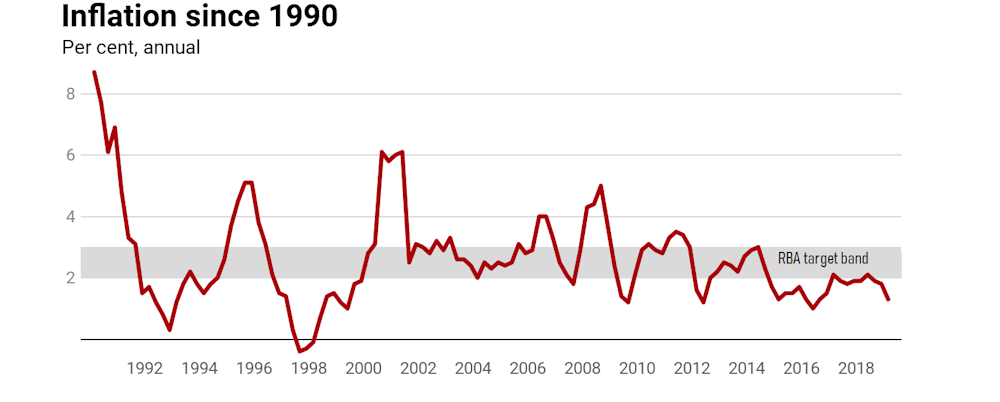
One reason to think it will change, perhaps significantly, is the bank’s utter inability to even get particularly close to its target inflation band of 2-3%, let alone to get within tit, “on average, over time” as required by the agreement.
For years now, inflation has mostly been below the band.ABS 6401.0
You might not think this matters too much. But it does.
The inflation target is crucial in setting stable expectations for consumers, businesses and markets.
Don’t just take my word for it.
Here is what the previous Reserve Bank governor, Glenn Stevens, said in his last official speech before handing over to Philip Lowe in August 2016:
From 1993 to 2016, a period of 23 years, the average rate of inflation has been 2.5% – as measured by the CPI, and adjusting for the introduction of the goods and services tax in 2000. When we began to articulate the target in the early 1990s and talked about achieving “2–3%, on average, over the cycle”, this is the sort of thing we meant. I recall very well how much scepticism we encountered at the time. But the objective has been delivered.
As I pointed out last month, expectations about price movements depend on Australians believing that the bank will do what it says it will do.
Once people lose faith in the bank’s commitment to or ability to achieve the target, inflation expectations become unmoored. People react to what they think what might happen rather than what they are told will happen. This is what led to Australia’s wage-price spirals in the 1970s and 1980s, and to Japan’s lost decades of deflation.
Three possible outcomes
One possibility is the same statement, word for word. It would be meant to signal that the bank and the government think things are under control.
A second possibility is a tweak that furhter emphasises the “flexible” nature of the target, along the lines Lowe mentioned in his speech at this month’s Reserve Bank board board dinner in Sydney. It would provide more cover for the bank’s inability to hit its target.
A third option would be to add some discussion of the importance of fiscal policy – government spending and tax policy – as a complement to the Reserve Bank’s work on monetary policy. Lowe is keen to mention that he is keen on it, every chance he gets.
But that would put the government under implicit pressure to run budget deficits at times like those we are in rather than surpluses. It’s hard to see the Morrison government signing up for that, given its repeated talk during the election about the importance of being “responsible”.
Or something more
At the more radical end of the spectrum would be a genuinely new framework for monetary policy.
In the United States, which has also missed its inflation target, though by not as much as Australia, there has been much discussion of moving to a “nominal GDP target”. The range mentioned is 5-6% a year.
Advocates of this include former US Treasury secretary Larry Summers, who outlined his rationale in a Brookings Institution report in mid-2018.
ANU economist and former Reserve Bank board member Warwick McKibbin championed the idea along with economists John Quiggin, Danny Price and then Senator Nick Xenophon in the leadup to the 2016 agreement between Morrison and Lowe.
Nominal GDP is gross domestic product before adjustment for prices. In countries subject to big changes in export prices such as Australia, it can provide a better guide to changes in income.
When nominal GDP is strong (as it is when minerals prices are high) consumer spending is likely to be strong – perhaps too strong. When it is weak (as it is when minerals prices collapse) consumer spending is likely to be weak and in need of support.
But don’t get your hopes up
Given the natural caution of the bank and of this government, we should probably expect something at the modest end of the spectrum – even if something like a nominal GDP target would make sense.
Perhaps what’s most important isn’t what the statement says, but that it says something and that the Reserve Bank sticks to it. It will lose an awful lot of credibility if it sticks to nothing.
Let’s face it, Thursday evenings on ABC television are not quite the same any more. The mesmerising, idiosyncratic sketches of Clarke and Dawe are now consigned to Australian television history. Still, Sammy J has taken the spot, and the good news is that the spirit of Clarke lives on. Sammy J’s gormless, football coach character, the strongman at the helm of the “Blue Ties”, delivers the rebukes to our politicians in a register we all recognise. The sketches are clever, dry and whip smart. The coach is comical with his blokey, narcissistic armoury of quips.
Sammy J is versatile too. One night in the guise of an auctioneer for “Sothejays Auction House”, he sold off most of the LNP cabinet – seeing off the pre-election deserters. In another episode, he diligently sold off the ABC, with “Channel 9, Network 10, the IPA, Mark Latham, Newscorp and the Communications Minister” assembled for this “steal, after the 254 million dollar cuts to the formerly publicly owned broadcaster, now broken down, torn apart and ready to be sold off to the highest bidder”.
The satire in those two Sothejays episodes is seamless, as it was in so many of the two-minute gems delivered by Clarke and Dawe. We recognise and admire the comic ingenuity each week because the sketches refer to the events that we’ve all just witnessed in the news. Our despair, rage and incredulity, turns to delight and we can breathe again after the release of laughter at seeing our pollies skewered.
Edna as pioneer
Barry Humphries pioneered topical, referential satirical comedy in Australia in the 1950s. Carol Raye, Max Gillies, John Clarke, The Chaser and others developed it and brought innovation to satire in their characters and programs. The flipside of topical satire and its comic immediacy is that the work dates immediately. The elements – the factual reference points of the satire – become hard to trace over time, particularly for new audiences, and then eventually – sometimes quite quickly – the performer is consigned to history.
But the style and power of the satire, the achievement of the performer and the innovation that the individual brings to their form and the genre, often informs the next generation, sometimes directly, and sometimes indirectly. In that way the original contribution and its spirit lives on in the traditions that follow, building a distinctive comic culture over time.
In 1955, with the Olympic Games to be staged in Melbourne the following year, the organisers were fixated on the problem of housing the influx of visitors, and the fact that the athletes’ village in Ivanhoe was not yet finished. In a parody of the Australian, and specifically Melbourne tendency to pronounce “average” as “everage”, Barry Humphries called his plain and timid character Mrs Norm Everage or Edna, after the kind lady who had looked after him as a small boy.
In a Christmas revue sketch directed by Ray Lawler, Humphries dressed as Edna Everage offered to open her home in Humouresque Street, Moonee Ponds to a visiting athlete, and asked the most preposterous questions about the visitors. In the stage sketch a government official listed the nationalities of the potential guests and Edna responded with bigoted comments about all of them.
The sketch was called “The Olympic Hostess” and Noel Ferrier played Mr Hopechest, the official interviewing Mrs Everage. In 1955, she was shy in comparison to her later incarnations. She described her bedroom with its newly painted duck-egg blue walls and chenille bedspread.
“But you surely don’t wish to share your bedroom with the athletes?” the official exclaimed. “Oh, goodness, no. Norm isn’t as sporting as all that,” she replied.
Mrs Everage stated that she would prefer to host someone from the Commonwealth, and that she didn’t mind if they were “a little tinted”, “perhaps someone from Ceylon”. She felt sure that meeting an athlete would be good for her son, Kenny, and broaden his horizons.
Barry Humphries as Mrs Norm Everage in her travelling abroad outfit, appearing live on television, 1959.Courtesy of Barry Humphries Collection, Australian Performing Arts Collection, Arts Centre, Melbourne.
The 21-year-old Humphries borrowed a yellow felt hat belonging to his mother for the sketch, one that Louisa Humphries had intended to wear to the races. Edna wore a twinset underneath a light beige coat, the kind of garment women wore into the city on the tram to cover their bare arms.
The tall, spindly-legged Humphries spoke to the audience in their own vernacular about their own homes. It was an important moment for Australian theatre, but the audience was slightly stunned, and the sketch was regarded as only moderately successful. Barry never imagined that he would perform the character again. Little did he realise that this 1950s “Mrs Average” would take on a life of her own.
On John Laws’ Friday night television variety show, Startime in 1962, Humphries introduced Mrs Everage as a “a very close friend of mine”, and then appeared in a coat and a small hat, extolling the virtues of plastic gladioli, and declaring that it was wonderful to be back in Australia. Humphries himself was back in Australia after a few years in London for his touring stage show, A Nice Night’s Entertainment.
The studio audience for Startime laughed loudly at Mrs Everage. Edna’s commentary on Australian manners would become the centrepiece of an ongoing drama devised by Barry on the subject of Australia over the next 50 years. His anarchic, sometimes cruel comedy still raises eyebrows today and enrages his critics.
He ran into serious trouble in 2003 when Edna insulted Hispanics in the US in a column for Vanity Fair, instructing readers to
Forget Spanish … Who speaks it that you are really desperate to talk to? The help? Your leaf blower? Study French or German, where there are at least a few books worth reading, or, if you’re American, try English.
Swamped by complaints the editor attempted to explain the satire, calling Edna “an equal opportunity distributor of insults”.
In the last few years, Humphries and Edna have crossed the line several times. The actor called transgenderism a “fashion” in The Spectator earlier this year, causing offence with comments such as: “How many different kinds of lavatory can you have? And it’s pretty evil when it’s preached to children by crazy teachers.” The Barry Award, named after Humphries, is no more, after some controversy.
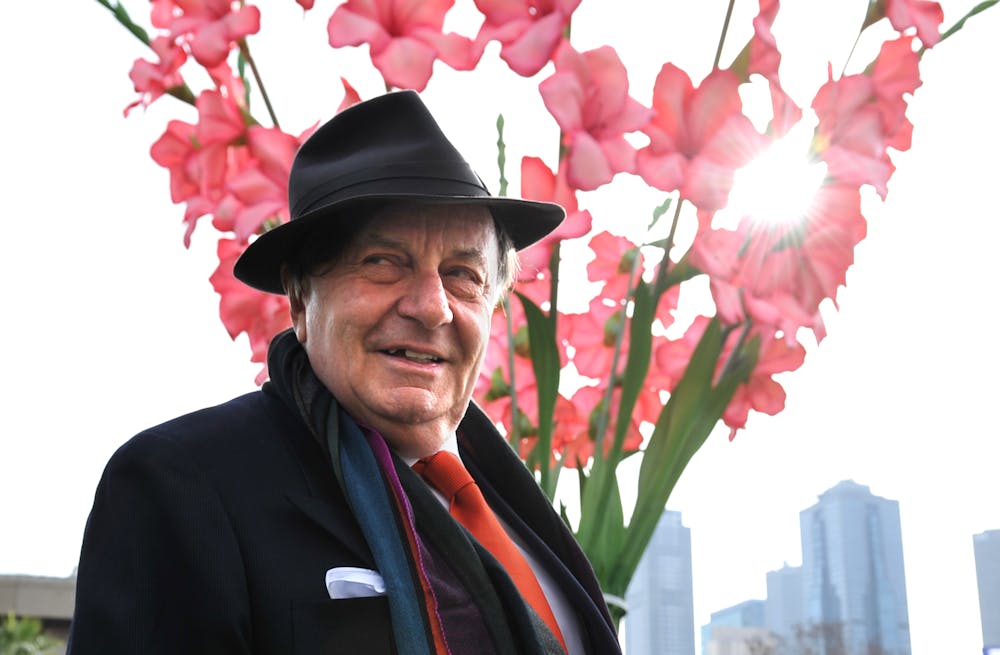
Barry Humpries in 2012 visiting Bouquet, a 13-metre towering vase of gladioli created by theatrical designer Brian Thomson on the Arts Centre Melbourne lawn.Julian Smith/AAP
Public taste has changed and that is that. Humphries is primarily of historic interest now. That’s how satire and comedy work. It’s not just the references that date in topical satire. Audiences are powerful, and if they feel insulted they can shut down a comedian.
Clarke and Bazza
John Clarke’s career began in earnest through first hand observations of Barry Humphries on and off the stage. Clarke met Humphries in the early 1970s in London, and it was through this meeting that he began to glimpse a future for himself in comedy.
Clarke was working as a van driver and spending his afternoons and evenings in the pub when his friend, Ginette McDonald, convinced him to audition for the young Australian director Bruce Beresford, who, she’d heard, was making a film in which a lot of young men were required.
Clarke had appeared in revue theatre back at home in New Zealand but was reluctant to attend an audition. But when he read the script for The Adventures of Barry McKenzie he roared with laughter, and was awestruck by the talent of the three men driving the film: Beresford, Humphries and Nick Garland. Garland, a New Zealander, had drawn the cartoons for the Barry McKenzie comic strip, on the which the film was based.
Peter Cook and Barry Humphries in The Adventures of Barry McKenzie (1972).Longford Productions
During the filming, Beresford and Humphries shepherded Clarke along. John spent hours talking to Humphries about what Humphries had read as a young man. The audacity of this gangly, long-haired, young Australian and his vivid humour struck Clarke immediately, and was to have a huge influence on Clarke’s evolution as a performer.
John Clarke as Fred Dagg.Courtesy of John Clarke.
Clarke noticed that Humphries performed for a world audience, and while he parodied the cultural cringe, he and Beresford asserted their equality with everything and anything British at every opportunity. Clarke felt that he could be himself with these men; better still he could be himself in the film, appearing in the pub scenes singing and drinking with Bazza McKenzie.
Being permitted to play himself was the key to Clarke’s performance style and his future as a satirist: not only did it offer him a strangely comforting armour, but it provided the perfect satirical weapon and a mode of directly addressing the audience.
The experience of working with Humphries and Beresford emboldened Clarke in the long run and he returned to New Zealand to start work as a performer. By the end of the year, Clarke had made his first television appearance as Fred Dagg, an endearingly dishevelled sheep farmer who went on to charm audiences in New Zealand and Australia for years to come.
Gillies, Hawkie and the glory days
John Clarke carefully explained to me in several interviews I conducted with him over the years that if he had not experienced that work with Humphries, he would not have created Fred Dagg, or had the confidence to create satirical television. He always took time to observe. When he moved to Australia in 1977 he took things slowly.
He encountered the masterful mimic, Max Gillies, and at Gillies’ invitation contributed to the scripts of The Gillies Report, a hugely popular weekly satirical television sketch show on the ABC that featured Max playing all the politicians of the day, and John as a news reader, amongst other roles. Max’s powers of mimicry and rich, politically potent satirical impersonations seized the imagination of the whole country; the hyper-theatricality of the sketches and rollicking musical production numbers struck a chord with viewers.
Gillies had first created a magnificent version of Bob Hawke when the former ACTU president rose to power, playing the charismatic, savvy, effervescent man of the people with such flair that many mistook him for the Prime Minister. Gillies even appeared as Hawke in Hawke’s presence, addressing the North Melbourne Foootball Club grand-final breakfast in character as the PM. It is unusual for performers to appear in the presence of those they impersonate, and it was the first and only time in Australian history that a Prime Minister has allowed it.
Yet Hawke’s ambivalence was clear to observers and to Gillies that day. Shaking hands with everyone at the high table, Gillies, dressed in his silver suit, large cufflinks and expensive wavy-haired wig, ran the gauntlet of the Club President, the Lord Mayor of Melbourne, finally greeting the man himself, Robert James Lee Hawke. The leering Prime Minister grabbed Gillies’s hand so vigorously his wrist throbbed and before he knew it Hawke had pulled him into a tight, face-to-face, with cameras flashing all around them.
Gillies blinked as Hawke suddenly let go of his hand and brought his fist to Max’s nose, punching him in a stinging bop, as he turned to approach the podium to give his performance of the man who had just hit him. It was a playful but not painless pre-emptive “alpha male” warning to the actor. It’s difficult to imagine such a scenario today but who knows, with “ScoMo” and “Albo” at the helm.
Manning Clark cast Humphries among the mythmakers and prophets of Australia as he witnessed the man “enriching the culture which had been dominated by the straiteners”. Peter Conrad described Humphries’ adolescence as a “one-man modern movement”, and the American critic John Lahr admired the art of the clown who takes the public to the “frontiers of the marvellous”.
Anyone who saw Humphries perform his one man shows in the glory days knows that Lahr was right. But that is now history.
continue the Morrison Government’s work to make the internet a safer place for the millions of Australians who use it every day.
Addressing online racism is a vital part of this goal.
And not just because racism online is hurtful and damaging – which it is. This is also important because sometimes online racism spills into the real world with deadly consequences.
An Australian man brought up in the Australian cyber environment is the alleged murderer of 50 Muslims at prayer in Christchurch. Planning and live streaming of the event took place on the internet, and across international boundaries.
We must critically assess how this happened, and be clearheaded and non-ideological about actions to reduce the likelihood of such an event happening again.
There are six steps Australia’s government can take.
1. Reconsider international racism convention
Our government should remove its reservation on Article 4 of the International Convention on the Elimination of All Forms of Racial Discrimination (ICERD).
In 1966 Australia declined to sign up to Article 4(a) of the ICERD. It was the only country that had signed the ICERD while deciding to file a reservation on Article 4(a). It’s this section that mandates the criminalisation of race hate speech and racist propaganda.
The ICERD entered into Australian law, minus Article 4(a), through the 1975 Racial Discrimination Act (RDA).
Article 4 concerns, such as they were, would enter the law as “unlawful” harassment and intimidation, with no criminal sanctions, twenty years later. This occurred through the 1996 amendments that produced Section 18 of the RDA, with its right for complainants to seek civil solutions through the Human Rights Commission.
With Article 4 ratified, the criminal law could encompass the worst cases of online racism, and the police would have some framework to pursue the worst offenders.
Our government should extend Australia’s participation in the European cybercrime convention by adopting the First Additional Protocol.
In 2001 the Council of Europe opened the Budapest Convention on Cybercrime to signatories, establishing the first international instrument to address crimes committed over the internet. The add-on First Additional Protocol on criminalisation of acts of a racist and xenophobic nature came into effect in 2002.
Australia’s government – Labor at the time – initially considered including the First Additional Protocol in cyber crime legislation in 2009, and then withdrew it soon after. Without it, our country is limited in the way we collaborate with other country signatories in tracking down cross border cyber racism.
3. Amend the eSafety Act
The Enhancing the Online Safety of Australians Act (until 2017 Enhancing the Online Safety of Children Act) established the eSafety Commissioner’s Office to pursue acts which undercut the safe use of the internet, especially through bullying.
The eSafety Act should be amended by Communications Minister Fletcher to extend the options for those harassed and intimidated, to include provisions similar to those found in NZ legislation. In effect this would mean people harassed online could take action themselves, or require the commissioner to act to protect them.
Such changes should be supported by staff able to speak the languages and operate in the cultural frames of those who are the most vulnerable to online race hate. These include Aboriginal Australians, Muslims, Jews and people of African and Asian descent.
4. Commit to retaining 18C
Section 18C of the RDA, known as the racial vilification provisions, allows individuals offended or intimidated by online race hate to seek redress.
Rather than just leaving this dangling into the future, the government should commit itself to retaining 18C.
Even if this does happen, unless Article 4 of the (ICERD) is ratified as mentioned above, Australia will still have no effective laws that target online race-hate speech by pushing back against perpetrators.
Australia’s government should conduct a public review of best practice worldwide in relation to combating cyber racism. For example, it could plan for an options paper for public discussion by the end of 2020, and legislation where required in 2021.
European countries have now a good sense of how their protocol on cyber racism has worked. In particular, it facilitates inter-country collaboration, and empowers the police to pursue organised race hate speech as a criminal enterprise.
Other countries such as New Zealand and Canada, with whom we often compare ourselves, have moved far beyond the very limited action taken by Australia.
6. Provide funds to stop racism
In conjunction with the states plus industry and civil society organisations, the Australian government should promote and resource “push back” against online racism. This can be addressed by reducing the online space in which racists currently pursue their goals of normalising racism.
Such action characterises many European societies. Another good example is the World Wide Web Foundation (W3F)) in North America, whose #Fortheweb campaign highlights safety issues for web users facing harassment and intimidation through hate speech.
Speaking realistically, the aim through these mechanisms cannot be to “eliminate” racism, which has deep structural roots. Rather, our goal should be to contain racism, push it back into ever smaller pockets, target perpetrators and force publishers to be far more active in limiting their users’ impacts on vulnerable targets.
Without criminal provisions, infractions of civil law are essentially let “through to the keeper”. The main players know this very well.
Our government has a responsibility to ensure publishers and platforms know what the community standards are in Australia. Legislation and regulation should enshrine, promote and communicate these standards – otherwise the vulnerable remain unprotected, and the aggressors continue smirking.
Source: The Conversation (Au and NZ) – By Karen Farquharson, Head, School of Social and Political Sciences and Professor of Sociology, University of Melbourne
The AFL and its clubs have finally issued an apology to two-time Brownlow Medallist Adam Goodes for their handling of the relentless racist booing that marred his last year of football in 2015. This apology is welcome, though certainly overdue.
Despite its failures to adequately address Goodes’ situation at the time – and its subsequent delay in apologising – the AFL has actually been considered a leader in Australian sport for its efforts to stamp out racism among players.
The league enacted racial vilification policies in 1995 in response to incidents of racial vilification during games. Since then, these policies have been very effective in eliminating racial abuse on the field, though they have not had the same impact on taunts from spectators, as Goodes’ experience clearly shows.
The key element that works is that players now receive meaningful penalties for racial abuse: fines, suspensions, and being publicly named as perpetrators. The policy shifts the focus from the player who is the victim of the racism to the player who perpetrates it.
The AFL’s approach to managing racial vilification has been adopted throughout Australian sport, including at the community level.
But it may be surprising to hear that these efforts to tackle racism on the field have been largely ineffective in junior sport. And it is at junior sport level where children learn the norms, values and practices around what is and is not acceptable behaviour.
We recently conducted an in-depth study of how junior sports clubs manage diversity. Our study conducted over 100 interviews and 450 surveys with players, coaches, parents and committee members from nine community sports clubs across five sports in Victoria. One of the types of diversity that we studied was ethnic or cultural diversity.
Our analysis found that racial vilification was a common occurrence among players in junior sports, as well as with spectators. Our interview data indicates that it is occurring across most sports and among both boys and girls, with non-white children being the targets of most abuse.
For example, one club official at a junior football club said to us:
Our Sudanese boys get vilified every second to third week, at least.
Another junior football club told us:
Some of our Muslim kids are regularly vilified but they’ve learned to shrug and move on.
While all the clubs we surveyed had an official process for handling racial abuse – similar to the one developed for players in the AFL – it was almost never utilised.
Instead, clubs preferred to use informal means to address the incidents, such as coaches or managers speaking to their counterparts on the other team during a match, or club presidents doing the same after a match.
Sometimes, children experiencing racial abuse were pulled out of the match for their own protection. The reason the clubs gave us: the children who were vilified were unlikely to receive a positive outcome from making a formal complaint.
This is because complaints never led to consequences for abusers, only for the abused.
Tolerance for racist behaviour in sport
Academic research into denial of racism in Australia has found that many people fear speaking out against racial incidents because they are likely to be punished for doing so.
This was certainly the case for Goodes, whose troubles began when he complained of being racially vilified by a 13-year-old girl during a football match in 2013. and intensified when he focused attention on racism after being named Australian of the Year in 2014.
Not only was Goodes systematically booed the following season for his efforts to speak out against racism, the lack of response from the AFL at the time reinforced the message that such acts are acceptable. There have been no consequences for the fans who vilified Goodes, or for those in the league who tacitly supported the booing by not coming out against it.
Though policies have been enacted by the AFL and other sports leagues to tackle racism on the field, there’s still the broader cultural problem of racial vilification from spectators – and on social media. This culture is maintained through a tolerance for racism that begins in junior sport.
North Melbourne fans booing Adam Goodes during his tumultuous 2015 season.Julian Smith/AAP
What can be done to fix the problem
We would argue that the process for addressing racial vilification in junior sport, as it stands, is ineffective. So how do we fix the problem? Our study identified some actions that could work.
According to our interviews, the most effective way to address racist taunts by players was for their own teammates to call it out. In more extreme cases, some of the teams we surveyed refused to continue the match if a player was being vilified. This had an immediate effect – the racist behaviour stopped and didn’t start again.
It would also be effective for officials to act against perpetrators when they see racial abuse happening, either by ejecting players from the game or spectators from the field. According to our research, this is not a step that officials take now to handle such incidents.
As Goodes’ experience in the AFL illustrates, there needs to be consequences for those who engage in racial abuse in sport, particularly at the junior level where attitudes are learned and ingrained.
As it stands, the only ones negatively impacted by racial abuse in junior sport are the victims. If we want a sporting landscape where all are welcome and enabled to thrive, this is unacceptable.
Team work is common across society. From schools to multinational businesses, people usually collaborate in groups towards a shared goal.
It can work well, but sometimes, it can be a disaster. One team might create a proposal for a new policy because all members manage to agree on details, while another fails because they can’t find common ground.
Why is it that groups can vary so much in their outcomes? We know that some people are better team players than others. In fact, job interviews and personality assessments often include questions about team skills.
But this assumes that only individual personality is relevant, not the interaction between people with various personality characteristics.
Investigating group behaviour
We don’t yet fully understand how different personality types within a group interact and how that affects group outcomes. To address this, we investigated which mixes of personalities create more or less cooperative group working styles.
We wanted to know whether it matters how many group members show personality traits that have been found to be less cooperative. People high on so-called psychopathic personality traits are characterised by goal-oriented, fearless, impulsive, manipulative behaviours, and also by less cooperative behaviours such as refusing to find common ground when interacting with another person.
But does the proportion of individuals high on these traits within a group matter for the overall group behaviour?
We asked participants to decide whether to cooperate with the people sitting next to them in mixed groups, composed of different numbers of participants with high or low scores on a questionnaire for psychopathic personality traits.
Participants who did not know each other were asked if they would like to cooperate with the people next to them, over a series of rounds.Supplied
We found groups that were composed entirely of people with low psychopathic traits and groups with a low proportion (20%) of individuals with high psychopathic traits showed the expected cooperative behaviour. But in groups with a larger proportion (50%) of individuals with high psychopathic traits, the overall rate of cooperative behaviour was significantly lower. We measured this by the number of cooperative decisions participants in a group made.
The overall group behaviour seems to be more than the sum of its parts. Group composition had an effect on cooperation over and above the effect of the individuals’ own level of psychopathic traits. Group members with low levels of psychopathic traits behaved less cooperatively and more “psychopathically” when in groups with more people who had high levels of psychopathic traits.
This suggests that interacting with people with high psychopathic traits increases uncooperative behaviour across all members of a group. The personality characteristics of group members matter for cooperative behaviour, and can change individuals’ behaviour. But the effect is only seen when a substantial proportion of individuals in a group have non-cooperative personality traits.
These findings indicate that group composition matters. Teams working on a collaborative task are more likely to cooperate successfully if most of the group members have more cooperative personality types. But our findings also trigger new questions about what role the type of task plays in collaborations and whether group behaviour stabilises over longer time periods.
In his first days as leader Anthony Albanese has taken two decisive actions to reset Labor’s relationship with the militant Construction, Forestry, Maritime, Mining and Energy Union.
Reshuffling Labor’s frontbench, he removed responsibility for industrial relations from Brendan O’Connor, whose brother Michael is the CFMMEU’s national secretary. This was always a huge conflict of interest, but one that Bill Shorten as opposition leader declined to address.
Then this week Albanese moved to turf out of the ALP the union’s Victorian secretary John Setka, whose behaviour over a long period has been notorious. Albanese had Setka’s party membership suspended, and he flagged he’ll ask for his expulsion at next month’s ALP national executive meeting.
Under Shorten, the CFMMEU had what many regarded as a special position. The union formed part of his base, and protected and helped him when he needed numbers.
Albanese has had no such relationship, and he repeatedly emphasises that he’s come to his position without any deals or obligations.
That has made it all the easier for him to take on Setka, who should have been called out a very long time ago.
The trigger point Albanese used was a report that Setka had denigrated anti-domestic violence campaigner Rosie Batty, in remarks he made at a meeting of the union executive. Setka was talking about charges he’s facing of using a carriage service to harass a woman – he has already said he’ll enter a guilty plea. He was reported to have told the union meeting that Batty’s work had led to men having fewer rights.
Albanese was well aware the Setka affair was about to become a lot uglier in coming days, and the ALP needed to shake him off.
Setka’s initial fightback took the form of appearing hand-in-hand with his wife at a news conference, in which they said they’d been to hell and back and people should lay off them.
Setka denied he’d denigrated Batty, a denial quickly backed by a couple of officials at the meeting. This potentially complicated the situation for Albanese (who insisted he’d checked out the report) in the event of Setka fighting the expulsion move.
But precisely what he’d said or not said about Batty became fairly irrelevant once ACTU Secretary Sally McManus weighed in, meeting Setka on Thursday to tell him he should quit his union position.
McManus, incidentally, believed Setka’s denial; she too had checked out the report, and was satisfied “he never said anything to denigrate Rosie Batty”. Rather, she argues he should quit as an official because of his behaviour (which she stresses she can’t comment on in detail for legal reasons) and the damage being caused.
For the union movement, the Setka affair goes to the heart of its strong pitch against domestic violence, and its credentials in championing women’s rights. The ACTU currently is led by two women – its president is Michele O’Neil – making it even more imperative to match words with actions.
“There is no place for perpetrators of domestic violence in leadership positions in our movement,” McManus said in her Thursday statement.
“We have already put on record the union movement’s values and our principles regarding family and domestic violence.
“We also believe in equality for women and know that instances of violence against women are not just unacceptable, they stand in the way of achieving equality.”
She told the ABC the Setka issue was “about the broader reputation of the union movement, and I think it means that we are in a position where we can’t continue to advocate in the way we want to on issues while John Setka is the main story”.
McManus, who consulted widely with union leaders in taking her stand, is reflecting the position of a number of important unions, such as the Australian Services Union, which represents those who work in domestic violence services and the SDA (the “Shoppies”), which has many female members.
Unsurprisingly, Setka says he won’t resign, and he has the backing of Victorian branch delegates, making it uncertain how things will play out.
It’s a safe bet the ALP executive will back Albanese’s expulsion move – not to do so would be an inconceivable repudiation of his leadership.
With her authority on the line, McManus’s gamble is that as the story unfolds, Setka will be more isolated and will eventually step down or be forced to do so.
Asked whether the ACTU could disaffiliate the union if it would not get rid of its rogue official, McManus said this wasn’t something that had been thought about. She pointed out it would be a very serious course to take over one official.
But one thing the ACTU has been thinking about is the ammunition Setka is giving the government for its fresh push to bring in tough legislation – the Ensuring Integrity bill – to crack down on unions and officials that break the law.
Among its provisions, the legislation would “allow the Federal Court to prohibit officials from holding office who contravene a range of industrial and other relevant laws, are found in contempt of court, repeatedly fail to stop their organisation from breaking the law or are otherwise not a fit and proper person to hold office in a registered organisation”.
The bill was before the last parliament; it was opposed by Labor, and there wasn’t sufficient crossbench support to pass it.
But now the government is hot to trot. Assuming Labor continues to oppose, the question will be whether the government can get it through a Senate likely in general to be easier for the Coalition than the last one was.
It would come down to the votes of One Nation and Centre Alliance. One Nation would be on board. Centre Alliance would want changes that applied equivalent provisions to misconduct in the corporate sector.
If the union movement can’t deal with its Setka problem, the government’s argument, and its hand, certainly will be strengthened in its battle for the bill.
As one union man put it succinctly, “John Setka has bought the naming rights to the Ensuring Integrity legislation”.
The Solomon Islands Government should exercise caution as it considers whether to maintain diplomatic ties with Taiwan or switch to China, an academic says.
Last week, amid diplomatic visits from both Australia and New Zealand, the Solomon Islands Foreign Minister Jeremiah Manele said the government would take its time to make an informed decision.
The director of the Centre for Pacific Studies at the University of Hawaii, Dr Tarcisius Kabutaulaka, said China’s aid focus on large infrastructure projects was appealing to some Solomon Islands MPs.
But leaders need to consider whether the country can manage not only the potential debt that could be incurred but also the intensity of a relationship with China, he said.
“Think about whether or not we are prepared for a relationship that is going to come with intensity both in terms of diplomacy as well as in terms of investment and how we can best benefit from it,” Dr Kabutaulaka said.
-Partners-
“So at the end of the day it is the interest of the Solomon Islands people that is the most important thing.”
Dr Kabutaulaka also said Australia and New Zealand’s actions in the Pacific speak louder than their attempts to play down concerns over the Solomon Islands considering cutting diplomatic ties with Taiwan in favour of China.
In their official statements during last week’s visits to Solomon Islands, both Australia and New Zealand said they were not putting any pressure on the country either way.
But Dr Kabutaulaka said Australia’s Step Up and New Zealand’s Pacific Reset policies told a different story.
“We cannot get away from the fact that Australia and New Zealand have … have done in recent years attempted to strengthen their influence in the Pacific Islands region vis-a-vis the rising presence or assertive presence of the People’s Republic of China,” Dr Kabutaulaka said.
This article is published under the Pacific Media Centre’s content partnership with Radio New Zealand.
A recent survey on the world’s plants found a shocking number have gone extinct – 571 since 1750. And this is likely to be a stark underestimate. Not all plants have been discovered, so it’s likely other plants have gone extinct before researchers know they’re at risk, or even know they exist.
In Australia, the situation is just as dire. The Threatened Species Recovery Hub recently conducted two evaluations that aren’t yet published of extinct plants in Australia. They found 38 have been lost over the last 170 years, such as the Daintree River banana (Musa fitzalanii) and the fringed spider-orchid (Caladenia thysanochila).
But uncertainty about the number of plant extinctions, in addition to the 38 confirmed, is an ongoing concern.
Both studies pointed out the actual number of extinctions is likely to be far more than those recognised in formal lists produced by the Commonwealth and state and territory agencies.
For example, there is still a high rate of discovery of new plant species in Australia. More than 1,600 plants were discovered between 2009 and 2015, and an estimated 10% are still yet to be discovered.
The extinction of Australian plants is considered most likely to have occurred in areas where there has been major loss and degradation of native bushland. This includes significant areas in southern Australia that have been cleared for agriculture and intensive urbanisation around major cities.
Many of these extinct plants would have had very restricted geographic ranges. And botanical collections were limited across many parts of Australia before broad scale land clearing and habitat change.
Why extinction goes undocumented
There is already one well recognised Australian plant extinction, a shrub in Phillip Island (Streblorrhiza speciosa), which was never formally recognised on any Australian threatened species list.
Black magic grevillea (Grevilla calliantha) is known from only six populations within a range of 8 square kilometres. In the wild the species is threatened by frequent fire, habitat loss, invasive weeds, herbicide overspray, grazing animals and phytophthora dieback.Dave Coates
Researchers also note there are Australian plants that are not listed as extinct, but have not been collected for 50 years or more.
While undocumented extinction is an increasing concern, the recent re-assessment of current lists of extinct plants has provided a more positive outcome.
The re-assessment found a number of plants previously considered to be extinct are not actually extinct. This includes plants that have been re-discovered since 1980, and where there has been confusion over plant names. Diel’s wattle (Acacia prismifolia), for instance, was recently rediscovered in Western Australia.
A significant challenge for accurately assessing plant extinction relates to the difficulties in surveying and detecting them in the Australian landscapes.
Many have histories associated with fire or some other disturbance. For example, a number of plants spend a significant part of their time as long-lived seeds – sometimes for decades – in the soil with nothing visible above ground, and with plants only appearing for a few years after a fire.
But by far, the greatest reason for the lack of information is the shortage of field surveys of the rare plants, and the availability of botanists and qualified biologists to survey suitable habitat and accurately identify the plants.
Purple-wood wattle (Acacia carneorum) is slow growing and rarely produces viable seed. Threats are not well understood but grazing by livestock and rabbits is likely to impact on the species.Andrew Denham
What we’ve learnt
The continuing decline of Australia’s threatened plants suggests more extinctions are likely. But there have been important achievements and lessons learnt in dealing with the main causes of loss of native vegetation.
Our understanding of plant extinction processes – such as habitat loss, habitat degradation, invasive weeds, urbanisation, disease and climate change – is improving. But there is still a significant way to go.
One challenge in dealing with the causes of Australian plant extinction is how to manage introduced diseases.
Two plant diseases in particular are of major concern: Phytophthora dieback, a soil-borne water mould pathogen, and Myrtle rust, which is spread naturally by wind and water.
Both diseases are increasingly recognised as threats, not only because of the impact they are already having on diverse native plant communities and many rare species, but also because of the difficulties in effective control.
Two Australian rainforest tree species Rhodomyrtus psidioides and Rhodamnia rubescens were recently listed as threatened under the NSW legislation because of myrtle rust.
Native guava (Rhodomyrtus psidioides) A tree species around the margins of rainforest between the NSW and the QLD border. The species is has now been listed as Critically Endangered. Surveys of rainforest areas infected with Myrtle Rust found that 50 to 95% of native guava trees were killed by the disease within a few years.Zaareo/Wikimedia
While extinction associated with disease is often rapid, some individual plants may survive for decades in highly degraded landscapes, such as long-lived woody shrubs and trees. These plants will ultimately go extinct, and this is often difficult to communicate to the public.
While individual species will continue to persist for many years in highly disturbed and fragmented landscapes, there is little or no reproduction. And with their populations restricted to extremely small patches of bush, they’re vulnerable to ongoing degradation.
In many such cases there is an “extinction debt”, where it may take decades for extinction to occur, depending on the longevity of the plants involved.
But it’s not all doom and gloom. A recent study found of the 418 threatened Australian plants showing ongoing decline, 83% were assessed as having medium to high potential for bouncing back.
And with long-term investment and research there are good prospects of saving the majority of these plants.
How much trust do you have in politics and public institutions? It’s one of the most important political questions of our time. All over the world there has been a decline in trust, which is leading to a sea change in our politics – from Trump and Brexit through to the emergence of radical progressive causes that are challenging orthodoxies around economics, ethnicity and gender. So, suddenly people are more sceptical about authority, and it’s having major consequences, for good or ill.
Here in New Zealand there’s mixed evidence on the issue of trust, and today some new survey statistics are out which give us a better idea of levels of trust and mistrust. These come via Victoria University of Wellington’s Institute for Governance and Policy Studies, which commissions the Colmar Brunton market research firm to ask the public questions about trust each year.
It’s first worth noting that last year’s results were particularly interesting. I covered this in a column back then, explaining that New Zealand appeared to be experiencing the opposite of what was happening in the rest of the world as, since the election of the new government, trust had suddenly increased – see: New Zealand’s revival of trust in government.
I argued that the dynamic 2017 election campaign, together with the phenomenon of “Jacindamania” and the change of government gave the sense there was something new and different happening in politics.
The latest survey results reveal mixed evidence about the health of public trust. To some extent the “honeymoon” is over, with some of the levels of improved trust registered last year now dropping back. But other elements of the survey show some enduring levels of improved trust. You can see the details of the latest survey here: Latest trust survey explores link to political leanings.
When looking at the question of how much the public trusts government ministers, when the survey was first carried out in 2016, there was a net “trust deficit” of -44 per cent. This meant that a lot more people said they distrusted government ministers than trusted them. This improved significantly in the next survey, in 2018, with the net trust improving to just -25 per percent. Trust in ministers has dropped, however, in the latest survey to -32 per cent.
Similarly, trust in MPs went from -47 per cent in 2016, to -25 per cent in 2018; and is now declining again, down to -39 per cent. So, the new government honeymoon has ended, but the negative stats haven’t yet dropped back to pre-Coalition government levels.
There are plenty of other healthy trust statistics. When survey respondents were asked if they trust “the government to do what is right for New Zealand”, 63 per cent answered positively. This is similar to last year’s result of 65 per cent, and much higher than the 2016 figure of only 48 per cent.
Similarly, when asked “To what extent do you think New Zealand citizens interests are equally and fairly considered by government?”, 50 per cent replied that they had a great deal or reasonable amount of trust in this. This is the same result as last year, and up on the 39 per cent figure of 2016.
Also of interest is that “inter-personal” trust has “increased modestly” according to the survey results, with 54 per cent saying they trust most people, up from 48 per cent last year.
Trust is held differently depending on your ideology
Not all groups in society have similar levels of trust in institutions, however. Interestingly, the Colmar Brunton survey also asks people to place themselves on the left-right ideological scale, and then comes up with some correlations between ideology and trust. It turns out those on the “centre-left” are most trusting of MPs and government ministers, charities; local government; judges/courts, and so forth. In contrast, the least trusting of these – and most other institutions – are those further to the left.
The director of the Institute for Governance and Policy Studies, Simon Chapple, has written an article on this today, exploring the ideological dynamics involved – see: The ‘left’ is least trusting of others.
Looking at the political left, Chapple says: “The institutions where the left is least trusting include, perhaps unsurprisingly, both big and small business, churches and the police. Perhaps more surprisingly to some, the left is least trusting of schools – arguably the most left-leaning large-scale social institution in New Zealand, in their fellow New Zealanders to make informed choices about the country’s future, in charities, and in other people generally.”
What is particularly interesting is this is at variance with those who say they are in the centre-left, the centre, and the centre-right. Instead, it seems, those on the left share much of their scepticism with those on the political right.
Chapple explains: “In some cases, in terms of low institutional trust, the closest group to the left is the other end of the political spectrum, the right – a version of the so-called ‘horseshoe theory of politics’. For example, both left and right are most similar in their relatively low levels of trust in Government ministers, MPs, charities, local government, judges and courts, Political party funding, and in their fellow New Zealanders to make informed choices.”
Corruption perception problems
One of the antitheses of trust in politics is “corruption”. Therefore, it’s useful that in 2019 the VUW survey asks about perceptions of corruption, with the question: “Is corruption widespread throughout the government in New Zealand or not?”. To this, 34 per cent say “yes”, and 66 per cent say “no”.
Chapple comments on this: “While this is still low compared with other developed countries (e.g. the United States, where Gallup reported the figure was 75% in 2014), a similar question (in a Gallup survey) in 2013 gave a New Zealand figure of 24%, suggesting a worrying local rise in corruption perceptions.”
The corruption question can be looked at in terms of the ideologies of the survey respondent, with centre-left and centre-right voters being less inclined to see corruption. Here’s the list of those answering “yes” to the widespread existence of corruption in government: “Left 36%; Centre-left 20%; Centre 37%; Centre-right 25%; Right 42%”.
Colmar Brunton’s survey notes who else might be inclined or disinclined to see corruption: “Females, aged 18-29, who are dissatisfied with life and are generally distrustful of people are more likely to say corruption is widespread throughout the New Zealand government. Conversely males, aged over 60, who are satisfied with life and trust people are less likely to say corruption is widespread.”
Other recent survey evidence on trust
Colmar Brunton has also carried out research for New Zealand’s Parliament on the public’s attitudes to politicians. You can see this report here: Survey of the New Zealand public.
Most importantly, the survey found that that 27 per cent of New Zealanders said they trusted Parliament, compared to 29 per cent who expressed distrust, and 44 who were neutral. This compared poorly to other institutions. For example, 41 per cent of respondents declared trust in the “civil service”, and 8 per cent expressed distrust, and 51 were neutral.
There are a number of additional results relating to trust:
• 13 per cent “would speak highly of Parliament”
• 7 per cent “would speak highly of MPs”
• 60 per cent “believe big business and vocal minorities are the ones who influence Parliament”
• 37 per cent “feel there’s no point in trying to influence Parliament as nothing will change”
• 21 per cent “feel a sense of ownership of Parliament”
• 16 per cent “feel connected to Parliament”
Another recent survey – the annual Edelman Trust Barometer – which came out in earlier in the year can be read here: Kiwi employers the most trusted to lead change. This shows that “New Zealanders’ overall trust in the major institutions has remained flat since last year’s study”, with the following figures: “government (50%), NGOs (48%), business (47%), and media (34%)”, but with the addition of “my employer” emerging as the most trusted institution (74%).
One of the advantages of this survey is that it separates out “the division in society between the haves and have-nots” in looking at trust, suggesting that societies like New Zealand have a growing trust gap between the “informed public” and the “mass population”, which appears to be occurring elsewhere in the world: “New Zealand is in line with these global results, with an 11 point gap showing tertiary-educated, higher-earning Kiwis are overall far more trusting of institutions such as the Government and the media than the general population. This gap extends to faith in the system. Far more informed members of the public believe the system is working for them (41%) than the general population (30%)” – you can see the full report here: Trust at Work: 2019 Acumen Edelman Trust Barometer.
Of course, today’s major focus on trust goes further than just politics and authorities. The Otago Daily Times’ Bruce Munro examines how a new book by Dunedin psychologist Chris Skellet shows “where New Zealanders had previously assumed trust, we are now obliged to assume mistrust” – see: Trust is the new love.
When Britain ceded its control of Hong Kong in 1997 – after its 100-year lease expired – concerns were raised that a 50-year “one country, two systems” formula would be insufficient to protect citizens’ rights.
Britain’s last governor of Hong Kong, Chris Patten, was among those warning about the risks to the territory’s autonomy under Chinese control.
However, it was argued at the time the “one country, two systems” deal was the best outcome that could be struck under the circumstances.
Twenty-two years later, not quite halfway through a 50-year transition to a notional end to a “two systems” arrangement, it is clear that the relatively benign outcome envisaged in 1997 is under unusual stress.
Mass pro-democracy demonstrations over recent days have underscored the fact that Hong Kong residents are fearful of creeping mainland control that will obliterate their relatively unfettered rights under the 1997 formula.
Their immediate concern is an extradition bill, before Hong Kong’s legislature, that would enable Beijing to extradite alleged criminals. The legislation invites understandable concerns that it could be misused to secure the extradition to the mainland of China’s critics under the pretext these individuals had engaged in criminal activity.
Hong Kong’s relatively free media are alarmed at threats to press freedom inherent in the bill.
Beijing has done little to assuage these concerns. It has accused “foreign forces” of misleading Hong Kongers as part of an attempt to destabilise China.
In China, authorities have blocked foreign news sites to prevent the dissemination of reports and images from the streets of Hong Kong. This is no doubt out of concern that street demonstrations might become contagious on the mainland.
The fact these demonstrations coincided with the 30th anniversary of the June 6 1989 Tiananmen massacre in which hundreds, if not thousands, died in a government crackdown will have fuelled Beijing’s nervousness about developments in Hong Kong.
What distinguishes the latest mass protests against Chinese attempts to circumvent its 1997 “one country, two systems” undertakings from protracted disturbances in 2014 is that this time it reflects increasing alarm about Beijing’s stealthy attempts to extend its control.
In 2014, demonstrations against Beijing’s violation of its commitment to autonomous local elections lasted months. This was the so-called “umbrella movement”, distinguished by the symbolic carrying of umbrellas by demonstrators.
In 2019, and judging by events characterised by fairly heavy-handed use of tear gas, water cannons and other methods to break up the demonstrations, the authorities have resolved to try to nip in the bud this challenge to Beijing-dominated Hong Kong rule.
Whether this works remains to be seen.
The disturbances pose a challenge to Western governments at a particularly fraught moment in global affairs. Relations between the US and China are on a knife’s edge over trade and other issues. This includes sales of sophisticated weaponry to Taiwan, tightening sanctions on Iran’s oil exports, moves to bar the telecommunications supplier Huawei from building 5G networks of US allies, including Australia, and a confrontational approach to China in Washington more generally.
From Australia’s standpoint, the Hong Kong disturbances come at an awkward moment as a newly elected government in Canberra wrestles with China policy.
Foreign Minister Marise Payne’s initial response to events in Hong Kong was too meek. Through a spokesperson, she said:
The Australian government is taking a close interest in the proposed amendments […]
Not only does Hong Kong absorb A$11 billion worth of Australian merchandise exports annually, services trade at A$3 billion is significant, and total investment in Australia of A$116 billion puts the former British territory in the top 10 foreign investors.
On top of that, about 100,000 Australians are resident in Hong Kong. This is not a small number in a population of 7.5 million.
While it is true Hong Kong is less important economically than it was in 1997, when its GDP was 16% of China’s (it’s now 2%), it still remains an indispensable financial conduit and testing ground for financial reforms.
Hong Kong provided the financial platform for China’s cautious experimentation in its move towards making the yuan a global currency. Hong Kong’s stock exchange is an important vehicle for capital-raising for Chinese companies.
The events of recent days have placed Beijing’s woman in Hong Kong, Carrie Lam, who was selected by Beijing as chief executive two years ago, in an invidious position. If she yields to the protesters and withdraws the extradition law, she will fun foul of her controllers in Beijing.
If she pushes ahead in the Legislative Council with the support of 43 out of 70 pro-Beijing lawmakers, as she insists she will, she risks further disturbances.
At up to 30cm long and armed with spines for crushing and shredding food, we’ve identified a previously unknown creature that would have been a giant among its neighbours in the waters off modern-day South Australia.
Trilobites are related to modern-day crustaceans (such as crabs and lobsters) and insects, and are some of the oldest animals to appear in the fossil record.
Because of their abundance, trilobites are considered a model group for understanding the Cambrian explosion – the sudden appearance about 540 million years ago of almost all major animal groups on Earth.
Trilobites first appeared around 520 million years ago and lasted for about 270 million years.
An illustration of the Cambrian seafloor with the trilobite Redlichia rex in the foreground.Katrina Kenny, Author provided
Exceptional fossil deposits
Our most important understanding of life around the time of the Cambrian explosion comes from a series of rare, exceptional fossil deposits called Konservat-Lagerstätten (German for “conservation storage-place”).
These deposits preserve not only the hard parts of organisms such as shells, but also the soft parts such as eyes, muscles and guts. The most famous of these is the Burgess Shale from Canada, although a number of other similar deposits have been discovered in places such as China and Greenland.
Australia also boasts one of these deposits – the only one in the Southern Hemisphere. It is called the Emu Bay Shale and is found on Kangaroo Island in South Australia.
The most common fossils within the Emu Bay Shale are trilobites.
The latest find
In our study, we describe a very large new trilobite from the Emu Bay Shale. It’s one of the largest trilobites known from the Cambrian Period.
A large specimen of the newly described trilobite Redlicha rex from the Emu Bay Shale compared to a 20c coin.James Holmes/University of Adelaide, Author provided
Due to its exceptional size and armament, we decided Redlichia rex would be an appropriate name. This is reminiscent of the name Tyrannosaurus rex – rex means “king” in Latin. The Redlichia part of the name is the genus (the same as Homo in Homo sapiens), originally named in 1902 after palaeontologist Karl Redlich.
Because the Emu Bay Shale preserves the soft parts of organisms, we find the appendages (or legs) of trilobites preserved as well as the hard shell. These soft parts are extremely rare – complete appendages are known for only six of the more than 20,000 described species.
What is even more special about the Emu Bay Shale examples is that because Redlichia rex was so big, the appendages are also very large, making them easier to look at in detail.
A graphic reconstruction of the Redlichia rex appendage used for shredding and crushing prey.Katrina Kenny, Author provided
The most important feature of these is an enlarged inner side of the base of each pair of legs, which was covered in short, robust spines and worked as a nutcracker.
Carnivores of the sea
Unlike those of other trilobites, the morphology of the spines suggests they may have been adapted to crushing shells of other Cambrian animals. If this were the case, the most likely food Redlichia rex would have been eating was other trilobites.
In the Emu Bay Shale, we also find what are called coprolites, or fossilised poo. In these we find pieces of crushed-up trilobite.
Crushed-up pieces of trilobite were found in the coprolites, the fossilised poo.James Holmes, Author provided
It was originally thought poo fossils such as these were produced by the giant Cambrian predator Anomalocaris – a metre-long beast with two strange claws in the head and a circular, vampire-toothed mouth. But it now seems likely that Redlichia rex produced some of these.
Consistent with this idea, some specimens of Redlichia rex show injuries resulting from attack. These may also be from Anomalocaris, although it is possible that Redlichia rex indulged in cannibalism, or took part in territorial battles (as is seen in modern lobsters).
Once animals began to eat each other, the selective pressure to adapt methods to prevent being eaten would have been very high. This is almost certainly the reason why hard shells evolved in the Cambrian – for protection against predation.
Lobsters caught battling it out today.
The result would have been an evolutionary arms race between predators and prey, with each developing more efficient ways of defence and attack, such as the development of shell-crushing abilities in certain animals.
The formidable appendages of Redlichia rex are probably a result of this, and this giant trilobite was likely a source of terror for small creatures on the Cambrian seafloor.
For South Asians, there’s a distinct difference between “rice with curry” and “curry with rice”. When we spoke to Indian and Sri Lankan migrants with type 2 diabetes and heart disease, they told us the advice they received on ways to reduce the quantity of staples like rice in their diet was difficult to implement.
This was because it doesn’t match with their perception of a “proper” meal – that is, a lot of rice and a little bit of curry. Receiving dietary advice not tailored to their cultural needs created a feeling that clinicians didn’t understand the social value they placed on traditional foods.
This acted as a barrier to effectively managing their diets, and in turn, their conditions.
While Australia’s multiculturalism enhances the fabric of society, the health outcomes of some of Australia’s culturally and linguistically diverse groups are poor in comparison to the majority population. We looked at type 2 diabetes and heart disease partly because these conditions are experienced more commonly in migrant groups.
Importantly, people from culturally and linguistically diverse backgrounds tend to have lower levels of health literacy than people born in Australia. People with lower health literacy are less likely to access health care, and more likely to mismanage chronic health conditions (for example, by misinterpreting medical advice or medicine dosage instructions, or having a limited sense of severity of disease).
It’s imperative to consider cultural and language differences if we want to achieve the best health outcomes for our diverse population.
Language is just the start
Providing interpreting services in the patient’s language is important, but not the only consideration. Even when someone is well-versed in English, medical terminology or jargon can be hard to comprehend.
In addition, conceptualisations of health and illness and ways of expressing these vary across cultural and language groups.
For example, a common expression for psychosomatic symptoms (where there may be no disease, but physical symptoms such as nausea may be related to mental stress) in either Hindi or Punjabi, is dil (heart) doob (sinking) raha hai (is).
Another example is the use of ice on an acute injury. This is often seen as going against traditional Chinese medicine principles, upsetting the balance between Yin and Yang energies.
So the focus needs to go beyond language and include broader cultural considerations. For health professionals, this can be achieved by establishing trust with the patient and their family. It means being attuned, respectful and responsive to cultural differences in understandings of disease.
Can someone really be trained to be ‘culturally competent’?
Cultural competency is the ability to work effectively with culturally and linguistically diverse populations.
Many professionals – not only health professionals – should now be aware of the term, with the recent proliferation of cultural competency training packages. These programs are designed to train staff to become more culturally competent by providing information about various cultures.
People from different cultural backgrounds have different understandings of health and illness.From shutterstock.com
While these training packages are a good source of information, whether completing the package is enough to deem a person “culturally competent” is questionable.
Many such packages are delivered within a short time frame, leaving little scope for individual learners to reflect on their practices and develop practical strategies around how they can be more culturally responsive.
And these packages rarely include any follow-up assessments or evaluation to ascertain if their completion actually promotes more culturally responsive clinical practice.
While mandating training is an efficient way to ensure practice improvement and meet accreditation requirements, it can turn people away from being engaged with the learning.
Instead of mandating training, the focus should be on facilitating staff engagement with diverse groups. This might include celebrating cultural diversity by perhaps holding a diversity day in the workplace, where people are encouraged to showcase their cultures through performances, food and traditional outfits.
People need to develop an interest in engaging with culturally and linguistically diverse groups before being motivated to complete training.
Partnership and participation
Apart from equipping staff with knowledge and skills, we need to create a safe and respectful environment where people from culturally and linguistically diverse communities feel empowered to voice their opinions.
Strong partnerships between government, organisations and communities should see a gradual improvement in the engagement of people from culturally and linguistically diverse communities in health-care activities.
While cultural competency implies a skill that can be perfected, cultural responsiveness suggests provision of culturally appropriate care is an ongoing process involving self reflection and lifelong learning.
So rather than striving to be culturally competent, it may be more realistic to work towards the provision of culturally responsive health services.
Source: The Conversation (Au and NZ) – By Mark Pearson, Professor of Journalism and Social Media, Griffith Centre for Social and Cultural Research, Griffith University, Griffith University
For the past week, momentum has been building for a national parliamentary inquiry into media freedom following the police raids on ABC and News Corp journalists.
But the issue of press freedom isn’t restricted to Canberra – there’s another contentious debate taking place at the moment in the Northern Territory over a plan by the government to close the NT’s courts to the media in cases involving young offenders.
The debate centres on a bill that would introduce the nation’s most restrictive rules on reporting on juvenile offenders, including punishments of up to a year in jail for journalists who enter a juvenile court or publish details of any case.
Media reporting identifying young offenders can affect their prospects of rehabilitation, their sense of identity and their connection to the community.
It also quoted a young witness, who said that when his name was published by the media
it made me feel like everybody knew that I was a criminal and not a person … It feels like the public can see right through me … I began to feel like I was a lost cause.
Why ‘naming and shaming’ can be harmful
The so-called “naming and shaming” of young offenders has been a part of the media’s coverage of the territory’s courts for many years. The NT is the only jurisdiction in Australia where youth proceedings are held in open court, unless the court orders them closed.
More than a decade ago, NT barrister Mark Hunter detailed examples of children being pursued by photographers outside territory courthouses. One was identified and described in the Northern Territory News as a “bored thug”.
In another instance, a 15-year-old offender was named and his photograph twice run on the newspaper’s front page, Hunter recounted.
He explained that past attempts by defence attorneys to suppress the identities of young offenders had been rejected by judges on the grounds it would infringe on open justice and press freedom. It was also believed that “shaming” offenders would purportedly assist with their rehabilitation and reintegration into society.
However, a study by criminologists Duncan Chappell and Robyn Lincoln on media coverage of Indigenous youth in the NT, found that publicly identifying offenders actually had a number of adverse effects. These included limiting their opportunities for an adequate defence and reinforcing stereotypes of Indigenous criminality.
Given these concerns about the well-being of Indigenous youth, why are media groups opposing the move to close the NT’s courts?
For starters, media organisations like the Darwin Press Club say the move runs counter to the longstanding principle of open justice in the territory. In its statement opposing the bill, the press club said:
the bill in its present form represents a retrograde step in terms of transparency and the community’s right to know about the Northern Territory’s youth justice system.
It also made the key point that media access to the courts was necessary to expose “the widespread ineptitude within the Northern Territory’s youth justice system” and pointed out that it was the ABC Four Corners documentary in 2016, “Australia’s Shame”, that exposed the youth justice problems leading to the Don Dale Commission.
The Darwin Press Club says the Four Corners report on Don Dale would have been ‘an offence to publish or broadcast under the proposed overhaul’ of the NT laws.Glenn Campbell/AAP
It is a recognised common law rule that the media should be able to publish fair and accurate reports of court proceedings. This includes the right to identify parties involved in cases.
But the High Court has ruled that this right is not absolute and courts may be closed when it comes to matters of “privacy or delicacy” or “where it is necessary to secure the proper administration of justice.” This is why all other Australian jurisdictions impose restrictions on media attendance in court cases involving juveniles and publicly identifying young offenders.
Some jurisdictions, including Tasmania and Queensland, only allow media access or reporting on juvenile cases with the permission of the court, while most others allow the media to report on juvenile cases without identifying the children involved. Victoria also prohibits the naming of the location of the proceedings, as is proposed in the NT.
But none of these jurisdictions goes as far as the proposed blanket ban on the reporting of youth offender cases in the NT.
Debates over the media’s rights to cover such cases are not isolated to the Northern Territory. The NSW Law Reform Commission is conducting a broader open justice inquiry that includes an examination of restrictions on covering court proceedings, including those involving children. The Victorian Law Reform Commission has issued a consultation paper in its inquiry into contempt of court and the restrictions placed on media organisations covering a variety of cases.
A key problem in the digital era is the lack of uniformity on reporting restrictions in Australia’s nine jurisdictions in a variety of court matters. These include sex crimes, coroners’ hearings, bail proceedings, mental health tribunals and the issuing of suppression orders, to name a few.
The result is a confusing array of hundreds of reporting prohibitions representing a minefield for journalists and social media users wanting to report or comment on a court case.
All this is in addition to the tangle of national security laws that affect journalists and their sources, now at the centre of the debate over press freedom following the AFP raids.
Whatever the outcome of the NT proposal, the Commonwealth, state and territory attorneys-general need to inject some uniformity into this confusing web of publishing laws, while also acknowledging the importance of transparency and open justice to the functioning of a healthy democracy.
While Dark Mofo’s winter solstice events populate many above-ground sites across Hobart, its heart of darkness will always be the subterranean galleries of the Museum of Old and New Art.
The museum just got a lot bigger with the opening of a $27 million extension housing four major new artworks from renowned contemporary artists. The works – by Alfredo Jaar, Ai Weiwei, Oliver Beer and Christopher Townend – have been unveiled in time for this year’s festival, in conjunction with a new temporary installation by Berlin-based Simon Denny.
These new commissions contribute to an already impressive collection of art. The physicality of the newly excavated spaces adds a compelling dimension, and the new works offer immersive and interactive ways of engaging with some of the darker questions of our times.
The extension is called Siloam, after an ancient water channel built in Jerusalem. As visitors traverse its tunnels, hidden movement sensors activate Townend’s sound installation, Requiem for Vermin. Comprising 230 speakers, the composition has been configured to flood the senses with harmony and texture and trick the brain into hearing what is not there, like full orchestras, choirs, and piano and sounds from nature.
Siloam, Mona’s new underground extension.Mona/Jesse Hunniford. Image courtesy Mona, Hobart, Tasmania, Australia
Accessed via a tunnel and operating at a scale reminiscent of large caves in Vietnam and Cambodia, where temples were secreted to avoid the bombing raids of the American war, Ai Weiwei’s White House offers sanctuary from the visual and sensory bombardment.
The artist uses industrial paint to recuperate a Qing Dynasty home that was scheduled for demolition. This massive ready-made is supported on clear, crystal orbs that absorb and mirror the surroundings, offering a fluid, milky abstraction when viewed from above.
White House, 2015 by Ai Weiwei.Mona/Jesse Hunniford. Image courtesy Mona, Hobart, Tasmania, Australia
From the tranquillity of this cavern, a staircase leads up to Alfredo Jaar’s immersive, experiential journey through hell, purgatory and heaven inspired by Dante Alighieri’s 14th-century poem The Divine Comedy.
The entrance is a portal of devil’s-cloak red – only ten people can enter at a time. There are strict protocols and instructions – an amalgam of performative ritual and briefing about the required behaviours – including a ban on speaking whilst inside the work.
Silently bonding, we are led into the first chamber, where the senses are activated via the ears, skin and eyes.
Heat, sound, light and silence are employed in a highly staged and meticulously directed experience, which according to Jaar, references a hell of our own making – that is climate change.
As we move through purgatory and on to paradise, the artist draws on his skills as filmmaker and architect to manage the combination of space and image for poignancy and impact. His careful modulation of media ensures this is much more than art as spectacle.
Entrance to The Divine Comedy, 2019, by Alfredo Jaar.Mona/Jesse Hunniford. Image courtesy of Mona, Hobart, Tasmania, Australia
The Divine Comedy offers us an opportunity to traverse the polarities of life and death, heaven and hell, sin and redemption. The latter is also a concern of Oliver Beer’s interactive sculpture, Mona Confessional, which creates a bridge between the interior and exterior of the building.
The internal sculpture is a soft, dark felt spiral like a giant ear canal; the external component a giant ear-trumpet in weathering steel.
On fumbling their way into the dimly-lit centre of the inner ear, the visitor encounters sounds spilling from the outside world and is invited to confess and reveal their innermost thoughts.
On the outside, another anonymous person listens to these thoughts. Neither party even knows where the other is located.
A disturbing game
Denny’s installation also uses interactivity and play. His concerns though, are less metaphysical, and more of a hard-edged critique of capitalism. Like Jaar, Denny warns of a climate change catastrophe of our own making.
Exhibited across three galleries, Denny’s works present an unsettling examination of the mining industry. It shows how technology is changing the nature of human labour, hastening species extinction and spawning a new industry of data collection.
Making use of the O (Mona’s mobile device that serves as a digital art guide), some parts of the exhibition are embedded with data that can be scanned by the device to reveal more content and information, in the form of videos and vignettes.
The spare and cavernous first room holds just one object, a cage that could be a bird aviary. On closer inspection, this unnervingly industrial object/sculpture reveals itself as the life-sized realisation of an actual patent drawing (owned by Amazon) of a cage.
Its purpose, if ever made, is to protect the body of a lone human sitting among robots in a fully-automated workspace.
Simon Denny, Amazon Worker Cage Patent (US 9,280,157 B2:Julie Shiels
On the wall of the same room we are introduced to videos of the endangered King Island Brown Thornbill. The reference to the canary in the coal mine is deliberate: the extinction of the Thornbill heralds the potential disappearance not just of the human worker, but of the human species.
The second room, by contrast, is a riot of movement and colour. At first glance the life-sized sculptures of industrial machinery look real under harsh artificial lights – it could be a trade show replete with exhibits and interactive screens.
We must focus our O devices on images of the endangered Thornbill to gather information about the rare metals being mined.
Simon Denny, Mine, 2019, installation view at Mona.Mona/Jesse Hunniford. Image Courtesy Mona, Museum of Old and New Art, Hobart, Tasmania, Australia
Denny has extended the game metaphor by turning the floor into an enlarged version of the classic Australian board game Squatter. Australia no longer rides on the sheep’s back but instead hitches a lift with the fully-automated, long-wall tunnel miner.
Simon Denny, Mine, 2019, installation view at Mona.Mona/Jesse Hunniford. Image Courtesy Mona, Museum of Old and New Art, Hobart, Tasmania, Australia
Either way, the accumulated wealth is based on the same colonial legacy of dispossession: prospectors stake their claims just as the squatters settled “empty” land and called it “mine”.
Denny has even created a new board game for our current era. It’s called Extractor, and also serves as a catalogue for the show.
The final room offers a survey of work by other artists that also addresses the merging of the human and the technological to meet the contemporary demand for labour. But it is also a ruse to drive home the point that everyone is in on the game, including Mona.
At the end of the exhibition, it is revealed how the museum is tracking our behaviour and gathering our data through our use of their mobile device. In this context we are all players in the game.
Dark Mofo is on until June 23. Simon Denny’s Mine is at Mona until April 2020.
In the 12 years to 2015, life expectancy in Australia increased by 2.3 years for men (to 80.4) and 1.6 years for women (to 84.6). Our health-adjusted life expectancy increased along with it – by two years for men (to 71.5) and 1.3 years for women (to 74.4).
Health-adjusted life expectancy estimates the number of full health years people can expect to experience over the course of their lives. By comparing this measure to life expectancy, we can see whether longer life expectancy is accompanied by more years lived in full health.
Pleasingly, these trends show we’re not just living for longer – but we’re staying healthy for longer, too.
In the Australian Burden of Disease study, released today, the Australian Institute of Health and Welfare has mapped the impact and causes of illness and death in Australia between 2003 and 2015.
The improvement in health-adjusted life expectancy alongside life expectancy in the last 12 years builds on continual improvements in life expectancy seen in Australia over several decades.
These improvements in our health can be accorded to advancements in science and medicine, and certain changes we’ve made in our lifestyles. But there’s still plenty of room to do better.
How have we achieved this?
Some 89% of the health improvement between 2003 and 2015 was due to improvements in heart health, reductions in cancer, and improved infant health.
Health improvement refers to reductions in the burden of disease, measured in disability adjusted life years (DALYs). DALYs take into account premature death as well as the burden of illness and disability caused by disease and injury.
Heart disease and stroke
In the period from 2003 to 2015, there was a 36% reduction in the age-standardised burden of disease due to heart disease and stroke. Improvements in heart health accounted for 56% of the overall improvement in health.
The vast majority of the reduction in the cardiovascular disease burden has been due to reductions in smoking, high blood pressure and high cholesterol. Some of the improvement is due to better treatment (for example, surgical interventions like stent insertions).
We’ve been seeing strong progress in this area over many years. The chance of dying from heart disease or stroke is now one sixth of what it was in 1970.
The reduction in the burden of disease from cancer, which accounted for 25% of the improvement in health, has been partly due to the reduction in risk factors such as smoking. Prevention through screening has also played an important role.
Reductions in the burden of disease due to infant and congenital conditions accounted for 8% of the improvement in health between 2003 and 2015. This was due to improved treatment of infants with congenital conditions and better prevention of problems such as sudden infant death syndrome (SIDS).
Advances in medicine – both prevention and treatment of disease – contribute to Australians living longer than they used to.From shutterstock.com
Managing our risk factors is key
Overall, reductions in risk factors has been responsible for 51% of the health improvement we’ve seen between 2003 and 2015.
Although some risk factors like overweight and obesity have worsened, the decline in smoking, high blood pressure, high cholesterol and alcohol use has more than compensated for those risk factors which have worsened or those risk factors, like physical inactivity, which have not improved.
We’re by no means reaching the end of the line in terms of opportunities to improve our health.
Some 38% of the burden of disease in 2015 was due to risk factors like smoking (still accounting for 9.3% of the burden), overweight and obesity (8.4% of the burden), poor diet (7.3%), high blood pressure (5.8%), excessive alcohol intake (4.5%), high cholesterol (3%), insufficient physical activity (2.5%) and child abuse and neglect (2.2%).
Health isn’t equal
The report reveals significant inequalities in health, with those living in the poorest areas having a health-adjusted life expectancy at least five years lower than those living in the richest areas.
The burden of disease in the poorest areas is 50% higher than in the richest areas. For some diseases like heart disease, the burden of disease is 70% higher in the lowest socioeconomic areas, whereas for cancer the burden of disease is 40% higher.
So the news isn’t all good. While there’s opportunity for us to manage our risk factors on an individual level, these health disparities warrant urgent attention on a broader health policy level.
When Prime Minister Scott Morrison announced his cabinet a couple weeks ago, he made a point of trumpeting the seven women who would serve as ministers – a “record number” for an Australian government.
Despite this breakthrough, however, female representation remains a visible problem for the Coalition. Just 23% of the Coalition’s MPs are women after the recent federal election, compared to 47% for the ALP.
The Coalition’s “women problem” has long been discussed in the media. But it’s not just the number of women in parliament that matters – it’s how they go about legislating for change.
A neoliberal feminist approach to policy-making
Having women in positions of political power does make a difference. Not only does this bring a diversity of viewpoints to the decision-making process, research shows women politicians are more likely than men to introduce legislation that benefits women.
In fact, researchers analysing the World Economic Forum’s Global Gender Gap data have found the presence of women in politics is the most important factor in improving gender equality. Other significant factors include having a female head of state and large numbers of female ministers.
In Australia, political parties across the ideological spectrum can take credit for introducing legislation aimed at improving women’s lives. But there is a difference in how the parties on the right and left approach the issue of gender equality, the policies they pursue and the overall effectiveness of these policies.
A closer look at the Coalition’s policies on women’s issues, for example, reveals an approach more in line with “neoliberal feminism”, a new brand of feminism that recognises gender inequality but ignores the broader socioeconomic and cultural structures that hold women back.
According to neoliberal feminists, the struggle for gender equality is no longer dependent on collective action by society. Rather, it’s up to individual women to make the most of their opportunities and find success.
This focus on the individual informs many of the Coalition’s policies on women’s issues, such as its future female entrepreneurs program and its pledge to provide scholarships and work experience opportunities for women seeking careers in the finance industry. This approach dovetails with Morrison’s overall campaign mantra, as well:
If you have a go in this country, you will get a go. There is a fair go for those who have a go.
But while the Coalition government tends to promote policies geared toward individual women’s advancement, the underlying causes of gender inequality are sometimes overlooked.
Breaking down the government’s key gender equality platform
In November, the Coalition government released its Women’s Economic Security Statement (WESS) – its first major policy plan on gender equality issues. It contained three main “pillars” to achieving gender equality – workforce participation, earning potential and economic independence.
We’ve examined the programs offered in each of these areas to assess how effective they’ll be in improving women’s lives.
The goal of the workforce participation initiative is to close the gap between the percentage of men and women in the labour force, which is currently 9.5%.
This part of the plan details various employment programs being introduced by the government that may benefit women. It also focuses on improving data collection to better track the gender pay gap across industries. But while this is important, there is no commitment to action based on this improved evidence.
The only immediate benefit for women re-entering the workforce is more flexible access to paid parental leave. But the initiative has been criticised for its silence on other important workplace participation issues, such as access to quality part-time work and affordable housing.
The economic independence part of the plan includes some commendable initiatives around expediting family law property disputes for couples who are separating or divorcing, which reduces the financial strain on women.
There is also a continued commitment to help women experiencing domestic violence, for instance, by funding legal assistance to ensure victims are protected from direct cross-examination by their perpetrators in court. However, when you look at the specifics, the plan mostly just repackages existing government initiatives.
This part of the plan also does not recognise the broader issues impacting women’s economic independence, such as the barriers in the social security system faced by victims of domestic violence and the high proportion of women and single-parent households living in poverty.
Finally, the earning potential initiative includes a promise to expand a program encouraging girls to pursue careers in STEM fields (science, engineering, technology and maths), and the funding of a new program to support female entrepreneurship.
While important, these initiatives do not address the systemic issues preventing women from boosting their earning potential, such as introducing programs to address the cultural barriers to women working in STEM.
Finally, there is the matter of the funding for all of the programs proposed in the Women’s Economic Security Statement – the plan only allocates A$119 million over four years for the entire package of reforms. Women’s groups have criticised this modest investment, given the scope of the problems.
Childcare workers are among those advocating for equal pay in Australia. Women make up 97% of the industry.Daniel Pockett/AAP
What steps the government should take
It is time to move beyond this individualised approach to gender equality. What Australia needs is a systemic approach toward improving the lives of women that includes major reforms to the welfare system, significant increases in funding and resources devoted to domestic violence, improved housing affordability, and reforms to the tax system that unfairly disadvantages women.
The Coalition government should take note: neoliberal feminism may benefit some women, but is unlikely to herald long-lasting changes that improve the lives of all women, particularly those at the lower end of the pay scale.
In the 12 years to 2015, life expectancy in Australia increased by 2.3 years for men (to 80.4) and 1.6 years for women (to 84.6). Our health-adjusted life expectancy increased along with it – by two years for men (to 71.5) and 1.3 years for women (to 74.4).
Health-adjusted life expectancy estimates the number of full health years people can expect to experience over the course of their lives. By comparing this measure to life expectancy, we can see whether longer life expectancy is accompanied by more years lived in full health.
Pleasingly, these trends show we’re not just living for longer – but we’re staying healthy for longer, too.
In the Australian Burden of Disease study, released today, the Australian Institute of Health and Welfare has mapped the impact and causes of illness and death in Australia between 2003 and 2015.
The improvement in health-adjusted life expectancy alongside life expectancy in the last 12 years builds on continual improvements in life expectancy seen in Australia over several decades.
These improvements in our health can be accorded to advancements in science and medicine, and certain changes we’ve made in our lifestyles. But there’s still plenty of room to do better.
How have we achieved this?
Some 89% of the health improvement between 2003 and 2015 was due to improvements in heart health, reductions in cancer, and improved infant health.
Health improvement refers to reductions in the burden of disease, measured in disability adjusted life years (DALYs). DALYs take into account premature death as well as the burden of illness and disability caused by disease and injury.
Heart disease and stroke
In the period from 2003 to 2015, there was a 36% reduction in the age-standardised burden of disease due to heart disease and stroke. Improvements in heart health accounted for 56% of the overall improvement in health.
The vast majority of the reduction in the cardiovascular disease burden has been due to reductions in smoking, high blood pressure and high cholesterol. Some of the improvement is due to better treatment (for example, surgical interventions like stent insertions).
We’ve been seeing strong progress in this area over many years. The chance of dying from heart disease or stroke is now one sixth of what it was in 1970.
The reduction in the burden of disease from cancer, which accounted for 25% of the improvement in health, has been partly due to the reduction in risk factors such as smoking. Prevention through screening has also played an important role.
Reductions in the burden of disease due to infant and congenital conditions accounted for 8% of the improvement in health between 2003 and 2015. This was due to improved treatment of infants with congenital conditions and better prevention of problems such as sudden infant death syndrome (SIDS).
Advances in medicine – both prevention and treatment of disease – contribute to Australians living longer than they used to.From shutterstock.com
Managing our risk factors is key
Overall, reductions in risk factors has been responsible for 51% of the health improvement we’ve seen between 2003 and 2015.
Although some risk factors like overweight and obesity have worsened, the decline in smoking, high blood pressure, high cholesterol and alcohol use has more than compensated for those risk factors which have worsened or those risk factors, like physical inactivity, which have not improved.
We’re by no means reaching the end of the line in terms of opportunities to improve our health.
Some 38% of the burden of disease in 2015 was due to risk factors like smoking (still accounting for 9.3% of the burden), overweight and obesity (8.4% of the burden), poor diet (7.3%), high blood pressure (5.8%), excessive alcohol intake (4.5%), high cholesterol (3%), insufficient physical activity (2.5%) and child abuse and neglect (2.2%).
Health isn’t equal
The report reveals significant inequalities in health, with those living in the poorest areas having a health-adjusted life expectancy at least five years lower than those living in the richest areas.
The burden of disease in the poorest areas is 50% higher than in the richest areas. For some diseases like heart disease, the burden of disease is 70% higher in the lowest socioeconomic areas, whereas for cancer the burden of disease is 40% higher.
So the news isn’t all good. While there’s opportunity for us to manage our risk factors on an individual level, these health disparities warrant urgent attention on a broader health policy level.
While Australia still lacks effective climate change policies, the debate has definitely shifted. It’s particularly noticeable to scientists, like myself, who were very active participants in the Australian climate debate just a few years ago.
The debate has moved away from the basic science, and on to the economic and political ramifications. And if advocates for reducing greenhouse emissions don’t fully recognise this, they risk shooting themselves in the foot.
Australia’s carbon dioxide emissions are not falling.Department of Environment and Energy
The old denials
Old-school climate change denial, be it denial that warming is taking place or that humans are responsible for that warming, featured prominently in Australian politics a decade ago. In 2009 Tony Abbott, then a Liberal frontbencher jockeying for the party leadership, told ABC’s 7.30 Report:
I am, as you know, hugely unconvinced by the so-called settled science on climate change.
The theory and evidence base for human-induced climate change is vast and growing. In contrast, the counterarguments were so sloppy that there were many targets for scientists to shoot at.
Incorrect predictions of imminent global cooling were made on the basis of rudimentary analyses rather than sophisticated models. Cycles were invoked, in a manner reminiscent of epicycles and stock market “chartism” – but doodling with spreadsheets cannot defeat carbon dioxide.
That was the state of climate “scepticism” a decade ago, and frankly that’s where it remains in 2019. It’s old, tired, and increasingly irrelevant as the impact of climate change becomes clearer.
Climate “scepticism” was always underpinned by politics rather than science, and that’s clearer now than it was a decade ago.
Several Australian climate contrarians describe themselves as libertarians – falling to the right of mainstream Australian politics. David Archibald is a climate sceptic, but is now better known as candidate for the Australian Liberty Alliance, One Nation and (finally) Fraser Anning’s Conservative National Party. The climate change denying Galileo Movement’s claim to be to be non-partisan was always suspect – and now doubly so with its former project leader, Malcolm Roberts, representing One Nation in the Senate.
Given this, it isn’t surprising that relatively few Australians reject the science of climate change. Just 11% of Australians believe recent global warming is natural, and only 4% believe “there’s no such thing as climate change”.
So what has changed in the years since Abbott was able to gain traction, rather than opprobrium, by disdaining climate science? The Australian still runs Ian Plimer and Maurice Newman on its opinion pages, and Sky News “after dark” often features climate cranks. But prominent politicians rarely repeat their nonsense any more. When the government spins Australia’s rising emissions, it does it by claiming that investing in natural gas helps cut emissions elsewhere, rather than by pretending CO₂ is merely “plant food”.
As a scientist, I rarely feel the need to debunk the claims of old-school climate cranks. OK, I did recently discuss the weather predictions of a “corporate astrologer” with Media Watch, but that was just bizarre rather than urgent.
Back in the real world, the debate has shifted to costs and jobs.
Modelling by the economist Brian Fisher, who concluded that climate policies would be very expensive, featured prominently in the election campaign. Federal energy minister Angus Taylor, now also responsible for reducing emissions, used the figures to attack the Labor Party, despite expert warnings that the modelling used “absurd cost assumptions”.
Many people still assume the costs of climate change are in the future, despite us increasingly seeing the impacts now. While scientists work to quantify the environmental damage, arguments about the costs and benefits of climate policy are the domain of economists.
Jobs associated with coal mining were a prominent theme of the election campaign, and may have been decisive in Queensland’s huge anti-Labor swing. It is obvious that burning more coal makes more CO₂, but that fact doesn’t stop people wanting jobs. The new green economy is uncharted territory for many workers with skills and experience in mining.
Debates about climate policy remain heated, despite the scientific basics being widely accepted. Concerns about economic costs and jobs must be addressed, even if those concerns are built on flawed assumptions and promises that may be not kept. We also cannot forget that climate change is already here, impacting agriculture in particular.
Science should inform and underpin arguments, but economics and politics are now the principal battlegrounds in the Australian climate debate.
When you think about private tutoring, you might imagine parents striving to give their children a competitive edge. But many parents use tutoring to fill gaps in their child’s schooling – such as to improve their literacy.
In our research, some parents did speak of tutoring as a way of securing entry into the school they want for their child. But these were in the minority. Most spoke of using it to help fix academic problems, temporary and ongoing.
The rise of private tutoring shows parents are taking responsibility for children to achieve Australia’s national literacy goals. It seems they believe the education provided at school is simply not enough to meet a learner’s needs.
Private tutoring on the rise
In Brisbane, we saw branded signage of new tutoring companies appearing in the local shops. We also found advertisements for tutoring in streets near schools, in school newsletters, on parent sites on Facebook, and on community noticeboards.
And we wanted to find out why tutoring was so appealing to parents.
We interviewed 35 parents about tutoring for their Year 5 (aged around 9-10) children. The parents were from both urban and rural areas. Around three-quarters were sending their children to public schools and one-quarter to Catholic or independent schools.
One parent used a tutor as a helpful ally in the relationship between the parents, child and teacher.from shutterstock.com
Of the 35 parents, 23 had used tutoring for some of their children or planned to do so. Ten said they had thought about it or would use it if necessary.
Two were reluctant to get their child a tutor despite their children’s educators encouraging them to do so. One of these parents told us her child had missed a lot of school for medical problems, but their location was a problem when it came to accessing tutoring.
Why do parents pay for tutoring?
The tutoring market offers parents many options. Services range from help with homework, to test and examination coaching, and instruction in the reading and writing content of the Australian Curriculum: English.
Most of the parents (20) we interviewed spoke of using tutoring to fix what they saw as their children’s academic problems.
Sometimes the problem was a specific gap in knowledge and skills. One parent had been averse to tutoring but then her child’s English grades dropped a little:
We couldn’t work out why or how he went from getting straight As to getting a B in English. And so we just spoke to other parents and they said their kids did really well with a tutor. So we went there and the big focus was confidence on his writing.
This tutoring was short-term.
The second-biggest group of parents (9) told us they used tutoring to support suspected or diagnosed learning difficulties in their children. These included dyslexia (inability to read accurately), dysgraphia (inability to write coherently), autism and attention-deficit hyperactivity disorder (ADHD).
One of these parents told us the school couldn’t give enough personalised attention to her child:
Because the kids are struggling and the curriculum moves so much and there’s only one teacher to how many kids per class that can’t always spend the time on that one child.
For another of these parents, the private tutor was a helpful ally in a cooperative relationship between the family, the school teacher and the tutor:
I sit with the teachers at the start of every term and we look at where she’s struggling. I ask them to give me a learning plan now and then I feed that through the tutor and they’re teaching her off that.
Another took her child to a private tutor during school time to support diagnosed learning difficulties. While this mother felt the tutoring was helpful, the cost became prohibitive. She told us:
I had to pay for it out of my own pocket. It was too much, that’s also why I stopped doing it, too much money.
The final, and smallest, group of the parents we spoke to (just three) used tutoring as one of the many enrichment activities they used for their children.
Two of these parents had prepared their children for scholarships or entry exams to selective schools. As one parent told us, “we had ten lessons on testing”.
So, some parents do use tutoring as part of hyper-competitive and remedial education strategies. These more traditional uses of tutoring remain relevant for parents today. However, parents now also use tutoring more broadly to optimise their children’s school experience and achievement.
Parents have been “responsibilised” (a concept that assumes people are charged with responsibility for achieving the goals of national policy) for making all manner of choices to create the best education for their child.
Tutoring is one resource for the responsibilised parent.
We need to have a community conversation about the limits of responsibilisation. A few parents talked about the cost constraining their use of tutoring:
I would love to get more tutoring for them but the affordability of it […] you just can’t, especially on one income.
A child’s mastery of literacy shouldn’t be constrained by their parents’ income.
Digital technologies such as artificial intelligence (AI) and robotics are said to make many jobs redundant due to automation. BeefLedger, a QUT research project with a focus on blockchain and agtech (agricultural technology), tells a different story. It turns out the project generates jobs not usually associated with rural and regional Australia.
BeefLedger is a two-year A$1.5 million project that set out to track and protect the authenticity of Australian beef in the rapidly growing Chinese market. It also shows, though, that blockchain and agtech can generate jobs in the creative industries in regional Australia, too.
The Australian beef industry is worth more than A$13 billion a year. Around 75% of its output is exported. Yet demand from markets like China will soon exceed our supply capacity.
And that opens a door to food fraud, a A$40 billion-a-year problem globally. Food fraud is reducing Australia’s brand value in China.
Led by QUT with funding from the Food Agility CRC and industry partners, BeefLedger is designed to protect Australia’s brand integrity by fighting food fraud. As well as verifying food provenance, it eases cross-border logistics and payments. It does this by creating an integrated blockchain-enabled beef provenance and smart contract platform.
So where do creative jobs come into it?
BeefLedger engages producer communities in rural Australia in new ways. BeefLedger is working with the District Council of Grant and Mount Gambier High School to develop digital video stories about the Limestone Coast and Mount Gambier region. By producing authentic local content that showcases food provenance to consumers, the project opens up regionally branded export opportunities in the Chinese market.
This creative content will be used across various platforms to strengthen the brand authenticity of Limestone Coast beef in the Chinese market. Farmers collaborate with students producing this content. In turn, BeefLedger adds value and benefit to the local community.
The students visit farms and feedlots to learn about digital farming (agtech), the Internet of Things (IoT) and data analytics. BeefLedger engages students in agricultural science, data visualisation, creative storytelling, and food provenance narrative branding. They also learn about Chinese culture, including food and media consumption practices such as WeChat.
Could a technology and innovation initiative such as BeefLedger become an example of how to arrest the brain drain of young people to metropolitan cities? Might such new career prospects be an incentive even for city slickers to consider regional Australia as their new home?
Is blockchain really killing jobs?
There are about as many opinions as there are experts. –Erin Winick
The desire to eliminate middlemen has been around for as long as there have been middlemen. Calling this desire disintermediation has gained currency with the rise of blockchain and other distributed ledger technology.
The removal of intermediaries in a supply chain is said to enable frictionless capitalism, where producers have a more direct relationship with consumers. This supposedly leads to more profit for producers and a better deal for consumers.
The future of work in a blockchain world remains contested. Some have estimated that blockchain and smart contracts could make 30–60% of jobs redundant. Rebuttals of these dire predictions point to new jobs and new businesses being created.
Rather than thinking of disintermediation as killing jobs, we find consumer culture and expectations are creating new ones. Nowhere is this more evident than in the creative industries.
Originally, cultural intermediaries were identified mostly as advertisers and marketers. Today, they are a growing profession filling a range of roles: arts managers, curators and promoters, fashion, food and lifestyle gurus, journalists, DJs and online product reviewers. In China, the latter have become social influencers in an industry worth more than A$12 billion.
But when you ask a cultural intermediary what their job is, they are more likely to say: “I am a brand manager / curator / arts worker,” and not, “I am a cultural intermediary.” Cultural intermediation is a theoretical construct to describe a wide range of existing and emerging occupations.
New careers in cultural intermediation
The generalisation of entrepreneurialism in neoliberal societies into so many different occupations and areas of practice – the bootstrapping ethos of not searching for but creating one’s job – goes a considerable way to making everyone an intermediary whether they want to be or not. –Peter Conlin
We are seeing a third wave of socially engaged cultural intermediaries in the creative city. This includes facilitators, enablers, community workers, activists and social entrepreneurs. It often includes those working in not-for-profit and non-government organisations.
The cultural intermediation at play in the BeefLedger project entails brokerage, lateral thinking, conceptual reordering and dot-joining people and community assets. This is the craft so many professionals in the creative industries practise every day just to get a gig: applied creativity.
Intermediation and disintermediation cannot be reduced to a simple binary of good or bad. Nor should our understanding of them be confined to sales, marketing or e-commerce. Our work on the BeefLedger project applies creativity across the persistent silos of the 3Cs – Community, Culture and Commerce – towards mutually beneficial results.
In fact, digital technology such as blockchain may soon increase demand for professional cultural intermediaries. They bring an ability to articulate commercial aims and objectives in creative and community terms. This then enables a more holistic integration of business, social and regional agendas.
John switches on the power saw he’s bought secondhand on eBay. The machine “arcs” – shooting out a visible electric charge. So he takes it apart to investigate. He identifies the problem: the field coil, a current-carrying component that generates an electric field. Once fixed, the saw works as new.
I met John during my doctoral research into tinkerers — people who love to adapt and repair things. But many things have become harder to fix.
Just a few decades ago, manufacturers packaged everyday appliances with instructions on how to repair them. Now they come with danger warnings and threats that doing so will void the warranty.
Repair is discouraged by unavailable replacement parts, glued assemblies and tamper-proof cases that are difficult to open. So we discard things rather than fix them.
Much research suggests this harms more than the natural environment. It also affects our mental environment. There’s a connection between the way society treats material objects and the way it treats people.
Returning to an economy of repair could help create a kinder, more inclusive society. By mending broken things we might also help mend what’s broken in ourselves.
Repair is an investment of ourselves
The environmental case for a repair economy is obvious. It saves natural resources and reduces waste.
The product of our discard economy: a woman scavenges for recyclable plastics at the Dandora dump near Nairobi, Kenya.Daniel Irungu/EPA
There’s also a strong economic case. In his book Curing Affluenza, Australian economist Richard Denniss argues a community that repairs its goods “would employ more people, per dollar spent, than a community that instinctively disposes of them”. It would create more high-skill jobs and reduce the cost of living.
The social case is as strong. As Europe starts banning the disposal of unsold and returned consumer products, a mounting body of research shows that repair economies can make people happier and more humane.
During research for my 2017 book Tinkering: Australians Reinvent DIY Culture, I learned how material repair generates a deep sense of care, pride, belonging and civic participation.
Even solitary acts of repair involve a community of influences. Through acts of repair we experience products as expressions of our collective knowledge. Repaired products become bearers and extensions of personhood: like genomes, they carry their pasts within their presence.
By contrast, product obsolescence “blocks our access to the past”, argues Francisco Martínez, an ethnographer at the University of Helsinki. His research found repair was “helping people overcome the negative logic that accompanies the abandonment of things and people”. Repair made “late modern societies more balanced, kind and stronger”. It was a form of care, of “healing wounds”, binding generations of humanity together.
Like Polish sociologist Zygmunt Bauman, Martínez draws parallels between the displacement and neglect of objects and those of people.
In Estonia, Martinez says, repairing things “establishes continuity, endurance and material sensitivity” in a society disrupted by Soviet-style socialism and subsequent transition to capitalism:
Contemporary mending and the reluctance to dispose of material possessions can also be a way to resist dispossession and adapt to convoluted changes; the act throwing away is perceived as a threat to memory, to security, and to historical and ecological preservation.
Similar observations have been made in different economies.
Studying Londoners living in reviled council flats following the Thatcher years, British anthropologist Daniel Miller observed residents who fixed their kitchens. Those with strong and fulfilling social relationships were more likely to do so; those with few and shallow relationships less likely.
Miller is among many scholars who have observed that relationships between people and material things tend to be reciprocal. When we restore material things, they serve to restore us.
Right to repair movement
Repair economies don’t regard material things as expendable. They relocate value in the workings, relations and meanings of things. By contrast, consumer economies encourage us to relate with products in ways that damage the planet and promote a kind of learned helplessness.
In response, the global “right to repair” movement has mobilised.
Such “glocal” — at once global and local — initiatives reinscribe humane values into mass culture. They encourage participatory citizenship and create informal exchanges of knowledge, skills, materials, goodwill and values. They create what sociologists call cultural capital, the benefits of which are recognised in public health funding of initiatives such as Men’s Sheds.
In Europe, environment ministers are pushing laws obliging manufacturers to make appliances repairable and enduring. Many US states are considering “fair repair” laws, and federal authorities have deemed it unlawful for phone and other tech manufacturers to prevent owners repairing their products. In Australia, state governments are considering ways to promote a “circular economy”, in which material resources circulate for as long as possible.
We already have the tools to move away from an economy that values overconsumption and wasting resources. Doing so would allow us to fix more than just our products.
A company called WAM Clothing, not owned by Indigenous Australians, currently has exclusive rights to use the flag on clothing. It has issued cease and desist notices to companies including the AFL (which uses the flag on club jerseys for its Indigenous round) and Spark Health, an Indigenous social enterprise. The latter has launched an online petition calling for the copyright arrangements to be changed.
While there is no need for anyone to get permission to use the Australian flag, so long as they abide by the guidelines respecting its use, this is not the case for the Aboriginal flag.
The reason is that the Aboriginal flag is a copyright work owned by the artist who created it over 40 years ago – Luritja man Harold Thomas.
Harold Thomas photographed in 2016.Fiona Morrison/AAP
Thomas created the flag for a national Indigenous day in July 1971, and this is not the first time his flag has been embroiled in copyright controversy.
When it was adopted as the flag of the Aboriginal people of Australia by proclamation of the Governor-General on July 14, 1995, several other claimants came forward asserting that they were the artist behind it. Thomas was successful in establishing his claim to authorship before the Federal Court in 1997.
As the creator of the flag, Thomas is its owner and can grant licences to other parties to make copies of the flag, or indeed refuse its use altogether.
Under Australian law, his copyright will last for 70 years after his death, and can be claimed by his heirs or anyone else to whom he might choose to assign it. Thomas can assert his rights against anyone making any copy of the flag, even if they are not selling it or using it commercially – this could even include bringing an action against someone with a tattoo of the flag.
Following the Federal Court decision in 1997, Thomas granted a licence to a company called Flags 2000, giving that company the right to reproduce and manufacture the flag. In 2003, Flags 2000 and Thomas brought a successful action against a man named Mr Smith, who had made and sold copies of the flag without permission.
Today, the licence to use the flag on items of clothing is held by WAM Clothing. This was granted by Thomas in October 2018.
One of the owners of WAM Clothing, Ben Wooster, is also the director of a company called Birubi Art. Last year, the Australian Competition and Consumer Commission brought legal proceedings against Birubi for its production and sales of boomerang and other souvenir products featuring visual images and symbols of Aboriginal art, all of which were produced by artisans in Indonesia.
The Federal Court found that by representing these works as hand painted or made by Aboriginal Australians, Birubi had engaged in misleading and deceptive conduct. A hearing on the penalties and orders against the company will be held this Friday, but it is already in liquidation, which could limit the impact of any orders.
A goal umpire uses Aboriginal flags to signal a goal during a football match in Alice Springs in 2016.Dan Peled/AAP
A recent report of the Australian Parliament’s Standing Committee on Indigenous Affairs identified the harms caused to Indigenous peoples and communities by inauthentic souvenirs and crafts with no connection to the Aboriginal peoples whose stories, histories and culture they depict.
Together, these issues highlight the difficulties faced by Aboriginal artists in this field. Many people still erroneously believe that traditional styles of painting are not capable of being owned under copyright law. A number of Aboriginal artists have resorted to litigation to prevent use of their designs on an array of commercial products, from currency to carpets.
A change.org petition started by Spark Health, whose brand Clothing the Gap raises money for Aboriginal health, states: “This is not a question of who owns copyright of the Flag. This is a question of control.”
However, the two cannot be separated: it is the owner of the copyright who has control over how a work may be used.
As copyright owner, Thomas has the right to grant licences to whomever he pleases, whether Indigenous or not.
Asking the government to intervene in this way could be seen as yet another appropriation of Aboriginal property rights – in this case, the rights of an artist to maintain ownership of his work.
At the same time, enforcing copyright of such a powerful and well-loved symbol against those seeking to use it to express their cultural identity, solidarity or sympathy, or for charitable causes, gives rise to justifiable resentment.
The symbolism of the flag, expressed by Thomas in the original 1997 court case, is worth remembering here:
I wanted to make it unsettling. In normal circumstances you’d have the darker colour at the bottom and the lighter colour on top and that would be visibly appropriate for anybody looking at it. It wouldn’t unsettle you. To give a shock to the viewer to have it on top had a dual purpose, was to unsettle … The other factor why I had it on top was the Aboriginal people walk on top of the land. (Thomas v Brown (1997) 37 IPR 207, 214.)
Following recent recommendations for reform from the Australian Law Reform Commission and the Productivity Commission, it could be that this case gives impetus for the government to explore ways to make copyright fairer for both artists and users.
Press freedom groups are sounding the alarm over a pair of police raids on journalists. Last week, Australian Federal Police swept into the headquarters of the Australian Broadcasting Corporation in Sydney, reviewing thousands of documents for information about a 2017 report The Afghan Files that found Australian special forces soldiers may have committed war crimes in Afghanistan.
The Afghan Files … How the ABC reported a “Defence leak exposing deadly secrets of Australia’s special forces” in 2017. Image: Screen shot of ABC/PMC
The raid came on Wednesday, one day after police in Melbourne raided the home of Annika Smethurst, a reporter with the Herald Sun newspaper.
Democracy Now! speaks to Australian journalism professor Joseph Fernandez – correspondent of Reporters Without Borders and Pacific Journalism Review – and Peter Greste, founding director of the Brisbane-based Alliance for Journalists’ Freedom.
Greste was imprisoned for 400 days in 2013 to 2014 while covering the political crisis in Egypt.
Transcript This is a rush transcript. Copy may not be in its final form.
AMY GOODMAN: This is Democracy Now! I’m Amy Goodman, with Juan González.
JUAN GONZÁLEZ: Press freedom groups in Australia are sounding the alarm over a pair of police raids on journalists. On Wednesday last week, Australian Federal Police swept into the headquarters of the Australian Broadcasting Corporation in Sydney, reviewing thousands of documents for information about a 2017 report that found Australian special forces may have committed war crimes in Afghanistan.
ABC investigations executive editor John Lyons spoke on his own network just minutes after police served a warrant naming a news director and the two reporters who broke the story.
JOHN LYONS: They have downloaded 9,214 documents. I counted them. And they are now going through them. They’ve set up a huge screen, and they’re going through, email by email. It’s quite extraordinary.
And I feel—as a journalist, I feel it’s a real violation, because these are emails between this particular journalist and his boss, her boss, its drafts, its scripts of stories.
I’ve never seen an assault on the media as savage as this one we’re seeing today at the ABC. … And the chilling message is not so much for the journalists, but it’s also for the public.
AMY GOODMAN: Wednesday’s raid on the ABC came one day after police in Melbourne raided the home of Annika Smethurst, a reporter with the Herald Sun newspaper. Police served a warrant related to Smethurst’s reporting on a secret effort by an Australian intelligence service to expand its surveillance capabilities, including against Australian nationals.
Australia’s acting Federal Police Commissioner Neil Gaughan defended the raids, saying journalists could face prison time for holding classified information.
COMMISSIONER NEIL GAUGHAN: No sector of the community should be immune for this type of activity or evidence collection, more broadly. This includes law enforcement itself, the media or, indeed, even politicians.
AMY GOODMAN: Well, for more, we’re joined by two guests in Australia. With us from Brisbane is Peter Greste. He is the UNESCO chair in journalism and communications at University of Queensland. He is founding director of Alliance for Journalists’ Freedom.
He was imprisoned for over a year, for 400 days, in 2013 to 2014, while covering the political crisis in Egypt.
And joining us from Perth, Australia, Professor Joseph Fernandez is with us, a media law academic at Curtin University, Australia’s correspondent for Reporters Without Borders.
We welcome you both to Democracy Now! Joseph Fernandez, let’s begin with you. Lay out exactly what happened and when it took place, all the details as you know them, both the raiding of ABC and the journalist’s home.
Professor Joseph Fernandez … the police “spent seven-and-a-half hours going through every nook and cranny of [reporter Annika Smethurst’s] belongings, including the rubbish bin outside the house”. Image: Democracy Now! screenshot by PMC
JOSEPH FERNANDEZ: Thank you for having me on your show. The two raids happened within 48 hours of each other. It began with a raid on Annika Smethurst’s home. You have introduced her.
At her home, the Australian Federal Police spent seven-and-a-half hours going through every nook and cranny of her belongings, including the rubbish bin outside the house. And they sought to access her email messages, phone messages and anything they could lay their hands on, including what she might have kept away in her undies drawer.
Annika obviously was very traumatised by this, but she has held her head up high, in the knowledge that the story about which she was being investigated was really something very arguably and very strongly in the public interest or of legitimate public concern.
The second raid, the following day …
AMY GOODMAN: And that story was?
JOSEPH FERNANDEZ: Sorry. Can you say that again, please?
AMY GOODMAN: And that story was, Joseph?
JOSEPH FERNANDEZ: The story was that there was a discussion, a discussion about a plan to expand state surveillance, that would have possibly included surveillance of ordinary citizens. And this was quite an unprecedented idea.
And the objective of such a plan was obviously going to be justified on the premise of protecting national security.
The second raid happened at the headquarters of the national broadcaster ABC, the Australian Broadcasting Corporation, in Sydney. And police officers entered the premises armed with a warrant with an exhaustive inventory of things that they were looking for.
And as you have noted, they scoured hundreds and thousands of documents and materials, and left with a small collection of materials in a sealed package, with the agreement not to use them until a possible challenge is considered in the days ahead.
JUAN GONZÁLEZ: And, Joseph Fernandez, these raids coming within a day of each other, was there any coordination, or were these related in any way?
JOSEPH FERNANDEZ: That’s an interesting question. One of the first questions that sprung into people’s minds was whether they were related, whether this was instigated by the government. The prime minister quickly moved to distance himself and his government from the raids, claiming that the two agencies and the police were acting entirely of their own accord.
And the police themselves are on record as saying that the two events are unrelated. And so, it’s left to be seen, you know, whether new light will be shed on the real circumstances that led to these raids. It’s quite hard to accept, without inquiry as to whether there was absolutely no notice given, whether informally or formally, to the bosses in government.
AMY GOODMAN: And for people to understand, I mean, the ABC is the leading broadcaster throughout Australia. I wanted to bring Peter Greste into this conversation. We had you here in our studio after you were imprisoned for well over for year by Egypt with your two Al Jazeera colleagues.
You were working with Al Jazeera at the time. You certainly knew what it meant to be arrested, to not have rights, not to be even told at the beginning why the Egyptian authorities were holding you. Now you see the situation in Australia.
And I was wondering if you can talk about the laws around press freedom, if you have them in Australia. Amazingly, in this warrant, the warrant gave the police wide-ranging authority to view, seize, edit and destroy virtually any document it saw fit.
PETER GRESTE: Yeah, that’s right. Look, there are a whole host of questions in there, Amy, but let me deal with the very beginning of it, and that’s the way I felt when I heard about the news, because it did—I mean, even now I can feel my skin pricking up, thinking about the raids and what that would have felt like, because I know exactly what it was like to have agents burst into your room looking for evidence, and all of the confusion that surrounds that, the outrage that surrounds that.
But I never really honestly expected to see it take place here in Australia. And it seems to me that even though I’m not suggesting Australia is about to become an authoritarian state like Egypt anytime soon, I think that we are being pushed in the same direction by the same kind of imperatives around national security, the prioritising of national security over the human rights and democratic rights of citizens, largely because it’s much easier to make the political case for national security legislation, particularly when you see attacks in the streets and the consequences of that, but much harder to make the more abstract case for human rights and citizens’ rights, freedom of speech, freedom of the press and so on, until you see what that means in practical terms.
And that’s what we saw last week with these two raids. I think it’s very, very concerning to me, and I’m deeply worried.
Now, as you mentioned, we don’t have in Australia any explicit protection for press freedom written into the law, nothing about freedom of speech. Australia has no bill of rights. All we have is an implied right of political communications, that the High Court decided that was there as a function of our democracy.
They said that we live in a representative democracy, and you can’t have an effective representative democracy without political communication, therefore, that right is somehow inferred in the Constitution.
But without anything like the First Amendment in the United States here in Australia, without any explicit protection for press freedom, what we’re seeing is a lot of scope for our legislators to draft laws that really intrude on press freedom in all sorts of deeply troubling ways that make it much harder for journalists to protect their sources, make it much harder even for journalists to contact sources within government.
And so, what we’re seeing is a vast web of interconnected national security laws that, in all sorts of ways, make these kinds of raids that we saw last week possible.
I’m not so critical of the Federal Police for carrying out the raids. I accept that they were probably doing their jobs. And as we’ve been hearing, there may well have been some kind of political involvement in there.
But let’s take what the Federal Police have been saying at face value, that there was nothing political. If there was nothing political, if they were simply fulfilling their duties under the law, then, clearly, the law needs to change. And that’s what we need to start talking about.
JUAN GONZÁLEZ: And, Peter Greste, we have about a minute left, but I wanted to ask you, in terms of—who determines the violations of state secrets? Is there one centralised agency, or can various federal agencies decide to conduct these kinds of raids in Australia?
PETER GRESTE: No. Look, it’s quite difficult to know quite how the laws come into effect or come into force. I mean, let’s take a look at the data retention laws, the metadata. In any number of more than 20 agencies, government agencies can look into any Australian’s metadata without a warrant.
Now, they need to apply for a special journalist warrant if they want to investigate journalists’ metadata in a search for sources, but, otherwise, there is no—there is no warrant system. They can look anywhere, anywhere that they want.
And I think that’s the kind of scope that we’re talking about. That’s overreach. You talk to any lawyer, any civil rights activist, anyone who knows about the way the law operates, and they’ll acknowledge that that’s overreach. And we need to really start a vigorous conversation within this country about the limits of state power and the kind of ways that we need to encourage and support press freedom, and also the protection of whistleblowers, because, ultimately, these raids were in the hunt for the sources of these stories, for the journalists’ sources, for the whistleblowers that felt that these stories needed to be told.
AMY GOODMAN: Well, we have to wrap up right now, but we want to continue the vigorous discussion, and we’re going to bring folks Part 2 at democracynow.org under web exclusives.
Peter Greste, we want to thank you, UNESCO chair in journalism and communications, University of Queensland, founding director of the Alliance for Journalists’ Freedom, imprisoned for more than 400 days.
Also, Joseph Fernandez, a media law academic at Curtin University, Australia’s correspondent for Reporters Without Borders. Stay with us. I’m Amy Goodman, with Juan González.
An excerpt from the cover of Mekim Nius – Tok Pisin for “newsmaking”.
David Robie
Wednesday, June 12, 2019
Abstract
The news media is the watchdog of democracy. But in the South Pacific today the Fourth Estate role is under threat from governments seeking statutory regulation, diminished media credibility, dilemmas over ethics and uncertainty over professionalism and training. Traditionally – with the exception of Papua New Guinea where university education has been the norm – the region’s journalists have mostly learned on the job in the newsroom or through vocational short courses funded by foreign donors. However, today’s Pacific journalists now more than ever need an education to contend with the complex cultural, development, environmental, historical, legal, political and sociological challenges faced in an era of globalisation. From the establishment of the region’s first journalism school at the University of Papua New Guinea in 1975 with New Zealand aid, Mekim Nius traces three decades of South Pacific media education history. Dr David Robie profiles journalism at UPNG, Divine Word University and the University of the South Pacific in Fiji with Australian, Commonwealth, French, NZ and UNESCO aid. He also examines the impact of the region’s politics on the media in the two major economies, Fiji and Papua New Guinea – from the Bougainville conflict and Sandline mercenary crisis to Fiji’s coups
– David Robie is a New Zealand journalist and media educator who has worked in the Pacific for more than two decades. For nine years he headed the journalism programmes at both the University of Papua New Guinea and the University of the South Pacific, where he was programme coordinator. He won Qantas and NZ Media Peace Prize awards for Pacific journalism and was the 1989 Australian Press Council Fellow. He is currently professor of Pacific journalism and director of the Pacific Media Centre at Auckland University of Technology.
ACTU secretary Sally McManus will meet union leader John Setka on Thursday to discuss his “words and actions”, as Setka’s union allies push back against Anthony Albanese’s move to have him expelled from the ALP.
The controversial Victorian secretary of the Construction, Forestry, Maritime, Mining and Energy union appeared with his wife Emma Walters at a news conference and on radio on Wednesday to deny he had denigrated anti-domestic violence campaigner Rosie Batty.
Last week Nine newspapers reported Setka told a meeting of the CFMMEU national executive Batty’s work had led to men having fewer rights.
At Albanese’s instigation, Setka’s ALP membership has been suspended. Albanese will move for his expulsion when the party’s national executive meets on July 5. Before that, Setka will be in court late this month on charges of harassing a woman, to which he has said he will plead guilty.
The Labor party is currently working out a procedure by which he gets natural justice when his expulsion come up.
The Setka affair is now dominating discussion at the highest level of the union movement. McManus returned from Geneva early to deal with it.
She said in a statement on Wednesday she had “consulted with union leaders who are concerned by Mr Setka’s words and actions, which are not compatible with our values, and have impacted on our movement.
“The ACTU condemns all acts of family and domestic violence. Australian unions have made ending family and domestic violence a priority.
“I have heard what Mr Setka had to say today. I have sought a meeting with him tomorrow to discuss these matters. I will have more to say following this meeting.”
Earlier she had said that if any allegations relating to harassment were correct, “John Setka must resign. There is no place for perpetrators of domestic violence in leadership positions in our movement.”
Albanese has said he is not reflecting on the court case.
Setka said the report of what he said at the CFMMEU national executive meeting about Batty was “completely false. I have always been a huge supporter of Rosie Batty and admired her tireless work”.
“The member who leaked these false allegations, for nothing more than political gain, should be the one who hangs their head in shame. I completely agree with Mr Albanese [that] any comments denigrating Rosie Batty are completely unacceptable.”
Pressed on what he had said, Setka replied, “It was just going into what lawyers had told me in regards to some of the laws and had nothing to do with Rosie Batty changing the laws or anything. … There was nothing denigrating and nothing terrible said about Rosie Batty at all”.
He said would not be stepping down from his union position, which is an elected one.
Labor frontbencher Kristina Keneally told Sky she did not believe Setka’s union position was tenable.
Albanese took steps to verify the story about what Setka had been reported as saying at the meeting before announcing his move against him.
But Chris Cain, national president of the Maritime Union (a division of the CFMMEU), who was at the executive meeting said the allegations about what Setka had said were false and “misinformation”. He said Albanese should apologise.
Setka also got backing from the state secretary of the Electrical Trades Union Victoria, Troy Gray, who said Albanese’s remarks about Setka were based on a “complete fabrication”. “Albanese needs to withdraw,” Gray said.
However other unions, including the Australian Services Union, which has members working in domestic violence services, are particularly concerned with the Setka situation. The ASU said in a statement: “John Setka should resign if any of the allegations against him are true. The comments attributed to him do not reflect the values of our union movement or the ASU. The alleged comments are abhorrent to victim survivors of family violence and thousands of ASU members who work on the frontline in the family violence sector.”
United Voice has said it supports the ACTU’s position that if any of the reported allegations against Setka were correct “he must resign”. It has also expressed concern about the alleged statements about Batty.
Setka told his news conference that over recent years he and his wife had “been to hell and back, with relentless attacks on us personally for what is nothing more than some people seeking their own political gain. The result of this was our relationship hit rock bottom.
“We’ve both said and done things that we aren’t proud of. But this is not an opportunity to get John Setka. My family should not be used as political bait. We’re working very hard together to rebuild our marriage and are confronting the issues that led to the breakdown of our marriage”.
Curious Kids is a series for children. If you have a question you’d like an expert to answer, send it to curiouskids@theconversation.edu.au You might also like the podcast Imagine This, a co-production between ABC KIDS listen and The Conversation, based on Curious Kids.
Why do leeches suck our blood? – Thomas, aged 6.
The short answer is that leeches need blood to grow and reproduce (make baby leeches).
Leeches are worms that live in water or on land and feed by sucking blood from fish, frogs, lizards, birds or, if they get the chance, larger animals like humans.
They suck blood because it is a very good food for them. Some leeches only need to feed once a year.
The only trouble with sucking blood is you have to do it very carefully, especially if the animal you are sucking it from is able to bite you or pull you off. So leeches, like all blood suckers, usually like to bite without causing too much pain. They like to bite in spots where they are hard to find.
Blood clots but leeches have a solution
The other thing leeches have to worry about is that blood clots. A blood clot forms whenever you get a cut which stops bleeding in a few minutes – eventually the blood clot forms a scab.
This happens when blood contacts the air. It clumps together and forms a solid lump. The leech cannot feed if the blood forms a lump and so it releases a chemical that prevent this clumping.
This keeps the blood flowing so the leech can suck for two or three hours without stopping. That way it collects enough food to last until it finds another animal to bite.
Leeches are not the only animal that feeds on the blood of animals. Others include mosquitoes, ticks, vampire bats (yes they exist, but only in South America), bed bugs, lice, other insects and the lamprey fish. All these feed on larger animals – but don’t kill them, so they are all called parasites.
Parasites all live on or in other animals and many of them feed on blood. Blood is easy to collect whether you are inside or outside the body. It is highly nutritious and there is always lots of it, so the animal the parasite is feeding on can usually spare some.
Here are some leeches on the shoe of a hiker in the rainforest.Shutterstock
Leeches and medicine
Leeches can be annoying and their bites can make us itchy but they are not usually dangerous to humans. In fact, leeches have been used to treat human diseases for thousands of years. Their blood sucking ability was thought to be useful in sucking diseased or “bad” blood out of the body and so sick people had leeches applied regularly.
However, we now know that allowing leeches to suck blood does little to help in most cases. In fact, if too many leeches are applied, a sick person can get weak from loss of blood.
The one area of medicine where leeches are still helpful is using them to improve blood circulation in the skin. They also reduce the chances of blood clotting when that could be dangerous in some sick people. However, these days we can make an artificial version of the chemical leeches use to prevent blood clots, which is called “hirudin”.
Leeches need blood to grow and reproduce, which they can do easily as all leeches are both male and female at the same time. They still have to mate with another leech but both partners can lay eggs after mating.
Revenge films remain popular, in part, because they re-stage a formative aspect of human culture – the bonding of societies around communal acts of violence. As René Girard has written, scapegoating – the designation and punishment of the victim – is one of the foundational cultural moments.
The staging of violence, within the controlled environment of the cinema, fascinates viewers, eliciting a troubling mixture of desire to see punishment enacted upon another body (especially another deserving body) and revulsion at this desire.
Australian writer-director Jennifer Kent’s recent film, The Nightingale, is, as far as revenge films go, watchable if uninspired. The story follows Irish convict Clare (Aisling Franciosi) as she seeks revenge for her rape, and the murder of her husband – and baby – at the hands of a group of soldiers led by the unbelievably repulsive Hawkins (Sam Claflin).
Assisted by guide Billy (Baykali Ganambarr), an Indigenous Tasmanian with his own axe to grind against the British colonisers, Clare traverses the Tasmanian wilderness in search of her antagonists, eventually catching up with them in Launceston.
It’s a requirement, for this kind of melodramatic fare to work, that the actions of the antagonists are so reprehensible in the eyes of the viewer – and unforgivable – that the blood-lust of the protagonist can be justifiably acquitted.
Consider Michael Winner’s Death Wish, the prototype of 1970s and 1980s revenge films, and the brutality with which the thugs attack Paul Kersey’s (Charles Bronson’s) family in that film. Or Tarantino’s Kill Bill films – Bill (David Carradine) has to have done some pretty bad stuff to justify his ultimate decapitation by The Bride (Uma Thurman) – and, spoiler alert, he has!
Aisling Franciosi in The Nightingale.Sydney Film Festival.
The Nightingale certainly meets this requirement. The baddies are so irredeemably bad, that there is never any doubt about the outcome that awaits them at the end. Indeed, at the screening I attended, members of the audience cried out in triumph when they were killed.
Clare’s life has been so completely destroyed by the actions of Hawkins and his underlings, that her quasi-suicidal desire for vengeance makes perfect emotional sense. After all, how would one survive seeing their infant murdered?
Where the film isn’t as effective, is in the realisation of this vengeance. For this kind of fantastic genre fare, its tone is remarkably dour, and, given the one dimensional characterisations, it lacks the complexity to lend necessary interest to its gravitas.
And this is the problem: the film seems to imagine it is doing or saying something more interesting about the colonial experience than it is.
What it actually suggests – that the Tasmanian genocide was genocidal for Indigenous Tasmanians, and that the colonial life was hard for women (especially for women convicts) – is so painfully obvious, and its treatment so heavy-handed, that the whole thing is rather underwhelming. (For comparison, see the 1970s exploitation film Journey Among Women, which much more effectively visits similar ground.)
Baykali Ganambarr in The Nightingale.Sydney Film Festival.
Despite being a well-made, and engaging film, The Nightingale is, in short, disappointing. This is more so the case, given Kent’s previous film, The Babadook, is one of the best Australian genre films of the 21st century, a masterclass in psychologically grounded, genuinely terrifying horror cinema.
The performances in The Nightingale are good if unspectacular. Franciosi as Clare tries hard to embody the role, but is overly dependent upon facial expressions. Hers is the kind of facially-driven performance – mouth twitching when angry, eyebrows furrowing in consternation – we often see from early-career cinema actors.
Perhaps the most interesting aspect of the film is the controversy surrounding its reception in relation to its violence, including a particularly confronting scene of infanticide. Given hundreds, if not thousands of more violent films have emerged from Hollywood and world cinema since the 1960s – many of which are extremely popular – one cannot help but ask if this controversy has anything to do with the gender of Kent.
Perhaps women (or, at least, non-French women) are not supposed to make films that depict brutal rape and murder?
Still, I think the mixed reception of the film has less to do with its violence, and more to do with the tension between its attempts at sombre realism and the fundamental absurdity of its revenge narrative.
Revenge films are essentially idiotic (but pleasing) fantasies, so attempts at gritty realism in the genre will always be in tension with their Manichean, good vs. evil narrative structures. This grates, I suspect, with viewers at an intuitive level.
Don’t get me wrong – it’s nice to see a well-made Australian genre film on the big screen – one just feels that The Nightingale could have been much more interesting than it is.
A parasite known to infect beaks in some iconic Darwin finches on the Galapagos Islands is changing the mating song of male birds.
Our research, published today in Proceedings of the Royal Society B, reveals how the parasite deforms the beak. This has the effect of weakening the male bird’s mating call, and making it no longer clearly distinguishable from that of other closely related species.
A changed song can have an important effect on the male finch’s ability to find a mate.
It’s another factor that could contribute to declining numbers of these already threatened birds on the Pacific archipelago, about 1,000km off the coast of South America.
A family song to impress
A male finch learns the mating song from his father, and produces the same song for the rest of his life.
It’s a simple tune consisting of one syllable repeated 3 to 15 times, depending on what species of finch he belongs to. Larger-bodied finch species produce a slower song with few syllable repeats, and smaller-bodied finch species produce faster song with many syllable repeats.
Whatever species of finch you belong to, hitting the high notes is important – because females prefer males who can produce such vocally challenging songs.
In the case of the Medium Tree Finch (Camarhynchus pauper), a critically endangered species that only occurs on Floreana Island of the Galapagos Islands, its species-typical song has a bright resonance that rings across the forest canopy.
Medium Tree Finch. Author provided35.5 KB(download)
An accomplished male singer that can hit the high notes is quickly swooped up by a female looking to pair with a proficient singer.
Many Darwin’s finch species now have beaks with massively enlarged nostrils because of damage the feeding fly larvae have caused during the nestling stage. We discovered that a changed beak apparatus measurably affects the song of Darwin’s tree finches with consequences for pairing success.
A Medium Tree Finch male with extremely enlarged nostrils is unable to hit the high notes.
Medium Tree Finch with enlarged nostrils. Author provided32.2 KB(download)
We found the same pattern in Small Tree Finches (C. parvulus) with enlarged nostrils.
Male finches that produce song with a narrower frequency bandwidth, because their song has a lower maximum frequency, have poor quality song. These males are less likely to be chosen by females, a pattern we documented in both the Medium Tree Finch and the Small Tree Finch.
Also, the song of Medium Tree Finches with enlarged nostrils sounds like the song of the Small Tree Finch.
Small Tree Finches. Author provided29 KB(download)
When species merge
But confusion among the species and their mating songs may not necessarily be a bad thing for the future survival of individual finches – though it could herald the collapse of species lineages.
Previously, we discovered evidence of hybridisation in Darwin finches. This is where two separate species of finch breed which could potentially produce a new species, phase out one of the species, or cause the collapse of the two existing species into one.
When a female Medium Tree Finch inspects male Small Tree Finches in the forest, she pairs with one who produces high quality song, even if that male is from another species.
A Tree Finch with a normal beak and nostril size, so no infection from the parasite.Katharina J Peters, Author provided
This female choice seems to be paying dividends, because hybrid pairs with greater genetic diversity also sustained fewer of the parasitic larvae in the nest. And that could lead to fewer birds with infected beaks.
There are concerted efforts underway to develop control and eradication methods for P. downsi on the Galapagos Islands, building on a collaborative relationship between the Charles Darwin Foundation and the Galapagos National Parks. The Philornis downsi Action Group is an international consortium of concerned scientists working to develop biological control methods.
Our new research is an important step towards understanding how this invasive fly may be changing the evolutionary pathway of Darwin’s finches by literally changing the beak of the finch.