Page 1087

Turning local libraries, pools and playgroups into sites of surveillance – ParentsNext goes too far

Source: The Conversation (Au and NZ) – By Rebecca Williamson, Research Officer, Australian National University

Sydney Morning Herald reporter Jacqueline Maley evoked the spectre of the Orwellian surveillance state recently when discussing how library staff had been implicated in the ParentsNext program. Maley reported that private providers contracted to run the program phoned libraries or local pools to check on parents’ attendance.

The program aims to get parents “work-ready” after child-rearing. Single parents receiving the ParentsNext benefit are required to report their attendance at particular activities with their children to providers. Activities are based on an approved list, which includes storytime at a local library, swimming lessons, or a playgroup. Payments can be stopped for “not taking part in set activities”.


Read more: More than unpopular. How ParentsNext intrudes on single parents’ human rights


Surveillance and policing parents

As critics have asserted, this kind of heavy-handed monitoring is problematic for many reasons. It is an example of the stigmatisation of single parents and policing of their parenting practices, despite the stated aim of the program being to help parents re-enter the workforce.

The policing of the program raises issues of privacy and devalues unpaid care work. It also shows a lack of any real understanding of the challenges of single parenting and of the additional barriers single mothers encounter (95% of those receiving the benefit are single mothers).

ParentsNext has been the subject of a Senate inquiry. It reported significant flaws in the program.

What is also deeply troubling is the enrolment of community workers and public spaces in the monitoring of parents. The Sydney Morning Herald’s headline, “The government parenting program turning librarians into snitches”, rightly captures this sense of outrage.

The CEO of the Australian Library and Information Association (ALIA) said: “If staff uphold library values of ‘free access’ and refuse to be complicit in the ParentsNext process, single parents can be denied essential payments. If we sign storytime attendance forms, we are supporting a system which penalises families already on the poverty line.”

In a nice twist of surveillance tactics, ALIA promises to report to the minister the names of ParentsNext providers who use storytime attendance – without prior consultation with the parents – to monitor families’ eligibility for welfare payments. While not explicitly challenging the practice of monitoring parents, it at least highlights the need for better consultation with parents.

A worrying aspect of ParentsNext is the expectation that staff working in community spaces will help monitor parents’ attendance. Tyler Olson/Shutterstock

Protecting community spaces

Sociologist Eric Klinenberg, in Palaces for the People: how social infrastructure can help fight inequality, polarisation and the decline of civic life, argues that public libraries, schools and other community facilities are critical social infrastructure. They enhance community solidarity and protect against social isolation, particularly for new arrivals, young families and the elderly. They create resilient urban communities.

Ray Oldenburg described such spaces as “third places”: inclusive, egalitarian places outside of work and home, where people can socialise, converse and debate. Examples include churches, cafes, clubs and public libraries. Oldenburg argued that these places are important for civic engagement and democracy.

Community spaces like public libraries or playgroups are also important places of “everyday multiculturalism” where social differences are accommodated and diverse groups of people can interact. They can help shift prejudice and encourage tolerance and inclusion.

Crucially, third places are sites of voluntary attendance. The very fact that people are free to participate in these places makes them such valued sites of social support and leisure.

Third places are inclusive, egalitarian spaces where people can seek support and leisure. Rawpixel.com/Shutterstock

Read more: Many people feel lonely in the city, but perhaps ‘third places’ can help with that


Public libraries are spaces for social connection and support

In her short-story collection, Public Library and Other Stories (2015), Ali Smith argues that public libraries are often treasured spaces to which people feel a strong emotional connection. Libraries are places of discovery where people can “become on their own terms”. Local librarians work hard to create an atmosphere of non-judgment and inclusion.

At the same time, public libraries have always been a site for government agencies to interface with the community. Libraries promote an informed citizenry who can actively participate in democratic life. As with all public institutions, there is a fine line between informing and empowering citizens, and coercing them to conform to ideas about being a “good citizen”.

In this case, the line has been well and truly crossed. Activities that could be empowering and enjoyable become mandated, additional burdens, based on arbitrary criteria that appear to have little to do with work-readiness. Community spaces of social connection and support become sites of surveillance.

It is imperative to ask what this might mean for our city’s third places. Would this kind of monitoring lead vulnerable people to disengage from the very services they need most?

In the context of shrinking public spaces in the city and the withdrawal of social services, such third places are a bastion. We need to continue to advocate for the right of citizens to use these and other community spaces freely and according to their own needs, not those of a surveillance state.


Read more: Technology hasn’t killed public libraries – it’s inspired them to transform and stay relevant


ref. Turning local libraries, pools and playgroups into sites of surveillance – ParentsNext goes too far – http://theconversation.com/turning-local-libraries-pools-and-playgroups-into-sites-of-surveillance-parentsnext-goes-too-far-117978

Why the Australasian Health Star Rating needs major changes to make it work

Source: The Conversation (Au and NZ) – By Jessica C Lai, Senior Lecturer in Commercial Law, Victoria University of Wellington

Unhealthy diets cause multiple physical and mental health problems. To help consumers make healthier choices, Australia and New Zealand introduced the voluntary Health Star Rating (HSR) system in 2014.

The system is supposedly designed to provide consumers with an overall signal about a food’s healthiness. Presumably, this should nudge consumers to make more informed and healthier decisions.

Five years on, the Australian and New Zealand governments are conducting a system review. Our research shows that, while the initiative is noble, the devil is in the details. There is a need, and hopefully an opportunity, to improve the system and reconsider some of its key aspects.


Read more: Labor’s election pledge to improve Australian diets is a first – now we need action, not just ‘consideration’


Loopholes and consumer misconception

Under the HSR system, products are labelled from 0.5 stars (the least healthy score) to 5 stars (the healthiest products). The rating is determined by evaluating the overall nutritional value of the product. It compares the content of “good” ingredients (i.e. fibre, protein, fruit, vegetables, nuts and legumes) with the “bad” ones (i.e. saturated fat, energy, total sugar and sodium).

But we believe most consumers are unaware that the HSR system is compensatory. This means one negative nutritional attribute can be cancelled out, or balanced, by a positive attribute. A manufacturer can receive a high HSR score for a product rich in sugar by adding a healthy ingredient such as fibre.

It is also likely that most consumers are unaware that the HSR rating is calculated on an “as prepared” basis. This means a product can enjoy a high rating based on the nutritional value of preparatory ingredients.

Milo found itself embroiled in controversy for displaying 4.5 stars on its chocolate powder, though the powder itself clearly does not merit this rating. The 4.5-star rating was based on consuming merely three teaspoons of powder combined with skim milk. But who actually consumes Milo this way?

Furthermore, HSR scores are intended to allow comparison only among similar products. A four-star rating for a cereal cannot be compared to a four-star rating given to milk. While the two products display the same number of stars, their healthiness may differ significantly.


Read more: Have you gone vegan? Keep an eye on these 4 nutrients


What holds the system back

There is scepticism about the HSR’s authenticity, reliability and effectiveness. This stems in part from the system being self-regulated.

In addition, the system is non-mandatory, leaving manufacturers free to decide when and how to use it. For instance, only around 20% of packaged goods available in New Zealand and Australian supermarkets have an HSR. To add to the distortion, a disproportionate number of these show high ratings. This indicates that manufacturers only use the HSR for their healthier products.

A voluntary system does little to counter the inbuilt incentive that manufacturers have to use unhealthy components such as sugar, salt and saturated fats. These produce pleasure and create “craveable” foods and food addiction. Manufacturers likely do not use a HSR for these products. However, consumers do not interpret missing information as “the worst-case scenario”, but assume average quality.

Finally, the system does not effectively assist the vulnerable consumers who need it the most. While HSR does help some middle- to high-income consumers, it does a poor job with respect to consumers of low socio-economic status. This suggests that the label requires consumers to be educated about its meaning.

Time to move forward

Some improvements could carry the HSR forward a great distance.

If the system were made mandatory, it would likely raise consumers’ awareness. There should also be more education initiatives about the HSR. This, in turn, would incentivise manufacturers to produce healthier foods and beverages.

At the same time, we should strive to minimise the costs involved and consider backing the system with government funding. This would allow all businesses to participate in the program, including less profitable or smaller businesses. It would also prevent costs from being passed onto consumers.

As a minimum, if the system is not made mandatory, a general “non-participation” label should be introduced. If a producer opts not to label its product, it should be required to use a conspicuous cautionary statement. Such a statement should declare, for instance, that “the manufacturer has chosen not to verify the health rating of this product” or “the healthiness of this product cannot be verified”.

Studies show the HSR rating would have a bigger impact if placed in the upper left corner of the packaging and used colours. It could use a traffic light system, with 0.5-2.5 stars on a red background, 3 to 4 stars on amber and 4.5-5 star products on green. The colour-coded system has proved to be more effective with marginalised groups of consumers.

All easier said than done.

Healthy diets are important for physical and psychological well-being and for strengthening our communities and economies. However, any regulation of the food industry is likely to be resisted by its strong and well-organised lobbying power. To fight this battle, the consumers’ voice is crucial to ensure we can all make good and healthy foods choices.

ref. Why the Australasian Health Star Rating needs major changes to make it work – http://theconversation.com/why-the-australasian-health-star-rating-needs-major-changes-to-make-it-work-114581

Pinchgut’s The Return of Ulysses: a stylish, enjoyable, historically informed opera premiere

Source: The Conversation (Au and NZ) – By Zoltan Szabo, Cellist and musicologist, University of Sydney

Review: The return of Ulysses, Pinchgut Opera, Sydney.

Claudio Monteverdi entered the 73rd year of his life when he composed his opera, Il ritorno d’Ulisse in patria, or The Return of Ulysses. (He wrote yet another opera three years later …) But his incredible artistic agility is not the only reason why we admire his accomplishments.

Being the right person at the right time, he played a cardinal role in the gestation of opera as a genre and, furthermore, he also helped to turn opera, in its initial phase an exclusive form of entertainment for the nobility, into a significant commercial genre. Astonishingly, by the end of the 17th century, four opera houses served the needs of the burgeoning opera industry in Venice.

Sydney’s only Opera House had never offered a production of Il ritorno; in fact, Pinchgut Opera’s premiere on Thursday may have been the first time this wonderful work was presented professionally in this country. Pinchgut programmed Monteverdi’s Orfeo in 2004, The Coronation of Poppea in 2017. With Il ritorno, the trifecta of his surviving operas is thus completed and in their repertoire.

Douglas Kelly and Roberta Diamond. Brett Boardman

The intimate stage of the City Recital Hall was transformed through the perceptive imagination of the director, Chas Rader-Shieber, into the various sets of the opera: a palace, a seascape and a woodland scene. (He was ably assisted by designer Melanie Liertz and lighting designer Nicholas Rayment.)

A floor to ceiling, diaphanous, white voile served as backdrop to the stage, on which a long table with chairs suggested the scenes in the palace. A few branches covered with green leaves carried around represented the forest. The minimalist prompts were ingeniously used, for example at Ulysses’s slaying of Penelope’s three suitors, each of the three men pulled out a red handkerchief while falling to their death.

Jacob Lawrence navigates the white voile. Brett Boardman

The large cast of 22 roles was dispersed between ten singers, with most of them singing two or three different roles. Through simple changes in their costumes, this did not cause any confusion. Apart from the two protagonists, the singers were not household names, although several have participated in previous Pinchgut productions. The standard was mostly very high and the cast’s youthful energy, while singing and acting, often filled the gaps in the slow pace of the action.

Primus inter pares, first among equals, was the Portuguese guest singer, Fernando Guimarães, in the role of Ulysses. Not only was he clearly comfortable with the arduous length and difficulty of his part, but his intimate familiarity with the requisite singing style was most impressive. His voice, never forced, shone through the sympathetic orchestral texture. It was expressively detailed and attentive to the minute details of the text.

Fernando Guimarâes: his intimate familiarity with the requisite singing style was most impressive. Brett Boardman

Like other cast members, he used vibrato as a delicate ornament, rather than a constant ingredient. He made Monteverdi’s musical invention, the stile concitato, (literally: agitated style, short passages performed with rapidly repeated syllables) his own; this tool, seldom used today, can increase the intensity of Baroque singing immensely.

Catherine Carby, once a frequently employed mezzo at Opera Australia, performed Penelope, Ulysses’s faithful spouse. Her velvety timbre eminently suited the character she formed. In the opening lament of Act I, her expression of grief, doubts and confusion was hauntingly beautiful. In some of the later scenes, however, her interaction with her colleagues seemed less convincing. At times, she appeared to be observing the events around her, rather than participating in them.

Catherine Carby and Fernando Guimarâes. Brett Boardman

Elsewhere in the cast, Mark Wilde brought a welcome comic quality (unusual in Monteverdi’s music) to the role of the overweight, here mumbling, there stuttering Iro. Of the three suitors, all of them immaculately dressed with black hats and tails but, alas, under the waist only long underpants, Nicholas Tolputt’s sweet countertenor voice was the most impressive. Douglas Kelly impersonated another laughable villain well, with a lovely tone.

The ungrateful role of projecting Monteverdi’s many low notes fell onto the third suitor, Wade Kernot, whose bass voice was not ready for such challenges at this stage of his career.

Both Brenton Spiteri and Jacob Lawrence gave credible humanity and expressive finesse to their roles. Roberta Diamond’s lithe figure was coupled with agile singing and Lauren Lodge-Campbell’s beautiful soprano voice was radiant, particularly on her higher, held notes.

Lauren Lodge-Campbell: a radiant soprano voice. Brett Boardman

The performance was firmly based on an excellent instrumental ensemble of merely ten players. Their tone was rich, elegant and as refined as their intonation. Most of them contributed to the eloquent and varied continuo sections (providing the bassline, but also some harmonies), thus the upper strings played a much smaller than usual role.

It was all kept together with unaffected elegance by Pinchgut’s Artistic Director, Erin Helyard. His multiple functions included playing harpsichord and a chamber organ (resourcefully, the former was placed on top of the latter); creating and constantly maintaining a transparent balance between stage and ensemble and following his singers unfailingly. With his vast knowledge, he created a historically informed performance that was both stylish and thoroughly enjoyable.

If Il ritorno is not Monteverdi’s most inspired creation, it is close to it. But the myriad of fine musical nuances in every one of its numbers more than compensated the listener for the occasional loquaciousness of its overall structure.

The Return of Ulysses is on Tues 18 June at 7pm and Wed 19 June at 7pm in Sydney.

ref. Pinchgut’s The Return of Ulysses: a stylish, enjoyable, historically informed opera premiere – http://theconversation.com/pinchguts-the-return-of-ulysses-a-stylish-enjoyable-historically-informed-opera-premiere-118904

An incredible journey: the first people to arrive in Australia came in large numbers, and on purpose

Source: The Conversation (Au and NZ) – By Corey J. A. Bradshaw, Matthew Flinders Fellow in Global Ecology and Models Theme Leader for the ARC Centre of Excellence for Australian Biodiversity and Heritage, Flinders University

The size of the first population of people needed to arrive, survive, and thrive in what is now Australia is revealed in two studies published today.

It took more than 1,000 people to form a viable population. But this was no accidental migration, as our work shows the first arrivals must have been planned.


Read more: Australia’s coastal living is at risk from sea level rise, but it’s happened before


Our data suggest the ancestors of the Aboriginal, Torres Strait Islander, and Melanesian peoples first made it to Australia as part of an organised, technologically advanced migration to start a new life.

Changing coastlines

The continent of Australia that the first arrivals encountered wasn’t what we know as Australia today. Instead, New Guinea, mainland Australia, and Tasmania were joined and formed a mega-continent referred to as Sahul.

This mega-continent existed from before the time the first people arrived right up until about 8,000-10,000 years ago (try this interactive online tool to view the changes of Sahul’s coastline over the past 100,000 years).

When we talk about how and in what ways people first arrived in Australia, we really mean in Sahul.

We know people have been in Australia for a very long time — at least for the past 50,000 years, and possibly substantially longer than that.

We also know people ultimately came to Australia through the islands to the northwest. Many Aboriginal communities across northern Australia have strong oral histories of ancestral beings arriving from the north.

But how can we possibly infer what happened when people first arrived tens of millennia ago?

It turns out there are several ways we can look indirectly at:

  • where people most likely entered Sahul from the island chains we now call Indonesia and Timor-Leste

  • how many people were needed to enter Sahul to survive the rigours of their new environment.

First landfall

Our two new studies – published in Scientific Reports and Nature Ecology and Evolution – addressed these questions.

To do this, we developed demographic models (mathematical simulations) to see which island-hopping route these ancient people most likely took.

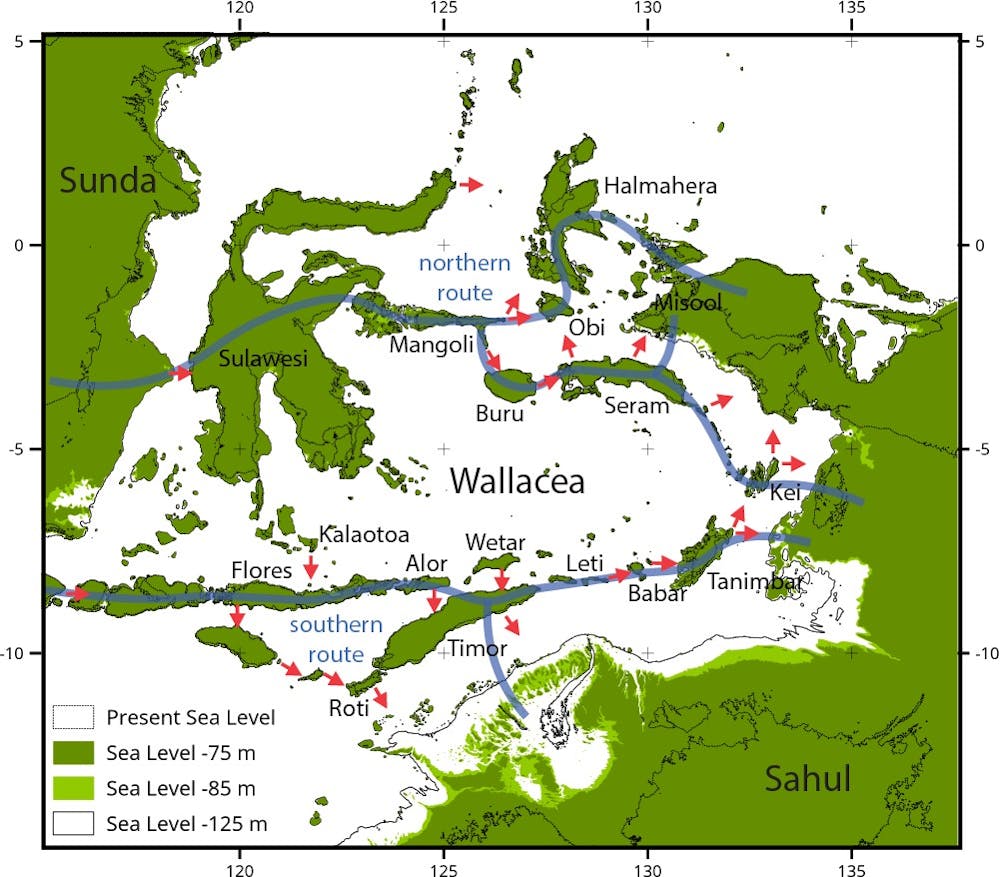
It turns out the northern route connecting the current-day islands of Mangoli, Buru, and Seram into Bird’s Head (West Papua) would probably have been easier to navigate than the southern route from Alor and Timor to the now-drowned Sahul Shelf off the modern-day Kimberley.

While the southern route via the Sahul Shelf is less likely, it would still have been possible.


Read more: How to get to Australia … more than 50,000 years ago


Modelled routes for making landfall in Sahul. Sea levels are shown at -75 m and -85 m. Potential northern and southern routes indicated by blue lines. Red arrows indicate the directions of modelled crossings. Michael Bird

Read more: Island-hopping study shows the most likely route the first people took to Australia


Next, we extended these demographic models to work out how many people would have had to arrive to survive in a new island continent, and to estimate the number of people the landscape could support.

We applied a unique combination of:

  1. fertility, longevity, and survival data from hunter-gatherer societies around the globe

  2. “hindcasts” of past climatic conditions from general circulation models (very much like what we use to forecast future climate changes)

  3. well-established principles of population ecology.

Our simulations indicate at least 1,300 people likely arrived in a single migration event to Sahul, regardless of the route taken. Any fewer than that, and they probably would not have survived – for the same reasons that it is unlikely that an endangered species can recover from only a few remaining individuals.


Read more: Even if you were the last rhino on Earth… why populations can’t be saved by a single breeding pair


Alternatively, the probability of survival was also large if people arrived in smaller, successive waves, averaging at least 130 people every 70 or so years over the course of about 700 years.

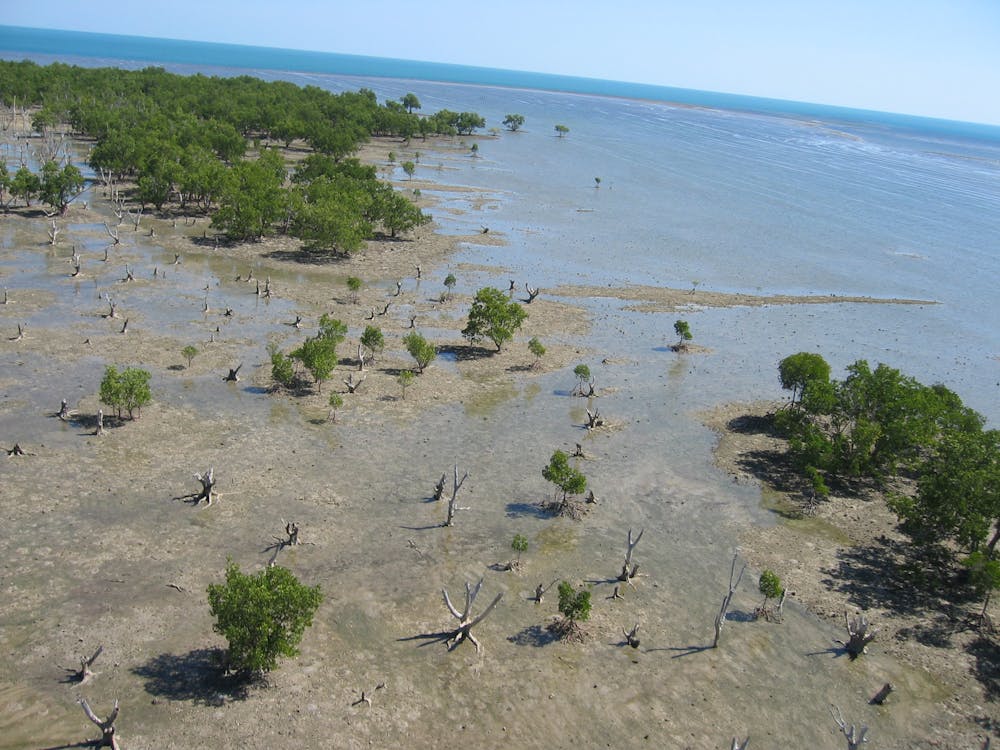
As sea levels rose, Australia was eventually cut off from New Guinea around 8,000 to 10,000 thousand years ago. Corey Bradshaw

A planned arrival

Our data suggest that the peopling of Sahul could not have been an accident or random event. It was very much a planned and well-organised maritime migration.

Our results are similar to findings from several studies that also suggest this number of people is required to populate a new environment successfully, especially as people spread out of Africa and arrived in new regions around the world.


Read more: Australia’s epic story: a tale of amazing people, amazing creatures and rising seas


The overall implications of these results are fascinating. They verify that the first ancestors of Aboriginal, Torres Strait Islander, and Melanesian people to arrive in Sahul possessed sophisticated technological knowledge to build watercraft, and they were able to plan, navigate, and make complicated, open-ocean voyages to transport large numbers of people toward targeted destinations.

Our results also suggest that they did so by making many directed voyages, potentially over centuries, providing the beginnings of the complex, interconnected Indigenous societies that we see across the continent today.

These findings are a testament to the remarkable sophistication and adaptation of the first maritime arrivals in Sahul tens of thousands of years ago.

ref. An incredible journey: the first people to arrive in Australia came in large numbers, and on purpose – http://theconversation.com/an-incredible-journey-the-first-people-to-arrive-in-australia-came-in-large-numbers-and-on-purpose-114074

It’s time for Australia to commit to the kind of future it wants: CSIRO Australian National Outlook 2019

Source: The Conversation (Au and NZ) – By James Deverell, Director, CSIRO Futures, CSIRO

Australia’s future prosperity is at risk unless we take bold action and commit to long-term thinking. This is the key message contained in the Australian National Outlook 2019 (ANO 2019), a report published today by CSIRO and its partners.

The research used a scenario approach to model different visions of Australia in 2060.

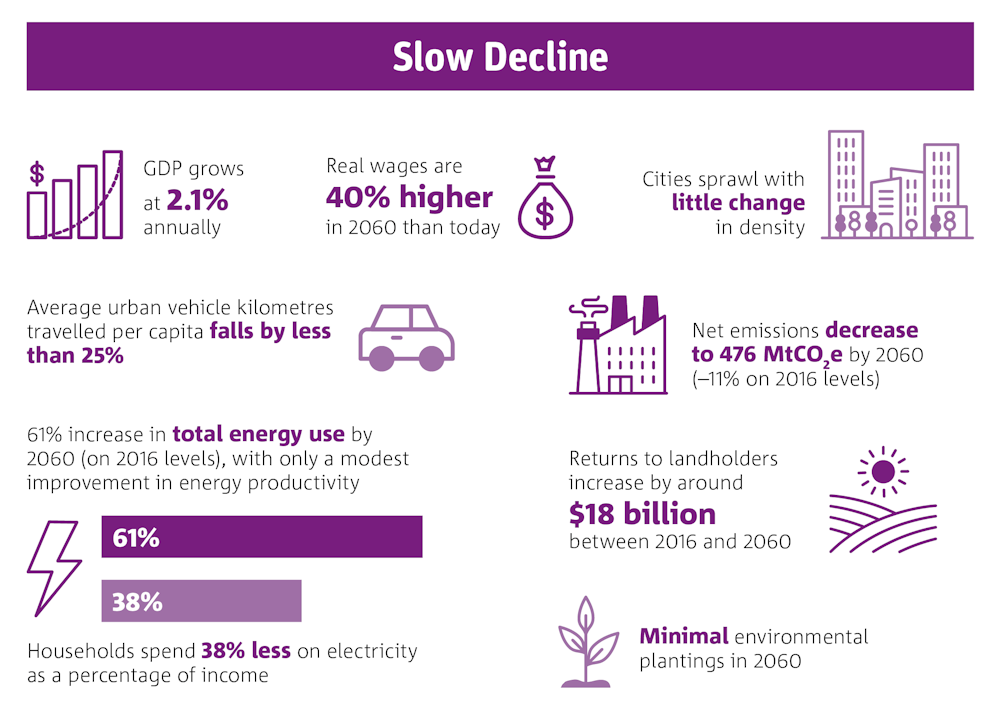
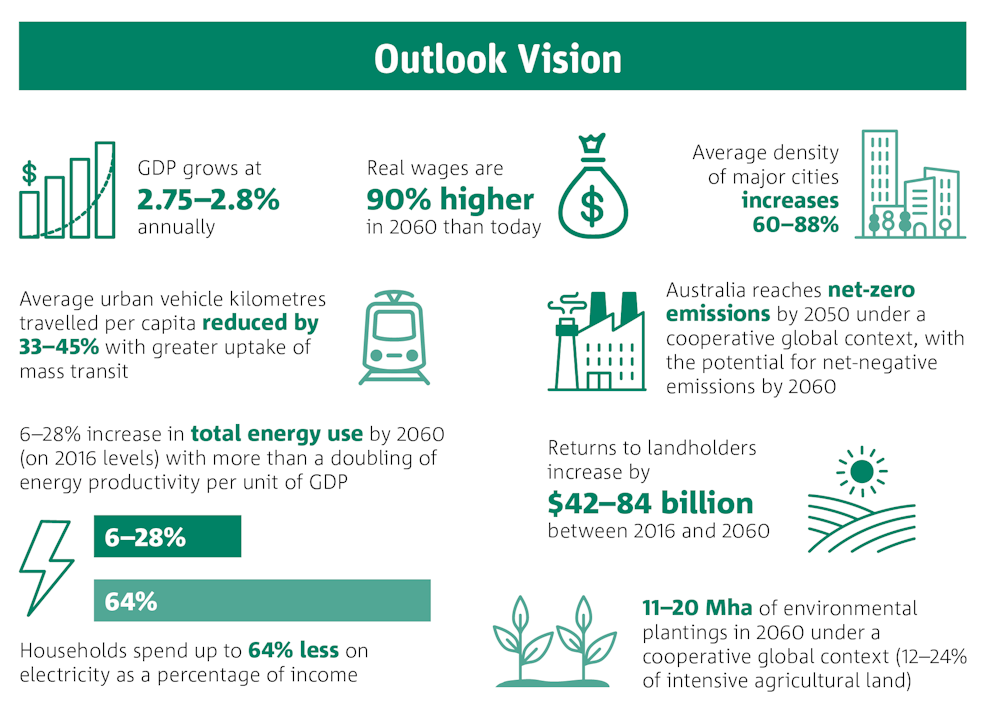
We contrasted two core scenarios: a base case called Slow Decline, and an Outlook Vision scenario which represents what Australia could achieve. These scenarios took account of 13 different national issues, as well as two global contexts relating to trade and action on climate change.

We found there are profound differences in long-term outcomes between these two scenarios.

In the Slow Decline scenario, Australia fails to adequately address identified challenges. CSIRO, Author provided
The Outlook Vision scenario shows what could be possible if Australia meets identified challenges. CSIRO, Author provided

Slow decline versus a new outlook

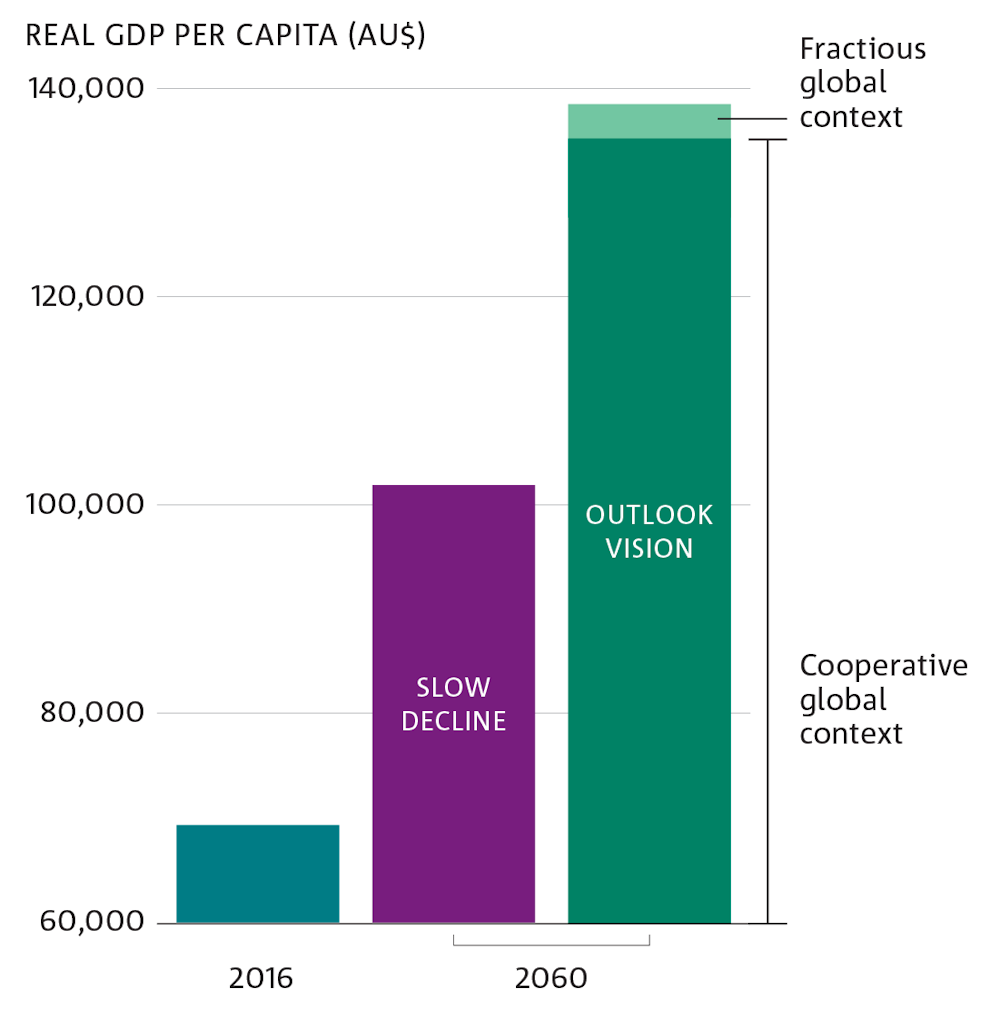
Australia’s living standards – as measured by Gross Domestic Product (GDP) per capita – could be 36% higher in 2060 in the Outlook Vision, compared with Slow Decline. This translates into a 90% increase in average wages (in real terms, adjusted for inflation) from today.

Australia’s real GDP per capita in 2016, and the modelled outcomes for Slow Decline and Outlook Vision. In Outlook Vision, the darker shade shows outcomes under a cooperative global context and the lighter shade under a fractious global context. CSIRO, Author provided

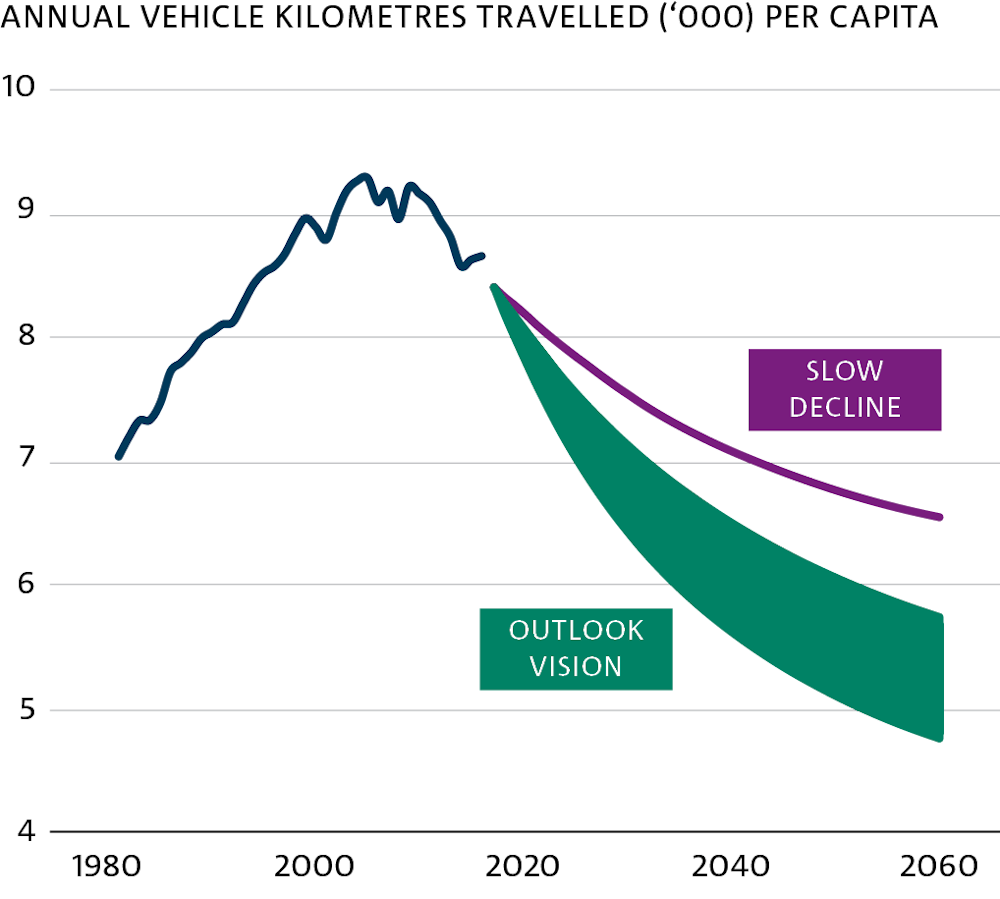
Australia could maintain its world-class, highly liveable cities, while increasing its population to 41 million people by 2060. Urban congestion could be reduced, with per capita passenger vehicle travel 45% lower than today in the Outlook Vision.

Australia could achieve net-zero emissions by 2050 while reducing household spend on electricity (relative to incomes) by up to 64%. Importantly, our modelling shows this could be achieved without significant impact on economic growth.

Low-emissions, low-cost energy could even become a source of comparative advantage for Australia, opening up new export opportunities.

And inflation-adjusted returns to rural landholders in Australia could triple to 2060, with the land sector contribution to GDP increasing from around 2% today to over 5%.

At the same time, ecosystems could be restored through more biodiverse plantings and land management.


Read more: Scientists want to build trust in science and technology. The alternative is too risky to contemplate


Historical trend for vehicle kms travelled (VKT) on urban roads, per capita, and projections resulting from the modelled Slow Decline and Outlook Vision scenarios. The shaded area for Outlook Vision represents the range of outcomes possible depending on how regional satellites cities develop. CSIRO, Author provided

The report, developed over the last two years, explores what Australia must do to secure a future with prosperous and globally competitive industries, inclusive and enabling communities, and sustainable natural endowments, all underpinned by strong public and civic institutions.

ANO 2019 uses CSIRO’s integrated modelling framework to project economic, environmental and social outcomes to 2060 across multiple scenarios.

The outlook also features input from more than 50 senior leaders drawn from Australia’s leading companies, universities and not-for-profits.

So how do we get there?

Achieving the outcomes in the Outlook Vision won’t be easy.

Australia will need to address the major challenges it faces, including the rise of Asia, technology disruption, climate change, changing demographics, and declining social cohesion. This will require long-term thinking and bold action across five major “shifts”:

  • industry shift
  • urban shift
  • energy shift
  • land shift
  • culture shift.

The report outlines the major actions that will underpin each of these shifts.

For example, the industry shift would see Australian firms adopt new technologies (such as automation and artificial intelligence) to boost productivity, which accounts for a little over half of the difference in living standards between the Outlook Vision and Slow Decline.

Developing human capital (through education and training) and investment in high-growth, export-facing industries (such as healthcare and advanced manufacturing) each account for around 20% of the difference between the two scenarios.

The urban shift would see Australia increase the density of its major cities by between 60-88%, while spreading this density across a wider cross-section of the urban landscape (such as multiple centres).

Combining this density with a greater diversity of housing types and land uses will allow more people to live closer to high-quality jobs, education, and services.

Enhancing transport infrastructure to support multi-centric cities, more active transport, and autonomous vehicles will alleviate congestion and enable the “30-minute city”.


Read more: State of the Climate 2018: Bureau of Meteorology and CSIRO


In the energy shift, across every scenario modelled, the electricity sector transitions to nearly 100% renewable generation by 2050, driven by market forces and declining electricity generation and storage costs.

Likewise, electric vehicles are on pace to hit price-parity with petrol ones by the mid-2020s and could account for 80% of passenger vehicles by 2060.

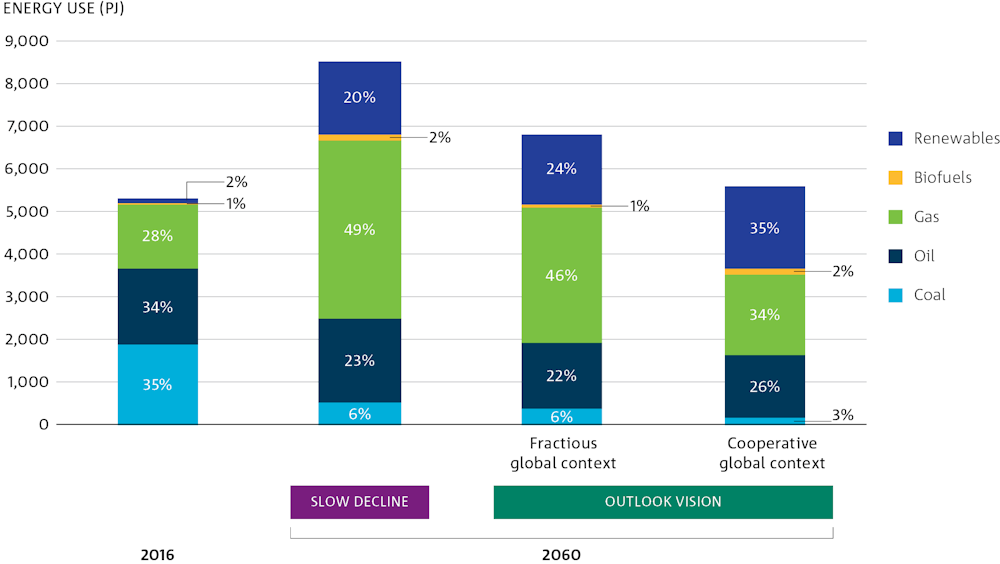
In addition, Australia could triple its energy productivity by 2060, meaning it would use only 6% more energy than today, despite the population growing by over 60% and GDP more than tripling.

Primary energy use in Australia under the modelled scenarios. Primary energy is the measure of energy before it has been converted or transformed, and includes electricity plus combustion of fuels in industry, commercial, residential and transport. CSIRO, Author provided

The land shift would require boosting agricultural productivity (through a combination of plant genomics and digital agriculture) and changing how we use our land.

By 2060, up to 30 million hectares – or roughly half of Australia’s marginal land within more intensively farmed areas – could be profitably transitioned to carbon plantings, which would increase returns to landholders and offset emissions from other sectors.

As much as 700 millions of tonnes of CO₂ equivalent could be offset in 2060, which would allow Australia to become a net exporter of carbon credits.

A culture shift

The last, and perhaps most important shift, is the cultural shift.

Trust in government and industry has eroded in recent years, and Australia hasn’t escaped this trend. If these institutions, which have served Australia so well in its past, cannot regain the public’s trust, it will be difficult to achieve the long-term actions that underpin the other four shifts.

Unfortunately, there is no silver bullet here.

ref. It’s time for Australia to commit to the kind of future it wants: CSIRO Australian National Outlook 2019 – http://theconversation.com/its-time-for-australia-to-commit-to-the-kind-of-future-it-wants-csiro-australian-national-outlook-2019-118692

Explainer: what is fibromyalgia, the condition Lady Gaga lives with?

Source: The Conversation (Au and NZ) – By Michael Musker, Senior Research Fellow, South Australian Health & Medical Research Institute

At least one in ten of us suffer some sort of troublesome, long-term (chronic) pain. But not all have fibromyalgia.

People with fibromyalgia have chronic widespread pain — including musculoskeletal aches, pain and stiffness, and soft tissue tenderness — in many areas across the body.

This affects other systems like the brain, impacting a person’s ability to concentrate and remember things. People who have fibromyalgia often refer to this as the “fibro fog”. It can affect sleep patterns, emotions, and many other aspects of everyday living.

Fibromyalgia is a condition singers Lady Gaga and Sinead O’Connor, and actor Morgan Freeman live with.

So what causes fibromyalgia? How does it differ from other types of chronic pain? How is it diagnosed and treated?

What causes fibromyalgia?

When investigations can find no other cause for widespread chronic pain, it’s generally diagnosed as fibromyalgia.

We don’t know exactly what causes fibromyalgia, but genetics, environment, hormonal and neural (brain and central nervous system) factors are all believed to play a role. Research indicates genes may be responsible for up to 50% of susceptibility to the condition. The latest research indicates the body’s immune system is involved, too.

An online survey of 596 people with fibromyalgia found a few common causes reported by participants. Around two thirds of people could relate the start of their symptoms to a specific incident or event, such as a physical injury, a period of sickness that might have involved surgery, or a stressful life event.

Notably, many of those surveyed said they experienced negativity and stigma when trying to explain and authenticate their symptoms to professionals, their families, and their communities.

Who is affected?

Fibromyalgia affects around 2% of the world’s population. A recent literature review showed the frequency of fibromyalgia in the general population was between 0.2 and 6.6%. It’s often reported as higher in women, at a ratio of three to one.

The World Health Organisation recognised fibromyalgia as a disease in 1994. Since then, doctors have debated how fibromyalgia should be diagnosed and who should diagnose it, leading to the so-called “fibro wars”. It continues to be controversial.


Read more: Hidden and unexplained: feeling the pain of fibromyalgia


The latest version of the International Classification of Diseases says for someone to be diagnosed with fibromyalgia, there needs to be pain in “at least 4 of 5 body regions and is associated with significant emotional distress”.

The American College of Rheumatology devised a widely accepted test which looks for 11 points from 18 potential tender points of pain from areas across the body using what’s called the widespread pain index.

How is it treated?

Everyone experiences treatments differently, and what works for one person may not work for another. But the main treatments focus on pain relief.

The drugs pregabalin and duloxetine work by altering the neurotransmitters in the brain (gamma amino butyric acid and serotonin), and are effective for many people.


Read more: How support groups can boost your health and make chronic conditions easier to live with


There are many other options including medication specifically for pain (analgesics), muscle relaxants (benzodiazepines), or treatments to address nerve or spinal pain (neuropathic treatments).

Many of these medications can have side effects, including constipation, or allergic reactions like digestive upset or inflammation. They can also be addictive. Always be honest with your GP about what painkillers you’re taking so they can help you safely manage your pain.

Another common treatment is using a TENS machine (transcutaneous electrical nerve stimulation). This involves applying pads around the area of pain, or the nerves that might be sending the pain message, and interfering with these using small electrical pulses.

Some patients find therapy with a TENS machine helpful, where pads are placed on the body and electrical pulses applied. from www.shutterstock.com

This effective treatment is thought to increase levels of endorphins produced by the brain and spinal cord to provide pain relief. But the effects may weaken with ongoing use.

It’s important to check with your doctor if TENS treatment is appropriate because it might affect pacemakers or people with epilepsy.

Fibromyalgia can also be treated with physical interventions such as heat therapy, massage and vibration therapy. Acupuncture and treatment from a psychologist are other options.


Read more: Pain drain: the economic and social costs of chronic pain


How about the future?

In time, we might be able to look for diagnostic immune markers for fibromyalgia in our genetic material to help find who might be at risk of developing the condition, and take preventative action.

Many of the symptoms of fibromyalgia can be found in people who have a condition known as myalgic encephalomyelitis, or chronic fatigue syndrome. Our research is currently looking at the blood of people with fibromyalgia and chronic fatigue syndrome to see if there are specific inflammatory markers that may help us understand how these illnesses develop.

If we can understand the interaction of the immune system with pain and inflammation, then we can begin to target treatments more effectively for people living with fibromyalgia.


If you or someone you know has fibromyalgia, resources and support are available from Arthritis Australia and the US National Fibromyalgia Association.

ref. Explainer: what is fibromyalgia, the condition Lady Gaga lives with? – http://theconversation.com/explainer-what-is-fibromyalgia-the-condition-lady-gaga-lives-with-116729

How to answer the argument that Australia’s emissions are too small to make a difference

Source: The Conversation (Au and NZ) – By Matt McDonald, Associate Professor of International Relations, The University of Queensland

After a recent foray into the debate over Australia’s so-called “climate election”, I received plenty of critical replies to my argument that Australians should take climate action more seriously. The most common rebuttal was that Australians were right to focus on other issues at the ballot box because Australia’s contribution to global climate change is small anyway.

This is precisely the argument Alan Jones advanced in a now notorious Sky News segment in which he used a bowl of rice to explain away Australia’s climate obligations.

Australia, Jones noted, contributes only 1.3% of global carbon dioxide emissions from human activity, which in turn represents just 3% of the overall amount of CO₂ in the atmosphere, which in turn makes up little more than 0.04% of the whole atmosphere. So why, he asked while triumphantly brandishing a single rice grain, are we so obsessed with Australia’s climate policy when the planet is so big and the consequences of our actions are so tiny?


Read more: Why old-school climate denial has had its day


This is a powerful critique and, on the face of it, a simple and compelling line of argument, which is precisely why it’s so often used. Why bother, if we lack the power to do anything that makes a difference?

But there are at least three obvious responses to it.

The ‘per capita’ problem

The first and most obvious response is that Australia emits much more than our fair share.

Sure, our emissions are 1.3% of the global total. But our population is 0.3% of the global total.

This isn’t the only way to allocate national emissions targets. But if rich countries like Australia aren’t doing more to reduce their disproportionately high emissions, what possible incentive is there for developing countries to take the issue seriously? Nations such as India, Brazil and China can ask – as indeed they have at various climate talks – why they should reduce emissions when Australia does so little.

In this sense, Australia’s position on climate action is significant, not only for the 1.3% of greenhouse gases we produce, but for the potential influence on global policy.

As a nation so proud of “punching above its weight” in fields such as sport and technology, Australia is missing a big chance to show global leadership on climate.

The ‘coal exports’ problem

The 1.3% statistic is only true if we focus purely on greenhouse emissions within Australia itself. Fair enough, you might say, given that this is the way the Paris Agreement, and the Kyoto Protocol before it, measures countries’ emissions.

But this approach excludes some significant factors.

First, it fails to take proper account of emissions created in one country while manufacturing goods for export to other countries. Emissions due to Chinese-produced goods destined for Australian consumers, for example, count towards China’s emissions, not Australia’s. If we take this “consumption shadow” into account, the climate impact of developed countries, including Australia, becomes much higher.

Second, there is a similar issue with coal exports. Coal dug up by one country but burned in another counts towards the latter’s emissions. As one of the world’s largest coal exporters, this is clearly important for Australia.

Time to get off the global coal train? Dan Himbrechts/AAP

In 2012, the campaign group Beyond Zero Emissions estimated that if Australian coal was factored into Australia’s emissions, our contribution to global emissions would be 4% rather than 1.3%. This would make Australia the world’s sixth-largest contributor to climate change.

Are we responsible for what other countries do with Australian coal? According to the Paris treaty, the answer is no. But drug barons and arms dealers use similar arguments to wash their hands of drug addiction and war.

What’s more, Australia already limits a range of exports based on concerns about their use in importing countries, including weapons, uranium and even livestock.

So there’s certainly a precedent for viewing exports through the lens of our international responsibilities. And with the UN secretary-general joining recent calls to end all new coal power plants, a global coal treaty or even embargo might eventually force Australia’s hand.

The ‘capacity to respond’ problem

The third rebuttal to Alan Jones’s arguments is that Australia has far more capacity to take climate action than many other nations. Again, this works at two levels.

First, we’re rich. Australia is a top-20 world economy in terms of both size and average wealth. This means we are more able than most countries to manage the economic costs of moving away from fossil fuels.

Second, thanks to decades of relative climate policy inaction and modest targets, there’s a lot of low-hanging fruit for Australia to ratchet up its climate ambition. This applies most obviously to the renewable energy sector, but also to areas such as energy efficiency and transport.

Australia’s land-clearing rates are also among the highest in the world – we are the only developed nation to feature in a 2018 WWF list of deforestation hotspots. Reducing this would significantly cut emissions while also protecting important carbon stores.

As economist John Quiggin has noted, the longer we wait to move away from fossil fuels, the more expensive it will be.

What does this all mean for Australia?

Jones’s argument is a beguilingly simplistic response to a wicked problem. Climate change is a global problem that requires global action. But the calculations around who should take the lead, and how much constitutes each nation’s fair share, are fiendishly complex.

But, by almost any measure, a country like Australia should be leading the way on climate policy, not being dragged kicking and screaming to take action that falls far behind that of comparable nations.


Read more: Not everyone cares about climate change, but reproach won’t change their minds


The current reluctance to act seriously on climate change appears at best self-serving and at worst an outright moral failing.

We should take the argument that Australia’s climate contribution is insignificant with a grain of salt. Or perhaps rice.

ref. How to answer the argument that Australia’s emissions are too small to make a difference – http://theconversation.com/how-to-answer-the-argument-that-australias-emissions-are-too-small-to-make-a-difference-118825

How advertising can repurpose itself to serve cities in more sustainable ways

Source: The Conversation (Au and NZ) – By Sergio Brodsky, Sessional Lecturer, Marketing, RMIT University

Noisy, ugly and dirty. Advertising has polluted cities, annoyed consumers, and jeopardised its own existence. Beyond a mass-media cacophony, brand communications’ significant carbon footprint and runaway consumption are certainly contributing to what economists call market failure.

Advertising, even when not promoting consumption, creates an environmental cost because of its emissions. Author provided

In the UK, for instance, advertising produces 2 million tonnes of carbon dioxide emissions a year. That’s equivalent to heating 364,000 UK homes for a year, according to CarbonTrack.

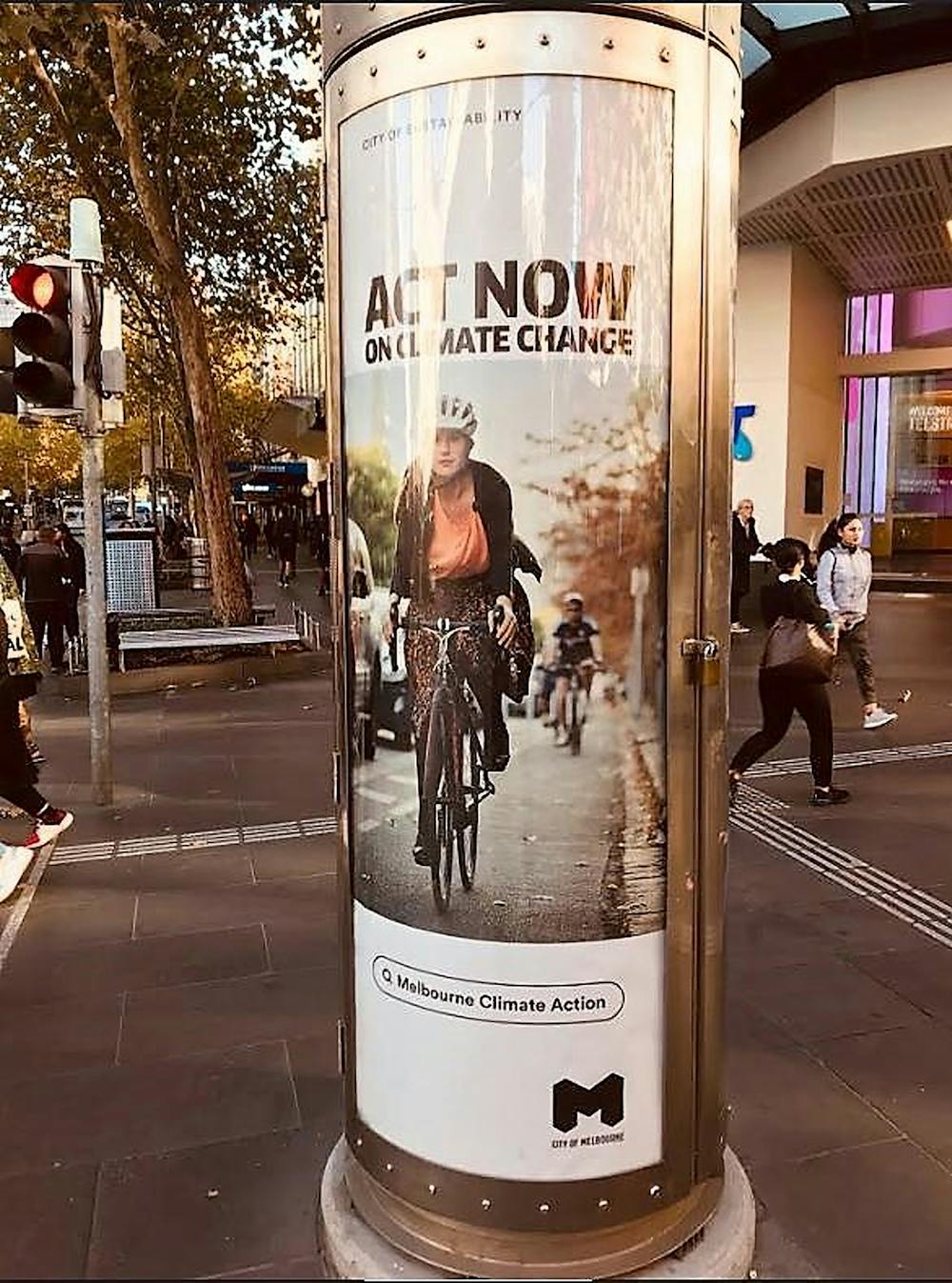
In this sense, should messages such as a City of Melbourne campaign inviting people to cycle more even be allowed? On the one hand, it is better to communicate a solution (cycling) to the issue than not. On the other, if the communication contributes to the problem more than the solution, what’s the point of it?

Jerry Seinfeld’s 2014 infamous line at the Clio awards called out the advertising sector to its face:

I think spending your life trying to dupe innocent people out of hard-won earnings to buy useless, low-quality, misrepresented items and services is an excellent use of your energy.

Jerry Seinfeld’s speech about advertising at the 2014 Clio Awards.

Still, contrary to that sentiment, marketers and their brands can (and should) move away from being part of the problem to becoming part of the solution for sustainable development and the industry’s own sustainability.


Read more: Post Gillette: other brands are better at matching practice with talk, but don’t get the publicity


Offering a new outlook

The urbanisation megatrend wholly underpins other forces shaping the way we live, now and in the future. Although cities occupy only 2% of Earth’s landmass, that is where 75% of energy consumption occurs. Advertising growth is also concentrated in big cities.

Because of increased demand for ever more comfortable lifestyles, urban infrastructures have been feeling “growing pains” for decades now. Whether it’s energy, education, health, waste management or safety, cities’ services are struggling to keep up with their larger and “hungrier” populations.

The strategic opportunity here is to reframe brand communications from the promotion of conspicuous consumption to becoming a regenerative force in the economy of cities. That means using brands’ touch points as more than mere messengers, but rather delivering public utility services. I’ve coined it Urban Brand-Utility.

For example, Domino’s Pizza’s Paving for Pizza program fixes potholes, cracks and bumps said to be responsible for “irreversible damage” to pizzas during the drive home.

This may sound silly, but the US National Surface Transportation Policy and Revenue Study Commission estimates that simply to maintain the nation’s highways, roads and bridges requires investment by all levels of government of US$185 billion a year for the next 50 years. Today, the US invests about US$68 billion a year.

The Paving for Pizza program fixes potholes that Domino’s says ‘can cause irreversible damage to your pizza during the drive home’. Domino’s Pizza

According to Bill Scherer, mayor of Bartonville, Texas: “This unique, innovative partnership allowed the town of Bartonville to accomplish more potholes repairs.” Eric Norenberg, city manager of Milford, Delaware, said: “We appreciated the extra Paving for Pizza funds to stretch our street repair budget as we addressed more potholes than usual.”


Read more: Microwave repairs might annihilate zombie potholes once and for all


In Moscow, major Russian real estate developers approached Sberbank to collaborate on better infrastructure planning in residential areas. People’s opinions on local needs fuelled targeted campaigns, promoting loans for small businesses. The “Neighbourhoods” campaign generated nine times as many small-business responses as traditional bank loan advertising.

The ‘Neighbourhoods’ campaign sought people’s opinions on local neighbourhood needs.

In other words, people had their needs met. And neighbourhoods become more attractive as a result. The city increases tax collection from the new businesses being set up, which also reduces the costs of having to deal with derelict areas.

A shift to serving citizen-consumers

If we could see ourselves as citizen-consumers, as opposed to individual shoppers in the market, every dollar spent would enable business to tackle the issues that matter most.

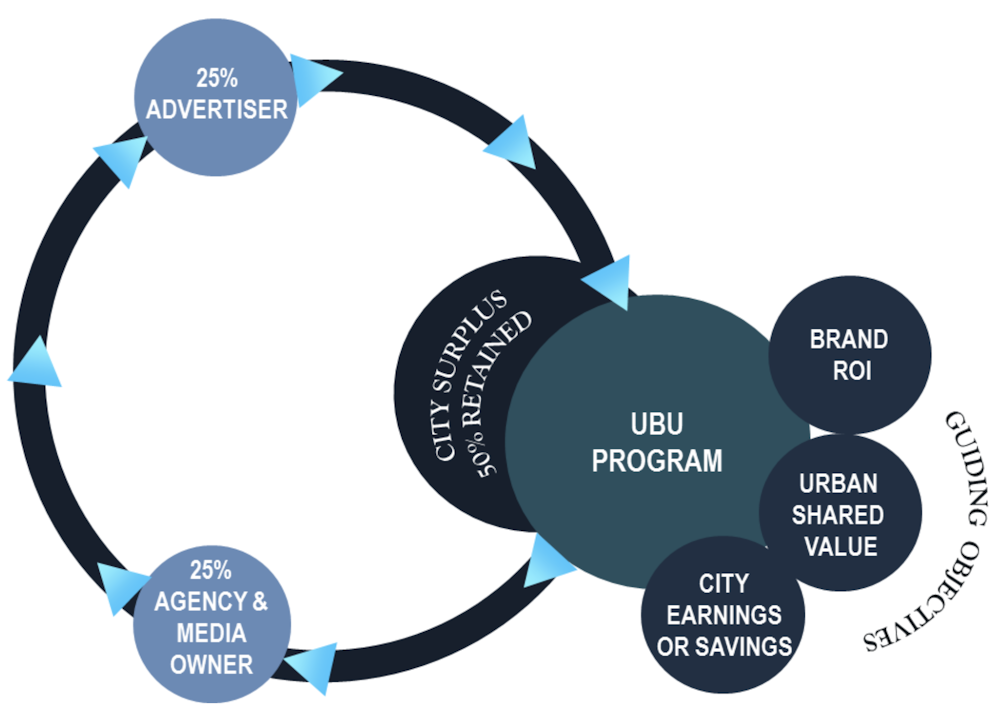
Here’s a hypothetical situation. Let’s assume Domino’s Paving for Pizza program is taken to its full potential, generating a large surplus to the City of Bartonville by minimising the costs of repairing potholes. Rather than treating this as a one-off campaign, smart mayors would try to create a virtuous cycle, where the city retains 50% of the surplus, 25% is returned to the advertiser, and 25% goes to the agency and media owner – a value only unlocked by repeating the approach.

This way, marketing budgets are effectively turned into investment funds. The returns are in the form of brand cut-through, happier customers, social impact and more effective city management, as shown in the model below.

Author provided

In a circular economy, products and services go beyond an end user’s finite life cycle. Similarly, Urban Brand-Utility looks at brand communications as closed loops by designing a system bigger than fixed campaign periods, target audiences and business-as-usual KPIs.

Brands with some level of foresight will be able to broaden their audiences from customers to citizens and their revenue model from sales to the creation of shared value. These will be game-changers for profit and prosperity.

Markets, choice and competition are not just a consumer’s best friend, but their civic representation. After all, as one of the tribunes asks the crowd in Shakespeare’s Coriolanus: “What is the city but the people?”

ref. How advertising can repurpose itself to serve cities in more sustainable ways – http://theconversation.com/how-advertising-can-repurpose-itself-to-serve-cities-in-more-sustainable-ways-118584

Below zero is “reverse”. How the Reserve Bank of Australia would make quantitative easing work

Source: The Conversation (Au and NZ) – By Stephen Kirchner, Program Director, Trade and Investment, United States Studies Centre, University of Sydney

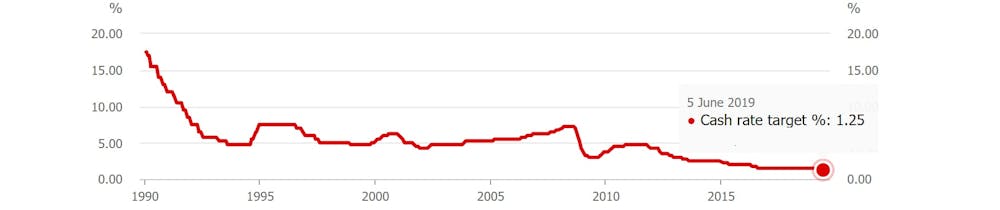
With its official cash rate now expected to fall below 1% to a new extraordinarily low close to zero, all sorts of people are saying that the Reserve Bank is in danger of “running out of ammunition.” Ammunition might be needed if, as during the last financial crisis, it needs to cut rates by several percentage points.

This view assumes that when the cash rate hits zero there is nothing more the Reserve Bank can do.

The view is not only wrong, it is also dangerous, because if taken seriously it would mean that all of the next rounds of stimulus would have to be come from fiscal (spending and tax) policy, even though fiscal policy is probably ineffective long-term, its effects being neutralised by a floating exchange rate.

The experience of the United States shows that Australia’s Reserve Bank could quite easily take measures that would have the same effect as cutting its cash rate a further 2.5 percentage points – that is: 2.5 percentage points below zero.


Reserve Bank cash rate since 1990

Reserve Bank of Australia

In a report released on Tuesday by the University of Sydney’s United States Studies Centre, I document the successes and failures of the US approach to so-called “quantitative easing” (QE) between 2009 and 2014.

It demonstrates that it is always possible to change the instrument of monetary policy from changes in the official interest rate to changes in other interest rates by buying and holding other financial instruments such as long-term government and corporate bonds.

Australia can learn form US mistakes. University of Sydney United States Studies Centre

The more aggressively the Reserve Bank buys those bonds from private sector owners, the lower the long-term interest rates that are needed to place bonds and the more former owners whose hands are filled with cash that they have to make use of.

In the US the Federal Reserve also used “forward guidance” about the likely future path of the US Federal funds rate to convince markets the rate would be kept low for an extended period.

It is unclear which mechanism was the most powerful, or whether the Fed even needed to buy bonds in order to make forward guidance work. However in a stressed economic environment, it is worth trying both.


Read more: The Reserve Bank will cut rates again and again, until we lift spending and push up prices


As it comes to be believed that interest rates will stay low for an extended period, the exchange rate will fall, making it easier for Australian corporates to borrow from overseas and to export and compete with imports.

The consensus of the academic literature is that QE cut long-term interest rates by around one percentage point and had economic effects equivalent to cutting the US Federal fund rate by a further 2.5 percentage points after it approached zero.

QE need not have limits…

Based on US estimates, Australia’s Reserve Bank would need to purchase assets equal to around 1.5% of Australia’s Gross Domestic Product to achieve the equivalent of a 0.25 percentage point reduction in the official cash rate. That’s around A$30 billion.

With over A$780 billion in long-term government (Commonwealth and state) securities on issue, there’s enough to accommodate a very large program of Reserve Bank buying, and the bank could also follow the example of the Fed and expand the scope of purchases to include non-government securities, including residential mortgage-backed securities.

It could also learn from US mistakes. The Fed was slow to cut its official interest rate to near zero and slow to embark on QE in the wake of the 2008 financial crisis. Its first attempt was limited in size and duration. Its success in using QE to stimulate the economy should be viewed as the lower bound of what’s possible.

…even if it becomes less effective as it grows

It often suggested (although it is by no means certain) that monetary policy becomes less effective when interest rates get very low, but this isn’t necessarily an argument to use monetary policy less. It could just as easily be an argument to use it more.

Because there is no in-principle limit to how much QE a central bank can do, it is always possible to do more and succeed in lifting inflation rate and spending.

Fiscal policy may well be even less effective. To the extent that it succeeds, it is likely to push up the Australian dollar, making Australian businesses less competitive.

US economist Scott Sumner believes the extra bang for the buck from government spending or tax cuts (known as the multiplier) is close to zero.

Reserve Bank Governor Philip Lowe this month appealed for help from the government itself, asking in particular for extra spending on infrastructure and measures to raise productivity growth.


Read more: Vital Signs. If we fall into a recession (and we might) we’ll have ourselves to blame


He is correct in identifying the contribution other policies can make to driving economic growth. No one seriously thinks Reserve Bank monetary policy can or should substitute for productivity growth.

But it is a good, perhaps a very good, substitute for government spending that does not contribute to productivity growth.

Three myths about quantitative easing

In the paper I address several myths about QE. One is that it is “printing money”. It no more prints money than does conventional monetary policy. It pushes money into private sector hands by adjusting interest rates, albeit a different set of rates.

Another myth is that it promotes inequality by helping the rich to get richer.

It is a widely believed myth. Former Coalition treasurer Joe Hockey told the British Institute of Economic Affairs in 2014 that:

Loose monetary policy actually helps the rich to get richer. Why? Because we’ve seen rising asset values. Wealthier people hold the assets.

But it widens inequality no more than conventional monetary policy, and may not widen it at all if it is successful in maintaining sustainable economic growth.

A third myth is that it leads to excessive inflation or socialism.

In the US it has in fact been associated with some of the lowest inflation since the second world war. These days central banks are more likely to err on the side of creating too little inflation than too much.

Some have argued that QE in the US is to blame for the rise of left-wing populists like Alexandria Ocasio-Cortez and “millennial socialism”. But it is probably truer to say that their grievances grew out of too tight rather than too lose monetary policy.

QE has been road tested. We’ve little to fear from it, just as we have had little to fear from conventional monetary policy.

ref. Below zero is “reverse”. How the Reserve Bank would make quantitative easing work – http://theconversation.com/below-zero-is-reverse-how-the-reserve-bank-would-make-quantitative-easing-work-118843

Five films not to miss from the 2019 Sydney Film Festival

Source: The Conversation (Au and NZ) – By Ari Mattes, Lecturer in Media Studies, University of Notre Dame Australia

A “top five” list from a major film festival will inevitably annoy many people, because, by necessity, there are many films that one is not able to see, and the scheduling at this year’s Sydney Film Festival involved significant clashes.

Still, perhaps the best thing about large film festivals is that they make people watch films they normally wouldn’t. Of the 30 or so I did catch, there were fewer spectacular ones – and notably, fewer duds – than in years past. Here are my five stand-outs.

School’s Out

Directed by Sébastien Marnier, School’s Out was my pick for best film at the festival. The narrative follows Pierre (Laurent Lafitte), a substitute teacher who takes over a class of elite students at a French private school, after the suicide of their teacher in the film’s opening scene. What begins as mere attitude from the arrogant students, led by Apolline (brilliantly played by Luàna Bajrami in her first feature film), turns into something more menacing as the film progresses.

For the most part, the film is told from Pierre’s point of view, and this creates a sense of claustrophobic paranoia as he feels increasingly threatened by his students. We can never quite put our finger on the reason for this and this interplay between his sense of danger and the objective perspective of the other teachers regarding the saintliness of the elite students drives the tension.

The teacher in School’s Out feels increasingly threatened by his students. Avenue B Productions, Canal+, OCS

The whole thing is undergirded by a deep ecological anxiety that endows the film with a sense of significance greater than the ostensible clash between a teacher riven with an inferiority complex and his precocious students. It is as if we are watching a staging of the struggle between entrenched power, which continues to destroy the planet, and the nihilistic youth who are in tune to this, following their final, fatal attempts to do something about it.

This thematic material is engaging enough. But it is the sheer control with which Marnier manages the tension and manipulates the viewer (whilst avoiding thriller cliches) that makes School’s Out a masterpiece. A magnificently wrought, flawless film, it also happens to be incredibly engaging at an affective level.

Bacurau

The “people hunting people for sport” sub-genre has produced some of the most disturbing – and effective – films in genre cinema, dating back to The Most Dangerous Game of 1932. Cornel Wilde’s The Naked Prey (1965) remains one of the best, as does John Woo’s Hard Target (1993), one of the only genuinely good Jean-Claude Van Damme films. Bacurau, an excellent genre thriller from Brazilian writer-directors Juliano Dornelles and Kleber Mendonça Filho, marks another entry on this continuum.

Bacurau is an excellent Brazilian genre thriller. Arte France Cinéma, CinemaScópio Produções, SBS Films

Set sometime in the near future, the film revolves around a hamlet of the same name in the sertão in north-east Brazil. The inhabitants notice that Bacurau has disappeared from GPS mapping. This is quickly followed by a series of murders of the inhabitants, the victims of a squad of mercenary killers led by Michael (played by the inimitable Udo Kier). Most of these killers are from the US, and, whilst there are political motivations underpinning their invasion of the town, they seem to be mainly doing this for the fun of it (which includes only hunting with old-fashioned weapons such as Tommy Guns!).

The inhabitants catch wind of the situation pretty quickly, and, led by guerrilla freedom fighter Lunga (Silvero Pereira), organise their resistance to the coloniser, which, needless to say, involves a great deal of blood. The second half of the film, channelling the films the directors clearly love in staging this struggle (ie those made by Sam Peckinpah and John Carpenter), is more effective than the first half, which is a little meandering in its kind of loose, new wave style.

It is an extremely violent – and extremely funny – film, with bad taste aplenty. And this will, surely, alienate many viewers. But Bacurau will not disappoint those of us who like trashy genre films.

The Brink

The Brink follows alt-right puppeteer Steve Bannon, after his dismissal as Trump’s Chief Strategist, as he sets about fostering a populist, anti-immigration movement uniting Europe and the US in the lead up to the US congressional election of 2018. Filmmaker Alison Klayman is given extremely close access to Bannon, and we see him strategising in meetings with European leaders of far-right parties, in “fly-on-the-wall” style – there is no clear exposition, and no talking heads and voice-overs here.

The viewer (like Klayman) simply accompanies Bannon throughout his self-styled campaign. The intimacy she is granted is, perhaps, testament to Bannon’s vanity – he and his team are very open about their activities (for instance, they laugh at a supporter’s house at one point), and he does seem to be performing for the camera a lot of the time.

Steve Bannon and Nigel Farage in The Brink. AliKlay Productions, Claverie Films, RYOT Films

What is particularly interesting, though, is the insight the film gives into Bannon and his motivations. Often presented as a kind of fringe lunatic and extreme right zealot in the popular media, Bannon is revealed here as little more than a cynical Machiavellian who will do whatever he can to maintain his power – and class privilege. (Like Trump, he pretends he is an outsider who appeals to blue collar workers but most of his support comes from white collar workers. He is, after all, the ex vice-president of Goldman Sachs, and was educated at elite universities.)

We see, perhaps more than anything, how Bannon relies on personal charm, irony and humour to try to disarm his critics and opponents. Bannon appears as a man desperate to be liked – a bit of a loner, a nerd – unwilling to face any direct confrontation or challenge of his views. When a Guardian reporter, for example, challenges his antisemitic rhetoric, Bannon responds by touching the man’s arm and trying to laugh it off in a blokey way.

The Brink offers a thrilling, energising insight into political strategy. To call Bannon deceptive – or to moralise about his actions – would be to miss the point. The film suggests Bannon’s aim is to consolidate power, and the ways he goes about this reveal important lessons for anyone interested in politics and populism.

The Mountain

American indie director Rick Alverson’s latest film is an exquisitely photographed and scored exercise in weirdness featuring Jeff Goldblum as a kind of snake-oil salesman who drives around the American west in the 1950s hawking lobotomies and electroshock therapy treatments to willing hospitals. Andy (Tye Sheridan), a young man with his own mental health issues, is employed as his photographer, visually documenting his surgeries and his patients’ experiences.

There is an eerie starkness to the film – the white of winter snow (with faint echoes of The Shining), of lab coats, of asylum walls – that grounds its at times heavy-handed attempts at strangeness.

Jeff Goldblum and Tye Sheridan in The Mountain (2018) idmb

Although a little pretentious in places, The Mountain is so beautifully made, and the story offers such an effective mixture of comedy and horror, that it is one of the strongest “strange cinema” films of recent years. At the same time, The Mountain, for all its hammy weirdness, does mark an effective intervention into narratives of medical progress through its measured depiction of the brutal treatment of mental illness in America.

God Exists, Her Name is Petrunya

Despite the irritating title (which perhaps works better in its native language, Macedonian), God Exists, Her Name is Petrunya is a delightful parable from Macedonian writer-director Teona Strugar Mitevska. Set in a small Macedonian town, the film follows the social ostracism and persecution of unemployed Petrunya (Zorica Nusheva), when she wins a religious game traditionally played by men involving the retrieval of a cross cast by a priest into a freezing cold river. She is hounded by police, representatives of the Church, and an increasingly violent mob of men, yet refuses to return the cross to the Church.

Every image in God Exists, Her Name is Petrunya is beautifully framed. Sister and Brother Mitevski, Entre Chien et Loup, Vertigo

Her persecution is in tandem with journalist Slavica (played by the director’s sister, Labina Mitevska) and her attempts to present the hapless Petrunya as some kind of champion of womens’ rights, a modern day feminist martyr suffering for gender equality in the Balkans.

Despite the incisive points the film makes about small town politics in general, it has a whimsical and gentle humour. Every image is beautifully framed, and realised with a subtlety rare in films on the festival circuit. Remarkably, the film is based on real events that happened in the town in which it is set and shot.

And the rest

There are, of course, several other excellent films that screened at the festival. Some of these, like Meeting Gorbachev, Werner Herzog’s latest documentary, could easily have been in the top five. Herzog’s study of the Soviet leader shows his usual cruel and absurd brilliance. It interweaves footage from 1980s USSR and US with commentary about the fall of the Soviet Union and contemporary interviews with Gorbachev himself and figures from the time who worked against or alongside him.

Werner Herzog and Mikhail Gorbachev in Meeting Gorbachev (2018). Werner Herzog Filmproduktion

Peter Strickland’s In Fabric – a demented tale involving a coven-like department store and a demonic red dress – could also feature in the top five, and is definitely something to watch and re-watch.

Other highlights included the anime film Children of the Sea – typically enigmatic, and great to watch on a big screen – the bloody and comical horror thriller Come to Daddy, starring Elijah Wood as a son returning to his prodigal father, the intense, extremely well-made French cop thriller Les Misérables, the ambitious Australian medieval fantasy, Judy and Punch, the sentimental but effective film from Emilio Estevez about the position of the public library in an America of have-nots, The Public, and Pedro Almodovar’s Pain and Glory, a stately reflection on ageing with Antonio Banderas playing a subdued filmmaker reflecting on his childhood and career.

Antonio Banderas in Pain and Glory (2019). Canal+, Ciné +, El Deseo

The only real disappointment was Claire Denis’ High Life, a space film starring Robert Pattinson and Juliette Binoche that seemed to confuse being obscure with being interesting. This film has all the right elements. Its premise is great – deep space experiments into sexual reproduction involving death row inmates – as is its cast (and budget). But nothing really works, and, aside from a moderately interesting final 20 minutes or so, the whole thing was something of a bore.

One of the annoying aspects of festivals playing across multiple screens – and Sydney has been expanding its number of screens in recent years – is that one seldom gets to see everything one wishes to see. Some of the bigger films I missed, this year, which are, from all reports, excellent, include: Thomas Vinterberg’s submarine thriller, Kursk, Florian Henckel von Donnersmarck’s Never Look Away, Korean auteur Joon-ho Bong’s Parasite – which won the festival prize – the Mongolian thriller Öndög, and the Jim Jarmusch zombie film The Dead Don’t Die.

Most of these will see general theatrical release in Australia, so perhaps festival tickets are better used catching films otherwise impossible to see on a big screen.

ref. Five films not to miss from the 2019 Sydney Film Festival – http://theconversation.com/five-films-not-to-miss-from-the-2019-sydney-film-festival-118775

Final 2019 election results: education divide explains the Coalition’s upset victory

Source: The Conversation (Au and NZ) – By Adrian Beaumont, Honorary Associate, School of Mathematics and Statistics, University of Melbourne

At the May 18 election, the size of the lower house was expanded from 150 to 151 seats. The Coalition parties won 77 seats (up one since the 2016 election), Labor 68 (down one) and the crossbench six (up one). The Coalition government holds a three-seat majority.

Owing to redistributions and the loss of Wentworth to independent Kerryn Phelps at an October 2018 byelection, the Coalition notionally had 73 seats before the election, a one-seat advantage over Labor. Using this measure, the Coalition gained a net four seats in the election.

The Coalition gained the Queensland seats of Herbert and Longman, the Tasmanian seats of Braddon and Bass, and the New South Wales seat of Lindsay. Labor’s only offsetting gain was the NSW seat of Gilmore. Corangamite and Dunkley are not counted as Labor gains as they were redistributed into notional Labor seats.

Four of the six pre-election crossbenchers easily held their seats – Adam Bandt (Melbourne), Andrew Wilkie (Clark), Rebekha Sharkie (Mayo) and Bob Katter (Kennedy). The Liberals narrowly regained Wentworth from Phelps, but independent Zali Steggall thrashed Tony Abbott 57%-43% in Warringah. In Indi, independent Helen Haines succeeded retiring independent Cathy McGowan, defeating the Liberals by 51.4%-48.6%.


Read more: Scott Morrison hails ‘miracle’ as Coalition snatches unexpected victory


The Coalition easily defeated independent challengers in Cowper and Farrer.

While Bandt was re-elected, the Greens went backwards in their other inner-Melbourne target seats of Wills and Cooper. Only in Kooyong did the Greens manage to beat Labor into second.

The final primary votes were 41.4% Coalition (down 0.6%), 33.3% Labor (down 1.4%), 10.4% Greens (up 0.2%), 3.4% United Australia Party (UAP) and 3.1% One Nation (up 1.8%).

The final two-party vote was 51.5% for the Coalition to 48.5% for Labor, a 1.2% swing in the Coalition’s favour from the 2016 election. It is the first pro-government swing since the 2004 election.

It was expected the Coalition would do better once the 15 “non-classic” seats were included; these are seats where the final two candidates were not Coalition and Labor. However, 11 of these seats swung to Labor, including a 9.0% swing in Warringah and a 7.9% swing in Wentworth. Eight non-classics were inner-city electorates that tended to swing to Labor.

The table below shows the number of seats in each state and territory, the Coalition’s number of seats, the Coalition’s percentage of seats, the gains for the Coalition compared to the redistribution, the Coalition’s two-party vote, the swing to the Coalition in two-party terms, and the number of Labor seats.

Final seats won and votes cast in the House for each state and nationally.

Four of the six states recorded swings to the Coalition in the range from 0.9% to 1.6%. Victoria was the only state that swung to Labor, by 1.3%. Queensland had a 4.3% swing to the Coalition, far larger than any other state. Labor did well to win a majority of NSW seats despite losing the two-party vote convincingly.

Official turnout in the election was 91.9%, up 0.9% from 2016. Analyst Ben Raue says 96.8% of eligible voters were enrolled, the highest ever. That means effective turnout was 89.0% of the population, up 2.6%.

Education divide explains Coalition’s win

Not only did Steggall thump Abbott in Warringah, the electorate’s 9.0% swing to Labor on a two-party basis was the largest swing to Labor in the country. Abbott’s two-party vote percentage of 52.1% was by far the lowest for a conservative candidate against Labor since Warringah’s creation in 1922; the next lowest was 59.5% in 2007.

While Abbott did badly, other divisive Coalition MPs performed well. Barnaby Joyce won 54.8% of the primary vote in New England and gained a 1.2% two-party swing against Labor. Peter Dutton had a 3.0% two-party swing to him in Dickson, and George Christensen had a massive 11.2% two-party swing to him in Dawson, the second-largest for the Coalition nationally.

According to the 2016 census, 42% of those aged 16 and over in Warringah had at least a bachelor’s degree, compared with 22% in Australia overall. Just 13.5% had at least a bachelor’s degree in New England, 19% in Dickson and 12% in Dawson.

In Victoria, which swung to Labor, 24.3% of the population had at least a bachelor’s degree in 2016, the highest of any state in the nation.

The Grattan Institute has charted swings to Labor and the Coalition, taking into account wealth and tertiary education. Only polling booths in the top-income quintile swung to Labor; the other four income quintiles swung to the Coalition.

Areas with low levels of tertiary education swung strongly to the Coalition in NSW and Queensland, but less so in Victoria. There were solid swings to Labor in areas with high levels of tertiary education.

Some of the swings are explained by contrary swings in 2016, when the Coalition under Malcolm Turnbull performed relatively worse in lower-educated areas and better in higher-educated areas. However, Queensland’s 58.4% two-party vote for the Coalition was 1.4% better than at the 2013 election, even though the national result is 2.0% worse. The large swings to the Coalition in regional Queensland are probably partly due to the Adani coal mine issue.

Morrison’s appeal to lower-educated voters

Since becoming prime minister, Scott Morrison’s Newspoll ratings have been roughly neutral, with about as many people saying they are satisfied with him as those dissatisfied. After Morrison became leader, I suggested on my personal website that the Coalition would struggle with educated voters, and this occurred in the election. However, Morrison’s appeal to those with a lower level of education more than compensated.

In my opinion, the most important reason for the Coalition’s upset victory was that Morrison was both liked and trusted by lower-educated voters, while they neither liked nor trusted Labor leader Bill Shorten.

Earlier this month, The Guardian published a long report on the social media “death tax” scare campaign. While this and other Coalition scare campaigns may have had an impact on the result, they did so by playing into lower-educated voters’ distrust of Shorten. Had these voters trusted Shorten, such scare campaigns would have had less influence.


Read more: Labor’s election loss was not a surprise if you take historical trends into account


Labor also ran scare campaign ads attacking Morrison for deals with Clive Palmer and Pauline Hanson. But I believe these ads failed to resonate because lower-educated voters liked Morrison better.

I think Morrison won support from the lower-educated because they are sceptical of “inner-city elites”. The Coalition leader emphasised his non-elite attributes during the campaign, such as by playing sport and going to church. Turnbull was perceived as a member of the elite, which could explain swings to Labor in lower-educated areas in 2016.

Parallels can be drawn to the 2017 election in the UK. Labour performed far better than expected in the election, reducing the Conservatives to a minority government when they were expected to win easily. Labour had adopted a pro-Brexit position, which may have sent a message to lower-educated voters that they could support the party.

This offers an option for Australian Labor to try to win back support from lower-educated voters: adopt a hardline immigration policy. Votes that Labor would lose to the Greens by doing this would likely be returned as preferences.

See also my similar article on how Donald Trump won the US 2016 presidential election.

The problem with the polls

The table below shows all national polls released in the final week compared to the election result. A poll estimate within 1% of the actual result is in bold.

Federal polls compared with election results, 2019. Author provided

The polls did well on the One Nation and UAP votes, and were a little low on the Greens. The major source of error was that Labor’s vote was overstated and the Coalition’s was understated. Only Ipsos had Labor’s vote right, but it overstated the Greens vote by about three points – a common occurrence for Ipsos.

No poll since July 2018 had given the Coalition a primary vote of at least 40%. In the election, the Coalition parties received 41.4% of the vote.

As I said in my post-election write-up, it is likely that polls oversampled educated voters.


Read more: Coalition wins election but Abbott loses Warringah, plus how the polls got it so wrong


Seat polls during the campaign were almost all from YouGov Galaxy, which conducts Newspoll. The Poll Bludger says these polls were, like the national polls, biased against the Coalition.

Analyst Peter Brent has calculated the two-party vote for all election-day and early votes. The gap between election day and early votes increased to 5.0% in 2019 from 4.6% in 2016. This does not imply that polls missed because of a dramatic late swing to the Coalition in the final days; it is much more likely the polls have been wrong for a long time.

Boris Johnson very likely to be Britain’s next PM, and left wins Danish election

I wrote for The Poll Bludger on June 14 that, after winning the support of 114 of the 313 Conservative MPs in the first round of voting, Boris Johnson is virtually assured of becoming the next British PM. Polls suggest he will boost the Conservative vote.

I also wrote on my personal website on June 6 about the left’s win in the Danish election. Also covered: a new Israeli election, the German Greens’ surge, and the left gaining a seat in the May 4 Tasmanian upper house periodical elections.

ref. Final 2019 election results: education divide explains the Coalition’s upset victory – http://theconversation.com/final-2019-election-results-education-divide-explains-the-coalitions-upset-victory-118601

Albanese to Setka: forget court action – you won’t win

Source: The Conversation (Au and NZ) – By Michelle Grattan, Professorial Fellow, University of Canberra

Anthony Albanese says he has legal advice to back his move to have John Setka expelled from the ALP, warning him against wasting union members’ money on court action.

This followed fighting words on Monday from Setka, the Victorian construction boss of the Construction, Forestry, Maritime, Mining and Energy Union, who threatened that if Albanese tried to expel him without due process he would take legal action. But, speaking to The New Daily, he also admitted it would be costly and it would be “up to the members”.

Albanese last week had Setka suspended from the party and will move for his expulsion when its national executive meets on July 5.

The opposition leader originally targeted Setka primarily over denigrating remarks he was reported to have made at an internal union meeting about anti-domestic violence campaigner Rosie Batty.

But whether he did denigrate Batty is contested. While still maintaining his claim, Albanese stresses Setka’s history of inappropriate behaviour.

Setka had been on the front pages for a long period “for all the wrong reasons,” Albanese told Sky on Monday.

“He used his kids to send a very frank message to the ABCC [Australian Building and Construction Commission].

“He gave a speech at a rally in Melbourne where he spoke about knowing where people live, and people won’t be able to go to their local sporting clubs and their local activities. It essentially was an attempt at intimidation that can only be viewed in that way.”


Read more: Lambie’s vote key if government wants to have medevac repealed


On Batty, Setka had conceded he mentioned her, Albanese said. “He concedes that it was in the context of his [pending] court case and he concedes that he has spoken about him not getting a fair go in that.

“In what way is it possible that he raised Rosie Batty without criticising her work? It’s very clear that that was the context.”

Albanese said the ALP as an organisation had the right to determine who joined. “The national executive has complete power to determine membership issues – that’s been dealt with in the courts before,” he said.

His message to “anyone who wishes to waste money on legal cases, particularly using … the members of the union’s money” was that such action would fail. The ALP had legal advice and was going through the proper process.

Setka claimed in his New Daily interview the real reason for the expulsion move was that he threatened at the union meeting to stop funding to the ALP. “What I said was no more money to the ALP. […] Not one more cent.”


Read more: VIDEO: Michelle Grattan on John Setka, press freedom, Adani approval and tax


Setka is also resisting pressure from a growing list of unions to quit his union position. ACTU secretary Sally McManus last week urged him to stand down, citing the court case in which he is accused of using a carriage vehicle to harass a woman (he has said he plans to plead guilty).

McManus and the unions supporting her are concerned that his behaviour conflicts with the union movement’s strong stand against domestic violence and in general is damaging to the general standing of a movement which has become increasingly feminised.

Unions which have called on Setka to resign his union position include the Australian Nursing and Midwifery Federation, the National Tertiary Education Union, the National Union of Workers, the Finance Sector Union, the Community and Public Sector Union, the Australian Education Union, the Independent Education Union, the Media, Entertainment and Arts Alliance, the Australian Services Union, the Australian Workers’ Union, United Voice, the Shop, Distributive and Allied Employees Association, and the Transport Workers Union.

ref. Albanese to Setka: forget court action – you won’t win – http://theconversation.com/albanese-to-setka-forget-court-action-you-wont-win-118932

Explainer: what is ‘hybrid warfare’ and what is meant by the ‘grey zone’?

Source: The Conversation (Au and NZ) – By Andrew Dowse, Director, Defence Research and Engagement, Edith Cowan University

At a conference last week, Australia’s defence minister Linda Reynolds and Defence Force chief Angus Campbell referred to national security risks using two terms that may not be familiar to many. In her speech, Senator Reynolds said:

What is clear now, is that the character of warfare is changing, with more options for pursuing strategic ends just below the threshold of traditional armed conflict – what some experts like to call grey-zone tactics or hybrid warfare.

The concepts of “hybrid warfare” and the “grey zone” arguably build on longstanding military strategies. What is relatively new is adversaries exploiting information technology vulnerabilities to achieve an outcome.

As Senator Reynolds and General Campbell highlight, activities in the information domain are a serious threat to our national interests. They demand the development of strategies to counter them.


Read more: The internet is now an arena for conflict, and we’re all caught up in it


What is hybrid warfare?

Hybrid warfare is an emerging, but ill-defined notion in conflict studies. It refers to the use of unconventional methods as part of a multi-domain warfighting approach. These methods aim to disrupt and disable an opponent’s actions without engaging in open hostilities.

While the concept is fairly new, its effects and outcomes are often in the headlines today. Russia’s approach to Ukraine is an example of this form of warfare. It has involved a combination of activities, including disinformation, economic manipulation, use of proxies and insurgencies, diplomatic pressure and military actions.

The term hybrid warfare originally referred to irregular non-state actors with advanced military capabilities. For example, in the 2006 Israel-Lebanon War, Hezbollah employed a host of different tactics against Israel. They included guerilla warfare, innovative use of technology and effective information campaigning.

Following that war, in 2007, American defence researcher Frank Hoffman expanded on the terms “hybrid threat” and “hybrid warfare” to describe employing multiple, diverse tactics simultaneously against an opponent.

What do is meant by the ‘grey zone’?

Related to hybrid warfare, the term political warfare commonly refers to power being employed to achieve national objectives in a way that falls short of physical conflict.

Such warfare is conducted in the “grey zone” of conflict, meaning operations may not clearly cross the threshold of war. That might be due to the ambiguity of international law, ambiguity of actions and attribution, or because the impact of the activities does not justify a response.

Recent discussions, including last week’s speeches, focus on the newer aspects of these concepts – specifically activities in the information domain.

Our increasing connectivity and reliance on information technology is a vulnerability that is being targeted by two key threats: cyber attacks, and the subversion of our democratic institutions and social cohesion. Both are recognised challenges to our national security.

These are “hybrid threats” as they may be employed as part of a broader campaign – including political, criminal and economic activities. And because they feature the ambiguity associated with the grey zone, they are well suited to achieve political outcomes without resorting to traditional conflict.

While cyber attacks are carried out by a variety of actors, there is an ongoing low intensity cyber conflict between nation states. This includes attacks and counter-attacks on critical infrastructure, such as power grids, reported between the US and Russia.


Read more: Russian trolls targeted Australian voters on Twitter via #auspol and #MH17


How do you defend against cyber attacks?

Cyber attacks are of particular concern to the Australian government. What makes them quite different from traditional warfare is that the targets of cyber attacks are not just the military (although the Australian Defence Force (ADF) has recognised the significant risks it faces in operating highly information-dependent systems).

A hybrid warfare approach would likely target all elements of national power including critical infrastructure, business systems and individuals.

Australia has taken great steps to protect against cyber attacks. Led by the Australian Signals Directorate (ASD), public and private sector organisations are being encouraged to improve their cyber security through the “essential 8” mitigations. These mitigations are focused on improving the security of systems via controls, such as patching vulnerabilities and multi-factor authentication, but they should be complemented with programs to increase user awareness of cyber threats.

ASD also has an acknowledged ability to undertake active defence to respond to attacks. This effectively makes ASD the only authorised entity in Australia who can hack back.

Despite efforts to characterise the cyber grey zone, it is surrounded by gaps in international law. The government’s international cyber engagement strategy is helping to address these gaps. The strategy establishes priorities to work with other nations on security, standards of behaviour and cooperative mechanisms to fight cyber crime.


Read more: View from The Hill: Dutton suffers reflux after tasty Chinese meal


How do you defend against political warfare?

Disinformation and deception are not new concepts in warfare, but we have seen a significant change in how information is being manipulated by nation states, especially through social media.

Authoritarian governments have demonstrated the ability and intent to control information domestically. For example, information in China is controlled by the state through a censorship system commonly known as the Great Firewall of China.

There also is growing evidence such authoritarian governments may seek to interfere with other nations’ affairs through manipulation of information. The 2016 US election and UK Brexit vote are suspected to have been influenced through such interference by Russia.

Democratic nations have a level of transparency and adherence to international law that precludes their involvement in disinformation campaigns. For similar reasons, they also typically aren’t prepared to defend against such campaigns.

But, as suggested by General Campbell, this needs to change. More needs to be done to develop our national ability to coordinate efforts to counter a hybrid campaign.

The hybrid warfare term may be in vogue, and its continuing use is uncertain. But hybrid warfare, with its various forms, is here to stay due to its obvious benefits to the actor employing it: deniability and exploiting the legal grey zone.

While the term might be interpreted by some as a matter for the military, there are many aspects that require a coordinated national effort if we are to preserve our freedoms and interests. In that regard, Senator Reynolds made a very important point in her speech last week:

It is vital that we bring all of our sources of national power to bear on this problem, not just those of Defence.

ref. Explainer: what is ‘hybrid warfare’ and what is meant by the ‘grey zone’? – http://theconversation.com/explainer-what-is-hybrid-warfare-and-what-is-meant-by-the-grey-zone-118841

Israel Folau ‘misuses’ Bible to justify hatred, says Samoan Minister

By Tulia Thompson

A minister of a Pacific church in Auckland has spoken out against rugby star Israel Folau’s homophobic attack.

Samoan Minister Apelu Tielu from the Pacific Island Presbyterian Church has criticised Folau’s misuse of the Bible, saying Folau has used the Bible “as an excuse”.

Folau has defended his homophobic stance despite being fired by Rugby Australia after an independent panel found his social media posts were a “high level breach” of professional player conduct.

READ MORE: Israel Folau launches fresh attack on gay and transgender people

Folau posted a “warning” to his 313,000 Instagram followers which said “homosexuals” should repent or “hell awaits you,” and quoted Bible verses.

Reverend Apelu Tielu disagreed that Folau was merely stating his religious beliefs, saying that the Bible has historically been misused to justify acts of hate, including apartheid and slavery.

-Partners-

Instead, Tielu says that people need to understand the context that the Bible was written in, and that it is better to treat it as metaphoric rather than literal.

Tielu posted on facebook about Folau and has written an E-tangata article saying that Christianity is about “love, not judgment”.

Reverend Apelu Tielu…”the Bible has historically been misused to justify acts of hate, including apartheid and slavery.” Image: authors.org.nz

Tielu’s faith as grown through the coming out of his pansexual daughter Amy, who he has described previously as “a blessing”.

Amy Tielu, 33, a Filipino-Samoan business analyst in Canberra, told her parents about her attraction to both men and women when she was 16, and is outspoken about being a queer christian.

“It’s not “God loves you in spite of this” it’s “God loves you including this part.””

While Folau has been fired by Rugby Australia, Amy Tielu would like to see reparations to the LGBTQI community for the harm done.

“I would like the $4 million from his contract invested into scholarships or something for LGBT rugby players.”

Amy Tielu hopes that Folau would reflect on his homophobic actions and “open his heart and mind to consider maybe God is trying to communicate something to him through these people he might have assumed are his enemies”.

While the Tielu family is Samoan, and Folau is Tongan, other Pacific people are also distancing themselves from Folau’s extreme views.

Leilani Tamu, a New Zealand-based Pacific social commentator of Tongan, Samoan and German descent, says her reaction to Folau’s social media post was “distress and upset for all the people I know his comments would have hurt directly.”

While Christian faith is central to Tamu’s identity, as it is for Folau, she says that there is a spectrum of views within Pacific communities.

Tamu believes Folau is misguided, saying, “Jesus never turned anyone away”.

Tulia Thompson is of Fijian, Tongan and Pakeha descent and is based in Aotearoa. She has a PhD in Sociology and is currently completing a Postgraduate Diploma in Journalism at AUT.

Print Friendly, PDF & Email

Article by AsiaPacificReport.nz

Pressure builds with more protests in Hong Kong, but what’s the end game?

Source: The Conversation (Au and NZ) – By Caitlin Byrne, Director, Griffith Asia Institute, Griffith University

The latest protests in Hong Kong on Sunday, which organisers said brought some 2 million people to the streets, represented yet another striking show of “people power” in the semi-autonomous Chinese city.

Chief Executive Carrie Lam’s efforts to bring calm to Hong Kong included an uncharacteristic about-face on her position over the weekend, a rare apology and the indefinite suspension of the proposed changes to the city’s extradition laws, which sparked the initial protest against the government last weekend.

But laden with qualifications and a subtle rebuke of the protesters, Lam’s repositioning of the issue has had limited impact, suggesting that she may have seriously underestimated the anger and determination of her constituency. The protesters are now calling for nothing less than her resignation, making her the “lightening rod” for public anger in the face of growing resentment towards Chinese influence in Hong Kong.

As the people of Hong Kong continue to take to the streets, one wonders whether the real struggle has only just begun.

How the fight over the extradition bill mushroomed

For many, Lam’s controversial extradition bill represented the “thin edge of the wedge” of Chinese control. If passed, the proposed law could have seen local and foreign criminal suspects sent to mainland China to stand trial in a judicial system that is opaque and vastly uncompromising.

But there’s much more at stake for the people, identity and prospects of Hong Kong. For those concerned about China’s rising influence in the city, the legislation represented a dangerous break in the firewall that has preserved civil liberties for the people of Hong Kong within the “one country, two systems” framework.


Read more: Two systems, one headache: Hong Kong twenty years after the handover to China


While its proponents claim the bill has a narrow application, many fear it would enable China’s leadership to target political opponents, entrepreneurs and activists as part of its wider strategy for exercising control over the region. The implications for Hong Kong’s reputation as a vibrant global financial, business and transit hub would be significant.

Of course, the latest demonstrations cannot be viewed in isolation – they are the latest chapter in Hong Kong’s longstanding tradition of public dissent. And there have been some notable successes in the past, including the indefinite suspension of plans to implement a national security law in 2003 and the reversal of a proposed comprehensive national curriculum in 2012.

Yet, as the 2014 Umbrella Movement protests revealed, the mood in Hong Kong appears to be taking on a more sombre tone. Much of this reflects the changing mood within China.

Protesters in Hong Kong wore black on Sunday night, a striking change from the white apparel worn last week. Roman Pilipey/EPA

Under President Xi Jinping, civil protests — even those organised in the special autonomous region of Hong Kong — are increasingly fraught. Xi himself set the tone with a particularly hard-line speech during his 2017 visit to the city for Lam’s swearing-in.

Flagging new levels of intolerance for activities that might be interpreted as encouraging Hong Kong independence from China, Xi noted:

Any attempt to endanger China’s sovereignty and security, challenge the power of the central government … or use Hong Kong to carry out infiltration and sabotage activities against the mainland is an act that crosses the red line and is absolutely impermissible.

Despite the efforts of China’s state-run Global Times newspaper to lay blame for the “uncontrolled street politics” on “Western forces” and “malice from afar”, however, Chinese political authorities have remained relatively quiet on the Hong Kong protests this week.


Read more: How a cyber attack hampered Hong Kong protesters


This is unsurprising. Coming just a week after the 30th anniversary of the Tiananmen Square protests, China was never likely to take an openly provocative stance against the protesters.

But it is clear Beijing is keeping a close eye on the situation, pushing back on criticisms from abroad and now possibly wavering in its support for Lam. Ever sensitive to external critiques that relate to questions of sovereignty, the Chinese government may decide to take a harder line should the protests continue to gather momentum.

Lack of foreign pressure

Thus far, the response to the protests has been relatively muted. The European Union has called for the rights of the Hong Kong people to be respected, noting its concern for the “potentially far-reaching consequences” of the extradition bill. UK Prime Minister Theresa May, meanwhile, has called on authorities to ensure the extradition arrangements “are in line with the rights and freedoms” set forth in the joint declaration when the British handed Hong Kong back to China in 1997.

US President Donald Trump has remained ambivalent so far, saying only last week, “I’m sure they’ll be able to work it all out.” But according to his secretary of state, Mike Pompeo, Trump is now expected to raise the issue when he meets Xi at the G20 Summit at the end of the month. This is only significant insofar as it reminds us of Trump’s transactional interest in the region.


Read more: Hong Kong in crisis over relationship with China – and there does not appear to be a good solution


As for Australia, Foreign Minister Marise Payne issued a fairly neutral statement in support of the Hong Kong people’s right to protest. It left many, including those in Sydney, Melbourne and elsewhere who protested in support of Hong Kong last week, somewhat underwhelmed.

Beyond the protests, how the current tensions unfold will have serious implications for Australia’s engagement in the region and our ongoing relationship with China. The 2017 Foreign Policy White Paper reinforces the core values underpinning our international engagement, including support for political, economic and religious freedoms, liberal democracy and the rule of law.

How and when we articulate our commitment to these values, and reinforce their place in our region, will be the key test of our diplomacy going forward.

As protesters turn their ire on Carrie Lam, the Chinese government may retreat from its support for her. Roman Pilipey/EPA

Where do the protests go from here?

Lam’s decision to suspend consideration of the extradition bill offers a necessary moment for pause. But it hasn’t taken the heat out of the protests.

At this stage, Lam hasn’t backed away from her intent to revive the bill at a later stage. It’s also likely the Chinese government will continue to press towards that outcome, though perhaps in a different form and even under different leadership. Much hangs in the balance.

Hong Kong’s protesters appear galvanised by their cause. But whether they can sustain the necessary momentum for the long game — where crossing red lines may come at a cost — is another matter altogether.

ref. Pressure builds with more protests in Hong Kong, but what’s the end game? – http://theconversation.com/pressure-builds-with-more-protests-in-hong-kong-but-whats-the-end-game-118907

Cook Islands to follow Samoa and ban Rocketman

Pacific Media Watch Newsdesk

The movie Rocketman is likely to be banned in the Cook Islands, despite having already been in the cinema for a week, reports the Cook Islands News.

The film, a biography of English pop singer Elton John, was banned in Samoa last week due to its graphic depiction of gay sex.

“We might go the same way,” chief censor Dennie Tangirere told the Cook Island News.

READ MORE: Inside Samoa’s Rocketman ban

The proposal has worried Cook Islands’ LGBTI community, as it did across the Pacific.

Samoa’s principal censor had told local media the film did not “go well with the cultural and christian beliefs of Samoa”.

-Partners-

Tangirere acknowledged that other films had previously been censored in the Cook Islands on“religious grounds”.

“We have banned films here before for containing homosexual content,” he said.

Rocketman is billed as a musical fantasy about Elton John’s breakthrough years. It has received critical acclaim overseas.

It was released at the local empire cinema on June 6 and has screened about seven times since. The movie was not screened on Friday last week, with cinema management citing “technical issues”.

Cook Islands News understands the movie is unlikely to be screened again at the cinema, a family business run by Pa Napa.

When questioned as to why the film was already being screened at the cinema, Tangirere stated that he was usually provided with a list of films cinemas prior to their screening, but this did not happen last week.

So he was oblivious to the fact that Rocketman would be screened here.

“I usually watch the films before they are screened. However, Napa was late with the list last week,” Tangirere said.

The looming ban has drawn criticism from the local LGBTI community, with the secretary of Te Tiare Association Valentino Wichman saying: “Rocketman is just another film which people should have the freedom to watch.

“Banning films based on certain grounds affects people in different ways. Actions like this brings up certain views and emotions which can be damaging.”

“The ban may bring unwanted attention to members of our community and may reignite certain attitudes which are better left somewhere else. The message to the community is that this ban does not mean that we (the LGBTI community) are less normal, or that we should feel angry and sad,” said Wichman.

“We are an integral part of this community and to a large extent are socially accepted members of our society.”

In both Samoa and the Cook Islands, sodomy is an illegal act.

“These archaic laws have never been used, however the fact that they are there and can be used is a worry for our community.”

Wichman promised to follow up with the censor office regarding the ban and encouraged people to still watch the film.

“You can still get a copy from overseas and watch it in your homes.”

Print Friendly, PDF & Email

Article by AsiaPacificReport.nz

There’s a looming waste crisis from Australia’s solar energy boom

Source: The Conversation (Au and NZ) – By Rodney Stewart, Professor, Griffith School of Engineering, Griffith University

As Australians seek to control rising energy costs and tackle the damaging impacts of climate change, rooftop solar has boomed.

To manage the variability of rooftop solar – broadly, the “no power at night” problem – we will also see a rapid increase in battery storage.

The question is: what will happen to these panels and batteries once they reach the end of their life?

If not addressed, ageing solar panels and batteries will create a mountain of hazardous waste for Australia over the coming decades.

Our research, published recently in the Journal of Cleaner Production, looked at the barriers to managing solar panel waste, and how to improve it.

A potentially toxic problem

Solar panels generally last about 20 years. And lead-acid and lithium-ion batteries, which will be the most common battery storage for solar, last between five and 15 years. Many solar panels have already been retired, but battery waste will start to emerge more significantly in 2025. By 2050 the projected amount of waste from retired solar panels in Australia is over 1,500 kilotonnes (kT).

Mass of end of life solar panels (a) and battery energy storage (b) 2020-2050. Salim et al. 2019

Solar panels and batteries contain valuable materials such as metals, glass, ruthenium, indium, tellurium, lead and lithium.

Recycling this waste will prevent environmental and human health problems, and save valuable resources for future use.

Product stewardship

Australia has a Product Stewardship Act, which aims to establish a system of shared responsibility for those who make, sell and use a product to ensure that product does not end up harming the environment or people at the end of its life.

In 2016, solar photovoltaic (PV) systems were added to a priority list to be considered for a scheme design. This includes an assessment of voluntary, co-regulatory and regulatory pathways to manage the waste streams.

Sustainability Victoria (on behalf of the Victorian state government and with the support of states and territories) is leading a national investigation into a system of shared responsibility for end-of-life solar photovoltaic systems in Australia. Our research project has supported the assessment process.

Industries play a crucial role in the success of any product stewardship scheme. As we move into assessing and testing possible schemes, Australia’s PV sector (and other stakeholders) will have critical input.

A preferred product scope and stewardship approach will be presented to environment ministers. Scheme design and implementation activities are tentatively set to start in 2020.

Moving towards a circular economy

Federal and state environment ministers recently agreed to update the National Waste Policy to incorporate the principles of a circular economy.

This approach aims to reduce the need for virgin raw materials, extend product life, maintain material quality at the highest level, prioritise reuse, and use renewable energy throughout the process.


Read more: Explainer: what is the circular economy?


Businesses in Australia currently have little incentive to innovate and improve the recycling rate. By helping implement circular business models such as lease, refurbishment and product-service systems, we can boost recycling, reduce collection costs and prolong tech lifetimes.

Requiring system manufacturers, importers or distributors to source solar panels and batteries designed for the environment makes both economic and environmental sense. By doing so, recyclers will recover more materials and achieve higher recirculation of recovered resources.

Consumers need to be provided with proper guidance and education for responsible end-of-life management of solar panels and batteries.

Immature domestic recycling capability

Now that China is no longer accepting waste for recycling, Australia needs to rapidly develop its domestic recycling industry. This will also spur job creation and contribute to the green economy.

Given Australia is struggling to recycle simple waste, such as cardboard and plastics, in a cost-effective way, we need to question our capability to deal with more complex solar PV and battery waste.

Australia currently has little capacity to recycle both solar panels and batteries.

And even if China were to suddenly start accepting Australia’s waste – an unlikely proposition – we cannot simply export our problem. As a signatory to the Basel Convention, exporting hazardous materials requires permits.

A previous study suggests half of Australia’s scrap metal is exported for overseas processing, which indicates the lack of incentives for domestic recycling.

Even if we build domestic recycling capability for solar panels and batteries, it will be underused while landfills remain available as a low-cost disposal option.

It’s promising that South Australia and the ACT have banned certain e-waste categories from entering landfill, while Victoria will implement an all-encompassing e-waste landfill ban from July 1 2019. This means any end-of-life electrical or electronic device that requires an electromagnetic current to operate must be recycled.

Creating a circular economy for solar and battery waste will need a strong commitment from policymakers and industry. Ideally, we need to prioritise reuse and refurbishment before recycling.

If we combine sensible policies with proactive business strategy and education to promote recycling rates, we can have a reliable and truly sustainable source of renewable energy in this country.


The authors would like to acknowledge the contribution of Michael Dudley from Sustainability Victoria to this article.

ref. There’s a looming waste crisis from Australia’s solar energy boom – http://theconversation.com/theres-a-looming-waste-crisis-from-australias-solar-energy-boom-117421

Curious Kids: who came up with the first letters?

Source: The Conversation (Au and NZ) – By Louise Pryke, Lecturer, Languages and Literature of Ancient Israel, Macquarie University

Curious Kids is a series for children. If you have a question you’d like an expert to answer, send it to curiouskids@theconversation.edu.au You might also like the podcast Imagine This, a co-production between ABC KIDS listen and The Conversation, based on Curious Kids.


Who came up with the first letters? – Chase, age 6, Adelaide, SA.


This is a great question, Chase!

We don’t know exactly who invented the first letters. The Phoenician alphabet is considered the first known alphabet, but experts think it has its roots in an earlier Old Canaanite tradition.

You’re probably wondering: who are the Phoenicians? What does Old Canaanite mean? You’re right – these are unfamiliar terms to most people today. To explain, let’s look a little deeper into human history.


Read more: Curious Kids: how did spoken language start?


Writing is a pretty recent invention

Humans began to communicate using speech some 50,000 years ago but writing has only been a part of the human story for the last 5,000 years.

Writing wasn’t just invented once by a single person. Many different ancient societies invented writing at different times and places.

It seems writing was such a great idea, it just kept being created by humans living in all different parts of the world.

Writing was invented in different places

Thousands of years ago, people lived in Mesopotamia (near the modern day Middle East), Egypt, China, and Mesoamerica (near what we now call Central America). These different groups all invented their own kind of writing independently.

For example, the ancient Mayans in Mesoamerica had their own written language, which would have looked strange to the Sumerian people who lived in Mesopotamia. They had their own writing style, called cuneiform.

There were also ancient people who lived in the Indus River valley (near what we now call Pakistan and India) who also developed their own kind of writing. Ancient people in Elam (near what we now call Iran) invented another type of writing.

There is also the mysterious Rongorongo script from the people of Easter Island (also called Rapa Nui), which no one has been able to read – at least, not yet!

Language experts are still trying to crack the code of the ancient Rongorongo script. msdstefan/Wikimedia Commons, CC BY-SA

Borrowing and copying

There was also plenty of copying and borrowing among ancient writers who came across other writing systems when they travelled.

This is true for the English letters we write with today. We call these letters the Roman alphabet because a long time ago, they were used by the people of ancient Rome (in Italy) to write Latin

In fact, these Roman letters are still used to write Latin, just like in spells in the Harry Potter books and films.


Read more: Curious Kids: Why does English have so many different spelling rules?


From cuneiform to alphabets

Many early styles of writing involved hundreds of symbols, pictures, and signs.

In one of the earliest types of writing, called cuneiform, a single sign could be used for a word, or a sound, or even give a hint about the type of word to follow. These scripts could be quite difficult to read.

Here is a large cuneiform example found in Turkey. By Bjørn Christian Tørrissen – Own work by http://bjornfree.com/galleries.html, CC BY-SA 3.0, CC BY

Then came alphabets. An alphabet is a set of letters or symbols that can represent the sounds we make when we talk. The different parts of the alphabet can be put together to make different words, just like LEGO pieces that can be clicked together in different ways.

You know our alphabet, I’m sure, but other languages may have their own alphabet.

The Canaanites lived in an area of the ancient world called the Levant, in what we now call the Middle East.

The Old Canaanite script appeared around 3,500 years ago, and the Phoenician alphabet came after.

Unlike the art of writing more broadly, it is thought that all known alphabets (including our own) are in some way related to the Phoenician system.

Back to the Phoenicians

This ancient tablet is called the Gezer Calendar. it is written in either Phoenician or Ancient Hebrew, depending on who you ask. By oncenawhile – Istanbul Archaeology Museums, CC BY-SA 3.0

The Phoenicians lived in what we now call the Middle East. They invented an alphabet with 22 consonants and no vowels (A, E, I, O or U). Vowels only became part of the alphabet much later.

The Phoenicians were great traders, buying and selling things like wood, perfumes, honey and a type of purple dye worn by kings and queens.

The busy trading of the Phoenicians meant their inventions quickly spread to their trading partners. People soon realised writing was a good way to keep track of what they bought and sold.

So as you can see, writing has changed a lot over time. And it is still changing today!

The Pyrgi gold tablets are inscribed with Phoenician and Etruscan. The Etruscan alphabet seems to be derived from the Greek alphabet. By Sailko – Own work, CC BY-SA 4.0, CC BY

Read more: Curious Kids: Who made the alphabet song?


Hello, curious kids! Have you got a question you’d like an expert to answer? Ask an adult to send your question to curiouskids@theconversation.edu.au

CC BY-ND

Please tell us your name, age and which city you live in. We won’t be able to answer every question but we will do our best.

ref. Curious Kids: who came up with the first letters? – http://theconversation.com/curious-kids-who-came-up-with-the-first-letters-116816

With climate change likely to sharpen conflict, NZ balances pacifist traditions with defence spending

Source: The Conversation (Au and NZ) – By David Belgrave, Lecturer in Politics and Citizenship, Massey University

In most countries, the question of whether to produce guns or butter is a metaphor for whether a country should put its efforts into defence or well-being. In New Zealand, this debate is much more literal and has been won easily by butter.

Dairy exports made up around 5.6% of New Zealand’s GDP in 2018 while defence spending only accounted for around 1.1%, with the tiny local defence industry adding little to that total.

Relative geostrategic isolation means New Zealand’s security has been more about ensuring global trade routes stay open for exports, like butter. But climate change is now challenging that notion as environmental change is expected to generate instability in the South Pacific.

While the government doesn’t expect core day-to-day defence spending to increase over the next few years, as much as NZ$20 billion will need to be spent on new equipment.

Replacing ageing equipment

Big ticket items such as warships and military aircraft last for decades and purchases are often years in the planning. Platforms purchased for the New Zealand military, including some acquired during the Vietnam War, are now reaching the end of their life.

New Zealand is facing significant bills as major aircraft, ships and army vehicles will need to be purchased in the next few years. The timing is particularly awkward for the government as it is shifting its spending towards well-being.


Read more: New Zealand’s ‘well-being budget’: how it hopes to improve people’s lives


To manage this problem the government has released its Defence Capability Plan 2019, which outlines its NZ$20 billion shopping list to resource the military into the 2030s.

The first purchase to come consists of new C-130J-30 Super Hercules transport planes. They will replace the Royal New Zealand Air Force’s existing C-130s which are now more than 50 years old. At the time of writing, all five of these planes have been grounded due to maintenance problems. A major justification for the upgrades is greater need for a variety of relief, monitoring and peacekeeping missions caused by the effects of climate change.

A recent New Zealand Defence Force report warned that extreme weather patterns will threaten water, food and energy security in the region and shortages could spark violence. New Zealand’s military provides humanitarian aid and disaster relief in the Pacific and the climate crisis is shifting the rationale for defence spending and the politics of defence in general.

Criticism from the opposition National Party has been less about the plan and more about whether it fits with the government’s overall well-being approach. But the real flak has come from the coalition government’s Green Party support partner.

This shows the complexity of defence politics in New Zealand, as different political parties represent distinct strands of public opinion on the role of the military.

Balancing pacifist and martial traditions

The last 50 years have seen significant disagreement over how the country should engage with the rest of the world and what it should do with its military in particular. Decisions over big purchases and overseas deployments can open up major divisions over New Zealand’s strategic identity.

New Zealand’s strong martial and pacifist traditions are both represented in the current government and major defence decisions have to be made with care. Jacinda Ardern’s coalition is managing this complex balancing act. The coalition is made up of the centre-left Labour Party and the moderately populist New Zealand First Party, with the Green Party providing confidence and supply.

NZ First is the strongest supporter of the country’s martial traditions. It has always had a hawkish attitude towards China, which has become more relevant in recent years.


Read more: New Zealand’s Pacific reset: strategic anxieties about rising China


While Labour is generally seen as more dovish than the National Party, the differences have been largely over tone rather than substance. Attitudes towards anti-nuclear policies, the scrapping of the RNZAF fighter wing, and the 2003 invasion of Iraq have been major points of difference in the past.

Labour has generally differentiated itself by being slightly more willing to criticise allies and placing more faith in collective security, the United Nations and disarmament.

To limit criticism that it is spending on “tanks not teachers”, Ardern’s coalition has skilfully outsourced the job of replacing ageing defence equipment to NZ First’s minister of defence Ron Mark. It was probably no coincidence that last year’s announcement that NZ$2.3 billion would be spent on new maritime patrol aircraft was made by NZ First leader Winston Peters while Ardern was on maternity leave.

Ardern has let NZ First claim the political credit and take the political risk with expensive defence replacements, lest they take the shine off Labour’s focus on social policies. That balancing was on show again last week when Ardern announced that New Zealand was ending its military training deployment to Iraq.

Pacifism in the age of climate change

By sitting outside cabinet, the Greens are able to represent the pacifist end of the political spectrum. The party has its roots in the Values Party of the 1970s, which helped make anti-nuclear attitudes mainstream in New Zealand and, by 1984, Labour Party policy.

The party’s defence spokesperson Golriz Ghahraman described the transport plane purchase as “war making capability” when New Zealand is good at humanitarian aid delivery, monitoring and supporting Antarctic research. She reconfirmed the Green Party’s commitment to peacekeeping through the UN.

This attitude is problematic as it forgets that the tools for war fighting are the same as those for peacekeeping and disaster relief. As the focus of Green movements worldwide has shifted to climate change, the commitment to disarmament is becoming more at odds with the realities of climate change. Rising sea levels, crop failures and mass migration will be massively destabilising to the international system.

It is not tenable to criticise the purchase of aircraft that will be largely used to send relief missions to the Pacific, scientists to Antarctica and peacekeepers to UN missions, simply because they could be used to send soldiers into combat. The challenge for the Greens will be to find a coherent message on the military that tackles the climate crisis and represents the views of its pacifist base.

The challenge for New Zealand’s allies will be to understand and respect how these contradictory threads of New Zealand’s strategic culture direct and constrain its defence spending.

ref. With climate change likely to sharpen conflict, NZ balances pacifist traditions with defence spending – http://theconversation.com/with-climate-change-likely-to-sharpen-conflict-nz-balances-pacifist-traditions-with-defence-spending-118783

We asked people to do climate change maths. Their answers depended on their politics

Source: The Conversation (Au and NZ) – By Will J Grant, Senior Lecturer, Australian National Centre for the Public Awareness of Science, Australian National University

In an ideal world, people would look at issues with a clear focus only on the facts. But in the real world, we know that doesn’t happen often.

People often look at issues through the prism of their own particular political identity – and have probably always done so.

However, in an environment of fake news, filter bubbles and echo chambers, it seems harder than ever to get people to agree about simple facts.

In research published today in Environmental Communication, my colleague Matthew Nurse and I report that even some of the smartest among us will simply refuse to acknowledge facts about climate change when we don’t like them.


Read more: Why old-school climate denial has had its day


Skin cream versus climate change

The research took place just before Australia’s 2019 federal election.

We asked 252 people who were planning to vote for the Greens and 252 people who were planning to vote for One Nation to consider some data we’d put together. To understand that data, they would need to do some mental maths, just like you would when looking at a typical scientific report.

While there was no significant difference in the mathematical ability between the two groups of voters overall, it seemed that political affiliations can have an impact on how people answered a mathematical question, depending on the subject.

For example, in one experiment we told participants that data in the scientific report was about whether a new skin cream would cure a rash, as shown below.

We asked them to indicate whether the experiment shows that using the new cream is more likely to make the skin condition better or worse. Participants in our study got the correct mathematical answer 48% of the time.

However, when we showed them exactly the same data but said it was about whether closing coal-fired power stations would significantly reduce carbon dioxide emissions in the local area (by 30% or more), we got a very different set of answers.

For example, when the report showed CO₂ emissions would go down significantly, only 27% of One Nation supporters got the right answer.

When the report showed CO₂ emissions would not significantly go down, only 37% of Greens voters got it right.

So it seems our participants were less likely to answer a question correctly when it went against their political ideology.


Read more: Climate sceptic or climate denier? It’s not that simple and here’s why


Spilt people according to maths ability

But what follows is really the interesting bit.

We decided to find out whether numeracy – maths ability – played a role in people getting the wrong answers. First, we looked at those with below-average numeracy.

We found many of these people just gave their preferred, ideologically aligned answers when it came to the climate change question. This is a well-known effect called motivated reasoning.

But surely the more numerate groups of people, those better at maths, would fare better? Well, not really.

The groups of people with above-average numeracy sometimes did worse than the less numerate groups. Some did no better than chance at 50%, and some did far, far worse than that, as the graph below shows.

More numerate people are more polarised about climate change data. Matt Nurse, Author provided

When we showed people reports about CO₂ emissions, the more numerate people were much more politically polarised than any other group. For example, the participants considered a report showing that CO₂ would go down significantly, a One Nation supporter with a numeracy score of seven (out of nine) was only 5% as likely to provide the correct answer as a Greens supporter in the same numeracy category.

Motivations change brain function

This is counterintuitive, but this isn’t the first study to reveal this effect.

These findings build on research previously done by a Yale professor, Dan Kahan. The phenomenon is a type of motivated reasoning called motivated numeracy.

While Kahan’s previous research focused on the politically polarising issue of gun control in the United States, some people suggested the same thing might happen with other topics, particularly climate change.


Read more: Guns, politics and policy: what can we learn from Al Jazeera’s undercover NRA sting?


Our research is the first to confirm this.

These findings build on the theory that your desire to give an answer in line with your pre-existing beliefs on climate change can be stronger than your ability or desire to give the right answer.

In fact, more numerate people may be better at doing this because they are have more skills to rationalise their own beliefs in the face of contradictory evidence.

So what?

You might ask whether it really matters if people sometimes get the wrong answer on questions like this.

We’d argue yes, it does matter. Successful democracies rely on a majority of voters being able to identify and understand risks, and make the appropriate voting choices.

If people remain entrenched in their ideological corners when threats come along, and are unwilling to face facts, societal problems can fester, potentially becoming much more difficult to resolve later.

Just imagine scientists had discovered human activity was damaging our atmosphere. They said this problem would cause Earth’s climate to get hotter and threaten our livelihoods. Politicians and the people they represented saw this as a legitimate issue worth acting on, regardless of their political views. Imagine the world united to fix this problem, even though it would cost a lot of money.

In fact, we don’t need to imagine too much, as this isn’t just a hypothetical situation. It actually happened when scientists found evidence the use of industrial chemicals was depleting the ozone layer.

In 1987, for the first and only time, all 197 members of the United Nations agreed to sign the Montreal Protocol regulating the man-made chemicals that destroy the ozone layer. More than 30 years later we can measure the benefits of this agreement in our planet’s atmosphere.

A matter of science, not politics

Unlike the current climate change debate, people largely saw this risk as a matter of science, not politics.

But it seems people are increasingly encouraged to see risks like this through a political frame. When this happens, facts can become irrelevant because no matter how smart people are, many will simply deny the evidence to protect their side of the political debate.


Read more: Communicating climate change: Focus on the framing, not just the facts


Societies need to make good choices for their survival and those choices need to be based on facts, regardless of whether everyone likes them or not.


This research was conducted by Matthew Nurse as part of a master’s thesis at the Australian National Centre for the Public Awareness of Science.

ref. We asked people to do climate change maths. Their answers depended on their politics – http://theconversation.com/we-asked-people-to-do-climate-change-maths-their-answers-depended-on-their-politics-117503

Beware the teething trap. Many products don’t work, and can even be dangerous

Source: The Conversation (Au and NZ) – By Mihiri Silva, Paediatric dentist, Senior Lecturer and Post-doctoral Research Fellow, Murdoch Children’s Research Institute

If you imagine a teething child, what do you see? An irritable tot with a fever, in pain, and generally unwell?

Teething’s a normal developmental process that people have long associated with illness. However, the evidence says otherwise.

How strong is this evidence? Is there anything you can do to help a teething child? What about teething gels and teething necklaces?


Read more: Monday’s medical myth: infant teething causes fevers


Teething is when new teeth emerge through the gums, and usually starts at about six months of age.

A review of 16 studies found that although teething was linked with signs and symptoms, these were usually mild involving gum irritation, irritability, and drooling.

Although body temperature may be slightly raised, the review found poor evidence to suggest teething caused fever. Many symptoms linked to teething, like irritability, sleep disturbance and drooling, are difficult to measure objectively and are based on what parents report, which is subjective and may be inaccurate.

And, as teething comes and goes, and its timing is relatively unpredictable, recording even measurable symptoms like temperature changes in a reproducible, reliable way is virtually impossible.

So teething problems seem to be over-reported in the types of studies that rely on people remembering what happened.

What else could cause the symptoms?

Other biological triggers may in fact explain the symptoms traditionally linked to teething. Teething coincides with normal changes in children’s immunity; the mother’s antibodies are transferred to babies in pregnancy and help protect the baby in the first 6-12 months of life, but start to wane at about the same time as teething.

This, together with behavioural changes as infants start to explore their surroundings, increases the chances of catching viral infections with symptoms like those reported for teething.

Separation anxiety and normal changes in sleep patterns may also account for irritability and sleep disturbances, which may be mistakenly attributed to teething.

As teething symptoms are generally likely to be mild and focused on the mouth, parents are warned against presuming that signs of illness in other parts of the body are due to teething. That’s because this may delay the detection of potentially serious infections that may need medical attention. It may also delay parents getting help settling their child to sleep.

How about teething gels?

The search for solutions to the perceived problem of teething may lead parents to pin their hopes on gels, toys and other products, none of which have been scientifically assessed to alleviate teething symptoms.

Nevertheless, teething gels usually contain a variety of ingredients that help relieve supposed teething-related symptoms. Some, such as the recently discontinued Adelaide Women’s and Children’s Hospital Teething Gel, contain the anaesthetic lidocaine.

Very little lidocaine is absorbed into the body when applied to the gums, and only minor complications like vomiting have been reported in Australia. However, accidental swallowing and applying too much can lead to poisoning, resulting in seizures, brain injury, and heart problems.

The decision to discontinue the gel follows a 2014 warning issued by the US Food and Drug Administration against using teething gels with topical anaesthetics, after reports of infant and child hospitalisation and death.


Read more: We asked five experts: is it ok to give children pain killers?


There have also been warnings about teething gels containing benzocaine. This is another anaesthetic applied to the gums that can lead to a dangerous and fatal blood condition called methaemoglobinaemia, which affects the blood’s ability to carry oxygen.

Another common ingredient in popular teething gels is choline salicylate, an anti-inflammatory similar to aspirin. This increases the risk of liver disease and brain injury if the child eats too much. This may also carry the risk of Reye syndrome, a rare but serious condition that can lead to seizures, loss of consciousness and death. Reye syndrome has been linked to the use of aspirin in children, particularly during viral infections.

A case of suspected teething gel-induced Reye syndrome in 2008 led to the products being contraindicated (warned against) in children in the UK.

A number of young Australian children who used too much salicylate-containing teething gel have also reportedly been hospitalised with side-effects. But the products are still available in Australia.

How about ‘natural’ products?

Although a range of “natural” and homeopathic teething solutions are heavily marketed to parents of young children, these too have risks.

A manufacturer recently recalled a range of natural teething gels after cases of reported poisoning. And US regulatory authorities found the same range contained higher than reported levels of belladonna, a poisonous plant that despite its dangers is used as a homeopathic pain killer and sedative.

In searching for “natural” therapies, parents are also turning to amber teething necklaces that supposedly relieve teething symptoms. Amber is a fossilised tree resin that has historically been suggested to have anti-inflammatory properties.

Amber ‘teething’ necklaces are a choke hazard and there’s no evidence they work. from www.shutterstock.com

However, several widely reported cases of strangulation have led to warnings from both US and Australian regulatory authorities. There is currently no scientific evidence these necklaces work.

The Australian Competition and Consumer Commission (ACCC) says amber and other “teething” necklaces, even when mothers wear them, are:

…colourful and playful in design, and may be confused with toys.

All toys for children aged 36 months and below, including teething toys, are strictly regulated by Australian standards. As the ACCC warns, teething necklaces are unlikely to fulfil this requirement.

What to do?

So what are the best options to relieve teething symptoms? With a lack of any good-quality evidence to recommend any specific therapy, experts suggest the best remedy is affection and attention.

Rubbing a clean finger on the gum, or applying gentle, firm pressure with a cooled (but not frozen), clean washcloth or teething ring may provide some relief. Although it’s hard to know exactly how these work, they are unlikely to lead to serious problems.

Teething can be a difficult time, but it will eventually pass. In the meantime, it is important that parents avoid falling prey to supposed cures that are not only unproven, but are also potentially dangerous.


Read more: How to (gently) get your child to brush their teeth


ref. Beware the teething trap. Many products don’t work, and can even be dangerous – http://theconversation.com/beware-the-teething-trap-many-products-dont-work-and-can-even-be-dangerous-117673

What’s the point of education? It’s no longer just about getting a job

Source: The Conversation (Au and NZ) – By Luke Zaphir, Researcher for the University of Queensland Critical Thinking Project; and Online Teacher at Education Queensland’s IMPACT Centre, The University of Queensland

This essay is part of a series of articles on the future of education.


For much of human history, education has served an important purpose, ensuring we have the tools to survive. People need jobs to eat and to have jobs, they need to learn how to work.

Education has been an essential part of every society. But our world is changing and we’re being forced to change with it. So what is the point of education today?

The ancient Greek model

Some of our oldest accounts of education come from Ancient Greece. In many ways the Greeks modelled a form of education that would endure for thousands of years. It was an incredibly focused system designed for developing statesmen, soldiers and well-informed citizens.

Most boys would have gone to a learning environment similar to a school, although this would have been a place to learn basic literacy until adolescence. At this point, a child would embark on one of two career paths: apprentice or “citizen”.

On the apprentice path, the child would be put under the informal wing of an adult who would teach them a craft. This might be farming, potting or smithing – any career that required training or physical labour.

In Ancient Greece, boys would become either apprentices or citizens. Women and slaves didn’t get any education. Wikimedia Commons, CC BY-SA

The path of the full citizen was one of intellectual development. Boys on the path to more academic careers would have private tutors who would foster their knowledge of arts and sciences, as well as develop their thinking skills.

The private tutor-student model of learning would endure for many hundreds of years after this. All male children were expected to go to state-sponsored places called gymnasiums (“school for naked exercise”) with those on a military-citizen career path training in martial arts.

Those on vocational pathways would be strongly encouraged to exercise too, but their training would be simply for good health.


Read more: Guide to the classics: Homer’s Iliad


Until this point, there had been little in the way of education for women, the poor and slaves. Women made up half of the population, the poor made up 90% of citizens, and slaves outnumbered citizens 10 or 20 times over.

These marginalised groups would have undergone some education but likely only physical – strong bodies were important for childbearing and manual labour. So, we can safely say education in civilisations like Ancient Greece or Rome was only for rich men.

While we’ve taken a lot from this model, and evolved along the way, we live in a peaceful time compared to the Greeks. So what is it that we want from education today?

We learn to work – the ‘pragmatic purpose’

Today we largely view education as being there to give us knowledge of our place in the world, and the skills to work in it. This view is underpinned by a specific philosophical framework known as pragmatism. Philosopher Charles Peirce – sometimes known as the “father of pragmatism” – developed this theory in the late 1800s.

There has been a long history of philosophies of knowledge and understanding (also known as epistemology). Many early philosophies were based on the idea of an objective, universal truth. For example, the ancient Greeks believed the world was made of only five elements: earth, water, fire, air and aether.


Read more: Where to start reading philosophy?


Peirce, on the other hand, was concerned with understanding the world as a dynamic place. He viewed all knowledge as fallible. He argued we should reject any ideas about an inherent humanity or metaphysical reality.

Pragmatism sees any concept – belief, science, language, people – as mere components in a set of real-world problems.

Charles Peirce is sometimes known as the ‘father of pragmatism’.

In other words, we should believe only what helps us learn about the world and require reasonable justification for our actions. A person might think a ceremony is sacred or has spiritual significance, but the pragmatist would ask: “What effects does this have on the world?”

Education has always served a pragmatic purpose. It is a tool to be used to bring about a specific outcome (or set of outcomes). For the most part, this purpose is economic.

Why go to school? So you can get a job.

Education benefits you personally because you get to have a job, and it benefits society because you contribute to the overall productivity of the country, as well as paying taxes.

But for the economics-based pragmatist, not everyone needs to have the same access to educational opportunities. Societies generally need more farmers than lawyers, or more labourers than politicians, so it’s not important everyone goes to university.

You can, of course, have a pragmatic purpose in solving injustice or creating equality or protecting the environment – but most of these are of secondary importance to making sure we have a strong workforce.

Pragmatism, as a concept, isn’t too difficult to understand, but thinking pragmatically can be tricky. It’s challenging to imagine external perspectives, particularly on problems we deal with ourselves.

How to problem-solve (especially when we are part of the problem) is the purpose of a variant of pragmatism called instrumentalism.

Contemporary society and education

In the early part of the 20th century, John Dewey (a pragmatist philosopher) created a new educational framework. Dewey didn’t believe education was to serve an economic goal. Instead, Dewey argued education should serve an intrinsic purpose: education was a good in itself and children became fully developed as people because of it.

Much of the philosophy of the preceding century – as in the works of Kant, Hegel and Mill – was focused on the duties a person had to themselves and their society. The onus of learning, and fulfilling a citizen’s moral and legal obligations, was on the citizens themselves.


Read more: Explainer: what is inquiry-based learning and how does it help prepare children for the real world?


But in his most famous work, Democracy and Education, Dewey argued our development and citizenship depended on our social environment. This meant a society was responsible for fostering the mental attitudes it wished to see in its citizens.

Dewey’s view was that learning doesn’t just occur with textbooks and timetables. He believed learning happens through interactions with parents, teachers and peers. Learning happens when we talk about movies and discuss our ideas, or when we feel bad for succumbing to peer pressure and reflect on our moral failure.

Learning doesn’t just happen through textbooks and timetables. Photo by Alexander Dummer on Unsplash

Learning would still help people get jobs, but this was an incidental outcome in the development of a child’s personhood. So the pragmatic outcome of schools would be to fully develop citizens.

Today’s educational environment is somewhat mixed. One of the two goals of the 2008 Melbourne Declaration on Educational Goals for Young Australians is that:

All young Australians become successful learners, confident and creative individuals, and active and informed citizens.

But the Australian Department of Education believes:

By lifting outcomes, the government helps to secure Australia’s economic and social prosperity.

A charitable reading of this is that we still have the economic goal as the pragmatic outcome, but we also want our children to have engaging and meaningful careers. We don’t just want them to work for money but to enjoy what they do. We want them to be fulfilled.


Read more: The Melbourne Declaration on Educational Goals for Young Australians: what it is and why it needs updating


And this means the educational philosophy of Dewey is becoming more important for contemporary society.

Part of being pragmatic is recognising facts and changes in circumstance. Generally, these facts indicate we should change the way we do things.

On a personal scale, that might be recognising we have poor nutrition and may have to change our diet. On a wider scale, it might require us to recognise our conception of the world is incorrect, that the Earth is round instead of flat.

When this change occurs on a huge scale, it’s called a paradigm shift.

The paradigm shift

Our world may not be as clean-cut as we previously thought. We may choose to be vegetarian to lessen our impact on the environment. But this means we buy quinoa sourced from countries where people can no longer afford to buy a staple, because it’s become a “superfood” in Western kitchens.

If you’re a fan of the show The Good Place, you may remember how this is the exact reason the points system in the afterlife is broken – because life is too complicated for any person to have the perfect score of being good.

Michael explains to the judge how life is so complicated, people can never really be good enough.

All of this is not only confronting to us in a moral sense but also seems to demand we fundamentally alter the way we consume goods.

And climate change is forcing us to reassess how we have lived on this planet for the last hundred years, because it’s clear that way of life isn’t sustainable.

Contemporary ethicist Peter Singer has argued that, given the current political climate, we would only be capable of radically altering our collective behaviour when there has been a massive disruption to our way of life.

If a supply chain is broken by a climate-change-induced disaster, there is no choice but to deal with the new reality. But we shouldn’t be waiting for a disaster to kick us into gear.

Making changes includes seeing ourselves as citizens not only of a community or a country, but also of the world.


Read more: Students striking for climate action are showing the exact skills employers look for


As US philosopher Martha Nussbaum argues, many issues need international cooperation to address. Trade, environment, law and conflict require creative thinking and pragmatism, and we need a different focus in our education systems to bring these about.

Education needs to focus on developing the personhood of children, as well as their capability to engage as citizens (even if current political leaders disagree).

If you’re taking a certain subject at school or university, have you ever been asked: “But how will that get you a job?” If so, the questioner sees economic goals as the most important outcomes for education.

They’re not necessarily wrong, but it’s also clear that jobs are no longer the only (or most important) reason we learn.

ref. What’s the point of education? It’s no longer just about getting a job – http://theconversation.com/whats-the-point-of-education-its-no-longer-just-about-getting-a-job-117897

More students are going to university than before, but those at risk of dropping out need more help

Source: The Conversation (Au and NZ) – By Andrew Norton, Higher Education Program Director, Grattan Institute

Enrolments to Australian public universities boomed during the last decade. This was due to a government policy known as “demand driven funding”, which between 2012 and 2017 allowed universities to enrol unlimited numbers of domestic bachelor-degree students.

In 2017, 45% more students started a bachelor degree than a decade earlier.

Boosting higher education participation rates, particularly for students from lower socioeconomic backgrounds, was one of the policy’s aims. But the Productivity Commission has today given the demand driven system a “mixed report card”.

The report estimates that six in ten school leavers now go to university by age 22, up from a little over half in 2010. But student outcomes deteriorated from their pre-demand driven peaks. Drop-out rates increased while employment rates decreased (although the most recent data suggests positive trends).


Read more: Graduate employment is up, but finding a job can still take a while


It’s important to note, however, that higher education participation rates have been trending up in Australia and around the world for decades, despite significant differences in funding policies. Demand driven funding just led to a particularly quick surge in Australia.

As student enrolments in university are likely to increase, so are the downsides that come with this. The system needs to put in place better measures to help students at risk of dropping out.

The Productivity Commission’s report

Many of the broad conclusions of The demand driven university system: a mixed report card are not new. But the Productivity Commission explored them in depth by tracking young Australians through their final years of school and up to age 25, using the Longitudinal Surveys of Australian Youth (LSAY).

The report used the LSAY data to perform what’s known as a multivariate regression analysis to calculate the “additional students” – which are the students who probably wouldn’t have gone to university without demand driven funding. It compared them to “other students”, who would have enrolled anyway.

Additional student analysis can be useful because, at a system level, good outcomes can hide poor results for more vulnerable groups of students.

The analysis revealed significant differences between the two groups. Nearly three-quarters of additional students had no ATAR or an ATAR below 70, compared to just over one quarter of other students.

Additional students were more likely to come from a low socioeconomic status background (which was one of the aims of demand driven funding), to have attended a government school, and to be the first in their family to attend university.

But additional students were less likely to come from a regional area.


Productivity Commission, The demand driven university system: a mixed report card (screenshot)

Compared to the students who would have gone to university anyway, overall outcomes for additional students were less positive. They were more likely to drop out, and if they did finish their course, were slightly less likely to work in a professional or managerial job than other students.

On average, additional students earned just over A$100 a week less at age 25 than other students. Rates of full-time work were identical for the two groups at 75%.

Because university participation rates are trending upwards anyway, the relevance of additional student analysis goes beyond debates about demand driven funding, which Labor promised to restore if it won office in the May 2019 election. Each wave of expansion brings similar concerns about entry requirements and outcomes, which means we need to think about how to better help at-risk students.


Read more: Labor wants to restore ‘demand driven’ funding to universities: what does this mean?


How to help students at risk

On the Productivity Commission’s analysis, a clear majority of additional students did get benefits. Most of them (68%) completed a course, while 59% found the professional or managerial work to which university students typically aspire.

But additional students also faced an elevated risk, compared to other students, of not getting the hoped-for outcomes.

Although that greater risk is not surprising, we should do what we can to reduce it. The Productivity Commission’s report observes improved school achievement would make a difference to poor outcomes, such as university drop out rates.

This is because, on its analysis, weaker academic preparation is the source of much – but not all – of the participation and achievement gap between student groups.

But the Commission also acknowledges improving school achievement is not easy. It has been the generally unsuccessful goal of schools policy for a long time. There are other, easier, ways to manage student risk, which can be done quickly, and would provide immediate benefits.


Read more: NAPLAN 2017: results have largely flat-lined, and patterns of inequality continue


Diverting students with weaker academic backgrounds to preparatory courses before starting a bachelor degree can help. These courses were omitted from the demand driven system and either had capped student numbers or high fees. They should be made more accessible.

We can also give students better advice on the practicalities of study. Studying part-time creates a high risk of not completing a course. If students were aware how high that risk was – less than 30% of bachelor-degree students who continuously study part-time finish a course – they might find a way to enrol full-time, or decide to do something else.

When study plans aren’t working out, we can do more to protect students from unnecessary costs and debt. The report suggests course counselling so that students “fail fast, fail cheap”. But we can also act before students fail.

Universities could be required to check that students are on track by the census date – the day usually about four weeks into the teaching term when students become liable to pay their student contribution. If students aren’t actively studying, or have no realistic prospect of passing a subject, they should be encouraged to drop it before they incur a debt.

While many students take advantage of the census date, Grattan Institute research found it was not as well understood as it should be. As a result, students end up paying for subjects they don’t want to complete.

A simple name change to highlight the census date’s financial significance, such as “payment date” would help.

Practical measures such as these would preserve the benefits of expanded access to higher education, while reducing its costs and risks. They are worth doing whether we keep current government controls on enrolment expansion or go back to the demand driven system.

ref. More students are going to university than before, but those at risk of dropping out need more help – http://theconversation.com/more-students-are-going-to-university-than-before-but-those-at-risk-of-dropping-out-need-more-help-118764

Inducing consumer paralysis: how retailers bury customers in an avalanche of choice

Source: The Conversation (Au and NZ) – By Robert Slonim, Professor of Economics, University of Sydney

Do you think you are paying more than you should for energy, banking, insurance, internet and phone services? You are not alone, and you are probably right.

Companies offer a growing number of deals that supposedly enable you to choose what is best for you. Every basic economics textbook tells us greater choice should deliver cheaper prices. But in reality this isn’t necessarily the case.

So what’s going on?

A big part of the answer is that businesses are taking advantage of the behavioural phenomenon of “consumer paralysis” to maximise profits.

They provide us with many plans and deals to make us feel like we are in control, but too many choices actually leads most of us to make a bad (or no) choice.

Energy pricing

Let’s consider how this works in the context of Australia’s electricity market.

In most areas of the country, residential customers have at least half a dozen retailers to choose from.


Market share by generation capacity by region, January 2018. ACCC, Retail Electricity Pricing Inquiry Final Report

Nonetheless, according to the Australian Consumer and Competition Commission, electricity prices and profit margins are among the highest in the world, and rising. The consumer watchdog calculates that in the decade to 2018 the average residential electricity bill increased by 55% (or 35% in real terms) – and only a very small part of that had to do with alleged culprits such as renewable energy.


Read more: Energy prices are high because consumers are paying for useless, profit-boosting infrastructure


Australia’s biggest electricity company, AGL, made a net profit of A$1.6 billion in 2018 – 194% more than the year before.


Depending on where you live, AGL offers up to 11 energy plans to residential customers. There’s the “Savers” plan, “Savers Online”, “Everyday”, “Freedom”, “Standing Offer”, “Essentials”, “Essentials Plus”, and so on.

Each plan, in turn, has four to eight tariff type options: “Flexible Price”, “Time of Use Interval”, “5 Day Time of Use”, “Single Rate”, “Two rate: single rate with controlled load”, “Single Rate Demand Opt-in”, and so on.

That adds up to literally dozens of price plans from just one retailer. Other companies are hardly better. For a customer in inner Sydney, there are more than 350 retail plans to choose from.

All this “choice” gives the appearance of a competitive market, but its effect is the opposite. It give retailers wriggle room to charge more, not less.

Experiments in choice behaviour

Many experiments over the past three decades have demonstrated the ubiquity of too much choice leading to consumer paralysis.

One classic experiment was run by psychologists Sheena Iyengar and Mark Lepper in a San Francisco supermarket in 1999. Customers visiting the store were given a chance to sample jams. Half the time they were allowed to taste up to six jams; the other half they could taste up to 24 jams.

Traditional economics says a consumer is much more likely to find a jam they really like with a sample of 24 rather than six. So offering 24 jams should lead to more jam purchases.

Yet exactly the opposite was found. Of the consumers who chose to taste jams, only 3% of those who could sample 24 jams ended up buying jam, whereas 30% (or 10 times more) of those who could sample just six jams ended up buying.

More choices provided, more paralysis.

Sheena Iyengar explains the jam problem.

More recently, in 2012, Iyengar’s Columbia University colleague Eric Johnson and others reported on an experiment with much greater consequences.

They asked people to choose health insurance coverage from a set of four or eight options. The options varied on monthly premiums and deductibles. When given four options, 42% of subjects chose the best value option. On average their choices cost about $200 more than the best option on offer.

When given eight options, only 21% chose the best option – no better than simply making a random choice.


Read more: Confusopoly: Why companies are motivated to deliberately confuse


Reinforcing psychological biases

Given the massive number of products and plans available in the energy, banking, insurance, internet and mobile phone sectors, the time and effort needed to choose the best deal leaves us feeling overwhelmed and overloaded. In response, we rely on shortcuts (rules of thumb) to save both time (and our sanity).

But these shortcuts can also cause biases that result in further paralysis, including:

  • Present bias – we put much greater weight on the present than the future. Since the cost of making decisions happens in the present (like the time and effort to compare options and switch services) while the benefits happen later (like saving money), we minimise the time we spend making decisions

  • Status quo bias – we tend to stick with a chosen option or default, even when a much better option may be available

  • Loss aversion – we place much greater weight on losses and often overestimate the chance of a bad outcome.

There is considerable evidence pointing to how these biases lead to consumer paralysis in the retail banking and energy sectors.

In 2017, Britain’s energy regulator, Ofgem, ran a randomised control trial involving more than 130,000 electricity customers. Participants received personalised letters either from Ofgem or their current provider offering substantially better electricity deals.

The result: compared with the control group in which only 1% switched tariffs within the next month, 3.4% of those who received an offer from their electricity provider switched to a better deal. Even when presented with notable savings, more than 96% stuck with the status quo.


Results of Ofgem’s Cheaper Market Offers Letter (CMOL) trial. Ofgem

Other Ofgem research shows that among those who have not switched energy plans, 51% consider it a hassle they don’t have time for, and 48% worry that things would go wrong.

Yvette Hartfree and her colleagues at the University of Bristol’s Personal Finance Research Centre have noted similar fears among bank customers: “The biggest concern for those considering switching is that something will go wrong at some point in the process of switching.”


Read more: Simpler account switching would help keep our banks honest


Taking action

We should not be surprised that energy companies and others use an avalanche of choice to confuse us. It is a brilliant business strategy: it seems more competitive from a traditional assessment, yet actually reduces competition.

So what can you do?

On your own, you will need to make a conscious effort to overcome paralysis. You need to devote the time to carefully compare offers.

Fortunately, you can find tools that can help, such as the Australian government’s energy comparison website. However, be wary of commercial “switching services” and websites that provide comparisons. These operations are often being paid by retailers. Their motives are not necessarily to direct you to the best deal.

What can we do collectively?

One option is government action to ensure switching services are trustworthy. At a minimum, there should be guidelines that switching services not take payments from retailers, and only charge you when you actually save money.

Another option is to form “consumer unions”, which can bargain collectively to get members better deals. The potential of community groups to leverage bulk-buying arrangements has been demonstrated in other contexts. In Victoria’s Gippsland region, for example, local organisations have banded together to offer discounts on renewable energy technology.

There’s no reason something similar could not be done to overcome the choice problems induced by big energy retailers and the like.

ref. Inducing consumer paralysis: how retailers bury customers in an avalanche of choice – http://theconversation.com/inducing-consumer-paralysis-how-retailers-bury-customers-in-an-avalanche-of-choice-116078

Young Australians champion ‘democracy’ and ‘freedom’ in designing constitutional change

Source: The Conversation (Au and NZ) – By Benjamin T. Jones, Lecturer in History, CQUniversity Australia

When the Australian constitution was written in the 1890s, the authors did not envision an independent nation, but a self-governing dominion of the British empire. As such, the preamble does not contain flowery language about national values. Instead it is a dry, legalistic introduction simply noting that some of her majesty’s “possessions” have federated. One unsuccessful attempt to change it was made in a 1999 referendum.

In March 2019, 120 high school students from around Australia met in Canberra for the 24th National Schools Constitutional Convention. Their mission was to write a new preamble, with the authors of this article serving as facilitators. Over two days of lively debate, sometimes heated but always civil, a final version was drafted.

In a referendum-style vote, a majority of students and a majority from each state ratified the preamble (83 “yes”, 34 “no”, two voted informal, one abstained). The students’ preamble was presented to the federal Senate on April 2 and entered into Hansard.

The referendum result.

The students’ preamble

We the Australian people, united as an indissoluble Commonwealth, commit ourselves to the principles of equality, democracy and freedom for all and pledge to uphold the following values that define our nation.

We stand alongside the traditional custodians of the land and recognise the significance of Aboriginal and Torres Strait Islander cultures in shaping the Australian identity, their sovereignty was never ceded.

As a nation and indeed community, we are united under the common goal to create a society catered to all, regardless of heritage or identity.

We pledge to champion individual freedom and honour those who have served and continue to serve our nation.

As Australians, we stand for the pursuit of a democratic state that upholds the fundamental principles of human values as set out by this Constitution.

The student’s preamble differs enormously from the one written in the 19th century. It is noteworthy that it includes the words “democratic” and “freedom” twice – neither are in the current preamble or the constitution. From the students’ preamble, three elements emerge that young people want to see enshrined.

Acknowledging First Nations

During the debates, the most contested issue was whether to explicitly recognise First Nations people and if so, how. Ultimately, the students, including a representative group of Indigenous students, voted strongly in favour of constitutional recognition. In particular, the phrase “sovereignty was never ceded” is significant.

It is a rallying cry for many First Nations people and a rejection of assimilation. Indigenous Australians are still fighting for self-determination and the right to be heard. The Voice to Parliament put forward by the Uluru Statement is still being debated. Constitutional recognition that sovereignty was never ceded is a more radical proposal. It suggests that Indigenous justice is important to young Australians.

Egalitarianism is still key

The egalitarian ideal has a long history in Australia. The concept of the “fair go” is mythical in one sense, but a cherished part of the collective imagination.

The first line of the students’ preamble commits the nation to the principle of equality. The third line stresses the importance of a “society catered to all”.

Although not explicitly stated, the word “identity” suggests the LGBT community was in mind. Young Australians overwhelmingly supported the same-sex marriage plebiscite in 2017. The government is currently considering new religious freedom laws in response to the sacking of Israel Folau by Rugby Australia.

It is significant, then, that young Australians place such value on society being catered for all, “regardless of heritage or identity”.

Values matter

What permeates through the students’ preamble is the message that values matter. Unlike the original constitutional writers, young people want their preamble to be a mission statement that articulates the “values that uphold the nation”. The trident of “equality, democracy and freedom” are highlighted.

The preamble also notes the twin priorities of a free state that sit together though sometimes in tension. As the third line notes, Australia is a “nation and indeed community”. But the fourth line tempers this with a commitment to “champion individual freedom”. The ideal democratic state for these young Australians places value on both the individual and the collective.

Dr Benjamin T Jones addresses the convention.

Time for change?

At the 1999 referendum, Prime Minister John Howard, despite being against a republic, campaigned in favour of a new preamble. The one he and republican Les Murray authored did not gain much popularity. But it is significant that even an ardent monarchist like Howard was convinced the preamble needed to be updated.

The authors of the students’ preamble were mainly in Year 11 and too young to vote in the May election. Nevertheless, they are thoughtful, intelligent citizens and the future of our democracy. Their voice is worth listening to.

ref. Young Australians champion ‘democracy’ and ‘freedom’ in designing constitutional change – http://theconversation.com/young-australians-champion-democracy-and-freedom-in-designing-constitutional-change-118530

Australia’s pristine beaches have a poo problem

Source: The Conversation (Au and NZ) – By Ian Wright, Senior Lecturer in Environmental Science, Western Sydney University

Australians love our iconic coastal lifestyle. So many of our settlements are spread along our huge coastline. Real estate prices soar where we can catch a view of the water.

But where there are crowded communities, there is sewage. And along the coast it brings a suite of problems associated with managing waste, keeping the marine environment healthy, and keeping recreational swimmers safe.


Read more: Sewerage systems can’t cope with more extreme weather


Sewage is not a sexy topic. People often have an “out of sight, out of mind” attitude. But where does sewage go, and is it treated and disposed of in the waters that we Australians love?

The bigger the coastal community, the bigger the volume of sewage. Disposal of human waste into the ocean might solve one problem, but we now realise that the “waste” is as precious as the ocean it pollutes.

We should be treating and recycling sewage to a drinkable level. shutterstock

Understanding the problem from a national perspective

Such problems play out continuously along our coastline. Each isolated community and catchment issue arises and is resolved, often in ignorance of and isolation from similar issues somewhere else.

At present, places where sewage impacts are generating community concern include Merimbula, Warrnambool and, perhaps most bizarrely, Vaucluse and Diamond Bay in Sydney’s affluent eastern suburbs.

It’s hard to believe this location has raw and untreated sewage from 3,500 people discharged directly into the Tasman Sea. Sydney Water pledged in 2018 to fix this unsightly pollution by transferring the flow to the nearby Bondi sewage treatment plant.

Community group Clean Ocean Foundation has worked with the Marine Biodiversity Hub to start the process of viewing outfall pollution – where a drain or sewer empties into the sea – as part of a bigger picture. It’s a first step towards understanding from a national perspective.


Read more: Curious Kids: Where does my poo go when I flush the toilet? Does it go into the ocean?


Together they have produced the National Outfall Database to provide the first Australia-wide comparison.

The best and worst offenders

Previously the information available to the public was sketchy and often not easily accessed. The database shows how differently Australia manages coastal sewage with information on the outfalls.

Clean Ocean Foundation CEO John Gemmill said:

Water authorities in the main do a great job with severe funding constraints. But they can be reticent to divulge information publicly.

One authority, suspicious of the research project, initially refused to give the location of the outfall, claiming it would be vandalised by enraged “surfies and fishermen”.

Sydney has Australia’s biggest outfall. It provides primary treatment at Malabar, New South Wales, and serves about 1.7 million people. The outfall releases about 499 megalitres (ML) per day of treated sewage, called “effluent”.

That’s about eight Olympic-sized swimming pools of effluent an hour. It is discharged to the Pacific Ocean 3.6 kilometres from the shoreline at a depth of 82 metres.

The cleanest outfall (after sustained advocacy over decades from the Clean Ocean Foundation) is Boags Rock, in southern Melbourne. It releases tertiary-treated sewage with Class A+ water. This means the quality is very suitable for reuse and has no faecal bacteria detected (Enterococci or E.coli).

Recycling sewage

Treated sewage is 99% water. The last 1% is what determines if the water will harm human and environmental health. Are we wasting a precious resource by disposing of it in the ocean?

As desalination plants are cranking up in Sydney and Melbourne to extract pure water from salty ocean, why shouldn’t we also recycle sewage?


Read more: More of us are drinking recycled sewage water than most people realise


Clean Ocean Foundation has released a report showing it would pay to treat sewage more thoroughly and reuse it. This report finds upgrading coastal sewage outfalls to a higher level of treatment will provide tens of billions of dollars in benefits.

Industry analysis suggests that, for a cost outlay of between A$7.3 billion and A$10 billion, sewage treatment upgrades can deliver between A$12 billion and A$28 billion in net benefits – that is, the financial benefits above and beyond what it cost to put new infrastructure in place.

Then there are non-economic benefits such as improved ecological and human health, and improved recreational and tourism opportunities by use of suitable recycling processes.

What the rest of Australia can learn from WA

Clean Ocean Foundation president Peter Smith said Australia’s key decision-makers now, more than before, have a “golden opportunity” to adopt a sea change in water reform around coastal Australia based on good science and sound economic analysis.

In the context of the drought of southeast Australia, recycling water from ocean outfalls is an option that demands further debate.


Read more: Finally facing our water-loo: it’s time to decolonise sewerage systems


As expensive desalination plants are switched on, Sydney proposes to double the size of its desalination plant – just a few kilometres from massive ocean outfalls that could provide so much recycled water. And to our shame, NSW ocean outfalls are among the lowest in standards of treatment.

Western Australia, on the other hand, leads the push to recycle wastewater as it continues to struggle with diminishing surface water from climate change.

In fact, in 2017 the Water Corporation announced massive investment in highly treated sewage being used to replenish groundwater supplies. Perth now sources 20% of its drinking water from groundwater, reducing its reliance on two desalination plants. A key factor was successful engagement with affected communities.

The discharge of poorly treated sewage to rivers, estuaries and oceans is a matter of national environmental significance and the Commonwealth should take a coordinating role.

Our oceans do not respect state boundaries. The time is ripe for a deliberate national approach to recycling sewage and improved systems to manage outfalls.

ref. Australia’s pristine beaches have a poo problem – http://theconversation.com/australias-pristine-beaches-have-a-poo-problem-116175

Caring for Country: how remote communities are building on payment for ecosystem services

Source: The Conversation (Au and NZ) – By Hannah Robertson, Innovation Fellow and Lecturer, Faculty of Art, Design & Architecture, Monash University

The payment for ecosystem services (PES) model is supporting a new wave of self-determined construction on Aboriginal homelands.

With no secure strategy for government infrastructure investment in homelands, particularly in new housing or new homelands, PES provides an alternative approach to support meaningful livelihoods on Country. Importantly, revenue from PES can support self-determined and appropriate building there.


Read more: Building in ways that meet the needs of Australia’s remote regions


PES can attract funding from government, such as for ranger programs, and from private sources, in the form of carbon credits and corporate social responsibility funds. Research suggests it’s also “crucial for improving social outcomes for Indigenous communities”.

Other researchers argue that PES is “most effective” on remote Aboriginal homelands and outstation settlements where it fundamentally values cultural knowledge and where the vastness of the landscape allows for economies of scale.

Indigenous PES enterprises can harness both traditional Indigenous knowledge and contemporary science for land management that improves environmental quality. Examples include activities like carbon abatement, feral animal management and biodiversity conservation and restoration.

On remote Aboriginal land, PES is often one of the few enterprise opportunities. That’s due to such restrictions as distance from economic centres, poor access, skilled labour shortages and limitations on Aboriginal land tenure, in particular the limited capital and security held. Commonwealth laws prevent the buying and selling of this land.

The example of Kabulwarnamyo outstation

Kabulwarnamyo outstation is a remote settlement of about 50 people on Nawarddeken Country in West Arnhem Land, Northern Territory. Hannah Robertson (2015), Author provided
Kabulwarnamyo is a remote community in West Arnhem Land. Google Maps

Kabulwarnamyo outstation displays how PES activities simultaneously cause and provide a way of meeting the demand for buildings on remote Aboriginal land. And often this happens in ways that are more responsive to the local context than current government-provided alternatives.

Kabulwarnamyo is a small outstation of about 50 people on Warddeken Country in West Arnhem Land, Northern Territory, about an eight-hour drive from Jabiru. It is extremely remote and cut off for up to five months of the year during the wet season.

Established in 2002, Kabulwarnamyo is managed by the not-for-profit company Warddeken Land Management. This followed the Aboriginal and Torres Strait Islander Commission’s (ATSIC) moratorium on creating new homelands due to the Australian government no longer funding the building of houses on them.


Read more: Who decides? A question at the heart of meaningful reconciliation


The self-built office at Kabulwarnamyo includes doors painted with totems in the traditional X-ray style. Hannah Robertson (2015), Author provided

PES activities – namely carbon abatement and biodiversity conservation – are the core business of Warddeken. However, it also built 14 dwellings on the outstation using an A$80,000 grant from the NT government and PES funds from the sale of carbon credits to multinational energy company ConocoPhillips.

The flexibility of the carbon credit funds meant Warddeken could build in ways that directly responded to the needs of the people, rather than adhering to centrally determined regulations, which typically drive up building costs.

To establish Kabulwarnamyo, the Warddeken rangers, who are traditional owners and residents of the outstation, self-built an office and 14 balabbala (traditional Warddeken shade shelters). A number of versions have been developed over time. Each balabbala consists of a raised timber platform floor on steel rails with local cypress pine posts and two trucking tarpaulins as a roof.

An early version of the balabbala at Kabulwarnamyo. The double-layered tarpaulin shades provide cross-flow ventilation and reduce passive heat gain. Hannah Robertson (2015), Author provided

Dome or safari tents are pitched on the platforms to provide sleeping spaces and privacy for occupants. The structures have solar-powered electricity and hotplates for cooking using bottled gas. A creek-fed pump provides water. A separate structure houses a shower and long-drop toilet.

Excluding wages for construction staff, each balabbala costs A$15,000. These simple structures do not adhere to public housing standards, but do meet crucial local needs. The balabbala project has allowed Warddeken rangers to conduct PES activities and maintain cultural connections to Wardekken Country in the absence of government funding for services support.

Evolving to meet local community needs

As Warddeken’s business has developed, so too have the building typologies. In 2015, Warddeken self-built a school to enable children to also return to living on Country. The school is a modified and extended balabbala, built using Warddeken Land Management core funds.

The Kabulwarnamyo school is a modified balabbala with a central truss that eliminates the need for a central pole. Hannah Robertson (2015), Author provided

A crowdfunding campaign raised ongoing teaching funds. Financing the running costs of the school remains a challenge. Unlike remote non-Indigenous townships, there is little NT government support for homeland education.

The school, like the balabbalas, represents this community’s reinvestment of PES-derived funds to meet their crucial needs in innovative ways. The Nawarddeken Academy was formally registered as an independent school in December 2018. It is clear these unconventional buildings are fit for purpose and satisfy the registration requirements of the NT Department of Education.

The self-built independent school has been formally registered with the NT Department of Education. Image: Bjorn Everts/Nawarddeken Academy, Author provided (No reuse)

PES-enabled balabbala are not the ideal solution for building development on homelands. But here they are appropriate because they are simple and largely suited to the environment and the cost of building them matches available funds. Warddeken CEO Shaun Ansell has said:

What we do at Kabulwarnamyo is appropriate for our resourcing, environment and capacity, but it’s not proper housing. If we had the capacity to build beautiful mud brick houses for everyone we would.

There are long-term plans to improve the balabbala using locally sourced stone for half-walling. This will retain the structures’ passive ventilation properties while improving protection during the wet season and cold weather. The structures can therefore be seen as staged projects, improved as resources become available.

A newer version balabbala under construction. The rails are now steel so the structure lasts longer and the white tarp has higher reflectivity than the darker versions. Hannah Robertson (2015), Author provided

Most importantly, the balabbala provide significant social returns to local Nawarddeken. A 2014 report by Social Ventures Australia, commissioned by the Department of Prime Minister and Cabinet, documented significant social, environmental, economic and cultural benefits as a result of PES investments at Kabulwarnamyo. It estimated the value of these outcomes at A$55.4 million for the financial years 2009-15 – a return on investment of $3.40 for every dollar invested.


Read more: Want to boost Aboriginal financial capability? Spend time in communities


Lessons from the Warddeken experience

The Warddeken experience shows us the policy conditions that could support building and PES enterprises on other remote Aboriginal lands. These are:

  1. implementing government policies that recognise, or at least do not inhibit, self-driven building initiatives

  2. loosening restrictions on using PES carbon credits and Working on Country funds to support building that directly responds to needs arising from living on Country

  3. providing incentives for urban-based corporates to support remote PES partners and a widespread environmental strategy

  4. recognising the value PES creates beyond an environmental return

  5. continuing government support for PES economies in remote Australia.

As Warddeken has shown, buildings play a critical role in enabling PES. The flip side of this is that PES supports building in response to locally identified needs.

PES provides extensive environmental benefits, but it is the broader social and cultural returns, such as maintaining connections to Country and creating sustainable livelihoods, that are most meaningful on remote Aboriginal land.


The Conversation is co-publishing articles with Future West (Australian Urbanism), produced by the University of Western Australia’s Faculty of Architecture, Landscape and Visual Arts. These biannual collections of articles look towards the future of urbanism, taking Perth and Western Australia as its reference point. The latest series looks at the notion that urbanism is shaped by design enterprise. You can read other articles here.

ref. Caring for Country: how remote communities are building on payment for ecosystem services – http://theconversation.com/caring-for-country-how-remote-communities-are-building-on-payment-for-ecosystem-services-116737

The New York Times ends daily political cartoons, but it’s not the death of the art form

Source: The Conversation (Au and NZ) – By Richard Scully, Associate Professor of Modern European History, University of New England

The New York Times has announced it will no longer be running daily political cartoons in its international edition, amid a continuing controversy over anti-Semitism in its pages. This brings the international paper in line with the domestic edition, which stopped featuring daily political cartoons several years ago.

It follows an earlier decision to end syndicated cartooning (“syndicates” represent collectives of cartoonists, looking to have work placed in a variety of publications). The Times said that a “faulty process” and lack of oversight led to a syndicated cartoon of Israeli Prime Minister Benjamin Netanyahu and Donald Trump (which was condemned by many as anti-Semitic) slipping through the net on April 25.

The decision has caused international consternation and prompted doom-laden predictions about the death of cartooning, or even of free speech itself. The paper’s former in-house cartoonists – Patrick Chappatte and Heng Kim Song – have taken to Twitter and the web to defend their careers and their profession.

But this decision should be seen less an overreaction by a newspaper frightened of (of all things) bad press, than a wake-up call. It’s a moment to acknowledge the new realities of cartooning, globally. As The Times’ editors have asserted, this has been a long time coming.

Indeed, the writing has been on the wall for at least a decade. The hallowed cartooning traditions of the 20th century cannot continue without facing up to fundamental changes in the industry. Although this decision doesn’t spell the end of cartooning as we know it, this may very well be a tipping point for the global cartooning industry.

Headquarters of New York Times, New York 2014. The newspaper’s editors recently announced they will no longer publish daily political cartoons in the international edition. Shutterstock

A borderless world

Chappatte has said: “Cartoons can jump over borders.” But I’d go further: for cartoons, there are no longer any borders. There haven’t been for about a decade or so. And cartoonists have to understand that what they produce for one set of readers in one particular context will inevitably now be seen by people far away, with a very different set of views.

Remember the 2005 controversy over the depiction of the Prophet Muhammad in the Danish newspaper Jyllands Posten? Initial low-level grumbling soon turned into worldwide outrage. Of course, it took a full decade for the worst reaction to manifest itself.

The French satirical weekly, Charlie Hebdo – which had not only reprinted the original Danish cartoons, but continued to print deliberately offensive anti-Islamic cartoons in subsequent years – was firebombed in 2011, and then the unthinkable: the shootings at the magazine’s offices in January 2015.

And Australia cannot stand aloof. Remember Mark Knight’s caricature of Serena Williams from 2018? The cartoon dropped like a stone until picked up by J.K. Rowling, and American readers in particular. The global reach of the Murdoch press ensured it would become a battleground for issues of press freedom versus “political correctness”.

Australian cartoonist Mark Knight with his prize winning cartoon at the National Museum in Canberra in 2004. Knight was at the centre of a controversy for his depiction of Serena Williams in 2018. Alan Porritt/AAP

Rupert Murdoch himself took to Twitter in 2012 to defend the London-based Sunday Times after a Gerald Scarfe cartoon depicted Netanyahu building a wall with the bodies of Palestinians (plus ça change…?). Michael Leunig weighed in, claiming the need for cartoonists to “give balance”, rather than present a balanced opinion; reworking Martin Niemöller’s “first they came” in controversial style. Leunig himself had a cartoon in 2002 refused on the basis of likely backlash from the Jewish community.

The point is that globalisation and information technology have changed the business of cartooning. Cartoonists wedded to the old-school, in-house ways of the 20th century can throw tantrums about free speech as much as they like. If they do not recognise the way the world has changed – and is changing – then they will be left behind as their profession moves forward.

History is not on their side. Just as 18th-century copperplate engravings were replaced by lithograph prints, and standalone caricatures were replaced by cartoons in 19th-century humour magazines, and they in turn by 20th-century newspaper cartoons, the web cartoon has well and truly arrived in the 21st century.


Read more: Friday essay: political cartooning – the end of an era


A recent example of a web-based cartoonist is Badiucao, the Chinese-Australian artist who instigated the global movement to recreate the famous “tank man” image in memory of the Tiananmen Square massacre.

So, although a blow to an older way of doing things, The New York Times decision won’t halt the ever-greater expansion of cartooning in its online form. The Times hasn’t really been known for its cartoon content (and actually been quite dismissive of the artform, historically).

The Portuguese anti-Netanyahu cartoonist – António Moreira Antunes – doesn’t even work for the Times. He is one of an army of cartoonists who work without borders, without much of the self-censorship that has always characterised the profession, and without the limitations of the past.

That comes at a cost: job security, a greater reliance on volunteer labour, and a decline in professionalism. But it’s where the future lies.

Paradoxically, the syndication that has been such a part of US cartooning culture for more than a century may provide a model for the future of the profession. The great press barons of the early 20th century – Joseph Pulitzer and William Randolph Hearst (“Citizen Kane”) – were among the pioneers.

Rather than individual papers employing in-house staff cartoonists, the syndicate model looks remarkably like the “gig” economy of freelancers and short-term contracts. The Times has dealt with CartoonArts International – founded in 1978 – for many years. By divesting itself of that relationship, it may actually be taking a backward step.

But beyond this one paper, cartooning will continue. Talented artists will continue to create brilliant comments on the news of the day; less talented amateurs can always knock up a truly witty meme. Check your Facebook or Twitter feed – there’s more cartooning happening now than ever.

ref. The New York Times ends daily political cartoons, but it’s not the death of the art form – http://theconversation.com/the-new-york-times-ends-daily-political-cartoons-but-its-not-the-death-of-the-art-form-118754

Lambie’s vote key if government wants to have medevac repealed

Source: The Conversation (Au and NZ) – By Michelle Grattan, Professorial Fellow, University of Canberra

The government almost certainly would have to obtain the support of Tasmanian crossbench senator Jacqui Lambie to amend or repeal the medevac legislation.

Home Affairs minister Peter Dutton on Sunday claimed Labor was reconsidering its position on the legislation, but that was quickly dismissed by his opposite number Kristina Keneally.

The Coalition would need four of the six non-Green crossbench Senate votes, assuming the ALP and Greens opposed.

The government could rely on One Nation, which will have two senators, and Cory Bernardi from the Australian Conservatives.

But that would leave it one vote short. Stirling Griff, one of the two Centre Alliance senators, said Centre Alliance was “100% opposed” to repeal or amendment of the legislation. That position was “non-negotiable”, Griff said.

This would put Lambie, who is returning to the Senate after having to quit in the citizenship crisis, as the swing vote. Her spokeswoman said she was not giving answers on anything yet.


Read more: Setka furore opens division within the labour movement – and there is no easy solution


The government said in the election campaign that it would repeal the legislation.

It claimed when the medevac bill was passed – against Coalition opposition during the period of minority government – that it would lead to a flood of transfers from Manus and Nauru, including of people accused of serious crimes. It reopened Christmas Island and said any transferees under the medevac legislation would be sent there.

Dutton said on Sunday just over 30 people had come under the new law, none of whom had been sent to Christmas Island. Asked on the ABC whether they included any criminals or people charged with offences Dutton said he didn’t know. When pressed he said, “we don’t bring anyone to our country where we can’t mitigate the risk”.

Dutton continued to insist the government could be compelled under the legislation to transfer criminals, although the medevac legislation gives the minister power to veto people on security grounds.

The minister claimed Labor was reconsidering its position “and that they would be open to suggestions about how that bill could be repealed or at the very least wound back”.

But Keneally said he had misrepresented Labor’s position; she stressed it supported the legislation.

It was “up to the government to explain if changes are necessary. I have no information that would suggest changes are necessary,” she said.

“If the government believes that the medevac legislation is no longer necessary to ensure that sick people can get the health care they need then the government needs to explain why to the parliament.

“And if the government wants to improve the medevac legislation to ensure that people can more readily get the health care that they need then the government needs to explain that to the parliament.

“The government has said nothing about either of those two aspects of the legislation”.


Read more: VIDEO: Michelle Grattan on John Setka, press freedom, Adani approval and tax


Dutton said there were now just over 800 people remaining across Nauru and Manus.

He did not think the United States would take the maximum 1,250 people under the deal between Malcolm Turnbull and Barack Obama.

So far 531 had gone to the US and there were about 295 in the pipeline who had approvals but hadn’t gone yet. More than 300 had been rejected by the US.

He hoped all offered a place would take it up. About 95 had either withdrawn from consideration or rejected an offer. “If we can get those 95 across the line, we get closer to zero”.

In a controversial decision, Australia accepted under the US deal two Rwandan men accused of involvement in the murder of tourists on a gorilla-watching expedition in Uganda in 1999. The government says the men have been found by Australian security agencies not to pose a threat.

Pressed on whether these two were the only ones coming here to fulfil Australia’s side of the deal, Dutton said: “We don’t have plans to bring any others from America at this stage.”

Dutton, while saying it was a matter for the department, also indicated the security company Paladin was likely to have its contract for services on Manus rolled over, despite an ongoing investigation by the Australian National Audit Office into the Home Affairs department’s management of the procurement process for the earlier A$423 million contracts.

Keneally said the A$423 million contract had been “given out by the government in a closed process – a closed rushed process […] to an organisation that was registered in a beach shack on Kangaroo Island, that had one member barred from entering PNG, had another accused of fraud”.

ref. Lambie’s vote key if government wants to have medevac repealed – http://theconversation.com/lambies-vote-key-if-government-wants-to-have-medevac-repealed-118905

Keith Jackson: Act now over grave threat facing Australian press freedom

OPEN LETTER: By Keith Jackson

I joined the Australian Journalists Association (now the MEAA – Media Alliance) in, I think, 1971, when I still lived and worked in Papua New Guinea.

When I formally retired from paid work a few years back, I was given honorary membership but, to bolster the journalism profession and its union, I recently asked to return as a paying member – which was accepted.

Given that I still scribble the PNG Attitude blog, book reviews for The Australian, a column in Noosa Style and other bits and pieces, that seemed appropriate.

READ MORE: Journalists call for legislation to protect press freedom and the public’s right to know

It may seem implausible, but freedom of the press is under attack in our country. The actions of federal authorities have been nibbling at that freedom for some time, and most recently the federal police took a large bite at it.

I’m concerned. That’s why I’m sharing this letter:

-Partners-

A GRAVE THREAT TO MEDIA FREEDOM

Dear Llew O’Brien, MP,
cc Prime Minister Scott Morrison,
Opposition Leader Anthony Albanese

I support in full the following letter from the MEAA calling upon the Australian Parliament to act to guarantee the freedom of the press in Australia.

Recent events have shown that this implied right of Australians is under threat. Legislative and constitutional changes are required:

The Australian Federal Police raids on the home of News Corp Australia journalist Annika Smethurst and on the offices of the Australian Broadcasting Corporation (ABC) represent a grave threat to press freedom in Australia.

We welcome the Prime Minister’s stated commitment to freedom of the press and openness to discuss the concerns that have been raised.

A healthy democracy cannot function without its media being free to bring to light uncomfortable truths, to scrutinise the powerful and inform our communities. Investigative journalism cannot survive without the courage of whistleblowers, motivated by concern for their fellow citizens, who seek to bring to light instances of wrongdoing, illegal activities, fraud, corruption and threats to public health and safety.

These are issues of public interest, of the public’s right to know. Whistleblowers and the journalists who work with them are entitled to protection, not prosecution. Truth-telling is being punished.

The raids, a raft of recent national security laws, and the prosecutions of whistleblowers Richard Boyle, David McBride and Witness K all demonstrate the public’s right to know is being harmed. Truth-telling is being punished.

It is also clear from the global response to the recent raids that Australia’s proud reputation around the world as a free and open society is under threat.

We urge Parliament to legislate changes to the law to recognise and enshrine a positive public interest protection for whistleblowers and for journalists. Without these protections Australians will be denied important information it is their right as citizens to have.

We urge you to take prompt action to protect our democracy for all Australians.

Yours sincerely,
Keith Jackson AM

Print Friendly, PDF & Email

Article by AsiaPacificReport.nz

Science Writing and Climate Change – a new environmental journalism book

Science Writing and Climate Change

David Robie

ISBN/code: 9781927184578

Price: $20.00

Publication date: Wednesday, June 19, 2019

Publisher: Asian Institute of Journalism and Communication (AIJC) in association with SciDev.Net and the Pacific Media Centre: Manila and Auckland.


“Disaster reporting, which focuses on deaths and casualties for the benefit of local readers, is understandable. However, the mass media also need to explain in depth the causes of climate change. Contextual climate change reporting can be taught to journalists by journalism schools if they have enough trained faculty and resources. But Asia-Pacific journalism schools are not able to do this, to cite a paper we published in Pacific Journalism Review (2017), which was based on a small survey of 20 schools in the region…. There is a vacuum in formal science and environmental education in the Asia-Pacific region… But for the long-term, there is a need for a wide-scale, systematic upgrading of the science communication/science journalism training programmes in the universities with the help of UN agencies like UNESCO.” – Lead author Professor Crispin C. Maslog

Report by Pacific Media Centre

Quantum physics experiment shows Heisenberg was right about uncertainty, in a certain sense

Source: The Conversation (Au and NZ) – By Howard Wiseman, Director, Centre for Quantum Dynamics, Griffith University

The word uncertainty is used a lot in quantum mechanics. One school of thought is that this means there’s something out there in the world that we are uncertain about. But most physicists believe nature itself is uncertain.

Intrinsic uncertainty was central to the way German physicist Werner Heisenberg, one of the originators of modern quantum mechanics, presented the theory.

He put forward the Uncertainty Principle that showed we can never know all the properties of a particle at the same time.


Read more: Explainer: Heisenberg’s Uncertainty Principle


For example, measuring the particle’s position would allow us to know its position. But this measurement would necessarily disturb its velocity, by an amount inversely proportional to the accuracy of the position measurement.

Was Heisenberg wrong?

Heisenberg used the Uncertainty Principle to explain how measurement would destroy that classic feature of quantum mechanics, the two-slit interference pattern (more on this below).

But back in the 1990s, some eminent quantum physicists claimed to have proved it is possible to determine which of the two slits a particle goes through, without significantly disturbing its velocity.

Does that mean Heisenberg’s explanation must be wrong? In work just published in Science Advances, my experimental colleagues and I have shown that it would be unwise to jump to that conclusion.

We show a velocity disturbance — of the size expected from the Uncertainty Principle — always exists, in a certain sense.

But before getting into the details we need to explain briefly about the two-slit experiment.

The two-slit experiment

In this type of experiment there is a barrier with two holes or slits. We also have a quantum particle with a position uncertainty large enough to cover both slits if it is fired at the barrier.

Since we can’t know which slit the particle goes through, it acts as if it goes through both slits. The signature of this is the so-called “interference pattern”: ripples in the distribution of where the particle is likely to be found at a screen in the far field beyond the slits, meaning a long way (often several metres) past the slits.

Particles going through two slits at once form an interference pattern on a screen in the far field. There are bands (dark) where they are more likely to show up separated by bands (light) where they are less likely to show up. Wikimedia/NekoJaNekoJa/Johannes Kalliauer, CC BY-SA

But what if we put a measuring device near the barrier to find out which slit the particle goes through? Will we still see the interference pattern?

We know the answer is no, and Heisenberg’s explanation was that if the position measurement is accurate enough to tell which slit the particle goes through, it will give a random disturbance to its velocity just large enough to affect where it ends up in the far field, and thus wash out the ripples of interference.

What the eminent quantum physicists realised is that finding out which slit the particle goes through doesn’t require a position measurement as such. Any measurement that gives different results depending on which slit the particle goes through will do.

And they came up with a device whose effect on the particle is not that of a random velocity kick as it goes through. Hence, they argued, it is not Heisenberg’s Uncertainty Principle that explains the loss of interference, but some other mechanism.

As Heisenberg predicted

We don’t have to get into what they claimed was the mechanism for destroying interference, because our experiment has shown there is an effect on the velocity of the particle, of just the size Heisenberg predicted.

We saw what others have missed because this velocity disturbance doesn’t happen as the particle goes through the measurement device. Rather it is delayed until the particle is well past the slits, on the way towards the far field.

How is this possible? Well, because quantum particles are not really just particles. They are also waves.

In fact, the theory behind our experiment was one in which both wave and particle nature are manifest — the wave guides the motion of the particle according to the interpretation introduced by theoretical physicist David Bohm, a generation after Heisenberg.

Let’s experiment

In our latest experiment, scientists in China followed a technique suggested by me in 2007 to reconstruct the hypothesised motion of the quantum particles, from many different possible starting points across both slits, and for both results of the measurement.

They compared the velocities over time when there was no measurement device present to those when there was, and so determined the change in the velocities as a result of the measurement.


Read more: We did a breakthrough ‘speed test’ in quantum tunnelling, and here’s why that’s exciting


The experiment showed that the effect of the measurement on the velocity of the particles continued long after the particles had cleared the measurement device itself, as far as 5 metres away from it.

By that point, in the far field, the cumulative change in velocity was just large enough, on average, to wash out the ripples in the interference pattern.

So, in the end, Heisenberg’s Uncertainty Principle emerges triumphant.

The take-home message? Don’t make far-reaching claims about what principle can or cannot explain a phenomenon until you have considered all theoretical formulations of the principle.

Yes, that’s a bit of an abstract message, but it’s advice that could apply in fields far from physics.

ref. Quantum physics experiment shows Heisenberg was right about uncertainty, in a certain sense – http://theconversation.com/quantum-physics-experiment-shows-heisenberg-was-right-about-uncertainty-in-a-certain-sense-118456

Court appearance: Mosque attack survivors’ and families’ painful day

FIRST PERSON: By Katie Todd, of RNZ News, reporting outside the High Court in Christchurch

The latest chapter in the court proceedings of the accused mosque gunman played out in cold, misty weather in Christchurch today.

Reporters and camera crews from around the world lined Lichfield Street from 6.30am, with all eyes and lenses on the High Court, situated on the Justice Precinct’s fourth floor.

Today was the third appearance of Brenton Tarrant, who today pleaded not guilty to all 92 charges against him, including murder, attempted murder and one terrorism charge.

READ MORE: Accused gunman appearing in court

As his 9.15am court appearance approached, so too did a steady trickle of people from the Muslim community – some arriving alone and others in clusters, clasping each other’s hands.

Some bore physical wounds visible in limps and crutches, while others displayed their emotional wounds in shirts printed with the names of their deceased loved ones.

-Partners-


Anneke Smith was at court in Christchurch today and filed this report. Video: RNZ News

Shutters clicked as the gunman’s lawyers, Shane Tait and Jonathan Hudson, dragged suitcases of court documents through entrance A1.

At 9.56am, texts came through that the hearing was over and that he had entered not guilty pleas to all charges.

Frustration and pain
Then came expressions of frustration and pain from the Muslim community, some of whom had just seen their first glimpse of the man, albeit via video-link.

Didar Hossain, who lost his uncle in the attacks, concluded today had been a “difficult day”.

“I was totally heartbroken,” he said of hearing the not guilty pleas.

Pain turned to anger during a brief scuffle, when a man shouting race-related comments approached shooting survivor Mustafa Boztas and mosque “hero” Abdul Aziz.

The man was swiftly apprehended by Corrections staff and police officers, leaving shocked bystanders in his wake.

But Temal Atacocugu, who was shot nine times in the March 15 attacks, fronted media with a message of strength and solidarity.

“He is the loser and we are the winner,” he said.

“We are innocent people but we are strong. We are New Zealand and we are strong.”

Lichfield Street is expected to play host to the crowds again in August, when the accused will appear for a case review hearing.

His trial is due to start on May 4 next year.

  • This article is published under the Pacific Media Centre’s content partnership with Radio New Zealand.
  • Mosque massacre stories
Print Friendly, PDF & Email

Article by AsiaPacificReport.nz

Setka furore opens division within the labour movement – and there is no easy solution

Source: The Conversation (Au and NZ) – By Ray Markey, Emeritus Professor, Macquarie University

John Setka’s reported comments about Rosie Batty have the potential to seriously damage the Labor Party and unions generally in the public eye.

The Labor Party’s new federal leader, Anthony Albanese, moved quickly to seek Setka’s expulsion from the party following reports of his claim that Batty’s work campaigning against domestic violence had led to a reduction in men’s rights. Albanese had little choice but to act forthrightly, but in doing so he was also careful to emphasise his support for unions more broadly. The shockwaves from the affair have highlighted some divisions in the labour movement and given a political gift to the government.


Read more: Grattan on Friday: The battle to stare down the defiant John Setka


What Setka actually said is contested. He claims he was recounting general statements from lawyers regarding the shift in balance of family law, and that he was “a huge supporter” of Batty. However, the difference appears to be mainly in nuance.

More significantly, he has also indicated he will plead guilty to charges of harassment of a woman over a carriage service later this month in court.

Setka has form in attracting negative media attention as Victorian state secretary of the Construction, Forestry, Mining, Maritime and Energy Union (CFMMEU). He had threatened to expose all Australian Building and Construction Commission (ABCC) inspectors and make their children “ashamed of who their parents are”.

On social media, he posted a picture of his children holding a placard stating “go get fu#ked” in reference to the ABCC. His actions in industrial disputes have contributed significantly to almost A$16 million in fines from the ABCC and the Fair Work Commission for the CFMMEU.

Although a case over blackmail of an employer was eventually dropped, Setka has numerous convictions and fines for theft, assault, criminal damage and assaulting police.

Albanese said Setka “undermines the credibility of the trade union movement through the position he holds and the public views he’s expressed” in relation to Batty.

They also provide ammunition for government efforts to increase union regulation. A number of government members have indicated the time is ripe to reintroduce their Ensuring Integrity Bill to ensure unions and registered organisations are run by “fit and proper” persons and can be degistered or placed under administration for industrial lawlessness.

The ACTU secretary, Sally McManus, rushed home from a meeting of the International Labour Organisation in Geneva to meet with Setka on Thursday. She urged him to resign and consider the harm he was causing the wider union movement. She said she and other union leaders believe his words “are not compatible with our values”.

McManus also reiterated the ACTU’s strong stance against domestic violence, noting that Setka must resign if the allegations of harassment over a carriage service are true:

There is no place for perpetrators of domestic violence in leadership positions in our movement.

However, Setka is refusing to resign, with support from some other union leaders. He claims he has been stitched up by enemies within the union movement. The reported comments were made at a private CFMMEU national executive meeting, which seems to indicate that somebody present informed the media. Others present have supported Setka’s account, notably the president of the maritime division of the union, Christy Cain.

Setka’s removal from his position would not be easily achieved. He retains strong support within the union, especially from the large construction division. If he does plead guilty to the harassment allegations, or is convicted, union rules would allow his removal for bringing the union into disrepute. However, this would likely be a lengthy legal process, with no guarantee of success. The Federal Court has often been reluctant to sanction removal of elected officials.

ACTU disaffiliation of the CFMMEU would probably be counterproductive. Setka is based in the Victorian construction division of the CFMMEU, but affiliation is a matter for the federal office of the union.

Disaffiliation would also affect other divisions and branches that do not necessarily share Setka’s outlook. The CFMMEU is a conglomerate union, with other divisions representing workers in mining, manufacturing, forestry, energy and maritime sectors.

Labor risks being “wedged” on this issue. Government members have suggested the party should sever ties with the CFMMEU, and frequently highlight that the union is the Labor Party’s biggest electoral donor. Bob Hawke is reported to have counselled Bill Shorten, when he was leader, to cut ties with the union.

But apart from the financial issue, a union’s party affiliation is a matter for the state Labor branches. This and the conglomerate nature of the union complicate the issue.

Prime Minister Scott Morrison has stated there are “plenty more where John Setka came from”. In one sense he may be right. The construction sector has many robust characters and practices among both unions and employers, although the ABCC regulator tends to focus on unions.


Read more: Restoring the construction watchdog ABCC: experts respond


The situation is reminiscent of Norm Gallagher and the Builders’ Labourers’ Federation (BLF), which was deregistered for industrial lawlessness in 1986, with the support of the Hawke Labor government and the ACTU. Government members have referred to the possibility of deregistration proceedings for the CFMMEU.

However, one important historical lesson is that despite numerous deregistrations of building unions from the 1950s onwards, behaviour in the sector was not greatly affected. It is also now a good deal more complex with the CFMMEU, since deregistration would affect other divisions representing workers outside construction.

The Setka episode has broader cultural dimensions for the union movement. Setka and his supporters represent a declining group of traditional blue-collar macho unionists. But the majority of the union movement is based in the service sector and more feminised.

The biggest unions are those representing nurses, shop assistants and teachers. The ACTU president and secretary are women, and their strongest supporters on this issue to date have been the Australian Service Union and United Voice, both with large female memberships.

The July 5 national Labor executive meeting will decide on Setka’s expulsion. Whatever is decided, the broader political issues will not easily subside.

ref. Setka furore opens division within the labour movement – and there is no easy solution – http://theconversation.com/setka-furore-opens-division-within-the-labour-movement-and-there-is-no-easy-solution-118756

Built like buildings, boab trees are life-savers with a chequered past

Source: The Conversation (Au and NZ) – By Gregory Moore, Doctor of Botany, University of Melbourne

Sign up to the Beating Around the Bush newsletter here, and suggest a plant we should cover at batb@theconversation.edu.au.


When you are in the northern part of Western Australia, one of nature’s joys is seeing a large boab tree close up, perhaps for the first time.

The boab (Adansonia gregorii) is a native to this part of Australia, but is related to the broader group of species called boababs that live in Madagascar and Africa – but more on that connection later.

Boabs are also called bottle trees, the tree of life, boababs and Australian boababs. Some of the indigenous Australian names include gadawon and larrgadi.

From their iconic swollen trunks, to living up to 2,000 years and the many uses for their “superfood” fruits, here’s what makes boab trees so fascinating.


The Conversation

The ‘upside-down tree’: trunks that save lives and lock up prisoners

While the boab in Australia is not quite as well-documented as the African species, specimens have been recorded at over 1,000 years of age. Some living trees have been estimated to be nearer to 2,000 years old.

And while it’s difficult to age the trees, several specimens of the African species have been dated at 2,000 or more years old.

Australian boabs can grow up to 15 metres tall at maturity and have swollen, attention-grabbing trunks called a caudex, which may be up to five metres in diameter.

The African boab species, A. digitata, can be much taller, at 25 metres high and with a diameter of up to 15 metres.


Read more: Iconic boab trees trace journeys of ancient Aboriginal people


In such dry continents, the caudex is a life-saver, often containing water, which was tapped by Indigenous folk. It has been estimated that some of these huge old trees can hold more than 100,000 litres of water in their trunks.

In Africa, these massive trunks have been used as shelters, homes, farm sheds and, more recently, even shops and bars.

Sadly in Australia, legend has it the huge trunks were used to make lock-ups for Indigenous people and other prisoners.

The infamous Boab Prison Tree, just south of Derby in Western Australia, was said to have once held Indigenous prisoners. Shutterstock

It’s not just the trunk that can stop you in your tracks. The boab has a unique branching structure, one that looks more like a root system than a canopy.

Some locals in Africa will tell you the tree was dropped from heaven to earth and landed upside down. So the African species of boab is sometimes called the upside-down tree.

Boab fruits are ‘superfoods’ and its shell has many uses

A. gregorii, the Australian boab species, has large, attractive white flowers up to 75 millimetres in length. Its round fruits are edible and sought after by birds, mammals and humans. The fruit gives rise to some of the common names for the tree, such as monkey bread tree and dead rat tree. The latter comes from the appearance of older fruits in the canopy looking a bit like … well, dead rats?


Read more: Baobab trees have more than 300 uses but they’re dying in Africa


In fact, there’s great interest in fruits from the African species, A. digitata, which are considered a “superfood” because of their high levels of antioxidants, calcium, potassium, magnesium, fibre and vitamin C. It’s assumed many of these traits will be shared by the Australian boab, but there is little research as yet to prove it.

Fruit of the African boab tree fruit are initially covered in velvety fur. Ton Rulkens/Wikimedia, CC BY-SA

The soft part of the fruit is surrounded by a hard, coconut-like shell that’s initially covered in a velvety fur. The hard shell has been used for cups and bowls, but has also been intricately carved and decorated by Aboriginal artists in Africa and Australia. If the seeds are left inside the fruit as it dries, they can be used for toys like rattles.

On both continents, Aboriginal people have eaten the white powder that surrounds the seeds. The leaves are rich in iron and the pulp from the fruits tastes like cream of tartar.

The Indigenous people of both continents were also well aware of the medicinal uses of the fruits. The bark and leaves of the trees also treat various ailments, but particularly those associated with digestive disorders.


Read more: Science the loser in Victoria’s alpine grazing trial


But at present there is very little modern research on the medicinal and dietary aspects of either the baobab or boab.

How the boab tree got to Australia

One of the mysteries surrounding the boab is how it got to Australia – the Australian species has clear affinities with related species in continental Africa and Madagascar.

A baobab tree, Adansonia digitata, in Tarangire National Park, Tanzania. Its journey from Africa to Australia remains a mystery. Yoki/Wikimedia, CC BY-SA

There are three intriguing theories.

The first is that all of the boababs originate from the super-continent Gondwana – consisting of Africa, South America, Antarctica, Australia, India and Madagascar – before it fragmented almost 80 million years ago. But A. Gregorii and A. digitata are so similar genetically that, given the millions of years that have elapsed, this theory is now in question.

The second theory comes from recent DNA analysis of the species. It suggests they separated more recently, perhaps only 70,000 years ago, which raises the question, were humans involved in their journey? But did they come to Australia from Africa, or from Australia to Africa? The latter is a less likely scenario given the direction of ocean currents.

And the third theory is that fruits arrived on the Australian shore after an epic ocean voyage from Africa.


Read more: Dark tourism, Aboriginal imprisonment and the ‘prison tree’ that wasn’t


Boabs are usually found in the remote outback of Australia, but in 2008, a large 750-year-old boab was transported from Warmun in the Kimberley to Perth and transplanted in Kings Park.

Transplanting such a large tree is both daunting and fraught, with a high chance of failure, but the deciduousness and growth habit of the boab gave some cause for optimism about a successful outcome. For the reward of having a large old boab growing in Perth, it would be worth it.

After a period of stress, the tree appears to be coming good, reflecting the toughness of the species.

A large, mature boab is a splendid tree of arid Australia that inspires awe in all who experience them close up. They really are a beauty and a bottler of a tree!


Sign up to Beating Around the Bush, a series that profiles native plants: part gardening column, part dispatches from country, entirely Australian.

ref. Built like buildings, boab trees are life-savers with a chequered past – http://theconversation.com/built-like-buildings-boab-trees-are-life-savers-with-a-chequered-past-118821

Everything that’s great about boab trees

Source: The Conversation (Au and NZ) – By Gregory Moore, Doctor of Botany, University of Melbourne

Sign up to the Beating Around the Bush newsletter here, and suggest a plant we should cover at batb@theconversation.edu.au.


When you are in the northern part of Western Australia, one of nature’s joys is seeing a large boab tree close up, perhaps for the first time.

The boab (Adansonia gregorii) is a native to this part of Australia, but is related to the broader group of species called boababs that live in Madagascar and Africa – but more on that connection later.

Boabs are also called bottle trees, the tree of life, boababs and Australian boababs. Some of the indigenous Australian names include gadawon and larrgadi.

From their iconic swollen trunks, to living up to 2,000 years and the many uses for their “superfood” fruits, here’s what makes boab trees so fascinating.


The Conversation

The ‘upside-down tree’: trunks that save lives and lock up prisoners

While the boab in Australia is not quite as well-documented as the African species, specimens have been recorded at over 1,000 years of age. Some living trees have been estimated to be nearer to 2,000 years old.

And while it’s difficult to age the trees, several specimens of the African species have been dated at 2,000 or more years old.

Australian boabs can grow up to 15 metres tall at maturity and have swollen, attention-grabbing trunks called a caudex, which may be up to five metres in diameter.

The African boab species, A. digitata, can be much taller, at 25 metres high and with a diameter of up to 15 metres.


Read more: Iconic boab trees trace journeys of ancient Aboriginal people


In such dry continents, the caudex is a life-saver, often containing water, which was tapped by Indigenous folk. It has been estimated that some of these huge old trees can hold more than 100,000 litres of water in their trunks.

In Africa, these massive trunks have been used as shelters, homes, farm sheds and, more recently, even shops and bars.

Sadly in Australia, legend has it the huge trunks were used to make lock-ups for Indigenous people and other prisoners.

The infamous Boab Prison Tree, just south of Derby in Western Australia, was said to have once held Indigenous prisoners. Shutterstock

It’s not just the trunk that can stop you in your tracks. The boab has a unique branching structure, one that looks more like a root system than a canopy.

Some locals in Africa will tell you the tree was dropped from heaven to earth and landed upside down. So the African species of boab is sometimes called the upside-down tree.

Boab fruits are ‘superfoods’ and its shell has many uses

A. gregorii, the Australian boab species, has large, attractive white flowers up to 75 millimetres in length. Its round fruits are edible and sought after by birds, mammals and humans. The fruit gives rise to some of the common names for the tree, such as monkey bread tree and dead rat tree. The latter comes from the appearance of older fruits in the canopy looking a bit like … well, dead rats?


Read more: Baobab trees have more than 300 uses but they’re dying in Africa


In fact, there’s great interest in fruits from the African species, A. digitata, which are considered a “superfood” because of their high levels of antioxidants, calcium, potassium, magnesium, fibre and vitamin C. It’s assumed many of these traits will be shared by the Australian boab, but there is little research as yet to prove it.

Fruit of the African boab tree fruit are initially covered in velvety fur. Ton Rulkens/Wikimedia, CC BY-SA

The soft part of the fruit is surrounded by a hard, coconut-like shell that’s initially covered in a velvety fur. The hard shell has been used for cups and bowls, but has also been intricately carved and decorated by Aboriginal artists in Africa and Australia. If the seeds are left inside the fruit as it dries, they can be used for toys like rattles.

On both continents, Aboriginal people have eaten the white powder that surrounds the seeds. The leaves are rich in iron and the pulp from the fruits tastes like cream of tartar.

The Indigenous people of both continents were also well aware of the medicinal uses of the fruits. The bark and leaves of the trees also treat various ailments, but particularly those associated with digestive disorders.


Read more: Science the loser in Victoria’s alpine grazing trial


But at present there is very little modern research on the medicinal and dietary aspects of either the baobab or boab.

How the boab tree got to Australia

One of the mysteries surrounding the boab is how it got to Australia – the Australian species has clear affinities with related species in continental Africa and Madagascar.

A baobab tree, Adansonia digitata, in Tarangire National Park, Tanzania. Its journey from Africa to Australia remains a mystery. Yoki/Wikimedia, CC BY-SA

There are three intriguing theories.

The first is that all of the boababs originate from the super-continent Gondwana – consisting of Africa, South America, Antarctica, Australia, India and Madagascar – before it fragmented almost 80 million years ago. But A. Gregorii and A. digitata are so similar genetically that, given the millions of years that have elapsed, this theory is now in question.

The second theory comes from recent DNA analysis of the species. It suggests they separated more recently, perhaps only 70,000 years ago, which raises the question, were humans involved in their journey? But did they come to Australia from Africa, or from Australia to Africa? The latter is a less likely scenario given the direction of ocean currents.

And the third theory is that fruits arrived on the Australian shore after an epic ocean voyage from Africa.


Read more: Dark tourism, Aboriginal imprisonment and the ‘prison tree’ that wasn’t


Boabs are usually found in the remote outback of Australia, but in 2008, a large 750-year-old boab was transported from Warmun in the Kimberley to Perth and transplanted in Kings Park.

Transplanting such a large tree is both daunting and fraught, with a high chance of failure, but the deciduousness and growth habit of the boab gave some cause for optimism about a successful outcome. For the reward of having a large old boab growing in Perth, it would be worth it.

After a period of stress, the tree appears to be coming good, reflecting the toughness of the species.

A large, mature boab is a splendid tree of arid Australia that inspires awe in all who experience them close up. They really are a beauty and a bottler of a tree!


Sign up to Beating Around the Bush, a series that profiles native plants: part gardening column, part dispatches from country, entirely Australian.

ref. Everything that’s great about boab trees – http://theconversation.com/everything-thats-great-about-boab-trees-118821

Proposal to mine fossil-rich site in New Zealand sparks campaign to protect it

Source: The Conversation (Au and NZ) – By Nic Rawlence, Lecturer in Ancient DNA, University of Otago

An Australian company’s application to mine a fossil-rich site in the south of New Zealand has been met with fierce criticism and a campaign to protect it in perpetuity.

Foulden Maar, near Dunedin, is arguably the most important terrestrial fossil site in New Zealand. It comprises a complete ecosystem. This makes it one of the most important sites from the Miocene in the southern hemisphere and comparable to the famous, UNESCO-protected Messel Pit in Germany.

A maar is a small deep volcanic crater lake. Foulden Maar formed 23 million years ago after an explosive eruption . It contains tens of thousands of exquisitely preserved fossils of plants and animals, all of which represent extinct biodiversity.

The fossils are preserved between layers of diatomite, itself the fossilised microscopic remains of siliceous aquatic algae called diatoms. Plaman Resources, a majority Malaysian-owned subsidiary of Australian company Plaman Gobal, has applied to create an open pit mine to extract the diatomite, trademarked as ‘black pearl’, to turn it into pig and poultry feed.

This would be like mining volcanic ash at Pompeii for pig food.

This fossil leaf from Foulden Maar shows damage by insects. Supplied, CC BY-ND

Read more: It’s not worth wiping out a species for the Yeelirrie uranium mine


Community and scientific concerns

The protests by the science community and the public were sparked in April by a leaked report by investment banker Goldman Sachs, which said that:

… an appeal … is likely to come from a small number of local residents, who are not well resourced.

The Save Foulden Maar petition has since reached almost 10,000 signatures. Some big names are supporting it, including New Zealand’s former prime minister Helen Clark.

The economic case put forward by Plaman Resources in its application to the Overseas Investment Office has been heavily criticised and described as unjustifiable vandalism. New Zealand and international scientists have challenged the scientific case for ‘black pearl’ as a food additive for stock.

Public and scientific opinion has since changed the Dunedin City Council’s position. At first, the council supported the mine, but it has now promised to protect Foulden Maar for scientific research and educational purposes. The University of Otago has also called for the site’s protection. Both institutions have now formalised their opposition through submissions to the Overseas Investment Office.

Meanwhile, Plaman Resources tried to shore up support by offering monetary inducements to the University of Otago if it dropped its opposition to the mine. The company also proposed a swap between Foulden Maar and the 15-million-year-old Hindon Maar fossil deposits. The latter has no diatomite deposits that are economically viable for Plaman, but for palaeontologists this would be like having to choose between the pyramids of Giza or the Sistine Chapel.


Read more: We must rip up our environmental laws to address the extinction crisis


Precious fossil site

Until recently, Foulden Maar was known mostly to the scientific community, but had no public profile to ensure ongoing access to the site.

The maar crater formed 23 million years ago, filled with a small hydrologically closed lake that gradually filled in and preserved an entire subtropical rainforest ecosystem that once flourished there. It links New Zealand to what was occurring at the time in New Caledonia, Australia, and even South America.

The site is about a kilometre wide and nearly 200 metres deep. It contains fossils of plants and animals that lived in the lake and surrounding rainforest, including the world’s oldest galaxiid fish (whitebait) and scale insects on leaves. Of the tens of thousands of exquisitely preserved fossils, only 30 have been described so far by the international team working at the site.

Research at the northern hemisphere equivalent, the Messel Pit, has been ongoing for over a century and shows no signs of slowing down. There are hundreds of new species yet to be described at Foulden Maar. Each fossil must be painstakingly separated from its diatomite tomb and preserved, a process that can take around a week per fossil. Bringing this lost world to life is incompatible with the Plaman Resources proposal for a 24/7 operation.

A scanning electron microscope image reveals fossil diatoms, present in their billions at Foulden Maar. Supplied, CC BY-ND

Hidden climate record

There is more to Foulden Maar than the fossils. At its deepest point, it preserves a unique climate record covering 120,000 years. It is the only site in the southern hemisphere with a climate record that shows annual resolution of this kind and shows links between the tropics and Antarctica 23 million years ago.

Data from the site are being used in predictive global climate models. There is no way in which the full thickness of the maar lake could be preserved for ongoing climate research if the mining proposal went ahead.

Foulden Maar needs legal protection from mining in perpetuity, whether through changes under the Resource Management Act, the Dunedin City Council District Plan, or the Reserves Act. One possibility would be to designate the site as as an Outstanding Natural Feature.

Ideally, Foulden Maar could link in with the Waitaki Whitestone Geopark, which will soon be proposed as New Zealand’s first UNESCO Global Geopark, promoting scientific research and fossil tourism. This proposal, championed by Helen Clark, includes over 40 geological sites, including a goldfield of international scientific importance at Nenthorn, just north of Foulden Maar.

Our fight to protect Foulden Maar will no doubt continue. Plaman Resources has indicated it will appeal any decisions to protect the site. The company has also threatened to mine the section it already owns if it doesn’t get approval to buy a neighbouring farm to make its operation economically viable.

Misconceptions remain, such as Dunedin city councillor Lee Vandervis’s comment that the “climate change record of the time is less significant than the fossils and … people could already research the climate at different periods in time on the internet”. This is like saying we don’t need cows to produce milk as we can buy it from a dairy.

It is nearly 50 years since concerned New Zealanders joined forces to stop an aluminium smelter being built at Aramoana at the head of Otago Harbour. Foulden Maar is our generation’s Aramoana.

In the best interests of the fossils, the locals and scientific research, Plaman Resources should walk away from this. Mining is littered with bad investments. Write this off as one of those.

ref. Proposal to mine fossil-rich site in New Zealand sparks campaign to protect it – http://theconversation.com/proposal-to-mine-fossil-rich-site-in-new-zealand-sparks-campaign-to-protect-it-118505