Page 1083

‘Have you been feeling your spirit was sad?’ Culture is key when assessing Indigenous Australians’ mental health

Source: The Conversation (Au and NZ) – By Maree Hackett, Professor, Faculty of Medicine, UNSW

If a doctor suspects a patient may be at risk of depression, they will likely ask about the person’s mood, appetite, sleep patterns, and energy and concentration levels, among other questions.

But understandings of mental health differ across cultural groups. So when a doctor is screening for mental illness, it’s important they consider the patient’s culture.

Many Aboriginal and Torres Strait Islander Australians take a holistic view of health, which may differ from non-Indigenous Australians, who often take a more individualistic approach. In terms of mental health, social and emotional well-being is central to the “spirit” of many Aboriginal and Torres Strait Islander peoples.

For Australia’s First Nations peoples, routine screening tools have not always seemed appropriate. Earlier research has found many questions are being lost in translation. Some people who should have scored highly to indicate their risk of depression scored much lower, missing out on potential opportunities for treatment.


Read more: Australia has been silent on Indigenous suicide for too long, and it must change


Where a diagnosis of depression is based on the answers to a set of questions, it’s important the language used in these questions aligns with a person’s understanding of mental illness.

The good news is, we now have a validated culturally specific tool, developed with Aboriginal and Torres Strait Islander community members, to screen for depression in Indigenous Australians.

We anticipate this will allow doctors to identify many Aboriginal and Torres Strait Islander people with mental illness who might have otherwise gone undiagnosed. And the better our capacity to accurately diagnose depression, the better our capacity to treat it.

The new screening tool

The culturally specific screening tool is called the aPHQ-9. It’s an adapted version of the existing tool, called the PHQ-9 – nine questions routinely used by doctors in Australia and overseas to screen for depression.

In our research published today in the Medical Journal of Australia, we’ve shown the culturally specific tool to be effective in screening for depression among Aboriginal and Torres Strait Islander Australians living in urban, rural and remote areas.

GPs now have access to a questionnaire designed to spot depression specifically among Aboriginal and Torres Strait Islander Australians. From shutterstock.com

Some 500 Aboriginal and Torres Strait Islander participants completed the new questionnaire, then took part in a structured psychiatric interview by a trained clinician who hadn’t seen their answers.

We compared the questionnaire results with the interview results, and found the new tool reliably identified those who need further assessment of their mood and those unlikely to have depression.

The culturally specific tool contains questions about the same topics as the original one, but it’s presented in a way that better aligns with Aboriginal understandings of mental health and well-being.


Read more: Aboriginal Australians want care after brain injury. But it must consider their cultural needs


How do the questions differ?

Alongside differences in understandings of mental health, there are important differences between communication styles used in non-Indigenous Australian culture, and those of Aboriginal and Torres Strait Islander peoples. For example, white Australians will often use a more direct communication style.

This example shows how the new tool factors in the subtle differences in cultural understandings of mental health, and communication styles.

The original questionnaire asks “Over the last two weeks, how often have you been bothered by any of the following problems:

  • little interest or pleasure in doing things?
  • feeling down, depressed or hopeless?”

The adapted tool asks “Over the last two weeks:

  • have you been feeling slack, not wanted to do anything?
  • have you been feeling unhappy, depressed, really no good, that your spirit was sad?”

Words like “slack” and “spirit” are more consistent with Aboriginal English. Spirit implies a holistic understanding of health consistent with the definition of health held by many Aboriginal and Torres Strait Islander Australians.


Read more: What do Aboriginal Australians want from their aged care system? Community connection is number one


Another question asks about “letting your family down”. This is also consistent with a holistic view of health and the importance of family in Aboriginal and Torres Strait Islander culture, but might seem out of place in a consultation with a non-Indigenous Australian.

Many Aboriginal and Torres Strait Islander people will recognise that the language in the new tool has been respectfully developed in a culturally appropriate way. They may be more likely to trust the clinician and service administering the questionnaire, and give answers that reflect their true state of mind.

Doctors can now use the new tool

In 2014-15, more than half (53.4%) of Aboriginal and Torres Strait Islander peoples aged 15 years and over reported their overall life satisfaction was eight out of ten or more. Almost one in six (17%) said they were completely satisfied with their life. These positive data are testament to Aboriginal and Torres Strait Islander peoples’ ongoing endurance.

But over the years, events like colonisation, racism, relocation of people away from their lands, and the forced removal of children from family and community have disrupted the resilience, cultural beliefs and practices of many Aboriginal and Torres Strait Islander Australians. In turn, these factors have impacted their social and emotional well-being.

This may explain why Aboriginal and Torres Strait Islander peoples are twice as likely to be hospitalised for mental health disorders and die from suicide than their non-Aboriginal counterparts.

Teenagers aged 15 to 19 are five times more likely than non-Indigenous teenagers to die by suicide.

The importance of being able to more accurately identify those at risk can’t be understated.


Read more: Why are we losing so many Indigenous children to suicide?


While screening all Aboriginal and Torres Strait Islander peoples who present to general practice for depression is not recommended, the new questionnaire is a free, easy to administer, culturally acceptable tool for screening Aboriginal and Torres Strait Islander peoples at high risk of depression.

People who might be at heightened risk of depression include those with chronic disease, a history of depression and those who have been exposed to abuse and other adverse events.

Without a culturally appropriate tool, Aboriginal and Torres Strait Islander people with depression and suicidal thoughts might fly under the radar. This questionnaire will pave the way for important discussions and the provision of treatment and services to those most in need.

If this article has raised issues for you or you’re concerned about someone you know, call Lifeline on 13 11 14. Visit the Beyond Blue website to access specific resources for Aboriginal and Torres Strait Islander people.

ref. ‘Have you been feeling your spirit was sad?’ Culture is key when assessing Indigenous Australians’ mental health – http://theconversation.com/have-you-been-feeling-your-spirit-was-sad-culture-is-key-when-assessing-indigenous-australians-mental-health-119463


Demolish your front fence. It would be an act of radical kindness

Source: The Conversation (Au and NZ) – By Katherine Wilson, Journalist, author and educator, Swinburne University of Technology

A few years ago, I reflected on years of doctoral field-notes documenting the homes of tinkerers — people with an extraordinary commitment to DIY living. It occurred to me that despite their DIY skills, few of these tinkerers had built or maintained front fences.

In a culture where fences are fixtures in the urban landscape, these people tended not to have clear boundaries between their homes and the street, and their gardens spilled into civic space.

This might be significant at a time of populist momentum to “build a wall” between nation-states, and when 65 million refugees are seeking new homes globally.

The tinkerers I studied shared values of “open”: open source, open access, open gardens, a sharing economy, creative commons and a transparent government. And those who inhabited fenceless homes didn’t show any signs of feeling insecure.

They were connected with the commons — that is, shared public resources such as nature strips, neighbourhood parks and public transport. Their tinkering at home was a source of belonging and identity against deregulated job markets — a force driving the populist sentiment that’s displacing people globally and erecting barriers between them.

Their stories support research suggesting that fences – or their absence – can reflect and even shape our political commitments.

Fences that alienate people

Many scholars explain how our structures align with our politics. As American sociologist Langdon Winner described it: “artifacts can contain political properties”.

One of his examples is the low-clearance bridges around parklands on Long Island, New York. Their structural peculiarity seems charming, but historical documents reveal the bridges were designed as fences-in-disguise.

Poor people and racial minorities, who normally used public transport, were discouraged from accessing the parklands because buses couldn’t fit through these overpasses. The bridges were designed so the elite could enjoy the “public” parks free from the underclasses.

And many other civic structures function materially or psychologically to exclude people.

Anti-skateboarding architecture is a civic structure aimed at excluding people. Shutterstock

Known as hostile architecture, these include bus shelters designed to prevent homeless people sleeping in them, and benches embedded with metal skate deterrents to prevent skateboarders gliding over them.


Read more: Designed features can make cities safer, but getting it wrong can be plain frightening


Retreat from civic responsibility

Similarly, fenced properties can “shrink the notion of civic engagement and allow residents to retreat from civic responsibility”, according to Edward Blakely, a Berkley professor of urban design.

Fenced properties encourage castle doctrines (a mindset of fortification) and social splitting (which justifies us-versus-them thinking).

For instance, at the 1987 inception of Sanctuary Cove, Australia’s first gated community, the developer told reporters:

the streets these days are full of cockroaches and most of them are human. Every man has a right to protect his family, himself and his possessions, to live in peace and safety.

Yet according to a United Nations Habitat report, fenced communities can experience more crime than unfenced ones, and they foster paranoia and social division. This is because, as British international affairs journalist Tim Marshall describes it: “physical divisions are mirrored by those in the mind.”

First Australians didn’t need fences

Historian Bill Gammage describes pre-colonial Australia as “a farm without fences”.

He explains why settler-descendants find it difficult to conceive of our country – or of agriculture – as a commons and a continuum in ways First Nations Australians did. In other words, colonists experienced the environment as separate from themselves, regarding it as an economic resource that could be demarcated and privatised.

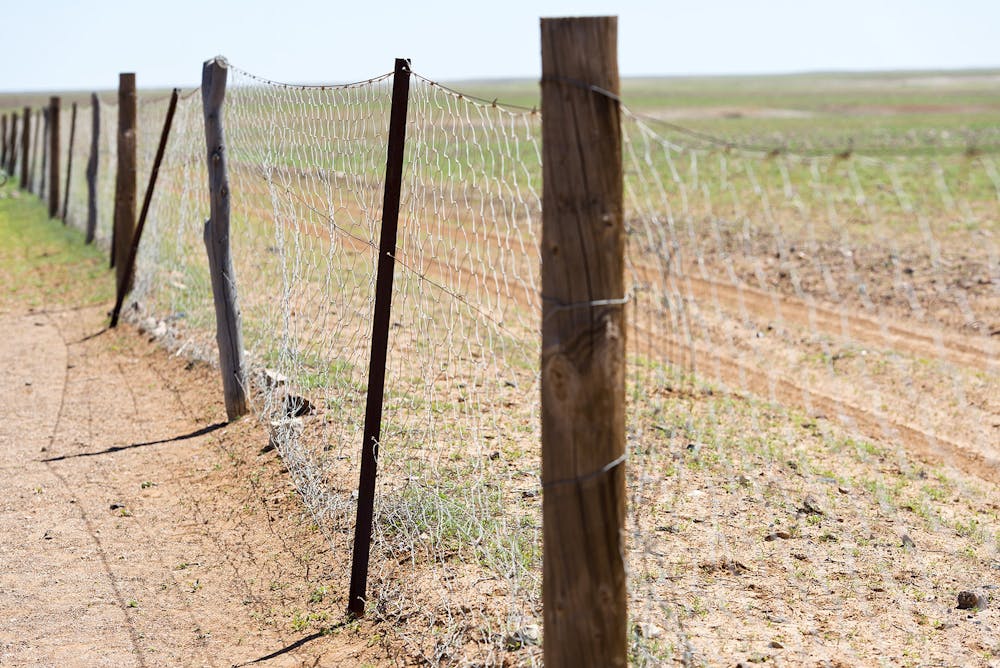
Fences to control pests, like the famous Rabbit Proof Fence, are causing an ecosystem crisis. Steve Collis/Flickr, CC BY

“Fences on the ground,” Gammage explains, “create fences in the mind”.

For millennia, First Australians practised animal husbandry by being attuned to — rather than fencing off — their surrounding environment. Even in introduced farming systems, it’s possible to manage livestock without fencing, using rotational herd grazing which doesn’t involve permanent fences.

Australia now has the longest fences on earth. One, the Rabbit Proof Fence, stretches 3,256 kilometres and featured in a 2002 film of the same name.

These have lessened the impact of introduced pests, but they have also prevented wildlife migration, causing ecosystem catastrophes and mass die-offs of emus and other species.


Read more: From Australia to Africa, fences are stopping Earth’s great animal migrations


An act of civic kindness

Urban fences, too, arrived with colonisation, and demolishing them is an act of civic kindness – if not a step towards decolonisation.

This idea isn’t new: in 1924, Canberra’s civic planners placed a ban on front fences to:

encourage people to be good citizens [therefore] making a community and not allowing people to form ghettos.

The ban persists to this day.

More recent urban developments such as street libraries and verge gardens (nature strips) have challenged perceived borders between civic and private spaces. These potentially involve struggles between citizens, public authorities and private industries, opening legal frontiers around duty of care and rights of access.

Yet they’re proliferating without incident, and operating as gestures of civic generosity.

Tasmanian philosopher Jeff Malpas believes we rehearse conversations and metaphors in our architectural constructions. One example might be our use of “white picket fence” to describe a cluster of bourgeois or aspirational values.

Wire fencing is associated with asylum seeker imprisonment. Shutterstock

As one of the world’s biggest markets for razor wire fencing, we frequently invoke wire fencing as a shorthand for asylum-seeker imprisonment.

Recent research into displacement by Tony Blair’s former policy advisor concluded:

the route to power to change society starts at home.

Thinking outside the fence — or demolishing it completely — may be a good start.

ref. Demolish your front fence. It would be an act of radical kindness – http://theconversation.com/demolish-your-front-fence-it-would-be-an-act-of-radical-kindness-119390

Nearly 30% of kids experience sibling bullying – as either bully or victim

Source: The Conversation (Au and NZ) – By Rachael Sharman, Senior Lecturer in Psychology, University of the Sunshine Coast

Australia has invested an extraordinary amount of time and effort into putting in place bullying prevention programs – especially across schools. But what happens when your bully is your own flesh and blood, and lives with you, so you have no escape?

Sibling bullying tends to fly under the radar, in large part because many bullies and victims see it as a normal part of sibling relationships.

But sibling bullying is different to typical sibling spats, teasing or playing rough. It is ongoing and repeated use of physical or psychological power to control and dominate another person.

A recently published study tracked more than 6,000 children in the United Kingdom. It explored just about every factor you could nominate in family bullying including family, parent and child characteristics such as the number of family members, and individual mental health, IQ, personality, social skills and self-esteem.

The authors came to some surprising conclusions that overturned a few previously held assumptions.

What is sibling bullying?

In the study, 28% of children reported being involved in sibling bullying – either being the bully, victim, or taking turns being both. The onset of bullying typically occurred around eight years old.


Read more: Not every school’s anti-bullying program works – some may actually make bullying worse


The study defined sibling bullying as repeated aggressive behaviour between siblings intended to inflict harm, either physically (for instance hitting, kicking or pushing), psychologically (for instance saying nasty and hurtful things), socially (for instance by telling lies or spreading rumors) or property based (such as stealing or damaging property).

For it to be classified as bullying, the behaviour must involve a real or perceived power imbalance.

Who is at risk?

The strongest factors that predicted whether sibling bulling would occur was the presence of older males (especially first-born), families with larger numbers of siblings, or in households under financial stress.

Households with older boys tended to be at higher risk of experiencing sibling bullying. from shutterstock.com

Parents in a high conflict relationship with each other slightly increased the odds of children experiencing bullying.

Children who displayed antisocial characteristics in early childhood were more likely to bully their brother or sister. And children with higher self-esteem were slightly protected from the risk of being bullied.

Surprisingly, single-parent households and lower parental education or social class didn’t increase the risk of sibling bullying. Social conditions and parenting factors, even including parental maltreatment mattered only slightly, if at all.

Nefariously, bullies were found to have more advanced social skills, allowing them to adapt and hone their bullying behaviours to maximum effect.


Read more: Rebel teens can quickly make friends, but in the end, it’s the nice ones who have the most


Impacts of sibling bullying

Other research shows that sibling bullying increases the risk of the victim becoming the target of peer bullying and developing emotional problems in adulthood. The child who is bullied by both siblings and peers is in a particularly awful predicament, as their childhood is marred with no escape from this treatment.

The impacts of sibling bullying have been shown to persist long-term. The experience can damage the possibility of a healthy relationship between the siblings, and double the risk of the victim experiencing depression and self-harm in adulthood.

Playing favourites

Research also shows if one child is favoured over another, this can compound hostility and jealously between siblings well into adulthood. While favouritism is often denied by parents, parents can favour a child based on gender, and similar personality or interests.

Parents should remain vigilant and ensure they are giving similar levels of attention, time and interest to all their children.

Extreme levels of favouritism are particularly pronounced in narcissistic parenting where a “golden child” is showered with love and attention and can do no wrong while another child is deliberately cast into the role of the family scapegoat and can do no right.

Parents often play favourites, even if they deny it. from shutterstock.com

This pathological style of parenting is especially damaging. It typically increases the likelihood of the golden child becoming narcissistic themselves and the scapegoat developing a raft of mental-health, addiction and identity problems.


Read more: Why some children think they’re more special than everyone else


Advice for parents

The research paints a particular picture: bullying among siblings is more likely to occur when parental resources such as time, money, attention and affection are stretched too thin between siblings. This is especially the case in a family with males who are older or first born.

Such findings are in line with recent Australian research that showed adding a brother or sister to keep the elder child company typically backfires, and instead just places the family under further pressure.

The take-home message for parents is to thoughtfully plan your family structure.

ref. Nearly 30% of kids experience sibling bullying – as either bully or victim – http://theconversation.com/nearly-30-of-kids-experience-sibling-bullying-as-either-bully-or-victim-118684

Dolphin researchers say NZ’s proposed protection plan is flawed and misleading

Source: The Conversation (Au and NZ) – By Elisabeth Slooten, Professor, University of Otago

The New Zealand government recently proposed a plan to manage what it considers to be threats to Hector’s dolphins, an endemic species found only in coastal waters. This includes the North Island subspecies Māui dolphin.

Māui dolphins are critically endangered and Hector’s dolphins are endangered. With only an estimated 57 Māui dolphins left, they are literally teetering on the edge of extinction. The population of Hector’s dolphins has declined from 30,000-50,000 to 10,000-15,000 over the past four decades.

The Ministry for Primary Industries (MPI) and the Department of Conservation (DOC) released a discussion document which includes a complex range of options aimed at improving protection.

But the proposals reveal two important issues – flawed science and management.


Read more: Despite its green image, NZ has world’s highest proportion of species at risk


Flawed science

Several problems combine to overestimate the importance of disease and underestimate the importance of bycatch in fishing nets. For many years, MPI and the fishing industry have argued that diseases like toxoplasmosis and brucellosis are the main cause of decline in dolphin populations. This is not shared by New Zealand and international experts, who have been highly sceptical of the evidence. Either way, it is not an argument to ignore dolphin deaths in fishing nets.

Three international experts from the US, UK and Canada examined MPI’s work. They concluded that it is not possible to estimate the number of dolphin deaths from disease, much less claim that this impact is more serious than bycatch. On the other hand, it is easy to obtain an accurate estimate of the number of dolphins dying in fishing nets, as long as enough observers are allocated. MPI has failed to do so. Coverage has been so low that MPI’s estimate of catch rates in trawl fisheries is based on one observed capture.

It would be possible to estimate dolphin deaths in trawl nets if enough observers were allocated. Supplied, CC BY-ND

The MPI model used in the public discussion document (and described in more detail in supporting materials) is complex, and a one-off. It is based on a “habitat model” of dolphin distribution, but fits actual dolphin sightings poorly.

Another problematic aspect of the method is that there is no clear time frame for the “recovery” of dolphin populations to the specified 90% of the unimpacted population size for Hector’s dolphins and 95% for Maui dolphins. This is one of the first things any decision maker would want to know. Would Māui dolphins be held at the current critically endangered population level for another 50 years? If so, this dramatically increases their chance of extinction.

Flawed management options

The second set of problems concerns the management options themselves. These are a complex mix of regulations that differ from one area to another, for gillnets and trawling. They frankly don’t make sense. The International Whaling Commission (IWC) and International Union for Conservation of Nature (IUCN) have recommended banning gillnet and trawl fisheries throughout Māui and Hector’s habitats. MPI’s best option for Māui dolphins comes close to this in the middle of the dolphins’ range, but doesn’t go as far offshore in the southern part of their range.

The South Island options for Hector’s dolphin are much worse. MPI’s approach has been to try to reduce the total number of dolphins killed to just below the level they believe is sustainable. MPI has invented its own method for calculating a sustainable number of dolphin deaths, which is much higher than the well-tested method used in the United States. The next step has been to find areas where the greatest number of deaths can be avoided at the least cost to the fishing industry.

Several Hector’s dolphin populations in the South Island are small, but they act as a bridge between larger populations. Supplied, CC BY-ND

This sounds reasonable, but fixing the problem only in the places where the largest number of dolphins is being killed will have several negative consequences. Experience shows that fishing effort shifts beyond protected areas, merely moving the problem.

For example, MPI’s proposals leave a large gap on the south and east side of Banks Peninsula, in prime dolphin habitat. If the nearby areas are protected, this gap will be fished, and dolphin bycatch will continue unabated. What’s needed is protection of the areas where dolphins live.

MPI’s focus on reducing the total number of dolphin deaths also ignores the fact that it really matters where those deaths occur. Several Hector’s dolphin populations in the South Island are as small, or smaller, than the Māui dolphin population.

Entanglement deaths have much worse consequences in such small populations, which form a bridge between larger populations. Yet they get no attention in the current options. MPI’s proposals would lead to the depletion of small populations, with increased fragmentation and extinction of local populations.

Only one option

If we want to ensure the long-term survival of these dolphins, there is only one realistic solution: to remove fishing methods that kill dolphins from dolphin habitat. The simple solution is to use only dolphin-safe fishing methods in all waters less than 100 metres deep. This means no gillnets or trawling in harbours and other coastal waters up to the 100 metre depth contour.

There is no need to ban recreational or commercial fishing, but we must make the transition to selective, sustainable fishing methods. These include fish traps, longlines and other hook and line methods. Selective, sustainable fishing methods also use less fuel than trawling and avoid impacts of trawling and gillnets on the broader marine environment.

We also need more observers and more cameras on fishing boats. MPI’s estimate of how many dolphins are dying in fishing nets is almost certainly an under-estimate. It depends heavily on assumptions that are not supported by data.

With observers on only about 2-3% of the inshore fishing boats, the chances of missing bycatch altogether is very high. Low observer coverage also means boats can fish differently on the days when they have an observer aboard (for example, avoiding areas where they have caught dolphins).

Selective fishing methods would protect dolphins and the broader marine environment. Supplied, CC BY-ND

We know what works

Despite getting a poor report card from the international expert panel, MPI presented a virtually unmodified analysis to the IWC’s scientific committee last month. The committee identified most of the same issues and concluded it needed more time to decide whether MPI’s approach is fit for purpose. Meanwhile the IWC reiterated its recommendation, which it has been making for eight years, to ban gillnets and trawl fisheries throughout Māui dolphin habitat.

In the meantime, dolphins continue to be killed in fishing. We need to make decisions on the basis of scientific evidence available now. All of the population surveys, including those funded by MPI, show Hector’s and Māui dolphins live in waters less than 100 metres deep.

The best evidence of what works comes from Banks Peninsula, where the dolphins have had partial protection since 1988, and detailed follow-up research. This population was declining at 6% per year before gillnets were banned to four nautical miles offshore and trawling to two nautical miles. Even though there was no management of disease, the rate of population decline has dropped dramatically to less than 1% per year. If disease were a serious problem, the restrictions on gillnets would have made little difference.

A general principle in conservation is that the longer you wait, the more difficult and more expensive it will be to save a species, and the more likely we are to fail.

ref. Dolphin researchers say NZ’s proposed protection plan is flawed and misleading – http://theconversation.com/dolphin-researchers-say-nzs-proposed-protection-plan-is-flawed-and-misleading-118997

Buckle up. 2019-20 survey finds the economy weak and heading down, and that’s ahead of surprises

Source: The Conversation (Au and NZ) – By Peter Martin, Visiting Fellow, Crawford School of Public Policy, Australian National University

During the election we were promised jobs and growth. But in 2019-20 The Conversation’s forecasting panel is predicting an economic growth rate as weak as any since the financial crisis, as well as dismal consumer spending, no improvement in unemployment or wage growth, and an increased chance of recession.

As in January, The Conversation has assembled a forecasting panel of 20 leading economists from 12 universities across six states. Among them are macroeconomists, economic modellers, former Treasury, IMF, OECD and Reserve Bank officials, a former government minister and a former member of the Reserve Bank board.

Whereas in January only three members of the 20-person panel expected the Reserve Bank to cut interest rates, and most expected an economic growth rate approaching 3% (which is the Treasury’s estimate of the best that can be achieved on a sustained basis), this time all but two expect the bank to cut again, and most expect a growth rate closer to 2% – one of the most anaemic since the financial crisis.


Read more: No surplus, no share market growth, no lift in wage growth. Economic survey points to bleaker times post-election


On the upside, the panel expects iron ore prices to stay higher for longer than did the budget, it expects home prices to stabilise, and it is predicting the lowest government bond rate on record, making it cheaper than ever before for the government to borrow and spend its way out of trouble.

The panel predicts a surplus in name only in 2019-20, and overwhelmingly believes the government should be prepared to abandon it if it has to in order to keep the economy growing.

Economic growth

The panel’s average forecast for year-on-year growth is 2.1%. Year-on-year growth is the measure used in the budget. It compares economic activity throughout all of one financial year with activity throughout all of the previous financial year. The budget forecast for 2019-20 is 2.75%.

Respected forecasters including former Reserve Bank board member Warwick McKibbin and former OECD director Adrian Blundell-Wignall expect much lower growth than 2.1%. McKibbin expects 1.8%; Blundell-Wignall expects 1.5%. Only three of the panel’s 20 forecasts are close to Treasury’s. The rest are lower.


Some panellists submitted forecasts for Chinese economic growth under sufferance. They made it clear they were forecasting “official” growth, not actual growth which they think is much lower. Even so, most expect official growth to slow as the trade war between the United States and China intensifies. Nigel Stapledon says unless it is reined in (and he thinks it will be) it could bring on recessions.

Other panellists including Rebecca Cassells say the impact of US tariffs on Chinese goods has so far been positive for Australia. China has responded by investing in infrastructure projects that need Australian iron ore and coal. This, together with reduced competition from other suppliers of iron ore after the collapse of a tailings dam and mine closures in Brazil, has lifted the price and volume of Australian exports to levels not seen for some time.

The panel expects robust United States growth of 2.6% in 2019, although many members are concerned about the year that will follow. The only panellist to forecast low US growth in this year (1%) is Blundell-Wignall, who until last year analysed world economies in his role as special advisor to the OECD secretary general.

Living standards

Jobs growth will disappoint both the Treasury, which has forecast unemployment of 5% by the end of the financial year, and Reserve Bank Governor Philip Lowe, who has adopted a target of “4 point something”.

All but three of the 20-person panel expect the rate to stay above 5%. The average forecast is 5.3%, which is close to the present 5.2%.

Stapledon says Australia’s recent strong employment growth has been “out of kilter” with slower GDP growth and the winding down of housing construction, meaning jobs growth is set to slow down, pushing up unemployment.


Brendan Coates says underemployment is also climbing as more people work fewer hours than they would like, making it harder for them to push for wage rises. Rebecca Cassells points out that full-time employment has grown almost twice as fast among women than men, which, given the low rates of pay in the industries that traditionally employ women, is likely to further depress average wages.

The headline measure of living standards, GDP per capita, has been falling, but a better measure, real net disposable income per capita, which takes better account of buying power, has been continuing to climb. The panel expected to climb a further 1% over the year to June 2020, after climbing 1.3% in the year to March.

Nominal GDP, which takes full account of mining revenue and drives company profits and the budget revenue, has grown 5% over the past year and is expected to grow 3% in the year ahead.

The risk of recession

The panel regards a recession as more likely than it did in January, assigning a 29% probability to a conventionally defined recession in the next two years, up from 25%.

Economic modeller Janine Dixon says the bulk of Australia’s recent economic growth has come from higher commodity prices via exports.

She says without them, Australia would be reliant on weak wage and consumption growth, although she believes high population growth will be enough to ensure economic activity doesn’t shrink for two consecutive quarters which would be the conventional definition of a recession.


Former Treasury and ANZ Bank economist Warren Hogan says with consumers tightening their belts, an external shock could easily knock Australia into a recession.

Julie Toth, an economist at the Australian Industry Group who has also worked for the Productivity Commission, says with growth already low, it won’t take much to turn it negative.

Debt theorist Steve Keen, who assigns a 95% probability a recession (as he did in January) says Australia escaped that fate during the global financial crisis in part by boosting grants to first home buyers, which made Australian households among the most indebted in the world and “put off the day of reckoning” when those debts would be unwound.

Through a mix of good luck and good management, Australia has avoided a recession during three global downturns since the early 1990s: the 1997 Asian economic crisis, the early 2000s dotcom collapse, and the 2007-09 global financial crisis. If it succeeds again it will enter its fourth decade recession-free in this term of government in mid-2021.

Wages and prices

The panel expects continued historically wage growth of only 2.2% in 2019-20, slightly weaker than the latest reading of 2.3% and well short of the budget forecast of 2.75%. If that average forecast is right, it will be the seventh consecutive year in which wage growth has fallen short of the budget forecast.


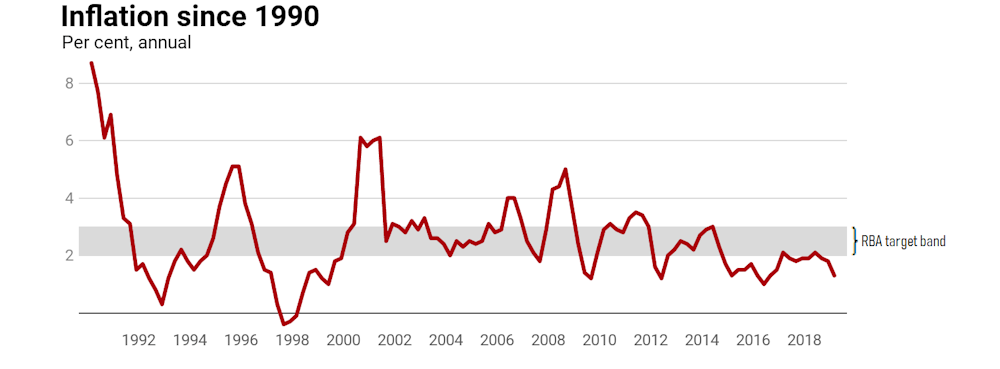
The good news (for wage earners) is that even that unusually low rate of wage growth would be well above the rate of inflation, which is expected to be only 1.5%, or 1.4% on the so-called “underlying” basis watched closely by the Reserve Bank.

The bad news for the Reserve Bank is that it will put inflation well outside the bank’s target band of 2-3% for the fifth consecutive year, raising questions about whether there is any point to the band.


For years now, inflation has mostly been below the band. ABS 6401.0

Mark Crosby, Warren Hogan and Adrian Blundell-Wignall suggest broadening the target band to 1-3%. Tony Makin and Nigel Stapledon suggest cutting it to 1-2%.

Richard Holden and Warwick McKibbin suggest ditching it altogether and replacing it with a target for nominal GDP growth. McKibbin suggests a nominal GDP target of 6%, which given the present forecast for weaker nominal GDP growth would mean interest rate cuts. In better times it would mean rate rises.

Chris Edmond and Craig Emerson defend the 2-3% inflation target saying that what is really concerning is the bank’s preparedness to stay beneath the target band for extended periods.

Home prices

The panel expects only modest falls in Sydney and Melbourne house prices of 2-3% in each city after falls of 10% over the past year. It is more optimistic on home building than is the Treasury, expecting housing investment to fall by 4.9% rather than the budget forecast of 7%.


Business

None of the panellists expects household spending to grow by the 2.75% forecast in the budget. On average, the panel expects spending growth of just 1.9% in 2019-20, which is little better than the present 1.8% and only few points above population growth.

Janine Dixon blames continuing weak growth in wages and incomes. Nigel Stapledon says much of it flows from the weaker housing market. Household furnishings drive household spending growth. Household spending drives GDP growth, accounting for more than half of it.

In better news, the panel expects mining investment to rebound after sliding for most of the last five years. Its forecasts of growth in mining investment of 4.4%, and growth in non-mining investment of 4%, are in line with budget forecasts.


Interest rates and the budget

Perhaps surprisingly given its forecasts for weak employment growth, weak economic growth and weak inflation, the panel’s average forecast for interest rates is for just one more cut, perhaps as soon as July 2, but some time in the second half of the year.

Only five panellists expect a followup cut in the first half of next year, but among them are Craig Emerson, Richard Holden and Steve Keen, who were the only three to correctly) forecast in January that there would be a rate cut at all this year.

Holden expects two further rate cuts in the second half of this year, taking the Reserve Bank cash rate to 0.75%, and then a further two in the first half of next year, taking it to just 0.25%. Keen expects one further cut on the second half of this year and another two in the first half of next year, taking it to 0.5%.

Warwick McKibbin is the only panellist expecting the Reserve Bank to change course, expecting one further cut this year and then a series of increases as ballooning debt makes the Reserve Bank and other central banks realise they cut too far, pushing the cash rate back up to 1.5%.


The panel expects a government 10-year borrowing rate of just 1.5%, which is about the lowest it has ever been. A year ago the 10-year bond rate was 2.7%. The ultra low rate will both make it easier for the government to borrow and cut the cost of servicing its existing debt as loans are rolled over.

In further good news for the budget, the panel expects a substantially higher spot iron ore price than does the government, of US$95 a tonne by mid next year instead of the fall to US$55 assumed by the Treasury.


The forecast is somewhat above the Department of Industry’s new July forecast of US$95 a tonne by the end of this year trending down to US$61 by the end of 2020, but are way in excess what was forecast in the budget. A sensitivity analysis included in the budget said that for every US$10 that the iron ore price was higher than budgeted, the government’s tax take would be A$1.1 billion higher in 2019-20 and A$3.7 billion higher in 2020-21.

The panel expects the Australian dollar to remain broadly where it is at just below 70 US cents as the upward push from strong commodity prices offsets the downward push from domestic economic weakness.

Yet despite the iron ore price and lower borrowing costs the panel expects a much weaker budget outcome than the A$7.1 billion surplus forecast in April.

Its average forecast is for a surplus of only $1.2 billion, which is a mere sliver of GDP (0.07%), practically indistinguishable from a deficit of the same amount.


The forecasts come after Finance Department figures for May released on Friday raised the possibility of an early return to surplus in 2018-19. They suggest that surplus is at risk in 2019-20 and beyond, both because of economic weakness and an because of an increasingly urgent need to respond to that weakness through spending or further tax cuts.

Asked whether should the government strive to continue to deliver its promise of a surplus if economic growth remains weak or weakens further, former OECD director Adrian Blundell-Wignall replied bluntly, “of course not”.

The only panellists prepared to defend the continued pursuit of a surplus in the economy remained weak or weakened were Ross Guest, who said it was a worthwhile aim given the steady rise in government debt to GDP ratio, and Tony Makin, who qualified his reply by saying the surplus should be achieved by pruning unproductive expenditure such as industry assistance rather than deferring tax cuts.

Former government minister Craig Emerson regretfully forecast that the government would deliver a surplus whatever the economic circumstances, for political reasons.


The Conversation 2019-20 Forecasting Panel

Click on economist to see full profile.

ref. Buckle up. 2019-20 survey finds the economy weak and heading down, and that’s ahead of surprises – http://theconversation.com/buckle-up-2019-20-survey-finds-the-economy-weak-and-heading-down-and-thats-ahead-of-surprises-119455

Murder charges laid in case of Tahiti journalist missing for 22 years

By RNZ Pacific

Murder charges have been laid in the case of the French Polynesian journalist Jean-Pascal Couraud, who vanished in 1997.

The accused are Couraud’s ex-partner Miri Tatarata and a friend, Francis Stein, who are said to have had an affair at the time.

The two, who are both top officials in the French Polynesian administration, were charged after being detained for two days of interrogations.

READ MORE: Walter Zweifel feature on the background to the case of “JPK”

Jean-Pascal Couraud
Jean-Pascal Couraud was believed to be investigating links between Gaston Flosse and French President Jacques Chirac when he vanished. Image: RNZ/AFP/Couraud family

French Polynesian journalist Jean-Pascal Couraud, who disappeared 20 years ago, was believed to be investigating links between Gaston Flosse and French President Jacques Chirac.

The pair have been released but are under judicial control pending further action.

-Partners-

Tatarata’s lawyer has described the murder charge as scandalous.

Reports say the two accused have given conflicting accounts of the day when the journalist, known locally as “JPK”, was last seen.

Courarud was famous for researching the affairs of the then-strongman and territory president, Gaston Flosse, who ruled a militia known as the GIP.

Read more about the 1997 disappearance of Jean-Pascal Couraud.

An investigation was first opened in 2004 after a former spy claimed that Couraud had been kidnapped and killed by the GIP, which dumped him in the sea between Mo’orea and Tahiti.

Murder charges against two members of the now disbanded militia, the GIP, were dismissed five years ago, after incriminating wiretaps were ruled inadmissible because they were obtained illegally.

This article is published under the Pacific Media Centre’s content partnership with Radio New Zealand.

Print Friendly, PDF & Email

Article by AsiaPacificReport.nz

Indonesian Army helicopter with 12 on board goes missing in Papua

By Gemma Holliani Cahya in Jakarta

Silas Papare Air Force base in Sentani, Jayapura, has reported that an Mi-17 helicopter belonging to the Indonesian Army lost contact after departing from Oksibil airport in Pegunungan Bintang regency, Papua, yesterday afternoon.

The helicopter took off from Oksibil, where it had stopped to refuel, at 11:44 a.m. local time and was scheduled to arrive at Sentani airport, Jayapura, at 1:11 p.m.

The Silas Papare tower officer reported that at 11:49 a.m., five minutes after it took off from Oksibil, the helicopter lost contact.

It had 12 members on board, with seven crew members and five members of the Infantry Battalion 725/Waroagi task force who were being transferred to another post.

Cendrawasih Military Command spokesperson Colonel Muhammad Aidi said a joint search and rescue team comprising military personnel and members of the National Search and Rescue Agency (Basarnas) was deployed on Friday afternoon to search for the missing helicopter.

“At 9:00 p.m. we decided to stop the search because it was raining really hard in the area. We will continue the search tomorrow morning,” Aida said.

-Partners-

Aidi said the helicopter was in good condition when it departed from Oksibil. The weather that day was forecast as foggy but with clear visibility at around 6 to 7 km.

However, Aidi said, the Meteorology, Climatology and Geophysics Agency (BMKG) later informed that the weather at several points along the flight route was changing drastically.

“We still cannot say what really happened but, when it comes to mountains in Papua, we often see extreme and drastic weather changes,” he said.

The Mi-17 helicopter started its trip on Friday morning, bringing food and supplies from Sentani to the border security post at Okibab district in Pegunungan Bintang.

Aidi said the trip happened monthly because the post could only be reached by air.

Gemma Holliani Cahya is a reporter with the Jakarta Post.

Print Friendly, PDF & Email

Article by AsiaPacificReport.nz

White cedar is a rare bird: a winter deciduous Australian tree

Source: The Conversation (Au and NZ) – By Gregory Moore, Doctor of Botany, University of Melbourne

Sign up to the Beating Around the Bush newsletter here, and suggest a plant we should cover at batb@theconversation.edu.au.


White cedar (Melia azedarach) grows naturally across Queensland and northern New South Wales, but is widely planted as an ornamental tree all over Australia. It also grows across much of Asia, and belongs to the mahogany family.

This wide dispersal sees the species given a very wide and diverse range of common names, including: umbrella cedar, pride of India, Indian lilac, Persian lilac, and Chinaberry. It Australia it is known as white cedar due to its soft general-purpose timber.

The name Melia was the Greek name given to the ash tree, which has similar foliage, and azedarach means “poisonous tree” – parts of it are toxic.


Read more: This centuries-old river red gum is a local legend – here’s why it’s worth fighting for


White cedar is something of a rarity among Australian native trees, as it loses its leaves in winter or early autumn. Winter deciduous trees are highly valued in landscape design as they provide all the benefits of summer shade, but allow winter light.


The Conversation

While Australia has an abundance of evergreen tree species and a variety of summer deciduous trees that lose their leaves in summer when water is scarce, we have few winter deciduous native trees. White cedar fits the bill beautifully, and despite a few shortcomings has some very attractive traits.

White cedar is usually a small spreading tree with a rounded canopy up to about 6m in height, but under the right conditions trees can be more than 20m tall, with a canopy spread of 10m or more. They have quite dense foliage composed of dark compound leaves up to 500mm long, which transition from dark green to a pale yellow in autumn.

As a winter deciduous tree they are a very popular native tree that has been widely planted as street trees and in domestic gardens, where specimens of 10-12m are common. The trees are often considered to be short-lived (around 20 years), but in gardens and where irrigation is available some may live for 40 years or longer.

Good specimens of white cedar have many small flowers (20mm) that are white with purple/blue stripes and a wonderful, almost citrus-like scent. The fruits are about 15mm in diameter and bright orange in colour. They are usually retained over winter and so the trees provide a seasonal smorgasbord – shade in summer, autumn foliage colour, orange fruits in winter, and attractive scented flowers in spring.

Many specimens are prolific in their production of fruits and seeds, which readily germinate, underscoring the weed potential of the species under the right circumstances. They can be an invasive species in some parts of Asia and Africa.

Unfortunately as the fruits mature and dry they become as hard as ball bearings. If you mow over them they can fire from under a mower like bullets, and if they land on a hard paved surface they can be a tripping hazard for people who unexpectedly find themselves skating. The fruits and foliage can also be quite toxic if eaten. So this would appear to put a bit a dampener on the use of the tree. However, in recent years non-fruiting varieties of white cedar have become available and these have proven popular as street and garden trees.

A toxic treat

Many parts of the tree are toxic – interestingly, though, not the fleshy part of the fruit. It has evolved to be attractive to the birds that disperse seed. However the seeds are very poisonous, and as few as 6 or 8 seeds can be fatal for children. Fortunately, the seeds are very hard and do not taste very pleasant, so the risk of humans eating them is quite low.

Despite this, white cedar has been widely used as a medicinal plant by indigenous cultures, especially for intestinal parasites. The seeds have been widely used to make beads by indigenous peoples in Asia and Australia, and in some places the tree is called the bead tree.

An easy grower

One of the good things about white cedar is they are easily grown, and cope quite well with the low rainfall in many parts of Australia. They also tolerate a variety of soil types, which is why they have been so widely and successfully spread.

The trees are quite resistant to termite damage and their poison does protect them from grazing mammals and some insects. They can be prone to root problems and it is not uncommon for their trunks to break off at ground level, especially if they have been poorly propagated or planted, which can be a big problem when they are planted as a street tree.


Read more: Built like buildings, boab trees are life-savers with a chequered past


Although they are related to mahogany, their wood can be quite brittle and easily broken, which means care should be taken when pruning or working on them. When the wood dries it shatters easily and can send shards in all directions when you try to snap it. In Australia the wood can range from light cream to dark brown in colour, and while it is quite a useful wood for carving and furniture, it is not widely used.

As a winter deciduous native tree of smallish stature, with many attractive characteristics, the white cedar really is an Australian rarity, despite how widely it occurs or is planted.


Sign up to Beating Around the Bush, a series that profiles native plants: part gardening column, part dispatches from country, entirely Australian.

ref. White cedar is a rare bird: a winter deciduous Australian tree – http://theconversation.com/white-cedar-is-a-rare-bird-a-winter-deciduous-australian-tree-118837

After defamation ruling, it’s time Facebook provided better moderation tools

Source: The Conversation (Au and NZ) – By Fiona R Martin, Senior Lecturer in Convergent and Online Media, University of Sydney

After a NSW Supreme court judge ruled this week that Australian publishers are liable for defamatory comments on their Facebook sites, it’s clear that page owners need to get serious about social media management.

The ruling suggests that operators of commercial Facebook pages may need to hide all comments by default so that they can be checked for defamation before they are seen by the public.

The problem is that Facebook was not designed for users to pre-moderate comments. It was built to deliver us “frictionless”, immediate communication.

Judge Stephen Rothman’s contentious ruling relied on expert evidence that Facebook publishers can use a software hack to block comments from appearing. By adding common words like pronouns or “the” and “a” to their page moderation filter, owners can ostensibly hide then un-hide comments once they’ve been checked for illegal content.

This is obviously impractical. Hiding comments will stop many people from posting, because they won’t see their contributions appear as they do elsewhere on Facebook. It will also stymie conversations, unless companies hire 24/7 moderation services. The cost would be prohibitive for most businesses.

An appeal against the decision is likely. In the meantime, companies with a Facebook presence should be doing two things:

  1. hiring expert community managers
  2. lobbying platforms for better moderation tools.

Better moderation tools might include introducing moderation dashboards and audit trails, giving users the chance to pre-moderate all comments, the ability to edit and move comments, and easier means of managing suspended and banned users.


Read more: Can you be liable for defamation for what other people write on your Facebook page? Australian court says: maybe


Why we need professionals

Community managers are a new and highly educated sector of the digital workforce. They build and facilitate online groups, as well as oversee moderation.

The results of the Australian Community Manager’s (ACM) network annual survey released this week show that this is a smart and highly feminised workforce. 82% have graduate qualifications and 72% are women.

Oddly, while most companies now use Facebook for customer engagement and promotion, many don’t yet employ senior professionals to oversee their community building.

Many employers and recruiters still see social media and online community manager roles as “junior and low skilled”. This is despite the fact that these professionals are often on the front line of client relations. They manage complex social infrastructure and handle tricky publishing decisions – such as what comments are legal, and which ones could lead to toxic conversations.

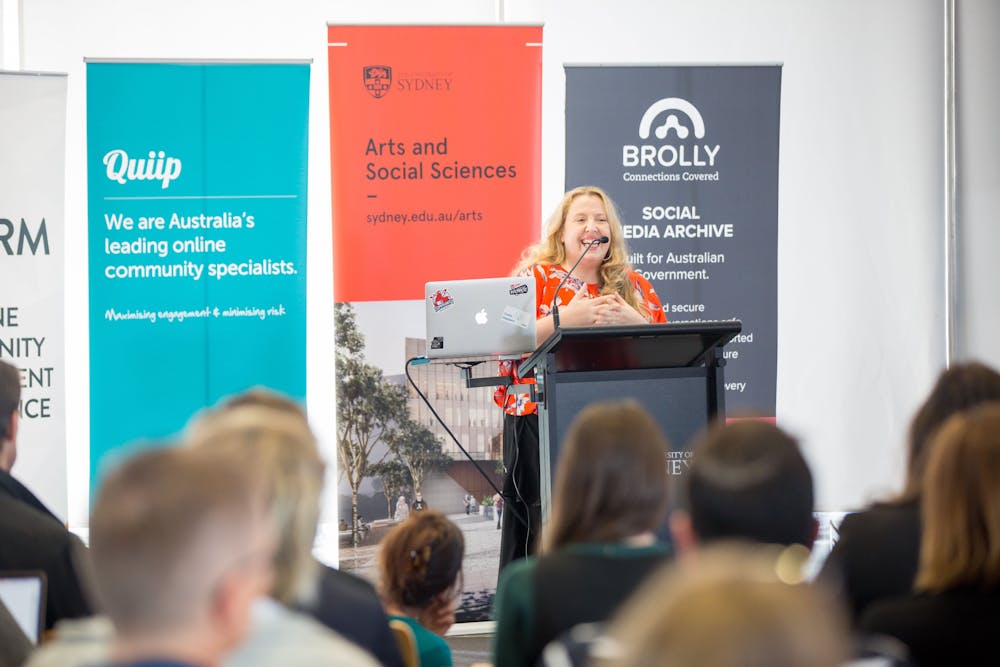
Venessa Paech, an expert in community management, addresses SWARM, the Australian Community Managers conference. Author provided

Only 22% of community professionals surveyed by the ACM said their role is understood and valued by the organisations they work with.

In light of the Rothman ruling, ACM founder and convenor Venessa Paech says:

…now more than ever companies need to recognise the value of having professionals manage their communities and social media sites, and planning ways to discourage the posting of harmful content.


Read more: Facebook is all for community, but what kind of community is it building?


Facebook’s platforms are popular

The ACM survey looked closely at the types of platforms managers businesses are using to host online groups. It found Facebook hosted the most used non-specialist applications for building community:

  • Instagram
  • Groups
  • Workplace.

Facebook Groups, the platform’s initial venture into community software has increased in popularity from 20% to 23% since last year’s survey. Facebook Workplace, its move into enterprise online community, grew 10% in the same period.

The ACM revealed that the issues community managers most wanted to discuss with their platform hosts were better management and moderation tools.

Top issues community managers most want to discuss with their platform provider

ACM Career Survey 2019

As one respondent said:

I run a project that is often impacted by hate speech and online harassment. I would love to have a closer relationship with the platform provider’s staff to ensure they support us and share insight into how content and comment moderation is evolving on their end.

That brings us to the second step Australian publishers need to take to tackle illegal speech online – lobbying Facebook and other platforms for effective community management and moderation tools.


Read more: We need to talk about the mental health of content moderators


Better moderation tools are essential

The Rothman ruling, unworkable as it is, is just the latest indication of how the judiciary and governments worldwide are bent on regulating platforms to control illegal speech.

As digital law scholar Nic Suzor has noted, there is an increasing sense that technology companies do not have our consent to govern the social world in the way they have been for the past decade.

The question then is whether it’s more effective for regulators to work with platforms to devise better moderation approaches, than to unilaterally punish them, or their users (such as media outlets), for breaches of speech laws.

While Rothman’s ruling does the former, Scott Morrison’s recent Sharing of Abhorrent Violent Materials Act does the latter. And yet there is no guarantee that either is a solution to preventing harmful content from being posted and spread.

Instead, as UN Secretary-General António Guterres said on Wednesday, in order to tackle the “tsunami of hatred” that is gathering speed across the world online it’s necessary to work with the platforms towards solutions.

So if you’re a Facebook publisher the time is ripe to reach out, to tell the platform what you need to keep your community safe and successful. And if you don’t know where to start, hire an online community manager to help.

ref. After defamation ruling, it’s time Facebook provided better moderation tools – http://theconversation.com/after-defamation-ruling-its-time-facebook-provided-better-moderation-tools-119526

Period pain is impacting women at school, uni and work. Let’s be open about it

Source: The Conversation (Au and NZ) – By Mike Armour, Post-doctoral research fellow, Western Sydney University

Menstrual symptoms including pain, heavy bleeding and low mood may be linked to nearly nine days of lost productivity per woman every year, according to a new study published in the British Medical Journal this week.

The researchers evaluated lost productivity associated with menstrual symptoms, as measured by time off from work or school (absenteeism) and working or studying while feeling ill (presenteeism), in 32,748 Dutch women between the ages of 15 and 45.


Read more: Health Check: are painful periods normal?


While just under 14% of respondents said they had taken time off from work or school during their periods, more than 80% said they had continued to work or study while feeling unwell, and were less productive as a result.

These findings tell us we need to better recognise the impact menstrual symptoms are having on women.

Period pain is common

We recently reviewed the literature and found that globally, almost three-quarters (71%) of adolescents and women under 25 reported having period pain.

Period pain (dysmenorrhoea) is perhaps the most common symptom associated with menstruation. It’s characterised by pain in the lower abdomen that usually occurs just before or during the first few days of a woman’s period. Period pain can be mild for some women, but more severe, and even debilitating, for others.

Primary dysmenorrhoea is the most common type of period pain and is mostly caused by changes in hormone-like compounds called prostaglandins, which are responsible for the cramping feeling many women report during their period.

Secondary dysmenorrhoea occurs when pain is caused by an underlying problem in the pelvis, such as endometriosis or adenomyosis.


Read more: Adenomyosis causes pain, heavy periods and infertility but you’ve probably never heard of it


Missing class and missing out

In our research, one in five young women (20%) reported missing school or university due to period pain. Two in five (41%) said pain affected their concentration or performance in class.

Many of these young women run the risk of falling behind during their final years of schooling – a crucial time in their academic lives.

More than 70% of adolescents and young women up to 25 experience period pain. From shutterstock.com

Women in our research also missed social activities, other school activities and sporting activities because of their menstrual symptoms. This is concerning as social interaction and participation in physical activity are important for good health, particularly during adolescence.

Just part of being a woman?

Many women think of period pain and other menstrual symptoms as “normal”. They don’t always recognise that their pain may be a health problem, and often believe it’s just something they need to “put up with”.

So most young women use self care to manage the pain themselves rather than seeking medical care. This is likely due to a variety of factors, including not discussing menstruation because of social or cultural taboos, a lack of quality education on menstruation, feeling dismissed by medical professionals, or the pain occurring for so long it just becomes “normal”.

While mild pain or discomfort could be seen as part of a “normal” menstrual cycle, if pain or any other menstrual symptoms are enough to prevent normal activities such as going to school or work, it’s important to go and speak to your doctor.

Moderate to severe period pain alone doesn’t necessarily mean you have a condition like endometriosis, but it’s likely that something can be done to help reduce the impact of your pain.


Read more: I have painful periods, could it be endometriosis?


What can be done?

There is a range of effective treatments for period pain, although there’s no “one-size-fits-all” approach that works for every woman. Some women may require multiple strategies to get their pain and symptoms to a level that doesn’t impact their daily lives.

Non-steroidal anti-inflammatories such as ibuprofen, and to a lesser extent the oral contraceptive pill, can be effective in treating primary dysmenorrhoea. Both treatments carry the risk of side effects, so should be discussed with a doctor.

Paracetamol, despite being commonly used for period pain, doesn’t appear to be particularly effective.

There’s some evidence that heat and regular physical activity can help. Heat seems to work best if used when pain is present, whereas exercise, such as yoga, is better if it’s done regularly throughout the month.

‘Period’ isn’t a dirty word

While symptom management is important, increasing young women’s health literacy around menstruation is equally vital. Improving education on menstruation may help women make better self-care choices like choosing more effective pain-relieving medications and taking the correct dose.

Several programs in Australia and New Zealand have been designed to help young people better understand the menstrual cycle. These include programs aimed at early adolescents, either at home or school.

The content of school-based programs varies but includes topics such as what a “normal” menstrual cycle looks like and how to identify symptoms that might indicate more serious conditions. Importantly, these programs generally target boys too, which should help reduce the stigma around discussing periods.


Read more: Cups, lingerie and home-made pads: what are the reusable options for managing your period?


Whether at school, university or in the workplace, menstrual symptoms cause absenteeism and presenteeism among a significant proportion of women. We need to break down barriers that prevent open discussion of periods, so women of all ages feel they can discuss any period-related problems with their boss, teachers, family or doctor.

Secrecy and shame around periods can prevent access to effective health care. Ensuring menstruating women of all ages have the information they need to choose the best way to manage their pain and symptoms is vital.

ref. Period pain is impacting women at school, uni and work. Let’s be open about it – http://theconversation.com/period-pain-is-impacting-women-at-school-uni-and-work-lets-be-open-about-it-118824

How the ‘Sydney School’ changed postwar Australian architecture

Source: The Conversation (Au and NZ) – By Davina Jackson, Honorary Academic, School of Architecture, University of Kent

Australia’s architectural historians have struggled to explain the “Sydney School” of nature-responsive modern houses built after the second world war. As well as arguing about whether any “school” existed, they also overlooked some of the movement’s pioneering designers and residences.

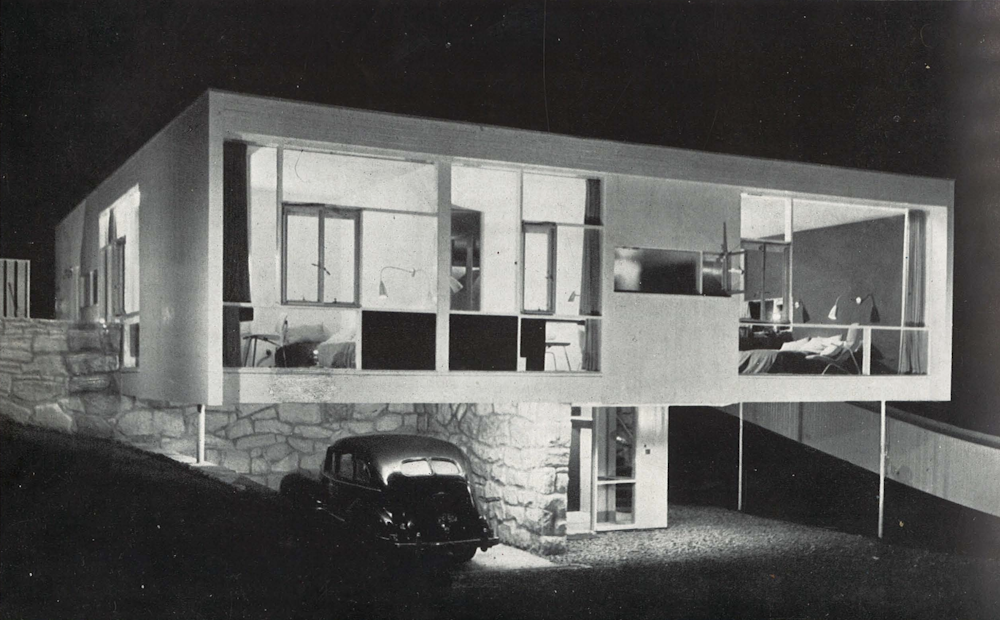
Studies of vintage Australian architecture and home publications suggest a hillside house at Church Point, built in 1948 by long-forgotten architect John Lander Browne, was Sydney’s first notable postwar interpretation of Frank Lloyd Wright’s organic (“natural”) principles for designing houses.


Read more: Building a nation: the state of play in Australian architecture


Rustic materials vs white paint

Wright’s Prairie houses (1906-09) ignited one side of modernism’s “great dialogue” about designing buildings either to harmonise with their natural surroundings or to appear superior – like abstract sculptures glistening above manicured lawns. At first he avoided painting his exteriors — in contrast to 1920s European modernists (led by Bauhaus School professors Le Corbusier, Walter Gropius, Marcel Breuer and Ludwig Mies van der Rohe).

They pioneered the “international style” of whitewashed masonry and steel-framed glass houses.

Sydney School residences were labelled “nuts and berries” because they exposed rustic materials like brick, timber and stone. This differentiated them from modern Sydney houses that were painted.


Read more: Sublime design: Le Corbusier’s Villa Savoye


The argument of Sydney’s postwar organic versus international style usually has been exemplified by Peter Muller’s brick and timber Audette House in Castlecrag (1954), in contrast to Harry Seidler’s pristine white Rose Seidler House at Wahroonga (1950).

Architect Peter Muller talks about his design of the Audette house.

Muller became the most internationally successful architect from the Sydney School. He transferred Wright’s principles and his own Asia-Buddhist experiences to produce supra-romantic village resorts in Indonesia.

And Seidler became Australia’s stellar modernist across all building types, especially the symbols of American capitalism: skyscrapers.


Read more: Reshaping Sydney by design – few know about the mandatory competitions, but we all see the results


‘A new eclecticism’

Most Sydney architects didn’t take sides in the style war as starkly as Muller and Seidler.

They copied new ideas from America, Britain, Scandinavia and Europe and combined these with traditional Mediterranean, South American, colonial and Oriental concepts that were introduced to Sydney before the war.

In a 1948 article for Britain’s Architectural Review (AR), visiting English architect Ryan Westwood “looked in vain for something that might be called an ‘Australian’ architecture”.

He noted:

inspiration has evidently sprung from Europe with latterly a crop of plagiarisms from California.

In AR’s September 1951 edition, Melbourne architect-critic Robin Boyd satirised the visual similarities of houses by Australian architects who were thought to be ideologically opposed. Boyd applauded signs of “a new eclecticism”.

Robin Boyd featured Harry Seidler’s Rose Seidler House at Wahroonga in his article on ‘opposing schools’. A New Eclecticism, Architecture Review, September 1951

Magazines show that in the late 1940s and early 1950s (pre-television) many Sydney architects were planning houses around prominent fireplaces and chimneys that were hand-built with rough-hewn sandstone blocks. And most avoided the modern concept of flat roofs, which often leaked and were usually opposed by local councils and neighbours.

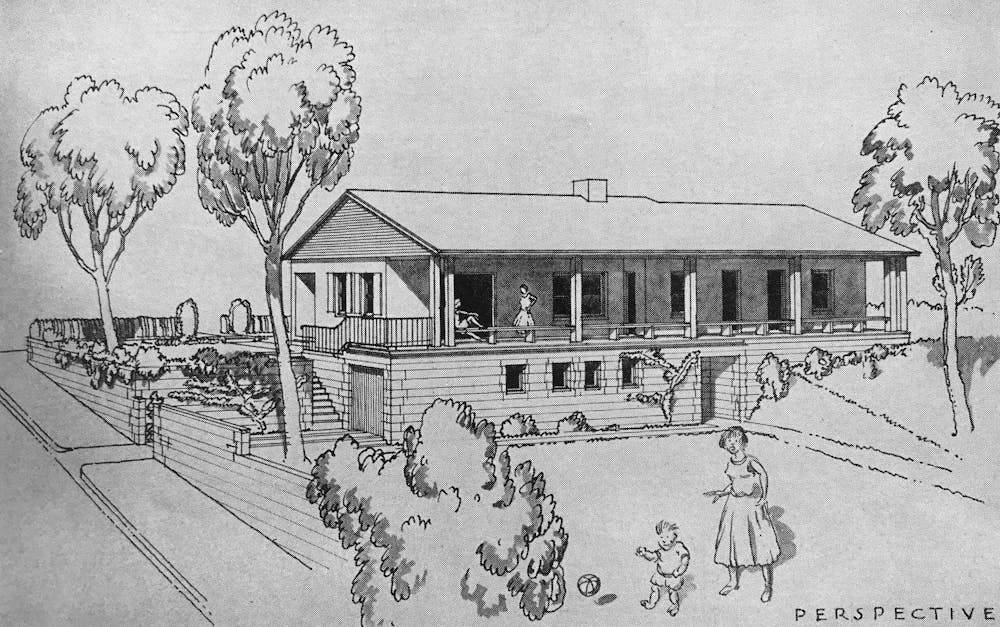
One Sydney architect, John D. Moore, included no flat roof among his 14 proposals for postwar modern houses, published in Home Again! Domestic Architecture for the Normal Australian (1944).

Sketch by Sydney architect John D. Moore for a practical suburban house that could be built for young families. Home Again! (1944)

Mid-career practitioner Sydney Ancher won the Royal Australian Institute of Architects’ 1945 Sulman Medal (best building in New South Wales) for a slate-gabled house. It was painted pale pink to suit the gum trees on his Killara site.

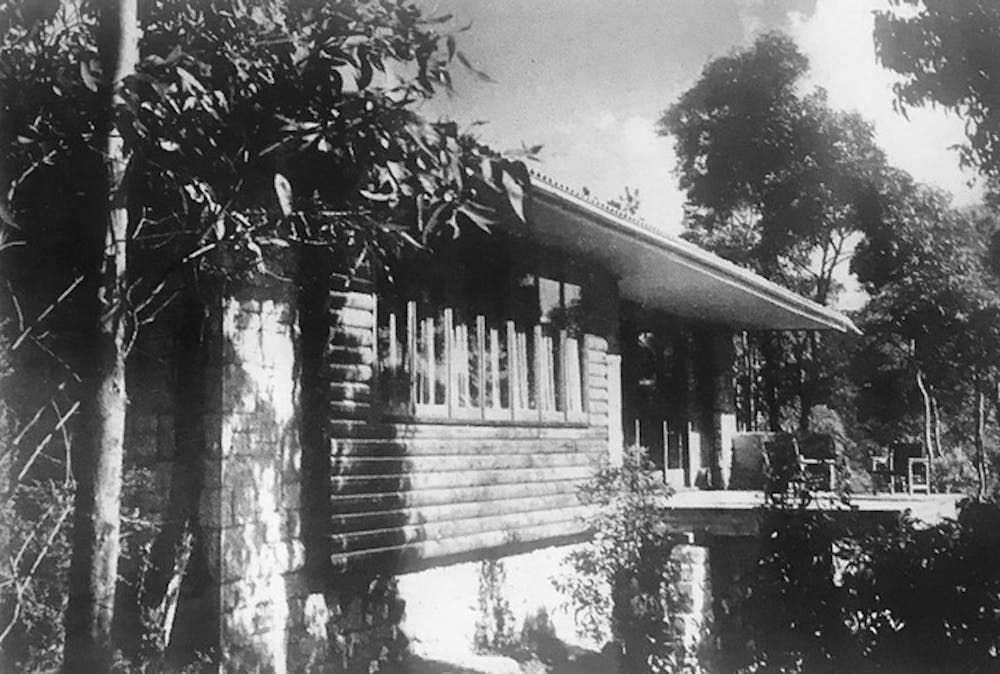
John Lander Browne’s Church Point house. Houses of Australia, George Beiers (1948)

John Lander Browne’s organic house included one of Sydney’s first postwar flat roofs. Set high on a steep site, it was accessed via a garden path and sandstone steps leading up to large terrace. Both storeys were clad in dark-stained weatherboards, offset by white window frames. (This was a Swedish strategy that might have helped to refract Northern Europe’s faint sunlight indoors.)

The house featured in George Beiers’ 1948 book, Houses of Australia, and in Westwood’s AR article.

Wright’s organic approach also inspired England-born architect Douglas Snelling, who switched from commercial graphics and interior design after his second working visit to Los Angeles in 1948. He was overlooked in key articles about Sydney modernism — by Milo Dunphy (1962), Jennifer Taylor (1970s-1990s), Stanislaus Fung (1985) and other postmodernist historiographers who aim to retrospectively define Sydney modernism.

But Snelling’s brick, cedar and sandstone residences were strongly promoted in 1950s magazines. They deserve recognition now as pioneering contributions to the Sydney School.

The Hay (Richmond) House at St Ives, by Douglas Snelling (1950-53). Max Dupain, Author provided
Derek Wrigley’s first owner-built house at Dee Why (c1949). Author provided

Another English architect, Derek Wrigley, built two modest homes for himself on steep sites at Dee Why in the late 1940s and early 1950s.

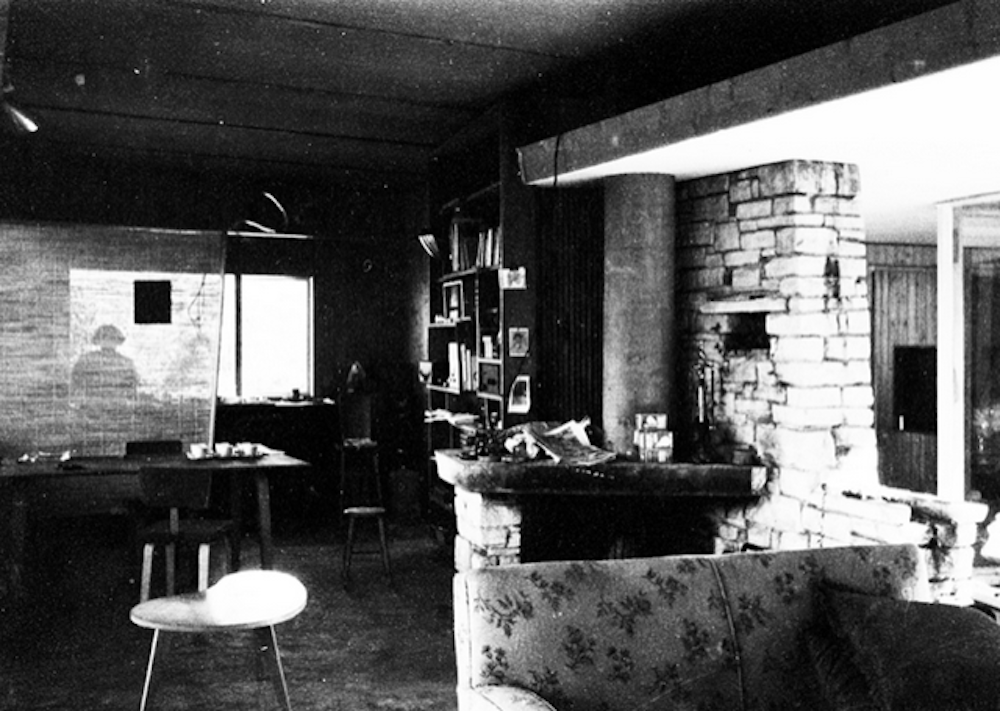
Today, he claims these reflected the Bauhaus teachings of his main design professor in Manchester. But old Sydney magazines show a Wright-style stone fireplace in Wrigley’s butterfly-roofed first house (OB1) and a California conical metal fireplace resting on a large rock projecting into the living room of his second residence (OB2).

Wrigley and Snelling both seem to have appreciated innovation, but they shared Wright’s basic alignment with nature.

East Sydney Tech lecturer Phyllis Shillito’s 1954 book, 60 Beach and Holiday Homes, included a varnished weatherboard house in Hunters Hill by J. Lindsay Sever, another forgotten Sydney modern architect. This was influenced by Wright’s Taliesin West compound in the Arizona desert and deserves inclusion in future histories of the Sydney School.

House by J. Lindsay Sever at Hunters Hill (1954). Ted Wood, in 60 Beach and Holiday Homes, Phyllis Shillito, Author provided

Shillito’s book also includes classic white residences by Sydney Ancher and Arthur Baldwinson, and key European emigrés — Hugo Stossel, Aaron Bolot, Hans Peter Oser and Harry Divola — whose houses are excellent interpretations of the international style, built on remarkable coastal and bush sites in Sydney. But their works seem inconsistent with the basically Wrightian organic agenda that underpinned the Sydney School.

The heyday of the Sydney School was the mid-1950s to the early 1970s. During this time, younger Sydney architects were interpreting Wright’s followers in southern California and Scandinavia.

Wright died in 1959, causing the CIAM group leading the international style to disband. Then Wright’s greatest opponents, Le Corbusier, Gropius and Mies, died in the mid-to-late 1960s. And modernism moved on.

Sydney’s 1960s “humanists” (who followed Scandinavian architects in trying to synthesise European communist and American democratic/capitalist ideologies, and who were responsive to nature) included Ken Woolley, Peter Muller, Hugh Buhrich, Philip Cox, Neville Gruzman, Bruce Rickard, John Allen, Russell Jack, Ian McKay, Bryce Mortlock, Peter Johnson, John James, Ross Thorne and Don Gazzard.

Many favoured face brick and stained timber and replaced flat roofs with canopies raked at unusual angles. Some also introduced a cross-sectional strategy of central staircases and staggered floor levels. Their houses were intended not merely to harmonise with their sites but to dramatise Sydney’s extraordinary topography and vegetation.

Where does Brutalism fit in?

There is one major conundrum involved in classifying modern Sydney houses built after the second world war. Does Brutalism belong to the Sydney School?

Brutalism was a deliberately crude and visually aggressive style of building with rough-cast, unpainted cement. It was pioneered by Le Corbusier and artist Jean Dubuffet after their 1945 visit to Switzerland, gathering artworks by patients in mental asylums.

Dubuffet’s 1947 Art Brut manifesto celebrated primitive and psychotic creativity. Le Corbusier’s later housing complex, Unité d’habitation in Marseille (1947-52), physically expressed Dubuffet’s words with béton brut (raw concrete).

Because concrete is made with natural substances (cement and water), it could be interpreted as another strand of the Sydney School’s emphasis on earthy materials.

But Brutalist architecture, as interpreted in late 1940s-1950s Scandinavia and Britain — and by Australians John Andrews and Colin Madigan in the 1960s and 1970s — was mostly limited to government buildings for education, administration, health care and public housing (notably the Tao Gofers-designed Sirius building at Circular Quay).


Read more: Saving Sirius: why heritage protection should include social housing


Sydney School historian Jennifer Taylor identified only one residence, by Tony Moore at North Sydney (1959), as being brutalist in style. Heritage architects from Docomomo now contradict her because Moore’s house was a romantic composition of bricks, timber and tiles. (Although concrete also could appear romantic, as demonstrated in the 1920s by Wright’s protegés, Walter and Marion Griffin, with their Knitlock houses at Castlecrag.)

Today’s specialist on Sydney Brutalism, Glenn Harper, has listed the Harry and Penelope Seidler house in Killara (1966-67), the Hugh and Eva Buhrich House 2 in Castlecrag (1968–72), the Peter Johnson House in Chatswood (1963) and the Bill and Ruth Lucas House in Castlecrag (1957) as examples of Brutalism (although the steel and glass Lucas house and the brick, timber and tile Johnson house did not emphasise concrete, while several all-concrete “60s spaceship” houses by Stan Symonds are often ignored).

Intriguingly, most of the few Sydney houses that have been labelled Brutalist were designed by architects for their own occupation.

It was difficult to persuade aspirational clients to pay for architecture that British theorist Reyner Banham, in a 1955 AR article, recognised for “precisely its brutality – je-m’en foutisme, its bloody-mindedness”.


Read more: Brutalism, a campus love story – or how I learned to love concrete


ref. How the ‘Sydney School’ changed postwar Australian architecture – http://theconversation.com/how-the-sydney-school-changed-postwar-australian-architecture-114367

Xi Jinping’s grip on power is absolute, but new threats to his ‘Chinese dream’

ANALYSIS: By Bates Gill of Macquarie University

As China solidifies its new status as superpower and cementing its influence in the Pacific, The Conversation is launching a series looking at what this means for the world – how China maintains its power, how it wields its power and how its power might be threatened.

Chinese leader Xi Jinping took power as head of the Chinese Communist Party – the most important position in China – in late 2012. Today, nearly seven years on, he is one of the most recognisable figures on the world stage.

Yet, while he already commands the destiny of some 1.4 billion Chinese people, and seeks to shape, in his words, “a common future for mankind”, he remains an enigmatic leader.

READ MORE:
China’s ambition burns bright – with Xi Jinping firmly in charge

In a short period of time, Xi has concentrated power to himself and established a remarkably influential role, nearly unprecedented among Chinese leaders since 1949.

Yet, while he is certainly powerful, he is also vulnerable. He faces massive challenges on the grandest of scales: a simmering trade war with the US, slowing economic growth, increasing concern among China’s neighbours about his more assertive use of the country’s economic and military might.

Given these enormous internal and external challenges, the biggest question for Xi is how he will maintain his absolute grip on power and legitimacy in the eyes of the Chinese people.

-Partners-

He has promised them a better life in a stronger and more prosperous China. And he has gone a long way to deliver on those promises. But many challenges loom ahead.

From princeling to party leader
This year, the People’s Republic of China turns 70. And Xi, its paramount leader, turned 66 last month. No other Chinese leader’s life so closely parallels the life of the PRC – and that explains a lot about Xi’s mindset and his ambitions for China.

As the son of a vice premier and revolutionary hero, Xi was born into great privilege in June 1953. He was considered a “princeling”, the term for the children of the country’s most powerful elites.

In his youth, he attended the August 1st School for the children of high-ranking cadres in Beijing and spent time inside the walls of Zhongnanhai, the seat of Communist Party power. He was destined for leadership.

Xi Jinping’s father meeting the Panchen Lama in 1951. Image: Wikimedia Commons

All of this came crashing down in 1962 when Mao Zedong purged Xi’s father from the party, accusing him of harbouring dangerous “rightist” views.

When the Cultural Revolution descended on China in the late 1960s, the younger Xi was sent to the countryside. He spent seven formative years – from age 15 to 22 – in rural Shaanxi province, working with the local peasantry.

By 1979, when Deng Xiaoping launched China on its historic reform drive, Xi embarked on his own fast track to the top. Over the next 30 years, he ascended through party and government ranks, serving in increasingly senior postings, mostly in the rapidly growing eastern provinces of China.

In early 2007, he became the party chief of Shanghai, but was only in that post for seven months before he was elevated to the Politburo Standing Committee, making him one of the nine most powerful men in China. Five years later, he was installed as general secretary of the Chinese Communist Party and, the following year, became China’s president.

In those 60 years, Xi experienced China’s own coming of age, from its early struggles with nation-building, to the depths of Maoist excess, to its spectacular rise to great power status.

This life experience has made him what he is today: a confident risk-taker who remains insistent on the communist party’s indispensable role in the country’s success and tenaciously focused on achieving China’s expansive national ambitions.

Surveillance, crackdowns and absolute power
Once in power, Xi moved to solidify his position. He saw weakness at the heart of the party, owing to lax ideological discipline and pervasive corruption. And so he launched attacks on both.

Much of his early popularity among the Chinese public came from his high-profile anti-corruption drive targeting the country’s elites. This campaign not only sent fear across ranks of the party and the People’s Liberation Army (PLA), it also helped Xi remove rivals and roadblocks to his grand plans for national revival.

Xi’s supporters also made powerful use of the party’s propaganda machinery to create an aura of wisdom and benevolence around Xi – one not seen since the days of the “Great Helmsman”, Chairman Mao.

And Xi set out visionary goals centred around the “Chinese Dream” and the “great rejuvenation of the Chinese nation”, which tapped into a deep reservoir of national pride and further solidified his popularity.

By 2015, he was able to launch a massive reorganisation of the PLA to transform it from a bloated, corrupt, untested and inward-looking military to one far more capable of projecting China’s power abroad and far more loyal to Xi and the party.

The new-look People’s Liberation Army. Image: Wu Hong/EPA

At the same time, he has also overseen the most sweeping crackdown on dissent since the Tiananmen protests in 1989, introducing all manner of surveillance, censorship, and other intrusions into people’s lives to ensure order and obedience to the party’s authority.

He also centralised decision-making authority ever closer to himself, eclipsing the authority of Premier Li Keqiang. Xi is now in charge of nearly all the key bodies overseeing economic reform, foreign affairs, internal security, innovation and technology, and more.

And, just to be sure everyone understands who is boss, Xi orchestrated the inclusion of “Xi Jinping Thought” into the party’s constitution to guide the country into a “new era” of national rejuvenation. He also saw to the removal of term limits on his presidency, in effect allowing him to stay in power for life.

Xi has been equally bold as a leader on the international stage, setting out an extremely ambitious foreign policy agenda.

His record includes launching the Asian Infrastructure Investment Bank, asserting Chinese claims in the South China Sea via massive land reclamation projects and an expanding military footprint, and, boldest of all, the Belt and Road Initiative, a geopolitical play connecting China through trade, investment and infrastructure across Eurasia and beyond.

Under Xi’s watch, China has greatly expanded surveillance over its citizens. Image: Roman Pilipey/EPA

Xi who must be obeyed?
It would seem Xi has had a remarkable run. But, strangely, his actions make it appear otherwise. A quick checklist of Xi’s moves in the past seven years suggests an increasingly nervous leader:

  • increasingly consolidating power to himself
  • imposing obedience within the party and public
  • reasserting party control over the PLA
  • blanketing the country with intrusive surveillance systems
  • demanding an obsequious and unquestioning media
  • imprisoning hundreds of thousands of Muslim Uighurs in “re-education” camps.

He surely has much to worry about. His reforms and crackdowns have created many enemies and much disgruntlement, especially among elites. Income disparity has grown as wealth has become concentrated in fewer hands. The pace of China’s economic growth is slowing. Localised unrest is common.

Analysts say much bolder economic reform is needed to avoid the stagnation of the “middle income trap.” China is also facing a perilous demographic future as the population ages and people have fewer children. And Xi’s ambitions at home and abroad are increasingly being met with push-back – not least from the United States – leading some in China to question whether he has over-reached.

Xi Jinping has sought to reclaim China’s status on the global stage, raising fears about its long-term objectives. Image: Alexei Druzhinin/Sputnik pool/EPA

But the biggest challenge is how to continue maintaining economic growth and social stability without losing the party’s absolute political control. It’s the same challenge every Chinese leader since Deng has faced.

Embarking on political and economic reforms would help ensure a more prosperous, stable and just future for the country. But doing so would surely undercut the one-party rule of the communist party.

On the other hand, foregoing these changes in favour of tighter control risks future stagnation and possibly instability.

Xi has chosen to double-down on the latter course. He clearly sees the party’s extensive system of ideology, propaganda, surveillance and control as absolutely necessary to achieving the Chinese Dream – the country’s re-emergence as a powerful, wealthy and respected great power.

From this perspective, we will likely see a continued tightening of the party’s grip on power for as long as Xi is in charge, which could well last into the late-2020s or beyond.

Whether or not the outside world ultimately respects Xi’s autocratic approach to power and leadership, he is convinced it is best for China and, by extension, benefits the world.
The Conversation

Dr Bates Gill is professor of Asia-Pacific security studies at Macquarie University This article is republished from The Conversation under a Creative Commons licence. Read the original article.

Print Friendly, PDF & Email

Article by AsiaPacificReport.nz

PMC collaborator wins $10,000 grant for Pacific journalism

By Michael Andrew

A Pacific Media Centre collaborator has won the inaugural Sean Dorney Grant for Pacific Journalism at the 2019 Walkley Mid-Year Celebration.

Vanuatu-based Australian photojournalist Ben Bohane was awarded the $10,000 grant out of 22 applicants for his ongoing work in the Autonomous Region of Bougainville in Papua New Guinea.

According to academic and principal of TNC Pacific Consulting, Dr Tess Newton Cain, who helped establish the grant, the money will allow Bohane to spend a period of about four weeks in Bougainville as the people of that province prepare to cast their votes in an independence referendum on October 17.

READ MORE: Ben Bohane: China? No, let’s face the elephant in the Pacific room

“His was one of several proposals that focused on Bougainville,” she said.

Bohane has covered the Pacific for 30 years. His work has been both acclaimed and arresting and has featured photos and interviews from all South Pacific conflicts, including West Papua and East Timor.

-Partners-

He has the largest personal photo archive of the South Pacific in the world and two of his portfolios have featured in Pacific Journalism Review.

While travelling and living with tribal groups in the Solomon Islands in the early 1990s, he was able to secure the first pictures of Bougainville Revolutionary Army leader Francis Ona and the only interview and pictures of Guadalcanal warlord Harold Keke.

Civil War coverage
“Ben has been covering Bougainville for many years, including during the civil war period,” Newton Cain said.

“It was in Bougainville that he and Sean Dorney first met.”

Grant namesake Sean Dorney is an Australian journalist and foreign correspondent who covered Papua New Guinea and the Pacific for 40 years.

The grant was sponsored in recognition of his huge contribution and the importance of getting the real stories of the Pacific and of Pacific people in front of Australian audiences, Newton Cain said.

“I hope this grant will go some way to stimulating an interest in the Australian media to tell their audiences more and better stories about the countries in their immediate region.”

“Next to seeing this grant awarded, the best news I could hear is that an editor has said to one of the unsuccessful applicants “that Pacific story you pitched is an important one, we are going to do it anyway.””

Award recipients in other categories included Oliver Gordon who won the Walkley Young Australian Journalist of the Year for his ABC investigation: The Black & White Hotel: Inside Australia’s Segregated Hotel Rooms.

Another was Laura Murphy-Oates who won the Public Service Journalism award for her SBS story exploring historical abuses against Aborigines. 

A dozen other journalists won awards for coverage ranging from the Australian African community to the gender disparity in the Australian theatre.

The full list can be found at the 2019 Walkley Mid-Year Celebration website.

  • Michael Andrew is contributing editor of the PMC’s Pacific Media Watch project.
Ben Bohane, winner of the the inaugural Sean Dorney Grant for Pacific Journalism at the 2019 Walkley Mid-Year Celebration. Image: Walkley Foundation
Print Friendly, PDF & Email

Article by AsiaPacificReport.nz

How we closed in on the location of a fast radio burst in a galaxy far, far away

Source: The Conversation (Au and NZ) – By Keith Bannister, Astronomer, CSIRO

Astronomers have spent the past dozen years hunting for fast radio bursts (FRBs) – flashes of radio waves that come from outer space and last just milliseconds. And after a dozen years of work we still don’t know exactly what causes them, only that it must be something very powerful, as they’ve clearly travelled a long way (billions of light-years).

FRBs are difficult to study because they’re unpredictable, hard to detect, and when you find one you need a special kind of telescope to get the right resolution to work out which galaxy it came from.

Most FRBs appear only once, although a couple of per cent of them are “repeaters” that reappear at the same spot in the sky (although not in any regular pattern).

In research published today online in Science, we’ve managed to locate the home galaxy of a one-off FRB – the first time anyone has done this. In 2017, another team determined the home galaxy of a repeater, but that’s (relatively) easy job: it repeats, so you get a chance to point other telescopes at that spot on the sky. Our challenge was much harder.

Our FRB is called 180924. We determined it originated in a galaxy with the catchy name of DES J214425.25–405400.81, which is about 4 billion light years away in the constellation of Grus (the crane).

The discovery of the precise location of a powerful one-off burst of cosmic radio waves was made with CSIRO’s new Australian Square Kilometre Array Pathfinder (ASKAP) radio telescope in Western Australia. Credit: CSIRO/Sam Moorfield

Read more: Fast Radio Bursts: new intergalactic messengers


So how did we do it?

For some years we’ve been using CSIRO’s newest telescope, the Australian Square Kilometre Array Pathfinder (ASKAP), to find quite a few fast radio bursts.

But in the past few months we’ve been setting up our new killer app, a “live action replay” that would let us localise an FRB for the first time.

One of us (Shivani) was working late one night, studying a previously discovered FRB and also monitoring the ongoing ASKAP observations. Around 1am she noticed that ASKAP’s software had stopped working, and ASKAP wasn’t recording any data. She restarted the software and headed to bed.

The next morning Shivani woke up, checked her inbox, and saw ASKAP had sent her a lovely message: it had found an FRB!

Top panel: FRB180924 was only 1.3 milliseconds long. Bottom panel: This image shows the brightness of FRB180924 at different radio frequencies and times. The curved shape from top-left to bottom-right is due to an effect called dispersion. The gas the FRB travels through slows down the FRB at lower frequencies, causing it to arrive later. This effect allows astronomers to measure how much gas the FRB has gone through on its journey to the Earth. CSIRO/Shivani Bhandari

But it meant more than that: we knew that our new live action replay had worked, and we would finally be able to find out this FRB’s home.

Keith saw ASKAP’s message too, and ran cheering through his house, waking up his children (who were as pleased as he was, having lived through their dad’s quest for FRBs from day one).

Then followed a ten-day frenzy of data processing, coding, checking and double-checking. We would stop at nothing less than the name, address and phone number of this burst.

We split our team into two groups that worked independently. When it came time for the final check, we put two images on top of each other and they agreed. The two groups had localised this FRB to exactly the same part of the sky. We had determined its position to within the size of a galaxy. If there was a galaxy there, we would know the FRB’s home.


Read more: More ‘bright’ fast radio bursts revealed, but where do they all come from?


Home sweet home

We searched an archive of optical images and quickly found a galaxy at the right spot. Then we notified our collaborators around the world, who had been waiting to trigger telescopes when we gave them a galaxy to look at.

They used three of the largest optical telescopes in the world – Keck, Gemini South, and the European Southern Observatory’s Very Large Telescope – to make a detailed image of the galaxy and take spectra (which give us its distance).

False color image of DES J514425.25-405400.81, the host galaxy of FRB 180924. This image was taken with the Very Large Telescope (VLT). FRB180924 came from somewhere inside the black circle, roughly 13,000 light years from the center of the galaxy. Curtin-ICRAR/Jean-Pierre Macquart

When the data came in, everything was a surprise. The only other “home” galaxy we had to compare it with was the repeater’s. Our FRB’s galaxy was 1,000 times bigger, and contained much older stars.

What’s more, our FRB came not from the centre of the galaxy, as some astronomers had expected, but from its outskirts (or at least its suburbs). At the very least, this means our FRB wasn’t produced by a gigantic black hole at the galaxy’s centre (one of the many ideas that’s been on offer).

Even with just a sample of two, we can say that FRBs have diverse home galaxies.


Read more: The search for the source of a mysterious fast radio burst comes relatively close to home


A cosmological goldmine

The Milky Way galaxy stretches above the core group of CSIRO’s Australian Square Kilometre Array Pathfinder (ASKAP) radio telescope. CSIRO/Alex Cherney

What’s more, now we can pinpoint where the bursts come from we can use them as tools.

FRBs interact with matter as they travel through space and are altered by all these encounters. We can “read” these alterations, combine them with how far the FRBs have come from, and work out how much matter they’ve met.

We hope that this will uncover the so-called “missing matter” that astronomers have been fretting over for years. This is not the notorious “dark matter” (whose nature we don’t know), but just run-of-the-mill baryonic matter that we think should be in space yet haven’t been able to detect very well. At long last we’ll be able to tidy up our cosmic accounting.

What’s in store?

The next task is to localise many FRBs so as to obtain enough to understand their cosmic evolution, the type of galaxies they come from and ultimately solve the mystery of their origins. The fun has just begun!

ref. How we closed in on the location of a fast radio burst in a galaxy far, far away – http://theconversation.com/how-we-closed-in-on-the-location-of-a-fast-radio-burst-in-a-galaxy-far-far-away-119177

If Dutton had defeated Turnbull, could the governor-general have stopped him becoming prime minister?

Source: The Conversation (Au and NZ) – By Anne Twomey, Professor of Constitutional Law, University of Sydney

Who decides who is to be prime minister?

When Malcom Turnbull was challenged by Peter Dutton in August 2018 for the leadership of the Liberal Party, and ultimately the prime ministership, Turnbull apparently asserted that the governor-general would not appoint a person whose eligibility to hold the office was in doubt.


Read more: Explainer: is Peter Dutton ineligible to sit in parliament?


His attorney-general, Christian Porter, reportedly replied that Turnbull was “wrong in law” and that the governor-general could only have regard to issues of confidence.

Who was right, and what might have happened if Dutton had been chosen as leader of the Liberal Party?

Not a choice between Dutton and Turnbull

The governor-general can only act to fill a vacancy in the prime ministership if there is one. If Dutton had defeated Turnbull in a leadership challenge, this would not itself have vacated the office of prime minister. Turnbull would have continued as prime minister until he resigned (or in extreme circumstances, was dismissed). So the governor-general would not have faced the question of whether or not to appoint Dutton as prime minister until Turnbull had indicated he was going to resign.

The choice would then have been between Dutton and whoever else the governor-general considered was most likely to hold the confidence of the house. It would be unlikely that the governor-general would seek to reappoint the prime minister who had just resigned, unless he was the only person who could hold the confidence of the lower house.

This would seem most unlikely in the circumstances.

What if Turnbull had advised the governor-general to appoint someone else?

The more plausible scenario would have been that Turnbull resigned as prime minister but advised the governor-general to appoint someone other than Dutton, such as Julie Bishop, due to concerns about Dutton’s possible disqualification under section 44 of the Constitution. This raises the question of whether the advice of an outgoing prime minister about who should be his or her successor is conventionally binding on the governor-general.

Ordinarily, the principle of responsible government requires the governor-general to act on the advice of ministers who are responsible for that advice to parliament, and through parliament to the people.

But that principle only works when the minister continues to be responsible for that advice. An outgoing prime minister necessarily ceases to be responsible to parliament for advice about his or her successor. The governor-general is instead obliged, by convention, to appoint as prime minister the person who is most likely to command the confidence of the lower house, regardless of what the outgoing prime minister advises.

While this is the orthodox constitutional position, there is still some controversy about it. When Kevin Rudd defeated Julia Gillard for the leadership of the Labor Party in 2013, it was not clear whether the crossbenchers who supported the minority Gillard government would support Rudd.

The then governor-general, Quentin Bryce, sought advice from the acting solicitor-general as to whether to appoint Rudd as prime minister on the basis of Gillard’s advice. The acting solicitor-general advised that the governor-general should do so, and appeared to take the view that the outgoing prime minister’s advice was conventionally binding.

He did not advise the governor-general that her sole consideration should be who held the confidence of the house.

Who advises the governor-general on legal issues?

If, in 2018, the governor-general had sought legal advice about his powers and the conventions that govern them, two questions would have arisen. First, who should provide the advice? Should it be the solicitor-general, the attorney-general, or the even the prime minister?

In 1975, when the governor-general asked for legal advice, the prime minister, Gough Whitlam, said it could only come through him. The attorney-general and the solicitor-general prepared a joint draft advice, but it was not provided promptly.

When a frustrated governor-general, Sir John Kerr, called in the attorney-general to get the advice, he was presented with a draft that the attorney-general apparently said he had not carefully read and did not necessarily reflect his views. Kerr later, controversially, sought the advice of the chief justice, Sir Garfield Barwick.

In more recent times, the solicitor-general has provided advice to the governor-general, as occurred in 2013. Even then, that advice was controversial, as it addressed how the governor-general “should” act, rather than simply advising on the powers and conventions that applied and leaving the governor-general to decide how to apply them.

There is currently no clear position in Australia on who should provide legal advice to the governor-general and the constraints upon the type of advice that should be given. This needs to be addressed in the future.

What happens when advice conflicts?

The second question is how the governor-general should deal with conflicting advice, which in 2018 was a real possibility.

For example, the solicitor-general could have taken the same view as the previous acting solicitor-general – that the advice of the outgoing prime minister is binding. The attorney-general, Christian Porter, apparently took the view that it was not binding, and that the governor-general should only consider who held the confidence of the house.

The prime minister is likely to have taken the view that the governor-general was bound to act on his advice not to appoint Dutton as prime minister, or that if the governor-general had a discretion, he should take into account the doubts about legal eligibility and refuse to appoint a person who might be disqualified from parliament.

There is no rule book that tells the governor-general how to deal with conflicting legal and ministerial advice. Ultimately, in this case, it was a reserve power that was in question and the discretion was a matter for the governor-general to exercise.

Confidence and eligibility when appointing a prime minister

Assuming the governor-general accepted the orthodox view that the appointment of a prime minister is a reserve power governed by the convention that the prime minister should hold the confidence of the lower house, what should he have done in this scenario?

The first issue is one of confidence. It is not certain that even if Dutton had been appointed leader of the Liberal Party, he would have held the confidence of the house. There may well have been defections that altered the balance of power.


Read more: The government was defeated on the ‘medevac’ bill, but that does not mean the end of the government


Hence the governor-general, as occurred in 2013, could have required an assurance to be given by the prospective prime minister that he would immediately face the house to allow it to determine confidence.

The second issue concerns eligibility. The governor-general is obliged to obey the Constitution. If the Constitution plainly prohibits action, such as appointing a prime minister in certain circumstances, the governor-general is obliged to obey it.

But where the legal question is contestable, it is not up to the governor-general to determine it. In this case, the Constitution and the law confer the power on the relevant house, or the High Court acting as the Court of Disputed Returns, to determine disqualification from parliament.

Further, the Constitution allows a person to be a minister, without holding a seat in parliament, for up to three months. So the governor-general could legally have appointed Dutton as prime minister, but might first have required his assurance that he would ensure his eligibility was resolved by a reference to the High Court.

In this way, the governor-general would have protected the Constitution and the rule of law while still complying with the principle of responsible government. Of course, he may have had some difficulty persuading Dutton to give those assurances. But this is precisely why we appoint as governor-general people with the authority and gravitas to ensure that the Constitution is respected and upheld.

ref. If Dutton had defeated Turnbull, could the governor-general have stopped him becoming prime minister? – http://theconversation.com/if-dutton-had-defeated-turnbull-could-the-governor-general-have-stopped-him-becoming-prime-minister-119524

Xi Jinping’s grip on power is absolute, but there are new threats to his ‘Chinese dream’

Source: The Conversation (Au and NZ) – By Bates Gill, Professor of Asia-Pacific Security Studies, Macquarie University

As China solidifies its new status as superpower, we’re launching a series looking at what this means for the world – how China maintains its power, how it wields its power and how its power might be threatened.


Chinese leader Xi Jinping took power as head of the Chinese Communist Party – the most important position in China – in late 2012. Today, nearly seven years on, he is one of the most recognisable figures on the world stage.

Yet, while he already commands the destiny of some 1.4 billion Chinese people, and seeks to shape, in his words, “a common future for mankind”, he remains an enigmatic leader.

In a short period of time, Xi has concentrated power to himself and established a remarkably influential role, nearly unprecedented among Chinese leaders since 1949.

Yet, while he is certainly powerful, he is also vulnerable. He faces massive challenges on the grandest of scales: a simmering trade war with the US, slowing economic growth, increasing concern among China’s neighbours about his more assertive use of the country’s economic and military might.

Given these enormous internal and external challenges, the biggest question for Xi is how he will maintain his absolute grip on power and legitimacy in the eyes of the Chinese people.

He has promised them a better life in a stronger and more prosperous China. And he has gone a long way to deliver on those promises. But many challenges loom ahead.

From princeling to party leader

This year, the People’s Republic of China turns 70. And Xi, its paramount leader, turned 66 last month. No other Chinese leader’s life so closely parallels the life of the PRC – and that explains a lot about Xi’s mindset and his ambitions for China.

As the son of a vice premier and revolutionary hero, Xi was born into great privilege in June 1953. He was considered a “princeling”, the term for the children of the country’s most powerful elites. In his youth, he attended the August 1st School for the children of high-ranking cadres in Beijing and spent time inside the walls of Zhongnanhai, the seat of Communist Party power. He was destined for leadership.

Xi Jinping’s father meeting the Panchen Lama in 1951. Wikimedia Commons

All of this came crashing down in 1962 when Mao Zedong purged Xi’s father from the party, accusing him of harbouring dangerous “rightist” views.

Xi Jinping (left) with his brother, Xi Yuanping, and father, Xi Zhongxun, in 1958. Wikimedia Commons

When the Cultural Revolution descended on China in the late 1960s, the younger Xi was sent to the countryside. He spent seven formative years – from age 15 to 22 – in rural Shaanxi province, working with the local peasantry.

By 1979, when Deng Xiaoping launched China on its historic reform drive, Xi embarked on his own fast track to the top. Over the next 30 years, he ascended through party and government ranks, serving in increasingly senior postings, mostly in the rapidly growing eastern provinces of China.

In early 2007, he became the party chief of Shanghai, but was only in that post for seven months before he was elevated to the Politburo Standing Committee, making him one of the nine most powerful men in China. Five years later, he was installed as general secretary of the Chinese Communist Party and, the following year, became China’s president.

In those 60 years, Xi experienced China’s own coming of age, from its early struggles with nation-building, to the depths of Maoist excess, to its spectacular rise to great power status.


Read more: China’s ambition burns bright – with Xi Jinping firmly in charge


This life experience has made him what he is today: a confident risk-taker who remains insistent on the communist party’s indispensable role in the country’s success and tenaciously focused on achieving China’s expansive national ambitions.

Surveillance, crackdowns and absolute power

Once in power, Xi moved to solidify his position. He saw weakness at the heart of the party, owing to lax ideological discipline and pervasive corruption. And so he launched attacks on both.

Much of his early popularity among the Chinese public came from his high-profile anti-corruption drive targeting the country’s elites. This campaign not only sent fear across ranks of the party and the People’s Liberation Army (PLA), it also helped Xi remove rivals and roadblocks to his grand plans for national revival.


Read more: Understanding Chinese President Xi’s anti-corruption campaign


Xi’s supporters also made powerful use of the party’s propaganda machinery to create an aura of wisdom and benevolence around Xi – one not seen since the days of the “Great Helmsman”, Chairman Mao.

And Xi set out visionary goals centred around the “Chinese Dream” and the “great rejuvenation of the Chinese nation”, which tapped into a deep reservoir of national pride and further solidified his popularity.

By 2015, he was able to launch a massive reorganisation of the PLA to transform it from a bloated, corrupt, untested and inward-looking military to one far more capable of projecting China’s power abroad and far more loyal to Xi and the party.

The new-look People’s Liberation Army. Wu Hong/EPA

At the same time, he has also overseen the most sweeping crackdown on dissent since the Tiananmen protests in 1989, introducing all manner of surveillance, censorship, and other intrusions into people’s lives to ensure order and obedience to the party’s authority.

He also centralised decision-making authority ever closer to himself, eclipsing the authority of Premier Li Keqiang. Xi is now in charge of nearly all the key bodies overseeing economic reform, foreign affairs, internal security, innovation and technology, and more.

And, just to be sure everyone understands who is boss, Xi orchestrated the inclusion of “Xi Jinping Thought” into the party’s constitution to guide the country into a “new era” of national rejuvenation. He also saw to the removal of term limits on his presidency, in effect allowing him to stay in power for life.

Xi has been equally bold as a leader on the international stage, setting out an extremely ambitious foreign policy agenda.

His record includes launching the Asian Infrastructure Investment Bank, asserting Chinese claims in the South China Sea via massive land reclamation projects and an expanding military footprint, and, boldest of all, the Belt and Road Initiative, a geopolitical play connecting China through trade, investment and infrastructure across Eurasia and beyond.

Under Xi’s watch, China has greatly expanded surveillance over its citizens. Roman Pilipey/EPA

Xi who must be obeyed?

It would seem Xi has had a remarkable run. But, strangely, his actions make it appear otherwise. A quick checklist of Xi’s moves in the past seven years suggests an increasingly nervous leader:

  • increasingly consolidating power to himself
  • imposing obedience within the party and public
  • reasserting party control over the PLA
  • blanketing the country with intrusive surveillance systems
  • demanding an obsequious and unquestioning media
  • imprisoning hundreds of thousands of Muslim Uighurs in “re-education” camps.

He surely has much to worry about. His reforms and crackdowns have created many enemies and much disgruntlement, especially among elites. Income disparity has grown as wealth has become concentrated in fewer hands. The pace of China’s economic growth is slowing. Localised unrest is common.

Analysts say much bolder economic reform is needed to avoid the stagnation of the “middle income trap.” China is also facing a perilous demographic future as the population ages and people have fewer children. And Xi’s ambitions at home and abroad are increasingly being met with push-back – not least from the United States – leading some in China to question whether he has over-reached.

Xi Jinping has sought to reclaim China’s status on the global stage, raising fears about its long-term objectives. Alexei Druzhinin/Sputnik pool/EPA

But the biggest challenge is how to continue maintaining economic growth and social stability without losing the party’s absolute political control. It’s the same challenge every Chinese leader since Deng has faced.

Embarking on political and economic reforms would help ensure a more prosperous, stable and just future for the country. But doing so would surely undercut the one-party rule of the communist party.

On the other hand, foregoing these changes in favour of tighter control risks future stagnation and possibly instability.


Read more: Rewriting history in the People’s Republic of Amnesia and beyond


Xi has chosen to double-down on the latter course. He clearly sees the party’s extensive system of ideology, propaganda, surveillance and control as absolutely necessary to achieving the Chinese Dream – the country’s re-emergence as a powerful, wealthy and respected great power.

From this perspective, we will likely see a continued tightening of the party’s grip on power for as long as Xi is in charge, which could well last into the late-2020s or beyond.

Whether or not the outside world ultimately respects Xi’s autocratic approach to power and leadership, he is convinced it is best for China and, by extension, benefits the world.

ref. Xi Jinping’s grip on power is absolute, but there are new threats to his ‘Chinese dream’ – http://theconversation.com/xi-jinpings-grip-on-power-is-absolute-but-there-are-new-threats-to-his-chinese-dream-118921

Go home on time! Working long hours increases your chance of having a stroke

Source: The Conversation (Au and NZ) – By Libby Sander, Assistant Professor of Organisational Behaviour, Bond Business School, Bond University

Australia is in the bottom third of OECD countries when it comes to working long hours, with 13% of us clocking up 50 hours or more a week in paid work.

These long hours are bad for our health. A new study from France has found that regularly working long days of ten hours or more increases our risk of having a stroke.

Other research has found that employees who work long work hours are likely to have poorer mental health and lower-quality sleep.

Long working hours have also been shown to increase likelihood of smoking, excessive drinking, and weight gain.


Read more: Long hours at the office could be killing you – the case for a shorter working week


Long hours are bad for our health

The effects of regular long work hours on our health are wide-ranging.

The new French study of more than 143 ,000 participants found those who worked ten or more hours a day for at least 50 days per year had a 29% greater risk of stroke.

The association showed no difference between men and women, but was stronger in white-collar workers under 50 years of age.

Another meta-analysis of more than 600,000 people, published in the British medical journal The Lancet, found similar effects. Employees working long hours (40-55 hours per week) have a higher risk of stroke compared with those working standard working hours (35-40 hours per week).

The association between long working hours and stroke was stronger among white-collar workers. Bonneval Sebastien

Irregular work hours, or shift work, has also been associated with a range of negative health and well-being outcomes, including the disruption of our circadian rhythm, sleep, accident rates, mental health, and the risk of having a heart attack.


Read more: Power naps and meals don’t always help shift workers make it through the night


And it’s not just the physical effects. Regularly working long hours results in poor work-life balance, leading to lower job satisfaction and performance, as well as lower satisfaction with life and relationships.

Why are we working more?

Although many countries have imposed statutory limits on the work week, worldwide around 22% of workers are working more than 48 hours a week. In Japan, long work hours are such a significant issue that karoshi – translated as “death by overwork” – is a legally recognised cause of death.

Concerns around automation, slow wage growth, and increasing underemployment are some of the reasons Australians are working longer. A 2018 study showed Australians worked around 3.2 billion hours in unpaid overtime.


Read more: Are you burnt out at work? Ask yourself these 4 questions


And work doesn’t end for many people when they leave the office. If they aren’t doing extra work at home, taking calls, or attending after-hours meetings online, working second jobs is increasingly becoming the norm. Many Australians now work additional jobs through the gig economy.

The influence of job control

Autonomy and “decision latitude” at work – that is, the level of control over how and when you perform your duties – is a contributing factor to the increased risk of health problems.

Low levels of decision latitude, as well as shift work, are associated with a greater risk of heart attacks and strokes. Individual control plays a significant role in human behaviour; the extent to which we believe we can control our environment considerably impacts our perceptions of and reactions to that environment.

Early psychology research, for example, showed that reactions to the administration of an electric shock were very much influenced by the perception of control the person had over the stimulus (even if they did not actually have control).

Workers who have little autonomy or control are more likely to experience health problems than those who have a high level of control. NeONBRAND

Read more: Teachers are more depressed and anxious than the average Australian


These findings were echoed in data from the Australian Institute of Health and Welfare. It found that a lack of alignment between an individual’s preferences and their actual working hours resulted in lower reported levels of satisfaction and mental health. The results applied both to workers who worked long hours and to those who wanted more hours.

What can employers do?

Effective communication with employees is important. Employees may be unable to complete their work in standard hours, for example, as a result of having to spend excessive amounts of time in meetings.

Employers can take steps to implement policies to ensure that long work isn’t occurring regularly. The Australia Institute holds an annual Go Home on Time Day to encourage employees to achieve work-life balance. While this initiative raises awareness of work hours, going home on time should be the norm rather than the exception.


Read more: Business owners’ control of their work-life balance is the fine line between hard work and hell


Increasing employees’ input into their work schedule and hours can have positive effects on performance and well-being.

The design of the workplace to promote well-being is an important factor. Research on shift work has shown that enhancing the workplace by providing food, child care, health care, accessible transport, and recreational facilities can reduce the effects of shift work.

By improving conditions and benefits, employers can help ameliorate the negative health impact of shift work. Asael Peña

Finally, implementing flexible work practices, where employees have some control over their schedule, to encourage work-life balance has been shown to have positive effects on well-being.

Such initiatives require ongoing support. Japan instituted Premium Friday, encouraging employees to go home at 3pm once a month. Initial results, however, showed that only 3.7% of employees took up the initiative. The low take-up can be attributed to a cultural norm of lengthy work days, and a collectivist mindset where employees worry about inconveniencing peers when they take time off.

Given the rise in concerns about future work, and workplace cultures where long hours are the norm, change may be slow in coming about, despite the negative health effects of long work hours.

ref. Go home on time! Working long hours increases your chance of having a stroke – http://theconversation.com/go-home-on-time-working-long-hours-increases-your-chance-of-having-a-stroke-119388

Academia can help humans and large carnivores coexist

Source: The Conversation (Au and NZ) – By Euan Ritchie, Associate Professor in Wildlife Ecology and Conservation, Centre for Integrative Ecology, School of Life & Environmental Sciences, Deakin University

Bears, wolves, lions and other top predators have a long history of conflict with people – they can threaten our safety and kill livestock.

In our recent study, published in Conservation Biology, we outline how conventional conservation approaches are unlikely to lead to effective coexistence between humans and large carnivores in human-dominated landscapes.


Read more: Guardian dogs, fencing, and ‘fladry’ protect livestock from carnivores


This wicked problem encompasses public safety, agriculture, conservation, animal welfare, and more. Each facet is commonly managed by a different institution working in isolation – often failing to reflect the reality of our highly connected world.

Academia can help foster better institutional arrangements, especially in places like Romania, India and Brazil, where there are substantial populations of people and large carnivores in shared spaces.

In Romania, for instance, bears and wolves live in the same places used by shepherds and their livestock. Guardian dogs typically help protect livestock from being attacked.

Similarly, Australia’s own dingo occurs across agricultural and pastoral regions, with sentiments ranging from protected native species to disliked pest.

Brasov city garbage disposal officers work with wildlife management to help remove attractants that draw bears into the Romanian city. Photo credit: John Linnell, Author provided (No reuse)

Why institutions fail carnivore-human relationships

From bears in Romania to dingoes in Australia, large carnivores are found in an array of places. This means they regularly affect the interests of a range of institutions, from agriculture to forestry.

But the current arrangements are poorly suited to facilitate a peaceful coexistence between humans and large carnivores.

Typically, institutions focus on a small subset of concerns. Forestry and agricultural sectors, for instance, may not feel responsible for large carnivore conservation because they are primarily interested in timber and agricultural production.

On the other hand, institutions for transport, energy and border security might be indifferent towards large carnivores. But they can negatively affect these animals if they put up barriers restricting predator movement and inappropriately handle roadkill.

These compartmentalised, and often conflicting, institutions are poorly suited to helping wildlife, especially when large carnivores, such as leopards, wolves and bears, live in human-dominated regions.

A role for academia

Academia has solutions to offer.

Most environment-related professionals, like foresters, wildlife managers and conservation biologists, are trained in a range of academic institutions. Unfortunately, they are often taught narrowly within their sector or discipline.

However, all these future professionals passing through the same institutions provides a great opportunity for a broad change in how we approach difficult conservation challenges and conflict with wildlife.

A leopard being rescued from a well in rural India, where the animals interact with locals regularly. Photo credit: John Linnell

There are at least three ways in which academia could help address the challenges of human and large carnivore coexistence:

1. Break down the silos

Academic institutions need to create special centres to better support teaching and research across different disciplines.

Conservation – and, on a broader level, how humans should relate to the natural world – cannot be siloed away in wildlife management courses.

2. Broaden the view

We need to actively foster a broader perspective that does not see large carnivores as an “enemy”, while still safeguarding human life. This is a complex and multifaceted challenge.

By working across disciplines, universities have the chance to actively foster this broader perspective. This may seem like a nebulous point, but the collapse of species around the world has highlighted how ineffective our current approach to conservation is. We need to move beyond tinkering around the edges of our extinction crisis.

Conservation policy is already equipped to address individual targets such as regulating carnivore populations and legally protecting species. It is the larger aim of changing norms, challenging values and ensuring all these various institutions are pulling in the same direction that we need to tackle – a tactic called the “leverage points approach”.

3. Work outside the academy

Academia could support existing collaborations. When people with shared interests come together to pool knowledge and address a particular issue, we call it a community of practice. Academia can contribute to these communities by offering the skills and expertise of its graduates, but also broader social and industry connections (where required), knowledge sharing, collaborative research, education and technological innovation.

The survival of jaguars in central Brazil is in the hands of stakeholders as diverse as farmers, foresters, road planners, hydro-power and mining engineers, landless peasants, Indigenous people, conservation NGOs and global financial institutions. Photo credit: John Linnell, Author provided (No reuse)

We need big carnivores and they need us

Large carnivores are critical for the health of ecosystems globally, and we need to provide them with enough space and tolerance to survive.

The ongoing controversy regarding the management of the dingo, Australia’s largest land-based predator (aside from humans), provides a perfect test case for this new approach to managing human-wildlife conflict.

If we can achieve more harmonious relations with the world’s top predators, many of the myriad other species that coexist with them are also likely to benefit from both better habitat management and conservation and the important ecological effects large carnivores can have, such as keeping herbivore and smaller predator numbers in check. This can be a positive step towards addressing Earth’s mass extinction crisis.


The authors would like to thank John Linnell, Senior Research Scientist at the Norwegian Institute for Nature Research, for his contribution to this article.

ref. Academia can help humans and large carnivores coexist – http://theconversation.com/academia-can-help-humans-and-large-carnivores-coexist-115467

Access across Australia: mapping 30-minute cities, how do our capitals compare?

Source: The Conversation (Au and NZ) – By David Levinson, Professor of Transport, University of Sydney

Accessibility – the ease of reaching valued opportunities such as jobs, workers and shops – is the whole reason cities exist. There is no reason to locate anywhere but to be near things, far from things, or to possess things. Access measures this.

Locations with better accessibility to urban opportunities generally have higher development density and more expensive real estate. This is because places with higher accessibility are more productive, so their workers earn higher wages. And modes of transport that reach more opportunities – that is, provide access to places where people work, live, shop, and more – tend to have higher market share.


Read more: Growing cities face challenges of keeping the masses moving up, down and across


Our new report, Access Across Australia, for the first time generates a set of consistent maps and graphs of 30-minute access to jobs and workers by each transport mode for each of the eight capital cities. This covers around 70% of the nation’s resident workers and employment opportunities.

The full report compares 10-minute to 60-minute accessibility to both employment locations and to workers’ homes by four modes of transport – car, public transport, walking, and cycling – for each city. It also reports the overall job-worker balance, comparing how many workplaces can be reached to how many competing workers want to reach those same workplaces.

The accessibility measures take into account the effects on travel times of traffic congestion and the walking and transfer elements of the public transport mode.

Accessibility captures the combined effect of land use and transport infrastructure. The faster and more direct the network, the higher the access. The more opportunities (people and places) that can be reached, the higher the accessibility.

This value varies across and between regions. For this article, we show this in maps for Sydney – the full report has maps for all four transport modes, for both jobs and labour (resident workers), for all eight cities. In the table, city-level accessibility numbers are reported as a metropolitan average, weighted by the number of people who experience that accessibility (population-weighted accessibility), to best represent the experience of the working population.

Population-weighted 30-minute accessibility to jobs; cities ranked by the size of employment opportunities. Hao Wu and David Levinson

The rankings in the table are discussed below for each mode.


Read more: ’30-minute city’? Not in my backyard! Smart Cities Plan must let people have their say


Cars

Cars have higher accessibility than public transport, walking, or cycling. Perth has the greatest number of jobs and workers reachable by car within 30 minutes.

At time thresholds of 40 minutes and longer, residents of Sydney and Melbourne have higher accessibility than other cities. During the morning peak period, Melbourne has moderately better car accessibility than Sydney, despite Sydney being larger and having more opportunities overall. This indicates that roads in Melbourne are faster than those in Sydney.

30-minute job accessibility by car in Sydney. Hao Wu and David Levinson

Read more: Three changes in how we live could derail the dream of the 30-minute city


Public transport

Public transport accessibility incorporates time to reach transit stops and station on foot, and equals the minimum of walking and transit times between an origin and destination. It remains at a significant disadvantage compared to car travel, reaching between 12% and 18% of the urban opportunities accessible by car under a 30-minute threshold.

Public transport accessibility tends to be high in city centres and low in other places. The disparity with cars peaks at 20-30 minutes’ travel time.

Sydney and Melbourne have the best public transport accessibility among Australian cities, followed by Perth and Brisbane. It could be higher still with better-located station entrances and exits.

30-minute job accessibility by public transport in Sydney. Hao Wu and David Levinson

Read more: How to increase train use by up to 35% with one simple trick


Cycling

This report identifies cycling as a viable option for improving accessibility. Assuming cyclists are willing to ride on the street, people cycling can reach about twice as many jobs as people on public transport within 30 minutes in all eight Australian cities, and around one-third of job opportunities reachable by car (except for Perth, which is 16%). Sydney and Melbourne have the highest cycling accessibility.

Of course, it should be recognised that many potential bicyclists are extremely uncomfortable riding in traffic. Their accessibility on a more limited network of residential streets and protected bike lanes would be much reduced.

30-minute job accessibility by cycling in Sydney. Hao Wu and David Levinson

Read more: Cycling and walking are short-changed when it comes to transport funding in Australia


Walking

People walking cannot travel as fast as those on other modes, particularly over longer distances, where public transport and cars can travel at much higher speeds. Not surprisingly, walking has the lowest accessibility of all four modes. The presence and timing of traffic signals that give priority to cars significantly reduces walking accessibility.

Walking accessibility is closely related to urban density. City centres, especially those in larger and denser cities, tend to have better walking accessibility.

Among the eight major Australian cities, Sydney and Melbourne have the best walking accessibility. Hobart and Darwin have the lowest.

30-minute job accessibility by walking in Sydney. Hao Wu and David Levinson

Read more: How traffic signals favour cars and discourage walking


Job-worker balance

The job-worker balance of a place is measured dynamically as the ratio of jobs and resident workers reachable within 30 minutes. City centres have superior accessibility to both jobs and workers, and less pronounced advantage in car accessibility compared to other modes. Higher jobs-to-workers accessibility ratios in city centres show that, in general, jobs are distributed closer to and better connected with city centres than residential locations.

The job-worker balance is a potent indicator for identifying urban centres and for measuring the strength of centres.

Ratio of 30-minute job accessibility to worker accessibility by car in Sydney. Hao Wu and David Levinson

Read more: How close is Sydney to the vision of creating three 30-minute cities?


Conclusions

This research gives us a baseline accessibility measurement using the best available data for 2018. Repeating this analysis over time will enable long-run tracking of accessibility as a performance measure.

This will enable us to answer questions such as: is accessibility by a particular transport mode rising or falling? Is that due to congestion, network contraction, new infrastructure, or changes in residential or employment density? Are policies working to expand accessibility for the population as a whole, and for areas within cities? Which investments give the most accessibility “bang for the buck”?

Some of the results are surprising – in particular, the observation that the speed of Perth’s freeway and street network more than compensates for more limited scale in producing 30-minute car accessibility.

But this result is just an indicator of broader accessibility, which includes additional relevant opportunities, more times of day and more information than is presently at hand. This is likely to become more widely available in an era of big data if governments choose to actually implement the open data claims they advertise.


Read more: Australians want to support government use and sharing of data, but don’t trust their data will be safe


ref. Access across Australia: mapping 30-minute cities, how do our capitals compare? – http://theconversation.com/access-across-australia-mapping-30-minute-cities-how-do-our-capitals-compare-117498

Australian household wealth has taken its biggest dive since the GFC, but things are looking up

Source: The Conversation (Au and NZ) – By Warren Hogan, Industry Professor, University of Technology Sydney

The latest data from the Australian Bureau of Statistics confirms household wealth has fallen, on the back of falling house prices, in the past year.

But it’s not all bad news. There are signs of hope in the portents for the next six months.

During the first quarter of this year, the net worth of all Australian households rose 0.2% to A$10.2 trillion. Total household net worth in March 2019 was 0.7% lower than in March 2018, largely because of steep falls over the final six months of 2018.

The per capita annual decline was larger, falling by about 2.4%, because of population growth. This means the average wealth of Australians dropped by about A$9,500, from A$414,400 to A$404,900.


ABS

This household “balance sheet event” – defined as an annual decline in household sector net wealth – is the third in the past 30 years. The other two were through the Global Financial Crisis of 2008 and immediately after.

Housing (land and dwellings) comprises 52% of household-sector assets. Superannuation comprises 24%. Property values fluctuate with real estate prices, while superannuation is highly exposed to volatility within the financial markets.

Consumer spending

The next chart highlights the relationship between changes in household net worth and spending on discretionary items and durable goods.


ABS

But what is interesting is that consumer sentiment has not been significantly affected.

The following chart shows household net worth vs Westpac’s consumer sentiment data. This is the first major downturn in household net wealth in 30 years that has not coincided with weaker consumer sentiment.


ABS & Westpac

It’s hard to know for certain why consumer confidence has remained relatively steady, but two things stand out.

First, the consumer financial adjustment has been orderly and deliberate as opposed to rapid and forced. It appears people have consciously adjusted spending and savings patterns to achieve long-term savings goals.

Second, there has been ongoing strength in the labour market. Despite falling wealth, people still have jobs and this reinforces confidence.

Shares and housing stocks

It is safe to say consumers will start spending more once they feel their asset position has stabilised.

Strong equity markets have played a big role in shoring up household wealth since the start of this year. As the next chart demonstrates, they could continue to do so over the period ahead.


ABS & Bllomberg

But the big swing factor is house prices – specifically land values. The Reserve Bank’s interest rate cuts should help stabilise house prices over the second half of 2019.

Our last chart suggests this appears to have started, with auction clearance rates improving in recent months.


ABS, CoreLogic & Bloomberg

This all suggests household wealth could start growing again in the second half of the year. That should go a long way to stabilising the economy.

ref. Australian household wealth has taken its biggest dive since the GFC, but things are looking up – http://theconversation.com/australian-household-wealth-has-taken-its-biggest-dive-since-the-gfc-but-things-are-looking-up-119001

Vital Signs: having a bob each way on US and China is Australia’s own super power

Source: The Conversation (Au and NZ) – By Richard Holden, Professor of Economics, UNSW

Ahead of this weekend’s G20 meeting in Osaka, Australia’s Prime Minister Scott Morrison gave a speech that was pretty accurate in framing the problem facing his nation as trade tensions between the United States and China rise.


Read more: Trade war tensions sky high as Trump and Xi prepare to meet at the G20


As Morrison put it:

The world’s most important bilateral relationship – the US-China relationship – is strained. Trade tensions have escalated. The collateral damage is spreading. The global trading system is under real pressure.

One might be tempted to characterise his speech, to use the Australian vernacular, as having a bob each way.

At one point, he seemed to be channelling former White House press secretary Sarah Sanders when he said:

It is now evident that the US believes that the rules-based trading system, in its current form, is not capable of dealing with China’s economic structure and policy practices. Many of these concerns are legitimate. Forced technology transfer is unfair. Intellectual property theft cannot be justified. Industrial subsidies are promoting overproduction.

At another point, he noted China’s importance for Australia:

We share a comprehensive strategic partnership and free-trade agreement with the People’s Republic of China, with a broad and deep relationship underpinned by people-to-people ties; evidenced by the fact we are home to 1.2 million ethnic Chinese and are host to 1.4 million Chinese visitors and 205,000 Chinese students each year.

What Morrison’s speech shows is that Australia is in a bind.

Both China and the US are indispensable economic partners for Australia.

The quarter of our exports going to China make it a crucial trading partner. Without China our best universities would be bankrupt.

But as I documented in a 2017 report for the United States Studies Centre, two-way investment between Australia and the US dwarfs that between Australia and China.

US investment constitutes more than a quarter of all foreign investment in Australia, and has done for decades. Its cumulative worth – now A$860 billion – is nearly double that of Britain and about ten times more than Chinese investment.

So Australia can’t afford to pick sides economically, or strategically.

International institutions

Morrison pointed out that China’s rise has not been a “zero sum” game. Its economic gains have not all come at the expense of other nations, particularly the US.

What he seems to favour – and it makes sense – is to emphasise the importance of international institutions like the World Trade Organisation.

The challenge, of course, is that US President Donald Trump doesn’t like being constrained by international institutions any more than China. His presidency thus far has been characterised by moves away from mulitilateralism, to bilateral negotiations, where the US can better leverage its power to its own advantage.

Trump fancies himself a “deal guy”, not an “institutions and rules” person.

This isn’t just a challenge for Australia but for the whole G20.

As the noted economist Nouriel Roubini has pointed out, there are multiple scenarios where relations between the US and China end up in a very bad place, and not too many where they turn out well.


Read more: What’s worse than the US-China trade war? A grand peace bargain


But so long as both countries remain engaged with international bodies like the G20, there is the possibility such forums can act as a kind of pressure-release valve on simmering tensions. Mutual friends like Australia have a chance to help keep the peace. Morrison’s admonition about China’s rise not being “zero sum”, for example, is no doubt a message for the American president.

Vulnerability is our strength.

In this sense Australia’s economic vulnerability might also be our strength.

We cannot afford for the US and China to end up in a “hot” economic war, and the current situation isn’t great either. As long as Australia has to essentially pick sides issue by issue, we will end up annoying both China and the US. Witness the Chinese reaction to Australia’s Huawei 5G ban.

So we have a vital interest in seeing them get along better, working with other nations within the G20 to nudge things toward a more acceptable outcome.

As Morrison himself said after his speech: “What choice do we have?”

ref. Vital Signs: having a bob each way on US and China is Australia’s own super power – http://theconversation.com/vital-signs-having-a-bob-each-way-on-us-and-china-is-australias-own-super-power-119510

Friday essay: how 19th century ideas influenced today’s attitudes to women’s beauty

Source: The Conversation (Au and NZ) – By Michelle Smith, Senior Lecturer in Literary Studies, Monash University

In the 19th century, a range of thinkers attempted to pinpoint exactly what it was that made a woman beautiful. Newly popular women’s magazines began to promote ideas about the right behaviours, attitudes, and daily routines required to produce and maintain beauty.

The scientific classification of plants and animals – influenced by Charles Darwin – also shaped thinking about beauty. It was seen to be definable, like a plant type or animal species. Increasingly, sophisticated knowledge of medicine and anatomy and the association of beauty with health also saw physicians weigh into the debate.


Read more: Guide to the classics: Darwin’s On the Origin of Species


A look at three significant books that focused on beauty shows several influential ideas. These include the classification of distinct beauty types, the perception of “natural” beauty as superior to the “artificial”, and the eventual acceptance of beauty as something that each woman should try to cultivate through a daily regimen of self-care.

Classifying beauty types

‘The three species of beauty as affecting the head and face’ in Alexander Walker’s Beauty; Illustrated Chiefly by an Analysis and Classification of Beauty in Woman (New York: William H. Colyer).

Alexander Walker, a Scottish physiologist, wrote three books on the subject of “woman”. The first was Beauty; Illustrated Chiefly by an Analysis and Classification of Beauty in Women. Here, Walker focuses on women’s beauty because he suggests it is “best calculated to ensure attention from men”. He assumes that men have the power to choose sexual partners in a way that women do not, therefore men have a crucial responsibility “to ameliorate the species”.

Given that one of its key functions is to signal fertility, a woman’s appearance is therefore not a frivolous topic. It is linked to the development of humanity.

Walker defines three types or “species” of female beauty: locomotive, nutritive, and thinking. These types derive from a knowledge of anatomy and each is related to one of the bodily “systems”.

‘Front view illustrating mental beauty’ in Alexander Walker’s Beauty; Illustrated Chiefly by an Analysis and Classification of Beauty in Woman (New York: William H. Colyer).

The locomotive or mechanical system is highly developed in women with “precise, striking, and brilliant” bodies. The nutritive or vital system is evident in the “soft and voluptuous”. The thinking or mental system is conducive to a figure “characterised by intellectuality and grace”.

Walker’s ideal is the mental or thinking beauty. She has less pronounced breasts and curves and admirable inner qualities that are evident in her “intensely expressive eye”.

Not coincidentally, he understands intelligence to predominate in men. Walker’s ideal thinking beauty is effectively most like his idea of a man in contrast to the locomotive beauty (connected with the lower classes) and the nutritive beauty (primed to have children).

‘Firm and elastic’ breasts

Daniel Garrison Brinton was an army surgeon in the American Civil War. He later became a professor of ethnology and archaeology and edited The Medical and Surgical Reporter. In 1870, he and medical editor George Henry Napheys published Personal Beauty: How to Cultivate and Preserve it in Accordance with the Laws of Health.

The book proposes ideal measurements for areas such as the forehead and the most distinctive features of the female body. Breasts are viewed as essential to beauty and the ideal they describe is youthful, with “firm and elastic” tissue that forms “true hemispheres in shape”.

Very specific distances between nipples, the collar bone, and between the breasts themselves are specified, setting out perfect proportions.

Very specific distances between breasts were specified in this beauty manual. Wikimedia Commons

Brinton and Napheys claim that few European and American women meet these requirements, owing to the “artificial life” adopted in both locations. Controversially, they remark that such breasts do not exist in America, apart from in “some vigorous young country girl, who has grown up in ignorance of the arts which thwart nature”. The idea that beauty was more often destroyed by “artificial” beauty methods than improved by it was predominant.

Personal Beauty promotes a device for improving the shape of the breast through suction because it meets the criteria for “natural” improvement. It is described similarly to breast enlargement pumps that are sold today as an alternative to breast augmentation.

Brinton and Napheys’ reference to the potential of such a device to “restore the organs in great measure to their proper shape, size, and function” suggests they are referring to breasts that may have lost their fullness and symmetry after breastfeeding.

It is unclear how such a device would not only improve the shapeliness of breasts, but also render them “better adapted to fulfil their functions”. However, the notion that function, which is reliant on health, is essential to beauty helps to support a medicalised understanding of the topic.

Beauty destroyed

This emphasis on health contributes to a tendency to focus on the ways that women destroy their own beauty through clothing, cosmetics, or certain types of exercise. A specific target in this book is the wearing of garters below the knee, which the authors claim is the reason why a “handsome leg is a rarity, we had almost said an impossibility, among American women”.

Tightly-laced corsets, sucked-upon lips, and white face powders are frowned upon for potential harms to health. Yet, as doctors, Brinton and Napheys embrace early manifestations of cosmetic surgery, such as the removal of skin that might hang over the eyes.

A significant point in guiding the acceptability of cosmetic usage is whether such a practice appears natural and undetectable. Imitation itself is not described as distasteful, if it can be achieved convincingly, but “the failure in the attempt at imitation” does inspire revulsion.

As such, a wig that meshes with a women’s age and appearance can be acceptable. In contrast, it is “contrary to all good taste” to “give to the top of the head an air of juvenility which is flatly contradicted by all other parts of the person”.

Personal Beauty focuses on preventative measures for retaining beauty and delaying the visible onset of ageing, rather than remedying flaws once they have taken hold. The book ultimately concludes that if all the measures recommended are undertaken, “there will be little need for the purely venal cosmetic arts, such as paint, powder, patches, or rouge”.

Embracing beauty culture

This understanding of cosmetics as pure reflections of vanity and as separate from beauty practices related to health was gradually challenged by women writers towards the end of the 19th century.

Frontispiece, Mrs H.R. Haweis, [1878] 1883. The Art of Beauty. London: Chatto & Windus.

Eliza Haweis wrote about the decoration and stylistic adornment of the home and body in British magazines and a series of books, the first of which was The Art of Beauty (1878). Its premise is that personal beauty and adornment of the body is of “the first interest and importance” for women.

Many beauty manuals warned against any significant attempts to alter the face or body beyond basic health and hygiene. Such practices, as academic Sarah Lennox suggests, were seen as “objectionable — as a hiding of inner truth”. Haweis, however, encourages young women to enhance their beauty and older women to continue to use methods that “conceal its fading away”.

The methods that Haweis advocates reproduce prevalent ideas found in women’s magazines and beauty manuals that discouraged any visible sign of artifice and which championed the “natural”.

Hygienic and cosmetic intervention are framed as exposing or fostering physical qualities as they ought to be seen, or providing a delicate “veil” for flaws, rather than attempting to entirely transform them.

However, Haweis goes further than many beauty advisors at the time. Unlike many male writers, she is not opposed to cosmetics. She likens their use in “hiding defects of complexion, or touching the face with pink or white” to adding padding to a dress, piercing ears, or undergoing cosmetic dentistry.

Eliza Haweis. Author provided

Part of the reason Haweis supports cosmetics and other methods of improving the appearance is because she observes that ugly people are treated differently.

Walker sees beauty as a sign of higher intelligence. Many publications at the time presented a similar line of reasoning in suggesting that mean-spirited and nasty individuals would age horribly.

Haweis, however, is unique in her entertainment of the possibility of ugliness negatively influencing character. She proposes that “an immense number of ill-tempered ugly women are ill-tempered because they are ugly”. She acknowledges that ugliness is in fact an “impediment” and a “burden”, which thereby supports her call to all women to work to improve their appearance.

Beauty today

Our understanding of what makes a woman beautiful is influenced by dominant cultural beliefs and hierarchies. Though Walker’s physiological beauty types were replaced by acceptance of the idea that women can retain beauty into older age or remedy unappealing features, many historic precepts about beauty continue to influence modern beauty culture.

Ideas about “natural” beauty as superior to “artificial” beauty are reflected in cosmetic advertisements and plastic surgery procedures, with a “natural” or “undetectable” look to any product, facelift, or implant being the desired outcome for many women.

Most of all, the idea that beauty is of prime importance to girls and women remains predominant, even as the cultural conditions surrounding marriage, employment, and family have substantially transformed since the 19th century.

Haweis’ ideas about the significance of self-care resonate with contemporary feminists who point to women’s pleasure and empowered use of cosmetics.

We have recently seen the emergence of male beauty bloggers and YouTubers. However, the continued sense that beauty is largely women’s preserve and a unique form of power that requires a continual fight to keep shows how an emphasis on women’s physical appearance is still entwined with gender inequality.

ref. Friday essay: how 19th century ideas influenced today’s attitudes to women’s beauty – http://theconversation.com/friday-essay-how-19th-century-ideas-influenced-todays-attitudes-to-womens-beauty-111529

Grattan on Friday: Folau affair shows Morrison heading into religious freedom morass

Source: The Conversation (Au and NZ) – By Michelle Grattan, Professorial Fellow, University of Canberra

Scott Morrison is riding high after his “miracle” win, but that will be just a memory come the next election due in early 2022. It’s what he does from now on that will determine whether the Coalition can secure a fourth term.

Morrison got himself elected with tax, written in capital letters, on an otherwise largely blank page. Moreover, given he was in campaign mode from the day he replaced Malcolm Turnbull, it was hard to get a feel for how he would operate as a prime minister off the (immediate) election trail.

More than a month into the new term, we are seeing the first outlines of Morrison’s approach and priorities. Central to it are outcomes and what some dub “achievables”.

Christopher Pyne once famously described himself as “a fixer” (in his case, something of a misnomer). At the centre of how Morrison sees running government is fixing things, oiling the tracks, if you like – whether this is in service delivery (such as improving the way the National Disability Insurance Scheme works), the approval processes for getting big projects underway (regulatory “congestion busting”), or smoothing the operation of the industrial relations system.

He’s lectured public service chiefs about the importance of delivery, and appointed Stuart Robert to a new services portfolio, based on Services NSW (which aims to “simplify the way customers do business with government” and has generated a high level of satisfaction from those using it).


Read more: Here’s what needs to happen to get the NDIS back on track


In general, the signs are that Morrison is focused on government in terms of managing, as well as on responding to what he judges the public want, especially his “quiet Australians” in that public.

Ears pricked this week when he put more industrial relations reform on the table, beyond the fresh attempt that will be made to secure passage of the Ensuring Integrity legislation.

The new industrial relations minister, Christian Porter, is to conduct a review running until the end of the year or beyond, and businesses are being encouraged to bring forward their suggestions.

But, at least from what’s being said now (things can always change), this is not a frolic towards a new “WorkChoices” destination. The attention is especially on administration, for example dealing with the blow out in the time taken to approve enterprise agreements, and on seeking information.

The focus on management reflects and fits with Morrison’s relatively non-ideological belief system. But amid this pragmatic, even low key, approach to governing, Morrison is committed to dealing with one highly charged values issue – protecting religious freedom.


Read more: Morrison wants to unleash economy’s ‘animal spirits’ and foreshadows new look at industrial relations


Turnbull bequeathed this hornets nest to his successor. The then prime minister set up an inquiry, led by a former Howard government minister Philip Ruddock, to appease the right, those on the losing side in the same-sex marriage fight. The subsequent report recommended a religious discrimination act.

The case of Israel Folau, turfed by Rugby Australia following his homophobic Instagram post based on the bible, has injected a huge amount of heat into an issue already fraught. That intensified this week when GoFundMe removed from its site Folau’s appeal to finance legal action against Rugby Australia. If intensity can be measured in dollars, the Folau campaign has so far raised more than $2 million.

When Turnbull set up the inquiry, he was seeking to throw a blanket over a matter dividing his party. Inevitably there would be a day of reckoning and, as bad luck would have it, the Folau imbroglio has widened the debate, which formerly had centred primarily on religious institutions, particularly schools.

The issue falls into the category of what political scientists label “wicked problems”. There is no easy or satisfactory path through a maze of conflicting rights.

Some in the government try to push aside the Folau case, saying it is just a matter of his contract. But if the aim of legislation is to prevent a person being discriminated against on the basis of their religion, wouldn’t this logically mean bans on contracts stipulating employees can’t spruik certain religious beliefs? And if not, where does that leave the Folau backers?


Read more: Why the Israel Folau case could set an important precedent for employment law and religious freedom


It’s notable that a couple of netball corporate sponsors bought into the affair, after Folau’s netball-playing wife shared his post asking for funds. They immediately came under attack, including from the former head of the Human Rights Commission, Gillian Triggs, who condemned such “bullying”.

Modern companies are increasingly sensitive to the cultural changes in society over recent years, as we saw in the interventions by some businesses in the same-sex marriage debate.

The merging of the commercial and the moral (which has outraged for example Home Affairs minister Peter Dutton) can be viewed in “market” terms. While in certain cases a company’s positioning may be driven by the personal values of its leadership, more generally many companies, and organisations like Rugby Australia, will want their “brands” in line with what they see as their customers’ likely values.

Religious freedom, in a pure form, can run up against companies’ rights to embrace values, just as their actions – in terms of restrictions they may seek to impose on their employees – can circumscribe free speech.

Morrison, who is deeply committed to his Pentecostal faith and thinks there should be more protection for religious freedom, may be starting to realise just what he could be getting into. Asked this week whether he supported the GoFundMe decision, he said “I think that issue has had enough oxygen”.

Some in government are viewing this in partisan terms, believing they can wedge Labor. After the election Chris Bowen, who is from western Sydney with its high ethnic populations, highlighted that it had been raised with him that “people of faith no longer feel that progressive politics cares about them”. In government eyes, the ALP could be wedged every which way on religious freedom legislation, caught between conservative (often ethnic) supporters and progressives.

That may be. But it is also possible a rift could open in Liberal ranks too, between conservatives and moderates, each tapping into sections of the community.

The risk for Morrison is that the debate becomes a distraction, a noisy and divisive intrusion into what he wants to be a steady-as- she-goes style of government.

ref. Grattan on Friday: Folau affair shows Morrison heading into religious freedom morass – http://theconversation.com/grattan-on-friday-folau-affair-shows-morrison-heading-into-religious-freedom-morass-119468

Turnbull slams Porter for “nonsense” advice

Source: The Conversation (Au and NZ) – By Michelle Grattan, Professorial Fellow, University of Canberra

Malcolm Turnbull has accused Attorney-General Christian Porter of providing advice to him that was constitutional “nonsense”, as the divisive events around the former prime minister’s removal are revisited.

Turnbull launched his acerbic Twitter attack following reports that the day before he was deposed last August, he clashed with Porter over trying to involve Governor-General Peter Cosgrove in the leadership crisis. Turnbull was seeking to ensure Peter Dutton did not become prime minister if he won the leadership.

Meantime, Dutton has revealed that before the May election he removed himself from involvement in a family trust – an involvement that last term had raised doubts about his eligibility to sit in parliament. The trust received money from his wife’s child care business, and child care receives government subsidy.

Dutton always maintained he was on safe constitutional ground and his spokeswoman on Thursday reaffirmed that he had had legal opinions saying he was not in breach of section 44. During the leadership crisis the Solicitor-General provided advice, taking the view Dutton was eligible, though he left some doubt.

“Nonetheless, to silence those who are politically motivated and continue to raise this; prior to the minister’s nomination at the May election, he formally renounced any interest in the trust in question,” she said.


Read more: Explainer: is Peter Dutton ineligible to sit in parliament?


Accounts of the contretemps between Turnbull and Porter were published in Thursday’s Australian and by Nine newspapers.

Turnbull argued Cosgrove should refuse to commission Dutton, if he won the leadership, on the grounds he might be constitutionally ineligible to sit in parliament.

Porter insisted Turnbull’s suggested course would be “wrong in law” – that the eligibility issue was not a matter for the governor-general – and threatened to repudiate Turnbull’s position if he advanced it publicly at an imminent news conference.

The Attorney-General had a letter of resignation with him, in case he needed to provide it.


Read more: Solicitor-General supports Dutton’s eligibility for parliament, but with caveats


The events of last year will be extensively raked over coming weeks in books by journalists Niki Savva and David Crowe. They featured in a Sky documentary this week.

Turnbull refought his battle with Porter on Thursday, tweeting: “The discretion to swear in a person as PM is vested in the Governor General. The proposition advanced by Mr Porter that it is none of the GG’s business whether the would be PM is constitutionally eligible is nonsense. The GG is not a constitutional cypher.

“During the week of 24 August 2018 there was advice from leading constitutional lawyers Bret Walker that Dutton was ineligible to sit in the Parliament and thus ineligible to be a Minister, let alone Prime Minister. I ensured we sought the advice of the Solicitor General.

“I took the responsible course of action, obtained the necessary advice, published it and the Party Room was informed when it made its decision to elect Mr Morrison, rather than Mr Dutton, as leader.”

Porter, speaking on radio on Thursday, confirmed the accuracy of the media reports, including the tense nature of the meeting. “Sometimes meetings in government aren’t all potpourri and roses,” he said.

Porter said an attorney-general’s role was to provide advice they considered accurate and legally correct.

“Sometimes that advice is not always what people want to hear. But I’ve always taken very seriously the role and the fact that the role requires to give advice to the best of your legal knowledge and ability you think is accurate and correct.

“And that’s what I’ve always tried to do, that’s what I did during the course of that very difficult week.”

ref. Turnbull slams Porter for “nonsense” advice – http://theconversation.com/turnbull-slams-porter-for-nonsense-advice-119549

The lowdown on Libra: what consumers need to know about Facebook’s new cryptocurrency

Source: The Conversation (Au and NZ) – By Ernest Foo, Associate Professor, Griffith University

Cryptocurrencies have become a global phenomenon in the past few years. Now Facebook is launching it’s own cryptocurrency, in association with Visa, MasterCard, Uber and others. The stated aim of Libra is to “enable a simple global currency and financial infrastructure that empowers billions of people”.

The announcement has sparked fears that Libra could be a threat to traditional banks, warnings to be cautious, and sceptical commentary of claims that it will help developing countries.

But let’s go back to the basics and look at what Libra is, how it compares to other cryptocurrencies and whether you should be concerned about using it when it eventually arrives.


Read more: With cryptocurrency launch, Facebook sets its path toward becoming an independent nation


What is a cryptocurrency?

Currency is a system of money that is commonly used in exchange for goods and services and, as a result, holds value. Cryptocurrencies are digital currencies that are secured using cryptography.

The more popular recent cryptocurrencies are based on blockchain technology which uses a cryptographic structure that is difficult to change. One of the key properties of this structure is a distributed ledger that keeps account of financial transactions, which anyone can access.

What is Libra?

Libra is a new currency that is being proposed by Facebook. It’s considered a cryptocurrency because cryptography will be used to help protect the value of the currency from tampering – such as double spending – and to protect the payment process.

Libra has the potential to become successful because of the backing from the Libra Association, which is made up of large international corporations such as Facebook, Uber and Vodafone. MasterCard and Visa have also thrown their hats in the ring, but no traditional banks are on the list.

What’s different about Libra compared with other cryptocurrencies like Bitcoin?

Cryptocurrencies like Bitcoin and Ethereum are quite egalitarian in nature. That’s because there is no single authority that verifies transactions between parties, so anyone could potentially do it.

To authorise a Bitcoin transaction you would have to prove that you have done the work, known as a “proof of work”. For Bitcoin, the proof of work is to solve a mathematical puzzle. People who successfully solve the puzzle (proving they have done some work), can add transactions to the blockchain distributed ledger and are rewarded with Bitcoins. The process is known as mining.

The good thing about this is that it reduces fraud. Since anyone can potentially mine Bitcoins, it’s harder to collude as you wouldn’t know who the next person to mine a coin would be. And it’s simple to verify that the person is authorised because anyone can check that the puzzle has been solved correctly.

Based on the initial descriptions of the currency, it sounds like the difference with Libra is that it will verify transactions using a consensus system known as “proof of stake”, or a variation of this method. Under this system, transactions would be authorised by a group of people who have a stake or ownership in the currency.

This makes it easier to predict who the next person to authorise a transaction might be (since there are a relatively small number of authorising group members), and then collude to launder funds without other group members knowing.

It appears the criteria to become a founding member of the Libra Association is to contribute a minimum of US$10 million entrance fee, have a large amount of money in the bank and be able to influence a large number of people.


Read more: Is Facebook today’s Compuserve? How Libra could hasten its demise


What are banks and regulators worried about?

Cryptocurrencies affect governments and tax systems since they have little to no transaction costs when money is transferred across borders. So while the low transaction costs would be good for everyday users, the advent of a new cryptocurrency with a potentially very large user base has governments and traditional banks very concerned.

While Libra is open source – meaning the source code is available for all to view, use and modify – it’s the members of the association who will be overseeing the currency. Libra could herald a shift away from traditional government taxes and banking fees to a new international monetary system controlled by corporate entities like Facebook and Uber. That’s a concern because of the lack of oversight from regulatory bodies.

What should everyday people expect from Libra?

The backing of software giants means it’s likely that the user interface for Libra coins would be smooth and simple to use.

Low transaction costs would benefit users and the Libra Association promises to control the value of the currency so that it does not fluctuate as much as other cryptocurrencies. It’s unclear how they plan to do this. But value stability would be a great advantage in times of uncertainty.

What are the risks?

The everyday consumer probably wouldn’t know the difference between the “proof of work” and the “proof of stake” mechanisms. But since Facebook has a large database of users that are known to use Libra, it may be able to link Libra transactions to individuals. This could be a privacy concern. (Bitcoin transactions are anonymous because account numbers used in Bitcoin transactions are not linked to an individual’s identity.)

Recent cybersecurity breaches have contributed to a growing awareness of the vulnerabilities of IT systems. As with all software, the Libra implementation and management could be vulnerable to attack, which in turn could mean users could lose their money. But that is a risk that all cryptocurrency users face, whether they are aware of it or not.


Read more: Libra: four reasons to be extremely cautious about Facebook’s new currency


What steps could consumers take to protect themselves?

No matter what cryptocurrency you choose to use, your funds are still accessible through the same interfaces: a web page or a mobile app. And the way you control access to your personal funds is by authenticating with a password.

Make sure you keep your password safe by making sure it is complicated and hard to guess. Look for applications that allow you to use two-factor authentication and make sure it’s turned on.

Libra is yet to prove its claims of making financial transactions safe and convenient. Only time will tell if its uptake will become widespread following its expected launch next year.

ref. The lowdown on Libra: what consumers need to know about Facebook’s new cryptocurrency – http://theconversation.com/the-lowdown-on-libra-what-consumers-need-to-know-about-facebooks-new-cryptocurrency-119391

Infecting healthy people in vaccine research can be ethical and necessary

Source: The Conversation (Au and NZ) – By Michael Selgelid, Director, Centre for Human Bioethics; Director, World Health Organization Collaborating Centre for Bioethics, Monash University

Medical experiments involving intentionally infecting people with bacteria, viruses, and parasites are surprisingly common. And they are becoming more common worldwide, particularly in developing countries.

The ultimate aim of these “human challenge studies” is usually to test potential new vaccines.

However, because of the risks involved, this kind of research raises difficult ethical questions. For example, who should be infected? And which pathogens would be too dangerous to use?


Read more: Care and consent: the fraught ethics of international clinical trials


In many challenge studies, people are first vaccinated with an experimental vaccine, then deliberately exposed to a pathogen and monitored to see if the vaccine protected them against infection.

These studies can be especially valuable from a scientific perspective. They can be significantly faster and less expensive than other kinds of vaccine research. They are also usually much smaller, because fewer people need to be given experimental vaccines (that might not turn out to be safe or effective).

These studies sometimes involve infecting people with deadly diseases such as malaria. In such cases, however, researchers are especially careful to minimise risks by ensuring study participants are provided with treatment.

How can this be ethical?

The very idea of intentionally infecting humans with diseases will likely strike many people as unethical.

The history of human challenge studies is tarnished. Some of the most blatantly unethical medical research ever conducted involved intentional infection. During world war two, for example, German and Japanese researchers infected prisoners with diseases such as tuberculosis and plague, killing them in the process.


Read more: Two steps forward, one step back: how World War II changed how we do human research


According to most bioethicists who have discussed this topic, however, intentionally infecting people in a clinical trials isn’t necessarily unethical, at least under certain conditions.

Rather than intentional infection, the problem with the infamous historical cases is they involved cruel and brutal treatment of people against their will.

But human challenge studies can be ethically acceptable so long as we meet basic research ethics requirements.

Among other things, this should involve proper informed consent and minimising risks. There should also be legitimate scientific reasons for performing the study.


Read more: Human experiments – the good, the bad, and the ugly


Modern human challenge studies are regularly approved by research ethics committees. They have been safely conducted with no deaths or severe lasting harms.

Other types of research with healthy volunteers are sometimes more dangerous. One UK trial of an experimental drug had life-threatening consequences for six volunteers. One reportedly remained in hospital for four months, and all his toes had to be amputated. By comparison, infections in challenge studies are usually much more predictable and easier to treat.

Should this occur in developing countries?

Most recent human challenges studies have taken place in wealthy, developed nations. This might partly reflect the aim of scientists to avoid conducting experiments on especially vulnerable people in developing countries.

But a recent development is the expansion of human challenge studies into low- and middle-income countries – such as Thailand, Colombia, Kenya (and other African countries) – where diseases of interest are more common.

One motivation for this shift is to obtain results more relevant to the populations in these countries. For instance, the diseases and/or vaccines might affect these populations differently to people in developed nations due to variation in immunity, genetics or nutrition.


Read more: How researchers assess whether medications work


Beyond being merely permissible, there may be an ethical imperative to conduct more challenge studies in countries where the target disease is endemic or widespread.

The fact that participants from endemic countries are more likely to be partially immune to diseases being studied means that conducting local challenge studies might involve less risk to them.

Studies can also sometimes directly benefit trial participants. That’s because infection during a study can lead to immunity against a disease to which they otherwise would have been at risk, or because they receive a vaccine that protects them.

Such benefits do not usually result when challenge studies are conducted in rich countries where the disease does not normally occur.

What ethical issues remain?

Though human challenge studies can be ethical – even in low- and middle-income countries – there are numerous unresolved issues about the conditions under which this kind of research should be conducted.

Who should take part in these studies?

Some studies have aimed to recruit university students because, being more educated, they may be better able to provide adequate informed consent. But students might not provide a good representative sample of the general population, or they might feel pressure to participate in research being conducted at their institutions or by their academic superiors.

How much should participants be paid?

It is generally agreed that subjects should be paid for the costs they incur while taking part in a study. This might include the costs of travel or loss of usual income.

Whether, or the extent to which, they should receive further payments reflecting the risks or other burdens endured, is more controversial.

Some say higher levels of payment reflecting burdens or risks endured would be appropriate, just as some workers receive higher pay for doing dangerous jobs.

Others worry that high levels of payment might be an irresistible lure, especially for poor people. It appears that payment has been a major motivation for people to participate in challenge studies in both high-income and low-income countries.

Should children be involved?

Would it ever be acceptable to involve children in challenge studies?

Because diseases and/or vaccines might affect children differently, conducting research with adults might not always provide reliable enough information about the safety and efficacy of vaccines for children.

But children are widely considered especially vulnerable because, among other reasons, they cannot provide informed consent.

Are there some pathogens that should never be tested?

In general, challenge studies involving high risks that cannot be easily controlled should presumably not be permitted. The use of pathogens like HIV, for example, should be off limits.

In a nutshell

Human challenge studies are sometimes ethically acceptable. And it may be important to conduct them, especially in low- and middle-income countries where neglected diseases are most common.

Yet we still need bioethicists, policymakers and the general public to discuss unresolved ethical questions about where, when and how they should be conducted.

ref. Infecting healthy people in vaccine research can be ethical and necessary – http://theconversation.com/infecting-healthy-people-in-vaccine-research-can-be-ethical-and-necessary-116263

Herald paywall could turn readers to Stuff, says AUT lecturer

By RNZ

The New Zealand Herald’s new premium paywall could turn readers to digital competitor Stuff, according to Auckland University of Technology communications lecturer Dr Merja Myllylahti.

The Herald started charging for some of its content at the end of April; a move many in the industry viewed as risky.

In fact, the first full month of digital news websites’ audience numbers since the paywall was introduced showed the Herald dipping and Stuff gaining in both unique viewers and page views.

However, the paywall has since yielded positive results with 10,000 people subscribing to the premium content within the first six weeks.

READ MORE: NZ Herald launches premium paywall – how will it impact on other media?

A Pacific Media Centre contributor and co-director of the Journalism Media and Democracy (JMAD) research centre at AUT, Myllylahti said the early sign-ups bode well for the paywall, but the Herald will need to keep a close eye on the numbers over the next couple of months.

-Partners-

“It’s encouraging early signs, but we have to be careful because when that two month offer runs out, a lot of people might have taken that offer for two months, and then they might drop out,” she says.

10,000 is also the paper’s first-year goal.

“We’re obviously thrilled,” said Herald editor Murray Kirkness.

“I think people now understand that if you want something you now have to pay. For a long time in the digital world that perhaps wasn’t the case.

“In the news sense, no matter where you look around the world – certainly in the western world – it’s now almost the norm to have some paywalled content rather than it all being free,” he says.

Annual subscriptions to the paywall cost $199, or readers can pay $5 per week to access the premium content. For the first couple of months the Herald is offering a discounted rate; half price access, as a sweetener to get people on board.

Just over a third of the current 10,000 subscribers signed up for a whole year, leaving two thirds paying per-week.

“We’re obviously aware of churn, and that’s something that any subscription model has to deal with every day,” said Kirkness.

“Of course, we’ve had subscribers for a very long time in terms of print… so we’re well used to managing that business arrangement.”

The Herald has opted for a soft paywall, so most of its stories remain free to readers.

However, in New Zealand and around the world newsrooms are trialling other models too.

Newsroom.co.nz has both paywalled content in its Newsroom Pro section, and asks for donations to continue its journalism. The National Business Review requires readers to subscribe to read its content.

Internationally, the New York Times and Washington Post let readers view a set number of articles a month before bringing up the paywall. Like Newsroom, The Guardian newspaper – which is run by a charitable trust – asks readers to support its journalism by making donations.

This article is published under the Pacific Media Centre’s content partnership with Radio New Zealand.

Print Friendly, PDF & Email

Article by AsiaPacificReport.nz

From molten lava to cobbled laneways: how bluestone shaped Melbourne’s identity

Source: The Conversation (Au and NZ) – By Stephanie Trigg, Redmond Barry Distinguished Professor of English Literature, University of Melbourne

If we think of the bluestone in Melbourne, we may first think of the famous cobbled laneways intersecting the urban grid.

Initially, these laneways were used for the collection of night soil – human excrement collected at night from buckets or privies – and they are still useful routes for collecting rubbish and recycling bins. But laneways are increasingly being reclaimed as lively strips for cafes, bars, restaurants and galleries in the city, or re-made as gardens in the suburbs.

Laneways are an important part of Melbourne’s heritage infrastructure, protected by legislation and design guides. And they are often defended by enthusiasts whenever a local council threatens to remove the bluestones or pave them over with asphalt.

The other thing we might think of when it comes to bluestone in Melbourne are landmark buildings such as Pentridge Prison (still known affectionately as the “bluestone college”) and the Old Melbourne Gaol in Russell St.


Read more: Once a building is destroyed, can the loss of a place like the Corkman be undone?


Then there is the more elegant gothic style of St Patrick’s Cathedral, or the brutal modernism of the National Gallery of Victoria. Several blocks further down St Kilda Road are the grand Victoria Barracks, festooned with gorgeous crimson Boston Ivy in autumn.

The Boston ivy covering the bluestone of the Victoria Barracks can stop you in your tracks. Adam Selwood/Flickr, CC BY

Deep bluestone foundations also underpin some of the city’s most famous sandstone buildings: the Victorian Parliament, the Treasury, the Town Hall and the Supreme Court.

These dark grey stones that line and frame its streets and buildings are an important feature of Melbourne’s urban identity. Here’s how it began.

From furious beginnings

Cobbled bluestone in a Melbourne laneway. Author provided (No reuse)

The formations of bluestone are paradoxically both fast and slow, and begin with explosions of fire and rock.

In successive periods of volcanic activity to the north and south-west of Melbourne (some from 4.5 million years ago, some as recent as 10,000 years ago), rocks and boulders were thrown up as flaming projectiles or poured out of volcanoes as molten lava.

From these furious beginnings, basalt settles into the heavy dark stones we now associate with stability and endurance.

But the consistency of bluestone varies widely, depending on how it was formed. When it cools slowly, it’s hard and smooth, with barely a flaw, or at most a delicate thread of tiny bubbles. This is the highest grade stone, used for smooth surfaces such as hearthstones and front-facing walls.


Read more: Friday essay: war crimes and the many threats to cultural heritage


But if a flying boulder lands in water, it cools more rapidly, so pockets of gas produce bubbles, even sometimes a honey-comb effect.

The quality, colour and consistency of bluestone used in Melbourne also varies according to the quarries from which it’s sourced; or whether it comes from Australia or overseas.

Uses in Indigenous culture

Geological time is almost beyond our reckoning, though Indigenous culture and history helps us read these formations on a human scale. A stone axe-head, found deep beneath layers of volcanic ash at Tower Hill, suggests Indigenous people would have witnessed some of the volcanic activity on this site.

A sketch from 1837 showing The Falls, a stretch of bluestone crossing the Yarra that acted as a natural bridge. State Library of Victoria

Important traces of Indigenous knowledge and use of bluestone have also been discovered throughout Melbourne and elsewhere in Victoria.

For instance, bluestone was used for an eel trap system carbon-dated to 6,600 years old, developed near Lake Condah in the sacred Budj Bim landscape.


Read more: The detective work behind the Budj Bim eel traps World Heritage bid


There’s also the natural basalt-bluestone ledge across the Yarra river — known as “The Falls” — which separated fresh and salt water. It was used as a meeting place for different tribal groups, but was removed in the 1880s.

And there are basalt stones arranged as astronomical markers at Wurdi Youang, near Lara.

Settler buildings

Bluestone was the obvious choice for construction when Melbourne was a booming gold-rush city in the 1850s. It was cheap and plentiful, and there was convict labor to cut and haul its heavy weight.

But as early as the 1880s, bluestone had become unfashionable, perceived as too dark, somber and forbidding.

Bluestone has a somber, dark appearance – an appropriate material for the Old Melbourne Gaol. Shutterstock

Bluestone buildings were increasingly lightened with sandstone or white stucco edges and borders, while granite and sandstone became the stones of choice for grand public buildings.

Now, bluestone is prized again for its heritage value. But “heritage” is always a movable category, susceptible to changes in both fashion and feeling about the past.


Read more: Rediscovered: the Aboriginal names for ten Melbourne suburbs


There is something compelling about the way stone helps us think about time, history and change. As Jeffrey Jerome Cohen observes:

to lay hand upon stone is to press against time in material form.

Bluestone is prized today for its markers of history

In my own work researching bluestone, I’m collecting more recent personal narratives about this stone.

Many Melburnians have powerful stories about the way its characteristic square “pitchers” and long rectangular building blocks are bought and sold, collected and dispersed, recycled or moved from one site to another, from public buildings to suburban gardens and makeshift walls. It’s as if the citizens were playing a mysterious, long-range collective game of Lego.


Read more: Heritage value is in the eye of the beholder: why Fed Square deserves protection


Some of the most prized stones are those that seem to bear the ancient marks of wheels, or of convict labor, whether in the form of initials and arrows chiselled into the stone, or the more mundane markers of manual work.

Gardeners, builders and diggers of cellars struggle with the large “floaters” under old houses and in the gardens in the north and western suburbs, straining to lever them from the black sticky clay of the Merri Creek soil, famously used as the basis of the MCG cricket pitch.

Melbourne’s bluestone history is not just geological and cultural: it is also an emotional one, as we constantly redefine our relationship with this distinctive stone.

ref. From molten lava to cobbled laneways: how bluestone shaped Melbourne’s identity – http://theconversation.com/from-molten-lava-to-cobbled-laneways-how-bluestone-shaped-melbournes-identity-118755

Indonesian police accused of torture in May postelection riots

By Marguerite Afra Sapiie in Jakarta

Indonesia’s National Police are facing increased pressure as investigations by human rights organisations have found alleged use of torture by Mobile Brigade (Brimob) officers during the recent postelection protests that escalated into riots in Central and West Jakarta.

According to rights group Amnesty International, at least 12 people suffered torture and illtreatment by Brimob personnel during crackdowns on suspected rioters on May 21-23.

In its report released on Tuesday, Amnesty said the alleged use of violence occurred in areas near the Elections Supervisory Agency (Bawaslu) building, the center of the protests, including in Kampung Bali, where reports of police brutality had previously emerged.

READ MORE: Jakarta’s postelection riots

The group declined to reveal the alleged victims’ identities out of concern of their safety as well as of their families.

“The public has the right to know about what happened on May 21-23”, said Amnesty International Indonesia executive director Usman Hamid.

-Partners-

In its findings, which are the result of a month-long verification process and interviews with witnesses, victims and their families, Amnesty claimed some Brimob personnel had tortured at least five people at an empty parking lot in Kampung Bali.

The incident reportedly took place at around 5:30 a.m. on May 23 after a sweep of the area.

Beaten, dragged
Amnesty said that one victim – who was unarmed – was beaten and dragged by around 10 Brimob officers, video footage of which was captured by a witness in a nearby building and uploaded onto social media.

Meanwhile, among the four other victims who were beaten in the same parking lot, one was so badly injured, he had to be taken to the Kramat Jati Police Hospital’s emergency unit in East Jakarta and was placed under “strict monitoring by the police”, the rights group said.

“This was clearly a crime because the officers used excessive force,” Usman said.

Thousands of supporters of losing presidential candidate Prabowo Subianto took to the streets to protest incumbent President Joko “Jokowi” Widodo’s reelection victory late last month.

What started as a peaceful rally turned into full-fledged riots that triggered clashes between rioters and security forces, leaving nine dead and injuring hundreds.

After the video of an unarmed man being beaten by Brimob personnel went viral, the police admitted that the footage was real and the incident had taken place.

They confirmed that the man in the video was Andri Bibir, a rioter who had been arrested.

Marguerite Afra Sapiie is a reporter with The Jakarta Post.

Print Friendly, PDF & Email

Article by AsiaPacificReport.nz

Bellingcat’s report on MH17 shows citizens can and will do intelligence work

Source: The Conversation (Au and NZ) – By Tim van Gelder, Enterprise Research Fellow, University of Melbourne

Amid the news last week that the perpetrators responsible for shooting down Malaysia Airlines Flight 17 (MH17) will be put to trial next March, a report was released identifying further suspects responsible for escorting the missile to and from the launch site.

Who were the investigators behind the report? The CIA? MI6? No. It was Bellingcat, a large group of mostly volunteers working from laptops using only information available to anyone with an internet connection.

In February, Bellingcat also identified a third suspect alleged to have been involved in the poisoning of MI6 double agent Sergei Skripal and his daughter Yulia in the United Kingdom last year.

Bellingcat describes itself as citizen journalists, but its activities illustrate a growing phenomenon my colleagues and I call “citizen intelligence.” This is work that would count as intelligence gathering or analysis within an intelligence organisation, but it’s undertaken by citizens operating outside the traditional intelligence ecosystem.

Bellingcat’s Eliot Higgins and Christo Grozev Christo holding a press conference outside parliament in central London in October 2018 after the organisation identified the second suspect responsible for poisoning of the Skripals. Andy Rain/AAP

Read more: How clever people help societies work together better


The rise of citizen intelligence

Citizen intelligence has been made possible by the internet in various ways.

Since its advent, we’ve seen an explosion of “open source” information. That is, data that’s accessible without any special organisational privileges. For example, just by opening Google Earth you can view satellite data of the kind only available to analysts in government agencies not many years ago.

There are now free new tools for gathering and analysing these vast troves of information, such as the analysis platform Maltego. Aspiring citizen analysts can now train themselves using resources available online or in workshops offered by various organisations.

Expertise in intelligence work is no longer the preserve of those hired and trained by traditional organisations. Powerful collaboration platforms, such as Google Docs, allow interested individuals to work effectively together, even when scattered around the world.

It could get even bigger

We’ve all seen how global, cloud-based marketplaces such as Amazon, Airbnb and Uber have transformed their respective domains. Citizen intelligence could grow even faster if a suitable marketplace is developed. At the SWARM Project, we’ve begun exploring the potential design of a platform where those seeking intelligence can transact with those willing to provide it.

What might that look like? A marketplace for citizen intelligence could be built on a “sponsored challenge” crowdsourcing model.

Imagine an organisation with an intelligence question. Say, for example, the organisation wants to identify potential threats to a proposed infrastructure development in an unstable region. The organisation pays to have the question posed as a challenge on the platform, with a prize for the best answer. Groups of citizen analysts self-organize and submit reports. When the deadline is up, the best report garners the prize – and bragging rights.


Read more: We can’t expect intelligence services to prevent every terrorist attack


Why crowdsourced citizen intelligence could be effective

There are reasons to think that crowdsourced citizen intelligence could match, or outperform, traditional intelligence organisations on some kinds of tasks. Traditional organisations have advantages, such as access to classified information and highly trained analysts, but crowdsourcing has compensating strengths.

Scale

Many intelligence organisations are small and under-resourced for the number and complexity of issues they are supposed to handle. Crowdsourced intelligence can potentially draw from much larger pools of citizens. For example, the analytics crowdsourcing platform Kaggle has over a million people signed up, and it gets literally thousands of teams competing on big challenges.

Diversity

With scale comes diversity. Large groups inherently possess more diverse knowledge, expertise and perspectives. A question like the one in the example above might require fluency in an obscure dialect, or specific technical know-how. No intelligence agency can maintain in-house everything it might need for any problem.

Agility

Crowds can be more agile than agencies, which are risk-averse bureaucracies. For example, individuals can more quickly access and use many of the latest analytical methods and tools.

Passion

Perhaps most importantly, intelligence work by unpaid volunteers is driven primarily by passion. Passion certainly exists within agencies, but is often stifled in various ways.


Read more: How popular culture gets Australian spy work wrong


The SWARM Project ran a tournament-style experiment in 2018 that illustrated how everyday citizens can sometimes beat the professionals. Teams tackled four tough, fictional intelligence problems over four weeks. Some teams were made up of analysts provided by organisations with intelligence functions, some of analysts recruited via Facebook, and some of citizens (non-analysts) recruited via Facebook.

On average, the citizen teams outperformed the professional analysts – and some of the citizen reports were astonishingly good.

How this could affect the intelligence industry

Citizen intelligence will likely create some headaches for intelligence agencies. For example decision makers might increasingly look to citizen sources over formal intelligence agencies – particularly where citizen intelligence delivers reports more quickly, or with more “convenient” findings.

On the other hand, citizen intelligence could have a lot to offer intelligence organisations. A suitably designed marketplace might enable the traditional agencies to take advantage of the power inherent in the crowd. Such a platform could be a “force multiplier”, at least for certain aspects of intelligence.

In view of these potential threats and opportunities, the Australian intelligence community should get on the front foot, shaping the future of citizen intelligence rather than just reacting to it.


This is a condensed version of a presentation given at the Technology Surprise Forum, Safeguarding Australia Summit, Canberra May 2019

ref. Bellingcat’s report on MH17 shows citizens can and will do intelligence work – http://theconversation.com/bellingcats-report-on-mh17-shows-citizens-can-and-will-do-intelligence-work-118836

Trade war tensions sky high as Trump and Xi prepare to meet at the G20

Source: The Conversation (Au and NZ) – By Tony Walker, Adjunct Professor, School of Communications, La Trobe University

The word “consequential” is a popular fallback for commentators seeking to invest a particular event with the significance it might warrant. On occasions, the word is misused to inflate a moment that does not rise to the level of “consequential”.

However, it would be difficult to argue against the proposition that leaders of the world’s largest economies are meeting late this week in Osaka at what is potentially a consequential moment in the reordering of a global power balance.

China’s rise and America’s ragged – sometimes bellicose – response under a Donald Trump administration is proving to be the most disruptive event in world economic and geopolitical history arguably since the allies prevailed in the second world war.


Read more: US-Iran conflict escalates again, raising the threat of another war in the Middle East


Whether Osaka proves to be a constructive occasion in an evolving and messy rivalry or simply a wasted opportunity remains to be seen. But stakes are very high indeed.

The proposed meeting between US President Donald Trump and his Chinese counterpart Xi Jinping to cauterise a simmering trade war is shaping as one of the more significant encounters between leaders of competing superpowers since the end of the Cold War.

Trump and Xi have spoken on the telephone in the lead-up to Osaka. Both sides indicated a desire to achieve a compromise on a long list of American complaints about what are perceived to be China’s mercantilist trading practices.

These include manipulation of its currency to make its exports more competitive; intellectual property theft that seeks to short-circuit its acquisition of advanced technology; a discriminatory regulatory environment that tilts the playing field against American companies seeking to do business in China; and use of companies like technology giant Huawei to spy on the west.

A looming “technology war” in which the US and China are at each other’s throats in the technology space is one of many disruptive elements of a trade conflict.

The Trump administration’s stated aim is to overcome a sizeable trade gap between the two countries. As a provocative down payment it imposed 25% tariffs on $250 billion worth of Chinese imports, with threats to expand those tariff penalties to another $300 billion.

China has retaliated by imposing its own tariffs on US imports.

If Trump and Xi cannot agree on steps that would enable their trade officials to return to the negotiating table, a highly disruptive trade war may well ensue, with unpredictable consequences for the global economy.

The World Bank, International Monetary Fund and G20 leaders, including Australia’s Prime Minister Scott Morrison, have been calling for a common sense approach to avoid a further deterioration in a global trading environment.

In a keynote foreign policy speech on the eve of the Osaka summit, Morrison called on Washington and Beijing to arrive at a compromise on their differences.

This will require the exercise of their special responsibilities by these great powers to resist a narrow view of their interests

It is therefore important that US-China trade tensions are resolved in the broader context of their special power responsibilities, in a way that is WTO consistent and does not undermine the interests of other parties, including Australia.

Given the sensitivities around Australia’s alliance relationship with the US, Morrison skated around America’s significant responsibility for a deteriorating global trading environment. Washington’s undermining of the World Trade Organisation, reduced to an empty shell, is part of this story.


Read more: As tensions ratchet up between China and the US, Australia risks being caught in the crossfire


As a trading nation heavily dependent on open markets, Australia risks being wedged between its security guarantor and its main economic partner. China receives one third of Australian exports.

Trade tensions between an established power and a rising one are disruptive enough on their own. But world leaders are meeting in Osaka against a background of a slew of other challenges that are threatening global stability.

These include a slowing global economy, due partly to uncertainties surrounding the US-China trading relationship. There is also the threatened war in the Middle East that would interfere – and possibly sever – an oil lifeline. Then there are localised conflicts such as those in Venezuela, which risk further destabilisation of regions in which they reside. And perhaps most serious issue of all is the erosion of America’s global leadership role.

Washington’s retreat into an “America First” mindset is depriving the world of what has been taken for granted since the end of the second world war. This is US leadership in guiding and nurturing institutions that constitute a post-war architecture.

Bodies like the United Nations, the International Monetary Fund, the World Bank, the General Agreement on Tariffs and Trade (GATT) as a forerunner to the WTO, the North Atlantic Treaty Organisation (NATO) and a host of other institutions would not have been possible without American inspiration and leadership.

Now, a Trump administration seems intent on diminishing these global overseers of a rules-based international order. Indeed, it is not clear whether Washington even believes in a rules-based order, as opposed to one in which it is everyone for themselves.

This is the toxic environment confronting leaders of 19 individual countries plus the European Union, who represent 90% of gross world product, 80% of world trade and two-thirds of the world’s population.

As is normal at these events, global leaders will face an agenda that includes, as the most important topic, “bolstering global growth, trade, and investment”.

This comes against a background of slowing global growth to 3.3% this year from an earlier forecast of 3.5%. The International Monetary Fund is predicting a slight pick-up in 2020, but this will depend on a resolution of US-China trade tensions.

Overlaying concerns among world leaders about a slowing global economy will be the threat of “de-globalisation”, in which supply chains are disrupted more generally.

What this portends is global economic fragmentation in which there is a breakdown in a WTO-supervised system, however imperfect.

This risks decades of relatively orderly global economic expansion that has lifted hundreds of millions out of poverty. In China’s case, it has enabled one of the more remarkable transformations in world economic history.

What might help us to appreciate the significance of this gathering is to go back a decade to the first G20 in 2008, when the world found itself in the maw of a global financial crisis that threatened to bring an international financial system crashing down.

Australian Prime Minister Kevin Rudd meets with Us President George W Bush at the first G20 summit in Washington in 2008. AAP/EPA/Ron Sachs/pool

On that occasion, world leaders came together in Washington to put in place confidence-building measures that helped stabilise a global economy under enormous stress.

At that inaugural meeting, the G20 proved its worth under American leadership. The US Treasury Secretary at the time, Henry Paulson played an important role in measures adopted to strengthen global economic governance.

A critical element of deliberations in 2008 was a resolve to reject protectionism and refrain from imposing new barriers to investment or to trade in goods and services inconsistent with WTO principles.

Today, there is a lack of consensus between America and its allies on a host of issues. These range from how to deal with the Iran crisis to the need to bolster a rules-based international order.

Ten years on from the 2008 G20, the world should hope that a similar crisis does not arise that would require American leadership of the order was demonstrated a decade ago. It is not clear such leadership would be forthcoming.

ref. Trade war tensions sky high as Trump and Xi prepare to meet at the G20 – http://theconversation.com/trade-war-tensions-sky-high-as-trump-and-xi-prepare-to-meet-at-the-g20-119460

Our ailing aged care system shows you can’t skimp on nursing care

Source: The Conversation (Au and NZ) – By Apil Gurung, Lecturer, University of the Sunshine Coast

Staff shortages and a lack of training have once again emerged as key issues underpinning the nation’s aged care crisis, as the aged care royal commission hears testimony in Perth.

Registered nurse Noleen Hausler shared the experience of her 98-year-old father, Clarence, who was force-fed, assaulted and had a serviette held over his nose by a carer who was later convicted of aggravated assault.

Aside from this criminal behaviour, Ms Hausler said the standards at her father’s aged care facility declined after a new operator reduced staffing levels and employed carers with little training. Call bells went unanswered, she said, and incontinence pads were rationed.

Ms Hausler has called for increased ratios of registered nurses in aged care facilities, and better training and registration for carers.

Under-staffing and inadequate training have long been problems in Australia’s aged care facilities, with aged care facilities employing fewer registered and enrolled nurses and more carers who have lower levels of training.


Read more: Nearly 2 out of 3 nursing homes are understaffed. These 10 charts explain why aged care is in crisis


Who does what in aged care?

A registered nurse (RN) provides nursing leadership and clinical supervision in aged care facilities. They are skilled clinicians who can respond to medical emergencies and are qualified to carry out assessments.

Registered nurses undergo three years of undergraduate study at university and are registered with the Australian Health Practitioner Regulation Agency (AHPRA) in order to practise in health care setting across Australia.

An enrolled nurse (EN) conducts observations and assessments, and collaborates with and seeks assistance from the registered nurse in charge. Enrolled nurses are registered with AHPRA and undergo an 18-month diploma of nursing at TAFE.

Finally, care workers form the bulk of the aged care workforce and perform tasks such as showering, dressing and feeding residents. Titles for carers vary and include assistant in nursing, personal care worker, personal care attendant, and aged care worker, to name a few.

Care workers are required to complete a certificate III-level course, which can take up to six or seven months, but don’t require registration.

Carers cost less than nurses

There is no clear legislation requiring a certain number of registered nurses, enrolled nurses and carers to be on duty at certain point in time. The Aged Care Act 1997 is open to interpretation, so aged care providers are largely free to set their own staffing levels.

As a result, in recent years aged care operators have recruited proportionally fewer registered and enrolled nurses and increasing numbers of unregulated carers.

Residents in aged care have complex needs, and those looking after them need to be equipped. From shutterstock.com

The changing make up of the aged care workforce is mainly influenced by economic advantage: hiring carers is cheaper than hiring registered or enrolled nurses.

It can also be difficult to find enough nurses. Nurse retention in aged care has been a major challenge for the industry because aged care providers often pay lower wages than hospitals.

But nursing care is worth the investment

Research shows having a greater number of registered nurses increases patients’ well-being and safety. Better staffing levels allow nurses to spend more time caring for residents and reduces the likelihood that vital information is overlooked.

Adequately staffing aged care facilities has economic benefits by reducing staff turnover related to burnout and job dissatisfaction.

Employing skilled registered nurses in aged care facilities can also save the health system money by reducing the number of costly hospital admissions that arise because residents can’t be adequately cared for in their aged care facility.


Read more: Want to improve care in nursing homes? Mandate minimum staffing levels


Aged care residents often have mental health issues, face cognitive decline or dementia, take multiple medications each day, are physically frail, and often have multiple chronic conditions such as heart disease, diabetes, cancer, arthritis or asthma.

But it’s difficult to meet the needs of these patients with the current aged care staffing and skill levels.

More than 50% of the residents in a residential aged care facilities have some form of dementia, for example, yet more than 50% of aged care workers have no dementia training.

Substituting registered nurses with lesser skilled carers has meant tasks such as medication management have been assigned to carers in some aged care facilities, despite this being a high-risk task that requires a high level of skill and experience.

What are the solutions?

Carers currently make up around 70% of the aged care workforce. We need to reset aged care staffing levels and ensure we have the right skill sets, which industry bodies suggest is: 30% registered nurses, 20% enrolled nurses and 50% care workers.

It’s also time to professionalise caring roles with better regulation and the introduction of carer registration.

Registration would clarify carers’ roles and allow only the delegation of tasks which are deemed safe for carers to carry out within their scope of practice. It would also ensure minimum training standards are met and that quality and safety is maintained.

The aim is not to vilify carers, who are the backbone of our aged care system, but rather to highlight the need for the right level of training, education and support to strengthen the aged care workforce and complement the care provided by registered and enrolled nurses.

Finally, we also need to increase the number of registered and enrolled nurses in the aged care workforce with guided pathways to attract and retain nurses. Well-structured graduate nurse programs, for instance, can provide support and guidance to the graduates who are considering a career in aged care.


Read more: Don’t wait for a crisis – start planning your aged care now


ref. Our ailing aged care system shows you can’t skimp on nursing care – http://theconversation.com/our-ailing-aged-care-system-shows-you-cant-skimp-on-nursing-care-115565

Competition for the kerb is rising, and cities are going to have to manage it

Source: The Conversation (Au and NZ) – By Neil Sipe, Professor of Urban and Regional Planning, The University of Queensland

In case you missed it, 2018 was designated the Year of the Kerb by Sabrina Sussman, Zipcar’s public partnerships manager. This is because competition for limited kerb space has been increasing over the past few years, particularly in cities.

The kerb is the place that provides “access” between the street and the footpath. The definition tends to include the lane beyond the kerb that is used for car parking, bus stops, taxi pickups and dropoffs, and loading and unloading goods.


Read more: The battle to be the Amazon (or Netflix) of transport


But kerb competition is increasing from a range of new users including: car sharing, ride sharing, e-scooter share, bike share and e-bike share, food delivery, online order deliveries and, in coming years, autonomous vehicles.

Share bikes are just the start of the many competing claims on kerb space. Joe Castro/AAP

And this increasing focus on the kerb is highlighted in recent reports by the Institute of Traffic Engineers, the International Transport Forum and North America’s National Association of City Transportation Officials (NACTO).

With this range of new users, cities need to rethink how they manage this contested real estate. Without better kerb management, cities will face increased congestion on local streets from vehicles circulating to access the kerb and on footpaths from a range of shared mobility devices.

E-scooter share schemes also need kerb space for parking. EPA/AAP

One change cities will need to make to accommodate these new users is to repurpose kerb space, which has traditionally been used for parking, to other uses. This change will most likely have a significant financial impact.

One survey of the 25 largest US cities found parking-related revenues totalled US$5 billion in 2016, or about US$129 per person. While repurposing kerb space will not affect all of this revenue, it will have an impact on city budgets. To minimise this impact, cities will need to think about if, and how, to charge new users of kerb space.


Read more: Of all the problems our cities need to fix, lack of car parking isn’t one of them


To manage kerbs, first identify the uses

The City of Seattle is one of the leaders in kerb management. The city categorised kerb use into six key functions:

  1. mobility for travel lanes, bike lanes and bus lanes
  2. access for people using bus stops, bike parking and loading zones
  3. access for commerce to deliver goods
  4. activation for small parks, food trucks and public art
  5. greening for plantings, rain gardens and bio-swales
  6. storage for parking, bus layovers and construction.

One of the first in-depth analyses of the kerb was in San Francisco. As part of this 2018 study, commissioned in 2018 by Uber Technologies, the consultants (Fehr and Peers) developed a Curb Productivity Index (CPI). The index considered three things to compare productivity of kerb use.

  1. number of passengers using kerb space by mode
  2. time period the activity was observed
  3. total space dedicated to that use.

How to calculate kerb productivity

The CPI is a useful way of quantifying the various competing uses for the kerb.

It’s calculated by dividing the amount of activity by the amount of space used, multiplied by the unit of time. For example, the CPI for a bus stop that uses 45 metres of kerb for 250 arriving and departing passengers over four hours would be: 250 passengers/(45 metres x 4 hours), or 1.39 passengers/metre-hours.

Alternatively, the CPI for a car space that uses five metres of kerb that services two passengers over four hours would be: 2 passengers/(5 metres x 4 hours), or 0.1 passengers/metre-hours.

The CPI shows a bus stop is 13.9 times (1.39/0.1) more productive than a car park.

This analysis of usage data provides some rigour in developing a kerb management plan.

Base management on ‘measurement over myth’

As a way forward, Fehr and Peer recommend a management strategy with three components:

  1. relocation of existing kerb uses to other areas
  2. conversion, which involves eliminating some current uses and replacing them with new uses
  3. flexibility, so kerb uses change depending on the time of day.

Trials of flexible kerb management are under way in Washington DC, San Francisco and Fort Lauderdale.

In changing how the kerb is managed, the 2018 report from North America’s National Association of City Transportation Officials recommends a “measurement over myth” strategy when converting parking to other uses.

Surveys on arrival mode consistently show public transport and active travel modes deliver more customers to adjacent businesses than private motor vehicles. Before-and-after studies confirm that replacing parking with public transport or bike lanes increases sales for area businesses.


Read more: Do the sums: bicycle-friendly changes are good business


To manage the conflicting needs of car and bike users for roadside space, San Jose has created kerbside bike lanes separated from the road by car parking. Will Buckner/Flickr, CC BY

While new mobility startups are part of the reason cities need to develop kerb management plans, other startups are developing new ways to manage this increasingly contested space. Some of these new companies include:

  • Open Curbs from Coord, a spin-off of Sidewalk, that provides wheelchair cuts, fire hydrants, bus stops and other physical kerb assets
  • Populus, a San Francisco transport company that has developed a mobility manager that provides data on e-scooter and e-bike share parking data
  • Remix, which has developed the New Mobility tool to analyse and visualise data-streaming feeds.

These startups have raised millions of dollars, due in part to the recognised value of the kerb.

Cities need to make the transition from parking cities to pickup/dropoff cities and to flexible cities. For this to happen, cities will need to think strategically about how to manage their kerbs with the emergence of new users and new mobility management options.

One of the first steps in this transition is for cities to ensure data standards and data-sharing arrangements are established as part of the basis for giving new users permission to access the kerb.


Read more: For Mobility as a Service (MaaS) to solve our transport woes, some things need to change


ref. Competition for the kerb is rising, and cities are going to have to manage it – http://theconversation.com/competition-for-the-kerb-is-rising-and-cities-are-going-to-have-to-manage-it-117410

See What You Made Me Do: why it’s time to focus on the perpetrator when tackling domestic violence

Source: The Conversation (Au and NZ) – By Camilla Nelson, Associate Professor in Media, University of Notre Dame Australia

Review: See What You Made Me Do: Power, Control and Domestic Abuse by Jess Hill. (Black Inc).

You will not sleep if you read Jess Hill’s new book. Nobody should.

Anybody familiar with Hill’s work as an investigative journalist will have seen her Walkley Award-winning reports on family and domestic violence, including blistering interviews with women and child survivors.

Four years of intensive journalistic investigation have produced See What You Made Me Do, a book that vividly conjures the scale of the problem with fresh terror. It brings together stories of domestic violence and survival from all walks of life – from the affluent neighbourhoods of Sydney’s Bible Belt where “the streets are immaculate, and the houses are huge”, to struggling remote and regional communities.

Hill scrutinises the social and psychological causes of domestic abuse, its terrifying consequences, and – most hauntingly – the failure of our legal and social institutions to adequately respond.


Read more: How domestic violence affects women’s mental health


At the centre of her book is an idea that shines bright in its clarity. Instead of asking “Why didn’t she leave?” – or embarking on yet another public awareness campaign to change attitudes to gender, which might have an impact in 20 years time – we need to invest more in justice programs that focus squarely on the perpetrators, holding them to account.

Hill argues this requires that we turn our habitual understanding of domestic violence on its head. Instead of allowing a public discourse to flourish that verges on the edge of victim-blaming we need to “think about his actions as much as we think about hers”. If we can do this, she writes, “we can stop perpetrators – not in decades to come, but right now”.

In Australia, Hill reports, a country of almost 25 million, one woman is killed every week by somebody she has been intimate with. She estimates that Australian police are called to a domestic abuse incident every two minutes.


Read more: Pregnant women are at increased risk of domestic violence in all cultural groups


“There are criminal offences committed within domestic abuse, but the worst of it cannot be captured on a charge sheet,” she writes. “A victim’s most frightening experiences may never be recorded by police or understood by a judge.”

It’s not a crime to tell your wife what to wear, writes Hill, or how to clean the house, or what groceries she’s allowed to buy. “It’s not a crime to convince her that’s she’s worthless, or to make her feel that she shouldn’t leave the children alone with you.” It’s not a crime to gaslight or “break her sense of what’s real”. These are the “red flags” for domestic homicide. But “by the time that crime occurs, it’s too late”.


Read more: Pregnant women are at increased risk of domestic violence in all cultural groups


The effect on children

The stories that Hill tells about children, and her interviews with child survivors, form the most chilling part of this book.

Child survivors, she writes,

know all the best places to hide, and how to make themselves disappear when the yelling starts. They hold their mother while she cries and they help wash off the blood …

And yet, there is little reliable data on how many children are affected by domestic violence. “It’s simply not officially measured,” writes Hill. An oft-cited Australian Institute of Criminology survey based on a small sample places the figure at 23%. Hill cites other studies that put it potentially higher.


Read more: ‘Silent victims’: royal commission recommends better protections for child victims of family violence


But in media reports of domestic violence, children are barely mentioned. Journalists are not equipped to interview children, rightly fearing they may inflict further trauma. The unintended result is that children often feature as objects, possessions or extensions of their parents. This treatment is repeated in institutions such as the Family Court of Australia where, Hill writes, children’s voices are not heard in any direct way.

In one chapter, Hill returns to interview the child survivors she first spoke to in her landmark 2015 article in The Monthly. She tells the story of “Carly” and her brother “Zac” who were placed in the care of their father and denied contact with their mother “Erin” by court order after “Erin” had fled with the children interstate, fearing violence.

Hill quotes Carly’s 2016 letter to a victim’s rights advocate, Robyn Cotterell-Jones. “I am extremely unhappy living with my father and I fear for my safety … I’m so frightened that I never fail to lock my door whenever I enter my room …”

Hill argues that the silencing of children like Carly is “patently dangerous”. She writes:

The family law system too often treats kids as little more than parental property, and domestic abuse as an adults-only affair that is resolved once parents separate.“

The adversarial system of the Family Court does not serve domestic violence victims well. Hill writes of those who appear “disorientated and anxious” and “terrified their children will be ordered to see or live with someone they regard as dangerous”. In court, perpetrators more often appear “calm and rational” – thus their version of the story can appear more believable and they are seen as the “better parent”.

Hill’s book draws attention to the suffering of children subject to what she calls the court’s “whims”. She interviews a barrister who stayed in a violent relationship for ten years because she knew “just how unsafe the Family Court could be for victims” and their children.

A recent report of the Australian Law Reform Commission has recommended that the federal system of family courts be abolished and the powers be returned to the states and territories who are better equipped to deal with issues of child protection.


Read more: FactCheck: is domestic violence the leading preventable cause of death and illness for women aged 18 to 44?


An obscure figure

Perpetrators don’t assault women and children because society says it’s okay. Hill argues they more often assault women because they experience a sense of “shame” that conflicts with socially sanctioned models of masculinity that tell them they are entitled to be in control. The media label these attitudes “toxic” – as in the popular phrase “toxic masculinity”, which refers to the dense network of attitudes and beliefs that give rise to gender violence.

But words such as “toxic” carry the unfortunate connotation that such attitudes can be isolated and purged from the system; that another awareness campaign will fix them. Hill argues that while public awareness campaigns play a useful role, continuing to “blame the patriarchy” is an inadequate response.


Read more: Not just a slick TV ad: what makes a good domestic violence awareness campaign?


The problem in public and media discourse is that the perpetrator remains an obscure figure. In media reports the actions of the perpetrator are linguistically and symbolically silenced.

Violence is often claimed to be “bizarre” or “unexplained” or “out of the blue”. Shadowy linguistic forms hide a murderous reality. “Axe slashes a family apart,” reads one headline. Similarly, the myth of the “good bloke” who is “driven” to murder his daughter and grandchildren elicits the headline, “He was in a bad place”.

Sometimes, victims – mostly women – are focused on and their lives and hopes or dreams discussed. Still, the question most articles ask are: “why didn’t she leave”? The behaviour of the perpetrator is rarely questioned.

Hill describes a revealing conversation with a counsellor from the Safe Steps 24-hour family response line.

“You must get so frustrated when you think a woman’s ready to leave and then she decides to go back,” I say.

“No,” replies the counsellor pointedly. “I’m frustrated that even though he promised to stop, he chose to abuse her again.”

Instead of “penning yet another ‘call to action’ – one more on the teetering pile” Hill asks that justice and law enforcement programs place the perpetrator at the centre of their crime fighting efforts.

Hill nominates as an example the interventionist approach of civic authorities in High Point, North Carolina, which successfully halved a domestic homicide rate that had been running at twice the US national average. In Australia, she draws attention to a “justice reinvestment” program in Bourke, NSW, which has seen domestic violence related assaults drop by 39%.

This book traverses terror and ends with a plea. Recording her own struggle as a writer and journalist, Hill describes “grasping for the perfect combination of words that will make you, the reader, feel it so acutely, with such fresh horror, that you will demand – and keep demanding – drastic action.”

Inaction is easy, she writes. All the perpetrator asks is that you say nothing.

ref. See What You Made Me Do: why it’s time to focus on the perpetrator when tackling domestic violence – http://theconversation.com/see-what-you-made-me-do-why-its-time-to-focus-on-the-perpetrator-when-tackling-domestic-violence-119298

Media chiefs unite on press freedom, but will it result in any action?

Source: The Conversation (Au and NZ) – By Colleen Murrell, Associate Professor, Journalism, Swinburne University of Technology

In a rare show of unity, the heads of Australia’s biggest news organisations – the ABC, Nine and News Corp – have called for stronger legal protections for press freedom in the wake of this month’s police raids on journalists.

Sharing a panel at the National Press Club in Canberra, the media chiefs outlined several key demands:

  • search warrants to be contestable before the arrival of police
  • better protection for whistleblowers
  • a limitation on the number of documents being marked secret by various government bodies
  • a review of freedom of information laws
  • an exemption for journalists from being prosecuted under national security laws

First to address the lunchtime crowd was the ABC’s managing director, David Anderson, who called the fact that he was seated alongside News Corp Australasia executive chairman Michael Miller and Nine chief executive Hugh Marks “an unlikely coalition of the willing.”

But he underlined that unity was imperative because “the stakes are so high.”


Read more: Explainer: what are the media companies’ challenges to the AFP raids about?


Anderson made a passionate speech that stressed the ABC’s record of “speaking the truth to the community”. He listed the many investigative reports by ABC journalists that led to royal commissions, from Chris Masters’ 1987 “Moonlight State” report on corruption in Queensland’s police force to more recent ones in banking and aged care.

He also referred to the work of ABC journalists Dan Oakes and Sam Clark on a series of stories called the Afghan Files, the reporting that led to the AFP raid on the ABC’s Ultimo headquarters in Sydney.

Anderson argued that it was difficult for the media to do its job with the “patchwork of laws” in place and whistleblowers running the risk of “being cowed out of existence”. Most importantly, he stressed that

decriminalising journalism is a mandatory first step.

‘Balance too weighted towards secrecy’

Marks claimed that press freedom had been eroded in Australia due to a mix of technological change, bad legislation and over-zealous officials. He said it was now

more risky and it’s more expensive to do journalism that makes a real difference in this country than ever before.

Like Anderson, Marks also emphasised the important investigative public interest journalism carried out by Fairfax and Nine journalists in recent years, including work by Laurie Oakes, Adele Ferguson, Joanne McCarthy and Chris O’Keefe.


Read more: Four laws that need urgent reform to protect both national security and press freedom


He argued that media freedom was under threat because “governments and institutions are becoming more secretive” and that national security was sometimes invoked to shut down debate on spurious grounds. He believed

the balance is too weighted towards secrecy.

Marks took issue with various current laws, arguing that defamation laws didn’t achieve what they were meant to and the huge rise in suppression orders and complexity of Freedom of Information laws led to an “obstacle course of legal hazards”. Bearing this in mind he said:

This would be the stuff of pantomine were it not so serious.

Miller drew attention to Australia’s slide down the 2019 World Press Freedom Index to number 21 – below Suriname and just ahead of Samoa – and commented that Australia should instead be “leading by example”. He believed that two AFP raids in two days, plus “strong information that other raids were planned” equalled “intimidation not investigation”.

Miller said News Corp had called on Attorney-General Christian Porter to make sure that its journalist, Annika Smethurst, doesn’t face criminal charges after the raid on her home.

He said many of the faults in our laws could be “easily corrected to reset the balance between security and the right to know”.

But there is a deeper problem – the culture of secrecy. Too many people who frame policy, write laws, control information, and conduct court hearings, have stopped believing that the public’s right to know comes first.

More action, fewer promises

The most interesting part of the discussion came when ABC’s Matthew Doran asked the panellists if they thought the public would get behind changing laws to suit a group of privileged journalists. Marks said it was a start.

Freedom of speech feels very personal to me. We have to make it feel personal for the public.

But there were some in the room who appeared less reassured by the rhetoric on display. The Guardian’s Katherine Murphy pointed out that when these laws were passed “tranche by tranche” in recent years, there was not much media focus on these changes.


Read more: To protect press freedom, we need more public outrage – and an overhaul of our laws


Sky’s David Speers also seemed unimpressed that the media chiefs weren’t calling for a parliamentary inquiry, asking to whom they were speaking in regard to change. Miller’s reply was that they were releasing a document outlining their key demands and that the three of them being there together indicated the importance of the issue.

At the end of the day, perhaps the presence of all three media chiefs united together was singular. Immediately following the event, press freedom campaigner and University of Queensland Professor Peter Greste said “that rare show of unity is hard to understate” and that the AFP raids had

created a rare moment of opportunity that we need to seize.

Nonetheless, he thought it

deeply concerning that none of them seemed to have had any meaningful commitments to action from the government.

News Corp is taking its battle to the high court as it believes that the search warrant on Smethurst’s house was vague and incomplete.

The ABC, likewise, is challenging the police raid on its premises in federal court. Anderson would like the ABC’s downloaded data returned and wants there to be a “threshold test” regarding the justification for when the police can enter media premises.

The publicity from this unified initiative is no doubt positive, but it is entirely possible that a newly elected government could sit back and wait for these legal cases from News Corp and the ABC to pass through the courts before taking any action.

There is little pressure on governments to make concessions to an unpopular press in an era of suspicion of the media, whipped up by populist movements around the world.

ref. Media chiefs unite on press freedom, but will it result in any action? – http://theconversation.com/media-chiefs-unite-on-press-freedom-but-will-it-result-in-any-action-119405

Is Australia’s electricity grid vulnerable to the kind of cyber attacks taking place between Russia and the US?

Source: The Conversation (Au and NZ) – By Andrew Dowse, Director, Defence Research and Engagement, Edith Cowan University

The New York Times reported earlier this month that the United States was increasing its cyber attacks on Russia’s power grid. The attacks are seen as a warning against Russian intrusions into US systems, but one that carries a risk of escalation.

The public reporting of previously covert cyber attacks earned a retort from US President Donald Trump, who accused the New York Times journalists of a “virtual act of treason”.

But the story has been useful in generating discussion about the reasons for – and potential consequences of – such actions. It also raises the question of how vulnerable Australia’s power grid is.

So let’s take a look at who is capable of carrying out these kinds of attacks, how they work, and whether Australia is doing enough to protect itself.


Read more: What’s critical about critical infrastructure?


Are these attacks limited to the US and Russia?

Recent events may be newly reported, but the events themselves aren’t that new. Russian cyber attacks on US infrastructure may have been going on for years. According to the New York Times report, the US may have been undertaking similar intrusions in Russia since 2012.

While the story is limited to discussing cyber conflict between the US and Russia, there are many nation states with the ability to carry out such attacks.

To make things more complex, non-government actors can also launch cyber attacks. That includes individuals, organised crime groups, and proxies for nation states.

Why are we learning about this now?

When we talk about cyber security, and how to defend against threats from nation states, we’re usually talking about protecting confidential information. But when it comes to power grids, confidentiality isn’t particularly important. What is important is continuity of service, also called “availability”.

An adversary’s power availability would be a high-priority target during a conflict. Outside of conflict, the only logical rationale for a nation state to intrude on such systems would be to undertake reconnaissance and deploy malware that can remain dormant until needed.

In this regard, it doesn’t make sense that the US would intentionally leak its efforts, as appears to have been the case. It would prompt Russia to find the malware and, by disclosing intrusion techniques, it would “burn capabilities”.

Additionally, evidence of attacks could lead to an escalation of cyberwar between the US and Russia. Escalation is unlikely as long as responses to counter cyber attacks are undertaken in line with the principles of necessity and proportionality. But the uncertainty of attribution and consequences creates a potential for miscalculation in conducting cyber attacks.

The New York Times article was notable because it suggested the US president gave his commanders authorisation to undertake cyber attacks without his oversight. To avoid miscalculation, a balance is needed between a speedy response in cyber “active defence” and the kind of proper deliberation that will ensure the response is appropriate.

To date, there is no evidence that nation-state delivered attacks have resulted in power outages in the US or Russia. The apparent leak to the New York Times may not relate to a specific counterattack against the Russian power grid. Instead, it may be a form of diplomacy intended to signal US willingness and capability to counterattack.


Read more: Internet of Things: when objects threaten national security


How are such attacks possible?

Critical infrastructure is a term that refers to chemical production plants, power stations, oil platforms, and water pump stations. The technology that operates such infrastructure is called “operational technology” (OT). OT is a cyber-physical system that controls electricity generators and valves that mix chemicals in vats or transfer gas through pipelines.

To understand the threat, it helps to contrast OT with information technology (IT).

Confidentiality is a primary consideration for IT staff, who are focused on securing data from threats. They are well practised in patching vulnerable systems under their control. In an OT environment, availability is the primary driver, so keeping the plant working is considered more important than protecting against cyber threats.

Another difference between the IT and OT worlds is the lifetime of assets. OT system devices are built to last a long time before replacement. Using legacy OT technology that still works in itself is not a problem, as long as that technology is separated from other systems.

But the IT and OT worlds are converging to enable remote control and access to real-time plant operating data. Aside from the tension between priorities of confidentiality and availability, this convergence opens up OT vulnerabilities to attack.

When OT systems were developed decades ago, there was little thought of security, since most systems were only accessible on-site or through dedicated networks. With IT-OT convergence, keeping systems secure becomes a priority, but not at the expense of availability. Stopping a system, either for an update or due to a cyber attack, results in lost revenue and impact upon customers who could, for instance, lose power to their homes.

Have we seen successful attacks in the past?

Cyber attacks on Ukrainian power stations in 2015 and 2016 affected more than 200,000 customers, and provided lessons for the rest of us.

These events showed that an attack was more than just theoretical in the domain of energy systems. Engineers needed to physically visit each substation to return systems to operation.

As similar technology is used worldwide, the power grids of other nations are potentially vulnerable. Additionally, the malware used to command and control attacks is increasingly available for hire as cyber crime moves to a service-based model. And more sophisticated tools mean attackers require less skill to locate and attack internet connected devices.


Read more: Why we should be wary of expanding powers of the Australian Signals Directorate


How vulnerable is Australia’s power grid?

In 2016, Australia’s Chief Scientist Alan Finkel released a review into the future security of the national electricity market. Following advice that the cyber threat to the national energy market was increasing, Finkel recommended stronger security measures be put in place.

By 2017, some action had been initiated to mitigate threats in the energy sector. Subsequently the Security of Critical Infrastructure Act 2018 was passed. The Act contains elements to help the government better appreciate the risk and to make certain directions to service providers to increase security.

The government is reportedly considering a proposal to enable the Australian Signals Directorate (ASD) to access the networks of companies operating critical infrastructure to defend them against cyber attacks.

In 2018, the Australian Energy Market Operator (AEMO) released the first annual report into the cyber preparedness of the market, identifying that current provisions are inadequate. AEMO has established a framework for operators to assess their security maturity, and strengthen measures.

Notwithstanding these efforts, recent reports suggest the number of attacks on critical infrastructure is growing. Meanwhile, the ability to prevent, detect or respond to these attacks remains low.

For many critical infrastructure systems, OT is a sunk investment that would be expensive to replace. Implementing substantial security improvements to upgrade the legacy energy environment will also be expensive, and it’s likely that costs will be passed onto customers. But there are cost-effective ways of improving security, including threat/vulnerability system monitoring. Some companies in Australia are doing this.

Cyber warfare is a reality. We should expect that cyber criminals and nation states adversaries could have some impact our lives in future by attacking critical infrastructure, such as the electricity grid.

Securing our infrastructure is a priority for the government and increasingly recognised as such by the market participants. The cost and need for security mitigations may seem unpalatable to many, but steps need to be taken to prevent a return to the dark ages.

ref. Is Australia’s electricity grid vulnerable to the kind of cyber attacks taking place between Russia and the US? – http://theconversation.com/is-australias-electricity-grid-vulnerable-to-the-kind-of-cyber-attacks-taking-place-between-russia-and-the-us-119157

Sydney declares a climate emergency – what does that mean in practice?

Source: The Conversation (Au and NZ) – By Chris Turney, Professor of Earth Science and Climate Change, ARC Centre of Excellence for Australian Biodiversity and Heritage, UNSW

Late on Monday night, the City of Sydney became the first state capital in Australia to officially declare a climate emergency. With climate change considered a threat to human life, Sydney councillors unanimously supported a motion put forward by Lord Mayor Clover Moore to mobilise city resources to reduce carbon emissions and minimise the impact of future change.

The decision sees Sydney join a variety of local and national governments around the world, in a movement that is increasingly gaining momentum. In total, some 658 local governments around the world have made the same declaration, with the UK and Canada committing their national governments to the global movement in just the past two months.

An official declaration of climate emergency puts a government on a “wartime mobilisation” that places climate change at the centre of policy and planning decisions.


Read more: UK becomes first country to declare a ‘climate emergency’


While interpretations differ on what a “climate emergency” means in practice, governments have established a range of measures to help meet the targets set by the Paris climate agreement. Under this agreement, 197 countries have pledged to limit global temperature rise to less than 2℃ above pre-industrial levels, and ideally no more than 1.5℃.

With 2018 having brought all manner of record-breaking climate extremes, and global average temperatures projected to reach 3.2℃ above the pre-industrial average based on current national pledges and targets for greenhouse emissions, Sydney’s recognition of a national emergency is both highly appropriate and also a major turning-point for Australia.

Although a signatory to the Paris Agreement, Australia’s greenhouse emissions have risen over the past four years since the repeal of the carbon price. With Australian emissions most notably increasing around transport, the United Nations climate discussions currently being held in Bonn have raised concerns over the nation’s ability to meet its Paris commitments.

Economic impacts

With the global cost of inaction on climate change projected to reach a staggering US$23 trillion a year by the end of the century (equivalent to around five 2008 global financial crises every year), several nations are already ramping up their Paris Agreement commitments ahead of schedule. The UK recently announced its intention to be carbon-neutral by 2050.

Australia is particularly vulnerable to the future financial costs of climate change, with economic models suggesting losses of A$159 billion a year through the impact of sea level rise and drought-driven collapses in agricultural productivity. The cost for each household has been put at about A$14,000.


Read more: Cutting cities’ emissions does have economic benefits – and these ultimately outweigh the costs


After Sydney’s declaration, 150 faith leaders on Tuesday signed an open letter endorsing the decision, and describing the climate issue as a moral challenge that transcends religious belief. They have called for an urgent mobilisation to reach 100% renewable energy by the year 2030, and for an end to the approval of any new coal and gas projects, including Adani’s controversial Carmichael coal mine in Queensland.

The recent court ruling against the proposed Rocky Hill coal mine in the New South Wales Hunter Valley – a decision made partly on climate grounds – could mark a crucial turning point in the fortunes of future mining projects.


Read more: Landmark Rocky Hill ruling could pave the way for more courts to choose climate over coal


As part of its emergency declaration, Sydney has also called on the federal government to establish a “just transition authority” to support Australians currently employed in fossil fuel industries. This is an urgent issue and a crucial part of the transition to a low-emissions economy.

A major nationwide training program will be needed to help re-skill the estimated 8,000 people who work in fossil-fuelled electricity production, and to help fill the tens of thousands of new jobs in renewable energy-related fields.

With the scale of change required to decarbonise the global economy and hopefully avoid a 2℃ warmer world, the need to support communities across Australia and overseas will likely become an increasing challenge for governments around the world. Putting ourselves on an emergency footing could help provide precisely the impetus we need.

ref. Sydney declares a climate emergency – what does that mean in practice? – http://theconversation.com/sydney-declares-a-climate-emergency-what-does-that-mean-in-practice-119387