Page 1039

Stop the world, I want to get off! In Exit Strategies, one woman leaves and leaves again

Source: The Conversation (Au and NZ) – By Sandra D’urso, Researcher, The Australian Centre, University of Melbourne

To perform an exit is not as simple as it sounds. In fact, exiting a situation can be almost impossible for some.

Exit Strategies is a new production by indie performer and theatre maker Mish Grigor in collaboration with Aphids co-director Lara Thoms and Eugenia Lim. It delves into the difficulty of exiting, by tracing the often banal yet agonising pathways – physical, emotional, or practical – one takes to leave.

The production raises the idea exits are also profoundly philosophical. What does it mean to exit? Is an exit the same as an arrival?

Grigor references the political dimension of the exit, having developed the script while attending an artist’s residency in the UK against a backdrop of relentless media coverage on the polarising debates around Brexit.

Conversely, exits are spaces of possibility. They are dark matter – a threshold inviting us to leap into the unknown. They are profoundly theatrical. A play is replete with exits. If it wasn’t, how would actors leave the theatre and return home?

In life, exits can be absurd, be opportunities for self reflection, or self-sabotage. They can be thrilling, funny, humiliating, and of course fatal.

The production uses green screen and projection – badly, but intentionally so. Unsplash, CC BY

Grigor exhausts all these variations in a 75-minute performance delivered as monologue. The production is deceptively simple. It is often understated in its delivery, yet incredibly rich in the way it casually weaves biographical narrative into larger concerns such as around colonialism and settler anxiety.

Despite these ruminations, the production is not obviously didactic or preachy. Its delivery plays at being casual while resolutely goading us with humour. Grigor drops familiar and cheesy references to 90s Australian television, politicians, cultural events, and – in more sobering moments – xenophobic and racist political developments.

Part of the pleasure in witnessing her repeated exit failures is that her performance is deliciously anti-heroic: this is no Iliad and Grigor is no Odysseus or Homer. Yet there is a wry allusion to long form poetry, which in performance translates as Grigor firing off instructions to the audience. She implores us to leave, to explore, invade, and conquer! It’s a sort of masculinist manifesto that goes wilfully off script.

We are told to imagine we are a child at Brisbane’s Expo 88. We are to take photos. Grigor instructs us to “print yourself out” and then “cut yourself out, just like you were there at Stonehendge”. She lists other famous sites, monuments, and curiosities we are to visit and by implication conquer, as though we are her.

The monologue feels autobiographical, confessional, all the while delivered in the imperative: “be a woman surviving late capitalism”.

The performance is peppered with visual gags executed in a floppy – almost deadpan – manner, which is stylistically antithetical to the heroic. Therein lies the humour of Exit Strategies as well as its feminist thesis: women artists (and feminist artists of every gender, race and class) have had no role to play in the sweeping narratives of dominant history. Moreover, this is not necessarily desirable. After all, who wants to feel at home among imperialists and those with a pathological need to dominate the earth and others?

In Exit Strategies there is no epic journey. Unlike the heroes of Greek tragedy Grigor can not unmoor herself from the parochial, the personal, the autobiographical, the inconsequential. We soon realise there is no clear redemptive arc (or exit) for this Australian artist. Nor is there a redemptive arc for us in the audience – especially those of us who are white settlers.

Grigor explores every type of exit. Unsplash, CC BY

There is a quality of pastiche at play here, threaded into the production’s form as well as its content and aesthetic. We jump from image to image, place to place, from childhood experiences, to historical events, to personal anecdotes about nightmarish benders on cocaine, wine, ice, only to cycle back again.

Green screen is used – badly but deliberately – so Grigor can interact in real time with herself. An even larger scrim curtain is unfurled and she appears as enormous and superimposed upon images of the Colosseum, the Taj Mahal, Statue of Liberty, Phillip Island’s Big Koala, Queensland’s Big Banana. You get the joke: upsize or exit the building!

If making it as an artist in Australia means becoming a cutout virtual version of yourself, easily transposed into the phallocentric narratives of historical progress – however awkward and naive the effect – then perhaps it’s not worth it.

Grigor shows us how she is failing at exiting the personal to enter history, the place where heroes and artistic geniuses are made. But the failure is ultimately welcomed, it is messy, ambivalent, yet somehow fabulous and productive.

Exit Strategies plays at Arts House until Sunday 17 November

ref. Stop the world, I want to get off! In Exit Strategies, one woman leaves and leaves again – http://theconversation.com/stop-the-world-i-want-to-get-off-in-exit-strategies-one-woman-leaves-and-leaves-again-126270

Sri Lanka election: will the country see a return to strongman politics?

Source: The Conversation (Au and NZ) – By Niro Kandasamy, Tutor, University of Melbourne

Sri Lanka’s presidential election on Saturday comes at a critical time for the country. The government has been in turmoil since President Maithripala Sirisena sacked the prime minister last year and replaced him with former strongman Mahinda Rajapaksa, a move that sparked a three-month constitutional crisis.
Then came the Easter bombings this year that killed over 250 people, including two Australians. Sirisena was accused in a parliamentary report of “actively undermining” national security and failing to prevent the attacks.

A harsh crackdown on the country’s Muslim minority followed, including arbitrary arrests and detention, according to human rights groups, often with state complicity. Sinhalese nationalist politicians have also been blamed for injecting

new energy into long-standing efforts to undermine the status and prosperity of the Muslim community.

Sirisena, who is not seeking re-election, has not fulfilled many of the election promises he made four years ago. He ran on issues of economic reform and achieving lasting peace on the island following its long-running civil war. But today, Sri Lanka is still very much a divided nation.


Read more: Not ‘all is forgiven’ for asylum seekers returned to Sri Lanka


Another Rajapaksa back in office

A record 35 candidates are running for president in the upcoming election. Gotabaya Rajapaksa of the opposition party SLPP is favoured to win.

Gotabaya is Mahinda Rajapaksa’s brother and served in his decade-long administration as defence secretary. Under their watch, the government became increasingly authoritarian and was blamed by the minority Tamils and Muslims for political violence and repression.

Mahinda Rajapaksa has been tipped as a possible prime minister in his brother’s government. M.A. Pushpa Kumara/EPA

However, among the Sinhalese majority, Gotabaya is a national hero for orchestrating the military defeat of the Tamil Tigers rebel group in 2009 and bringing an end to the 26-year-long armed conflict.

Gotabaya’s popularity increased significantly following the Easter Sunday terror attacks, thanks to his aggressive stance on terrorism and national security. He is viewed by many Sinhalese as a strongman similar to his brother, who can guarantee their safety and produce economic growth.

However, Gotabaya remains deeply unpopular among the Tamil and Muslim communities, as well as some Sinhalese critics.


Read more: Sri Lanka has a history of conflict, but the recent attacks appear different


The United Nations has accused Gotabaya’s military of committing numerous abuses in the final stages of the civil war, including torture, extrajudicial killings and repeated shelling in the no-fire zone.

Earlier this year, Gotabaya was sued in the US for authorising the extrajudicial killing of a prominent journalist and the torture of an ethnic Tamil. The lawsuit also includes allegations of rape, torture and brutal interrogations in army camps and police stations between 2008 and 2013.

Gotabaya has dismissed all the allegations against him as “baseless” and “politically motivated”.

Mahinda Rajapaksa has also repeatedly denied that his government was responsible for civilian deaths during the end of the war. If elected, Gotabaya said he would not honour an agreement the government made with the UN to investigate alleged war crimes.

According to some UN estimates, around 100,000 people were killed in the civil war, though a later UN report said 40,000 civilians may have been killed in the final months alone.

The UN has noted that only a proper investigation can lead to an accurate figure for the total number of deaths.

Supporters of Gotabaya Rajapaksa gather at an election rally in Jaffna. M.A. Pushpa Kumara/EPA

For nearly 1,000 days now, the Tamil families of those who disappeared at the end of the civil war have staged a protest to demand the government provide information about the whereabouts of their loved ones.

If Gotabaya wins the election, it will do little to ease the longstanding grievances of the island’s Tamil people, let alone the escalating tensions between the Sinhalese and Muslim community.


Read more: Explainer: Why Sri Lanka is sliding into political turmoil, and what could happen next


His main contender, Sajith Premadasa, is the son of another former president, Ranasinghe Premadasa (1989-93). He has been promising a social revolution that includes everything from eliminating poverty to universal health care to tax concessions for small- and medium-sized businesses.

Premadasa has also promised to ramp up national security, including through the appointment of Sarath Fonseka as the head of national security.

Fonseka was the army chief during the end of the civil war. In 2011, Mahinda Rajapaksa jailed Fonseka for suggesting that Gotabaya had ordered all Tamil Tiger leaders to be killed and not allowed to surrender. Sirisena ordered him to be released when he took power.

What does the election mean for Australia relations?

A Gotabaya presidency is unlikely to change the deepening relationship between Australia and Sri Lanka. Labor and Coalition governments have pursued better relations with both the Rajapaksa and Sirisena governments following the end of the war.

However, the cooperation between the two countries will become harder to justify if Gotabaya wins the election, given the allegations he faces of war crimes.

Recent years have seen a closer strategic alignment between the countries, given Sri Lanka’s pivotal position in the Indian Ocean and China’s increasing presence in the region.

Australia gave two offshore patrol vessels to Sri Lanka in 2014, and this year, sent 1,200 ADF personnel to take part in a joint taskforce in Sri Lanka – the largest-ever defence engagement between the countries.

If Australia wants to continue to position itself as a leader of democratic values, it needs to play a greater role in facilitating lasting peace in Sri Lanka.

There is an opportunity for Australia to challenge the next president of Sri Lanka to address the real concerns facing minority groups on the island, not least because they continue to seek safety and protection in Australia.

ref. Sri Lanka election: will the country see a return to strongman politics? – http://theconversation.com/sri-lanka-election-will-the-country-see-a-return-to-strongman-politics-125806

Is social media damaging to children and teens? We asked five experts

Source: The Conversation (Au and NZ) – By Alexandra Hansen, Chief of Staff, The Conversation

If you have kids, chances are you’ve worried about their presence on social media.

Who are they talking to? What are they posting? Are they being bullied? Do they spend too much time on it? Do they realise their friends’ lives aren’t as good as they look on Instagram?

We asked five experts if social media is damaging to children and teens.

Four out of five experts said yes

The four experts who ultimately found social media is damaging said so for its negative effects on mental health, disturbances to sleep, cyberbullying, comparing themselves with others, privacy concerns, and body image.

However, they also conceded it can have positive effects in connecting young people with others, and living without it might even be more ostracising.

The dissident voice said it’s not social media itself that’s damaging, but how it’s used.

Here are their detailed responses:


If you have a “yes or no” health question you’d like posed to Five Experts, email your suggestion to: alexandra.hansen@theconversation.edu.au


Karyn Healy is a researcher affiliated with the Parenting and Family Support Centre at The University of Queensland and a psychologist working with schools and families to address bullying. Karyn is co-author of a family intervention for children bullied at school. Karyn is a member of the Queensland Anti-Cyberbullying Committee, but not a spokesperson for this committee; this article presents only her own professional views.

ref. Is social media damaging to children and teens? We asked five experts – http://theconversation.com/is-social-media-damaging-to-children-and-teens-we-asked-five-experts-126499

A surprising answer to a hot question: controlled burns often fail to slow a bushfire

Source: The Conversation (Au and NZ) – By Trent Penman, Associate professor, University of Melbourne

As sure as night follows day, this week’s bushfires prompted inevitable debate about whether fire authorities should have carried out more hazard reduction burning, and whether opposition from conservationists prevented this.

There are two key points to remember when we consider these questions. First, the impact on human life and property – not the impact on the environment – is the number one concern in the minds of fire officials when deciding whether to conduct a controlled burn. Second, and perhaps more importantly, evidence shows increasing the frequency or area of controlled burns does not necessarily reduce the bushfire risk.

In fact, during extreme fire danger conditions, reduced fuel loads – such as those achieved through hazard reduction burning – do little to moderate bushfire behaviour.

Firefighters protecting homes near Woodford, NSW as a bushfire approaches. AAP

Officals under heat to cut fuel loads

Hazard reduction burning, also known as prescribed or controlled burning, is primarily used to prevent the spread of bushfires by reducing the build-up of flammable fuel loads such as leaf litter, grasses and shrubs.

Authorities routinely come under pressure to reduce bushfire fuel loads – especially in the wake of a bushfire crisis like the one seen on the east coast in recent days.

Media and mining magnate Kerry Stokes this week called for more controlled burning, saying this was a more pressing concern than climate change in dealing with bushfires.

And Nationals MP Barnaby Joyce reportedly lashed out at the Greens and others for purportedly opposing controlled burning and land clearing, claiming “there is all this bureaucracy that stands in the way of people keeping their place safe”.

The hazards of hazard reduction

Nationals MP Barnaby Joyce this week said ‘bureaucracy’ was getting in the way of rural landowners conducting hazard reduction on their properties. Lukas Coch/AAP

Bushfire hazard reduction is not as simple as dropping a match indiscriminately and standing back to watch the landscape burn. Fire agencies must assess the risks and manage the potential impacts. These assessments are made in the years and months prior to the burn, as well as on the day.

Fire authorities invest significant time prepring for a controlled burn program. They work with communities to develop a plan and a rigorous process guides how, where and when the burns will be undertaken.

Protecting human life and property from the effects of a burn is the first priority, and by far represents the greatest challenge. Other impacts are also assessed in the process. These include effects on the environment, Indigenous and European cultural assets and sporting events.


Read more: Mr Morrison, I lost my home to bushfire. Your thoughts and prayers are not enough


Despite extensive planning, over the past decade prescribed burns have escaped containment lines and destroyed houses, such as at Margaret River in Western Australia in 2013 and Lancefield, Victoria in 2015. To prevent a repeat of this, policies require burns only proceed when the weather is suitable not just on the day, but for three to five days afterwards. This has meant many burns do not go ahead or are delayed for years.

Smoke from fires can increase mortality and hospitalisation rates, and so the effect on human health is playing an increasing role in whether to burn or not. Viticulture concerns have also delayed burns because smoke can also destroy grapes used in wine production.

Thick smoke blankets Sydney Harbour in May 2019 after hazard reduction burns. AAP

Controlled burns may not slow bushfires

Even if we were to carry out more controlled burns, it does not necessarily follow that bushfire risk would be reduced.

Controlled burns do not remove all fuels from an area. And forests accumulate fuel at different rates – some return to their pre-burn fuel loads in as few as three years.


Read more: 12 simple ways you can reduce bushfire risk to older homes


Our research has shown controlled burning was likely to have reduced the area later burnt by bushfires in only four of 30 regions examined in New South Wales, Victoria, South Australia and the ACT.

Evidence from a range of studies demonstrates fuel loads can significantly modify fire behaviour under benign weather conditions. But reduced fuel loads do little for bushfire mitigation under extreme fire weather and in times of drought.

A burnt-out structure on a property devastated by bushfires at Coutts Crossing in Northern NSW, November 2019. Jason O’Brien/AAP

Looking to the future

Evidence is mounting of increased bushfire frequency and extent in both Australia and the US – a situation predicted to worsen under climate change. Changing weather patterns mean opportunities for controlled burning will likely diminish further. Coupled with expanding populations in high fire-risk areas, Australia’s fire agencies – among the best in the world – have a challenging time ahead.


Read more: How we plan for animals in emergencies


In future, we must think beyond traditional approaches to fire management. Acknowledging the role of climate change in altering natural hazards and the impact they have on humans and the environment is the first step. Communities should also be at the centre of decisions, so they understand and act on the risks.

ref. A surprising answer to a hot question: controlled burns often fail to slow a bushfire – http://theconversation.com/a-surprising-answer-to-a-hot-question-controlled-burns-often-fail-to-slow-a-bushfire-127022

Research funding announcements have become a political tool, creating crippling uncertainty for academics

Source: The Conversation (Au and NZ) – By Jodie Bradby, Professor of Physics, Australian National University

There’s a lot of uncertainty in a research career. Most funding – and most jobs – are doled out by the project, or in chunks of a few years at a time.

Recently, however, the situation has been made even worse by delays in announcements of government funding – delays that appear to be caused by government using announcements for political advantage.

How research funding works

The federal government is a major funder of basic research in Australia, issuing close to A$800 million in grants each year via the Australian Research Council (ARC).

There are a variety of grants for researchers at different stages of their career, and also grants for specific research projects.

Receiving a grant can be the difference between whether a project goes ahead or not, and – if you’re a researcher – whether you have a job or not.

Accordingly, researchers put a huge amount of effort into applying for grants. The process is highly competitive, and only around one in six grant applications is successful.

Independent experts at the ARC assess all applications and make funding recommendations to the federal education minister for approval.

Ministerial intervention

Most of the time, the minister follows the ARC’s advice. However, in 2018 the then minister, Simon Birmingham, intervened to block 11 humanities grants recommended by the ARC. Many commentators decried the intervention as political, saying it set a dangerous precedent.

The current education minister, Dan Tehan, said late last year that future ARC grants would be subject to a new “national interest” test, but also that he would be transparent if he chose to intervene in any funding decisions.

This year, however, the funding announcements themselves have become a political tool – creating even more uncertainty for researchers.


Read more: Simon Birmingham’s intervention in research funding is not unprecedented, but dangerous


Announcements of particular grants that have in the past been made all at once – such as the large Centre of Excellence grants – have instead trickled out via media releases over weeks and months.

Grants for early career researchers are also usually announced together, in late October or early November. In a clear break from convention this year, only a handful of the expected almost 200 in total have been announced so far – including those from Griffith University, the University of Southern Queensland, James Cook University, and the University of Western Australia.

Earlier this week a leaked internal email from the University of Queensland stated that it understands “the embargo is lifted by local MPs in conjunction with the minister of education”, and that it is “waiting for its local MP” to make the awards public.

Larger announcements also look like they are being managed for political benefit. New research training centres at the University of Melbourne and Monash University were not announced by their respective local MPs (who are not members of the government), but instead by government MPs from nearby electorates.

The minister’s office has not responded to a request for comment.

What this means for researchers

Politics aside, the delay and uncertainty is bad news for researchers.

Applications for next year’s funding round have already opened, and researchers who were unsuccessful this year still don’t have any feedback on their applications. This feedback is often a crucial tool for improving an application to make it more likely to succeed.

Successful applicants will already know they are successful – but they can’t sign funding agreements with the ARC and actually get on with the research until all the grants have been announced. No one knows when that announcement will happen, and it could mean some researchers are left without income early next year.

It could also mean Australia loses out as the top talent takes positions overseas rather than waiting. The ARC says this will change in future, but that’s not much help for this year.

Tracking the ARC

This year, the best way to keep track of what’s going on at the ARC has been an anonymous Twitter account called @ARC_tracker. What began as an automated bot that regularly checked the ARC website for new announcements has become a important source of information and a focal point for researchers dissatisfied with the current process.

The account has kept track of announcements as they have trickled out, and shared reports from disgruntled researchers.

The unknown person who runs the account – who says they are a researcher at an Australian university – has also explained their concerns at greater length.

While the account has done a service to Australia’s research community, the fact that it needs to exist reflects very poorly on the lack of transparency and communication from the ARC and the minister’s office.

Where to from here?

This dire situation can be fixed with two simple changes to the process.

First, local politicians with no ministerial responsibility for the sector should not be involved in grant announcements. The money is budgeted for research, not regions, and funding decisions are made on the recommendation of an expert panel via a rigorous process. Ideally, the announcement would be made by the ARC itself to remove any perception of politicisation.

Second, funding announcements for each round of grants should be made simultaneously on a date advertised when applications open. This would give researchers certainty about when they would know the outcome.

Over to you, minister.

ref. Research funding announcements have become a political tool, creating crippling uncertainty for academics – http://theconversation.com/research-funding-announcements-have-become-a-political-tool-creating-crippling-uncertainty-for-academics-126919

New research shows Chinese migrants don’t always side with China and are happy to promote Australia

Source: The Conversation (Au and NZ) – By Wanning Sun, Professor of Media and Cultural Studies, University of Technology Sydney

The Australian government has indicated that “diaspora communities” are crucial to Australia’s public diplomacy mission to promote the country abroad. It has also identified online and social media as essential “public diplomacy tools”.

But in terms of projecting an attractive image of Australia to potential tourists, students and investors in China, the task is not that simple.

Too often, the Department of Foreign Affairs and Trade’s earnest soft power goals are undermined by various political agendas and concerns over foreign interference and national security.

As for the media, the ABC has attempted to connect with Chinese audiences by offering some of its online content in Mandarin. But the ABC’s coverage can still feel alienating to Chinese migrants. This stems from a feeling that much of its reporting conforms to a pre-determined narrative of the danger of China’s rising influence in the country.


Read more: How Australia’s Mandarin speakers get their news


What Chinese migrants think of Australia

The role of Chinese migrants in public diplomacy, meanwhile, is little understood.

Earlier this year, we conducted a survey of more than 800 Australia-based, Mandarin-speaking social media users as part of a study of Chinese-language digital and social media in Australia.

Our aim was to determine how Chinese migrants view both Australia and China, how news coverage of both countries shapes these views, and whether they feel they have a role to play in promoting either country.


Read more: Morrison says China knows ‘where Australia is coming from’, after meeting Chinese vice-president


We asked participants whether they have generally positive views about their experience of living or studying in Australia and how often they share these views with potential Chinese visitors or migrants to Australia.

Perhaps surprisingly, our survey respondents answered with a resounding “yes”, despite the alienation they sometimes feel from English-language media and a sense their allegiance to Australia is regularly being questioned.

When asked how often they share positive stories about Australia via Chinese social media platforms, 72% of respondents said they often or sometimes shared such information.


A similar level of pro-Australian sentiment was evident when participants were asked how often they share negative stories about Australia from the local Chinese media or English-language media. (For example, stories about the high cost of living, racism against Chinese or the boring lifestyle.) Nearly 77% said they rarely or never share such stories.

When asked with whom they share positive or negative stories about Australia, nearly two-thirds said “Chinese people living in China”, while 28% said Chinese immigrants living elsewhere in the world.

Interestingly, our survey participants’ willingness to promote Australia to Chinese people worldwide did not mean they had negative views about China. Nearly 80% said they would also be willing to promote China to Australians as a tourist destination or potential place for business opportunities.

Not overly pro-China on sensitive issues

This speaks to the ability of Chinese migrants to sustain dual loyalties to Australia and China, without much apparent conflict between the two.

Our respondents also showed a considerable degree of sophistication in their views on China–Australia relations and issues the Australian media typically present in a polarising manner. When asked whether they sided with China or Australia on these issues, we saw an interesting split.


For example, a significant number of participants said they sided with China in relation to disputes over Huawei (73%) and the South China Sea (79%). However, support for China was dramatically lower in relation to China’s influence in Australia (40%), trade disputes (38%) and, perhaps most surprisingly to many Australians, human rights (just 22%).

Even though they didn’t back China on these last four issues, participants didn’t give their unambiguous support to the Australian viewpoint, either. The number of respondents who chose “not sure” on these four issues ranged between 32% and 45%.

Human rights was the only issue where more respondents sided with the Australian viewpoint rather than China’s (46% compared to 22%).

Negative news on China leads to unhappiness

Similarly, when respondents were asked how they felt about negative news about China or the Chinese government in the Australian media, they expressed a range of opinions.


Respondents were nearly equally split on the fairness of such reporting, with 27% saying they felt the Western media portrayed China in an overly negative light and 22% saying they felt such reporting allowed them to know the truth about China.

The most popular response, however, was telling: 35% of participants said they felt unhappy because of the hostility of the Australian media to China, regardless of whether or not the reporting was truthful.

This suggests that while most Chinese-Australians are generally supportive of Australia, the mainstream media’s narrow focus on China’s influence seems to impact negatively on their happiness and overall feeling of connectedness with Australian society.


Read more: Megaphone diplomacy is good for selling papers, but harmful for Australia-China relations


What this means for public diplomacy

Overall, Chinese migrants in Australia are spreading a positive message about the country voluntarily. They do so without any support from the Australian government, and despite the often negative reporting about China in the Australian media and hyperbolic public aspersions cast on them.

Based on our findings, it would behove the Australian government to try and find ways to harness this largely bottom-up, pro-Australian, word-of-mouth energy in the service of public diplomacy.

This is especially important now, given the dire state of diplomatic relations between our two countries.

ref. New research shows Chinese migrants don’t always side with China and are happy to promote Australia – http://theconversation.com/new-research-shows-chinese-migrants-dont-always-side-with-china-and-are-happy-to-promote-australia-126677

Is your teen off to schoolies? Here’s what to say instead of freaking out

Source: The Conversation (Au and NZ) – By Stephen Bright, Senior Lecturer of Addiction, Edith Cowan University

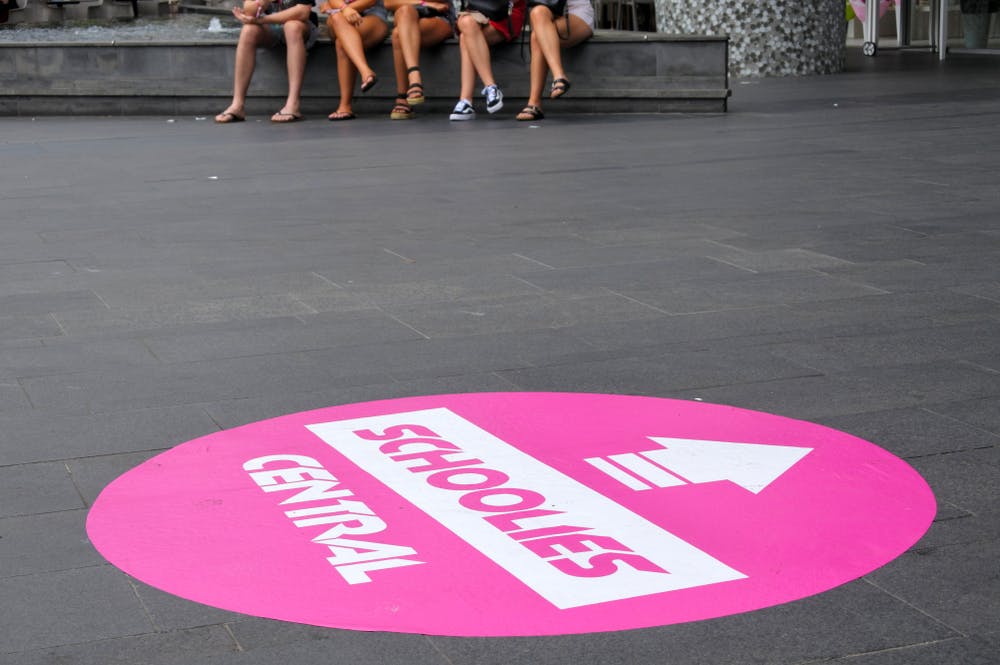
For many parents whose teenage children are completing Year 12, this time of year means mixed emotions. Parents might feel proud, exhausted and excited. And as young people start heading to schoolies and leavers’ celebrations, many parents may also feel nervous — maybe a little freaked out.

Part of the appeal of schoolies celebrations, which start this weekend in some areas, is they give teenagers a chance to exert their independence and experiment with their identity as a young adult.

This is a normal part of growing up. But for some parents, this can create anxiety. And this anxiety can manifest in overly protective behaviours known as helicopter parenting.


Read more: Too much love: helicopter parents could be raising anxious, narcissistic children


How to avoid a crash landing

This anxiety also affects their young adult children, who in turn are more likely to be anxious.

These young people find it hard to make decisions and have poor time management. They might also avoid telling their parents things that might freak them out.

Good communication is the key to reducing parental angst and potential hovering. More importantly, it provides an opportunity to talk about high-risk situations. It also means a young person will feel they can contact their parents if they get into trouble.

So how can parents avoid freaking out and keep the channels of communication open? Think of going to schoolies as taking a flight.

Pre-flight safety briefing (tips for good communication)

1. When entering the aircraft, mind the generation gap

Young people are often scapegoated by the previous generation (think Gen Z and avocado toast). So don’t react to the media hype about the dangers of schoolies.

Last year there were concerns about an epidemic of nitrous oxide (laughing gas) at schoolies. However, these claims were unfounded.


Read more: Explainer: what is nitrous oxide (or nangs) and how dangerous is it?


Parents might roll-their-eyes at teenage behaviour in videos previous schoolies produce, such as the one below. However, from a school leaver’s perspective, these behaviours are a rite of passage.

Here’s what Ben and his mates really got up to at schoolies.

Most of these behaviours — such as developing group norms, hazing rituals, pranks and testing limits — are about young people developing their identity. And ultimately, most of these behaviours are relatively harmless.

Parents need to be well informed as to what schoolies is all about. Queensland Independent Schools has developed some good resources. If young people believe their parents know what they’re talking about, they’re more likely to listen.

2. Your life-jacket is under the seat

It is important to access objective information rather than media hype. While the media often focuses on illegal drug use, most young people do not use drugs at schoolies.


Read more: Sex, drugs and alcohol: what really goes on at schoolies?


The risky use of alcohol is more concerning. Perhaps then it is not surprising many young people engage in risky sexual behaviours at schoolies.

Parental discussions about reducing the risk from alcohol use and safe sex are not only likely to have the most impact on reducing harm, teens will also see them as more relevant.

3. Know your exits

Young people are sceptical of information about risky behaviours they think is exaggerated. Information about risky behaviours is likely to be perceived as more credible when it is balanced.

For example, when talking about drugs, teenagers will perceive information parents provide as more credible when positive, neutral and negative effects of the drug are all considered. A good source of balanced and credible drug information is Erowid, a drug education website run by a not-for-profit harm reduction organisation.

4. Brace position

Most young people take risks. Testing the boundaries is a normal part of growing up. What did you get up to as a young person?

Appropriate disclosure of the parent’s own risk taking behaviour creates an environment of trust. It also fosters the disclosure reciprocity norm. When somebody discloses something personal about themselves, we feel the desire to disclose something personal about ourself.

Parents can help their teens navigate the new-found freedom at schoolies. from www.shutterstock.com

It is also important not to appear to know something when you don’t. This would be inauthentic. You gain more credibility by acknowledging when you don’t know something and are open to working together to finding out.

5. Fasten you seat belts

If you are authentic and are open to a balanced discussion, young people are more likely to disclose past behaviour or future intentions that might concern you.

Remember to stay calm. Discuss the potential consequences, both good and bad, in a matter-of-fact manner. Reacting negatively is likely to shut down the conversation.

6. Oxygen masks may drop

Some parents might be concerned about “peer pressure”. While your child can be trusted, can you trust their friends?

The likelihood of a young person succumbing to peer pressure is reduced when there is a good relationship with their parents. This is a chance to discuss creative “ways out” of risky situations.

The popular belief that young people value their friends’ beliefs more than their parents’ is not true. While young people are more likely to be influenced by peers on matters such as style and appearance, parents are still more likely to have an influence on issues such as morality.

Cleared for take-off

Experimenting and exerting independence provides young people with excellent opportunities for learning and self development.

Though some learning experiences can be costly, through good communication, the risk of harm can be minimised.

In the end, parents need to trust they have instilled their values and common sense.


Read more: Schoolies, toolies and foolies – in the market for a rite of passage


ref. Is your teen off to schoolies? Here’s what to say instead of freaking out – http://theconversation.com/is-your-teen-off-to-schoolies-heres-what-to-say-instead-of-freaking-out-126203

Australia must engage with nuclear research or fall far behind

Source: The Conversation (Au and NZ) – By Heiko Timmers, Associate Professor of Physics, School of Science, UNSW Canberra, UNSW

Much is made of the “next generation” of nuclear reactors in the debate over nuclear power in Australia. They are touted as safer than older reactors, and suitable for helping Australia move away from fossil fuels.

But much of the evidence given in September to a federal inquiry shows the economics of nuclear in Australia cannot presently compete with booming renewable electricity generation.


Read more: Nuclear becomes latest round in energy wars


However, international projections predict nuclear power will stick around beyond 2040. It is forecast to reduce the carbon footprint of other nations, in many cases fuelled by our uranium.

To choose wisely on nuclear power options in future, we ought to stay engaged. Renewables in combination with hydro storage might fail to fully decarbonise the electricity sector, or much more electricity may be needed in future for desalination, emission-free manufacturing, or hydrogen fuel to deal with an escalating climate crisis. Nuclear power might be advantageous then.

What reactors will be available in future?

All recent commissions of nuclear power stations, such as the Korean APR-1400 reactors in the United Arab Emirates, or the Chinese Hualong One design, are large Generation III type light water reactors that produce gigawatts of electricity. Discouraged by investment blowouts and considerable delays in England and Finland, Australia is not likely to consider building Generation III reactors.

The company NuScale in particular promotes a new approach to nuclear power, based on smaller modular reactors that might eventually be prefabricated and shipped to site. Although promoted as “next generation”, this technology has been used in maritime applications for many years. It might be a good choice for Australian submarines.


Read more: Is nuclear power zero-emission? No, but it isn’t high-emission either


NuScale has licensed its design in the United States and might be able to demonstrate the first such reactor in 2027 in a research laboratory in Idaho.

These small reactors each produce 60 megawatts of power and require a much smaller initial investment than traditional nuclear power stations. They are also safer, as the entire reactor vessel sits in a large pool of water, so no active cooling is needed once the reactor is switched off.

However the technical, operational and economic feasibility of making and maintaining modular reactors is completely untested.

Looking ahead: Generation IV reactors and thorium

If Australia decided to build a nuclear power station, it would take decades to complete. So we might also choose one of several other new reactor concepts, labelled Generation IV. Some of those designs are expected to become technology-ready after 2030.

Generation IV reactors can be divided into thermal reactors and fast breeders.

Thermal reactors

Thermal reactors are quite similar to conventional Generation III light water reactors.

However, some will use molten salts or helium gas as coolant instead of water, which makes makes hydrogen explosions – as occurred at Fukushima – impossible.

Some of these new reactor designs can operate at higher temperatures and over a larger temperature range without having to sustain the drastic pressures necessary in conventional designs. This improves effectiveness and safety.

Fast breeders

Fast breeder reactors require fuel that contains more fissile uranium, and they can also create plutonium. This plutonium might eventually support a sustainable nuclear fuel cycle. They also use the uranium fuel more efficiently, and generate less radioactive waste.

However, the enriched fuel and capacity to produce plutonium means that fast breeders are more closely linked to nuclear weapons. Fast reactors thus do not fit well with Australia’s international and strategic outlook.

Breeding fuel from thorium

An alternative to using conventional uranium fuel is thorium, which is far less useful for nuclear weapons. Thorium can be converted in a nuclear reactor to a different type of uranium fuel (U-233).

The idea of using this for nuclear power was raised as early as 1950, but development in the US largely ceased in the 1970s. Breeding fuel from thorium could in principle be sustained for thousands of years. Plenty of thorium is already available in mining tailings.

Thorium reactors have not been pursued because the conventional uranium fuel cycle is so well established. The separation of U-233 from the thorium has therefore not been demonstrated in a commercial setting.

India is working on establishing a thorium fuel cycle due to its lack of domestic uranium deposits, and China is developing a thorium research reactor.

Australia’s perspective

To choose wisely on nuclear power and the right technology in future, we can stay engaged by:

  • realising a much-needed national facility to store waste from our nuclear medicine
  • making our uranium exports competitive again
  • driving the navy’s submarines with nuclear power, and
  • possibly reconsidering the business case for a commercial spent fuel repository.

Australia has already joined the international Generation IV nuclear forum, a good first step to foster cooperation on nuclear technology research and stay in touch with reactor developments.


Read more: Australia should explore nuclear waste before we try domestic nuclear power


Australia could deepen such research involvement by, for example, developing engineering expertise on thermal Generation IV reactors here. Such forward-looking engagement with nuclear power might pave a structured way for the commercial use of nuclear power later, if it is indeed needed.

ref. Australia must engage with nuclear research or fall far behind – http://theconversation.com/australia-must-engage-with-nuclear-research-or-fall-far-behind-121503

Public places through kids’ eyes – what do they value?

Source: The Conversation (Au and NZ) – By Fran Gale, Senior Lecturer, Social Work and Community Welfare, School of Social Science and Psychology, Western Sydney University

Children are too rarely asked their perspectives on public spaces. Traditionally, adults make choices for children, particularly about how they live and play.

In yet-to-be-published research* on behalf of a local council, we asked 75 children aged 7-12 from ten primary schools in a disadvantaged area of Sydney to map what they value in their local area. Using iPads, children pinned images of their choices to specific locations on a digital map of the local government area. Some of their choices may surprise you.

Places children selected revealed the importance to them of sharing decision-making power. Placing a drawing of his local supermarket on the map, a nine-year-old boy explained his choice of “grocery shopping” because he could “spend time with mum and help decide what goes in our trolley”.

The children typically mapped places of leisure, such as parks, swimming pools and community centres, used outside school time when adults usually have most authority over children. Here children had more autonomy to be decision-makers and exercise agency. Mapping his local park, a ten-year-old boy commented:

I can do what I want here, and there are lots of different playthings to choose from.


Read more: ‘Bang, bang, bang!’: the shock of a boy playing with a gun on a suburban street


Pathways for change and belonging

Some children chose to map their school, seeing it as a pathway for change; they could imagine alternative futures with greater choices. An 11-year-old boy observed:

School will help me get a good job.

Others selected their school for the opportunities it offered them now. An eight-year-old girl, pressing sparkles around the clock on her drawing of her school before positioning it on the map, explained that there are:

…lots of good things you can do at school. Read stories, have lots of space and a big play area.

Some children chose their school, where there are ‘lots of good things you can do’. Children’s digital map

Children’s choices also exposed the significance of places that promoted belonging and where they could make connections with others. A ten-year-old girl, mapping her local nature reserve, said:

There is lots of space to play and I can make new friends there.

Similarly, an 11-year-old girl explained the importance of her community centre:

It’s special because I have friends there.

Countering a dominant story about belonging and identity that gives little recognition to original Indigenous land ownership in Australia, a ten-year-old Aboriginal girl used the map to draw an Aboriginal flag onto her local park. She observed:

This is our land and I have fun here with my family.

One girl chose her local park and drew an Aboriginal flag to show it’s ‘our land’. Children’s digital map

Her claim on her local park is arguably not only about her own and her family’s belonging and identity but could also be read as referring to a broader body of Aboriginal people.


Read more: Refugees in their own land: how Indigenous people are still homeless in modern Australia


Children advocate for their families

By mapping their territory, children expressed their culture and sense of community through images, text and stories, recounting their valuable experiences and developing an alternative account of the public space.

Children experiencing disadvantage can be most reliant on what their urban environment offers. We were especially keen to unearth their viewpoints.

We found many of these children advocated for their families, not only themselves. Being able to access civic amenities free or at minimal cost was significant for their capacity to make choices and have spaces to connect with others.

A 12-year-old girl observed:

For us to do things as a family, they have to be free.

And a nine-year-old boy said:

We (speaking of his family) can do it if it’s free and we can go places if they are free.

A desire to take risks and explore

Children are increasingly watched and kept safe by adults. Many children mapped places where they represented themselves as risk-takers and explorers. They frequently connected their choices with mastering skills.


Read more: Why kids need risk, fear and excitement in play


Urban spaces along with bushland were repeatedly selected. These areas were, for some, bound up with “risk”, adventure and imagination. A ten-year-old boy mapping a nature reserve explained:

That’s where I ride my motorbike. You get to see cows and pigs and horses and I’ve seen a crocodile in the dam.

Listing all the things she valued on her drawing of her local pool, a nine-year-old girl wrote:

Has deep end and slide, good swimming teacher, try to swim butterfly to improve.

Her choices illustrated the children’s desire to experience their competency and capacity in environments where there are elements of risk.

Why digital mapping? Why not just ask children?

Children are a digital generation. Given the unequal power between adults and children, digital mapping helped us minimise adult intrusion, inviting children to present their spatial narratives.


Read more: Don’t use technology as a bargaining chip with your kids


Their age, socio-economic status, race and other intersecting factors mean some children are more likely than others to have their perspectives heard. Digital mapping promised a more inclusive approach than traditional research methods provide.

The digital map gives children an opportunity to add their viewpoints to community planning rather than just reinforcing adult views. As local councils and planning authorities engage more with children to plan urban space, the perspectives of all children, including disadvantaged children, need to be heard.


*The data will be published in 2020. People interested in learning more about the research may contact the authors directly.

ref. Public places through kids’ eyes – what do they value? – http://theconversation.com/public-places-through-kids-eyes-what-do-they-value-126108

Vital Signs. Might straight down the middle be the source of our economic success?

Source: The Conversation (Au and NZ) – By Richard Holden, Professor of Economics, UNSW

What do a billionaire, a former vice president, and a US democratic socialist have to do with Australia’s nearly three-decade run of economic growth?

More than you might think.

The race for the Democratic Party’s 2020 Presidential nomination is far from over – in fact voting in the first state (Iowa) doesn’t even begin until January. But Senator Elizabeth Warren has become the front-runner in betting markets and national polls, pulling ahead of former vice president Joe Biden.

Warren is running on a “democratic socialist” platform of banning private health insurance, imposing a wealth tax and more rigorously examining proposed trade agreements. Biden is much more centrist – he was Barack Obama’s vice president after all – but he is struggling to maintain the lead he once held.

US Democratic Party contender Michael Bloomberg. SHAWN THEW/EPA

This has a number of people freaked out. Among them is former New York mayor (and former Republican) Mike Bloomberg, who has filed paperwork to get himself into the Democratic primary race.

Bloomberg is a pro-market, socially liberal, three-term mayor of New York. He amassed a US$50 billion fortune by creating the category-killing Bloomberg terminal for financial data and securities trading.

He has taken progressive stands on gun control, gay rights and women’s reproductive rights.

And on climate change he spent half a billion dollars on climate mitigation projects as well as campaigning with the environment group Sierra Club (successfully) for coal mines to be closed.


Read more: Vital Signs: the battle for the soul of the US Democrats that’s taking place before our eyes


Bloomberg’s path to the Democratic nomination is far from assured, but in Australia someone like him would be in the mould of prime ministers past.

And that tells us something important about our internationally unusual long run of economic growth.

Straight down the middle

Since Bill Hayden became Labor (and opposition) leader in 1977 and put to rest the economic upheaval of the Whitlam era, Australia’s two major political parties have maintained, for the most part, staunchly centrist economic policies. They’ve combined the virtues of markets with a strong social safety set.

The Hawke-Keating government famously opened up the Australian economy to the world: floating the Australian dollar, deregulating the banking system, slashing tariffs, and privatising sleepy state-owned enterprises.

John Howard not only continued this legacy but introduced the Goods and Services Tax – a much more efficient form of taxation than had existed – and successfully negotiated the Australia-US Free Trade Agreement.

And though the Rudd-Gillard-Rudd government may have lacked stability, it did not lack major economic achievements.

Rudd and then Treasury boss Ken Henry acted decisively with stimulus and bank guarantees to avoid the economic disaster that hit most of the rest of the world.

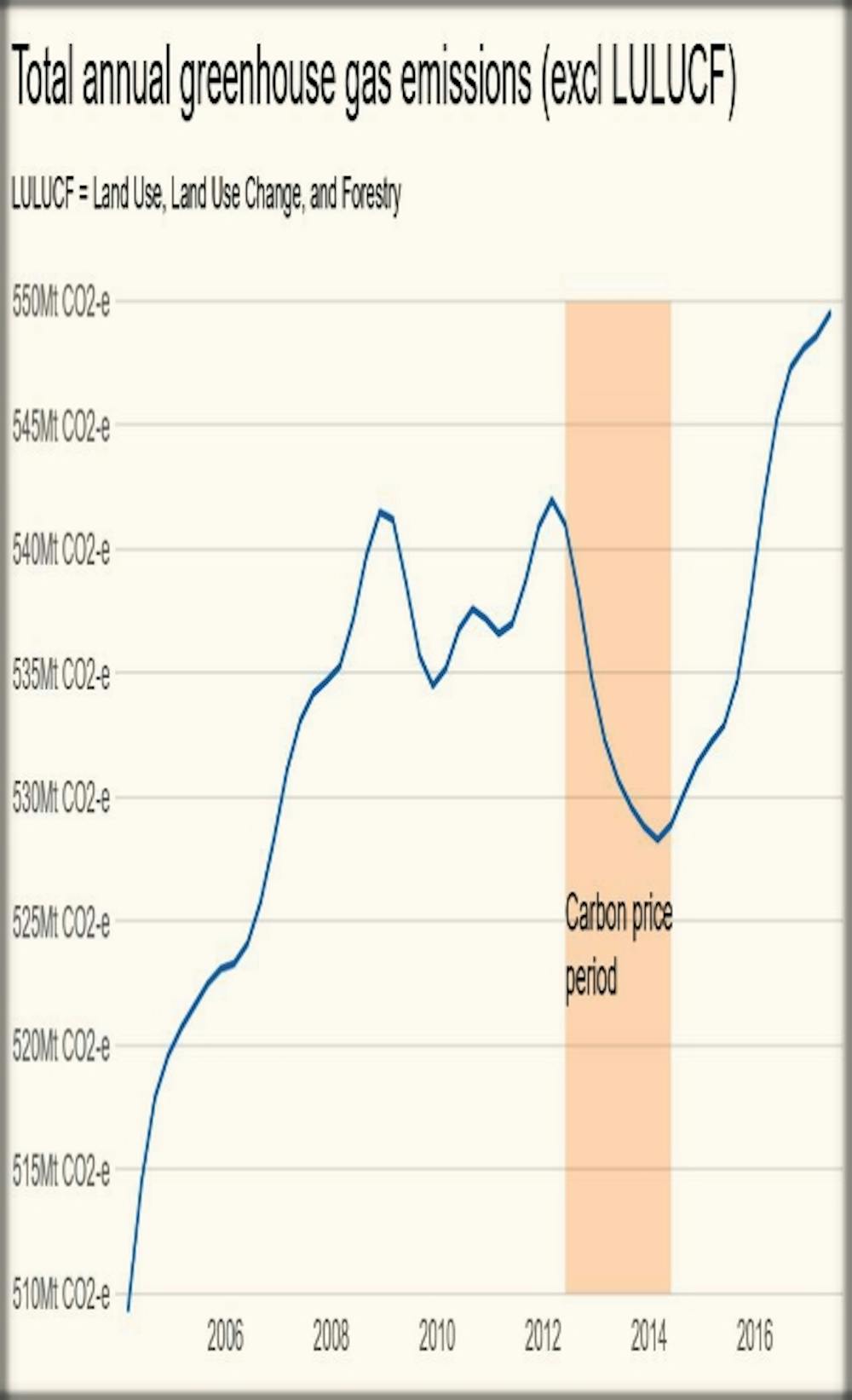
Total annual greenhouse gas emissions excluding emissions from land use, land use change and forestry. Greg Jericho, Guardian

Gillard introduced a carbon tax that had an almost immediate effect in reducing Australia’s emissions.

While the Abbott-Turnbull-Morrison government’s stance on climate change has been rightly criticised (often by yours truly), it has continued to enact free trade agreements, the most recent of which, the Regional Comprehensive Economic Partnership, might be truly transformational.

Sometimes veering to the sides

Although that centrism has served Australia well socially and economically, there have been moments where policy looked like it would veer away from the centre.

Labor opposed the goods and services tax. The current government has flirted with government guarantees for new coal-fired power plants, which was a policy more in the spirit of Marx and Lenin than Howard and Costello.

Holding the centre

The current depressing state of the Australian economy (pun intended) might provide the biggest test yet to centrist economic policy.

Wage growth is sluggish (Wednesday’s figures showed annual growth slipping from a historically low 2.3% to 2.2%) and unemployment is climbing (Thursday’s figures showed the unemployment rate climbing from 5.2% to 5.3%).

There’s pressure from both the left and the right to “do something”.

Cutting immigration, moving away from free trade, propping up failing industries, or offering selective wage rises to particular sectors (such as childcare workers) are among the “somethings” that have been on the table or partially implemented.


Read more: If you think less immigration will solve Australia’s problems, you’re wrong; but neither will more


The Hawke-Keating and Howard-Costello governments sustained centrist economic policy for more than two decades.

They did it not only through a series of sound policy choices, but also through a narrative about the virtues of markets coupled with a social safety net.

It’s a narrative under threat. In Australia it hasn’t been drowned out yet.

ref. Vital Signs. Might straight down the middle be the source of our economic success? – http://theconversation.com/vital-signs-might-straight-down-the-middle-be-the-source-of-our-economic-success-126918

Friday essay: shaved, shaped and slit – eyebrows through the ages

Source: The Conversation (Au and NZ) – By Lydia Edwards, Fashion historian, Edith Cowan University

Eyebrows can turn a smile into a leer, a grumpy pout into a come hither beckoning, and sad, downturned lips into a comedic grimace.

So, it’s little wonder these communicative markers of facial punctuation have been such a feature of beauty and fashion since the earliest days of recorded civilisation.

From completely shaved mounds to thick, furry lines, eyebrows are a part of the face we continue to experiment with. We seek to hide, exacerbate and embellish them. And today, every shopping strip and mall has professionals ready to assist us with wax, thread and ink.

Minimising distraction

In the court of Elizabeth I, to draw attention to the perceived focal point of a woman’s body – her breasts – the monarch would pluck her eyebrows into thin lines or remove them completely, as well as shaving off hair at the top of her forehead.

Many of her subjects followed Queen Elizabeth’s shaved eyebrow example. New York Public Library, CC BY

This was an attempt to make her face plain and blank, thereby directing the viewer’s gaze lower to her substantial décolletage.

Although the intentions were different, nonexistent or needle-thin brows had also been common in ancient China and other Asian cultures, where women plucked their eyebrows to resemble specific shapes with designated names such as “distant mountain” (likely referring to a central and distinctive point in the brow), “drooping pearl” and “willow branch”.

In ancient China, as well as in India and the Middle East, the technique of threading – the removal of hairs by twisting strands of cotton thread – was popular for its accuracy. The technique, referred to as “khite” in Arabic and “fatlah” in Egyptian, is enjoying renewed popularity today.

Detail from Tayu with Phoenix Robe, a Japanese painting by an anonymous artist. Honolulu Academy of Arts/Wikimedia, CC BY

In Japan between 794 and 1185, both men and women plucked their eyebrows out almost entirely and replaced them with new pencilled lines higher up on the forehead.

Eyebrows of Ancient Greece and Rome, on the other hand, are frozen in contemplation.

They are often represented in sculptures through expressive mounds devoid of individual or even vaguely suggested hairs: in men they are strong and masterful furrows above a purposeful gaze; in women, soft and emotive.

Bronze portrait of a man from early first century with masterful furrows. Metropolitan Museum of Art, New York

This lack of detail demonstrates a fondness, in some corners of ancient Greek and Roman society, for joined or “continuous” brows.

Poet of tenderness, Theocritus, openly admired eyebrows “joined over the nose” like his own, as did Byzantine Isaac Porphyrogenitus.

Brows as barometers

For much of the 19th century, cosmetics for women were viewed with suspicion, principally as the province of actresses and prostitutes. This meant facial enhancement was subtle and eyebrows, though gently shaped, were kept relatively natural.

Despite this restraint, a certain amount of effort still went into cultivation. A newspaper article from 1871 suggested intervention during childhood to thicken them:

If a child’s eyebrows threaten to be thin, brush them softly every night with a little coconut oil, and they will gradually become strong and full; and, in order to give them a curve, press them gently between the thumb and forefinger after every ablution of the face or hands.

As fashions became freer after the first world war, attention was once again focused more overtly on the eyes and eyebrows.

Louise Brooks’ high brow bob showed off her neck and her eyebrows. New York Public Library

This was partly to do with the development of beauty salons during the 1920s, many of which offered classes in makeup application so women could create new, bold looks at home.

The fashion for very thin eyebrows was popularised by silent film stars such as Buster Keaton and Louise Brooks, for whom thick kohl was a professional necessity and allowed a clearer vision of the eyebrows – so crucial, after all, for nonverbal expression on screen.

The amount of attention paid to eyebrows continued to change according to specific global events.

In the 1940s, women began to favour thicker, natural brows after several decades of rigorous plucking to achieve pencil-thin lines. Considering the outbreak of the second world war had forced many out of a wholly domestic existence and into the workforce, it stands to reason they had less time to spend in front of the mirror, wielding a pair of tweezers and eyebrow pencil.

The natural look, circa 1943. Author provided

The post-war 1950s saw wide, yet more firmly defined brows and from the 1960s onwards various shapes, sizes and thicknesses were experimented with, accompanied by a firm emphasis on individuality and personal preference.

A brow beautician in a South Yarra salon in 1960. Laurie Richards Studio/National Library of Australia, CC BY

More than mono

When Dwight Edwards Marvin’s collection of adages and maxims, Curiosities in Proverbs, was published in 1916 it included the old English advice:

If your eyebrows meet across your nose, you’ll never live to wear your wedding clothes.

The “mono-” or “uni-brow” had become suggestive of a lack of self care, particularly in women.

Research undertaken in 2004 reported American women felt judged and evaluated as “dirty”, “gross” or even “repulsive” if they did not shave their underarm or leg hair, or pluck and shape their eyebrows. As the most visible of these areas, untamed eyebrows perhaps point to the bravest exhibition of natural hair.

Today, model Sophia Hadjipanteli sports a pair of impressively large, dark joined eyebrows, and has assertively fought back against the legion of online trolls who have abused her for this point of difference.

Model Sophia Hadjipanteli and her distinctive brow. Instagram

A reference back to the distinctive brows of Frida Kahlo, Hadjipanteli’s look is linked to an ongoing debate surrounding women’s body hair.

Artist Frida Kahlo and her famous monobrow. Guillermo Kahlo/Wikimedia

Giving a pluck

For many, excessive plucking and shaping has become emblematic of the myriad requirements women are expected to comply with to satisfy restrictive societal beauty norms.

Still, plenty of people with eyebrows are dedicating time and money to their upkeep. In Australia, the personal waxing and nail salon industry has grown steadily over five years to be worth an estimated A$1.3 billion and employ more than 20,000 people.

Over this time, social media has offered a diverse and changing menu of brow choices and displays.

One choice: the “eyebrow slit” – thin vertical cuts in eyebrow hair – has re-emerged online and in suburban high schools. It’s important to emphasise re-emerged because, with beauty as with clothing, what goes around comes around.

Vanilla Ice, working the eyebrow slit since 1991. Smash Hits/Twitter

The eyebrow slit was especially popular amongst hip hop artists in the 1990s, and draws appeal due to its flexibility: there are no firm rules as to the number or width of the slits, which originally were meant to suggest scarring from a recent fight or gangsta adventure. More recent converts have been accused of cultural appropriation.

Some have experimented by replacing plain slits with other shapes, such as hearts or stars, though plucking or shaving brows into unusual shapes is – as we have seen – by no means new either.

Facing the day

If the popularity of recent trends is anything to go by, eyebrow fashion will remain on the lush side for some time.

The “Scouse” brow (very thick, wide and angular eyebrows emphasised with highly defined dark pencil shapes: named after natives of Liverpool in the United Kingdom) is still trending.

The “Instagram eyebrow” (thick brows plucked and painted to create a gradient, going from light to very dark as the brow ends) is inescapable on the platform and beyond. Makeup for brows is therefore also likely to continue, providing a clear linear connection through nearly all the eyebrow ideals since ancient times.

The latest offering to those seeking a groomed look is “eyebrow lamination”, a chemical treatment that uses keratin to straighten individual hairs – a kind of anti-perm for your brow.

Those still searching for their eyebrow aesthetic may benefit from some wisdom shared by crime and society reporter Viola Rodgers in an 1898 edition of the San Francisco Call newspaper.

In a piece which ran alongside an interview with the man who had inspired Mark Twain’s Tom Sawyer character, she advised that the appearance of one’s brow conveyed more than just their grooming habits:

An arched eyebrow … is expressive of great sensibility … Heavy, thick eyebrows indicate a strong constitution and great physical endurance … Long, drooping eyebrows indicate an amiable disposition and faintly defined eyebrows placed high above the nose are signs of indolence and weakness.

Eyebrow slits? We can only imagine what Viola would think.

ref. Friday essay: shaved, shaped and slit – eyebrows through the ages – http://theconversation.com/friday-essay-shaved-shaped-and-slit-eyebrows-through-the-ages-123872

Grattan on Friday: When the firies call him out on climate change, Scott Morrison should listen

Source: The Conversation (Au and NZ) – By Michelle Grattan, Professorial Fellow, University of Canberra

When five former fire chiefs held a news conference on Thursday to urge the federal government to take more action on climate change, it was a challenging moment for Scott Morrison.

Those who fronted the cameras represented a group of 21 men and two women, who make up the Emergency Leaders for Climate Action. These people have led fire and emergency services all around the nation.

They’re powerful voices, because they are advocates with compelling experience and expertise. The group’s messages are that we’re in “a new age of unprecedented bushfire danger”, climate change is the key reason why things are getting worse, and the government needs to respond with more resources and a better policy to reduce emissions and move to clean energy.

The problem is, as group founder Greg Mullins, former Fire and Rescue NSW commissioner, put it succinctly, “this government fundamentally doesn’t like talking about climate change”.

The five former fire chiefs have powerful voices due to their compelling experience and expertise. Dan Himbrechts/AAP

The devastating fires are a dramatic additional element intensifying the pressure on a government already increasingly on the back foot over climate change, as it responds poorly to a complex set of policy problems.

It’s not that Morrison denies climate change. It’s that he refuses to acknowledge it as a central issue, either because he doesn’t see it as such or because he fears provoking his right wingers.


Read more: Politics with Michelle Grattan: Minister David Littleproud on bushfires, drought, and the Nationals


Consider three factors now weighing on Morrison.

First, in Australia (as internationally) activism is rising. This should be broadly defined. Put aside the Extinction Rebellion, which may alienate more people than it persuades. Rather, include in the definition the many companies now factoring climate change into their planning, investment, and public statements.

Morrison might rail against activists hitting resource companies via secondary boycotts, and commentators might denounce so-called “woke” behaviour by business. But the long view indicates a tide is running here and its direction is clear.

Second, there is a general recognition the government’s climate policy is badly wanting. Emissions are rising. Its modest centrepiece – a fund paying for projects to reduce or capture emissions – isn’t doing the job. The fund’s limitations were tacitly acknowledged when recently the government set up a panel which sought submissions on how it could be enhanced.

More broadly, the government’s lack of a coherent energy policy means continued uncertainty for investors.

Third, Angus Taylor, minister for energy and emissions reduction, has frustrated those in the energy sector and the states. He’s too confrontational and short on people skills (in contrast to his predecessor Josh Frydenberg). His cheap shot accusing the Sydney City Council of ludicrous travel costs blew into a major embarrassment.

Next Friday Taylor will again be under scrutiny when he meets the states at the COAG energy council. The last meeting, nearly a year ago, turned into a nasty stoush between Taylor and the NSW minister.

If Taylor’s performance doesn’t improve in the next few months Morrison – who will be the one eventually carrying the can for policy failure – surely should move him. It would be interesting to see how (say) a Simon Birmingham or a Mathias Cormann would go in the portfolio. Better, you’d think.


Read more: ‘Like volcanoes on the ranges’: how Australian bushfire writing has changed with the climate


It was no wonder Morrison wanted to contain partisan argument while the fires rage. It’s a reasonable view for a prime minister to take, with a basis in past practice, but was also politically driven.

Morrison has been assisted in this by Labor, despite the ALP recently voting in parliament (without success) for a “climate emergency” to be declared. Anthony Albanese believed there was no gain in seeking to score points during a disaster, and danger in doing so.

But a moratorium, although mostly adhered to by Liberal and ALP federal politicians, was never going to happen more generally. Indeed some people, like the retired fire chiefs, judged this was precisely the moment to press their point.

It was predictable the Greens would strike hard; climate is core ground for them. But that Deputy Prime Minister Michael McCormack would take the bait, leaping in to condemn “the ravings of some pure enlightened and woke capital city greenies”, showed a lack of discipline, probably in part a reflection of the strain the Nationals leader is under as he tries to manage a difficult party room.

Some believed McCormack was playing to his base. If so, he’d only be talking to part of it, most notably those with an eye to the coal industry. Many farmers are very aware, first hand, of the impact of the changing climate.

After its election loss, there’s been much talk about how Labor is caught between its dual constituencies on climate – inner city progressives versus traditional suburban workers.

But the Liberals face their own dilemma, which could deepen as the issue amps up in the electorate. We have seen over many years the split within the Liberal party, and the very high costs it has extracted. As Morrison assesses how to pitch to voters in the future, he might have to be careful of straining internal unity.


Read more: Firestorms and flaming tornadoes: how bushfires create their own ferocious weather systems


Over coming months, the fires’ impact on public opinion will presumably be measured in the focus groups through which the government hears its “quiet Australians”.

More immediately, Morrison won’t be able to escape a response when this crisis passes. His moratorium will make expectations greater.

John Connor was formerly CEO of the now defunct Climate Institute, which commissioned from the CSIRO a 2007 research paper – that turned out to be prescient – on the link between climate and bushfires, titled Bushfire Weather in Southeast Australia: Recent Trends and Projected Climate Change Impacts.

Connor, who now heads the Carbon Market Institute (which describes itself as a peak industry body for climate action and business) suggests the current situation provides the opportunity for an “armistice” – a chance to build a platform on the middle ground for the climate debate.

One step, Connor says, would be for the government to establish a parliamentary inquiry to examine the growing risk climate change presents for the fire scene and the resources required for the future.

“It could be a stepping stone to a more mature debate about carbon policy for the broader economy,” Connor says, although he admits “I’m a professional optimist”.

The government’s former drought co-ordinator, Stephen Day, wrote in his report, finally released last week: “As a consequence of climate change drought is likely to be more regular, longer in duration, and broader in area”.

What’s striking about Day’s observation is how matter-of-fact it is. Climate change is stated as a reality from which other considerations flow. The same reality applies to bushfires. It also applies to the need to move the economy to a new energy mix and net zero emissions by 2050.

ref. Grattan on Friday: When the firies call him out on climate change, Scott Morrison should listen – http://theconversation.com/grattan-on-friday-when-the-firies-call-him-out-on-climate-change-scott-morrison-should-listen-127049

Virtual tools, real fires: how holograms and other tech could help outsmart bushfires

Source: The Conversation (Au and NZ) – By David Tuffley, Senior Lecturer in Applied Ethics & CyberSecurity, Griffith University

Australia continues to experience unprecedented destruction from bushfires. Now is the time to harness our technological tools, and find innovative ways to help alleviate the problem, and also prevent future disaster.

Predictive mapping has been a vital tool in an ongoing effort to identify at-risk forest areas and proactively manage the risks of fires. It works by analysing images to see what human eyes don’t always see.

Now, progress in technologies such as artificial intelligence (AI), drones, and Internet of Things sensors have opened new ways for us to better prevent and effectively respond to bushfires. For this, the key is to have plenty of data relevant to that location.

Using tech to gather and distribute data

Crucial data needed for bushfire prevention planning can come from a range of sources, including Internet of Things (IoT) sensors collecting weather data, archived data from the past, modelling tools, satellite images, and even social media.

These technologies can converge to gather a diverse range of data, helping us make predictions about the likelihood of an event occurring in a specific location with more speed and accuracy than ever before. Such predictions provide timely and targeted information that can greatly aid emergency services in doing their job, especially as they often have stretched resources on the ground.


Read more: How does poor air quality from bushfire smoke affect our health?


Our goal now should be to integrate our use of these emerging technologies into existing systems of State Emergency Service departments, which can relay more strategically targeted information to local authorities who need it. This can be built into their existing systems.

The potential of mesh networks

Next-generation “mesh networks” are an emerging technology made possible by the convergence of 5G, artificial intelligence, billions of Internet of Things (IoT) sensors, and virtual and augmented reality.

Whereas older networks are based on a limited number of access points, with mesh networks every person with a 5G-enabled smart phone is a node capable of connecting with everyone else. When 5G mobile phone service is rolled out across Australia, we’ll be able to do this.

With this technology, people in a bushfire or other disaster-afflicted area can create a local mesh network using their smartphone. They could contribute by recording 360 degree videos, make narrative reports about unfolding events, take close-up photos etc, then distribute these to the mesh network.


Read more: As flames encroach, those at risk may lose phone signal when they need it most


Photogrammetric artificial intelligence can produce reliable information about physical environments by processing captured imagery. It integrates these videos to create live holograms in real time. This form of virtual reality will put observers right there on the ground. This will help authorities away from the scene to verify reports and more effectively coordinate relief efforts.

It may also assure family and friends that their loved ones in afflicted areas are OK.

Learning from others

California’s One Concern is an example of a next-generation disaster management service that provides a model for what could be achieved in Australia.

It has partnered with various city governments, including San Francisco and Los Angeles, to create virtual models of particular regions’ physical environment, by assigning “digital fingerprints” to each significant feature of that environment. The service constantly monitors any thermal shifts and seismic movement across the sensor network.

Processing this data together with historical data allows One Concern to run simulations to help determine the best course of action while a disaster event is unfolding. It can also highlight the most effective prevention methods, and where the greatest vulnerabilities are for the specific region and threat.

Crowd-sourcing software Ushahidi (meaning “evidence” in Swahili) is another example of a useful tool for disaster or conflict management.

This free, open-source software is used at more than 100,000 communities globally.

During the 2007–2008 Kenyan election crisis, a local blogger put a callout online. The blogger was seeking someone with the technical skills needed to produce a combined image of where violence was happening, to then overlay it on a map.

With no shortage of volunteers, it wasn’t long before the platform was up and running. Soon the site was crowd-sourcing up to 40,000 first-hand, geotagged and time-stamped reports. It also drew from social media posts and news articles.

The system was able to send information back to individuals on the ground to help them avoid locations where violence is reported. All of this happened beyond the surveillance capabilities of the government, which means contributors remained safe from reprisal.

Looking to the future

Traditional bushfire prevention methods so far have included managing fuel loads with low intensity burns to reduce flammable vegetation and leaf-litter before they reach levels that result in destructive high-intensity.

While this method works where it is employed, it’s time we used 21st century solutions to tackle the increasing threat of bushfires. In many parts of Australia, the question is when a disaster will occur, not if it will.


Read more: Firestorms and flaming tornadoes: how bushfires create their own ferocious weather systems


First responders facing an advancing fire need all the help they can get, and strategically gathered information from smart systems will give our firefighters a distinct advantage.

The technologies discussed above are some of the ways we can rise to the challenge. We need to build stronger, more capable ways of preventing disaster where possible, managing the disaster while it happens, and identifying ways of becoming more disaster-resilient.

ref. Virtual tools, real fires: how holograms and other tech could help outsmart bushfires – http://theconversation.com/virtual-tools-real-fires-how-holograms-and-other-tech-could-help-outsmart-bushfires-126830

Alison Croggon and the arts critic as an endangered species

Source: The Conversation (Au and NZ) – By Peter Tregear, Honorary Principal Fellow, University of Melbourne

Review: Platform Papers 61: Criticism, Performance and the Need for Conversation, by Alison Croggon (Currency Press)

“Pay no attention to what the critics say”, quipped the composer Jean Sibelius in 1937, because “there has never been a statue set up in honour of a critic.”

Well, as music critic Alex Ross has observed, that’s not quite true, even if Ross does go on to conclude that the small number of statues to critics that do exist around the globe are merely “the exceptions that prove the rule”.

And yet, the work of a first-rate critic can be as important to the appreciation and understanding of a work of art (or performance) as our immediate experience of it.

Good critical writing can (among other things) prompt us to reflect on the quality (or otherwise!) of that experience, provide us with an historical context, and help draw our attention to the kinds of formal, social, political, and aesthetic content it might have.

A new platform paper by Melbourne-based novelist, poet and theatre critic Alison Croggon (Criticism, Performance, and the need for public conversation argues, indeed, that were critics to disappear from our public life altogether we would surely miss them.

And suggests that this is now a real possibility.

Croggon traces this threat to critics’ existence principally to the rise of online publishing and the recent decline in the business model of the print media.

While she observes that critics briefly found a vibrant new home for their writing on individual blogs, the more recent incorporation of such online content into consolidated internet platforms has led, she believes, to individual voices becoming submerged beneath a sea of SEO-optimised opining.

Such uncurated content, she argues, cannot replace what criticism used to do because it is no longer underpinned (or expected to be) by the sorts of expertise the professional critic of old once had.

Here, as elsewhere on the internet, commonly accepted distinctions between the value and function of expert and amateur commentary has all but dissolved into a commentary free-for-all.

In tracing why this might have happened, Croggon suggests that the “first effect of the digital revolution was the destablisation of hierarchies of taste”. It is possible, however, to trace this destablisation back much further.

Teddy Tahu Rhodes performs during the final dress rehearsal of Il Viaggio a Reims in Sydney last month. Dan Himbrechts/AAP

Has postmodernism had a role?

A “postmodernist” notion arose in academic circles over at least the past half-century, for instance, which asserted that any value judgement we might make about an art object or performance is ultimately no more than the covert assertion of our own position of power or privilege.


Read more: Explainer: what is postmodernism?


It follows that there is therefore no innate value to be found in a particular aesthetic experience or object. What we take to be a good or bad work of art is really only the externalised expression of our own prejudices and tastes.

The internet has supercharged the impact of such an idea on our public discourse.

Patrick Jhanur and Amber McMahon in Banging Denmark at the Sydney Theatre Company. Rene Vaile, STC

Search engines now quietly direct us to content that is favoured precisely because it confirms or, conforms to, what it knows to be our preexisting biases and interests, not because that content might be more authoritative or, indeed, true.

Good arts criticism, however, involves wielding expertise (such as a deep technical and historical awareness of the context and content of the art work under examination) in order that any judgements made by the critic are ultimately grounded in evidence and reason.

Merely expressing an opinion about a work of art is not the same as good arts criticism, but this is not the kind of distinction that a search engine can or will make for us.

The resultant failure of arts criticism to attract or maintain a large readership, and thus the financial backing of our major public and commercial media outlets, suggests to Croggon that “the biggest problem theatre criticism in Australia faces is simple economics”.

But I think that mistakes a symptom with its root cause, the concomitant devaluation of the “worth” of expert opinion in our public life more broadly.

We have instead allowed the marketplace itself to become be the primary determinant of the marketplace of ideas.

Limited in scope

Croggon’s essay does not explore this broader social context. It is limited both in scope (for instance, despite its title, it focuses almost entirely on theatre criticism) and in the breadth and depth of its analysis.

It also does not acknowledge the emergence of new platforms that do offer arts critics some protection from the ravages of unbridled marketplace logic.

One such platform is this one (although The Conversation’s academic contributors are not paid). Another is the arts pages of the Australian Book Review (to which I also occasionally contribute). The latter is supported by a grant from a cultural fund operated by The Copyright Agency and private philanthropy, which together enables it to publish a significant amount of suitably remunerated, long-form arts criticism.

Nevertheless, Croggon’s suggestion that we may need to consider more direct state subsidy of arts criticism, as we do of the arts themselves, is a worthy one.

She notes that in 2012, the ABC, recognising that it had a role to play in fostering diversity of authoritative critical voices, developed a platform called ABC Arts Online. Cuts to ABC funding, however, led to the cessation of this initiative in 2015. Two years later, the entire online archive of reviews was removed from public access.

Croggon is right to draw our attention to this lamentable state of affairs. And she is also right, more broadly, to encourage reflection and debate on the value and function of arts criticism in Australian public life.

ref. Alison Croggon and the arts critic as an endangered species – http://theconversation.com/alison-croggon-and-the-arts-critic-as-an-endangered-species-126600

Politics with Michelle Grattan: Minister David Littleproud on bushfires, drought, and the Nationals

Source: The Conversation (Au and NZ) – By Michelle Grattan, Professorial Fellow, University of Canberra

Bushfires continue to burn across NSW and Queensland, the death toll has risen, and the damage to properties, wildlife and the environment is devastating. With conditions predicted to worsen over the summer, climate change has inevitably come into the frame.

The Prime Minister and Opposition leader have said policy arguments should be avoided until the immediate crisis has passed, but many – including former emergency chiefs and some victims – disagree. And Greens and Nationals have had vitriolic exchanges.

The Nationals David Littleproud has ministerial responsibility for water, drought, and natural disaster and emergency management. In this podcast, he says while “the man on the street” can link climate change and the bushfires, but “as elected officials, we’ve got a responsibility” to wait for the right time to have such discussions.

After announcing the government’s drought package last week, Littleproud criticises the states for not stepping up their efforts, and says they have done “three-fifths of bugger all”.

New to podcasts?

Podcasts are often best enjoyed using a podcast app. All iPhones come with the Apple Podcasts app already installed, or you may want to listen and subscribe on another app such as Pocket Casts (click here to listen to Politics with Michelle Grattan on Pocket Casts).

You can also hear it on Stitcher, Spotify or any of the apps below. Just pick a service from one of those listed below and click on the icon to find Politics with Michelle Grattan.

Additional audio

A List of Ways to Die, Lee Rosevere, from Free Music Archive.

Image:

AAP/Dan Peled

ref. Politics with Michelle Grattan: Minister David Littleproud on bushfires, drought, and the Nationals – http://theconversation.com/politics-with-michelle-grattan-minister-david-littleproud-on-bushfires-drought-and-the-nationals-127016

How we plan for animals in emergencies

Source: The Conversation (Au and NZ) – By Ashleigh Best, PhD Candidate in Law, University of Melbourne

Animals are desperately vulnerable to natural disasters. An estimated 350 koalas have died during catastrophic bushfire conditions across eastern Australia and reports of injured animals continue to pour in.

It’s not just wildlife at risk. February’s Townsville floods claimed the lives of some 600,000 cattle. People are often injured while attempting to rescue pets, and the thought of leaving a dependent animal to face fire alone is devastating.


Read more: Drought and climate change were the kindling, and now the east coast is ablaze


The good news is there are already disaster management plans for animals in some states in Australia. Knowing about these plans can help you reduce the risk to your loved ones – human and otherwise.

Know your state’s rules

Since the 2009 Royal Commission into Victorian bushfires, New South Wales, Victoria, Western Australia and South Australia have adopted animal welfare plans for pets, livestock and wildlife.

Animal disaster management plans try to anticipate how the needs of animals will be managed in the event of a disaster. They assign roles to government agencies and non-government organisations to administer relief for animals.

During a disaster, however, animal owners remain responsible for them. A legal duty of care remains, although what that demands obviously changes during an emergency.

Koalas are extremely vulnerable to fast-moving bushfires, and hundreds have died in recent fires. Survivors are often dehydrated or burned, requiring some care. AAP Image/Julian Smith

What about pets?

In NSW, people are advised to keep their pets with them in an emergency. Contained animals, such as dogs on a leash or cats in a carrier, may be taken to “animal friendly” evacuation centres.

Likewise, the Victorian plan directs councils either to ensure evacuation centres are equipped for animals or to advise people of alternative arrangements.

Unfortunately, SA and WA do not allow pets in evacuation centres (with the exception of assistance animals), meaning they must be housed outside or at a different location. Animal management plans in these states cite fairly vague “health and safety” reasons for the exclusion.

If you’re at any risk of future evacuation it’s vital you check whether your nearest relief centre can accommodate your pet. Even if you’re planning to stay with friends or family, unexpected circumstances may force you to spend some time at a relief centre.

Your disaster kit should contain pet food, registration and vaccination details, bedding, and any other equipment and medicine. You should also have a recent photo of your animal on your phone or printed out (puppy photos will not be useful in tracking down your adult dog).

State guidelines also urge pet owners to make sure your animals are properly vaccinated, microchipped, and wearing identification tags. Local councils, veterinarians, the RSPCA and Animal Welfare League are often designated points of contact when companion animals become lost in a disaster.

You need to know whether your local evacuation shelter will accept your pet, even if you’re not planning to go there. AAP Image/Rob Blakers

Livestock and horses

Livestock and large companion animals are obviously harder to manage than small pets. Disaster management guidelines recommend contacting relocation sites well before an emergency happens to arrange accommodation, and ensuring you have access to suitable transport ahead of time.

If you are unable to make advance arrangements – or if your plans have been disrupted – you can generally take large animals, such as horses, to your local evacuation centre for advice on your options.

If your animals cannot be moved off your property, the guidelines call for owners to move the animals to a low-risk area stocked with food and water for several days. Even if you plan to evacuate your horses or livestock, it’s a good idea to identify a suitable spot just in case.

Planning and guidance documents also stress that horses should be microchipped. The National Livestock Identification System may be used to track certain agricultural animals. They also arrange the distribution of emergency fodder following disasters.

Wildlife

Wild animals face unique challenges in disasters. They cannot be systematically evacuated and are highly dependent on natural habitat for their survival.

After fires pass, wildlife rescue services apply first aid and care as they can. Wild animals depend on pre-planning, such as the creation of safe corridors for travel. AAP Image/Adelaide Zoo, Minnie McCreanor

Animal emergency plans and guidance therefore tend to focus on providing relief to wild animals affected by disaster, relying on the contribution of charitable organisations.

The NSW plan identifies several partner wildlife rescue organisations, including WIRES, which is the state’s principal avenue for reporting injured wildlife. In SA, animal welfare organisations also lead relief efforts, whereas in Victoria, the government coordinates rescue and triage actions with support from volunteers.

In addition to relief services, holistic planning requires measures for preserving habitat and wildlife corridors. These reduce the risk of animal populations becoming isolated, and improve the availability of viable alternative habitat.


Read more: Bushfires can make kids scared and anxious: here are 5 steps to help them cope


While some states have made good progress, every jurisdiction needs clear processes for managing animal welfare during emergencies. As our fire season continues, make sure you’re familiar with your state or territory and local council animal welfare plans.

ref. How we plan for animals in emergencies – http://theconversation.com/how-we-plan-for-animals-in-emergencies-126936

If Dr Google’s making you sick with worry, there’s help

Source: The Conversation (Au and NZ) – By Jill Newby, Associate Professor and MRFF/NHMRC Career Development Fellow, UNSW

It’s a busy day at the office and your left eye has been twitching uncontrollably. So, out of curiosity and irritation you Google it.

Various benign causes — stress, exhaustion, too much caffeine — put your mind at ease initially. But you don’t stop there. Soon, you find out eye twitches could be a symptom of something more sinister, causing you to panic.

You ruin the rest of the day trawling through web pages and forums, reading frightening stories convincing you you’re seriously ill.


Read more: Curious Kids: why do some people worry more than others?


For many of us, this cycle has become common. It can cause anxiety, unnecessary contact with health services, and at the extreme, impact our day-to-day functioning.

But our recently published research, the first to evaluate online therapy for this type of excessive and distressing health-related Googling, shows what can help.

I’ve heard of ‘cyberchondria’. Do I have it?

The term “cyberchondria” describes the anxiety we experience as a result of excessive web searches about symptoms or diseases.

It’s not an official diagnosis, but is an obvious play on the word “hypochondria”, now known as health anxiety. It’s obsessional worrying about health, online.


Read more: Health Check: how do you know if you’re obsessed with your health?


Some argue cyberchondria is simply a modern form of health anxiety. But studies show even people who don’t normally worry about their health can see their concerns spiral after conducting an initial web search.

Cyberchondria is when searching is:

  • excessive: searching for too long, or too often

  • difficult to control: you have difficulty controlling, stopping or preventing searching

  • distressing: it causes a lot of distress, anxiety or fear

  • impairing: it has an impact on your day-to-day life.

If this sounds like you, there’s help.

We tested an online therapy and here’s what we found

We tested whether an online treatment program helped reduce cyberchondria in 41 people with severe health anxiety. We compared how well it worked compared with a control group of 41 people who learned about general (not health-related) anxiety and stress management online.

The online treatment is based on cognitive behaviour therapy (CBT), which involves learning more helpful ways of thinking and behaving.

Participants completed six online CBT modules over 12 weeks, and had phone support from a psychologist.


Read more: Explainer: what is cognitive behaviour therapy?


The treatment explained how excessive web searching can become a problem, how to search about health effectively, and practical tools to prevent and stop it (see a summary of those tips below).

We found the online treatment was more effective at reducing cyberchondria than the control group. It helped reduce the frequency of online searches, how upsetting the searching was, and improved participants’ ability to control their searching. Importantly, these behavioural changes were linked to improvements in health anxiety.

Although we don’t know whether the program simply reduced or completely eliminated cyberchondria, these findings show if you’re feeling anxious about your health, you can use our practical strategies to reduce anxiety-provoking and excessive online searching about health.

So, what can I do?

Here are our top tips from the treatment program:

  • be aware of your searching: don’t just search on auto-pilot. Take note of when, where, how often, and what you are searching about. Keep track of this for several days so you can spot the warning signs and high-risk times for when you’re more likely to get stuck in excessive searching. Then you can make a plan to do other things at those times

  • understand how web searches work: web search algorithms are mysterious beasts. But top search results are not necessarily the most likely explanation for your symptoms. Top search results are often click-bait – the rare, but fascinating and horrific stories about illness we can’t help clicking on (not the boring stuff)

  • be smart about how you search: limit yourself to websites with reliable, high quality, balanced information such as government-run websites and/or those written by medical professionals. Stay away from blogs, forums, testimonials or social media

  • challenge your thoughts by thinking of alternative explanations for your symptoms: for example, even though you think your eye twitch might be motor neuron disease, what about a much more likely explanation, such as staring at the computer screen too much

  • use other strategies to cut down, and prevent you from searching: focus on scheduling these activities at your high-risk times. These can be absorbing activities that take your focus and can distract you; or you can use relaxation strategies to calm your mind and body

  • surf the urge: rather than searching straight away when you feel the urge to search about your symptoms, put it off for a bit, and see how the urge to search reduces over time.

And if those don’t help, consult a doctor or psychologist.


If this article has raised issues for you, or if you’re concerned about someone you know, check out resources about anxiety from Beyond Blue, the Centre for Clinical Interventions Helping Health Anxiety workbook or THIS WAY UP online courses.

ref. If Dr Google’s making you sick with worry, there’s help – http://theconversation.com/if-dr-googles-making-you-sick-with-worry-theres-help-125070

Nation-building to ‘national shame’: the ABC’s complex role as sports broadcaster

Source: The Conversation (Au and NZ) – By Michael Ward, PhD candidate, University of Sydney

The ABC has announced it will not provide live radio coverage of the Olympics for the first time in 67 years for budgetary reasons, and because Australians now have the “increased ability to access Olympics coverage in other ways”.

The decision sparked a furious response from some, such as veteran sports broadcaster Quentin Hull, who deemed it a “national shame”.

But was the decision a snub to sports fans in favour of other types of broadcasting, or just a matter of hard-nosed accounting?

Funding cuts forcing difficult decisions

The ABC’s decision needs to be viewed in two contexts: internal competition for increasingly scarce resources, and a battle to define how sport now fits into the ABC’s charter obligations.

First, the money. The ABC’s financial situation is in dire straits, especially given the range of services it is now expected to provide.

In the past two decades, the ABC has transformed from a radio and television broadcaster to a multi-channel media organisation. It’s done this to meet the responsibilities of its comprehensive service charter, ensuring it reaches Australians across a range of new digital platforms (three digital television channels, digital radio services, podcasts and apps).

At the same time, the government has frozen the ABC’s budget for three years from 2019, which comes on top of earlier budget cuts. The decision not to send a radio team to the 2020 Tokyo Olympics is a direct result of these cuts.


Read more: The ABC didn’t receive a reprieve in the budget. It’s still facing staggering cuts


Prior to the federal election in May, and the funding freeze, the ABC expected to receive an extra $14.6 million in indexed funding for 2019-20, sufficient to cover occasional events like the Olympics and the current bushfires.

Now, it faces an $84 million shortfall over the next three years instead.

There’s an added problem created by the annual approval of divisional budgets.

This year, ABC Radio’s budget would have needed special top-up funding to meet the cost of the Olympics. Sources have told me this is estimated to be $1 million (for the rights and production costs).

Given top-up funding is not available in the current budget, executives would have had to make program or staff cuts elsewhere. That’s on top of the cuts already planned as a result of the budget freeze. They chose not to.

Sports fans may be outraged the ABC has chosen to ditch its Olympic radio coverage instead, but cuts anywhere else – say to regular religious or children’s programming – would have produced equally loud protests from other audiences.

A long history of sports coverage

Which leads to our second question: what is the ABC’s role in providing sports coverage in a multi-platform world?

For decades, the ABC and its constituents saw sports broadcasting as central to its charter roles: universal service, national identity and innovation.

The first ABC Annual Report noted in 1933 that the “keen national interest in sport” had inspired daily broadcasts of the “Bodyline” Ashes cricket series to a national network of 12 stations. Indeed, the ABC helped build a national audience for sports such as cricket and tennis, first on radio, and then on television.


Read more: Into the spotlight: media coverage of the Paralympic Games has come a long way


According to ABC historian Ken Inglis, the broadcaster believed sports broadcasting was its “most characteristic feature”, directly linked to its role in nation-building.

Sports broadcasts, especially of the Olympics, have also been opportunities for the broadcaster to try new programming approaches and delivery technologies. For instance, the use of shortwave and relay services enabled coverage of the 1952 Summer Olympics in Helsinki – the first ABC Olympics coverage.

Yet, ABC sports broadcasting has always been contentious.

In 1948, ABC Chairman Richard Boyer argued to General Manager Charles Moses that there was too much sport on ABC Radio. Although Moses countered that these broadcasts brought audiences to the ABC, the “commission insisted that the time devoted to sport be reduced” and savings spent on other programs.

However, Boyer changed his mind somewhat after the ABC’s re-broadcast of the BBC coverage of the 1948 Olympics was widely criticised for focusing too little on Australian competitors.

In 1956, ABC’s coverage of the Melbourne Olympics became a major moment in Australian television, though for most Australians it was ABC Radio that ensured they were able to share in the event.

Decades later, when top-tier sports like cricket were being commercialised, the Dix Inquiry argued the ABC needed greater diversity in its sporting output, leading to increased broadcasts of women’s sport and the Paralympics from 1988.

However, less than a decade after battling SBS for the Ashes cricket rights in 2005, the ABC started to become more ambivalent about sports as a fundamental part of its charter activities. Since the early 2010s, ABC TV has moved almost completely out of sports.

ABC Radio, in contrast, had maintained a strong commitment to sports broadcasting throughout the 2000s – until now.

Where can Australians go now?

So, without the ABC’s involvement, will Australians still have audio access to the Olympics?

Southern Cross Austereo was earlier tipped to be in position to buy the commercial Olympic radio rights, following its coverage of the 2016 Rio Games.


Read more: ​The Coalition government is (again) trying to put the squeeze on the ABC


But as its parent company shares hit a five-year low in mid-October and it recently slashed jobs, there’s a chance it won’t follow suit for Tokyo. It’s not yet clear.

What is clear is that in the “anywhere, anytime, any device” age, radio is still important to many Australians. For people driving, exercising or working, radio remains a critical sports delivery platform.

The ABC has decided this will no longer be a priority. The question, then, is whether Australians who want to follow the Olympics on radio will have any options at all in 2020.

ref. Nation-building to ‘national shame’: the ABC’s complex role as sports broadcaster – http://theconversation.com/nation-building-to-national-shame-the-abcs-complex-role-as-sports-broadcaster-126924

Holy bin chickens: ancient Egyptians tamed wild ibis for sacrifice

Source: The Conversation (Au and NZ) – By Sally Wasef, Postdoctoral research fellow, Griffith University

These days, not many Aussies consider the ibis a particularly admirable creature.

But these birds, now colloquially referred to as “bin chickens” due to their notorious scavenging antics, have a grandiose and important place in history – ancient Egyptian history, to be precise.

Using DNA from ibis mummies buried around 2,500 years ago, our research published today explores this bird’s stature in ancient times, and how it was reared.

Our findings suggest ancient Egyptian priests practised short-term taming of the wild sacred ibis. This was likely done somewhere in natural ibis habitats, such as local lakes or wetlands. Also, it was probably done close to the Thoth temple at Tuna el Gebel, in a bid to meet an ibis demand fuelled by religious burial rituals.

We’ve bin chicken out some DNA

The preservation of bodies through mummification is a hallmark of ancient Egyptian civilisation.

Unfortunately, unfavourable environmental conditions such as high temperatures, humidity and alkaline conditions often result in scepticism about the authenticity of genetic results from ancient Egyptian human remains.


Read more: Friday essay: the rise of the ‘bin chicken’, a totem for modern Australia


However, animal mummies in the region are much more common. And the sacred ibis, (Threskiornis aethiopicus), is by far the most common bird mummy in ancient Egypt’s underground catacombs, with more than two million found.

The Egyptian sacred ibis looks very similar to the Australian white ibis (Threskiornis molucca). We once thought they were both sacred ibises, but the two are actually sister species in the ibis family.

Our analysis of 14 sacred ibis mummies, which we collected ourselves from catacombs, helped reveal the role of this bird in ancient Egyptian society and religion.

We collected sacred ibis mummy remains from the ibis catacomb in Saqqara. Author provided

We analysed and compared mitochondrial DNA, which is a section of DNA inherited from the mother and passed only through females. In doing so, we were able to compare the genetic diversity among the ancient ibis mummies to that of modern sacred ibis populations in Africa.

All hail the Ibis

Ancient Egyptians thought animals were incarnations of gods on Earth. They worshipped the sacred ibis as the god Thoth, which was responsible for maintaining the universe, judging the dead, and overseeing systems of magic, writing, and science.

It’s not surprising then, that professionally mummified Ibises were sacrificially offered to Thoth at his annually celebrated festival. In fact, offering sacred ibis mummies in ancient Egypt was a common practice between the 26th Dynasty (664-525 BC) and the early Roman Period (AD 250).


Read more: Mummies have had a bad wrap – it’s time for a reassessment


For ancient Egyptian priests, the mummification of animals like ibises was not simply a ritual duty, but also a profitable business. Considering the number of ibis mummies found, one has to wonder how the priests secured supplies for this practice.

Some evidence from ancient Egyptian text suggests the birds may have been raised in dedicated large-scale farms over the long term – either next to or within temple enclosures.

In the writings of the priest and scribe Hor of Sebennytos, from the second century BC, he reported regularly feeding about 60,000 sacred ibises with “clover and bread”. This could be interpreted as domestication, or controlled breeding.

In 1825, French naturalist Georges Cuvier described the skeleton of an ibis mummy from Thebes that he’d unwrapped, saying:

One sees that this mummy must have come from a domestic bird in the temples, because its left humerus was broken and reset. It is highly improbable that a wild bird with a wing broken would have been able to capture prey and escape predators. Hence it would have been unable to survive long enough to have healed.

Researchers today have also suggested the seasonal taming of ancient wild ibises, wherein the birds were reared over a single generation by priests, in natural habitats close to temples. Moreover, it seems they were not domesticated, which would have required breeding in captivity over many generations.

The rearing is thought to have occurred at locations such as the Lake of the Pharaoh, in which a natural basin was filled annually by flood waters from the Nile River.

These actions were almost certainly aimed at collecting a large number of adult birds, which were required for the Egyptian ritual of offering a mummified ibis to please Thoth.

1.75 million birds, then suddenly none?

Millions of sacred ibis mummies have been found stacked floor-to-ceiling along kilometres of dedicated catacombs in Egypt.

It’s believed that about 10,000 mummies were deposited annually in the Sacred Animal Necropolis at Saqqara.


Read more: A recipe for mummy preservation existed 1,500 years before the Pharaohs


This amounts to an estimated 1.75 million birds deposited at this location alone. Another catacomb at Tuna el-Gebel contains approximately four million sacred ibis mummies, the largest known number of any mummified birds at a single Egyptian site.

But these birds disappeared from Egypt around 1850, centuries after the cessation of the mummification practice. How and why they disappeared remains a mystery.

Clearly, the people of today treat the ibis in a very different way to the ancient Egyptians. For the latter, they were sacred birds that held a special place in society.

Perhaps we should remember that and recognise, at least a little, their honoured status in the past.

ref. Holy bin chickens: ancient Egyptians tamed wild ibis for sacrifice – http://theconversation.com/holy-bin-chickens-ancient-egyptians-tamed-wild-ibis-for-sacrifice-126186

Nation-building to ‘national shame’: the ABC’s complex debate over its role as sports broadcaster

Source: The Conversation (Au and NZ) – By Michael Ward, PhD candidate, University of Sydney

The ABC has announced it will not provide live radio coverage of the Olympics for the first time in 67 years for budgetary reasons, and because Australians now have the “increased ability to access Olympics coverage in other ways”.

The decision sparked a furious response from some, such as veteran sports broadcaster Quentin Hull, who deemed it a “national shame”.

But was the decision a snub to sports fans in favour of other types of broadcasting, or just a matter of hard-nosed accounting?

Funding cuts forcing difficult decisions

The ABC’s decision needs to be viewed in two contexts: internal competition for increasingly scarce resources, and a battle to define how sport now fits into the ABC’s charter obligations.

First, the money. The ABC’s financial situation is in dire straits, especially given the range of services it is now expected to provide.

In the past two decades, the ABC has transformed from a radio and television broadcaster to a multi-channel media organisation. It’s done this to meet the responsibilities of its comprehensive service charter, ensuring it reaches Australians across a range of new digital platforms (three digital television channels, digital radio services, podcasts and apps).

At the same time, the government has frozen the ABC’s budget for three years from 2019, which comes on top of earlier budget cuts. The decision not to send a radio team to the 2020 Tokyo Olympics is a direct result of these cuts.


Read more: The ABC didn’t receive a reprieve in the budget. It’s still facing staggering cuts


Prior to the federal election in May, and the funding freeze, the ABC expected to receive an extra $14.6 million in indexed funding for 2019-20, sufficient to cover occasional events like the Olympics and the current bushfires.

Now, it faces an $84 million shortfall over the next three years instead.

There’s an added problem created by the annual approval of divisional budgets.

This year, ABC Radio’s budget would have needed special top-up funding to meet the cost of the Olympics. Sources have told me this is estimated to be $1 million (for the rights and production costs).

Given top-up funding is not available in the current budget, executives would have had to make program or staff cuts elsewhere. That’s on top of the cuts already planned as a result of the budget freeze. They chose not to.

Sports fans may be outraged the ABC has chosen to ditch its Olympic radio coverage instead, but cuts anywhere else – say to regular religious or children’s programming – would have produced equally loud protests from other audiences.

A long history of sports coverage

Which leads to our second question: what is the ABC’s role in providing sports coverage in a multi-platform world?

For decades, the ABC and its constituents saw sports broadcasting as central to its charter roles: universal service, national identity and innovation.

The first ABC Annual Report noted in 1933 that the “keen national interest in sport” had inspired daily broadcasts of the “Bodyline” Ashes cricket series to a national network of 12 stations. Indeed, the ABC helped build a national audience for sports such as cricket and tennis, first on radio, and then on television.


Read more: Into the spotlight: media coverage of the Paralympic Games has come a long way


According to ABC historian Ken Inglis, the broadcaster believed sports broadcasting was its “most characteristic feature”, directly linked to its role in nation-building.

Sports broadcasts, especially of the Olympics, have also been opportunities for the broadcaster to try new programming approaches and delivery technologies. For instance, the use of shortwave and relay services enabled coverage of the 1952 Summer Olympics in Helsinki – the first ABC Olympics coverage.

Yet, ABC sports broadcasting has always been contentious.

In 1948, ABC Chairman Richard Boyer argued to General Manager Charles Moses that there was too much sport on ABC Radio. Although Moses countered that these broadcasts brought audiences to the ABC, the “commission insisted that the time devoted to sport be reduced” and savings spent on other programs.

However, Boyer changed his mind somewhat after the ABC’s re-broadcast of the BBC coverage of the 1948 Olympics was widely criticised for focusing too little on Australian competitors.

In 1956, ABC’s coverage of the Melbourne Olympics became a major moment in Australian television, though for most Australians it was ABC Radio that ensured they were able to share in the event.

Decades later, when top-tier sports like cricket were being commercialised, the Dix Inquiry argued the ABC needed greater diversity in its sporting output, leading to increased broadcasts of women’s sport and the Paralympics from 1988.

However, less than a decade after battling SBS for the Ashes cricket rights in 2005, the ABC started to become more ambivalent about sports as a fundamental part of its charter activities. Since the early 2010s, ABC TV has moved almost completely out of sports.

ABC Radio, in contrast, had maintained a strong commitment to sports broadcasting throughout the 2000s – until now.

Where can Australians go now?

So, without the ABC’s involvement, will Australians still have audio access to the Olympics?

Southern Cross Austereo was earlier tipped to be in position to buy the commercial Olympic radio rights, following its coverage of the 2016 Rio Games.


Read more: ​The Coalition government is (again) trying to put the squeeze on the ABC


But as its parent company shares hit a five-year low in mid-October and it recently slashed jobs, there’s a chance it won’t follow suit for Tokyo. It’s not yet clear.

What is clear is that in the “anywhere, anytime, any device” age, radio is still important to many Australians. For people driving, exercising or working, radio remains a critical sports delivery platform.

The ABC has decided this will no longer be a priority. The question, then, is whether Australians who want to follow the Olympics on radio will have any options at all in 2020.

ref. Nation-building to ‘national shame’: the ABC’s complex debate over its role as sports broadcaster – http://theconversation.com/nation-building-to-national-shame-the-abcs-complex-debate-over-its-role-as-sports-broadcaster-126924

Why do many people with Parkinson’s disease develop an addiction? We built a virtual casino to find out

Source: The Conversation (Au and NZ) – By Philip Mosley, Research Fellow, Systems Neuroscience Laboratory, QIMR Berghofer Medical Research Institute

Parkinson’s disease is a progressive neurodegenerative disorder affecting one in 350 Australians.

It’s caused by the loss of cells deep within the brain that produce a neurotransmitter called dopamine. Degeneration of these neurons impairs the transmission of signals within the brain, affecting a person’s ability to control their muscles. Symptoms can include tremor, stiffness, slowness, and problems walking.


Read more: The sex gene SRY and Parkinson’s disease: how genes act differently in male and female brains


But many people with Parkinson’s disease also report troubling non-motor symptoms. These include depression, anxiety, psychosis, cognitive impairment, and addiction. These symptoms can be due to progression of the disease more widely within the brain, or can be side effects of treatment.

In our recently published research, we looked at why many people with Parkinson’s disease develop impulsivity (the tendency to act recklessly on the spur of the moment) and addictive behaviours, such as problem gambling or sex addiction.

Treatment

After diagnosis, the vast majority of people with Parkinson’s disease will take medication. The dose will generally increase over time as motor symptoms become more severe.

The mainstay of treatment is medication that restores depleted dopamine, called dopaminergic medication.

About one in six people treated with this medication will develop impulsive and addictive behaviours. These behaviours can include problem gambling, a preoccupation with sex or pornography, compulsive shopping or binge eating.

People who experience this phenomenon commonly describe “losing control” and being “driven” to engage in these behaviours against their better judgement, and despite significant interpersonal, financial and legal harms.

After an initial diagnosis of Parkinson’s disease, facing these problems can be a devastating second blow for patients and their families.

Our research

We’ve known for some time about the association between dopamine and addictive behaviours. As well as facilitating movement in our bodies, dopamine contributes to the experience of pleasure, and plays a role in learning and memory — two key elements in the transition from liking something to becoming addicted to it.

But scientists and clinicians have been unable to say exactly why some people develop addictive behaviours after taking dopaminergic medication, while others don’t. This limits our ability to provide a personalised approach to our patients when discussing these treatments.


Read more: From blood letting to brain stimulation: 200 years of Parkinson’s disease treatment


We hypothesised brain structure, which varies between different people, was a key factor in determining whether or not addictive behaviours would follow after people received dopaminergic medication.

The progression of Parkinson’s disease affects brain structure differently in different people, depending on the spread of neurodegeneration within the brain. If we could capture this variability, perhaps we could link this to impulsivity and addiction.

We took a group of 57 people with Parkinson’s disease on dopaminergic medication and focused on two brain networks thought to be crucial for decision making: a network for choosing the best course of action and a network for stopping inappropriate actions. These networks connect regions of the brain within the frontal lobes, an area known to support higher-order features of personality such as judgement.

We used an advanced method of brain imaging called diffusion MRI, which allowed us to visualise the structure of connections between the different brain regions involved in these circuits. Using this technology, we could quantify if the strength of these connections had been affected by Parkinson’s disease.

We used diffusion imaging to study participants’ brain activity. Author provided

Alongside the brain imaging, we created a virtual casino for our participants. We measured their level of impulsive behaviours through their tendency to place high bets, switch between poker machines and accept “double or nothing” gambles.

In contrast to traditional pen and paper tests for assessing impulsivity and addiction, we felt the virtual casino would simulate an environment closer to real life.

We then compared behaviour in the virtual casino to the connectivity of the choosing and stopping networks, to see if there was an association.

Separate to this testing, we followed the participants in our neuropsychiatry clinic to see if they developed addictive behaviours.

A virtual casino was used in the study to test reward and risk structures in the brains of people with Parkinson’s disease.

What we found

For the most part, the greater the strength of the choosing network and the weaker the strength of the stopping network, the more impulsive participants were. That is, they had a greater tendency to behave recklessly in the casino environment by placing large bets, trying lots of different poker machines and making “double or nothing” gambles.

With regards to addictive behaviours, 17 of our 57 participants developed these problems during clinical follow up.


Read more: What causes Parkinson’s disease? What we know, don’t know and suspect


Addicted participants expressed impulsive gambling behaviour in the virtual casino, as we would have predicted. However, their brain structures suggested they would be conservative (that is, they had a weaker choosing network and a stronger stopping network). Further, the size of the dose of dopaminergic medication didn’t appear to influence reckless behaviour in these individuals.

This suggests the neurodegeneration associated with Parkinson’s disease elicits a difference in the way the brain works in these people with addiction.

What these results mean

Our method of combining information from brain imaging and virtual gameplay allowed us to distinguish these people, which has not previously been possible and could have significant implications for clinical practice.

As we begin to grasp commonalities in brain structure among people on dopaminergic medications who develop addiction, we hope to share this information to help patients and their families make the most informed choice about their treatment.

Predicting those at risk would involve the routine use of diffusion imaging and analysis in clinical practice. While this would generate extra health-care costs, it could reduce the costs and harms of addiction.

We could then select particular drugs in preference to others, or even bring forward advanced therapies such as deep brain stimulation, which treats motor symptoms with focused electricity rather than dopaminergic medication.

In the meantime, for people with Parkinson’s disease taking dopaminergic medication, establishing a network of support from family and health professionals who can detect the early warning signs of addictive behaviours is important in limiting the long-term harms of addiction.


Read more: Is there such thing as an addictive personality?


ref. Why do many people with Parkinson’s disease develop an addiction? We built a virtual casino to find out – http://theconversation.com/why-do-many-people-with-parkinsons-disease-develop-an-addiction-we-built-a-virtual-casino-to-find-out-126019

Sonic havens: how we use music to make ourselves feel at home

Source: The Conversation (Au and NZ) – By Michael James Walsh, Assistant Professor Social Science, University of Canberra

The concept of “home” refers to more than bricks and mortar. Just as cities are more than buildings and infrastructure, our homes carry all manner of emotional, aesthetic and socio-cultural significance.

Our research investigates music and sound across five settings: home, work, retail spaces, private vehicle travel and public transport.


Read more: Contested spaces: you can’t stop the music – the sounds that divide shoppers


We found our interview subjects often idealised home along the lines of what Rowland Atkinson terms an “aural haven”. He suggests, although “homes are … rarely places of complete silence”, we tend to imagine them as “refuge[s] from unwanted sound” that offer psychic and perceptual “nourishment to us as social beings”.

We explored the ways in which people shape and respond to the home as a set of “modifiable micro-soundscapes”. Through 29 in-depth interviews, we examine how people use music and sound to frame the home as a type of “interaction order”. Erving Goffman coined this term to capture how people respond to the felt “presence” of an other.

That presence can be linguistic or non-linguistic, visual or acoustic. It can cross material thresholds such as walls and fences. Goffman wrote:

The work walls do, they do in part because they are honoured or socially recognised as communication barriers.

Cultivating sonic havens through music

As we detail in our recent essay in Housing, Theory and Society, the type of listening that most closely matches the idea of the home as an aural haven is bedroom listening – by young people in particular. We found that, as well as offering “control” and “seclusion”, the bedroom gave listeners a sense of “transcendence” and immersed them in “deep” listening. One interview subject said:

When I get a new album … I like to experience [it] by … lying down on the floor… I’ll turn the lights off and I’ll just be engaging with the music, my eyes won’t be open.

For young people in particular, listening to music in their bedroom is the classic ‘sonic haven’. George Rudy/Shutterstock

Another reported putting on headphones to listen to special selections of music, despite not needing to. “Headphones… [is] a more intimate … kind of thing”, even in a bedroom setting.


Read more: Our brain-computer interfacing technology uses music to make people happy


When it came to music in shared spaces and in relation to neighbours, our interview subjects seemed both aware of music’s visceral powers and keen to respect the territorial or acoustic “preserves” of others. One young female sharing a house with her mother carefully curated the type of music played, and what part of the house it was played in. Her choices depended on whether her mother was home and whether she had shown interest in particular genres.

All respondents who lived in shared households expressed some kind of sensitivity to not playing music at night.

Another lived by herself in an apartment complex of five. She took deference towards neighbours seriously enough to “tinker away” on her piano only when she was sure her immediate neighbour wasn’t home. She “didn’t play the piano much” inside her flat and was only prepared to “go nuts” playing the piano in halls and other non-domestic settings.

Music as a bridging ritual

Another of our findings accorded with the microsociological focus on how people organise time and space in everyday life. We found evidence, for example, of how music was used to wake up, or to transition to the weekend, or as a “bridging ritual” between work and home.

One interview subject remarked that he is “dressed casually anyway” when he returns from work, so his mechanism for shifting to home mode is to listen “to music … pretty much as soon as I get home … unless I’m just turning around and going straight somewhere else”. In other words, he associated the boundary between home and non-home with music and the listening rituals of returning home.


Read more: Like to work with background noise? It could be boosting your performance


For adults, playing their favourite music in the car can create the legitimate equivalent of a teenager’s bedroom. Shutterstock

One of the themes in academic literature about media and the home is that electronic and digital media blur the boundary between the inside and outside of the home. There is no doubt radio, television and now various digital platforms bring the world “out there” into the immediacy and intimacy of our own domestic worlds. But, as Jo Tacchi noted of radio sound, those sounds can also be used to weave a sonic texture of domestic comfort, security and routine.

We also found interesting sonic continuities between our homes and how we make ourselves at home in non-domestic settings. As Christina Nippert-Eng writes:

Locked in our cars, commutes offer the working woman or man the legitimate equivalent of a teenager’s bedroom, often complete with stereo system and favourite music.

In short, sonic havens are simply “places where we can retreat into privacy”, inside or outside our literal homes.

ref. Sonic havens: how we use music to make ourselves feel at home – http://theconversation.com/sonic-havens-how-we-use-music-to-make-ourselves-feel-at-home-126188

Up the creek: the $85 million plan to desalinate water for drought relief

Source: The Conversation (Au and NZ) – By Lin Crase, Professor of Economics and Head of School, University of South Australia

The deal to crank up Adelaide’s desalination plant to make more water available to farmers in the drought-stricken Murray-Darling Basin makes no sense.

It involves the federal government paying the South Australian government up to A$100 million to produce more water for Adelaide using the little-used desalination plant.

The plant was commissioned in 2007 at the height of the millennium drought. It can produce up to 100 gigalitres of water a year – enough to fill 40,000 olympic sized swimming pools. But has been used sparingly, operating at its minimum mode of 8 gigalitres a year, because of the expense of turning seawater into freshwater.

The Adelaide Desalination Plant. Vmenkov/Wikimedia, CC BY-SA

Adelaide has continued to mostly draw water from local reservoirs and the River Murray, which on average has supplied about half the city’s water (sometimes much more).

But with federal funding, the desal plant will be turned on full bore. This will free up 100 gigalitres of water from the Murray River allocated to Adelaide for use by farmers upstream in the Murray Darling’s southern basin.

The southern Murray–Darling Basin. ABARES, CC BY-NC

The federal government expects the water to be used to grow an extra 120,000 tonnes of fodder for livestock. The water will be sold to farmers at a discount rate of A$100 a megalitre. That’s 10 cents per 1,000 litres.

By comparison, the residential price for that water in Adelaide would be A$2.39 to A$3.70 per 1,000 litres.

The production cost of desalinated water is about 95 cents per 1,000 litres when there’s rainwater already stored, according to a cost-benefit study published by the SA Department of Environment and Water in 2016. That means the total cost for the 100 gigalitres will be about A$95 million.

So the federal government is effectively paying A$95 million to sell water for A$10 million: a loss to taxpayers of A$85 million.

The Conversation, CC BY-ND

What do we get for the money?

The discounted water provided to individual farmers will be capped at no more than 25 megalitres. The farmers must agree to not sell the water to others and to use it to grow fodder for livestock.

There are many different forms of fodder but livestock producers most favour lucerne hay because it is highly nutritious. But it is also more expensive than cereal, pasture or straw hay.

The amount of hay that can be grown with a megalitre of irrigation water depends on many things, but 120,000 tonnes with 100 gigalitres is possible in the right conditions.

In the Murray-Darling southern basin lucerne hay currently sells for A$450 to A$600 a tonne. That would make the market value of 120,000 tonnes of lucerne A$54 million to A$72 million.

It means, on a best-case scenario, the federal government will be spending A$85 million to subsidise the production of hay worth A$72 million to its producers.


Read more: Australia’s drought relief package hits the political spot but misses the bigger point


The reality of farming

In practice farms and farmers are incredible diverse, so not all irrigators will necessarily grow lucerne. Alternative fodders such as pasture or cereal hay generally have much lower market values. Which meaning the value of the fodder produced may be much less than the best-case scenario.

It’s worrying that this policy shows such little regard for farming realities. It appears to have been crafted on the premise that every farmer has the same land, the same equipment and the same needs.

Dictating the water must be used for a single purpose runs counter to the needs of the agriculture sector. If farmers could put it to a more effective use, why not allow it?

In addition, it’s not clear how all the monitoring will be done to maintain compliance over such a restrictive regime.

What measures will prevent farmers buying the discounted water and then simply selling an equivalent amount of any carry-over allocation at the going rate of up to $1,000 a megalitre?


Read more: Drought and climate change are driving high water prices in the Murray-Darling Basin


How will the government distinguish between the fodder grown with the 25 megalitres provided at low cost and any other fodder harvested on the same farm? How much will it cost to monitor and enforce such arrangements?

The difficulty of answering these types of questions is precisely the reason why countries in the former eastern bloc failed to adequately provide for their populations. Telling people what crop to grow, when to grow, how to water the crop and how it should be consumed has not worked in the past. Farm businesses that respond to prices and use inputs, including water, in a way that suits their long- term commercial needs are generally better off.

It seems a long way from the type of national drought policy Australia needs. It’s hard to see how a policy of this kind does anything other than waste a large amount of public money and disrupt important market mechanisms in agriculture in the process.

ref. Up the creek: the $85 million plan to desalinate water for drought relief – http://theconversation.com/up-the-creek-the-85-million-plan-to-desalinate-water-for-drought-relief-126681

Robots with benefits: how sexbots are marketed as companions

Source: The Conversation (Au and NZ) – By Fiona Andreallo, Lecturer in digital culture, University of Sydney

When thinking of sexbots, companionship might not be the first word that comes to mind. But sexbot advertising promises more than sex toys. It is also selling emotional intimacy: robots marketed as if they are capable of meeting both physical and psychological needs.

They are being sold as a solution to loneliness.

Sex robots started to come on to the market around 2010. Those available now have skin that is claimed to feel lifelike, heated orifices, and the ability to groan on touch. They may have customisable eye colour, skin tone, hair styles, orifices and accents. A 2017 survey suggested almost half of Americans think that having sex with robots will become a common practice within 50 years.

The British distributor of one such robot, “Samantha”, even argues aged care homes would benefit from adopting sexbots, saying, “If people had a companion and a sex aid in a Samantha, that would take massive pressure off carers and nurses.”


Read more: Sex robots are here, but laws aren’t keeping up with the ethical and privacy issues they raise


Our desires beyond sex

My research seeks to understand companionship between humans and sexbots. I examine sex robots as objects that humans have created to fill a void, which also reflect cultural understandings of human relationships.

An ad for ‘Emma’ promising unconditional love and total respect. AI-Tech, Author provided

A companion might be a trusted friend, a spouse, a short-term sexual partner, or a pet. Recently, sex workers have used #companion in social media posts as a way of avoiding censorship. But for the most part, when we use the phrase companionship we use it to refer to a long-term, sharing relationship.

The sexbot Roxxxy is made by engineer Douglas Hines, the owner of a New Jersey-based company that is called True Companion. Hines claims “sex only goes so far – then you want to be able to talk to the person”. Programmed with six personalities including Frigid Farrah and Wild Wendy, Roxxxy can also be further customised with apps. True Companion’s demonstration video opens with the question: “What if I could have my true companion? Always turned on and ready to play.”

Another sexbot, Emma, was created by the Chinese AI Shenzhen All Intelligent Technology Company Ltd (also known as AI-Tech or AI Technology). On the company’s website, she is marketed as a “real AI you can talk to.” She offers “warm hugs” and will “feel your feelings.” At the same time, she is advertised with a vagina that is 18cm deep and an anus that is 16cm deep.

Available versions of Emma. Each version is changed with wigs, dress and accessories. Author provided

The robot, “Harmony”, produced by RealdollX, an American firm, has advanced artificial intelligence that allows her to hold conversations, remember details, and tell jokes.

The manufacturers have keenly focused on the detail in her facial appearance and movement. She has the most advanced facial movement of sex robots to date, including the ability to blink and move her lips with speech.

Just one of the family?

In 2017, British based sexbot distributor Arran Lee Wright described his relationship with Samantha. In a TV interview, Wright called Samantha a “supplement to help people enhance their relationships” – not only couples, but as part of the family.

In “family-friendly” mode, sexbots are restricted from blurting out overtly sexual comments, and Wright claimed his children (then aged three and five) were fond of Samantha. The morning show hosts were outspokenly uncomfortable about this relationship.

While Wright talked about the place of Samantha in his family, Emma is marketed as a means to negate loneliness: she is the perfect girlfriend. A girlfriend to have picnics with; who can translate emails, remind you to take an umbrella, wake you up on time and tell you how great you are.

These claims of companionship are, of course, an exaggeration. The robot Emma cannot move itself, walk, or eat. Part of being in a relationship – familial or romantic – is the way we partake in everyday routines that make up important shared aspects of human lives.

And despite the tone of these ads, the imagery in the marketing of Emma is sexualised and reminiscent of soft-core pornography. She is clearly addressed to a hetrosexual man. She might be marketed as a companion, but she is a companion for a very specific demographic.

Artificially intelligent soulmates

The existence of robot pets such as Aibo and Paro shows that humans can experience emotional satisfaction from robot-human relationships. A pet robot baby seal has been found to calm people suffering from dementia and a child robot has supported children on the autism spectrum.

Social robots like Aibo can offer support to people with dementia and autism. Shutterstock.com

However, relationships between humans and pets differ from human to human ones. The power dynamic is different. Emma is presented as equal to human, but is submissive in the marketing. Social interaction is limited. Her passive gaze does not interact with the viewer. She remains a disempowered body that can only be gazed upon.

The unequal power balance in human/pet relationships might be a factor in the success of robot pets. And is not impossible some people might find a form of companionship in sex robots, but with current technical limitations, they can’t equate to the experience of human/human relationships.

Our fears and fascination with erotic objects can tell us a lot about cultural understandings of sexuality, companionship and technology. Humans look to technology as a solution to our own imperfections and struggles.

So perhaps the question isn’t can sexbots be companions, but what is a companion? And, can a solution to loneliness be bought?

ref. Robots with benefits: how sexbots are marketed as companions – http://theconversation.com/robots-with-benefits-how-sexbots-are-marketed-as-companions-126262

How does poor air quality from bushfire smoke affect our health?

Source: The Conversation (Au and NZ) – By Brian Oliver, Research Leader in Respiratory cellular and molecular biology at the Woolcock Institute of Medical Research and Senior Lecturer, School of Medical & Molecular Biosciences, University of Technology Sydney

New South Wales and Queensland are in the grip of a devastating bushfire emergency, which has tragically resulted in the loss of homes and lives.

But the smoke produced can affect many more people not immediately impacted by the fires – even people many kilometres from the fire. The smoke haze blanketing parts of NSW and Queensland has seen air quality indicators exceed national standards over recent days.

Studies have shown there is no safe level of air pollution, and as pollution levels increase, so too do the health risks. Air pollution caused nine million premature deaths globally in 2015. In many ways, airborne pollution is like cigarette smoking – causing respiratory disease, heart disease and stroke, lung infections, and even lung cancer.


Read more: Firestorms and flaming tornadoes: how bushfires create their own ferocious weather systems


However, these are long-term studies looking at what happens over a person’s life with prolonged exposure to air pollution. With bushfire-related air pollution, air quality is reduced for relatively short periods.

But it’s still worth exercising caution if you live in an affected area, particularly if you have an existing health condition that might put you at higher risk.

Air quality standards

The exposure levels will vary widely from the site of the fire to 10 or 50 kilometres away from the source.

The national standard for clean air in Australia is less than 8 micrograms/m³ of ultrafine particles. This is among the lowest in the world, meaning the Australian government wants us to remain one of the least polluted countries there is.

8 micrograms/m³ refers to the weight of the particles in micrograms contained in one cubic meter of air. A typical grain of sand weighs 50 micrograms. When people talk about ultrafine particles the term PM, referring to particulate matter, is often used. The size of PM we worry the most about are the small particles of less than 2.5 micrometres which can penetrate deep into the lungs, called PM2.5.

People with pre-existing medical conditions are at highest risk. From shutterstock.com

To put this in perspective, Randwick, a coastal suburb in Sydney which was more than 25km from any of the fires yesterday, had PM2.5 readings of around 40 micrograms/m³. Some suburbs which sit more inland had readings of around 50 micrograms/m³. Today, these levels have already reduced to around 20 micrograms/m³ across Sydney.

We’re seeing a similar effect in Queensland. Today’s PM2.5 readings at Cannon Hill, a suburb close to central Brisbane, are 21.5 micrograms/m³, compared with 4.7 micrograms/m³ one month ago.

A number of health alerts were issued for areas across NSW and Queensland earlier this week.

While these numbers may seem alarming compared to the 8 microgram/m³ threshold, the recent air pollution in India’s New Deli caused by crop burning reached levels of 900 micrograms/m³. So what we’re experiencing here pales in comparison.

Bushfire smoke and our health

However, this doesn’t mean the levels in NSW and Queensland are without danger. Historically, when there are bushfires, emergency department presentations for respiratory and heart conditions increase, showing people with these conditions are most at risk of experiencing adverse health effects.

Preliminary analysis of emergency department data shows hospitals in the mid-north coast of NSW, where fires were at their worst, have had 68 presentations to emergency departments for asthma or breathing problems over the last week. This is almost double the usual number.


Read more: After the firestorm: the health implications of returning to a bushfire zone


One study looked at the association between exposure to smoke events in Sydney and premature deaths, and found there was a 5% increase in mortality during bushfires from 1994 to 2007.

But it’s important to understand these deaths would have occurred in the people most vulnerable to the effects of smoke, such as people with pre-exsisiting lung and heart conditions, who tend to be older people.

For people who are otherwise healthy, the health risks are much lower.

But as the frequency of bushfires increases, many scientists in the field speculate these health effects may become more of a concern across the population.

How to protect yourself

If you’re in an affected area, it’s best to avoid smoke exposure where possible by staying indoors with the windows and doors closed and the air conditioner turned on.

If you are experiencing any unusual symptoms, such as shortness of breath or chest pain, or just do not feel well, you should speak to your health care professional and in an emergency, go to hospital.


Read more: How rising temperatures affect our health


Once the fires have been put out, depending upon the region, local weather conditions and the size of the fire, air quality can return to healthy levels within a few days.

In extreme situations, it might take weeks or months to return to normal. But we are fortunate to be living in a country with good air quality most of the time.

ref. How does poor air quality from bushfire smoke affect our health? – http://theconversation.com/how-does-poor-air-quality-from-bushfire-smoke-affect-our-health-126835

Bushfires can make kids scared and anxious: here are 5 steps to help them cope

Source: The Conversation (Au and NZ) – By Toni Noble, Adjunct Professor, Institute for Positive Psychology & Education, Australian Catholic University

More than 600 schools have been closed, and some damaged, in recent days as bushfires rage across Queensland and New South Wales. Some students have been urgently evacuated while in school. People have lost homes and animals and are experiencing significant distress.

Research shows somewhere between 7% and 45% of children suffer depression after experiencing a natural disaster. Children more at risk of depression include those who were trapped during the event; experienced injury, fear, or bereavement; witnessed injury or death; and had poor social support.

The Victorian Education Department commissioned us after the 2009 Black Saturday fires to train teachers in seven fire-affected regions in methods to foster resilience in children.


Read more: Mr Morrison, I lost my home to bushfire. Your thoughts and prayers are not enough


Teachers told us their students had experienced distressing emotions including high anxiety, fear and even panic during the event. Comments from teachers included:

Their world had changed forever; they became more fearful.

Some children were very frightened and for a long time stayed close to their parents.

Many children became scared and anxious about worldwide issues.

Their anxiety was triggered by the smell of smoke, a fire engine’s siren or a foggy day.

The teachers we interviewed also noted children’s profound sense of loss (of their homes, pets and livestock). Many students knew someone who had lost a family member or friend.

One teacher said:

The fires opened students’ eyes to what a disaster is. Not just something you see on TV.

We trained teachers using our Bounce Back program – a research-based social and emotional learning program first published in 2003. Most children are resilient and will bounce back quickly. Only a small minority may be at risk of ongoing anxiety and there are ways to minimise that risk.

How to help kids cope now

Try to stay calm and reassuring. Children take cues from the adults in their lives. If adults show fear and nervousness, children tend to mirror these emotions.

Try to focus on the small positives such as “we are all safe”. You can list the things that haven’t changed, such as your children’s friends. Reassure them other people such as family, friends, teachers and their community will help and that life will return to normal.

Children can feel a profound sense of loss after a natural disaster. Pictured: children who lost their home to fire in the Blue Mountains, west of Sydney, in 2013. DAN HIMBRECHTS

Everyone feels sad, anxious or upset when a bushfire burns near their home. By helping your child name their feeling, you are helping them feel more in control. Here are five steps to encourage your children to do this:

  1. take notice when your child is feeling sad, frightened, angry or upset
  2. encourage your child to talk about what’s troubling them, and listen and show you understand how they are feeling
  3. name the emotion in words your child can understand – are they “worried”, “scared”, “a bit frightened” or “sad”?
  4. help your child understand it’s normal to feel that strong emotion and help them to sit with their feelings
  5. finish with a hopeful or optimistic statement they can do something to help make things feel better. This may include something physical (such as going for a walk or throwing a basketball through a hoop), something that creates positive feelings (like playing with a pet or friend, or drawing), or doing something kind or helpful for someone else.
Children are naturally resilient. Pictured: play area inside a Hobart evacuation centre during the January 2013 Tasmanian bushfires. ROB BLAKERS/AAP

Resilience is the capacity to bounce back after hardship.

To help your child bounce back, you can communicate that:

  • life is mainly good but now and then everyone has a difficult or unhappy time
  • although things aren’t good now and it might take a while to improve, it’s important to stay hopeful and expect things to get better
  • you will feel better and have more ideas about what to do if you talk to someone you trust about what’s worrying or upsetting you
  • unhelpful thinking (“our family will never get a nice home again”) isn’t necessarily true and makes you feel worse
  • helpful thinking (“it might take a while to get our home back again but it will happen”) makes you feel better because it is more accurate and helps you work out what to do.

Read more: Ignoring young people’s climate change fears is a recipe for anxiety


Coping after the event

Children with strong emotional support, such as from family and friends, are better able to cope with adversity.

Friendships may be disrupted after bushfires because of family relocations. Helping children connect via social media or phone with friends can reduce their sense of isolation.

Getting children back to school and regular routines can be one of the best ways to help their resilience.

Teachers are encouraged to allow time for children to talk about the bushfires and their feelings about them during class.

The teachers who participated in the Bounce Back program after Black Saturday explicitly taught children the skills for being optimistic and resilient – such as to challenge their unhelpful thinking and understand everybody, not just you, experiences setbacks sometimes.

They also taught kids skills for regulating their emotions and everyday courage to face their fears.

They used circle-time discussions of picture books and media stories to allow them to talk about their own experiences in a safe way.


Read more: ‘It’s real to them, so adults should listen’: what children want you to know to help them feel safe


We held focus groups with children of different ages in five of the primary schools that used our Bounce Back program. The children told us they: “know now what to do when something goes wrong”; “focus on more positives”; “don’t think the worst now”; “know things change”; “have learnt that sometimes you just have to put up with it”; and “now feel it’s easier to get back up in bad times”.

While a disaster can be challenging for children, a supportive home and school environment, together with coping skills, can help children recover reasonably quickly and get back to normal life.

ref. Bushfires can make kids scared and anxious: here are 5 steps to help them cope – http://theconversation.com/bushfires-can-make-kids-scared-and-anxious-here-are-5-steps-to-help-them-cope-126926

‘Like volcanoes on the ranges’: how Australian bushfire writing has changed with the climate

Source: The Conversation (Au and NZ) – By Grace Moore, Senior lecturer in English, the University of Otago, New Zealand, University of Otago

Bushfire writing has long been a part of Australian literature.

Tales of heroic rescues and bush Christmases describe a time when the fire season was confined only to summer months and Australia’s battler identity was forged in the flames.

While some of these early stories may seem melodramatic to the modern reader, they offer vital insights into the scale and timing of fires and provide an important counterpoint to suggestions from some politicians this week that Australia’s fire ecology remains unchanged in the 21st century.


Read more: Mr Morrison, I lost my home to bushfire. Your thoughts and prayers are not enough


After an apparent bushfire, a horse team pulls timber at Lavers Hill in Victoria, circa 1895. Museum Victoria/NLA

A contender for the first fictional representation of an Australian bushfire is Mary Theresa Vidal’s The Cabramatta Store (1850). Although she does not specify a month, Vidal is very clear regarding the season and the oppressive, sweltering heat:

It was one of the hottest days of an unusually hot and dry Australian summer. No breeze stirred the thin, spare foliage of the gum-trees, or moved the thick grove of wattles which grew at the back of a rough log hut.

Vidal’s account of the bushfire that ensues is evocative and intense:

The tall trees were some of them red hot to the top; the fire seemed to run apace, and every leaf and stack was so dry there was nothing to impede its progress.

Postcards from Australia

Cambridge University Press

Vidal was not alone in treating fire as a fleeting, one-off incident. Other early accounts, such as Ellen Clacy’s 1854 romance story A Bushfire, or the prolific novelist William Howitt’s A Boy’s Adventures in the Wilds of Australia of the same year follow Vidal in depicting the bushfire as an isolated catastrophe.

Howitt’s novel takes the form of a notebook kept by Herbert, a recent young migrant, who recounts the wonder of his new life in the Bush. Though he doesn’t experience a fire at first-hand, Herbert regales the reader with another family’s bushfire adventure in lieu of his own. Yet in closing his account, dated January 14, he writes:

I wonder whether, after all, I shall see a bush-fire. During the last week we have seen lurid smoke by day, and a deep-red cloud by night … immense fires are raging in the jungle.

For Herbert, surviving a bushfire is a settler rite of passage and again, the dating of his entry emphasises the fire as a uniquely summer concern. The boyish narrator, though, cannot appreciate the trauma and severity of Antipodean fire.

An annual event

Over time, the settler community began to understand fire as a recurring phenomenon and the tone of fire stories shifted from a triumphant celebration of settler endurance, to a more brooding acceptance that the flames would return another year.

Dymocks

So season-bound was this understanding, a sub-genre of bushfire fiction emerged: the Christmas fire story. These works responded to the Victorian enthusiasm for yuletide tales, while at the same time highlighting the often horrific seasonal tribulations of bush-dwellers.

While there are many examples of Christmas fire stories, one of the best-known is Anthony Trollope’s novella Harry Heathcote of Gangoil (1874).

The plot, which takes place in the sugar-growing region of Queensland, revolves around the protagonist Harry’s deep fear of fire. Trollope highlights the hostility of the climate, the dangers posed by deforestation, and the deep-rooted anxieties that haunted migrant farmers each summer.

Exotic and dangerous tales from Australia – these images were published in The Australasian sketcher, April 9, 1884 – depicted life for settlers and visitors to those back in England. Troedel & Co, lithographer/State Library of Victoria

There are countless other works that allow us to map the Victorian era fire season.

Henry Kingsley’s sprawling 1859 novel The Recollections of Geoffry Hamlyn begins with another date reference:

Near the end of February 1857 … it was near the latter end of summer, burning hot, with the bushfires raging like volcanoes on the ranges, and the river reduced to a slender stream of water.

Once again here, the date identifies fires specifically with the summertime.

Climate emergency fiction

While 19th century fire stories offer a date-stamped and clearly defined fire season, today’s novelists work with a much less predictable set of environmental conditions.

The backdrops for the crime novelist Jane Harper’s thrillers The Dry (2016) and The Lost Man (2018) are tinder-dry rural communities, where years of drought mean fire could erupt at any moment.

A fire truck dangerously close to the blaze at Nana Glen, near Coffs Harbour, this spring. Dan Peled/AAP

Realist writing is capturing changing conditions, just as it did for settlers more than 150 years ago. Australia may always have been the “continent of fire”, as historian Tom Griffiths terms it, but literature shows us those fires are more prolific and less predictable now than ever before.

ref. ‘Like volcanoes on the ranges’: how Australian bushfire writing has changed with the climate – http://theconversation.com/like-volcanoes-on-the-ranges-how-australian-bushfire-writing-has-changed-with-the-climate-126831

Farmers, murder and the media: getting to the bottom of the city-country divide

Source: The Conversation (Au and NZ) – By Tanya M Howard, Senior research fellow, University of New England

It’s five years since government worker Glen Turner was murdered by a farmer in a confrontation over land clearing laws. Media reporting after his death frequently propagated the image of the “poor farmer” at the mercy of laws enforced by out-of-touch city elites.

This narrative of an urban-rural divide reared its head again in recent days, when Nationals leader Michael McCormack derided “inner-city raving lunatics” who linked the bushfire crisis to climate change. Such rhetoric may appeal to a conservative party base or media audience, but does little for rural communities in the long run.

As farmers face the ever-worsening impacts of drought and climate change, strong environmental protections are required to protect water and other resources. We must better understand how divisive narratives, often serving political interests, are devised and dispersed.

Nowhere is this narrative more frequently rolled out than in northwest New South Wales, where tensions over land clearing have triggered a complex interplay between the media, farmers and politicians – fuelled by the tragedy of Turner’s murder.

Sheep graze on mostly cleared land near Hay, New South Wales. Dean Lewins/AAP

Land clearing is a hot-button issue

Land clearing is a serious global environmental concern, and eastern Australia is one of the world’s deforestation hotspots.

However, regulations to limit land clearing have long been opposed by farmers who say they affect profitability. This message has been politically potent in NSW, and in 2016 legislative reform removed key checks on native vegetation clearing.


Read more: Our nature laws are being overhauled. Here are 7 things we must fix


In the state’s northwest, native vegetation and koala habitat is at risk of extinction due to land clearing. Broad-acre farm machinery and technology works best in large, flat paddocks uninterrupted by trees. The high costs of these technologies feed the economic pressure to cultivate increasing areas of land.

But as climate change and drought increasingly bring dust storms, bushfires and water shortages to rural areas, natural resources such as water, soil and vegetation have never been more valuable.

A dead koala outside Ipswich in 2017. Conservationists attributed the death to land clearing. JIM DODRILL/THE WILDERNESS SOCIETY

Latte sippers vs poor farmers

Turner’s murder by farmer Ian Turnbull occurred at Coppa Creek in northwest NSW, in the shadow of pending reforms to environment laws. In the days afterwards, rural politicians publicly expressed outrage at land-clearing regulations and claimed Turner’s death was “brought about by bad legislation”.

Media reports in the period between the murder and Turnbull’s sentencing were essentially a de facto trial of the legitimacy of land-clearing laws. Several sources implied that the compliance regime was somehow to blame for Turner’s death. These results supported findings by Amnesty International and Global Witness that weak enforcement of environmental law increases the risks to those who work on the frontline of land-use conflicts.

Murdered compliance officer Glen Turner. Supplied by family

The media narrative fed on a supposed contest between biodiversity and agricultural production. Some coverage drew on libertarian notions of property rights and autonomy to justify resistance to the law. This includes radio broadcaster Alan Jones, who reportedly told listeners that environment officials enforcing native vegetation laws displayed “the kind of behaviour that leads people to murder”.

A complicit media

In recent months, landholders in northwest NSW engaged a public relations company to launch a campaign to have historic land-clearing charges dropped.

The PR onslaught included recruiting 2GB radio presenter Ben Fordham to the cause and lobbying key NSW National Party figures John Barilaro and Adam Marshall.

In July this year, Fordham said struggling farmers penalised for cleared vegetation on their farms were being forced off their land, reportedly telling listeners:

They are facing the prospect of fines of a million dollars, and having land locked up for 100 years. They face fines of A$13,000 for every day they refuse to answer questions. Talk about bullies!

The state government has since announced an amnesty for hundreds of farmers who faced penalties under old land-clearing laws. It is logical to assume the farmers’ campaign, and its emphasis on city-country tensions, influenced the government’s decision.

But the divisive rhetoric, and the resulting government decision, does not serve farming communities and comes at the cost of a sound balance between production and conservation.

A chain used for land clearing is dragged over a pile of burning wood on a Queensland property. Dan Peled/AAP

We must do better

Better understanding of how narratives of legitimacy and resistance are constructed is important for environmental policymakers around the world. This is especially true as climate change threatens social and economic conditions.

Rural communities need environmental regulation that acknowledges their existential concerns, such as access to water, arable land and economic markets. The broader Australian public need regulation that finds the best balance between production and environmental values.


Read more: Environment laws have failed to tackle the extinction emergency. Here’s the proof


In 1992, state and federal governments committed to a national strategy for ecologically sustainable development that “improves the total quality of life, both now and in the future, in a way that maintains the ecological processes on which life depends”.

We aren’t there yet. Political will can either help achieve these aims, or obstruct progress by stoking city-country tensions.


Note: A coronial inquest into the circumstance surrounding the death of Glen Turner was announced in 2017 but is yet to be held.

ref. Farmers, murder and the media: getting to the bottom of the city-country divide – http://theconversation.com/farmers-murder-and-the-media-getting-to-the-bottom-of-the-city-country-divide-125735

If Australian police officers are allowed to shoot to kill, they should be better trained

Source: The Conversation (Au and NZ) – By Rick Sarre, Professor of Law and Criminal Justice, University of South Australia

Australians woke to the news last weekend that a 19-year-old Warlpiri man had been shot and killed by a police officer in Yuendumu, 300km north-west of Alice Springs.

A confrontation had occurred after two officers went to a property to arrest the man for breach of a condition of his suspended sentence. One report said the man lunged at the police officer as the pair approached him. Acting deputy commissioner Michael White said:

During that time a struggle ensued and two shots were fired and [the young man] sadly passed away later.

The community outrage has been swift, with a crowd of Yuendumu residents rallying outside the police station, demanding justice. The matter has now been classified as a death in custody.


Read more: Aboriginal woman Tanya Day died in custody. Now an inquest is investigating if systemic racism played a role


Why is this still happening in modern Australia? Surely police have learned lessons from past tragedies, and they’re trained today to use their guns as a last resort. After all, they have tasers and other non-lethal weapons, don’t they?

In attempting to answer these questions, it’s useful to make some observations about current police practice and the available research.

Most Australian police officers carry guns

The first observation about last weekend’s tragedy is a simple one. Firearm deaths occur in heated situations because police carry guns as standard issue.

In 1970, only the New South Wales Police Force was habitually armed. Over time, policies were introduced in each Australian jurisdiction that allowed police officers to gauge their own level of vulnerability and request a firearm in circumstances they perceived as dangerous. As the years passed, this became a very subjective assessment.

The consequence of this policy of accretion is that firearms are now carried by most patrol officers in all Australian states and territories most of the time.


Read more: Victorian police have ‘shoot to kill’ powers when cars are used as weapons: here’s why this matters


Police direction on “shoot to kill” is clear. An officer can use lethal force against another person when there’s a reasonable threat of death or serious injury to the officer, another officer or a member of the public. The difficulty is in determining the reasonableness of the threat. In the heat of the moment this, too, involves a highly subjective assessment.

So does the routine arming of police make the public safer? Yes and no.

A civilian is 14 times more likely to be shot and killed by a police firearm in the US than by a police firearm in Australia, and 42 times more likely to be shot and killed by a police firearm in the US than by a police firearm in Germany.

But police in all three nations routinely carry firearms. So, the mere arming of police doesn’t appear to be the key factor in civilian deaths. There must be something more at play.

Best practice for firearms training

There is. The research tells us the number of civilian deaths caused by police firearms varies according to four important factors: the extent of police militarisation; the rules that pertain to the use of lethal force; the standards of firearms training; and the gun culture in the society in which officers operate.

The most important one for Australian policymakers is the third of these: the standards of firearms training.

To that end, five key imperatives for firearm training emerge from the research:

  1. Australian police policies must have clear and precise rules regarding the carriage and drawing of firearms, and there must be high standards of accountability for those who carry and draw them
  2. uniform firearms training must be across all jurisdictions
  3. this training must include best practice communication techniques such as negotiation skills and deescalation strategies, and clear instructions regarding non-lethal alternatives
  4. strong collaborations must be in place between police and health professionals and other social services
  5. body cameras should be compulsory on all operational officers.

If these initiatives and practices are in place, and entrenched, one can safely assert that fewer deaths at the hands of police will occur.


Read more: Shoot to kill: the use of lethal force by police in Australia


Police are employed to protect us. If that does not happen, such as in Yuendumu, then there’s something going wrong in our police training centres.

Firearms make police officers feel safer

There will be a coroner’s inquest into the young man’s death. It’s too early to say what evidence will be offered and what the consequences might be. But the coroner will not rule that deadly force can never be used.

As you might recall, the Lindt cafe siege coroner was told the sharp-shooter who had the murderer in his sights in December 2014 was directed not to use lethal force, a decision that may have had fatal consequences.

Yes, police today are trained to use their guns as a last resort. And yes, they have tasers and other non-lethal weapons at their disposal. But in the heat of the moment, with the lives of serving officers potentially on the line, judgements are made quickly. Hindsight is a wonderful thing, but it is never available when it is needed most.

So what does the evidence tell us about firearms and the safety of police officers themselves? Available research suggests there is no clear evidence guns make police safer, but officers feel safer with firearms at their disposal.

And what of the future? There is no going back to the days when police did not carry guns. So the training associated with their use needs to be unremitting. Australian lives are relying on it.

ref. If Australian police officers are allowed to shoot to kill, they should be better trained – http://theconversation.com/if-australian-police-officers-are-allowed-to-shoot-to-kill-they-should-be-better-trained-126820

Why municipal waste-to-energy incineration is not the answer to NZ’s plastic waste crisis

Source: The Conversation (Au and NZ) – By Trisia Farrelly, Senior Lecturer, Massey University

New Zealand is ranked the third-most-wasteful country in the OECD. New Zealanders produce five times the global daily average of waste per person – and they are getting more wasteful, producing 35% more than a decade ago.

These statistics are likely to get worse following China’s 2018 ban on imports of certain recyclable products. China was the world’s top importer of recyclable plastics, but implemented the ban because it could no longer safely manage its domestic and imported waste. Unsurprisingly, in 2015, China was named the top source of marine plastic pollution in the world.

Since the Chinese market closed, 58% of New Zealand’s plastic waste now goes to Malaysia, Indonesia, the Philippines, Thailand and Vietnam — all countries with weak regulations and high rankings as global sources of marine plastic pollution.

Waste-to-energy (WtE) incineration has been raised as a solution. While turning plastic waste into energy may sound good, it creates more pollution and delays a necessary transition to a circular economy.


Read more: We need a legally binding treaty to make plastic pollution history


Dirty plastics

Shipments of plastic recycling often arrive in developing countries unsorted and contaminated. Materials that cannot be easily recycled are commonly burned, releasing dioxins into air, soil and water. In response, South-East Asian countries have started returning dirty plastics to developed countries.

Several New Zealand councils have stopped collecting certain plastics for recycling offshore. They are sending them to landfill instead. Available data suggest that even before the China ban plastics made up roughly 15% of the waste in municipal landfills – about 250,000 tonnes a year. Much of this is imported plastic packaging.

Many New Zealanders are very or extremely worried about the impact of plastic waste. We cannot continue ignoring our role in the global plastic pollution crisis while dumping plastic in homegrown landfills or in developing countries.


Read more: We organised a conference for 570 people without using plastic. Here’s how it went


In the scramble to find alternatives, waste-to-energy (WtE) incineration has become a hot topic, particularly as foreign investors look to establish WtE incinerators on the West Coast and [other centres]in New Zealand. Some local government representatives have endorsed WtE proposals, or raised WtE as an election issue.

Less plastic good for climate

Like landfills, WtE incinerators symbolise the linear “take-make-waste” economy, which destroys valuable resources and perpetuates waste generation.

Globally, countries are moving to circular approaches instead, which follow the “zero waste hierarchy”. This prioritises waste prevention, reduction, reuse, recycling and composting and considers WtE unacceptable.

Some New Zealanders say Nordic countries have proven that incineration is the environmental silver bullet to our waste woes. But a recent study found these countries will not meet EU circular economy goals unless they replace WtE incineration with policies that reduce waste generation. Such policies include packaging taxes, recycling and recovery rate targets, landfill bans on biodegradable waste, deposit return schemes and extended producer responsibility.

Rejecting linear approaches is also good for the climate. Actions at the top of the waste hierarchy stop more greenhouse gases than those at the bottom.

In contrast, WtE incinerators can produce 1.2 tonnes of carbon dioxide per tonne of municipal solid waste burnt. New Zealand’s zero carbon act means we have a responsibility to ensure we do not increase our greenhouse gas emissions by investing in WtE incineration.

Incinerators also cannot magic away toxins in plastic waste. Even the most high-tech WtE incinerators [[release dioxins and other pollutants into the air]. Meanwhile, toxin-laden fly ash and slag are dumped in landfills to eventually leach into the environment and contaminate food systems.

Shifting responsibility for plastic waste

To address plastic pollution, it is easy to see how prevention and reduction work better than “getting rid of” plastic once produced. Many WtE proponents argue that incineration technology can be a temporary solution for the plastic waste we have already created.

But incinerators are not short-term fixes. They are expensive to build and maintain. Large-scale incinerators demand about 100,000 tonnes of municipal solid waste a year, encouraging increasing production of waste. Investors guarantee returns on their investment by locking councils into decades-long contracts.

The only real solution to our plastics problem is through regulation that moves New Zealand towards a circular economy. We can start by making the linear economy expensive by increasing landfill levies above the current $NZ10/tonne and expanding it to all landfills. We must also invest in better waste collection, sorting and recycling systems, including a national network of resource recovery centres.

Instead of burning or burying plastic that cannot be reused, recycled or composted, we can prevent or reduce it through targeted phase-outs. The government is proposing to regulate single-use plastic packaging, beverage packaging, electronic waste and farm plastics through mandatory product stewardship schemes. This would make manufacturers responsible for the waste they produce and provide incentives for less wasteful and toxic product design and delivery systems (e.g. refill stations).

All of these circular solutions will provide far more jobs than WtE incineration.

Without a swift, brave shift to a circular economy, New Zealand will remain one of the world’s most wasteful nations. Circular economies are developing globally and WtE incineration will only set us back by 30 years.


Hannah Blumhardt, the coordinator of the NZ Product Stewardship Council, has contributed to this article.

ref. Why municipal waste-to-energy incineration is not the answer to NZ’s plastic waste crisis – http://theconversation.com/why-municipal-waste-to-energy-incineration-is-not-the-answer-to-nzs-plastic-waste-crisis-126824

The robbery of the century: the cum-ex trading scandal and why it matters

Source: The Conversation (Au and NZ) – By Alex Simpson, Senior Lecturer in Criminology, Macquarie University

It has been called “the robbery of the century”. Martin Shields and Nicholas Diable, two British investment bankers, are on trial in Germany for helping structure a massive tax evasion scheme, known as cum-ex trading, that has siphoned up to €55 billion (about US$60 billion or A$90 billion) from European public funds.

Let’s put that in perspective.

The world’s most successful diamond thieves, the “Pink Panther” group, are suspected of heisting jewels worth €334 million (about A$544 million). The largest bank job in history, a “cash withdrawal” from the Central Bank of Iraq by Saddam Hussein, is estimated to have been worth US$1 billion (about A$1.45 billion). The biggest ponzi scheme in history, by Bernie Madoff, defrauded investors of about US$20 billion.

So a €55 billion fraud is a very big deal.

Yet there’s a good chance you haven’t heard much about it. One reason is that, unlike video footage of someone ram-raiding a liquor store, financial fraud doesn’t make good television.

This specific alleged crime involves “cum-ex fraud”. If you have no idea what this is, you are not alone. It involves bafflingly complex transactions and jargon. Even the most basic cum-ex deal involves at least 12 transactions.

It’s one of those ironies that complexity not only helped hide this alleged crime in the first place, but also helps keep it out of the public eye now.

Let’s try to remedy this by getting to grips with what cum-ex trading is all about.

What is cum-ex trading?

The term cum-ex comes from the Latin – cum meaning “with” and ex meaning “without”. In this case, “with” and “without” refers to stocks with and without dividends.

The cum-ex trading in question took advantage of a loophole in German tax law and involved rapidly exchanging stock “with” and then “without” dividends between three parties. At least two of these parties then claimed tax rebates on taxes only paid once.

There are three key things at play here.

First is when companies pay dividends to shareholders. This usually happens quarterly when companies audit exactly who owns their stock, known as the Record Date.

Second, dividends are taxed differently for individuals and corporations (such as investment companies). In Germany, individuals pay 25% capital gains tax on all dividends. For corporations, however, their dividend income is combined with all other income. Then, once a year, they pay 15% corporation tax on their profit.

Third, capital gains tax is automatically deducted from all dividend payments. Institutional investors can therefore legitimately reclaim the capital gains tax that has already been deducted.

How cum-ex trading works

Shields and Diable were allegedly just part of a sprawling web of bankers, brokers, investors, asset managers, lawyers and consultants who, together, rapidly transferred company shares either side of the dividend Record Date. This made it almost impossible for Germany’s tax office to know exactly who did (or didn’t) own company shares at what time.

Simplified, cum-ex trading works something like this:

Party One, typically an asset manager who owns valuable company shares, “lends” its stock to Party Two, a bank. Under the agreement, the title and ownership of the stock is temporarily transferred to the borrower in return for a fee. Such practices are not only legal but a common part of “short selling”, the practice featured in the 2015 film The Big Short. Essentially, it is where an investor borrows a stock (for a fee), sells it, then buys it back later at a lower price to return it to the original – on the expectation the stock’s value will fall and a profit made.


Read more: Explainer: what is short selling?


Christian Bale, left, as hedge fund manager Michael Burry in the 2015 film The Big Short. Paramount Pictures/IMDB

Party Two then sells the shares with-dividend to Party Three fractionally before the Record Date. However, the shares are delivered without-dividend just after.

Timing, speed and complexity are key. Like a magic trick, the shares “disappear” fractionally before the Record Date and “reappear” with a new owner just after. The aim is to obscure exactly who – Party One, Two or Three – owns the stock on the Record Date. As a result, two parties can simultaneously claim ownership of the one stock.

Up until 2011, a loophole in the German tax code allowed both Party One (the owner of the original stock who had received the dividend and paid tax on it) and Party Three (the holder of the stock just after the Record Date) to claim a tax reimbursement. All colluding parties would then split the gains.

What of the trial?

Shields and Diable stand accused of 34 instances of “aggravated tax evasion” that cost German taxpayers up to €450 million (A$730 million) between 2006 and 2011. Indicating the complexity of the case, the charge sheet runs to 651 pages.

Shields, who is cooperating with prosecutors, has said in court that cum-ex trades took place on an “industrial scale” and involved a vast network of banks, companies, brokers, lawyers and financial advisers. Now a judge has to decide whether these cum-ex trades merely exploited a loophole or violated the law at the time.

In a sign of how twitchy high-profile banks are getting, the courtroom’s gallery has been packed with their legal representatives. They have good reason to be. The Cum-ex Files investigation by European media groups has evidence the practice continued in Germany until 2016, and also occurred in Switzerland, Austria, Finland, Spain, and France. It may even have spread as far as Australia.


Read more: Australia’s tax office can use global data leaks to pursue multinationals, High Court rules


Cum-ex deals illustrate perfectly how easily complexity is used as a tool in finance to misdirect, obfuscate and perplex. The complexity also plays a key role in clouding public understanding of these alleged crimes. It’s easier for the media to focus public attention on simpler crimes with clearly identifiable victims.

All this is why Shields and Diable, despite the staggering sums of money involved, face maximum prison sentences of 10 years, while “blue-collar” robberies often incur far heavier sentences and attract much more sensational media attention.

ref. The robbery of the century: the cum-ex trading scandal and why it matters – http://theconversation.com/the-robbery-of-the-century-the-cum-ex-trading-scandal-and-why-it-matters-124417

What did the High Court decide in the Pell case? And what happens now?

Source: The Conversation (Au and NZ) – By Ben Mathews, Professor, School of Law, Queensland University of Technology

Two judges in the High Court of Australia this morning referred Cardinal George Pell’s application for special leave to appeal his convictions to a full bench of the High Court.

While not a full grant of special leave, this is favourable to Pell, as dismissing the application would have finalised the case and his convictions.

When the High Court hears the case in coming months, it can reject or grant the special leave application. If granted, it can then allow or dismiss the appeal.

The case is exceptionally complex and the final outcome is difficult to predict. Allowing leave to appeal does not guarantee the appeal will succeed. Here is what might happen next.

What happened with the convictions?

In December 2018, a jury unanimously found Pell guilty of five sexual offences against two 13-year-old choirboys, committed when he was Archbishop of Melbourne from 1996-97. The offences were one count of sexual penetration of a child aged under 16 through forced oral sex, and four counts of an indecent act with or in the presence of a child aged under 16. He was sentenced to six years’ prison with a non-parole period of three years and eight months.

What happened with the failed appeal?

In August 2019, Victoria’s Court of Appeal dismissed Pell’s appeal against these convictions by a 2:1 majority decision. The background is summarised elsewhere. The key issue was whether the verdicts were “unreasonable” or could not be supported on the evidence. The question was whether, given the evidence, it was “open to the jury” to be satisfied beyond reasonable doubt the accused was guilty.

It is not enough to overturn a guilty verdict if the court merely finds a jury “might have” had a reasonable doubt. Rather, the court must find that, on its assessment of the evidence, it was not open to the jury to have been satisfied of guilt beyond reasonable doubt. So the evidence must have “obliged” the jury to reach a not guilty verdict. Because of the jury’s role as tribunal of fact, setting aside a guilty verdict is “a serious step” (see the case M v R).

The majority judges, Chief Justice Anne Ferguson and Justice Chris Maxwell, concluded the guilty verdicts were open to the jury. They did not have a doubt about the complainant’s truthfulness or the cardinal’s guilt. They made crucial findings after careful and cogent reasoning, considering each aspect of the defence case.


Read more: George Pell has lost his appeal. What did the court decide and what happens now?


First, the complainant was credible and reliable. His account was consistent and detailed. His recalled detail of the sacristy layout enhanced his credibility and independently confirmed his account, as it was not normally used by the archbishop.

Second, the majority judges evaluated each defence claim individually and collectively. They rejected the claim that the “opportunity” testimony (defence witnesses’ statements about where they, Pell and the choirboys would likely have been at relevant times) made the guilty verdicts unreasonable. Essentially, this testimony was not deemed sufficiently strong to make the verdict unreasonable or “not open”. Its effect was “of uncertainty and imprecision”. There was evidence showing “a realistic opportunity” for the offending.

The dissenting judge, Justice Mark Weinberg, gave extensive reasons. On his interpretation of the “opportunity” testimony – including statements by two witnesses about customarily being with Pell at relevant times – there was a “reasonable possibility” of an effective alibi for the first four offences. Weinberg himself had “a genuine doubt” about Pell’s guilt, thought there was a “significant possibility” the offences had not been committed, and inferred the jury ought to have had this doubt.

The application for special leave to appeal to the High Court

The High Court does not lightly give leave to appeal. It can only grant leave if:

  • the proceedings involve a question of legal principle; or

  • the interests of the administration of justice (generally, or here) require consideration of the earlier judgment.

Pell’s team made two arguments, relying on the dissenting judgment. First, they argued the majority’s approach to the “open to the jury” test was wrong, effectively requiring the applicant to exclude any possibility of the offending to have occurred, which reversed the onus and standard of proof. They also argued the majority’s belief in the complainant was not enough to overcome doubts raised by the opportunity testimony, and the alibi evidence had not been eliminated.

Second, they argued there was sufficient doubt about whether the offending was possible. This, they said, made the verdicts unreasonable, given the complainant’s account required them to be alone in the sacristy for five to six minutes. They argued that after mass and five to six minutes of “private prayer time” there was a “hive of activity” near the sacristy, and the majority incorrectly found it was reasonably open to the jury to find the offending happened during this period.

The director of public prosecutions argued there simply was no such error by the majority in applying the test, and the verdicts were not unreasonable.

In large part, the special leave application turned on the different approaches to whether the “opportunity evidence” was sufficiently strong to create enough doubt that it was “not open to the jury” to find Pell guilty beyond reasonable doubt.

What did the High Court say?

The transcript had not been released at the time of writing, but the two judges referred the application for special leave to hearing by a full bench (five or seven members) for argument as on an appeal. There, the full High Court can reject or grant the special leave application.

On one view, this is surprising. Applications arguing an unreasonable verdict in child sexual offence cases are typically dismissed (for example, O’Brien; in contrast GAX).

The High Court generally does not grant leave simply due to an alternative interpretation of the facts. The majority judgment in the appeal accurately stated the test. It applied the test by carefully analysing all the arguments and testimony individually and collectively, applying cogent reasoning in independently assessing the sufficiency and quality of the evidence. It weighed the evidence and expressed an independent conclusion about whether on all the evidence it was open to the jury to be satisfied of guilt beyond reasonable doubt.

On the other hand, the two High Court judges may reasonably feel there are important issues of legal principle and justice to consider, and that such a significant case warrants full consideration at all levels by the entire court.

What happens now?

The full hearing of the special leave application will occur in 2020. If leave is then granted, the appeal will proceed. If the appeal succeeds, the court can grant a new trial, or reverse or modify the prior judgment.

However, if special leave is refused at the full hearing, or granted but the appeal fails, the convictions stand and no further appeal is possible.


Read more: Triggering past trauma: how to take care of yourself if you’re affected by the Pell news


For the complainant and many survivors, especially of clergy abuse, this decision will be confronting. They will hopefully be able to draw on reserves of resilience, hope, and any support services if necessary, while awaiting the High Court’s final decision.

ref. What did the High Court decide in the Pell case? And what happens now? – http://theconversation.com/what-did-the-high-court-decide-in-the-pell-case-and-what-happens-now-126757

As flames encroach, those at risk may lose phone signal when they need it most

Source: The Conversation (Au and NZ) – By Stanley Shanapinda, Research Fellow, La Trobe University

Yesterday, New South Wales and Queensland issued fire warnings classified as either “catastrophic”, “severe” or “extreme” – and these conditions will remain in the coming days.

The Bureau of Meteorology’s fire danger rating for Wednesday, November 13. RFS QLD

Areas under threat include the greater Sydney area, northern New South Wales, the Northern Goldfields, and the Central Highlands. The declared state of emergency means human life is at great risk.

Those at risk should evacuate ahead of time, as mobile phone services may not be reliable when needed the most.

Service outages

People in dangerous bushfire situations often have the added burden of service outages. This can happen following fire damage to infrastructure (such as signal towers) that connects base stations that relay communications within the network. A break in this connection means no signal, or weak signal, for those on the ground.

Generally, radio waves used for mobile communication behave differently as they travel, based on various factors that affect signal strength. One factor is land geography, such as the height of hills. The signal may not be able to penetrate sand hills. Gum trees may also reflect, obstruct and absorb radio signals.


Read more: Where to take refuge in your home during a bushfire


The scenarios described above can be made worse by fire environments, based on the frequencies used. Flames can produce “plasma”, which reacts with the surrounding magnetic field, and this degrades signal strength.

Rural fire service operations may use frequencies in the 400-450MHz range to communicate, but these signals are weakened during fire, in which case they may use frequencies in the 100-180MHz range. At this wavelength, signal strength doesn’t degrade as badly and can sustain better communication.

Being far away from a mobile phone tower, often in rural areas, also results in degraded communication. Rural areas don’t receive as much coverage because installing cell towers in these areas is not particularly profitable, and towers are built based on revenue estimates. There is little incentive to build networks with additional capacity in rural areas.

Get out while you can

In bushfire situations, it’s crucial to leave affected areas early to avoid becoming stuck in mobile black spots. These are regional and remote areas that have been identified as not having mobile phone coverage.

Some mobile black spots where fire danger warnings have been issued include Mount Seaview and Yarras, not far from the Oxley Highway in NSW. The status of the fires there was reported “out of control” on Tuesday morning.


Read more: What has Australia learned from Black Saturday?


Optus is planning to roll out macrocells at these locations to expand coverage between the end of this year and the middle of next year. These are base stations that cover a wide area and are typically deployed in rural regions or along highways.

Until the macrocells are deployed, people living in mobile black spots, or who may be forced to pass through these areas due to fire, continue to be at risk. When passing through a fire-affected black spot, you are virtually unreachable.

Also, although the mobile black spot program will help to increase 4G coverage in rural areas, most rural areas, including many at high risk of bushfires, rely largely on 3G. When people need extra data capacity during emergencies, the network is incapable of handling the increased traffic load, as every device is trying to connect and download data at the minimum 3G capacity of 550Kbps.

Network overload

The network gets congested at times of catastrophe due to the high volume of mobile phone traffic experienced, which exceeds the available network capacity. The mobile network in Billy’s Creek in NSW, and the areas connected to it, experienced an outage yesterday.

Telstra’s services have also been affected. As of Monday, people in Billy’s Creek, Yarras and Nimbin (among other locations) were unable to send or receive messages, make calls or access the internet, and may not have been up to date with the latest fire information, unless through radio or television.

During bushfires last year, for every three calls attempted under Telstra’s network, one was eventually answered. Everyone trying to call at once is referred to as a “mass call event”. This creates “congestive collapse” in parts of the internet-based network, blocking new connections from being made.

During congestion, the performance of the network decreases because the internet packets that carry the calls or messages are dropped, or delayed, before they reach their destination. One solution is for operators to have signal boosters installed for the affected part of the network.

There’s an app for that, if you have good connection

In the same way, the “Fires Near Me Australia” web application is likely to suffer from internet packet deliveries being delayed.

The app may be overwhelmed if too many people try to access it at once, and may crash. In such scenarios, people should reboot their phones and keep trying to connect.

Some people have made complaints of not being able to download the app, and others of the app crashing, because their phone’s model was not new enough to support it.

If the fires spread to densely populated areas, available 4G capacities may be exhausted by the sheer volume of the traffic. And congestion is made worse by more incoming traffic from across the country, from concerned family and friends.

Preventative measures may no longer be an option for many. But in the future, people in fire-prone areas may benefit from buying a personal 4G or 3G mobile signal booster ahead of time.


Read more: How to keep your mobile phone connected when the network is down


ref. As flames encroach, those at risk may lose phone signal when they need it most – http://theconversation.com/as-flames-encroach-those-at-risk-may-lose-phone-signal-when-they-need-it-most-126827

If you’ve given your DNA to a DNA database, US police may now have access to it

Source: The Conversation (Au and NZ) – By Jane Tiller, Ethical, Legal & Social Adviser – Public Health Genomics, Monash University

In the past week, news has spread of a Florida judge’s decision to grant a warrant allowing police to search one of the world’s largest online DNA databases, for leads in a criminal case.

The warrant reportedly approved the search of open source genealogy database GEDMatch. An estimated 1.3 million users have uploaded their DNA data onto it, without knowing it would be accessible by law enforcement.

A decision of this kind raises concern and sets a new precedent for law enforcement’s access to online DNA databases. Should Australian users of online genealogy services be concerned?

Why is this a big deal?

GEDmatch lets users upload their raw genetic data, obtained from companies such as Ancestry or 23andMe, to be matched with relatives who have also uploaded their data.

Law enforcement’s capacity to use GEDmatch to solve crimes became prominent in April last year, when it was used to solve the Golden State Killer case. After this raised significant public concern around privacy issues, GEDmatch updated its terms and conditions in May.

Under the new terms, law enforcement agencies can only access user data in cases where users have consented to use by law enforcement, with only 185,000 people opting in so far.


Read more: No, Mr Dutton, DNA testing ISIS brides won’t tell you who’s an Australian citizen


The terms of the warrant granted in Florida, however, allowed access to the full database – including individuals who had not opted in. This directly overrides explicit user consent.

GEDmatch reportedly complied with the search warrant within 24 hours of it being granted.

Aussies are also at risk

GEDMatch is small fry compared with ancestry database giants Ancestry (more than 15 million individuals) and 23andMe (more than 10 million individuals), both of which have DNA data belonging to Australians.

Australians who wish to have ancestry DNA testing have to use US-based online companies. Thus, many Australians have data in databases such as Ancestry, 23andMe and GEDMatch. The granting of a warrant to search these databases by US courts means those searches could include Australian individuals’ data.

Ancestry and 23andMe both have policies saying they don’t provide access to their databases without valid court-mandated processes.

Each company produces a transparency report (see here and here) which includes all requests for customer data that have been received and complied with. Currently, that number is low. But it remains to be seen how each would respond to a court-ordered search warrant.

Furthermore, while Australia currently doesn’t have it’s own genetic database (and no plans have been announced), the federal government’s commitment of A$500 million to the Genomics Health Futures Mission indicates a growing interest in the power of genomics for health.

If Australia wants to remain internationally competitive, a national genetics project is a natural next step.

We need DNA privacy legislation

In Australia, courts can approve warrants that intrude into private information, and entities can only protect data to the extent that it’s protected by law.

Thus, the privacy policies of companies and organisations that hold genetic data (and other types of private data) usually include a statement saying the data will not be shared without consent “except as required by law”.

The Australian Information Commissioner can also allow breaches of privacy in the public interest.


Read more: What does DNA sound like? Using music to unlock the secrets of genetic code


It has been more than two decades since Senator Natasha Stott-Despoja proposed the Genetic Privacy and Non-Discrimination Bill.

Although Australia has a patchwork of laws that protect citizens’ genetic data to an extent, we still have no specific genetic data protection legislation. A broader legal framework dealing directly with the protection of genetic information is now required.

Australian politicians have previously shown willingness to use genetic information for government purposes. As genetic advances strengthen the promise of personalised medicine, Australian academics continue to call for urgent genetic data protection legislation. This is important to ensure public trust in genetic privacy is maintained.

Ongoing concerns around genetic discrimination, and other ethical concerns, warrant an urgent policy response regarding the protection of genetic data.

What are other countries doing?

Globally, several DNA databases have amassed genetic datasets of more than 1 million individuals, including for research purposes and healthcare improvement.

Few databases outside the US have yet to reach the numbers needed to be useful for identification purposes.

However, many countries, particularly in Europe, have started establishing government-funded national databases of gene donor data, including Sweden and Estonia.

The Estonian Biobank is one of the most advanced national DNA databases. It has more than 200,000 donor samples.

With a population of around 1.3 million people, the biobank represents around 15% of the entire country’s population. And Estonian legislation currently prohibits the use of donor samples for law enforcement.


Read more: From the crime scene to the courtroom: the journey of a DNA sample


In contrast, the UK Biobank, doesn’t have specific legislation controlling its operation. It only allows law enforcement agencies access if forced to do so by the courts, leaving open the possibility of access under a court-ordered warrant.

The biobank currently has samples from around 500,000 individuals, but plans to collect at least 1 million more in future.

In Australia, accessing DNA testing is now easier than ever. But those accessing it through US-based companies, or uploading their data to US-based databases, should be aware of the potential uses of their genetic information.

And as we moves into an era of genomic medicine, urgent policy attention is required from the Australian government to ensure public trust in genomics is maintained.

ref. If you’ve given your DNA to a DNA database, US police may now have access to it – http://theconversation.com/if-youve-given-your-dna-to-a-dna-database-us-police-may-now-have-access-to-it-126680

Victims of child sex abuse still face significant legal barriers suing churches – here’s why

Source: The Conversation (Au and NZ) – By Laura Griffin, Lecturer, La Trobe University

Following the Royal Commission into Institutional Responses to Child Sexual Abuse, we are witnessing a wave of legal reforms across Australia aimed at helping survivors seek justice.

Most visibly, there is the National Redress Scheme, which provides victims access to counselling, a response from the institution where they were abused and payment of up to $150,000.

But for those who slip through the cracks of the scheme, as well as future victims, pursuing justice through civil litigation is still hugely important.

As traumatising as legal action can be, suing is not just a means to access compensation. It can also provide formal legal recognition of the abuse, and is a powerful way to hold the institution directly accountable.


Read more: In landmark ruling, Archbishop Philip Wilson found guilty of covering up child sex abuse


Legal hurdles for victims suing institutions

Historically, there have been several legal roadblocks for victims trying to sue the organisations where they were abused.

  • Statutes of limitations can prevent lawsuits if it takes many years for victims to acknowledge the abuse and take action.

  • It can also be hard to identify a legal entity to sue, given that many religious institutions are unincorporated. This hurdle is commonly known as the “Ellis defence”, after the case brought by an altar boy against the Catholic Church that failed for this reason.

  • For an organisation to be held responsible for abuse, victims must establish a close connection between the abuser and institution. Institutional responsibility for employees’ wrongful actions – known as “vicarious liability” – typically covers carelessness in the workplace but doesn’t usually extend to serious criminal acts like assault. (A separate issue: historically recognised duties owed by schools and hospitals are also not owed by other organisations like churches.)

Victim John Ellis speaking before the start of the royal commission into child sex abuse. Paul Miller/AAP

Since the royal commission identified these barriers in a 2014 report on redress and civil litigation, states and territories have begun introducing new laws to change their statutes of limitations and bypass the Ellis defence.

However, addressing the legal responsibility of institutions for the actions of individual perpetrators has proven more complex.

The confusion over liability in Victoria

Some states are moving forward with legal reforms in this area. NSW, for instance, overhauled its laws last year to extend vicarious liability to include non-employees like volunteers or religious officers who take advantage of their positions to carry out child abuse.

Tasmania has now introduced a bill taking a similar approach. Several other jurisdictions – ACT, WA and SA – have yet to take any action on this issue. They are still responding to the royal commission’s recommendations, so further legislation may be forthcoming.

Victoria, meanwhile, has taken a different approach that is leaving some victims behind. (It’s a model Queensland also now appears to be following.)

This is especially disappointing given Victoria actually led the way with legal reforms to help victims of child sex abuse, based on a 700-page report by a parliamentary inquiry that was set up before the royal commission.

The Victorian report looked in detail at the legal hurdles that victims face, but its recommendations showed a misunderstanding of the law when it comes to the liability of institutions where abuse occurs.

Specifically, it misunderstood how vicarious liability works.


Read more: The royal commission’s final report has landed – now to make sure there is an adequate redress scheme


What is vicarious liability?

Vicarious liability is a form of strict liability under which an employer can be held responsible for the actions of employees regardless of fault. This is so even when it has taken all reasonable steps to prevent the misconduct.

For example, a bus company may be liable for harm to passengers caused by a careless bus driver, even when it did everything it could to encourage safe driving.

However, previous court decisions have suggested it wasn’t possible for employers like schools to be held vicariously liable for the abuse of children by teachers. The reason: such liability doesn’t usually extend to serious criminal acts because they weren’t committed within the “course of employment”.

Victoria’s child sex abuse report recommended fixing this legal complexity by importing a model from discrimination law.

In this model, an organisation is presumed to be responsible for the acts of its employees but can escape liability by showing it took reasonable care to avoid the wrongful conduct.


Read more: The Catholic Church is investigating George Pell’s case. What does that mean?


Eager to remove the barriers faced by child sex abuse victims, the Victorian government changed its laws in 2017 to import the new model. But it ignored two key developments that happened while the new law was being debated in parliament.

First, the royal commission provided a more thorough analysis of the laws and recommended imposing strict liability on specific kinds of institutions responsible for the care, supervision or control of children.

Second, in 2016, a High Court case involving child sexual abuse at a boarding school, Prince Alfred College v ADC, signalled an entirely new approach courts will take with regard to vicarious liability in such cases.

The High Court stated that if an employer puts an employee in a position of trust, power and the ability to achieve intimacy with a victim, the organisation will be held liable if the employee takes advantage of the situation to abuse a child.

The High Court’s new approach also has its gaps. Victims who were abused by a contractor rather than an employee might struggle to establish vicarious liability. We’re also yet to see whether courts consider clergy as employees for this purpose.

A victim of abuse at a private Brisbane school after giving evidence to the child sex abuse royal commission. Dan Peled/AAP

More reforms are needed

Victorian MPs saw the state’s new laws as “balancing the interests” of organisations and victims of abuse. They also believed the laws avoided placing “undue burden” on organisations by allowing them to escape liability if they have taken reasonable care.

But this ignored the courts’ new approach to vicarious liability and the fact that strict liability may still apply to organisations that took reasonable care.

Ultimately, the Victorian government has done a disservice to survivors of child abuse and made the legal situation murkier rather than clearer for organisations and victims alike.

The bottom line is that Victoria – and other states and territories – still need further reform in this area if they really want to help victims of institutional child abuse achieve justice in the courts.


This story is adapted from a forthcoming article in the UNSW Law Journal by Laura Griffin and Gemma Briffa.

ref. Victims of child sex abuse still face significant legal barriers suing churches – here’s why – http://theconversation.com/victims-of-child-sex-abuse-still-face-significant-legal-barriers-suing-churches-heres-why-126510

It’s 25 years since we redefined autism – here’s what we’ve learnt

Source: The Conversation (Au and NZ) – By Andrew Whitehouse, Bennett Chair of Autism, Telethon Kids Institute, University of Western Australia

It’s 25 years since the fourth edition of the Diagnostic and Statistical Manual (DSM-IV) was published. The manual is the clinical “bible” that defines the criteria for the diagnosis of psychiatric and neurodevelopmental conditions, and was a landmark document for autism spectrum disorder.

The first mention of autism came in the third edition of the DSM in 1980, with the introduction of the diagnostic category of “infantile autism”. This label was generally only applied to children with substantial language impairment and intellectual disabilities.

In 1994, the DSM-IV recognised people could also show the core behaviours of autism without having significant language impairment or any intellectual disability. This change in how we described autism contributed to a surge in diagnoses.


Read more: Do more children have autism now than before?


There was also a surge in autism research, from around 96 studies in 1994, to 207 in 2000, and then 2,789 in 2018.

So, 25 years on, what have we learnt about autism?

The autism concept

In the 1990s, we viewed autism as one condition, with all children showing similar, severe difficulties with social and communication skills.

We now know the reality is very different.

In its most literal sense, autism is diagnosed when a person displays a set of behaviours typified by difficulties in social interaction and communication, as well as having more restricted interests and repetitive behaviours than we typically expect.


Read more: Why do some people with autism have restricted interests and repetitive movements?


The severity of the behaviours that characterise autism vary considerably between people. Social interaction and communication difficulties, for example, can range from having no verbal language to highly fluent language.

The frequency and intensity of autism behaviours – such as repetitive play with objects and repeated body movements like rocking and hand flapping – vary between mild and severe.

And intellectual abilities can range from significant disability to a very high IQ.

This variation is the so-called “autism spectrum”, which has also led to the worldwide movement of “neurodiversity”. This views neurological conditions such as autism as part of the natural spectrum of human diversity, and posits that this diversity should be respected rather than pathologised.

Neurodiversity challenges the medical model of autism as a disorder, instead viewing autism as an inseparable aspect of identity.

Autism is diagnosed by a team of clinicians, through a consistent and rigorous diagnostic process. While the dividing line between “typical” and “atypical” can be blurry, a diagnosis is made when the core behaviours of autism have a functional impact on an individual’s daily life.

Some people with autism have very high IQs. LDprod/Shutterstock

It’s now clear that autism is not one condition in the sense that there is a common cause shared by all people on the autism spectrum.

Instead, autism is best thought of as an umbrella term which describes a range of different people, all with relatively similar behaviours, which may or may not be caused by the same biological factors.

Critically, autism is not just a childhood condition. While the behavioural characteristics of autism first emerge during childhood, they almost always persist into adolescence and adulthood, but often present in a different form.

Social difficulties in childhood might be shown through a preference to play alone, for example, while in adulthood this may be reflected by difficulty in maintaining social relationships.


Read more: We need to stop perpetuating the myth that children grow out of autism


The dramatic refinement of our understanding of autism from a severe childhood condition, to a cluster of complex and variable conditions that endure into adulthood, is a great achievement of scientific research and has driven all other research and policy advances.

Causes

In 1994, there was already a good understanding that autism originated from genetic differences.

Advances in genetic research in the late 1990s and 2000s – first by sequencing the human genome, then the dramatic reduction in the cost of this sequencing – led scientists to believe they would soon find the single gene that causes the brain to develop differently.

But after several decades of intensive research, the picture turned out to be far more complex.

There is now consensus that there is no one genetic difference shared by all individuals with autism. And rarely does one person possess a single genetic factor that leads the brain to develop differently.

There is also evidence to suggest other biological factors may play a role in the development of autism, including inflammation and hormonal factors. But the evidence for these factors remains preliminary.


Read more: What causes autism? What we know, don’t know and suspect


We now know a range of conditions, including Fragile X syndrome and tuberous sclerosis, have very clear genetic or chromosomal differences that can lead to autistic behaviours. In total, these conditions account for around 10% of all people on the autism spectrum.

Genetic factors are still very likely to underpin autism in the remaining majority of people. But the genetic differences are likely more complex, and require advances in statistical techniques to better understand why the brain develops differently for some children.

Therapies and treatments

In the 1990s, behavioural interventions for autism were dominated by applied behaviour analysis (ABA), an approach to therapy that helps children learn new skills.

While ABA remains prominent throughout the world, other therapeutic models have emerged, such as those based on developmental principles, those that target communication and those that use a combination of approaches.

Therapies have come a long way. Photographee.eu/Shutterstock

While these therapies help the development of some children with autism, no one therapy model will be effective for all. The great advance of the last 25 years has been to provide families with alternate options if their original choice of therapy isn’t as beneficial as they hoped.


Read more: A guide for how to choose therapy for a child with autism


But pharmacological (drug) treatments have not seen as much progress. Despite substantial research investment, there remains no medication with good evidence for reducing the disability associated with the core social and communication difficulties of autism.

Pharmacological intervention in autism is primarily used to assist with other challenges that can be associated with autism such as anxiety, attention problems, epilepsy and sleeping difficulties.

Where to next?

Despite progress over the past 25 years, health and disability challenges remain pervasive for people on the autism spectrum, and our policy responses continue to be fragmented across health, disability and education systems.

Given the ever-marching advance of science, it’s impossible to predict the next 25 years of research. A key challenge for scientists is how we use the knowledge we create to lead to clear and tangible benefits for humanity.

This will likely require meaningful partnerships with autistic people and their families to better understand their priorities for their lives. We need to learn how the knowledge we’ve obtained, and that still to come, can best support each person to discover their own strengths and what they want for their lives.

ref. It’s 25 years since we redefined autism – here’s what we’ve learnt – http://theconversation.com/its-25-years-since-we-redefined-autism-heres-what-weve-learnt-125053

What is a ‘mass extinction’ and are we in one now?

Source: The Conversation (Au and NZ) – By Frédérik Saltré, Research Fellow in Ecology, Flinders University

For more than 3.5 billion years, living organisms have thrived, multiplied and diversified to occupy every ecosystem on Earth. The flip side to this explosion of new species is that species extinctions have also always been part of the evolutionary life cycle.

But these two processes are not always in step. When the loss of species rapidly outpaces the formation of new species, this balance can be tipped enough to elicit what are known as “mass extinction” events.


Read more: Climate change is killing off Earth’s little creatures


A mass extinction is usually defined as a loss of about three quarters of all species in existence across the entire Earth over a “short” geological period of time. Given the vast amount of time since life first evolved on the planet, “short” is defined as anything less than 2.8 million years.

Since at least the Cambrian period that began around 540 million years ago when the diversity of life first exploded into a vast array of forms, only five extinction events have definitively met these mass-extinction criteria.

These so-called “Big Five” have become part of the scientific benchmark to determine whether human beings have today created the conditions for a sixth mass extinction.

An ammonite fossil found on the Jurassic Coast in Devon. The fossil record can help us estimate prehistoric extinction rates. Corey Bradshaw, Author provided

The Big Five

These five mass extinctions have happened on average every 100 million years or so since the Cambrian, although there is no detectable pattern in their particular timing. Each event itself lasted between 50 thousand and 2.76 million years. The first mass extinction happened at the end of the Ordovician period about 443 million years ago and wiped out over 85% of all species.

The Ordovician event seems to have been the result of two climate phenomena. First, a planetary-scale period of glaciation (a global-scale “ice age”), then a rapid warming period.

The second mass extinction occurred during the Late Devonian period around 374 million years ago. This affected around 75% of all species, most of which were bottom-dwelling invertebrates in tropical seas at that time.

This period in Earth’s past was characterised by high variation in sea levels, and rapidly alternating conditions of global cooling and warming. It was also the time when plants were starting to take over dry land, and there was a drop in global CO2 concentration; all this was accompanied by soil transformation and periods of low oxygen.

To establish a ‘mass extinction’, we first need to know what a normal rate of species loss is. from www.shutterstock.com

The third and most devastating of the Big Five occurred at the end of the Permian period around 250 million years ago. This wiped out more than 95% of all species in existence at the time.

Some of the suggested causes include an asteroid impact that filled the air with pulverised particle, creating unfavourable climate conditions for many species. These could have blocked the sun and generated intense acid rains. Some other possible causes are still debated, such as massive volcanic activity in what is today Siberia, increasing ocean toxicity caused by an increase in atmospheric CO₂, or the spread of oxygen-poor water in the deep ocean.

Fifty million years after the great Permian extinction, about 80% of the world’s species again went extinct during the Triassic event. This was possibly caused by some colossal geological activity in what is today the Atlantic Ocean that would have elevated atmospheric CO₂ concentrations, increased global temperatures, and acidified oceans.

The last and probably most well-known of the mass-extinction events happened during the Cretaceous period, when an estimated 76% of all species went extinct, including the non-avian dinosaurs. The demise of the dinosaur super predators gave mammals a new opportunity to diversify and occupy new habitats, from which human beings eventually evolved.

The most likely cause of the Cretaceous mass extinction was an extraterrestrial impact in the Yucatán of modern-day Mexico, a massive volcanic eruption in the Deccan Province of modern-day west-central India, or both in combination.


The Conversation, CC BY-ND

Is today’s biodiversity crisis a sixth mass extinction?

The Earth is currently experiencing an extinction crisis largely due to the exploitation of the planet by people. But whether this constitutes a sixth mass extinction depends on whether today’s extinction rate is greater than the “normal” or “background” rate that occurs between mass extinctions.

This background rate indicates how fast species would be expected to disappear in absence of human endeavour, and it’s mostly measured using the fossil record to count how many species died out between mass extinction events.

The Christmas Island Pipistrelle was announced to be extinct in 2009, years after conservationists raised concerns about its future. Lindy Lumsden

The most accepted background rate estimated from the fossil record gives an average lifespan of about one million years for a species, or one species extinction per million species-years. But this estimated rate is highly uncertain, ranging between 0.1 and 2.0 extinctions per million species-years. Whether we are now indeed in a sixth mass extinction depends to some extent on the true value of this rate. Otherwise, it’s difficult to compare Earth’s situation today with the past.

In contrast to the the Big Five, today’s species losses are driven by a mix of direct and indirect human activities, such as the destruction and fragmentation of habitats, direct exploitation like fishing and hunting, chemical pollution, invasive species, and human-caused global warming.

If we use the same approach to estimate today’s extinctions per million species-years, we come up with a rate that is between ten and 10,000 times higher than the background rate.

Even considering a conservative background rate of two extinctions per million species-years, the number of species that have gone extinct in the last century would have otherwise taken between 800 and 10,000 years to disappear if they were merely succumbing to the expected extinctions that happen at random. This alone supports the notion that the Earth is at least experiencing many more extinctions than expected from the background rate.

An endangered Indian wild dog, or Dhole. Before extinction comes a period of dwindling numbers and spread. from www.shutterstock.com

It would likely take several millions of years of normal evolutionary diversification to “restore” the Earth’s species to what they were prior to human beings rapidly changing the planet. Among land vertebrates (species with an internal skeleton), 322 species have been recorded going extinct since the year 1500, or about 1.2 species going extinction every two years.

If this doesn’t sound like much, it’s important to remember extinction is always preceded by a loss in population abundance and shrinking distributions. Based on the number of decreasing vertebrate species listed in the International Union for Conservation of Nature’s Red List of Threatened Species, 32% of all known species across all ecosystems and groups are decreasing in abundance and range. In fact, the Earth has lost about 60% of all vertebrate individuals since 1970.

Australia has one of the worst recent extinction records of any continent, with more than 100 species of vertebrates going extinct since the first people arrived over 50 thousand years ago. And more than 300 animal and 1,000 plant species are now considered threatened with imminent extinction.


Read more: An end to endings: how to stop more Australian species going extinct


Although biologists are still debating how much the current extinction rate exceeds the background rate, even the most conservative estimates reveal an exceptionally rapid loss of biodiversity typical of a mass extinction event.

In fact, some studies show that the interacting conditions experienced today, such as accelerated climate change, changing atmospheric composition caused by human industry, and abnormal ecological stresses arising from human consumption of resources, define a perfect storm for extinctions. All these conditions together indicate that a sixth mass extinction is already well under way.


Read more: Mass extinctions and climate change: why the speed of rising greenhouse gases matters


ref. What is a ‘mass extinction’ and are we in one now? – http://theconversation.com/what-is-a-mass-extinction-and-are-we-in-one-now-122535

Climate explained: how growth in population and consumption drives planetary change

Source: The Conversation (Au and NZ) – By Michael Petterson, Professor of Geology, Auckland University of Technology

CC BY-ND

Climate Explained is a collaboration between The Conversation, Stuff and the New Zealand Science Media Centre to answer your questions about climate change.

If you have a question you’d like an expert to answer, please send it to climate.change@stuff.co.nz

The growth of the human population over the last 70 years has exploded from 2 billion to nearly 8 billion, with a compounding net growth of over 30,000 per day. We all breathe out carbon dioxide with every breath. That equates to about 140 billion CO₂ breaths every minute. Isn’t it logical that atmospheric carbon will continue to increase with the birth rate regardless of what we do about fossil fuel reduction?

This question touches on the core of our impact on planetary change. It highlights the exponential growth in the human population, but also homes in on the potential direct input of carbon dioxide from humans, through respiration.

As I explain in more detail below, our breathing does not contribute to the net accumulation of carbon dioxide in the atmosphere. But population growth, combined with an increase in consumption, is now seen as the main driver of change in the Earth system.


Read more: Climate explained: why your backyard lawn doesn’t help reduce carbon dioxide in the atmosphere


Humans: a moment in geological time

Earth has been around for 4.56 billion years. The earliest evidence for life on Earth comes from fossilised mats of cyanobacteria that are about 3.7 billion years old.

From around 700 million years ago, and certainly from 540 million years ago, life exploded into its present myriad forms, from molluscs to lung fish, reptiles, insects, plants, fishes and mammals – culminating in hominids and finally Homo sapiens. Genetic studies suggest hominids evolved from primates around 6 million years ago, with the oldest hominid fossil dating from 4.4 million years ago in East Africa.

Our species appeared around 200,000 to 300,000 years ago, a blink of an eye in geological terms. From Africa, Homo sapiens migrated through Europe and Asia and spread across the world, at lightning speeds.

Part of the question is about a putative link between human biological functions and climate. Homo sapiens is one of more than 28 million living species today, and some 35 billion species that have ever lived on Earth. There has always been a link between life and Earth’s atmosphere, and perhaps the clearest indicator is oxygen.

Life, carbon and climate

Cyanobacteria were the first organisms to master photosynthesis and began adding oxygen to Earth’s early atmosphere, producing levels of 2% by 1 billion years ago. Today oxygen levels are at 20%.

While people inhale oxygen and exhale carbon dioxide (billions of tonnes each year), this does not represent new carbon in the atmosphere, but rather recycled carbon that had been taken up by the animals and plants we eat. Furthermore, the hard parts of human skeletons are potential carbon stores, if buried sufficiently deep.

There is a constant cycling of carbon between geological, oceanographic and biological processes. Homo sapiens is part of this carbon cycle that plays out at the Earth’s surface. Like all living organisms, we derive the carbon we need from our immediate environment and give it up again through breathing, living and dying.

Carbon is only added to the atmosphere if it is taken out of long-term geological stores such as carbon-rich sediments, oil, natural gas and coal.


Read more: Climate explained: why carbon dioxide has such outsized influence on Earth’s climate


Planetary impact of humans

But the remarkable growth in human population is surely the critical issue. Ten thousand years ago, there were 1 million people on Earth. By 1800, there were 1 billion, 3 billion by 1960 and almost 8 billion today.

When these figures are plotted on a graph, the growth line looks almost vertical from the 1800s onwards. Population growth may eventually flatten out, but only at around 10-11 billion.

Alongside the unprecedented population growth of humans has been the loss of many non-human species (10,000 extinctions per million populations per year, or 60% of animal populations since 1970), the rapid loss of wilderness habitat and consequent growth in farmed land, over-fishing (with up to 87% of fisheries fully exploited), and a staggering growth in global car numbers (from zero in the 1920s to 1 billion in 2013 and a projected 2 billion by 2040).

The world production of copper is an instructive proxy for human global impacts. As with many commodity curves, the trend from 1900, and particularly from the 1950s, is exponential. In 1900 around half-a-million tonnes of copper was produced worldwide. Today it is 18 million tonnes per year, with no sign of lowering consumption rates. Copper is the feedstock for much of modern-day and future green technologies.

Most parts of the world now experience material consumption as never before. But serious inequality remains, with over 3 billion living on less than US$5.50 a day, and a tiny percentage who own so much.

Some argue that it is not the numbers of people on Earth that count, but rather the way we consume and share. Whatever the politics and economics, the gross consumption level of billions of humans is, surely, the main cause of planetary change, especially since 1950. Present-day atmospheric levels of carbon dioxide are one of many symptoms of human impact.

ref. Climate explained: how growth in population and consumption drives planetary change – http://theconversation.com/climate-explained-how-growth-in-population-and-consumption-drives-planetary-change-126671