Page 1030

A new law in India could put Muslims at greater risk of persecution, like the Rohingya

Source: The Conversation (Au and NZ) – By Chris Wilson, Senior Lecturer in Politics and International Relations, University of Auckland

Last week Aung San Suu Kyi took the stand at the International Court of Justice to defend Myanmar against charges of genocide.

A 2017 military campaign against the Muslim Rohingya expelled more than 700,000 from Rakhine State into Bangladesh. Survivors recounted numerous mass executions, rapes and other atrocities. The ferocity and scale of this violence is based on longstanding denial of the Rohingya’s right to belong in Myanmar.

Nationalists have long derided the Rohingya as illegal Bengali immigrants. A 1982 citizenship law excluded them from a list of “national races” because they had not arrived in Myanmar before 1823.

The seeds of a similar situation have now been planted in India under an increasingly nationalist Bharatiya Janata Party (BJP). Like in Myanmar, the likely epicentre of a violent contest over who belongs and who does not is a remote state bordering Bangladesh: Assam.

This year, a statewide government program, known as the National Register of Citizens, verified the citizenship of all residents. It identified 1.9 million people as illegal immigrants.


Read more: India’s new citizenship act legalizes a Hindu nation


Excluding Muslims

As it became apparent that just as many Hindus as Muslims lacked adequate documentation, the BJP submitted a new bill to parliament, which was quickly passed by both houses. The Citizenship Amendment Act provides a path to citizenship for all Hindus, Sikhs, Jains, Parsis and Christians who can claim persecution in Pakistan, Bangladesh and Afghanistan and arrived in India before 2014.

Muslims are conspicuously absent from the list, despite the persecution of Ahmadis and Shia in the three states. No mention was given of the neighbouring states with some of the worst violations of minority rights: China and Myanmar. The reason is clear – the persecuted groups there are Muslim.

Those excluded from the National Register of Citizens can appeal to specially created foreigner tribunals, but these are likely to be highly politicised. The next and final step of appeal is the Supreme Court, but this is beyond the financial means of most.

Detention will then await, just as in Rakhine. The Indian government is currently building a 3,000-person detention centre in Assam’s Goalpara district. Unrecognised as citizens by Bangladesh, these people will be rendered stateless, just as the Rohingya before them.


Read more: Tampering with history: how India’s ruling party is erasing the Muslim heritage of the nation’s cities


A volatile history

If Assam’s history is any guide, this repression will be accompanied by political violence. The last period of turmoil over illegal immigration, known as the Assam Movement of 1979 to 1985, saw widespread protests, strikes and insurgency.

Ignited by claims voting rolls contained the names of hundreds of thousands of non-citizens, the period involved extensive communal violence. The main targets were people the movement deemed to be immigrants, particularly those of Bengal-origin. In a single incident, the Nellie Massacre, a mob killed more than 2,000 people.

I have written elsewhere about recent anti-migrant massacres in Assam in 2012 and 2014 in which mobs killed several hundred members of the Bengali Muslim and Advivasi communities. Widespread protests against the Citizenship Amendment Act have broken out in the state in recent days, not at the exclusion of Muslims as elsewhere in India, but at the impending naturalisation of Hindus and other groups.

The dangers of violence in Assam are real. A former chief minister of the state described it as a powder keg of ethnic tensions.


Read more: In India’s Assam, a solidarity network has emerged to help those at risk of becoming stateless


Assam’s future in a nationalist India

The BJP president, Amit Shah, has stated that the National Register of Citizens will be conducted throughout India. During the April 2019 national election, Shah said:

Illegal immigrants are like termites. They are eating the grain that should go to the poor, they are taking our jobs.

He said that after coming to power, the party would throw the termites into the Bay of Bengal but would grant citizenship to every Hindu and Buddhist refugee. This is similar nativist and genocidal language to that used by the Myanmar army chief as the military began its campaign against the Rohingya:

The Bengali problem was a longstanding one which has become an unfinished job.

It seems unlikely violence on the scale perpetrated by the military in Rakhine State in Myanmar will occur in India. The militaries of the two countries have very different relationships with civilian political actors, and Muslims play an important political role in Assam and can therefore (to some extent) moderate the behaviour of nationalists.

But India has set itself on a nationalist trajectory under the BJP, and the end point is uncertain. There were warnings of impending genocide in Myanmar in the years before 2017. By the end of that year it was too late. There are now warnings of similar violence against Muslims in India, but there is still time to act.

ref. A new law in India could put Muslims at greater risk of persecution, like the Rohingya – http://theconversation.com/a-new-law-in-india-could-put-muslims-at-greater-risk-of-persecution-like-the-rohingya-129075

Donald Trump has become the third president in US history to be impeached. He’s unlikely to be convicted

Source: The Conversation (Au and NZ) – By Brendon O’Connor, Associate Professor in American Politics at the United States Studies Centre, University of Sydney

The US House of Representatives voted today to impeach President Donald Trump, making him the third president in the history of the United States to be impeached.

Last week, the House Judiciary Committee approved two articles of impeachment against President Trump.

The first stated that Trump committed an impeachable offence by withholding $391 million in military aid from the Ukraine until its government announced an investigation into the activities of Joe Biden, a potential political opponent of Trump’s in the upcoming 2020 presidential election.


Read more: Can Congress hold Trump accountable? 4 essential reads on a historic power struggle


The article states the president “abused the powers of the Presidency,” “betrayed the nation,” and remains an ongoing “threat to national security and the Constitution”.

The second article is worded just as strongly. It claims that Trump obstructed due process in pressuring government agencies and officials to defy multiple subpoenas issued by the congressional committees established to investigate the president’s actions in relation to the Ukraine.

Referring to Trump, it states:

In the history of the Republic, no president has ever ordered the complete defiance of an impeachment inquiry or sought to obstruct and impede so comprehensively the ability of the House of Representatives to investigate “high crimes and misdemeanours” – the Constitutional standard justifying the impeachment of a sitting president.

These are obviously very serious charges.

Prior to today’s vote, impeachment has only happened twice in American history – once in 1868 when President Andrew Johnson was impeached for firing a cabinet colleague, and again in 1998 when President Bill Clinton was impeached for lying about and covering up his relationship with an intern, Monica Lewinsky. President Richard Nixon resigned before being formally impeached over his involvement in Watergate.

US Democratic Speaker of the House Nancy Pelosi presides over the votes to officially impeach US President Donald Trump. AAP/JIM LO SCALZO

Impeachment is a political act. Conviction is unlikely

Legal debates about what constitutes “high crimes and misdemeanours” are ever present in these types of proceedings. But impeachment is ultimately a political act.

It requires a majority in the House of Representatives to impeach and a two-thirds supermajority in the Senate (67 Senators) to convict.

Democrats control the 435 member House of Representatives with 232 sitting members, giving them a clear majority. Republicans control the Senate 53-45 (with two independents).

That makes the likelihood of achieving 67 votes required for a conviction unlikely.

So far, events are unfolding as many predicted. The house voted largely along party lines to impeach the president on both articles, which means a legal trial will now be held in the Senate starting in January.

Given the Republican majority in the Senate, it is hard to see the president being convicted. As a result, Trump’s impeachment is anti-climactic because justice is likely to be thwarted by partisanship.

Just as worrying, Trump has demonstrated that the more corrupt and mendacious the behaviour of a candidate and then president is, the lower the expectations the public and their party has for them. How long lasting this corruption of basic democratic standards will be is hard to tell.

What to expect in 2020

Events will move fast next year: the Senate trial will be completed within the first few months of 2020, which means the country’s attention will then shift to the presidential race. If, as expected, Trump survives in office, what matters then is the court of public opinion.

Republicans prefer a quick trial, as public opinion has not shifted against the president as Democrats hoped it would as more information was revealed.

According to a recent CNN poll, support for convicting and removing Trump from office stands at 45%, which is down from 50% in a poll conducted in mid-November. When it comes to registered Democrats, 77% support conviction, but this too is down from 90% recorded in November.

When it comes to the swing states that could decide the next presidential election, citizens are split, with 46% wanting removal and 45% opposed.

These numbers do not provide a great deal of guidance as to whether impeachment is going to help or hurt Trump’s re-election chances in 2020.

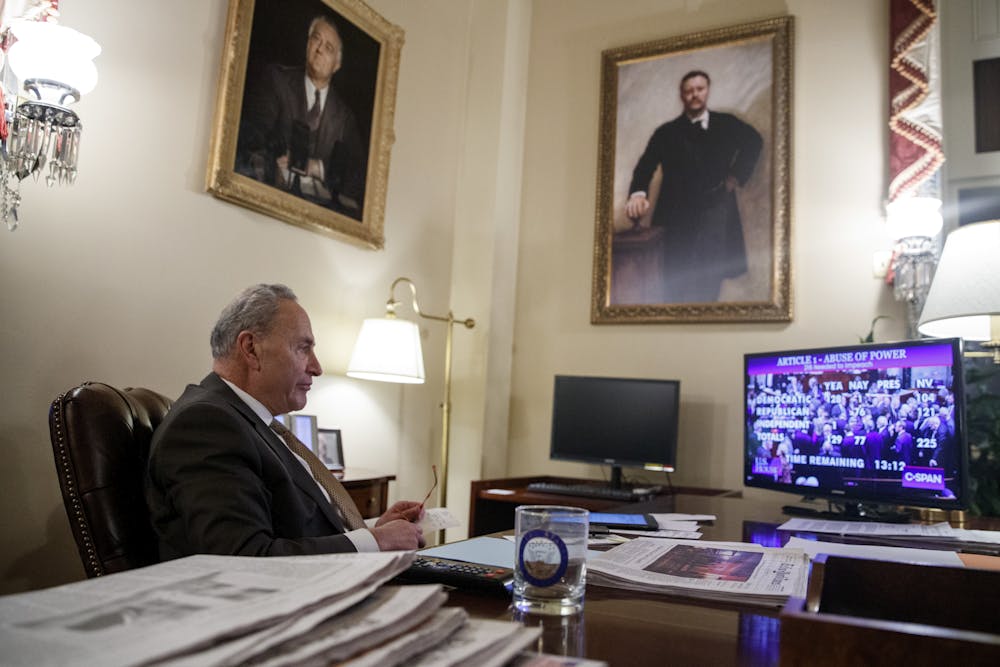
US Senate Minority Leader Chuck Schumer watches the House vote on the impeachment of US President Donald Trump. SHAWN THEW/AAP

Read more: Trump will cling to power — and Republicans will cling to him


Growing disengagement

One of the more troubling aspects to emerge from recent opinion polling is that there is a large minority of Americans who are disengaged from this whole process. Impeaching a president is a political act, but it is also the most serious action that can be taken against a sitting president.

As Richard Nixon put it, “People have got to know whether or not their president is a crook.”

However, according to a new Washington-Post ABC News poll, while 62% of respondents said they were following events closely, 38% said they were either only paying modest attention, or not paying any attention at all.

This is troubling, for whatever one thinks about Trump’s policies, he is a populist president who sees democratic institutions as a hindrance to his rule.

When such a large minority expresses disinterest in his impeachment, it is a toxic mix of a leader eager to sideline democratic institutions and a large bloc of voters unable and unwilling to make a considered judgement on whether or not “their president is a crook.”

This, of course, may be symptomatic of the Trump era. One crisis – even one as grave as impeachment – is simply replaced by another crisis in due course, all of which, in more tranquil times, might have spelled the end of a presidency – but not so in the age of Trump.

It is as if the boundaries between right and wrong, between authoritarianism and democracy, between truth and lies, have become so blurred that citizens no longer know where to take their stand, or they simply retreat into a knee-jerk partisanship which no longer requires critical thought.

Next year will begin with the Senate trial of Trump. He will be most likely acquitted by the Republican majority.

Attention will then turn to the race for the White House. Trump’s approval numbers are not good, but they are salvageable. More twists and turns will surely follow impeachment proceedings. In the Trump era, we should expect nothing less.

Impeachment is not the end of the process for Trump.

ref. Donald Trump has become the third president in US history to be impeached. He’s unlikely to be convicted – http://theconversation.com/donald-trump-has-become-the-third-president-in-us-history-to-be-impeached-hes-unlikely-to-be-convicted-128302

As Assange faces court over extradition attempts, the case is complex and the stakes are high

Source: The Conversation (Au and NZ) – By Tony Walker, Adjunct Professor, School of Communications, La Trobe University

Julian Assange may be an odious character in the eyes of some. He may not be a journalist in the estimation of others. He may be regarded as a serial pest by his detractors, but his case in the British courts has become a cause celebre for free speech and civil liberties advocates.

In a London magisrate’s court on Friday, early shots will be fired in the Assange defence team’s efforts to block his extradition to the United States on 17 charges under the Espionage Act with a separate indictment under the Computer Fraud and Abuse Act.

Assange is facing a jail sentence of 175 years on alleged breaches of the Espionage Act, and further penalty under the Computer Fraud and Abuse Act.


Read more: Explainer: what charges does Julian Assange face, and what’s likely to happen next?


At issue, and separate from the extradition proceedings, is whether an agent of the Central Intelligence Agency (CIA) spied on Assange during his seven years in the Ecuador embassy, after taking refuge there in 2012.

He sought Ecuadorian diplomatic protection to avoid extradition to Sweden on charges of sexual misconduct. Those charges have been cancelled.

British authorities arrested Assange in April this year after he was ejected from the embassy. Bail was refused on grounds he had absconded before.

Spain’s national court will hear evidence on whether Spanish surveillance company UC Global had provided transcripts, videos and other material from surveillance equipment secretly installed to monitor Assange’s private communications. It is alleged these were provided to the CIA.

Assange is due to give testimony via video link from Belmarsh prison outside London to the Spanish court, and in person, also by video link, at Westminster Magistrate’s Court.

Findings in this case will inform arguments against his extradition to the United States. Those extradition hearings are set to begin before a London magistrate’s court on February 24 2020.

Among extradition claims is that he coached former US army intelligence analyst Chelsea Manning into cracking a password on the Pentagon computer to obtain top-secret material about the US wars in Iraq and Afghanistan.

These became known as the “war logs” and included graphic video of an Apache helicopter attack on Iraqi civilians. This attack led to the deaths of two Reuters journalists.

The US application for extradition relates to Assange’s WikiLeaks activities before – not during – the 2016 presidential election. In those elections it’s widely believed he collaborated with Russia to publish leaked documents from the Democratic National Committee to undermine Hillary Clinton’s bid for the presidency.

During the 2016 campaign, Trump said more than once he “loved” WikiLeaks. However, within a year or so his administration was pursuing Assange for alleged breaches of the Espionage Act and the Computer Fraud and Abuse Act.

What happens now?

The Assange saga will drag on for months, if not years, before the UK courts, as his British lawyers fight the extradition proceedings tooth and nail.

This is a highly complex case – if it reaches the US court system, it will involve arguments about whether Assange was performing the role of a journalist or whistleblower and therefore entitled to First Amendment free speech protections.

In the first instance, his defence team will no doubt contend that his extradition is excluded under Britain’s extradition treaty with the US. This includes an exception for political offences.

In other words, the case has the potential, even the likelihood, of becoming a broader argument about the extraterritorial reach of the US. This leaves aside a free speech argument about the definition of what is, and what is not, journalism in a social media age.

The Obama administration had considered and then baulked at seeking Assange’s extradition, after concluding it would be perilous to charge him under the Espionage Act. This act does not make a distinction between journalists and non-journalists.


Read more: New indictments set up a confrontation between the US and Julian Assange


Obama-era Justice Department attorneys had also concluded that a First Amendment defence, questioning the definition of what constitutes journalism in the US, would vastly complicate attempts to convict.

American publications, including principally The New York Times, had collaborated with Assange in the publication of material from war logs whose disclosure embarrassed the US government.

In its reporting of the Assange matter, the Times has been assiduous in its defence of journalistic inquiry. The paper commented:

Though he is not a conventional journalist, much of what Mr Assange does at WikiLeaks is difficult to distinguish in a legally meaningful way from what traditional news organizations like the Times do: seek and publish information that officials want to be secret, including classified national security matters, and take steps to protect the confidentiality of sources.

The above reflects widespread concern among American media about implications more broadly for reporting sensitive national security issues that might themselves become subject to the Espionage Act.

Other publications across the world, among them The Guardian, Der Spiegel, Le Monde and El Pais, also cooperated with Assange. Newspapers in his native Australia published extensively from the leaked documents.

View from Assange’s homeland

In Australia, support for Assange has been patchy. The Australian government has gone through the motions in providing him with consular assistance.

However, in recent months a trickle of support for Assange has emerged. Politicians from both sides of politics have expressed their concerns about the possibility of him being extradited to the US on charges that would confine him to jail for the rest of his life.

The prospect of a life sentence would be very real.

As Assange’s case proceeds, it is likely support for him will build. In the process, this will pressure the Australian government to do more to persuade the Americans to back off.

A risk for Canberra is that inaction would be interpreted as being complicit in Assange’s removal to the US.

Australian journalism has been conflicted over the degree to which Assange should be supported, with arguments for and against. These have centred on his practice of simply dumping documents into the public domain without subjecting them to rigorous editorial processes.

However, what has not been properly addressed by those Australian journalists who have been quick to disavow him is whether Assange should be extradited for what amounts to a capital crime for leaking material that their own news organisations disseminated.

Perhaps we should leave the last word to former Guardian editor Alan Rusbridger, whose organisation collaborated with – then fell out with – Assange in the publication of the “war logs”.

Rusbridger defends Assange against attempts to extradite him on grounds that “whatever Assange got up to in 2010-11, it was not espionage”.

He alludes to perhaps the strongest argument against Assange’s removal to the US to face charges under the Espionage Act. This is that he is not a US citizen and his alleged crimes were committed outside the US. This is the extraterritorial argument.

Rusbridger quotes Joel Simon of the Committee to Protect Journalists who observed:

Under this rubric anyone anywhere in the world who publishes information that the US government deems to be classified could be prosecuted for espionage.

It is a good point.

ref. As Assange faces court over extradition attempts, the case is complex and the stakes are high – http://theconversation.com/as-assange-faces-court-over-extradition-attempts-the-case-is-complex-and-the-stakes-are-high-128999

Grounded: what’s behind Boeing’s production shutdown of MAX aircraft

Source: The Conversation (Au and NZ) – By Michael Lueck, Professor of Tourism, Auckland University of Technology

Boeing has announced it will halt production of the beleaguered B737-MAX series from January. Boeing’s announcement this week follows the grounding of the aircraft after two fatal crashes.

After the first crash, of Lion Air in Indonesia in October 2018, people blamed poor maintenance and insufficient pilot training. When a second airliner, of Ethiopian Air, crashed in March 2019, similarities quickly transpired. There was no apparent external influence such as poor weather. Neither was there any interference with the flight decks, as in a hijacking.

In both cases the pilots could not keep the aircraft from nose-diving. Airlines and regulators around the world started grounding the MAX indefinitely. Australia’s Civil Aviation Authority prohibited any B737MAX aircraft in its airspace, followed by New Zealand’s Civil Aviation Authority.

Surprisingly, the last authority to clamp down was the US Federal Aviation Administration, the governmental body in charge of certifying aircraft.

At first, Boeing was optimistic the aircraft would re-enter service by the end of this year, but recertification has been delayed several times. Globally, 387 delivered and about 400 undelivered MAX aircraft are grounded. The production shutdown is expected to take several months, with ramifications for suppliers and thousands of jobs at risk.


Read more: Boeing 737 Max: The FAA wanted a safe plane – but didn’t want to hurt America’s biggest exporter either


Aircraft computer system likely at fault

The suspected cause of the problems on board the two doomed airliners was a system new to the latest iteration of the previously best-selling commercial aircraft – the B737. The MAX series, the fourth generation of the aircraft, entered service in 1968 in its first version (B737-100). The 737MAX is the latest version and started flying in 2018.

Boeing’s main competitor, Airbus, developed the A320 family in the same category of the B737, but included new, more fuel-efficient engines. Boeing was under pressure to counter this when it developed the MAX series.

It shifted its larger new engines to provide more ground clearance, but this changed the balance of the aircraft and it tended to pitch up. Boeing created a computer system called Manoeuvring Characteristics Augmentation System (MCAS), which would detect any unwanted upward pitch and automatically force the nose down.

Shortly after take-off, the Lion Air 737MAX pilots struggled to stay in the air. The aircraft kept pulling down despite the nose not pitching up. Similarly, the pilots of the Ethiopian flight were not able to control the continuous forcing down of the nose.

Crash investigations are yet to be completed, but information released so far points to Boeing’s computer system and a faulty gauge that measures the angle at which the aircraft is flying.

Since the grounding, Boeing has worked tirelessly on a software fix, but regulators found other issues. This includes problems with software affecting flaps and other flight-control hardware, and issues with rudder cables potentially affected by a so-called uncontained engine failure. In the latter, parts of the engine blades detach and may fly at high speed into the fuselage, severing these cables.


Read more: Boeing 737 Max: air safety, market pressures and cockpit technology


Cutting corners at cost of safety

It is becoming increasingly clear Boeing has cut corners, presumably under pressure from the performance of its Airbus competitor. Boeing has been accused of delivering the aircraft before it was ready to fly safely.

It has transpired that Boeing may have been aware of computer system problems even before the Lion Air crash, but delivered the aircraft without modification or information to airlines. Even after the crash, Boeing did not halt deliveries. Instead it worked to fix the software and told pilots there was a potential problem.

The Federal Aviation Administration did not intervene either, despite its own analysis showing that, without intervention, the plane was likely to crash about one or two times a year. Equally astonishing is that the pilot manual for the MAX did not mention the new system. Instead, training for pilots moving from the previous 737NG to the new 737MAX consisted of a 56-minute iPad video, but no training in flight simulators.

A Joint Authorities Technical Review found:

The lack of a unified top-down development and evaluation of the system function and its safety analyses, combined with the extensive and fragmented documentation, made it difficult to assess whether compliance was fully demonstrated.

Boeing taking on part of aircraft certification

In a hearing by the US House Transportation Committee, a whistleblower revealed he urged Boeing managers to halt production because of mistakes, errors and corner cutting, as well as an overworked workforce.

Of further concern is that the Federal Aviation Administration has shifted some of its work to the manufacturer. Boeing now does parts of the certification process. This is not in the interest of safety. Overseas regulators, such the European Union Aviation Safety Agency, have criticised this approach.

The MAX disaster has already cost Boeing billions of dollars. Prior to the grounding, it produced 52 aircraft per month. It has since reduced production to 40, all of which are now parked.

The production halt will have ripple effects on US suppliers, with tens of thousands of jobs at risk. The fallout is likely to affect the wider US economy and many suppliers in Europe and in China.

I have flown on many Boeing aircraft and never felt unsafe. But with recent problems with the Dreamliner, the MAX and most recently the 777X, I question if Boeing has shifted from a safety first philosophy to prioritising profits and dividends for its shareholders.

ref. Grounded: what’s behind Boeing’s production shutdown of MAX aircraft – http://theconversation.com/grounded-whats-behind-boeings-production-shutdown-of-max-aircraft-129077

‘The size, the grandeur, the peacefulness of being in the dark’: what it’s like to study space at Siding Spring Observatory

Source: The Conversation (Au and NZ) – By Sunanda Creagh, Head of Digital Storytelling

How did our galaxy form? How do galaxies evolve over time? Where did the Sun’s lost siblings end up?

Three hours north-east of Parkes lies a remote astronomical research facility, unpolluted by city lights, where researchers are collecting vast amounts of data in an effort to unlock some of the biggest questions about our Universe.

Siding Spring Observatory, or SSO, is one of Australia’s top sites for astronomical research. You’ve probably heard of the Parkes telescope, made famous by the movie The Dish, but SSO is also a key character in Australia’s space research story.

In this episode, astrophysics student and Conversation intern Cameron Furlong goes to SSO to check out the huge Anglo Australian Telescope (AAT), the largest optical telescope in Australia.

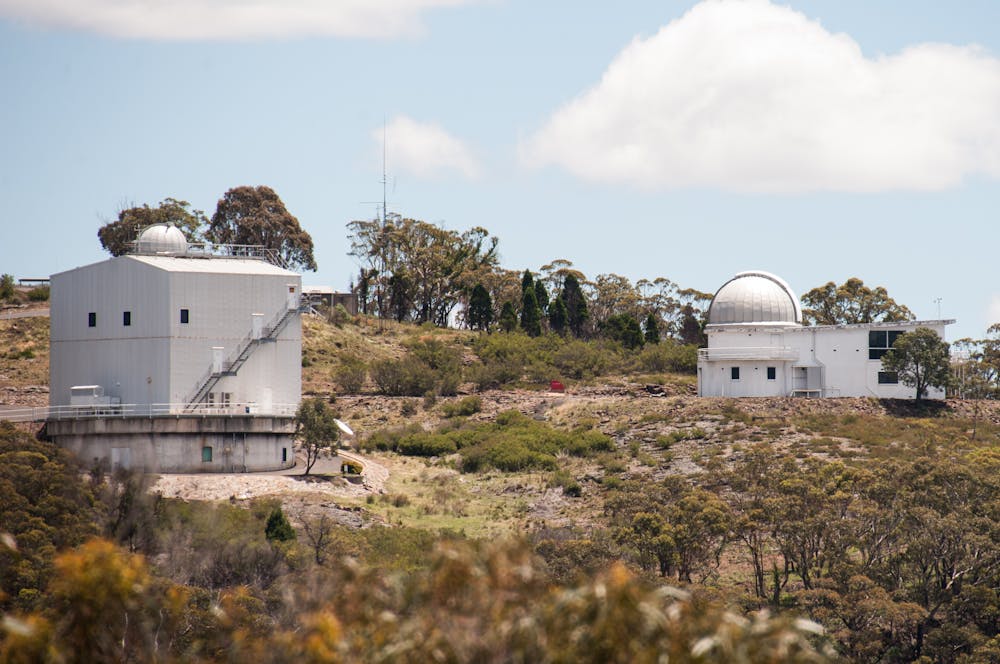
Siding Spring Observatory, north east of Parkes. Shutterstock

Read more: Darkness is disappearing and that’s bad news for astronomy


And we hear about Huntsman, a new specialised telescope that uses off-the-shelf Canon camera lenses – a bit like those you see sports photographers using at the cricket or the footy – to study very faint regions of space around other galaxies.

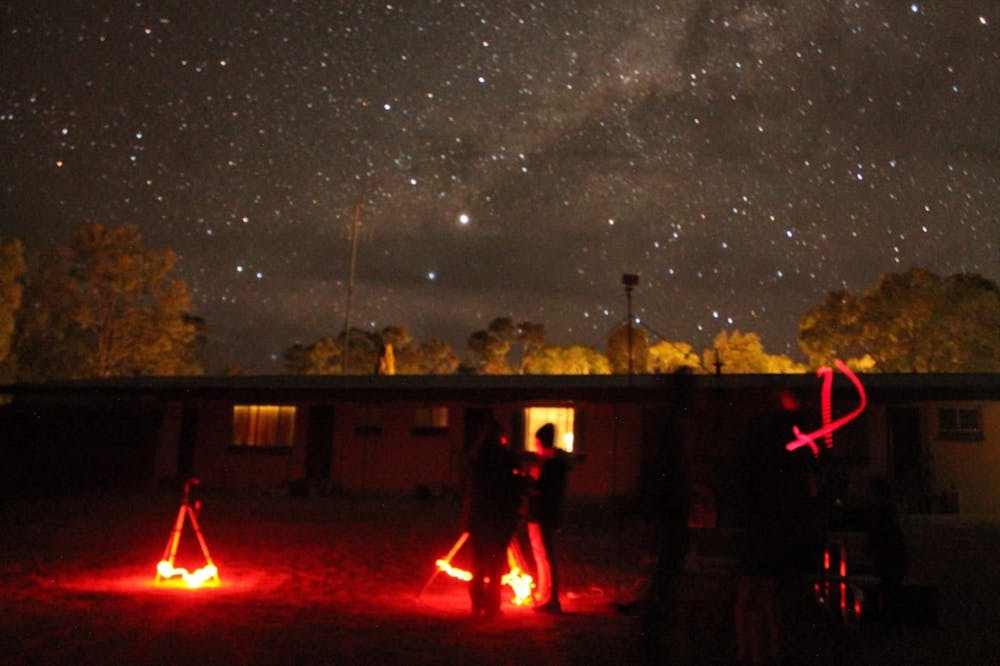
Students use telescopes to observe the night sky near Coonabarabran, not far from SSO. Cameron Furlong

Listen in to hear more about some of the most fascinating space research underway in Australia – and how, despite gruelling hours and endless paperwork, astronomers retain their sense of wonder for the night sky.

“For me, it means remembering how small I am in this enormous Universe. I think it’s very easy to forget, when you go about your daily life,” said Richard McDermid, an ARC Future Fellow and astronomer at Macquarie University.

“It’s nice to get back into it to a dark place and having a clear sky. And then you get to remember all the interesting and fascinating things, the size, the grandeur and the peacefulness of being in the dark.”

New to podcasts?

Podcasts are often best enjoyed using a podcast app. All iPhones come with the Apple Podcasts app already installed, or you may want to listen and subscribe on another app such as Pocket Casts (click here to listen to Trust Me, I’m An Expert on Pocket Casts).

You can also hear us on Stitcher, Spotify or any of the apps below. Just pick a service from one of those listed below and click on the icon to find Trust Me, I’m An Expert.


Read more: Trust Me, I’m An Expert: what science says about how to lose weight and whether you really need to


Additional audio

Kindergarten by Unkle Ho, from Elefant Traks.

Lucky Stars by Podington Bear from Free Music Archive.

Slimheart by Blue Dot Sessions from Free Music Archive.

Illumination by Kai Engel from Free Music Archive.

Phase 2 by Xylo-Ziko from Free Music Archive.

Extra Dimensions by Kri Tik from Free Music Archive.

Pure Water by Meydän, from Free Music Archive.

Images

Shutterstock

Cameron Furlong


Read more: Antibiotic resistant superbugs kill 32 plane-loads of people a week. We can all help fight back


ref. ‘The size, the grandeur, the peacefulness of being in the dark’: what it’s like to study space at Siding Spring Observatory – http://theconversation.com/the-size-the-grandeur-the-peacefulness-of-being-in-the-dark-what-its-like-to-study-space-at-siding-spring-observatory-128998

When did _Homo erectus_ die out? A fresh look at the demise of an ancient human species over 100,000 years ago

Source: The Conversation (Au and NZ) – By Kira Westaway, Senior Lecturer, Macquarie University

Imagine your child asked you “When did grandma die?” and you could only respond “It was probably a while ago, but it could have been quite recently.” Most likely your child would be unsatisfied with the reply.

This has been our situation regarding the ancient human species Homo erectus. We know these distant cousins of modern humans were alive almost 2 million years ago, but when did they die out? Probably a while ago, but perhaps quite recently.

A key site in our understanding of Homo erectus, at Ngandong, in Java, Indonesia, has until now defeated all attempts at reliable dating since it was first excavated more than 90 years ago.

With the aid of new techniques, we have now found that the Ngandong Homo erectus fossils are the most recent known specimens, dating from between 117,000 and 108,000 years ago.

This discovery will help us understand where they sit in the evolutionary tree, who they interacted with and why they became extinct.


Read more: A snapshot of our mysterious ancestor Homo erectus


The discovery at Ngandong

In 1931, a team of Dutch archaeologists made an unbelievable discovery at Ngandong when they unearthed 12 skulls and two leg bones of Homo erectus. Finding even one fossil human skull is remarkable, but finding 12 together is almost miraculous.

Other Homo erectus skulls have been found in Java and elsewhere, but the ones at Ngandong have the largest brain size and highest forehead of any of them.

Detailed casts of the 12 skulls found at Ngandong. Russell L Ciochon / University of Iowa, Author provided

This indicates an important evolutionary change, and knowing when it happened is crucial to our interpretation and understanding of these ancient cousins.

However, the nature of the site – where the fossils were buried in a deposit of sediment close to the Solo River – makes it difficult to determine how old the fossils are. Many attempts have been made to establish a timeline for the site, but until now none have been very successful.

Difficulties of dating

In 1931, when Ngandong was excavated, archaeologists relied heavily on the estimated age of the associated fossil fauna to date the Homo erectus remains.

By 1996, better dating techniques such as electron spin resonance and uranium-series dating were available. A team led by American geochronologist Carl Swisher applied these techniques to ancient buffalo teeth found at the Ngandong site.

Using the buffalo teeth dating, Swisher claimed that Homo erectus survived as recently as 27,000 years ago. This would overlap with the arrival of our own species, Homo sapiens, in the region.

The excavations at Ngandong. Russell Ciochon / University of Iowa, Author provided

However, examining the plans from the original excavation revealed the Dutch team had dug up and reburied an enormous area of ground. It turned out the buffalo teeth Swisher dated came from an area that had already been excavated and buried again.

This meant they could not have come from the same layer as the 12 Homo erectus skulls, so their ages were not related.

Despite the issues with Swisher’s dating, the theory that Homo erectus survived so recently has persisted in the literature and our understanding of Ngandong since 1996.

In 2011, at team led by Indonesian researcher Etty Indriati re-dated the site and obtained ages between 130 and 500,000 years. But again they focused mainly on dating the non-human fossil evidence and ignored the sedimentary context.

Consequently, the age range is too wide to provide much help in reconstructing the evolutionary significance of Ngandong.

Reading the river

Recently, we were part of a team of Indonesian, American, and Australian researchers led by Yan Rizal who tried a different approach. We worked on an understanding that the site is in a river deposit that is part of a sequence of floodplain steps called terraces.

Our study was based on how the Solo River system was created (landscape context), how the terraces were formed (terrace context), and how the fossils were deposited (fossil context).

The Solo River at Ngandong, showing river terraces on the far bank. Kira Westaway, Author provided

To do this we first dated when the Southern Mountains in Java were formed – to define when the Solo River was diverted to the north to form the terraces. We then dated the sequence of river terrace sediments using a technique called optically stimulated luminescence dating, which provided the first ever sedimentary age for the site.

Finally, we conducted extensive excavations at Ngandong in carefully selected areas using maps from previous excavations. These new excavations revealed the same bone bed found by the Dutch in 1931 and provided evidence directly associated with the human fossils that could also be dated.


Read more: Old teeth from a rediscovered cave show humans were in Indonesia more than 63,000 years ago


A new age

The analysis resulted in 52 new ages that were modelled to precisely define the age of the original bone layer to 117–108,000 years ago. This is the youngest reliable age for Homo erectus in Indonesia, and the last appearance of Homo erectus anywhere in the world.

At this age, Homo erectus would not have encountered Homo sapiens, but they may have met other now-extinct human species such as the enigmatic Denisovans. First discovered in the cold caves of Russia, the Denisovans are mostly known from traces of their DNA in modern humans rather than actual fossils. The Denisovans might have been distributed as far as Southeast Asia.

The new age range now raises important questions about the interactions between the Denisovans and the Ngandong Homo erectus. Could interbreeding with Denisovans be the source of the evolutionary change and larger skulls in this late Homo erectus population?

This possibility is yet to be proven. But it is clear that this improved age for the Ngandong Homo erectus has opened new lines of investigation that can provide a window into understanding the complex world of human evolution.

We are finally ready to get to know our extended family.

ref. When did _Homo erectus_ die out? A fresh look at the demise of an ancient human species over 100,000 years ago – http://theconversation.com/when-did-homo-erectus-die-out-a-fresh-look-at-the-demise-of-an-ancient-human-species-over-100-000-years-ago-126181

Report on public service overhaul a good start, but parliamentary inquiry is needed

Source: The Conversation (Au and NZ) – By Andrew Podger, Honorary Professor of Public Policy, Australian National University

The final report of the Independent Review of the Australian Public Service is much more substantial than its interim report. That is hardly a high hurdle, but its 18-page bibliography suggests considerable reflection beyond the (mostly disappointing) submissions and commissioned papers.

However, the report still has an excessive amount of rhetoric and is not an easy read.

Broadly, its themes are:

  • a united service

  • partnerships beyond the APS

  • embracing new technology

  • investing in people and capability

  • a more dynamic and responsive operational model

  • improved leadership and governance.

There are many sensible recommendations, but detail is often missing and analysis weak. Some recommendations reveal a surprising lack of understanding of the public sector.

The central theme of a “united” service is overdone, notwithstanding the case for greater coordination today. The APS does not need “an inspiring purpose and vision” – the first objective set out in the Public Service Act 1999 is clear. It is:

to establish an apolitical public service that is efficient and effective in serving the Government, the Parliament and the Australian public.

The APS Values also define the role of the APS as an institution. The review might have made more of the High Court’s references to these in confirming the constitutional standing of the APS.


Read more: View from The Hill: Morrison won’t have a bar of public service intrusions on government’s power


The review is right to press for a better coordinated service today, retreating from the late 1990s devolution under the new public management model. That Australia went too far is very clear (particularly on pay and conditions). Public expectations in light of modern technology are also demanding much greater connectivity today.

But the review goes too far the other way. The APS performs a wide range of functions, each requiring specialist expertise.

The Secretaries Board is not like a private sector board. Cabinet and ministers are the primary decision-makers under the Constitution, and secretaries’ first responsibilities are within their portfolios, serving and advising their ministers and delivering services and implementing government policies. At the centre it will always be primarily the responsibility of the Australian Public Service Commission (APSC) and the Department of Prime Minister and Cabinet (PM&C) to do the administrative coordination, though necessarily in close consultation with secretaries and other agency heads.

Perhaps the most valuable contribution of the report relates to the application of new technology. It makes a convincing case for very substantial new capital investments over many years and for increasing allocations for minor capital investment. These, and the associated building of skills, are necessary for more citizen-centred services and a more digitally enabled administration.

The report is also on the right track with several other themes:

  • invest in people and strengthen capability

  • reduce hierarchy and promote more dynamic teamwork across the service

  • improve governance and leadership, including by firmer merit-based approaches to appointments.

But the report pulls its punches about the causes of the problems. It could have been clearer about what needs to be fixed.

Why has strategic policy advising capacity declined and other expertise been lost? Why has evaluation activity and skills dropped away? Why has the APS become more risk-averse and hierarchical?

Thankfully, the Thodey Report does include recommendations aimed at strengthening the standing of the APS and clarifying relations with the government and the parliament. These include:

  • the accountability and integrity of ministerial staff

  • secretary and other agency head appointments and terminations, the respective roles of the APSC and secretary of PM&C, and the appointment of the APS commissioner.

Even if I disagree with some aspects, the report at least puts these things firmly on the table (see also my recent Parliamentary Library lecture).

On several other matters there is a disappointing lack of detail, despite the report often pointing in the right direction. These include:

  • The discussion of the APS Values ends up proposing some new statement of “principles” to supplement the values. What is needed is to recast the values to reflect more directly the APS’s unique institutional role (and return “merit” to the list).

  • The important discussion of place-management fails to set out the architecture required at community and regional levels, and how it might link with state government service delivery.

  • The discussion on budgeting rightly highlights the importance of adequate capital investment, but overlooks the equally important issue of how running costs should be financed (without crude efficiency dividends).

The government’s response

Michelle Grattan correctly summarised the response as solidifying the power of the prime minister and rejecting any recommendations that would strengthen the standing and independence of the APS.

Sadly, the result will be that many of the recommendations ostensibly “agreed” by the government will not succeed because the drivers behind the reduced capability of the APS (and its risk-averse and hierarchical culture) will remain and will probably grow stronger.

The repeated references in the response to “consistent with the Secretaries Board’s advice” when a recommendation was not agreed is both odd and worrying. If the advice was as claimed, I can only surmise that it demonstrates to the rest of the APS the leadership’s lack of frank and fearless advice. Surely the Secretaries Board supports a more uniform pay and conditions framework, and a more robust process for their own appointments and terminations?

On a positive note, the government agrees with the majority of the recommendations, particularly those relating to digital technology. Most of the responsibility for proceeding will lie with the APS itself. Whether the government will eventually sign up to the capital funding the head of the review, David Thodey, believes will be needed (initially at least A$100 million a year after the audit is complete) is uncertain.

The government has so far agreed only to A$15 million over two years to start work on all the agreed recommendations.

Machinery of government

Aspects of the prime minister’s earlier announcement about machinery-of-government changes have merit. They include:

  • reducing the separation of policy and administration by replacing DHS with an executive agency within the DSS portfolio

  • re-establishing strong links between education, employment and training

  • separating energy from the environment, recognising that the tensions between these major functions should be settled in cabinet.

But the failure to recognise such changes only work if aligned to ministry arrangements is extraordinary. The 1987 introduction of mega-departments was only partly to do with economies of scale. Mostly it was about streamlining cabinet: allowing cabinet to be small and manageable while still having every (portfolio) department represented, and allowing portfolio ministers to exercise, with their assistant ministers, more responsibility including over resource allocation.


Read more: Morrison cuts a swathe through the public service, with five departmental heads gone


The prime minister’s claim that his restructuring will ensure “congestion busting” and a much improved “line of sight” is contrived and almost certainly illusory. It cannot be achieved without “line of sight” between ministers and the public service. The new infrastructure department will have eight ministers, four in cabinet, several with responsibilities in other portfolios, and around 80 ministerial staff. This is hardly a recipe for a stronger focus on serving the public.

We do not know what, if any, advice the APS provided about these changes. My fear is that APS expertise in such matters has deteriorated greatly in recent years.

Apart from this misalignment between the ministry and the machinery of government, some of the details of these changes are wanting. In particular, there remains a serious problem about the separation of Medicare Australia from health policy.

Where to from here?

The Morrison government’s pronouncements over the past fortnight confirm its lack of real interest in the public service as an institution. Sadly, it seems much of the conservative side of politics has lost the sort of support of our institutions that Menzies and other traditionalists exemplified.

Equally, it would be wrong to rely on the other side of politics to pursue the directions in the Thodey Report that the Morrison government has ruled out. Not only would this ignore Labor’s contribution over the years to the current sorry state of affairs, but it would set up for partisan debate the appropriate governance and degree of independence of the APS, something inimical to what fundamentally must be non-partisan.

Instead, we need the parliament to intervene, if not in the immediate light of the Thodey Report and the government’s response, then before or shortly after the next election. A Senate select committee might be asked to undertake an inquiry into the relationship between the APS, the government and the parliament. It should examine:

  • the constitutional role of the APS and how this is reflected in the Public Service Act

  • the distinctive values of the APS in line with its constitutional role

  • the corresponding distinctive values of other components of the Commonwealth, including within the executive, the legislature and the judiciary

  • the processes for appointing and terminating secretaries and other APS agency heads

  • the respective roles of the APS commissioner and secretary of PM&C

  • the roles and responsibilities of secretaries, senior executives and the Secretaries Board

  • the Members of Parliament Staffing Act and associated accountability arrangements.

This inquiry should consider Thodey’s recommendations and other options, and be asked to come up with its own concrete recommendations.

ref. Report on public service overhaul a good start, but parliamentary inquiry is needed – http://theconversation.com/report-on-public-service-overhaul-a-good-start-but-parliamentary-inquiry-is-needed-127602

As drug deaths rise in rural Australia, we must do more to prevent overdoses

Source: The Conversation (Au and NZ) – By Katinka van de Ven, Senior Lecturer, Centre for Rural Criminology, HASSE, University of New England & Visiting Fellow, Drug Policy Modelling Program, SPRC, University of New South Wales, University of New England

Rural Australians are more likely than their city counterparts to drink alcohol at harmful levels. They’re also higher consumers of cannabis, ice and the prescription opioids oxycodone and fentanyl.

Drug-related deaths are also rising more rapidly in rural Australia, up 41% since 2008, compared with a 16% increase in major cities over the same period.

Several reports have also shown that the burden of alcohol and other drug use increases with remoteness.


Read more: ‘If you don’t have a beer you’re not a man’ – rural workplaces made more dangerous by drugs and alcohol


Our review of the international literature on rural opioid-related harms, published today, shows it’s not just the higher rates of drug use causing greater harms in rural and remote areas.

It also comes down to specific features of rural communities including poorer access to treatment and harm-reduction programs, and more conditions that promote alcohol and other drug use, such as economic hardship.

Our research focused on opioids, but the findings hold for other types of illicit drug use and alcohol abuse.

Why rural people suffer greater harms

Living in rural and remote areas shapes the risk of harm from opioids through four key influences:

  1. economic conditions – many rural areas have experienced economic decline through the loss of manufacturing and other industries. This causes high levels of economic distress among some residents, particularly due to job losses

  2. physical conditions – rural areas often lack infrastructure and public transport. Those who need alcohol and other drug services often have to travel greater distances for treatment. There are also fewer recreational activities, especially for young people

  3. social conditions – the use of drugs as a recreational activity was linked with particular sub-cultures in rural areas. In small towns, a lack of anonymity and stigmatisation of people who use opioids can lead to people avoid seeking treatment. People in rural areas may also lack knowledge about treatment options or even what constitutes risky behaviour

  4. policy conditions – rural areas often have limited coverage and availability of harm-reduction schemes such as needle and syringe programs, and residential and outpatient rehabilitation programs.

While a number of the above factors also apply to urban areas, rural environments have distinct, and often overlapping, physical, social, policy and economic features.

Invest in treatment facilities to reduce overdoses

Access to treatment and harm-reduction services are crucial to preventing drug-related harms, and in particular, overdose deaths.

One study found overdose rates tended to be higher in rural and remote areas where there was limited access to alcohol and other drug treatment services.


Read more: You don’t have to go off the grid to get treatment for drug dependence


Where rural treatment facilities and harm-reduction services operate, they tend to employ less qualified and experienced staff and have greater difficulties retaining specialised and high-quality staff.

The challenge of finding suitable treatment in rural and remote areas is magnified by poor infrastructure and costly and limited public transport options in these areas.

We’ve known for several decades that demand for alcohol and other drug support and treatment services is high and increasing in rural communities. But these services are still under‐resourced.

We need urgent government action, including sufficient funds, to improve service delivery.

Video services also have a role

While distance makes service delivery difficult, tele-health and tele-counselling may also help overcome some of these barriers.

Tele-health is where health services are delivered via live video-conferencing, while tele-counselling is a mental health service performed via phone or a secure video.

Harms from prescription opioids are rising. gabriel12/Shutterstock

Technology can also help deal with concerns surrounding confidentiality in tight-knit communities. It allows people to receive drug and alcohol services from any location, including their home, as opposed to physically entering a drug treatment facility. This avoids the risk of being recognised by others and stigmatised as a person who uses drugs.

However, in some cases, tele-health will not replace physical services. Clean needles and syringes, for example, or drugs to prevent overdose (naloxone), require adequate funding and people on the ground to deliver them.


Read more: Weekly Dose: Naloxone, how to save a life from opioid overdose


Policymakers must also attend to the economic, physical, social and policy conditions which are shaping the risk of alcohol and other drug use in in rural communities. This might include:

  • supporting more economic opportunities and recreational activities for young people

  • investing in public transport

  • providing adequate funding to attract and retain high-quality drug and alcohol workers.

These measures would help reduce some of the burden of drug and alcohol-related harm being borne by our rural communities.


Read more: Investing in rural health brings dollar returns to local economies (and improves health)


ref. As drug deaths rise in rural Australia, we must do more to prevent overdoses – http://theconversation.com/as-drug-deaths-rise-in-rural-australia-we-must-do-more-to-prevent-overdoses-128229

From childcare to high school – what to do if you don’t like your kid’s friend

Source: The Conversation (Au and NZ) – By Laurien Beane, Course Coordinator, Queensland Undergraduate Early Childhood, Australian Catholic University

Friendship is critical to a young person’s development. Recent research showed teenagers with just one close friend were better able to bounce back from stress than teenagers without one.

But we also know about the high prevalence of bullying in schools and may have, ourselves, had a negative early friendship that has affected us well into adulthood.

So, if you suspect your child – whether they are in early childhood education and care, primary or secondary school – has a questionable friend, here are some tips on how to deal with it.

Early Childhood (birth to five years)

Early childhood education and care centres enrol children from birth to five years old. One of the learning outcomes of the governing Early Years Learning Framework is to teach and assess if children can “learn to interact in relation to others with care, empathy and respect”.

Educators work to ensure interactions with your child, and the other child, meet the learning outcomes.

Social skills are the main goal of education at this age. from shutterstock.com

Educators in childcare centres are legally required to take regular written observations to record, interpret, analyse and plan the next steps in children’s learning journeys.

These written records are of interactions between individual children, and in small and large groups of children. These should be available for viewing and consultation by parents and caregivers.

You can request educators to keep you updated on interactions your child has with friends. This includes positive, neutral and negative interactions as they are all part of your child’s social development.


Read more: Childhood shyness: when is it normal and when is it cause for concern?


When children are young, they may not yet have the communication skills to explain their feelings. Instead, they may bite or hit another child. Some young children will never go through this stage, and others may take a little while to develop the skills to use their words for positive communication.

If your child comes home with bite marks, or you are regularly receiving incident reports about these types of interactions with the same child, this might signal an undesirable friendship.

You could make an appointment with the centre director to collaborate on possible changes. They may be able to provide support staff in the room at certain times.

The centre may also help you to make a plan to relocate to another room in the centre. Usually this means moving up to the next room with a slightly older age group, when there is a space. – Laurien Beane


Primary school

Peers play a key role in a child’s cognitive, social and emotional development at primary school. These influences can be both positive and negative.

Is your primary-aged child more withdrawn lately? from shutterstock.com

Unhealthy friendships involve a breach of trust or damage to someone’s well-being. Some signs your primary-aged child may be dealing with a challenging friend is if:

  • the person lies to your child on a regular basis

  • they change best friend status depending on their mood for the day

  • they control who your child can play with, which clothes they can wear or which interests they can have

  • they bully your child through social exclusion, verbal put downs, rumour-spreading and/or physical intimidation

  • they encourage or pressure your child to participate in antisocial or risky behaviours

  • you have noticed a decline in your child’s self-esteem and overall well-being

  • you have noticed an increase in withdrawn or aggressive behaviour in your child.

Research shows children are less likely to display antisocial or risky behaviour when their parents are aware of their friendship network. Parental monitoring and supervision can also decrease socialisation with these unhealthy peers.

But overly intrusive parenting can undermine a child’s autonomy. This could make the child more aggressive or rebellious and increase their socialising with unhealthy peers.

Young people are more likely to disclose peer issues to their parents if you:

  • respond with empathetic advice based on lessons you learnt in your own life (“I understand how you might be feeling. When I was your age something similar happened to me […] I realised a true friend wouldn’t want me to hurt myself just because they thought it was funny. So I decided to make some new friends”)

  • involve them in the problem-solving process by asking them to consider the options and potential consequences (“What do you think might happen if you stay friends with Sally and she keeps daring you to do XYZ? How could this hurt you or other people? What are some things you could do to protect yourself?”). Allow them to make their own decision.

If open discussion and collaboration in solving the problem doesn’t work, or it doesn’t have a positive result, it may be necessary for parents to intervene.

Subtle intervention could involve limiting your child’s availability by filling in weekends and afternoons with activities like visiting relatives. Eventually, this distance may enable the friendship to fade or run its course in a less confronting way.


Read more: Making friends in primary school can be tricky. Here’s how parents and teachers can help


Direct intervention may involve banning contact with the friend, even if this means relocating to a different school or area. This may seem drastic but it may be a necessary course to protect your child’s well-being.

Research shows associations with unhealthy or bullying peers as a child can have serious long-term effects like lowering academic self-esteem while increasing the chance of poor physical and mental health and risky behaviours (including substance abuse and unprotected sex into adulthood.

Counselling may also be required to help the child work through grief, rebuild self-esteem and seek healthier friendships. – Natasha Wardman


Read more: Making friends in primary school can be tricky. Here’s how parents and teachers can help


High school

Friendships influence a young person’s development. Happy and healthy relationships between young people can make the transition from primary to secondary school more successful and help shape future trajectories beyond school, even future economic success.

If you are worried your teenager is struggling with a challenging friendship, there are some ways you can help.

Being an overly controlling parent could push your teenage son or daughter further away. from shutterstock.com

Research shows expressions of love and care, even if they are received with repulsion, will likely enhance your teen’s self-esteem and capacity for dealing with difficult friendships.

Saying “I love you” on a regular basis and showing physical affection can be a good habit to establish.


Read more: Teens with at least one close friend can better cope with stress than those without


Research also shows parents remain the most significant influence through the teenage years. Parents might consider talking with their kids about what the family values and whether those values might align with the behaviours and actions of friends.

For example, if you are concerned about what your child’s friend said about someone on social media, you might ask your child questions such as:

  • “Is that what you would say on social media about others?”

  • “Do those words reflect the person you want to be?”

  • “Is this friendship going to bring out the best in you?”

Parents should also be wary of the dangers of overprotective parenting.

Usually, excessive supervision or intrusion in teenagers’ lives does not give them the chance to handle difficult situations competently.

It is usually a good idea to give teenagers some freedom in their decision-making and responsibilities.

You may wish to:

  • encourage positive friendships. If you know friends who are a good influence on your teenager, try to make opportunities for those friendships to develop

  • talk about the pros and cons of different friendships. Sometimes parents might use their own friendships as examples. Let your teenager know how you manage and support your friendships and why you manage them in different ways

  • talk about the real consequences of friendships. Positive friendships can result in anything between good fun and deep development. Harmful friendships have the potential to result in sadness, confusion and stress, with the possibility of life-changing unwanted consequences.

A calm, adult-like dialogue and modelling good behaviours are more likely to elicit an adult-like response from your teenager than forcing them to do something against their will. This is especially true for the choices they make in forming friendships. – Michael Chambers

ref. From childcare to high school – what to do if you don’t like your kid’s friend – http://theconversation.com/from-childcare-to-high-school-what-to-do-if-you-dont-like-your-kids-friend-126193

Why Australian road rules should be rewritten to put walking first

Source: The Conversation (Au and NZ) – By David Levinson, Professor of Transport, University of Sydney

You are walking east on a footpath and come to an unmarked intersection without traffic signals. A vehicle is driving north, across your path. Who has right of way in Australia?

Should you step into the road expecting the vehicle to slow down or stop if necessary? Is the driver legally obliged to do so?

And does the driver see you? How fast is the vehicle going? Can it stop?

Now imagine you are the driver. What will the person on foot do next?

So the answer to the question of “giving way” is complicated. It depends on the speed of the car, how fast the person is walking, how quickly the driver reacts to apply the brakes, the vehicle itself, road conditions and how far the car and walker are from each other. Ideally, both the driver and walker can assess these things in a fraction of a second, but human perception and real-time calculation skills are imperfect. At higher speeds, both pedestrians and drivers underestimate vehicle speed.

Soon we will have to seriously consider autonomous vehicles, which can assess distance and speed almost perfectly, but there is still that ambiguity.


Read more: Driverless vehicles and pedestrians don’t mix. So how do we re-arrange our cities?


What does the law say?

Road rules legislate how drivers should behave. But it turns out most people do not know right-of-way rules.

In Australia, the National Transport Commission recommends model rules, which each state adopts and lightly modifies. For instance, New South Wales Road Rules 72, 73 and 353 cover pedestrians crossing a road.

Rule 353 says:

If a driver who is turning from a road at an intersection is required to give way to a pedestrian who is crossing the road that the driver is entering, the driver is only required to give way to the pedestrian if the pedestrian’s line of travel in crossing the road is essentially perpendicular to the edges of the road the driver is entering – the driver is not required to give way to a pedestrian who is crossing the road the driver is leaving.

Because of the legal principle of duty of care, drivers must still try to avoid colliding with pedestrians. They have a legal obligation to not be negligent. Thus, they must stop if they can for pedestrians who are already there, but not those on the side of the road wanting to cross.

However, this element of the NSW Road Transport Act is not made explicit in the NSW Road Rules. There is no statutory requirement in the road rules or elsewhere to give way to pedestrians other than as set out specifically in the road rules.

In contrast, NSW Road Rules 230 and 236 explicitly require pedestrians to avoid behaving dangerously around cars.

The published advice in NSW is:

Drivers must always give way to pedestrians if there is danger of colliding with them, however pedestrians should not rely on this and should take great care when crossing any road.

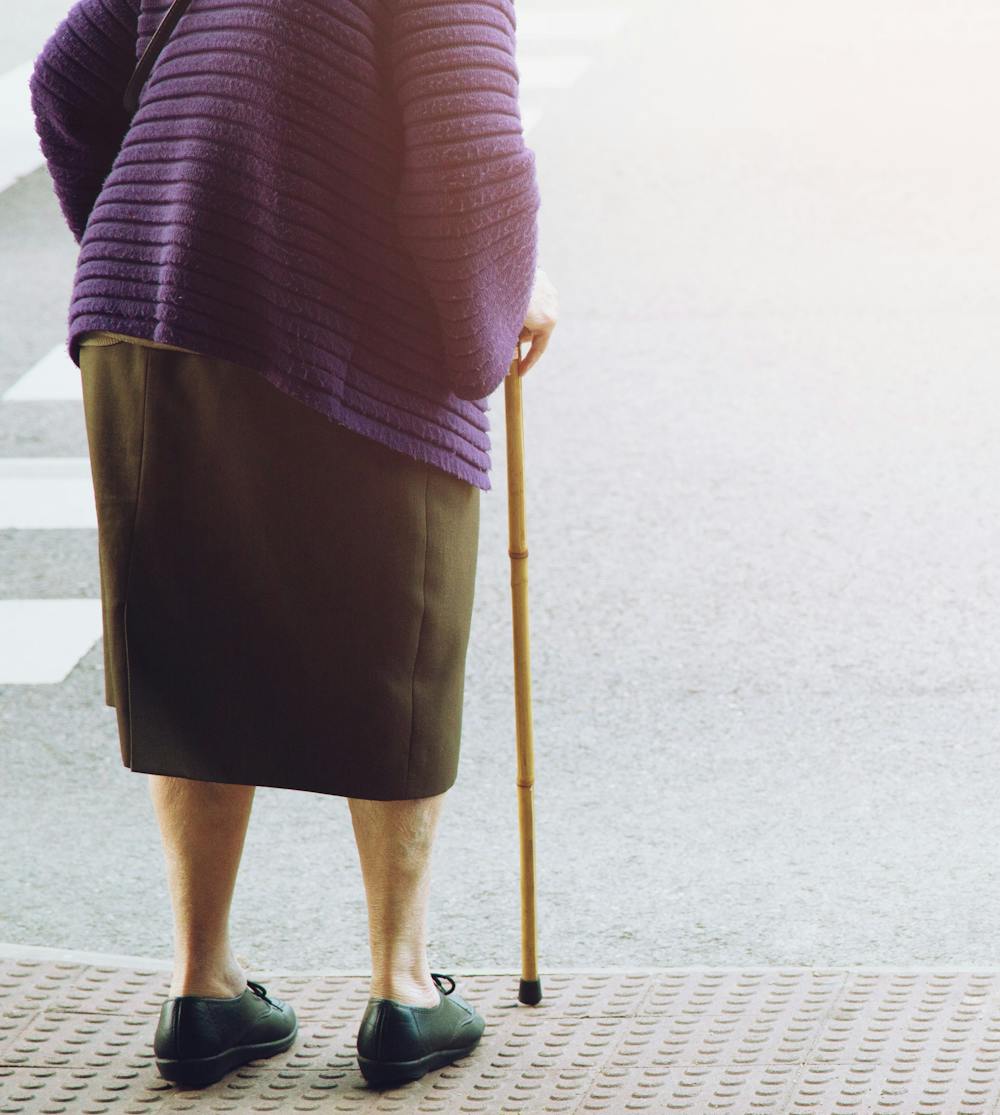
Does a slow-moving person’s higher risk of being hit mean they can’t cross the road? Shutterstock

This statement is not supported by any road rule or other law.

Does the law as written mean a slow-moving person can never cross the street because of the risk of being hit? Only because duty-of-care logic indicates both the driver and pedestrian should yield to the other to avoid a collision is it possible for this person to cross without depending on the kindness of strangers. But the law gives the benefit of doubt to the driver of the multi-ton machine. Existing road rules permit drivers to voluntarily give way, or not.

Keep in mind the asymmetry of this situation. A person walking into the side of the car is silly. A car being driven into the side of a person, as happens 1,500 times a year in NSW, is life-threatening.


Read more: Pedestrian safety needs to catch up to technology and put people before cars


What do we recommend?

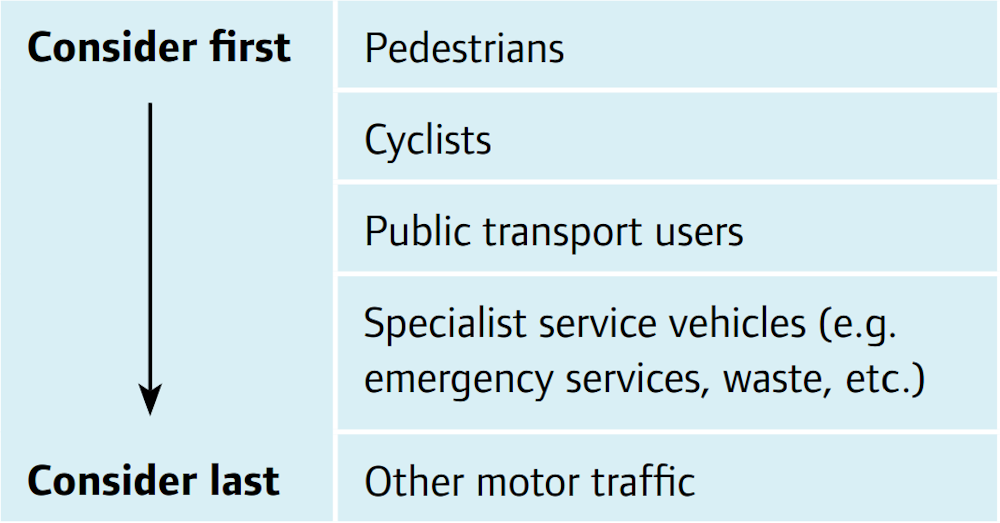
The UK Manual for Streets presents a street user hierarchy that puts pedestrians at the top. That is, their needs and safety should be considered first.

A recommended hierarchy of street users. Manual for Streets/UK Department for Transport

Walking has multiple benefits. More people on foot lowers infrastructure costs, improves health and reduces the number in cars, in turn reducing crashes, pollution and congestion. However, the road rules are not designed with this logic.

The putative aim of road rules is safety, but in practice the rules trade off between safety and convenience. The more rules are biased toward the convenience of drivers, the more drivers there will be.


Read more: How traffic signals favour cars and discourage walking


Yet public policy aims to promote walking. To do so, pedestrians should be given freer rein to walk: alert, but not afraid.

Like many things in this world, intersection interactions are negotiated, tacitly, by road users and their subtle and not-so-subtle cues. Pedestrians should have legal priority behind them in this negotiation.

The road rules need to be amended to require drivers to give way to pedestrians at all intersections. We favour a rule requiring drivers to look out for pedestrians and give way to them on any road or road-related area. In the case of collisions, the onus would be on drivers to show they could not in the circumstances give way to the pedestrian.

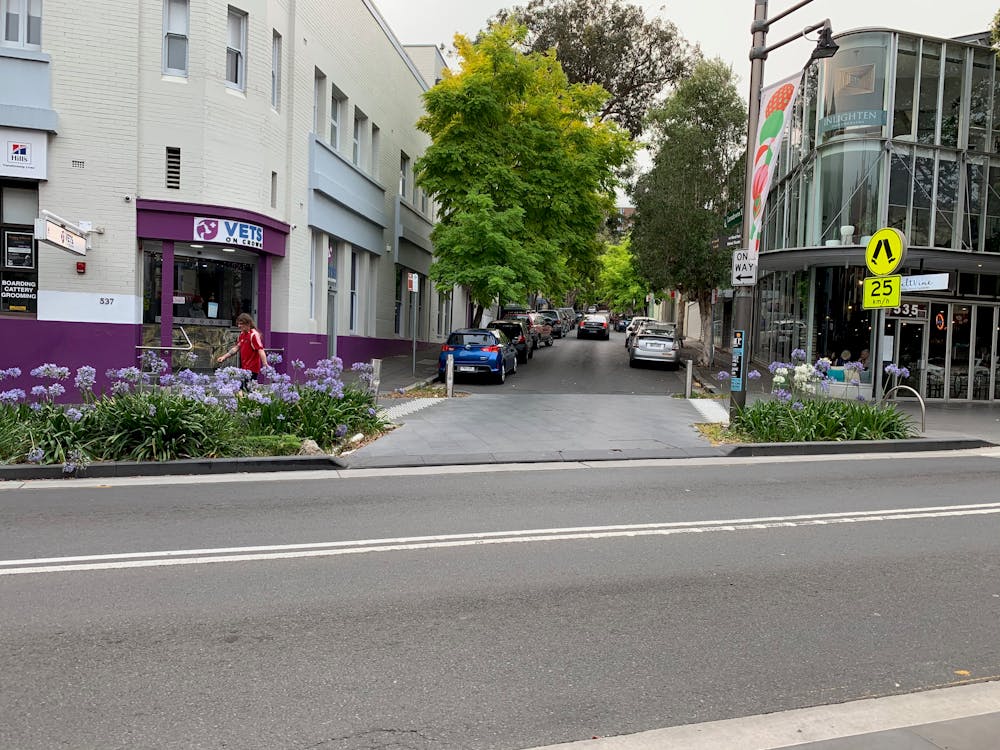
We believe all intersections without signals – whether marked, courtesy, or unmarked – be legally treated as marked pedestrian crossings. (It might help to mark them to remind drivers of this.) We should think of these intersections as spaces where vehicles cross an implicit continuous footpath, rather than as places where people cross a vehicular lane.

At this intersection in Surry Hills, NSW, vehicles cross a continuous footpath. Photo by David Levinson., Author provided

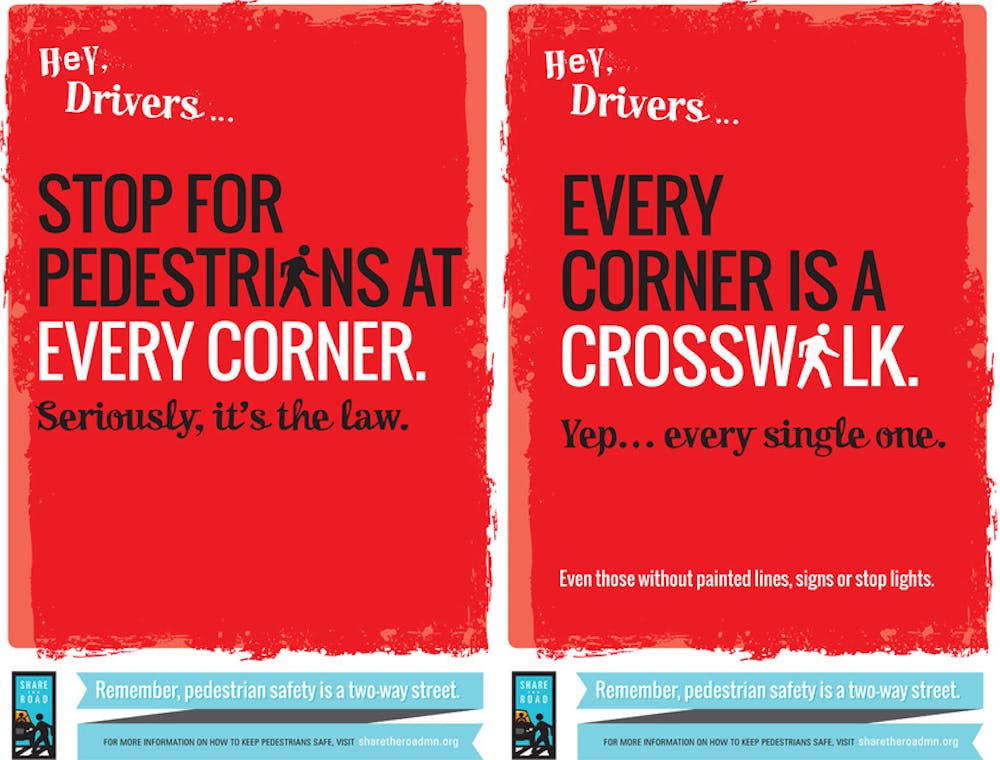
This change in perspective will require significant road user re-education. Users will have to be reminded every intersection is a crosswalk and that pedestrians both in the road and showing intent to cross should be yielded to, whether the vehicle is entering or exiting the road. We believe this change will increase safety and willingness to walk, because of the safety-in-numbers phenomenon, and improve quality of life.

In Minnesota, every corner is a crosswalk, marked or not, so stopping for pedestrians at intersections is mandatory, whatever direction the car is moving. Minnesota Department of Transportation., Author provided

Drivers should assume more responsibility for safety

People should continue to behave in a way that does not harm themselves or others. People on foot should not jump out in front of cars, expecting drivers to slam on their brakes, because drivers cannot always stop in time.


Read more: Nothing to fear? How humans (and other intelligent animals) might ruin the autonomous vehicle utopia


Similarly, drivers should be ready to slow or stop when a person crosses the street, at a crosswalk or not. But the law should be refactored to give priority to pedestrians at unmarked crossings. This will reduce ambiguity and make drivers more alert and ready to slow down.

In tomorrow’s world of driverless and passengerless vehicles, the convenience of drivers becomes even less essential. If someone is crossing the road, most of us probably believe a driverless vehicle should give way to ensure it doesn’t hit that person for two reasons: legally, to avoid being negligent; and morally, because hitting people is bad, as identified in many examples of the Trolley Problem.

Further, we should think more like the Netherlands, where vehicle-pedestrian collisions are presumed to be the driver’s fault, unless it can be clearly proven otherwise.


Read more: The everyday ethical challenges of self-driving cars


This article examined a few of 353 distinct road rules. Many others affect pedestrians and should also be re-examined.


This article was extensively edited by Janet Wahlquist of WalkSydney and extends some ideas developed as part of Betty Yang’s undergraduate thesis, but the text is the sole responsibility of the author.

ref. Why Australian road rules should be rewritten to put walking first – http://theconversation.com/why-australian-road-rules-should-be-rewritten-to-put-walking-first-127789

Blind bags: how toy makers are making a fortune with child gambling

Source: The Conversation (Au and NZ) – By Louise Grimmer, Senior Lecturer in Marketing, Tasmanian School of Business and Economics, University of Tasmania

For many of us, our first experience with “gambling” was the lucky dip at the local school fete. We handed over our pocket money and hoped the plain packet we selected would contain something worth our 50 cents.

Now the lucky dip has been reinvented and become ubiquitous in the form of the blind bag toy.

Blind bags (also referred to as surprise packs or surprise toys) involve small and collectible toys hidden inside opaque packaging. There are now hundreds of different blind bag lines, from old favourites such as My Little Pony, Transformers and Teenage Mutant Ninja Turtles to new fads like Tokidoki, Zomlings and the hugely popular L.O.L. Surprise! dolls.

L.O.L. Surprise dolls come packaged inside a plastic ball. www.shutterstock.com

Though no statistics for global blind bag toy sales are available, data from the United States give an indication of their phenomenal growth in recent years. Between 2017 and 2018, market analyst NPD estimates the blind bag market in the US grew by about 60% even while total toy sales fell 2%.

Not surprisingly the US Toy Association declared “The Big Reveal” its top trend for 2018, with “the act of removing a surprise toy from a blind bag” being “just as exciting as the toy itself”.


Read more: The power of rewards and why we seek them out


There’s no reason to think 2019 will be any different in the US or around the world. Indeed, if toy aisles in stores are anything to go by, buyers’ appetite for blind bags appears to be ballooning.

The factors driving this sales growth include social media – in which “unboxing” has become an entertainment in itself – and the growing adult market for toys.

But the three most potent elements are the combination of price, the appeal of collecting and the psychological lure of surprise. It’s these three things that make blind bag toys so ethically problematic.

Collect them all!

Compared with other options, blind bag and surprise toys seem cheap. In Australia, prices range from about A$1.60 to A$15. This makes them attractive to children and adults alike, particularly as stocking stuffers at Christmas.

But the problem is that one is never enough.

Collect them all! Marvel Ooshies advertising.

Almost all blind bag toys are marketed as collections – with “collecting them all” emphasised in packaging and advertising. There may be dozens to collect. Ooshie maker Head Start International, for example, has released four series of Marvel Ooshies with a total of 164 toys to collect.

So despite not being very costly to buy once, the costs add up.

As we’ve noted before in discussing the Ooshies phenomenon, collecting is attractive to children. While an estimated 30% of adults collect something, more than 90% of children do so. Collecting appeals to children’s natural curiosity and is also a way of understanding the world through gathering and categorising.


Read more: Ooshies – a cautionary toy story about cashing in on childhood innocence


The blind bag business model weaponises this collecting impulse through the gamble of the lucky dip. It combines the pleasure of reward with the element of surprise, which is both compelling and addictive. It taps into the same psychological mechanism that results in gambling addiction – namely intermittent reinforcement.

Intermittent reinforcement

The seductive, manipulative power of intermittent reinforcement (also known as variable ratio reinforcement) was famously shown in experiments with pigeons in the 1950s led by the noted American psychologist B.F. Skinner.

His team trained pigeons to peck a small lever that led to a food reward. When rewarded every time, the pigeons pecked the lever only when they were hungry. But when rewarded intermittently, they became compulsive peckers.

B.F. Skinner explains variable ratio reinforcement.

Th effects of intermittent reinforcement have also been demonstrated in clinical tests with children.

This helps explain the phenomenal growth and profitability of blind bags for toy companies. With the outcome being uncertain and the reward intermittent, the dopamine rush of opening each new bag is maintained.

Loot boxes

A virtual form of blind bag is proving even more profitable for video game companies. They’re known as loot boxes, which players can buy with real money in the hope of scoring “equipment” or “skins” to enhance their game avatar. More often than not they don’t contain anything the player wants. Which is why players keep buying.

A study this year estimated loot boxes could be worth US$30 billion a year to the video game industry.

Concern about loot boxes effectively exposing children to gambling has led to calls in many countries for greater regulation. Belgium has banned them. In Britain, the government is considering making companies that make money using loot boxes hold a gambling licence. In Australia, the federal government says more research is needed before it will regulate.


Read more: Gaming or gambling: study shows almost half of loot boxes in video games constitute gambling


How different is a blind bag toy?

Maybe you are always assured a toy, but the relative scarcity of different toys in a series means some are worth much more than others, and the desire for those will drive further purchases. It’s a business model that still fundamentally works on the same principles that make poker machines, scratchies and other forms of gambling so addictive.

So while blind bag toys can be fun, the use of “blind” packaging and intermittent reinforcement to drive sales must be considered ethically problematic, especially given they are targeted at children.

As in all things, awareness and moderation are key.

ref. Blind bags: how toy makers are making a fortune with child gambling – http://theconversation.com/blind-bags-how-toy-makers-are-making-a-fortune-with-child-gambling-127229

The Rise of Skywalker ends a third Star Wars trilogy. Here’s why stories work so well in threes

Source: The Conversation (Au and NZ) – By Stefanie Johnstone, PhD Candiate, University of Technology Sydney

How many Star Wars films did George Lucas plan? According to Dan Golding in his recent book Star Wars After Lucas, this depends on when Lucas was asked.

The often-quoted number is nine, but it might wind up being as many as 12. How ever many he planned, we know he planned them in threes.

Today’s release of The Rise of Skywalker, directed by J.J. Abrams, marks the end of the third trilogy in the franchise.

But where does the trilogy story form come from?

Changing the world

Trilogy is a very old form. The earliest known example is Aeschylus’ Oresteia, which tells a story of revenge and change in law following Agamemnon’s return home from the Trojan war. It was first performed in Athens 2500 years ago.

This Greek vase, from about 350 – 320 BC, depicts Orestes about to slay Clytemnestra. The Getty

In the first play, Agamemnon is murdered by his wife Clytemnestra as revenge for the sacrifice of their daughter. In the second play, their son Orestes murders his mother, to avenge his father’s death.

In the final play of the trilogy – with no more family members remaining to avenge Clytemnestra’s death – Orestes is put on trial in front of an Athenian jury. Also the first ever courtroom drama, Aeschylus used this third play to twist the story world set up in the first two plays.

A hallmark of the trilogy genre is the shift in the final part, with a revolution (as in The Hunger Games) or a restoration (as in Isaac Asimov’sFoundation). In linking three individual texts, there is a fourth, monumental, overarching story.


Read more: How JJ Abrams ruined Star Trek and what that means for Star Wars: The Force Awakens


In the first two Star Wars trilogies, we followed Luke Skywalker’s journey to becoming a Jedi (Episodes IV-VI) and Anakin Skywalker’s journey to the Dark Side (Episodes I-III).

The current trilogy (Episodes VII-IX), so far, has expanded this overarching narrative even further: a hero’s journey in Rey, mimicking Luke’s journey to becoming a Jedi; and an anti-hero’s journey as Kylo Ren following the same path as Anakin.

Rey and Kylo Ren face off in the new film. Disney

Planned and unplanned

Trilogies can be “planned” or “unplanned”: did the creator have a trilogy in mind all along, or was it conceived on a sequel-by-sequel basis?

There is a crucial difference in viewing the trilogy from a creative point of view, and an industrial?? one. Even if results might not be what you would expect.

Christopher Nolan talks about The Dark Knight Trilogy as unplanned: devised as they went, sequel by sequel. Over the three films, Nolan was able to craft a unifying story about Bruce Wayne becoming Batman and then learning to give up the mantel.

The Wachowski’s The Matrix was always planned as a trilogy – but the first film was released well before the sequels were funded. Although this trilogy was planned, the sequels failed to replicate the success of the first: an unsatisfactory ending which didn’t stand up to the promise of the first film.

The danger of an unplanned trilogy is once a film is released its story cannot be changed, and so the filmmakers are not always able to find the balance between the three single stories and the overarching story. A frequent trap is that the first film can fully stand alone, but the second and third films feel like a single, two-part film.

What makes a good film trilogy is sometimes difficult to determine or predict. But each film in a trilogy must stand on its own – yet the three must work together as a whole.

It all ends

The original Star Wars trilogy concluded with the fall of The Galactic Empire and restoration of the Jedi Order. In Episodes I-III, the Old Republic and Jedi Order faced revolution, replaced with The Empire and The Sith.

The latest films have subverted expectations of a Star Wars trilogy. Old favourites have passed, a Jedi’s faith has been disturbed, Rey’s parents are still unknown.

If we follow trilogy lore, and especially Star Wars trilogies, we can expect a world order to fall. Will it be the First Order or The Resistance? Or will balance finally be restored to the force?

Sometimes it’s hard to keep the Empire straight. Here’s help.

No matter how it concludes, perhaps the most crucial question is: can J.J. Abrams pull off a satisfying end to the current Star Wars trilogy?

Will the third film in the third trilogy make it third time’s a charm?

ref. The Rise of Skywalker ends a third Star Wars trilogy. Here’s why stories work so well in threes – http://theconversation.com/the-rise-of-skywalker-ends-a-third-star-wars-trilogy-heres-why-stories-work-so-well-in-threes-127997

Why a pardon for 20th-century Māori leader Rua Kēnana doesn’t go far enough

Source: The Conversation (Au and NZ) – By Alexander Gillespie, Professor of Law, University of Waikato

Māori religious leader Rua Kēnana. Wikimedia Commons, CC BY-SA

The New Zealand government today officially pardoned Māori leader Rua Kēnana Hepetipa, who was convicted for “moral resistance to arrest” more than a century ago.

Descendents of the Pacifist leader gathered to watch the final reading of the pardon bill which clears Rua Kēnana’s name and acknowledges that his wrongful treatment caused lasting damage to his people.

Rua Kēnana was arrested when armed police invaded Maungapōhatu in 1916. His son and another family member were killed in the illegal raid, and both sides suffered injuries during a gun fight.

The Governor General will travel to Maungapōhatu on Saturday to sign the bill in an historic first.

But while the pardon restores the reputation of Rua Kēnana and his descendants, it does not go far enough. It acknowledges that Rua Kēnana did nothing wrong, but it fails to recognise that the Crown committed a grievous miscarriage of justice.

The power of the law

At the turn of the 20th century, Rua Kēnana was an obscure rural wage labourer. He lived in an area ravaged by war, government confiscations of land, disease and lack of economic development. Against this tide of deprivation, he emerged as a religious leader with a quiet compassion for those suffering, and he set up a community at Maungapōhatu, on land of the Tūhoe tribe.

But his popularity brought him into conflict with the government, which responded with the introduction of the 1907 Tohunga Suppression Act, intended to stop people using traditional Māori healing practices with a spiritual element.

After this first brush with the power of the state, Rua Kēnana took on positions of more conventional responsibility within existing local authorities. He was strongly in favour of one law for all people.

In the early years of his teachings, he was against alcohol. But alcohol was widely available, and his position moved from prohibition to regulation. He thought he could control its impact on his community by gaining a liquor licence. This was a difficult goal as New Zealand was moving towards increased restrictions and the law was clearly discriminatory, giving Māori significantly less liberty than non-Māori.

In 1910, police found unlicensed alcohol in Rua Kēnana’s community and he was prosecuted for five breaches of liquor laws. He was convicted on all five counts and fined on four. And he was ordered to come back for sentencing for the fifth charge, but was never summoned.

Rua Kēnana set up a community at Maungapōhatu, on Tūhoe land. Wikimedia Commons, CC BY-SA

Read more: Five key values of strong Māori leadership


Intolerance against dissent

Between 1912 and 1915, New Zealand underwent a fundamental change of direction. This was driven by then prime minister William Massey, attorney general Alexander Herdman and police commissioner John Cullen. The three men, armed with powerful laws and a police force used for partisan purposes, led New Zealand through turbulent times of social unrest and violent clashes with organised labour.

The same men were at the helm when New Zealand joined the first world war.

In May 1915, further evidence emerged that others in Rua Kēnana’s community were again selling alcohol illegally. Five new charges were added. When he was brought to court the second time, the same judge who convicted him in 1910 sentenced him to three months in jail for the fifth charge that had been left hanging in 1910.

Shortly after his release, Rua Kēnana was summoned for sentencing on the new charges for his 1915 convictions. By this time, he had become outspoken on Pacifist ideas and saw no need for Tūhoe people to volunteer for WWI – a stance that sparked a media and public backlash against him.

When the police came to arrest Rua Kēnana for the second tranche of alcohol charges, he refused to go. He indicated he wanted to talk to senior government officials as he believed he was being charged for the same offence twice. He allegedly said he thought the Allies could lose the war – and the serious charge of sedition was added.

The police left, but sent the police commissioner and attorney general – the two men who had been at the forefront of breaking up unions in 1912 and 1913 – to talk to him. Rua Kēnana refused to come out.


Read more: How NZ’s colonial government misused laws to crush non-violent dissent at Parihaka


An illegal raid turns fatal

The situation escalated the following year. On 2 April 1916, 70 armed police and a media contingent arrived with an arrest warrant. This raid was illegal as it was carried out on the one day (a Sunday) the warrant did not cover. Worse still, the it turned into a violent confrontation and a firefight broke out.

Four police officers were wounded and two Māori killed, including Kēnana’s son Toko and another family member, Te Maipi Te Whiu. They were buried without an inquest.

The Crown tried to blame Rua Kēnana for what had happened, but failed to prove that the wounding of the police officers was unlawful or that he was guilty of sedition or the counselling of others towards murder or bodily harm. The only thing he was found guilty of was “moral resistance” to the second tranche of alcohol charges.

These words of “moral resistance” were a novelty, as the law that covered resistance to arrest was focused primarily on obstruction, or physical resistance.

Rua Kēnana was sentenced to one year’s hard labour, followed by 18 months of “reformative purposes”. The judge considered him and his people to be “still in tutelage” and that Māori should learn from this trial that:

In every corner of the great Empire to which we belong, the King’s law can reach anyone that offends him.

Eight of the 12 jury members were so outraged by the judge’s interpretation of their mention of “moral resistance” they wrote an open letter to the newspapers. They explained they felt Rua Kēnana had been unjustly persecuted. They wanted a proper investigation of the entire operation and, in particular, the deaths of the two Māori.

They explained they only used “moral resistance” because ten of the jury wanted an outright acquittal, and they agreed to these words to satisfy the other two. They had not expected their words would be used to sentence Rua Kēnana. The same group created a petition to parliament, alleging a grave miscarriage of justice and calling for a full investigation into the events.

Rua Kēnana was released after eight months, having struck a deal to speak in favour of the war effort. He went home to an economically and socially depleted community. Undeterred, he continued to work for the betterment of his people.

He welcomed the establishment of a new Presbyterian mission and worked closely with medical authorities during the influenza epidemic in 1918. In 1921, he urged his tribe to part with a quarter of its remaining territory as advance payment for roads to help develop the region economically.

When Rua Kēnana died in 1937, no roads had been built. Nor had there been an investigation into the miscarriage of justice in his trial. Even today, despite the welcome pardon, an acknowledgement of a miscarriage of justice is missing.

ref. Why a pardon for 20th-century Māori leader Rua Kēnana doesn’t go far enough – http://theconversation.com/why-a-pardon-for-20th-century-maori-leader-rua-kenana-doesnt-go-far-enough-126920

Politics with Michelle Grattan: Grattan and Martin on the year that was, in politics and economics

Source: The Conversation (Au and NZ) – By Michelle Grattan, Professorial Fellow, University of Canberra

Last week, Michelle Grattan and Peter Martin (economics editor at The Conversation)were in Sydney to launch the 2019 Conversation Yearbook. The event was held at Glebebooks and presented an opportunity for readers to hear Michelle and Peter’s discussion about the year that was, and ask questions.

This podcast is aa edited recording of that event.

New to podcasts?

Podcasts are often best enjoyed using a podcast app. All iPhones come with the Apple Podcasts app already installed, or you may want to listen and subscribe on another app such as Pocket Casts (click here to listen to Politics with Michelle Grattan on Pocket Casts).

You can also hear it on Stitcher, Spotify or any of the apps below. Just pick a service from one of those listed below and click on the icon to find Politics with Michelle Grattan.

Additional audio

A List of Ways to Die, Lee Rosevere, from Free Music Archive.

Image:

The Conversation

Audio:

Special thanks to Glebebooks for recording this event.

ref. Politics with Michelle Grattan: Grattan and Martin on the year that was, in politics and economics – http://theconversation.com/politics-with-michelle-grattan-grattan-and-martin-on-the-year-that-was-in-politics-and-economics-129062

Men craft too – but do they need support to raise their artistic profile?

Source: The Conversation (Au and NZ) – By Sue Green, Deputy Co-ordinator, Journalism Program, Swinburne University of Technology

Review: A Boy’s Own Story at the Johnston Collection, East Melbourne

Johnston Collection director and curator Louis Le Vaillant was weary of hearing that men could not knit or sew. After all, he can and so could antiques and decorative arts dealer William Johnston, whose estate comprises the East Melbourne house museum.

So Le Vaillant planned a summer exhibition to challenge audiences used to seeing the work of skilled craftswomen.

A Boy’s Own Story features the work of 17 male artists, asked by Le Vaillant to respond to items in the collection with new works. When Le Vaillant put the men only idea to the collection trustees they responded positively:

They said, bring it on. They were open to challenging the boundaries of art and craft in an exhibition house. We thought we would see what would happen. I thought, ‘the challenge is out there’.

The statistics do suggest an imbalance. Since the collection began its “inspired by” shows in the early 2000s there have been 3754 women participants and three men.

Nonetheless, it is questionable whether, in a #metoo climate pushing for women’s voices to be heard, an all-male exhibition is appropriate.

Three generations of the Collyer family contributed to the. exhibition. Photo: Adam Luttick

Helping men?

Artist Kate Just, head of graduate coursework at the Victorian College of the Arts, has created art with knitting for almost 20 years. Her new work is a year of knitting Anonymous Was a woman. She’d reached 41 panels from 730,825 stitches by early December.

Key to the project is Just’s exploration of reports on the under-representation of women in art. She cites global figures showing there are no women in the top 0.03% of the Western art auction market, where 41% of the profit is concentrated.

Anonymous Was a Woman by Kate Just. Photo: Simon Strong

The income gap between men and women is wider in the arts than the average gap across all industries in Australia. Research shows that artists earn a little more than a third of their income from their creative efforts, with women making an average of $15,400 from their art while men earn $22,100 from theirs.

Australian gender representation in the contemporary arts is monitored by the Countess Report, which most recently analysed the work of 13,000 exhibiting artists, outcomes of Australia Council grants, and staff and board members of arts organisations. It found signs of a turnaround in 2018 compared with 2016, with women equally represented in art prizes, fairs, commercial galleries (52% up from 30%) and organisations.

However there was still an imbalance in taxpayer-funded state galleries, with the representation of women falling (37 to 34%) since 2016.

Le Vaillant had prepared himself for criticism and trolling in response to the men-only exhibition, having received outraged emails and social media criticism in the past (that time over yarn bombing and some decorative street art with cake icing).

“It is not happening,” he says. “It is an extraordinary irony of contemporary life that it is not happening. It’s an extremely benign exhibition.”

Is there a gender-based double standard at play? Le Vaillant concedes this: “Maybe it’s because men have done these works in the show.” Are men allowed to push the boundaries, while women are pigeonholed?

Lace and statements

Some of the work in the exhibition is traditional – the superb handmade lace and embroideries by three generations of Collyer men, the basic knitting by Tristan Brumby Rendell and Luke Hockley’s handmade shirts.

Other pieces are more pointed in their intent. Audiences are warned of the confronting nature of textile artist Douglas McManus’s sculptural gallows chandelier.

Inspired by a Green Room chandelier in the Johnston house and a portrait of Edward Lord Montagu, a founder of the Guy Fawkes night observance, it includes bleeding limbs and a hanging man – a commentary on the damage to men’s souls from society’s expectations.

Lucas Grogan makes quilts that comment on issues that face men.

Young quilter Lucas Grogan also creates work on such themes. A Dawn Quilt, with printed pillowcases reading “FIGHT” and “FLIGHT”, is elaborate and skilled, showcasing quilting, smocking and embroidery skills.

It’s important to note the quality of this and most – but not all – the work, displayed with collection items. The five women in my tour group (visits are by booking) agreed that most works warranted exhibiting but some did not.

Le Vaillant accepts this assessment. “I thought it would be a very simple exhibition to do but … it took a lot of encouragement in terms of some of them putting their work in a public space,” he says.

Noel Button’s award-winning entries from the Royal Melbourne Show are included in the exhibition. Photo: Adam Luttick

While this appears to contradict his assertion that numerous men undertake these traditionally gendered crafts, it tallies with my own research in which I found male knitters who would not knit in public because they feared homophobic attacks.

They also experienced “overpraising”, particularly from women knitters, attracting unsought attention.

Artist Jude Skeers told me in an interview for my research that the novelty of being a male knitter helped publicise his art knitting, especially given the devaluing of knitting as women’s work.

The craft that men do is more highly prized than the craft dominated by women – working with glass, ceramics and in particular wood. It’s seen as a higher craft than any textiles. This is not just true of textiles.

A Boy’s Own Story, although challenging and with significant creative merit, feeds into this long-standing gender inequity. In seeking to rebalance the scales it leans too far in the other direction, excluding women completely.

A Boy’s Own Story is on at The Johnston Collection until 4 February 2020.

ref. Men craft too – but do they need support to raise their artistic profile? – http://theconversation.com/men-craft-too-but-do-they-need-support-to-raise-their-artistic-profile-126595

Be careful where you drink your beer this summer. Here’s what the law says about public drunkenness

Source: The Conversation (Au and NZ) – By Rick Sarre, Professor of Law and Criminal Justice, University of South Australia

’Tis the season to be jolly. We all enjoy the sentiments of this well-known carol during the festive season. There’s little doubt public merriment is in abundance at this time of year, with alcohol generally reducing inhibitions.

But at what point does good-natured inebriation become criminally-tinged intoxication? And what about those full of merriment who are in the streets late at night?

Let’s see what the law says.

In court the morning after

Public intoxication is illegal in every jurisdiction in Australia, but there are differences from place to place, depending on the way the offence is created, enforced and responded to.


Read more: Street drinking, fly-tipping and nuisance neighbours: who experiences anti-social behaviour?


The law, generally speaking, empowers police to apprehend anyone (including a person under 18 years of age) who is drunk in a public place.

They used to be taken to a police station, but since the mid-1980s, there has been a realisation (in all jurisdictions except Queensland and Victoria) this wasn’t the best place for an intoxicated person.

In fact, the South Australian Public Intoxication Act 1984 states:

Persons or bodies involved in the administration of this Act are to be guided by the following principles: (a) primary concern is to be given to the health and well-being of a person apprehended under this Act; and (b) a person detained under this Act should, where practicable, be detained in a place other than a police station.

This was a remarkably insightful reform. It was designed to stop the farcical spectacle of dozens of men and women who had been arrested for being drunk being paraded through magistrates courts the following morning, racking up hundreds of convictions and thousands of dollars in fines they were never going to be able to pay, and wasting thousands of hours of court time each year in the process.

Now, when a person is apprehended for public intoxication, they usually end up back at home, or at a shelter, often with simply an on-the-spot fine.

Abolishing the laws after deaths in custody

There has recently been a dramatic development in Victoria, one of the recalcitrant states, following the case of Tanya Day. The 55-year-old Yorta Yorta woman died after falling and hitting her head in the cells of the Castlemaine police station in December, 2017.


Read more: Aboriginal woman Tanya Day died in custody. Now an inquest is investigating if systemic racism played a role


She had been taken to the station, arrested for not paying a train fare, and was charged with public drunkenness. She was then put the watch house cells for four hours to “sober up”, but when she hit her head she sustained a brain haemorrhage that led to her death in hospital 17 days later.

The Tanya Day inquest led to the Victorian government announce public drunkenness was a matter of public health, not criminal justice. AAP Image/Julian Smith

In August this year, Victorian Attorney-General Jill Hennessy advised she planned to write to the Victorian coroner to say the Labor government had committed, in principle, to abolishing the crime of public drunkenness. She said:

Public drunkenness requires a public health response, not a criminal justice one, and now is the right time to take this important reform forward.

We must also remember that 27 of the Aboriginal Australians whose deaths were examined by the Royal Commission into Aboriginal Deaths in Custody (beginning in 1988) were in police cells because they had been arrested while drunk.

Recommendation 79 of the Royal Commission report urged:

in jurisdictions where drunkenness has not been decriminalised, governments should legislate to abolish the offence of public drunkenness.

But that has not happened universally, despite repeated urging from reform advocates and the successes of night patrols in remote and regional communities.

Where can you drink this Christmas?

Today, by-laws are the key to determining what you can and cannot do with alcoholic beverages in public.

Questions about where it’s okay to have a beer, or whether a bottle must be in a bag or with the top firmly secured can only be answered by reference to council regulations where the public drinking occurs.

Hundreds of public places – including beaches, parks, shopping precincts and recreation grounds in Australian “dry zones” – have been legislated, and each carries its own rules. This means it’s important to review the area you plan to drink in, because you could be committing an offence without realising it.


Read more: How night club bouncers police the social order – from Berlin to Johannesburg


And before leaving this topic, it’s worth reminding ourselves of the various liquor licensing laws of every jurisdiction.

A person in South Australia, for example, commits an offence if they fail to leave licensed premises when the licensee asks because they are drunk, or fighting, threatening, abusive or insulting.

Typically, licensees in these situations have delegated their authority to crowd controllers (“bouncers”).

It’s also worth noting these security officers are considered far better trained and monitored now after the death of cricketer David Hookes in 2004, when a hotel staff member chased him into the street and punched him to the ground. The tragedy gave rise in 2005 to Standards Australia releasing a draft voluntary code on the desirable qualities of people who are employed as bouncers.

One sure way for public planners and policy-makers to rid festive events of unacceptable drunken behaviour is simply to stop the festival in its tracks. But in any case, you can only hope that with a little bit of peer pressure, a clear message might start to sink in – the days of public drunken revelry are numbered.

ref. Be careful where you drink your beer this summer. Here’s what the law says about public drunkenness – http://theconversation.com/be-careful-where-you-drink-your-beer-this-summer-heres-what-the-law-says-about-public-drunkenness-128922

Robot career advisor: AI may soon be able to analyse your tweets to match you to a job

Source: The Conversation (Au and NZ) – By Peggy Kern, Associate professor, University of Melbourne

Imagine yourself graduating from high school, with the world before you.

But now you must decide what career you want to pursue. You hope for a job that will pay the bills, but also one you will enjoy. After all, you will spend a large portion of your waking hours at work.

But how can you make a reliable choice – beyond what your parents might be pushing for, or what your final year results will get you direct entry into.

Our study published today in the Proceedings of the National Academy of Science found different professions attract people with very different psychological characteristics.

When looking for a new career, you might visit a career adviser and answer a set of questions to identify your interests and strengths. These results are used to match you with a set of potential occupations.

However, this method relies on long surveys, and doesn’t account for the fact that many occupations are changing or disappearing as technology transforms the employment landscape.

21st century job search

We wondered if we could develop a data-driven approach to matching a person with a suitable profession, based on psychological traces they reveal online.

Studies have shown people leave traces of themselves through the language they post online and their online behaviours.

Could we analyse this to find out the extent to which people doing the same job shared the same personality traits?


Read more: Employment services aren’t working for older jobseekers, jobactive staff or employers


In our research, we identified more than 100,000 Twitter users, each of whom included one of 3,513 job titles in their user profile.

Then, using a tool available through IBM’s cloud-based artificial intelligence engine Watson, and its Personality Insights service, we gave each profile a score across ten personality-related characteristics, based on the language in their posts.

We used a variety of data analytics and machine learning techniques to explore the personality of each of the occupations.

For example, to create the “vocation compass map” we used an unsupervised machine learning algorithm to cluster occupational personality data into twenty distinct clusters, grouping the occupations that were most similar in terms of personality.

An occupational map

Work has long been thought to be more fulfilling if it fits who we are as a person, in terms of our personality, values, and interests.

Our results confirmed this, and we found that different occupations tended to have very different personality profiles.

For instance, software programmers and scientists were generally more open to experiencing a variety of new activities, were intellectually curious, tended to think in symbols and abstractions, and found repetition boring. On the other hand, elite tennis players tended to be more conscientious, organised and agreeable.

Our findings point to the possibility of using data shared on social media to match an individual to a suitable job.

People belonging to different occupations generally have distinct personality traits. This figure shows the digital fingerprints of 1,200 individuals across nine occupations. Each dot corresponds to a user – with people grouped. within their self-identified occupation. Paul X. McCarthy

We used machine learning to cluster more than one thousand roles based on the inferred personality traits of people in those roles.


Read more: Inspire children with good careers advice and they do better at school


We found many similar jobs could be grouped together.

For example, one cluster included different technology jobs such as software programming, web development, and computer science. Another group included gym management, logistic coordination, and concert promotions.

You can explore more with this interactive online map we made.

The Vocations Map we created has clusters based on the predicted personalities of 101,152 Twitter users, across 1,227 occupations. Marian-Andrei Rizoiu

However, while many of the combinations aligned with existing occupation classifiers (current formal groupings that governments and other organisations use to group jobs together), some clusters included roles not traditionally grouped together.

For instance, cartographers, grain farmers and geologists ended up grouped together and shared similar personality traits to many of the technology professionals.

A data-driven vocation compass

With our results, we explored the idea of building a data-driven vocation compass: a recommendation system that could find the best career fit for someone’s personality.

We built a system that could recommend an occupation aligned to people’s personality traits with over 70% accuracy.

Even when our system was wrong, it wasn’t far off, and pointed to professions with very similar skill sets. For instance, it might suggest a poet becomes a fictional writer.

Professions are quickly changing due to automation and technological breakthroughs. And in our connected, digital world, we leave behind traces of ourselves. Our work has offered one approach to using these traces in a productive way.


Read more: Artificial intelligence may take your job, so political leaders need to start doing theirs


This approach may one day be used to help people find their dream career, or at the very least, better our understanding of the hidden personality dimensions of different roles.

ref. Robot career advisor: AI may soon be able to analyse your tweets to match you to a job – http://theconversation.com/robot-career-advisor-ai-may-soon-be-able-to-analyse-your-tweets-to-match-you-to-a-job-128777

The summer heat calls for a cold beer, but be careful where you drink it. Being drunk in public is a crime

Source: The Conversation (Au and NZ) – By Rick Sarre, Professor of Law and Criminal Justice, University of South Australia

’Tis the season to be jolly. We all enjoy the sentiments of this well-known carol during the festive season. There’s little doubt public merriment is in abundance at this time of year, with alcohol generally reducing inhibitions.

But at what point does good-natured inebriation become criminally-tinged intoxication? And what about those full of merriment who are in the streets late at night?

Let’s see what the law says.

In court the morning after

Public intoxication is illegal in every jurisdiction in Australia, but there are differences from place to place, depending on the way the offence is created, enforced and responded to.


Read more: Street drinking, fly-tipping and nuisance neighbours: who experiences anti-social behaviour?


The law, generally speaking, empowers police to apprehend anyone (including a person under 18 years of age) who is drunk in a public place.

They used to be taken to a police station, but since the mid-1980s, there has been a realisation (in all jurisdictions except Queensland and Victoria) this wasn’t the best place for an intoxicated person.

In fact, the South Australian Public Intoxication Act 1984 states:

Persons or bodies involved in the administration of this Act are to be guided by the following principles: (a) primary concern is to be given to the health and well-being of a person apprehended under this Act; and (b) a person detained under this Act should, where practicable, be detained in a place other than a police station.

This was a remarkably insightful reform. It was designed to stop the farcical spectacle of dozens of men and women who had been arrested for being drunk being paraded through magistrates courts the following morning, racking up hundreds of convictions and thousands of dollars in fines they were never going to be able to pay, and wasting thousands of hours of court time each year in the process.

Now, when a person is apprehended for public intoxication, they usually end up back at home, or at a shelter, often with simply an on-the-spot fine.

Abolishing the laws after deaths in custody

There has recently been a dramatic development in Victoria, one of the recalcitrant states, following the case of Tanya Day. The 55-year-old Yorta Yorta woman died after falling and hitting her head in the cells of the Castlemaine police station in December, 2017.


Read more: Aboriginal woman Tanya Day died in custody. Now an inquest is investigating if systemic racism played a role


She had been taken to the station, arrested for not paying a train fare, and was charged with public drunkenness. She was then put the watch house cells for four hours to “sober up”, but when she hit her head she sustained a brain haemorrhage that led to her death in hospital 17 days later.

The Tanya Day inquest led to the Victorian government announce public drunkenness was a matter of public health, not criminal justice. AAP Image/Julian Smith

In August this year, Victorian Attorney-General Jill Hennessy advised she planned to write to the Victorian coroner to say the Labor government had committed, in principle, to abolishing the crime of public drunkenness. She said:

Public drunkenness requires a public health response, not a criminal justice one, and now is the right time to take this important reform forward.

We must also remember that 27 of the Aboriginal Australians whose deaths were examined by the Royal Commission into Aboriginal Deaths in Custody (beginning in 1988) were in police cells because they had been arrested while drunk.

Recommendation 79 of the Royal Commission report urged:

in jurisdictions where drunkenness has not been decriminalised, governments should legislate to abolish the offence of public drunkenness.

But that has not happened universally, despite repeated urging from reform advocates and the successes of night patrols in remote and regional communities.

Where can you drink this Christmas?

Today, by-laws are the key to determining what you can and cannot do with alcoholic beverages in public.

Questions about where it’s okay to have a beer, or whether a bottle must be in a bag or with the top firmly secured can only be answered by reference to council regulations where the public drinking occurs.

Hundreds of public places – including beaches, parks, shopping precincts and recreation grounds in Australian “dry zones” – have been legislated, and each carries its own rules. This means it’s important to review the area you plan to drink in, because you could be committing an offence without realising it.


Read more: How night club bouncers police the social order – from Berlin to Johannesburg


And before leaving this topic, it’s worth reminding ourselves of the various liquor licensing laws of every jurisdiction.

A person in South Australia, for example, commits an offence if they fail to leave licensed premises when the licensee asks because they are drunk, or fighting, threatening, abusive or insulting.

Typically, licensees in these situations have delegated their authority to crowd controllers (“bouncers”).

It’s also worth noting these security officers are considered far better trained and monitored now after the death of cricketer David Hookes in 2004, when a hotel staff member chased him into the street and punched him to the ground. The tragedy gave rise in 2005 to Standards Australia releasing a draft voluntary code on the desirable qualities of people who are employed as bouncers.

One sure way for public planners and policy-makers to rid festive events of unacceptable drunken behaviour is simply to stop the festival in its tracks. But in any case, you can only hope that with a little bit of peer pressure, a clear message might start to sink in – the days of public drunken revelry are numbered.

ref. The summer heat calls for a cold beer, but be careful where you drink it. Being drunk in public is a crime – http://theconversation.com/the-summer-heat-calls-for-a-cold-beer-but-be-careful-where-you-drink-it-being-drunk-in-public-is-a-crime-128922

Your first point of contact and your partner in recovery: the GP’s role in mental health care

Source: The Conversation (Au and NZ) – By Louise Stone, General practitioner; Clinical Associate Professor, ANU Medical School, Australian National University

Around 70% of people who sought treatment for their mental health in Australia in 2015-16 saw a general practitioner. This amounts to 18 million dedicated mental health consultations.

GPs are often the first point of contact for people concerned about their mental health. Mostly, though, mental health care occurs within consultations initiated for other reasons. This could be when someone sees a doctor for a physical health concern, a general check up, or to get a prescription.

Whatever the reason, GPs see 88% of the Australian population every year, putting us in a unique position in the health system to work with people with mental health concerns.

When you visit your GP with a mental health concern, you should be able to expect compassionate care alongside practical advice to help you navigate the treatment you need.


Read more: Depression: it’s a word we use a lot, but what exactly is it?


Why see a GP for your mental health needs?

People can see us without a referral, and we get to know our patients over time, which can make it easier to discuss difficult issues.

We see patients during important transitions, for example after giving birth, after a major illness, or during a relationship crisis.

We also see people at higher risk of mental illness than the overall population, such as refugees, Aboriginal and Torres Strait Islander Australians, LGBTI people, and those experiencing poverty and homelessness. Many of our patients are survivors of childhood abuse, domestic violence, or other forms of trauma.

If you have a mental illness, you may need treatment beyond what a GP can provide. But a GP can help you understand your options. From shutterstock.com

We understand certain physical illnesses and medications can predispose people to mental illness. We also understand people with serious mental illnesses are likely to die from physical diseases up to 20 years earlier than the general population. So we can focus on physical and mental health together.

We are trained in diagnosis, but we understand mental health is complex. Not everyone with depression has the same illness experience. It’s critical we help people understand what their illness means, not just what it “is”.

It’s then our responsibility to help our patients understand their options, by communicating the evidence behind different treatments, and helping them navigate the mosaic of services available.


Read more: Stroke, cancer and other chronic diseases more likely for those with poor mental health


Finding the right clinic and the right doctor

The billings we generate in the consulting room fund our clinics and our staff. The longer the consultation, the lower the patient’s Medicare subsidy per minute. In other words, shorter consultations earn much more money for the clinic.

Some bulk-billing clinics use this incentive to drive what’s become known as “six-minute medicine”: where the majority of consultations are very quick and therefore lucrative. These business models don’t enable complex care, like the sort of care needed to deal with a mental health issue, to occur easily.


Further, individual GPs have certain areas of practice that interest them. Some GPs are more interested in and comfortable with physical health than mental health care.

Consumers have reported disappointing encounters with some GPs, describing, for example, poor communication skills and a perceived lack of competence in mental health care.

It’s important to take the time to find a clinic and a GP right for you.

Navigating a fraught system

The mental health sector is complex and fragmented with overlaps, inefficiencies, duplication and poor coordination of services. GPs spend a significant amount of time assisting patients to navigate multiple mental health systems (state services, Commonwealth services, non-government services, and private services).

We often have few accessible resources at our disposal to help our patients recover. Psychologists and other allied health practitioners are frequently unaffordable or inaccessible. There’s a shortage of psychiatrists in Australia. Acute psychiatric beds, particularly for young people or patients with eating disorders, are in short supply.


Read more: To really fix Victoria’s mental health system, we’ll need to bridge the state/Commonwealth divide


Meanwhile, disadvantaged communities have higher rates of mental illness, but lower access to services.

Unfortunately, none of these problems will be solved within a GP’s consulting room – but we do our best to navigate them case by case.

Understanding the mosaic of services available for mental health can be challenging. From shutterstock.com

10 tips for patients

We believe the core of mental health care is a consistent, empathic therapeutic relationship to support consumers in their journey towards recovery.

Every consumer has the right to find a GP who can partner in that recovery. These tips will help you get the most out of your GP mental health consultation:

  1. if you can, make a longer appointment. Mental health consultations take time
  2. choose a GP carefully. You need to feel comfortable with them
  3. consider taking a supportive friend or relative with you
  4. if waiting rooms are stressful for you, consider timing your appointment at the beginning or end of the day
  5. have a list of medications and therapies you’ve tried, and whether you found them helpful
  6. if you have any reports from previous doctors, bring them with you
  7. your GP will want to know your family history, including physical and mental health disorders, so find out what you can
  8. be as honest and open as you can. Your GP can help you more effectively if they know what’s going on. This includes drug and alcohol issues which commonly accompany mental illness
  9. if you need an interpreter, let the practice know in advance
  10. be patient. It may take a few consultations for your GP to really understand what you need.

Read more: When it’s easier to get meds than therapy: how poverty makes it hard to escape mental illness


ref. Your first point of contact and your partner in recovery: the GP’s role in mental health care – http://theconversation.com/your-first-point-of-contact-and-your-partner-in-recovery-the-gps-role-in-mental-health-care-124083

That public playground is good for your kids and your wallet

Source: The Conversation (Au and NZ) – By Robert Breunig, Professor of Economics and Director, Tax and Transfer Policy Institute, Crawford School of Public Policy, Australian National University

If you live near a public playground it can be a convenient outdoor destination for short excursions and a life-saving source of pressure relief when the kids are too surly to bear inside the house. But in research, published in the Journal of Urban Landscape and Planning, we found having a playground nearby can also add value to your property.

The presence of a playground added about A$20,000 (4.6%) to the average property price of A$439,000.


Read more: Do ‘screaming children’ in playgrounds ruin neighbourhood parks?


Importantly, we can reject the idea that a playground has no effect or a negative effect on property prices.

That’s something residents should consider if they fear a new playground to be built in their neighbourhood could lower property prices, as they did at Mount Eliza, Victoria, last year.

What planners need to know

Local councils need to know the costs and benefits of building a playground when making decisions about investment in local infrastructure. If playgrounds are undesirable, they might avoid them altogether or place them far from where people live.

We wanted to know what value local residents might place on playgrounds using data from Moreland City Council in the north Melbourne metropolitan area.

One way to assess the value of playgrounds is simply to ask people. But we didn’t do that. We know people often over- or understate the value or cost of things in surveys because there is no real cost to pay.

We used ten years of every property price transaction in Moreland to try to measure the value people place on playgrounds. Property prices reflect the value people place on the attributes of a place they are buying.

These attributes include location (location, location) and things about the property such as the number of bedrooms and bathrooms. Prices also include the value people place on local amenities such as shops nearby or a train station within walking distance.


Read more: Rail works lift property prices, pointing to value capture’s potential to fund city infrastructure


So how could we possibly work out the little bit of all that that’s about the distance to a playground?

Let’s build a model

First, we estimate a very detailed model of the determinants of property prices. This includes the type of dwelling, size, bedrooms, bathrooms, the presence of 19 different features such as balconies or spas, year and quarter of sale, and suburb.

We control for distance to a wide range of amenities including shops, schools and golf courses. Finally, we control for the distance to 14 different types of open space, including shared trails and community horticulture.

Moreland City Council provided us with the data on amenities and open spaces. With this model, we are able to explain about 70% of the variation in house prices.

With the help of Melbourne Water, we identified two empty green spaces (in Coburg North and Pascoe Vale) that were suitable for building a small local playground. These are the smallest of the five categories of playgrounds in Moreland City Council. They generally consist of a swing set, a slippery dip (slide) and small rocking animals. They are targeted at young children, ages three to six.

The second step is to match properties that are near the empty green spaces with properties that are similarly close to a playground.

After matching properties in this way and accounting for all of the determinants of property price in our model, we attribute any unexplained difference in the prices of the matched properties to the presence of the playground.

We found a consistently positive effect of local playgrounds on property prices. The benefit of a playground is larger when properties are closer, as the effect falls with distance from the playground.

For example, the presence of a playground within 300 metres adds about A$20,000 (4.6%) to the average property price. But our estimate is somewhat imprecise with the calculations showing it could be as low as A$10,000 or as high as A$30,000.

If we look at houses only the increase is A$32,000 (6.4% of the median house price of A$499,000), but again within a plausible range of A$8,000 to A$46,000.

Children having fun at a playground at Ringwood Park Lake, east of Melbourne, Victoria. Shutterstock/Nils Versemann

A note of caution

Given the potential variation, are these price increase effects realistic?

My personal feeling is that A$20,000 seems on the large side. We may be picking up other unpriced attributes of properties that differ in the matched samples.


Read more: Australian cities pay the price for blocking council input to projects that shape them


But we are dealing with a very rich set of characteristics and property attributes. We took several walks around the area to see whether anything was affecting our results. We could not identify anything.

Councils should see the need to consider the value of playgrounds in property prices as an important input into any cost-benefit analysis of investing in playground infrastructure.

Likewise, homeowners should not be worried (and object) to the construction of new playgrounds as they do not lower housing prices, rather they add to home value.

ref. That public playground is good for your kids and your wallet – http://theconversation.com/that-public-playground-is-good-for-your-kids-and-your-wallet-127910

New study: changes in climate since 2000 have cut Australian farm profits 22%

Source: The Conversation (Au and NZ) – By Neal Hughes, Senior Economist, Australian Bureau of Agricultural and Resource Economics and Sciences (ABARES)

The current drought across much of eastern Australia has demonstrated the dramatic effects climate variability can have on farm businesses and households.

The drought has also renewed longstanding discussions around the emerging effects of climate change on agriculture, and how governments can best help farmers to manage drought risk.

A new study released this morning by the Australian Bureau of Agricultural and Resource Economics and Sciences offers fresh insight on these issues by quantifying the impacts of recent climate variability on the profits of Australian broadacre farms.


Read more: Droughts, extreme weather and empowered consumers mean tough choices for farmers


The results show that changes in temperature and rainfall over the past 20 years have had a negative effect on average farm profits while also increasing risk.

The findings demonstrate the importance of adaptation, innovation and adjustment to the agriculture sector, and the need for policy responses which promote – and don’t unnecessarily inhibit – such progress.

Measuring the effects of climate on farms

Measuring the effects of climate on farms is difficult given the many other factors that also influence farm performance, including commodity prices.

Further, the effects of rainfall and temperature on farm production and profit can be complex and highly location and farm specific.

To address this complexity, ABARES has developed a model based on more than 30 years of historical farm and climate data—farmpredict — which can identify effects of climate variability, input and output prices, and other factors on different types of farms.

Cropping farms most exposed

The model finds that cropping farms generally face greater climate risk than beef farms, but also generate higher average returns.

Cropping farm revenue and profits are lower in dry years, with large reductions in crop yields and only small savings in input costs.


Effect of climate variability on rate of return

Based on historical climate conditions (1950 to 2019), holding non-climate factors constant. See report for more detail. ABARES farmpredict

In contrast, drought has a smaller immediate effect on beef farm revenue, because in dry years farmers can increase the quantity of livestock sold.

However, drought also lowers herd numbers, which lowers farm profit when herd value is accounted for.

Higher temperatures, lower winter rainfall

Australian average temperatures have increased by about 1°C since 1950.

Recent decades have also seen a trend towards lower average winter rainfall in the southwest and southeast.

This drying trend has been linked to atmospheric changes associated with global warming.

However, while global climate models generally predict a decline in winter season rainfall across southern Australia and more time spent in drought, there is still much uncertainty about what will happen in the long term, particularly to rainfall.

Climate shifts have cut farm profits

ABARES has assessed the effect of climate variability on farm profits over the period 1950 to 2019, holding all other factors constant including commodity prices and farm management practices.

We find that the shift in climate conditions since 2000 (from conditions in the period 1950-1999 to conditions in the period 2000-2019) has had a negative effect on the profits of both cropping and livestock farms.


Effect of 2000 – 2019 climate conditions on average farm profit

Farm profit percentiles for the period 2000-2019 relative to 1950-1999, holding non-climate factors constant. See report for more detail. ABARES

We estimate that the shift in climate has cut average annual broadacre farm profits by around 22%, which is an average of $18,600 per farm per year, controlling for all other factors.

The effects have been most pronounced in the cropping sector, reducing average profits by 35%, or $70,900 a year for a typical cropping farm.

At a national level this amounts to an average loss in production of broadacre crops of around $1.1 billion a year.

Although beef farms have been less affected than cropping farms overall, some beef farming regions have been affected more than others, especially south-western Queensland.


Read more: Drought is inevitable, Mr Joyce


Like previous ABARES research this study finds evidence of adaptation, with farmers reducing their sensitivity to dry conditions over time.

Our results suggest that without this adaptation the effects of the post-2000 climate shift would have been considerably larger, particularly for cropping farms.


Effect of post-2000 climate on average annual farm profits

Per cent change relative to 1950-1999 climate, holding non-climate factors constant. See report for more detail. ABARES farmpredict

Risk and income volatility have also increased

The changed climate conditions since 2000 have also increased risk and income volatility.

This is particularly so for cropping farms, where we find the chance of low-profit years has more than doubled as a result of the change in climate conditions.


Effect of climate variability on typical cropping farm

Distribution of farm profits for 1950-1999 climate and 2000-2019 climate. See report for more detail. ABARES farmpredict

Handle with care – the drought policy dilemma

Drought policy faces an almost unavoidable dilemma, that providing relief to farm businesses and households in times of drought risks slowing industry structural adjustment and innovation.

Adjustment, change and innovation are fundamental to improving agricultural productivity; maintaining Australia’s competitiveness in world markets; and providing attractive and financially sustainable opportunities for farm households.


Read more: Helping farmers in distress doesn’t help them be the best: the drought relief dilemma


For these reasons, the strategic intent of drought policy has shifted away from seeking to protect and insulate farmers towards the promotion of drought preparedness and self‑reliance.

The best options for reconciling the drought policy dilemma focus on boosting the resilience of farm businesses and households to future droughts and climate variability, including through action and investment when farmers are not in drought.

The government’s Future Drought Fund, which will support research and innovation, is a good example of this approach.

Developing new insurance options is one worthwhile avenue of research which could provide farmers a way to self-manage risk. It would require investments in data and knowledge to support viable weather insurance markets: where farmers pay premiums sufficient to cover costs over time.


Read more: Better data would help crack the drought insurance problem


Supporting farm households experiencing hardship is legitimate and important, but for the long term health of the farm sector this needs to be done in ways that promote resilience and improved productivity and allow for long term adjustment to change.

ref. New study: changes in climate since 2000 have cut Australian farm profits 22% – http://theconversation.com/new-study-changes-in-climate-since-2000-have-cut-australian-farm-profits-22-128860

Baby Yoda: the meme child making it a very Disney+ Christmas

Source: The Conversation (Au and NZ) – By Nathalie Collins, Academic Director (National Programs), Edith Cowan University

Now the high of Game of Thrones has faded, another pop culture token has arrived. It takes the form of a green alien baby from the Star Wars television series The Mandalorian – a key offering from Disney+ when it launched last month.

In “Baby Yoda” (he is officially called The Child), we are introduced to a new version of someone we already love. The tiny, revered elder of the films has been further miniaturised and transformed. No longer a wizened oracle, he is presented as a vulnerable infant.

Imbued with traits we are biologically driven to find appealing – a large, symmetrical head, large eyes, a small mouth and a small nose – viewers have taken to this precious bundle and given him the online status he deserves: the internet meme.

There are online gifs, images and videos of Baby Yoda sipping soup, sharing a 50th birthday with celebrities, embodying extreme cuteness and – most importantly – inspiring Disney+ subscriptions.

All the Baby Yoda memes in one video.

Baby Yoda is shrouded in the mystery of uncharted territory. Unlike our first encounter with Yoda in 1980’s The Empire Strikes Back, this time we get to journey with him, as he and The Mandalorian explore a universe after the fall of the Empire.

The unlikely caretaker – one of the few remaining Mandalorian bounty hunters, who also made their debut in The Empire Strikes Back – discovers “the kid” towards the end of the first episode. The audience looks on with delight as the Mandalorian creates the unlikely kinship we all wish we could have with our own Baby Yoda.

Although recent Star Wars instalments didn’t hit home as strongly, we forgive all when we stare into those dark, pleading eyes.

The power of nostalgia

Disney has always marketed to the whole family, with a deep understanding of how nostalgia brands work.

Generations hand their cultural icons down with more effectiveness than any material heirloom. And yet companies need to constantly reinvent the nostalgia brand to keep it current without compromising its essential elements.

The original Yoda. Lucasfilm

To the generation who grew up with Star Wars, Older Yoda represents an elder. His key quotes from the series are repeated, referenced, and revered. He’s a voice we’ve trusted since we were as tall as he supposedly is.

Yoda was designed by George Lucas in keeping with religious and cultural traditions, with ties to Buddhist principles of mindfulness, the universal life force of Taoism, and the Christian parables of Jesus. He was designed to inspire trust – and has now been designed again to inspire wonder and affection.

For viewers without access to their own elders, Older Yoda was the grandfather we always wanted: there to guide and tell us, “Do or do not. There is no try.”

Do life-long fans become life-long subscribers?

Disney is not in the movie business, nor in the cartoon business. It is in the “cultural icon” business – perhaps better described as the “clout” business.

Clout is an academic term for the power a brand or a product has to shape markets. Getting clout is challenging. Maintaining it just as challenging, if not harder.

Real clout doesn’t just sell us stuff. It redefines how we think through authentically tapping into who we are, what we believe, how we consume and – most ambitiously – how we feel. And how markets form and reform.

This is what Disney is after through Baby Yoda: in inspiring love and attachment that will capture share of heart, and then share of wallet. Baby Yoda is the perfect figure to convince customers Disney+ is not just another video streaming service: it is the streaming service you have to have.

Gathering around the water cooler for a chat doesn’t happen much these days. Work teams are often virtual and families are dispersed in all directions. The ideological chasms that divide us seem to be getting wider and deeper.

But Baby Yoda is something we can all relate to, co-creating messages and sharing a laugh – no matter where we are. Here, or in a galaxy far, far away.

ref. Baby Yoda: the meme child making it a very Disney+ Christmas – http://theconversation.com/baby-yoda-the-meme-child-making-it-a-very-disney-christmas-128779

Why NZ’s cannabis bill needs to stop industry from influencing policy

Source: The Conversation (Au and NZ) – By Sally Casswell, Professor of public health policy, Massey University

Earlier this month, the New Zealand government released draft legislation for how cannabis could be bought, grown and sold. It is a first glimpse at what New Zealanders will be voting on in next year’s cannabis referendum.

Justice minister Andrew Little said the primary objective of the draft bill was to reduce overall use and protect young people from access.

The bill proposes a minimum purchase and use age of 20 and restrictions on marketing and advertising of cannabis products. It says harm minimisation messages are to be included, consumption prohibited in public places and sales limited to specifically licensed physical stores. The cultivation and supply chain would be licensed and controlled by the government.

A clear public health orientation is to be applauded but once cannabis is made legal, I suggest the chances of increased use are high. This is not necessarily an argument against legalisation but we need much clearer thinking about the parameters of the legal cannabis market than is obvious in the current debate.


Read more: Most Australians support decriminalising cannabis, but our laws lag behind


An expanding cannabis market

Despite claims of high levels of use in New Zealand, the best data suggests only 15% of adults used cannabis in 2018/19, compared with 80% drinking alcohol.

In the US, where states have legalised medicinal cannabis and more recently recreational use, there has been an increase in cannabis use disorders among adults, prenatal and unintentional childhood exposure, use in adults and cannabis-related emergency room visits and fatal vehicle crashes.

We must expect more health harm from legal cannabis and, if legalisation is to go ahead, the government is right to draft law that protects us, and particularly the most vulnerable. But we may need to go beyond what the government is currently planning.

The level of harm from cannabis use depends on the amounts consumed, and there are many factors that drive use. These include levels of disadvantage, a sense hopelessness, familial history or personal and family crises, but one of the important drivers of heavy use is the way the products are supplied and marketed. This draft bill attempts to grapple with this.

Regulation beyond national level

The cannabis referendum provides both an opportunity and an imperative to question the proposed policy response. Our consumption is now strongly influenced by large and powerful transnational corporations, several of which produce alcohol products and will be the producers of the cannabis we smoke, vape, eat and drink.

Already alcohol companies are part owners of cannabis production overseas. The resources and influence these transnational alcohol corporates wield in the political arena weaken and prevent good legislation being passed throughout the world. The alcohol transnationals (aided by the advertising industry) have succeeded in fighting off meaningful regulation to control their marketing.

The draft New Zealand cannabis law proposes advertising regulations similar to those of the Smokefree legislation. These regulations, relevant when they were introduced in 1990, include no reference to marketing via social media platforms, where most alcohol marketing now takes place. Big data is used to target potential heavy drinkers and send messages the recipient they may not even recognise as marketing.


Read more: Children’s health hit for six as industry fails to regulate alcohol ads


Preventing industry influence on policy

Despite some voluntary restrictions on social media platforms, cannabis is being marketed with the help of influencers.

Cannabis corporates will work to weaken restrictions on marketing. Already in New Zealand, in response to the current proposals, Paul Manning, the chief executive of New Zealand cannabis producer Helius commented:

You could argue the ban on advertising is a bit tough given alcohol corporations are still allowed to advertise … .

We should expect a push from corporates around the world to bring cannabis regulation (in all its aspects) into line with very weak controls on alcohol. Countries around the world are looking at cannabis regulation and will learn from each other as the research on the impact of legalisation mounts. But the global corporations are already active and have resources to influence the policy processes.

Tobacco control has benefited greatly from an international and legally binding treaty, the Framework Convention on Tobacco Control. This specifically excludes corporate influence from the policy process. As a signatory to this treaty, New Zealand agreed to prevent tobacco industry influence on policy. There is no recognition of a similar intention in the draft cannabis bill (or in alcohol legislation).

Alcohol is the only drug not subject to an international health treaty and this is urgently needed.

The UN conventions on illicit drugs are not relevant when cannabis is legalised.

It is time to complement national policy on both alcohol and cannabis with a global framework that prevents industry influence on policy. This would help reduce harm by recognising the conflict of interest in maximising profits from selling addictive and intoxicating products.

ref. Why NZ’s cannabis bill needs to stop industry from influencing policy – http://theconversation.com/why-nzs-cannabis-bill-needs-to-stop-industry-from-influencing-policy-128530

Now the People Speak: International Congress of Social Communicators

Source: Council on Hemispheric Affairs – Analysis-Reportage

By Danny Shaw
From Caracas

“If you’re not careful, the newspapers will have you hating the people who are being oppressed, and loving the people who are doing the oppressing.” Malcolm X

From December 2 through 5, 1,700 international and local journalists and media activists gathered in Venezuela to network and brainstorm on how to break the domination of the corporate media narrative.[1] The International Congress of Social Communicators (named in this text as “the Congress”) was an initiative of the Foro de São Paulo, which since 1990 has sought to build the unity of different left-wing movements and parties. The author was one of five delegates representing the United States and the broad social movements fighting against corporate control of the production and distribution of information. One of the major goals of the Congress is to create a network of critical ethical journalism that accompanies the popular sectors who struggle to build a more just, democratic and equitable society.

What U.S. Democracy? “All we’ve seen is hypocrisy.[2]

A critical media and a plurality of views is vital to a true democracy. What we experience in the U.S. corporate media is generally its diametrical opposite — serious limitations of the spectrum of acceptable ideas and opinions.

Five media giants control most of the industry: Time Warner, Disney, Rupert Murdoch’s News Corporation, Bertelsmann of Germany and Viacom.[3] 

While social media and a few publicly funded media outlets provide some measure of independence and critical reporting, the big five generally offer a myopic worldview that reproduces the presuppositions of U.S. exceptionalism. Tareq Haddad’s December 14 piece, “Lies, Newsweek and Control of Media Narrative: First-Hand Account” is but the latest example of the corporate stifling of critical voices at a time when they are most necessary. [4] Haddad’s meticulously documents the censorship he endured at Newsweek and his recent resignation because that magazine blocked him from questioning the validity of claims that the Syrian government had used chemical weapons against what the mainstream media labeled “moderate rebels.” 

“Enemies and Friends:” Sorting through the Propaganda

A key element of the Pentagon and State Department’s strategy is to demonize any resistance to the construction of a unipolar world dominated by the U.S.-NATO alliance. Any country which dares to forge its own path independent of Washington and its junior partners earns the ire of the global hegemon. Mainstream media has generally gone along with the Manichean division of the world into good versus an axis of evil, or the U.S. versus the “Troika of Tyranny,” lining up allies on the side of good, no matter how nefarious their human rights record.[5] They also create the perception that adversaries are evil, even when their human rights records are either better or no worse than that of some U.S.-NATO allies. Mike Pompeo’s recent, arrogant “backyard” speech divided the hemisphere into democracies and allies (read, countries in the U.S. sphere of influence) and those undermining democracies (read, those nations asserting independence and striving for a post-neoliberal world).[6] 

For the past twenty years, Washington has waged a hybrid war against Venezuela for this very reason. Part of this hybrid war recruits the news media to bolster the overall Manichean narrative. In some notable cases, the media has passed from news and editorial to direct participation in political action. Gregory Wilpert’s Changing Venezuela by Taking Power: The History and Policies of the Chávez Government dissects the direct role of some of Venezuela’s private media in engineering a coup against Hugo Chávez in April 2002. Wilpert documents the role of the TV stations Venevisión, Globovisión, Televen and Radio Caracas Televisión (RCTV) in the coup and the subsequent sabotage of the economy through the promotion of an oil strike. 

Despite living through an almost endless civil war for two decades, Venezuela’s major daily newspapers generally have a wider spectrum of news coverage than those in the U.S.[7] For example the periodicals Ultimas Noticias and El Universal cover independent, opposition and Chavista views and news. If one surveys the available news media in Venezuela, it becomes evident that neither the opposition nor Chavismo are homogeneous phenomena. For this reason there is also a broad spectrum of views available on both the opposition as well as the Chavista camp. And of course, there are the more right wing newspapers, readily available online and in print, that give voice to the most hard line opposition as well as pro-government media One might ask: Would the U.S. ruling class be so tolerant of illegal coup-mongering channels if it were subjected to similar internal and external attacks?

With a global trend of privatization of the media, it was unthinkable that a sovereign government would challenge the supremacy of private stations through the development of people’s media outlets, as President Rafael Correa did in Ecuador and Chávez in Venezuela. 

“Ahora Hablan los Pueblos”

“Now the People Speak” was the slogan of the Congress, designed to offer new platforms to marginalized global voices.  

The Congress opened with a moving testimony from Madelein García, who survived the “battle of the bridge” on the Venezuelan/Colombian border on February 23, 2019. Under the cloak of humanitarian aid, supporters of the U.S. backed self proclaimed “president” of Venezuela, Juan Guaidó tried to invade Venezuela, sparking murderous violence on the bridge and the highly publicized “burning of an aid truck.”[8] This was designed to be the event that could trigger a U.S. backed military or paramilitary invasion of Venezuela. The U.S. media opportunistically adopted the opposition claim that the Venezuelan government wantonly set fire to the aid truck. Venezuelan and international reporters, however, had risked their lives to document the truth, on the ground, about what had happened. As a result, the mainstream media was forced to backtrack on their story and admit that “the opposition itself, not Mr. Maduro’s men, appears to have set the cargo alight accidentally.”[9] 

The fake news disseminated by corporate media in uncritical fidelity to opposition sources was used by top U.S. government officials to denounce Maduro, adding fuel to the relentless call for regime change. On February 24, Max Blumenthal of The Grayzone, using the more reliable reports provided by Telesur reporter Madelein García, as well as corroborating video and photographic evidence, debunked the fake news about the burning of the “aid” trucks.[10]  On March 10, the New York Times finally came clean on the more likely cause of the fires, but instead of crediting the Venezuelan journalists and citing the Grayzone article, it claimed to have an exclusive report on the issue:

“Unpublished footage obtained by The New York Times and previously released tapes — including footage released by the Colombian government, which has blamed Mr. Maduro for the fire — allowed for a reconstruction of the incident. It suggests that a Molotov cocktail thrown by an antigovernment protester was the most likely trigger for the blaze.”[9]

Has the NYT provided a new “reconstruction” of the incident? Not quite. Footage had indeed been “previously released” by journalists reporting from the site of the confrontations and widely disseminated by alternative media. How “accidental” the fire was is up for debate as the invading forces were hurling molotov cocktails at soldiers and civilians defending Venezuela’s territorial sovereignty.[9] This incident was but one important example of why critical journalism and a global network to support it is so important. 

Participation and the Agenda of the Congress

Key left-wing intellectuals and well-known journalists were among the presenters at the Congress, including Ignacio Ramonet, Ernesto Villegas, Iñaqui Gil, Atilio Borón, Geraldina Colotti, Anya Parampil, Tatiana Pérez, Marco Teruggi, Pedro Carvajalino, among dozens of others. 

Correspondents, anchors, political analysts, writers and editors from TeleSUR, Russia Today, Le Monde Diplomatique, VTV, ResumenLatinoamericano, Prensa Crónica Digital, Code Pink and hundreds of other media outlets presented on panels. There were seven workshops focusing on:  

1.     Communication: against Hegemony, for Decolonization

2.     Psychological and Cultural Operations 

3.     Liberation Journalism amidst the Structural Crisis of Capital

4.     International University of Journalism/A Factory of Ideas

5.     Information and Social Media in Latin America and the Caribbean: Challenges and Mazes

6.     Ethics of Journalism in Venezuela and Our América

7.     Means of Communication in Times of War

In all of the workshops, participants expressed their admiration for counter hegemonic media outlets who offer alternatives to the mainstream outlets. 

On the opening night, the crowd of thousands heard from journalists and anti-imperialist organizers who gave the all too often invisibilized point of view of those on the frontlines of struggle against neoliberalism and police repression in Bolivia, Haiti, Chile, Ecuador, Colombia, the Bronx and beyond. 

The Congress closed at the Palacio Miraflores with an address from President Nicolás Maduro. Representatives from across the world presented the decisions ratified by the Congress and a five-page document renouncing U.S. meddling in the region and “demanding the immediate cessation of all interventionist activities designed to destabilize a continent of peace.”[11]

Diosdado Cabello, the vice-president of the United Socialist Party of Venezuela (Partido Socialista Unido de Venezuela, PSUV), put an exclamation point on the Congress. Delegates packed the auditorium at Hotel Alba to participate in Cabellos’ El Mazo Dando (The Judge’s Mallet Strikes), a TV show aimed at broadening the base of the Bolivarian revolution and going on the offensive against the hard line right-wing opposition and their foreign backers. 

New progressive university

With the election of Hugo Chávez in 1998, Venezuela began to defy U.S. domination and forge its own destiny, proving to be a dangerous example of self-determination for other nations to follow. What we are seeing play out today is a continuation of the battle between Monroeism and Bolivarianism, la antipatria and la patria. Irate and incredulous at Venezuela’s refusal to cave, the U.S. has meted out the most punishment against the stubborn nation of thirty million, blockading them and holding the “military option” over their heads at every turn. 

At a meeting with social movements in Madrid, Spain, Venezuelan Foreign Affairs Minister Jorge Arreaza put the situation bluntly: “We are a continent that is being disputed, this delays a historical project, and from Venezuela we have successfully contained the Monroe Doctrine. Every blow from imperialism strengthens us and convinces us that we are on the correct side of history.”[12]

El Congreso Internacional de Comunicadores Sociales was an extension of this effort to unite the world’s oppressed people and build multipolarity. The Congress brought a series of approved resolutions to Nicolás Maduro and the Bolivarian project for the continent. One of the key proposals was the foundation of the new International University of Journalism which will open in Venezuela, Perú, Argentina, Bolivia, Cuba and México to train a new type of social communicator.[13] This popular university will be dedicated “to the technical and political formation and analysis of discourse to generate proposals capable of confronting business and institutional campaigns dedicated to miscommunication, misinformation and acculturation.”[14]

With the continental insurrection underway, the Congress’s contributions will be a valuable bastion of struggle against unipolarity moving forward. Next year, the Second Annual Congress will be held in Nicaragua. 

Danny Shaw teaches Latin American and Caribbean Studies, at City University of New York


 End-notes

[1] Tolcachier, Javier. TeleSUR. “En la estela del Congreso Internacional de Comunicación: Integrar la comunicación para derrotar la desintegración.” December 9th, 2019.


[2] Malcolm X. “It’ll be the ballot or the bullet” speech.” Detroit, Michigan. April 12, 1964. Entire passage follows: “And when I speak, I don’t speak as a Democrat or a Republican, nor an American. I speak as a victim of America’s so-called democracy. You and I have never seen democracy – all we’ve seen is hypocrisy. When we open our eyes today and look around America, we see America not through the eyes of someone who has enjoyed the fruits of Americanism. We see America through the eyes of someone who has been the victim of Americanism. We don’t see any American dream. We’ve experienced only the American nightmare.

[3] PBS. “Who owns the media?” Current homepage of pbs.org. 

[4] Haddad, Tareq. TareqHaddad.com “Lies, Newsweek and Control of Media Narrative: First-Hand Account.” December 14th, 2019. 

[5] Rogin, Josh. Washington Post. “Bolton promises to confront Latin America’s ‘Troika of Tyranny.” November 1, 2018. 

[6] Pompeo, Mike. U.S. Department of State. “Diplomatic Realism, Restraint, and Respect in Latin America.” December 2nd, 2019. 

[7] Wilpert, Gregory. Changing Venezuela by Taking Power: The History and Policies of the Chavez Government. Verso Books. 2007. And “The Revolution Will Not Be Televised.” Documentary produced by Kim Bartley and Donnacha O’Briain. November 5th, 2003. 

[8] The New York Times. “As Venezuela Aid Standoff Turns Deadly, Maduro Severs Ties With Colombia.” February 23rd, 2019.

[9] Casey, Nicolas. The New York Times. “Footage Contradicts U.S. Claim That Nicolás Maduro Burned Aid Convoy.” March 10. 2019.

[10] Blumenthal, Max. The Gray Zone. “Burning Aid: An Interventionist Deception on Colombia/Venezuela Bridge?” February 24th, 2019. 

[11] Final Declaration of the International Congress of Communication. 

[12] TeleSUR. “Canciller Arreaza: EE.UU. pretende cometer delitos contra Venezuela.” December 11th, 2019.

[13] Rojas, Eligio. Ultimas Noticias. “Journalism University will Open in Five Countries.” December 8th, 2019. 

[14] Tolcachier, Javier. TeleSUR. “En la estela del Congreso Internacional de Comunicación: Integrar la comunicación para derrotar la desintegración.” December 9th, 2019. 

Robot career guidance: AI may soon be able to analyse your tweets to match you to a job

Source: The Conversation (Au and NZ) – By Peggy Kern, Associate professor, University of Melbourne

Imagine yourself graduating from high school, with the world before you.

But now you must decide what career you want to pursue. You hope for a job that will pay the bills, but also one you will enjoy. After all, you will spend a large portion of your waking hours at work.

But how can you make a reliable choice – beyond what your parents might be pushing for, or what your final year results will get you direct entry into.

Our study published today in the Proceedings of the National Academy of Science found different professions attract people with very different psychological characteristics.

When looking for a new career, you might visit a career adviser and answer a set of questions to identify your interests and strengths. These results are used to match you with a set of potential occupations.

However, this method relies on long surveys, and doesn’t account for the fact that many occupations are changing or disappearing as technology transforms the employment landscape.

21st century job search

We wondered if we could develop a data-driven approach to matching a person with a suitable profession, based on psychological traces they reveal online.

Studies have shown people leave traces of themselves through the language they post online and their online behaviours.

Could we analyse this to find out the extent to which people doing the same job shared the same personality traits?


Read more: Employment services aren’t working for older jobseekers, jobactive staff or employers


In our research, we identified more than 100,000 Twitter users, each of whom included one of 3,513 job titles in their user profile.

Then, using a tool available through IBM’s cloud-based artificial intelligence engine Watson, and its Personality Insights service, we gave each profile a score across ten personality-related characteristics, based on the language in their posts.

We used a variety of data analytics and machine learning techniques to explore the personality of each of the occupations.

For example, to create the “vocation compass map” we used an unsupervised machine learning algorithm to cluster occupational personality data into twenty distinct clusters, grouping the occupations that were most similar in terms of personality.

An occupational map

Work has long been thought to be more fulfilling if it fits who we are as a person, in terms of our personality, values, and interests.

Our results confirmed this, and we found that different occupations tended to have very different personality profiles.

For instance, software programmers and scientists were generally more open to experiencing a variety of new activities, were intellectually curious, tended to think in symbols and abstractions, and found repetition boring. On the other hand, elite tennis players tended to be more conscientious, organised and agreeable.

Our findings point to the possibility of using data shared on social media to match an individual to a suitable job.

People belonging to different occupations generally have distinct personality traits. This figure shows the digital fingerprints of 1,200 individuals across nine occupations. Each dot corresponds to a user – with people grouped. within their self-identified occupation. Paul X. McCarthy

We used machine learning to cluster more than one thousand roles based on the inferred personality traits of people in those roles.


Read more: Inspire children with good careers advice and they do better at school


We found many similar jobs could be grouped together.

For example, one cluster included different technology jobs such as software programming, web development, and computer science. Another group included gym management, logistic coordination, and concert promotions.

You can explore more with this interactive online map we made.

The Vocations Map we created has clusters based on the predicted personalities of 101,152 Twitter users, across 1,227 occupations. Marian-Andrei Rizoiu

However, while many of the combinations aligned with existing occupation classifiers (current formal groupings that governments and other organisations use to group jobs together), some clusters included roles not traditionally grouped together.

For instance, cartographers, grain farmers and geologists ended up grouped together and shared similar personality traits to many of the technology professionals.

A data-driven vocation compass

With our results, we explored the idea of building a data-driven vocation compass: a recommendation system that could find the best career fit for someone’s personality.

We built a system that could recommend an occupation aligned to people’s personality traits with over 70% accuracy.

Even when our system was wrong, it wasn’t far off, and pointed to professions with very similar skill sets. For instance, it might suggest a poet becomes a fictional writer.

Professions are quickly changing due to automation and technological breakthroughs. And in our connected, digital world, we leave behind traces of ourselves. Our work has offered one approach to using these traces in a productive way.


Read more: Artificial intelligence may take your job, so political leaders need to start doing theirs


This approach may one day be used to help people find their dream career, or at the very least, better our understanding of the hidden personality dimensions of different roles.

ref. Robot career guidance: AI may soon be able to analyse your tweets to match you to a job – http://theconversation.com/robot-career-guidance-ai-may-soon-be-able-to-analyse-your-tweets-to-match-you-to-a-job-128777

Blue carbon is not the silver bullet the Coalition wants it to be

Source: The Conversation (Au and NZ) – By Oli Moraes, Research Officer, School of Global, Urban and Social Studies, RMIT University

The only Australian achievement on display at last week’s COP25 conference was “blue carbon”, paraded in three minor side events on including carbon stored in coastal ecosystems in national carbon reporting.

Blue carbon, which is the storage of organic carbon in mangroves, seagrasses and tidal salt marshes, is irrefutably important. But it is not a panacea for climate change. Australia has been using it as a smokescreen for inaction and a tool to bully our Pacific island neighbours.


Read more: Mapping the world’s ‘blue carbon’ hot spots in coastal mangrove forests


How much longer can the Coalition government defend inadequate climate commitments dependent on insufficient carbon conservation measures?

What is blue carbon?

Ecosystems like mangroves, seagrasses and tidal salt marshes are very good at storing carbon. They pull it out of oceans and atmosphere and store it in their roots and mud. It can remain there for thousands of years.

Mangroves in Fiji can store carbon in their roots and mud for thousands of years. Oli Moraes, Author provided

Beyond carbon storage, these landscapes provide habitat, spawning grounds and nurseries for fish, invertebrates and turtle species. They also provide protection for coastal communities from extreme weather events and rising sea level.

Shrimp farming, coastal development and agricultural expansion are a global threat to coastal ecosystems. These areas are also susceptible to heat waves, cyclones and storms, which climate change is intensifying.

When mangroves, seagrasses and tidal marshes are cut down, cleared or degraded, the carbon that was safely stored in mud is released back into the ocean and atmosphere as blue carbon emissions, further contributing to global warming.

So, conserving blue carbon ecosystems is critical to avoid a potential blue carbon bomb. Coastal areas in small island states, like those in the Pacific, are particularly vulnerable.

How is Australia responding?

During 2017’s COP23 climate summit presided over by Fiji, the then Australian minister for foreign affairs, Julie Bishop, announced Australia would invest A$6 million in protecting and managing Pacific blue carbon ecosystems.

This pledge has been cited often over the past two years to demonstrate Australia’s commitment to action on climate change; most recently by the government’s inexperienced COP25 delegation led by Energy and Emissions Reduction Minister Angus Taylor.

Prime Minister Scott Morrison cited Australia’s support of blue carbon in a much-criticised speech to the UN in September 2019.

Not the caring neighbour we pretend to be

While it is undeniably important to protect blue carbon ecosystems, there are major problems with the Coalition’s approach that must be scrutinised.

Throwing money at blue carbon projects generates carbon credits, which nominally offset Australia’s emissions. Meanwhile, Australia remains one of the world’s largest polluters per capita and the third-largest exporter of fossil fuels.

Yet our government claims the moral high ground through modest blue carbon conservation efforts.

Most wickedly, the government’s own emissions data show Australia’s pollution continues to rise. It looks increasingly like we won’t reach our own inadequate targets of 26-28% below 2005 levels by 2030. The issue of Australia using carbon credits already earned under the Kyoto Protocol, which has been derided as exploiting a loophole, has been postponed until next year.

This is totally at odds with what regional leaders called for during the Pacific Island Forum in August. Earlier this month, former prime minister of Tuvalu Enele Sopoaga said Australian Prime Minister Scott Morrison “denies climate change is happening in the Pacific”.

It is completely disingenuous for our leaders to use blue carbon as an example of Australia’s support of our Pacific neighbours in the climate crisis.

The Paris Agreement will not force Australia to undertake ambitious climate mitigation until the late 2020s. We will then be forced to buy expensive international carbon credits through schemes like blue carbon conservation and restoration.

Rather than curbing our emissions now, Australia is sinking more research dollars into cheaper carbon credits to meet these future commitments. It’s clear Australia is bullying the Pacific into bailing us out on our failure to act.

Coastal ecosystems are getting squeezed between rising seas and human construction. Oli Moraes, Author provided

Blue carbon is not a silver bullet

A UN oceans report released earlier this year highlights problems with countries depending on blue carbon as their main form of climate change mitigation.

The report says blue carbon would offset only about 2% of current global emissions and would not be an effective replacement for the “very rapid reduction of greenhouse gas emissions” required to avoid catastrophic climate change.

While recent studies in Australia found sea-level rise could improve coastal ecosystems’ ability to sequester more carbon, the UN report states: “[…] under high emission scenarios, sea level rise and warming are expected to reduce carbon sequestration by vegetated coastal ecosystems”.

If emissions keep rising, the speed and scale of climate change will overwhelm blue carbon ecosystems’ ability to adapt. This problem will be compounded by “coastal squeeze” as rising seas butt up against human infrastructure, leaving coastal plants with shrinking habitats.

This demonstrates the perverse reality Pacific islands now face.

Australia is essentially telling our Pacific neighbours, who are on the front line of climate change: “We will protect your coastal carbon sinks in the short term for international credit, while continuing to burn and export coal, oil and gas.”

In the long term, Pacific islands will be devastated and even destroyed by cyclones and storms. Because those mangroves won’t be able to adapt in time to the hot, acidic and rising seas.


Read more: Acid oceans are shrinking plankton, fuelling faster climate change


ref. Blue carbon is not the silver bullet the Coalition wants it to be – http://theconversation.com/blue-carbon-is-not-the-silver-bullet-the-coalition-wants-it-to-be-128925

Attention United Nations: don’t be fooled by Australia’s latest report on the Great Barrier Reef

Source: The Conversation (Au and NZ) – By Jon C. Day, PSM, Post-career PhD candidate, ARC Centre of Excellence for Coral Reef Studies, James Cook University

For some years, Australia has been on notice: the world is watching how we care for the Great Barrier Reef. The iconic natural wonder is the largest living organism on the planet. But its health is deteriorating.

In 2017 UNESCO, the United Nations body that granted the reef world heritage status, asked Australia to report back on how the reef was faring.

Australia this month submitted its latest report. It provides a wealth of information on many threats to the reef, such as water quality and crown-of-thorns starfish.

But the report’s overall message is that the reef’s world heritage values are fine and the threats are in hand, when the reality is far different.

Bleached coral on the Great Barrier Reef. OVE HOEGH GULDBERG

A global jewel

The Great Barrier Reef was listed as a World Heritage Area in 1981. It was recognised as globally significant or, in the parlance of the world heritage committee, having “outstanding universal value”.

In ensuing years, a myriad of impacts have devastated the reef’s health. They include coral bleaching exacerbated by climate change, poor water quality from land-based runoff, and unsustainable fishing and coastal development.


Read more: The Great Barrier Reef is in trouble. There are a whopping 45 reasons why


UNESCO considered listing the reef as “in danger” but in 2017 decided against it. Australia was asked to report back to show it was protecting the reef’s outstanding universal value.

But Australia’s report is deficient. It claims the reef “maintains many of the elements” that make up its outstanding universal value – yet its methodology fails to properly assess this.

Why the report is deficient

The report relies on assessments made by the Great Barrier Reef Marine Park Authority in its five-yearly outlook report released in August. Our analysis shows four flaws in that otherwise commendable report have carried over to the report to UNESCO.

First, instead of assessing the world heritage values themselves, the report assessed the four natural criteria for which the reef was granted world heritage status.

These four broad criteria cover the reef’s exceptional natural beauty; its evolution over millennia; its outstanding demonstration of significant ecological and biological processes; and its enormous biodiversity of habitats and species.

Each of these criteria comprise many “values”, or features. The outlook report assesses the status and trends of these values but fails to identify which are specifically world heritage values – which is what UNESCO really needs to know.

A photo depicting two threats to the Great Barrier Reef: coal ships anchored near Abbot Point and a flood plume. Matt Curnock

Here’s an example. The biodiversity criterion encompasses coral reefs, sandy and muddy habitats, mangroves and seagrass, dugongs, whales, dolphins, turtles and birds.

For biodiversity, the report gives an overall grade of “poor”. But this obscures the fact large areas of coral – a key world heritage value – are in very poor health.

This method is used despite the federal government’s own legislation specifically requiring the reef’s world heritage values, not the criteria, be assessed.

Second, the latest assessment is measured against results in 2014. So it does not show the degradation since the reef was listed 38 years ago.


Read more: The Great Barrier Reef outlook is ‘very poor’. We have one last chance to save it


Third, the report wrongly assesses the reef’s “integrity”, an important part of its outstanding universal value. Integrity refers to the “wholeness and intactness” of the area and its threats, and requires separate investigation. Instead, the report assumes the assessments of the criteria answer the integrity question.

Fourth, both reports fail to acknowledge Indigenous people’s links to the reef are clearly part of its outstanding universal value.

In essence, the report to UNESCO sends the message Australia is well in control of the threats to the reef. This is misleading, and does not accord with the 2019 outlook report which downgraded the reef’s prospects from “poor” to “very poor”.

These criticisms may seem semantic. But the report will be critical when the world heritage committee meets next year in China to assess how the reef is faring.

What the report should have said

The table below demonstrates a more logical and relevant way of reporting back to UNESCO. Information in the outlook report is rearranged in this example against one of four world heritage criteria.


CC BY-ND

If a summary against all four criteria, plus integrity, is necessary, it would be better presented as per the table below showing the grades and trends of all relevant values.


CC BY-ND

Read more: The Barrier Reef is not listed as in danger, but the threats remain


Looking ahead

Problems with the government’s report to UNESCO extend beyond the issues outlined above. The government acknowledges climate change is the biggest threat to the reef, and limiting temperature rise to 1.5℃ this century is widely accepted as the critical threshold for reef survival.


Read more: ‘Sadness, disgust, anger’: fear for the Great Barrier Reef made climate change feel urgent


But the government’s report fails to explain how Australia is reducing emissions in line with this goal. A recent analysis suggests if Australia’s efforts were matched globally, warming would not be kept within 2°C, let alone 1.5°C.

Without clear and unambiguous information, the world heritage committee cannot draw an informed conclusion about whether the Great Barrier Reef should be listed as “in danger”. The listing would not fix the problems – but it might force Australia to act.

ref. Attention United Nations: don’t be fooled by Australia’s latest report on the Great Barrier Reef – http://theconversation.com/attention-united-nations-dont-be-fooled-by-australias-latest-report-on-the-great-barrier-reef-128304

For a greener future, we must accept there’s nothing inherently sustainable about going digital

Source: The Conversation (Au and NZ) – By Jessica McLean, Senior Lecturer in Geography, Macquarie University

Digital technologies are often put forward as a solution to environmental dilemmas.

The spread of the internet came with claims of a huge reduction in printing, and by replacing paper with bytes, we thought we’d reduce our negative environmental impact

But this early promise of solving environmental problems may not be delivering because digital devices, like most technologies, also have environmental impacts.

Devices are powered by electricity – often produced in coal-fired plants – and are manufactured from materials such as metals, glass and plastics. These materials also have to be mined, made or recycled.

So, while digital technologies can facilitate environmental benefits, we shouldn’t assume they always do. My research published this year shows much more needs to be done to debunk such myths.

Measuring digital eco-footprints

It’s difficult to measure the environmental impacts of our digital lives, partly because the digital ecosystems that facilitate the internet are complex.


Read more: Sustainable Shopping: the eco-friendly guide to online Christmas shopping


The United Nations Environment Assembly defines a digital ecosystem as “a complex distributed network or interconnected socio-technological system”.

Simply, digital ecosystems are the result of humans, digital infrastructure and devices interacting with one another. They rely on energy consumption at multiple scales.

The term “digital ecosystem” relates to ecological thinking, specifically in terms of how human-technological systems work.

However, there’s nothing inherently environmentally sustainable about digital ecosystems.

It’s worthwhile considering digital ecosystems’ environmental impacts as they grow.

In 2017, it was reported in Nature that internet traffic (to and from data centres) was increasing at an exponential rate. At that stage, it had reached 1.1 zettabytes (a zettabyte equals one trillion gigabytes).

As our digital use continues, so do our carbon emissions.

Dangers of data centres

Data centres majorly contribute to the carbon emissions of digital ecosystems. They are basically factories that store, backup and recover our data.

In April last year, it was estimated data centres around the world used more than 2% of the world’s electricity, and generated the same amount of carbon emissions as the global airline industry (in terms of fuel use).


Read more: Sustainable shopping: is it possible to fly sustainably?


While there is debate about the impact of flying on climate change, we’re less likely to evaluate our digital lives the same way.

According to British Open University Professor John Naughton, data centres make up about 50% of all energy consumed by digital ecosystems. Personal devices use another 34%, and the industries responsible for manufacturing them use 16%.

Tech giants such as Apple and Google have committed to 100% renewable targets, but they’re just one part of our giant digital ecosystem.

Also, on many occasions, they rely on carbon offsets to achieve this. Offsets involve people and organisations investing in environmental projects to balance their carbon emissions from other activities. For instance, people can buy carbon offsets when booking flights.

Offsets have been critiqued for not effectively reducing the carbon footprints of wealthy people, while absolving guilt from continued consumption.

A carbon-filled road ahead

With more digital technologies emerging, the environmental impacts of digital ecosystems are probably going to increase.

Apart from the obvious social and economic impacts, artificial intelligence’s (AI) environmental implications should be seriously considered.

A paper published in June by University of Massachusetts Amherst researchers revealed training a large AI machine could produce five times as much carbon as what one car (including fuel) emits over a person’s lifetime, on average.

Also, this figure only relates to training a large AI machine. There are various other ways these machines suck energy.

Similarly, bitcoin mining (an application of blockchain) continues to consume large amounts of energy, and is increasing on a global scale. According to the International Energy Agency, bitcoin mining uses more energy than some countries, including Austria and Colombia.

Putting the ‘eco’ back in digital ecosystem

The digital ecosystem that supports our devices includes storage systems and networks that aren’t in our homes or workplaces, such as “the cloud”. But we should still take responsibility for the impact of such systems.

Satellites are in space. Wires run beneath footpaths, roads and oceans.

All the while, the Internet of Things is creeping into old technologies and transforming how we use them. These underground and distant aspects of digital ecosystems may partly explain why the growing environmental impacts of digital are sidelined.

There are some ways people can find out more about responsible tech options. A 2017 guide by Greenpeace rated digital tech companies on their green credentials. It assessed a range of corporations, including some managing digital platforms, and others hosting data centres.

But while the guide is useful, it’s also limited by a lack of transparency, because corporations aren’t obliged to share information on how much energy is needed or supplied for their data centres.


Read more: High-tech consumerism, a global catastrophe happening on our watch


Holding big tech accountable

The responsibility to make our digital lives more sustainable shouldn’t lie solely with individuals.

Governments should provide a regulatory environment that demands greater transparency on how digital corporations use energy. And holding these corporations accountable should include reporting on whether they are improving the sustainability of their practices.

One immediate step could be for corporations that produce digital devices to move away from planned obsolescence. One example of this is when companies including Apple and Samsung manufacture smartphones that are not designed to last.

Digital sustainability is a useful way to frame how digital technologies affect our environmental world.

We need to acknowledge that technology isn’t just a source of environmental solutions, but also has the potential for negative environmental impact.

Only then can we start to effectively transition to a more sustainable future that also includes digital technologies.

ref. For a greener future, we must accept there’s nothing inherently sustainable about going digital – http://theconversation.com/for-a-greener-future-we-must-accept-theres-nothing-inherently-sustainable-about-going-digital-128125

Crowdfunding: when the government fails to act, the public wearily steps up

Source: The Conversation (Au and NZ) – By Matthew Wade, Honorary Lecturer, Australian National University

In a year that began with floods and will finish with fire, emergency fundraisers have grown rapidly, increasing by 35% during 2019. Many farmers seeking relief from extended drought conditions have been compelled to turn to crowdfunding.

As for the wreckage wrought by the current bushfires, GoFundMe reported that by the end of November, more than 700 campaigns were launched in response.

Australia is now ranked third globally in donations per capita, with one in ten contributing to a GoFundMe campaign this year. Regional towns are the most generous donors, with Wagga Wagga, Mackay, and Launceston ranking highest.

What’s more, GoFundMe fundraisers specifically highlighting climate change increased by more than 65% in 2019.

And globally, on GoFundMe alone, crowdfunding campaigns have raised over US$9 billion from 120 million donations.

Between bushfires, devastating floods, and a drought with no end in sight, crowdfunding campaigns reflect a weary resolve amid the perceived inadequacy of government responses to natural disasters.


Read more: Crowdfunded campaigns are conserving the Earth’s environment


Crowdfunding previously played only a relatively minor role in Australian life. But several recent campaigns illustrate the increasing influence crowdfunding might serve in forms of advocacy and activism.

Volunteer firefighting crews, stretched to their limits after weeks on the frontlines, have attempted to crowdfund equipment and supplies.

In fact, the most successful Australian GoFundMe campaign ever – raising $2 million from more than 45,000 donors – is for the Port Macquarie Koala Hospital, treating koalas injured during the fires.

But some close observers within charitable and philanthropic groups still advise donors to consider directing their contributions through registered charities.

One local brigade’s efforts to fundraise better protective masks were met with warnings from the rural fire service against establishing campaigns “without the appropriate authority”.

Not just advocacy, political activism too

Other campaigns in GoFundMe’s top ten most successful this year reveal that, at their best, such causes can simultaneously serve as direct advocacy for marginalized people and wider activism to address underlying injustice.

An immensely praiseworthy example – and the third most successful campaign this year – is “FreeHer”.

This campaign raises funds for Indigenous women in Western Australia imprisoned for inability to pay fines (such as Ms Dhu, who died in police custody after being held for unpaid fines).


Read more: Ms Dhu coronial findings show importance of teaching doctors and nurses about unconscious bias


The FreeHer campaign achieved immediate impact and sent a resounding message that such practices are wholly intolerable. The WA government subsequently repealed the laws.

Beyond this, there are now wider calls to address incarceration rates, particularly for Indigenous Australians, whom Aboriginal activist, academic and community leader Noel Pearson argued are “the most incarcerated people on the planet Earth”.

Other notable campaigns this year were even more directly political, something previously uncommon in Australia.

Among them were Senator Sarah Hanson-Young’s defamation case against David Leyonhjelm, the counter-campaign to “Fight the Greens”, and a few wholly unsuccessful efforts to re-elect hard right nationalist Fraser Anning.

In contrast, Anning’s arch-nemesis “Egg Boy” (Will Connolly) was far more successful – the eighth-highest fundraiser this year – with well-wishers raising substantial funds for Connolly’s legal fees.

When his expenses were covered pro bono Connolly donated the funds to victims of the Christchurch mosque shooting.

However, concerns have been raised that crowdfunding election campaigns could harm electoral integrity, largely due to the difficulty of tracing the source of donations.

Who gets a soapbox?

Conspicuously absent from GoFundMe’s list of most successful campaigns was one that might have otherwise finished on top.

Israel Folau’s campaign against his contract termination by Rugby Australia was undeniably contentious, raising debates around theological perspectives, employment law implications, or the contested functions of charitable institutions.

Rugby Australia terminated Israel Folau’s contract after he posted on social media that gay people will face damnation unless they repent. AAP Image/Joel Carrett

The campaign’s de-listing from GoFundMe – and rejection from the Australia-based MyCause platform – fed into narratives of Christians feeling “bullied”.

Why? Well, GoFundMe and MyCause are private companies, but to many they also represent the public square, presumably open to all. Such companies can act as gatekeepers, barring campaigns they believe may harm their reputation.

Perhaps the most infamous example was between 2014 and 2016, when GoFundMe banned campaigns directly raising money for an abortion. GoFundMe later relented, and have recently partnered with the ACLU and Planned Parenthood in support of reproductive rights.


Read more: Explainer: could the Australian Christian Lobby be investigated for its Israel Folau fundraiser?


The enthusiasm of the Australian Christian Lobby to host Folau’s campaign after it was de-listed – raising over A$2 million in two days – could also foretell a more ideologically-driven array of crowdfunding platforms. The furore may have even given the Morrison government an easier task in selling the Religious Discrimination Act.

Competing for attention in markets of sympathy

Crowdfunding can achieve wondrous outcomes, but less heartening is how often it’s needed to correct failures of the state, or suffering caused by private interests.

An obvious example is medical expenses, which easily comprises the most common type of campaign, despite the very low chances of success and threat of further harm.


Read more: As patients turn to medical crowdfunding, concerns emerge about privacy


It’s these heart-wrenching campaigns many pointed to when criticising Folau’s claim he was in “the fight of my life”.

Social crowdfunding platforms are effectively markets for sympathy, where “the crowd” weigh claims to moral worthiness. Such mechanisms create few winners and many losers. And suffering can be compounded in witnessing how much one’s life is worth in the eyes of others.

Crowdfunding is a popular tool of recognition and redistribution, promising new ways to govern ourselves and determine what values we hold.

But we must ensure it doesn’t become an altar of “sacrificial citizenship”, where good people falling on hard times must prove they are uniquely deserving above all others.

Platforms of public appeal cannot be a substitute for good governance and institutional protections.

ref. Crowdfunding: when the government fails to act, the public wearily steps up – http://theconversation.com/crowdfunding-when-the-government-fails-to-act-the-public-wearily-steps-up-128924

Hoping to get in shape for summer? Ditch the fads in favour of a diet more likely to stick

Source: The Conversation (Au and NZ) – By Yasmine Probst, Associate professor, University of Wollongong

Weight gain can creep up on us. Over the winter months we enjoy foods that create a feeling of comfort and warmth. Many of these foods tend to be higher in calories, usually from fat or added sugars.

As we enter the summer months, some of us start to think about getting in shape – and how we’re going to look in a bathing costume.

These concerns might be met with the temptation to seek a “quick fix” to weight loss. But this sort of approach is likely to mean finding yourself back in the same position this time next year.

Looking past the quick fix and fad diets to longer-term solutions will improve your chance of keeping the weight off and staying healthy all year round.


Read more: Health Check: why do we crave comfort food in winter?


Losing weight shouldn’t be a short-term solution

Extra body fat is a risk factor for developing chronic diseases including type 2 diabetes and heart disease. With two in three Australians carrying too much body fat, many of us may be well-intentioned, but not making the best choices when it comes to what we eat.

Weight loss is largely a balance of choosing the right foods and being physically active in order to tip our internal energy balance scales in the right direction.

For the most part, quick-fix diets are based on calorie restriction as a means of weight loss. They focus on different strategies to get you to eat fewer calories without having to actively think about it.

Fad diets tend to share similar characteristics, such as eating fewer varieties of foods, fasting, and replacing meals.


Read more: Five food mistakes to avoid if you’re trying to lose weight


But weight loss isn’t just about swapping one or two foods for a month or two; it’s about establishing patterns to teach our bodies new habits that can be maintained into the future.

Fad diets and quick fix options can be limited in several respects. For example, they can be difficult to stick to, or people on them can regain weight quickly after stopping the diet. In some cases, there is insufficient research around their health effects in the longer term.

Exercise is also an important part of losing weight. From shutterstock.com

Let’s take a look at the way some of these characteristics feature in three popular diets.

Juicing/detoxification

Juicing or detoxification diets usually last two to 21 days and require a person to attempt a juice-focused form of fasting, often in combination with vitamin or mineral supplements in place of all meals.

People on this diet lose weight rapidly because of the extremely low calorie intake. But this is a severely restricted type of diet and particularly difficult to follow long term without a risk of nutrient deficiency.

Also, while it might hold appeal as a marketing buzzword, detoxification is not a process the body needs to go though. Our livers are efficient at detoxifying with very little help.


Read more: Trust Me, I’m An Expert: what science says about how to lose weight and whether you really need to


Intermittent fasting

An intermittent fasting diet involves a combination of fasting days and usual eating days. The fasting strategies include complete fasting (no food or drinks are consumed on fasting days) and modified fasting (20-25% of calories is consumed on fasting days).

This diet leads to weight loss due to an overall decrease in calorie intake. But it’s hard to stick with the fasting pattern as it results in intense hunger. Similarly, this diet can lead to binge eating on usual eating days.

But even though people are allowed to eat what they want on non-fasting days, research shows most do not over-eat.


Read more: Blood type, Pioppi, gluten-free and Mediterranean – which popular diets are fads?


Overall, for people who are able to stick with intermittent fasting, we don’t have enough evidence on the benefits and harms of the diet over time.

Long term energy restriction without fasting may result in the same weight outcomes and may be a better approach to continued weight management.

The paleo diet

The palaeolithic (paleo) diet was designed to reflect the foods consumed by our Stone Age ancestors before the agricultural revolution.

The paleo diet excludes processed foods and sugars. This recommendation lines up with the current evidence-based dietary recommendations. However, the paleo diet also excludes two major food groups – grain and dairy foods.

Developing new healthier habits can take time and perseverance, but will pay off. From shutterstock.com

While short-term weight loss might be achieved, there’s no conclusive proof of benefit for weight loss and nutritional balance in the long term. People who follow the paleo diet might be at risk of nutritional deficiencies if they’re not getting any grains or dairy.

So it’s worth taking cues from the paleo diet in terms of limiting processed foods and sugars. But if you’re thinking of adopting the diet in its entirety, it would be important to seek support from a health professional to ensure you’re not missing out on essential nutrients.

Things to look out for

So how can you tell if a diet is likely to lead to long term weight loss success? Here are some questions to ask:

  1. does it incorporate foods from across the five food groups?

  2. is it flexible and practical?

  3. can the foods be easily bought at the supermarket?

If the answer to these three questions is “yes”, you’re likely on to a good one. But if you’re getting at least one “no”, you might want to think carefully about whether the diet is the right choice for sustained weight loss.


Read more: Four simple food choices that help you lose weight and stay healthy


Of course, seeing results from a diet also depends on your level of commitment. While it may be easier to stay committed in the shorter term, if you want to keep the weight off year round, it’s important to make checking in with your food choices part of your ongoing routine.

ref. Hoping to get in shape for summer? Ditch the fads in favour of a diet more likely to stick – http://theconversation.com/hoping-to-get-in-shape-for-summer-ditch-the-fads-in-favour-of-a-diet-more-likely-to-stick-122648

Climate conferences are male, pale and stale – it’s time to bring in women

Source: The Conversation (Au and NZ) – By Maria Tanyag, Lecturer, International Relations, Australian National University

The COP25 climate meeting in Madrid concluded over the weekend. As in past meetings, the talks failed to make much progress on international climate action. And again, the views and needs of women were largely ignored.

Among the aims of the COP, or conference of parties to the Paris Agreement, was working towards “ambitious and gender-inclusive climate action”. That is, recognising the need to integrate gender considerations into national and international climate action.

The first step to achieving this aim would be gender parity at international climate conferences such as the Madrid COP. While we don’t yet know how many of the 13,000 registered governmental delegates were women, based on past numbers they are unlikely to make up more than a quarter.


Read more: Worldwide, climate change is worse news for women


This is not the only forum where the experiences of women are ignored. Our research, spanning Kenya, Cambodia and Vanuatu, has found women are working collectively to strengthen their communities in the face of climate change. But their knowledge about climate risk is dismissed by scientists and political leaders.

Bridging climate awareness

When women are excluded from local and national-level governance, the absence of their voices at regional and global levels, such as COP meetings, is virtually assured.

Our work across Africa, Asia and the Pacific found scientists – generally male – lack awareness of the knowledge women hold about the local consequences of climate change. At the same time, those women had little access to scientific research.

In places where the labour is divided by gender, women and men learn different things about the environment.

Though the women in our research generally did not know about government policies or programs on climate change and disaster risk reduction, they were very aware of environmental change. In Kenya, the pastoralist women we spoke to are acutely aware of the link between their physical insecurity and extreme drought.

As droughts become more intense, pastoral communities who depend on livestock and grazing land are severely impacted. The loss of livestock can trigger communal conflicts and displacements as violence is used in retaliation for cattle rustling.

Moreover, given the prevailing practice of “bride prices” among pastoral households, early marriages for young women and girls are a way to secure cattle. Despite laws against female genital mutilation in Kenya, it is practised to secure higher bride prices, due to beliefs that the practice makes girls more valuable.


Read more: Paris climate summit: why more women need seats at the table


This everyday knowledge is crucial for identifying the full risk posed by climate change. However, women told us their knowledge was not always recognised within their communities – let alone at the national level. They blamed this on discrimination against women taking up decision-making roles, poverty and gender-based violence which dissuades women and girls from participating.

Valuing women

Even when countries have policies for gender equality in climate change responses, that doesn’t mean women are actually given an equal voice. According to female community leaders and women working in government and non-government organisations in Cambodia, Kenya and Vanuatu, gender equality issues in climate change policies tend to be confined to “women-only programs”.

Gender inclusion is primarily addressed in social welfare programs, rather than ministries responsible for energy, meteorology, land and natural resources.

To address these gaps, we need to to take women’s varied expertise seriously. This begins with supporting their leadership within communities and villages.

Women’s access to education and careers in climate-relevant sciences is also crucial. Ideally, this will progressively bring in broader groups of women and girls to participate in climate change decision-making.

Climate change action

Our research found programs for mitigating climate change are also perfect opportunities to support peace, community development and women’s rights.

In Kenya, for example, one member of a women’s network responding to drought and conflict told us: “[W]e support each other. We want a collective voice because then we have more power.”

These networks help women with female-specific issues, such as natural disasters that make women extremely vulnerable to abuse from men.

But even in day-to-day life, these forums are valuable for women who would otherwise be barred from political activism. In areas where authoritarian rule or discriminatory customs limit democratic spaces, women’s networks for climate response are a rare opportunity for public deliberation on policy-making.

Global evidence now shows environmental projects are more effective when gender considerations are taken into account. Our research adds to this knowledge base by documenting how women’s networks mobilise in response to climate change.

For example, the Women I Tok Tok Tugeta (Women Talk Together) network in Vanuatu has created a Women’s Weather Watch that provides early warning of disasters.

It also makes clear that relying on scientific knowledge or technological solutions alone will be insufficient in these complex environments, where climate change, gender discrimination and conflict all come together.


Read more: Climate change and migration in Bangladesh – one woman’s perspective


When we look at COP25, we can’t help but mourn the lack of women’s knowledge from the countries most affected by climate change. By supporting women at all levels, from the village to the global stage, this vital perspective can inform the creation of robust, sustainable and effective solutions to our climate crisis.


The authors would like to acknowledge the contributions of Melissa Bungcaras and Michelle Higelin, and ActionAid Australia.

ref. Climate conferences are male, pale and stale – it’s time to bring in women – http://theconversation.com/climate-conferences-are-male-pale-and-stale-its-time-to-bring-in-women-128060

Poorer NSW students study subjects less likely to get them into uni

Source: The Conversation (Au and NZ) – By Philip Roberts, Associate professor (Curriculum Inquiry / Rural Education), University of Canberra

More students from advantaged backgrounds study subjects that will get them a higher ATAR (Australian Tertiary Admissions Rank) in New South Wales, while students from lower socioeconomic families are over-represented in subjects that contribute less to the score.

Our new study showed subjects such as advanced English are studied by students with an average higher socio-economic status than students studying standard English.

Advanced English is weighted around 13 marks higher than standard English by the Universities Admissions Centre, which uses these points to calculate the ATAR. Students with a higher ATAR are more likely to get into a university course of their choice.

We examined who studies which subjects, and the benefits of studying some subjects over others in the NSW year 12 curriculum, or the Higher School Certificate (HSC).

We also calculated most advanced English students were likely in the top 20% of their year in reading in NAPLAN in years 3, 5, 7 and 9. But most standard English students were likely in the bottom 20% for each of their NAPLAN years.

We saw similar patterns across many subjects, including between mathematics and general mathematics, between physics, chemistry and senior science, and between economic and business studies.

We also found more advantaged students took vocational education and training (VET) subjects at a much lower rate than their less advantaged counterparts. This included VET subjects that contribute to an ATAR, and other VET subjects done in year 12.

If some subjects are more likely to get you into university, and these are not being accessed equally, we have an unequal system. This means the NSW curriculum and the system it operates in legitimises social status and later opportunity based on student family background.

What we did

We looked at 73,371 non-identifiable student records, analysing the subjects students took and their grades in the HSC. We developed a scale for student socio-economic status using information on parents’ occupation and education level, as well as the students’ gender and school location.

To determine the weight of subjects, we referred to the HSC scaled mean used by the Universities Admission Centre to calculate a student’s ATAR.


Read more: What actually is an ATAR? First of all it’s a rank, not a score


There are options within subject areas, each having greater or less weight towards an ATAR. For instance, mathematics has a mean 12 points higher than standard mathematics; physics and chemistry are 12 points higher than senior science; and economics is eight points higher than business studies.

We have used the ATAR as a proxy for measuring student outcomes. This is because ATAR is the basis on which places in university courses are determined, and because it is often the focus of conversations to summarise how a student went in the HSC.

An unequal curriculum

The socio-economic status of a student’s parent(s), school location and student gender continue to exercise significant influence on completing the HSC, the subjects a student studies in the HSC, and ultimately their results.


There is a hierarchy among the subjects in the NSW curriculum. Adapted from Roberts, Dean, & Lommatsch (2019)

The options weighted higher, and which therefore contributed more to an ATAR, were overwhelmingly studied by students from higher socio-economic families, and by students in the city.

Prior achievement also played a role in determining the subjects students took. Our calculations show most physics and chemistry students were likely in the top 20% of numeracy in NAPLAN when they were in years 3, 5, 7 and 9; but most senior science students were likely in the bottom 20%.

Most mathematics students were likely in the top 20% of numeracy in NAPLAN when they were in years 5, 7 and 9; but most standard mathematics students were in the bottom 40%. And economics students had higher NAPLAN grades than those in business studies.

There was also a gender divide.

A much higher proportion of females studied advanced English than males. And city students took the subject at nearly twice the rate of outer regional students.

This was also the case for physics, chemistry and economics when compared to senior science and business studies.

Mathematics was studied more by males but general mathematics studied about equally by males and females. However only a small proportion of outer regional students studied mathematics compared to major cities.


Read more: The majority of music students drop out before the end of high school – is the ATAR to blame?


Similar patterns could be seen in languages and within vocational education subjects. Students can study one VET subject from a limited range and sit an optional exam to have it contribute to their ATAR or study approved VET courses towards the HSC (and not the ATAR).

Students from higher socioeconomic backgrounds took digital technology VET subjects. But students from less advantaged families took more retail, metal, engineering and hospitality subjects.

VET subjects were also studied at about three times the rate in outer regional and remote areas than in major cities, and twice as much in less advantaged areas than more advantaged ones.

Why this matters

Previous studies have shown a similar hierarchy of subjects in Victoria.

It is now generally accepted teachers have the biggest influence on student learning outside the family and home. Our focus to date has been on the quality of teachers, not what teachers are teaching.

This research shows family and home is highly related to what students do at school, overwhelmingly sorting students into subject pathways that reinforce their current place on the social ladder.

The higher your ATAR, the more likely you are to get into a more prestigious university course, which will give you more job options.

We need to look at the way subjects are arranged in the school curriculum, and ensure all students have genuine access to subjects that enhance their post-school options.

ref. Poorer NSW students study subjects less likely to get them into uni – http://theconversation.com/poorer-nsw-students-study-subjects-less-likely-to-get-them-into-uni-127985

Australian cities pay the price for blocking council input to projects that shape them

Source: The Conversation (Au and NZ) – By Mike Harris, Lecturer in Landscape Architecture and Urban Design, UNSW

National, state and city governments aspire to increase prosperity through globally competitive and more liveable cities. Through “world class” infrastructure, buildings and public spaces they aim to increase a city’s competitive advantage in attracting investment and talent. Research shows city governments, not states, nearly always deliver these projects overseas. The controversies in the Australian examples are largely the result of excluding local government.

Globally, mixed-use megaprojects have increasingly been seen as vehicles to make cities competitive as well as responding to local transport and housing issues. My research for a forthcoming book, Mixed-Use Megaprojects and the Competition for Capital, examines such projects on government land in Sydney, Melbourne, New York and Copenhagen.


Read more: All the signs point to our big cities’ need for democratic, metro-scale governance


What do Australian cities do differently?

The research examined projects in terms of governance, narrative, urban form, connectivity and public benefit. The findings underscore the argument that state governments lack the structural capacity or nimbleness to manage the subtle interplay of various place-based programs necessary to coordinate enablers of modern competitiveness.

Compared to developments overseas, the Australian examples have several things in common:

  • more property industry influence
  • less strategic coordination with other land assets and transport projects
  • less public benefit outcomes
  • less commitment to legislated planning frameworks
  • less engagement with local knowledge.

The Barangaroo development in Sydney is perhaps the archetype of these patterns.

Despite much controversy over Barangaroo, one thing can be agreed. The poor relationship between the city and state governments has contributed to a loss of trust in planning.


Read more: Barangaroo: the loss of trust?


Excluding the city is not good policy

Firstly, this is a skills mistake. The city council has sophisticated capabilities and consistent place-based planning, design and approvals processes. These have been developed over decades.

The city also has established consultation processes and deep experience dealing with a range of stakeholders involved in inner-city development.

When the state intervenes to deliver a project and excludes the city, these processes and their advantages disappear.

Secondly, this is a political mistake. A sophisticated enemy is created that has working relationships with local stakeholders and constituents. With decades of planning work and expert knowledge disregarded, city governments are compelled to scrutinise the process and criticise the state from the sideline.

The City of Sydney appears to be winning the political, if not material, battle of Barangaroo. The lord mayor has outlasted seven state premiers in the project’s lifetime along with numerous measures intended to reduce lord mayoral efficacy.

But the battle is the problem and it’s sure to continue under current patterns of (non)rules. Consider the following examples.

The minister for planning is free to make major changes to the plan without reference to any process. This includes approving the hotel-in-the-harbour proposal even though it contravened state planning policy.


Read more: Barangaroo: Development interests counter the public interest


This ministerial power makes projects highly sensitive to political fluctuations. Longer-term planning objectives can be destabilised as a result.

The unsolicited proposal process has been another trust-breaker. Traditionally, government established the need for infrastructure within a metropolitan plan. It would call for tenders from the private sector, then evaluated those tenders in a competitive process. Now private sector participants are encouraged to approach government with development “ideas”.

A prime example involves the Crown Casino complex at Barangaroo. This proposal required major changes to the approved plan. It more than doubled the allowable floor space of the previous hotel-in-the-harbour proposal it had been encouraged to replace to restore trust in planning.


Read more: Market-led infrastructure may sound good but not if it short-changes the public


What might city involvement look like?

The Copenhagen City & Port Development Corporation is an arm’s length delivery authority, owned 95% by Copenhagen municipality and 5% by the state. It is responsible for delivering a number of mixed-use megaprojects.

As with all city areas, Copenhagen municipality develops the “Lokalplan” for precincts under standard processes and approves individual buildings and public spaces. North Harbour has been delivered as adopted in 2009.

In New York, a private developer has delivered the Hudson Yards project above state railyards under the city’s standard planning process (ULURP). The state’s involvement is limited to the air rights lease.

This did not protect the Hudson Yards project from criticism. Nevertheless, it went through the lengthy standard consultative process and has been delivered according to the rezoning since 2005.

Hudson Yards, the largest private real estate development in the United States, opened this year in New York, having gone through the city’s standard planning process. Justin Lane/EPA

As an aside, the city governments of both European and US cases have adopted mandatory affordable housing laws. They are now delivering 25% in their megaprojects.

As an indulgence, let’s say we were in Copenhagen or New York. The casino complex, hotel-in-the-harbour, or doubling of the site’s floorspace would require revisiting the city’s Lokalplan or ULURP. This process would include public review and approvals by multiple city government agencies. In Sydney, one person, the state minister, decides on major changes to the plan.

This research shows the approaches needed to improve city competitiveness and fairness tend to be done better by city governments than by state governments. Yet in Australia the state has absolute control of these complex, city-based projects. Whether as part of a new metropolitan sphere of governance or not, it is time to empower local city governments in the transformation of our cities.


Read more: Metropolitan governance is the missing link in Australia’s reform agenda


ref. Australian cities pay the price for blocking council input to projects that shape them – http://theconversation.com/australian-cities-pay-the-price-for-blocking-council-input-to-projects-that-shape-them-127017

Guide to the classics: Plato’s Republic

Source: The Conversation (Au and NZ) – By Matthew Sharpe, Associate Professor in Philosophy, Deakin University

Western philosophy is a series of footnotes to Plato, the old saying goes. And The Republic (c. 375 BCE), featuring Plato’s teacher Socrates in dialogue with several friends, is unquestionably central to Plato’s thought.

There are few subjects that Plato’s masterpiece does not touch or play on: political theory, education, myth, psychology, ethics, epistemology, cultural criticism, drama and comedy.

Little surprise then, that The Republic continues to be claimed by people with the most diverse convictions and agendas.

The Nazis pointed to the text’s seeming advocacy of eugenics. Yet Martin Luther King Jr nominated The Republic as the one book he would have taken to a deserted island, alongside the Bible.

Karl Popper famously accused The Republic of being a blueprint for illiberal, closed societies. Yet today, we can hear its echoes in the dazzling hyper-libertarian utopias envisaged by the Silicon Valley set.

The Republic’s famous allegory of the cave, which suggests that people’s ordinary sense of reality may be illusory, continues to shape our cultural imagination. It has been revisited again and again in literature, as well as in classic sci-fi films like The Matrix.

So, how can we make sense of this extraordinary text today?

Keanu Reeves in The Matrix (1999): the film revisits some of Plato’s ideas outlined in The Republic. Warner Bros., Village Roadshow Pictures, Groucho Film Partnership

Read more: The Matrix 20 years on: how a sci-fi film tackled big philosophical questions


Utopia

Divided into ten “books”, the Republic is mostly taught as a text championing a series of radical prescriptions concerning the best city (polis) or regime (politeia).

At a certain point, Plato’s Socrates tells his young friends that the best city will be one in which the population is divided into three castes. On top will be a ruling caste of (yes) philosopher-guardians.

The second class will be “auxiliaries” or soldiers who will share everything in common, including wives and children. Indeed, Socrates depicts men and women as absolutely equal in all decisive senses. The third class are craftspeople and traders more recognisable to us today.

This is all very pie-in-the-sky stuff. When Socrates suggests that justice is only possible if philosophers become kings, or kings philosophers, his young companion Glaucon jokes that most people on hearing this will probably reach for their weapons.

Less amusing is the proposed power of Socrates’ enlightened guardians to “breed” men and women as breeders selectively mate horses, dogs or fighting birds. The best warriors will get to sleep with the most beautiful women. There will be rigged “lotteries” so that the lesser-credentialed think it is just bad luck that they cannot “hook up” with the alphas.

Babies will be taken from their mothers by the rulers to a kind of state crèche. More ominously, children born with defects will be “hidden away” (katakrypsousin).

Everything is to be arranged so everyone can say “mine” about the same things. Each person will not know who their immediate biological family is. So, they will consider all their fellow-citizens as brothers and sisters, mothers and fathers.


Read more: Where to start reading philosophy?


Dystopia

We can understand at this point why Nazi educationalists looked to The Republic as a precedent for some of their programs. Contemporary dreamers of a “dark enlightenment” wherein techy people “with high IQs” can “opt out” of wider society are also finding their way back to the future as depicted in The Republic Book V.

Why many other defenders of political liberty admire Plato’s text is less clear. But, as mentioned, there are many other things the book discusses than Socrates’ seemingly ideal “city in speech”.

A Roman copy of the portrait of Plato made by Silanion ca. 370 BC for the Academia in Athens. Wikimedia Commons

The Republic’s principal concern is the question of what justice is. Does being just benefit the just persons themselves, or those whom they aid, or both? Is it good for a person to live a just life?

To answer, The Republic sets up a connection between types and parts of the human psyche (mind, soul) and different political systems. For some systems and people, honour and its pursuit is considered the highest good. In other societies, like our own, the pursuit of money as the means to pleasure, power, and satisfying desires is predominant.

Socrates plausibly suggests that it would seem to be best that our political leaders are people who desire wisdom. For such people will be least moved by the desires for status and riches that produce civil dissension.

But then, it is almost impossible to imagine how such a ruling elite could ever be created without great injustices. How everybody else could be “persuaded” to accept their claims to rule is also unclear – as is grasping just how Plato’s guardians could get ordinary citizens to give up their kids to the state for the greater good.

The cycle of regimes

Given these problems with the utopian interpretation of The Republic, some modern commentators take seriously Socrates’ repeated hints that we should consider what he is saying with a grain of salt.

In the wider context of the dialogue, Socrates presents the image of the three-caste city in order to provide his friends with an image of what a just individual soul would be like. Such a soul would be one in which wisdom rules over the desires for honour and pleasures. “Justice” would apparently be something like the inner harmony of the soul’s parts.

The famous “best city”, which has produced such divided reactions from commentators, is therefore a methodological model. If we can glimpse justice in something as big as a city, Socrates suggests, we might know what to look for in a person.

Small wonder that Socrates warns his friend: “you should know, Glaucon, that in my opinion, we will never get a precise answer using our present methods of argument”.

Portrait of Plato in Raphael’s The School of Athens fresco, 1509. Wikimedia Commons

If there is a political message in The Republic at all, it is not about creating a recipe for the ideal city.

The true meaning of the Republic instead lies in how it stages the inescapable difficulties of political life, given what Isaiah Berlin called the crooked timber of human nature.

In fact, not just Socrates’ kallipolis (beautiful city), but each of the political regimes that he examines in The Republic prove flawed and unstable.

Regimes led by honour-loving nobles (timocracies) can only survive based on elites’ harshness towards inferiors, sowing grapes of wrath. Such elites tend over time to become scornful of public duties, and as they age, to turn from matters of war to finance:

finding ways of spending money for themselves, then they stretch the laws relating to money-making, then they and their wives disobey the laws altogether.

This vision sounds oddly prophetic after the Global Financial Crisis of 2007-8. Oligarchies hollow out the middle classes. By lending money at interest, they create “a considerable amount of drones and beggars in the city”. At a certain point, these “have-nots” rightly revolt. Democracies follow.

But Plato is no simple friend of democracies, either. Socrates asserts that the democratic citizens’ love of freedom tends to undermine traditional authorities. Teachers become afraid of students and parents of their children. As the generations mix, “the old stoop to play … and pleasantry, imitating the young for fear of appearing disagreeable and authoritarian …”

These passages have appeared prescient to many conservatives since the 60s.

A moral vacuum ensues in which demagogues can arise, promising to make the city great again. At this point, Socrates warns, democracies can devolve into tyrannies.

In these deeply unjust regimes, a single man can play out his hubris and pathologies on entire peoples, after removing his foes by force or fraud.

For some commentators, these passages have seemed most prophetic after 2016.


Read more: Will Trump be a tyrant, and how will we tell? Some classical pointers


Justice, philosophy, and the cave

What, then, does The Republic say positively about justice?

An iconic exchange in The Republic pits Socrates against the sophist Thrasymachus. The latter argues that “might” (boldness, strength and cunning) “makes right”.

Socrates’ claim that justice involves harming no one, and cultivating the knowledge to benefit others and oneself, sounds to the “beast-like” Thrasymachus as naive as it still sounds to “realists” today.

Glaucon and Adeimantus, amongst Socrates’ other companions, also wonder whether treating others justly is not a recipe for individual unhappiness. Anticipating Mr Tolkein, Glaucon puts Socrates’ view to the test by imagining a magic ring conferring invisibility. Wouldn’t even Socrates take advantage of this power to feather his own nest on the quiet?

Unbelievably, Socrates replies “no”.

The argumentative arc of The Republic in fact closes in book IX, at the end of the account of a tyrant’s life. Here, we are made to see that the tyrant’s amoral pursuit of egoistic appetites, which people often imagine as the best of all possible lives, is a recipe for misery and paranoia.

In one of the mathematical plays that dot the text, Socrates tells us that such a monomaniac will be exactly 729 times less happy than a wise person. For the author of The Republic, grinning with irony, it is exponentially better to be just than to live unjustly.

Only when we see this can we grasp why Plato spills so much ink in The Republic on how to educate a lover of wisdom, turning them away from the lures of money, fame, flattery and power. The famous images of the divided line, the cave, and the Good beyond being are each produced in the course of describing such an ideal education.

In the cave allegory mentioned above, Socrates depicts ordinary people in a cave, seated for their whole lives watching images projected on the walls by “hidden persuaders” (sophists, probably, and politicians). Not knowing any better, they assume that the images they see are real things. Plato’s image itself seems an uncanny anticipation of modern culture industries and today’s ubiquitous screen technologies.

A 16th century painting depicting Plato’s cave, attributed to Michiel Coxie. Wikimedia Commons

The philosopher is s/he who has turned around and climbed out of the cave to see reality for themselves.

Justice for such a person is voluntarily “going back down” into the cave to help others likewise turn their souls around. It is surely no mere chance that the first word of the Republic is Socrates telling us that “I went down yesterday to the Piraeus …”

The Socratic task is not easy. Socrates himself paid a heavy price for pursuing it. So the philosopher must be trained to “run the gauntlet of all tests”:

striving to examine everything by essential reality and not by opinion, holding on his way through all this without tripping in his reasoning …

The Republic itself can be read as as a masterclass in this kind of training. For this reason, it rightly remains a classic text, and a timeless challenge to readers of all persuasions.

ref. Guide to the classics: Plato’s Republic – http://theconversation.com/guide-to-the-classics-platos-republic-127724

Australian Politics with Michelle Grattan: Mathias Cormann and Jim Chalmers on the mid-year budget update

Source: The Conversation (Au and NZ) – By Michelle Grattan, Professorial Fellow, University of Canberra

The mid-year budget update has seen the government downgrading its forecast for Australia’s economic growth in 2019-20 by 0.25%, and slashing the projected surplus by A$2.1 billion, to $5 billion. The forecast for wage growth has also been reduced, and unemployment is projected to be slightly higher than was envisaged at budget time.

The figures indicate a worsening economy, but the government has sought to put a positive spin on the situation, saying the Australian economy is showing resilience.

Joining this podcast is finance minister Mathias Cormann and shadow treasurer Jim Chalmers to talk about the figures and the outlook.

New to podcasts?

Podcasts are often best enjoyed using a podcast app. All iPhones come with the Apple Podcasts app already installed, or you may want to listen and subscribe on another app such as Pocket Casts (click here to listen to Politics with Michelle Grattan on Pocket Casts).

You can also hear it on Stitcher, Spotify or any of the apps below. Just pick a service from one of those listed below and click on the icon to find Politics with Michelle Grattan.

Additional audio

A List of Ways to Die, Lee Rosevere, from Free Music Archive.

Image:

The Conversation

ref. Politics with Michelle Grattan: Mathias Cormann and Jim Chalmers on the mid-year budget update – http://theconversation.com/politics-with-michelle-grattan-mathias-cormann-and-jim-chalmers-on-the-mid-year-budget-update-128931