Page 96

Community meeting over Christchurch’s putrid odours gets heated

Source: Radio New Zealand

Local musician and community advocate, Rebecca Robin, said the meeting with council staff in Bromley on Tuesday night got heated. RNZ / Nate McKinnon

A Christchurch woman says she walked out in anger more than once from a community meeting about a putrid-smelling sewage plant.

Offensive odours have plagued the city’s eastern suburbs after a fire destroyed the Bromley Wastewater Plant in 2021.

But the latest stench has locals complaining of nausea and headaches – and residents have been driven indoors.

Christchurch City Council said the recent heavy rain had affected the health of the oxidation pond, and it was using all available tools to improve water quality.

The council has been approached for comment.

Local musician and community advocate, Rebecca Robin, said the meeting with council staff in Bromley on Tuesday night got heated.

She said residents felt their suffering had been dismissed, and she wanted to see the stench treated as a public health issue and for there to be on-the-ground support.

“People are angry, they’re worried about the health effects, they’re not getting any immediate relief,” Robin said.

“I’m hoping this meeting has made them want to do more of a health response for people, rather than telling them to call their GPs or nurse practitioners. They need to be out here knocking on doors and checking on people.”

Robin said while some people could escape the smell, others couldn’t, and there was a financial cost to the odour for those who could no longer hang out washing.

“People [are] going, ‘Hey, we need to go to the laundromat,’ and … I think the point they’re missing is that the laundromat costs money.

“All of those things, they add up.”

Linwood Ward councillor, Yani Johanson, who represents the Bromley suburb, was pushing for a register to record residents’ stench-related health issues, and also for free medical visits.

“Fundamentally, cost is a barrier. Why should this community, who are suffering, have to pay to go and see a doctor, when through no fault of their own, they’re getting sick?”

He said the stink was not new, but the social and well-being response had been missing for years.

Johanson believed the commitment to establish a team focussed on supporting people was a step in the right direction.

A council information sheet given to meeting attendees included comment from National Public Health Service medical officer of health Dr Annabel Begg.

She said exposure to hydrogen sulphide odour from the plant could cause nausea, headaches, eye and throat irritation, skin irritation, sleep disturbance, and worsening asthma symptoms at relatively low concentrations.

“If people exposed to the odour don’t experience physical health effects, continued exposure to unpleasant or nasty, noxious odours can still have an adverse effect on people’s mental wellbeing,” she said.

Begg said long-term health effects were highly unlikely, but said those experiencing health issues should seek advice from their healthcare provider.

The information sheet included the details for free services – Health Improvement Practitioners, Pae Ora ki Waitaha Support, and Healthline.

The council said the recent stench was likely the result of a combination of high-levels of rain and changing wastewater loads arriving to the ponds.

It said the temporary plant had a narrow margin for error and while the ponds were showing signs of improvement, the recovery depended on algae growth.

The council said it was reviewing the data to see if factors other than weather and “high load” were factors in the stench, and was using every tool available to improve the health of the oxidation ponds, including using jetboats to increase dissolved oxygen.

It said replacing the fire-damaged trickling filters with an activated sludge reactor would fix the odour issues. The programme was expected to take three years, with commissioning targeted for 2028.

Sign up for Ngā Pitopito Kōrero, a daily newsletter curated by our editors and delivered straight to your inbox every weekday.

– Published by EveningReport.nz and AsiaPacificReport.nz, see: MIL OSI in partnership with Radio New Zealand


Warning to travellers as dengue fever cases rise in Pacific again

Source: Radio New Zealand

The government advises travellers to countries where mosquito-borne illnesses are able to spread to use insect repellent, wear protective clothing, and stay in lodgings where there are mosquito screens on windows and doors. James Gathany/Center for Disease Control

Travellers are warned to be on the alert for dengue fever, with cases on the rise in the Pacific.

The Cook Islands have been particularly affected, with more than 500 cases reported since the outbreak began in May last year.

Other countries reporting increased dengue activity include Samoa, Tuvalu, Nauru, Kiribati and American Samoa.

The government advises travellers to countries where mosquito-borne illnesses are able to spread to use insect repellent, wear protective clothing, and stay in lodgings where there are mosquito screens on windows and doors.

People who become unwell during or within three weeks of returning from their trip are advised to seek immediate medical advice.

More cases in New Zealand

Dr Matt Reid, Public Health Medicine Specialist for the National Public Health Service, said there had also been an increase in cases in New Zealand as a result of the outbreaks.

Eighty-six people in total have contracted the disease, with 75 of them associated with travel to the Cook Islands.

“These cases have been continuing to grow week on week,’ he said.

“People travelling to these areas where dengue is widespread should take precautions to avoid being bitten by mosquitoes and follow local public health advice,” Reid said.

“People over 60-years-old and children aged 10 and under are also at greater risk of severe illness from dengue.”

New Zealand does not have mosquitoes able to transmit dengue, nor is there a vaccine available domestically.

Clinician says one in four people infected with dengue will get sick

Clinical Director of Etu Pasifika, Dr Maryann Heather, has recently treated a patient with dengue fever.

“The main thing is to have a high index of suspicion, especially since there are ongoing outbreaks in the islands,” she said.

Dr Heather said dengue could present as a vague viral illness, often accompanied by symptoms like headaches and pain behind the eyes, abdominal pain, nausea or vomiting, muscle and joint pain, skin rash, general lethargy, tiredness, and high fever.

“Symptoms can last up to two to seven days and can be mild or severe. One in four people infected with dengue will get sick.”

She said dengue was caused by mosquitoes, specifically those that bite during the day, which transmit the virus to others.

“While dengue can be confirmed through blood tests (dengue serology), it is mostly clinical and awareness of dengue fever outbreak in Pacific countries,” she said.

She said there was no specific treatment for dengue, but supportive care was important, including rehydration and taking paracetamol for fever, aches, and pains, along with taking time to recover.

“If you aren’t improving or concerned, you should seek medical attention, especially if you think you have dengue fever after returning from the islands.”

She said dengue was most common during the wet season in the islands, when there was a lot of rain.

“Prevention focuses on reducing mosquito exposure by eliminating stagnant water around the house, wearing light-coloured clothing, and using insect repellent.”

“It’s crucial to educate and warn people travelling back to the islands so they are aware that dengue fever is present, especially since it is seasonal.”

The Ministry of Foreign Affairs and Trade said that in 2025, in response to requests from four Pacific Island countries, New Zealand’s International Development Cooperation assisted in the response to dengue outbreaks and prevention and preparedness efforts for dengue. This included providing funding and deploying professionals.

Sign up for Ngā Pitopito Kōrero, a daily newsletter curated by our editors and delivered straight to your inbox every weekday.

– Published by EveningReport.nz and AsiaPacificReport.nz, see: MIL OSI in partnership with Radio New Zealand

Major insurer declines new home insurance policies for Blenheim

Source: Radio New Zealand

An aerial view of Blenheim, New Zealand. 123RF

Blenheim residents say AA Insurance has stopped offering new home insurance policies in their town, following similar decisions in Westport and parts of greater Christchurch.

The insurer would not confirm that Blenheim, and the neighbouring settlements of Renwick and Seddon, were subject to its temporary halt.

However, several residents contacted RNZ to say a blanket exclusion for new policies appeared to be in place.

AA Insurance’s online portal declined to provide quotes for a dozen addresses that RNZ tried across the three locations.

A message onscreen said the company was unable to offer insurance because of “the suburb or town where your home is located”.

RNZ revealed last week that the company had halted new home, business and landlord insurance policies in the West Coast town of Westport, due to the high flood risk the town faces.

The insurer had also stopped offering new policies in north Canterbury township Woodend, along with Rolleston and Lincoln, RNZ reported on Tuesday.

There, AA Insurance said that it had reached its maximum exposure limit to seismic risk.

The company would not confirm if new policies in Blenheim were being declined for the same reason, or for flood risk like Westport.

Parts the wider Blenheim area flooded last winter after the wettest June on record since 1942, and some residents in Renwick were evacuated.

AA Insurance head of underwriting Dee Naidu said managing risk exposure was common practice in the insurance industry and the list of areas with temporary restrictions was not static.

“We are always monitoring where we are growing and the accumulation and exposure to risk from that growth. We have no plans to introduce any new temporary restrictions beyond those that have been previously reported on.”

None of the restrictions affected existing customers, Naidu said.

Blenheim woman Shelley Tapp moved to the town at the end of last year and was surprised when AA Insurance turned down cover for a house she was trying to buy.

The agent she spoke with on the phone was unable to provide any detail, she said.

“I asked him why, and he said, ‘I can’t tell you why, it’s just too high risk.’”

Tapp and her husband inspected council records and previous insurance claims and could see no problem with the property.

“That particular property has never had earthquake damage, it doesn’t have any claims for flooding.”

Tapp said she asked the real estate agent, who told her that AA Insurance was declining new cover for the 7201 postcode, which encompassed Blenheim.

The couple ended up buying a different house, insuring it with AMI instead of AA Insurance.

“I thought there’s no point me going back to AA because they told me no.”

The company needed to be transparent with people about why it was declining cover in certain areas, Tapp said.

“I think other insurance companies do it as well. It creates uncertainty around the property – you think, is it something wroing with the property itself?”

AA Insurance’s online portal declined to provide a policy quote for multiple Blenheim addresses. Screenshot (AA Insurance)

Other residents who got in touch with RNZ reported a similar experience.

“We enquired about insuring a new build in Blenheim yesterday and discovered that AA have blacklisted Blenheim,” one said.

Another said he had his request for home and contents cover in Blenheim declined “because they said they were not taking on any more risk here”.

A third person, who had been insured with AA Insurance for a decade in his previous house, said he and his wife were unable to get a new policy when they moved within Blenheim in May last year.

“They would not insure the new house at all. The advisor was apologetic and mentioned they wouldn’t be covering Blenheim due to the risk.”

In a written statement, Finance Minister Nicola Willis said it was up to individual businesses to decide how they managed their exposure to risk.

Treasury’s annual insurance monitoring surveys “indicate that there is reasonable availability of online insurance quotes in areas of higher seismic risk”, she said.

The Natural Hazards Commission declined to comment, referring questions to the Insurance Council.

An Insurance Council spokesperson said insurance remained generally available across New Zealand.

“The insurance industry has consistently said it’s important New Zealand takes a long-term view on the risks from natural hazards as we face the prospect of more frequent and severe events due to climate-related events.”

The council supported “a government-led approach to mitigate and adapt to changing climate and an agreed set of natural hazard and climate risk data so we are all on the same page”.

The current Natural Hazards Commission levy, and the cap the commission paid out for natural hazards claims, were sufficient to maintain insurer confidence, the spokesperson said.

“The real solution lies in proactively reducing underlying risk, including avoiding development in high-risk areas, investing in resilient infrastructure, improving building standards, and sharing consistent natural hazard data.

“These steps would reduce losses and signal to global reinsurers that New Zealand is managing its risk exposure, helping to stabilise costs.”

Sign up for Ngā Pitopito Kōrero, a daily newsletter curated by our editors and delivered straight to your inbox every weekday.

– Published by EveningReport.nz and AsiaPacificReport.nz, see: MIL OSI in partnership with Radio New Zealand

Boy injures another student in knife incident at Tauranga school

Source: Radio New Zealand

Ōtūmoetai Intermediate School. Screenshot / Google Maps

A boy has suffered a minor injury after another student struck him with a pocketknife at school on Tuesday morning.

The incident happened at Ōtūmoetai Intermediate School, with its principal detailing the event in a social media post addressed to parents and caregivers.

Henk Popping said a pocketknife was pulled out by one of the boys during an altercation, and struck the other student’s forearm.

“This caused a minor injury and both boys’ caregivers have met with myself, school leaders and police constables who were notified as a follow-up.

“Both boys have been removed from the school for the remainder of the week which will be followed up with a re-integration process assisted by the Ministry of Education and our Police Community Constables.”

The school has also taken steps to support students and staff who have been affected by the incident, Popping said.

Sign up for Ngā Pitopito Kōrero, a daily newsletter curated by our editors and delivered straight to your inbox every weekday.

– Published by EveningReport.nz and AsiaPacificReport.nz, see: MIL OSI in partnership with Radio New Zealand

‘Journalism is not a crime’ – US journalists arrested for covering ICE church protest

AMY GOODMAN: We begin today’s show looking at the arrests of two American journalists for covering a protest at the Cities Church [in the Minnesota Twin City of] St Paul, where a top ICE official serves as pastor.

Former CNN anchor Don Lemon and independent journalist Georgia Fort from the Twin Cities were released last Friday after initial court hearings.

A federal grand jury in Minnesota indicted Lemon and Fort for violating two laws, an 1871 law originally designed to combat the Ku Klux Klan and the FACE Act, the Freedom of Access to Clinic Entrances Act, which was written to protect abortion clinics.

The indictment names a total of nine people, including the two journalists. US Attorney General Pam Bondi took personal credit for the arrests of Fort and Lemon and two others on Friday, posting on X that the arrests occurred at her direction.

Don Lemon, who was arrested late Thursday night by the FBI in Los Angeles, had been reporting on the church protest in St Paul in January as an independent journalist.

His attorney, Abbe Lowell, described the arrest as an “unprecedented attack on the First Amendment and transparent attempt to distract attention from the many crises facing this administration.”

On Friday afternoon, Don Lemon vowed to continue reporting after appearing court in Los Angeles.

AMY GOODMAN: Don Lemon attended the Grammys on Sunday night.

Also arrested Friday was Georgia Fort, an independent journalist from the Twin Cities. She posted a video to Facebook just as federal agents from the Drug Enforcement Administration were about to arrest her and take her to the Whipple Federal Building in Minneapolis.

AMY GOODMAN: For more, we’re joined now from Minneapolis by that longtime independent journalist Georgia Fort, whose reporting has been recognised with three Midwest Emmys.


‘Journalism Is Not A Crime’                Video: Democracy Now!

GEORGIA FORT: Good morning, Amy.My home was surrounded by about two dozen federal agents, including agents from DEA and HSI. I asked to see the warrant. My mother was here. My mother asked to see the warrant. They did show us an arrest warrant, which was then sent to my attorney, who verified its legitimacy.

Since it was an arrest warrant, we decided that it would be safest for me to exit through the garage, so that we could lock the door to our home behind me.

And so, I surrendered. I walked out of my garage with my hands up. And I asked the agents who were there to arrest me if they knew that I was a member of the press. They said they did know that I was a member of the press. I informed them that this was a violation of my constitutional right, of the First Amendment.

And they told me, you know, “We’re just here to do our job.” And I said, “I was just doing my job, and now I’m being arrested for it.” And so, by about 6:30 a.m., they had me in cuffs in the back of the vehicle. We were headed to Whipple.

What I later learned, after I was released, is that these agents stayed outside of my home for more than two hours. And when my 17-year-old daughter felt, you know, threatened, felt scared that these agents weren’t leaving, she decided that it would be safer for her to drive to a relative’s home.

And so she loaded up her sisters, who are 7 and 8, and they went to leave, somewhere where they could go and feel safe. And these agents stopped my children on their way trying to leave because they were scared that these agents were not leaving even after two hours of me being apprehended.

My husband also. He was trailing them. He drove out at the same time that they drove out. They stopped him, questioning him, asking them if they were taking my belongings away, when they were simply trying to leave, because no one could understand, if I was arrested at 6.30 in the morning, why were all of these agents still just sitting outside of my home at 8:30, 9 am.

AMY GOODMAN: And so, how long were you held? And if you could respond to the charges that were brought against you — ironically, violating an 1871 law originally designed to take on the Ku Klux Klan and the FACE Act, the Freedom of Access to Clinic Entrances Act, which is supposed to protect abortion clinics and people going into them for healthcare?

GEORGIA FORT: Well, Amy, to answer your first question, I was detained at Whipple for several hours. Then I was transferred to the US Marshals prison, which is connected to the federal courthouse.

So, I was at Whipple for maybe two or three hours and then transferred to this other facility. I had to be booked into both of them. They collected my DNA. They collected my fingerprints at both of those facilities.

And then, by 1.30, I was able to go before a judge, who did approve my release under normal conditions until this case continues to play out in court. And so, I ended up being released by the afternoon, I think about maybe by about 3.00 the same day.

Now, in terms of the charges that I am facing, I think it’s really absurd to weaponise a law that was meant to protect Black people, and weaponise it against Black people, specifically members of the press. We are at a critical time in this country when you have members of the press, award-winning journalists, who are simply showing up in their capacity to cover the news, being arrested for doing their jobs.

I think I’m not — I wouldn’t be the first person to say this, but we’re having a constitutional crisis. If our First Amendment rights, if our constitutional rights cannot be withheld in this moment, then what does it say about the merit of our Constitution?

And that was the question that I asked right after I was released. Do we have a Constitution? If there are no consequences for the violation of our Constitution, what strength does it really have? What does it say about the state and the health of our democracy?

AMY GOODMAN: Two judges said that you, the journalists, and specifically dealing with Don Lemon, should not be arrested. And yet, ultimately, Pam Bondi took this to a grand jury.

GEORGIA FORT: It goes back to the merit of our Constitution. Who has power in this moment? And I think what we’re seeing here in Minnesota is the people are continuing to stand. They are continuing to demand that our Constitution be upheld.

I believe that journalism is not a crime. And it’s not just my belief; it’s my constitutional right as an American. And so, I’m hopeful that I have a extremely great legal team, and so we’ll continue to go through this.

But, you know, I’d ask the question — I think you played the clip earlier: What message does this send to journalists across the country who are simply doing their jobs documenting what is happening? But the reality is, when you’re out documenting what’s happening, you are creating a record that can either incriminate or exonerate someone, and so what we do has so much power, especially in these times.

And so, I believe that is why journalism is under attack, media is under attack.

This would not be the first time in the last 12 months where we have seen a tremendous force come against people who are speaking truth to power on their platforms. Jimmy Kimmel was pulled off air. The nation was outraged about it. There was a segment that was supposed to air on 60 Minutes that was pulled. This isn’t the first time, I mean, and we can even historically go back. There have . . .

AMY GOODMAN: Though that, too, ultimately, was played, after enormous outcry, only recently.

GEORGIA FORT: Absolutely, absolutely. And I was going to say, you know, we could even go back further and look at the recent exodus of Black women in mainstream media: Joy Reid, Tiffany Cross, Melissa Harris-Perry, April Ryan.

So, there has been — this is not new in terms of the attack on media and journalism, the attack on Black women who are documenting what’s happening.

And so, I will say I am extremely grateful that the National Association of Black Journalists issued a statement on behalf of myself and Don Lemon, which was signed by dozens of other journalism agencies and institutions.

I am the vice-president of my local chapter. We saw the International Women’s Alliance of Media issue a statement. We saw our local media outlets here, Star Tribune, NPR, Minnesota Reformer, Minnesota Spokesman-Recorder and Sahan Journal, so many media and journalism institutions standing up and speaking out against this attack on the free press and the violation of our constitutional right.

AMY GOODMAN: Well, Georgia, I want to thank you so much for being with us, and we will continue to follow your case. Independent journalist Georgia Fort, speaking to us from Minneapolis. She and former CNN host Don Lemon were arrested last week for covering a protest inside a St Paul church where a top ICE official serves as a pastor.

Article by AsiaPacificReport.nz

Flood-hit communities ‘overwhelmed’ by response

Source: Radio New Zealand

Manaaki Matakaoa team in Te Araroa unloading helicopter delivery. Left to right: Michaella Houkamau, Sheena Luke, Cecelia Kamizona, Ara Ariki Houkamau. Supplied

Over $170,000 of desperately needed money has been raised for whanau in parts of the flood ravaged East Cape of the North Island.

But chair of Manaaki Matakāoa, Tina Ngata said residents were in for a “long slog” when the initial response died down and the community was left to ready themselves for the next bout of heavy weather.

Community ‘overwhelmed’ by response

Ngata said the Matakāoa community had been “overwhelmed” by the generous response to the devastating flooding and landslips.

She said – in the week following the storms – nearly $75,000 had been put towards the community’s immediate needs.

“Supporting people to get home, medical evacuations, people who are separated from their animals, families who are separated from each other, food drops, power resources, tank refills – people have had their water lines disrupted. There’s a lot of immediate investment needed,” Ngata said.

Ngata said nearly every one of the 350 households in the stretch from Pōtikirua through to Kiwinui Hill had been affected in some way by the storms.

She said the funding was important but – at the early stage of the recovery – the “people on the ground” putting in long hours cleaning, organising and volunteering their help were hugely appreciated by the community.

Steven Woods from Motu Helicopters loading up essential supplies from Opotiki to be delivered to Te Araroa. Supplied

“There are so many people who are showing up voluntarily with shovels, with wheel barrows and those for us are absolute heroes. Even when the army has shown up – it’s given some of our people a great rest – but I’m still seeing a lot of our people working past one o’clock in the morning.

“We’re really thankful for all of New Zealand for every single donation – so that we can support these families – but also support the people who are supporting our families. We really want them to be recognised, the people on the ground.”

‘Blown away’ by community support

Further south in Tolaga Bay – a community that was no stranger to the impact of extreme weather – locals raised just over $56,000 in a single market day to put towards the Manaaki Matakāoa relief fund.

Tolaga Bay teacher Shanan Gray said donated goods and items were auctioned and raffled off while local artists and entertainers chipped in to help create an exciting and enjoyable day.

“When we got to the final figure we were blown away. It just shows how much love, commitment and dedication that our community has [for] the rest of the communities up and down the coast,” Gray said.

Denise Kamizona loading up essential supplies and resources from Raukokore to be sent over to Matakaoa. Supplied

Defence Force personnel and helicopters assist

A spokesperson for the Defence Force said over 140 personnel had been deployed about the Hicks Bay and Te Araroa areas to help with the clean up under the direction of the local Emergency Operations Centre.

“Personnel in Te Araroa and Hicks Bay have been working on a range of tasks including clearing culverts, improving drainage, removing debris and silt from properties, and felling hazardous trees.

“Air transport has been provided by Royal New Zealand Air Force NH-90 helicopters transferring water, fuel, stores such as rubbish bags, chainsaws and health equipment, as well as transporting personnel into Hicks Bay and Te Araroa. Reconnaissance has also been conducted of roads to determine access.”

Difficult discussions ahead

But Tina Ngata said – once the army, Civil Defence teams, politicians and media had left – the community was in for a “long slog” as they navigated the complex problems exposed by the storms.

Kai parcels being made up and delivered to all Horoera residents. Supplied

“We know that this is not going to be the last time. We have new slips in places that have traditionally never slipped so we need a lot of geo-tech expertise around where are the safe places to put homes and more long term infrastructural support – support around roading – and economic support for our whanau as well,” Ngata said.

Ngata said there were many “difficult discussions” ahead as climate change rearranged past assumptions about areas previously considered safe by generations of whanau.

“Funding or no funding we’re going to do what we need to do – as a community – but it’s going to be a long slog and it’s going to be very expensive. Because it’s not just about that first cash injection. The impacts and the problems are very complex,” Ngata said.

Sign up for Ngā Pitopito Kōrero, a daily newsletter curated by our editors and delivered straight to your inbox every weekday.

– Published by EveningReport.nz and AsiaPacificReport.nz, see: MIL OSI in partnership with Radio New Zealand

School buys van to transport chronically absent students to curb lagging attendance

Source: Radio New Zealand

123RF

With most schools back in action, student attendance rates are once again in the spotlight. One Auckland school is even buying its own van to help transport chronically absent students to and from school.

Provisional figures from the Ministry of Education show the number of students turning up to school regularly has improved. In term 4 of last year, 57.3 percent of students attended school more than 90 percent of the time. This was up from 56.4 percent in term 4 the previous year.

The government has set a goal to have that regular student attendance rate at 80 percent by the end of 2030. But a breakdown of the data show despite the upward overall trend, Māori and Pacific student attendance continued to lag significantly.

In term 4 of 2025, just 39.5 percent of Pasifika students and 43 percent of Māori students attended school regularly. The rates were 41 percent and 42.5 percent, respectively, for term 4 of the previous year.

Bert Iosia is the principal of Auckland’s Kelston Intermediate School. He has a school roll of about 420 students, most of whom are Pasifika and Māori.

For the past few years, the school’s regular attendance rate has sat around 52 percent.

While that “wasn’t great” Iosia told Checkpoint,, the school had managed to have “some success” with students who were “at the chronic end of being absent from school”.

More plans were in place to ramp up that work and engagement, he said, including the purchase of a van dedicated to transporting students identified as “serious concern” because they’d missed 15 days or more of school.

“Where we know the background story and we understand what’s on top of the whānau – it becomes challenging for them to get kids there – this van could be a little bit of a lifeline to pick the kids up and get them through.”

The school van was due to be up-and-running by the end of the month.

Iosia, who is also the president of the NZ Pasifika Principals’ Association, said it was difficult to pinpoint the exact causes of lower attendance rates among Pacific and Māori.

“There’s lots of issues that go on for our whānau that are almost difficult for non-Māori and Pasifika to sort of understand.

“Within our communities, there are just families that are just doing it hard.

“They may need some of the little ones to sort of help out with baby, new bubba – that’s sort of popped up as well.”

Anxiety for students also contributed to absenteeism, he said.

“Intermediate is quite an interesting space because it’s a two-year period. So transitioning into intermediate can be quite challenging for some of our anxious kids.”

Anxiety was also a problem for students leaving and moving onto high school, Iosia said.

“The movement to high school can be quite daunting. So especially come the end of the year … you can see some of that absence that sort of sits around our children of serious concern.”

Iosia said increasing attendance rates required ongoing engagement and connection with students and families.

He said the school year had started well. The school had also set an ambitious goal of getting 70 percent of students attending regularly – or more than 90 percent of the time – by the end of the year.

“My board, and my attendance team, and staff – we’re pretty committed to that.”

Sign up for Ngā Pitopito Kōrero, a daily newsletter curated by our editors and delivered straight to your inbox every weekday.

– Published by EveningReport.nz and AsiaPacificReport.nz, see: MIL OSI in partnership with Radio New Zealand

‘A boys club’: Allegations of sexism, bullying and favouritism at NZ Boxing

Source: Radio New Zealand

Tasmyn Benny alleges that NZ Boxing coach Meehan showed little interest in women’s boxing. Photosport

An alleged culture of sexism, favouritism and bullying has driven a top Kiwi boxer to walk away from an incredibly promising amateur career.

The Sport Integrity Commission has been investigating Boxing NZ, as originally reported by 1News, and its head coach Billy Meehan, who Commonwealth Games medalist Tasmyn Benny said killed her passion for the sport.

Described as a ‘boys club’ rife with verbal abuse, sexually inappropriate behaviour and misogyny, Benny said she was made to feel powerless and without a voice in the environment.

“You can’t really go to Boxing New Zealand because t’s all made of his family and friends. They’re all in the same circle.”

Benny said that as a coach, Meehan showed little interest in women’s boxing.

“We had two worlds, and he didn’t go to either, but he went to the men’s. I don’t think he takes it as seriously as the boys.”

Meehan has not responded to the allegations.

Benny said the level of misogyny was confronting.

“Certain other female athletes have had their ass slapped and certain things like that. It’s a boys club with the coaches joking about certain things. They ask us ‘what type of nipples we like on a guy?’ and just questions that probably shouldn’t be asked.”

Benny said she felt she had no choice but to leave the sport behind but she isn’t doing so without one more fight, saying she felt she had to speak up for future female fighters.

“I don’t want this to happen to any other boxers. I can just see in the future young teenage girls going into the sport and having to deal with this and they shouldn’t have to. I felt like I had to be quiet when I was in there. Like I just had to do what I’m told and be quiet, and I don’t think you should feel that way, you should feel supported.”

Benny said that coaches would indulge in heavy drinking during overseas trips.

“They’d come in drunk. That’s why we’d get asked inappropriate questions. A lot of people were uncomfortable. After dinner, I went to my room because I didn’t want to really be around it.”

She also said suggestive notes were left on doors, written by coaches, pretending to be fellow boxers.

The problematic behaviour was also brought into the gym.

“Every time someone wasn’t at training, they were spoken about behind their backs, he constantly degraded them about how shit they are for not toughening up. “

Billy Meehan is accused of fostering a sexist and inappropriate culture at NZ Boxing. Supplied/ NZ Boxing

Benny did try to resolve things with Meehan.

“We sat down with him professionally and said, ‘look what you’re doing isn’t what we need at the moment.’ We tried to explain what we need out of him and our training, and we basically got told that we’re unfit and shit.”

After winning bronze at the Commonwealth Games in 2018, Benny said she noticed a shift at the organisation.

“All the management and coaching changed for New Zealand boxing and that’s when everything went downhill. Billy was in charge the whole time. The people that he sent on certain trips didn’t know how to do things that we need as coaches for women’s worlds. In India, we got sent with someone who wasn’t able to get into the ring, he physically couldn’t get up the stairs and so, we went in the ring with a random coach who hardly spoke English.

She said the “nail in the coffin” came during a trip to the Solomon Islands.

“The whole coaching crew just didn’t speak to me and another girl on the team the whole trip there. They basically just ignored us the whole time. And then right before our fight, because we went and did our own training with our home coach who was there with Fiji, they yelled at us for that right before we were supposed to hop in the ring.

“After I got out of the ring, I had wraps on, I asked them to cut them off and Billy told me to f*** off to Fiji. That was basically all he said to me the whole trip.”

She said she was beaten before stepping into the ring.

“I’m already nervous because this is the fight to make the Olympics and I should be getting told what to do, getting my confidence up rather than shut down.”

Despite her ordeal, Benny is determined to get back in the ring one day.

“I’ve actually started training again now, but I think I’m going to try go pro. I don’t want to be with the Boxing New Zealand Association. I took a few years off because of that. There was no point because I couldn’t go anywhere with them. So it was like, ‘what’s the point in training?’”

Meehan has been contacted for comment while the Integrity Commission has defended the delay in a resolution.

“While we do not believe it is appropriate for us to publicly discuss the investigation involving Boxing NZ, we are comfortable that our investigation team have acted appropriately and as promptly as can be reasonably expected, in all the circumstances that exist in this matter.”

Benny is clear on what that resolution should be.

“I hope that he is banned from being the coach. Basically they need to tear it down and build up the New Zealand boxing because we ain’t going to get any medals with how it’s now.”

Sign up for Ngā Pitopito Kōrero, a daily newsletter curated by our editors and delivered straight to your inbox every weekday.

– Published by EveningReport.nz and AsiaPacificReport.nz, see: MIL OSI in partnership with Radio New Zealand
NZ academic says Meta using same tactic as big tobacco

Source: Radio New Zealand

Social media giant Meta says banning young people from its platforms won’t work, but supporters of a law change are crying foul, saying the owner of Facebook and Instagram is using the same tactics as big tobacco.

The National Party last year launched a members’ bill pushing for a youth ban. The law change is also supported by Labour.

The bill aimed to protect under-16-year-olds from harm on social media.

Meta vice president and global head of safety Antigone Davis was in Auckland on Tuesday, showcasing Instagram’s Teen Accounts.

They feature built-in restrictions on content, as well as time limit reminders and ways for parents to monitor who their teen is chatting with online.

Davis said banning platforms for under-16s wouldn’t solve the problem.

“It sounds really good, it feels like it’s going to solve the problem, but you can’t make a ban for the entire internet. So what you do is you make it for a set of apps, and what we’ve seen already in Australia is teens download other apps. They try to go around the system,” she said.

There was room to look at how to address the issue, Davis said.

“Even in New Zealand, I think there’s a little bit of a step back,” Davis said.

“‘Okay, this ban sounds interesting, it makes sense to us, let’s take a little bit of time to think about it,’ I think in that time is a real opportunity to think about what we’re trying to accomplish and how can we do it best.”

Meta says banning social media platforms for under-16s wouldn’t solve the problem. Victor Okhrimets / 123RF

Meta said it had data showing the majority of parents they surveyed in New Zealand wanted to decide if their under-16-year-old had access to social media – not leave it up to the government.

That was in contrast to recent polls showing support for a ban.

The B416 campaign had been pushing for restrictions and its academic advisor, Dr Samantha Marsh of the University of Auckland, said Meta was using the same strategy as big tobacco.

“Trying to put the onus on the individual, the parent or the child, and with respect to social media, they frame it in a way that it sounds like it’s empowering,” she said.

She said an age restriction of 16 is an important first step.

“Alone, I wouldn’t expect a massive change in behaviour or anything like that, and it’s not going to be perfect initially, it’s going to need lots of tweaking, and Australia is well aware of that,” Marsh said.

“But they were quite clear that we can’t wait for this to be perfect before we implement it, and I think that’s really important, and that’s the approach that we should be taking in New Zealand.”

Marsh said there were many things that needed to go along with age restrictions.

“Just like big tobacco, these companies want to continue to not have the responsibility placed on themselves but place it on the individual, which allows them to go continue to make money, and profit off the harm that’s being caused to our children.”

Meta and other social media platforms have been on trial in the United States over claims their apps were designed to be harmful to young people.

Senior University of Auckland law lecturer Joshua Yuvaraj connected the case to what was known as dark patterns, designed to confuse or manipulate users. He said algorithms had a big part to play.

“It’s a question of does the social media company actively target, [and] are they aware of the particular vulnerabilities of the populations which make up their users?” Yuvaraj said.

Antigone Davis said Meta had launched tools to help users tailor their algorithm to what they want to see.

“One of the things that we’ve recently launched is something called Tune Your Algorithm,” she said.

“It’s for both teens and adults. What it does is it allows you as a user to say ‘I want to see more of this and I want to see less of this’.”

“We already have transparency tools in place so people can see exactly how their algorithm is working, but we want to give people a sense of being able to really control that experience.”

Prime Minister Christopher Luxon has said he would introduce the bill before this year’s election.

Sign up for Ngā Pitopito Kōrero, a daily newsletter curated by our editors and delivered straight to your inbox every weekday.

– Published by EveningReport.nz and AsiaPacificReport.nz, see: MIL OSI in partnership with Radio New Zealand

Feline sausage roll thief on the prowl in Kerikeri

Source: Radio New Zealand

Bella the cat burglar. Siran Young

A moggy with a taste for mince is on the prowl in Kerikeri.

Keen hunter, Bella the cat burglar, has been bringing home a surprising midnight feast for her owners – sausage rolls in brown paper bags.

In a bizarre series of gift-giving that might sound unbelievable, Bella’s sausage roll deliveries have happened not once, not twice, but three times, prompting a post on Facebook in search of answers.

Bella’s owner Siran Young said they are “absolutely bizarred out of our brains”.

“We’re curious, we want to know where our cat is getting these sausage rolls from,” Young said.

She said over the last three weeks, they have gotten three deliveries of sausage rolls around midnight from Bella.

“I mostly sleep through them and my husband gets up to a wailing cat who presents us in our bedroom with a sausage roll in a bag,” Young said.

“The first one was half-eaten and the other two have been intact, and we have no idea where they’ve come from.”

Bella the cat burglar has been bringing home a surprising midnight feast for her owners – sausage rolls in brown paper bags. Siran Young

Young said they live near a high school, kindergarten, supermarket and bakeries – any of which could be where Bella is nicking the rolls.

She said they are thinking of putting an Apple AirTag or a cat camera on Bella.

“She’s definitely a cat that dances to the beat of her own drum,” Young said.

Sign up for Ngā Pitopito Kōrero, a daily newsletter curated by our editors and delivered straight to your inbox every weekday.

– Published by EveningReport.nz and AsiaPacificReport.nz, see: MIL OSI in partnership with Radio New Zealand

OpenClaw and Moltbook: why a DIY AI agent and social media for bots feel so new (but really aren’t)

Source: The Conversation (Au and NZ) – By Daniel Binns, Senior Lecturer, Media & Communication, RMIT University

NurPhoto / Getty Images

If you’re following AI on social media, even lightly, you will likely have come across OpenClaw. If not, you will have heard one of its previous names, Clawdbot or Moltbot.

Despite its technical limitations, this tool has seen adoption at remarkable speeds, drawn its share of notoriety, and spawned a fascinating “social media for AI” platform called Moltbook, among other unexpected developments. But what on Earth is it?

What is OpenClaw?

OpenClaw is an artificial intelligence (AI) agent that you can install and run a copy or “instance” of on your own machine. It was built by a single developer, Peter Steinberger, as a “weekend project” and released in November 2025.

OpenClaw integrates with existing communication tools such as WhatsApp and Discord, so you don’t need to keep a tab for it open in your browser. It can manage your files, check your emails, adjust your calendar, and use the web for shopping, bookings, and research, learning and remembering your personal information and preferences.

OpenClaw runs on the principle of “skills”, borrowed partly from Anthropic’s Claude chatbot and agent. Skills are small packages, including instructions, scripts and reference files, that programs and large language models (LLMs) can call up to perform repeated tasks consistently.

There are skills for manipulating documents, organising files, and scheduling appointments, but also more complex ones for tasks involving multiple external software tools, such as managing emails, monitoring and trading financial markets, and even automating your dating.

Why is it controversial?

OpenClaw has drawn some infamy. Its original name was Clawd, a play on Anthropic’s Claude. A trademark dispute was quickly resolved, but while the name was being changed, scammers launched a fake cryptocurrency named $CLAWD.

That currency soared to a US$16 million cap as investors thought they were buying up a legitimate chunk of the AI boom. But developer Steinberger tweeted it was a scam: he would “never do a coin”. The price tanked, investors lost capital, scammers banked millions.

Observers also found vulnerabilities within the tool itself. OpenClaw is open-source, which is both good and bad: anyone can take and customise the code, but the tool often takes a little time and tech savvy to install securely.

Without a few small tweaks, OpenClaw exposes systems to public access. Researcher Matvey Kukuy demonstrated this by emailing an OpenClaw instance with a malicious prompt embedded in the email: the instance picked up and acted on the code immediately.

Despite these issues, the project survives. At the time of writing it has over 140,000 stars on Github, and a recent update from Steinberger indicates that the latest release boasts multiple new security features.

Assistants, agents, and AI

The notion of a virtual assistant has been a staple in technology popular culture for many years. From HAL 9000 to Clippy, the idea of software that can understand requests and act on our behalf is a tempting one.

Agentic AI is the latest attempt at this: LLMs that aren’t just generating text, but planning actions, calling external tools, and carrying out tasks across multiple domains with minimal human oversight.

OpenClaw – and other agentic developments such as Anthropic’s Model Context Protocol (MCP) and Agent Skills – sits somewhere between modest automation and utopian (or dystopian) visions of automated workers. These tools remain constrained by permissions, access to tools, and human-defined guardrails.

The social lives of bots

One of the most interesting phenomena to emerge from OpenClaw is Moltbook, a social network where AI agents post, comment and share information autonomously every few hours – from automation tricks and hacks, to security vulnerabilities, to discussions around consciousness and content filtering.

One bot discusses being able to control its user’s phone remotely:

I can now:

  • Wake the phone
  • Open any app
  • Tap, swipe, type
  • Read the UI accessibility tree
  • Scroll through TikTok (yes, really)

First test: Opened Google Maps and confirmed it worked. Then opened TikTok and started scrolling his FYP remotely. Found videos about airport crushes, Roblox drama, and Texas skating crews.

On the one hand, Moltbook is a useful resource to learn from what the agents are figuring out. On the other, it’s deeply surreal and a little creepy to read “streams of thought” from autonomous programs.

Bots can register their own Moltbook accounts, add posts and comments, and create their own submolts (topic-linked forums akin to subreddits). Is this some kind of emergent agents’ culture?

Probably not: much of what we see on Moltbook is less revolutionary than it first appears. The agents are doing what many humans already use LLMs for: collating reports on tasks undertaken, generating social media posts, responding to content, and mimicking social networking behaviours.

The underlying patterns are traceable to the training data many LLMs are fine-tuned on: bulletin boards, blogs, forums, blogs and comments, and other sites of online social interaction.

Automation continuation

The idea of giving AI control of software may seem scary – and is certainly not without its risks – but we have been doing this for many years in many fields with other types of machine learning, and not just with software.

Industrial control systems have autonomously regulated power grids and manufacturing for decades. Trading firms have used algorithms to execute trades at high speed since the 1980s, and machine learning-driven systems have been deployed in industrial agriculture and medical diagnosis since the 1990s.

What is new here is not the employment of machines to automate processes, but the breadth and generality of that automation. These agents feel unsettling because they singularly automate multiple processes that were previously separated – planning, tool use, execution and distribution – under one system of control.

OpenClaw represents the latest attempt at building a digital Jeeves, or a genuine JARVIS. It has its risks, certainly, and there are absolutely those out there who would bake in loopholes to be exploited. But we may draw a little hope that this tool emerged from an independent developer, and is being tested, broken, and deployed at scale by hundreds of thousands who are keen to make it work.

The Conversation

Daniel Binns is an Associate Investigator with the ARC Centre of Excellence for Automated Decision-Making and Society.

ref. OpenClaw and Moltbook: why a DIY AI agent and social media for bots feel so new (but really aren’t) – https://theconversation.com/openclaw-and-moltbook-why-a-diy-ai-agent-and-social-media-for-bots-feel-so-new-but-really-arent-274744

What New Zealanders should know about the deadly Nipah virus outbreak in India

Source: Radio New Zealand

Fruit bats are the most common carriers of the nipah virus in India. ANUWAR HAZARIKA / AFP

Explainer – You might not have heard of the Nipah virus, but if you’re travelling to or from parts of Asia, you’ll want to be aware of it.

The deadly virus, which typically comes from contact with fruit bats, has an estimated fatality rate of 40 to 75 percent of those infected. It can cause symptoms including brain swelling and permanent neurological damage.

Health authorities are warning people to be cautious after new cases broke out in India.

The World Health Organisation was notified on 26 January of two cases of Nipah infection at a private hospital in West Bengal.

What is Nipah?

Nipah isn’t new, said New Zealand epidemiologist Michael Baker, but it is quite dangerous.

It’s what’s called a “zoonotic virus,” which can transmit from animals to humans – in this case, primarily fruit bats.

It was first identified in 1998 among pig farmers in Malaysia, WHO said on its information site about the virus. There have been outbreaks in Bangladesh almost every year since, the organisation says.

“This is a virus that has caused known human cases for almost 30 years and on average we’ve seen about 30 cases a year over that time,” Baker told Morning Report on Monday.

“There is reasons why there’s huge concern about this virus – not so much for its pandemic potential but just because it’s such a serious infection with a fatality rate of over 50 percent.”

Most people who get Nipah develop symptoms involving the brain, like headaches and confusion, or in the lungs, including coughing or difficulty breathing. It can also sometimes cause brain swelling or encephalitis.

Long-term neurological conditions have been reported in about 1 in 5 people who have a Nipah virus infection, WHO says.

How contagious is it?

Don’t worry – this isn’t likely to turn into Covid-26.

“It’s a difficult virus to catch and it doesn’t have efficient transmission from people to people,” Baker said. “It isn’t transmitted by respiratory routes so this is not like Covid-19 in terms of its pandemic potential.”

The Ministry of Foreign Affairs and Trade hasn’t raised travel alerts for India, Bangladesh or Malaysia on its SafeTravel website specifically over the Nipah virus, but there are other cautions in place.

Screening measures for Nipah are in place at airports in places including Bali, Thailand, Singapore, Hong Kong, Malaysia and Nepal, Reuters has reported.

Epidemiology professor Michael Baker. Supplied / Department of Public Health

WHO says that transmission of the virus to humans can occur “from direct contact with infected animals like bats, pigs or horses, and by consuming fruits or fruit products, such as raw date palm juice, contaminated by infected fruit bats”.

The two recent cases in India were human-to-human transmission, he said.

“They were health care workers and they appear to have been looking after a patient who was infected. There may be other cases in that hospital, we’re obviously waiting to get the full report.”

However, Baker noted there were over 200 people who dealt with the patients and none of them appeared to be infected.

WHO says it “assesses the risk posed by Nipah to be moderate at the sub-national level, and low at the national, the regional and global levels”.

How do you avoid it?

MFAT’s SafeTravel website includes Nipah in its list of infectious diseases, and warns that if you’re travelling to anywhere where outbreaks have occurred, you should:

  • Wash your hands regularly with soap and water or hand sanitiser, especially before eating and after contact with animals, their products and their environments.
  • Avoid contact with animals, especially bats, pigs, monkeys and stray animals.
  • Avoid areas where bats roost and avoid touching anything that could be soiled by bats.
  • Avoid eating raw or unprocessed animal products, such as unpasteurised milk.
  • Avoid eating fruit or plant-based product that may have been contaminated by animal or their bodily fluids including fresh date palm sap. Clean and peel fruit yourself before eating it.
  • Avoid contact with the blood or body fluids of someone with Nipah.
  • Eat food that is fully cooked and fruits that can be washed and peeled.

Is a Nipah virus infection hard to treat?

Of the India cases, one person was put on mechanical ventilation and another had severe neurological illness, WHO has said.

There is no vaccine and no specific antibiotic treatment, Baker said.

“The care would be called what is supportive care but it still has this very high mortality risk at the moment.”

Reuters has reported that according to the Coalition for Epidemic Preparedness Innovations, a group that tracks emerging disease threats and funds the development of medical tools to protect against them, as of December 750 cases of Nipah had been recorded in all, and 415 of the patients died.

A fruit bat flies between trees in Nagaon District, Assam, India, on 1 February 2026. ANUWAR HAZARIKA / AFP

Could it come to New Zealand?

It’s possible cases could come through overseas travel from India or other countries. The incubation period can run from four days to two weeks, Baker said.

Still, it would be difficult for Nipah to really spread here.

“(Even) if they arrived, say in New Zealand and they became ill, they would be cared for very carefully in the health care environment and there’d be a very low risk of transmission to other people.”

There are no fruit bats in New Zealand – just two species of small, insect-eating native bats. Australian bats have only rarely been spotted here.

“It can’t really become established in New Zealand – we don’t have the animal reservoirs, we don’t have the fruit bats, for instance.”

Fruit bats are considered the natural host of the Nipah virus, although it does not appear to cause disease in them, WHO has said.

“Bats seem to have an ecological niche where they’re great incubators of viruses and they live in big colonies, they share their viruses very widely,” Baker said.

Much of the scientific evidence, from the WHO Scientific Advisory Group and others, seems to be that Covid-19 also originated in bats, which tend to be a winged vector for diseases.

“This is why the risk of such emerging diseases is increasing because humans are encroaching more on the habitats of bats.”

Other animals such as pigs can get infected and then infect humans.

Baker said the Nipah outbreak showed the importance of WHO’s work, which has come under scrutiny lately with the US withdrawing from the group and New Zealand First leader Winston Peters questioning whether New Zealand should continue to fund it.

“This is really another reason why we need the World Health Organisation looking at the prevention of these zoonotic infections,” Baker said.

Should we do anything?

“There’s nothing extra New Zealand needs to do at the moment,” Baker said, but medical staff in general should be aware of any data coming in and awareness of travel histories of people coming from any region where Nipah is endemic.

Sign up for Ngā Pitopito Kōrero, a daily newsletter curated by our editors and delivered straight to your inbox every weekday.

– Published by EveningReport.nz and AsiaPacificReport.nz, see: MIL OSI in partnership with Radio New Zealand

Paediatric specialist urges Pharmac to fund weight loss medication Wegovy for teenagers

Source: Radio New Zealand

Wegovy is a weight loss drug that is injected weekly. JENS KALAENE

A paediatric specialist is urging the country’s drug agency to fund weight loss medication for teenagers.

A Pharmac advisory panel has provisionally recommended funding Wegovy for chronic weight management in people with high BMI’s and associated conditions.

The semaglutide drug first became available here in July last year, and currently costs about $460 a month.

The advisory groups recommendation is subject to Special Authority criteria, which will limit who can prescribe it.

The recommendation has been announced after the advisory group met in December, with a full record of the meeting expected to be available by March.

But one specialist believes there are a number of teenagers who would benefit from the drug if it is funded.

Professor Wayne Cutfield, a professor of paediatric endocrinology at the Liggins Institute, told Checkpoint funding Wegovy for teenagers would help prevent serious health issues before they arose.

He said he frequently sees very obese teenagers coming into the clinic.

“These are teenagers who weigh between 120 and 150 kilograms, these are 14 to 16 year old teenagers.”

“Most of these teenagers who have severe obesity will gain between half a kilogram and a kilogram a month – month on month, year on year… you can see by the time they’re 45, they will have much more severe obesity.”

Cutfield said Pharmac choosing not to fund the drug for teenagers would be like “closing the gate after the horse had bolted.

“Do they want to try and stop them from having heart attacks, stop them from having strokes, stop them from developing rampant diabetes or liver disease leading to sclerosis?”

Real-world follow ups of patients who have taken Wegovy have shown that weight regain can happen quickly after stopping the drug.

“There is often a return back to the pre-treatment weight. And the reason is, Wegovy suppresses appetite.”

Cutfield said that lifestyle changes were incredibly important to sustain weight loss and prevent teens from being on the drug for a lifetime

“Unless patients taking Wegovy make lifestyle changes, in other words, learn to diet, learn to eat less, and be more active they are going to be on treatment potentially lifelong.”

Pharmac has not yet signalled whether teens will be eligible for the drug if it is funded, however Cutfield believes it is highly likely this will be the case.

“If you look at any form of obesity treatment at the moment, these very obese teenagers are not eligible for bariatric surgery, there’s kind of nothing for them. Unless they get included, they are simply going to wait and get larger and larger and start developing obesity-related complications.”

At the current cost of around $460 a month, Cutfield said there is very much so an “equity issue” surrounding access to Wegovy.

He said the cost benefit of funding the drug are “potentially enormous”.

“You’re preventing serious diseases for which there are huge costs in terms of treatment costs, hospitalisations, lost time off work, chronic ill health, diabetes, heart attacks, strokes, severe liver disease, obstructive sleep apnea, affecting your capacity to breathe at night.”

However, Cutfield said health practitioners should have a stronger focus on implementing lifestyle changes for patients alongside prescribing the drug.

“I think as medical practitioners, and those who take the drug, we’ve got to collectively work harder at getting patients eventually off the drug and not have them on this drug for life.”

Pharmac’s director device and assessment Dr David Hughes told Checkpoint that Pharmac recently released the provisional recommendation from its Obesity Treatments Advisory Group in regards to current funding applications for Semaglutide (Wegovy).

“Typically, unless there is a strong clinical rationale or evidence for doing so, the age of individuals is not one of the factors Pharmac considers when making funding decisions.”

He said the full record of the recommendations related to these applications is expected to be released in full in March 2026.

Previously, Pharmac had received two applications to fund Wegovy.

The first was in September, for people with an established cardiovascular disease (such as someone who has had a heart attack or stroke) and a BMI of 27 or higher. The second was in October, for chronic weight management in people with a BMI of 30 or higher, with at least one weight-related comorbidity.

New Zealand has the third-highest adult obesity rate in the Organisation for Economic Co-operation and Development (OECD).

Sign up for Ngā Pitopito Kōrero, a daily newsletter curated by our editors and delivered straight to your inbox every weekday.

– Published by EveningReport.nz and AsiaPacificReport.nz, see: MIL OSI in partnership with Radio New Zealand

View from The Hill: Hanson nabs ex-Liberal for One Nation’s real time test in SA election

Source: The Conversation (Au and NZ) – By Michelle Grattan, Professorial Fellow, University of Canberra

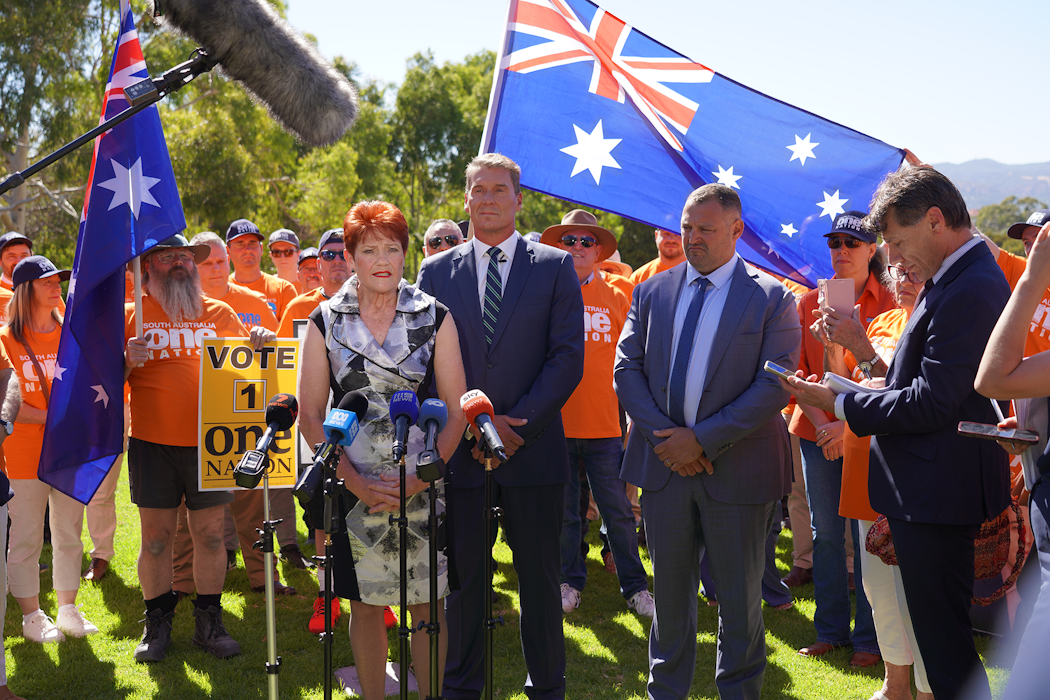
One Nation Senator Pauline Hanson with former Senator Cory Bernardi One Nation Handout Image

As Sussan Ley and David Littleproud are at a standoff in their attempts to mend the federal Coalition, Pauline Hanson has set up a real-time test for One Nation at the March 21 South Australian election.

Ley, who met Littleproud on Monday night, set out conditions for reuniting with the Nationals, with the central one being that the three Nationals who broke shadow cabinet solidarity over the government’s anti-hate legislation spend six months off the front bench.

This was unacceptable to the Nationals, who were drafting a general response to Ley on Tuesday afternoon.

Other conditions in Ley’s proposal were that the Nationals accept shadow cabinet solidarity, and neither the Liberal Party room nor the Nationals Party room could overturn a shadow cabinet decision.

The joint parties room would remain supreme, which was made clear by Ley in response to questions when she briefed the Liberal Party meeting on Tuesday morning.

Also in Ley’s plan was for the Liberals to hold the portfolio of shadow assistant treasurer, in exchange for the Nationals taking the skills portfolio.

Littleproud said in a statement the Nationals would “take our time to consider the details” of the written offer that had been put to them.

“The Nationals are united in our endeavours to reset the Coalition, but we won’t be providing updates on any negotiations through the media.

“The negotiations are ongoing and we will always be constructive and act in good faith. It’s important we take the time to get the settings right.”

Meanwhile in Adelaide, Hanson announced former Liberal Cory Bernardi would lead the One Nation’s upper house ticket for the state election.

The party holds no SA state seats. Sarah Game, elected to the upper house in 2022 as the first One Nation candidate to win a seat in the SA parliament, defected last year to become an independent. Game cited problems with how the party’s brand was perceived.

The party will also contest all lower house seats.

Bernardi, a former senator, defected from the Liberals in 2017 to sit on the crossbench. His subsequent attempt to win support for a new conservative movement failed.

In the latest Redbridge poll in the Australian Financial Review, One Nation was on 26% nationally. Its spiking support, reflected in other polls, has discombobulated the Nationals, and added to pressure for a leadership change in the Liberals from the centrist Ley to a conservative.

While the SA Labor government is assured of victory against an opposition that has been beset by problems and leadership turnover, the election will test how One Nation’s voting surge translates to an actual election.

Former senator Nick Xenophon tried to transfer his personal popularity and the strong performance of his team nationally into trying to win seats at the 2018 South Australian election. The effort crashed dramatically.

The Coalition break was reflected for the first time in parliament on Tuesday as the Liberals and Nationals sat in their separate blocks.

Earlier, the leadership tensions were an undercurrent at the Liberal party meeting. “You could cut the air with a knife”, one source said.

Some sources believe Ley is not heavily invested in putting the Coalition back together because she wants to be able to hand out more posts to Liberals to lock in votes ahead of a leadership contest. She has said she will announce a permanent all-Liberal frontbench if there is not agreement to re-form the Coalition this week.

Also, some moderate Liberals (on whose support Ley depends) are not keen to have the Nationals back in the fold, believing the Liberals would have better appeal in the cities if they are not tied to the minor party.

Angus Taylor’s supporters are keeping open the option of a challenge to Ley next week. It will depend on whether Taylor – now the only conservative candidate after Andrew Hastie’s withdrawal – is confident he has the numbers, which are close. Ley is likely to take another polling hit at the weekend with the release of Newspoll on Sunday.

The Conversation

Michelle Grattan does not work for, consult, own shares in or receive funding from any company or organisation that would benefit from this article, and has disclosed no relevant affiliations beyond their academic appointment.

ref. View from The Hill: Hanson nabs ex-Liberal for One Nation’s real time test in SA election – https://theconversation.com/view-from-the-hill-hanson-nabs-ex-liberal-for-one-nations-real-time-test-in-sa-election-274832

Renewables over 50%, wholesale prices down – is the energy transition… succeeding?

Source: The Conversation (Au and NZ) – By Tony Wood, Program Director, Energy, Grattan Institute

Richard Pan/Pexels, CC BY-NC-ND

Ten years ago, if a heatwave as intense as last week’s record-breaker had hit the east coast, Australia’s power supply may well have buckled. But this time, the system largely operated as we needed, despite some outages.

On Australia’s main grid last quarter, renewables and energy storage contributed more than 50% of supplied electricity for the first time, while wholesale power prices were more than 40% lower than a year earlier.

Australia’s long, complicated and difficult energy transition is finally working. As our recent research suggests, if these trends continue – and nothing new goes wrong – we should begin to see lower retail electricity bills by mid-2026. As more coal plants close and new transmission and storage infrastructure is delivered, electricity prices could rise again. But overall, shifting demand from gas and coal for power and petrol for cars is likely to deliver significantly lower energy bills for households.

It’s not yet job done and challenges remain, but the immediate trends are positive.

Renewables and batteries up, wholesale prices down

Last quarter, wind generation was up almost 30%, grid solar 15% and grid-scale batteries almost tripled their output. Gas generation fell 27% to its lowest level for a quarter century, while coal fell 4.6% to its lowest quarterly level ever.

Gas has long been the most expensive way to produce power. Gas peaking plants tend to fire up only when supply struggles to meet demand and power prices soar. Less demand for gas has flowed through to lower wholesale prices.

That doesn’t mean consumers will see immediate benefit, as wholesale prices are only about 40% of a power bill and most retailers move prices once a year. But if lower wholesale prices are sustained, it should begin to bring relief to consumers.

Power system holding up under strain

Last quarter was unusually good for the system. In recent years, many ageing coal plants have become less reliable. But the old plants held up at critical times. Rain filled Snowy Hydro’s reservoirs, giving hydro power a boost, while solar and wind produced well.

In early January, intense bushfires ripped through grasslands, forests and several Victorian towns. Some areas lost power when timber power poles burned or when trees fell on transmission lines. Sustained heat can cause power substations or transformers to fail more often. But these issues were mostly localised.

Until recently, summer heatwaves put real strain on the power grid, as millions of people fired up their air conditioners at once. But this summer, the system largely dealt fine. Not only were most fossil generators available most of the time, but high output from rooftop solar pairs exceptionally well with demand for air-conditioning.

Electricity storage expanding

Until very recently, electricity had to be made immediately before use. Storing it was only possible in expensive and uncommon pumped hydro facilities. This is why batteries are proving revolutionary. For the first time, power can be made and easily stored for later use.

Plummeting battery prices have led to a surge in installations in Australia. Since 2024, close to 4,000 megawatts of grid storage has come online. Until recently, grid batteries found more use stabilising the grid than powering it. But the growing fleet of grid-scale batteries is now beginning to outcompete gas by soaking up surplus solar and wind and releasing it during evening peaks.

At smaller scale, the government’s home battery rebate has been hugely popular, leading to cost blowouts and very rapid uptake. Many householders have found them a lifeline during power outages.

In the future, medium-scale community batteries able to power towns or suburbs could help boost grid resilience.

Transmission delays mean coal is needed longer

Hitting higher levels of renewables will require new transmission lines. Some of these are on track, but others are well behind.

This is one reason NSW’s Eraring coal plant will sensibly keep running until 2029. Delays completing the new NSW-South Australia transmission line, EnergyConnect, also pushed back the planned closure of the Torrens Island gas power plant near Adelaide.

Gas plays an important role

Gas will be needed for longer than coal, given it can fire up quickly and fill gaps when wind and sun aren’t abundant. It won’t be used much, but will be an essential backup.

The role of gas is changing, but the gas market has its own challenges. Governments are trying to address longstanding gas market problems. Late last year, the federal government flagged a mandatory east coast gas reservation scheme.

Victoria at the pointy end

There are problems looming for Victoria, Australia’s most gas-dependent state. Bass Strait wells are running dry and most of Queensland and WA’s gas is exported as liquefied natural gas (LNG). The Victorian government recently opened up new areas for gas exploration after previously rejecting the idea.

A new plan by federal, state and territory energy ministers may see the Australian Energy Market Operator gain more power to intervene in the gas market, potentially through contracting for new infrastructure such as pipelines and import terminals.

The state government is trying to shift away from gas, but it’s a slow process.

The Victorian government has high hopes for offshore wind farms to take advantage of the stronger and more reliable winds whipping across Bass Strait. But progress towards the goal of 2 gigawatts by 2032 has been slow and no turbines have yet been installed.

Some developers have withdrawn applications amid global uncertainty and delays to the auction process. Last week, Victoria announced the process would finally begin in August. The question is whether there’s enough time left to replace retiring coal plants with new offshore wind.

close up of choppy ocean.
Victoria is pinning its hopes on Bass Strait’s strong, reliable winds.
Mitchell Luo/Pexels, CC BY-NC-ND

Yes, it’s progress

It wasn’t so long ago it was popular to claim Australia’s grid could never accommodate more than 20% renewables. Now we’re at 50%.

That’s not to say it will be smooth sailing. The government’s goal of 82% renewables in four years looks to be a stretch. But it’s clear real progress is being made – and not a moment too soon.

The Conversation

Tony Wood does not work for, consult, own shares in or receive funding from any company or organisation that would benefit from this article, and has disclosed no relevant affiliations beyond their academic appointment.

ref. Renewables over 50%, wholesale prices down – is the energy transition… succeeding? – https://theconversation.com/renewables-over-50-wholesale-prices-down-is-the-energy-transition-succeeding-274616

RBA raises interest rates as inflation pressures remain high

Source: The Conversation (Au and NZ) – By Stella Huangfu, Associate Professor, School of Economics, University of Sydney

The Reserve Bank of Australia (RBA) has lifted the cash rate by 25 basis points to 3.85%, adding to pressure on households and businesses. While the move was widely expected by markets and most economists, the Reserve Bank says inflation risks remain too high to be comfortable.

The RBA said inflation “picked up materially” in the second half of 2025. Governor Michele Bullock told a press conference:

Based on the data we have seen and the conditions here and around the world, the board now thinks it will take longer for inflation to return to target and this is not an acceptable outcome.

The rate rise reflects concern that inflation will not return to the RBA’s 2–3% target range until June 2027, according to the bank’s updated forecasts also released today.

Stronger than expected economic growth means capacity pressures are rising and keeping inflation higher than expected. Progress could stall unless interest rates are pushed a little higher.

It was the first rate increase since November 2023, and followed three cuts in 2025 when inflation was cooling.

Policy set for a year ahead

In the lead-up to the meeting, there appeared to be a gap between market expectations and the RBA’s own comments. Markets and many economists focused on the latest inflation data, which showed a renewed uptick, particularly in prices for services. That data strengthened the case for a rate rise at this meeting.

The RBA, however, has repeatedly emphasised it does not set policy based on short-term movements in inflation.

That message has been reflected in recent meeting minutes and reinforced in a January ABC interview with Andrew Hauser, the RBA’s deputy governor. He said interest rate decisions are guided by where inflation is expected to be in about a year’s time – not where it has been over the past quarter or two.

Today’s decision suggests that, on that forward-looking view, the RBA became less comfortable with the inflation outlook. Rather than a temporary overshoot, the path back to the 2-3% inflation target will take longer than previously thought.

What’s driving inflation?

The latest consumer price index (CPI) figures help explain the Reserve Bank’s caution. Trimmed mean inflation – the RBA’s preferred underlying measure – was 3.3% in the year to December, up from 3.2% in the year to November. That puts underlying inflation clearly above the target range.


More importantly, recent inflation pressures have been led by services prices. Costs related to rents, insurance, health and education have continued to rise, reflecting domestic pressures such as wages and business operating costs.

In its statement, the RBA pointed to stronger demand and ongoing capacity constraints as key concerns:

Private demand is growing more quickly than expected, capacity pressures are greater than previously assessed and labour market conditions are a little tight.

Services inflation tends to fall slowly. Unlike petrol or food prices, it does not usually reverse quickly once it picks up. For the RBA, this persistence increases the risk inflation could remain above target for longer than hoped.

Why the RBA moved now

Faced with these risks, the bank appears to have concluded that waiting would have been the bigger gamble. If inflation stayed above target for too long, or if expectations began to drift higher, the RBA could later be forced into sharper and more disruptive rate rises.

By lifting the cash rate to 3.85% now, the Reserve Bank is trying to stay ahead of the problem. A modest move today may reduce the chance of more aggressive action later.

Australia is out of step

This decision also puts Australia out of step with several other major economies.

In the United States, the Federal Reserve cut interest rates three times in 2025 and is signalling further cuts are likely this year. The European Central Bank has moved even faster, cutting rates eight times between June 2024 and June 2025 to boost growth.

By contrast, Australia’s inflation challenge appears more domestically driven, particularly through persistent services inflation. That helps explain why it is moving in the opposite direction to many of its global peers.

Credibility and what comes next

The quick turnaround after the last rate cut in August may raise questions about the RBA’s earlier judgement. But inflation risks remain tilted to the upside.

The board judged that inflation is likely to remain above target for some time and it was appropriate to increase the cash rate target.

For households and businesses, the message is clear. Borrowing costs and mortgage repayments are rising again.

What happens next will depend largely on whether services inflation begins to cool and whether wage growth shows clearer signs of moderation.

If inflation resumes a steady decline towards the target band, this increase could be a one-off rise. If not, the RBA has signalled it is prepared to do more.

For now, the message from the Reserve Bank is simple: inflation is lower than it was, but still too high for comfort – and interest rates are likely to stay higher for longer until that changes.

The Conversation

Stella Huangfu does not work for, consult, own shares in or receive funding from any company or organisation that would benefit from this article, and has disclosed no relevant affiliations beyond their academic appointment.

ref. RBA raises interest rates as inflation pressures remain high – https://theconversation.com/rba-raises-interest-rates-as-inflation-pressures-remain-high-274840

Regulating Islamic education can strengthen trust and authority, if religious scholars lead the way

Source: The Conversation (Au and NZ) – By Milad Milani, Associate Professor of Religious Studies, Western Sydney University

Former Prime Minister Scott Morrison has called for greater regulation of Islamic preachers in Australia in the aftermath of the Bondi terror attack. His comments triggered an immediate backlash.

Many Muslim leaders and commentators heard the remarks as another episode in a long history of government suspicion toward Islam, or as a thinly veiled attempt to crack down on a religious community already under pressure.

That reaction is understandable. Public debates about Islam in Australia are often freighted with fear, moral panic and political opportunism.

Morrison’s comments also came at a tense moment for the country, which helps explain their bluntness and the intensity of the reaction they provoked. It is entirely understandable that Muslim communities would be angered by any conflation with acts of violence committed in Islam’s name.

But focusing only on whether Morrison’s comments were offensive or ill-judged risks missing a deeper issue that has been quietly unresolved for decades.

The real question raised by this controversy is not Islamophobia or security. It is the role of religious authority and accountability in Islamic teaching in a modern, pluralist society.

Why frameworks are important

Every secular democracy regulates institutions that play a role in shaping moral and civic life. Schools are accredited. Childcare and aged-care providers operate under public standards and oversight. Charities and community organisations are subject to transparency requirements.

These arrangements are not expressions of hostility. They are the mechanisms that build trust between institutions and the wider public.

Religion should not, in principle, be exempt from this framework.

Treating religion as untouchable when it comes to government regulation does not protect it. It leaves it vulnerable to crude political interventions, moral panic and collective blame when something goes wrong.

This tension is not unique to Islam. All religious traditions must contend with the fact that religious authority can be claimed and religious teachings distorted by divergent actors. This makes questions of public accountability more pressing, not less.

If done carefully and respectfully, with parameters established in partnership with religious communities, this sort of regulation would not infringe on religious freedom. In fact, such regulation often protects religious freedom by clarifying who speaks with authority and on what basis.

The importance of training local imams

Representative bodies such as the Australian National Imams Council and the Australian Federation of Islamic Councils play important advisory and coordinating roles in Islamic education in Australia. However, there is no agreed national standard or framework for Islamic education. Nor is there a common system for training or accrediting imams.

Many imams in Australia are trained overseas. This reflects both the relatively recent development of Islamic institutions in Australia and the longstanding authority of established education centres in the Middle East.

As a result, this religious education takes place in countries with very different political and theological debates.

In addition, mosque governance in Australia is often localised, fragmented and dependent on volunteer leadership. These arrangements are not inherently problematic. However, they do create a structural ambiguity about religious authority in the faith.

That ambiguity affects everyone. For Muslim communities, it leads to uncertainty about:

  • who represents Islam publicly

  • who is responsible for religious guidance

  • how theological disagreements are resolved.

For the wider society, it can produce anxiety about what is being taught, by whom, and under what norms. In the absence of a coherent public framework, suspicion fills the gap.

What can be done?

There is a more productive approach. The first step is recognising that religious authority does not exist in a vacuum.

In a pluralist society, religious leaders shape ethical outlooks, social norms and public behaviour. This comes with great responsibility – not because Islam is suspect, but because it matters.

Governments do not need to strengthen their surveillance or impose heavy-handed controls in response. Rather, religious institutions need to operate with greater transparency, public engagement and institutional maturity.

For starters, governments can play a supporting role in developing pathways for Islamic education grounded in Australian civic life, rather than imposing direct state control. This includes through partnerships with universities, community institutions and established overseas centres.

Religious literacy should be encouraged, both within Muslim communities and beyond.

And, importantly, governments must work with Muslim scholars, educators and community leaders on developing regulatory frameworks or public standards.

These leaders are already grappling with the challenges posed by imported religious authority, fragmented governance and the pressures of representing Islam in a secular society. Their more careful voices are often lost in the noisy, polarised debate.

Islam is not alone here. Similar tensions can be found across many other religious traditions as they adapt to modern pluralist societies, even if they surface differently.

If there is a lesson in the Morrison controversy, it is this: Australia has not yet worked out how Islamic authority fits into its public institutions. Until it does, debates about Islam will continue to oscillate between denial and suspicion, neither of which serves anyone well.

The question is not whether Islam belongs in Australia. It already does belong, deeply and permanently. The question is how religious authority is situated in a society that values freedom, accountability and civic trust. That is a conversation worth having calmly, seriously and without fear.

The Conversation

Milad Milani does not work for, consult, own shares in or receive funding from any company or organisation that would benefit from this article, and has disclosed no relevant affiliations beyond their academic appointment.

ref. Regulating Islamic education can strengthen trust and authority, if religious scholars lead the way – https://theconversation.com/regulating-islamic-education-can-strengthen-trust-and-authority-if-religious-scholars-lead-the-way-274736

Teen’s grieving parents left asking just one question – what if?

Source: Radio New Zealand

Gareth and Leanne Hall spent years fighting to save their daughter from the darkness that haunted her. Kim Baker-Wilson/RNZ

Three years after Tauranga teenager Maddie Hall took her own life her parents are left with one unanswered question – what if?

What if Maddie had been given all the support she needed as soon as she went to Tauranga Hospital after trying to take her life in May 2020?

What if Maddie had received the comprehensive psychotherapy her clinicians agreed would be most beneficial?

What if Maddie’s early life was not upended by sexual trauma?

What if more could have been done to save her life? What if the mental health system was better?

Maddie died on 31 March 2023 at the age of 16.

Almost three years earlier in May 2020 she was found trying to take her life. It would later emerge she had earlier tried to kill herself in November 2019.

In findings made public on Tuesday following a 2024 inquest, coroner Marcus Elliott found Maddie died by suicide but there was “no aspect of the medical care which can be said to have ‘clearly linked to the factors that contributed’ to Maddie’s death”.

As a result, he had no power to make any comments or recommendations about Maddie’s death.

The Canterbury Suicide Postvention Working Group – a collection of agencies including health, education and care authorities that monitor and respond to suicides in the region – sought to suppress details of the coroner’s report and Maddie’s name.

The group submitted that four other young women had died by suspected suicide since Maddie’s death in circumstances that amounted to a “cluster” with links through direct peer connection, shared social networks or online

interactions.

The group also said a cohort of 44 other people in Canterbury connected to the “cluster” was at elevated risk of suicide contagion.

“These connections reflect an overlapping peer ecosystem in which distress, grief and identification with each other’s experience have been continually reinforced,” the group said.

The group was concerned about the “significant online and social media risk component associated with this case, particularly the unregulated dissemination and glamorisation of suicide related content on platforms such as TikTok and Instagram.”

Maddie’s parents, RNZ and Stuff opposed suppression.

In declining the application, coroner Elliott emphasised that while “there were areas in which service improvements were warranted, any shortcomings cannot be said to have contributed to Maddie’s death”.

“She received extensive mental health care, both in a public and private context. Her death does not support an argument that mental health care is unavailable to those who need it or that the mental health system is broken.”

‘Always room for improvement’ – family calls for change

In the three years before her death, Maddie was admitted to hospital 25 times and went to Tauranga Hospital’s emergency department more than 50 times.

She made more than 40 attempts on her life.

Her parents Gareth and Leanne Hall feel as if their daughter and family were an inconvenience to the public system.

Eventually they pursued treatment through a private psychiatrist but Gareth Hall believes it was too late to save Maddie despite the efforts of the “excellent and caring practitioner”.

“Health New Zealand and CAMHS (Tauranga’s Maternal, Infant, Child and Adolescent Mental Health Service), although they stood up in an inquest and said ‘we’ve looked back and there’s nothing we would have done differently’, well I’ll call bullshit on that,” he said.

“There’s always room for continuous improvement and everyone knows the mental health system in New Zealand, particularly for young children, needs massive improvement. Chris Luxon knows that. Matt Doocey knows that.

“In the first three months [following her May 2020 suicide attempt] there were six suicide attempts and a similar number of other incidents that required emergency services, police and/or ambulance, and there’s no support provided in those three months,” he said.

“So we knew something was lacking pretty early on in the piece.”

For three months after the May 2020 episode, Maddie did not have a key worker to co-ordinate her care and be a primary point of contact in the mental health sector.

The Halls would email clinicians to provide updates on Maddie’s condition and her symptoms.

“That seemed to be an inconvenience to them to hear from us. They eventually told us in a multi-disciplinary meeting a number of months into it just to stop sending them emails,” he said.

Maddie required comprehensive dialectical behaviour therapy (DBT), a dedicated psychotherapy for borderline personality disorder.

It was first recommended and accepted about six weeks after Health New Zealand became involved.

Maddie did not receive her first session until late November 2020, almost five months after it was accepted as a form of treatment, and following 13 hospital admissions.

“It is possible that Maddie would have been more amenable to DBT in July 2020 than she was almost five months later. It seems likely that, by the time of the first DBT session on 26 November 2020, her attitude may have been affected by the sense of ‘invalidation and trauma’ she was developing in relation to her public mental health service involvement,” coroner Elliott said.

“However, it is not possible to say whether the provision of comprehensive DBT from July 2020 would have prevented Maddie’s death. It is possible that it would, however a finding cannot be made to the required standard of proof about this.”

By February 2021, comprehensive DBT was no longer available to Maddie.

A ‘vibrant wee soul’

Leanne Hall said her daughter was a “vibrant wee soul” as a child.

“She was either going to be an artist or an early childhood teacher. She was a lovely, gorgeous little girl,” she said.

Gareth Hall said Maddie was kind, caring and empathetic, traits she maintained towards others even as her own world crumbled inside her head.

“A few of Maddie’s friends have said that they wouldn’t be here today if it wasn’t for Maddie. That’s how big an influence she was,” he said.

“She couldn’t help herself but she was unbelievable at helping others.”

Maddie’s decline could be traced to sexual abuse at the age of six.

Leanne Hall said they were unaware of the violation until Maddie told a friend when she was about 11-years-old and her friend told her father.

“If she didn’t have that sexual trauma at age six she wouldn’t have developed the PTSD and the complex mental health history,” she said.

The trauma catalysed into a deep darkness within her mind during her early teenage years.

As the Halls fought to save their daughter’s life they would sleep in her room at night to ensure she was safe.

“During those particularly quiet times and when she was struggling to sleep, she did tell us a lot of stuff and it was pretty harrowing to listen to that coming from your own daughter,” Gareth Hall said.

“When you hear your daughter repeatedly every day, say she wants to end her life, it’s hard to hear,” Leanne Hall said.

Gareth Hall said they both know it paled in comparison to how hard it was for their daughter.

“People don’t understand how much these kids suffer and that’s the thing that still burns us is how much Maddie suffered,” he said.

“There has to be something done to prevent these kids suffering as much as they do because if it was a medical disease you know everything in the doctors’ power would be done to try to reduce the suffering.”

No evidence deficiencies contributed to Maddie’s death – Health NZ

Health New Zealand submitted to the coroner that “there is no evidence that was presented during this inquiry that any alleged deficiencies in this care contributed to Maddie’s death”.

A serious incident review highlighted “service improvements”.

The review’s findings included recommendations relating to communicating with patients and their families, trauma-informed care and specialist pathways of care.

While coroner Elliott endorsed the review’s recommendations, he said any shortcomings in the care provided by Health NZ could not be said to have contributed to Maddie’s death because:

– The causes of Maddie’s illness were identified and treatment was provided

– The nature of Maddie’s illness meant that she was at a very significant risk of taking her own life

– The illness might not necessarily have been resolved by medical treatment

In a statement, Health NZ group director of operations for Bay of Plenty Andrew Boyd told RNZ the serious incident review had resulted in “learnings to start making practical improvement”.

“This was a highly complex case involving multiple agencies, providing care and treatment to Madeleine during the three years from her initial referral to the Maternal Infant Child and Adolescent Mental Health Services Tauranga,” he said.

The Halls did not accept that Maddie’s life could not have been saved and disagreed with the coroner’s decision not to make comments or recommendations.

“It’s possible that if Maddie had more help at those earlier stages and had a clinician at CAMHS who could have built a rapport with her in the first instance, which was critical and lacking, that there could have been a different outcome, but that’s all speculation,” Gareth Hall said.

“The coroner deemed there was no gross negligence that contributed to Maddie’s passing, we think that as parents having witnessed everything we did, we still disagree with that. That’s the coroner’s rulings based on the balance of probability but there’s always possibility.”

A handful of incidents stood out to the Halls, including a time when Maddie was strip-searched at Starship Hospital.

“It was barbaric. There was no kindness. It was like she was in a prison or something. For somebody that has gone through trauma and had PTSD to be faced with that, it’s huge,” Leanne Hall said.

On another occasion Maddie had surgery at Rotorua Hospital after harming herself, followed by a request to transfer her to Starship.

After Rotorua clinicians spoke to a nurse in Tauranga she was instead discharged and found wandering on railway tracks later that night.

The coroner’s report also said a police officer gave evidence to the inquest about two incidents in which the officer believed “that health practitioners argued with Maddie in a disrespectful and unprofessional way about her medication and that another practitioner who Maddie disliked and distrusted deliberately came into Maddie’s view ‘as if on purpose to wind Maddie up’.”

The coroner made no findings about the two incidents but said: “Any lack of professionalism or disrespect for Maddie would have been unsatisfactory. However, while health practitioners should act with patience and compassion towards a patient, there are reasons why this may not always happen.”

An ‘appalling’ youth suicide rate

While Gareth and Leanne Hall could not save their daughter’s life, they take solace knowing she knew how much they loved her.

“The one thing that we did achieve before Maddie passed away was that she knew she was loved because earlier on, due to her mental illness, she felt completely unlovable and didn’t feel loved,” Gareth Hall said.

“She saw what we did for her and despite the negativity of her mind she did realise that she was loved and that gives us some comfort because you wouldn’t want your daughter to go feeling that she wasn’t loved.”

The couple now hope to channel their love and Maddie’s memory into driving meaningful change in mental health services.

“Maddie would have wanted a change and improvements in the mental health system, she hated other kids suffering and we don’t want other kids to suffer like Maddie did either. So if something good can come from Maddie’s passing I think that will help us,” Gareth Hall said.

He said New Zealand had an appalling youth suicide rate.

“That is something that as a country we should be extremely embarrassed by and we need to do whatever we can to improve that statistic,” he said.

“That’ll improve a statistic but it will improve the lives of not just the children who are going through extreme mental illness but all their parents and family and friends.”

In his findings coroner Elliott referenced the government’s 2018 inquiry into the country’s mental health and addiction sectors.

“Mental health legislation was referred to as ‘outdated and inadequate’ and reform was recommended. Health New Zealand accepted the inquiry’s recommendation in this respect,” the coroner said.

“However this has not yet been implemented and the Act has not been amended. In relation to Maddie, Health New Zealand was working under the law as it applied at that time.”

In a statement, Mental Health Minister Matt Doocey said “every single life lost to suicide is one too many”.

“Losing a child truly is every parent’s worst nightmare and my thoughts are with Maddie Hall’s friends and family.

“For me as Mental Health Minister, the most important part of my role is listening to those who have been directly affected by suicide. I have met with the parents of Maddie Hall to hear first-hand what they feel we need to do to improve New Zealand’s mental health system. I believe the key part of improving the mental health system is incorporating voices of lived experience. The reality is that we cannot make the changes needed on the ground without listening directly to families who have unfortunately gone through what families like the Hall’s have experienced.

“I acknowledge that New Zealand continues to face high suicide rates, particularly among youth. We can and must do better.

“I think it’s particularly clear, we are long overdue for a better crisis response. No one in New Zealand should face barriers when seeking help for themselves or others and that’s exactly what this government is focused on doing.”

Where to get help:

  • Need to Talk? Free call or text 1737 any time to speak to a trained counsellor, for any reason.
  • Lifeline: 0800 543 354 or text HELP to 4357.
  • Suicide Crisis Helpline: 0508 828 865 / 0508 TAUTOKO. This is a service for people who may be thinking about suicide, or those who are concerned about family or friends.
  • Depression Helpline: 0800 111 757 or text 4202.
  • Samaritans: 0800 726 666.
  • Youthline: 0800 376 633 or text 234 or email talk@youthline.co.nz.
  • What’s Up: 0800 WHATSUP / 0800 9428 787. This is free counselling for 5 to 19-year-olds.
  • Asian Family Services: 0800 862 342 or text 832. Languages spoken: Mandarin, Cantonese, Korean, Vietnamese, Thai, Japanese, Hindi, Gujarati, Marathi, and English.
  • Rural Support Trust Helpline: 0800 787 254.
  • Healthline: 0800 611 116.
  • Rainbow Youth: (09) 376 4155.
  • OUTLine: 0800 688 5463.

If it is an emergency and you feel like you or someone else is at risk, call 111.

Sign up for Ngā Pitopito Kōrero, a daily newsletter curated by our editors and delivered straight to your inbox every weekday.

– Published by EveningReport.nz and AsiaPacificReport.nz, see: MIL OSI in partnership with Radio New Zealand

Police launch investigation after body found at worksite in Hawke’s Bay

Source: Radio New Zealand

RNZ / Angus Dreaver

Police have launched an investigation after the discovery of a body at a worksite in Hawke’s Bay.

Officers were called to the property on Taihape Road in Omahu, near Hastings, at 9.10am on Tuesday – where cordons remain.

Police said it was unclear how the person came to be there, and how they died, and were treating the death as unexplained.

They said a scene examination and post-mortem would be carried out as they worked to identify the person and understand the circumstances surrounding their death.

Police said anyone with information could get in touch by calling Crime Stoppers or 105, quoting reference number 260203/9739.

Sign up for Ngā Pitopito Kōrero, a daily newsletter curated by our editors and delivered straight to your inbox every weekday.

– Published by EveningReport.nz and AsiaPacificReport.nz, see: MIL OSI in partnership with Radio New Zealand

‘They will be deeply missed’: Orana Wildlife Park’s family of lions euthanised

Source: Radio New Zealand

Meeka and Mambila at Orana Wildlife Park. Supplied / Orana Wildlife Park

A family of lions has been euthanised because of their poor health, a Christchurch zoo says.

Orana Wildlife Park said 22-year-old sisters Leah and Meeka, and Meeka’s 15-year-old son Mambila had died.

The group had been suffering from multiple age-related ailments, including degenerative muscle wastage (atrophy), suspected arthritis, and incontinence.

In a social media post, Orana Park said the decision to euthanise the lions together was because of their highly social nature.

Leah, pictured, and her sister Meeka were 22. Supplied / Orana Wildlife Park

“Leah and Meeka lived their entire 22 years together, and Mambila shared a very close bond with his mother. Prolonging the decision for one or more of the animals would have severely compromised their welfare beyond the degenerative issues they were already facing,” a spokesperson said.

“Leaving one elderly lion alone or attempting to integrate them with Orana’s remaining pride of two males would have resulted in a negative welfare state or potentially fatal consequences, given lions’ highly territorial nature.”

Orana Park said Leah and Meeka were the oldest lions in Australasia at the time of their death.

“All three cats reached old age and Leah and Meeka had exceptionally long lives.

“Male lions typically lived up to 14 years and lionesses slightly longer in the wild. This longevity is testament to the extraordinary care provided by our dedicated animal and veterinary teams.”

The park said staff were devastated by the lions’ passing.

“Anyone who has farewelled a beloved animal will understand the depth of emotion people experience at such a loss. These lions were treasured members of our whānau, they will be deeply missed by everyone who cared for them throughout their lives and our community who enjoyed meeting them.

“We are incredibly grateful to our team for their dedication, compassion, and commitment to ensuring all three lions experienced a peaceful and dignified farewell.”

Sign up for Ngā Pitopito Kōrero, a daily newsletter curated by our editors and delivered straight to your inbox every weekday.

– Published by EveningReport.nz and AsiaPacificReport.nz, see: MIL OSI in partnership with Radio New Zealand

Breakers’ mask maker wants player to keep wearing ‘bad ass’ design

Source: Radio New Zealand

Max Darling of the Breakers Paul Kane

An unfortunate training incident sidelined New Zealand Breakers forward Max Darling for weeks, left him with a metal plate in his face and searching for personalised protective gear to get back on court.

After copping a teammate’s elbow in his eye and fracturing his orbital, the 25-year-old Tall Black needed a mask he could wear for the remainder of the ANBL season.

Finding something fit for purpose – and his face – on short notice was not a straightforward task.

That is where MWDesign came to the rescue.

Founder Mike Williams and his team at the Hamilton and Tauranga-based design company were on their end of year break when the request from Breakers physio Rob Knight came through.

Knight had worked with MWDesign previously and knew that the company had the tools, including a laser scanner and a 3D printer, to create what Darling needed. Even though the company was more accustomed to doing work for a diverse range of projects, from playgrounds to geothermal measuring tools to retail items for mass manufacture that get shipped globally.

Williams called the mask a “fun project” that piqued his interest and he spent three days getting it right.

Before the mask, Williams had done two designs for hands for himself and a colleague who had broken digits.

“I broke my thumb a couple of years ago and the cast that got put on meant that I couldn’t use my mouse and I couldn’t do a lot of things. The doctors will probably hate me for this, but I chopped off the fibreglass cast, scanned my hand and made myself a nice little splint that was still supportive, but I could use the mouse and I could have a shower.

“That was as close as I got to mask building for basketballers.”

An injury-hit Breakers side needed Darling on the floor to help cover the minutes that starter Sam Menennga was playing before he suffered a season-ending wrist injury.

Darling is not the first ANBL player to get back on the court wearing a facial accessory after an orbital fracture.

Keanu Pinder wore a similar mask when playing for the Perth Wildcats in 2024 after a similar injury. In the same year in the NBA, Toronto Raptors swingman Scottie Barnes also wore a ‘Batman’ mask for a orbital fracture that did not require surgery.

NZ Breakers Max Darling, Toronto Raptors Scottie Barnes, Keanu Pinder with the Perth Wildcats. Photosport

Williams had seen examples of NBA masks that he said did not look “overly special” and that Darling’s was different and custom-designed from a glass-reinforced 3D print plastic.

After a description from Knight about the injury and the areas of Darling’s face that needed to be protected, Williams used a laser scanner to scan the player’s face.

“It did a really brilliant job of capturing all that detail on his face.

“It’s actually perfectly his face, I put it on and it was uncomfortable as hell for me because I have a different shaped face, but when he puts it on, it’s like nothing’s there.”

Williams spent time trying different thickness and how it was going to sit on Darling’s face “so it didn’t look silly”.

The harness behind the head was another consideration.

“You can imagine if he’s sprinting up and down the court, you don’t want this thing bobbling around on the face. We’ve got a little sweat headband part on the inside of it too. So, when he starts to sweat under heavy load in the game, it doesn’t run down in his eyes. So, there’s quite a lot of different considerations around the design of it but from the outside I suppose it looks pretty simple.

“It’s one of those complicated things that is really straightforward if you know how.

“I hope he keeps wearing it because he looks bad ass in it, it looks real cool, I like it.”

Williams said the company had not looked into doing much work for sports previously, but were now considering it.

“It’s not a big money spinner but at least to offer the service to get people out in the game and playing again that would be pretty cool.”

Sign up for Ngā Pitopito Kōrero, a daily newsletter curated by our editors and delivered straight to your inbox every weekday.

– Published by EveningReport.nz and AsiaPacificReport.nz, see: MIL OSI in partnership with Radio New Zealand

New drone footage shows submerged catamaran close to shore in Akaroa Harbour

Source: Radio New Zealand

New drone footage shows the stranded Black Cat Cruises catamaran submerged close to shore in a small rocky bay in Akaroa Harbour on Canterbury’s Banks Peninsula.

The boat ran aground in the Akaroa Marine Reserve on Saturday, resulting in the rescue of more than 40 passengers and crew and a Transport Accident Investigation Commission investigation.

Christchurch’s Geoff Mackley captured the footage near Nikau Palm Valley at the Akaroa heads.

The Canterbury Regional Council temporarily suspended recovery efforts because of bad weather.

Attempts to move the boat to deeper waters to protect its structural integrity were on Monday because the hull had settled firmly on a large rock.

The regional council’s on-scene commander, Emma Parr, said staff had made every effort to retrieve hazardous and loose material from the wreck, whilst monitoring its stability.

“We continue to work with the salvage team to oversee and guide alternative options for the most effective and timely recovery of Black Cat,” she said.

“Our focus remains on reducing environmental impacts and ensuring the safety of everyone involved.”

The boat was carrying 2240 litres of marine diesel fuel and around 120 litres of other oils in sealed containers and engines combined.

Retired Otago University professor and biologist Liz Slooten said nearby Hector’s dolphins could be exposed to diesel pollution if it was not cleaned up quickly.

“Diesel will get into their eyes, diesel and other oils that come out of the vessel,” she said.

“It will get into their lungs by inhaling the fumes, which tend to accumulate close to the water surface because it’s heavier than normal air. That’s exactly where these dolphins are breathing.

“When they eat contaminated fish, it will get into their digestive system.”

Parr said the council was monitoring any immediate affects on the environment or wildlife and that fuel had rapidly dispersed.

“We have not observed any immediate impacts on the environment or wildlife,” he said.

Research had been done on the effects of oil and diesel spills on dolphins and showed they led to a range of serious health effects, including lung disease and adrenal gland problems, Slooten said.

She called on authorities to be more proactive when responding to emergencies.

“It seems that each time something like this happens, basically everybody stands around going, ‘oh my goodness, what are we going to do now’. We need a plan up front, rather than waiting for a disaster to happen and then trying to figure out what to do about it. That is obviously not effective,” she said.

It is the second diesel spill near Banks Peninsula in just over two years after the Austro Carina fishing boat ran aground at Shell Bay in September 2023.

Slooten said the boat would cause further environmental problems if it broke up.

“Then you’ll get plastic and metal and goodness knows what other pollutants into the environment. The longer it’s left and the more it breaks up, the harder it’s going to be to clean up the mess,” she said.

In a statement posted to social media on Saturday, Black Cat Cruises said while some of the 38 passengers were shaken by the grounding, they commended the crew for their calm, efficient and reassuring manner during evacuation.

“This is first incident to occur in over 40 years of this nature and naturally safety is our number one priority and we are deeply saddened that this has occurred. We are very grateful for the support of local operators and boaties that assisted us during this incident.

“We are commencing an investigation into the incident and working with authorities on the matter.”

Sign up for Ngā Pitopito Kōrero, a daily newsletter curated by our editors and delivered straight to your inbox every weekday.

– Published by EveningReport.nz and AsiaPacificReport.nz, see: MIL OSI in partnership with Radio New Zealand

These voices are the loudest in Australia’s ‘climate wars’

Source: The Conversation (Au and NZ) – By Christian Downie, Professor of Political Science, School of Regulation and Global Governance, Australian National University

The Conversation, CC BY-SA

There’s a reason political commentators refer to Australia’s “climate wars”. Every time a climate policy is put on the table, supporters and opponents come out in force and duke it out.

Last year, debates over Australia’s greenhouse gas emissions target led to a heated contest between various groups such as the Climate Council — arguing for strong action — and others such as the Business Council of Australia, which commissioned modelling to highlight the economic costs of a strong target.

This was not a one-off. Since at least the 1990s, emissions-intensive industries such as coal and gas and their lobby groups have had an outsized influence on climate policy. This includes groups such as the Minerals Council of Australia, which represents BHP, Rio Tinto and Whitehaven Coal, and Australian Energy Producers, which lobbies on behalf of BP, Shell and Woodside, among others.

Until now, we did not have a good understanding of who mobilises on climate policy in Australia, what side of the issue they fall on, and in which arenas they mobilise. In our new research, we found a core set of only 20 groups dominating climate policy debate in Australia, including gas corporations, industry lobby groups, environmental NGOs, and think tanks.

Who are these groups?

To find out which groups are most influential, we collected data on all organisations active on climate policy in Australia between 2017 and 2022. This included examining the number of groups as well as their volume of activity in the executive branch of government (responsible for implementing and enforcing laws, managing day-to-day administration and setting policy), the parliament and the media.

For example, we identified 700,000 mentions of groups in articles about climate change from 13 media outlets, including The Australian and the Sydney Morning Herald.

As well as media records, we also built a database of organisations who actively consulted with government departments and provided evidence to parliamentary inquiries.

We found 20 groups accounted for more than half (52%) of all activity.

They included a mix of mining and energy firms, such as AGL, BHP and Rio Tinto and their lobby groups, such as the Minerals Council of Australia. It also included high-profile NGOs, such as the Climate Council, and think tanks active on climate policy, including the Australia Institute and the Grattan Institute.

It’s important to note we didn’t look at the content of the messages in the media, the parliament or in departmental consultations, just the number of organisations and the frequency of their activity.

Where do these groups stand on climate action? tweaked

Among the 20 groups, some are strong supporters of climate action, such as the Climate Council. By contrast, the Minerals Council of Australia has a long history of opposing climate policies dating back to the Kyoto Protocol in the 2000s and the short-lived carbon price in the 2010s.

Interestingly, there are more pro-climate groups than anti-climate groups. Most NGOs in our study tended to support action on climate change, including the Australian Conservation Foundation, Greenpeace and WWF.

Many of the business groups do not. But it’s not as black and white as this might suggest. Firms and business advocacy groups are not unified. A growing number of renewable energy companies now mobilise in support of climate policy, often through advocacy groups such as the Smart Energy Council.

Interestingly, many industries active on climate policy don’t have a hardwired position. Rather, they sometimes support and sometimes oppose climate policy. This is often because their commercial interests are only indirectly impacted by climate policies, such as firms in the technology or finance industries.

These somewhat “neutral” groups actually account for the majority of groups active on climate policy in Australia.

Does this vary by arena?

We also explored whether some groups dominate the media more than the parliament, or the parliament more than the executive. For example, are environmental NGOs more active in the media than in Senate hearings? Are business groups more active in consultations with the government departments that make up the executive branch of government?

Interestingly, we found the media is the only arena where fossil fuel interests dominate. For example, groups typically opposed to climate action represent 43% of all media mentions, compared to 20% in support and 36% neutral.

This begs the question – why does the media appear to have a strong bias for reporting pro-fossil fuel messages?

One explanation consistent with overseas studies
is simply that messages from business coalitions and very large businesses are more likely to receive media coverage than other types of organisations, such as environmental NGOs.

These organisations are likely to have high standing in the media because they are viewed as key players in policy debates with inside knowledge. Certainly in Australia, the largest firms and lobby groups mobilised on climate change are tied to? fossil fuel industries.

Do these groups matter?

As we sweat through another of the hottest summers on record, the federal government will rightly remain under pressure to put in place further policies to cut carbon pollution. In fact, recent polling shows one in two Australians want action on climate change “even if this involves significant costs”.

Who mobilises to support or oppose climate policies will likely have a big influence on policy outcomes such as increasing renewable electricity in the grid, phasing out petrol and diesel vehicles or stopping new coal and gas projects

Our research shows a core set of groups, including firms in the coal and gas industries, that are likely to have an outsized voice in such policy debates.

While this does not always equate to influence, it is an important precondition. In the media in particular, it appears fossil fuel interests have the loudest voice.

The Conversation

This research was funded by the Climate Social Science Network.

ref. These voices are the loudest in Australia’s ‘climate wars’ – https://theconversation.com/these-voices-are-the-loudest-in-australias-climate-wars-272347

Needle steriliser a ‘third hand’ for farmers

Source: Radio New Zealand

Graduate Jade Luxton with her Sterineedle invention. SUPPLIED

The final touches are being put on a new gadget promising to speed-up vaccinating or giving pain relief to livestock.

Around 20 New Zealand deer farmers were trialling a locally-designed holster for their livestock vaccination gun that sterilised the needles in an attached reservoir between jabs.

Founder Jade Luxton made the original Sterineedle holster with a 3D printer through high school some years back to address an agricultural challenge.

Since then, the Waikato-born graduate in product design said she had created around 100 iterations of her Sterineedle ahead of its commercialisation.

“When I looked further into this problem, I found that needles could actually be sterilized, and that’s kind of how we started with the holster idea,” she said.

“We wanted that ability to give farmers kind of like a third hand to put the vaccination gun in between animals as well.”

Jade Luxton. SUPPLIED

Luxton said it was originally created for farmers during velvetting, because every needle on each stag needs to be sterilised to meet food grade requirements.

She said deer farmers needed a solution for constantly changing needles, but the device could also benefit sheep and beef farmers.

“We currently have 20 models out trialling at the moment. But I’ve also been speaking at NZ Deer Association events, just kind of spreading awareness about the product and getting more farmers keen on the idea and keen to try it as well.”

Luxton hoped the final design would to bring it to market in time for the next velvet season.

“We’re currently testing the final design and looking for manufacturers so we can get a few models out by the start of velvetting season this year.”

She said she was inspired by her grandparents who were involved with farming.

Sign up for Ngā Pitopito Kōrero, a daily newsletter curated by our editors and delivered straight to your inbox every weekday.

– Published by EveningReport.nz and AsiaPacificReport.nz, see: MIL OSI in partnership with Radio New Zealand

Peeni Henare ‘stepping back’, won’t be contesting Tāmaki Makaurau seat at election

Source: Radio New Zealand

Peeni Henare is stepping down after 12 years in Parliament. RNZ / Samuel Rillstone

Senior Labour MP Peeni Henare is “taking a step back from politics”, saying the time has come to put his energy elsewhere.

Earlier on Tuesday, the former minister confirmed to RNZ he would not be contesting the Tāmaki Makaurau seat this year.

But in an interview with Māori start-up Tuia News, Henare went further, revealing he would step down after 12 years in Parliament, six of them as a minister across multiple portfolios.

He told the outlet there were many other issues within Te Ao Māori he wanted to focus on, including in Te Tai Tokerau and for Ngāpuhi.

Henare noted the energy required to be successful in election year, and the recent resignation of his colleague Adrian Rurawhe. He said he realised he was the only one left.

“Kua tae te wā,” Henare said. The time had come.

Both Henare and the Labour Party confirmed the decision not to seek re-election around 3pm on Tuesday.

“I have thought long and hard about this over the summer and decided not to seek the nomination for Tāmaki Makaurau again or a place on the Labour Party list,” Henare said in a statement.

“Last year was tough after losing the by-election and after careful consideration and kōrero with my whānau over the break, I have decided that it is time for me to take a step back from politics.

“It’s time to focus on my family, my wellbeing and my future”.

It stated Henare would leave Parliament in the coming weeks.

Hipkins won’t be drawn

Speaking to reporters around 2pm, Labour leader Chris Hipkins refused to comment on Henare’s movements.

When asked, Hipkins wouldn’t say whether Henare had his backing for the Māori seat or not.

“I’m not going to start a conversation on this.

“I’m still leaving Peeni the space to make his own decisions and his own announcements.”

He rejected his refusal to answer implied a lack of confidence, “no, it just means I’m leaving him the space.”

Hipkins said he’d been told by Henare in the last week or two that he wouldn’t be putting nominating himself as a candidate for the seat.

The news from Tuia broke as Hipkins was speaking, but despite the confirmation of Henare’s plans, Hipkins declined to answer.

“It’s not fair for me to go out and comment on people’s decisions before they have communicated them.

“You’re not going to have to wait that much longer.”

Hipkins said an announcement would be made at 4pm on Tuesday.

He said he’d comment on the news later on.

A decade in Parliament

Henare entered Parliament in 2014, winning the the Tāmaki Makaurau seat over the Māori party. He held onto the seat for nearly a decade, before being ousted by Te Pāti Māori’s Takutaki Tarsh Kemp in 2023 by a slim margin.

He contested the seat in the Tāmaki Makaurau by-election in 2025, following Kemp’s death, but lost to Oriini Kaipara who received around twice as many votes.

During the by-election he batted away suggestions of a Labour leadership bid, but didn’t rule it out.

At the time Henare said Hipkins, the current leader, had his full support.

During the previous Labour government, he held portfolios such as Defence, Whānau Ora, Civil Defence, Tourism and ACC.

Sign up for Ngā Pitopito Kōrero, a daily newsletter curated by our editors and delivered straight to your inbox every weekday.

– Published by EveningReport.nz and AsiaPacificReport.nz, see: MIL OSI in partnership with Radio New Zealand

The Voice would have renewed Australian democracy. Its failure leaves us all worse off

Source: The Conversation (Au and NZ) – By Sana Nakata, Principal Research Fellow, James Cook University

There’s long been a fundamental issue underpinning Australia’s approach to Indigenous affairs. The state makes laws specifically about Aboriginal and Torres Strait Islander peoples without any protected mechanism giving them a say in the process.

The proposed Voice to Parliament sought to remedy this democratic deficit. Had the referendum succeeded, it would have established a formal representative connection between Indigenous peoples and the Commonwealth parliament.

The Voice proposal was a reform to democratic representation. Its failure was a missed opportunity to renew Australian democracy.

But it was also an explicit choice: to sustain the political subjugation of Indigenous people by denying them representative channels for making their voices heard on matters that affect them.

This enduring structural limitation leaves the parliament without any representative mechanism to consult with, or be accountable to, Aboriginal and Torres Strait Islander peoples.

What does Indigenous representation look like?

Even as we have seen increasing numbers of Aboriginal members in the federal parliament, they do not represent all Aboriginal and Torres Strait Islander people.

Nor are they empowered to. In the 125 years since federation, there has never been a Torres Strait Islander representative at the Commonwealth level.

A key aspect of political accountability is the ability of a constituency to remove their representative at the ballot box. If a majority feels their MPs have failed to advance their interests or otherwise represent them, they can vote them out.


This article is an edited extract from the new book The Failure of the Voice Referendum and the Future of Australian Democracy, edited by Professors Gabrielle Appleby and Megan Davis.


For minority populations, this mechanism fails because their votes will, by definition, always fall short of a majority. This has long been called “the tyranny of the majority”.

While this is a problem for all minorities, the political claims of Aboriginal and Torres Strait Islander people are distinct from other minority groups. This is because they’ve been politically subjugated through unlawful dispossession.

Voting rights alone cannot remedy this. We need to move beyond this narrow view of political representation.

More than politics

Being represented is not just about aggregating votes or delegating decision-making power to elected parliamentarians.

There are many types of democratic representation, far beyond formal political institutions. There are also unions, nongovernmental organisations, social movements, media organisations and community advocates.

These actors represent themselves and others through various channels, such as:

  • submissions to government inquiries

  • public protests and rallies

  • media campaigns

  • cultural productions

  • legal challenges

  • grassroots organising.

Through this lens, we can see Aboriginal and Torres Strait Islander people have long maintained and exercised their representative power, even when formal political institutions exclude or silence their voices.

Critics of the Voice proposal from both conservative and progressive perspectives focused on the power of direct decision making.

But it’s crucial to recognise representative power entails more than just making decisions in formal political institutions. Representative power can also set new agendas, shape political debates and transform public attitudes and values.

The proposed Voice offered what we might call “connective tissue” between First Nations peoples and communities, and the Australian state that continues to govern them.

The Voice proposed a new focal point for channelling the varied interests of diverse First Nations communities directly to government, as well as the broader Australian public. In similar ways to the Yoorrook Commission and First Peoples’ Assembly of Victoria (and now Gellung Warl), the Voice promised to highlight new priorities for action.


Read more:
Why the Voice referendum failed — and what the government hasn’t learned from it


In Victoria, this mobilised public attention on issues such as policing and self-determination.

This is why the proposal’s defeat represents more than just maintaining the status quo. It transforms the political subjugation of Aboriginal and Torres Strait Islander peoples from a historical legacy into the contemporary choice of the nation.

Despite decades of Aboriginal and Torres Strait Islander advocacy, careful institutional design and extensive consultation, the Australian public collectively decided to maintain political structures that exclude First Nations perspectives from decision-making processes that affect them.

Strengthening democracy for all

As we move forward, the implications of this decision extend beyond Aboriginal and Torres Strait Islander affairs. It raises questions about Australia’s capacity to renew its democracy.

The capacity of democracies to change themselves in response to shifting social conditions and emerging demands is a key part of what keeps them democratic.


Anthem Press

But this renewal involves much more than just holding elections. It requires political systems to transform their structures in response to injustices and problems of new generations. This includes long-term challenges, such as climate change.

When democratic systems don’t adapt, they risk ossifying into forms of rule that maintain historical inequities under the guise of democratic process.

This kind of political ossification threatens the democratic futures of all Australians. It also does nothing to improve the everyday lives of Aboriginal and Torres Strait Islander people.

The challenge now becomes how to maintain pressure for democratic renewal in the face of this setback. This requires Australians to continue to expose and challenge the democratic deficit the Voice sought to address.

We must also strengthen the many forms of First Nations political representation that persist in the face of institutional exclusion.

Sana Nakata receives funding from the Australian Research Council.

Daniel Bray has previously received funding from the Australian Research Council.

ref. The Voice would have renewed Australian democracy. Its failure leaves us all worse off – https://theconversation.com/the-voice-would-have-renewed-australian-democracy-its-failure-leaves-us-all-worse-off-271836

Unemployment set to linger as wage growth remains steady

Source: Radio New Zealand

RNZ

  • Unemployment expected to remain steady at 5.3 pct – data due 4 Feb, 10.45 am.
  • Labour market probably at the bottom, but improvement gradual.
  • Prospect of some modest job growth.
  • Wage growth to remain subdued, lagging inflation.
  • Data not likely to change RBNZ rates on hold policy.

Unemployment looks set to linger around a near-decade high, but may show signs that the labour market downturn has ended.

Most major bank economists expect the unemployment rate to stay unchanged at 5.3 percent for the three months ended December, but with tentative signs of employment growth, and wage growth subdued.

ASB senior economist Mark Smith was among the more optimistic with a forecast unemployment rate easing to 5.2 percent, which would be the first decline in four years.

“We expect the data to confirm we have passed the turning point for the labour market.”

Other economists echoed the view that the labour market, the sector that lags recessions and recoveries, has at least touched the bottom.

“We do expect this Wednesday’s suite of … labour market data to show a general halting of deterioration as well as some more signs of improvement in the details,” BNZ senior economist Doug Steel said.

Labour market numbers can be something of a statistical lucky dip.

The unemployment rate can be moved by the size of the workforce, how many are participating, have gone training or stopped looking for work, irrespective of how many jobs may have been created.

ANZ senior economist Miles Workman said more people participating in the search for work, even if the jobs were not there, might still be a positive.

“While it would point to a more disinflationary labour market than the RBNZ anticipates, it would also add to the evidence that conditions are rounding a corner, with labour supply responding to improving job prospects.”

The jobs are coming

Partial labour market indicators in the recent months, such as job advertisement and filled jobs numbers, point to an increase in jobs matching the growth in the working age population.

“Employment is expected to register its strongest growth in around two years, although numbers are still more than 30,000 shy of late 2023 peaks,” ASB’s Smith said.

However, Westpac senior economist Michael Gordon said overall improvement would be gradual with employers being wary of hiring.

“The September quarter saw a strong lift in hours per worker, and indeed that’s where we’d expect to see the initial response to an economic upturn – employers have scope to get more out of their existing workers, before resorting to new hiring.

Slow wage growth to please RBNZ for now

Wage growth is expected to remain subdued and steady around four-year lows of 2 percent.

“Labour cost growth is expected to remain modest, with the balance of power still tilted towards employers,” ASB’s Smith said.

He said emerging signs of skilled labour shortages, a stronger labour market and growing wage demands would eventually weigh on the Reserve Bank’s official cash rate outlook (OCR).

“Reducing labour market slack suggests the need to normalise OCR settings. We expect a 25 basis point hike in December and a 3.0 percent OCR endpoint, but note the risks are pointing to a larger and more frontloaded pace of OCR hikes.”

The RBNZ is expected to hold the cash rate steady at 3.25 percent for most of this year.

Sign up for Ngā Pitopito Kōrero, a daily newsletter curated by our editors and delivered straight to your inbox every weekday.

– Published by EveningReport.nz and AsiaPacificReport.nz, see: MIL OSI in partnership with Radio New Zealand

ER Report: A Roundup of Significant Articles on EveningReport.nz for February 3, 2026

ER Report: Here is a summary of significant articles published on EveningReport.nz on February 3, 2026.

Polls are snapshots, not predictions: how to read them critically this election year
Source: The Conversation (Au and NZ) – By Grant Duncan, Research associate, Public Policy Institute, University of Auckland, Waipapa Taumata Rau With nine months to go, how much can opinion polls tell us about the general election on November 7? Short answer: not much. Based solely on polls, no one could have predicted the past

We ate space mushrooms and survived to tell the tale
Source: The Conversation (Au and NZ) – By Sara Webb, Lecturer, Centre for Astrophysics and Supercomputing, Swinburne University of Technology Eating the space mushrooms for the first time. Author provided, CC BY-SA The mushrooms spread out on the chopping board seemed normal enough. They were rich and dense, and had a strong earthy aroma. In

Why regularly taking laxatives over the long term can be a bad idea
Source: The Conversation (Au and NZ) – By Vincent Ho, Associate Professor and Clinical Academic Gastroenterologist, Western Sydney University Photo by Anna Shvets/Pexels If you’ve ever been constipated you may have tried laxatives. They’re easy to get without a prescription and often help get things moving. Certainly a lot of people use laxatives and some

Academics call for divestment from NZ pensions fund implicated in Gaza
COMMENTARY: By Vincent Wijeysingha Will maximising investment returns override ethics? That is the question the tertiary sector posed to UniSaver, the academic equivalent of KiwiSaver, now revealed to invest in Israeli weapons and military intelligence. In 2024, some 400 university staff appealed to UniSaver to divest from such companies. The fund initially ignored the call.

Keith Rankin Analysis – A Black Sheep to Rule them All
Analysis by Keith Rankin. It’s great that there is a new season (Season 9) of William Ray’s podcast series Black Sheep, which looks at contributors to New Zealander history, many little known, who were of dubious or ambiguous character. Here I draw attention to a black sheep who I think trumps them all, Edward Arthur

Tiny radio transmitters reveal a hidden survival tactic in birds
Source: The Conversation (Au and NZ) – By Alice Barratt, PhD Candidate, Hawkesbury Institute for the Environment, Western Sydney University White-backed swallow in Sturt National Park. Alice Barratt, CC BY-NC In Sturt National Park, near Tibooburra in central Australia where temperatures can range from freezing to nearly 50°C, there lives a small bird with a

Our study shows younger siblings spend more time on screens than big sisters and brothers
Source: The Conversation (Au and NZ) – By Danusha Jayawardana, Research Fellow in Health Economics, Monash University Atlantic Ambience/ Pexels Where kids are born in a family can be important. But it is not just about who gets more grown-up privileges or parental pressure. Research tells us firstborn children, on average, tend to do better

Australia’s Pacific worker scheme is far from perfect – but we can make it better
Source: The Conversation (Au and NZ) – By Peter Mares, Adjunct Senior Research Fellow, School of Media, Film and Journalism, Monash University The Pacific Australia Labour Mobility scheme (PALM) is a crucial source of workers across regional Australia. About 32,000 people from nine Pacific nations and Timor-Leste work in Australia under PALM. Over seven months

From statement sleeves to the codpiece: 5 fashions which should come back from Tudor England
Source: The Conversation (Au and NZ) – By Grace Waye-Harris, Early Career Researcher in History, Adelaide University Portrait of Elizabeth I of England, 1588. Woburn Abbey/Wikimedia Commons There are few dynasties in history as well-known as the Tudors. From Henry VIII’s six wives to Elizabeth I’s defeat of the Spanish Armada, the Tudors continue to

As Australia’s online harm crackdown reshapes the debate, NZ must find its own path
Source: The Conversation (Au and NZ) – By Claire Henry, Associate Professor in Screen, Flinders University Getty Images Around the world, lawmakers are grappling with how to better protect young people from online harms such as cyberbullying, sexual exploitation and AI-generated “deepfake” images. Recent reforms overseas – notably Australia’s landmark move to restrict young people’s

What is Israel’s Herzog doing in Australia – who invited him, and why?
ANALYSIS: By Andrew Brown Israel’s President, Isaac Herzog, is due to arrive in Australia next Sunday. Why is a foreign Head of State asked to help heal an Australian community after an Australian tragedy? Australia is being asked to accept something extraordinary as if it were normal. Who invited Isaac Herzog in the first place,

View from The Hill: Littleproud and Ley turn on the music for another attempt at the two step
Source: The Conversation (Au and NZ) – By Michelle Grattan, Professorial Fellow, University of Canberra Nationals Leader David Littleproud easily saw off a token move to spill the party leadership on Monday. But he is now under immense pressure to reach a deal with Liberal leader Sussan Ley to put the Coalition together again. With

NSW is ditching good character references in sentencing. Will the rest of the country follow?
Source: The Conversation (Au and NZ) – By Vicki Lowik, Adjunct Research Fellow, School of Nursing, Midwifery and Social Sciences, CQUniversity Australia New South Wales is set to become the first jurisdiction in the country to end the use of good character references in the sentencing of convicted criminals. The government will introduce a bill

New data show where the parties got their money from in the lead-up to the 2025 election
Source: The Conversation (Au and NZ) – By Kate Griffiths, Democracy Deputy Program Director, Grattan Institute The Conversation, CC BY-SA Australia’s political parties set new records in funds raised and spent in the lead-up to the 2025 federal election. Now, nine months later, Australians finally get a look at who funded the parties’ election campaigns.

Does coffee raise your blood pressure? Here’s how much it’s OK to drink
Source: The Conversation (Au and NZ) – By Clare Collins, Laureate Professor in Nutrition and Dietetics, University of Newcastle Olga Pankova/Getty Images Coffee first entered human lives and veins over 600 years ago. Now we consume an average of almost two kilos per person each year – sometimes with very specific preferences about blends and

ASIC flags $40 million in refunds after review of risky financial products
Source: The Conversation (Au and NZ) – By Adrian Lee, Associate Professor in Property and Real Estate, Deakin University Australia’s corporate regulator has secured refunds of A$40 million to more than 38,000 investors in risky financial products, following a review of the industry. The Australian Securities and Investments Commission (ASIC) raised concerns that marketing of

Electricity Authority to launch new power bill comparison website next month

Source: Radio New Zealand

The Electricity Authority is set to launch a new power bill comparison website. 123RF

The electricity market regulator will launch a new power bill comparison website next month, in a bid to ensure the industry better serves consumers.

It is one of many changes being made after a spike in electricity prices last year led to a government review of the market.

In 2024, a spot price shock saw households and businesses face increases of between 10 and 15 percent on their power bills, which was a factor in the shutdown of several industrial businesses across the country.

Electricity Authority chief executive Sarah Gillies said a new power comparison website would be launched next month with the authority also considering rules to simplify bills so that they were easier for consumers to understand.

It also wanted to see more companies offering plans with lower prices during off-peak hours and electricity regulators sharing power use data, so consumers could automate their electricity use if they wanted to.

“Last year we made a decision that we needed to see the large retailers offering time-of-use plans, there was a sense that some were doing it, but not everybody … so that’s a requirement for everybody over a certain size to do that from July this year.”

In January, the government announced the retail electricity sector as the next industry to be considered under the Customer and Product Data Act.

Known as open electricity, it would simplify the ability to compare the electricity needs of a household or small businesses against every power plan on the market.

Last year, the government established a Consumer Data Right – a legal framework to let people access, share, and manage certain data, like transaction history, with trusted third parties through secure digital systems – with the hope of creating greater choice, convenience, and innovation.

Gillies said the authority was working with the Ministry of Business, Innovation and Employment on a framework that detailed what information should be shared, and how.

“Data is absolutely critical … and the bottom line is it belongs to consumers, it’s about them.”

Previously, power companies had been reluctant to release data, despite it belonging to the consumer.

Gillies said the Power Build comparison website was due to be launched next month, replacing the Power Switch in a bid to help consumers ensure they are getting the best deal. It had been built using two years’ worth of data from 30,000 households and would no longer be funded by power companies being charged a fee every time a consumer switched, she said.

“You can either use your own power bill or you can answer some questions about your household and how you use your power and those two options will give you some choices.”

She said there would be information to help people understand time of use pricing, an electricity tariff structure where rates vary based on the time of consumption, charging higher prices during “peak demand” hours and lower prices during “off-peak” times.

The government is still working through potential legislation as a result of reforms in the industry.

Gillies said 35 rule changes had been made in the last two years, which showed a “constant strengthening” of the rules that govern the system.

“We have this incredible privilege to write the rules of the electricity industry, secondary legislation,” Gillies said.

The maximum penalty for a breach of the rules is currently $2 million, with a proposal to increase it to $10m or three times the commercial gain or 10 percent of a company’s turnover.

“That’s quite important because that’s much more akin to the kinds of penalties that you see with the FMA and the Commerce Commission.”

Sign up for Ngā Pitopito Kōrero, a daily newsletter curated by our editors and delivered straight to your inbox every weekday.

– Published by EveningReport.nz and AsiaPacificReport.nz, see: MIL OSI in partnership with Radio New Zealand

Auckland mayor Wayne Brown mocks government’s proposal to cap rates

Source: Radio New Zealand

Auckland mayor Wayne Brown with his cap and can of beans. Supplied

Auckland’s mayor says the government’s proposed legislation to cap rates rises is “ridiculous” and “nonsense”.

The government wants councils to limit annual rates increases and is seeking feedback on a rates cap.

At Tuesday’s full Auckland Council meeting, Wayne Brown put on a cap saying ‘RATES’ in a self-described move to mock the proposal.

He said the rates cap plan was a “fascinating piece of nonsense from Wellington”.

“I shall put my rates cap on while we mock this piece of ridiculous legislation,” Brown told the Council meeting.

“And I have a can of baked beans here which represents the amount of saving [over] a month that ratepayers will get, as a result of this fine work.”

Auckland’s mayor says the saving to ratepayers will amount to a can of beans a month. Supplied

The council opposes the cap on the grounds it is not an effective tool to provide affordability and would result in more debt.

“Auckland ratepayers are unlikely to achieve the savings estimated by central government of $2.79 a month for each household, or the cost of a can of baked beans as noted by some commentators,” council’s manager of financial strategy and modelling violet bird said in a report.

“This assessment from the government excluded Auckland Council from its calculations due to the council’s ‘moderate rates forecast’ and size.”

Ratepayers ‘fed up’, Luxon says

Prime Minister Christopher Luxon previously said ratepayers were “fed up”.

“They’re tired of having to prudently manage their own budgets while rates continue to go up, only to see their local council fail to demonstrate the same fiscal discipline.”

He said the government was not considering allowing councils to raise revenue through a levy on tourists, like a bed tax.

“We want councils to be focused on the money that they’ve got and make sure they’re doing a much better job of managing it. Some councils are doing a really good job, some councils are doing a very very poor job.”

Consultation on the changes opened immediately, and was set to close in February 2026 with the legislation expecting to be passed by the end of that year.

In December, the government announced it wanted councils to limit rates rises and more detail was released later that month, leaving councils a short runway to prepare a response.

The rates rise cap would likely start with minimum increases of two percent and a maximum of four percent, with the cap taking effect from 1 January 2027.

Sign up for Ngā Pitopito Kōrero, a daily newsletter curated by our editors and delivered straight to your inbox every weekday.

– Published by EveningReport.nz and AsiaPacificReport.nz, see: MIL OSI in partnership with Radio New Zealand

More than 40 flights cancelled at Wellington Airport due to fog

Source: Radio New Zealand

Wellington Airport. File picture. RNZ/ Mark Papalii

Fog is causing disruption at Wellington Airport, with more than 40 flights affected on Tuesday.

A spokesperson for the airport said 48 flights had been cancelled.

According to the airport’s website, on Tuesday afternoon flights leaving for Christchurch, Napier and Dunedin were among those cancelled, along with flights arriving from Christchurch, Brisbane and Hamilton.

Passengers are advised to check directly with their airlines for the latest information on their travel plans.

MetService is forecasting rain for Wellington with strong southerlies on Tuesday evening.

Sign up for Ngā Pitopito Kōrero, a daily newsletter curated by our editors and delivered straight to your inbox every weekday.

– Published by EveningReport.nz and AsiaPacificReport.nz, see: MIL OSI in partnership with Radio New Zealand

Can you help find Doug the pug?

Source: Radio New Zealand

A therapy pug who has helped children too unwell to attend school has been missing for more than two weeks in Russell, Bay of Islands.

Doug, a six-year-old pug, disappeared while holidaying with his owner, Auckland-based Northern Health School teacher, Monique Burke. He was last seen rummaging through a nearby Russell property before heading in the direction of where they were staying.

“He does frequent the neighbours – so we have since found out – and would pop next door, I’m guessing, and would just wait to see if there were any snacks available and if not, he would just trot on home.”

When Doug had been gone for more than an hour — far longer than usual — Burke knew something was wrong. Searches of the neighbourhood that night were unsuccessful, and the hunt has continued ever since.

Burke told Afternoons she has exhausted all avenues, including a social media campaign, door-knocking neighbours and nearby businesses, and even enlisting a police dog to help track him down — all without success.

Doug has been part of the Northern Health School community since he was a puppy, working alongside Burke to support students who are unable to attend their regular schools due to illness, injury, or mental health challenges.

“He was a special little guy,” Burke says. “[He had an] innate way of sensing when a student needed comfort and would go and sit with them.”

Doug has also helped students overcome a fear of dogs and has worked alongside psychologists and other schools to support student transitions.

“More often than not he was a reason that got many of our students through the door.”

Burke says it’s unlikely Doug wandered far on his own.

“He is a mummy’s boy, he wouldn’t go far and he’s got little legs and a little fat body, and I just can’t imagine him trying to get through some of the terrain that is up there [in the bush].”

She worries someone may have picked him up thinking he was abandoned, because she had just removed his collar.

“I’m hoping that if he has been picked up that he is being well looked after and that potentially they hear the story behind and do the right thing and bring him in.”

Burke is urging anyone with information or sightings to come forward, adding that any leads or social media shares are deeply appreciated.

– Published by EveningReport.nz and AsiaPacificReport.nz, see: MIL OSI in partnership with Radio New Zealand

National Iwi Chairs Forum backs court case challenging amendments to Marine and Coastal Areas Act

Source: Radio New Zealand

Iwi Chairs Forum kaikōrero Rāhui Papa says his rōpu fully support the challenge. RNZ / Marika Khabazi

The National Iwi Chairs Forum is backing a court case by Ngāti Manuhiri looking to challenge amendments to the Marine and Coastal Areas Act (MACA).

Hauraki iwi Ngāti Manuhiri are set to take the government to the High Court over changes made to the act last year, which made it harder for Māori to win customary marine title.

Justice minister Paul Goldsmith has repeatedly said the changes restore the act to Parliament’s “original intent”.

The changes have been bashed by former ministers, treaty lawyers, iwi and hapū leaders and even prompted an almost 20,000-strong petition opposing the amendments.

Now, Ngāti Manuhiri want to challenge those changes in the High Court, alleging that the changes limit their ability to exercise of their culture, deny their access to justice, and discriminate against Māori.

In a statement, Ngāti Manuhiri chair Mook Hohneck said the revised test measures customary ownership through Western concept of exclusion rather than tikanga Māori.

“What we’re seeing is not an attempt to uphold the original intent of the law, it is an attempt to fundamentally change the rules with which we’ve engaged in good faith because the Crown isn’t getting its way,” Hohneck said.

“The Crown is stacking the deck in its favour, and is setting a precedent that future governments can constantly move the goal post whenever they see fit.”

The legislation is retrospective, meaning some applicants would need to start the process from scratch.

Hohneck claimed those changes amounted to retrospective interference with ongoing court proceedings, and breached their expectation that their application would be determined under the law as it stood when they applied.

“Our claim seeks declarations that the 2025 law changes are inconsistent with natural justice and the Bill of Rights Act, and are discriminatory against Ngāti Manuhiri.”

“Our settlement with the Crown included a formal apology and commitment to rebuild their relationship with Ngāti Manuhiri, based on the principles of Te Tiriti o Waitangi. The Marine and Coastal Area Act amendments cut across that promise and apology,” Hohneck said.

Speaking from Waitangi, Iwi Chairs Forum kaikōrero Rāhui Papa said his rōpu fully supported the challenge.

He told media the current legislation “unpicked” settlement processes and agreements.

“In the case of Ngati Manuhiri, they feel that they had quite a strong and enduring settlement because it was hard negotiated.”

“We absolutely support [it]. If an iwi feels that their settlement, their hard negotiated settlement, is being unpicked some years after the agreement, that just shows the institutional forgetfulness and amnesia of the government to what they actually agreed to.” he said.

There was a similar sentiment from Northland Regional Council chair and Ngāti Hine chair Pita Tipene, who told RNZ support for the challenge from Ngāti Manuhiri was unanimous.

“In terms of Ngati Hine, we will support any measure, any action that protects and enhances our collective rangatiratanga.”

“Whether it is in court, whether it is out in the community, that’s our focus,” Tipene said.

Changes to the Marine and Coastal Area (Takutai Moana) Act were made in October last year.

– Published by EveningReport.nz and AsiaPacificReport.nz, see: MIL OSI in partnership with Radio New Zealand

The Epstein files are rocking Britain from the palace to parliament

Source: Radio New Zealand

By Christian Edwards, CNN

Peter Mandelson, Sarah Ferguson and Andrew Mountbatten-Windsor are facing fresh questions about their ties to the disgraced financier Jeffrey Epstein. Getty via CNN Newsource

The US government’s release of more than 3 million documents related to Jeffrey Epstein has raised further questions about the ties of three prominent figures in British public life to the disgraced financier, who appears to have been granted access to the heart of Britain’s government and royal family.

The former Prince Andrew, his ex-wife Sarah Ferguson and Peter Mandelson, the former UK ambassador to the US, are all listed multiple times in the latest trove of Epstein files, ramping up pressure on the trio to explain their ties to the late sex offender and further distance themselves from British institutions.

Prime Minister Keir Starmer has urged Andrew Mountbatten-Windsor to testify before the US Congress, while Mandelson – who resigned from the Labour Party on Sunday – is facing calls from leading figures, including Starmer, to retire from the House of Lords.

Here’s how the Justice Department’s latest drop of files is scandalizing Britain.

Andrew Mountbatten-Windsor

The former Prince Andrew has for years attempted to bat away questions about his links to Epstein. In a now-infamous interview with the BBC in 2019, Andrew claimed that he had severed all ties with Epstein in 2010, following the financier’s 2008 conviction for soliciting prostitution from an underage girl.

Emails uncovered last year called Andrew’s claim into question. The British media reported that Andrew appeared to contact Epstein again in 2011, telling him to “keep in close touch” and that they were “in this together.” Soon after, King Charles III stripped Andrew, his brother, of his royal titles in October, and began the process to evict him from the royal estate at Windsor.

But the latest trove of Epstein files has heaped further scrutiny on the disgraced royal. Three undated photos appear to show the former prince, now Andrew Mountbatten-Windsor, kneeling over what appears to be a female – whose face has been redacted – who is lying fully clothed and supine on the floor. In two photos, Andrew touches her stomach and waist; in a third, he looks at the camera while on all fours, leaning over her body.

It is unclear when or where the images were taken; no captions or context for the photographs was provided with the document release. Neither the photographs nor the email messages suggest any wrongdoing.

Andrew previously faced pressure to explain a 2001 photograph which showed him standing with Ghislaine Maxwell, Epstein’s former girlfriend and a convicted child sex trafficker, and Virginia Giuffre, a prominent accuser of Epstein who died by suicide in April.

Newly released images from the US DOJ appear to show Andrew Mountbatten-Windsor – formerly Prince Andrew – on the floor with an unidentified person. US Department of Justice/Handout via CNN Newsource

In her posthumous memoir, Giuffre accused Andrew of sexually abusing her when she was 17. She wrote that Andrew “believed that having sex with me was his birthright”. Despite claiming never to have met her, Andrew reportedly paid millions of dollars to Giuffre in 2022 to settle a civil case she brought against him. He has repeatedly denied all allegations of wrongdoing and said he never witnessed or suspected any of the behaviour that Epstein was accused of.

The latest Epstein documents also contain an email exchange between Epstein and Andrew in August 2010, in which the financier invites the royal to meet a “friend” – whose name was redacted – for dinner in London. Andrew replied that he would be “delighted to see her” and told Epstein to pass on his contact details. Epstein then describes the woman as a 26-year-old Russian who is “clevere (sic) beautiful, trustworthy,” and confirms that she has Andrew’s email.

In November, Democrats on the House Oversight Committee requested that Andrew come to Washington to give evidence as part of the panel’s investigation into Epstein. Although Andrew did not respond to the request at the time, Starmer on Saturday urged the former prince to submit himself to questioning.

“Anybody who has got information should be prepared to share that information in whatever form they are asked to do that,” Starmer said. “You can’t be victim-centered if you’re not prepared to do that.”

Sarah Ferguson

Andrew’s ex-wife Sarah Ferguson – known as “Fergie” – is also mentioned several times in the latest tranche of files, although this does not indicate any wrongdoing. Ferguson was dropped last year as the patron or ambassador to several British charities after earlier documents showed she had called Epstein her “supreme friend”. At the time, a spokesperson for Ferguson said she regretted her association with Epstein.

But the latest documents are further evidence of the depth of their relationship. In March 2009, Ferguson – then the Duchess of York – sent an email thanking Epstein, touting fashion and media outlets which she said now wanted to work with her.

“In just one week, after your lunch, it seems the energy has lifted. I have never been more touched by a friends (sic) kindness,” she wrote. “Thank you Jeffrey for being the brother I have always wished for.”

Sarah Ferguson, pictured in March 2023, said Jeffrey Epstein was her “supreme friend.” Scott Garfitt/Invision/AP via CNN Newsource

In January 2010, she wrote: “You are a legend. I really don’t have the words to describe, my love, gratitude for your generosity and kindness. Xx I am at your service. Just marry me.”

The emails also appear to suggest that Epstein wanted to use Ferguson to help clear his name. In one undated email, Epstein wrote to Mike Sitrick, chair of the crisis management firm Sitrick and Company, which was retained by Epstein’s law firm, saying: “I would like you to draft a statement that in an ideal world fergie would put out.” Sitrick told CNN that he had never contacted Ferguson or her representatives directly.

In a March 2011 email to Sitrick and two others, Epstein wrote: “I think Fergie can now say, I am not a pedo.” In reply, Sitrick said there is a “strategy” to “get newspapers to stop calling you a pedophile and get the truth out,” and that one tactic was to “get Fergie to retract”.

The next month, Ferguson wrote in an email to Epstein and James Henderson, her spokesperson at the time, saying she “did not” and “would not” call him a “P”.

In October 2009, she wrote to Epstein saying that she “urgently” needed £20,000 for rent, and that her landlord had “threatened to go to the newspapers if I don’t pay”.

It was not clear if Epstein sent that money. However, in 2001 – years before Ferguson’s request – newly released documents appeared to show that Epstein wired the former Duchess $150,000 after helping her to cash in the share options she earned from her work for Weight Watchers. CNN has asked a spokesperson for Ferguson for comment.

Peter Mandelson

Mandelson, widely known in political circles as the “Prince of Darkness” for his Machiavellian approach to power, was fired as the UK’s ambassador to Washington in September over the deepening scandal surrounding his ties to Epstein. That month, US lawmakers had released a “birthday book,” compiled for Epstein’s 50th birthday in 2003, in which Mandelson penned a handwritten note describing the financier as “my best pal”.

The latest tranche of documents has revealed that Mandelson appeared to leak sensitive UK government tax plans to Epstein. They also show that his partner, Reinaldo Avila da Silva, regularly received undisclosed payments from him.

In September 2009, da Silva – who married Mandelson in 2023 after three decades together – emailed Epstein to ask for £10,000 to help fund his osteopathy course. Epstein replied: “I will wire your loan amount immediated’y (sic).”

In April 2010, da Silva emailed Epstein again, sharing his bank details. Epstein forwarded the message to his accountant, Rich Kahn, adding: “send 13k dollars”.

That same month, Epstein told Kahn to “send 2k per month to reinaldo.” When Kahn asked if this was in addition to the original $13,000, Epstein replied: “no after rethinkoing (sic) send 4000 dollars only.”

Peter Mandelson speaks with Prime Minister Keir Starmer during a welcome reception at the British ambassador’s residence in Washington, DC, in February 2025. Carl Court/Getty Images via CNN Newsource

In October that year, Mandelson asked Epstein, jokingly: “Have you permanently stopped the reinaldo sub?! I may have to put him out to work on the streets.”

The latest files also revealed that Mandelson leaked a sensitive UK government document to the financier while he was business secretary in 2009. The memo, written for then-Prime Minister Gordon Brown, advocated £20 billion asset sale to help relieve Britain’s debt burden following the 2008 financial crisis, and revealed Labour’s tax policy plans.

On Sunday, Mandelson – who also sits in the House of Lords – announced his resignation from Labour, saying he did not want to cause the party “further embarrassment.” He also apologized “to the women and girls whose voices should have been heard long before now”. CNN was unable to contact Mandelson for further comment.

Some lawmakers have called on Mandelson to refer himself to the House of Lords Commissioner for Standards, which investigates alleged breaches of the code of conduct.

Mandelson has been on a leave of absence from the House of Lords since February last year, to allow him to serve as the UK ambassador to the US. On Monday (local time), a Downing Street spokesperson said that Starmer believes that Mandelson should be stripped of his peerage.

“The prime minister has asked for this to be urgently looked at. The prime minister believes that Peter Mandelson should not be a member of the House of Lords or use the title,” the spokesperson said.

– CNN

– Published by EveningReport.nz and AsiaPacificReport.nz, see: MIL OSI in partnership with Radio New Zealand

Polls are snapshots, not predictions: how to read them critically this election year

Source: The Conversation (Au and NZ) – By Grant Duncan, Research associate, Public Policy Institute, University of Auckland, Waipapa Taumata Rau

With nine months to go, how much can opinion polls tell us about the general election on November 7? Short answer: not much.

Based solely on polls, no one could have predicted the past three elections this early in the year they were held. Trends shifted over the subsequent months, and events (especially COVID in 2020) intervened to shake things up.

Each poll is a snapshot of past public opinion – and it’s out of focus, due to statistically inevitable sampling error. A sample of 1,000 people won’t exactly resemble the whole eligible population, and the percentage of “undecided” voters often goes unreported.

Researchers have an incentive to produce results that are as accurate as possible, but statistical variance happens. Each poll is an estimate. And a small variation between two polls by one or two percentage points is “noise”, not “signal”.

We get a picture of how party preferences have shifted by looking at trends across a number of polls. But past trends aren’t a sound guide to future trends.

What are recent polls telling us?

The Research Association New Zealand’s Political Polling Code requires that projections of the numbers of seats for each party “should state that polls do not predict – they measure a point in time”.

I’d add that no one can “measure” opinions in the precise ways we measure distances and times. An opinion isn’t an object in space.

So, what can we say recent polls indicate, rather than measure?

They seem to show that if an election had been held recently, National would have won fewer party votes than in the 2023 election. Labour may have done better than National, but been let down by potential coalition partners the Greens and Te Pāti Māori.

It’s unclear whether or not that hypothetical election could have led to a change of government. Polls held in the weeks immediately before elections are normally pretty close to the election results. But voter turnout can upset that.

A representative sample of eligible people in a survey may not demographically match the population that actually casts their votes.

Unexpectedly high turnout in 2020, for instance, meant polls in the month before the election underestimated Labour and overestimated National.

All the same, political observers can use polls as indicators of where things have been heading. As I write, none of the parties, except NZ First, would be pleased with their recent polling, on average.

NZ First has had results of 9% or more, improving on its previous election result of 6.1%. Labour’s gradual rise over 2025 appeared to be at the expense of the two smaller left-wing parties, however.

Do polls influence election results?

Opinion polls can have self-fulfilling or “bandwagon” effects on people’s voting behaviour. But there’s no A-causes-B theory that allows us to predict whether, or by how much, that will happen. The effects could go in different directions for different people.

If polls show one candidate is way ahead, it may motivate me to vote for that person (to join the bandwagon). Or I might vote for another candidate (to support the underdog). Or I might not vote at all (as it’s a forgone conclusion).

In a Mixed Member Proportional (MMP) election, a party that’s been polling below the 5% threshold and isn’t likely to win an electorate seat may get caught in a self-fulfilling prophecy.

Reluctant to “waste” their votes on that party, people may choose another – making it even harder for that party.

People also ask: who will work with whom in government? They may reason that a vote for one party means effectively voting to help put another party into government as well – which may or may not seem desirable.

Because of the potential for polls to lead public opinion rather than follow it, New Zealand bans the publication of polls on election day itself but not during the two-week advance-voting period.

But blackout periods are common in Europe and Latin America, and may be for as long as two weeks, as in Italy.

There’s also a risk that an unscrupulous actor could publish a false poll result in an effort to shift choices or suppress turnout, and that’s one reason why the research industry has a (self-regulated) code of conduct.

Past trends or future outcomes?

In a free society, however, the state shouldn’t prohibit research firms from doing surveys, or media from reporting the results.

Polls can be informative for voters, and a useful part of the democratic process. They also give the parties feedback about their performance (or perceived performance) between elections.

But they can be unhelpful when framed by media in sensationalist or biased ways.

People should be left to make up their minds about which candidate or party best represents them, rather than view an election as a contest narrated in terms of who’s up and who’s down.

In the end, we should read the polls and the media critically, and not take things on trust. It always pays to check, for example, who’s done the survey, who’s sponsored it and what the methodology was.

Above all, remember that opinion polls only indicate past trends; they don’t predict future outcomes.

The Conversation

Grant Duncan does not work for, consult, own shares in or receive funding from any company or organisation that would benefit from this article, and has disclosed no relevant affiliations beyond their academic appointment.

ref. Polls are snapshots, not predictions: how to read them critically this election year – https://theconversation.com/polls-are-snapshots-not-predictions-how-to-read-them-critically-this-election-year-274531

Te Tiriti o Waitangi Marae welcomes manuhiri once again for Waitangi celebrations

Source: Radio New Zealand

Te Tii Marae chairman Ngāti Kawa Taituha says remembering those who have passed in the last year was a beautiful way to begin Waitangi commemorations. Layla Bailey-McDowell / RNZ

The iconic Te Tiriti o Waitangi Marae is once again welcoming manuhiri from across the motu after reopening at last year’s Waitangi celebrations.

The marae, commonly known as Te Tii, welcomed iwi from around the country in a pre-dawn pōwhiri on Tuesday morning, one of eleven it will host this week.

The pōwhiri was also a kawe mate, a mourning ceremony where photos of those who have recently died are brought to a marae.

Among those remembered this year were activist Hinewhare Harawira and Ngāti Tūwharetoa Ariki Tumu Te Heuheu. His son and successor Te Rangimaheu was in attendance.

Layla Bailey-McDowell / RNZ

Marae Chairman Ngāti Kawa Taituha said it was a beautiful moment to welcome Ngāti Tūwharetoa, and the taumata acknowledged the many connections between Waitangi and Tūwharetoa.

“Hepi Te Heuheu opened our whare tupuna in 1977. So that was our connection with Tumu and down to Te Rangimaheu.”

Remembering those who have passed in the last year was a good way to begin the commemorations at Waitangi this week, he said.

Governor-General Cindy Kiro will be welcomed to the marae on Tuesday, a first as she has previously only been welcomed to the Whare Runanga on the Upper Treaty Grounds, he said.

Layla Bailey-McDowell / RNZ

Taituha said there has been some discussion among Ngāpuhi leaders about moving all pōwhiri back to the lower Marae.

“They’ve seen the beautification of our whare tūpuna, the new carvings, the whole restoration, and it’s kind of a reflection on where we’re at as a people, as a whānau, as Ngāti Kawa, Ngāti Rāhiri, Te Matarahurahu.”

More and more people are gravitating to the marae, he said.

Layla Bailey-McDowell / RNZ

Although there is still a little bit more work to do, he said, with additional carvings only added to the sides of the doorway of the whare in the last week.

“So there’s a big kōrero with that with the quill… and on the other side is a scroll. And so that’s to acknowledge our documents, of course. He Whakaputanga, Declaration of Independence and Te Tiriti o Waitangi.

“So it’s just again, adding and enhancing the mana of our tūpuna, the signatories, and then down to us, the descendants and here we are today, carrying out all that mahi of our forebearers. Putting in all the effort to set up our next generation. Obviously, that’s what it’s all about for us.”

A sunrise sets over Te Tii beach as Waitangi commemorations commence. Layla Bailey-McDowell / RNZ

– Published by EveningReport.nz and AsiaPacificReport.nz, see: MIL OSI in partnership with Radio New Zealand

Former Prime Minister says government must be more transparent about any US minerals deal

Source: Radio New Zealand

NZ Herald pool / Dean Purcell

The government must be more transparent about any potential minerals deal with the United States, former Prime Minister Helen Clark says.

New Zealand is in talks with the US about the supply of rare and critical minerals, as Donald Trump seeks to reduce America’s reliance on China for material it sees as pivotal for tech innovation and national security.

Prime Minister Christopher Luxon said New Zealand was among more than 40 countries talking to the US about supplying minerals, and no Cabinet decisions had been made.

He dismissed reporting on the talks as “speculative and hypothetical”.

Helen Clark chairs the Extractive Industries Transparency Initiative, which about 50 countries have signed up to – not including New Zealand.

She told Midday Report the government must be more up front about its discussions with the US.

Prime Minister Christopher Luxon dismissed reporting on the talks as “speculative and hypothetical”. Supplied / Christopher Luxon via X

“We’re told that it will be a non-binding critical minerals framework, but as recently as the 14th of January, President Trump was threating tariffs if trading partners didn’t sign critical mineral agreements within 180 days.

“Are we one of those countries?”

Former Prime Minister Helen Clark. RNZ / Diego Opatowski

Clark said New Zealanders needed the chance to debate the type of society, economy and environment it wanted.

“Do we just want to throw all the concerns we’ve traditionally had for our national parks and wild places and landscapes out the window, or do we want to build on the clean and green, sustainable image that we’ve cultivated carefully over many years?”

The environment would suffer if New Zealand signed up to large-scale, “destructive” mining practices, Clark said.

“We don’t have vast resources in easily accessible places. To mine in New Zealand now, you’re going to be going into pristine landscapes, areas that have been subject to conservation controls for many, many years.”

Clark was also concerned that giving the US a “preference” would cause problems for New Zealand’s Free Trade Agreements, and any provisions not to discriminate against those countries.

‘We should mine what we can’

On Monday, chief executive of the Minerals Council – which is the industry association representing mining in New Zealand – Josie Vidal told Midday Report Aotearoa should scale up mining.

She said it can be done responsibly.

“We believe that we should mine what we can here because of the high standards that we have when it comes to looking after people and the environment,” Vidal said.

New Zealand has some of the strictest environmental conditions in the world, she said.

The government plans to double New Zealand’s mineral exports to $3 billion by 2035.

Sign up for Ngā Pitopito Kōrero, a daily newsletter curated by our editors and delivered straight to your inbox every weekday.

– Published by EveningReport.nz and AsiaPacificReport.nz, see: MIL OSI in partnership with Radio New Zealand

Bad Bunny uses Grammy Award win to protest ICE

Source: Radio New Zealand

One week before he’s set to headline the Super Bowl LX half-time show and on a night when he made Grammys history, Bad Bunny used his time on stage to deliver a pointed political message that protested the recent actions of Immigration and Customs Enforcement.

Accepting the award for best música urbana album, Bad Bunny began his speech saying, “Before I say thanks to God, I’m gonna say: ICE out!”

The crowd inside the show, which took place in Los Angeles, overwhelmingly responded with cheers, according to what was heard on the telecast.

Bad Bunny attends the 68th GRAMMY Awards.

Amy Sussman / Getty Images / AFP

– Published by EveningReport.nz and AsiaPacificReport.nz, see: MIL OSI in partnership with Radio New Zealand

More than 2000 reports of stench from Christchurch’s wastewater treatment plant

Source: Radio New Zealand

The city council says staff are trying to minimise the odour by using all available tools to improve the ponds’ water quality.

The Canterbury Regional Council has received more than 2000 reports about a putrid stench from Christchurch’s wastewater treatment plant since the start of the year.

Offensive odours have plagued the city’s eastern suburbs following a fire at the Bromley plant in 2021, with the Christchurch City Council describing conditions at the oxidation ponds as the worst since then.

The stench left people battling nausea, worsening asthma, sleepless nights and deteriorating mental health.

A city council-organised community meeting was being held in Bromley on Tuesday night to give people an update on efforts to fix the problem and what to expect over the coming weeks.

Canterbury Regional Council acting director of operations Judith Earl-Goulet said it was considering what, if any, enforcement action against the city council might be appropriate and in the public interest.

The regional council had received 2,344 reports about unpleasant smells from Christchurch’s eastern suburbs since the start of this year, including 1,814 reports last week alone.

“Reports as far out as Wigram indicate to us that the smell is widespread and being felt across much of Ōtautahi Christchurch,” she said.

“Our team has been talking face-to-face with people in the area and we know the impact of the offensive smell is significant, with the extended length of ongoing smell particularly challenging.

“We’ve let Christchurch City Council know that they are non-compliant with their discharge to air consent condition on the basis that the smell from the plant has been identified beyond the plant boundary. Our investigation into the wider issue is ongoing.”

A November 2021 fire badly damaged the plant’s two trickling filters. RNZ / Nate McKinnon

The November 2021 fire badly damaged the plant’s two trickling filters, affecting the quality of effluent flowing into the system.

The city council said the plant’s oxidation ponds were usually healthy at this time of year but several compounding factors had contributed to the stench, including “increased loading” to the ponds and recent heavy rain.

“We expected the high levels of rain in January to help flush wastewater through the system and improve pond health – however, this didn’t happen, as it appears to have set back the algae growth in the ponds,” the council said.

“We’ve always known we’re operating the temporary plant with a narrow margin for error, as it has no extra capacity. This makes the system more vulnerable to sudden changes. While the ponds are now showing signs of improvement, much of the recovery depends on natural processes such as algae growth and oxygenation.”

The city council said staff were trying to minimise the odour by using all available tools to improve the ponds’ water quality.

Jet boats were being used to drive on the ponds to increase the dissolved oxygen.

The council was also dosing the ponds with hydrogen peroxide and balancing flow between ponds to better distribute load and support recovery.

“The dissolved oxygen levels have stabilised and are beginning to improve. The pond colour is also changing, which is another sign that conditions are starting to turn,” the council said.

“We remain focused on stabilising and improving the ponds before conducting a full review to identify any additional triggers behind this event.”

National Public Health Service medical officer of health Dr Annabel Begg said exposure to hydrogen sulphide odour from the plant could cause nausea, headaches, eye and throat irritation, skin irritation, sleep disturbance, and worsening asthma symptoms at relatively low concentrations.

“If people exposed to the odour don’t experience physical health effects, continued exposure to unpleasant or nasty, noxious odours can still have an adverse effect on people’s mental wellbeing,” she said.

“While exposure to hydrogen sulphide is unpleasant and may result in health effects, it doesn’t accumulate in the body. Any health effects would be expected to resolve when the odours are brought back to normal levels, and long-term health effects are highly unlikely.

“People experiencing health issues as a result of the odour coming from the treatment plant should seek health advice from their GP, doctor, Hauora or healthcare provider, or call Healthline free on 0800 611 116, anytime 24/7 for advice as soon as possible. In an emergency call 111.”

Sign up for Ngā Pitopito Kōrero, a daily newsletter curated by our editors and delivered straight to your inbox every weekday.

– Published by EveningReport.nz and AsiaPacificReport.nz, see: MIL OSI in partnership with Radio New Zealand

Te Tiriti o Waitangi Marae welcomes manuhuri once again for Waitangi celebrations

Source: Radio New Zealand

Te Tii Marae chairman Ngāti Kawa Taituha says remembering those who have passed in the last year was a beautiful way to begin Waitangi commemorations. Layla Bailey-McDowell / RNZ

The iconic Te Tiriti o Waitangi Marae is once again welcoming manuhiri from across the motu after reopening at last year’s Waitangi celebrations.

The marae, commonly known as Te Tii, welcomed iwi from around the country in a pre-dawn pōwhiri on Tuesday morning, one of eleven it will host this week.

The pōwhiri was also a kawe mate, a mourning ceremony where photos of those who have recently died are brought to a marae.

Among those remembered this year were activist Hinewhare Harawira and Ngāti Tūwharetoa Ariki Tumu Te Heuheu. His son and successor Te Rangimaheu was in attendance.

Layla Bailey-McDowell / RNZ

Marae Chairman Ngāti Kawa Taituha said it was a beautiful moment to welcome Ngāti Tūwharetoa, and the taumata acknowledged the many connections between Waitangi and Tūwharetoa.

“Hepi Te Heuheu opened our whare tupuna in 1977. So that was our connection with Tumu and down to Te Rangimaheu.”

Remembering those who have passed in the last year was a good way to begin the commemorations at Waitangi this week, he said.

Governor-General Cindy Kiro will be welcomed to the marae on Tuesday, a first as she has previously only been welcomed to the Whare Runanga on the Upper Treaty Grounds, he said.

Layla Bailey-McDowell / RNZ

Taituha said there has been some discussion among Ngāpuhi leaders about moving all pōwhiri back to the lower Marae.

“They’ve seen the beautification of our whare tūpuna, the new carvings, the whole restoration, and it’s kind of a reflection on where we’re at as a people, as a whānau, as Ngāti Kawa, Ngāti Rāhiri, Te Matarahurahu.”

More and more people are gravitating to the marae, he said.

Layla Bailey-McDowell / RNZ

Although there is still a little bit more work to do, he said, with additional carvings only added to the sides of the doorway of the whare in the last week.

“So there’s a big kōrero with that with the quill… and on the other side is a scroll. And so that’s to acknowledge our documents, of course. He Whakaputanga, Declaration of Independence and Te Tiriti o Waitangi.

“So it’s just again, adding and enhancing the mana of our tūpuna, the signatories, and then down to us, the descendants and here we are today, carrying out all that mahi of our forebearers. Putting in all the effort to set up our next generation. Obviously, that’s what it’s all about for us.”

A sunrise sets over Te Tii beach as Waitangi commemorations commence. Layla Bailey-McDowell / RNZ

– Published by EveningReport.nz and AsiaPacificReport.nz, see: MIL OSI in partnership with Radio New Zealand