Page 932

Introducing the Maliwawa Figures: a previously undescribed rock art style found in Western Arnhem Land

Source: The Conversation (Au and NZ) – By Paul S.C.Taçon, Chair in Rock Art Research and Director of the Place, Evolution and Rock Art Heritage Unit (PERAHU), Griffith University

Western Arnhem Land, Northern Territory, has a remarkable range and number of rock art sites, rivalling that of Europe, southern Africa and various parts of Asia. Several thousand sites have been documented and each year new discoveries are made by various research teams working closely with local Aboriginal communities.

Today, in the journal Australian Archaeology, we and colleagues introduce an important previously undescribed rock art style. Consisting of large human figures and animals, the style is primarily found in northwest Arnhem Land, and has been named Maliwawa Figures by senior Traditional Owner Ronald Lamilami.
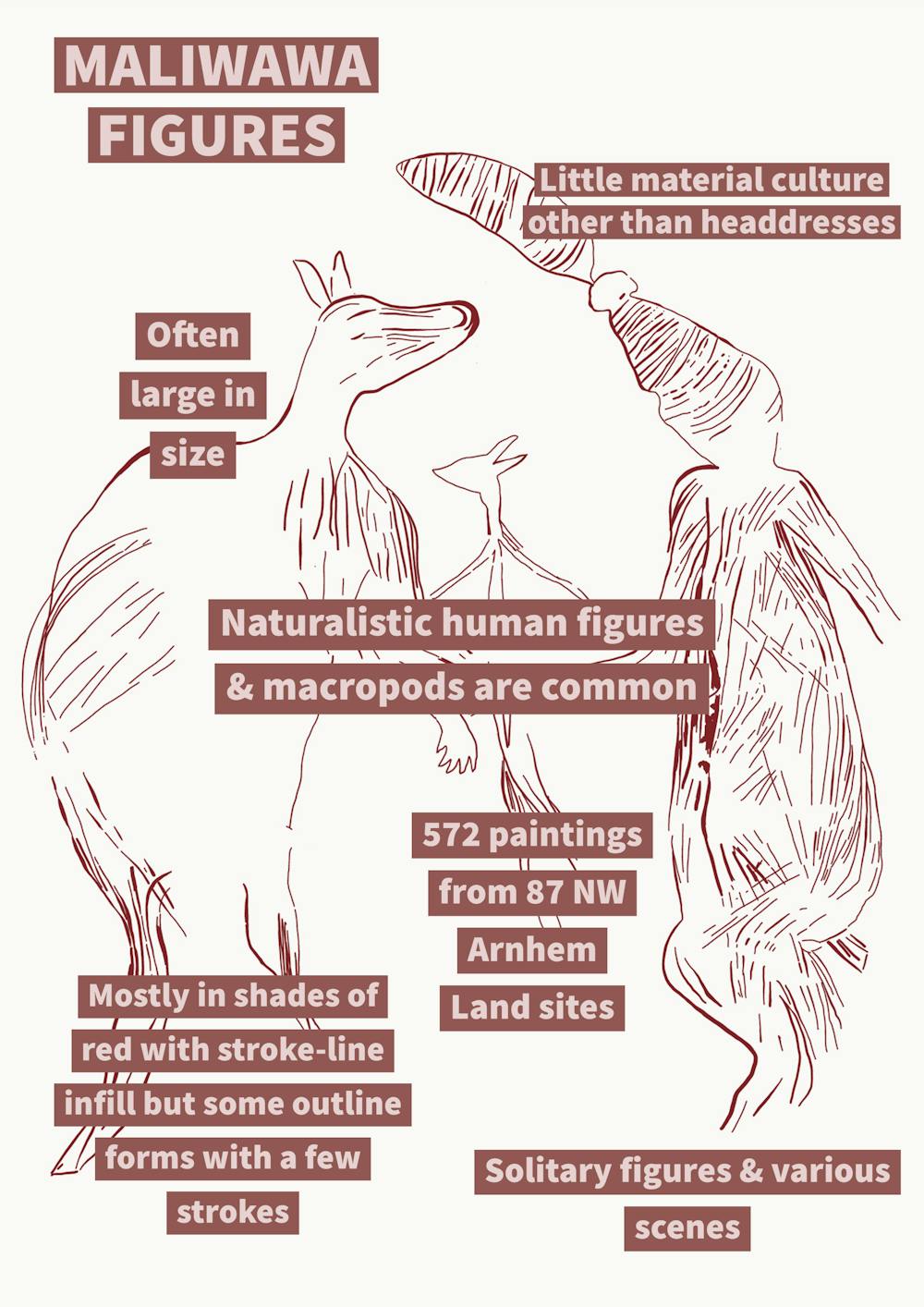
Infographic summarising some of the main features of Maliwawa rock art . Infographic: P. Taçon; digital tracing: Fiona Brady

We recorded 572 Maliwawa paintings at 87 rock shelters over a 130-kilometre east-west distance, from Awunbarna (Mount Borradaile) to the Namunidjbuk clan estate of the Wellington Range, a region home to unique and internationally significant rock art of various types.

Maliwawa Figures consist of red to mulberry naturalistic human and animal forms shaded with stroked lines. Occasionally they are in outline with just a few strokes within. Almost all were painted but there is one drawing.

The figures are often large (over 50 cm high), sometimes life-size, although there are also some small ones (20–50 cm in height). Various lines of evidence suggest the figures most likely date to between 6,000 to 9,400 years of age.
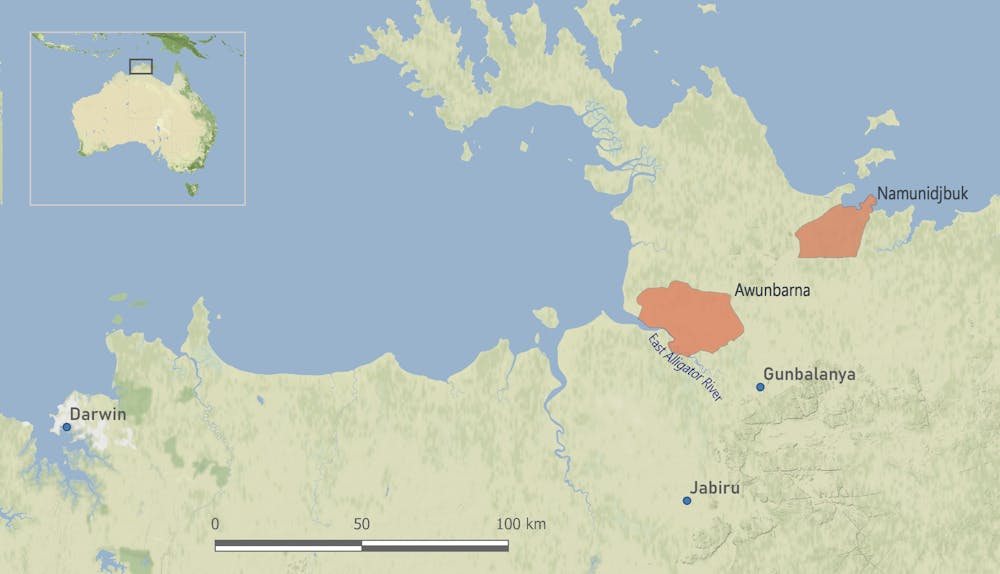
Map of Kakadu/Arnhem Land showing the general location of the Awunbarna and Namunidjbuk areas. Produced by A. Jalandoni; base map by Stamen Design [OpenStreetMap].

Animal-human relationships

In the Maliwawa paintings, human figures are frequently depicted with animals, especially macropods (kangaroos and wallabies), and these animal-human relationships appear to be central to the artists’ message. In some instances, animals almost appear to be participating in or watching some human activity.

Another key theme is a male or indeterminate human figure holding an animal, often a snake, or another human figure or an object.

Such scenes are rare in early rock art, not just in Australia but worldwide. They provide a remarkable glimpse into past Aboriginal life and cultural beliefs.

Scene of two male Maliwawas with ball headdresses reaching down to a shorter indeterminate human figure with a snake behind the male on the right and behind the left male a female and a macropod, Namunidjbuk. An indeterminate human figure with a cone and feather headdress is above. P Tacon

Maliwawa animals are usually in profile. Some macropods are shown in a human-like sitting pose with paws in front, resembling a person playing a piano. Depictions of animal tracks (footprints) and geometric designs are rare.

Macropods, birds, snakes and longtom fish are the most frequent animal subjects, comprising three quarters of total fauna. But, more generally, mammals are most common.

There are seven depictions of animals long extinct in the Arnhem Land region, consisting of four thylacines and three bilby-like creatures. At one Namunidjbuk site there is a rare depiction of a dugong.

Digital tracing of panel of three bilby-like animals, Awunbarna. Digital tracing: Fiona Brady

A third of human depictions were classified as male because they have male genitalia depicted. Females, identified because breasts were shown, are rare, comprising only 5% of human depictions. Almost 59% of human figures could not be determined to be either male or female because they lack sex-specific characteristics.

Human figures generally have round-shaped or oval-shaped heads; some have lines on the head suggestive of hair. 30% of human figures are shown with headdresses, of which there are ten different forms. The most common is a ball headdress, followed by oval, cone and feather.

Large male Maliwawa human figures from an Awunbarna site. The largest male is 1.15 metres wide by 1.95 metres high. P Tacon.

Maliwawa males are usually in profile and often have a bulging stomach above a penis. A few Maliwawa females are also shown with an extended abdomen.

National significance

Most Maliwawa Figures are in accessible or visible places at low landscape elevations rather than hidden away, or at shelters high in the landscape. This suggests they were meant to be seen, possibly from some distance. Often, Maliwawa Figures dominate shelter walls with rows of figures in various arrangements.

We first found some of these figures during a survey in 2008-2009 but they became the focus of further field research from 2016 to 2018.

Back-to-back Maliwawa macropods in the ‘piano player’ pose, Namuidjbuk. P. Tacon

In Australia, we are spoiled with rock art — paintings, drawings, stencils, prints, petroglyphs (engravings) and even designs made from native beeswax in rock shelters and small caves, on boulders and rock platforms. Often in spectacular and spiritually significant landscapes, rock art remains very important to First Nation communities as a part of living culture.

There are as many as 100,000 sites here, representing tens of thousands of years of artistic activity. But even in 2020, new styles are being identified for the first time.

What if the Maliwawa Figures were in France? Surely, they would be the subject of national pride with different levels of government working together to ensure their protection and researchers endeavouring to better understand and protect them.

We must not allow Australia’s abundance of rock art to lead to a national ambivalence towards its appreciation and protection.

The Maliwawa Figures demonstrate how much more we have to learn from Australia’s early artists. And who knows what else is out there waiting to be found. ​

ref. Introducing the Maliwawa Figures: a previously undescribed rock art style found in Western Arnhem Land – https://theconversation.com/introducing-the-maliwawa-figures-a-previously-undescribed-rock-art-style-found-in-western-arnhem-land-145535
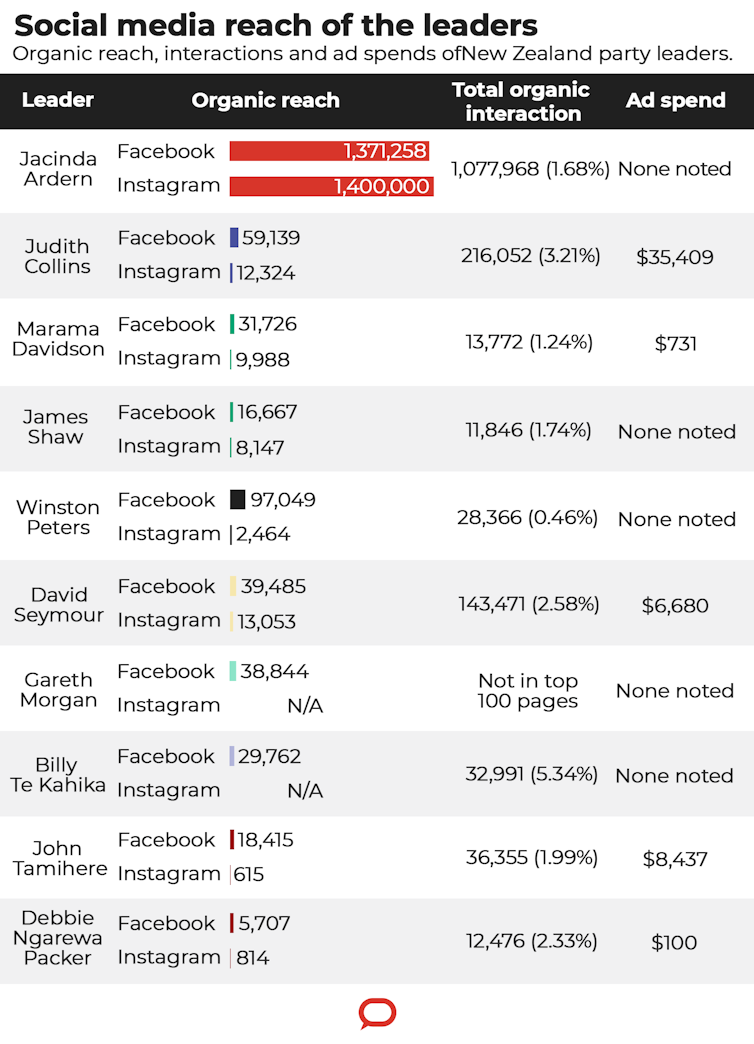
Click, like, share, vote: who’s spending and who’s winning on social media ahead of New Zealand’s election

Source: The Conversation (Au and NZ) – By Sommer Kapitan, Senior Lecturer in Marketing, Auckland University of Technology

If social media engagement rates determined which parties form the next government, New Zealand’s parliament would soon look a lot different.

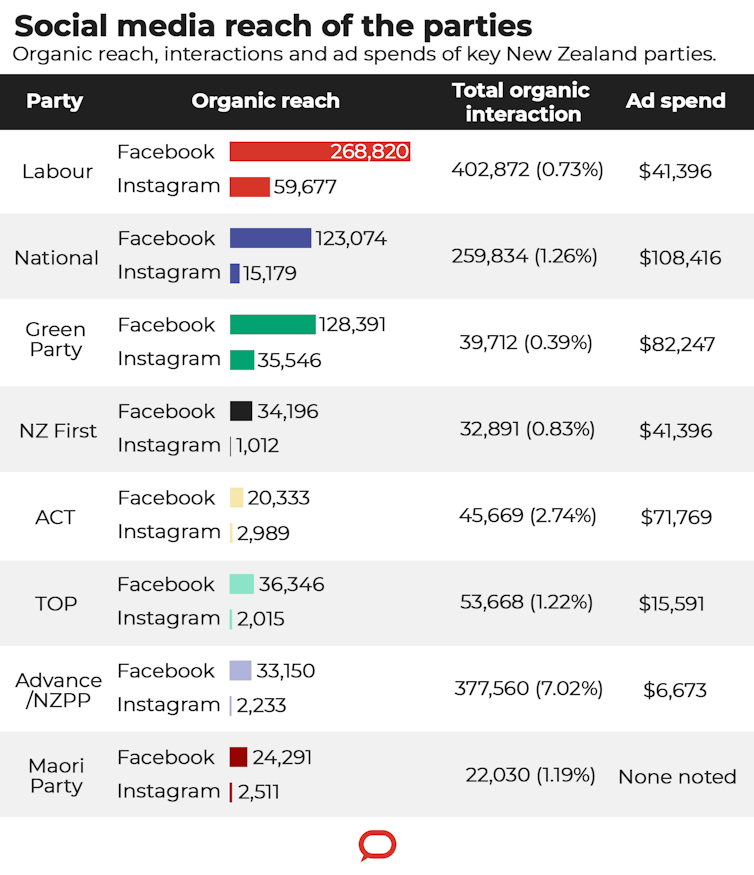
With its daily social media interactions commanding an average 7.7% engagement rate, Advance NZ (incorporating the NZ Public Party) would be streets ahead of Labour and National.

Opposing the COVID-19 Public Health Response Act 2020, 5G and the United Nations, and promoting anti-lockdown protests, might only get them to 1% in opinion polls — but it is a winning formula online.

Advance NZ’s livestreamed anti-lockdown march in August netted 255,600 views — 86% of them generated by only 4,793 people who shared the posted video.

That’s a higher engagement rate than many posts by the acknowledged Facebook champion of New Zealand politics, the prime minister and Labour leader, Jacinda Ardern, whose own posts routinely attract between 120,000 and 500,000 views.

Politics in the attention economy

Across the political spectrum, parties have seen the greatest boost in visibility when they post about hot-button issues: taxation, lockdowns, economic stress, mask wearing — even tobacco prices.

A photo meme of New Zealand First leader Winston Peters pledging to remove tobacco excise tax was among the highest-performing posts, gaining 24 times the party’s usual number of comments, likes, shares and views.

The platform algorithms reward posts that outperform a party page’s usual engagement rates. In a kind of snowball effect, high-performing posts are pushed higher into news feeds and deeper into the minds of voters.


Read more: The Facebook prime minister: how Jacinda Ardern became New Zealand’s most successful political influencer


Social media algorithms are proprietary and tweaked often. But their purpose is clear — to read the user’s searches and interactions in order to serve them more related content and keep them continually engaged.

With this persuasive power built into the technology and our attention now a commodity to be bought and sold, no politician can ignore social media nowadays.

Author provided/The Conversation, CC BY-ND

Organic vs paid media

In New Zealand from July to September 25, there were 9,537 paid advertisements on Facebook and Instagram related to social issues, elections and politics, costing a total of $NZ 1,054,713.

Parties are particularly paying for attention when their content has limited organic reach.

Labour and Jacinda Ardern have the greatest organic reach, with 1.6 million Facebook fans combined (the lion’s share being Ardern’s). The party spent only $41,396 on posts in one 30-day period ending in September.


Read more: We need a code to protect our online privacy and wipe out ‘dark patterns’ in digital design


By contrast, National and its leader Judith Collins lack organic reach. With only 180,000 fans across their Facebook pages, they need to spend to keep up — $143,825 in the same 30-day period.

Of that, $35,000 was devoted to a massive push for people seeing Collins’ social media advertisements to “like my page to stay up to date”. Ultimately, the strategy is about boosting party votes and building greater organic reach in future.

Author provided/The Conversation, CC BY-ND

Reach and reinforcement

But even smaller parties have outspent Labour. The Greens paid $82,000 for social advertising in the same period.

However, Greens Auckland Central candidate Chloe Swarbrick (who has a bigger social following than party co-leaders James Shaw or Marama Davidson) went organically viral with a simple photo of herself wearing a vintage party jumper.

Replica garments were rushed into production and sold out overnight on the party’s fundraising site.

So, social media do work, as ACT and its leader, David Seymour, would no doubt also attest. Having spent $78,000 to promote their “Change your future” bus tour and “Holding the other parties accountable” message, the party is climbing in the polls.

And despite its organic strength, Advance NZ has spent nearly $7,000 on social media. Half of that was dedicated to boosting numbers at the anti-lockdown protests, but such spending is also clearly designed to reach voters who aren’t already fans or friends of fans.

Cultivating reality

The benign view is that social channels allow parties to stay in the conversations and thoughts of voters. Voters in return become more connected to politicians and informed on the issues they care about.

But because of the way those algorithms work, voters may rarely see the other side of policies and issues. Instead, those first clicks, views and interactions lead down the rabbit hole and create filter bubbles.


Read more: With the election campaign underway, can the law protect voters from fake news and conspiracy theories?


Filter bubbles have been blamed for slowly polarising audiences, causing gradual changes in voter behaviour and perception. This is a vastly different political sphere than existed even five years ago.

For example, anyone following only certain politicians might not have known that several social posts misrepresenting Ardern’s comments about farming in the first TV leaders’ debate had been subsequently fact-checked and debunked.

Over time, the filter bubble makes room for fake news to churn inside these echo chambers where users often fail to fact-check content. Misinformation thrives on repetition and familiarity.

But is there evidence that digital messaging influences voting behaviour? Yes, according to at least one major US study, especially when shared with friends and family. Such forms of social transmission seem more effective than politicians’ own use of social media.

If attitudes cultivated online translate into real-world voting behaviour, then Advance NZ may be merely a forerunner of what’s to come in New Zealand.

ref. Click, like, share, vote: who’s spending and who’s winning on social media ahead of New Zealand’s election – https://theconversation.com/click-like-share-vote-whos-spending-and-whos-winning-on-social-media-ahead-of-new-zealands-election-144486

NZ election 2020: survey shows voters are divided on climate policy and urgency of action

Source: The Conversation (Au and NZ) – By Robert McLachlan, Professor in Applied Mathematics, Massey University

New Zealanders are polarised on climate change policy, according to a recent Stuff/Massey University survey of 55,000 readers. This puts the two major political parties in a difficult position as they seek options that are credible yet appealing to voters.

Just 30% of Labour voters and 22% of National voters think the country is “more or less on the right path” on climate action.

The majority of voters on one side of the political spectrum wants to see “urgent action and radical change”, while at the other end most recommend caution and scepticism.

The survey helps explain the deep distrust climate advocates have for the National Party, and their demands for bolder choices from Labour.

Where the parties stand

Labour is running heavily on its record, including the passing of the Zero Carbon Act and the introduction of a falling cap on emissions permits issued under the Emissions Trading Scheme.

Although the government’s COVID-19 recovery spending has been criticised for not being green enough, Labour seems aligned with a “just transition” approach championed by the International Labour Organisation.

Labour’s climate headline policy is for 100% renewable electricity by 2030, five years earlier than planned, and to spend NZ$100 million developing a pumped hydro scheme.


Read more: New Zealand wants to build a 100% renewable electricity grid, but massive infrastructure is not the best option


Labour is also sticking with a plan for a nationwide fuel efficiency standard, which would begin to turn around New Zealand’s growing transport emissions.

The party has dropped the electric car rebate, which the National Party has attacked on the grounds it could increase the price of popular vehicles. A similar approach worked for the Australian Liberal Party in 2019.

The Green Party would go further. While also promising 100% renewable electricity by 2030, the party promotes home solar and insulation and community clean energy. More boldly, it would immediately ban new fossil-fuelled industrial boilers and end industrial coal use by 2030 and gas by 2035. It would prioritise free public transport for under-18s, ban petrol car imports from 2030 and create a NZ$1.5 billion cycleway fund.

The National Party has released its electric vehicle policy, with a target of 80,000 electric vehicles on the road by 2023 (up from 16,000 now). It would exempt these vehicles from fringe benefit tax until 2025 and from road user charges until at least 2023 to encourage uptake by commercial fleets.

It would also target a third of government vehicles to be electric by 2023 and allow electric vehicles to use bus and carpool lanes. The last point has been criticised for impeding the flow of buses.

On the other hand, National’s climate spokesperson, Scott Simpson, has called the party a “broad church” and pledged to amend the Zero Carbon Act to emphasise that food production should not be sacrificed for climate goals.

The ACT Party, which on current polling would increase from one to ten MPs, was the only party to oppose the Zero Carbon Act. It now proposes repealing the act and tying the price of carbon to that of New Zealand’s five top trading partners.

What a difference three years make

At the time of New Zealand’s last general election in September 2017, Extinction Rebellion and the School Strike 4 Climate movements did not yet exist. Greta Thunberg was unknown to the world.

Climate protest
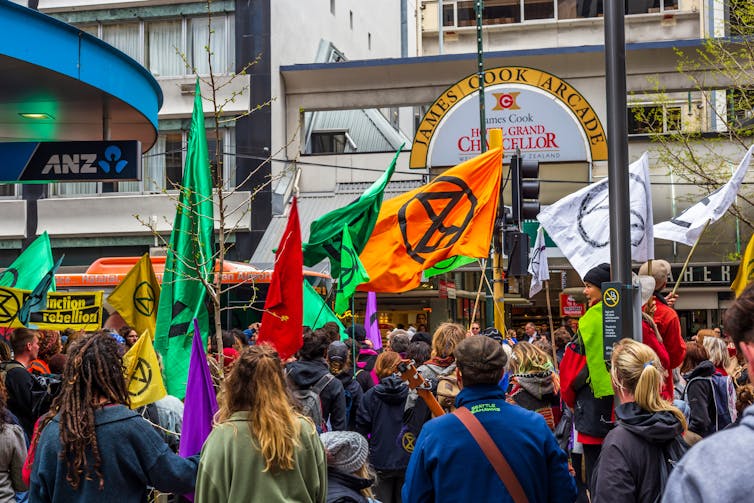
Climate protesters demonstrating in Wellington. Shutterstock/ Natalia Ramirez Roman

Now climate activism has increased globally. Climate-change impacts, including temperature records of 38℃ in northern Siberia to 54℃ in Death Valley, have attracted widespread attention. Orange skies in San Francisco are a reminder of apocalyptic Australian bushfires less than a year ago.

There are also signs of bolder climate action that may fulfil the declarations of the Paris Agreement. In the European Union, negotiations are under way to cut 2030 emissions to 40-45% of 1990 levels. This target would require halving emissions in the next decade.

In the US, the Democratic presidential candidate, Joe Biden, has a US$2 trillion proposal for rapid decarbonisation. Ireland’s new government has agreed to emission cuts of 7% per year. China has pledged to be carbon-neutral before 2060.

In New Zealand, both Auckland and Wellington councils have released highly ambitious climate plans that will require sweeping changes to housing and transport.

But this year’s New Zealand general election won’t be about climate change. The COVID-19 crisis and the high level of uncertainty about economic recovery and employment have made issues of leadership, trust and party branding more important than ever.


Read more: New Zealand’s COVID-19 budget delivers on one crisis, but largely leaves climate change for another day


In this context, Labour’s nod to the Lake Onslow pumped hydro project could be a winner. Its storage potential is enormous – more than all of New Zealand’s present hydro lakes combined and 15 times the size of Australia’s Snowy 2.0 project.

It could decarbonise not just all electricity generation, but a lot of industrial process heat and transport as well. It would address the seasonal imbalance between lake inflows and electricity demand, and protect against dry years. But it’s also a traditional civil engineering project far in the future and doesn’t threaten anybody’s lifestyle today.

In New Zealand, as elsewhere, climate politics means finding support for actions now whose benefits extend far into the future.

ref. NZ election 2020: survey shows voters are divided on climate policy and urgency of action – https://theconversation.com/nz-election-2020-survey-shows-voters-are-divided-on-climate-policy-and-urgency-of-action-146569

Scott Morrison names six priority areas in $1.5 billion plan to boost manufacturing

Source: The Conversation (Au and NZ) – By Michelle Grattan, Professorial Fellow, University of Canberra

The federal government is selecting six priority areas for support in a $1.5 billion manufacturing plan Scott Morrison will outline in a pre-budget address.

They are resources technology and critical minerals processing, food and beverage, medical products, recycling and clean energy, defence, and space.

The plan will also focus on building “supply chain resilience” after the COVID pandemic exposed the risks of not having enough capability to quickly produce large amounts of vital items such as personal protective equipment.

The funding will be provided over the budget’s forward estimates period.

In a Thursday speech to the National Press Club, released ahead of delivery, Scott Morrison says this budget “will be one of the most important since the end of the second world war”.

“This budget will be necessarily different in scale to those we have seen for generations. It will respond responsibly to the challenge of our time.

“The budget will confirm the strong plan we have to recover from the COVID-19 recession and to build our economy for the future.”

Morrison says Australia needs “to keep making things”. Manufacturing employs about 860,000 and before COVID generated more than $100 billion in value annually for the economy and more than $50 billion in exports.

“Our government is determined to set a ten-year time horizon where all parties – industry, workforce (including unions), governments at all levels, capital (including superannuation funds) and our scientific and research community – are pulling in the one direction,” Morrison says.

He says the government’s “practical strategy” has three elements: creating a business environment where manufacturers can be more competitive, aligning resources to build scale in areas of competitive strength, and securing sovereign capability in areas of national interest.

The policy involves considerable government intervention – picking winners in terms of sectors, and collaborating with them in planning.

A $1.3 billion “modern manufacturing initiative”, focused on the priority areas, will invest in projects to help manufacturers “scale up” and create jobs.

The government and industry will partner to develop industry-led roadmaps to identify growth opportunities, barriers to scale and what is needed along the value chain in each area.

These maps, to be prepared by April, will be guides for investment and actions by both government and industry.

They will set goals and performance indicators – in jobs, research and development, investment – for the following two, five and ten years.

The manufacturing plan is one of a series of policy initiatives the government is announcing in the run up to the budget.

Others have included deregulation of credit policy to stimulate lending, changes to insolvency provisions to cushion struggling businesses, measures to promote digitalisation, and policies on energy.

Morrison in his speech again strongly talks up the importance of gas for the economic recovery generally and the manufacturing sector in particular.

“If you’re not for gas, you’re not for jobs in our manufacturing and heavy industries,” he declares. “For many manufacturers, it is half the problem.”

The National Covid-19 Co-ordination Commission had advised that gas was 20-40% of many industries’ cost structures.

“Combined with higher electricity costs, the NCCC said that has moved many firms into a ‘doom loop’ where they are living ‘turnaround to turnaround’, making existential decisions at each point of the next major maintenance decision, rather than decisions to invest in technology and much-needed productivity improvements to remain competitive. This needs to change,” Morrisons says.

“That is why, as part of our gas-fired recovery plan, we have committed to resetting our east coast gas markets, unlocking gas supplies, establishing a new gas hub and improving our gas grid distribution systems.”

His speech comes as Santos’s $3.6 billion controversial Narrabri coal seam gas project has this week been given “phased approval” by the NSW Independent Planning Commission, with its development subject to it meeting a range of conditions.

Morrison says the government’s “modern manufacturing initiative” will provide a new investment vehicle to help overcome the barriers to scale. It will leverage co-investment with states and territories, industry and research institutions across three activities

  • collaboration: investments of an average of $80 million each to foster long-term, large-scale production or R&D facilities involving consortia of businesses and other organisations, including physical clusters (such as at the Western Sydney Aerotropolis)

  • translation: investments of about $4 million for industry-led projects translating research and commercialising new products

  • integration: investments of about $4 million connecting local firms with export markets.

The national sovereignty part of the manufacturing plan has more than $107 million earmarked for “supply chain resilience”.

“We cannot ignore the obvious. The efficiency benefits of hyper-globalisation and highly fragmented supply chains can evaporate quickly in the event of a major global shock like the COVID-19 pandemic.

“It is only sensible that Australia consider more options to guard against supply chain vulnerability for critical necessities and to secure us against future shocks,” Morrison says.

Currently, a government review is being done of Australia’s supply chain vulnerabilities in the wake of the pandemic.

The resilience initiative “will support Australian manufacturers investing in capabilities to address areas of identified acute vulnerability domestically, and to ensure they are in a position to contribute to the supply chains of trusted partners and like-minded countries.

“Sovereign Manufacturing Capability Plans will be developed in key areas and a range of policy options will be considered including procurement and long-term contracting arrangements, as well as actions to promote better information sharing and collaboration between government and industry.”

But Morrison stresses this does not herald a return to protectionist policies.

He says Australia is complementing its actions to boost domestic sovereign capability through greater collaboration with like-minded countries.

The manufacturing policy also includes $52.8 million for the existing manufacturing modernisation fund which gives grants to support transformational technologies and processes.

In a Wednesday pre-budget speech Anthony Albanese renewed his calls for trains to be built locally.

“State governments will invest billions of dollars in new public transport projects over the next two decades, requiring hundreds of new rail carriages.

“We should build them here. We have the facilities in Maryborough, Ballarat, Bendigo, Newcastle and Perth. We also have the skills,” he said.

“What we need is a government prepared to back in Australian-made trains and Australian-based jobs.

“This is just one example of how the government should use its purchasing power to create good, secure jobs while strengthening our sovereign industrial and research capabilities.”

ref. Scott Morrison names six priority areas in $1.5 billion plan to boost manufacturing – https://theconversation.com/scott-morrison-names-six-priority-areas-in-1-5-billion-plan-to-boost-manufacturing-147213

Politics with Michelle Grattan: Chris Richardson on what Tuesday’s budget will and should do

Source: The Conversation (Au and NZ) – By Michelle Grattan, Professorial Fellow, University of Canberra

On Tuesday, the 2020 budget will be brought down. It will show a huge deficit for this financial year and massive government spending, aimed at promoting economic recovery and reducing unemployment. In the wake of COVID, the Coalition’s usual preoccupation with “debt and deficit” has become very yesterday.

On this week’s Politics podcast, we speaks with Chris Richardson, partner at Deloitte Access Economics. Deloitte’s Economics Budget Monitor, released this week, favoured bringing forward the tax cuts as one measure to stimulate the economy and expected the deficit to be holding up better than earlier thought.

Like economists in a recent survey Richardson says the budget should prioritise a permanent boost to JobSeeker and fund more social housing:

“The least noticed thing about this crisis is how geographically specific it is,” he says.

“The job losses in Australia have been far and away the biggest where unemployment rates, suburb by suburb, town by town, out in the bush, were already the highest. … The areas that were struggling are now struggling a lot more. The areas that weren’t struggling haven’t been that hard hit.”

“And one real advantage of boosting unemployment benefits. It’s probably the single most targeted regional spend you can do in Australia at a time when that is needed most.”

And on social housing: “Think of what this virus has done all around the world. It’s found the weakest link in every nation.

“It’s travelled through the political system, the political divide in the US, it’s travelled through the migrant workers, construction workers in Singapore.

“In Australia, it showed up or could have shown up through our very low unemployment benefit… And social housing. You saw those towers locked down, as the virus got away on us in Melbourne. And again, both social housing and unemployment benefits. That’s money that would be spent. It makes it good stimulus.”

Listen on Apple Podcasts

Stitcher Listen on TuneIn

Listen on RadioPublic

Additional audio

A List of Ways to Die, Lee Rosevere, from Free Music Archive.

ref. Politics with Michelle Grattan: Chris Richardson on what Tuesday’s budget will and should do – https://theconversation.com/politics-with-michelle-grattan-chris-richardson-on-what-tuesdays-budget-will-and-should-do-147206

Explainer: what is the latest waterfront dispute about?

Source: The Conversation (Au and NZ) – By Peter van Duyn, Maritime Logistics Expert, Centre for Supply Chain and Logistics (CSCL), Deakin University

Twenty-two years ago, images of balaclava-clad security guards with German shepherds, locking out wharfies at the Patrick container terminals shocked the nation.

With a fresh industrial dispute underway at the Patrick container terminals, are we on track for another war on the waterfront? And what will this mean for medication and food supplies?

What is this dispute about?

Patrick Terminals is one of Australia’s biggest container terminal operators.

About seven months ago, Patrick and the Maritime Union of Australia (MUA) started negotiations over a new nationwide enterprise agreement, which expired on June 30.

Seagull in front of a container ship in Port Botany.
Negotiations between Patrick and the Maritime Union of Australia have been going for months. Joel Carrett/AAP

The dispute centres around a wage increase, improved rostering arrangements, minimising casualisation of the workforce and increased superannuation contributions. The union initially asked for a 6% annual pay increase but is now negotiating for 2.5%.

Unhappy with the progress of negotiations, the wharfies voted in late August to take protected action against the company, including 24-hour strikes, stop-work meetings and bans on overtime. Patrick says this severely limits its ability to run the business, including efficiently to service ships, trucks and trains.

Normally, negotiations would run over a longer period before industrial action would be taken. But given recent industrial action with another container stevedore, DP World, (which has now ceased), the effect of the delays built up quickly and Patrick went to the Fair Work Commission (FWC).

What’s at stake?

Patrick has warned more than 100,000 containers face delays if the partial work bans continue into next week.

“The delays are real,” Patrick chief executive Michael Jovicic told Radio National on Wednesday.


Read more: Is global shipping in the doldrums?


Patrick says ships face lengthy delays to find a berth in Port Botany. Or they are being diverted to other ports, which has seen additional expenses for importers and exporters.

The cost to run a ship can amount to A$25,000 per day. In an effort to recoup the costs they incur in having to wait at sea for a berth, shipping lines have instigated so-called “port congestion charges” of up to US$350 per container (A$492).

On top of incurring delays to their cargo, importers and exporters also have to absorb these additional costs.

Supply chains, already under pressure due to COVID-19, will come under more strain if the dispute is not resolved quickly. If it drags on much longer, cargo will bank up further and it will become harder to catch up in time to get imported goods on shelves before Christmas.

This could result in additional costs for imported goods, as well as shortages leading up to the usually busy festive period. Exporters will also lose out if they cannot get their goods overseas.

Strong words

The situation has now reached fever pitch. On Tuesday, Prime Minister Scott Morrison described the union behaviour as “appalling”. As he told reporters,

we cannot have the militant end of the union movement effectively engaging in a campaign of extortion against the Australian people in the middle of a COVID-19 recession.

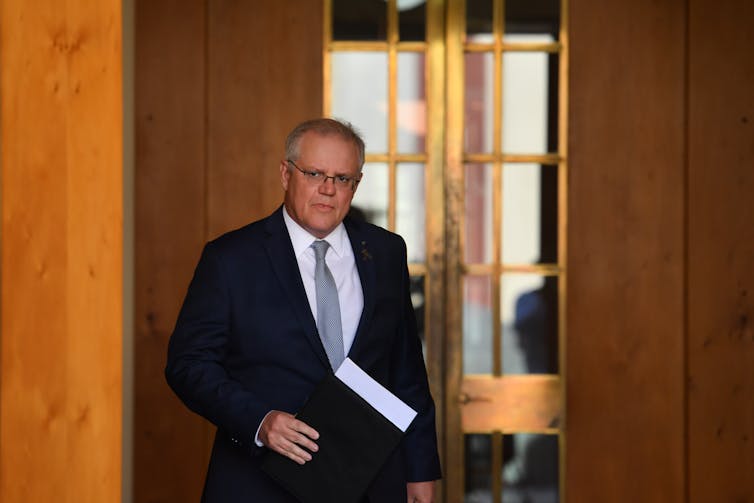
Prime Minister Scott Morrison arriving for a press conference in his Parliament House courtyard.
Prime Minister Scott Morrison has accused the unions of ‘extortion’. Mick Tsikas/AAP

The National Farmers’ Federation says the dispute is threatening the sector’s recovery from the drought and COVID-19, while the Australian Industry Group has raised concerns about the flow of white goods, construction supplies and food manufacturing.

There have also been concerns medical supplies could be delayed. The union has rejected these claims, while Medicines Australia says there are no current shortages.

The MUA’s national secretary Paddy Crumlin, meanwhile, says talk of huge delays is “fake news”. He says Patrick is trying to

slash the conditions of their workforce under the cover of the COVID crisis.

All key parties are highlighting their own interests — using examples to suit their case and try and resonate with the public.

Will it be resolved?

On Wednesday, Patrick and the MUA went to the FWC for a conciliation hearing.

Ahead of this, the union offered a peace deal. It proposed the existing workplace agreement is rolled over for 12 months in return for a 2.5% pay rise and both parties to negotiate in good faith during the next 12 months.

As of 6pm on Wednesday, the hearing – which started at 10am – was still going. There is a further FWC hearing scheduled for Thursday to try to settle the dispute.

Remember the history

We need to heed the lessons of 1998. As the infamous waterfront dispute dragged on, more parties were affected and became involved, resulting in long, drawn out legal arguments in the courts.


Read more: Morrison wants unions and business to ‘put down the weapons’ on IR. But real reform will not be easy.


It’s time for cool heads to prevail. Inflammatory language from parties not directly involved in the dispute will do nothing to ensure a negotiated outcome.

ref. Explainer: what is the latest waterfront dispute about? – https://theconversation.com/explainer-what-is-the-latest-waterfront-dispute-about-147100

Do Australians care about unis? They’re now part of our social wage, so we should

Source: The Conversation (Au and NZ) – By Marcus Banks, Social policy and consumer finance researcher, School of Economics, Finance and Marketing, RMIT University

In 1988, then federal education minister, John Dawkins, drew upon the politics of class privilege to justify rolling out HECS student loans. A university user-pays system was needed, he argued, because Labor was not in the business of funding “middle-class welfare”. At the time, one reason a neoliberal appeal by Labor to its base could deflate widespread public opposition was that just 7% of working-age Australians held a degree.

Three decades on, Education Minister Dan Tehan is also dog-whistling up the politics of class to cut off the loans system to first-year students who fail half their subjects, ramp up fees for many others, deny JobKeeper to workers in the sector and cut funding.


Read more: The government would save $1 billion a year with proposed university reforms — but that’s not what it’s telling us


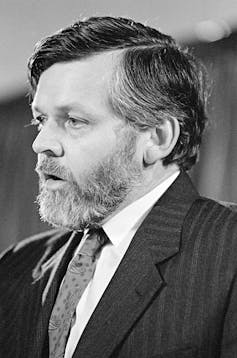
Portrait of John Dawkins
Today 33% of working-age Australians have a degree, a big jump from 7% in the time of John Dawkins. National Archives of Australia/AAP

Dawkins’s representation of the policy problem framed higher education as a bastion of privilege. It relied on the relative absence of working-class students and the irrelevance of higher education to their parents.

For Tehan the problem is represented by these students’ overabundance — particularly in courses that do not produce workers with the specific technical skills he claims are in demand by employers. Tehan’s call to rid the system of failing students is couched in paternalism, a hallmark of the welfare system.

Agenda predates COVID

On the surface, a small cohort of students mostly from low socioeconomic backgrounds appear to be the target. Politically, however, it neatly links with the government’s broader restructuring agenda across the campuses. For higher education students and staff alike, it epitomises what the National Union of Students (NUS) president has called a neoliberal way to “incentivise success through fear of punishment”.

The restructuring goes well beyond the crisis triggered by the COVID-19 pandemic. An explosion of casual employee networks across the country and a recent national assembly of nearly 500 academics voting to build towards unprotected industrial action have boosted campaigning by the National Tertiary Education Union (NTEU) and NUS against the current cuts and broader restructuring agenda.


Read more: As universities face losing 1 in 10 staff, COVID-driven cuts create 4 key risks


What has changed since 1988?

There are optimistic grounds for thinking that broader societal support is now more likely than in 1988 for this defence of universities as a freely accessible public good.

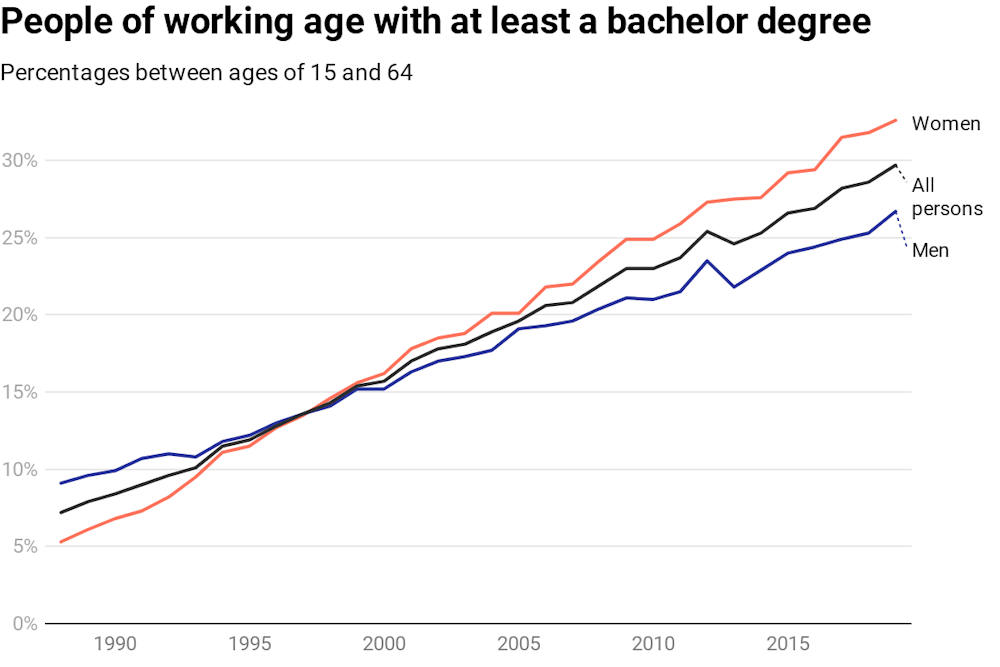
In May 2019, a third of the working-age population (20-64 years) held at least a bachelor degree. That’s almost five times more than in 1988. And nearly two-thirds of this group had a degree, diploma or post-school certificate.

Some 46% of women and 35% of men between the ages of 25 and 34 have a degree. Soon most women in this key working-age cohort will be university graduates, alongside a significant proportion of men.

graph showing increases of women, men and all Australians holding at least a bachelor degree from 1988 to 2019
Data: ABS

Social wage has widened

This mainstreaming of university education means the sector joins health and welfare as a core part of the social wage. Australian government spending on keeping the workforce skilled, fit and able to work accounted for more than 60% of its 2019-20 budget. Health-care spending, whether provided by employers (such as US insurance schemes) or more commonly via the state, is in reality part of our wages whether it is paid in cash or kind or goes to workers collectively rather than individually.

The social wage came to prominence in the 1980s as a key part of the Prices and Incomes Accord. The Labor government reached agreement with trade unions and employers that they would trade off wage increases for better social security benefits and progressive education and health reforms. Political economist Elizabeth Humphrys has explained how these trade-offs strengthened the hold of neoliberalism and weakened trade unions.


Read more: Australian politics explainer: the Prices and Incomes Accord


The social wage is the collective part of our overall wages. This understanding provides broad-based, industrial grounds to defend its provision.

Just as it has been unfortunately shown that wage cuts are not stopping job cuts in the university sector, cuts to our social wage are also not in our collective self-interest.

For example, we need to loudly call out that the framing of social security payments as handouts for the poor is a cynical attempt to cultivate “them and us” divisions. In reality, between 2001 and 2015, over 70% of Australian working-age households required income support at some stage. These payments helped smooth the financial risks of unemployment, low wages, caring responsibilities, injury, frailty or disability.

Arguments for the JobSeeker supplement to be kept after the pandemic – such as by the Raise the Rate campaign – are gaining widespread traction.


Read more: Unemployment support will be slashed by $300 this week. This won’t help people find work


A similar basis of mass support exists for campaigns to have equitable, accessible and quality higher education. Secondary school students and their parents, casualised and ongoing staff and the wider trade union movement all have a stake in rejecting the current round of university cuts and restructuring. Higher education is now firmly part of our social wage, and we must defend it.

ref. Do Australians care about unis? They’re now part of our social wage, so we should – https://theconversation.com/do-australians-care-about-unis-theyre-now-part-of-our-social-wage-so-we-should-144798

Helen Reddy’s music made women feel invincible

Source: The Conversation (Au and NZ) – By Michelle Arrow, Professor of History, Macquarie University

“Show business”, Helen Reddy once said, “was the only business that allowed you to earn the same salary as a man and to keep your name”.

The singer and actress best known for her trailblazing feminist anthem I Am Woman has died in Los Angeles, aged 78. She was one of the most famous Australians in the world during the 1970s, and an icon of women’s liberation.

Born in Melbourne in 1941 to vaudeville performers Max Reddy and Stella Lamond, Reddy learned to sing, dance and play piano as a child. By her late teens, she was performing in her father’s touring show.

At 20, she married the musician Kenneth Weate. The marriage was brief and, after it was over, she and her daughter Traci moved to Sydney.

Ambitious and keen to try her luck in the United States, in 1966 she entered and won a singing competition. A trip to the US and a recording contract were her prize. Arriving in New York with three-year-old Traci, the promised contract evaporated. Reddy performed in clubs in the US and Canada to stay afloat.

She had the good fortune, however, to meet the expat Australian journalist Lilian Roxon (author of the groundbreaking Rock Encyclopedia) who organised a rent party for Reddy on her birthday. There, she met her second husband (and manager) Jeff Wald. They married shortly after, moving to Los Angeles in 1968.

Persistence

Reddy and Wald initially encountered resistance from the music industry when trying to build her career. But their persistence paid off: in 1970 she recorded a cover of I Don’t Know How to Love Him from the musical Jesus Christ Superstar. The song made it to number 13 in the US charts and number one in Australia.


Read more: I Am Woman review: Helen Reddy biopic captures the power and excitement of women’s liberation


After moving to Los Angeles, Reddy became involved in the women’s movement. As she recalled in her 2005 memoir, The Woman I Am, her growing interest in women’s liberation drove her to try to find songs that expressed her pride in being female.

Unable to find one, she “finally realised I was going to have to write the song myself”. While Ray Burton wrote the music, the lyrics to I Am Woman were Reddy’s.

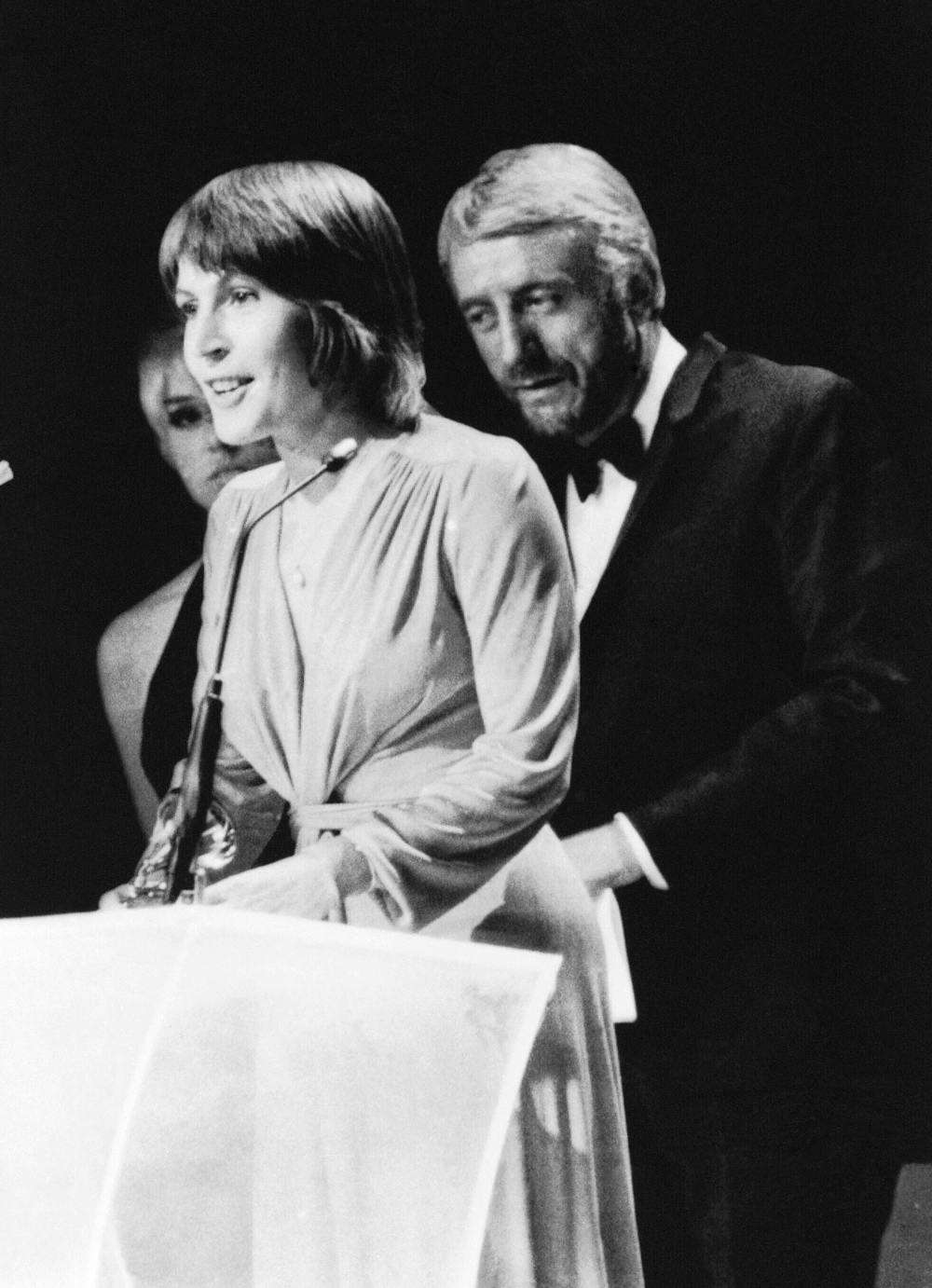
Helen Reddy wins a Grammy Award for the best female song of the year in 1973. AP

“I am strong, I am invincible,” encapsulates its powerful message of female empowerment. The song found its audience as the women’s liberation movement took off across the world. It went to number one on the US charts in October 1972, and number two on the Australian charts in 1973.

The song made Reddy a star, and a celebrity feminist: one of a small group of women, including Gloria Steinem and Germaine Greer, whose high profile and media savvy helped communicate feminist ideas to wide audiences.

The song became the official theme song of International Women’s Year in 1975. It has been a feature of feminist protests and celebrations ever since.

‘She makes everything possible’

While I Am Woman made Reddy famous, her Grammy acceptance speech in 1973 made her notorious: thanking “God, because she makes everything possible”.

Her win was said by Brisbane’s Courier Mail at the time to have “sent a thrill through the bra-less bosoms of Women’s Liberationists around the world.”

Reddy followed I Am Woman with a string of pop hits over the following five years including Delta Dawn and Ain’t No Way to Treat a Lady.

She built a successful career in television, film and theatre, with roles in Airport 1975 (1974) and Pete’s Dragon (1977), guest appearances in TV series including The Love Boat (1977–87) and Fantasy Island (1977–84), and even had her own variety program, The Helen Reddy Show in 1973. She was awarded a star on the Hollywood walk of fame the following year.

She performed until the early 2000s, released her memoir in 2005, and was inducted into the ARIA Hall of Fame in 2006.

While she kept a lower profile in the last years of her life, she appeared in the 2017 Women’s March in the US. A biopic directed by Unjoo Moon, I Am Woman, was released on Stan just last month.

Reddy in a blue shirt, looking off camera.
Reddy in 2005. AAP image/Mick Tsikas

Alice Cooper famously dismissed Reddy as the “queen of housewife rock” in the 1970s. I doubt Helen Reddy saw this as the insult Cooper perhaps intended it to be.

In a male-dominated music industry, and a sexist society where women were routinely discriminated against, Reddy’s music made women feel strong and invincible.

When I researched the impact I Am Woman had on Australian women, many said the song had helped them through tough times and changed the way they thought about themselves.

One woman, who had endured a long, violent marriage, told me:

I think I Am Woman was a life saver for me, as to play it was my little bit of rebellion. I am sure that it would have been the same for many other women.

There could be no greater tribute to this extraordinary, trailblazing feminist than that.

ref. Helen Reddy’s music made women feel invincible – https://theconversation.com/helen-reddys-music-made-women-feel-invincible-147179

Which Australian destinations lose, and which may win, without international tourism

Source: The Conversation (Au and NZ) – By Isaac Gross, Lecturer in Economics, Monash University

Christmas promises the gift of open travel within Australia, and possibly to New Zealand and even other Pacific Island nations.

But it seems increasingly likely international borders will remain largely closed until at least mid-2021. The mothballing plans of airlines such as Qantas further suggest international travel will take years to recover to pre-pandemic levels.


Read more: Qantas cutbacks signal hard years before airlines recover


For any tourist attraction primarily geared to international visitors, and for the hotels, restaurants and shops that cater to that tourist traffic, this spells trouble.

In 2019 more than 9 million international tourists injected an estimated A$47 billion into the Australian economy.

On the other hand, local destinations that primarily attract local tourists could be in for boom times, attracting those who might otherwise have gone overseas. (In 2018-19, more than 10 million did so, spending A$65 billion in the process.)

Tourism, though, is not a zero-sum game. Not all of the money that might have been spent overseas will necessarily be spent on a local holiday. Even if it was, and the boom in domestic tourism more than made up for the loss of international tourists, the impact would be different across cities and locations.

That’s because local and foreign tourists tend to opt for different holiday experiences. International visitors are more attracted to the sights of Sydney and Melbourne, and the tourist hot spots of Queensland. Locals disproportionately want to get away from the city and avoid the tourist traps, relaxing in the country or on the coast.


Measuring international attraction

To get a better sense of how closed international borders will affect local economies, we calculated locations’ reliance on international tourists using data distilled from TripAdvisor, a popular travel booking and review website.

As a proxy for how many foreigners visit (and then review) a location relative to the number of domestic visitors, we looked at the number of reviews written in English relative to other languages.

Obviously this is an imperfect measure. A lot of foreign visitors come from New Zealand, Britain and Ireland, for example. Non-English speakers might use a different platform entirely. Nonetheless the results give us a basis to see where the absence of international tourists will likely be felt the hardest.

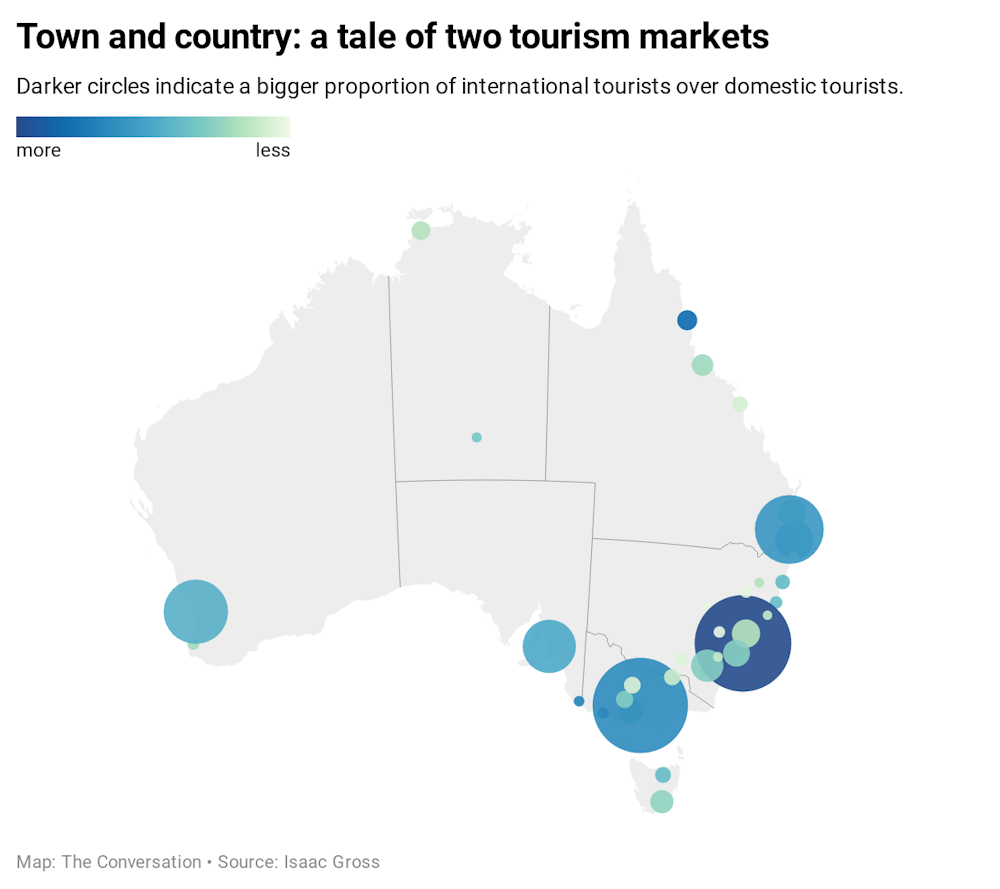
Using the data from TripAdvisor, the following chart shows the relative importance of tourism to local economies as well as the relative importance of international tourists.


At a glance, Cairns, the gateway to the Great Barrier Reef, stands out as the having the most to lose, due the relative importance of tourism, and international tourists, to its economy.

Sydney attracts the greatest proportion of foreign visitors, but is less dependent on tourism.

Regional towns like Tamworth in NSW and Bendigo in Victoria (bottom left) should be least affected.


The biggest losers

About two-thirds of all international passengers touch down in Sydney and Melbourne. Our data from Tripadvisor also suggests this is where foreign visitors spend most of their time and money.

In Sydney the Opera House, Harbour Bridge and Bondi Beach are magnets for foreign tourists. Melbourne has the Eureka Skydeck and its Royal Botantic Gardens. Any business attached to the traffic for these attractions will face a tough year ahead.

The only upside is the big cities have more diverse labour markets. So those losing tourism jobs in these areas have a slightly better chance of finding work elsewhere.

The bigger risk comes to Cairns and other smaller tourist hubs with star attractions that attract a large flow of international tourists. For many businesses in these local economies a closed border could be an existential challenge.


Read more: The end of global travel as we know it: an opportunity for sustainable tourism


The potential winners

While our results are more robust for predicting where lost international tourism will hurt most, we can also see some possibilities of boom times for destinations that provide the experience local tourists are seeking.

Two examples are Echuca in Victoria and Busselton in Western Australia. These are very different towns. Echuca is an historic inland town on the Murray River often associated with paddle steamers. Busselton is a fishing town south of Perth long associated with lazy beach holidays.

Locations offering the more relaxed “getaway” experience might find their bookings overflowing this holiday season as Australians unable to visit Barcelona or Bali look to holiday closer to home.

ref. Which Australian destinations lose, and which may win, without international tourism – https://theconversation.com/which-australian-destinations-lose-and-which-may-win-without-international-tourism-146395

Which Australian destinations lose, and which might win, without international tourism

Source: The Conversation (Au and NZ) – By Isaac Gross, Lecturer in Economics, Monash University

Christmas promises the gift of open travel within Australia, and possibly to New Zealand and even other Pacific Island nations.

But it seems increasingly likely international borders will remain largely closed until at least mid-2021. The mothballing plans of airlines such as Qantas further suggest international travel will take years to recover to pre-pandemic levels.


Read more: Qantas cutbacks signal hard years before airlines recover


For any tourist attraction primarily geared to international visitors, and for the hotels, restaurants and shops that cater to that tourist traffic, this spells trouble.

In 2019 more than 9 million international tourists injected an estimated A$47 billion into the Australian economy.

On the other hand, local destinations that primarily attract local tourists could be in for boom times, attracting those who might otherwise have gone overseas. (In 2018-19, more than 10 million did so, spending A$65 billion in the process.)

Tourism, though, is not a zero-sum game. Not all of the money that might have been spent overseas will necessarily be spent on a local holiday. Even if it was, and the boom in domestic tourism more than made up for the loss of international tourists, the impact would be different across cities and locations.

That’s because local and foreign tourists tend to opt for different holiday experiences. International visitors are more attracted to the sights of Sydney and Melbourne, and the tourist hot spots of Queensland. Locals disproportionately want to get away from the city and avoid the tourist traps, relaxing in the country or on the coast.


CC BY-SA

Measuring international attraction

To get a better sense of how closed international borders will affect local economies, we calculated locations’ reliance on international tourists using data distilled from TripAdvisor, a popular travel booking and review website.

As a proxy for how many foreigners visit (and then review) a location relative to the number of domestic visitors, we looked at the number of reviews written in English relative to other languages.

Obviously this is an imperfect measure. A lot of foreign visitors come from New Zealand, Britain and Ireland, for example. Non-English speakers might use a different platform entirely. Nonetheless the results give us a basis to see where the absence of international tourists will likely be felt the hardest.

Using the data from TripAdvisor, the following chart shows the relative importance of tourism to local economies as well as the relative importance of international tourists.


CC BY-SA

At a glance, Cairns, the gateway to the Great Barrier Reef, stands out as the having the most to lose, due the relative importance of tourism, and international tourists, to its economy.

Sydney attracts the greatest proportion of foreign visitors, but is less dependent on tourism.

Regional towns like Tamworth in NSW and Bendigo in Victoria (bottom left) should be least affected.


CC BY-ND

The biggest losers

About two-thirds of all international passengers touch down in Sydney and Melbourne. Our data from Tripadvisor also suggests this is where foreign visitors spend most of their time and money.

In Sydney the Opera House, Harbour Bridge and Bondi Beach are magnets for foreign tourists. Melbourne has the Eureka Skydeck and its Royal Botantic Gardens. Any business attached to the traffic for these attractions will face a tough year ahead.

The only upside is the big cities have more diverse labour markets. So those losing tourism jobs in these areas have a slightly better chance of finding work elsewhere.

The bigger risk comes to Cairns and other smaller tourist hubs with star attractions that attract a large flow of international tourists. For many businesses in these local economies a closed border could be an existential challenge.


Read more: The end of global travel as we know it: an opportunity for sustainable tourism


The potential winners

While our results are more robust for predicting where lost international tourism will hurt most, we can also see some possibilities of boom times for destinations that provide the experience local tourists are seeking.

Two examples are Echuca in Victoria and Busselton in Western Australia. These are very different towns. Echuca is an historic inland town on the Murray River often associated with paddle steamers. Busselton is a fishing town south of Perth long associated with lazy beach holidays.

Locations offering the more relaxed “getaway” experience might find their bookings overflowing this holiday season as Australians unable to visit Barcelona or Bali look to holiday closer to home.

ref. Which Australian destinations lose, and which might win, without international tourism – https://theconversation.com/which-australian-destinations-lose-and-which-might-win-without-international-tourism-146395

Airports, ATMs, hospitals: Microsoft Windows XP leak would be less of an issue, if so many didn’t use it

Source: The Conversation (Au and NZ) – By Brianna O’Shea, Lecturer, Ethical Hacking and Defense, Edith Cowan University

The source code of the Windows XP operating system is now circulating online as a huge 43GB mega-dump.

Although the software is nearly two decades old, it’s still used by people, businesses and organisations around the world. This source code leak leaves it open to being scoured for bugs and weaknesses hackers can exploit.

The leaked torrent files, published on the bulletin board website 4chan, include the source code for Windows XP Service Pack 1, Windows Server 2003, MS DOS 3.30, MS DOS 6.0, Windows 2000, Windows CE 3, Windows CE 4, Windows CE 5, Windows Embedded 7, Windows Embedded CE, Windows NT 3.5 and Windows NT 4.

Tech news site The Verge claims to have verified the material. And Microsoft said it was “investigating the matter”, according to reports.

The leak came with files containing bizarre misinformation related to Microsoft founder Bill Gates and various conspiracy theories. This is consistent with past leaks from 4chan, a site often associated with extremist content and internet trolls.

Using the name “billgates3”, the leaker reportedly said:

I created this torrent for the community, as I believe information should be free and available to everyone and hoarding information for oneself and keeping it secret is an evil act in my opinion.

If the leak is genuine, this won’t be the first time a Microsoft operating system source code was released online. At least 1GB of Windows 10 source code was leaked a few years ago, too.

Vulnerabilities in the source code

The source code is the “source” of a program. It’s essentially the list of instructions a computer programmer writes when they develop a program, which can then be understood by other programmers.

A leaked source code can make it easier for cyber criminals to find and exploit weaknesses and serious security flaws (such as bugs) in a program. It also makes it easier for them to craft malware (software designed to cause harm).

One example would be “rogue” security software trying to make you think your computer is infected by a virus and prompting you to download, or buy, a product to “remove” it. Instead, the download or purchase introduces a virus to your computer.

According to a report from computer security company F-Secure, on average it takes about 20 minutes for a Windows XP machine to be hacked once it’s connected to the internet.


Read more: Australia’s cybersecurity strategy: cash for cyberpolice and training, but the cyberdevil is in the cyberdetail


Is Windows XP still supported?

Windows XP hasn’t had “official” support from Microsoft since 2014. This means there are currently no security updates or technical support options available for users of the operating system.

However, until as recently as last year, Microsoft continued to release security fixes and virus preventive measures for it.

The most notable was an emergency patch released in 2017, to prevent another incident like the massive WannaCry ransomware attack from happening again. This malware affected 75,000 computers in 99 countries – impacting hospitals, Telefonica, FedEx and other major businesses.

Windows XP is still used by people, airlines, banks, organisations and in industrial environments the world over.

In 2016, the network which runs the Royal Melbourne Hospital, Melbourne Health, was infected with a virus targeting computers using Windows XP. The attack forced staff to temporarily manually process blood, tissue and urine samples.

Online, users have posted photos of Windows XP being used at places such as Singapore’s Changi Airport, Heathrow Airport and Zeventem Brussels Airport.

Although the exact figure isn’t known, one estimate suggests the operating system was running on 1.26% of all laptops and desktops, as of last month.

Is there still incentive for hackers to target Windows XP?

The availability of the Windows XP source code opens access for cyber criminals to search for “zero-day threats” in the code that could be exploited.

These are discovered flaws in software, hardware or firmware that are unknown to the parties responsible for patching or “fixing” them – in this case, Microsoft.

Zero-day threats are often found in older ATM machines, for example, as these can’t be patch-managed remotely. This is because they have an embedded version of Windows XP with limited connectivity.

To upgrade in such cases, a bank’s IT professionals would have to visit the machines one by one, branch by branch, to apply security patches for the embedded systems.. One report suggests hackers can break through the defences and security features of these older style ATMs within 10-15 minutes.

There’s no easy way to confirm whether ATMs in Australia are still running this 19-year-old software, but past reports indicate this could be the case. The Conversation has reached out to certain parties for this information and is awaiting a response.

Possible defences

Windows XP was left to its own defences back in 2014 when Microsoft stopped mainstream support for the operating system.

But as one of Microsoft’s most widely-used operating systems, it’s still being run and could be around for many years to come.

According to Microsoft Support, since Windows XP is no longer supported, computers running it “will not be secure and will still be at risk for infection”.

Any antivirus software has limited effectiveness on computers that don’t have the latest security updates. The number of holes in software also increases as machines are left unpatched.

Luckily, most organisations have strategies (requiring money and human resources) to manage large-scale upgrades and isolate their most critical systems.

If your computers are still running on the extremely outdated Windows XP operating system, you too should migrate to a more modern one. No one can force you, but it’s certainly a good idea.


Read more: Apple iPhones could have been hacked for years – here’s what to do about it


ref. Airports, ATMs, hospitals: Microsoft Windows XP leak would be less of an issue, if so many didn’t use it – https://theconversation.com/airports-atms-hospitals-microsoft-windows-xp-leak-would-be-less-of-an-issue-if-so-many-didnt-use-it-147018

The first US presidential debate was pure chaos. Here’s what our experts thought

Source: The Conversation (Au and NZ) – By Timothy J. Lynch, Associate Professor in American Politics, University of Melbourne

After nearly an hour of bickering — at times shouting — between President Donald Trump and former Vice President Joe Biden, Chris Wallace, the Fox News anchor moderating the first US presidential debate, finally lost his patience.

“I hate to raise my voice, but why should I be any different from the two of you,” he admonished the candidates, though he was probably speaking more to Trump, who interrupted both Wallace and Biden repeatedly during the debate.

Amid the chaos, Trump and Biden did address some key questions in the presidential race on issues like COVID-19, racial justice, the economy, public safety, the Supreme Court, climate change and, of course, Trump’s taxes.

The Conversation’s experts were watching the debate in Australia and the US. Here’s what they thought of the night.


Jared Mondschein, Senior Advisor, US Studies Centre, University of Sydney

In the 2016 election between Donald Trump and Hillary Clinton, many conventional analysts — as well as Clinton supporters — said it was clear the former secretary of state had won each one of their debates.

Clinton, they posited, provided strong data points and policy analysis that made clear she was more presidential and appropriate for the job.

Trump supporters, on the other hand, argued it was undeniable he had, in fact, won the debates because he ridiculed and mocked Clinton in a way that she deserved.

The Clinton-Trump debates in 2016 were like Rorschach tests — your perception of them depended on your opinion of the candidates.

Four years later, there appears to be more consensus about the clear winner of the first debate between Trump and Biden: chaos.

With countless interruptions, personal attacks and name calling, some have already called it the worst debate they’ve ever seen.

But the debate, in many ways, mirrors where America is right now: this is perhaps the worst political climate the country has seen in modern history. People are angry and using raised voices while refusing to agree upon a basic set of facts.

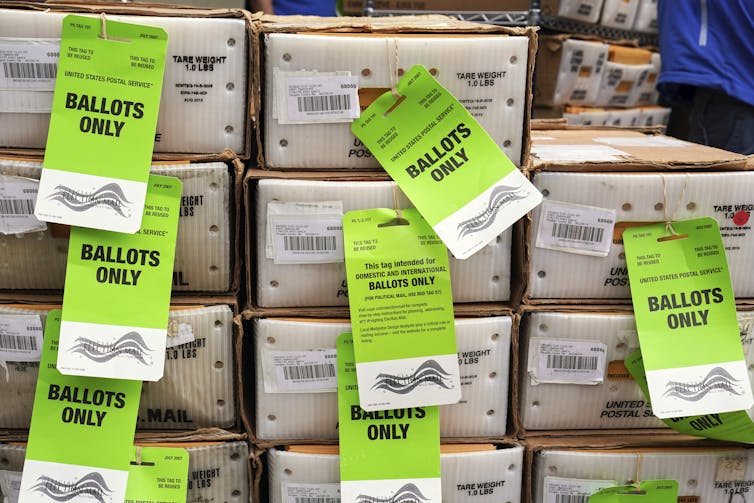
The ultimate question, however, is whether this will change any opinions of US voters. Nearly 90% of voters came into the debate saying their minds were already made up about who they will be voting for. Many voters have, in fact, already submitted their ballots.

But given Trump’s 2016 victory was ultimately reliant on a margin of fewer than 80,000 votes across Michigan, Pennsylvania and Wisconsin, even the smallest of advantages could prove critical in the election.

Initial polling conducted after the debate indicated Biden may have won a slim advantage over Trump. What is much clearer, however, is who lost: US voters.

Trump was combative during the debate, continually interrupting Biden — and the moderator. JIM LO SCALZO/AP

Read more: No mail-in votes, proof of citizenship: the long history of preventing minorities from voting in the US


Timothy J. Lynch, Associate Professor in American Politics, University of Melbourne

The debate reminded me of the absurd denouement to Rocky II. After a bruising encounter, both men are floored. The fighter that gets up first is the winner.

Except with the debate in Cleveland today, neither Trump nor Biden rose from the canvas. Each spent 90 minutes trying to drag the other down.

There were moments when Biden staggered to his feet, looked down the camera lens and called for a return to normalcy. But he kept being pulled back into the scrap by Trump, who was determined to play to his base.

Neither won. Neither lost. On that basis, Biden had the slightly better result. He did not live down to Trump’s caricature of him as a doddering, old man. We know what Trump is — love him or hate him — and saw that again tonight.

Biden’s job was to present a sane alternative. He only partly succeeded.

Ponder how remarkable a scene this was: the most divisive and controversial president in modern American history, who has presided over the deaths of 200,000 Americans from COVID-19 and the eruption of several cities into violent protests, and the only politician deemed capable by the Democrats of removing him is Joe Biden.

The debate reminds us how blessed Trump has been by his opponents. He was facing not a man at the peak of his powers, but a compromise candidate of a deeply divided Democratic party.

Trump scored points by hammering away at the “radical left socialists” that would, he claimed, run the Biden administration. Biden had no killer response to this line of attack.

Swing voters know what Trump is. But doubts about the ideological momentum of a Biden White House endure. The small number of undecided voters may well back the devil they know. If they do, Trump wins.


Read more: The US presidential election might be closer than the polls suggest (if we can trust them this time)


The Biden camp is pinning much on the growing exasperation with Trump — and a basic human desire to feel normal again — to get them over the line.

That strategy just about held together in the first debate. Offered every opportunity to be statesmanlike, Trump kept aiming low. He maintained his notorious authenticity by doing so.

But Americans have had nearly four years of this act. Biden did, imperfectly, make clear there is an alternative style of political discourse on offer. He’s no Rocky Balboa. But, like Rocky, he will get to fight another day.

One of Biden’s strongest moments came when he attacked Trump’s comments about dead US soldiers. JIM LO SCALZO/EPA

Sarah John, Adjunct Professor, College of Business, Government and Law, Flinders University; Project Manager, University of Virginia

After an awkward entrance, devoid of the usual handshake thanks to COVID-19, the first question — about Supreme Court nominee Amy Coney Barrett — launched both candidates into a competition of who could talk loudest over the other.

Trump won and continued to interject so frequently that the few uninterrupted sentences of Biden or Wallace stood out conspicuously.

While the messiness of the debate and the frequent inability of the moderator to control the participants were extreme, they were expected given our experience with Trump in the 2016 debates.


Read more: This is why the fight over the Supreme Court could make the US presidential election even nastier


Less expected was a full 15 minutes dedicated to the legitimacy of the vote count. Because elections in the US are very decentralised, with over 3,000 counties administering a single presidential election, systematic fraud at a national level is unlikely.

In the past, few have questioned certified presidential election results — even in 2000 (and other years) when the popular vote and Electoral College result conflicted.

Trump has turned that on its head.

Perhaps predictably, Biden took the high road: urging people to vote, downplaying concerns about fraud and pledging to accept the result, whatever it may be.

Biden made clear that voting by mail is nothing new, dating back the Civil War. (Indeed, overseas voters have used the federal write-in absentee ballot successfully for decades.)

Trump, on the other hand, raised his grievances about the “crooked” 2016 election, before turning to his favoured line about mail-in ballots.

As is so often the case, Trump’s comments mangled real issues relating to mail-in voting and jumbled it with a lot of speculation and confusion about ballots in creeks or wastepaper baskets.

Trump has repeatedly taken aim at mail-in ballots during the campaign. Nati Harnik/AP

Among the jumble of words, he made reference to one of the issues that does threaten to loom large. In 2016, 1% of absentee ballots that were otherwise correctly marked were rejected for technical reasons, most often because the signature on file with the election administration was not a match with the one on the ballot, or the ballot arrived too late.

In 2020, with a host of first-time vote-by-mail voters, this rate could be higher and even exceed the vote margin between the candidates in some key states. Lawsuits will no doubt follow.

Although Trump’s utterances about a “rigged” election and cheating are worrying, they are unlikely to shift public opinion. So much of what we saw on display today we have heard before, in an even more alarming form, at Trump’s recent rallies.

While we hope for a decisive outcome one way or the other, election officials are bracing themselves.

ref. The first US presidential debate was pure chaos. Here’s what our experts thought – https://theconversation.com/the-first-us-presidential-debate-was-pure-chaos-heres-what-our-experts-thought-147178

Wonnangatta review: Australian theatre writing at its provocative and powerful best

Source: The Conversation (Au and NZ) – By Leigh Boucher, Senior Lecturer – Modern History, Macquarie University

Review: Wonnangatta by Angus Cerini, directed by Jessica Arthur, Sydney Theatre Company

Theatre is back in Sydney after the COVID–induced hiatus decimated the cultural life of the city. Wonnangatta begins with socially distanced seating, temperature checks on arrival and mandated masks for all audience members.

The smaller audience and lack of socialising before the production make for a less joyous return to live theatre than may be expected. But this sets a strangely appropriate tone for Angus Cerini’s gripping new play about murder, revenge and the unsettling power of the Australian bush.

Cerini draws inspiration from events that still circulate in East Gippsland community memory, the Wonnangatta murders: deaths that rocked the region in the summer of 1917/18 and for which there remains no explanation. Like many Australian stories before it, Wonnangatta asks unsettling questions about the relationship between settler Australians and the country they claim to possess.

Cerini rehearses our wonders and fears about these landscapes, and prompts disturbing questions about their power to transform us.

The psychic underbelly

The play opens with two friends standing in spotlight. Disturbing sounds of nocturnal birds and animals echo through the theatre. The sparse set evokes both the texture of eucalyptus bark and the panelling of a bush hut. We are clearly in the psychic underbelly of the settler imaginary – a place where men can easily lose their bearings and come apart at the seams.

Riggall (Wayne Blair) and Harry (Hugo Weaving) have discovered the half buried and mangled body of Harry’s friend, Jim Barclay, at Wonnangatta cattle station. For the next 90 minutes, the audience is gripped by their account of moving through the Victorian high country in an attempt to unravel this mystery.

The men barely move on stage as they speculate about the events that have taken place. A step to the left here or a gaze to the right there indicates their movement around the station, and then on horseback up into the high country. Never before have I noticed the shift of body weight from one foot to another so keenly.

Blair and Weaving yell into the void.
‘Never before have I noticed the shift of body weight from one foot to another so keenly.’ Prudence Upton/Sydney Theatre Company

Blair and Weaving are at the peak of their powers. Blair embodies the anxieties of Riggall in subtle tics and bodily shakes. Weaving’s transformations from grief to anger to fear are shaded by minute changes in bodily comportment and voice; at one point his throat seems to pincer the words as they came out of his mouth.

Indigeneity in the Australian gothic

Wonnangatta is part of a long lineage of gothic Australian stories about the capacity of the wilderness to disturb and unsettle.

This is not the Australian imaginary of heroic exploration, possession and stoic men turning these landscapes into productive wellsprings of settler wealth. These men are in the Victorian high country, “two days ride from anywhere” as Harry repeatedly observes, a place where they might not, in fact, belong.


Read more: Australian Gothic: from Hanging Rock to Nick Cave and Kylie, this genre explores our dark side


There are multiple histories evoked in this story: the Wonnangatta murders, but also the period 50 years before, when “explorers” moved through this country, naming the landscape in ways that recorded their fears and despairs.

As Harry navigates the high country, he recounts the names of the surrounding mountains: Mount Speculation, Mount Buggery, Mount Disappointment. This is an archive of settler unease and distress in the landscape. The feelings precede Harry and Riggall’s journey, and will continue long after it.

Perhaps because the play evoked these explorations, I was left wondering about the casting of Blair as Riggall.

Blair looks straight at the camera, a hand moving into a fist.
Wayne Blair gives a powerful performance, but his Indigeneity is never explored. Prudence Upton/Sydney Theatre Company

The play itself makes no reference to Riggall’s Indigeneity, and, less at home in this landscape than Harry, he is not offered as a counterpoint to settler alienation.

Was this an invocation of these earlier moments when Indigenous guides enabled settler exploration? Alfred Howitt, who named so many of these mountains, depended entirely on this Indigenous knowledge to navigate the high country.

In a play that pivots on questions about settler belonging and possession, it was unclear to me what place was being imagined for Indigeneity in this world.

The power of words

Most importantly, though, this play is a world of words – a world made through their power, their rhythms and their humour. Moving freely between conversation, description, verse and what sounds like free association, Cerini serves a form of Australian-English to his audience like a rich, long meal. There were moments when I gasped from the beauty of his phrases.

A long wooden bridge is illuminated from a black space.
Wonnangatta captures the terror and awe of the Victorian high country. Prudence Upton/Sydney Theatre Company

I’ve walked across the ridge these characters describe, in conditions like those they face. Never have I been able to quite recapture the terror and awe I felt walking across a path of less than a meter wide on loose wet stones, peering down the sharp descent either side into cloud covered gorges below.

Cerini’s poetic cacophony took me back to that terrifying moment – and I suspect others without my first hand experience would be similarly transported.

Released from the limitations of the literal and of realism, Wonnangatta is a welcome reminder of the power of words to affect and unsettle. This is Australian writing at its provocative and powerful best.

Wonnangatta plays at the Roslyn Packer Theatre until October 31.

ref. Wonnangatta review: Australian theatre writing at its provocative and powerful best – https://theconversation.com/wonnangatta-review-australian-theatre-writing-at-its-provocative-and-powerful-best-147184

Do Australians care about unis? They’re now part of our social wage, so they should

Source: The Conversation (Au and NZ) – By Marcus Banks, Social policy and consumer finance researcher, School of Economics, Finance and Marketing, RMIT University

In 1988, then federal education minister, John Dawkins, drew upon the politics of class privilege to justify rolling out HECS student loans. A university user-pays system was needed, he argued, because Labor was not in the business of funding “middle-class welfare”. At the time, one reason a neoliberal appeal by Labor to its base could deflate widespread public opposition was that just 7% of working-age Australians held a degree.

Three decades on, Education Minister Dan Tehan is also dog-whistling up the politics of class to cut off the loans system to first-year students who fail half their subjects, ramp up fees for many others, deny JobKeeper to workers in the sector and cut funding.


Read more: The government would save $1 billion a year with proposed university reforms — but that’s not what it’s telling us


Portrait of John Dawkins
Today 33% of working-age Australians have a degree, a big jump from 7% in the time of John Dawkins. National Archives of Australia/AAP

Dawkins’s representation of the policy problem framed higher education as a bastion of privilege. It relied on the relative absence of working-class students and the irrelevance of higher education to their parents.

For Tehan the problem is represented by these students’ overabundance — particularly in courses that do not produce workers with the specific technical skills he claims are in demand by employers. Tehan’s call to rid the system of failing students is couched in paternalism, a hallmark of the welfare system.

Agenda predates COVID

On the surface, a small cohort of students mostly from low socioeconomic backgrounds appear to be the target. Politically, however, it neatly links with the government’s broader restructuring agenda across the campuses. For higher education students and staff alike, it epitomises what the National Union of Students (NUS) president has called a neoliberal way to “incentivise success through fear of punishment”.

The restructuring goes well beyond the crisis triggered by the COVID-19 pandemic. An explosion of casual employee networks across the country and a recent national assembly of nearly 500 academics voting to build towards unprotected industrial action have boosted campaigning by the National Tertiary Education Union (NTEU) and NUS against the current cuts and broader restructuring agenda.


Read more: As universities face losing 1 in 10 staff, COVID-driven cuts create 4 key risks


What has changed since 1988?

There are optimistic grounds for thinking that broader societal support is now more likely than in 1988 for this defence of universities as a freely accessible public good.

In May 2019, a third of the working-age population (20-64 years) held at least a bachelor degree. That’s almost five times more than in 1988. And nearly two-thirds of this group had a degree, diploma or post-school certificate.

Some 46% of women and 35% of men between the ages of 25 and 34 have a degree. Soon most women in this key working-age cohort will be university graduates, alongside a significant proportion of men.

graph showing increases of women, men and all Australians holding at least a bachelor degree from 1988 to 2019
Data: ABS

Social wage has widened

This mainstreaming of university education means the sector joins health and welfare as a core part of the social wage. Australian government spending on keeping the workforce skilled, fit and able to work accounted for more than 60% of its 2019-20 budget. Health-care spending, whether provided by employers (such as US insurance schemes) or more commonly via the state, is in reality part of our wages whether it is paid in cash or kind or goes to workers collectively rather than individually.

The social wage came to prominence in the 1980s as a key part of the Prices and Incomes Accord. The Labor government reached agreement with trade unions and employers that they would trade off wage increases for better social security benefits and progressive education and health reforms. Political economist Elizabeth Humphrys has explained how these trade-offs strengthened the hold of neoliberalism and weakened trade unions.


Read more: Australian politics explainer: the Prices and Incomes Accord


The social wage is the collective part of our overall wages. This understanding provides broad-based, industrial grounds to defend its provision.

Just as it has been unfortunately shown that wage cuts are not stopping job cuts in the university sector, cuts to our social wage are also not in our collective self-interest.

For example, we need to loudly call out that the framing of social security payments as handouts for the poor is a cynical attempt to cultivate “them and us” divisions. In reality, between 2001 and 2015, over 70% of Australian working-age households required income support at some stage. These payments helped smooth the financial risks of unemployment, low wages, caring responsibilities, injury, frailty or disability.

Arguments for the JobSeeker supplement to be kept after the pandemic – such as by the Raise the Rate campaign – are gaining widespread traction.


Read more: Unemployment support will be slashed by $300 this week. This won’t help people find work


A similar basis of mass support exists for campaigns to have equitable, accessible and quality higher education. Secondary school students and their parents, casualised and ongoing staff and the wider trade union movement all have a stake in rejecting the current round of university cuts and restructuring. Higher education is now firmly part of our social wage, and we must defend it.

ref. Do Australians care about unis? They’re now part of our social wage, so they should – https://theconversation.com/do-australians-care-about-unis-theyre-now-part-of-our-social-wage-so-they-should-144798

Internet sabbaths and surveillance capitalism in the COVID-19 era: William Powers on what’s changed since Hamlet’s Blackberry

Source: The Conversation (Au and NZ) – By Matthew Ricketson, Professor of Communication, Deakin University

COVID-19 has affected our relationship with technology in many ways, from the pleasures of mass online choirs to the perils of the endless Zoom meetings rendering us “zoombies”.

Connectivity is so hard-wired in our lives, many are re-assessing the virtues of being disconnected.

Ten years ago, US journalist William Powers published Hamlet’s BlackBerry: Building a Good Life in the Digital Age, a book that urged us to take an “internet sabbath” every now and again.

US author William Powers.
US author William Powers. https://www.williampowers.com/

It was a prescient idea even if the book’s title sounds rather retro now, but there was a reason for his choice, as he explains today on Media Files.

Powers is a journalist who used to work at The Washington Post and is now an online technology consultant, and he joined me by Zoom from his home in Cape Cod in Massachusetts.


Read more: ‘Suck it and see’ or face a digital tax, former ACCC boss Allan Fels warns Google and Facebook


Additional credits

Theme music: Susie Wilkins.

With thanks to Chris Scanlon from Deakin University for production assistance.

Image

Shutterstock

ref. Internet sabbaths and surveillance capitalism in the COVID-19 era: William Powers on what’s changed since Hamlet’s Blackberry – https://theconversation.com/internet-sabbaths-and-surveillance-capitalism-in-the-covid-19-era-william-powers-on-whats-changed-since-hamlets-blackberry-146100

Assisted dying referendum: people at the end of their lives say it offers a ‘good death’

Source: The Conversation (Au and NZ) – By Jessica Young, PhD Candidate in Medical Sociology, University of Otago

According to the latest 1 News Colmar Brunton poll, almost two-thirds of New Zealanders are planning to vote yes in the upcoming referendum on assisted dying.

Our research shows this number aligns with the past 20 years of polling, which suggests stable support for the idea.

The referendum, to be held at the general election on October 17, will decide whether the End of Life Choice Act 2019 comes into force.

The act authorises a doctor to administer or prescribe a lethal dose of medication to competent adults suffering unbearably from a terminal illness that would likely end their life within six months — as long as they request it directly and voluntarily.

A person will not be eligible if their only reason is that they have a mental illness or a disability of any kind, or are of advanced age. Overall, the Act has more than 45 safeguards that must be met.

Understandably, discussions about assisted dying produce strong reactions. Evidence-based information is essential and we must sort fact from fiction, particularly about any hypothetical social consequences of the legalisation.


Read more: One year of voluntary assisted dying in Victoria: 400 have registered, despite obstacles


Having the option of assisted dying available if they needed it appealed to the terminally ill participants in my doctoral research. Assisted dying guaranteed what they understood as a good death, including being able to choose the timing and way they died.

Participants also felt dying would be difficult for their families if it took too long and they themselves would know best the right time for them to die. They felt medicine and religion shouldn’t get to decide what’s right for society as they didn’t know what it was like to approach the end of life. They saw the tight controls on assisted dying as a good thing and wanted it to be safe for everyone.

Coercion or consent?

The latest and largest review of international research on assisted dying, carried out by highly respected researchers in this field (including those who oppose it), concluded: “Existing data do not indicate widespread abuse of these practices.”

Evidence from the Netherlands and the US state of Oregon, where assisted dying is legal, shows concerns it would disproportionately affect people from vulnerable groups are unfounded. Instead, those who access assisted dying appear to be economically and socially privileged.

Of course, the health system is by no means perfect. Its problems include inequitable access, systemic racism and ableism. But denying dying people the right to choose is not going to change those disparities.

We can let terminally ill people make choices about how and when they die as well as advocate for a system that doesn’t force those choices on others.


Read more: In places where it’s legal, how many people are ending their lives using euthanasia?


Providing robust safeguards in legislation deals with the concerns about vulnerable groups. The New Zealand law requires two (or even three) independent doctors to confirm the request is genuinely voluntary and informed. They also have to speak to the person over a number of sessions to ensure the patient’s decision is unwavering. If any pressure is suspected at any stage, the doctor must stop the process immediately and report it to the Registrar Assisted Dying.

Although there is scepticism about whether everybody would comply with safeguards, there is equally a concern about decisions to withdraw life-sustaining interventions or administer pain relief that may hasten death. These are just as susceptible to abuse as assisted dying, but are already lawful. Dying people prefer a quick death to a long, drawn-out or violent death.

In fact, 5.6% of New Zealand’s general practitioners (and nurses under their instruction) who responded to an international standardised survey admit they are intentionally hastening death regardless of the legality, and not always with patients’ consent. These findings should be interpreted alongside research that suggests one-third of New Zealand doctors may not honestly answer questions about assisted dying.

It is safer to bring the practice of hastening death out into the open so doctors who are willing to administer an assisted death can be regulated and monitored and patients can give informed consent.

Contagion or conversation?

Some have suggested a contagion effect if assisted dying is legalised. As we have slowly learned with suicide, talking about suicide is more likely to prevent it. An in-depth study in the Netherlands similarly concluded that talking about euthanasia prevents euthanasia most of the time.

Legalised assisted dying will open up conversations about what people want at the end of life as it has done in other jurisdictions.

In terms of New Zealand evidence, the world-renowned longitudinal study of 987 25-year-olds found they distinguish between suicide and euthanasia. If 25-year-olds can see the difference, surely others can too?

Those bereaved by assisted dying witness less suffering and the impact on them is similar or no worse than other deaths.

If people vote for this law to come into force, there will be fewer suicides because terminally ill New Zealanders are sadly taking their own lives.

If assisted dying is legalised, dying people will experience less suffering at the end of life; there won’t be more deaths because the only people eligible are already dying.

As a dying person said to me in an interview for my research:

I think that there’s a profound principle in there somewhere, that people ought to have some, some way of saying this is long enough.

The views of people approaching the end of life are startlingly absent from the debate about legalisation. This is a rare opportunity to have input into passing a compassionate piece of law on their behalf.

ref. Assisted dying referendum: people at the end of their lives say it offers a ‘good death’ – https://theconversation.com/assisted-dying-referendum-people-at-the-end-of-their-lives-say-it-offers-a-good-death-144112

How to reduce COVID-19 risk at the beach or the pool

Source: The Conversation (Au and NZ) – By Brett Mitchell, Professor of Nursing, University of Newcastle

Australians are emerging from winter and, where possible, enjoying trips to beaches and public pools. Beach-side picnics, barbecues and get-togethers are back on the cards for many of us.

While daily COVID-19 case numbers have been looking promising in most places lately, we are still very much in a pandemic; your spring and summertime social activities might look a little different this year.

Here’s how to stay safe if you’re planning a trip to the beach or public pool.


Read more: Heading back to the gym? Here’s how you can protect yourself and others from coronavirus infection


A person swims laps in a pool.
Your spring and summertime social activities might look a little different his year. Shutterstock

The three golden rules

Outdoor activities are associated with reduced COVID-19 transmission risk compared to indoor activities. That said, whatever your plans, the three golden rules still apply: stay home if you are sick, keep up the hand hygiene and maintain physical distancing from others.

If you’re sick, you shouldn’t be socialising at all. You should be getting a COVID-19 test and self-isolating while you wait for results. Even outdoors, one sick person can spread COVID-19 to a large number of people.

Going to the beach

Firstly, pick a quieter beach. The extra time it takes to research and travel to a more secluded beach may be a hassle, but it’s less risky than going to a crowded beach (and often nicer, too).

Consider driving or cycling to the beach (if possible) rather than taking public transport. If you do use public transport, pick an off-peak time of day and wear a mask — avoid rush hour.

When you arrive, put your towels down in a spot on the sand at least 1.5m away from others — more is better, if you can. You should still swim between the flags, but you don’t need to be sitting close to other people.

An aerial shot of an ocean pool.
Pick a quieter swim spot or go at a less busy time. Shutterstock

When swimming between the flags, it might feel crowded in the water during busy times or at busy beaches. If you are in that situation, think about reducing the time spent in the water — go in for five minutes, then come out for a bit, then go back in for another five, so you are not having prolonged contact next to another person.

If you see someone expelling mucus into a wave, try to avoid that wave and person if you can.

Remember to stay COVID-safe if you’re at a cafe for a post-swim snack or ice-block. Don’t bunch up in lines close to other people and maintain physical distance from others if you are sitting down for a meal.

In the past, it might have felt normal to share a plate of hot chips with mates or even offer a friend a sip of your drink — but we don’t do that anymore. If you’re having a beach-side picnic, make sure you’re not sharing utensils, double-dipping in the hummus or sticking your fingers into a shared bowl of olives.

Of course, all these general principles also apply to other outdoor swimming locations, such as rivers and dams.

People maintain social distance while at a beach picnic.
Maintain physical distance at your beach-side picnics. AAP/RICHARD WAINWRIGHT

Going to the pool

The ocean is probably less risky than going to the pool, because there’s more movement of water and a high level of dilution.

So you need to approach public pools with a degree of caution.

But if you have no choice, are living away from the coast and want a swim, it’s probably fine to go to an outdoor pool — especially if you are living in an area with a low level of community transmission. You can find out community transmission rates in your area from your state health department website.

Outdoor pools are less risky than indoor pools because of increased air flow. Confined spaces are associated with increased risk of COVID-19 transmission.

An outdoor pool in Sydney.
Outdoor pools are less risky than indoor pools, Shutterstock

Choose the right time to go a pool. Transmission risk decreases with fewer people, so try to go at less busy times. In the morning, the pool water has likely had time to be well-filtered and well-chlorinated overnight and not many people have swum in it yet that day.

Chlorine kills coronavirus. The CDC says it is

not aware of any scientific reports of the virus that causes COVID-19 spreading to people through the water in pools, hot tubs, or water playgrounds […] including saltwater pools.

The risk of transmission, albeit potentially low, would also depend on how chlorinated the pool is and how long any coronavirus that may be in the water is exposed to chlorine before coming into contact with another person.

Theoretically, if someone is carrying the virus and some mucus goes out of their mouth and into the pool, there might be a certain period of time before any virus in that mucus is inactivated by the chlorine. If it gets to you before that inactivation happens, then it is possibly a bit more risky.

People swim at a pool in Sydney.
Whatever you have planned this summer, think about the local risks and what you can do to reduce them. Shutterstock

Avoiding the change-rooms is another way to reduce risk, as these rooms are often in a confined space. Being careful to maintain physical distancing in the pool, poolside and at the cafe are also important measures.

In general, it should be fine to take the kids to the pool but, if there was a degree of community transmission in your area, perhaps reconsider. There is growing evidence kids are less susceptible to COVID-19 compared to adults but it doesn’t necessarily mean they are not transmitting it.

Whatever you have planned this summer, think about the local risks and what you can do to reduce them.


Read more: As coronavirus restrictions ease, here’s how you can navigate public transport as safely as possible


ref. How to reduce COVID-19 risk at the beach or the pool – https://theconversation.com/how-to-reduce-covid-19-risk-at-the-beach-or-the-pool-147088

Curious Kids: could our entire reality be part of a simulation created by some other beings?

Source: The Conversation (Au and NZ) – By Sam Baron, Associate professor, Australian Catholic University

Is it possible the whole observable universe is just a thing kept in a container, in a room where there are some other extraterrestrial beings much bigger than us? Kanishk, Year 9

Hi Kanishk!

I’m going to interpret your question in a slightly different way.

Let’s assume these extraterrestrial beings have a computer on which our universe is being “simulated”. Simulated worlds are pretend worlds – a bit like the worlds on Minecraft or Fortnite, which are both simulations created by us.

If we think about it like this, it also helps to suppose these “beings” are similar to us. They’d have to at least understand us to be able to simulate us.

By narrowing the question down, we’re now asking: is it possible we’re living in a computer simulation run by beings like us? University of Oxford professor Nick Bostrom has thought a lot about this exact question. And he argues the answer is “yes”.

Not only does Bostrom think it’s possible, he thinks there’s a decent probability it’s true. Bostrom’s theory is known as the Simulation Hypothesis.

A simulated world that feels real

I want you to imagine there are many civilisations like ours dotted all around the universe. Also imagine many of these civilisations have developed advanced technology that lets them create computer simulations of a time in their own past (a time before they developed the technology).

Do you think our whole world could be created by someone using more advanced technology than we have today? Yash Raut/Unsplash

The people in these simulations are just like us. They are conscious (aware) beings who can touch, taste, move, smell and feel happiness and sadness. However, they have no way of proving they’re in a simulation and no way to “break out”.


Read more: Curious Kids: is time travel possible for humans?


Hedge your bets

According to Bostrom, if these simulated people (who are so much like us) don’t realise they’re in a simulation, then it’s possible you and I are too.

Suppose I guess we’re not in a simulation and you guess we are. Who guessed best?

Let’s say there is just one “real” past. But these futuristic beings are also running many simulations of the past — different versions they made up.

They could be running any number of simulations (it doesn’t change the point Bostrom is trying to make) — but let’s go with 200,000. Our guessing-game then is a bit like rolling a die with 200,000 sides.

When I guess we are not simulated, I’m betting the die will be a specific number (let’s make it 2), because there can only be one possible reality in which we’re not simulated.

This means in every other scenario we are simulated, which is what you guessed. That’s like betting the die will roll anything other than 2. So your bet is a far better one.

Simulated or not simulated, would you bet on it? Ian Gonzalez/Unsplash

Are we simulated?

Does that mean we’re simulated? Not quite.

The odds are only against my guess if we assuming these beings exist and are running simulations.

But, how likely is it there are beings so advanced they can run simulations with people who are “conscious” like us in the first place? Suppose this is very unlikely. Then it would also be unlikely our world is simulated.

Second, how likely is it such beings would run simulations even if they could? Maybe they have no interest in doing this. This, too, would mean it’s unlikely we are simulated.

Laying out all our options

Before us, then, are three possibilities:

  1. there are technologically advanced beings who can (and do) run many simulations of people like us (likely including us)

  2. there are technologically advanced beings who can run simulations of people like us, but don’t do this for whatever reason

  3. there are no beings technologically advanced enough to run simulations of people like us.

But are these really the only options available? The answer seems to be “yes”.

You might disagree by bringing up one of several theories suggesting our universe is not a simulation. For example, what if we’re all here because of the Big Bang (as science suggests), rather than by a simulation?

That’s a good point, but it actually fits within the Simulation Hypothesis, under option 1 — in which we’re not simulated. It doesn’t go against it. This is why the theory leaves us with only three options, one of which then must be true.

So which is it? Sadly, we don’t have enough evidence to help us decide.


Read more: Curious Kids: what started the Big Bang?


The principle of indifference

When we’re faced with a set of options and there is not enough evidence to believe one over the others, we should give an equal “credence” to each option. Generally speaking, credence is how likely you believe something to be true based on the evidence available.

Giving equal credence in cases such as the Simulation Hypothesis is an example of what philosophers call the “principle of indifference”.

Suppose you place a cookie on your desk and leave the room. When you come back, it’s gone. In the room with you were three people, all of which are strangers to you.

You have to start by piecing together what you know. You know someone in the room took the cookie. If you knew person A had been caught stealing cookies in the past, you could guess it was probably them. But on this occasion, you don’t know anything about these people.

Would it be fair to accuse anyone in particular? No.

Our universe, expanding

And so it is with the simulation argument. We don’t have enough information to help us select between the three options.

What we do know is if option 1 is true, then we’re very likely to be in a simulation. In options 2 and 3, we’re not. Thus, Bostrom’s argument seems to imply our credence of being simulated is roughly 1 in 3.

To put this into perspective, your credence in getting “heads” when you flip a coin should be 1 in 2. And your credence in winning the largest lottery in the world should be around 1 in 300,000,000 (if you believe it isn’t rigged).

If that makes you a little nervous, it’s worth remembering we might make discoveries in the future that could change our credences. What that information might be and how we might discover it, however, remains unknown.

Famous astrophysicist Neil deGrasse Tyson has said it’s “hard to argue against” Bostrum’s Simulation Hypothesis.

ref. Curious Kids: could our entire reality be part of a simulation created by some other beings? – https://theconversation.com/curious-kids-could-our-entire-reality-be-part-of-a-simulation-created-by-some-other-beings-146840

Have our governments become too powerful during COVID-19?

Source: The Conversation (Au and NZ) – By Yee-Fui Ng, Senior Lecturer, Faculty of Law, Monash University

In the fight against the coronavirus, the Australian government has enacted a series of measures that have expanded executive powers. These include the use of smartphone contact-tracing technology, mandatory isolation arrangements and the closure of borders and businesses.

While Australians seem broadly supportive of this type of government control in times of crisis, critics have expressed concerns about the long-term implications of these measures for individual rights.

There are a few salient questions: how does executive power accelerate during a pandemic — and why is this a cause for concern? And what type of oversight of executive power should there be in a democracy?

What is executive power and how does it work in a crisis?

The government of the day exercises executive power to implement programs and policies. Our democratic system dictates that the use of executive power is checked by the other two branches of government: the judiciary and legislature.

But in exceptional times of disaster and crisis, the executive government tends to take a pre-eminent role. Under our biosecurity and public health laws, governments can declare states of emergency and disaster, which give them significant coercive powers.

As crises such as pandemics, disasters or wars threaten the very existence of the nation, the rationale is the government needs these enhanced powers to protect the people.

By contrast, the parliament and courts tend to stand on the sidelines and reduce their scrutiny of these powers.


Read more: Explainer: what are the Australian government’s powers to quarantine people in a coronavirus outbreak?


How has executive power been used in the COVID pandemic?

During the COVID-19 pandemic, we have seen an expansion of executive power at both the federal and state levels.

The federal Biosecurity Act has been used to impose overseas travel bans (including a cap on the number of returning travellers per week), restricted travel and other emergency procedures for remote communities, and enforced quarantine of returning travellers.

The government also has the power to detain and isolate people who are suspected of being infected with the virus.

State public health laws have also been used to imposed a range of coercive measures, such as mandatory quarantine, compulsory wearing of face masks, restrictions on people’s movements and gatherings, the closure of businesses and border closures between states.

Police in Melbourne on patrol for violators of mask and gathering rules. James Ross/AAP

How has parliament reacted during the crisis?

Alongside the expansion of executive power has been a decline in parliamentary scrutiny. The federal and state parliaments have been recessed for long periods during the pandemic. As a result, they are not scrutinising government action to the extent they should.

Even when parliament convenes during the pandemic, it passes legislation hastily without much scrutiny. For example, the COVIDSafe contact-tracing legislation was rushed through parliament in three days, despite significant privacy concerns.


Read more: Expanding Victoria’s police powers without robust, independent oversight is a dangerous idea


Another issue is parliament has delegated powers to the government to make major decisions by ministerial decree — both during and outside of a public emergency. This further increases executive power. The Centre for Public Integrity estimates such decisions have doubled in the past 30 years.

Parliamentary committee action has also been limited during the pandemic. At the federal level, the Parliamentary Select Committee on COVID-19 and Senate Standing Committee for the Scrutiny of Delegated Legislation were set up to scrutinise government decisions and delegated legislation during COVID-19.
However, 19.1% of the government decisions and actions made since the beginning of the crisis are immune from parliamentary scrutiny.

This means parliament cannot veto these government decisions, unlike normal delegated legislation.

Why should we worry about expanding executive powers?

The increase of executive power raises several issues.

State police, aided by the Australian Defence Force, have enforced restrictions on individual movement and assembly. There are concerns the police and military have at times implemented these restrictions in a heavy-handed way.

For example, in New South Wales, a man was fined $1,000 for eating a pizza alone in his car on the way home after being laid off from his job.

Police also threatened to fine two women walking in a park with babies for violating the two-person gathering rule. The attorney-general later clarified that babies were not counted under the rule.

Police have been accused of using excessive force in breaking up some anti-lockdown protests. AAP

Also, research of wartime laws has shown some supposedly “temporary” coercive measures have persisted long beyond a time of crisis and become permanent.

For example, the current Crimes Act has replicated unlawful associations provisions from the first world war.

And Australia’s national security laws have exponentially increased in the years since the terror attacks of September 11 2001. Governments have strategically deployed these sweeping executive powers to punish protesters, journalists and whistleblowers.

Thus, executive powers need to be closely monitored to ensure they are rolled back after a crisis.


Read more: COVID-19, risk and rights: the ‘wicked’ balancing act for governments


What sort of oversight of executive power should there be?

So, how can we enhance government accountability in a pandemic?

In the midst of a pressing national crisis, legislative safeguards are required to protect individual rights and freedoms.

All legislation enacted during the crisis should automatically expire or be periodically reviewed. All delegated legislation should also have an automatic expiry date and be of short duration. This is not universal practice for all laws made during this pandemic.

All coercive powers under emergency health laws, such as the detention of those suspected of having COVID-19, should be subject to both court and tribunal review to allow for adequate legal scrutiny of government actions.

And both parliament and the courts should carefully police the executive’s use of its extensive powers during the pandemic.

Parliament needs to scrutinise the government’s actions during the pandemic much more closely. Lukas Coch/AAP

More broadly, given the quiescence of parliament and the courts in times of crisis, further independent oversight in the form of a federal anti-corruption watchdog is essential.

In the heat of a crisis, the vast expansion of executive powers — coupled with a sophisticated regulatory state that has the capacity to closely monitor and police its citizens — generates great risks for individual rights and liberties.

We need to be vigilant to ensure these powers are not abused and are rolled back at the end of the crisis.

ref. Have our governments become too powerful during COVID-19? – https://theconversation.com/have-our-governments-become-too-powerful-during-covid-19-147028

The budget must address aged care — here are 3 key priorities

Source: The Conversation (Au and NZ) – By Stephen Duckett, Director, Health Program, Grattan Institute

Australia’s aged care system has produced a litany of failures: unpalatable food, poor care, neglect, abuse and, most recently, the tragedies of the pandemic.

This should not come as a surprise. Poor regulation has taken the “nursing” out of “nursing homes” and allowed care funding to leach into provider profits. Older Australians have been pushed out of sight and out of mind. The result is an aged care system that is underfunded, poorly regulated, and often unable to give older Australians the support they need to live meaningful lives.

More money is necessary but not sufficient. The aged care system needs to be redesigned, throwing out the current market-driven, provider-centric approach.

The 2020-21 federal budget, to be unveiled October 6, should include an aged-care trifecta: expansion in home care, greater transparency, and a rescue package. The ultimate goal should be a dramatically different aged care system which is more attuned to supporting the rights of older Australians.


Read more: Our ailing aged care system shows you can’t skimp on nursing care


1. A right to home support

The vast majority of older Australians who need care and support want to receive it at home, yet the system cannot deliver. Instead, older Australians face unacceptably long waiting times.

This means people who need support are left with limited choices. About 100,000 people are currently waiting for a home-care package, often for more than a year. They regularly end up in residential care. A new aged care system should create a right to home care.

An elderly person in their home being helped by a nurse
Many elderly people who need care would prefer to receive it at home, but lengthy wait times often force them into residential aged care. Shutterstock

A senior official of the Commonwealth Department of Health estimated the cost of meeting the backlog for home care at $2 billion to $2.5 billion a year, in evidence before the Royal Commission on Aged Care.

But more money for home care isn’t sensible without reforming how it’s used. Administrative costs are far too high, and much of the funding allocated for home care has not been used because people didn’t need all the money allocated to them.

While the expansion of home care is being phased in, government should work on system redesign so the new arrangements can be individually tailored to the needs of the older person. The estimated $1 billion allocated but not spent can be used on actual service delivery.


Read more: As home care packages become big business, older people are not getting the personalised support they need


Access to packages should be dramatically streamlined so people get the care they need much more quickly. Administrative costs should be reduced, and the maximum amount of care hours able to be provided in the highest level home care package should be increased. This would enable more people to stay at home rather than be admitted to residential care.

Improved accreditation of home-care providers should also weed out high-cost, low-value providers, so older people and taxpayers get better value for money.

2. Increase transparency and accountability

The current aged care system uses the language of the market and choice. In practice, providers have much more information, control, and influence than consumers. In residential care, a veil of secrecy makes it very difficult for consumers to make judgements about key quality variables such as staffing levels.

Research for the Royal Commission applied a United States’ ranking system to Australian residential aged care facilities and showed only a minority of aged care providers have staffing levels at three stars or above in a five-star rating system.

Australia does not have such a ranking system so potential consumers are not let into the secret of who is good and who is not. Nor does high profit necessarily equate to high quality.

A sign saying the Royal Commission into Aged Care Quality and Safety
If the United States’ five-star aged care rating system was applied here, over 50% of Australian providers would rate just one or two stars. Kelly Barnes/AAP

Consumers need much better information about quality and outcomes so they can choose which services to use. The protection racket that has stopped older people learning about the performance of home-care and residential care providers needs to end.

3. A rescue package for residential aged care

The pandemic has highlighted the fatal flaw in residential aged care regulation —no one is accountable for ensuring there are enough qualified staff to look after residents.

Research for the Royal Commission has identified 11% of aged care facilities are of really poor standard — more complaints, failing standards more often, and poorer clinical outcomes. Residents in these facilities deserve better.

The federal government should set up a $1 billion rescue fund to lift the standards in these low-performing facilities. The government should require those facilities to produce a recovery plan by December 31 2020 outlining how they propose to get there by the middle of next year.

The rescue fund should be used to make sure the plans are implemented. Access to the fund should be tightly scrutinised so the money goes to upgrading staffing, and not to greater profits for wealthy owners.

If providers can’t implement their rescue plan successfully, they should transfer management to a group that can. Over the next 12 months, a new funding and regulatory system should be designed to ensure facilities providing such poor care can’t continue to operate.

ref. The budget must address aged care — here are 3 key priorities – https://theconversation.com/the-budget-must-address-aged-care-here-are-3-key-priorities-146678

Spring is here and wattles are out in bloom: a love letter to our iconic flowers

Source: The Conversation (Au and NZ) – By Gregory Moore, Doctor of Botany, University of Melbourne

Spring has arrived, and all over the country the hills and riversides are burnished with the green and gold of Australian wattles, all belonging to the genus Acacia.

It’s a spectacular sight, but not a surprising one as there are about 1,000 Australian species in the Acacia genus ranging from very small shrubs to tall, longed-lived trees. They occur in ecosystems from the arid inland to the wet forests of the east coast.


Read more: Tree ferns are older than dinosaurs. And that’s not even the most interesting thing about them


Wattles have been widely used by Indigenous people for millenia, and celebrated by “Wattle Day” on September 1 for more than a century.

But their lineage may be much older. Australian wattles have relatives in Africa, South America, India and parts of Southeast Asia. This distribution suggests the wattles may have originated in Gondwana before the super-continent fragmented about 180 million years ago.

So let’s take a closer look at what makes these iconic flowers so special.

Wattle on a cloudy day
Wattle can always brighten a dreary day. Shutterstock

Don’t blame wattles for your hay fever

Not everyone welcomes the wattles’ golden blooms — many blame wattle pollen for their hay fever or asthma.

However, many species of wattle have aggregated pollen, which means it’s very heavy and tends to fall straight to ground. You have to be virtually under the plant for it to affect you.

They can cause trouble, but it’s more likely your allergy is due to some other inconspicuous plant, such as grass, that you haven’t noticed compared to the bright yellow of the wattles. It’s worth having an allergy test.


Read more: How to manage grass pollen exposure this hay fever season: an expert guide


While a majority of wattles flower in spring and summer, a significant group — such as the sunshine wattle (A. botrycephala), Gawler Range wattle (A. iteaphylla) and flax wattle (A linifolia) — flowers in autumn and winter. This can give the impression in some places that they’re flowering year-round.

What’s more, many species are hardy, and they can help in the process of taking nitrogen from the air and adding to the soil. That means they can be very handy in ancient, nutrient-poor Australian soils.

A mulga in the Australian desert
Mulga grows over about 20% of our continent. Mark Marathon/Wikimedia, CC BY-SA

Many of the smaller shrub wattles may live for only a decade or so, but some, such as mulga (Acacia aneura) can live for centuries and are crucial to the viability and stability of arid inland ecosystems. They can have surprisingly large and deep root systems for such small shrubs or trees. This is to obtain water, but also binds the soil.

However, mulga-munching horses, cattle and other feral grazers threaten the persistence of mulga-dominated communities. If mulga and other inland Acacia species are lost, the soils can become loose and mobile, which results in stable productive land becoming desert.

By any other name

In the early 2000s, there was fierce debate among plant taxonomists about how closely the African and Australian species were related.

The name “Acacia” rightly belonged to the African group, but because there were so many Australian species that would need to be renamed, Australia was allowed to keep the name “Acacia” in 2011 — much to the chagrin of foreign taxonomists.

This resulted in the genus being divided. Australian wattles stayed as Acacia, but African wattles are now in the genera Vachellia or Senegalia, and those from the middle Americas (around Mexico) are Acaciella and Mariosousa.

The different names reflect long, separate histories and different ecological characteristics. (The name changes rankle still with taxonomists!)

Close-up of black wattle flowers
Black wattle is a pest overseas. Shutterstock

There are also weedy wattles in Australia and elsewhere. Many of us know from hard experience that the splendid ornamental tree, Cootamundra wattle (Acacia baileyiana), can become a weed if it grows outside its very restricted natural range in New South Wales. And Australia’s black wattle (A. mearnsii) is a significant weed in other parts of the world.

It can come as a bit of a blow to know Australia’s floral emblem, golden wattle (A. pycnantha), can be weedy both at home and when it travels abroad (perhaps like some Australians).


Read more: The black wattle is a boon for Australians (and a pest everywhere else)


Interestingly, most of the Australian wattles lack thorns, unlike their relatives in Africa. In Africa, thorns protect the plants from large mammalian grazers such as giraffes.

Ants love wattles, too

If you don’t like ants, it might be worth checking which species of wattle you have in your backyard, or intend to buy.

Many wattles have a very special relationship with some insects. In Central America, ants penetrate the thorns of Bulls Horn wattle trees and establish their colonies. They then defend the tree against other insects, and if branches of another tree touch the host tree, the ants will cause such damage that the other tree will die back.

There are more than 1,000 species of wattle in the Acacia genus. Shutterstock

In Australia, the relationship between ants and wattles is based on food. The hard wattle seeds have a tasty and oil-rich outgrowth called an “aril”, which is irresistible to some ant species.

The ants harvest the seeds and take them back to their nest, where they’re safe from other hungry grazers until it is damaged by fire or flood and the seeds germinate.


Read more: Why tiny ants have invaded your house, and what to do about it


Some wattles, the mulga among them, have little glands at the base of their phyllodes (the modified leaf stalks). These glands secrete a form of sugary syrup that attracts feeding ants. These ants may also protect host trees or perhaps leave the flowers alone to allow a greater seed set to grow.

It’s clear wattles have a lot going for them. They are diverse in number, habit, size, longevity and flowering season — there’s a wattle for every occasion. For all of these great traits, it’s still that green and gold that endears them to Australians.

ref. Spring is here and wattles are out in bloom: a love letter to our iconic flowers – https://theconversation.com/spring-is-here-and-wattles-are-out-in-bloom-a-love-letter-to-our-iconic-flowers-146109

A place to get away from it all: 5 ways school libraries support student well-being

Source: The Conversation (Au and NZ) – By Margaret Kristin Merga, Senior Lecturer in Education, Edith Cowan University

Students in Australia and around the world have experienced significant challenges this year, including the COVID-19 pandemic and natural disasters.

Globally, as many as one in five young people may experience mental-health problems. These can be exacerbated, or even brought on by, stressful life events including economic pressures related to the pandemic.

We know teacher librarians and school libraries play an important role in supporting young people’s reading and broader academic achievement. But school libraries play a more diverse role in students’ lives, among which is to support their well-being.

Here are five ways they do this.

1. They can be safe spaces

Creating a positive, safe and supportive school environment can help schools meet young people’s academic, emotional and social needs.

Whether students are victims of bullying or simply feel like they don’t fit in, school libraries can provide safe spaces in sometimes challenging school environments. In some schools, the library is the only space intentionally created as a refuge for young people.

Both the library as a whole, and spaces in it, can be adapted to be comforting sanctuaries. A quiet space with comfortable furniture can make the library a place to “get away from it all”.

Boy sitting cross legged on round stool in library and reading.
A school library is a quiet sanctuary. Shutterstock

In recent times the school library has been expected to cater to a growing array of diverse purposes such as sports equipment storage and meeting venues, perhaps challenging its ability to be a safe space. It’s important for schools to ensure, within these demands, students still have a special spot to come to for refuge.

2. They provide resources for well-being

When students are experiencing health and other well-being issues, libraries can have valuable resources to help them understand what they are going through and where to get help. School libraries can also potentially provide valuable health resources to the broader community.


Read more: Why every teacher needs to know about childhood trauma


Teacher librarians curate resources (and weed out irrelevant ones) to ensure students get current, quality information. Library staff may also work with teachers and school psychologists to ensure the school community is well resourced for meeting young people’s needs.

3. They help build digital health-literacy skills

The World Health Organisation has emphasised the importance of health literacy and its potential to support better individual and community health outcomes.

Young people need these skills to prevent potentially dangerous misconceptions, such as those that have circulated during the COVID-19 pandemic.

In a 2017 study, researchers worked with school librarians to improve young people’s digital health-literacy skills. The study showed young people had good digital literacy skills when it came to searching for general information. But they had poor knowledge when it came to evaluating the credibility of websites and health information.


Read more: Teach questions, not answers: science literacy is a crucial skill


School librarians are digital literacy experts. Supporting staff and students with their information skills is part of their job description. School libraries can build students’ digital and information health-literacy skills, helping them evaluate online health information sources.

4. They support reading for pleasure

Reading for pleasure is associated with mental well-being.

School libraries facilitate reading for pleasure by providing comfortable reading spaces, as well as access to interesting texts. Visits to the library encourage young people to read more and positive attitudes toward reading.

Teacher librarians may also make recommendations and read books aloud, which is relaxing for young people.

Girl reading in a library, leaning against book shelf.
Reading for pleasure is associated with well-being. Shutterstock

While much is known about the literacy benefits of reading, keen reading in childhood is also linked to healthy choices and fewer issues with behaviour in the teen years. Reading for pleasure can provide a valuable escape from the challenges of everyday life.


Read more: Love, laughter, adventure and fantasy: a reading list for teens


However, the crowded curriculum can lead to reading for pleasure being undervalued in schools. Students at schools with libraries do not always have regular access to them, which is something schools need to ensure is provided.

5. They encourage healing through reading

Teacher librarians may also support students to engage with literature in healing ways. Known as bibliotherapy, which is “healing through books”, students can deal with issues challenging their well-being from a safe distance when they are experienced by book characters. They can also get guidance on how to cope from the experiences and perspectives of book characters.

Teacher librarians may select specific literature to support students encountering particular challenges. This is one of the numerous benefits of the literature expertise of teacher librarians.

School libraries and staffing are under threat and undervalued. These resources are easy to take for granted, and school libraries often lose out in budget cuts.

Where school libraries do not have the staff and materials they need, this can limit their ability to support student well-being. We need to better understand how our school libraries and staff contribute to student well-being so we can make the most of this valuable resource.

ref. A place to get away from it all: 5 ways school libraries support student well-being – https://theconversation.com/a-place-to-get-away-from-it-all-5-ways-school-libraries-support-student-well-being-145180

New tricks? When COVID forces a bridge club online, what becomes of their community?

Source: The Conversation (Au and NZ) – By Polly Fong, PhD Candidate in Psychology, The University of Queensland

Physical distancing measures during the first COVID-19 outbreak led to the closure of libraries, theatres, gyms, cafes and community centres across Australia. Venues like these are known as “third places”.

These are the semi-public, semi-private places that people frequent when they are not at home (first places) or at work (second places).

Third places have been recognised as important for forming community identities based on common experiences or shared interests. As Ray Oldenburg first observed, third places are where the heart of communities is found.

Such places are particularly crucial for retirees. For them, third places may substitute for the loss of workplace contacts.


Read more: Many people feel lonely in the city, but perhaps ‘third places’ can help with that


Over the past few years, we have been researching third places with a focus on one particular case study — a suburban bridge club with mainly older adult members. This volunteer-run club of more than 400 members, occupying a small council-owned property, was attended daily by 70-100 people. Most were over the age of 65.

Our research found attending third places supported older adults’ sense of well-being because it helped them feel connected with the wider community.

In particular, the bridge club provided them with meaningful engagement with others through a common interest. So strong was their community spirit that a core group of members has been working tirelessly for years to raise funds, and lobby politicians, for larger facilities to accommodate their steadily growing community.

Bess*, 80, said:

I find it very important to come here every day. It’s the reason to get out of bed…


Read more: This is how to create social hubs that make 20-minute neighbourhoods work


Becoming a virtual club

When we revisited the same bridge club in August for a follow-up study, we found the club and its members had transformed dramatically into a “virtual” third place community. When restrictions on indoor gatherings had closed the doors of their physical club in mid-March, a few members had decided to play bridge online from home.

At first, they played online as individuals with strangers or robots on the Bridge Base Online platform. But they soon started using their phones to communicate and a small group formed to play together online.

When these scheduled games became more regular, three of the members decided to create a new online version of their club. They offered to help anyone who needed technical assistance to play from home. About 200 members now regularly play online in casual games and tournaments.

As John told us:

Playing together online is the next best thing to playing at the club.

Screenshot of Bridge Base Online home page
At first, a few club members started using Bridge Base Online. Now about 200 of them regularly play games and tournaments online. Bridge Base Online

Just like other online games, online bridge has its advantages: players can participate mostly for free, and the platform allows them to rewatch their games play-by-play to improve their skills.

Of course, online bridge is not the same as playing in person at the club. It comes with a steep learning curve and unavoidable internet connection issues. Players use their phones between games to speak with others, but they miss out on the casual banter that normally goes on during in-person games at the club.

To play together online, members email the club’s volunteers who co-ordinate the teams of partners and assign them to tables of four in the virtual space. During bridge sessions, which typically last 2-3 hours, bridge partners move from table to table to play different opponents, so it isn’t feasible to use virtual meeting technology like Zoom.

Plus, as one of the volunteers, Helen, noted:

That’s double the technology and not everyone can manage, but some might chat on Whatsapp or call each other on the phone when there is a break between games.

When asked about his experience of online bridge, Peter, 90, said:

I must be honest and tell you that I do not enjoy this substitute for playing bridge and nothing will replace the real thing […] I guess I am just too old to learn new tricks, but will continue to play (online) with people who will put up with me just to pass the time.

Another member, Mary, 75, commented that “it would be nice to see people’s faces”.

Maria, in her 80s, observed:

I feel that (online) bridge has been a saviour from boredom whilst we have been somewhat isolated during the past few months.

Online bridge is not for everyone. Some prefer having in-person games in smaller groups at home. Others have stopped playing altogether.

Women playing bridge around a table at home
Some bridge club members have opted to play in smaller groups at home instead. Shutterstock

Read more: Why outer suburbs lack inner city’s ‘third places’: a partial defence of the hipster


How does a virtual third place compare?

As our earlier study showed, it was the experience of sharing spaces, activities and social identities, outside the home, that created a sense of well-being among this group of older adults.

Even with more relaxed rules on indoor gatherings, their clubhouse is too small to reopen because it wouldn’t allow players to follow physical distancing guidelines. The benefit of going virtual has been that club members can play safely at home without going against restrictions.

But when third-place communities like the bridge club go virtual, it raises several interesting questions:

  • Could the impact of COVID-19 spell the end of their club, or can their move to online bridge be a way to keep the friendships within the community alive?

  • Can virtual third places replicate the same sense of belonging and quality of interaction that they got from the physical bridge club?

  • What are the ingredients that enable online platforms to be beneficial for older adults’ sense of well-being?

These are the questions we strive to answer in our research. This research can help policymakers work out how to support those who are most vulnerable to the pandemic. For if we are to tackle the growing problem of community isolation, we all need to learn new tricks.

* Pseudonyms have been used throughout.

ref. New tricks? When COVID forces a bridge club online, what becomes of their community? – https://theconversation.com/new-tricks-when-covid-forces-a-bridge-club-online-what-becomes-of-their-community-144594

Each budget used to have a gender impact statement. We need it back, especially now

Source: The Conversation (Au and NZ) – By Rhonda Sharp, Emeritus Professor, UniSA Justice and Society, University of South Australia

COVID-19 has left women, more than men, economically disadvantaged through unemployment, underemployment, lowered incomes, less secure work, greater household and family demands, and increased risk of domestic violence.

But you’re unlikely to read about it in next week’s budget.

Instead you’re likely to read about new (male dominated) construction projects and more work in the electricity and gas industries. And tax cuts, which predominantly benefit higher earners and so are of less use to females.

Once, the gender impacts of the budget would have been apparent.

Until the first Abbott-Hockey budget in 2014, a statement of budget measures that disproportionately affect women was published at budget time.

At times given different names, the first was delivered with the Hawke government’s 1984 budget.

In its foreword, then Prime Minister Hawke promised that “within the overall economic objectives of the government” important budget decisions would from then on be made “with full knowledge of their impact on women”.

These women’s budget statements shed light on the impact of decisions that might have been thought to have little to do with gender, such as the Hawke government’s reduction of tariffs on imports of clothing, textiles and footwear.

The statement pointed out that two-thirds of the workers in these industries were women and that without special support for retraining (which was given) they would be disproportionately disadvantaged.

Increasingly, and especially during the Rudd and Gillard governments, the statements made visible the economic impact of women’s greater responsibility for unpaid care work.

At its best, the Women’s Statement improved decisions

Much of its success was in raising awareness of the differential impacts of policies on women and men (and on different groups of women and men) which challenged the myth of gender neutral budgets.

Because the gender impact of budget decisions had to be reported in the statements, sometimes these decisions were improved.

Our analysis of each of the statements finds that in the later years they changed their emphasis from an analysis of budget measures to an account of the measures thought to benefit women.


Read more: Gender neutral policies are a myth: why we need a women’s budget


This is unsurprising as governments like to celebrate their achievements. In 2013 the statement was renamed “women’s budget highlights”.

After 2014, the National Foundation of Australian Women has produced its own analysis of the impacts of on women each year as has the Labor opposition.

While these analyses are crucial for encouraging accountability, they are not a substitute for the government undertaking its own analysis of the gender impacts of its budgets and policies and ensuring they are improved.

Outside analysis isn’t the same

For one thing outside analysts don’t have access to the data treasury has. For another, they produce their reports after decisions have been made.

After the current six-year program of tax cuts was announced in 2018, the Parliamentary Budget Office found that A$92 billion of the $144 billion was likely to go to men.

The then treasurer Scott Morrison belittled the calculation, saying

you don’t fill out pink forms and blue forms on your tax return, it doesn’t look at what your gender is any more than it looks at whether you’re left handed or right handed or you barrack for the Sharks or you barrack for the Tigers

Rarely have we needed inside analysis more

COVID-19 has made the need for gender analyses more apparent. It has increased the care needs of households and demonstrated that the response to these needs, most commonly by women, is critical to maintaining the economy.

At times, this need has been acknowledged. The capacity of many parents (most typically mothers) to participate in paid work was undermined when childcare centres and schools shut down.

Recognising this, when childcare centres reopened, fees were cut to zero and places were reserved for the children of essential workers. The subsequent rolling back of these measures once again rendered the economic importance of care invisible, with negative gender impacts.


Read more: Childcare is critical for COVID-19 recovery. We can’t just snap back to ‘normal’ funding arrangements


Gender responsive budgeting could make a substantial contribution, documenting the extent to which investment in childcare and other services is more likely to create jobs, and jobs for women, than spending on construction.

While the current government appears uninterested, the tide is turning.

Almost half of the 37 countries in the Organisation for Economic Co-operation and Development now have some form of gender budgeting. The former head of the International Monetary Fund has declared it good budgeting.

ref. Each budget used to have a gender impact statement. We need it back, especially now – https://theconversation.com/each-budget-used-to-have-a-gender-impact-statement-we-need-it-back-especially-now-144849

A mea culpa, not a fix: Australia’s biggest corporate fine isn’t the end of it for Westpac

Source: The Conversation (Au and NZ) – By Helen Bird, DIscipline Leader, Corporate Governance & Senior Lecturer, Swinburne Law School, Swinburne University of Technology

Paying a record A$1.3 billion fine for breaches of the Anti-Money Laundering and Counter-Terrorism Financing Act is one thing, making sure it couldn’t happen again is another.

The fine agreed to by Westpac and the Australian Transaction Reports and Analysis Centre (AUSTRAC) last week amounts to one-fifth of its 2019 full year net profit.

Although Westpac’s shareholders will suffer through lower dividends, financially it will be able to move on.

But not in other ways. It failed to properly report A$11 billion of international fund transfers and “failed to identify activity potentially indicative of child exploitation” in the words of the agreed statement.

One of the reasons identified in the agreed statement is that its data management and technology systems weren’t up to scratch. They also did not keep enough trained people around to oversee it all.

In 2011 and 2012 fifteen members of the team that was meant to ensure it was happening left to join another bank. These people were not replaced because of resource constraints.

The other explanation is that the board “could have recognised earlier the systemic nature of some of the financial crime issues Westpac was facing,” in the diplomatic language of the panel of expert directors Westpac commissioned to try to work out what went wrong.


Read more: How Westpac is alleged to have broken anti-money laundering laws 23 million times


Although the behaviour in question took place between 2013 and 2019 the expert director’s report draws a line between the work of the board’s risk and compliance sub-committee before and after 2017:

our assessment is that, while not satisfactorily focussed before 2017 and slow off the mark, the board’s response appears to have been appropriate after 2017, though reaction times remained slow.

In 2017 the committee attended a financial crime workshop to provide it with a “greater awareness of the group’s approach to managing, and the current status, of its anti-money laundering and counter-terrorism financing obligations”.

Training helped, but not enough

However, even allowing for the changes from 2017, the report concludes the board

let lagging improvement and risk mitigation efforts continue unchallenged for too long while overseeing risk across the Group probably could have picked these things up

This is a damming finding, given that in 2017 the baord’s committee had specific financial crime compliance training, there had been a significant uplift in resources deployed to financial crime across the bank and new executive and board appointments were made “with relevant international and domain expertise”.

In 2017 AUSTRAC commenced legal action against the Commonwealth Bank for anti-money laundering breaches that ultimately cost it A$700,000. Financial crime issues were everywhere in the media.

Despite this, Westpac’s board allowed the most-risky of its international transfer payment businesses to continue until 2019.


Read more: Westpac’s panicked response to its money-laundering scandal looks ill-considered


That it could have shut it down is evidenced by the fact that it did so, in November 2019 in the week AUSTRAC commenced legal action against it and Westpac let go of its chief executive and chairman.

Its board rightly has a reputation for not taking its anti-money laundering and counter-terrorism financing obligations as seriously as it was bound to.

A $1.3 billion fine, or a bigger one should the federal court not approve the settlement, won’t make any of this go away.

Boards can’t wish away duties

The Australian Prudential Regulation Authority and Australian Securities and Investments Commission are separately investigating whether Westpac’s directors and senior executives at times breached their duties as directors and accountable officers under the Banking Act and Corporations Act.


Read more: It’s not only Westpac. What’s behind the biggest fine in Australian corporate history


Care needs to be taken to ensure concern about how well the board did its job does not get lost in complaints about whether bank boards are being asked to do too much.

In June this year, John McFarlane, Westpac’s chairman, indicated a willingness to push back on some of AUSTRAC’s allegations, saying “if you bring everything to the board, the board stops focusing on what it really needs to focus on”.

He was speaking before Westpac agreed to pay the $1.3bn fine.

Ultimately, the responsibility for risk oversight of all forms rests with the board. Paying a great big fine won’t fix it.

ref. A mea culpa, not a fix: Australia’s biggest corporate fine isn’t the end of it for Westpac – https://theconversation.com/a-mea-culpa-not-a-fix-australias-biggest-corporate-fine-isnt-the-end-of-it-for-westpac-146842

Avicenna: the Persian polymath who shaped modern science, medicine and philosophy

Source: The Conversation (Au and NZ) – By Darius Sepehri, Doctoral Candidate, Comparative Literature, Religion and History of Philosophy, University of Sydney

Over a thousand years ago, Nuh ibn Mansur, the reigning prince of the medieval city of Bukhara, fell badly ill. The doctors, unable to do anything for him, were forced to send for a young man named Ibn Sina, who was already renowned, despite his very young age, for his vast knowledge. The ruler was healed.

Ibn Sina was an 11th century Persian philosopher, physician, pharmacologist, scientist and poet, who exerted a profound impact on philosophy and medicine in Europe and the Islamic world. He was known to the Latin West as Avicenna.

Avicenna’s Canon of medicine, first translated from Arabic into Latin during the 12th century, was the most important medical reference book in the West until the 17th century, introducing technical medical terminology used for centuries afterwards.

‘Arabic Medicine’, 1907, by Veloso Salgado. NOVA Medical School, Lisbon.

Avicenna’s Canon established a tradition of scientific experimentation in physiology without which modern medicine as we know it would be inconceivable.

For example, his use of scientific principles to test the safety and effectiveness of medications forms the basis of contemporary pharmacology and clinical trials.

Avicenna has been in the news recently due to his work on contagions. He produced an early version of the germ theory of disease in the Canon where he also advocated quarantine to control the transmission of contagious diseases.

Uniquely, Avicenna is the rare philosopher who became as influential on a foreign philosophical culture as his own. He is regarded by some as the greatest medieval thinker.


Read more: Explainer: what Western civilisation owes to Islamic cultures


Maverick and prodigious

Avicenna’s birthplace, Bukhara. Author provided

He was born Abdallāh ibn Sīnā in 980AD in Bukhara, (present day Uzbekistan, then part of the Iranian Samanid empire). Avicenna was prodigious from youth, claiming in his autobiography to have mastered all known philosophy by 18.

Avicenna’s output was extraordinarily prolific. One estimate of his body of work counts 132 texts. These cover logic, natural philosophy, cosmology, metaphysics, psychology, geology, and more. Some of these texts he wrote while on horseback, travelling from one city to another!

His work was a virtuosic kind of encylopedism, gathering the various traditions of Greek late antiquity, the early Islamic period and Iranian civilisation into one rational knowledge system covering all of reality.

Avicenna’s texts were forged out of the colossal Graeco-Arabic translation movement that took place in medieval Baghdad. They then played a key role in the Arabic to Latin translation movement that brought Aristotle’s philosophy back, in a highly enriched manner, into Western thought.

A Latin commentary on Avicenna’s Canon of Medicine by Italian physician Gentilis de Fulgineo, 1477. Welcome LIbrary.

This was a chapter in the story of large-scale transmission of knowledge from the Islamic world to Europe.

From the 12th century on, Avicenna shaped the thought of major European medieval thinkers. Thomas Aquinas’s writings feature hundreds of quotations from Avicenna regarding issues such as God’s providence. Aquinas also sought to refute some of Avicenna’s positions such as that which argued the world was eternal.

Book of Healing

Avicenna’s Kitāb al-shifā , The Book of Healing, was as influential in Latin as his medical Canon.

Divided into sections covering logic, science, mathematics and metaphysics, it produced highly influential theses on the distinction between essence and existence and the famous Flying Man thought experiment, which aims to establish how the soul is innately aware of itself.

Drawing of viscera, Avicenna’s ‘Qanun fi al-Tibb’ (Canon of Medicine) Welcome Images

Read more: Four centuries of trying to prove God’s existence


A medical pioneer

Avicenna’s Canon brilliantly synthesises Islamic medicine with that of Hippocrates (460 – 370 BC) and Galen (129 – 200 AD). There are also elements of ancient Persian, Mesopotamian and Indian medicine. This was supplemented by Avicenna’s extensive medical experiences.

A doctor visits a patient in a 14th-century Persian miniature. Austrian National Library. Photograph by Bridgeman/ACI

In the Canon, Avicenna introduced diagnoses and treatments for illnesses unknown to the Greeks, being the first doctor to describe meningitis. He made new arguments for the use of anaesthetics, analgesics, and anti-inflammatory substances.


Read more: Forget folk remedies, Medieval Europe spawned a golden age of medical theory


Looking forward to modern notions of disease prevention, Avicenna proposed adjustments in diet and physical exercise could heal or prevent illnesses.

Avicenna was also vital to the development of cardiology, pulsology, and our understanding of cardiovascular diseases.

Avicenna’s detailed descriptions of capillary flow and arterial and ventricular contractions in the cardiovascular system (the blood and circulatory system) assisted the Arab-Syrian polymath Ibn al Nafis (1213-1288), who became the first physician to describe the blood’s pulmonary circulation, the movement of blood from the heart to the lungs and back again to the heart.

This happened in 1242, centuries before scientist William Harvey arrived at the same conclusion in 17th century England.

Doctor taking woman’s pulse, from a medieval manuscript of Avicenna’s Canon. Welcome Images

Holistic medicine

Another innovative aspect of Avicenna’s Canon is its exploration of how our body’s well-being depends on the state of our mind, and the interaction between the heart’s health and our emotional life.

This connection has been seen in the last few months, with doctors describing increases in heart damage due to the psycho-emotional pressures of the pandemic.

Avicenna’s advocacy for an interrelated, organic and systems-based understanding of health gives his thought universal, ongoing relevance.

ref. Avicenna: the Persian polymath who shaped modern science, medicine and philosophy – https://theconversation.com/avicenna-the-persian-polymath-who-shaped-modern-science-medicine-and-philosophy-142667

Climate explained: are consumers willing to pay more for climate-friendly products?

Source: The Conversation (Au and NZ) – By Gary Mortimer, Professor of Marketing and Consumer Behaviour, Queensland University of Technology

CC BY-ND

Climate Explained is a collaboration between The Conversation, Stuff and the New Zealand Science Media Centre to answer your questions about climate change.

If you have a question you’d like an expert to answer, please send it to climate.change@stuff.co.nz


I’m seeing quite a few “climate-friendly” products at the supermarket. Are consumers willing to pay more for these? And how can we encourage people to make good choices?

Shoppers once selected grocery products based simply on price or brand, but now attributes such as “climate-friendly” or “eco-friendly” are part of the consideration.

The latest IAG New Zealand Ipsos poll found almost four out of five people (79%) say climate change is an important issue for them, the same number as last year’s poll.

An international study of 20,000 customers by grocery brand giant Unilever identified one in three (33%) people were choosing to buy from brands they believe are doing environmental good.


Read more: Green is the new black: why retailers want you to know about their green credentials


But research continues to show few consumers who report positive attitudes toward eco-friendly products actually follow through with their wallets.

Green, eco-friendly, climate-friendly products — confused?

Colloquially, use of the word “green” is applied broadly to almost everything related to benefiting the environment, from production and transportation to architecture and even fashion.

Eco-friendly isn’t quite so broad and defines products or practices that do not harm the Earth’s environment.

Climate-friendly defines products that reduce damage specifically to the climate.

All these terms are used in labelling to make us feel good if we buy products claimed to minimise harm to the planet and the environment.

Some brands are even moving beyond simply eco-friendly and now seek to claim their products are climate-neutral.

A shop with the words climate friendly toys written on the door.
Even toys can get the climate-friendly treatment. Flickr/Justin Hall, CC BY

On Earth Day 2020, the organisation Climate Neutral — an independent non-profit organisation working to decrease global carbon emissions — confirmed 103 brands had completed its certification process in 2020 and 50 other brands were still in the process.

Who says it’s up to standard?

While companies are increasingly using environmental claims to appeal to consumers, they also attract greater scrutiny.

Concerned about allegations of greenwashing — claiming a product is green when it’s not — many brands are turning to organisations such as Climate Neutral, Foundation Myclimate and members of the Global Ecolabelling Network to legitimise their claims.

For example, the climatop label certifies products that generate significantly less greenhouse gas than comparable products. The carbon footprints of the certified products are based on international standards (ISO 14040) and verified by an independent expert.

Environmental Choice New Zealand is the official environmental label body that awards certificates and lists environmentally friendly products for green homes or businesses. Products must meet similar standards (ISO 14020 and ISO 14024). Good Environmental Choice Australia is a similar organisation.

A willingness to pay for eco-friendly products

For years, researchers have examined climate-oriented consumption to see if it wins people’s support.

Reports such as Nielsen Insights suggest the majority (73%) of consumers would change their consumption habits to reduce their impact on the environment, and almost half (46%) would switch to environmentally friendly products.

But the results should be interpreted cautiously. As US psychologist Icek Ajzen wrote:

Actions, then, are controlled by intentions, but not all intentions are carried out …

Consumer concern about the environment does not readily translate into the purchase of environmentally friendly products. Commercial research says 46% of consumers are more inclined to buy a product if it is eco-friendly. But nearly 60% are unwilling to pay more money for that eco-friendly product.

Academic research has consistently identified this gap between purchase intentions and behaviours. Hence, despite environmental concern and the positive attitude of customers towards sustainability and green products, it’s estimated the market share of green products will reach only 25% of store sales by 2021.

Ultimately, the research that evaluates consumers’ willingness to pay more for green products has been mixed.

For example, one study found Spanish consumers were willing to pay 22–37% more for green products, but Japanese consumers were only willing to pay 8–22% more for green products.

Why green products cost more

From procuring raw materials to shipping the final product, almost all steps of the manufacturing and production process of eco-friendly products cost more than traditional products.

There are several reasons for this. Sustainable materials cost more to grow and manufacture, reputable third-party certifications add further costs and using organic materials is more expensive than alternatives such as mass-produced chemicals.

Simple economies of scale also impact on price. While the demand for such products remains low, the price remains high. More demand would mean more production and lower unit price costs.

As economists say, as price lowers, our willingness and ability to buy an item increase.

The nudge to change behaviour

In a free market economy, it is very difficult to force people to pay more for products. But brands can “nudge” consumers towards more eco-friendly products.

Nudge theory is used to understand how people think, make decisions and behave. It can be used to help people improve their thinking and decisions.


Read more: Speaking with: law professor Cass Sunstein, on why behavioural science is always nudging us


Studies show eco-friendly logos and labels can be used to nudge consumers toward sustainable fashion, food consumption and eco-friendly offerings.

So while not all consumers will pay more for green “climate-friendly” products despite the best of intentions, we can slowly nudge them to make better choices for the planet.

ref. Climate explained: are consumers willing to pay more for climate-friendly products? – https://theconversation.com/climate-explained-are-consumers-willing-to-pay-more-for-climate-friendly-products-146757

Wellington’s older houses don’t deserve blanket protection — but 6-storey buildings aren’t always the answer

Source: The Conversation (Au and NZ) – By Morten Gjerde, Associate Professor of Architecture, Te Herenga Waka — Victoria University of Wellington

The proposed blueprint for how Wellington will develop over the next 30 years puts its finger straight on one of the key issues affecting urban growth and change: residential character.

Specifically, the draft spatial plan, named Our City Tomorrow, recommends the architectural character of some inner suburbs should be given less protection.

The proposal has polarised residents, with those who fear for the character of their suburbs accused of being not-in-my-back-yard (NIMBY) enemies of progress.

The real issue is that residential character has, until now, been protected by a blanket rule that assumes any dwelling dating to 1930 or earlier contributes to that character within the wider suburb.

In itself this is not an insurmountable restriction on redevelopment of individual properties. However, it has been enough of a barrier to most landowners that the form of these suburbs has been largely unchanged for decades.

Old, draughty and cold

Despite their location in highly valued neighbourhoods, many of these properties have been poorly looked after. To borrow from the real estate lexicon, they’re often the “worst house in the best street”.

A not insignificant number of older houses have not been upgraded to meet rising standards for thermal insulation. But in Wellington’s scarce housing market almost any property can be rented. Landlords have little incentive to upgrade.


Read more: Cities will endure, but urban design must adapt to coronavirus risks and fears


These older properties, particularly those outside the proposed boundaries of character areas, are ripe for redevelopment. The new plan would mean the council will no longer have to ask whether they contribute to residential character.

While this might upset those intent on preserving the past, it bodes well for the health and well-being of future residents. There is no question that more can and should be done to eliminate cold and damp housing in New Zealand.

It’s easy to say “just bring the houses up to code”, and there are many examples of older homes that have been properly upgraded. But this is not always feasible. In those cases where the owner can’t make the financial case for improving their older property, it’s good to know they will soon have the opportunity to redevelop.

The case for density

The current housing crisis affecting Wellington and other New Zealand cities certainly provides a good incentive to redevelop. Building more densely, many experts believe, will leverage existing infrastructures such as sewers, roads and schools. More people living in an area will also enhance social vitality.

Indeed, the changes proposed by the Wellington City Council are largely aimed at enabling this. Central government is also targeting housing intensification through the recently adopted National Policy Statement on Urban Development (NPSUD).

Pre-1930s buildings are not universally characterful or worthy of preserving, a point the current rules do not acknowledge. Author provided

The NPSUD requires Wellington (and others cities with severe housing shortages) to provide for housing up to six storeys in height in areas within easy walking distance to the central city. This could lead to significant changes in characterful inner-city suburbs such as Wellington’s Mt Victoria.

However, replacing one blanket rule — restricting demolition of pre-1930s houses — with another blanket rule providing for tall buildings in fringe residential areas seems wrong.


Read more: Healthy, happy and tropical – world’s fastest-growing cities demand our attention


Firstly, zoning rules are a blunt planning instrument that make it difficult for councils to regulate responsively. Every site and its setting is unique, yet the rules don’t allow for this. This is likely to create extreme height differences, where new six-storey buildings adjoin older one- and two-storey houses.

Such disparities will diminish the visual quality of the street. Many of Wellington’s older streets are relatively narrow. If built to the proposed plan, new buildings could diminish the spatial quality of these streets.

International research has found the best streets are at least as wide as the heights of the buildings along their edges. But buildings constructed under the new rules could rise up to one-and-a-half times the width of the street.

The not-so-high life

A second and perhaps more important issue is the reduction in quality of life that comes with living in taller buildings. Studies have found psychological strain increases with floor level, and people’s engagement with the street and neighbourhood drops off when living above the third floor.

Well designed, higher density residential buildings can contribute to the character of older areas as evidenced by this award-winning project in Mt Victoria. Author provided

Jan Gehl, an international expert on building cities for people, suggests housing above the fifth floor no longer even belongs to the city. Given the evidence that housing should not be taller than four or five storeys, it’s not clear why the government has advocated for housing up to six storeys.

There can be little doubt more needs to be done to encourage housing that is healthy and located where people want to live. And the draft spatial plan’s two-pronged approach — relaxing the pre-1930s demolition rule and enabling higher densities — addresses the housing shortage around Wellington’s city centre.

But, while there is plenty to recommend removing protection for some older buildings, simply replacing them with buildings up to six storeys high seems a step too far.

NB: public submissions on the draft plan close on October 5.

ref. Wellington’s older houses don’t deserve blanket protection — but 6-storey buildings aren’t always the answer – https://theconversation.com/wellingtons-older-houses-dont-deserve-blanket-protection-but-6-storey-buildings-arent-always-the-answer-146302

Police forcibly disperse student protest against Special Autonomy in Jayapura

Pacific Media Centre Newsdesk

Indonesian police forcibly dispersed a student protest near the Cendrawasih University (Uncen) in Jayapura, Papua, yesterday and the police “denied any clash” even though video footage shows action by heavily armoured security forces.

The students were protesting against an extension of Special Autonomy (Otsus) for Papua.

“There wasn’t any clash, Polri [the police] forcibly broke it up after holding negotiations”, said Papua regional police public relations division head Senior Commissioner Ahmad Musthofa Kamal when contacted by CNN Indonesia.

Kamal declined to spell out in detail what happened at the rally or what situation existed so that security personnel had to forcibly disband the demonstration.

Uncen student representative Ayus Heluka said that they were calling for a study of the Special Autonomy policy which would involve local people which would then be handed over to the Papua provincial government.

Heluka cited the stipulations in the Special Autonomy law itself, specifically Article 7, which says that when the Special Autonomy period ends a decision on its extension shall be made by the Papuan people.

“For this reason we (the Uncen students) are demanding that Otsus be returned to the people. Listen to what the ordinary Papuan people want,” Heluka told CNN Indonesia.

Demand for a referendum
Initially, said Heluka, the students wanted to hold a protest action in front of the Papuan governor’s office. They were also demanding that a referendum be held so that the Papuan people could determine their own future.

However, he said, the protest action was forcibly broken up by police. He added that several students were also arrested.

“Before we [the students] got to the governor’s office, we were disbanded by police. Three people were injured after being hit by blunt instruments, and three people were arrested [but have since been released],” said Heluka.

In a video circulating on social media, scores of Indonesian police and TNI (Indonesian military) officers could be seen on guard in the vicinity of the Uncen front gate.

Police at Cenderawasih
Heavily armoured Indonesian security forces move in on students at the Cenderawasih University protest, Jayapura. Image: TV WestPapua

Several of them appeared to be wearing uniforms complete with body armour and helmets. Officers carrying teargas launchers could be seen and a police tactical vehicle was parked at the location.

Another video showed protesters scattering in disarray after hearing sounds resembling gunshots. Kamal however declined to respond to questions about alleged gunshots during the rally.

A wave of protests against the extension of Special Autonomy has taken place in Papua.

Thousands of demonstrators
Last Thursday, September 24, thousands of demonstrators from the Papua People’s Petition (PRP) protested in Nabire regency, Papua, opposing Special Autonomy.

Action spokesperson Jefry Wenda stated that they had planned to hold a protest against Special Autonomy in front of the Nabire governor’s office but before it could begin, protesters were blockaded then driven away by police.

After negotiations, in the end the action went ahead in front the Nabire district police (Polres) station.

“After negotiations with police, the demonstrators held a long-march from the Nabire River Bridge. Our action at Polres was also to visit our friends who are being detained”, he told CNN Indonesia.

Wenda explained that they opposed the extension of Special Autonomy because since its implementation there had been no positive impact felt by the Papuan people.

Translated by James Balowski for Indoleft News. The original title of the article was “Polisi Bubarkan Paksa Demo Mahasiswa Uncen Tolak Otsus Papua”.

Print Friendly, PDF & Email

Article by AsiaPacificReport.nz

Faster public health response might have saved some aged care residents’ lives: Brendan Murphy

Source: The Conversation (Au and NZ) – By Michelle Grattan, Professorial Fellow, University of Canberra

Federal Health Department Secretary Brendan Murphy has admitted some COVID deaths in aged care might have been prevented if there had been a quicker public health response.

Murphy, Chief Medical Officer until mid year, told the COVID Senate committee “if the public health response had been more prompt, then we might have avoided some of the scale of the outbreaks in Victoria”.

He said some of the spread among facilities might have been avoided if the federal-state Victorian Aged Care Response Centre (initiated by the Commonwealth) had been stood up earlier – “if we’d been aware, had prior warning, that the public health response may have been compromised”.

It was not possible to say what proportion of aged care deaths could have been prevented, he said.

“As we have said on many occasions, once you had widespread community outbreaks, wide aged care outbreaks and unfortunately, deaths, particularly of people who are very frail and close to end of life, are inevitable.

“But quite likely that with the benefit of hindsight and responding with a response centre … a little bit earlier, we may well have been able to prevent some of the spread.”

Murphy was treading on sensitive ground for the federal government. Aged care is a federal responsibility. The states have responsibility for public health (although the Commonwealth, under the constitution has a quarantine power).

Murphy, who was still giving evidence, later reacted following the chair of the senate committee, Labor’s Katy Gallagher, tweeting:

He disputed Gallagher’s interpretation, stressing to the committee that the federal government acted as soon as it was aware the public health response was failing, and that it was not in a position to act earlier.

He described the public health response as “a partnership”.

Murphy also said the minutes of the Australian Health Protection Principal Committee were confidential because it is a committee of the national cabinet.

On Wednesday the inquiry into COVID in aged care, done by the aged care royal commission, will be presented to the governor-general. It will be publicly released this week

ref. Faster public health response might have saved some aged care residents’ lives: Brendan Murphy – https://theconversation.com/faster-public-health-response-might-have-saved-some-aged-care-residents-lives-brendan-murphy-147127

Going cashless isn’t straightforward. Ask Sweden, or Zimbabwe

Source: The Conversation (Au and NZ) – By Chris Vasantkumar, Lecturer in Anthropology, Macquarie University

“No Cash Accepted” signs are increasingly common in Australian shops, thanks to COVID-19. Even before the the pandemic struck, though, we were well along the cashless path, with demand for coins halving between 2013 and 2019.

For the most part Australians have taken cashless payments in their stride. A fully cashless society is often envisaged as inevitable.

But the experiences of Sweden and Zimbabwe, two very different countries that have gone much farther down the path to a cashless society, highlight the pitfalls of such thinking. Sweden shows the need to safeguard access to cash. Zimbabwe shows the importance of the transition not being forced.


Read more: Cashless payment is booming, thanks to coronavirus. So is financial surveillance


Sweden’s cashless experience

Sweden was quick to move toward a cashless society. In the decade to 2018, its central bank, the Riksbank, says the proportion of purchases in shops using cash dropped from about 40% to 13%. Now even panhandlers and public toilets take cards or a mobile payment system called Swish.

Sweden's Swish app on smart phone.
Sweden’s Swish payment system is widely used. Shutterstock

But the bloom started coming off Sweden’s cashless rose relatively quickly.

Over the past few years Swedes have been increasingly concerned about the elderly, those living in rural areas and people from migrant backgrounds being left behind by businesses switching to Swish no longer accepting cash.

Last year all but one of Sweden’s political parties supported new laws requiring Sweden’s major banks to continue to offer cash services across the country.

Britain’s government has also promised to guarantee access to cash, with the UK Treasury drafting legislation based on the Swedish laws.


Read more: Why a ‘cashless’ society would hurt the poor: A lesson from India


In Australia, research by the Reserve Bank of Australia (from 2019) suggests about a quarter of the population remain “high cash users”, for whom no longer being able to use cash would be “a major inconvenience or genuine hardship”:

These high cash users are more likely to be older, have lower household income, live in regional areas, and/or have limited internet access.

With the vast majority of Australians still wanting the choice of cash, the moral from Sweden is maintaining access to cash is likely to require regulation.


Read more: Depending on who you are, the benefits of a cashless society are greatly overrated


Zimbabwe’s cashless experience

The lesson from Zimbabwe’s experience with cashless transactions is rather different. It’s about the importance of the move to cashless being voluntary, and occurring organically.

While the conditions shaping Zimbabwe’s experience are unlikely to be replicated in Australia, it is nonetheless worth understanding for the broader moral.

In Sweden the transition to cashless payments was overwhelmingly welcomed. In Zimbabwe, the change was mixed up with bigger economic travails. It was neither wanted nor particularly welcomed.

Zimbabwe’s chequered history of economic crises include hyperinflation hitting 231,000,000% in October 2008. To deal with that problem, in 2009 the government suspended the Zimbabwean dollar and instead allowed Zimbabweans to use foreign currencies as legal tender. US dollars fast became the cash of choice.

This de facto “dollarisation” stabilised the economy, but it also resulted in a scarcity of cash. Supply could not be topped up by the government printing money. The supply of US dollars was also reduced by their use to buy imports as well as being stashed away as savings.

Government attempts to address this cash shortage, such the introduction of a “surrogate currency” in 2014, failed due to the lack of popular trust. Zimbabweans instead turned to electronic payment platforms such as Ecocash, a phone-based money-transfer service. By 2017, 96% of all transactions were electronic.

A foreign currency trader holds Zimbabwe US dollars in Harare, Zimbabwe,
Zimbabwe reintroduced local currency in 2019. A foreign currency trader holds Zimbabwe and US dollars in Harare, Zimbabwe, June 2019. Aaron Ufumeli/EPA

Use shapes understanding

In Sweden, the transition to cashless payments has not fundamentally affected people’s concepts of money and value.

In Zimbabwe, however, the move toward cashlessness has been experienced as a disruption of pre-existing forms of economic life, rather than their seamless extension.

It is tainted by distrust in government institutions and the value of all money. “Bad cash is better than good plastic!” as one street trader in Bulawayo (Zimbabwe’s second-largest city) told me.

This crisis of trust in the very understanding of money is worth noting at a time when the COVID-19 pandemic accelerates our move to cashless transactions. Changes in everyday economic life brought about by the shift to cashless transactions have the potential to reshape how we understand money in unpredictable ways.

ref. Going cashless isn’t straightforward. Ask Sweden, or Zimbabwe – https://theconversation.com/going-cashless-isnt-straightforward-ask-sweden-or-zimbabwe-146187

We can build a more inclusive government and economy out of the pandemic — this blueprint shows us how

Source: The Conversation (Au and NZ) – By Amanda Tattersall, Research Lead Sydney Policy Lab, Postdoctoral Fellow Geography, Host of ChangeMakers Podcast, University of Sydney

When the COVID-19 pandemic transformed our lives earlier this year, our political leaders joined hands and said we were all in this together — and for a while we saw glimpses of a different kind of politics.

But as things got tougher, the cohesive National Cabinet became more fractious. The blame game and “politics-as-usual” took over and distracted from finding new solutions to tough problems.

With the country facing an uncertain economic future, the University of Sydney’s Policy Lab has brought together community and climate groups, unions and business groups to identify strategies for creating a different way of making policy and building a new economy coming out of the crisis.

The product is our “Real Deal” report released this week.

The Real Deal isn’t a typical policy document that outlines a magic bullet to the problems the pandemic has created.

We tried to break with the old battlegrounds and ideologies that have failed us over the last century. Instead of calling for unfettered free markets or big welfare states, or simple solutions like budget surpluses or endless stimulus packages, we are calling for a new relationship between the markets, government and civil society.

At the centre of this, we are arguing for a more collaborative approach and for mass community participation to be valued in public life.

There is another way forward that isn’t ‘politics as usual’. Mick Tsikas/AAP

So how would we do that?

Collaboration works when different groups have the authority and ability to negotiate solutions.

We saw this during the second wave of the pandemic in Victoria when United Workers Union members at a Coles distribution warehouse were able to quickly push to make their workplace more COVID-safe by using the Occupational and Safety Act. While initially reluctant, management introduced a series of changes, including a deep clean of machinery and temperature checks upon entrance.

Compared to hot spots like the Cedar Meats warehouse, these workers minimised the transmission of the virus, securing a better deal for themselves and kept food on supermarket shelves.

Novel solutions emerge when unusual partners collaborate. In Queensland, for instance, a diverse coalition of religious organisations, unions and community organisations called the Queensland Community Alliance has worked with researchers and state and federal governments to create a strategy to combat loneliness.

Their solution wasn’t about spending a lot of money, but reshaping how people use the state health system. They created a new health department role called a “link worker” that could help people navigate the maze of services available to them, saving time and money.


Read more: After COVID, we’ll need a rethink to repair Australia’s housing system and the economy


Policy is also better when it involves the full participation of everyday people.

In the Hunter Valley, Australia’s largest coal-mining region, local unions, environmental groups, community members and businesses have formed an unusual alliance to find solutions for the regional economy, which is threatened by the closure of mines due to climate change concerns.

Having door-knocked residents to ask their opinions, the new group proposed plans for new industries and jobs to create economic security for local residents.

Participatory policy-making like this is easier when the government treats people as co-producers of solutions, not distant observers or barriers to change. It works best when it is built from the lived experiences of people who will be affected by these policies.

This was a weakness during the pandemic when policymakers often overlooked how their policy responses would affect different groups, such as those with mental illness,the residents of public housing towers in Melbourne or temporary migrants.

The lesson is that effective policy-making puts affected people at the centre of these discussions — much in the way the disability sector has long advocated a “nothing about us without us” approach.


Read more: Our lives matter – Melbourne public housing residents talk about why COVID-19 hits them hard


Five benchmarks for the solutions we need

In building the “Real Deal” report, we put these ideas into practice. We began our research not with books, but with the lived experience of leaders in civil society — listening to their stories and responding to the challenges their members were facing.

We took this research to a panel of Australian and international economists and academics, then began a slow process of writing a new framework together. We sought case studies — real solutions — tested in the field by our collaborators, like the ones outlined above.

The process took months, but that time enabled genuine collaboration and participation.

The report offers five benchmarks for measuring whether policy-making is contributing to the solutions we need. These include:

  • an awareness that reshaping how the state serves the people is even more vital than big stimulus packages

  • a focus on addressing pre-existing inequalities and injustices laid bare by the pandemic

  • a bold vision that matches the scale of our economic and climate crises

  • the active participation of people in decisions that affect them

  • a deeply collaborative process.

Central to a real deal is that people make a difference. We are the ones who can make the deals for regional economic development in the face of climate change or create a new health system based on people’s needs.

There is a growing lament in Australia that politicians let us down. But the lesson from the pandemic is we have the power to change our economy and politics, and if we do, we might emerge from these crises stronger.


Read more: Healthcare, minerals, energy, food: how adopting new tech could drive Australia’s economic recovery


ref. We can build a more inclusive government and economy out of the pandemic — this blueprint shows us how – https://theconversation.com/we-can-build-a-more-inclusive-government-and-economy-out-of-the-pandemic-this-blueprint-shows-us-how-147004

Government’s $800m Digital Business plan will let you access myGov with facial recognition

Source: The Conversation (Au and NZ) – By Rob Nicholls, Associate professor in Business Law. Director of the UNSW Business School Cybersecurity and Data Governance Research Network, UNSW

An A$800 million JobMaker Digital Business Plan has been released this week to support economic recovery in the wake of COVID-19. Treasurer Josh Frydenberg said the package is:

targeted at building on this digital transformation of Australian businesses to drive productivity and income growth and create jobs.

The plan includes a controversial Digital Identity system the government says will make it easier to engage “with government services, and in future, the private sector”.

The big question is how ready the government is to handle the responsibility associated with such a scheme — and how it fits with similar schemes already announced by other departments, such as the Australian Tax Office.


Read more: Our cybersecurity isn’t just under attack from foreign states. There are holes in the government’s approach


The breakdown

You can read the press release here but some of the measures include:

  • $256.6 million to develop a ‘digital identity system,’ for example, to enable access to government services with facial recognition

  • $419.9 million to the “modernising business registers” program which would help companies move online by allowing electronically signed documents and virtual shareholder voting

  • $29.2 million to accelerate the rollout of 5G

  • $22.2 million to expand a digital advisory service for small businesses (however the target is to help 10,000 small businesses, and there are 2 million such businesses in Australia).

  • $3.6 million towards mandating the adoption of electronic invoicing for all federal government agencies

  • $2.5 million to connect workers and small and medium sized businesses to digital skills training.

The plan follows the recent $4.5 billion NBN upgrade announcements.


Read more: Healthcare, minerals, energy, food: how adopting new tech could drive Australia’s economic recovery


Facial recognition, the Digital Identity program and you

Among the more controversial aspects of the plan is the $256.6 million proposal to expand the Commonwealth Digital Identity program, in a bid to supposedly simplify and reduce costs of interacting with government.

This would be done by creating a biometric identification system using facial recognition software. And the scheme will include identification for myGov and the Australian Tax Office’s myGovID.

Many technical and policy issues relating to digital identity have already dogged the federal government this year.

For instance, accounting firm Deloitte was awarded a $9.5 million contract in March to develop a platform to eventually replace the current myGov portal.

Screenshot of MyGov portal having crashed.
The government’s myGov portal has a history of crashing when too many people are trying to access the service at once. This happened in March as thousands tried to access Centrelink payments during the pandemic. MyGov/AAP supplied image

According to reports, this contract’s value increased to $28 million this month. A threefold increase in budget in six months suggests the proposed funding of $256.6 million may not be enough.

Also, cybersecurity researchers have identified a relatively simple phishing method by which the ATO’s myGovID login system can be compromised. Researchers from the the Australian National University and Melbourne University approached the ATO with a description of the issue.

Reports claim the office has yet to address the flaw.

We need joined-up policies that complement each other

Last week, the ATO issued a tender for a digital “liveness solution”. This will use facial recognition software to prove people accessing the ATO’s online services are physically present at their devices.

It’s not clear whether the ATO intends to continue with its own identity solutions, or if it will partake in the government’s initiative to expand the Commonwealth Digital Identity program.

It’s odd to see a whole-of-government approach to digital identity announced three days after the ATO publicised its own aforementioned tender. The rate of Australia’s current digital transition requires joined-up policies which complement, rather than clash with, each other.

It’s true stimulating business capacity in the digital economy will likely help small businesses adapt to the “new normal” brought on by COVID-19. But with this comes the challenge of understanding what this “new normal” will be.

New funds allocated under the JobMaker Digital Business Plan suggest this challenge may not be met by government, after all.


Read more: Frydenberg is setting his budget ambition dangerously low


ref. Government’s $800m Digital Business plan will let you access myGov with facial recognition – https://theconversation.com/governments-800m-digital-business-plan-will-let-you-access-mygov-with-facial-recognition-147048

‘Our own 1945 moment’. What do rising China-US tensions mean for the UN?

Source: The Conversation (Au and NZ) – By Melissa Conley Tyler, Research Fellow, Asia Institute, University of Melbourne

As the General Assembly’s 75th session wraps up on Wednesday, it’s been a dramatic time at the United Nations.

Usually, this is the time of year when world leaders come to New York to mingle and mix. There were also great plans for the UN’s 75th anniversary celebrations.

Instead, due to COVID, we saw most leaders address the assembly by video link.

The session also opened with UN Secretary-General António Guterres warning, “today, we face our own 1945 moment”, speaking not just of COVID-19 but “the world of challenges to come”.

China vs US on the global stage

Guterres specifically spoke of his fear of a “great fracture” between the US and China. This was quickly on display as the US and Chinese leaders delivered contrasting speeches.

United States President Donald Trump used his address to blame China for coronavirus, calling it, “the nation which unleashed this plague onto the world”.

US President Donald Trump addressing the UN in a video message.
US President Donald Trump once again referred to COVID-19 as the ‘China virus’ in his UN remarks. Rick Bajornas/UN Photo

China’s President Xi Jinping tried for a more inclusive tone, with his comments framed in support of multilateralism.

We should see each other as members of the same big family, pursue win-win cooperation, and rise above ideological disputes.

We have been here before

The good news is, the UN has weathered dramatic moments and challenges before.

Indeed, in the history of fiery UN speeches, Trump’s tirade — largely aimed at the US audience — wouldn’t rate that highly.

In 1960, USSR General Secretary Nikita Khrushchev called a Philippine delegate a “toady of American imperialism” and famously brandished (but did not bang) his shoe.


Read more: UN general assembly: why virtual meetings make it hard for diplomats to trust each other


In 2006, Venezuelan President Hugo Chavez called then US President George W Bush “the devil” and complained of the smell of sulphur. There was also a mass walkout in 2011, during Iranian President Mahmoud Ahmadinejad’s attack on Western “slave masters and colonial powers”.

What does the UN actually do?

When considering the future of the UN, we also need to think about what it is there for.

The role of the UN is to provide a space for countries which often don’t agree to take limited collective action. The UN’s main bodies include the General Assembly, with a seat for each member country, and the smaller Security Council for responding to threats to peace and security.

Alongside these are a range of specialised agencies that do mostly non-controversial work. These include the International Civil Aviation Organization, World Meteorological Organization, UNICEF and the World Food Programme.


Read more: UN: political missions are gradually replacing peacekeeping – why that’s dangerous


Countries approach the various parts of the UN differently. They use the bully pit of the General Assembly for rhetoric and bombast but cooperate in the Security Council, where it’s in their interests. For the most part, they let specialised agencies get on with their practical work.

During the Cold War, debate in the General Assembly was heated and the Security Council could not act due to the Soviet and US veto. But the UN survived.

As many, including former US Secretary of State Madeleine Albright have noted, “if [the UN] didn’t exist, we would invent it”.

Expectations are key

The key to understanding the UN is having realistic expectations. At the height of the Cold War, then UN Secretary-General Dag Hammarskjöld famously said,

[The UN] was not created to take mankind to heaven, but to save humanity from hell.

What the UN can do, even when key members are at loggerheads, is keep the basics of international cooperation going. It has shown great resilience, even during the height of the Cold War, progressing important issues such as decolonisation, arms control, peacekeeping, racial discrimination and the rights of the child.

Sometimes members countries decide the UN should take a lead role on an issue, such as the Sustainable Development Goals.

At other times, they don’t. For example, COVID-19 has seen individual national responses more than coordinated action. But the continuing existence of mechanisms for information-sharing, like the World Health Organization, remains important.

What happens next?

What are we likely to see at the UN from now on?

We can safely assume there will be more combative rhetoric. The US and China didn’t have brilliant relations before this meeting and it is likely things will continue to deteriorate.

Chinese President Xi Jinping addressing the UN by video.
China wants more influence at the UN. Mary Altaffer/AP

International organisations will be one of the many battlegrounds for China-US competition, where they will take different approaches.

Trump’s speech last week exemplifies the US turn away from multilateralism. During his administration, the US has withdrawn from the UN Human Rights Council, World Health Organization, the Paris Agreement on climate change and UNESCO (for the second time). If Joe Biden wins the presidential election in November, this may moderate the US approach, but American exceptionalism runs deep.

In contrast, China doesn’t question the legitimacy of the UN as the peak universal institution. Its approach is to redefine the UN’s conception of world order to its liking and to push for more influence within it.

Neither strategy is necessarily welcomed by other members. As International Crisis Group’s UN director Richard Gowan observes,

a lot of the UN’s members think the US is destructive and China is power-hungry. They don’t find either very appealing.

The UN’s job is to keep China and the US talking

In Guterres’ address this week, he warned the world cannot afford a future where “the two largest economies split the globe in a great fracture” — each with their own trade, financial rules, internet and artificial intelligence capacities.

Donald Trump talks to Xi Jinping with arms outstretched
The UN’s general secretary has warned of a ‘great fracture’ between China and the US. Alex Brandon/AP

Make no mistake, the conflict between China and the US is a significant challenge for the UN. But it has 75 years’ of experience to handle it.

It now has to work to keep two contending great powers engaged in the international system, while progressing its mission to promote peace, dignity and equality on a healthy planet — at least as much as its members allow.

Maybe it’s always a 1945 moment.

ref. ‘Our own 1945 moment’. What do rising China-US tensions mean for the UN? – https://theconversation.com/our-own-1945-moment-what-do-rising-china-us-tensions-mean-for-the-un-146835
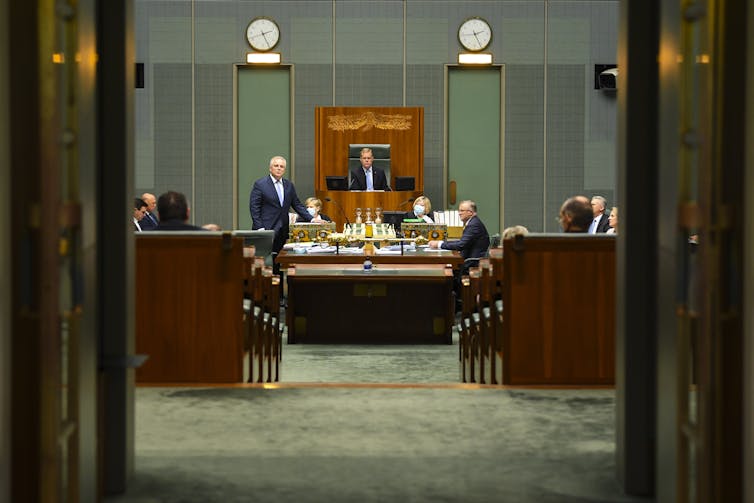
A sustainable Australian video game industry? Production rebates are a small, important step

Source: The Conversation (Au and NZ) – By Brendan Keogh, ARC DECRA Fellow, Queensland University of Technology

In a first for Australia, the South Australian government has announced a new rebate for video game development. Companies will be able to recoup 10% of production costs on projects spending at least A$250,000 in the state.

This rebate is a strong step for the local industry, but more than one approach is needed to make games production sustainable in Australia. This funding has the potential to grow mid-to-large sized game development teams, but not the smaller creators.

While a handful of Australian studios have teams of 20-50 staff and a couple of foreign-owned companies can boast workforces of approximately 150, the video game industry here is overwhelmingly populated by much smaller, independent teams.

These groups of 10 or less, located in co-working spaces or single-room offices, rely overwhelmingly on casual or contract employment, often creating just one or two games.

An industry of small players

Australia’s small indie teams, though volatile, have had a number of hugely creative global successes over the past decade, such as Untitled Goose Game and Hollow Knight.

Historically, support for independent development in Australia has been sporadic and inconsistent, largely funded through state-based grant programs offering relatively small amounts of cash to cover production expenses, travel costs and skills development.


Read more: Honk if you love Untitled Goose Game: why we should invest more in our indie game creators


While some Australian game-makers have dreams of growing into huge companies, many want to continue making games at the size they are. Imagine an indie rock band with a breakout hit – they’re not about to go and employ 100 more drummers. But this creates a problem for the local industry.

The Game Development Association of Australia estimates every year, 5,000 students enrol in tertiary game development programs. In an industry where most teams are content to stay at the same (small) size, these students have nowhere to go and no choice but to start their own independent companies.

Some will have massive breakout hits – like Route 59 with their recent game Necrobarista. Many will release their first game to no fanfare. Their company will fold and they will disappear into other sectors or head overseas.

Video game screenshot
Necrobarista was released in Australia in June 2020 to global success. Route 59 Games

Plenty of (risky) room to grow

Mid and late career overseas talent won’t move to Australia without opportunities for later career employment. This leads to a senior talent vacuum.

Rebates can help here, encouraging large multinational companies, such as Rockstar, Activision and Ubisoft, to set up or invest in studios in countries where they can access the most skilled developers at the cheapest cost.

This is something that Canada, in particular Montreal, has taken advantage of. Since the late 1990s, the Canadian and Quebecois governments have offered the industry a range of subsidies, rebates and tax offsets.

Montreal alone is now home to over 10,000 game developers (10 times more than all of Australia); 3,000 at the local Ubisoft studio alone.

Justin Trudeau wears VR goggles on his head and gives a thumbs up.
Support for the video game industry in Montreal has seen global giant Ubisoft – here paid a visit by Prime Minister Justin Trudeau – employ 3,000 local staff. Ryan Remiorz/The Canadian Press via AP

But there’s also risk in growing a local game industry this way. When Quebec tried to remove its tax breaks in 2014, the local industry threatened to head elsewhere. The government reinstated the tax breaks the following year.

Australia has seen a similar story before. In the late 2000s, Australian studios were largely dependent on contract work and financial arrangements with North American publishers. When the Australian and American dollars hit parity during the Global Financial Crisis, Australia could no longer provide cheap outsourced labour. Studio closures came hard and fast – all but decimating the Australian video game industry at the time.

With the new rebate, South Australia is hoping to attract some of these overseas businesses to take advantage of local talent. There’s always the risk somewhere else will eventually offer an even better rebate.

Nonetheless, attracting international companies to the state would give graduates a chance to be employed at a larger, more stable company and develop their skills before going indie later in their career, with more experience.

A multi-pronged approach

The rebate is also primed to benefit the few mid-sized South Australian studios that already exist, such as Mighty Kingdom and Monkeystack, and encourage other smaller teams to consider scaling up.

Publicity shot from Ava's Manor.
Adelaide’s Mighty Kingdom employs over 70 creatives. Their latest game is Ava’s Manor. Mighty Kingdom

But such a rebate is less useful to the small independent teams that are currently the bread and butter of the Australian industry, many of which don’t have $250,000 to invest in a project.

For these small teams, producing innovative intellectual property exported across the world, grant programs are more immediately useful.


Read more: Australia’s videogames are inventive, acclaimed and world-class, so where’s the government support?


Building a sustainable and successful video game industry requires a multi-pronged approach that nurtures the whole ecology: creatively driven artists that are the local talent, business-savvy entrepreneurial start-ups with the ambition to build larger Australian owned studios, and the massive (but fickle) foreign owned studios that provide little creative freedom but much greater employment stability and opportunity.

The SA rebate alone won’t create a sustainable national industry, but in lieu of much needed support from the Federal Government it is another step in the right direction by a state government.

ref. A sustainable Australian video game industry? Production rebates are a small, important step – https://theconversation.com/a-sustainable-australian-video-game-industry-production-rebates-are-a-small-important-step-147090

Soy, oat, almond, rice, coconut, dairy: which ‘milk’ is best for our health?

Source: The Conversation (Au and NZ) – By Leah Dowling, Lecturer in Dietetics, Swinburne University of Technology

A trip to the supermarket presents shoppers with an overwhelming number of milk choices. And far from just being the domain of the modern hipster, plant-based milk alternatives are going mainstream.

These alternatives may be suitable for people who are intolerant to dairy milk, or have ethical or other personal preferences. They tend to be lower in saturated fats and energy than dairy milk, but also lower in protein (except soy) and calcium (unless fortified). Some are also high in added sugars.

As to which milk is best, there’s no simple answer. Dairy milk tends to come out on top for nutrient quality, though soy is a good substitute from a nutrition perspective. And it should be noted these alternatives aren’t technically milks, as they’re not derived from mammals.

Nevertheless, the nutritional quality of the different alternatives varies considerably, so it’s important to take note of these differences when making a selection.

Dairy milk

Milk provides us with important nutrients including calcium, protein, vitamin B12, vitamin A, vitamin D, riboflavin (B2), zinc, phosphorus and iodine. The quantity and quality of cow’s milk proteins is high, with both whey and casein containing all nine essential amino acids. Milk plays an important role in bone health and is a particularly rich source of dietary calcium.

Research investigating the ability of the body to absorb and utilise calcium determined the best-absorbed calcium source is dairy milk and its derivatives.


Read more: Explainer: how do our bones get calcium and why do they need it?


Although dairy foods do contain some saturated fats, the fat in dairy doesn’t seem to be overly problematic for heart health. A large study featuring people from 21 countries, published in 2018, found dairy consumption was associated with lower risk of heart disease and death.

Although dairy milk has a high nutritional value, there’s no reason why people need to drink it if they choose not to. All of the nutrients in milk can be obtained elsewhere in the diet.

Soy

If you’re seeking a dairy-free alternative, then soy is a good choice (though some people may be intolerant to soy). It’s made from ground soy beans or soy protein powder, water and vegetable oils and is usually fortified with vitamins and minerals including calcium.

A 2017 study found soy fared considerably better than other milk alternatives including almond, soy, rice and coconut varieties in terms of nutritional profile.

Available in full-fat and low-fat versions, soy is a good source of plant protein, carbohydrates, B vitamins and most are fortified with calcium making it nutritionally comparable to dairy milk. The ability of the body to absorb and utilise the added calcium in soy drink is approaching that of dairy milk. One study indicated calcium from fortified soy drink was absorbed at 75% the efficiency of calcium from dairy milk, though there appears to be limited data on this.

It typically contains more protein than other plant-based alternatives, and contains healthy unsaturated fats and fibre.

Milk varieties on a supermarket shelf
One study found soy to be more nutritious than many other plant-based milk alternatives. Shutterstock

It also contains compounds called phytoestrogens. Phytoestrogens are natural plant compounds that imitate the body’s own natural oestrogen but to a lesser extent. There was initially some speculation based on earlier animal studies about potential adverse effects of phytoestrogens on the risk of breast cancer and hyperthyroidism. However, studies conducted in humans don’t support this.

Conversely, there is some evidence to suggest they may have a protective effect against some cancers. A review study from 2019 found soy consumption is more beneficial than harmful. In a position statement on soy, phytoestrogens and cancer prevention, the Cancer Council of Australia supports the consumption of soy foods in the diet but doesn’t recommend high dose phytoestrogen supplementation, especially for women with existing breast cancer.

Almond

Nut drinks such as almond consist mainly of ground nuts and water. Despite almonds being a good plant source of protein, almond drink is significantly lower in protein and calcium than dairy milk. Consumers should take care with almond drink to ensure essential nutrients are met elsewhere in the diet.

In a 2017 survey of widely available commercial almond milks, consumer group Choice found almond drink contained only 2-14% almonds, with water being the predominant ingredient. It tends to be low in energy and saturated fat and contains some healthy unsaturated fats as well as vitamin E, manganese, zinc and potassium.

Almond drink often contains added sugars. Terms to keep an eye on include those indicating added sugars, such as organic rice syrup, agave syrup, organic evaporated cane juice, raw sugar, or organic corn maltodextrin. It’s best to look for unsweetened varieties if you can.

Almond drink may be suitable for people who are intolerant to both dairy milk and soy, but isn’t suitable for those with nut allergies.

If you’re using almond milk as an alternative to dairy milk and wanting similar nutritional benefits, look for one that’s fortified with calcium aiming for as close to 115-120mg per 100mL (similar to dairy milk) as possible.

Oat

Oat milk is made by blending oats and water and straining off the liquid. It’s a source of fibre, vitamin E, folate and riboflavin. It’s low in fat and is naturally sweet, containing double the carbohydrates of cow’s milk, so it may not be suitable for people with diabetes.

It tends to be low in both protein and calcium, so look for a fortified brand. It’s not suitable for people with a gluten intolerance, nor is it a nutritionally adequate substitute for young children.

Coconut

Coconut milk is low in protein and carbohydrates, and high in saturated fat. Some brands have added sugars. Similar to nut drinks, it doesn’t naturally contain calcium and isn’t a suitable substitute for dairy milk nutritionally.

Rice

Rice drink is produced from milled rice and water. It’s naturally high in carbohydrate and sugars, and has a high glycaemic index meaning the glucose is quickly released into the blood which may mean it’s not suitable for people with diabetes. It’s also particularly low in protein and needs to be calcium fortified.

Rice is the least likely to trigger allergies of all of the milk alternatives. However, it’s not a suitable milk substitute, particularly for children, due to its low nutrient quality.

Cows at a dairy farm
Many people choose not to drink cow’s milk because of concerns for animal rights. Carrie Antlfinger/AP/AAP

Ultimately, when deciding which plant-based alternative to drink, you should choose fortified and preferably unsweetened varieties. Also, look for those with a calcium content as close to 115-120mg per 100ml (or 300mg per cup) as possible, as this is similar to dairy milk.

Your choice should also take into account your overall diet and nutrient requirements. This is especially important for children, adolescents, older adults and those following a restricted diet. Finally, factors such as flavour, taste, texture and mouth feel are all important considerations.

ref. Soy, oat, almond, rice, coconut, dairy: which ‘milk’ is best for our health? – https://theconversation.com/soy-oat-almond-rice-coconut-dairy-which-milk-is-best-for-our-health-146869

Record corporate fines don’t deter: here’s a ‘frank’ fix to make penalties bite

Source: The Conversation (Au and NZ) – By Michael William Blissenden, Professor of Law, University of New England

All things considered, Westpac’s record A$1.3 billion fine for breaching anti-money-laundering laws could have been worse.

Each of the alleged 23 million breaches of the Anti-Money Laundering and Counter-Terrorism Act between 2010 and 2018 carried a penalty of up to A$63,000. So the fine might have been more than A$1 trillion.

The A$1.3 billion equates to three months’ earnings for Westpac. It is A$400 million more than the A$900 million the bank set aside in its half-year results (in April). But that didn’t bother the market.

Westpac’s share price ended the week 7% higher.

As Nathan Zaia, an analyst with investment research company Morningstar, explained: “It’s huge. It’s the largest fine in history. It’s an eye-watering number. But it’s already pretty much been expected by the market.”

With Westpac’s annual profit exceeding A$6 billion, and its market capitalisation more than A$60 billion, Zaia said a few hundred million dollars more didn’t “really have much of an impact with the valuation we put on the bank”.

If the biggest fine in Australian corporate history doesn’t make a difference to a company’s share price, it’s hard to see how that fine serves as a deterrent. It is the job of the board and senior management to serve the interests of shareholders. What doesn’t matter to investors won’t matter much to the board either.

There could be a way, though, to use the tax system to give corporate fines more bite, by making shareholders feel more of the pain.


Read more: How Westpac is alleged to have broken anti-money laundering laws 23 million times


What franking credits do

Franking credits – also known as dividend imputation payments – are tax credits provided to shareholders with their dividend payments.

The credits are intended to ensure income from investment is not taxed twice – first by the company paying tax on its profit, then by the shareholder paying income tax on their share of that profit (their dividend).


Read more: Words that matter. What’s a franking credit? What’s dividend imputation? And what’s ‘retiree tax’?


Franking credits on dividends allow shareholders to cut their tax bills by the tax already paid on the dividend income they receive.

In some cases, thanks to a provision in Australia’s law, where the shareholder pays no overall tax, they can receive a tax refund from the government, a dividend imputation cheque, of the kind Labor promised to wind back in the 2019 election campaign.

Franking debits as penalty

There already exists a mechanism to use the imputation system to penalise bad behaviour by companies.

Where a company has not followed the rules relating to franking credits, the tax office can debit the company’s franking account, leaving less to distribute to shareholders as tax credits.

A similar mechanism could be used to impose fines. Instead of the company writing a cheque, the government would debit the value of the fine from the bank’s franking account.

This would directly affect the bank’s capacity to “impute” tax it has paid on profits.

Though the same amount of money imposed as a fine might have little impact on a company’s operations or profits, the loss of franking credits is something shareholders are likely to notice.


Read more: Westpac ticking every anti-money-laundering box wouldn’t make much difference to criminals


And if shareholders care, the directors might get the message louder and clearer.

ref. Record corporate fines don’t deter: here’s a ‘frank’ fix to make penalties bite – https://theconversation.com/record-corporate-fines-dont-deter-heres-a-frank-fix-to-make-penalties-bite-146915

Pacific television training initiative boosts region’s broadcasters

Pacific Media Watch Newsdesk

Television New Zealand and Pacific Cooperation Broadcasting Limited (PCBL) have launched a new training programme to help broadcasters across the region deliver a premium news product to their audiences.

Designed and led by 1 NEWS’ Pacific correspondent Barbara Dreaver and produced by Lee Taylor, the 10-week training programme will be attended by 21 broadcasters, representing 11 Pacific nations.

More than 100 journalists are participating, demonstrating a need from the Pacific broadcasting community for “connection and support” in delivering their services.

READ MORE: Other Pacific Media Watch reports

“I’m incredibly proud of this new initiative. It pulls together experienced individuals across the 1 NEWS floor and makes use of the tools we’re fortunate to have at our disposal,” said Dreaver.

“Pacific broadcasters want to deliver the best news product possible for their viewers.

“They face unique challenges in meeting their ambitions and that’s what this programme is all about.”

The programme is centred around weekly sessions conducted over livestream and covering a range of topics.

With so many broadcasters represented, there is also an opportunity for discussion around shared challenges and issues.

A series of “news bytes” is also being produced, giving all participants a video catalogue of training materials to continually refer to.

1 NEWS journalists around New Zealand will provide material for this.

Pacific Cooperation Broadcasting Limited chief executive Natasha Meleisea said the new programme would play an important role in PCBL’s strategy around media resilience in the Pacific.

“Covid-19 has been tough for our broadcasters with their output being severely curtailed,” she said.

“At the same time, the need for local reporting has never been greater.

“This programme is about supporting and sharing what we have, so news in the Pacific continues to go from strength to strength.”

Pacific TV journalists
Pacific TV journalists on the new training course. Image: TVNZ
Print Friendly, PDF & Email

Article by AsiaPacificReport.nz