A child’s toy may seem like an unlikely candidate for the classical concert hall. Around the world, however, thousands of musicians gather every year for festivals, conferences and concerts dedicated to the toy piano.
Exploring its sound, range, and playing technique, these composers and performers congregate to talk about latest developments in toy piano music and perform new pieces.
Along with many festivals in the US and Germany, Italy and Korea have both held their first toy piano festival in recent years.
Pop artists such as Bruno Mars and groups such as Coldplay have brought a larger audience to what was once considered a niche and experimental use of the instrument. Search “toy piano” or “tiny piano” on Twitter or Facebook and you’ll find countless posts featuring performers and composers using or discussing the instrument.
Toy pianos, despite being designed and marketed to children and families, have been used for decades to write everything from concertos to pop songs.
French composer Yann Tiersen used one prominently in his score to the 2001 film Amélie to represent the title character’s inner child.
Neil Diamond’s song, Shilo, is one of the earliest pop songs to feature toy piano (you can hear it in the bridge at about the 2:28 mark here).
And John Cage’s 1940s suite for toy piano, where he took all the seriousness of writing for the piano and put a playful spin on it, came at a crucial moment in the mid-20th century; hard borders of the musical arts, which reached a limit of seriousness in the 1920s and 1930s, had started to break down.
This mixing of traditional “high music” with artefacts that might be considered juvenile, populist, naff, or domestic, was becoming more common — and more exciting.
Play and experimentation
Toy pianos typically have a range of 12-36 keys, roughly one quarter the range of a full piano (though there are smaller and larger examples, too).
These acoustic instruments are made from a wood or plastic frame. They produce a bell-like sound when a small hammer hits a tube or flat piece of metal inside.
Unlike a typical piano, toy pianos are rarely tuned to perfection and can sound a bit off to the ear but many can’t help but be charmed by their tiny size, variety of colours and quirky inconsistent plonking.
With its history and connection to ideas of childhood, this instrument is commonly used to musically convey a sense of innocence and nostalgia.
Traditionally, art music composition can be very prescriptive and confined. The traditional conservatorium or university composition class teaches the rules of writing — what you can and cannot do with an instrument — but something about the toy piano invites play and experimentation.
Every toy piano is different
Unlike many instruments used for composing, the toy piano is not standardised around the world.
There are dozens of makers who use different techniques and different materials giving every toy piano a unique sound, range, and register. This makes writing music for the piano a bit random — but for many of us, therein lies the fun.
If you write a piece of music for the toy piano and if a performer in another part of the world has enough keys on their instrument, they can play your piece in their own special way. It’s like a singer using their own unique voice to cover a song.
A melody played on three different toy pianos. Composed and performed by Paul Smith. Paul Smith, CC BY-NC442 KB(download)
The composer gives up some control, which contrasts sharply with romantic and and modernist-era ideas that positioned the composer as a genius whose works should never be altered.
Many composers end up collecting toy pianos, which gives them a variety of sounds to play with. Australian composer Elena Kats-Chernin became known as the toy piano lady at a Sydney toy store after buying eight in a row. I’m up to a modest five and am resisting buying my sixth.
Toy piano specialists are becoming more common as performers and composers in demand.
Italian specialist Antonietta Loffredo has performed several times in Australia and released many recordings with the Australian art music label Wirripang. You can hear her recordings of works by Australian composers on Spotify here.
Margaret Leng Tan, a toy instrument virtuoso with many commissions and dedications to her name, was due to perform with toy piano at the Sydney Opera House this year but the concert was postponed due to COVID-19.
I remain wholeheartedly intrigued by the toy piano’s magical overtones, hypnotic charm, and not least, its off-key poignancy. In the words of author John David Morley, “Sound combed from the keys of a stairway ascending faintly into sleep”. My composer-friends were similarly beguiled and driven to frenzied heights of creativity by this modest little instrument.
Escaping a rigid world
Artists are always looking for new ways to challenge and surprise audiences. What is and isn’t accepted on the concert stage is constantly shifting and the rise of the toy piano suggests that we are ready to welcome new sounds and new instruments into the relatively closed world of classical music.
To many composers, the toy piano offers more than a symbolic representation of childhood — it provides an exciting escape from the strict and rigid world of formal contemporary art music.
NSW Premier Gladys Berejiklian has admitted having a secret intimate relationship with disgraced former MP Daryl Maguire, which she only ended recently, despite his being forced to quit state parliament in 2018.
Berejiklian’s explosive appearance on Monday at the NSW Independent Commission Against Corruption saw her personal life embarrassingly exposed, her political reputation thrown under a cloud, and her future put on the line.
ICAC, which is investigating whether Maguire sought to monetise his position as an MP between 2012 and 2018, heard damaging taped phones conversations between him and Berejiklian in which he spoke extensively of his lobbying on behalf of developers. He also talked about his concerns over his huge debts, which he said amounted to $1.5 million.
Maguire, who was a parliamentary secretary and member for Wagga Wagga, was forced to quit in 2018 after an earlier ICAC inquiry, which heard recordings of him seeking payment to help broker a deal with a Chinese property developer. This prompted a byelection that the Berejiklian government lost to an independent.
The premier’s colleagues and observers of NSW politics are gobsmacked at the revelation of Berejiklian’s “close personal relationship” with Maguire. There had been no whisper until her disclosure of it on Monday morning.
The relationship began in 2015 and lasted until after she gave evidence privately to ICAC in August.
After her evidence, Berejiklian told a news conference late Monday: “I stuffed up in my personal life”. But she said she wouldn’t consider resigning from her position because she had done nothing wrong.
She said she had trusted Maguire, whom she had known for 15 years, but she had not told her family or friends of their relationship because it didn’t have “sufficient status”.
Berejiklian said she had sacked Maguire from the Liberal party and engaged others to press him to leave parliament. But she hadn’t broken with him earlier because he was “in a very dark place”. “I didn’t feel that I could stop being his friend during that time, rightly or wrongly, on compassionate grounds.”
She told reporters she always applied the “highest level of integrity” in doing her public job.
The phone taps indicated Maguire was considering whether to resign at the 2019 election if he was in a financial position to do so. Berejiklian admitted to the hearing that she had thought if that happened, they could be in a position to make their relationship public.
In one of their phone conversations, Berejiklian said to Maguire: “You will always be my numero uno.” She told the hearing this showed “in my personal life I placed importance on how I felt about him”.
Berejiklian repeatedly stressed to the hearing she had taken no interest in Maguire’s financial affairs or his business activities, although he constantly referred to them in the phone conversations.
She said he was always talking about deals, but they then fell through. She always thought Maguire had made the appropriate disclosures.
On one occasion, she flagged to him that her chief of staff planned to call him to tell him a minister visiting China would raise a business matter Maguire was involved in.
In some calls she sounded anxious to distance herself from the details.
In one phone conversation, Maguire referred to “my little friend” and said, “you know my little friend?” Berejiklian replied, “Not really. I don’t need to know.”
In relation to a deal involving land owned by Louise Waterhouse, from the racing family, near Badgerys Creek, Maguire asked if she had received an email from Waterhouse. When she said no, he said, “You will, she’ll send you an email. She’s really pissed off now, you know, about the airport. They’re all passing the buck.”
In September 2017 he told her, “It looks like we finally got the Badgerys Creek stuff done … I’ll make enough money to pay off my debts, which will be good.” He added, “Can you believe it, in one sale?”
In a subsequent conversation about the deal, Berejiklian said, “I don’t need to know about that bit.”
The hearing went into private session twice to listen to tapes which were considered too private to be played publicly.
Berejiklian stressed to ICAC she would never compromise her public position: “I would never turn a blind eye to any responsibility that I had to any wrongdoing that I saw.”
She emphasised she was an independent woman with her own finances. “Anybody else’s finances would be completely immaterial to me,” she said.
He colleagues are standing by her, at least at the moment. The NSW Opposition said she should resign. Maguire gives evidence on Tuesday.
In this new covid-19 world, environmental and climate crisis defenders are developing new ways to cope and operate under the pandemic constraints.
Groups as diverse as the local branch of the global environmental campaigner Greenpeace Pacific, Pacific Islands Forum Fisheries Agency (FFA), the Green Party in French Polynesia and Greenpeace New Zealand have found solutions.
They have followed in the traditions of the Fiji-based Pacific Climate Warriors – part of the global 350 movement – who have drawn attention to environment and climate crisis issues with colourful and dramatic protests.
Climate Warriors coined the phrase: “We are not drowning, we are fighting.”
The Pacific faces mounting climate change issues, environmental degradation, rapidly rising sea-levels, massive king tides with the salty sea affecting arable land, coral acidification, pollution and – just to make matters worse – wildlife poaching as the plundering of the region’s fisheries goes unabated.
“Climate change could produce 8 million refugees in the Pacific Islands alone, along with 75 million in the Asia-Pacific region within the next four decades [has] warned a report by aid agency Oxfam Australia,” wrote the Pacific Media Centre’s director Professor David Robie in Dreadlocks a decade ago signalling the dire need even then for environmental defenders to pick up the pace.
Greenpeace head of Pacific Auimatagi Joseph Sapati Moeono-Kolio realises that need and is thankful that most parts of Pacific are being largely spared from the covid-19 pandemic that has raged across the world, leaving his organisation free to pursue its green goals.
“Fortunately, many island nations in the Pacific are free of covid-19. As a result, Pacific climate leaders are able to continue our moral and ethical fight for climate justice,” says the Samoan climate change campaigner.
“We are doing so by leading the world in transitioning to renewable energy – in fact Samoa is on track for 100 percent renewables by 2025.
Greenpeace Pacific’s Auimatagi Joseph Sapati Moeono-Kolio … “the transition to renewables, as an important pillar of climate action, has stepped up.” Image: Greenpeace Pacific
“So, while covid-19 has slowed several things down, the transition to renewables, as an important pillar of climate action, has stepped up.”
Climate change on back burner The pandemic has forced leading climate change advocates of the Small Island Developing States (SIDS), such as Fiji Prime Minister Voreqe Bainimarama, who was president of the 2017 Conference of the Parties COP23 to push the issue onto the back burner.
Pacific Island climate frontline states such as Kiribati, Tuvalu, Tokelau and Marshall Islands along with Fiji, Vanuatu, Papua New Guinea (Carteret Islands) and the Federated States of Micronesia require a champion for their cause. However, the pandemic has put paid to that, as Auimatagi points out.
“Because of covid-19 our global advocacy moments to elevate the voices of Pacific leaders demanding climate action are limited,” says Auimatagi.
“We are also working on a documentary called Finding Hope: Samoa, where we will meet with people from all walks of life and share their truth of what is happening in their villages as oceans rise and warm.
“With covid-19 and climate change combined, we are seeing dual impacts such as in Vanuatu during the most recent cyclone – Harold in April 2020.
“Communities and families were all social distancing and then the cyclone hit so they needed to decide whether to stay apart at home or take shelter in emergency refuge centres,” he says.
From that occurrence emerges the real and immediate threat of making climate change of secondary importance despite an increase in adverse climate events.
Greenpeace NZ’s Nick Young … “there is a threat that while the world is focused on covid-19, that climate action takes a back seat.” Image: Greenpeace
Working hard for the Pacific “Pacific communities are among the first to feel the full impacts of climate change, and there is a threat that while the world is focused on covid-19, that climate action takes a back seat,” says Nick Young of Greenpeace New Zealand.
“Greenpeace internationally is working hard to make sure that isn’t the case.
“The covid-19 recovery also offers a unique opportunity in this regard as billions are spent to stimulate economies around the world and Greenpeace in New Zealand and elsewhere in the world is pushing for a Green Covid-19 Recovery that invests in climate resilience.”
Greenpeace initiatives and campaigns as environmental defenders are still continuing, albeit at a slower pace than usual.
“All of the core Greenpeace campaigns around transforming agriculture and energy, protecting the oceans and shifting away from single-use plastics remain active,” Young says.
However, it is more than the pollution that is a concern with the ocean. Auimatagi talks about this.
Ocean poaching problem “Ocean poaching is ongoing, carried out by the Chinese and Japanese flagged vessels. While Samoa has one of the smallest Exclusive Economic Zones (EEZs), places like Micronesia and Kiribati are much harder to enforce as they have much larger EEZs.”
As Jacky Bryant, president of the Green Party in French Polynesia points out: “The 5 million km/2 of the EEZ (Exclusive and Economic Zone) are open to all kinds of abuse by foreign ships and is under surveillance by only one ship belonging to the French state.
“From time to time we have a fishing vessel that gets stranded on the reef carrying tonnes of fish, some legal, some illegal.”
Jacky Bryant of Tahiti’s Greens … economic zone “open to all kinds of abuse by foreign ships”. Image: Heiura Les Verts
Last month, the Pacific Islands Forum Fisheries Agency (FFA) continued its coordination and commitment to regional fisheries surveillance operation.
The 17-nation organisation is based in Honiara, Solomon Islands and its members comprise: Australia, Cook Islands, the Federated States of Micronesia, Fiji, Kiribati, Marshall Islands, Nauru, New Zealand, Niue, Palau, Papua New Guinea, Samoa, Solomon Islands, Tokelau, Tonga, Tuvalu and Vanuatu.
The FFA is charged with protecting Pacific fisheries from poaching among other cooperative activities.
It has recently completed its “Operation Island Chief” (August 24-September 4), conducting surveillance over the EEZs of Cook Islands, Niue, Samoa, Tonga and Tuvalu this year.
Challenging pandemic times FFA’s Director-General Dr Manu Tupou-Roosen says: “During these challenging times with the focus of the world on the pandemic, we welcome the commitment and cooperation demonstrated across the region to deter illegal, unreported and unregulated fishing in our waters.”
That concerns Greenpeace as well. Young says: “Illegal and unregulated fishing is still an issue in many places, and certainly in the Pacific.
“It threatens ocean life as well as the resilience of Pacific communities who rely on the oceans for their food and way of life.”
The FFA Regional Fisheries Surveillance Centre (RFSC) team, supported by three officers from the Royal Solomon Islands Police Force (RSIPF), had an increased focus on intelligence gathering and analysis, providing targeted information before and during the operation in order to support surveillance activities by member countries,” the FFA said in a statement.
Aerial surveillance of the nations of the EEZ was provided by New Zealand, Australia, USA and France, assisting the fragile small island developing states in protecting them from poaching or overfishing.
In addition to that the cooperation goes as far as working together to prevent covid-19 from being transmitted in the fisheries operations allowing them to continue contributing Pacific Island economies.
“It is crucial for fisheries to continue operating at this time, providing much-needed income to support the economic recovery as well as to enhance contribution to the food security of our people,” says Dr Manu Tupou-Roosen.
Pollution and climate change still major Greenpeace Pacific’s Auimatagi says that other than poaching, pollution and climate change remain major issues in the Pacific.
“While marine wildlife poaching is, of course, a big issue, the biggest polluter is one of our nearest neighbours. Australia digs up, burns and exports climate destruction to the whole world in the form of coal.
“Climate change is the number one issue on all fronts, including the environment as it is a threat multiplier. The impacts of climate change such as rising sea levels and warming oceans make the impacts of cyclones and ocean wildlife poaching more severe and more difficult to manage.”
Not so in Tahiti as Bryant explains, where covid-19 has taken hold on that part of the Pacific paradise.
Covid-19 cases in French Polynesia (population 280,000) have now reached more than 2700 cases – including territorial President Edouard Fritch and 10 deaths, and Bryant say this crisis has pushed climate change and environmental issues into a secondary status.
“Attacks to our natural environment such as the exploitation of the biodiversity, our cars’ carbon emissions (Papeete has 120,000 cars but luckily, we are an island with regular easterlies) are of governmental responsibilities,” says Bryant.
“There is no clear scrutiny of the climatic effects on the town planning code for example; no compulsory measures for double glazing; using solar panels is not mandatory and the same for photovoltaic, not even for experimental purposes on an urban area.
No environmental friendly designing “There are no projects towards designing more environmentally friendly interisland means of transport in order to anticipate any energy crisis with petrol, for example. We carry on training our youth for the combustion engine,” he adds.
While Bryant laments the lack of action in Tahiti, the Greenpeace organisation remains committed to making a better, environmentally safer world.
“We have pushed for a green covid-19 recovery that puts people and nature first, and we are calling for the replacement of current industrial agriculture system with regenerative farming methods – where we farm in harmony with nature and don’t use synthetic nitrogen fertiliser,” says Young.
“Regenerative farming involves growing a large diversity of crops, plants and animals. Synthetic inputs like nitrogen fertiliser are replaced with practices that mimic natural systems to access nutrients, water and pest control required for growth.
“Replace unnecessary single-use products like plastic drink bottles with reusable and refillable options, including glass. Plastic bags, and bottles are just the tip of the iceberg,
“All of the core Greenpeace campaigns around transforming agriculture and energy, protecting the oceans and shifting away from single-use plastics remain active,” he says.
The last word on the issue comes from the Samoan who has been a strong activist for a greener world, Auimatagi Moeono-Kolio.
“When it comes to the environment, Pacific Islanders are always vigilant no matter what is happening in the outside world: It’s a question of means and resources and geopolitics, it’s a very complicated web.”
This is the fifth of a series of articles by the Pacific Media Centre’s Pacific Media Watch as part of an environmental project funded by the Internews’ Earth Journalism Network (EJN) Asia-Pacific initiative.
This week’s Newspoll, conducted October 8–10 from a sample of 1,527 voters, gave the Coalition a 52–48% lead over Labor in the two-party preferred question, a one-point gain for the Coalition since the previous Newspoll three weeks ago.
Primary votes were 44% Coalition (up one), 34% Labor (steady), 11% Greens (down one) and 3% One Nation (steady).
Prime Minister Scott Morrison remained very popular: 65% were satisfied with his performance and 31% were dissatisfied, for a net approval of +34. These figures are unchanged from the last poll.
Opposition Leader Anthony Albanese’s net approval slid three percentage points to -4. His net approval is down six points since late August. Morrison led as better PM by 57-28% (compared to 59-27% three weeks ago).
Newspoll asks three questions after each budget: whether the budget was good or bad for the economy, whether it was good or bad for you personally, and whether the opposition would have delivered a better budget.
On the economy, 42% said the budget was good and 20% bad. When it came to people’s personal fortunes, 26% said they would be better off after the budget, compared to 23% who said worse off. By 49-33%, respondents said Labor would not have delivered a better budget.
Analyst Kevin Bonham tweeted a graph showing this budget performed well compared to historical budgets. The 16-point deficit for the question of whether Labor would have delivered a better budget is the worst for an opposition since 2009.
The one-point gain for the Coalition on people’s voting intentions is also consistent with a well-received budget.
Australian state polls: Victoria and WA
A Victorian Morgan SMS poll, conducted September 29-30 from a sample of 2,220 voters, gave Labor a 51.5-48.5% lead over the Coalition, unchanged from mid-September.
Primary votes were 39% Labor (up two), 39.5% Coalition (up one) and 10% Greens (down two). Morgan’s SMS polls have been unreliable in the past.
In a forced choice, Premier Daniel Andrews had a 61-39% approval rating, down from 70-30% in early September.
Three weeks ago, Newspoll gave Andrews a 62-35% approval rating (compared to 57-37% in late July).
An Utting Research poll of five Western Australian marginal seats showed an average swing to Labor of 16%. In Liberal leader Liza Harvey’s Scarborough seat, the result was 66-34% to Labor.
Labor had a big victory at the March 2017 state election, and this poll suggests a Liberal wipe-out at the next election, due in March 2021.
Biden’s national lead over Trump exceeds ten points
In the FiveThirtyEight national poll aggregate, Democratic presidential nominee Joe Biden now leads President Donald Trump by 10.4% (52.2–41.9%). It’s somewhat closer in the key swing states, with Biden leading by 8.0% in Michigan, 7.3% in Pennsylvania, 7.2% in Wisconsin, 4.5% in Florida and 3.9% in Arizona.
Since my article about Trump’s coronavirus infection and the first presidential debate, Biden’s national lead has increased by 1.4%.
With Pennsylvania and Wisconsin now polling very closely, both can be seen as “tipping point” states. Previously, Pennsylvania had been better for Trump than Wisconsin.
The gap in Trump’s favour between the national vote and the tipping-point states of Wisconsin and Pennsylvania has increased from 2.4% to 3.2%. If Trump were within five points nationally, this election would be highly competitive. But this difference isn’t going to matter with Biden up ten points nationally.
CNN analyst Harry Enten says Biden is polling better than any challenger against an incumbent president since 1936, when scientific polling started.
US polls include undecided voters, so it is hard for candidates to reach 50%. In 2016, Democratic candidate Hillary Clinton never reached that mark in polls, and Trump was able to win far more of the late deciders.
The FiveThirtyEight forecast gives Trump a 14% chance to win, down from 17% last week. Trump has just a 6% chance to win the popular vote.
The Senate forecast gives Democrats a 72% chance to win the Senate, up from 70% last Wednesday. The most likely Senate outcome is still a narrow 51-49 Democratic majority.
Help with living costs while studying and extra support for mental health are two areas Pacific tertiary students want given more attention with the New Zealand general election.
The last two national budgets have committed $107.6 million to help Pacific communities over the next 30 years, but tertiary students say there are urgent needs that must be addressed.
“The first one is mental health and well-being,” according to Leilani Vae’au, while for Ali Leota “one thing for sure is introducing a universal education income”.
Vae’au is at Wellington’s Victoria University working towards a bachelor degree in political science, international relations and religious studies.
She is also on the university’s Pasifika student council.
The 20-year-old is not eligible for student allowance to help with living expenses because her parents earn over the threshold. Student allowance begins to drop once parents earn beyond $56,888.52 a year before tax. If parents jointly earn $98,653.52 or more the student is ineligible.
‘Three younger siblings’ “But I have three younger siblings under me who depend on that and other family members who depend on my parents,” Vae’au explained.
“And I can’t get that aid so that I don’t have to work all the shifts I work to be able to study and focus on that because of the fact my parents make money to support my family.”
Instead, she meets her living costs working multiple office shifts, which she balances with full-time study, student council commitments and a busy home life.
During the Level 4 lockdown she was relieved to keep her job, but from home when her bedroom became her office, living room and study. The lines blurred between study, work and family life.
“Over covid, I didn’t have the opportunity to compartmentalise my house which has six people living in it and a hundred different Zoom calls going on at the same time.”
Vae’au found the inability to separate these aspects of life particularly challenging.
“As a child of the Pacific or as a child in a multi-generational home, as the eldest child as well, there are lot of factors that were still impacting mental health-wise and just stability-wise in the home environment.”
University difficult to navigate Fellow Vic student Rosina Buchanan is a self-described “queer non-binary person of colour with a disability”.
The Bachelor of Health student has found university difficult to navigate without adequate mental health support and would like to see greater equity when meeting the challenges campus life presents.
“Because I would encounter quite a bit of ableism, elitism, classism, homophobia, being misgendered, racism, and that is definitely a lot of barriers to being able to thrive.”
For Ali Leota, the national president of the Pacific student body Tauira Pasifika, financial support is key.
“One thing for sure is introducing a universal education income” he said, challenging the government to help provide a hand up to provide Pasifika students with a level playing field.
“The public health major would like to see student allowance eligibility reconfigured in a way that’s fairer to Pacific families, as the parental income threshold doesn’t adequately take into account the number of dependants.
“And coming from a big family, we’re kind of victims of that,” Leota says.
Universal education income “So therefore, implementing a universal education income is a way to pave the way forward to making tertiary education accessible and fit for purpose for our Pacific learners.”
Post-graduate students should also be included in the ‘universal education income’ according to Leota, who pointed out the incumbent government had failed to reinstate their financial backing which he said was a barrier to Pasifika achieving masters and doctoral success.
It is also a barrier to Pasifika moving into academia.
“Do they go to work or do they continue to study?” Leota says.
“Of course nine times out of 10 our Pasifika students will opt to work to go and help support families but a universal education income will enable our students to climb up the ladder and make our tertiary spaces a space where we feel like we’re welcomed.”
Leota says Pasifika people are underrepresented in academia, even in Pacific studies, and pointed to studies by Dr Sereana Naepi and Dr Tara McAllister who asked Why isn’t my professor Pasifika?
Auckland university student Shaneel Lal … more support isn needed for Pacific student bodies which in turn provide support for students. Image: RNZ
More student body support University of Auckland law student Shaneel Lal says they can help address it immediately by offering more support to Pacific student bodies which in turn provide support to students.
Lal’s family moved from Fiji when he was 14 and he attended Auckland’s Ōtāhuhu College where his hard work was recognised, being named school Dux. The Youth Parliament 2019 MP who represented Jenny Salesa said he had difficulty transitioning from the strong Pasifika and Māori-dominated culture of high school to the University of Auckland.
“I went from a very collectivist community to a very individualist community where I went from being a person to a number, and nothing really prepares a young Pacific person for that transition.”
The 20-year-old said he was overwhelmed with the culture shock at the time and dropped out. Although he is back at university, he would like more attention paid by tertiary institutions to learning priorities and styles from this part of the world.
“For example, Māori communities are underpinned by the fundamental principles of whanaungatanga and we have similar concepts in our Pacific communities that we exist as a community,” said Lal.
“That is missing at university. University is about competing rather than collaborating and working together.”
While Labour has released a five-point action plan to improve things for Pacific students, including “to respond to unmet needs, with an initial focus on needs arising from the covid-19 pandemic”, other parties lack university specific education policy for Pasifika.
This article is republished by the Pacific Media Centre under a partnership agreement with RNZ.
Many Melburnians have despaired in recent days as it became clear the next step on its roadmap out of lockdown will be taken a bit later than originally planned, or in smaller steps.
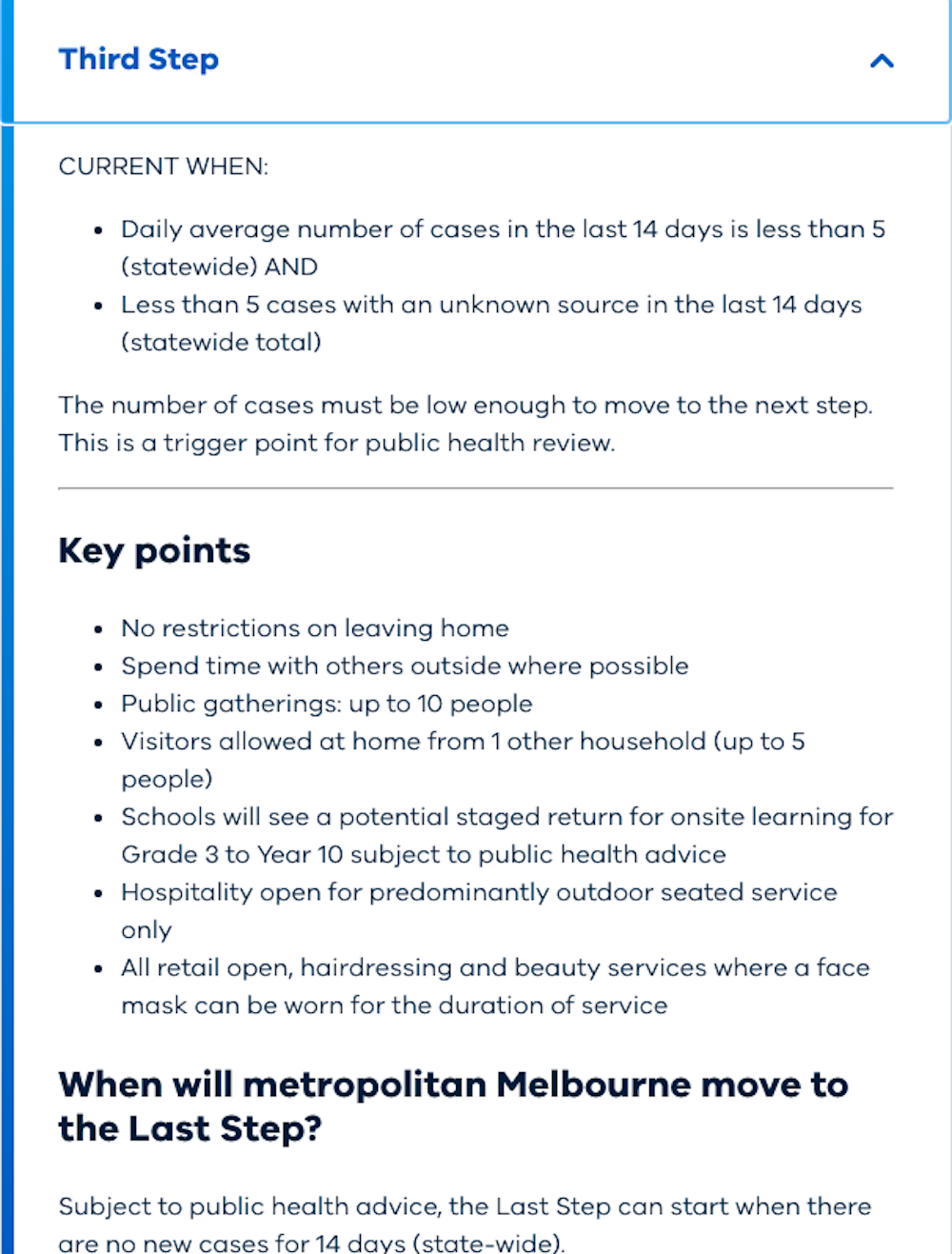
That’s because Victoria is unlikely to meet the threshold needed to clear a key hurdle in the roadmap: a 14-day state-wide average of less than five new daily cases (and less than five cases with an unknown source in the last 14 days).
Victorian Premier Daniel Andrews said on Monday the 14-day rolling average for metropolitan Melbourne was 9.9; for regional Victoria, the figure is 0.4.
The focus, for some time, has been on new daily case numbers. But what if we are looking at the wrong figure?
I’d argue that a useful alternative number we should focus more closely on is the average number of cases “under investigation” over the last 14 days. And on this measure, I think Melbourne is ready to move to step 3 in the roadmap out of lockdown, allowing Melburnians in general a greater degree of freedom, while still empowering authorities to ring-fence localised outbreaks.
Instead of looking at total new case count each day, we should take out the cases linked to a known source within the first 24 hours, because those people are already likely in isolation.
The focus should instead be on the cases still “under investigation”, which includes some that may turn out to be linked to a known source but also a smaller number of what authorities call “mystery cases” (where the source of infection is never identified).
The vast majority of cases now are linked to a known outbreak; this suggests a good understanding of the “shape” of the outbreak, and good control. The number of “under investigation” cases each day has been low.
Step 3 of the roadmap out of lockdown for metropolitan Melbourne.Vic Gov
In fact, if you look only at the “under investigation” cases, it is already at about five a day on average, over the past 14 days.
I think it’s time to look at that number instead, as it is a useful measure of our capacity to contain and control spread. Many of the cases that do turn out to be linked may also already be in isolation, so it is still conservative, but the number highlights the cases where there is still some work to do. If the number of “under investigation” cases remains low, on average, we should be safe to move to step 3 of the plan to emerge from lockdown.
For metropolitan Melbourne, step 3 would mean no restrictions on leaving home, public gatherings of up to ten people, visitors allowed at home from one other household (up to a maximum of five people), and all hospitality and retail open (subject to some important rules).
If the 14 day average of daily new “under investigation” cases is about five, and we are keeping mystery cases under one a day, we should be ready move to step 3 in the roadmap.
If there are any remaining concerns about wider transmission, then I would suggest possibly delaying the introduction of visitors into the home for a week or two until these remaining outbreaks are brought under control.
Concentrated responses
We have demonstrated we can contain outbreaks. Clusters have been well managed in places like Kilmore and Colac that were not under the kind of tight restrictions Melburnians now live under.
The Victorian health system is at a point now where it has the resources to have a much more rapid and comprehensive response to individual cases and clusters than it did in the past.
Victoria may have struggled earlier but we are now at a point where our response is world class.JAMES ROSS/AAP
That puts us in a strong position to actually move away from widespread restrictions for large swathes of the population as an integral part of our outbreak control.
We can now focus on a more concentrated response, to ring-fence cases and clusters rapidly and close them down — even when the broader population is allowed greater movement. The faster contacts of a positive case (and the contact’s own contacts) are isolated, the smaller the cluster is when it is contained as people are more likely to be in isolation before they are infectious. It is then less important how extensively people in other parts of the city or state are moving around.
The goal of reaching a 14-day state-wide average of less than five new daily cases is a noble one but it is conservative.
Victoria may have struggled earlier but we are now at a point where our response tactics are world class. We should be more comfortable relying on this responsiveness now built into the system.
The virus is really now focused within essential workers in certain workplaces and and in their families. It is not as though it is spread evenly and widely across the Melbourne citizenry.
We also have moved to a focus on virus surveillance in workplaces (where we know the risk is higher) to monitor virus levels within the community, and other early warning systems that allow us to move away from blanket approaches applied to the whole Melbourne population in both outbreak detection and response.
Source: The Conversation (Au and NZ) – By Jacinthe Flore, Vice-Chancellor’s Postdoctoral Research Fellow, Social and Global Studies Centre, RMIT University
The arts industry is among the most devastated by the pandemic. Artists and arts workers often rely on casual, project-based or fixed-term contracts, and COVID-19 restrictions have left many with little or no income. This has affected the mental health of many working in the arts.
In August, we set out to learn more about the impact of the arts shutdown on workers’ emotional and mental health. While statistics might present data on the scale of lost work or income, qualitative accounts of people’s personal experiences are revealing. So far 28 Victorian performers, writers, teachers, and those in technical or support roles, have provided detailed responses.
Emerging themes include how the pandemic has made unsteady work even more precarious; how community and identity are interrelated; how online performances and connections are far from a cure-all; and, ultimately, workers are on the verge of giving up on their artistic dreams.
Insecurity is standard — the pandemic made it worse
Australian arts workers are familiar with the precarity of creative work. But the pandemic challenges this “normal uncertainty”.
With suddenly empty schedules and an interruption to seasonal work patterns, arts workers have lost the structures and routines that provided rhythm — and mental stability — to their lives. As a stage manager commented:
The performing arts and events are defined by constant, tangible deadlines. All of the structures in my life are built around the presence of this pressure. To have it suddenly and totally removed threw my entire world into disarray.
Creative community and identity are tied to mental health
Mental health challenges are linked to collective, not just individual, experiences. One production manager told us:
Watching all my fellow artists … descend into depression has taken its toll on me … For my own mental health, I have had to funnel certain exposure to the outside world and social media.
Physical restrictions isolated participants from supportive peers. A production technician from the LGBTI community shared:
Being separated from the community that loves and supports me has definitely compounded what I’m feeling.
Some Sydney shows, like artist Giselle Stanborough’s at Carriageworks, have resumed but Victorian stages remain bare.AAP Image/Mick Tsikas
Some had shifted their creative work, teaching and performances online. Others struggled to make their live events digital. One theatre performer distinguished between these modes:
It is important to me that (theatre) remains what it is: live. I have taught and developed shows online, all through Zoom. It has been challenging but gets easier over time.
While some performers and artists were adept enough to shift their practice online and work from home, workers in technical or administrative roles were often left out of this transition.
However, some technical workers have used online resources to further develop skills in their field of expertise with the expectation of returning to work.
While numerous respondents described productive ways of working or taking a break during the restrictions, many also felt hopeless. Participants said they were worried about their skills “becoming rusty” or being “past (their) prime”. They oscillated between feeling hopeless and resigned to the devastating impact of the pandemic.
Feeling powerless to control what was happening in their lives and communities contributed to poor mental health. One respondent, who worked as a teacher, performer and music producer said:
These feelings have become more pronounced since the second lockdown … feeling a strong disconnection from community (creative or otherwise) … I feel despair over the state of the arts sector and how this will impact the rest of society.
Living with uncertainty and loss of hope, arts workers are waiting to see what happens next. A visual artist wrote:
I expect to see the damage in the next year as some things return to normal, while other parts of life will be damaged forever.
Repairing the already suffering arts industry is an opportunity to boost the creative and economic “health” of the sector, but also the mental health of those who work in it.
‘We have a battle ahead. We need to make sure we take everyone along on this path.’ Reach out for help if needed.
The survey is still open to respondents and will close on 26 October. We hope it will be the first stage in a larger project to capture the experiences of arts and creative sector workers beyond Victoria.
If this article has raised issues for you, or if you’re concerned about someone you know, call Lifeline on 13 11 14.
Just days after Victorian Premier Dan Andrews signalled the state won’t be ready for a major loosening of COVID-19 restrictions next week as planned, a legal challenge is expected to be filed in the High Court to force the government to act more quickly.
The Age reports prominent Melbourne hotelier Julian Gerner is launching the challenge against Melbourne’s strict lockdown and has hired leading barristers Bret Walker SC and Michael Wyles QC to represent him.
Gerner argues the restrictions on people’s movements beyond five kilometres from their homes, as well as the need to have a permit to travel to work, are a disproportionate response to the coronavirus threat and violate the implied freedom of movement in the Constitution to undertake personal, family, recreational and commercial endeavours.
This is a bold argument. The High Court has never accepted the Constitution protects freedom of movement within states.
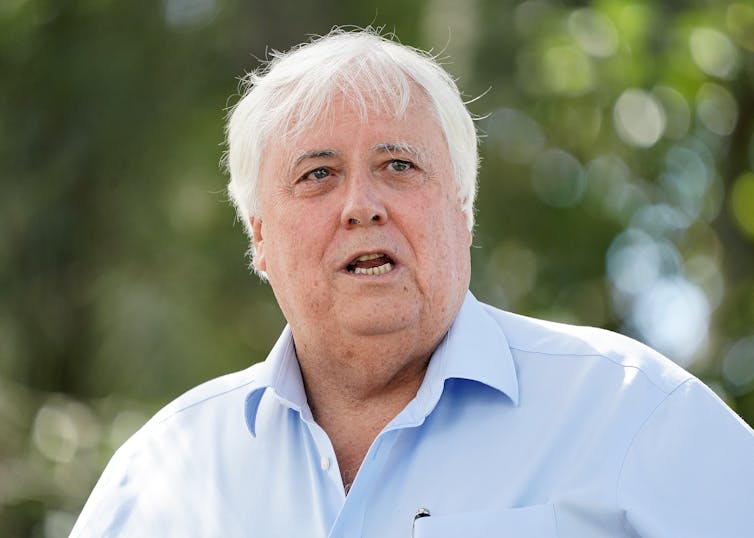
How does this case differ from Clive Palmer’s case?
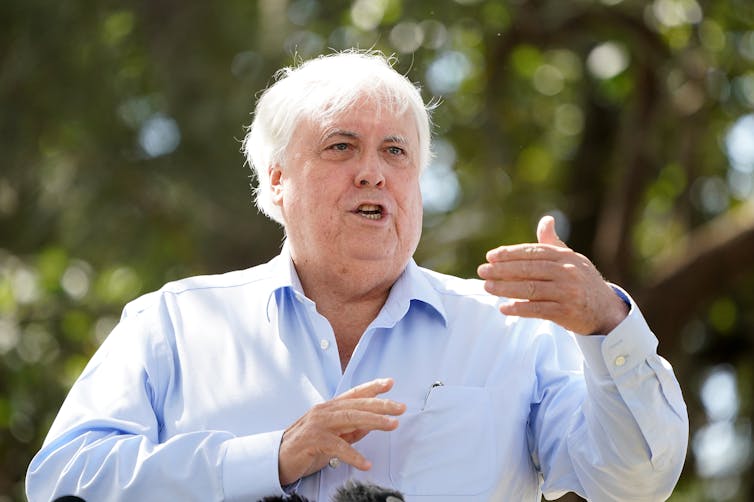
Clive Palmer is currently challenging Western Australia’s tough border closure, arguing it contravenes section 92 of the Constitution, which says
trade, commerce and intercourse among the states … shall be absolutely free.
Palmer is challenging restrictions on movement across state boundaries on the basis of an express provision of the Constitution.
By contrast, Gerner is challenging restrictions on movement within a single state on the basis of an implication he says can be found in the Constitution, rather than on any express provision.
Palmer’s case is due to be heard in the High Court in early November.Dave Hunt/AAP
Laws are considered invalid if they contradict the express terms of the Constitution such as these. But laws can also be ruled invalid if they impede the functioning of systems set up by the Constitution. This is how “implied” freedoms arise.
The most prominent example is the implied freedom of political communication. There is nothing in the Constitution saying expressly that Australians have freedom of political communication.
But the Constitution does expressly say parliamentarians must be “chosen by the people”.
This guarantee is vital because it provides for an implied freedom of expression on matters relating to politics and government. If this freedom didn’t exist, then the people would not be able to freely choose their parliamentarians.
Using this logic, the High Court has ruled restrictions on the freedom of political communication are invalid because they impede the functioning of the political system set up by the Constitution.
What has the High Court said about freedom of movement?
Freedom of movement for the purposes of freedom of political communication — for example, to take part in a protest — would be protected by the Constitution, as part of the implied freedom of political communication.
However, Gerner seems to be arguing the Constitution protects freedom of movement more generally.
Individual justices have agreed with this idea in the past. In the 1970s and ‘80s, High Court Justice Lionel Murphy said in a number of cases he believed the Constitution guarantees freedom of movement generally.
For example, Murphy said in a 1986 case that freedom of movement “in and between every part” of Australia is fundamental to a democratic society and necessary for the operation of the federal government and state constitutions. Murphy also said that freedom of movement is
a necessary corollary of the concept of the Commonwealth of Australia.
Justice Mary Gaudron said something similar in a 1992 case:
The notion of a free society governed in accordance with the principles of representative parliamentary democracy may entail freedom of movement.
However, a majority of the High Court has never accepted there is an implied freedom of movement in the Constitution.
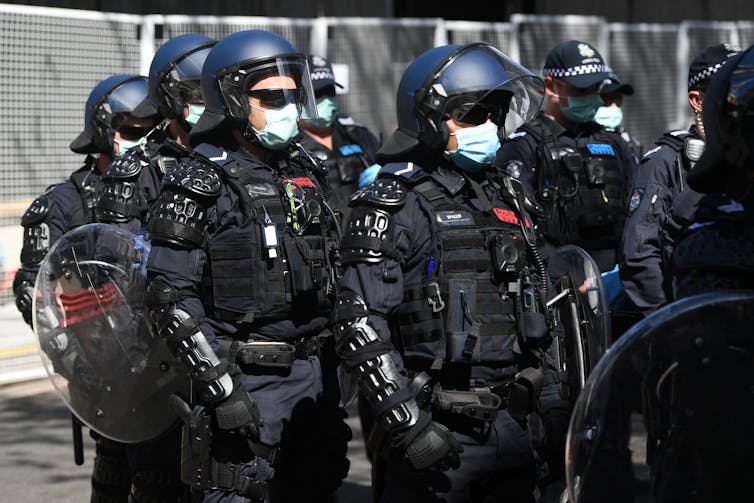
Police have cracked down on anti-lockdown protests in recent weeks.Erik Anderson/AAP
What happens next?
Two hurdles need to be overcome for Gerner’s challenge to succeed.
First, he would need to persuade the High Court the Constitution really does protect freedom of movement generally. This won’t be easy.
Second, he needs to persuade the High Court the Melbourne lockdown is a disproportionate limitation on freedom of movement. This may require a separate hearing in a lower court to hear expert public health evidence about what is necessary to protect public health.
This kind of separate hearing happened in Palmer’s WA border closure case. This will take some time.
There is also the possibility the Victorian government will relax the lockdown just before any High Court hearing starts.
This is what happened after a legal challenge was filed with the Victorian Supreme Court arguing Melbourne’s curfew was imposed without following the correct legal procedure.
The government abolished the curfew the day before the case was due to start. Its lawyers showed up to court arguing the case should not go ahead because the issue was now merely hypothetical.
While it is not beyond the realm of possibility, Gerner faces formidable obstacles to succeed with his challenge. I wouldn’t be holding my breath the High Court declares the existence of an implied freedom of movement anytime soon.
The West Papua Council of Churches wants an end to what it says is the re-militarisation of the region.
It wrote to Indonesia’s President Joko Widodo and also asked him to follow through on his commitment to meet with Papuan pro-referendum groups.
The churches said they were writing because of the escalation in violence in recent weeks, including the repressive response to peaceful protests rejecting any extension of Special Autonomy, and the killing of a Papuan pastor, Reverend Yeremia Zanambani, two weeks ago in Intan Jaya regency.
The death of the pastor has been blamed by churches on the Indonesian military, although the military initially denied it.
However, according to the churches, the remilitarisation that has occurred in the region over the past year is aimed at turning Papua into a military operations area, with the military taking control of the natural resources on a large scale.
The churches documented how Indonesia strove in the 1960s to destroy Papuan culture and said an apartheid ideology was applied to Papuans with the people subjugated.
They said the President, as Indonesia’s supreme military commander, along with the member countries of the UN’s Human Rights Council, needed to resolve the issue of Papua peacefully through negotiations.
This article is republished by the Pacific Media Centre under a partnership agreement with RNZ.
Face masks are part of our daily lives during the pandemic. Many are made from plastics and designed to be used just once, which means thousands of tonnes of extra waste going to landfill.
Masks may help stop the spread of the coronavirus. But according to one estimate, if everyone in the United Kingdom used a single-use mask each day for a year, it would create 66,000 tonnes of contaminated waste and 57,000 tonnes of plastic packaging.
Evidence also suggests masks may be a source of harmful microplastic fibres on land and in waterways and litter.
So let’s look at how face masks might be designed to cause minimal harm to the environment, while still doing their job – and which type is best for you.
N95 masks are used in hospital settings.Shutterstock
Circular thinking
China is the world’s biggest face mask manufacturer. Its daily output of face masks reportedly reached 116 million units in February this year. That creates a big waste management problem around the world.
One way to address this is to adopt “circular design” principles. This thinking seeks to reduce waste and pollution through product design, keep products and materials in use, and regenerate natural systems.
When it comes to face masks, the three common types are cloth, surgical and N95. N95 masks offer the highest level of protection, blocking about 95% of airborne particles. Cloth masks are designed to be used more than once, while surgical and N-95 masks are usually intended for single use.
Face masks may consist of one or more layers, each with different functions:
an outermost layer, designed to repel liquids such as water
the innermost layer, which absorbs moisture and allows comfort and breathability
a non-absorbent middle layer, to filter particles.
Surgical masks are generally intended as single-use items.BrendanThorne/AAP
Each type of mask is made of different materials and used in varying settings:
– N95 masks: These are designed to protect the wearer from 95% of airborne particles and are largely worn by health workers. N95 masks are designed to fit closely to the face and are usually worn only once. N95 masks comprise:
a strap (polyisoprene)
staples (steel)
nose foam (polyurethane)
nose clip (aluminum)
filter (polypropylene)
valve diaphragm (polyisoprene).
– Surgical masks: These are designed to protect sterile environments from the wearer, acting as barrier to droplets or aerosols. Generally intended as single-use items, they comprise mostly polypropylene between two layers of non-woven fabric.
– Cloth masks: These types of masks are worn by the general public. Some are homemade from fabric scraps or old clothing. They may be wholly reusable, or partially reusable with replaceable filters that must be disposed of.
These masks typically comprise an outer layer of polyester or polypropylene (or in some cases, cotton), and an inner layer designed for breathability and comfort – usually cotton or a cotton-polyester blend.
Research suggests cloth masks are less effective at filtering particles than medical masks, but may may give some protection if well-fitted and properly designed. Health advice is available to help guide their use.
Many cloth masks are handmade, and can be reused.Shutterstock
Designing for a healthier environment
It’s important to note that any attempt to redesign face masks must ensure they offer adequate protection to the wearer. Where masks are used in a medical setting, design changes must also meet official standards such as barrier efficiency, breathing capacity and fire resistance.
With this in mind, reducing the environmental harm caused by masks could be done in several ways:
– Design with more reusable parts
Evidence suggests reusable cloth masks perform almost as well as single-use masks, but without the associated waste. Once life cycle assessment conducted in the UK found masks that could be washed and reused were the best option for the environment. Reusable masks with replaceable filters were the second-best option.
The study also found having a higher number of masks in rotation to allow for machine washing was better for the environment than manual washing.
– Make masks easier to dispose of or recyle
In high-risk settings such as hospitals and clinics, the reuse of masks may not be possible or desirable, meaning they must be disposed of. In medical settings, there are systems in place for disposal of such protective gear, which usually involves segregation and incineration.
But the general public must dispose of masks themselves. Because masks usually comprise different materials, this can be complicated. For example, recovering the components of a N-95 mask for recycling would involve putting the straps, nose foam, filter and valve in one bin and the metal staples and nose clip in another. And some recyclers may see mask recycling as a health risk. These difficulties mean masks often end up in landfill.
Masks would be easier to recycle if the were made of fewer materials and were easy to disassemble.
– Use biodegradable materials
For single-use items, placing synthetics with biodegradable materials would be a first step in circular design thinking.
The abaca plant, a relative of the banana tree, offers one potential option. Its leaf fibre reportedly repels water better than traditional face masks, is as strong as polymer and decomposes within two months. Most abaca is currently produced in the Philippines.
Recycling of face masks can be complicated.Shutterstock
Which mask should you choose?
From a purely environmental perspective, research suggests owning multiple reusable face masks, and machine-washing them together, is the best option. Using filters with reusable face masks is a second-best option.
But when choosing a mask, consider where you will wear it. Unless cloth masks are shown to be as effective as other masks, health-care workers should not use them. But they may be suitable in low-risk everyday settings.
In the longer term, governments and manufacturers must make every effort to design masks that will not harm the planet – and consumers should demand this. Face masks will probably be ubiquitous on our streets for months to come. But once the pandemic is over, the environmental legacy may last for decades, if not centuries.
Social media algorithms, artificial intelligence, and our own genetics are among the factors influencing us beyond our awareness. This raises an ancient question: do we have control over our own lives? This article is part of The Conversation’s series on the science of free will.
Have you ever watched a video or movie because YouTube or Netflix recommended it to you? Or added a friend on Facebook from the list of “people you may know”?
And how does Twitter decide which tweets to show you at the top of your feed?
These platforms are driven by algorithms, which rank and recommend content for us based on our data.
As Woodrow Hartzog, a professor of law and computer science at Northeastern University, Boston, explains:
If you want to know when social media companies are trying to manipulate you into disclosing information or engaging more, the answer is always.
So if we are making decisions based on what’s shown to us by these algorithms, what does that mean for our ability to make decisions freely?
What we see is tailored for us
An algorithm is a digital recipe: a list of rules for achieving an outcome, using a set of ingredients. Usually, for tech companies, that outcome is to make money by convincing us to buy something or keeping us scrolling in order to show us more advertisements.
The ingredients used are the data we provide through our actions online – knowingly or otherwise. Every time you like a post, watch a video, or buy something, you provide data that can be used to make predictions about your next move.
These algorithms can influence us, even if we’re not aware of it. As the New York Times’ Rabbit Hole podcast explores, YouTube’s recommendation algorithms can drive viewers to increasingly extreme content, potentially leading to online radicalisation.
Facebook’s News Feed algorithm ranks content to keep us engaged on the platform. It can produce a phenomenon called “emotional contagion”, in which seeing positive posts leads us to write positive posts ourselves, and seeing negative posts means we’re more likely to craft negative posts — though this study was controversial partially because the effect sizes were small.
Also, so-called “dark patterns” are designed to trick us into sharing more, or spending more on websites like Amazon. These are tricks of website design such as hiding the unsubscribe button, or showing how many people are buying the product you’re looking at right now. They subconsciously nudge you towards actions the site would like you to take.
Cambridge Analytica, the company involved in the largest known Facebook data leak to date, claimed to be able to profile your psychology based on your “likes”. These profiles could then be used to target you with political advertising.
“Cookies” are small pieces of data which track us across websites. They are records of actions you’ve taken online (such as links clicked and pages visited) that are stored in the browser. When they are combined with data from multiple sources including from large-scale hacks, this is known as “data enrichment”. It can link our personal data like email addresses to other information such as our education level.
These data are regularly used by tech companies like Amazon, Facebook, and others to build profiles of us and predict our future behaviour.
You are being predicted
So, how much of your behaviour can be predicted by algorithms based on your data?
Our research, published in Nature Human Behaviour last year, explored this question by looking at how much information about you is contained in the posts your friends make on social media.
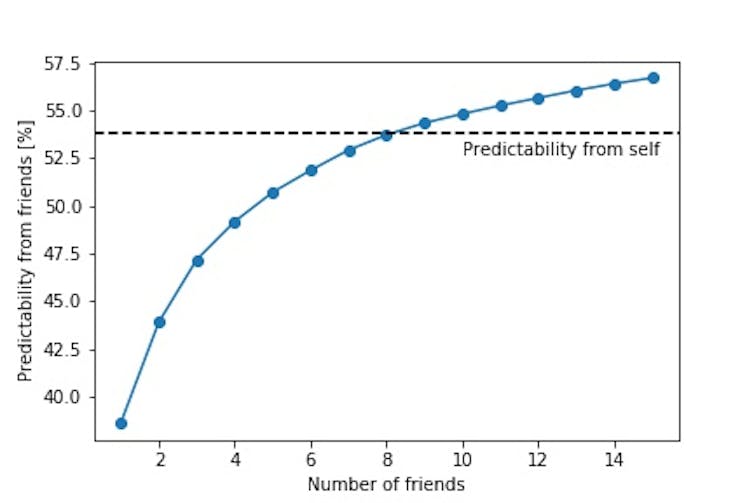
Using data from Twitter, we estimated how predictable peoples’ tweets were, using only the data from their friends. We found data from eight or nine friends was enough to be able to predict someone’s tweets just as well as if we had downloaded them directly (well over 50% accuracy, see graph below). Indeed, 95% of the potential predictive accuracy that a machine learning algorithm might achieve is obtainable just from friends’ data.
Average predictability from your circle of closest friends (blue line). A value of 50% means getting the next word right half of the time — no mean feat as most people have a vocabulary of around 5,000 words. The curve shows how much an AI algorithm can predict about you from your friends’ data. Roughly 8-9 friends are enough to predict your future posts as accurately as if the algorithm had access to your own data (dashed line).Bagrow, Liu, & Mitchell (2019)
Our results mean that even if you #DeleteFacebook (which trended after the Cambridge Analytica scandal in 2018), you may still be able to be profiled, due to the social ties that remain. And that’s before we consider the things about Facebook that make it so difficult to delete anyway.
We also found it’s possible to build profiles of non-users — so-called “shadow profiles” — based on their contacts who are on the platform. Even if you have never used Facebook, if your friends do, there is the possibility a shadow profile could be built of you.
On social media platforms like Facebook and Twitter, privacy is no longer tied to the individual, but to the network as a whole.
No more free will? Not quite
But all hope is not lost. If you do delete your account, the information contained in your social ties with friends grows stale over time. We found predictability gradually declines to a low level, so your privacy and anonymity will eventually return.
While it may seem like algorithms are eroding our ability to think for ourselves, it’s not necessarily the case. The evidence on the effectiveness of psychological profiling to influence voters is thin.
Most importantly, when it comes to the role of people versus algorithms in things like spreading (mis)information, people are just as important. On Facebook, the extent of your exposure to diverse points of view is more closely related to your social groupings than to the way News Feed presents you with content. And on Twitter, while “fake news” may spread faster than facts, it is primarily people who spread it, rather than bots.
Of course, content creators exploit social media platforms’ algorithms to promote content, on YouTube, Reddit and other platforms, not just the other way round.
At the end of the day, underneath all the algorithms are people. And we influence the algorithms just as much as they may influence us.
Who turns out to vote, who stays at home, and who mails or drops in a ballot are all likely to play a significant role in the outcome of the US presidential election. Race and racism are important in motivating and suppressing voters.
Unlike in Australia and a handful of other democracies, voting in the United States is voluntary. People have to be motivated to vote, whether in person or by mail.
But with the public polarised and tribal, it is extremely difficult to convert likely voters away from their long-term allegiances.
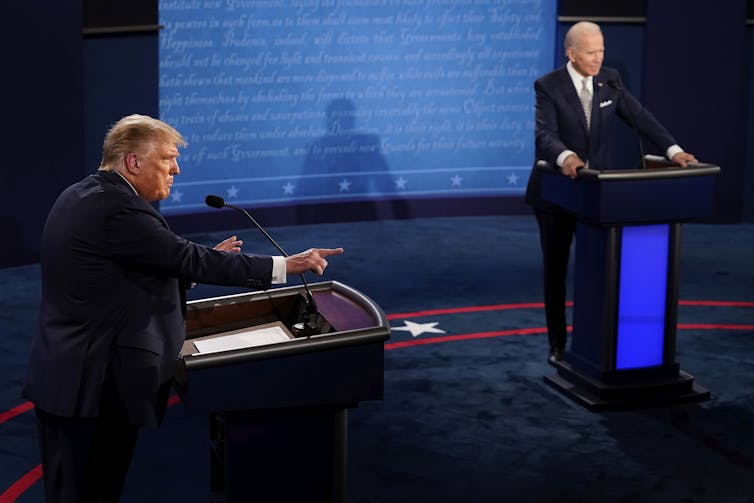
So candidates try to mobilise likely supporters and suppress an opponent’s. Campaign strategists intended Donald Trump’s performance in the first presidential debate would signal strength. They hoped this would appeal to white women, whose support in important states he has been losing in droves.
Trump instead signalled strongly to a white supremacist group, the Proud Boys, that he wanted their support.
Donald Trump told the ‘Proud Boys’ to ‘stand back and stand by’ during the first debate.Morry Gash/AP/AAP
Democratic theorists argue high turnout provides legitimacy for the political system by ensuring all voices are heard in democratic processes.
In practice, however, efforts to manipulate electoral participation – and specifically to suppress Black voters – have been a prominent theme in the history of American elections.
Enslaved people could not vote. After the 1860s Civil War, newly freed African Americans seized the right to vote, sending several men to represent Southern states in Congress.
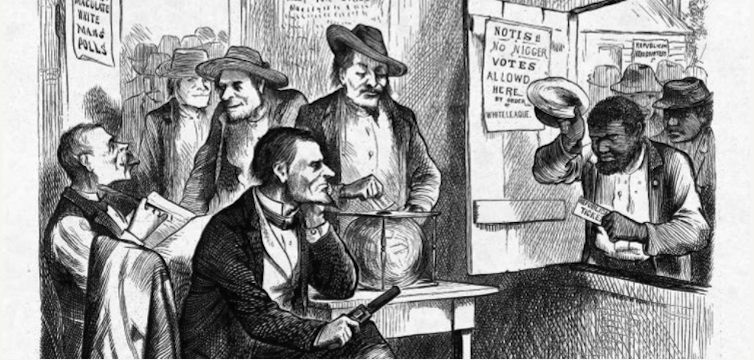
But as early as the 1870s, white Americans systematically disenfranchised Black voters (and also many poor whites) through a variety of regulations — including property and education clauses. The notorious “grandfather clause” decreed men could vote only if their grandfather was also eligible to vote in the years before 1867. Violence at the ballot box kept African American men, and African American women after 1920, away for decades.
During segregation, violence, represented here by the gun, underpinned all other methods to keep Black people from voting. Harper’s Weekly, October 31 1874.
When Trump incites his followers to sign up as “election poll watchers”, he evokes this very history, which dominated Southern politics until the civil rights movement.
Since 2010, 25 states have introduced measures to make it harder to vote. For example, they require voters to register prior to the election and/or provide photo ID at the point of voting.
In 11 states, people convicted of felonies are banned from voting long after custodial sentences end or fines have been paid – and sometimes for life. These laws have seen 6 million adults lose the right to vote.
These methods all affect poorer and less well-educated Americans more than affluent Americans. Non-white Americans, especially African American, Native American and to a lesser extent Latino voters, have been most affected.
In Florida, where this disenfranchisement affected more than 20% of African Americans, voters overturned the ban. Republican state legislators soon found a way to ensure 775,000 people still cannot vote by deeming ineligible anyone with outstanding court fees.
In neighbouring Georgia, Republican Secretary of State Brian Kemp narrowly edged out popular Democratic challenger Stacey Abrams – who is African American – in the 2018 election for governor. His success came by ruthlessly disqualifying 53,000 voters – 70% of them African American and only 20% white – with dubious “signature matching” requirements.
Activating voters
On the flipside, both camps need to inspire their own supporters to vote, as well. African American turnout was higher in the 2018 midterms than in 2014. Joe Biden, who needs to ensure sufficient pro-Democrat and/or anti-Trump adults vote, will hope that trend continues.
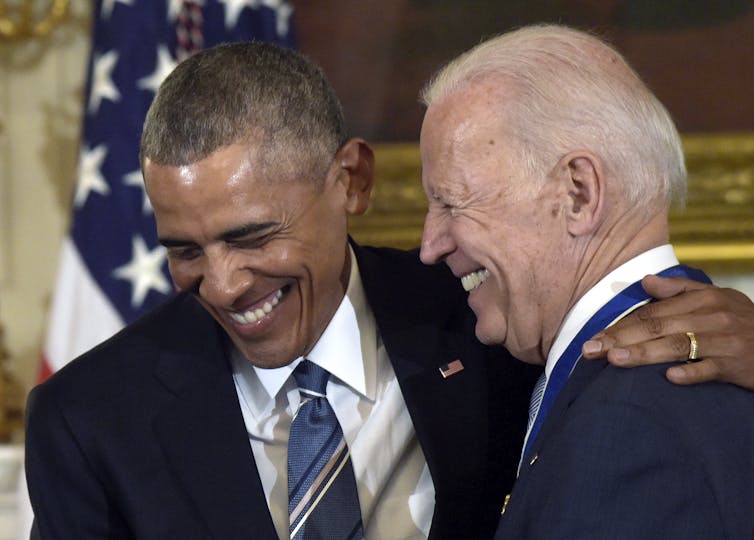
Biden’s eight years as Barack Obama’s vice president – and their apparently effective professional and affectionate personal relationship – may help inspire African American voters. A big question is whether the mobilisation that occurred through BLM rallies will translate into high participation by minority and young people in the election.
Barack Obama and Joe Biden’s close relationship may encourage more black voters to support Biden.Susan Walsh/AP/AAP
Trump needs to mobilise the large groups of white women who voted for him in 2016.
The 2020 elections seem unusually high stakes not just for public policy but for the future of electoral participation in America.
Trump has spent much of the past four years casting doubt on voting processes. If he can persuade Republican state legislatures to set aside the popular vote on the basis of alleged fraud, there is Constitutional scope for those legislatures to select whichever electors they like to represent the state at the Electoral College. This would be an almost unprecedented undermining of the fundamental ideal of “one person, one vote.”
Lawyers for both sides are preparing to take the battle into the courtroom if, as seems likely, the election outcome turns on a controversial electoral participation question. These controversies may make their way to the Supreme Court, perhaps including a new judge. Its judgements may shape the terrain of electoral participation for a long time to come.
The Trump era’s suppression of the vote is out of step with the long run trend of greater inclusiveness. Another four years of Trump seems likely to create more obstacles to participation.
By contrast, a Biden-Harris victory provides an opportunity to prevent further erosion of democratic participation. It would also mark a new high in the representation of African American women in federal politics.
The COVID-19 pandemic has resulted in rapid changes to the way Australians access health care. We’re now using telehealth more than ever.
Last week’s federal budget confirmed a six-month extension of Medicare subsidies for telehealth consultations, worth A$2.4 billion. It also included A$18.6 million for the preparation of permanent telehealth infrastructure beyond March 31 next year.
This goes some way to recognising telehealth is not only an important tool in our pandemic response — it’s much needed in our health system.
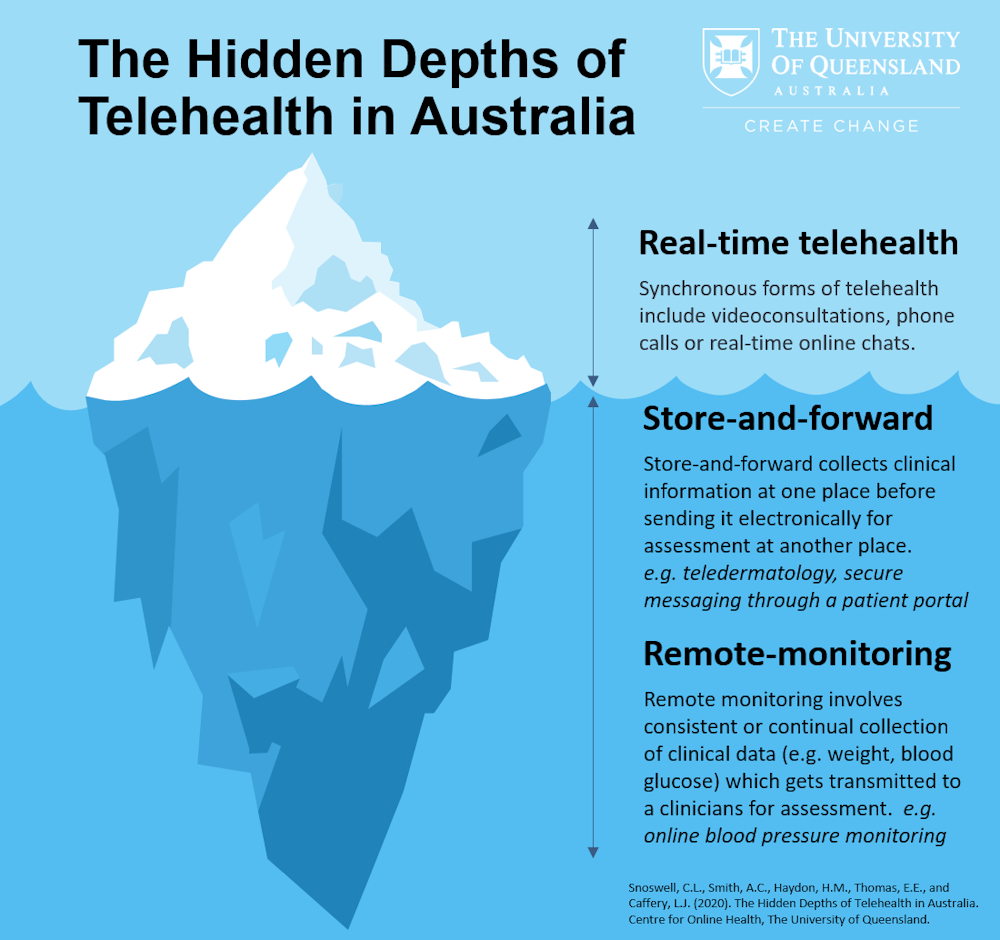
To fully realise the potential of telehealth, we need to recognise it’s more than just appointments via phone or videoconference.
COVID-19: a game changer for telehealth in Australia
In March, telehealth services were funded for all Australians under the Medicare Benefits Schedule (MBS).
The package covered phone and videoconsultations with GPs, specialists, nurse practitioners and allied health professionals (like physiotherapists, social workers and psychologists). This complemented existing MBS funding for medical videoconsultations for people in rural communities.
There’s more to telehealth than phone calls and videoconferencing
There are three main forms of telehealth: “real-time”, “store-and-forward” and “remote patient monitoring”.
Real-time is largely what we’ve got in place now — clinical consultations via phone and videoconferencing.
During the pandemic, health professionals have heavily favoured telephone over videoconsultations. More than 91% of MBS-funded telehealth services are delivered by phone.
During COVID-19, the majority of telehealth consultations have occurred via phone rather than videoconferencing.Shutterstock
While telephone can be effective in some situations (for example, history taking, triaging or referrals), videoconsultations can vastly improve the likelihood the clinician will make an accurate diagnosis.
Evidence shows videoconsultations can be as effective as in-person consultations, when it’s appropriate to use telehealth, regardless of the type of clinician.
Store-and-forward is the collection of clinical information and the process of sending it online.
A common example is when a patient or their GP photographs a skin lesion and sends the image to a dermatologist for an opinion and management advice.
Store-and-forward services exist in small silos in Australia. They often rely on hospital or commercial funding for support because they’re not currently funded on the MBS.
Store-and-forward services are offered around the world for a variety of conditions. Evidence shows they make services more accessible and cost-effective, and clinicians are generally satisfied with them.
Remote patient monitoring, also called in-home monitoring or telemonitoring, involves collecting disease-specific health information and watching how it changes over time.
We can monitor conditions such as high blood pressure or diabetes (that often don’t have symptoms) using standard blood pressure machines or blood glucose monitoring devices that interact with apps or the internet.
If a patient’s readings fall outside healthy limits, an alert can be sent to both the patient and their primary care team.
Remote monitoring is used internationally to manage chronic diseases, with good results. A recent review showed it led to positive outcomes in 77% of studies, with more people staying well and out of hospital for longer.
Telephone and videoconferencing only scratch the surface of telehealth.Centre for Online Health, The University of Queensland (template from presentationgo.com).
While there are a number of trials or small clinician-driven programs in Australia, lack of infrastructure and funding have prevented the wide roll-out of remote monitoring programs in the community.
Pleasingly, the federal budget has pledged money to begin working on infrastructure to monitor implantable devices, which will hopefully lead to interactive remote monitoring of patients with heart disease.
Choosing the right type
The choice of real-time, store-and-forward or remote patient monitoring should take into account the patient’s needs and their specific condition. It should also consider the cost of the service for the patient, provider and health system.
These lesser-used types of telehealth provide greater opportunity for multi-disciplinary care, and enable certain monitoring tasks to be redirected to nursing and allied health professionals, where appropriate.
For example, a nurse or pharmacist can review blood pressure readings and provide feedback to patients (and they can refer the patient for GP or specialist input if needed).
Remuneration for telehealth services should be commensurate with the amount of time, effort and skill required to provide the consultation. Incentivising video consultations (for example by subsidising them at a higher rate than telephone consultations) may be one way of encouraging clinicians to use them.
We now have a range of technologies to allow for remote patient monitoring.Shutterstock
Thinking more broadly
Health systems around the world are not only battling the pandemic, but also the tsunami of chronic disease. So changes to the way we provide health care are inevitable.
In Australia, conditions like heart disease, stroke and diabetes lead to high rates of ill health and death.
We need strategies that inform patients about, and engage patients in, their own health care. We also need funding that supports services and health outcomes, rather than purely “fee for service” encounters.
Store-and-forward and remote patient monitoring hold significant potential for enhancing the long-term management of chronic conditions, and ensuring easier access to specialist health services through a better connected health system.
We made the necessary changes to ensure health care was accessible during the pandemic. Now is the time to capitalise on this change to achieve true reform.
Crucially, we need to think about how we can make changes to the health-care system to take advantage of all forms of telehealth.
Source: The Conversation (Au and NZ) – By Jessica C Lai, Associate Professor in Commercial Law, Te Herenga Waka — Victoria University of Wellington
New Zealand has allocated an undisclosed sum, in the order of hundreds of millions of dollars, to access COVID-19 vaccines when they become available.
The funding is on top of a NZ$37 million vaccine strategy, but the government has not released specifics because of commercial sensitivities that “could prevent the best possible deal for New Zealanders”.
Apart from the intricacies of global efforts to develop, test and distribute a vaccine, there are also domestic legal issues the government might need to consider, particularly in patent law and the regulatory review of medicines.
Legislative changes to future-proof the law could avoid delays and lower access costs.
Patent law and access
Some fear pharmaceutical companies could patent a COVID-19 vaccine and hold the world hostage, demanding monopoly prices.
But to get a patent the invention has to be novel and non-obvious. There is possibly enough public information about vaccines currently under investigation or in trials to make it difficult for a company to prove novelty or non-obviousness.
At the moment, an application for a compulsory licence is only possible after negotiations with a patent owner have failed and if three years have lapsed since the patent was granted (or four years since the patent application was filed). But international trade law states that any requirement to negotiate with the patent owner may be waived in the case of a national emergency or other circumstances of extreme urgency.
Parliament should consider amending New Zealand patent law to be clear that, in a national emergency, anyone can apply for a compulsory licence at any point, without the requirement to negotiate with the patent owner first.
Both international and New Zealand law allow pharmaceutical products manufactured under a compulsory licence to be exported to address a serious public health problem in another country. This might prove important for Pacific nations.
Government departments can use patented inventions for the services of the Crown. This can be delegated, for example, to a local pharmaceutical manufacturing company.
In an emergency, there is no requirement for the Crown to negotiate a licence with the patent owner first. Nor does the Crown need to wait for a certain period of time to lapse.
This currently covers protecting New Zealand’s security or defence, or managing a state of emergency. A global pandemic can trigger a state of emergency, as happened in New Zealand in March 2020. But to future-proof the law, parliament should consider amending the definition of “emergency” to specifically include health emergencies.
Crown use provisions would allow the government to make and use any patented vaccine or medicine, and to sell any product in excess to its requirements. This would allow sale to a Pacific nation for a nominal amount.
All new medicines must have regulatory approval from Medsafe.Hagen Hopkins/Getty Images
A vaccine must be safe
In contrast to patent protection, there are no exceptions to the regulatory review of medicines. Anyone who wants to distribute, sell or advertise a medicine in New Zealand must have regulatory approval from Medsafe.
Applicants must submit information and data about the pharmaceutical and the proposed on-label uses. This includes reports on any tests and clinical trials, and data on safety and efficacy. Medsafe decides whether to approve a medicine based on this information.
The process can be lengthy and could delay access to a vaccine. But parliament could legislate a narrow regulatory review “highway” — if regulatory approval for a vaccine is granted elsewhere, such as the European Union, Australia or Canada, it could automatically get approval in New Zealand.
Other aspects of the regulatory process will determine the cost of a vaccine.
Generic medicines — essentially imitations — make the price of pharmaceuticals competitive. Generic pharmaceutical companies don’t usually generate data or run clinical trials. Instead, they show their product is equivalent to the original medicine and ask Medsafe to use the original data to determine safety.
But Medsafe is not allowed to use any data it receives for one application for the assessment of another for five years. Any vaccine could become obsolete within five years.
There is an exception allowing Medsafe to use data if it is “necessary to protect the health or safety of members of the public”. One can argue that having competition, lower prices and wide distribution of a COVID-19 vaccine meets this requirement. Parliament should amend the legislation to make this clear.
If we allow generic companies to rely on the data of original innovator companies, there would be at least two entities in the market competing with the same vaccine.
We don’t know what’s coming but that shouldn’t stop us from future-proofing our laws and regulatory processes for the different possibilities. New Zealand needs to take advantage of the flexibilities in international trade law to get a COVID-19 vaccine, possibly even two or three, to New Zealanders as quickly and cheaply as possible.
…supports the well-being of students and school communities through the provision of pastoral care services.
However, the idea a chaplain should be responsible for students’ well-being has prompted some people to react with outrage. The assumption has been that chaplains have no place in secular schools; that chaplains may be trying to indoctrinate students into their faith and, unlike school counsellors, have no formal training in supporting student well-being.
But there are several misconceptions in this view. Not all chaplains are religious, and Australia’s chaplaincy program actually prohibits preaching or religious practice.
What is a chaplain?
The word chaplain comes from Latin word for “cloak”. The story goes that Saint Martin met a man begging in the rain without a cloak. Martin ripped his cloak in half to share with the man, seeing both his need and the man’s as equal.
While pastoral care originated from Christian philosophy, it is now widely used in non-religious organisations. It means ensuring the personal development of the student and, in particular, their general and moral welfare.
It is also important to note a chaplain’s role is not that of a psychologist. Chaplains run self-esteem programs, host breakfast clubs, and chat about daily friendship issues. Psychologists do not do this.
Psychologists assess and treat mental health issues, and learning and achievement problems. They provide counselling, and manage risk (such as for self-harm or suicide). Chaplains should not be doing any of these tasks.
Every week, Australia’s school chaplains have an estimated 28,264 informal conversations with students. While chaplains can have these chats, a psychologist cannot without consent from parents. In these moments, chaplains can provide pastoral care to encourage effective coping, friendship skills and resilience without having to go through an official process.
A chaplain does not replace a psychologist; they complement them.
Despite the lessening of religion in the chaplain’s role, to gain employment as a chaplain in Australian schools in some states and territories, one must be endorsed by a religious affiliation. This excludes those who may be qualified (such as a youth worker or social worker) but not religious.
The Australian Capital Territory and Victoria have brought in changes to this model as they state it is discriminatory and undermines the secular nature of schools. Victoria has advocated for atheist chaplains.
take advantage of their privileged position to proselytise, evangelise or advocate for a particular religious view or belief
conduct religious services or ceremonies or lead students or staff in religious observances unless agreed to by the principal if working in a government school deliver special religious instruction if working in a government school.
Are chaplains in schools effective?
In a government evaluation, the National School Chaplaincy Program was considered to be effective in dealing with family relationships, bullying and harassment, loneliness, and grief and loss.
In the same evaluation, 80% of principals and 60% of parents believed the program to be extremely effective in fostering a sense of purpose and self-esteem, peer relationships, social inclusion and self-image.
However, the chaplaincy program was perceived as less effective when dealing with issues of alcohol and drug abuse, sexuality, self-harm and suicide, and racism. Many parents and principals felt “unsure” if chaplains helped in these areas.
This is where roles are confused and issues occur. Chaplains are not specifically trained in these areas and should not be engaged in these services. These are areas for psychologists.
It is vital to have adults in schools with whom young people can connect to share their concerns and worries. Chaplains fulfil that role effectively. The historical religious basis and the current need for endorsement from an affiliate church can distract some from the role they perform.
Long-term planning has delivered mass transit systems to cater for high-patronage, hub-and-spoke transport systems. Unfortunately, this has left many city residents without basic access to public transport services. And we could never have planned for the impacts of COVID-19.
Our previous plans were based on the best available data at the time. Today, these plans must be critically reviewed using new data that properly represent the world and our transport needs as they are now.
The work-from-home transition is well under way. Our current transport networks (except for roads, which have rebounded to traffic equal to or above pre-pandemic levels in some cities) are operating far below previous levels, even allowing for social distancing. This may not be the best time to break ground on major infrastructure projects planned under previous assumptions of population and demand growth.
2: Disadvantaged populations lack access to opportunities.
Public transport is key to enabling everyone in a population to be a productive member of society. Many disadvantaged groups cannot drive or afford car ownership. However, they also lack access to public transport, particularly in the outer suburbs.
Unfortunately, coronavirus impacts will hit the disadvantaged the hardest. If we want everyone to be able to participate in the economic recovery, we need to promote basic levels of access regardless of an individual’s circumstance.
Migration bans will greatly reduce short-term growth. Current projections show a population up to 4% smaller in 2040 than it would have been in a non-COVID world. This will further decrease demand for urban transit services as well as demand across many sectors of our society. These trends are important because much of our planning is based around these population growth metrics.
However, our suburbs still lack basic public transport services. If we want to increase patronage, we need to bring services to more people by improving coverage of our sprawling, low-density cities.
Over 80% of the population of our biggest cities live in the outer and middle suburbs, yet this massive majority have limited to no basic public transport service. Across our five largest cities, Infrastructure Australia reports, “public transport disadvantage in outer suburbs is significant”.
Job creation will be an important aspect of economic recovery. Yet too often we look to large construction projects as the answer. There is plenty of other job-creating work to be done in our communities.
We could, for example, increase the miserly funding for our piecemeal walking and cycling networks.
We could also expand on-demand services to suburban and rural residents who lack basic public transport access. On-demand transit does not follow fixed routes or timetables. Riders book a trip for a cost similar to a bus fare.
Bridj is one of the operators that is expanding on-demand services in Sydney and other cities.Bridj Transit Systems/Facebook
A focus on localised investment in the many neglected communities across the country will deliver major benefits. Money already committed to large projects that are under way represents sunk costs that may be too deep to renegotiate. However, future plans using public funds must be re-examined.
Investments should target disadvantaged groups and broaden access to transport networks, encouraging new potential users. For many, assistance in gaining access to the necessities of life will be invaluable during the coming economic recovery. Guaranteed access to groceries, medical services, work opportunities and recreational activities must not be reserved for the elite.
We need better localised public transport and we need it for the majority of citizens, not just those who live in the inner suburbs of our capital cities. Most regional populations lack even rudimentary public transport coverage at reasonable frequency.
Increasing services in these areas will create valuable jobs that will stick around, unlike large one-off construction projects. The money will stay local, going into the pockets of operators who live and work in their own community.
While our long-term planning is not to blame for our current situation, we need to develop for the future, not the past. The financial costs of building and maintaining our current infrastructure are not going away. However, we can no longer refuse to invest in many of our underserved communities.
It is time to ensure everyone, regardless of their income or where they grow up, has the basic services they need to be a productive member of society.
Source: The Conversation (Au and NZ) – By Carla Liuzzo, Sessional Lecturer, School of Business, School of Creative Industries, Queensland University of Technology
Treasurer Josh Frydenberg mocked the idea of a “well-being budget” as “laughable” back in February. He’s got less reason to laugh now.
According to an Essential Research poll last week, 78% of Australians agree the pandemic has exposed flaws in the economy and there is an opportunity to explore new ways to run things. A well-being budget might be just the ticket.
In February, Frydenberg dismissed a well-being budget as “just another word for Labor’s higher taxes and more debt”, after the shadow treasurer, Jim Chalmers, committed the heresy of saying gross domestic product was, on its own, a deficient economic measure, and countenanced “a version of New Zealand’s well-being budget, which redefines what success means in terms of economic outcomes”.
Treasurer Josh Frydenberg enjoying himself during Question Time in the House of Representatives on Thursday, February 27 2020.Mick Tsikas/AAP
Frydenberg joked about Chalmers being “fresh from his ashram deep in the Himalayas, barefoot, robes flowing, incense burning, beads in one hand, well-being budget in the other”.
But now, with the federal government changing its tune on many things, such as debt, it might be a good time for Frydenberg to change his mind on this.
Well-being measures, for one thing, could greatly assist the Australian government in budgeting to improve mental health and prevent suicides – things Frydenberg said in his budget speech are national priorities.
It’s impossible to address the nation’s mental crisis just through the blunt tools of economic growth and money for band-aid services. If a bigger income was the main means to mental well-being, after all, James Packer would be happier.
Mental health is a complex problem, with complicated causes, requiring a sophisticated response. To do that, developing measurements of well-being can only help.
There is no universal definition of well-being economics, but essentially it is an economic perspective that acknowledges gross domestic product – the monetary value of all goods and services produced by a country in a given period – as an all-too narrow metric for building a prosperous, sustainable, human-centred economy.
GDP is useful, as Chalmers acknowledged in his February speech:
It does still provide a powerful insight into the current state of the economy, and is useful for historical comparisons. […]
More broadly, growth matters to the jobs and opportunities created in our society. A healthy, growing economy can make people more comfortable with farsighted social and economic policy changes as well.
But GDP does not, as Chalmers said, paint the whole picture. He quoted Robert Kennedy, who said GDP measured everything “except that which makes life worthwhile”; and Nobel-winning economist Joseph Stiglitz: “If we measure the wrong thing, we will do the wrong thing.” So his point was hardly fringe.
Indeed even the architect of GDP as an economic measure, economist Simon Kuznets, warned against putting too much emphasis on it, and of the dangers of it subverting the normally “valuable capacity of the human mind to simplify a complex situation in a compact characterisation”.
The main difference of The Wellbeing Budget to previous budgets was how it allocated resources to five priority areas: mental health; child well-being; Māori and Pasifika well-being; productivity; and environmental sustainability.
The traditional budget process tends to consider priorities on a yearly basis. This guides governments to put more money into short-term goals and less into initiatives with long-term returns. To overcome this bias, New Zealand’s Treasury created an assessment framework that considers the merits of projects according to 60 different measurements (covering economic, social and environmental impacts).
The intention is to ensure the budget doesn’t neglect to invest in long-term initiatives that can prevent problems, rather than being caught in a cycle of pumping money into alleviating the symptoms short-term.
New Zealand’s Wellbeing Budget, published May 30 2019.Boris Jancic/AAP
In mental health this means more emphasis on policies that keep people well, rather than on providing help only once they are very unwell – the type of “defensive spending” dominating the Australian government’s priorities in mental health in last week’s budget.
The Australian Capital Territory’s Labor government has already replicated New Zealand’s model in its own Wellbeing Framework.
In February Chalmers indicated a desire for federal Labor to take a well-being budget to the next election.
ALP leader Anthony Albanese’s response to the federal budget on Thursday night gave few signals the Labor Party will do so. Though he criticised the government’s short-term GDP growth focus, the word “well-being” did not pass his lips.
But popular opinion suggests both parties should be putting well-being measures on the agenda. Already more than 30 countries measure “life satisfaction”. Support for well-being economics should transcend party lines, as it does in countries such as Britain.
If the Australian government is to “build back better”, it’s hard to see how a well-being budget could possibly hurt.
The 2020 federal budget has allocated A$53 million towards Australian screen production.
The funding comes attached to policy reforms harmonising incentives across film and television production and removing requirements for films to play in cinemas.
Arts minister Paul Fletcher argues “the old approach of treating film and television differently no longer makes sense” and “simplifying regulations” will encourage creators to develop higher production value content for international streaming services like Netflix and Amazon Prime.
But producers fear this will spell the end for Australian-made films and feature documentaries in cinemas.
Responding to the policy changes, film producer and distributor Sue Maslin AO tells me:
This announcement brings an end to producers like myself continuing to invest our time, money, blood, sweat and tears in developing features and forces us to focus on digital platforms in an unregulated environment where to date there has been negligible commissioning by streamers and no sustainable business model emerge.
Such a clear preference for eyeballs aimed at televisions and computer screens overlooks the importance films in the cinema have for sustaining a robust Australian screen industry.
From script to screen
Feature films are expensive to make and difficult to finance.
Under the existing model, feature films with an Australian spend of at least $500,000 qualify for a 40% rebate, while television and online content receive 20%.
The new budget measures harmonise the offset for all productions at 30%. This means feature producers will be forced to find an additional 10% of their total budget to get their films made. Additionally, all productions must now spend at least $1 million in Australia to be eligible.
Feature film funding comes from a variety of sources. State and federal production grants and the producer offset account for roughly half of a typical budget.
The remaining finance comes from local distributors, international sales agents, television license fees and a shrinking pool of private investment.
With lower subsidies, projects will look to co-produce in countries with more generous rebates.Dirt Music/Wildgaze Films
With a rebate of just 30%, finance will become harder to access.
Foreign co-producers will look towards countries like Canada or the UK with more generous incentives and, with longform content such as drama series now eligible for the same rebates, broadcasters will have even less incentive to license feature-length content.
Diminishing confidence in the value of films within the Australian market further impacts the willingness of distributors to invest.
The government claims “the explosion of streaming video services” will address these shortfalls. But streaming video on demand services have shown little interest in picking up Australian content. Only 1.7% of content on Netflix is Australian, and the platform has fewer than 20 Australian films in its catalogue.
Feature documentaries will be hardest hit by changes to the producer offset. Currently, each hour of documentary content produced in Australia costs, on average, less than $500,000 to make.
With these changes, Australian documentary films will find it harder to raise funding.The Australian Dream/GoodThing Productions
With the doubling of the qualifying Australian production expenditure requirement to $1 million, the vast majority of documentary films will be excluded from any offset eligibility.
Combined with the removal of documentary sub-quotas from broadcast content requirements, this signals a dim future for high-quality Australian documentary filmmaking.
Funding is only part of the problem. The other part is getting films seen.
Fletcher argues the changes are about “getting [Australian] content seen by as many people as possible and selling as well as possible.” Online is seen as the key to this.
Opportunities do exist for some filmmakers here, with films like Netflix’s I Am Mother (2019) or Stan’s Relic (2020) capturing attention.
The Australian-produced I Am Mother found a global audience on Netflix.
But there is a risk Australian films will struggle to cut through in a crowded digital market.
The theatrical release of a film is about more than just bums on seats. It raises awareness about films through word of mouth and marketing material. Film festivals play a role too, generating buzz around programmed films and amplifying this buzz further for those that win awards.
Removing the requirement for a cinema release could see feature films disappear from the big screen. But, more importantly, it could also make films harder to find at home.
While streaming services reach growing audiences, the discoverability of Australian films within and across these online platforms remains a challenge, particularly when sufficient content is not there to be discovered. Without the interest generated by a cinema release, how will local stories stand out?
This is a challenge that Australian film will now need to face. With the Government’s measures set to take effect in 2021, Sue Maslin warns:
As for going to the movies to see films like The Dressmaker, Last Cab to Darwin, Ride Like a Girl, Breath, The Sapphires, Animal Kingdom … forget it. Get used to the small screen experience, everyone.
Dash cameras have been installed in Papua New Guinea police vehicles to monitor the activities of drivers and officers using them.
Police Minister Bryan Kramer has stressed the importance of using vehicles for work purposes only and not to transport family members or for drinking sprees.
“The days of misusing [police] vehicles are gone,” he said.
“You will be monitored through the dash cams on each of the vehicles and the GPS tracker installed in each of the vehicles.
“Gone are the days of hiding from every complaint laid against you.
“You cannot hide what you are doing.
“It [will be] recorded and accessed by the CCTV operators and the police station commander.”
Waigani police station opening Kramer attended the opening of the renovated K4.6 million (NZ$2 million) Waigani police station by Prime Minister James Marape last week.
He said there had been reports of some officers using police vehicles for sex, drinking, and transporting women or family members which were an abuse.
Police dash cameras installed to monitor the activities of drivers and officers using the vehicles. Image: Kennedy Bani/The National
The station was also declared a “station of excellence”.
Kramer said all officers at the station would be wearing the same colour uniforms and have their name tags displayed all the time.
“This is what we want for accountability and transparency,” he said.
The Pacific Media Centre republishes The National articles with permission.
The topic of this talk is about the lies told about Palestine by the pro-Israeli lobby. That might sound a bit downbeat and negative but I can assure you it is not.
I hope tonight you will go away feeling positive, clear headed and uplifted because we are on the right side of history and we are winning.
It was 72 years ago when at its very formation Israel delegitimised itself with brutal, blatantly racist, colonial policies towards Palestinians. But because Israel was and is important for Western imperialist powers as a beachhead in the oil-rich Middle East – the liberation of Palestinians has been held up.
And part of that hold-up has been a string of lies told about Palestine and Palestinians by the pro-Israeli lobby. We are going to unravel some of those lies.
Before we talk about the lies, let us celebrate the fact that the tide is turning in the Western world in support of Palestinian human rights. We are winning the debate – around the world and here in Aotearoa-New Zealand.
Internationally the pro-Palestinian campaigns are stronger. The Boycott, Divestment and Sanctions movement is having important wins locally and internationally. (BDS is a Palestinian-led movement which was launched in 2005 to uphold the simple principle that Palestinians are entitled to the same rights as the rest of humanity).
More Jewish voices, both young and old, are speaking out here and around the world and nasty smears of anti-semitism directed against Palestinian solidarity activists are being called out for what they are. Even members of the US congress who show strong support for Palestinian rights are winning their seats again when once the pro-Israeli lobby in the US would have been able to oust them.
Nothing illustrates the changes in thinking better than the key findings from a recent survey of Jewish Americans by the right-wing thinktank, The Jerusalem Center for Public Affairs, which was released in July. There were three main findings:
One quarter of American Jews express intensely critical ideas about Israel and Zionism, including that Israel is racist, colonial and apartheid.
More than that, 31 percent, would vote for Rashida Tlaib and Ilhan Omar regardless of Israel lobby smears of the two congresswomen as antisemitic. “I would vote Democract”. Image: PSNA
Despite the efforts of Israel lobby organisations to blame the left for antisemitism, American Jews don’t buy it. 51 percent see the right wing as the source of most antisemitism, while only 1 percent see the left wing as primarily responsible for anti-semitism. (12 percent blame left and right equally).
The right wing seen as the source of most antisemitism. Image: PSNA
Things are changing. Israel’s narrative as the only peace-loving, democratic state in the Middle East surrounded by hostile Arab neighbours has been falling apart for years. It’s a narrative on life-support because the Israeli narrative contradicts what people see as the reality of Israeli actions and policies on the ground in the Middle East.
It is failing so badly that the Israeli lobby has resorted to trying to make it illegal to campaign in favour of Palestinian human rights. They have tried, partially successfully, to have BDS declared illegal in some European countries and in various US states.
Their main defence strategy for Israeli policies are bogus claims of anti-semitism which they throw around like confetti against supporters of Palestinian human rights. The latest effort has been to introduce a new definition of anti-semitism which tries to link criticism of Israel with anti-semitism.
All this effort to weaken criticism of Israel underlines the absolute important of the Boycott, Divestment and Sanctions (BDS) movement – because BDS is Israel’s Achilles heel – their weak point and because of that, it’s the single most important strategy we have to build solidarity with Palestine and put pressure on Israel.
Most important game is BDS
Let’s be clear: for the international solidarity movement the most important game in town is BDS.
This was neatly summed up by Nobel Peace prize winner and South African Archbishop, Desmond Tutu, when talking about Israeli government policies – “we should name it apartheid and boycott”.
Tutu also pointed the way when he talked about the importance of international solidarity to bring change for Palestinians:
“We could not have achieved our democracy without the help of people around the world, who through… non-violent means, such as boycotts and disinvestment, encouraged their governments and other corporate actors to reverse decades-long support for the apartheid regime.”
Israel is terrified of BDS. The more successful we become in campaigning for BDS, the more desperate the pro-Israeli lobby will become to label us as anti-semitic. Let me put it another way: If we are NOT being attacked with false claims of anti-semitism by the increasingly desperate pro-Israeli lobby then we are not doing our job.
It’s important to say here that we must not downplay anti-semitism in the world – there is plenty of it and it is hideous. We all know it when we see it. I and many others at this talk tonight have joined public protests against anti-semitism for example when Jewish graves in the Symonds Street cemetery have been daubed with swastikas.
We abhor racism in all its forms whether it is anti-semitism, Islamophobia, white supremacy, anti-Palestinian or anti-Arab racism, anti-Māori or anti-Pasifika racism. We don’t tolerate it on our social media pages and we condemn it wherever it occurs.
That’s been a long introduction – so let’s look at the most important lies told about Palestine by the pro-Israeli lobby.
Most important lies
Lie No 1: The Middle East is complicated…
This map shows some of the 600 red dots which each represent a Palestinian village which was “depopulated” (aka ethnic cleansing) in 1948.
Lie No 2: The land was “sparsely populated” …
And they knew. In 1897 the rabbis of Vienna sent a fact-finding mission to Palestine, they famously reported back that the bride “was beautiful but married to another man”. But the implication of this wry remark — that the pro-Israeli lobby should look elsewhere was ignored.
As I said earlier, spurious claims of anti-semitism have become common in defending Israeli policies. They are a critically important part of the pro-Israeli strategy to distract from its racist policies towards Palestinians.
Former Israeli Minister of Education Shulamit Aloni spelt this tactic out very clearly when she appeared on a Democracy Now interview in 2002. She was asked why critics of Israel were often labelled anti-semitic. She said:
“Well, it’s a trick, we always
use it.”
The Shulamit quote on Democracy Now.
That’s a remarkably frank description of Israeli strategy and we see it played out around the world and here in Aotearoa.
Lie No 3: The “indigenous” people.Lie No 4: A sanctuary needed.Lie No 5: Israel is “not an apartheid state” …Lie No 6: Palestinians “hate Jews” …Lie No 7: Israeli leaders have “treated Palestinians with respect” …Lie No 8: Israel “wants peace” …Lie No 9: The world is “picking on Israel” …Lie No 10: Israel is “not in breach of international law” …Lie No 11: Palestinian resistance is “terrorism” …
The Israeli lobby in New Zealand
So how do we see the Israeli lobby working in New Zealand?
The pro-Israeli lobby does its most despicable work behind closed doors with news editors, journalists, cartoonists, members of parliament, senior public servants, government ministers etc. These people are intensely pressured whenever they speak out against Israel’s brutal military occupation and apartheid policies towards Palestinians.
Our own cartoonist Malcolm Evans dared to illustrate Israel as an apartheid state and lost his job at the Herald as a result. [The Wakim address audience gave Malcolm Evans a standing ovation].
The pro-Israeli lobby does not want the Palestinian struggle in our newspapers and general media. The lobby applies pressure so these groups and individuals will “silence themselves” – in other words to self-censor – knowing if they report things unfavourable to Israel or take sides with the Palestinians they risk being called out publicly as being anti-semitic.
The pro-Israeli lobby acts like a mafia protection racket for racism and brutality, using bullying and political thuggery to constrain criticism of Israel and to stifle Palestinian voices.
Despite all this, Israel is losing. It has a serious image problem. They are spending many millions on propaganda campaigns and as I said earlier have resorted to trying to make campaigning for BDS a criminal offence in European countries and several states in the US.
Millions has been spent developing propaganda strategies – using the same public relations companies used by the likes of the tobacco industry, the private healthcare industry and pharmaceutical companies in the US.
Here are some of their propaganda manuals produced over the years:
Israeli propaganda website links.
And propaganda they are. Also, Israel is deeply frustrated at spending 20 times more on propaganda but support for Palestinians keeps climbing.
Peddling lies about Palestine is a challenge for the Palestine Solidarity movement. One of our roles is to counter these lies by:
Power imbalance overwhelming
What are we calling for? We are NOT calling for negotiations – if we have the US and Israel on one side of the table and Palestinian representatives on the other.
The power imbalance is overwhelming. It cannot possibly lead to a just settlement.
We are calling for BDS, as we did against South African apartheid, to require Israel to follow international law and United Nations resolutions.
BDS campaigns aiming at specific international targets such as:
PUMA (supports Israeli soccer teams in the occupied Palestinian land – and is the main sponsor of the Silver Ferns);
Hewlett Packard (involved in providing technology which is used for surveillance and to oppress Palestinians living under military occupation;
Divestment from the Superfund and Kiwisaver providers from the 112 companies identified by the UN Human Rights Council as being complicit in supporting illegal settlement building on Palestinian land.
I am more of an activist than a speaker so I want to finish with what we can do together to develop and build the Palestinian struggle here in Aotearoa. You are an important part of this movement and each and every one of you can take action.
We are on the right side of history and we are winning.
Ka whawhai tonu matou! Ake Ake Ake
This article is a shorter version extracted from Palestine Solidarity Network Aotearoa president John Minto’s fourth David Wakim Memorial Lecture at the Columba Centre, Ponsonby, on 8 October 2020. This commentary is republished with permission.
A new Fiji magazine published by a New Zealand-based media collective made its debut this weekend to mark Fiji’s 50th Independence Day anniversary.
The first monthly edition of Fiji Dynamics was launched yesterday, 10th October 2020 – Fiji Day.
The editorial team is made up of senior Fiji journalists and media personalities who now live and work in Aotearoa-New Zealand.
Fiji Dynamics aims to help inspire and further enhance the rich diversity of New Zealand’s multicultural communities.
One of the organisers, Rachael Mario, from the Whānau Community Centre, is delighted at having a place for community groups to share their stories.
“By promoting our views, identity and culture, ths magazine will unite our communities, and help inspire our youth,” she said.
“The new magazine reflects and defines the Fiji community. With this being Fiji’s 50th anniversary of independence, and also Fijian Language week, it makes this even more special.”
One of the articles published in this inaugural edition, was this reflection below by Professor Steven Ratuva, director of the Macmillan Brown Pacific Centre for Pacific Studies at the University of Canterbury:
REFLECTIONS FOR THE PAST 50 YEARS: FIJI’S CHALLENGES AND HOPES
By Professor Steven Ratuva
Professor Steven Ratuva … reflections of a half a century. Image: PMC
I vividly remember that memorable day, 10 October 2970, as a young village boy attending Yale Dustrict School in Kadavu, when the British flag was lowered for the last time and the new sky blue Fijian flag with its colourful design was hoisted amid the cheers and tears.
It was a moment of youthful hope and optimism, and now 50 years later, I am reminiscing and reflecting on a journey so full of intrigue and challenges as well as resilience and hope.
Governments and constitutions have come and gone, either through democratic elections or illegal use of force, but Fiji as a collective of ordinary people living their ordinary lives, remain the cornerstone of hope in a country scarred by ethno-political tension, economic inequality, contestation of power by competing groups and abuse of authority by leaders.
Since independence, Fiji underwent a multicultural experiment under Ratu Sir Kamisese Mara, which saw two main contending forces, communal nationalism (ethnic and cultural groups demanding attention) and civic nationalism (unity and common identity) competing for supremacy in syncretic and complex ways.
Fiji Dynamics … the first cover. Image: PMC screenshot
There were moments of contractions and accommodation taking place simultaneously and by and large there was a sense of equilibrium until the first coup in 1987 when communal nationalism expressed itself in a seriously violent way with the help of the military.
This was repeated in 2000. While the 2006 coup was meant to reverse the trend using the fallacious “clean-up” narrative, it merely entrenched an ethno-business and political patronage under the tutelage of an all-powerful despotic clique.
The neoliberal reforms which followed have led to the dysfunction of the civil service, accumulation of crippling debt, nepotism and the formation of an ethnic clique system operating under the guise of “merit” and “de-ethnicisation”, which undermines the spirit of multiculturalism, equity and diversity.
Despite these setbacks, the sense of shared resilience and collective benevolence of the people is a reason why we have not had an ethnic civil war as we have seen in Rwanda, Solomon Islands, Bosnia and Sudan.
By officially passing the controversial Omnibus Law on Job Creation this week, Indonesia’s House of Representatives (DPR), has triggered widespread protests and accusations of “betrayal”, reports CNN Indonesia.
The House passed the law in a plenary session on Monday and accelerated the scheduled ratification – which had been planned for Thursday, October 8 – on the grounds that the number of covid-19 cases was continuing to rise.
Trade unions, which had initially planned to hold protests, were blocked in the regions.
Attempts to hold demonstrations were also banned on the grounds of the corona virus pandemic. Workers were planning to hold a continuous three day strike.
Meanwhile, the hashtag #MosiTidakPercaya (Motion of No Confidence) appeared on social media, which became the most popular trending topic on Twitter in Indonesia.
The motion declared that the people no longer have confidence in the DPR (House of Representatives) and the government after enacting the Omnibus Law, which was ridden with controversy.
Indonesian Forum for the Environment (Walhi) executive director Nur Hidayati claimed that the ordinary people’s trust in the DPR and the government has further declined following the enactment of the law.
Climax of state betrayal Hidayati said that what was done by the DPR was the climax of the state’s betrayal of the people’s wishes.
“The enactment of the Draft Omnibus Law on Job Creation represents the climax of the state’s betrayal of the rights of workers, farmers, traditional communities, women and the environment as well as future generations”, Hidayati told CNN Indonesia.
Hidayati said that opposition by various social organisations did not prevent the DPR and the government from continuing the deliberations on the draft law. The DPR and the government did not even care about the protests by social groups.
According to Hidayati, this reflects a step back for Indonesian democracy.
“The enactment of the Draft Omnibus Law was an evil conspiracy of a legislative process which ignored human rights and the environment,” she said.
Hidayati herself noted that there are several crucial stipulations in the Omnibus Law on the environment.
Several of these related to the abolition of environmental requirements as a precondition for the issuance of business licenses, a reduction in absolute and criminal liability for corporations and the extension of contracts in forestry and mining.
Perpetuate environmental damage Hidayati said that the law will further perpetuate the domination of capital and accelerate environmental damage. In addition to this, said Hidayati, the Omnibus Law will reduce and even abolish public participation in issuing permits for businesses and seeking redress in the courts.
“Walhi itself has explicitly handed down a motion of no confidence. The enactment of the Draft Omnibus Law was an unconstitutional and undemocratic act which must be resisted as strongly as possible,” she said.
Speaking separately, Forum of Concerned Citizens for Indonesia’s Parliament (Formappi) researcher Lucius Karus believes that the alleged need to speed up enactment of the law was fabricated.
Karus said that the people’s representatives should have postponed the deliberations and the enactment of the law during the covid-19 pandemic rather than rushing it into law.
“This looks as if they took advantage of corona as a shield to deceive the public,” Karus said.
Karus ibelieves that it is odd that the DPR used the covid-19 pandemic as grounds to bring the plenary meeting forward to enact the law and that from the start the House has taken advantage of the pandemic to smooth the way for quick deliberations on the law.
According to Karus, the DPR manipulated and deceived social groups opposing the Omnibus Law by accelerating the enactment.
Deceiving social groups “The DPR’s pattern of deceiving social groups during the Omnibus Law’s deliberations was used right from the start,” he said.
On the other hand, said Karus, the Omnibus Law represented a special mission for the government and the DPR. According to Karus, the government and the DPR had already agreed on the contents of the draft law since the draft was first sent to the DPR back in February.
Karus said that the deliberations on the law over the last month were only to seek legitimacy for a law – which from the start – was a mission for the government and its coalition partners in parliament.
“Actually, behind all this the DPR the government could in fact be seen to have succeeded in distancing the public from discussions on the substance of the draft law,” said Karus.
Indonesian Institute of Science (LIPI) researcher Wasisto Raharjo Jati believes that the public’s trust in the DPR and the President Joko “Jokowi” Widodo had not taken a hit across the board.
According to Jati, only among labour groups, activists, informal workers and the private sector has the level of trust begun to fade.
“I think this is because they are in the position of the largest economic contributors where they dominate 61-70 percent [of economic activity],” said Jati.
Nevertheless, said Jati, opposition to the Omnibus Law did not reflect the majority of society because there were still social groups which considered Widodo’s policies to be superior and important to accelerating Indonesia’s economic growth.
“Especially because of Indonesia’s position as a member of the G-20,” said Jati.
At precisely 10am 50 years ago today, Fiji gained its independence from Britain when HRH, the Prince of Wales, handed our founding Prime Minister, Ratu Sir Kamisese Mara, the formal instruments of independence and the Fijian flag.
Our noble banner blue – was hoisted for the first time over Suva’s Albert Park.
It’s hard to convey the sense of excitement that gripped the entire nation at the time. Fiji was united as never before as the jockeying for influence that had marked the pre-independence negotiations was set aside and the nation set its eyes on the future.
Yet there is plenty of evidence of that excitement in the films that were taken at the time (it was before the video age ) and they are well worth watching.
The first begins with the government’s official Independence Day film Independence for Fiji 1970 that was made by the Australian Government Film Unit.
Independence for Fiji 1970 – Part one
As someone who was caught up in the excitement myself, I remember seeing it when it was first released and it is a strange feeling to view it again half a century later.
It’s treatment of Fiji and the event itself has an element of the cliche and in retrospect, aspects of it are decidedly quaint.
Captures the elation But it nonetheless faithfully captures the sense of elation and anticipation that gripped the nation on that brilliant sunny morning 50 years ago today.
The film begins with the lowering of the Union Flag for the last time on the previous evening after 96 years of British rule.
It’s been striking to read in the Fijian media this week the recollections of some of those who were there that they felt a deep sense of loss when the “Union Jack” came down.
Colonial rule in many other places was unhappy but to a far lesser extent in Fiji. Most people, in fact, had a great affection for Britain, the Queen and the Union Flag.
The formal end to almost a century of British rule triggered deep emotions among many people, coupled with pride that we were now an independent nation making our own way in the world.
It has been one hell of a journey with a great deal of happiness as well as success, and Fiji as a nation is demonstrably still a work in progress. But this is how it all began.
Grubsheet Feejee is the blogsite of Graham Davis, an award-winning journalist turned communications consultant who was the Fiji government’s principal communications adviser for six years from 2012 to 2018 and continued to work on Fiji’s global climate and oceans campaign up until the end of the decade. Other articles here.
The proportion of Earth’s surface designated as “protected” has expanded over the past decade. But new findings show these areas have failed to improve the state of the environment, casting doubt on government commitments to biodiversity conservation.
Our global research published in Nature yesterday found between 2010 and 2019, protected areas expanded from covering 14.1% to 15.3% of global land and freshwater environments (excluding Antarctica), and from 2.9% to 7.5% of marine environments.
However, 78% of known threatened species and more than half of all ecoregions on land and sea remain without adequate protection. In Australia, we found nearly half of land-based ecoregions and threatened species have inadequate protections.
“Adequate” protection is different for individual species, but typically requires 10-100% of a species’ geographic range to be under some form of protection.
The Coalition government’s federal budget allocated A$233.4 million to six Commonwealth-run national parks — but most will be spent on tourism infrastructure upgrades. What’s needed is more staff and equipment to restore, enrich and maintain natural ecosystems, and to secure our most iconic natural places.
The best and worst performing countries
Our global assessment examined how nations are tracking a decade after committing to UN targets for area-based conservation: at least 17% of land and 10% of ocean must be protected by 2020.
Best-performing countries include Botswana, Hungary and Thailand. Botswana’s protected area estate adequately covers 86% of its ecoregions and 83% of its threatened species.
Chobe National Park in Botswana covers 1,170,000 hectares of savannah, woodland and marsh ecosystems. It was designated in 1968.Sean Maxwell, Author provided
The worst performing countries — such as Indonesia, Canada and Madagascar — have a long way to go to meet these targets. For example, only 3% of Canada’s ocean waters are under formal protection.
But there are alarming and consistent problems with management. Globally, as much as 90% of marine protected areas have inadequate or below optimum on-site staff capacity. On land, some 47% of protected areas suffer from inadequate staff and budget resources. And the global budget shortfall for protected areas likely exceeds the multi-billion dollar mark.
Threatened species in Australia
Australia’s protected area estate is not immune to these management shortfalls. Between 1997 and 2014, there were more than 1,500 legal changes in Australia that eased restrictions, reduced boundaries or eliminated legal protections in protected areas.
Our research also showed less than 1% of the geographic ranges of the orange-bellied frog (Geocrinia vitellina), carpentarian dunnart (Sminthopsis butleri) and upriver orange mangrove (Bruguiera sexangula) — all threatened species — are protected.
Many of Australia’s savanna ecoregions also have poor levels of protection, including the Mitchell grass downs (less than 3% of its range is protected), Brigalow tropical savanna (less than 5% protected) and southeast Australian temperate savannas (less than 4% protected).
But it’s not all bad news. We found around 36% of Australia’s oceans are protected and 76% of our marine ecoregions have adequate protection.
Protected areas cover 19% of Australia’s land and 36% of its oceans.Sean Maxwell, Author provided
Previous studies also suggest protected areas governed by Indigenous Australians and local communities effectively reduce deforestation pressure and support similar numbers of species to those inside nationally designated protected areas.
How should funds be used?
Protecting our wild places will not come cheap. One estimate suggests an effective global land-based protected area network would cost US$76 billion annually.
This level of investment would ensure each protected area has sufficient staff, resources and equipment to conserve local species and ecosystems. The spending is justified, given the direct value generated by visits to protected areas around the world is valued at US$600 billion per year.
In Australia, effective conservation typically requires mimicking land and sea use practices that were in place before Europeans arrived, which involves actively managing disturbances such as fire and invasive species.
Funds should also be used to track the biodiversity outcomes of protected areas to make sure they’re meeting their objectives.
Most of the A$329.2 million allocated is set aside for tourism infrastructure in protected areas.AAP Image/Mick Tsikas
Beyond budgets, national governments around the world must be more ambitious when negotiating the next round of international environmental targets, due in mid-2021. These negotiations will define national conservation agendas for the next decade.
Governments must adopt policies that make biodiversity conservation a greater part of broader land and sea management plans. They can, for example, embrace new models for land and sea stewardship that reward good behaviour by farmers, developers and miners.
Budget breakdown
In Australia, most national parks are funded and run by state governments. The federal government, through Parks Australia, is responsible for Kakadu, Uluru-Kata Tjuta, Christmas Island, Pulu Keeling, Booderee and Norfolk Island.
The Commonwealth also plays a key role in funding and managing Australia’s 16 natural World Heritage sites, including K’gari and the Ningaloo Coast.
Of the A$329.2 million allocated in the budget to protect iconic places, A$233.4 million (71%) is set aside for tourism infrastructure in non-World Heritage national parks in Australia.
We calculate this provides about A$18,000 for every hectare of Booderee National Park and national parks on Christmas Island, Norfork Island and Pulu Keeling. Most of this will likely be spent on improving visitor amenities or ensuring nearby businesses can stay open, rather than directed to measures such as invasive species control or fire management.
Australia’s 16 natural World Heritage sites will receive just A$33.5 million — less than the $40.6 million promised to maintain and restore historical sites across Sydney Harbour.
Australia’s 16 natural World Heritage sites will receive just A$33.5 million.Shutterstock
A further $23.6 million was promised for compliance, enforcement and monitoring activities across Australia’s marine parks. Enforcing no-take marine protected areas improves species populations and biomass, but this funding boost is grossly inadequate. It equates to just 1 cent for every hectare of Commonwealth-run marine parks.
It’s hard to see how these measures will prevent further ecosystem degradation or species extinctions, when conservation of Australia’s biodiversity heavily relies on protected areas.
In response to this article, a spokesperson for federal Environment Minister Sussan Ley said investment in protecting national parks went beyond infrastructure spending, however infrastructure did assist people to “access parks in a responsible manner”.
Ley’s spokesperson said protecting biodiversity was “a core aspect of park operations” and included eradicating invasive species, and interaction with the National Environmental Science Program and the office of the threatened species commissioner.
In addition to national parks, Australia “also has the world’s largest network of Indigenous protected areas, which the government is already in the process of expanding,” the spokesperson said.
In a special “The Week in Politics”, Michelle Grattan discusses the 2020 budget with Professor Robert Tanton, of the University of Canberra’s National Centre for Social and Economic Modelling.
The pair discuss the modelling of NATSEM in light of this year’s budget, the efficacy of tax cuts for individuals and tax breaks for businesses, as well as the debt and deficit forecasts, and Labor’s budget reply.
Source: The Conversation (Au and NZ) – By Laurien Beane, Course Coordinator, Queensland Undergraduate Early Childhood, Australian Catholic University
Social distancing during COVID-19 has seen a radical upheaval to the way we work and socialise.
But what are the implications for young children? Many children have been uprooted from their places of education and care, and may struggle to understand why their routine has been disrupted.
If you’re a parent, particularly in Victoria, you may be wondering whether this period — a significant amount of time relative to the life of a young child — might affect your child’s social development.
The good news is, with less of the day-to-day rush, many young children have probably benefited from extra socialisation at home with their families.
Looking through a theoretical lens
We can explore the ways COVID-19 might affect children’s social development by considering three theories in psychology.
1. Supporting the individual child (attachment theory)
It’s important for young children to develop strong and secure “attachments” with parents and caregivers. These emotional and physical bonds support children’s social development.
Psychologists have shown very young children who develop strong and secure attachments become more independent, have more successful social relationships, perform better at school, and experience less anxiety compared with children who didn’t have strong and secure attachments.
Where the extra time children have spent with parents and caregivers during COVID-19 has been in a supportive environment, this may help the development of these attachments.
2. Supporting the child in the family (family systems theory)
Beyond parents and caregivers, it’s important for children to develop secure attachments within the whole family.
For young children, research shows these connections with family members can lead to improved social development, while fostering the child’s ability to develop their own identity as part of a family unit.
Young children might have spent more time with siblings and other family members during lockdown, possibly developing deeper connections with them.
3. Supporting the child in the community (sociocultural theory)
Sociocultural theory considers social interaction to underpin the ways children learn, allowing them to make meaning from the world around them.
While learning can and does take place between children and adults, there’s lots of research showing all children benefit from socialising with peers of the same age.
Evidence also indicates children learn to respond to social situations in social environments. This could be in early learning settings, on the playground, or with their families.
Young children may have developed stronger connections with siblings and other family members during lockdown.Shutterstock
COVID-19 has curtailed many interactions children would regularly have in early learning and social contexts. But at the same time, it’s created opportunities for other meaningful interactions such as at home with family.
Day-to-day life with family, or socially distanced interactions within the community, still provide great opportunities for social development.
We can’t know for sure what toll this pandemic will take on children’s social development.
But it’s important to remember children are always learning wherever they may be, and whoever they may be with. So try to focus on the benefits you’ve gained spending time with your child at home.
COVID-19 has brought tough times for many Australian families. We know added financial pressures can adversely affect family life, and may be compounded during lockdown by a lack of external support.
This doesn’t mean all children in families experiencing socioeconomic hardship during COVID-19 will necessarily face challenges in their social development. It’s more complex that that. However, some might.
Other risk factors for social competence may have also been heightened during the pandemic. These include family conflict, anxiety or illness (of the child or the parent), and trauma, such as exposure to stressful events, grief, or loss.
Children who already live in vulnerable situations may have become even more vulnerable during this time.
More time with family won’t always be a positive.Shutterstock
Getting back to ‘normal’
Alongside risk factors, a range of protective factors may reduce the impacts of adversity on a child.
We should think about providing young children with extra support, helping them regulate their emotions, fostering warm relationships, promoting resilience and encouraging problem solving, and facilitating social contact within the COVID-19 social distancing norms, such as video chats.
As children begin the transition back to early childhood education and care, some “clinginess” is natural.
Having a distressed child at drop-off time can be confronting. But trust in their capacity to regulate their emotions when you leave, and their ability to rediscover relationships with their educators, carers and friends. They should soon readjust.
To support smooth transitions back into early childhood education and care, talk positively with your child about the people they’re going to see, such as teachers and their friends, and encourage them to ask any questions they may have.
If you’re worried about how the lockdown has affected your child, you can always speak to your child’s educator, the centre director, or your GP about connecting with services designed to support you and your child.
to steer enrolments towards courses with good employment prospects
to ready the higher education system for the “Costello baby boom” students, the big birth cohort who will reach university age in the mid-2020s.
Unfortunately, achieving these goals is a much less certain outcome of this package than years of disruption for universities and decades of debt for some students. Three design flaws in Job-ready Graduates put it at high risk of not achieving its own objectives.
Students aim to be ‘job-ready’ without fee incentives
To influence student course choices, Job-ready Graduates radically changes how student contributions are priced.
Current student contributions are roughly based on earnings prospects. Law and medical graduates on average earn high incomes, placing them in the highest student contribution band. They pay A$11,115 a year. Arts graduates tend to earn less, putting them in the cheapest band of A$6,684 a year.
Job-ready Graduates discards the link between student contribution and earnings prospects. Instead, its student contributions aim to encourage or discourage enrolments, to improve graduate job prospects or to meet other “national priorities”.
Arts courses are not a government national priority, so the student contribution for arts will more than double to A$14,500 a year. An eccentric exception is made for English and foreign languages, which will have student contributions of A$3,950, despite worse employment outcomes than other humanities fields. Law and business courses are not government priorities either and so go up from A$11,115 a year to A$14,500.
Revenue from the extra student contribution for non-priority courses will be spent cutting student charges in other courses. Student contributions for teaching and nursing courses will drop from A$6,684 in 2020 to A$3,950 in 2021. In science, engineering and IT, the amount students pay will be cut from A$9,527 a year to A$7,950.
Yet, despite shuffling billions of dollars in charges between students in the next few years, Job-ready Graduates will probably not significantly alter student course choices.
The main drivers of course choices are student interests and job prospects. Prospective students can have more than one interest, and several courses may match their interests. But few students – less than 5% according to a first-year student survey – enrol in courses without interest in the field being a major factor. Fewer years spent repaying HELP debt cannot compensate for years of boredom in an uninteresting course and career.
The prospect of a smaller eventual HECS debt is unlikely to persuade many students to pursue courses and careers that don’t interest them.ESB Professional/Shutterstock
Generally, university applications move with labour market trends without any policy intervention from government. Employment and salary prospects after graduation already provide a financial incentive for students to prioritise their interests in a “job-ready” way.
If university applicants are missing opportunities that might suit them, careers advice is a much cheaper way of pointing these out than reducing student contributions.
Job-ready Graduates assumes universities will respond to changed patterns of student demand by providing extra student places. University enrolments typically move in the same direction as student applications. But in key disciplines Job-ready Graduates reduces the financial incentive universities have to meet student demand.
Courses with likely employment growth in coming years, including teaching, nursing, allied health and engineering, will have less total funding per student under Job-ready Graduates than the current system.
Yet universities are more likely to respond to financial incentives than students. Students can defer paying their student contributions through the HELP loan scheme, which reduces their price sensitivity. Universities have to meet all their costs each year. In the midst of a financial crisis, universities will examine their revenues and expenditures more closely than ever.
Student places are more likely to grow in non-priority fields
The Job-ready Graduates strategy for increasing student places also suffers from mismatches between policy intent and likely outcomes.
Job-ready Graduates cuts the average student subsidy, called a Commonwealth contribution. This means that, on average, universities need to deliver more student places for each A$1 million they receive from the government.
If this cut was consistent across all disciplines it would probably achieve its objective. But the government has increased rather than decreased Commonwealth contributions in several priority fields, to compensate universities for lower student contributions.
As a result, in these priority fields universities need to deliver fewer places per A$1 million in government subsidy. For example, under current Commonwealth contributions universities need to deliver 91 IT places to earn A$1 million. Under Job-ready Graduates, they only need deliver 75 IT places.
If universities need to deliver fewer places in priority fields per A$1 million in government subsidy that’s not a great incentive to increase places.goodluz/Shutterstock
By contrast, arts, law and business courses get lower Commonwealth contributions under Job-ready Graduates than the current system. As a consequence, universities can deliver many more student places per A$1 million in government subsidy. In law and business, student places per A$1 million will grow from 447 to 990.
The policy goal of increasing student places will succeed to the extent that the policy goal of moving enrolments to priority fields fails.
Collateral damage is near certain
These three design flaws — changes to student contributions that won’t change student preferences, overall funding rates that weaken university incentives, and Commonwealth contributions that limit enrolment growth in some courses — create serious doubt about whether Job-ready Graduates will achieve its stated goals. We can, however, be near certain of serious collateral damage.
Arts, law and business graduates will leave university with student debts of A$40,000 to A$50,000. Many arts graduates have relatively low incomes and will take decades to repay their HELP loans.
The cuts to overall funding rates will reduce university capacity to combine teaching and research, especially in science and engineering. It will add to the already significant fall in university research expenditure caused by a decline in international students.
A future education minister is going to have to fix these problems. But before that happens, Job-ready Graduates, coming in on top of the international student crisis, guarantees several turbulent years for Australian universities.
Over the last month, I enjoyed watching Origins on TV1. Very ambitiously, it looked at the origins of Tangata Whenua, going all the way back to the origins of humanity in Africa.
Nevertheless, the final episode in particular bothered me. It presented a somewhat uncritical view of the ‘Express Train from Taiwan to Polynesia’ view which points to China as the pre-Taiwan homeland of Māori, and that the diaspora from China was comparatively recent (ie within the last 10,000 years).
To me, this ‘Taiwan model’ seems to have the same problems as the long-discredited Thor Heyerdahl ‘Kon Tiki’ model which postulated that the primitive but noble savages of Polynesia came from a civilised continental population source; in the one case South America, in the other case China. Both hypotheses were formulated by people with Eurocentric views of the diaspora of civilisations, and both emphasise the historical rapidity of the process from source (eg China) to final destinations (eg Aotearoa).
The other problem with the final episode of Origins was the suggestion that, because there is evidence of all forms of humanity and pre-humanity having existed in Ethiopia, then all of these forms of humanity must have evolved in or near modern-day Ethiopia.
Human Origins
From the history of primates, there is little doubt that the first pre-humans evolved in Africa. However, it is not now believed that apes first evolved in Africa. Rather – as Tim Flannery shows in Europe, a Natural History – apes, indeed bipedal apes, originated in Europe over ten million tears ago. They subsequently migrated to Africa and died out in Europe.
Where modern humans first evolved is not clear, because they most likely at some stage become extinct in their evolutionary home. The evidence seems to show, however, that the present world’s population of homo sapiens was largely or entirely populated from modern South Africa. This fits the idea that most humans were wiped out by a catastrophic event; the supervolcanic eruption of Lake Toba in modern Sumatra 75,000 years ago is an obvious candidate. Such an event could have left a population of humans in Southern Africa as the only (or principal) viable population of our species on Earth.
We might note that modern dystopian and science fiction stories frequently postulate the near-extinction of humanity. In my lifetime the idea of a ‘nuclear winter’ (caused by an asteroid collision if not by a nuclear holocaust) has been the main such catastrophe. This century, the ideas of climate or pandemic catastrophes are gaining traction for obvious reasons. In all of these cataclysmic scenarios, Aotearoa New Zealand has appeared to the wider world as a possible ark or bolthole for humanity, and subsequent human restoration. Indeed Aotearoans have milked that idea to the rest of the world: clean, green, temperate, and far away.
If, in a few centuries time, Aotearoa was to be the repopulation reservoir for the rest of the world, and was thousands of years later investigated by archaeologists and paleo-anthropologists, some would conclude that humanity had evolved in Aotearoa. Others would find archaeological connections to Europe; though their ideas would be rejected by many on the grounds that Europe is much too far away to have been a possible source population for Aotearoa. The academic consensus would probably settle on modern humans as being a South Pacific species.
In today’s world, probably over 60 percent of people live at altitudes of less than 100 metres above sea level. And a similarly large (or larger) percentage of people live in places that are especially vulnerable to earthquakes, volcanoes or alluvial flooding. There are good economic reasons why people live in these places which are subject to high natural risk. Past demographic catastrophes will have followed these natural forms – earthquakes, eruptions, floods – although warfare and pandemics have also taken large human tolls.
Principles of Evolution
Evolution happens, cultural and biological. Indeed most people who believe in a specific cultural creation story do accept that, subsequent to creation, people have evolved; ie changed and diversified.
The principle drivers of evolutionary change are death and isolation. It is most likely that new forms of human – or other lesser but substantial changes such as the development of new language clusters – arise from populations being separated for a long time, and for some populations to die, creating new spaces for non-extinct populations to occupy. The places therefore in which most evolutionary change is most likely to have taken place were those places most subject to natural disasters, including disasters such as the beginnings and ends of ice ages. In particular, it was at the ends of ice ages that sea levels increased (and increased substantially), quite rapidly in historical time. Rising sea levels created both death and isolation.
Africa is probably the most naturally stable part of the world. While Africa therefore becomes a good candidate for slow evolution – the small changes that accumulate over long time spans – it is a poor candidate for fast evolution. Aftrica is the part of the world least subject to the catastrophic vagaries of nature mentioned above. So, in the bigger story of humanity, Africa makes a great ark – a reservioir from which global repopulation may take place – but a poor site for the origins of the faster more dramatic forms of evolutionary change which are essential to the human story.
Māori Origins
For Pākehā, origins as Pākehā are simple. We are European. Most are of Anglo-Celtic European origin.
Māori on the other hand are Austronesian, Polynesian Austronesian. So where or what is Austronesia?
The core Austronesian territories today are Indonesia, Philippines and Malaysia. Their languages are the present languages of those territories, just as Italian, Spanish and French are the principal modern variants of Latin.
Ancient Austronesia includes the lands of those three countries, plus Taiwan, and most probably Japan. (Possibly the placenames Fuji, Fujian and Fiji all have the same meaning, as places defining the sometime periphery of Austronesia. We may think of Japan much as we think of Britain; the ‘British’ people now live on the western fringe of that island, as Welsh. Similarly, the Ainu people now live in Japan’s northern fringe.) Just as Aotearoa, Australia, and the United States (and others) are regarded today as peripheral neo-Europe, so Polynesia, Micronesia, Island Melanesia and Madagascar are today peripheral neo-Austronesia.
Austronesia means ‘southern islands’, with the reference point being Asia. But this is misleading. 15,000 years ago during the Ice Age, Austronesia was an Asian subcontinent, Sundaland; comparable to India or Europe. The seas of modern Indonesia are shallow, for the most part less than 100 metres deep.
Austronesia was a prehistorical place, comparable with Europe, India, and China as prehistorical places. Further, if we consider an ice-age world, Austronesia was probably the most densely populated part of that world. A large proportion of its land had an altitude of less than 100 metres, making it much like northern Europe today. Further, ancient Austronesia was on the Pacific ring of fire, making it vulnerable to earthquakes, tsunamis and volcanic explosions. It had all of the elements required to propel rapid evolutionary change.
After the year 15,000 BP (before present), the last Ice Age ended, not as a slow process of climate change but in three rapid leaps: about 14,000 then 11,000 then 8,000 year ago. Austronesia became, in stages, a drowned subcontinent made up mainly of islands. This context represents the perfect environment for the evolution of sophisticated marine technology and culture. Austronesia is a much more obvious place than China as an incubator for maritime technology. Taiwan should be understood, prehistorically, as connected to Austronesia rather than to China, with the likelihood that, during the ice age, Austronesian people settled from Taiwan along what is now the Chinese coast.
Māori are Austronesian, and Austronesians (like Europeans in later millennia) visited distant parts of the world (eg South America) and colonised some of these (eg Madagascar). In the case of the Polynesian and Micronesian islands, Austronesians were their first peoples.
Both the Polynesian and Madagascan ventures were comparatively recent examples of Austronesian voyaging, and therefore well known. But earlier lesser known adventures made these possible; just as European oceanic venturing from the 15th century was made possible by the Portuguese firstly learning to sail to and from the Azores, Canary Islands, and Madeira. (Other important early oceanic maritime zones were the western Indian Ocean and the Baltic and North Seas. While some have called the Polynesians the Vikings of the South, as James Belich noted, it would have been more accurate to have called the Scandinavian Vikings the Polynesians of the North.)
We can understand the early development of Austronesian maritime culture as having been due to the post ice-age flooding of their lowlands, leaving archipelagos of nearby islands in their place. The development of oceanic skills will have arisen as sea levels raised further, and will have enabled those with the best skills – probably in modern Philippines – to sail to and from islands such as Guam and the Northern Marianas. Thus, the Marianas Islands are almost certainly critical to the evolution of South Pacific oceanic voyaging and settlement. The analogies here are between the Philippines and Portugal, and between Guam and the Azore Islands.
Conclusion
Aotearoa New Zealand has its human origins in Austronesia, of which Taiwan was a part. It is most likely that the critical maritime culture that enabled Austronesians to become the world’s first global maritime explorers was developed in Austronesia through the millennia of stop-go global warming (ie between 15,000 and 7,000 years ago), and probably not in Taiwan specifically.
Further, at least in the late years of the most recent Ice Age, the Austronesian subcontinent was surely the most sophisticated human culture that the world had, till then, ever hosted. Most likely there was a cultural spread from Austronesia to India and later to Europe. After all, the Austronesian languages are closer in form to the languages of Indo-Europe than to Chinese.
He announced Labor’s plan to increase the maximum childcare subsidy from 85% to 90% and remove the annual cap on subsidies for families earning more than A$189,390 per year. This means families earning up to $80,001 would have their subsidy increased by 5% and most families earning more would have their subsidy increased slightly.
Removing the cap would benefit families on middle and high incomes. It currently limits childcare subsidy payments to $10,560 per child per year, for families with a combined income between $189,390 and $353,680.
When the cap is reached for each child, but the family still needs to use childcare, they now pay 100% of the childcare fees in excess of the cap. This acts as a big deterrent to increased parental workforce participation.
For families where both parents work full time, or almost full time, Labor’s proposed measure would result in thousands of dollars saved per year. For parents needing or wanting to work more, and increase their childcare hours, Labor’s plan could make this affordable.
The biggest news is the 90% universal subsidy
The biggest news in Labor’s plan is a longer-term shift to a 90% subsidy for all Australian families. Currently, families with a combined income between $174,390 and $253,680 receive a 50% subsidy. Families earning between $253,680 and $343,680 are subsidised between 20% and 50%.
These families would experience a significant reduction in fees, with exact amounts depending on the amount of childcare they use.
While Labor’s plan comes with a $6.2 billion price tag over four years, the McKell Institute estimates the subsidy boost would deliver a return on investment of at least 100%. This means all the money invested in the childcare measures would return into the economy via increased workforce participation and family spending.
Earlier Grattan Institute analysis also estimated high return on investment from increases to childcare subsidies that get more families working.
If Labor win the next election, the scheme could be in place by as early as July 2022. This is major economic reform that could dramatically increase affordability of childcare in Australia.
The plan is also focused on affordability over quality. The benefits for children from early childhood education and care depend on services being good quality, and providing play-based learning programs led by skilled educators. Close to one in five early childhood services still do not meet quality standards, and vulnerable communities are more likely to be served by lower quality services. This means children who should benefit most from quality early learning are more likely to miss out.
Labor’s plan also doesn’t address systemic problems such as poor pay and conditions for early childhood educators, who are among the worst paid in the country, and who are critical to the delivery of high quality early education.
Early childhood teachers are among the worst paid in the country.Shutterstock
How does this compare with the Coalition’s plan?
So far, the Coalition has put in place three rescue packages to keep providers financially viable during the pandemic, and able to support children’s development and well-being as well as parents’ workforce participation.
While many have argued for temporary or permanent continuation of fee-free care, the Australian government has held fast with its intention to “snap back” to pre-COVID childcare arrangements, with some modifications for parents who’ve lost income or their jobs.
A broad group of supporters — including unions, business groups, children’s and women’s advocates — saw this week’s budget as a missed opportunity to build a more sustainable plan for early childhood services. Many now understand how vital increased access to childcare could be in supporting Australian families (and particularly women) to make a strong recovery from the shocks of 2020.
The Greens’ economic recovery plan has a strong focus on growing the care economy, and includes a commitment to continue fee-free childcare permanently. They advocate major reform towards a system similar to Sweden’s “Educare” model, which provide 525 hours per year for free from three years of age, and the design of which was driven by gender equality principles.
A brief stint of free childcare, where parent fees were suspended and covered by the federal government, gave many a taste of what a different funding model could mean for Australian families, and for the economy.
The events of 2020 have caused many of us to question old assumptions, and to value things we previously took for granted.
Many Australians — regardless or where they live or their politics — are now realising early childhood services are actually a critical piece of social and economic infrastructure. They’re the scaffolding that supports parents to contribute to our society and economy in meaningful ways, and provides children with the early education they need to get the best start.
Source: Council on Hemispheric Affairs – Analysis-Reportage
By Peter M. Tase From Asunción, Paraguay
Landlocked, hit by wildfires, engulfed in a prolonged rainfall shortage and drought, and with its people succumbed into malnourishment, the Republic of Paraguay under the leadership of Mario Abdo Benítez is confronted with an overwhelming number of middle income families that have miserably slipped into extreme poverty. The government has garnered a negative image in the region and throughout the world as a consequence of the corrupt justice system with discredited Supreme Court Judges, violations of human rights and chaoticexecution of Paraguay’s foreign policy. President Abdo Benítez has shown poor leadership as his administration scrambled to implement a clumsy strategy that has fallen woefully short in its duty to accomplish equal employment opportunities, improve public works, fight corruption and keep his campaign promises for economic growth and encourage a transparent judiciary.[1]
Horrible crime against two girls
On September 2nd, 2020, Lilian Mariana Villalba and María Carmen Villalba, of Argentinean nationality, were both 11 years old when killed by members of Paraguay’s Joined Task Force (Fuerza de Tarea Conjunta, or FTC in Spanish) in Yby Yaú (northern Paraguay).[2] Once again the FTC, a military division of Paraguayan Armed Forces, has shown a total fiasco in its pursuit of bringing members of self-declared Paraguayan People’s Army (EPP) before justice. According to various sources, the two girls were captured alive, tortured, executed, and were allegedly dressed in a military uniform after being killed.[3]
Due to these atrocious acts, the Regional Office of UN High Commissioner for Human Rights, has requested President Abdo Benitez’s Government to urgently investigate the killing of the two Argentinian girls.[4]
These reckless acts, committed by FTC, have caused a deeply ingrained crisis in Asuncion’s bilateral relations with Buenos Aires. Various members of the Argentine National Congress, at the Chamber of Deputies, have requested a thorough forensic investigation of the two victims, while the Paraguayan president ordered the girls’ immediate interring right after their chilling execution.[5]
A notorious political kidnapping
On Wednesday, September 9th, 2020, Óscar Denis, 74 years old, former vice-president of Paraguay (2012-2013), was kidnapped, together with his driver Adelio Mendoza[6], by the EPP rebel group. Denis is allegedly believed to be dead as he was an insulin dependent and suffered from heart disease. Óscar Denis was kidnapped while working in his farm, located six miles from Yby Yaú, the site where the two Argentinian girls were killed. On Monday September 14th, Adelio Mendoza was liberated by his abductors.[7]
The current physical state of Denis –still abducted– is kept under a mysterious veil of silence, while President Abdo is hushing political corridors because the former VPs apparent and highlypubliciseddeath could have grave political consequences for his presidency.[8]
High Judges involved in corruption
Benitez’s foreign policy implementation and Paraguay’s deteriorated image abroad are also affected by a high level of corruption in the Supreme Court of Justice (CSJ). Its president Alberto Joaquín Martínez Simón has recently been alleged to be involved in a weapons’ trafficking scheme[9]; and Minister Federico Alberto González Franco, the president’s international affairs adviser is accused of trying to cover up the killing of the two Argentinian girls.
Martínez Simón is a member of an infamous masonic lodge named GranLogiaSimbólica del Paraguay, heavily exercising impunity in favor of his members, while illegally persecuting and purging highly qualified attorneys such as Dr. Jimmy Alberto Pàez Giret and other lawyers with high integrity, trained in Germany and the United States.[10]
Strategy against Venezuelan government
Venezuela is another sad chapter in Paraguay’s Foreign Policy; on January 10th, 2019 President Mario Abdo Benítez announced the termination of diplomatic relations with Venezuela and ordered the closure of the Paraguayan Embassy in Caracas.[11] These actions were taken immediately after President Nicolás Maduro was elected for a new term in May 2018.[12]
Later on Abdo Benítez (April 30th, 2019), called upon “the brave people of Venezuela to rise and defend democracy”, part of a deep political irony since more than four hundred thousand Paraguayan citizens have fallen into poverty in just 2 years.[13]
Acute poverty is not being addressed
Various international economists have argued that Abdo Benítez’s administration hampers the development of a sustainable democracy, allowing for corruption to proliferate. For over two years the Paraguayan President has not shown any proclivity to reduce poverty levels in his country. This reflects a disturbing logic of Foreign Policy tenets and is only focused on amassing personal wealth at the detriment of his countrymen, as several media reports demonstrate. While Benítez heavily criticizes Venezuela, Asunción today is in a dire condition[14] as it pertains to a deteriorated public order,[15]abysmallevelsofpoverty, organized crime[16] presence and deteriorated urban infrastructure, poorly structured residential neighborhoods or favella type homes, and a massivelycrowded prison system. Asunción’s poverty stricken Chacaritaneighborhood can even be appreciated from the office windows of the Paraguayan head of state. Under these circumstances there is rising doubt about whether President Abdo Benítez will be able to complete his constitutional mandate anticipated to end in August 2023.[17] President Abdo Benítez is surrounded by corrupt members in the Council of Ministers and his weak leadership was openly displayed over the period of May – August 2019, in mishandling the ITAIPU Binacional treaty with the Government of Brazil; an imbroglio that almost caused him the presidency.[18] On this occasion President Benítez is alleged to have secretly allowed his close associates to conduct a murky energy sale deal pertaining to the fifty percent of electrical energy surplus produced by ITAIPU that belongs to Paraguay, a disingenuous bilateral negotiation valued at USD300 million, that is sold annually to the Brazilian industrial market for dirt cheap in exchange of underhand tactics and briberies that would solely benefit a few of his cronies. In July 2019, President Abdo Benítez was saved from an overwhelming political impeachment by his long time political adversary and predecessor Horacio Manuel Cartes Jara,[19] currently the leader of Honor Colorado Movement within the Colorado Party (ANR). Meanwhile Benítez has yet almost three years to govern his country and his life saving vests are becoming ever more scarce[20] as in recent months his cronies[21] have succumbed to new corruptionscandals and are testing[22] the patience of the Paraguayan people and certainly Paraguay’s national legislators are almost fed up.[23]
Peter Tase is a writer and foreign affairs scholar focused on Latin American countries, Europe and the Southern Caucasus region. More Information about Mr. Tase can be found hereand here.
[Credit Photo: President of Paraguay, Mario Abdo Benítez, meeting with Donald Trump in 2019. Open license, White House]
When New Zealand Health Minister Chris Hipkins recently quipped that the Green Party is “to some extent the conscience of the Labour Party” he was not simply referring to polls suggesting Labour may need the Greens’ support to form a government.
Hipkins was also suggesting Green policies help keep Labour honest on environmental and social issues. So, what difference has the Green Party really made to New Zealand’s political debate?
Drawing on a study of 57 million words spoken in Parliament between 2003 and 2016, our analysis shows the presence of a Green party has changed the political conversation on economics and environment.
In the recent Newshub leaders’ debate, both Jacinda Ardern and Judith Collins agreed that “growing the economy” was the best way to respond to the economic crisis driven by covid-19.
Their responses varied only on traditional left-right lines. Ardern argued that raising incomes and investing in training would grow the economy. Collins suggested economic growth should be advanced by increasing consumer spending through temporary tax cuts.
By contrast, Green parties in New Zealand and elsewhere have long questioned the impact of relentless growth on the natural resources of a finite planet.
Green thinking is informed by ecological economics, which aims to achieve more sustainable forms of collective prosperity that meet social needs within the planet’s limits.
The language of economic growth The impact of this radically different view can be observed in New Zealand parliamentary debates. When MPs from National and Labour used the word “economy” they commonly talked about it in the context of “growth” (“grow”/“growing”/“growth”).
“Labour’s conscience” … Jacinda Ardern and James Shaw sign the confidence and supply agreement that brought the Greens into coalition in 2017. Image: The Conversation/Getty
On average, National MPs said “growth” once every four mentions of “economy”. Labour MPs said “growth” once every six mentions.
Green MPs used “growth” once every 20 mentions of “economy”. When they did mention growth it was primarily to question the idea and to present alternative ideas about a sustainable economy.
Our analysis of the most recent parliamentary term (2017-2020) is ongoing. However, while Labour has recently introduced “well-being” into discussions of the economy, it is striking how the covid crisis has reinvigorated the party’s traditional focus on growth economics.
The research also shows Green MPs mention “economy” primarily in relation to the environment, climate change, sustainability and people, rather than in relation to growth. Their distinct focus is on the connections between the economic system and the environment.
Not just an environmental party: Green MPs Marama Davidson, Chlöe Swarbrick and Jan Logie arrive at Ihumātao in Auckland to support protesters occupying disputed Māori land. Image: The Conversation/Getty
From Labour to the Greens Despite criticism that the Greens have not focused enough on “environmental” concerns, Green MPs used words related to environment, climate and conservation more frequently than Labour or National MPs over the 13-year study period.
For example, after controlling for the number of words spoken by each party’s MPs in parliament, Green MPs mentioned “climate change” four times more than National or Labour MPs.
This represents something of an historical shift. Atmospheric warming and CO₂ were first talked about in parliament by Labour MP Fraser Coleman in 1979. And Labour’s Geoffrey Palmer was the first prime minister to place climate change on parliament’s agenda.
But it has been the Greens who have maintained the momentum, using their speaking opportunities in the House to hold governments to account, including progressing legislation on the Climate Change Response (Zero Carbon) Amendment Act 2019.
Making women’s voices heard The Green Party has also made a difference to who speaks. By institutionalising gender balance in their leadership and party organisation, and in the way they select their party list for each election, the Greens have consistently elected a higher proportion of female MPs than the other parties.
Historically, female Green MPs have contributed significantly to debates and policy action on inequality, child poverty, Treaty of Waitangi issues, gender equality and action on domestic violence.
This is significant. Analysis of political language globally, particularly on social media, has shown that politicians who identify as women and people of colour are subject to far higher rates of verbal abuse than their male counterparts. This is also the experience of female MPs in New Zealand, including women representing the Greens.
‘Quantity of life or quality of life?’ A 1972 election ad from the Values Party, political ancestor of the Greens.
A history of disruption Minority parties often struggle to maintain their identity in coalition arrangements with larger parties, but the Greens have retained a unique position in New Zealand.
In 1972, the Values Party became the first “green” party to contest a national election anywhere in the world. Former Values activists, including the first Green Party co-leaders Jeanette Fitzsimons and Rod Donald, were later successful in taking the Greens into Parliament.
The language of green politics in New Zealand and the questioning of growth can be traced back to these origins. Language and words are significant as vehicles for articulating new ideas and provoking transformative action.
Linguistic analysis therefore shows how influential the Green Party has been in presenting alternatives to the idea that economic growth based on unlimited use of New Zealand’s natural resources is a sustainable option.
If Chris Hipkins is correct and the Greens are Labour’s conscience, it is because they have effectively disrupted a historical near-consensus among the major parties that economic growth is the only driver of prosperity.
Source: The Conversation (Au and NZ) – By Susan Harris Rimmer, Professor and Director of the Policy Innovation Hub, Griffith Business School, Griffith University
Many Australians have an ambivalent relationship with the state and don’t take its politics that seriously.
But after Queensland “lost” the federal election for Labor last year, there are good reasons to care about the state election on October 31.
With the campaign now officially underway, this isn’t just another state poll, either. We outline five reasons why voters — and those beyond Queensland — should be paying close attention.
1. Quexit was misguided
Despite widespread predictions the Labor Party would win the May 2019 federal election, the Coalition had a “miracle” victory, thanks – in part – to Queensland.
“How good’s Queensland?” Prime Minister Scott Morrison exclaimed on election night, with Liberal supporters chanting, “Queensland, Queensland” in reply.
But on social media, those disappointed with the election result wanted to cut Queensland loose from the rest of the country. A “Quexit” hashtag started to trend.
The whole episode proved we need a better understanding of the needs and interests of all Australians.
Without checking Queensland’s temperature, we miss vital information that has a bearing on the whole country. For those watching along at home: you need to win Queensland to win federally.
2. There is more than one Queensland
To understand Queensland, we need to understand its diversity. This is the only state to have the majority of residents in rural or regional areas. So, it is not just about what happens in Brisbane.
As one example, Queensland’s largest electorate, Gregory, covers about 460,000 square kilometres. So even within regional areas, the interests and issues are different.
Griffith University experts on the seats to watch in the 2020 Queensland election.
Queensland is also a state that experiences frequent natural disasters. This, coupled with economic reliance on beef, gold, sugar, coal and gas industries, can place disparate Queensland communities on the edge.
While the Northern Territory went to the polls in late August and the ACT will vote on October 17, Queensland’s will be the most significant election in Australia since the start of COVID-19.
This will give us several clues about the impact coronavirus will have on campaigns and voting, which could affect future elections in Australia.
We are expecting postal votes will be significant in the October 31 decision, with an estimated 600,000 Queenslanders predicted to vote this way. Many people are also expected to pre-poll to avoid the crowds.
COVID-19 has led to concerns about election day sausage sizzles.Julian Smith/AAP
This has significant ramifications on the campaign itself. When will political parties release their major policies, if huge chunks of the population have already voted well before polling day? With so many postal votes, will we have a result on election night?
We are also set to see a drop in door-knock campaigning, less reliance on paper how-to-vote cards and question marks over the election day democracy sausage. What will this do to people’s engagement with the voting process?
The COVID crisis also means attention is essentially focused on Premier Annastacia Palaszczuk and her challenger, LNP leader Deb Frecklington. This will increase the “presidential” nature of the contest, exacerbating an increasing trend in Australian elections.
It is also worth noting, this is the first contest between two female leaders at a state or federal election in Australian history.
4. What are the minor parties up to?
The preferences of three minor parties — Katter’s Australian Party, Pauline Hanson’s One Nation and North Queensland First — are set to play an important role in battleground North Queensland seats.
With predictions of a hung parliament and the importance of preference flows, we should be keeping a close eye on their campaigns.
The role of Clive Palmer’s United Australia Party looks less certain.
Palmer’s Mineralogy company donated almost $84 million to the United Australia Party campaign in the last federal election. This was the biggest individual spending spree in Australian political history, resulting in a very visible campaign, without winning any seats.
However, Palmer still had an impact, with his anti-Labor campaigning perhaps partly responsible for swinging votes away from the ALP.
In this year’s state election, Palmer will be restricted by new electoral spending caps. But it’s the pattern of spending that is really interesting.
Clive Palmer’s election spending will be capped this time around.Dave Hunt/ AAP
Throughout the Queensland middle — the dry belts of land west of the Great Dividing range out to the fringes of the Channel Country — populist campaign messages dominate via bright billboards.
Their message may be simple — like the “Simon says” equivalent “Clive says… give Labor THE BOOT” — but they are also targeted. In many cases, they are the only messaging (and real political attention) these regions receive.
5. Tough questions that go beyond Queensland
Queensland is dealing with its fair share of local issues. But it is also grappling with policy questions that resonate around the country.
These include how to recover from the COVID recession and how to capture young voters who have been hit hard by the economic downturn.
Queensland also needs to transform its tourism industry in the face of both public health and environmental challenges.
And it needs to tackle climate change and transform “fossil” industries into new opportunities for employees and businesses.
Germaine Greer’s The Female Eunuch changed lives. Published 50 years ago in October 1970, it exists in the popular imagination as a kind of shorthand for that world-historic moment when women said they’d had enough.
The Female Eunuch told women the project of emancipation had stalled. Freedom would not be wrested from a process of reform, by “genteel, middle-class women” sitting on committees or signing petitions. To grasp their freedom, “ungenteel” women would need to “call for revolution”, “disrupt society” and “unseat God”.
Indeed, “marriage, the family, private property, and the state” were in the firing line.
Greer urged women to think beyond the stereotype patriarchal society had created for them, which limited their capacity to act. She likened the situation of the 1970s woman to that of a bird “made for captivity”.
“The cage door had been opened but the canary had refused to fly out,” Greer wrote. “The conclusion was that the cage door ought never to have been opened because canaries are made for captivity; the suggestion of an alternative had only confused and saddened them.”
Women, she wrote, needed to “discover that they have a will”.
Through the book’s five chapters — “Body”, “Soul”, “Love”, “Hate” and “Revolution” — Greer gradually built her famous motif of women as “eunuchs” or castrates, robbed of their natural energy. She wrote that in accepting this castrated or false identity, women had allowed the destruction of their instinct, inclination, will and capacity.
Greer’s book told women — in a hopeful way — that things could be otherwise. It told them to demand a better education, to pool their childcare arrangements, to share a better washing machine or other labour-saving appliance with women in the street. It told women to challenge men’s ownership of the means of production and consumer capitalism’s ownership of the soul.
Smashing sexual shibboleths
Greer famously drew attention to deeply entrenched cultural constructs that linked sex to shame and disgust, calling out the hypocrisy of a society that blamed women for men’s misogyny. “Women have very little idea of how much men hate them,” she wrote. “The man regards her as a receptacle into which he has emptied his sperm, a kind of human spittoon.”
These sexual shibboleths, she wrote, must be smashed. This was the point behind Greer’s widely discussed calls to go around bra-less and wear no underpants. Own your body, she urged women, its tastes and smells, including — most memorably — your menstrual blood.
“I must confess to a thrill of shock when one of the ladies to whom this book is dedicated told me that she had tasted her own menstrual blood on the penis of her lover,” Greer wrote. And yet, there are “no horrors presented in that blood, no poisons”.
Greer said women must question everything they had been taught about sex, love, romance, their bodies and their rights. Freedom was theirs, but they had to take it. Action was not just collective but individual too. Agency was everything. Grab any missile, break any rule. Do it now.
In this way, The Female Eunuch spoke to, and challenged, women directly. It asked, in its famous end line, “What will you do?”
Too few discussions of Greer’s work fully appreciate its intellectual origins in the libertarian ideas of the Sydney Push. Greer was born in Melbourne, educated by Irish nuns in a convent school, and yearned for a world beyond her own home, which was, she says, singularly bereft of books.
She moved to Sydney to study and fell in with a tearaway group of left libertarians known as the Push, a Bohemian movement with its origins in philosopher John Anderson’s Freethought Society.
In Greer’s time, the Push included soon to be luminaries such as Clive James, Richard Neville — editor of Oz magazine and a doyen of the underground culture that gathered around it in London — and Lillian Roxon, “the abundant, the golden, the eloquent, the well and badly loved”, who became the New York-based correspondent for the Sydney Morning Herald, author of the Rock Encyclopedia, and is one of five women to whom The Female Eunuch is dedicated.
Issue 19 of OZ magazine in the UK, early 1969, showing Germaine Greer and Vivian Stanshall of the Bonzo Dog Doo-Dah Band.Wikimedia Commons
The “Sydney line” espoused by the Push featured a heady mix of libertarianism and rule-smashing, anarcho-socialism. It preached “free love” and “opposition to authority”, encouraging members to live “freely” in an attitude of “permanent protest”.
Members of the Push pondered the “futility of revolutions” but nonetheless turned out for protests. The movement gave rise to seminal works of Australian feminism from Greer’s to Eva Cox’s and Wendy Bacon’s.
The formative influence of the Push led Greer to mount her social critique from the standpoint of “liberation feminism”, which she differentiated from so-called “equality feminism”. Equality was dismissed as a conservative aim, because it confers an illusion of power that merely re-entrenches the status quo.
Meaningful change — true “liberation” — required something more radical. Liberty could be terrifying. It was something not even men possessed. “The first significant discovery we shall make as we rocket along our female road to freedom is that men are not free,” wrote Greer, “and they will seek to make this an argument why nobody should be free”.
Media event
Intellectual discussions of The Female Eunuch often focus on the book’s appearance as a media event, and on Greer as a celebrity. It is a rich line of cultural inquiry, but occasionally leads critics to sell her work short, as flippant and ephemeral.
The book was commissioned by Sonny Mehta, who met Greer at a cafe in Soho on March 17 1969, when he was editor at MacGibbon and Kee. Mehta had an unerring eye for words, and an astonishing capacity to connect authors to an audience. He went on to become one of the most influential publishers of the late 20th century.
Cover of the first Paladin paperback edition of The Female Eunuch (1970).Wikimedia Commons
The Female Eunuch launched in London, but it was the extensive publicity campaign preceding the book’s entry into the American market that shaped its Anglophone reception. Its US publisher, McGraw Hill, outlayed a then extraordinary US$25,000 on promotion, including full-page advertisements in national newspapers.
During her 1971 book tour of the US, Greer appeared on television and radio. The New York Times called The Female Eunuch “the best feminist book so far”.
Always the controversialist, Greer gave interviews to magazines such as Esquire and Playboy. She trounced Normal Mailer in a New York debate, and often spoke back to journalists. “What kind of a question is that?” she would ask them.
In The Female Eunuch, Greer first signalled her often misinterpreted theories around rape and sexual consent. Greer has argued the idea of consent as it is written into law automatically positions women as subordinate and inferior. This sets up a situation that makes it almost impossible for a rape victim to get justice, as a perpetrator will only ever need to establish an element of doubt that consent was absent, by arguing that the victim had “given up” or “given in” or “hadn’t fought hard enough”.
The law, she argues, is a reflection of the wider misogyny diffuse in our culture, and is written in men’s interest. In more recent times, Greer has been accused of underplaying the seriousness of sexual assault and its impact on women.
In the 1970s, Greer openly discussed sexual violence and reproductive politics on prime-time TV, on talk shows like Dick Cavett’s, which Greer guest hosted for two nights. The results were explosive.
The Greer archives, housed at the University of Melbourne, contains thousands of letters that demonstrate the impact of Greer’s work and The Female Eunuch in particular. One female television viewer wrote about Greer’s talkshow appearance, “You could see minds and attitudes changing right on stage”.
She added, “Life magazine claims your appeal is that you ‘like men’. I claim that your appeal is that your intellect is welded to a very handsome ability to communicate”.
Of course, not everybody agreed. A reader of McCall’s magazine called a book extract from The Female Eunuch published in its pages “the most revolting ideas I’ve read in a woman’s magazine”.
Germaine Greer poses on Park Ave in New York City, 1971.Marty Lederhandler/AP
Making the personal political
Greer became known — and still is — equally for her personality as for her ideas. This was perhaps inevitable because Greer had – and still has – a mesmerising capacity to make the personal political, and to play with the cultural gap between news and social norms.
Her work communicated her ideas on a mass scale and translated what were then the utterly unfamiliar ideals of feminism into everyday aspirations.
In the 1970s, The Female Eunch was dismissed with faint praise and even subject to panicked attacks from some feminists who saw the book as taking up too much space. In “The Selling of Germaine Greer”, published in The Nation, Claudia Dreifus argued that Greer was “shallow, anti-woman, regressive, three steps backwards” and “not the feminist leader she is advertised to be”.
In Australia, Beatrice Faust called Greer a “political bonehead”. Others appeared disconcerted by her dazzling polemics or dismayed — or simply uncomprehending — of the book’s left libertarian intellectual origins and its blunt insistence that before liberation can be achieved, women need to free themselves from the stereotypes that shackle them personally and sexually, as well as politically.
Today Greer’s work — and her legacy — remains divisive. Writers Mary Beard and Rachel Cusk have stood by the book, while others, including Naomi Wolf and Mary Spongberg, have been vocally critical of the author and her subsequent works. In 2010, Greer was vigorously attacked by playwright Louis Nowra in an infamous essay published in the The Monthly.
I first read The Female Eunuch at the age of 12, taking the age-spotted copy from my mother’s bookshelf. I read it again — this time from cover to cover — at 23. The Female Eunuch has never been out of print since it was published.
What still jumps out of the book’s pages is the strength and power of an author’s voice that speaks to its reader so directly.
The voice — like the author — is dazzling, erudite, anti-authoritarian, reliably contrarian, recklessly courageous, full of wit and great encouragement for unconventional ideas, tactics and behaviours, and utterly fearless in her search for social justice.
All this is why the marvellous “Germaine” exists for her reader on first name terms.
Review: Richard Flanagan, The Living Sea of Waking Dreams (Penguin Random House, 2020)
The Living Sea of Waking Dreams, Richard Flanagan’s eighth novel, is one of a slew of novels one expects to emerge from the shadow of the 2019–2020 bushfire season that darkened the skies of eastern Australia for weeks on end, scorching forests from Byron Bay to Kangaroo Island.
A rolling incineration of large swathes of the continent, the sky itself seemed to have been on fire, from the uncanny pink-disk sun of smoke-choked Sydney in November and December to the apocalyptic scenes at Mallacoota on New Year’s Eve.
In Flanagan’s novel the collapse of the planet’s ecosystems happens in the background. The story itself is mainly occupied with something which must be trivial by comparison: the dying of 87-year-old Francie in a Hobart hospital.
Francie’s three children have come together to deal with the demands of the situation. While Anna and Terzo have long left Tasmania behind them (or so they thought) for high-flying careers on the mainland, Tommy has remained. Tommy is a failed artist and speaks with a stutter that appeared when a fourth child, Ronnie, died by suicide following abuse suffered at a Marist boys’ school.
The novel mainly follows Anna. A successful architect living in Sydney, she reluctantly answers Tommy’s call to return to Tasmania when their mother’s health turns for the worse. The novel traces the breaking down of all the things Anna has put up to convince herself she was no longer in that place.
In the face of a scarred country, Anna must return home and face the scars of her family.Photoholgic/Unsplash
What place? Not Tasmania, but the invisible, traumatic centre of family life — all the failures, evasions, dirty compromises swept under the carpet only to reappear with surprising exactitude each Christmas.
While Succession, with its ageing mogul patriarch Logan Roy, is loosely based on the Murdoch dynasty, it does not really depend on a media empire at stake. Its heart is the tawdry machinations of the infantilised children as they jockey for advantage, trying to win the game of imaginary approval driving sibling rivalry.
In The Living Sea of Waking Dreams it is a matriarch rather than a patriarch slowly, messily and unevenly passing out of the world. Yet, while Logan Roy is a monster and Francie a saint, the effect in the adult children is exactly the same.
The brilliance of Flanagan’s story and the deep power of this novel is in our witnessing of the end of the world. The death of Francie opens up a black hole in the family drawing Anna, Terzo and Tommy into its implacable singularity.
What does it mean to face personal grief when the world is ending?Charles G/Unsplash
At the same time as this family’s little world is collapsing, the world itself is in its own end times. Ash rains down from the sky and one ecological catastrophe after another interrupts Anna’s social media feed. This conjunction presents a new form of what is called the pathetic fallacy, in which we project the world of our inner emotions and moods onto the natural world.
A sullen sky, a bright morning, a funereal forest — some basic animism in us takes the world to be the sounding board of our affects. It is a symptom of the Anthropocene these affinities have become planetary.
Is Flanagan’s novel an ecological novel? The luxury of choosing has now all but gone.
We no longer have to turn our minds to an ecology forcing itself into our lungs and washing up on our every shore. The novel has a dimension of allegory, but it is no longer clear which direction it is flowing.
Our missing parts
The pathetic fallacy was thought to serve the psychic needs of people by offering them a consoling mirror in the natural world, but what if its true point was to turn our subjective misery into ethical environmental action?
Certainly, the moribund Francie seems an emblem of a dying maternal nature. The ever greater efforts her children expend on keeping her alive evoke the desperate rear-guard actions to prevent this or that catastrophe.
The children attempt ever greater efforts to keep their mother with them.National Cancer Institute/Unsplash
But the novel’s most persuasive ploy is not based on the redeployment of sympathy. At regular intervals, Anna realises she is missing a body part. It begins with a missing finger. Later her knee, then a breast, an eye. Others, too, start to lose body parts.
These “vanishings”, as they come to be known, are entirely painless and seem to go almost unnoticed. It is as if, we are told, they have simply been photoshopped away.
The uncanny part is not the loss of the limb, but the fact the phenomenon is going unremarked. This is what extinction feels like. Something is gone that was once there. We are briefly confused, but then we reassemble the picture and push on.
He’s certainly no shoo-in, however. There are already multiple candidates, the pandemic will make campaigning complicated, and Australian’s record on climate change might be a negative.
But he’ll have strong government support and, given his meticulous organisational skills and network of contacts abroad, nothing will be left undone.
Finance minister throughout the Coalition’s term, Cormann is respected across the political spectrum, which has made him effective as the government’s “wrangler” of the difficult characters in the Senate.
His dour image conceals a lighter side, seen in Wednesday’s cameo appearance on the ABC’s “Mad as Hell” as he parried with his “spokesman” Darius Horsham, a long-running character on the show.
Cormann’s October 30 parliamentary exit – the timing determined by the OECD’s process – is a significant loss for the government. But Scott Morrison was determined not to let it become a disruption.
Morrison has filled Cormann’s shoes even before his minister has stepped out of them, announcing Simon Birmingham will take over the finance portfolio and Senate leadership when Cormann goes.
The PM said he’d make no other changes at that time, but there’ll be a reshuffle at year’s end.
Birmingham will then shed his trade ministry, and Morrison will have the opportunity to make other alterations to his team. With aged care set to be a mega issue after the royal commission reports in February, one thing he should do is put a heavyweight into that portfolio and elevate it to cabinet.
Thursday’s small shuffle was a side show in the major play of the week, which saw a budget with a deficit of $213.7 billion this financial year that gambles on being large enough to get the country marching to recovery.
It will take months to judge whether the government has pitched its budget well (and that’s assuming no new seismic setbacks), but it is satisfied with the immediate reception. Income tax cuts are likely to be popular even if their critics argue other measures would be better. Business can only welcome the massive incentives to invest, although many enterprises won’t survive to take advantage of them.
Labor has given its support to the huge tax concessions for business in Josh Frydenberg’s second budget.
There’s a sharp contrast with the company tax cuts in then treasurer Scott Morrison’s first budget, which embroiled the Turnbull government in a debilitating fight from 2016 to 2018. Even Cormann couldn’t wrangle the big business tranche of those through the Senate; it was abandoned in the final week of Malcolm Turnbull’s leadership.
The budget has come under fire on various fronts – for example, the wage subsidy for younger workers carries the risk of being rorted, and there’s criticism about the lack of assistance for older workers.
Nevertheless, it has been a difficult budget for the opposition to savage, given Labor is endorsing its core elements of income tax cuts and business concessions.
But one fertile area for the opposition has been the lack of specific assistance for women, many of whom have been particularly hard hit by the pandemic. They’re often in casual jobs, and in highly vulnerable sectors (although Frydenberg pointed out women have been strongly represented in the restored jobs). Women have also carried a disproportionate load of home schooling.
Albanese tapped into this area of government vulnerability when he delivered his Thursday night budget reply.
The opposition leader had several imperatives to meet as he went into that speech. To produce some policy flesh. To set up an ideological difference with the government. To cut through to the public.
With possibly only a little over a year before an election, the opposition is under pressure to start rolling out detailed policies. Albanese’s promises to make child care more affordable (at a cost $6.4 billion) and modernise the energy grid (a $20 billion investment) were substantial commitments.
The child care policy will appeal to women in particular. The pandemic has made families, but especially women, even more aware how important child care is for them – the brief period of it being free only increased the appetite for a better system – and the budget didn’t respond.
The proposals Albanese put forward to boost skills and local manufacturing highlighted Labor’s message that it believes in using government as a driver of change, through prescriptions, procurement policy and other means.
Albanese proposes mandating that a certain proportion of workers on major government-funded projects should be apprentices and trainees. He even suggests this could be extended to government-funded sectors such as aged care – how practical that would be is debatable.
There wasn’t a detailed social housing policy but Albanese flagged Labor would invest substantially in this area – that’s spending favoured by many economists as well as necessary to improve lives.
While Albanese is at pains to argue he’d mobilise the power of government, Morrison has muddied this political water.
The budget might be heavily private-sector oriented (and from that vantage point, seen as ideological), but Morrison is also interventionist when it suits him. His so-called gas led recovery, and his identification of designated sectors in his manufacturing policy are examples.
In terms of the imperatives he was trying to meet, Albanese did produce some policy flesh but of the announcements, probably only the child care initiative is likely to general “cut through”.
But the danger for Albanese is that come the next election, if Morrison sees child care as a political weak spot, he’s likely to address it.
In his stress on child care and social housing, Albanese made his point that Labor had different priorities to the government’s. And we got the message about putting government in the driver’s seat.
But the picture of what an Albanese government would actually look like wasn’t clear – as it can’t be, because that remains a work-in-progress.
Nor did we get any comprehensive idea of how, if this had been a Jim Chalmer’s budget, Labor would be tackling the immediate crisis differently.
Albanese’s problem was that circumstances demanded too much of him in his budget reply. He had a fair crack at meeting those demands, but he couldn’t change the perception that the pandemic has made the opposition one of its victims.
Last Sunday, 53 percent voted against independence in the second of three possible referendums – three percent less than in 2018.
The FLNKS spokesman, Victor Tutugoro, said his side now had the “wind in its sails”, describing last Sunday’s result as a victory which indicated the direction that the country must take.
Under the terms of the Noumea Accord, a third of the members of New Caledonia’s 54-seat Congress is needed to request the next referendum six months after the last plebiscite.
Tutugoro said the FLNKS believed it had convinced people beyond its traditional electorate, with non-Kanak voices now supporting its cause.
But the FLNKS has warned it will only engage in discussions on the basis of its political project of achieving full sovereignty and independence.
French citizens seek electoral rolls boost An organisation of French citizens without full voting rights in New Caledonia has called for a rally to coincide with a visit to Noumea by French Overseas Minister Sebastien Lecornu.
The group, One Heart One Vote, wants an estimated 41,000 residents to be registered on all electoral rolls.
They can only vote in municipal elections and French elections, but not in provincial elections and independence referendums which are restricted to indigenous Kanaks and those who arrived and registered in New Caledonia before 1998.
One Heart One Vote called for a rally outside the French High Commission on Saturday next week and requested to be received by Lecornu.
The restrictions were enshrined in a French organic law in 1999 to shore up the representation of the indigenous Kanak population.
This article is republished by the Pacific Media Centre under a partnership agreement with RNZ.
Anthony Albanese has promised an ambitious $20 billion plan to modernise Australia’s electricity grid, and extra spending of $6.2 billion over four years for more affordable child care in a budget reply that emphasises the role of government.
In another initiative, Albanese said a Labor government would have a plan to promote local manufacturing and skills that would boost the nation’s productivity.
The Labor leader claimed the recession in Australia would be “deeper and longer” because of Tuesday’s budget, which he said left behind women and people over 35.
Albanese is casting Labor’s alternative as using the power of government to drive economic activity and reform, setting this up an ideological difference with the Morrison government.
“Government has the power to break down barriers of disadvantage, to change lives for the better,” he said.
His childcare initiative homes in on criticism that the present system is costly and inadequate for families, with nothing extra done in the budget.
“Right around Australia, instead of childcare supporting families, where both parents want to work, the costs – and the tax system – actively discourage this,” he said.
Too often “it’s working mums who cop the worst of it”.
“For millions of working women, it’s not worth working more than three days a week.”
This deprived working women of opportunities and cost workplaces years of experience, knowledge and skills.
He said a Labor government would, from July 1 2022 remove the annual cap on the childcare subsidy, which would eliminate the disincentive to work more hours. The current cap is $10,560.
It would also increase the maximum childcare subsidy to 90%, cutting costs for 97% of families in the system. Labor would increase the subsidy rates and taper them for every family earning under $530,000.
Under the changes 97% of families in the system would save between $600 and $2900 annually, with no family worse off.
The Australian Competition and Consumer Commission would be told to design a price regulation mechanism that made sure all the funds the government spent went through to savings for families.
“This is real reform. It will be women’s workforce participation, boost productivity, and get Australia working again.
“Building a childcare system that works for families will turbo charge productivity in workplaces, delivering a much-needed boost in economic growth of up to $4 billion a year.”
Labor’s long term goal would be to investigate moving to a 90% subsidy for childcare for every family.
The Productivity Commission would be asked to report on this in Labor’s first term.
Outlining his program for “powering the nation”, Albanese said Australia’s present electricity network was designed for a different century – “a time when solar panels ran pocket calculators, not the one in four households which have rooftop solar”.
“The current network takes no account of the rise of renewables as the cheapest new energy source, and doesn’t help link these new sources up to the national grid.”
Labor would set up a new Rewiring The Nationl Corporation, to rebuild and modernise the grid.
The Australian Energy Market Operator had already identified projects that were needed, Albanese said.
“The planning work is done. Rebuilding the grid will create thousands of jobs – particularly in regional Australia – and deliver up to $40 billion in benefits,” he said.
“Fixing transmission is technology neutral and will allow the market to drive least cost, new energy production.”
The “Future Made in Australia” initiative would be driven by the power of Commonwealth spending.
There would be an “Australian Skills Guarantee” which would provide opportunities for apprentices and trainees on major Commonwealth projects.
“On every major work site receiving federal spending, one out of ten workers employed will be an apprentice, a trainee, or cadet,” he said.
“We will also consider how this principle can be extended to federal government subsidised sectors like aged care, disability care and childcare, in cooperation with providers.”
A Labor government would bring in rules in defence spending “to maximise local content and create local jobs”.
It would also have a national rail manufacturing plan, providing leadership to the states and working with industry to maximise opportunities to build trains in Australia.
Source: The Conversation (Au and NZ) – By Louise Stone, General practitioner; Clinical Associate Professor, ANU Medical School, Australian National University
The COVID-19 pandemic has ushered in more anxiety and depression, raised rates of bipolar disorder and other psychoses, and left many Australians stricken with grief. And we will, devastatingly, lose more Australians to suicide.
Meanwhile, many people are facing job losses, financial hardship, isolation and some are suffering long-term symptoms of COVID-19 or other chronic illnesses.
At first glance, it’s fitting the 2020-21 federal budget, unveiled on Tuesday, includes A$7 million for mental health organisations Beyond Blue, Headspace, Kids Helpline and Lifeline.
Look more closely, however, and some concerning patterns emerge. The commitment to mental health is channelled through these services, which provide a narrow spectrum of care. These organisations favour people who are resourced, resourceful, literate in English, urban, and have more easily treated conditions than those with complex or multiple chronic illnesses. In fact the people with the deepest need tend to receive the least care.
These services aren’t suited for those with complex needs
People with mental illnesses aren’t all the same. Mental health concerns range from grief and loss, to chronic severe schizophrenia, to depression and anxiety, and many of these conditions overlap. Many people have also survived considerable trauma, and this has a deep and lasting impact on their health and well-being. Others live with disability, homelessness, chronic pain, domestic violence and poverty.
Professor Ian Hickie, who was a founding director of Headspace, says:
The Headspace model was never set up to deal with more complex presentations, people with impairments already established, those who had complex mixes of anxiety, depression and substance misuse.
As clinicians with a particular interest in mental health, we are wary of the “single illness fallacy” — one person, one illness — that underpins many of Australia’s current mental health policies. People with ongoing or serious mental illnesses almost always suffer other physical conditions which compound their mental illness, and die decades earlier than the average Australian. They deserve support.
The federal budget included $7 million for support services like Beyond Blue, and over $100 million to double the number of Medicare-subsidised mental health sessions to 20.Lukas Coch/AAP
Patients describe being too complex or not complex enough for services, and a little like Goldilocks they have difficulty finding a service that is “just right” for their needs.
All people with mental distress and illness should be able to access mental health care. In theory, this is the basis of the federal government’s Better Access program, which allows people to access ten Medicare-subsided sessions per year with a psychologist or psychiatrist. It’s a useful initiative, but only for those who can afford the co-payments and live in areas where psychologists are available.
The budget’s commitment to extend the program to 20 sessions, at a cost of more than A$100 million, is welcome. But it doesn’t ensure equity. It also puts considerable strain on the psychology profession, which is alreadyoverloaded, especially in rural areas.
Like Headspace, Better Access risks excluding people with complex conditions or unstable mental illnesses. Those who are on the margins of society, and rely on the social safety net or charity, are unlikely to use this model of care.
How do get the best value for our mental health services?
It’s hard to see the value-add of a narrow mental health response that funds a set of services which can only care for people with mild to moderate distress, while ignoring the people with the greatest disability.
The value-based care movement argues there are four elements that create value for people. Services should:
provide outcomes that matter to the person receiving the service. We need to decide whether every dollar spent on clinical treatment of mild to moderate depression and anxiety could be better spent on housing, trauma therapy, employment or other forms of social care
alleviate suffering. People should be able to form close and continuing relationships with clinicians, so their story and needs are known and trust can develop. The evidence for this relationship-based care is deep, but often services use multiple teams with health professionals who change frequently. We need to understand that continuity often matters to people and developing trust helps reduce distress
create calm, which means addressing the chaos people experience trying to access services. The experience of telling your story multiple times to multiple providers, and then finding the service won’t accept care, is traumatic and unnecessary
be cost-effective for the whole population who need mental health support, not just for the patients each service chooses to treat.
We need each of these government-funded services to report against these outcomes, including recording those people who are directed away from the services and essentially denied care.
Policies should be driven by data
We know little about the wider mental health needs of the Australian population. Our most recent national mental health survey was back in 2007. We know a lot about patients who present to services, but little about patients who don’t.
The largest providers of mental health care in the country, GPs, are invisible in the budget. Their patients, who have no other option for mental health care because they are too poor, too rural, too unwell or not unwell enough, are invisible in policy. Our only data from GPs is billing and prescribing data; hardly sufficient to understand the unmet needs of the Australian population.
If we are to meet the needs of all Australians, not just those who can access and afford care, we need more data. Offering simplistic solutions to complex problems means there are larger chasms for people to fall through.