If your dentist recommends a crown, your wisdom teeth extracted, or some other common treatment, you may wonder whether it’s really necessary.
We don’t know how common such over-servicing is. However, our research, which includes interviews with Australian dentists in private practice, published today, shows it is an issue.
Not only is this a problem for patients, some dentists say they feel pressured to recommend unnecessary treatments. And the way dentists are paid for their services actually encourages it.
Over-servicing can occur in many types of health care, with various definitions. But in dentistry, our research defines over-servicing as when dental treatments are provided over and above what’s clinically justified, or where there is no justification for that care at all.
And we’ve known about it in Australia for some time. In 2012, a Sydney dentist went to court and was fined more than A$1.7 million for performing almost $75,000 worth of treatment on one patient, knowing it was unnecessary and would be ineffective.
In 2013, another Sydney dentist was found guilty of over-servicing elderly nursing home patients, some of whom had dementia. He filed down their teeth to fit them for crowns they did not need, without anaesthesia.
However, over-servicing can be less extreme than revealed in these landmark court cases. Dentists we interviewed said they often felt pressured to over-service as part of their day-to-day practice.
We analysed interviews with, and diary entries from, 20 Australian dentists working in private practice, the first study of its kind to include their perspectives on over-servicing.
Most dentists we interviewed had felt pressure to provide unnecessary care. Pressure came from practice owners, or their own need to meet financial commitments.
They spoke about a culture in some practices of “finding treatment” to do, rather than simply treating the issues patients had:
I quit my first job because they were overly commercial and I figured that out about two weeks in because there it was very much a matter of, “how many crowns are you doing per week? We expect our clinicians to be doing at least a crown a day” and there was no real care factor towards, what does the patient actually need? It was very much a matter of, “Okay, you’re seeing a new patient, see if you can get this much revenue out of that one”.
Why does this happen?
Most private dentists in Australia earn their wage linked to how much treatment they provide. So this fee-for-service model provides an incentive for them to provide more treatment, rather than less.
However, over-servicing isn’t inevitable. Some participants said their professional identities as dentists helped them place patients before profit:
Look, I’d always put my professionalism first. There’s been a couple of times when I’ve recommended a crown and I sort of thought “OK, am I doing this because the crown is a high-end item or because I really believe it’s the best thing for the patient?”, and I always go with what I believe is the best thing for the patient.
The dentists we spoke to also said they spent a lot of time considering how they managed patient care in a system inherently skewed to promote over-servicing.
So what happens when you shift away from purely a fee-for-service model? This might include a monthly fee for having a patient registered with a practice or service, as trialled in the United Kingdom.
The amount of clinical treatment reduced, with patients noting little change in the service they received.
We could address the culture of over-servicing by changing the way dentists are paid, away from a pure fee-for-service model. Payments could be linked to measurable improvements in oral health, rather than purely just how much dentists do.
However, with fee-for-service being so entrenched in Australian dentistry, we admit this would be a difficult task, despite the increased awareness of the topic that research like ours brings.
What if I’m not sure I need a recommended treatment?
If you’re not sure why your dentist is recommending a certain treatment, ask. You can also ask about the pros and cons of other options, including doing nothing for now and keeping an eye on things.
If you’re not satisfied with the answer, you can ask for a second opinion. One thing to consider is that you’ll need to ask your dentist for a copy of your clinical records and x-rays (to avoid these needing to be taken again). And if visiting another dentist, you probably will need to pay for another consultation.
If you’re unhappy with your care, the best place to complain to first is your treating clinician; dentists really value receiving feedback and the opportunity to put things right.
What makes a film a classic? In this video series, film scholar Bruce Isaacs looks at a classic film and analyses its brilliance. (Warning: this video contains violence and may be upsetting for some viewers.)
Hollywood has a century-long tradition of political narratives, such as Oliver Stone’s 1991 film JFK. So how do you create a concise political history in cinematic form?
It starts with a staccato drum tattoo and moves into a swelling string movement. The voices of leaders rise from the depths of the past as the director of Salvador, Platoon and Wall Street builds a complex mosaic of American history. The images and sounds masquerade as factual account — but this is anything but objective. It’s creative storytelling using historical bits and pieces as building blocks.
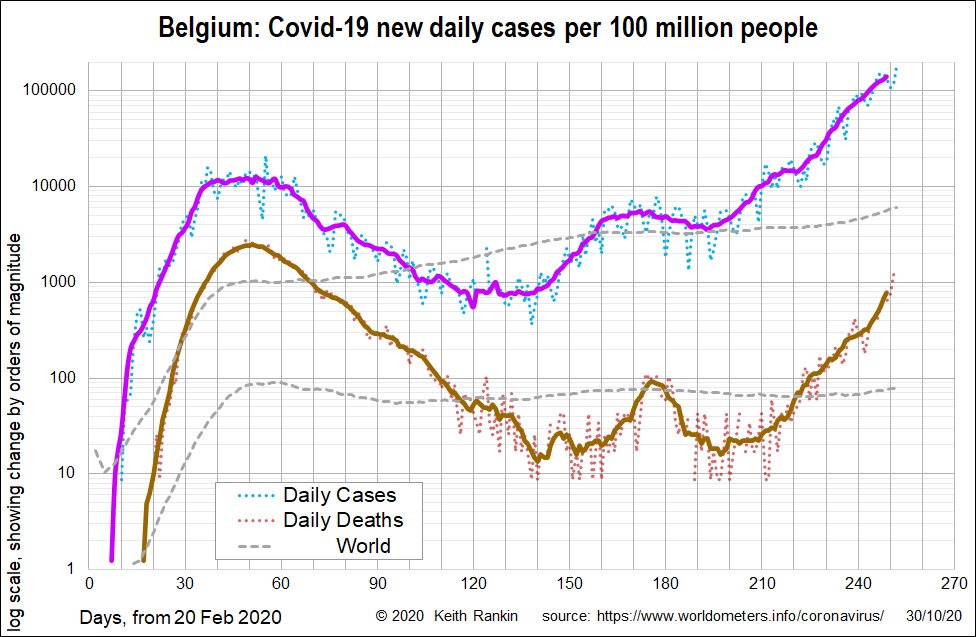
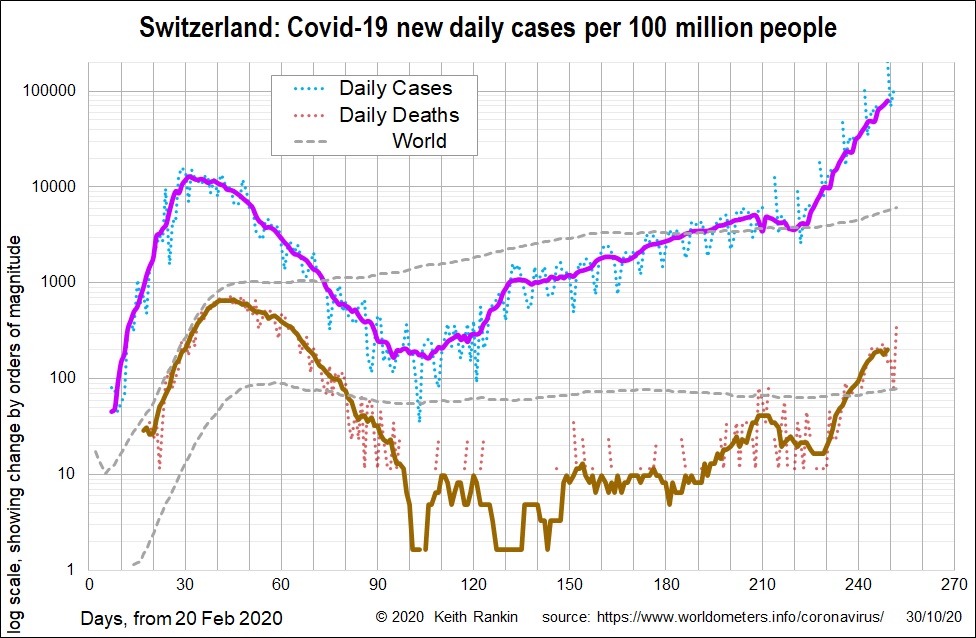
After a summer of relative freedom of movement, autumn has brought a major spike in COVID-19 cases in many European countries. While the European Union fruitlessly searches for a united way forward across its various jurisdictions, national and regional initiatives are trying to solve the conundrum of how to contain and reverse the spread of the virus without having a significant impact on the economy.
Europe is not alone in its suffering – much of the northern hemisphere is dealing with spiralling infection rates as the autumn turns to a long winter. In the United Kingdom, Prime Minister Boris Johnson has announced a month-long lockdown as cases pass the 1 million mark; in the United States, a third wave of COVID is well underway, with the country recording a grim record of 100,000 new cases in a single day.
As France’s President Emmanuel Macron has admitted, the virus has spread through Europe “at a speed that even the most pessimistic predictions didn’t foresee”.
He has branded his new lockdown proposals a “brutal” brake on the virus, but compared with the determined measures undertaken in Victoria, it is a half-measure that stands little chance of eradicating or even suppressing the virus. Schools, shops and many businesses outside the hospitality and entertainment sector will remain open; so too will nursing homes. Travel to and from work will continue and exercise within 1 kilometre of home for up to an hour will also be permitted.
Given the fractious tone of contemporary politics in France, this is probably as far as Macron can go. Whether the French public, already deeply divided, will accept the measures is uncertain. His attempt to divert attention away from the health crisis by opportunistically courting a culture war with France’s Muslim citizens and the rest of the Islamic world has already had devastating consequences.
Should it fall to police to force compliance in the absence of goodwill, protests will quickly sprout, as they have in the Czech Republic, where far-right elements presenting themselves as anti-mask protesters have clashed with police on the streets of Prague.
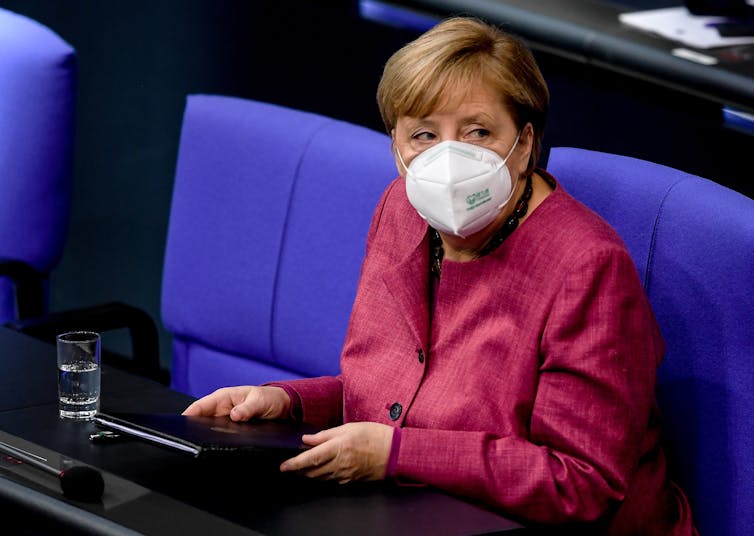
Germany, which had until recently been spared the higher infection rates of its neighbours, is now also heading on the same trajectory. Chancellor Angela Merkel has warned Germans the exponential growth of infections has left governments no choice but to implement dampening measures to begin on November 2.
While Germany has previously avoided huge COVID numbers, Chancellor Angela Merkel has recently announced a ‘soft lockdown’ to curb its spread.AAP/EPA/Filip Singer
Described as a “soft lockdown”, these measures, like those proposed in France by Macron, ban visits to bars, restaurants, clubs and pubs, but allow schools, shops and places of worship to stay open.
Candidly, Merkel has confessed she would have preferred to have undertaken these measures a fortnight ago, but felt they were simply politically unacceptable then. To her mind, the lag was not ideal. “That’s politics,” she admitted.
Her pessimism might be well founded. Many in Germany’s hospitality and entertainment industries already feel that, while much of society remains open, they have been made to play the part of the sacrificial lamb.
On the noisy margins, Germany’s Qanon-adjacent Querdenker movement insists any measure to stop people dying from COVID constitutes an egregious limitation to their personal liberty.
In typically opportunistic fashion, the right-wing populist party Alternative for Germany (AfD) has also heckled Merkel as she brought the measures before the Bundestag.
The party refused to support Merkel’s argument that it is only through “reason and social solidarity” that the virus can be brought back under control. Instead, like populist right-wing elements the world over, they implausibly argue Merkel is implementing a “corona dictatorship”.
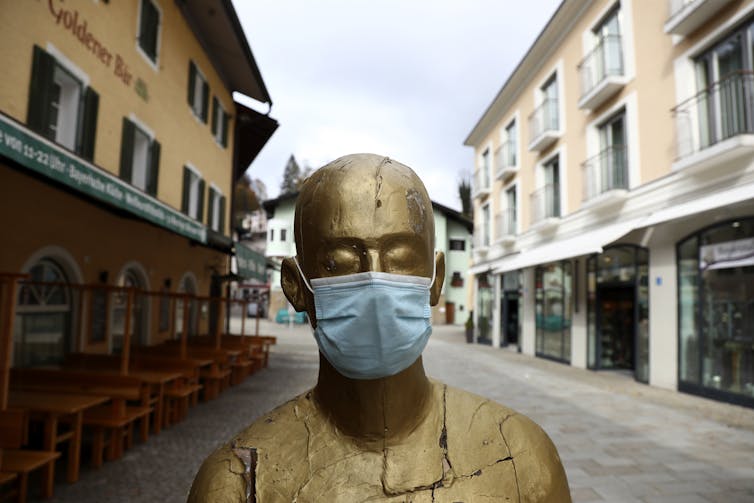
Many in Germany’s hospitality industry feel aggrieved at being forced to shut down while other parts of society remain open.AAP/EPA/Mattias Schrader
With the entire European project predicated on freedom of movement – something accentuated in the debates over Brexit, the Australian approach of simply closing Europe’s internal borders, or even regional borders, has not generally been embraced.
Only Spain has moved rapidly in this direction, halting domestic travel as part of its extension of “state of alarm” measures. Here too, such measures have been met with protests.
As the state most committed to freedom of movement across the European Union, Germany has explicitly warned against such restrictions. Merkel told the EU:
…it is especially important for Germany as a country in the middle of Europe that the borders stay open, that there is a functioning economic circulation and that we fight the pandemic together.
However, it is unlikely the EU can or will move as one on border lockdowns, or indeed any other COVID measure.
The question of mobility is a vexed one for the EU and one where history is more deceptive than illuminating. The Spanish flu model, that many are using to understand the current phases of the pandemic, is not appropriate. Spanish flu was in part accelerated by the global movement of people accompanying demobilisation at the end of the first world war. Unlike then, a “return to normal” today does not mean a return to a condition of global immobility. Now, particularly in Europe, a return to normal means a return to hyper-mobility.
In the absence of a vaccine, how societies respond to both the virus and governments’ attempts to mitigate its effects will matter greatly. As elsewhere, in Europe the pandemic has tested the strength of social solidarity. If there is a strong social conviction that the health of the individual is best protected by preserving the health of all, then governments merely have to offer a set of guidelines on how to put this instinct into practice.
This was to some extent the experience of the first set of lockdowns in the European spring. This time, however, the libertarian far right is far more organised. They see any limitation to personal freedom to ensure community safety as intolerable tyranny. Compounding this is the fact many Europeans are wary of their governments’ poor track records in fostering meaningful social cohesion.
Without community acceptance of government initiatives, the question shifts from organising communities’ desire to protect their vulnerable members to one of police-led enforcement. It is potentially a blunt and alienating approach that erodes whatever goodwill remains.
Europe’s coming winter will test not only the resilience of its health system, but the strength of its social fabric.
West Papuan activists and an Indonesian human rights lawyer criticised the recent military crackdown on the two Melanesian provinces of Papua and West Papua in a New Zealand-hosted webinar at the weekend.
“The Indonesian government is trying to prevent an uprising like last year, when the uprising was against racism and self-determination – that’s what is happening on the ground,” exiled lawyer Veronica Koman said.
She also highlighted some of the findings from the recent report from the London-based Indonesian human rights group TAPOL, West Papua Uprising 2019, and said people wanted the truth.
The report says that more than 40,000 indigenous people of West Papuan have been displaced due to military crackdown. And more than 300 people have died.
West Papua Uprising also reveals that some of the people were allegedly killed by the Indonesian military, some died from malnutrition, and others from illness in the refugee villages.
Koman said that the number of victims recorded in the report was less than the actual number.
The crisis, particularly in the Nduga and Intan Jaya regions, is now a major concern since a third pastor has been killed, said Victor Yeimo, the international spokesperson for Komite Nasional Papua Barat (KNPB), a civil resistance organisation that mobilises and advocates for West Papua’s right to self-determination on independence.
The other webinar speaker was Ronny Kareni, a West Papuan musician and activist, and a community engagement youth worker based in Australia. The #PapuanLivesMatter webinar was moderated by former Green MP Catherine Delahunty and the discussion unfolded on her birthday yesterday.
International campaigns The West Papuan Action Auckland group hosted the webinar on the topic of the current political situation, the opposition to “special autonomy” plans by Indonesia, and campaigns to free West Papua on the ground and internationally.
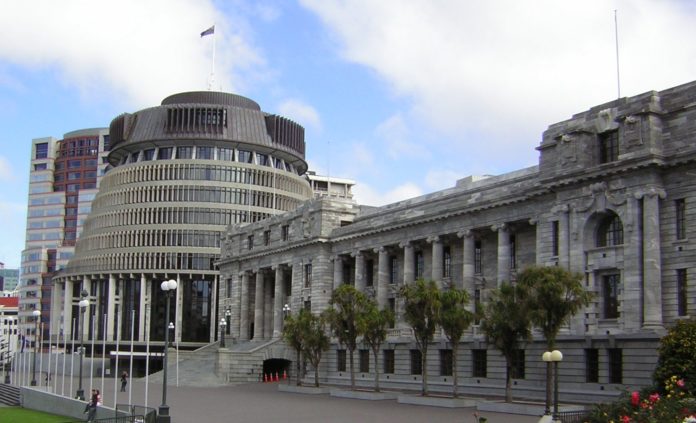
In the opening session, Delahunty explained that information discussed during the webinar would be used for the political education of Aotearoa New Zealand and local politicians who were “very slow” in taking up the West Papuan human rights and independence issue.
“Now, as most of you know, the situation in West Papua has been extremely serious for many, many years and continues to be a huge problem. And the importance of this solidarity movement across the world cannot be underestimated,” Delahunty said.
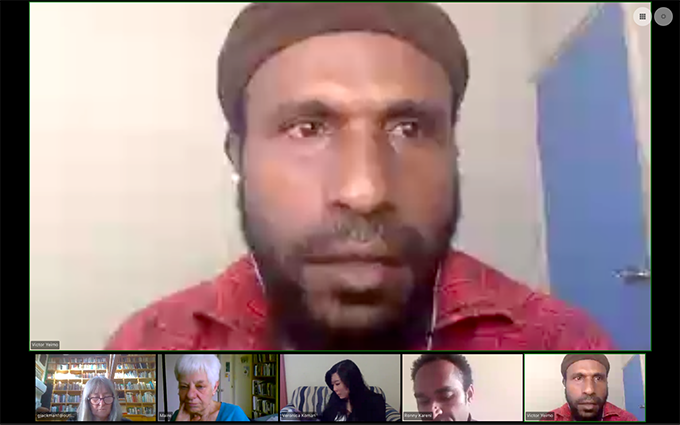
Papuan activist Victor Yeimo … the recent killing of a Catholic catechist in Intan Jaya has added more unrest for the indigenous people. Image: PMW
Victor Yeimo said the recent killing of a Catholic catechist in Intan Jaya hadadded more unrest for the indigenous people of West Papua.
“In the last three months we have seen that the Indonesian military has shot our pastor and also a Catholic catechist,” he said.
Opposition to ‘special autonomy’ Kareni, Koman and Yeimo said that the Indonesian-imposed new “special autonomy” status was not the solution to the aspirations of the indigenous people of West Papua.
Most Papuans rejected the Special Autonomy law and wanted a referendum on independence.
“As of today, there are 90 organisations that have joined or signed the petition for the referendum. Webinars, seminars and press statements are continuing day by day to reject the extension of the special autonomy in West Papua,” Yeimo said.
Koman said that the special autonomy was part of Indonesia’s colonialist practice towards the indigenous people of West Papua.
“Special autonomy has been used by Indonesia to whitewash colonialism, and colonialism remains a weapon … this is exactly what Indonesia is creating, class war among West Papuan elites against grassroots,” Koman said.
Kareni said that the special autonomy status was used as a campaign by the Indonesian government.
“The government always uses it as their propaganda in international forums by saying that the people of West Papua are given full rights to rule themselves through the special autonomy law, so what Papuans need is more on development,” he said.
“In its 10 years of ‘special autonomy’, the people of West Papua rejected it and also made a big announcement that it has failed, and now we are into two decades of it. And now [Indonesian government] wants to extend it further.
Massive impact on the people “It is just to continue [with] their bigger interest [over] the economic foreign investment in the region and it will have a massive impact on the dignity, the land, and as well environment and every issue that we are talking about today.”
Although Koman and Yeimo are “most wanted” people by the Indonesian government, they are still consistently active and remarkably risk their lives in campaigning for self-determination for the people of West Papua.
Koman highlighted the result of her advocacy work disseminating information – her life is at risk in Indonesia.
Despite facing this risk, she keeps advocating the issue at international level.
“I have a personal mission. Why I focus on disseminating information on West Papua is because I came from there,” he said.
“I used to be very nationalistic person and it was because I didn’t know anything about West Papua. And I believe that my fellow Indonesians just don’t know what is happening, that is why I think West Papua doesn’t need any propaganda.
“People just need the truth about what happening in West Papua,” she said.
Victor Yeimo and Veronica Koman both said that the solidarity movement to West Papua in Indonesia was growing stronger.
“It is also happening across the world,” Kareni said.
The webinar panel called on the people of Aotearoa New Zealand, people in the Pacific, and others across the world to join the West Papuan solidarity struggle.
This article has been contributed by a postgraduate student journalist from Auckland University of Technology.
November 2 marks 20 years since the first residents arrived on the International Space Station (ISS). The orbiting habitat has been continuously occupied ever since.
Twenty straight years of life in space makes the ISS the ideal “natural laboratory” to understand how societies function beyond Earth.
The ISS is a collaboration between 25 space agencies and organisations. It has hosted 241 crew and a few tourists from 19 countries. This is 43% of all the people who have ever travelled in space.
As future missions to the Moon and Mars are planned, it’s important to know what people need to thrive in remote, dangerous and enclosed environments, where there is no easy way back home.
A brief history of orbital habitats
The fictional ‘Brick Moon’ was constructed from bricks because they are heat-resistant.NASA
The first fictional space station was Edward Everett Hale’s 1869 “Brick Moon”. Inside were 13 spherical living chambers.
In 1929, Hermann Noordung theorised a wheel-shaped space station that would spin to create “artificial” gravity. The spinning wheel was championed by rocket scientist Wernher von Braun in the 1950s and featured in the classic 1968 film 2001: A Space Odyssey.
Instead of spheres or wheels, real space stations turned out to be cylinders.
The first space station was the USSR’s Salyut 1 in 1971, followed by another six stations in the Salyut programme over the next decade. The USA launched its first space station, Skylab, in 1973. All of these were tube-shaped structures.
In Stanley Kubrick’s 1968 film 2001: A Space Odyssey, a spinning wheel-like space station creates gravity using centripetal force.
The Soviet station Mir, launched in 1986, was the first to be built with a core to which other modules were added later. Mir was still in orbit when the first modules of the International Space Station were launched in 1998.
Mir was brought down in 2001, and broke up as it plummeted through the atmosphere. What survived likely ended up under 5000 meters of water at the bottom of the Pacific Ocean.
The ISS now consists of 16 modules: four Russian, nine US, two Japanese, and one European. It’s the size of a five-bedroom house on the inside, with six regular crew serving for six months at a time.
The fully assembled International Space Station.Roscosomos/NASA
Yuri Gagarin’s voyage around Earth in 1961 proved humans could survive in space. Actually living in space was another matter.
Contemporary space stations don’t spin to provide gravity. There is no up or down. If you let go of an object, it will float away. Everyday activities like drinking or washing require planning.
Spots of “gravity” occur throughout the space station, in the form of hand or footholds, straps, clips, and Velcro dots to secure people and objects.
In the Russian modules, surfaces facing towards Earth (“down”) are coloured olive-green while walls and surfaces facing away from Earth (“up”) are beige. This helps crew to orient themselves.
Colour is important in other ways, too. Skylab, for example, was so lacking in colour that astronauts broke the monotony by staring at the coloured cards used to calibrate their video cameras.
In movies, space stations are often sleek and clean. The reality is vastly different.
The ISS is smelly, noisy, messy, and awash in shed skin cells and crumbs. It’s like a terrible share house, except you can’t leave, you have to work all the time and no-one gets a good night’s sleep.
There are some perks, however. The Cupola module offers perhaps the best view available to humans anywhere: a 180-degree panorama of Earth passing by below.
Astronaut Rick Mastracchio looks towards Earth from the Cupola in 2016.NASA
‘A microsociety in a miniworld’
The crew use all kinds of objects to express their identities in this miniworld, as space habitats were called in a 1972 report. Unused wall space becomes like your refrigerator door, covered with items of personal and group significance.
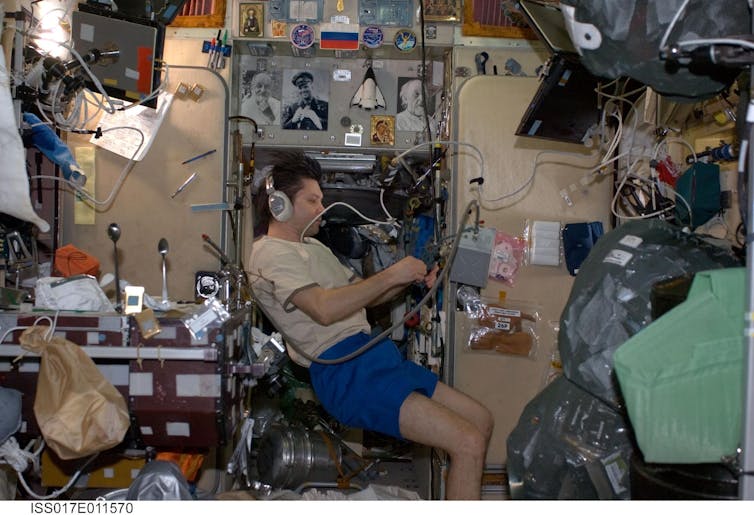
Oleg Kononenko in the Zvezda module in 2008, showing icons and space heroes pinned on the wall in the background.NASA
Food plays a huge role in bonding. Rituals of sharing food, celebrating holidays and birthdays, help form camaraderie between crew of different national and cultural backgrounds.
It’s not all plain sailing. In 2009, toilets briefly became a source of international conflict when decisions on the ground meant Russian crew were forbidden to use the US toilets and exercise equipment.
In this “microsociety”, technology isn’t only about function. It plays a role in social cohesion.
The future of living in space
The ISS is massively expensive to run. NASA’s costs alone are US$3-4 billion a year, and many argue it’s not worth it. Without more commercial investment, ISS may be de-orbited in 2028 and sent to the ocean floor to join Mir.
The next stage in space-station life is likely to occur in orbit around the Moon. The Lunar Gateway project, planned by a group of space agencies led by NASA, will be smaller than the ISS. Crews will live on board for up to a month at a time.
Its modules, based on the design of the ISS, are due to be launched into lunar orbit in the next decade.
One preliminary habitat design for the Lunar Gateway has four expandable crew cabins, to give people a little more space. But the sleeping, exercise, latrine, and eating areas are all much closer together.
Since ISS crews like to create improvised visual displays, we might suggest including spaces reserved for such displays in next-generation habitats.
In popular culture, the ISS has become Santa’s sleigh. In recent years, parents around the world have taken their children outside on Christmas Eve to spot the ISS passing overhead.
The ISS has shaped the space culture of the 20th and 21st centuries, symbolising international cooperation after the Cold War. It still has much to teach us about how to live in space.
According to a formal measure of language simplicity, United States President Donald Trump’s acceptance speech at this year’s Republican National Convention was far more complex than challenger Joe Biden’s at the Democratic Convention.
While Biden’s speech could be understood by a fifth grader, Trump’s required an eighth-grade level of education.
Surprised? After years of stories about how Trump uses much simpler language than his rivals, you should be.
During the last campaign, we read numerous accounts of how Trump’s language was pitched low — at a child’s level.
Or, as The Boston Globe gleefully proclaimed, his 2015 announcement speech “could have been comprehended by a fourth-grader”. By contrast, the announcement speeches of other candidates, such as Hillary Clinton, Ted Cruz and Marco Rubio scored several grades higher.
Those reports were easily believable to experts. Trump is a right-wing populist and academics have long asserted populist leaders use simple language in order to appear close to the “common people” and distance themselves from linguistically convoluted elites.
But as our new research shows, when you look at a comprehensive sample of populist leaders’ speeches, this is not always the case.
Researching the simplicity of leaders’ language
To investigate whether right-wing populists in different countries really do use simpler language than mainstream ones, we assembled a database of more than one million words. This was made up of speeches by populist leaders and their non-populist opponents in the United States, Italy, France, and the United Kingdom.
Looking at the simplicity of a single text, as the media had done with Trump’s 2015 announcement speech, makes for a good headline, but you need far more than that to make sound judgements about someone’s language.
A detailed analysis showed Donald Trump’s language was only slightly more ‘simple’ than that of his former challenger, Hillary Clinton.Rick T Wilking/AP
For each populist and non-populist leader, we analysed at least 100,000 words (per leader) from their speeches over a given period of time, using an array of measures for evaluating linguistic simplicity.
These included Flesch-Kincaid Grade Level and Readability Tests for English, along with similar scales for Italian and French. Using these measures to assess simplicity is based on the idea that, the greater the presence of shorter words and sentences, the easier a text is to understand.
We also measured lexical density (the number of words conveying meaning), lexical richness (the number of different words), and the presence of words considered difficult in each language.
Our right-wing populists were the most prominent ones from their respective countries over the past decade: Trump, Matteo Salvini (leader of the League, one of Italy’s major parties), Nigel Farage (former leader of the UK Independence Party), and Marine Le Pen (France’s far-right presidential candidate).
The mainstream leaders we used for comparison were their key opponents. For Trump and Le Pen, we chose their principal rivals in the last presidential campaigns, Clinton and French President Emmanuel Macron. In the UK and Italy, we compared Farage and Salvini to the main centre-right and centre-left leaders in those countries during the 2014-2016 period.
Surprising results
Our results were not what we expected.
First, the gap between Trump and Clinton in the 2016 campaign was actually not very wide. Trump’s speeches were pitched at a level comprehensible to a sixth grader, while Clinton’s required a seventh-grade level of education. On our other measures, there was little difference between the two.
In Italy, UK, and France, the results were even more surprising.
In Italy, the college dropout Salvini was only simpler on one of our measures than his opponents, law graduates, Democratic Party leader Matteo Renzi and New Center-Right leader Angelino Alfano.
In the United Kingdom, it was Oxford graduate and Labour Party leader Ed Miliband who came out simplest, not Farage. The main reason for Farage’s greater complexity was the length of his sentences compared to both Miliband and former prime minister and Conservative Party leader, David Cameron. While Miliband’s sentences were on average 13.99 words long, and Cameron’s 15.49, Farage’s were a remarkable 24.61.
Meanwhile, in France, we found Le Pen consistently used much more complex language than the product of France’s elite Ecole Nationale d’Administration, Macron. According to the Kandel and Moles index for assessing the simplicity of French, Le Pen’s speeches were rated “difficult”, while Macron’s were “standard”. Her language was also significantly more complex according to all our other measures.
Why do populist leaders use more complex language?
How do we explain these counterintuitive results?
One possibility is that, since studies have shown the language of mainstream political leaders in countries like the US and Italy has become simpler over time, it could be that the gap between elite and populist language has reduced, thus making claims about greater populist simplicity outdated.
In other words, perhaps mainstream leaders like Clinton and Biden have moved closer to the populist Trump’s level (and sometimes even below).
Another, related, possibility is that, at the same time as mainstream politicians have followed the advice of professional communications advisers and reduced the complexity of their speeches, right-wing populists in some countries have instead chosen to appear less coached and more authentic.
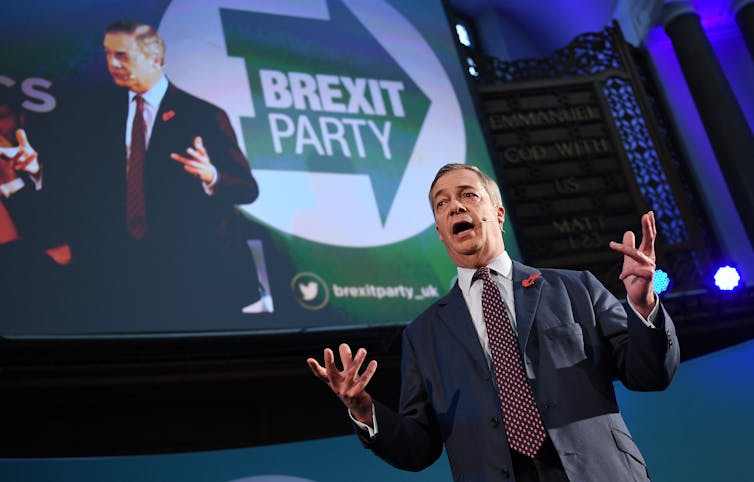
Former leader of the UK’s Independence Party, Nigel Farage used a surprisingly large number of works per sentence.Andy Rain/EPA
For example, Farage’s long rambling sentences make his language more complex, but also add to his “man holding court in the pub” image. Similarly, as a French nationalist who opposes globalisation and its alleged cultural homogenising effects, Le Pen may see an advantage in not imitating English-speaking political language trends that, by contrast, Macron has embraced.
Opting for national rhetorical traditions as opposed to slogan-based communication techniques derived from the US model might thus be useful for right-wing populist leaders in Europe.
Mind the bias
If right-wing populists do not necessarily use simpler language than their mainstream opponents, it begs the question: why were we so easily convinced they do?
Perhaps the answer is many of us like to think right-wing populists speak like fourth graders and their “deplorable” supporters lap it up. It fits our biases to believe populists like Trump are successful because they cynically deliver their message in much simpler language than mainstream politicians like Biden.
Our research shows, however, despite this convenient and even comforting idea, the reality is much more complex.
Tourism in the South Pacific has been hit hard by COVID-19 border closures with thousands of people out of work.
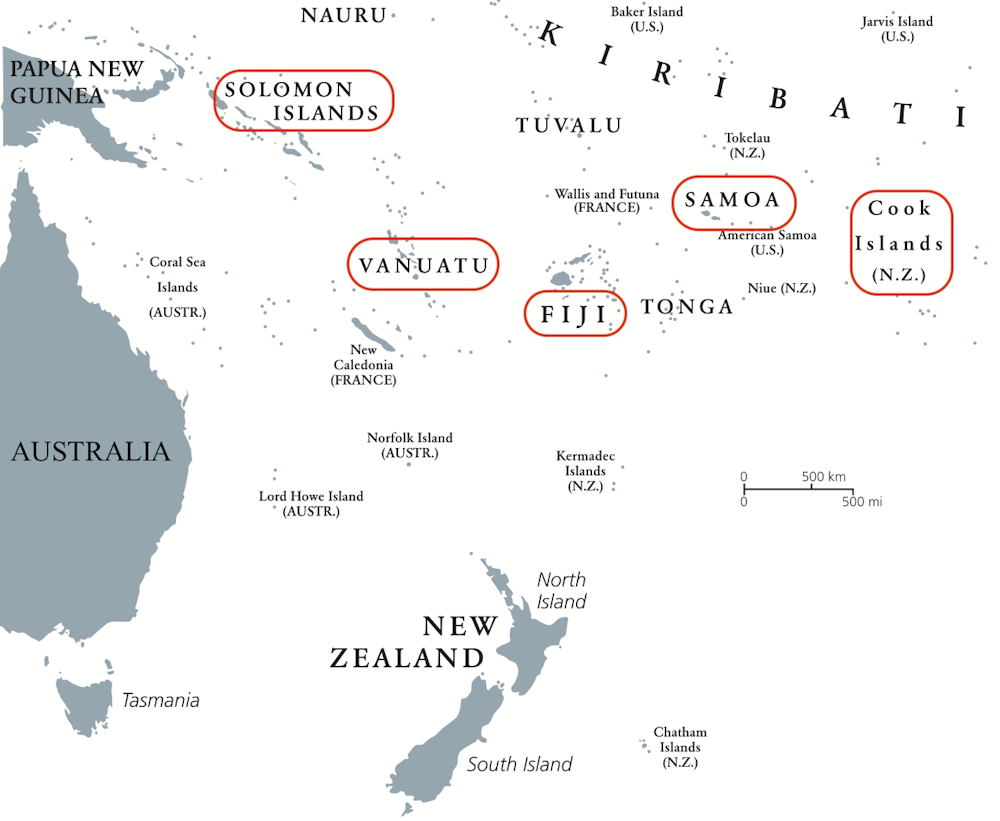
Tourism normally provides one in four jobs in Vanuatu and one in three jobs in Cook Islands. It contributes between 20% and 70% of the GDP of countries spanning from Samoa and Vanuatu to Fiji and Cook Islands.
But our research shows how people are surviving – and in some cases, thriving – in the face of significant loss of income.
This is due in part to their reliance on customary knowledge, systems and practices.
Islands impacted by border closures
The research involved an online survey completed by 106 people, along with interviews in six tourism-dependent locations across five countries.
The Pacific islands used in the research.Shutterstock/Peter Hermes Furian
Research associates based in these countries did interviews in places such as villages next to resorts, or communities that regularly provided cultural tours for cruise ship passengers.
They spoke with former and current tourism workers, community members and business owners who reflected on how they had adapted and what they hoped the future would hold.
Almost 90% of survey respondents lived in households facing significant reductions in income. Owners of tourism-related businesses faced particular financial strain, with 85% of them saying they lost three-quarters or more of their usual income.
But people showed considerable adaptive capacities and resilience in devising a range of strategies to meet their needs in the face of this dramatic loss of earnings.
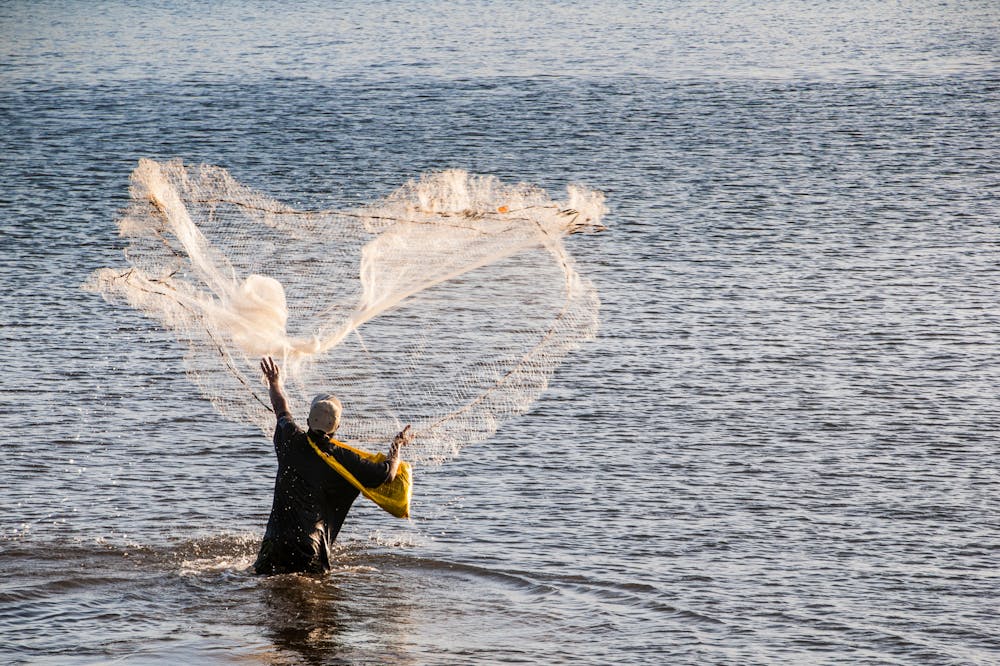
More than half the respondents were growing food for their families. Many were also fishing. People talked about using the natural abundance of the land and sea to provide food.
Traditional skills: a man fishing in the harbour of Apia, Upolu, Samoa.Shutterstock/Danita Delimont
One person from Rarotonga, part of the Cook Islands, said “no one is going hungry” and this was due to a number of factors:
people had access to customary land on which to grow food
traditional systems meant neighbours, clan members and church communities helped to provide for those who were more vulnerable
there was still sufficient knowledge within communities to teach younger members who had lost jobs how to grow food and fish.
One young man from Samoa, who had lost his job in a hotel, said:
Like our family, everyone else has gone back to the land … I’ve had to relearn skills that have been not been used for years, skills in planting and especially in fishing … I am very happy with the plantation of mixed crops I have now and feeling confident we will be OK moving forward in these times of uncertainty.
Alternative livelihood options
People also engaged in a wide range of initiatives to earn cash, from selling products from their farms (fruit, root crops, other vegetables, cocoa, pigs and chickens) and the sea (a wide range of fish and shellfish) to starting small businesses.
Examples included planting flowers to sell in bunches along the roadside, making doughnuts to take to the market, or offering sewing, yard maintenance or hair-cutting services.
Goods and services were also bartered, rather than exchanged for cash.
Sometimes social groups banded together to encourage one another in activities that earned an income. For example, a youth group near the resort island of Denarau, in Fiji, gained a contract to provide weekly catering for a rugby club.
When times are hard, it’s not all bad
Our study also examined four aspects of well-being: mental, financial, social and physical. Understandably, there was a clear decline in financial well-being. This was sometimes associated with greater stress and conflict within households.
As one Cook Islands man said:
There’s so many people in the house that we’re fighting over who’s going to pay for this, who’s going to pay for that.
But the impacts on social, mental and physical well-being were mixed, with quite a number of people showing improvements.
Many people were effusive in their responses when talking about how they now had more time with family, especially children. This was particularly the case for women who had previously worked long hours in the tourism sector. As one said:
I feel staying (at home) during this pandemic has really helped a lot, especially with my kids. Now everything is in order. The spending of quality time with my family has been excellent and awesome.
Others expressed satisfaction they had more time for meeting religious and cultural obligations. As one said, “everyone is more connected now”, and people had more time to look after others in the community:
Extended family harmony has improved, particularly with checking welfare of others who may need help during this time.
Business owners appreciated the chance to “rest and recharge”. As one Fijian business owner said:
This break has given us a new breath of life. We have since analysed and pondered on what are the most important things in life apart from money. We have strengthened our relationships with friends and family, worked together, laughed and enjoyed each other’s company.
These early research findings suggest customary systems are effectively supporting people’s resilience and well-being in the Pacific. A Pacific ethos of caring, respect, social and ecological custodianship and togetherness has softened the harsh blow of the COVID-19-induced economic slowdown.
As you fire up your computer for a telehealth appointment, or prepare to walk in to see your doctor, you may be wondering whether to record your appointment. You might even think about doing it without asking permission first.
But recording without permission might be illegal depending on where you live, according to our latest research, published today.
And there may be repercussions for you and your health-care professional.
When feeling unwell, or overwhelmed with a new diagnosis, it can be hard to take in and remember important health information your health-care practitioner provides.
Recording your appointments can help. It can help you recall and understand what you discussed. You can also share information about your diagnosis or ongoing care with family and friends.
Many health professionals support the idea of their patients recording their appointments.
In the past few years there has been increasing interest in using digital technology to help people record their health-care consultations.
In Australia, we developed the SecondEars smartphone app at Peter MacCallum Cancer Centre to allow people diagnosed with cancer to record on their phone, with back-up copies sent directly to their health service for storage.
In the United States and Europe, health services and clinics are developing in-house recording software and technology.
Most smartphones also have basic recording software that lets you record with or without asking your health professional. And amid the boom in telehealth due to COVID-19, it’s worth remembering videoconferencing software (such as Zoom) also has built-in recording functions.
What happens if I record?
Imagine you are going to record without telling your doctor, nurse or other health-care professional, or plan on sharing the recording later with other people. What does the law say?
We found this differs in each part of Australia, depending on where you are when you create or share the recording. The law doesn’t differ by the type of recording; audio and video are treated the same.
Before hitting the ‘record’ button, find out if it’s legal in your state or territory.Shutterstock
In some jurisdictions (Victoria, Queensland, NT, NSW, ACT and Tasmania) patients don’t need permission to record their appointment with a doctor, nurse or other health professional if the recording is just for their own use. So, if you want to record to remember what the doctor told you about upcoming surgery or how to take your medicines, you can, even without asking first.
In SA and WA, you usually need the health professional’s consent before recording.
In these states, a person who makes a covert recording for their own use can even face a fine or prison term (for example, in SA, there are fines of up to A$15,000 or prison for up to three years).
Can I share the recording?
Sharing a recording with others — whether this is in person or online — is subject to other rules. The health professional’s consent is sometimes needed for this even if it wasn’t needed for the recording in the first place.
However, in Queensland, Tasmania, NSW, SA and the ACT, as long as the original recording was done within the rules, you don’t need to ask for consent to share it just with family or close friends.
Sharing it more widely is another matter. Only in NSW and SA can you do this without the health professional’s consent (as long as the original recording was lawful).
While the law is messy, we think the overall answer is clear. Even if you don’t need your health professional’s permission to record your consultation, it is best to tell them you want to.
What if I ask and the doctor says ‘no’?
Some health-care professionals and organisations might be concerned you might share recordings on social media, or use them as a basis for a complaint.
The indemnity insurer MIPS tells its doctors that if the idea of recording makes them uncomfortable, they have the option to decline it. But we argue saying “no” to a patient’s reasonable request to record the consultation might harm the doctor-patient relationship, by eroding patient trust and confidence.
If you want to record your medical appointment, it could be worth talking with your doctor about how the recording could help you take better care of your health, and telling them what you intend to do with it.
You could also point out that advice in the United Kingdom suggests recordings can actually support doctors where there are legal disputes.
In one US institution, doctors who let their consultations be recorded get a discount for their indemnity insurance, because of the reduced risk of being sued for malpractice. It makes sense, because when there’s a recording, there is less chance of a disagreement arising over who said what.
Iron out any concerns early
Even if making or sharing a recording doesn’t break the law, doing so without everyone’s knowledge risks harming your relationship with your health-care professional, especially if they find out about it later.
Ultimately, a constructive dialogue between you and your health-care professional should iron out concerns on both sides. While it might feel challenging — and depending on where you are, the law might not require you to — it is usually best to ask for consent, so there are no surprises.
Environmental scientists see flora, fauna and phenomena the rest of us rarely do. In this new series, we’ve invited them to share their unique photos from the field.
The start of November marks the end of the whale season in the Southern Hemisphere. As summer approaches, whales that were breeding along the east and west coasts of Australia, Africa and South America will now swim further south to feed around Antarctica.
This annual cycle of whales coming and going has taken place for at least 10,000 years. But rising ocean temperatures from climate change are challenging this process, and my colleagues and I have already seen signs that humpback whales are changing their feeding, migration and breeding patterns to adapt.
As krill stocks decline and ocean circulation is set to change more drastically, climate change remains an unprecedented threat to whales. The challenge now is to forecast what will happen next to better protect them.
Losing krill is the biggest threat
I’m part of an international team of researchers trying to learn what the next 100 years might look like for humpback whales in the Southern Hemisphere, and how they’ll adapt to changing ocean conditions.
Whales depend on recurring environmental conditions and oceanographic features, such as temperature, circulation, changing seasons and biogeochemical (nutrient) cycles. In particular, these features influence the availability of krill in the Southern Ocean, their biggest food source.
Whales are particularly sensitive to this because they need enormous amounts of food to develop sufficient fat reserves to migrate, give birth and nurse a calf, as they don’t eat during this time.
In fact, models predict declines in krill from climate change could lead to local extinctions of whales by 2100. This includes Pacific populations of blue, fin and southern right whales, as well as fin and humpback whales in the Atlantic and Indian oceans.
Still, when it comes to their migration and breeding cycles, recent studies have shown humpback whales can adapt with changes in ocean temperature and circulation at a remarkable level.
Whales can adapt to warming water, but at what cost?
In a long term study from the Northern Hemisphere, scientists found the arrival of humpback whales in some feeding grounds shifted by one day per year over a 27-year period in response to small fluctuations in ocean temperatures.
This led to a one-month shift in arrival time, but a big concern is whether they can continue to time their arrival with their prey in the future when the water gets warmer still.
Likewise, in breeding grounds near Hawaii, the number of mother and calf humpback whale sightings dropped by more than 75% between 2013 and 2018. This coincided with persistent warming in the Alaskan feeding grounds these whales had migrated from.
Collecting humpback whale exhale (“whale snot”)
But humpback whales shifting their distribution and behaviour can cause unexpected human encounters, and cause new challenges that weren’t an issue previously.
Research from earlier this year found humpback whales switched to fish as their main prey when the sea surface temperature in the California current system increased in a heatwave. This has been leading to record numbers of entanglements with gear from coastal fisheries.
And between 2013 and 2016, we documented hundreds of newborn humpback whales in subtropical and temperate shallow bays on the east coast of Australia, 1,000 kilometres further south from their traditional breeding areas off the Great Barrier Reef.
However, since these aren’t designated calving areas, the newborns aren’t well protected from getting tangled in shark nets or colliding with jet skis or cruise ships.
Protecting whales
The Whales and Climate Program is the largest project of its kind, combining hundreds of thousands of humpback whale sightings and advanced modelling techniques. Our aim is to advance whale conservation in response to climate change, and learn how it threatens their recovery after decades of over-exploitation by the whaling industry.
Each whale season between June and October, I sail out to the open ocean. This means I have unique opportunities to see and engage with whales, especially during the breeding season. The following photos show some of our breathtaking encounters, and can remind us of our marine ecosystem’s fragile beauty.
Olaf Meynecke, Author providedOlaf Meynecke, Author provided
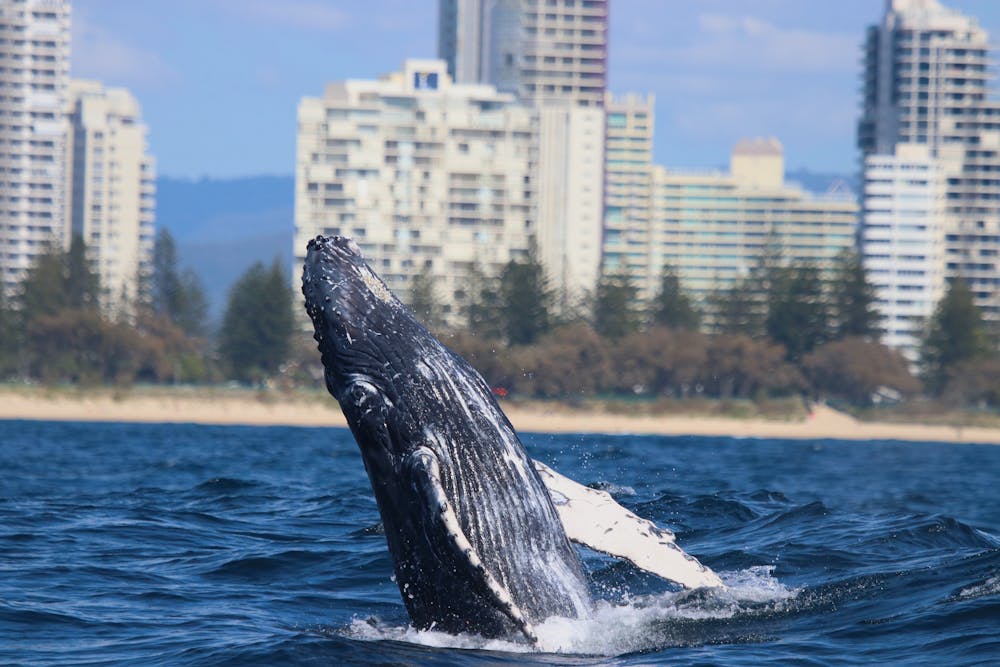
During one of our boat-based surveys on the Gold Coast, we encountered this acrobatic humpback whale calf, shown in the photos above. We counted 254 breaches in two hours, making it the record holder of most breaches in our 10 years of observation.
Olaf Meynecke
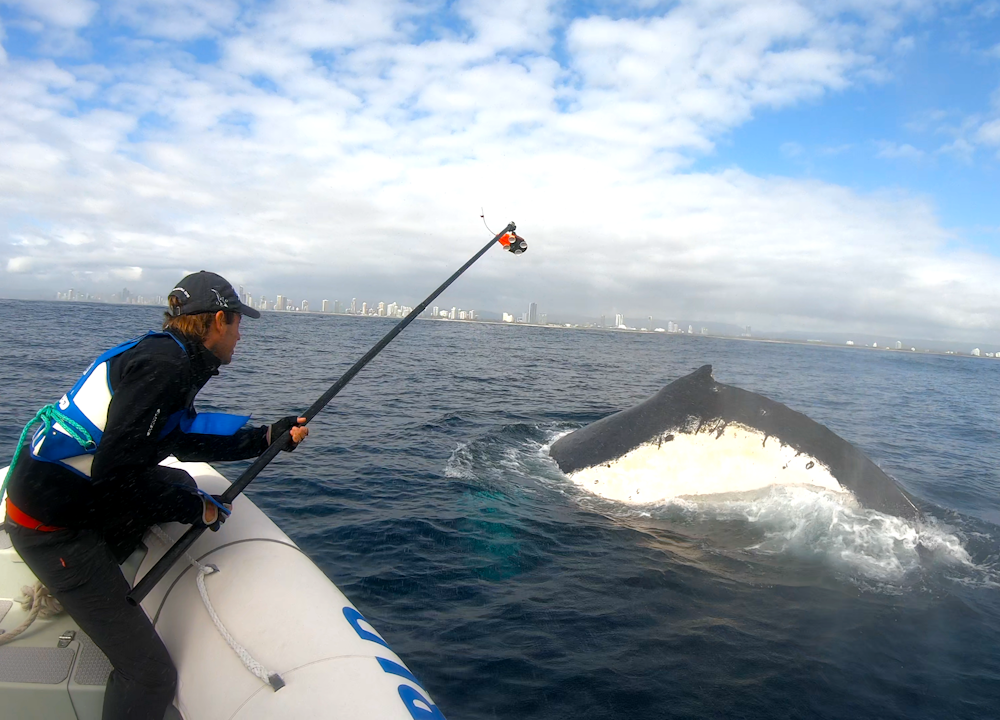
To check on whales’ health, we collect and study the air they exhale through their blow hole (“whale snot”), and measure their size at different times of the year. The photo above shows me tagging a whale with CATs suction cup tags, to collect data on short term changes in their movement patterns.
Olaf Meynecke, Author provided
In regions where the whales adapt to ocean changes and, as such, move closer to shore for feeding and shift their breeding grounds, there’s a higher risk of entanglements and other human encounters. This is particularly concerning when they travel outside protected areas.
Olaf Meynecke, Author provided
Look closely and you can see a newborn humpback, just one to three days old, resting on its mother’s head.
In the first days of life, baby humpback whales sink easily and aren’t able to stay on the water surface for long. They need their mothers’ support to stay on the surface to breathe.
Once they’ve gained enough fat from the mothers milk they become positively buoyant (meaning they can float), making it easier for them to breathe.
Olaf Meynecke, Author provided
A final note — during one of our land-based whale surveys this year, a keen whale watcher approached us, and we helped him find the whales with our binoculars. I will never forget the joy in his face when he spotted them.
It’s a joy I hope many future generations can experience. To ensure this, we need to understand how we can best protect whales in a changing climate.
We have been following more than 2,000 Queenslanders from their adolescence into adulthood. The aim of the Our Lives study is to investigate how young people think about their future and how they master their trajectories in a world of rapid change and uncertainty.
In 2006, our research team began tracking more than 7,000 students who began high school in Queensland at the age of 13. Since then, the study has become the largest and longest of school leavers in Australia post the global financial crisis. The cohort turns 27 this year.
Every two years, we survey this cohort about their developing aspirations and experiences in work, study, housing, relationships and family. We also explore changes in their social attitudes and mental and physical health.
We did a special survey in June 2020 in response to COVID-19. We wanted to understand how the cohort had been affected since the previous survey six months earlier, in late 2019.
Among our findings are a sharp decline in mental health between 2019 and June 2020, especially among respondents living in urban areas and those without secure work. Marriage or de facto partnerships seem to be a buffer against sharper declines seen in young people who are single or living with housemates.
A decline in mental well-being
At the age of 22, in 2015, 82% of respondents described their mental health as excellent, very good or good. This fell to 70% at the age of 26 in 2019 — a drop of three percentage points per year.
But, only six months into the next year 2020 (in June), this figure had already fallen by a further four percentage points, to 66%. These data suggest changes in the young people’s lives during the COVID-19 pandemic have accelerated the existing downward trend in their mental well-being.
In line with this, the female participants in our study displayed significantly worse mental health during COVID than their male counterparts. The proportion of 27 year old males who described their mental health as excellent, very good or good in June 2020 was 70.5% compared to 63.5% for females.
Young adults living in major city areas, where COVID cases have largely been concentrated, experienced a decline in mental health — from 68.7% in 2019 to 62.2% in 2020. But the proportion of those living in rural areas actually rose from 70.9% in 2019 to 72.2% in 2020.
By their mid-twenties, a major gap emerged in the well-being of people with and without secure work. In 2015, when participants were 22 years old, 82.4% with permanent, ongoing work rated their mental health good to excellent, compared to 68.5% in 2020. The results were 77.6% in 2015 for those who were unemployed compared to 54.1% in 2020.
____
Emergency welfare measures, such as the JobKeeper wage subsidy and increase to JobSeeker, may have temporarily prevented this gap from widening.
One of Australia’s top mental health experts, Professor Ian Hickie, has argued an extension to JobKeeper and greater financial support for students in post-school education and training are critical for mitigating the predicted surge in youth mental illness.
What about relationships?
Security in young adults’ housing and relationships appears to provide a key buffer against the negative psychological impacts of COVID-19. Our data show young adults living out of home, or with a partner (married or de facto) report substantially better mental health in June 2020 than those who are single and living with parents.
Young people in who were living with housemates during the COVID-19 period experienced the sharpest decline in positive mental health.
Social distancing took its toll on the Our Lives cohort during the national restriction period, with 39% reporting feelings of loneliness or isolation. There were also signs of strain and conflict in the young people’s relationships with those in their household.
Around one-quarter of the sample reported a lack of personal space or alone time, while 16% reported experiencing greater tension and conflict in the household. These outcomes increased young adults’ chances of experiencing a major decline in mental health during the lockdown period.
However, the effects of stay-at-home restrictions were not inherently negative. For many young adults, restrictions provided more time for themselves (38%) and encouraged stronger relationships with partners or family (33%). These outcomes were associated with significantly lower chances of a decline in mental health.
It’s vital young people have good access to youth mental health services in the months ahead so their mental health doesn’t continue to drastically decline. This is particularly the case for young people who may be less able to turn to parents, partners or friends for help.
Research has consistently found young people with mental health issues are the least likely to seek out mental health information and access professional help when they need it.
There is hope that the collective experience of social distancing during COVID-19 may have helped reduce some of the stigma associated with seeking help. If this is the case, we must seize the opportunity to learn from the experience of the young people in our cohort and the Australians they represent.
Now, declining commuter foot traffic and an increase in people working from home present new challenges for CBD retailers. Lockdowns, changing work practices and the need for social distancing have left some of Australia’s largest city centres at times resembling ghost towns.
Even as restrictions lift and CBDs reopen, it will not be business as normal.
Stores will shrink
Retailers that depend heavily on discretionary spending, for items such as clothing, footwear and accessories, have been hit particularly hard.
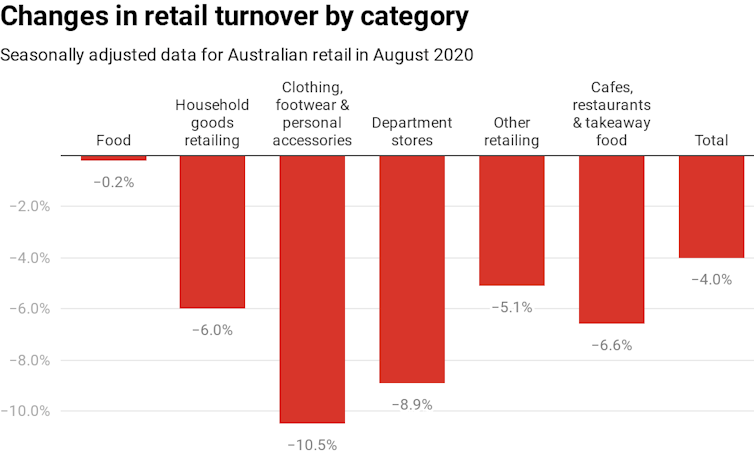
The latest Australian Bureau of Statistics figures show clothing, footwear and personal accessory retailing fell 10.5% in August 2020, in seasonally adjusted terms. Department stores were down 8.9%.
Interestingly, despite an average decline in spending of -0.2% between 2015 and 2020, research by McKinsey in 2019 found clothing and footwear retailers increased their selling space by almost 2%.
Clothing, footwear and department store retailers are now expected to “right-size” their selling space. McKinsey predicts a floor-space reduction of more than 10% between now and 2024.
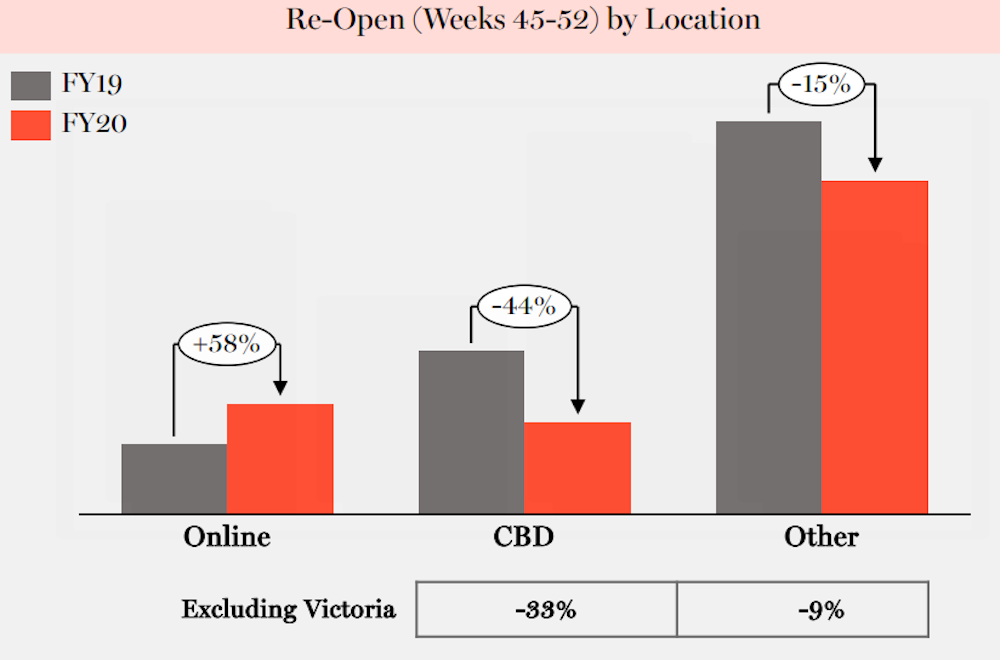
CBD-based department stores have fared worse than those in the suburbs. The Myer Annual Report 2020, for example, highlights the impact of COVID restrictions on CBD store sales. Despite reopening all stores (except Melbourne) by May 27, CBD store sales fell 33%, whereas suburban store sales contracted by only 9%, in the final seven weeks of the financial year. Myer reports: “Low foot traffic in CBDs expected to continue for the foreseeable future.”
The Myer annual report shows a rise in online sales, a large fall in CBD store sales and smaller fall in other store sales compared to the same period a year earlier.Myer annual report 2020
Online shopping is surging
As COVID shut down cities, Australian shoppers moved online in increasing numbers. The NAB Online Sales Index estimates Australian consumers spent around $39.2 billion in the 12 months to August 2020. Online shopping now accounts for 11.5% of total retail sales in Australia.
Research from Australia Post shows over 8.1 million households shopped online between March and August this year — 900,000 of them for the first time. In cities around Australia, foot traffic has become web traffic.
We can clearly see the impacts of this on physical retailers. A number of major retail chains have closed, including Toys ‘R’ Us, Roger David, Esprit, Ed Harry, TopShop and GAP over the past few years.
CBD workers shift away from commuting
As an increasing share of people work from home and fewer commute to city centres, the long-term future of CBD retailing looks bleak because of the fall in demand.
This shift in behaviour is likely to be substantial, as transport expert David Hensher recently observed:
The evidence reinforces the fact that as we move through and beyond the COVID-19 period, we can expect commuting activity to decline by an average of 25-30% as both employers and employees see value in a work-from-home plan.
The ongoing health and economic crisis caused by the COVID-19 pandemic and the required physical distancing measures will force many firms to introduce telework (working from home) on a large scale.
In Australia, it has been estimated 39% of all jobs in Australia — 41%of full-time and almost 35% of part-time – can be done from home.
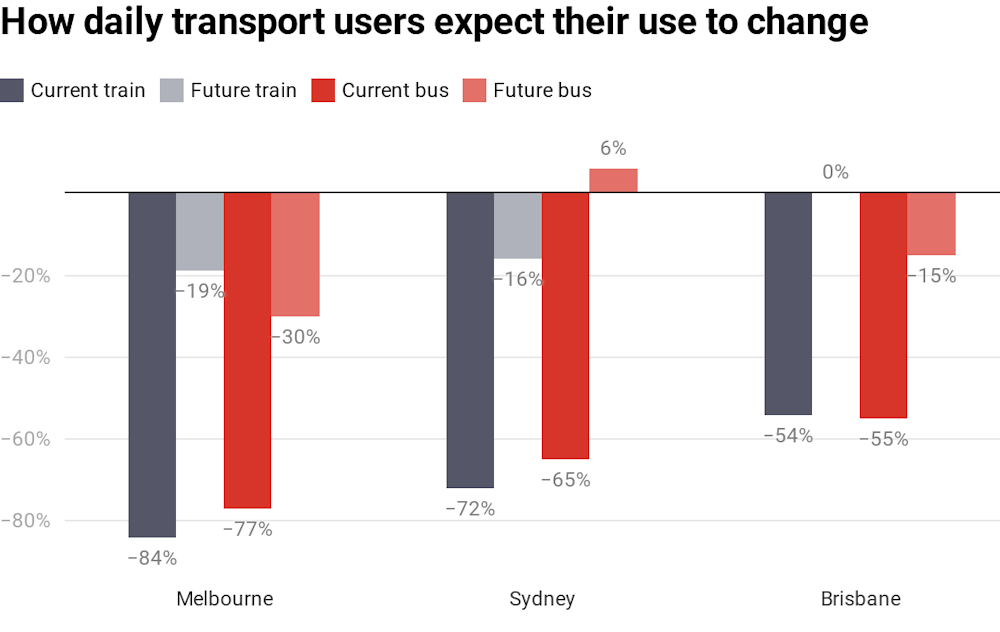
CBD retailing relies on workers and visitors who use public transport. An August 2020 Transurban report found 84% of daily train users (77% of bus users) in Melbourne said they had reduced their use. Many said they did not expect to return to daily use even after the pandemic. Similar numbers were reported in Sydney and Brisbane.
COVID restrictions and declining commuter traffic have also had big impacts on the food and beverage market. According to IBISWorld, Australian restaurant revenue has fallen by 25%, from almost A$20 billion in 2018-19 to just A$15 billion in 2019-20. Cafe owners are equally feeling the impact, with fewer commuters grabbing their morning coffee and fewer coffee meetings happening around town.
Back to the future
With both commercial and residential rents remaining relatively stable outside CBD zones, and more people choosing to work from home, we can expect to see a growth in “localism”.
With many more people working from home during the pandemic there has been something of a retail inversion with more people shopping locally. There are clear signs of a resurgence in local shopping villages and high street retailing. There even appears to be a corner store revival of sorts.
CBD-based retail is at a crossroads, especially in Melbourne and Sydney. Despite restrictions being lifted, the data indicate CDBs may never return to the “bustling metropolises” they once were.
The precarious state of the national economy, government plans to reduce subsidy payments, more people working from home, shopping locally and online, all point to a bumpy road ahead for CBD retailers.
Major questions are being raised about the future character and function of the CBD and, ultimately, about the structure of Australian cities more broadly.
Source: The Conversation (Au and NZ) – By Rachel Ong ViforJ, Professor of Economics, School of Economics, Finance and Property, Curtin University
COVID has shown us what’s possible when it comes to alleviating poverty.
For six months JobSeeker payments were doubled and then maintained at a level 50% above normal.
When the bonus finishes at year end it is likely to be permanently increased for the first time in almost 30 years.
Commonwealth rent assistance could do with the same sort of attention.
Rent assistance is at present added on to other payments such as the pension and JobSeeker and is inadequate, with on our calculations one-third of the people who get it remaining in housing stress even when assisted, while around 18% of the low-income private renters who need it were excluded because they don’t receive one of the government payments to which it is tied.
Productivity Commission calculations suggest the number of private renters in housing stress has doubled over the past two decades, largely because rent assistance has failed to increase in line with rents.
Rent assistance is much lower than it should be
The Australian Council of Social Service wants a 30% in increase in the maximum rate of rental assistance. The Grattan Institute has called for a 40% increase.
Even the Productivity Commission wants a 15% increase to restore what’s been lost over the past decade.
The maximum rates paid are $69.80 per week for single person and $92.68 for a couple with three children.
As any renter knows only too well, these amounts represent only a fraction of the present cost of renting in most parts of Australia.
It’s also badly targeted
Our study for the Australian Housing and Urban Research Institute finds that (in 2017) an extraordinary 23.4% of the renters who received Commonwealth rent assistance weren’t in housing stress. At the same time 17.5% of the renters in housing stress didn’t receive Commonwealth rent assistance.
These calculations were made using the standard definition of housing stress for low income earners which is rent that exceeds 30% of gross income.
We examined three options to better match payments to housing stress:
raising the maximum rate of Commonwealth rent assistance by 30%
re-balancing the rent thresholds to address higher levels of housing stress among households with no children
changing the eligibility criteria to pay rent assistance to low-income private renters facing rents exceeding 30% of their income whether or not they were on other benefits
We found the first and second options would almost halve housing stress, cutting it from 848,500 households to 506,400 and 544,900.
The third option – extending rent assistance to all low income private renters and limiting it only to those fitting the standard definition of low income housing stress – would cut the number of households able to claim to 477,000.
We could cut rental stress and save money
The first option would cost $1 billion per year, the second would save $938 million and the third would save $1.2 billion.
That’s right, the best option would save money and would most accurately target payments to need.
But there’s a problem. Australia’s Constitution appears not to empower the federal government to make stand-alone rent assistance payments, which is why Commonwealth rent assistance is always tied to another payment.
To pay it to a wider group of low-income households, the Commonwealth government would need to either get a new source of constitutional power or to get state governments to administer it for them (as they do with first home owner grants).
And there are other potential hurdles.
Rent assistance acts as a de facto subsidy to community housing providers. Changes potentially affecting their tenants would need to be made carefully.
And there’s concern that increases in rent assistance will be captured by landlords in higher rents – much as appears to happen for first home owner grants.
Most landlords won’t pocket increased assistance
Our research found that in most areas and under most conditions this “subsidy capture” or rent inflation effect won’t be statistically significant.
Most landlords don’t lift rent with rent assistance.
The exception is disadvantaged areas, where our modelling suggests that a significant proportion of increases in rent assistance payments do flow through into rents, almost 33 cents in each rent assistance dollar.
This is likely caused by relatively unresponsive housing supply in low-value parts of the market. However, even in these areas the “capture” effect is smaller than in similar studies overseas.
This is probably because in Australia rent assistance is paid to tenants, rather than directly to landlords.
Despite these challenges, there are clear benefits to pursuing reform of Commonwealth rent assistance.
Indeed, it ought to be possible to both lift more Australians out of housing stress and save money.
The money saved should be diverted to supporting a broader housing affordability agenda that includes increased investment in public and community housing and tenancy law reform that improves security and other conditions.
This is especially important in more disadvantaged locations where private rental providers are less responsive.
How do filmmakers communicate big ideas on screen? In this video series, film scholar Bruce Isaacs analyses pivotal film scenes in detail. (Warning: this video contains violence and may be upsetting for some viewers.)
Hollywood has a century-long tradition of political narratives, such as Oliver Stone’s 1991 film JFK. So how do you create a concise political history in cinematic form?
It starts with a staccato drum tattoo and moves into a swelling string movement. The voices of leaders rise from the depths of the past as the director of Salvador, Platoon and Wall Street builds a complex mosaic of American history. The images and sounds masquerade as factual account — but this is anything but objective. It’s creative storytelling using historical bits and pieces as building blocks.
In an election victory driven by her management of COVID, the dire second wave in Victoria likely helped Annastacia Pałaszczuk. Defending her tough border policy and her message about keeping Queenslanders safe, she had a real life example to illustrate what happens when the virus gets away.
Her win reinforced the accepted wisdom that this crisis favours incumbents – provided people think they are doing the right thing.
The Queensland outcome might at one level be galling for the federal government – which has been sniping at Pałaszczuk’s border policy for months – but at another it is also reassuring for Scott Morrison, who has so far managed the pandemic response well.
That said, Morrison has a rockier road to navigate to his election. The federal poll is a year and a half away, and (assuming the virus now stays under control) the challenge for him is economic, which will be complicated as he juggles withdrawing the current massive fiscal support without any disaster.
While some details of the Queensland result are yet to be finalised, Pałaszczuk is set for an increased majority, with Labor securing a swing towards it. For a government seeking a third term, and one which had been – pre-COVID – under criticism for its performance, this is a remarkable achievement.
Despite some pre-election speculation, and the plight of the tourist industry, Labor’s seats in the north of the state did not collapse.
The difficulties of the Queensland economy and its high unemployment did not translate into electoral damage for the government.
And nearly a week’s campaigning by the prime minister produced not the slightest sign of a Morrison “miracle” for the Liberal National Party. On the other side, the absence of Anthony Albanese could have been a bonus for Labor.
The Pałaszczuk government was helped by its opposition, with recent fighting between the LNP organisation and the parliamentary party. On the main issue of this COVID election, LNP leader Deb Frecklington could only say she too would follow the health advice. She may not have not been believed, given the attacks on the closed border coming from the conservative side.
Apart from the result, the big story of Saturday was the collapse of the One Nation vote. What was left of that vote favoured Labor via preferences, probably reflecting older voters’ COVID fears.
Pauline Hanson was low profile during the election; whether she can gear up her party when the federal contest comes remains to be seen. It’s clear how “all about Pauline” is Pauline Hanson’s One Nation – if she’s not going flat out, there’s nothing much there.
Just as the Victorian wave played into Pałaszczuk’s story line, so did the federal pressure on the premier. The smaller (in population) states are parochial: Palaszczuk benefitted by being seen pushing back against the “open up” brigade.
The benefit was in net terms – she lost skin when some hardline decisions hurt interstate families who needed health care or who wanted to visit sick relatives or to attend funerals.
Apart from the warm glow of a fraternal success, the Queensland result doesn’t bring a lot that’s positive for federal Labor.
For it, the message about incumbency is not encouraging.
The ALP also knows Queenslanders are quite comfortable with federal and state governments being of different stripes. The voters can judge who’s who, and just because they trust Pałaszczuk Labor doesn’t mean they are more likely to embrace Albanese Labor.
Morrison goes down well in Queensland when he’s campaigning for his own government.
Federal Labor must work out its detailed positions on key policies – climate, energy and resources – and more effectively sell its leader, before its fortunes can improve in that state.
Both will be difficult. Attempts to paper over the internal differences on climate and energy won’t cut it, but forging genuine agreement is a struggle.
Albanese is up against it when the times are suiting Morrison.
Post Saturday’s result, the premier has indicated Queensland’s border ban on people from greater Sydney and Victoria won’t be reviewed for another month. That would still leave time for Christmas reunions, but it could be a tight-run thing.
Health Minister Greg Hunt said on Sunday: “we’re now, I think, in a position where we would like to see New South Wales and Queensland be able as soon as possible to have free movement between the jurisdictions. And once everybody is comfortable that Victoria does have its contact tracing to gold standard levels, then I think we’ll see a single national bubble in due course.”
With Victoria on Sunday recording zero new cases and community transmission in Australia virtually stamped out, Australia is at this moment in an extraordinarily good place on the health front.
But with COVID rampaging again in Britain and many other countries, and the memory of the Victorian experience fresh, there can be no complacency.
Source: The Conversation (Au and NZ) – By Chris Salisbury, Research Assistant, School of Political Science & International Studies, The University of Queensland
Queensland’s state election was always going to deliver an outcome for the record books.
This was Australia’s first poll at state or federal level contested by two female leaders. It was also the first state general election conducted during the COVID-19 pandemic.
Counting continues after record numbers of pre-poll and postal votes, and a handful of seats remain in doubt. Regardless, the Labor government has been returned with what looks like an increased majority in a history-making third term for Premier Annastacia Palaszczuk.
This shores up her political stocks in the continued battle with federal and state governments over border closures.
A tick of approval for Palaszczuk
The election campaign was run of the mill in many ways. It wasn’t so much dominated by the pandemic as framed by aspects of it, such as borders and plans for economic recovery.
Premier Annastacia Palaszczuk is back for a third term.Darren England/AAP
But Queenslanders, by and large, appear to have given Palaszczuk’s government a tick of approval for its health and economic responses to coronavirus. Swings to the government were recorded in most parts of the state, with some surprising shifts towards Labor in areas like the Sunshine Coast.
The result reinforces the theory pandemic conditions favour incumbents and, similarly, the major parties. Western Australia’s Mark McGowan, who like Palaszczuk was a target of Coalition criticism over closed borders, will take heart ahead of a state election early next year.
However, this was not a straightforward repeat of recent election outcomes in the Northern Territory, ACT and New Zealand. Rather, this election panned out in ways particular to Queensland’s regional diversity, but still with ramifications for outside the state.
One Nation, Palmer barely register
The expected battleground over government-held marginal seats around Townsville and Cairns didn’t eventuate, with these seats holding firm against a concerted effort to get rid of Labor incumbents.
The LNP opposition’s pitch for a “crime crackdown” in the state’s north and plans for a youth curfew didn’t resonate, as at the last state election in 2017.
The headline story of the election was a dramatic collapse in the One Nation vote. The party nominated an unprecedented 90 candidates, yet leader Pauline Hanson was barely sighted during the campaign. What messages did emerge from Hanson’s camp — largely criticisms of COVID-19 measures — didn’t wash with an electorate seeking leadership and protection through the crisis.
Notably, Clive Palmer’s United Australia Party hardly registered, with about 0.6% of the popular vote. This follows another big spend on often misleading advertising. The electorate may have woken up to Palmer’s “spoiler” agenda, with his investment perhaps only resulting in a push for stricter truth in political advertising rules.
There are now realistic doubts over the ability of either Palmer or Hanson to recover electorally from these setbacks. For its efforts, One Nation did hold on to its sole seat in north Queensland. Katter’s Australian Party, likewise, retained its three northern seats.
Clive Palmer’s United Australia Party failed to pick up a single seat.Darren England/AAP
The single biggest upset result — although widely expected —– came in South Brisbane, where Labor’s former Deputy Premier Jackie Trad lost the seat she’s held since 2012. A rise in Greens support in inner-Brisbane suburbs, as seen in other capital cities, was long viewed as a threat to Trad’s grip on the former Labor stronghold.
This result shows there are subtexts to this election result, and it is not all about the pandemic. For 30 years, Labor has often won state elections on its ability to hold onto “fortress Brisbane”. However, the party can’t take that position for granted now.
Even with the LNP’s continuing inability to bridge the Brisbane bulkhead, Labor can’t rest on its laurels after this win. Inner-Brisbane electorates like Cooper and McConnel will be next targets for the Greens, whose support at this election was concentrated in the capital where they now hold two seats.
On track to beat Beattie
Palaszczuk is now the most successful female leader in Australian history, as the first to win three elections. If she serves the full four-year term, she’ll be Labor’s second-longest serving premier in this state, surpassing Peter Beattie. Labor by then will have governed Queensland for 30 of the past 35 years.
This win cements the premier’s authority in her party, which is particularly important when it comes to relations between her administration and the federal government. Discussions over states border closures and other pandemic responses at the National Cabinet will be watched with renewed interest.
At the same time, the election result raises pressing questions for defeated Opposition Leader Deb Frecklington and the LNP. After recent inner-party turmoil agitating against Frecklington’s leadership, it’s expected there will be jostling for new party leadership.
Deb Frecklington has signalled she wants to stay on as LNP leader, but may not get that chance.Glenn Hunt/AAP
As now seems ritual after state elections, calls are expected for the unsuccessful LNP to de-merge. The often uneasy marriage of Queensland’s Liberals and Nationals — apparently at risk of a lurch to the arch-conservative right — appears incapable of broadening its support in both the state’s capital and the far north simultaneously.
As the final results come in, they will continue to provide important lessons for both the federal Coalition, as well as federal Labor, in how best to appeal to Queensland’s varied constituency.
The Niugini Biomed Ltd papers … seeking to “leap frog” over all the other things Papua New Guinea needs and do drug research. Image: Scott Waide blog
We cannot even get National Agriculture and Quarantine Inspection Authority (NAQIA) accredited laboratories up and running around Papua New Guinea for various lab testing our requirements.
These labs are used for testing water supply samples and processed food samples for public safety. But we want to leap frog over all the other things this country needs and do drug research.
Wow!
The National Institute of Standards and Industrial Technology (NISIT) is failing and cannot handle the local calibration of weights, thermometers and other standard measurement equipment so it needs to be outsourced or referred to the private sector.
It seems we have forgotten about the necessity of this associated enabling environment and are considering paying a start up entity for drug research.
Shocking!
Let’s say goodbye to our tax money! I mean, the government has just restructured an existing loan with the Bank of the South Pacific (BSP) and given us some breathing space so that K10.2 million is possibly just loose change that fell out of the Prfime Minister’s pocket while he was listening to their spiel.
I wonder if the EMTV news item, about Niugini Biomed justifying themselves, is reminiscent of how they presented to Prime Minister Marape?
Imagine if they were rambling like that in front of the PM too? Would he still buy it, hook line and sinker, with that poor presentation?
Right thinking Papua New Guineans would say NO to the Biomed proposal in its current form and at this time.
With 48% of enrolled voters counted in Saturday’s Queensland election, the ABC is giving Labor 47 of the 93 seats (a bare majority), the LNP 33, all Others seven and six seats remain in doubt.
Statewide vote shares are currently 39.6% Labor (up 5.3% since the 2017 election), 35.2% LNP (up 1.2%), 9.7% Greens (up 0.1%), 7.8% One Nation (down 6.7%) and 2.3% Katter’s Australian Party (KAP) (down 0.1%). Other seats are three KAP, two Greens, one One Nation and one independent.
There are many more votes still to be counted from pre-polls and postal votes. It is clear the LNP has no viable path to a majority (47 seats). Labor is likely to win a small majority, as occurred in 2017. They have gained Pumicestone and Caloundra from the LNP, and all current doubtful LNP vs Labor contests are LNP-held.
The Greens have retained Maiwar and defeated Labor’s Jackie Trad in South Brisbane. They are third, just behind the LNP in Cooper, and in a close third in McConnel. The LNP recommended its voters preference against Labor in all seats. If the LNP finishes third in Cooper and McConnel, the Greens are likely to win on LNP preferences.
Labor had been behind in Queensland polls until early October, when a YouGov poll gave them a 52-48 lead. The swing back to Labor was likely attributable to the state’s handling of coronavirus, with Premier Annastacia Palaszczuk recording strong personal ratings.
The final Newspoll gave Labor 37%, the LNP 36%, the Greens 11% and One Nation 10%. Currently, this is understating Labor’s advantage over the LNP, but Newspoll will be relieved it did not have a Queensland failure like at the 2019 federal election.
At federal level, state election victories tend to assist the opposite party. So the federal Coalition is likely to do a little better in Queensland at the next federal election than it would had the LNP won this election.
Ipsos state polls: NSW and Victoria
Ipsos last week conducted polls of NSW and Victoria for Nine newspapers, each with samples of about 860. The Victorian poll was taken before Premier Daniel Andrews announced the state would reopen on Monday. Figures are from The Poll Bludger.
In NSW, Liberal Premier Gladys Berejiklian had a 64-16 approval rating, while Opposition Leader Jodi McKay was at 25% disapprove, 22% approve. Berejiklian led McKay by 58-19 as better premier. Nationals leader John Barilaro was at 35% disapprove, 18% approve. Berejiklian’s personal relationship with Daryl Maguire has had no negative impact for her.
In Victoria, Andrews had a 52-33 approval rating, while Opposition Leader Michael O’Brien was at a dismal 39% disapprove, 15% approve. Andrews led as better premier by 53-18. By 49-40, voters were satisfied with the state government’s handling of coronavirus, but they were dissatisfied by 44-16 with the opposition. The chief health officer, Brett Sutton, had a 57-20 approval rating.
Greens won six of 25 seats at ACT election
At the October 17 ACT election, Labor won ten of the 25 seats (down two since the 2016 election), the Liberals nine (down two) and the Greens six (up four). Vote shares were 37.8% Labor (down 0.6%), 33.8% Liberal (down 2.9%) and 13.5% Greens (up 3.2%).
The ACT uses the Hare-Clark system with five five-member electorates. The Greens won two seats in Kurrajong after overtaking the Liberals’ primary vote lead, and one seat in each of the other electorates. Analyst Kevin Bonham has more details of how the Greens won 24% of the seats on 13.5% of the vote.
US election update
The US election results will come through next Wednesday from 10am AEDT. You can read my wrap of when polls close in the key states and results are expected for The Poll Bludger. A key early results state is Florida; most polls close at 11am AEDT, but the very right-wing Panhandle closes an hour later.
In the FiveThirtyEight national poll aggregate, Joe Biden continues to lead Donald Trump by 8.8% (52.1% to 43.2%). Biden leads by 8.8% in Michigan, 8.6% in Wisconsin, 5.2% in Pennsylvania, 3.2% in Arizona and 2.2% in Florida.
The Pennsylvania figure gives Trump some hope. Pennsylvania is currently the “tipping-point” state that could potentially give either Trump or Biden the magic 270 Electoral Votes needed to win. It is currently almost four points better for Trump than the national polls.
Owing to the potential for a popular vote/Electoral College split, the FiveThirtyEight forecast gives Trump a 10% chance to win the Electoral College, but just a 3% chance to win the popular vote.
Green Party delegates have voted to accept a deal with Labour which will give it two ministerial portfolios outside of cabinet in the New Zealand government.
Consensus was blocked, so the party required 75 percent of delegates to get the deal across the line this evening.
Labour offered the Green Party the two portfolios as part of a cooperation agreement.
? BREAKING: We’re thinking ahead by acting now. Today we’re proud to launch our bold new vision for the future that resets and reimagines Aotearoa so all of us and our planet thrive. pic.twitter.com/oOGjU5VnHO
Today’s vote to accept the deal came after several rounds of talks on potential areas of cooperation between the two parties concluded on Thursday.
About 150 Green Party delegates were presented the deal on a zoom call today, before voting on whether to accept it.
Green Party delegates were also told the two select committees Green MPs will chair or deputy chair will likely be Environment and Transport, RNZ understands.
As part of the proposed cooperation agreement, Labour will support the nomination of a Green MP to be the chair of a select committee, as well as a Green MP in the deputy chair role of an additional select committee.
Green Party co-leaders The ministerial portfolios will be held by the Green Party’s co-leaders, Labour leader Jacinda Ardern revealed this afternoon.
James Shaw will continue as Climate Change Minister and be appointed Associate Minister for the Environment (Biodiversity), while Marama Davidson will be the Minister for the Prevention of Family and Sexual Violence and Associate Minister of Housing (Homelessness).
Despite a landslide election victory for her Labour Party, New Zealand Prime Minister Jacinda Ardern said Saturday that the Green Party would be given two ministerial positions to help advance their “shared goals”https://t.co/cY7m3bVrX1
In a statement, Davidson said the Green Party was “thrilled” to enter into this governing arrangement with Labour.
“We entered into this negotiation hoping to achieve the best outcomes for New Zealand and our planet. This was after a strong campaign where we committed to action on the climate crisis, the biodiversity crisis, and the poverty crisis.
“New Zealanders voted us in to be a productive partner to Labour to ensure we go further and faster on the issues that matter. We will make sure that happens this term.”
Shaw said the Greens had a larger caucus this term, who were ready to play a constructive role.
“In the areas of climate change, looking after our natural environment and addressing inequality, there’s no time to waste. Marama will do incredible work rapidly addressing the issues of homelessness and family violence,” he said.
‘First in NZ political history’ “We are proud to have achieved a first in New Zealand political history, where a major party with a clear majority under MMP has agreed to ministerial positions for another party, as well as big areas of cooperation.”
Areas of co-operation will be: “achieving the purpose and goals of the Zero Carbon Act” through decarbonising public transport and the public sector, increasing the uptake of zero-emission vehicles, introducing clean car standards, and supporting the use of renewable energy for industrial heat.
As well as protecting the environment and biodiversity, and improving child wellbeing and action on homelessness, warmer homes, and child and youth mental health.
In return the Greens will not oppose the government on confidence and supply for the full term of this Parliament, and support Labour on procedural motions in the House and at select committees
But the Greens will be free to take their own position on any issues not covered by the ministerial portfolios and areas of co-operation.
Ardern said in the interests of transparency, Labour was releasing the deal publicly in tandem with the Greens’ deliberations.
“On election night I said I wanted to govern for all New Zealanders and to reach as wide a consensus on key issues as possible. This agreement does that, while honouring the mandate provided to Labour to form a majority government in our own right.
Balancing two key objectives “The cooperation agreement balances these two objectives, whilst not committing to a more formal coalition or confidence and supply arrangement.”
Ardern said strong, stable government was essential to New Zealand as it recovered from covid.
“Between this agreement and our existing parliamentary majority, we won’t be held back from getting on with the work needed to rebuild our economy and continuing to keep New Zealand safe from covid-19.
She said policy areas where Labour and the Greens could work together were places where the policy and experience of the Greens would provide a positive contribution to the Labour government, but without any requirement for either party to have to reach consensus.
“James knows climate change inside out, his expertise in this complex and detailed policy area is an important skill set to tap into, and he has a range of domestic and international stakeholder relationships that are important to maintain.
“Stability and predictability in climate change policy I see as key, and that has also been feedback that I’ve picked up from stakeholders ranging from environmental NGOs to the business community.”
On Davidson’s role, she said Green MP Jan Logie had led the work on family and sexual violence as an undersecretary, and it was at an “important phase of implementation”.
Addressing a national shame “Again, continuity on addressing this area of national shame is at the front of my mind. It’s also my strong believe that this is an area which should be a ministerial portfolio in it’s own right, and so that’s what we’re doing.”
She said the agreement struck the right balance of the parties working on issues where there is agreement, “allowing space for disagreement and independence, delivering business continuity and predictability in key policy areas, especially climate policy, and guaranteeing that Labour’s majority is bolstered on key votes to ensure the ongoing stability of the majority government.
“Never before has one party won a majority under MMP, but that’s not to say that the principals of MMP should be ignored. Furthermore it is also simply not how I do politics.”
She said she would not have invested time and energy in this agreement unless she thought it was in the best interests of the government and also for New Zealand.
“My view is there are skills and talents that exist in other parties in Parliament, I want to make use of those from the Green Party, and work on policy areas in which there are skills and expertise as well, it makes sense for New Zealand to do that. At the same time though, I will use the mandate that we’ve been given.”
This article is republished by the Pacific Media Centre under a partnership agreement with RNZ.
The Papua Province Humanitarian Team for Cases of Violence Against Religious Figures in Intan Jaya Regency, Haris Azhar, has announced the results of their investigation into the shooting of Pastor Yeremia Zanambani who was allegedly shot by a rogue Indonesian military (TNI) officer in Hitadipa District, Intan Jaya, on September 19, reports CNN Indonesia.
Azhar said that the shooting of Pastor Zanambani began with an incident which occurred on September 17. At the time, an exchange of fire had occurred between TNI personnel and a group from the Free Papua Organisation (OPM) in the Sugapa Lama area.
During the incident, one TNI officer was killed and a TNI assault rifle was seized by the OPM.
Following the incident, the TNI summoned several members of the Hitadipa community one by one. During the meetings, the TNI said they wanted the firearms taken by the OPM to be returned.
“This message was accompanied with the threat that if they’re not returned the Hitadipa district would be bombed. This continued through to the next day, September 18,” Azhar said during a virtual press conference this week on Thursday.
Azhar said that the TNI again gathered community members together on the grounds in front of the sub-district military command (Koramil) on September 19. The Koramil commander gave the community two days to return the firearms.
Later on the same day, about 12 noon, the community was again gathered in front of the Immanuel 1 Church by a TNI officer called Alpius.
Military list of named ‘enemies’ Alpius was said to have already recorded and compiled information on six members of the Hitadipa community who were deemed to be “enemies” and the TNI and the Indonesian police regarded it “appropriate to wage war” on them.
One of the six people named had been Pastor Yeremia Zanambani.
“As a consequence of this statement the housewives and men, including the pastors and shepherds broke down in tears before Alpius,” Azhar said.
Part of the Papuan Provincial Fact-Finding report in English. Image: PMW
Azhar said that a member of Zanambani’s family, Meriam Zoani, held a meeting with the group of TNI soldiers led by Alpius at the end of the Hitadipa landing field at around 2.55 pm. A large number of TNI soldiers had gathered there.
Zoani was shocked and frightened at seeing how large the group of TNI soldiers were and that they were led by Alpius.
Azhar explained that Alpius was a TNI soldier assigned to Hitadipa district who Zanambani had treated as his own son. Alpius often visited Zanambani’s home to shower, eat with the family and to collect water for a garden Alpius tended.
“Alpius himself usually called Merriam ‘Mama’. Mama and the pastor also knew that Alpius often visited and was well known by local residents,” said Azhar.
Soldiers headed to pigpens According to Azhar, furnished with information that Zanambani was at his pigpen, at 3.50 pm Alpius, along with three other TNI members, headed off to where Zanambani kept his pigs.
Two TNI members remained at a distance of about 25 metres from the Intan Jaya regency main road while two others, including Alpius, headed towards the pigpens.
“Straight away an order of ‘hands up’ [was heard] to which Zanambani with raised hands responded to by saying ‘I am a servant of God’”, said Azhar.
Azhar said that despite this the two TNI soldiers fired two shots in Zanambani’s direction. One shot hit his left arm and the other hit the pigpen wall. Zanambani immediate fell to the ground.
As well as being shot, Zanambani was also allegedly stabbed in the back with a sharp weapon.
Concerned about Zanambani’s whereabouts after he failed to return home, at around 6 pm, Zoani plucked up the courage to go to the pigpen to try to find him.
Upon arriving at the pigpen, Zoani was shocked to find Zanambani sprawled on the ground and covered in blood. Despite this Zanambani was still able to speak.
‘What happened?’ “‘I asked him why? What happened?’. The pastor answered ‘it was the person we gave food to who shot and stabbed [me]’”, said Azhar quoting from the conversation between Zoani and Zanambani.
Azhar said that Zanambani died shortly afterwards.
Azhar said Zanambani had suffered a serious gunshot wound to his left arm which resulted in heavy bleeding. In addition to this, Zanambani was also stabbed in the back of his neck by a military blade. The injury also resulted in significant bleeding.
Azhar said Zanambani was shot by a standard military weapon and it was suspected that he had been shot from a distance of approximately 1 metre. This was because the object that struck his body was a bullet which hit his upper arm.
“A 7-10 cm straight vertical slice was visible on the skin,” Azhar said.
Azhar said that the gunshot was more than just a flesh wound, adding that Zanambani’s armed was almost shot off. But, said Azhar, there were no witnesses or statements from those who initially picked up the victim or who had accompanied him following the attack.
“A bullet was found, a wound was also found on the upper rear part of the victim’s body, suspected to be a result of a sharp weapon. Resulting in an injury which caused serious blood loss,” said Azhar.
Military reluctance to respond When confirmation was sought by CNN Indonesia from the military, TNI information centre head Major-General Achmad Riad was reluctant to respond to the investigation’s findings. Riad asked that the issue be referred to the Ministry for Security, Politics and Legal Affairs (Kemenko Polhukam).
“Please confirm it with the Kemenko Polhukam in the name of the state which established the official TGPF”, said Riad, referring to the government-sanctioned Intan Jaya Fact Finding Team (TGPF) formed by Security Chief Mahfud MD in early October to investigate Zanambani’s death.
The head of the Intan Jaya TGPF field investigation team meanwhile, Benny Mamoto, stated that they have more complete findings on the incident. He was responding to the presence of the Intan Jaya independent humanitarian team led by Azhar.
“The TGPF’s findings are more complete because the information was sourced from members of Indonesian police (including investigators) and TNI members, as well as the victim’s family and religious figures, social figures,” said Mamoto in a text message sent to CNN Indonesia on Thursday.
Although the TGPF already has findings from the field, Mamoto said that they were not at liberty to cite the names of the parties involved.
He explained that that the TGPF was only tasked with gathering information or data in the field. All of this data has been handed over to the commander of the TNI, the national police chief, the army’s chief of staff, the head of the National Intelligence Agency (BIN) and the Minister for Home Affairs to be followed up on.
“It’s not possible for the TGPF to cite names because it’s not the TGPF’s prerogative,” said Mamoto.
No authority to name suspects Mamoto said that the TGPF did not have the authority to determine the perpetrators or name suspects and is restricted to gathering data from the field.
“The ones who have the authority to determine the perpetrators or suspects are the investigators after they’ve collected two pieces of evidence [as required under Indonesia’s Criminal Code],” said Mamoto who is also Executive Director of the National Police Commission.
“Up until the last point [in the investigation] we had yet to find an eyewitness to the shooting incident so it would be inelegant to mention the perpetrator’s name,” he added.
Earlier, the Intan Jaya TGPF formed by Mahfud MD finished its investigation into Pastor Yeremia Zanambani’s killing. Mahfud said that there are suspicions of the involvement of the security forces in the killing.
Source: Council on Hemispheric Affairs – Analysis-Reportage
By Patricio Zamorano From Washington DC
A wave of Indigenous peoples supporting the Luis Arce-David Choquehuanca presidential ticket defeated the main right-wing candidate, Carlos Mesa by 20 points, restoring democracy to Bolivia. Just days later around 80% of Chilean voters decided by referendum to re-found their nation with a new constitution. These momentous events represent twin victories for Latin American independence, the rejection of radical neoliberalism, a desire for socio-economic reform, and the insistence on self-determination from the bottom-up.
In the Chilean case, historical markers are all over the place. In Bolivia, a democratic election restored the political protagonism of Indigenous leaders after a coup that sought to reverse the gains of “the process of change.” This was an historic event. The plebiscite’s result in Chile means that, for the first time in the country’s history, a constitution will be drafted by representatives elected directly by popular vote. Those 155 constitutional delegates to be elected by April 2021 aim to represent the broad diversity of grassroots organizations, political views, sectoral rights and the legitimate interests of groups beyond the traditional elites. On Sunday October 25 hundreds of thousands of Chileans from all sides of the political spectrum gathered in Santiago Downtown around the now called “Plaza de la Dignidad” (Dignity Square) to celebrate peacefully, for the entire night, with music, dancing, and chants of hope. With almost 7.6 million voters, it is the biggest turnout since the restoration of democracy in 1989.
The Bolivarian origin of a new Chilean hope
The story of this process is stunning. Whether social democrats and conservatives in Chile like it or not, the seed of Sunday’s resounding electoral outcome was planted way back in 1999. Then little-known progressive leader, Hugo Chávez, who ran on a platform for a “An Alternative Bolivarian Agenda” was elected president of Venezuela, breaking through the political wall created by 40 years of the Punto Fijo agreement that alternated power between two political parties, which excluded popular movements and the advancement of social rights. At that time, this new leader, who also won by a landslide, was calling for an “Asamblea Constituyente” (Constituent Assembly). Just a couple of years ago, that small and timid phrase took hold among small groups of supporters of the Bolivarian Revolution in Chile.
Gradually the idea of hammering out a new constitution gained currency among the thousands participating in spontaneous street protests. Demonstrators were subjected to brutal police repression that, among thousands of human rights violations, blinded hundreds of protesters, with eyes destroyed by rubber bullets.
Decades of acute deterioration of living conditions in the so-called “neoliberal miracle of Latin America” shattered the establishment narrative and started the process that came to fruition this historic October 25.
Because the Bolivarian-Chavista origin of this movement to rewrite the constitution did not sit well with the conservative political establishment, they modified the phrase “Constituent Assembly” in the final version of the ballot to “Constitutional Convention.” It does not matter. Chile, one of the last bastions of radical neoliberalism, finally responded to that desire for far-reaching reforms that led the peoples of Ecuador (2007), Bolivia (2006), and Venezuela (1999) to rewrite their charters.
The end of neoliberal economics
The most important symbolic and concrete effect of Sunday’s popular decision is that radical neoliberalism started and ended in Chile, exactly 40 years after the 1980 Constitution was forged under a dictatorship that imposed a military curfew and widespread repression. The ultra-nationalist Pinochet chose, ironically, a foreign ideology to frame his reign of terror. The Chicago Boys, recruited by conservative religious leaders who lent ideological support to the dictatorship, were welcomed to Santiago.
Milton Friedman’s theories were then applied in Chile, in an uncontrolled social experiment imposed through military rule: tens of thousands of Chileans were tortured, disappeared, thrown into the Pacific Ocean with their abdomens open, exiled, and expelled from government posts. In this bloody context, the Chicago Boys’ neoliberal ideology was infused into the Constitution, which privatized fundamental aspects of the lives of Chileans. This Constitution imbued principles of profit and capital investment in such key and sensitive sectors as education, healthcare, pensions, labor regulations, and other socially vital areas of the economy. The contract between the state and the citizenry was completely privatized.
The social experiment continued to dramatically impact the lives of Chileans well after the Pinochet dictatorship ended, primarily because of the long shadow of the 1980 Constitution. Its rigid mechanism for amendments and the electoral trap created by right wing lawyers and conservative constitutionalists required super majorities to extricate the country from the system created by the Chicago Boys and Pinochet. That is why even so-called “socialist administrations” (Lagos and two Bachelet terms) were incapable of instituting meaningful reform.
Last Sunday’s vote and the massive street protests that have engulfed the country for several years (students had led a wave of broad mobilizations prior to 2019) finally broke the nation free from these political fetters.
The rejection of 40 years of cruel neoliberalism in Chile is no surprise. The country’s seemingly healthy macroeconomic performance does not obscure the reality of what the population endured in Chile during the dictatorship and to this day. Today, half the population survives on less than $500 a month. About 70% makes less than $700. As COHA reported a few months ago:
Approximately half of the 9 million Chilean workers[1] are in debt.[2] A June 2017 study showed that 31% of those in debt have a financial burden greater than 40% of their income, and 22% of debtors have a financial burden greater than 50%. Also, 43% of debtors have monthly income less than 500,000 pesos, equivalent to a little less than $700 according to present exchange rates.[3] It is simply impossible to make ends meet with peace of mind.
Today’s levels of inequality are simply hard to believe. Chile is now one of the most dramatic examples of social and economic inequality on the planet:
Everything leads toinequality. According to a 2019 ECLAC report, the richest 1% of Chileans hold 26% of the nation’s wealth.[4] And Chile ranks seventh among the most unequal countries on the planet, as reported by the World Bank in 2018.[5]
Now the challenge for progressive social movements in Chile is to make sure the new Constitutional Convention is not co-opted by the conservative wealthy politicians and their corporate benefactors. Their candidates will fill the TV airwaves and newspapers ads. The assembly of representatives, who will re-found the country by writing a new constitution, must live up to the expectations of so many generations of Chileans who have sought to create a country that protects and takes care of all its inhabitants, instead of just the privileged few.
The results of last Sunday’s vote will undoubtedly disappoint the pro-market forces in the Americas. The neoliberal ”Chilean success story” did not turn out the way they had planned. It will take years for the country and its population to recover from the Chicago Boys’ experiment, imported from that faraway land, the U.S., policies that even the most ardent capitalist nation did not dare to apply at home.
We hope that Chile will soon cease to be known as one of the most unequal nations and come to be recognized as a land of fairness, equal opportunities, and also equal rights. Maybe the dream of President Salvador Allende, shared through a dramatic radio signal from the Moneda Palace as it was consumed by the flames of the Air Force bombers that fateful September 11th of 1973, will finally come true 40 years after his sacrifice:
“They have the power, they will be able to dominate us, but social processes can’t be stopped neither by crime nor force (…) I have faith in Chile and its destiny (…) Much sooner than later, great avenues will again open, through which will pass the free man, to construct a better society.”
This last Sunday October 25, 2020, part of that dream became a hopeful reality.
Patricio Zamorano is a political analyst, academic and Co-Director of COHA
Jill Clark-Gollub and Fred Mills assisted as editors of this article
Big presence of the Mapuche flag, representing the original Native people of Chile and Argentina, that demand constitutional recognition, land recovery, and the end of Chilean State harassment.
The euthanasia referendum has passed New Zealand’s public vote, with 65.2 percent voting in favour, but the cannabis question has 53.1 percent voting “no” so far, preliminary results show.
The number of voters who chose “no” in the End of Life Choice referendum reached 33.8 percent.
In the cannabis question, “yes” received 46.1 percent of the vote so far, compared to 53.1 percent of “no” votes.
But with almost half a million votes still to be counted, New Zealand will need to wait until next Friday for full and final results.
The euthanasia question gathered a total of 1,574,645 “yes” votes and 815,829 “no” votes so far.
There were a total of 1,114,485 “yes” votes for cannabis reform, 167,333 short of the 1,281,818 votes for “no”.
In a statement, Justice Minister Andrew Little said assisted dying remains illegal in New Zealand until 6 November 2021, and the Cannabis Legalisation and Control Bill will not be introduced as legislation by the Labour government this term.
The End of Life Choice – or euthanasia – referendum was based on a member’s bill put forward by ACT leader David Seymour, with the aim of legalising a form of safe euthanasia for some people experiencing a terminal illness.
The bill had already passed through Parliament, on the proviso that the referendum held at the election supports it.
The recreational cannabis referendum is a different story. The government released a draft bill for a law it would seek to pass depending on the result, but the Cannabis Legalisation and Control Bill has not yet been through Parliament so would be subject to change before it was made law.
Labour has also suggested – despite earlier promises the referendum result would be binding – that Parliament’s final vote on the bill would be a conscience vote, meaning MPs would not be required to vote along party lines.
Polling ahead of the election showed the euthanasia referendum was likely to pass, but the recreational cannabis referendum was on a knife’s edge.
Unreal that NZ has voted against Marijuana legalization! Surprisingly conservative stance in an otherwise progressive country. https://t.co/aHoh9B2h5g
Campaigners for cannabis legalisation were hoping the widespread support for leftist parties – Labour and the Greens – at the election will point to support.
Final results for the referendums and the election are due when the special votes are counted on November 6.
Special votes include post-in and overseas votes, and votes made by people who enrolled after 13 September. It also includes prisoners who are on remand and – for the first time in a decade – prisoners who have been sentenced to less than three years.
This article is republished by the Pacific Media Centre under a partnership agreement with RNZ.
Source: The Conversation (Au and NZ) – By Greg Barton, Chair in Global Islamic Politics, Alfred Deakin Institute for Citizenship and Globalisation, Deakin University
After three people died in a knife attack in Nice this week that French President Emmanuel Macron called an “Islamist terrorist attack”, there was a sense of déjà vu — we have seen this before.
Amid the sadness of innocent lives taken in a most horrible fashion, there is a sense of foreboding about what is about to come, based on what has so often happened before.
The people of France have lived through so many terrorist attacks in recent decades. This is not just the awful violence associated with the rise of ISIS, but a seemingly endless series of attacks going back to the Strasbourg-Paris train bombing in June 1961 that killed 28.
In some respects, the most shocking of all was another lone actor attack in Nice. On June 14, 2016, a truck driver drove at speed into hundreds of pedestrians celebrating Bastille Day on the promenade, killing 86 and injuring more than 400.
The outrageous beheading of the well-meaning teacher Samuel Paty on October 16, and a similar attack on a 60-year-old woman and two others in the Notre-Dame cathedral in Nice two weeks later were acts of violence calculated to provoke anger.
The barbarism was deliberate. It was intended to divide France and its people.
A Republican Guard holds a portrait of Samuel Paty during a national memorial event.Francois Mori / POOL/ EPA
Macron takes aim at Islamists
An opinion poll after Paty’s murder found 79% of respondents felt “Islamism had declared war” on France and the French republic. An even higher percentage considered France’s rigid approach to secularism to be threatened.
In a society in which almost one in 10 people are immigrants, being French means acting French, and secularism means there is no place in public life for expressing religious identity or commitment – unless that happens to be aligned with French Catholicism.
For French Muslims, every Islamist terror attack triggers a fresh wave of public questioning about their loyalty to the republic and its values.
After the murder of Paty, the French Council of the Muslim Faith (CFCM) sought to remove any doubt about where French Muslims stood:
The horrible assassination […] reminds us of the scourges which sadly mark our reality: that of the outbreaks in our country of radicalism, violence and terrorism, which claim to be Islam, making victims of all ages, all conditions and all convictions
In an emotional speech during a national ceremony for Paty, Macron expressed similar sentiments, saying
Samuel Paty was killed because Islamists want our future and because they know that with quiet heroes like him, they will never have it. They divide the faithful and the unbelievers.
Macron has called for unity in the wake of the attack.ERIC GAILLARD / POOL / Reuters
France’s Muslims backed into a corner
Tragically, while so much of what Macron said accords with what the vast majority of French people believe (Muslim and non-Muslim alike), it leaves France’s Muslims backed into a corner. No matter how hard they try, they can’t be French enough unless they stop being Muslim and, in public at least, turn their back on their faith.
This is a time when President Macron could have put a healing touch and denied space to extremists rather than creating further polarisation and marginalisation that inevitably leads to radicalisation
Pakistani traders burn the French flag during a protest.Muhammad Sajjad/AP
Former Malaysian Prime Minister Mahathir Mohamad, meanwhile, did not even try for moderation when he provocatively tweeted:
Muslims have a right to be angry and to kill millions of French people for the massacres of the past
In their statements, Erdogan and Khan had their eyes on domestic politics. Mahathir, who has a long history of making provocative statements, just seemed to be seeking attention, heedless of the fact he is playing with fire.
In responding to the terrorist attacks in France, Canada’s Prime Minister Justin Trudeau echoed the thoughts of the French Muslim leaders of the CFCM, saying
They were heinous, criminal acts, unjustifiable by any circumstance and an affront to all of our values.
The criminals, the terrorists, the cold-blooded murderers who perpetrated these attacks do not represent Islam. They do not get to define Muslims in France, in Canada or anywhere around the world.
The French-speaking Trudeau understands France well, but he also understands the multiculturalism of immigrant societies like Canada in a way Macron does not.
Macron is leading a deeply plural society shaped by immigration, but France is a nation that struggles with the language and practice of pluralism.
The multiculturalism of Canada, the US, Australia or New Zealand, on the other hand, is much more relaxed. These countries have an approach to national unity that allows for public expression of difference.
Duelling extremisms
In the hours after the Nice attack, a man threatening a North African shopkeeper with a pistol in the French city of Avignon was shot dead by police after refusing to drop his weapon.
He appeared to be wearing a jacket emblazoned with the “Defend Europe” logo of the far-right, anti-immigrant, group Generation Identity, a group that espouses similar conspiratorial ideas as the Australian who massacred 51 people at mosques in Christchurch – ideas of a “great replacement” of white Christians by Muslims.
As France goes into a second-wave COVID lockdown, its economy on its knees and its people anxious and fearful, the spectre of duelling extremisms and an escalating cycle of violence is the last thing the country needs.
This is a difficult time to be French, but it is especially difficult if you are a French Muslim.
Macron understands this, he recognises the barriers presented by soaring rates of unemployment for French youth in general and Muslim youth in particular, and he recognises the enormous problem of systemic racism and bigotry.
But, so far, he, and the nation of France, are stuck in a rut, endlessly repeating the mistakes of the past, burdened by a flawed framing of identity and a needlessly narrow path to belonging. Déjà vu indeed.
It’s written into electoral folklore that Labor was wiped out at the 2019 federal election because Queensland didn’t like its position on coal. As the story goes, Labor’s lukewarm support for the Adani coal mine and its ambitious climate policies antagonised Queensland’s mining communities and cemented another Coalition term.
But our recent research casts doubt on this conventional wisdom. Our findings challenge claims that the issue of new coal mines in Queensland was largely to blame for Labor’s election loss.
We examined how support for coal mines was linked to voting at the last federal election. We found Queensland voters supported new coal mines, and this was definitely a factor in the federal election. But the influence of coal mines as an election issue in Queensland was similar to that in most other mainland states.
Queenslanders head to the polls tomorrow to decide the state election. Throughout the campaign, the Palaszczuk Labor government has vocally backed expansion of the resources industry – but our research suggests the issue will not necessarily decide the election result.
Annastacia Palaszczuk has strongly backed the Queensland resources industry.AAP/Darren England
A shock loss
After Labor lost the election in May 2019, many analysts and commentators – not to mention the party itself – were left scratching their heads. Labor had been thumped in what was billed as the climate change election, despite its policy on cutting greenhouse gas pollution being far more ambitious than the Coalition’s.
Labor had pledged to cut Australia’s emissions by 45% between 2005 and 2030. It wanted renewable energy to form half the electricity mix by 2030 and would have implemented an emissions trading-type scheme to limit pollution from industry.
During the campaign, Labor was accused of fence-sitting on the Adani coal mine. Leader Bill Shorten had stopped short of saying it shouldn’t proceed, instead insisting it should stack up environmentally and financially, and should not receive Commonwealth funding.
On election night, Labor received an electoral walloping in Queensland, and its messaging on coal and climate was widely blamed.
Several commentators, and even Coalition MPs, said the government owed its re-election to a convoy of anti-Adani protesters, led by former Greens leader Bob Brown, which travelled through Queensland and purportedly alienated voters.
While the Coalition strongly supported the construction of new coal mines, Labor struggled to articulate its position – wedged between its blue-collar base in regional areas, and urban voters concerned about the environment.
After the election, Labor frontbencher Joel Fitzgibbon conceded Labor’s positioning on the Adani mine overlooked the importance of investment and jobs, and left coal miners worried.
But does the empirical evidence support the view that Labor lost Queensland – and the election – over the issue of coal?
Bill Shorten’s election defeat was largely attributed to the Queensland coal issue.David Crossling/AAP
Our surprise findings
To answer this questions, we examined data from a 2019 national survey, the Comparative Study of Electoral Systems (CSES). The data indicated 46% of Australians supported the construction of new coal mines, and 52% were against.
On average, people who favoured new coal mines tended to be Coalition supporters, less likely to have a tertiary education, more likely to be men than women and were older than average. In contrast, those who accept that human-driven climate change is occurring tend to be tertiary-educated Greens or Labor supporters. They are more likely to be women than men and are younger than average.
Support for new coal mines declined as interest in politics increased in NSW and Victoria. Yet in Queensland and (to a lesser extent) Western Australia, the pattern was very different. In these so-called “mining states”, support for new coal mines increased with political interest.
What’s more, as interest in politics increased among Labor identifiers, support for new coal mines decreased. However as political interest increased among Coalition identifiers, support for new mines increased.
These results suggest coal mines influenced voting behaviour in regional and remote areas of Queensland in the 2019 election.
However, our research also suggests the issue was no greater a factor for voters in Queensland than in other states. Those who supported new mines were more likely to vote for the Coalition than for Labor. But the association between new coal mines and voting was not stronger in Queensland than in New South Wales, Victoria, South Australia or Western Australia.
Queenslanders support for new coal mines is not greater than anywhere else in Australia.AAP/Dave Hunt
Labor should not abandon climate ambitions
Just days after federal Labor’s 2019 electoral rout in Queensland, Palaszczuk swung into action. Obviously fearing for the electoral prospects of her own government, she ordered state officials to give a “definitive timeframe” on approvals for the Adani mine within days.
The Queensland state election campaign has been dominated by the issues of economic recovery, job creation and infrastructure. Early in the campaign, the Palaszczuk government signed off on a new metallurgical coal mine in the Bowen Basin, further affirming its support for Queensland’s resources industry. Climate action, and the need to move away from coal, has been mentioned in the campaign, but it’s not at the fore.
Federal Labor is still struggling to regroup after its election loss. It has not revealed the emissions reduction targets it will take to the next federal election, and reportedly this month resolved to support the Morrison government in developing new gas reserves.
But at both a state and federal level, Labor should not hasten to back fossil fuels, nor should it abandon an ambitious climate policy agenda. The issue of new coal mines may not be a huge election decider in Queensland after all.
Australia should develop a national aerial fire fighting capability and fuel load management strategies should be more transparent, the inquiry set up following last summer’s devastating bushfires has recommended.
In its 80 recommendations, including many shared between federal and state governments, the Royal Commission into National Natural Disaster Arrangements calls for a bigger federal role in dealing with disasters but stresses
there are compelling reasons for state and territory governments to continue to be responsible for disaster management.
The recommendations are aimed at increasing national co-ordination to prepare better for natural disasters, respond more rapidly (including through the army), and ensure the recovery is focused on making communities more resilient.
Natural disasters have changed, and so must the management arrangements, the report says.
Extreme weather has already become more frequent and intense because of climate change; further global warming over the next 20 to 30 years is inevitable. Globally, temperatures will continue to rise, and Australia will have more hot days and fewer cool days. Sea levels are also projected to continue to rise.
Tropical cyclones are projected to decrease in number, but increase in intensity. Floods and bushfires are expected to become more frequent and more intense. Catastrophic fire conditions may render traditional bushfire prediction models and firefighting techniques less effective.
But the report does not make recommendations on climate change policy.
Calling for a “national” approach to natural disasters, the commission says this doesn’t mean the federal government taking over, but rather a “whole of nation” level of cooperation and effort.
As part of playing a greater role, the federal government should be able to declare “a state of national emergency”.
A declaration should be the catalyst for a quicker, clearer and more pre-emptive mobilisation of federal resources but should not give the federal government power to determine how state resources are to be used, the report says.
While usually a state or territory would have asked for help, “in some limited circumstances” the federal government should be able to take action during a natural disaster, “whether or not a state has requested assistance”.
In the bushfire crisis, there was tension between the NSW and federal governments over the deployment of military personnel.
The commission’s recommendations on the controversial issue of fuel loads concentrate on questions of clarity.
Public land managers should clearly convey and make available to the public their fuel load management strategies, including the rationale behind them, as well as report annually on the implementation and outcomes of those strategies,“ the reports says.
It also says governments should review the assessment and approval processes on vegetation management, bushfire mitigation and hazard reduction to make it clear what landholders and land managers need to do and minimise the time taken for assessments and approvals.
On air capability, the report says all Australian governments should develop a “modest, Australian-based and registered, national aerial firefighting capability”. This would be made up of “more specialised platforms … to supplement the aerial firefighting capability of the states and territories”.
After some anger at charities’ use of money donated for bushfire victims, the commission has said federal, state and territory governments should create a single national scheme for the regulation of charitable fundraising.
The Minister for Emergency Management David Littleproud said cabinet would consider the report next week.
The bushfire royal commission today handed down its long-awaited final report. At almost 1,000 pages, it will take us all some time to digest. But it marks the start of Australia’s national disaster adaptation journey after a horrendous summer.
The report clearly signals the urgent need to improve disaster management capacity in Australia. Closer examination of the report will determine if other recommendations are needed. But overall, this seems a realistic report that incorporates a diverse and complex body of evidence. And it arrives at recommendations likely to enjoy broad political, institutional and community support.
As the report states, the 2019-2020 bushfires were the catalyst for, but not the sole focus of, the inquiry. It also looked at floods, bushfires, earthquakes, storms, cyclones, storm surges, landslides and tsunamis.
The recommendations demonstrate the Royal Commission is serious about shifting the status quo when it comes to managing Australia’s natural disasters – events that will become more frequent and severe under climate change. What’s needed now is political will for change.
Australia endured its own bushfire disaster just months ago.David Mariuz/AAP
A picture of devastation
The commission received evidence from more than 270 witnesses, almost 80,000 pages of tendered documents and more than 1,750 public submissions. It recaps the damage wrought, including:
more than 24 million hectares burnt nationally
33 human deaths (and perhaps many more due to smoke haze over much of eastern Australia)
more than 3,000 homes destroyed
thousands of locals and holidaymakers trapped
communities isolated without power, communications, and ready access to essential goods and services
an estimated national financial impacts over A$10 billion
nearly three billion animals killed or displaced
many threatened species and other ecological communities extensively harmed.
The report noted every state and territory suffered fire to some extent, adding “on some days, extreme conditions drove a fire behaviour that was impossible to control”.
Mallacoota residents and CFA firefighters were evacuated to Hastings on landing crafts to escape the bushfires.AAP Image/David Crosling
A new role for national government
The scope of the commission’s recommendations is vast. For government, it would mean changes across land-use planning, infrastructure, emergency management, social policy, agriculture, education, physical and mental health, community development, energy and the environment.
Broad areas of recommended change include a clearer leadership role for the federal government and establishing a national natural disaster management agency. The report notes while state and territory governments have primary responsibility for emergency management, during the bushfire crisis the public “expected greater Australian Government action”.
nationally consistent warnings including air pollution (especially bushfire smoke) forecasts
acknowledgement of the role of Indigenous fire managers in mitigating bushfire risks.
The commission says preparing for natural disasters “is not the sole domain of governments and agencies”. Individuals and communities must also ensure they’re prepared. As the commission notes:
While we heard that some individuals and communities were well prepared for the 2019-2020 bushfire season, this was not always the case. For other individuals and communities, although they did prepare, the intensity of the bushfires meant that no level of preparation would have been sufficient. For others, they were seemingly unprepared for what confronted them.
The inquiry said governments have a critical role to play here, by providing information on disaster risks through community education and engagement programs.
More than 445 deaths were attributed to the smoke haze generated by the Black Saturday bushfires.AAP Image/Lukas Coch
The climate question
During last summer’s bushfire crisis, Prime Minister Scott Morrison was reluctant to draw links to climate change. And before the inquiry commenced, there was much doubt over whether it would adequately probe how climate change is contributing to natural disasters.
Significantly, the commission’s final report explicitly recognises climate change increases the risk and impact of natural disasters. It says global warming beyond the next 20 to 30 years “is largely dependent on the trajectory of greenhouse gas emissions”, but stops far short of calling for federal government action on emissions reduction.
The report says extreme weather “has already become more frequent and intense because of climate change; further global warming over the next 20 to 30 years is inevitable”. It goes on:
Globally, temperatures will continue to rise, and Australia will have more hot days and fewer cool days. Sea levels are also projected to continue to rise. Tropical cyclones are projected to decrease in number, but increase in intensity. Floods and bushfires are expected to become more frequent and more intense. Catastrophic fire conditions may render traditional bushfire prediction models and firefighting techniques less effective.
Among its recommendations, the report calls for improved national climate and weather intelligence to support governments to implement, assess and review their disaster management and climate adaptation strategies.
Prime Minister Scott Morrison was reluctant to draw links to climate change during the Black Summer bushfires.AAP Image/Lukas Coch
Now’s the time to act
The commission acknowledged most of its recommendations identify what needs to be done, rather than how it should be done.
The commission also says while governments and others have backed the notion of improving natural disaster resilience, “support is one thing – action is another”. And the time to act to improve arrangements, the report says, is now.
This is a key point. As noted by the report, more than 240 inquiries about natural disasters have been held in Australia to date. Many would have been time-consuming and expensive. And while many recommendations have been implemented and have led to significant improvements, the report said, “others have not”.
So will this royal commission lead to substantive change? The inquiry suggests this will require that governments “commit to action and cooperate and hold each other to account”. Further, progress towards implementing the recommendations should be publicly monitored.
Fundamentally, political appetite will determine whether the royal commission’s recommendations ever become reality. There is much work to be done by governments and others to iron out the legal, administrative, social and practical complexities of changing the status quo. And the Morrison government has given next to no indication it’s willing to seriously tackle the problem of climate change.
Ultimately, these findings are small steps towards achieving natural disaster reliance. To paraphrase Winston Churchill, this report can be read not as the beginning of the end, but perhaps the end of the beginning of the long road to climate change adaptation.
The bushfire royal commission today handed down its long-awaited final report. At almost 1,000 pages, it will take us all some time to digest. But it marks the start of Australia’s national disaster adaptation journey after a horrendous summer.
The report clearly signals the urgent need to improve disaster management capacity in Australia. Closer examination of the report will determine if other recommendations are needed. But overall, this seems a realistic report that incorporates a diverse and complex body of evidence. And it arrives at recommendations likely to enjoy broad political, institutional and community support.
As the report states, the 2019-2020 bushfires were the catalyst for, but not the sole focus of, the inquiry. It also looked at floods, bushfires, earthquakes, storms, cyclones, storm surges, landslides and tsunamis.
The recommendations demonstrate the Royal Commission is serious about shifting the status quo when it comes to managing Australia’s natural disasters – events that will become more frequent and severe under climate change. What’s needed now is political will for change.
Australia endured its own bushfire disaster just months ago.David Mariuz/AAP
A picture of devastation
The commission received evidence from more than 270 witnesses, almost 80,000 pages of tendered documents and more than 1,750 public submissions. It recaps the damage wrought, including:
more than 24 million hectares burnt nationally
33 human deaths (and perhaps many more due to smoke haze over much of eastern Australia)
more than 3,000 homes destroyed
thousands of locals and holidaymakers trapped
communities isolated without power, communications, and ready access to essential goods and services
an estimated national financial impacts over A$10 billion
nearly three billion animals killed or displaced
many threatened species and other ecological communities extensively harmed.
The report noted every state and territory suffered fire to some extent, adding “on some days, extreme conditions drove a fire behaviour that was impossible to control”.
Mallacoota residents and CFA firefighters were evacuated to Hastings on landing crafts to escape the bushfires.AAP Image/David Crosling
A new role for national government
The scope of the commission’s recommendations is vast. For government, it would mean changes across land-use planning, infrastructure, emergency management, social policy, agriculture, education, physical and mental health, community development, energy and the environment.
Broad areas of recommended change include a clearer leadership role for the federal government and establishing a national natural disaster management agency. The report notes while state and territory governments have primary responsibility for emergency management, during the bushfire crisis the public “expected greater Australian Government action”.
nationally consistent warnings including air pollution (especially bushfire smoke) forecasts
acknowledgement of the role of Indigenous fire managers in mitigating bushfire risks.
The commission says preparing for natural disasters “is not the sole domain of governments and agencies”. Individuals and communities must also ensure they’re prepared. As the commission notes:
While we heard that some individuals and communities were well prepared for the 2019-2020 bushfire season, this was not always the case. For other individuals and communities, although they did prepare, the intensity of the bushfires meant that no level of preparation would have been sufficient. For others, they were seemingly unprepared for what confronted them.
The inquiry said governments have a critical role to play here, by providing information on disaster risks through community education and engagement programs.
More than 445 deaths were attributed to the smoke haze generated by the Black Saturday bushfires.AAP Image/Lukas Coch
The climate question
During last summer’s bushfire crisis, Prime Minister Scott Morrison was reluctant to draw links to climate change. And before the inquiry commenced, there was much doubt over whether it would adequately probe how climate change is contributing to natural disasters.
Significantly, the commission’s final report explicitly recognises climate change increases the risk and impact of natural disasters. It says global warming beyond the next 20 to 30 years “is largely dependent on the trajectory of greenhouse gas emissions”, but stops far short of calling for federal government action on emissions reduction.
The report says extreme weather “has already become more frequent and intense because of climate change; further global warming over the next 20 to 30 years is inevitable”. It goes on:
Globally, temperatures will continue to rise, and Australia will have more hot days and fewer cool days. Sea levels are also projected to continue to rise. Tropical cyclones are projected to decrease in number, but increase in intensity. Floods and bushfires are expected to become more frequent and more intense. Catastrophic fire conditions may render traditional bushfire prediction models and firefighting techniques less effective.
Among its recommendations, the report calls for improved national climate and weather intelligence to support governments to implement, assess and review their disaster management and climate adaptation strategies.
Prime Minister Scott Morrison was reluctant to draw links to climate change during the Black Summer bushfires.AAP Image/Lukas Coch
Now’s the time to act
The commission acknowledged most of its recommendations identify what needs to be done, rather than how it should be done.
The commission also says while governments and others have backed the notion of improving natural disaster resilience, “support is one thing – action is another”. And the time to act to improve arrangements, the report says, is now.
This is a key point. As noted by the report, more than 240 inquiries about natural disasters have been held in Australia to date. Many would have been time-consuming and expensive. And while many recommendations have been implemented and have led to significant improvements, the report said, “others have not”.
So will this royal commission lead to substantive change? The inquiry suggests this will require that governments “commit to action and cooperate and hold each other to account”. Further, progress towards implementing the recommendations should be publicly monitored.
Fundamentally, political appetite will determine whether the royal commission’s recommendations ever become reality. There is much work to be done by governments and others to iron out the legal, administrative, social and practical complexities of changing the status quo. And the Morrison government has given next to no indication it’s willing to seriously tackle the problem of climate change.
Ultimately, these findings are small steps towards achieving natural disaster reliance. To paraphrase Winston Churchill, this report can be read not as the beginning of the end, but perhaps the end of the beginning of the long road to climate change adaptation.
Review: Cursed! by Kodie Bedford, directed by Jason Klarwein
Tucked away at the back of the program for Kodie Bedford’s first play Cursed! is a blurb on Belvoir, mentioning the company has “faith in humanity”.
What has humanity been doing in recent times, you might ask, to be deserving of faith? Yet this seems precisely the point of theatre: challenge cynicism, build connections.
I didn’t understand what had been missing until I was reminded at the opening of this vibrant and crucial play by a talented new voice.
Cursed! is a full-body comedy experience, gathering the cast into tempests of craziness as if they were being animated by the gut-busting Southerly wind that pummels Geraldton and – to paraphrase the magnificent Dawn (Sacha Horler) – gives everyone the shits.
Complicated families
Stephen Curtis’ impressive set design sees a blue wall-papered flock-carpeted room with a dinner table. There is a beam of light as if from a lighthouse, circling the stage and carrying visible smoke from the sweet-smelling smoke machine. A 1980s pop anthem plays from a beat-box atop a piano. Carefully ordered trinkets and snapshots. Everything is significant.
The play begins with Bernadette (wonderfully played by Chenoa Deemal) hitting us with the sharp wit which characterises Bedford’s brilliant comic writing. Everything is complicated in Sydney, including the racism, she says, so she has come to miss Geraldton, WA, where someone will just call you a “black cunt”. This outrageous saying of what can’t otherwise be said characterises comedy.
Cursed! gives voice to those things which go unsaid.Luke Currie Richardson/Belvoir
Bedford talks about “good madness” in her program note: the kind of madness that sees the truth but makes it funny, and so, like magic, can tell people things they might otherwise refuse to hear.
The audience laughs in disbelief when Bernadette makes her racism joke, but howls in a kind of ecstasy when Bernadette’s prim half-Chinese sister Marie (Shirong Wu) overcomes her aversion of the “c-word” to spit the insult out at Bernadette during the play’s climax, as the children play out mock battles that serve to affirm their connections.
Bernadette is called back to Geraldton to gather with the “crazy white side” of her family around their dying grandmother, Nan (Valerie Bader).
When the family is brought together, all of their madness and rituals are on display.Luke Currie Richardson/Belvoir
Benadette’s mother, Dawn, has suffered mental illness since the birth of her first child, Sebastian (Alex Stylianou), who says she has gone through “a lot of coloured cock” mothering her three children to Maltese, Aboriginal and Chinese fathers.
Demonstrating Bedford’s skillful, dramatic irony, Sebastian comes out as gay as soon as he appears on stage, but only fesses up to it while mistaking Bernadette’s long-suffering fiancé Izzy (Bjorn Stewart) for a “butt slut” Grindr date. Sebastian tries to renounce his gay sin while praying on Nan’s deathbed, and Catholicism’s strictures, hypocrisies and Nan’s sincerity as a rare “good Catholic” are a source of arch humour throughout.
The fragile family Nan has held together gather around her deathbed, with Izzy brought into the fold. Through Izzy, Bedford shows us the insane rituals the family have invented to hold themselves together.
These rules include never be alone in a room with Dawn, and never say yes if she asks to sing. Of course, Izzy breaks both, has his virtue tested and unleashes a song and dance number where Dawn lip-syncs into a dildo – which she explains to the perplexed Nan is something “you put in your twat for pleasure”.
Be careful when Dawn asks you if you want to sing.Luke Currie Richardson/Belvoir
So too, one must beware of Dawn’s mock funerals, in which every family member is given a role – the funeral song, the eulogy – as Dawn lies in state on the dining table.
Balancing madness
As an undercurrent to the madness, Bedford offers symbols that gnaw at us.
Bernadette is haunted by a talk she prepared as a six-year-old on the horrific trauma of the wreck of the Batavia off the coast of Geraldton, where Dutch castaways descended into murderous madness.
Neither Nan (cursed by the fear of leaving the house) nor Dawn (cursed by insanity and committed) could attend her talk and it causes a crisis for the young Bernadette.
This image returns to Bernadette again and again. She struggles with the fear she and her siblings are cursed to go mad like their mother; the fear she will be unable to cope with the responsibility of holding the family together once Nan dies.
There is comfort in shared madness.Luke Currie Richardson/Belvoir
Bad madness – to contrast Bedford’s good madness – is a dissolution or violence, a breaking of connections, and it serves as an understated symbol of colonial Australia.
But her good madness somehow holds things together in a glue of insanity, where the truths of colonial Australia’s violent dispossession of Aboriginal peoples is always on the surface, repurposed as jokes.
The play began with loud applause from the masked and socially distant audience, and ended with a standing ovation. A shy Bedford had to be urged to her feet by director Jason Klarwein, who shares the triumph, as the cast called her out of hiding.
Belgium has had the highest statistics per capita in the European Union. Chart by Keith Rankin.
Analysis by Keith Rankin.
Belgium has had the highest statistics per capita in the European Union. Chart by Keith Rankin.
This week’s charts show three small economically prosperous European countries with similar populations; Belgium has 11.6 million people, Switzerland 8.6 million, and Sweden has 10.1 million.
Belgium has the third highest per capita death toll in the world from Covid-19; only Peru and little San Marino have had more deaths.
Belgium got on top of its Covid19 epidemic by the end of May, at least in a way that Sweden did not. Daily known cases minimised in June at around 600 per 100 million, which would be equivalent to 30 cases per day in New Zealand. But, like much of Europe, exponential growth of cases recommenced in July, paused in August, and has surged unabated over September and October. A surge in death rates followed in September and October. Belgium is breaking new records for its daily cases – now officially ten times higher than in April; and deaths look like they will exceed April’s record highs in November. At present rates, over one percent of Belgium’s entire population is being infected each week; equivalent to 50,000 new cases of Covid19 in New Zealand in a single week.
Switzerland has accelerating exponential growth of daily cases. Chart by Keith Rankin.
In Switzerland, the case profile is similar to that of Belgium; though deaths remain markedly less. Switzerland’s first exponential outbreak preceded Belgium’s, showing the importance of the skifields (or at least the skifields’ associated bars and restaurants) as the initial Covid19 breeding ground in Europe. Also, Switzerland seemed to have got on top of its caseload more quickly than Belgium.
However, Switzerland has shown unmitigated exponential growth of cases since the beginning of June. Further, this has accelerated markedly in October. Switzerland is one of the world’s richest countries, and it plays a very important role in the global Covid19 story. It is one of the key European source countries, it is the home of the World Health Organisation, it has the most rapid acceleration of Covid19 cases over the last few weeks, and may overtake Belgium next month for the number of daily diagnosed cases per million of population. In its favour, Switzerland’s death rate is still much lower than Belgium’s, suggesting that Switzerland has relatively fewer undiagnosed cases.
Switzerland falls under the radar because it is a small country. It deserves much more attention than it gets. Covid19 continues to be a disease of privilege.
Sweden had many deaths, and has also returned to exponential growth. Chart by Keith Rankin.
Finally, Sweden is remarkable because of its complete inability to check the spread of Covid19 during Europe’s first wave (which was the world’s second wave). It took Sweden six months to get its diagnosed cases down to the levels of Australia’s August peak. And now it’s on an exponential growth path that has persisted for two months, and shows signs of accelerating. While Sweden was a late starter in Europe’s second wave, it may also be – once again – a late finisher.
The people of Asian countries must be quite bemused by the inability of affluent westerners to respond to the Covid19 pandemic, by their propensity to address the pandemic by pretending it was not happening. It’s not the only problem that Europeans address in that way.
At least, in the second half of 2020, European countries are making some effort to find out through testing just how prevalent Covid19 is; a marked contrast to the policies of wilful ignorance that was prevalent earlier in the year. I am concerned, however, that the many undiagnosed victims of Covid19 will struggle to get the help they may need in future, given the propensity of governments in the west to prioritise money over people, and given that, for some, Covid19 is a chronic condition.
On Monday October 26, five days ahead of Queensland’s election, many voters received an unsolicited text message from Clive Palmer’s mining company Mineralogy, accusing Labor of planning to introduce a “death tax” and providing a link to an online how-to-vote card for Palmer’s United Australia Party.
Screenshot of a text message sent by Clive Palmer’s Mineralogy.Author provided
It’s not clear how many voters received the message, although Deputy Premier Steven Miles accused Palmer of sending it to “hundreds of thousands of Queenslanders”. The message was also sent to many permanent and interstate residents not eligible to vote in the election.
Not all of the recipients of this message were in the relevant electorate.Author provided
But the issue goes deeper than Palmer’s dubious tactics, although his message was a particularly egregious example. This and similar messages have been sent to voters outside the relevant electorate. For example, one message from an independent candidate for the electorate of Macalister was received by a resident of Stafford.
In fact, there’s no law to prevent registered political parties — and the contractors and volunteers who work on their behalf — collecting your contact details and bombarding you with messages, regardless of whether you consented or not.
Political candidates, including independents and members of registered political parties, can request access to the Australian Electoral Commission’s database of voters’ contact details, to use in their campaign messaging. And it doesn’t stop there: they can also buy access to voters’ data from “information aggregator” companies such as Sensis, including voters’ names, home addresses, phone numbers and e-mail addresses.
Information aggregators also collect and analyse your publicly available data. Your Twitter, Facebook, LinkedIn, Tiktok or Instagram posts can easily be scraped. If your phone number or email address appears publicly, such as on an advert for a community event or public comment on a town planning submission, it can be collected. Few people realise how large their digital footprint really is.
This can reveal not only your contact details but also your political views. Publicly share a post about environmental concerns or social justice issues and you may have just pigeonholed yourself as a left-leaning voter, potentially putting you in line for targeted campaign messages.
Australia has laws against unsolicited spam, so how do political parties get away with this? Because they are entirely exempt from anti-spam legislation.
How politicians dodge spam laws
Private businesses have to abide by strict federal laws about data privacy and spam. The Privacy Act 1998 and the Spam Act 2003 were enacted to protect the public from unwanted and harmful information sharing.
The Privacy act regulates who may have access to your personal information, how it must be stored and what must happen should that data be compromised. For example, if your data is hacked you must be notified.
As summarised by the Australian Communications and Media Authority (ACMA), Spam is unwanted marketing messages sent via email, text or instant messaging containing offers, advertisements or promotions. Permission to contact you by these means can be part of the terms and conditions of sale or use of a product, through a specific check box or if you make your e-mail or phone number public. Specific exemptions are made in the Spam Act for registered charities, government organisations, educational institutions and registered political parties.
Of course, in an open democracy it makes sense to allow elected officials to communicate directly with the voting public, particularly at election time. But aside from the nuisance and (legal) invasion of privacy, there are two main problems with the current free-for-all.
Problem 1: data security
If a data breach occurs for a non-exempt organisation, such as a bank or government organisation, any person who could be harmed from having information shared must be notified. The types of harm include the potential for identity theft and fraud.
Political parties reportedly maintain detailed databases of their constituents. These databases contain not just personal information held by the electoral commission, but any interactions with elected members, including complaints and contacts with electorate offices.
Problem 2: misinformation
Palmer’s text messages were a blanket salvo rather than tailored to particular voters. Hundreds of voters, and many non-voters, received the same message, despite repeated explicit denials from Labor it’s considering introducing a “death tax”.
In Australia, with an arguably free press and available fact-checking, the public can seek balanced, factual information if they are motivated to do so. But in the internet age, many people are vulnerable to “fake news”, whether through naivete or because of “confirmation bias” — the increased likelihood of believing information that fits with their pre-existing worldview.
What can you do about it?
Clive Palmer’s follow-up message sent on October 29.Author provided
Until the law changes, there are limited ways to combat political text and email intrusion. The first is judicious use of the block and delete buttons and e-mail spam filters. While not foolproof, this does reduce the potential for receiving messages again from that same number or email. However, this tactic would not have helped avoid a second round of messages sent by Palmer on October 29 from a different number.
The second way to combat these messages is to prevent your data and opinions from reaching political databases. In Australia, there is currently no reliable service to help remove your data from the public view, so the best option is to keep it from getting out in the first place.
To do this, you must always read the terms and conditions before giving away personal data. If you have time, audit your entire public online presence to find all the places on the internet that store your personal data, including on all social media platforms and on personal, professional or community web pages. You must always remain vigilant about protecting your information, which is no simple task.
The Sirtfood diet has been in the news again this week after singer Adele showed off her slimmed-down figure on US comedy show Saturday Night Live.
Adele has previously credited her significant weight loss to the Sirtfood diet. Following her appearance on SNL, there was a spike in people searching the diet on Google.
But what exactly is the Sirtfood diet, and does it work?
What’s the premise?
Two nutritionists in the United Kingdom launched the Sirtfood diet in 2016.
Phytonutrients are chemical compounds plants produce to help them grow well or defend themselves. Research is continuing to shed light on their potential benefits for human health.
Common Sirtfoods include, apples, soybean, kale, blueberries, strawberries, dark chocolate (85% cocoa), red wine, matcha green tea, onions and olive oil. The Sirtfood diet gets some of its fame because red wine and chocolate are on the list.
Two phases
The diet involves two phases over three weeks. During the first three days, total energy intake is restricted to 4,200 kilojoules per day (or 1,000 Calories).
To achieve this, you drink three sirtfood green juice drinks that include kale, celery, rocket, parsley, matcha green tea and lemon juice. You also eat one “Sirtfood” meal, such as a chicken and kale curry.
On days four to seven, you have 2-3 green juices and one or two meals up to a total energy intake of 6,300 kJ/day (1,500kcal).
During the next two weeks — phase two — total energy intake should be in the range of 6,300-7,500 kJ/day (1,500-1,800 kcal) with three meals, one green juice, and one or two Sirtfood snacks.
There’s a diet book available for purchase which gives you the recipes.
After three weeks, the recommendation is to eat a “balanced diet” rich in Sirtfoods, along with regular green juices.
Red wine is a ‘Sirtfood’. But it should still be enjoyed in moderation.Kelsey Knight/Unsplash
Positives
The idea of losing a lot of weight in just three weeks will appeal to many people.
The eating plan encourages a range of polyphenol-rich foods that are also good sources of vitamins, minerals and dietary fibre, and would be recommended in a range of diets designed to assist with weight management, or as part of a healthy, balanced eating plan.
A weight loss diet will be effective if it achieves sustained total daily energy restriction. So the biggest benefit of the Sirtfood diet is the daily energy restriction — you are likely to lose weight if you stick to it.
It would be wise to watch the portion size for some of the foods listed, such as red wine and chocolate.
Like most restrictive diets, phase one may be challenging and is not recommended for people with underlying health conditions without the supervision of a health professional.
The rapid weight loss in the first phase will reflect a loss of water and glycogen, the stored form of energy in muscles and the liver, rather than being all body fat.
Rapid weight loss can increase the risk of gallstones and amenorrhoea (missing menstrual periods).
The food list includes specific products that may be hard to locate in Australia, such as lovage, a European leafy green plant whose leaves can used used as a herb, roots as a vegetable and seeds as a spice. Some other items on the list can be expensive.
The Sirtfood diet can result in rapid weight loss, but that’s not always a good thing.Shutterstock
Sirt science
Most research has looked at the sirtuin-mediated effects of energy restriction in worms, mice or specific body tissues. No studies have tested the effect of diets that vary polyphenol content on the action of sirtuins in mediating weight loss.
A search on PubMed, the scientific database of research studies, didn’t locate any human trials of the Sirtfood diet. So the short answer about whether the Sirtfood diet works or not is we don’t know.
The authors’ claims about effectiveness are based on anecdotal information from their own research and from personal testimonials, such as the one from Adele.
Considering the hype surrounding the Sirtfood diet against a checklist on spotting a fad diet sounds alarm bells. For example:
does it promote or ban specific foods?
does it promote a one-size-fits-all approach?
does it promise quick, dramatic results?
does it focus only on short-term results?
does it make claims based on personal testimonials?
Looking at the Sirtfood diet, the answers to most of these questions seem to be “yes”, or at least a partial yes.
The best diet for weight loss is one that meets your nutrient requirements, promotes health and well-being, and that you can stick with long-term.
If you’d like to learn more about weight loss, enrol in our free online course The Science of Weight Loss – Dispelling Diet Myths, which begins on January 27, 2021.
The central business district has historically been the beating heart of metropolitan regions across Australia. The polished glass and steel high-rise offices, hotels and apartment complexes stand as monuments to architectural, construction, engineering and, of course, economic success.
CBD-based workers and visitors, plus increasing residential densities, have played a major role in sustaining the diversity and vibrancy of retailing in our capital cities. The COVID-19 pandemic has changed that. The impacts on CBDs across Australia’s capital cities have been devastating.
We explore these impacts city by city in this article. In a second article, we consider the implications of the loss of CBD activity for our cities.
In urban planning terms, CBDs have long stood at the apex of the activity centre hierarchy. They are key nodes of employment and consumption for the services, hospitality and retail sectors. Most CBD workers and shoppers travel from middle and outer suburbs.
In Australia, CBD-based retailing has been on life support for most of 2020. At times Australian CBDs, especially Melbourne, and some shopping centres have resembled ghost towns.
A hollowed-out CBD
Data from Google’s Community Mobility Reports provide insights into visitor trends to retail/recreation places at a range of scales – national, state and local government area. The Google data show percentage changes in visitor numbers from a baseline day: “the median value from the 5-week period Jan 3 – Feb 6, 2020”.
For the two weeks from February 15-29, average visitor numbers to retail/recreation places across all major capital cities were above their baselines. Adelaide led the way with numbers up by 23.2%. Melbourne (8.5%) and Sydney (5.8%) were performing relatively well. Brisbane’s footfall was up by only 0.7%; below the national average of 1.3%.
Adelaide’s numbers were 56% and 50% above the city baseline on February 29 and March 7. Two factors explain this: the Adelaide Festival was on; and March 6-9 was a long weekend public holiday in South Australia.
The arrival of COVID-19 in late February and government responses had a dramatic impact on visitors to retail/recreation places across all capital cities. CBD-dominant local government areas (LGAs) – Adelaide, Melbourne, Perth and Sydney – were more badly affected than Hobart and Brisbane whose metropolitan regions are defined by a single LGA.
As can be seen below, visitor numbers began to decline in early March. Perth’s numbers fell by 42% on March 2. A week later, March 9, numbers in Brisbane, Melbourne and Hobart fell by 10%, 19% and 34% respectively. Sydney experienced its first double-digit decline (19%) on March 14.
From mid-March the numbers went into free fall across all state capitals.
Nationally, retail/recreation visitors were down 76% by April 10. CBD-dominant LGAs were even more dramatically affected. Perth was down by 95%. Melbourne, Adelaide and Hobart were close behind at -93%, -92% and -90% respectively. Brisbane (down 80%) was the least affected capital city.
All these capitals began to experience a rebound in visitor numbers from mid-April through to late July. Brisbane led the way as numbers climbed back to their highest levels, 3% below its baseline, on July 19. Perth was 12% below baseline on the same day.
Some CBD businesses, like this one in Perth, didn’t survive the plunge in visitor numbers.Paul Maginn, Author provided
The return of retail/recreation visitors in Sydney has been a slow, bumpy process and lagged well behind the national trend. The city’s best visitor numbers for the April-July period were on July 4 with -32%. Sydney did not surpass these numbers until October 4 when visitors were 30% below its baseline.
Melbourne’s best day since its low of -95% on April 10 was June 20 when footfall was down by 53%. The second lockdown in early August sent Melbourne’s visitor numbers plummeting again, to -90% on August 22. As of October 16, the city had made a small recovery with numbers down by 85%.
As a result of many people, especially casuals, losing their jobs and large numbers of office-based CBD workers working from home, the suburbs have emerged as the dominant space of retail/recreation activity in metropolitan Australia.
The data clearly show retail/recreation numbers in outer-suburban LGAs were much less affected than CBD-dominant LGAs. In other words, a new sense of “localism” has emerged.
The table below provides an overview of the changes (average, median, minimum and maximum) in visitors to retail/recreation places nationally and for 30 LGAs from across the capital city metropolitan regions from February 15 to October 16.
Nationally, numbers were down almost 20% on average, with a low of -76% on April 10. Nineteen LGAs performed above the national average. Most of these were traditional outer-suburban LGAs in Adelaide, Perth and Sydney.
Unsurprisingly, average visitor numbers in Melbourne’s outer suburban LGAs were well below the national trend. But so too were numbers for the Gold Coast (-22.45%) and Parramatta (-24.16%), Sydney’s so-called second CBD.
The charts below provide detailed overviews of daily trends for CBD-based and outer-suburban LGAs across Adelaide, Melbourne, Perth and Sydney.
Overall trends in CBD and outer-suburban LGAs across the state capitals have followed similar trajectories. However the fall in numbers has been much more severe in CBD-dominant LGAs, while recovery has been more rapid in outer suburban LGAs.
Perth and Adelaide have fared better than Australia’s two powerhouse CBDs – Sydney and Melbourne. This is largely due to a combination of factors including: more effective management of COVID-19; smaller and less dense populations; and fewer international and interstate visitors.
The rebounds in Adelaide and Perth, albeit still below baseline, and the upcoming Christmas shopping period offer a glimmer of hope for CBD retailers in Sydney and Melbourne.
Now that the hard lockdown in Melbourne has ended, we are likely to see an immediate rebound in visitor numbers. However, given how low numbers have fallen, a return to “normality” – a dominant CBD – seems a long way off.
CBD retailers will likely continue to endure the legacy impacts of COVID-19 when this pandemic eventually passes. And they face wider structural challenges from within the wider retail sector, which we discuss in our second article.
Our House of Representatives has just become more diverse, and yet narrower at the same time. A record 40 new MPs have flooded into Parliament – with especially big intakes from the Labour and Act parties.
You can see some short profiles of the new MPs in Simon Collins’ article, Forty newcomers include our first African, Latin American and Sri Lankan MPs. Clearly, the intake has transformed the make-up of the Parliament, especially in terms of the varied identities and backgrounds of the new MPs. When looking at the overall makeup in terms of categories such as gender, ethnicity, age, and sexuality, the new Parliament is highly diverse.
Heightened concerns about the historic under-representation of certain groups has led to political parties and the public to elect some fresher faces. And yet, in some important ways the Parliament continues to become narrower – especially in terms of ideological views and socio-economics. It seems that the Parliament has become, on the one hand, more female, browner, and less straight; and on the other hand, more middle class and politically centrist.
Celebrating a modernised and diverse Parliament
For the best breakdown of the demographics of the new Parliament see David Farrar’s How does Parliament compare to the adult population. Farrar celebrates the fact that this parliament “is the most diverse one in history”, and emphasises that it’s “a good thing when Parliament looks like the people it represents.”
He compares the new Parliament with the overall adult population in terms of gender, ethnicity, age, and sexuality, and comes up with some very interesting results. He challenges the conventional notion that minorities are still routinely under-represented: “People often assume that minority groups are automatically under-represented in Parliament. But in fact in New Zealand it is often the other way around.”
With regard to gender, he points out that women have gone from 41% of the Parliament to 48%, and this figure “is a higher proportion than any other country in the OECD. Sweden is at 47%.
In terms of ethnicity, Farrar says “Most over-represented are Pasifika who have 10% of MPs for 6% of adult pop and Maori who have 20% of MPs for 12% of adult population.” In contrast, “Asians are most under-represented with 5% of MPs for 15% of the adult population. Next are Europeans who are 65% of MPs and 67% of adults.”
In terms of sexual orientation, “11% of Parliament are ‘rainbow’ for 3.5% of the adult population”, while straight people are under-represented.
Parliament is no longer the province of the aged either, with those in their mid-40s being the most represented: “those in their 40’s have 38% of MPs for 18% of adult population”, while only 8% of the Parliament is in their 60s (compared to 22% of the population).
Sociologist Paul Spoonley has also looked at the figures, and draws attention to the fact that Māori representation has actually gone down, especially with the departure New Zealand First – see: Does the new Parliament look like us?. Similarly, he points to the departures of a number of Asian MPs, and says Chinese and Indian communities are now under-represented.
Spoonley suggests discrimination is still part of the democratic system, wondering “whether there is an ethnic penalty in operation. If minority ethnic and immigrant candidates are selected for electorate seats, do members of other ethnic groups (as voters) not see them as strong candidates?”
The political left has contributed to greater diversity: “More than half of Labour’s 64 MPs are women, it has 15 Maori MPs, one in six MPs is Pasifika and it has a good mix of other ethnicities. The Greens’ caucus of 10 includes three Maori MPs, seven women, Iranian refugee Golriz Ghahraman and Latin American Ricardo Menendez.”
The political right has lost much of its diversity – especially due to National’s plummeting party vote: “National has just two Maori MPs – Simon Bridges and Shane Reti – in a caucus of 35, one Asian MP in Melissa Lee and 11 women. Otherwise, it is mostly made up of European males…. Act’s 10-strong caucus has three Maori MPs – David Seymour, Nicole McKee and Karen Chhour – and four women – Brooke van Velden, McKee, Chhour and Toni Severin.”
The increased number of “rainbow” MPs has been the most celebrated aspect of the diverse new Parliament, going from 7 to 11 “openly lesbian, gay, bisexual and transgender members of the 120 members” – see Nikki Preston’sNew Zealand overtakes the UK’s title for the gayest Parliament. At 9% of the Parliament, this is a world record, “bypassing the UK which holds the current title of the gayest Parliament with a 7 per cent representation.” But again, this demographic is skewed between parties: “About 40 per cent of the Green Party MPs are from the rainbow community”, while “Neither Act or National Party currently have any openly gay MPs in their parties.”
Highlighting a shortcoming in the new diverse Parliament, Henrietta Bollinger has written on the Spinoff website: “While I celebrate one element of my identity – my queer identity – so openly represented at the highest level of politics, that achievement draws my attention to the glaring absences in our supposedly representative democracy. Most obviously, it is my lack of representation as a disabled person” – see: All these new queer MPs are fantastic news. But where are their disabled peers?.
The new Parliament is also distinguished by a large number of immigrant MPs. The five new politicians are covered in Justin Latif’s Arrival of parliament’s new migrant MPs sparks rejoicing, and backlash. In this, there’s a particular focus on Green MP Ricardo Menendez-March, who had tweeted about his opposition to swearing allegiance to the Queen, and responded to hostile criticisms saying “I guess it is a sign that we have systemic racism and systemic homophobia that when someone like myself, who’s a queer Latino, tries to have a nuanced conversation [about constitutional reform], people immediately to shut me down.”
The Pacifica caucus in Parliament is now a record 11, which involves ten from Labour and one from the Greens (National lost two Pacifica MPs). This is leading to very high expectations that these MPs and the Labour Government will deliver real reforms for those suffering at the bottom of the heap – see Torika Tokalau’sExpectations high after record number of Pasifika MPs elected into Parliament.
In this article, Pacific health expert Dr Collin Tukuitonga points to what areas need to be addressed for these voters: “inequalities in health, education, affordable housing, safe and warm homes and employment.” AUT lecturer Richard Pamatatau seems pessimistic about their abilities to achieve this, saying “I’d argue it’s going to be harder for them to have a voice when there are others with more voice.”
Pacifica journalist Teuila Fuatai has argued “For Pasifika, Labour’s willingness to embrace bold change in the next three years is particularly critical” and in this regard, looking back “it’s been a pretty disappointing three years” – see: After a disappointing 3 years, it’s delivery time (paywalled). She points for the need for change in benefit rates, tax, and housing affordability.
Writer Emmaline Pickering-Martin says she is “cautiously optimistic” that the Pacifica MPs will be able to help deliver such things, but strong pressure has to be applied so that the new MPs don’t cop out with lines like “I’m new, it’s not my place yet” – see: No time to be humble. More generally, she asks “How do we ensure this increased representation will translate to real and meaningful change for our Pacific communities?”
Less social class and occupational diversity
As usual there has been little focus on the overall socio-economic, class or occupational backgrounds of the new Parliament.
Although the research is not out yet, the professionalisation of politics appears to have continued, with more MPs coming out of professional occupational backgrounds and reduced representation from lower socio-economic or working class backgrounds.
There appears to have been a significant increase in politicians from law backgrounds. This is best discussed by RNZ’s Craig Stephen, who has found that “The Labour Party has the most legal professionals in its new caucus, 14, followed by National (four), and the Greens (two)” – see:Parliament still packed with lawyers – but is that a bad thing?. He says “No other profession comes close to supplying so many politicians.”
There is a good discussion of the merits of lawyers as politicians, with University of Auckland legal academic Tim Kuhner noting “that sometimes lawyers-turned-MPs can fail to grasp the historical, sociological, psychological, and other dimensions of policy issues, and instead focus purely on legal means to problem-solve.”
The rise of professionals and more middle class politicians in 2020 is possibly not very surprising given the absence of working class politics during the election campaign. Leftwing commentator Josie Pagani wrote about this at the time, saying “Working class voices are missing in our election. This is an election contested between an educated class more willing to compromise on tax than 100 per cent renewables, against the property-owning classes not willing to redistribute at all – ‘The haves versus the have yachts'” – see: Contest is between the haves and the have-yachts (paywalled).
Another leftwing commentator, blogger Steven Cowan has also decried the fact that the more liberal diversity of the new Parliament isn’t so much to celebrate when politicians themselves are increasingly more middle of the road – see: Centrist central. He argues, “Despite the political establishment’s celebration of Parliament’s dizzying diversity, the politics remains much the same. Despite its increase in numbers you can still not point to a single Labour MP who could be described as a socialist or even left wing.”
And in reaction to other leftwing commentators who have celebrated the increased gender equality at the top of society, Cowan says: “So if Carmel Sepuloni remains as Minister of Social Development beneficiaries will be able to celebrate that they are being denied an increase in their tiny benefits by a woman. Won’t that be great?”
Arguably, the ideological space in the new Parliament has also narrowed considerably. This is partly related to a moribund party system. Former MP Peter Dunne argues today that the incumbent parties are essentially increasing the barriers in a myriad of ways to prevent new political parties from forming and having any chance of breaking into Parliament – see: The steep and narrow path to Parliament.
This is his conclusion: “It ties the system up very neatly in favour of the parties currently in Parliament, and means that, even for a party like New Zealand First, the prospects for newcomers seeking to join the club or old hands trying to return are grim. Overall, it is very difficult to see how any of these developments accords with the Royal Commission’s ambitions to provide for good government, wider representation of minority and special groups, viable political parties and the effective representation of constituents.”
Dunne also argued yesterday that Parliament is missing a key ideological voice – that of traditional liberals. He says all the existing political parties cherry-pick some liberal values but can’t be relied upon to consistently project a principled liberal stance on any issue – see: Where have the liberals gone?.
Finally, Ibrahim Omer is a new MP with a totally different background to most MPs – he worked as an interpreter in United Nations-run refugee camps, then came to New Zealand, where he has worked as a cleaner and then a union organiser for low-paid workers – see a profile on him by Mandy Te: Incoming Labour list MP Ibrahim Omer says it’s a privilege to be first the African MP.
University of Canberra Professorial Fellow Michelle Grattan and Vice-Chancellor and President Paddy Nixon discuss the week in politics.
This week the pair discuss the ongoing disputes between the federal and state governments concerning borders, Australian Post CEO Christine Holgate’s evidence before senate estimates, and the incident which affected Australian women at Doha airport.
French Overseas Minister Sebastien Lecornu has held talks with 10 New Caledonian politicians at a retreat near Noumea to promote dialogue between rival camps, saying a new accord will emerge.
The minister, who delayed yesterday’s planned departure for Paris by at least two days, convened five anti-independence and five pro-independence leaders on Lepredour island, including three provincial presidents and three of the territory’s members of the French legislature.
There has been no official statement about the discussions but in an interview with the Les Nouvelles Caledoniennes, Lecornu said some sort of new accord would emerge as New Caledonians want answers to key questions.
He said they wanted to know what it was to be French in 2020 and what it was to be independent in 2020.
Lecornu said there would not be a status quo.
He said should New Caledonia opt for independence, there would be a transition agreement or otherwise there will be a new accord with France.
In the interview, the minister made no reference to a third referendum in 2022, which the anti-independence camp wants to avoid and the pro-independence camp has said it will insist on.
The minister earlier took part in a ceremony in central Noumea where the central park was renamed Peace Square.
It was earlier known as Olry Square, named after the 19th century French governor who successfully put down a rebellion by the indigenous Kanaks.
On the square, a statue of Jean-Marie Tjibaou and Jacques Lafleur will be erected in honour of their efforts to halt the intercommunal violence of the 1980s.
This article is republished by the Pacific Media Centre under a partnership agreement with RNZ.
The preliminary results of New Zealand’s referendum on the End of Life Choice Act were conclusive. Some 65.2% of voters supported the law coming into force, while 33.8% opposed it.
Although around 480,000 special votes are still to be counted, the margin is so great there is no chance these will alter the final outcome. Consequently, the End of Life Choice Act 2019 will come into force on November 6 2021, one year after the official vote is announced next week.
It will then become lawful to offer assisted dying (AD) to terminally ill individuals who meet the legislation’s eligibility criteria. The delay in the law taking effect provides a 12-month window to implement the necessary arrangements for AD to take place.
One significant issue yet to be determined is whether AD services will be specifically funded, and if so how. The Ministry of Health will need to resolve this over the next year.
In the meantime, what needs to happen next? Immediate priorities for the Director-General of Health under the legislation are:
to appoint a Registrar (assisted dying)
to establish the Support and Consultation for End of Life in New Zealand (SCENZ) Group
to appoint an End of Life Review Committee.
The role of the Registrar (assisted dying)
The Registrar (assisted dying) plays a core role in monitoring and reporting on compliance with the Act. They will also direct any complaints about AD to the appropriate bodies.
The Act, administered by the Ministry of Health, requires adherence to strict regulatory processes. These must be documented in prescribed forms submitted to the Registrar before AD may be performed.
Approving and issuing these prescribed forms falls to the Director-General of Health.
Curiously, the Act does not prescribe the composition of the SCENZ Group. It simply requires that the Director-General appoint members with the necessary knowledge and understanding to perform its functions.
The group essentially has two roles:
to determine standards of care and advise on the required medical and legal procedures for the administration of medication for AD
to provide practical assistance if requested.
The second role is largely administrative and facilitative. SCENZ is required to curate and maintain a list of health practitioners willing to be involved in AD, which includes:
doctors willing to act as replacement medical practitioners should a person’s own doctor be unwilling to participate in AD due to conscientious objection
medical practitioners willing to provide an independent second opinion on a person’s eligibility for AD
psychiatrists willing to provide specialist opinions on a person’s capacity, should either or both the attending or independent medical practitioners not be satisfied that the person requesting AD is competent
pharmacists willing to dispense the necessary drugs.
Given these functions, the SCENZ group will presumably be comprised of suitably qualified medical practitioners and pharmacists as well as individuals with knowledge of the relevant law and tikanga Māori, although its final composition remains to be seen.
The Director-General of Health must also appoint a three-person End of Life Review Committee. This body is tasked with evaluating reports of assisted deaths to determine if the statutory requirements are being complied with. It can refer cases to the Registrar if it is not satisfied.
The Act requires the committee to be comprised of one ethicist and two health practitioners, one of whom must be practising end-of-life care.
The no vote: an early protest against the assisted dying referendum, outside parliament in 2019.GettyImages
Role of the Medical Council
Given the medical profession will have primary responsibility for providing AD, it’s likely its professional body, the Medical Council of New Zealand, will need to begin formulating and consulting on clinical practice standards for medical practitioners involved in providing or facilitating AD.
While the council publishes generic standards of professional practice, including standards for obtaining informed consent and cultural safety, specific guidance should be developed for AD.
The standards should incorporate the legal obligations imposed on medical practitioners under the Act. These include the prohibition on initiating a discussion of AD with a patient, and the legal obligation to inform a patient of their right to a replacement medical practitioner if their doctor objects to AD.
The Medical Council could also provide guidance on clinical practice issues that may arise, including ways of identifying coercion, or how to manage difficult conversations with patients (such as when they are found to be ineligible under the Act).
Objection and obligation
Significantly, the Act doesn’t require health institutions to provide AD services. Hospice New Zealand has already signalled it will not provide AD, as it is contrary to its philosophy “neither to hasten nor to postpone death”.
However, a recent High Court decision notes that although institutions may choose not to provide AD, medical practitioners will still be required to discharge their obligations under the Act — including the obligation to provide information to patients.
Although an organisation may elect not to provide AD, it may employ medical practitioners who are willing to. Provisions will need to be made to enable such practitioners to provide AD outside their own organisation. This is an area that will require careful navigation.
The Melbourne Cup is upon us. This year will be different due to COVID-19 — but one thing we don’t expect to change is concern about horses’ welfare, which seems to resurface each year.
Just days before the Cup, Victoria’s parliament has heard allegations that unwanted thoroughbreds continue to be slaughtered in knackeries and abattoirs in New South Wales, The Guardian reports.
Billionaire executive chair of Harvey Norman Gerry Harvey reportedly apologised after one of his ex-racehorses was sent to a pet food factory for slaughter, despite the state’s racing industry announcing rules against this in 2017. It’s not the first time we’ve heard of such gruesomecases.
Beyond this, there are persisting concerns about how racehorses have been ridden for more than a century. In particular, the use of the whip to “encourage” horses to run faster and straighter has been shown to potentially be both painful and dangerous.
For our research, published yesterday in the journal Animals, we analysed more than 100 race reports to determine exactly how whip use influences the dynamics of a race.
We found whips make no difference to horse steering, jockey safety, or even a horse’s speed. Our study offers scientific findings that support Racing Victoria’s recently announced plan to gradually phase out whip use until whips are only being used when absolutely necessary.
Another justification given is that whipping makes horses run faster. This is considered fundamental to racing integrity. In a billion-dollar industry that relies on gambling, all parties — including punters, trainers, breeders and owners — want to know the horse they’ve backed will be given every opportunity to win.
For many racing aficionados, breaches of “integrity” and the thought of a horse not being fully “ridden out” on its merits is just as corrupt as the horse being doped, or a race being fixed by some other means.
Last year’s Melbourne Cup first prize winner received A$4,400,000 in prize money.Vince Caligiuri/AAP
Racing stewards are in the unenviable position of enforcing horse welfare during races, while also having to ensure whips are used to give each horse full opportunity to win.
For all official races in Australia, there are detailed regulations for the number and style of whip strikes allowed at the different points of a course.
But until now, few have stopped to ask whether whips actually work. That’s simply because there hasn’t been a way to scientifically test the culturally entrenched assumption they do.
However, since 1999, a form of whipping-free racing has been conducted in Great Britain via the “hands and heels” racing series for apprentice jockeys. In this form of racing, jockeys are permitted to carry whips but can’t use them unless under exceptional circumstances, such as trying to avert a collision.
After races, stewards produce an official report noting any unusual or unorthodox jockey behaviour (which may or may not have affected race placings), jockey infringements, horse movement on the course, interference between horses, and veterinary issues.
We analysed reports for 126 races involving a total of 1,178 starters (horses and jockeys). These included all 67 hands and heels “whipping-free” races in the period starting January 2017 and ending December 2019. For these, we were able to case-match 59 traditional “whipping-permitted” races.
Thus, we were able to compare the performance of racehorses under both “whipping-free” and “whipping-permitted” conditions in real racing environments, to figure out whether whipping makes horses easier to steer, safer to ride and/or more likely to win.
Our results indicated no significant differences between horse movement on the course, interference on the course, the frequency of incidents related to jockey behaviour, or average race finishing times.
Put simply, whip use had no impact on steering, safety or speed. Contrary to longstanding beliefs, whipping racehorses just doesn’t work.
The Melbourne cup has been running for more than 150 years, with the first official cup trophy awarded in 1865.Vince Caligiuri/AAP
The way forward
Our findings reinforce the need for more support for whipping-free races. Importantly, they indicate whip use could potentially be banned without any adverse effect on horses, riders or racing integrity.
“Whipping-free” races are not the same as “whip-free” races. While some might argue for races with no whips at all, an agreeable compromise would be to let jockeys carry whips, but only use them if their safety is jeopardised.
This approach has already been adopted in Norway, where whipping-free races have been held for more than 30 years with no apparent negative consequences.
Given evolving social values, we believe transitioning to a whipping-free approach is essential for the future of an industry that relies on a social licence to operate.
Source: The Conversation (Au and NZ) – By Christopher Elliott, PhD Researcher (Political Anthropology), Defence Studies Department, King’s College London
Four years into a constant stream of misconduct allegations, it’s hard to know how to process the latest revelations about the actions of Australia’s special forces in Afghanistan.
In village after village — in places like Darwan, Sara Aw, Zangitan, Patan, Sola, Shina, Deh Jawz-e Hasanzai and Jalbay — we have seen plenty of evidence to support allegations that some Australian special operators committed war crimes in Afghanistan. These stories are now a well-entrenched part of the Australian news cycle.
Some defence commentators seem to cling to the strange fiction that if an allegation has not been rubber-stamped by the inspector-general of the Australian Defence Force (IGADF) or proven in a court, we cannot decide for ourselves whether or not it is true.
As important as Justice Paul Brereton’s long-awaited report into alleged war crimes is though, we do not need his nod of approval to know there is a problem in Australia’s special forces. Something has to change.
But this is not enough. Rather than a solution, the special forces selection ritual is actually part of the problem – designed as it is to elevate and separate an anointed few from the rest of the military.
This process, which concludes with the receipt of a specially coloured beret, has many of the classic features of a cult initiation – a central part of the “code of silence” that prevented whistleblowers from coming forward for so long.
Then there is the fact that key figures behind the new ethics training were early critics of the media’s reporting on alleged misdeeds in Afghanistan – with the coverage described as “cheap shots” against Australian soldiers. This denialist viewpoint has remained strong within the command until only recently and seems to persist among some sectors of the public.
Indeed, the most prominent factor that led to these incidents in Afghanistan is the decoupling of special forces from the command relationships and discipline structures of the conventional army.
Currently, Special Operations Command (the umbrella organisation that manages Australia’s special forces) recruits and trains completely separately from the rest of the Army – deploying small groups for a variety of sensitive tasks abroad. But this step away from the rest of the Army (and its long-tested disciplinary norms) appears to have led to all sorts of improprieties in Afghanistan.
Also problematic is the fact those who are implementing the new changes (the chief of the defence force and chief of army) are both ex-special forces officers. This is not to suggest generals Angus Campbell and Rick Burr are compromised in some way – only to point out that extant unit loyalties are formative in any soldier’s thinking.
There are also signs that Burr, in particular, does not understand the cause of the problem.
For example, despite strong evidence that the practice of giving excessive authority to junior leaders created an unaccountable “brotherhood” and a general culture of impunity, Burr continues to describe this “command and control philosophy” as an “imperative” for the special forces.
Disbanding the special forces
Naturally, the fate of Australia’s special forces should ultimately be a captain’s call from Australia’s civilian leadership – perhaps the prime minister himself. And here, there is a compelling argument to be made that the command be disbanded.
To some, this might appear a radical suggestion – a sweeping change without precedent. But military units have been moved, shuffled, re-branded, disbanded and reactivated frequently throughout Australia’s history. Surely, a pattern of war crimes allegations is as good a reason as any to make some major institutional changes.
The Australian Defence Force will, of course, still require a special operations capability for complex operations abroad. Special forces do provide an advanced infantry skill set that is sometimes useful for policymakers — be it for a counter-terrorism raid or light-footprint reconnaissance tasks.
But these needs can be met without continuing to feed billions of dollars to an elite force that is isolated from the rest of the military.
Instead, the Australian Defence Force could create special operations-capable companies in the conventional infantry battalions. This would mean teams of highly-qualified soldiers who are rapidly deployable, but still governed by traditional “green army” rules and strictures.
Rather than being “selected” and cloistered away from the rest of the force, these soldiers would simply be “trained” – that is, up-skilled and returned to line units, ready for special deployments abroad.
This is comparable to the French Groupement des Commandos Parachutistes (GCP) model, in which special operations capabilities are fully integrated with the rest of the force.
It would also be in keeping with the finest history and traditions of the Australian Army. Elite fighting units like the 2/2 Independent Company have previously been integrated with a regular infantry force (as seen with the Sparrow Force during the Battle of Timor in the second world war).
Whatever our leaders decide – and again, it should be stressed the Cabinet must be front and centre in these changes – Australia’s sullied special forces are not salvageable, at least in their current structure.
Irrespective of what the IGADF and Commonwealth prosecutors are able to prove, the organisation has lost its credibility. It must be disbanded.
Source: The Conversation (Au and NZ) – By Deborah Lupton, SHARP Professor, Vitalities Lab, Centre for Social Research in Health and Social Policy Centre, UNSW
On Halloween this Saturday, it won’t be just trick-or-treating children who are wearing spooky costumes. Adults handing out sweet treats may also be sporting Halloween-themed face masks, which are now readily available online.
Come the festive season, you will also be able to wear a Christmas-themed face mask as you unwrap gifts with family and friends. You may even find some handmade cloth masks as part of your present haul.
As social researchers completing a book on face masks during COVID, we are keeping a close eye on the social trends and popular culture related to these simple objects.
We have observed increasing evidence masks are becoming normalised and part of everyday life, noting they are currently compulsory in Victoria. They are now commonly seen in public places around Australia and a thriving industry has sprung up to cater for every possible face mask need.
Before coronavirus, masks were a rarity
Pre-COVID, face masks are commonly worn in parts of Asia for a variety of reasons — including protection from pollution and the sun, personal privacy, and warding off seasonal flu and the common cold.
But in countries such as Australia, masks were rarely seen. A year ago, few Australians would not have given much thought to the humble surgical face mask, or ever considered buying, much less wearing one. Face masks were only for healthcare professionals.
Masks have become a sign of how much COVID has changed Australian society.James Ross/AAP
But with the arrival of the COVID-19 pandemic, the face mask has taken on a new significance. Even though we were initially advised against wearing them to reduce the spread of coronavirus, state health authorities in NSW and Queensland now recommend face masks should be used in situations where physical distancing is not possible.
The Victorian government has also mandated the use of face coverings for its citizens since the second lockdown in August. Earlier this month, fitted face masks (not bandanas or scarves) were made compulsory every time people leave their homes.
As Victoria opened up earlier this week, Premier Daniel Andrews noted, “masks need to be with us across the whole state for some time to come”.
In Australia, we haven’t seen the intense political debates and activism around face masks that have emerged in the United States. Compared with the US, Australians tend not to see preventive health as a political issue. In fact, there is evidence of a growing acceptance face masks are becoming part of our everyday lives.
Steady increase in Australians wearing masks
Australian Bureau of Statistics figures show the proportion of Australians wearing face masks has steadily increased over the past few months.
Back in April, only about 17% of Australians reported wearing a face mask as part of their precautions against COVID-19.
By September, this number had increased dramatically. In total, 66% of Australians reported wearing a face mask “in the past week”.
Not surprisingly, the figures were much higher for people in Victoria, with 97% of reporting they wore a face mask. Even in New South Wales, where there have been sporadic but well-controlled outbreaks of COVID-19, most people (78%) were masking up.
It is notable that in all other states and territories, 23% reported wearing a mask in the past week at the time of the survey. This shows significant normalisation of mask-wearing, even when it’s not recommended by health authorities.
An increasing number of people around Australia are wearing masks.Darren England/AAP
Other surveys have also shown significant levels of support for mask wearing.
An ABC survey conducted in September found two-thirds of Australians agreed mask use should be mandatory in all public places. Meanwhile, an August Australian National University study revealed some interesting findings when it comes to different social groups.
It found 39% of surveyed Australians said they mostly or always wore masks indoors in public places, while 37% did so outdoors in public places. Younger Australians (aged 18 to 24 years) and older Australians (aged 75 years and over) were more likely to be mask wearers, as were those who spoke a language other than English at home, had a university education, and lived in a capital city.
A mask for every occasion
In the course of writing our book, we have noticed some fascinating developments in how face masks are portrayed in popular culture. In addition to being available in a range of prints and fabrics (including Australiana themes), there are face masks for every occasion and milestone.
Masks are promoted as a new form of bridal wear, with luxury face masks embellished with beads, diamantes and lace. Wedding guests may also find customised face masks as gifts to wear as part of the celebrations.
Customised face masks and now being marketed to brides.www.shutterstock.com
These new ways of presenting and decorating masks demonstrates they are becoming not only part of everyday life, but also central elements of special occasions during COVID times.
Wearing a mask is more than showing the wearer is taking a responsible, caring approach to protecting others’ health. Masks are now also part of a culture of decoration and fashion. So they are not just a preventive health device but a mode of self-expression.
Are face masks here to stay?
Of course COVID and its path through our society is unpredictable. But it is highly likely COVID outbreaks will continue to occur well into 2021 and possibly beyond, and mask wearing will continue to be promoted as one of the key measures to contain the spread in these situations.
In some countries pre-COVID, face masks had already become part of everyday life. Our research suggests the widening meanings, purposes and diversity of face masks could support a normalisation of masking in Australia, even once the critical phase of the pandemic has passed.
This will not necessarily mean that people will automatically wear them every day. But they are likely to have a selection of different styles waiting, ready to be used for higher-risk public activities or even special occasions.