Page 857

Forensics and ship logs solve a 200-year mystery about where the first kiwi specimen was collected

Source: The Conversation (Au and NZ) – By Paul Scofield, Adjunct professor, University of Canterbury

The flightless kiwi is an iconic bird for New Zealanders, but all five species are threatened by habitat loss and introduced predators.

Recent genomic analysis focused on one species, the South Island brown kiwi or tokoeka, suggests several as yet undescribed lineages. Before these can be fully described and treated as genetically distinct, it is necessary to determine where the first tokoeka specimen was collected.

Skin of a kiwi, collected during the 19th century
The holotype specimen of a kiwi, Apteryx australis, held at World Museum Liverpool, came from Rakiura/ Stewart Island. National Museums Liverpool, CC BY-ND

Any plant or animal specimen used for the first scientific description is called a holotype. Until now, it was a mystery where the kiwi holotype was collected, but our research, using digitised ship logs and modern forensic techniques, shows there is little doubt the first bird seen by European scientists came from Rakiura/Stewart Island.

This discovery could have repercussions for kiwi conservation.

There are four distinct populations of the South Island brown kiwi today: one in the mountains behind Haast, two in Fiordland and one on Rakiura/Stewart Island. In the past, separate tokoeka populations were found in other parts of the country, but have become extinct since human arrival.

Māori treasure the kiwi and its feathers are valued in weaving kahukiwi (kiwi feather cloak) for people of high rank. But the bird’s first description by European scientists is relatively recent, based on a specimen that made its way to London in 1812.

Following the strict conventions of taxonomy, this first kiwi was named Apteryx australis — belonging to a group of birds “with no wing” (Apteryx) and representing a southern (australis) branch.

What we knew about the original kiwi

Drawing of a kiwi
The original illustration of the kiwi, taken from the skin of the specimen, suggests the artist didn’t know the bird’s posture. Biodiversity Heritage Library, CC BY-SA

In 1813, George Shaw, the zoology keeper at the British Museum, published a description of the kiwi in his series of encyclopaedias called Vivarium naturae, or the Naturalist’s Miscellany.

Drawings by Richard and Elizabeth Nodder were made from the original specimen skin and suggest a penguin was used as a model.

Shaw mentioned he received the kiwi skin from his friend, Mr W. Evans (possibly a William Evans, a draughtsman and engraver of natural history plates active 1797–1856) who had passed it on from “captain Barclay”.

We know this was captain Andrew Barclay, of the convict transport ship and privateer Providence. He had obtained the specimen during the austral winter of 1811 on a visit to Port Jackson.

The Providence in full sail. Thomas Whitcombe painted the ship during the period Barclay was captain. National Maritime Museum, CC BY-SA

New Zealand’s European history is considerable shorter than Australia’s. Even in the early 19th century, Europeans had not visited large parts of Te Wai Pounamu (South Island) and the southernmost island Rakiura was virtually unknown.

It was even uncertain to many cartographers whether Rakiura was actually an island or part of the South Island, as captain James Cook had believed.

Sealing brought Europeans to southern parts of New Zealand from the 1790s. Most of the early sealing voyages were made out of Port Jackson (Sydney). Between 1792 and 1803, most sealing activity was confined to Fiordland, but seal numbers were so low by 1810 that sealing gangs turned their attention to subantarctic islands and Rakiura.

Records show the Providence moored at Port Jackson throughout the winter of 1811, before departing for China and England on October 20 1811. The ship carried a cargo of seal pelts bound for the Chinese market, and we now know the kiwi specimen was probably sold to Barclay by a sealer who had recently returned from southern New Zealand.


Read more: Dead as the moa: oral traditions show that early Māori recognised extinction


Enter modern forensics

After Shaw’s death in 1813, his collections were sold at auction. Much of his collection, including this skin, made its way to Edward Smith-Stanley, styled Lord Stanley. It was bequeathed along with his entire collection to the City of Liverpool in 1851 and is now deposited in the World Museum Liverpool.

In 2019, we visited the museum and were given permission to take a tiny sample of skin for DNA analysis to determine once and for all where European science’s first kiwi was collected.

Drawing of a kiwi
An illustration by Elizabeth Nodder, published in The Naturalist’s Miscellany. Biodiversity Heritage Library, CC BY-SA

We used DNA amplification techniques developed for modern police forensics and sequenced both the complete mitochondrial genome and part of the nucleic genome. We then compared our results with data from a study published in 2016.

There is little doubt this kiwi came from Rakiura, and we may be able to pinpoint who collected it. Official records for New South Wales indicate two ships arrived in Port Jackson from the sealing grounds of Foveaux Strait in 1811: the Boyd and the Sydney Cove. Either could be the source of the holotype, but the Sydney Cove was sealing close to the South Cape on Rakiura, which seems the most likely type of location.

Why this matters

In order to get money and public attention for endangered species, it is necessary to show that when two populations exist and one is under threat, the threatened one is truly unique. Distinct populations are generally given scientific names.

Recent genetic work shows each separate living kiwi population in southern New Zealand is indeed distinct and belongs to one of four distinct lineages.


Read more: Scientists used ‘fake news’ to stop predators killing endangered birds — and the result was remarkable


As a consequence of our conclusion that the first kiwi collected by Europeans and named Apteryx australis came from Rakiura, we suggest a revision to call the Rakiura tokoeka Apteryx australis australis.

This also has implications for the naming of other southern brown kiwi populations. We are working in consultation with Ngāi Tahu, the Māori guardians of this area, to develop a scientific framework to describe the genetic diversity of the South Island brown kiwi they call tokoeka.

ref. Forensics and ship logs solve a 200-year mystery about where the first kiwi specimen was collected – https://theconversation.com/forensics-and-ship-logs-solve-a-200-year-mystery-about-where-the-first-kiwi-specimen-was-collected-158410

With the trans-Tasman travel bubble about to open, how much should the tourism industry get its hopes up?

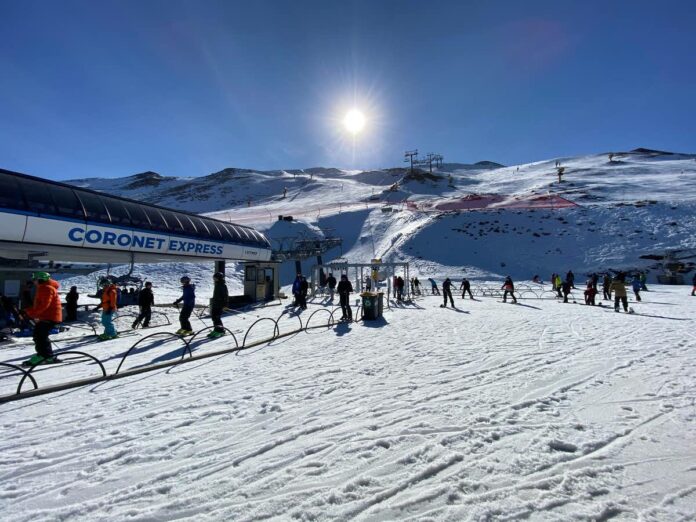
Coronet Peak skifield.

Source: The Conversation (Au and NZ) – By Michael Lueck, Professor of Tourism, Auckland University of Technology

By this time next week flights between New Zealand and Australia will have been taking off and landing for roughly 48 hours. The quarantine-free trans-Tasman travel bubble, beginning April 19, will finally be more than a promise.

For many people, especially those separated for so long from family, the open borders will mean more than the chance to take their first overseas holiday after the past year’s lockdowns and travel restrictions.

With more than half-a-million New Zealanders living in Australia, it is perhaps not surprising early flights were heavily booked, with Air New Zealand quickly selling out its Sydney, Brisbane and Melbourne routes for the rest of April.

Far fewer Australians live across “the ditch”, but Australia has long been Aotearoa New Zealand’s largest inbound tourism market, accounting for approximately 1.5 million arrivals (about 40% of all international arrivals) before COVID-19 mothballed passports.

Australian visitors spend around NZ$2.7 billion per annum in Aotearoa and (staying 11 days on average). In the other direction, New Zealanders accounted for 1.3 million arrivals to Australia in 2019, contributing AU$2.6 billion to the Australian economy.

A bubble in time

The question now is, how much and how quickly will the open borders translate into any kind of tourism revival on either side of the Tasman? Clearly a single market cannot compensate for the lack of inbound travel from the rest of the world. But for tourism operators, something is obviously better than nothing.

Whether it will be enough for those most desperate is another matter. In a recent Tourism New Zealand survey, more than 900 tourism operators (half the sample) said they will have to close this year if conditions don’t improve.


Read more: A quarantine-free trans-Tasman bubble opens on April 19, but ‘flyer beware’ remains the reality of pandemic travel


Of those, 13% reported they could only last three months, with the same number able to stay in business for three to six months. The bubble probably cannot save them all.

Australia’s tourism industry had already been hit by last summer’s bushfires when COVID-19 arrived. But healthy domestic tourism and a $A1.2 billion government support package have provided a lifeline for many operators over the past year.

Skiers on mountain skifield in sunlight

Queenstown’s Coronet Peak skifield: potential winter beneficiary of the travel bubble.

The winter factor

The timing may complicate things. The bubble coincides with New Zealand school holidays, but winter is also the low season when New Zealand tourism operators largely live off the profits from summer.

The exception is the ski industry, especially in the adventure tourism capital of Queenstown, which has weathered one winter without overseas visitors and is hoping for some relief.

Air New Zealand CEO Greg Foran has said he anticipates strong winter demand from Australians visiting for ski holidays, especially from July to September. Assuming the bubble holds, this seems reasonable. Pre-pandemic, 71% of international skiers in Aotearoa New Zealand were Australian.


Read more: NZ tourism can use the disruption of COVID-19 to drive sustainable change — and be more competitive


For Air New Zealand this also allows some expansion after a year of radical contraction. Some more aircraft in the airline’s wide-body fleet will be flying, and the company is bringing back furloughed crew grounded by the pandemic.

Both Qantas and Air New Zealand have said they expect to be quickly back at 85% of their pre-pandemic trans-Tasman capacity. In turn, this could boost rental car, campervan and motorhome businesses, given Australians are keen self-drive tourists in New Zealand. Any uptick here will flow on to smaller communities outside the main tourist centres.

New routes, new hope

Looking the other way, Australia has the advantage of its tropical and semi-tropical destinations, which Kiwis will find attractive as they enter their second COVID winter.

This will no doubt have been part of Qantas’s strategy in launching two new routes connecting Auckland with the Gold Coast’s Coolangatta airport (daily) and Cairns (initially for nine weeks).

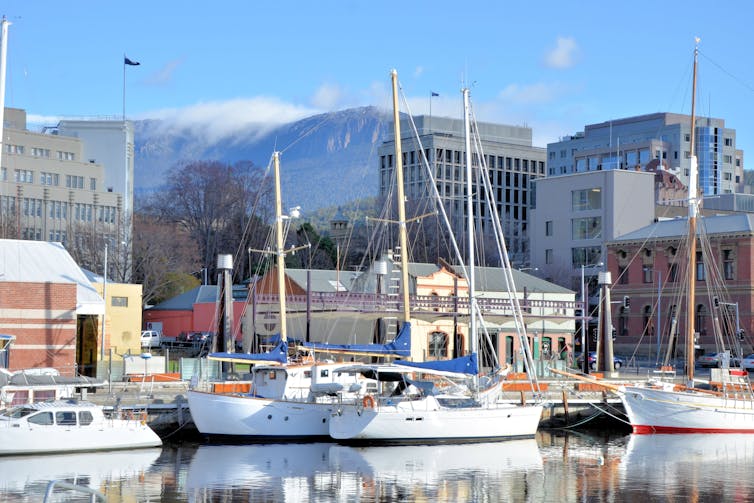
Hobart waterfront with yachts reflected in water
Hobart, Tasmania: increasingly popular with New Zealanders. www.shutterstock.com

But there is also a hope Kiwis will be tempted further south in Australia, with Air New Zealand recently announcing twice weekly non-stop flights between Auckland and Hobart (beginning on April 22).

This could work both ways. Dr Anne Hardy, Associate Professor of Tourism and Society at the University of Tasmania, tells me New Zealand is also a popular holiday destination for Tasmanians, and she expects a good uptake of flights from the Hobart end as well.

Furthermore, in the medium to long term, these flights will also offer hassle-free one-stop connections to the US, bypassing crowded stopovers in Melbourne and Sydney and removing one more potential exposure zone while any risk of COVID-19 remains.


Read more: A green tax on long-haul flights favours rich tourists. NZ needs a fairer strategy


A case for cautious optimism

This ongoing threat from unexpected community outbreaks in either country is the obvious caveat here. Even accounting for the roll out of vaccination programmes in Aotearoa and Australia, the mere thought of renewed quarantine requirements, reduced or cancelled flights and booked-out MIQ facilities will be enough to postpone many plans.

New Zealand has implemented a “traffic light system” to manage bubble flights. If the code went to orange or red, New Zealanders could be stranded for a time in Australia, with all the attendant expense of accommodation and re-booked flights.


Read more: Which Australian destinations lose, and which may win, without international tourism


Because the bubble has relieved some pressure on New Zealand’s managed isolation and quarantine (MIQ) system, 500 beds have been allocated for such a contingency. For tourists, however, the big consideration will be travel insurance, which will not cover such COVID-related costs.

Overall, however, the bubble should have a positive impact on both sides of the Tasman. The optimistic outlook of Qantas (and its low-cost subsidiary Jetstar) and Air New Zealand seems realistic.

We can hope Kiwi ski breaks and Aussie tropical holidays will tide many businesses over to the busier summer season, by which time the bubble may have grown to include even more countries.

ref. With the trans-Tasman travel bubble about to open, how much should the tourism industry get its hopes up? – https://theconversation.com/with-the-trans-tasman-travel-bubble-about-to-open-how-much-should-the-tourism-industry-get-its-hopes-up-158418

National cabinet to meet twice weekly in Morrison’s effort to get vaccination rollout ‘back on track’

Source: The Conversation (Au and NZ) – By Michelle Grattan, Professorial Fellow, University of Canberra

Scott Morrison will hold twice-weekly meetings of the national cabinet for the “foreseeable future”, as the government battles to get its slow and problem-laden vaccine rollout back on course.

The Prime Minister says he has asked national cabinet and health ministers to “move back to an operational footing” to tackle the program’s challenges.

This comes as the rollout is being recalibrated following the medical advice restricting the use of the AstraZeneca vaccine to people over 50. Morrison has refused to set a target date for having all those eligible and willing vaccinated, after abandoning the government’s previous October target.

Morison’s action on the national cabinet and his comments are his bluntest admission so far of the program’s difficulties, which started from its beginning and have multiplied ever since.

“There are serious challenges we need to overcome caused by patchy international vaccine supplies, changing medical advice and a global environment of need caused by millions of COVID-19 cases and deaths,” he said in a statement.

“This is a complex task and there are problems with the programme that we need to solve to ensure more Australians can be vaccinated safely and more quickly.”

He said the federal government was trying to deal with its issues “and I have been upfront about those”.

But states and territories were also tackling their own issues, he said.

“Working together we are all going to be in a better position to find the best solutions.”

The federal government has taken the main responsibility for the rollout, but it does not have the states’ experience at service delivery and this has added to the problems.

The new regime for national cabinet meetings will start on Monday and continue “until we solve the problems and get the programme back on track”. It has been recently meeting only about monthly.

Meanwhile, a second person has suffered a blood clot after receiving the AstraZeneca vaccine.

A woman in her 40s is recovering in the Darwin Hospital after being transferred from a regional hospital in northern Western Australia. The Western Australian Health Minister, Roger Cook, said the woman was in a stable condition in ICU.

Earlier a man in his 40s in Melbourne developed a clot after receiving the vaccine.

Last week Morrison announced the Australian Technical Advisory Group on Immunisation had advised against giving AstraZeneca vaccine to people aged under 50.

On Monday more than 56,000 doses of Pfizer and AstraZeneca vaccines were administered.

ref. National cabinet to meet twice weekly in Morrison’s effort to get vaccination rollout ‘back on track’ – https://theconversation.com/national-cabinet-to-meet-twice-weekly-in-morrisons-effort-to-get-vaccination-rollout-back-on-track-158911

View from The Hill: Christine Holgate presents a compelling story of Morrison’s bullying

Source: The Conversation (Au and NZ) – By Michelle Grattan, Professorial Fellow, University of Canberra

A wronged woman with a razor-sharp mind and meticulous records is a dangerous creature.

Especially when delivering a counter punch to a prime minister who’d denounced her in the bully pit of parliament when he was ill-informed, angry and driven by short-term politics rather than balanced judgement.

Former Australia Post CEO Christine Holgate, appearing before a Senate inquiry on Tuesday, inflicted serious a blow on Scott Morrison and left Australia Post chair Lucio Di Bartolomeo badly wounded.

She followed this with a Tuesday night interview on the ABC’s 7.30 in which she gave Morrison another blast, describing his attack on her as an “utter disgrace” and “one of the worst acts of bullying” she’d ever seen. She urged him to call her and apologise.

Holgate’s evidence, and that of Di Bartolomeo who followed her, revealed a chain of events in which she was not accorded any reasonable degree of fairness.

What happened after Holgate’s October 22 revelation (responding to a Labor question) at a Senate estimates hearing that four Post employees received Cartier watches as rewards for a big deal was a combination of over-reaction and weakness.

Morrison that afternoon raged in question time that Holgate had been instructed to stand aside, saying if she didn’t wish to, “she can go”.

Before and after his rant, two men – Communications Minister Paul Fletcher and Di Bartolomeo – lacked the spine to stand up for her or, indeed, to follow a formal process.

Holgate told the Senate inquiry she had lost her job “because I was humiliated by our prime minister for committing no offence and then bullied by my own chairman”, who “unlawfully stood me down at the public direction of the prime minister. This made my leadership at Australia Post untenable and seriously threatened my health.” She said she became suicidal.

She was in a land of political and media hell not unfamiliar to some politicians but foreign to most business leaders.

The senators’ forensic examination of her downfall is coinciding with debates about both workplace behaviour and sexism, and Holgate is putting her experiences in those contexts.

“I do not want what happened to me to happen to any individual ever again in any workplace,” she said.

Asked by Labor’s Kim Carr to what extent her treatment was a question of gender and to what extent one of politics, she said:

Senator, it’s a very hard question for me to answer […] but I think it would be fair to say I’ve never seen a media article comment about a male politician’s watch [there was much interest in the extremely expensive watch she wore at Senate estimates], and yet I was depicted as a prostitute for making those comments, humiliated.

I have never seen any male public servant depicted in that way. So do I believe it’s partially a gender issue? You’re absolutely right I do.

But do I believe the real problem here is bullying and harassment and abuse of power? You’re absolutely right I do.

That abuse of power started in the early afternoon of October 22, after the watches revelation and before Morrison’s outburst in question time.

Fletcher spoke twice to Di Bartolomeo. Fletcher told him there would be a review and “he wanted us to look at standing Christine down”.

Di Bartolomeo, by his own account, initially questioned whether standing her aside was necessary, but Fletcher insisted.

“I queried whether that was what he really wanted. He said, ‘Look, I am going to come back to you,’” which he did in the second call.

Holgate resisted standing aside, wanting instead to go on leave briefly. Di Bartolomeo took the matter to a hastily convened late afternoon meeting of the Australia Post Board. The board said she should stand aside, and made threatening noises about the consequences if she did not do so.

While Morrison told parliament Holgate had been “instructed” to stand aside, Di Bartolomeo said he had not taken Fletcher’s words as a “direction”.

Why would that be? Because if Fletcher, as one of the two shareholder ministers in Australia Post, had issued a “direction”, he would have had to go through a set process.

Fletcher, in his two pre-question time conversations with Di Bartolomeo, apparently didn’t mention whatever Morrison had said to him. We can presume the PM already had steam coming out of his ears.

A tough minister would have said to his PM, “Let’s say we will have the watches affair looked into and leave it at that for the moment.”

A Post chairman with gumption would have pushed back hard on the standing aside issue, either warning it would invite trouble or, if necessary, saying he wanted the minister to issue a formal direction.

Di Bartolomeo on Tuesday praised Holgate’s record as CEO and said she was “treated abysmally”, although he insisted “the board and management did the right thing by her”.

Yet, he handled the situation poorly on the first day, and no better in later days. His behaviour may not have been as black as Holgate paints it, but at every point he took the line of least resistance to government pressure.

A board that had backbone would have said, “Let’s all sleep on it, and assess the ‘stand aside’ demand when we’ve got the facts in perspective”.

None of them – minister, chairman, board – did these things.

The part played by one board member, however, did show concern for Holgate.

As she drove back to Sydney, increasingly upset and agitated, she had conversations with Tony Nutt, who advised her on her handling of the situation and on a potential statement.

Speaking about what happened to her, Holgate said in her evidence that Nutt, a former adviser to John Howard and a former Liberal party director, told her, “Christine, you need to understand it was the prime minister”.

While the full context of the reference is not entirely clear, Nutt had summed it up in one line.

ref. View from The Hill: Christine Holgate presents a compelling story of Morrison’s bullying – https://theconversation.com/view-from-the-hill-christine-holgate-presents-a-compelling-story-of-morrisons-bullying-158895

Bryce Edwards’ Political Roundup: The Māori Party needs to come clean

Political scientist, Dr Bryce Edwards.

Analysis by Bryce Edwards

Political scientist, Dr Bryce Edwards.

How seriously does the Māori Party take issues of corruption and the untoward influence of big money in politics? Not very, based on how it’s handling a political finance scandal in which three large donations were kept hidden from the public.

The party is currently making excuses, and largely failing to answer questions, about being referred to the Police for breaches of the Electoral Act for not declaring large donations it received during the election campaign, amounting to what could be corrupt practice.

The news of the Māori Party being referred to the Police is in Claire Trevett’s news report yesterday, Election donations: Māori Party referred to police over $320,000 in undeclared donations.

As the article notes, “Under electoral laws, political parties must disclose donations of more than $30,000 within 10 working days.” This is so the public, especially during an election campaign, is aware of who is funding the politicians. In this case, the Māori Party decided not to declare, as the law requires, three very large donations, which amount to nearly a third of a million dollars.

The money donated comes from former party co-leader John Tamihere ($158,224), Aotearoa Te Kahu Limited Partnership ($120,000), and the National Urban Māori Authority ($48,880).

It could be that the party didn’t have the correct processes in place, in what is a complicated area of operating a political party. Although the law is clear about what needs to be declared, the details of what should be included is a difficult area, especially if the donations amount to an amalgamation of “in kind” contributions and election spending by candidates. As Trevett’s article above reports, the party president “said Tamihere paid for some party costs out of his own pocket and the party had not realised it was supposed to treat those as donations.”

Nonetheless, the ball is now in the Māori Party’s court to reassure the public, and their voters, that they have integrity when it comes to powerful vested interests. Unfortunately, they aren’t providing a lot of the necessary detail.

About half of the money in question came from John Tamihere, who was less than forthcoming or contrite when replying to a journalist’s question on why he hadn’t been transparent, saying “Because I’m not as perfect as you” – see Tova O’Brien’s Billy Te Kahika outs himself as second Electoral Commission referral to police over donations.

Party president Che Wilson is claiming ignorance and a shambolic state of affairs in the party as his excuse – see RNZ’s Māori Party undeclared donations referred to police. Wilson is quoted saying, “We took over a party that had broken down and as part of the rebuild as volunteers when we got into the thick of the campaign we misinterpreted how we had to report things”.

Similarly, talking to Newshub, Wilson conveys that “they were so focused on issues that needed solving in the lead-up to the election that meant they didn’t have the correct processes” – see Rachel Sadler’s Māori Party undeclared donations: Electoral Commission notified as soon as error was noticed – party president Che Wilson.

Evaluating the party’s responses so far, electoral law expert Andrew Geddis told RNZ’s Morning Report: “That doesn’t strike me particularly as a good excuse, given that these rules are in place for a good reason. And if you as party secretary are taking on the responsibility then its implicit on you to make sure you know what you are doing and that you’ve got the processes in place to be able to meet the legal requirements” – see: Rules around electoral donations very clear – Geddis.

Geddis appears to believe a prosecution is required in this case, because “There’s no point having these rules if people can just ignore them and just walk away with a slap on the hand with a wet bus ticket.” But he adds that a judge might choose a lesser punishment for the party president if there are mitigating circumstances (such as the fact that they have come clean to the Electoral Commission).

Former Labour Party president Mike Williams has spoken out today, saying there’s “no excuse” for failing to disclose the large donations, and the “law is perfectly clear” – see Waatea News’ Māori Party fails to report funding. According to this article, “Williams says John Tamihere, who is a former MP, would know the rules”.

What’s more, Williams argues that the Māori Party’s failure to disclose its funding during the election campaign may have been politically consequential: “It might have altered votes if people knew John Tamihere chucked in $158,00 before the election. That should have been reported before the election. That’s the point of the law”.

Questions raised about who pulls the strings in the Māori Party

The spotlight is now on the three big donors to the Māori Party. On Newshub’s Hui TV programme last night, Mihingarangi Forbes challenged the party president about the funding from the National Urban Māori Authority (NUMA), which John Tamihere is the CEO of, and is contracted to the government to provide Whānau Ora services. But Wilson refused to comment saying “We can only talk about what we’ve done and you’d need to talk to NUMA about that.”

Political commentators Shane te Pou and Tau Henare appeared on the programme, and had very different interpretations of this donation. Te Pou, a former Labour candidate, said: “I think it’s very important the police investigate. If Whanau Ora money has been used – and I use that word ‘if’ – I don’t think that’s a good thing at all. At the end of the day it’s taxpayer money… If I was the minister of Whanau Ora, the first thing in the morning I would write to the Auditor-General and I would ask him to investigate” – see Dan Satherley’s ‘That’s the game’: Māori Party MPs warned attacks will come over donations scandal.

In contrast, Tau Henare called the scandal a “storm in a teacup”, and argued that the problem is with the law rather than the Māori Party: “The reality is we have a law that’s designed to obfuscate, designed to… hide things… The law needs to be looked at, the law needs to be revamped so everybody is clear about their accountabilities. In terms of the Māori Party, I think it’s a bit of a rookie mistake.”

Rightwing blogger David Farrar argues today that the matter raises important questions about the Māori Party’s funding – especially from the mysterious entity, Aotearoa Te Kahu, which gave a single donation of $120,000 – see: Who are the mystery Māori Party funders?.

Farrar has been digging around to find the background of this donor: “Go to the register of limited partnerships and you find they act on behalf of Aotearoa Te Kahu GP Limited. Their shareholder is ATK Nominees Limited. And their shareholder is Morrison Kent Limited. It is fair to assume Morrison Kent are not the actual shareholders but are acting for someone. So this leaves the question who actually controls and funds Aotearoa Te Kahu and made the decision to donate $120,000 to the Māori Party?”

Has the Māori Party been a victim of racism?

At the same time that the Māori Party were referred to the Police, the Electoral Commission also said that the National Party had breached the rules by failing to disclose $35,000 donated last year in three instalments by real estate businessman Garth Barfoot. Che Wilson has suggested, in his interview with Newshub, that because National hasn’t been referred to the Police, it’s a case of the Māori Party being unfairly singled out: “That’s just really sad that the system has its bias and potentially is racist”.

However, the Electoral Commission has been reported as saying that the same rules are being applied, but it hasn’t yet decided whether to also refer National to the police. In her article, Claire Trevett states: “The Electoral Commission said it had asked for an explanation from the National Party and was still assessing the matter. It did not automatically refer all late donations to the police, but considered issues such as the party’s past record and the timeframes involved.”

Blogger No Right Turn has backed up the Māori Party on this, suggesting if the Police choose to prosecute, this will reflect discrimination on their part: “In the past the police (as opposed to the SFO) have generally refused to enforce the law (it’s not ‘real’ crime, you see, unlike someone smoking a joint or walking while brown). But given the party involved and the police’s culture of racism and subservience to power, maybe we might finally see the law enforced this time, though for entirely the wrong reasons” – see: The Māori Party’s hidden donations.

Finally, the Electoral Commission is yet to release the details of the donations received by parties for the 2020 election year, but in February the donations to individual election candidates were published – you can see the details in Claire Trevett’s, Shane Jones, Christopher Luxon, Anna Lorck – who got the most donations in 2020 election?.

What is Novavax, Australia’s third COVID vaccine option? And when will we get it?

Source: The Conversation (Au and NZ) – By Jamie Triccas, Professor of Medical Microbiology, University of Sydney

As AstraZeneca is no longer the preferred vaccine for Australian adults under 50, attention is turning to what other COVID-19 vaccine options are in our arsenal.

The federal government has ordered 40 million doses of the Pfizer vaccine, which will become the mainstay of the rollout, while AstraZeneca will continue to be administered for people over 50 in the current phase 1B.

The federal government also this week ruled out using Johnson & Johnson’s one-shot vaccine.

But Australia does have a deal for a third vaccine, by US biotech company Novavax. The government has ordered 51 million doses of this vaccine, though it’s yet to be approved by Australia’s drug regulator, the Therapeutic Goods Administration (TGA), which is expected to make a decision in the third quarter of the year.

At this stage, Novavax would be made offshore and imported, although Melbourne-based biotech CSL can make the vaccine if requested by the federal government.

How does the Novavax vaccine work?

The Novavax vaccine is given as two doses, similar to the Pfizer and AstraZeneca shots already being used in Australia.

It can be stored for up to three months at fridge temperature, which differs from the Pfizer mRNA vaccine which needs to be kept at ultra-low temperatures. In saying that, the TGA said last week the Pfizer vaccine can be stored at normal freezer temperatures for two weeks during transport, and at fridge temperatures for five days — though must still be kept ultra-cold after transport and in the long-term.

A graphic comparing Australia's three vaccine options
Comparing Australia’s three COVID-19 vaccine options. Jamie Triccas, made with BioRender, CC BY-ND

The vaccine also uses a different technology to the Pfizer and AstraZeneca vaccines. It’s a “protein subunit” vaccine; these are vaccines that introduce a part of the virus to the immune system, but don’t contain any live components of the virus.

The protein part of the vaccine is the coronavirus’ “spike protein”. This is part of the other COVID-19 vaccines in use but in a different form.


Read more: New coronavirus variant: what is the spike protein and why are mutations on it important?


The Novavax vaccine uses a version of the spike protein made in the lab. The spike proteins are assembled into tiny particles called “nanoparticles” which aim to resemble the structure of the coronavirus, however they cannot replicate once injected and the vaccine cannot cause you to get COVID-19.

In order for these subunit vaccines to generate strong protective responses, they need to include molecules that boost your immune system, called “adjuvants”. The goal of these adjuvants is to mimic the way the real virus would activate the immune system, to generate maximum protective immunity.

Novavax includes an adjuvant based on a natural product known as saponin, an extract from the bark of the Chilean soapbark tree.

How effective is the vaccine compared to those already in use in Australia?

The interim data from phase 3 testing, released in March, was very encouraging. When tested in the UK in a clinical trial including more that 15,000 people, the vaccine was 96% effective at preventing COVID-19 disease for those infected with the original strain of the coronavirus.

This compares well to the Pfizer vaccine, with an efficacy of 95%, and recent data from AstraZeneca demonstrating 76% efficacy against COVID-19.

The Novavax vaccine is also safe. In early clinical testing the vaccine caused mainly mild adverse events such as pain and tenderness at the injection site, and no serious adverse reactions were recorded. In the larger trials, adverse events occurred at low levels and were similar between the vaccine and placebo groups.

A general view of the Novavax headquarters, Maryland, USA.
Novavax’s efficacy against the original strain of the coronavirus is 96%, and 86% against the UK variant. Jim Lo Scalzo/EPA/AAP

What about protection against variants?

In the UK trial, the vaccine maintained strong protection against disease in people infected with the B.1.1.7 “UK variant”, demonstrating 86% efficacy.

This is good news because the B.1.1.7 variant is now dominant in many European countries, is more transmissible and deadly than the original SARS-CoV-2 virus, and is responsible for most of the cases that have arisen recently in Australia.


Read more: The UK variant is likely deadlier, more infectious and becoming dominant. But the vaccines still work well against it


Less encouraging is protection against the B.1.351 variant first identified in South Africa, which can evade immunity that developed in response to earlier versions of the virus. The efficacy of Novavax’s shot dropped to 55% in protecting against COVID-19 symptoms from this variant. Protection against severe disease however was 100%, indicating the vaccine will still be important in reducing hospitalisation and death due to this variant.

Novavax, along with the other major vaccine companies, are developing booster vaccines to target the B.1.351 variant. Novavax are planning to test a “bivalent” vaccine, which targets two different strains, using the spike protein from both the original Wuhan strain and the B.1.351 variant.


Read more: Why we’ll get COVID booster vaccines quickly and how we know they’re safe


ref. What is Novavax, Australia’s third COVID vaccine option? And when will we get it? – https://theconversation.com/what-is-novavax-australias-third-covid-vaccine-option-and-when-will-we-get-it-157227

‘A vigorous cold front’: why it’s been so cold this week, with more on the way

Source: The Conversation (Au and NZ) – By Sarah Scully, Senior Meteorologist, Australian Bureau of Meteorology

Across most of Australia this week, people have woken up and thought “Goodness, it’s cold.” Summer doonas are being changed to winter doonas. Heaters are being switched on. Ugg boots are being dug out of storage.

Yes, some of this is normal seasonal transition. But at least a portion of it is due to a particularly vigorous cold front that swept across southeast Australia over the weekend, dragging with it an unusually cold air mass.

Canberra on Monday night got to -2.6℃, which is a new record low for this monitoring station for April (the previous lowest for April was -1.9℃ in April 2013).

Another strong cold front is forecast to move across the area on Thursday into Friday with snowfall to 800 metres for Tasmania, and about the Alpine peaks of New South Wales and Victoria.

For any families making the most of the last weekend of school holidays by camping or being outdoors — pack the thermals, because the mornings are going to be cold!

Frost is forecast across many parts southeast inland, away from the coast — but the days will milder, with blue skies and light winds. In other words, a beautiful Autumn day. Coastal campers can expect a bit more cloud around and even the chance of a shower.


Read more: Here’s how a complex low-pressure system sent temperatures plummeting


What is a cold front?

Cold fronts are a common feature we see on weather maps through southern parts of Australia. They’re often marked by cloud, a sudden change of wind direction, rainfall and (usually) a sharp drop in temperature; it’s a change in air mass from warmer conditions to colder conditions.

A lot of cold fronts develop over Antarctica and come pushing up over Australia, although sometimes they form due to the dynamics of the upper atmosphere interacting with the lower levels.

Interestingly, this cold front sweeping across parts of Australia at the moment actually engulfed the topical cyclone Seroja that moved very quickly across Western Australia in the last few days.

That cyclone is no longer visible at all from the radar.

Chilly in Victoria and NSW

It was the coldest start to the year across many parts of eastern Victoria on Monday night and into the morning.

That was partly due to the cold air mass in the wake of this weekend’s cold front, combined with clear skies, which means there was no cloud acting as a blanket to lock in warmth.

Light winds also helped to keep conditions particularly cold overnight, as windy conditions generally mix and warm the lower levels of the atmosphere.

Tuesday saw a temporary lull in the cooler weather, with warmer northerly winds developing ahead of another approaching cold front. These northerly winds are forecast to be strong and gusty, elevating fire dangers throughout parts of South Australia (where a fire weather warning is currently in place).

There is also a severe weather warning currently in place for locally damaging winds for central South Australia, Victoria and Tasmania.

The damaging winds are forecast to contract eastwards and clear during Wednesday.

Dust storms are also forecast to move from South Australia into northwest Victoria with these windy conditions, as dust and dirt from inland Australia is whipped up and brought over the area.

More cold on the way

A second, even colder front is forecast to move through southeast Australia on Thursday and/or Friday. Temperatures will drop again, with snow forecast about elevated and alpine areas of Tasmania, Victoria and NSW.

Inland parts of the mainland across southeast Australia are forecast to be particularly chilly and frosty during the mornings this weekend, with clear skies and light winds on the forecast, with milder days to follow.

ref. ‘A vigorous cold front’: why it’s been so cold this week, with more on the way – https://theconversation.com/a-vigorous-cold-front-why-its-been-so-cold-this-week-with-more-on-the-way-158876

‘A vigorous cold front’: why it’s been so cold this week, with a chilly weekend on the way

Source: The Conversation (Au and NZ) – By Sarah Scully, Senior Meteorologist, Australian Bureau of Meteorology

Across most of Australia this week, people have woken up and thought “Goodness, it’s cold.” Summer doonas are being changed to winter doonas. Heaters are being switched on. Ugg boots are being dug out of storage.

Yes, some of this is normal seasonal transition. But at least a portion of it is due to a particularly vigorous cold front that swept across southeast Australia over the weekend, dragging with it an unusually cold air mass.

Canberra on Monday night got to -2.6℃, which is a new record low for this monitoring station for April (the previous lowest for April was -1.9℃ in April 2013).

Another strong cold front is forecast to move across the area on Thursday into Friday with snowfall to 800 metres for Tasmania, and about the Alpine peaks of New South Wales and Victoria.

For any families making the most of the last weekend of school holidays by camping or being outdoors — pack the thermals, because the mornings are going to be cold!

Frost is forecast across many parts southeast inland, away from the coast — but the days will milder, with blue skies and light winds. In other words, a beautiful Autumn day. Coastal campers can expect a bit more cloud around and even the chance of a shower.


Read more: Here’s how a complex low-pressure system sent temperatures plummeting


What is a cold front?

Cold fronts are common feature we see on weather maps through southern parts of Australia. They’re often marked by cloud, a sudden change of wind direction, rainfall and (usually) a sharp drop in temperature; it’s a change in air mass from warmer conditions to colder conditions.

A lot of cold fronts develop over Antarctica and come pushing up over Australia, although sometimes they form due to the dynamics of the upper atmosphere interacting with the lower levels.

Interestingly, this cold front sweeping across parts of Australia at the moment actually engulfed the topical cyclone Seroja that moved very quickly across Western Australia in the last few days.

That cyclone is no longer visible at all from the radar.

Chilly in Victoria and NSW

It was the coldest start to the year across many parts of eastern Victoria on Monday night and into the morning.

That was partly due to the cold air mass in the wake of this weekend’s cold front, combined with clear skies, which means there was no cloud acting as a blanket to lock in warmth.

Light winds also helped to keep conditions particularly cold overnight, as windy conditions generally mix and warm the lower levels of the atmosphere.

Tuesday saw a temporary lull in the cooler weather, with warmer northerly winds developing ahead of another approaching cold front. These northerly winds are forecast to be strong and gusty, elevating fire dangers throughout parts of South Australia (where a fire weather warning is currently in place).

There is also a severe weather warning currently in place for locally damaging winds for central South Australia, Victoria and Tasmania.

The damaging winds are forecast to contract eastwards and clear during Wednesday.

Dust storms are also forecast to move from South Australia into northwest Victoria with these windy conditions, as dust and dirt from inland Australia is whipped up and brought over the area.

More cold on the way

A second, even colder front is forecast to move through southeast Australia on Thursday and/or Friday. Temperatures will drop again, with snow forecast about elevated and alpine areas of Tasmania, Victoria and NSW.

Inland parts of the mainland across southeast Australia are forecast to be particularly chilly and frosty during the mornings this weekend, with clear skies and light winds on the forecast, with milder days to follow.

ref. ‘A vigorous cold front’: why it’s been so cold this week, with a chilly weekend on the way – https://theconversation.com/a-vigorous-cold-front-why-its-been-so-cold-this-week-with-a-chilly-weekend-on-the-way-158876

Shoeshops, tailors, TV repairs: a photographic homage to Melbourne’s vanishing small businesses is a form of time travel

Source: The Conversation (Au and NZ) – By Daniel Palmer, Professor, RMIT University

Review: Small Business, published by M.33, Melbourne, 2021

David Wadelton understands that photography is a form of time travel. Small Business, his new book of photographs, transports us to Melbourne’s vanishing architecture of interior workplaces created by largely working-class, post-war immigrants from Europe. It forms a natural complement to his first book, Suburban Baroque (2019), which paid homage to their domestic interiors.

Both books are the product of years of wandering, especially in the rapidly gentrifying inner north of Melbourne.

Wadelton has lived in Northcote since 1975, and has long shared his massive archive of initially black-and-white photos of his beloved suburb through his Facebook moniker Northcote Hysterical Society. Social media has proved an ideal vehicle for such obsessive localism, extending to the crowd-funding campaigns he uses to underwrite the publications.

Thornbury Espresso, High Street Thornbury, 2016. Courtesy of David Wadelton and M.33

In some ways, what was once hysterical or obsessive has become the norm. As people spend more time in their local neighbourhoods, interest in their character and the history of the city seems to be flourishing. This is reflected in the popularity of Instagram accounts like @oldvintageMelbourne, with its nostalgic photos from the State Library’s archives.

Small Business apparently started with the decline of local fish and chip shops in Northcote. Over the course of the past decade, Wadelton photographed more than 600 small businesses, with over 140 featured in the book. The businesses are organised into groupings: milk bars, cafes, laundrettes, tailors, shoe shops and repairers, barbers, VHS shops, and so on.

A Foukis Professional Men’s Hair Stylist, Park Street, South Melbourne, 2020. Courtesy of David Wadelton and M.33

Wadelton’s photographs are carefully composed and depict the spaces in all their fluoro-lit, chaotic detail. They are far from iPhone snapshots. But their significance is as a collection rather than individual images.

Collected together in this book, they form an extraordinary record and a compelling artistic project. Paradoxically, the effect of the typological approach is to reveal how, in spite of superficially similarities, each business is unique.

Each image tells its own story, aided by all-too brief captions that offer a note about the owner or history of the business. From this book I learnt that Kosovo TV Repairs, which sat vacant for a decade around the corner from my house in North Fitzroy, opened in 1956, the year TV was first broadcast in Melbourne.

Kosovo TV Radio Repairs, Scotchmer St, Fitzroy North, 2019. Courtesy of David Wadelton and M.33

Wadelton photographed Monarch Cakes, the legendary cake shop in Acland St, St Kilda, in 2019. But it could be much earlier, because Monarch Cakes have been baking the same cakes from the same recipes since the 1930s.

On the wall behind the counter of Polish cheesecakes are a series of other time capsules — framed photographs of visiting celebrities and a signed copy of Aboriginal St Kilda footballer Nicky Winmar’s defiant anti-racist gesture from 1993.

Monarch Cakes, Acland Street, St Kilda, 2019. Courtesy of David Wadelton and M.33

In her introductory essay, Natalie King OAM, Enterprise Professor of Visual Arts at the University of Melbourne, evokes the lost European Melbourne of Jewish coffee shops. As she puts it “Wadelton apprehends the idea of the city as a cosmopolis and small businesses as repositories of family stories”.

The families themselves are almost never pictured directly (a cobbler on the front cover of the book is misleading). But they appear regularly in the form of family photographs stuck behind the counter.

Wadelton makes portraits of dated interior décor, not to sneer but to honour the well lived-in spaces of people’s labour. His camera pays homage to all the bits and pieces used to provide retail services and repairs, and the various traces of social and retail exchange.

Moonee Star Espresso Bar, Mt Alexander Rd, Moonee Ponds, 2020. Courtesy of David Wadelton and M.33

Nevertheless, the absence of actual people is critical. These are businesses on the verge of extinction. By the artist’s count, around a third of them have already closed.

These spaces belong to a different era — when things were made here, and TVs were worth repairing. They represent the life’s work of a former generation of migrants who made Melbourne the city it is today. As long-running establishments, often in family-owned buildings, they became part of the fabric of the city.

Sila Espresso, Brunswick Street, Fitzroy, 2017. Courtesy of David Wadelton and M.33

It’s all the more poignant that Small Business was completed during Melbourne’s long lockdown last year. For a variety of reasons, including the health of the owners, Wadelton tells me that some of those featured in the book have not re-opened since.

Perhaps conveniently, given Wadelton’s preferred aesthetic, normally busy places were deserted during COVID-19. In some of the more recent images you can see tape markings on the floor and other signs of virus-induced social distancing measures. Photography revels in details.

Alexanders Shoes, Smith Street, Collingwood, 2020. Courtesy of David Wadelton and M.33

By documenting businesses as they disappear — building on precedents such as Eugène Atget’s documentation of Old Paris a hundred years earlier — Wadelton is doing Melbourne, and history, a great service.

Pellegrini’s Espresso, Bourke Street, Melbourne, 2020. Courtesy of David Wadelton and M.33

Above all, this book of photographs is a reminder of a slower and simpler way of living. Before chain stores, throwaway clothing and online retail. Before inner-city gentrification, and before wood panelling became fashionably ironic.

ref. Shoeshops, tailors, TV repairs: a photographic homage to Melbourne’s vanishing small businesses is a form of time travel – https://theconversation.com/shoeshops-tailors-tv-repairs-a-photographic-homage-to-melbournes-vanishing-small-businesses-is-a-form-of-time-travel-158612

Home prices are climbing alright, but not for the reason you might think

Source: The Conversation (Au and NZ) – By Peter Martin, Visiting Fellow, Crawford School of Public Policy, Australian National University

It’s tempting to think home prices are soaring because there aren’t enough homes.

But that can’t explain the sudden takeoff from about the year 2000, the sudden takeoff from about 2013, and again now – against expectations – the stratospheric takeoff in the wake of the COVID recession.

Broadly, we’ve enough homes. The 2016 census found we had 12% more dwellings than households, up from 10% in 2001.

That’s 12% of our houses and apartments empty – used as holiday homes and second homes, or waiting for tenants.

If there really weren’t enough homes for people who wanted them, it would be more than property prices soaring; it would be rents.

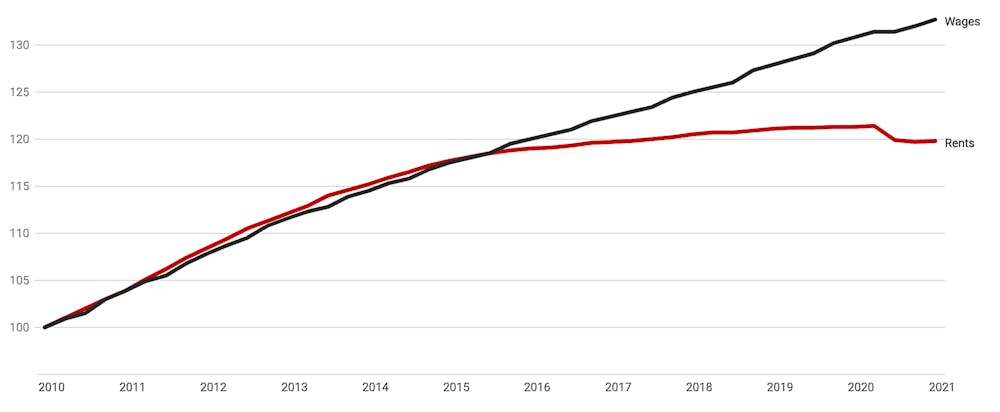
Instead, overall rents have been barely moving – growing even more slowly than wages – for half a decade.


Rent price index versus wage price index

December 2009 = 100. ABS Wage Price Index, Rent Price index from Consumer Price Index

For the half-decade from 2016, a half-decade in which Australia’s population grew by more than one million, Australian rents barely moved.

The supply of places to live in has kept pace with the demand for places to live in, but the supply of places to own has not.

More landlords, more tenants

If that sounds odd, remember people want to own houses for reasons other than living in.

Since about the year 2000, big numbers of Australians (and foreigners) have wanted to buy them to rent them out. They’ve wanted to become landlords.


Read more: Rents, not prices, are best to assess housing supply and demand


Twenty years ago only one in 15 of us were landlords. It’s now one in ten – more than two million of us.

To get those properties (other than where they’ve built them) they’ve had to outbid at auction the people who would have bought them to live in.

They’ve been helping create their own tennants, while pushing up prices.

We’re chipping away at Menzies’ legacy

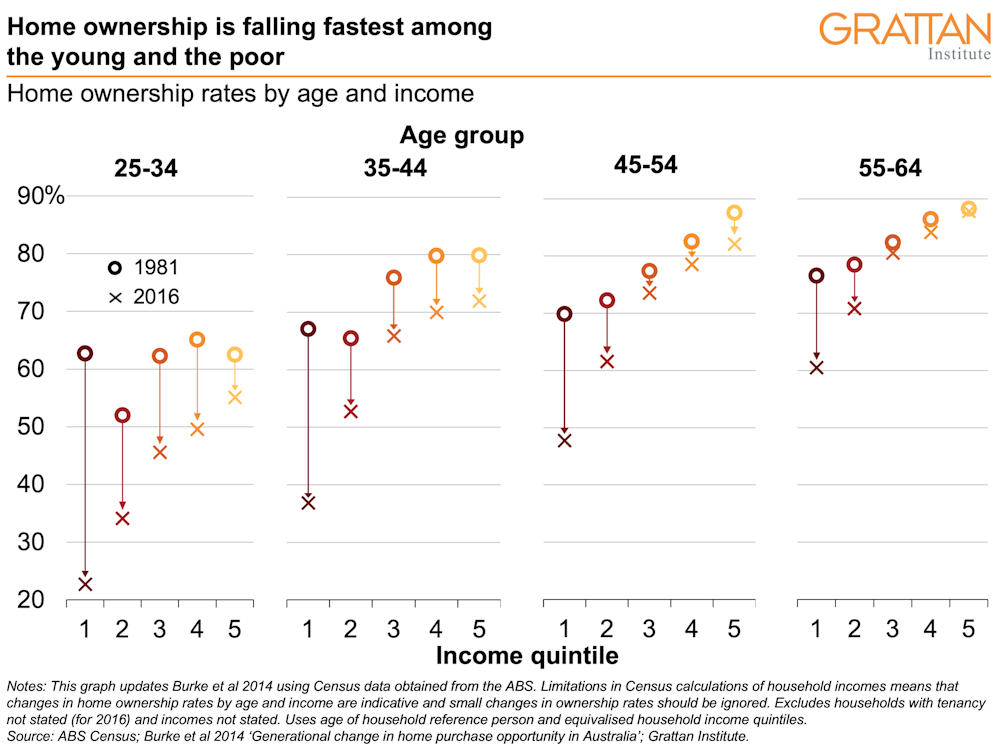
From when Robert Menzies stepped down as prime minister in 1966 until the end of the 20th century, about 71% of Australian households owned the home they lived in – one of the highest rates in the world.

Since about 2000, owner-occupation has been sliding. The latest figures (themselves some years old) put it at 66%.

Among those aged 35 to 44, it has fallen to 63%

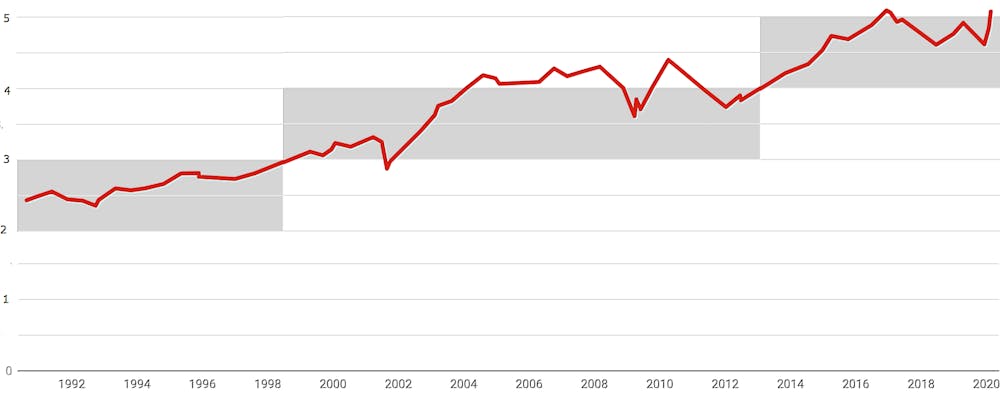
Over that time the cost of buying a home has shot up from two to three years’ household after-tax income to three to four years’ income.


Housing prices as proportion of household disposable income

Household disposable income after tax, before the deduction of interest payments, including income of unincorporated enterprises. Core Logic, ABS, RBA

What appeared to set things off was a decision by Prime Minister John Howard in 1999 to halve the headline rate of capital gains tax. Not that the committee he asked to investigate the idea recognised the possibility at the time.

The Ralph Review recommended that half, rather than all, of each capital gain be taxed, rather than the portion above inflation as had been the case since capital gains were taxed.

The rationale was that this would “encourage a greater level of investment, particularly in innovative, high growth companies”.

A rush into property rather than high-tech companies

The review was right about the change encouraging investment, but wrong about the sort of investment.

Rather than buy shares in innovative companies, Australians bought rental properties like they never had before.

If they bid enough, they could borrow enough to negatively gear; to make sure their interest charges exceeded their income from rent, giving them annual losses they could offset against wages that would otherwise be taxed at high rates.


Read more: When houses earn more than jobs: how we lost control of Australian house prices and how to get it back


There was nothing new about negative gearing. It had been permitted from the beginning. What was new was the opportunity to later sell the property at a profit, knowing only half of the profit would be taxed.

Investors could offset all of their losses and be taxed only half their eventual gain.

Pretty soon, more than a third of the money lent for housing each month went to landlords. For several dizzying months during 2015 it was 45%. First home buyers struggled to compete.

In 2016 then treasurer Scott Morrison raised the prospect of winding things back, saying negative gearing had led to “excesses”.

APRA cleared up what our leaders could not

Labor went to two elections promising to do just that and the Coalition came out in support of the practice in public.

Behind the scenes, the Australian Prudential Regulation Authority was using its power over lenders to force lending to landlords down, getting it down ahead of COVID to 27% of new housing loans.

APRA succeeded in taking the pressure off prices where politicians couldn’t.

But that’s far from the whole story. There are other more deep-seated reasons why house prices are climbing, and they too have little to do with demand for accommodation.


Read more: Zoning isn’t to blame for Australia’s soaring house prices


Prices took off again from about 2014, shifting up from three to four years’ household income to between four and five years. That time it was Australians getting richer after years of mining booms and being able to borrow more cheaply.

Houses in general mightn’t be a good investment (there being a regularly increasing supply) but houses in prime positions were in fixed supply, there being only so many good locations.

And then it fed on itself. The father of modern economics John Maynard Keynes described investing as game in which the best strategy is not to put money into what you think is worthwhile, but to put money into what you think other people will think is worthwhile.

It’s happening again

He spoke of a third degree, where “we devote our intelligences to anticipating what average opinion expects the average opinion to be”, and added there might be fourth, fifth and higher degrees.

It’s happening again. With mortgage rates at new extreme lows and wealthier Australians having come out of the crisis with their wealth intact, it makes sense to do what others are doing and push up prices to buy before others push them up further.

It’s nothing to do with a shortage of housing, but for many it will push home prices further out of reach. That’s because in Australia housing is two things: accommodation and a form of speculation.

ref. Home prices are climbing alright, but not for the reason you might think – https://theconversation.com/home-prices-are-climbing-alright-but-not-for-the-reason-you-might-think-158776

Not wiped out. Even after the collapse of Greensill, there’s time to save Whyalla

Source: The Conversation (Au and NZ) – By Michael O’Neil, Executive Director, SA Centre for Economic Studies, University of Adelaide

Wiping off Whyalla has become something of a macabre sport.

All manner of things have been said to be about to destroy the steelworks town, including (briefly) the 2012-2014 carbon price.

BHP abandoned the steelworks, the harbour and the nearly Middleback Range iron ore mine in 2000 floating it off as a separate company it called OneSteel.

Renamed Arrium, the company collapsed in 2016, in circumstances that are still being fought out in court.

Bought in July 2017 by Dubai-based British industrialist Sanjeev Gupta, the steelworks enjoyed a revival until this month, with an exclusive contract to supply steel for the planned eastern inland rail line and plans to make 100% “green steel” from renewable energy sources.

Two of Gupta’s companies, including OneSteel Manufacturing which runs Whyalla’s steelworks, were hit with windup applications last week, following the collapse of their major financier Greensill Capital.


Sanjeev Gupta visits the Whyalla steelworks in July 2017. David Mariuz/AAP

The withdrawal of finance has once more thrown into doubt the future of South Australia’s fourth-biggest town and its 22,0000 residents, including the 1,800 directly employed in the steelworks and the thousands more who depend on it.

Also in jeopardy is a planned A$6 billion upgrade to the steelworks along with a related A$350 million investment in the nearby Cultana Solar Farm that was estimated to create 350 jobs in the construction phase and 10 to 15 ongoing jobs.

Gupta says he has been working tirelessly to secure refinancing for the $US5 billion he owes Greensill, and in an open letter has described Whyalla as his “spiritual home”.


Read more: Looking good. Why Whyalla, of all places, has a sustainable future


The Morrison Government is said to be considering a “back-up plan” (presumably some form of bridging finance). The South Australian government is offering A$50 million on the condition it is used to pay down debt.

The steelworks appears to be profitable following a turnaround in the past 18 months. The contract for the inland rail project is worth $10 billion.

The impact of COVID-19 on demand for steel has been a negative, but at the same time the pandemic has shone light on Australia’s weak supply chains and stimulated rethinking about the need for local manufacturing using local steel.

Steel won’t be enough to save Whyalla

But steel can’t be the only key to Whyalla’s future. That locals are still talking as if it could be, reflects a deep-seated inertia.

Unlike the larger steel cities of Newcastle, Port Kembla and Wollongong, Whyalla has been very slow to respond to the need for change.

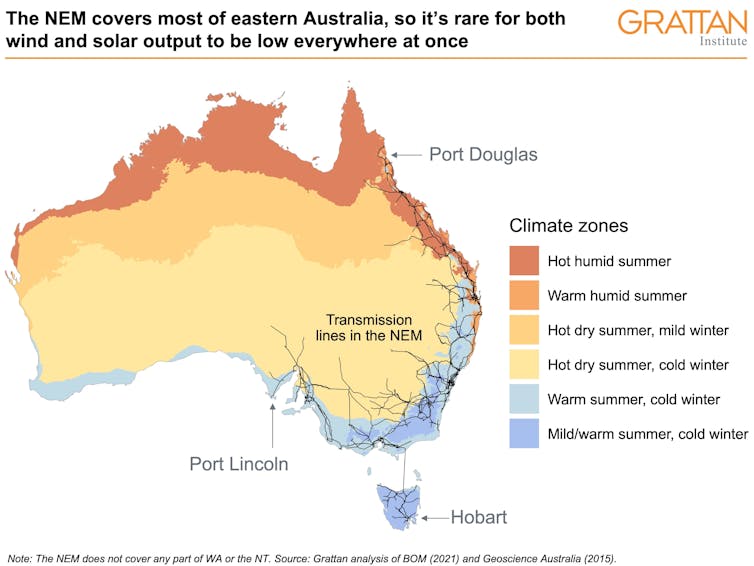
Fortunately, the opportunity remains open. Whyalla has open space, 300 days of sunshine well suited to solar energy (potentially lowering costs for new and existing businesses) and a new A$100 secondary school situated between a university campus and a TAFE Technical Institute.

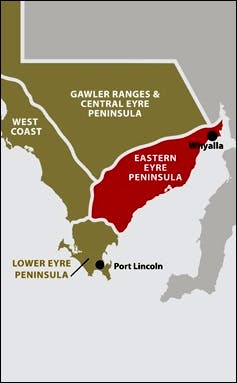
Gateway to the Eyre Peninsula

Whyalla already has a regional health precinct along with plans for a A$45 million foreshore hotel; a A$12 million airport upgrade, a A$6 million organic recycling project and a A$145 million state-of-the-art solar-powered greenhouse business.

And it will benefit from a new A$300 million investment in Eyre Peninsula’s electricity grid and its proximity to mining developments and port facilities.

Local contractors are potential suppliers to the new A$80 million desalination plant to be located near Port Lincoln and a planned rocket launching facility at Whalers Bay near Port Lincoln which will allow access to polar earth orbits.

And it’s the “gateway to the Eyre Peninsula”, a region with world-class tourism potential.

No-one disputes that Whyalla is heavily dependent on the fortunes of the steelworks, but over the past decade it has shown little interest in diversifying.

Its council appears to lack the skills and leadership needed to transform the economy.


Read more: Diminishing city: hope, despair and Whyalla


Whyalla has another chance to get it right. But it will require an early display of confidence in the form of a successful refinancing of GFC Alliance and a bold switch to other drivers of growth, by the government, the private sector or both.

It will need more strategic thinking and local action than we have seen to date.

ref. Not wiped out. Even after the collapse of Greensill, there’s time to save Whyalla – https://theconversation.com/not-wiped-out-even-after-the-collapse-of-greensill-theres-time-to-save-whyalla-158761

Double trouble: floods and COVID-19 have merged to pose great danger for Timor-Leste

Source: The Conversation (Au and NZ) – By Mark Quigley, Associate Professor of Earthquake Science, The University of Melbourne

Timor-Leste is reeling after heavy rain caused severe floods and landslides over the Easter weekend, killing at least 42 people. Rates of COVID-19 in Timor-Leste are also on the rise. Together, these hazards threaten to interact with deadly consequences.

Our research has assessed the likelihood of natural hazards coinciding with, and influencing, the COVID-19 pandemic. Unsurprisingly, we found temporary relaxations of COVID-19 restrictions during natural disasters are likely to cause large spikes in infection rates.

In Timor-Leste’s capital Dili, the floods and the pandemic have combined to form a dangerous dynamic. Flood damage prompted authorities to temporarily lift COVID-19 restrictions. Evacuees are gathered in group shelters where social distancing may be challenging. Flooding cut power to some COVID treatment centres and put extra pressure on Timor-Leste’s health system.

The situation offers lessons for other populated, flood-prone cites battling the COVID-19 pandemic. Natural hazards will, of course, persist throughout the pandemic. Better understanding the complex interactions between double disasters will help societies and systems become more resilient.

A boy undergoes a COVID test
A boy undergoes a COVID test in Timor-Leste, where the pandemic response has been complicated by flooding. Antonio Dasiparu/EPA

Dili: a recipe for disaster

On April 3 and 4, more than 400mm of rain was recorded in Dili. Floodwater and debris washed into populated areas. Recent reports indicate at least 42 people died and 13,554 were displaced. Nearby Indonesian islands were also hit and at least 130 deaths were reported.

Several natural and human factors combine to make Timor Leste vulnerable to flooding.

The country’s mountainous topography (see image below) encourages rainfall and creates steep stream systems that rapidly transfer floodwater into adjacent populated areas. Weak rocks and steep catchments are highly susceptible to landslides.


Read more: Cyclone Seroja just demolished parts of WA – and our warming world will bring more of the same


Flowing water interacts with the mountains, causing sediment to accumulate in the shape of a fan or cone. This directs flood waters and sediment into central Dili. Also, rampant deforestation and development has increased soil erosion and stream discharge during heavy rain.

Rapid and largely uncoordinated population growth, particularly in Dili, has concentrated vulnerable populations into flood plains and low-elevation coastal areas highly exposed to flooding.

Other factors increasing the flood risk in Dili include:

  • concrete structures that don’t allow water to sink into the ground

  • multi-pylon concrete bridges that trap flood debris

  • urban drainage channels choked with sediment and urban waste.

More broadly in the region, three climate features combined to create ideal conditions for the recent high rainfall and tropical storms: the West Pacific Monsoon, the Madden Julian Oscillation and a La Niña

The top image shows modelled rainfall from April 1 to 5 across Timor-Leste. Inset images show the total daily rain (top left) and maximum hourly rain over a 24-hour period (bottom right) recorded at Dili. The bottom image shows the topography of northern Timor-Leste, where high-elevation catchments exit into low-elevation populations centres of Dili and Laclo.

The COVID combination

Dili is frequently hit by large floods – most recently in March 2020. But this time, the disaster coincided with an escalation in Timor Leste’s COVID-19 infection rate.

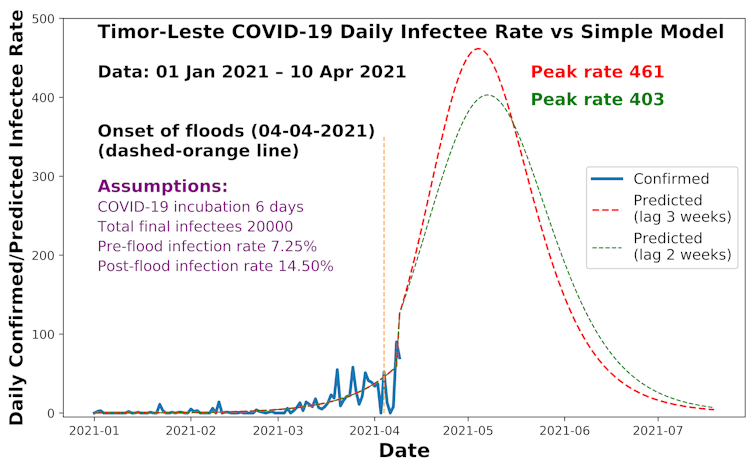
In late March this year, the number of new daily cases in Timor-Leste was rising quickly. On April 10, there were 70 new daily cases, bringing the total confirmed cases to more than 1,000.

Even without these twin disasters, many in Timor-Leste already lacked access to medical services and lived below the poverty line. COVID-19 restrictions exacerbated food shortages and poverty.


Read more: The best hope for fairly distributing COVID-19 vaccines globally is at risk of failing. Here’s how to save it


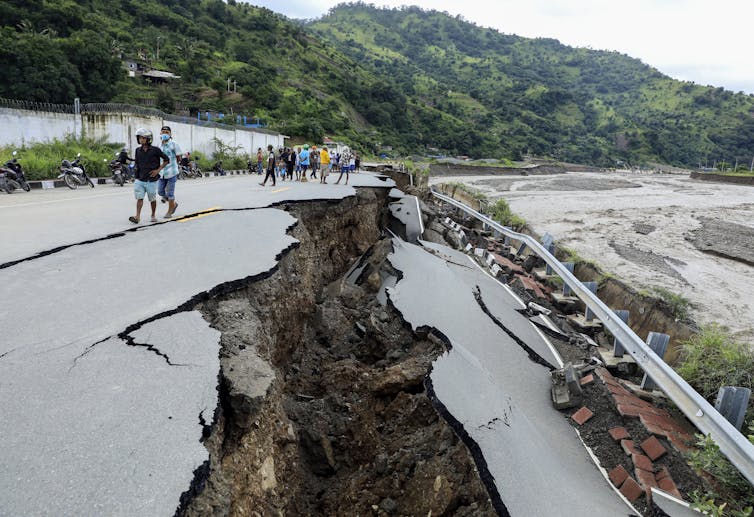
Then the floods hit. They left thousands homeless with severely restricted access to food and clean water. Roads and bridges collapsed. Crops were destroyed and firewood collection – essential for cooking – has been difficult in some areas.

The floods disrupted a COVID-19 lockdown in Dili, and forced people into crammed refuge centres. Flooding of a national medical storage facility damaged supplies. The national laboratory also flooded and a COVID-19 isolation facility was temporarily evacuated.

During floods, the risks of waterborne and vector-borne disease outbreaks increases. Should this occur, Timor-Leste’s fragile health system would be under even greater pressure.

The first batch of COVID-19 vaccines arrived in Timor Leste on April 5 and the vaccination program has managed to operate despite the flood-related challenges.

A road collapsed after floods
Floods in Timor-Leste caused roads to collapse. Antonio Dasiparu/EPA

A global problem

Many global cities are vulnerable to multiple interacting hazards like those now faced by Timor-Leste. Our analysis suggests 16 of the world’s 20 most populous cities, comprising 5% of the world’s population, have similar geology, population density and/or land use to Dili and could face similar multiple disasters. These cities include Jakarta, Tokyo and Manila.

In emergency situations, the need for disaster response and recovery may justify temporarily lifting COVID-19 restrictions. But pandemic measures must be reinstated as soon as possible. Our modelling, pictured below, suggests when COVID restrictions are lifted in response to a disaster, infection rates ascend rapidly.

Blue line shows confirmed daily COVID-19 infections, which have increased since mid-March. The red and green lines are modelled forecasts for daily infection rates assuming relaxation of COVID-19 restrictions for two weeks (green) and three weeks (red). Testing delays may produce a time-lag between our forecast scenarios and the real-world data.

What can be done?

Potential solutions are more likely to be effective when they involve multiple groups working together. This includes international and local experts, diverse support agencies and affected communities.

Our research identifies ways to improve disaster preparedness and response in a COVID-19 world. They include:

  • developing scenarios and forecasts to deal with the interaction of multiple hazards, including COVID-19

  • using centrally operating disaster coordination platforms to assist and empower local disaster responders

  • evacuation centres that allow for social distancing

  • storing supplies of personal protective gear and medical equipment in areas less exposed to natural hazards

  • mobile teams of humanitarian workers, volunteers and medical staff that can respond to natural disasters in COVID-affected regions.

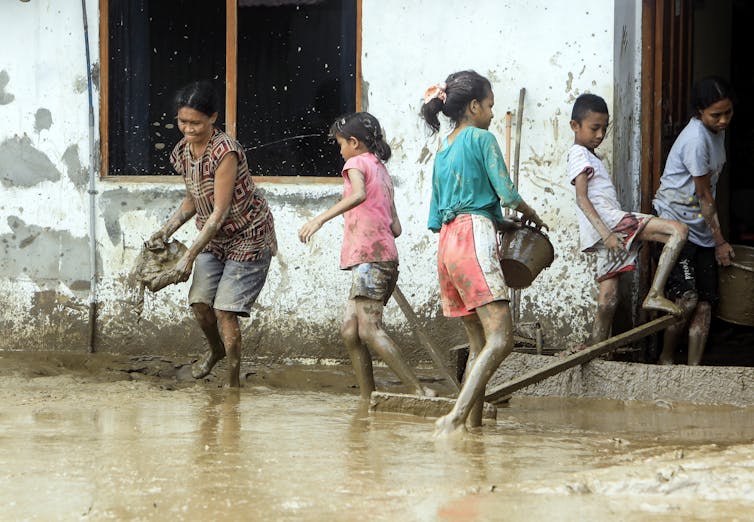
Dili residents clean up after flooding
Widespread change is needed to protect vulnerable Dili residents from future disasters. Antonio Dasiparu/EPA

Finally, measures must be taken to reduce the risks posed by future disasters. This must be done in culturally informed ways and includes:

  • improving land and water management

  • land-use planning that considers disaster risk

  • urban clean-up after events such as floods.

Such actions are crucial in developing nations such as Timor-Leste, where urban development can amplify natural hazards with tragic results.

Oktoviano Tilman de Jesus, Demetrio Amaral Carvalho and Josh Trindade contributed invaluable expertise to this work.


This article is part of Conversation series on the nexus between disaster, disadvantage and resilience. Read the rest of the stories here.

ref. Double trouble: floods and COVID-19 have merged to pose great danger for Timor-Leste – https://theconversation.com/double-trouble-floods-and-covid-19-have-merged-to-pose-great-danger-for-timor-leste-158625

Why China’s attempts to stifle foreign media criticism are likely to fail

Source: The Conversation (Au and NZ) – By Tony Walker, Vice-chancellor’s fellow, La Trobe University

When China’s ambassador to Australia, Cheng Jingye, summoned journalists to the Chinese embassy last week, this was not an occasion for polite exchanges on a troubled relationship between Beijing and Canberra.

Cheng was intent on communicating a forceful message to Australian reporters that China was intent on fighting back against what it regards as a great wall of unfavourable publicity about its treatment of its Uyghur minority.

In some media reporting of the press conference, the exercise was referred to as a “charm offensive”. However, a more accurate characterisation would be to describe it as an attempt by China to draw a line under increasingly negative foreign reporting of its activities.

This reporting is having real world consequences for China’s image abroad. It is inviting pushback from an international community that is mobilising against Chinese overreach. Beijing will not be insensitive to the risks of brand damage to China’s reputation, or risks of sanctions.

The Biden administration’s canvassing of a potential boycott of the 2022 Winter Olympics in China will have got Beijing’s attention. If countries, led by the United States, stay away this would represent a significant loss of face.

Global campaign against unfavourable reporting

Senior Chinese officials and Uyghurs appeared via video during Cheng’s embassy briefing to refute media accounts of human rights abuses in the Xinjiang region as “Western lies”, “fabrications” and the work of “anti-China forces”.

In its propaganda offensive, China has not been averse to using the “fake news” label, popularised by former US President Donald Trump to assail its critics.

Part of the propaganda video display during Cheng’s press briefing. Mick Tsikas/AAP

Cheng’s press conference was part of a larger, global campaign against unfavorable reporting in which Beijing has resorted to a combination of bluster and in some cases reprisals against journalists who have cut too close to the bone.

Australian citizen Cheng Lei appears to be a case in point. Cheng, an anchor for state broadcaster China Global Television Network (CGTN), was detained in China last year without explanation, but now stands accused of ill-defined national security breaches.


Read more: Journalists have become diplomatic pawns in China’s relations with the West, setting a worrying precedent


In private social media posts, she had criticised China’s initial response to the coronavirus pandemic. It is not clear whether this is the basis of allegations against her, but no other reasonable explanation has been forthcoming to this point.

China appears to have been particularly displeased by the reporting of the BBC. In February, Beijing banned all BBC broadcasting in China in retaliation for British authorities having revoked the license of the Chinese overseas broadcaster, CGTN. This represented a significant escalation in the conflict between the Chinese authorities and Western media.

What Chinese propaganda is seeking to achieve

Cheng’s propaganda exercise should therefore be seen as part of a global campaign to stifle what China regards as unfair and damaging criticism of its policies at home and abroad under paramount leader Xi Jinping.

If this Canberra media event was designed to dampen negative reporting in the Australian media, however, the campaign is unlikely to work for the simple reason there is little, or no, sign of Beijing reversing its antagonistic behaviour towards Western media.


Read more: Despite China’s denials, its treatment of the Uyghurs should be called what it is: cultural genocide


Scarcely a day passes without criticism of foreign media in Chinese state-controlled outlets. These attacks underscore the gap that exists between Western perceptions of the role of journalists in democratic societies and China’s view that media should serve the interests of the state.

Typical of the sort of criticism levelled at Western media is the following contribution to the nationalistic Global Times by a professor of international relations at Shanghai’s Fudan University.

What some media have done is exaggerate Chinese authorities’ fault in a bid to overthrow the Chinese system. Take the BBC. This British media outlet did not call on the British public to overthrow the British government even if it has miserably failed to effectively curb the spread of COVID-19. This is double standards.

This level of naivete is hard to credit, but it is revealing nevertheless of the gap that exists between Chinese views of the Western media and vice versa.

China’s bluster against Western media may play to nationalist sentiment at home, but it is hardly likely to be effective in neutralising foreign media criticism.

Australian media will not stop providing a platform for legitimate and widely publicised concerns about China’s mistreatment of its minorities; its disrespect for the “one country, two systems” agreements it signed with the UK to facilitate the handover of Hong Kong; its threatening behaviour towards Taiwan; and its expansion of base facilities in disputed waters of the South China Sea.

Beijing’s trade war against Australia smacks of the sort of overreach that may have become a staple of Chinese propaganda in state-run media, but in reality this is not a campaign that serves China’s own interests.

That is assuming Beijing is concerned about promoting itself as a reasonably constructive citizen in its own Indo-Pacific neighborhood.

Foreign Ministry spokesman Zhao Lijian has become the face of Beijing’s more belligerent stance toward Western powers. ROMAN PILIPEY/EPA

China’s dismal treatment of journalists

China’s press freedom record leaves a lot to be desired.

In the latest Reporters Without Borders world press freedom index, China rated 177 out of 180. It is by far the world’s largest captor of journalists with at least 121 detained, some in life-threatening conditions.

In March, the Foreign Correspondents’ Club of China reported an intensification of harassment of foreign reporters and increased use of “visa weaponisation”. This had led to the expulsion of 18 foreign correspondents in the first half of 2020. Others, like ABC’s Bill Birtles and the Australian Financial Review’s Michael Smith left because of concerns about being detained..

China regards the FCCC as an “illegal” organisation. As Cedric Alviani, Reporters Without Borders’s East Asian bureau head, said,

In recent years, Chinese regime apparatus has come to consider foreign correspondents as unwanted witnesses and goes to great length to prevent them from collecting information that doesn’t mirror its propaganda.

In a 2019 survey of the 10 “most censored” countries in the world by the Committee to Protect Journalists, China rated fifth behind only Eritrea, North Korea, Turkmenistan and Saudi Arabia. It said,

China has the world’s most extensive and sophisticated censorship apparatus. […] Since 2017, no website or social media account is allowed to provide a news service on the internet without the Cyberspace Administration of China’s permission. Internet users are blocked from foreign search engines, news websites, and social media platforms by the Great Firewall. […] Foreign social media platforms such as Twitter, Facebook and YouTube are banned.

This is the lived reality for foreign journalists in China in the Xi era, and for Chinese consumers of uncensored news, for that matter.


Read more: What’s behind China’s bullying of Australia? It sees a soft target — and an essential one


At no other stage since China began opening to the outside world in the Deng Xiaoping era of the late 1970s have conditions for foreign correspondents in China been more threatening — or more counterproductive from Beijing’s point of view.

China’s war against the foreign media is at a tangent to its proclaimed ambition to continue opening its economy to foreign investment. The anti-Western media campaign jars with hopes that it would become a responsible international stakeholder, as well.

If Ambassador Cheng’s press conference marks a new stage in China’s battles with foreign media, this promises to be a long march.

ref. Why China’s attempts to stifle foreign media criticism are likely to fail – https://theconversation.com/why-chinas-attempts-to-stifle-foreign-media-criticism-are-likely-to-fail-158785

For more, see also: Global Map of Internet Restrictions that explores internet restrictions and censorship in 175 countries to better understand which countries have a free/open Internet and which Governments impose the harshest internet restrictions.

COVID-19 highlights the need for Policing Reforms for Domestic Violence Cases in Guatemala

Source: Council on Hemispheric Affairs – Analysis-Reportage

Print Friendly, PDF & Email

Laura Iesue
From Miami, Florida

On March 29, 2020, Guatemala’s President Giammattei implemented an eight-day, country-wide curfew to stop the spread of COVID-19.[1] Ultimately, this lockdown would continue until October 1, 2020, as the virus continued to travel across communities.[2] While the viral spread continued to hold the public’s attention, media outlets slowly but increasingly began to report a rise in domestic violence incidents across Guatemala.[3][4] Statistically speaking, during the lockdown Guatemala saw an increase in cases of domestic violence reporting from 30 to 55 cases daily, according to the Women’s Secretariat of the Public Ministry[5]. In addition, there have also been an average of two murders of women and 5 to 6 rapes daily.[6] This jump in domestic violence echoes findings of organizations worldwide that reported an increase in women seeking domestic violence help compared to the previous year. [7][8][9][10] For instance, in Peru, over 1,200 women disappeared between March 11 and June 30, 2020.[11] Brazil reported a 22 percent increase in femicide in 2020 compared to 2019. [12] While domestic violence cases continue to make headlines, the uptick in domestic violence during COVID-19 stresses the importance to consider the relationship between criminal justice actors and Guatemalan society.  Moreover, the question remains: what can we do to help domestic violence victims or prevent future violence?

Domestic Violence and Criminal Justice in Guatemalan Society

Domestic violence, particularly towards women, is an endemic problem and, in some instances, a culturally acceptable phenomenon. A 2015 Latin American Public Opinion Project (LAPOP) survey found that Guatemalans were more accepting of domestic violence, particularly gender-based domestic violence, than other Latin American countries, with 58 percent agreeing that suspected infidelity justified physical abuse.[13]Previous conservative estimates suggest that 24.5 percent of married women between the ages of 15-49 experience abuse.[14] While this begs the question as to why criminal justice actors are not doing more to address these issues in Guatemala, in many locales, Guatemalan law enforcement institutions continue to be under-funded, inaccessible to some, and are often inadequately trained to handle such chases. Abuse has also resulted in an average of two women per day being murdered in Guatemala.[15] These issues are compounded by the fact that simply some Guatemalan officers continue to uphold and believe in the societal and cultural norms that see domestic violence as acceptable or at the very least a family-related issue, that must be dealt with privately. Such discriminatory attitudes towards domestic violence victims means that police fail to respond promptly to reports, intervene in violent situations, open investigations when a woman is reported missing, or adequately follow-up on complaints. Ultimately this results in an organizational culture that hinders domestic violence reforms.  In return, Guatemalans tend to distrust their police, which they view as ineffective and corrupt, and results in individuals choosing to opt out of reporting crimes .[16]

This is not to negate the reforms that have been made to criminalize acts of domestic violence and raise awareness about the issue. The most notable reform has been the creation of specialized courts for cases of alleged femicide and sexual, physical, and psychological violence. These courts have been influential in punishing offenders and providing the legal and psychological support needed for victims. Criminal justice reforms have also expanded to create specialized policing units solely responsible for handling allegations of  domestic violence, called the Victims’ Services Department, part of Guatemala’s National Police (PNC). This specialized unit has 53 offices across Guatemala located within police headquarters. Specially trained officers assigned to this unit facilitate access to restorative justice for victims of domestic violence, violence against women, sexual violence, violence against children, and violence against the elderly. In addition to traditional police duties, these units provide emotional, physical, family, social, and legal assistance directly or in partnership with  other organizations. The new laws and the establishment of the Victims’ Services Department are a step in the right direction. But there is still much that policymakers, human rights advocates, criminal justice practitioners, and civil society more broadly can do to ensure better support and access for victims.  The Guatemalan police need more resources and training to help introduce programs to support domestic violence victims, which will allow them to gain legitimacy and earn the trust of the public. Moreover, past partnerships particularly with the United States which has helped aid officers through resources as well as training can make future reforms more likely. These partnerships, previously slashed under the Trump administration are key to the Biden administration’s strategy to deal with ongoing violence in Central America. [17][18]

If the Framework is There, What Are Some Short-Term Opportunities for Support?

Previous, small reforms of the criminal justice system to provide domestic violence outreach are promising and have set the framework for future endeavors. Guatemala can expand support into communities to provide outreach, support, and educational services through the collaboration of nonprofit organizations.[19]NGOs can also help increase awareness of the negative impacts of domestic violence on victims and lay the foundation for changes to cultural norms by educating young men.[20]  Since domestic violence is just as much a public health issue as a criminal justice issue, the Guatemalan police, particularly in areas that emphasize community-based or model policing strategies, can help deliver the necessary services by tapping into the resources of local organizations to meet their safety and health objectives. This switch from traditional tough on crime or mano dura approaches to  community-policing to deal with domestic violence, can foster more police legitimacy and trust, provided cases are handled with compassion and in cooperation with local organizations.

As an example of how police may foster outreach services is Honduras’s Model Police Precinct named “Bolsas Comunitarias.”[21] Under this program, groceries and essential staples were delivered to economically vulnerable and high risk communities.by the police, while also inviting individuals to contact them if there were any domestic violence concerns. Preliminary results from this study in Honduras found that over 20% of respondents followed up via text or phone to talk about their experience with the program. Over 50 percent reported that this service significantly impacted their overall well-being, as their situation was bad or very bad. As economic strain and living in an at-risk environment are statistically associated with domestic violence cases, there is potential  for programs like “Bolsas Comunitarias” to be implemented in parts of Guatemala, ultimately alleviating some of the stressors associated with domestic violence.  Similar services have popped up across Guatemala, but a strategic, country-wide implementation might have more impact and ensure that resources are provided to areas that need them the most.

Guatemalan sectors can also pull from policies being implemented elsewhere.  Recently,  United Nations Secretary-General Antonio Guterres highlighted the need for countries to prioritize support for victims of domestic violence and suggested setting up emergency warning systems for people exposed to this violence.[22] Governments have taken steps to answer this call and have implemented some short-term solutions to help victims. For instance, in France, pharmacies and grocery stores are now providing warning systems to allow people to indicate if they are in danger or need assistance.[23] This includes the introduction of code words to alert staff that they need help.[24] Where technology is more accessible, remote or online services can also provide victims with health or counseling services.[25]

What about the Long-Term?

The COVID-19 crisis has revealed the need for more long-term domestic violence reform goals. This includes criminal justice and, more specifically, policing reforms from the top down. First, Guatemalan officials should institutionalize personnel training, as many police officers still lack training on how to handle and even spot domestic violence. Recent movements to recruit more female police officers are a step in the right direction. Still, more work needs to be done in reforming institutional, procedural, and monitoring policies on domestic violence.

Guatemala’s criminal justice system needs to ensure that its law enforcement and judicial systems continue to investigate and prosecute abusers. Also, more empirical work on just how many domestic violence cases are not prosecuted needs to be analyzed. This is especially important because it would provide more concrete data to criminal justice practitioners regarding where they are succeeding and where they are failing in the prosecution of domestic violence . Moreover, addressing these problems can send the message to would-be offenders and victims that domestic violence is not acceptable. Victims could come to trust the police and the criminal justice system to hold their abusers accountable.

Finally, police can continue to work within communities and local organizations to ensure equitable access to resources, legal assistance to victims, and  community education about the harm caused by  domestic violence. Such a multi-pronged approach not only enhances access to services and helps hold  offenders accountable, but it can also be useful when ex-offenders re-enter society. Organizations can have interventions in place to prevent recidivism and work to breakdown the community norms resulting in acceptance of domestic violence.  Ultimately, while we continue to assess the ramifications of COVID-19 on social institutions and consider how stressors due to the pandemic are increasing the incidence of domestic violence, this crisis can serve as a catalyst for meaningful institutional reform of the police and better outcomes for victims and improved police-community relations. The question remains whether Guatemala will collaborate with stakeholders to take advantage of this opportunity.

Laura Iesue is a PhD candidate and public criminologist at the University of Miami’s department of Sociology. Her work focuses on how crime policies and political attitudes on crime and violence are transferred from the Global North to the Global South and how this impacts local politics, communities and individuals. Her work particularly considers the impacts policies have on migration, crime types such as domestic violence, and even violence against journalists.

[Credit photo: common license]


Sources

[1]Tico Times, “Guatemala Rules out New Covid-19 Closures in Effort to Protect Economy,” Tico Times, 2020, http://ticotimes.net/2020/10/09/guatemala-rules-out-new-covid-19-closures-in-effort-to-protect-economy.

[2] Nestor Quixtan, “Guatemala Ends Lockdown (State of Calamity) on October 1,” CentralAmerica.com, 20202, https://www.centralamerica.com/living/news/guatemala-ends-lockdown/.

[3]ChapinTVa, “Aumentan Los Casos de Violencia Contra La Mujer,” ChapinTV, 2020, https://www.chapintv.com/noticia/aumentan-los-casos-de-violencia-contra-la-mujer/.

[4] ChapinTVb, “21 Escenas de Violencia Contra La Mujer Procesadas Por El MP,” ChapinTV, 2020, https://www.chapintv.com/noticia/21-escenas-de-violencia-contra-la-mujer-procesadas-por-el-mp/.

[5] El Diario, “Guatemala registra 55 casos al dia de violencia intrafamiliar por la cuarentena,” El Diario, 2020. https://www.eldiario.es/sociedad/guatemala-registra-violencia-intrafamiliar-cuarentena_1_2256633.html

[6] El Diario, “Guatemala registra 55 casos al dia de violencia intrafamiliar por la cuarentena,” El Diario, 2020. https://www.eldiario.es/sociedad/guatemala-registra-violencia-intrafamiliar-cuarentena_1_2256633.html

[7]Riley Beggin, “Stay Home, Don’t Stay Safe. Domestic Violence Calls Up Amid Michigan Lock-Down,” The Bridge, 2020, https://www.bridgemi.com/children-families/stay-home-dont-stay-safe- domestic-violence-calls-amid-michigan-lockdown.

[8] Emma Graham-Harrison, Angela Giuffida, and Helena Smith, “Lockdowns Around the World Bring Rise in Domestic Violence,” The Guardian, 2020, https://www.theguardian.com/society/2020/ mar/28/lockdowns-world-rise-domestic-violence.

[9] Megha Mohan, “Coronavirus: I’m in Lockdown With My Abuser,” BBC News, 2020.

[10] Amanda Taub, “A New Covid-19 Crisis: Domestic Abuse Rises Worldwide,” The New York Times, 2020.

[11] Lynn Marie Stephen, “A Pandemic Within a Pandemic Across Latin America,” U.S. News, October 10, 2020, https://www.usnews.com/news/best-countries/articles/2020-08-24/violence-against-latin-american-women-increases-during-pandemic.

[12] Stephen, “A Pandemic Within a Pandemic Across Latin America.”

[13] Dinorah Azpuru, “AmericasBarometer Insights: 2015; No: 123; Approval of Violence towards Women and Children in Guatemala,” 2015.

[14]Sarah Bott, Mary Goodwin, Alessandra Guedes, and Jennifer Adams Mendoza, “Violence against Women in Latin America and the Caribbean: A Comparative Analysis of Population-Based Data from 12 Countries” (Washington, DC, 2012), https://www1.paho.org/hq/dmdocuments/violence-against-women-lac.pdf..

[15] Mahlet Atakilt Woldetsadik, “In Latin America, Breaking the Cycle of Intimate-Partner Abuse One Handwritten Letter at a Time,” Rand Blog: Pardee Initiative for Global Human Progress, 2015, https://www.rand.org/blog/2015/09/in-latin-america-breaking-the-cycle-of-intimate-partner.html.

[16]  Perez, Orlando J. 2003.  “Democratic Legitimacy and Public Insecurity: Crime and Democracy in El Salvador and Guatemala.” Political Science Quarterly 118(4): 627-644. https://www.jstor.org/stable/30035699

[17]Lesley Wroughton and Patricia Zengerle, “As Promised, Trump Slashes Aid to Central America over Migrants,” Reuters, 2019, https://www.reuters.com/article/us-usa-immigration-trump/as-promised-trump-slashes-aid-to-central-america-over-migrants-idUSKCN1TI2C7.

[18] Elizabeth Malkin, “Trump Turns U.S. Policy in Central America on Its Head,” The New York Times, 2019.

[19] Bennett, Larry W., Stephanie Riger, Paul A. Schewe, April Howard, and Sharon M. Wasco. 2004. “Effectiveness of Hotline, Advocacy, Counseling, and Shelter Services for Victims of Domestic Violence: A Statewide Evaluation.” Journal of Interpersonal Violence 19 (7): 815–29. https://doi.org/ 10.1177/0886260504265687

[20] Cismaru, Magdalena, and Anne Marie Lavack. 2011. “Campaigns Targeting Perpetrators of Intimate Partner Violence.” Trauma, Violence, and Abuse 12 (4): 183–97. https://journals.sagepub.com/doi/ 10.1177/1524838011416376. Accessed April 4, 2020.

[21] Similar projects were conducted in Guatemala, but to date the author does not know of any formal reports on their impacts. Brenda Larios, “PNC Entrega Mil 400 Bolsas de Víveres a Familias Damnificadas En Tactic,” AGN: Guatemalteca de noticias, 2020, https://agn.gt/pnc-entrega-mil-400-bolsas-de-viveres-a-familias-damnificadas-en-tactic/.

[22] Phumzile Mlambo-Ngcuka, “Violence Against Women and Girls: The Shadow Pandemic,” UN Women, 2020,

https://www.unwomen.org/en/news/stories/2020/4/statement-ed-phumzile-violence- against-women-during-pandemic.(https://www.unwomen.org/en/news/stories/2020/4/statement-ed-phumzile-violence- against

women-during-pandemic).

[23] I Guenfound, “French Women Use Code Words at Pharmacies to Escape Domestic Violence during Coronavirus Lockdown.,” ABC News, 2020, https://abcnews.go.com/International/french-women-code-words-pharmacies-escape-domestic-violence/story?id=69954238.

[24]  Sophie Davies and Emma Batha, “Europe Braces for Domestic Abuse ‘perfect Storm’ amid Coronavirus Lockdown,” Reuters, 2020, https://www.reuters.com/article/uk-health-coronavirus-women-violence/europe-braces-for-domestic-abuse-perfect-storm-amid-coronavirus-lockdown-idUKKBN21D2WU.

[25] Susan Mattson, Nelma Shearer, and Carol O. Long, “Exploring Telehealth Opportunities in Domestic Violence Shelters,” Journal of the American Academy of Nurse Practicioners 14, no. 10 (2002): 465–70.


The best hope for fairly distributing COVID-19 vaccines globally is at risk of failing. Here’s how to save it

Source: The Conversation (Au and NZ) – By Deborah Gleeson, Associate Professor in Public Health, La Trobe University

COVAX, the global initiative to coordinate the distribution of COVID-19 vaccines in an equitable way, is crucial for bringing the pandemic under control.

But COVAX’s aim of delivering 2 billion doses to participating countries by the end of 2021 — including 92 low-income countries that can’t afford to buy vaccines directly from manufacturers — is threatened by chronic under-investment, vaccine nationalism and export restrictions.

COVAX is not intended only for low-income countries: Canada has so far received 316,800 doses through the scheme. As such, it represents an important “insurance policy” for Australia, potentially enabling access to a wider portfolio of vaccines than we could secure through negotiations with suppliers.

The vulnerability of our vaccine procurement strategy has become clearer over the last few weeks, with supply blockages limiting vaccine imports from Europe and now the government’s warning about the AstraZeneca vaccine and its links to a rare blood-clotting disorder.

Saving COVAX will require more than donations (of both funds and vaccines), as well as the removal of export bans. Countries must collaborate to urgently remove the legal and technical barriers preventing more widespread vaccine manufacturing in order to increase the global supply of vaccines for COVAX to distribute.


Read more: Yes, export bans on vaccines are a problem, but why is the supply of vaccines so limited in the first place?


How does COVAX work?

COVAX is led by the Coalition for Epidemic Preparedness Innovations (CEPI); Gavi, the Vaccine Alliance (a public-private partnership that aims to increase vaccination in low-income countries); and the World Health Organization.

It aims to deliver doses to all of the participating countries that have requested them in the first half of 2021, and 2 billion vaccines in total by the end of 2021.

COVAX is complex, but essentially it works by investing in a portfolio of promising vaccines and then distributing them according to a formula to both “self-financing countries” and “funded countries”.

Self-financing countries are those which have contributed funds to COVAX, such as Australia. They are able to buy the vaccines at cheaper prices negotiated by COVAX and will initially receive enough to vaccinate 20% of their populations. In the longer term, these countries may receive enough doses to vaccinate up to half of their populations, depending on how much they contribute.

Funded countries include 92 low-income countries that can’t afford to buy their own vaccines. They will also receive enough to vaccinate up 20% of their populations, provided COVAX is able to meet its goals. This is nowhere near enough to achieve herd immunity, but will at least allow health workers and the most vulnerable groups to be vaccinated.

Australia has committed A$123.2 million to enable it to purchase 25 million vaccines for domestic use.

It has also committed A$80 million specifically earmarked for providing vaccines for low-income countries. This money will be drawn from existing aid funding, however, and won’t go very far in terms of assistance.

How is the program going so far?

COVAX made its first delivery of vaccines to Ghana on February 24. By April 11, it had shipped approximately 38.5 million doses to 106 countries and territories.

The first shipment of COVID-19 vaccines distributed by COVAX arriving in Ghana. Francis Kokoroko/UNICEF/AP

While these figures might look promising at first glance, this is a long way behind COVAX’s aim to deliver 100 million doses by the end of March.

And they don’t stand up well in the context of global vaccine roll-outs. So far, only 0.2% of the 700 million vaccine doses administered globally have been given in low-income countries, whereas 87% have been received by people in high-income and upper middle-income countries.

Tedros Adhanom Ghebreyesus, director-general of the WHO, pointed out last week that only one in 500 people in low-income countries have so far received a vaccine — a situation he described as a “shocking imbalance”.


Read more: Why ‘vaccine nationalism’ could doom plan for global access to a COVID-19 vaccine


Why is COVAX struggling to deliver?

COVAX needs more funding, to the tune of US$3.2 billion even to meet its modest goals for 2021. But the supply of vaccines is an even bigger problem.

Rich countries like Australia have undermined COVAX by negotiating deals for vaccines directly with pharmaceutical companies, rather than waiting for COVAX to allocate them fairly. By last November, high-income countries making up just 14% of the world’s population had negotiated pre-market agreements covering 51% of the global supply.

Adding to COVAX’s problems, the flow of vaccine deliveries has mostly dried up in the last week.

Some 90 million doses of the AstraZeneca vaccine manufactured in India that were to be delivered to 64 countries in March and April have been delayed as a surge in COVID-19 cases prompted the Indian government to restrict exports.

Boxes of AstraZeneca COVID-19 vaccines manufactured by the Serum Institute of India and provided through the COVAX global initiative arrive at the airport in Mogadishu, Somalia. Farah Abdi Warsameh/AP

What needs to happen?

WHO has called on rich countries to immediately share 10 million doses to prop up COVAX in the first half of 2021.

But so far, no country has committed to do this. Donations that come after countries have fully vaccinated their own populations will be too late. And where bilateral donations have been made outside of the COVAX program (mainly by China and Russia), they have largely been driven by security, strategic or political considerations, rather than donated to the countries where they are most needed.


Read more: New COVID variants have changed the game, and vaccines will not be enough. We need global ‘maximum suppression’


Removing export restrictions would help. But as long as demand exceeds supply and the countries where vaccines are manufactured face large outbreaks, we are likely to continue to see these types of barriers.

What is needed most are more sustainable approaches to dramatically boost the global supply of vaccines and ensure there’s enough to go around.

This first requires removing the intellectual property protections that allow vaccine developers to hold exclusive rights to control who can make and sell them.

India and South Africa have put forth a proposal at the World Trade Organization to waive intellectual property rights for COVID-19 medical products during the pandemic, which has been supported by more than 100 low- and middle-income countries. However, several high-income countries, including Australia, have blocked it.

Secondly, governments need to support mechanisms for sharing intellectual property, such as the WHO’s COVID-19 Technology Access Pool (C-TAP).

This was set up nearly a year ago, but no vaccine developer has contributed to it yet. Governments need to make sharing intellectual property and contributing to the pool a condition of public funding for the development of COVID-19 products.

Finally, governments need to help low- and middle-income countries to produce their own vaccines. This means investing money to build up manufacturing capacities in these countries and facilitating technology transfers from companies based in high-income countries.

For COVAX to supply enough vaccines for even 20% of the world’s population, rich countries will need to step up. And fast.

ref. The best hope for fairly distributing COVID-19 vaccines globally is at risk of failing. Here’s how to save it – https://theconversation.com/the-best-hope-for-fairly-distributing-covid-19-vaccines-globally-is-at-risk-of-failing-heres-how-to-save-it-158779

More kids are being diagnosed with ADHD for borderline (yet challenging) behaviours. Our new research shows why that’s a worry

Source: The Conversation (Au and NZ) – By Luise Kazda, PhD candidate, University of Sydney

During my daughter’s challenging first year of school, we discovered how much effort it took her to sit and learn.

She was the youngest in her class, placing her at higher risk of being diagnosed with ADHD (attention deficit hyperactivity disorder).

While she struggled with attention and hyperactivity, her problems were always more frustrating than truly impairing. Still, constant battles over finishing tasks, the amount of time (and nerves) spent on a child that needs that extra bit of attention and the anger or sadness on her face made me wonder if we should try to get some support.

Maybe a diagnosis could be a straightforward fix to the problem?

What’s the problem?

Increasing awareness of ADHD has led to consistent rises in the number of children diagnosed with and treated for it, both internationally and in Australia. This would be good if it meant we were getting better at finding, diagnosing and helping children impaired by inattention or hyperactivity.

However, my newly published study in JAMA Network Open finds these increases in ADHD diagnoses may be largely due to children like my daughter, whose behaviours fall within a normal (but frustrating) range. I conducted this research with colleagues from the University of Sydney and Bond University.

Our study concluded these children are unlikely to benefit from being labelled with ADHD and may, in fact, be harmed by it.

This surge in diagnoses also results in limited resources being stretched thinner among more children, ultimately taking away from those with severe problems who would benefit from more support.


Read more: How do I know if my child is developing normally?


What is ADHD? And why is it so controversial?

ADHD is a “persistent pattern of inattention and/or hyperactivity-impulsivity that interferes with functioning or development”.

It’s one of the most common childhood disorders, affecting about 57% of children. Over the past decades, debate on the appropriateness of diagnoses has grown in line with the rate of diagnosis.

Anonymous child holding up ADHD label
Being labelled with ADHD has consequences, both positive and negative, so it’s important to get the diagnosis right. from www.shutterstock.com

Allen Frances, a prominent American psychiatrist, has been one of the most vocal critics of the trend. He describes it as the medicalisation of “every day experiences that are part of the human condition”.

However, others suggest the increases in diagnosed children are largely due to improved detection in previously undiagnosed children.

Both sides of the debate claim to have proof. But we were surprised to discover no-one had ever summarised the scientific evidence for the key reasons behind increasing diagnosis rates.

So we reviewed the results from over 300 studies on ADHD over the past 40 years to determine which children are being newly diagnosed and if they benefit. Our study design allowed us to summarise a huge variety of studies in a way not done before.

What we did and what we found

We found that since the 1980s, increasing numbers of school-aged children and adolescents around the world have been diagnosed with ADHD and medicated for it.

We know ADHD-related behaviours exist on a spectrum with no or minimal hyperactivity and inattention on one end and severe ADHD on the other.

Many children can get distracted easily, are forgetful, find it difficult to sit still or wait their turn. In most children, these behaviours are mild enough to not interfere with a “normal” life.

However, there is no clear biological cut-off point above which someone just “has” ADHD. Ways of diagnosing ADHD also vary between countries and change over time, with criteria generally becoming less stringent.

Together, this ensures many potentially new cases could be discovered, depending on how low the bar is set.


Read more: Five warning signs of overdiagnosis


In the US, for example, almost half of all children diagnosed with ADHD have mild symptoms, with only around 15% presenting with severe problems. Only about 1% of all children in an Italian study had severe ADHD-related behaviours. And, in general, children today are no more hyperactive or inattentive than 20 years ago.

All this led us to conclude a substantial proportion of these additional diagnoses (children who would not have been diagnosed 20 years ago) are, at best, borderline cases.

For example, one study shows while diagnoses increased more than five-fold over ten years in Sweden, there was no increase in clinical ADHD symptoms over the same time. This means that with the lowering of the diagnostic bar, children diagnosed with ADHD are, on average, less impaired and more similar to those without an ADHD diagnosis.

As a result children like my daughter, who are the youngest in their class, are at risk of being labelled with ADHD because their relative immaturity can be enough to push them over the threshold into the zone of “abnormal” behaviour.

Why it’s important to get it right

For children with mild symptoms

Children with mild ADHD symptoms are unlikely to benefit from a diagnosis. They (and their families) also incur substantial costs as well as potential harms from the diagnosis and treatment. That’s because:

  • instead of drumming up extra support, an ADHD label can have negative social, psychological and academic effects, when compared to similar young people without a diagnosis

  • medication reduces symptoms to a lesser extent in children with mild ADHD (however it is beneficial in many severe cases)

  • medication for young people with milder symptoms also has no positive, but a potential negative, effect on academic outcomes (such as maths and reading scores) when compared to unmedicated young people with similar behaviour. Also, medication doesn’t reduce the risks of injuries, criminal behaviour and social impairment as much as in those with severe symptoms.


Read more: Weekly Dose: Ritalin, helpful for many with ADHD but dangerous if abused by those without it


For children with severe symptoms

It’s also important children with more severe ADHD symptoms are correctly diagnosed so they don’t miss out on much-needed support.

With ever-increasing diagnosis rates of ADHD, schools are increasingly struggling to adequately support every child with a diagnosis: the slice of funding and support every child can receive gets smaller and smaller, the more children are included.

In turn, this often means those with the most severe problems get left behind.


Read more: ADHD prescriptions are going up, but that doesn’t mean we’re over-medicating


What can we do?

In light of the potential risks associated with diagnosing a child with milder ADHD symptoms, we recommend doctors, parents and teachers work together following a “stepped diagnosis approach”. This ensures swift and efficient diagnosis and treatment in severe cases. For those with milder symptoms, taking some time to watch and wait may mean many of them won’t need to be labelled or treated.

Not only will this avoid potential harm for individual children, it also ensures resources are allocated where they are needed most and will be most effective.


Co-authors on this article were: Alexandra Barratt, Professor of Public Health, University of Sydney; Katy Bell, Associate Professor in Clinical Epidemiology, Sydney School of Public Health, University of Sydney; and Rae Thomas, Associate Professor, Bond University.

ref. More kids are being diagnosed with ADHD for borderline (yet challenging) behaviours. Our new research shows why that’s a worry – https://theconversation.com/more-kids-are-being-diagnosed-with-adhd-for-borderline-yet-challenging-behaviours-our-new-research-shows-why-thats-a-worry-156115

Climate change is a security threat the government keeps ignoring. We’ll show up empty handed to yet another global summit

Source: The Conversation (Au and NZ) – By Cheryl Durrant, Adjunct Associate Professor, UNSW

Climate change is a hot topic in Australian security circles, as it poses an emerging threat to our national resilience and way of life. As a new report from the Australian Strategic Policy Institute (ASPI) last week warned, the federal government is unprepared to meet these challenges.

The report, authored by Dr Robert Glasser, said the government has largely overlooked the security threat posed by rising seas, climate-induced famine, extreme weather events, mass migrations and other climate change damage in Southeast Asia. Australia is sitting on the frontline of this vulnerable region.

Glasser’s report focuses on Southeast Asia, but in the bigger picture, climate security is an existential global risk which the Australian government is yet to fully grasp. It is this global aspect of climate and security which will be on the agenda in two weeks time at the Biden Leaders Summit in the US.

Why should we be worried?

The global risk is broader than traditional security threats, such as the rise of China, terrorism and separatist movements. As the ASPI report emphasises, there is a relationship between climate security and other sectors such as food, health and environmental security.

Unlike traditional national security threats, climate threats have no respect for national or sector borders and cannot be solved with missiles.

The threat is urgent. With the end of the Donald Trump presidency, climate change is back on regional and international security action agendas. The penny has dropped on how little time is left to take action to prepare for the worst of consequences.

This is especially the case when there are long lead times to implement action, such as infrastructure development and military capability development.


Read more: Climate change poses a ‘direct threat’ to Australia’s national security. It must be a political priority


ASPI’s key recommendations to the government include:

  • improving understanding of climate change risks through a broad whole-of-government process

  • building capacity in government agencies to assess ongoing risks

  • identifying opportunities for regional aid and investments.

These make sense, as the first step of preparedness is understanding the risk.

Security risks go beyond natural disasters

The ASPI report notes Southeast Asia “has the world’s highest sea-level rise per kilometre of coastline and the largest coastal population affected by it”. The region is a hot spot for cyclones, with some nations vulnerable to catastrophic heat or fires.

Debris caught on a submerged bridge
Debris caught on a submerged bridge in Windsor, northwest of Sydney, after the recent floods in NSW. AP Photo/Rick Rycroft, File

The ASPI report notes:

Those hazards will not only exacerbate the traditional regional security threats […] but also lead to new threats and the prospect of multiple, simultaneous crises, including food insecurity, population displacement and humanitarian disasters that will greatly test our national capacities, commitments and resilience.

The report focuses on Southeast Asia and natural disasters, but the risks and the affected regions are bigger than that.

The Indo-Pacific region may see the displacement of millions of people due to climate change-related extreme weather events, heatwaves, droughts, rising seas and floods. We’re already seeing this occur in Bangladesh and small island developing states.

We could also see conflict arise as climate change affects global food or water resources. A particular concern is the potential geopolitical tensions between India and China over dwindling Tibetan water resources.

Australia is getting left behind

Urgency and risk are central to an executive order from President Joe Biden in January. The order requires a US national security estimate on the economic and national security impacts of climate change by June. The US Department of Defence must also complete an analysis of the security implications of climate change in the same timeframe.


Read more: Biden says the US will rejoin the Paris climate agreement in 77 days. Then Australia will really feel the heat


Most tellingly, the US is taking an integrated approach to climate security. Foreign policy, defence and economic risk analysis are being conducted in a joined-up, systemic way.

In contrast, the Australian Defence Strategic Update 2020 was conducted in isolation from foreign policy and economic reviews. Taking a narrow military perspective, it does mention climate change, but only once, as a subset of human security threats.

Australia risks being left behind as other countries follow the US lead. Across the Tasman, our Kiwi friends are already well advanced in turning risk awareness into action. The New Zealand government completed its first national climate risk assessment last year, with a national adaptation plan to be completed by August 2022.

Joe Biden waves and wears a black mask
Forty world leaders will attend the Leaders Summit on Climate that Biden will host on April 22 and 23. EPA/Alex Edelman/POOL

What are the consequences?

Being left behind has consequences for Australia’s international standing, national resilience and economic position.

From a diplomatic perspective, Australia’s influence in the Indo-Pacific region is diminished, relative to other actors, especially in states where climate change risk is a top priority, such as Vanuatu or Kiribati.

Risks offer opportunities as well. For example, Australia has an abundance of critical minerals and rare earths needed for modern communications, space technologies, and renewable energy generation and transmission. These are key for business, as well as critical for defence forces.


Read more: Critical minerals are vital for renewable energy. We must learn to mine them responsibly


However, processing and manufacturing is largely conducted offshore — in countries vulnerable to climate risks such as Malaysia — before returning to Australia as finished products.

This puts Australian defence and space and energy sectors at risk of disruption, and Australian businesses at risks of economic loss.

What needs to happen next?

ASPI’s report echoes the earlier recommendation from a 2018 Senate inquiry into the implications of climate change for Australia’s national security. The inquiry also called for a coordinated whole-of-government response to climate change risks.

Three years later, the federal government has yet to act on its recommendations.

The Australian government now needs to have a greater sense of urgency to act on the growing national and international calls to act on climate risk. But first, our leaders need a changed mindset. They must accept that climate change is an immediate threat to Australia.


Read more: Senate report: climate change is a clear and present danger to Australia’s security


ref. Climate change is a security threat the government keeps ignoring. We’ll show up empty handed to yet another global summit – https://theconversation.com/climate-change-is-a-security-threat-the-government-keeps-ignoring-well-show-up-empty-handed-to-yet-another-global-summit-158702

Resistance to raising the minimum wage reflects obsolete economic thinking

Source: The Conversation (Au and NZ) – By Jim Stanford, Economist and Director, Centre for Future Work, Australia Institute; Honorary Professor of Political Economy, University of Sydney

Fewer than 2% of Australian employees work for the minimum wage (now $19.84 an hour). But the federal Fair Work Commission’s annual decision on how much to increase the minimum wage also helps determine pay rises for up to a third of Australian workers.

The adjustment, which comes into effect on July 1, flows through to those paid under awards, many on individual contracts and even some enterprise agreements (whose wage increases effectively track the minimum).

Last year’s increase of 1.75% was the smallest in 12 years.

That modest increase, which was delayed several months for most workers, was justified by the dramatic fall-out of the COVID pandemic. But with employment now rebounding – the jobless rate in February was 5.8%, down from its peak of 7.4% in July 2020 – we should expect a stronger “catch-up” increase.

That’s what happened after the Global Financial Crisis, with no change in the minimum wage in 2009, followed by an almost 5% increase in 2010.

But many employer groups are pushing for an outright freeze.
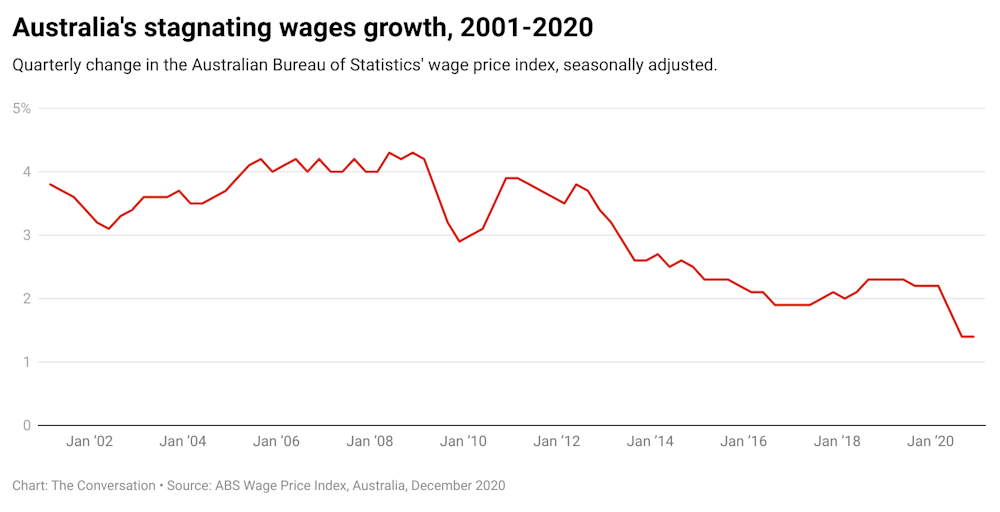
The federal government has implicitly sided with them. Its submission to the Fair Work Commission last week warned a higher minimum wage could “dampen employment” and impose a “major constraint” on the post-COVID recovery.

But this argument is based on outdated economic ideas. The evidence from economic research over the past few decades suggests boosting wages back to a normal trajectory would strengthen aggregate demand and consumer confidence, help keep inflation on target, and bolster government revenues at a vital moment in the post-COVID recovery.


Read more: Why kickstarting small business exports could boost stagnant wages


Consistently opposing increases

The Australian Council of Trade Unions has argued for a 3.5% increase. This is well within the normal historical range. It also aligns with the historical view of Reserve Bank of Australia governor Philip Lowe, who in 2018 said annual wage increases of about 3.5% were necessary to meet the bank’s 2.5% inflation target.

It’s not often the union movement and the central bank sing from the same hymn book.

As my colleague Alison Pennington (senior economist with the Centre for Future Work) has written, the Coalition’s position is consistent: it argues against wage increases “whether the economy is weak or strong”.

Long before COVID-19, Australia was already experiencing the weakest wage growth since the 1930s. Since end-2013, wage growth has averaged just 2.1% a year. Rosy predictions of an imminent rebound, issued with each federal budget, have never come to pass.


Quarterly change in the Australian Bureau of Statistics' wage price index, seasonally adjusted.
CC BY-SA


Read more: So much for consensus: Morrison government’s industrial relations bill is a business wish list


A redundant economic orthodoxy

The federal government seems captive to an anachronistic belief that lifting the minimum wages will undermine job creation and competitiveness. This idea has been disproven by important developments in both economic theory and international comparisons.

The old economic orthodoxy, typically conveyed via simple supply and demand charts, argued unemployment was inevitable any time governments imposed a minimum wage above the natural “market-clearing equilibrium”.

In the past two decades, however, this conventional wisdom has been turned upside down. Starting with groundbreaking US studies of minimum wages and employment in the fast food industry, studies have found higher minimum wages do not generally destroy jobs – and in certain conditions may actually boost employment.

Reasons for this include:

  • higher labour force participation and productivity among low-wage workers
  • better job retention and lower turnover, reducing costs of job search and training
  • reducing the “monopsony” power of very large employers to suppress wages
  • more money in workers’ pockets, leading to more consumer spending.

Once a leader, now a laggard

The Reserve Bank agrees recent minimum wage increases have had no visible negative effect on employment.

So the government’s submission to the Fair Work Commission is invoking a discredited shibboleth by suggesting an unavoidable trade-off between wages and employment.

It also ignores how much Australia’s minimum wage has been eroded in recent decades. Australia was once a world leader in minimum wage policy. This is no longer true.

The best way to measure the labour market impact of the minimum wage is by its “bite” – the ratio of minimum wages to overall labour compensation (best measured by the median wage).

Australia’s minimum wage is now 54% of median wages. In 1992 it was 65%.


Read more: There’s an obvious reason wages aren’t growing, but you won’t hear it from Treasury or the Reserve Bank


That decline has been accompanied by the weakening of other wage-supporting policies (including collective bargaining and awards).

It’s no accident Australia has experienced weak wage growth and a falling labour share of GDP, alongside record business profitability. That was the whole idea.

The fading ambition of Australia’s minimum wage policy is also evident internationally.

Australia’s ranking in OECD by minimum wage ‘bite’ Centre for Future Work, from OECD data on minimum wages relative to median wages.

In 2002 Australia ranked third among OECD countries according to the minimum wage “bite”.

By 2019 we ranked 12th (out of 29 OECD countries with minimum wages).

As Australia treads water, other nations are acting on the new economic evidence and lifting minimum wages. In the US, the Biden administration wants to double the federal minimum wage.

The argument that lifting Australia’s minimum wage will necessarily cost jobs is outdated and unconvincing. After last year’s very modest increase, a more generous increase will strengthen Australia’s post-COVID recovery, not jeopardise it.

ref. Resistance to raising the minimum wage reflects obsolete economic thinking – https://theconversation.com/resistance-to-raising-the-minimum-wage-reflects-obsolete-economic-thinking-158622

The One: could DNA tests find our soulmate? We study sex and sexuality — and think the idea is ridiculous

Source: The Conversation (Au and NZ) – By Andrea Waling, ARC DECRA Senior Research Fellow in Sex & Sexuality, La Trobe University

The Netflix drama The One centres around a geneticist who invents a new matchmaking service. It uses DNA to help people find their romantic and sexual match: their “one”.

“A single strand of hair is all it takes to be matched with the one person you are genetically guaranteed to fall in love with”, says Dr Rebecca Webb (Hannah Ware). “The moment you meet your match, your one true love, nothing will ever be the same again.”

The One asks what would happen if we could use a DNA database to match “soulmates”. More importantly, it assumes if such technology existed it would be a wholly commercial enterprise — imagining a not-to-distant future where tech (and tech giants) mediate dating, sex and relationships.

So, is this future just around the corner?

The popularity of home DNA testing

Home DNA testing is now a massive business. It is estimated that by 2022 it will be worth over US$10 billion globally.

DNA testing companies have fuelled a cultural fascination with biology, in which genetic dispositions are conflated with identity. DNA is regarded by some as the secret to understanding who we fundamentally are as people.

DNA kits have been sold to explore genetic and cultural history, to tailor diets, and to look at genetic health risks.

Indeed, companies such as Canada’s DNA Romance and Instant Chemistry already claim to help people find love and sexual compatibility through DNA tests.

A woman on stage, looking at a vial
The One’s DNA test isn’t wholly a product of science fiction. Netflix

People send in saliva swaps, and their DNA is tested to genotype human leukocyte antigens, also known as the major histocompatibility complex. These are important regulators of the immune system, which also impact our body odour. Genotyping identifies which variants of these genes each of us carry – which supposedly determine who we are attracted to.

Companies claim to match people on the basis of this test for the best genetic love match.

There is no compelling evidence as to whether or not DNA matching can support a more fulfilling love life. These current tests on major histocompatability complex are based on limited experiments with mixed results.


Read more: Does Singld Out, a gene-based dating service, pass the sniff test?


Indeed for most things, home DNA testing isn’t scientifically advanced enough to give us true insights. It also comes with ethical concerns such as fears over data hacking, bodily autonomy in relation to who owns DNA data, and the accuracy of the data provided.

Nature versus nurture

The One reflects society’s current interest in understanding our DNA as essential to our social and cultural practices. This has significant implications for diversity and acceptance. The TV series relies on the idea that romantic and sexual destiny is predetermined by biological makeup.

A couple walks down a street on a date.
We — and our relationships — aren’t just a product of our genes. Netflix

Characters in The One feel intense attraction to their match. While it pokes fun at this idea — one character continues extramarital affairs despite being married to their match, another has multiple matches — the romantic ideal of The One is still committed to the possibility of “soulmates”.

This imagined possibility helps to entrench the notion that monogamy is the most “natural” human relationship and human sexuality is pre-determined, fixed and rigid. But human sexuality is fluid, influenced by our culture and society.


Read more: Explainer: what is sexual fluidity?


Similar to the controversial search for “The Gay Gene”, the world envisaged by The One takes politics out of human relationships and sex.

Social norms restrict and shape how we engage with sex and relationships: slut-shaming for women may mean women are reluctant to seek out pleasure and connections; sexual aggressions may mean reproduction of gender inequalities and intimate partner violence. Alternate relationship styles, such as polyamory, or the choice to remain partner-free, are positioned as “unnatural” or less valid.

We still live in an age where LGBTIQA+ rights are contested, and non-monogamous relationship styles or asexuality remain stigmatised.

It is dangerous to assume DNA matching holds the key to romantic and sexual success — our genes alone cannot account for these diverse life experiences.

Anxieties of dating may not be solved through DNA

The dating app industry alone is projected to grow to 3.925 billion users worldwide by 2025.

However apps have been blamed by some for facilitating superficial attitudes to sex and dating, such as fostering infidelity; the phenomena of ghosting and catfishing; and the paralysis of too much choice.

A man holds a sign: A Match Made In Hell
The One suggests you may be able to find your true love with DNA testing — but this doesn’t mean you will like them. James Pardon/Netflix

New technologies, like apps, can reshape romance. The One largely envisages DNA matching would reaffirm old moral standards and expectations for the ideal relationship: monogamous, lifelong, intense and perfect.

Humans tend to presume DNA and genetic testing can provide us with irrefutable certainty. But relying on DNA ignores the role society and politics have in shaping our lives. Who we choose to have a relationship with may be influenced by our life goals and experiences, personal desires, morals and values, cultures and heritages.

The idea you can meet a DNA-certified companion to avoid heartbreak is seductive and comforting — but the truth is life and relationships are just too messy.

ref. The One: could DNA tests find our soulmate? We study sex and sexuality — and think the idea is ridiculous – https://theconversation.com/the-one-could-dna-tests-find-our-soulmate-we-study-sex-and-sexuality-and-think-the-idea-is-ridiculous-158533

Curious Kids: how and when did Mount Everest become the tallest mountain? And will it remain so?

Source: The Conversation (Au and NZ) – By Brendan Duffy, Lecturer in Applied Geoscience, The University of Melbourne

Most people know that Mount Everest is the tallest mountain but I want to know for how long it has been the tallest, and for how long in the future it will remain so (…) Which range preceded it? (…) When will something else overtake it? — Nigel, age 14, Christchurch

Nigel, thank you for this wonderful and insightful question. The answer is actually quite complex, since the height (or elevation) of mountain ranges in the past can be difficult to know.

However, it is a very important question as mountains have a huge role in the environment. They can disturb air flow, affect global and regional climate and provide opportunities for plants and animals to evolve.

Understanding the history of mountain ranges

Geoscientists address questions about ancient mountain heights by looking at sedimentary basins within mountain ranges. These are low areas where sediment materials such as pollen and plant leaves collect and minerals form in the soil.

A basin today may be much higher or lower than it was when sediment entered it. The fossilised pollen, leaves and minerals that date back to the time when the sediment was deposited can reveal how the landscape’s elevation changed over time.

If we look at fossilised pollen, we may find it comes from plants which likely grew in a particular range of elevation, and we may also notice the absence of certain other plants. (We can figure out where ancient plants likely grew by looking at their modern relatives.)

So by dating the pollen we find, we can calculate the landscape’s possible range of elevation in the past. We can conclude the landscape was too high for plant A, high enough for plant B (which gave us the pollen), but not high enough for plant C.

That is a pretty powerful capability, especially if the elevation of the landscape has changed significantly since the sediment was first deposited.

The Podocarp (southern hemisphere conifer) pollen on the left grew in Timor about 2.5 million years ago. A modern relative is shown on the right. These plants grew at elevations greater than 1.2km and are not present in older sediments. Their abrupt appearance in the sediment getting washed off the ancient island tells when parts of the island had grown to at least 1.2km high. Author provided

We can also look at the different kinds (or isotopes) of certain elements (particularly oxygen) contained in plant waxes, clays and carbonate minerals that form by chemical reactions in the soil. These plants and minerals incorporate rainwater.

As a band of rain reaches a mountain range, water with heavier oxygen isotopes falls out first. This means rainwater at higher elevations contains lighter oxygen isotopes, which then pass into the plants and minerals there.

If we find sediment that was deposited into a low basin 30 million years ago, but is now much higher, it will still contain oxygen isotopes that reveal the elevation at which it first formed. We can measure these isotopes to estimate how much higher the landscape has become.

How long has Everest been the tallest?

Everest is part of the Himalayas, a mountain range that stands at the southern edge of the vast Tibetan Plateau which is around 4-5km above sea level. Scientists have used the methods described above to understand the history of the plateau, which evolved as a result of several ancestral mountain ranges joining up.

Parts of the modern plateau were already higher than 3.5km by 26 million years ago. The southernmost of those ranges was a great, Andes-like mountain range called the Gangdese mountains.

These seem to have existed for more than 50 million years at elevations similar to those of the Andes today (about 4.5km).

However, south of the Gangdese, where we have today’s highest mountains, geologists found 34.5-million-year-old sediments from a shallow sea only a few dozen kilometres east of Mount Everest (locally called Qomolangma).

This tells us the part of the Himalayas that includes Everest, which now dominates the skyline, was not a mountain range back then. In fact, it was at sea level. It has grown more than 8km in the last 30 million years.

Everest, now the big kid on the block, is currently more than 100 metres higher than its closest rival. But a new victor will emerge with time.

What happens next?

To understand how Everest might lose its highest mountain status, we need to understand how mountain ranges are built. The largest mountain belts today were built from collisions between blocks of continental crust in Earth’s outer layer, the lithosphere.

As these blocks collide, they crumple and slices of rocky crust get stacked on one another, as seen in the right half of the cross section below. This gives birth to high mountains, which continuously rise and shift and change as the collision continues.

General cross section of lithosphere in the Himalayan Region
This is a general cross section of lithosphere in the Himalayan region. The lithosphere consists of all of the crust and part of the mantle, down as far as the partially-molten asthenosphere. x, Author provided

The video below helps visualise this process. It simulates the squeezing of a block of lithosphere in the Himalayas. You can refer to the “Sandbox Video” part of the cross section above to see where this process would occur.

University of Melbourne’s School of Geography, Earth and Atmospheric Science students squeeze layered sediments in a sandbox to see how they will deform.

You’ll notice the mountains begin to rise as soon as the collision begins. The arm pushing the sand represents the already thickened crust of the high Himalayas and the sand pile being pushed represents the Indian upper crust which lies below the mountain range.

The thickening moves to different spots over time. While the youngest and smallest mountain is furthest from the collision itself, the highest peak isn’t always in the oldest part of the range (where the collision began).

Eroding and growing

Large mountain ranges “erode” when changes in temperature, wind and water break down the rock and ultimately carry it away. Interestingly, erosion actually causes mountains to slowly grow over time.

This is a fascinating process geoscientists call “isostasy” which can be measured using GPS. The diagram below shows how the process is comparable to blocks of wood floating in water.

If intact blocks of a certain type of wood float in a pool, the same percentage of the overall volume will always protrude above the surface. So, if material is removed from one block, that block will rise.

This diagram shows how erosion of mountains — akin to cutting slots in blocks of wood — causes mountain peaks to increase in elevation. x, Author provided

We can compare these columns of wood to lithospheric blocks. As more erosion occurs, the mountain’s surface increases in elevation. This gives a way for deeply buried rocks to rise within the mountain range.

Hard to beat

Despite having 82,350km of convergent boundaries on Earth (where two plates meet and push together), it’s unlikely other mountain ranges will surpass the height of the Himalayas anytime soon.

This is because the Himalayas were built by the collision of two large continents composed of rocks with lower than average density. They therefore sit higher than the oceanic lithosphere.

One day in the distant future a new boundary will form somewhere and the forces creating the Himalayas will be removed.

The range will then collapse and eventually erode to become like the modern-day Appalachians in North America, which was an active mountain belt from between 325 and 260 million years ago.


Read more: Curious Kids: how do mountains form?


Hello, curious kids! Have you got a question you’d like an expert to answer? Ask an adult to send your question to us. You can:

* Email your question to curiouskids@theconversation.edu.au
* Tell us on Twitter by tagging @ConversationEDU with the hashtag #curiouskids, or
* Tell us on Facebook

CC BY-ND

Please tell us your name, age and which city you live in. You can send an audio recording of your question too, if you want. Send as many questions as you like! We won’t be able to answer every question but we will do our best.

ref. Curious Kids: how and when did Mount Everest become the tallest mountain? And will it remain so? – https://theconversation.com/curious-kids-how-and-when-did-mount-everest-become-the-tallest-mountain-and-will-it-remain-so-157509

ACC’s policy of not covering birth injuries is one more sign the system is overdue for reform

Source: The Conversation (Au and NZ) – By Claire Breen, Professor of Law, University of Waikato

Recent media coverage of women not being able to get treatment for birth injuries highlights yet another example of gender bias in healthcare in New Zealand.

Following a policy review, the Accident Compensation Corporation (ACC), which covers accidental injuries, has restricted access to compensation for women who suffer perineal tears during birth.

ACC’s policy appears gender neutral as it focuses on injuries caused by treatment. It states that most perineal tears are caused by the birthing process itself, and are therefore not covered.

In 2020, the Ministry of Health, drawing from overseas research, noted that 60-85% of women suffer some form of perineal tearing while giving birth. Overseas research also shows the number of women experiencing the most severe tears is small but growing.

The debate is multi-faceted, but there are domestic and international legal obligations ACC should take into account.

Equal rights to health

In terms of international law, the United Nations Charter 1945 reaffirms the equal rights of men and women. So, too, does the Universal Declaration of Human Rights 1948. The International Covenant on Economic, Social and Cultural Rights 1966 (CESCR) and the International Covenant on Civil and Political Rights 1966 (CCPR) both affirm the equal rights of men and women.

The declaration and both covenants also prohibit discrimination on the basis of sex. Rights to equality and non-discrimination are also the subject of the UN Convention on the Elimination of All Forms of Discrimination Against Women 1979 (CEDAW).

The right to the highest attainable standard of health is underpinned by the rights to equality and non-discrimination. The right to health is a human right and extends to reproductive and sexual health, a right that women should enjoy without discrimination.


Read more: Gender bias in medicine and medical research is still putting women’s health at risk


The New Zealand Bill of Rights Act 1990 stipulates that everyone has the right to be free from discrimination, and that any limitations on this right must be reasonable and justifiable. The Human Rights Act 1993 prohibits discrimination on the grounds of sex, which includes pregnancy and childbirth. This law also prohibits indirect discrimination, meaning laws or policies that appear not to discriminate, but in practice do, are unlawful unless there is a good reason for them.

This legal framework must form part of the reasoning for ACC’s policy towards women (and babies) who suffer birth injuries. The current view is that only those who suffer birth injuries as a result of treatment, or failure to provide treatment, are covered.

ACC’s justification is that it is a more accurate interpretation of the compensation scheme, and that it provides certainty to decision makers.

Accident compensation favours male-dominated professions

ACC’s approach may be driven by the understandable desire to provide certainty, but the policy change has led to a drastic drop in the number of eligible women.

Women whose birth injuries do not meet ACC’s requirements can access treatment through the public health system, which satisfies New Zealand’s obligations around the right to health. But availability of such treatment does not fully address the problem of inequality.

A successful ACC claim may mean that a woman can get physiotherapy or even surgery in the private sector. More broadly, a woman may also receive home help and wage support. All of this assistance can be overseen by a dedicated case manager.

Although a woman can still access surgery and physiotherapy through the public health system, the waiting times can be weeks or months, and these women will neither receive home help nor wage subsidies.


Read more: Endometriosis: three reasons care still hasn’t improved


This situation is a manifestation of a wider problem. ACC’s system has been described as “sexist” as its focus on injury and cause tends to exclude occupations where women dominate, including care jobs, teaching and government employment.

ACC is also earnings-related, which is another way in which men are treated more favourably than women, in an approach that mirrors the gender pay gap.

Out of date and discriminatory

One of the reasons given for this overall state of affairs is that the ACC legislation is still primarily designed for the accidents that occurred in 20th century workplaces such as factories, mines and workshops.

More generally, ACC has been criticised for being discriminatory and promoting serious inequalities. Former prime minister and lawyer Sir Geoffrey Palmer has called for an overhaul, arguing that to achieve social justice, New Zealand needs to replace ACC with a system that covers people incapacitated by accidents as well as those incapacitated by sickness or disability.

Under the current ACC regime, arguably, this lack of social justice affects women more significantly. Should the government decide to examine the specific issue of maternal health or engage in a complete overhaul of the ACC system, it must give effect to its legal obligations to the women of Aotearoa New Zealand. Surely, the labour of women is worth this?

ref. ACC’s policy of not covering birth injuries is one more sign the system is overdue for reform – https://theconversation.com/accs-policy-of-not-covering-birth-injuries-is-one-more-sign-the-system-is-overdue-for-reform-158618

Cyclone Seroja just demolished parts of WA – and our warming world will bring more of the same

Source: The Conversation (Au and NZ) – By Jonathan Nott, Professor of Physical Geography, James Cook University

Tropical Cyclone Seroja battered parts of Western Australia’s coast on Sunday night, badly damaging buildings and leaving thousands of people without power. While the full extent of the damage caused by the Category 3 system is not yet known, the event was unusual.

I specialise in reconstructing long-term natural records of extreme events, and my historic and prehistoric data show cyclones of this intensity rarely travel as far south as this one did. In fact, it has happened only 26 times in the past 5,000 years.

Severe wind gusts hit the towns of Geraldton and Kalbarri – towns not built to withstand such conditions.

Unfortunately, climate change is likely to mean disasters such as Cyclone Seroja will become more intense, and will be seen further south in Australia more often. In this regard, Seroja may be a timely wake-up call.

Seroja: bucking the cyclone trend

Cyclone Seroja initially piqued interest because as it developed off WA, it interacted with another tropical low, Cyclone Odette. This rare phenomenon is known as the Fujiwhara Effect.

Cyclone Seroja hit the WA coast between the towns of Kalbarri and Gregory at about 8pm local time on Sunday. According to the Bureau of Meteorology it produced wind gusts up to 170 km/hour.

Seroja then moved inland north of Geraldton, weakening to a category 2 system with wind gusts up to 120 km/hour. It then tracked further east and has since been downgraded to a tropical low.

The cyclone’s southward track was historically unusual. For Geraldton, it was the first Category 2 cyclone impact since 1956. Cyclones that make landfall so far south on the WA coast are usually less intense, for several reasons.

First, intense cyclones draw their energy from warm sea surface temperatures. These temperatures typically become cooler the further south of the tropics you go, depleting a cyclone of its power.

Second, cyclones need relatively low speed winds in the middle to upper troposphere – the part of the atmosphere closest to Earth, where the weather occurs. Higher-speed winds there cause the cyclone to tilt and weaken. In the Australian region, these higher wind speeds are more likely the further south a cyclone travels.

Third, most cyclones make landfall in the northern half of WA where the coast protrudes far into the Indian Ocean. Cyclones here typically form in the Timor Sea and move southward or south-west away from WA before curving southeast, towards the landmass.

For a cyclone to cross the coast south of about Carnarvon, it must travel a considerable distance towards the south-west into the Indian Ocean. This was the case with Seroja – winds steered it away from the WA coast before they weakened, allowing the cyclone to curve back towards land.

Reading the ridges

My colleagues and I have devised a method to estimate how often and where cyclones make landfall in Australia.

As cyclones approach the coast, they generate storm surge – abnormal sea level rise – and large waves. The surge and waves pick up sand and shells from the beaches and transport them inland, sometimes for several hundred metres.

These materials are deposited into ridges which stand many metres above sea level. By examining these ridges and geologically dating the materials within them, we can determine how often and intense the cyclones have been over thousands of years.


Read more: Our new model shows Australia can expect 11 tropical cyclones this season


At Shark Bay, just north of where Seroja hit the coast, a series of 26 ridges form a “ridge plain” made entirely of one species of a marine cockle shell (Fragum eragatum). The sand at beaches near the plain are also made entirely of this shell.

The ridge record shows over the past 5,000 years, cyclones of Seroja’s intensity, or higher, have crossed the coast in this region about every 190 years – so about 26 times. Some 14 of these cyclones were more intense than Seroja.

The record shows no Category 5 cyclones have made landfall here over this time. The ridge record prevents us from knowing the frequency of less intense storms. But Bureau of Meteorology cyclone records since the early 1970s shows only a few crossed the coast in this region, and all appear weaker than Seroja.

Emergency services crews in the WA town of Geraldton, preparing ahead of the arrival of Tropical Cyclone Seroja
Emergency services crews in the WA town of Geraldton, preparing ahead of the arrival of Tropical Cyclone Seroja – an event rarely seen this far south. Department of Fire and Emergency Services WA

Cyclones under climate change

So why does all this matter? Cyclones can kill and injure people, damage homes and infrastructure, cause power and communication outages, contaminate water supplies and more. Often, the most disadvantaged populations are worst affected. It’s important to understand past and future cyclone behaviour, so communities can prepare.

Climate change is expected to alter cyclone patterns. The overall number of tropical cyclones in the Australian region is expected to decrease. But their intensity will likely increase, bringing stronger wind and heavier rain. And they may form further south as the Earth warms and the tropical zone expands poleward.

This may mean cyclones of Seroja’s intensity are likely to become frequent, and communities further south on the WA coast may become more prone to cyclone damage. This has big implications for coastal planning, engineering and disaster management planning.

In particular, it may mean homes further south must be built to cope with stronger winds. Storm surge may also worsen, inundating low-lying coastal land.

Global climate models are developing all the time. As they improve, we will gain a more certain picture of how tropical cyclones will change as the planet warms. But for now, Seroja may be a sign of things to come.


Read more: Wetlands have saved Australia $27 billion in storm damage over the past five decades


This article is part of Conversation series on the nexus between disaster, disadvantage and resilience. Read the rest of the stories here.

ref. Cyclone Seroja just demolished parts of WA – and our warming world will bring more of the same – https://theconversation.com/cyclone-seroja-just-demolished-parts-of-wa-and-our-warming-world-will-bring-more-of-the-same-158769

Samoa’s stunning election result: on the verge of a new ruling party for the first time in 40 years

Source: The Conversation (Au and NZ) – By Tamasailau Suaalii Sauni, Associate Professor in Criminology Programme, University of Auckland

Samoan politics is on a knife edge. After the country voted in general elections on April 9, counting so far has resulted in a dead heat between the two major parties.

This is a stunning and unexpected electoral rebuke of the ruling party, the Human Rights Protection Party (HRPP), which has dominated Samoa for four decades.

What are the results so far?

Coming into the election, HRPP held 47 of the 51 seats and Prime Minister Tuilaepa Sailele Malielegaoi predicted his party would win 42 of the 51 seats. It only won 25.

The nine-month-old opposition, Fa’atuatua i le Atua Samoa ua Tasi (FAST) party, also won 25 seats, just shy of the 26 needed to form government outright.

FAST’s leader, former Deputy Prime Minister Sa’o Faapito Fiame Naomi Mata’afa, says her party will consider a coalition deal with the winner of the 51st seat, independent Tuala Tevaga Iosefo Ponifasio.

Tuala has indicated he favours change. But Tuilaepa – a formidable and longstanding leader of 23 years — has not yet conceded defeat. Meanwhile, recounts and potential challenges to results will also slow a final outcome.

Why did we get this result?

The Samoan public was becoming increasingly dissatisfied with its government. This situation then quickly deteriorated when three controversial bills were passed last year, thanks to the government’s huge majority. These bills fundamentally altered the operations of the Lands and Titles Court, giving it additional powers over the bestowal of lands and titles within families and villages.

As Samoa-based lawyer Fiona Ey wrote last year, they also

undermine judicial independence and the rule of law, with significant implications for human rights.

In protest, Fiame – who had been Tuilaepa’s right-hand person — resigned as deputy prime minister in late 2020. In March, she joined FAST as its new leader.

Support for HRPP was also damaged by claims the government badly mishandled the 2019 measles epidemic.

Then-Deputy Prime Minister Fiame Naomi Mata’afa greeting Malcolm Turnbull at the Pacific Islands Forum in 2017. Lukas Coch/AAP

On top of this, despite having no active COVID-19 cases in Samoa, the country is still under state of emergency restrictions. So there are increasing frustrations over continued border closures, which are straining the economy and preventing family reunifications.

But even with all these indications the government was out of favour, few predicted the weekend’s result.

Where did FAST come from?

Fiame’s move to FAST and appointment as leader was both politically astute and perfectly timed.

Fiame would give FAST what they needed to ultimately unseat the HRPP from its 40-year hold over Samoa’s governing systems. Her value was, and is, twofold. First, her chiefly and political lineage gives her significant domestic appeal. Second, her already established profile and experience on the world stage is invaluable should FAST become Samoa’s next ruling party.


Read more: Devastated by disease in the past, Samoa is on high alert after recent coronavirus scares


FAST was formed in July 2020 in reaction to the three bills. It began employing savvy tactics, attracting notable candidates and carrying out extensive social media outreach.

Through social media, FAST was able to reach across Samoa and beyond, connecting particularly with the substantial Samoan communities in Aotearoa New Zealand, Australia and the United States (many of whom donated significant amounts of money and time towards its election campaign). Due to the border closures, the large numbers of eligible voters residing outside Samoa could not return, as required, to cast ballots.

FAST’s success can be attributed to the combined leadership of Fiame and deputy leader La’auli Polataivao Leuatea Schmidt and their ability to capitalise on HRPP’s clear underestimation of the national mood, both against the three bills and for appropriate access to clear and robust policy information.

HRPP, on the other hand, relied heavily on its “business as usual” approach. The party’s underestimation of both the mood – and FAST — has cost it dearly.

What does this mean?

For Samoans, the election outcome is less about launching an attack against the prime minister and HRPP, and more about making an unequivocal point about Samoa’s commitment to protecting its two core “independence institutions”. These are the Samoan aiga (family) and the Samoan rule of law.

In voting for a non-HRPP majority, Samoa’s voters have signalled loud and clear they are prepared to step up to protect their “faasinomaga”, or their Samoan values, identity and heritage.

If the post-election negotiations go FAST’s way, Fiame is poised to be Samoa’s next prime minister. Although she would be the first woman in the position, pre-colonial Samoa has a strong tradition of national female leaders.


Read more: Traditional skills help people on the tourism-deprived Pacific Islands survive the pandemic


A transformed political landscape energised by new leadership promises renewed approaches to the many challenges facing the nation, including climate change and economic development.

Samoa has a rich history as a pioneer of political independence in the Pacific. It’s protest movements against colonial ruler Germany and New Zealand eventually led to Samoa becoming the first independent nation in the region in 1962.

With this election, Samoa resumes its place as one of the Pacific’s most innovative homes for Indigenous self-determination and democracy.

ref. Samoa’s stunning election result: on the verge of a new ruling party for the first time in 40 years – https://theconversation.com/samoas-stunning-election-result-on-the-verge-of-a-new-ruling-party-for-the-first-time-in-40-years-158608

If I could go anywhere: Boughton House, ‘the English Versailles’ and its shimmering treasures

Source: The Conversation (Au and NZ) – By Robert Wellington, Senior Lecturer, Art History and Visual Culture, Australian National University

In this series we pay tribute to the art we wish could visit — and hope to see once travel restrictions are lifted.

If you are a country house fanatic like me, and you’ve been lucky enough to spend time travelling around Britain to seek them out, you might have visited some of the greats: Petworth, Blenheim, Chatsworth.

But have you heard of Boughton House, the “English Versailles”?

As an art historian born in England who works on the art and culture of Louis XIV’s France, I’m a little embarrassed to admit I only learnt about Boughton very recently.

Oil painting.
Ralph Montagu, 1st Duke of Montagu, painted around 1710. National Trust/wikimedia commons

Now, I yearn to book a flight to England to visit the house rebuilt by Ralph Montagu (1638–1709), the first Duke of Montagu, in the flashy new French style back in the 17th century.

Montagu inherited his family’s country seat in Northamptonshire when his father died in 1684. A monastic building was converted into a manor house by Sir Edward Montagu in 1528, following the dissolution of the monasteries by Henry VIII. The younger Montagu’s renovations began upon his inheritence and continued well into the 1690s.

Montagu’s contemporaries knew Louis XIV’s palace was the inspiration for Boughton.

The “Sun King” had transformed his father’s modest hunting lodge at Versailles into the most magnificent palace of the age. By 1680, it was the French king’s principal residence and the centre of government.

According to one account written shortly after Montagu’s death, Boughton was:

contrived after the Model of Versailles, with extending Wings, excellent Avenues, Vistas and Prospects; for Rich Furniture, Exquisite Gardens, Beauty of Building, and advantageous Situation, scare to be equalled in Britain.

Boughton House may not be well know today, but it was famous when it was built.

Dreams of France

Montagu was a greedy and ambitious fellow. He married twice for money and to advance his social status. He first went to France as an ambassador of King Charles II of England in 1669.

Although he was a minor noble, as the representative of the King of England his official entry into Paris was of unequalled magnificence. He developed a taste for the finest things at the time France was fast becoming the centre for luxury in Europe.

He travelled to France again in 1678, and returned to England with more than 200 trunks filled with works of art and furniture.

Large house. A fountain in foreground, statues, shrubbery and lawned areas in forecourt.
Facade of Montagu House, looking across the forecourt, etching and engraving by James Simon c.1715. © The Trustees of the British Museum, CC BY-NC-SA

To live in the magnificent way he did in France, Montagu needed a house to display his treasures. With aid of his first wife’s dowry, he built Montagu House in London – which would become the site of the first British Museum in 1755, before being demolished to make way for a new grand museum in 1850.

Montagu employed all manner of French architects, painters, sculptors, wood engravers, furniture makers and silversmiths to decorate his London house and country seat. He commissioned artists like Jacques Rousseau and Charles de la Fosse who had worked for Louis XIV at Versailles.

Montagu was a Francophile through and through. His household staff were nearly all French — everyone from his housekeeper to his wigmaker — and the entertainments he gave were in the French style, with French dancing and music.

Treasures in situ

The main building of Boughton House is much as it was in Ralph Montagu’s time. The mansard roof and plain white stone of the façade lend the building a distinctly French feel.

Despite what Montagu’s contemporaries thought, it is not that similar to the Château at Versailles. It looks more like the lost Château of Saint-Cloud, where Montagu spent time in the circle of the English princess, Henrietta Maria, who married Louis XIV’s only brother Philippe.

I don’t want to visit just to see its lovely Frenchified exterior. Boughton is one of those rare country houses still in the hands of the family that built it.

Today, it is one of the ancestral homes of the Duke of Buccleuch, passed on by marriage in the 18th century.

Boughton is not the largest, nor the fanciest, of the Buccleuch seats. This is probably why it remains intact, full of the treasures collected and commissioned by the first Duke of Montagu.

A woman in a grand room, surrounded by paintings.
The Duchess of Buccleuch and Queensberry photographed in the hall of Boughton House, April 1958. Slim Aarons/flickr, CC BY-NC

Among the hundreds of trunks of objects Montagu brought back with him from France was a desk attributed to Pierre Gole, furniture maker to Louis XIV. According to family tradition, this was one of the personal gifts the French king gave to Montagu. The Gole desk is an exquisite treasure shimmering in the gold and silver tones of its pewter and brass inlay.

Objects have lives, too.

Just as the first Duke of Montagu was an English ambassador to France, this desk became a French ambassador to England. But where Montagu only played the role of ambassador for a few years, the desk has been in ambassadorial service for centuries, sitting at Boughton waiting for an audience.

Houses like Boughton delight me more than any museum. There is something so special about seeing works of art where they have remained for centuries.

Objects in museums are a little like birds in cages. By contrast, when you glimpse an exquisite object like that shimmering desk in a country house it’s like spying a rare bird in its natural habitat.

ref. If I could go anywhere: Boughton House, ‘the English Versailles’ and its shimmering treasures – https://theconversation.com/if-i-could-go-anywhere-boughton-house-the-english-versailles-and-its-shimmering-treasures-157598

New AstraZeneca advice is a safer path, but it’s damaged vaccine confidence. The government must urgently restore it

Source: The Conversation (Au and NZ) – By Jane E Frawley, NHMRC Research Fellow, University of Technology Sydney

The federal government’s recommendation last week that the Pfizer COVID-19 vaccine is now the preferred vaccine for adults under 50 has shaken public confidence in the COVID-19 vaccine rollout.

The Australian Technical Advisory Group on Immunisation (ATAGI) advised the AstraZeneca vaccine, previously planned as Australia’s main vaccine, will no longer be the preferred vaccine for adults under 50. It came after an extensive review of data from the United Kingdom and Europe which found an association between a very rare type of blood clot and the AstraZeneca vaccine.

Public confusion has already resulted in mass cancellations of vaccine appointments at GP clinics, by adults both over and under 50.

It’s important to remember the Australian government can afford to choose a safer path because we are not in the midst of a large COVID-19 outbreak.

But a decrease in vaccine confidence may be an unintended consequence of this path.

Now, the federal government must urgently restore public confidence in the vaccine rollout. It needs to quickly reassure adults aged over 50 the AstraZeneca vaccine is safe.

It’s essential the government gets this right. Concerns about one vaccine can damage public trust in other vaccines.

Why has a safer approach decreased confidence?

Vaccine confidence can be fickle. There are many recent examples of established vaccine programs that have been undermined by unrelated events or errors. This has led to mass disease outbreak and preventable death. For example, in the Philippines, a new measles outbreak that infected 47,871 people in 2019 and killed 632, mostly children, was fuelled by a drop in measles vaccination spurred by concerns about a dengue fever vaccine.

Vaccine program resilience is an even bigger ask during a new vaccine rollout where rare effects are expected once the vaccine is given to hundreds of millions of people.

Research from the Australian National University published last week found young women are the most likely to avoid vaccination. Women who did not approve of the government’s handling of recent sexual harassment scandals were less likely to accept a COVID vaccine. This demonstrates the importance of trust, and shows a lack of trust in one area of the government’s remit can spill into other areas.

Because the risk of catching COVID-19 is currently so low in Australia, many people are feeling less interested in being vaccinated.

One Australian study, published in September last year, found fewer people were willing to accept a COVID-19 vaccine compared to a similar study done two months earlier. This decrease was evident following a decreased number of new COVID-19 cases in Australia in the time between these two studies. People can change their intention to be vaccinated when they fear the effects from the vaccine more than the disease.

On top of all of this, some members of the community are still concerned COVID-19 vaccines were developed too quickly and without appropriate checks and balances — even though this isn’t true.

Changing recommendations during a vaccine program rollout can compound these concerns.


Read more: Less than a year to develop a COVID vaccine – here’s why you shouldn’t be alarmed


How can confidence be restored?

While the federal government was quick to accept the recommendation from ATAGI, the confusion has added to the rollout chaos. Public confidence has been damaged, and further vaccine delays are imminent across the board, including for younger health and aged-care workers.


Read more: 4 ways Australia’s COVID vaccine rollout has been bungled


Vaccine program resilience is essential to survive the bumps along the way and the government has not invested enough in understanding public sentiment and developing plain language information resources.

The challenge for public health and the federal government now is to address the understandable concerns and prevent them from contaminating the broader public dialog on COVID-19 vaccination.

With high numbers of Australians needing to be vaccinated to prevent further COVID-19 outbreaks, there’s very little room for vaccine rejection.

The government urgently needs to use clear messaging for all communities and health professionals. This includes communities with diverse cultural and language requirements

These efforts will greatly benefit from multidisciplinary teams of infectious disease, vaccine, social science and communication experts.

We need a compensation scheme

During Australia’s COVID-19 vaccine rollout, so far one man in his 40s has developed blood clots following vaccination with the AstraZeneca vaccine. There’s a 25% death rate following a vaccine-related clot according to ATAGI. Four to six clots are expected per million doses of AstraZeneca vaccine (first dose) and while this reaction is exceedingly rare, it is severe.

This also highlights the importance of a no-fault vaccine injury compensation scheme.

Such a scheme recognises that if the government promotes whole of community vaccination for collective good, then it also accepts the ethical and financial burden for the few people who will sustain a serious injury. The federal government should implement one as a matter of priority.


Read more: Bad reactions to the COVID vaccine will be rare, but Australians deserve a proper compensation scheme


ref. New AstraZeneca advice is a safer path, but it’s damaged vaccine confidence. The government must urgently restore it – https://theconversation.com/new-astrazeneca-advice-is-a-safer-path-but-its-damaged-vaccine-confidence-the-government-must-urgently-restore-it-158763

The ebb and flow of COVID-19 vaccine support: what social media tells us about Australians and the jab

Source: The Conversation (Au and NZ) – By Bela Stantic, Professor, Director of Big data and smart analytics lab – IIIS, Griffith University

Australia’s COVID-19 vaccination rollout has hit yet another crossroads. Public confidence has wavered following the federal government’s announcement last week that the Pfizer vaccine was the preferred choice for people under age 50.

The advice was based on an extremely low risk of severe blood clots forming in younger recipients of the AstraZeneca vaccine. Many patients under 50 have since cancelled or been turned away from their vaccine appointments, according to reports.

Our Griffith University team is monitoring vaccine support levels among Australians. We’re doing this by analysing “big data” gleaned from social media platforms.

According to our analysis, the biggest drop in COVID-19 vaccine acceptance rates in Australia happened when blood clotting incidents were reported in some European countries, prompting rollouts to be stopped.

An evolving debate

Our team trawled through social media feeds for two months, collecting data on public attitudes towards the vaccine. We also watched these opinions change and evolve in response to important media announcements.

We found the Australian public cares about the vaccine’s effectiveness, side effects and roll-out process. Social media sentiment in particular is helping us identify misinformation in a way more traditional survey methods can’t.

Our findings, which have been provided to Queensland Health, are aiding decision makers in devising the best strategies to provide vaccine information to the public.


Read more: Why telling stories could be a more powerful way of convincing some people to take a COVID vaccine than just the facts


Standard survey approaches

Carrying out surveys can be costly and time-consuming. It’s hard to get large samples because many people approached won’t participate. It’s also difficult to return to survey respondents later, to understand how their beliefs may be changing over time.

Between October last year and February this year, the Gold Coast Public Health Unit ran a survey asking people if they intended to get the COVID-19 vaccine.

Almost 19,000 survey invitations were given to people who visited fever clinics at the Gold Coast University Hospital and Robina Health Precinct. From these, 2,706 responses came back.

Results showed just over 50% of respondents “definitely intended” to receive the COVID-19 vaccine. Around 15% said they “probably” or “definitely” would not receive the vaccine.

Results from the Gold Coast Public Health Unit’s survey of attitudes to COVID-19 vaccination.

Similarly, a study conducted by researchers at the Australian National University showed one in five (21.7%) respondents would “probably” or “definitely” not receive a vaccine.

While such surveys provide a “snapshot” from one point in time, big data analytics can examine social media data (such as from Twitter) in real time and therefore provide ongoing insight.

Nearly 100,000 posts from 42,000 accounts

These posts attracted a further 49,642 comments from another 15,648 unique accounts. This sample size is much bigger than the surveys mentioned above. Notably, the data we collected showed us how vaccine hesitancy had changed during that time.

We used techniques called “sentiment polarity” calculations and “topic modelling analysis” and also looked at the number of likes received by posts for and against the vaccine.

During the two months, we were able to identify links between changes in sentiment and specific media announcements from trusted news sources. The announcements had an obvious impact on people’s opinions.

Negative reporting had a direct impact

Vaccine support started at around 80% in January. With fewer COVID cases in Australia at the end of 2020 and in January this year, we saw declining support for the vaccine. But when the media showed people receiving the Pfizer vaccine in February, support grew.

Pfizer vaccine in needle
The Pfizer vaccine is now the recommended one for people under age 50. Joel Carrett/AAP

Negative stories started to appear mid-to-late February, and support levels expressed on social media feeds dropped. In late February, the media told us about a poorly trained doctor who gave higher than recommended vaccine doses to two elderly people.

We then received reports of multiple European Union countries banning the AstraZeneca COVID-19 vaccine, due to concerns of blood clotting as a potential side effect. This marked the biggest drop in support, from more than 80% to below 60%.

How Australian rates of vaccine acceptance changed over time, as measured by analysis of Twitter posts. Public confidence in the vaccine rollout shifted dramatically following key announcements in the media.

In late March, support bounced back when the same countries resumed rolling out the AstraZeneca vaccine, and news emerged that GP clinics in Australia were gearing up to do the same.

There are some limitations to this research method. For instance, the views of Twitter users don’t necessarily represent the general population. That said, our data pool does seem to reflect a fairly diverse group of users sharing opinions by posting, re-tweeting and liking posts.

All of these opinions are captured and incorporated into our analysis. Considering the large volume of data used, as well as insights from other correct predictions, we are confident in our ability to provide an accurate near real-time analysis.

Addressing what the public wants addressed

Big data analysis can deliver fast results that show not just the prevalence of vaccine hesitancy but also help us understand the factors that drive it.

Further, by focusing on the regions or demographics which have the most doubts — whether this is certain age groups, or people with a given level of education — big data analysis can keep high-level decision makers informed about how the public feels.

This in turn assists them with pointing out the key issues and vulnerable areas to which they can direct targeted messages. In this way, the news sources which the public respects and trusts can (and must) be used to improve health outcomes for all.


Read more: Just the facts, or more detail? To battle vaccine hesitancy, the messaging has to be just right


ref. The ebb and flow of COVID-19 vaccine support: what social media tells us about Australians and the jab – https://theconversation.com/the-ebb-and-flow-of-covid-19-vaccine-support-what-social-media-tells-us-about-australians-and-the-jab-157874

Cyclone Seroja last night demolished parts of WA – and our warming world will bring more of the same

Source: The Conversation (Au and NZ) – By Jonathan Nott, Professor of Physical Geography, James Cook University

Tropical Cyclone Seroja battered parts of Western Australia’s coast on Sunday night, badly damaging buildings and leaving thousands of people without power. While the full extent of the damage caused by the Category 3 system is not yet known, the event was unusual.

I specialise in reconstructing long-term natural records of extreme events, and my historic and prehistoric data show cyclones of this intensity rarely travel as far south as this one did. In fact, it has happened only 26 times in the past 5,000 years.

Severe wind gusts hit the towns of Geraldton and Kalbarri – towns not built to withstand such conditions.

Unfortunately, climate change is likely to mean disasters such as Cyclone Seroja will become more intense, and will be seen further south in Australia more often. In this regard, Seroja may be a timely wake-up call.

Seroja: bucking the cyclone trend

Cyclone Seroja initially piqued interest because as it developed off WA, it interacted with another tropical low, Cyclone Odette. This rare phenomenon is known as the Fujiwhara Effect.

Cyclone Seroja hit the WA coast between the towns of Kalbarri and Gregory at about 8pm local time on Sunday. According to the Bureau of Meteorology it produced wind gusts up to 170 km/hour.

Seroja then moved inland north of Geraldton, weakening to a category 2 system with wind gusts up to 120 km/hour. It then tracked further east and has since been downgraded to a tropical low.

The cyclone’s southward track was historically unusual. For Geraldton, it was the first Category 2 cyclone impact since 1956. Cyclones that make landfall so far south on the WA coast are usually less intense, for several reasons.

First, intense cyclones draw their energy from warm sea surface temperatures. These temperatures typically become cooler the further south of the tropics you go, depleting a cyclone of its power.

Second, cyclones need relatively low speed winds in the middle to upper troposphere – the part of the atmosphere closest to Earth, where the weather occurs. Higher-speed winds there cause the cyclone to tilt and weaken. In the Australian region, these higher wind speeds are more likely the further south a cyclone travels.

Third, most cyclones make landfall in the northern half of WA where the coast protrudes far into the Indian Ocean. Cyclones here typically form in the Timor Sea and move southward or south-west away from WA before curving southeast, towards the landmass.

For a cyclone to cross the coast south of about Carnarvon, it must travel a considerable distance towards the south-west into the Indian Ocean. This was the case with Seroja – winds steered it away from the WA coast before they weakened, allowing the cyclone to curve back towards land.

Reading the ridges

My colleagues and I have devised a method to estimate how often and where cyclones make landfall in Australia.

As cyclones approach the coast, they generate storm surge – abnormal sea level rise – and large waves. The surge and waves pick up sand and shells from the beaches and transport them inland, sometimes for several hundred metres.

These materials are deposited into ridges which stand many metres above sea level. By examining these ridges and geologically dating the materials within them, we can determine how often and intense the cyclones have been over thousands of years.


Read more: Our new model shows Australia can expect 11 tropical cyclones this season


At Shark Bay, just north of where Seroja hit the coast, a series of 26 ridges form a “ridge plain” made entirely of one species of a marine cockle shell (Fragum eragatum). The sand at beaches near the plain are made up entirely of this shell.

The ridge record shows over the past 5,000 years, cyclones of Seroja’s intensity, or higher, have crossed the coast in this region about every 190 years – so about 26 times. Some 14 of these cyclones were more intense than Seroja.

The record shows no Category 5 cyclones have made landfall here over this time. The ridge record prevents us from knowing the frequency of less intense storms. But Bureau of Meteorology cyclone records since the early 1970s shows only a few crossed the coast in this region, and all appear weaker than Seroja.

Emergency services crews in the WA town of Geraldton, preparing ahead of the arrival of Tropical Cyclone Seroja
Emergency services crews in the WA town of Geraldton, preparing ahead of the arrival of Tropical Cyclone Seroja – an event rarely seen this far south. Department of Fire and Emergency Services WA

Cyclones under climate change

So why does all this matter? Cyclones can kill and injure people, damage homes and infrastructure, cause power and communication outages, contaminate water supplies and more. Often, the most disadvantaged populations are worst affected. It’s important to understand past and future cyclone behaviour, so communities can prepare.

Climate change is expected to alter cyclone patterns. The overall number of tropical cyclones in the Australian region is expected to decrease. But their intensity will likely increase, bringing stronger wind and heavier rain. And they may form further south as the Earth warms and the tropical zone expands poleward.

This may mean cyclones of Seroja’s intensity are likely to become frequent, and communities further south on the WA coast may become more prone to cyclone damage. This has big implications for coastal planning, engineering and disaster management planning.

In particular, it may mean homes further south must be built to cope with stronger winds. Storm surge may also worsen, inundating low-lying coastal land.

Global climate models are developing all the time. As they improve, we will gain a more certain picture of how tropical cyclones will change as the planet warms. But for now, Seroja may be a sign of things to come.


Read more: Wetlands have saved Australia $27 billion in storm damage over the past five decades


This article is part of Conversation series on the nexus between disaster, disadvantage and resilience. Read the rest of the stories here.

ref. Cyclone Seroja last night demolished parts of WA – and our warming world will bring more of the same – https://theconversation.com/cyclone-seroja-last-night-demolished-parts-of-wa-and-our-warming-world-will-bring-more-of-the-same-158769

New Zealand’s new housing policy is really just a new tax package — and it’s a shambles

Source: The Conversation (Au and NZ) – By Norman Gemmell, Chair in Public Finance, Te Herenga Waka — Victoria University of Wellington

Economists like to talk about “optimal policy instruments” — essentially, policies that achieve their objectives more effectively or efficiently than the alternatives, and have minimal unintended consequences.

Judged by those criteria, the New Zealand government’s recently announced package of housing policy instruments is a long way from optimal. You might even call it a shambles.

How so? To the uninformed, the package’s main elements may seem to address the housing affordability crisis by doing several things:

  • removing tax deductibility of interest on loans for residential property investments

  • extending the bright-line test — the period after which the property sale attracts a capital gains tax (CGT) liability — from five to ten years

  • favouring new builds in these tax changes

  • introducing a “changes of use” rule that effectively makes family homes liable to CGT if sold within ten years and rented out for more than one year

  • and raising income and house price caps for the government’s First Home Grant scheme.

If we examine the package in light of the three optimal policy requirements, however, we can see the problems.

Jacinda Ardern and Grant Robertson at press conference
Prime Minister Jacinda Ardern and Finance Minister Grant Robertson announce the Labour government’s housing policy changes. GettyImages

Achieving the policy’s objective

Economists have a policy “rule” that to achieve various policy objectives, you need at least as many policy instruments. The housing package is a hodgepodge of inter-related measures, but it has several explicit objectives:

  • stabilising house prices

  • facilitating home ownership

  • discouraging (ill-defined) speculative investment

  • increasing the housing stock with mainly (undefined) “affordable homes”

  • closing what the government claims is a housing “tax loophole”.

To these, add implicit objectives of tackling perceived income and wealth inequalities between tenants, landlords and homeowners.

Overall, this is quite a task, and it would be remarkable if any set of housing policies could achieve such wide-ranging objectives.

Arguably, the primary target of this policy package is stopping the inexorable upward march of (mainly Auckland) house prices. Failing to achieve that would simply put it among a long line of attempts by previous governments (National and Labour) over the past 20 years at least.

In all cases, the biggest problem has been insufficient political commitment to boosting housing supply.


Read more: With house prices soaring again the government must get ahead of the market and become a ‘customer of first resort’


Unintended consequences

All taxes cause “distortions”, mostly unintended, which need to be mitigated. Furthermore, policies that have conflicting objectives are “incoherent” and typically among the most distorting. This applies to the housing package’s removal of interest deductibility.

Previously, in New Zealand and almost every other country, interest on business loans is treated as a legitimate expense and therefore tax deductible, regardless of the nature of that business.

With that coherent principle now not applying to housing, then, what about other types of business loans the government thinks it should favour or disfavour? No doubt arguments could be made for such policies, but the result is an ad hoc tax system that generates multiple undesirable distortions and perverse incentives.


Read more: Wellington’s older houses don’t deserve blanket protection — but 6-storey buildings aren’t always the answer


It could be argued the “new build” aspect of the housing package gets some incentives right by directing rental housing investment toward increasing the housing stock.

But with already existing constraints on new house building — such as planning regulations and availability of suitable land — the policy is likely to have little impact. It will simply shift housing investors from competing with first-time buyers for existing properties to competing with them for new properties.

Over time the rental housing stock becomes a patchwork of homes that do or don’t qualify for tax exemptions. Exploiting these new loopholes and assorted distortions to property prices will likely provide plenty of employment for tax accountants.

A back door capital gains tax

It would be rare to find a liability based on transactions and timing among the principles of a good tax policy. But the bright-line test manages both — it incentivises delaying property sales to avoid the tax even when selling would otherwise be in the taxpayer’s best interest.

It was originally introduced in 2010 with a two year threshold, without supporting evidence, supposedly to stop so-called speculators from flipping properties for quick profits. A ten year threshold cannot be branded an anti-speculation policy, it is simply a back-door CGT.

As with most back-door policies, this CGT is inevitably less transparent and coherent than a policy designed to tackle the problem head-on would be.


Read more: NZ student accommodation is expensive and under-regulated — here are 10 ways to fix it


Consider the hypothetical case of an Auckland homeowner relocating to Sydney to work for two years. It wouldn’t be sensible to sell the Auckland house due to high transaction costs and the risk of slipping on the property ladder when trying to buy back later. Much better to rent in Sydney while also renting out the Auckland home.

But this would now generate a potentially substantial tax bill on the family home. Indeed, one calculation showed just such a plausible scenario could generate a CGT liability of almost a year’s salary — simply to move to a similarly priced house.

Alternative policy instruments

If there are better alternatives, they do not lie in even more ad hoc fiddling with a coherent tax regime.

Instead, like the famous real estate mantra of “location, location, location”, the mantra for New Zealand housing policy should be “supply, supply, supply”. Specifically, supply in Auckland.

Successive governments have aimed policies nationwide when rapid house price inflation is almost exclusively urban and essentially an Auckland phenomenon.

Without policies that reform construction sector regulations and open up more land for urban housing, there is little prospect of Auckland house prices stabilising while current demand-driven trends persist. To make matters worse, the government’s first-home buyer schemes will merely raise demand without incentivising supply.

With too many objectives and the probability of numerous unintended consequences, the government’s housing policies risk being seriously incoherent.

ref. New Zealand’s new housing policy is really just a new tax package — and it’s a shambles – https://theconversation.com/new-zealands-new-housing-policy-is-really-just-a-new-tax-package-and-its-a-shambles-158768

Australia is failing to recognise an urgent need: recruiting more Chinese-Australians into public service

Source: The Conversation (Au and NZ) – By Yun Jiang, Managing Editor, Australian National University

A powerful and assertive China poses significant policy challenges for Australia. Many of our most pressing policy issues have crucially important China angles, from freedom of speech on university campuses to scientific research collaboration and supply chain management.

Yet, there is a dire lack of policy expertise on China in the public service and few signs this is improving.

The Australian Public Service (APS) has long recognised the importance of Asia expertise generally. However, an independent review in 2019 noted that while Asia proficiency was a core focus of the 2012 Asian Century White Paper,

coordinated and sustained action to deepen Asia-relevant capabilities was not taken then, and it remains a skills gap across the public service.

For example, Asian language skills remain poor in Australia, and the number of people fluent in Mandarin is dismally low, especially among Australians without a Chinese background.

One estimate has put the number of fluent Mandarin speakers of non-Chinese background at just 130 across the entire country. And with a decreasing number of year 12 students without Chinese background studying Mandarin, the prospects of this situation improving are low.


Read more: Australia has too few home-grown experts on the Chinese Communist Party. That’s a problem


Too few Chinese-Australians in the public service

Recruiting, retaining and promoting more Chinese-Australians with China capability should be of the utmost importance for the public service.

Yet, Australians of Chinese heritage are significantly under-represented in the public service, at just 2.6% of the total workforce based on the latest available internal figures.

This is despite Mandarin and Cantonese being two of the most common foreign languages spoken at home in Australia at 2.5% and 1.2% of the total population, respectively, according to the last census.


Read more: Why the Australia-China relationship is unravelling faster than we could have imagined


This is not simply a problem of workplace composition lagging demographic changes. The numbers of new Chinese-Australians being recruited into the public service are also significantly lower than they should be.

This demographic group has an enormous amount to contribute to Australia’s China literacy and policy-making capabilities. Yet, in the public service, Chinese-Australians are more likely to be found in accounting and IT roles, rather than policy-making roles.

The under-representation problem is especially acute in senior management, with only two Chinese-Australian “first assistant secretaries” out of a total of 577 across the entire Australian Public Service. This is just 0.3% of people in this key senior executive role.

With high tensions between Australia and China, we need more China specialists in positions of authority in the public service. Mick Tsikas/AAP

Why this is happening

In a report published today for the Lowy Institute, I have identified some of the major causes of under-representation of Chinese-Australians in the public service. Workplace culture, management systems and recruitment processes are among the principal challenges holding back this important source of talent.

When Chinese-Australians with deep knowledge of China are recruited to the public service, management preconceptions may hinder their placement in China-related roles. There is a tendency to perceive their ethnic and cultural background as an impediment or “conflict of interest” to work on issues related to China, even after they have successfully completed the exhaustive security clearance process.

The result is that government departments may spend substantial resources training public servants to speak a Chinese language and improve their expertise on Chinese society and culture, while those with existing Chinese language skills, knowledge and experience are side-lined.

Another pervasive problem in some bureaucratic systems is that staff are constrained by their formal role definition or official rank in how they can contribute their knowledge and expertise.

The Australian Public Service recruitment and promotion systems also tend to value “generic” public policy skills rather than “specialised” knowledge, such as country or regional expertise. This further contributes to a mismatch of skills and expertise with roles and positions.

What can be done to fix the situation

While the public service has taken steps towards addressing diversity and inclusion issues (and there has been notable work done by some government agencies), there is a sense some of these efforts are merely superficial.

Agencies may hold feel-good Harmony Day morning teas, while ignoring systemic workplace culture issues. Other initiatives are treated as “extra-curricular”, to be done outside working hours rather than as a core component of an employee’s work.

To fix the situation, the Australian Public Service needs to target culturally and linguistically diverse communities for recruitment, as well as support their retention and promotion. This is similar to what it is currently doing to progress women through the ranks.


Read more: Australia has a great chance to engage in trade diplomacy with China, and it must take it


The public service should also collect and publish better data on the representation of different culturally and linguistically diverse groups. However, the public service is doing the reverse: it removed ethnic diversity questions from last year’s APS employee census.

The irony is that despite the urgent demand within the Australian Public Service for Chinese language and cultural skills, the existing skills of many public servants are being overlooked or not used at all.

Australia has a large, diverse and growing population of Chinese-Australians, but the APS is failing to take advantage of this. And those who are in the service are often undervalued or underutilised.

A better harnessing of the skills and knowledge of this community would have substantial benefits for Australian policy-making in one of its most important bilateral relationships.

ref. Australia is failing to recognise an urgent need: recruiting more Chinese-Australians into public service – https://theconversation.com/australia-is-failing-to-recognise-an-urgent-need-recruiting-more-chinese-australians-into-public-service-158528

Yuri Gagarin’s boomerang: the tale of the first person to return from space, and his brief encounter with Aussie culture

Source: The Conversation (Au and NZ) – By Alice Gorman, Associate Professor in Archaeology and Space Studies, Flinders University

Sixty years ago, Russian cosmonaut Yuri Gagarin became the first human to travel in space when he completed his historic orbit of Earth on April 12, 1961.

Cosmonaut Yuri Gagarin in his space suit.
Out of respect for Gagarin’s achievement, the Apollo 11 crew left a medal on the Moon commemorating the cosmonaut. AP

It was an extraordinary achievement, but created a dilemma for a world embroiled in the Cold War. Gagarin’s spaceflight heralded a vision of a unified planet.

However, in the battle between communism and capitalism, space technology was also a weapon to demonstrate the superiority of one political system over the other.

The Soviet Union was winning the battle. In 1957, it orbited the first satellite with Sputnik 1. Two years later, the Luna 2 probe was the first human artefact to make contact with the Moon. In February 1961 the Russians launched the Venera 1 probe towards Venus.

As congratulations for Gagarin’s feat poured in from around the world, the vehemently anti-communist Australian prime minister Robert Menzies stayed silent.

His views were echoed by members of the Australian scientific establishment. Sir John Eccles, president of the Australian Academy of Science, said the flight was of little value to humanity. Nuclear scientist Sir Mark Oliphant described it as a stunt.

Physicist Harry Messel said:

scientifically I am happy, but from the cold-war perspective I am sad […] it could very well threaten the freedom of the world if Russia continues to triumph in space.

Sputniks and vodka at the Sydney Trade Fair

The Australian public had other ideas. In August 1961, Sydney hosted an international trade fair with a large Russian pavilion.

Such was the buzz that Henry F. Jensen, the Labor Lord Mayor of Sydney, invited Gagarin to visit as part of his post-flight world tour. A request was sent through the Soviet embassy in Canberra, which passed it on to Moscow. Jensen said:

I am certain Sydney citizens will give him a very warm welcome if he comes here.

Throughout July and August, newspapers reported on whether the invitation had been answered. Anticipation was building.

The Russian pavilion had two life sized replicas of Soviet spacecraft and the public flocked to see them. It was the most popular pavilion at the trade fair (although the mini-bottles of vodka that were given away may have helped too).

Not everyone was happy about it. On August 12, an anonymous caller told police there was a bomb in the Russian pavilion. After evacuation, the bomb threat was proven to be a hoax.

It’s not known if the Lord Mayor’s invitation ever reached Gagarin. Over the next year the cosmonaut visited more than 25 countries on his world tour, but Australia was not among them.

The space boomerang

That said, Gagarin still had a close encounter with Australian culture. Australian journalist Wilfred Burchett and his British colleague Anthony Purdy were the first Western journalists invited to interview him privately.

Burchett was the first foreign war correspondent to enter Hiroshima in 1945, and had been hounded out of Australia by the government for his communist sympathies.

Burchett and Purdy met with Gagarin and his interpreters at the State Committee of Foreign Cultural Relations in Moscow, on July 9 1961. They wrote a book about it, contextualising the interview within the broader Soviet space program.

Burchett’s father George was on holidays in Moscow at the time. Just as Gagarin was leaving, George walked in with a boomerang he had in his luggage. He offered it to the cosmonaut, saying “please take this as a symbol of safe return”.

“It always comes back, and I hope you and your colleagues do too.”

George Burchett presents a boomerang to Yuri Gagarin, July 9, 1961. National Library of Australia, File 13, Box 3

Gagarin was delighted, examining the boomerang closely while the interpreters explained its use. They returned his thanks to George Burchett: “I shall treasure it. It’s a nice sort of symbol to have”.

The label on the back of the photograph, now in the National Library of Australia, says:

Label on the back of photograph. National Library of Australia, File 13, Box 3

In January this year, nearly 60 years after Gagarin’s epic flight, a boomerang carved by Kaurna and Narungga man Jack Buckskin was taken onto the International Space Station by astronaut Shannon Walker.

US astronaut Dr Shannon Walker with the boomerang on the ISS. NASA

Space politics in the global south

On one hand, Gagarin’s spaceflight was a symbol of unity and peace. On the other, it fostered the fear of Soviet aggression from space that started with Sputnik 1. The US also had to obscure its military objectives in space to create a public perception of peaceful intent.

The world tour was an important exercise in soft diplomacy, particularly when Gagarin visited countries such as Ghana and Brazil, which were not aligned with either the US or USSR.

Soviet technology’s promise of modernisation, as seen at the Sydney Trade Fair, was a powerful lure for nations in Africa, Latin America and Asia.

But many rejected the premise of the Cold War. In May 1961, a newspaper in Uruguay asked readers to imagine

the benefits to be gained if the American and Soviet scientists were to unite their efforts […] if these feats were intended to unite rather than divide.

Yuri Gagarin holds a dove presented to him by the Bulgarian Young Pioneers, in Sofia, May 1961. Uknown

The paradox is captured in one of the most famous photographs of Yuri Gagarin, where he holds a dove, an international symbol of peace, while wearing his military uniform and decorations.

This image is frequently displayed in the Russian segment of the International Space Station.

Gagarin never flew in space again. He was tragically killed in a jet crash in 1968. Around the world civil, revolutionary and international wars were being waged, the most well-known being the American War (also called the Vietnam War) which continued until 1975.

Perhaps no space traveller has ever returned to a world at peace.

ref. Yuri Gagarin’s boomerang: the tale of the first person to return from space, and his brief encounter with Aussie culture – https://theconversation.com/yuri-gagarins-boomerang-the-tale-of-the-first-person-to-return-from-space-and-his-brief-encounter-with-aussie-culture-157043

As Australia’s vaccination bungle becomes clear, Morrison’s political pain is only just beginning

Source: The Conversation (Au and NZ) – By Mark Kenny, Professor, Australian Studies Institute, Australian National University

Among many surprising things about 2020 was how a novel coronavirus drove an equally novel upending of Australia’s political orthodoxy.

The hackneyed election straightener, “it’s the economy, stupid”, got shoved aside for a refreshing new imperative, “it’s the community, stupid”. Australians unhesitatingly turned to government, embraced expertise, and willingly abided by society-wide deprivations in the interests of the whole.


Read more: Australian vaccine rollout needs all hands on deck after the latest AstraZeneca news, mass vaccination hubs included


Reluctantly at first, centre-right politicians fell into line. Those who had built their careers on the virtues of small-government and gruff fiscal discipline, flipped to become big spending hyper-Keynesians.

Necessarily, political combat took a back seat to problem-solving. In an atmosphere of policy-not-politics, voters backed incumbent governments, marking them favourably for doing their jobs. Every election since the crisis began has returned the incumbents: in the Northern Territory, ACT, Queensland, and Western Australia. In the latter case, Labor’s Mark McGowan — arguably the country’s most aggressively parochial premier — was endorsed so strongly in March that the Liberal opposition officially ceased to exist.

Federally, Prime Minister Scott Morrison reaped the dividends of Australia’s tandem run of good management and good luck. While our closest allies, the United States and United Kingdom, descended into death and division, Australia closed its international borders early. It then compartmentalised further with the states episodically insulating their own populations and their own hospital systems.

Of course, there were mistakes. But the aggregate impact of these measures, high public trust, and the deliberately consensual mechanism of Morrison’s national cabinet has served the country well.

2021 brings new pressures

But 2021 has been a whole new ball game, and one for which a prime minister not accustomed to pressure, has proved far less equipped.

Prime Minister Scott Morrison, Health Minister Greg Hunt and health authorities at a Canberra press conference.
Prime Minister Scott Morrison and Health Minister Greg Hunt have found themselves in crisis-management mode over the vaccine rollout. Mick Tsikas/AAP

The vaccine rollout — which remember, started stubbornly late — is in disarray. A promised four million inoculations by the end of March and completion by the end of October proved wildly unrealistic.

As of Sunday, the government says it hopes all Australians could receive at least one dose of vaccine by the end of the year. But as Morrison posted on Facebook, the government has no plans for any new targets because

it is not possible to set such targets given the many uncertainties involved.

Through the second half of last year, as it became clear there would be effective vaccines, Morrison, Health Minister Greg Hunt, and health authorities assured worried Australians the government was up to the global competition. And that Canberra was being sufficiently front-footed about procuring vaccines.

As Morrison boasted in a press statement on August 19,

Australians will be among the first in the world to receive a COVID-19 vaccine, if it proves successful, through an agreement between the Australian Government and UK-based drug company AstraZeneca.

In November, he also said,

Our strategy puts Australia at the head of the queue.

This was always unconvincing. That claimed “agreement” turned out to have been an over-egged letter of intent. Even ordinary observers could see demand from wealthy countries would be strong, and binding contracts would need to be signed quickly if Australia was to secure early adequate supplies.

It is now clear Australia’s risk-averse pandemic management — much of which was driven by premiers — has been followed by an insufficiently risk-aware vaccine contingency, controlled by the Commonwealth. And so we see another bizarre inversion: Australia being trounced by Britain and America, countries that had persistently botched their infection response.

Post-Trump America is now vaccinating three million people a day, and has gone above four million at least once. Covid-ravaged Britain is also roaring ahead. More than half of adults have had their first jab.

Textbook vaccination program?

What is not clear is why Morrison et al insisted the absence of urgency was an advantage because — combined with our judicious “portfolio” approach to multiple acquisitions — our health authorities could plan and execute a textbook public vaccination program.

Trouble is, the states have complained about a lack of genuine cooperation in the rollout, critical supply problems have been obscured, and the much vaunted broad “portfolio” approach has had its narrowness exposed.


Read more: Blood clot risks: comparing the AstraZeneca vaccine and the contraceptive pill


Clearly, the slow and steady approach failed to build in redundancy for the wholly imaginable interruptions to supply from international competition and technical limitations in production and transporting. Then there is straight-out vaccine nationalism, as has been the cause of a blocked shipment from Italy.

Australia’s approach rather relied initially on two locally producible vaccines primarily with Pfizer (and later Novavax) as a back-up — the University of Queensland one which fell over in December, and AstraZeneca which is now “not preferred” for under 50s. While the AstraZeneca clotting risk is hardly a public health disaster — it has been compared to that of long-haul flights — it is certainly a disaster for an already fractious vaccine confidence.

Morrison now faces multiple, serious threats

Coupled with a poorly managed political crisis over the treatment of women, Morrison’s 2021 has been tin-eared. A sharp decline of public trust in government, in expertise, and in institutional competence looms as a clear and present danger for Morrison’s popularity.

Brittany Higgins walks through the crowd at the women's march in Canberra.
The prime minister has taken a hit to his approval ratings over his recent handling of gender issues. Lukas Coch/AAP

Business-as-usual politics is already making a comeback with Labor’s Mark Butler toughening up of criticism of the rollout and calling for more transparency and a greater sense of urgency. Labor has little choice. Voters themselves see other countries are surging ahead while Australia inches along, tempting the fate of another outbreak, and delaying the economic recovery dependent on vaccination.

And that’s the next inversion we’re likely to see. Business and Coalition hardliners were outspoken last year against state border closures, lockdowns, and other restrictions, on economic grounds.

Expect to hear those voices too in coming weeks as the penny drops about a whole extra year lost to the pandemic.

ref. As Australia’s vaccination bungle becomes clear, Morrison’s political pain is only just beginning – https://theconversation.com/as-australias-vaccination-bungle-becomes-clear-morrisons-political-pain-is-only-just-beginning-158704

Has a backlash against political correctness made sexual misbehaviour more acceptable?

Source: The Conversation (Au and NZ) – By Adrian Beaumont, Honorary Associate, School of Mathematics and Statistics, The University of Melbourne

Last week’s Essential poll, conducted March 24-28 from a sample of 1,100, showed a striking difference by gender over approval of Scott Morrison. With men, Morrison’s approval since February was steady at 65%, and his disapproval up just two points to 30%, for a net approval of +35.

With women, Morrison’s approval had slumped 16 points from February, to 49%, with ten points of that drop coming between the mid-March and late March polls. Morrison’s disapproval with women had increased 12 points since February to 40%, and his net approval was +9, down 28 points since February.


Read more: Morrison’s ratings take a hit in Newspoll as Coalition notionally loses a seat in redistribution


Katharine Murphy wrote in The Guardian on April 3 that Morrison’s approval was actually up 11 points with both young men (18-34) and rural/regional men. These findings would be based on small subsamples, so are not reliable.

A striking pattern is emerging: women are turning off Morrison while men are staying loyal. With so many terrible stories about the treatment of women coming out of Parliament House in recent weeks, why should this be so?

Newspoll has released aggregate data for its four federal polls taken between February and March. As noted by The Poll Bludger, these data fail to follow the script, with Labor ahead by 51-49 with both men and women, a four-point gain for Labor with men since the October to December Newspoll aggregate, and no change with women. There is little difference in Morrison’s ratings with men or women.

The Newspoll aggregate data used four polls from early February to late March, while Essential’s findings are based on just the late March poll. In my previous article, I implied Newspoll’s mid-March poll may have been affected by the WA election; it’s possible that election had a bigger swing to Labor among men than women.

Scott Morrison’s approval ratings have held steady among men, but slipped with women in recent weeks. AAP/Mick Tsikas

International polling on political correctness and sex

In a mid-March article, CNN analyst Harry Enten cited an American National Election Studies’ survey before the 2020 US elections. This was an academic survey of over 8,000 respondents that asked a large number of questions.

In one question, respondents were asked to choose between whether they thought people needed to change the way they talk to fit with the times, or whether that movement — often disparagingly referred to as “political correctness” — had gone too far and people were too easily offended.

By 53-46, respondents said people were too easily offended. In this same poll, Joe Biden led Donald Trump by a 53-42 margin, so the seven-point margin in favour of too much political correctness (PC) shows it is a strong issue for Republicans. As Biden actually won the national popular vote by 4.5%, not 11%, it is likely opposition to PC is stronger than this poll implies.

Furthermore, respondents under 30 were split at 50-50 on this PC question, even though they supported Biden by 30 points over Trump. So the fight over PC is something that could push more young people into supporting conservatives.

I analysed the ANES data on the degree of agreement on the statement “many women interpret innocent remarks or acts as being sexist”. The response options were strongly agree, somewhat agree, neither agree nor disagree, somewhat disagree and strongly disagree.

For the overall sample, 32% agreed and 31% disagreed that innocent remarks were interpreted as sexist. For men, it was 33% agree and 26% disagree, though for men under 35 it was 35% disagree and 28% agree. An issue is whether the neutral option is hiding some respondents who agree with the statement, but ironically choose a more PC response.

Polling for The Economist taken in 2018 shows young men (18-29) in four countries (Britain, France, Germany and the US) were less likely to say sexually inappropriate behaviour was sexual harassment than they were in 2017. This polling was taken a year into the #MeToo movement.

A 2018 poll taken in four countries showed young men were less likely to say sexually inappropriate behaviour was sexual harassment than they were the previous year. Shutterstock

US elections involving sex-compromised candidates

In Australia, candidates who do something that embarrasses their party will usually be disendorsed by their party before the election. It is unlikely a major party candidate accused of very sexist remarks would be allowed to face the voters as an endorsed candidate. However, sometimes scandals occur too late to remove candidates from the ballot paper.

In the US, major party candidates are selected by primaries, with the primary election held months before the general election. Once a candidate wins a primary, they cannot be forced to step aside by their party. So there are far more cases of sexually compromised major party candidates in the US contesting general elections.

In presidential election years, Congressional elections are held concurrently with the presidential election, in early November. With one extreme exception, Missouri’s 2012 Senate election is the last time a sexually compromised candidate performed far worse than the presidential ticket.

Republican Todd Akin made remarks in August 2012 implying women would not become pregnant from a “legitimate rape”. Incumbent Democratic Senator Claire McCaskill crushed him by nearly 16 points, even though Republican Mitt Romney won Missouri by over nine points in the presidential election.

Since that election, the only sexually compromised candidate who has underperformed is Republican Roy Moore at the December 2017 Alabama Senate byelection. Moore was accused of sexual assaults of girls who were below the legal age (the youngest alleged victim was 14).

Moore lost to Democrat Doug Jones by two points in a state Trump won by 28 points in 2016 and 25 in 2020. In 2020, Alabama reverted to type when Republican Tommy Tuberville crushed Jones by 20 points. As well as the accusations of child sex assault, Moore was hurt by Trump being near the worst popularity nationally of his term.

Owing to the alleged child sex assaults, Moore is an extreme case. As I have previously written, the Access Hollywood tape featured Trump himself making crude sexual comments, and that tape was released a month before the 2016 election. But it had little impact in the polls, and Trump won the 2016 election in the Electoral College despite losing the popular vote by 2.1%.

Despite the outrage of the Access Hollywood tapes during the 2016 US presidential campaign, Trump’s ratings suffered relatively little. AAP/AP/zz/Dennis Van Tine/STAR MAX/IPx

In October 2018, Brett Kavanaugh was confirmed as a Supreme Court justice by a 50-48 Senate vote, despite allegations of sexual misconduct and assault. All except one Republican voted for him, and all bar one Democrat voted against.

Although Democrats won the House easily at the November 2018 midterms, Republicans extended their margin in the Senate from 51-49 to 53-47, mostly because the last time those senators had been up was in 2012, a very good election for Democrats. Only one Republican who voted to confirm was defeated in 2018 — Nevada’s Dean Heller — while four Democrats who voted against were defeated, including McCaskill.

The 2020 Senate elections were largely dictated by the presidential candidate’s support in a given state. The one significant difference from presidential results was Republican Susan Collins in Maine, who won by about nine points even as Trump lost Maine by the same margin. Collins had supported Kavanaugh’s confirmation.

In early October 2020, North Carolina Democratic Senate candidate Cal Cunningham was revealed to have engaged in sexting with a woman who was not his wife. This has been blamed for Cunningham’s narrow defeat, but he lost by 1.8% while Biden lost North Carolina by 1.3% — hardly a big difference.

To sum up, since the Missouri Senate election in 2012, the only candidate accused of sexual misbehaviour who has performed very badly considering the presidential results in his state is Moore in Alabama, and he was accused of child sex offences. Trump won despite the Access Hollywood tape and Senate Republicans who voted for Kavanaugh did not suffer electorally.


Read more: Morrison still enjoys strong ratings in separate polls, indicating Labor’s gains may be short-lived


In this article, I have explored three categories: recent Australian polling showing a large difference in Morrison’s ratings among men and women; international polling showing that conservatives can benefit from an anti-PC sentiment and young men becoming less likely to view sexual misbehaviour as harassment; and US elections that suggest there is little penalty for sexual misbehaviour anymore.

Having looked at all the data, I believe there is a backlash against political correctness that is making sexual misbehaviour more acceptable.

ref. Has a backlash against political correctness made sexual misbehaviour more acceptable? – https://theconversation.com/has-a-backlash-against-political-correctness-made-sexual-misbehaviour-more-acceptable-158428

More coal-fired power or 100% renewables? For the next few decades, both paths are wrong

Source: The Conversation (Au and NZ) – By James Ha, Associate, Grattan Institute

The big question facing Australia’s National Electricity Market is how to achieve net-zero emissions by 2050 without disrupted energy supplies or skyrocketing prices.

Some say coal-fired power will be needed. Others say 100% renewable electricity is the way to go. But our new report released today argues neither path is wise in the medium term.

It shows renewable energy – particularly wind and solar – can get us most of the way to net-zero. But as the renewable share approaches 100%, maintaining reliable supply will become very expensive.

The best approach for now is to target net-zero emissions. This will involve retaining a small proportion of fossil-fuel generation – namely gas – in the electricity mix over the next couple of decades. But it does not mean extending the life of existing coal-fired power stations, or building new ones.

street with power lines
Australia’s electricity system must decarbonise without affecting reliability or affordability. Shutterstock

A fork in the road

All state and territory governments have committed to achieving net-zero carbon emissions by 2050. Prime Minister Scott Morrison says achieving that goal is his preference, too.

That means the electricity sector needs to reduce the amount of greenhouse gases it releases to the atmosphere.

Most electricity customers in Australia, except those in Western Australia and the Northern Territory, are supplied by the National Electricity Market (NEM). It comprises electricity generators, transmission lines and other infrastructure to deliver electricity to customers, and a wholesale market where electricity is bought and sold.

The market’s coal-fired power stations are ageing. As the below graph shows, virtually all are scheduled to be retired in the next three decades.

Renewable energy is now the cheapest source of electricity, but it’s an intermittent form of supply – generated only when the wind is blowing or the sun is shining.

The question now is what technology mix – including fossil fuels, renewable energy sources and energy storage systems – the NEM should adopt.

Graph of Australia's coal-fired power station closure dates.

‘Good news for Australia’

The Grattan Institute developed a sophisticated economic model of the NEM to answer this question. We investigated the emissions, reliability and affordability implications of different future technology mixes.

We compared three scenarios:

  1. the NEM continues to rely on coal, with new coal-fired power stations replacing old ones as they are retired

  2. 70% of the NEM’s electricity comes from renewables, with two-thirds less coal capacity than today

  3. 90% or more electricity comes from renewables, with no coal-fired generation at all.

The model tested each technology mix against nine years of hourly weather and electricity demand data across the NEM, adjusted for projected changes in future demand. It then computed the cost of supplying electricity with each mix.

The results are good news for Australia. A 70% renewable system looks to be about as affordable as maintaining a coal-based system over the long run, but with 70 million fewer tonnes of emissions each year.

The cost of doing this is extremely low – about A$7 for each tonne of emissions abated. This is less than the A$16/t the federal government pays for emissions reduction now via its Climate Solutions Fund.

Moving from 70% to 90% renewables would trim another 35 million tonnes of greenhouse gas emissions for less than A$40/t. This is still low-cost abatement. By comparison, the European Union’s carbon price rose to about A$67/t in March 2021, while Canada plans to raise its carbon tax to about A$181/t by 2030.

coal plant at night
One scenario analysed a future with no coal. Shutterstock

Let’s get connected

Transmission infrastructure is key to decarbonising the electricity sector.

High-voltage transmission lines carry electricity over the long distances from where it’s produced to where it’s needed. They also connect the states of the NEM, enabling electricity to be traded between regions. The below graph shows the transmission network today.

To get to higher renewable shares, more transmission infrastructure is needed, for two reasons:


Read more: Explainer: what is the electricity transmission system, and why does it need fixing?


First, many sunny and windy places are located at the edges of the NEM states. If wind and solar plants were built there, transmission would be needed to connect them to the network.

Second, more transmission between NEM states would allow each state to export renewable energy when it has too much, and import when it needs more.

There are costs and benefits to weigh up here. Extra transmission infrastructure requires significant investment. However it would mean less generation infrastructure is needed in each state, reducing overall costs.

Our report shows at 90% renewables, the benefits of a more-interconnected NEM outweigh the costs to the tune of A$800 million or more each year.

Net-zero is more affordable than 100% renewables

The best information available today indicates climbing from 90% to 100% renewables will be expensive. This is mainly due to the challenge of balancing demand and supply during rare, sustained periods of low wind, low solar and high demand.

gas flare
Gas peaking plants will likely be an important, but not expanded, part of Australia’s energy transition. Shutterstock

Gas is an ideal backstop for this challenge. Gas-fired generators are cheap to build but costly to run. These economics suit this problem nicely because they will be needed only infrequently.

Alternatives look more expensive. Hydrogen could very well replace gas as a backstop, but only if the cost of producing and storing it falls significantly. Carbon capture and storage (CCS) can work only in certain locations, and is much less economic if used infrequently. Batteries and even pumped hydro will struggle over rare, multi-day challenges.

Of course, gas is not a zero-emissions solution. To reach net zero efficiently, the lowest-cost option in the medium term is most likely to rely on 90% or more renewables and offset the remaining pollution with negative-emissions technologies.

So it looks likely gas will play an important but not expanded role over the next few decades. And if zero-emissions alternatives fall in cost faster than current projections suggest, the role for gas will shrink faster.


Read more: Australia is at a crossroads in the global hydrogen race – and one path looks risky


Solar farm
If the cost of zero-emissions electricity generation falls more quickly than projected, gas will be phased out sooner. Shutterstock

The way forward

Three recommendations flow from these conclusions.

First, governments should have confidence in planning for a net-zero emissions future for the NEM by the 2040s. We’ve shown emissions can be reduced while maintaining reliable and affordable electricity supply.

Governments should not try to extend the life of existing coal-fired power stations, let alone subsidise new ones.

Second, net-zero emissions – not 100% renewables – is the appropriate target to be setting today.

Third, more transmissison infrastructure will help achieve higher renewable shares at lower cost. State governments should work together to resolve disputes about who should pay for interstate transmission upgrades.

And the states should not try to go it alone. Australia’s great energy transition will be most affordable if the states stick together.


Read more: Against the odds, South Australia is a renewable energy powerhouse. How on Earth did they do it?


ref. More coal-fired power or 100% renewables? For the next few decades, both paths are wrong – https://theconversation.com/more-coal-fired-power-or-100-renewables-for-the-next-few-decades-both-paths-are-wrong-158529

Indigenous scholars struggle to be heard in the mainstream. Here’s how journal editors and reviewers can help

Source: The Conversation (Au and NZ) – By Apisalome Movono, Senior Lecturer in Development Studies, Massey University

In the world of research and scholarship, being published in academic journals is crucial to both the advancement of knowledge and the careers of those involved.

In particular, the peer review process that determines who and what is published is integral to ensuring reliability and quality in academic research. As the University of British Columbia’s Professor Sarah Hunt (from the Kwakwaka’wakw nation) has said, “It’s really about who we cite in our work, whose work we hold up, which really validates and legitimises that as knowledge”.

Unfortunately, for many Indigenous scholars, academic publishing and peer review present more of an uphill battle than for academics in general, in part due to the attitudes and practices of some reviewers.

It’s true that strides have been made towards decolonising academia in some places. Universities in Aotearoa New Zealand, the Pacific, Australia and Scandinavia, for example, have sought to increase the number of Indigenous academics they employ and to support their research work.

But despite strong Indigenous cohorts within our southern hemisphere universities, Indigenous academics are still a minority. These universities also have poor retention rates for Indigenous scholars.


Read more: Traditional knowledge helps Indigenous people adapt to climate crisis, research shows


The recent publication Ngā Kete Mātauranga: Māori scholars at the research interface highlighted numerous constraints facing Māori scholars, who comprise only 5% of academic staff at Aotearoa New Zealand’s universities despite representing 17% of the general population.

As one of the editors, Professor Jacinta Ruru, lamented, “Māori academics are lonely, isolated and struggling to be heard.”

The problem with publishing

While issues of racism and unconscious bias within some of our higher learning institutions are gradually being addressed, there has been little attention given to decolonising academic publishing.

journal cover

There are excellent journals, such as MAI and AlterNative, specifically focusing on Indigenous scholarship. But Indigenous scholars are working in a range of academic disciplines where there are strong pressures to publish in highly ranked “mainstream” journals.

Certainly, some mainstream journal editors actively solicit and support the publication of work by Indigenous scholars, persons of colour, those from the global south or others marginalised in the academy.


Read more: Indigenous community research partnerships can help address health inequities


Yet there are still signs of various forms of discrimination in the reviewing process, some of which might go unnoticed or unaddressed because editors are overworked and stretched by the volume of submissions they must process.

In turn, editors rely on an overtaxed army of volunteer reviewers who take on what is often a thankless task. Moreover, staff at mainstream journals and publishing companies often lack Indigenous representation.

These reviewers hold immense power but are shielded from accountability by their anonymity. Editors themselves may lack insight into unconscious bias, unwittingly sweeping prejudice under carpets and inhibiting the potential of Indigenous scholars.

Our own experiences

We are academics based at Aotearoa New Zealand and Australian Universities, and represent a mix of both Indigenous and non-Indigenous ancestry. Some of us collaborate on researching tourism as a means for sustainable development and social justice for Indigenous peoples, and others work on Indigenous sport as a tool for social development.

Our experiences and those of Indigenous colleagues we consulted exemplify the barriers often faced by researchers in the margins wanting to publish in mainstream journals.


Read more: How sport for development and peace can transform the lives of youth


In collecting these experiences of peer review from researchers in the fields of social science, health, business, social work and sport, we have identified a number of major areas of contention for Indigenous scholarship:

Lack of Indigenous content: in subject-specific mainstream journals this can make it difficult to see research published. When two of the authors submitted an article for publication in one journal, for example, it was not possible to select “Indigenous” or “post-colonial” as keywords. Further investigation revealed only a handful of authors had actually mentioned “Indigenous” in their writing.

Quality of Indigenous scholarship being questioned: When those scholars suggested a special issue on Indigenous issues in the field it was rejected by the editorial board due to concerns it would not attract enough articles of sufficient quality to be worthy of publication in the journal.

Questioning legitimacy of Indigenous knowledge: Another group of scholars was criticised by a reviewer for seeking lessons learned only from successful Indigenous enterprises, when the point had been to avoid the familiar negative framing of Indigenous experience. Reviewers regularly ask Indigenous scholars to cite other sources, often written by white male academics not directly relevant to the topic at hand but whose work is seen as authoritative — a practice dubbed “citational politics”.


Read more: Three ways to increase the number of Indigenous academics in Australian universities


Stifling critiques of mainstream systems: the Palestinian Arab scholar Ismael Abu-Saad describes having an article rejected for apparently challenging the Israeli mainstream education system, which two of his reviewers supported. Noting that “indigenous standpoints are in many cases still being excluded, ignored and usurped”, he concluded:

The purportedly objective, blinded peer review process of manuscript submissions to scholarly journals may become a tool for maintaining Western dominance over the mainstream body of international academic literature and suppressing the emergence of oppositional viewpoints.

Questioning the value of Indigenous methodologies: As one colleague explained, when you represent “the other” you spend a lot of time explaining context and justifying your methodological approach. Applying Indigenous knowledge and methodology to mainstream academic work creates many points of tension.

Questioning the identity of Indigenous scholars: Reviewers have questioned the ability of Indigenous scholars to be “authentically Indigenous” when working within the academic mainstream, and queried their ability to remain true to their roots when collaborating with non-Indigenous scholars.

When this happened to the tourism authors of this article (despite having explained how we developed a balanced approach to working collaboratively on the research project), one of our Indigenous collaborators wrote:

The reviewer’s somewhat demeaning comments about our Indigenous heritage made me feel quite tired — another nudge towards leaving academia — especially the comment that we ‘are assimilated into Western ways and dominated by the non-Indigenous persons on the team’.

Prof. Linda Tuhiwai Smith: what counts as legitimate research?

Sadly, the questions raised in 1999 by Professor Linda Tuhiwai Smith about “what counts as legitimate research and who counts as legitimate researchers” are still relevant. As another team of researchers (collaborating on Arctic issues) found, there was “little space within the standard peer review and editorial processes for Indigenous Peoples, their perspectives and knowledge”.

Finding a way forward

International codes already exist in a number of disciplinary fields that encourage the academy to be more ethical, respectful, inclusive and responsive to Indigenous peoples.

For example, the Australian Institute for Aboriginal and Torres Strait Islander Studies Code of Ethics for Aboriginal and Torres Strait Islander Research is an excellent tool for change, as is Te Ara Tika — guidelines for Māori research ethics.

These codes outline guidelines to inform practice, underpinned by the principles expressed in the United Nations Declaration on the Rights of Indigenous Peoples. But what are publishing companies, journal boards, editors and reviewers doing to honour such international conventions, codes and guidelines?


Read more: Indigenous youth are playing a key role in solving urgent water issues


Here are some suggestions for editors and peer reviewers who want to support Indigenous scholarship and ensure Indigenous researchers are mentored or recognised as legitimate contributors within academia:

  • recruit Indigenous and other marginalised scholars to the editorial boards and leadership of journals

  • recruit Indigenous scholars as peer reviewers

  • offer professional development throughout the academy on ethical and fair research involving Indigenous communities and knowledge, and encourage or require engagement from all staff

  • practice a duty of care when selecting peer reviewers for manuscripts authored by Indigenous scholars, manage peer review feedback and support manuscript authors

  • to grow and retain Indigenous scholars, actively recruit manuscripts from them, offer professional development opportunities specifically for their needs, and support their research career development

  • ensure criticism is constructive, relevant to the academic issues under review and not biased by personalised comments or judgements (for all scholars under review, regardless of background)

  • be aware of how unconscious bias can have a negative impact on any scholar and be prepared to be challenged.

The value of Indigenous scholarship and knowledge is increasingly being recognised around the world, including the insight offered into climate change and human adaptation.

If we want to share in this knowledge, as well as uphold individual mana and collective equity, supporting Indigenous scholars and Indigenous scholarship is essential. The suggested approaches here would go some way to supporting this.

ref. Indigenous scholars struggle to be heard in the mainstream. Here’s how journal editors and reviewers can help – https://theconversation.com/indigenous-scholars-struggle-to-be-heard-in-the-mainstream-heres-how-journal-editors-and-reviewers-can-help-157860

‘She’s a slut’: sexual bullying among girls contributes to cultural misogyny. We need to take it seriously

Source: The Conversation (Au and NZ) – By Barbara Spears, Director: Wellbeing Research Group, Centre for Research in Education School of Education, University of South Australia

In an online petition launched by Chanel Contos in February, thousands of women have now disclosed instances of sexual harrassment and assault when at school parties. The petition’s author was calling for sexual consent to be taught better, and earlier, in schools.

But the petition was quickly swamped with personal testimonies, feeding into the broader national discussion about sexism and misogyny that had emerged after former government staffer Brittany Higgins alleged she had been sexually assaulted by another staff member at parliament house.

In an opinion piece in The Guardian, Contos wrote that everyone contributes to rape culture, including herself. She said:

Of course I called girls sluts […] of course I called people frigid and of course I made my friends feel insecure about their level of sexual activity. Of course I did, because everyone I knew did.

Such behaviour among girls can often be dismissed or trivialised as “just being bitchy”. But it is also a sub-type of bullying — what some researchers refer to as “sexual bullying”.

Sexual bullying is not something we can ignore. It is an aggressive behaviour and overlaps with sexual harassment, which we often hear of as being perpetrated by men against women. But as Contos pointed out, women and girls may also perpetuate unhealthy sexual attitudes. This may especially be the case among teenage girls, who are just discovering their sexual identity and place within peer groups.

What is sexual bullying?

Bullying happens when a person abuses their power in a relationship to aggressively and repeatedly hurt another person.

Sexualised bullying is not recognised officially in Australia. But in the United Kingdom, it’s defined as:

any behaviour which degrades someone, singles someone out by the use of sexual language, gestures or violence, and victimising someone for their appearance. Sexual bullying is also pressure to act promiscuously and to act in a way that makes others uncomfortable.

Examples include

  • abusive, sexualised name calling and insults (such as calling someone a slut, or frigid)

  • spreading rumours of a sexual nature online or in person. This includes using homophobic language and insults

  • unwelcome looks and comments about someone’s appearance or looks, either face-to-face or to someone else

  • inappropriate and uninvited touching

  • pressuring someone to sext and using emotional blackmail, such as threatening to end a relationship if they don’t send an image. Sending the image to others without consent

  • inappropriate sexual innuendo that is persistent and unwelcome

  • its most extreme form, sexual assault or rape.

In Australia, the above behaviours reflect our understanding of sexual harassment. We usually understand most of the above as harassment in the context of a workplace, and most often as males directing it toward females.


Read more: ‘He had hundreds of pictures of me’: tales of sexism from female teachers in elite boys’ schools


But the gender of the perpetrator and target is not so relevant if the behaviour is weaponised and the impact is deliberately destructive.

In this way, sexual harassment may shift to become ongoing sexual bullying. And while we most often hear about this being perpetrated by boys, it happens among girls too.

What we know about it

Most studies on sexual bullying among young people have explored sexual harassment.

In 2019, an Australian study aimed to provide the first estimates of the prevalence of sexual harassment among teenagers. It involved more than 4,000 teenagers aged 11-19. Around 42% of boys and 40% of girls reported having experienced some form of sexual harassment in the previous school term.

The authors wrote sexual harassment was a pervasive problem in Australian high schools. They suggested teenagers seemed to use sexual harassment to enforce their learned cultures of masculinity and femininity, to police heterosexuality conformity and to establish power in peer groups.

Sad girl holding mobile phone.
In the digital age, sexual bullying can happen via text or social media. Shutterstock

An Australian study in 1994-5 collected data on the bullying behaviours of nearly 1,000 girls aged 10-15. They wanted to see whether girls could sexually harass each other and if they did so as a form of bullying.

Around 72% of girls said verbal sexual harassment was bullying, around 24% were unsure and only 4% said it wasn’t bullying.

The survey also invited girls to anonymously record the name-calling they used when bullying each other and the types of rumours they would spread.


Read more: Nearly a third of early adulthood depression linked to bullying in teenage years


The analyses showed girls made crude statements about people’s sexual status, sexuality and about other girls’ bodies as part of their bullying.

The authors suggested girls denigrated other girls to elevate their own status in the group. They did so by making other girls look bad, as either promiscuous (slut shaming), frigid, or through saying they were gay.

A 2007 survey by the UK National Union of Teachers (NUT) suggested sexual bullying is most often carried out by boys against girls. But they also noted girls were increasingly harassing girls and boys in a sexual manner.

The survey’s findings showed:

  • 45% of teenage girls have had their bottom or breasts groped against their will

  • 38% of young people have received unwanted sexual images

  • 37% of young people hear “slag” used often or all the time

  • 65% of gay or bisexual young people experience homophobic bullying in school

  • 48% of teachers have witnessed sexist language from one peer to another

  • 66% of LGBT young people suffer from bullying at school. 58% of them never report it and half of them skip school as a result.

Sexual bullying is serious

Sexually derogatory behaviours among girls are not always deemed as sexual harassment in the school context. Nor are they explicitly recognised as contributing to the larger cultures of misogyny and sexism.

But if we do not tolerate such behaviours from boys towards girls, we should not be ignoring it if girls use the same sexual put downs.


Read more: Let’s make it mandatory to teach respectful relationships in every Australian school


If schools are mandated to have policies in place to protect young people from bullying, then the role sexualised forms of aggression play in the peer dynamic must be highlighted and explicitly addressed.

Sexual bullying is serious. It forms part of the continuum of aggression, power and violence. Schools need to acknowledge sexual bullying exists within and across gender and that it hits at the time when young people are their most vulnerable: as they are developing their sexual identity and orientation.

ref. ‘She’s a slut’: sexual bullying among girls contributes to cultural misogyny. We need to take it seriously – https://theconversation.com/shes-a-slut-sexual-bullying-among-girls-contributes-to-cultural-misogyny-we-need-to-take-it-seriously-157421

If I could go anywhere: Japanese art island Chichu, a meditation and an education

Source: The Conversation (Au and NZ) – By Julian Meyrick, Professor of Creative Arts, Griffith University

In this series we pay tribute to the art we wish could visit — and hope to see once travel restrictions are lifted.

The Chichu Art Museum is located on the tiny island of Naoshima, off the southern coast of Japan, in the Kagawa district, reachable only by ferry.

A cross between Buddhist simplicity and Modernist brutalism, from an aerial view Chichu looks like a series of weirdly-shaped concrete pits cut into a gently sloping, grassy hill.

The architect, Tadao Ando, is known for his masterful control of natural light, and to walk through Chichu is to embark on a journey of discovery in which that most ignored element — daylight — is both a mode of transformation and an object of wonder in its own right.

Even before social distancing, Chichu limited the number of tickets sold. Once inside, there are restrictions on how many people can be inside certain rooms and sometimes, how long you can spend there. No photographs are permitted, and quietness is encouraged.

Almost as good as being there … almost. A virtual tour of Chichu.

Read more: Great time to try: travel writing from the home


An epic canvas

There are three artists on display at Chichu, the best-known being Claude Monet and his epic canvas, Water Lilies. The acquisition of this “grand decoration” painted, incredibly, when Monet was in his 70s and suffering from cataracts, was the prime catalyst for establishing the museum.

I had seen paintings from this series years before, in Britain’s morgue-like National Gallery. But in the warm, rounded rooms of Chichu, daylight spilling in from high, oblong windows, the paintings are a miraculous blending of form, colour and reverence for nature. They come alive in ways no viewing technology, however sophisticated, can enhance or emulate.

Vibrant water lily artwork by Monet
Claude Monet’s Water Lily Pond at Chichu Art Museum. Wikimedia Commons/Chichu Art Museum

Ando’s building organically relates to the artworks in every way — the colour of the walls, the tiles on the floor, the dark corridors that link rooms where each visual experience is unique not because it is “world class” but because the relationship being cultivated with visitors is a personal one. The Chichu Handbook reads:

To provide a better understanding of Monet’s large decorative work from a contemporary perspective, we selected artists Walter De Maria and James Turrell. Both have been referred to as ‘land artists’ for the work they created in vast desert regions and desolate natural settings … Whether outside, inside a room, or in the surrounding environment, all the works are specifically intended for these spaces … The spatial boundary between the real world and contemporary art is indistinct.

Galleries are gatherings of art organised according to the principles of the people who set them up. More than theatres or concert halls, where rapid changes in repertoire create a spirit of flux, they rarely lose a connection with their founders’ underlying philosophy.

All art is reflective of the moment in which it occurs. But galleries are compass points from which, as a society, we take our bearings. MOMA, GOMA, the Guggenheim, Bilbao, the Powerhouse, the Pompidou Centre, the Hermitage. The meaning of these collections is larger than their real estate.

People from above in sparse concrete setting.
Visitors at Chichu are almost as carefully placed as the art itself. Chinnian/Flickr, CC BY

Read more: Hikikomori artists – how Japan’s extreme recluses find creativity and self-discovery in isolation


Art amid nature

What has given rise to Chichu’s powerful vision of art? The answer is, of course, a powerful vision of life; of what our lives could be. Ando writes:

Chichu … opened as a museum in pursuit of ‘a site to rethink the relationship between nature and people’ in July 2004. The establishment of the museum was a personal way of answering and realising a question that I withheld myself for many years — ‘what does it mean to live well?’

As suggested by its name, chichu (underground), this museum is built below a slightly elevated hill that was once developed as a saltpan facing the Seto Inland Sea. Without destroying the beautiful natural scenery of the Island and seeking to create a site for dialogues of the mind, the museum is an expression of my belief that ‘art must exist amid nature’.

Couple sit on deck with Japan sea on horizon.
The view from Naoshima, Kagawa, Japan. Kaori/Unsplash, CC BY

A visit to Chichu is not a prescriptive experience. There is no overriding message, as there is with MONA or the Tate Modern, for which visitors must brace. Instead, there is light, space, and quiet.

There is scope to let the senses unfold, and an expansion of self that permits the mind to occupy a zone of potentially greater understanding. There is nothing clever about Chichu, and a tertiary degree in art history is not required to appreciate what it offers. To walk through the building is education enough.

Minus commentary and cameras, asked to buy a modestly priced ticket ahead of time, to wait, to be silent, the resulting “dialogue of the mind” is structured but open-ended. This is perhaps what artists mean when they talk about “freedom within the form”.

Truth, value and alternative ways of life are related concepts, reliant on each other. There is a truth to visiting the Chichu collection that is expressed also in its wooden furniture made from shioji, a variety of Japanese ash, its strange triangular courtyards, and its breathtaking view of the Seto Inland Sea.


Read more: Why philosophy is an ideal travel companion for adventurous minds


“To get the most enjoyment out of the works, the viewer should take a moment between each gallery to reflect on the lingering sensation before moving on to the next group of works”, says the handbook.

Zen Buddhist awareness of the transience of existence marries with a large scale public building in the Western democratic tradition to produce a purposeful, spiritual encounter not filled with dogmatic content.

If there was a preciousness to the Chichu Art Museum I didn’t feel it. It was a relaxed, well-appointed and functional place, rather like the Japanese Shinkansen train that brought me to the ferry terminal. Leaving, I felt lighter, as if something I did not need had been discretely removed.

ref. If I could go anywhere: Japanese art island Chichu, a meditation and an education – https://theconversation.com/if-i-could-go-anywhere-japanese-art-island-chichu-a-meditation-and-an-education-133439

Housing affordability is a problem. Here’s why super-for-housing isn’t a solution

Source: The Conversation (Au and NZ) – By Brendan Coates, Program Director, Household Finances, Grattan Institute

The idea that young Australians should be able to dip into their super to help buy their first home keeps going round and round. The most recent iteration put forward by the Coalition’s Tim Wilson and a clutch of other backbenchers has the catchy slogan Home First, Super Second.

Wilson and co. are right in their diagnosis: Australia has a housing affordability problem. But they are wrong in their prescription: their proposal could actually make housing less affordable.

There are several much-better ways to revive the great Australian dream for young Australians.

Home ownership is plummeting

Home ownership rates are falling fast, especially among the young and poor.

In Australia today, fewer than half of 25-34 year-olds own their home.

Home ownership among the poorest fifth of that age group has fallen from 63% in 1981 to 23% today.


Today’s younger Australians are tomorrow’s retirees.

These trends suggest that by 2056 just two-thirds of retirees will own their homes, down from nearly 80% today.

The government’s Retirement Income Review showed most homeowners on track for a comfortable retirement. But Australians who rent are facing an increasingly bleak future.

Senior Australians who rent in the private market are much more likely to suffer financial stress than homeowners or renters in public housing.

Nearly one half of all retired renters are in poverty — with incomes below half the median — when housing costs are taken into account. Their numbers will only grow as fewer retirees in future own their homes.

Super can’t much help

Saving for a deposit is the biggest hurdle to home ownership. In the early 1990s it took six years to save a 20% deposit on an average home. Today it takes 10 years.

That’s why the Home First Super Second campaign is superficially attractive. It seems obvious that compulsory superannuation – forcing workers to save almost 10% of their wages for retirement – stops many from buying a home, especially poorer younger Australians without access to the Bank of Mum and Dad.

And it’s true that allowing people to dip into their super to help buy a house would certainly not leave Australians impoverished in retirement.


Read more: What matters is the home: most retirees well off, some very badly off


Grattan Institute research finds that most Australians would have a comfortable retirement even if they withdrew $20,000 early – because whatever they lost in super would largely be made up by a greater entitlement to the age pension.

But the problem for the Home First Super Second campaign is that allowing Australians to use their super to buy a home would do little if anything to increase home ownership rates.

The younger, poorer Australians who are increasingly being priced out of home ownership don’t have much in the way of superannuation.


Read more: Early access to super doesn’t justify higher compulsory contributions


The poorest 20% of households headed by a 35-44 year old – precisely the group for whom home ownership is falling fast – typically have no superannuation.

The next poorest 20% typically have only $15,000 in super.

It means allowing Australians to use their super for housing would mainly help wealthier people buy more expensive homes.


And there’s another problem: the more people you allow to use money from their super to buy a home, the more demand there is for housing.

Higher demand means higher prices, meaning the biggest winners would be the people who own homes already.

What can help is more homes

If Tim Wilson and the Morrison government really want to make housing affordable, they need to get more houses built.

Recent Grattan Institute research finds that relaxing planning rules to allow more homes to be built near the centres of Australia’s major cities would help.


Read more: RBA research shows that zoning restrictions are driving up housing prices


The federal government has no direct control over planning rules, but it can provide incentives for state and local governments to relax planning rules, similar to those put forward by President Joe Biden in the United States.

As hard as it is, increasing the supply of housing — rather than pumping money from super into an already rising market — is the smartest way to make housing more affordable. Maybe Tim Wilson could start a campaign.

ref. Housing affordability is a problem. Here’s why super-for-housing isn’t a solution – https://theconversation.com/housing-affordability-is-a-problem-heres-why-super-for-housing-isnt-a-solution-158699

Bryce Edwards’ Political Roundup: Rumours of Collins being rolled by Luxon and Bridges

Prime Minister Jacinda Ardern and National Party leader Judith Collins - during the first One News leaders debate, 2020.

Analysis by Bryce Edwards.

Political scientist, Dr Bryce Edwards.

Judith Collins’ National Party leadership is under more scrutiny, with increased talk in the media of her being replaced by brand new MP Christopher Luxon. For many commentators it’s just a question of “when” rather than “if” Collins is replaced. While others ponder whether Luxon really has what it takes to do better than the incumbent.

On Thursday, the Herald’s Claire Trevett wrote about the prospect of Luxon taking over the deputy leader role, with Simon Bridges returning to the top spot – see: Is a Simon Bridges / Christopher Luxon leadership ticket on the cards? (paywalled).

The theory put forward is that while Luxon might ultimately be the leader National needs, first he needs experience. Therefore, he might serve an apprenticeship under Bridges first, as deputy and Finance spokesperson.

In her column, Trevett lays out the case for Bridges’ return: “There is no doubt Bridges can do the leader’s job. He would almost certainly be the ’emergency’ option if Collins suddenly stepped down this year. Some in National believe the troubles since Bridges was rolled have shown the former leader’s strengths in the job and suggest that he could make a comeback, especially as the PM’s Covid honeymoon wanes. The theory is that if Bridges cannot pull it off, Luxon would at least be ready to go.”

However, she also identifies problems with this scenario: “Bridges would know he would be seen as an interim leader, and there would be constant speculation about whether Luxon would roll him. Bridges may also consider he would remain a viable contender in the future, time would heal old wounds, and it might be better to wait and see if Luxon fails before making his second bid.”

Much more likely, therefore, is that the new leadership combination would actually have Luxon as leader, and Bridges as the deputy. In this scenario, Luxon gets his go at becoming PM in 2023, and if he fails, Bridges get to take over again properly.

What Trevett’s column makes clear is that Luxon is now seen as the frontrunner to replace Collins: “an increasing acknowledgement among many National MPs – especially the more conservative MPs – that Luxon is seen as their best shot by the party supporters. That has seen others (with varying degrees of reluctance) put their own ambitions to rest and instead start to work out when and how Luxon could be installed”.

On Thursday Bridges went on Newstalk ZB and protested his lack of interest in being leader again – see: ‘Crazy silly talk’: Bridges dismisses rumour of new leadership bid. Reminiscent of the immortal words of Winston Peters back when he would be asked about leadership aspirations in National, Bridges essentially declared he was content to simply be the MP for Tauranga.

This week, rightwing Herald columnist Richard Prebble made the case for Bridges’ return to the leadership, rather than Luxon: “To be an effective MP, let alone leader, as Todd Muller proved, at least six years’ parliamentary experience is required. National cannot pick those who could not hold their seats. They do have a former leader who has ‘hardly been used’ in Simon Bridges. Bridges will have learned from his experience. John Howard, second time around, became a very successful leader. What all the MPs now know is National will never win with Collins” – see: Why Judith Collins is politically a dead leader walking (paywalled).

Prebble recommends the party moves fast in sorting out their next leader, as inaction will hurt National, warning that the party could in fact be surpassed by Act as the main party of thee right.

National leadership defeat on fluoridation

Part of Prebble’s argument for Collins’ imminent departure is her supposed involvement last week in a caucus debate on fluoridation. According to Prebble, Collins and her deputy Shane Reti proposed that National oppose the Government’s move to centralise control of water fluoridation decisions to the Ministry of Health, but they lost the caucus vote. Prebble suggests Collins was caught out flip-flopping on the fluoridation issue, as she had previously supported it.

Here’s Prebble main point: “Collins and Shane Reti’s proposal was defeated. It is a very big deal. It was, in effect, a vote of no confidence. Leaders do not present proposals to caucus unless they are important and they have the numbers to succeed. Collins was not defeated over her views on fluoridation but her tactics. Her erratic captain’s calls during the election concerned National MPs. Last week confirmed their doubts about her judgment.”

This all came from a story last week by Newshub’s Tova O’Brien – see: National MPs vote against Judith Collins, Shane Reti on fluoride policy in rare move for caucus. O’Brien reports on the significance of the discord: “It doesn’t bode well for Collins. It’s not a good day in the leadership office when your MPs override your decision on an important public health issue. National MPs have told Newshub this is incredibly rare and almost unheard of. One National MP said it’s even rare to have these votes in caucus, and that it shows indecisiveness and lack of belief from Collins.”

The story appears to have ignited further divisive leaking: “Another National MP says she’s confused about what Collins stands for. ‘There’s no way the party will go into 2023 with Collins as leader,’ the MP said. Remember, National’s caucus meetings are supposed to be top secret and impenetrable, but once against the caucus is leaking like a sieve.”

In response to this, National blogger David Farrar wrote an angry post, in which he says the issue is huge, not because of the policy issue, but because the leaking has started again – see: National leaking again. He quips, “If they keep this up, Jacinda will be Prime Minister until Neve is old enough to vote.”

Farrar also challenges the accuracy of the story, saying some of the details are incorrect, which means the leak is likely to have come from someone not present at the caucus. And others have suggested that the vote was more a defeat for Shane Reti than Collins. See also, Dan Satherley’s report on Collins’ response: ‘Highly wrong’: Judith Collins hits back at report she lost caucus vote on fluoride.

The focus on Christopher Luxon

The focus in National has clearly now moved onto Luxon. This was partly driven by the latest 1 News Colmar Brunton poll, which showed him on 2% as preferred prime minister (compared to 1% for Bridges, and 8% for Collins).

Since then, he has given his maiden speech in Parliament, in which he went on the front foot about his religious beliefs – see Audrey Young’s Former Air NZ boss Christopher Luxon explains his Christian faith in maiden speech.

Many saw the speech as an adept attempt to position himself for the role National leader. Heather du Plessis-Allan wrote last week that the speech “felt like an opening bid, used to both introduce himself and clear away perceived problems” – see: Why Christopher Luxon may try National leadership tilt this term (paywalled).

It was an attempt to inoculate himself against charges of being too Christian and too business-oriented, but it also appeared to be an attempt to mimic John Key, which du Plessis-Allan says is both “smart” and “risky”. And as to those who say Luxon hasn’t been there long enough, she points out: “Don Brash did it within little more than a year of entering Parliament and then came with 2 per cent of taking the next election from Helen Clark.” And under the current Covid-induced flux, anything seems possible.

As to whether his Christianity is a problem, du Plessis-Allan had another column saying “we have been electing Christian prime ministers for the longest time” including recently Bill English, Jim Bolger and David Lange – see: Christopher Luxon needs to avoid being ‘the Christian guy’.

She does suggest that his Christian approach “could also backfire. Luxon now needs to back up his promise that Christianity isn’t a political agenda.” She points out that he recently “voted against safe spaces outside abortion clinics to keep protesters away.”

Stuff newspapers approved of Luxon’s speech on his religious values, with an editorial concluding: “What Luxon did this week, in a thoughtful and open way, is to reconnect such values to the centre of New Zealand politics and show that they are not as strange or extreme as some might assume” – see: Putting some faith in politics.

Matthew Hooton has discussed Luxon’s political positioning, suggesting his speech was smart in its inclusions of implicit criticisms of John Key’s record, and making it clear that he’s relatively liberal and compassionate in his politics – see: Jacinda Ardern and Christopher Luxon, so close, and yet so far apart (paywalled). But Hooton warns Luxon’s anti-abortion stance could be a problem.

Andrea Vance is even less enthusiastic about Luxon as leader of National, arguing his brand of Christianity makes him too extreme: “The new Botany MP is a dogmatic ultra-conservative, and has publicly voiced his opposition to abortion and voluntary euthanasia, and suggested penalties for anti-vaxxers should extend to parents receiving benefits” – see: National, and why it can’t win with the ‘next John Key’.

While no fan of the incumbent leader (“Collins carries too much baggage: a reminder of internecine feuds, electoral slaughter and the Key years”), Vance suggests Luxon is not the answer: “He also does not represent the zeitgeist. Both he and Key embody the past, a world dominated by ‘stale, male, and pale’ politicians.”

Such identity issues, together with the religious debate, really do underline the problems National currently has – and they point to why Judith Collins might be able to stick around longer. Yes, Collins made much of her religious beliefs during last year’s election campaign, and in fact she took over from Todd Muller (Catholic), who took over from Bridges (Baptist), who took over from Bill English (Catholic). But is the country really ready for National to be led by an evangelical Christian?

Writing six weeks ago, Stuff political editor Luke Malpass argued that, although Collins’ can’t win the next election, “there is absolutely no mood among the National Party caucus for change. Plus there really is no obvious replacement. Not Simon Bridges and certainly not Christopher Luxon” – see: Why Judith Collins could already be a lame duck leader — whether she knows it or not. So, while speculation and rumours continue over National’s leadership, there’s no obvious answer to the party’s woes.

But for anyone wondering if all the speculation about leadership instability and Luxon positioning himself for a leadership run is based on nothing at all, it’s worth pondering why the new MP has recently launched a serious campaign of self-promotion. As Trevett wrote on Thursday: “National MP Christopher Luxon’s maiden speech – or rather the social media street parade he promoted it by – was instructive. Most MPs posted a simple video of their maiden speech. Luxon put up numerous posts before and after the event, including paying for Facebook posts of excerpts to be pushed out. It was akin to the promotion that goes around a leader’s State of the Nation speech.”

Similarly, Heather du Plessis-Allan reports that Luxon’s “Twitter and Facebook accounts are full of professionally shot photos and happy slow-mo videos of him walking and laughing – as you do – in Parliament’s corridors. He seems to have recruited someone to tag along snapping photos. Again, no subtlety. He’s done a lot of work meeting and greeting around Wellington, making sure to include the gallery journalists who can be crucial in endorsing leadership contenders as credible.”

What’s more a new poll out yesterday from Roy Morgan gives further impetus for the party to do something about its problems, with National down six percentage points to only 23 per cent support – see David Farrar’s Latest poll. Farrar comments: “What should be very concerning to National is there was an 8% drop in those saying NZ is heading in the right direction, yet National also dropped 6% in the poll. Shouldn’t over-react to one (or even two polls) but National definitely needs to make sure those voters who are losing confidence in the Government, see National as a credible alternative.”

Finally, for satire on Luxon’s leadership ambitions, and his faith, see Victor Billot’s An ode for Christopher Luxon, and The Civilian’s Christopher Luxon standing patiently outside Judith Collins’ office, tells her ‘let me know when you’re done’.