Page 856

After early success, India’s daily COVID infections have surpassed the US and Brazil. Why?

Source: The Conversation (Au and NZ) – By Rajib Dasgupta, Chairperson, Centre of Social Medicine and Community Health, Jawaharlal Nehru University

India is in the grip of a massive second wave of COVID-19 infections, surpassing even the United States and Brazil in terms of new daily infections. The current spike came after a brief lull: daily new cases had fallen from 97,000 new cases per day in September 2020 to around 10,000 per day in January 2021. However, from the end of February, daily new cases began to rise sharply again, passing 100,000 a day, and now crossing the 200,000 mark.

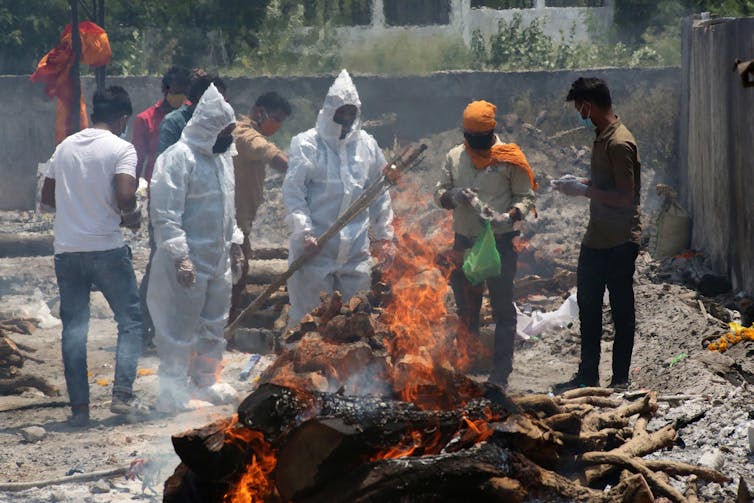
Night curfews and weekend lockdowns have been reinstated in some states, such as Maharasthra (including the financial capital Mumbai). Health services and crematoriums are being overwhelmed, COVID test kits are in short supply, and wait times for results are increasing.


Read more: As India’s COVID crisis worsens, leaders play the blame game while the poor suffer once again


How has the pandemic been spreading?

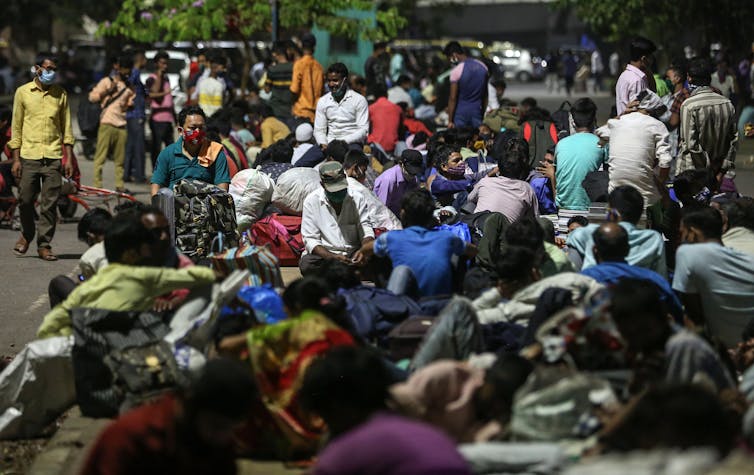
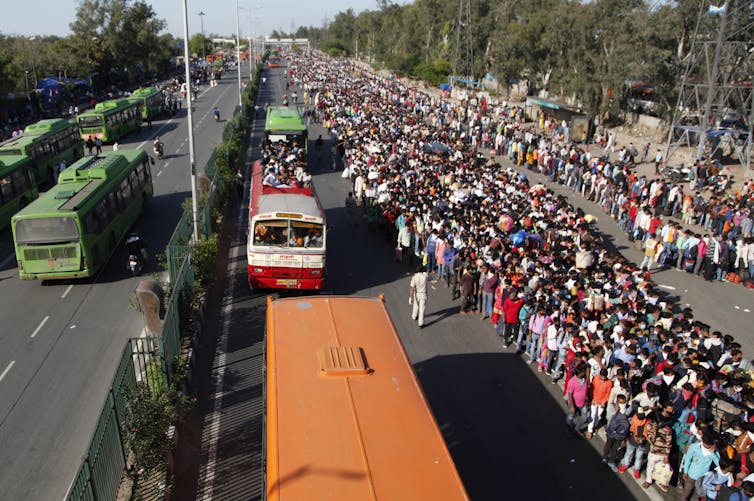
Residents in slum areas and those without their own household toilet have been worst affected, implying poor sanitation and close living have contributed to the spread.

One word that has dominated discussions about why cases have increased again is laaparavaahee (in Hindi), or “negligence”. The negligence is made out to be the fault of individuals not wearing masks and social distancing, but that is only part of the story.

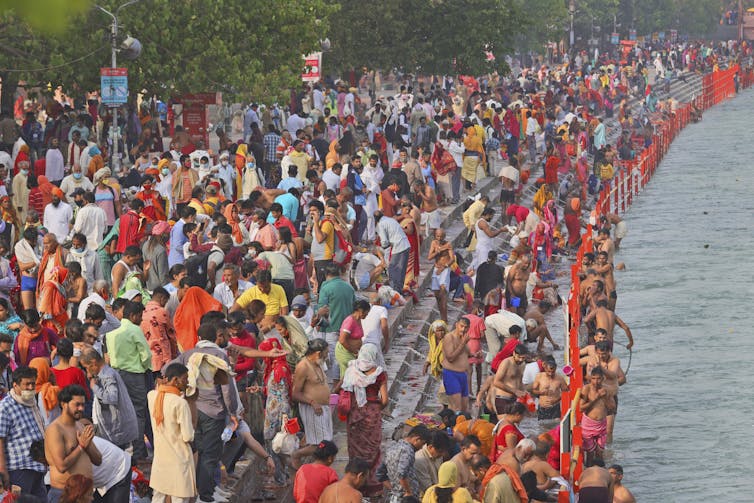
Negligence can be seen in the near-complete lack of regulation and its implementation wherever regulations did exist across workplaces and other public spaces. Religious, social and political congregations contributed directly through super-spreader events, but this still doesn’t explain the huge rise in cases.

Men bathing in a river.
Religious festival Kumbh Mela still took place this year despite the surge in cases. IDREES MOHAMMED/EPA/AAP

The second wave in India also coincides with the spread of the UK variant. A recent report found 81% of the latest 401 samples sent by the state of Punjab for genome sequencing were found to be the UK variant.

The risk of death from this strain has been found to be higher, and studies have found this variant might be more capable of evading our immune systems, meaning there’s a greater chance previously infected people could be reinfected and immunised people could be infected.

A new double mutation is also circulating in India, and this too could be contributing to the rise in cases.


Read more: What’s the new coronavirus variant in India and how should it change their COVID response?


Low fatality rate?

In the first phase of the pandemic, India was lauded for its low COVID death rate (case fatality rate) of about 1.5%. However, The Lancet cautioned about the “dangers of false optimism” in its September 26 editorial on the Indian situation.

In a pandemic situation, the public health approach is usually to attribute a death with complex causes as being caused by the disease in question. In April 2020, the World Health Organization clarified how COVID deaths should be counted:

A death due to COVID-19 is defined for surveillance purposes as a death resulting from a clinically compatible illness, in a probable or confirmed COVID-19 case, unless there is a clear alternative cause of death that cannot be related to COVID disease (e.g. trauma)

It is unclear the extent to which the health authorities across the states of India were complying with this.

Many states have set up expert committees to re-examine and verify COVID-19 deaths after coming under criticism that reported death rates were not accurate. Many states made corrections in mortality figures, and the full extent of undercounting is being actively researched.

District-level mortality data, both in the first wave as well as in the current wave, confirm that the global case fatality rate of 3.4% was breached in several districts such as Maharashtra, Punjab and Gujarat. Case fatality rates in some of the worst-affected districts were above 5%, similar to the 5% mortality level in the US.

What are the challenges this time?

A majority of the cases and deaths (81%) are being reported from ten (of 28) states, including Punjab and Maharashtra. Five states (Maharashtra, Chhattisgarh, Karnataka, Uttar Pradesh and Kerala) account for more than 70% of active cases. But the infection seems to have moved out of bigger cities to smaller towns and suburbs with less health infrastructure.

Last year, the government’s pandemic control strategy included government staff from all departments (including non-health departments) contributing to COVID control activities, but these workers have now been moved back to their departments. This is likely to have an effect on testing, tracing and treating COVID cases. And health-care workers now have a vaccine rollout to contend with, as well as caring for the sick.


Read more: ‘How will we eat’? India’s coronavirus lockdown threatens millions with severe hardship


What now?

In early March the government declared we were in the endgame of the pandemic in India. But their optimism was clearly premature.

Despite an impressive 100 million-plus immunisations, barely 1% of the country’s population the India Task Force is worried that monthly vaccine supplies at the current capacity of 70 million to 80 million doses per month would “fall short by half” for the target of 150 million doses per month.

Strict, widespread lockdowns we have seen elsewhere in the world are not appropriate for all parts of India given their effect on the working poor. Until wider vaccination coverage is achieved, local containment measures will have to be strengthened. This includes strict perimeter control to ensure there is no movement of people in or out of zones with local outbreaks, intensive house-to-house surveillance to ensure compliance with stay-at-home orders where they are in place, contact tracing, and widespread testing.

It should go without saying large congregations such as political rallies and religious festivals should not be taking place, and yet they have been.

Strong leadership and decentralised strategies with a focus on local restrictions is what we need until we can get more vaccines into people’s arms.

ref. After early success, India’s daily COVID infections have surpassed the US and Brazil. Why? – https://theconversation.com/after-early-success-indias-daily-covid-infections-have-surpassed-the-us-and-brazil-why-158783

Vital Signs: Christine Holgate’s ‘principal’ error was applying corporate logic to Australia Post

Source: The Conversation (Au and NZ) – By Richard Holden, Professor of Economics, UNSW

Perhaps the most important lesson from the Christine Holgate controversy is that the confluence of sexism and politics leads to double standards for female executives.

But Holgate’s demise – pushed from her position as Australia Post’s chief executive last November for gifting four senior executives Cartier watches (worth a total of almost A$20,000) in 2018 – is also a good example of how public-sector norms and private-sector competition don’t mix well.


Read more: Scott Morrison won’t say ‘sorry’ to Holgate but ‘regrets’ the hurt


In particular, Australia Post’s status as a so-called “government business enterprise” means it has to serve two masters: its social purpose and its commercial purpose.

Australia Post’s website highlights these two rather conflicting purposes. The very first thing it says is:

Over our long history, our social purpose and commitment to the community has remained the same; to create connections and opportunities that matter to every Australian.

But further down the landing page it asks us if we know that:

Our self-funded government business enterprise is owned by all Australians and receives $0 tax funding. In the past decade, we’ve paid over $1.5 billion in dividends to the Australian Government.

These may not be irreconcilable objectives, but they require very different incentives and compensation schemes for executives in such enterprises than are the norm in the private sector.

This all stems from the “effort-substitution problem” – one of the core principles of the branch of economics known as Contract Theory, for which Oliver Hart and Bengt Holmstrom were awarded the 2016 Nobel Prize in Economic Sciences.

The principal-agent problem

Holmstrom’s contribution for which he shared the Nobel was to advance our understanding of the “principal-agent problem”.

This involves understanding how a principal (such as company’s shareholders or board of directors) should optimally design an incentive contract for an agent (such as a chief executive).


Infographic illustrating the principal-agent problem.
Zirguezi/Wikimedia Commons, CC BY-SA

The important wrinkle is that the principal cannot observe the effort or actions of the agent perfectly. The principal can only observe a noisy signal of the agent’s actions – such as revenues, profits or the stock price (if the company is publicly traded).

Holmstrom made seminal contributions to this question in the 1970s and 1980s that helped us understand what variables agents should be rewarded on, and why sometimes contracts take the simple form of a base rate of pay plus a performance bonus.


Read more: Company directors can’t serve two masters: what went wrong at Australia Post


Multitasking and effort substitution

But it is Holmstrom’s 1991 paper – with Paul Milgrom, who won the 2020 Nobel prize for his contribution to auction theory – on the “multitask principal-agent problem” that is most relevant here.

Imagine you are a principal designing an incentive contract for an agent who performs two main tasks. One of those tasks is quite easy to measure. The other is very hard. What should the optimal incentive scheme look like? How “high-powered” should incentives be?

Take the example of school teachers.

Let’s simplify things and suppose teachers impart core skills such as reading, writing and mathematics, but also other skills or values such as “higher-order thinking” and “a love of learning”.

The former might be imperfectly but reasonably well measured by assessments and standardised tests. Measuring whether primary school children have developed “higher-order thinkings” skills, however, is pretty hard.

Since there are only a certain number of hours in a school day, teachers can’t do everything. Give them high-powered incentives tied to the core skills and they will, at least to some extent, shift their focus to preparing kids for standardised tests. This will reduce the emphasis on higher-order thinking and imparting a love of learning.

This is the “effort substitution problem”.

How much a teacher shifts emphasis will depend on their own values and motivations. Some will shift a little. Others, as has been witnessed in the United States, will focus almost exclusively on teaching to the test. Some may even resort to cheating on behalf of students.

Incentives in government enterprises

So it is for executives within government business enterprises. Not the cheating part, but if they have high-powered incentives based on standard private-sector “metrics”, they will do what people do: respond to the incentives.

That is what led, in the case of Australia Post, to four executives successfully negotiating a very valuable contract, and to Holgate rewarding them with expensive Cartier watches.

In the private sector none of this would have raised eyebrows.

But it didn’t seem to gel too well with Australia Post’s “social purpose”. Or at least, it opened the door for those who saw advantage in attacking Holgate while hiding behind a semi-credible excuse.

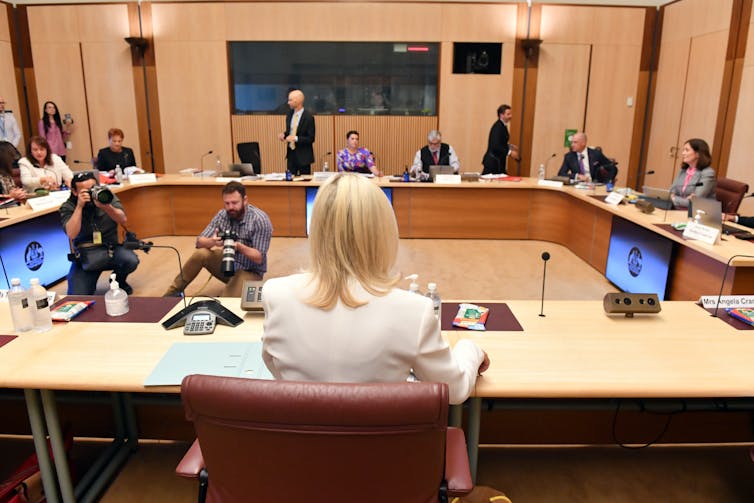
Christine Holgate this week before the Senate inquiry into her being forced to resign as Australia Post's chief executive for giving Cartier watches to four managers who secured a A$225 million investment for the organisation.
Christine Holgate this week before the Senate inquiry into her being forced to resign as Australia Post’s chief executive for giving Cartier watches to four managers who secured a A$225 million investment for the organisation. Mick Tsikas/AAP

The lesson is private-sector incentives don’t lead to the best outcomes when an organisation is trying to balance a hard-to-measure social mission with a relatively easy-to-measure corporate mission.

The path forward for Australia Post

The bottom line is that it’s hard for Australia Post to have two bottom lines.

Australia Post can have dual missions, but the “low-powered” incentives required to avoid the effort-substitution problem and deliver on its public purpose means it won’t be as successful at its corporate purpose.

One solution to this quandary is privatisation, but that would damage Australia Post’s social mission. Not once in the history of the world has the privatisation of such services (relying on mandated service standards) ever worked well.

The other solution is to tolerate low-powered incentives and live with the fact that dual missions requires balance, and imperfect performance on both.

There’s really no getting around that.

As is often the case, Bob Dylan said it best: “They may call you doctor, they may call you chief, but you’re gonna have to serve somebody […] Well, it may be the devil or it may be the Lord, but you’re gonna have to serve somebody.”

ref. Vital Signs: Christine Holgate’s ‘principal’ error was applying corporate logic to Australia Post – https://theconversation.com/vital-signs-christine-holgates-principal-error-was-applying-corporate-logic-to-australia-post-158959

Road to nowhere: New Zealanders struggle to get the help they need, 2 years on from a funding boost for mental health services

Source: The Conversation (Au and NZ) – By Dougal Sutherland, Clinical Psychologist, Te Herenga Waka — Victoria University of Wellington

As part of New Zealand’s well-being budget in 2019, the government announced an unprecedented NZ$1.9 billion increase in funding for the mental health sector.

But almost two years on, there are no tangible signs of improvement and statistics show the number of New Zealanders seeking, but not receiving, mental health support is on the rise.

The funding boost came on the back of He Ara Oranga, a 2018 report of a year-long inquiry into mental health and addiction services in New Zealand, which called for an expansion of access and increased choice of services.

For the sector, it brought hope and expectation that mental health would finally be funded properly and services expanded to all who needed them, not just the most severe 3% of the population. That hope has turned to despair.

Long waiting lists

The COVID-19 lockdowns brought a silent increase in the number of young people developing eating disorders, such as anorexia nervosa and bulimia nervosa, which are among the most serious and potentially lethal mental health problems a person can develop.

We need accurate assessments and skilled treatments to help sufferers overcome eating problems. Yet access is almost impossible, with waitlists of four months or more to see a psychologist.


Read more: Youth anxiety and depression are at record levels. Mental health hubs could be the answer


Access to regionally funded mental health services for children and adolescents seems equally impossible. Unofficial figures released recently by the National Party show the wait time can be up to 72 days.

These services are set up to support only young people with the most severe and complex mental health needs. Imagine being a parent of a teen who is depressed and self-harming, yet being unable to access the expert support needed for over two months.

Lack of services

Unsurprisingly, those whose needs don’t meet the strict criteria of a District Health Board (DHB) mental health service are even worse off. Although attention deficit hyperactivity disorder (ADHD) is one of the most common disorders, services for adults with ADHD are almost non-existent.

The same applies to mental health support for people who experience psychological trauma — such as those who witnessed the Christchurch mosque shootings. While the Accident Compensation Corporation (ACC) system provides excellent support for people with physical injuries, it leaves those suffering solely psychological trauma out in the cold.

The number of people seeking psychological support is increasing, likely due in part to the groundbreaking and tireless efforts of mental health campaigners such as former rugby player Sir John Kirwan, former comedian Mike King and the 2021 Young New Zealander of the Year Jazz Thornton.

This increased public demand can be seen in a positive light, as it indicates people are more willing to acknowledge and seek help for their mental health. But it has quickly outstripped supply.

Mental health services outside those funded by DHBs are either running long waitlists or no longer accept new referrals. A 2018 survey by the NZ College of Clinical Psychologists showed New Zealand was short of almost 1000 psychologists at the time.

Government inaction

The government has acknowledged the workforce shortage and that increasing the mental health workforce is a long game. Health minister Andrew Little said the workforce shortfall is being addressed through programmes such as postgraduate training in cognitive behavioural therapy and child and adolescent mental health.

But government investments thus far are doing little more than shuffling deckchairs on the Titanic. Most of these programmes are simply upskilling or moving workers already employed in the mental health system, not increasing the total number of staff.

It takes several years to train psychologists, mental health nurses, psychiatrists and social workers to provide evidence-based, culturally appropriate assessment and treatment. An obvious answer would be to increase funding for mental health training programmes to allow them to expand the number of people who enter these professions.


Read more: Is it adult ADHD? COVID-19 has people feeling restless, lacking focus and seeking diagnosis


Is the government daunted by the scale of change required to bring about meaningful improvements in our mental health system? In response to calls to expand ACC funding to include psychological injury, minister Little said the government had no intentions to make the necessary law change. Surely, such systemic change is exactly what is needed if we are to implement the recommendations of the inquiry report.

The government should at least tell the public if and how it plans to implement the recommendations the He Ara Oranga report made. Laying out a roadmap for change would provide vision, show leadership and perhaps allow us to hope again. At the moment it feels like we’re in the dark on a road to nowhere.

ref. Road to nowhere: New Zealanders struggle to get the help they need, 2 years on from a funding boost for mental health services – https://theconversation.com/road-to-nowhere-new-zealanders-struggle-to-get-the-help-they-need-2-years-on-from-a-funding-boost-for-mental-health-services-158868

New warp drive research dashes faster than light travel dreams – but reveals stranger possibilities

Source: The Conversation (Au and NZ) – By Sam Baron, Associate professor, Australian Catholic University

In 1994, physicist Miguel Alcubierre proposed a radical technology that would allow faster than light travel: the warp drive, a hypothetical way to skirt around the universe’s ultimate speed limit by bending the fabric of reality.

It was an intriguing idea – even NASA has been researching it at the Eagleworks laboratory – but Alcubierre’s proposal contained problems that seemed insurmountable. Now, a recent paper by US-based physicists Alexey Bobrick and Gianni Martire has resolved many of those issues and generated a lot of buzz.

But while Bobrick and Martire have managed to substantially demystify warp technology, their work actually suggests that faster-than-light travel will remain out of reach for beings like us, at least for the time being.

There is, however, a silver lining: warp technology may have radical applications beyond space travel.

Across the universe?

The story of warp drives starts with Einstein’s crowning achievement: general relativity. The equations of general relativity capture the way in which spacetime – the very fabric of reality – bends in response to the presence of matter and energy which, in turn, explains how matter and energy move.

General relativity places two constraints on interstellar travel. First, nothing can be accelerated past the speed of light (around 300,000 km per second). Even travelling at this dizzying speed it would still take us four years to arrive at Proxima Centauri, the nearest star to our Sun.

Second, the clock on a spaceship travelling close to the speed of light would slow down relative to a clock on Earth (this is known as time dilation). Assuming a constant state of acceleration, this makes it possible to travel the stars. One can reach a distant star that is 150 lightyears away within one’s lifetime. The catch, however, is that upon one’s return more than 300 years will have passed on Earth.

A new hope

This is where Alcubierre came in. He argued that the mathematics of general relativity allowed for “warp bubbles” – regions where matter and energy were arranged in such a way as to bend spacetime in front of the bubble and expand it to the rear in a way that allowed a “flat” area inside the bubble to travel faster than light.


Read more: Don’t stop me now! Superluminal travel in Einstein’s universe


To get a sense of what “flat” means in this context, note that spacetime is sort of like a rubber mat. The mat curves in the presence of matter and energy (think of putting a bowling ball on the mat). Gravity is nothing more than the tendency objects have to roll into the the dents created by things like stars and planets. A flat region is like a part of the mat with nothing on it.

Such a drive would also avoid the uncomfortable consequences of time dilation. One could potentially make a round trip into deep space and still be greeted by one’s nearest and dearest at home.

A spacetime oddity

How does Alcubierre’s device work? Here discussion often relies on analogies, because the maths is so complex.

Imagine a rug with a cup on it. You’re on the rug and you want to get to the cup. You could move across the rug, or tug the rug toward you. The warp drive is like tugging on spacetime to bring your destination closer.

But analogies have their limits: a warp drive doesn’t really drag your destination toward you. It contracts spacetime to make your path shorter. There’s just less rug between you and the cup when you switch the drive on.

Alcubierre’s suggestion, while mathematically rigorous, is difficult to understand at an intuitive level. Bobrick and Martire’s work is set to change all that.

Starship bloopers

Bobrick and Martire show that any warp drive must be a shell of material in a constant state of motion, enclosing a flat region of spacetime. The energy of the shell modifies the properties of the spacetime region inside it.

This might not sound like much of a discovery, but until now it was unclear what warp drives might be, physically speaking. Their work tells us that a warp drive is, somewhat surprisingly, like a car. A car is also a shell of energy (in the form of matter) that encloses a flat region of spacetime. The difference is that getting inside a car does not make you age faster. That, however, is the kind of thing a warp drive might do.

Using their simple description, Bobrick and Martire demonstrate a method for using Einstein’s general relativity equations to find spacetimes that allow for arrangements of matter and energy that would act as warp bubbles. This gives us a mathematical key for finding and classifying warp technologies.

Their work manages to address one of the core problems for warp drives. To make the equations balance, Alcubierre’s device runs on “negative energy” – but we are yet to discover any viable sources of negative energy in the real world.

A two-dimensional visualization of an Alcubierre drive. Expanding and contracting regions of spacetime on opposite sides of the central flat region cause it to move. Applied Physics

Worse, the negative energy requirements of Alcubierre’s device are immense. By some estimates, the entire energy in the known universe would be needed (though later work brings the number down a bit).

Bobrick and Martire show a warp drive could be made from positive energy (i.e. “normal” energy) or from a mixture of negative and positive energy. That said, the energy requirements would still be immense.

If Bobrick and Martire are right, then a warp drive is just like any other object in motion. It would be subject to the universal speed limit enforced by general relativity after all, and it would need some kind of conventional propulsion system to make it accelerate.

The news gets worse. Many kinds of warp drive can only modify the spacetime inside in a certain way: by slowing down the clock of the passenger in exactly the way that makes a trip into deep space a problem.

Bobrick and Martire do show that some warp drives could travel faster than light, but only if they are created already travelling at that speed – which is no help for any ordinary human hoping for a bit of interstellar tourism.

The end game

Remember that a warp drive can modify the region of flat spacetime it encloses. It can, in particular, speed up or slow down a clock inside the drive.

Consider what it would mean to have such an object available. Want to put someone with a terminal illness on ice? Stick them in a warp drive and slow their clock down. From their perspective, a few years will pass, while a hundred years will pass on Earth — time enough to find a cure.


Read more: The art and beauty of general relativity


Want to grow your crops overnight? Stick them in a warp drive and speed the clock up. A few days will pass for you, and a few weeks will pass for your seedlings.

There are even more exotic possibilities: by rotating the spacetime inside a drive one may be able to produce a battery capable of holding huge amounts of energy.

Faster-than-light travel remains a distant dream. But warp technology would be revolutionary in its own right.

ref. New warp drive research dashes faster than light travel dreams – but reveals stranger possibilities – https://theconversation.com/new-warp-drive-research-dashes-faster-than-light-travel-dreams-but-reveals-stranger-possibilities-158070

How to actually fix a lost voice, according to science (hint: lemon and honey doesn’t work)

Source: The Conversation (Au and NZ) – By Sandra Rojas, Speech pathologist and Lecturer in Voice Disorders, Department of Speech Pathology, Orthopedics & Audiology, La Trobe University

Losing our voice, having a hoarse voice, or having any difficulties with our voice can be challenging, especially for those who need to use it for work.

For centuries, and across different cultures, people have believed home remedies to be a handy solution for different illnesses. Losing our voice isn’t an exception.

Websites abound with proposed solutions including ginger, lemon, salt water gargles, and tea with honey.

However, put simply, there’s no evidence these home remedies work to recover a lost voice. And there’s a dearth of information out there on what actually works for treating voice issues.

As a speech pathologist and lecturer in voice disorders, I help people with voice issues every day. Here’s what actually helps you recover a lost voice.


Read more: Curious Kids: why might you wake up without a voice?


Why have I lost my voice?

Research suggests up to 30% of us will develop some form of voice disorder in our lifetimes.

There are many reasons we can develop problems with our voice. Voice quality issues can be brought on by viral infections, overuse or misuse of our voice, damage to the vocal folds, or nodules and polyps which are benign, noncancerous growths than can form on the vocal folds.

An artist’s rendering of some of the main causes of voice issues. Shutterstock

Some people such as teachers, singers, actors, clergy and lawyers are at a greater risk of developing voice difficulties. This is because they talk a lot for a living, often very loudly.

More often than not, what you might call “losing your voice” is the result of laryngitis, which is inflammation of the voice box (larynx). It’s often caused by a virus or overuse, and will tend to resolve in a couple of weeks.

Most home remedies don’t work for your voice

Home remedies like salt water gargles and tea with honey are mostly harmless, although there’s no evidence they work for fixing laryngitis. If you have a sore throat, they might temporarily alleviate some of this pain. But they definitely won’t reduce the roughness, hoarseness or “breathiness” of your voice.

These remedies can’t improve our voice because our vocal folds are protected by the epiglottis, so when swallowing tea or honey (or anything!), the epiglottis comes down and covers the vocal folds. The epiglottis also prevents food and drink from entering our lungs. Nothing should have direct contact with your vocal folds — if something did, it could get into the lungs and cause aspiration and pneumonia.

A diagram of the throat
Your epiglottis stops food and drink from going down your windpipe, which means it prevents your lemon and honey tea from touching your voice box. Persian Poet Gal/Wikimedia Commons, CC BY

One thing to beware, especially if you have a reflux disorder, is consuming excessive amounts of tea and lemon. Lemon is acidic, and so are some teas, so having a lot of them could actually lead to acid reflux coming up the oesophagus and irritating your throat and vocal folds.


Read more: Explainer: what is gastric reflux?


What’s more, if you’re using home remedies, you might delay seeking professional medical attention, for example from a speech pathologist or an ear, nose and throat specialist (ENT). Delaying treatment could have further negative consequences if your voice issues are due to something more sinister than a cold or flu.

If your voice takes more than a week or two to recover, or you’re worried about your voice, it’s good to seek medical advice. Make sure to visit your GP at first, who may recommend a speech pathologist or ENT specialist.

So what does work for a lost voice?

Research suggests using a humidifier might be an effective option. This can help by keeping vocal folds hydrated, helping with the vibration of the vocal folds and therefore reducing roughness and hoarseness. Because the tiny water droplets in humidified air are inhaled rather than swallowed, they can bypass the epiglottis and have direct contact with our vocal folds.

Drinking lots of water can also benefit our vocal folds. Even though water doesn’t have direct contact with our voice box, it hydrates the cells in our body.

A humidifier in a room
Some evidence suggests a humidifier might help moisten your vocal chords and therefore might help you recover from laryngitis more quickly. Shutterstock

You should also rest your voice, although it depends on what’s causing your symptoms. In a case of acute laryngitis caused by an infection, your doctor might suggest you completely rest your voice. Similarly, if you’ve had trauma or surgery to your voice box, your doctor might suggest refraining from talking at all for a certain period.

But some ENTs won’t recommend completely resting your voice in other instances. For some voice disorders, your specialist might recommend you start doing voice exercises. One example is “straw phonation”, where you put a straw into a glass of water and speak through it in various ways, depending on the desired outcomes of the treatment.

If you have a hoarse voice but cannot rest it, it’s better to talk at a low volume in a consistent tone — but don’t whisper! Whispering too much can put more strain on your voice box than regular speech.

So if you lose your voice, don’t forget: drink lots of water, use a humidifier if you can, rest your voice, and don’t worry about gargling salt water or drinking lemon and honey tea.

ref. How to actually fix a lost voice, according to science (hint: lemon and honey doesn’t work) – https://theconversation.com/how-to-actually-fix-a-lost-voice-according-to-science-hint-lemon-and-honey-doesnt-work-158230

Victoria’s new feral horse plan could actually protect the high country. NSW’s method remains cruel and ineffective

Source: The Conversation (Au and NZ) – By Don Driscoll, Professor in Terrestrial Ecology, Deakin University

Feral horses are a catastrophic problem for the environment, particularly in the high country that crosses the New South Wales and Victoria border. To deal with this growing issue, the Victorian government has released a draft feral horse action plan, which is open for comment until April 23.

It comes after Victoria’s old action plan from 2018 proved ineffective, with feral horse numbers increasing in the most recent counts in 2019. This is similar to New South Wales’ current performance, where feral horses are legally protected and numbers are essentially unmanaged.

This new Victorian plan has flaws, but it’s still likely to perform better than the old plan (and the very low benchmark set by NSW), as it generally aims to deploy evidence-based management of national parks.

As Victoria gets on top of its feral horse problem, NSW will be left further behind with a degrading environment and rising costs of horse management.

The feral horse threat

Feral horses degrade ecosystems and threaten native Australian species with their heavy trampling and excessive grazing. They damage waterways and streamside vegetation which, in turn, threatens species that live in and alongside the streams, such as the alpine spiny crayfish, the alpine water skink and the Tooarrana broad-toothed rat. All of these are threatened species.

A broad-toothed rat in a white cloth
The distribution of the Tooarrana broad-toothed rat has declined alarmingly because feral horses destroy their homes. AAP Image/Supplied by Museums Victoria, Heath Warick

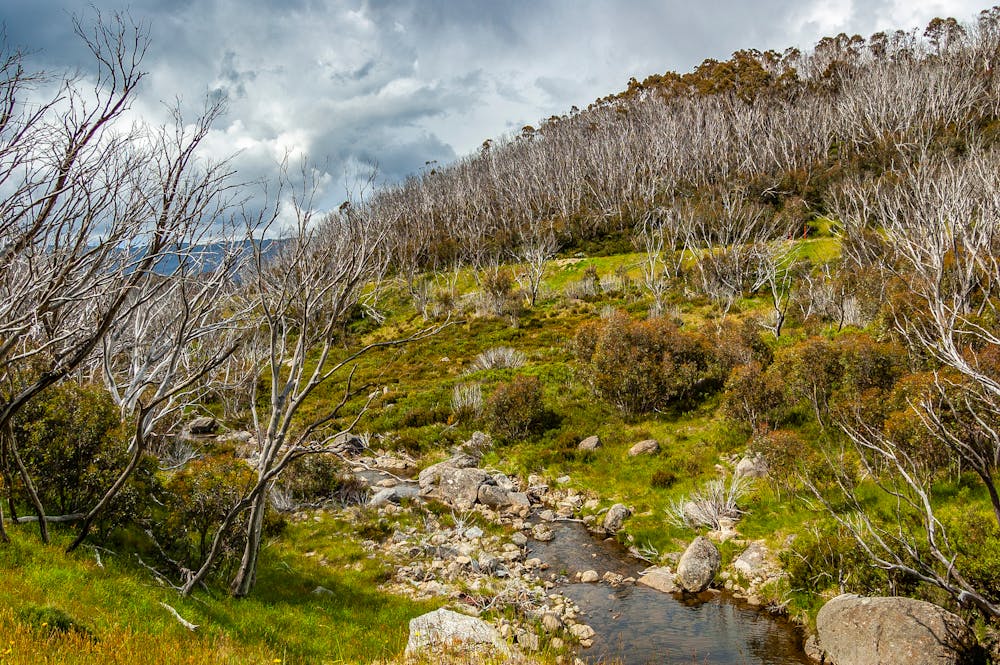
Damage from feral horses could worsen as ecosystems recover from the extensive 2019-20 eastern Australian bushfires. Horse grazing could delay animals’ habitat recovery and horse trampling could exacerbate stream degradation after fires.

In fact, there are 24 species that need protection from feral horses after the fires, as identified by the Australian government’s wildlife and threatened species bushfire recovery expert panel in September.

All of this ecosystem destruction translates into substantial economic costs. Frontier Economics released a report in January this year showing the potential benefits of horse control in Kosciuszko National Park was A$19-50 million per year. The benefits accrue through improved recreational opportunities, improved water quality and reduced car crashes involving feral horses.

In contrast, horse control could cost as little as A$1 million per year and up to $71 million, depending on the methods used. Frontier Economics concluded the costs that are incurred by keeping feral horses far outweigh the cost of eradication.

Alpine water skink
Alpine water skinks are among the vulnerable native species threatened by feral horses. DEPI/Flickr, CC BY-SA

Victoria’s new feral horse plan

The draft Victorian feral horse action plan aims to:

  1. remove isolated populations on the Bogong High Plains within three years and prevent new populations from establishing

  2. contain and reduce feral horses in the eastern Alps by removing 500 horses in the first year

  3. use the most humane, safe and effective horse control methods.

The first aim makes complete sense. Removing small populations will always be more humane, cheaper and better for the environment than leaving them uncontrolled.

The second aim is perplexing. Based on 2019 surveys, the draft action plan says there are approximately 5,000 horses in the eastern Alps and the population is growing at 15% per year. If the government continues to remove 500 horses per year after the first year, it could see the population rise to more than 9,000 over ten years, despite culling 5,000 horses in that time.


Read more: Double trouble as feral horse numbers gallop past 25,000 in the Australian Alps


In contrast, removing 2,000 horses per year could see the population controlled within three years. Reducing horse numbers rapidly results in the fewest horses having to be culled in the long term.

The third aim of the Victorian draft action plan gives appropriate and strong emphasis to animal welfare. Controlling horse numbers can be morally challenging, and requires a clear understanding of the trade-offs.

A starving horse on the side of the road
Feral horses often starve or get hit by cars in the high country. AAP Image/Kim de Govrik

Without horse control, native animals are killed when their habitat is destroyed, unique Australian ecosystems are degraded, horses themselves starve or die of thirst in droughts, and the economic costs of inaction escalate. To avoid these costs, horse numbers must be reduced by culling.

This is the grim reality, but with careful attention to animal welfare, the draft strategy will ensure horse control is managed humanely, with control methods based on evidence rather than hyperbole.

Money wasting in NSW

Victoria’s plan is in stark contrast to the NSW government’s approach. In 2018, the NSW government passed the so-called “brumby bill”, which protects feral horses in Kosciuszko National Park.


Read more: Passing the brumby bill is a backward step for environmental protection in Australia


The current method of control in NSW is to capture the horses and transport them to an abattoir if they cannot be re-homed. But evidence shows culling has fewer animal welfare concerns than this method.

And in the latest round of money-wasting horse management, the NSW government trapped 574 horses over the past year, but released 192 females and foals back into the park. If the program is aimed at reducing horse numbers, releasing the most fertile animals back into the population is counter-productive.

Regenerating plants and burnt trees in fire-damaged alpine region
Feral horses are exacerbating the damage from recent bushfires in the High Country. Shutterstock

What’s more, removing 300-400 horses per year has little impact on overall numbers. There are around 14,000 horses in Kosciuszko National Park, with a growth rate of 23% per year. This means more than 3,000 horses must be removed just to prevent the population from getting bigger.

The high country without feral horses

If the Victorian draft plan can be improved to invest in rapid horse reduction and ecosystem restoration, we can expect to see quagmires created by trampling horses return to functioning ecosystems and the recovery of threatened species.

Stream banks can be stabilised and then dense grass tussocks and sedges will return, creating homes for threatened skinks, crayfish and the Tooarrana broad-toothed rat.

While Kosciuszko’s alpine ecosystems continue to decline under the NSW government’s political impasse, the Victorian Alps will become the favoured destination for tourists who want to see Australia’s nature thriving when they visit national parks.


Read more: To fix Australia’s environment laws, wildlife experts call for these 4 changes — all are crucial


ref. Victoria’s new feral horse plan could actually protect the high country. NSW’s method remains cruel and ineffective – https://theconversation.com/victorias-new-feral-horse-plan-could-actually-protect-the-high-country-nsws-method-remains-cruel-and-ineffective-158317

Homeschooling boomed last year. But these 4 charts show it was on the rise before COVID

Source: The Conversation (Au and NZ) – By Rebecca English, Lecturer in Education, Queensland University of Technology

Home education, sometimes called homeschooling, is when children are educated outside a formal institution like a school.

Parents of home-educated children are wholly responsible for facilitating their child’s learning. This is different to distance education, where a student is enrolled in a school and taught by a teacher, but the lessons are delivered remotely (similar to what happened during lockdown when schools were closed).

Home education is legal across Australia. Each state or territory education department requires parents to register. There have been reports more students have registered for home education due to the pandemic. But home education was actually on the rise in Australia well before COVID.

Growth in homeschooling during 2020

The numbers of families registering for home education in 2020 — the year of school lockdowns – was particularly strong in the heavily populated eastern states.

In New South Wales and Victoria, the number of students being home educated increased by 20% in 2020 (1,224 extra children) compared with 2019.

In Queensland, there was a 26% jump in students registered for home education.

The number of registered home-educated students in NSW, Victoria and Queensland is larger than any one school in those states. For example, Varisty College on Queensland’s Gold Coast is one of Queensland’s largest schools with over 3,000 students. But home education registrations account for 800 more students.


Read more: Thinking of switching to homeschooling permanently after lockdown? Here are 5 things to consider


Over the last ten years, there has been a steady increase in the number of home-educated students across the country.


There are now more than 26,000 registered home-educated students in Australia, around a third of the ACT’s total school-aged population.

This number may underestimate how many students are actually being home educated. Some states and territories limit registration to the compulsory school ages (usually six to 17), so they don’t count younger and older students.


It is also well recognised a proportion of home-educated students are not registered.

However, Victoria, Tasmania and the ACT all allow children to be registered for part-time home education and part-time school attendance — so these students are counted twice.

The proportion of homeschooled kids has grown, too

It is not just the overall numbers of home-educated students that has grown. The percentage of home-educated students as a proportion of the total student population has also risen.


New South Wales and Victoria have the highest population of school students in the country — at 1,248,994 and 1,013,768 in 2020 respectively. The proportion of home-educated students in these states are 6 per 1,000 school students in NSW and 7 in Victoria.

And while Tasmania only had 83,175 school students in 2020 (the second lowest population of school students after the Northern Territory), its proportion of home-educated students is the highest in the country — 14 per 1,000. This is in comparison to the average of 6 home-educated students per 1,000 school students across Australia.


While these proportions are still relatively small, they are almost double what they were six years ago.

We don’t know precisely why the proportion of home-educated students varies so much between states and territories. It may be that a limited school choice in regional and remote areas of sparsely populated states, like Western Australia, may encourage home education. Or remote living in states like the Northern Territory may make it easier to “fly under the radar” and not register.


Read more: Homeschooling is on the rise in Australia. Who is doing it and why?


The availability of support for students with special needs and the ease of access to distance education schools may also play a role.

Another factor could be the way different states and territories manage their registration systems.

Unlike most other states, Tasmania has a history of proactive engagement with the home education community. The assessors have extensive knowledge of home education, which may instil confidence in the assessments.

It also means assessors can give some support, providing a direct benefit to being registered.

We don’t know enough about homeschooling

Families who are home educating are an under-researched group.

There’s evidence an increasing number of students with special educational needs are being home educated. About 20% of parents who made a submission to the recent NSW inquiry into students with disabilities were home educating due to mainstream schools having failed to meet their children’s needs. However, these students are not counted in the government’s Nationally Consistent Collection of Data on Students with a Disability.

Although research suggests mental health conditions such as anxiety or depression can be catalysts for parents removing children from school, this too has not been quantified.


Read more: Don’t want to send the kids back to school? Why not try unschooling at home?


We also need to better understand how to help students who may have a series of needs that are more complex than schools could meet.

Similarly, the benefits, drawbacks and best practice of part-time schooling along with part-time home education in Australia have not been researched. Flexibility might be a solution that may bridge the divide between schools and home education to best meet children’s needs.

ref. Homeschooling boomed last year. But these 4 charts show it was on the rise before COVID – https://theconversation.com/homeschooling-boomed-last-year-but-these-4-charts-show-it-was-on-the-rise-before-covid-157309

Christine Holgate’s ‘principal’ error was applying corporate logic to Australia Post

Source: The Conversation (Au and NZ) – By Richard Holden, Professor of Economics, UNSW

Perhaps the most important lesson from the Christine Holgate controversy is that the confluence of sexism and politics leads to double standards for female executives.

But Holgate’s demise – pushed from her position as Australia Post’s chief executive last November for gifting four senior executives Cartier watches (worth a total of almost A$20,000) in 2018 – is also a good example of how public-sector norms and private-sector competition don’t mix well.


Read more: Scott Morrison won’t say ‘sorry’ to Holgate but ‘regrets’ the hurt


In particular, Australia Post’s status as a so-called “government business enterprise” means it has to serve two masters: its social purpose and its commercial purpose.

Australia Post’s website highlights these two rather conflicting purposes. The very first thing it says is:

Over our long history, our social purpose and commitment to the community has remained the same; to create connections and opportunities that matter to every Australian.

But further down the landing page it asks us if we know that:

Our self-funded government business enterprise is owned by all Australians and receives $0 tax funding. In the past decade, we’ve paid over $1.5 billion in dividends to the Australian Government.

These may not be irreconcilable objectives, but they require very different incentives and compensation schemes for executives in such enterprises than are the norm in the private sector.

This all stems from the “effort-substitution problem” – one of the core principles of the branch of economics known as Contract Theory, for which Oliver Hart and Bengt Holmstrom were awarded the 2016 Nobel Prize in Economic Sciences.

The principal-agent problem

Holmstrom’s contribution for which he shared the Nobel was to advance our understanding of the “principal-agent problem”.

This involves understanding how a principal (such as company’s shareholders or board of directors) should optimally design an incentive contract for an agent (such as a chief executive).


Infographic illustrating the principal-agent problem.
Zirguezi/Wikimedia Commons, CC BY-SA

The important wrinkle is that the principal cannot observe the effort or actions of the agent perfectly. The principal can only observe a noisy signal of the agent’s actions – such as revenues, profits or the stock price (if the company is publicly traded).

Holmstrom made seminal contributions to this question in the 1970s and 1980s that helped us understand what variables agents should be rewarded on, and why sometimes contracts take the simple form of a base rate of pay plus a performance bonus.


Read more: Company directors can’t serve two masters: what went wrong at Australia Post


Multitasking and effort substitution

But it is Holmstrom’s 1991 paper – with Paul Milgrom, who won the 2020 Nobel prize for his contribution to auction theory – on the “multitask principal-agent problem” that is most relevant here.

Imagine you are a principal designing an incentive contract for an agent who performs two main tasks. One of those tasks is quite easy to measure. The other is very hard. What should the optimal incentive scheme look like? How “high-powered” should incentives be?

Take the example of school teachers.

Let’s simplify things and suppose teachers impart core skills such as reading, writing and mathematics, but also other skills or values such as “higher-order thinking” and “a love of learning”.

The former might be imperfectly but reasonably well measured by assessments and standardised tests. Measuring whether primary school children have developed “higher-order thinkings” skills, however, is pretty hard.

Since there are only a certain number of hours in a school day, teachers can’t do everything. Give them high-powered incentives tied to the core skills and they will, at least to some extent, shift their focus to preparing kids for standardised tests. This will reduce the emphasis on higher-order thinking and imparting a love of learning.

This is the “effort substitution problem”.

How much a teacher shifts emphasis will depend on their own values and motivations. Some will shift a little. Others, as has been witnessed in the United States, will focus almost exclusively on teaching to the test. Some may even resort to cheating on behalf of students.

Incentives in government enterprises

So it is for executives within government business enterprises. Not the cheating part, but if they have high-powered incentives based on standard private-sector “metrics”, they will do what people do: respond to the incentives.

That is what led, in the case of Australia Post, to four executives successfully negotiating a very valuable contract, and to Holgate rewarding them with expensive Cartier watches.

In the private sector none of this would have raised eyebrows.

But it didn’t seem to gel too well with Australia Post’s “social purpose”. Or at least, it opened the door for those who saw advantage in attacking Holgate while hiding behind a semi-credible excuse.

Christine Holgate this week before the Senate inquiry into her being forced to resign as Australia Post's chief executive for giving Cartier watches to four managers who secured a A$225 million investment for the organisation.
Christine Holgate this week before the Senate inquiry into her being forced to resign as Australia Post’s chief executive for giving Cartier watches to four managers who secured a A$225 million investment for the organisation. Mick Tsikas/AAP

The lesson is private-sector incentives don’t lead to the best outcomes when an organisation is trying to balance a hard-to-measure social mission with a relatively easy-to-measure corporate mission.

The path forward for Australia Post

The bottom line is that it’s hard for Australia Post to have two bottom lines.

Australia Post can have dual missions, but the “low-powered” incentives required to avoid the effort-substitution problem and deliver on its public purpose means it won’t be as successful at its corporate purpose.

One solution to this quandary is privatisation, but that would damage Australia Post’s social mission. Not once in the history of the world has the privatisation of such services (relying on mandated service standards) ever worked well.

The other solution is to tolerate low-powered incentives and live with the fact that dual missions requires balance, and imperfect performance on both.

There’s really no getting around that.

As is often the case, Bob Dylan said it best: “They may call you doctor, they may call you chief, but you’re gonna have to serve somebody […] Well, it may be the devil or it may be the Lord, but you’re gonna have to serve somebody.”

ref. Christine Holgate’s ‘principal’ error was applying corporate logic to Australia Post – https://theconversation.com/christine-holgates-principal-error-was-applying-corporate-logic-to-australia-post-158959

Friday essay: what do the 5 great religions say about the existence of the soul?

Source: The Conversation (Au and NZ) – By Philip C. Almond, Emeritus Professor in the History of Religious Thought, The University of Queensland

A recent survey found almost 70% of Australians believed in or were open to the existence of the soul — meaning they believe we are more than the stuff out of which our bodies are made.

The soul can be defined as the spiritual or non-material part of us that survives death.

Western pop culture is currently bewitched by what happens to us after death with TV shows such as The Good Place and Miracle Workers set largely in the afterlife. And the Disney film Soul depicts the soul of a jazz pianist separating from his earthly body to journey into the afterlife.


Read more: Disney Pixar’s Soul: how the moviemakers took Plato’s view of existence and added a modern twist


The five great world religions — Judaism, Christianity, Islam, Buddhism, and Hinduism — all believe in some version of a “self”, variously named, which mostly survives death. But they imagine its origin, journey, and destination in some quite different and distinctive ways.

The origin of the soul – Judaism, Christianity, and Islam

These three religions all believe there was a time when souls were not. That is to say, before God created the world, there was nothing at all.

Within Christianity, how the soul was united with its body was a matter of uncertainty. But all were agreed that the soul was present within the foetus, if not at the moment of conception, then within the first 90 days. When it comes to contemporary Christian debate about abortion, this moment is a crucial one. Most Christians today believe the soul enters the body at the time of conception.

Illustration of God measuring a soul, represented as a naked man, 14th century. British Library

Christianity adopted the Greek philosopher Plato’s view that we consist of a mortal body and an immortal soul. Death is thus the separation of the soul from the body.

According to Judaism, the soul was created by God and joined to an earthly body. But it did not develop a definitive theory on the timing or nature of this event (not least because the separation between body and soul was not an absolutely clear one). Modern Judaism remains uncertain on when, between birth and conception, a human being is fully present.

Similarly, in Islam, the soul was breathed into the foetus by God. As in Christianity, opinions vary on when this occurred, but the mainstream opinion has it that the soul enters the foetus around 120 days after conception.

For all three religions, souls will live forever.

The origin of the soul – Hinduism and Buddhism

Within Hinduism, there has been never been a time when souls did not exist. All of us have existed into the infinite past. Thus, we are all bound to Samsara – the infinite cycle of birth, death, and rebirth.

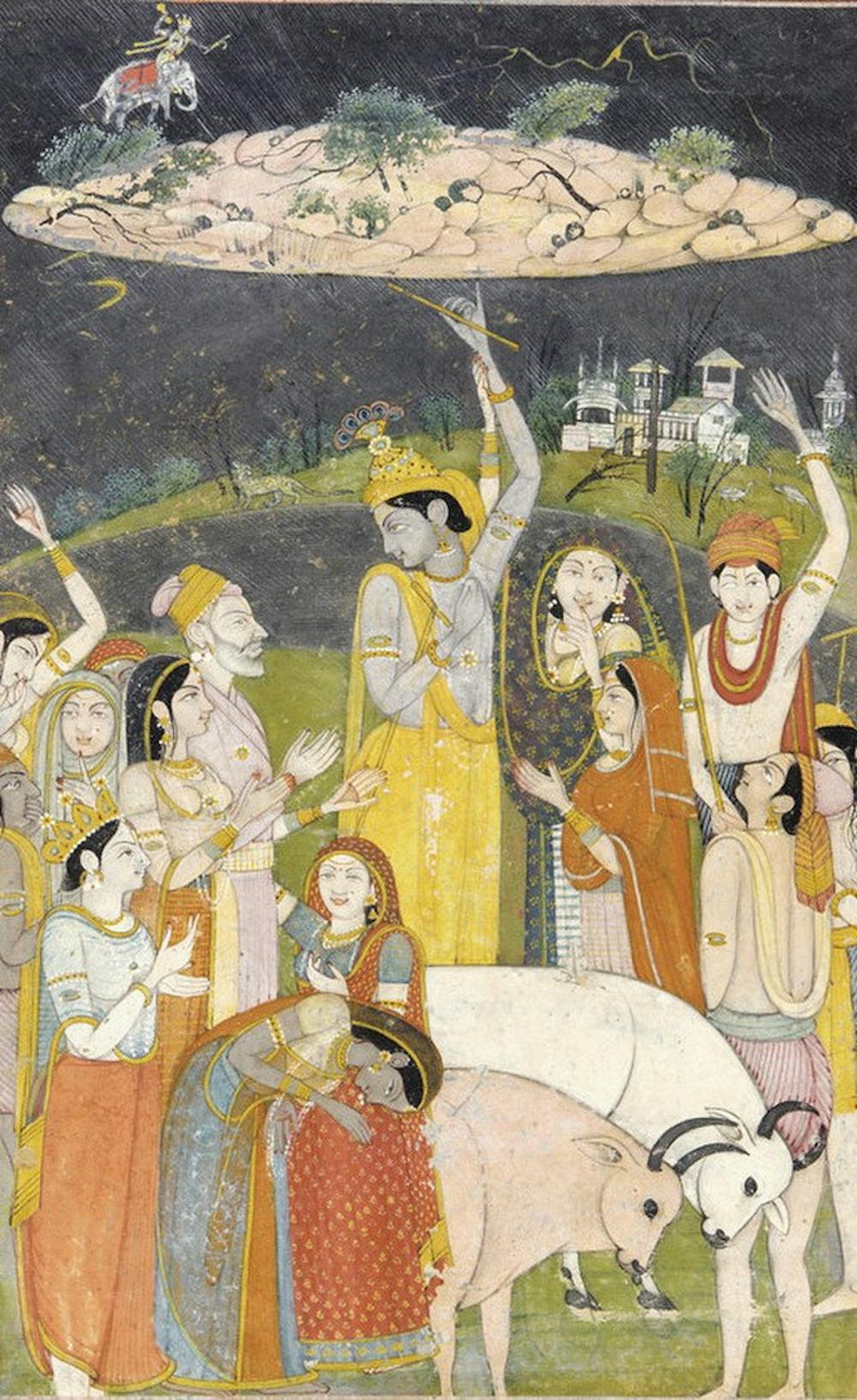
Krishna Holding Mount Govardhan. Wikimedia Commons

Our souls are continually reincarnated in different physical forms according to the law of karma — a cosmic law of moral debit and credit. Each moral deed, virtuous or otherwise, leaves its mark on the individual. At the time of death, the sum total of karma determines our status in the next life.

Like Hinduism, Buddhism accepts there was no time when we were not bound to the cycle of birth and rebirth. But unlike Hinduism, it does not believe there is an eternal, unchanging “soul” that transmigrates from one life to the next. There is nothing permanent in us, any more than there is any permanence in the world generally.

Nevertheless, Buddhists believe our consciousness is like a flame on the candle of our body. At the moment of death, we leave the body but this flame, particularly our flame of moral credit or debit, goes into a new body. In Buddhism, this “karmic flame of consciousness” plays the same role as the “soul” in other religions.

Buddhists believe our consciousness is like a flame on the candle of our body. shutterstock

The destiny of the soul – Judaism, Christianity, and Islam

Within Christianity, it is believed the soul continues its existence immediately after death. Most believe it will do so consciously (rather than in a sleep-like state). At the point of death, God will determine the soul’s ultimate fate — eternal punishment or eternal happiness.

Still, by the end of the first millennium, there was a recognition that most of us had not been sufficiently good to merit immediate happiness, nor sufficiently evil to merit eternal misery. Catholicism thus developed an intermediate state — purgatory — offering the slightly or moderately wicked a chance to be purified of their sins. All souls will be reunited with their resurrected bodies on Judgement Day when Christ returns and God finally confirms their destiny.

William Adolphe Bouguereau, Soul Carried to Heaven (1878). Wikimedia Commons

Judaism remains uncertain about the consciousness of the dead in the afterlife, although the dominant view holds that, after death, the soul will be in a conscious state.

Orthodox Judaism is committed to the idea of the resurrection of the body on Judgement Day and its reunion with the soul, together with heavenly bliss for the saved. Liberal forms of modern Judaism, like modern liberal Christianity, sit lightly on the idea of the resurrection of the body and emphasise spiritual life immediately after death.

A Persian miniature depicting paradise from The History of Muhammad, Bibliothèque Nationale de France, Paris. Wikimedia Commons

Within Islam, souls await the day of resurrection in their graves. It is a limbo-like state: those destined for hell will suffer in their graves; those destined for heaven will wait peacefully.

There are two exceptions to this: those who die fighting in the cause of Islam go immediately into God’s presence; those who die as enemies of Islam go straight to hell.

On the final Day of Judgement, Muslims believe the wicked will suffer torments in hell. The righteous will enjoy the pleasures of Paradise.

The destiny of the soul – Hinduism

In the modern West, reincarnation has a positive flavour as a desirable alternative to the traditional Western afterlife. But the Indian traditions all agree it is the ultimate horror — their aim is to escape from it.

They do, however, differ radically in their views of the destiny of the soul beyond the eternal cycle of birth, death, and rebirth. Within Hinduism, we can distinguish four different schools of thought on this.

In the first of these, known as Samkhya-Yoga, the aim is to realise the essential separateness of the soul from its material body, thus enabling us to live in the here and now without attachment to the things of the world. At death, the liberated soul will exist eternally beyond any further entanglements with the world. Modern Western postural yoga derives from this, although it is intended, not so much to remove us from the world, as to enable us the better to function within it.

The second view, known as the Dvaita Vedanta school, is completely focused on the soul’s loving devotion to God, which will help liberate souls beyond death. As George Harrison sang, by chanting the names of the Lord (Krishna and Rama) “you’ll be free”. This is the dominant philosophy underlying the Hare Krishna movement and of all the Indian traditions, most closely resembles Christianity.

Awaiting on You All by George Harrison.

The third view is that of the Vishishtadvaita Vedanta school. Here, liberation occurs when the soul enters into the oneness of God, rather as a drop of water merges into the ocean, while paradoxically maintaining its individual identity.

The final view of the destiny of the soul within Hinduism is that of the Advaita Vedanta school. Liberation is attained when the soul realises its essential identity with Brahman — the impersonal Godhead beyond the gods.

The destiny of the karmic flame – Buddhism

Although there are divinities galore in Buddhism, the gods are not essential for liberation. So, it is possible to be a Buddhist atheist. Liberation from endless rebirth comes from our realisation that all is suffering and nothing is permanent, including the self.

In Theravada Buddhism (present in Sri Lanka, Thailand, Cambodia, Myanmar, and Laos), the realised person enters Pari-Nirvana at death. The flame of consciousness is “extinguished”. The “soul” is no more.

In Mahayana Buddhism (in Japan, Vietnam and China, including Tibet)), liberation is attained when the world is seen as it really is, with the veil of ignorance removed — as having no ultimate reality. This means that, although at one level the many gods, goddesses, Buddhas, and Bodhisattvas can assist us on the path to liberation, they too, like us, have never really existed.

At the everyday level, we can distinguish between truth and falsity. But from the perspective of what is ultimately real, there is only Emptiness or Pure Consciousness. Liberation consists of coming to know that the idea of the individual soul was always an illusory one. In short, the individual soul never really was. It was part of the grand illusion that is the realm of Samsara.

Buddha statue, carved in six samsara styles, in Chongqing, China. shutterstock

The practice of Buddhist “mindfulness”, now becoming popular in the West in a secular form, is the continual attentiveness to the impermanence or unreality of the self and the world, and the suffering caused by thinking and acting otherwise.

The meaning of the soul

Within the Christian tradition, the idea that each individual was both mortal body and immortal soul distinguished humans from other creatures.

It made humanity qualitatively unique; ensuring the life of each individual soul had an ultimate meaning within the grand, divine scheme. However, even without a belief in the transcendent, atheistic humanists and existentialists still affirm the distinct value of each human person.

The question of souls is still one that matters. It is, in effect, wrestling with the meaning of human life — and whether each of us has more ultimate significance than a rock or an earthworm.

This is why the belief in souls persists, even in this apparently secular age.

ref. Friday essay: what do the 5 great religions say about the existence of the soul? – https://theconversation.com/friday-essay-what-do-the-5-great-religions-say-about-the-existence-of-the-soul-156205

Grattan on Friday: Christine Holgate gets her own bully pulpit – and uses it to effect

Source: The Conversation (Au and NZ) – By Michelle Grattan, Professorial Fellow, University of Canberra

Queensland Nationals Senator Matt Canavan, juggling a couple of committee engagements, hadn’t planned to attend Tuesday’s hearing at which former Australia Post CEO Christine Holgate appeared.

But party elder Ron Boswell was insistent, telling Canavan he must be there, in the room, fighting for Australia Post’s small business licensees.

Boswell, himself a former senator, retains one of the best political “noses” in the business. He’d spoken to Canavan soon after the Holgate affair blew up last October, warning the issue was trouble and needed to be fixed.

Canavan was initially sceptical, thinking people would react against the Cartier watches she’d given four executives as a reward for a deal with banks to shore up Post’s licensee network.

But he’s come round to Boswell’s thinking.

The government has been somewhat dismissive of the campaign the licensees have waged in support of Holgate.

But Canavan judges the many small post office businesses in regional areas could pack quite a punch in next year’s election campaign if they chose. And in these areas in Queensland the Nationals are competing with One Nation.

At Tuesday’s hearing, Canavan wasn’t backward. It was he who put to Post’s chairman Lucio Di Bartolomeo the pointed question: “Given that, as you say, Miss Holgate has a lot of support amongst your employees and important clients and suppliers, and given that Miss Holgate this morning has called for your resignation, would it not be better for Australia Post if you were to leave now, as well?” It was a reasonable proposition, but the chairman said he wasn’t going anywhere.

What has been notable, as Holgate lashed out at Prime Minister Scott Morrison for “bullying” her with his parliamentary tirade and Di Bartolomeo for not backing her, is the breadth of her constituency of support. It includes business figures and respected financial journalists, as well as the licensees.


Read more: View from The Hill: Christine Holgate presents a compelling story of Morrison’s bullying


With her claim gender was a factor in how she was treated, and the suffragette-white attire, she has now astutely tapped into the new women’s movement that’s arisen off the back of the Brittany Higgins issue. In doing this, she’s hit Morrison where he’s particularly vulnerable.

Politically, her advocates stretch from Greens Senator Sarah Hanson-Young to One Nation’s Pauline Hanson, who was the moving force behind the Senate inquiry.

The bedfellows might be somewhat uncomfortable with each other, but it’s a big bed.

The week left Morrison and the government on the ropes over Holgate’s treatment. References to “luxury watches” have lost much of their shock value.

The government can only hope the issue will simply fade with time, as issues do. Except that those small business operators mightn’t forget.

There’s an interesting contrast in how Morrison is currently dealing with Higgins, who alleges she was raped by a colleague in a minister’s office, and with Holgate.

The PM has reaffirmed he plans to meet Higgins. She’s indicated she’s not keen on re-entering Parliament House, so he’s willing to arrange another venue. He says he’s looking forward to hearing what she has to say.

Holgate, who wants an apology from Morrison, this week asked him to call her.

But he rejected that as unnecessary. Outstanding issues are between her and the Post board, he said. That may be true. By the same token, not to make the gesture is discourteous, at the least.

Remember, this was an executive who performed extremely well at Australia Post and who came out of the inquiry into the watches affair with only minor points against her.

Neither Morrison nor the two Australia Post shareholder ministers (Communications Minister Paul Fletcher and then Finance Minister Mathias Cormann) spoke directly to Holgate on October 22, the day Morrison excoriated her in Parliament.

Again, they would say that was a matter for the chairman, and again, they would be technically right. But given the stakes, wouldn’t one have thought Fletcher, in particular, might have sought to make direct contact?

Holgate’s appearance at the Senate inquiry not only gave a detailed insight into the behind-the-scenes events of that October day, but also revealed some of the arguments that had been going on about the future of Australia Post.

She produced part of a review by consultants BCG the government had commissioned, that canvassed cost-cutting measures and the possible sale of Post’s parcel section. She and the management team had pushed back against cutting services and jobs, and opposed divestiture.

So before the watches affair, the government was already – to a greater or lesser extent – irritated by the forceful head of this government business enterprise that some Liberals would like to see part or even fully privatised.

As speculation grew after her evidence about the BCG report, Fletcher on Wednesday said the government had no plans to sell off the parcels service – which performed strongly over the pandemic.

Anyway, probably any attempt to do so would run into vigorous resistance from the Nationals.


Read more: Politics with Michelle Grattan: Matt Canavan on Holgate, Di Bartolomeo, and John Andersen


The government hasn’t released the BCG report. Obviously it canvasses important issues about the business and should be in the public domain.

But who is surprised? It is of a piece with this government’s penchant for secrecy, if it can get away with it (not that it’s alone among governments here).

It even tried to hold back the report into Holgate and the watches, until public pressure made that untenable.

Further afield, among the advantages, from the government’s point of view, of the national cabinet is that much more can be kept “in confidence” than in the old Council of Australian Governments days.

Crossbench senator Rex Patrick has a “test case” in the Administrative Appeals Tribunal for the release of minutes from the national cabinet, which has been crucial in the pandemic decision-making process. Patrick says he “wants to expose the government’s secrecy overreach and to open the document vault for others to look in and see”.

Morrison this week talked about how Australia Post must be accountable. But his government likes to minimise the extent of its own accountability, especially when awkward issues surface.

It is worth remembering that if we didn’t have Senate inquiries like the Holgate one we would get even less information.


Read more: If bullying can happen to Christine Holgate at the highest level, then what happens to other women at work?


Question time, at least in the House of Representatives, has become almost useless as a means of holding the government to account. There is a report imminent from a House committee about how to improve it, but you’d have to be an optimist to see a prospect of qualitative change.

But the Senate committee on COVID, the inquiry into the Holgate affair, and regular estimates hearings on a range of issues, have forced some transparency and accountability.

ref. Grattan on Friday: Christine Holgate gets her own bully pulpit – and uses it to effect – https://theconversation.com/grattan-on-friday-christine-holgate-gets-her-own-bully-pulpit-and-uses-it-to-effect-159060

Incomplete strategy and niche contributions — Australia leaves Afghanistan after 20 years

Source: The Conversation (Au and NZ) – By John Blaxland, Professor, Strategic and Defence Studies Centre, Australian National University

Prime Minister Scott Morrison has declared Australia will withdraw its remaining 80 troops from Afghanistan by September, marking the end of its longest involvement in a war.

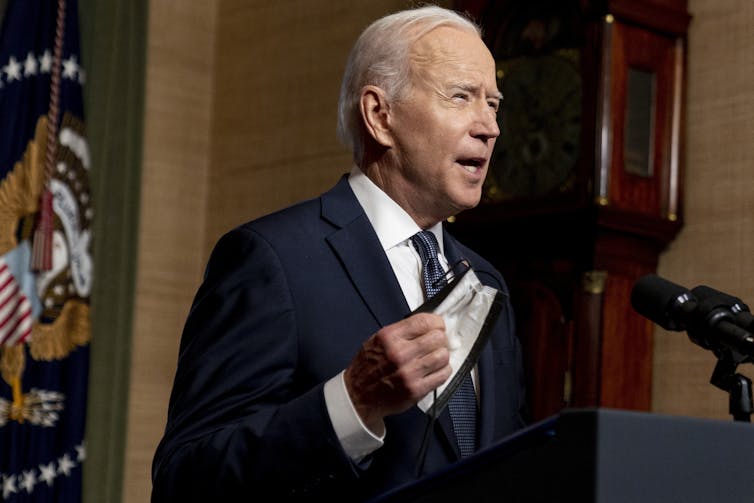
This follows President Joe Biden announcing the United States will leave Afghanistan by September.

The path to this point has appeared inevitable for years. Ten years ago, journalist Karen Middleton highlighted the futility of the counterinsurgency campaign in her aptly-titled book, An Unwinnable War.

High hopes dashed

Back in 2001, it all seemed so different. Only weeks after the September 11 attacks, Australian special forces deployed to southern Afghanistan alongside US, Canadian, British and other NATO troops to defeat al-Qaeda, who was hosted by the then-Afghan government, known as the Taliban.

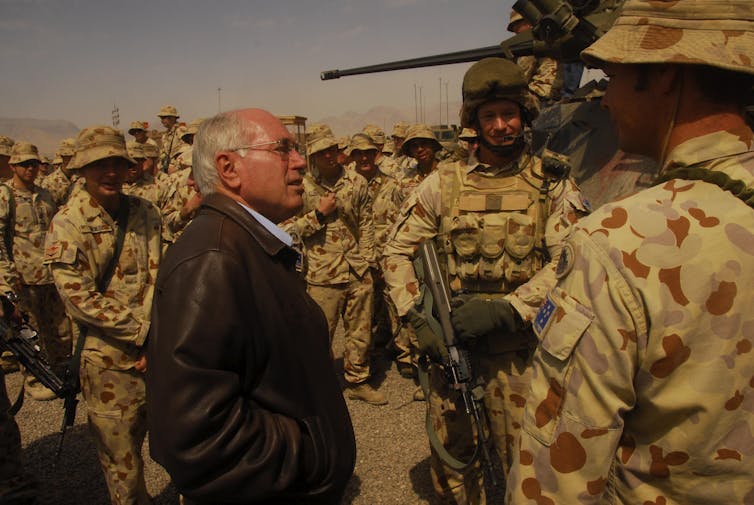
Prime Minister John Howard talks to troops in Afghanistan in 2007.
Prime Minister John Howard, seen here with troops in 2007, sent Australia to Afghanistan in the wake of the September 11 attacks. Department of Defence/AAP

After dusting off their boots and leaving in early 2002, Australian forces were drawn back in 2005 with a special forces task group. This was followed by an engineering reconstruction task force that over time morphed into a mentoring task force, intended to help the Afghan national security forces establish law and order.

But without a clear strategy for effective governance and widespread corruption, the Taliban returned with a vengeance. The mentoring created opportunities for so-called “green on blue” attacks, which contributed to the deaths of a number of Australians.

By 2014, 41 Australian soldiers had been killed. Many understandably wondered: was it worth it?

Australia’s niche approach

Australian politicians and policy makers were always risk-averse about the commitment. Eager to avoid casualties on the scale of Australia’s involvement in the Vietnam War (where 500 Australians were killed), successive governments opted to make niche contributions that relied on critical support and leadership from US and other allies.

But never wanting to manage everything itself left Australia vulnerable.

For example, Australia handed detainees to Afghan authorities who, soon enough released them. Some of these, it appears, ended up fighting against Australians again.

With special forces, in particular, undertaking rotation after rotation, operating without a compelling strategy and running into such characters repeatedly would have tested their resolve to operate ethically. In this context, it is not surprising their actions have generated enormous controversy addressed in the Brereton Report.


Read more: Allegations of murder and ‘blooding’ in Brereton report now face many obstacles to prosecution


Building ADF skills and experience

Defenders of Australia’s engagement in Afghanistan reflect on how the operational experience has honed the force. It enabled the components of the Australian Defence Force to sharpen their skills, refine their procedures and improve their capabilities. This includes the acquisition of advanced American military technology seen as crucial for an (at least partly) self-reliant defence posture for Australia.

Having a capable and sharp-edged defence force is a worthy goal. The question still remains whether the price was justified.


Read more: As the US plans its Afghan troop withdrawal, what was it all for?


The lack of involvement in international strategy formulation left Australia vulnerable to incoherent policy-making and planning by US political and military leaders. This may not affect Australia directly. But America’s US$2 trillion dollar expenditure on the campaign points to a spectacular failure of political and military leadership.

Back in 2001, the so-called “unipolar moment” — with the US as an unchallenged superpower — seemed enduring. Two decades later, a three-pronged series of challenges relating to great power contestation, looming environmental catastrophe and a spectrum of governance challenges (including terrorism, people and drug smuggling, and corruption) suggests the Afghan project distracted many countries — including Australia — from addressing other more pressing global issues.

There were other options

This does not mean the complete withdrawal was the only possibility. There could have been a compromise arrangement to protect the rights of women and institutions of Afghan civil society. This would have required buy-in from neighbouring states including the “stans”, India, Russia, China and Iran, let alone the invested European powers.

But Biden’s declaration of withdrawal has emboldened the Taliban and makes any such outcome now virtually impossible to secure. Indeed, with al-Qaeda and the so-called Islamic State resurgent, we may come to deeply regret not persisting with maintaining a modest foothold there, akin to the level of support provided by NATO that has endured in the Balkans for decades since the war broke out there in the 1990s.

Most of our work now lost

As we look back, Australia did work to improve the lives and livelihoods of the people of Afghanistan, particularly in Uruzgan province, where Australian forces were stationed from 2005—2013.

However, most of that work has now been lost and many of Australia’s interlocutors there killed, intimidated into submission or chased away. Some, thankfully, have made it to Australia as refugees.

We owe it, particularly to those who worked with Australia, to offer them a better future, including by inviting them here and welcoming them, much as we, belatedly, took in refugees fleeing from Vietnam after that war ended.

Meanwhile, in Australia, the price is still being paid for an incomplete strategy, with ongoing trauma for our veterans and their families and lives being lost.

ref. Incomplete strategy and niche contributions — Australia leaves Afghanistan after 20 years – https://theconversation.com/incomplete-strategy-and-niche-contributions-australia-leaves-afghanistan-after-20-years-159045

Politics with Michelle Grattan: Matt Canavan on Holgate, Di Bartolomeo, and John Andersen

Source: The Conversation (Au and NZ) – By Michelle Grattan, Professorial Fellow, University of Canberra

Former Australia Post CEO Christine Holgate has given evidence to a Senate inquiry into her dramatic exit from Australia Post.

Holgate left her position last year, when the prime minister denounced her in parliament for giving Cartier watches as rewards to Australia Post executives.

Victim of a hit job, Holgate inflicted damaging hits of her own – delivering blows against Scott Morrison and Australia Post chair Lucio Di Bartolomeo, and following up her evidence with a media blitz.

She accuses Morrison of bullying and says Di Bartolomeo should resign.

Queensland Nationals senator Matt Canavan, who sat in on her appearance, also believes Di Bartolomeo should go.

“The CEO of Australia Post, just like any government organisation, is not appointed by the minister or the government. The government appoints a board and then the board, under the chair’s direction, hires a CEO.

“The big main job of the chair is to find a good CEO and give them good direction. And that hasn’t occurred here.

“And I think, therefore, the buck must stop with Lucio.”

Despite this, Canavan doesn’t believe an apology is owed by the prime minister for his “parliamentary reaction”, as it was “understandable and everyone had a similiar reaction”. An apology is required from the government, however, for the “dismount, how we’ve handedled the situation post the initial scandal”.

Canavan belongs to the group within the Nationals known for being pro-coal, stirring the pot, and putting pressure on leader Michael McCormack. On this podcast, he discusses the Nationals’ election prospects, as well as the possible return to parliament of former Nationals leader and deputy prime minister John Anderson, who is seeking preselection for a Sneate run.

“[John Anderson is] making a major contribution to the intellectual richness of our country[…] he’s quite a thought leader. I think having the platform of the Senate would amplify that voice a bit. I think he’d also play a very stabilising and educating sort of role in our party room.”

Listen on Apple Podcasts

Stitcher Listen on TuneIn

Listen on RadioPublic

Additional audio

A List of Ways to Die, Lee Rosevere, from Free Music Archive.

ref. Politics with Michelle Grattan: Matt Canavan on Holgate, Di Bartolomeo, and John Andersen – https://theconversation.com/politics-with-michelle-grattan-matt-canavan-on-holgate-di-bartolomeo-and-john-andersen-159043

There’s a mental health emergency happening in South Australia. We need a radical overhaul

Source: The Conversation (Au and NZ) – By Michael Musker, Senior Research Fellow, South Australian Health & Medical Research Institute

While all eyes are on Australia’s severely faltering vaccine rollout, in South Australia the public health system is in a state of turmoil.

Former Central Adelaide Local Health Network mental health director John Mendoza — effectively the state’s mental health boss until he resigned last week — has blasted the South Australian government, alleging a series of failures, budget cuts, and lack of commitment to reforming the state’s mental health system.

So what’s the problem, and how can it be fixed?

Over capacity

Demand for mental health services has increased over the past year because of the COVID pandemic.

While this is true across Australia, the demand for mental health support is now overwhelming South Australian emergency departments. Mendoza noted close to a 40% increase in mental health presentations to the Royal Adelaide Hospital between February 2019 and February 2021.

According to Australian Institute of Health and Welfare data, South Australia falls below the national average when it comes to treating patients who present to emergency departments in a timely manner.

Through no fault of their own, people in mental health crisis are creating a backlog in emergency departments, contributing to overcrowding, long wait times for admission, and therefore ramping — where patients are left waiting in ambulances at the hospital entrance.

Ambulance services in South Australia are reportedly at breaking point.


Read more: Waiting for better care: why Australia’s hospitals and health care are failing


Ramping

The issue of ramping is emblematic of the crisis in emergency department access.

An investigation into ramping at South Australian hospitals conducted before the pandemic found more than 34% of mental health patients brought by ambulance to South Australian emergency departments experienced ramping.

These delays in receiving care, sometimes lasting several hours, can exacerbate psychological trauma and even cause harm for patients.

The problem of ramping affects patients with physical illnesses too. And because paramedics need to stay with patients for longer, ramping also diverts paramedics from other jobs.

Two health-care workers move a patient through a hospital corridor.
When emergency departments struggle to keep up, it can lead to ramping. Shutterstock

While John Mendoza’s controversial exit has lifted the lid on the crisis in South Australia’s public health system, other states and territories face similar problems in emergency mental health care. And for other jurisdictions, too, the pandemic might exacerbate these challenges.

The ED should be a last resort

In a responsive, modern mental health-care system, the emergency department should be the last resort for access to care.

The Grattan Institute has suggested there’s a “a yawning gap for people who need intensive community support but not inpatient care”. In a report published in 2020, it said federal and state governments need to work more closely to provide appropriate resources for mental health care.

The focus should be on health promotion and prevention through mental health programs and services in the community rather than waiting for a crisis to occur. We need accurate surveillance of demand for mental health care, and services must be well-resourced to prevent the system becoming overwhelmed.

Upon his resignation, Mendoza sounded alarm bells that this was not happening. He warned that South Australia’s mental health system is approaching crisis unless the government allocates additional resources urgently.

Mendoza has been supported by senior mental health staff and the Royal Australian and New Zealand College of Psychiatrists, who argued South Australians deserve better.


Read more: We can’t ignore mental illness prevention in a COVID-19 world


A radical overhaul

Mendoza outlined a ten-point plan to radically overhaul South Australia’s mental health system.

Among the recommendations is recruiting more mental health staff. Chronic under-resourcing in community teams at present means the remaining staff are overworked and stressed attempting to fill the gaps. This inevitably leads to consumer needs not being met, resulting in increased emergency department presentations.

Meanwhile, he’s called for upskilling of first responders. This involves providing specialised training for emergency personnel, such as police and ambulance staff, around supporting people in a mental health crisis.

Mendoza also flagged the importance of non-ambulance transfers for mental health patients — so having dedicated vehicles to transport mental health patients. South Australia is the only jurisdiction still exclusively using stretcher-based transport for all mental health patients, meaning they’re strapped in inside the ambulance. This restrictive practice is unnecessary, traumatising, and contributes to ramping.

Further, Mendoza recommended upscaling current prevention programs. These include programs providing mental health expertise to support local general practitioners, and increasing support in people’s homes.

He also suggested providing emergency accommodation for people experiencing homelessness with mental health issues, recognising homelessness is a key cause of social stress.

Importantly, Mendoza strongly advocated that forensic patients (people with a mental disorder who have committed a crime) shouldn’t be housed in general hospitals while waiting for a mental health bed. This means providing an adequate number of beds for forensic mental health admissions (the target is 80, up from the 60 we have now).

Currently, patients unable to access care in a specialist forensic psychiatric facility are reportedly restrained with handcuffs and surrounded by security guards in the emergency department.


Read more: From asylums to GP clinics: the missing middle in mental health care


The ten-point plan offers insightful recommendations from someone who has a deep understanding and experience of the inner workings of the current mental health system, available resources, and areas of weakness. And while it’s designed to fix South Australia’s crisis, there are some recommendations other states would do well to consider.

For South Australia moving forward, the most critical aspect will be easing the pressure on emergency departments by providing targeted staffing resources within community care networks. The second is changing the way mental health patients are transported to hospital.

ref. There’s a mental health emergency happening in South Australia. We need a radical overhaul – https://theconversation.com/theres-a-mental-health-emergency-happening-in-south-australia-we-need-a-radical-overhaul-158961

As the US plans its Afghan troop withdrawal, what was it all for?

Source: The Conversation (Au and NZ) – By Jared Mondschein, Senior Advisor, US Studies Centre, University of Sydney

Unlike most US presidents, Joe Biden did not come to the White House with many fixed ideological positions. He did, however, come with fixed values. Chief among them is understanding how US policies impact working American families.

In his nearly half century of experience in and around Washington, Biden was known to ask any staffers using academic or elitist language to

pick up your phone, call your mother, read her what you just told me […] If she understands, we can keep talking.

The debate about the nearly 20-year US presence in Afghanistan has challenged three prior US presidents — George W. Bush, Barack Obama and Donald Trump. Yet Biden, as the first US president in 40 years to have had a child who served in combat, sees things differently.

There undoubtedly remains a strategic argument — albeit shared by increasingly fewer Americans — for maintaining a US presence in Afghanistan. Namely, that it would continue to prevent terrorists from once again making safe haven there.

But Biden’s announcement that he would withdraw the remaining US troops by September essentially meant he saw no way of making the parent of another soldier killed in Afghanistan understand such an argument. As he said,

Our reasons for remaining in Afghanistan have become increasingly unclear.

Biden said it is ‘time for America’s troops to come home’. Andrew Harnik / POOL/EPA

Shifting US support for the war

Today, most Americans agree with him.

When the longest war in American history began, 83% of Americans were in favour of it. But by 2019, 41% of Americans simply had no opinion on whether the US had accomplished its goals in Afghanistan.

Perhaps clearer than the US rationale for maintaining troops in Afghanistan is the fact Americans are dramatically less concerned about terrorism than they were 20 years ago.

A woman embracing her husband after his return from a deployment to Afghanistan in 2014. David Goldman/AP

One month after the September 11, 2001, attacks, 71% of Americans said they were worried about a terror attack.

But by July 2020, terrorism ranked last in a list of ten issues that Americans deemed to be a “very big problem in the country today.” Climate change, violent crime, unemployment, government ethics, and racial injustice were all deemed more important.

And in February of this year, Americans were asked what of 20 options should be given “top priority” as a long-range foreign policy goal. The top-ranked priority, with 75% in support, was “protecting the jobs of American workers”.

The very last one? “Promoting democracy in other nations”, at just 20%.


Read more: US postpones Afghanistan troop withdrawal in hopes of sustaining peace process: 5 essential reads


What was it all for?

The rationale for maintaining US troops in Afghanistan was not only unclear to most Americans, it also became unclear to a growing number of US veterans. In late 2019, 44% of veterans said they supported US troop reductions from Afghanistan — compared to just 33% of the general public.

As Biden reminded the world in his announcement, the US invaded Afghanistan to root out al-Qaeda and prevent future terror attacks on the US. He posited the death of Osama bin Laden and the degradation of al-Qaeda were evidence of success on that front.

But both of those were accomplished a decade ago — leading Biden to wonder what had been accomplished since then, and what could be accomplished in the future.

More than 2,400 American service members were killed in Afghanistan and more than 20,000 were wounded. Massoud Hossaini/AP

More than a decade ago, the Obama administration fiercely debated the merits of decreasing the US troop presence in Afghanistan. Around that time, a US Marine colonel who did multiple deployments to the region reflected to me about the many Marines he lost there and the parents he consoled. He asked a simple question:

What exactly am I supposed to tell these mothers that their sons died for?

Ultimately, the withdrawal of US troops has led veterans and non-veterans alike to ask another question that others have asked in the past: What was it all for?


Read more: For the Afghan peace talks to succeed, a ceasefire is the next — and perhaps toughest — step forward


It remains unclear if the more than 2,400 US troop and personnel deaths, US$2 trillion and 20 years achieved anything truly lasting on the ground in Afghanistan.

Yet, perhaps the greatest legacy from the US war in Afghanistan should not be something the US gained, but instead what it lost — unbridled confidence in and dependence on US hard power.

Such humility and restraint may be exactly what is needed for the challenge the Biden administration wants to focus on most, and is perhaps most relevant to the American working family: rebuilding at home.

ref. As the US plans its Afghan troop withdrawal, what was it all for? – https://theconversation.com/as-the-us-plans-its-afghan-troop-withdrawal-what-was-it-all-for-159053

Japan is facing a fourth COVID wave and sluggish vaccine rollout. Will it be ready for the Olympics?

Source: The Conversation (Au and NZ) – By Craig Mark, Professor, Faculty of International Studies, Kyoritsu Women’s University

As a fourth wave of the coronavirus pandemic worsens in Japan, Prime Minister Yoshihide Suga faces a formidable challenge to successfully host the increasingly beleaguered Tokyo Olympic and Paralympic Games, with less than 100 days left to go.

More contagious variants of COVID-19 are spreading from Japan’s second-largest city Osaka. Cases are already rising again in Tokyo, requiring a so-called “quasi state of emergency” to be reimposed in Japan’s major cities.

Anxieties are also rising over the country’s sluggish vaccine rollout, which is far behind many other countries, including Singapore, South Korea and Indonesia. Opinion polls show up to 70% of Japanese feel the vaccine rollout has been too slow.

As the head of one nursing care centre put it,

the government doesn’t seem to understand the urgency of the matter.

A delayed start to Japan’s vaccine rollout

Taro Kono, the minister in charge of the rollout, has said 100 million doses should be stockpiled by June to cover the country’s elderly population (36 million people), health care workers and those with pre-existing conditions. This means, however, less than half the population is likely to be vaccinated when the Olympics start on July 23.

The main cause of the slow rollout stems from the initial decision by the government to go through a delayed approval process for the Pfizer-BioNTech vaccine.

Japan only began vaccinating those over 65 years old this week. Kyodo News/AP

Even though Phase 3 trials were concluded last November and the vaccine was approved by the World Health Organisation on December 31, the Japanese Pharmaceuticals and Medical Devices Agency (PMDA) took another six weeks to conclude its own trials before granting approval. The rollout has been further impeded by strains on Pfizer’s production capacity and export controls imposed by the European Union.

At least four Japanese pharmaceutical companies have been conducting their own vaccine trials, but these have been stymied by a lack of investment and the slow pace of bureaucratic approval by the PMDA.


Read more: Yoshihide Suga – who is the man set to be Japan’s next prime minister?


Japan also has orders for 120 million doses of the AstraZeneca vaccine and 50 million doses of Moderna’s vaccine, with hopes they will be approved for distribution and domestic production by May. Local trials have also begun for the Novavax vaccine, with hopes of being able to produce it domestically by the end of 2021.

Though achingly slow to be delivered, this means Japan has secured the rights for 564 million doses — more than enough for its population of 120 million people.

Osaka’s torch relay was held in a park without any crowds due to COVID concerns. Hiro Komae/AP

A history of vaccine scares

But vaccine supply isn’t the only issue the country is facing. There are also concerns over the relatively high rate of vaccine reluctance among the Japanese public. Less than 25% strongly agree vaccines are effective, important and safe, according to a survey by The Lancet.

This is the legacy of vaccine safety scares in past decades. A small number of infants died from whooping cough vaccinations in the 1970s, followed by some adverse reactions to a combined measles, mumps and rubella (MMR) vaccine in the 1980s.


Read more: For now, the Tokyo Olympics will go ahead. But at what cost?


Unfounded safety fears even led to the government withdrawing a national vaccination program for the human papillomavirus (HPV) in 2013, with fewer than 1% of Japanese girls now vaccinated for HPV.

Two recent surveys, however, show more than 60% of Japanese people are willing to get a COVID vaccine. The groups with more hesitancy included women and younger generations, with just over half indicating they wanted to get vaccinated.

Political pressure on Suga

For over a year, Japan’s pandemic strategy has largely relied on requests for businesses and the public to take voluntary precautions, such as closing bars and restaurants by 8pm, rather than enforce strict lockdowns. The government’s goal was to minimise the impact on the economy.

The Suga government and that of his predecessor, Shinzo Abe, however, have been under constant criticism for what many perceive as a reactive approach to the crisis. There have been a number of missteps along the way, too.

Prime Minister Yoshihide Suga has seen his popularity drop significantly since the start of his term last year. Kaname Yoneyama/AP

This has worsened the approval ratings for the governing conservative Liberal Democratic Party (LDP), which has to face a national election for the lower house of the Diet (Japan’s parliament) by October. Numerous corruption scandals implicating LDP Diet members, senior bureaucrats and even Suga himself have also undermined public support for the government, which could ultimately threaten Suga’s leadership.

Relations have also worsened between Suga and leaders of Japan’s prefectural governments, especially the governors of Osaka and Tokyo. They have been insisting a “quasi state of emergency” be reimposed for at least a month, following the premature lifting of the previous state of emergency on March 21.

Osaka’s governor has also called off the Olympic torch relay through the streets of his city.

Playbook for a COVID-safe Olympics

The Tokyo Olympics, themselves, however, are still proceeding as planned. The Suga and Tokyo governments and the International Olympic Committee believe there is simply too much at stake in terms of corporate sponsorships, broadcasting rights and political prestige — despite the vast majority of Japanese people believing the games should be cancelled or postponed.

Suga is even expected to invite US President Joe Biden to the Olympics during his official visit to the US this week.


Read more: Why are Japan’s leaders clinging to their Olympic hopes? Their political fortunes depend on it


Foreign spectators have now been barred from attending, but organisers are still hopeful to have a domestic audience for the games, particularly since socially-distanced sporting events have resumed in Japan, such as baseball, soccer and sumo wrestling.

However, there is so far no requirement that local spectators be vaccinated. And the IOC is only encouraging — not requiring — that athletes be vaccinated, according to IOC Vice President John Coates.

All athletes, coaches and support staff, as well as the foreign media, will instead have to show negative COVID-19 test results before entering Japan. They will also be required to follow a COVID-safe “Playbook”, which will strictly control their activities during the games and require testing every four days.

How the government handles the games may just determine its fate in the October elections.

Scandals and negative publicity have swirled around the event for months, putting enormous pressure on the government and organisers.

Last week, a report that priority vaccinations were being considered for the Japanese Olympic team ahead of the public sparked a social media backlash and prompted a denial by the government.

With less than 100 days to go until the opening ceremonies, the Suga government needs to take a stronger approach towards the pandemic and dramatically speed up its vaccine rollout. The success of the games — and the survival of Suga’s government — depend on it.

ref. Japan is facing a fourth COVID wave and sluggish vaccine rollout. Will it be ready for the Olympics? – https://theconversation.com/japan-is-facing-a-fourth-covid-wave-and-sluggish-vaccine-rollout-will-it-be-ready-for-the-olympics-158700

Australian troops to leave Afghanistan by September

Source: The Conversation (Au and NZ) – By Michelle Grattan, Professorial Fellow, University of Canberra

Australia will pull its remaining 80 troops from Afghanistan by September, marking the end of its longest involvement in a war.

This is in line with the announcement by United States President Joe Biden of America’s withdrawal.

An emotional Prime Minister Scott Morrison read out the names of the 41 Australians who died since the conflict began after the September 11 2001 terrorist attacks in the US.

Biden said this week it was time to end the “forever war”. The US currently has about 2,500 troops in Afghanistan while about 2,200 Americans have been killed in a conflict that ended inconclusively.

Over the past two years, Australia has reduced its military personnel from about 1,500.

Asked at a news conference in Perth whether going into Afghanistan was worth it, Morrison said, “freedom is always worth it”.

In a statement he, Defence Minister Peter Dutton and Foreign Minister Marise Payne said, “this decision represents a significant milestone in Australia’s military history”.

They said more than 39,000 Australian Defence Force personnel had been deployed on Operations SLIPPER and HIGHROAD.

“But safeguarding Afghanistan’s security has come at a cost,” they said, referring to the 41 deaths and the larger number who were wounded, “some physically and others mentally.”

They said a “complex task of making peace” lay ahead.

“Australia continues to support the peace negotiations between the Afghan government and the Taliban. We encourage both parties to commit to the peace process and call on the Taliban to cease the violence.”

While Australia’s military contribution would reduce, “we will continue to support the stability and development of Afghanistan through our bilateral partnership, and in concert with other nations.

“This includes our diplomatic presence, development cooperation program, and continued people-to-people links, including through our training and scholarship programs.

“Australia remains committed to helping Afghanistan preserve the gains of the last 20 years, particularly for women and girls.”

The announcement of the withdrawal comes as fresh controversy engulfs Ben Roberts-Smith, who won a VC in Afghanistan but has been accused of war crimes.

Nine this week alleged he buried material in his backyard, including pictures of soldiers behaving badly in a makeshift bar at the Australian Tarin Kowt base and classified information.

Roberts-Smith has denied the allegations against him.

At his news conference, Morrison dismissed a question about the allegations of Australians committing war crimes, saying, “There will be time to talk about those things. Today is not that time”.

ref. Australian troops to leave Afghanistan by September – https://theconversation.com/australian-troops-to-leave-afghanistan-by-september-159044

Floods can worsen inequality. Here are 4 ways we can ensure people with disabilities aren’t left behind

Source: The Conversation (Au and NZ) – By Jodie Bailie, Research Fellow, The University Centre for Rural Health, University of Sydney

Disasters like flooding can worsen social inequalities around health and housing. For people with disability, however, the effect can be especially profound.

Research led by the University of Sydney’s University Centre for Rural Health has shown, for example, that after flooding people with disability and their carers were more likely than others to:

  • have their homes flooded and be evacuated

  • still be displaced six months on

  • experience disrupted access to food, support networks and essentials such as healthcare and social services

  • continue to be distressed about the flood six months after it happened

  • be at relatively high risk of post-traumatic stress disorder six months after the flood.

As communities on Australia’s east coast recover from recent flooding, it’s more important than ever to engage with concerns raised at the recent Royal Commission into Violence, Abuse, Neglect and Exploitation of People with Disability.

As revealed in the University Centre for Rural Health’s submission to the Royal Commission, people with disability are too often overlooked or left behind during emergencies.

We surveyed people with disability and carers after a major flood in the Northern Rivers region of New South Wales in 2017. Some of the stories were shocking. One person told us:

Me and my housemate are disabled […] We were unable to leave our house as we had no transport to get to the evacuation centre.

Another identified barriers with communication, saying:

Didn’t know what evacuation meant eg what to take, would I have to stay there, where to go […] Had no idea what river levels meant, eg Tweed River is 4.3m.

People with disability reported feeling they had been left to “fend for themselves”:

The disgusting way people were left to fend for themselves and then the lack of proper response from our federal government. The scammers who surfaced during the flood. The lack of help for the homeless and vulnerable. The anxiety and stress that occurred and the amount of people left homeless and still trying to find a home five months later. Services that were desperately needed but were very hard to find.

Carers are affected, too. One told us:

I didn’t realise how depressed I got or how upset I was until I talked with the flood recovery team and then it all hit home and has taken six to 12 [months] to recover and I was only minimally affected.

Respondents described people with disability living in places that should never have been rented in the first place due to flood risk:

It would have been impossible to get possessions to safety quick enough. And people who rent these type of places have the least resources (mental emotional physical (cars etc), financial) to cope.

One carer described her harrowing flood experience by saying:

I got no warning but TV said evacuation for Lismore CBD, and when I rang SES for information I could not get through. I needed clarification for my family and I have three special needs kids and I needed help to evacuate. I rang the police station [and] they said I was fine where I was. I was getting more scared and finally got hold of [the] SES who told me leave now as “we expect catastrophic loss and genuine risk that your house will collapse because it’s in direct path of flood when the levy tops”. I said I need help! I was told no help for me as I was under order to evacuate hours before but no one rang, no one knocked on my door! Even the police said my house was fine! It was completely destroyed. Knocked off the pylons, condemned [to] a horrific night of hell getting the kids out by myself.

A common experience was people with disability or carers feeling like their expertise and insights were ignored.

Houses lie flooded in NSW after recent rains.
Emergency management plans must take into account people with disability. AAP/BILLY CALLAGHAN

Change is urgently needed. Here are four things that could be done to ensure purposeful inclusion of people with disability and carers in all stages of recovery.

1. Work with peak (and local) disability advocacy organisations

When disaster strikes, people with disability need emergency housing in the short-term and more secure housing in the long-term.

Our research highlighted a lack of affordable accommodation for displaced carers and people living with disability. People were living in unsafe accommodation with mould, no cooking facilities and structural damage. Some were left homeless.

It is vital all levels of government work with peak (and local) disability advocacy organisations to understand and respond to disaster-related housing vulnerabilities.

People living with disability should be supported to plan for disaster risk. This should include programs to help people learn about their flood risk and what to do in an evacuation.

2. Ensure continuity of support and services

Disaster recovery plans should consider how, for people with disability, access to support and services can be disrupted by long-term displacement.

Disruption to support networks can leave people with disability isolated. Access to high-quality personal care, transport, food and health services must be continued during and after a flood.

The Disability-Inclusive and Disaster Risk Reduction Framework and Toolkit provides direction to service providers to ensure the safety of staff — and the people they support — before, during, and after a disaster.

Flooding in the Northern Rivers area in 2017.
We surveyed people with disability and carers after a major flood in the Northern Rivers area of New South Wales area. AAP Image/Tracey Nearmy

3. Make long-term investments in mental health and well-being

Floods can have enduring psychological impacts. For people with disability, however, the risk of prolonged distress and post traumatic risk disorder is higher.

Mental health conditions may take some time to emerge. Longer-term tailored supports are required – possibly for years after the flood.

Mental health services should be evidence-based, with additional training for primary care providers on how to identify and treat post-traumatic stress disorder.

Research has shown shown being connected to your community, for example through volunteering, clubs or informal gatherings, can reduce the risk of mental health issues after a disaster.

4. Develop person-centred preparedness plans

Too often, people living with disability are not adequately included in community-level disaster preparedness. Governments at all levels — but especially councils — must invest in helping people prepare personal emergency plans.

The Australian-designed Person-Centred Emergency Preparedness Workbook is a guide used by people with disability to tailor emergency preparedness planning to their needs.

It steps people through the planning process and includes tips from people with disability help to get the conversation started.

Emergency services also need to be well supported, and nobody should lay the blame on any particular agency. These organisations, many of which rely on volunteers, are doing the best they can in extremely challenging circumstances. But there is an opportunity here for broader systemic change to better meet the needs of disaster-affected people with disability and their carers.

The severity and frequency of flooding is likely to increase as the climate warms. So too will the human impacts. We urgently need to find ways to improve how we prepare and respond.


If this article has raised issues for you, or if you’re concerned about someone you know, call Lifeline on 13 11 14. This story is part of a series The Conversation is running on the nexus between disaster, disadvantage and resilience. You can read the rest of the stories here.

ref. Floods can worsen inequality. Here are 4 ways we can ensure people with disabilities aren’t left behind – https://theconversation.com/floods-can-worsen-inequality-here-are-4-ways-we-can-ensure-people-with-disabilities-arent-left-behind-157959

How safe are your data when you book a COVID vaccine?

Source: The Conversation (Au and NZ) – By Joan Henderson, Senior Research Fellow (Hon). Editor, Health Information Management Journal (HIMJ), University of Sydney

The Australian government has appointed the commercial company HealthEngine to establish a national booking system for COVID-19 vaccinations.

Selected through a Department of Health limited select tender process, the platform is being used by vaccine providers who don’t have their own booking system.

However, HealthEngine has a track record of mishandling confidential patient information.

Previous problems

In 2019 the Australian Competition and Consumer Commission took HealthEngine to court for allegedly skewing reviews and ratings of medical practices on its platform and selling more than 135,000 patients’ details to private health insurance brokers.

The Federal Court fined HealthEngine A$2.9 million in August 2020, just eight months ago.

Department of Health associate secretary Caroline Edwards told a Senate hearing the issues were “historical in nature, weren’t intentional and did not involve the sharing of clinical or medical related information”.

How might the alleged misconduct, which earned HealthEngine A$1.8 million, be considered “historical in nature” and “not intentional”?

Edwards added that HealthEngine had strengthened its privacy and security processes, following recommendations in the ACCC’s digital platforms inquiry report. Regarding the new contract, she said:

[…] the data available to HealthEngine through what it’s been contracted to do does not include any clinical information or any personal information over what’s required for people to book.

That’s somewhat reassuring, considering the larger amount of information usually requested from patients booking an appointment (as per HealthEngine’s current Privacy Policy).

The list of personal information HealthEngine may collect from patients booking an appointment with a health professional. Screenshot

Importantly, HealthEngine then owns this information. This raises an important question: why is so much personal information requested just to book an ordinary appointment?

A need for accessible information

While using HealthEngine to book a vaccination is not mandatory, individual practices will determine whether patients can make appointments over the phone, are directed to use HealthEngine’s platform, or another existing platform.

Personal details currently requested through HealthEngine’s vaccination booking system are:

HealthEngine’s Privacy Policy for COVID-19 vaccination bookings. screenshot

This list is substantially shorter than the one concerning non-COVID related bookings. That said, there’s still more information being gathered than would be required for the sole purpose of arranging a patient’s vaccination.

What is the justification for this system to collect data about patients’ non-COVID medical and health services, or the pages they visit?

A representative from the Department of Health told The Conversation that all patient data collected through the COVID vaccination booking system was owned by the department, not HealthEngine. But what need would the department have to collect web analytics data about what sites a patient visits?

An underlying administrative principle of any medical appointment platform is that it should collect the minimum amount of data needed to fulfil its purpose.

Also, HealthEngine’s website reveals the company has, appropriately, created an additional privacy policy for its COVID-19 vaccination booking platform. However, this is currently embedded within its pre-existing policy. Therefore it’s unlikely many people will find, let alone read it.

For transparency, the policy should be easy to find, clearly labelled and presented as distinct from HealthEngine’s regular policies. A standalone page would be feasible, given the value of the contract is more than A$3.8 million.

What protections are in place?

Since the pandemic began, concerns have been raised regarding the lack of clear information and data privacy protection afforded to patients by commercial organisations.

Luckily, there are safeguards in place to regulate how patient data are handled. The privacy of data generated through health-care provision (such as in general practices, hospitals, community health centres and pharmacies) is protected under state and territory or Commonwealth laws.

Data reported (on a compulsory basis) by vaccinating clinicians to the Australian Immunisation Register fall within the confines of the Australian Immunisation Register Act 2015 and its February 2021 amendment.


Read more: Queensland Health’s history of software mishaps is proof of how hard e-health can be


Also, data collected through the Department of Health’s vaccination registration system are legally protected under the Privacy Act 1988, as are data collected via HealthEngine’s government-approved COVID-19 vaccination booking system.

But there’s still a lack of clarity regarding what patients are being asked to consent to, the amount of information collected and how it’s handled. It’s a critical legal and ethical requirement patients have the right to consent to the use of their personal information.

If the privacy policy of a booking system is unclear, this presents risk for patients who have challenges with the English language, literacy, or are potentially distracted by pain or anxiety while making an appointment. Shutterstock

Gaps in our knowledge

As health information managers, we had further questions regarding the government’s decision to appoint HealthEngine as a national COVID-19 vaccination booking provider. The Conversation put these questions to HealthEngine, which forwarded them to the Department of Health. They were as follows.

  1. Is there justification for the rushed outsourcing of the national appointment platform, given the number of vaccine recipients whose data will be collected?

  2. How did the department’s “limited select tender” process ensure equity?

  3. Who will own data collected via HealthEngine’s optional national booking system?

  4. What rights will the “owner” of the data have to give third-party access via the sharing or selling of data?

  5. What information will vaccine recipients be given on their right to not use HealthEngine’s COVID-19 vaccination booking system (or any appointment booking system) if they’re uncomfortable providing personal information to a commercial entity?

  6. How will these individuals be reassured they may still receive a vaccine, should they not wish to use the system?

In response, a department representative provided information already available online here, here, here and here. They gave no clarification about how patients might be guided if they’re directed to the HealthEngine platform but don’t want to use it.

They advised the data collected by HealthEngine:

can not be used for secondary purposes, and can only be disclosed to third-party entities as described in HealthEngine’s tailored Privacy Policy and Collection Notice, as well as the department’s Privacy Notice.

But according to HealthEngine’s privacy policy, this means patient data could still be provided to other health professionals a patient selects, and de-identified information given to the Department of Health. The policy states HealthEngine may also disclose patients’ personal information to:

  • third-party IT and software providers such as Adobe Analytics

  • professional advisers such as lawyers and auditors, for the purpose of providing goods or services to HealthEngine

  • courts, tribunals and law enforcement, as required by law or to defend HealthEngine’s legal rights and

  • others parties, as consented to by the patient, or as required by law.

Ideally, the answers to our questions would have helped shed light on the extent to which patient privacy was considered in the government’s decision. But inconsistencies between what is presented in the privacy policies and the Department of Health’s response have not clarified this.


Read more: The government is hyping digitalised services, but not addressing a history of e-government fails


ref. How safe are your data when you book a COVID vaccine? – https://theconversation.com/how-safe-are-your-data-when-you-book-a-covid-vaccine-157869

Brittany Higgins’ memoir will join a powerful Australian collection reclaiming women’s stories of trauma. Here are four

Source: The Conversation (Au and NZ) – By Marina Deller, PhD Candidate, Flinders University

Brittany Higgins has signed a book deal with Penguin Random House Australia. Not just any book — a memoir.

Higgins says her book will be a chance to tell “a firsthand account of what it was like surviving a media storm that turned into a movement”.

Memoir can help readers explore and understand trauma from a very personal perspective. Research suggests writing can be used to work through, or even heal from, trauma. It is a chance for a writer like Higgins, who alleges she was raped in a senior minister’s office, to reclaim her story.

Here are four powerful Australian examples of women’s memoirs about trauma and abuse.

1. Eggshell Skull by Bri Lee

book cover: eggshell skull
Allen & Unwin

Sydney-based author, writer, and researcher Bri Lee witnessed justice and heartbreak while working as a judge’s associate in the Queensland District Court. Two years later, she took her own abuser to court.

Although the abuse occurred in childhood, Lee pursued a conviction for the perpetrator (a family friend) in young adulthood. In her 2018 book, she acknowledges that the longer the time between an incident and investigation, the more potential hurdles may arise; her journey for justice is far from straightforward.

Lee acknowledges this in the way she explores personal, public, and legal discourse surrounding abuse. She jumps back and forth in time, and weaves her story with others in the Australian legal system in a blend of journalistic and personal storytelling. This approach also acknowledges trauma can affect memory. Details can be unbearably clear, difficult to remember, or both.

Through poetic reflection, and searing critique, Lee carves a space for her story.


Read more: This week’s news has put sexual assault survivors at risk of ‘secondary trauma’. Here’s how it happens, and how to cope


2. No Matter Our Wreckage by Gemma Carey

book cover: No matter our wreckage
Allen & Unwin

From age 12, Gemma Carey was groomed and abused by a man twice her age. In young adulthood, Carey discovers her mother knew about the abuse. When her mother dies, the enduring effects of this betrayal surface.

Family memoirs are often taboo; family memoir about child abuse and complicity even more so. Despite fraught themes, the Sydney-based author and academic writes with rigour and honesty. Her 2020 memoir asks us to examine social — and family — structures which allow these injustices.

Carey’s tone is dark but inquisitive. She speaks directly to readers, incorporating research, and unpicking the threads of trauma and grief.

Carey emphasises writing about abuse doesn’t always fit a mould. In an interview, she explains, “Writing trauma stories that will change societal narratives around abuse and victims involves showing the contradictions that exist in trauma and grief”.

In her book, she reflects on her younger self,

I was broken and trying to work out how to fix myself … no one had ever given me the tools… I had to figure it out on my own.

This rebuilding took time. At 12, Carey buried her experience, at 17 she successfully took the perpetrator to court, in adulthood, she wrote her memoir.


Read more: Friday essay: why we need children’s life stories like I Am Greta


3. The Anti-Cool Girl by Rosie Waterland

book cover: the anti cool girl
Harper Collins

In The Anti-Cool Girl (2018), comedian and writer Rosie Waterland reveals a turbulent childhood; drug and alcohol-addicted parents, absent family, death and loss, poverty, mental health struggles, and sexual abuse experienced within the Australian foster care system.

Waterland writes unflinchingly. She tackles difficult subjects with intelligence and humour. Each chapter is addressed to herself: “You will be in rehab several times before you’re ten years old”, or “Your foster dad will stick his hands down his pants, and you will feel so, so lucky”. Like Carey, Waterland acknowledges trauma often manifests in ways which might seem “odd” or “unconventional” to others.

While comedic throughout, Waterland approaches her trauma with care and, understandably, anger. She later lamented that she was unable to name her abuser, due to fears of litigation.

The Anti-Cool Girl, blending humour and pain, remains a testament to Waterland’s endurance and survival.

4. The Girls by Chloe Higgins

book cover: the girls
Pan Macmillan

Chloe Higgins’ sisters — Carlie and Lisa — died in a car accident when Higgins was 17. In her 2019 memoir Higgins — a Wollongong-based author and academic — asks us to consider the nature of ongoing grief and the way trauma stretches over different experiences.

Higgins’ grief influences her sexual experiences in often troubling ways — but the way she discusses it is revolutionary. She explores the weaponisation of sex, how it is a form of self-harm; sex and substance abuse, and the pleasures and pressures of sex work.

She jumps between stories of gentility (caring lovers, exploration, sex clients who felt more like friends) and horror stories featuring coercion and fear, threats, and sex without consent. Higgins examines her own experiences and links them to memory, identity, and control.

In her Author’s Note, Higgins reflects: “Publishing this book is about stepping out of my shame”.

These are not the only parts of me, but they are the parts I’ve chosen to focus on … Since that period of my life, I have begun to recover.

These books signal the importance of memoir as a platform where personal trauma stories are told, reclaimed, and witnessed. They are a valuable (and intimate) contribution to the conversation about trauma and sexual abuse in Australia.


Read more: Inside the story: writing trauma in Cynthia Banham’s A Certain Light


ref. Brittany Higgins’ memoir will join a powerful Australian collection reclaiming women’s stories of trauma. Here are four – https://theconversation.com/brittany-higgins-memoir-will-join-a-powerful-australian-collection-reclaiming-womens-stories-of-trauma-here-are-four-158960

Did somebody say workers’ rights? Three big questions about Menulog’s employment plan

Source: The Conversation (Au and NZ) – By Tom Barratt, Lecturer, Centre for Work + Wellbeing, Edith Cowan University

Menulog, Australia’s second-largest food ordering and delivery platform, has declared it will break with the standard “gig platform” business model and engage some of its couriers as employees, not independent contractors.

We owe it to our couriers,” Menulog’s managing director Morten Belling told the Senate Select Committee inquiry into job security this week. The inquiry is investigating the scope of insecure or precarious employment in Australia.

The Transport Workers’ Union says Menulog’s move is a “watershed moment for the gig economy”. By committing to pay couriers a minimum wage and superannuation, it is going further than its competitors such as UberEats and Deliveroo.

But let’s not get too excited yet.

What Menulog has announced is just a pilot program, offering employment to some couriers in Sydney’s CBD. How much of an overall benefit it makes even to those workers will depend on the details.

Work can still be insecure and poorly paid even when a worker is “employed”. Just ask many casual employees in the hospitality, horticulture and retail sectors.

Accepting greater responsibility

To give Menulog credit, the company isn’t legally obliged to make this change.

The prevailing independent contractor model, paying workers “piece” rates with no benefits such as superannuation and paid leave, is controversial yet thus far legal – even though it means many earn less than the minimum wage.

In engaging couriers as employees, Menulog is accepting greater responsibility for their welfare. Things like insurance and workers compensation become straightforward. As contractors, already lowly paid workers are often responsible for their own insurance.


Read more: Workers’ compensation doesn’t cover gig workers – here’s a way to protect them


These are vitally important issues given the risks involved in courier work. Last year five delivery riders were killed in traffic accidents. Though none were Menulog couriers, Belling mentioned this as a key driver for the company’s change.

The shift to an employment model should also result in greater income certainty for workers. But to what extent they will be better off depends on at least three important details.

A rally in support of food delivery riders in Sydney in March 2018
A rally in support of food delivery riders in Sydney in March 2018. Past surveys have found 75% of riders have earned less than minimum rates through platform work. Dan Himbrechts/AAP

1. What’s the award?

The first question is what modern award – the document that sets minimum terms and conditions of employment within a specific industry or occupation – will couriers be employed under.

According to Menulog there are “a number of challenges” in moving to an employment model, with Australia’s award system cited as a potential barrier.

The award now covering couriers is the Road Transport and Distribution Award 2020. Menulog has indicated it wants delivery workers to be covered by a new award, and intends to consult with the union to create it.

It hasn’t spelt out what the specific “challenges” in the existing award are – employer groups often talk in generalities about a lack of flexibility – but it may include removing minimum engagement periods.

Under the existing award – as with others – a casual employee must be paid for a minimum four-hour shift. Minimum engagement periods are important for giving workers some certainty as to how much they will earn when asked to work. In contrast, an independent contractor can be engaged for a one-off delivery that may only be for a few minutes to earn a few dollars.

The award also stipulates penalty rates and allowances for unsociable hours or days (such as public holidays).

If Menulog’s move involves eroding fundamental award principles about minimum hours and payments, its couriers could find “employment” isn’t much better their current conditions.

2. Does every worker get to be an employee?

Even given the limited scope of the trial (Menulog operates throughout Australia and New Zealand, while its parent company Just Eat Takeaway operates in 23 countries) it is unclear if the platform plans to make all couriers working in Sydney’s CBD employees.


Menulog’s parent company Just Eat Takeaway has operations in 21 countries and partnerships in two others (Brazil and Colombia). www.justeattakeaway.com

Or will it end up with a two-tier system, where some couriers are engaged as employees and other remain contractors? If this is the case, it could make contract work even more precarious.

It’s important to know who gets to be an employee and why. This should be transparent. Platform companies are notorious for their “black-box” algorithmic management. Their algorithms now effectively make workers compete with each other for gigs. A system that makes them compete for the chance to be rewarded with the badge of “employee” is hardly much better.


Read more: Algorithms workers can’t see are increasingly pulling the management strings


3. How to deal with multi-apping?

It is a feature of the gig economy that couriers often work on multiple apps at the same time to try and win more gigs – a practice known as “multi-apping”.

If they become Menulog employees, will they have to forego this right? Will they be allowed to earn money through other platforms during times when they’re not employed?

Again, these details will need to be worked out. The answer will have ramifications across the food delivery industry.

Finally, are customers willing to pay?

Menulog’s announcement has been welcomed by unions, including the Australian Council of Trade Unions’ head Sally McManus. But the details that remain unclear are fundamentally important.

This trial may mark a major shift in this part of the “gig economy”. The head of Just Eat Takeaway, Jitse Groen, said last year he would rather his workers get more protections and benefits. Belling told the Senate inquiry that treating couriers as employees “may cost us more, but it’s the right thing to do”.

But how much more Menulog is prepared to pay also depends on how much more customers are willing to pay.

It is important for the gig economy as a whole that Menulog get this right in Australia. That will depend on the answers to the above questions.

ref. Did somebody say workers’ rights? Three big questions about Menulog’s employment plan – https://theconversation.com/did-somebody-say-workers-rights-three-big-questions-about-menulogs-employment-plan-158942

If bullying can happen to Christine Holgate at the highest level, then what happens to other women at work?

Source: The Conversation (Au and NZ) – By Nareen Young, Industry Professor, Jumbunna Institute of Education and Research, University of Technology Sydney

The spotlight is once again on bullying and unfair treatment at work.

Former Australia Post CEO, Christine Holgate, this week said she had been “bullied out of my job […] humiliated and driven to despair.” She described her treatment by the prime minister as “one of the worst acts of bullying I’ve ever witnessed.”

Soon after, cast members from the TV show Neighbours alleged they had been subject to racist and unfair treatment at work.

These allegations, if true, highlight how insidious and prevalent workplace harassment and bullying can be.

Being famous or in a well-paid, high powered job seems to offer no guarantee you can just go to work and get your job done without running the risk of unfair treatment or bullying.

But what about the experiences of those less privileged? This week, I’ve found myself asking yet again: if it can allegedly happen to Holgate at the highest level, or to famous actors on a top TV show, then what happens to other, less privileged women at work?


Read more: 10 ways employers can include Indigenous Australians


The intersection of racism and sexism at work

Workplace bullying and harassment has many guises. Sometimes, it is gendered. Sometimes it is racist. For women of colour, it’s often both. I think we badly need high quality national data on the intersection of racism and sexism when it comes to unfair treatment at work.

Sexual harassment is another form of bullying and unfair treatment at work. The Respect@Work report released recently by Sex Discrimination Commissioner Kate Jenkins highlighted that

The risk of sexual harassment was much higher for people who already experience higher rates of disadvantage and discrimination, with 52% of workers who identify as lesbian, gay, bisexual, transgender or intersex; 53% of Aboriginal or Torres Strait Islander workers; and 44% of workers with disability indicating they were sexually harassed at work in the last five years.

As one person told the commission:

I think it’s different [for Aboriginal and Torres Strait Islander women] because there’s a level of racism attached to everything that happens with Aboriginal and Torres Strait Islander people. And sexual harassment is no different.

Racist and unfair treatment at work

A report recently released by the Jumbunna Institute of Indigenous Education and Research and Diversity Council Australia revealed that racist and unfair treatment at work is a relatively common experience for Aboriginal and Torres Strait Islander workers.

The report, titled Gari Yala or “speak the truth” in the Wiradjuri language, drew on the experiences of 1,033 Aboriginal and Torres Strait Islander workers.

It revealed:

  • 28% of respondents worked in culturally unsafe workplaces

  • 38% reported being treated unfairly because of their Indigenous background sometimes, often or all the time

  • 44% reported hearing racial slurs sometimes, often or all the time

  • 59% reported experiencing appearance racism – receiving comments about the way they look or “should” look as an Aboriginal or Torres Strait Islander person

The report found Aboriginal and Torres Strait Islander workers who experienced racist treatment were:

  • 2.5 times less likely to always be satisfied with their job, compared to those who rarely or never experienced unfair racist treatment

  • three times less likely to always recommend their workplace to other Indigenous people

  • twice as likely to be looking for a new employer in the next year.

A study published in the British Journal of Social Work on the experiences of highly skilled Black African professionals at work found workplaces can be “battlegrounds for racism”.

Participants in that study reported feeling work was a site of constant surveillance and scrutiny, where their competence was often questioned; this is a relatively common experience for many Aboriginal and Torres Strait Islander people at work, too.

Employers and unions must listen and act

It’s taken a long time to get bullying and unfair treatment at work properly on the agenda.

I don’t think bullying been taken seriously enough by the traditional industrial relations parties in the past because it’s not always seen as an industrial concern. But what the data are telling us is that for many workers — especially workers who are people of colour, or women or both — it is an industrial concern. It is affecting these groups disproportionately and it’s making their working conditions unpleasant and damaging.

The Media Entertainment and Arts Alliance (which represents actors) this week came out strongly to decry racism at work.

Employers also need to act. They need to work harder to find out what unfair treatment their staff are encountering at work.

What the Gari Yala report really showed was that if you’re serious about ending bullying and discrimination at your workplace, the most important thing you can do is talk to your Aboriginal and Torres Strait Islander workers.

Find out what they have experienced. Listen and believe them. Part of the problem is the culture of not believing people when they report bullying or unfair treatment at work.

By not listening and not acting on the concerns of the people affected, we allow it to go on unchecked.


Read more: Battlegrounds: highly skilled Black African professionals on racial microaggressions at work


ref. If bullying can happen to Christine Holgate at the highest level, then what happens to other women at work? – https://theconversation.com/if-bullying-can-happen-to-christine-holgate-at-the-highest-level-then-what-happens-to-other-women-at-work-158956

Ramsey Clark: An Essential Voice of Dissidence from the Center of U.S. Power

Source: Council on Hemispheric Affairs – Analysis-Reportage

Print Friendly, PDF & Email

By William Camacaro
New York

“There will be some who will remember Ramsey Clark as an outsider. There are many more who remember him as a friend of justice, the oppressed, the exploited, and the rule of law. Perhaps he himself would like to be remembered merely as someone who used the law to help others.”

Curtis Doebbler, International Law Attorney

During the heat of the Gulf War under the George H. Bush administration, I had the opportunity in New York to meet an extraordinary human being: Ramsey Clark. It was an event to protest the State Department and Pentagon’s arrogantly labeled “Operation Desert Storm.”

Ramsey was a quixotic figure admired by everyone on stage at the event. This former U.S. Attorney General, incredibly, opposed U.S. intervention in Cuba, Venezuela, and Nicaragua. On that occasion he gave a detailed speech about the conflict unfolding before our eyes, a war in living color brought into our homes courtesy of CNN. But we saw no blood or dead bodies, only fireworks in what looked like a Nintendo video game in which very little “collateral damage” was shown. It was a long-distance war for which television viewers were kept far removed from the pain and suffering of the Iraqi victims.

Ramsey Clark—a fighter for social movements

Ramsey Clark was an extraordinary anomaly within the U.S. establishment. A lawyer by profession, he rose to be Attorney General, an office which placed him at the forefront of many important struggles for civil and human rights. After leaving the pinnacle of power, he embraced progressive causes around the world, even if it brought him into direct confrontation with U.S. hegemony. This included his opposition to the strategy of applying illegal unilateral coercive measures (sanctions) against countries that did not fall in line with Washington’s foreign policy.

Ramsey Clark with Nicolás Maduro in New York, 2006 (photo credit: William Camacaro/COHA)

The second time I met Ramsey Clark I knew that he was traveling to Iraq to serve as a defense attorney for Saddam Hussein in a trial imposed by the Western world to convict almost the entire Iraqi cabinet—proceedings that many experts in international law considered illegal. Ramsey also opposed the death penalty as a matter of principle. I was able to overcome my feelings of intimidation before this renowned figure, and approached him. I asked, “Don’t you think it will be very hard for you to accomplish anything in that kangaroo court?”

He answered, “Yes, but it would be worse to do nothing. We must march into battle even though we know we will lose. We must go knowing that we are on the side of truth and justice.” We looked at each other and smiled.

At the top of the U.S judicial system

Ramsey served his country as the 66th U.S. Attorney General from 1967 to 1969 during the Johnson administration. In his previous post as Assistant Attorney General he had been pivotal in the drafting of some of the most important environmental and civil rights legislation produced by any generation before or since. He contributed to the Civil Rights Act of 1964, the Voting Rights Act of 1965, and legislation that later inspired the creation of the Environmental Protection Agency  (EPA).

Support this progressive voice and be a part of it. Donate to COHA today. Click here

After leaving public office, he ran for President of the United States in 1972 and for Senate in 1974 and 1977. He was the son of Supreme Court Justice and former Attorney General, Tom C. Clark. Ramsey also founded the International Action Center with the idea of building a platform for social justice and creating a more just and equal world.

His activism took him to such countries as Vietnam, Iraq, Iran, Libya, Palestine, Sudan, and many others that were under attack or faced potential aggression from the United States, putting his life in danger countless times.

Lauded the world over

Ramsey opposed the Vietnam war from the outset and remained steadfast in his opposition to unilateral coercive measures imposed by the United States around the world.

He was awarded the Gandhi Peace Prize in 1992[1] and the United Nations Prize in the Field of Human Rights on December 10, 2008, the sixtieth anniversary of the adoption of the Universal Declaration of Human Rights.[2] He was also given the International Courage of Conscience Award from the Peace Abbey Foundation.[3]

All of this not only garnered Ramsey tremendous admiration, but also the antagonism of those in the Establishment whom he challenged incessantly.

Solidarity with Cuba, Nicaragua, and Venezuela

In Latin America he became very engaged in solidarity with Nicaragua, Cuba, and Venezuela. In 1984 the Sandinista government sued the United States at the International Court of Justice (ICJ), the United Nations’ highest court, for its support of the contra army. But Washington withdrew its recognition of the Court’s jurisdiction. The case had both political and legal ramifications for the United States. Ramsey Clark served as an advisor at that time to a young attorney named Paul Reichler who was leading the case.

When he travelled to Nicaragua Ramsey stayed in the home of the revered priest and former Foreign Minister, Father Miguel d’Escoto, who had also served as President of the United Nations General Assembly. They were close friends. On these visits Fr. d’Escoto arranged gatherings with Latin American leaders, and the two of them worked together on a variety of issues for over 40 years, including the situations of Cuba and Nicaragua.

Author William Camacaro with Ramsey Clark in New York, 2013 (photo credit: William Camacaro/COHA)

Personal memories of a meeting with a young Nicolás Maduro

Some of my personal experiences speak clearly to the very human nature of Ramsey Clark. In 2000 a young man just elected to the new National Assembly of Venezuela arrived in New York and asked me to arrange his itinerary. The first meeting that the newly elected Bolivarian legislator had in New York was with Ramsey Clark, at his law firm on 12th Street in downtown Manhattan. This young legislator, Nicolás Maduro, was delighted with this very fraternal conversation with the former Attorney General. And I was able to arrange this even though I had contacted Ramsey at the last minute. He not only received us, but indulged us in a lengthy conversation about almost everything happening in Latin America.

Solidarity with Venezuela based on respect for the rule of law

Ramsey was a leading figure in solidarity with the Bolivarian Revolution of Venezuela at many key moments. His support was not ideological, but based on principle. He refused to accept the illegal sanctions policy or any interventionism that violated the sovereignty of other countries. For this reason, he did not hesitate to defend the people and denounce wrongdoing.

On November 8, 2005 at the historic Town Hall of Times Square, New York, we held the biggest event the United States had seen in support of the Venezuelan Revolution, called “Night of Solidarity with Bolivarian Venezuela.” The large venue was near capacity and a Miami Herald journalist in attendance wrote, “Chávez must have a lot of supporters to fill a venue like that in the heart of Manhattan… it must mean that the Bolivarian Revolution has thousands of followers.”

On Saturday, September 23, 2006, the Minister of Foreign Affairs of Venezuela, Nicolás Maduro, who was part of Venezuela’s delegation attending meetings at the United Nations, was detained by authorities at JFK International Airport for 90 minutes as he was boarding a plane to return home. I was broadcasting live on Radio Pacifica at that time when the Foreign Minister’s assistant called me to explain the situation. I immediately called Ramsey and told him what was happening, asking whether he could help us and go to the Venezuelan mission to the UN. I did not expect him to be able to help at that late hour with such a sudden request, but I was to learn that day about his commitment and devotion to justice. Arrive he did. I was shocked to see him waiting calmly, unrecognized by the Venezuelan diplomats scurrying to and fro. When then Foreign Minister Nicolás Maduro arrived, he saw Ramsey and greeted him outside the Venezuelan mission. Roy Chatterton, who was Venezuela’s ambassador to the OAS at the time, served as interpreter for them as they found a quiet place to talk about what to say or not say to the press. The future President of Venezuela listened attentively. Ambassador Chatterton ended it by saying, “A very important suggestion.” Ramsey’s opinions were highly regarded.

Later, on September 13, 2013, I invited Ramsey to another protest, this time before the United States’ diplomatic mission to the United Nations. He attended, without fail, as always. At that event we were going to deliver a document denouncing U.S. intervention in Venezuela. I asked Ramsey if he would mind wearing a tricolor coat with the colors of the Venezuelan flag. He responded, “If I am going to represent Venezuela, I had better put on that coat and it will be an honor.” From a distance we were able to observe the disgruntled face of the First Secretary of the U.S. Embassy to the UN.

Ramsey accompanied us in countless activities, not only in New York city, but also in Washington, DC and Boston. He was an unconditional ally.

Author William Camacaro with Ramsey Clark and various activists in New York, 2013. Protest against illegal U.S. intervention in Venezuela (photo credit: William Camacaro/COHA)

Support for the independence and sovereignty of Cuba

Ramsey not only supported Venezuela’s sovereignty, but Cuba’s as well. He was a strong critic of the legal proceedings against the “Cuban Five,” denouncing all the judicial irregularities in the trial. “If I were Attorney General today and learned about this propaganda campaign during the trial of the Cuban Five, I would have to dismiss the charges. Any Attorney General should do the same,” he said.

He had always appreciated the Cuban Revolution. He told the press that, “Fidel has shown that a country in the midst of struggle and short on resources can educate, house, and provide healthcare, jobs, and everything that humanity needs. And look at the rest of the world. We need that model.”

Ramsey Clark died on April 9, 2021 at his home in New York city at the age of 93. He was an example of love for one’s neighbor, respect for life, and passion for justice.

As Curtis Doebbler, colleague and friend to Ramsey Clark for some 30 years, put it,

There will be some who will remember Ramsey Clark as an outsider. There are many more who remember him as a friend of justice, the oppressed, the exploited, and the rule of law. Perhaps he himself would like to be remembered merely as someone who used the law to help others.”

William Camacaro is a Senior Analyst at the Council on Hemispheric Affairs in Washington, DC (COHA).

This article was edited by Patricio Zamorano, Director of COHA

Translation by Rita Jill Clark-Gollub, Assistant Editor/Translator, COHA


Sources

[1]  “Ramsey Clark”, https://www.amacad.org/person/ramsey-clark

[2]  “United Nations Human Rights Prize 2008”, https://www.ohchr.org/EN/NEWSEVENTS/Pages/UNHRPrize2008.aspx

[3]  “International Courage of Conscience Award”, https://www.peaceabbey.org/list-of-award-recipients/

It’s not how big your laser is, it’s how you use it: space law is an important part of the fight against space debris

Source: The Conversation (Au and NZ) – By Steven Freeland, Professorial Fellow, Bond University / Emeritus Professor of International Law, Western Sydney University, Western Sydney University

Space is getting crowded. More than 100 million tiny pieces of debris are spinning in Earth orbit, along with tens of thousands of bigger chunks and around 3,300 functioning satellites.

Large satellite constellations such as Starlink are becoming more common, infuriating astronomers and baffling casual skywatchers. In the coming decade, we may see many more satellites launched than in all of history up to now.

Collisions between objects in orbit are getting harder to avoid. Several technologies for getting space debris out of harm’s way have been proposed, most recently the plan from Australian company Electro Optic Systems (EOS) to use a pair of ground-based lasers to track debris and “nudge” it away from potential collisions or even out of orbit altogether.

Tools like this will be in high demand in coming years. But alongside new technology, we also need to work out the best ways to regulate activity in space and decide who is responsible for what.

Active debris removal

EOS’s laser system is just one of a host of “active debris removal” (ADR) technologies proposed over the past decade. Others involve sails, tentacles, nets, claws, harpoons, magnets and foam.

Outside Australia, Japan-based company Astroscale is currently testing its ELSA system for capturing debris with magnets. The British RemoveDEBRIS project has been experimenting with nets and harpoons. The European Space Agency (ESA) is engaged in various debris-related missions including the ClearSpace-1 “space claw”, designed to grapple a piece of debris and drag it down to a lower orbit where the claw and its captured prey will end their lives in a fiery embrace.

Astroscale’s ELSA system will use magnets to capture space debris. Astroscale

Close calls are becoming more common

Space debris poses a very real threat, and interest in ADR technologies is growing rapidly. The ESA estimates there are currently 128 million pieces of debris smaller than 1cm, about 900,000 pieces of debris 1–10cm in length, and around 34,000 pieces larger than 10cm in Earth orbit.

Given the high speed of objects in space, any collision – with debris or a “live” satellite – could create thousands more pieces of debris. These could create more collisions and more debris, potentially triggering an exponential increase in debris called the “Kessler effect”. Eventually we could see a “debris belt” around Earth, making space less accessible.


Read more: Two satellites just avoided a head-on smash. How close did they come to disaster?


In recent times, we have seen several “near collisions” in space. In late January 2020, we all watched helplessly as two much larger “dead” satellites – IRAS and GGSE-4 – passed within metres of each other. NASA often moves the International Space Station when it calculates a higher-than-normal risk of collision with debris.

More satellites, more risk

The problem of space debris is becoming more urgent as more large constellations of small satellites are launched. In 2019, the ESA sent one of its Earth-observing satellites on a small detour to avoid a high possibility of a collision with one of SpaceX’s Starlink satellites.

In just the past few days, satellites from One Web and Starlink came perilously close to a collision. If the well-publicised plans of just a few large corporations come to fruition, the number of objects launched into space over the coming years will dwarf by a factor of up to ten times the total number launched over the six decades since the first human-made object (Sputnik 1) was sent into orbit in 1957.

Satellites like SpaceX’s Starlink constellation will become an increasingly common sight in the night sky in coming years. Mads Claus Rasmussen / EPA

Space law can help

Any feasible technology to alleviate the problem of space debris should be thoroughly explored. At the same time, actively removing debris raises political and legal problems.

Space is an area beyond national jurisdiction. Like the high seas, space is governed through international law. The 1967 Outer Space Treaty and the four other international treaties that followed set out a framework and key principles to guide responsible behaviour.

While the engineers might envisage nets and harpoons, international law is bad news for aspiring space “pirates”. Any space object or part of a space object, functional or not, remains under the jurisdiction of a “State of registry”.

Under international law, to capture, deflect or interfere with a piece of debris would constitute a “national activity in outer space” – meaning the countries that authorised or agreed to the ADR manoeuvre have an international legal responsibility, even if the action is carried out by a private company. In addition, if something goes wrong (as we know, space is hard), a liability regime applies to the “launching States” under the applicable Treaty, which would include those countries involved in the launch of the ADR vehicle.

The rules of the road

Beyond the legal technicalities, debris removal raises complex policy, geopolitical, economic, and social challenges. Whose responsibility is it to remove debris? Who should pay? What rights do non-spacefaring nations have in discussions? Which debris should be preserved as heritage?

And if a State develops the capability to remove or deflect space debris, how can we be sure they won’t use it to remove or deflect another country’s “live” satellites?


Read more: Saving space junk, our cultural heritage in orbit


Experts are working to recognise and determine the appropriate regulatory “rules of the road”. The United Nations Committee on the Peaceful Uses of Outer Space (COPUOS) deals with space governance, and it has had “legal mechanisms relating to space debris mitigation and remediation measures” on its agenda for years. There are already some widely-accepted and practical guidelines for debris mitigation and long-term sustainability of space activities, but each proposed solution brings with it other questions.

In the end, any debris remediation activity will require a negotiated agreement between each of the relevant parties to ensure these legal and other questions are addressed. Eventually, we might see a standardised process emerge, in coordination with an international system of space traffic management.

The future of humanity is inextricably tied to our ability to ensure a viable long-term future for space activities. Developing new debris removal methods, and the legal frameworks to make them usable, are important steps towards finding ways to co-exist with our planet and promote the ongoing safety, security and sustainability of space.

ref. It’s not how big your laser is, it’s how you use it: space law is an important part of the fight against space debris – https://theconversation.com/its-not-how-big-your-laser-is-its-how-you-use-it-space-law-is-an-important-part-of-the-fight-against-space-debris-158790

Indigenous deaths in custody: inquests can be sites of justice or administrative violence

Source: The Conversation (Au and NZ) – By Alison Whittaker, Research Fellow, University of Technology Sydney

Aboriginal and Torres Strait Islander readers are advised this article contains names and/or images of deceased people.


Five Aboriginal people have died in custody in the last month in Australia.

It’s been 30 years since the 1991 Royal Commission into Aboriginal Deaths in Custody examined 99 deaths between 1980 and 1989 and made over 30 recommendations into how deaths in custody should be investigated.

A government-commissioned review of the royal commission’s recommendations declared many had been implemented — but critics reject that characterisation as “misleadingly positive”.

On the ground, little has changed — 474 Indigenous people have died in custody since the report was handed down.

Wayne Fella Morrison and Danny Whitton were babies when the royal commission conferred its report. Cherdeena Wynne was not yet born. All died in custody and have inquests that are expected to sit later this year.


Read more: Kumanjayi Walker murder trial will be a first in NT for an Indigenous death in custody. Why has it taken so long?


In the lead-up to the 30th anniversary of the Royal Commission into Aboriginal Deaths in Custody, five deaths have happened in the last month. MickTsikas/AAP

Deaths in custody and inquests

The royal commission report issued 339 total recommendations aimed at preventing and addressing Aboriginal deaths in custody.

This included that families be involved at every stage of the inquest into a loved one’s death. Aboriginal families continue to drive that advocacy, including with the recent launch of the Dhadjowa Foundation, which provides support to families whose loved ones have died in custody.

Every death in custody is mandatorily investigated through a coroner to determine how and why it occurred.

Recent inquests over the past year have occurred after:

  • two young Aboriginal men died in the Swan River in 2018 during a police chase

  • a 36-year-old Aboriginal man named Nathan Reynolds died in 2018 on a prison floor from an asthma attack (the NSW coroner found he was denied “at least some chance” of surviving due to an “unreasonably delayed” response from prison and health staff)

  • Yorta Yorta woman Aunty Tanya Day died in a prison cell; the inquest into her death was the first to consider systemic racism

So, how effective are these inquests in preventing future deaths in custody, or getting justice for those we have lost?

Inquests can enable injustice

Inquest processes have been criticised in some quarters as enabling injustice. The royal commission found inquests:

merely reflected the inadequacies of perfunctory police investigations and did little more than formalise the conclusions of police investigators.

In inquests, coroners are unable to suggest civil or criminal liability. They are also expected to rely on police and corrections personnel for their evidentiary briefs, while overseeing matters where police and corrections staff are parties with a stake in the case.

In some states, family statements at the end of an inquest are not considered evidence, but are reduced to commentary or personal information about the deceased.


Read more: Why the Black Lives Matter protests must continue: an urgent appeal by Marcia Langton


While families can be closely involved in inquests, in many circumstances they cannot directly represent the legal interests of a person in the same way a custodial officer’s lawyer might. This is because they are represented as next of kin, not as representatives of legal interests outside the inquest. They are not given standing for some of the most critical parts of accountability-seeking.

Some families report being sidelined by court procedures when they want more than a memorialising role.

Despite the royal commission’s recommendation to investigate deaths in custody as potential homicides, the predominant narratives that now surround these deaths range from suicides to mysterious ill-health. This is the case with Indigenous deaths in custody in other countries, as well.

An example of this is the initial investigation of the death of David Dungay Jr. The implication that he died of natural causes in unsuspicious circumstances, despite him being pinned down until he was unconscious by five officers who ignored his panic about being unable to breathe, was rejected by his family.

Families have been sidelined by court procedures when they seek to offer evidence around the manner of their loved one’s death. David Crosling/AAP

A system that fails Indigenous people

Both weaknesses and the institutional design of the inquest system continue to fail Indigenous people. Some of these today were not even in the realm of contemplation for the royal commission 30 years ago.

Take, for example, the case of a South Australian deputy coroner looking into the death of Wayne Fella Morrison after a violent confrontation with corrections officers. The Supreme Court has ruled the deputy coroner will not, as one media report put it, “be able to make a finding of misconduct against corrections staff who restrained him, or compel them to give evidence.”

This has potential to affect other inquests, and set a damaging precedent for other state agencies.

In the case of Ms Wynne, who died after losing consciousness while handcuffed, police have previously said they did not consider her death to be a “death in custody” and would not refer it to the coroner for the requisite inquest.

While the inquest is expected to proceed, establishing the obvious fact of a death in custody to get an inquest in the first place is a sizeable barrier that no family should have to face. The long-standing practice of mandatory referral risks being undermined by emboldened state agencies.


Read more: Despite 432 Indigenous deaths in custody since 1991, no one has ever been convicted. Racist silence and complicity are to blame


New tensions are also emerging in the role of coroners and when matters can be referred to prosecutors. At the time of the royal commission, coroners in some jurisdictions were able to directly set prosecutions in motion. Now, however, complex procedures and evidentiary thresholds govern when matters are referred to prosecutors to make that decision.

There has also been a surge in the use of suppression and non-publication orders in some jurisdictions, preventing evidence and names linked to an inquest or death in custody from being published.

Families of people who have died in custody are still pushing for CCTV footage, audio and photos linked to loved ones’ deaths to be released publicly, having seen their potential in exerting public pressure and truth-telling as alternative paths to justice.

Inquests can be sites of justice or of administrative violence

Inquests are central to the violence of deaths in custody. For some who lose their loved ones in custody, they are a site of justice and change; for many, they are a site of fresh administrative violence.

Communities and families continue to push for justice, despite the immovable barriers placed in their path and even when, 30 years on from the royal commission, accountability for any death in custody seems distant or almost impossible.

ref. Indigenous deaths in custody: inquests can be sites of justice or administrative violence – https://theconversation.com/indigenous-deaths-in-custody-inquests-can-be-sites-of-justice-or-administrative-violence-158126

3 mRNA vaccines researchers are working on (that aren’t COVID)

Source: The Conversation (Au and NZ) – By Archa Fox, Associate Professor and ARC Future Fellow, University of Western Australia

The world’s first mRNA vaccines — the COVID-19 vaccines from Pfizer/BioNTech and Moderna — have made it in record time from the laboratory, through successful clinical trials, regulatory approval and into people’s arms.

The high efficiency of protection against severe disease, the safety seen in clinical trials and the speed with which the vaccines were designed are set to transform how we develop vaccines in the future.

Once researchers have set up the mRNA manufacturing technology, they can potentially produce mRNA against any target. Manufacturing mRNA vaccines also does not need living cells, making them easier to produce than some other vaccines.

So mRNA vaccines could potentially be used to prevent a range of diseases, not just COVID-19.

Remind me again, what’s mRNA?

Messenger ribonucleic acid (or mRNA for short) is a type of genetic material that tells your body how to make proteins. The two mRNA vaccines for SARS-CoV-2, the coronavirus that causes COVID-19, deliver fragments of this mRNA into your cells.

Once inside, your body uses instructions in the mRNA to make SARS-CoV-2 spike proteins. So when you encounter the virus’ spike proteins again, your body’s immune system will already have a head start in how to handle it.

So after COVID-19, which mRNA vaccines are researchers working on next? Here are three worth knowing about.

1. Flu vaccine

Currently, we need to formulate new versions of the flu vaccine each year to protect us from the strains the World Health Organization (WHO) predicts will be circulating in flu season. This is a constant race to monitor how the virus evolves and how it spreads in real time.

Moderna is already turning its attention to an mRNA vaccine against seasonal influenza. This would target the four seasonal strains of the virus the WHO predicts will be circulating.

But the holy grail is a universal flu vaccine. This would protect against all strains of the virus (not just what the WHO predicts) and so wouldn’t need to be updated each year. The same researchers who pioneered mRNA vaccines are also working on a universal flu vaccine.

The researchers used the vast amounts of data on the influenza genome to find the mRNA code for the most “highly conserved” structures of the virus. This is the mRNA least likely to mutate and lead to structural or functional changes in viral proteins.

They then prepared a mixture of mRNAs to express four different viral proteins. These included one on the stalk-like structure on the outside of the flu virus, two on the surface, and one hidden inside the virus particle.

Studies in mice show this experimental vaccine is remarkably potent against diverse and difficult-to-target strains of influenza. This is a strong contender as a universal flu vaccine.


Read more: A single vaccine to beat all coronaviruses sounds impossible. But scientists are already working on one


2. Malaria vaccine

Malaria arises through infection with the single-celled parasite Plasmodium falciparum, delivered when mosquitoes bite. There is no vaccine for it.

However, US researchers working with pharmaceutical company GSK have filed a patent for an mRNA vaccine against malaria.

The mRNA in the vaccine codes for a parasite protein called PMIF. By teaching our bodies to target this protein, the aim is to train the immune system to eradicate the parasite.

There have been promising results of the experimental vaccine in mice and early-stage human trials are being planned in the UK.

This malaria mRNA vaccine is an example of a self-amplifying mRNA vaccine. This means very small amounts of mRNA need to be made, packaged and delivered, as the mRNA will make more copies of itself once inside our cells. This is the next generation of mRNA vaccines after the “standard” mRNA vaccines seen so far against COVID-19.


Read more: COVID-19 isn’t the only infectious disease scientists are trying to find a vaccine for. Here are 3 others


3. Cancer vaccines

We already have vaccines that prevent infection with viruses that cause cancer. For example, hepatitis B vaccine prevents some types of liver cancer and the human papillomavirus (HPV) vaccine prevents cervical cancer.

But the flexibility of mRNA vaccines lets us think more broadly about tackling cancers not caused by viruses.

Some types of tumours have antigens or proteins not found in normal cells. If we could train our immune systems to identify these tumour-associated antigens then our immune cells could kill the cancer.

Cancer vaccines can be targeted to specific combinations of these antigens. BioNTech is developing one such mRNA vaccine that shows promise for people with advanced melanoma. CureVac has developed one for a specific type of lung cancer, with results from early clinical trials.

Then there’s the promise of personalised anti-cancer mRNA vaccines. If we could design an individualised vaccine specific to each patient’s tumour then we could train their immune system to fight their own individual cancer. Several research groups and companies are working on this.

Yes, there are challenges ahead

However, there are several hurdles to overcome before mRNA vaccines against other medical conditions are used more widely.

Current mRNA vaccines need to be kept frozen, limiting their use in developing countries or in remote areas. But Moderna is working on developing an mRNA vaccine that can be kept in a fridge.

Researchers also need to look at how these vaccines are delivered into the body. While injecting into the muscle works for mRNA COVID-19 vaccines, delivery into a vein may be better for cancer vaccines.


Read more: 4 things about mRNA COVID vaccines researchers still want to find out


The vaccines need to be shown to be safe and effective in large-scale human clinical trials, ahead of regulatory approval. However, as regulatory bodies around the world have already approved mRNA COVID-19 vaccines, there are far fewer regulatory hurdles than a year ago.

The high cost of personalised mRNA cancer vaccines may also be an issue.

Finally, not all countries have the facilities to make mRNA vaccines on a large scale, including Australia.

Regardless of these hurdles, mRNA vaccine technology has been described as disruptive and revolutionary. If we can overcome these challenges, we can potentially change how we make vaccines now and into the future.

ref. 3 mRNA vaccines researchers are working on (that aren’t COVID) – https://theconversation.com/3-mrna-vaccines-researchers-are-working-on-that-arent-covid-157858

‘Failure is not an option’: after a lost decade on climate action, the 2020s offer one last chance

Source: The Conversation (Au and NZ) – By Will Steffen, Emeritus Professor, Fenner School of Environment & Society, Australian National University

In May 2011, almost precisely a decade ago, the government-appointed Climate Commission released its inaugural report. Titled The Critical Decade, the report’s final section warned that to keep global temperature rises to 2℃ this century, “the decade between now and 2020 is critical”.

As the report noted, if greenhouse gas emissions peaked around 2011, the world’s emissions-reduction trajectory would have been easily manageable: net-zero by around 2060, and a maximum emissions reduction rate of 3.7% each year. Delaying the emissions peak by only a decade would require a trebling of this task – a maximum 9% reduction each year.

But, of course, the decade to 2020 did not mark the beginning of the world’s emissions-reduction journey. Global emissions accelerated before dropping marginally under COVID-19 restrictions, then quickly rebounding.

Our new report, released today, shows the immense cost of this inaction. It is now virtually certain Earth will pass the critical 1.5℃ temperature rise this century – most likely in the 2030s. Now, without delay, humanity must focus on holding warming to well below 2℃. For Australia, that means tripling its emissions reduction goal this decade to 75%.

Young girl holds sign at climate protest
The 2020s offer a last chance to keep warming within 2℃ this century, and leave a habitable planet for future generations. Shutterstock

Aim high, go fast

The Climate Council report is titled Aim High: Go Fast: Why Emissions Need To Plummet This Decade. It acknowledges the multiple lines of evidence showing it will be virtually impossible to keep average global temperature rise to 1.5℃ or below this century, without a period of significant overshoot and “drawdown”. (This refers to a hypothetical period in which warming exceeds 1.5℃ then cools back down due to the removal of carbon dioxide (CO₂) from the atmosphere.)

The increasing rate of climate change, insights from past climates, and a vanishing carbon budget all suggest the 1.5℃ threshold will in fact be crossed very soon, in the 2030s.

There is no safe level of global warming. Already, at a global average temperature rise of 1.1℃, we’re experiencing more powerful storms, destructive marine and land heatwaves, and a new age of megafires.


Read more: Cyclone Seroja just demolished parts of WA – and our warming world will bring more of the same


As the Intergovernmental Panel on Climate Change has warned, the consequences of breaching 1.5℃ warming will be stark. Heatwaves, droughts, bushfires and intense rain events will become even more severe. Sea levels will rise, species will become extinct and crop yields will fall. Coral reefs, including the Great Barrier Reef, will decline by up to 90%.

And perhaps most frighteningly, overshooting 1.5℃ runs a greater risk of crossing “tipping points”, such as the collapse of ice sheets and the release of natural carbon stores in forests and permafrost. Crossing those thresholds may set off irreversible changes to the global climate system, and destroy critical ecosystems on which life on Earth depends.

An ice sheet in Greenland
Climate tipping points, such as melting ice sheets, may set off irreversible changes in natural systems. John McConnico/AP

Every fraction of a degree matters

The outlook may be dire, but every fraction of a degree of avoided warming matters. Its value will be measured in terms of human lives, species and ecosystems saved. We can, and must, limit warming to well below 2℃. The goal is very challenging, but still achievable.

The strategies, technologies and pathways needed to tackle the climate challenge are now emerging as fast as the risks are escalating. And in the lead-up to the COP26 climate conference in Glasgow later this year, there’s widespread momentum for international cooperation and action.


Read more: Seriously ugly: here’s how Australia will look if the world heats by 3°C this century


Many of Australia’s strategic allies and major trading partners – including the United States, Europe, the United Kingdom and China – are starting to move on climate change. But Australia is standing still. This is despite our nation being one of the most vulnerable to climate change – and despite us having some of the world’s best renewable energy resources.

We must urgently grab these opportunities. We propose Australia radically scale up its emissions-reduction targets – to a 75% cut by 2030 from 2005 levels (up from the current 26-28% target). Australia should also aim to reach net-zero emissions by 2035. Doing so by 2050 – a goal Prime Minister Scott Morrison says is his preference – is too late.

A coal plant
Polluting industries such as coal will have to give way to cleaner industries. Shutterstock

A huge but achievable task

Such dramatic action is clearly daunting. There are political, technical and other challenges ahead because action has been delayed. But a 75% emissions-reduction target is a fair and achievable contribution to the global effort.

Australia’s unrivalled potential for renewable energy means it can transform the electricity sector and beyond. Electric vehicles can lead to carbon-free transport and renewably generated electricity and green hydrogen can decarbonise industry.

The emerging new economy is bringing jobs to regional Australia and building cleaner cities by reducing fossil fuel pollution. There is staggering potential for a massive new industry built on the export to Asia of clean energy and products made from clean hydrogen.


Read more: Scott Morrison has embraced net-zero emissions – now it’s time to walk the talk


State, territory and local governments are leading the way in this transformation. The federal government must now join the effort.

The transition will no doubt be disruptive at times, and involve hard decisions. Industries such as coal will disappear and others will emerge. This will bring economic and social change which must be managed sensitively and carefully.

But the long-term benefits of achieving a stable climate far outweigh the short-term disruptions. As our report concludes:

The pathway we choose now will either put us on track for a much brighter future for our children, or lock in escalating risks of dangerous climate change. The decision is ours to make. Failure is not an option.


Climate Council researcher Dr Simon Bradshaw contributed to this article.

ref. ‘Failure is not an option’: after a lost decade on climate action, the 2020s offer one last chance – https://theconversation.com/failure-is-not-an-option-after-a-lost-decade-on-climate-action-the-2020s-offer-one-last-chance-158913

Sydney’s disastrous flood wasn’t unprecedented, and we can expect more major floods in just 10 years

Source: The Conversation (Au and NZ) – By Tom Hubble, Associate Professor, University of Sydney

Last month’s flood in the Hawkesbury-Nepean River region of western Sydney peaked at a staggering 12.9 metres, with water engulfing road signs and reaching the tops of many houses.

There hasn’t been a major flood on the Hawkesbury-Nepean for more than 30 years, with the last comparable one occurring in 1990. Long-term Sydneysiders, however, will remember that 12 major floods occurred during the 40 years before 1990. Five of these were larger than last month’s flood.

So what’s going on? The long-term rainfall pattern in the region and corresponding river flow is cyclic in nature. This means 40 to 50 years of dry weather with infrequent small floods are followed by 40 to 50 years of wet weather with frequent major floods.

As river and floodplain residents take stock of the recent damage to their homes and plan necessary repairs, it’s vital they recognise more floods are on the way. Large, frequent floods can be expected to occur again within 10 or 20 years if — as expected — the historical pattern of rainfall and flooding repeats itself.

Living in a bathtub

Many of the 18,000 people who were evacuated live in and around a region known as the “Sackville Bathtub”. As the name suggests, this flat, low-lying section of the floodplain region was spectacularly affected.

The flooded Hawkesbury-Nepean River last month. Brown floodwater is evident between Penrith (right) and the Pacific Ocean (top left). The Sackville Bathtub is located left of centre. Digital Earth Australia Map, Geoscience Australia, Tom Hubble

The Sackville Bathtub is located between Richmond and Sackville. It’s part of the Cumberland Plain area of Western Sydney and formed very slowly over 100 million years due to plate tectonic processes. The bathtub’s mudstone rock layers are folded into a broad, shallow, basin-shaped depression, which is surrounded by steep terrain.

Downstream of Sackville, the Hawkesbury-Nepean River flows through sandstone gorges and narrows in width. This creates a pinch-point that partially blocks the river channel.

Just as a bath plug sitting half-way over a plughole slows an emptying bath, the Sackville pinch-point causes the bathtub to fill during floods.

How the bathtub effect in the Hawkesbury-Nepean Valley causes floodwaters to back up and lead to deep and dangerous flooding.

Will raising the dam wall work?

The NSW state government is planning to raise the wall of the Warragamba Dam to help mitigate catastrophic floods in the region. But this may not be an effective solution.

Typically, somewhere between 40% and 60% of the floodwater that fills up the Sackville Bathtub comes from unimpeded, non-Warragamba sources. So, when the Hawkesbury-Nepean River floods, the bathtub is already quite full and causing significant problems before Warragamba begins to spill. The Warragamba water then raises the flood level, but often by only a couple of metres.

Raising Warragamba Dam’s wall as a mitigation measure will only control about half the floodwater, and won’t prevent major floods delivered by the Nepean and Grose rivers, which also feed into the region. This represents a small potential benefit for a very large cost.

The timing of observed flood peaks during the August 1986 Hawkesbury-Nepean flood, in relation to the time when Warragamba Dam began to spill. The arrival of Warragamba water in the Sackville Bathtub increased the flood depth only by about a metre above the floodwaters delivered earlier during the flood from the Grose and Nepean rivers. Tom Hubble – Redrawn from data presented in Appendix One of the Hawkesbury-Nepean Flood Study; Infrastructure NSW 2019.

A long flooding period is on our doorstep

The idea of drought-dominated and flood-dominated periods for the Hawkesbury-Nepean River system was proposed in the mid-1970s by the University of Sydney’s Robin Warner. Since the late 1990’s, it hasn’t been the focus of much research.


Read more: What is a 1 in 100 year weather event? And why do they keep happening so often?


He showed a century-long cycle of alternating periods of dry weather and small floods followed by wet weather and big floods is normal for Sydney. This means the March flood may not have come as a surprise to older residents of the Sackville Bathtub, who have a lived experience of the whole 40-50 year flooding cycle.

As a rough average, one major flood occurred every four years during the last wet-weather period between 1950 and 1990. The largest of this period occurred in November 1961. It filled the Sackville Bathtub to a depth of 15 metres and — like the June 1964 (14.6 metres) and March 1978 (14.5 metres) events — caused more widespread flooding than this year’s flood.

A photo of a flood that occured in Maitland in September 1950. Sam Hood/NSW State Library/Flickr, CC BY

We’re currently 30 years into a dry period, which may be about to end. Conditions might stay dry for another 10 or 20 years.

These cycles are likely caused by natural, long-term “climate drivers” — long-term climatic fluctuations such as El Niño and La Niña, the Pacific Decadal Oscillation and the Indian Ocean Dipole, which are driven by oceanic current circulations. These global phenomena bring both benevolent weather and destructive weather to Australia.

Eastern Australia experiences decades-long periods of wetter weather when these climate drivers sync up with each other. When they’re out of sync, we get dry weather periods.


Read more: A rare natural phenomenon brings severe drought to Australia. Climate change is making it more common


These long-term cycles are natural and have been operating for thousands of years, but climate change is amplifying and accelerating them. Dry periods are getting drier, wet periods are getting wetter.

The good news and bad news

The bad news is that 12-plus metre floods at Hawkesbury River (Windsor Bridge) are not all that unusual. There have been 24, 12-plus metre floods at Windsor Bridge since 1799.

The good news is meteorological forecasters are excellent at predicting when the storms that generate moderate, large and catastrophic floods are coming. We can expect several days’ to a week’s notice of the next big flood.

A woman looks at a bridge partially submerged in water
A bridge in Windsor, northwest of Sydney, submerged in floodwater on March 25. AP Photo/Rick Rycroft

We can also prepare our individual and communal responses for more large and frequent floods on the Hawkesbury-Nepean. Residents of the area need to think about how they might live near the river as individuals. Decide what is precious and what you will fit into a car and trailer. Practice evacuating.

As a community, we must ensure the transport infrastructure and evacuation protocols minimise disruption to river and floodplain residents while maximising their safety. It’s particularly important we set up inclusive infrastructure to ensure disadvantaged people, who are disproportionately affected by disasters, also have a fighting chance to evacuate and survive.


Read more: Not ‘if’, but ‘when’: city planners need to design for flooding. These examples show the way


Upgrading the escape routes that enable people to evacuate efficiently is absolutely vital. As is rethinking whether we should continue urban expansion in the Sackville Bathtub.

So remember, the next major flood is going to occur sooner than we would like. If you live in this region, you must start preparing. Or as a wise elder once said, “Live on a floodplain, own a boat!”


This story is part of a series The Conversation is running on the nexus between disaster, disadvantage and resilience. Read the rest of the stories here.

ref. Sydney’s disastrous flood wasn’t unprecedented, and we can expect more major floods in just 10 years – https://theconversation.com/sydneys-disastrous-flood-wasnt-unprecedented-and-we-can-expect-more-major-floods-in-just-10-years-158427

The government keeps shelving plans to bring international students back to Australia. It owes them an explanation

Source: The Conversation (Au and NZ) – By Christopher Ziguras, Professor of Global Studies, RMIT University

Victorian universities recently re-proposed a previously conceived plan to get international students back under a similar model used to fly in tennis players for the Australian Open. Under the proposal, universities would help pay for around 1,000 foreign students to be flown into Melbourne every two to three weeks and placed into special lockdown arrangements.

Similar plans to get international students back have been considered in various states since borders closed in March last year – and then quietly shelved. So far, only the Northern Territory has been able to bring 63 students to Australia.

But 63 students is an almost negligible number compared to how many visa holders are still stranded outside the country — an estimated 30% of 542,106 (or around 160,000) student visa holders were outside Australia as of January 10 2021.


Read more: 2021 is the year Australia’s international student crisis really bites


In February, Phil Honeywood, the CEO of the International Education Association of Australia, expressed uncharacteristic desperation in his monthly email to members. He wrote:

When we directly lobby our federal politicians to promote student return plans, we are told that state/territory governments have full control of quarantine and we have to persuade them first. However, our discussions with state and territory politicians invariably produce the response that because the federal government controls Border Force, the ADF and international airport arrival caps, they are the ones actually in control!

Victorian Acting Premier James Merlino last week also blamed Canberra for the lack of progress to bring students back:

If you don’t get that from the federal government then it doesn’t matter what other ideas, whether it’s the City of Melbourne, SA, NSW or ourselves, doesn’t matter what idea you have to deliver it, if you can’t get people [students] on the flights, it’s a no-goer.

But Federal Education Minister Alan Tudge is on the other side of the blame game, saying, at the end of March:

there is still the opportunity to bring students back in small, phased pilots. This could occur if an institution works with the state or territory government and presents a plan to us for quarantining international students […] I have discussed various plans with government and university leaders but to date have not received any concrete proposal.

This is all very confusing for the international education sector, which has come up with a number of concrete plans. Neither level of government seems to be able to either offer a sufficient explanation for why a plan it was considering was abandoned or, when an explanation is offered, when that plan may be resumed.

This creates the perception, among those working in the sector and international students, that no governments care about their fate.

South Australian and ACT plans shelved

The Australian Capital Territory and South Australia were the first jurisdictions to announce plans to bring back international students. In June 2020, they proposed pilots that would bring in 350 and 800 students to Canberra and Adelaide respectively. But both these plans were put on hold after Victoria’s second wave hit at the beginning of July.

The South Australian pilot was resuscitated in November — with preparations reportedly well advanced — before an outbreak later that month sent Adelaide into a snap lockdown and the pilot was again put on ice.

Not to be deterred, ACT Chief Minister Andrew Barr announced in December he had requested Commonwealth approval to bring students back by February this year, but this too was quietly shelved with no explanation given.

Victoria and NSW try and try again

In Victoria universities and student accommodation providers have put a series of proposals to the state government, the first of which were scuppered when Victoria went into extended lockdown from July during the second wave.

In December the Victorian government was considering a plan to fly in up to 23,000 international students early in 2021, who would serve out their quarantine in student accommodation. By January the state government was upbeat saying it was “working closely” with the federal government to finalise the plan.

But that all changed in February. In a national cabinet meeting at which an international student return plan was to be agreed, Prime Minister Scott Morrison instead said:

It was agreed once again that the return of Australian residents is the priority in terms of arrivals to Australia. We must remember that our borders are actually shut. No one can just come to Australia.

Within weeks, a small number of cases of community transmission from a Melbourne quarantine hotel caused a snap lockdown and the cessation of incoming international flights, which only resumed in April.

Now that the dust appears to have settled once more, Victorian universities are trying again, with a proposal to fly in 1,000 students each fortnight. The state government’s response so far appears lukewarm at best.

New South Wales has also had its share of pilot announcements. A well-developed scheme to start returning 1,000 international students to Sydney each week was shelved in January after the outbreaks in the northern beaches and Western Sydney.

The NSW government subsequently tried for international NSW university students to quarantine in Tasmania before coming to Sydney. Unsurprisingly the idea was quickly quashed by the Tasmanian Premier Peter Gutwein.

So, what now?

Only 63 international students have come to Australia through the Northern Territory in November 2020. They were quarantined in the Howard Springs facility. In March 2021, Scott Morrison announced the Howard Springs facility’s capacity would increase to 2,000 people per fortnight. But there is no suggestion any of those places will be available for international students.

A recent study I was involved in identified nearly 12,000 beds in student accommodation facilities in the City of Sydney and nearly 19,000 in the City of Melbourne. Using some of these properties could provide a parallel quarantine pathway for international students – without taking hotel quarantine spaces away from returning Australians.

New South Wales recently launched the International Student Accommodation Quarantine program. The NSW government has invited student accommodation providers to apply to be assessed for eligibility (based on things like location and building layout) to house international students.


Read more: How unis can use student housing to solve international student quarantine issues


This is promising. We all agree bringing Australians home is a priority. But we have the capacity to bring back both. We know costs will be borne by students and education providers, and students will be subject to the same quarantine requirements and testing regimes already in place for returning Australians.

It’s just not good enough for the education minister to keep parroting the line returning Australians “remain the priority” over international students. If the government refuses to continue plans to bring students back, it must show them respect by providing a clear reason.

ref. The government keeps shelving plans to bring international students back to Australia. It owes them an explanation – https://theconversation.com/the-government-keeps-shelving-plans-to-bring-international-students-back-to-australia-it-owes-them-an-explanation-158778

‘Smell like a woman, not a rose’: Chanel No. 5 100 years on, an iconic fragrance born from an orphanage

Source: The Conversation (Au and NZ) – By Gary Mortimer, Professor of Marketing and Consumer Behaviour, Queensland University of Technology

When Marilyn Monroe was asked, “What do you wear to bed?”, she famously replied, “Just a few drops of No. 5″.

Monroe was perhaps the most famous fan of the French perfume celebrating its 100th birthday next month. Since it was launched by Coco Chanel on May 5, 1921, Chanel No.5 has endured in popularity. Indeed, in 2019 an estimated 1.92 millon women purchased a bottle in Great Britain alone.

Already a successful fashion designer and businesswoman, Chanel became an icon at a time when women were mostly employed in agricultural or domestic duties. She trained as a seamstress, later working as a shop girl and cafe singer, and in 1910, opened her hat shop Chanel Modes at Number 21 rue Cambon, in the centre of Paris.

By 1913, she had opened stores in the resort towns of Deauville and Biarritz, selling hats and a limited line of garments.

Having been raised by nuns in an orphanage, the perfume she went on to create was inspired by their cleanliness and stark simplicity.

Fresh linens and yellow soap

Chanel was born Gabrielle Bonheur Chanel, on August 19, 1883 in Saumur, France. After her mother died, Chanel was sent at the age of 12 to the Abbey of Aubazine Orphanage in Corrèze.

According to her biographers, her company logo, her signature colour of black, her minimalist style and, indeed, the number five (as one story has it, she would cross a series of five paths that led to the cathedral for daily prayer) were all inspired by life in Aubazine.

Chanel photographed in 1920. She was known for her simplicity and clean lines in her fashion. Wikimedia Commons

During the summer of 1920, on holiday on the Cote d’Azur, Chanel learned of a sophisticated perfumer called Ernest Beaux, who had worked for the Russian royal family and lived close by in Grasse, the centre of Europe’s perfume industry.

The fresh linens and the smell of the yellow soap used by girls at the orphanage had left an impression on Chanel. She asked Beaux to create a scent that would make “its wearer smell like a woman, and not a rose”.

Just like the fragrance, Chanel’s perfume bottle was as plain and minimalist “as a laboratory vial”. Since the 1920s, it has only been modified eight times.

An original 1921 bottle of Chanel No. 5. Christie Mayer Lefkowith Collection, Cooper Hewitt, Smithsonian Design Museum

Up until the first half of the 20th century, fashion houses were not in the business of creating perfumes, but the launch of Chanel No. 5 inspired many. The English House of Worth launched Dans La Nuit in 1922. In France, Jeanne Lanvin launched My Sin in 1925, and Jean Patou launched Joy in 1930.

Today, couture and fragrances are nearly synonymous, with brands such as Yves Saint Laurent, Karl Lagerfeld, Guy Laroche, Pierre Cardin and Paco Rabanne all making perfume.

Iconic No. 5

An iconic brand has five key elements: it is aspirational, with strong visual identity and persona, it is omnipresent throughout society, and consumers feel a personal connection with it. Chanel No. 5 ticks all these boxes.

Such brands transcend simple purchases. Brand charisma has been described as “sophisticated, iconic and magical” – offering consumers a touch of magic simply through owning the item.

It is, of course, not just the power of the brand that makes No. 5 successful, but also the fragrance itself, with floral scents blended over what has been described as a “warm, woody base”.


Read more: Improving the fragrant harvest


Have you ever experienced the fragrance of Chanel No. 5 in a crowded shopping centre, or at a party, and immediately thought of someone who wore it? Studies have determined a clear link between smell and emotions and memories

A woman in a red suit leaves Chanel.
A Chanel store in Washington, D.C, during the 1980s. Carol M. Highsmith Archive, Library of Congress

For iconic brands, such as Chanel No. 5, it isn’t just the perfume being sold: it is also the history — a history enhanced by the bittersweet quality of nostalgia in the ways our brains link scent and memory.

No.5 and tomorrow

Coco Chanel’s focus remained on fashion, running Chanel Couture until her death in 1971. In 1924, she had handed control of the distribution and production of all Chanel cosmetics and fragrances to her business partner, the venture capitalist Pierre Wertheimer.

Wertheimer launched the company’s perfume branch, Les Parfums Chanel in that year. It has created many more scents – but none as enduring or popular as Chanel No. 5.

Chanel and Marilyn Monroe weren’t the only faces of the perfume. Celebrities such as Audrey Tautou and Brad Pitt were paid the promote No.5. In 2004, the brand spent US$33 million on a three-minute ad starring Nicole Kidman and directed by Baz Luhrmann — that’s roughly 300,000 bottles of perfume worth.
Today, the company Chanel started as a small hat shop is ranked 52 in the world on Forbes’ list of most valuable brands, valued at US$12.8 billion.

Through it all, No. 5 has lived on.

ref. ‘Smell like a woman, not a rose’: Chanel No. 5 100 years on, an iconic fragrance born from an orphanage – https://theconversation.com/smell-like-a-woman-not-a-rose-chanel-no-5-100-years-on-an-iconic-fragrance-born-from-an-orphanage-158870

Scott Morrison won’t say ‘sorry’ to Holgate but ‘regrets’ the hurt

Source: The Conversation (Au and NZ) – By Michelle Grattan, Professorial Fellow, University of Canberra

Scott Morrison has defended his intemperate language in parliament against Christine Holgate last year, saying he had to protect taxpayers’ money and Labor was calling for her resignation.

Pressed to respond to the former Australia Post CEO’s accusations of bullying, Morrison said he regretted the distress his strong words had caused her but he did not see the need to apologise, or to contact Holgate personally.

Holgate, after appearing before a Senate inquiry, told the ABC on Tuesday Morrison’s October 22 parliamentary performance was “one of the worst acts of bullying” she’d ever seen. She urged him to call her and apologise.

After she revealed she had given Cartier watches to high performing executives, Morrison told parliament she had been instructed to stand aside pending an inquiry and if she didn’t want to do that, “she can go”. In less than a fortnight she had left her job.

The Prime Minister, who is in Western Australia, said his language on what had been “quite a heated day” in parliament, had been “very strong”.

“And I see that that has caused some very, very strong reactions from Christine. And it hurt her deeply. And that was not my intention. And so I regret that,” he said

“But at the same time, the issue here was how taxpayers’ funds were being used in a government-owned company,” Morrison said.

“And that’s how this issue began. It was about Cartier watches being handed out to well-paid executive for doing their jobs.

“And that was not something that my government supported”.

As prime minister he had to stand up for “standards”, he said.

Morrison rejected Holgate’s claim that gender was a factor in how she was treated. “This was about the issues of taxpayers’ money. And no, I don’t accept that there are any gender-related issues here at all”.

Explaining his unwillingness to actually apologise Morrison said, “I think acknowledging distress has been caused is appropriate”.

He said “any remaining issues sit between Christine Holgate and the chair” of Australia Post, Lucio Di Bartolomeo.

Asked whether he would call Holgate – he did not speak to her on October 22 or afterwards – Morrison said, “ I don’t think there’s a need for that. The chairman and the former chief executive, that’s where the employment relationship existed and that’s where those issues are being addressed”.

Holgate says issues around her contract remain unresolved.

Asked if the chairman should resign – which Holgate has called for – Morrison said, “There’s nothing before me which suggests that”.

Nationals senator Matt Canavan has said Di Bartolomeo should resign. “He has presided over this debacle” . But Di Bartolomeo told Canavan during Tuesday’s hearing he would not resign.

Communications Minister Paul Fletcher told Sky there was no government plan to split off and sell the parcel delivery part of Australia Post.

This followed Holgate’s evidence that the original version of a report to the government from consultants BCG put forward reform paths including divesting the parcels business.

She told the inquiry the executive team “pushed back on the need and the ability to cut back the services and jobs as they proposed and the significant disruption a parcels divestiture would cause”. The final version of the report, which is unreleased, was modified.

On another front, Morrison on Wednesday confirmed he will be meeting former ministerial staffer Brittany Higgins, who alleged she was raped by a colleague in a ministerial office in 2019.

He said he didn’t know where the meeting would take place – Higgins has expressed reservations about meeting in parliament house. “I know there are a range of issues that she’s relayed to my chief of staff that she would like to raise and I look forward to hearing her,” he said.

ref. Scott Morrison won’t say ‘sorry’ to Holgate but ‘regrets’ the hurt – https://theconversation.com/scott-morrison-wont-say-sorry-to-holgate-but-regrets-the-hurt-158989

Video: Buchanan and Manning on Why Regional Powers are Provoking Flash-Points to War

A View from Afar host Selwyn Manning and political scientist Paul G. Buchanan.

A View from Afar: Midday Thursday (NZST, Wednesday 7pm US EDST) – Join this LIVE recording of this week’s podcast where Selwyn Manning and Paul Buchanan will debate: Why regional powers including Russia, Israel, Iran are willing to provoke flash-points that risk triggering a wider war.

In recent weeks, Israel is suspected of espionage destroying an Iranian reactor. Iran has threatened retaliation. And Russia has mobilised 80,000 troops to Eastern Ukraine and the Crimea.

Why are these states risking regional conflict that could trigger a wider global war?

WE INVITE YOU TO PARTICIPATE WITH COMMENTS AND QUESTIONS IN THE RECORDING OF THIS PODCAST:

You can comment on this debate by clicking on one of these social media channels and interacting in the social media’s comment area. Here are the links:

If you miss the LIVE Episode, you can see it as video-on-demand, and earlier episodes too, by checking out EveningReport.nz or, subscribe to the Evening Report podcast here.

The discovery of the lost city of ‘the Dazzling Aten’ will offer vital clues about domestic and urban life in Ancient Egypt

Source: The Conversation (Au and NZ) – By Anna M. Kotarba-Morley, Lecturer, Archaeology, Flinders University

An almost 3,400-year-old industrial, royal metropolis, “the Dazzling Aten”, has been found on the west bank of the Nile near the modern day city of Luxor.

Announced last week by the famed Egyptian archaeologist Dr Zahi Hawass, the find has been compared in importance to the discovery of Tutankhamen’s tomb almost a century earlier.

Built by Amenhotep III and then used by his grandson Tutankhamen, the ruins of the city were an accidental discovery. In September last year, Hawass and his team were searching for a mortuary temple of Tutankhamen.

Instead, hidden under the sands for almost three and a half millennia, they found the Dazzling Aten, believed to be the largest city discovered in Egypt and, importantly, dated to the height of Egyptian civilisation. So far, Hawass’ excavations have unearthed rooms filled with tools and objects of daily life such as pottery and jewellery, a large bakery, kitchens and a cemetery.

The city also includes workshops and industrial, administrative and residential areas, as well as, to date, three palaces.

Broken pottery
Artefacts discovered include domestic pottery. EPA/Khaled Elfiqi

Ancient Egypt has been called the “civilisation without cities”. What we know about it comes mostly from tombs and temples, whilst other great civilisations of the Bronze Age, such as Mesopotamia, are famous for their great cities.

The Dazzling Aten is extraordinary not only for its size and level of prosperity but also its excellent state of preservation, leading many to call it the “Pompeii of Ancient Egypt”.

The ‘Lost Golden City’ is believed to be the biggest city ever uncovered in Egypt. EPA/Khaled Elfiqi

The rule of Amenhotep III was one of the wealthiest periods in Egyptian history. This city will be of immeasurable importance to the scholarship of archaeologists and Egyptologists, who for centuries have struggled with understanding the specifics of urban, domestic life in the Pharaonic period.

Foundations of urban life

I teach a university subject on the foundations of urban life, and it always comes as a surprise to my students how little we know about urbanism in ancient Egypt.

The first great cities, and with them the first great civilisations, emerged along the fertile valleys of great rivers in Mesopotamia (modern day Iraq), the Indus Valley (modern day India and Pakistan) and China at the beginning of the Bronze Age, at least 5,000 years ago.

Just like cities today, they provided public infrastructure and roads, and often access to sanitation, education, health care and welfare. Their residents specialised in particular professions, paid taxes and had to obey laws.

But the Nile did not support the urban lifestyle in the same way as the rivers of other great civilisations. It had a reliable flood pattern and thus the second longest river in the world could be easily tamed, allowing for simple methods of irrigation that did not require complex engineering and large groups of workers to maintain. This meant the population didn’t necessarily need to cluster in organised cities.

An etching of the Nile flooding by French artist Jacques Callot (1592 – 1635) National Gallery of Art

Excavations of Early Dynastic (c. 3150-2680 BCE) Egyptian cities such as Nagada and Hierakonpolis have provided us with a plethora of information regarding urban life in the early Bronze Age . But they are separated from the Dazzling Aten by some 1,600 years — as long as separates us from the Huns of Attila attacking ancient Rome.

One city closer in age to the Dazzling Aten we do know a little more about is the short-lived capital of Amenhotep’s III son, Akhenaten, known as the “Horizon of the Aten”, or Tell el-Amarna. Amarna was functional for only 14 years (1346-1332 BCE) before being abandoned forever. It was first described by a travelling Jesuit monk in 1714 and has been excavated on and off for the last 100 years.

Very few other Egyptian cities from the Early Dynastic Period (3150 BCE) to the Hellenistic period (following Alexander the Great’s conquest of Egypt in 332 BCE), have been excavated. This means that domestic urban life and urban planning have long been contentious research areas in the study of Pharaonic Egypt.

The scientific community is impatiently waiting for more information to draw comparisons between Akhenaten’s city and the newly discovered capital founded by his father.

The magnificent pharaoh

Amenhotep III, also known as Amenhotep the Magnificent, ruled between 1386 and 1349 BCE and was one of the most prosperous rulers in the Egyptian history.

During his reign as the ninth pharaoh of the 18th Dynasty, Egypt achieved the height of its international power, climbing to an unprecedented level of economic prosperity and artistic splendour. His vision of greatness was immortalised in his great capital, which is believed to have been later used by at least Tutankhamen and Ay.

One of the archaeological discoveries in Aten. Zahi Hawass Center For Egyptology via AP

In 2008, for the first time in history, the majority of world’s inhabitants lived in the cities. Yet, with globalisation, the differences between the “liveability” of modern cities are striking.

As a society we need to understand where cities come from, how have they formed and how they shaped the development of past urban communities to learn lessons for the future. We look forward to research and findings being published from the ancient city of Amenhotep III to enlighten us about the daily lives of ancient Egyptians at their height.

ref. The discovery of the lost city of ‘the Dazzling Aten’ will offer vital clues about domestic and urban life in Ancient Egypt – https://theconversation.com/the-discovery-of-the-lost-city-of-the-dazzling-aten-will-offer-vital-clues-about-domestic-and-urban-life-in-ancient-egypt-158874

Is it the adenovirus vaccine technology, used by AstraZeneca and Johnson & Johnson, causing blood clots? There’s no evidence yet

Source: The Conversation (Au and NZ) – By Kylie Quinn, Vice-Chancellor’s Research Fellow, School of Health and Biomedical Sciences, RMIT University

This week, US health authorities recommended pausing the rollout of the one-shot Johnson & Johnson/Janssen COVID-19 vaccine while investigations into exceptionally rare blood clots take place.

Six women suffered blood clots out of nearly seven million doses administered.

The J&J vaccine uses broadly similar vaccine technology as the AstraZeneca vaccine, known as adenoviral vectors, which has led some experts to speculate there might be a link between this vaccine platform and the very rare blood clotting condition known as “vaccine-induced immune thrombotic thrombocytopenia” (VITT).


Read more: What is thrombocytopenia, the rare blood condition possibly linked to the AstraZeneca vaccine?


So far, a link between adenovirus technology in general and blood clots is purely speculation — there’s no evidence yet — but it’s worthwhile for health authorities to assess the data and for researchers to try to understand:

  • can adenoviral vectors in general cause VITT?

  • is VITT specific to the AstraZeneca adenoviral vaccine?

  • are certain unlucky individuals pre-disposed to develop VITT?

So what’s an adenovirus, and how are they used in vaccines?

Adenoviruses are a large family of viruses found in humans and other animals. In humans, some of these viruses can cause the common cold.

Scientists can also use these viruses to make vaccines, by using them to make what’s called a “viral vector”. A vector is a virus shell that researchers can use to package up and deliver a target from another virus.

To make an adenoviral vector, scientists take an adenovirus and remove any genetic material that could either allow the virus to replicate and spread, or cause disease. Researchers then take the adenovirus shell and insert genetic instructions for how to make a target on the surface of another virus. For COVID-19, they use the instructions to make the “spike protein” on the surface of the SARS-CoV-2 virus.


Read more: From adenoviruses to RNA: the pros and cons of different COVID vaccine technologies


To your immune system, an adenoviral vector looks like a serious virus, even though it can’t replicate or cause disease. As a result, your immune system mounts a serious response, which is why people have been reporting more noticeable side-effects like a fever, fatigue and sore arm in the couple of days after the vaccine.

Similar but different

Currently, four COVID-19 vaccines use adenoviral vectors: AstraZeneca, Janssen/Johnson&Johnson, CanSino Biologicals and Sputnik V.

There are many adenoviruses out there to use as a starting point to make different adenoviral vectors. While these vectors can share some characteristics, they can also be biologically pretty different.

Different adenoviruses use different access points, known as receptors, to get into our cells. This can result in a very different size and type of immune response. Also, the adenovirus used in the Sputnik V and CanSino vaccines, called “rAd5”, isn’t very good at setting off the alarms in our immune system, while other adenoviral vectors are better.

The different vaccines also deliver slightly different sets of instructions for the spike protein. The J&J vaccine, called “rAd26”, instructs our cells to make a spike protein that’s locked into a specific shape, to help our immune system recognise it, and it’s delivered to the surface of the cell. The AstraZeneca vaccine, called “chAdOx01” instructs the cell to make a spike protein that isn’t locked in place and it can be secreted from the cell.

Given these differences, if one adenoviral vaccine is linked with a particular effect in our bodies, for example blood clots, it doesn’t mean all vaccines in this family will have that same effect. But regulators should still investigate.

We need to understand more about these blood clots

A number of regulatory bodies have issued notifications of a plausible link between the AstraZeneca vaccine and VITT.

This risk is very, very low — around one in 200,000 people that receive the vaccine could develop the condition. But for the rare person that develops VITT, the consequences can be serious, with around one-quarter of those with the condition dying from it. So regulators are taking the situation seriously.

VITT isn’t like other clotting conditions. There are many different types of clotting conditions but it seems VITT is likely to be caused by an unusual immune response.

We don’t know exactly what triggers this immune response. There have been reports of clotting conditions with adenovirus infections or very high doses of adenoviral vectors. However, this occurred very quickly, while VITT is a delayed response, observed 4-20 days after vaccination. It seems more likely at this stage that, in certain very rare patients, some kind of unusual immune response may be triggered.


Read more: How does the Johnson & Johnson vaccine compare to other coronavirus vaccines? 4 questions answered


While researchers try to understand VITT, many regulators are taking a cautious approach — advising their communities, giving guidelines for preferred vaccines with younger age groups and revisiting data for other vaccines to be vigilant.

In doing this, regulators must balance a very rare risk of VITT with the AstraZeneca vaccine, with a very real risk of death and disease that face people with COVID-19. For many people, particularly older people in regions with community transmission of the virus, it still makes clear sense for their health to receive whichever COVID-19 vaccine is available.

These are complex decisions resulting in nuanced information that is hard to communicate. But the fact regulators are engaging with them quickly and transparently has been reassuring to me and, I hope, others in our broader community.

ref. Is it the adenovirus vaccine technology, used by AstraZeneca and Johnson & Johnson, causing blood clots? There’s no evidence yet – https://theconversation.com/is-it-the-adenovirus-vaccine-technology-used-by-astrazeneca-and-johnson-and-johnson-causing-blood-clots-theres-no-evidence-yet-158944

As India’s COVID crisis worsens, leaders play the blame game while the poor suffer once again

Source: The Conversation (Au and NZ) – By Sujeet Kumar, Senior Research Fellow, Centre for the Study of Law and Governance, Jawaharlal Nehru University

India is witnessing a sharp spike in COVID-19 cases after months of declining numbers had given the country hope it had made it through the worst of the pandemic relatively unscathed.

On March 1, India recorded just 12,286 new cases, but since early April this figure has skyrocketed to over 100,000 every day. Earlier this week, it hit a record of 168,912 cases in a day — the highest in the world.

As the health crisis escalates, the poor are once again fearing a return to lockdown and economic hardship. Migrants have started fleeing from cities to their home villages in order to avoid the pain and trauma they went through a year ago when Prime Minister Narendra Modi enacted a nationwide lockdown. Many cities, including Mumbai and Delhi, have already announced nightly curfews.


Read more: What’s the new coronavirus variant in India and how should it change their COVID response?


For now, the Indian government has just asked the states to focus on “stringent containment and public health measures”, including testing, tracing and inoculations. Modi has also appealed to people to get vaccinated during a four-day “Tika Utsav” (special vaccination drive), which began on Sunday.

However, the situation remains grim. Even though India is one of the world’s biggest coronavirus vaccine manufacturers, some states are experiencing vaccine shortages. At the same time, experts fear a lack of social distancing and new variants of the virus are causing infections to potentially spiral out of control.

Migrant workers wait for trains in Mumbai.
Migrant workers wait for trains in Mumbai after the state of Maharashtra announced new restrictions this month, including weekend lockdowns. DIVYAKANT SOLANKI/EPA

How the poor suffered during last year’s lockdown

When COVID-19 first appeared in India last year, the Modi government was quick to bring the country together.

In a speech to the nation last March, he announced a 21-day nationwide lockdown of 1.3 billion people with only four hours’ notice. All means of transportation were suspended. The rich and affluent started hoarding food and medicines, while the poor worried about their livelihoods.

A mass migration ensued as hundreds of millions of migrant workers headed from the major cities back to their home villages on foot. This was the most visible face of the humanitarian crisis. Others, however, suffered out of the public eye, such as the street vendors, waste pickers, domestic maids and shopkeepers in slums, who were all forced to stop working.

Migrant laborers wait for buses during last year's lockdown.
Migrant laborers wait for buses to transport them to their hometowns following last year’s lockdown. AP

As part of a study last year, I helped conduct a series of six rounds of telephone surveys in 20 diverse slums in the city of Patna, the capital of the northeastern Bihar state from July to November.

Nearly all slum residents we spoke with — except the rare few with protected formal sector jobs — were cut off suddenly from their sources of income after the lockdown was announced. And more than 80% of slum households in Patna lost their entire primary source of income.


Read more: ‘How will we eat’? India’s coronavirus lockdown threatens millions with severe hardship


Economic recovery since the lockdown has also been slow. By mid-November, one-third of respondents had still not fully recovered their pre-pandemic incomes. Many had been hired back at their old jobs on a part-time basis or at a fraction of their former pay. Many jobs simply disappeared.

The poor survived by cutting back on their food, borrowing money and helping each other.

Given these struggles, there is now a sense of anxiety in these slum communities and a mistrust of the government, especially Modi. Says Ajay, 35, a street vendor who lives in the Kankarbagh slum,

The government finds it is easy to lock us down but not to provide financial and livelihood support. PM is busy campaigning for an election where thousands of people come without masks and are violating social distancing norms.

The government’s failed leadership

Undoubtedly, Modi still remains popular among most ordinary people. When he says something, India listens carefully. It worked well last year, and his appeal compelled people to wear masks and maintain social distancing, helping to flatten the curve and limit the loss of lives.

However, making public speeches will not be enough during this second wave. The prime minister needs to be seen adhering to these practices in his own daily life, but this is not happening on the ground.

In the ongoing elections in West Bengal, Assam, Kerala and Tamil Nadu, as well as the election in Bihar last year, Modi and other party leaders have addressed several rallies without paying much attention to COVID restrictions. Modi himself has addressed more than 20 rallies attended by thousands of unmasked people.

BJP supporters at an election rally this month.
BJP supporters wave flags as Prime Minister Narendra Modi addresses an election rally in Assam this month. PRANABJYOTI DEKA/EPA

When leaders are seen addressing mass gathering without masks and social distancing, the public will not only assume everything is normal, they will lose their fear of COVID.

Modi has also insisted he would not politicise the pandemic, but he has done exactly that. In states like Maharashtra, Punjab and Chhattisgarh, which are facing a spike in cases, Modi’s party is pointing the finger at the state leaders, who come from opposing parties. The states, meanwhile, are blaming Modi’s government for failed leadership.


Read more: The best hope for fairly distributing COVID-19 vaccines globally is at risk of failing. Here’s how to save it


Another concern is the Modi government’s decision to allow a major festival, Kumbh Mela, to take place in Uttrakhand state, which is ruled by his party, the BJP. Several million people gathered at the Ganges River for an auspicious bathing day this week, flouting social distancing practices.

Uttrakhand’s chief minister said the “faith of devotees will overcome the fear of COVID-19”, at a time when infections are skyrocketing.

Millions take part in Hindu festival.
Devotees take holy dips in the Ganges during the Hindu festival, Kumbh Mela. DIVYAKANT SOLANKI/EPA

Who will help the poor?

As the numbers of COVID-19 cases are rising every day, the fear of a return to lockdown is ever-present, haunting the poor. Many have yet to recover from their previous debts, and COVID-19 is now threatening their livelihoods again.

Last year, several not-for-profit, grassroots organisations came forward to help the migrants and urban poor dwellers, but this is going to be more challenging this year.

Last rites for COVID victims in Bhopal.
Relatives burning funeral pyres as they perform last rites for COVID-19 victims in Bhopal. SANJEEV GUPTA/EPA

Not only have their funds been depleted, but recent changes brought by the government have stopped the flow of foreign aid money to many organisations. Amnesty International announced in September it would halt its operations in India after its bank accounts had been frozen.

One NGO volunteer, Prabhakar, who works with slum dwellers in Patna, told us,

if the government is going to announce the complete lockdown like last year, many people will run out of food, as parent NGOs have stopped sponsoring the small organisations which work with the slum dwellers.

This is the time for Modi to show decisive leadership in not only controlling the surge of the virus, but also providing financial assistance to millions of urban poor and helping them reach their home villages with their dignity intact. This is what is needed to instill trust in the prime minister again.


Binod Kumar, a senior project officer in the Entrepreneurship Development Institute of India, contributed to this article.

ref. As India’s COVID crisis worsens, leaders play the blame game while the poor suffer once again – https://theconversation.com/as-indias-covid-crisis-worsens-leaders-play-the-blame-game-while-the-poor-suffer-once-again-158531

Neuralink’s monkey can play Pong with its mind. Imagine what humans could do with the same technology

Source: The Conversation (Au and NZ) – By David Tuffley, Senior Lecturer in Applied Ethics & CyberSecurity, Griffith University

Some weeks ago, a nine-year-old macaque monkey called Pager successfully played a game of Pong with its mind.

While it may sound like science fiction, the demonstration by Elon Musk’s neurotechnology company Neuralink is an example of a brain-machine interface in action (and has been done before).

A coin-sized disc called a “Link” was implanted by a precision surgical robot into Pager’s brain, connecting thousands of micro threads from the chip to neurons responsible for controlling motion.

Brain-machine interfaces could bring tremendous benefit to humanity. But to enjoy the benefits, we’ll need to manage the risks down to an acceptable level.

A perplexing game of Pong

Monkey eating banana
Enjoying a banana after a game of Pong. Screenshot/Youtube

Pager was first shown how to play Pong in the conventional way, using a joystick. When he made a correct move, he’d receive a sip of banana smoothie. As he played, the Neuralink implant recorded the patterns of electrical activity in his brain. This identified which neurons controlled which movements.

The joystick could then be disconnected, after which Pager played the game using only his mind — doing so like a boss.

This Neuralink demo built on an earlier one from 2020, which involved Gertrude the Pig. Gertrude had the Link installed and output recorded, but no specific task was assessed.


Read more: Neuralink put a chip in Gertrude the pig’s brain. It might be useful one day


Helping people with brain injury

According to Neuralink, its technology could help people who are paralysed with spinal or brain injuries, by giving them the ability to control computerised devices with their minds. This would provide paraplegics, quadriplegics and stroke victims the liberating experience of doing things by themselves again.

Prosthetic limbs might also be controlled by signals from the Link chip. And the technology would be able to send signals back, making a prosthetic limb feel real.

Cochlear implants already do this, converting external acoustic signals into neuronal information, which the brain translates into sound for the wearer to “hear”.

Neuralink has also claimed its technology could remedy depression, addiction, blindness, deafness and a range of other neurological disorders. This would be done by using the implant to stimulate areas of the brain associated with these conditions.

A game-changer

Brain-machine interfaces could also have applications beyond the therapeutic. For a start, they could offer a much faster way of interacting with computers, compared to methods that involve using hands or voice.

A user could type a message at the speed of thought and not be limited by thumb dexterity. They’d only have to think the message and the implant could convert it to text. The text could then be played through software that converts it to speech.

Perhaps more exciting is a brain-machine interface’s ability to connect brains to the cloud and all its resources. In theory, a person’s own “native” intelligence could then be augmented on demand by accessing cloud-based artificial intelligence (AI).

Human intelligence could be greatly multiplied by this. Consider for a moment if two or more people wirelessly connected their implants. This would facilitate a high-bandwidth exchange of images and ideas from one to the other.

In doing so they could potentially exchange more information in a few seconds than would take minutes, or hours, to convey verbally.

But some experts remain sceptical about how well the technology will work, once it’s applied to humans for more complex tasks than a game of Pong. Regarding Neuralink, Anna Wexler, a professor of medical ethics and health policy at the University of Pennsylvania, said:

neuroscience is far from understanding how the mind works, much less having the ability to decode it.

Can Neuralink be hacked?

At the same time, concerns about such technology’s potential harm continue to occupy brain-machine interface researchers.

Without bulletproof security, it’s possible hackers could access implanted chips and cause a malfunction or misdirection of its actions. The consequences could be fatal for the victim.

Some may worry powerful artificial AI working through a brain-machine interface could overwhelm and take control of the host brain.

The AI could then impose a master-slave relationship and, the next thing you know, humans could become an army of drones. Elon Musk himself is on record saying artificial intelligence poses an existential threat to humanity.

He says humans will need to eventually merge with AI, to remove the “existential threat” advanced AI could present:

My assessment about why AI is overlooked by very smart people is that very smart people do not think a computer can ever be as smart as they are. And this is hubris and obviously false.

Musk has famously compared AI research and development with “summoning the demon”. But what can we reasonably make of this statement? It could be interpreted as an attempt to scare the public and, in so doing, pressure governments to legislate strict controls over AI development.

Musk himself has had to negotiate government regulations governing the operations of autonomous and aerial vehicles such as his SpaceX rockets.

Hasten slowly

The crucial challenge with any potentially volatile technology is to devote enough time and effort into building safeguards. We’ve managed to do this for a range of pioneering technologies, including atomic energy and genetic engineering.

Autonomous vehicles are a more recent example. While research has shown the vast majority of road accidents are attributed to driver behaviour, there are still situations in which AI controlling a car won’t know what to do and could cause an accident.


Read more: Are autonomous cars really safer than human drivers?


Years of effort and billions of dollars have gone into making autonomous vehicles safe, but we’re still not quite there. And the travelling public won’t be using autonomous cars until the desired safety levels have been reached. The same standards must apply to brain-machine interface technology.

It is possible to devise reliable security to prevent implants from being hacked. Neuralink (and similar companies such as NextMind and Kernel) have every reason to put in this effort. Public perception aside, they would be unlikely to get government approval without it.

Last year the US Food and Drug Administration granted Neuralink approval for “breakthrough device” testing, in recognition of the technology’s therapeutic potential.

Moving forward, Neuralink’s implants must be easy to repair, replace and remove in the event of malfunction, or if the wearer wants it removed for any reason. There must also be no harm caused, at any point, to the brain.

While brain surgery sounds scary, it has been around for several decades and can be done safely.

The Link chip. Neuralink

When will human trials start?

According to Musk, Neuralink’s human trials are set to begin towards the end of this year. Although details haven’t been released, one would imagine these trials will build on previous progress. Perhaps they will aim to help someone with spinal injuries walk again.

The neuroscience research needed for such a brain-machine interface has been advancing for several decades. What was lacking was an engineering solution that solved some persistent limitations, such as having a wireless connection to the implant, rather than physically connecting with wires.

On the question of whether Neuralink overstates the potential of its technology, one can look to Musk’s record of delivering results in other enterprises (albeit after delays).

The path seems clear for Neuralink’s therapeutic trials to go ahead. More grandiose predictions, however, should stay on the backburner for now.

A human-AI partnership could have a positive future as long as humans remain in control. The best chess player on Earth is not an AI, nor a human. It’s a human-AI team known as a Centaur.

And this principle extends to every field of human endeavour AI is making inroads into.

ref. Neuralink’s monkey can play Pong with its mind. Imagine what humans could do with the same technology – https://theconversation.com/neuralinks-monkey-can-play-pong-with-its-mind-imagine-what-humans-could-do-with-the-same-technology-158787

Doctors do not face a greater legal risk if they give AstraZeneca to younger Australians — here’s why

Source: The Conversation (Au and NZ) – By Cameron Stewart, Professor at Sydney Law School, University of Sydney

Last week, the federal government changed its recommendation for COVID-19 vaccines. The Pfizer vaccine is now the “preferred” jab for adults under 50.

Amid the political fallout and worries about what it means for Australia’s COVID recovery, doctors have expressed concern about their liability. Some said they would even stop giving the AstraZeneca jab until they were more certain of their position.


Read more: New AstraZeneca advice is a safer path, but it’s damaged vaccine confidence. The government must urgently restore it


Are they at greater legal risk if they give AstraZeneca to younger Australians? The government insists they are not. This is correct — here’s why.

Proving fault

In Australia, medical liability is, for the most part, fault-based. This means patients who are injured by medicines, medical devices and medical interventions must prove the doctors who used them were to blame for any injury they suffered before any compensation will be paid.

Australian liability laws are state-based, but generally speaking, fault can only be proven when the doctor has acted outside of the professional standard of care in a way that is not supported widely in Australia by professional peers.

What is the standard of care?

The standard of care for diagnosis and treatment is effectively set by the medical profession. In cases — such as COVID vaccines — where the treatment is new and knowledge about the treatment is emerging, the standard of care is also developing.

Importantly, doctors are judged by measuring their behaviour against the standard of care at the time the treatment was given. This means that if, in 2020 a doctor administers a COVID vaccine in a way that was supported by their peers at that time, they will not be found to have breached the standard of care if, years later, other side effects become known.

Prime Minister Scott Morrison inspecting AstraZeneca production.
Last week the Morrison government changed its advice around the AstraZeneca vaccine. David Caird/AAP

We should also be careful not to automatically equate the government’s advice concerning the AstraZeneca vaccine with what the standard of care should be at the individual level.

The government’s advice is concerned with the big picture and with risks across a population. Doctors have the task of treating individuals. So, the government’s advice should be considered by doctors when working out which vaccines to offer to patients, but there may well be situations where the AstraZeneca is the best option for individual adult patients under 50.

Giving advice and accepting risks

Doctors also have a duty to inform individual patients about material risks of the treatments they provide. Every intervention comes with a set of risks but only the material ones need to be disclosed.

Material risks include those the profession would usually notify patients of (objective material risks), as well as risks the individual patient may have a particular concern about (subjective material risks).

The classic example of this is the 1993 case of Rogers v Whitaker where a woman who was blind in one eye was considering cosmetic surgery on that eye. She was concerned about any risk (no matter how remote) of going blind in her “good eye”. Later, she became blind from a complication of her treatment, which was known but very rare. The doctor’s failure to inform her was considered a breach of the duty to inform — even though it was not a risk normally disclosed — because the risk was subjectively material to her.

Again, the doctor will always be judged by what the profession knew at the time regarding these risks. If a patient is told about the material risks of the treatment and decides to go ahead with the treatment, the doctor has satisfied their legal duty to advise and cannot be held liable for subsequent injuries.

What now for GPs and AstraZeneca?

As long as doctors consider the government advice, keep up with professional news about best practice and communicate material risks to patients, they face no greater liability for providing COVID vaccines than they do for any other treatment.

The reality is the risks of people being injured by vaccines, and of doctors being sued for vaccine-related injury, is incredibly low.

At the weekend, the Australian Medical Association also said if a patient makes an informed decision to receive the AstraZeneca vaccine, GPs are protected under professional indemnity insurance.

Of course, the reality of low risk may not match the fear practitioners experience. So, are there things we can do to reduce the anxiety practitioners feel regarding liability?


Read more: Bad reactions to the COVID vaccine will be rare, but Australians deserve a proper compensation scheme


One obvious measure is to move to no-fault systems of compensation. Many countries including the United States and New Zealand have no-fault compensation schemes for vaccine-related injury. Putting such a scheme in place may very well help doctors get over the fear of being sued. It might also give patients confidence knowing that in an extremely rare case of injury, they will be covered.

This could be done either with a one-off scheme or by expanding the National Injury Insurance Scheme, which covers personal injuries from motor vehicle accidents.

Without such schemes, Australian patients will only have access to compensation for vaccine-related injury if they can prove it was caused by a failure to act according to medical standards of care or a failure to properly inform the patient of material risks.

ref. Doctors do not face a greater legal risk if they give AstraZeneca to younger Australians — here’s why – https://theconversation.com/doctors-do-not-face-a-greater-legal-risk-if-they-give-astrazeneca-to-younger-australians-heres-why-158789

Like the ocean’s ‘gut flora’: we sailed from Antarctica to the equator to learn how bacteria affect ocean health

Source: The Conversation (Au and NZ) – By Eric Jorden Raes, Postdoctoral researcher Ocean Frontier Institute, Dalhousie University

Aboard an Australian research vessel, the RV Investigator, we sailed for 63 days from Antarctica’s ice edge to the warm equator in the South Pacific and collected 387 water samples.

Our goal? To determine how the genetic code of thousands of different micro-organisms can provide insights into the ocean’s functional diversity — the range of tasks performed by bacteria in the ocean.

Our research was published yesterday in Nature Communications. It showed how bacteria can help us measure shifts in energy production at the base of the food web. These results are important, as they highlight an emerging opportunity to use genetic data for large-scale ecosystem assessments in different marine environments.

In light of our rapidly changing climate, this kind of information is critical, as it will allow us to unpack the complexity of nature step by step. Ultimately, it will help us mitigate human pressures to protect and restore our precious marine ecosystems.

Why should we care about marine bacteria?

The oceans cover 71% of our planet and sustain life on Earth. In the upper 100 meters, the sunlit part of the oceans, microscopic life is abundant. In fact, it’s responsible for producing up to 50% of all the oxygen in the world.

A whale breaches the ocean
Marine bacteria provide the energy and food for the entire marine food web, from tiny crustaceans to whales. Shutterstock

Much like the link recently established between human health and the human microbiome (“gut flora”), ocean health is largely controlled by its bacterial inhabitants.

But the role of bacteria go beyond oxygen production. Bacteria sustain, inject and control the fluxes of energy, nutrients and organic matter in our oceans. They provide the energy and food for the entire marine food web, from tiny crustaceans to fish larvae, whales and the fish we eat.

These micro-organisms also execute key roles in numerous biogeochemical cycles (the carbon, nitrogen, phosphorus, sulphur and iron cycles, to name a few).

So, it’s important to quantify their various tasks and understand how the different bacterial species and their functions respond to environmental changes.

Fundamental questions

Global ocean research initiatives — such as GO-SHIP and GEOTRACES — have been measuring the state of oceans in expeditions like ours for decades. They survey temperature, salinity, nutrients, trace metals (iron, cobalt and more) and other essential ocean variables.

Only recently, however, have these programs begun measuring biological variables, such as bacterial gene data, in their global sampling expeditions.

The author smiles in front of a blue and white ship, with 'Investigator' written on the side.
On board the RV Investigator, we departed Hobart in 2016, beginning our 63-day journey to sample microbes in the South Pacific. Eric Raes, Author provided

Including bacterial gene data to measure the state of the ocean means we can try to fill critical knowledge gaps about how the diversity of bacteria impacts their various tasks. One hypothesis is whether a greater diversity of bacteria leads to a better resilience in an ecosystem, allowing it to withstand the effects of climate change.

In our paper, we addressed a fundamental question in this global field of marine microbial ecology: what is the relationship between bacterial identity and function? In other words, who is doing what?

What we found

We showed it’s possible to link the genetic code of marine bacteria to the various functions and tasks they execute, and to quantify how these functions changed from Antarctica to the equator.

The functions that changed include taking in carbon dioxide from the atmosphere, bacterial growth, strategies to cope with limited nutrients, and breaking down organic matter.


Read more: Marine life is fleeing the equator to cooler waters. History tells us this could trigger a mass extinction event


Another key finding is that “oceanographic fronts” can act as boundaries within a seemingly uniform ocean, resulting in unique assemblages of bacteria with specific tasks. Oceanographic fronts are distinct water masses defined by, for instance, sharp changes in temperature and salinity. Where the waters meet and mix, there’s high turbulence.

The change we recorded in energy production across the subtropical front, which separates the colder waters from the Southern Ocean from the warmer waters in the tropics, was a clear example of how oceanographic fronts influenced bacterial functions in the ocean.

Dark blue water meets light blue water under a cloudy sky.
An oceanographic front, where it looks like two oceans meet. Shutterstock

Tracking changes in our ecosystems

As a result of our research, scientists may start using the functional diversity of bacteria as an indicator to track changes in our ecosystems, like canaries in a coal mine.


Read more: Half of global methane emissions come from aquatic ecosystems – much of this is human-made


So the functional diversity of bacteria can be used to measure how human growth and urbanisation impact coastal areas and estuaries.

For example, we can more accurately and holistically measure the environmental footprint of aquaculture pens, which are known to affect water quality by increasing concentrations of nutrients such as carbon, nitrogen and phosphorus – all favourite elements utilised by bacteria.

Likewise, we can track changes in the environmental services rendered by estuaries, such as their important role in removing excessive nitrogen that enters the waterways due to agriculture run-off and urban waste.

With 44% of the world’s population living along coastlines, the input of nitrogen to marine ecosystems, including estuaries, is predicted to increase, putting a strain on the marine life there.

Ultimately, interrogating the bacterial diversity using gene data, along with the opportunity to predict what this microscopic life is or will be doing in future, will help us better understand nature’s complex interactions that sustain life in our oceans.


Read more: Humans are polluting the environment with antibiotic-resistant bacteria, and I’m finding them everywhere


ref. Like the ocean’s ‘gut flora’: we sailed from Antarctica to the equator to learn how bacteria affect ocean health – https://theconversation.com/like-the-oceans-gut-flora-we-sailed-from-antarctica-to-the-equator-to-learn-how-bacteria-affect-ocean-health-155478