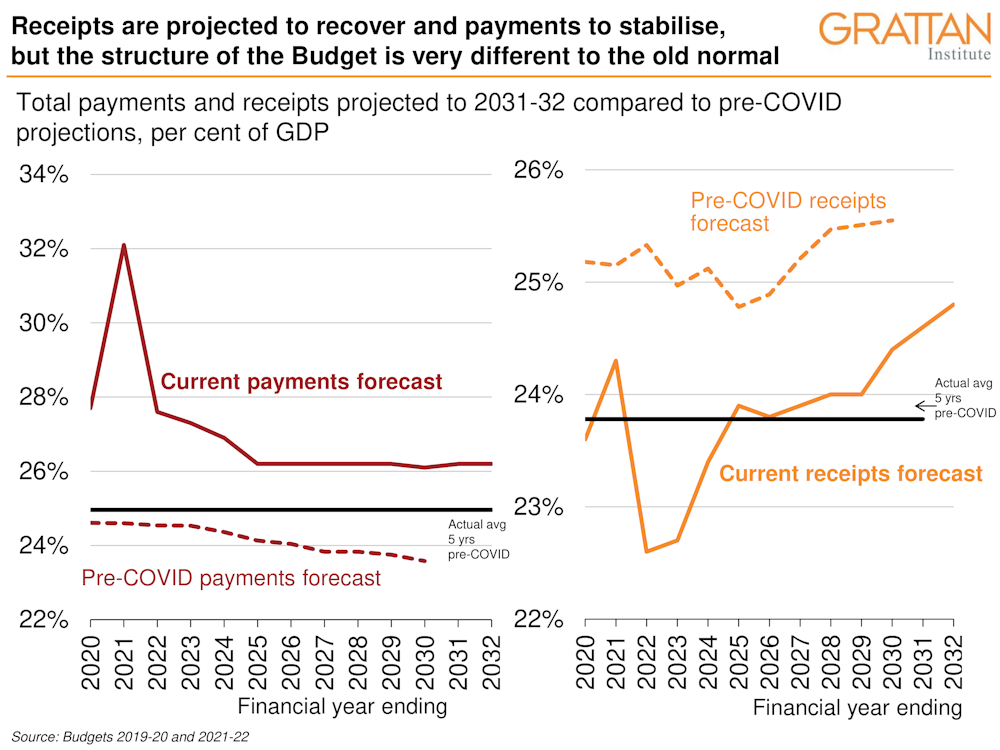
This year’s budget, handed down on Tuesday, boasts plenty of winners and minimal direct losers. Spending is lavish, with the government doing its utmost to avoid offending voters.
The big spending commitments include:
$17.7 billion for aged care over five years
$2.3 billion for mental health
$1.7 billion in changes to childcare
$1.1 billion for women’s safety
$1.9 billion for the rollout of the COVID vaccine
$20.7 billion in support for business through tax breaks
$2.7 billion in new apprenticeships
$15 billion over a decade for infrastructure
$1.2 billion for the promotion of a digital economy.
Simon Birmingham, finance minister, and Jim Chalmers, shadow treasurer, are our post-budget guests on the podcast.
This is Birmingham’s first budget as finance minister. Usually, it’s the finance minister’s unpopular task to find spending cuts – but this time, these are minimal. Birmingham’s message to critics on the right of politics, who are claiming the government has given up the debt fight, is:
“You don’t manage to achieve budget sustainability and ultimately balanced budgets some time down the track without actually maintaining and having a strong economy that has strong jobs growth. And so this time, where we have an uncertain international environment [and] fragility in terms of confidence, because of those global uncertainties, we need to make sure we maintain the COVID recovery.”
And he notes, “debt is actually forecast to be lower over each of the next 10 years than was the case in last year’s budget.”
The budget includes assumptions that the international border will open around mid-2022, and that the Australian population would be fully vaccinated by the end of this year. Asked how “solid” these assumptions are, Birmingham says:
“We have used best assumptions that we think are cautious assumptions and realistic ones. But we equally acknowledge with honesty that these are challenging times, uncertain times.
“And so they are just that – assumptions.”
On the issue of debt, Chalmers says it’s not just the level of the debt that matters, “it’s the quality of the spending”.
He says the budget is “riddled with rorts” and “weighed down with waste”.
“There are new slush funds in last night’s budget, and that means we’re not getting the bang for buck that we need to be getting in terms of jobs and other other important objectives.”
Labor has homed in on flat wages, arguing working Australia’s are “copping a cut in their real wages”.
Ultimately, the budget has failed working people, says Chalmers.
“If the government is prepared to intervene in the economy as they have been and spray around what is an extraordinary amount of money, then you’d think that working people would actually get a slice of the recovery.”
“It’s a pretty extraordinary admission of failure.”
Māori Party co-leader Rawiri Waititi has been ejected from New Zealand’s Parliament for doing a haka in protest against questions by the Opposition about race-based policy.
Opposition conservative National Party leader Judith Collins was asking Prime Minister Jacinda Ardern about her views of the He Puapua report, which provides recommendations to the government about how it can give effect to Māori self-sovereignty under the 1840 Treaty of Waitangi.
Waititi called on the Speaker of the House Trevor Mallard to intervene on what he called “racist propaganda” against Māori in the House.
Mallard ruled the views expressed in the House did not reach an inappropriate standard.
He warned Waititi when he raised another point of order that relitigation would put him at risk of expulsion from the House.
Waititi said views on indigenous rights should only be determined by the indigenous tangata whenua – which he followed up with a haka.
He was expelled from the House.
Green MPs Marama Davidson (co-leader) and Ricardo Menéndez backed Waititi’s action with Davidson tweeting support for the “calling out [of] the absolute ongoing racist comments” by Collins.
Kia ora @packer_deb and @Rawiri_Waititi for calling out the absolute ongoing racist comments from Judith Collins in the House just now. This House absolutely deserves better than a narrative that harms tangata whenua communities and damages a pathway for true Tiriti justice.
— Marama Davidson MP (@MaramaDavidson) May 12, 2021
Solidarity with @packer_deb & @Rawiri_Waititi for challenging racism in the House and reminding us that how we discuss policy can result in real harm to the communities we serve.
The food we eat, the clothes we wear, the air we breathe, the water we drink – it’s all underpinned by healthy and productive soils. Since Europeans arrived in Australia, the continent’s soil has steadily been degraded. Yet, until now, we’ve lacked an integrated national approach to managing this valuable and finite resource.
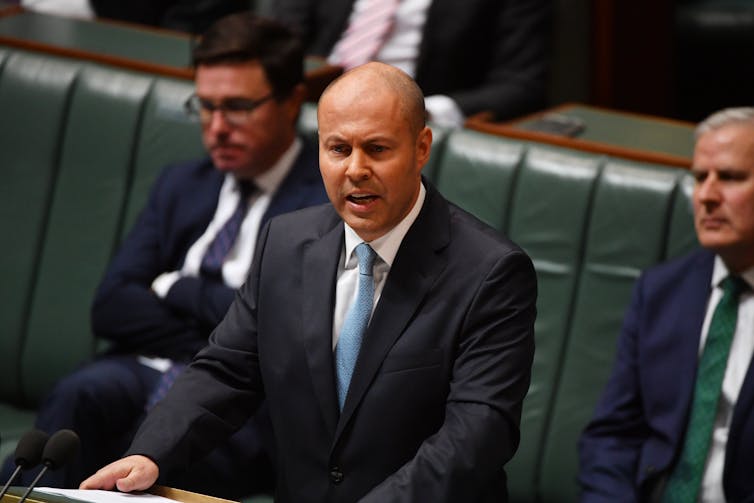
That changed in last night’s federal budget, when Treasurer Josh Frydenberg announced almost A$200 million for a National Soils Strategy. The 20-year plan recognises the vital role of soils for environmental and human health, the economy, food security, biodiversity and climate resilience.
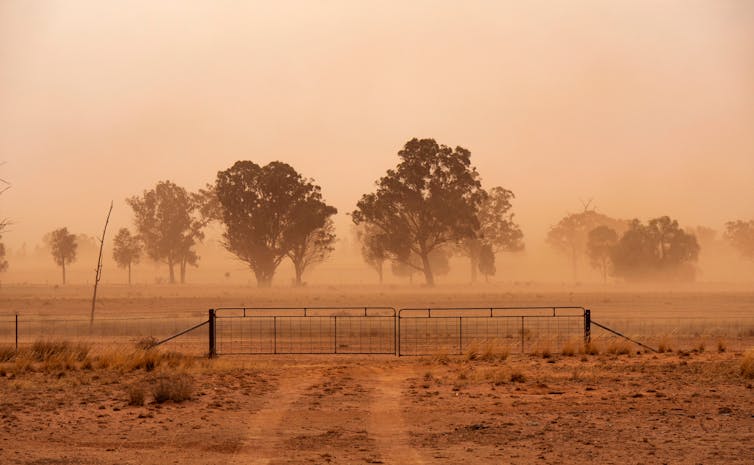
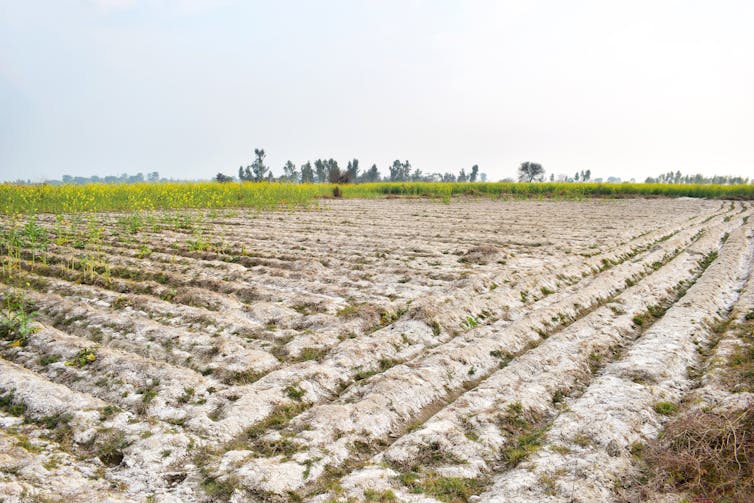
Our soils face a range of threats, including the loss of prime agricultural land, erosion, acidification, salt accumulation, contamination and carbon loss. Climate change also puts pressure on our soils through through droughts, storms, bushfires and floods.
We contributed expertise as the soil policy was being developed, and believe the final strategy represents a long-needed turning point for this crucial natural asset.
Australia’s soils have been degrading since European settlement.Shutterstock
Why soil matters
Soil contains organic matter, minerals, gases, water and living organisms. It is slow to form – the average rate of soil production globally is around 114 millimetres per 1,000 years – and is considered a non-renewable resource.
Soil underpins a myriad of economic activities. In Australia, it directly contributes about A$63 billion each year to the economy through agriculture production alone.
Healthy soil is necessary for:
food and fibre production
filtering water and retaining sediment to ensure healthy landscapes
maintaining air quality by preventing dust storms
carbon storage to help mitigate climate change
environmental functions such as plant growth
human nutrition (soil provides nutrients to plants and animals which are transferred to humans once consumed)
many drugs and vaccines upon which humans rely, such as penicillin
safe infrastructure (acid sulfate soils and salinity can damage structures such as housing, bridges and roads)
resilience to natural disasters such as storms, bushfires, floods and droughts.
However, land degradation, climate change and poor management practices threaten our soil resources.
Until now, Australia has lacked a nationally consistent approach to monitor soil health, nor a readily accessible means of storing that data. That means at a national level, our understanding of soil condition, and how it’s changed, has been limited.
Soil monitoring has largely been conducted through various regional, state and federal programs. These often operate in isolation and have differing aims and objectives. And overall investment has not been large or quick enough to create broad improvements in soil health.
In comparison, well-established standardised national systems exist to monitor terrestrial ecosystems, weather, climate and water. These allow an assessment of longer trends and changes to baseline conditions.
The need for a national soil assessment was recognised as far back as 2008. And there have long been calls for long-term monitoring, consistent information and baseline data collection.
The funding will help farmers monitor the health of their soil.Shutterstock
Change from the ground up
Importantly, the strategy takes a long term view of sustainable soil management. It also considers soil beyond its traditional role in agricultural production and explicitly identifies criteria to measure progress.
The strategy has three arms:
1. Prioritise soil health
This goal takes a “soils first” approach in that sustainable soil management is the primary consideration in policy development and management strategies. This recognises how environmental and agricultural problems can start with poor soil management and create further challenges. For example, soil acidification can lead to declines in terrestrial biodiversity, and soil constraints must be addressed first to arrest this.
2. Empower soil stewards and innovation
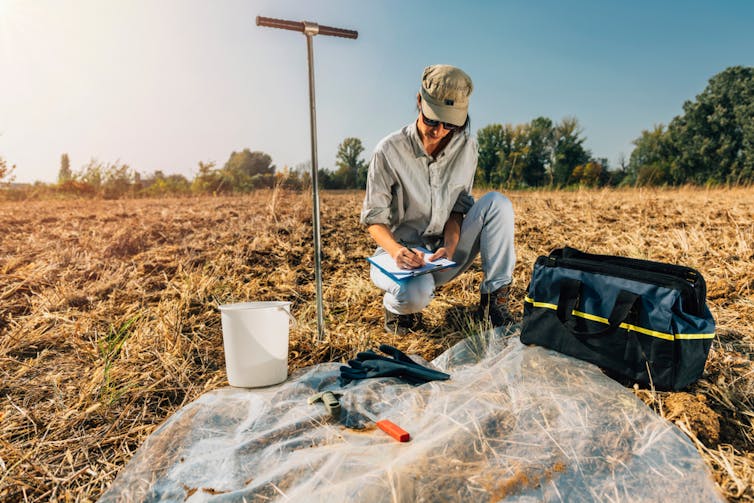
This approach gives incentives to farmers and other land managers, such as rebates for sampling to determine the soil carbon levels. Carbon is an important measure of soil condition. Gathering such information will help land managers arrest the decline in soil condition, enhancing productivity and soil health.
3. Secure soil science
This approach aims to increase soil knowledge through standardised data collection, management and storage. It will allow for more informed decisions using reliable, up-to-date, accessible information.
Part of this aim involves strengthening training and accreditation programs, and integrating soils into the national school curriculum. This will help create a new generation of soil experts to replace the current crop which is trending to retirement.
The strategy aims to train a new generation of soil experts.Shutterstock
On solid ground
Overall, the National Soils Strategy aims to deliver coordinated on-ground action and improve research, education and monitoring. The strategy broadly aligns with the needs of those who had input into its development, including governments, industry, academia, Landcare groups and non-government organisations.
However, while the importance of Indigenous land management practices is clearly acknowledged, the integration and incorporation of these practices should be more clearly defined.
The monitoring program encourages farmers to test their soil and incorporate the de-identified results in to the national database. Care should be taken to ensure sampling is done appropriately for the data to be useful.
The time frame for the initial phase of the strategy is short – pilot programs need to be delivered between two and four years. This will be challenging to deliver.
Separate to the strategy, the budget allocated A$59.6 million to soil carbon initiatives. There is increasing recognition of how improved land use and management can help boost soil carbon stores, which is key to tackling climate change. But storing carbon permanently in soils comes with a number of challenges. This funding may be appropriate only if directed to address those areas where knowledge gaps exist.
But overall, the strategy fills a vital gap – providing a national vision and shared goals for managing precious soils across Australia.
Last week, out of left field, the government placed a three-year embargo on normal public sector wage bargaining, essentially a salary freeze. While there has been a certain amount of backtracking since, it is clear that the government has been very committed to ‘fiscal consolidation’ (aka ‘austerity’).
What were they thinking? What problem were they trying to solve?
Some governments are obsessed with their own debt levels, and prioritise the reduction of their own household debt over the economic management of the country. Such governments set themselves on a path of opting out of governance; it would be like teachers opting to save their employers money by not teaching.
Debt is a relationship.
The New Zealand government sees itself as a debtor who has gained recent favours from begrudging creditors who would really much rather spend their money on themselves, or lend that money to parties other than the government.
In real life, debt occurs as a contract between two parties who are both advantaged by that relationship; the parties to each contract are creditor (who owns the debt, as an asset) and the debtor (who owes the debt, as a liability).
The debt relationship that almost everyone is familiar with is depositing money in a bank. Householders are creditors, and banks are debtors, in this relationship.
Who decides when the relationship ends? It is normally the creditors who end (or diminish) the relationship, by withdrawing their money. Indeed it would seem very weird if the banks that we lend to keep trying to ‘pay us back’. Rather the banks expect to service their debt to us by paying us interest, and by allowing us to withdraw when we want to withdraw. (We all understand that, if most of a bank’s depositors want to recall their funds on the same day, then the bank would be unable to comply; banks, like almost all other debtors, invest – ie lend so someone else can spend – their borrowed funds. Banks are, indeed, intermediaries; we expect them to invest the funds we deposit with them, so that they can pay us interest.)
So, in life out of the public finance rabbithole, it is creditors who initiate the debt repayment process. The obligation of a debtor is to service the debt, including making sufficient provision to satisfy those creditors seeking repayment.
Government Debt
In the case of government debt, the creditor is essentially the wholesale banking system. Do we see any signs of our wholesale bankers asking government to reduce its liability to them? Of course not! Government debt is a mutually advantageous arrangement between creditor and debtor. Government action to reduce its debt to the banks would be like banks acting to get households to reduce their bank term deposits. Dumb and dumb.
Banks (in the broadest sense of this term) like to lend to – invest in – five sectors: businesses, unsecured consumers, asset holders, governments, and foreigners (especially foreign banks). They like to expand rather than to contract their balance sheets; ie to lend more to their customers, not less.
Conservative economists strongly emphasise banks’ lending to businesses; and deemphasise banks’ lending to governments. That is, they see it as right and proper that businesses – collectively – should have large and expanding debts, and that indeed it is business debt (aka business investment) that drives economic growth. So it is they – not the banks – who see bad government debt as ‘crowding out’ good business debt. That’s the source of the general opprobrium towards government debt, and that opprobrium resonates with the many householders who wrongly think of debt as an inconvenience to their creditors.
Who should the debtors be?
The whole capitalist system – with banking at its core – depends on debt. The majority of people who believe in economic growth necessarily also believe that total debt must be expanding.
Conservative economists at least have a consistent position; that business debt (lending to business) is good, that certain types of secured debt are also good (specifically house mortgages and hire purchase), and that a degree of foreign lending is also good. In the twenty-first century this ‘good-debt bad-debt’ thinking, however, represents another rabbit hole. The reality since the turn of the century is that the global corporates have become a creditor sector; in the aggregate, businesses now save more than they invest.
Bankers, unlike conservative economists, are indifferent. They will lend, rationally, on the basis of risk and reward.
For banks, lending to businesses is risky, because it is ‘secured’ only on the future revenues of their business customers; in an increasingly uncertain world, those revenues are also increasingly uncertain. Banks compensate for such ‘lack of security’ risks, by charging their business customers higher interest rates. While substantial business debt is an economic necessity, banks, as creditors, do sometimes recall that debt. (As the saying goes, a banker will lend you an umbrella when its sunny, but may ask you to repay it when it is raining.)
Also risky is unsecured consumer lending. (And semi-secured lending, in which a debtor’s likely future salary is the security.) This also drives the 21st century economy, especially in the form of credit card debt. The high risk is compensated for by charging high interest rates. Debtors like to repay these debts as quickly as possible, because of the high servicing costs associated with high interest borrowing. Creditors in this market need to keep finding new debtors to compensate for the repayments of existing debtors.
Secured lending is widely favoured by modern banks. This is lending secured by assets such as shares, land, houses, managed funds, and consumer durables. The problem here is that it fuels speculative behaviour through inflating the prices of those assets, especially, shares and land. Thus, too much of this type of lending is revealed as systemically unstable when asset prices periodically deflate. Banks which consider themselves too big to fail tend to give insufficient weight to this problem when they decide who to lend to. Thus, generally, this type of lending is seen by banks as less risky than the previous two categories. Interestingly, however, in the late-2000s’ financial crisis, the finance companies (included as ‘banks’ in this discussion) which failed were those doing secured lending; while few if any of the finance companies lending to the poor at high interest rates failed, some positively thrived).
A keenness to lend to foreigners – as some countries in northern Europe and East Asia like to do – is a political mercantilist strategy; historically prevalent as a political strategy, but not necessarily profit-maximising to banks. An important form of foreign lending is lending to banks in other countries. Indeed, when interest rates have been higher in New Zealand than in Australia, to maximise profits the Australian banks would lend to their New Zealand counterparts. In effect, much New Zealand mortgage debt was owned by Australian creditors.
Government debt has always been popular with banks. While it is low return, it is also low risk. Central Government debt is secured by the governments’ unique powers, the power of taxation. Even governments facing political constraints on raising taxes are seen as secure debtors because of their special reserve powers to tax their subjects. Governments are – and should be – borrowers of choice in times of emergency or great uncertainty.
Whenever capitalist economies face high levels of risk, banks prefer to lend more to governments. There is an ensuing natural feedback mechanism, in that non-corrupt government spending facilitated by increased government debt serves to reduce the amount of risk in the wider economy. The reduced risk then facilitates renewed lending to non-government unsecured and semi-secured debtors. The resulting private spending then results in more (tax) revenue to governments, and government debt to bankers automatically falls relative to the size of the economy.
One of the most destabilising types of event in financial history occurs when governments try to upset this benign arrangement by repaying debt to their banker creditors who do not want to be repaid, and who do not have enough good unsecured and semi-secured alternative debtors lined up. In this situation, economies may directly go into a state of depression – as in the 1930s, and as in the European Union in the early 2010s. Or, to forestall economic depression, banks may be induced into more of the speculative secured lending that creates financial bubbles, financial instability, and eventually economic depression.
This is the inept financial destabilisation that the present New Zealand government is indulging in. It’s a classic case of a lose-lose financial policy. When governments obsess about their financial deficits in uncertain times, everyone loses. Salaried workers lose, the poor lose, bankers lose (eventually), and governments lose.
————-
Keith Rankin, trained as an economic historian, is a retired lecturer in Economics and Statistics. He lives in Auckland, New Zealand.
The federal budget’s allocation of A$2.3 billion in mental health and suicide prevention funding will be welcome news for the mental health services sector and for people who have struggled to find adequate support.
The recent Productivity Commission and Victorian Royal Commission reports into mental health have emphasised the major effect of mental ill health on Australian society, as well as the public’s concerns about the inadequacies of existing service provision.
The big expenditure items announced in the budget for mental health largely involve increasing treatment services, including:
A$487 million to establish a national network of adult mental health centres
A$278 million for the expansion of Headspace youth services
A$288 million for repetitive transcranial magnetic stimulation (rTMS), a treatment for depression
more than A$100 million each for digital mental health services and group therapy, supporting the participation of family and carers.
Although in time these pledges are likely to make it easier for many people to access mental health services, it’s important to understand this won’t necessarily translate to improved mental health in Australia.
It’s a logical assumption that greater expenditure on mental health treatment services will improve mental health. But it’s an uncomfortable truth that neither Australia, nor any other comparable country, has managed to improve the mental health of its population by increasing the provision of mental health services.
However, over this period, the Australian Bureau of Statistics has been tracking our national mental health — and it hasn’t improved at all. For young people, if anything there’s been a worsening in recent years. Further, the suicide rate has been trending up.
Treasurer Josh Frydenberg has handed down the 2021-2022 federal budget, and it includes A$2.3 billion for mental health.Mick Tsikas/AAP
Not necessarily the right services for the right people
There is plenty of evidence from randomised controlled trials showing treatments can work. For example, a range of psychological treatments can be effective for depression and anxiety disorders. Also, antidepressants can be helpful for people with more severe depression or anxiety.
However, what people get in practice is not necessarily what’s evaluated in trials, nor is it generally consistent with the standards experts set in clinical practice guidelines.
For example, people typically receive far fewer sessions of psychological therapy than recommended despite the increasing availability of services. Similarly, GPs often prescribe antidepressant medications for people with milder problems who are unlikely to benefit from this type of treatment.
We need greater quality of services
In the past, we’ve seen that increasing services leads to progressively more people receiving services that are too thinly spread or poorly targeted to make a real difference. What we need is to improve the quality of services for people with more severe problems and increase the availability of self-help options for people with milder problems as an alternative to specialist mental health services.
We don’t know whether the additional services funded in the budget will make a difference. It’s important we focus on the longer-term benefits of these services to mental health rather than on the immediate increases in services the money will buy.
Pleasingly, the budget does allocate A$117 million to establish a national database on service delivery, performance and outcomes across the mental health system. This will help pave the way to a greater focus on whether the services are making a difference to national mental health.
Another reason past government expenditure has not improved national mental health is that prevention has been neglected.
This budget takes some small steps in the right direction in this regard, with some focus on childhood, where mental health problems often begin. There’s A$46 million allocated to parenting education and support, and A$54 million to establish child mental health and well-being hubs.
Establishing child mental health and well-being hubs is a positive step in terms of preventing mental ill-health.Shutterstock
There is also expenditure in other areas that will reduce risk factors for mental health problems, including sexual abuse, family violence, homelessness and unemployment. However, the balance of mental health spending is still very much on treatment rather than prevention.
The long haul: fulfilling the Productivity Commission’s vision
The Productivity Commission’s final report on mental health, released in November last year, set out a grand vision for major reform. It recognised that improving mental health required action across many areas of government, not just treatment services.
The danger was always that the Commission’s recommendations would be cherry picked in budgets and election promises, and the grand vision lost. While this latest federal budget has some promising offerings for mental health, the grand vision remains to be fulfilled.
Source: The Conversation (Au and NZ) – By Jo Caust, Associate Professor and Principal Fellow (Hon), School of Culture and Communication, The University of Melbourne
The arts were in free fall this time last year. COVID-19 restrictions had shut everything down and artists and arts organisations were reeling from a dramatic loss of income, as well as the prospect of a bleak future. Somewhat belatedly, the federal government offered various forms of assistance from late June onwards.
Given the continuing challenges, has the government brought the arts in from the cold in Tuesday‘s budget? The budget statement notes the effects of the pandemic on the creative and cultural sector “have been severe” and the sector “continues to feel the effects of COVID‑19 as social restrictions are eased.”
The budget delivered around $300 million to “help activate and support the successful re‑opening of Australia’s creative and cultural sector”.
It is encouraging the government has admitted to the challenges facing the sector. But has it really come to the rescue with new money, or is it playing with the figures? There are some winners here, but sadly, overall, not a huge amount has changed.
At the same time, important national entities, such as the National Archives, are ignored. The ABC (funded triennially) will receive an increase of $4.7 million (0.45% of its budget), but will then see its budget decline by 0.85% in 2022-23. Is the government trying to slowly erode the ABC in the longer term?
The Australian Film and Television School will also lose $2.3 million (9.3% of its budget), a sizeable amount for a relatively small operation. Screen Australia, however, receives an increase of $17.6 million (19.5% of its budget). SBS also gets an increase of $13 million (4.4%). However, this SBS funding is also expected to decline after 2021-22.
Many initiatives in this $300 million have already been announced. The extra $125 million for the arts COVID package RISE was announced in March and we were told on the weekend about an extra $79.9 million for Australia’s national collecting institutions.
There is a new Regional Arts Fund of $3 million for local museums, galleries and historical societies and another fund of $11.4 million for other regional arts activity. In April, Arts Minister Paul Fletcher spoke of a desire to re-allocate arts funding from the city to the regional areas.
A further $10 million has been provided to Support Act, to help musicians and road crew with financial or health problems. They were given $10 million in April 2020 for the same purpose.
Bluesfest was cancelled at the eleventh hour this year due to Covid.Jason O’Brien/AAP
$7.4 million for the Australian National Maritime Museum
$7.1 million for the Bundanon Trust
$11.3 million for the Museum of Australian Democracy at Old Parliament House
$2 million for the National Film and Sound Archive
$34.6 million for the National Gallery of Australia
$9.9 million for the National Library of Australia
$6 million for the National Museum of Australia
$1.6 million for the National Portrait Gallery of Australia.
While $32.4 million of this will go towards delivery of public services and programs, a further $47.5 million is provided for capital works.
The Museum of Australian Democracy at Old Parliament House is a winner here. So too is the Bundanon Trust, which thrives under this government. Perhaps it helps to be located in a marginal seat.
The increase for the National Gallery of Australia is particularly welcome, given in 2020-21 its funding was cut by $7.8 million (or over 9% of its budget). However, out of $34.6 million, most of this ($28.6 million) is for capital maintenance.
Visitors admire Sunflowers by Vincent Van Gogh at the National Gallery of Australia in Canberra earlier this year.Mick Tsikas/AAP
The film sector has received more targeted support; much already announced. In March, we learned $20 million would support independent cinemas across Australia. In April, another $50.8 million was allocated to extend the Temporary Interruption Fund to help restart film production put on hold in 2020. A further $75 million will reinstate the producer offset rate for film, which provides a tax rebate for producers of up to 40% .
An extra $11.9 million will also be given to the Australian Children’s Television Foundation, spread over four years from 2021-22.
What about individual artists?
In 2021-22, the Australia Council will receive almost $219.8 million, an increase of around $5 million (or around 2%) on 2020-21 funding. It is described in the budget papers as representing “indexation, net of the applicable annual efficiency dividend, and $3.6 million to provide a non-recurring uplift to the Playing Australia program”.
The RISE Scheme has now had three rounds of funding allocations. By May 2021, $100 million had been allocated (leaving a balance of $100 million to the end of this year). Most funding ($83.4 million) has gone to the performing arts (theatre, music and dance), with $12.6 million for the visual arts, $2.4 million to literature and $1.5 million to film. $25.5 million out of this has been allocated to activities in regional areas.
Individual artists, most disadvantaged by COVID, have continued to receive the least additional support. Sadly, it will be some time before normal arts activity resumes in Australia, especially music concerts or festivals.
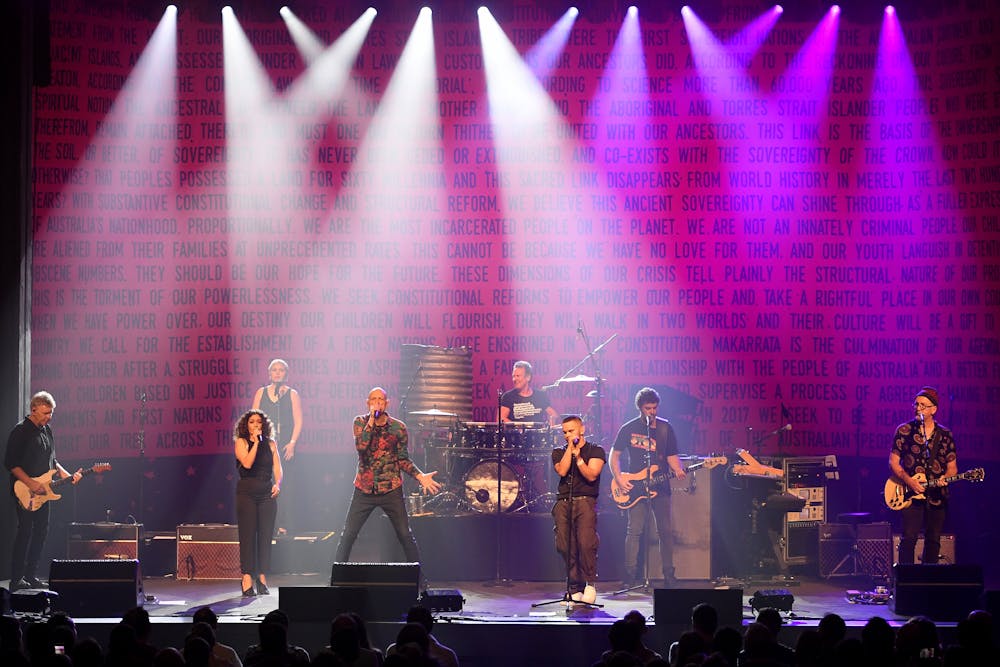
Midnight Oil toured in January this year but many musicians and artists have struggled at this time.Dan Himbcrechts/AAP
While it is encouraging to see the government mention the arts in its budget, given its “disappearing” of the arts over the past two years, it needs to address the whole complex ecosystem of the arts, rather than one or two aspects of it. It also needs to increase funding to the Australia Council so individual artists and small organisations get adequate support.
The Government’s wage subsidy scheme may have incorrectly paid out billions of dollars to ineligible businesses, and this is not being audited. That’s the conclusion to be taken from the Auditor General’s report, released yesterday. It is highly critical about the lack of checks and balances on a scheme that has doled out $14bn to businesses.
Although some reports see it as simply an issue of bureaucratic management, it has huge financial consequences for the state, and for public trust in government. Auditor General John Ryan says the money being paid out in what critics warned was “corporate welfare” has not actually been audited, and the public cannot have confidence that the Government is on top of this.
The issue goes back to the launch of the wage subsidy scheme, when questions were raised about whether the scheme would be vulnerable to fraud and corruption, and cost much more than was required to keep the economy going. In response to these concerns, the Government promised audits would take place. Since then, whenever critics have again questioned the probity of the scheme, politicians have deflected this by claiming that the necessary audits were being carried out. It turns out that audits have not taken place, and various assurances about the integrity of the system amount to political spin.
The report by the Auditor General says that what the Government and Ministry of Social Development (MSD) have claimed are “audits” are, in fact, loose phone calls to the recipients of the billions of dollars, checking they still believe they qualify. The report can be found here: Management of the Wage Subsidy Scheme.
Reporting on the Auditor General’s investigation, the Herald’s Hamish Rutherford highlights this report’s conclusion that MSD has been being entirely lax in its approach to checking businesses were actually entitled to receive the wage subsidy. Rutherford says the Auditor General “did not believe MSD had determined the scale of the problem”, and he criticised the department for labelling their low-level checks as “audits” when they were clearly nothing of the sort – see: Auditor-General says ‘audits’ of wage subsidy applicants simply sought verbal response.
According to the report, the so-called audits “mainly consisted of a verbal confirmation of information by employers”. Instead of vague telephone calls, the Auditor General recommends MSD actually “seek written confirmation from applicants of their compliance with the eligibility criteria and the obligations of receiving the subsidy”. Independent and documentary evidence is also recommended.
Public confidence and trust in the scheme is vulnerable, according to the report. Therefore, it is recommended that MSD toughen up their approach, including prosecuting businesses who incorrectly claimed the wage subsidy, and recovering this money.
In a follow-up article, Rutherford reveals: “The Ministry of Social Development is yet to begin any prosecutions for abuse of the $14 billion wage subsidy scheme, as it comes under fire for its work to establish the extent of misuse” – see: MSD under pressure to announce prosecutions under wage subsidy scheme amid criticism of ‘audits’ (paywalled). Rutherford says “The Auditor-General also urged MSD to prioritise its enforcement work, including prosecutions, not only to recover money, but also hold businesses to account ‘for potentially unlawful behaviour’.”
BusinessDesk journalist Brent Melville highlights the Auditor General’s lack of confidence that MSD is identifying cases where prosecution is required and money should be returned – see: Auditor-general: Covid wage scheme admin was lax (paywalled).
MSD comes under further fire in RNZ’s coverage, with a focus on the government department diverting staff from beneficiary fraud investigations to this issue, rather than employing additional staff – see:MSD told to further investigate wage subsidy scheme payments.
According to RNZ: “How those resources will be deployed over the coming months remains a concern, as efforts to recoup wage subsidies continue. The report stated it was likely between 40 and 50 MSD staff who usually worked on benefit fraud would be working on subsidy investigations for another 12 to 18 months.”
The report warns this may encourage corner-cutting: “We understand that the public organisations involved in administering the Scheme want to get back to their core services as quickly as possible. However, we are concerned that this will disincentivise continued efforts on post-payment integrity work.”
RNZ has also reported the views of inequality researcher Max Rashbrooke who highlights that MSD are inconsistent in taking a “softly-softly” approach with businesses when they are much tougher on beneficiaries: “If MSD thinks you might be a benefit fraudster they pursue you to the ends of the earth, and with this scheme, MSD just rang people up and said, you know, ‘did you do everything correctly?’ and if people did then that was it.”
Wage subsidy critic and tax researcher Michael Gousmett is cited as saying the Government should have insisted businesses also have their applications audited at the start of the process, saying “There was no requirement to demonstrate your financial ability to sustain yourself for a period.”
See also Thomas Coughlan’s article on the report:Auditor-General gives seal of approval to Covid-19 wage subsidy, with some suggestions. He highlights the Auditor General’s criticisms of the design of the wage subsidy scheme in regard to the criteria for eligibility, which includes the very vague requirement that businesses have first taken “active steps to reduce Covid-19’s impact on their business”. This is criticised as “open to interpretation”, making verification of legitimate applications difficult.
Previous questions about wage subsidy auditing
The Government and MSD have been claiming for a long time that “auditing” was taking place into recipients of the wage subsidy. For example, back in October MSD asserted that the audits were happening on an apparently large scale – see Nita Blake-Persen’sWage subsidy questions raised after more than 10,000 audits.
It turns out that even this figure of 10,000 was relatively low, with Victoria University of Wellington tax professor Lisa Marriott telling RNZ, “I think that does need to be much higher, particularly because there are around eight per cent of those cases that are being referred onwards for some level of investigation.” Marriott is reported as saying “there are grounds to look for more” abuses of the scheme hoping “the same rigour will be applied to the companies as is applied to benefit fraud.”
In January, Christchurch philanthropist Grant Nelson warned of the lack of auditing taking place, and called for much tougher measures to ensure the subsidy payments had only been given to businesses truly in need – see Nita Blake-Persen’s Estimated $5b in wage subsidies paid out unnecessarily – philanthropist.
Drawing attention to the small number of applications being checked, Nelson argued “any audits they do really are only reaching a very, very few of those who received the wage subsidy. And that is why I think everyone who receives the wage subsidy should be contacted. If they can prove that they are entitled to it well, they can retain it. Otherwise, they should be repaying it.”
Another critic of the scheme, Jilnaught Wong, an accounting professor at the University of Auckland, suggests that rigorous auditing of payments is required because large private companies make use of “opportunistic accounting gymnastics” like “delaying revenue recognition” so that they would qualify for Covid payments while generally making large profits overall in 2020 – see Kate MacNamara’s Was the $14b wage subsidy well-spent? (paywalled).
Finally, the Auditor Generally has recommended a bigger review of the successes and failures of the wage subsidy scheme, and for a must-read view on this topic, see Bernard Hickey’s article from March: Where did the wage subsidy money really go?. The gist of the piece is that the wage subsidy was successful in its purpose, but also a tragedy in the wealth inequality that it has caused, and he raises questions about whether alternatives to employee subsidies could be used.
And in this week’s federal budget, the government has committed to welcoming back over 17,000 Australians stranded overseas over the next year, which will likely place more pressure on our hotel quarantine system.
In light of the seemingly continued spillover of hotel quarantine infections into the community, one researcher raised an intriguing possibility online: should we vaccinate all arrivals on day one of their stay in hotel quarantine?
There may be reasonably high vaccination rates among our arrivals already. But, if not, it’s definitely something worth thinking about.
In my view, overseas travellers should be considered equivalent to frontline workers, as they traverse the routes into Australia and cross through border quarantine. Therefore, they could be included in phase 1a of the vaccine rollout alongside these frontline workers.
It’s complex and there’s a lot to take into account, and vaccinating all arrivals won’t be the magic fix to our hotel quarantine troubles. But it might take the edge off some of the transmission risks.
You only have to prevent one case, which could have otherwise led to community spread and lockdown, for such a scheme to pay for itself many times over.
Here’s how it could work.
Vaccinating all arrivals could reduce infection risk
There are a number of potential ways this strategy could reduce infection risk, by:
preventing severe illness in people already infected
reducing the chance returnees will pass the virus on if they are infected, or become infected
protecting them from infection should they be exposed to the virus while in quarantine.
A Public Health England study found that a case who has had a single dose of either the Pfizer or AstraZeneca vaccine is up to 50% less likely to pass the virus on to their close household contacts.
However, when the researchers looked more closely at the timing, they found the full 40-50% reduction in transmission risk only occurred when the case received their first dose five or six weeks before becoming infected. In fact Pfizer didn’t reduce the transmission risk cases posed to others unless the first dose was given at least 14 days before the case became infected. In other words, giving returned travellers a dose of Pfizer while in quarantine might be too late to protect others.
In saying that, the same study shows AstraZeneca’s vaccine does appear to at least partly reduce the transmission potential of cases even when the dose is given on the same day that person was infected.
In those who’ve received the AstraZeneca vaccine on day zero of their infection, the chance of them transmitting the virus to their close contacts over the ten days or so they’re infectious was on average roughly 20% lower than positive cases who weren’t vaccinated.
Getting the AstraZeneca vaccine when exposed to the virus, or soon after, might therefore marginally protect the wider population if, for example, a traveller contracts the virus late in quarantine and it isn’t picked up in day 12 testing and is released from quarantine.
Both Pfizer and AstraZeneca do provide partial protection from infection within 12 days of the first dose. While this is too late for those already infected, it might still provide some protection from infection for those exposed to the virus in the later stages of their stay in quarantine.
Both vaccines also appear to reduce the risk of subsequently dying from COVID-19 with an 80% reduction in deaths reported in the UK. Some in this study were infected within seven days of their first vaccine dose, but we do not know how this effectiveness against deaths changes with time since vaccination from this report.
Nevertheless, there might be some additional value in offering vaccines to both slightly reduce transmission rates and mitigate against serious illness and death in people who do become infected.
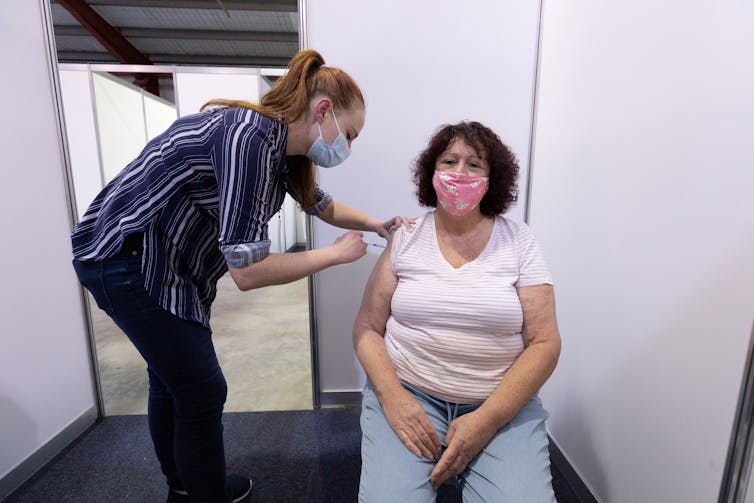
Both Australia’s current COVID vaccines offer some protection within 12 days of the first dose. This might give some protection to people who pick up the virus inside hotel quarantine.Richard Wainwright/AAP
One challenge is that AstraZeneca has more to offer in reducing transmission risk in the first critical two weeks after receiving the first jab, but Australia currently doesn’t advise it for people under 50. Pfizer is in limited supply and our vaccine rollout phase 1a and 1b recipients haven’t all been fully vaccinated yet. The relative risks and benefits of reallocating some of our vaccine supply and delivery must be carefully thought through.
Many of those arriving in Australia will likely have opted for vaccination before travel, if available to them, even if just to increase their chances of testing negative and being allowed to board their flights home. Many are arriving from countries that began their vaccination programs months before Australia.
How many returnees are already vaccinated?
The number of positive cases in hotel quarantine has grown month on month, from 160 in February to 469 in April.
New South Wales provides the most detailed information on returned travellers. Its latest surveillance report on about 21,000 returnees shows 180, or 0.8%, tested positive to COVID-19. About 75% of these positive cases tested positive by day two, suggesting they were exposed before arriving in Australia or in transit.
The report does include information on how many arrivals have been vaccinated since March 1. Of the 302 positive cases reported to the start of May, 20 had been vaccinated, with six fully vaccinated (two doses at least two weeks prior) and 14 partially vaccinated. Although, those considered “fully vaccinated” might not have been two weeks post-vaccine at the time they actually contracted the virus.
We haven’t been provided the overall vaccination rates for returnees across Australian hotel quarantine, so we can’t yet work out what percentage of arrivals are vaccinated. But if this is quite low, it strengthens the argument for offering vaccines to travellers on arrival.
At the height of the COVID-19 pandemic, Chinese President Xi Jinping enjoyed prime real estate in the centre of Serbia’s capital, Belgrade: his face plastered across a billboard with the words “Thank you brother Xi”.
The sign, courtesy of the pro-government tabloid Informer, was in response to China sending COVID-19 medical supplies to Serbia. It joined a long list of pro-China offerings of thanks from nations around the world during the pandemic in the form of overt propaganda or more subtle media messages.
A new report being published today by the International Federation of Journalists (IFJ), which I co-authored with Louisa Lim of the University of Melbourne and Johan Lidberg of Monash University, has found Beijing’s global image has benefited from the pandemic, despite its origin in the Chinese city of Wuhan.
Over half of the 50 nations surveyed at the end of 2020 reported coverage of China had become more positive in their national media since the onset of the pandemic, while less than a quarter reported it had become increasingly negative.
The change was most favourable in Europe, which scored 6.3 on a scale of one to ten, where one is the most negative and ten is the most positive. China’s image plummeted in North America, coming in at 3.5.
The overall increase in positivity coincided with an uptick in Chinese outreach. Three-quarters of the journalists we surveyed said China had a visible presence in their national media, compared to 64% in a previous survey we conducted for IFJ in 2019.
Spreading propaganda through content-sharing agreements
China has long attempted to seed positive narratives of itself in foreign media, while blocking unfavourable coverage and redirecting the world’s attention onto Western failures.
To do so, Beijing taps into foreign media ecosystems with tailored offers of access and resources. It exports its propaganda to foreign media organisations through content-sharing agreements and memoranda of understanding with state-sponsored media outlets like Xinhua and China Daily.
For example, Italy’s state-run news agency ANSA now publishes 50 Xinhua stories a day on its news wire, with Xinhua taking editorial responsibility for the content.
The desired outcome is for international media to amplify Chinese messages in their own languages in the pages of their own news outlets.
In this, COVID-19 acted as a catalyst. China activated its media dissemination channels overseas, inundating foreign outlets with domestic and international news offerings in local languages in a bid to seed positive stories about its management of the pandemic.
It also updated its toolkit with new tactics such as disinformation and misinformation, while clamping down on foreign reporting inside China through visa denials and journalist expulsions.
This vacuum in coverage of China by the foreign media created demand for stories from Chinese state channels. And this is being filled with state-sponsored content already available through content-sharing agreements.
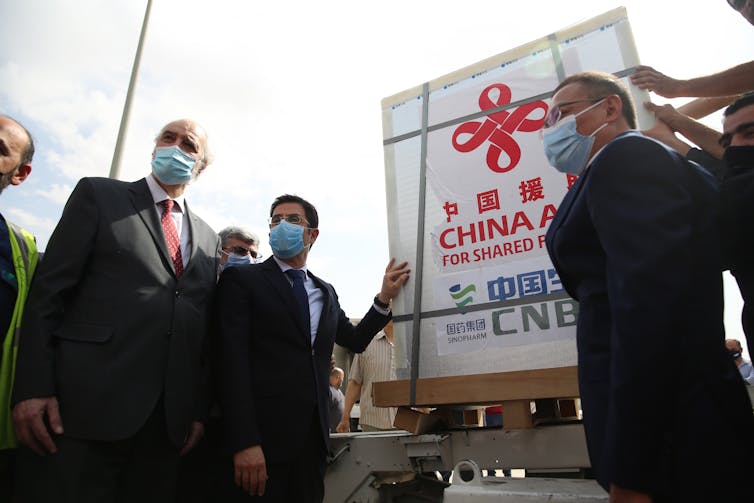
China’s ambassador to Syria, Fing Biao, poses with Syrian officials as a planeload of Sinopharm vaccines arrives in Damascus.YOUSSEF BADAWI/EPA
New disinformation campaigns
As one of the first countries struck by the pandemic last year, Italy was the target of an aggressive Chinese disinformation campaign.
Chinese foreign ministry spokesmen and ambassadors also shared on social media footage purporting to show Italians on their balconies applauding Chinese COVID aid as the Chinese national anthem was sung in the background. The footage was doctored from scenes that originally showed Italians clapping for their own medical workers.
As one Italian journalist commented during an IFJ roundtable discussion,
This fake news arrives even more rapidly than the virus.
More than 80% of the countries we surveyed expressed concern about disinformation in their national media. Respondents blamed China at about the same rate as Russia and the US. However, almost 60% of countries were unsure who was responsible for disseminating the false and misleading content.
Since the start of the pandemic, Chinese disinformation efforts have become a new part of the Chinese Communist Party’s propaganda tactics. State actors nicknamed “wolf warrior diplomats” took to social media platforms banned inside China, such as Twitter, to pump out a succession of conspiracy theories. These were then amplified by an army of Chinese ambassadors, foreign ministry spokesmen, and paid trolls.
In Serbia, the Digital Forensic Center identified 30,000 tweets originating from Serbian accounts containing the keywords “Kina” (China) and “Srbija” (Serbia). These tweets praised Chinese aid and lambasted the European Union for its lack of assistance during the pandemic.
More than 70% of the content was produced by a huge pro-Serbian government network of bot accounts. During an IFJ roundtable discussion, one Serbian journalist said the government of President Aleksandar Vučić “does the work for China”.
Throughout the pandemic, Chinese medical aid was touted through mainstream Serbian media as “gifts”, despite the Serbian government’s refusal to reveal whether it had paid for the aid. Such coverage has a clear, positive impact on China’s image.
An office building in Belgrade with a billboard showing Serbian and Chinese flags reading, ‘Iron friends, together in good and evil!’Darko Vojinovic/AP
Our report for the IFJ also found nations receiving China’s COVID-19 vaccine were more likely to cover China’s handling of the pandemic in a positive light.
Two-thirds of recipient nations reported coverage had become more positive over the past year. The dominant narrative in their national media, they said, was “China’s fast action against COVID-19 has helped other countries, as has its medical diplomacy”.
Despite this, most respondents cited Chinese attempts to control their national media as clumsy and ineffective.
In Italy, journalists talked about how the country has “the necessary antibodies” to identify fake news, while in Tunisia, they said China has “no impact on journalistic content”. And in Serbia, Chinese propaganda was deemed irrelevant.
But China’s efforts are making a real difference in many countries around the world, slowly but steadily redrawing the narrative landscape one story at a time.
Source: The Conversation (Au and NZ) – By Marek Kowalkiewicz, Professor and Founding Director of QUT Centre for the Digital Economy, Queensland University of Technology
The federal budget for 2021-22 promises A$1.2 billion over the next six years to support the Digital Economy Strategy, a plan to make Australia “a leading digital economy and society by 2030”.
We are well placed to be a leading digital economy and have strong foundations, but many countries are investing heavily in their digital futures.
This may sound like a lot, but a closer look at the strategy and funding announcements, compared with what other countries are doing, shows we may not be so well placed after all.
Countries such as France and Singapore have implemented similar initiatives, with one key difference: they are spending about ten times as much money as Australia.
To see how Australia compares worldwide, we can look to the most comprehensive global analysis of the digital evolution of nations, the Digital Intelligence Index produced by researchers at Tufts University in the United States.
This index looks at many factors, such as digital payment and logistics infrastructure, internet usage, regulations and research, to give each country scores for the current state of its digital economy and also how fast the digital economy is developing.
In the 2020 edition, Australia ranked as the 17th digital economy in the world — behind Sweden, Taiwan, New Zealand, and the leading nation, Singapore. In 2017 Australia came 11th, so we are already dropping down the rankings.
Just to maintain our position, we need to improve at least as rapidly as those behind us. Prime Minister Scott Morrison has acknowledged this, noting “we must keep our foot on the digital accelerator to secure our economic recovery from COVID-19”.
However, the Digital Intelligence Index ranks Australia 88th of the 90 countries analysed when it comes to our speed of improvement. The only two countries slower than Australia are Hungary and Nigeria, and there are 87 digital economies developing faster than us.
Since 2017, countries such as Slovenia, Egypt, Greece and Pakistan, which used to grow more slowly, are moving faster, increasing the pressure from the back of the pack.
Denmark and Sweden, two countries ahead of us in the Digital Evolution ranking above, used to grow slower, giving us a chance to overtake them. Not anymore. They have now picked up speed, and are increasing the gap we need to cover even to catch up with them.
The right ideas, but not enough funding
The Digital Economy Strategy package, announced in the budget, covers a broad range of initiatives. They are grouped into eight priorities, covering education, support for small and medium enterprises (SMEs), cyber security, artificial intelligence (AI), drone technologies, data sharing, support of government services, and tax incentives.
It is promising to see government’s dedicated investment, particularly in securing future skills and building Australia’s AI capability. But it is concerning to see the spending on some priorities fails to reflect the importance of these topics.
The federal government recognised the need for upskilling Australians. According to the Australia’s Digital Pulse report compiled by Deloitte and the Australian Computing Society, we will need 60,000 new technology workers every year for the next five years, just to meet the growing demand. Yet only 7,000 students graduated with IT degrees in Australia in 2019.
The new budget will support graduate and cadet programs, including through additional funding assigned to AI. Unfortunately, the government’s new programs will barely put a dent in our projected skills shortage of about 50,000 workers annually. The new programs will provide scholarships for only up to 468 graduates over a six-year period.
Artificial intelligence is another key topic. AI is upturning industries globally, and creating opportunities for emerging and transforming businesses. The federal government allocated $124.2 million to this priority, distributed among initiatives lasting between four and six years.
Compare this with France, which has allocated €1.5 billion (A$2.3 billion) to AI initiatives running between 2018 and 2022. Given France’s economy is roughly twice the size of Australia’s, an equivalent commitment from Australia would be slightly over A$1 billion — almost 10 times the promised A$124.2 million.
Not enough funding for private enterprise
A huge chunk of the $1.2 billion promised in the budget will be spent on the Enhancing Government Services Delivery priority. Aside from two small expenses of $13.2 million, it consists of just two large initiatives.
The first will deliver an enhanced version of the government’s online service platform, myGov. The second is for digital health, funding My Health Record and Australian Digital Health Agency activities. Together, they will consume more than half of the entire Digital Economy Strategy budget.
This seems grossly unbalanced and skewed toward digital transformation of the public sector, rather than supporting Australia’s digital economy holistically.
Are we really keeping our foot on the digital accelerator, or just pretending to?
We need to do better
Australia’s budget spending on the Digital Economy Strategy for 2021-22 is planned to be just shy of $500 million (with the remainder of the announced $1.2 billion to be spent over the following five years). That’s less than 0.1% of Australia’s entire projected budget spending. How does it compare to leading digital economies?
In Singapore (the world’s top digital economy), a single initiative to support organisations in adopting digital solutions and technologies received S$1 billion (A$960 million) in funding this year. That’s just shy of 1% of Singapore’s entire budget in 2021. Again, the commitment is around ten times higher than Australia’s investment.
To stop sliding down the rankings, Australia needs to put its (our) money where its mouth is. Countries ahead of us (Singapore) and behind us (France) are investing ten times as much as we do in digital economy initiatives.
Are we really well placed to be a leading digital economy? Like so much in life, you get what you pay for.
The big investment in aged care announced in last night’s federal budget – an extra A$17.7 billion over five years – is a welcome response to the Royal Commission into Aged Care Quality and Safety. But even an investment of this scale does not meet the level of ambition set by the royal commission.
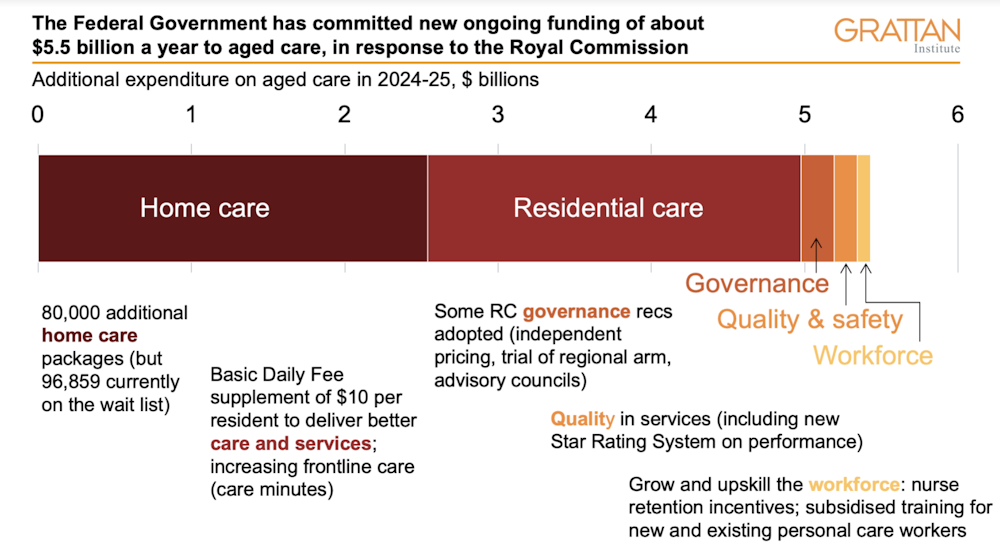
The government has committed A$6.5 billion for more home-care packages (about A$2.5 billion more for home care per year when fully implemented), and A$7.1 billion for residential-care staffing and services (about $2.4 billion more for residential care per year when fully implemented).
But the government has failed to outline a clear vision of what older Australians should expect of their aged-care system.
The budget includes funding for 80,000 extra home-care packages over two years. The current home-care packages program has numerous problems, including nearly a 100,000-strong waiting list.
But the government has not explicitly promised to clear the waiting list and bring waiting times down to 30 days, as the royal commission called for.
The budget has some good news for people in residential aged care. The Basic Daily Fee (for services including food) will be increased by A$10 per resident per day, as called for by the royal commission.
And there’s more funding for better staffing, with mandates for an average of at least 200 minutes of care for every resident every day (40 minutes of which must be by a nurse) by 2023.
This is a good start, given nearly 60% of residents presently get less than this. But residents will have to wait two years – not one, as recommended by the royal commission – before they get more care hours.
The budget also provides additional funding to improve the aged-care workforce. The government will subsidise the training of new and existing aged-care workers, including 33,800 places to attain Certificate III.
But the government has not gone far enough in supporting the workforce. It stopped short of guaranteeing that every staff member providing care for older Australians will be trained to a minimum Certificate III level, and that all residential aged-care facilities will have a registered nurse on site 24 hours a day.
The budget commitments appear to be a once-off, with workforce funding plummeting to only A$86.5 million in 2024-25, compared to A$293.3 million in 2022-23. And there is no commitment to lift carers’ wages.
Residents won’t have access to a registered nurse 24 hours a day.Shutterstock
Small steps towards a better system
The royal commission made it clear the aged-care system needed to be reformed from top to bottom. The government’s announcements foreshadow a shake-up of the system over five years. But the extent of reform is yet to be determined.
The budget papers show funding will be up by about A$5.5 billion per year once most reforms are in (see the chart below). That’s not enough to create a needs-driven, rights-based system, called for by the royal commission and the Grattan Institute.
Federal budget paper 2
The government has committed to a new Aged Care Act, to be legislated by mid-2023, though the details are yet to be filled in. This Act must put the rights of older Australians at its heart.
The government has also committed to designing a new home care program and will provide a single assessment process for both home care and residential care.
More home-care packages will be available but there won’t be enough for all those currently on the wait list.Shutterstock
A local network of health department staff will be embedded in the regions, and there will be a network of 500 “care finders” to help older Australians get the support they need.
But the biggest risk to achieving real structural change is governance and transparency. Here, the government has fallen short.
The government does not support the establishment of an independent aged care commission. Most disappointingly, it is pumping A$260 million into the Aged Care Quality and Safety Commission, which the royal commission found had demonstrably failed.
While some transparency will be provided through public reporting of staffing hours and star ratings to compare provider performance, clear transparency measures will be needed to ensure the additional billions don’t end up boosting providers’ profits.
The good news from budget 2021 is that the journey has begun. The government has made a substantial down payment to allow development of a new aged-care system. We must hope that more will follow, so the neglect ends and every older Australian can get the care and support they need.
The government has committed an additional A$1.7 billion over five years to reduce the cost of childcare for around 250,000 families with more than one child. Another $1.6 billion is going into ensuring each four-year-old child gets 15 hours of preschool a week.
But these budget announcements, framed in part as being a boost for women’s participation in the workforce, hold no good news for the early childhood workforce — 95% of whom are women.
The increase in families using early childhood education and care relies on the stability of the workforce. At the moment, however, an increasing number of educators are leaving the profession due to low pay, feeling undervalued and too much time spent on paperwork.
Problems for early childhood educators
More than 150,000 educators and teachers work in the early childhood education and care sector. Most of the sector’s workforce are certificate III and diploma qualified educators, but an increasing proportion are degree-trained teachers.
In 2019, workforce projections for the five years to May 2024 suggested the sector would need an additional 30,000 educators (a 20% increase) and 7,000 teachers (a 16% increase).
These projections do not take account the impact of COVID-19 and may not reflect the current conditions. The beginning of the pandemic — when parents started taking their children out of early childhood education — saw an exodus of educators. This was especially the case for casuals who weren’t eligible for JobKeeper.
The majority of early childhood educators earn less than the national average of $1,460 per week. The average annual salary for an educator is $49,556 per year.
The early childhood education and care sector needs an estimated additional 30,000 educators and 7,000 teachers by 2024.Shutterstock
We also found the rates of physical injuries, including stress on the body and falls and slips, were higher among early childhood educators than the national average.
Psychologically and physically unhealthy work environments, and a lack of policy support, play a key role in why childcare educators are leaving the sector.
What we need to do
These are all not new problems.
But responses to our recent online survey show the additional pressures of COVID-19 have pushed the early childhood workforce to breaking point. One participant wrote:
Being deemed essential during COVID, yet completely dismissed in terms of our own needs has been incredibly demeaning. The fact that this country relies on childcare to keep everyone working, yet doing nothing to keep educators safe or financially compensated has been insulting and degrading […] This is a systemic problem and it is wearing us down.
Another said:
The well-being of early childhood educators during the COVID crisis didn’t even reach the lowest rung on the priority ladder. It highlighted for me how undervalued we are in society and has been an integral factor in my decision to leave the sector.
The International Labour Organization, which brings together governments, workers and employers to set labour standards, notes early childhood educators are central to realising universal provision of quality childhood education and care.
Making the early childhood workforce strong and sustainable must be seen as essential to the national interest.
Workforce well-being is one of the focus areas of the proposed early childhood education and care National Workforce Strategy. But the strategy only stresses increased supports once educators’ well-being is compromised, rather than helping to prevent it.
The strategy recognises service providers and management have clear responsibilities for educators’ well-being. But this also means every organisation must adhere to a consistent set of accountability measures.
To ensure all early childhood education workplaces support educators’ well-being, specific standards could be included in our existing National Quality Framework for early childhood education and care. The quality of childcare centres themselves have improved due to having to meet certain standards in the framework. Educators’ well-being can be included as part of this overall quality.
Making the work environment safer might also decrease the alarmingly high rates of injury in the sector. This could lead to lower workers’ compensation premiums for businesses.
Schemes could be established so savings are shared between employers and employees in the form of increased wages. At the end of the day, early childhood education is a public good, so governments need to play a bigger role in finding solutions to these problems.
Implementing policy options such as these might mean cracks that are getting deeper might mend instead of completely giving way. If we really care about investing in the quality of early childhood education, we also need to invest in those who do the educating and caring.
Weeks of tensions between Palestinian protesters and Israeli security forces in East Jerusalem have boiled over in recent days, unleashing some of the worst violence between Israel and the Palestinians in years.
Israeli airstrikes in Gaza have left 30 Palestinians dead, including ten children, with Israeli Prime Minister Benjamin Netanyahu promising not to ease up anytime soon. Palestinians militants, meanwhile, have launched hundreds of missiles into Israel, killing three people.
Ostensibly, the rocket launches by Hamas were a response to Israeli police storming the al-Aqsa mosque compound in East Jerusalem on Laylat al-Qadr, the Night of Power, one of the holiest nights of the year for Muslims. The incident injured hundreds over the weekend.
Hamas then issued an ultimatum demanding Israeli forces withdraw from the compound — the third holiest site in Islam, part of which comprises the Wailing Wall — by a specific deadline. When Israel refused, Hamas’s military wing followed through on its threat by firing rockets toward Jerusalem, forcing Israeli lawmakers to flee parliament.
Palestinian health officials say more than 200 people have been wounded in the Israeli airstrikes on Gaza.MOHAMMED SABER/EPA
Jerusalem divided
Beyond the mosque confrontation, though, there are broader historical and political factors at work.
Monday’s airstrikes fell on Jerusalem Day, when Israeli Jews celebrate the “reunification” of Jerusalem following the Six Day War of 1967. As the ongoing unrest demonstrates, the city is far from unified.
Adding to the tensions, thousands of Jewish ultra-nationalists had planned to march through Palestinian-dominated East Jerusalem on Jerusalem Day as a demonstration of Jewish sovereignty over the entire city.
Israeli police changed the route at the last moment, partly due to the increasingly violent clashes between security forces and Palestinian demonstrators during Ramadan.
There were also concerns of unrest if the Israeli Supreme Court handed down its decision on whether four Palestinian families should be evicted from their homes in the Shiekh Jarrah neighbourhood of East Jerusalem, to be replaced by Jewish settlers. This is the culmination of a decades-long legal battle dismissed as “a real estate dispute” by Israeli officials.
Israeli police arrest a Palestinian demonstrator during a protest in support of Palestinian families facing eviction from their homes at Sheikh Jarrah.ATEF SAFADI/EPA
This case is emblematic of the systematic appropriation of Palestinian homes and land in East Jerusalem since 1967. The seizure of Palestinian property is so common here, an Israeli settler was captured on video recently telling a Palestinian,
If I don’t steal your home, someone else will steal it.
The recent evictions in Shiekh Jarrah have been described by Hamas officials — and Palestinian supporters elsewhere — as a form of ethnic cleansing.
The Biden administration has also said it is “deeply concerned” about the potential evictions, while urging leaders across the spectrum to “denounce all violent acts”.
Decades of dispossession
Israeli settlement building and expansion, especially in and around East Jerusalem, is a deliberate strategy. This is not only being done to appropriate Palestinian land, but to alter the demographics of the area and prevent the establishment of a sovereign Palestine with East Jerusalem as its capital.
Israel exclusively claims Jerusalem – home of the ancient Temple Mount, the holiest site in Judaism – as its eternal undivided capital.
The dispossession of Palestinians in East Jerusalem and elsewhere in the West Bank is not new. Indeed, the expulsion of Palestinians in the areas now largely recognised as the official borders of the self-defined Jewish state of Israel was required to establish a Jewish majority.
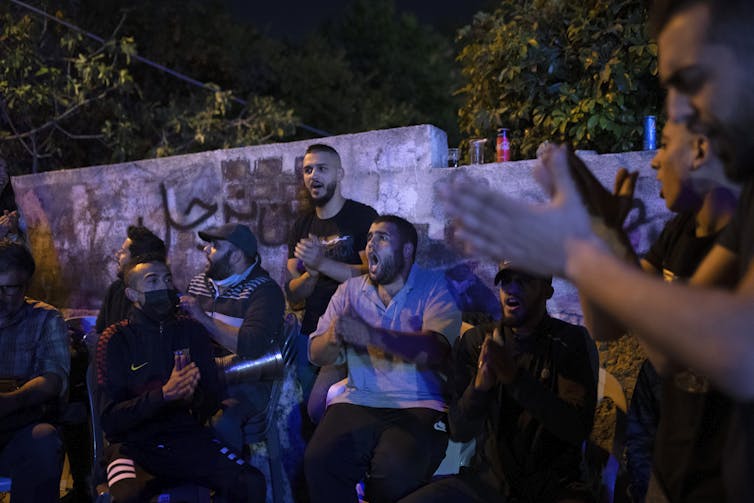
Palestinians sing during a protest against evictions in the Sheikh Jarrah neighbourhood.Maya Alleruzzo/AP
On May 14, 1948, Zionist leaders unilaterally declared the independence of the state of Israel, sparking the first Arab-Israeli War. During the war, over 400 Palestinian villages and towns were depopulated and obliterated to make way for modern Jewish towns and cities.
This Saturday marks al-Nakba, or the “Catastrophe”, for Palestinians. It is the day of mourning for the loss of historical Palestine and the expulsion of over 700,000 Palestinians from their ancestral homeland.
This process has continued throughout East Jerusalem and the West Bank since their occupation in 1967. There are now more than 5 million Palestinian refugees registered with the UN, nearly a third of whom live in refugee camps.
The plight of Palestinian refugees remains a particularly contentious issue for the two sides. A UN General Assembly resolution in 1948 asserted the right of refugees to return to the areas captured by Israel in 1948-49.
And in 1967, a UN Security Council resolution demanded Israeli forces withdraw from territories captured during the Six Day War.
Yet, Palestinian dispossession continues today with over 600,000 Israeli settlers now living across the West Bank and East Jerusalem.
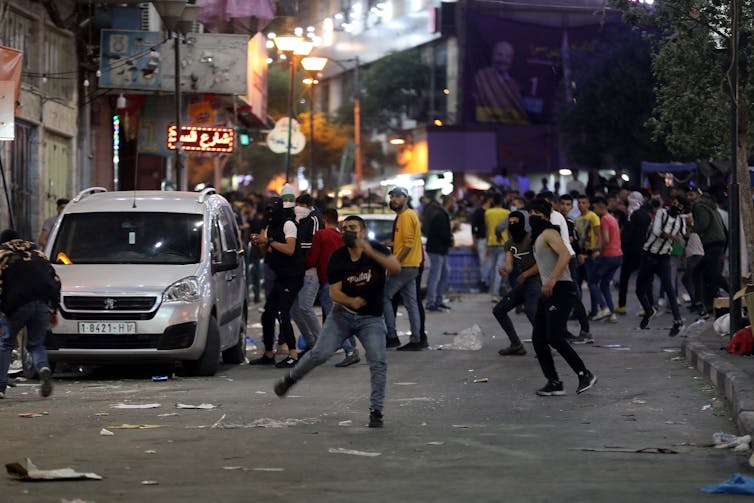
Palestinian protesters clash with Israeli troops in the West Bank city of Hebron.ABED AL HASHLAMOUN/EPA
The continued Israeli occupation of these territories, coupled with the appropriation of Palestinian land, are among the primary causes of conflict between the two sides.
But there are also domestic political factors at play. Hamas is a resistance organisation, which is also responsible for administering the Gaza Strip. Its legitimacy largely rests on its resistance credentials, which means the movement routinely feels obligated to demonstrate its capacity to confront perceived Israeli aggression.
This is in stark contrast to the inaction of the Hamas’ rival party, Fatah, and its leader, Palestinian President Mahmoud Abbas, who has remained largely silent in recent weeks despite the loss of Palestinian lives.
Israel’s political system is also in crisis, with no party able to form a stable government after four inconclusive elections in the past two years (and now a fifth potentially in the offing).
With the government in flux, pro-settler parties – namely Naftali Bennett’s New Right Party – have become the kingmakers in the Knesset. Any aspiring government will likely need their backing to form a majority, which requires the support of pro-settler policies.
With all of this in mind, we can expect more violence, regardless of who eventually wins power in Israel. Unless the international community — in particular, the Biden administration — intervenes to find a meaningful solution to the conflict.
Home renovation has long been something of a national sport for many Australians, but community demand for home fix-ups has reached fever pitch since the pandemic.
If you’re lucky enough to own a house — and able to afford a renovation — chances are you’ve found yourself wishing for a better work-from-home area. Or perhaps you’ve thought, “If I can’t travel and am to spend all this time at home, I may as well make it more pleasant around here.”
Add to that the HomeBuilder grant and you get a market where builders are in high demand, architects are run off their feet and the cost of renovating is going up.
How, then, to decide how much you can afford to spend?
There are no easy answers, and a lot depends on property market conditions where you live, how much financial risk you’re willing to tolerate and how much you’re prepared to forgo luxuries in other parts of life.
But as an ex-financial counsellor and former consumer credit educator for the Australian Securities and Investments Commission (ASIC), here are the questions I’d encourage you to ask yourself to help you decide how much to spend.
How much extra would it cost me each month, even if interest rates went up?
Start with thinking what you want to do and getting a good idea of how much it’s going to cost. Then, factor in extra for unexpected surprises along the way.
Once you have a rough idea of how much you want to borrow to fund your renovation, plug it into a loan calculator with your current lender or on the MoneySmart website. Add on a couple of percentage points to account for the assumption interest rates might not stay at current historic lows.
It’s a good idea to see if you could afford the monthly repayments even if mortgage interest rates increase quite a bit in years to come.
Can I drive down other household costs?
At this point — although this is a good thing to do at any time — look for ways to reduce household costs.
Are you getting the best possible interest rate from your lender? If you are on a variable rate, you can tell them, “I am thinking of borrowing more but I notice the rate you have on my loan on is higher than others are offering.” Often they will knock something off your interest rate straight away. If you are on a fixed rate, you could change to another lender but remember to account for break fees.
Ask yourself: what expenses are coming up in the next few years?Shutterstock
Can you reduce other costs by getting a better deal on car insurance, health insurance, phone and electricity bills? Often you can get better prices just by calling your providers and pointing out their competitors have a better deal.
Think about your upcoming spending and income
What expenses are coming up in the next few years? Will you likely need a replacement car soon? Are schooling costs or childcare fees on the horizon? If you went all in on a renovation and could no longer afford holidays, nights out, entertainment spending — would you be comfortable with that?
Think also about income. If someone in the household couldn’t work due to illness, or wanted to or had to work part-time, how would that affect monthly payments?
If something goes wrong or you have an unexpected medical cost, could you afford it even with the extra debt that comes with the renovation?
As yourself: if there was a drop in my income or a wage freeze, could I sustain payments to the mortgage?
What’s the return on investment?
This is where the sheer craziness of the Australian real estate market comes into play. Even very conservative financial commentators like me are forced to admit that the property market shows no sign of slowing or stalling. It’s quite likely a renovation would drive up the resale value of your house but unfortunately there’s no easy way to find out by how much.
Much depends on where you live. If you are in a regional area where prices have not grown as stratospherically, you might need to plan for a more moderate growth in the value of your house.
If you are fortunate enough to have property in a major capital city, your house value is likely to appreciate even if you don’t renovate. So if your only concern is increasing the resale value, the market may take care of that anyway without the stress of renovation.
There is still a shortage of property in Australia and demand wasn’t even particularly dented by the pandemic.
But past performance isn’t always a reliable predictor of future outcomes. So you need to think about how you’d manage if there was a big shock to the economy or to your household.
Plan for shocks
Ask yourself: how likely is it that I lose my job? If I did, could I reliably get another? How long could I maintain payments if I was unemployed?
Think carefully about job trends in your industry and what you’d do if, years from now, you were made redundant.
There are no easy answers on this one. Each person has to make a judgement call about how well they can tolerate risk.
Are you getting the best possible interest rate from your lender? Phone them and ask for a lower rate.Shutterstock
Decide what matters to you
Ultimately, it’s up to each person to decide what life you want to have over the next decade or more.
It’s all well and good having an improved home but if you can’t afford to travel anywhere or ever have a night out again, you need to factor that in.
If you can afford to see an independent financial adviser, it is not a bad idea before you launch into a big financial decision. You could also consider seeing a free financial counsellor who is independent of any lenders. They can be contacted on 1800 007 007 or through the National Debt Helpline.
Indonesian President Joko Widodo has condemned the Israeli police violence against Palestinians at the Al-Aqsa Mosque in the holy city of Jerusalem, reports Anadolu News.
Widodo emphasised that the expulsion of Palestinian civilians from their homes and the use of force against them at the Al Aqsa Mosque must not be ignored.
“Indonesia condemns such acts and urges the UN Security Council to take measures on the repeated violations carried out by Israel,” Widodo posted on his official Twitter handle.
Widodo added Indonesia would continue to stand with the people of Palestine.
Israeli police on Monday stormed the Al Aqsa Mosque in occupied East Jerusalem and attacked the Palestinians who were on guard to prevent raids by extremist Jews.
Al Jazeera reports that the Israeli military has continued its bombardment of the besieged Gaza Strip, targeting several areas after rockets were fired from the enclave.
Health authorities in Gaza said at least 32 Palestinians – including 10 children – were killed in Israeli air strikes on the Strip since late on Monday, after Hamas launched rockets from the coastal territory towards Israel.
Gaza ultimatum The rocket fire came after Hamas, which rules Gaza, issued an ultimatum demanding Israel stand down its security forces from the Al Aqsa Mosque compound in occupied East Jerusalem after days of violence against Palestinians.
Meanwhile, the Palestinian Red Crescent said some of its employees were prevented from entering the Al Aqsa Mosque compound.
Thousands of Palestinians staged protests in the Al Aqsa Mosque complex, located in the old city of Jerusalem, after performing the dawn prayers on Monday. They stayed inside to guard the mosque from the raids of extremist Jews.
Setting up barricades at some points of Haram al-Sharif, the main building of Al Aqsa, they chanted slogans and said they would not leave there.
Extremist Jews had announced to storm Al Aqsa Mosque to celebrate the anniversary of the Six-Day War of 1967, when Israel occupied East Jerusalem, as “Jerusalem Day” according to the Hebrew calendar.
Extremist Jewish organisations had called for raids on Al Aqsa Mosque on Sunday and Monday to mark Jerusalem Day, to celebrate occupation anniversary according to the Hebrew calendar.
Police raided mosque The Israeli police then raided the mosque, using tear gas shells, rubber bullets, and stun grenades in clashes with the Palestinians, who responded by throwing stones.
Palestinian resistance group Hamas has said that Israel was waging a “religious war against Palestinian worshippers” in the occupied city of Jerusalem.
“What is happening in the Al Aqsa Mosque at the time of storming and assaulting worshippers is proof of the brutality of the Zionist occupation,” Muhammad Hamadeh, the movement’s spokesman for the city of Jerusalem said.
He called on the Palestinians to “remain steadfast”.
Green MPs Golriz Ghahraman and Marama Davidson (co-leader) mark World Keffiyeh Day. Image: Golriz Ghahraman FB
The Hamas spokesman held Israel responsible for its “incursion into the Al Aqsa Mosque,” saying: “The occupation will pay a heavy price.”
“We celebrate Palestinian culture, humanity, and life, as we continue to call for an end to the terrifying violence suffered right now in Palestine at the hands of Israeli forces and settlers. Our [government] must speak!” Golriz Ghahraman said in a social media posting.
“The Palestinian people deserve the New Zealand government’s voice on their side rather than our ‘complicity through silence’ which usually accompanies Israeli racism and systematic brutality against Palestinians.
“In speaking out we urge you not to use anaemic language such as ‘calling for calm’ or ‘urging restraint on both sides’ because those statements in effect mean New Zealand siding with Israel’s racist, ethnic cleansing policies.
“Please intervene with a strong, clear voice which condemns both Israel’s ethnic cleansing of the indigenous people of Palestine and the brutality meted out against them by the Israeli police and armed forces. New Zealand should be demanding equal rights and equal treatment for all people living under Israeli occupation and control.”
Fijians have been advised to remain calm as “ample notice” will be given should a situation in Fiji warrant a total lockdown of Viti Levu, reports The Fiji Times.
Health Secretary Dr James Fong issued this assurance last night as he announced 12 new covid-19 cases.
RNZ’s correspondent in Suva, Lice Movono, said: “That tells us that people are still moving in and out of each other’s homes, people are not maintaining any sort of bubble.”
Movements of the 12 cases in the past few days included trips to supermarkets in Suva’s central city more than 30 minutes drive away from their suburb.
Fiji now has 48 active cases, 35 of them locally transmitted, and seven in border quarantine, while the source of six cases is under investigation.
Struggling families In an editorial titled “Reflections”, the newspaper said:
Let’s reflect on some things we probably take for granted.
Not too many people realise the impact of the covid-19 pandemic on Fijians until they see things for themselves.
It’s difficult to appreciate this when you are far removed from the hardship thousands of Fijians are forced to live with.
Now take for instance the fact that there are no jobs for carrier drivers in Nadi Town. It’s probably not going to ruffle feathers so to speak, unless you are one of those directly or indirectly impacted.
Today’s Fiji Times “Remain calm” front page. Image: Fiji Times screenshot
The assistant secretary of the carrier stand in Nadi, Mohammed Naseeb said the situation “is really bad”.
To drive his point through, he points out there are 167 carrier drivers who operate out of the base.
There are now only 20 to 30 drivers turning up every day, scratching around for jobs. It’s a nightmare!
Mr Naseeb returned to the base after three weeks.
Now consider the fact a lot of these drivers took out loans to buy their vehicles.
Now slap in the fact there is no business, and they are left with a massive burden on their shoulders.
Now throw in the need for them to put food on their table, mouths to feed, rent or mortgage to pay, and medical expenses to meet, and you are left with an unpleasant scenario.
The Mulomulo, Nadi man said most of their customers were farmers coming from the interiors such as Nanoko, Natawa, Nagado, however, those farmers were no longer selling their produce at the market. Now consider that segment of impacted people!
A little over 21km away, in Lautoka, a non-governmental organisation (NGO) Grog Masters distributed grocery packs to at least 200 families in Lautoka during the lockdown phase.
Its president, Amol Kumar said it was important to fight this battle together and struggling families should not be abandoned at this time.
Now, by this morning, [the Fiji] government had paid out $4.3 million through the $90 assistance programme to more than 48,000 households.
A deadly explosion in the Solomon Islands capital has caused fear and confusion about the ongoing threat posed by hidden munitions left over from World War II.
A central Honiara residential area was rocked on Sunday by the detonation of a buried howitzer shell which left one person dead and three others injured, two seriously.
The 101mm cannon round exploded in the Lengakiki area where four youth members of the Kukum Seventh Day Adventist Church had been holding a fund-raising barbecue.
An elder from the church, Lloyd Tahani, said the open fire they were cooking on was directly above the shell.
“Maybe, because they had been cooking a long time, it triggered the bomb to explode,” said Tahani.
He said the young man who was killed, who he identified as Raziv Hilly, “was hit directly” as he was cooking beneath a mango tree while the other three injured people were standing nearby.
The incident has left the people in Honiara shocked and scared, said Tahani.
‘Fear to the residents’ “It brought fear to the residents in Honiara because, you know, Honiara is where the battle between Japan and the USA finishes,” he said referring to the 1942-43 Guadalcanal campaign.
“You just don’t have a comfortable environment when such things happen. People just feel that we don’t know whether a bomb is still sitting under your house or somewhere where you’re staying.”
Raziv Hilly was a leader in the Kukum SDA Church’s youth ministry, according to Tahani, who will be sadly missed.
MP Peter Kenilorea Jr (centre) … Hilly “was a very promising leader here in the Solomon Islands”. Image: Twitter/@kenilorea
He was one of the country’s future leaders, according to a member of the Solomon Islands Parliament.
Peter Kenilorea Jr, who knew Hilly and his family, said he was a much respected youth leader.
“He was a very promising leader here in the Solomon Islands. He had a lot of respect,” said Kenilorea.
“He was one that had a lot of potential for us in the Solomons so it’s just sad to see him go this way. So the family is grieving at the moment and we send our love and our condolences.”
Hilly was also one of the country’s top aviation engineers whose loss is being mourned by his colleagues at the Ministry of Aviation and Communication, according to the Solomon Star.
The other three injured members of the church remain in hospital with one having received surgery on Monday for her serious injuries.
Munitions recovery ongoing With Solomon Islands seeing some of the most intense conflict in WWII, the country remains littered with bombs, with hidden munitions an ongoing threat across the country.
The head of the police’s explosive ordnance disposal team, Clifford Tunuki, said they had responded to a number of unexploded ordnance (UXO) reports over the years in the capital.
Shrapnel from the blast that killed Raziv Hilly. It was found 300-400m away. Image: RSIPF
“We keep a data base of the response we conducted and we have checked the history of that area,” said Tunuki, referring to Lengakiki.
“Our research indicates that it is no more contaminated with UXO than other parts of the capital.”
The last one was a mortar shell discovered in 2016, said Tunuki.
“Unfortunately citizens of Honiara can find a UXO anywhere and at any time of the year,” he added.
Tunuki said he could not comment on that case as the investigation into their deaths was still under way.
The United States, which along with Japan is responsible for most of the country’s UXO’s, said in a statement through its embassy in Papua New Guinea that it is “deeply saddened to hear of the tragic incident in Honiara this past weekend and mourn[s] the loss of life.”
“The United States government, through our Department of Defense, will continue to support efforts to remove unexploded ordnance from Solomon Islands.
“Among these efforts is our ongoing partnership with Norwegian People’s Aid, which has worked in Solomon Islands since 2019 to identify and dispose of unexploded ordnance.”
But work by the Norwegian People’s Aid (NPA) was suspended last year following the deaths of the Australian and British team members in Honiara, according to Tunuki.
Scanning for UXOs at the Lengakiki site. Image: RSIPF
Told to hire cleaning company Meanwhile, the owners of the site of Sunday’s blast have been told to hire a clearing company because there are not enough police resources to check their land.
Tunuki said the scene had been secured and no other threats were detected.
But he said the landowners have been told to hire a private clearing company to check surrounding grounds.
“The problem for us to clear populated areas, then we would need more manpower and resources than we currently have.
“Until then, we can only respond to the community reports that they have located UXO and then we attend to [them].”
Tunuki said there were more recruits being trained for that purpose.
More knowledge needed But more knowledge and awareness about the potential for UXO’s beneath existing structures and in established neighbourhoods may be needed, according to Peter Kenilorea Jr.
New commercial developments were cleared of munitions but people were not likely to expect them in the yards of existing homes, he added.
“I guess an increase of awareness needs to be done by authorities to alert people on the certain steps that they might need to take, even in an already established area, involving fires and then such,” said Kenilorea.
“I think such awareness needs to come back much more prominent in our discourse here in Honiara and Solomon Islands in general.”
This article is republished under a community partnership agreement with RNZ.
I woke up to the news and fear cut into me for my family in Israel. Where are they right now? I felt one moment of the fear that Palestinians live with.
No false equivalence: nothing about this is equal.
In video, Israeli police are heavily armed and armoured, backed by courts of ethnic law.
Palestinians stand their ground wearing T-shirts. An armed charge into an unarmed crowd is not a “clash”, it is an assault.
Israeli soldiers have been vaccinated and most Palestinians have not. To hell with Israel’s legal responsibility. They knew that no state would hold them to it, and no state has.
But look — Palestinians are changing the script before our eyes. They are taking authorship.
On May 8, 80,000 Palestinians came to Al Aqsa Mosque. Israeli police had violated their holy place and they came to reclaim it. They overwhelmed the roadblocks and the paramilitary police and faced them down with their bodies and their prayers.
Unstitching the Green Line Palestinians protested in Ramallah and Jaffa, in Gaza and in Haifa. They are unstitching the Green Line. Palestinians and their allies are protesting around the world.
Thousands of Israelis have been filmed dancing this morning, delirious at the sight of fire in the Al Aqsa Mosque.
In 2014, Israelis sat on the hillsides of Sderot to watch the bombardment of Gaza. I think their desensitised madness has spread; the soullessness that comes from wielding overwhelming violence with impunity.
Wait, look again. In Gaza there is danger of a different magnitude.
Gazan fighters fired rockets to join the uprising, to protest the forced expulsion of Palestinian families from their homes in Sheikh Jarrah.
I am not fond of rockets, but having seen both rockets and bombs in action, I would prefer to stand near a rocket than a one-ton bomb. A rocket makes a hole in the ground, while the airborne bombs of the Israeli military (IDF) make the earth tremble.
“Israel conducted airstrikes in Gaza on Monday evening, following rocket fire from Gaza that caused damage to one Israeli vehicle, and ‘lightly injured’ one Israeli civilian, according to an Israeli army statement.”
Israeli bombs killed 21 Gazans Israeli bombs killed 21 Gazans overnight. They killed nine children, and injured scores of people. Let that attest to the relative value placed on one Israeli vehicle and 21 Gazan lives.
International governments condemned the rockets and elided the rest.
Israel, still drunk on its Trump licence, may believe it can bomb Gaza with impunity. Gazans, with clarity and unfathomable endurance, with covid rampant behind a blockade wall, may feel they have less and less to lose.
This is a formula for catastrophe. We must not let it play out again. Gazans are no symbols to be held up as proof after the fact. They are human beings under assault right now, and they need our protection.
Do not tut-tut them all to step back equally, because the inequality of the status quo ante was the cause: a regime of dispossession, apartheid, blockade, ethnically determined lives and life prospects.
We need to respond to the cause and the crimes. We need to demand that our governments uphold the laws they sign in our names to clear the way forward – not back. Intervene, protect, invoke the law, end the Nakba.
Saturday may be Nakba Day, but Nakba is an event in the present tense until we – yes we, calling on law and justice with every means available – bring it to an end.
Marilyn Garson writes about Palestinian and Jewish dissent. This article was first published by Sh’ma Koleinu – Alternative Jewish Voices and is republished with permission. The original article can be read here.
“This is a formula for catastrophe. We must not let it play out again. Gazans are no symbols to be held up as proof after the fact. They are human beings under assault right now, and they need our protection.” Image: APR screenshot Al Jazeera
An exiled West Papuan leader has demanded the immediate release of arrested campaigner Victor Yeimo, saying that his detention was a “sign to the world” that the Indonesian government was using its terrorist designation as a smokescreen to further repress Papuans.
Indonesian police arrested Yeimo, one of the most prominent leaders inside West Papua, on allegations of makar – treason, on Sunday.
Yeimo is spokesperson of the West Papua National Committee (Komite Nasional Papua Barat, KNPB), regarded as peaceful civil society disobedience organisation active within Papua.
“Any West Papuans who speak out about injustice – church leaders, local politicians, journalists – are now at risk of being labelled a ‘criminal’ or ‘terrorist’ and arrested or killed,” said Benny Wenda, interim president of the United Liberation Movement of West Papua (ULMWP) in a statement.
“What is Victor Yeimo’s crime? To resist the Indonesian occupation through peacefully mobilising the people to defend their right to self-determination,” he said.
“Indonesia constantly creates violence and uses propaganda – and the fact that international journalists continue to be barred from entering – to blame it on West Papuans.
Many labels to ‘deligitimise’ resistance “Jakarta has used many labels to try and delegitimise resistance to its genocidal project: ‘armed criminal group’ (KKB), ‘wild terrorist gang’, ‘separatist’.
“Indonesia has lost the political, moral and legal argument, and has nothing left but brute force and stigmatising labels.”
Wenda said that Indonesia was trying to distract attention from the huge military operations it is launching in Nduga, Intan Jaya and Puncak Jaya.
Around 700 people from 19 villages have already been displaced over the past two weeks.
‘Mastermind’ accusation The Jakarta Post reports that the police accuse Yeimo of being the “mastermind” behind the civil unrest and of committing treason, as well as inciting violence and social unrest, insulting the national flag and anthem, and carrying weapons without a permit.
Emanuel Gobay, one of a group of Papuan lawyers representing Yeimo, said his client had not yet been officially charged. Treason can carry a sentence of life in jail.
Protests convulsed Indonesia’s provinces of Papua and West Papua, widely collectively known as West Papua, for several weeks in August/September 2019.
The sometimes violent unrest erupted after a mob taunted Papuan students in Surabaya, Indonesia’s second city on the island of Java, with racial epithets, calling them “monkeys”, over accusations they had desecrated a national flag.
A man who was at the Countdown supermarket in New Zealand’s South Island city of Dunedin when four people were stabbed has described the incident as terrifying.
The attack happened at the Cumberland Street supermarket just before 2.30pm yesterday.
Police said three of the people injured in the stabbing were in a serious but stable condition in hospital after undergoing surgery, while a fourth person was in a moderate condition.
Countdown general manager of corporate affairs Kiri Hannafin said the two injured staff members were now stable in intensive care units.
The suspect received treatment in hospital for a minor injury and was under police guard.
Customers and staff in the store disarmed and detained the attacker before police arrived.
An eyewitness to the attack, who asked not to be named, said he could not believe such a thing would happen in Dunedin.
‘I heard screaming’ “I heard screaming. At first I just ignored it, I thought it was just kids playing around,” he said.
“Then I heard these shelves falling down. Then we saw this woman, she was walking.
“Blood, full of blood on her face. I think she was stabbed on her forehead or something,” he said.
Not knowing what to do in the moment, he sheltered in a back room for safety.
“We wanted to help this woman who was bleeding, but at the same time we were really terrified and scared. And this man, I think he ran away and he stabbed another two or three people.
“Then I saw around five or six people on the floor, I saw just blood everywhere,” he said.
Police yesterday said the investigation was still in its early stages and they believed it was a random attack.
Compiling witness information Police are working to compile witness information and collect CCTV footage.
Forensic investigators were back at the Cumberland Street supermarket today and it will remain closed.
People with information, including video footage, were encouraged to contact police on 105 and quote event number P046456846.
Police said three of the people injured in the stabbing were in a serious but stable condition in hospital after undergoing surgery, while a fourth person was in a moderate condition.
After twenty years of rhetoric from both sides of politics focusing on getting back to surplus, this year’s budget continues pandemic spending in the hope of getting the economy back on track as the pandemic starts to settle.
The projected deficit is $161 billion for 2021-22, but rather than tackling this in the next four years, the government’s focus is instead on payments and long-term serviceable debt.
The government is projecting a bump in real GDP growth in the next financial year, before growth settles again over the near future.
Part of the reason the government can afford to keep spending high is the low cost of international debt. This means that while net debt will continue to increase beyond the next four years the budget estimates cover, net interest payments should remain low.
And another major factor in the budget’s performance – despite the big spending – is the impact of a very high iron ore price, in the midst of a global pandemic.
The chart below shows the difference between policy decisions and other factors, generally beyond its control.
With a major focus on business and infrastructure spending to revive the economy, extensions to tax benefits and announced packages for childcare, there are many spending announcements in this year’s budget and very few cuts or savings.
The difference is so great that we have drawn out some of the major spending announcements and included all significant cuts in our headline figures for this year’s budget.
New Zealand Parliament Buildings, Wellington, New Zealand.
Editor’s Note: Here below is a list of the main issues currently under discussion in New Zealand and links to media coverage. Click here to subscribe to Bryce Edwards’ Political Roundup and New Zealand Politics Daily.
The core consists of the muscles in your midsection, or torso, surrounding the spine and pelvis. This includes the abdominal muscles at the front, but also muscles within the lower back, and around your sides.
The core muscles are not considered powerful, but they play a fundamental role in stabilising the spine and pelvis. They’re also key to maintaining good posture.
These functions are important to ensure you can move your limbs easily. Your core also protects you against injury — people with a weaker core are more likely to sustain a back injury. Core muscle strengthening is often an important part of rehabilitation after a back injury.
We use our core muscles while performing daily tasks like getting up from a chair, standing, walking, vacuuming and lifting things.
The core muscles are also important for athletic activities like running, jumping, tackling and lifting weights.
Many people have become more sedentary during the pandemic.Shutterstock
Some signs you might need to work on your core
As with other muscles, if we don’t use our core muscles enough, they become weak. When our core becomes weak, our movements are less supported, which can put pressure on other parts of our bodies.
Weakness in the core muscles can be associated with lower back pain, particularly among older people.
Knee pain is another possible sign the core muscles are too weak. Research has shown a core strength training program with physiotherapy has a greater effect on reducing knee pain than standard physiotherapy alone.
If you haven’t been exercising for a while, and you’re experiencing lower back pain or knee pain, it may be a sign your core muscles have become too weak and it’s time to do some work on strengthening them.
The good news is, we can improve core strength with exercise. And there’s no one exercise that is best — you can choose which approach works best for you.
If you do have back or knee pain, or have recently had a baby, consult your doctor or physiotherapist before getting started.
How to strengthen your core: some exercises you can do at home
While walking and running do involve activating the core muscles to some degree, to really target the core we can look to some specific exercises like the traditional sit-up or stomach crunch. These exercises work well to strengthen the muscles on the front of the torso and carry a very low risk of injury.
Modified versions can enhance the effects. For example, exercising on an unstable surface like a Swiss ball can increase the demands on the muscles.
Think of how much your ankle moves when you stand on one leg, for example. Being in this unstable position forces the muscles of your lower leg to work harder to keep your balance. It’s similar to the way your muscles tighten up when you’re walking on a slippery surface.
So, when you do sit-ups while sitting on a Swiss ball or a BOSU ball (the shape of a half sphere, like in the picture below) you find you must engage your core muscles to stay on the device. This increases the intensity of the exercise.
Having to balance, like on a BOSU ball, makes the exercise more challenging.Shutterstock
The traditional crunch or sit-up predominantly work the muscles at the front of the torso, the rectus abdominis, commonly known as the abs.
A standard plank is also good for your abs, and engages other muscles of the torso as well. And you can engage the core muscles at the side of the torso, called the obliques, even further with a side plank.
A side plank can strengthen your obliques.Shutterstock
You can also try getting into a push up position and raising one leg at a time from the hip while keeping the knee straight.
You can make this more challenging by raising the opposite arm at the same time, so your only points of contact are the ball of one foot and the other hand.
This is a good workout for your core, which is working hard to keep you in position. You can make it easier by doing this on hands and knees.
Any exercise that activates the core muscles more than usual will help improve core strength. Sit-ups, crunches and planks will target these muscles directly, and adding unstable surfaces like Swiss balls can enhance the activation.
But remember, other types of physical activity, like going for a jog or doing squats, can help your core strength too.
In its 13 years of existence, Airbnb has grown from a minnow to a whale in holiday accommodation. Today, it offers more than 5.6 million active listings across 220 countries and regions. In Australia, Airbnb lists 346,581 spaces — that’s 4% of Australia’s total housing stock.
Tourists often perceive Airbnb as having a relatively small environmental footprint compared with other forms of holiday accommodation. Airbnb reinforces this view, saying “home sharing promotes more efficient use of existing resources and is a more environmentally sustainable way to travel”.
But our study, published in the Journal of Sustainable Tourism, suggests Airbnb has a bigger carbon footprint than many realise.
Assessing Airbnb’s direct, indirect and induced carbon footprint in Sydney
We focused our study on the Sydney Airbnb market. Our calculations factored in things like electricity, household equipment, water and other energy, transport, communications, goods and services and so on.
In Sydney, we calculated Airbnb.com and its hosts generate direct and indirect carbon emissions of between 7.27 and 9.39 kilograms of carbon dioxide equivalent (CO₂e) per room and night – about the same as an economy hotel.
The carbon footprint increases when we include what’s called “induced carbon emissions”. They result from Airbnb hosts spending their extra Airbnb income on purchasing additional goods and services to improve customer service for their guests, and to improve their own living standards.
Our study modelled various induced carbon emissions scenarios.
If Airbnb hosts put all their extra income into a savings account rather than spending it on goods and services, the carbon footprint of Airbnb ranges from 11 to 13 kg CO₂e per room per night.
But if hosts spend all their extra income from Airbnb, the total carbon emissions can reach 602 kg CO₂e per room and night – as much as is generated by taking a flight in economy class from Sydney to Auckland.
When you include direct, indirect and induced carbon footprint, the average carbon footprint for an Airbnb room is 44-46kg CO₂e per room and night – about as much as is generated by driving a large petrol car from Sydney to Wollongong.
Global environmental impacts
This analysis shows most tourist accommodation — be it Airbnb or traditional hotel accommodation — comes with sizeable greenhouse emissions. Collectively, accommodation accounts for about 1% of global emissions and 20% of tourism emissions.
The Sustainable Hospitality Alliance suggests hotels reduce their carbon emissions by 90% per room to be consistent with the 2℃ threshold under the Paris Agreement.
Our analysis shows most tourist accommodation — be it Airbnb or traditional hotel accommodation — comes with sizeable greenhouse emissions.Shutterstock
The impact of COVID-19
COVID-19 has been the single most effective “intervention” in terms of reducing tourism-related carbon emissions: aviation-related emissions alone dropped by 60%.
COVID-19 resulted in a 90% income loss for Airbnb hosts in Sydney between January and August last year. Airbnb listings dropped from 12,067 to 2,196.
To cover their ongoing expenses, many Airbnb hosts sought shelter in the long-term rental market. Investor hosts, who purchased or were renting a property to make money in the short-term rental market, were particularly hard-hit.
In some areas, many are now slowly returning to hosting. As nations around the world achieve high population vaccination rates, travel restrictions will eventually be lifted and travel will boom again. So it’s important to think carefully about the environmental impact of the tourism sector.
A sustainable tourism future
There’s no obvious pathway to a truly environmentally sustainable future for tourism in general, and peer-to-peer accommodation specifically. Airbnb is here to stay. For its part, Airbnb has vowed to “set a new standard for sustainable travel”, saying:
We are measuring the carbon footprint of both Airbnb’s corporate operations and the carbon footprint of travel facilitated by the Airbnb platform. Measuring our impact informs our efforts to reduce our carbon footprint and set a new standard for sustainable travel.
Carbon emissions are an inevitable consequence of the Airbnb industry, but there’s a lot Airbnb hosts can do, including:
investing their income into sustainability measures in their property, such as rainwater tanks, solar panels, solar batteries and composting systems
providing small appliances such as toasters, sandwich makers or air fryers and a meal ideas book to entice people to make waste-free food instead of ordering take-away
encouraging their guests to reduce, reuse and recycle.
Camping makes an excellent lower emissions alternative to staying in a hotel or Airbnb.Shutterstock
And if you’re a holidaymaker, consider ways to make your own tourism more sustainable. Camping makes an excellent lower emissions alternative to staying in a hotel or Airbnb, and holidaying closer to home also lowers your carbon footprint.
Airbnb has 5.6 million active listings worldwide. That’s 5.6 million opportunities to reduce carbon emissions. It’s also worth noting Airbnb.com is a highly effective communication platform. Airbnb could use it to give hosts simple ideas on how to reduce their carbon emissions, many of which would likely save hosts money in the long run.
The new $60.5 million HOTA Gallery opened its doors on the weekend, updating ageing infrastructure and marking an exciting chapter for the Gold Coast.
HOTA, or Home of the Arts, has been developed as part of a masterplan begun almost a decade ago by the Gold Coast Council to rework a 17-hectare site into a vibrant arts and entertainment precinct. Nestled just in front of the gallery is a $37.5 million outdoor stage.
Designed by Melbourne-based architects ARM, the HOTA Gallery signals a democratic and inclusive vision for both residents and visiting tourists.
The architecture takes inspiration from Voronoi tessellations which occur throughout nature.HOTA
The architecture firm used the cellular structure of the Voronoi diagram as an organisational and visual metaphor for the precinct. Voronoi tessellations occur throughout nature and are a puzzle-like collection of cells fitting together: imagine honeycomb; veins on a dragonfly’s wings and the natural patterns of a giraffe’s fur.
Eschewing the vertical lines of nearby apartment buildings and hotels — the popular images of the Gold Coast — HOTA’s facade instead resembles a colourful clumping of organic cells.
It is welcoming and playful, reflecting the relaxed ethos of inclusivity underpinning the council’s vision for the precinct.
The space is welcoming and playful.HOTA
The gallery itself is six floors high, and the top floor flaunts views to the east of the Gold Coast skyline. To the west is the dramatic hinterland and scenic rim; with riverside parklands below. Cleverly, the cell-like windows yield an abundance of natural light without compromising the exhibition spaces.
Walking around the gallery, I am reminded of the critical role local councils play in creating arts spaces for their communities.
The inaugural exhibition, SOLID GOLD: Artists from Paradise, is a testament to this role, with a diverse selection of new works commissioned from both emerging and established artists who share a connection to the Gold Coast.
The Gold Coast is often perceived with a flashy, and slightly tawdry, image. This show happily refutes this stereotype. What emerges is a rich and diverse exhibition deeply engaged at both local and national levels with themes pertaining to place, space and environment.
Libby Harward, BLOODLETTING (water-ways) 2021. 3-channel digital video, sound.Courtesy of the artist. Photo Jo Driessens
Quandamooka artist Libby Harward’s BLOODLETTING (water-ways) (2021) is a three-channel video installation lying horizontally on the floor. In an extraordinary self-portrait, Harward is lying in a life-sized trench (or shallow grave) and surrounded by PVC plumbing pipes.
The work is vaguely menacing: it is not clear to the spectator looking down at her how Harward is breathing through the apparatus duct taped to her mouth.
Harward’s work is both a timely and necessary contribution to a national conversation on First Nations’ water sovereignty.
Pictured L-R: Front: Michael Candy, Steal the Sunshine 2021; Samuel Leighton-Dore Cloud-Drive 2021. SOLID GOLD: Artists from Paradise, HOTA Gallery.Photo by Paul Harris Photography
Michael Candy’s Steal the Sunshine (2021) is a testament to the artist’s skills in mechanical engineering, manufacturing and programming. Candy converts the sun’s natural light to artificial LED by simulating the sun’s daily path across a towering grid of lights.
The lights behave akin to a time-lapse video as the work responds to the changing light conditions outside the gallery.
Ali Bezer’s commanding floor sculpture, I Can Hear Water (2021), is formed by ripples and folds of aluminium and bitumen. Simultaneously a nod back to 1960s minimalist sculptures by artists such Carl Andre, as well as evoking the sights and sound of the Gold Coast’s beaches, Bezer’s work is both global in outlook while resolutely committed to its local environment.
Back wall: Nicola Moss Local Air 2021; Kirsty Bruce Wonderwall 2021; Aaron Chapman The Towers Project 2021; Back right: Michael Candy, Steal the Sunshine 202; Front: Ali Bezer I Can Hear Water 2021; SOLID GOLD: Artists from Paradise, HOTA Gallery.Photo by Paul Harris Photography
An ambitious space
The gallery is the new home to the Gold Coast council’s $32 million art collection. This permanent collection, on display in the upper levels, showcases key works by leading Australian artists. It reveals a variety of surprises and underscores a decades-long ambitious and forward-looking acquisition strategy.
Tracey Moffatt’s important series Pet Thang (1991) is brought into dialogue with William Robinson’s The Rainforest (1990). Landscapes by Albert Tucker and Fred Williams are combined with Vernon Ah Kee’s wegrewhere (2009) series.
William Robinson’s The Rainforest, c 1900, is a centrepiece of the collection.HOTA Gallery
These conversations feel fresh and highlight the depth in the gallery’s collection — offering visitors new and unexpected connections, without feeling remotely regional or nostalgic.
For a city under constant renewal, from the new HOTA Gallery emerges a complex and dynamic negotiation of place.
SOLID GOLD: Artists from Paradise is showing at HOTA until 4 July.
You would be hard pressed to find an economist who would argue against the merits of fiscal responsibility and controlling government debt. This is why it was so hard to believe the government’s rationale for a public sector wage freeze when it is already pouring upwards of NZ$50 billion into the economy in response to COVID-19.
But fiscal responsibility and the need for “moderation and restraint” were indeed the justifications for the proposed three-year freeze – or “restraint” – on public sector wages over $60,000 (except in exceptional circumstances).
Responding to pressure from public sector unions and workers, the government has suggested routine step-based pay increases could be applied more widely, the policy could be reviewed a year earlier and cost-of-living increases accounted for.
On the face of it, however, the policy would adversely affect approximately 75% of public sector workers, or about 15% of all workers in New Zealand.
Meanwhile, the vast fiscal stimulus package in response to the pandemic has helped keep businesses alive and workers in jobs. It has also driven up New Zealand’s debt-to-GDP ratio and is hardly the work of ideological slaves to fiscal responsibility.
At some stage the public debt will need to be paid off by increasing taxes and/or reducing government spending. But nobody would argue the economy is out of the woods yet, so the public sector wage policy was something of a mystery.
Reducing the real incomes of 15% of the labour force would have a significant negative impact on spending. This, in turn, would work to counteract the benefits of the stimulus spending in the first place.
It would also likely have other unpleasant consequences once those affected made their own decisions in response to their changed circumstances.
Labour market realities
The government has signalled its proposed wage restraint was part of a bigger drive to increase the relative well-being of those on lower wages and improve the lives of poor and disadvantaged Kiwis.
As part of this, the minimum wage has increased by 30% over the past four years. But while this has undoubtedly gone some way to raising the standard of living of those on low wages, relative to those on higher wages the gains are likely to be offset by other forces.
The labour market works in mysterious ways to ensure people who create more value get paid more. Workers are compensated for their education and training, experience, skills and the level of responsibility required in their roles.
When workers with minimal training and experience get a pay rise, others in the same organisation are also likely to demand an increase to recognise their training and experience.
But if everyone’s wages go up, and if the overall productivity of the economy is not growing at the same pace, there is inflationary pressure and the higher wage may not increase workers’ purchasing power by much.
Minimum wage increases also tend to restrain employment because fewer employers can afford to hire. The potential for inflation and unemployment reduces the ability of minimum wage increases to lift people out of poverty.
Arguably, then, the government has opted to improve the relative lot of those on low incomes by suppressing the incomes of those who are doing better.
In other words, when you don’t like how the market works, manipulate it. But if you do, you should be prepared for it to bite back.
The real message of a pay freeze
Tampering with the workings of a market can lead to unintended consequences. In this case, they will probably be due to the actions of those most affected.
The police officers, teachers, nurses and other public servants whose wages are on hold will now make decisions about their employment they deem best for themselves and their families. In doing so, they will simply be responding to the incentives created by the government’s policy.
How have the incentives changed? You need only ask how you might react if your pay had just been reduced relative to what you could be paid in the private sector or in the equivalent job overseas.
It shouldn’t come as a shock that some will look for better opportunities outside New Zealand’s public sector. What’s more, school leavers and others contemplating a public sector career may choose alternatives.
All of this will worsen the public sector skill shortage. And the underlying productivity of the economy will be compromised.
There are alternatives
There’s no denying the government has to make tough decisions to get us out of the fiscal hole COVID-19 dropped us in. But instead of manipulating the labour market, maybe the answers lie elsewhere.
Rather than freezing or restraining wages, the government could encourage more people to invest in the education and training that will increase their productivity and, in turn, allow them to earn higher wages.
To make sure the momentum continues, it’s important that investment in education bares a return, which should happen if the labour market is left to do its job. As a bonus, the increase in the productivity of the workforce will lift the well-being of everyone.
After twenty years of rhetoric from both sides of politics focusing on getting back to surplus, this year’s budget continues pandemic spending in the hope of getting the economy back on track as the pandemic starts to settle.
The projected deficit is $161 billion for 2021-22, but rather than tackling this in the next four years, the government’s focus is instead on payments and long-term serviceable debt.
The government is projecting a bump in real GDP growth in the next financial year, before growth settles again over the near future.
Part of the reason the government can afford to keep spending high is the low cost of international debt. This means that while net debt will continue to increase beyond the next four years the budget estimates cover, net interest payments should remain low.
And another major factor in the budget’s performance – despite the big spending – is the impact of a very high iron ore price, in the midst of a global pandemic.
The chart below shows the difference between policy decisions and other factors, generally beyond its control.
With a major focus on business and infrastructure spending to revive the economy, extensions to tax benefits and announced packages for childcare, there are many spending announcements in this year’s budget and very few cuts or savings.
The difference is so great that we have drawn out some of the major spending announcements and included all significant cuts in our headline figures for this year’s budget.
Last year’s post-budget photo ops were all heavy machinery and hard hats. But this year we can expect soft-focus shots with children and the elderly.
The big story of the budget is not just that the government is spending tens of billions more as we emerge from the recession; it is also the major shift in what the money will be spent on.
The change in fiscal strategy – from a “construction-led recovery” last year to a concerted emphasis on women and the care sector this year – is based on solid economic advice.
It has also come at the best possible time for a government that has been in the spotlight for underfunding aged care and mental health, and under pressure to do more to support women’s economic participation.
The treasurer was understandably eager to emphasise the Government’s new spending initiatives. And the shift is notable.
But while there is welcome progress, the budget falls short of delivering big structural reforms that are needed for childcare, aged care, and mental health.
Budget delivers on social spending
For childcare, the government has announced an extra $1.7 billion over three years starting from July 2022, a modest boost to the $9 billion the government spent last financial year.
We proposed a more ambitious package, which would have spurred big economic gains from higher female workforce participation.
The budget falls short of that, but it is still well targeted at the families that face the most crippling out-of-pocket childcare costs: those with two or more children under six in care.
For aged care, there is an extra $17.7 billion over four years, a significant increase to the $22.5 billion the government spent last financial year.
While not enough to deliver the Aged Care Royal Commission’s vision of a full rights-based model – where every Australian is entitled to the care they need – it still offers improvements.
The 80,000 new home care packages will help to reduce waiting times, and the boost to front line care minutes and the Basic Daily Fee provides additional support to those in residential care.
The accompanying focus on attracting, training, and up-skilling staff is particularly welcome given that the Royal Commission anticipates future staff shortages, although the Budget doesn’t have much specific to say about pay in the sector.
For mental health, a sector whose problems have been laid bare by increased demand for services during the pandemic, there is an extra $2.3 billion over four years.
Funding is targeted towards expanding access to mental health services and bolstering suicide prevention, but it falls short of the system reform required.
A women-centric makeover
The budget flags $3.4 billion over four years for women’s measures (including childcare). Outside of childcare, the biggest are for women’s health ($365 million) and spending on women’s safety including and violence prevention ($1.1 billion).
These measures, particularly the increased spend on front line and response services for family violence are important and significant.
But the more significant shift for women comes with the recognition that job-creating budgets need to invest in a broader range of jobs including in services sectors. About 80% of Australians work in services (and 90% of working women), so investing in these jobs ensures a broader recovery than the previous hard-hat focus.
While last year’s Budget ran hard on infrastructure and investment tax breaks that favour capital-intensive sectors, this time around there is a stronger focus on care economy jobs through the spend on aged care, childcare and mental health.
Even the extended JobTrainer scheme receives a care-centred makeover, with an additional 33,800 low fee and free training places set aside to support future aged care workers.
Services sectors hit hard by COVID also receive some cash including the already announced $1.2 billion support package for the aviation and tourism sector and $300 million for the creative and cultural sector. Universities again miss out but private education providers also receive additional supports.
The long-term challenge
Other major measures in the Budget include the rollover of the Low and Middle Tax Offset (the ‘lamington’) for another year – delivering up to $1080 into the hands of low- and middle-income taxpayers next year – and extension of two key business tax measures: instant expensing and loss carry backs – focused on bringing forward business investment.
The challenge is that much of this increased spending is permanent.
And when combined with the impact of COVID on migration and on the size of the economy, this leaves the medium-term forecasts looking markedly different to the (probably unrealistic) ones that voters were served up before the 2019 election.
But, as the Parliamentary Budget Office suggested a fortnight ago, even with this shift, Australia’s debt levels are sustainable and are likely to remain so. Net debt is forecast to stabilise and then fall over the medium term, even with continuing deficits.
This doesn’t mean that long-term structural challenges disappear, but it does mean that there is more breathing space for the government to let voters see its softer side. As an economic as well as political strategy, it makes a lot of sense.
After twenty years of rhetoric from both sides of politics focusing on getting back to surplus, this year’s budget continues pandemic spending in the hope of getting the economy back on track as the pandemic starts to settle.
The projected deficit is $161 billion for 2021-22, but rather than tackling this in the next four years, the government’s focus is instead on payments and long-term serviceable debt.
The government is projecting a bump in real GDP growth in the next financial year, before growth settles again over the near future.
Part of the reason the government can afford to keep spending high is the low cost of international debt. This means that while net debt will continue to increase beyond the next four years the budget estimates cover, net interest payments should remain low.
And another major factor in the budget’s performance – despite the big spending – is the impact of a very high iron ore price, in the midst of a global pandemic.
The chart below shows the difference between policy decisions and other factors, generally beyond its control.
With a major focus on business and infrastructure spending to revive the economy, extensions to tax benefits and announced packages for childcare, there are many spending announcements in this year’s budget and very few cuts or savings.
The difference is so great that we have drawn out some of the major spending announcements and included all significant cuts in our headline figures for this year’s budget.
Last year’s post-bBudget photo ops were all heavy machinery and hard hats. But this year we can expect soft-focus shots with children and the elderly.
The big story of the Budget is not just that the government is spending tens of billions more as we emerge from the recession; it is also the major shift in what the money will be spent on.
The change in fiscal strategy – from a “construction-led recovery” last year to a concerted emphasis on women and the care sector this year – is based on solid economic advice.
It has also come at the best possible time for a Government that has been in the spotlight for underfunding aged care and mental health, and under pressure to do more to support women’s economic participation.
The treasurer was understandably eager to emphasise the Government’s new spending initiatives. And the shift is notable.
But while there is welcome progress, the budget falls short of delivering big structural reforms that are needed for child care, aged care and mental health.
Budget delivers on social spending
For childcare, the government has announced an extra $1.7 billion over three years starting from July 2022, a modest boost to the $9 billion the government spent last financial year.
We proposed a more ambitious package, which would have spurred big economic gains from higher female workforce participation.
The budget falls short of that, but it is still well targeted at the families that face the most crippling out-of-pocket childcare costs: those with two or more children under six in care.
For aged care, there is an extra $17.7 billion over four years, a significant increase to the $22.5 billion the government spent last financial year.
While not enough to deliver the Aged Care Royal Commission’s vision of a full rights-based model – where every Australian is entitled to the care they need – it still offers improvements.
The 80,000 new home care packages will help to reduce waiting times, and the boost to front line care minutes and the Basic Daily Fee provides additional support to those in residential care.
The accompanying focus on attracting, training, and up-skilling staff is particularly welcome given that the Royal Commission anticipates future staff shortages, although the Budget doesn’t have much specific to say about pay in the sector.
For mental health, a sector whose problems have been laid bare by increased demand for services during the pandemic, there is an extra $2.3 billion over four years. Funding is targeted towards expanding access to mental health services and bolstering suicide prevention, but it falls short of the system reform required.
A women-centric makeover
The budget flags $3.4 billion over four years for women’s measures (including childcare). Outside of childcare, the biggest are for women’s health ($365 million) and spending on women’s safety including and violence prevention ($1.1 billion).
These measures, particularly the increased spend on frontline and response services for family violence are important and significant.
But the more significant shift for women comes with the recognition that job-creating budgets need to invest in a broader range of jobs including in services sectors. About 80% of Australians work in services (and 90% of working women), so investing in these jobs ensures a broader recovery than the previous hard-hat focus.
While last year’s Budget ran hard on infrastructure and investment tax breaks that favour capital-intensive sectors, this time around there is a stronger focus on care economy jobs through the spend on aged care, childcare and mental health.
Even the extended JobTrainer scheme receives a care-centred makeover, with an additional 33,800 low fee and free training places set aside to support future aged care workers.
Services sectors hit hard by COVID also receive some cash including the already announced $1.2 billion support package for the aviation and tourism sector and $300 million for the creative and cultural sector. Universities again miss out but private education providers also receive additional supports.
The long-term challenge
Other major measures in the Budget include the rollover of the Low and Middle Tax Offset (the ‘lamington’) for another year – delivering up to $1080 into the hands of low- and middle-income taxpayers next year – and extension of two key business tax measures: instant expensing and loss carry backs – focussed on bringing forward business investment.
The challenge is that much of this increased spending is permanent.
And when combined with the impact of COVID on migration and on the size of the economy, this leaves the medium-term forecasts looking markedly different to the (probably unrealistic) ones that voters were served up before the 2019 election.
But, as the Parliamentary Budget Office suggested a fortnight ago even with this shift, Australia’s debt levels are sustainable and are likely to remain so. Net debt is forecast to stabilise and then fall over the medium term, even with continuing deficits.
This doesn’t mean that long-term structural challenges disappear, but it does mean that there is more breathing space for the Government to let voters see its softer side. As an economic as well as political strategy, it makes a lot of sense.
Josh Frydenberg’s third budget aims to give Australia a post-pandemic soft landing, using revenue windfalls for spending and tax cuts rather than for slashing the deficit.
Its philosophy is very much gain, not pain, for a population that has endured the stress of the pandemic, albeit not the devastation experienced by so many other countries.
There are plenty of winners, and minimal direct losers in a budget that lays the ground work for an election that is still expected next year rather than this.
Hard decisions have been eschewed. Prime Minister Scott Morrison is trying to avoid offending voters.
The political prism of this budget is very much in the moment. As such, it leaves Opposition Leader Anthony Albanese little room. Excessive criticism, and he risks sounding carping. Demands for too much more, and he might be accused of irresponsibility.
The budget dodges major reform, with the notable exception of aged care, which the royal commission’s scathing findings made unavoidable.
The deficit for the coming financial year is forecast to be $106.6 billion, only marginally below the December budget update forecast of about $108 billion.
Tens of billions of dollars in windfall revenue (from the faster-than-expected economic recovery, and high iron ore prices) have been distributed, rather than going to the bottom line.
At the end of the budget period, in 2024-25, the deficit will be an estimated $57 billion. Indeed, there is no surplus in sight in a decade.
Without a policy U-turn, Frydenberg as treasurer will likely never deliver that “back in black” budget. Indeed, by the time there is a surplus, he might have served as prime minister, been in opposition, and departed politics.
But of course, after the next election, at some point there will be a change of policy, towards fiscal consolidation.
Frydenberg presents an optimistic picture for the economy in the coming financial year, with the caveat that the pandemic lurks and therefore so does uncertainty.
The budget forecasts unemployment falling to 5% next year and dropping to 4.5% by June 2024. Growth peaks at 4.25% next financial year, but slows after that.
Critics will say that given the state of the economy, and the amount of revenue, budget repair is being delayed too long. That won’t, of course, be the judgement of the public.
We can apply many measuring sticks to the budget, beyond the spending-versus-repair one.
The most obvious is its response to the aged care royal commission. The government is putting some $17.7 billion into the system over the forward estimates, and there will be 80,000 additional home care packages (the waiting list is 100,000).
The experts will argue over the money and probably conclude it is not enough. Equally, the test must be whether the initiatives adequately address improving regulation and achieving a larger, better trained and remunerated workforce. The government makes the right noises but the judgement can only come later. The workforce issues are particularly challenging.
The size of the task is enormous, with a planned new funding model to improve quality and a goal of cultural reform. Health Minister Greg Hunt on Tuesday described it as a “once in a generation” reform. The program will take five years.
As foreshadowed, there are many initiatives for women – on safety, health and economic security. Reforms to child care benefit families, but women especially will be making comparisons with the more generous, less targeted Labor scheme.
Many individuals and businesses will be scrutinising the budget for what it says about opening Australia back to the world.
The message is that it will be a slow path.
Migrants, temporary and permanent, will gradually start to come from mid next year.
Late this year, “small phased programs” of international students will start.
Inbound and outbound travels will remain low for the next year.
But hey – it’s assumed “a population-wide vaccination program is likely to be in place by the end of 2021”. Let’s hope this is so – but it’s only an assumption.
By the end of next year, barring a fresh assault by the pandemic, we might – just might – be looking at more normality. And then we will soon be facing a more “normal” budget too, with its share of nasties.
I don’t often feel sorry for politicians. But having to manage a process that produces forecasts about the next four years of an economy still clawing its way out of a pandemic, and then having to publicly defend those forecasts, is no easy task.
That said, our compassion for the plight of Treasurer Josh Frydenberg shouldn’t stop us judging his budget forecasts. And, like all forecasts, those rest heavily on the assumptions that underpin them.
The core budget assumptions about unemployment and economic growth are relatively rosy. Unemployment is forecast to be down to 4.75% by 2023-23 and 4.5% the year after – both well below pre-pandemic levels. Real GDP growth is expected to rebound to 4.25% in 2021-22 and then settle down to about 2.5% thereafter. Given we are unlikely to have the population growth of the pre-COVID era, that’s a pretty high rate.
Taking a look graphically at actual and forecast GDP makes it clear why folks are talking about a “V-shaped recovery”. But even the fairly bullish assumptions reveal a recovery where the V isn’t really sharp enough. Call it a “floppy-V-shaped recovery.”
Budget overview
That’s rather disappointing, especially given Frydenberg has fundamentally shifted Liberal party fiscal strategy away from “debt and deficits” and dalliances with austerity, to one that sees government spending at more than 26% of GDP in steady state.
But what is more disappointing is that this increased spending isn’t forecast to translate into stronger employment and wages growth.
The budget forecasts an unemployment rate of 4.5% in 2023-24 and 2024-25. That’s better than pre-pandemic levels, but not all that close to the 4%-or-lower number many economists (including RBA governor Philip Lowe) think might be required to get wages growing meaningfully for the first time since 2013.
The budget forecasts reflect this, with wages growth of 2.25% in 2022-23 and 2.5% in 2023-24 both equal to forecast inflation in those years. That is, real wages growth is not even forecast to begin again until 2024-25—and even then, only barely.
Non-mining business investment is forecast to grow by 1.5% in 2021-22 and then jump by a massive 12.5% in 2022-23. That might reflect a post-COVID investment boom driven by a widely mRNA-vaccinated nation and a raft of government incentives. Or it might just be wishful thinking.
As to immigration, we can expect our borders to be largely shut for the foreseeable future. This is reflected in the budget’s forecast population growth of “around 0.1% in 2020-21, 0.2% in 2021-22 and 0.8% in 2022-23.”
Whether immigration does actually pick up significantly in 2022-23 depends crucially on our vaccination rollout. If we can reverse the bungled execution to date, overcome vaccine hesitancy, and secure enough Pfizer and Moderna doses (including for boosters) immigration might grow strongly again. But there are a number of things that have to go right for that to happen. And the government has a poor track record to date on those things.
And then there’s one notable assumption that makes news in every budget: the iron-ore price. The budget papers themselves highlight the importance of it, noting:
“The recent strength in key commodity prices, particularly iron ore, has seen a significant resurgence in Australia’s terms of trade […] As a result, nominal GDP is expected to grow by 3¾% in 2020-21, by a further 3½% in 2021-22 and by 2% in 2022-23.”
The budget assumes the iron-ore price will decline from its current level of over US$200 a tonne, to US$55 a tonne by March 2022. This incredibly pessimistic assumption basically gives the government a buffer on the headline deficit figure. If the forecast of a $99.3 billion deficit in 2022-23 is beaten significantly, it will likely be due to iron ore prices staying high.
The biggest assumption of all
The core economic assumptions discussed above underpin the budget bottom line – a number that used to receive considerably more attention when there was a question of “when” the budget might be back in surplus.
Those days are gone.
Frydenberg has engineered a remarkable shift in Liberal party economic philosophy. While maintaining their brand as “the party of lower taxes, not higher taxes”, they have jettisoned budget-balance fetishism.
Good. It’s about time.
But the biggest assumption of all in the out years of the budget is that the government – should it be reelected – sticks to this new strategy. If they do it holds the promise of being transformative.
It would represent a modest but welcome transformation of the economy, and a dramatic transformation of the Liberal Party brand.
Never before has a budget spent so much to supercharge the economy after the worst of a recession has already passed.
The economy bounced back from last year’s COVID recession far more sharply than the treasury (or just about anyone else) expected.
The bounty from the higher-than-expected tax collections that flowed from more people than expected in work, a much higher-than-expected iron ore price, and lower than expected unemployment benefits, should amount to A$26.8 billion this financial year, $15.5 billion the next, and $18.6 billion the year after that.
But rather than bank those riches and improve the budget bottom line, as the Coalition’s budget strategy used to require it to do, the government has instead decided to spend the lot.
It will spend $21 billion of this year’s $26.8 billion; it will spend or give up in new tax concessions $26.9 billion — far more than next year’s $15.5 billion bounty, and so on.
Treasurer Josh Frydenberg has come good on his historic promise to keep spending way beyond the crisis, to drive the unemployment rate down below where it was when the pandemic started.
The budget predicts an unemployment rate of 4.75% by mid-2023 and 4.5% by mid-2024.
If delivered (and the treasurer’s revised strategy published in the budget requires him to keep spending until it is), it will mark what the budget papers describe as, “the first sustained period of unemployment below 5% since before the global financial crisis, and only the second time since the early 1970s”.
In the same way as Australia emerged from the early-1990s recession with a dramatically lower inflation rate because the Reserve Bank was determined to salvage something from the carnage, Frydenberg has decided to exit the COVID recession with an ongoing lower floor under unemployment.
Both the treasury and Reserve Bank believe Australia can sustain much lower unemployment than the 5-6% it has grown used to. The treasury’s estimate is 4.5%; the Reserve Bank’s is nearer 4%. Before COVID, the United States managed 3.5%.
If achieved, it will mean hundreds of thousands more Australians providing services, drawing paycheques, and paying tax. And no longer on benefits.
A dramatic budget graph tracking the fortunes of every Australian whose payroll was reported to the tax office throughout 2020 shows the biggest victims of the COVID recession — by far — were those without post-school education. At the deepest point of the COVID recession in May, they were almost three times as likely to have lost their jobs as Australians with degrees.
The budget provides an extra $400 million for low-fee or no-cost training for jobseekers, to be matched by the states; an extra $481 million for the transition to work employment service directed at Australians aged 24 and under; and a further $2.4 billion to the Boosting Apprenticeship Commencements program.
But most of what it intends to do for jobs is the indirect result of a barely precedented expansion in spending and tax concessions in all sorts of areas.
The extra $17.7 billion it is spending on aged care over four years ought to create many jobs, as should the extra $13.2 billion it is spending on the National Disability Insurance Scheme.
The $1.7 billion it is spending on making childcare more affordable should both create jobs in the sector and free up more parents to return to work.
An extra $20 billion in business tax concessions should help as well.
The budget’s break with the past isn’t its dramatic expansion of discretionary spending. That’s common in recessions. What’s unusual is that spending is being ramped up when we are not in recession.
In the words beloved of economists, the spending is “pro-cyclical” rather than “counter-cyclical”. It is designed to supercharge our exit from recession rather than merely bring it about.
And there’s little sign of the spending stopping. If this government or the next achieves success in driving the unemployment rate down to 4.5%, it will want to go further. It will keep going further right up until we get inflation near the top of the Reserve Bank’s 2-3% target band and wage growth in excess of 3%, neither of which this budget foresees in forecasts going out four years.
Government debt, anathema to the Coalition when Labor ran it up during and after the global financial crisis, isn’t much of a constraint.
The Reserve Bank holds much of the government’s debt (it didn’t during Labor’s time) and is buying as much as it needs to to keep interest rates low. Recently, interest rates have been rising, but not for most of the government’s borrowings, which are long-term.
The budget papers show that even with net government debt at 34% of GDP and heading to 44%, interest payments on that debt are much less of a drain on the budget than they were back in the mid 1990s when net debt hit 18% of GDP.
And the times have changed. Worldwide, few nations have an aversion to government debt, especially not the United States. In Australia, the only side of politics that used to complain about debt is in currently in office.
Before COVID, the fiscal strategy spelled out in the budget as part of the Charter of Budget Honesty required the government to eliminate net debt.
Frydenberg’s revised strategy merely requires him to stabilise and then reduce net debt “as a share of the economy”.
His priority is driving down unemployment. If that helps expand the economy and so drives down net debt as a share of the economy so much the better. But he wants to do it regardless.
The Morrison government has brought down a big-spending, expansionary budget that forecasts Australia’s unemployment rate will fall to 4.75% in two years time.
But Australia’s international borders won’t be properly open for at least a year, according to the budget’s assumptions.
“Australia is coming back,” Treasurer Josh Frydenberg told parliament on Tuesday night.“
Employment is at a record high, with 75,000 more Australians in jobs than before the pandemic.
“This budget will help to create more than 250,000 jobs by the end of 2022-23,” Frydenberg said.
“This budget secures the recovery and sets Australia up for the future.”
The deficit for next financial year is expected to be A$106.6 billion, with cumulative deficits of $342.4 billion over the forward estimates.
As the government continues to spend to underpin the recovery, net debt will increase to 30% of GDP at the end of June, before peaking at 40.9% at June 30, 2025.
The centrepiece of Frydenberg’s third budget – which had been largely pre-announced by the government – is a $17.7 billion aged care package, spent over five years and including 80,000 extra home care packages.
Frydenberg said this would make a total of 275,000 packages available. The present waiting list is 100,000.
The aged care package is designed as long term structural reform after the royal commission found the system in a parlous state and needing a comprehensive overhaul.
“We will increase the time nurses and carers are required to spend with their patients,” Frydenberg said.
“We will make an additional payment of $10 per resident per day to enhance the viability and sustainability of the residential aged care sector.
“We will support over 33,000 new training places for personal carers, and a new Indigenous workforce.
“We will increase access for respite services for carers.
“We will strengthen the regulatory regime to monitor to monitor and enforce standards of care.”
In other major initiatives, there is $2.3 billion for mental health, while the earlier-announced adjustment to the JobSeeker rate will cost nearly $9.5 billion over the budget period.
Some 10.2 million low and medium income earners will benefit from the extension of the tax offset for another year, at a cost of $7.8 billion.
As Morrison seeks to repair his image with women, there is a range of measures on women’s safety, economic security, health and wellbeing totalling $3.4 billion.
This includes $1.7 billion for changes to child care, $351.6 million for women’s health, and $1.1 billion for women’s safety.
There will be another $1.9 billion for the rollout of COVID vaccines.
Quizzed at his news conference on the future of Australia’s closed border, Frydenberg hedged his bets. “When it comes to international borders, it’s an imprecise business.”
The budget papers assume a gradual return of temporary and permanent migrants from mid-2022, and small arrivals of international students, starting late this year and increasing from next year.
“The rate of international arrivals will continue to be constrained by state and territory quarantine caps over 2021 and the first half of 2022, with the exception of passengers from Safe Travel Zones.
“Inbound and outbound international travel is expected to remain low through to mid-2022, after which a gradual recovery in international tourism is assumed to occur,” the papers say.
The budget is heavy on continued help for business, with more than $20 billion extra in support.
With the country facing a skill shortage and skilled workers not able to enter, Frydenberg said the government would create more than 170,000 new apprenticeships at a cost of $2.7 billion.
“We will help more women break into non-traditional trades, with training support for 5,000 places,” he said
There will be 2,700 places in Indigenous girls academies to help them finish school and enter the workforce.
More STEM scholarships will be provided for women. Another 5,000 places are being made available in higher education short courses.
The budget’s housing package includes another 10,000 places under the New Home Guarantee for first home buyers who build or buy a newly built home. It will also increase the amount that can be released under the First Home Super Saver Scheme.
From July 1, 10,000 guarantees will be provided over four years to single parents with dependents to build or buy a home with a deposit as low as 2%.
Retirees will benefit from a measure to encourage them to downsize.
Older people will no longer have to meet a work test before they can make voluntary contributions to superannuation. People aged over 60 will be able to contribute up to $300,000 into their superannuation if they downsize.
Given the housing shortage, this is aimed at freeing up more housing for younger people.
The government will also enhance the Pension Loan Scheme by providing immediate access to lump sums of $12,000 for single people and $18,000 for couples.
Although modest, one measure that will help women, who retire on average with much less superannuation than men, is that the government will remove the $450-a-month minimum income threshold for the superannuation guarantee.
Frydenberg said the government was committing another $15 billion over a decade to infrastructure, including roads, airports and light rail.
There is also $1.2 billion for multiple measures to promote the digital economy.
Why does the sun’s bright light make me sneeze? — Orlo, age 5
Dear Orlo,
Thanks for your lovely question. Very smart people have been wondering about this very question for thousands of years.
To tell you the truth, Orlo, nobody knows for sure why this happens. But it’s probably got to do with the fact that signals from your eyes and your nose go to the same part of your brain.
Let me explain.
The sneeze centre
Your nose can be used to smell and breathe. But sometimes, things get into our nose that shouldn’t be there. The list of things that should not be in our nose is very long, so I will not include all of them here. But it includes things like peas, sweetcorn and Lego, as well as viruses and bacteria, which are tiny germs that sometimes make us sick.
When you have something in your nose that shouldn’t be there, it’s best to call on the “sneeze centre”. The sneeze centre is the place in your brain that makes sneezes. It’s in your brainstem, which is at the bottom of your brain.
It can do this because it contains instructions on how to switch your breathing muscles on in just the right order to produce a sneeze.
So, while you might think of sneezing as something that happens inside your nose, a lot of it happens inside your brain.
The sneeze centre is located in a part of your brain called the ‘brainstem’.Shutterstock
Switching on the sneeze centre
When you have things inside your nose that shouldn’t be there, they will switch on nerve cells on the inside of your nose. These nerve cells send a signal to the brain, which is conveniently located just inside your head and not very far away from your nose.
When the brain gets this signal, it is relayed to the sneeze centre inside your brain so as to say “we could really use a sneeze now”. The sneeze centre will then produce a sneeze that pushes the unwelcome things out of your nose.
The sun
While the nose is very important, it’s not the only part of your body that has nerve cells which talk to the brain. Another part is your eyes.
Let’s imagine you look at something very bright, which can be the sun but doesn’t have to be the sun. When you do, nerve cells in the eye send this information to the brain which tells your eyes to blink or squint in order to deal with the light.
Orlo, for some reason, in about a quarter of people (including you!) the bright light can also produce a sneeze.
Why?
Well, scientists disagree about this, but I will tell you what I think is the most likely explanation.
Bright light can produce a sneeze in around a quarter of people.Shutterstock
Some of the nerve cells in your nose and in you your eye talk to the same region of the brain: a place called “the trigeminal nucleus”.
This means the signals from the nose (the ones that would usually produce a sneeze) and the signals from the eye (the ones that would usually produce squinting or blinking) arrive into the same part of the brain.
If the number of signals coming in from the eye is very high (like it might be if you happen to look at the sun), they can end up switching on the sneeze centreas well as the parts of the brain that cause blinking. This makes you sneeze, even without you having put something up your nose!
Singer Billie Eilish’s new look for British Vogue, in which she trades her baggy clothes for lingerie — most notably a series of corsets — has sparked much debate.
In the article accompanying her Vogue cover, Eilish predicted such criticism, suggesting people would say: “If you’re about body positivity, why would you wear a corset? Why wouldn’t you show your actual body?”
But, she continued: “My thing is that I can do whatever I want.”
Corsets have long sparked debate. First worn by women in the 17th century, their form has changed over centuries. Throughout the 18th century, most stays (as they were then known) were in the shape of an inverted triangle — wider around the chest and narrowing in to the natural waist. Corsets were typically made of cotton, sometimes covered in a fabric like silk, and in the 19th century, whalebone inserts were popular to create structure.
As the waistline of dresses rose through the Regency period, corsets changed to a straighter silhouette. When 19th century dresses were designed to highlight women’s natural curves, corsets changed also.
In the first half of the 20th century, corsets were largely phased out as new styles of dress emerged, requiring less structure, and as new forms of undergarments became available. In her photo shoot, Eilish references mid century pin-ups; corsets are now having a fashion moment, with a reported surge in online searches for them after the Vogue cover appeared.
The most enduring image of a corset-wearer is of an upper-class lady having the laces pulled tighter and tighter to appear beautiful and waifish for a ball. Given this, corsets are often viewed as a patriarchal symbol of female oppression and restriction, forced upon women to contort their body into aesthetically pleasing shapes – whether Kardashian curves or the “S” shape desired in the Edwardian era.
Corsets were the functional bras of the day – women wore them for their every day work, as in Julien Dupréca’s The Hay Harvesters, c. 1880.Grohmann Museum at Milwaukee School of Engineering
But women wore corsets while doing their daily chores: going to the market or helping with cooking or cleaning. Corsets had to be functional rather than restrictive.
Corsets are perhaps best thought of as a long-line bra. An everyday corset provided breast and back support. Rather than restricting women into certain forms, it provided support and the freedom to go about their day.
During the Regency period, corsets were designed to highlight women’s curves, like in this image from a fashion magazine in 1828.The Victoria and Albert Museum
There were more structured corsets designed to be worn for balls and soirées. A little fancier, perhaps made of nicer material, and designed to be laced slightly tighter. But the lacing was not intended to cut off breath, and instead to create a pleasing silhouette.
While in a few cases, corsets could have an effect on rib structure, these were extreme, and a minority. Research has refuted “the longstanding medical belief that corseting was responsible for early death.” Most corsets were worn without incident.
Just as women today might wear shape wear for a night out, women of the past used corsets to make themselves feel more beautiful.
But interpreting this as women playing into patriarchal beauty standards strips these women of their agency. Women chose their own dresses, and the undergarments that went with them, and they decided how tight their corsets were laced.
Corsets worn under ball gowns like these women wore in Court Ball at the Hofburg, painted by Wilhelm Gause c.1900 were likely nicer, and more tightly laced – but they were still practical.Historical Museum of the City of Vienna
Spreading misconceptions
Some of our misconceptions around corsets come from museums and television.
Corsets shown in museums are often laced to their tightest, and therefore smallest possible circumference, but they were more likely to be worn with space between the lacings.
Corsets on display in museums – like this 1891 example from Maison Léoty in the collection of The Met – are often shown laced at their tightest.The Metropolitan Museum of Art
Additionally, those corsets in museums are the ones that survived. Everyday corsets, suffering from normal wear and tear and were unlikely to last, so those still around today might be the fancier corsets, designed to look beautiful and thus smaller than average.
Television has also done us a disservice when it comes to corsets.
We have numerous scenes of women being laced far too tightly into their corsets, complaining of being unable to breathe, or even fainting from lack of breath (think of the Featheringtons in Bridgerton or Elizabeth Swann in Pirates of the Caribbean).
This discomfort was likely true, but not because the corset itself is the problem. Historically, corsets were individualised pieces of clothing, whereas corsets used for period dramas are less likely to be made specifically for an actress.
Describing corsets as “controversial” or “restrictive” reveals our modern views on items of the past.
It also points to much wider tensions in society – who do we dress for? How do we interpret body positivity?
At the end of the day, Billie Eilish is a young woman, experimenting with a new style, and that’s wholly her choice. And the corsets she wears have a long, expressive history.
Eid usually involves dawn prayers and gatherings to share food and gifts. Family and community are central to these celebrations. This Eid will be particularly significant for many in the Islamic faith, as COVID-19 curtailed last year’s festivities.
Yet for Muslim refugees and asylum seekers in Australian immigration detention facilities, observances will be muted.
Escalating restrictions on visitors
This is not a new phenomenon. Since 2015, I have conducted over 70 interviews with regular visitors to Australian detention facilities. Long before COVID-19, restrictive visiting rules were separating detainees from their communities of support.
Visitors have been required to submit complex online applications at least one week before each visit. Group visits have required additional approvals and taken weeks to organise. Friends and family members with unpredictable work schedules, poor digital literacy or limited English have struggled to visit detention at all.
Blanket bans on fresh food have also been enforced, and detainees and visitors have been required to sit in assigned chairs under constant surveillance.
These restrictions were introduced years before the pandemic – purportedly to ensure the safety and security of detention spaces by minimising risks such as food poisoning.
During the pandemic, detainee isolation has become even more pronounced. Visits were banned altogether for much of last year, and detainees went months without seeing friends and family members.
Complete visitor bans have now been lifted, but strict COVID-19 rules remain in place.
Group visits are still prohibited and overall visitor numbers are capped. Once these spaces fill up, all other visitation requests are rejected. Food of all kinds is banned, and visitors must sit in designated seats and remain physically distanced from their loved ones.
For Muslim detainees, these restrictions will make for a sombre Eid. Christian detainees faced similar constraints this Easter, as did families wishing to celebrate Mother’s Day last weekend.
A celebratory atmosphere
Australia’s detention system has not always been this way. As recently as the mid-2010s, communal celebrations were a regular occurrence in detention. Visitors were permitted to bring fresh food to their visits and would often prepare special meals to mark important occasions.
Moina*, one of my interviewees in Melbourne, for example, would bake Women’s Weekly-style cakes for detained children’s birthdays and make homemade meals from the detainees’ countries of origin.
During visits, detainees and visitors would share food and laughter. Detainees were free to move between tables, making their “guests” feel welcome and offering tea and coffee.
Larger festivities organised by community volunteers were sometimes permitted. As Melbourne volunteer Hannah* explained:
We would organise Christmas, Eid parties, circus performances, bands. There was a kind of community liaison person. I used to manage an annual Christmas shoebox appeal […] I’d get kids in our community to decorate shoeboxes and then adults would buy gifts and we would fill them all and then go in there with the Sisters of Brigidine who would do the food for lunch.
Darwin interviewees recalled visiting detention centres on Mother’s Day with armfuls of flowers for the female detainees.
These celebrations served myriad functions. They brought an element of normality to visits, allowing detainees to maintain relationships with their community-based family and friends. They also allowed members of the Australian community to show their support to people who were seeking protection here. And they helped detainees mark important religious, cultural and personal events.
Stories like Moina’s show immigration detention does not have to be as harsh as it has become. Turning these centres into quasi-prisons has been a choice: one that could and should be unmade.
If authorities are sincere that they want to make detention safer, a dual approach is necessary.
Second, restrictions that have increased the isolation of detention need to be reversed. Incarceration is inherently distressing; it should not be made more painful by harsh institutional rules.
This is not to suggest reversing these escalations would make detention humane. It would not. Restrictions on visitors are just one of many deprivations that detainees experience.
But these refugees and asylum seekers have committed no crime. At the very least, they deserve to celebrate special occasions like the rest of us: in freedom and safety, surrounded by the people they love.
The names of interviewees have been changed to protect their identities.
In Australia over recent months, the fury of women has been hard to ignore. The anger, much of it directed at the toxic masculine culture of Parliament House, has sparked a national conversation about how these attitudes harm women.
The movement has led me to think about how masculine cultures pervade our relationship with water. I worked as a civil engineer in the water industry for nine years, managing projects from planning through to construction. I’m now a water policy researcher, and in a recent paper I explored how dominant masculinity is limiting our response to dire water problems.
Overly masculine environments affect the way decisions are made. In particular, a reliance on technological and infrastructure “fixes” to solve problems is linked to masculine ideas of power.
Under this way of thinking, water is to be controlled, re-purposed and rerouted as needed. I believe we must reassess these old methods. Does it really need to be all about control and power? Managing water in tandem with nature may be more prudent.
Dams and other major water infrastructure are a mainstay of male-dominated water management.Shutterstock
Hiring women is not enough
In the case of federal parliament, the toxic masculinity problem has partly been blamed on a lack of women in senior roles. Similarly, in the area of water supply, sewerage and drainage services, only 19.8% of the workforce comprises people who identify as women (compared to 50.5% across all industries). The sector include state government departments, water authorities and consultancies.
Globally, the lack of women in water engineering has primarily been addressed by increasing the representation of women in the field, on boards and in management.
However creating a more diverse workforce does not automatically lead to a diversity of thinking. In the case of water management, hiring women, or others such as LGBTI and Indigenous employees, does not necessarily mean their contributions are valued. Very often, a masculine culture prevails.
Hiring women is not enough – their contribution should be valued.Shutterstock
Pipelines and gadgets aren’t always the answer
Toxic masculinity doesn’t just refer to overtly sexist cultures or allegations of sexual assault. It can also refer to male-dominated decision making where other ideas are undervalued.
Take, for example, the dominant “technocracy” approach to water management, in which infrastructure and technology is relied on to solve problems.
In Australia as elsewhere, this can perhaps be seen in the emergence of “smart water management” which uses gadgets such as smart meters and other technology to gather and communicate real-time data to help address water management challenges.
As other researchers have argued, this “boys and their toys” approach perpetuates a mindset that sustainability problems – often caused by deep-seated structural and behaviour faults such as over-consumption – can be solved with engineering and technology.
The idea that technology is a symbol of masculinity has been explored by manyfeministtheorists.
Technical prowess, being “in control” and rationality have historically been seen as typically male characteristics. And senior technological roles are usually occupied by men.
There’s nothing inherently wrong with using technology to solve water issues. But when technocratic thinking is “monolithic” and ignores wider societal issues, it can become a problem.
Take, for example, Victoria’s North-South pipeline built during the Millennium Drought. This A$750 million piece of infrastructure connected to Melbourne in 2010 but has lain idle ever since – largely due to fears from farmers that taking water from rural areas will hurt agricultural output.
Similarly, desalination plants in many parts of Australia are an expensive technological approach that solve one problem, yet can create many others. They use a lot of energy, which contributes to climate change if drawn from fossil fuels, and can damage marine life.
Most technology jobs in water management are occupied by men.Shutterstock
Finding another way
Global water scarcity is inescapable. Water use is growing at a rate faster than population growth while climate change is diminishing clean water suppies in many areas.
We need look no further than Australia’s trouble-plagued Murray Darling Basin to know it’s time to reassess the old methods and explore new ways in our relationship with water.
Exerting control over water – say, building an extensive sewer network and water supply system – may have been needed when Australia was modernising. But now it’s time to take a more humble approach that works in tandem with the environment.
A different approach would incorporate valuable knowledge in the social sciences, such as recognising the politics and social issues at play in how we manage water.
For example, in 2006 residents in the Queensland town of Toowoomba rejected the prospect of drinking recycled wastewater after a highly politicised referendum campaign. Residents had just three months to consider the proposal, which divided the community. A non-masculine approach might involve better public consultation and an effort by authorities to understand community attitudes prior to planning.
Australians are the world’s greatest per capita consumers of water. A new approach might also involve questioning this consumptive behaviour and reducing our water use, rather than relying on technological fixes.
Such approaches are likely to require giving up some control. And it may require working closely with traditional owners to incorporate Indigenous understandings of water.
In 2017 for example, the New Zealand government passed legislation that recognised the Whanganui River catchment as a legal person. The reform formally acknowledged the special relationship local Māori have with the river.
This different approach may also mean moving to community decision making models or even programs to increase youth involvement in water management.
An over-reliance on technology and infrastructure papers over the need to understand the behaviours that lead to water problems. We must seek new, sustainable approaches that recognise the role of water in our social, political and cultural lives.
With the government facing a serious backlash over its public sector wage freeze policy, that sound you hear could be the ghost of Rob Muldoon chuckling.
Former prime minister Robert Muldoon in 1981.CC BY
As finance minister in the Holyoake government (1960-72) and later as prime minister (1975-81), he knew how tempting – and difficult – pay freezes could be.
That didn’t stop him using them, but not even he would have contemplated what the current Labour government has announced.
Targeting only public servants earning over NZ$60,000, for three years and with no apparent provision for inflation or cost of living increases, would have been anathema to Muldoon.
He wouldn’t have fancied the odds on inflation and the consumer price index staying stable for that long — or the risk of political blow-back if he got it wrong. But that’s the bet today’s government has made.
Command and control
In fact, there’s no consensus on how inflation, interest rates and capital movements will evolve over the next three years. No one wants inflation to take off, but rocketing house prices, rent increases and rising construction costs are already eroding real incomes.
Of course, Muldoon was operating in a very different economic era. He had inherited post-war legislative machinery that allowed for strict command and control of the economy — although it wasn’t popular even then.
In the late 1960s, when the then powerful Arbitration Court issued a “nil general wage order” – that is, a pay freeze – there was resistance and upheaval. Muldoon crafted legislation to make the controls more palatable.
It was a tool he would resort to again, near the end of his time as prime minister, when he introduced price and wage freezes in 1982, 1983 and 1984. Given they were one of the reasons he lost his grip on power, perhaps we should ask what other lessons might be learned from the relatively recent past.
What about other options?
Like Jacinda Ardern, Muldoon mastered the media. When challenged politically, he would take his case to the country and argue for what he said were the necessary actions.
Something similar should be easy these days, given the world is in unprecedented economic times and public debt close to 100% of global GDP. By comparison, New Zealand’s situation is relatively good. But public debt is still running at $103.3 billion, or 32.6% of GDP — an annual increase of 73%. Also thanks to COVID-19, the economy shrank by 2.9%.
Most people understand why the debt increase has been necessary, they generally don’t begrudge it, and can see the point of reducing it over time. They might also know short term pay freezes have been introduced in Britain and parts of Australia.
But they will also know that, compared to others, New Zealand is well placed to bounce back — at 4.7%, unemployment is relatively low, and the economy is performing better than expected.
All of which raises some obvious questions about the public sector pay freeze. Why isn’t growing our way out of debt enough? Why is New Zealand seemingly the only country locking in such long term pay-freeze plans? And why wouldn’t a small tax increase, shared equitably among all citizens for a short period, be a better option?
No safety net
Great fanfare has been made out of the “team of five million”, but only one part of the team is being asked to endure a long term pay freeze.
When Muldoon applied his controls to the economy they applied, more or less, to everyone. The 1968 general wage order covered all workers linked to union awards — at that time the vast majority.
Similarly, the wage and price freeze in the early 1980s covered everyone. Being in the public or private sector did not matter. So why the discriminatory focus in 2021?
Muldoon also used safety nets with his wage freezes. First, the restrictions were short-term measures, more like six months than three years, and he revisited and adjusted them as required.
Second, to ensure frozen wages weren’t trumped by inflation, he controlled prices, either freezing them too, or ensuring wages could rise if inflation did.
For example, the General Wage Orders Act of the late 1960s allowed the Arbitration Court to consider “living standards, so far as it is within the capacity of the economy to sustain such an adjustment”.
Lessons of history
By the early 1980s, price controls had become so extensive they included interest rates and rents. Businesses could only raise prices in exceptional circumstances.
Trouble was, it couldn’t be contained. As pressure built in different parts of the economy, controls had to be expanded in all directions.
The government should know a wage freeze – even a limited one like this – is a high risk strategy. It can go badly for those who implement it, just as much as it hurts those on the receiving end.
Furthermore, it can fail politically as much as economically. In both the historical examples used here, there were too many forces at work beyond the government’s control for a freeze to work.
Despite the best of intentions, those blunt command and control policies were ultimately washed out with the governments that introduced them.
New Zealand Parliament Buildings, Wellington, New Zealand.
Editor’s Note: Here below is a list of the main issues currently under discussion in New Zealand and links to media coverage. Click here to subscribe to Bryce Edwards’ Political Roundup and New Zealand Politics Daily.