Page 809

Remaining and expanding: what the Taliban’s return will mean for jihadi terrorism

Source: The Conversation (Au and NZ) – By Greg Barton, Chair in Global Islamic Politics, Alfred Deakin Institute for Citizenship and Globalisation, Deakin University

Spoiler alert: we are not winning the global war on terror. If the past 20 years of fighting terrorism by military means have shown us anything, it is that going to war makes things worse.

The direct costs in terms of human suffering – lives lost, societies destroyed and trillions of dollars spent – are multiplied by unintended consequences and cascading problems.

Invading Iraq in 2003 created a vacuum quickly filled with violent insurgencies that led directly to the rise of Islamic State and indirectly to a devastating decade of civil war in Syria. It did not make sense at the time and it certainly does not make sense now.

Launching a military campaign in Afghanistan weeks after the attacks of September 11, however, started out looking like a sensible response. Osama bin Laden and al-Qaeda had planned and directed the attacks from the mountains of eastern Afghanistan.

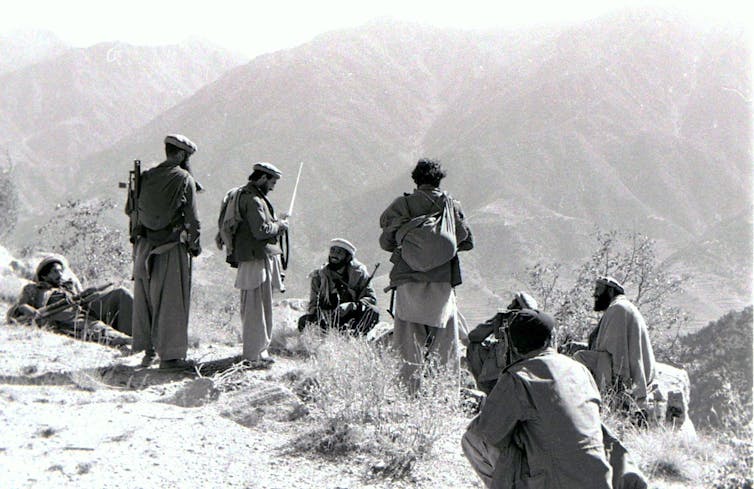
It was there in the late 1980s, during the struggle of the Afghan mujahideen against the Soviet military, that al-Qaeda – “the base” – had been formed to support foreign mujahideen. The mission was to further radicalise and equip them to take jihad to the world.

The initial US special forces operation, which then Prime Minister John Howard insisted Australia join, had the goal of capturing or killing bin Laden and the al-Qaeda leadership. It also aimed to deny al-Qaeda a safe haven in Afghanistan to launch further attacks.

The Taliban regime that had come to power in Kabul five years earlier chose to protect al-Qaeda and suffered the consequences. Mullah Baradar and other Taliban leaders yielded power in Kabul in November, much more quickly than anyone had anticipated. They then staged a strategic retreat to insurgent mode.


Read more:
World politics explainer: The twin-tower bombings (9/11)


In 2002, mission creep saw an international coalition doing what many said should have been done a decade earlier when the Soviets left. For a moment, nation-building seemed to be working, but then attention turned to invading Iraq.
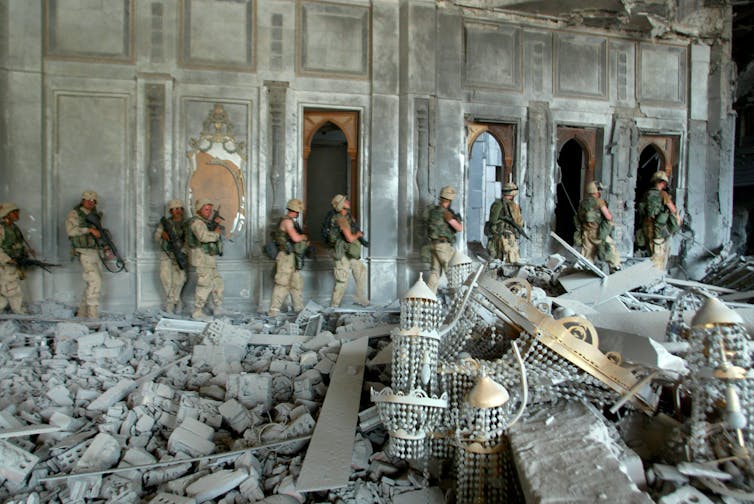
Some nation-building seemed to be happening in Afghanistan after September 11. Then came the invasion of Iraq.
John Moore/AP/AAP

Even without the distraction of marching on Baghdad and sinking into a rapidly expanding quagmire of our own making, pretty much every mistake in counter-insurgency and nation-building that could be made in Afghanistan was made. A brittle, corrupt, incompetent and highly centralised government in Kabul presented opportunities on all fronts to the Taliban insurgency.

Even after a massive military surge early in the second decade of the 21st century that saw 140,000 International Security Assistance Force NATO troops enter the conflict, the patient Taliban remained. Then, after the sharp drawn-down of international troops in 2014, the Taliban insurgency expanded.

Long story short, the war on terror, and fighting terrorism by military means, has been a largely unmitigated failure. Even in Africa, where failing states and jihadi insurgencies have demanded military responses, victories have been short-lived. At best, as in Somalia, they have resulted in costly stalemates.


Read more:
Afghanistan: assessing the terror threat in the west as the Taliban returns


Military interventions have been costly and counter-productive

This is not to say the struggle against global terrorism has been completely without result. Elaborate terror plots targeting cities around the globe, first by al-Qaeda and then by IS, have been defeated and prevented on an impressive scale. But this has been achieved primarily by police-led counter-terrorism intelligence operations, working with communities, intercepting communications in terrorist networks and disrupting plots.

Military successes, such as the destruction of the IS caliphate in Syria and Iraq, have come not only at enormous cost, but also as corrections to problems created by military interventions.

Now in Afghanistan there is only failure. Two decades of significant achievement in transforming Afghan society, if not building robust government, have been washed away.

Not only that, the original success in defeating jihadi terrorism is also at an end, with the return of the Taliban and the success of the Islamic Emirate of Afghanistan project.

Developments in Afghanistan will be significant for at least three key reasons.

First, the triumph of the Taliban after two decades of struggle against the combined forces of NATO and the US is being seized on as evidence of divine approval for the global jihadist cause.

Ironically, although declaring a global war on terror proved to be a monumental mistake, jihadi movements such as al-Qaeda, the Taliban and IS are defined by their commitment to what they claim to be a holy war. That is why the success of Taliban, after 20 years of struggle, resounds around the world. And that is why, for all of their post-victory rebranding and social media information campaign, the Taliban, as a jihadi movement, remains bound to al-Qaeda.

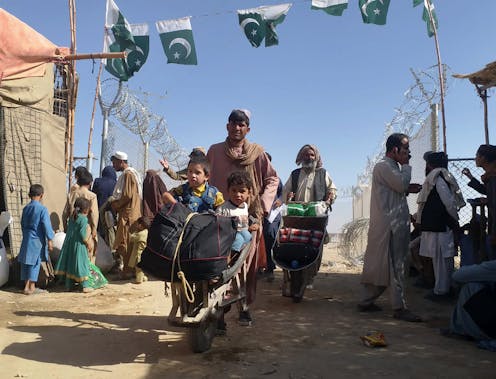
Second, the mountains of Afghanistan will once again become home to mujahideen from across Asia and around the world. Jihadi camps in Afghanistan will return to making a significant contribution to the recruitment, radicalisation, training and networking of new generations of jihadi fighters and movements in South-East Asia.
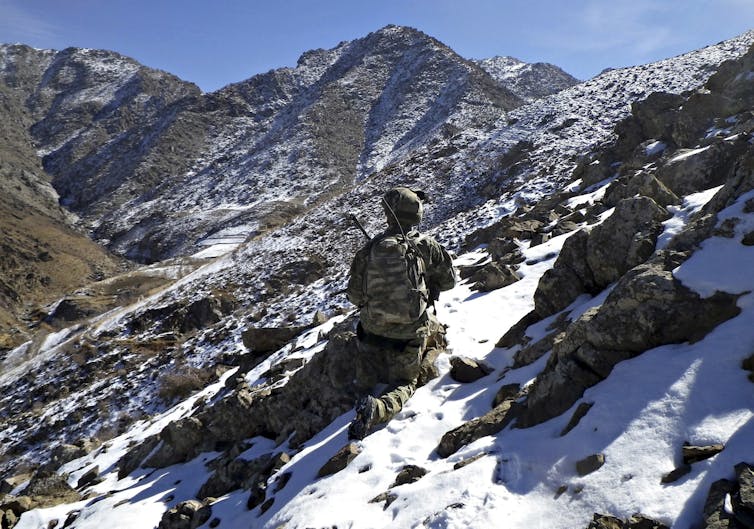
The mountains of Afghanistan will again become training grounds for jihadi terrorists from around the world.
AAP/Australian Department of Defence handout

The Taliban regime in Kabul (or Kandahar) will, despite the Taliban’s existential commitment to global jihad, likely seek to distance itself from such camps. It will exploit plausible deniability, as it focuses on rehabilitating and reinventing its international reputation and securing the long-term viability of the Islamic emirate. This will potentially have the not insignificant benefit of restraining the Taliban from some of the brutal excesses of the past, particularly with respect to the oppression of women and the persecution of minority groups like the Hazara.


Read more:
As the Taliban surges across Afghanistan, al-Qaeda is poised for a swift return


But it will also contribute to a third, more insidious challenge. As world powers like China and Russia, neighbours like Iran and Pakistan, and Muslim nations like Indonesia and Malaysia seek to engage with the emirate in order to moderate the Taliban regime, local Islamist groups will exploit the opportunity to push the boundaries of the permissible in South-East Asia. This is already on display with statements congratulating “our brothers the Taliban” from radical Islamist political groups such as the Malaysian Islamic Party (PAS).

The threat in southeast Asia

Over the past two decades, jihadi extremism with origins in the Afghan alumni – mujahideen trained and radicalised in Afghanistan in the 1980s and 1990s, and groups formed in Afghanistan such as Jemaah Islamiyah and the Abu Sayyaf Group – has been foundational to violent extremism in our region. This was amplified by a new generation of South-East Asian mujahideen returning from Syria and Iraq.

The stage is set for a new era of terrorist growth in South-East Asia and around the world. The IS motto of “remaining and expanding” rang hollow in the wake of the destruction of the caliphate.

Now, as the Islamic Emirate of Afghanistan is set to eclipse the caliphate in scale and longevity, the jihadi catch-cry appears to have been met with divine vindication.

The Conversation

Greg Barton receives funding from the Australian Research Council. And he is engaged in a range of projects working to understand and counter violent extremism in Australia and in Southeast Asia that are funded by the Australian government.

ref. Remaining and expanding: what the Taliban’s return will mean for jihadi terrorism – https://theconversation.com/remaining-and-expanding-what-the-talibans-return-will-mean-for-jihadi-terrorism-166488


Australia has failed greater gliders: since they were listed as ‘vulnerable’ we’ve destroyed more of their habitat

Source: The Conversation (Au and NZ) – By Darcy Watchorn, PhD Candidate, Deakin University

Josh Bowell , Author provided

In just five years, greater gliders — fluffy-eared, tree-dwelling marsupials — could go from vulnerable to endangered, because Australia’s environmental laws have failed to protect them and other threatened native species.

Our new research found that after the greater glider was listed as vulnerable to extinction under national environment law in 2016, habitat destruction actually increased in some states, driving the species closer to the brink. Now, they meet the criteria to be listed as endangered.

Despite this, the federal government has put forward a bill that would further weaken Australia’s environment laws.

If Australia wants to ditch its shameful reputation as a global extinction leader, our environmental laws must be significantly strengthened, not weakened.

Why is the greater glider losing its home?

At about the size of a cat, greater gliders are the largest gliding marsupial in the world, and can glide up to 100 metres through the forest canopy. They nest in the hollows of big old trees and, just like koalas, they mostly eat eucalypt leaves.

A dark morph greater glider in a patch of old growth forest in Munruben, Logan City, south of Brisbane.
Josh Bowell

Greater gliders were once common throughout the forests of Queensland, New South Wales, and Victoria. However, destructive practices, such as logging and urban development, have cut down the trees they call home. The rapidly warming climate and increasingly frequent and severe bushfires are also a major threat.

Together, these threats are causing the greater glider to rapidly disappear.

For our new study, we calculated the amount of greater glider habitat destroyed in the two years before the species was listed as vulnerable under Australia’s environment law, the Environment Protection and Biodiversity Conservation Act (EPBC) Act. We then compared this to the amount of habitat destroyed in the two years after listing.

In Victoria, we measured the amount of habitat that was logged. In Queensland and NSW, we measured the amount of habitat cleared for all purposes, including logging, agriculture, and development projects.

What we found

The amount of greater glider habitat logged in Victoria remained consistently high, with a total of 4,917 hectares logged before listing compared to 4,759 hectares after listing. And of all forest logged in Victoria after listing, more than 45% was mapped as greater glider habitat by the federal government, according to our research paper.

State-owned forestry company VicForests is responsible for the lion’s share of native forest logging in Victoria. The Conversation contacted VicForests to respond to the arguments in this article. A spokesperson said:

There are 3.7 million hectares of potential Greater Glider habitat in Victoria under the official habitat model. The most valuable areas of this habitat are set aside in conservation reserves that can never be harvested.

The total area harvested by VicForests in any year is around 0.04% of this total potential habitat.

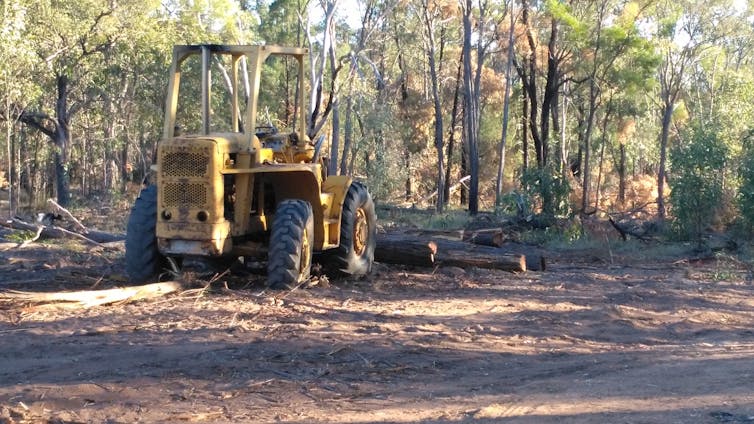
A small bulldozer used for tree ‘thinning’ in Queensland, May 2017.
WWF-Australia

In Queensland, habitat clearing increased by almost 300%, from a total of 3,002 hectares before listing compared to 11,838 hectares after listing. The amount of habitat cleared in NSW increased by about 5%, from a total of 15,204 hectares to 15,890 hectares.

We also quantified how much greater glider habitat was affected by the 2019-2020 Black Summer bushfires, and found approximately 29% of greater glider habitat was burnt. Almost 40% of this burnt at high severity, which means few gliders are likely to persist in, or rapidly return to, these areas.

As a result, earlier this year — just five years after listing — an assessment by the Threatened Species Scientific Committee found the greater glider is potentially eligible for up-listing from vulnerable to endangered.

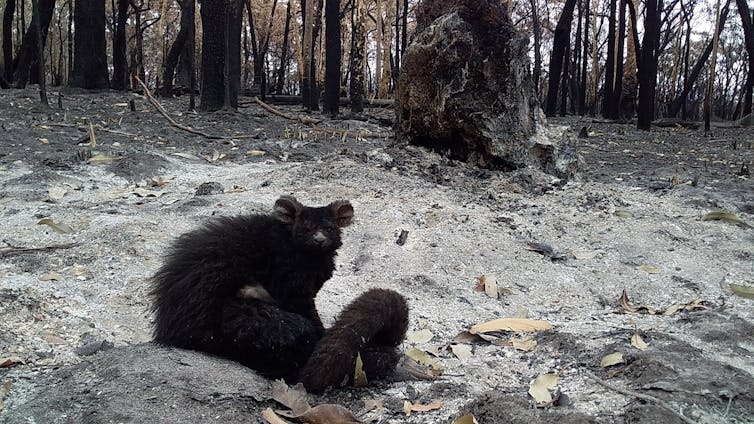
A greater glider found in burnt bushland, Meroo National Park, NSW, December 2019.
George Lemann, WWF-Australia

Why was habitat allowed to be cleared?

Development projects can take decades to be implemented after they’ve been approved under the EPBC Act. Therefore, a lot of the habitat cleared in NSW and Queensland was likely to have been approved before the greater glider was listed as vulnerable, and before the 2019-2020 bushfires.

Once a project is approved, it is not reassessed, even if a species becomes vulnerable and a wildfire burns much of its habitat.

This means the impact of clearing native vegetation can be far greater than when initially approved. It also means it can take many years after a species is listed until its habitat is finally safe.

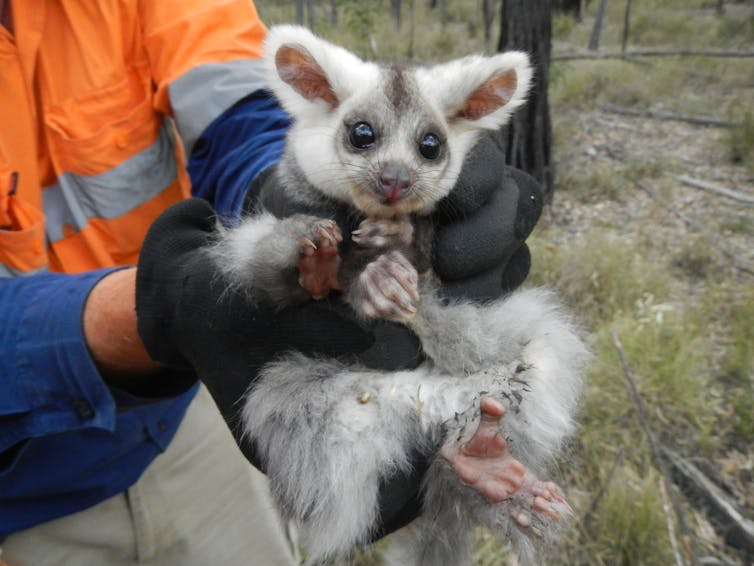
This young greater glider was displaced by clearing near Chinchilla on the Darling Downs, Queensland. It was rescued by a fauna spotter/catcher who was present.
Briano, WWF-Australia

In Victoria and parts of NSW, the forestry industry is allowed to log greater glider habitat under “regional forest agreements”. These agreements allow logging to operate under a special set of rules that bypasses federal environmental scrutiny under the EPBC Act.

The logging industry is required to comply only with state regulations for threatened species protection, which are are often inadequate.


Read more:
A major report excoriated Australia’s environment laws. Sussan Ley’s response is confused and risky


In 2019, the Victorian government updated the protection measures for greater gliders in logged forests. However, these still allow logging of up to 60% of a forested area authorised for harvest, even when greater gliders are present at high densities.

The spokesperson for VicForests said the company prioritises live, hollow-bearing trees wherever there are five or more greater gliders per spotlight kilometre (a 1 kilometre stretch of forest surveyed with torches). But this level of protection is limited and is unlikely to halt greater glider decline, as the species is highly sensitive to disturbance.

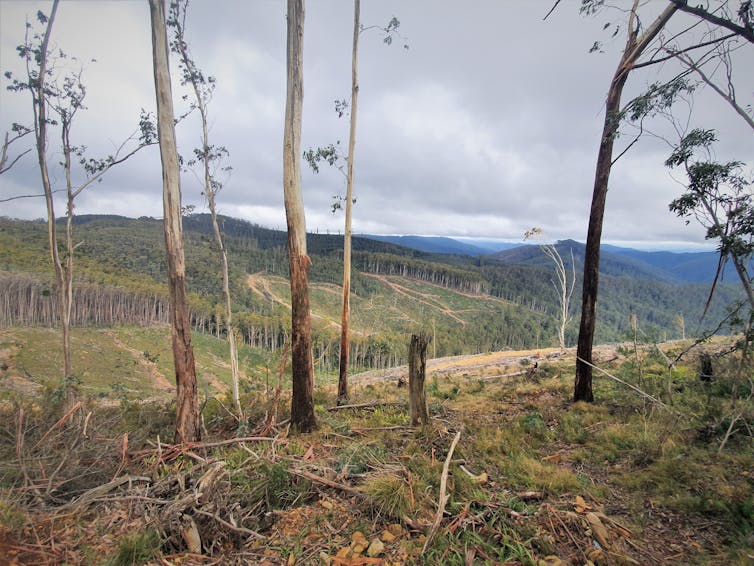
Recently logged native forest from the Central Highlands, Victoria.
Darcy Watchorn

In May 2020 the Federal Court found VicForests breached state environmental laws when they failed to implement protection measures and destroyed critically endangered Leadbeater’s possum and greater glider habitat.

Despite this, earlier this year, the Federal Court upheld an appeal by VicForests to retain their exemption from the EPBC Act. This ruling means VicForests will not be held accountable for destroying threatened species habitat, even when it is found in breach of state requirements.


Read more:
A Victorian logging company just won a controversial court appeal. Here’s what it means for forest wildlife


The spokesperson for VicForests said the company takes sustainable harvesting seriously.

VicForests operations are subject to Victorian laws, and enforced by the Office of the Conservation Regulator (OCR) and Victorian courts when necessary. The recent federal court appeal decision has not changed that fact.

They add that VicForests surveys show greater gliders continue to persist in recently harvested areas, under its current practices.

VicForests has not seen any evidence that even a single Greater Glider has died as a result of our new harvesting approach.

The government isn’t learning its lesson

The EPBC Act is currently undergoing a once in a decade assessment that considers how well it’s operating, with a recent independent review criticising the EPBC Act for no longer being fit for purpose. Our new research reinforces this, by showing the act has failed to protect one of Australia’s most iconic and unique animals.

And yet, the federal government wants to weaken the act further by implementing a streamlined model, which would rely on state governments to approve actions that would impact threatened species.

There’s a raft of reasons why this would be problematic.


Read more:
Death by 775 cuts: how conservation law is failing the black-throated finch


For one, state environmental laws operate independently, and don’t consider what developments have been approved in other states. Cutting down trees may seem insignificant in certain areas, but without considering the broader impacts, many small losses can accumulate into massive declines, like a death by a thousand cuts.

As a case in point, despite the devastation of greater glider habitat from the Black Summer fires in NSW, the Queensland government have recently approved a new coal mine, which will destroy over 5,500 hectares of greater glider and koala habitat.

What needs to change?

The greater glider is edging towards extinction, but there is still no recovery plan for this iconic marsupial. Adding to this, new research suggests there are actually three species of greater glider we could be losing, rather than just one as was previously thought. Significant effort must be invested to create a clear plan for their recovery.

Because Australia has such a rich diversity of wildlife, we have a great responsibility to protect it. Australia must make important changes now to strengthen — not weaken — its environmental laws, before greater gliders, and many other species, are gone forever.

The Conversation

Darcy Watchorn receives funding from the Hermon Slade Foundation, Parks Victoria, the Conservation and Wildlife Research Trust, the Ecological Society of Australia, the Victorian Environmental Assessment Council, and the Geelong Naturalists Field Club. He is a member of the Ecological Society of Australia and the Society for Conservation Biology Oceania.

Kita Ashman works for WWF Australia.

ref. Australia has failed greater gliders: since they were listed as ‘vulnerable’ we’ve destroyed more of their habitat – https://theconversation.com/australia-has-failed-greater-gliders-since-they-were-listed-as-vulnerable-weve-destroyed-more-of-their-habitat-164872

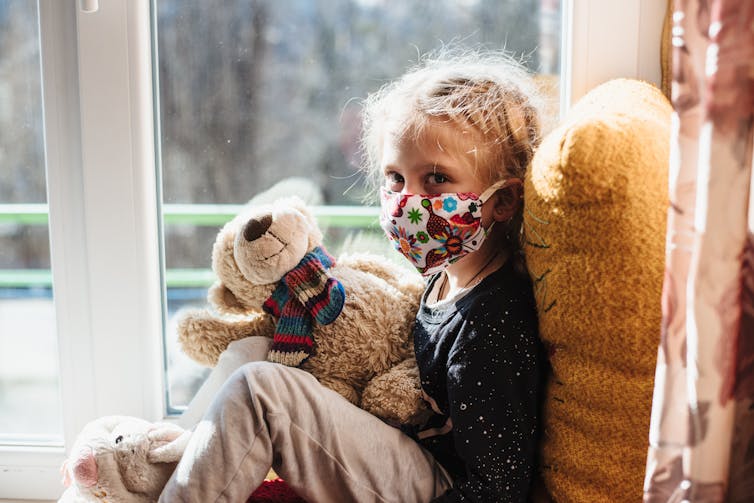
Can’t get your kid to wear a mask? Here are 5 things you can try

Source: The Conversation (Au and NZ) – By Rebecca English, Senior Lecturer in Education, Queensland University of Technology

Shutterstock

Let’s face it, none of us actually enjoys wearing a mask. And it’s even harder when you’re a parent trying to get your kids masked up, as well as yourself.

Victoria, New South Wales and the Australian Capital Territory now require everyone over the age of 12 to wear a mask whenever they leave their home, unless they are exercising. This mandate includes in high schools in NSW and Victoria.

In parts of Queensland and South Australia, children 12 to 17 years also need to wear a face mask if they’re indoors and can’t socially distance.

Children should not wear masks while exercising. And children under two years old should also not wear masks, as they are a choking and suffocation risk.

Parents can decide if children between the ages of five and 12 should wear a mask. But, the World Health Organization says children under five years old should not be required to wear masks.

There is ample evidence showing masks help keep children and young people safe. Plus, unlike the earlier stages of the pandemic when kids weren’t contracting or transmitting the virus as much as adults, we are now seeing many cases in children of the Delta variant. Although, thankfully, serious disease among young people is still rare.


Read more:
Under-12s are increasingly catching COVID-19. How sick are they getting and when will we be able to vaccinate them?


Here are five things you can do to encourage your kids to wear a mask.

1. Model wearing one

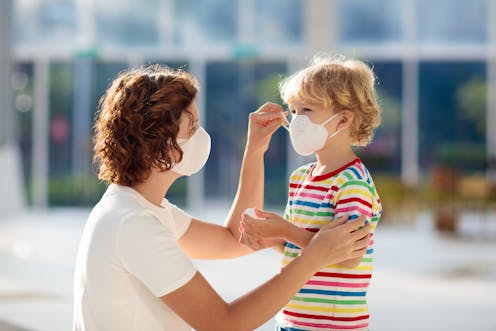
One of the best things you can do to encourage your kids to mask up is to model mask wearing. Show your child it is OK to wear a mask; it is “normal”.

Mother and daughter listening to music and wearing a mask while waiting for train.
Show your child it’s normal, and not scary to wear a mask.
Shutterstock

2. Empathise with their feelings

If your child is reluctant to wear a mask, you can empathise with their feelings. Nobody likes wearing masks. Children rely on facial gestures to communicate, and many have sensory issues that can make wearing masks uncomfortable. Reflecting back to your child that you know this is hard for them helps them feel understood.

Find out why they don’t want to wear a mask. It might be they get sore ears or a headache. If so, masks that tie behind the head can be helpful. If it’s fogged glasses, a better fitting mask, or a mask clip, may help.

The internet is full of mask hacks to help make masks more comfortable. Some are as simple as using hair clips in the loops to extend the length of the mask.


Read more:
13 insider tips on how to wear a mask without your glasses fogging up, getting short of breath or your ears hurting


3. Help them understand the science

Kids may be more willing to wear a mask if they understand why they need to. When children understand why a behaviour is important to their health, they are more likely to comply. Older children may be interested in the science of mask wearing.

There are many resources — including easy to understand YouTube videos — that can help.

You could get your kids to watch a video, like this one.

Remind your kids that doing things they want, like seeing their friends at school, relies on them wearing a mask.

4. Make it a game

Younger children may be helped by making the mask wearing a bit of a game, which can include making up silly poems about wearing masks. Or you could encourage your child to see themselves as a superhero protecting others by wearing a mask.

Younger children can imagine they’re a superhero helping others.

You could also give your child the chance to choose a mask or decorate their own, turning it into a craft activity. This will make the child comfortable with the mask and give them a sense of ownership over it.


Read more:
Tinker Bell, Batman, Ben 10… if your kids are in character, they’re more likely to help around the house


5. Ask others for help

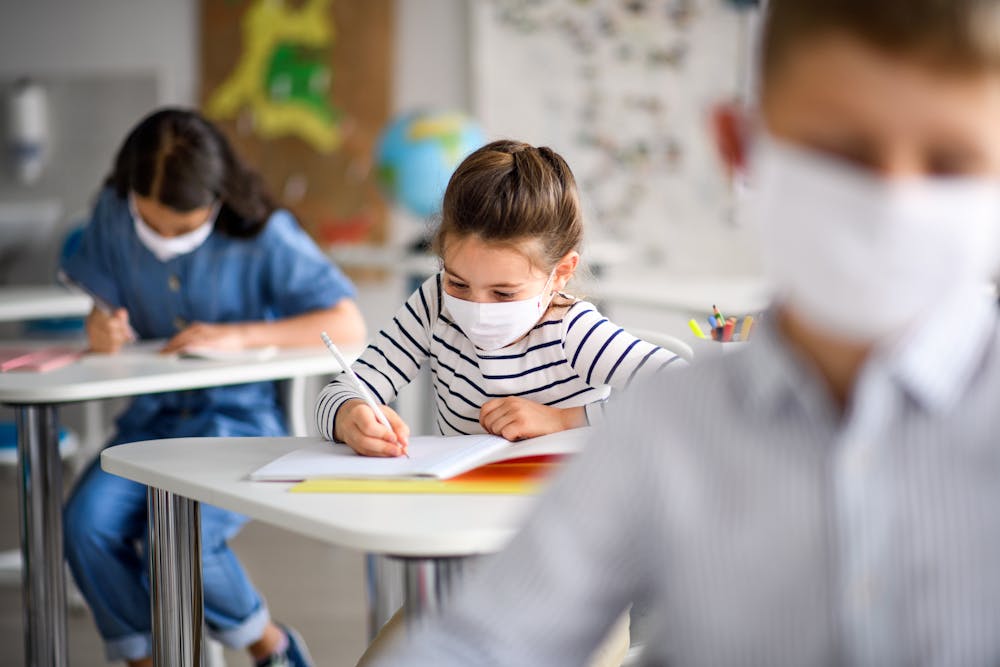
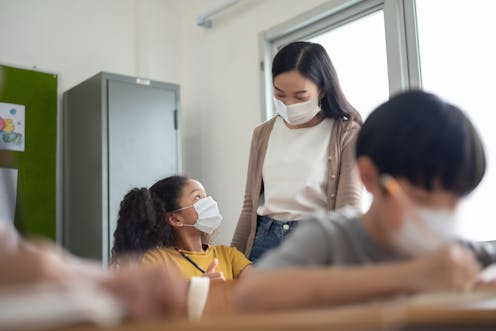
Children require good fine motor skills to put on, and keep on, a mask. If you want your child to be wearing a mask at school, you could talk to the teacher, teacher aide or guidance officer to see if they can help.

Teachers can make sure the mask is on properly, and help your child to adjust the mask as needed.

For children with a disability

If your child has a learning disability, developmental delay or is on the autism spectrum, asking them to wear a mask, and keep it on, may be harder.

Making it a game or making it fun may also work for these children. And there’s evidence that tolerance training, where you gradually expose your child to mask wearing providing praise when the child is able to complete a step, can help.

But it may be impossible to force compliance and it may be dangerous in some circumstances. There are exemptions for people who have any medical condition that makes wearing masks unsuitable.

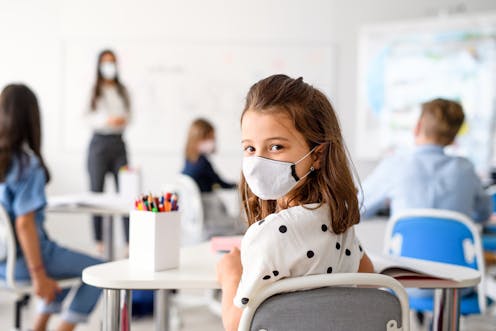
Students in class wearing masks.
You could ask a teacher to help your child wear their mask properly at school.
Shutterstock

Lastly, ask yourself these questions

If your child isn’t legally required to wear a mask, but you’re still wondering, ask yourself these questions:

  • are there high levels of virus in my community?

  • is my child going to be indoors with poor ventilation and lots of people?

  • does my child have a medical condition that might make COVID-19 more risky for them or are they going to be around people who have a medical condition that makes them more susceptible to COVID-19?

If the answers to any of these questions are “yes”, that would lend weight to encouraging mask wearing.

If the answers to any of these questions are “no”, this would lend weight towards not requiring mask wearing.


Read more:
Children need playgrounds now, more than ever. We can reduce COVID risk and keep them open


But if your child is under 12, or has a developmental or another kind of disability, it’s also important to consider whether they can put the mask on and take it off safely by themselves, and whether you or someone else can supervise them while they are wearing a mask. If not, it may be better they don’t wear one.

The Conversation

The authors do not work for, consult, own shares in or receive funding from any company or organization that would benefit from this article, and have disclosed no relevant affiliations beyond their academic appointment.

ref. Can’t get your kid to wear a mask? Here are 5 things you can try – https://theconversation.com/cant-get-your-kid-to-wear-a-mask-here-are-5-things-you-can-try-166648
More than banking done right, consumer data rights are set to transform our lives

Source: The Conversation (Au and NZ) – By Ross Buckley, Professor, Faculty of Law, UNSW

ESB Professional/Shutterstock

There’s a revolution under way in commerce. Within five years, the consumer data right will have transformed competition and simplified the way we live.

Yet most of us know little about it, or think it is restricted to banking.

It’s the brainchild of former Productivity Commission chief Peter Harris and Scott Morrison when he was treasurer.


Read more:
How open banking could transform financial services


The Productivity Commission was asked to inquire into the use of big data.

It made all sorts of recommendations about how the government could use data better, but only after first delivering an overarching recommendation that would deliver ownership of consumer data to the consumers who provided it.


Productivity Commission, Data Availability and Use, Final Report 2017

The recommendation would give consumers and businesses not just theoretical ownership of the data they gave to other businesses, but also practical access in the form of machine-readable code that they could take to a competitor or a firm that would help them pick a better service provider.

On request, firms such as Spotify would have to hand over your history to competitors.

It’s easy to see how it will work for music streaming.

A customer might want to switch to another service, but would find it hard because the one they were with had years of their data — favourites, playlists etc.

Under the legislation that flowed from the report, the old provider would have to provide the information in machine-readable code to the new one to make the transition effortless.

Or the consumer could take their data to a service which would analyse their listening history and determine the right provider for them.

The right has first been rolled out to banking, where it is called Open Banking.

Since July 2020 bank customers have been able to give permission to accredited third parties to access their savings and credit card data.

Since November customers have also been able to give permission to accredited third parties to access mortgage, personal loan and joint bank account data.

It’ll help customers search for better deals and keep track of their finances.

Firms will no longer own customers data

Historically, banks thought of this information as their data, inside knowledge about their customers that gave them an edge on the competition.

Progress has been slow for two reasons, both of them good ones.

One is that the government is insisting that industry determines the standards on which the regime will run. This will help. Government-mandated standards don’t often work well.

The other reason, learnt the hard way from the less than perfect introduction of My Health Record is that data reforms need to be done right, the first time. If there are data leaks, from one provider to another, trust will evaporate.


Read more:
Soft terms like ‘open’ and ‘sharing’ don’t tell the true story of your data


The choice of banking to start the rollout has clouded the message.

It has meant that where people know about the new right at all, many think it is limited to banking. But in time it will apply almost everywhere — to energy, communications, superannuation among other services.

To my mind energy provides an even better example of the power of the reform than banking. I pay too much for my electricity, yet every time someone rings to offer me a better energy plan, I say no. I am usually too busy and it would take time to compare the offers.

Switching providers might be as simple as a click

But once the consumer data right is in place, I won’t have to do that maths. I will be able to simply click on a button on a website or email to direct my data to the other supplier. That supplier will be able to set out what I am paying today against what I would be paying if I switched. The same with mobile phone plans.

I won’t even need to contact my old provider to switch. This will deny my old provider the opportunity to reclaim me by offering a better deal when I call to cancel my contract. It will be too late. My current provider will be forced to treat me fairly upfront – or risk losing me.

Firms might have treat their customers well

Banks today routinely offer new customers better terms than existing customers.

Thirty years ago most Australian businesses thought charging existing customers more than new customers was unfair. Those standards have fallen away.

In many contexts, the consumer data right will bring them back.

It’s a work in progress, but it is set to improve our lives and the services we use for decades to come.

The Conversation

Ross Buckley receives funding from the Australian Research Council Laureate Program to research a wide range of data-related topics, including this one.

ref. More than banking done right, consumer data rights are set to transform our lives – https://theconversation.com/more-than-banking-done-right-consumer-data-rights-are-set-to-transform-our-lives-166036

Noice. Different. Unusual. Watching Kath and Kim as a (locked down) historian

Source: The Conversation (Au and NZ) – By Michelle Arrow, Professor of History, Macquarie University

The Fountain Gate foxymorons with their partners and Kim’s second best friend at their movie premiere in 2012. Paul Jeffers/AAP

Our writers nominate the TV series keeping them entertained during a time of COVID.

In our household, watching comedy in the evenings has been a crucial part of our lockdown survival strategy. We powered through a lot of comedy series last year, and watched some more than once. (I’m looking at you, Schitt’s Creek). Stuck in lockdown for the foreseeable future, I suggested we might re-watch those Fountain Gate foxymorons, Kath and Kim, and my 12-year-old daughter’s eyes lit up.

She’s not alone. When Netflix added Kath and Kim to its service in 2019, it introduced the show to a generation born well after its early 2000s heyday. Its renewed popularity has spawned Tik Tok challenges and Instagram fan accounts. The resurgence of 80s fashion (especially so-called “mum jeans”) means many Gen Z’s share Kath’s fondness for a “foot-long fly” and acid wash denim.

A suburban sitcom about Kath Day, that “high maintenance” foxy lady, her “hornbag” daughter Kim, and Kim’s “second best friend” Sharon Strezlecki, Kath and Kim remains one of Australia’s best loved comedy series. Premiering in 2002 on the ABC, it was the top-rating series on television in 2003-2004.

Creators Jane Turner and Gina Riley moved to Channel 7 for the show’s final season in 2007, and produced a telemovie, Da Kath and Kim Code (2005) and a feature film, Kath and Kimderella (2012).

For decades, Australian television comedy typically relegated women to the sidelines, as objects to ogle or as sidekicks to male characters. Kath and Kim was an amazing showcase for Riley, Turner and Magda Szubanski. The male performers (Peter Rowsthorn and Glenn Robbins) are terrific but the women are the stars.

The trio were popular cast members of the late 1980s Channel 7 comedy series Fast Forward, revealing a talent for parodying media culture, precise observations of Australian women’s speech, and an utter lack of vanity. Kath, Kim and Sharon’s characters first appeared in a series of sketches called “Kim’s Wedding” in their comedy series Big Girl’s Blouse, which ran for a single season in 1994.

Big Girl’s Blouse was ground-breaking because it emerged from a female, even feminist perspective. In Midweek Ladies, a brilliant “documentary” about the leadership turmoil in a ladies tennis club, the trio parodied the self-seriousness of men’s political machinations on the national stage, while also hinting at smaller but no less meaningful dramas playing out in women’s lives across Australia.

Female-centred satire

Australian culture has a long history of satirising, or looking down on, suburbia. From Robin Boyd’s Australian Ugliness to Barry Humphries’s Mrs Edna Everage, many of these critiques were created by men.

Riley and Turner understood the broad appeal of poking fun at suburbia, the place where so many of us grew up. Their humour is broad and specific (or “pacific”, as Kath would say) at the same time, but it always emanated from a keenly observed, female perspective. Only women of a certain age and class could make a joke about Kim being a “Country Road size ten”.

Among the bigger comedic moments (Kath’s wedding, any scene featuring Kath and Kel’s dancing) were dozens of small, well observed details: the squeaky back door of Kath’s house, or Kath sneaking extra rubbish into her neighbour’s bins.

Kath and Kim has endured partly because of its quotable scripts and catchphrases. Most of us like to imagine we’re more sophisticated than we really are, and it is this gap between self-perception and reality that fuels Kath and Kim’s malapropisms.


Read more:
The horror and pleasure of misused words: from mispronunciation to malapropisms


Kath announces her engagement by telling Kim that “Kel and I have decided to make our beautiful, sensual relationship a mere formality”; Kim decides she will spend some time “sowing her rolled oats” rather than return to her husband, Brett.

As an historian, I find the show fascinating for its commentary on what Hugh Mackay called the “dreamy period” of the early 2000s, when a combination of increasing prosperity and anxiety about security meant

Australians […] disengaged from the issues that had been preoccupying them; they shut down, or at least went into retreat.

When Kath and Kim was at the peak of its ratings success in 2003, it was jostling with renovation reality shows, The Block and Backyard Blitz. It was also the era of Big Brother and Australian Idol, and the last gasp of tabloid magazine culture before it was swallowed up by the internet.

Class and ‘effluence’

Kath and Kim were true to the spirit of the Howard era in their aspirations to be, in Kim’s words, “effluent”. As she tells her daughter,

you are effluent, Kim. I mean look at what you’ve got, a Hyundai to hightail it round in, a half share in a home unit, a DVD player, a mobile. I mean, what else is there?

Yet the series not only poked fun at “aspirationals”, but at the wealthy as well. Prue and Trude, the grey-bobbed homewares store employees, with “jojoba leftover from October”, highlighted the myth of Australia’s “classless” society.

In 2021, with our horizons reduced by COVID lockdowns and more time spent at home, perhaps the tiny domestic dramas of Kath and Kim (“that was my last fat-free fruche, Sharon!”) are a little more relatable than they used to be.

Certainly, my daughter and I have had time to work on our Kath and Kim impersonations. That’s noice, different, unusual.

Kath and Kim is streaming on Netflix.

The Conversation

Michelle Arrow receives funding from the Australian Research Council.

ref. Noice. Different. Unusual. Watching Kath and Kim as a (locked down) historian – https://theconversation.com/noice-different-unusual-watching-kath-and-kim-as-a-locked-down-historian-166261

Early NAPLAN results show promise, but we don’t know the full impact of COVID school closures yet

Source: The Conversation (Au and NZ) – By Julie Sonnemann, Fellow, School Education, Grattan Institute

Shutterstock

The early NAPLAN results for 2021 released today suggest the average impact of COVID school closures on literacy and numeracy in 2020 has been relatively small.

This was the first NAPLAN test since students moved to remote learning, and involved 1.2 million students in years 3, 5, 7 and 9.

The results show the national average for literacy and numeracy in 2021 has held up fairly well despite last year’s disruptions. There has been little change in the NAPLAN average results in 2021 compared to 2019 in all states and territories, including Victoria, which had the longest period of remote schooling in 2020.

To understand how well children are doing at school, it is important to look at the progress of students’ learning over time, not just where they are at any one point in time.

According to our student progress metric for NAPLAN, Victoria’s progress in literacy and numeracy is generally in line with the national average over 2019-21. We can also see progress at a national level for 2019-21 was similar to historical rates of progress.

These results are a testament to the hard work of students, parents, teachers and school leaders around the country. But it is too early to claim victory.

We will have to wait until the full NAPLAN data is released in December to understand what the impact has been on vulnerable students, in particular.

It’s also important to remember that NAPLAN only tests literacy and numeracy. Gaps that may have emerged in other parts of the curriculum, such as science and the humanities, aren’t picked up in this data.

Nor do these results help us understand the impact of school closures on broader students’ social development and mental health.

They don’t change the fact governments should be carefully planning how to get kids back to class safely, and as soon as possible.

Disadvantaged students may have fared worse

Students around the country missed a significant amount of school in 2020, especially in Melbourne where some students missed around 21 weeks of school. In New South Wales, schools were closed for around seven weeks.

Many disadvantaged students are likely to have found remote schooling harder than other groups. Our 2020 report estimated the achievement gap between advantaged and disadvantaged students widens at up to triple the rate when kids are trying to learn at home rather than in regular class.


Read more:
Disadvantaged students may have lost 1 month of learning during COVID-19 shutdown. But the government can fix it


Students most likely to be impacted by remote learning are those from low socio-economic families, Indigenous backgrounds or remote communities, as well as those with poor mental health, disabilities and special learning needs.

Students in the early years who are still developing foundational skills in reading and writing are also at risk of falling behind.

Emerging international data suggests COVID school closures have had significant negative impacts on student learning in some countries and that disadvantaged students have suffered most. The findings of different studies vary, but one study from Holland estimates learning loss is 60% greater for struggling students.

Given the potential negative impacts for vulnerable students, the NSW and Victorian governments made significant investments in new tutoring programs to help these students catch up. These programs have been in place since the start of 2021.


Read more:
Victoria and NSW are funding extra tutors to help struggling students. Here’s what parents need to know about the schemes


Opening schools safely should be a national priority

The early NAPLAN data is promising, but our leaders need to stay focused on getting children back to school.

For disadvantaged students in particular, there may be other negative impacts on learning we don’t yet know about.

Academic performance aside, there are broader implications of sustained school closures. There are real concerns about the potential impacts on students’ mental health and social development.

Nor is it clear what the cumulative effects of school closures may be on students or teachers. As remote schooling continues in Victoria and NSW and now the ACT, fatigue is setting in.

Tired students at the desk at home.
Fatigue is setting in for many students learning from home.
Shutterstock

The Murdoch Children’s Research Institute has shown closures are associated with increased harm to children’s physical and mental health – and welfare – due to social isolation, increased anxiety, neglect, or even abuse. These findings are reinforced by growing overseas evidence.


Read more:
Are the kids alright? Social isolation can take a toll, but play can help


The COVID pandemic continues to upend the daily school routines for millions of young Australians, interrupting their learning, development and friendships.

The NAPLAN results give us reason to hope that with hard work from students, families and teachers – along with targeted supports when schools reopen – we can keep students’ learning on track, despite the odds.

But we must ensure the students who have struggled the most get the help they need to remain engaged in school and to keep progressing in their learning. Getting all children back to school, safely, should be a national priority.

The Conversation

Grattan Institute received funding from Origin Energy Foundation to support our report Covid catch-up: helping disadvantaged students close the equity gap.

Julie Sonnemann does not work for, consult, own shares in or receive funding from any company or organisation that would benefit from this article, and has disclosed no relevant affiliations beyond their academic appointment.

ref. Early NAPLAN results show promise, but we don’t know the full impact of COVID school closures yet – https://theconversation.com/early-naplan-results-show-promise-but-we-dont-know-the-full-impact-of-covid-school-closures-yet-166737

Live Recording: Pacific Instability + Afghanistan Deadline Looms – Buchanan + Manning + Robie

A View from Afar: In the first half of this week’s podcast Selwyn Manning and Paul Buchanan will be joined by Dr David Robie to examine instability in the Pacific’s Polynesian region – specifically to identify what’s going on in: New Caledonia, Fiji, Samoa. In the second half, Buchanan and Manning analyse the latest on Afghanistan.

Specifically the first half of this episode will look at:

  • New Caledonia where there’s the third and final referendum on Kanaky independence;
  • In Samoa there’s a new government but only after the old guard attempted to resist democratic change, a move that caused a constitutional crisis; and
  • Fiji, to add to its Prime Minister Frank Bainimarama’s politics headache, is the question of how Fiji gets its NGO and aid workers out of Afghanistan.

THEN, in the second half of this episode Paul Buchanan and I will dig deep into the latest from Afghanistan. The deadline for western personnel to have withdrawn from Afghanistan is looming. The Taliban leadership states it will not extend the negotiated deadline of August 31, and United States president Joe Biden insists the US will not request nor assert an extension.

  • But what does this humiliating withdrawal indicate to the world?
  • Is this the realisation of a diminishing United States, a superpower in decline?
  • Can the US reassert itself as the world’s Police, or does Afghanistan confirm the US is in retreat and signal an end of liberal internationalism?

WE INVITE YOU TO PARTICIPATE WHILE WE ARE LIVE WITH COMMENTS AND QUESTIONS IN THE RECORDING OF THIS PODCAST:

You can comment on this debate by clicking on one of these social media channels and interacting in the social media’s comment area. Here are the links:

If you miss the LIVE Episode, you can see it as video-on-demand, and earlier episodes too, by checking out EveningReport.nz or, subscribe to the Evening Report podcast here.

The MIL Network’s podcast A View from Afar was Nominated as a Top  Defence Security Podcast by Threat.Technology – a London-based cyber security news publication.

Threat.Technology placed A View from Afar at 9th in its 20 Best Defence Security Podcasts of 2021 category. You can follow A View from Afar via our affiliate syndicators.

Podchaser - Evening Report
Listen on Apple Podcasts

***

Opening with 70% of adults vaccinated, the Doherty report predicts 1.5K deaths in 6 months. We need a revised plan

Source: The Conversation (Au and NZ) – By Stephen Duckett, Director, Health and Aged Care Program, Grattan Institute

One consequence of the escalating COVID outbreak in New South Wales has been increased political tension around the “national plan” for COVID reopening.

The prime minister has argued that states signed up to the plan – albeit “in principle”, whatever that means – and they should do whatever the plan says, whenever the plan says to do it.

Some premiers are now pushing back, arguing the Doherty Institute modelling was based on certain assumptions which no longer hold true so the previous agreement no longer stands.

There are three distinct questions at issue here. Is the Doherty Institute modelling still applicable? How does the national plan stack up? And what should happen next?

1. Is the Doherty Institute modelling still applicable?

The Doherty Institute was given a very specific remit. It was asked “to define a target level of vaccine coverage for transition to Phase B of the national plan”, where lockdowns would be “less likely, but possible”.


Read more:
Australia has a new four-phase plan for a return to normality. Here’s what we know so far


In identifying the vaccination coverage target for the transition to Phase B, Doherty’s experts assumed that testing, tracing, isolation, and quarantine (TTIQ), would be central to maintaining lower case numbers.

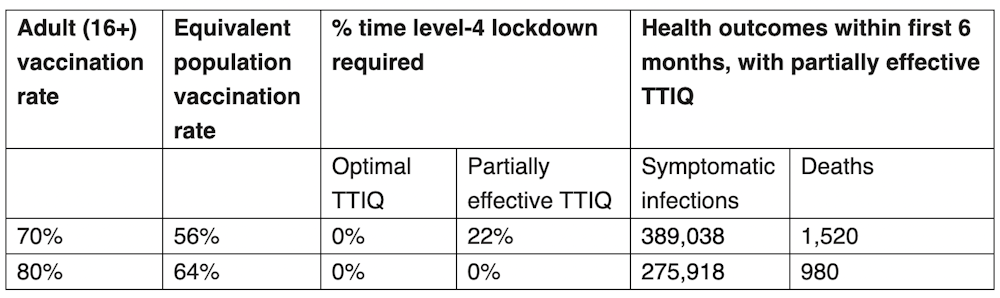
They highlighted two scenarios in terms of testing-tracing-isolation-quarantine capacity – an “optimal” scenario and a “partially effective” scenario – summarised in the table below.

Doherty Institute modelling outcomes

TTIQ = testing, tracing, isolation, and quarantine. This assumes an all adults vaccination allocation strategy.
Doherty Institute

While these numbers may look acceptable, the assumptions underlying them are now hanging by a thread.

Case numbers have been rising rapidly, putting significant pressure on testing-tracing-isolation-quarantine capacity.

Doherty Institute described its assumptions thus:

We assume that once community transmission becomes established leading to high caseloads, TTIQ [testing-tracing-isolation-quarantine] is less efficacious than the optimal levels observed in Australia because public health response capacity is finite.

This tells us that given our current high case numbers, we can probably only assume, at best, “partially effective” testing-tracing-isolation-quarantine capacity.

It’s also important to note the Doherty modelling did not incorporate scenarios where the virus was in uncontrolled spread after target vaccination levels are achieved.

But it now seems unlikely that NSW – and maybe even Victoria – will be able to suppress COVID down to zero before any vaccination target is reached.

If lockdowns are eased according to the modelled targets, while there is still substantial community transmission, testing-tracing-isolation-quarantine is unlikely to be enough to suppress further spread sufficiently, potentially resulting in higher numbers of hospitalisations and deaths than initially modelled.

2. How does the national plan stack-up?

The federal government used the Doherty Institute report’s findings as the basis of the “national plan” it put to National Cabinet.

But it glossed over the options, scenarios, and caveats in the Doherty modelling, and assumed the most optimistic testing-tracing-isolation-quarantine scenario: that everything would be rosy if Australia started opening up once 70% of adults (equivalent to only just over half the population) are vaccinated.


Read more:
National Cabinet’s plan out of COVID aims too low on vaccinations and leaves crucial questions unanswered


The transition to Phase C, where lockdowns would be targeted and vaccinated people would be exempt from restrictions, was also optimistically adopted at 80% adult vaccination, despite the lack of modelling for this scenario in the Doherty report.

In a bid to make it appear convincing – but also realistic, given all the uncertainty – a veil of vagueness was cast over the national plan. The document is full of weasel-words and caveats, which means it is impossible for anyone to be held to account.

The equivocal “in-principle” condition on National Cabinet’s approval makes it even harder to know exactly what premiers signed up to.

But the severity of the New South Wales outbreak has forced some of our leaders to take off the rose-coloured glasses and adopt a more realistic view. Premiers are now saying they did not sign up to high death tolls.

According to Doherty modelling, deaths could reach 1,500 within six months of implementing Phase B. Agreeing to such a scenario is politically untenable for states that currently have zero cases.

3. So, what should happen next?

With states divided over the national plan, and the modelling potentially out of date, it’s time for National Cabinet to come back with a new approach. We need a revised national plan – one that all states can sign up to, one that is not full of caveats and conditions.

This should include a realistic plan for scaling up testing-tracing-isolation-quarantine capacity so that it can manage in a feasible way when each infected person could have at least ten new contacts per day.

And it should include a plan to protect primary schools and childcare centres while a vaccine remains unavailable for younger children.

Grattan Institute has also done its own modelling.

But our model was about Phase D – what Australia needs to do to avoid obtrusive restrictions such as lockdowns altogether – which was not modelled by the Doherty Institute.

We argued that it is only safe to open the borders, to lift restrictions, and to manage without lockdowns and use only unobtrusive measures such as masks on public transport, if we vaccinate at least 80% of the total population and continue the vaccination rollout to 90% throughout 2022.

Recent modelling from other academics has come to similar conclusions, with some even suggesting a slightly higher threshold for safe re-opening.

Governments cannot keep making unrealistic promises about easing restrictions at 70% and 80% adult vaccination, a plan that relied on optimistic scenarios in the first place, and one that now bears little relation to the real world. It is irresponsible to build public momentum and hope around targets that are unlikely going to be enough.

Australia needs the National Cabinet to come clean and accept that the changing circumstances require a change in the plan.

The Conversation

Grattan Institute began with contributions to its endowment from each of the Federal and Victorian Governments, BHP Billiton, and NAB. In order to safeguard its independence, Grattan Institute’s board controls this endowment. Grattan Institute also receives funding from corporates, foundations, and individuals to support its general activities as disclosed on its website.

Anika Stobart does not work for, consult, own shares in or receive funding from any company or organisation that would benefit from this article, and has disclosed no relevant affiliations beyond their academic appointment.

ref. Opening with 70% of adults vaccinated, the Doherty report predicts 1.5K deaths in 6 months. We need a revised plan – https://theconversation.com/opening-with-70-of-adults-vaccinated-the-doherty-report-predicts-1-5k-deaths-in-6-months-we-need-a-revised-plan-166659

Masks, ventilation, vaccination: 3 ways to protect our kids against the Delta variant

Source: The Conversation (Au and NZ) – By Katrina McLean, Assistant Professor, Medicine, Bond University

Shutterstock

Last year in the COVID-19 pandemic, children were not catching or spreading the virus much. The main focus was on protecting our elderly and vulnerable.

But the Delta strain has changed things. Children around the world are contracting Delta in high numbers and some frontline doctors believe they may also be getting sicker from this strain.

Many parents and schools have concerns about how to best protect children from COVID-19. There’s also the worry children will catch the virus at school and take it back to their families and communities.

While many children are now well-accustomed to washing and sanitising their hands, this is simply not enough to tackle the spread of COVID-19, especially now we know the virus is airborne. We need a whole toolbox of strategies.

There are three key areas to focus on that we believe are evidence-based, easy to implement and will help protect our children: masks, ventilation and vaccination.

1. Masks

In certain Australian states, children aged 12 and above are currently required to wear a mask in public areas (schools included).

Meanwhile, Victoria’s chief health officer Brett Sutton has recommended children aged five and up wear masks in the face of rising Delta transmission among children.

As GPs, parents often ask us if it’s safe for children to wear masks. While we understand concern from parents, we reassure them masks have been found to cause no harm in children over the age of two. When children wear masks it doesn’t affect their breathing or reduce their oxygen levels.

Importantly, when worn properly, masks are effective at reducing the spread of COVID-19, for adults and children alike.


Read more:
Under-12s are increasingly catching COVID-19. How sick are they getting and when will we be able to vaccinate them?


A few quick tips. Fabric masks should be treated like underwear: wash them regularly, ensure they cover everything, and don’t share. These are a better option for the environment.

Label fabric masks like school hats — they will go missing!

Surgical/disposable masks are single use. Like using a tissue to blow your nose, make sure it goes in the bin once used and then wash your hands.

And masks should fit snugly — the less gaps there are the better they will work.


Like anything new, getting used to masks can take time. Children may initially be anxious, especially if their parents are too. Though most kids adapt really quickly (much quicker than adults, in our experience).

While the majority of children will adapt quickly there will be some who have specific and legitimate concerns, for example disabilities and sensory issues. GPs and paediatricians can help work out what the safest approach is for these children.

2. Ventilation

SARS-CoV-2, the virus that causes COVID-19, can float in the air like smoke. If you’re inside in a small enclosed room with other people and the ventilation is poor, it will only be a matter of time before you’re all breathing in each other’s air.

Schools have lots of children inside enclosed classrooms, often for hours, so what can be done?

Ventilation is something schools can and should address. Some simple strategies include:

  • get outside as often as is practical. Call children into the classroom only once the day has started. Hold some lessons outside the classroom. During breaks and lunch time children should be outside whenever possible too

  • open doors and windows

  • set air conditioning or heating systems to bring in as much outdoor air as possible

  • check the air with carbon dioxide monitors. This is occurring overseas.

Why do we care about CO₂? Well, we breathe in oxygen and breathe out CO₂. In confined spaces with lots of air that has been “breathed out”, monitors will detect higher levels of CO₂.

All that “breathed out” air could be full of viral particles, so if the monitor is measuring high, airflow needs to be improved immediately by opening a door or window.

In stuffy rooms, or rooms that measure high for CO₂ (indicating the ventilation is poor), a longer-term plan to clean the air should be considered. What’s encouraging is that the technology already exists to address this.

Air cleaners, also known as air purifiers, scrubbers, or HEPA filters, can actually help to “clean” the air we breathe. Lots of schools around the world are now actively improving ventilation systems and air quality monitoring.

Improving the air quality in schools may also prevent some of the other colds and flus kids pick up at school, and reduce asthma and allergy symptoms.

3. Vaccination

At this stage in Australia the Pfizer vaccine is recommended for vulnerable children aged 12-15, including those registered on the National Disability Insurance Scheme.

Vaccinations for all children 12 and over are now under way in New Zealand.

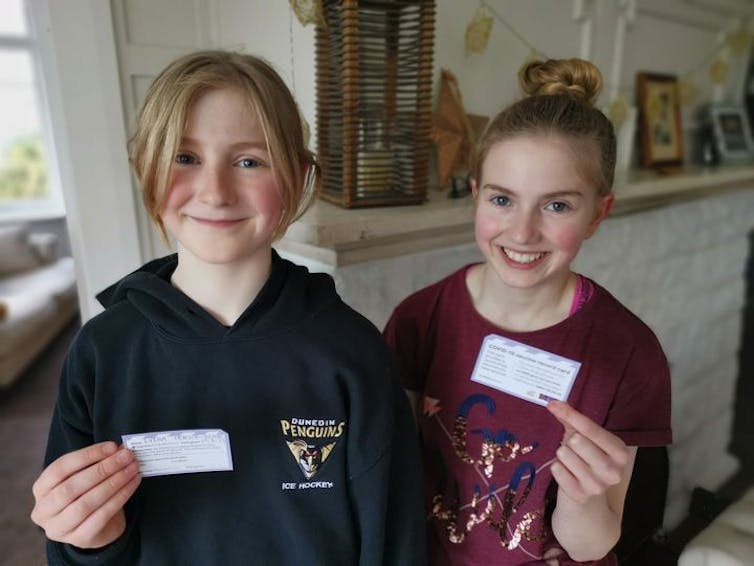
New Zealand GP Dr Sarah Hortop shared this photo of her daughters who received their first dose of the Pfizer vaccine recently.
Sarah Hortop, Author provided

Many other countries have been giving vaccines to children for several months now. For example, in the United States, more than one-third of 12 to 15-year-olds are fully vaccinated and nearly 50% have had at least one dose.

We know the vaccines work well in this age group and just like in adults, there is very close monitoring of adverse events from these vaccines in children. It’s reassuring to see very few serious reactions, and even those that are (for example myocarditis — inflammation of the heart) are treatable.

Vaccine trials are under way in children under 12 in the US (for Pfizer and Moderna), and once we have the safety and efficacy data we can start making decisions around vaccinating them too.


Read more:
We should install air purifiers with HEPA filters in every classroom. It could help with COVID, bushfire smoke and asthma


The Conversation

Katrina McLean is a Fellow of the RACGP and current Chair of General Practice Gold Coast

Natasha Yates is a Fellow of the RACGP and Deputy Lead of General Practice, Bond University

ref. Masks, ventilation, vaccination: 3 ways to protect our kids against the Delta variant – https://theconversation.com/masks-ventilation-vaccination-3-ways-to-protect-our-kids-against-the-delta-variant-166413

Senate’s vote to ban slave-made imports shows the weakness of Australia’s Modern Slavery Act

Source: The Conversation (Au and NZ) – By Kyla Raby, PhD Candidate researching the role of consumers in eradicating modern slavery in supply chains, University of South Australia

Kyodo/AP

When the Australian government introduced its Modern Slavery Bill to parliament in 2018, it heralded it as the start of a “race to the top”.

But it has turned out to be less a race than a meander.

The bill required companies with annual revenues greater than $100 million to report on action they take to ensure their supply chains are free of slave labour. The premise was that transparency and accountability were enough to drive reform.

“Business feedback indicates the primary driver for compliance will be investor pressure and reputational costs and benefits,” a government spokeswoman said at the time. “This will drive compliance more effectively than legislated penalties and encourage a business-led race to the top”.

That bill was passed in December 2018.
But so far, according to research published last month by the Australian Council of Superannuation Investors, most companies are engaged in a “race to the middle”, disclosing only the minimum and not wishing to reveal more than their key peers.

Could more be done?

Yes — but the possibilities and pitfalls are shown by a private member’s bill that passed the Senate this week.

Proposed by South Australian independent senator Rex Patrick, the Customs Amendment (Banning Goods Produced By Forced Labour) Bill 2021 would amend federal customs regulations to prohibit the import of any goods made using forced labour.

It passed the Senate on Monday with support from the Labor Party, the Greens and One Nation senators. But Coalition senators voted against the bill. This was despite it reflecting the recommendations of a inquiry chaired by Liberal senator Eric Abetz, who said Patrick’s bill was “worthy of consideration and support, in principle”.

Without government support the bill won’t pass the House of Representatives to become law. Nonetheless, it is worth considering why senators as disparate as the Greens and One Nation have backed it. Despite the Modern Slavery Act, there’s much more to be done before Australians can be confident the goods they buy are free of slave labour.

The call for a stronger approach

Patrick began with less expansive ambitions, introducing a bill in December 2020 to ban the import of goods from China produced by Uyghur forced labour.

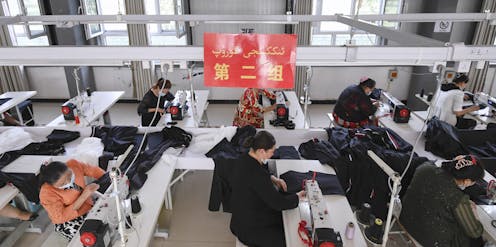
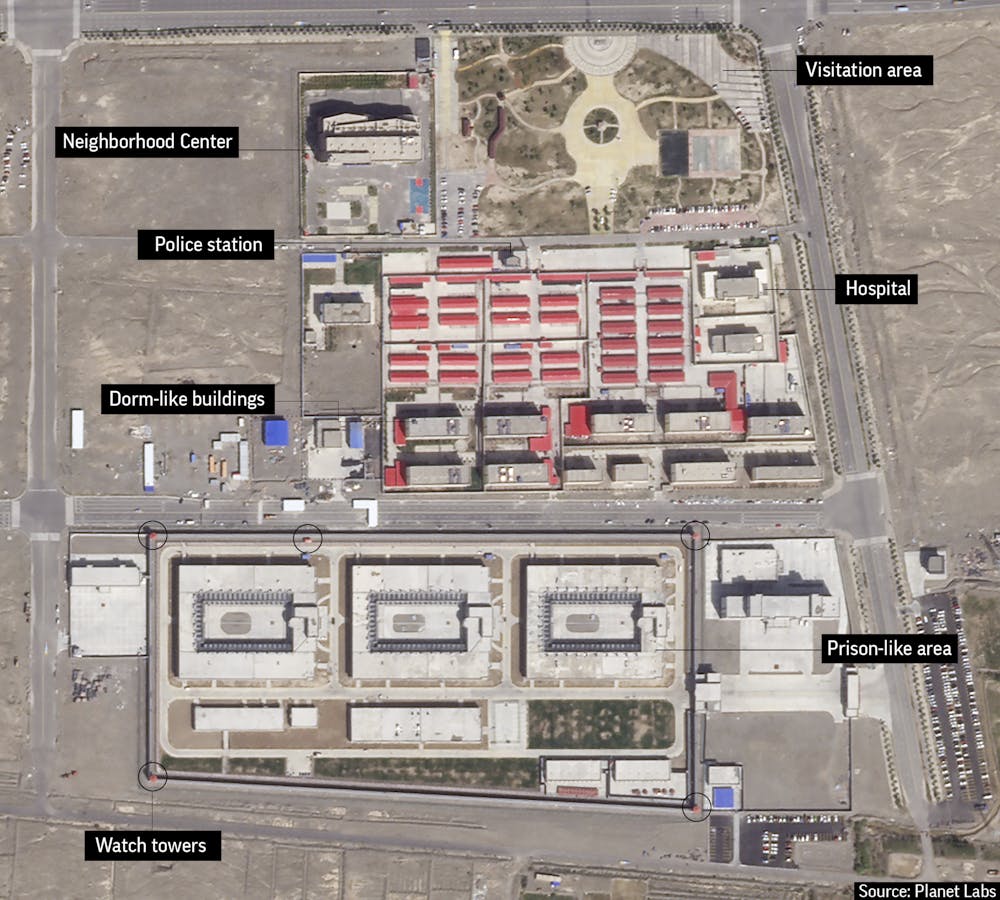
This was in response to mounting evidence of the Chinese government’s detention of more than a million Uyghurs (and other ethnic minorities) in the western province of Xinjiang, forcing them to work making goods sold by Western companies.

A 2018 satellite image shows detention camps built near the Kunshan Industrial Park in China's Xinjiang region.
A 2018 satellite image shows detention camps built near the Kunshan Industrial Park in China’s Xinjiang region.
Planet Labs/AP,

Patrick’s bill was referred to the Senate Standing Committee on Foreign Affairs, Defence and Trade, chaired Abetz. After considering about 60 submissions, in June the committee recommended (among other things) amending the Customs Act and other legislation “to prohibit the import of any goods made wholly or in part with forced labour, regardless of geographic origin”.


Read more:
Four Corners’ forced labour exposé shows why you might be wearing slave-made clothes


Its inquiry report stated:

The committee endorses without reservation the objectives of the bill. The state-sponsored forced labour to which the Uyghur people are being subjected by the Chinese dictatorship is a grave human rights violation. It is incumbent on the government to take steps to ensure that Australian businesses and consumers are not in any way complicit in these egregious abuses.

Slavery is all around us

Patrick’s revised bill reflects this sentiment.

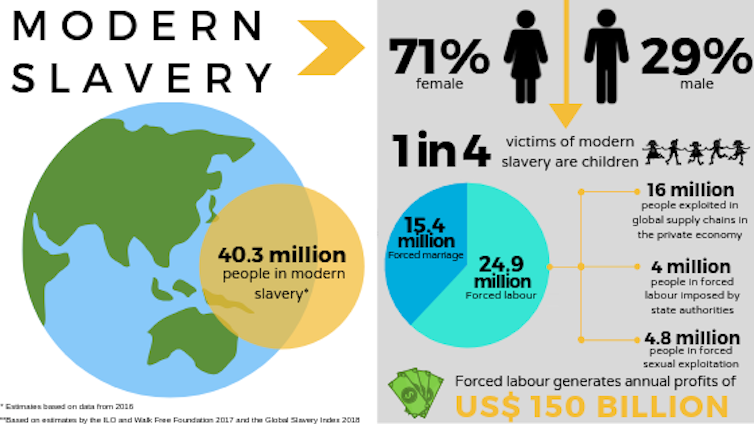
While the Chinese government may be detaining up to a million Uyghurs, the anti-slavery organisation Walk Free Foundation estimates globally about 4 million people are forced to work by state authorities, with further 21 million people exploited in private supply chains.

The foundation estimates each year goods worth more than US$350 billion (about $A480 billion) imported into G20 countries are at at-risk of having been produced, at least in part, by forced labour.


Anti-Slavery Australia

No country or industry is untouched. The estimate for imports into Australia is US$12 billion (about A$16.5 billion) a year. It’s highly likely at some stage you’ve bought something that has been made with exploited labour.

It might have been clothing made in China. Or it might have tinned tuna from Thailand, cotton milled in India. Or chocolate made from cacao farmed West Africa.

Australia’s Modern Slavery Act has been part of international moves to make companies accountable for the conditions of workers in the global supply chains from which they profit. This law requires reporting entities to submit an annual “Modern Slavery Statement” to a public register.

The law, however, has been criticised for lacking any real bite. There’s no real penalty for noncompliance. Instead it relies on the fear of being “named and shamed” — and as the research from the Australian Council of Superannuation Investors suggests, this doesn’t seem enough.

How did the government respond?

So why didn’t the government support Patrick’s bill?

In the words of Abetz, speaking in the Senate on Monday, “my heart says yes to this bill but my head says not yet”.

The government’s hesitancy is understandable. If passed, the law will require every Australian company — not just the big ones — to prove that any goods it imports are slave-free. That’s a huge leap from what is currently required.

Some large corporations are already struggling with how to adhere to the spirit and less strenuous requirements of the Modern Slavery Act. Many small- and medium-sized enterprises and not-for-profits may also not have the expertise or resources to comply.

But even if this particular bill isn’t right, the issues with Australia’s current response to modern slavery cannot be ignored. The enslavement of human beings shouldn’t be an issue where a progressive, but painfully slow, approach is accepted.

Senator Patrick’s bill may not become law. But it has helped shine a light on the deficiencies with the current law and shown there is broad community support for stronger action.

As the famous abolitionist William Wilberforce said: “You may choose to look the other way, but you can never say again that you did not know.”

The Conversation

Kyla Raby is affiliated with the Australian Red Cross

Katherine Christ has previously received funding from CPA Australia.

ref. Senate’s vote to ban slave-made imports shows the weakness of Australia’s Modern Slavery Act – https://theconversation.com/senates-vote-to-ban-slave-made-imports-shows-the-weakness-of-australias-modern-slavery-act-166647

The Killing’s Sarah Lund: an anti-hero for our COVID moment

Source: The Conversation (Au and NZ) – By Julian Meyrick, Professor of Creative Arts, Griffith University

Danmarks Radio (DR), Norsk Rikskringkasting (NRK), Sveriges Television (SVT)

Our writers nominate the TV series keeping them entertained during a time of COVID.

Her face is long and austere. Her dark hair is pulled back over a high forehead, and her eyes are large and unblinking. When she moves, she lowers her head and pushes forward, purposeful and soft, like an animal padding through a forest.

In season one of the Danish television series The Killing, when detective Sarah Lund (Sofie Gråbøl) learns of the death of her colleague, Jan Meyer — a death she is partly responsible for — she is standing next to a Russian container ship called Alexa. It means “defender of man”. Lund is a common Scandinavian surname. It means “grove”.

This is the real beginning of the series, the dark waters of ethical awareness Lund never tries to escape thereafter. Even before, she was alone. Now she is doubly so, existentially isolated in the manner of the protagonists of Greek tragedy — Antigone, Iphigenia, Phaedra — figures marked out for an outsize portion of loss and grief. Their response is not anger or resentment, a hardening of the psyche, but the opposite: a deeper vulnerability, fluid and super-sensitive.

This is what is made available to us through Lund’s face: a universal point of identification and address. Not everyone is Sarah Lund. But anyone might be.


Read more:
Rutherford Falls: a laugh-out-loud funny TV show about colonisation


A forensic gaze

The Killing (Forbrydelsen) is a three-season, Scandi-noir detective drama spread over a 15-year (ish) time span, that first aired in 2007 (an American version was made in 2011). Season one consists of 20 50-minute episodes, which is long even by the standards of long-form drama. The story does not move quickly. There is time to examine an aspect of murder downplayed by more conventional police procedurals: its human consequences.

Each season has a triangular shape. As the narratives unfold, they switch between corners, showing their interrelationship. In season one, the triangle is the government, the police and an ordinary Danish family. In season two, the government, the police and a Danish army unit. In season three, the government, the police and a Danish oil company.

Gradually, the political focus shifts higher: from an aspiring mayoral candidate, to a newly appointed Minister of Justice, to a Prime Minister facing the next election.

Lund is what my son when he was small would have called “very look-y”. She soaks in everything happening around her through her quiet stare. She is the opposite of hypercritical. The intent of her gaze is forensic not judgemental. What happened? Who did it? Why?

In respect of delivering a final verdict, only in the last episode, does she claim that right. It destroys both the man she judges and her own life.

Politicians avoiding responsibility

What makes The Killing right for this moment is its portrayal of how contemporary politics infects contemporary life, a politics of constant displacement and mendacity. Governments avoid responsibility, then avoid taking responsibility for taking responsibility. It’s not so much that they lie. Rather the truth is not an epistemological category, only a strategic factor.

Over three seasons, The Killing’s politicians juggle different narrative framings to find one that will stick. The line between plausibility and veracity is obliterated. Perception is all. Public debate collapses into popular opinion. Politicians do the right thing up to a point. When media attention is averted, or if one of them looks like getting into trouble, it is immediately abandoned.

These are the politicians we have largely come to accept as our own: a morally plastic breed whose every move is about obtaining or retaining power.


Read more:
Five of the best crime dramas to be banged up with under lockdown – from a screenwriter


To be adequate to our moment — one marked by the long term health and economic effects of COVID-19, the terror of the latest IPCC report, and the failure of US post-millennial military excursions — requires the sort of courage Sarah Lund shows.

Lund (seen here with a rare smile) is courageous but not ‘special’ like a Hollywood hero.
Danmarks Radio (DR), Norsk Rikskringkasting (NRK), Sveriges Television (SVT)

Yet she is without heroic properties. She isn’t “special” in the way Hollywood heroes are. She is ordinary. She does not “recover”. She is not “resilient”. She grows, ethically, emotionally, spiritually. Every killing marks her more deeply. That’s a lesson we can take to heart.

A home for grief

Lund has no luck with men. In season one, her engagement founders as she is swallowed up by an investigation into a murdered girl. In season two, she falls for a detective who turns out to be a psychopathic killer. In season three, an old flame appears and it’s on. But she wrecks everything and has to flee from the beginnings of a happy life.

Lund has no memorable quirks, unless you count being unable to cook and a taste for chunky knit jumpers (now famous in their own right). She is not witty, or especially charismatic. When annoyed, she rarely shouts. Instead, she purses her lips and pushes on with whatever she’s doing, like a truculent child. She makes mistakes, sometimes big ones. If she does the right thing it’s because she chooses to, never because it’s easy.

“When people are killed, it’s important” she says to a weary Afghan army officer in season two, when she is investigating the murder of a family in the middle of a war-zone.

Lund can be abrupt, cutting people off mid-sentence, or mid-phone call, or suddenly walking out of a room. Later, she will shrink into herself, aware of what she has done. Her face shows remorse in ways that don’t involve her having to open her mouth and say “I’m sorry”. She has the courage to feel overwhelmed.

In season three, a couple whose daughter has been kidnapped visit a Lutheran pastor who tells them, “Grief is love that has become homeless”. In Lund, grief finds a home again and turns back into love. It isn’t her fault that nature, to balance her analytical gifts, deprives her of expressive ones.

Lund is the least political creature. She does what we all do. She gets on with the job. Only at the end does she see what she is up against, and act to save the future when no one else will. Knowingly, sufferingly, she walks into hell.

The Killing is airing on SBS on demand.

The Conversation

Julian Meyrick does not work for, consult, own shares in or receive funding from any company or organization that would benefit from this article, and has disclosed no relevant affiliations beyond their academic appointment.

ref. The Killing’s Sarah Lund: an anti-hero for our COVID moment – https://theconversation.com/the-killings-sarah-lund-an-anti-hero-for-our-covid-moment-166654

At home with your dog? 3 ways to connect and lift your spirits

Source: The Conversation (Au and NZ) – By Jessica Oliva, Lecturer, Psychology, James Cook University

Shutterstock

It may come as no surprise to dog owners in lockdown, but walking the dog can be the highlight of the day.

With exercise being one of the few reasons for leaving the house for millions of Australians, walking the dog clearly benefits both dog owners and their furry friends.

But walking the dog isn’t the only thing you can do to lift your spirits and ease loneliness.

Our study found three things you can do at home with your dog to make you feel better, which your dog will probably love too.

1. You can meditate with your dog

Our study showed it helped to take time out to focus on your dog’s fur or the warmth of their body using “mindfulness meditation”.

This type of meditation involved people listening to a recording that guided them to activate their senses (for instance, touch) as a way of enhance their engagement with the task.

Dog owners who did this for seven minutes once a week or more felt relaxed, calm, enjoyed the process, said they felt more connected to their dog, and helped them focus on the present.

For many dog owners in our study, these effects also lasted for several minutes or hours after stopping the activity.


Read more:
Mindfulness meditation in brief daily doses can reduce negative mental health impact of COVID-19


If you want to try this for yourself, create a space in your home where you are not likely to be interrupted and turn off your phone. Sit comfortably on the floor, on a mat, cushion or blanket and invite your dog to come and sit next to you or on your lap.

Place one or two hands on your dog and sit up tall. Start by closing your eyes and taking a few deep breaths. Be aware of your sense of touch and notice the sensations in your hand and fingertips. Stay with this awareness and if your mind starts to wander, gently escort it back to your feeling of touch and your dog’s fur. Stay with this practice for seven minutes or more.

Although we didn’t specifically measure the impact on dogs, we suspect they appreciate the close, calm and private space this creates for both of you.

2. You can play hide and seek

If mindfulness meditation isn’t your thing, our study showed setting aside seven minutes of undivided playtime with your dog had similar results. This might be an interactive game, such as hide and seek.

Dog owners who did this said they enjoyed this, had a better connection with their dog, and helped them focus on the present. They also thought their dog had fun.

How might this work as well as mindfulness meditation? Mindfulness is simply about being present in the moment. So if we put the phone away, pets can be great facilitators to help bring us into the present and centre our mind on one thing — them.


Read more:
Routine and learning games: how to make sure your dog doesn’t get canine cabin fever


3. You can talk to your dog

If you really want to increase the connection with your dog, try some
calm and focused interactions. This might be seven undivided minutes of affection with your dog, such as giving them a good belly rub, or spending seven undivided minutes talking to them.

Out of all the activities we tried, these worked best to connect with your dog.

While some people in our study said they felt awkward talking to their dog, our earlier research showed others seem to love it.

For people living alone in lockdown, having a pet dog was an excuse to talk out loud, and this may play an important role in their well-being.

Making time to be affectionate towards your dog also made owners feel relaxed and calm, at similar levels to those who practised mindfulness meditation.

Completely focusing on your dog this way increases the release of molecules associated with relaxation (such as oxytocin) and reward (such as dopamine) in both owner and dog.


Read more:
Lockdown can be stressful for pets too – here’s how to keep your dog entertained


Making time for your dog

Not all dog owners are spending their time in lockdown going on long walks with their furry friends. One study found some dog owners walked their dog less often or went on shorter walks during the pandemic.

Whether that’s been your experience, or if you want to try something new, these three types of interactions with your dog don’t take a lot of time. You could even continue them after lockdown’s over.

This might end up become the new highlight of your dog’s day, making the long wait for you to return home from work completely worth it.


Read more:
Your dog’s nose knows no bounds – and neither does its love for you


The Conversation

Jessica Oliva does not work for, consult, own shares in or receive funding from any company or organization that would benefit from this article, and has disclosed no relevant affiliations beyond their academic appointment.

ref. At home with your dog? 3 ways to connect and lift your spirits – https://theconversation.com/at-home-with-your-dog-3-ways-to-connect-and-lift-your-spirits-166331

Politics with Michelle Grattan: Doherty’s Sharon Lewin on pivoting from chasing COVID zero

Source: The Conversation (Au and NZ) – By Michelle Grattan, Professorial Fellow, University of Canberra

The Doherty modelling is the government’s underpinning for a proposed easing of COVID restrictions once we reach targets of 70% and 80% of the adult population vaccinated.

But the exit path has put Scott Morrison at odds with Western Australia and Queensland, states which would inevitably have to give up their present status of having little or no COVID.

The model’s priority is pivoting from reaching zero cases, to limiting COVID by vaccination, minimising serious illness, hospitalisation, and deaths.

This week, Professor Sharon Lewin, Director of the Peter Doherty Institute for Infection and Immunity joins the podcast to explain into the much-discussed modelling and its policy implications.

In the event things open up, our “first line of defence” will be the public health capacity, says Lewin. The ability to trace, test, isolate, and quarantine limits the explosion of cases and keeps the transmission potential “less than one”.

Some critics have said the 70-80% target won’t sufficiently protect the entire population from COVID. Lewin notes that amongst the varying models there is agreement we cannot open up on vaccine uptake alone.

“You can’t just open up a 70% with nothing else in place. There is no ‘Freedom Day’. You do need these additional public health measures.”

In particular, while “tremendous advances have been made in capabilities[…] it’s not universal across the country. In particular, First Nation communities, which have been prepared and boasted an “effective community lead response” earlier in the pandemic, will require a strengthening of their public health facilities.

Listen on Apple Podcasts

Stitcher Listen on TuneIn

Listen on RadioPublic

Additional audio

A List of Ways to Die, Lee Rosevere, from Free Music Archive.

The Conversation

Michelle Grattan does not work for, consult, own shares in or receive funding from any company or organisation that would benefit from this article, and has disclosed no relevant affiliations beyond their academic appointment.

ref. Politics with Michelle Grattan: Doherty’s Sharon Lewin on pivoting from chasing COVID zero – https://theconversation.com/politics-with-michelle-grattan-dohertys-sharon-lewin-on-pivoting-from-chasing-covid-zero-166740

What Greenland’s record-breaking rain means for the planet

Source: The Conversation (Au and NZ) – By Willow Hallgren, Adjunct Research Fellow, Centre for Planetary Health and Food Security, Griffith University

For three days this month, 7 billion tonnes of rain fell across Greenland — the largest amount since records began in 1950. It’s also the first time since then that rain, not snow, fell on Greenland’s highest peak.

This is alarming. Greenland’s ice sheet is the second largest on the planet (after Antarctica) and any rain falling on its surface accelerates melting. By August 15, the amount of ice lost was seven times greater than is normal for mid-August.

This is just the latest extreme climate event on the island, which sits in the North Atlantic Ocean. In a single day in July this year, the amount of ice that melted in Greenland would have covered the US state of Florida with 5 centimetres of water. And last October, research showed ice in Greenland is melting faster than at any other time in the past 12,000 years.

Melting in Greenland threatens to significantly hamper humanity’s efforts to mitigate climate change. That’s because, after a certain point, it may create catastrophic “feedback loops”. Let’s look at the issue in more detail.

Rising temperatures in the Arctic

Greenland’s vast ice sheet comprises almost 1.7 million square kilometres of glacial land ice. It covers most of the territory and contains enough ice to raise sea levels by more than 7 metres if melted.

The Greenland and Antarctica ice sheets lost a combined 6.4 trillion tonnes of ice between 1992 and 2017. Melting in Greenland has contributed to 60% (17.8 millimetres) of the Earth’s overall sea-level rise due to melting ice sheets, even though Greenland is much smaller than Antarctica.

This may be partly because half of Greenland’s melting is the result of rising air temperatures, which cause surface melting. In Antarctica, most ice loss is from ocean water melting glaciers that spill from land into the sea. And the rate of ice loss in both Greenland and Antarctica is accelerating — increasing sixfold since the 1990s.

Rain falling on ice exacerbates this process. So what’s behind the recent unprecedented weather?

Temperatures in the Arctic are rising twice as quickly as the rest of the planet for a number of reasons, including changes in cloud cover and water vapour, the reflectivity of the surface, and how weather systems transport energy from the tropics to the polar regions. This has made extreme weather events more common.


Read more:
Climate explained: why is the Arctic warming faster than other parts of the world?


In recent years in Greenland, rain has fallen further north, and more rain has fallen in winter. This is not normal for these regions, which usually get snow, not rain, in below-freezing temperatures.

This month’s rain is the result of warm, moist air flowing up from south-west of Greenland and remaining for several days. In the morning of August 14, temperatures at the 3,216-metre summit of Greenland’s ice sheet surpassed freezing point, peaking at 0.48℃. Rain fell on the summit for several hours that morning and on August 15.

This was particularly shocking given the above-freezing temperatures occurred so late in Greenland’s normally short summer. At this time of year, large areas of bare ice are exposed from a lack of snow, which leads to greater runoff of rainwater and meltwater into the oceans.

Temperatures rarely surpass freezing in Greenland.
Shutterstock

When melting is self-reinforcing

Rainfall makes the ice sheet more prone to surface melt since it exacerbates the so-called “ice-albedo positive feedback”. In other words, the melting reinforces itself.

When rain falls, its warmth can melt snow, exposing the underlying darker ice, which absorbs more sunlight. This increases temperatures at the surface, leading to more melting.

Unfortunately, this isn’t the only positive feedback loop destabilising the Greenland ice sheet.

The “positive melt-elevation feedback” is another, where the lower height of the ice sheet leads to faster melting because higher temperatures occur at lower altitudes.

Also worrying is when higher temperatures cause coastal glaciers to thin, allowing more ice to slip into the sea. This both speeds up the rate of glacier flow towards the sea and lowers the ice surface, exposing it to warmer air temperatures and, in turn, increasing melting.

The rate of ice loss in both Greenland and Antarctica is accelerating.
Shutterstock

What does this mean for the planet?

These positive feedbacks can lead to tipping points — abrupt and irreversible changes in the climate system after a certain threshold is reached. We are more likely to reach these tipping points as emissions increase and global temperatures rise.

While the science on tipping points is still emerging, the most recent report from the Intergovernmental Panel on Climate Change said they cannot be ruled out. The report identified likely tipping points such as widespread Arctic sea-ice melting and the thawing of methane-rich permafrost.


Read more:
‘Failure is not an option’: after a lost decade on climate action, the 2020s offer one last chance


Recent studies show what humanity may be up against. A study from May this year showed a substantial part of the Greenland ice sheet is either at, or about to reach, a tipping point where melting will accelerate, even if global warming is stopped. Scientists are concerned reaching this point may trigger a cascade effect, leading to other tipping points being reached.

Melted ice from both the Arctic Ocean and Greenland have caused an influx of freshwater into the North Atlantic Ocean. This has contributed to the slowing of a system of crucial ocean currents, which carry warm water from the tropics into the colder North Atlantic. This current, called the Atlantic Meridional Overturning Circulation (AMOC), has slowed by 15% since the 1950s.

If the AMOC slows down any further, the consequences for the planet could be profound. It could destabilise the West African monsoon, cause more frequent drought in the Amazon rainforest and accelerate ice loss in Antarctica.

An existential threat

The rising likelihood of tipping points being reached beyond 1.5℃ of warming represents a potential, looming existential threat to human civilisation. However, even if we’ve already crossed some tipping points, as some scientists suggest, how fast the impacts unfold is still within our control.

If we limit global warming to 1.5℃ this century, we give ourselves longer to adapt to heating already locked into the Earth’s system. But the window is rapidly closing; estimates indicate we may reach the crucial 1.5℃ threshold as soon as the mid-2030s.

The message for humanity is urgent: hard science, not cloying political spin, needs to dictate climate action in the coming years. As with COVID-19, listening to the scientists gives us the best hope of saving the planet.


Read more:
When Greenland was green: rapid global warming 55 million years ago shows us what the future may hold


The Conversation

Willow Hallgren does not work for, consult, own shares in or receive funding from any company or organization that would benefit from this article, and has disclosed no relevant affiliations beyond their academic appointment.

ref. What Greenland’s record-breaking rain means for the planet – https://theconversation.com/what-greenlands-record-breaking-rain-means-for-the-planet-166567

Craig Kelly’s move to Palmer’s United Australia Party shows the need for urgent electoral law reform

Source: The Conversation (Au and NZ) – By Denis Muller, Senior Research Fellow, Centre for Advancing Journalism, The University of Melbourne

AAP/Lukas Coch

The news that Craig Kelly, MP, serial purveyor of COVID misinformation, is to join Clive Palmer’s United Australia Party in order to fund his damaging ravings on a grander scale, confronts Australian democracy with a dilemma.

How is he to be prevented from adding to the harm he is already doing to the public welfare without trespassing unjustifiably on his right of free speech?

It is a classic example of how populists are exploiting the rights conferred by democracy to undermine democracy.

Kelly is frank about what he intends to do. Referring to his joining the UAP, he told The Sydney Morning Herald:

The crude reality is that I’ll have greater resources.

I have been screaming this stuff from the rooftops for a long time. It’s very hard to get this message through. We have a huge war chest, we can run television commercials, ads, we can finance a proper campaign that no other minor party or independent can.

He says that because these advertisements would be considered party-political advertisements, blocking them would be unconstitutional.

Whether or not he is right about that, it reveals his attitude: a preparedness to exploit a law protecting freedom of political speech so he can go on spreading COVID misinformation in pursuit of elected office.

The electoral and trade practices laws have no provisions to stop him. Section 329 of the Commonwealth Electoral Act is confined to the issue of whether a publication is likely to mislead or deceive an elector in relation to the casting of a vote. Sections 52 and 53 of the Trade Practices Act, which make false or misleading representations an offence, have nothing to say about political advertising.


Read more:
Why Clive Palmer’s lockdown ads can be rejected by newspapers on ethical grounds


However, there are two philosophical bases for arguing the electoral laws should be amended to thwart this kind of harmful exploitation.

One is John Stuart Mill’s harm principle, which says the prevention of harm to others is a legitimate constraint on individual freedom.

The other is from John Locke’s A Letter Concerning Toleration. Locke’s principle is that society is not obliged to tolerate actions or positions that undermine the civil order. Corrupting the electoral process as Kelly proposes – by misleading voters – falls well within that compass.

To borrow from Locke’s other great contribution to the development of modern democracy, his Second Treatise on Government, such actions or positions would breach the social contract. This contract is built on trust. Individuals submit themselves to the law on the condition that everyone else will do the same. Breaches of that trust are not to be tolerated.

This principle may be extended to other behaviours that breach the public trust: unethical conduct and anti-social conduct that might fall short of illegality but still do harm. Unethical conduct is embodied in Kelly’s stated intention to use Palmer’s millions to amplify his COVID misinformation, which would be to the detriment of public health.

In common with other mature democracies, Australia has predicated its laws on certain norms concerning truth, responsibility and the preservation of the social contract.

The problem is that in an age when populist politicians, social media and influential elements of mass media combine to spread harmful content, these norms – the guard rails of democracy – are being tested to breaking point.

In Washington on January 6 2021, when the mob invaded Congress, we saw what happens when the guard rails give way. For months leading up to and during the US presidential election, the then President Donald Trump and his mouthpiece, Fox News, abandoned the norm of truth-telling and persuaded a significant plurality of voters that the election was fraudulent.

The storming of the US Capitol in January shows what can happen when democracy’s guard rails come down.
Jim Lo Scalzo/EPA/AAP

This confronts democracies with a paradox. If they extend free speech even to those who use it to do serious harm, then tolerant societies become defenceless against the baneful effects of this behaviour.

It is akin to Karl Popper’s argument concerning what he called the tolerance paradox:

Unlimited tolerance must lead to the disappearance of tolerance. If we extend unlimited tolerance even to those who are intolerant, if we are not prepared to defend a tolerant society against the onslaught of the intolerant, then the tolerant will be destroyed, and tolerance with them.

In common with other democracies, Australia places restrictions on free speech when it does unjustified harm. The defamation and contempt of court laws are just two examples among many.

There is no reason why this principle should not be extended to speech that causes provable harm to the public welfare in pursuit of election to parliament. Those harms could be defined and circumscribed in the Electoral Act without too much difficulty and would certainly include harms to public health.


Read more:
Right-wing shock jock stoush reveals the awful truth about COVID, politics and media ratings


There is precedent. In the aftermath of the Christchurch terrorism in March 2019, Parliament enacted the Criminal Code Amendment (Sharing of Abhorrent Violent Material) Act. Abhorrent violent material was confined in its definition to mean murder or attempted murder, a terrorist act, torture, rape or kidnapping. There are provisions to allow for the reporting of these acts.

At the same time, great care needs to be taken to avoid overreach, particularly in a society like Australia’s, which has no constitutional protection for free speech. That situation only sharpens the paradox.

As matters stand, Australia is leaving it to powerful foreign sources such as YouTube, unelected and unaccountable, to restrain the likes of Kelly, as when it recently suspended Sky News for spreading COVID misinformation.

Instead of confronting the paradox, the Australian parliament seems content to outsource to the global media platforms control over how our democratic freedoms are governed. Neither of the major parties has shown the slightest interest in engaging with this problem.

The Conversation

Denis Muller does not work for, consult, own shares in or receive funding from any company or organization that would benefit from this article, and has disclosed no relevant affiliations beyond their academic appointment.

ref. Craig Kelly’s move to Palmer’s United Australia Party shows the need for urgent electoral law reform – https://theconversation.com/craig-kellys-move-to-palmers-united-australia-party-shows-the-need-for-urgent-electoral-law-reform-166663

The plight of Afghan security contractors highlights the legal and moral risks of outsourcing war

Source: The Conversation (Au and NZ) – By Anna Powles, Senior Lecturer in Security Studies, Massey University

By first denying and then granting visas to more than 100 Afghan contractors who guarded its embassy in Kabul, Australia has shone a light on the murky world of the private security industry.

According to the lawyer and former army officer representing the security guards, his clients had yet to receive the humanitarian visas and the about-face was merely an attempt by Australian officials “to look like they have done their job when they sat on their hands for so long”.

The Australian case mirrors the British government’s policy reversal concerning 125 Afghan security guards at its Kabul embassy.

They, too, were initially informed they were ineligible for emergency evacuation due to being employed by Canadian private security firm GardaWorld, only for the decision to be overruled late last week.

In both cases, these Afghan contractors have fallen into the shady legal gap between the private security company that employed them locally and the governments that contracted their employers.

As one GardaWorld employee said when he was told his contract would be terminated:

No one asked whether we are safe or not. No one asked whether our lives are in danger or not.

Privatising and outsourcing war

Afghanistan, famously known as “the graveyard of empires”, has been a gravy train for the global private security industry for the past two decades, as the war was increasingly privatised and outsourced.

Under the Trump administration, private security companies with Pentagon contracts numbered nearly 6,000, costing US$2.3 billion (A$3.1 billion) in 2019. When the US military withdrawal began, these private contractors dropped to about 1,400 by July.


Read more:
As the Taliban’s grip on Afghanistan tightens, New Zealand must commit to taking more refugees


Until now, however, private security firms were such a critical element of the war effort that their departure was considered a key factor in the collapse of the Afghan army.

The appeal of these private security contractors lies in their arms-length advantage — they are relatively disposable and carry little political cost. This allows the industry to operate opaquely, with little oversight and even less accountability.

In the case of the Australian embassy guards, it would appear their direct employers have done little to secure their safety. How, then, can these companies and the governments that employ them be held accountable?

Little binding protection

The Montreux Document on Private Military and Security Companies – which reflects inter-governmental consensus that international law applies to private security companies in war zones – requires private security companies “to respect and ensure the welfare of their personnel”. Unfortunately, this is not a binding agreement.

The International Code of Conduct for Private Security Service Providers (ICoCA) – known as “the code” — lays out the responsibilities of private security under international law. It requires signatory companies to:

[…]provide a safe and healthy working environment, recognising the possible inherent dangers and limitations presented by the local environment [and to] ensure that reasonable precautions are taken to protect relevant staff in high-risk or life-threatening operations.


Read more:
The Taliban may have access to the biometric data of civilians who helped the U.S. military


Australia is a signatory to the ICoCA, as are private security companies Gardaworld, Hart International Australia and Hart Security Limited, all of which operate in Afghanistan and have at various times been contracted by the Australian government.

But again, like the Montreux Document, the ICoC is non-binding. However, ICoC Executive Director Jamie Williamson has said:

The situation in Afghanistan is shining a spotlight on the duty of care clients of private security companies have towards local staff and their families […] We expect to see both our government and corporate members ensure the safety and well-being of all private security personnel working on government and other contracts, whatever their nationality.

Still no guarantee of safety

This duty of care now appears to have been extended to those guards who worked for the Australian and British governments in Afghanistan — albeit at the last minute. As one contractor told Australian media, he and his colleagues first applied for protection visas in 2012.

But their safety remains uncertain. The visas do not guarantee safe passage to Kabul’s international airport where evacuation efforts are chaotic. In the past weekend alone, 14 civilians were killed trying to flee the Taliban takeover.

There are also concerns about safe passage through Taliban checkpoints not being properly coordinated by US and NATO
allies, leaving dangerous alternative routes the only option.


Read more:
Where do Afghanistan’s refugees go?


Sheltering until they can safely travel to the airport is also fraught. As one guard explained:

Every day there is news that the Taliban will start a search for each house […] looking for people who have served the army and those who have served the foreign army.

Australia has made a legal and moral commitment to provide refuge to these people. But with the Taliban’s so-called red line of August 31 looming, the window to evacuate them and their families is closing.

And while the global private security companies may have shut up shop in Afghanistan for now, the consequences and human costs associated with outsourcing war linger on.

The Conversation

Dr Anna Powles has consulted on security sector reform and private security sector governance with the United Nations Development Programme and co-leads a research project on private security companies in the Pacific.

ref. The plight of Afghan security contractors highlights the legal and moral risks of outsourcing war – https://theconversation.com/the-plight-of-afghan-security-contractors-highlights-the-legal-and-moral-risks-of-outsourcing-war-166730

How Pakistan stands to gain — or lose — from the Taliban’s victory in Afghanistan

Source: The Conversation (Au and NZ) – By Muhammad Nadeem Malik, Senior Lecturer, The University of Melbourne

Jafar Khan/AP

Pakistan has long played a critical, yet confusing role in Afghanistan. It has been one of the strongest US allies in its “war on terror”, yet it has also covertly backed the Taliban in its fight against US-led forces for years.

The paradox remained visible after the Taliban swept into Kabul last week.

Pakistan’s official response by its foreign minister was hope for a peaceful settlement in Afghanistan through an inclusive, transition government following broad-based consultations with all ethnic groups and stakeholders.

Moreover, in a televised address, Pakistan’s army chief urged the Taliban leaders to fulfil their promise to the international community regarding respect for women’s rights and human rights

Both statements align with America’s aspirations. But in contrast, Prime Minister Imran Khan declared that Afghans had broken “the shackles of slavery”, which seems to mock the US establishment.

How regional powers are responding

Despite this mixed messaging from Pakistani leaders, a coordinated regional response to the Taliban takeover appears to be shaping up.

As western countries hold back from recognising the new government, the regional powers of Russia, China, Iran and Pakistan have kept their embassies open in Kabul and expressed their willingness to work with the Taliban.

According to a senior security journalist I spoke with in Pakistan, both Russia and Iran supported the Taliban fight against the US-sponsored Afghanistan government to contain the threat from the Islamic State.

Iran’s influence on the Taliban can be gauged by the fact the group’s leadership participated in the Shia’ Majlis (a religious council delivering sermons) in Kabul after its takeover, which is highly unusual for the extremist Sunni Taliban.

Moreover, Iran and Russia have been so involved in Afghanistan and the politics of the Taliban that when then-President Donald Trump cancelled a planned meeting with Taliban leaders in late 2019, the group reacted by going to both countries to get advice from their leaders on how to respond.

Overall, the strategies of these regional powers will greatly influence the politics in Afghanistan in the coming days — but it’s Pakistan that likely has the greatest sway over the Taliban leaders.


Read more:
Afghanistan: western powers must accept defeat and deal realistically with the Taliban


A brief history of Pakistan’s support for the Taliban

Pakistan has provided political and military support for different factions within Afghanistan since the early 1970s. During the 1980s, Pakistan was a major backer of the Afghan mujahideen (holy warriors) fighting against the Soviet invasion and hosted millions Afghan refugees fleeing the war.

Afghan mujahideen during the Soviet-Afghan War in 1987.
Wikimedia Commons

Pakistan was also a major ally of the US at this time. The US channelled some US$2-3 billion (A$2.7-4.1 billion) worth of covert assistance through Pakistan to the mujahideen, training over 80,000 of the fighters.

Even after the withdrawal of Soviet troops in 1989, Pakistani military officers continued to provide training and guidance to the mujahideen and eventually to Taliban forces to combat their enemies.

In addition, senior members of Pakistan’s intelligence agency and army are accused of helping the Taliban plan major military operations against the government during the Afghan civil war in the 1990s. Pakistani support for the group attracted widespread international criticism, including from then-UN Secretary-General Kofi Annan, who called it “deeply distressing”.


Read more:
As Afghanistan falls, what does it mean for the Middle East?


Pakistan was then just one of three countries to officially recognise the new Taliban government when it took power in 1996.

General Hamid Gul, a former head of Pakistan’s Inter-Services Intelligence (ISI), acknowledged in 2014 that Pakistan even used US aid to continue funding the Taliban after the September 11 terror attacks.

He told a television audience,

When history is written, it will be stated that the ISI defeated the Soviet Union in Afghanistan with the help of America. Then there will be another sentence. The ISI, with the help of America, defeated America.

Pakistan is still likely to provide covert political and logistic support to the new Taliban leaders in Afghanistan today.

In the past, the Taliban leadership had three consultative councils, known as shuras, based in Pakistan. At least one of these shuras, based in Quetta, still probably seems to be operating from Pakistan.

The Taliban also operated in the country throughout the American occupation in Afghanistan, even though the Pakistan government denies supporting the group and denies the existence of the Quetta shura.

Given this history, it’s no wonder many people around the world are blaming Pakistan for the Taliban’s recent military success, reflected in the #SanctionPakistan campaign on Twitter.


Read more:
As the Taliban surges across Afghanistan, al-Qaeda is poised for a swift return


What does Pakistan stand to gain or lose?

Pakistan’s biggest gain is that India will lose its influence in Afghanistan, which was seen as a threat to Pakistan’s security. The Taliban takeover also allows Pakistan to boost its bilateral trade with Afghanistan and provides an unrestricted trade route to the countries of central Asia.

However, Pakistan can lose from the Taliban’s ascendancy, as well. If the Taliban fails to ensure stability, this can trigger another wave of refugees crossing the border. The Taliban’s takeover could also embolden domestic terror groups within Pakistan.

As a result, Taliban rule in Afghanistan could have adverse security repercussions for Pakistan, particularly with regard to the Pakistani Taliban (TTP). The TTP considers the takeover of Afghanistan by its Afghan counterparts a significant ideological victory.

The TTP has launched several violent attacks in Pakistan over the years, including an attack on a school in Peshawar in 2014 that killed more than 150 people, mostly children.

Candlelight vigil for the victims of a school attack.
A candlelight vigil for the victims of a school attacked by the Taliban in Peshawar in 2014.
Anjum Naveed/AP

Some of the TTP’s leaders were also reportedly freed from prisons by Afghan Taliban fighters in recent days.

As a former member of Pakistan’s parliament told the Financial Times, “a stable Afghanistan will work in Pakistan’s favour”.

The key to creating peace and stability in Afghanistan will be Pakistan’s strategic cooperation with all of the regional powers, as well as the US. Such cooperation, however, may be a challenge to achieve, given the competing interests that have long torn this country apart.

The Conversation

Muhammad Nadeem Malik does not work for, consult, own shares in or receive funding from any company or organisation that would benefit from this article, and has disclosed no relevant affiliations beyond their academic appointment.

ref. How Pakistan stands to gain — or lose — from the Taliban’s victory in Afghanistan – https://theconversation.com/how-pakistan-stands-to-gain-or-lose-from-the-talibans-victory-in-afghanistan-166414

Op-Ed: Asia Pacific – Resilience in a riskier world

Armida Salsiah Alisjahbana is the United Nations Under-Secretary-General and Executive Secretary of the Economic and Social Commission for Asia and the Pacific (ESCAP).

Opinion by Armida Salsiah Alisjahbana.

Armida Salsiah Alisjahbana is the United Nations Under-Secretary-General and Executive Secretary of the Economic and Social Commission for Asia and the Pacific (ESCAP).

Over the past two decades, the Asia-Pacific region has made remarkable progress in managing disaster risk. But countries can never let down their guard. The COVID-19 pandemic, with its epicentre now in Asia, and all its tragic consequences, has exposed the frailties of human societies in the face of powerful natural forces. As of mid-August 2021, Asian and Pacific countries had reported 65 million confirmed coronavirus cases and more than 1 million deaths. This is compounded by the extreme climate events which are affecting the entire world. Despite the varying contexts across geographic zones, the climate change connection is evident as floods swept across parts of China, India and Western Europe, while heatwaves and fires raged in parts of North America, Southern Europe and Asia.

The human and economic impacts of disasters, including biological ones, and climate change are documented in our 2021 Asia-Pacific Disaster Report. It demonstrates that climate change is increasing the risk of extreme events like heatwaves, heavy rain and flooding, drought, tropical cyclones and wildfires. Heatwaves and related biological hazards in particular are expected to increase in East and North-East Asia while South and South-West Asia will encounter intensifying floods and related diseases. However, over recent, decades fewer people have been dying as a result of other natural hazards such as cyclones or floods. This is partly a consequence of more robust early warning systems and of responsive protection but also because governments have started to appreciate the importance of dealing with disaster risk in an integrated fashion rather than just responding on a hazard-by-hazard basis.

Nevertheless, there is still much more to be done. As the COVID-19 pandemic has demonstrated, most countries are still ill-prepared for multiple overlapping crises – which often cascade, with one triggering another. Tropical cyclones, for example, can lead to floods, which lead to disease, which exacerbates poverty. In five hotspots around the region where people are at greatest risk, the human and economic devastation as these shocks intersect and interact highlights the dangers of the poor living in several of the region’s extensive river basins.

Disasters threaten not just human lives but also livelihoods. And they are likely to be even more costly in future as their impacts are exacerbated by climate change. Annual losses from both natural and biological hazards across Asia and the Pacific are estimated at around $780 billion. In a worst-case climate change scenario, the annual economic losses arising from these cascading risks could rise to $1.3 trillion – equivalent to 4.2 per cent of regional GDP.

Rather than regarding the human and economic costs as inevitable, countries would do far better to ensure that their populations and their infrastructure were more resilient. This would involve strengthening infrastructure such as bridges and roads, as well as schools and other buildings that provide shelter and support at times of crisis. Above all, governments should invest in more robust health infrastructure. This would need substantial resources. The annual cost of adaptation for natural and other biological hazards under the worst-case climate change scenario is estimated at $270 billion. Nevertheless, at only one-fifth of estimated annualized losses – or 0.85 per cent of the Asia-Pacific GDP, it’s affordable.

Where can additional funds come from? Some could come from normal fiscal revenues. Governments can also look to new, innovative sources of finance, such as climate resilience bonds, debt-for-resilience swaps and debt relief initiatives.

COVID-19 has demonstrated yet again how all disaster risks interconnect – how a public health crisis can rapidly trigger an economic disaster and societal upheaval. This is what is meant by “systemic risk,” and this is the kind of risk that policymakers now need to address if they are to protect their poorest people.

This does not simply mean responding rapidly with relief packages but anticipating emergencies and creating robust systems of social protection that will make vulnerable communities safer and more resilient. Fortunately, as the Report illustrates, new technology, often exploiting the ubiquity of mobile phones, is presenting more opportunities to connect people and communities with financial and other forms of support. To better identify, understand and interrupt the transmission mechanisms of COVID-19, countries have turned to “frontier technologies” such as artificial intelligence and the manipulation of big data. They have also used advanced modelling techniques for early detection, rapid diagnosis and containment.

Asia and the Pacific is an immense and diverse region. The disaster risks in the steppes of Central Asia are very different from those of the small island states in the Pacific. What all countries should have in common, however, are sound principles for managing disaster risks in a more coherent and systematic way – principles that are applied with political commitment and strong regional and subregional collaboration.

——————

Ms. Armida Salsiah Alisjahbana is the United Nations Under-Secretary-General and Executive Secretary of the United Nations Economic and Social Commission for Asia and Pacific (ESCAP)

Community leaders say NZ vaccine rollout plan not working for Pasifika

By Christine Rovoi, RNZ Pacific journalist

The government-designed vaccination rollout in New Zealand has not mobilised Pacific communities to respond safely and effectively, the Pacific Leadership Forum said.

More than 50 percent of covid-19 infections in New Zealand are of Pacific descent.

But they have one of the lowest vaccination rates in the country.

Pakilau o Aotearoa Manase Lua is chair of the Pacific Response Coordination Team (PRCT) and said this showed the current vaccination strategies were not working for Pacific peoples.

The Tongan community leader said this was despite millions of dollars being allocated towards covid-19 vaccination stations, communications and PR companies to drive awareness and engagement.

“I don’t blame our communities at all. A lot of them are hearing a lot of misinformation through social media on the vaccines,” he said.

“There’s uncertainty because now they hear that their children don’t even need permission. It’s all on the Ministry of Health’s website. Children who want to get vaccinated don’t need to tell their parents.”

PRCT helped mobilise Pacific communities
Pakilau said during last year’s outbreak in April, the PRCT helped mobilise Pacific communities to get tested at the Ōtara South Seas, when Pacific testing was low.

In August, the PRCT and other Pacific providers set up a pop-up community testing station at a Māngere church, “when a government response was not forthcoming”, he said.

“That’s not going to help our communities feel safe. They want to know what’s going on,” Pakilau said.

“It just feels like the government, DHBs and the officials are forgetting the community, and forgetting to communicate with us. Come and talk to us. The biggest problem is they are not willing to listen to Pacific voices.”

Pakilau Manase Lua
Pacific Response Coordination Team’s chair Pakilau Manase Lua … “The biggest problem is they are not willing to listen to Pacific voices.” Image: RNZ Pacific

One location of interest in this latest outbreak is the Samoa Assemblies of God Church in the south Auckland suburb of Māngere.

Reverend Victor Pouesi is the minister at the EFKS Puaseisei Magele Sasa’e – Māngere East Congregational Christian Church of Samoa.

He said the church was one of the clusters in last year’s outbreak and some people are still confused about the “whole vaccination thing”.

Engaging church, community
He said the government should have engaged the church and community leaders in their response efforts.

“Now it shows in this vaccination campaign, people feel more comfortable coming to church and getting vaccinated especially our Pacific people because that’s where they go for comfort, for spiritual nourishment and this is where they always meet,” he said.

“If we are not able to get together and be a part of this response effort, things will get out of hand. Our people are already panicking, most of them fearing the worst.”

Minister for Pacific Peoples ‘Aupito William Sio says more Pacific providers are needed and work is continuing on the roll out in Pacific communities.

Aupito also said church leaders should advise their congregations to get tested, after it was revealed an infected person attended Sunday service.

“We’re not blaming anybody other than the virus. But we really do need the cooperation of our church leaders, particularly when there is a positive test in and among your congregation.”

‘Aupito was adamant Pasifika will not be judged based on their ethnicity.

Malia Su-emalo Lui (left cubicle) and Seumanu Va'a Robertson (right) receive information about Covid-19 vaccination before receiving the jab at a public vaccination event arranged by the Catholic Church in Wellington, 9 June 2021.
Malia Su-emalo Lui (left cubicle) and Seumanu Va’a Robertson (right) receive information about Covid-19 vaccination before receiving the jab at a public vaccination event arranged by the Catholic Church in Wellington, 9 June 2021. Image: Johnny Blades /RNZ Pacific

Strategy worries health experts
Two Pacific clinical health experts and members of the government’s covid-19 response teams have expressed their concerns about the effectiveness of the strategies.

Dr Collin Tukuitonga said the DHB’s mass vaccination event held in Mānukau, earlier this month, was ineffective in reaching Māori and Pacific communities.

Dr Api Talemaitoga said “the event lacked Māori and Pasifika input”.

“Current vaccination rollout strategies are highly top-down in approach and lack authentic Pacific community dialogue or initiative,” he said.

“There have been some positive gains in information dissemination, however they have failed to mobilise Pacific communities to be vaccinated.”

Auckland Pacific community leader Reverend Victor Pouesi.
Auckland Pacific community leader Reverend Victor Pouesi … some people are still confused about the “whole vaccination thing”. Image: Christine Rovoi/RNZ Pacific

Pakilau said that to increase Pacific vaccination numbers a “by community for community approach” was required — “that is a bottom-up approach.”

“Pacific communities are at risk during the rising pandemic, and we must take community action.

Top-down continues inequitable outcomes
“The government rhetoric and top-down approach imposed on our communities continues inequitable outcomes.

“To increase vaccination uptake for Pacific communities, a truly community designed, partnered approach that is resourced is required to equip and empower our leaders to mobilise their communities across the nation.

“Pacific people stand with Māori when they fervently said ‘He tangata, he tangata, he tangata’. It is the people, it is the people, it is the people.”

The Pacific Response to Covid-19 Team is a committee of the Pacific Leadership Forum and represents up to 10 Pacific ethnic groups from across the country.

It was established in March 2020 to provide a community response to the pandemic.

This article is republished under a community partnership agreement with RNZ.

Print Friendly, PDF & Email

Article by AsiaPacificReport.nz

Corruption accused USP staff ‘apply for state jobs’, says Fiji opposition

By Felix Chaudhary and Luke Rawalai in Suva

Some people who were accused of corrupt practices at the University of the South Pacific have applied for Fiji government positions, claims opposition SODELPA member of Parliament Ro Filipe Tuisawau.

He was responding to Attorney-General Aiyaz Sayed-Khaiyum’s statement against the governing USP Council in Parliament last week.

“Some people who were accused of corrupt practices have applied for government positions to be part of the civil service,” Ro Filipe said.

He said Sayed-Khaiyum was fond of bringing up allegations against expatriate USP vice-chancellor Professor Pal Ahluwalia but failed to mention allegations against the previous Fiji vice-chancellor [Professor Rajesh Chandra].

He said victims of the USP saga were students and staff members who mostly comprised Fijians.

He said there were allegations of corrupt practices before Professor Ahluwalia’s term that should be investigated and the Attorney-Genefral only told “one side of the story”.

“Fiji should be paying more (in grant) because there are more Fijian students.”

Fiji’s USP stance ‘vindictive’

Former Prime Minister Mahendra Chaudhry
Former Prime Minister Mahendra Chaudhry … Attorney-General “giving Fiji a bad name” over USP. Image: Jonacani Lalakobau/Fiji Times

Fiji Labour Party leader Mahendra Chaudhry described the Fiji government’s decision not to release its annual grant to USP unless an independent inquiry was carried out on allegations against Professor Ahluwalia as vindictive.

“One does not expect this degree of immaturity and pettiness from a high-ranking government minister,” Chaudhry said.

“The minister should know that USP will go on regardless of such petty behaviour from him, it is Fiji that will suffer.

“His antics are giving Fiji a bad name and putting regional cooperation at risk.

“We have the PM making an upbeat statement in Parliament talking of regional solidarity and building trust and confidence in our relationship as a forum family’ while the Economy Minister is going all out to wreck this regional family.”

He questioned whether, in line with his new policy on USP, the minister would also suspend payments under the Toppers and TELS scheme to Fiji’s USP students.

“I also wonder what our two big regional donors [Australia and New Zealand] and forum partners think about such petty behaviour.

Divert budgetary support to USP
“Maybe they can consider diverting some of the budgetary support money they donate to the Fijian government, to the USP to make up for the default in Fiji’s annual grant payments.”

Questions sent to Sayed- Khaiyum last week regarding Chaudhry’s statements remained unanswered.

While the Australian consulate has chosen to remain silent on the issue, New Zealand’s Ministry of Foreign Affairs and Trade said its government respected the collective decision of the USP governing Council to reappoint Prof Ahluwalia.

New Zealand would continue to work with all stakeholders to find a solution that was in the best interests of students.

“New Zealand remains concerned by the ongoing management and governance challenges at the University of the South Pacific (USP),” a statement from the ministry said.

Felix Chaudhary and Luke Rawalai are Fiji Times reporters. Republished with permission.

Print Friendly, PDF & Email

Article by AsiaPacificReport.nz

From jet fuel to clothes, microbes can help us recycle carbon dioxide into everyday products

Source: The Conversation (Au and NZ) – By Jamin Wood, PhD Candidate at the Australian Centre for Water and Environmental Biotechnology (formerly Advanced Water Management Centre), The University of Queensland

Shutterstock

The Intergovernmental Panel on Climate Change (IPCC) report released earlier this month sounded a “code red for humanity”. At such a crucial time, we should draw on all possible solutions to combating global warming.

About one-quarter of greenhouse gas emissions are associated with the manufacture of the products we use. While a small number of commercial uses for carbon dioxide exist — for instance in the beverage and chemical industries — the current demand isn’t enough to achieve meaningful carbon dioxide reduction.

As such, we need to find new ways to transform industrial manufacturing from being a carbon dioxide source to a carbon dioxide user.

The good news is that plastics, chemicals, cosmetics and many other products need a carbon source. If we could produce them using carbon dioxide instead of fossil hydrocarbons, we would be able to sequester billions of tonnes of greenhouse gases per year.

How, you may ask? Well, biology already has a solution.


Read more:
There aren’t enough trees in the world to offset society’s carbon emissions – and there never will be


Gas fermentation

You may have heard of microscopic organisms, or microbes — we use them to make beer, spirits and bread. But we can also use them to create biofuels such as ethanol.

They typically need sugar as an input, which competes with human food consumption. However, there are other microbes called “acetogens” which can use carbon dioxide as their input to make several chemicals including ethanol.

Acetogens are thought to be one of the first life-forms on Earth. The ancient Earth’s atmosphere was very different to the atmosphere today — there was no oxygen, yet plentiful carbon dioxide.

Acetogens were able to recycle this carbon using chemical energy sources, such as hydrogen, in a process called gas fermentation. Today, acetogens are found in many anaerobic environments, such as in animals’ guts.

Not being able to use oxygen makes acetogens less efficient at building biomass; they are slow growers. But interestingly, it makes them more efficient producers.

For example, a typical food crop’s energy efficiency (where sunlight is turned into a product) may be around 1%. On the other hand, if solar energy was used to provide renewable hydrogen for use in gas fermentation (via acetogens), this process would have an overall energy efficiency closer to 10-15%.

This means acetogens are potentially up to twice as efficient as most current industrial processes — which makes them a cheaper and more environmentally friendly option. That is, if we can bring the technology to scale.

About one-quarter of greenhouse gas emissions come from the manufacture of everyday products, while one-third come from electricity generation and another one-fifth come from transport.

Sustainable carbon recycling

Gas fermentation is scaling up in China, the United States and Europe. Industrial emissions of carbon monoxide and hydrogen are being recycled into ethanol to commercially produce aviation fuel from 2022, plastic bottles from 2024 and even polyester clothes.

In the future this could be expanded to produce chemicals needed to make rubber, plastics, paints and cosmetics, too.

But gas fermentation currently isn’t done commercially with carbon dioxide, despite this being a much larger emission source than carbon monoxide. In part this is because it poses an engineering and bioengineering challenge, but also because it’s expensive.

We recently published an economic assessment in Water Research to help chart a pathway towards widespread acetogen-carbon dioxide recycling.

We found economic barriers in producing some products, but not all. For instance, it is viable today to use carbon dioxide-acetogen fermentation to produce chemicals required to make perspex.

But unlike current commercial operations, this would be enabled by renewable hydrogen production. Increasing the availability of green hydrogen will greatly increase what we can do with gas fermentation.

Looking ahead

Australia has a competitive advantage and could be a leader in this technology. As host to the world’s largest green-hydrogen projects, we have the capacity to produce low-cost renewable hydrogen.

Underused renewable waste streams could also enable carbon recycling with acetogens. For instance, large amounts of biogas is produced at wastewater treatment plants and landfills. Currently it’s either burned as waste, or to generate heat and power.

Past research shows us biogas can be converted (or “reformed”) into renewable hydrogen and carbon in a carbon-neutral process.

And we found this carbon and hydrogen could then be used in gas fermentation to make carbon-neutral products. This would provide as much as 12 times more value than just burning biogas to generate heat and power.

The IPCC report shows carbon dioxide removal is required to limit global warming to less than 2℃.

Carbon capture and storage is on most governments’ agendas. But if we change our mindset from viewing carbon as a waste product, then we can change our economic incentive from carbon disposal to carbon reuse.

Carbon dioxide stored underground has no value. If we harness its full potential by using it to manufacture products, this could support myriad industries as they move to sustainable production.


Read more:
Our ability to manufacture minerals could transform the gem market, medical industries and even help suck carbon from the air


The Conversation

Jamin Wood receives funding from The Warwick and Nancy Olsen Scholarship and Research Training Program.

Bernardino Virdis receives funding from the Australian Research Council.

Shihu Hu receives funding from Australian Research Council.

ref. From jet fuel to clothes, microbes can help us recycle carbon dioxide into everyday products – https://theconversation.com/from-jet-fuel-to-clothes-microbes-can-help-us-recycle-carbon-dioxide-into-everyday-products-165242

Explainer: what is shariah law and what version of it is the Taliban likely to implement?

Source: The Conversation (Au and NZ) – By Zuleyha Keskin, Associate Professor, Charles Sturt University

With the world still in shock over the Taliban’s lightning-fast takeover of Afghanistan, Afghan people, especially women, wonder what kind of life awaits the nation. When pressed about preserving the rights of women, a Taliban spokesperson said the Taliban would not discriminate against women and would give them their rights “within the bounds of shariah”.

These seemingly moderate messages from the Taliban give the impression they might have changed. But their track record in the 1990s, their interpretation of Islam, and the events that transpired in the past two decades give us a good idea of how they are likely to implement shariah.

What is shariah and how did it come about?

Shariah literally means “the way to a watering source” in Arabic. It came to denote a unique legal system based on the sources of Islam.

When Prophet Muhammad established the first Muslim community in Medina in 622, there was a need to have a legal system better than the crude customs of the tribal Arabian Peninsula. The revelations of the Quran and the Prophet’s own reforms set out the legal principles and practices that laid the foundations of shariah.

The teachings of the Prophet Muhammad and the Quran laid the foundations of shariah law.
Shutterstock

The legal approach of the Prophet was progressive and moderate for its time. Prophet Muhammad’s wife Ai’sha said whenever he was confronted with a matter regarding people, he would always choose the easier option for people and he never took revenge. This is an important point for the Taliban to keep in mind.

When Islam grew rapidly from Spain to India by the end of the seventh century, the need for a common legal system became paramount. Instead of replicating the Roman and Persian legal systems, caliphs and Muslim scholars built a complex and detailed legal system on the foundation laid by the Quran and Prophet Muhammad.

Scholars identified higher objectives of the law. In the 14th century, influential Muslim jurist Abu Ishaq al-Shatibi identified the highest objective of law as:

to promote good and to benefit human beings and to protect them from evil, from harm and from subsequent suffering.

Muslim jurists deduced five basic human rights for Islamic law to guarantee – the right to life, property, freedom of religion, freedom of mind (including speech) and to raise a family. Caliphs and sultans could not violate these individual rights.

Legal pluralism was also practised in the Muslim world. Many schools of law were established, having developed over centuries, and implemented in much of the Muslim world. Five such schools survived – Hanafi, Maliki, Shafi’i, Hanbali and Jafari. The last is for Shiite Muslims, and the others for Sunnis.

Shariah became the most sophisticated and developed legal system in the world from the eighth to the 17th century. It served as the common legal code across the vast Muslim lands and populations characterised by racial, cultural, religious and geographic diversity.


Read more:
The Taliban wants the world’s trust. To achieve this, it will need to make some difficult choices


Why does shariah appear backwards today?

Why, then, does Islamic law appear to have a medieval flavour and appear backwards when it is implemented in modern times? There are five main reasons.

First, from the 11th century onwards, Muslim scholars declared the closure of the gate of ijtihad (legislation) and discouraged new legal interpretation. The 11th through to the 14th centuries was the era of the Crusades, Mongol invasion of Muslim heartlands and the plague. It was not the time to make new interpretations with so many crises taking place. Anyway, scholars reasoned, Islamic law was quite developed.

Second, European colonisation of the majority of the Muslim world from the 19th century onward collapsed the political, legal and religious institutions. Busy with independence movements and dealing with the onslaught of modernity on conservative society, Muslim leaders and scholars had no time to develop Islamic law.

Third, when Muslim nations gained their freedom, mostly after the second world war, they began nation-building. The political leadership were mainly secular modernists who wanted to westernise and modernise their nations. There was no place for Shariah in their vision. The new Republic of Turkey, for example, implemented direct translations of Swiss civil codes instead of Shariah.

Many Islamic countries, such as Turkey, adopted a more progressive set of laws.
Shutterstock

Fourth, the historical role of Muslim scholarship has shifted. Newly established secular nation states nationalised rich endowments that belonged to religious institutions. Muslim scholars were persecuted for fear of dissent and opposition. Islamic scholarship was reduced to a small, underfunded university faculty. Talented Muslims chose professions other than Islamic law.

The result is a major loss in the quality of scholarship and a gap of at least 150 years with no practical development in Islamic law.

The last attempt to align Islamic law with a modern legislative framework was made by the Ottoman Empire in its Majalla civil code project. Completed in 1876, Majalla consisted of 16 volumes and 1,851 articles. Since then, the world has changed dramatically without an adequate theoretical and practical response from Islamic law.

A fifth factor is the influence of puritanical Salafism among jihadist groups such as Al-Qaeda, the Taliban and Islamic State. These groups often ignored the vast Shariah legal literature, scholarship and historical experience. They cherry-picked and implemented certain Quranic verses and prophetic traditions as Islamic law.

So, Islamic law appears relatively underdeveloped when compared to other legal systems. It simply did not have a chance to develop in the modern era.

Contemporary Muslim views on shariah

Muslims have differing views on the contemporary application of shariah law.

One view held by secular and modernist Muslims is that shariah was more suited to classical agrarian societies. Given the world and Muslim societies have changed dramatically, shariah is no longer applicable.

The opposite view is held by ultra-conservative Muslims and Islamists. They insist shariah is complete and perfect as it is, and modern societies should be changing to conform with shariah.

A third group, holding perhaps the majority view, believes Shariah is applicable at all times. The key is to know how to apply it correctly, given the changes in time and place.

The third view considers the complexity of the world and proposes committees made up of Islamic scholars alongside scientists and sociologists to fully examine Islamic law. Using the principles and methodology of Shariah, old legal rulings could be evaluated and, if there are grounds, modified. New issues not found in classical Islamic law would also be responded to.


Read more:
Owning up: Australia must admit its involvement in Afghanistan has been an abject failure


Taliban’s idea of shariah and Women

Almost certainly, the Taliban holds the second view – society has to change in line with the shariah. This means a move away from the liberalism Afghans grew accustomed to in the past two decades.

The next important question is whether the Taliban will follow the puritanical Salafism or a more traditional Islamic legal school?

In the 1990s, with its support of Al-Qaeda and use of harsh punishments, the Taliban appeared to follow puritanical Salafism. Their fall in 2001, Islamic State’s demise in 2019, and regression of Al-Qaeda after Osama bin Laden’s death would suggest they have learned a lesson or two.

During the first Taliban rule, women and girls had almost no rights. Will it be the same again?
Rahmat Gul/AP/AAP

Muslims of the subcontinent and central Asia traditionally follow the Hanafi legal school, which is one of the more liberal of the four Sunni Islamic legal schools. Even if this legal school is implemented, its most recent form is the 150-year-old Ottoman Majalla legal code. It will be curious to see if Taliban will consider Majalla at all.

An important consideration is the degree of change the world and Afghanistan have gone through since the first Taliban rule. The Taliban were isolated when they first came to power. But now all of their officers have smartphones connected to the internet and social media. Most importantly, they are using them effectively. Online access to the world would certainly have a moderating effect.

In the first Taliban rule, women had almost no rights. Women had to cover their body and face with the burqa, and they could not get education or work. They could only travel with a male chaperone.

The Taliban today claims to be more inclusive and tolerant of women. While wearing the burqa may not be imposed, women (and men) will be required to cover the rest of their bodies, much like in Iran.

Girls would be allowed to receive an education in girls-only schools staffed by female teachers and administrators. Women would be able to work in a narrow list of professions where there will be limited or no mixing of genders.

In short, life for women in Afghanistan will be better than during the first Taliban rule, but worse than the liberal rights they enjoyed in the past two decades.

The Conversation

Zuleyha Keskin is affiliated with ISRA Academy

Mehmet Ozalp is affiliated with ISRA Academy.

ref. Explainer: what is shariah law and what version of it is the Taliban likely to implement? – https://theconversation.com/explainer-what-is-shariah-law-and-what-version-of-it-is-the-taliban-likely-to-implement-166490

Under-12s are increasingly catching COVID-19. How sick are they getting and when will we be able to vaccinate them?

Source: The Conversation (Au and NZ) – By Nicholas Wood, Associate Professor, Discipline of Childhood and Adolescent Health, University of Sydney

Shutterstock

In July Australia’s Therapeutic Goods Administration (TGA) provisionally approved the Pfizer COVID-19 vaccine for kids aged 12-15.

The Australian Technical Advisory group on Immunisation (ATAGI) subsequently recommended kids in this age group with underlying chronic medical conditions, Aboriginal and Torres Strait Islander children and kids living in remote communities should be prioritised.

We’re expecting advice from ATAGI as to whether the rollout should be extended to all 12 to 15-year-olds, as countries like the United States and Canada have done.

But where does that leave children under 12? We know they’re making up a large proportion of new infections in Australia’s current outbreaks, which was not the case last year.

Do they need to be vaccinated? What are the benefits of vaccinating children, both for the child and the community? And how will we know the vaccines are safe and effective for young children?

COVID in kids

Throughout the pandemic, fortunately, we’ve seen children are very unlikely to get severely unwell or die from COVID-19.

Australian data from January 1 to August 1 this year show 2.5% of children aged up to nine and 2.9% children and teenagers aged 10-19 who contracted COVID were hospitalised. This is compared to 7.7% of young adults aged 20-29, with the rates continuing to increase with age.


Cases are on the rise among children in New South Wales, but to date this hasn’t been accompanied by a large increase in paediatric hospitalisations.

Recent data show increased rates of hospitalisation among children in the US with COVID-19 compared to last year, alongside rising infections with the Delta variant.

But even though the rate has gone up, it remains low. In children and adolescents aged 17 and under the rate is 0.38 per 100,000 people, well below the rate in adults aged 60 to 69 (5.63 per 100,000) and those over 70 (8.07 per 100,000).

However, some kids who have chronic medical conditions are at a higher risk of getting really sick from COVID, which is why ATAGI has listed them as a priority group.


Read more:
Should we vaccinate children against COVID-19? We asked 5 experts


One of the complications of COVID-19 is long COVID where a person experiences lasting symptoms such as breathlessness, anxiety and “brain fog” (reductions in attention and concentration).

Reassuringly, a recent study found only a small proportion of children had symptoms beyond four weeks after their initial COVID infection, and almost all children had recovered by eight weeks.

So what are the benefits of vaccinating kids?

While the Delta variant is more infectious than other strains of the coronavirus, and more kids are becoming infected, there’s not a scientific consensus at this stage that it’s causing more severe disease in children.

That said, a small minority will get sicker than others and need hospital care.

If vaccines are found to be safe and effective for younger children there would be benefit in protecting the individual child.

A teenage boy with a mask on and a band-aid on his arm.
The TGA has approved the Pfizer vaccine for ages 12 and up. But we don’t yet have a COVID vaccine for younger children.
Shutterstock

What about collective benefits? Will vaccinating young children reduce transmission in the community and improve our herd protection?

Recent modelling from the Doherty Institute doesn’t appear to consider whether vaccinating children under 12 would or wouldn’t contribute to reducing community transmission.

Other modelling has suggested vaccinating younger children and adolescents will be important if Australia is to reach the elusive “herd immunity”.

Trials are under way

Clinical trials of the mRNA vaccines from Pfizer and Moderna in children aged 12 and up have shown good results (though at this stage Moderna is only approved in Australia for adults).

Before we move to vaccinating children under 12 we’ll need safety and efficacy data from trials in this age group.

It’s important to conduct clinical trials specifically in children because their immune systems are different. For example, children may experience different side effects following vaccination, and may need a smaller dose.


Read more:
How to prepare your child for a COVID test


Trials of the COVID-19 mRNA vaccines in younger children are under way. The Moderna trial KidCOVE is currently recruiting in the US. So far close to 7,000 kids are enrolled.

Meanwhile, Pfizer is aiming to enrol 4,500 children under 12 across the US and other countries.

The studies are divided into children aged six to 11, aged two to five, and six months to less than two years old. They are aiming to assess safety and immune responses after two vaccinations with three different dose sizes.

For Pfizer, the three doses being trialled are 10 micrograms, 20 micrograms, and 30 micrograms (the latter is the dose given to older teens and adults).

A trial of AstraZeneca’s COVID-19 vaccine in children aged 6-17 commenced in March 2021 in the United Kingdom. However this trial was paused as a precautionary measure following reports of blood clots in adults who received this vaccine.

A young girl in a mask with a teddy bear.
Children who contract COVID-19 don’t usually need hospital care.
Shutterstock

What now?

You may be wondering when children under 12 will be able to be vaccinated. The short answer is we don’t know for sure.

We need strong safety and efficacy data from the clinical trials before considering vaccinating young children. Currently, it’s anticipated the first data on children younger than 12 may be available for review later this year.

For now though, it’s reassuring to know children still appear less likely to end up in hospital with COVID compared to adults.


Read more:
Is it more infectious? Is it spreading in schools? This is what we know about the Delta variant and kids


Further, it seems many of the cases we’re seeing in children are due to transmission in the household, often from an infected adult to the child.

So the best way to protect younger kids for now is to ensure as many adults as possible are fully vaccinated.

High vaccine coverage in the community will also benefit children by reducing the need for lockdowns and school closures, which we know can have negative effects on their education, socialisation and mental health.

The Conversation

Nicholas Wood receives funding from the NHMRC for a Career Development Fellowship. He holds a Churchill Fellowship

ref. Under-12s are increasingly catching COVID-19. How sick are they getting and when will we be able to vaccinate them? – https://theconversation.com/under-12s-are-increasingly-catching-covid-19-how-sick-are-they-getting-and-when-will-we-be-able-to-vaccinate-them-165948

Pacific Island bats are utterly fascinating, yet under threat and overlooked. Meet 4 species

Source: The Conversation (Au and NZ) – By John Martin, Research Scientist, Taronga Conservation Society Australia & Adjunct lecturer, University of Sydney

Artwork by Arison Kul from Lae Papua New Guinea

Am I not pretty enough? This article is part of The Conversation’s new series introducing you to unloved animals that need our help.


A whopping 191 different bat species live in the Pacific Islands across Micronesia, Melanesia, and Polynesia — but these are, collectively, the most imperilled in the world. In fact, five of the nine bat species that have gone extinct in the last 160 years have come from this region.

For too long, the conservation of Pacific Island bats has been largely overlooked in science. Of the 191 existing species, 25% are threatened with extinction, and we lack information to assess the status of a further 15%.

Just as these bats are rare and far-flung across the Pacific islands, so is the expertise and research needed to conserve them along with the vital ecosystem services they provide, such as pollination, seed dispersal, and insect control.

The first-ever Pacific Islands Bat Forum, held earlier this month, sought to change this, bringing together a new network of researchers, conservationists, and community members — 380 people from 40 countries and territories — dedicated to their survival.

So, why should we care about these bats anyway?

Conserving Pacific Island bats is paramount for preserving the region’s diverse human cultures and for safeguarding the healthy functioning of island ecosystems.

In many Pacific Island nations, bats have great cultural significance as totems, food, and traditional currency.

Bats are the largest land animals on many of the Pacific islands, and are vital “keystone species”, maintaining the structure of ecological communities.

Yet, Pacific Island bats are increasingly under threat, including from intensifying land use (farming, housing, roads) invasive species (rats, cats, snakes, ants), and human harvesting. They’re also vulnerable to climate change, which heightens sea levels and increases the intensity of cyclones and heatwaves.

So let’s meet four fascinating — but threatened — Pacific Island bats that deserve more attention.

1. Pacific sheath-tailed bat

Conservation status: endangered

Distribution: American Samoa, Federated States of Micronesia, Fiji, Guam, Northern Mariana Islands, Palau, Samoa, Tonga

Pacific Sheath tailed Bat (Emballonura semicaudata)
Ron Leidich

The Pacific sheath-tailed bat (Emballonura semicaudata) weighs just five-grams and has a weak, fluttering flight. Yet somehow, it has colonised some of the smaller and more isolated islands across the Pacific, from Samoa to Palau. That’s across 6,000 kilometres of ocean!

Over the past decade, this insect-eating, cave-roosting bat has disappeared from around 50% of islands where it has been recorded. The reasons for this are unclear. Disturbance of cave roosts, introduced species such as lantana and goats, and increasing use of pesticides, may all have played a part.

Unfortunately, the Pacific sheath-tailed bat is now presumed extinct in many former parts of its range, including American Samoa, Tonga, and several islands of the Northern Mariana Islands. This leaves Palau, the Federated States of Micronesia, and Fiji as remaining strongholds for the species, though data is limited.

2. Montane monkey-faced bat

Conservation status: critically endangered

Distribution: Solomon Islands

New Georgian monkey-faced bat Pteralopex taki — no picture exists of the Montane monkey-faced bat.
Tyrone Lavery

There are six species of monkey-faced bat — all are threatened, and all are limited to islands across the Solomon Islands, Bougainville, and Fiji.

The montane monkey-faced bat (Pteralopex pulchra) is one species, and weighs around 280 grams, eats fruit and nectar, and has incredibly robust teeth. But perhaps most startling is its ruby-red eyes and wing membranes that are marbled with white and black.

The montane monkey-faced bat has been recorded only once by scientists on a single mountain (Mt Makarakomburu) above the altitude of 1,250 metres, on Guadalcanal Island. This tiny range makes it vulnerable to rare, extreme events such as cyclones, which could wipe out a whole population in one swoop. And being limited to mountain-top cloud forests could place it at greater risk from climate change.

It’s an extreme example of both the endemism (species living in a small, defined area) and inadequacies of scientific knowledge that challenge Pacific island bat conservation.

3. Ornate flying-fox

Conservation status: vulnerable

Distribution: New Caledonia

Ornate flying-fox (Pteropus ornatus)‘
Malik Oedin, IAC

Like many fruit bats across the Pacific, New Caledonia’s endemic ornate flying-fox (Pteropus ornatus) is an emblematic species. Flying-foxes are hunted for bush meat, used as part of cultural practices by the Kanaks (Melanesian first settlers), are totems for some clans, and feature as a side dish during the “New Yam celebration” each year. Their bones and hair are also used to make traditional money.

Because they’re so highly prized, flying-foxes can be subject to illegal trafficking. Despite the Northern and Southern Provinces of New Caledonia having regulated hunting, flying-fox populations continue to decline. Recent studies predict 80% of the population will be gone in the next 30 years if hunting continues at current levels.

On a positive note, earlier this year the Northern Province launched a conservation management program to protect flying-fox populations while incorporating cultural values and practices.

4. Fijian free-tailed bat

Conservation status: endangered

Distribution: Fiji, Vanuatu

Fijian free tailed bat (Chaerophon bregullae)
Dave Waldien

In many ways, the Fijian free-tailed bat (Chaerephon bregullae) has become the face of proactive bat conservation in the Pacific Islands. This insect-eating bat requires caves to roost during the day and is threatened when these caves are disturbed by humans as it interrupts their daytime roosting. The loss of foraging habitat is another major threat.

The only known colony of reproducing females lives in Nakanacagi Cave in Fiji, with around 7,000 bats. In 2014, an international consortium with Fijian conservationists and community members came together to protect Nakanacagi Cave. As a result, it became recognised as a protected area in 2018.

But this species shares many characteristics with three of the nine bat species that have gone extinct globally. This includes being a habitat specialist, its unknown cause of decline, and its potential exposure to chemicals through insect foraging. It’s important we continue to pay close attention to its well-being.

Where do we go from here?

The perspectives of local knowledge from individual islands aren’t always captured in global scientific assessments of wildlife.

In many Pacific Islands, bats aren’t protected by national laws. Instead, in many countries, most land is under customary ownership, which means it’s owned by Indigenous peoples. This includes land in Papua New Guinea, Solomon Islands, and Vanuatu. Consequently, community landowners have the power to enact their own conservation actions.

The emerging Pacific Bat Network, inspired by the recent forum, aims to foster collaborative relationships between scientific conservationists and local leaders for species protection, while respecting cultural practices.

As the Baru Conservation Alliance — a locally-led, not-for-profit group from Malaita, Solomon Islands — put it in their talk at the forum:

conservation is not a new thing for Kwaio.

Now the forum has ended, the diverse network of people passionate about bat conservation is primed to work together to strengthen the conservation of these unique and treasured bats of the Pacific.

The Conversation

John Martin receives funding from the Australian Research Council. PacBat consists of a core, but growing, group of conservationists, the authors of this article acknowledge the valuable contribution of each of you.

david.waldien@cnu.edu receives funding from private foundations including The Waterloo Foundation, The Christensen Fund, The Woodtiger Fund, and National Geographic. I am affiliated with the Harrison Institute, Lubee Bat Conservancy, and the IUCN Species Survival Commission – Bat Specialist Group. I have active collaborations with the PacBat network.

Justin Welbergen is President of the Australasian Bat Society, a not-for-profit organisation that aims to promote the conservation of bats. He receives funding from the Australian Research Council (DP170104272, LP200100331).

Nicola Hanrahan is an executive committee member of the Australasian Bat Society

Tigga Kingston receives funding from the US National Science Foundation, Award Number 2020595 “AccelNet: Global Union of Bat Diversity Networks (GBatNet): Bats as a model for understanding global vertebrate diversification and sustainability”. She is co-Chair of the IUCN SSC Bat Specialist Group, with responsibility for the Old World.

Tyrone Lavery receives funding from the Critical Ecosystem Partnership Fund

Junior Novera and Malik OEDIN do not work for, consult, own shares in or receive funding from any company or organisation that would benefit from this article, and have disclosed no relevant affiliations beyond their academic appointment.

ref. Pacific Island bats are utterly fascinating, yet under threat and overlooked. Meet 4 species – https://theconversation.com/pacific-island-bats-are-utterly-fascinating-yet-under-threat-and-overlooked-meet-4-species-165765

Communication is changing — and most universities haven’t kept up

Source: The Conversation (Au and NZ) – By T.J. Thomson, Senior Lecturer in Visual Communication & Media, Queensland University of Technology

Headway/Unsplash

Almost everyone can agree communication is important. There is much less agreement about what, exactly, communication is or how best to develop skills in it.

Communication today is more multi-modal than ever, but we still tend to give and receive the most training in writing. Our national survey of introductory communications courses in 2020, just published in the journal Communication Research and Practice, found more than 70% of assignments in the sample evaluated only a single communication mode. Perhaps unsurprisingly, 85.7% of these were in written form.


Read more:
5 tips on writing better university assignments


Less than a third of the assessment pieces were multi-modal. And only 11% enabled students to practise their spoken, written and visual communication skills in an integrated way.

While writing is certainly a critical communication skill, it’s not the only one. We make and receive messages in spoken or visual form every day. We sometimes seem to believe just by using these modes we’ll naturally get better at them over time.

Sadly, anyone who’s sat through a typical PowerPoint presentation or unending Zoom meetings knows even senior professionals and heads of government often are unaware of or ignore best practices for crafting an effective message in written, spoken or visual form.

And with these three modes being increasingly bundled together, it’s time to stop studying them in isolation. We need to start learning how to thoughtfully integrate them.


Read more:
In a world of digital bystanders the challenge is for all of us to design engaging online education


A growing field but writing dominates

Universities are a prime training ground for students to learn what communication is. It’s here they should be able to hone communication skills in all its forms before entering the workforce. Despite this, universities have a long history of privileging the written word over other communication types.

English departments, for example, have existed for more than 250 years but not until 1974 did Australia’s first communication degree enter the scene. Interest in communication has grown since then – 86% of Australian universities now offer a degree in this field.

However, the ways communication is defined and taught vary widely across the country. In part, this reflects the diversity of where communication degrees are housed. They can be found everywhere from faculties of arts to education, social science, law, business and even health.

Our survey of first-year undergraduate courses found class sizes ranged from as few as 16 students to as many as 1,000 or more. The average was 343.

Such large classes make it hard to achieve consistency across the large teaching teams required to staff these units.

The COVID-19 pandemic has introduced new challenges and increased existing ones related to catering to students from potentially many time zones. In our survey, 20% of universities did not provide synchronous tutorials, where students and teaching staff meet in real time.

Asynchronous learning opportunities, where learners and teachers aren’t meeting in real time, can be convenient for students. However, they don’t allow them to hone the dynamics of real-time conversation and communication.

When assessment tasks are pre-recorded or pre-prepared, are we modelling real-world communication to our students?


Read more:
Digital learning is real-world learning. That’s why blended on-campus and online study is best


The challenges of holistic communications teaching

Another challenge relates to the background and skills of the teaching team. More than half the universities surveyed had only a single lecturer for the unit. Expecting one person to be able to adequately support the very different modes of written, spoken and visual communication is unrealistic.

A co-taught lecturing approach might better position these programs to define and teach communication more holistically. Our survey found the most popular way to support learning was through student group work. This team-based approach mirrors how much of the professional workforce operates and deserves a closer look.

Shrinking university budgets and reduced teaching teams mean much of the work of providing feedback in large units is relegated to group work and peer critique. This can be valuable but shouldn’t substitute for expert feedback.

Encouragingly, unit co-ordinators surveyed are keen to experiment with more innovative assessment types and to consider communication more holistically.


Read more:
What is the point of assessment in higher education anyway?


To achieve these goals, significant barriers need to be navigated. These include:

1) the length of the semester or degree program, as only so much can fit into a few months and Australia’s degrees are shorter than those in the United States

2) the disciplinary background of the teaching team

3) workload and marking considerations

4) university bureaucracy, as universities sometimes require a year or more to make changes to how classes are taught, which doesn’t encourage innovation and allow co-ordinators to be nimble.

In this age of lockdowns and remote working, being able to present a message in written, spoken and visual forms is more critical than ever. We need holistic training in all three modes so we can become more effective, empowered and responsible communicators.

The Conversation

T.J. Thomson receives funding from Australian Research Council through Discovery project DP210100859: Amplifying Voices from the Royal Commission into Aged Care and from the Australian Academy of the Humanities.

Glen Thomas and Lesley Irvine do not work for, consult, own shares in or receive funding from any company or organization that would benefit from this article, and have disclosed no relevant affiliations beyond their academic appointment.

ref. Communication is changing — and most universities haven’t kept up – https://theconversation.com/communication-is-changing-and-most-universities-havent-kept-up-165754

Chopper is a knowing wink at the audience. Will audiences 20 years later still wink back?

Source: The Conversation (Au and NZ) – By Alison Taylor, Senior Teaching Fellow, Bond University

Mushroom Pictures and Pariah Productions

Based on the autobiographical books of notorious stand-over man and self-made celebrity Mark Brandon “Chopper” Read, Andrew Dominik’s outlandish biopic Chopper detonated on Australian screens in 2000.

The film was an audacious combination of hard-hitting crime and oddball charm, perhaps reflecting Australian cinematic culture at the time.

In 1992, Romper Stomper’s ugly portrayal of neo-Nazi violence was so incendiary critic David Stratton famously refused to rate it. Later, the emotionally eviscerating The Boys (1998) forced Australians to recall the horrific murder of Anita Cobby.

Meanwhile, films like The Adventures of Priscilla Queen of the Desert (1994), Muriel’s Wedding (1994) and The Castle (1997) treated Aussie quirk as endearing. Chopper’s eccentric mood was one of reckless abandon, courting an uncomfortable laughter with its sheer audacity.

An unhinged performance

Opening with Read incarcerated in Melbourne’s Pentridge Prison in 1978, Dominik’s film charts Chopper’s select exploits over two decades. These include the senseless murder of a fellow inmate and his decision to mutilate his own ears as a ploy to be transferred to a new jail, away from prisoners bent on retaliation.

In 1986, out of jail, Read is a paranoid menace reigniting old hostilities with Melbourne’s criminal underworld, while moonlighting as an unreliable police informant.

Finally, in 1991, we see him back behind bars, lapping up the fleeting spoils of his celebrity status.

Chopper’s success is in no small part dependent on Eric Bana’s unhinged performance as the feckless thug. Bana balances hard man and funny man, this harsh exterior occasionally betrayed by moments of insecurity.

Bana as Chopper.
Chopper’s harsh exterior is occasionally betrayed by moments of vulnerability.
Mushroom Pictures and Pariah Productions

Everything about Bana’s performance is captivating. His high nasal inflection of voice is utterly incongruous with the tough guy facade. He can radically shift the tone of a scene with a flash of his eyes.

With this performance, Chopper catapulted Bana’s career from TV sketch comic to an international acclaimed actor.

A bizarre national curiosity

The film is quick to acknowledge its undoubtedly embellished source material. A title card declares “narrative liberties have been taken.” As Read quips:

You know me! Never let the truth get in the way of a good yarn!

Such nods permit mischievous flourishes of style. We see the murder of “Sammy the Turk” from several, sometimes contradictory, perspectives. The most ostentatious of these has characters take turns describing their role in the incident straight to camera in rhyming verse.

Chopper also taps into Australia’s long-standing fascination with anti-authoritarian figures. Our first feature film was The Story of the Kelly Gang (1906), controversial even on its release for presenting a bushranger as sympathetic figure.


Read more:
True History of the Kelly Gang review: an unheroic portrait of a violent, unhinged, colonial punk


Chopper does not so much glorify Read as present him as a bizarre national curiosity. His iconic handlebar moustache and innumerable tattoos draw attention away from his earless profile.

The film’s humour simultaneously heightens and undermines the cruelty it depicts. Viewers are repeatedly stranded in the farcical chasm between the severity of Read’s actions and his disproportionate response.

Bana as Chopper
Chopper taps into Australian cinema’s long standing fascination with anti-authoritarian figures.
Mushroom Pictures and Pariah Productions

But Dominik’s film undoubtedly spurred Read’s notoriety on-and-off-screen. In 2018, the miniseries Underbelly Files: Chopper saw the role reprised by Aaron Jeffery to mixed reviews.

In the wake of Chopper, Read continued to court controversy until his death from liver cancer in 2013. From a comedic speaking tour to his foray into children’s literature, Read was a perennial iconoclast.

Absurdity meets reality

On its cinematic re-release two decades on, Chopper retains its shock-factor. The film is aggressively self-aware in its provocations, goading its audience with a conspiratorial wink.

At every turn, Chopper shows up the gulf between deadpan absurdity and brutal reality, daring you to laugh at things you know you shouldn’t.

Jail scene
Chopper dares you to laugh at things you know you shouldn’t.
Mushroom Pictures and Pariah Productions

This dynamic is revealed early when Read stabs a fellow inmate in a graphically depicted unprovoked attack. While his victim bleeds , Read calmly informs responding guards “Keithy seems to have done himself a mischief” — a wry one-liner that has since entered the Australian vernacular.

Read is at his most ludicrous during interactions with underworld figure Neville Bartos (Vince Colosimo). When detectives ask Read about a bungled stick-up that ended with a frenzied trip to the hospital, the crim’s denials highlight his own cockeyed logic:

Why would I shoot a bloke – BANG – and then put him in the bloody car and whizz him off to the hospital at a hundred miles an hour? It defeats the purpose of having shot him in the first place.

Likewise, Read’s boasting to a news reporter that he is a bestselling author despite being “semi-bloody-illiterate” retains its humour.

Yet, while some of the film’s absurdities will still turn an uneasy grin, at other times its wilful envelope-pushing is tougher to stomach.

Confronting girlfriend Tanya (Kate Beahan) at her mother’s home over alleged infidelity, Read savagely beats her before headbutting the older woman. This brutality is offset with another preposterous remark (“Have a look what you’ve gone and done. Your mum’s upset!”) soliciting the audience for more uncomfortable amusement.

Given the shift in the public conversation about domestic abuse over the last decade, viewers may have a different response than they did 20 years ago.

Will today’s audiences still embrace Chopper? I suspect most will, even if some of its excesses are freshly abrasive. Others will still be put off by its graphic violence and caustic humour.

Chopper won’t please everyone. But, as our titular character opines, “even Beethoven had his critics”.


Chopper is in select cinemas from August 26.

The Conversation

Alison Taylor does not work for, consult, own shares in or receive funding from any company or organization that would benefit from this article, and has disclosed no relevant affiliations beyond their academic appointment.

ref. Chopper is a knowing wink at the audience. Will audiences 20 years later still wink back? – https://theconversation.com/chopper-is-a-knowing-wink-at-the-audience-will-audiences-20-years-later-still-wink-back-165748

What rights do NZ children and their parents have when giving consent to be vaccinated?

Source: The Conversation (Au and NZ) – By Claire Breen, Professor of Law, University of Waikato

GettyImages

With the government’s announcement last week that 12–to-15-year-olds can now receive the Pfizer vaccine for COVID-19, New Zealand has joined a growing list of countries expanding their vaccination rollouts.

A Ministry of Health survey in June found 58% of caregivers were likely to allow their 12–to-15-year-old children to be vaccinated, up from 55% in May.

The survey also found the number of parents who had decided not to vaccinate their children had increased slightly. Parents’ key concerns were the vaccine’s safety in children and its long-term effects.

So, while the Pfizer vaccine has been given provisional approval by Medsafe, the rollout still raises the important issue of what New Zealand law says about children’s consent to medical treatment.

Who can give consent?

The Care of Children Act provides that a child over the age of 16 can give or refuse consent to medical treatment.

However, this does not mean all children under the age of 16 cannot consent to medical treatment. Key to this is how competent a child is to make such a decision.


Read more:
Should we vaccinate children against COVID-19? We asked 5 experts


There is no defined age at which any person may be regarded as competent, but the Code of Health and Disability Services Consumers’ Rights (which originates from the Health and Disability Commissioner Act) provides some guidance.

This states that everyone – adult or child – is presumed to be competent to make such decisions unless there are reasonable grounds for thinking otherwise.

Are children competent to consent?

When it comes to the Care of Children Act, the view of the New Zealand courts follows a British case in which the House of Lords decided a child under 16 was legally competent to consent to medical examination and treatment — if they had sufficient maturity and intelligence to understand the nature and implications of that treatment.

Similarly, under the New Zealand code, if a health professional is satisfied the young person fully understands what is involved with the treatment, then the young person can consent.


Read more:
High priority: why we must vaccinate children aged 12 and over now


When it comes to consenting to vaccination, a health professional must be satisfied the child understands why it is necessary and the reasons for it. They must also be satisfied the child understands the risks, benefits and outcomes involved.

Equally, everyone can refuse medical treatment under the New Zealand Bill of Rights Act, including children.

However, the courts have also decided this applies only to those who are competent and who fully understand what is involved in making the decision.

The courts only tend to override the views of the child in serious, usually life-threatening, situations.

Respecting the rights of children

More broadly, vaccination or immunisation is part of the general human right to the highest attainable standard of health, which includes the right to be free from non-consensual medical treatment. This right must be balanced with the state’s obligation to prevent and control disease.

The United Nations Convention on the Rights of the Child contains important provisions concerning consent to medical treatment, including:

These provisions also occupy a special status within the convention as guiding principles. Adhering to these principles can also help prevent violations of other rights, such as the child’s right to health.

Striking a balance

The convention also seeks to balance parental rights and responsibilities in guiding children with their own developing ability to make important decisions about their health and well-being.

It is essential, therefore, that children, parents and health workers have adequate guidance on who can give consent and what rights everyone has.


Read more:
Long COVID in children: what parents and teachers need to know


Concerns about vaccination safety are natural, and access to reliable information about the vaccine is important for children and their parents. It’s particularly important to be transparent about possible side effects — of the vaccine, but also of COVID-19 itself.

Respecting the overall right of children to participate in making decisions that affect them is the best way to navigate these complex situations.

The Conversation

Claire Breen does not work for, consult, own shares in or receive funding from any company or organisation that would benefit from this article, and has disclosed no relevant affiliations beyond their academic appointment.

ref. What rights do NZ children and their parents have when giving consent to be vaccinated? – https://theconversation.com/what-rights-do-nz-children-and-their-parents-have-when-giving-consent-to-be-vaccinated-166495

View from The Hill: Achieving vaccine targets could be followed by a (pre-election) health ‘pinch point’

Source: The Conversation (Au and NZ) – By Michelle Grattan, Professorial Fellow, University of Canberra

Scott Morrison has taken to likening Australia’s coming out of COVID to the Croods, a family in a children’s film, emerging from a cave. That’s when he is not urging us to focus on the light at the end of the tunnel.

Anthony Albanese’s riposte is that Scott is “not the light at the end [of the tunnel], he’s the gaslight on the hill”.

The country is probably unlucky it’s grappling with the pandemic’s third wave as a federal election looms early next year. That puts a thick patina of politics on this national crisis.

Trite comparisons, slogans, personal jibes abound, and political considerations inevitably feed into the government’s desperation to lift the pall COVID’s lockdowns and border closures are imposing on the economy and our lives.

Morrison sees the Doherty Institute modelling – with its 70% and 80% vaccination gateways – as the nation’s and his government’s way out. But, leaving aside any criticism of the modelling, there are two big problems for the PM on the road ahead.

The most talked about is the recalcitrant states. Despite his four-stage plan, Morrison can’t guarantee when the whole country might be open because that will be decided by the states.

The premiers of Western Australia and Queensland will open their borders or keep them closed according to their calculations of their states’ interests.

There’ll be some short term politics in their decisions, but that should be limited because both have recently had elections, which they won well. They don’t have to give nearly as much thought to their own political fortunes as Morrison does to his. Some observers think these Labor premiers will have an eye to what might help Anthony Albanese, but this is likely to be minor, given the stakes.

The situation of states that are basically COVID free was summed up on Monday by Perth radio interviewer Oliver Peterson when he spoke to Morrison. “Can you see the conundrum here, … [at] 70 %, WA has to go backwards in putting restrictions like the two square metre rule, caps on venues and stadiums? Right now we’re living in a restriction-free life”.

Precisely. If, as things go forward to the required vaccination rates, Mark McGowan were to open his border as early as Morrison would like, he would be accepting that COVID would break out in his state. That would bring health and economic uncertainties he would have to manage.

That isn’t to argue WA should delay, or to maintain COVID zero can be maintained in a state forever. Rather, it’s to say that one can understand McGowan’s caution, when facing a decision that could involve a trade off between the interests of his population and wider Australian interests.

Recalcitrant states, however, might be the lesser of the problems facing Morrison in coming months. We know all about Doherty’s existing modelling on vaccine targets. Attention must now move to the next stage of modelling.

The institute said in its Monday’s statement: “The team of modellers from across Australia led by the Doherty Institute is now working through the implementation issues specific to the states and territories, specific populations and high risk settings.”

When we reach the vaccination targets, we are looking at what we might dub “pinch points”, and if they are not properly prepared for, the situation could be ugly.

We know when things are opened (even with some restrictions maintained and safeguards imposed) cases will increase and spread, and fast. While hospitalisations and deaths will be contained by most people having been vaccinated, there will still be severe pressure on the health system in particular.

The Australian Medical Association on Tuesday drew attention to this threat, issuing an ABC interview by its vice president Chris Moy.

Moy said: “Focusing on the Doherty numbers – great – but you’ve got to look at what’s really going to be the reality, which is the health system is going to have to bear this burden.

“Remember, next year we’re still going to be vaccinating, potentially with booster shots as well. So it’s a real perfect storm: while having to cope with what we look after now, plus COVID, plus delayed [health] care, plus having to vaccinate next year. It’s going to be a big year in health and not a smaller year,” Moy said.

“We’re a fairly long way from being able to be ready for a very large influx of infectious patients who have to be cared for, for a long period of time, and that planning needs to happen now.”

Morrison wants the country open and the economy humming by election time, with COVID off the front pages. He and Health Minister Greg Hunt are confident the hospital situation will be in hand. But, ahead of its start, they were confident about the vaccine program too.

If the “pinch point” of escalating cases – and don’t believe Morrison’s hope there wouldn’t be attention on case numbers anymore – and overloaded hospitals coincided with the approaching election, that could be a political as well as an actual nightmare.

The Conversation

Michelle Grattan does not work for, consult, own shares in or receive funding from any company or organisation that would benefit from this article, and has disclosed no relevant affiliations beyond their academic appointment.

ref. View from The Hill: Achieving vaccine targets could be followed by a (pre-election) health ‘pinch point’ – https://theconversation.com/view-from-the-hill-achieving-vaccine-targets-could-be-followed-by-a-pre-election-health-pinch-point-166678

Podcast with Michelle Grattan: The battle to exit COVID

Source: The Conversation (Au and NZ) – By Michelle Grattan, Professorial Fellow, University of Canberra

As well as her interviews with politicians and experts, Politics with Michelle Grattan now includes “Word from The Hill”, where she discusses the news with members of The Conversation politics team.

In this episode, politics + society editor Amanda Dunn and Michelle discuss the frictions as vaccination rates rise and the debate turns to lifting lockdowns and border restrictions. They also canvass the Morrison government’s modest promise on Afghan refugees, and crossbencher Craig Kelly’s announcement he’ll lead Clive Palmer’s United Australia Party at the election.

Listen on Apple Podcasts

Stitcher Listen on TuneIn

Listen on RadioPublic

Additional audio

Gaena, Blue Dot Sessions, from Free Music Archive.

The Conversation

Michelle Grattan does not work for, consult, own shares in or receive funding from any company or organisation that would benefit from this article, and has disclosed no relevant affiliations beyond their academic appointment.

ref. Podcast with Michelle Grattan: The battle to exit COVID – https://theconversation.com/podcast-with-michelle-grattan-the-battle-to-exit-covid-166679

Ordinary people, extraordinary change: addressing the climate emergency through ‘quiet activism’

Source: The Conversation (Au and NZ) – By Wendy Steele, Associate Professor, Centre for Urban Research, RMIT University

Shutterstock

Across the world, people worried about the impacts of climate change are seeking creative and meaningful ways to transform their urban environments. One such approach is known as “quiet activism”.

“Quiet activism” refers to the extraordinary measures taken by ordinary people as part of their everyday lives, to address the climate emergency at the local level.

In the absence of national leadership, local communities are forging new responses to the climate crisis in places where they live, work and play.

As we outline in a book released this month, these responses work best when they are collaborative, ongoing and tailored to local circumstances.

Here are three examples that show how it can be done.


Read more:
Disaster season is here — do you have a Resilience Action Plan? Here’s how the small town of Tarnagulla built theirs


Climate for Change: a Tupperware party but make it climate

Climate for Change is a democratic project in citizen-led climate education and participation.

This group has engaged thousands of Australians about the need for climate action — not through public lectures or rallies, but via kitchen table-style local gatherings with family and friends.

As they put it:

We’ve taken the party-plan model made famous by Tupperware and adapted it to allow meaningful discussions about climate change to happen at scale.

Their website quotes “Jarrod”, who hosted one such party, saying:

I’ve been truly surprised by the lasting impact of my conversation amongst friends who were previously silent on the issue – we are still talking about it nine months on.

Climate for Change has published a “climate conversation guide” to help people tackle tricky talks with friends and family about climate change.

It has also produced a resource on how to engage your local MP on climate change.

EnviroHouse: hands-on community education

EnviroHouse is a not-for-profit organisation based in Western Australia committed to local-scale climate action through hands-on community education and engagement projects, such as:

  • facilitating workshops on energy efficiency

  • visiting schools on request to provide sustainability services

  • collecting seeds to grow thousands of she-oaks, paperbarks and rushes along the eroded Maylands foreshore in Perth

  • teaching workshops on composting, worm farming and bokashi techniques to community members

  • giving talks on sustainable living

  • running a home and workplace energy and water auditing program.

Climarte: arts for a safe climate

Climarte is a group that

collaborates with a wide range of artists, art professionals, and scientists to produce compelling programs for change. Through festivals, events and interventions, we invite those who live, work and play in the arts to join us.

This group aims to create a space which brings together artists and the public to work, think and talk through the implications of climate change.

Why quiet?

Quiet activism raises questions around what it means to be an activist, or to “do activism”.

While loud, attention-grabbing and disruptive protests are important, local-scale activities are also challenging the “business as usual” model. These quiet approaches highlight how ordinary citizens can take action every day to generate transformative change.

There is a tendency within climate activism to dismiss “quiet” activities as merely a precursor to bigger, more effective (that is, “louder”) political action.

Everyday local-scale activities are sometimes seen as disempowering or conservative; they’re sometimes cast as privileging individual roles and responsibility over collective action.

However, a growing range of voices draws attention to the transformative potential of small, purposeful everyday action.

UK-based researcher Laura Pottinger emphasises that these everyday practices are acts of care and kindness to community — both human and non-human.

Her interest is a “dirt under the fingernails” kind of activism, which gains strength from a quiet commitment to practical action.

A wetlands restoration project is in progress.
Researcher Laura Pottinger argues that a kind of ‘dirt under the fingernails’ activism gains strength from a quiet commitment to practical action.
Shutterstock

Climate action, here and how

The climate crisis has arrived and urgent action is required.

By creatively participating in local climate action, we can collectively reimagine our experience of, and responses to, the climate emergency.

In doing so, we lay the foundation for new possibilities.

Quiet activism is not a panacea. Like any other form of activism, it can be ineffective or, worse, damaging. Without an ethical framework, it risks enabling only short-lived action, or leading to only small pockets of localised activity.

But when done ethically and sustainably — with long-term impact in mind — quiet activism can make a profound difference to lives and communities.


Read more:
From veggie gardening to op-shopping, migrants are the quiet environmentalists


The Conversation

Wendy Steele receives funding from the Australian Research Council (ARC)

Diana MacCallum receives funding from the Australian Research Council (ARC).

Donna Houston receives funding from the Australian Research Council (ARC).

Jason Byrne undertakes research in partnership with the Southern Tasmanian Councils Authority, Local Government Association of Tasmania and Tasmanian Climate Change Office. Jason has previously received research funding from the Australian Research Council. He is a member of the Planning Institute of Australia, and sits on the Tasmanian Divisional Committee.

Jean Hillier has received funding from the Australian Research Council (ARC) for the project ‘Enabling Social Innovation for Local Climate Adaptability’ (DP150100299) undertaken with the co-authors of this article.

ref. Ordinary people, extraordinary change: addressing the climate emergency through ‘quiet activism’ – https://theconversation.com/ordinary-people-extraordinary-change-addressing-the-climate-emergency-through-quiet-activism-160548

Fijians in Afghanistan will only leave if Taliban takeover crisis worsens

By Filipe Naikaso of FBC News

Five Fijians who are based in Afghanistan say they are safe and well.

Speaking to FBC News, one of them who is living in the capital Kabul, said they kept tabs on each other and shared information on the Taliban takeover.

They say that they will only leave Afghanistan if the situation worsens.

The Fijian national spoke under the condition of anonymity and said he and three others were in Kabul while the others were in Mazar and Khandahar.

They said the situation was calm in the the three cities.

The man said he has been out and about in Kabul conducting assessment and supporting the UN evacuation flights in the last couple of days.

He had noticed that the usual traffic congestion had decreased significantly as most people were staying home.

Every five minutes
He said there was an evacuation flight almost every five minutes. However, movement within the country was challenging at times.

One other Fijian in Kabul was expected to relocate to Almaty in Kazakhstan.

Meanwhile, RNZ News reports that the first group of New Zealand citizens, their families and other visa holders evacuated arrived yesterday in New Zealand.

New Zealand lawyer Claudia Elliott has worked across Afghanistan with the United Nations and is now trying to get visas to get at risk Afghani professionals to also be evacuated to New Zealand.

She says seeing the Taliban’s takeover has been traumatising – she is worried about how those who are given visas to New Zealand will actually be able to get out of Afghanistan.

Print Friendly, PDF & Email

Article by AsiaPacificReport.nz

41 new covid cases in New Zealand community, says Bloomfield

RNZ News

New Zealand reports there are 41 new cases of covid-19 in the community today, a day after the country’s lockdown was extended.

This is the highest daily figure since the delta strain outbreak began just over a week ago and takes the total to 148 cases.

Director-General of Health Dr Ashley Bloomfield said 38 of the new cases were in Auckland and three in Wellington.

The Wellington cases were among contacts first reached two evenings ago, and have known links to the outbreak.

About 59 cases in the Auckland outbreak have not yet been epidemiologically linked to the outbreak, Dr Bloomfield said, but it was clear the vast majority of those were either are a close contact or were at a location of interest.

There are eight covid-19-positive patients in hospital, none in ICU, all in pressure-isolated rooms.

There are 80 genome sequences, all linked to the outbreak.

Church-llnked subcluster
Dr Bloomfield said the majority of cases in the outbreak were linked to the subcluster at the Assembly of God church in Auckland’s Māngere suburb.

The second-biggest subcluster is associated with the first cases identified, which has 23 cases.

More than 15,000 contacts
As of 9am today there were 15,741 contacts formally identified, about 10 times as many as there were in the outbreak about this time last year in Auckland.

There are now nearly 900 frontline contact tracers working around the country.

There are 369 contacts who could be considered the “very closest contacts”.

Dr Bloomfield said all cases were interviewed within 24 hours and 89 percent of close contacts were interviewed within 24 hours of a case notification.

“The time from exposure event to contact identification, the metric is over 80 percent within 24 hours and that’s sitting at 75 percent at the moment.”

100 extra locations of interest
He said there were an additional 100 locations of interest since the last update, more than 400 in total.

Yesterday, there were 35,376 tests processed across the country. Dr Bloomfield said the wait times had been lower, and more primary care providers had been performing them.

He said wastewater testing from Warkworth had been negative, and genome sequencing suggests it was someone who was infected transited briefly through Warkworth.

There are more than 2000 people working on the covid vaccination healthline. On its busiest day, August 19, the service spoke to more than 24,000 people.

Vaccination rates and six subclusters
Dr Bloomfield said vaccination rates for Pacific and Māori were similar to or slightly higher in each age group compared with other age groups.

He said the rates were lower for Pacific in South Auckland than other areas which was why the government was working on reaching that community.

Dr Bloomfield said modelling suggested the peak had not yet been hit, and while the numbers had increased today it was reassuring that cases had not risen exponentially.

He said soon all the cases that would have arisen before lockdown would be identified.

Dr Bloomfield was confident of infection prevention and control procedures at the vaccination centre near the Crowne Plaza managed isolation facility.

He said testing suggested the transmission from the case who stayed at the Crowne Plaza did not come through staff, but it was still a possibility. Work was still being done to figure out how the virus got out.

He said there had been scam test results texted to people and added that anyone who had tested positive would receive a phone call, not a text.

Of the Assembly of God church cluster, he said it was a combination of people who were at the service as well as other members of the household and close contacts.

Six subclusters
He said there were six subclusters identified in the overall outbreak.

There were about 27 different church groups that moved up to Auckland for the Assembly of God service, including some who travelled up from Wellington.

More than 500 people have been tested as part of the cluster.

“Anyone who is a close contact or has been in a high-risk setting, that testing is prioritised.” He says there are five testing stations around Auckland that are “invitation only”, and with the high demand there is currently a turnaround of about 48 hours.

Finance Minister Grant Robertson said all the testing capacity around the country was being used, including talks with universities about resources there that can be brought on board.

He said an MIQ worker at the Novotel in Ellerslie who tested positive yesterday was fully vaccinated and was a close contact of another case. The person worked one shift, he said; all others were being tested but it was not a case of the infection coming from MIQ.

Dr Bloomfield said separate demographic information about the cases in the outbreak would be available from this afternoon and updated daily.

Compliance
Robertson said ministers received assurances from police that people were by and large being compliant.

He said nothing about the lockdown having changed employment law, and while the wage subsidy was there to support those who could not work, people should be paid for the hours that they were working.

On the seriousness of covid-19, Dr Bloomfield said if New Zealand followed the same approach as was seen in Scotland, about 10,000 people would have died within about 20 months.

“Annually we have around 600 influenza-related deaths, so it’s a magnitude of difference, and that’s not counting all of the people who may have been infected many of whom we are seeing from studies around the world have ongoing symptoms.”

He said even with the high vaccination rates seen in the UK, an uncontrolled outbreak would see the equivalent of about nine or 10 deaths a day in New Zealand.

Robertson said significant additional testing was being stood up in Auckland and it did not make sense for people to be travelling from Auckland to Thames to get a test.

This article is republished under a community partnership agreement with RNZ.

Print Friendly, PDF & Email

Article by AsiaPacificReport.nz

Sāmoa’s defeated Tuila’epa launches attack on NZ’s Jacinda Ardern

By Michael Field of The Pacific Newsroom

Sāmoa’s defeated prime minister Tuila’epa Sailele has fired a verbal blast at Aotearoa New Zealand Prime Minister Jacinda Ardern, saying she had been blinded by an obsession to ensure a female prime minister led the Pacific nation.

He also attacked Aotearoa Foreign Minister Nanaia Mahuta and the governing New Zealand Labour Party, saying they had interferred in the political affairs of independent Sāmoa.

In a lengthy and strange statement Tuila’epa also suggested The Pacific Newsroom had been part of what he terms a “bloodless coup” by Prime Minister Faimē Naomi Mata’afa and her Faʻatuatua i le Atua Sāmoa ua Tasi (FAST) Party.

The Human Rights Protection Party-issued statement said Tuila’epa was deeply disappointed over the New Zealand government role.

“This blind obsession with the advent of a woman PM for the first time in Samoa’s political history has blinded Prime Minister Ardern’s judgment in the exercise of caution when it comes to Samoan politics, which is always fraught with a deep and complex culture — that much more lies beneath the surface,” the statement said.

“In brief, the change of government on 23 July 2021 completed a bloodless coup, with the judiciary taking the lead.”

Tuila’epa described as “mind boggling” how Mahuta carried out “numerous verbal negative attacks” on him in the media. Her comments amounted to interfering with the government’s policies and he had taken that up with New Zealand High Commissioner Trevor Matheson.

‘Unprecedented haste’
Tuila’epa said he also discussed the New Zealand government’s “unprecedented haste to congratulate the FAST government leadership despite the alarms we had raised”.

He claimed there had been an “unprecedented and immediate grant of aid funding in excess of NZ$14 million, (publicly broadcast by government) almost immediately after the appointment of the FAST government by our Court of Appeal — albeit the first grant of its kind since the last 40 years of HRPP’s government.”

It was unbelievable and reflected New Zealand’s “bad judgment”.

Tuila’epa found evidence of conspiracy in The Pacific Newsroom’s July 13 interview with FAST lawyer Taulapapa Brenda Heather.

He called her “the de facto FAST Head of State”. In that interview, the September 20 summoning of Parliament was mentioned, and Tuila’epa saw this as significant: “Was this also an indirect notice through to Wellington?”

He said members of Parliament had yet to receive notices on the date.

The new government this month appointed five New Zealand judges to hear cases, and Tuila’epa said this was unavoidable but raised the question of who was to pay.

‘Unhealthy developments’
“With all these unhealthy developments, we believe the Labour government was fully aware of the nature of Samoa’s political impasse through the constant flow of reports from the NZ High Commission office in Apia,” Tuila’epa said.

“Given the years of experience of the complexity of Samoan politics, through our association of over 107 years and a Treaty of Friendship, what can NZ do to help a former Trust Territory rather than openly supporting a government that is so tainted by numerous irregularities?”

Tuila’epa said he was issuing a call to the United Nations, the Commonwealth and all friendly governments “for any legal remedies to sort out the legal mess we are in, before this country of peace loving Samoan citizens degenerates to anarchy”.

Michael Field is an author and co-publisher of The Pacific Newsroom. He is also a specialist on Sāmoa. This article is republished with permission. Asia Pacific Report collaborates with The Pacific Newsroom.

Print Friendly, PDF & Email

Article by AsiaPacificReport.nz

Fijian clinical team puts together response plan for covid-hit Kadavu

By Timoci Vula in Suva

Fiji’s Ministry of Health’s clinical scoping team on the remote southern island of Kadavu has begun to put together a response plan to help escalate its response to an expected wave of severe covid-19 infections and deaths.

On Friday, a total of 47 cases were recorded outside the main island of Viti Levu — 46 on Kadavu, and one at Nabouwalu, Bua, on the second largest island Vanua Levu.

More villagers on Kadavu have tested positive and were among 303 new cases in Fiji reported for the 24 hours to 8am yesterday.

The government also confirmed five people had died, bringing the death toll to 438 – 436 of them from the outbreak that began in April this year.

A key part of the Kadavu response plan is to identify people vulnerable to severe covid and to “pre-emptively engage them in a care plan that allows early identification of danger symptoms and signs and access to clinical care in a timely manner”.

Health Secretary Dr James Fong said the situation in Kadavu remained a major concern and they anticipated their plan would be a challenging exercise.

“Another important part of the response to mitigate severe disease will be community-wide engagement to establish specific plans that help maintain oversight over vulnerable persons, and facilitate their timely transfer to a health care facility when required,” Dr Fong said last night.

Screening continues
He said the public health team was also continuing with screening and isolation protocols.

Dr Fong has also reiterated calls for maritime islanders to refrain from engaging in any unauthorised travel to and from Viti Levu.

All the current protocols to regulate domestic movements must be adhered to in order to prevent spread of the virus beyond Viti Levu, he said.

“We repeat our call to all village leaders and elders to support our current efforts to protect our maritime islands and to immediately report any suspicious movements into your community.”

Timoci Vula is a reporter with The Fiji Times. Republished with permission.

Print Friendly, PDF & Email

Article by AsiaPacificReport.nz

Pacific churchgoers urged to isolate as cluster cases identified in Wellington

RNZ Pacific

New Zealand health officials are concerned about a cluster of covid-19 cases linked to a Pacific church in Auckland’s Māngere suburb.

The Ministry of Health is urging members of a Samoan church to isolate and get tested after multiple covid-19 cases have now been identified as having attended last Sunday a week ago.

Director-General of Health Dr Ashley Bloomfield has highlighted this as a location of particular importance to the outbreak.

“Several of the new cases announced to date are linked to a church service at the Samoan Assembly of God Church in Māngere last Sunday, August 15,” Dr Bloomfield said at a media conference yesterday.

The cluster has spread to Wellington, too.

“There is a number of cases now around that event, including three of our cases down here in Wellington who had been at that event in Auckland.”

The attendees at the church that day (33 Andrew Baxter Drive, Māngere, between 9am and 3pm) are being asked to isolate for 14 days from the exposure date.

Another busy day
That means they have to stay apart from other members of their household, as well as get tested, which they have been heeding.

“Another busy day – 1023 swabs all up. We’ve had a lot of the Pacific community come through,” said Michelle Tukia, lead nurse at South Seas Healthcare which runs the Ōtara testing centre.

In addition to those swabs, a special pop-up centre set up at a nearby Samoan Assembly of God church took 500 swabs yesterday.

Auckland councillor for the Māngere ward Alf Filipaina is urging people to comply for the sake of their family.

“Because you don’t want to get them infected. This is even more important to do because of the variant. Protect your family by protecting yourself,” Filipaina said.

“Look it’s hard – with the extending aiga whanau I’ve got, and many other Pacific and Māori [do] – you just have to be very careful.”

While it is only one of a number of large events, it is a top focus for the Ministry of Health.

Contact tracing priority
“This is a priority for our contact tracing efforts. What we have seen in the past of course is that Pacific community leaders are very good at mobilising the community to get tested.

“This is coming through in our testing results – by far the highest rate of testing is among our Pacific community, and we want to encourage that.”

Filipaina said the community has squashed covid-19 before, and it can do it again.

“When it happened at Mt Roskill, and hit South Auckland, Papatoetoe High School, we ended up getting through that … if we just follow the same [procedure].”

Testing centres are open again today.

Lockdown plus decision today
Meanwhile, RNZ reports that New Zealand will find out today if the covid-19 lockdown is going to be extended.

The government will announce any lockdown changes at 4pm but it has already signalled Auckland is likely to remain in lockdown a while longer.

The number of community cases of covid-19 grew by 21 yesterday, 20 in Auckland and one in Wellington, taking the total number in the current outbreak to 72.

The country’s contact tracing system has hit capacity and and more contact tracers, especially Pacific, are being urgently recruited for Auckland.

This article is republished under a community partnership agreement with RNZ.

Print Friendly, PDF & Email

Article by AsiaPacificReport.nz

Pacific health provider fears for covid-forced lockdown hardships

By Sarah Robson, RNZ News social issues reporter

A Pacific health and social service provider in Auckland fears the city’s fifth lockdown will push families back into hardship.

Fono chief executive Tevita Funaki said that before the latest covid-19 outbreak, many whanau had been getting back on their feet economically.

But the prospect of a prolonged period at alert level 4 would be a real setback for them, he said.

“We are very concerned around the level of hardship of families, I think families were starting to get back into normality.”

The lockdown would be a tipping point for many and Funaki said many people would be feeling stressed and anxious.

In previous lockdowns, they had also seen an increase in family violence.

The Fono is gearing up to provide more food, financial, welfare and mental health support in the coming weeks.

Funaki said Pacific agencies across Auckland would be working with community leaders to ensure families have access to what they need.

Families with children would be experiencing added pressure, with schools reverting to online learning.

Funaki said many households were overcrowded and still did not have access to devices or internet connections.

This article is republished under a community partnership agreement with RNZ.

Print Friendly, PDF & Email

Article by AsiaPacificReport.nz

NZ reports 21 new covid community cases – outbreak total now 72

RNZ News

New Zealand has reported 21 new community cases of covid-19 today – 20 in Auckland and one in Wellington.

Director-General of Health Dr Ashley Bloomfield and Covid-19 Response Minister Chris Hipkins gave the latest covid-19 update.

Dr Bloomfield said there were now a total of 72 cases associated with the Auckland outbreak.

The Wellington case was first reported yesterday but is included in the national tally today. There are now six confirmed cases in Wellington

Dr Bloomfield said there were 8677 contacts that had been formally identified and virtually all of those were considered “close contacts”.

“The number of contacts has increased significantly, something we had expected as we identify more cases and locations of interest. As of 9am this morning, 8667 individual contacts had been formally identified and we expect that will continue to increase through the day as further records are fully processed,” he said.

“From today, contacts who are self-isolating can choose to send their daily health and wellbeing information via an electronic survey, that is email, rather than phone call daily. These people are all initially contacted by phone and if they opt to go for email welfare checks they can do so, which helps free up capacity in our contact tracing teams and further speed up the process.”

Samoan church linked cases
Dr Bloomfield said several new cases were linked to a service at the Samoan Assembly of God church last Sunday. Those who attended and who had not yet been tested were being asked to.

From today new locations of interest will be published on the Ministry of Health website every two hours. Significant or urgent locations will be published immediately.

New Zealand’s Crown Research Institute ESR is now testing wastewater from 14 sites.

There have been positive results in Auckland and Wellington. The positive result in Wellington was from Moa Point and other Wellington locations were negative.

Hipkins said yesterday was a record day for weekend vaccinations with more than 50,000 doses administered.

Hipkins said more than a million New Zealanders were now vaccinated and 73 percent of New Zealanders over the age of 40 were either vaccinated or booked in to get the jab.

Another 382,500 doses of the Pfizer vaccine will arrive in New Zealand tomorrow, Hipkins said.

‘Excellent’ PPE stocks
Dr Bloomfield said the health system had “excellent” PPE stocks to deal with this outbreak, with national PPE supply chain holding 18 million n95 masks, 285 million medical masks, 18 million isolation gowns, 1.6 million face shields and 280 million nitrile gloves.

Earlier today, Dr Bloomfield got the first dose of the Pfizer vaccine at the Pipitea Marae vaccination centre in Wellington which had just been stood up because it allowed for greater capacity and social distancing.

Dr Bloomfield was just one of the more than 500 doses they were giving out today at that centre alone.

He said he barely felt it.

“Feeling great actually. It’s really nice to have got to this point,” he said.

“I’ve been talking about the vaccine for months. My age group came online just a couple of weeks ago, so I used ‘Book My Vaccine’ last Sunday and was able to get a slot today.”

Yesterday, 21 new community cases of covid-19 were announced.

Pukekohe High School staff link
Meanwhile, a staff member at Pukekohe High School has tested positive for covid-19, meaning seven Auckland schools now have confirmed cases linked to them.

The other six schools are: Western Springs College, Avondale College, Northcote College, Lynfield College, McAuley High School and De La Salle College.

After being halted at the start of lockdown, the vaccine rollout is moving up a gear with 56,843 vaccines administered yesterday – the most in a single day.

Prime Minister Jacinda Ardern said 72 percent of New Zealanders aged 40+ were either booked or have been vaccinated with at least one dose.

A drive through mass-vaccination centre is open today in Auckland to make up for appointments pushed out due to the alert level 4 lockdown. The centre, set up at the park and ride site at Auckland Airport, will be open for a week and is expected to immunise 2000 people a day.

This article is republished under a community partnership agreement with RNZ.

Print Friendly, PDF & Email

Article by AsiaPacificReport.nz

Davey Edward, Rainbow Warrior campaigner in Rongelap, dies at 68

Asia Pacific Report newsdesk

A former Rainbow Warrior campaigner and Greenpeace International technical manager, Davey Edward, has died in Perth, Australia. He was 68.

Edward had a long history with Greenpeace. He started sailing with the global environmental movement in 1983 and was chief engineer on board the first Rainbow Warrior when it was bombed by French secret agents in Auckland in 1985.

Earlier that year, he had been part of the Rainbow Warrior mission to relocate the Rongelap Atoll community in the Marshall islands who had suffered from US nuclear tests.

After that UK-born Edward sailed as chief engineer on several expeditions, including the Antarctic.

Since his sailing career, Edward returned several times to Greenpeace, and left Greenpeace in the early 1990s.

Since 2007, Davey Edward had filled the position of technical manager. Several times he left for other opportunities, although his passion for Greenpeace brought him back every time.

Edward always got back to his passion to fight for the environment, and always wanted to be on side to ensure that the ships would be ready for their next mission.

He also played a big role in the building of the new Rainbow Warrior and was at the construction in 2010.

About 5 years ago Edward was diagnosed with cancer – and the prognosis was very bad. The doctors told him he probably only had several months left, and he battled the cancer with the same determination and spirit that he had for his environmental battles.

He continued to work and support Greenpeace in the background after he left for Australia/ New Zealand for treatment in 2016, and surprised the doctors with his determination, strength and optimism during this fight.

Meanwhile, he continued to enjoy life, refurbishing a house in New Zealand and enjoyed good Belgian and other craft beers.

Davey Edward tribute photos
Davey Edward also played a big role in the building of the new Rainbow Warrior and was at the construction in 2010. Images via Justin Veenstra/Greenpeace

Crew planner Justin Veenstra at Greenpeace International recalls:

“When I talked to Davey last month, it was the first time in many years I heard serious doubts in his voice. He wanted to remain strong and positive, but got out after a hospital admission and it seemed that the doctor’s message that he had to start ‘making arrangements’ was a message he had to consider seriously.

“He mentioned he still hoped to go to his lovely wooden house in The Netherlands and catch up for a beer and discussion about the world and GP, but unfortunately he never made it.

“Last night, I got the message from his wife Patti that Davey had passed away at 0500 [Friday] morning. Things went down very quickly in the last few days and weeks …”

Waiheke Island environmental campaigner and author Margaret Mills, who was relief cook on the Rainbow Warrior in 1985 at the time of the bombing and Edward’s best friend over many years, recalls:

“When we last met on Waiheke, no matter what we talked about we always found something to laugh about. We both agreed that we loathed the expression ‘passed away’  because, as Davey said succinctly, ‘We aren’t going anywhere, we just die.’ He talked almost non-stop about all sorts of things — Taumarunui and how much he loved the place.

Davey Edward with fish
Davey Edward with a fish he caught off the side of the Rainbow Warrior in May 1985. Image: David Robie/APR

“We had been down to stay with him when he had nearly finished his massive restoration job. As with everything he did, he gave it everything he had and had done a magnificent job. At that time he was fighting cancer.

“His car, a Triumph, was to be sold because it is now worth a considerable sum. He had taken it to Timaru where there was an old mechanic who could get parts in the UK, but the car has now been inherited by John.

“I knew Davey and his family on a more personal level than anyone else. I babysat John, I found them a place to rent on Waiheke. John thinks of me as his grandmother.

“They were happy days on board the Rainbow Warrior.”

Eyes of Fire author David Robie remembers Davey Edward as a determined, courageous and principled campaigner, “always dedicated to improving Greenpeace’s marine protest and ship strategies no matter what”.

“One of the old school campaigners, he will be sorely missed by his colleagues and friends.”

Edward is survived by his wife, Patti, his son John, and his two granddaughters.

Davey Edward (right) witjh Henk Haazen and David Robie 1986
Davey Edward (right) with Rainbow Warrior crewmate Henk Haazen and Eyes of Fire author David Robie on board the Rainbow Warrior before the final sinking as a dive site off Matauri Bay in 1987. Image: © John Miller
Print Friendly, PDF & Email

Article by AsiaPacificReport.nz

21 new community covid cases in New Zealand – total now 51

RNZ News

New Zealand has reported 21 new covid-19 community cases in the country today.

Prime Minister Jacinda Ardern and Director of Public Health Dr Caroline McElnay gave an update on the covid-19 situation this afternoon

Three of the new cases are in the capital Wellington, while the rest are in Auckland.

Dr McElnay said the total number of community cases linked to the current Auckland outbreak was now 51.

All cases have been or are being transferred to managed isolation facilities using strict infection prevention and control procedures, Dr McElnay said.

More than 5000 individual contacts have been identified and the Health Ministry expects that would grow and increase by another 5000 by the end of today.

Dr McElnay said covid-19 had been found in waste water testing in Warkworth, north of Auckland.

Hit two records
Ardern said New Zealand had hit two records yesterday, with the most number of vaccines and tests carried out.

There were 56,843 vaccines administered yesterday — the most in a single day. Ardern said 72 percent of NZers aged 40+ were either booked or have been vaccinated with at least one dose.

“This is great progress,” Ardern said.

More than 150,000 vaccination bookings were made yesterday.

Yesterday was also the day the most covid-19 tests were processed in a single day, with 41,464 tests completed.

“The fact we have achieved both these results on the same day is extraordinary and is exactly what we need to do to get on top of the outbreak and for the future,” she said.

There are 14 community testing stations open across Auckland today, Ardern said.

Lockdown to continue
The Prime Minister yesterday announced the alert level 4 lockdown would continue until at least midnight Tuesday.

Since then, new cases of the novel coronavirus have been confirmed at the University of Auckland, a second student at the neighbouring Auckland University of Technology and two more Auckland schools.

In addition, the list of locations of interest has been growing.

This article is republished under a community partnership agreement with RNZ.

NZ Director of Public Health Dr Caroline McElnay
NZ Director of Public Health Dr Caroline McElnay gave a covid-19 update with Prime Minister Jacinda Ardern today. Image: Samuel Rillstone/RNZ
Print Friendly, PDF & Email

Article by AsiaPacificReport.nz