Page 807

Australian charities are struggling with the loss of fun runs and other ‘fitness philanthropy’ events

Source: The Conversation (Au and NZ) – By Matthew Wade, Lecturer in Social Inquiry, La Trobe University

In a typical year there are around 21,000 mass participation sporting events across Australia, attracting 3.4 million participants. From fun runs to marathons, road cycling to bush trekking, walking with pets to obstacle courses, Australians take part in these events at an extraordinary scale.

It isn’t just about the exercise. Many of these events are wholly or partly dedicated towards fundraising, with participants raising around A$75 million each year for charity.

In 2020, around 19,000 planned events did not take place. The sector has not fared much better this year, with the Australian Mass Participation Sporting Events Alliance estimating more than 70% of events will not return for 2021. Their absence has hit charities during already tough times.

The alliance, representing over 450 event operators and suppliers, many of which support events with a significant focus on charitable giving, has estimated 45% of the industry may not survive the impacts of COVID. They have called for government support through direct financial support, wage subsidies or a government-backed insurance scheme to cover cancelled events.

The 2021 Brissie to the Bay featured 7,500 participants, raising over $1.3 million for MS Australia.

The Cancer Council has been hosting events like the Relay for Life since 1999. The event usually hosts more than 134,000 participants raising over $14 million each year. Due to COVID-related impacts, the charity has so far taken a $30 million hit on expected revenues. Funding for new research grants from the council were reduced by a third in 2020, with similar impacts expected for 2021.

Research initiatives have also been affected at the Melanoma Institute of Australia. After not being able to host their Melanoma March in-person for two consecutive years, the institute lost $1.5 million in anticipated funding. Australia has the world’s highest melanoma rates, and it is the most common cancer affecting Australians aged 15 to 39.

MS Australia also relies heavily on activity-based fundraising events in supporting over 25,000 Australians living with multiple sclerosis. Sadly, many of their 2021 Walk, Run + Roll events have now been postponed.

The loss of these events also means fewer opportunities for vital advocacy efforts, especially in drawing attention to conditions that are not well known.

The Bloody Long Walk raises awareness and supports research into mitochondrial disease.

Weekend warriors and virtual innovation

Australia has a strong culture of fitness philanthropy, raising funds through physical activities that range from relaxed jaunts to gruelling endurance tasks, such as the Kokoda Challenge.

But most fitness philanthropists are not endurance enthusiasts. They are average “weekend warriors” seeking fun ways to support admirable causes.

Typically, fitness philanthropists get involved to give back to organisations that have supported them, help others and to boost a charity’s standing.

Powered by social media, event participants can publicly display their willing efforts and evident pleasure — which can also motivate others to join the cause.

Participation in fitness philanthropy can also improve mental health through empowering people within their communities and fostering new connections.

The RSPCA’s Million Paws Walk has proven successful in part due to savvy use of social media.

Unfortunately, it may be some time before many events are seen again in Australia. The Sydney City2Surf — usually attracting around 85,000 participants and raising over $48 million for charity since 2008 — will again not take place in-person this year.

But some events are moving online in creative virtual alternatives.

In 2020, the London Marathon was held in-person for elite runners only. Other participants took part virtually, tracking their runs via GPS to earn their finishing medal. This October, an estimated 50,000 in-person competitors will be joined by 50,000 virtual participants, making it the largest marathon ever staged.

Similar virtual formats have been adopted in Australia. Under COVID conditions, people have been running races in their own neighbourhoods, setting their own routes, tracking their times and getting involved via social media.

For this year’s race in July, the Gold Coast Marathon used digital run bibs, leader boards and custom photo certificates to bring the event to life. Even with a virtual race, 3,360 participants ran to raise money for 92 different charities.

The 2020 Virtual Melbourne Marathon used an app with voice prompts, comment functions, individual and team feeds, a dedicated music playlist, and landmark audio cues that connected with wearable devices to enhance the virtual experience. For the 2021 event in December – which will again be held virtually – over $105,000 has already been raised for charity.

The run must go on

While state governments have gone to extraordinary lengths to accommodate the AFL and NRL, many mass participation sport events have faced insurmountable difficulties.

Across its eight races, the Gold Coast Marathon normally hosts more than 27,000 participants. Due to logistical difficulties presented by COVID-19, the event was cancelled last month for the second year in a row. Despite this, almost half a million dollars has been raised for individually-nominated charities by runners participating virtually.

Fitness philanthropy is a crucial source of fundraising for many charities, and the loss of these events is depleting resources for health and medical research. Substantial revenue losses – compounded by the thousands of jobs lost in the university sector – has weakened Australia’s research capacity to address serious health concerns.


Read more:
Rising on pause; Dark Mofo ticket sales delayed. The government must insure our arts events


Calls from the Australian Mass Participation Sporting Events Alliance for increased government support, so organisations can survive current restrictions and come out the other side of COVID, have not yet be heeded.

But we should also think creatively about how other organisations could partner with charities in developing their own fitness philanthropy fundraisers. As we head into the summer of cricket and tennis amid potential ongoing lockdowns, could sport administrators and broadcasters support forms of backyard-based fitness philanthropy?

Such initiatives can foster participation in their sports while promoting worthy causes.

Meanwhile, keep an eye out for events offering virtual participation, and throw your support behind friends and family taking up these challenges.

The Conversation

Catherine Palmer receives funding from Australian Research Council.

Kevin Filo, Matthew Wade, and Nicholas Hookway do not work for, consult, own shares in or receive funding from any company or organisation that would benefit from this article, and have disclosed no relevant affiliations beyond their academic appointment.

ref. Australian charities are struggling with the loss of fun runs and other ‘fitness philanthropy’ events – https://theconversation.com/australian-charities-are-struggling-with-the-loss-of-fun-runs-and-other-fitness-philanthropy-events-165955

Bloomfield says no update on how virus got into NZ community

RNZ News

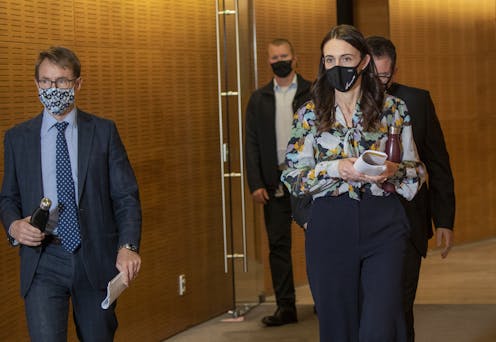
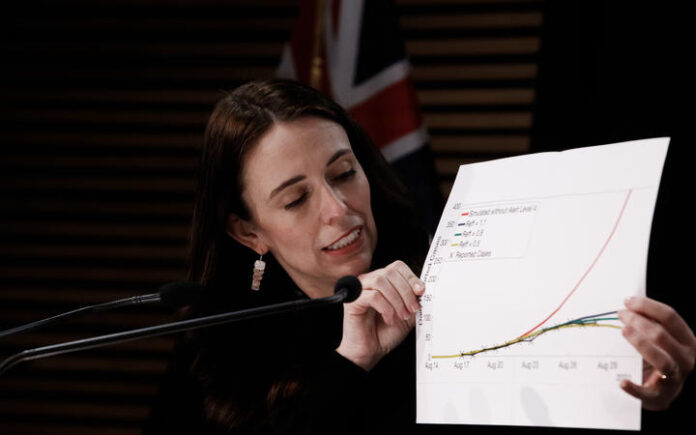
New Zealand’s Director-General of Health Dr Ashley Bloomfield says the country may never find out the source of the current outbreak, while Prime Minister Jacinda Ardern says she lies awake at night pondering the ways in which it may have happened.

In today’s update, Dr Bloomfield said there were 49 new cases of covid-19, all in Auckland.

He said we may never find out how the virus got into the community in the latest outbreak.

Ardern said she lay awake at night pondering the ways in which it might have happened.

“Now we’re left with theories without people-to-people contact,” she says.

Dr Bloomfield yesterday welcomed the lower number of new cases – 53, down from 83 the previous day – but with lower testing numbers on Sunday cautioned against putting too much stock in it, saying it was just one data point.

Ardern also announced Auckland would remain in lockdown until at least September 14, and Northland would likely move into level 3 just two days after the rest of the country’s Tuesday night change.

Progress but caution needed
Today Ardern said alert level 3 for all of Aotearoa south of Auckland is progress but still required “a high level of caution”.

“Bubbles stay in place,” she said.

She said it was not until level 2 that people could contact those outside their bubble.

She also reiterated that delta had meant changes to level 3.

Watch today’s covid-19 update

49 new community cases. Video: RNZ News

Facemasks needed
Outward facing businesses must have employees wearing facemasks and everyone else were encouraged to wear masks while out and about, she said.

“Stay at home, keep bubbles small, exercise and shop locally, keep your distance from people … work from home if possible, keep young and old people at home.”

Ardern said public venues remained closed.

From tomorrow, all people aged 12 and older could book in for a vaccination.

To businesses, Ardern said operating must meet health measures.

Travel across the alert level 3 and 4 boundary was strictly limited, she said.

The boundary is there to “stop the spread of a particularly tricky and infectious virus”, she said.

Tail needs to be ‘short as possible’
She wanted the declining case number to decline.

“We want the tail of this outbreak to be as short as possible.”

Ardern said the alert level for the South Island would be reassessed in a week’s time.

The government did not want to make decisions that were “premature”, she said.

“We would not have moved to an alert level 3 environment if we did not think it was safe.”

The government was being overly cautious and using level 3 in a place where it might have once used level 2.

Ardern said everyone from “all walks of life” needed to be the best roles models they could be.

Vaccine strategy
She said the vaccine strategy was always to ramp up towards the end of the year.

“Every day for me is another step, a bit of progress, but I want to see sustained reductions … we’ve still got a journey to go through,” Ardern said of case numbers dropping.

Ardern said that by and large, MIQ had done the job of keeping the virus out of New Zealand.

The fact that it has been so long without the virus in the country showed how rigorous the MIQ system was, Bloomfield said.

Ardern said the outbreak had shown how important elimination and vaccination were.

Dr Bloomfield said teams were looking at alert level 2 settings and how they could be strengthened – including mask use.

Ardern said the government would give people a refresher on the rules for alert level 2 when needed.

Frustrated over Parliament
On Parliament sitting today, Ardern said she was frustrated because there were alternative ways to do it.

“It is a disappointment that we could not have been as agile as the rest of New Zealand.”

“Our view was that moving to an online forum would have allowed opposition MPs to have access to MPs from across the country.”

While MPs were essential workers and legally allowed to travel, it was up to them to choose to travel, she said.

She reiterated her disappointment in the decision by opposition parties to reject an online sitting of Parliament.

Dr Bloomfield said his advice on Parliament – if it had to sit – was around mask use, social distancing and the number of people that could be in the debating chamber safely.

Meanwhile, the Ministry of Health was facing continued criticism from vaccinees over its communications about a possible dosage error that may have meant some were getting saline instead of a Pfizer shot.

After people affected were told they would receive a letter, a couple vaccinated on the day in question received just one email between them which advised calling an 0800 number that did not answer their questions.

This article is republished under a community partnership agreement with RNZ.

Print Friendly, PDF & Email

Article by AsiaPacificReport.nz

USP and Canterbury University partner for Pacific climate research

By Timoci Vula in Suva

The University of Canterbury and the University of the South Pacific are partnering in a unique research project that will explore the impact of climate change in the Pacific, and the role indigenous ecological knowledge can play to help communities to adapt.

A statement from the USP said the project would address a lack of research into community resilience and response mechanisms, and how indigenous knowledge could work with Western scientific approaches to inform a range of responses — from government policies to community plans.

It stated the research would support Pacific academics and take a Pasifika approach to research, including talanoa and culturally relevant methodologies.

It would also capture indigenous approaches and local responses to changes in climate being experienced.

In the statement, University of Canterbury team leader Professor Steven Ratuva said the “trans-disciplinary innovation is needed to explore the multi-layered impacts of the climate crisis on the environment and people in the Pacific and beyond”.

“The project is a unique opportunity to weave science, social science, humanities and indigenous ecological knowledge in creative and transformative ways,” said Professor Ratuva, who is director of the Macmillan Brown Centre for Pacific Studies.

USP’s professor of Ocean and Climate Change and director of the Pacific Centre of Environment (PaCE-SD), Dr Elisabeth Holland, said the project responded to increasingly urgent calls from Pacific leaders and peoples to address the climate crisis.

‘First of its kind’
“It is truly a first of its kind of synthesis of research on both climate change and the ocean in the Pacific,” she said.

“This ‘by the Pacific for the Pacific’ project provides the opportunity to amplify community voices in the ongoing national and international discussions.”

According to the statement, the research will contribute to the global understanding of climate change in the Pacific region, contributing to the UN Framework Convention on Climate Change Global Stocktake in 2023.

It will also provide valuable information to Pacific governments and civil society groups and Pasifika peoples.

It will highlight Pacific solutions to Pacific experiences, sharing these experiences across the region and the world.

The project is funded by the NZ Ministry of Foreign Affairs and Trade.

Timoci Vula is a Fiji Times reporter. Republished with permission.

Print Friendly, PDF & Email

Article by AsiaPacificReport.nz

View from The Hill: Morrison yet to forge personal relationship with Biden as ANZUS turns 70

Source: The Conversation (Au and NZ) – By Michelle Grattan, Professorial Fellow, University of Canberra

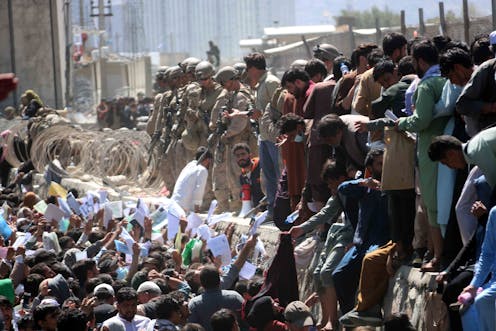
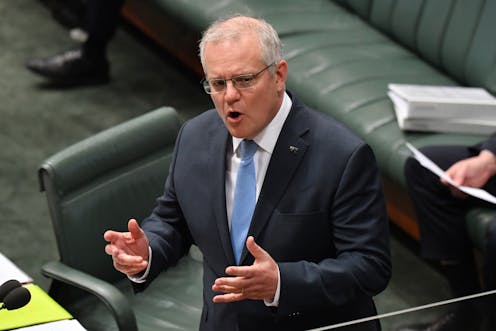
On the eve of ANZUS turning 70 on Wednesday, Scott Morrison was asked whether he had spoken to US President Joe Biden since the fall of Kabul.

“No, I haven’t as yet. I anticipate doing that not too far away,” he said on Queensland radio.

When it was put to him that the lack of contact, plus the US not providing Australia with spare doses of the Pfizer vaccine, suggested Australia was “on the nose” with the president, Morrison quickly protested.

“No, not at all. I mean, I mean, I just don’t agree with that. I’ve been dealing with the United States on many issues and we continue to do that. And, you know, I’m not precious about these things. I just focus on getting the job done.”

Presumably he expects a phone conversation to mark the ANZUS anniversary. It would be strange if there wasn’t one.

Regardless of when the call comes, it is notable that many months into the Biden presidency, it remains unclear precisely how the relationship between the two leaders lies. The coming months will throw some light on it.

In relation to the Kabul evacuation, the government would point to the discussions between Foreign Minister Marise Payne and US Secretary of State Antony Blinken.

But Australia is an ally joined at the hip with America, and its soldiers served in Afghanistan for the best part of two decades, which would make some leader-level contact to have been expected during the evacuation. Moreover, Morrison and UK Prime Minister Boris Johnson spoke then.

The Australia-US relationship doesn’t depend on the personal rapport between the leaders of the two countries at any particular time. The alliance is driven by shared national interests.

Nevertheless, personalities can be important. This was never more evident than with the Bush-Howard bond at the start of the Afghanistan war – especially tight because John Howard was in Washington when the terrorist attacks occurred on September 11, 2001.

The opportunity to “eyeball” can be central in developing a relationship and Morrison and Biden have had minimal eyeball time.

So far, there has only been that three-way meeting (US, Australia, UK) when Morrison attended the G7 summit in June. It seems there wasn’t time for an additional bilateral session. Given a choice, one would have thought Morrison would have been better off meeting just with Biden, whom he didn’t know personally.

Why is Morrison not further forward in the foreign queue for presidential attention?

Possibly it’s a matter of all the other demands on the president. Biden is overwhelmed with domestic and foreign problems; he looks less than robust and no doubt his team limits what he has to do. The attitude might be that Australia would understand if it’s sometimes taken for granted.

In the past, Australia wasn’t a country high in Biden’s consciousness. For example, it’s a tradition for the US vice president to receive visiting Australian foreign and defence ministers, but when Biden was vice president under Barack Obama it was initially quite difficult for Australian officials to make this happen.

Possibly the Biden administration remembers how cosy (albeit for pragmatic reasons) Morrison was with Donald Trump, including the unfortunate occasion when a joint appearance had all the hallmarks of a Trump rally.

Possibly the president and those around him are frustrated with the Coalition’s tardiness in signing up to a more ambitious climate change agenda.

Perhaps it is an amalgam of all these things.

Work is currently underway for a meeting in the US of leaders of the Quad security grouping – the US, Australia, India and Japan – in late September or early October.

If the meeting is in person, Morrison intends to go, despite the difficulties of the domestic COVID situation. This would provide the opportunity for bilateral discussions with Biden.

A major topic of the bilateral talks would be Australia’s position on climate change, ahead of the November climate conference in Glasgow.

Whether Morrison will be able to embrace the net-zero 2050 target is still unknown, dependent on the divided and shambolic Nationals. Biden would want that and more.

Meanwhile, on Wednesday Morrison will take part in a small ceremony at the Australian-American Memorial in Canberra, and address parliament on ANZUS. He’d hope to say he’d spoken to the president by then.

The Conversation

Michelle Grattan does not work for, consult, own shares in or receive funding from any company or organisation that would benefit from this article, and has disclosed no relevant affiliations beyond their academic appointment.

ref. View from The Hill: Morrison yet to forge personal relationship with Biden as ANZUS turns 70 – https://theconversation.com/view-from-the-hill-morrison-yet-to-forge-personal-relationship-with-biden-as-anzus-turns-70-167054

The first Indigenous COVID death reminds us of the outsized risk NSW communities face

Source: The Conversation (Au and NZ) – By Kalinda Griffiths, Scientia lecturer, UNSW

The second wave of COVID-19 in New South Wales brings concerns about vaccination rates in Aboriginal and Torres Strait Islander people. Shutterstock

On Sunday, New South Wales saw four more deaths from COVID-19. One of them was a man from Dubbo who was in his 50s and unvaccinated. It was the first COVID-19 death of a First Nations person in Australia.

Aboriginal communities in remote areas have been pleading with the government for help with medical resourcing and food for families. It was recently found there were pleas for protection against COVID in Wilcannia, with Aboriginal health organisation Maari Ma Aboriginal Health contacting Ken Wyatt about this back in March last year.

There has been some progress in the nation’s vaccination rates with a little over 32% of the eligible population over the age of 12 now vaccinated. However, the second wave of COVID-19 in New South Wales highlights concerns for the unvaccinated and those with multiple risk factors. This includes Aboriginal and Torres Strait Islander people.

New South Wales is now in day 76 of their most recent outbreak with cases reaching over 20,000.

Aboriginal and Torres Strait Islander people were identified as a priority group early in the vaccine rollout, yet they still have lower vaccination rates than the NSW population.

Almost 12% of Aboriginal and Torres Strait Islander people are fully vaccinated in NSW compared to almost 30% of the non-Indigenous population.

Aboriginal and Torres Strait Islander people at risk

It’s well known Aboriginal and Torres Strait Islander people experience higher rates of disease than non-Indigenous people. Aboriginal and Torres Strait Islander people in New South Wales experience two or more health conditions at a rate that is over two and half times greater than non-Indigenous people.

In addition, there is increased risk of spread in families, as larger family groups often live together in regional and remote communities.

These risks, along with extreme yet ignored service gaps in regional and remote areas, mean our Indigenous community is facing severe risk of death and disease from the COVID-19 pandemic.

Children and young people under the age of 20 account for a little over 20% of Australia’s case numbers, with all children aged 12 to 15 now recommended to get the Pfizer vaccine.

Pre-existing conditions such as asthma, gastrointestinal disease, diabetes/prediabetes, as well as children who are immunocompromised and preterm, have been found to be predictors of severe COVID-19 disease.

This is of great concern to Aboriginal communities, considering Aboriginal children are up to two times more likely to be hospitalised for respiratory conditions than non-Indigenous children.


Read more:
The COVID-19 crisis in western NSW Aboriginal communities is a nightmare realised


We need better data

The gaps in COVID-19 publicly available data are concerning, especially data specific to Aboriginal and Torres Strait Islander peoples.

There is currently no information on vaccination rates for children over the age of 12 in out-of-home care. In 2018 there were 45,800 children in out-of-home care. About 40% of these children are Aboriginal and Torres Strait Islander.

There is also little to no data available on the number of Aboriginal and Torres Strait Islander people tested for COVID, as well as issues with the accuracy of Indigenous status in the reporting of the case numbers.

Despite the daily high case numbers, this week the New South Wales government announced restrictions in the state will be relaxed across selected local government areas for those people who are fully vaccinated.

While the risk for those people who are vaccinated is relatively low, greater activity could still increase the spread of COVID-19 across the state, putting people in Aboriginal communities at greater risk.

Knowing exactly who is vaccinated and who is at greatest risk will be of the utmost importance as restrictions start to ease.

How the public can help

The increasing case numbers and resultant lockdowns across NSW local government areas have seen Aboriginal communities having limited access to health care and basic necessities due to limitations in the supply of regional and remote supermarkets. A number of First Nations people have rallied together to support their communities.

This has included pages that have been set up for:

People can donate or contact the volunteer group to get involved.

Where to next?

As the Delta variant makes its way across Australia, all people need access to vaccines. This means increasing government resources and health system efforts in Aboriginal and Torres Strait Islander communities as well as ensuring all Indigenous people have multiple access points to the vaccines.

This could include door-to-door vaccinations in Aboriginal and Torres Strait Islander communities, pop-up vaccination clinics in regional and remote local government areas as well as school-based vaccinations.

With the expected mRNA vaccine supplies to be sufficient for the entire Australian population in the coming months, the biggest next step is ensuring their distribution is prioritised to those who need it the most.

This requires moving beyond the rhetoric and supporting health services, particularly Aboriginal Community Controlled Organisations, to do the work.

The Conversation

Kalinda Griffiths receives funding from the National Health and Medical Research Council and the Australian Research Council. She is also Thinker in Residence at the Australian Health Promotion Association.

ref. The first Indigenous COVID death reminds us of the outsized risk NSW communities face – https://theconversation.com/the-first-indigenous-covid-death-reminds-us-of-the-outsized-risk-nsw-communities-face-166888

My super fund just failed the APRA performance test. What’s next?

Source: The Conversation (Au and NZ) – By Peter Martin, Visiting Fellow, Crawford School of Public Policy, Australian National University

iQonceptShutterstock

Failure is only the beginning.

Thirteen of Australia’s 80 closely-regulated MySuper superannuation funds have failed the APRA performance test. There’s a one in six chance you’re in one.

The results were made public on Tuesday and handed to the funds on Monday.

And from here on — for the people who run those funds — it’s about to get a whole lot worse.

APRA is the Australian Prudential Regulation Authority. Landmark reforms introduced in response to a devastating Productivity Commission report into the “mess” that is much of Australia’s super industry require APRA to rate each MySuper fund (and from next year most other funds) with a pass or a fail according to how they have managed their members’ money.

To fail — as one in six funds have — would require the fund to have for seven or eight years managed its members’ funds so badly that when judged by its own stated investment strategy, those members would have been better off investing in the broad categories of assets themselves and paying the managers to stay away.

Under the rules, which go by the name Your Future, Your Super, funds can only be given a “pass” or a “fail”. Those that fail are required to write to their members.

Letters humbling

The letters, which have to be delivered within 28 days, and which APRA will check, are humiliating.

“Hello [fund member],” they begin. “Your superannuation product has performed poorly under an annual performance test”.

As a result, we are required to write to you and suggest that you consider moving your money into a different superannuation product.

By switching into a better performing product, you can potentially save thousands of dollars more for retirement. For example, by earning 1% higher net return over a 30‑year period, you could be 20% better off at retirement.

At the bottom of each letter is a QR code members can use to go to ato.gov.au/yoursuper to compare funds’ performance. If members log in with their MyGov account they will be told exactly what super they have and where it is (I’ve tried it and it works) and get a comparison tailored to their circumstances.

The 13 funds forced to send out these letters will be lucky to see out the year. Once a fund suffers withdrawals and has to pay out members it performs even worse. Within months, many will be taken over.

Killing season

Those that remain are unlikely to last a second year. Once a product fails for two consecutive years (most that fail in the first year are expected to fail in the second) it will be prohibited from accepting new members, which means it’ll be killed.

It may or may not be relevant, but the driving forces behind the revolution are women. Women typically do much worse out of super than men.

Karen Chester: first draft.
Lukas Coch/AAP

Karen Chester chaired the Productivity Commission inquiry that quantified the hundreds of thousands of dollars lost in retirement by each worker who stays in a dud fund, and came up with the first draft of the performance test.

Kelly O’Dwyer, as financial services minister championed it, as did her successor Jane Hume.

In charge of policing the rules is APRA executive board member Margaret Cole, who was known as the “enforcer” during her time as director of enforcement and financial crime at the UK Financial Services Authority.

On Friday she declared bluntly that Australia had too many funds, too many persistently underperforming funds and too many with fees that remain too high.

Industry funds among those failed

Among the chronic underperformers now facing a death spiral are five industry funds — two of them run by members of Industry Super Australia, the organisation that represents funds set up “only to benefit members”.

Rather, they were members. Maritime Super left just ahead of the results. LUCRF, originally set up by what is now the United Workers Union, was terminated on the release of the results. Industry Super scrubbed it from its website.


Australian Prudential Regulation Authority

The other industry funds that failed the performance test are run by the Australian Catholic Superannuation and Retirement Fund, Christian Super and the Victorian Independent Schools Super Fund.

Among the for-profit failures are funds run by Westpac (BT Super) and the Commonwealth Bank (Colonial First State).

The banking royal commission found that funds run by banks often pay money to other parts of the bank for services such as buying and selling bonds, rather than doing it themselves or through brokers who would get better prices.

In the dark, until now

Super customers needn’t know what happens. They don’t get bills.

Whereas electricity bills hurt when they are delivered and have to be paid, the bills for super fees (and hidden fees in the form of relentless underperformance) aren’t seen, and don’t have to be paid — the fees come out of the funds.

And the funds grow every year, even where they are squandered. Compulsory super throws in a fresh 10% of salary each year.

The aim of what’s happened this week is to make visible what is normally invisible, and to prod people into action.

An act of faith… in competition

The government could have gone down a different track.

Peter Costello, the long-serving Coalition Treasurer who now heads the Future Fund which manages government investments, wanted his successor to create a government super fund (run by his Future Fund) which it would default new workers into.

The Future Fund would have protected workers, but to do it, would have played safe. As it became dominant it would have stifled competition and the promise of better returns. Or that was the thinking.


Read more:
Super funds have been working for themselves when they should have been working for us. That’s about to change


Chester, O’Dwyer, Hume and Treasurer Josh Frydneberg decided instead to supercharge competition — to make crystal clear which are the funds to run from and the funds to run to. They are making running as easy as two clicks.

One in every 11 dollars we earn is funnelled into superannuation. Legislated increases mean it will soon be one in nine.

It’s important it’s looked after.

The Conversation

Peter Martin does not work for, consult, own shares in or receive funding from any company or organisation that would benefit from this article, and has disclosed no relevant affiliations beyond their academic appointment.

ref. My super fund just failed the APRA performance test. What’s next? – https://theconversation.com/my-super-fund-just-failed-the-apra-performance-test-whats-next-166956

Got a child with COVID at home? Here’s how to look after them

Source: The Conversation (Au and NZ) – By Brendan McMullan, Conjoint Senior Lecturer, School of Women’s and Children’s Health, UNSW

Shutterstock

The Delta variant is more infectious and is leading to more COVID-19 cases in children than previous strains.

Many parents are wondering whether Delta is making kids sicker, and how to care for their children if they get COVID.

It can be a nerve-racking time for parents, but there are practical things you can do to make your child more comfortable if they’re ill.

How common is COVID in kids, and how sick do they get?

There have been more than 50,000 confirmed COVID cases in Australia.

Of these, 4,625 cases have been in children aged 0-9, and 6,325 among those aged 10-19 — totalling approximately 20% of all Australian cases.

Symptoms in children are often like those of other viral infections and may include fever, runny nose, sore throat, cough, vomiting, diarrhoea and lethargy.

A small number of children have other symptoms such as tummy pains, chest pain, headache, body aches, breathing difficulties or loss of taste or smell. Up to half of children with COVID may be asymptomatic.

Despite evidence the more-infectious Delta variant is causing more severe illness in young adults, there’s no convincing evidence it has caused more severe illness in children to date.


Read more:
Under-12s are increasingly catching COVID-19. How sick are they getting and when will we be able to vaccinate them?


Most children can be cared for at home. Hospital networks, including children’s hospitals and local networks, are helping parents and carers to support this care at home.

In some cases, children and families may be transferred to special health accommodation to provide safe isolation and care.

How can I best care for my child at home if they get COVID?

Caring for a child with COVID will look similar to the general supportive care for children with other viral infections.

Children should be dressed in appropriate clothing, so they’re comfortable — not sweating or shivering.

Parents and carers should make sure the child drinks lots of fluids. They can also take paracetamol or ibuprofen if they are uncomfortable with pain or fever. These medicines should be administered as directed in the product information or by a health professional.


Read more:
Masks, ventilation, vaccination: 3 ways to protect our kids against the Delta variant


Warning signs of deterioration include prolonged fever (for more than five days), difficulty breathing or chest pain.

Some children get severe abdominal pain, vomiting and/or diarrhoea. It’s important to encourage these children to frequently drink fluids. It’s a concern if they’re drinking less or passing urine less than half of what they normally would, or if they are excessively sleepy or irritable.

For these or other serious concerns, parents and carers should seek urgent advice from their care team. In an emergency, they should request ambulance assistance, informing the operator the child has COVID.

Don’t some children end up in hospital or intensive care?

Yes, there’s a small risk of severe disease from COVID in children but this is very uncommon, even in children who have medical vulnerabilities.

Children and adolescents can develop inflammatory complications after COVID, though this is rare. Symptoms include persistent fever and rash, among others. These conditions, termed “Multisystem Inflammatory Syndrome in Children (MIS-C)” or “Paediatric Multisystem Inflammatory Syndrome (PIMS-TS)” have been reported mainly in the United States and Europe.

Estimates from the US suggest these occur in around one in 3,000-4,000 cases of COVID in children. There’s only been a handful of cases reported in Australia to date.

Children aged 12-15 in Australia are now eligible for vaccination, and vaccination trials are ongoing for younger children.

Do children get ‘long COVID’?

There has been increasing concern about prolonged symptoms after COVID infection, sometimes called long COVID, even with mild disease.

Fortunately, this is rare in children. In a study of more than 150 children with mild or asymptomatic COVID in Australia, most symptoms resolved in 4-8 weeks and children generally returned to their baseline health within 3-6 months.

What if some people in the home aren’t infected?

The SARS-CoV-2 virus spreads easily from one person to another, particularly in close contact and for those living in the same household as someone who has the virus.

You can reduce the risk of spread by:

  • keeping more than 1.5m distance where possible

  • getting the child to use a separate bathroom, if this is available

  • wearing a mask (for adolescents and older children); younger children and others who cannot wear a mask can be encouraged to observe the other behaviours

  • covering coughs and sneezes

  • performing regular hand hygiene with soap and water or hand sanitiser.

Good ventilation is also a factor in reducing transmission, but not everyone can modify this in their living situation.

If someone in the household has COVID, high touch surfaces such as door handles, kitchen bench tops, switches and taps should be regularly cleaned.

Personal household items such as cutlery, dishes and towels should be washed before being shared. Regular household disinfectant is sufficient.


The authors would like to acknowledge Christine Lau, paediatrician, and Nadine Shaw, clinical nurse consultant, Sydney Children’s Hospitals Network, for their contributions to this article.

The Conversation

Brendan McMullan receives funding from the Curing Homesickness Foundation and NSW Ministry of Health. He is affiliated with the Australasian Society for Infectious Diseases.

Philip Britton receives funding from the National Health and Medical Research Council, the Commonwealth Department of Health and NSW Ministry of Health.

ref. Got a child with COVID at home? Here’s how to look after them – https://theconversation.com/got-a-child-with-covid-at-home-heres-how-to-look-after-them-166732

Human progress is no excuse to destroy nature. A push to make ‘ecocide’ a global crime must recognise this fundamental truth

Source: The Conversation (Au and NZ) – By Anthony Burke, Professor of Environmental Politics & International Relations, UNSW

WWF Australia

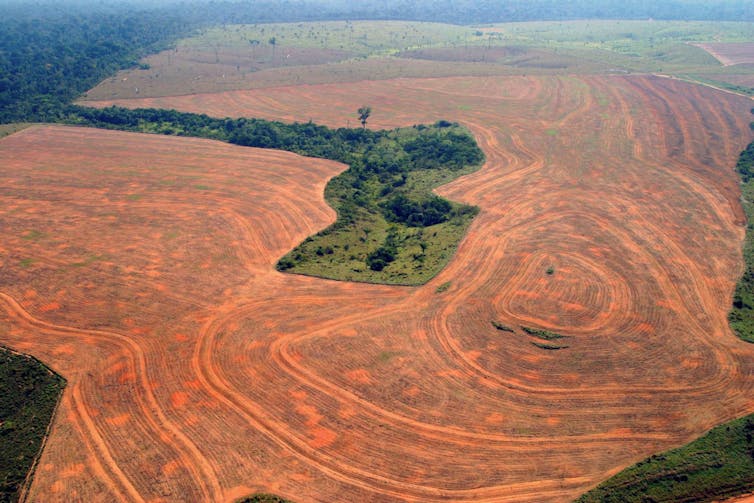
Scientists recently confirmed the Amazon rainforest is now emitting more carbon dioxide than it absorbs, due to uncontrolled burning and deforestation. It brings the crucial ecosystem closer to a tipping point that would see it replaced by savanna and trigger accelerated global heating.

This is not an isolated example of nature being damaged at a mass scale. The Intergovernmental Panel on Climate Change this month confirmed global heating is now affecting every continent, region and ocean on Earth. That includes Australia, which is a global deforestation hotspot and where the Great Barrier Reef is headed for virtual extinction.

In the face of such horrors, a new international campaign is calling for “ecocide” – the killing of ecology – to be deemed an international “super crime” in the order of genocide. The campaign has attracted high-profile supporters including French President Emmanuel Macron, Pope Francis and Swedish activist Greta Thunberg.

Making ecocide an international crime is an appropriate response to the gravity of this harm and could help prevent mass environmental destruction. But whether it does so will depend on how the crime is defined.

bare earth with small patch of trees
Destruction of the Amazon has fuelled the push for a new international crime of ‘ecocide’.
Greenpeace

Defining ecocide

The global campaign is being led by the Stop Ecocide Foundation. Last month an independent legal panel advising the campaign released a proposed amendment to the Rome Statute of the International Criminal Court. It would make ecocide a crime, defining it as:

unlawful or wanton acts committed with knowledge that there is a substantial likelihood of severe and either widespread or long-term damage to the environment being caused by those acts.

Defining a new international crime is a tricky balance. It must:

  • capture the gravity, nature and extent of the harm
  • set appropriate, but not impossible, standards of proof
  • set moral standards that other international laws should follow.

The draft definition marks an important step in getting ecocide on the international agenda. And it does a good job of defining and balancing the core elements of ecocide – “severe” and either “widespread” or “long-term” damage to “any element of the environment”.

Laudably, these core elements show a concern for ecosystem integrity, human rights to a healthy environment, and the way grave damage to ecosystems can have devastating local and planetary consequences well into the future. This is a significant achievement.

Despite these strengths, lawyers and scholars, including ourselves, have identified problems with the definition.


Read more:
Repeating mistakes: why the plan to protect the world’s wildlife falls short


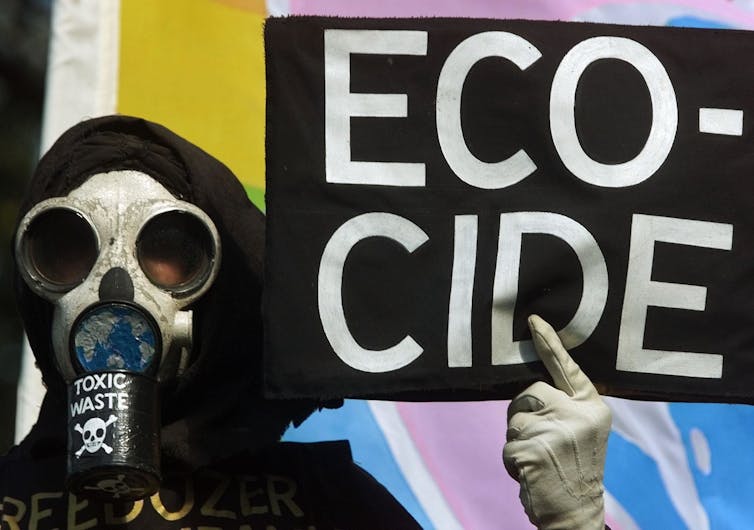
person in mask holds sign which says 'ecocode'
The proposed definition of ecocide is flawed.
ITSUO INOUYE/AP

Towards an ecological approach

A key concern is that the proposed definition considers only “unlawful” or “wanton” acts to be ecocide.

Most environmental destruction is not illegal. We need look no further than Australia’s land clearing laws or, indeed, federal environment law which has comprehensively failed to protect nature.

Under the proposed definition, lawful acts are only ecocidal if they are “wanton” – defined as “reckless disregard for damage which would be clearly excessive in relation to the social and economic and benefits anticipated”.

This condition assumes some ecocidal damage is acceptable in the name of human progress. According to the panel, such “socially beneficial acts” might include building housing developments and transport links.

This assumption furthers the human-centred privilege and “get-out-of-jail” clauses that have so weakened international environmental law to date.

We are not saying that housing, transport links or farms should not be built. But, in a period some scientists are calling the sixth mass extinction, they cannot come at the expense of crucial species and ecosystems. Sustainable development must respect this boundary.

The assumption also fails to recognise the gravity of ecocide. Such trade-offs – formally known as “derogations” – are rejected by international conventions governing slavery, torture, sexual violence, and fundamental human rights.

For example, the Convention Against Torture states:

no exceptional circumstances whatsoever, whether a state of war or a threat of war, internal political instability or any other public emergency, may be invoked as a justification of torture.

An international crime of ecocide must meet a similar standard. It should recognise that all forms of life, and the ecological systems that support them, have value for their own sake.

This perspective is known as multispecies justice. It holds that human well-being is bound to flourishing ecosystems, which have an intrinsic value outside the human use for them.

Earth from space
Human well-being is bound to Earth’s flourishing ecosystems.
Shutterstock

Genocide – the annihilation of human groups – is recognised as a crime against humanity. As political philosopher Hannah Arendt argued, genocide is an attack on human diversity that erodes the “very nature of mankind” and poses a grave threat to global order.

In the same way, the definition of ecocide should recognise that acts which destroy biological diversity, and lead to species extinction, threaten the very nature and survival of Earth’s multi-species community.

In Nazi-occupied Eastern Europe, the Balkans and more recently Myanmar, millions were killed and dispersed under a crime against humanity known as “ethnic cleansing”. Yet this killing and dispersal is happening to non-human communities as we write. The vast habitat destroyed by deforestation is as important to displaced animals as our homes are to us.

And this is a shared calamity. Mass environmental destruction is an attack on the foundations of all life that makes up the biosphere, of which humanity is only a part.


Read more:
There’s no end to the damage humans can wreak on the climate. This is how bad it’s likely to get


Man with pile of elephant tusks
The loss of one part of nature damages all life on Earth, including humanity.
Ben Curtis/AP

What should be done?

The Stop Ecocide Foundation says the proposed definition will now be “made available for states to consider”.

As they do so, we ought to work towards a definition of ecocide that puts non-human lives at its centre. The crime of ecocide must be defined in a way that honours its victims – the myriad beings of the Earth.

In the meantime, political efforts to rein in biodiversity destruction must become an urgent global priority. And citizens can press their governments to criminalise the ecocidal acts that have become business as usual.


Read more:
Ordinary people, extraordinary change: addressing the climate emergency through ‘quiet activism’


The Conversation

The authors do not work for, consult, own shares in or receive funding from any company or organisation that would benefit from this article, and have disclosed no relevant affiliations beyond their academic appointment.

ref. Human progress is no excuse to destroy nature. A push to make ‘ecocide’ a global crime must recognise this fundamental truth – https://theconversation.com/human-progress-is-no-excuse-to-destroy-nature-a-push-to-make-ecocide-a-global-crime-must-recognise-this-fundamental-truth-164594

Australia’s coastal waters are rich in Indigenous cultural heritage, but it remains hidden and under threat

Source: The Conversation (Au and NZ) – By Jonathan Benjamin, Associate Professor in Maritime Archaeology, Flinders University and ARC Centre of Excellence for Australian Biodiversity and Heritage, Flinders University

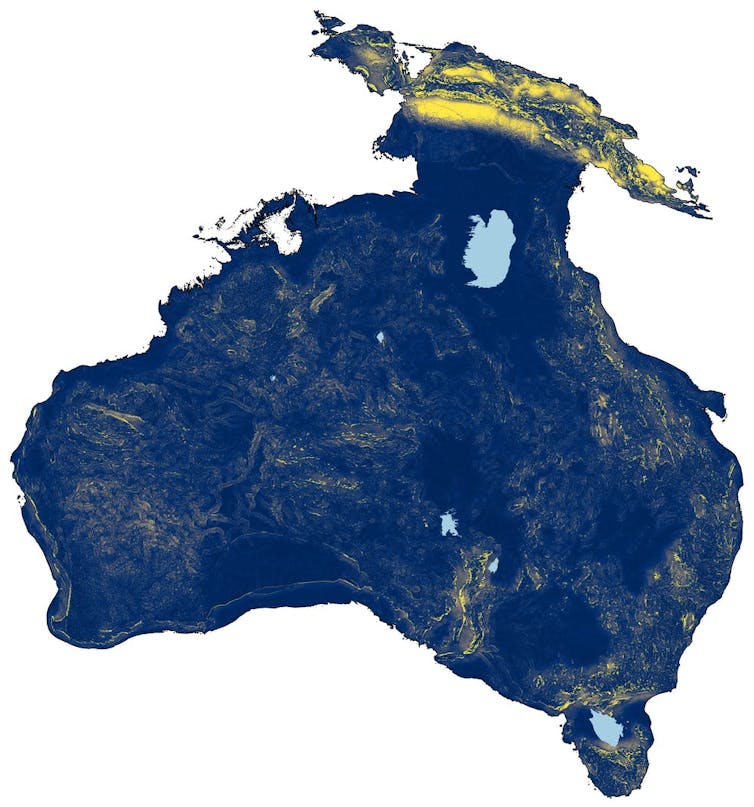
When people arrived in Australia more than 65,000 years ago, they landed on shores that are now deep under water. The first footprints on this continent took place on these now-submerged landscapes.

More than 2 million square kilometres of Australia’s continental landmass — an area larger than Queensland — was drowned by sea-level rise over the last 20,000 years. This land was once home to thousands of generations of Indigenous peoples.


Read more:
Australia’s coastal living is at risk from sea level rise, but it’s happened before


Despite the scale of this vast drowned cultural landscape, Australia has fallen behind international best practice in locating, recording and protecting submerged Indigenous cultural places.

This is what Australia looked like for most of human history, complete with massive lakes in what is now the Gulf of Carpentaria and Bass Strait (Image: S. Ulm)

Last year, our team reported the discovery of nearly 300 stone artefacts submerged on the continental shelf off northwestern Australia.

This discovery demonstrated that submerged Indigenous sites are likely to exist around the continent, but remain unknown due to a lack of investigation.


Read more:
In a first discovery of its kind, researchers have uncovered an ancient Aboriginal archaeological site preserved on the seabed


The big picture and the local scale

In two new studies published in Australian Archaeology, we outline approaches to help us better understand and manage Indigenous underwater cultural heritage.

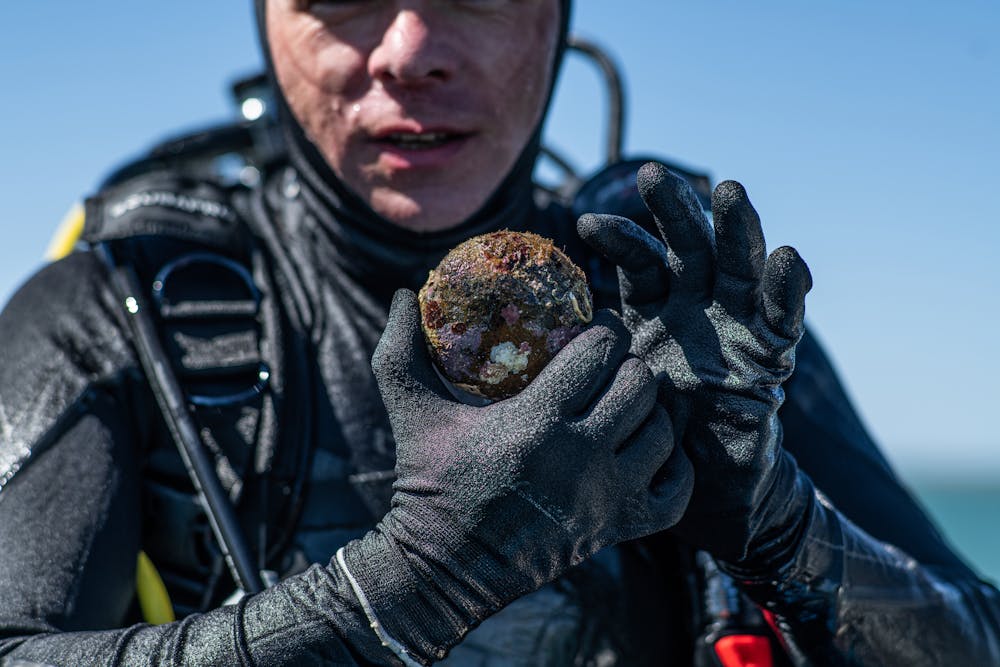
Through a two-pronged approach at both the local and regional level, we review big data to predict the location of sites. We also put boots on the ground and divers in the water to find and record them.

At the local level, our research at Murujuga in northwest Australia indicates we must combine archaeological data from above and below the water to understand the past landscape at periods of lower sea level.

Drawing on evidence from across terrestrial, coastal and submerged environments, we found archaeological material in all three zones.

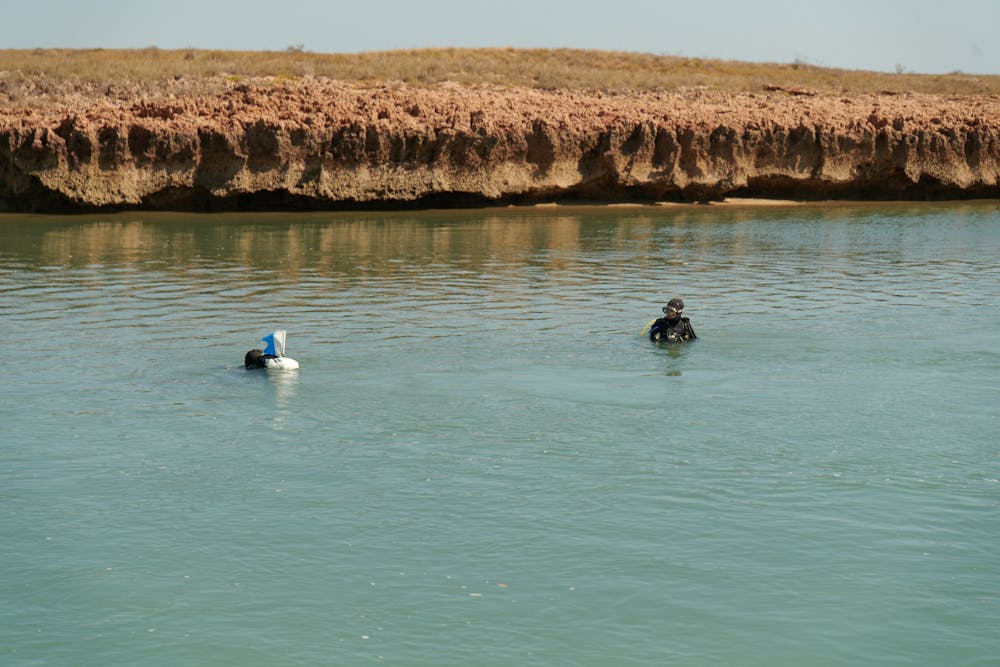
The interface between land and sea. The intertidal zone of today used to be dry land (Photo: S. Wright)

Our study also aligns archaeological practice with histories of Indigenous Australians, who describe cultural landscapes extending into Sea Country. Some oral histories describe past sea-level rise and drowned cultural landscapes.

Archaeologists investigate a drowned cultural landscape at low tide to reveal stone artefacts (Photo: S. Wright)

At the regional scale, our study shows how research into submerged landscapes can be expanded across Australia. Taking the Northern Territory as a case study, we assessed the potential for archaeological material to be preserved on the seabed.

National environmental frameworks, such as Marine bioregional plans for Australia’s seabed focus largely on marine biodiversity and habitats, only acknowledging archaeology through a selection of historic shipwrecks.

With few regional or state-level mechanisms in place to inform marine management planning, Indigenous underwater cultural heritage has been ignored or marginalised. There is now an opportunity and an ethical obligation to integrate Indigenous perspectives and traditional knowledge into marine science research.

Divers discovered an ancient archaeological site that included stone tools used for grinding (Photo: S. Wright)

Threats to underwater Indigenous heritage

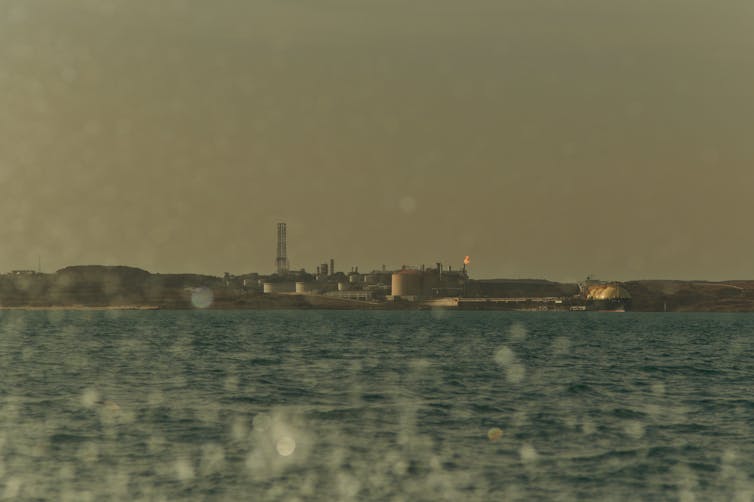
Indigenous underwater cultural heritage is threatened by a variety of activities, including dredging, offshore cables and pipelines, seabed mining, and oil and gas exploration.

Such developments can cause significant damage and even explosions and fires in the sea, as witnessed recently in the Gulf of Mexico.

We can expect increased pressure on coastal and submerged sites with the increasing impacts of climate change. Without mechanisms to consider the archaeology in the intertidal zone of Australia (the transitional area between land and sea) and the seabed, such disturbances will occur out of sight and out of mind.

This stone cutting tool with a serrated edge was found in the intertidal zone (Photo: J. Benjamin)

Some state and local laws protect underwater cultural heritage, but these vary across the country. The national Underwater Cultural Heritage Act also does not adequately protect Indigenous cultural heritage.

The UNESCO Convention on the Protection of the Underwater Cultural Heritage protects all heritage greater than 100 years old, including both colonial-era sites and Indigenous underwater cultural heritage. But Australia’s national policy currently does not align with the convention.

Our systems must change

Archaeologists working in partnership with Indigenous communities must take a central role in scientific research, management of marine environments and industry-led campaigns, incorporating archaeology into environmental impact assessments.

Industry has begun to respond. One company, Woodside Energy, for example, has acknowledged the importance of this issue, and has engaged with the Murujuga Aboriginal Corporation. The company says it has

sought to understand the potential heritage values of the submerged cultural landscape for the proposed Scarborough pipeline.

Industry has begun to acknowledge the significance of Sea Country and the industrial impacts on drowned Indigenous cultural heritage (Photo: S. Wright)

This is a new paradigm for the offshore sector in Australia and a sign of things to come as industry and policy-makers respond to scientific advances and new knowledge.

Coastal peoples all over the world have made a significant contribution to human history. Only through underwater archaeology can we fully understand these past peoples who called coastal environments their home.

Scientific divers investigate the underwater world, revealing a drowned cultural landscape (S. Wright)

The Conversation

Jonathan Benjamin receives funding from the Australian Research Council and the Northern Territory Government.

Chelsea Wiseman receives funding from the Australian Research Council and the Northern Territory Government.

John McCarthy receives funding from the Australian Research Council and the Northern Territory Government.

Peter Jeffries receives/has received funding from Woodside, ARC Linkage, AHG (Commonwealth) Lotterywest, Yara and Rio Tinto. Peter is also co-chair of the Forum for Directors of Indigenous Organisations (FDIO).

Sean Ulm receives funding from the Australian Research Council.

ref. Australia’s coastal waters are rich in Indigenous cultural heritage, but it remains hidden and under threat – https://theconversation.com/australias-coastal-waters-are-rich-in-indigenous-cultural-heritage-but-it-remains-hidden-and-under-threat-166564

What are the limits of dissent as NZ locks down, vaccinates and prepares to ‘open up’?

Source: The Conversation (Au and NZ) – By Alexander Gillespie, Professor of Law, University of Waikato

Mark Mitchell – Pool/Getty Images

As New Zealand grapples to bring a Delta outbreak under control and to accelerate the vaccination rollout, social cohesion is vital for a successful elimination strategy.

Political consensus on elimination has endured so far. Unlike the anti-mask and anti-vaccination movements elsewhere, most New Zealanders continue to back the prime minister’s decision to place the country under the strictest lockdown.

But strains on public consensus are beginning to show, with a less-than-ideal parliament, some pushback against lockdowns and agitation to “open up”.

These debates will become more pressing as the government moves towards difficult discussions about an exit strategy and targets for vaccination rates.

Dissent and debate within parliament

At the highest level, the country has been let down by all sides.

During last year’s nation-wide lockdown, the prime minister created the epidemic response committee. It reflected a government confident enough to be questioned in public through a parliamentary body it did not control. The opposition was constructive in finding the best ways forward. This was constitutional governance at its best.

This time, all sides of the political spectrum have failed. It began with the decision to suspend the parliamentary sitting, on the advice of the director-general of health. Any such advice should have been given in conjunction with the attorney-general, as it has significant constitutional consequences.

The epidemic response committee was not resuscitated. Following a wave of criticism, the government floated a virtual option. Opposition parties rejected this, forcing the government to recall a truncated parliament with enhanced social distancing rules.

As a result, very few politicians are in parliament; and smaller parties are staying away for health (not constitutional) reasons. This is a poor example of how our country should be governed in at a time of emergency.

Dissent in the wider community

Dealing with protests outside parliament during this pandemic is equally difficult. The important point here is that people have rights, but these rights may be subject to reasonable limits.

All New Zealanders have a right to peaceful assembly in public to protest, but this can be curtailed by conditions of where, when and how. Fundamentally, nobody has a right to public protest in the middle of a national lockdown.

Other rights, such as freedom of expression, remain intact, pandemic or not. However, this too is not without limits. For example, advocacy is permissible in a speech about vaccination in a public space, but it cannot be misleading or factually incorrect.


Read more:
Phased border reopening, faster vaccination, be ready for Delta: Jacinda Ardern lays out NZ’s COVID roadmap


The above examples generally relate to situations in which a minority group is trying to influence the majority view. But the debate gets more complex when the majority tries to make smaller groups do things they disagree with.

Compulsion and harm to others

Vaccination is likely to bring this issue to a head. The government has released a plan for a phased border opening, based on its elimination strategy. The plan would eventually allow vaccinated travellers from low-risk countries to enter without quarantine.

This will only be possible once a high proportion of New Zealanders is vaccinated. Earlier modelling shows that, for the alpha variant of COVID-19, around 80-85% of the population would need to be vaccinated before New Zealand can relax border controls. For the more transmissible Delta strain, the source of New Zealand’s current outbreak, we would need to reach 97% of the population.

While Australia and other countries are now discussing how to adapt to an ongoing presence of COVID-19, accepting deaths and hospitalisations, New Zealand so far maintains elimination as a strategy “to stamp out the virus and keep our options open”.

Whatever vaccination target will be necessary, getting there from the current level of 21% of the population fully vaccinated will be a challenge. The government will likely need to use incentives and some degree of compulsion.


Read more:
What rights do NZ children and their parents have when giving consent to be vaccinated?


Free vaccinations, if delivered conveniently and safely as part of a targeted public health education campaign to overcome vaccine hesitancy, are an effective tool. Lowering the age for vaccinations will also lift the overall percentage of uptake. If all else fails, even cash incentives may help to increase voluntary vaccination.

But compulsion might become necessary. While the general rule is that people can refuse medical treatments, in times of emergency this can be trumped and regulations could be introduced to enforce vaccination. This is where we must be careful. The temptation will be to use compulsion or heavy-handed pressure (such as restricting social welfare) against those who choose not to get vaccinated.

So far, the government has only introduced law to make it mandatory that certain workers, such as those at the border, are vaccinated. This is done to reduce the risk to others, and it is the correct measure to use.

If people choose not to be vaccinated and risk harming others, the government should intervene, explaining the risk the unvaccinated pose, apart from their potential self-harm. It should then pass laws to allow reasonable levels of discrimination against people who refuse the vaccine.

This means if a risk of harm to others can be shown, it may become acceptable to stop unvaccinated people from entering restaurants, but not from buying food from a supermarket (although strict safety measures may be insisted upon). Conversely, if an unvaccinated person risks harming only themselves, the government should let them carry the full consequences of their choice.

The Conversation

Alexander Gillespie does not work for, consult, own shares in or receive funding from any company or organisation that would benefit from this article, and has disclosed no relevant affiliations beyond their academic appointment.

ref. What are the limits of dissent as NZ locks down, vaccinates and prepares to ‘open up’? – https://theconversation.com/what-are-the-limits-of-dissent-as-nz-locks-down-vaccinates-and-prepares-to-open-up-166892

Damien Hirst’s dotty ‘currency’ art makes as much sense as Bitcoin

Source: The Conversation (Au and NZ) – By John Hawkins, Senior Lecturer, Canberra School of Politics, Economics and Society and NATSEM, University of Canberra

Shutterstock

The Art of Making Money” is the sort of book title you might see in an airport bookshop. But the (now not so) “Young British Artist” Damien Hirst has taken it rather literally.

Hirst’s latest art project, called The Currency, comprises 10,000 A4 sized pieces of handmade paper covered in very similar but not identical coloured spots. The back of each is numbered and signed by the artist with an arty title. Like actual contemporary bank notes, each also has a watermark, a microdot and a hologram to make it hard to forge.

The interesting twist is that Hirst has made this into an interesting experiment in the highly irrational economics of collectibles and blockchain technology.


Read more:
A token sale: Christie’s to auction its first blockchain-backed digital-only artwork


Each painting has a digital certificate of ownership — a so-called non-fungible token (NFT). In fact, the buyers of each work have paid US$2,000 for the electronic token only. If they want the physical artwork, they must choose by July 21 2022 to trade in their token. If they do so the token will be destroyed. If they decide to keep the token, the artwork will be destroyed. They cannot have both.

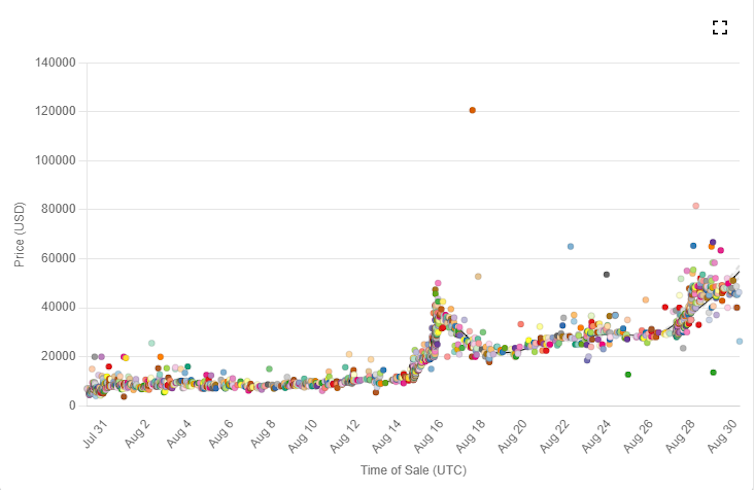
Adding to the fun is the secondary trade in the NFTs — highlighting just how much of the art market is driven by money rather than love. The sale of all 10,000 works is worth $US20 million. But over the past month, since the artworks went on sale, there have been more than 1,800 resales, for almost US$40 million. The highest price paid so far is US$120,000, for No. 6272, titled “Yes”.

These secondary sales already give us some insight as to whether buyers will treat the artworks as essentially homogenous (or “fungible” in economic jargon). But other questions remain. How many buyers will prefer to have the physical artwork or the digital token? Will this preference differ between art lovers and speculators? Will the buyers wait until the last possible days to decide whether to convert to preserve the “option value”?


Read more:
Damien Hirst’s ‘The Currency’: what we’ll discover when this NFT art project is over


On one question, though, we can be most confident of the answer. Despite the art project’s name, these artworks don’t make very good currency.

What makes a currency?

For one thing they are not divisible. It would be hard to buy something worth a lot less than one of the paintings with them. One could rip a a sheet in half but, as with half a bank note, it’s unlikely anyone would consider the value of the two pieces anywhere near the original.

So while Hirst’s works have many of the attributes of actual currency, they still lack attributes critical to work as currency. In this sense they are similar to so-called “cryptocurrencies”. Even the two best-known, Bitcoin and Dogecoin, can barely be used to buy anything, because few merchants accept them. The thousands of less well-known cryptocurrencies are even more useless for making payments.

The market for ‘the currency’

The original sale of the artworks worked like an initial public offering of shares. Aspiring buyers could register and say how many they wanted (but not nominate which individual work). The offering was over-subscribed, as more than 30,000 people wanted more than 60,000 tokens (that is, three time the available number).

This demand has spilled over into a secondary electronic marketplace (managed by HENI, the company that handled the initial sales). The graph below shows these sales.


Secondary sales of Damien Hirst’s ‘Currency’ art works


HENI

Almost 500 are currently listed for sale. Most of the recent sales were for about US$50,000, more than 20 times the original asking price. What makes one work worth more than another? That’s hard to say, though titles appear to play a big part. “Yes”, which exchanged hands for US$120,000, for example, is one of the few works with a one-word title.

Valuing collectables

Hirst’s experiment already highlights the strange economics of pricing collectables.

In economics the standard valuation technique “discounts” future values. It assumes a bird in the hand is worth more than one in the bush.


These two Damien Hirst ‘Currency’ works sold within a hour of each other. ‘5083. Yeah, come on for a ride’, left, sold for US$45,966. ‘6307. We shall bring our own children’, right, sold for US$26,285.
HENI

But art works and similar collectables are different. While some buy for love, speculators buy for money — on the assumption the value will be more in the future. The rationale is essentially the “greater fool theory” — the hope they can sell to another speculator at a higher price. That buyer in turn must expect someone else will pay even more. And so it goes on. Hirst’s experiment has so far demonstrated this graphically.

This often leads to a speculative bubble, which usually ends in tears. The price may collapse. As Isaac Newton ruefully remarked after after losing £20,000 in the South Sea Bubble of 1720: “I can calculate the motions of heavenly bodies, but not the madness of people.”


Read more:
NFTs hit the big league, but not everyone will win from this new sports craze


By coincidence, Hirst’s artworks are currently trading around the same price as one Bitcoin.

I think the paintings are at least pretty. And there’s the option at least to swap the NFT into a physical form the owner can hang on their wall. There are enough people who would like to do that to give this artful “currency” some underlying fundamental value.

That can’t be said of cryptocurrencies.

The Conversation

John Hawkins does not own any of ‘the currency’.

ref. Damien Hirst’s dotty ‘currency’ art makes as much sense as Bitcoin – https://theconversation.com/damien-hirsts-dotty-currency-art-makes-as-much-sense-as-bitcoin-166958

Keith Rankin Essay: Positively Medieval

Keith Rankin.

Essay by Keith Rankin.

Keith Rankin.

Following the completion of the Taliban reconquest of Afghanistan, I heard Helen Clark on the radio news say, among other things, that the Taliban are a “medieval theocracy”. While she’s literally correct, ‘medieval’ has unfortunately become one of those problem derogatory words of casual historical racism; words like ‘neanderthal’, ‘philistine’, cretin’, and ‘slave’. (The latter word, of course, references the Slavic people, and – while not usually used today as a term of derogation – it certainly has been used that way. ‘Cretin’ is believed to be a Swiss-French derivative of ‘Christian’, and not a reference to Crete.)

‘Medieval’ is a bit different, because it is used mainly to cover a period of time rather than a group of people; a period which most of us know too little about. Most of what most people think they know about the medieval period is wrong. People use the expression ‘positively medieval’ to evoke an imagined time in history dominated by plague, torture, and filth.

The Medieval Period in Context

It is useful in macrohistory – ie history in the very large – to divide historical time into quarter-millenniums. I will do this to place the medieval period in context. Out of some necessity, and a need here for simplicity, a Eurocentric approach (and with somewhat imperial nomenclature) cannot be avoided; however the ‘old world’, of classical and medieval times, relates to most of Eurasia, and about half of Africa.

The Ten (Eleven?) quarter-millenniums from BCE 500:

  • BCE 500-250: Greek classical period.
  • BCE 250-0: Roman republican classical period.
  • CE 0-250: Roman imperial classical period.
  • CE 250-500: Period of classical decline.
  • CE 500-750: Emergent medieval period (pejoratively known in English as ‘The Dark Ages’)
  • CE 750-1000: Early medieval period.
  • CE 1000-1250: Late medieval period.
  • CE 1250-1500: Period of medieval decline.
  • CE 1500-1750: Early modern period (period of mercantile capitalism, and the ‘Little Ice Age’).
  • CE 1750-2000: Late modern period.
  • CE 2000-2250 (?): Period of modern decline.

So the medieval period, in its fruition as one of history’s more stable periods – represents about half a millennium, from about 750 to about 1250. In its entirety, however, the medieval period can be thought of as a whole millennium, from about 500 to 1500. Our main images that evoke the words ‘positively medieval’ relate mainly to the period of medieval decline (which in Europe did not begin until around the year 1300, though in Asia began more like 1200). We, of English ancestry, also suffer from the widespread perception that English history began in the year, 1066, in which England was conquered and became, in its upper social echelons, a French-speaking realm. (An example of this problem is that we think of Edward I as a cruel king who ruled from 1272 to 1307, when in fact the first King Edward to reign over all of England ruled from 1042 to 1065; Edward the Confessor founded, in 1065, that most English of places, Westminster Abbey, as England’s ‘coronation church’.)

To understand the word ‘medieval’, in its proper historical context, we need to focus on the half-millennium from 750 to 1250. Europe as a political entity, largely as we still know it, was created by Charlemagne at the beginning of this period; he founded the quintessentially medieval Holy Roman Empire. Thus we understand that the most important binding force in Europe for this whole period was Catholic Christianity. The other important cultural force in the period was Islam, the main rival of (in particular Catholic) Christianity. In a sense, that rivalry facilitated the overall stability of the period (much as the Cold War facilitated a kind of stability from 1950 to 1975), and Islam provided (especially via Spain) the knowledge bridge from the classical epochs. That bridge eventually proved critical to the emergence in Europe of the modern period. The medieval half-millennium was characterised by its schoolmen (Christian and Islamic) – its ‘scholars’ in the historical sense of that word – and its text-based learning and teaching. It was a period of learning and scholarship, but (especially in the Christian world) not of science. It was science, the Christian reformation, and mercantilism which eventually defined the post-medieval modern epochs.

The teachings of Islam and Christianity were not that different, indeed unsurprisingly similar given that Islam was, in its initial context, a progressive derivative of Christianity. Both religions regarded all moneylending as the ‘sin of usury’ and both had prescriptive teachings about the roles of women in society; Islam’s teachings being a little more progressive (for example, in the sense of defining independent women’s property rights), but also a little more prescriptive. The problem of Islam today is that it was (compared to Christianity) over-prescriptive (ie too readily taken too literally) and over-coherent (ie making it too hard for Islam, as a cultural force, to mutate and evolve).

In addition to this medieval Christian-Islam culture-scape (with Judaism also playing a significant independent role, especially in emergent finance), there were two very important features of the physical and biological environment. This half-millennium roughly coincides with the climatic ‘medieval warm period’. And, of particular interest to us today, this was the healthiest epoch in history, in particular healthy for its relative lack of epidemic disease – for its ‘lack of plagues’.

So, the irony is that the medieval period that is characterised in our present collective mindframe as one of plague, was in fact a period that was comparatively free of ‘pestilence’. And it’s a period, regarded as climatically benign, that provides nuance to our present concerns around climate change.

Plague, Cruelty and Filth

It is true that the early medieval period began with a pandemic, and ended with a pandemic; in both cases, Plague (capitalised here to indicate a specific disease), probably more pneumonic (airborne) rather than bubonic (flee-borne). The Plague pandemic (sourced in Africa) which began around 550 substantially depopulated the Mediterranean region, and created the context for the emergence in Arabia of Islam as a popular scholarly religion, for the military conquest (Jihad) of much of that depopulated region, and the subsequent demographic spread of Moslems and Moslem culture through much of the Mediterranean landscape. This quarter-millennium (500-750) is known as the ‘Dark Ages’ in Europe, and in an important sense, especially to emergent post-Roman Christendom, the rapid spread of a militarised rival to Christianity through much of the former Roman Empire represented very much a sense of encroaching ‘darkness’.

Our main modern images of ‘medieval’ however relate to the difficult quarter-millennium of medieval decline (c.1250 to 1500). In Asia around 1200, periods of famine arising mainly from overpopulation, overfarming and environmental degradation led to the aggressive invasions from the ‘far east’; think Genghis Khan the ‘Mongol Hordes‘.

Then the decline of the medieval warm period set in around the year 1300. Overpopulation in Europe led to a number of famines – and increased political instability – from around this time. Cruel punishments became more prevalent. Then, in the 1340s, a new Plague pandemic travelled along the Silk Road, from China to the ports of the Mediterranean Sea. This became the Black Death – the Second Plague Pandemic – that not only depopulated Europe, but also retrospectively created the idea that medieval Europe was unusually filthy and rat-infested. (Most of the research about rats derives from the Third Plague Pandemic which became significant in the 1890s, which seriously impacted Sydney in 1900, and which, arriving in Auckland from Sydney, was quickly eliminated in New Zealand.)

The severity of the Black Death of the 1340s and 1350s was most likely due to pneumonic – airborne – Plague, with also the possibility of anthrax thrown into the mix. The most significant outbreaks of pneumonic Plague in the last 100 years were the Los Angeles outbreak of 1924 and the Gujarat (India) outbreak of 1994.

My main point here is that this plague period represents the decline of the medieval era, and not the (comparatively benign) medieval era itself.

Medieval today

The Taliban is both a ‘medieval theocracy’ (literally ‘teachers’) and ‘positively medieval’; but principally in the best senses of those expressions. Its teachings represent the generally theocratic scholarship that defines the medieval period as ‘scholarly’; indeed prevailing ‘academic dress’ today directly reflects that important way we should understand the medieval period, as a period of teaching if not of learning. There is much of contemporary modern culture around education, hospitals and bureaucracy that has direct links back to the medieval period.

With this understanding, it is important that we be ‘kind’ to the Taliban, and promote for them the very best support for creating political stability and relative tolerance in the fraught lands which they now rule over.

From our current western modern secular viewpoint, the Taliban represents much that is problematic in terms of human rights, and is certainly politically incorrect. The alternatives to Taliban rule in Afghanistan are worse, in these regards. One is the perpetuation of instability arising from non-Islamic cultural and military invasions; before the Americans were the Russians in 1980, and before that was the American CIA meddling during 1977-79. Before that were the Russians in the 1880s (event in Afghanistan inspired the building of large gun emplacements in strategic locations in New Zealand, such as North Head and Dunedin’s Taiaroa Head), and before that was the destruction in the 1840s of battalions of Queen Victoria’s army. There are signs that the Taliban will have little choice but to turn to China, if appropriate support from the west does not materialise (and inappropriate rhetoric – and drone attacks – do materialise in abundance).

It is important that we understand that ISIS – a modern movement that operates under the cloak of Islam – is much more of the threat to both Afghanistan and to the West than the Taliban need be. We should aim our rhetorical bullets accordingly.

Conclusion

Understanding the past helps us to understand the present. While the future is never a rerun of the past, we do know that developments in ongoing historical time are strongly influenced by our prevailing assumptions, and also by more-enlightened thought patterns. Humankind is presently at a particularly scary historical conjuncture. We need more enlightened thought patterns, and fewer presumptions, as we set the stage for the transition from what we call the ‘modern’ era, to the next era in historical time. Whatever that era may prove to be.

————-

Keith Rankin, trained as an economic historian, is a retired lecturer in Economics and Statistics. He lives in Auckland, New Zealand.

contact: keith at rankin dot nz

China’s ‘surveillance creep’: how big data COVID monitoring could be used to control people post-pandemic

Source: The Conversation (Au and NZ) – By Ausma Bernot, PhD Candidate, Griffith University

China has used big data to trace and control the outbreak of COVID-19. This has involved a significant endeavour to build new technologies and expand its already extensive surveillance infrastructure across the country.

In our recent study, we show how the State Council, the highest administrative government unit in China, plans to retain some of those new capabilities and incorporate them into the broader scheme of mass surveillance at a national level. This is likely to lead to tighter citizen monitoring in the long term.

This phenomenon of adopting a system of surveillance for one purpose and using it past the originally intended aims is known as “function creep”.

In China, this involves the use of big data initially collected to monitor people’s COVID status and movements around the country to keep the pandemic under control. The Chinese government has been quite successful at this, despite recent spikes in infections in eastern China.

But this big data exercise has also served as an opportunity for authorities to patch gaps in the country’s overall surveillance infrastructure and make it more cohesive, using the COVID crisis as cover to avoid citizen backlash.

Mass testing at a factory in Wuhan
Mass testing at a factory in Wuhan, where COVID was first detected in 2019.
AP

How China’s COVID surveillance system worked

Two key shifts have occurred to enable more comprehensive surveillance during the pandemic.

First, a more robust system was constructed to collect and monitor big data related to pandemic control.

Second, these data were then collated at the provincial levels and transferred to a national, unified platform where they were analysed. This analysis focused on calculated levels of risk for every individual related to possible exposure to COVID.

This is how it worked. Every night, Chinese citizens received a QR code to their mobile phone called a “health code”. The code required users to upload their personal information to a special app to verify their identity (such as their national ID number and a biometric selfie), along with their body temperature, any COVID symptoms, and their recent travel history.

The system then assessed whether they had been in close contact with an infected person. If users received a green code to their phone, they were good to go. But an orange code mandated a seven-day home isolation, and a red code was 14-day isolation.

The system was not perfect. Some people suspected their codes remained red because they were from the hotspot province of Hubei, or questioned why their codes unexpectedly turned red for just one day. Others reported the codes incorrectly identified their exposure risk.

Staff checking people's green 'health codes'.
Staff checking people’s green ‘health codes’ at the gate of the entrance to a park in Shanghai.
Yang Jianzheng/AP

How Chinese people feel about this data collection

Multiple studies suggest that although the system was intrusive, this state-controlled, big data monitoring was supported by the public because of how effective it was in containing the epidemic.

A recent study found the public viewed this comprehensive data collection as positive and that it helped strengthen the legitimacy of the Chinese Communist Party.

The Chinese public also viewed the initial criticism from Western countries as unfair and hypocritical, given many subsequently adopted varying forms of big data collection systems themselves.


Read more:
From ground zero to zero tolerance – how China learnt from its COVID response to quickly stamp out its latest outbreak


One scholar, Chuncheng Liu, canvassed Chinese social media and observed a notable social backlash against this type of criticism. After the state of South Australia released a new QR code system, for example, one comment read:

China QR code – ‘invasion of privacy, invasion of human rights’. Australian QR Code – ‘Fantastic new tool’.

On the flip side, there has been some public resistance in China over the potential for health codes to be re-engineered and used for other purposes.

The city of Hangzhou was the first to implement the health codes in February 2020. However, in May 2020 when the municipal government proposed re-purposing the app for other uses after the pandemic (such as mapping people’s lifestyle habits), it was met with strong citizen backlash.

Concerns were further exacerbated when health code data was hacked in Beijing in December 2020. The hackers published the selfies that celebrities had used for biometric identity verification, as well as their COVID testing data.

How these systems can be used for other purposes

When big data systems become as expansive as they are now in China, they can shape, direct and even coerce behaviours en masse. The implications of this in a surveillance state are concerning.

In the Guangxi autonomous region in March 2020, for example, one party member suggested using pandemic surveillance to “search for people that couldn’t previously be found”, effectively turning a health service into a security tool.


Read more:
How China is controlling the COVID origins narrative — silencing critics and locking up dissenters


Another example is how China’s notorious “social credit system” was revamped during the pandemic.

The system was originally set up before the pandemic to rate myriad “trustworthy” and “untrustworthy” behaviours among individuals and businesses. Good scores came with benefits such as cheaper transportation.

During the pandemic, this system was expanded to reward people for “good pandemic behaviour” and punish “bad pandemic behaviour”. Two academics in the Netherlands found punishments were imposed for selling medical supplies at an inflated price or counterfeit supplies, or for violating quarantine.

Such behaviour could get a person blacklisted, which might deny them the ability to travel or even serve as a civil servant, among other restrictions.


Read more:
Hundreds of Chinese citizens told me what they thought about the controversial social credit system


As we argue, it is crucial these surveillance systems embed principles of transparency and accountability within their design. If these systems aren’t thoroughly tested or their potential future uses questioned, people can become habituated to top-down surveillance and function creep.

To what extent these new surveillance systems will direct the behaviours of people in China remains to be seen. A lot depends on how the public reacts to them, especially as they are used for non-health purposes after the pandemic.

The Conversation

The authors do not work for, consult, own shares in or receive funding from any company or organisation that would benefit from this article, and have disclosed no relevant affiliations beyond their academic appointment.

ref. China’s ‘surveillance creep’: how big data COVID monitoring could be used to control people post-pandemic – https://theconversation.com/chinas-surveillance-creep-how-big-data-covid-monitoring-could-be-used-to-control-people-post-pandemic-164788

Covid pandemic blows world off course over climate crisis, says Bainimarama

By Timoci Vula in Suva

Nearly two years since the start of the covid-19 pandemic, its global socioeconomic “headwinds” have blown many countries far off course from the aims of the climate 2030 Agenda, says the Fiji prime minister.

But fierce as those winds may be, they are “a whisper” next to the intensifying crisis brought by changing climate.

Fiji Prime Minister Voreqe Bainimarama made these remarks in his official opening address at the Virtual SIDS Solution Forum yesterday.

Small Island Developing States (SIDS) are a distinct group of 38 UN member states, including Pacific countries.

Bainimarama referred to the Intergovernmental Panel on Climate Change (IPCC) report. Saying that without drastic cuts to emissions, the prime minister noted how the report had stated “we are on track to blow past the 1.5-degree temperature threshold, confirming our worst fears that our low-lying neighbours in the Pacific, Kiribati and Tuvalu, face an existential threat over the coming decades”.

“And it means all of us must brace for storms and other climate impacts unlike anything we or our ancestors have ever endured,” Bainimarama said.

“That is why, when we go to COP26 together, our rallying cry must be to keep 1.5 alive.

Temperature threshold
“It remains the only temperature threshold that guarantees the security of all SIDS citizens, and we must leverage every ounce of our power and moral authority to fight for it.”

Bainimarama said the terrifying scale of those global challenges “give us no recourse but collective action”.

“I believe we can meet this moment with innovation — indeed, we already are. Just one week ago, Fiji launched a micro insurance scheme for climate-vulnerable communities.

“We are supporting local farmers with climate-resilient crops and funding adaption efforts through creative financial instruments.”

He said that by harnessing the hope that such innovation offered, small island states could recoup the economic losses of the pandemic and reset course towards zero hunger, clean oceans, quality education, and sustainable cities.

The states could also realise the other noble aims of the 2030 Agenda, towards more sustainable agri-food systems, and more resilient societies.

Timoci Vula is a Fiji Times reporter. Republished with permission.

Print Friendly, PDF & Email

Article by AsiaPacificReport.nz

PNG’s ruling Pangu Pati elects first woman as national president

Asia Pacific Report newsdesk

Former Papua New Guinea radio broadcaster and tourism personality Erigere Singin has been elected as the first woman national president of the ruling Pangu Pati at its 26th National Convention in Port Moresby, reports the PNG Post-Courier.

Prime Minister and Pangu leader James Marape announced the election of Singin and other party executives after last Friday’s convention.

He also announced the election of Louisah Hosea as female vice-president, Sama Auro as male vice-president, and Joe Tep as church representative.

Singin, from Boana in Morobe, replaces Patrick Pundao.

Marape thanked Pundao for his service to Pangu over the past seven years.

“One of the key outcomes of today was the historical election of Ms Erigere Singin as our national president of Pangu Pati,” he said.

“It is my distinguished pleasure to make this official announcement to the country.

‘Historical milestone’
“It is a historical milestone for Pangu Pati.

“In 1977, the first lady into Parliament was Pangu’s Mrs Nahau Rooney, and Pangu is breaking the frontier barrier again.

“It is not only men who can do the job, women can also do the job.”

Singin, a former senior executive of PNG Tourism Promotion Authority (PNGTPA) and then executive director of Madang Visitors’ and Cultural Bureau, Singin thanked Marape and said what has happened was a breakthrough for women in the country.

She told The National that it was a breakthrough for women in the country.

“What happened today was very historic,” she said.

“There’s a huge paradigm shift here, from having men around the party, to giving some responsibility to women.

‘Important to work together’
“It is important that both men and women leaders work together to carry this party through, this country through, to stand together.

“I am very happy to be given this responsibility to work with the people of PNG.”

Pangu general secretary Morris Tovebae said the party’s message to the nation was clear: “Pangu is not a male-dominated political party. We are very inclusive and gender-conscious.”

Print Friendly, PDF & Email

Article by AsiaPacificReport.nz

A quarter of Sun-like stars eat their own planets, according to new research

Source: The Conversation (Au and NZ) – By Lorenzo Spina, Postdoctoral Research Fellow, Italian National Institute for Astrophysics, and formerly Research Fellow, Monash University

NASA / Tim Pyle

How rare is our Solar System? In the 30 years or so since planets were first discovered orbiting stars other than our Sun, we have found that planetary systems are common in the Galaxy. However, many of them are quite different from the Solar System we know.

The planets in our Solar System revolve around the Sun in stable and almost circular paths, which suggests the orbits have not changed much since the planets first formed. But many planetary systems orbiting around other stars have suffered from a very chaotic past.

The relatively calm history of our Solar System has favoured the flourishing of life here on Earth. In the search for alien worlds that may contain life, we can narrow down the targets if we have a way to identify systems that have had similarly peaceful pasts.

Our international team of astronomers has tackled this issue in research published in Nature Astronomy. We found that between 20% and 35% of Sun-like stars eat their own planets, with the most likely figure being 27%.

This suggests at least a quarter of planetary systems orbiting stars similar to the Sun have had a very chaotic and dynamic past.

Chaotic histories and binary stars

Astronomers have seen several exoplanetary systems in which large or medium-sized planets have moved around significantly. The gravity of these migrating planets may also have perturbed the paths of the other planets or even pushed them into unstable orbits.

In most of these very dynamic systems, it is also likely some of the planets have fallen into the host star. However, we didn’t know how common these chaotic systems are relative to quieter systems like ours, whose orderly architecture has favoured the flourishing of life on Earth.

Binary stars form at the same time from a single cloud of gas, so they usually contain exactly the same mix of elements.
ALMA (ESO/NAOJ/NRAO), Alves et al.

Even with the most precise astronomical instruments available, it would be very hard to work this out by directly studying exoplanetary systems. Instead, we analysed the chemical composition of stars in binary systems.

Binary systems are made up of two stars in orbit around one another. The two stars generally formed at the same time from the same gas, so we expect they should contain the same mix of elements.

However, if a planet falls into one of the two stars, it is dissolved in the star’s outer layer. This can modify the chemical composition of the star, which means we see more of the elements that form rocky planets – such as iron – than we otherwise would.

Traces of rocky planets

We inspected the chemical makeup of 107 binary systems composed of Sun-like stars by analysing the spectrum of light they produce. From this, we established how many of stars contained more planetary material than their companion star.

We also found three things that add up to unambiguous evidence that the chemical differences observed among binary pairs were caused by eating planets.

First, we found that stars with a thinner outer layer have a higher probability of being richer in iron than their companion. This is consistent with planet-eating, as when planetary material is diluted in a thinner out layer it makes a bigger change to the layer’s chemical composition.

Second, stars richer in iron and other rocky-planet elements also contain more lithium than their companions. Lithium is quickly destroyed in stars, while it is conserved in planets. So an anomalously high level of lithium in a star must have arrived after the star formed, which fits with the idea that the lithium was carried by a planet until it was eaten by the star.

Third, the stars containing more iron than their companion also contain more than similar stars in the Galaxy. However, the same stars have standard abundances of carbon, which is a volatile element and for that reason is not carried by rocks. Therefore these stars have been chemically enriched by rocks, from planets or planetary material.

The hunt for Earth 2.0

These results represent a breakthrough for stellar astrophysics and exoplanet exploration. Not only have we found that eating planets can change the chemical composition of Sun-like stars, but also that a significant fraction of their planetary systems underwent a very dynamical past, unlike our solar system.

Finally, our study opens the possibility of using chemical analysis to identify stars that are more likely to host true analogues of our calm solar system.

There are millions of relatively nearby stars similar to the Sun. Without a method to identify the most promising targets, the search for Earth 2.0 will be like the search for the proverbial needle in a haystack.

The Conversation

Lorenzo Spina does not work for, consult, own shares in or receive funding from any company or organization that would benefit from this article, and has disclosed no relevant affiliations beyond their academic appointment.

ref. A quarter of Sun-like stars eat their own planets, according to new research – https://theconversation.com/a-quarter-of-sun-like-stars-eat-their-own-planets-according-to-new-research-166904

The situation in Afghanistan is beyond horrifying: this is what you can do to help

Source: The Conversation (Au and NZ) – By Mary Anne Kenny, Associate Professor, School of Law, Murdoch University

Akhter Gulfam/EPA/AAP

The situation in Afghanistan is rapidly unfolding as a humanitarian crisis. We are seeing images and stories of violence and despair on a daily, sometimes even an hourly basis.

If you are looking at practical ways to help, here are some suggestions to support refugees from Afghanistan locally, nationally, and internationally.

Show your support for policy change

One option is to support what many Australians from Afghanistan are calling for.

The Afghan Australian Advocacy Network, made up of a diverse range of ethnic and religious groups from Afghanistan, wants the federal government to increase our humanitarian intake, grant permanent protection to people from Afghanistan in Australia on temporary visas and prioritise family reunions.

An easy first step is to support and share the Afghan Australian Advocacy Network’s petition, which currently has more than 140,000 signatures.

Another option is to write to federal members of parliament and ask them to support of these actions. When you write to your local federal MP, ask to meet with them to discuss your concerns.

Approach your state, territory and local governments. Ask them to demonstrate acts of solidarity such as providing additional quarantine places, follow the South Australian parliament’s lead to pass a motion supporting refugees from Afghanistan or lighting up public buildings.

Donate or volunteer

There are many local, national and international organisations working with refugee communities from Afghanistan.

While many people want to donate goods, most agencies prefer a financial donation as agencies are able to work with communities and find out what they need.

War artist Ben Quilty has taken matters into his own hands, and is appealing for funds for the United Nations High Commissioner for Refugees (UNHCR).

Apart from the UNHCR, some other established organisations supplying practical things like food, water and supplies in Afghanistan are the Australian Red Cross and UNICEF Australia.

The Emergency Action Alliance is also running a crisis response for Afghanistan. This group is made up of 16 Australian-based charities, including Oxfam, World Vision and Save the Children.

People in each state can donate or volunteer with local organisations to support their work with refugees.

This includes:

Help for refugees in the community

If you or someone you know is seeking information for their family or friends in difficulty in Afghanistan, their priority will be trying to access legal advice or assistance.

The Asylum Seeker Resource Centre has a list of legal resources. Refugee Legal in Melbourne also have a hotline for people impacted by the crisis in Afghanistan.


Read more:
There’s a way to get refugees out of Afghanistan after this week’s deadline — if the Taliban agrees


Foundation House (a Victorian organisation for torture survivors) has basic information about visas and mental health support in English and Dari. The Refugee Council of Australia has a comprehensive list of services, including legal and financial support to refugees, all around Australia.

Legal services, advocates and advisers are experiencing a huge increase in demand and are working at capacity. So, another practical way you can help here is to donate to a refugee community legal centre in your state or territory.

How to provide emotional support

People from refugee backgrounds are likely to be highly distressed by the crisis in Afghanistan. Distress can come and go in waves.

The Australian Torture and Trauma network has useful tips on how to respond in a compassion first, trauma-informed way. This includes: listening and acknowledging feelings, resisting the urge to offer quick solutions and encouraging people to take breaks from the media coverage.

For teachers supporting students and families from refugee backgrounds, Foundation House has a video to support students and families of Afghan backgrounds.

Own a business? Sponsor a refugee

An organisation called Talent Beyond Boundaries helps connect businesses to people with skills who are displaced.

It uses visa programs in Australia, Canada and the United Kingdom to help employers gain a talented refugee while also bringing them to safety.

Employers can get in touch direct and the organisation also takes tax-deductible donations.


The Conversation

Mary Anne Kenny is a member of the WA Refugees and People Seeking Asylum Network.

Ali Reza is Board of Director at Community Refugee Sponsorship Australia and a volunteer Partnership Coordinator with Indigo Foundation Australia.

Caroline Fleay is a member of the WA Refugee and People Seeking Asylum Network.

Nicholas Procter receives funding from Overseas Services to Survivors of Torture and Trauma.

ref. The situation in Afghanistan is beyond horrifying: this is what you can do to help – https://theconversation.com/the-situation-in-afghanistan-is-beyond-horrifying-this-is-what-you-can-do-to-help-166816

Opening up when 80% of eligible adults are vaccinated won’t be ‘safe’ for all Australians

Source: The Conversation (Au and NZ) – By Anne Kavanagh, Professor of Disability and Health, Melbourne School of Population and Global Health, The University of Melbourne

We’ve all grown tired of lockdowns, border closures and other restrictions. So the promise of a freer life, when 70% and then 80% of Australians aged 16 and older are vaccinated, feels like a beacon on the horizon.

Prime Minister Scott Morrison, some premiers, and leading public servants have promised us at 80% we can live “safely” with COVID-19, or come out of our “caves” in the PM’s parlance.

The narrative is one of Team Australia and we are “all in this together”. But are we really?

Risks of COVID-19 infection, serious disease and death are not equitably distributed. They disproportionally cluster among the most disadvantaged. Vaccine access and uptake is also lower in many disadvantaged groups.

Opening the country at 80% without ensuring these groups have met or exceeded those targets will result in substantial avoidable illness and death.

Who is most vulnerable to serious disease?

The risk of serious COVID-19 and death is related to “clinical vulnerability”, such as whether the person has underlying health conditions like diabetes or respiratory disease.

First Nations Australians, disabled Australians, prisoners and people living in rural and remote Australia have much higher levels of chronic conditions, which have their roots in social and economic disadvantage.


Read more:
The COVID-19 crisis in western NSW Aboriginal communities is a nightmare realised


On top of their clinical vulnerability, these groups face multiple barriers to accessing quality health care, including intensive care. These barriers might include lack of physical access, discrimination, an inability to access culturally competent care, and/or geographical distance.

What have we learnt from other countries?

Across the world, COVID-19 infection rates have occurred at higher rates in aged-care facilities, disability group homes and institutions and jails.

Besides aged-care residents, Australia hasn’t yet seen the high death rates in clinically vulnerable groups that other countries have witnessed.

In the United States, Indigenous Americans have had the highest rate of COVID-19 deaths – dying at three times the rate of white Americans (when adjusting for the fact that Indigenous Americans are younger than non-Indigenous Americans).

High rates of death have also been seen among:

  • Black and Hispanic Americans
  • those in rural areas
  • prisoners, who were three times as likely than the rest of the population to die of COVID-19 (after taking into account the differences in age and sex between the prison and general populations).
Hospital equipment sits in front of clinicians in scrubs.
The death rate among clinically vulnerable groups has been up to three times higher in the US.
Stacey Plaisance/AP

In the United Kingdom, people with intellectual disability were eight times more likely than the rest of the population to die of COVID and disabled people made up 60% of the deaths.

Intellectual disability was second only to age as a risk factor for death from COVID-19 in the US.

What’s happening in Australia?

COVID-19 infections are more common in disadvantaged areas, both in Australia and internationally.

Residents in disadvantaged communities are more mobile, live and work in close proximity to other people, and are more likely to be essential workers who can’t work from home. These areas also tend to have high concentrations of ethnic minority and migrant communities.

Victoria’s second wave included outbreaks among residents and workers in aged-care facilities, along with outbreaks in health care, meatworks, and disability group homes.

In NSW’s current wave, outbreaks are spreading rapidly in First Nations communities in western NSW and in prisons.

Who is getting vaccinated?

Australia’s vaccine rollout strategy prioritised people at most risk of serious disease and death from COVID-19.

Phase 1A included aged-care and disability group home residents and the workers who support them.

In Phase 1B, First Nations Australians over 55 years and people with disability with chronic conditions were eligible.

People prioritised in these phases were meant to be vaccinated by April.


Read more:
Australia has not learned the lessons of its bungled COVID vaccine rollout


More recently, all participants in the National Disability Insurance Scheme and Indigenous Australians 12 years and older became eligible.

Prisoners are not explicitly included as a priority population.

But the strategy came without an implementation plan and vaccination levels are appallingly low in many groups.

Vaccination rates are substantially lower among Indigenous Australians than the population rates in every state and territory, except Victoria where Indigenous vaccination rates are much higher.

In western NSW, where COVID-19 is rapidly spreading through First Nations communities, 11.6% if Indigenous Australians are fully vaccinated compared with 28.9% of non-Indigenous Australians.

Information about vaccination rates among disabled people and workers are not routinely shared and tend to be leaked to the media. On August 22, for example, the Sunday Age revealed just 27% of NDIS participants were fully vaccinated, lagging behind the national rate.

Vaccination of prisoners and prison staff has also been slow. Many states only started their prison vaccination rollout in the last couple of months and data on vaccination coverage in correctional services have not been released (or perhaps even collected).

No targets yet for vaccinating vulnerable groups

The Doherty-led COVID-19 vaccination modelling is cited as justifying the federal government’s 80% target. The modelling report acknowledges:

particular attention should be paid to groups in whom socioeconomic, cultural and other determinants are anticipated to result in higher transmission and/or disease outcomes.

The Doherty Institute’s director, Professor Sharon Lewin, emphasised that we need to achieve 80% targets for all Australians including our most disadvantaged citizens.


Read more:
Opening with 70% of adults vaccinated, the Doherty report predicts 1.5K deaths in 6 months. We need a revised plan


However, the model itself did not specifically evaluate the potential impact on high-risk groups. Nor does the Commonwealth National Transition Plan focus on equity.

Disadvantaged Australians face triple jeopardy – low vaccination rates, greater likelihood of being infected with COVID-19, and higher risks of serious disease and death from COVID-19.

These risk factors are significant individually. But some individuals face intersectional disadvantage. Indigenous people, for example, experience disability at a higher level than the general population. And people with mental health issues are over-represented in prisons.

Until now, we have relied on public health measures to contain the spread of COVID-19. If we relax these and move quickly to rely mainly on vaccination without ensuring equitable delivery, those most at risk will face a disproportionately greater burden of serious illness and death.

What can be done?

Thankfully, vaccine supply is improving. Australians are being vaccinated at unprecedented levels, particularly in NSW.

However, unless we explicitly move to an equity-based strategy for vaccination, “at risk” populations will be left even further behind.

Man in a mask shops for dip.
All Australians should have an opportunity to be vaccinated before the nation opens up.
Atoms/Unsplash

Equitable allocation of vaccines requires:

  1. defining priority groups and geographical areas
  2. allocating an increased share of vaccines or vaccination appointments
  3. tailoring outreach and communication
  4. offering vaccinations close to or in workplaces and places where people live including private homes, aged-care facilities, and prisons
  5. monitoring vaccination uptake
  6. inclusion of vaccine targets for priority groups in the national plan.

Continuing our current strategy will mean that when we decide the time is right to “live with COVID”, many people who should have been the highest priority for vaccination could die.

We demand a rethink of our vaccine strategy to have an explicit focus on equitable vaccine allocation. Otherwise, it’s simply not “safe” for many Australians to come out of Morrison’s proverbial cave.

The Conversation

Anne Kavanagh receives funding from the NHMRC, ARC, WISE, and the Commonwealth and Victorian governments. She is a member of the Commonwealth Department of Health’s Advisory Committee on COVID-19 for People with Disability. This article is written independently of her role on that Committee.

Helen Dickinson receives funding from the ARC, NHMRC, Commonwealth Governments, CYDA, WISE and is a board member of the Consumer Policy Research Group.

Nancy Baxter receives funding from the Canadian Institutes of Health Research.

ref. Opening up when 80% of eligible adults are vaccinated won’t be ‘safe’ for all Australians – https://theconversation.com/opening-up-when-80-of-eligible-adults-are-vaccinated-wont-be-safe-for-all-australians-166818

1 in 10 uni students submit assignments written by someone else — and most are getting away with it

Source: The Conversation (Au and NZ) – By Guy Curtis, Senior Lecturer in Applied Psychology, The University of Western Australia

Shutterstock

The worst kind of university cheating is also the hardest kind to catch, and more students do it than previously thought. Until recently, it was thought about 2-4% of Australian university students submitted assignments written by someone else. Our new research suggests the real figure is more like 8-11%.

And over 95% of students who cheat in this way are not caught.


Read more:
When does getting help on an assignment turn into cheating?


University assignments, like essays and reports, allow students to demonstrate they have learned what they are supposed to have learned. If someone else writes the assignment, a student might graduate not knowing something they are supposed to know.

The consequences could be catastrophic. Would you want to receive an injection from a nurse whose assignment on how to measure doses of medicine was written by someone else?

google search results for online assignment writing services
An online search reveals the huge market for ghost-written assignments.
Google

When students arrange for someone else to write an assignment for them, we call this “contract cheating”. Cases of contract cheating that have hit the headlines, such as the MyMaster scandal, involved thousands of students.

But this was less than 0.2% of students even at the most affected universities. In surveys, at least ten times more students than this (2-4%) admit to contract cheating.

Psychology research, however, shows that even when people fill in a completely anonymous survey, they tend to under-report bad behaviour. Because of this, in our Australia-wide study we used methods that don’t completely rely on anonymous surveys.

There are several reasons why people will not admit to bad behaviour like cheating in anonymous surveys. For example, they might not trust that the survey is anonymous, they might not want to admit to themselves that they have done the wrong thing, and they have no incentive to be truthful.


Read more:
Assessment design won’t stop cheating, but our relationships with students might


How do you get students to admit cheating?

Using a method that overcomes these problems, one US study found three times more university researchers admitted to falsifying data when they had an incentive to be truthful.

In our study, students estimated the proportion of other students who engage in contract cheating and what proportion of those who do cheat would admit to it. Because these estimates do not require students to dob themselves in, they shouldn’t worry about whether the survey is really anonymous.

In addition to the estimates of how many other students cheat and how many cheaters would admit to it, we provided half the students taking our survey with an incentive to tell the truth.

We donated money to charity for every student who took the survey. Before taking the survey, the students selected their preferred charity. We then told half of the students we would give more money to their preferred charity if their answers were more truthful. We even gave them this link showing how we would determine the truthfulness of their answers.

We distributed our survey to students at six universities and six independent higher education providers of professional courses such as management. In all, 4,098 students completed our survey.

We looked at two kinds of contract cheating:

  1. submitting an assignment the student paid someone else to write
  2. submitting an assignment downloaded from a collection of pre-written assignments.


Read more:
Doing away with essays won’t necessarily stop students cheating


When given the incentive to be truthful, two-and-a-half times more students admitted to buying and submitting ghost-written assignments than admitted to this without the incentive.

We combined self-admitted cheating with the estimates of how many cheaters would admit to it and of how many other students cheat. From this, we conservatively estimated 8% of students have paid someone else to write an assignment they submitted, and 11% have submitted pre-written assignments downloaded from the internet.

Next, we looked at whether particular types of students admitted to cheating more than others. The main predictor of admitting to contract cheating was not having English as a first language. Three times more students with English as a second, or subsequent, language admitted to contract cheating than students with English as a first language.


Read more:
5 tips on writing better university assignments


Screenshot of assignment writing service web page
Providing a contract cheating service is illegal in Australia but that appears to have done little to reduce its appeal to students.
Assignment Goals

What needs to be done about this cheating?

Previous studies have also found students whose first language is not English admit to more contract cheating. Higher education providers need to ensure English competency standards for students they enrol. They should also provide additional language support to students who need it.

Cheating seems to have been increasing since the COVID-19 pandemic began. However, the self-reported cheating in our study, when there was no incentive to be truthful, was much the same as in pre-pandemic surveys.


Read more:
Online learning has changed the way students work — we need to change definitions of ‘cheating’ too


When it was believed only about 2% of students engaged in contract cheating, the Tertiary Education Quality Standards Agency (TEQSA) acted swiftly to curb this problem. TEQSA provided information to higher education providers to help counter cheating. The federal government also acted to outlaw contract cheating providers.

Our finding that four times more students than previously thought engage in contract cheating means these efforts should be redoubled. Importantly, academics need help to get better at detecting outsourced assignments.

The Conversation

Guy Curtis has previously received funding from TEQSA and contributed to TEQSA’s academic integrity resources for the higher education sector..

ref. 1 in 10 uni students submit assignments written by someone else — and most are getting away with it – https://theconversation.com/1-in-10-uni-students-submit-assignments-written-by-someone-else-and-most-are-getting-away-with-it-166410

Robber barons and high-speed traders dominate Australia’s water market

Source: The Conversation (Au and NZ) – By Scott Hamilton, Strategic Advisory Panel Member, Australian-German Energy Transition Hub, The University of Melbourne

What began as an informal arrangement between neighbouring farmers, where one farm’s surplus water could be transferred to another, has over the past two decades morphed into a complex set of commodity markets whose annual turnover exceeds A$1.8 billion.

When the Murray–Darling Basin water markets were established, little consideration was given to training farmers or equipping them with the tools they would need.

“Many older farmers struggle even to use a smartphone,” one farmer told us in research for our book Sold Down The River, to be published this week. “They simply can’t use the water trading platforms.”

But others can, to their huge advantage. “Being a water broker is a lot like buying and selling shares or any other financial asset,” one investor said last year.

“There is no depreciation, there’s no goodwill, there is no maintenance and repairs. There are not many asset classes that are that good.”

The 2015 film adaptation of Michael Lewis’s bestselling The Big Short ends with a chilling line.

Investment genius Michael Burry had predicted the 2007 US housing market collapse and the ensuing financial crisis but, the movie said, was now “focusing all of his trading on one commodity — water”.

In a shocking report delivered to the treasurer in February, the Australian Competition and Consumer Commission found “scant rules governing the conduct of market participants, and no particular body to oversee trading activities, undermining confidence in fair and efficient markets”.

In particular, water market intermediaries such as brokers and exchange platforms currently operate in a mostly unregulated environment, resulting in a lack of clarity regarding the role brokers play, and permitting undisclosed conflicts of interest to arise.

Trading behaviours that can undermine the integrity of markets, such as market manipulation, are not prohibited, insider trading prohibitions are insufficient, and information gaps make these types of detrimental conduct difficult to detect.

The report has shifted the debate about water in the Murray-Darling Basin. Regulators, politicians, officials and researchers all realise that something has gone horribly wrong.

Scant rules, little oversight

At the beginning of the water trading experiment, little effort was put into defining the goals of water trading, or how its success would be measured.


Read more:
The Murrumbidgee River’s wet season height has dropped by 30% since the 1990s — and the outlook is bleak


Yet despite that oversight, it’s easy to conclude that on any relevant measure the market has failed. It has failed the environment. It has failed farmers and towns. It has failed to recognise the rights of Indigenous Australians. And it has failed in its basic function of allocating water to where it can best be used.

Like a plane crash, the market failed because crucial systems and backups broke down simultaneously.

Here are the top four fractures in the multi-point failure:

  • Essential design steps weren’t taken. The designers spent little time on ensuring proper market conduct and integrity. There are multiple exchanges and at no particular moment is there a clear picture of the market value of water rights, even within the same valley. Large irrigators appear to be taking water over which they don’t have rights and selling it outside the markets to farmers of walnuts and other thirsty crops, leaving dying rivers in their wake.

  • To ensure the water market was “liquid”, the designers removed restrictions on who could own and trade water rights. Then they took the extraordinary step of exempting traders from regulation that would normally apply to financial markets and markets for commodities. External traders used tactics no one anticipated including market manipulation and high-speed trading.

  • The Commonwealth Water Act gave responsibility for overseeing the markets to the Australian Competition and Consumer Commission, whose expertise is competition, rather than the Australian Securities and Investments Commission, whose expertise is in finance. A 2014 regulation expressly exempted basic tradable water rights from the definition of “derivative” under the ASIC Act.

  • There is little precision in the water policy debate. Terms such as “hoarding”, “efficiency”, “speculation” and “investment” are used without consistency or clarity. People in and around the Murray-Darling Basin have been talking over each other for years, allowing rorts that should have been caught early to persist.

Added to these are a series of counter-intuitive tax advantages and subsidies that drive water rights away from the best land toward arid lands far down-river.

The silence is deafening

A giant policy experiment is sucking hundreds of millions of dollars each year out of the Murray-Darling Basin, and it is sending water away from our most productive land and what used to be our most vibrant food-bowl communities.

The federal government has had the report of the Competition Commission’s water markets inquiry since February. The silence is deafening.


Read more:
Water injustice runs deep in Australia. Fixing it means handing control to First Nations


In our research and in our book, we have mapped out a way forward for allocating scarce irrigation water and balancing the management of our largest river system.

Indigenous rights, environmental sustainability and food security are but some of what’s at stake.

The Conversation

Scott is affiliated with H4 CO PTY LTD and is a panel member at the Energy Transition Hub and is a member of the Australian Labor Party. Scott is a senior advisor to the Smart Energy Council and consults to governments, businesses and communities.

Stuart Kells does not work for, consult, own shares in or receive funding from any company or organization that would benefit from this article, and has disclosed no relevant affiliations beyond their academic appointment.

ref. Robber barons and high-speed traders dominate Australia’s water market – https://theconversation.com/robber-barons-and-high-speed-traders-dominate-australias-water-market-166422

I turned to The Secret Life of Us for warm nostalgia. Instead, I found jarring memories

Source: The Conversation (Au and NZ) – By Lisa Portolan, PhD student, Institute for Culture and Society, Western Sydney University

IMDB

Our writers nominate the TV series keeping them entertained during a time of COVID.

In the throes of lockdown, the desire for certainty is unequivocal. The pandemic has shattered the predictability of our everyday lives, making the future precarious. Where to seek solace? In nostalgia, perhaps. The sentimental longing or wistful affection for a period in the past.

For me, memories of The Secret Life of Us screamed comfort, certainty and nostalgia. Stumbling upon the four seasons on Netflix was akin to blundering into a roomful of marshmallows. Bliss.

The series depicted the messiness of a group of 20-somethings in Melbourne as they navigated sex, love, careers and friendship.

In 2001, it seemed to reflect our lives with absolute accuracy. Filmed along the familiar streets of Melbourne, The Secret Life of Us was a refreshingly authentic portrayal of ordinary life: shared apartments, house parties, pints at the bar and laps in the outdoor pool.

I was 19 when The Secret Life of Us premiered. I, too, wore crop tops and low waisted jeans and listened to bands like Leonardo’s Bride and Pollyanna — music now relegated to the retro category. I, too, was a bit of a loser, with a messy sort of life, and importantly, great friends. I, too, was infatuated with freelance writers who were heading nowhere, and who never gave me the time of day.

Here was my life celebrated on screen.


Read more:
In my end is my beginning: why TV streaming services love exploiting your nostalgia


‘We need someone to love’

The magic of The Secret Life of Us, which first aired on Ten, was how it broached topics rarely discussed on free-to-air television. Threesomes, tampons and whether or not guys actually cared if women had orgasms. Things that we all talked about, but never saw represented in popular culture.

Evan (Samuel Johnson), Alex (Claudia Karvan) and Kelly (Deborah Mailman) became household names, but also cultural icons: the beacons of a misspent noughties youth.

Appearing on streaming platforms some 20 years later, the program has seen a major resurgence.

Discussing its renaissance, Judi McCrossin, who wrote the first three series along with Christopher Lee, has said:

I don’t think the human condition has changed all that much — we need someone to love, something to do and something to look forward to. And that’s across every culture and every time period.

Certainly, there is something incredibly honest and familiar about the Australian coming of age story represented in The Secret Life of Us.

Contemporary overseas dramas like Fleabag and Girls have depicted this messy, early adult period — the moment when everything and nothing seems possible all at the same time — but they’re touched by a certain sanitised sophistication.


Read more:
Fleabag’s feminist rethinking of tired screenwriting tools


The Secret Life of Us encompassed the awkward, unequivocal dorkiness of an Australian youth. There was a jovial irreverence to the tone which seemed to reflect contemporary Australian humour and our fait accompli nature.

Our lives — as strange and wonderful as they were at the time — were right there.

The uncomfortable truth

I started my rewatch with the hopes of indulging in the nostalgia of my 20s: a time when the world was COVID-free, and my life was splendidly uncomplicated.

But watching back, I felt extraordinarily uncomfortable. Instead of warm and fuzzy memories, I was flooded with very real recollections. It reminded me of how much of an actual mess I had been, and not in a messy, fun, coming-of-age sort of a way. It reminded me of how I had often minimised myself not to disrupt the comfort of the men around me.

Rewatching The Secret Life of Us, searching for an early-20s nostalgia, I actually discovered something quite different. Despite the uncertainty of a COVID-world, I was intensely pleased and grateful I was in my 30s and had actual responsibilities.

I didn’t have the best sex of my life in my 20s, nor did I land the dream career, or even value significant friendships. It was a decade characterised by missteps, inertia and lack of self-worth.

But in my 30s, I felt secure in the knowledge of who I was. I could walk my path confidently. I became the writer I would have been infatuated with over a decade ago.

Nostalgia should be warm and comforting. The Secret Life of Us was the exact opposite for me. It was jarring and confronting: it smelt like weed and cheap wine. It reminded me of boys with poor hygiene and bad haircuts, who never called you back. In a searing and unapologetic way, it recounted some of the sub-standard behaviour accepted in my 20s, simply because I was a young woman and I thought it was acceptable.

The Secret Life of Us is an iconic Australian series. But it captures a moment in time so accurately, so honestly, I couldn’t actually experience nostalgia in the reruns.

There’s no wistful longing for the past, just a mirror of what was.


The Secret Life of Us can be streamed on Netflix, Amazon Prime and 10Play.

The Conversation

Lisa Portolan does not work for, consult, own shares in or receive funding from any company or organization that would benefit from this article, and has disclosed no relevant affiliations beyond their academic appointment.

ref. I turned to The Secret Life of Us for warm nostalgia. Instead, I found jarring memories – https://theconversation.com/i-turned-to-the-secret-life-of-us-for-warm-nostalgia-instead-i-found-jarring-memories-165970

Protest call at prosecutor’s home to demand hospital care for Yeimo

By Dwi Bowo Raharjo and Ria Rizki Nirmala Sari in Jayapura

West Papua National Committee (KNPB) diplomacy commission head Kobabe Wanimbo has appealed to the Papuan people to picket the private residence of the chief public prosecutor in the controversial treason trial of an activist who is seriously ill.

The appeal was made to support a demand that KNPB international spokesperson Victor Yeimo be transferred from the Mobile Brigade command headquarters (Mako Brimob) detention centre to a hospital because his health has further deteriorated.

Yeimo was arrested by security forces because of his alleged link to riots in Papua in 2019.

Since he has been detained, however, his state of health has become critical.

“[His illness] is because of a consequence of his lungs and a chronic [ailment]. Moreover, the doctor has advised that Victor Yeimo must be treated in hospital,” said Wanimbo in a media release received by Suara.com at the weekend.

Although his state of health has worsened, the prosecutor handling his case is said not to care.

Yeimo was forcibly taken back to the Papua regional police Mako Brimob detention centre after earlier being treated at the Jayapura public hospital in defiance of a court ruling.

Hospital treatment ruling
The court ruling on August 26 in Yeimo’s case instructed the prosecutor to postpone Yeimo’s detention and prosecution so that he could be treated at a public hospital in Jayapura.

Moreover, the chief public prosecutor was also ordered to place Yeimo in detention only after his health had improved.

KNPB members and other activists went to the chief public prosecutor’s private residence in the Doc 2 area of Jayapura city to demand that permission be immediately granted for Yeimo to receive medical treatment.

The KNPB also appealed to all Papuan people to gather at the prosecutor’s residence to support the demand.

“We will remain here making this demand of the prosecutor — immediately transfer Victor Yeimo to hospital to obtain treatment for him,” said Wanimbo.

Translated by James Balowski for Indoleft News. The original title of the article was “KNPB Datangi Rumah Kepala Kejati Papua, Tuntut Izinkan Victor Yeimo Dibawa ke RS”.

Print Friendly, PDF & Email

Article by AsiaPacificReport.nz

Ardern confirms NZ lockdown moves – drop to 53 new covid community cases

The red line on this graph represents what New Zealand case numbers would look like if the country had not moved into lockdown, says the prime minister. Image: RNZ/Robert Kitchin /Stuff/Pool.

RNZ News

Prime Minister Jacinda Ardern says if New Zealand had not moved into lockdown, daily case numbers could have been around 550.

Cabinet has confirmed that all of New Zealand south of Auckland will move to level 3 from 11.59pm on Tuesday night.

Prime Minister Jacinda Ardern said today this would be for at least a week, to be reviewed by Cabinet next week.

Northland will likely join the rest of the country at alert level three from 11:59pm on Thursday, Ardern says.

Cabinet has also confirmed Auckland will remain at alert level four until September 14. Cabinet will consider next steps for the region on September 13.

Ardern said level 4 “is making a difference”.

“The job is not yet done and we do need to keep going.”

53 new community cases
Earlier, the Ministry of Health reported there were 53 new covid-19 cases in the community today – a significant drop from the last days with new cases in the 80s.

In a statement, the ministry said all 53 cases were in Auckland.

The total number of community cases in Auckland is now 547 and in Wellington it is 15, bringing the total number of active cases in the community outbreak to 562.

For Auckland and Northland, Ardern said cases in Warkworth were found late in the lockdown and were not equivalent to the cases in Wellington, where cases were monitored and did not appear to have spread.

“We just haven’t had that level of time for the cases we’re concerned about in Warkworth, and with possible contacts beyond. Once we have that same level of reassurance in Northland we feel safe to move alert levels,” she said.

Ardern said the government was awaiting test results from wastewater in Northland, and tests from people who were at locations of interest. If they all came back clear Northland could move to alert level 3 at 11.59 pm on Thursday.

“Just an indication here if all those tests come back clear,” she said.

Ardern said that if New Zealand had not moved into alert level 4, estimates of the number of new cases today could have been about 550.

Prime minister Jacinda Ardern and Director General of Health Dr Ashley Bloomfield hold the Post Cabinet Covid 19 lockdown update in the Beehive Theatrette.
The red line on this graph represents what New Zealand case numbers would look like if the country had not moved into lockdown, says the prime minister. Image: RNZ/Robert Kitchin /Stuff/Pool

‘The more we limit …’
“The more we do to limit our contact, the faster we will exit these restrictions,” Ardern said.

“Auckland is doing a huge service for all of us. And not just now, but throughout this pandemic. It’s Auckland that has maintained our gateway to the world, that has done a lot of the heavy lifting in welcoming Kiwis home safely, that has worked hard to keep Kiwis safe when there has been an outbreak. Auckland has done it tough.”

Ardern said the government was considering further restrictions under level 4 to prevent transmission occurring at the workplace.

“It is a privilege to be open at level 4,” she said.

Vaccine supply
Asked about supply of vaccines, Ardern said decisions would need to be made this week about whether New Zealand could continue to scale up vaccine delivery beyond what the government had initially planned.

She said New Zealand had about 840,000 doses of the vaccine in the country, and had been receiving about 350,000 each week.

“Our planning has been for the programme to administer 350,000 doses per week. We have the supply and infrastructure to do this sustainably over a long period of time.”

There had been an increase in demand, she said, and the government was working to reach that but falling short would merely mean falling back to the government’s earlier plans.

“If we are unable to do this then the worst-case scenario is we pull back to our planned volumes … contrary to the reporting, we are not running out of vaccine.”

Associate Minister of Health Ayesha Verrall has slammed Bay of Plenty District Health Board (DHB) after it asked Pacific people to show their passports at covid-19 vaccination appointments.

The DHB apologised last night over the move, acknowledging it was not the DHB’s policy, nor a requirement, and that it had affected trust and confidence with its Pacific communities.

This article is republished under a community partnership agreement with RNZ.

Print Friendly, PDF & Email

Article by AsiaPacificReport.nz

Leading Fiji legal advocate condemns Attorney-General over ‘tantrum’

By Jale Daucakacaka in Suva

Fiji Attorney-General Aiyaz Sayed-Khaiyum’s “petulance” has become tiresome and unnecessary, says prominent lawyer and advocate Graham Leung.

He made the statement in response to Sayed-Khaiyum’s criticism of lawyers in the Court of Disputed Returns case restoring Opposition MP Niko Nawaikula to the electoral roll last week.

Sayed-Khaiyum claimed that the lawyers in the case “did not do a good job” arguing the case, after the court ruled that the Supervisor of Elections had “acted wrongfully and unlawfully” in removing Nawaikula from the National Register of Voters (NRV).

Leung said the Attorney-General’s comments were unprofessional.

“As leader of the bar, to be publicly criticising lawyers that are party to litigation where he is a defendant, frankly, his petulance has become tiresome and is unnecessary,” he said.

“If the Attorney-General wishes to be respected in the legal profession and beyond, he should start showing respect. Throwing a tantrum when you lose a case is not what we expect from the Leader of the Bar.”

Leung said Sayed-Khaiyum appeared to be criticising the lawyers in his own department.

Support for MP’s case
Leung, who represented Nawaikula in the case alongside Jon Apted and Simione Valenitabua, said they represented their client to the best of their abilities.

“We did what we were asked to do, which was to support his case for reinstatement to Parliament.

“As far as we are concerned, the Solicitor-General and his legal team conducted themselves admirably.

“This is the same team that the Attorney-General relies on to do the ‘heavy lifting’ in his chambers and we can only empathise with them that they appear to have been used as a scapegoat for how the case turned out.”

In a press conference in Suva last week, Sayed-Khaiyum said counsel for the Supervisor of Elections and Nawaikula did not do a good job.

“None of the counsels actually listened to the proceedings with the submissions that were made, none of them talked specifically about the implications of not having the correct name registered and one name registered,” he said.

“The implications of any constitutional breaches, nobody talked about that. The Constitution says, specifically under Section 52, that there should be free and fair elections.

“So how can one have free and fair elections if you have the ability to register your name more than once?”

Jale Daucakacaka is a Fiji Times reporter. Republished with permission.

Print Friendly, PDF & Email

Article by AsiaPacificReport.nz

How long does immunity last after COVID vaccination? Do we need booster shots? 2 immunology experts explain

Source: The Conversation (Au and NZ) – By Vasso Apostolopoulos, Professor of Immunology and Associate Provost, Research Partnerships, Victoria University

An important factor in achieving herd immunity against SARS-CoV-2 (the virus that causes COVID-19) is is how long the vaccines protect you.

If a vaccine continues to work well over a long period, it becomes easier to have a significant proportion of the population optimally protected, and in turn suppress or eliminate the disease entirely.

As the rollout of COVID-19 vaccines continues, public attention is increasingly turning to booster shots, which aim to top up immunity if it wanes. But is a third dose needed? And if so, when?

Let’s take a look at what the data tell us so far about how long immunity from COVID-19 vaccines might last.

First, what about immunity following COVID-19 infection?

The presence of antibodies against SARS-CoV-2 is used as an indicator of immunity, with higher levels indicating greater protection. Once antibody levels drop below a particular threshold, or vanish completely, the person is at risk of reinfection.

Initially, scientists observed people’s antibody levels rapidly decreased shortly after recovery from COVID-19.

However, more recently, we’ve seen positive signs of long-lasting immunity, with antibody-producing cells in the bone marrow identified seven to eight months following infection with COVID-19. In addition, scientists have observed evidence of memory T cells (a type of immune cells) more than six months following infection.

A study of over 9,000 recovered COVID-19 patients in the United States up to November 2020 showed a reinfection rate of only 0.7%. These findings closely align with a slightly more recent study suggesting reinfection after COVID-19 is very uncommon, at least in the short term.


À lire aussi :
5 ways our immune responses to COVID vaccines are unique


While it seems likely there’s some level of lasting protection following COVID-19 infection, if you’ve had COVID, getting vaccinated is still worthwhile.

There’s some evidence vaccination after recovery leads to a stronger level of immunity compared to “natural” immunity from infection, or immunity from vaccination alone. People with so-called “hybrid immunity” appear to exhibit a more diverse range of antibodies.

How long does immunity from vaccines last?

The vaccines deployed against COVID-19 in Australia and most of the western world come from two classes.

Those produced by AstraZeneca and Johnson & Johnson are viral vector vaccines. They use an adenovirus (which causes the common cold) to prime the immune system to respond to SARS-CoV-2.

The vaccines developed by Pfizer and Moderna use mRNA-based technology. The messenger RNA gives your cells temporary instructions to make the coronavirus’ spike protein, teaching your immune system to protect you if you encounter the virus.

For the viral vector vaccines, despite ongoing trials, there’s little data available on the duration of the antibody response. The original studies showed efficacy for one to two months, however the duration of protection, and whether a booster will be needed, require further evaluation.

Notably, a vaccine similar to AstraZeneca against a related coronavirus (Middle East respiratory syndrome, or MERS) showed stable antibody levels over a 12-month follow-up period. This gives hope for lasting protection against similar coronaviruses.


À lire aussi :
How well do COVID vaccines work in the real world?


The Pfizer and Moderna COVID-19 vaccines are the first vaccines based on mRNA technology to be approved for human use. So there’s still significant research required to evaluate the nature and duration of immunity they induce.

Interestingly, “germinal centers” have been identified in the lymph nodes of people vaccinated with the Pfizer vaccine. These act as training sites for immune cells, teaching them to recognise SARS-CoV-2, indicating a potential for long-lasting protection.

Initial studies only evaluated short-term efficacy, however recent research has found strong antibody activity at six months.

What about Delta?

Variants such as Delta, which are more transmissible and potentially more dangerous, are likely to increase interest in booster programs.

All vaccines show modestly reduced efficacy against Delta, so any decrease in protection over time could be more problematic than with the original SARS-CoV-2 virus, or other variants.

A recent preprint (a study yet to undergo peer review) found protection against the Delta variant waned within three months with both the Pfizer and AstraZeneca vaccines.

This research from the United Kingdom showed the Pfizer vaccine was 92% effective at preventing people from developing a high viral load at 14 days after the second dose, but this dropped to 78% at 90 days. AstraZeneca was 69% effective against the same measure at 14 days, dropping to 61% after 90 days.

This study shows vaccinated people who become infected with Delta still carry high amounts of virus (viral load). Third booster doses will be important to reduce these breakthrough infections and subsequent transmission.


À lire aussi :
Why do we need booster shots, and could we mix and match different COVID vaccines?


Although the UK study looked at infections rather than hospitalisations or deaths, data from around the world continue to show the unvaccinated are making up the vast majority of patients who develop serious illness.

Nonetheless, scientists are continuing to investigate how waning immunity could affect protection against the more serious outcomes of COVID-19.

OK, so what now?

Pfizer has reported positive results from trials of a third dose to boost immunity, and the company is seeking formal approval for a booster from the United States Food and Drugs Administration.

The United States has announced it will begin distributing third doses next month to people who received an mRNA vaccine eight months ago or more.

Other countries, such as Israel, have already begun rolling out boosters. The move to offer third doses in some high-income countries has raised ethical concerns, with many people around the world still unable to access a first or second dose.

A number of countries have authorised booster doses for at-risk populations in response to the rise of the Delta variant.

This includes older adults and those with compromised immune systems, to combat the increased risk of severe disease and diminished vaccine protection in these people.

In Australia, there is likely to be a booster program in the future. But given the current issues surrounding supply, it’s unlikely to be for some months.

The Conversation

Vasso Apostolopoulos COVID-19 research has received internal funding from Victoria University place-based Planetary Health research grant and from philanthropic donations.

Jack Feehan ne travaille pas, ne conseille pas, ne possède pas de parts, ne reçoit pas de fonds d’une organisation qui pourrait tirer profit de cet article, et n’a déclaré aucune autre affiliation que son organisme de recherche.

ref. How long does immunity last after COVID vaccination? Do we need booster shots? 2 immunology experts explain – https://theconversation.com/how-long-does-immunity-last-after-covid-vaccination-do-we-need-booster-shots-2-immunology-experts-explain-164073

Coalition slumps but Morrison gains in Newspoll; electoral changes to curb micro parties

Source: The Conversation (Au and NZ) – By Adrian Beaumont, Honorary Associate, School of Mathematics and Statistics, The University of Melbourne

AAP/Mick Tsikas

This week’s Newspoll, conducted August 25-28 from a sample of 1,528, gave Labor a 54-46 lead, a one-point gain for Labor since three weeks ago. Primary votes were 40% Labor (up one), 36% Coalition (down three), 10% Greens (down one) and 3% One Nation (steady).

Despite the three-point loss for the Coalition’s primary vote, Scott Morrison’s net approval returned to positive after going negative three weeks ago for the first time since the start of the pandemic. 49% were satisfied (up two) and 47% dissatisfied (down two), for a net approval of +2, up four points.


Read more:
First negative Newspoll rating for Morrison since start of pandemic; 47% of unvaccinated would take Pfizer but not AstraZeneca


Anthony Albanese gained one point for a -7 net approval. Morrison led Albanese by 50-34 as better PM (49-36 previously). Newspoll figures are from The Poll Bludger.

This Newspoll contradicts the Resolve poll that I wrote about on Thursday. In Resolve, the Coalition led Labor by 40-32 on primary votes, from 38-35 in July. Although Resolve’s issue-based questions have been skewed to favour the Coalition (see below), this would not affect voting intentions.

Newspoll is the most-watched poll in Australia, but that doesn’t mean it is right. At the 2019 federal election, the final Newspoll was 51.5-48.5 to Labor, overstating Labor by 3.0%. Newspoll has made changes to its methods since that debacle, but we need to wait until the next federal election to see if its accuracy improves.

In November 2018, Essential and Ipsos both gave Labor 52-48 leads while Newspoll continued to have Labor ahead by 55-45. Analysts considered Newspoll right, and that convinced other pollsters to “herd” their results to Newspoll for the 2019 election. Labor’s weakness in Resolve compared to Newspoll should not be ignored.


Read more:
Newspoll probably wrong since Morrison became PM; polling has been less accurate at recent elections


Although there was a three-point loss for the Coalition in Newspoll, it went to Others, not Labor, and may be easier to recover. It’s plausible this drop was due to Clive Palmer’s ubiquitous anti-lockdown ads gaining some support from the Coalition’s right.

The improvement in Morrison’s ratings is encouraging for the Coalition. During the pandemic, Morrison’s ratings have been far ahead of what would be expected from voting intentions.

The Guardian’s datablog shows 27.2% of Australia’s population (not 16+) is fully vaccinated, up from 17.8% three weeks ago. We still rank 35 of 38 OECD countries after we overtook Mexico, but were passed by South Korea. The Age shows 57.5% of 16+ have received at least one dose and 34.2% are fully vaccinated.

After a slow start, vaccination rates continue to gather pace.
AAP/Bianca de Marchi

Electoral legislation to curb micro parties passes parliament

Legislation that will increase the number of members required to register a party from 500 to 1,500 passed parliament with Labor support last week. Existing parties that are not currently represented in federal parliament will have three months to show they have 1,500 members or be deregistered.

A 1,500 member threshold with Australia’s population is not a big ask. If parties cannot meet this threshold, it is unlikely they would be electorally viable.

The legislation also allows older parties to reserve their own names, such as Liberal or Labor. This will force the Liberal Democrats and the proposed New Liberals to change their names as the Liberal party was first. Confusion between the Liberals and Liberal Democrats has assisted the latter at some elections. The same applies for Labor and the Democratic Labour Party.

Analyst Kevin Bonham is tracking parties that are likely to be affected by these changes. If the government wants these changes implemented, an election is unlikely to be called until next year.

Pre-poll voting will be limited to the final 12 days before an election; it’s currently the final 19. Sorting of pre-poll booths will start at 4pm on election day, two hours before polls close. This is an attempt to avoid not having results from large pre-poll booths until very late on election night.

Resolve poll’s skewed question on reopening

I wrote last Thursday that in last week’s Resolve poll, 62% supported state and territory leaders sticking to the plan to ease restrictions at 70% fully vaccinated, with only 24% saying the leaders should go their own way.

However, there was a paragraph added to the bottom of this article after I had first looked at it. This paragraph contains the actual question the poll asked, and includes the clause “such as using less severe restrictions once their populations reach 50 per cent vaccination or easing restrictions at 70 and 80 per cent if case numbers are still high”.

So the choice in this question was between sticking to the plan or easing restrictions faster, with no option for easing restrictions slower.

This is not the first time Resolve has skewed questions to favour the Coalition. I wrote about a skewed Resolve question on climate change in its June poll.


Read more:
Victorian Labor holds comfortable lead; flawed climate change question in federal Resolve poll


Despite lockdowns, unemployment rate falls to 4.6% in July

Although Sydney was in lockdown for all of July, the ABS reported on August 19 that the national unemployment rate for July fell 0.3% from June to 4.6%. The unemployment rate was last this low before the 2008-09 global financial crisis.

A 0.2% drop in the participation rate to 66.0% partly explains the unemployment rate’s fall, but the employment population ratio – the percentage of eligible Australians who are employed – decreased less than 0.1% to 62.9%, just off its peak that was higher than for the last ten years.

Economic analyst Greg Jericho wrote in The Guardian that many people during lockdowns were still counted as employed, but worked zero hours. If those people were counted as unemployed, the unemployment rate in July would be 6.8%, up from 6.5% in June and 5.1% in May, when there were no lockdowns. By this measure, the unemployment rate in April 2020 was 14.4%, much higher than the official 6.4%.

Very large poll for Australian Conservation Foundation finds strong support for climate action

Nine newspapers reported on Monday that a poll of 15,000 respondents conducted by YouGov for the Australian Conservation Foundation found 67% believed the government should be doing more to address climate change.

I am very sceptical of this poll because it was conducted by a lobby group with a vested interest in promoting climate change action. And the actual results at the 2019 election were not favourable to climate change action.

NSW state redistribution finalised

Boundaries for the 93 NSW lower house seats that will be used at the 2023 NSW state election have been finalised. ABC election analyst Antony Green wrote that Labor gains one notional seat from the Coalition, reducing the Coalition’s seat lead over Labor to 47-37 from 48-36, with three seats each for the Greens, Shooters and independents.

Opposition Leader Chris Minns’ seat of Kogarah has had its Labor margin cut from 1.8% to just 0.1%.

The Conversation

Adrian Beaumont does not work for, consult, own shares in or receive funding from any company or organisation that would benefit from this article, and has disclosed no relevant affiliations beyond their academic appointment.

ref. Coalition slumps but Morrison gains in Newspoll; electoral changes to curb micro parties – https://theconversation.com/coalition-slumps-but-morrison-gains-in-newspoll-electoral-changes-to-curb-micro-parties-166886

Twitter’s design stokes hostility and controversy. Here’s why, and how it might change

Source: The Conversation (Au and NZ) – By Michael James Walsh, Associate Professor, University of Canberra

Shutterstock

Twitter has come under increasing public scrutiny for facilitating hostile communication online. While the micro-blogging site promotes itself as providing a “free” and “safe” space to talk, critics have highlighted the company’s inept response to repeated instances of trolling, harassment and abuse.

Our research into how people present themselves and manage their interactions with other users on Twitter suggests that case-by-case responses are inadequate. We found Twitter’s design promotes avoidance as the easiest solution to hostility, without offering space for the kind of restorative activity that could lead to more genuine resolution of conflict.

Who faces hostility on Twitter?

Hostility on Twitter is disproportionately directed towards women, people of colour and marginalised groups. For example, in 2016 US comedian Leslie Jones was inundated with racist tweets following the release of the film Ghostbusters.

Black and Indigenous sportspeople, such as Adam Goodes, Glen Kamara and Lewis Hamilton, have also been subjected to racist abuse on Twitter and implored the platform to do more to respond to the situation.

More recently, racist tweets against Black English footballers proliferated after the national team’s loss to Italy in the UEFA European Football Championship.

In 2018, Amnesty International published a report detailing the extent of abuse directed at female users, describing Twitter as “a toxic place for women”. The report criticised Twitter for failing to respect women’s rights and respond to reports of violence in a transparent manner.

Twitter’s response: how platform design encourages hostile interaction

Part of the reason for the degree of hostility on Twitter is because of the way the platform is designed. Sociologist Ian Hutchby called this the “affordances” of a technology: the material possibilities a technology affords its users, the type of actions it enables and constrains.

Twitter’s affordances shape how users interact on the site. This includes platform features (such as likes, retweets, and mentions), accounts being public by default and the capacity for users to be anonymous. The character limit of tweets also facilitates brief, impulsive, inimical exchange.

In 2017, the company introduced changes to reduce hostility on Twitter. Notable changes included doubling the length of tweets from 140 to 280 characters. Twitter also introduced “threads” to connect a series of tweets into a longer commentary and provided the option to hide replies. These changes were an attempt to “help minimise unwanted replies and improve meaningful conversations” on the platform, but hostility on Twitter persists.


Read more:
Twitter tries to tackle abuse as research shows that most of us can be trolls online


One reason for the degree of hostility on Twitter is that the site’s metrics can be gamed to elevate controversial and abusive content. Research also shows false and misleading news is retweeted more than authentic stories, especially among like-minded groups.

In 2018, Twitter launched a “healthy conversation strategy”. This aimed to assess the “health” of interactions on Twitter with a view to improve them.

User strategies to avoid hostility on Twitter

In 2019 we conducted an online questionnaire to explore how internet users respond to hostility on Twitter. Our study found Twitter users deploy several common strategies to manage hostile interactions on the site.

These include the use of pseudonyms and multiple accounts to achieve a degree of anonymity and privacy, as well as blocking users and self-censoring to pre-emptively limit exposure to harassment and abuse.


Read more:
Why I block trolls on Twitter


Users know they are vulnerable on the platform and artfully manage their social interactions by anticipating hostility, managing the immediate information environment through protecting their tweets, adopting different personas via multiple accounts and limiting how they communicate online.

Saving face on Twitter and minimising exposure

These observations suggest users are finding ways to “save face” online. The sociologist Erving Goffman called this kind of activity “face-work”.

In Goffman’s model, we employ different “faces” to adapt to specific interactions and environments:

We have party faces, funeral faces, and various kinds of institutional faces.

The aim of face-work is to create a positive impression of ourselves to others. When we “have face”, we succeed in presenting a consistent self that others validate. In contrast, we “lose face” when information arises that undercuts our presentation of self.

Our research extends the idea of face-work to examine the strategies Twitter users employ to interact with others.

We suggest that users adopt a type of “Twitter-face”: a face-work tactic of responding to hostile interactions in a way that will protect the user’s metaphorical face.

Hostile interactions on Twitter often take specific forms, such as doxing, pile-ons and ratioing. In each of these, a user’s face is confronted by co-ordinated attacks that disrupt the positive impression they are trying to present.

Two kinds of face-work

Face-work generally occurs in two ways. The first is avoidance, in which people try to avoid face-threatening information or prevent others from seeing it. The second is correction, where people make efforts to apologise for their own face-threatening actions.

We can see an example of corrective face-work on Twitter below, where a person’s face is threatened, they attempt to correct the threatening information, and the conflict is resolved with an apology and acceptance.

Avoidance, on the other, often takes the form of blocking other Twitter users.

Our findings show Twitter users overwhelmingly use avoidance practices as a defensive strategy to prevent hostility on the site. Specific techniques include

Under normal circumstances both avoidance and correction are vital aspects of face-work, but on Twitter there appears to be an overemphasis on avoidance at the expence of correction.

Improving Twitter’s environment

This places Twitter in a difficult situation. Users desire greater control over how they interact, but new features allowing greater control seem to privilege avoidance and may reduce attempts to engage in restorative interactions.

Beyond introducing isolated features, which place responsibility on the individual user, Twitter needs to reconsider the algorithms and metrics (such as likes and retweets) that enable the company to profit from co-ordinated harassment campaigns, controversy and abuse. This could include hiding likes or removing re-tweets and algorithms.

The Conversation

The authors do not work for, consult, own shares in or receive funding from any company or organization that would benefit from this article, and have disclosed no relevant affiliations beyond their academic appointment.

ref. Twitter’s design stokes hostility and controversy. Here’s why, and how it might change – https://theconversation.com/twitters-design-stokes-hostility-and-controversy-heres-why-and-how-it-might-change-166555

This bird’s stamina is remarkable: it flies non-stop for 5 days from Japan to Australia, but now its habitat is under threat

Source: The Conversation (Au and NZ) – By Birgita Hansen, Senior Research Fellow, Federation University and Better Data for Better Decisions Constellation Leader, Food Agility CRC, Federation University Australia

David Bassett, Author provided

Imagine having to fly non-stop for five days over thousands of kilometres of ocean for your survival. That’s what the Latham’s Snipe shorebird does twice a year, for every year of its life.

This migratory shorebird, similar in size to a blackbird, completes this gruelling migration to warmer climes, where it prepares itself for its return flight and the next breeding season.

Unfortunately, their wetland habitat is now being lost to development and other pressures, putting this tough little bird at risk.

A Latham's Snipe flies past.
The Latham’s Snipe arrives at its destination severely malnourished and spends the Australian summer months build up its strength and body fat to complete its long return flight.
David Sinnott/instagram.com/birdsbydave/, Author provided


Read more:
Be still, my beating wings: hunters kill migrating birds on their 10,000km journey to Australia


A feat of incredible endurance

Latham’s Snipe breeds in northern Japan and parts of eastern Russia during May-July and spends its non-breeding season (September to March) along Australia’s eastern coast.

Like other migratory shorebirds, it has incredible endurance, undertaking a non-stop, over-ocean flight between its breeding and non-breeding grounds.

It arrives at its destination severely malnourished and spends the Australian summer months building up its strength and body fat to complete its long return flight.

Unlike many other migratory shorebird species in Australia, you won’t find Latham’s Snipe in large flocks enjoying picturesque estuaries and bays. Instead, it hides away in thickly vegetated wetlands during the day to avoid local predators.

Their characteristic brown mottled feathers help them hide in wetlands.

Large eyes high on their heads allow them to see far and wide. Their exceptional eyesight helps them constantly scan for dangers at night, when they forage for food in open wet and muddy areas.

Latham’s Snipe is the ultimate sun-seeker. It breeds in the northern hemisphere when the snows have melted and the weather is warm, then returns to the southern hemisphere to take advantage of spring rains, warmer weather and food-rich wetlands.

It spends its entire time in Australia feeding, resting and growing new flight feathers in preparation for the long haul back to Japan in autumn.

The Latham’s Snipe’s characteristic brown mottled feathers help it hide in wetlands.
Mark Lethlean, Author provided

No food and nowhere to rest

Latham’s Snipe, formerly known as the Japanese Snipe, was once a popular game bird. Hunting and wetland loss during the 20th century have contributed to a decline in Latham’s Snipe in south-eastern Australia.

The signing of the Japan Australia Migratory Bird Agreement in 1981 has stopped snipe hunting in both countries. However, their wetland habitat continues to be lost due to land development and drying of wetlands.

Imagine flying for five days straight, arriving at your destination emaciated and exhausted, only to find your habitat has disappeared. No food and nowhere to rest. This is the crisis facing Latham’s Snipe and many other migratory shorebird species.

No formal protection for many of its wetlands

Under the Australian government Environment Protection and Biodiversity Conservation Act, any grouping of 18 or more snipe at a wetland site is considered nationally important. Unfortunately, however, development on snipe habitat still occurs.

In 2014 — triggered by a plan to allow housing construction on an important snipe wetland area — a team of passionate researchers and citizen scientists banded together to initiate a monitoring program of Latham’s Snipe in south-west Victoria.

After the first year of the monitoring, the Latham’s Snipe Project expanded to other parts of the country with help from a large number of dedicated volunteers and professionals.

The story from this monitoring is still unfolding but two clear patterns are emerging:

  1. Latham’s Snipe often congregate in urban wetlands; and

  2. the majority of these important wetlands have no formal protection from development or disturbance.

7,000km, non-stop, in three days

Between 2016 and 2020, the Latham’s Snipe Project started tagging snipe with small electronic devices to try and learn about their migratory routes.

The team uncovered an amazing migration from a female snipe captured in Port Fairy. She left her breeding grounds in northern Japan and flew directly to south-east Queensland in three days, a non-stop flight of around 7,000km. A trip that might normally take around five days, this incredible individual did in three.

This is one of the fastest bird migrations on record and highlights how demanding these over-ocean migrations are. It also shines the spotlight on the critical importance of good quality wetland habitat when the snipe return to Australia.

Urban development continues to threaten Latham’s Snipe habitats. Several snipe sites in eastern Australia are at risk from housing developments and large infrastructure projects.

However, a different way of doing things is possible.

Eco-friendly developments like the Cape Paterson Ecovillage in Victoria provide hope. Here, researchers and citizen scientists have worked with the developer to help design conservation areas within the development to protect and restore wetlands for snipe.

Such progress is heartening, but a critically important next step is to make changes to local planning schemes that explicitly recognise wetlands for Latham’s Snipe.

Imagine flying for five days straight, arriving at your destination emaciated and exhausted, only to find your habitat has disappeared.
Mark Lethlean, Author provided


Read more:
Birds use massive magnetic maps to migrate – and some could cover the whole world


The Conversation

Birgita Hansen has received funding in the past from the Victorian and ACT state governments and through Glenelg Hopkins CMA.

ref. This bird’s stamina is remarkable: it flies non-stop for 5 days from Japan to Australia, but now its habitat is under threat – https://theconversation.com/this-birds-stamina-is-remarkable-it-flies-non-stop-for-5-days-from-japan-to-australia-but-now-its-habitat-is-under-threat-165964

The government’s Stolen Generations redress scheme is piecemeal and unrealistic

Source: The Conversation (Au and NZ) – By Peter Read, Professor of History, Australian National University

This article contains mentions of the Stolen Generations, and policies using outdated and potentially offensive terminology when referring to First Nations people.


Earlier this month, the Commonwealth government announced a reparations scheme for Stolen Generations survivors in the Northern Territory, Jervis Bay and the ACT.

While well-intended, this scheme suffers from the same fatal flaw as similar schemes in other states in that not every eligible person will qualify.

Due to the government’s misplaced faith in the records of child removal policies, possibly less than half the elderly Stolen Generations survivors will qualify under the current compensation packages.


Read more:
The discovery of Indigenous children’s bodies in Canada is horrific, but Australia has similar tragedies it’s yet to reckon with


Not the first redress scheme

Some states have already financially compensated Stolen Generations survivors with varying amounts, while others are under considerable pressure to do so.

In NSW, for instance, survivors may claim compensation if they were removed by or came into the care of the state Aboriginal administration between 1909 and 1969.

Because of the current guidelines, however, it is likely the NSW scheme will apply to fewer than half of the living Aboriginal children who were removed under separation policies.

The new reparations scheme from the government follows sustained pressure for financial compensation, including the threat of a class action lawsuit, ever since the Bringing Them Home report in 1997.

Supporters of this redress scheme may well see it as a necessary element of Closing the Gap.

Welcoming the announcement, the CEO of the Northern Territory Stolen Generations Aboriginal Corporation, Maisie Austin, asks:

What price is there to pay for children who have been institutionalised and have lost their identity, their family, their culture, their country? Some of them never met their mothers again, they’ve lost their hierarchy in their country. The main thing is, they feel like they don’t belong anywhere.


Read more:
Why delaying legislation on a Voice to parliament is welcome — it allows more time to get things right


A history of stolen children

In the late 1960s, when most state agencies were winding up their punitive, Indigenous-specific acts relating to child removal, there would have been many thousands eligible to claim compensation. Now, it is almost too late because many of the original Stolen Generations have passed away without seeing justice.

Under the current scheme, no provision has been made for the intergenerational trauma endured by the children of the survivors who often suffered, and suffer still, the same crippling disadvantages outlined by Austin.

In NSW until 1969, Aboriginal children could be removed either through the Aboriginal protection and welfare acts, or under other acts, such as the Child Welfare Act 1939 (NSW), not specific to Aboriginal children.

If a child welfare inspector removed a child under the Welfare Act, Aboriginal children could be sent to non-Aboriginal institutions like Mittagong, rather than the homes established specifically for Aboriginal children at Cootamundra and Kinchela. This is because the act didn’t specify where they should go.

In these circumstances, Aboriginal children potentially might not have even known of their Indigeneity. This was a tactic used by the government to separate children from their culture for forced integration.

The consequences of this legalised sleight of hand for three of four generations of children were enormous. It’s possible more NSW Aboriginal children were removed under state welfare laws than under the Aborigines Protection Act.


Read more:
Stolen wages: Northern Territory class action will hold the Commonwealth to account


Unfounded faith in records of stolen children

It seems the federal government is relying on there being records of children being taken, when this was not always the case.

Joy Janaka Williams, who famously sued the state in 2003, was removed under NSW’s 1939 Welfare Act. She would not be eligible for compensation, either. This was because she was taken under the Welfare Act, and the NSW government insists on survivors being taken under the specific Aboriginal acts to be compensated.

Services such as Link-Up provide Stolen Generations survivors with help finding their families after sometimes decades of separation. Through her work at Link-Up NSW, Lizzie May, one of the co-authors here, has heard stories of many Stolen Generation survivors who will not be eligible for compensation. These are a few:

1) there was a child whose presence at home on a school day was noticed by a housing commission officer, and within a week was taken out of school to be institutionalised, where he was abused until he left 18 months later. He is not entitled to compensation under the present scheme

2) another case was a child who was held up in a church one Sunday in a western NSW town and the congregation asked, “Who wants this beautiful black baby?” Someone took her, but no official record of her exists

3) a mother was pressured by her boyfriend into handing over her child to be cared for temporarily in a religious institution. She later found out she could never bring him home. There’s no state record of that transaction, either.

State governments need to amend the criteria to consider the plight of those Stolen Generations survivors whose histories haven’t be documented.

The latest redress scheme inches forward the long struggle for justice for the Stolen Generations. But at present, we can’t even call it a half-step forward until the federal and state governments properly review all of their files relating to Aboriginal state wards and compensate survivors properly and equally.

The Conversation

Peter Read is affiliated with Link-Up (NSW)

Lizzie May is affiliated with Link-Up NSW.

ref. The government’s Stolen Generations redress scheme is piecemeal and unrealistic – https://theconversation.com/the-governments-stolen-generations-redress-scheme-is-piecemeal-and-unrealistic-165878

How work-integrated learning helps to make billions in uni funding worth it

Source: The Conversation (Au and NZ) – By Sabine Matook, Associate Professor in Information Systems, The University of Queensland

Shutterstock

Australian universities invest heavily in the employability of their graduates. The Australian government supports this goal with annual funding to increase to A$20 billion by 2024. This includes $900 million in grants through the National Priorities and Industry Linkage Fund. A key focus is on expanding work-integrated learning.

Work-integrated learning (WIL) includes internships, fieldwork and placements, but also on-campus work projects. In these settings, students solve business problems, implement innovations and manage uncertainties. This makes it a practice-based approach.

According to the National Strategy on Work-Integrated Learning in University Education, it should provide authentic, meaningful and relevant experiences to prepare students for the workplace.


Read more:
Work Integrated Learning: why is it increasing and who benefits?


The question today is no longer whether to offer work-integrated learning, but how to do it well.

A digitally driven shift in focus

Teaching for workplace readiness must make the transition to digital so learning does not depend on location.

As recently as 2017, 52.7% of all work-integrated learning was off-campus. But limited places, especially during COVID-19 economic downturns, mean fewer students get a practice-based experience.

Digitalising work-integrated learning makes it available for many more students.

The University of Sydney program Job Start Edge, for example, offers international students workplace skill learning in fully digital form. Other universities work with talent platforms such as Forage to offer “micro internships” of 5-6 hours.

Another model is to bring workplace practice to students, instead of the students to practice. The insourcing model provides work readiness in a digital classroom.

The University of New South Wales’ Sandbox Education Program, for example, digitally simulates a professional working environment. By bringing real-world scenarios and problems into the classroom, it offers a safe space to build and test workplace readiness.

Digital on-campus models provide learning that is resilient to lockdowns and working from home. Universities with simulated work integration in the classroom continued the learning even during the peak of COVID-19. The digital transition has enabled learning anytime and anywhere.


Read more:
To improve internships and placements, embed technology in their design


Delivering concrete benefits for industry

Industry partners are essential for showing students the dynamics of real workplaces. Fortunately, broad support from industry exists. The Australian Industry Group invites its members to join these partnerships.

This was not always so. Employers were once hesitant to commit time and resources as university partners. Gaining access to fit-for-purpose talent was simply not enough incentive.

The motivation changed when work-integrated learning outcomes began to deliver concrete benefits. Then students produce ready-to-use products or services of value.


Read more:
How to get the most out of research when universities and industry team up


For example, at The University of Queensland, we pioneered the concrete delivery model in an information systems project with Siemens Digital Industries and Variety – the Children’s Charity of Queensland.

Variety wanted a safe digital space for its vulnerable children to stay connected, especially during lockdowns. It also required an events management feature for post-lockdown times.

Students developed the software app using the low-code development platform Mendix. Kids in Variety programs such as Kids Choir and Youth Ambassadors now use the app to plan and chat.

Variety Kids Choir is an inclusive choir for kids aged 7 to 17 of all abilities.

The concrete delivery model directly benefits Australian businesses. The transferable value makes partnerships more attractive.


Read more:
How to improve research training in Australia – give industry placements to PhD students


Making sure of quality outcomes

Large-scale work-integrated learning initiatives exist. Swinburne University of Technology has announced it will offer work-integrated learning to all undergraduate degree students. At this scale, effective governance with defined quality standards and output measures is imperative.

Universities and educational groups have developed such systems. The University of Waterloo, Canada, developed a work-integrated learning quality framework to govern quality internally. The Australian Collaborative Education Network provides a framework for member universities to control process and product quality.

When applied comprehensively, these frameworks provide transparency on the use of WIL funding.

Governance systems also enhance educators’ accountability for investments by industry partners. The University of Tasmania, for example, developed an evaluation tool to identify areas for curriculum improvement.

High-quality learning experiences depend on excellent teaching. Effective governance systems can ensure it’s delivered.

Teachers lead a discussion by students around a table
Excellent teaching remains essential for high-quality workplace-integrated learning.
Shutterstock


Read more:
5 ways university education is being reimagined in response to COVID-19


Creating infrastructure to support work-integrated learning

Early WIL efforts focused on creating boutique-style learning for small cohorts of students. This teaching format places high demands on educators. The demands will increase as we expand work-integrated learning.

The government’s funding under the Job-ready Graduates Package aims to increase the number and variety of WIL programs. Not surprisingly, universities are ramping up their efforts to meet government funding requirements. This is a risky strategy.

The delivery of more boutique-style programs is not sustainable in the long term. A mental shift is required to focus on creating infrastructure for large-scale work-integrated learning.

For example, Monash University provides an academic tool kit with the fundamental building blocks for work-integrated learning. Educators save time and effort as they only need to contextualise the blocks for a particular initiative.

The essential elements for work-integrated learning to be done well include:

  • the experience is authentic for all students
  • all stakeholders receive concrete benefits
  • teaching frameworks must be adaptable
  • governance systems ensure this all happens.

Then work-integrated learning is worth the government’s investment.

The Conversation

Sabine Matook was the lecturer for the university course and as such interacted with the industry partners, particularly representatives from Variety Queensland and Mendix.

Angie Knaggs does not work for, consult, own shares in or receive funding from any company or organisation that would benefit from this article, and has disclosed no relevant affiliations beyond their academic appointment.

ref. How work-integrated learning helps to make billions in uni funding worth it – https://theconversation.com/how-work-integrated-learning-helps-to-make-billions-in-uni-funding-worth-it-166017

Incarceration Nation exposes the racist foundations of policing and imprisonment in Australia, but at what cost?

Source: The Conversation (Au and NZ) – By Latoya Aroha Rule, PhD Candidate, University of Technology Sydney

This article contains information on deaths in custody and the violence experienced by First Nations people in our encounters with the Australian carceral system. It also contains references to and the names of people who are now deceased.


“They killed him.”

David Dungay Jr died in Sydney’s Long Bay prison in 2015. In the opening scene of the documentary Incarceration Nation, Dunghutti woman Aunty Leetona Dungay, David’s mother, sets the scene for what viewers are about to witness.

While David Dungay’s family’s campaign was not discussed in depth in the documentary, there’s no question why they have lodged a complaint with the United Nations Human Rights Committee to seek accountability for the guards involved in his death.

David Dungay’s death is one of about 500 Aboriginal deaths in custody since the Royal Commission report was released in 1991. No one has ever been held accountable for these deaths.

Directed by Guugu Yimithirr man Dean Gibson, Incarceration Nation is relentless and emotionally demanding of its audience. This is due to scenes of explicit violence perpetrated against Aboriginal and Torres Strait Islander people – especially children – by those in authority. It might be one of the most disturbing things you ever watch.

For non-First Nations people, Incarceration Nation has the potential to shake the very core of your understanding of what it means to be Blak on this continent.

Colonial carceral system

First Nations people make up 3.3% of Australia’s population. Yet 65% of children incarcerated in this country between the ages of 10 and 13 are Aboriginal and Torres Strait Islander. First Nations children make up 55% of the child prison population overall.

Aboriginal women, the fastest growing prison population, make up 34% of those incarcerated in women’s prisons.

While these statistics are often used by criminologists and the state to represent the problem as one of “over-representation”, in reality they reflect the colonial function of incarceration in the Australian settler colony — to further the erasure of First Nations people.

These statistics are increasingly recognised as a serious breach of human rights internationally.

Yet in Australia, despite demands from First Nations communities to prioritise decarceration and community-based responses to ensure our safety, state and territory governments continue to prioritise carceral expansion. There are even plans to build more prisons and increase policing resources.

Keenan Mundine, co-founder of Deadly Connections, an Aboriginal community-led organisation that provides services to First Nations people impacted by child removal and carceral systems, responds to the issue of underfunded Aboriginal community organisations and increasing police budgets in the documentary:

[police have] been given more resources and more funding, to do what they do best, which is terrorising Aboriginal communities.

Fund community solutions not police budgets

Incarceration Nation weaves together historical records, archival footage, statistics, expert advice, and the testimonies of individuals with lived experience and families who have lost loved ones in custody.

For First Nations viewers and our advocates, aspects of this documentary stand within a powerful apparatus to expose the systemic, colonial underpinnings of Australia’s “justice” system.

This film has the potential to be a valuable resource attesting to an indisputable reality that First Nations people have always been acutely aware of: that Australia’s carceral system is founded on a genocidal and colonial intent toward Aboriginal and Torres Strait Islander people. An intent driven by a desire for land.

For this documentary to move beyond identifying this problem – one consistently highlighted by First Nations people and communities – it requires non-First Nations people, particularly white people, to change.

Protest at South Australian parliament over the use of archaic restraints and the coronial inquest into the death of Wayne Fella Morrison.
Charendev Singh/Author provided

Change will not be achieved through reform, but through the abolition of the colonial system, and the strategic governance and nation-building efforts of First Nations people.

From the views expressed by many First Nations people in Incarceration Nation, including public servants, it is clear that expectations of policies and programs to ensure “stronger” relationships between Aboriginal people and police have lapsed. What is being requested now is that policing and imprisonment be overhauled and dismantled.

Trusting in carceral reforms alone is, in fact, a dangerous solution. As Yuin Aunty Vickie Roach, an advocate for prison abolition, highlights in the documentary, it is not possible to fix a system that is not broken, but rather operating exactly as it was designed to do.

The limits of police reform are also highlighted in the documentary by Yorta Yorta, Wemba Wemba and Barapa Barapa woman Apryl Watson, whose mum Aunty Tanya Day died in police custody in 2017. Speaking to the failure of police to follow their own guidelines, Apryl Watson explains:

They failed their duty of care, they didn’t even follow their own police manual to check her effectively.

Ethical considerations

Incarceration Nation brings to the forefront the intimate relationship between the incarceration and policing of First Nations people and ongoing colonisation.

However, for First Nations audiences, we conclude that your discretion is advised. We don’t believe this film was made for a Blak audience.

As First Nations people researching, educating and campaigning in this space, watching Incarceration Nation raised a number of ethical questions that we feel are imperative to ask:

  • how do we speak about violence without reproducing it?

  • how do we speak about violence while ensuring the safety of our own people?

  • how do we honour the stories and lived experiences of those surviving state-sanctioned brutality, without producing consumable stories of damage which, according to Unangax̂ scholar Eve Tuck, settlers hunger so ravenously for?

We believe these critical questions required further attention from the creators of this film, specifically in relation to the impact on First Nations audiences.


Read more:
Not criminals or passive victims: media need to reframe their representation of Aboriginal deaths in custody


How you can take action

While this documentary included the testimonies of those with lived experience, less present was how these individuals and families are leading the resistance against continued state-sanctioned brutality. Given the premise of this film, this was a missed opportunity.

Here is how you can support this critical work:

If Blak lives really matter to you, after watching this film we ask you to hold elected representatives, police and prison officers, coroners, judges and the courts accountable. We implore you to identify how you may be implicated, particularly in your silence, and to act.

As Wiradjuri and Wailwan lawyer Teela Reid relays in Incarceration Nation:

We need people to show up. Not just on the front line, but every day in their personal life and in their professional lives to dismantle these legacies of oppression.

Once you’ve watched this documentary you cannot say you didn’t know. If you watch this film, hear these stories, and don’t do something about it, your lack of action is complicity.

The Conversation

The authors do not work for, consult, own shares in or receive funding from any company or organisation that would benefit from this article, and have disclosed no relevant affiliations beyond their academic appointment.

ref. Incarceration Nation exposes the racist foundations of policing and imprisonment in Australia, but at what cost? – https://theconversation.com/incarceration-nation-exposes-the-racist-foundations-of-policing-and-imprisonment-in-australia-but-at-what-cost-165951

New covid book exposes global media bias, racism and stigmatisation

REVIEW: By Krishan Dutta

While the covid-19 pandemic’s relentless cyclone continues across the globe wreaking havoc on economies and social systems, this book sheds light on the adversarial reporting culture of the media, and how it impacts on racism and politicisation driving the coverage.

It explores the global response to the covid-19 pandemic, and the role of national and international media, and governments, in the initial coverage of the developing crisis.

With specific chapters written mostly by scholars living in these countries, Covid-19, Racism and Politicization: Media in the Midst of a Pandemic examines how the media in Australia, Bangladesh, China, India, New Zealand, Philippines, Sri Lanka, Taiwan and the United States have responded to the pandemic, and highlights issues specific to these countries, such as racism, Sinophobia, media bias, stigmatisation of victims and conspiracy theories.

This book explores how the covid-19 coverage developed over the year 2020, with special focus given to the first six months of the year when the reporting trends were established.

The introductory chapter points out that the media deserve scrutiny for their role in the day-to-day coverage that often focused on adversarial issues and not on solutions to help address the biggest global health crisis the world has seen for more than a century.

In chapter 2, co-editor Dr Kalinga Seneviratne, former head of research at the Asian Media Information and Communication Centre (AMIC) takes a comprehensive look at how the blame game developed in the international media with a heavy dose of Sinophobia, and how between March and June 2020 a global propaganda war developed.

He documents how conspiracy theories from both the US and China developed after the virus started spreading in the US and points out some interesting episodes that happened in the US in 2019 that may have vital relevance for the investigation of the origins of the virus.

Attacks on WHO
The attacks on the World Health Organisation (WHO), particularly by the former Trump administration, are well documented with a timeline of how WHO worked on investigating the virus in its early stages with information provided from China.

The chapter also discusses the racism that underpinned the propaganda war, especially from the West, which led to the Australian Prime Minister Scott Morrison’s controversial call for an “independent” inquiry into the origins of the pandemic that riled China.

Researcher Kalinga Seneviratne
Co-author Kalinga Seneviratne … the book highlights pandemic issues such as racism, Sinophobia, media bias, stigmatisation of victims and conspiracy theories. Image: IDN-News

“The covid-19 pandemic has exposed the inadequacies and inequalities of the globalised world. In an information-saturated society, it has also laid bare many political economy issues especially credibility of news, dangers of misinformation, problems of politicisation, lack of media literacy, and misdirected government policy priorities,” argues co-editor Sundeep Muppidi, professor of communications at the University of Hartford in the US.

“This book explores the implications of some of these issues, and the government response, in different societies around the world in the initial periods of the pandemic.”

In chapter 3, Muppidi examines specifically the US media coverage of covid-19 and he explores the “othering” of the blame related to failures and non-performances from politicians, governments and media networks themselves.

Yun Xiao and Radika Mittal, writing about a study they have done on the coverage in The New York Times during the early months of the covid-19 pandemic, argue that unsubstantiated criticism of governance measures, lack of nuance and absence of alternative narratives is indicative of a media ideology that strengthens and embeds the process of “othering”.

Ankuran Dutta and Anupa Goswani from Gauhati University in Assam, India, analyse the coverage of the covid-19 crisis in five Indian newspapers using 10 key words. They argue that the Indian media coverage could be seen as what constitutes “Sinophobia” with some mainstream media even calling it the “Wuhan Virus”.

Historical background
They trace the historical background to India’s anti-China nationalism, and show how it has been reflected in the covid-19 coverage, especially after India became one of the world’s hotspots.

“This Sinophobia hasn’t much impacted on the government policy; rather it has tightened its nationalist sentiments promoting Indian vaccines over the Chinese.” They say the Indian media’s Sinophobia has abated after the delta variant hit India.

“The narrative concerning covid-19 has taken a sharp turn bringing out the loopholes of the government’s inability to sustain its vigilance against the virus,” he notes, adding, ‘considering the global phobia concerning the delta variant put India in a tight spot and India has to defend itself from its newfound identity of being the primary source of this seemingly untameable variant.”

Zhang Xiaoying from the Beijing Foreign Studies University and Martin Albrow from the University of Wales explain what they call the “Moral Foundation of the Cooperative Spirit” in chapter 4.

Drawing on Chinese philosophical traditions—Confucianism, Daoism and Mohism—they argue that the “cooperative spirit” enshrined in these philosophies is reflected in the Chinese media’s coverage of the COVID-19 pandemic in its early stages. Taking examples from the Chinese media—Xinhua, China Daily, Global Times and CGTN—they emphasise that the Chinese media has promoted international cooperation rather than indulge in blame games or politicising the issue.

This chapter provides a good insight into Chinese thinking when it comes to journalism.

Chapters on Sri Lanka and New Zealand examine how positive coverage in the local media of the governments’ initially successful handling of the covid-19 pandemic has contributed to emphatic election victories for the ruling parties.

Hit on NZ media industry
David Robie, founding director of Auckland University of Technology’s Pacific Media Centre, explains in his chapter how New Zealand’s magazine sector was devastated by the pandemic lockdowns and economic downturn, although enterprising buy-outs and start-ups contributed to a recovery.

He points out that a year later, in April 2021, Media Minister Kris Faafoi, himself a former journalist, announced a NZ$50 million plan to help the media industry deal with its huge drop in income, because, as he says, Facebook and Google were instrumental in drawing advertising revenue away from local media players.

The chapter from Bangladesh offers a depressing picture of the social issues that came up as the virus spread, such as the stigmatisation and rejection of returning migrant worker who have for years provided for families back home, and how old people were abandoned by their families when they were suspected of having contacted the virus.

The chapter gives a clear illustration of how the adversarial reporting culture of the media impacts negatively on the community and its social fabrics.

But, the chapter’s author, Shameem Reza, communications lecturer at Dhaka University, says that when the second outbreak started in March 2021, he observed a shift in the media coverage of covid-19 pandemic.

Now, the stories are more about harassment and discrimination, such as migrant workers facing hurdles to access vaccine; uncertainty over confirming air tickets and flights for their return; and facing risk of losing jobs and becoming unemployed. Thus, now the media coverage particularly includes ordinary peoples’ suffering.

Reza believes that the initial stigmatisation of victims, had influenced social media coverage of harassment, and “changed agendas in the public sphere”.

Lack of skills, knowledge
The authors argue in the chapter on the Philippines that the covid-19 coverage exposed the “lack of skills and knowledge in reporting on health issues”. Said a senior newspaper editor, “in the past, whenever there were training opportunities on science or health reporting, we’d send the young reporters to give them the chance to go out of the newsroom. Now we know we should have sent editors and senior reporters.”

In the concluding chapter, Seneviratne and Muppidi discuss various social and economic issues that should be the focus of the coverage as the world recovers from the covid-19 pandemic that reflects the inequalities around the world. These include not only vaccine rollouts, but also the vulnerability of migrant labour and their rights, the plight of casual labour in the so-called “gig economy”, priority for investments on health services, the power of Big Tech and many others.

This book is an attempt to raise the voices of the “Global South” in discussing the media’s role in the coverage of the covid-19 crisis, explain Seneviratne and Muppidi, pointing out that there cannot be a return to the “normal” when that is full of inequalities that have been exposed by the pandemic.

“There are many issues that the media should be mindful of in reporting the inevitable recovery from the covid-19 pandemic in 2021 and beyond.”

Krishan Dutta is a freelance journalist writing for IDN – News (In-Depth News). An earlier version of this review was first published by IDN-News under the title “New book explores how adversarial reporting culture drives politicised covid-19 coverage and this version is republished from Pacific Journalism Review.

Print Friendly, PDF & Email

Article by AsiaPacificReport.nz

There’s a way to get refugees out of Afghanistan after this week’s deadline — if the Taliban agrees

Source: The Conversation (Au and NZ) – By Claire Higgins, Senior Research Fellow, Kaldor Centre for International Refugee Law, UNSW

Jose Luis Magana/AP

US President Joe Biden’s deadline of August 31 to complete US evacuation efforts from Afghanistan is fast approaching. And after last week’s bombing at the Kabul airport, the security situation for Afghans trying to flee the country has become even more perilous.

Yet, thousands of Afghan nationals are still hoping for an escape.

Leaders of G7 nations have said they are pushing for the Taliban to grant “safe passage” for Afghans who need to leave after this week’s deadline passes. According to international refugee advocates, safe passage could include an “orderly departure program” for would-be refugees, like those previously run in Vietnam, Cuba and many other countries.

History shows these programs hold promise and pitfalls. But if combined with other measures — such as expanded resettlement efforts — a scheme for orderly departure by air or through safe land corridors could offer a vital additional way out.

How orderly departure worked in Cuba and Vietnam

Orderly departure is a unique practice. Ordinarily, a person at risk of persecution or other serious harm must first flee across an international border before trying to access protection under international refugee and human rights law.

In contrast, orderly departure involves some, if not all, of the immigration, medical and security checks to be conducted while applicants are still in their home country, otherwise known as “in country”.


Read more:
Where do Afghanistan’s refugees go?


Would-be refugees may be transferred to a transit country if the paperwork cannot be finalised quickly enough, something the Biden administration already organised for the Afghan nationals evacuated before the August 31 deadline.

The United States has more experience with this set-up than most. Most recently, the Biden administration re-opened an Obama-era “in-country” program through which Central American children can apply to enter the US to access protection as refugees.

In fact, “in-country processing” has had a permanent place in the United States’ annual refugee admissions program for decades.

After President Fidel Castro encouraged an exodus of Cubans by boat to Florida in 1965, the US worked through the Swiss government to strike a deal with Castro’s regime to allow a massive airlift of Cubans to the US.

This involved primarily those with close relatives in the US, who travelled aboard two flights every weekday to Miami from 1965–73. Despite Havana’s tight restrictions on eligibility, some 300,000 Cubans were brought to the US in total.

Cuban refugees being greeted after arriving in Miami on a Freedom Flight from Cuba.
Courtesy of University of Miami Libraries via Sunshine State Digital Network

In 1979, four years after the end of the United States’ war in Vietnam, the UN refugee agency (UNHCR) and the Vietnamese government signed a deal under which more than 30 countries participated in an orderly departure program out of Vietnam.

Foreign governments exchanged lists of names with the Vietnamese government to secure exit permits for people. While the program was far from perfect — the US and Vietnam disagreed over eligibility criteria — it nonetheless allowed 650,000 Vietnamese to leave from 1979 to the mid-1990s.


Read more:
We can’t compare Australia’s intake of Afghan refugees with the post-Vietnam War era. Here’s why


Some countries, like Australia, opted to admit many Vietnamese on family reunion visas rather than humanitarian ones, demonstrating the flexibility with which foreign governments could approach a similar program today.

A family waiting for an interview with US officials in Vietnam in 1990 as part of the Orderly Departure Program.
Peter Charlesworth/Contributor/Getty

Yet, departures were not always orderly

History shows negotiating the safe and orderly departure of would-be refugees from home countries can take time to organise and get up and running. It can also take time to gain the confidence of people who might seek to leave.

Word-of-mouth and proof-of-concept build momentum. In Vietnam, the orderly departure program was secured by the UN refugee agency years after the communist forces took Saigon. Prospective applicants were initially cautious.

Many fled clandestinely by boat instead, telling US immigration officials in Malaysia they “were unaware” of how the program would work and “had seen no signs of its implementation”.

Even after the programs in both Vietnam and Cuba were set up, authorities in both countries still exercised some influence over the ability of people to leave.

This is why orderly departure programs today must operate in addition to other efforts by the international community to protect refugees who flee on their own.


Read more:
Afghanistan: western powers must accept defeat and deal realistically with the Taliban


Will the Taliban agree to it?

One major obstacle the orderly departure of would-be refugees is it requires the consent – tacit or otherwise – of authorities in the country of origin.

Scores of countries have signed a join statement calling for the Taliban to allow

the safe and orderly departure of foreign nationals and Afghans who wish to leave the country.

The Taliban is looking increasingly wary of allowing a longer-term evacuation to take place. Last week, a spokesman for the group declined to extend the deadline beyond August 31 and told the US to stop encouraging skilled Afghans to flee.


However, with the spotlight on Afghanistan’s new leaders, the former foreign ministers of 25 countries have argued there’s room to negotiate.

France and Britain are now reportedly set to propose a UN resolution calling for the establishment of a safe zone in Kabul that would “allow humanitarian operations to continue”, according to French President Emmanuel Macron.

The international community must use this opportunity to make good on promises to help former locally-engaged staff and their families, as well as women leaders, journalists, ethnic minorities, and and many others who might face persecution or other serious harm under the new regime.

Former interpreters who fled Afghanistan years earlier have reported their family members are now at risk by association, so it is essential the US and other governments cast a wide net in trying to get Afghans out.

If orderly departure arrangements can be established, however, this doesn’t mean governments can close off other pathways through which Afghans can seek protection, such as asylum procedures and expanded resettlement programs.

No matter how orderly or safe a program is, there are many reasons why some people will still need to flee across an international border to seek protection.

The need for foreign governments to protect their Afghan partners was known for years. As August 31 approaches, now is the time to double down, not to back out. Safe passage may still be possible.

The Conversation

Claire Higgins receives funding from the Australian Research Council.

ref. There’s a way to get refugees out of Afghanistan after this week’s deadline — if the Taliban agrees – https://theconversation.com/theres-a-way-to-get-refugees-out-of-afghanistan-after-this-weeks-deadline-if-the-taliban-agrees-166739

Universities lost 6% of their revenue in 2020 — and the next 2 years are looking worse

Source: The Conversation (Au and NZ) – By Peter Hurley, Policy Fellow, Mitchell Institute, Victoria University

Shutterstock

With a 6% drop in revenue, 2020 was a year Australian universities would prefer to forget, a report released today by the Mitchell Institute shows.

Mitchell Institute report into investment in higher education.

The report, Australian investment in higher education, analyses over a decade of data to trace changes in university policy and the impact of the COVID-19 pandemic. It shows university revenue fell by A$2.2 billion, down 6% from 2019. Operating surpluses across the sector fell by A$1.6 billion.

The main cause of the falls was reduced international student revenue and income from investments, such as dividends.

The silver lining to the clouds over 2020 was the losses were not as bad as expected. But our analysis points to some very dark clouds on the horizon for Australia’s universities.

Special government support for the sector ends in 2021. Continuing border closures mean international student revenue is likely to keep falling.

In 2022 and 2023, universities will have to navigate some of the most challenging conditions they have ever faced.


Read more:
As hopes of international students’ return fade, closed borders could cost $20bn a year in 2022 – half the sector’s value


Decades of strong revenue growth ended abruptly

Universities had experienced an almost unbroken run of growth in revenue since 1995. The chart below shows increases in total revenue from 2009 to 2019, before the pandemic caused a fall in 2020.

There are two main reasons for the growth universities experienced.

The first was the introduction of demand-driven funding in 2012. This uncapped the number of government-funded places for domestic students. The result was increases in enrolments.

The second was the growth in international student numbers.

By 2020, both these sources of growth had come to a halt. However, investment income was the biggest contributor to the drop in revenue in 2020, falling by A$1.1 billion compared to 2019.

As the chart below shows, the combined impact of these factors meant university surpluses fell.

In 2020, operating results across the sector were a total surplus of A$680 million, a 1.6% margin. This is well below the 6% margin generally considered to be financially prudent.

Fifteen of the 38 universities included in the analysis reported a deficit in 2020. Operating surpluses were concentrated in the three largest universities – Monash (A$267 million), Melbourne (A$178 million) and Sydney (A$107 million).

The extent of losses and shrinking surpluses in 2020 suggests the pandemic has already made it difficult for universities to cope with further falls in revenue forecast for 2021 and beyond.


Read more:
Which universities are best placed financially to weather COVID?


What has happened to international student revenue?

In the short term, the greatest challenge universities face is continuing problems with enrolling international students. Since 2015, revenue from this source had almost doubled. In 2019, it totalled about A$10 billion.

In 2020, international student revenue fell in real terms by A$868 million, or 8.6%, to A$9.2 billion.

This fall was less than expected. We suggest the timing of border closures and students deferring their courses (but remaining enrolled) mean it has taken time for the disruption to international student enrolments to be fully felt.

The chart below shows how international student enrolments at universities began to fall in 2020. By December 2020, trend levels were about 10% below what they were in December 2019.

As the pandemic progresses, the drop in international enrolments is accelerating. In the first six months of 2021, international student enrolments at public higher education institutions fell at an annualised trend rate of between 20% and 24%.


Read more:
Australia’s international education market share is shrinking fast. Recovery depends on unis offering students a better deal


This suggests every missed six-monthly intake of international students is collectively costing universities about A$1 billion to A$1.2 billion.

What lies ahead?

With border closures set to continue, universities face a difficult future.

Federal government support of an extra A$1 billion in research funding is due to finish in 2021.

The Job-Ready Graduates Package introduced in 2020 means universities are likely to be asked to enrol more domestic students for less money if they wish to maintain government funding levels.

Our report highlights that Australian universities have increasingly been encouraged to collect fee-for-service and commercial revenue. Government support as a proportion of total revenue has fallen.


Read more:
Big-spending ‘recovery budget’ leaves universities out in the cold


This has made universities more vulnerable to economic shocks, like the one caused by the pandemic and international border closures.

Universities play very important roles in Australia’s society and economy. Without further support, parts of the university sector are likely to face very difficult choices that will mean further cuts to staffing, courses and research.

The Conversation

The authors do not work for, consult, own shares in or receive funding from any company or organisation that would benefit from this article, and have disclosed no relevant affiliations beyond their academic appointment.

ref. Universities lost 6% of their revenue in 2020 — and the next 2 years are looking worse – https://theconversation.com/universities-lost-6-of-their-revenue-in-2020-and-the-next-2-years-are-looking-worse-166749

Yes, audiobooks count as ‘real reading’. Here are 3 top titles to get you started

Source: The Conversation (Au and NZ) – By Brigid Magner, Senior Lecturer in Literary Studies, RMIT University

Shutterstock

Audiobook listening has been called a “silent revolution” in the publishing industry over the last decade. The US audiobook market is estimated to be worth US$1.1 billion annually and is growing at a rate of more than 10% each year. Industry insiders say this is a fresh market, with 37% of Australian audiobook listeners only taking up the habit in the last year.

Audiobook downloads (up 15% on the previous year) were part of a pandemic boost for publisher revenues. Some are read by the authors themselves or by famous actors including Elizabeth Moss and Tom Hanks.

But are listeners really reading? If we challenge what we think we know about reading, audiobooks can be seen as not just a cheat’s shortcut for catching up on classics and bestsellers, but a new way to engage more people with stories.


Read more:
How reading aloud can be an act of seduction


From vinyl to digital

Audiobooks are not new. The term refers to any authored print book vocalised through a variety of technologies — from records through to cassette players, and CDs. Digitally downloaded or streamed audiobooks have added a new dimension to this heritage technology, traditionally viewed as a compensatory tool for visual impairment or reading difficulties such as dyslexia and the rarer condition of alexia.

The surge in audiobook sales is likely a halo effect of the huge popularity of podcasts. But audiobooks are single-voiced, immersive listening experiences. Audiobooks do not include book-length texts “read” by an automated voice.

Audible (owned by Amazon) dominates the audiobook market and is now getting into the “original audiobook” game, meaning they produce the audio version rather than a book publisher. Other services offer “born audio” productions. Storytel Originals bypass print as the starting point in the traditional book publishing cycle.

Librivox — a site dedicated to making “all books in the public domain available, narrated by real people and distributed for free” emerged from a group of friends reading aloud from Joseph Conrad’s The Secret Agent. It draws its 15,000 titles from Project Gutenburg’s 60,000 free ebooks.

Unlike the commercial services, with narration and soundscapes on par with radio drama productions, the quality of Librivox audiobooks is highly variable. There are excellent recordings and “readings that sound as if they come from your worst nightmare of community theatre — either monotone or way over the top”, according to one LA Times reviewer.

earbuds on phone and books
Audiobooks are different to podcasts because they are voiced by one person and are immersive listening experiences.
Unsplash, CC BY

How we read

Reading is a complex process. Rather than a single cognitive act of decoding, we know from imaging technologies that reading engages several discrete actions within the brain’s visual region. When the reader encounters an irregular letter-sound relationship, neurologist Stanislas Dehaene tells us the auditory brain region fires up as well.

When reading, we engage a bundle of brain skills that have evolved over centuries if not millennia. A recent study used fMRI scans to show people generate word meaning in the same way whether they see it or hear it.

Though reading is still usually thought of as a stationary, silent and solo practice, there is a long tradition of reading communally and aloud. This is not only reading by adults to children, but also among adults.

Streamed audiobooks available through smartphones enable reading-as-listening while mobile. The kinetic dimension of reading-as-listening while moving through space, commuting, walking or while driving is yet to be fully understood.

person with headphones waiting for a bus
How moving while listening affects our reading experience is yet to be fully understood.
Unsplash/Henry Be, CC BY


Read more:
Books offer a healing retreat for youngsters caught up in a pandemic


New reading, old storytelling

Audiobooks challenge established practices and assumptions about reading, but also remind us of the oral cultures of storytelling from which print cultures developed.

In Australia, streamed audiobook listening might offer a 21st century way of celebrating the affective, imaginative and kinetic dimensions of the Indigenous songlines that criss-cross the continent, either by remediating print books or bypassing the written form altogether.

Listening to audiobooks may help to close the gender gap common with reading literature. The Reading the reader report from Macquarie University found that more than 60% of “frequent readers” are women. Of “non-readers”, three quarters are men. Yet, men and women are equally likely to consume digital format books such as ebooks and audiobooks. Audiobooks may inspire more male readers to participate in bookclubs, which traditionally involve more women than men.

Man on train with phone and headphones
Reading on the tram or train.
Shutterstock


Read more:
Freud, Nietzsche, Paglia, Fanon: our expert guide to the books of The White Lotus


Audiobooks could also be used more in higher education. Princeton University Press recently announced the release of their PUB audio series, signalling new educational formats for scholars and students.

Rather than being one act for one purpose, literacy researcher Sam Duncan argues reading is a bigger umbrella than we may have previously realised, under which sits a diversity of practices, involving different “skills, challenges and pleasures”.

Listening-as-reading to vocalisations of books enables a level of imaginative and affective engagement that should not be diminished by our traditional assumptions.

book cover Carpentaria

Audible

Here are three great books to listen to:

1. Carpentaria by Alexis Wright

The audiobook of Alexis Wright’s epic Carpentaria, is narrated by Noongar actor and dramaturg Isaac Drandich. Using a range of voices, he offers the reader-as-listener an enhanced experience.


Audible

2. Taboo by Kim Scott

Reading his own book, Kim Scott’s gentle voice animates his sparse prose style beautifully.

The novel dramatises a brutal past event and its present day reckoning.

3. The Odyssey by Homer. Translated by Emily Wilson.

Claire Danes’s vocalising of Emily Wilson’s translation brings this ancient text into the contemporary world through plain speaking and her emphasis on satellite characters.

woman in pink jacket
Actor Claire Danes’ narration of The Odyssey gives the text a modern tone.
Richard Shotwell/Invision/AP

The Conversation

Brigid Magner receives funding from the Australian Research Council for the project Reading in the Mallee: The past and future of a literary region.

Linda Daley does not work for, consult, own shares in or receive funding from any company or organisation that would benefit from this article, and has disclosed no relevant affiliations beyond their academic appointment.

ref. Yes, audiobooks count as ‘real reading’. Here are 3 top titles to get you started – https://theconversation.com/yes-audiobooks-count-as-real-reading-here-are-3-top-titles-to-get-you-started-166097

‘You’re not alone’, PM Ardern tells lockdown nation on mental health

RNZ News

Prime Minister Jacinda Ardern spoke at today’s 1pm press conference about the importance of mental health and support services in the community during New Zealand’s delta covid-19 outbreak.

“Having positive cases in our communities, along with the impact of lockdowns I know can be hugely unsettling, and that uncertainty can impact on everyone’s mental health,” she said.

“It’s OK to feel overwhelmed, to feel upset or even to feel frustrated, because this situation is often all of those things. But there are places you can go for support and help, even while you’re living with restrictions.”

The Ministry of Health and Unite Against Covid websites have a list of resources, Ardern said.

“These include tools targeted at young people, who may be finding this time challenging, in particular those isolating in hostels or halls of residence.”

Calls to health services and use of online services have risen during lockdown.

“We know for instance that early on in the lockdown there was a spike in calls to Youthline,” Ardern said, and the government has since boosted their funding by $275,000.

Extra $1m for community health projects
An additional $1 million in funding was announced today by Health Minister Andrew Little for community projects to support youth mental health in Auckland and Northland.

Ardern listed several different helplines available (see full RNZ list).

“There is also targeted mental health support available to Pacific Communities via a dedicated 0800 number: 0800 OLA LELEI 0800-652-535,” Ardern said.

Episodes of family violence have been reported during lockdown around the country.

“Family violence and sexual violence services are considered essential services and are continuing to operate at level 4,” Ardern said.

“If you feel you’re in an unsafe environment, you do not need to stay in your home or in your bubble. If you’re not safe at home you can leave your bubble. If you feel in danger, call 111.

“If you or someone you know is in danger and it is not safe to talk, police have the silent solution, phone 111 and if you do not speak you’ll get the option of pressing 55, you can then listen carefully to the call-taker’s questions and instructions so they can arrange assistance for you.”

Central Auckland on Wednesday 25 August 2021 on the eighth today of a Covid-19 lockdown.
Central Auckland on Day 8 of the lockdown. Image: John Edens/RNZ

There is also support for those struggling to access food.

“Yesterday we announced an additional $7 million for food security networks operating at alert level 4. The additional funding will help with the distribution of an additional 60,000 food parcels, and 10,000 wellbeing packs,” Ardern said.

83 community cases
There have been 83 new community cases of covid-19 reported in New Zealand today.

Director-General of Health Dr Ashley Bloomfield said 82 of the new cases are in Auckland, with one new case in Wellington. The Wellington case was a close contact of an existing case, and was in isolation with no exposure in the community while infectious.

Dr Bloomfield said 34 people are now in New Zealand hospitals with the coronavirus, including two people in ICU. All are in a stable condition.

Three of those cases are in North Shore Hospital, 18 in Middlemore Hospital, 13 in Auckland City Hospital, while one is in Wellington Regional Hospital. Dr Bloomfield said the hospitalisation rate in this outbreak is 6-7 percent which is higher than previous outbreaks.

The total number of confirmed cases associated with the Auckland outbreak is now 511 – 496 in Auckland and 15 in Wellington.

Dr Bloomfield said more than 60 percent of cases are under 30.

This article is republished under a community partnership agreement with RNZ.

Print Friendly, PDF & Email

Article by AsiaPacificReport.nz

West spins ‘humanitarian’ tale over Afghanistan, China talks up war crimes

ANALYSIS: By Kalinga Seneviratne in Sydney

To cover up the humiliating defeat for the United States and its allies in Afghanistan, the Anglo-American media is spinning tales of a great “humanitarian” airlift to save Afghani women from assumed brutality when the Taliban consolidate their power across Afghanistan.

But, at the United Nations Human Rights Council (UNHRC) in Geneva, last week the Chinese changed the narrative, calling for the US, UK, Australia and other NATO countries to be held accountable for alleged violations of human rights committed during the two-decade-long war in Afghanistan.

“Under the banner of democracy and human rights the US and other countries carry out military interventions in other sovereign states and impose their own model on countries with vastly different history, culture and national conditions [which has] brought severe disasters to their people,” China’s ambassador in Geneva Cheng Xu told the council.

“United States, the United Kingdom and Australia must be held accountable for their violations of human rights in Afghanistan, and the resolution of this Special Session should cover this issue,” he added.

Amnesty International and a host of other civil society speakers have also called for the creation of a robust investigative mechanism that would allow for monitoring and reporting on human rights violations and abuses, including grave crimes under international law.

They have also asked for the mechanism to assist in holding those suspected of criminal responsibility to justice in fair trials.

However, they were looking at the future rather than the past.

Adopted by consensus
The UNHRC member states adopted by consensus a resolution which merely requests further reports and an update by the UN High Commissioner for Human Rights in March 2022.

China was extraordinarily critical of Australia in May this year when the so-called Brereton Report was released by the Australian government into a four-year investigation of possible war crimes in Afghanistan by Australian forces.

The findings revealed that some of Australia’s most elite soldiers in the SAS (Special Air Services) had been involved in unlawful killing, blood lust, a warrior culture and cover-up of their alleged atrocities.

It came as a surprise to an Australian public, which believes that Australian military engagement in Afghanistan was designed to keep the world safe from terrorists.

Today, Australians and the rest of the world are fed by a news narrative that the West saved Afghani women from the brutality of the Islamic fundamentalist Taliban regime, and now they need to be airlifted by Western forces to save them from falling into the hands of the Taliban again.

Rather than airlifting Afghans out of the country, China’s ambassador Xu told UNHRC: “We  will continue developing a good neighbourly, friendly and cooperative relationship with Afghanistan and continue our constructive role in its process of peace and reconstruction.”

Reporting this, Yahoo Australia pointed out that Afghanistan was sitting on precious mineral deposits estimated to be worth US$1 trillion and the country also had vast supplies of iron ore, copper and gold. Is believed to be home to one of the world’s largest deposits of lithium.

The report suggested that China was eyeing these resources.

Accountability for the West
However, such suspicions should not come in the way of calling for the West to be accountable for its war crimes in Afghanistan, which have been well documented even by such organisations like Amnesty International and Human Rights Watch.

The UNHRC has not taken up these issues so far, fearing US retaliation.

Speaking on Sri Lankan Sirasa TV’s Pathikade programme, Professor Prathiba Mahanamahewa, a former member of the Sri Lankan Human Rights Commission who went to Afghanistan on a fact-finding mission on the invitation of the Afghanistan Human Rights Commission in 2014, argued that Western nations had been instrumental in creating terrorist groups around the world like the Taliban to destabilise governing systems in countries.

“At the core of the Taliban is the idea of spreading Islamic fundamentalism and they have inspired similar movements in the region; thus, it is a big threat to countries in Asia, especially in South Asia,” argued Professor Mahanamahewa.

“There are parties that pump a lot of funds to the Taliban.”

He said that in 2018, Sri Lanka (with several other countries) fought at the UNHRC to come up with a treaty to stop these financial flows to terrorist groups.

“Until today, nothing has been done,” said Professor Mahanamahewa.

Producer of opium and hashish
He added that Afghanistan was a large producer of opium and hashish, and the West was a big market for it, thus “Talibans would obviously like to have some form of relations with the West”.

In April 2019, the International Criminal Court (ICC) rejected its prosecutor Fatou Bensouda’s November 2017 request to open an investigation into possible war crimes and crimes against humanity during Afghanistan’s brutal armed conflict.

Such an investigation would have investigated war crimes and brutality of both the Taliban and the US-led forces and activities of the Central Intelligence Agency (CIA).

The panel of judges concluded that since the countries concerned had not taken any action over the perpetrators of possible “war crimes”, ICC could not act because it was a court of last resort.

In March 2011, the Rolling Stones magazine carried a lengthy investigative report on how war crimes by US forces were covered up by the Pentagon.

After extensive interviews with members of a group within the US forces called Bravo Company, they described how they were focused on killings Afghan civilians like going to the forests to hunt animals, and how these killings of innocent villages who were sometimes working in the fields were camouflaged as a terror attack by Taliban.

The soldiers involved were not disciplined or punished and US army aggressively moved to frame the incidents as the work of a “rogue unit”. The Pentagon clamped down on information about these killings, and soldiers in the Bravo Company were barred from speaking to the media.

Documented incidents
While the US occupation continued, many human rights organisations have documented incidents like these and called for independent international investigations, which have met with lukewarm response.

Only a few were punished with light sentences that did not reflect the gravity of the crime.

After losing the elections, in November 2020 President Trump pardoned two US army officials who were accused and jailed for war crimes in Afghanistan. While some Pentagon leaders expressed concern that this action would damage military discipline, Trump tweeted “we train our boys to be killing machines, then persecute them when they kill”.

It is perhaps now time that the US indulged in some soul-searching about their culture of killing, rather than using a narrative of “saving Afghani women” to cover up barbaric killing when the US-led forces were involved in Afghanistan.

Pratap Bhanu Mehta, president of one of India’s top think-tanks, the Centre Policy Research, argued in an Indian Express article that terrorist groups like the Taliban or ISIS were “products of modern imperial politics” that was unsettling local societies, encouraging violence, supported fundamentalism, thus breaking up state structures.

He listed 7 sins of the US Empire that contributed to the debacle in Afghanistan. These included corruption that drives war; self-deception like what happened in Vietnam and now Afghanistan; lack of morality where the empire drives lawlessness; and hypocrisy, a cult of violence and racism.

It is interesting that the Rolling Stones feature reflected the last two points in the way the Bravo Company went about picking up innocent villages for killing. But Mehta argued that “the modality of US withdrawal exuded the fundamental sin of empire. Its reinforcement of race and hierarchy”.

‘Common humanity’
He noted: “Suddenly, the pretext of common humanity, and universal liberation, which was the pretext of empire, turned into the worst kind of cultural essentialism. It is their culture, these medieval tribalists who are incapable of liberty”.

Hamid Dabashi, professor of Iranian studies and comparative literature at Columbia University, writing on the Al Jazeera website asked: “What can the Taliban do to Afghanistan that it and the US, and their European allies have already not done to it?”

He described the Doha deal between the US and the Taliban as a deal to hand Afghanistan back to the Taliban.

“As for Afghan women and girls, they are far better off fighting the fanaticism and stupidity of the Taliban on their own and not under the shadow of US military barracks,” argued Professor Dabashi.

“Iranian, Pakistani, Turkish and Arab women have been fighting similar, if not identical, patriarchal thuggery right in their neighbourhood, so will Afghan women.”

Republished under Creative Commons partnership with IDN – In-Depth News.

Print Friendly, PDF & Email

Article by AsiaPacificReport.nz

New (unofficial) oppressive rules imposed on journalists in Afghanistan

Pacific Media Watch newsdesk

Publicly, the Taliban have undertaken to protect journalists and respect press freedom but the reality in Afghanistan is completely different, says Reporters Without Borders (RSF).

The new authorities are already imposing very harsh constraints on the news media even if they are not yet official, reports RSF on its website.

The list of new obligations for journalists is getting longer by the day. Less than a week after their spokesman pledged to respect freedom of the press “because media reporting will be useful to society,” the Taliban are subjecting journalists to harassment, threats and sometimes violence.

“Officially, the new Afghan authorities have not issued any regulations, but the media and reporters are being treated in an arbitrary manner,” RSF secretary-general Christophe Deloire said.

“Are the Taliban already dropping their masks? We ask them to guarantee conditions for journalism worthy of the name.”

Privately-owned Afghan TV channels that are still broadcasting in the capital are now being subjected to threats on a daily basis.

Reporters branded ‘takfiri’
A producer* working for one privately-owned national channel said: “In the past week, the Taliban have beaten five of our channel’s reporters and camera operators and have called them ‘takfiri’ [tantamount to calling them ‘unbelievers’, in this context].

“They control everything we broadcast. In the field, the Taliban commanders systematically take the numbers of our reporters and tell them: ‘When you prepare this story, you will say this and say that.’

“If they say something else, they are threatened.”

Many broadcasters have been forced to suspend part of their programming because Kabul’s new masters have ordered them to respect the Sharia — Islamic law.

“Series and broadcasts about society have been stopped and instead we are just broadcasting short news bulletins and documentaries from the archives,” said a commercial TV channel representative, who has started to let his beard grow as a precaution and now wears traditional dress.

The owner of a privately-owned radio station north of Kabul confirmed that the Taliban are progressively and quickly extending their control over news coverage.

‘They began “guiding” us’
“A week ago, they told us: ‘You can work freely as long as you respect Islamic rules’ [no music and no women], but then they began ‘guiding’ us about the news that we could or could not broadcast and what they regard as ‘fair’ reporting,” said the owner, who ended up closing his radio station and going into hiding.

Two journalists working for the privately-owned TV channel Shamshad were prevented by a Taliban guard from doing a report outside the French embassy because they lacked a permit signed by the Islamic Emirate of Afghanistan.

But when they asked the guard where they should go or who they should ask for such a permit, he said, “I don’t know.”

In the past few days, the Taliban have ordered the most influential Afghan broadcast media to broadcast Taliban propaganda video and audio clips.

When media outlets object, “the Taliban say it is just publicity and they are ready to pay for it to be broadcast, and then they insist, referring to our national or Islamic duty,” a journalist said.

Incidents are meanwhile being reported in the field, and at least 10 journalists have been subjected to violence or threats while working in the streets of Kabul and Jalalabad in the past week.

The Taliban spokesman announced on Twitter on August 21 that a tripartite committee would be created to “reassure the media”. Consisting of representatives of the Cultural Commission and journalists’ associations, and a senior Kabul police officer, the committee’s official purpose will be to “address the problems of the media in Kabul.”

What will its real purpose be?

100 private media outlets suspend operations
The pressure is even greater in the provinces, far from the capital. Around 100 privately-owned local media outlets have suspended operations since the Taliban takeover.

All privately-owned Tolonews TV’s local bureaus have closed.

In Mazar-i-Sharif, the fourth largest city, journalists have been forced to stop working and the situation is very tense.

One national radio station’s terrified correspondent said: “Here in the south, I have to work all the time under threat from the Taliban, who comment on everything I do. ‘Why did you do that story? And why didn’t you ask us for our opinion?’ they say. They want comment on all the stories.”

The head of a radio station in Herat province that had many listeners before the Taliban takeover said the same.

He also reported that, at meeting with media representatives on August 17, the province’s new governor told them he was not their enemy and that they would define the new way of working together.

While all the journalists remained silent, the governor then quoted a phrase from the Sharia that that sums up Islam’s basic practices. He said: “The Sharia defines everything: ‘Command what is good, forbid what is evil.’ You just have to apply it.”

The radio station director added: “After that, most of my colleagues left the city and those of us who stayed must constantly prove that what we broadcast commands what is good and forbids what is evil.”

Foreign correspondents work ‘normally
Foreign correspondents still in Kabul have not yet been subjected to these dictates and are managing to work in an almost normal manner. But for how much longer?

The Islamic Emirate of Afghanistan’s Youth and Information Department issued this message to foreign journalists on August 21: “Before going into the field and recording interviews with IEA fighters and the local population, they should coordinate with the IEA or otherwise face arrest.”

“There are no clear rules at the moment and we have no idea what will happen in the future,” said a Swiss freelancer who has stayed in Kabul.

Another foreign reporter said: “The honeymoon is not yet over. We are benefitting from the fact that the Taliban are still seeking some legitimacy, and the arrival of the big international TV stations in the past few days is protecting us.

“The real problems will start when we are on our own again.”

*The anonymity of all Afghan and foreign journalists quoted in this RSF news release has been preserved at their request and for security reasons, given the climate of fear currently reigning in Afghanistan. Many of the journalists contacted by RSF said they did not want to be quoted at all, because they have no way of leaving Afghanistan.

Print Friendly, PDF & Email

Article by AsiaPacificReport.nz